Please wait
A portion of this relates to profit sharing for CPV Group employees Relates to deconsolidation of CPV Renewable. Refer to Note 10 for further information. Includes current portion of long-term liabilities. This amount includes deferred tax arising from intangibles, undistributed profits, non-monetary items, associated companies and trade receivables distribution. The Group made an immaterial correction of reclassification error of $21 million in income taxes on income and deferred tax income as at December 31, 2021. The Group applied IFRS 3 and allocate the fair value of the facilities and the electricity supply license to a single asset. The fair value was determined by an independent appraiser using the income approach, the MultiPeriod Excess Earning Method. The valuation methodology included several key assumptions that constituted the basis for cash flow forecasts, including, among other things, electricity and gas prices, and nominal post-tax discount rate of 8%-8.75%. The said assets are amortized over 27 years from the acquisition date, considering an expected residual value at the end of the assets’ useful life. The fair value of the land was determined by an external and independent land appraiser using the discounted cash flow technique (“DCF”) of 8%. The loans were repaid immediately after the acquisition date. The goodwill arising as part of the business combination reflects the synergy between the activity of the Gat Partnership and the Rotem Power Plant. The consideration includes a cash payment of NIS 270 million (approximately $75 million) plus deferred consideration, whose present value is estimated at NIS 285 million (approximately $79 million). The NCI percentage represents the effective NCI of the Group Freehold land is not depreciated. IC, Israel Chemicals Ltd (“ICL”), Oil Refineries Ltd (“Bazan”). 0001611005falseFYComposed of property, plant and equipment and intangible assets. Represents an amount less than 10% of the revenues. Relates to the power purchase agreement from the acquisition of CPV Keenan, which is part of the CPV Group. Relates to deconsolidation of CPV Renewable. Refer to Note 11.A.7 for further information. Annual interest rates between 2.5% to 6.2% (2024: 2.5% to 6.2%). Hadera: Annual interest between 2.4% to 3.9% (for the linked loans) and between 3.6% to 5.4% (for the unlinked loans); OPC Israel: Annual interest of prime plus 0.3% to 0.4% Refer to Note 10 for deconsolidation of CPV Renewable Excludes portion attributable to non-controlling interest. 0001611005 2025-01-01 2025-12-31 0001611005 2024-01-01 2024-12-31 0001611005 2023-01-01 2023-12-31 0001611005country:IL 2025-01-01 2025-12-31 0001611005country:IL 2024-01-01 2024-12-31 0001611005country:IL 2023-01-01 2023-12-31 0001611005country:US 2025-01-01 2025-12-31 0001611005country:US 2024-01-01 2024-12-31 0001611005country:US 2023-01-01 2023-12-31 0001611005ifrs-full:GrossCarryingAmountMemberifrs-full:LandAndBuildingsMember 2024-12-31 0001611005ifrs-full:GrossCarryingAmountMemberifrs-full:LandAndBuildingsMember 2024-01-01 2024-12-31 0001611005ifrs-full:GrossCarryingAmountMemberifrs-full:MachineryMember 2024-01-01 2024-12-31 0001611005ifrs-full:GrossCarryingAmountMemberifrs-full:MachineryMember 2023-12-31 0001611005ifrs-full:GrossCarryingAmountMemberifrs-full:OfficeEquipmentMember 2024-01-01 2024-12-31 0001611005ifrs-full:GrossCarryingAmountMemberifrs-full:ConstructionInProgressMember 2024-12-31 0001611005ifrs-full:GrossCarryingAmountMemberifrs-full:ConstructionInProgressMember 2023-12-31 0001611005ifrs-full:AccumulatedDepreciationAndAmortisationMemberifrs-full:LandAndBuildingsMember 2024-12-31 0001611005ifrs-full:AccumulatedDepreciationAndAmortisationMemberifrs-full:LandAndBuildingsMember 2024-01-01 2024-12-31 0001611005ifrs-full:AccumulatedDepreciationAndAmortisationMemberifrs-full:LandAndBuildingsMember 2023-12-31 0001611005ifrs-full:AccumulatedDepreciationAndAmortisationMemberifrs-full:OtherPropertyPlantAndEquipmentMember 2023-12-31 0001611005ifrs-full:GrossCarryingAmountMember 2024-12-31 0001611005ifrs-full:GrossCarryingAmountMember 2024-01-01 2024-12-31 0001611005ifrs-full:GrossCarryingAmountMember 2023-12-31 0001611005ifrs-full:AccumulatedDepreciationAndAmortisationMemberifrs-full:PowerGeneratingAssetsMember 2024-12-31 0001611005ifrs-full:AccumulatedDepreciationAndAmortisationMemberifrs-full:PowerGeneratingAssetsMember 2023-12-31 0001611005ifrs-full:AccumulatedDepreciationAndAmortisationMemberifrs-full:OfficeEquipmentMember 2024-12-31 0001611005ifrs-full:AccumulatedDepreciationAndAmortisationMemberifrs-full:OfficeEquipmentMember 2024-01-01 2024-12-31 0001611005ifrs-full:AccumulatedDepreciationAndAmortisationMemberifrs-full:OfficeEquipmentMember 2023-12-31 0001611005ifrs-full:AccumulatedDepreciationAndAmortisationMemberifrs-full:OtherPropertyPlantAndEquipmentMember 2024-12-31 0001611005ifrs-full:AccumulatedDepreciationAndAmortisationMember 2024-12-31 0001611005ifrs-full:AccumulatedDepreciationAndAmortisationMember 2024-01-01 2024-12-31 0001611005ifrs-full:AccumulatedDepreciationAndAmortisationMember 2023-12-31 0001611005ifrs-full:GrossCarryingAmountMemberifrs-full:MachineryMember 2024-12-31 0001611005ifrs-full:GrossCarryingAmountMemberifrs-full:PowerGeneratingAssetsMember 2024-01-01 2024-12-31 0001611005ifrs-full:GrossCarryingAmountMemberifrs-full:LandAndBuildingsMember 2023-12-31 0001611005ifrs-full:GrossCarryingAmountMemberifrs-full:PowerGeneratingAssetsMember 2024-12-31 0001611005ifrs-full:GrossCarryingAmountMemberifrs-full:OfficeEquipmentMember 2023-12-31 0001611005ifrs-full:GrossCarryingAmountMemberifrs-full:OtherPropertyPlantAndEquipmentMember 2024-12-31 0001611005ifrs-full:GrossCarryingAmountMemberifrs-full:OtherPropertyPlantAndEquipmentMember 2024-01-01 2024-12-31 0001611005ifrs-full:GrossCarryingAmountMemberifrs-full:OtherPropertyPlantAndEquipmentMember 2023-12-31 0001611005ifrs-full:AccumulatedDepreciationAndAmortisationMemberifrs-full:MachineryMember 2024-12-31 0001611005ifrs-full:AccumulatedDepreciationAndAmortisationMemberifrs-full:MachineryMember 2024-01-01 2024-12-31 0001611005ifrs-full:GrossCarryingAmountMemberifrs-full:LandAndBuildingsMember 2025-12-31 0001611005ifrs-full:GrossCarryingAmountMemberifrs-full:MachineryMember 2025-12-31 0001611005ifrs-full:GrossCarryingAmountMemberifrs-full:PowerGeneratingAssetsMember 2025-12-31 0001611005ifrs-full:GrossCarryingAmountMemberifrs-full:ConstructionInProgressMember 2025-12-31 0001611005ifrs-full:AccumulatedDepreciationAndAmortisationMemberifrs-full:ConstructionInProgressMember 2024-01-01 2024-12-31 0001611005ifrs-full:GrossCarryingAmountMemberifrs-full:PowerGeneratingAssetsMember 2023-12-31 0001611005ifrs-full:GrossCarryingAmountMemberifrs-full:OtherPropertyPlantAndEquipmentMember 2025-12-31 0001611005ifrs-full:GrossCarryingAmountMember 2025-12-31 0001611005ifrs-full:GrossCarryingAmountMemberifrs-full:ConstructionInProgressMember 2024-01-01 2024-12-31 0001611005ifrs-full:AccumulatedDepreciationAndAmortisationMemberifrs-full:ConstructionInProgressMember 2024-12-31 0001611005ifrs-full:AccumulatedDepreciationAndAmortisationMemberifrs-full:PowerGeneratingAssetsMember 2024-01-01 2024-12-31 0001611005ken:CarryingValuesMemberifrs-full:LandAndBuildingsMember 2023-12-31 0001611005ken:CarryingValuesMemberifrs-full:MachineryMember 2023-12-31 0001611005ken:CarryingValuesMemberifrs-full:PowerGeneratingAssetsMember 2023-12-31 0001611005ken:CarryingValuesMemberifrs-full:OfficeEquipmentMember 2023-12-31 0001611005ken:CarryingValuesMemberifrs-full:ConstructionInProgressMember 2023-12-31 0001611005ken:CarryingValuesMemberifrs-full:OtherPropertyPlantAndEquipmentMember 2023-12-31 0001611005ken:CarryingValuesMember 2023-12-31 0001611005ken:CarryingValuesMemberifrs-full:PowerGeneratingAssetsMember 2025-12-31 0001611005ken:CarryingValuesMemberifrs-full:OfficeEquipmentMember 2025-12-31 0001611005ken:CarryingValuesMemberifrs-full:ConstructionInProgressMember 2025-12-31 0001611005ken:CarryingValuesMemberifrs-full:OtherPropertyPlantAndEquipmentMember 2025-12-31 0001611005ken:CarryingValuesMember 2025-12-31 0001611005ifrs-full:AccumulatedDepreciationAndAmortisationMemberifrs-full:MachineryMember 2023-12-31 0001611005ifrs-full:AccumulatedDepreciationAndAmortisationMemberifrs-full:OtherPropertyPlantAndEquipmentMember 2025-01-01 2025-12-31 0001611005ifrs-full:AccumulatedDepreciationAndAmortisationMemberifrs-full:OtherPropertyPlantAndEquipmentMember 2024-01-01 2024-12-31 0001611005ken:CarryingValuesMemberifrs-full:PowerGeneratingAssetsMember 2024-12-31 0001611005ken:CarryingValuesMemberifrs-full:OfficeEquipmentMember 2024-12-31 0001611005ken:CarryingValuesMemberifrs-full:ConstructionInProgressMember 2024-12-31 0001611005ken:CarryingValuesMemberifrs-full:OtherPropertyPlantAndEquipmentMember 2024-12-31 0001611005ken:CarryingValuesMember 2024-12-31 0001611005ifrs-full:GrossCarryingAmountMemberifrs-full:LandAndBuildingsMember 2025-01-01 2025-12-31 0001611005ifrs-full:GrossCarryingAmountMemberifrs-full:MachineryMember 2025-01-01 2025-12-31 0001611005ifrs-full:GrossCarryingAmountMemberifrs-full:PowerGeneratingAssetsMember 2025-01-01 2025-12-31 0001611005ifrs-full:GrossCarryingAmountMemberifrs-full:OfficeEquipmentMember 2025-01-01 2025-12-31 0001611005ifrs-full:GrossCarryingAmountMemberifrs-full:ConstructionInProgressMember 2025-01-01 2025-12-31 0001611005ifrs-full:GrossCarryingAmountMemberifrs-full:OtherPropertyPlantAndEquipmentMember 2025-01-01 2025-12-31 0001611005ifrs-full:GrossCarryingAmountMember 2025-01-01 2025-12-31 0001611005ifrs-full:AccumulatedDepreciationAndAmortisationMemberifrs-full:LandAndBuildingsMember 2025-01-01 2025-12-31 0001611005ifrs-full:AccumulatedDepreciationAndAmortisationMemberifrs-full:MachineryMember 2025-01-01 2025-12-31 0001611005ifrs-full:AccumulatedDepreciationAndAmortisationMemberifrs-full:PowerGeneratingAssetsMember 2025-01-01 2025-12-31 0001611005ifrs-full:AccumulatedDepreciationAndAmortisationMemberifrs-full:OfficeEquipmentMember 2025-01-01 2025-12-31 0001611005ifrs-full:AccumulatedDepreciationAndAmortisationMember 2025-01-01 2025-12-31 0001611005ifrs-full:AccumulatedDepreciationAndAmortisationMemberifrs-full:ConstructionInProgressMember 2025-01-01 2025-12-31 0001611005ifrs-full:AccumulatedDepreciationAndAmortisationMemberifrs-full:ConstructionInProgressMember 2023-12-31 0001611005ifrs-full:GrossCarryingAmountMemberifrs-full:OfficeEquipmentMember 2024-12-31 0001611005ifrs-full:GrossCarryingAmountMemberifrs-full:OfficeEquipmentMember 2025-12-31 0001611005ken:CarryingValuesMemberifrs-full:LandAndBuildingsMember 2024-12-31 0001611005ken:CarryingValuesMemberifrs-full:LandAndBuildingsMember 2025-12-31 0001611005ken:CarryingValuesMemberifrs-full:MachineryMember 2024-12-31 0001611005ken:CarryingValuesMemberifrs-full:MachineryMember 2025-12-31 0001611005ifrs-full:AccumulatedDepreciationAndAmortisationMember 2025-12-31 0001611005ifrs-full:AccumulatedDepreciationAndAmortisationMemberifrs-full:OtherPropertyPlantAndEquipmentMember 2025-12-31 0001611005ifrs-full:AccumulatedDepreciationAndAmortisationMemberifrs-full:ConstructionInProgressMember 2025-12-31 0001611005ifrs-full:AccumulatedDepreciationAndAmortisationMemberifrs-full:OfficeEquipmentMember 2025-12-31 0001611005ifrs-full:AccumulatedDepreciationAndAmortisationMemberifrs-full:PowerGeneratingAssetsMember 2025-12-31 0001611005ifrs-full:AccumulatedDepreciationAndAmortisationMemberifrs-full:MachineryMember 2025-12-31 0001611005ifrs-full:AccumulatedDepreciationAndAmortisationMemberifrs-full:LandAndBuildingsMember 2025-12-31 0001611005 2024-12-31 0001611005 2023-12-31 0001611005 2025-12-31 0001611005ifrs-full:KeyManagementPersonnelOfEntityOrParentMember 2025-01-01 2025-12-31 0001611005ken:ShareIncentivePlanMember 2025-12-31 0001611005ken:ShareIncentivePlanMember 2024-12-31 0001611005ifrs-full:KeyManagementPersonnelOfEntityOrParentMember 2023-01-01 2023-12-31 0001611005ken:ShareIncentivePlanMember 2023-12-31 0001611005ken:ShareIncentivePlanMember 2025-01-01 2025-12-31 0001611005ken:ShareIncentivePlanMember 2023-01-01 2023-12-31 0001611005ken:ShareIncentivePlanMember 2024-01-01 2024-12-31 0001611005ifrs-full:KeyManagementPersonnelOfEntityOrParentMember 2024-01-01 2024-12-31 0001611005ken:ShareRepurchasePlanMember 2025-01-01 2025-12-31 0001611005ken:ShareRepurchasePlanMember 2024-01-01 2024-12-31 0001611005ifrs-full:CreditRiskMember 2025-12-31 0001611005ifrs-full:CreditRiskMember 2024-12-31 0001611005ifrs-full:TradeReceivablesMemberifrs-full:CreditRiskMembercountry:IL 2025-12-31 0001611005ifrs-full:TradeReceivablesMemberifrs-full:CreditRiskMembercountry:IL 2024-12-31 0001611005ifrs-full:TradeReceivablesMemberifrs-full:CreditRiskMembercountry:US 2025-12-31 0001611005ifrs-full:TradeReceivablesMemberifrs-full:CreditRiskMembercountry:US 2024-12-31 0001611005ifrs-full:TradeReceivablesMemberifrs-full:CreditRiskMember 2025-12-31 0001611005ifrs-full:TradeReceivablesMemberifrs-full:CreditRiskMember 2024-12-31 0001611005ken:NotPastDueMember 2025-12-31 0001611005ken:NotPastDueMember 2024-12-31 0001611005ifrs-full:LaterThanFiveYearsMember 2025-12-31 0001611005ifrs-full:LaterThanTwoYearsAndNotLaterThanFiveYearsMember 2025-12-31 0001611005ifrs-full:LaterThanOneYearAndNotLaterThanTwoYearsMember 2025-12-31 0001611005ifrs-full:NotLaterThanOneYearMember 2025-12-31 0001611005ifrs-full:LaterThanFiveYearsMember 2024-12-31 0001611005ifrs-full:LaterThanTwoYearsAndNotLaterThanFiveYearsMember 2024-12-31 0001611005ifrs-full:LaterThanOneYearAndNotLaterThanTwoYearsMember 2024-12-31 0001611005ifrs-full:NotLaterThanOneYearMember 2024-12-31 0001611005ken:ForwardContractsOnExchangeRatesMember 2025-12-31 0001611005ken:ForwardContractsOnExchangeRatesMember 2025-01-01 2025-12-31 0001611005ken:ForwardContractsOnExchangeRatesTwoMember 2025-01-01 2025-12-31 0001611005ken:ForwardContractsOnExchangeRatesTwoMember 2025-12-31 0001611005ifrs-full:CurrencyRiskMemberken:OtherIndexMember 2025-12-31 0001611005ifrs-full:CurrencyRiskMemberken:CpiLinkedMember 2025-12-31 0001611005ifrs-full:CurrencyRiskMemberken:UnlinkedMember 2025-12-31 0001611005ifrs-full:CurrencyRiskMemberken:OtherIndexMember 2024-12-31 0001611005ifrs-full:CurrencyRiskMemberken:CpiLinkedMember 2024-12-31 0001611005ifrs-full:CurrencyRiskMemberken:UnlinkedMember 2024-12-31 0001611005ifrs-full:CurrencyRiskMemberken:ShekelDollarMember 2025-12-31 0001611005ifrs-full:FixedInterestRateMember 2025-12-31 0001611005ifrs-full:FixedInterestRateMember 2024-12-31 0001611005ifrs-full:FloatingInterestRateMember 2025-12-31 0001611005ifrs-full:FloatingInterestRateMember 2024-12-31 0001611005ifrs-full:AtFairValueMember 2024-12-31 0001611005ifrs-full:NotMeasuredAtFairValueInStatementOfFinancialPositionButForWhichFairValueIsDisclosedMember 2024-12-31 0001611005ken:ForwardContractsOnExchangeRatesTwoMember 2024-12-31 0001611005ken:ForwardContractsOnExchangeRatesTwoMember 2024-01-01 2024-12-31 0001611005ifrs-full:CurrencyRiskMemberken:ShekelDollarMember 2024-12-31 0001611005ken:ECLMember 2025-01-01 2025-12-31 0001611005ken:ECLMember 2024-01-01 2024-12-31 0001611005ken:ECLMember 2023-01-01 2023-12-31 0001611005ifrs-full:FinancialAssetsAtFairValueMember 2025-01-01 2025-12-31 0001611005ifrs-full:Level3OfFairValueHierarchyMember 2025-12-31 0001611005ifrs-full:Level3OfFairValueHierarchyMember 2024-12-31 0001611005ifrs-full:LongtermBorrowingsMemberken:UsLiborMember 2025-12-31 0001611005ken:UsLiborMemberken:InterestRatesSwapMember 2025-12-31 0001611005ifrs-full:NotMeasuredAtFairValueInStatementOfFinancialPositionButForWhichFairValueIsDisclosedMember 2025-12-31 0001611005ifrs-full:AtFairValueMember 2025-12-31 0001611005ken:ECLMember 2022-12-31 0001611005ken:ECLMember 2023-12-31 0001611005ken:ECLMember 2024-12-31 0001611005ken:ECLMember 2025-12-31 0001611005ken:ForwardContractsOnExchangeRatesMember 2024-12-31 0001611005ken:ForwardContractsOnExchangeRatesMember 2024-01-01 2024-12-31 0001611005ifrs-full:Level3OfFairValueHierarchyMember 2024-01-01 2024-12-31 0001611005ifrs-full:OtherTemporaryDifferencesMember 2024-01-01 2024-12-31 0001611005ifrs-full:AllowanceForCreditLossesMember 2024-01-01 2024-12-31 0001611005ifrs-full:PropertyPlantAndEquipmentMember 2024-01-01 2024-12-31 0001611005ifrs-full:OtherTemporaryDifferencesMember 2025-01-01 2025-12-31 0001611005ifrs-full:AllowanceForCreditLossesMember 2025-01-01 2025-12-31 0001611005ifrs-full:PropertyPlantAndEquipmentMember 2025-01-01 2025-12-31 0001611005ken:FinancialInstrumentsMember 2024-01-01 2024-12-31 0001611005ken:FinancialInstrumentsMember 2025-01-01 2025-12-31 0001611005ifrs-full:OtherTemporaryDifferencesMember 2024-12-31 0001611005ken:FinancialInstrumentsMember 2024-12-31 0001611005ifrs-full:AllowanceForCreditLossesMember 2024-12-31 0001611005ifrs-full:PropertyPlantAndEquipmentMember 2024-12-31 0001611005ifrs-full:OtherTemporaryDifferencesMember 2025-12-31 0001611005ken:FinancialInstrumentsMember 2025-12-31 0001611005ifrs-full:AllowanceForCreditLossesMember 2025-12-31 0001611005ifrs-full:PropertyPlantAndEquipmentMember 2025-12-31 0001611005srt:MinimumMember 2025-01-01 2025-12-31 0001611005srt:MaximumMember 2025-01-01 2025-12-31 0001611005country:SG 2025-01-01 2025-12-31 0001611005ifrs-full:OtherTemporaryDifferencesMember 2023-12-31 0001611005ken:FinancialInstrumentsMember 2023-12-31 0001611005ifrs-full:AllowanceForCreditLossesMember 2023-12-31 0001611005ifrs-full:PropertyPlantAndEquipmentMember 2023-12-31 0001611005ifrs-full:CountryOfDomicileMember 2025-12-31 0001611005ken:OPCPowerVenturesLpMember 2020-10-01 2020-10-31 0001611005ken:ClalInsuranceGroupHoldInterestMemberken:OPCPowerVenturesLpMember 2020-10-01 2020-10-31 0001611005ken:MigdalInsuranceGroupHoldInterestMemberken:OPCPowerVenturesLpMember 2020-10-01 2020-10-31 0001611005ken:PoalimCapitalMarketsHoldInterestMemberken:OPCPowerVenturesLpMember 2020-10-01 2020-10-31 0001611005ken:CpvGroupLpMember 2024-01-01 2024-12-31 0001611005ken:CpvGroupLpMember 2025-01-01 2025-12-31 0001611005ken:OPCPowerVenturesLpMember 2025-01-01 2025-12-31 0001611005ken:OpcHoldingsIsraelLtdMember 2025-01-01 2025-12-31 0001611005ken:OpcHoldingsIsraelLtdMember 2024-01-01 2024-12-31 0001611005ken:OpcGatPowerPlantMember 2023-03-30 0001611005ken:OpcGatPowerPlantMember 2023-03-01 2023-03-30 0001611005ken:OpcGatPowerPlantMembersrt:MinimumMember 2023-03-30 0001611005ken:OpcGatPowerPlantMembersrt:MaximumMember 2023-03-30 0001611005ken:OPCPowerVenturesLpMember 2023-12-31 0001611005ken:OPCPowerVenturesLpMember 2023-01-01 2023-12-31 0001611005ken:OPCPowerVenturesLpMember 2023-07-01 2023-07-31 0001611005ken:OpcPowerPlantsLtdMember 2023-03-30 0001611005ken:OpcMember 2025-06-30 0001611005ken:OpcMember 2025-04-01 2025-06-30 0001611005ken:OpcMember 2025-12-31 0001611005ken:OpcMember 2024-12-31 0001611005ken:OpcMember 2023-12-31 0001611005ken:OpcMember 2023-01-01 2023-12-31 0001611005ken:OpcMember 2024-01-01 2024-12-31 0001611005ken:OpcMember 2025-01-01 2025-12-31 0001611005ken:RotemMemberken:OpcHoldingsIsraelLtdMember 2025-01-01 2025-12-31 0001611005ken:OpcIsraelMemberken:OpcHoldingsIsraelLtdMember 2025-01-01 2025-12-31 0001611005ken:OpcHoldingsIsraelLtdMember 2025-12-31 0001611005ken:OpcIsraelMemberken:OpcHoldingsIsraelLtdMember 2025-12-31 0001611005ken:RotemMemberken:OpcHoldingsIsraelLtdMember 2025-12-31 0001611005ken:OpcIsraelMember 2025-01-01 2025-12-31 0001611005ken:VeridisMember 2025-01-01 2025-12-31 0001611005ken:HarrisonStreetTransactionMember 2024-08-16 0001611005ken:HarrisonStreetTransactionMember 2024-08-01 2024-08-16 0001611005ken:HarrisonStreetTransactionMember 2024-08-16 2024-08-16 0001611005ken:HarrisonStreetTransactionMembersrt:MinimumMember 2024-08-01 2024-08-16 0001611005ken:HarrisonStreetTransactionMembersrt:MaximumMember 2024-08-01 2024-08-16 0001611005ken:HarrisonStreetTransactionMember 2024-08-16 0001611005ken:HarrisonStreetTransactionMember 2024-08-01 2024-08-16 0001611005ken:HarrisonStreetTransactionMemberken:OperatingProjectsMember 2024-08-16 0001611005ken:HarrisonStreetTransactionMember 2025-01-01 2025-12-31 0001611005ken:OpcMembersrt:MaximumMember 2025-01-01 2025-12-31 0001611005ken:OpcMember 2024-04-01 2024-04-17 0001611005ken:CPVShoreHoldingsLLCMember 2025-01-01 2025-12-31 0001611005ken:CPVShoreHoldingsLLCMember 2025-04-30 0001611005ken:OPCPowerVenturesLpMember 2020-10-31 0001611005ken:CPVShoreHoldingsLLCMember 2025-04-30 0001611005ken:CPVShoreHoldingsLLCMember 2025-04-01 2025-04-30 0001611005ken:CPVShoreHoldingsLLCMember 2025-10-01 2025-10-28 0001611005ken:CPVShoreHoldingsLLCMember 2025-10-28 0001611005ken:CPVShoreHoldingsLLCMember 2025-04-30 2025-04-30 0001611005ken:BasinRanchProjectMember 2025-10-31 0001611005ken:BasinRanchProjectMember 2025-10-01 2025-10-31 0001611005ken:CpvGroupLpMember 2025-10-01 2025-10-31 0001611005ken:BankLeumiMember 2025-10-01 2025-10-31 0001611005ken:OpcMember 2025-10-01 2025-10-31 0001611005ken:EpcAgreementMember 2025-10-01 2025-10-31 0001611005ken:KenonMember 2025-06-30 0001611005ken:InstitutionalInvestorsMember 2025-09-30 0001611005ken:InstitutionalInvestorsMember 2025-07-01 2025-09-30 0001611005ken:InstitutionalInvestorsMember 2025-12-31 0001611005ken:InstitutionalInvestorsMember 2025-10-01 2025-12-31 0001611005ken:KenonMember 2025-12-31 0001611005ken:OpcMember 2025-07-01 2025-09-30 0001611005ken:CPVGroupMember 2025-01-01 2025-12-31 0001611005ken:CpvMarylandMember 2025-01-01 2025-12-31 0001611005ken:CPVFairviewLLCMember 2025-01-01 2025-12-31 0001611005ken:CPVTowanticLLCMember 2025-01-01 2025-12-31 0001611005ken:BasinRanchProjectMemberken:GasNetbackMember 2025-10-01 2025-10-31 0001611005ken:BasinRanchProjectMember 2025-01-01 2025-12-31 0001611005ken:BasinRanchProjectMember 2025-10-31 0001611005ken:BackUpDieselFuelMember 2025-01-01 2025-12-31 0001611005ifrs-full:OtherAssetsMember 2025-01-01 2025-12-31 0001611005ifrs-full:LandMember 2025-01-01 2025-12-31 0001611005ifrs-full:LandAndBuildingsMember 2025-01-01 2025-12-31 0001611005ken:PowerPlantsMember 2025-01-01 2025-12-31 0001611005ken:MaintenanceWorkMember 2025-01-01 2025-12-31 0001611005ifrs-full:ParentMember 2024-01-01 2024-12-31 0001611005ifrs-full:ParentMember 2023-01-01 2023-12-31 0001611005ifrs-full:RelatedPartiesMember 2024-12-31 0001611005ifrs-full:ParentMember 2025-01-01 2025-12-31 0001611005ifrs-full:RelatedPartiesMember 2025-12-31 0001611005dei:BusinessContactMember 2025-01-01 2025-12-31 0001611005ken:CPVGroupMember 2025-12-31 0001611005ken:CPVGroupMemberken:SubsequentEventsMember 2026-01-01 2026-03-31 0001611005ken:OtherCountryMember 2024-12-31 0001611005ken:Customer1Member 2023-01-01 2023-12-31 0001611005ken:Customer2Member 2023-01-01 2023-12-31 0001611005ifrs-full:AllOtherSegmentsMember 2023-01-01 2023-12-31 0001611005ken:ZIMMember 2023-01-01 2023-12-31 0001611005ken:CPVGroupMember 2023-01-01 2023-12-31 0001611005ken:OpcMember 2023-01-01 2023-12-31 0001611005ifrs-full:AllOtherSegmentsMember 2023-12-31 0001611005ken:ZIMMember 2023-12-31 0001611005ken:CPVGroupMember 2023-12-31 0001611005ken:OpcMember 2023-12-31 0001611005ifrs-full:AllOtherSegmentsMember 2025-01-01 2025-12-31 0001611005ken:CPVGroupMember 2025-01-01 2025-12-31 0001611005ken:OpcMember 2025-01-01 2025-12-31 0001611005ifrs-full:AllOtherSegmentsMember 2025-12-31 0001611005ken:CPVGroupMember 2025-12-31 0001611005ken:OpcMember 2025-12-31 0001611005ifrs-full:AllOtherSegmentsMember 2024-01-01 2024-12-31 0001611005ken:ZIMMember 2024-01-01 2024-12-31 0001611005ken:OpcMember 2024-01-01 2024-12-31 0001611005ifrs-full:AllOtherSegmentsMember 2024-12-31 0001611005ken:ZIMMember 2024-12-31 0001611005ken:OpcMember 2024-12-31 0001611005country:IL 2025-12-31 0001611005ken:OtherCountryMember 2025-12-31 0001611005ken:CPVGroupMember 2024-01-01 2024-12-31 0001611005ken:CPVGroupMember 2024-12-31 0001611005country:IL 2024-12-31 0001611005country:US 2024-12-31 0001611005country:US 2025-12-31 0001611005ken:Customer1Member 2025-01-01 2025-12-31 0001611005ken:Customer1Member 2024-01-01 2024-12-31 0001611005ken:Customer2Member 2024-01-01 2024-12-31 0001611005ken:Customer2Member 2025-01-01 2025-12-31 0001611005ken:Customer3Member 2025-01-01 2025-12-31 0001611005ken:Customer3Member 2024-01-01 2024-12-31 0001611005ken:Customer3Member 2023-01-01 2023-12-31 0001611005ifrs-full:NoncontrollingInterestsMember 2025-12-31 0001611005ifrs-full:EquityAttributableToOwnersOfParentMember 2025-12-31 0001611005ifrs-full:RetainedEarningsMember 2025-12-31 0001611005ifrs-full:CapitalReserveMember 2025-12-31 0001611005ifrs-full:ReserveOfExchangeDifferencesOnTranslationMember 2025-12-31 0001611005ifrs-full:IssuedCapitalMember 2025-12-31 0001611005ifrs-full:NoncontrollingInterestsMember 2025-01-01 2025-12-31 0001611005ifrs-full:EquityAttributableToOwnersOfParentMember 2025-01-01 2025-12-31 0001611005ifrs-full:RetainedEarningsMember 2025-01-01 2025-12-31 0001611005ifrs-full:CapitalReserveMember 2025-01-01 2025-12-31 0001611005ifrs-full:ReserveOfExchangeDifferencesOnTranslationMember 2025-01-01 2025-12-31 0001611005ifrs-full:IssuedCapitalMember 2025-01-01 2025-12-31 0001611005ifrs-full:NoncontrollingInterestsMember 2024-12-31 0001611005ifrs-full:EquityAttributableToOwnersOfParentMember 2024-12-31 0001611005ifrs-full:RetainedEarningsMember 2024-12-31 0001611005ifrs-full:CapitalReserveMember 2024-12-31 0001611005ifrs-full:ReserveOfExchangeDifferencesOnTranslationMember 2024-12-31 0001611005ifrs-full:IssuedCapitalMember 2024-12-31 0001611005ifrs-full:NoncontrollingInterestsMember 2023-12-31 0001611005ifrs-full:EquityAttributableToOwnersOfParentMember 2023-12-31 0001611005ifrs-full:RetainedEarningsMember 2023-12-31 0001611005ifrs-full:CapitalReserveMember 2023-12-31 0001611005ifrs-full:ReserveOfExchangeDifferencesOnTranslationMember 2023-12-31 0001611005ifrs-full:IssuedCapitalMember 2023-12-31 0001611005 2022-12-31 0001611005ifrs-full:NoncontrollingInterestsMember 2022-12-31 0001611005ifrs-full:EquityAttributableToOwnersOfParentMember 2022-12-31 0001611005ifrs-full:RetainedEarningsMember 2022-12-31 0001611005ifrs-full:CapitalReserveMember 2022-12-31 0001611005ifrs-full:ReserveOfExchangeDifferencesOnTranslationMember 2022-12-31 0001611005ifrs-full:IssuedCapitalMember 2022-12-31 0001611005ifrs-full:IssuedCapitalMember 2024-01-01 2024-12-31 0001611005ifrs-full:ReserveOfExchangeDifferencesOnTranslationMember 2024-01-01 2024-12-31 0001611005ifrs-full:CapitalReserveMember 2024-01-01 2024-12-31 0001611005ifrs-full:RetainedEarningsMember 2024-01-01 2024-12-31 0001611005ifrs-full:EquityAttributableToOwnersOfParentMember 2024-01-01 2024-12-31 0001611005ifrs-full:EquityAttributableToOwnersOfParentMember 2023-01-01 2023-12-31 0001611005ifrs-full:IssuedCapitalMember 2023-01-01 2023-12-31 0001611005ifrs-full:ReserveOfExchangeDifferencesOnTranslationMember 2023-01-01 2023-12-31 0001611005ifrs-full:CapitalReserveMember 2023-01-01 2023-12-31 0001611005ifrs-full:RetainedEarningsMember 2023-01-01 2023-12-31 0001611005ifrs-full:NoncontrollingInterestsMember 2024-01-01 2024-12-31 0001611005ifrs-full:NoncontrollingInterestsMember 2023-01-01 2023-12-31 0001611005ken:KenonMember 2026-01-01 2026-03-31 0001611005ken:KenonMember 2026-03-31 0001611005ken:CPVMarylandLLCMember 2026-02-01 2026-02-28 0001611005ken:CPVThreeRiversLLCMember 2026-02-01 2026-02-28 0001611005ken:ZIMMember 2026-03-31 0001611005ken:OpcIsraelMember 2026-01-01 2026-03-31 0001611005ken:OpcIsraelMember 2026-03-31 0001611005ken:KenonMemberken:OpcIsraelMember 2026-01-01 2026-03-31 0001611005ken:ZIMMember 2023-01-01 2023-12-31 0001611005ken:ZIMMember 2024-01-01 2024-12-31 0001611005ken:ZIMMember 2025-01-01 2025-12-31 0001611005ken:ZIMMember 2024-12-31 0001611005ken:ZIMMember 2024-12-31 2024-12-31 0001611005ken:OfficesMember 2025-01-01 2025-12-31 0001611005ifrs-full:LandMember 2025-01-01 2025-12-31 0001611005ifrs-full:LandMember 2024-12-31 0001611005ifrs-full:LandMember 2025-12-31 0001611005ken:PressureRegulationAndManagementSystemFacilityMember 2025-12-31 0001611005ken:PressureRegulationAndManagementSystemFacilityMember 2025-01-01 2025-12-31 0001611005ken:PressureRegulationAndManagementSystemFacilityMember 2024-12-31 0001611005ken:OfficesMember 2025-12-31 0001611005ken:OfficesMember 2024-12-31 0001611005ken:LongTermDeferredExpensesMember 2024-12-31 0001611005ifrs-full:LandMember 2024-01-01 2024-12-31 0001611005ifrs-full:LandMember 2023-12-31 0001611005ken:PressureRegulationAndManagementSystemFacilityMember 2024-01-01 2024-12-31 0001611005ken:PressureRegulationAndManagementSystemFacilityMember 2023-12-31 0001611005ken:OfficesMember 2024-01-01 2024-12-31 0001611005ken:OfficesMember 2023-12-31 0001611005ken:LongTermDeferredExpensesMember 2024-01-01 2024-12-31 0001611005ken:LongTermDeferredExpensesMember 2025-01-01 2025-12-31 0001611005ken:LongTermDeferredExpensesMember 2023-12-31 0001611005ken:LeaseOpcTzometLandMember 2020-01-31 0001611005ken:LeaseOpcTzometLandMember 2020-01-01 2020-01-31 0001611005 2020-01-31 0001611005ken:LeaseOpcTzometLandMember 2021-01-01 2021-01-31 0001611005ken:LeaseOpcTzometLandMember 2021-01-31 0001611005ken:LeaseOpcTzometLandMember 2021-03-01 2021-03-31 0001611005ken:LeaseOpcTzometLandMember 2023-01-31 0001611005ken:RamatBekaRenewableEnergyProjectMember 2023-05-10 0001611005ken:RamatBekaRenewableEnergyProjectMember 2023-05-01 2023-05-10 0001611005ken:LeaseOpcTzometLandMember 2024-10-01 2024-10-31 0001611005ken:RamatBekaRenewableEnergyProjectMember 2024-07-01 2024-07-23 0001611005ken:RamatBekaRenewableEnergyProjectMember 2024-06-30 0001611005ken:RamatBekaRenewableEnergyProjectMember 2024-06-01 2024-06-30 0001611005ken:RamatBekaRenewableEnergyProjectMember 2024-09-01 2024-09-30 0001611005ken:RamatBekaRenewableEnergyProjectMember 2024-12-01 2024-12-31 0001611005ken:LongTermDeferredExpensesMember 2025-12-31 0001611005ken:RamatBekaRenewableEnergyProjectMemberken:SubsequentEventsMember 2026-02-01 2026-02-28 0001611005ken:ConstructionAgreementBetweenOpchaderaAndIdomServiciosIntegradosMember 2016-01-31 0001611005ken:IecPowerPurchaseAgreementMember 2025-01-01 2025-12-31 0001611005ken:ConstructionAgreementBetweenOpchaderaAndIdomServiciosIntegradosMember 2016-01-01 2016-01-31 0001611005ken:OPCRotemMember 2021-01-01 2021-12-31 0001611005ken:OpcHaderaMember 2021-01-01 2021-12-31 0001611005 2016-01-01 2016-01-31 0001611005ken:ConstructionAgreementBetweenOpchaderaAndIdomServiciosIntegradosMember 2022-12-31 0001611005ken:IecPowerPurchaseAgreementMember 2022-03-01 2022-03-31 0001611005ken:OpcHaderaMember 2023-01-01 2023-12-31 0001611005ken:OpcHaderaMember 2023-12-31 0001611005ken:OpcHaderaMember 2025-01-01 2025-12-31 0001611005ken:OPCRotemMember 2023-02-01 2023-02-28 0001611005ken:CpvMapleHillLlcMember 2023-05-01 2023-05-12 0001611005ken:CpvMapleHillLlcMember 2024-01-01 2024-12-31 0001611005ken:EngineeringProcurementAndConstructionMember 2023-06-01 2023-06-30 0001611005 2020-05-31 0001611005ken:CpvMapleHillLlcMember 2025-01-01 2025-12-31 0001611005ken:OpcHaderaMember 2024-07-31 0001611005ken:BasinRanchProjectMember 2025-10-01 2025-10-31 0001611005ken:TranscoMember 2025-10-01 2025-10-31 0001611005ken:TetcoMember 2025-10-01 2025-10-31 0001611005ifrs-full:GrossCarryingAmountMemberifrs-full:OtherIntangibleAssetsMember 2023-12-31 0001611005ifrs-full:GrossCarryingAmountMemberken:PowerPurchaseAgreementMember 2023-12-31 0001611005ifrs-full:GrossCarryingAmountMemberifrs-full:GoodwillMember 2023-12-31 0001611005ifrs-full:GrossCarryingAmountMemberifrs-full:OtherIntangibleAssetsMember 2024-01-01 2024-12-31 0001611005ifrs-full:GrossCarryingAmountMemberken:PowerPurchaseAgreementMember 2024-01-01 2024-12-31 0001611005ifrs-full:GrossCarryingAmountMemberifrs-full:GoodwillMember 2024-01-01 2024-12-31 0001611005ifrs-full:GrossCarryingAmountMemberifrs-full:OtherIntangibleAssetsMember 2024-12-31 0001611005ifrs-full:GrossCarryingAmountMemberken:PowerPurchaseAgreementMember 2024-12-31 0001611005ifrs-full:GrossCarryingAmountMemberifrs-full:GoodwillMember 2024-12-31 0001611005ifrs-full:AccumulatedDepreciationAndAmortisationMemberifrs-full:OtherIntangibleAssetsMember 2023-12-31 0001611005ifrs-full:AccumulatedDepreciationAndAmortisationMemberken:PowerPurchaseAgreementMember 2023-12-31 0001611005ifrs-full:AccumulatedDepreciationAndAmortisationMemberifrs-full:GoodwillMember 2023-12-31 0001611005ifrs-full:AccumulatedDepreciationAndAmortisationMemberifrs-full:OtherIntangibleAssetsMember 2024-01-01 2024-12-31 0001611005ifrs-full:AccumulatedDepreciationAndAmortisationMemberken:PowerPurchaseAgreementMember 2024-01-01 2024-12-31 0001611005ifrs-full:AccumulatedDepreciationAndAmortisationMemberifrs-full:GoodwillMember 2024-01-01 2024-12-31 0001611005ifrs-full:AccumulatedDepreciationAndAmortisationMemberifrs-full:OtherIntangibleAssetsMember 2024-12-31 0001611005ifrs-full:AccumulatedDepreciationAndAmortisationMemberken:PowerPurchaseAgreementMember 2024-12-31 0001611005ifrs-full:AccumulatedDepreciationAndAmortisationMemberifrs-full:GoodwillMember 2024-12-31 0001611005ken:CarryingValuesMemberifrs-full:OtherIntangibleAssetsMember 2024-12-31 0001611005ken:CarryingValuesMemberken:PowerPurchaseAgreementMember 2024-12-31 0001611005ken:CarryingValuesMemberifrs-full:GoodwillMember 2024-12-31 0001611005ken:CarryingValuesMemberifrs-full:OtherIntangibleAssetsMember 2025-12-31 0001611005ken:CarryingValuesMemberken:PowerPurchaseAgreementMember 2025-12-31 0001611005ken:CarryingValuesMemberifrs-full:GoodwillMember 2025-12-31 0001611005ken:CPVGroupMember 2025-12-31 0001611005ifrs-full:GrossCarryingAmountMemberifrs-full:OtherIntangibleAssetsMember 2025-01-01 2025-12-31 0001611005ifrs-full:GrossCarryingAmountMemberifrs-full:GoodwillMember 2025-01-01 2025-12-31 0001611005ifrs-full:GrossCarryingAmountMemberken:PowerPurchaseAgreementMember 2025-01-01 2025-12-31 0001611005ifrs-full:GrossCarryingAmountMemberifrs-full:GoodwillMember 2025-12-31 0001611005ifrs-full:GrossCarryingAmountMemberken:PowerPurchaseAgreementMember 2025-12-31 0001611005ifrs-full:GrossCarryingAmountMemberifrs-full:OtherIntangibleAssetsMember 2025-12-31 0001611005ifrs-full:AccumulatedDepreciationAndAmortisationMemberifrs-full:GoodwillMember 2025-01-01 2025-12-31 0001611005ifrs-full:AccumulatedDepreciationAndAmortisationMemberken:PowerPurchaseAgreementMember 2025-01-01 2025-12-31 0001611005ifrs-full:AccumulatedDepreciationAndAmortisationMemberifrs-full:OtherIntangibleAssetsMember 2025-01-01 2025-12-31 0001611005ifrs-full:AccumulatedDepreciationAndAmortisationMemberifrs-full:GoodwillMember 2025-12-31 0001611005ifrs-full:AccumulatedDepreciationAndAmortisationMemberken:PowerPurchaseAgreementMember 2025-12-31 0001611005ifrs-full:AccumulatedDepreciationAndAmortisationMemberifrs-full:OtherIntangibleAssetsMember 2025-12-31 0001611005ken:CarryingValuesMemberifrs-full:GoodwillMember 2023-12-31 0001611005ken:CarryingValuesMemberken:PowerPurchaseAgreementMember 2023-12-31 0001611005ken:CarryingValuesMemberifrs-full:OtherIntangibleAssetsMember 2023-12-31 0001611005ken:QuantumMemberifrs-full:DisposalOfMajorSubsidiaryMember 2025-01-01 2025-12-31 0001611005ken:CheryMemberifrs-full:DisposalOfMajorSubsidiaryMember 2025-01-01 2025-12-31 0001611005ken:QorosMemberifrs-full:DisposalOfMajorSubsidiaryMember 2025-01-01 2025-12-31 0001611005ken:NewQorosInvestorMember 2018-01-31 0001611005ken:QorosMember 2021-04-01 2021-04-30 0001611005ken:NewQorosInvestorMember 2018-01-01 2018-01-31 0001611005ken:NewQorosInvestorMembercurrency:CNY 2018-01-31 0001611005ken:QorosMembercurrency:CNY 2021-04-30 0001611005ken:QorosMember 2021-04-30 0001611005ken:QorosMembercurrency:CNY 2025-12-31 0001611005ken:QorosMember 2021-01-01 2021-12-31 0001611005ken:QuantumMemberifrs-full:DisposalOfMajorSubsidiaryMember 2024-01-01 2024-12-31 0001611005ken:CheryMemberifrs-full:DisposalOfMajorSubsidiaryMember 2024-01-01 2024-12-31 0001611005ken:QorosMemberifrs-full:DisposalOfMajorSubsidiaryMember 2024-01-01 2024-12-31 0001611005ken:KenonRemainingInterestInQorosMember 2019-01-01 2019-01-31 0001611005ken:NewQorosInvestorInQorosMember 2019-01-01 2019-01-31 0001611005ken:NewQorosInvestorInQorosMembercurrency:CNY 2019-01-31 0001611005ken:NewQorosInvestorInQorosMember 2019-01-31 0001611005ken:NewQorosInvestorMembercurrency:CNY 2020-04-30 0001611005ken:NewQorosInvestorMember 2020-04-30 0001611005ken:QorosMember 2025-01-01 2025-12-31 0001611005ken:KenonPutOptionInRelationToQorosMember 2025-01-01 2025-12-31 0001611005ken:QorosMemberken:RemainingInterestInQorosOfKenonMember 2019-01-01 2019-01-31 0001611005ken:KenonPutOptionInRelationToQorosMember 2019-01-01 2019-01-31 0001611005ken:AdditionalFundingMemberken:QorosMembercurrency:CNY 2025-12-31 0001611005ken:QorosMember 2018-01-01 2018-01-31 0001611005ken:KenonMember 2018-01-01 2018-01-31 0001611005ken:CherysGuaranteeOfQorosMember 2018-01-01 2018-01-31 0001611005ken:DebenturesMemberken:InShekelsMembersrt:MaximumMember 2025-12-31 0001611005ken:InShekelsMember 2024-12-31 0001611005ken:InShekelsMember 2025-12-31 0001611005ken:LoansFromHoldersOfInterestsThatDoNotConferFinancialControlMember 2024-12-31 0001611005ken:LoansFromHoldersOfInterestsThatDoNotConferFinancialControlMember 2025-01-01 2025-12-31 0001611005ken:DebenturesMember 2025-01-01 2025-12-31 0001611005ken:DebenturesMember 2025-12-31 0001611005ken:LoansFromHoldersOfInterestsThatDoNotConferFinancialControlMember 2025-12-31 0001611005ken:DebenturesMember 2024-12-31 0001611005ken:InterestSwapContractsDesignatedForHedgingMember 2023-12-31 0001611005ken:DebenturesMember 2023-12-31 0001611005ken:LoansAndCreditMember 2023-12-31 0001611005ken:InterestSwapContractsDesignatedForHedgingMember 2024-01-01 2024-12-31 0001611005ken:DebenturesMember 2024-01-01 2024-12-31 0001611005ken:LoansAndCreditMember 2024-01-01 2024-12-31 0001611005ken:InterestSwapContractsDesignatedForHedgingMember 2024-12-31 0001611005ken:LoansAndCreditMember 2024-12-31 0001611005ken:LoansAndCreditMember 2025-01-01 2025-12-31 0001611005ken:LoansAndCreditMember 2025-12-31 0001611005ken:InterestSwapContractsDesignatedForHedgingMember 2025-01-01 2025-12-31 0001611005ken:LoansFromHoldersOfInterestsThatDoNotConferFinancialControlMember 2023-12-31 0001611005ken:LoansFromHoldersOfInterestsThatDoNotConferFinancialControlMember 2024-01-01 2024-12-31 0001611005ken:InterestSwapContractsDesignatedForHedgingMember 2025-12-31 0001611005ken:SeriesBDebenturesMemberken:OpcMember 2025-09-30 0001611005ken:DebenturesMemberken:InShekelsMembersrt:MinimumMember 2025-12-31 0001611005ken:HaderaFinancingAgreementMemberken:CpiLinkedMembersrt:MinimumMember 2025-12-31 0001611005ken:HaderaFinancingAgreementMemberken:CpiLinkedMembersrt:MaximumMember 2025-12-31 0001611005ken:HaderaFinancingAgreementMemberken:UnlinkedMembersrt:MinimumMember 2025-12-31 0001611005ken:HaderaFinancingAgreementMemberken:UnlinkedMembersrt:MaximumMember 2025-12-31 0001611005ken:GatFinancingAgreementMembersrt:MinimumMember 2025-12-31 0001611005ken:GatFinancingAgreementMembersrt:MaximumMember 2025-12-31 0001611005ken:OpcMemberken:FinancingAgreementsWithBankHapoalimLtdAndBankLeumiBmMember 2025-01-30 0001611005ken:SeriesDDebenturesMemberken:OpcMember 2024-01-31 0001611005ken:DebenturesMemberken:InShekelsMembersrt:MinimumMember 2024-12-31 0001611005ken:DebenturesMemberken:InShekelsMembersrt:MaximumMember 2024-12-31 0001611005ken:OpcMemberken:FinancingAgreementsWithBankHapoalimLtdAndBankLeumiBmMember 2024-08-11 0001611005ken:OpcMemberken:FinancingAgreementsWithBankHapoalimLtdAndBankLeumiBmMember 2024-08-01 2024-08-11 0001611005ken:SeriesDDebenturesMemberken:OpcMember 2025-11-30 0001611005ken:SeriesBDebenturesMemberken:OpcMember 2025-07-01 2025-09-30 0001611005ken:OpcMemberken:FinancingAgreementsWithBankHapoalimLtdAndBankLeumiBmMember 2025-02-18 0001611005ken:OpcMemberken:FinancingAgreementsWithBankHapoalimLtdAndBankLeumiBmMember 2025-06-30 0001611005ken:OpcMemberken:FinancingAgreementsWithBankHapoalimLtdAndBankLeumiBmMember 2025-09-30 0001611005ken:CPVMemberken:BankLeumiLeIsraelBMSignedFinancingAgreementMember 2025-10-22 0001611005ken:CPVMemberken:BankLeumiLeIsraelBMSignedFinancingAgreementMemberken:SubsequentEventsMember 2026-01-01 2026-01-26 0001611005ken:CPVMemberken:LoanAgreementWithTexasEnergyFundMember 2025-12-31 0001611005ken:CPVMemberken:LoanAgreementWithTexasEnergyFundMember 2025-01-01 2025-12-31 0001611005ken:CpvBasinRanchMember 2025-01-01 2025-12-31 0001611005ken:ThreeRiversMember 2025-01-01 2025-12-31 0001611005ken:ValleyMember 2025-01-01 2025-12-31 0001611005ken:TowanticMember 2025-01-01 2025-12-31 0001611005ken:ShoreMember 2025-01-01 2025-12-31 0001611005ken:CpvMarylandMember 2025-01-01 2025-12-31 0001611005ken:FairviewMember 2025-01-01 2025-12-31 0001611005ken:CpvRenewableMember 2025-01-01 2025-12-31 0001611005ken:CpvBasinRanchMember 2025-12-31 0001611005ken:ThreeRiversMember 2025-12-31 0001611005ken:ValleyMember 2025-12-31 0001611005ken:TowanticMember 2025-12-31 0001611005ken:ShoreMember 2025-12-31 0001611005ken:CpvMarylandMember 2025-12-31 0001611005ken:FairviewMember 2025-12-31 0001611005ken:CpvRenewableMember 2025-12-31 0001611005ken:CPVValleyHoldingsLLCMemberken:OpcEnergyLtdMember 2024-01-01 2024-12-31 0001611005ken:CPVValleyHoldingsLLCMemberken:OpcEnergyLtdMember 2025-01-01 2025-12-31 0001611005ken:CPVThreeRiversLLCMemberken:OpcEnergyLtdMember 2024-01-01 2024-12-31 0001611005ken:CPVThreeRiversLLCMemberken:OpcEnergyLtdMember 2025-01-01 2025-12-31 0001611005ken:CPVFairviewLLCMemberken:OpcEnergyLtdMember 2024-01-01 2024-12-31 0001611005ken:CPVFairviewLLCMemberken:OpcEnergyLtdMember 2025-01-01 2025-12-31 0001611005ken:CPVMarylandLLCMemberken:OpcEnergyLtdMember 2024-01-01 2024-12-31 0001611005ken:CPVMarylandLLCMemberken:OpcEnergyLtdMember 2025-01-01 2025-12-31 0001611005ken:CPVShoreHoldingsLLCMemberken:OpcEnergyLtdMember 2024-01-01 2024-12-31 0001611005ken:CPVShoreHoldingsLLCMemberken:OpcEnergyLtdMember 2025-01-01 2025-12-31 0001611005ken:CPVTowanticLLCMemberken:OpcEnergyLtdMember 2024-01-01 2024-12-31 0001611005ken:CPVTowanticLLCMemberken:OpcEnergyLtdMember 2025-01-01 2025-12-31 0001611005ken:CpvBasinRanchHoldingsLlcMemberken:OpcEnergyLtdMember 2025-01-01 2025-12-31 0001611005ken:CPVGroupMember 2025-12-31 0001611005ken:ThreeRiversMember 2024-01-01 2024-12-31 0001611005ken:ValleyMember 2024-01-01 2024-12-31 0001611005ken:TowanticMember 2024-01-01 2024-12-31 0001611005ken:ShoreMember 2024-01-01 2024-12-31 0001611005ken:CpvMarylandMember 2024-01-01 2024-12-31 0001611005ken:FairviewMember 2024-01-01 2024-12-31 0001611005ken:CpvRenewableMember 2024-01-01 2024-12-31 0001611005ken:ThreeRiversMember 2024-12-31 0001611005ken:ValleyMember 2024-12-31 0001611005ken:TowanticMember 2024-12-31 0001611005ken:ShoreMember 2024-12-31 0001611005ken:CpvMarylandMember 2024-12-31 0001611005ken:FairviewMember 2024-12-31 0001611005ken:CpvRenewableMember 2024-12-31 0001611005ken:ThreeRiversMember 2023-01-01 2023-12-31 0001611005ken:ValleyMember 2023-01-01 2023-12-31 0001611005ken:TowanticMember 2023-01-01 2023-12-31 0001611005ken:ShoreMember 2023-01-01 2023-12-31 0001611005ken:CpvMarylandMember 2023-01-01 2023-12-31 0001611005ken:FairviewMember 2023-01-01 2023-12-31 0001611005ken:CpvBasinRanchHoldingsLlcMemberken:OpcEnergyLtdMember 2024-01-01 2024-12-31 0001611005ken:ValleyMember 2023-01-01 2023-12-31 0001611005ken:ValleyMember 2023-12-31 0001611005ken:CpvMarylandMember 2024-10-11 0001611005ken:ShoreMember 2024-12-12 0001611005ken:CpvMarylandMember 2024-12-12 0001611005ken:ShoreMember 2024-12-01 2024-12-12 0001611005ken:CpvMarylandMember 2024-12-01 2024-12-12 0001611005srt:MaximumMember 2024-01-01 2024-12-31 0001611005srt:MinimumMember 2024-01-01 2024-12-31 utr:MWM iso4217:ILS iso4217:ILSxbrli:shares xbrli:pure iso4217:CNY xbrli:shares iso4217:USD iso4217:USDxbrli:shares utr:ha ken:segment

 
UNITED STATES
 SECURITIES AND EXCHANGE COMMISSION
Washington, D.C. 20549


Form 20-F
 
 
REGISTRATION STATEMENT PURSUANT TO SECTION 12(b) OR (g) OF THE SECURITIES EXCHANGE ACT OF 1934
 
OR
 
ANNUAL REPORT PURSUANT TO SECTION 13 OR 15(d) OF THE SECURITIES EXCHANGE ACT OF 1934
 
For the fiscal year ended December 31, 2025
 
OR
 
TRANSITION REPORT PURSUANT TO SECTION 13 OR 15(d) OF THE SECURITIES EXCHANGE ACT OF 1934
 
OR
 
SHELL COMPANY REPORT PURSUANT TO SECTION 13 OR 15(d) OF THE SECURITIES EXCHANGE ACT OF 1934


Commission File Number: 001-36761


KENON HOLDINGS LTD.
(Exact name of registrant as specified in its charter)


Singapore
(Jurisdiction of incorporation or organization)
(Company Registration No. 201406588W)
4911
(Primary Standard Industrial
Classification Code Number)
1 Temasek Avenue #37-02B
Millenia Tower
Singapore 039192
+65 6351 1780
Not Applicable
(I.R.S. Employer
Identification No.)
 
(Address of Principal Executive Offices)


Copies to:
James A. McDonald
Skadden, Arps, Slate, Meagher and Flom (UK) LLP
22 Bishopsgate
London EC2N 4BQ
Telephone: +44 20 7519 7000
Facsimile: +44 20 7519 7070
(Name, Telephone, E-mail and/or Facsimile Number and Address of Company Contact Person)
 
Securities registered or to be registered pursuant to Section 12(b) of the Act:
 
Title of Each Class
 
Trading Symbol
 
Name of Each Exchange on Which Registered
Ordinary Shares, no par value
 
KEN
 
The New York Stock Exchange
 
Securities registered or to be registered pursuant to Section 12(g) of the Act: None
 
Securities for which there is a reporting obligation pursuant to Section 15(d) of the Act: None
 

Indicate the number of outstanding shares of each of the issuer’s classes of capital or common stock as of the close of the period covered by the annual report:
 
52,108,397 shares
 
Indicate by check mark if the registrant is a well-known seasoned issuer, as defined in Rule 405 of the Securities Act.
 
Yes  No 
 
If this report is an annual or transition report, indicate by check mark if the registrant is not required to file reports pursuant to Section 13 or 15(d) of the Securities Exchange Act of 1934.
 
Yes  No 
 
Indicate by check mark whether the registrant (1) has filed all reports required to be filed by Section 13 or 15(d) of the Securities Exchange Act of 1934 during the preceding 12 months (or for such a shorter period that the registrant was required to file such reports), and (2) has been subject to such filing requirements for the past 90 days.
 
Yes  No 
 
Indicate by check mark whether the registrant has submitted electronically every Interactive Data File required to be submitted pursuant to Rule 405 of Regulation S-T (§232.405 of this chapter) during the preceding 12 months (or for such shorter period that the registrant was required to submit files).
 
Yes  No 
 
Indicate by check mark whether the registrant is a large accelerated filer, an accelerated filer, a non-accelerated filer, or an emerging growth company. See definition of “large accelerated filer,” “accelerated filer,” and “emerging growth company” in Rule 12b-2 of the Exchange Act. (Check one):
 
Large accelerated filer 
Accelerated filer 
Non-accelerated filer 
Emerging growth company 
 
If an emerging growth company that prepares its financial statements in accordance with U.S. GAAP, indicate by check mark if the registrant has elected not to use the extended transition period for complying with any new or revised financial accounting standards † provided pursuant to Section 13(a) of the Exchange Act. 
 
† The term “new or revised financial accounting standard” refers to any update issued by the Financial Accounting Standards Board to its Accounting Standards Codification after April 5, 2012.
 
Indicate by check mark whether the registrant has filed a report on and attestation to its management’s assessment of the effectiveness of its internal control over financial reporting under Section 404(b) of the Sarbanes-Oxley Act (15 U.S.C. 7262(b)) by the registered public accounting firm that prepared or issued its audit report. 
 
If securities are registered pursuant to Section 12(b) of the Exchange Act, indicate by check mark whether the financial statements of the registrant included in the filing reflect the correction of an error to previously issued financial statements. 
 
Indicate by check mark whether any of those error corrections are restatements that required a recovery analysis of incentive- based compensation received by any of the registrant’s executive officers during the relevant recovery period pursuant to §240.10D-1(b).
 
Indicate by check mark which basis of accounting the registrant has used to prepare the financial statements included in this filing:
 
U.S. GAAP
International Financial Reporting Standards as issued by the International
Other 
 
Accounting Standards Board 
 
 
If “Other” has been checked in response to the previous question, indicate by check mark which financial statement item the registrant has elected to follow:
 
Item 17 Item 18
 
If this is an annual report, indicate by check mark whether the registrant is a shell company (as defined in Rule 12b-2 of the Exchange Act).
 
Yes  No 


TABLE OF CONTENTS
 

1

A.
1

B.
1

C.
1
1

A.
1

B.
1
1

A.
1

B.
1

C.
1

D.
1
39

A.
39

C.
40

D.
130
130
130

A.
145

B.
150

C.
160

D.
161

E.
162

F.
162
163

A.
163

B.
165

C.
166

D.
168

E.
169
170

A.
170

B.
171

C.
171
171

A.
171

B.
171
171

A.
171

B.
171

C.
171

D.
171

E.
171

F.
171
172

A.
172

B.
172

C.
183

D.
183

E.
183

F.
190

G.
190

H.
190

I.
190

J.
191

i


191
191

A.
191

B.
191

C.
191

D.
191

192
192
192
193
193
193
193
194
194
194
194
194
194
195
195
195
195
196

ii

INTRODUCTION AND USE OF CERTAIN TERMS
 
We have prepared this annual report using a number of conventions, which you should consider when reading the information contained herein. In this annual report, the “Company,” “we,” “us” and “our” shall refer to Kenon Holdings Ltd., or Kenon, and each of our subsidiaries and associated companies, collectively, as the context may require.
 
This annual report uses the following conventions:
 

“Ansonia” means Ansonia Holdings Singapore B.V., which owns approximately 62% of the outstanding shares of Kenon;
 

“Chery” means Chery Automobile Co. Ltd., a shareholder of Qoros;
 

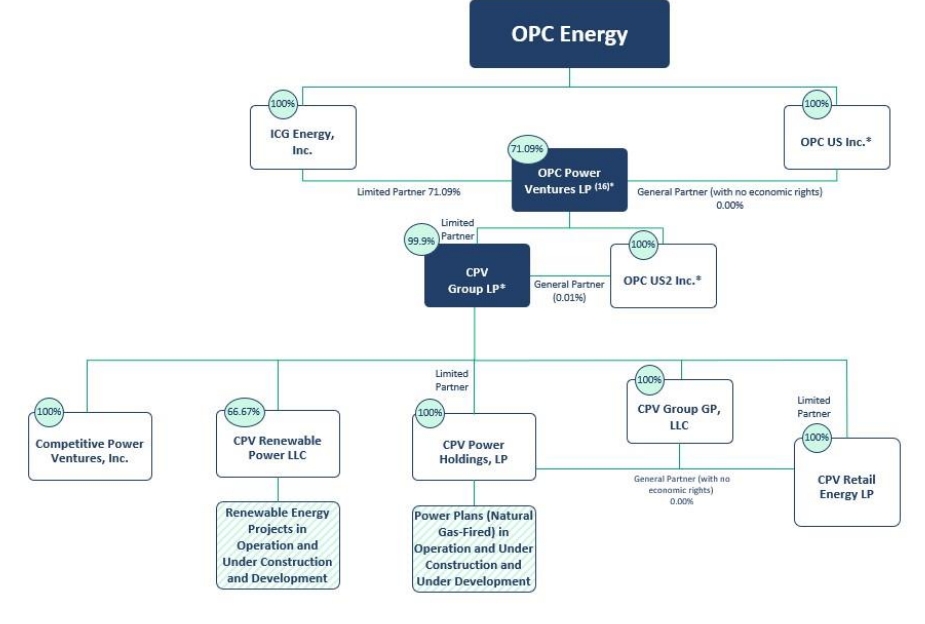
“CPV” means CPV Power Holdings LP, Competitive Power Ventures Inc. and CPV Renewable Energy Company Inc., a business engaged in the development, construction and management of power plants running conventional energy (powered by natural gas) in the United States which are part of Energy Transition and Renewables, which is owned by CPV Group LP, an entity in which OPC holds an indirect interest of approximately 70.69%;
 

“CPV Renewables” is CPV Renewable Power LLC, a limited liability company through which CPV’s renewable energy activity is held and which is 66.7% owned by CPV Group;
 

“CPV Group” means CPV Group LP and its investees;
 

“IC Power” means IC Power Ltd., formerly IC Power Pte. Ltd, a Singaporean company and a wholly-owned subsidiary of Kenon;
 

“Inkia” means Inkia Energy Limited, a Bermuda corporation, which was a wholly-owned subsidiary of IC Power. In December 2017, Inkia sold all of its Latin American and Caribbean businesses and has since been wound up;
 

“Inkia Business” means Inkia’s Latin American and Caribbean power generation and distribution businesses, which were sold in December 2017;
 

“Majority Qoros Shareholder” means the China-based investor related to Shenzhen Baoneng Investment Group Co., Ltd. (“Baoneng Group”) which owns 63% of Qoros;
 

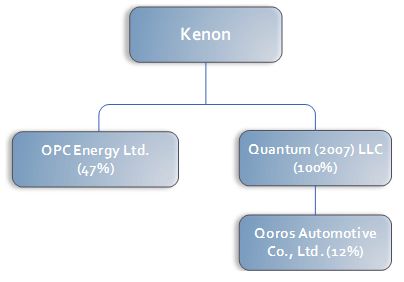
“OPC” means OPC Energy Ltd., an owner, developer and operator of power generation facilities in the Israeli and United States power markets, in which Kenon has an approximately 46% interest;
 

“our businesses” shall refer to each of our subsidiaries and associated companies, collectively, as the context may require;
 

Qoros Automotive Co., Ltd. (“Qoros”), a Chinese company, in which Kenon, through its 100%-owned subsidiary Quantum (as defined below), has a 12% interest;
 

“Quantum” means Quantum (2007) LLC, a Delaware limited liability company, a wholly-owned subsidiary of Kenon, which is the direct owner of our interest in Qoros;
 

“Spin-Off” shall refer to the following transactions conducted in January 2015 (i) Israel Corporation Ltd.’s (“IC”) contribution to Kenon of its interests in IC Power, Qoros, ZIM and other entities, and (ii) IC’s subsequent distribution of Kenon’s issued and outstanding ordinary shares, via a dividend-in-kind, to IC’s shareholders;
 

“ZIM” means ZIM Integrated Shipping Services, Ltd., an Israeli global container shipping company, in which Kenon used to hold an interest until December 2024.
iii

Additionally, this annual report uses the following conventions for OPC.
 
OPC
 

“availability factor” refers to the number of hours that a generation facility is available to produce electricity divided by the total number of hours in a year;
 

“BCM” means a billion cubic meters of natural gas, a unit of energy, specifically natural gas production and distribution;
 

“carbon capture” technology refers to a set of chemical processes that are designed to capture CO2 from the exhaust gas stream of a fossil fuel power generation or industrial process, often referred to as point source carbon capture technology; the primary goal of this technology is to reduce the release of CO2 into the atmosphere;
 

“COD” means the commercial operation date of a development project;
 

“CPI” means the Consumer Price Index. Unless the context otherwise requires or as otherwise specified, references to CPI herein refer to the Consumer Price Index in Israel;
 

“distribution” refers to the transfer of electricity from the transmission lines at grid supply points and its delivery to consumers at lower voltages through a distribution system;
 

“dunam” means a measure of land area used in Israel (1 dunam = 1,000m2);
 

“EA” means Israeli Electricity Authority;
 

“EPC” means engineering, procurement and construction;
 

“Energean” means Energean Israel Ltd which holds a 100% interest in Karish Reservoir;
 

“firm capacity” means the amount of energy available for production that, pursuant to applicable regulations, must be guaranteed to be available at a given time for injection to a certain power grid;
 

“Gat Partnership” means Alon Energy Centers—Gat Limited Partnership, a limited partnership that holds interests in the Gat Power Plant;
 

“GW” means gigawatt;
 

“GWh” means gigawatt hour (one GWh is equal to 1,000 MWh);
 

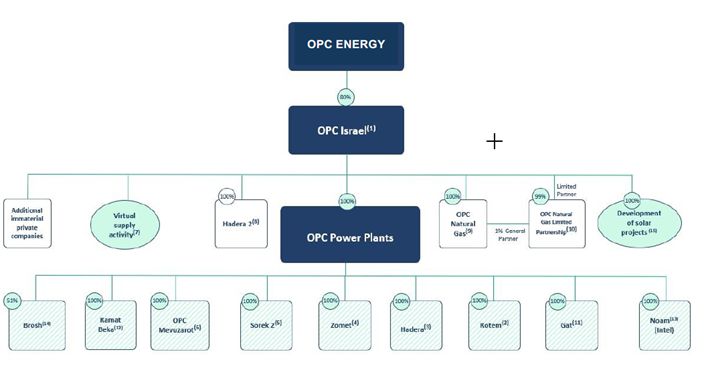
“Hadera” is an Israeli corporation, in which OPC Israel has a 100% interest;
 

“Hadera 2” means OPC Hadera Expansion Ltd., a privately-held company which is advancing the construction of a gas-fired power plant on land adjacent to the Hadera Power Plant;
 

“Hadera Energy Center” means Hadera’s boilers and a steam turbine. The Hadera Energy Center currently serves as back-up for the Hadera power plant’s supply for steam;
 

the “IEC” means Israel Electric Corporation;
 

“IEC Reform” means a reform pursuant to which, in 2018, the Israeli government resolution was received with respect to the matter of the reform in the electricity sector and the restructuring of the IEC (Government Resolution No. 3859), and an amendment to the Electricity Sector Law (Electricity Sector Law (Amendment No. 16 and Temporary Order), 2018 was published). Further to the IEC Reform, among other things, the system management activity was moved from IEC to Noga, the Alon Tavor, East Hagit and Eshkol (the sale of which was completed in June 2024) generation sites were sold, and competition in the supply segment has intensified through a series of decisions and ministerial policies to fully open the supply segment to competition;
iv


“ILA” means The Israel Lands Authority;
 

“Infinya” means Infinya Ltd. (formerly Hadera Paper Ltd.), an Israeli corporation which became a privately-held company wholly-owned by Veridis and Israel Infrastructure Fund;
 

“INGL” means Israel National Gas Lines Ltd., a government company holding a license for the transmission of high-pressure gas;
 

“installed capacity” means the intended full-load sustained output of energy that a generation unit is designed to produce (also referred to as name-plate capacity);
 

“IPP” means independent power producer, excluding co-generators and generators for self-consumption;
 

“Kallpa” means Kallpa Generación SA, a company within the Inkia Business. Kallpa was owned by Inkia until December 2017;
 

“Karish Reservoir” refers to the Karish and Tanin natural gas fields situated in the Mediterranean Sea offshore Israel and are owned and operated by Energean;
 

“Gat Power Plant” or “Gat” means a combined-cycle power plant powered by conventional energy with installed capacity of 75 MW located in the Kiryat Gat area, which began commercial operation in November 2019;
 

“kWh” means kilowatt hour;
 

“Market Concentration Committee” is a statutory body established under the Law for Promotion of Competition and Reduction of Concentration (2013);
 

“Minimum Price” means the minimum price of gas in USD set forth in gas purchase agreements between Tamar Group and each of Hadera and Rotem based on a natural gas price formula described in the agreements;
 

“MW” means megawatt (one MW is equal to 1,000 kilowatts or kW);
 

“MWdc” means megawatts, direct current;
 

“MWh” means megawatt hour;
 

“National Infrastructure Committee” is an Israeli statutory planning body responsible for accelerating and approving major national projects, such as power plants, transportation networks, and waste facilities;
 

“National Infrastructure Plan” means an Israeli government large-scale infrastructure project;
 

“Noga” or the “System Operator” means Noga – Independent System Operator Ltd, which acts as the System Operator in Israel;
 

“capacity” or “installed capacity” means, with respect to each asset, 100% of the capacity of such asset, regardless of OPC’s ownership interest in the entity that owns such asset;
 

“OPC Israel” or OPC Holdings Israel Ltd., is an Israeli corporation which owns and operates OPC’s businesses in Israel, in which OPC holds an 80% interest;
 

“OPC Power Ventures” means OPC Power Ventures LP, a limited partnership held by ICG energy (a wholly owned subsidiary of OPC, incorporated under the laws of New Jersey), and by financial investors;
v


“OPC Power Plants” means OPC Power Plants Ltd., a wholly owned subsidiary of OPC Energy Ltd., which generates and supply electricity and energy in Israel;


“Operation Lion’s Roar” means the military actions commenced on February 28, 2026 between Israel and the United States against Iran and includes military actions by Iran against other countries in the Middle East;
 

“Operation Rising Lion” means the outbreak of a large-scale military conflict between Israel and Iran in June 2025;
 

“PPA” means power purchase agreement;
 

“Ramat Bekka Project” means a consolidated solar and storage project for the construction of renewable energy power- generation facilities using photovoltaic technology co-located with energy storage across compounds won in the Neot Hovav Industrial Local Council, which are the subject matter of OPC power plants’ winning bid in the EA’s tenders through Ramat Bekka Solar;
 

“Ramat Bekka Solar” means OPC Solar Ramat Bekka Ltd., a privately-held special-purpose company, which is developing the Ramat Bekka Project; and OPC shall act to transfer the lease rights to Ramat Bekka Solar subject to ILA’s approval;
 

“Rotem” means OPC Rotem Ltd., an Israeli corporation, in which OPC Israel has a 100% interest;
 

“SOFR” or Secured Overnight Financing Rate, a benchmark interest rate for dollar-denominated loans and derivatives, representing the cost of borrowing cash overnight secured by U.S. Treasury securities;
 

“Sorek 2” means OPC Sorek 2 Ltd., a privately-held company, which completed the construction of a gas-fired energy generation facility in the premises of the Sorek B Desalination Facility, and after the facility’s delivery inspections are completed, it will operate and provide the energy required for the Sorek B Desalination Facility upon completion of the delivery inspections and obtaining the permits and licenses required by law;
 

the “System Operator” has the meaning as defined in Section 1 of the Israeli Electricity Sector Regulations (Private Conventional Electricity Producer), 2005 entrusted by the Israeli government to manage and operate Israeli electrical grid; currently Noga acts as the System Operator;
 

“Tamar” means Tamar reservoir, a gas field located 90 km west of Haifa, Israel with estimated reserves of natural gas of approximately 13.17 tcf or approximately 373 BCM, owned and operated by the Tamar Group;
 

“TASE” means Tel Aviv Stock Exchange;
 
“tcf” means trillion cubic feet, a volume measurement of natural gas;
 

“transmission” refers to the bulk transfer of electricity from generating facilities to the distribution system at load center station in which the electricity is stabilized by means of the transmission grid;
 

“Zomet” means Zomet Energy Ltd., an Israeli corporation in which OPC Israel has a 100% interest;
 

“Veridis” means Veridis Power Plants Ltd which owns 20% of OPC Israel; OPC and Veridis are party to a shareholders’ agreement which governs the relationship between OPC and Veridis in OPC Israel; Veridis is a wholly-owned subsidiary of Veridis Environment Ltd., whose securities are listed on the TASE and which is indirectly controlled by Delek Automotive Systems Ltd., the securities of which are also listed on the TASE; and
 

the “War” refers to the multi-front regional conflict that started with a deadly attack by the Hamas terrorist organization on communities in the Gaza Strip in the southern part of Israel on October 7, 2023 and the military actions that followed and the subsequent military strikes in Iran, Lebanon and the wider Middle East.
vi

FINANCIAL INFORMATION
 
We present financial statements in accordance with the International Financial Reporting Standards issued by the International Accounting Standards Board, or IFRS, and all financial information included in this annual report is derived from our IFRS financial statements, except as otherwise indicated. In particular, this annual report contains certain non-IFRS financial measures which are defined under “Item 5 Operating and Financial Review and Prospects and “Item 4.B Business Overview—Our Businesses—OPC’s Business.
 
Our consolidated financial statements included in this annual report comprise the consolidated statements of profit and loss, other comprehensive income (loss), changes in equity, and cash flows for the years ended December 31, 2025, 2024 and 2023 and the consolidated statements of financial position as of December 31, 2025 and 2024. We present our consolidated financial statements in U.S. Dollars.
 
All references in this annual report to (i) “NIS” or “New Israeli Shekel” are to the legal currency of the State of Israel, or Israel; (ii) “RMB” are to Yuan, the legal currency of the People’s Republic of China, or China; and (iii) “U.S. Dollars,” “$” or “USD” are to the legal currency of the United States of America (“United States” or “U.S.”).
 
This annual report contains translations of certain RMB and NIS amounts into USD at certain foreign exchange rates solely for the convenience of the reader. All convenience translations from RMB or NIS to USD are based on the certified foreign exchange rates published by the Federal Reserve Board of Governors and foreign exchange rates published by the Bank of Israel, respectively, on December 31, 2025, which was RMB 6.99 per USD and NIS 3.19 per USD, respectively. In our consolidated financial statements, convenience translations into U.S. Dollars are made at the prevailing exchange rate at the time of the relevant transaction or agreement. The convenience translations contained in this annual report should not be construed as representations that the RMB or NIS amounts referred to herein actually represent the USD amounts in the convenience translations presented or that they could have been or could be converted into USD at the exchange rate used in the convenience translations or at any particular rate.
 
We have made rounding adjustments to reach some of the figures included in this annual report. Consequently, numerical figures shown as totals in some tables may not be arithmetic aggregations of the figures that precede them.
 
NON-IFRS FINANCIAL INFORMATION
 
In this annual report, we disclose non-IFRS financial measures, namely EBITDA and adjusted EBITDA including proportionate share of adjusted EBITDA of associated companies for OPC, each as defined under “Item 5 Operating and Financial Review and Prospects.” Each of these measures are important measures used by us, and our businesses, to assess financial performance. We believe that the disclosure of EBITDA and adjusted EBITDA after proportionate consolidation provides transparent and useful information to investors and financial analysts in their review of these businesses’ operating performance and in the comparison of such operating performance to the operating performance of other companies in the same industry or in other industries that have different capital structures, debt levels and/or income tax rates.
 
MARKET AND INDUSTRY DATA
 
Certain information relating to the industries in which each of businesses operate used or referenced in this annual report were obtained from internal analysis of such businesses, surveys, market research, publicly available information and/or industry publications. Unless otherwise indicated, all sources for industry data and statistics are estimates or forecasts contained in or derived from such businesses or industry sources. Such data, as well as surveys, industry forecasts and market research while believed to be reliable, have not been independently verified. In addition, in certain cases we have made statements in this annual report regarding the industries in which each of our businesses operate based upon the experience of our businesses and their view of the market conditions affecting their operations. We cannot assure you that any of these statements are accurate or correctly reflect the position of our businesses in such industries, and none of these internal surveys or information has been verified by independent sources.
 
Market data and statistics are inherently predictive and speculative and are not necessarily reflective of actual market conditions. Such statistics are based upon market research, which itself is based upon sampling and subjective judgments by both the researchers and the respondents. In addition, the value of comparisons of statistics for different markets is limited by many factors, including that (i) the markets are defined differently, (ii) the underlying information was gathered by different methods and (iii) different assumptions were applied in compiling the data. Accordingly, the market statistics included in this annual report should be viewed with caution.
vii

PRESENTATION OF OPC CAPACITY AND PRODUCTION FIGURES
 
Unless otherwise indicated, statistics provided throughout this annual report with respect to power generation units are expressed in MW, in the case of the capacity of such power generation units, and in GWh, in the case of the electricity production of such power generation units. One GWh is equal to 1,000 MWh, and one MWh is equal to 1,000 kWh. Statistics relating to aggregate annual electricity production are expressed in GWh and are based on a year of 8,760 hours. Unless otherwise indicated, OPC’s capacity figures provided in this annual report reflect 100% of the capacity of all of OPC’s assets, regardless of OPC’s ownership interest in the entity that owns each such asset. For information on OPC’s ownership interest in each of its operating companies, see “Item 4.B Business Overview—Our Businesses—OPC’s Business.”
 
SPECIAL NOTE REGARDING FORWARD-LOOKING STATEMENTS
 
This annual report contains forward-looking statements within the meaning of Section 21E of the Securities Exchange Act of 1934 (the “Exchange Act”). These forward-looking statements include statements relating to expectations, beliefs, projections, future plans and strategies, anticipated events or trends and similar expressions concerning matters that are not historical facts and include statements contained in the sections entitled “Item 4 Information on the Company” and “Item 5 Operating and Financial Review and Prospects.” These statements are made under the “safe harbor” provisions of the U.S. Private Securities Litigation Reform Act of 1995. Some of these forward-looking statements can be identified by terms and phrases such as “anticipate,” “should,” “likely,” “foresee,” “believe,” “estimate,” “expect,” “intend,” “continue,” “could,” “may,” “plan,” “project,” “predict,” “will,” and similar expressions.
 
These forward-looking statements include statements relating to:
 

our goals and strategies;
 

the strategies, business plans and funding requirements of our businesses;
 

expected trends and projections in the industries and markets in which our businesses operate;
 

our tax status and treatment and expected status and treatment under relevant regulations;
 

our share repurchase plan;
 

our treasury activities;
 

statements relating to litigation and arbitration; and
 

critical accounting estimates and the expected effect of new accounting standards on Kenon;
 

with respect to OPC:
 

OPC’s strategies, with respect to Israel and the United States;
 

the expected cost and timing of commencement and completion of construction and development projects and projects under development, as well as the anticipated installed capacities and other attributes and expected performance of such projects, including the required license and approvals for the development of and financing for projects;
 

expected macroeconomic trends in Israel and the U.S., including the expected growth in energy demand;
 

potential new projects and existing projects and future carbon potential;
viii


gas supply agreements;
 

dividend policy;
 

expected trends in energy consumption;
 

regulatory developments in Israel and the U.S.;
 

anticipated capital expenditures, and the expected sources of funding for capital expenditures;
 

projections for growth and expected trends in the electricity market in Israel and the U.S.; and
 

the impact of the War, Operation Lion’s Roar and other geopolitical events;
 

with respect to Qoros:
 

statements relating to the agreement to sell Kenon’s remaining interest in Qoros to the Majority Qoros Shareholder; and
 

statements with respect to the litigation and arbitration relating to Qoros.
 
The preceding list is not intended to be an exhaustive list of each of our forward-looking statements. The forward-looking statements are based on our beliefs, assumptions and expectations of future performance, taking into account the currently available information to us and are based upon current expectations and projections about future events.
 
There are important factors that could cause actual results, level of activity, performance or achievements to differ materially from the results, level of activity, performance or achievements expressed or implied by these forward-looking statements which are set forth in “Item 3.D Risk Factors.” Given these risks and uncertainties, you should not place undue reliance on forward-looking statements as a prediction of actual results.
 
Except as required by law, we undertake no obligation to publicly update or revise any forward-looking statements, whether as a result of new information, future events or otherwise. You should read this annual report with this cautionary note in mind, and with the understanding that our actual future results may be materially different from what is indicated in such forward-looking statements.
 
This annual report includes statements expressed as expectations, beliefs, estimates or similar expressions of OPC. Such statements are expectations, beliefs, estimates (or similar statements) of OPC, as applicable, and are based on statements included in OPC’s annual report, including its board of directors report for the year ended December 31, 2025.
ix

PART I
 
ITEM 1.          Identity of Directors, Senior Management and Advisers
 
A.
Directors and Senior Management
 
Not applicable.
 
B.
Advisers
 
Not applicable.
 
C.
Auditors
 
Not applicable.
 
ITEM 2.          Offer Statistics and Expected Timetable
 
A.
Offer Statistics
 
Not applicable.
 
B.
Methods and Expected Timetable
 
Not applicable.
 
ITEM 3.          Key Information
 
A.
Reserved
 
B.
Capitalization and Indebtedness
 
Not applicable.
 
C.
Reasons for the Offer and Use of Proceeds
 
Not applicable.
 
D.
Risk Factors
 
Our business, financial condition, results of operations, prospects and liquidity can suffer materially as a result of any of the risks described below. The risks discussed below are not the only ones we face. We are also subject to the same risks that affect many other companies, such as labor relations, geopolitical events, climate change and risks related to the conducting of international operations. Additional risks not known to us or that we currently consider immaterial may also adversely impact our businesses. Our businesses routinely encounter and address risks, some of which may cause our future results to be different—sometimes materially different—than we presently anticipate.
 
Risks Related to Our Strategy and Operations
 
OPC, including its subsidiaries OPC Israel and CPV Group, will require additional financing for construction and development projects and any new business which we may acquire may also require financing.
 
OPC’s business in Israel has projects under construction and in development that will require additional financing. In addition, CPV Group, OPC’s subsidiary in the United States, has a number of projects under construction and in development that will require financing.
 
To the extent that OPC raises equity financing at the OPC level, we may participate in such equity raise, which reduces our cash and cash equivalents available for other purposes such as dividends and investments in or acquisitions of new businesses. Kenon participated in OPC equity raises in 2025, 2024, 2022 and 2021 and may participate in OPC equity raises in the future. If we do not participate in such an equity raise at all or at least pro rata with our existing holdings, our ownership interest in OPC would be reduced. For example, OPC conducted three equity capital raises in 2025 and one additional equity capital raise in the first quarter of 2026. Kenon invested in one capital raise and did not invest in any of the other capital raises, and as a result (including as a result of a sale of a small portion of its shares), Kenon’s stake in OPC was reduced from approximately 55% at the beginning of 2025 to approximately 46% at the date of this annual report.
1

CPV Group requires capital for the development and construction of existing and future projects and acquisitions of interests in existing or new projects. CPV Group has raised and is expected to raise additional debt and equity financing including at the level of its projects. In 2024, CPV Renewables, a subsidiary of CPV Group, raised equity financing of $300 million in exchange for 33.33% of its equity interests. This investment diluted our indirect interest in CPV Renewables and we face similar dilution risks in connection with other investments in CPV Group or other subsidiaries of CPV Group or OPC. Any difficulty in obtaining the required capital (which may be significant, considering the number and scale of projects by CPV Group) may prevent CPV Group from being able to execute its plans and strategy, at all or with considerable delay. Additional financing for CPV Group may involve equity financing at CPV Group level which could dilute OPC (to the extent OPC does not participate at least proportionately), which would indirectly dilute Kenon’s interest in CPV Group.
 
In addition to OPC and its businesses, any other business we may acquire or in which we may make an investment may require additional financing and may seek to raise debt or equity financing.
 
Kenon may seek to raise financing at the Kenon level to make investments or acquisitions in its existing or new businesses. In the event that Kenon or one or more of our businesses requires capital, Kenon may provide financing by (i) utilizing cash on hand, (ii) issuing equity in the form of shares or convertible instruments (through a pre-emptive offering or otherwise), (iii) raising debt financing at the Kenon level, (iv) using funds received from distributions from its businesses, (v) selling part, or all, of its interest in any of its businesses and using the proceeds from such sales, or (vi) providing guarantees or pledging collateral in support of the debt of Kenon or its businesses. To the extent that Kenon raises debt financing, any debt financing that Kenon incurs may not be on favorable terms, may impose restrictive covenants that limit how Kenon manages its investments in its businesses, and may also limit dividends or other distributions by Kenon. In addition, any equity financing, whether in the form of a sale of shares or convertible instruments, may dilute existing holders of our ordinary shares and any such equity financing could be at prices that are lower than current or then current trading prices.
 
External financing may not be available to us to fund investments we seek to make or to meet our obligations on reasonable terms or at all. Kenon may sell assets to fund any investments it seeks to make or to meet Kenon’s obligations, and its ability to sell assets may be limited. Any sales of assets may not be at attractive prices, particularly if such sales must be made quickly.
 
Our directors have broad discretion on the use of the capital resources for investments in our businesses or other investments or other purposes and we may make investments or acquisitions in our existing or new businesses. Kenon has provided loans and guarantees and made equity investments to support its businesses, such as equity investments in OPC (including equity investments in 2025, 2024, 2022 and 2021), and may provide loans to or make other investments in or provide guarantees in support of its businesses. Kenon’s liquidity requirements may increase to the extent it makes investments in or grants guarantees to support its businesses. To the extent Kenon uses cash on hand or other available liquidity to make an investment in existing or new businesses, this will reduce amounts available for distribution to shareholders.
 
We face risks in connection with our strategy, which includes potential acquisitions or investments in new or existing businesses and we may fail to identify opportunities or consummate investments and acquisitions on favorable terms, or at all, in existing or new businesses.
 
Our strategy contemplates making investments or acquisitions in its existing or new businesses. Our success in executing this strategy depends on our ability to successfully identify and evaluate investment opportunities or consummate investments and acquisitions on favorable terms.
 
The identification of suitable investment or acquisition opportunities can be difficult, time-consuming and costly, and it is challenging to identify and successfully consummate investments or acquisitions that meet our objectives. As a result, we may not identify or successfully complete investment or acquisitions that we target, which may impede execution of our strategy.
2

We expect that any such acquisitions or other investments would be in established industries, would be substantial and that we would be actively involved in the operations and promoting the growth and development of such businesses. In addition, we do not expect that any such acquisitions or other investments would be in start-up companies or focused on emerging markets. While the foregoing set forth our current expectations as to potential acquisitions or other investments, we are not limited by the foregoing criteria or the other criteria described under Item 4.B Business Overview and we have broad discretion as to how we deploy our capital resources and may make investments or acquisitions that differ, potentially significantly, from those contemplated by the foregoing criteria. In addition, such acquisitions or other investments may be non-majority stakes including joint ventures or other minority-owned positions. Accordingly, we may make acquisitions or other investments that are not in accordance with our currently expected investment criteria.
 
Our ability to consummate future investments and acquisitions may also depend on our ability to obtain any required government, regulatory or corporate approvals for such investments. Our ability to consummate future investments or acquisitions may also depend on the availability of financing. See “—Disruptions in the financial markets could adversely affect OPC, Kenon or any businesses Kenon may acquire, which may not be able to obtain additional financing on acceptable terms or at all.
 
Furthermore, we face competition with other local and international companies, including financial investors, for acquisition or investment opportunities, which may result in us losing investment opportunities or increasing our cost of making investments. Some of our competitors for investments and acquisitions may have more experience in the relevant sector, greater resources and lower costs of capital, be willing to pay more for acquisitions, be able to act or transact more quickly and may be able to identify, evaluate, bid for and purchase assets or projects under development that our resources do not permit.
 
To the extent we acquire or otherwise make investments in businesses where we do not have significant (or any) experience, we would face risks of operating in a sector with which we lack experience, which could impact the success of any such acquisition or investments.
 
In addition, there is no assurance that any investments we make will generate a positive return and we face the risk of losing some or all of the funds we invest.
 
Any funds we use to make acquisitions of or investments in a new business will reduce amounts available for investments in our existing businesses and investments in existing or new businesses will reduce amounts available for distribution to shareholders or repurchases of shares and could require us to raise debt or equity financing.
 
Disruptions in the financial markets could adversely affect OPC, Kenon or any businesses Kenon may acquire, which may not be able to obtain additional financing on acceptable terms or at all.
 
OPC accesses capital and lending markets for various purposes, which may include raising funding for the repayment of indebtedness, acquisitions, capital expenditures or for general corporate purposes. Any other business that Kenon may acquire may also seek to access the capital and lending markets. Kenon may seek to access the capital or lending markets to obtain financing in the future, including to support its businesses or to make new investments. The ability of Kenon or its businesses to access capital markets, and the cost of such capital, could be negatively impacted by disruptions in those markets. Disruptions in the capital or credit markets could make it more difficult or expensive for our businesses to access the capital or lending markets if the need arises and may make financing terms for borrowers less attractive or available. Furthermore, a decline in the value of OPC or any business we may acquire, which are or may be used as collateral in financing agreements, could impact access to financing. In addition, high levels of inflation and interest rates adversely impact financial markets and the cost of debt financing and increase volatility in financial markets.
 
The availability of financing and the terms thereof is impacted by many factors, including: (i) our or our business’s financial performance, (ii) credit ratings or absence of a credit rating, (iii) the liquidity of capital markets generally, (iv) the state of the global economy, including inflation and interest rates and (v) geopolitical events such as the Russian invasion of Ukraine and the War. There can be no assurance that Kenon or its businesses will be able to access the capital markets on acceptable terms or at all. If Kenon or its businesses deem it necessary to obtain financing and are unable to do so on acceptable terms or at all, this could have a material adverse effect on our financial condition or liquidity and our or their ability to make desired investments or conduct business.
3

We are subject to volatility in the capital markets and may be subject to limitation on sales of shares in companies we own.
 
Financial market conditions have been volatile in recent years and remain volatile, and these conditions could become worse.
 
As our holding in OPC is publicly traded (and to the extent any of our other holdings in companies are listed in the future), we are exposed to risks of downward movement in market prices. In addition, large holdings of securities can often be disposed only over a substantial length of time. Accordingly, under certain conditions, we may be forced to either sell our equity interest in a particular business at lower prices than expected or defer such a sale, potentially for a long period of time.
 
We have in the past, and may in the future sell or distribute interests in listed companies in which we have ownership and we have and may enter into lockup agreements with respect to our shares in listed companies in connection with offerings by those companies. In addition, we are subject to applicable securities laws restrictions on resales, including in the United States, to the extent we are an affiliate of the issuer, or hold restricted shares.
 
We are a holding company and are dependent upon cash flows from our businesses to meet our existing and future obligations.
 
We are a holding company and we do not conduct independent operations or possess significant assets other than investments in and advances to our businesses and our cash on hand and treasury investments. As a result, we depend on distributions from our businesses, proceeds from sales of our interests in these businesses or external financing to make distributions, to make investments or acquisitions, to pursue our strategy and for our other liquidity requirements.
 
In addition, as Kenon’s businesses are legally distinct from it and are generally required to service their debt and other obligations before making distributions to Kenon, Kenon’s ability to access such cash flows from its businesses may be limited in some circumstances and it may not have the ability to cause its subsidiaries and associated companies to make distributions to Kenon, even if they are able to do so. Additionally, the terms of existing and future joint ventures, financings, or cooperative operational agreements and/or the laws and jurisdictions under which each of Kenon’s businesses are organized may also limit the timing and amount of any dividends, other distributions, loans or loan repayments to Kenon.
 
Additionally, there may be significant tax obligations or other legal restrictions on distributions to us from our businesses.
 
We are exposed to risks in connection with our treasury management activities.
 
We use various treasury management instruments as part of our cash management and treasury activities. We face risks in connection with such treasury management instruments including risks of decline in the value of our treasury instruments and risks relating to changes in interest rates, currency exchange rates or market conditions that otherwise impact the value of our treasury instruments. We also face risks in connection with term instruments we may use that require us to hold the instrument for a fixed period of time as such instruments could impair our access to cash when needed, e.g. to fund potential investments or acquisitions. In addition, we face counterparty risks in connection with treasury instruments, including the risk of insolvency of banks or other counterparties with which we are engaged in our treasury management activities. We also face such risks in connection with any currency, interest rate or other hedging activities we may enter into and such activities may be loss-making.
 
We rely on the internal controls and financial reporting controls of our businesses.
 
We rely on the internal controls and financial reporting controls of our businesses and any failure by our businesses to maintain effective controls or to comply with applicable standards could make it difficult to comply with applicable reporting and audit standards. For example, the preparation of our consolidated financial statements requires the prompt receipt of financial statements that comply with applicable accounting standards and legal requirements from each of our subsidiaries and associated companies, some of whom rely on the prompt receipt of financial statements from each of their subsidiaries and associated companies. Additionally, in certain circumstances, we may be required to file with our annual report on Form 20-F, or a registration statement filed with the SEC, financial information of associated companies (including companies that were associated companies during the 3 years of financial statements included in our annual reports) which has been audited in conformity with SEC rules and regulations and relevant audit standards. We may not, however, be able to procure such financial statements, or such audited financial statements, as applicable, from our subsidiaries and associated companies and this could render us unable to comply with applicable SEC reporting standards.
 
4

Our businesses are leveraged.
 
Our businesses are significantly leveraged. As of December 31, 2025, OPC had $1,769 million of outstanding indebtedness and OPC’s proportionate share of debt (including accrued interest) of CPV’s associated companies was $1,376 million. We and any business we may acquire may incur additional or have debt financing.
 
Highly leveraged assets are inherently more sensitive to declines in earnings, increases in expenses and interest rates, and adverse market conditions. A leveraged company’s income and net assets also tend to increase or decrease at a greater rate than would otherwise be the case if they were not leveraged. Consequently, the risk of loss associated with a leveraged company is generally greater than for companies with comparatively less debt. Additionally, some of our businesses’ assets have been pledged to secure indebtedness, and as a result, the amount of collateral that is available for future secured debt or credit support and a business’ flexibility in dealing with its secured assets may be limited. Our businesses that are leveraged use a substantial portion of their consolidated cash flows from operations to make debt service payments, thereby reducing their ability to use their cash flows to fund operations, capital expenditures, or future business opportunities.
 
Our businesses will generally have to service their debt obligations before making distributions to us or to any other shareholder. In addition, many of the financing agreements relating to the debt facilities of our businesses contain covenants and limitations, including the following:
 

minimum equity;
 

debt service coverage ratio;
 

limits on the incurrence of liens or the pledging of certain assets;
 

limits on the incurrence of debt;
 

limits on the ability to enter into transactions with affiliates, including us;
 

limits on the ability to pay dividends to shareholders, including us;
 

limits on the ability to sell assets; and
 

other non-financial covenants and limitations and various reporting obligations.
 
If any of our businesses are unable to repay or refinance their indebtedness as it becomes due, or if they are unable to comply with their covenants, they may decide to sell assets or to take other actions, including (i) reducing financing in the future for investments, acquisitions or general corporate purposes or (ii) dedicating an unsustainable level of cash flow from operations to the payment of principal and interest on their indebtedness. As a result, the ability of our businesses to withstand competitive pressures and to react to changes in the various industries in which we operate could be impaired. A breach of any of covenants or other obligations under our businesses’ debt instruments could lead to an event of default. Upon the occurrence of such an event of default, the lenders could elect to declare all amounts outstanding thereunder to be immediately due and payable and, in the case of credit facility lenders, terminate all commitments to extend further credit. If the lenders accelerate the repayment of the relevant borrowings, the relevant business may not have sufficient assets to repay any outstanding indebtedness, which could result in a complete loss of that business for us. Furthermore, a default or the acceleration of any obligation under certain debt instrument may permit the holders of other material debt to accelerate their obligations pursuant to “cross default” provisions, which could have a material adverse effect on our business, financial condition and liquidity.
5

We face risks in relation to our remaining 12% interest in Qoros, including risks relating to the enforcement and/or collection of the arbitration award and guarantee award in our favor.
 
Kenon holds a 12% interest in Qoros.
 
In April 2021, Kenon’s subsidiary Quantum (which holds Kenon’s share in Qoros) entered into an agreement (the “Sale Agreement”) with the Majority Qoros Shareholder to sell our remaining 12% interest in Qoros for RMB 1.56 billion (approximately $223 million), and Baoneng Group provided a guarantee of the Majority Qoros Shareholder’s obligations under the Sale Agreement. The Majority Qoros Shareholder did not make any of the required payments under the Sale Agreement, and in the fourth quarter of 2021, Quantum initiated arbitral proceedings against the Majority Qoros Shareholder and Baoneng Group with China International Economic and Trade Arbitration Commission (“CIETAC”). In February 2024, CIETAC issued a final award in favor of Quantum (the “CIETAC Award”), ruling that the Majority Qoros Shareholder and Baoneng Group are obligated to pay Quantum an amount equal to the purchase price set forth in the Sale Agreement (as adjusted for inflation) of approximately RMB 1.7 billion (approximately $243 million), together with pre-award and post-award interest (which will accrue until payment of the award), legal fees and expenses. Such decision is final and is not subject to appeal in accordance with the laws of the People's Republic of China, with the total amount of the award in our favor currently being approximately RMB 2.2 billion (approximately $315 million).
 
In connection with its initial investment in Qoros, the Majority Qoros Shareholder had agreed to assume Quantum’s obligations relating to Quantum’s pledge of its remaining shares in Qoros to secure Qoros RMB 1.2 billion loan facility. In lieu of assuming such pledge obligations, Baoneng Group provided a guarantee to Kenon in respect of a number of obligations, including an obligation of the Majority Qoros Shareholder to reimburse Kenon in the event that Quantum’s shares are foreclosed upon and an obligation of Baoneng Group to deposit into escrow amounts sufficient to protect Kenon against losses in the event of a foreclosure over Quantum’s shares in Qoros by having amounts available to repay any defaulted amounts. In November 2021, Kenon filed a claim for specific performance against Baoneng Group relating to the breaches of the guarantee agreement by Baoneng Group. The Supreme People’s Court granted Kenon’s claim for specific performance against Baoneng Group, ordering Baoneng Group to open an escrow account on behalf of Kenon and to deposit approximately RMB 1.4 billion (approximately $200 million) into the escrow account (the “Guarantee Award”).
 
In connection with the CIETAC Award and the Guarantee Award, Kenon has obtained court orders freezing assets of Baoneng Group, primarily comprising equity interests in entities owning directly and indirectly listed and unlisted equity interests in various businesses; such assets are also subject to freezing orders by other creditors and the orders obtained by Kenon are at various rankings as among creditors. As Baoneng Group had failed to uphold its obligations under the CIETAC Award and the Guarantee Award, Kenon has initiated enforcement and other legal proceedings.
 
There is no assurance as to the outcome of these proceedings. There is also no assurance that Baoneng Group will pay or has the ability to pay the judgments against it in our favor. Kenon is engaged in discussions with the Baoneng Group on the outstanding awards.
 
Any value that could be realized in respect of these awards is subject to significant risks and uncertainties, including the risk that Quantum may be unable to enforce the awards or otherwise collect the amounts awarded or otherwise owing to it, risks relating to any action that may be taken seeking to challenge enforcement of the award, risks relating to the process for enforcement of the awards in these proceedings/jurisdictions, risks relating to the financial condition of the parties subject to the awards, risks related to the value in respect of any assets frozen pursuant to court orders as well as the risk of competing claims to such assets and Kenon’s ability to realize any value in respect of such assets or otherwise in connection with the awards, including the risk that Kenon does not realize any value from such assets or otherwise in connection with these awards and that any value that is realized is less than the amounts owed to Kenon and other risks and uncertainties, which could impact Quantum’s ability to realize any value from these awards.
6

Qoros has been in default under certain loan facilities for a number of years, including its RMB 1.2 billion loan facility, which is secured by, among other collateral, all of Kenon's shares in Qoros. The lenders under Qoros' RMB 1.2 billion loan facility and Kenon has been informed that lenders under various other Qoros debt facilities have made court applications for enforcement proceedings in respect of such defaulted loans and pledges and guarantees, and some of these applications have been accepted by the courts, including enforcement with respect to certain assets of Qoros which may have a material adverse impact on Qoros’ ability to resume operations in the future. The lenders under Qoros' RMB 1.2 billion loan facility have brought enforcement proceedings to enforce Quantum’s pledge of its 12% interest in Qoros which had been pledged to secure this loan. In addition, Kenon has been informed that in December 2025, an application was made to the Suzhou Intermediate People's Court for bankruptcy reorganization of Qoros and that the application is currently under review by the court. We face risks in connection with each of the foregoing and the impact thereof.
 
Our success is dependent upon the efforts of our directors and executive officers.
 
Our success is dependent upon the decision-making of our directors and executive officers as well as the directors and executive officers of our businesses. The loss of any or all of our directors and executive officers could delay the implementation of our strategies or divert our directors and executive officers’ attention from our operations which could have a material adverse effect on our business, financial condition, results of operations or liquidity.
 
Foreign exchange rate fluctuations and controls could have a material adverse effect on our earnings and the strength of our balance sheet.
 
OPC has significant operations in Israel as well as operations in the United States. We also have a 12% ownership in Qoros and judgments have been awarded in our favor in connection with our arbitration and litigation claims relating to our interest in Qoros. Such judgments, which have not yet been paid to us (and are subject to risks as described elsewhere in this annual report), are denominated in RMB. Any businesses we may acquire may have facilities and generate costs and revenues in various geographic regions across the globe. Accordingly, we face risks in connection with foreign exchange rate fluctuations.
 
As a result of our ownership of approximately 46% in, and consolidation of, OPC, a significant portion of our revenue and certain of our businesses’ operating expenses, assets and liabilities, are denominated in currencies other than U.S. Dollars. In addition, OPC is subject to exchange rate fluctuations in its operations in Israel, and a portion of OPC Israel’s PPAs and its supply arrangements are determined by reference to the NIS to USD exchange rate. OPC is also indirectly influenced by changes in the U.S. Dollar to NIS exchange rate, including as a result of the following factors: (i) OPC’s investment in CPV which operates in the United States, (ii) the previous and expected investments in CPV’s new and existing projects and (iii) the IEC electricity tariff being partially linked to increases in fuel prices (mainly coal and gas) that are denominated in U.S. Dollars.
 
Furthermore, our businesses may pay distributions or make payments to us in currencies other than the U.S. Dollar, which we must convert to U.S. Dollars prior to making any dividends or other distributions to our shareholders that we may make in the future. Foreign exchange controls in countries in which our businesses operate may further limit our ability to repatriate funds from subsidiaries or associates or otherwise convert local currencies into U.S. Dollars.
 
Consequently, as with any international business, our liquidity, earnings, expenses, asset book values, and/or equity may be materially affected by short-term or long-term exchange rate movements or controls. Such movements may give rise to one or more of the following risks, any of which could have a material adverse effect on our business, financial condition, results of operations or liquidity:
 

Transaction Risk—which exists where sales or purchases are denominated in overseas currencies and the exchange rate changes after our entry into a purchase or sale commitment but prior to the completion of the underlying transaction itself;
 

Translation Risk—which exists where the currency in which the results of a business are reported differs from the underlying currency in which the business’ operations are transacted;
 

Economic Risk—which exists where the manufacturing cost base of a business is denominated in a currency different from the currency of the market into which the business’ products are sold; and
7


Reinvestment Risk—which exists where our ability to reinvest earnings from operations in one country to fund the capital needs of operations in other countries becomes limited.
 
If our businesses do not manage their interest rate risks effectively, our cash flows and operating results may suffer.
 
We are exposed to interest rate risks because our businesses depend on debt financing to finance operations and projects. Additionally, inflation generally impacts applicable central bank interest rates. High interest rates and any increase in interest rates could make it difficult for us and our businesses to obtain future financing or service existing financings on favorable terms, or at all, and thus reduce revenue and adversely affect our operating results. High interest rates could lower our or our businesses’ return on investments. Our interest expense increases to the extent interest rates rise in connection with our variable interest rate borrowings and higher interest rates also impact new and refinancings of existing fixed rate borrowings. If in the future we have a need for significant further borrowings, our cost of capital would reflect the current interest rates.
 
Conversely, lower interest rates have an adverse impact on our interest income, Kenon maintains large cash balances predominantly held as cash and cash equivalents and any decline in interest rates could have a material impact on any interest we earn on these deposits.
 
Certain of OPC’s indebtedness bears interest at variable, floating rates. In particular, some of this indebtedness is in the form of CPI-linked, NIS-denominated bonds. We, or our businesses, may incur further indebtedness in the future that also bears interest at a variable rate. Any hedging of such exposure may not be effective in managing changes in interest rates. Accordingly, increases in interest rates or changes in the CPI could have a material adverse effect on our or OPC’s, financial condition, results of operations or liquidity.
 
Risks Related to the Industries in which Our Businesses Operate
 
Conditions in the global economy, and in the industries in which our businesses operate in particular, could have a material adverse effect on us.
 
The business and operating results of each of our businesses are affected by worldwide economic conditions, particularly conditions in the energy generation industry in which our primary business operates. The operating results and profitability of our businesses may be adversely affected by global economic conditions, credit market crises, levels of consumer and business confidence, inflation, unemployment levels, levels of capital expenditures, fluctuating commodity prices (particularly prices for electricity, natural gas, and diesel), bankruptcies, government deficit reduction and austerity measures, heightened volatility, increased import and export tariffs and other forms of trade protectionism, geopolitical events such as the War, Operation Lion’s Roar or the Russian invasion of Ukraine and other developments affecting the global economy. Volatility in global financial markets and in prices for oil and other commodities and geopolitical events could result in a deterioration of global economic conditions which could impact our business and could lead to business disruption (e.g. delays in completion of projects due to limitations or travel for necessary personnel), deterioration of business, cash flow shortages, or difficulty in obtaining financing.
 
In addition, the business and operating results of our businesses may continue to be adversely affected by the effects of a widespread outbreak of contagious disease, such as COVID-19. Further outbreaks and spread and new variants of COVID-19 or other diseases could cause quarantines, reduction in business activity, labor shortages and other operational disruptions.
 
Furthermore, military actions and conflicts such as the War and the Russian invasion of Ukraine have led to and are expected to continue to lead to disruption, instability and volatility in global markets and industries. Our business could be negatively impacted by such conflicts and any sanctions and export controls, imposed in connection such actions and conflicts.
 
Additionally, economic downturns may alter the priorities of governments to subsidize and/or incentivize participation in any of the markets in which our businesses operate. Slower growth or deterioration in the global economy could have a material adverse effect on our business, financial condition, results of operations or liquidity.
8

Our businesses’ operations expose us to risks associated with conditions in those markets where they operate.
 
Our businesses operate and service customers in geographic regions around the world which exposes us to risks, including:
 

economic volatility;
 

unfavorable changes in laws or regulations;
 

fluctuations in revenues, margins and/or other financial measures due to currency exchange rate fluctuations and restrictions on currency and earnings repatriation;
 

unfavorable changes in regulated electricity tariffs;
 

import or export restrictions or other trade protection measures and/or licensing requirements;
 

costs and risks associated with managing a number of operations across a number of countries;
 

issues related to occupational safety, work hazard, and adherence to local labor laws and regulations;
 

adverse tax developments;
 

geopolitical events such as military actions;
 

changes in the general political, social and/or economic conditions in the countries where we operate; and
 

the presence of corruption in certain countries.
 
For example, for OPC the War resulted and continues to result in delays in completion of and repairs to some projects in Israel due to limitations on supply of equipment and access of qualified personnel. The impact of these factors could have a material adverse effect on our business and the financial condition, results of operations or liquidity of our businesses.
 
Our businesses require qualified personnel to manage and operate their various businesses.
 
Our businesses require a number of qualified and competent management to independently direct the day-to-day business activities of each of our businesses, execute their respective business plans, and service their respective customers, suppliers and other stakeholders, in each case across numerous geographic locations. Our businesses must be able to retain employees and professionals with the skills necessary to understand the continuously developing needs of our customers and to maximize the value of each of our businesses. Changes in demographics, training requirements and/or the unavailability of qualified personnel could negatively impact the ability of each of our businesses to meet these demands. In addition, the War resulted in a significant call up of military reserves, which impacts personnel in Israel. If any of our businesses fail to hire and retain qualified personnel, or if they experience excessive turnover, this could impact their operations, which could have a material adverse effect on our business, financial condition, results of operations or liquidity.
 
Raw material shortages, supplier capacity constraints, production disruptions, supplier quality and sourcing issues or price increases could increase our operating costs and adversely impact our businesses.
 
The reliance of certain of our businesses on certain third-party suppliers, contract manufacturers and service providers, or commodity markets to secure raw materials (e.g., natural gas, solar panels and wind turbines), parts, components and sub-systems used in their products or services exposes us to volatility in the prices and availability of these materials, parts, components, systems and services. Some of these suppliers or their sub-suppliers are limited or sole source suppliers. For more information on the risks relating to supplier concentration in relation to OPC, see “Item 3.D Risk Factors—Risks Related to OPC’s Israel Operations— OPC depends on infrastructure, on securing capacity on the grid and on infrastructure providers.
9

A disruption in deliveries from our third-party suppliers, contract manufacturers or service providers, capacity constraints, production disruptions, price increases, or decreased availability of raw materials or commodities, including as a result of the War, catastrophic events or geopolitical developments impact the ability of our businesses to meet their commitments to customers and could increase their operating costs. Our businesses could encounter supply problems and may be unable to replace a supplier that is not able to meet demand in either the short term or the long term; these risks are exacerbated in the case of raw materials or component parts that are sourced from a single-source supplier. For example, there are only a limited number of suppliers of natural gas in Israel, and the War has increased risks relating to access to gas supply. Furthermore, quality and sourcing issues experienced by third-party providers can also adversely affect the quality and effectiveness of our businesses’ products and/or services and result in liability and reputational harm that could have a material adverse effect on our business, financial condition, results of operations or liquidity. Furthermore, changes to tariff policy applicable to the importation of raw materials and products to the United States (e.g., solar panels) may affect the costs of equipment required for CPV Group projects.
 
Our businesses may be adversely affected by work stoppages, union negotiations, labor disputes and other matters associated with our labor force.
 
Our businesses have experienced and could experience strikes, industrial unrest, work stoppages or labor disruptions. Any disruptions in the operations of any of our businesses could materially and adversely affect our or the relevant businesses’ reputation and could adversely affect operations. Additionally, a work stoppage or other disruption at any one of the suppliers of any of our businesses could materially and adversely affect our operations if an alternative source of supply were not readily available. In addition, as a result of the War, OPC may face personnel availability issues due to drafting as reservists, and their absence may disrupt OPC’s businesses.
 
A disruption in our and each of our business’ information technology systems, including incidents related to cyber security, could adversely affect our business operations.
 
Our business operations, and the operations of our businesses, rely upon the accuracy, availability and security of information technology systems for data processing, storage and reporting. As a result, we and our businesses maintain information security policies and procedures for managing such information technology systems. However, such security measures may be ineffective and our information technology systems, or those of our businesses, are subject to cyber-attacks. A number of companies around the world have been the subject of cyber security attacks in recent years, including in Israel where OPC operates. Other Israeli businesses face cyber-attack campaigns, and it is believed the attackers may be from hostile countries. These attacks are increasing and becoming more sophisticated, and may be perpetrated by computer hackers, cyber terrorists or other perpetrators of corporate espionage.
 
Cyber security attacks could include malicious software (malware), attempts to gain unauthorized access to data, social media hacks and leaks, ransomware attacks and other electronic security breaches of our and our business’ information technology systems as well as the information technology systems of our customers and other service providers that could lead to disruptions in critical systems, unauthorized release, misappropriation, corruption or loss of data or confidential information. In addition, any system failure, accident or security breach could result in business disruption, unauthorized access to, or disclosure of, customer or personnel information, corruption of our data or of our systems, reputational damage or litigation. We or our operating companies may also be required to incur significant costs to protect against or repair the damage caused by these disruptions or security breaches in the future, including, for example, rebuilding internal systems, implementing additional threat protection measures, providing modifications to our services, defending against litigation, responding to regulatory inquiries or actions, paying damages, providing customers with incentives to maintain the business relationship, or taking other remedial steps with respect to third parties. These cyber security threats are constantly evolving. The increased reliance on remote access for employees in recent years has increased the likelihood of cyber security attacks. We, therefore, remain potentially vulnerable to additional known or yet unknown threats, as in some instances, we, our businesses and our customers may be unaware of an incident or its magnitude and effects. Should we or any of our operating businesses experience a cyber-attack, this could have a material adverse effect on our, or any of our operating companies’, business, financial condition or results of operations.
 
10


OPC faces the risk of cybersecurity attacks or damage to OPC’s IT and data systems. Such physical, technical, or logical damage to the administrative and/or operational systems, for any reason whatsoever, may expose OPC to harm and disruptions in OPC’s electricity production and supply, and/or cause harm to IT systems or data theft or leaks (including private information), and/or harm OPC’s reputation. In addition, a lack of compatibility between IT systems, management and business departments and the existence of technological gaps, increase cybersecurity risks. OPC being an Israeli company puts it at a higher risk of cybersecurity attacks (among other things on the back of the War). Cyber-attacks may occur, and insofar as OPC is subject to the material cyber-attack, this may have a significant impact on OPC’s operations and reputation. In addition, OPC may incur costs to protect itself against damage to its IT systems and repair any such damage, if it occurs, including, for example, system recovery, protection against legal action following from a cybersecurity attack, paying damages, or taking other corrective measures toward third parties. In addition, any misalignment between the IT systems, management and business departments and technological gaps or the emergence of technological developments before adequate safeguards are put in place, increase cybersecurity risks.
 
Risks Related to Legal, Regulatory and Compliance Matters
 
We, and each of our businesses, are subject to legal proceedings and legal compliance risks.
 
We are subject to a variety of legal proceedings and legal compliance risks in every part of the world in which our businesses operate. We, our businesses, and the industries in which we operate, are periodically reviewed or investigated by regulators and other governmental authorities, which could lead to enforcement actions, fines and penalties or the assertion of private litigation claims and damages. Changes in laws or regulations could require us, or any of our businesses, to change manners of operation or to utilize resources to maintain compliance with such regulations, which could increase costs or otherwise disrupt operations. Changes in trade policies and or changes in the political and regulatory environment in the markets in which we operate, such as foreign exchange import and export controls, sanctions, tariffs and other trade barriers and price or exchange controls, could affect our businesses in such markets, impact our profitability and or our ability to repatriate profits, and may expose us or any of our businesses to penalties, sanctions and reputational damage. In addition, the uncertainty of the legal environment in some regions could limit our ability to enforce our rights.
 
The global nature of our operations means that we are subject to legal and compliance risks and additional legal proceedings and other contingencies, the outcome of which cannot be predicted with certainty, may arise from time to time. We could be found to be operating in violation of any existing or future laws or regulations. A failure to comply with or properly anticipate applicable laws or regulations could have a material adverse effect on our business, financial condition, results of operations or liquidity.
 
We may be subject to further governmental regulation as a result of our regulatory status, which could subject us to restrictions that could make it impractical for us to continue our business as contemplated and could have a material adverse effect on our business.
 
The U.S. Investment Company Act of 1940, or the “Investment Company Act,” regulates “investment companies”, which includes, in relevant part, issuers that are, or that hold themselves out as being, primarily engaged in the business of investing, reinvesting and trading in securities or that are engaged, or propose to engage, in the business of investing, reinvesting, owning, holding or trading in securities and own, or propose to acquire, investment securities (as defined in the Investment Company Act) having a value exceeding 40% of the value of the issuer’s total assets (exclusive of U.S. government securities and cash items) on an unconsolidated basis. Pursuant to a rule adopted under the Investment Company Act, notwithstanding the 40% test described above, an issuer is excluded from the definition of investment company if no more than 45% of the value of the issuer’s total assets (exclusive of U.S. government securities and cash items) consists of, and no more than 45% of the issuer’s net income after taxes (for the last four fiscal quarters combined) is derived from, securities other than (i) U.S. government securities, (ii) securities issued by employees’ securities companies, (iii) securities issued by majority-owned subsidiaries of the issuer that are not investment companies and not relying on certain exclusions from the definition of investment company and (iv) securities issued by companies that are not investment companies and are controlled primarily by the issuer through which the issuer engages in a business other than that of investing, reinvesting, owning, holding or trading in securities. We do not believe that we are subject to regulation under the Investment Company Act. We are organized as a holding company that conducts its businesses primarily through majority owned and primarily controlled subsidiaries. We intend to continue to conduct our operations so that we will not be deemed to be an investment company under the Investment Company Act. However, maintaining such status may impose limits on our operations and on the assets that we and our subsidiaries may acquire or dispose of. If, at any time, we meet the definition of investment company, including as a result of a company in which we have an ownership interest ceasing to be majority owned or primarily controlled, including as a result of dispositions or dilution of interests in majority owned and primarily controlled subsidiaries, we could, among other things, be required to substantially change the manner in which we conduct our operations to avoid being required to register as an investment company, which could have an adverse effect on us and the market price of our securities. If we were to be deemed an “inadvertent” investment company, we may seek to rely on Rule 3a-2 under the Investment Company Act, which provides that an issuer will not be treated as an investment company subject to the provisions of the Investment Company Act provided the issuer has the requisite intent to be engaged in a non-investment business, evidenced by the issuer’s business activities and an appropriate resolution of the issuer’s board of directors, during a one year cure period.
11

The Investment Company Act contains substantive legal requirements that regulate the manner in which an “investment company” is permitted to conduct its business activities. Among other things, the Investment Company Act and the rules thereunder limit or prohibit transactions with affiliates, impose limitations on the issuance of debt and equity securities, prohibit the issuance of stock options, and impose certain governance requirements. In any case, the U.S. Investment Company Act of 1940 generally only allows U.S. entities to register. If we were required to register as an investment company but failed to do so, we could be prohibited from engaging in our business in the United States or offering and selling securities in the United States or to U.S. persons, unable to comply with our reporting obligations in the United States as a foreign private issuer, subject to the delisting of the Kenon shares from the NYSE, and subject to criminal and civil actions that could be brought against us, any of which would have a material adverse effect on the liquidity and value of the Kenon shares.
 
We could be adversely affected by violations of the U.S. Foreign Corrupt Practices Act and similar anti-bribery laws outside of the United States.
 
The U.S. Foreign Corrupt Practices Act, or the “FCPA”, and similar anti-bribery laws in other jurisdictions generally prohibit companies and their intermediaries from making improper payments to government officials or other persons for the purpose of obtaining or retaining business. Recent years have seen substantial anti-bribery law enforcement activity, with aggressive investigations and enforcement proceedings by both the U.S. Department of Justice and the SEC, enforcement activity by non-U.S. regulators, and criminal and civil proceedings brought against companies and individuals. Our policies mandate compliance with the FCPA and other applicable anti-bribery laws. We operate, through our businesses, in some parts of the world that are recognized as having governmental and commercial corruption. Additionally, because many of OPC’s customers and end users are involved in construction and energy production, they are often subject to increased scrutiny by regulators. Our internal control policies and procedures may not protect us from reckless or criminal acts committed by our employees, the employees of any of our businesses, or third-party intermediaries. In the event that we believe or have reason to believe that our employees or agents have or may have violated applicable anti-corruption laws, including the FCPA, we would investigate or have outside counsel investigate the relevant facts and circumstances, which can be expensive and require significant time and attention from senior management. Violations of these laws may result in criminal or civil sanctions, inability to do business with existing or future business partners (either as a result of express prohibitions or to avoid the appearance of impropriety), injunctions against future conduct, profit disgorgements, disqualifications from directly or indirectly engaging in certain types of businesses, the loss of business permits, reputational harm or other restrictions which could disrupt our business and have a material adverse effect on our business, financial condition, results of operations or liquidity. We face risks with respect to compliance with the FCPA and similar anti-bribery laws through any new companies that we may acquire and the due diligence we perform in connection with an acquisition may not be sufficient to enable us fully to assess an acquired company’s historic compliance with applicable regulations. Furthermore, post-acquisition integration efforts may not be adequate to ensure our system of internal controls and procedures are fully adopted and adhered to by acquired entities, resulting in increased risks of non-compliance with applicable anti-bribery laws.
 
We could be adversely affected by international sanctions and trade restrictions.
 
We have geographically diverse businesses, which may expose our business and financial affairs to political and economic risks, including operations in areas subject to international restrictions and sanctions. Legislation and rules governing sanctions and trade restrictions are complex and constantly evolving. Moreover, changes in these laws and regulations can be unpredictable and happen swiftly. Part of our global operations necessitate the importation and exportation of goods and technology across international borders on a regular basis. From time to time, we, or our businesses, may receive information alleging improper activity in connection with such imports or exports. Our policies mandate strict compliance with applicable sanctions laws and trade restrictions. Nonetheless, our policies and procedures may not always protect us from actions that would violate U.S. and/or foreign laws. Such improper actions could subject us to civil or criminal penalties, including material monetary fines, denial of import or export privileges, or other adverse actions. The occurrence of any of the aforementioned factors could have a material adverse effect on our business, financial condition, results of operations or liquidity.
12

Risks Related to OPC’s Israel Operations
 
OPC’s profitability depends on the EA’s electricity rates and tariff structure.
 
A reduction in electricity tariffs, or changes in the tariff structure or its components - as determined by the EA - particularly the generation component, may have a material adverse effect on OPC’s profits and operating results. A decrease in the generation component tariff leads to a deterioration in OPC’s operating results. Changes in the electricity generation component tariff (including changes in the structure of the generation component) - as published by the EA (due to various reasons, such as exchange rates, changes in the cost of fuels used by the IEC, changes in the allocation of costs to the generation component or systemic costs, sale of power plants, policy changes, or broader changes in the electricity sector, modification of methodologies or policies) affect OPC’s revenues from sales to private customers, since electricity prices under OPC’s customer agreements are directly linked to the generation component. Furthermore, the cost of sales will also be affected, since the generation component serves as the basis for the linking of the natural gas price under the gas purchase agreements. Furthermore, the gas pricing formula under OPC’s gas purchase agreements includes a minimum price, such that in periods in which the gas price is at the minimum price level, a decrease in the generation component will not result in a reduction in the natural gas cost but will reduce OPC’s margins and negatively impact its profits. In addition, fundamental changes to the structure of the generation component and to the methodology by which it is determined (including changes in demand hour clusters or modification of various components or their weights with respect to electricity tariffs) involve uncertainty and may adversely affect OPC’s revenues in Israel, whether due to the setting of lower tariffs than those currently in effect or due to uncertainty regarding the parameters used in determining the generation component.
 
As part of its operations in the U.S., OPC is significantly exposed to changes in electricity prices and capacity rates in the U.S., such that a decline in these rates (or in factors affecting them, such as electricity demand) would adversely affect OPC’s operating results.
 
OPC is subject to changes in the electricity market and technological changes.
 
OPC is engaged in electricity generation and supply using a range of technologies, including conventional technologies (primarily natural gas), and renewable energy (in the United States) and projects under development and construction, including projects with carbon capture potential and construction projects in the United States. OPC is working to expand its renewable energy activities in Israel and the United States, while potentially incorporating technologies involving carbon capture. A delay or failure in adopting new generation technologies, as well as a failure to effectively manage and lead other innovation processes or to adapt to developments in the supply chain, may result in OPC missing out on business opportunities and impairing the ability to position OPC as an industry leader, and lead to a decrease in its market share. The increase in market share of renewable energies in Israel’s generation mix together with government target and standards for emission reduction, may lead to a decline in conventional generation, including OPC’s generation facilities, and may also reduce the operating output of the Rotem Power Plant (due to its location). In addition, a significant shift by OPC’s customers toward renewable energy sources (whether existing or potential) may adversely affect the demand for OPC’s gas-fired power plants and its operating results. Moreover, technological innovations that directly or indirectly reduce demand for electricity generated by OPC’s projects, or innovations affecting factors that drive electricity demand (such as data centers and AI), may adversely affect OPC’s operations and results.
 
OPC is leveraged and may be unable to comply with its financial covenants and undertakings under its financing agreements (including equity subscription agreements), or meet its debt service or other obligations.
 
As of December 31, 2025, OPC had $1,769 million of consolidated indebtedness. The debt instruments to which OPC and its operating companies are party to require compliance with certain covenants and limitations.
13

A breach of covenants could result, among other things, in acceleration of the debt and cross-defaults across the debt instruments.
 
For example, the trust deeds for OPC’s debentures and the financing agreements of OPC include undertakings to comply with certain financial covenants and various other undertakings to debentures holders and/or lenders. Interest rates may also increase under certain circumstances, such as a downgrading of rating or failure to comply with financial covenants.
 
In addition, distributions (including the repayment of shareholders’ loans) may be subject to compliance with certain financial covenants. Finance agreements impose certain restrictions in connection with a change of control in OPC, expiry of licenses, termination or change of material agreements and other circumstances. Failure to comply with such covenants or the occurrence of any of the specified events set out in the agreements may restrict distributions by OPC, increase finance costs, result in acceleration of indebtedness, increase collateral or equity contributions, or trigger demand by the lenders. In addition, in the event of such breaches or the occurrence of events specified in the relevant agreements (e.g., the TEF Loan), OPC may be required to provide additional capital. Calls for immediate repayment may result in enforcement of collateral or guarantees provided by OPC, may have an adverse effect on OPC, and could trigger cross-default provisions in OPC’s financing agreements.
 
OPC may face restrictions on raising debt financing.
 
OPC may be limited in the amount of credit it may receive in Israel due to regulatory restrictions imposed on financial institutions regarding the amount of loans that Israeli banks are permitted to grant to single borrowers or groups of borrowers as a result of the group of companies to which OPC and its controlling shareholder belong (or entities related thereto). Similar restrictions may also apply to non-banking entities with respect to their investments or credit they provide. Furthermore, various investors have investment policies that include ESG targets that may limit the financing amounts available to OPC.
 
OPC may not achieve its environmental, social, and governance (“ESG”) goals or meet and comply with emerging ESG expectations and regulations.
 
In recent years, investors and other stakeholders, particularly credit providers, customers, and employees, have become increasingly aware of the climate and environmental effects associated with various activities. In addition, regulatory involvement in the area of ESG is increasing, and various ESG-related regulations are imposed under various frameworks.
 
Existing and potential investors and other stakeholders (including customers) may take into account ESG considerations relating to environmental, social and corporate governance aspects as part of their investment and business policies, including in relation to the provision of financing. This trend may manifest itself in various ways, including subjecting investments and/or provision of credit to compliance with ESG standards, implementation of policies by investors, an increase in finance costs and difficulty in hiring employees. In addition, the adoption or tightening of regulatory provisions applicable to OPC’s activities, especially environmental requirements – may entail substantial costs. These trends may have an adverse effect on OPC’s business and financial position, including loss of customers (specifically due to possible preference for electricity from renewable sources), restricting OPC’s ability to implement its growth plan or the hiring of new employees, impairment of assets, an increase in the price of debt, erosion of OPC’s value, or an adverse effect on OPC’s market position.
 
OPC’s operations are significantly influenced by regulations.
 
OPC is subject to significant government regulation. See “Item 4.B Business Overview—Regulatory, Environmental and Compliance Matters.” The electricity generation and supply sector is affected by government policies and is subject to extensive regulatory and governmental oversight, given the central role of electricity and energy pricing in the economies of the markets in which OPC operates. OPC is exposed to changes in these regulations as well as changes to regulations applicable to sectors that are associated with its activities. Various regulations and changes in regulation may have an adverse effect on OPC’s activity and results and on its terms of engagement with third parties, such as its customers and suppliers, including natural gas suppliers. Furthermore, regulatory processes might lead to delays in obtaining permits and licenses (for example, the pending proceedings relating to CPV Valley’s Title V permit), the imposition of penalties, the filing of criminal indictments or the instigation of administrative proceedings against OPC and its management, and damage to OPC’s reputation. In recent years, the industry in which OPC operates has been subject to frequent regulatory changes, and OPC believes that additional changes to the regulatory framework applicable to the sector may be implemented in the coming years, including due to the continued development of the independent power generation market in Israel in line with the government’s targets, and government policies in Israel and in the U.S. Regulatory changes may be introduced in response to shifts in electricity demand, increased regulatory intervention, or enforcement of competition laws, including measures aimed at enhancing market competition. For example, there were significant revisions to the tariff structure in Israel in 2023, which impacted OPC’s results. Regulatory changes, changes in regulators’ policies or in their interpretation of the regulations may have various impacts on the power plants owned by OPC or the power plants it intends to develop (as well as on the economic viability of the construction of new power plants) or the economic viability of taking part in tenders in this area. The regulations that impact OPC may apply pursuant to competition laws or in the context of promotion of competition. Regulatory developments relating to OPC or its competitors, and changes in the regulatory schemes applicable to OPC or its competitors, may have a material adverse effect on OPC’s results and its competitive position.
14

Additionally, OPC requires certain licenses to produce and sell electricity in Israel, and may need further licenses in the future. For example, in February 2023, the EA proposed a resolution to, among other things, grant a supply license to Rotem. Rotem was granted a supply license effective as of July 1, 2024 for the period of Rotem’s production license. The license addresses the application of certain standards to Rotem, including those regarding deviations from consumptions plans submitted by private electricity suppliers and the application and criteria of the complementary arrangements in light of the EA’s stated intention to align the regulation that applies to Rotem with the regulation applicable to other manufacturers entering into bilateral transaction, thereby allowing Rotem to operate in the energy market in a manner that is similar to that of other electricity generation facilities that are allowed to conduct bilateral transactions.
 
Furthermore, OPC’s activities are subject to environmental laws and regulations aimed at enhancing environmental protection and reducing the impact of environmental hazards, including, inter alia, by setting restrictions relating to noise, pollutant emissions and treating hazardous substances. Failure to identify new or amended legislation or to appropriately interpret the provisions of applicable law, objections procedures filed by various parties with respect to OPC’s projects, failure to control and monitor implementation and adherence to legal and regulatory requirements – including license terms and conditions, failure to obtain or renew required permits or licenses or imposition of more stringent licensing terms and conditions, regulatory changes, application of stricter regulation to independent power producers, or non-compliance therewith, may cause OPC to incur substantial costs or significant capital expenses, prevent the development of projects and could have a material adverse effect on OPC’s results. Furthermore, adoption and implementation of ESG objectives or requirements set by various organizations, voluntarily or pursuant to new regulatory provisions, may expose OPC to additional requirements or, in the event of failure to comply with the objectives or requirements, to restrictions on making investments and obtaining credit, and impair its operations.
 
OPC faces risks relating to gas supply agreements, the System Operator and the IEC and PPAs.
 
OPC has agreed to purchase minimum quantities in its gas supply agreements
 
In accordance with gas supply agreements, OPC Israel group companies are in some cases required to consume minimum quantities of gas set forth in gas supply agreements (a “take-or-pay” undertaking), or to undertake to purchase gas from the gas supplier. Failure to consume the minimum quantities of gas may be caused by, among other things, an operational malfunction as a result of which electricity generation is not possible, or a material decrease in generation needs, including due to lower generation quantities prescribed by the System Operator. The purchase of gas in quantities lower than those required under the contractual obligation may expose OPC group companies that are party to such gas supply agreements to additional payment obligations to the gas suppliers.
 
In addition, from the commercial operation date of the Karish Reservoir (which began commercial operations in 2023), the total take-or-pay undertaking to Energean and Tamar by Rotem and Hadera is expected to be higher than the obligation prior to the operation of the Karish Reservoir, although a utilization or sale of the gas surpluses may, to a certain extent, offset such obligations. In addition, the gas supply agreements include provisions specifying periods during which the supplier is not obligated to deliver gas, which may require OPC to procure gas at prices higher than those set forth in the agreement.
15

Unavailability of OPC’s power plants or deviation by OPC’s power plants from the PPAs’ terms, regulatory arrangements, the terms and conditions of the generation license, or relevant covenants.
 
Unavailability of OPC’s power plants which is not in accordance with the terms and conditions of the PPAs, applicable regulatory arrangements (for example, with respect to the Zomet Power Plant), the terms and conditions of the generation license, or relevant covenants may expose OPC Israel group companies to excess payments or breaches of their obligations, disputes with the System Operator, the regulator, or impair their ability to benefit from applicable arrangements. OPC’s facilities in the U.S. may be subject to penalties in the event of unavailability under certain circumstances.
 
Engagement in new PPAs and renewal of existing PPAs
 
A substantial portion of the energy sold by OPC in Israel is sold to private customers under PPAs for defined periods. When the PPAs signed by OPC expire, OPC will need to sign new PPAs with other customers or renew the existing PPAs. There can be no assurance that OPC will be able to enter into new PPAs with customers having the same or better credit or risk profile, for appropriate periods, or renewing existing PPAs upon their expiration, for various reasons or enter into new PPAs on terms that are at least as favorable as those expired PPAs, due to among other things changes in market or competitive conditions. If OPC fails to renew or enter into new PPAs with terms and conditions that are favorable for OPC, its operating results may be adversely affected.
 
OPC faces limitations under Israeli law in connection with the expansion of its business.
 
Existing regulation, such as competition laws, current regulations under the Israeli Law for Promotion of Competition and Reduction of Concentration, enacted in 2013 (the “Market Concentration Law”) or regulations under the Israeli Electricity Sector Law, 5756-1996 (the “Electricity Sector Law”) may lead to the imposition of certain restrictions, including restrictions on maximum capacity or scope of sales to consumers, which may limit the expansion of OPC’s activity in Israel.
 
OPC believes that the capacity set in the generation licenses (in accordance with conditional and permanent generation licenses) of entities, which are considered related parties of OPC, is deemed to be held by a single “person.” OPC has estimated that the held capacity attributed to it is approximately 1,500 MW with respect to natural gas. Furthermore, in accordance with the relevant regulation, holding a stake of 5% or more in OPC or its Israeli investees (including Veridis’ holdings in OPC Israel) may result in the capacity set in the licenses of the holder of such a stake (or its shareholders) being attributed to OPC. Therefore, the capacity attributed to OPC (plus the capacity attributed to entities that may be considered related parties for that purpose) may prevent OPC from making certain acquisitions or executing certain projects, thereby limiting OPC’s ability to expand its activity in Israel.
 
OPC faces risks in connection with entry (or attempts to enter) into new markets, to complete acquisitions, or to integrate acquired operations.
 
OPC’s entry into new markets and geographic regions exposes it to market-specific risk factors, including local regulatory frameworks and the economic and political environments therein. Furthermore, operations in new markets depend on a variety of factors, including familiarity with the relevant markets, the ability to identify suitable transactions, performance of comprehensive due diligence, recruitment of qualified personnel, and securing of the required financing. Failure in one or more of these factors may adversely affect the success of projects in those markets and, consequently, OPC’s operations and results. Furthermore, the integration of significant newly acquired operations into OPC’s existing activities may involve failures in various processes, including internal control and information-flow processes, implementation of management procedures, alignment of financial reporting formats, successful absorption of the new operations and their personnel, as well as OPC’s understanding of the markets in which the acquired activities operate, and the integration of their business strategies and development plans. Failure in one or more of the foregoing factors may adversely affect the realization of the acquired operations’ potential.
 
Some of OPC’s projects are not, and future projects may not be, wholly owned or controlled by OPC.
 
OPC does not own and will not own all of OPC’s existing projects or holdings (including OPC Israel, OPC Power and most of the projects of CPV Group) and future projects. Non-exclusive ownership or control in projects or holdings may limit OPC’s operational flexibility and be subject to the terms of agreements with other interest holders and may also restrict OPC’s ability to fully realize the rewards and exercise the same degree of control as it would under exclusive ownership or control.
16

Changes in the foreign exchange rates (especially with respect to the USD), the CPI in Israel, and interest rates could adversely affect OPC.
 
Foreign exchange rates (especially with respect to the USD)
 
As part of its operations in Israel, OPC is exposed to fluctuations in the exchange rates, mainly to the U.S. Dollar exchange rate, both directly and indirectly, due to among other things, a substantial portion of its revenues being linked with the generation tariff (which is partly affected by changes in the U.S. Dollar exchange rate); and these natural gas purchase agreements are also U.S. Dollar linked and/or denominated in U.S. Dollar, and are linked to the generation tariff and include U.S. Dollar-denominated minimum prices.
 
Therefore, an appreciation of the U.S. Dollar increases the cost of natural gas purchased by OPC. In accordance with the Revision of the Tariff Structure prescribed by the EA, the generation component is updated semi-annually based on a defined set of metrics and an orderly methodology that also reflects exchange-rate movements during 2025; accordingly, timing gaps and other issues may arise between the effect of an appreciation in the U.S. Dollar exchange rate on OPC’s gas cost and its effect on OPC’s gross margin. Such differences may adversely affect OPC’s profitability and cash flows, at least in the short term. Furthermore, from time to time, OPC has entered, and enters from time to time, into material construction and maintenance contracts in various currencies, specifically the U.S. Dollar and the Euro. Accordingly, OPC is exposed to changes in the exchange rate of such currencies.
 
With respect to OPC’s investment in CPV Group, which operates in the United States, and whose functional currency is the U.S. Dollar, generally, a decrease in the exchange rate adversely effects the value of OPC’s U.S. Dollar-denominated investment and OPC’s net income and equity which are translated to OPC’s functional currency (NIS). If there is a need to raise NIS-denominated sources in Israel to fund the investments in CPV Group’s backlog of projects under development, an increase in the exchange rate of U.S. Dollar may trigger higher funding requirements to finance the investments.
 
CPI
 
OPC’s operations in Israel are, directly and indirectly, exposed to CPI changes, mainly because a substantial portion of its revenues is linked to the generation tariff (which is partly CPI-linked). Natural gas purchase prices are also linked to the generation tariff and include a U.S. Dollar floor price. Furthermore, some of OPC’s capital costs and investments are linked to the CPI, directly or indirectly. OPC is further exposed to changes in the CPI, primarily due to the terms and conditions of OPC’s debentures (Series B) and some of the Hadera project financing agreements (which are not subject to hedging arrangements). Accordingly, an increase in the CPI raises OPC’s liabilities and costs. Therefore, the structure of OPC’s activities includes a partial natural hedge – despite the fact that an increase in the CPI increases OPC’s costs (including financing costs) and investments, the structure of the revenues should reduce such exposure, such that OPC’s profits could be positively affected by an increase in the CPI. Nonetheless, the generation component is impacted by various parameters and is subject to changes (including by regulation), generally, once a year (in 2026–2028 once every six months in accordance with a predetermined linkage mechanism);  accordingly, differences are possible between the impact of inflation of OPC’s costs and its impact of the revenues and, accordingly, on OPC’s gross margin for that period.
 
Interest rates (NIS and USD)
 
OPC is also exposed to changes in interest rates as OPC has interest bearing loans and obligations bearing variable interest which is mainly based on SOFR plus a spread. An increase in variable interest rates is expected to lead to higher finance costs for OPC, in connection with both existing debt and debt that may be raised for refinancing and/or growth purposes. Furthermore, an increase in interest rates is expected to affect discount rates used for OPC’s projects (whether operational, under construction or in development), and may make further development/acquisition of projects no longer economically viable, thereby slowing OPC’s growth and potentially resulting in impairment of assets and/or recording of impairment losses.
17

OPC faces risks relating to liquidity and potential difficulty in securing the funding resources required to achieve its future strategic plans, including risks relating to high leverage levels.
 
As a business that is engaged in, among other things, the initiation, development and acquisition of power generation projects, OPC needs to raise large amounts of funds in the next few years in connection with execution of its strategic plans. The financing agreements of the OPC group, including OPC’s debentures, restrict the amount of debt OPC group is permitted to incur and provision of collateral to secure such debt. In addition, raising capital involves risks relating to high leverage levels and financing costs. High leverage exposes OPC group companies to inherent risks involved with leverage and could have an adverse impact on their credit ratings, ability to raise debt financing and the amount that can be raised, operating results and businesses and on their ability to repay their obligations, comply with the terms and conditions of the financing agreements or distribute dividends. High leverage may also require OPC to provide additional collateral or guarantees of obligations of its subsidiaries or associated companies. In order to execute its plans, OPC may also be required to raise capital from investors (in addition to or instead of raising debt financing), both at the OPC level and/or at the level of its subsidiaries or associated companies. Raising capital could result in OPC shareholder dilution or the sale of OPC shares at a discount, as well as additional costs. There is no assurance that OPC will be able to raise the amounts required or as to how any financing will be undertaken, and the ability to raise capital will depend on market conditions, the provisions of OPC group’s financing agreements and the debt structure of the OPC group, investors’ willingness to take part in capital raising (including OPC’s shareholders) and OPC’s operating results. Difficulties in securing the required financing and/or failure to maintain an optimal debt structure may have an adverse effect on OPC’s ability to execute its future strategic plans, on its financial strength, on its compliance with the terms of its finance agreements and on its operating results. The materialization of the risks described above may result in increased financing and liquidity requirements and may increase OPC’s financing costs and liquidity challenges as well as its exposure to credit risks.
 
OPC faces risks in connection with project financing agreements.
 
Project finance agreements of OPC (such as those of CPV, Hadera, Zomet, and the Gat Power Plant) include various undertakings, such as compliance with the terms of licenses and permits, compliance with performance targets and other terms and conditions (including conditions for drawing under the facilities), and failure to comply with such undertakings may limit the amount of financing or distributions, and may even give rise to a call for repayment. In addition, such agreements include terms and conditions including cash sweep provisions, and provisions which require the lenders’ consent to take certain actions relating to among other things commercial plan, the project’s activity and its ownership and undertakings to publish various reports. Failure to comply with the conditions and restrictions, or failure to obtain the lenders’ consent may, among other things, have an adverse effect on the financing extended (and even establish grounds for the lenders to call for repayment), increase the equity required for the project, lead to a demand to provide financial support and consequently increase costs, delay or prevent the completion of the project (if it is a project under construction), adversely affect the project’s commercial operation, delay or prevent the execution of certain measures and have a material adverse effect on OPC.
 
OPC is dependent on dividends from subsidiaries and associated companies.
 
As a holding company, OPC itself does not have material, independent power generation operations other than its investments in the companies it owns. Therefore, OPC is dependent on cash flows from the subsidiaries and associated companies it owns (in the form of dividends or repayment of shareholder loans) in order to meet its various liabilities. OPC’s ability to receive such cash flows may be limited due to various factors, including operating results of its subsidiaries and associated companies, restrictions placed on distributions under agreements with the financing entities of OPC companies, including payment requirements under such agreements. A decrease in free cash flows from Rotem, Hadera, Zomet, Gat, CPV Group and other future projects, or restrictions on OPC’s ability to receive those cash flows may have an adverse effect on OPC’s operating results and its ability to meet its obligations.
 
Instability in global markets and the global geopolitical environment.
 
Instability in global markets, including political or other instability due to various factors, as well as instability in the banking system in the financial markets, economic instability, including concerns about a recession or a slowdown and uncertainty in the geopolitical environment, may affect, among other things, OPC’s supply chain, the availability of financing, credit and liquidity, prices and availability of OPC’s raw materials, gas and electricity tariffs, the cost and availability of personnel in the power plants, the availability of supplier and financial stability of OPC’s suppliers, project construction schedules (as a result, among other things, of delays in the supply chain and the availability of foreign experts and contractors), and the financial strength of OPC’s customers and creditors. Such instability may also cause disruption in the development, construction and maintenance of generation facilities and power plants as well as the activities of OPC as a whole. Furthermore, instability in global markets as well as disruptions to supply chains adversely affect OPC’s projects that are under development or construction in Israel and the U.S. (including equipment costs and supply schedules), as well as OPC’s ability to secure the financing required for such projects and to continue the related construction or development activities.
18


The global geopolitical environment (including the War and subsequent military conflicts with Iran such as Operation Rising Lion and Operation Lion’s Roar, the Russian invasion of Ukraine, tensions between the United States and China resulting in increased risks in maritime trade routes) has been unstable. This ongoing instability and its effect on global economic relations and trade routes gives rise to wide-ranging macroeconomic consequences, which may manifest in, inter alia, energy price volatility, heightened economic uncertainty, higher import taxes, disruptions and delays in supply chains, increases in equipment and commodity prices, and constraints on their availability. Such factors have affected equipment prices around the world, including OPC’s. There is no certainty as to the scope and duration of those trends and their long-term consequences.
 
The political and security situation in Israel.
 
A deterioration in the political and security environment in Israel and around the world may disrupt OPC’s operations and adversely affect its assets on various levels, thereby adversely impacting its operations and results. Security and political events, such as war or terrorist attacks in the markets where OPC operates, may damage the facilities used by OPC, including OPC’s power plants and projects under construction, as well as its IT systems; such events may also result in shortages of labor and foreign experts, disruption or damage to the natural gas transmission system and the electrical grid, and cause damage to OPC’s material suppliers - including natural gas suppliers or its material customers; these effects could harm the continuous, reliable and high-quality supply of electricity.
 
In addition, a deterioration in the political and security environment or increased political instability in Israel could negatively impact Israel’s economy, including its sovereign credit rating and the stability of its financial system (banks and institutional entities) and, in turn, adversely affect OPC’s ability to promote new projects, secure financing for its activities, and pursue further projects. Furthermore, such deterioration may have an adverse effect on electricity demand and on the consumption patterns and/or financial position of OPC’s customers in Israel, which, in turn, may adversely affect OPC’s results. A deterioration in OPC’s results may adversely affect its ability to meet its obligations under the finance agreements and deeds of trust, specifically - its compliance with the financial covenants, as well as its liquidity, debt repayment capacity and debt refinancing (including the extension of short-term credit facilities). In addition, negative developments in the political and security environment in Israel may result in boycotts by various parties or in claims by contractual counterparties that their obligations under agreements with OPC has been terminated or suspended due to force majeure events, reducing the availability of certain professional experts. In addition, workforce availability has been and may be impacted, as certain of OPC’s employees in Israel may be mobilized for reserve duty, and their absence may affect OPC’s activities. Furthermore, security developments may impede maintenance and construction work and may adversely impact the supply chain and the availability of components - due to geopolitical tensions, ongoing risks to trade routes, and intermittent reductions in airline operations. Such impacts may impair the timely arrival in Israel of equipment and foreign personnel necessary for maintenance and construction work at OPC’s sites and may disrupt the schedules. Despite the fact that certain damages resulting from war or terrorist attacks are covered under the Property Tax and Compensation Fund Law, as well as under covenants and insurance policies subject to the liability limits agreed with the insurers, there can be no assurance in such cases that OPC will be compensated in full or at all for direct or indirect damages it may suffer. In light of the increasing risks and the security events that have materialized in recent years, insurance terms and conditions have become more costly and generally provide lower coverage limits or additional exceptions than in the past, and may continue to deteriorate and may hinder OPC’s ability to renew its insurance policies or even restrict the extent of available coverage under similar terms and conditions or at all.
 
Changes in the political conditions in the U.S. or security or global geopolitical events may affect OPC’s activity in the U.S., including natural gas and energy prices, as well as government policies in the field of energy or other fields affecting the energy domain (such as trade policies) and prices of equipment needed for power plants and facilities for electricity generation. Security or political events in the U.S. or around the world may adversely affect OPC’s activities (in the U.S. and Israel), including in aspect of supply chains (such as project schedules and equipment pricing), electricity and gas supply and demand dynamics, heightened cybersecurity risks, reduced activity, and macroeconomic effects.
19

Critical equipment failure.
 
Disruptions, defects, accidents and technical malfunctions in critical equipment of OPC’s generation facilities, and any inability to maintain inventory levels and quality as well as a sufficient level of spare parts, may damage OPC’s ongoing operations and its ability to maintain power generation or construction continuity causing, among other things, delays in the electricity generation, difficulties in fulfilling contractual obligations, loss of income and higher expenses, which may adversely affect OPC’s profits, to the extent not covered under its insurance policies by contractors or equipment suppliers. Although OPC has long-term service agreements with the manufacturers of the critical equipment and carries out preventative and scheduled maintenance works, there is no certainty as to OPC’s ability to prevent damages and shutdowns as a result of any such disruptions and malfunctions, which may cause disruption to the power plants’ activity and harm to OPC’s results, loss of income or capacity payments as well as material costs arising from the maintenance work (which may not be fully covered by insurance, which generally include liability caps, deductibles or exclusions regarding damage, as the case may be).
 
OPC’s activities and operations are affected by natural disasters, climate change, and fires.
 
Global climate changes pose physical and transition risks to OPC's facilities affecting its operations, which include, among other things, gas power plants, solar fields and wind farms. The intensification of extreme climatic events and their increased frequency, including heat waves, cold snaps, extreme rain events, flooding and strong winds may harm the supply chain, the availability of the energy generation facilities in Israel and the US, the continuity of the electricity supply and its reliability, and impose increased operating and maintenance costs on OPC. Climate change may also give rise to opportunities, including, among other things, due to an expected increase in long-term demand for electricity and an increase in demand for and prices of renewable energy.
 
Intense rain events and floods may affect OPC's sites, including the Hadera Power Plant, which is located near the stream. Furthermore, an increase in extreme temperatures and heat waves may affect the safety and operational efficiency of OPC's sites. For example, in the Rotem Power Plant located in the Negev and CPV power plants in the southern U.S., there is a risk of an increase in the frequency and intensity of extreme heat events. In the U.S., some of OPC's sites are also exposed to the risks of cold snaps that could impair their maintenance and operation. Furthermore, changes in wind patterns could affect the performance of OPC's wind energy facilities in the U.S., including the scope of electricity generation and long-term stability of revenues, as well as the operation of equipment at gas-based power plants in Israel. Safeguards or the additional actions taken by OPC to address these risks do not fully guarantee protection against exposure to these risks.
 
In addition, in light of the nature of OPC’s activities, including its use of flammables, operations involving high temperatures and pressures and storage of fuels, OPC’s facilities are exposed to fires and explosion risks, and as a result, to environmental risks as well. If OPC’s facilities are damaged because of natural disasters or fire, restoration may require substantial resources and an extended period, which could lead to a full or partial shutdown of the affected power generation facilities and result in a loss of revenue. OPC purchases insurance policies intended to cover risks associated with its operations, as required under its licenses and pursuant to the finance agreements to which it is a party, however such insurance policies do not cover all events or damages which may be suffered. Accordingly, there can be no assurance that, in such circumstances, OPC will be able to recover compensation for all or any of its losses (in whole or in part), and because of such events, OPC’s operations and results may be materially and adversely affected. Such events may adversely affect suppliers, customers, and infrastructure used by OPC’s facilities (primarily electricity and gas infrastructure), and may indirectly adversely affect OPC’s operations and results.
 
Impact of the War on OPC operations in Israel
 
There is a significant uncertainty as to the development of the War and its impact on OPC and its operations, and there is also significant uncertainty as to the impact of the War on macroeconomic and financial factors in Israel, including the situation in the Israeli capital markets and the credit rating of the State of Israel.
 
20

OPC’s business activities may be affected by the War in the following ways:

Uninterrupted activity of the power plants—OPC power plants in Israel continued to generate electricity pursuant to the provisions of their electricity generation licenses and in accordance with the guidance of the relevant entities and the Ministry of Energy and Infrastructure. OPC’s sites (as with most private business activities in Israel) could be exposed to physical damage as a result of the War. OPC companies in Israel (including Rotem, Hadera, Gat and Zomet) have obtained insurance policies that provide certain coverage in connection with certain types of damage due to terrorist and war activities. OPC is subject to risks that insurance cover may not compensate all or even some of any damages suffered.
 
Furthermore, OPC’s operations in Israel are subject to the directives of the Ministry of Energy’s Department of Emergency, Security, Information, and Cyber regarding cyber defense matters in power plants. OPC employs a multi-faceted approach with respect to protection of its generation facilities against cyber-attacks, particularly protections against outside intrusions, protections against internal attackers that have access to the control networks of the power plants (e.g., suppliers and technicians) and the creation of real time capabilities for monitoring and identifying cyber events. There is no certainty that such defensive measures and actions will prevent cyber-attacks or breaches, the risk of which is higher due to the War.
 
In addition, due to the closing of Israel’s airspace, and restrictions imposed from time to time due to the state of war, delays may occur in the arrival of foreign experts and teams who conduct scheduled and unscheduled maintenance work in OPC’s operational power plants, which may have an adverse effect on the power plants’ availability and generation capacity. Due to the Operation Lion’s Roar, force majeure notices were received from suppliers and contractors alongside limited availability of work teams and foreign experts at the activity sites in Israel, including the Sorek 2 (see below) and Hadera sites (with respect to malfunction).
 
Uninterrupted supply of natural gas to the power plants—OPC’s power plants’ main suppliers of natural gas are Tamar and Energean as well as the Leviathan reservoir. In 2025, the Tamar reservoir operated regularly with exception of a non-scheduled shutdown for a short period during Operation Rising Lion. At various points during the War, the natural gas reservoirs (including Energean’s Karish reservoir) were fully shut down and natural gas for OPC power plants was purchased primarily from the Tamar reservoir (which was shut down for a relatively short period) alongside limited use of diesel fuel. In addition, during Operation Lion’s Roar, all gas rigs (including the Karish reservoir) were shut down for varying periods of time; the Tamar reservoir resumed operations after several days of shutdown, while the Karish and Leviathan reservoirs have not yet resumed operations. OPC is making preparations for a sustained impact on the gas suppliers’ activity, including limited use of diesel fuel in OPC's power plants where necessary. The Tamar reservoir has supplied all of OPC’s gas needs. However, some of the gas was purchased at a higher price than the alternative price from a Karish Reservoir, which has not had a material effect. Additionally, in view of the state of emergency declared in Israel, demand has declined to a certain extent; however, the full effects of the operation on OPC's material customers (if any) are not yet clear. In addition, force majeure notices were received from suppliers and contractors alongside limited availability of work teams and foreign experts at the activity sites in Israel, including for Sorek 2 (which is currently under delivery inspections) and the Hadera site (which is currently undergoing unscheduled maintenance work). Given that Operation Lion’s Roar is ongoing, there is no full certainty as to its full effects and implications on OPC's activity, if any. In 2025, there were generally no material changes in OPC's natural gas costs. Natural gas shortage or disruption to the supply of natural gas from the Karish Reservoir (without the implementation of compensatory arrangements under Covenant 125) has an adverse effect (potentially a material adverse effect) on OPC's natural gas costs, contingent on, among other things, the duration of the shutdown and the conditions in the general gas market in Israel. However, the ongoing operations of the gas reservoirs may be significantly impacted by a deterioration of the defense (security) situation in Israel, particularly in the north. During the suspension period of the Tamar reservoir in 2023, OPC acquired natural gas mainly from Energean as well as under short term agreements and casual transactions in the secondary market. OPC believes that a number of maintenance works is expected to take place in the Tamar Reservoir and Karish reservoir in 2026.
 
Rotem, Hadera and Zomet power plants are “dual fuels” generators of electricity (i.e., they have the capability of operating using both natural gas and diesel oil, subject to adjustments). During this period, the plants had a sufficient amount of diesel oil in conformance with the terms of the license of each plant. Hadera and Zomet power plants are subject to Covenant 125, which covers a case of a shortage of natural gas in the economy. Pursuant to OPC’s position and based on past experience, Covenant 125 also applies to Rotem power plant, and OPC has expressed its position to the EA regarding this matter.
21

Electricity Demand — OPC’s customers (including significant customers) have facilities in Israel that could be exposed to physical damage or to economic and other consequences of the War, and their continued regular operation (and, in turn, OPC’s revenues therefrom) could also be negatively impacted by the War. During Operation Rising Lion, there was a certain decline in demand for power, which was temporary and caused by the suspension of economic activity during the operation and by physical damage to the production facilities of a major industrial customer (which subsequently resumed operations). With regard to Operation Lion’s Roar, in view of the state of emergency declared in Israel, consumption declined to a certain extent in the first few days; however, the full impact of the operation on OPC's customers and/or its revenues (if any) is not yet clear.
 
Project Construction—the construction of OPC’s projects in Israel requires the arrival of equipment and foreign teams to the country, which is subject to disruptions if restrictions are imposed on Israel’s airspace or travel alerts due to security conditions. In addition, due to, among other things, the foregoing, during Operation Rising Lion force majeure notices were received from suppliers and contractors mainly with respect to the Sorek 2 project, which is under construction. In addition, during Operation Lion’s Roar, the construction contractor announced the evacuation of teams from the Sorek 2 site, whose construction has been substantially completed and, which is currently under the inspection stage. Additional maintenance contractors issued force majeure notices due to Operation Lion’s Roar.
 
Financial strength and liquidity—A significant adverse impact on the ability to generate cash from OPC’s operating activities in Israel due to, among other things, occurrence of one of the risks above, could have an adverse effect on OPC’s financial strength and on its ability to comply with the provisions of financing agreements, including the debentures, as well as on the ability to utilize credit facilities. A negative impact on the credit rating in Israel and, accordingly, a possible negative impact on the credit rating of the banks in Israel, could impact compliance with the minimum rating commitments. For example, in 2025, Israel’s credit rating was not revised by the various rating agencies, however the rating outlook assigned by some of them remained negative and before 2025, other agencies upgraded it to stable. The downgrade of Israel’s credit rating and, accordingly, the downgrade of Israeli banks’ credit rating may affect the terms and availability of OPC’s credit or guarantee facilities. During 2025, the Israeli capital market demonstrated resilience and recorded price increases.
 
There is significant uncertainty regarding the security situation in Israel and its developments. There is also significant uncertainty as to the full ramifications of the War on macroeconomic and financial factors in Israel, in the long term.
 
The War, reigniting of the War on other fronts, the expansion of the War and/or escalation of the security situation and internal security situation in Israel may adversely affect OPC’s activity, results and liquidity, including due impact on OPC’s material suppliers and customers and/or engagement terms and conditions therewith (such as maintenance contractors, gas suppliers, equipment suppliers and construction contractors, including global suppliers and potential suppliers) and/or macroeconomic factors and the capital markets. Such effects may apply both at the level of OPC’s projects in Israel (costs and availability of gas, maintenance of operational projects, construction work in projects, which are not yet operational and advancement of projects under development) and at the level of OPC’s overall business activities.
 
OPC’s operations and financial condition may be adversely affected by the outbreak of pandemics or events related to public health or safety.
 
Pandemics (such as COVID-19) or other public health and safety events may lead governments to impose restrictions on trade, movement and business activity, the effects of which may be felt globally. An outbreak of another pandemic, including infections at OPC’s power plants and other sites or could have a material impact on OPC’s key suppliers (such as suppliers of natural gas and construction and maintenance contractors) or on OPC’s principal customers, may adversely affect OPC’s operations and performance, as well as its ability to complete projects under construction on schedule or at all and/or to execute future projects. Such events may result in restrictions on mobility and business activity, disruptions and congestion in global supply chains for commodities and raw materials, as well as delays in the delivery of equipment and cost of overruns in projects under construction and in development.
 
OPC requires a skilled workforce.
 
OPC needs a professionally-trained and skilled workforce in order to manage OPC’s operating activities, execute the projects it owns and provide services to customers, suppliers and other parties. The services provided by OPC require special training. During the construction phase of power plants’, the majority of the personnel required – including employees, experts, and advisors (engaged either directly or as external service providers) are highly specialized professionals typically recruited by OPC from multiple countries. Difficulties in locating experts and employing skilled workers, lack of knowledge and specific professional capabilities, shortage of manpower, high employment costs and failures in HR management (including employee and manager retention and development and knowledge retention), could lead to a loss of essential knowledge, failure to meet OPC’s objectives, failure by OPC to adapt its workers’ placement needs and provide infrastructure that is in line with OPC’s growth. Furthermore, travel restrictions implemented as a result of a pandemic or natural disaster or any other event of deterioration or escalation in the political and/or security situation, including the War, may lead to a shortage of expert employees, which may lead to delays in the construction of the power plants and have an adverse effect on OPC’s activity and results of operations. In case of a shortage of professionally trained employees, OPC will be required to find alternative employees, adapt the required training or find other solutions by using external service providers. However, there is no certainty that the alternatives will fully meet OPC’s needs.
22

Similarly, the success of CPV depends on its ability to recruit and retain talented and skilled employees, both in technical/operative positions and in headquarter/management positions. CPV depends, to a certain extent, on key employees for the development, implementation and execution of its business strategy. Difficulties in recruiting and retaining talented and skilled employees, difficulties in effective transfer of the expertise and knowhow of employees to new team members as employees retire, or unexpected resignation or retirement of key employees may have an adverse effect on the performance of CPV. In addition, in recent years there has been increasing competition for professional, skilled personnel - driven, among other things, by industry competition and growth in data centers and advanced technology activity (including AI) - which may further exacerbate the shortage of qualified experts in the field (in Israel and the U.S.), raise employment costs required for retention, and impair OPC’s ability to retain employees and key personnel (including project development specialists). As a company operating in the U.S.  (a large and highly competitive market), OPC may face increased risks relating to the recruitment and retention of qualified professional personnel.
 
OPC’s management decisions may be restricted by collective agreements.
 
Most of Rotem’s and Hadera’s workers are employed under collective bargaining agreements. Furthermore, following the announcement regarding the establishment of an employee representative body at the Zomet power plant, negotiations are underway to reach a collective agreement for the employees who are members of this body, constituting approximately 50% of the power plant’s employees. Other employee organizations may lead to additional collective bargaining agreements. The collective bargaining agreements may restrict OPC’s management’s operational flexibility and give rise to additional costs for OPC. Furthermore, difficulties in renewing collective bargaining agreements or the occurrence of any related labor disputes may adversely affect OPC’s operations in Israel and its operating results. For further information on these collective agreements, see “Item 4.B Business Overview—Our Businesses—OPC’s Business—OPC’s Description of Operations—Employees.”
 
An interruption or failure of OPC’s information technology, communication and processing systems or external attacks and invasions of these systems, including incidents relating to cyber security, could have an adverse effect on OPC.
 
OPC uses information technology systems, telecommunications and data processing systems to operate its businesses.
 
OPC faces the risk of cyber-attacks or damage to OPC’s IT and data systems. Such physical, technical, or logical damage to the administrative and/or operational systems, for any reason whatsoever, might expose OPC to harm to and disruptions in its electricity production and supply, in OPC’s IT systems, or in OPC’s reputation and may also result in data theft or leaks (including leaks of private information). In addition, a lack of compatibility between IT systems, management and business departments and the existence of technological gaps, increase cyber risks. The fact that OPC is an Israeli company puts it at a higher risk of cyber-attacks. In the event that a major cyber-attack against OPC occurs and is not protected by its defense systems, this may have a material adverse effect on OPC’s operations and reputation. In addition, OPC may incur costs to protect itself against damage to its IT systems and to recover from any such damage, including, for example, a system recovery, protection against any legal actions or compensation to affected third parties.
23

In 2025, the use of various AI platforms has increased. Despite its rapid expansion, the use of AI remains in a learning and development phase, and its full risks and implications for the market, the industry and OPC’s operations have not yet been fully clarified. Such use may expose OPC to increased cybersecurity risks, and to various risks pertaining to leakage of sensitive information, competitive disadvantage, or to disruptions in the information provided to OPC due to misuse or incorrect implementation of AI platforms.
 
OPC is exposed to litigation and administrative proceedings.
 
OPC is involved in various litigation proceedings, and may be subject to future litigation proceedings, which could have adverse consequences on its business.
 
Legal disputes, litigation and/or regulatory proceedings are inherently unpredictable (including proceedings with regulators, tax authorities (including real estate tax authorities), the System Operator (including disputes arising under PPAs and regulations applicable to projects and in the U.S. – proceedings with the ISO and the exercise of its powers), and/or the ILA), are inherently uncertain, and judgments or outcomes may differ materially from OPC’s expectations, including with respect to operating results and/or the amounts awarded, if any. Adverse outcomes in lawsuits and investigations could result in significant monetary damages, including indemnification payments, or injunctive relief that could adversely affect OPC’s ability to conduct its business and may have a material adverse effect on OPC’s financial condition and results of operations or on the project’s viability. In addition, such investigations, claims and lawsuits could involve significant expense and diversion of OPC’s management’s attention and resources from other matters, each of which could also have a material adverse effect on its business, financial condition, results of operations or liquidity. Furthermore, calculations of provisions for income tax and indirect taxes of OPC as well as of the tax payment components in the cost of OPC’s assets are based on OPC’s estimates and assessments regarding various tax positions which are not necessarily certain. Furthermore, such legal proceedings and investigations may involve significant legal expenses and other financial, organizational and administrative resources, each of which may have a material adverse effect on OPC’s businesses, reputation, financial position, operating results or liquidity. Furthermore, disputes may arise with the System Operator regarding issues arising from the PPAs with the System Operator, resolutions of the authority and the arrangements applicable thereto, their scope and the manner in which they are applied.
 
OPC’s insurance policies may not fully cover damage, and OPC may not be able to obtain insurance against certain risks.
 
OPC and its subsidiaries maintain various insurance policies that cover damages customary in the industry. However, not all risks and/or potential exposures are covered and/or may be covered by OPC’s various insurance policies. Furthermore, insurance policies place coverage limits on certain risks, and include deductibles and/or exclusions, as a result of which any insurance benefits that may be received by OPC may not cover the full extent of the potential damages and/or losses and/or liabilities. The insurance policies include exclusions and deductibles that may limit coverage and prevent full recovery of potential losses, and, in general, timing gaps may arise even where an event is covered under applicable insurance policies. In addition, the insurance policies do not cover the full damage that may be sustained by OPC. The decision as to the type and scope of the insurance is made taking into account, among other things, the cost of the insurance, its nature and scope, regulatory and contractual requirements (including by virtue of project financing agreements), and the ability to obtain adequate coverage in the insurance market. OPC may not be able to renew or obtain insurance to cover certain risks, and there is uncertainty as to OPC’s ability to renew policies that cover war and terror risks in Israel due to the geopolitical uncertainty (and OPC may take out new policies whose terms and conditions are inferior to those of its existing policies). Any damages that are not covered or fully covered by OPC’s insurance policies may have an adverse effect on OPC, and there is no assurance that OPC or its subsidiaries and investees will receive full compensation under its existing policies in the event of damage. In addition, a failure to renew insurance policies may constitute a breach of OPC’s licenses and/or financing agreements.
 
OPC is subject to health and safety risks.
 
OPC’s operations involve various safety risks, including safety risks relating to the construction and operation of, and the equipment required to operate, OPC’s power plants, and the use of chemical substances by OPC’s power plants, some of which are toxic and/or flammable. Safety incidents may cause damage, injuries and even loss of life among employees and subcontractors’ employees. OPC may be exposed to civil or criminal procedures in respect of bodily injury or other damage, and consequently incurring reputational damage. The expansion of OPC’s activities into the construction and operation of additional power plants and generation facilities increases the likelihood that such risks will materialize. OPC has implemented reporting procedures and operational measures for handling safety incidents. However, such procedures may not be sufficient to prevent damage from occurring as a result of such incidents and such procedures cannot prevent safety incidents. OPC maintains third-party insurance and employers’ liability insurance, however, such insurance coverage does not guarantee full coverage in respect of the damage caused by any incidents. In addition, certain operations of OPC’s external contractors who participate in some of OPC’s projects are exposed to safety risks. Although external contractors should be liable for safety aspects of their operations, OPC may be indirectly exposed in the event of a safety failure arising from their operations.
24

Furthermore, OPC’s activities are subject to environmental, safety and business licensing laws and regulations that change on a regular basis. Legislative changes and stricter environmental standards may affect OPC’s facilities and associated costs. Deficiencies in and/or non-compliance with environmental and safety laws and the terms of permits and licenses granted to OPC thereunder may expose OPC and its management to criminal and administrative sanctions, including the imposition of penalties and sanctions, the issuance of closure orders to facilities, and expenses associated with cleaning and remediation of environmental damages, which might have an adverse effect on the operations and operating results of OPC.
 
OPC faces risks in the construction and development of its projects.
 
Projects under construction or development are associated with specific risks in addition to general or industry-specific risks, including Zomet which has only recently begun operations. The construction of a power plant involves a range of construction risks, such as risks associated with the development phases and advancement of the planning procedures, in supply chains and global demand trends for power plants’ equipment and renewable energy facilities, the construction contractor and its financial strength, the supply of key equipment and the condition of such equipment, including increases in equipment and material prices, transport costs and supply schedules, the condition of the facilities and their underlying systems, the execution of the work at the required quality and on time, obtaining the services required for the construction of the power plant and its connection to the grid and other infrastructure, the applicable regulations and obtaining the permits required for the planning and operating phases (including a commercial outline), for the execution of construction and for operation of the power plant, including obtaining the necessary permits for planning procedures, connection to the grid and infrastructure, the construction of the facility, shipment of the equipment, environmental permits, including emission permits and other licenses, and compliance with their terms and conditions.
 
Such construction and development risks may affect the costs for construction workers of the projects, the project’s construction costs and budget, the construction completion schedule and could result in delays. Such risks are relevant to projects in Israel and those of CPV Group. The materialization of any such construction risks may, among other things, adversely impact OPC’s operating results and its operations due to an increase in construction expenses compared to the projected budget, impair the contractor’s ability to complete the project or pay compensation to OPC in respect of an inability to complete the project, or cause delays in the project, loss of profits due to the delays in the completion of the project and its commercial operation, or result in compensation payable to customers, non-compliance with commitments to third parties (including financing entities) in terms of schedule, forfeiture of guarantees, advance payments and collateral to secure the development and construction phases and/or cancellation of the projects and loss of investments. In addition, the provisions regarding the compensation of OPC by construction and equipment contractors for under-performance of the power plants and for the delay is normally capped. Therefore, there is no certainty that OPC will be able to receive any, or full compensation for direct and indirect damages it sustains.
 
Such construction risks and failure to comply with performance requirements and meet deadlines may have adverse effect on OPC’s businesses and operations, including its liabilities to creditors, authorities and customers and may impact credit support OPC has provided in their favor.
 
Further, projects under development may be exposed to risks that involve, among other things, objections by the public or other parties, unsuitability of the project’s planned site, infrastructure or technology, delays in approval/ refusal to approve statutory plans, a lack of the permits/consents required to advance the projects. The materialization of any of these risks may result in the cancellation or delay in the execution of projects under development, and an increase in OPC’s development expenses. In addition, projects under development are more exposed to risks associated with the potential loss of development expenditures required to advance the project (for example, entering into equipment procurement agreements and making advance payments), which are incurred at a stage when not all conditions for construction have been satisfied.
25

In connection with OPC’s efforts to implement its strategy to expand operations, during 2025 and in the coming years OPC is pursuing the development and construction of several significant projects concurrently. The concurrent advancement of multiple large-scale projects may expose OPC to heightened development and construction risks, due to among other things the complexity of managing such projects and the significant capital at risk, given that the projects have not yet reached commercial operation. Loss of development expenses may materially affect OPC.
 
OPC faces competition in its operations.
 
The policy of governments of countries in which OPC operates is generally to open the electricity market to competition, particularly Israel. In recent years, the policy in Israel has been to increase the number of electricity producers and intensify competition in the Israeli electricity generation and supply sector, which may have an adverse effect on OPC’s competitive position and execution of OPC’s projects. Furthermore, the EA’s regulations or various regulatory initiatives in the U.S. may set quotas or limit the number of eligible projects (in Israel - such as the regulation for the Hadera 2 Project and the one for the Ramat Bekka Project), which raises the level of competition and there is no guarantee that the quota requested by OPC will be granted. Regulations set by the EA and further regulation (or amendments to the currently applicable market regulation) affecting electricity producers and suppliers in Israel also intensify competition in the supply segment, and this trend is expected to increase in the next few years. A substantial increase in competition in the supply to customers in Israel may have an adverse effect on OPC with respect to its terms of engagement with customers. This trend may increase further in the coming years. Furthermore, the activity of CPV Group is also exposed to competition in the market in which it operates and growth in its operations.
 
OPC is dependent on certain significant customers.
 
OPC has a number of customers, whose electricity consumption represents a significant portion of its total generation capacity in Israel. OPC’s revenues from electricity sales in Israel are highly sensitive to the consumption levels of its material customers. Accordingly, the termination or non-renewal of an agreement with a significant customer, a reduction or cessation in such customer’s electricity demand, a breach of obligations by a significant customer including a payment default or commercial disputes, or a failure by OPC to meet its contractual obligations, may have a material adverse effect on OPC’s revenues and operating results.
 
There is no certainty that OPC will be able to renew agreements with its significant customers, and there is no certainty as to the terms of such agreements if they are renewed (due to, among others, increased competition in the market in which OPC operates). In addition, OPC is exposed to collection risks and/or consumption risks in connection with the significant customers.
 
Furthermore, Hadera is dependent on Infinya’s consumption of steam. If such consumption ceases, this could have a material effect on the ability to benefit from the arrangements set for electricity producers using cogeneration technology.
 
A material change in the electricity consumption profile of OPC’s customers, including of its significant customers, compared the production capacity of OPC’s production facilities, power plants and tariffs may impact OPC’s profitability. In addition, OPC is exposed to the financial strength of the System Operator.
 
Temporary or continued interruption to regular supply of fuels (natural gas or diesel fuel) and changes in fuel prices.
 
OPC’s power generation activity depends on regular supply of fuels (natural gas or diesel fuel). Fuel shortages and disruptions of the supply or transmission of natural gas, including an increase in prices as a result of the foregoing, may disrupt the electricity generation activity and consequently adversely affect OPC’s operating results. A continued interruption to the supply of natural gas would require OPC to generate electricity by using an alternative fuel to the extent possible (in Israel, the main alternative is diesel fuel). In light of the interpretive position expressed by the EA, Covenant 125 which is intended to regulate compensation in the event of natural gas shortages in Israel – may not apply to Rotem; if this position is implemented, no compensation arrangements applicable to other producers would apply to Rotem.
26

Furthermore, in the event that OPC group companies are required to procure natural gas in excess of the quantities stipulated in their existing gas supply agreements (for example, for new projects or in the event of maintenance or a disruption in the operations of existing gas suppliers, including shutdowns or damage during a state of emergency), there is no certainty as to the price of natural gas that OPC will be required to pay for such additional or alternative gas. The cost of natural gas has a material effect on OPC’s margins.
 
At various points during the War, the natural gas reservoirs (including Energean’s Karish reservoir) were fully shut down and natural gas for OPC power plants was purchased primarily from the Tamar reservoir (which was shut down for a relatively short period) alongside limited use of diesel fuel. Furthermore, during the War, all gas rigs (including the Karish reservoir) were shut down for varying periods of time; the Tamar reservoir resumed operations after several days of shutdown, while the Karish and Leviathan reservoirs have not yet resumed operations. OPC is making preparations for a sustained impact on the gas suppliers’ activity, including limited use of diesel fuel in OPC's power plants where necessary. The Tamar reservoir has supplied all of OPC’s gas needs. However, some of the gas was purchased at a higher price than the alternative price from a Karish Reservoir, which has not had a material effect. Given that the War is ongoing, there is no full certainty as to its full effects and implications on OPC's activity, if any.
 
With regard to CPV, natural gas purchases are based on market prices, and therefore the results of CPV Group are affected by the market price of natural gas. Given the significance of natural gas pricing to OPC group, factors affecting natural gas prices may materially impact OPC.
 
OPC depends on key suppliers including construction contractors, suppliers of equipment and maintenance services, suppliers of infrastructure services.
 
The power plants and generation facilities built or operated by OPC are fully reliant on long-term construction and/or maintenance agreements with suppliers of key equipment in connection with maintenance and servicing of power plants and facilities, including maintenance of generators and gas and steam turbines. In the event of failure by a supplier to comply with performance targets, or if the key suppliers’ undertakings under the construction, equipment, or maintenance agreements are breached, their liability in respect of compensation shall be limited in amount and direct damages, as is generally accepted in agreements of this type. Any disruptions or technical malfunctions in the continued operation, construction and maintenance of the power plants, or any equipment failure might lead to delays in the construction of projects, disruption to electricity generation, shutdowns, loss of income and lower OPC’s profits. The foregoing risks also apply to additional projects under construction that will reach commercial operation, including with respect to maintenance during operational period. Furthermore, projects under construction and in development depend on construction contractors in all matters relating to the completion of the project, the project’s performance and OPC’s ability to fulfill its undertakings as of the relevant commercial activation dates in accordance with agreements or the regulation applicable to the project. In addition, development and construction projects depend on the equipment manufacturer and the terms of the equipment supply agreement. During 2025, there was a trend toward tighter pricing and delivery schedules among equipment manufacturers supplying power plant equipment and electricity generation facilities. A delay or failure by the construction contractor to meet its undertakings, or any other difficulties it faces in the construction of the project, may have a material adverse effect on OPC. Furthermore, OPC is dependent upon infrastructure suppliers such as Israel National Gas Lines Ltd. (“INGL”) and the IEC in Israel and on suppliers of electricity and gas infrastructure in the United States.
 
OPC depends on infrastructure, on securing capacity on the grid and on infrastructure providers.
 
The power plants owned by OPC use, and future projects and acquisitions will use, electricity grid to sell electricity to their customers, and therefore are dependent on the IEC (which manages the transmission and distribution network) and the System Operator in Israel and on the electrical grid and regulator in the relevant operating markets in the United States. Unavailability of or disruptions to the operation of grid infrastructure or insufficient grid capacity, may harm OPC’s facilities and impair its ability to transmit the electricity generated at its power plant to the electricity grid, which may have material adverse effect on OPC’s businesses. Similarly, overloads in the transmission and distribution networks (including due to the introduction of renewable energies), and delays in the development of infrastructure that will support electricity generation and demand, may have an adverse effect on the operation of OPC’s existing generation facilities, on schedules and on the development phases of new projects. In Israel, the power plants and projects under development are exposed to system management and regulation of generation sources by the System Operator and prioritization of other generation plants over those of OPC. In the United States, OPC’s development operations are dependent on securing grid connection agreements and natural gas transmission agreements for its power plants and projects.
27

The power plants and projects under development depend on the ability to secure the outflow of electricity from the sites and capacity on the grid, and the execution of projects (as well as projects’ costs and schedules) may be adversely affected by the ability to secure such connection to the grid. Connection processes involve applications that may be rejected or delayed, may impede the advancement of projects, and require the provision of collateral and the incurrence of costs to facilitate or secure the connection. Additionally, OPC’s operations also depend on the proper functioning and availability of the national gas pipelines and distribution, and therefore are dependent on natural gas suppliers in Israel and on INGL, which oversees transmission of gas. Failure in the gas transmission network or failure in the electrical grid may interrupt the electricity supply from OPC’s power plants, and there is no certainty that OPC will be compensated for some or all the damage it may sustain in the event of a failure in those systems.
 
Furthermore, the power plants owned by OPC use water in their operation, such that a continued water supply disruption may prevent the operation of its power plants. In this respect, OPC is dependent on Israel’s national water utility. The power plants and projects under development are exposed to the system management, regulation of generation sources by the System Operator and prioritization of other generation facilities over those of OPC.
 
OPC is subject to regulations in connection with ties with hostile entities and anti-corruption laws.
 
As a business that has activities in Israel and the United States, OPC companies are subject to Israeli and U.S. laws and regulations governing business relationships with hostile entities or countries (such as Iran and other entities black-listed by compliance bodies), as well as to anti-corruption, anti-bribery and anti-money laundering legislation, any violation of which may result in the imposition of civil, administrative or criminal sanctions in Israel and other jurisdictions and cause reputational damage. Given the extensive scope of OPC’s operations, OPC faces potential exposure to damages arising from ties or regulatory non-compliance.
 
OPC may face barriers to exit in connection with the disposal or transfer of OPC’s businesses, development projects or other assets.
 
Exit barriers, including lack of adequate market conditions, high exit costs or objections from various parties, may make it difficult for OPC to dispose of various assets or companies it owns. An important barrier OPC may face is obtaining required third-party approvals for the transfer of control or for maintaining a specified level of shareholding in a company operating in the electricity generation sector. Financing and other agreements in place (including guarantees provided by OPC) may also restrict OPC’s ability to transfer control. Such restrictions, including those applicable to companies under OPC’s control and to agreements with partners and to the ownership structure of power plants in the United States may restrict OPC’s ability to dispose – in various ways –and may have a material effect on OPC.
 
OPC may be exposed to liabilities related to its guarantees.
 
Most of OPC’s activities are carried out by special-purpose project companies. From time to time, OPC has provided guarantees in favor of entities associated with its project companies (in Israel and in the U.S.) or customer-sited generation facilities, including to obtain consent from financing entities as part of financing arrangements, and in favor of system operators or market authorities in the U.S., major suppliers, consumers, and government authorities. Any project’s failure to fulfill such undertakings secured by OPC’s guarantees may expose OPC to a requirement to pay or forfeiture of those guarantees. In addition, OPC is exposed to an overall credit risk, which includes the ability to obtain facilities in sufficient amounts in order to be able to issue the above guarantees. A possible credit downgrading of the financial institutions issuing the guarantees may result in non-compliance with the terms and conditions of the guarantees demanded by the beneficiary.
 
Risks Related to OPC’s U.S. Operations
 
OPC is also subject to risks relating to the regulations applicable to CPV’s business in the United States. Many of the risks relating to OPC’s Israel operations also apply to CPV. Additional risks relating to CPV are discussed below.
28

CPV’s operations are significantly influenced by energy market risks and federal and local regulations, including changes in regulation and rules applicable to electricity producers operating in the United States, compliance with license terms and conditions and with permit requirements, incentive policies and tax benefits.
 
As a business operating in the area of electricity generation (gas-fired energy, low carbon and renewable energy) in the United States, CPV is subject to risks associated with U.S. federal and local regulations and legislation, mainly relating to the U.S. energy industry, the electricity market and natural gas market, as well as to regulations affecting U.S. businesses in general (such as tariffs/levies). CPV’s activity is exposed to regulatory policies and to changes applicable to markets in which it operates. Such regulations, including the applicable regulatory standards and enforcement policies, may be impacted, from time to time, by changes in political and governmental policies at the federal, state and local levels. As a result, CPV’s projects may be adversely affected by changes in legislation, the enhanced licensing requirements, including public hearings, regulatory or government inquiries or administrative proceedings in connection with its businesses and projects. For implications regarding CPV’s Valley Title V outstanding process, see “Item 4.B Business Overview—Regulatory, Environmental and Compliance Matters—United States—Permits/licenses required in connection with operational projects.” Regulatory restrictions applicable to CPV’s activity or holdings, or to the holdings in CPV Group, or any change in any of the above could adversely affect or impact OPC’s permit requirements, activity or results.
 
In addition, CPV is subject to policies and decisions made by Regional Transmission Organizations (“RTO”) or Independent System Operator (“ISO”) of the markets in which it operates or expects to operate. Changes in such policies or decisions may affect operating projects (for example, capacity price tenders and/or imposition of fines or penalties on availability) and/or projects under development (for example, steps pertaining to interconnection and transmission agreements) could have an adverse effect on CPV’s results and activity.
 
Furthermore, as a business operating in the area of renewable energy and development of projects with future carbon capture potential, CPV’s results and advancement of projects under development in these segments are impacted by governmental policies (federal and state) relating to encouragement and incentivizing of renewable energy and carbon capture, as well as by the various permits required for such projects, including regulatory permits. In case such incentives are minimized or revoked, such change may adversely affect the profitability of such projects. There is no certainty as to the full future scope or any potential effect in case of future regulatory changes.
 
Changes in regulation or governmental policies regarding import tariffs or other measures relating to global or domestic trade, or changes imposing monetary liabilities, levies, taxes or other duties affect CPV’s costs of operation, maintenance or construction of power generation facilities directly or indirectly (for example through their effect on key suppliers).
 
CPV is subject to market risks, including energy price fluctuations and any hedging may not be effective.
 
CPV’s activities are subject to market risks, including inflation and price fluctuations, mainly related to prices of electricity, capacity, natural gas, emission allowances and Renewable Energy Certificates (“RECs”). In addition, CPV Group is exposed to fluctuations in the price indices associated with the projects’ hedging agreements. The projects may enter into commodity price hedging agreements to mitigate some of the exposure to price fluctuations and/or to ensure minimum cash flows as an inherent part of the activities. However, hedging arrangements may not always be available (or may be on uneconomical terms, involving high costs or strict requirements for collateral) and may not provide full protection, due to, among other things, hedging less than the total amount of electricity being sold, the delivery point or prices in the hedge agreement being different than the delivery points in CPV Group’s project operations, and may create obligations whether or not the underlying facility is operating or available.
 
In addition, hedging agreements may not be renewed or may be renewed on different terms and conditions and/or the hedge counterparty may not fulfill its financial obligations due to financial distress or other factors. Hedging may also offset the energy margins of CPV Group as a result of market conditions and hedging conditions.

The ERCOT market, in which the Basin Ranch project is expected to operate, is characterized by price volatility that is relatively higher compared to other markets in which CPV Group operates and does not include guaranteed capacity payments. Accordingly, upon commencement of commercial operation, the Basin Ranch project is expected to be more exposed to risks associated with energy prices and market conditions and in order to reduce exposure, the Basin Ranch project entered and it is expected to further enter  into hedging agreements. The volatility of the ERCOT markets could be potentially higher, such that any unplanned downtime of the Basin Ranch project (such as due to extreme weather, malfunctions, etc.) may be significant in terms of Basin Ranch project’s performance and its results.
29

In addition, CPV Group is exposed to changes in the capacity payments which are determined by auctions in the operating markets and to changes in the methodology of the capacity auctions, and there is no assurance that the projects of CPV Group will be cleared at the auctions as well as no assurance as to the results of the auctions or the capacity payments, which may vary according to market terms and may be affected by methodology or market circumstances, which are beyond the control of CPV (such as the other players or market projections).
 
Decrease in electricity demand (in general or electricity demand relevant for CPV’s projects) or demand projections for any reason (such as weather, technology changes/developments and geopolitical events) or regulatory measures affecting demand sources can have material adverse effect on electricity or capacity prices and therefore on CPV’s results.
 
CPV’s facilities are subject to disruptions, including as a result of geopolitical events, natural disasters, terrorist attacks, and infrastructure failure.
 
Local, national or global wars, disasters, terrorist attacks, catastrophic failure of infrastructure on which CPV Group’s facilities depend (such as gas pipeline system, grid, RTO or ISO systems) and other extreme events, pose a threat to CPV Group’s facilities and to their operation. Disasters and terrorist attacks (including global disasters and attacks) may affect third parties with which CPV collaborates in a manner that will also have an impact on its financial results. In addition, such events may affect the ability of CPV Group’s personnel to meet the operation and maintenance agreement it entered for the operation and maintenance of the facilities or to perform additional tasks necessary for their operation. Disasters and terrorist attacks may also disrupt capital markets and financial market activity and, consequently, CPV Group’s ability to raise financing and transact with financial institutions.
 
CPV requires funds for realization of growth plans
 
Realization of CPV’s growth plans (including Low Carbon Projects) depends on the ability to raise the required capital for the development, construction or acquisition of projects. Construction of power generation facilities requires significant equity. Difficulty in raising required capital, which may be material considering the scope of projects developed by CPV Group, may mean that CPV Group will not be able to execute its plans and strategy, at all or with a considerable delay or under different terms than expected. Additionally, raising the required capital may include terms which are unfavorable (e.g., economic, legal or governance) or impose other limitations on CPV.
 
The main source for equity financing for CPV has been the investors in CPV Group (OPC is CPV’s main investor). Additional equity financing by OPC may involve Kenon participating in equity raises of OPC. Any equity financing for CPV Group may involve equity financing at CPV Group level which would dilute OPC (to the extent OPC is not the investor), which would indirectly dilute Kenon’s interest in CPV.
 
An inability to extend or renew certain agreements could have an adverse impact on CPV’s business, financial condition and results of operation.
 
Most of CPV Group’s significant agreements (including hedging agreements, financing agreements, gas supply agreements, gas transmission agreements and asset management agreements) are for the short- to medium terms, as is customary in the market in which it operates. Difficulties in renewing or extending agreements that are close to expiration and/or entering into new undertakings on inferior commercial terms could adversely affect the results and activities of CPV Group.
 
CPV’s operations and financial condition may be adversely affected by the outbreak of pandemics or public emergency situations.
 
Pandemics or other public emergency situations, may have an adverse effect on the results of CPV Group’s operations results, its financial condition and cash flows, resulting from, among other factors, a slowdown in sectors of the economy, changes in the demand or supply of goods, changes in legislation or regulatory policies dealing with the pandemic, a decrease in demand for electricity (especially from commercial or industrial customers), adverse impacts on the health or availability on CPV’s workforce and the workforce of its service providers, and an inability of CPV’s contractors, suppliers, and other business partners to complete their contractual obligations.
30

Malfunction, accidents and technical failures may adversely affect CPV.
 
CPV’s facilities are subject to operational risks and accidents, malfunctions such as mechanical breakdowns, technical disruption, operational failure, malfunctions in CPV’s power plants, the electricity and natural gas transmission systems and interconnection infrastructure, malfunctions in electricity connections, gas transmission connections, fuel supply issues, malfunctions in the equipment of the renewable energy projects, accidents, safety events or disruptions of the facilities’ activity or of the infrastructure on which they operate. Any such disruption (particularly a material one) could adversely affect the reliability and efficiency of the CPV power plants, availability of operating or construction projects, meeting schedules or compliance with obligations to third parties and market operators, could increase operating and equipment acquisition costs, impose penalties (including significant penalties for unavailability) or impose compensations/remediation, trigger ground for immediate repayment of debt or the forfeiture of collateral or other costs and revenue loss due to lack of availability, and adversely affect CPV’s results of operations.
 
CPV faces risks relating to its technology systems, information security and cyber security.
 
CPV Group uses IT, communication and data processing systems extensively for its operating activities. Physical, reputational or logical damage to such administrative and/or operational systems for any reason (including as a result of a geopolitical cyber-attack) may expose CPV Group to delays and disruptions in its operations, including the supply of natural gas and delivery of electricity, damage to property, IT systems, or theft of information. In addition, CPV Group may need to incur significant costs to protect against IT vulnerabilities, as well as in order to repair physical or reputational damage caused by such vulnerabilities as they occur, including, for example, establishing internal defense systems, implementing additional safeguards against cyber threats, cyber-attack protection, payment of compensation or taking other corrective measures against third parties. CPV may also be adversely affected by such cyber-attacks on third parties working with CPV. Risks relating to cyber-attacks may be enhanced by geopolitical reasons or emerging technologies, such as AI and quantum computing, that facilitate cyber-attacks.
 
CPV is subject to risks regarding compliance with cybersecurity standards and that cyber-attacks in the industry may lead to additional regulation, compliance requirements and costs in connection with therewith.

CPV Group takes measures to protect information security. However, there is no certainty as to its ability to prevent cyber-attacks or vulnerabilities on the Group’s IT systems.
 
CPV faces risks relating to its reliance on external suppliers (including transmission systems).
 
CPV’s business relies on third parties, such as construction contractors for construction projects, equipment suppliers, maintenance contractors, suppliers of natural gas and capacity of natural-gas transmission grid, and natural gas projects are exposed to risks involving securing uninterrupted transmission of natural gas. Global and macro events, such as an increase in demand for raw materials, equipment and related services, which contribute to increases in costs of raw materials, equipment and freight and supply delays, may adversely affect the operations and results of CPV Group. Equipment prices and contractors’ contracts and supply schedules are affected by increases in demand for new generation and by tariffs (including those introduced by the Trump administration) which may result in increased costs to CPV Group. In addition, natural gas projects are dependent on availability and factors affecting natural gas market conditions and its transmission to the specific power plants and their costs. CPV’s projects are dependent on significant suppliers, and a termination of a suppliers’ engagement, change of its terms, or termination of operations of the supplier may materially affect the projects and their results. A decline or performance failure in provision of the services or equipment by the suppliers (including due to malfunctions) could adversely affect the activities of CPV Group, including operational and development activities, and its results. For information regarding changes in solar panels supply, see “Item 4.B Business Overview—Our Businesses—OPC’s Business—OPC’s Description of Operations—OPC’s Raw Materials and Suppliers—United States—Services Agreements, Equipment Agreements and EPC Contracts.” In addition, additional tariffs levied or that may be levied on imports by the Trump administration could lead to increased costs for CPV Group’s solar panels or other equipment.
31

CPV is subject to environmental risks associated with the construction and operation of power plants, including renewable energy power plants (including wind and solar) and compliance with environmental regulations.
 
The environmental effects of CPV’s activities include, among others, emission of pollutants, including greenhouse gases, into the air, the discharge of wastewater, the storage and use of petroleum products and hazardous substances, production and disposal of hazardous waste, and, to the extent applicable, potential effects to threatened and endangered or otherwise protected species, wetlands and waters of the United States and cultural resources. CPV is subject to environmental federal, state and local laws and regulations that regulate the foregoing. Such regulations may be stricter in the future, for example, due to ESG trends and promotion of policy aimed to deal with climate change and environmental dangers. Compliance with environmental protection laws and regulations may cause significant costs arising from investments required for adjusting facilities and for operating activities which will meet the applicable standards, including requirements to install controls over air pollution or a discharge of wastewater, or requirements to mitigate the environmental effects of building electricity power projects.
 
CPV is also required to obtain permits and licenses for the development, construction and operation of its facilities, permits that often include specific emission restrictions and pollution control requirements. CPV’s operating permits need to be renewed periodically depending upon the permit requirements. A failure to obtain the required permits and to comply with their terms and conditions on an ongoing basis may prevent CPV Group from constructing and/or operating its projects. A failure to meet the requirements of the environmental protection standards or regulations, or deviations therefrom and/or failure to meet the terms and conditions of the permits issued may result with administrative or civil significant penalties, or, in extreme cases, criminal liability, that may have a material adverse impact on CPV’s activity and results, and/or may prevent the development of projects under development.
 
Certain environmental protection laws place strict liability, jointly and severally, for the costs of cleaning up and restoring sites where hazardous substances have been dumped or discharged. CPV (and OPC) may be held liable in connection with any environmental pollution in the site in which its power plants are located. Such liability may include the costs of cleaning up any soil or groundwater pollution that may be present, regardless of whether pollution was caused by prior activities or by third parties.
 
Environmental protection laws and regulations are often changed or amended and such developments often result in the imposition of more stringent requirements. Amendments to wastewater discharge restrictions, air pollution control regulations or stricter national air quality standard may require CPV Group to make further material investments in order to maintain compliance with such standards.
 
Expansion of regulation of greenhouse gases poses a particular risk to CPV Group’s gas-fired power plants, although it also encourages the growth of renewable energy projects and potentially new natural gas-fired generation with carbon capture potential or co-firing hydrogen.
 
Certain states, including states in which CPV Group operates, have also passed laws for dealing with global warming, and such laws might impact the operation of CPV Group’s Energy Transition power plants. A significant law in that context is the New York’s Climate Leadership and Community Protection Act, which requires the promulgation of regulations aimed to achieve a 40% reduction in greenhouse gases emission in New York by 2030, zero greenhouse gases emission by 2050, and 100% carbon-free electricity by 2040. Such regulations may require CPV Group to limit emissions, purchase emission credit to offset carbon emissions, or reduce or shutdown the activity.
 
A potentially significant environmental risk in connection with construction and operation of renewable energy projects pertain to the potential impact on endangered species, migratory birds and golden eagles. Harming such species may result in significant civil and criminal penalties. The risk of such a liability is mitigated if projects are located in suitable places, an assessment of the potential effects was conducted, and the recommendations of federal and state agencies in charge of protecting wildlife were implemented as part of the development of the project. However, there is no certainty that such actions will prevent liability for such penalties.
 
CPV faces risks in connection with the construction and development of its projects’ power plants.
 
As a business involved in the development, construction and management of power plants, the activities of CPV Group are subject to construction and development risks in all aspects relating to construction of power plants (which can be complex facilities with massive infrastructure requirements), including obtaining the required financing, receiving the required permits and passing regulatory procedures, connection of the facility to transmission and distribution grids, meeting timelines, dependency on teams and availability of suitable technical equipment, and for carbon capture components in Low Carbon Projects with carbon capture potential, adequate storage or offtake for captured carbon, and having the required technical feasibility and access to capital required for construction and development costs. Securing interconnection remains a material risk for projects under development which may cause delays and/or affect projects economic terms and/or development costs. Additionally, development and construction stages may require deposit of collateral or non-refundable down payments (such as collateral securing interconnection or downpayments to equipment suppliers) in connection with certain elements required for the advancement of development or securing construction risks/delays (such as the letters of credit provided in connection with Basin Ranch Project). Failure or delay in any of the foregoing factors may result in, among other things, delays in project completion, an increase in costs, forfeiture of collateral or other pre-operation investments, the execution of development projects, and adversely affect CPV Group’s operating results and achievement of its strategy.
32

Another potential risk related to the construction of renewable energy projects is the ability to obtain any needed federal approvals and permits, and there is no certainty as to when federal permitting of these types of projects will resume.
 
Severe weather conditions could have a material adverse effect on CPV’s operations and financial results.
 
Severe or extreme weather conditions, natural disasters and other natural phenomena (such as hurricanes, tornadoes or severe rain/snow events) could materially adversely affect CPV Group’s profits, revenues, operations, compliance with obligations and results. Such severe weather conditions could also affect suppliers and the pipelines supplying natural gas to gas-fired facilities and as a result affect CPV’s projects. In addition, severe weather conditions could cause damage to facilities, increase repair costs and result in loss of revenue if CPV fails to supply electricity to the markets in which it operates or expose CPV Group to increased costs, penalties imposed by relevant RTOs and ISOs, payments under hedging arrangements and liquidated damages to counterparties (or trigger ground for default under financing agreements). To the extent that these losses are not covered by CPV Group’s insurance or are not recovered by CPV through electricity prices, this could have a materially adverse effect on the financial results, operating results and cash flows of CPV Group.
 
CPV faces risks of difficulties in obtaining financing and meeting the terms of financing agreements.
 
CPV Group’s results and business plans are materially impacted by CPV Group’s ability to obtain financing on attractive terms, to comply with the terms and conditions of the financing agreements entered into by the projects or CPV Group and its ability to refinance existing debt. In the absence of a debt refinancing, repayment of the original financing will be required, which may adversely affect OPC’s financial position and liquidity. In addition, CPV Group’s financing agreements include restrictions, covenants and obligations that limit distributions or require or accelerate making of repayments upon occurrence of certain events (such as cash sweep provisions) which are currently in effect. A difficulty in obtaining financing or refinancing on terms that are not as good as those in existing financing may adversely affect the ability of CPV Group to refinance existing financing agreements and/or carry out projects under development and ultimately effect whether projects are economical. In addition, difficulty in complying with the terms and conditions of financing agreements may require the provision of guarantees or collateral or guarantees in favor of the entities providing financing to CPV Group or the investors in the projects, and under certain circumstances — a demand for immediate repayment of the loans and enforcement of collateral given to lenders (projects assets, projects rights and guarantees, as applicable), which could adversely affect CPV Group’s results and its financial strength.
 
Risks Related to Our Ordinary Shares
 
Our ordinary shares are traded on more than one stock exchange and this may result in price variations between the markets.
 
Our ordinary shares are listed on each of the NYSE and the TASE. Trading of our ordinary shares therefore takes place in different currencies (U.S. Dollars on the NYSE and New Israeli Shekels on the TASE), and at different times (resulting from different time zones and different public holidays in the United States and Israel). The trading prices of our ordinary shares on these two markets may differ as a result of these, or other, factors. Any decrease in the price of our ordinary shares on either of these markets could also cause a decrease in the trading prices of our ordinary shares on the other market.
33

A significant portion of our outstanding ordinary shares may be sold into the public market, which could cause the market price of our ordinary shares to drop significantly, even if our business is doing well.
 
A significant portion of our shares are held by Ansonia, which holds approximately 62% of our shares. If Ansonia sells, or indicates an intention to sell, substantial amounts of our ordinary shares in the public market, the trading price of our ordinary shares could decline. Sales of our shares by Ansonia or the perception that any such sales may occur could have a material adverse effect on the trading price of our ordinary shares and/or could impair the ability of any of our businesses to raise capital.
 
Control by principal shareholders could adversely affect our other shareholders.
 
Ansonia beneficially owns approximately 62% of our outstanding ordinary shares and voting power. Ansonia therefore has a continuing ability to control, or exert a significant influence over, our board of directors, and will continue to have significant influence over our affairs for the foreseeable future, including with respect to the election of directors, an amendment of our Constitution, the consummation of significant corporate transactions, such as a merger or other sale of our company or our assets as well as acquisitions or other investments, and all matters requiring shareholder approval. In certain circumstances, Ansonia’s interests as a principal shareholder may conflict with the interests of our other shareholders and Ansonia’s ability to exercise control, or exert significant influence, over us may have the effect of causing, delaying, or preventing changes or transactions that our other shareholders may or may not deem to be in their best interests.
 
We may not pay dividends or make other distributions or repurchase shares.
 
We have paid significant dividends but there is no assurance as to the level of future dividends or whether we will declare dividends with respect to our ordinary shares at all. Our dividends have generally been funded from the dividends received from our subsidiaries and associated companies as well as the divestment of our equity interests in our businesses. Distributions from our subsidiaries and associated companies may be lower in the future and there is no assurance that we will receive any dividends at all, which would then impact our ability to pay dividends. Even if we do have sufficient funds, we may choose to use our cash for purposes other than the payment of dividends, including investment in existing or acquisitions of new businesses. Therefore there is no assurance that Kenon shareholders will receive any dividends in the future or as to the amount of such dividends, if any.
 
We received significant dividends from our holding in ZIM in prior years, and these dividends have been a significant source of liquidity for us, and which has enabled us to pay the dividends that we have paid in the past few years. In 2024, we completed the sale of our remaining interest in ZIM. In addition, in March 2024 and again in March 2026, OPC’s board of directors resolved to suspend OPC’s dividend distribution policy (adopted in 2017) for a period of two years. These factors will impact the amounts available to us to fund distributions in the future.
 
Any dividends are also subject to legal limitations. Under Singapore law and our Constitution, dividends, whether in cash or in specie, must be paid out of our profits available for distribution. The availability of distributable profits is assessed on the basis of Kenon’s stand-alone accounts (which are based upon the Singapore Financial Reporting Standards (the “SFRS”)). Accordingly, any dividends must be paid in accordance with, and may be limited by, Singapore law.
 
In addition, we have completed significant capital reduction exercises in connection with some prior distributions, and we have limited additional capacity to effect distributions through capital reductions.
 
If we do not declare dividends with respect to our ordinary shares, a holder of our ordinary shares will only realize income from an investment in our ordinary shares if there is an increase in the market price of our ordinary shares. Such potential increase is uncertain and unpredictable.
 
In March 2023, we announced a repurchase plan of up to $50 million to repurchase shares (the “Repurchase Plan”). In September 2024, we increased the size of the Repurchase Plan to $60 million and in August 2025, we increased the size of the Repurchase Plan to up to $70 million. Through the end of March 2026 (since March 2023), we have repurchased approximately 1.8 million shares for approximately $48 million. Our Repurchase Plan may be suspended for periods, modified or discontinued at any time and may not be completed up to the full amount of the Repurchase Plan.
34

Any dividend payments or other cash distributions in respect of our ordinary shares would be declared in U.S. Dollars, and any shareholder whose principal currency is not the U.S. Dollar would be subject to exchange rate fluctuations.
 
The ordinary shares are, and any cash dividends or other distributions to be declared in respect of them, if any, will be denominated in U.S. Dollars. Although a significant percentage of our shareholders hold their shares through the TASE, each of our prior distributions has been denominated in U.S. Dollars. Shareholders whose principal currency is not the U.S. Dollar have been and will continue to be exposed to foreign currency exchange rate risk. Any depreciation of the U.S. Dollar in relation to such foreign currency will reduce the value of such shareholders’ ordinary shares and any appreciation of the U.S. Dollar will increase the value in foreign currency terms. In addition, we will not offer our shareholders the option to elect to receive dividends, if any, in any other currency. Consequently, our shareholders may be required to arrange their own foreign currency exchange, either through a brokerage house or otherwise, which could incur additional commissions or expenses.
 
We are a “foreign private issuer” under U.S. securities laws and, as a result, are subject to disclosure obligations that are different from those applicable to U.S. domestic registrants listed on the NYSE.
 
We are incorporated under the laws of Singapore and we are considered a “foreign private issuer” under U.S. securities laws. Although we are subject to the reporting requirements of the Exchange Act, the periodic and event-based disclosure required of foreign private issuers under the Exchange Act is different from the disclosure required of U.S. domestic registrants. Therefore, there may be less publicly available information about us than is regularly published by or about other public companies in the United States. We are also exempt from certain other sections of the Exchange Act that U.S. domestic registrants are otherwise subject to, including the requirement to provide our shareholders with information statements or proxy statements that comply with the Exchange Act.
 
However, regulatory requirements for foreign private issuers are subject to change. For example, the SEC has issued a concept release soliciting comments as to whether changes in the definition of “foreign private issuer” are appropriate. In addition, on December 18, 2025, as part of the fiscal year 2026 National Defense Authorization Act, the Holding Foreign Insiders Accountable Act (“HFIAA”) was signed into law. The HFIAA amended Section 16(a) of the Exchange Act, to require directors and officers of foreign private issuers to comply with the Section 16(a) insider reporting requirements beginning March 18, 2026. Directors and officers of foreign private issuers remain exempt from the short-swing profits rule under Section 16(b) and the short sale prohibition under Section 16(c).
 
If we lose our foreign private issuer status, the regulatory and compliance costs to us under U.S. securities laws as a U.S. domestic issuer would be significantly higher. We would be required to file periodic reports and registration statements with the SEC on U.S. domestic issuer forms, which are more detailed and extensive than the forms available to a foreign private issuer. We may also be required to modify certain of our policies to comply with governance practices associated with U.S. domestic issuers. Such conversion and modifications will involve additional costs. In addition, we would lose our ability to rely upon exemptions from certain corporate governance requirements on the NYSE that are available to foreign private issuers.
 
As a foreign private issuer, we follow home country corporate governance practices instead of otherwise applicable SEC and NYSE corporate governance requirements, and this may result in less investor protection than that accorded to investors under rules applicable to domestic U.S. issuers.
 
As a foreign private issuer, we are permitted to follow certain home country corporate governance practices instead of those otherwise required under the NYSE’s rules for domestic U.S. issuers, provided that we disclose which requirements we are not following and describe the equivalent home country requirement. For example, foreign private issuers are permitted to follow home country practice instead with regard to board independence, maintenance of certain board committee and shareholder approval for certain issuances of shares including issuances to related parties.
 
We are not required to comply with the NYSE’s requirements to maintain a board comprised of a majority of independent directors as per NYSE standards or a fully independent nominating and corporate governance committee in accordance with NYSE standards, or to obtain specific shareholder approval for the issuance of shares to related parties.
35

We generally seek to apply the corporate governance rules of the NYSE that are applicable to U.S. domestic registrants that are not “controlled” companies. We may, in the future, decide to rely on other foreign private issuer exemptions provided by the NYSE and follow home country corporate governance practices in lieu of complying with some or all of the NYSE’s requirements.
 
Following our home country governance practices, as opposed to complying with the requirements that are applicable to a U.S. domestic registrant, may provide less protection to you than is accorded to investors under the NYSE’s corporate governance rules. Therefore, any foreign private exemptions we avail ourselves of in the future may reduce the scope of information and protection to which you are otherwise entitled as an investor.
 
It may be difficult to enforce a judgment of U.S. courts for civil liabilities under U.S. federal securities laws against us, our directors or officers in Singapore.
 
We are incorporated under the laws of Singapore and certain of our officers and directors are or will be residents outside of the United States. Moreover, most of our assets are located outside of the United States. Although we are incorporated outside of the United States, we agreed to accept service of process in the United States through our agent designated for that specific purpose. Additionally, for so long as we are listed in the United States or in Israel, we have undertaken not to claim that we are not subject to any derivative/class action that may be filed against us in the United States or Israel, as may be applicable, solely on the basis that we are a Singapore company. However, since most of the assets owned by us are located outside of the United States, any judgment obtained in the United States against us may not be collectible within the United States.
 
Furthermore, there is no treaty between the United States and Singapore providing for the reciprocal recognition and enforcement of judgments in civil and commercial matters. Therefore, a final judgment for the payment of money rendered by any federal or state court in the United States based on civil liability, whether or not predicated solely upon the federal securities laws, would not be automatically enforceable in Singapore. Additionally, there is doubt as to whether a Singapore court would impose civil liability on us or our directors and officers who reside in Singapore in a suit brought in the Singapore courts against us or such persons with respect to a violation solely of the federal securities laws of the United States, unless the facts surrounding such a violation would constitute or give rise to a cause of action under Singapore law. We have undertaken not to oppose the enforcement in Singapore of judgments or decisions rendered in Israel or in the United States in a class action or derivative action to which Kenon is a party. Notwithstanding such an undertaking, it may still be difficult for investors to enforce against us, our directors or our officers in Singapore, judgments obtained in the United States which are predicated upon the civil liability provisions of the federal securities laws of the United States.
 
We are incorporated in Singapore and our shareholders may have greater difficulty in protecting their interests than they would as shareholders of a corporation incorporated in the United States.
 
Our corporate affairs are governed by our Constitution and by the laws governing companies incorporated or, as the case may be, registered in Singapore. The rights of our shareholders and the responsibilities of the members of our board of directors under Singapore law are different from those applicable to a corporation incorporated in the United States. Therefore, our public shareholders may have more difficulty in protecting their interest in connection with actions taken by our management or members of our board of directors than they would as shareholders of a corporation incorporated in the United States. For information on the differences between Singapore and Delaware corporation law, see “Item 10.B Constitution.”
 
Singapore corporate law may delay, deter or prevent a takeover of our company by a third party, but as a result of a waiver from application of the Code, our shareholders may not have the benefit of the application of the Singapore Code on Take-Overs and Mergers, which could adversely affect the value of our ordinary shares.
 
The Singapore Code on Take-overs and Mergers and Sections 138, 139 and 140 of the Securities and Futures Act 2001 contain certain provisions that may delay, deter or prevent a future takeover or change in control of our company for so long as we remain a public company with more than 50 shareholders and net tangible assets of $5 million or more. Any person acquiring an interest, whether by a series of transactions over a period of time or not, either on his own or together with parties acting in concert with such person, in 30% or more of our voting shares, or, if such person holds, either on his own or together with parties acting in concert with such person, between 30% and 50% (both amounts inclusive) of our voting shares, and if such person (or parties acting in concert with such person) acquires additional voting shares representing more than 1% of our voting shares in any six-month period, must, except with the consent of the Securities Industry Council of Singapore, extend a mandatory takeover offer for the remaining voting shares in accordance with the provisions of the Singapore Code on Take-overs and Mergers.
36

In October 2014, the Securities Industry Council of Singapore waived the application of the Singapore Code on Take-overs and Mergers to Kenon, subject to certain conditions. Pursuant to the waiver, for as long as Kenon is not listed on a securities exchange in Singapore, and except in the case of a tender offer (within the meaning of U.S. securities laws) where the offeror relies on a Tier 1 exemption to avoid full compliance with U.S. tender offer regulations, the Singapore Code on Take-overs and Mergers shall not apply to Kenon.
 
Accordingly, Kenon shareholders will not have the protection or otherwise benefit from the provisions of the Singapore Code on Take-overs and Mergers and the Securities and Futures Act to the extent that this waiver is available.
 
Our directors have general authority to allot and issue new shares on terms and conditions and with any preferences, rights or restrictions as may be determined by our board of directors in its sole discretion, which may dilute our existing shareholders. We may also issue securities that have rights and privileges that are more favorable than the rights and privileges accorded to our existing shareholders.
 
Under Singapore law, we may only allot and issue new shares with the prior approval of our shareholders in a general meeting. Other than with respect to the issuance of shares pursuant to awards made under our Share Incentive Plan 2014, and subject to the general authority to allot and issue new shares provided by our shareholders annually, the provisions of the Companies Act 1967, or the Singapore Companies Act, and our Constitution, our board of directors may allot and issue new shares on terms and conditions and with the rights (including preferential voting rights) and restrictions as they may think fit to impose. Any such offering may be on a pre-emptive or non-pre-emptive basis. Subject to the prior approval of our shareholders for (i) the creation of new classes of shares and (ii) the granting to our directors of the authority to issue new shares with different or similar rights, additional shares may be issued carrying such preferred rights to share in our profits, losses and dividends or other distributions, any rights to receive assets upon our dissolution or liquidation and any redemption, conversion and exchange rights. At the annual general meeting of shareholders held in 2025 (the “2025 AGM”), our shareholders granted the board of directors authority (effective until the conclusion of the annual general meeting of shareholders to be held in 2026 (the “2026 AGM”), or the expiration of the period by which the 2026 AGM is required by law to be held, whichever is earlier) to allot and issue ordinary shares and/or instruments that might or could require ordinary shares to be allotted and issued as authorized by our shareholders at the 2025 AGM and shareholders will be asked to renew this authority at the 2026 AGM. Ansonia, our significant shareholder, may use its ability to control to approve a grant of such authority to our board of directors, or exert influence over, our board of directors to cause us to issue additional ordinary shares, which would dilute existing holders of our ordinary shares, or to issue securities with rights and privileges that are more favorable than those of our ordinary shareholders. There are no statutory pre-emptive rights for new share issuances conferred upon our shareholders under the Singapore Companies Act. Furthermore, any additional issuances of new shares by our directors could adversely impact the market price of our ordinary shares.
 
Risks Related to Taxation
 
We may be treated as a passive foreign investment company (“PFIC”) for U.S. federal income tax purposes, which could result in adverse U.S. federal income tax consequences to U.S. holders of our ordinary shares.
 
A non-U.S. corporation, such as our company, will be treated as a PFIC for any taxable year if either (i) 75% or more of its gross income for such year is passive income or (ii) 50% or more of the value of its assets (generally based on an average of the quarterly values of the assets during a taxable year) is attributable to assets that produce or are held for the production of passive income. For purposes of these tests, “passive income” generally includes, among other items, dividends, interest and certain rents and royalties, and net gains from the sale or exchange of property that gives rise to such income. In addition, we will be treated as owning our proportionate share of the assets and earning our proportionate share of the income of any other corporation in which we own, directly or indirectly, 25% or more (by value) of the stock.
37

Based upon, among other things, the valuation of our assets and the composition of our income and assets, taking into account our proportionate share of the income and assets of other corporations in which we own, directly or indirectly, 25% or more (by value) of the stock, we believe that we were not a PFIC for U.S. federal income tax purposes for the taxable year ended December 31, 2025. However, the application of the PFIC rules is subject to uncertainty in several respects and a separate determination must be made after the close of each taxable year as to whether we were a PFIC for such year. In addition, because the value of our assets for purposes of the PFIC test will generally be determined in part by reference to the market price of our ordinary shares, fluctuations in the market price of the ordinary shares may affect our PFIC status. Moreover, changes in the composition of our income or assets, taking into account our proportionate share of the income and assets of other corporations in which we own, directly or indirectly, 25% or more (by value) of the stock, may also affect our PFIC status.
 
Although we believe that we were not a PFIC for either the taxable years ended December 31, 2025 and December 31, 2024, we likely were treated as a PFIC for the taxable year ended December 31, 2023 and we may again be treated as a PFIC for U.S. federal income tax purposes for future taxable years. If we are treated as a PFIC for any taxable year during which a U.S. Holder (as defined under “Item 10.E Taxation—U.S. Federal Income Tax Considerations”) holds an ordinary share, the U.S. federal income tax consequences to such U.S. Holder of the ownership, and disposition of our ordinary shares will depend on whether or not such U.S. Holder makes a “qualified electing fund” or “QEF” election (the “QEF Election”) or makes a mark-to-market election (the “Mark-to-Market Election”) with respect to our ordinary shares. Additionally, if we are treated as a PFIC for any taxable year during which a U.S. Holder holds an ordinary share, we would generally continue to be treated as a PFIC with respect to such U.S. Holder even if we cease to be treated as a PFIC for any subsequent taxable years. There is no assurance that we will have timely knowledge of our status as a PFIC in the future or of the required information to be provided. We have not determined if we will provide U.S. holders with the information necessary to make and maintain a QEF Election for any subsequent taxable year for which we are treated as a PFIC. For further information on such U.S. tax implications, see “Item 10.E Taxation—U.S. Federal Income Tax Considerations—Passive Foreign Investment Company.”
 
Tax regulations and examinations may have a material effect on us and we may be subject to challenges by tax authorities.
 
We operate in a number of countries and are therefore regularly examined by and remain subject to numerous tax regulations. Changes in our global mix of earnings could affect our effective tax rate. Furthermore, changes in tax laws could result in higher tax-related expenses and payments. Legislative changes in any of the countries in which our businesses operate could materially impact our tax receivables and liabilities as well as deferred tax assets and deferred tax liabilities. Additionally, the uncertain tax environment in some regions in which our businesses operate could limit our ability to enforce our rights. As a holding company with globally operating businesses, we have established businesses in countries subject to complex tax rules, which may be interpreted in a variety of ways and could affect our effective tax rate. Future interpretations or developments of tax regimes or a higher than anticipated effective tax rate could have a material adverse effect on our tax liability, return on investments and business operations.
 
In addition, we and our businesses operate in, are incorporated in and are tax residents of various jurisdictions. The tax authorities in the various jurisdictions in which we and our businesses operate, or are incorporated, may disagree with and challenge our assessments of our transactions (including any sales or distributions), tax position, deductions, exemptions, where we or our businesses are tax resident, or other matters. If we, or our businesses, are unsuccessful in responding to or defending against any such challenge from a tax authority, we, or our businesses, may be unable to proceed with certain transactions, be required to pay additional taxes, interest, fines or penalties, and we, or our businesses, may be subject to taxes for the same business in more than one jurisdiction or may also be subject to higher tax rates, withholding or other taxes. Even if we, or our businesses, are successful, responding to or defending against any such challenges may be expensive, consume time and other resources, or divert management’s time and focus from our operations or businesses or from the operations of our businesses. Therefore, a challenge as to any of our, or our businesses’, tax position or status or transactions, even if unsuccessful, may have a material adverse effect on our business, financial condition, results of operations or liquidity or the business, financial condition, results of operations or liquidity of our businesses.
38

The enactment of legislation implementing changes in taxation of international business activities, the adoption of other tax reform policies or changes in tax legislation or policies could materially impact our financial position and results of operations.
 
Corporate tax reform, base-erosion efforts and tax transparency continue to be high priorities in many tax jurisdictions where we have business operations. Our tax treatment may also be impacted by tax policy initiatives and reforms such as the Base Erosion and Profit Shifting (“BEPS”) Project (including “BEPS 2.0”) of the OECD which was initiated to combat tax avoidance by multinational enterprises using BEPS tools. In January 2019, the OECD announced further work in continuation of its BEPS project, focusing on two “pillars.” Pillar One provides a framework for the reallocation of certain residual profits of multinational enterprises to market jurisdictions where goods or services are used or consumed. Pillar Two consists of two interrelated rules referred to as the Global Anti-Base Erosion Rules, which operate to impose a minimum tax rate of 15% calculated on a jurisdictional basis. Such initiatives may include the taxation of operating income, investment income, dividends received or, in the specific context of withholding tax dividends paid. Many of these proposed measures require amendments to the domestic tax legislation of various jurisdictions. Many OECD countries and members of the inclusive framework on BEPS have acknowledged their intent to support the actions, including the need for a global minimum tax rate. Depending on the implementation of these measures, Kenon and its operating companies’ tax incentives may be affected, which outcome may have a negative effect on our financial position, liquidity and results of operations. Although the timing and methods of implementation may vary, many countries, including Singapore and Israel, have implemented, or are in the process of implementing, legislation or practices inspired by BEPS. As the Two Pillar solution is subject to implementation by each member country, the timing and ultimate impact of any such changes on our tax obligations is uncertain. These changes, if and when enacted, may increase our tax obligations. The foregoing tax changes and other possible future tax changes may have a material adverse impact on us, our business, financial condition, results of operations and cash flow.
 
Our shareholders may be subject to non-U.S. taxes and tax return filing requirements as a result of owning our ordinary shares.
 
There can be no assurance that our shareholders, solely as a result of owning our ordinary shares, will not be subject to certain taxes, including non-U.S. taxes, imposed by the various jurisdictions in which we and our businesses do business or own property now or in the future, even if our shareholders do not reside in any of these jurisdictions. Consequently, our shareholders may also be required to file tax returns in some or all of these jurisdictions. Further, our shareholders may also be subject to penalties for failure to comply with these requirements. It is the responsibility of each shareholder to file each of the U.S. federal, state and local, as well as non-U.S., tax returns that may be required of such shareholder.
 
ITEM 4.          Information on the Company
 
A.
History and Development of the Company
 
We were incorporated in March 2014 under the Singapore Companies Act to be the holding company of certain companies that were owned (in whole, or in part) by IC in connection with our Spin-Off from IC in January 2015.
 
Since the Spin-Off, we have sold or distributed our interests in:
 

ZIM, a large provider of global container shipping services;
 

the Latin American and Caribbean power generation and distribution business of IC Power;
 

Tower Semiconductor Ltd., a semiconductor manufacturing company (“Tower”); and
 

a portion of our interests in Qoros, a China-based automotive company, reducing our ownership from 50% to 12%.
 
We currently own an approximately 46% interest in OPC, an owner, developer and operator of power generation facilities in the Israeli and U.S. power market. We also own a 12% interest in Qoros, a China-based automotive company; we agreed to sell our remaining 12% stake in Qoros in 2022, which has not closed and is the subject of arbitration and litigation awards in our favor.
39

The legal and commercial name of Kenon is Kenon Holdings Ltd. Our principal place of business is located at 1 Temasek Avenue #37-02B, Millenia Tower, Singapore 039192. Our telephone number at our principal place of business is +65 6351 1780. Our internet address is www.kenon-holdings.com. We have appointed Gornitzky & Co., Advocates and Notaries, as our agent for service of process in connection with certain claims which may be made in Israel.
 
Our ordinary shares are listed on the NYSE and the TASE under the symbol “KEN.”
 
The SEC also maintains a website that contains reports, proxy and information statements and other information regarding issuers that file electronically with the SEC at http://www.sec.gov.
 
B.
Business Overview
 
We are a holding company initially established to promote the growth and development of our primary businesses. Since our Spin-Off over ten years ago, our businesses and our holdings have substantially evolved and unlocked substantial shareholder value, with Kenon demonstrating a track record of achieving strong shareholder returns.
 
Our primary business today, OPC, is listed on the TASE in Israel. We initially listed OPC on the TASE in August 2017 with an initial pre-money market capitalization of $350 million, which has grown to approximately $11 billion as of March 30, 2026. The value of our initial interest, together with our investments totaling approximately $408 million since the IPO, has grown to approximately $5 billion as of March 30, 2026. In November 2025, we sold 5,422,648 OPC ordinary shares for gross proceeds of NIS 340 million (approximately $100 million). We currently own approximately 46% of OPC. Shortly after the IPO, we sold the Inkia Business, our energy business in Latin America and the Caribbean, for approximately $1.3 billion (approximately $1.1 billion net of taxes, fees and costs) and have an award in our favor in respect of a bilateral investment treaty claim against Peru (of which our share was approximately $90 million, subject to tax, as of March 30, 2026); there is no assurance we will be successful in recovering these amounts in full or at all. See “—Inkia Business—Claim Relating to the Inkia Business—Bilateral Investment Treaty Claim Relating to Peru” below.
 
Our initial 32% stake in ZIM at the time of the Spin-Off had been acquired for $200 million, and through the time of our sale of our remaining interests in ZIM in 2024 we had realized approximately $2.1 billion from our interests in ZIM, including the proceeds from the sale of all of our ZIM shares, the proceeds from the termination of a collar transaction utilizing our ZIM shares (and the related sale of those shares) and total dividends received from ZIM. We no longer hold any shares in ZIM. We had entered into a cash settled capped call transaction with respect to five million shares of ZIM, and we have settled this transaction with the bank that provided the collar for cash proceeds of $34 million received in the first quarter of 2026.
 
In addition, we had a 50% stake in Qoros at the time of the Spin-Off and had guaranteed significant amounts of Qoros’ debt. Subsequently, we engaged in transactions reducing our stake in Qoros to 12% and we have received cash payments and release of guarantees of over $450 million (including approximately $75 million in respect of amounts subsequently repaid to Ansonia in respect of various loans provided directly to Quantum to fund its investment in Qoros). In addition, we currently have judgments in our favor in relation to our remaining interest in Qoros (of which our claim in respect of the sale of our remaining interest totals approximately RMB 1.9 billion (approximately $272 million)); there is no assurance we will be successful in recovering these amounts in full or at all. See “—Qoros” below.
 
We have made significant distributions to shareholders, totaling $2.6 billion in cash and listed securities, since our Spin-Off. In 2015, we distributed substantially all of our interest in Tower, with a then-market value of $245 million. In addition, since 2018, we have distributed to shareholders total cash of approximately $2.4 billion from various sources including from portions of the proceeds of our sale of the Inkia Business, a portion of our interest in Qoros (including amounts repaid by Qoros in respect of shareholder loans) and the sale of our stake in ZIM, as well as from dividends received from ZIM. In addition, since March 2023, we have engaged in repurchases of shares under our Repurchase Plan and to date we have repurchased 1.8 million shares for approximately $48 million. In March 2026, we announced a further dividend of approximately $200 million.
40

In addition to these distributions, our market capitalization has grown substantially since the Spin-Off. On March 30, 2026, Kenon’s market capitalization was $4 billion, as compared to our initial market capitalization at the time of our listing of $1.0 billion (based on the closing price of our shares on the TASE on January 11, 2015).
 
Kenon has a strong financial position. In addition to our shareholding of approximately 46% of OPC, as of March 30, 2026 we had cash and cash equivalents and other investments of approximately $708 million and no material debt. We seek to generate attractive returns on our cash and cash equivalents, and seek to use treasury management solutions with credit ratings that are rated investment grade.
 
We are continuing to consider various ways to further maximize value for our shareholders, including potential new investments in new businesses. We believe that in the current market environment, there could be attractive investment opportunities to generate positive shareholder returns. As a company with a strong financial position, no material debt and a history of successfully owning businesses, we believe we are well-positioned to take advantage of such opportunities, which may include investments or acquisitions in new businesses, including majority or wholly-owned positions, joint ventures or minority-owned positions. We expect that such acquisitions or other investments, if any, would be in established industries, would be substantial and that we would be actively involved in the operations and promoting the growth and development of such businesses. In addition, we do not expect that any such acquisitions or other investments would be in start-up companies or focused on emerging markets.
 
We may also try to maximize value for our shareholders through investments in our existing businesses. Since the Spin-Off, we have made significant investments in our existing businesses, including investments during 2025 of approximately $89 million in OPC (approximately $408 million in total since its IPO) to support its growth. OPC, together with its U.S. subsidiary CPV, has projects in construction and under development, with a strategy contemplating continued development of projects and potential acquisitions in Israel, the U.S. and elsewhere. OPC’s growth strategy could present us with opportunities to make further significant equity investments at the OPC level and we may make further investments in OPC. We now hold approximately 46% of OPC’s ordinary shares.
 
We may fund such acquisitions or investments in new or existing businesses through cash on hand, sales of interests in our businesses or by raising new financing. OPC's strategy includes, in the United States, increasing its holdings in existing energy transition power plants and continuing to develop projects, including the Maryland (745 MW), Shore (725 MW), Basin Ranch (1.35 GW) and Shay (2.1 GW) projects; and in Israel, continuing to develop projects such as the Hadera 2 (850 MW), Ramat Bekka (550 MW + 3,850 MWh PV + storage) and Intel (600 MW) projects. These investments and projects require significant financing and OPC has raised significant equity financing to finance these projects. Kenon has supported OPC in pursuing this strategy by participating in a number of these equity raises, and Kenon may make further investments in OPC to support its growth and consolidation strategies.
 
In addition, Kenon will continue to consider the return of capital to shareholders through dividends and/or share repurchases, based on market conditions, capital requirements, potential investment opportunities and other relevant considerations. In March 2026, Kenon announced a dividend of approximately $200 million. Including the dividend announced in March 2026, Kenon has returned more than $2.8 billion in cash and listed securities to shareholders since its Spin-Off in 2015.
 
Our Businesses
 
Set forth below is a description of our primary business OPC.
 
OPC’s Business
 
Information in this annual report relating to OPC (including CPV Group) is based on OPC’s annual report, financial statements and board of directors report for the year ended December 31, 2025, which were published by OPC on March 12, 2026. English translations of OPC’s financial statements and board of directors’ report for 2025 were furnished by Kenon on Form 6-K, dated March 12, 2026.
 
OPC, which accounted for all of our revenues in the year ended December 31, 2025, is a global independent power producer (IPP) engaged in the generation and supply of power and energy. OPC’s generation facilities are located in Israel and, through CPV, the United States. OPC has the following three operating segments:
41


Israel (through OPC Israel): through this segment, OPC is engaged in the generation and supply of electricity and energy to private customers and to Noga (the System Operator in Israel) and the development, construction and operation of power plants and energy generation facilities powered using natural gas and renewable energy co-located with energy storage in Israel;
 

U.S. Energy Transition (through CPV Group): through this segment, OPC (through CPV Group) is engaged mainly in the operation of conventional energy power plants (gas-fired) which supply electricity, mostly to the grid. As of December 31, 2025, all power plants in this segment were held by CPV Group through associates, with various holdings (which are not consolidated in CPV Group’s or OPC’s financial statements). CPV Group acquired the remaining stake of approximately 11% of the Shore power plant which was completed in the first quarter of 2026, following which Shore became wholly-owned (100%) by CPV Group. Furthermore, an agreement was signed to acquire the remaining ownership interests in the Maryland power plant, which OPC expects to complete in the second quarter of 2026. This demonstrates OPC’s ongoing strategic initiative to increase CPV Group’s holdings in certain active power plants, and CPV acquired additional stakes in some projects in 2025 as described below; and
 

U.S. Renewable Energies (through CPV Group): through this segment, OPC (through CPV Group) is engaged in the initiation, development, construction and operation of generation facilities using renewable energy in the United States (mainly solar and wind) and supply of electricity from renewable sources to customers.
 
Furthermore, OPC (through CPV Group) is engaged in additional business activities in the United States. These additional activities include: (i) development and construction of high-efficiency conventional energy (natural gas) projects with future carbon capture potential, and (ii) retail operations for the sale of electricity which is designed to supplement CPV Group’s generation facilities
 
Operations Overview
 
The following tables set forth a summary structure chart of OPC as well as summary operational information regarding OPC’s power plants in commercial operation and under construction and in development in Israel (held and operated by OPC Israel which is 80% owned by OPC) and the United States (held and operated by CPV Group which is approximately 71% owned by OPC).
 
42

OPC’s Operations in Israel
 
OPC’s Operations in the United States

 
OPC’s Operations in the United States (cont.)

43

Israel
 
Plants in Commercial Operation
 
The following table sets forth key details regarding power plants under OPC’s commercial operation:
 
Power plant/ energy
generation facilities
 
Capacity(1)
(MW)
 
OPC Israel Ownership Interest
 
Location
 
Type of project / technology
 
Year of commercial operation
Rotem          
 
466
 
100%
 
Mishor Rotem
 
Natural gas, combined cycle
 
2013
Hadera(2)          
 
144
 
100%
 
Hadera
 
Natural gas, cogeneration
 
2020
Zomet          
 
396
 
100%
 
Plugot Intersection
 
Natural gas, open-cycle
 
2023
Gat          
 
75
 
100%
 
Kiryat Gat industrial park
 
Natural gas, combined cycle
 
2019 (acquired in 2023)
Energy generation facilities on the consumers’ premises
 
45
(of which 10 are in various trial run and operational stages)(3)
 
100%
 
On consumers’ premises across Israel
 
Natural gas and renewable energy (solar)
 
2024-2025
___________________________
(1)
As stipulated in the relevant generation license.
 
(2)
Hadera owns the Hadera Energy Center (boilers and turbines located at the premises of Infinya), which serves as back-up for steam generated by the Hadera power plant.
 
(3)
The commercial operation stage of the consumer-sited facilities may vary from one facility to another, in accordance with each facility’s characteristics. OPC has facilities with a capacity of approximately 10 MW, which are either under construction or undergoing post construction delivery inspections (most are gas-fired facilities and some are solar), with commercial operation expected in 2026. In addition, OPC has additional storage projects under development, totaling approximately 290 MW/h.
 
OPC Israel holds a virtual supply license to sell power to customers.
 
Israel—Projects under Construction and Advanced Development
 
The following table sets forth summary information regarding OPC’s projects under construction in Israel.
 
Power plants / energy generation facilities
 
Status
 
Capacity
(MW)
 
Location
 
Technology
 
Expected commercial operation date
 
Main customer/ consumer
Sorek 2
 
Construction has been substantively completed; under pre-commissioning delivery inspections
 
Approximately 87
 
On the premises of the Sorek B seawater desalination facility
 
Natural gas-fired cogeneration
 
2026(1)
 
Onsite consumers and the System Operator
Natural gas projects with Migdal
 
Early stage
 
Various
 
Option Land
 
Conventional


(1)
A delay in the commercial operation by Sorek 2 beyond the original contractual date, which is not deemed a “justified” delay as defined in the project agreements, may trigger the payment of a limited-rate graduated monthly compensation (taking into consideration the duration of the delay, with a delay beyond the utilization of the compensation cap possibly giving rise to a termination right). According to the construction contractor and equipment supplier, the security developments in Israel constitute a force majeure and accordingly the construction contractor demanded that an increase in costs be recognized. Sorek 2 informed IDE and the Israeli government that scheduled overruns and delays in the completion of construction by the contractor are expected due to a force majeure, and has submitted a request for recognition of expenses due to force majeure events.
44

 
Key details regarding projects under Development in Israel
 
Power plant/ energy
generation and related facilities
 
Expected Capacity
(MW)
 
Status
 
Location
 
Technology
Ramat Bekka          
 
Approximately 550MW with an estimated storage capacity of up to approximately 3,850 MWh(1)
 
Advanced Development
 
Neot Hovav Local Industrial Council
 
PV co-located with storage
Hadera 2          
 
Approximately 850 MW
 
Advanced development
 
Land adjacent to the Hadera power plant
 
Natural gas, combined cycle
Solar and storage projects with integrated storage
 
Agreements totaling approximately 0.5 GW (plus an estimated storage capacity of approximately 2.5 GWh)
 
Initial
development
 
Kibbutzim/Moshavim
 
PV co-located with energy storage, including agrivoltaic
Intel          
 
Approximately 450-650 MW (according to OPC's estimate- approximately 600 megawatts)
 
Initial development
 
Gat
 
Natural gas, combined cycle
______________________________________________
(1)
OPC is conducting technical feasibility assessments alongside an economic optimization analysis regarding the option of increasing the solar capacity to up to 600 MW plus estimated storage capacity of up to 4,200 MW/h.
 
United States
 
The following table sets forth summary information regarding OPC’s United States operations (plants in commercial operation), through its approximately 71% ownership of CPV Group. Data is presented based on CPV Group’s ownership interests in the projects (renewable energy projects: 66.7%; natural gas projects with carbon capture potential: 70% or 100%, pursuant to the rights in each project):
 
Electricity generation and supply using conventional technologies and renewables
 
The table below sets forth an overview of CPV’s power plants that were in commercial operation as of March 12, 2026.
 
Project
 
Location
 
Installed
Capacity
(MW)
 
CPV
ownership
interest
 
Year of
commercial
operation
 
Type of
project/
technology / client
 
Regulated
market
Energy Transition Projects – Natural Gas Fired
CPV Fairview, LLC (“Fairview”)
 
Pennsylvania
 
1,050
 
25%
 
2019
 
Gas-fired, combined cycle
 
PJM
MAAC
CPV Towantic, LLC (“Towantic”)
 
Connecticut
 
805
 
26%
 
2018
 
Gas-fired (with dual fuel), combined cycle
 
ISO-NE CT
CPV Maryland, LLC (“Maryland”)
 
Maryland
 
745
 
75%(1)
 
2017
 
Gas-fired, combined cycle
 
PJM SW MAAC
CPV Shore Holdings, LLC (“Shore”)
 
New Jersey
 
725
 
100%(1)(2)(as of Jan 2026)
 
2016
 
Gas-fired, combined cycle
 
PJM EMAAC
CPV Valley Holdings, LLC (“Valley”)
 
New York
 
720
 
50%
 
2018
 
Gas-fired, combined cycle
 
NYISO Zone G
CPV Three Rivers, LLC (“Three Rivers”)
 
Illinois
 
1,258
 
10%(3)
 
2023
 
Natural gas, combined cycle
 
PJM
COMED
Renewable Energy Projects (held by CPV Renewables)(4)
CPV Keenan II Renewable Energy Company, LLC (“Keenan”)
 
Oklahoma
 
152
 
66.7%(5)
 
2010
 
Wind
 
SPP (Long-term PPA)
CPV Mountain Wind Holdings, LLC (“Mountain Wind”)(6)
 
Maine
 
82
 
66.7%
 
Between 2008 and 2017
 
Wind (4 wind power plants)
 
ISO-NE market
CPV Maple Hill Solar LLC (“Maple Hill”)
 
Pennsylvania
 
126 MWdc
 
66.7%(7)
(subject to tax equity partner’s share)
 
Second half of 2023
 
Solar
 
PJM
MAAC + PA SRECs
CPV Stagecoach Solar, LLC (“Stagecoach”)
 
Georgia
 
102 MWdc
 
66.7%(8)
(subject to tax equity partner’s share)
 
First half of 2024
 
Solar
 
SERC, the project entered into a long-term PPA (including SRECs)
CPV Backbone Solar, LLC (“Backbone”)
 
Maryland
 
179 MWdc(9)
 
66.7% (subject to the tax equity partner’s share)(10)
 
Q4 2025
 
Solar
 
PJM + MD
SRECs


(1)
As of December 31, 2025, CPV Group held approximately 75% in Maryland. In March 2026, CPV Group entered into an agreement (the “Maryland-Three Rivers Exchange Agreement”) with the other partner in Maryland (the “Partner”) for the exchange of the remaining 25% ownership interest in Maryland, for CPV Group’s 10% interest in Three Rivers (the “Maryland-Three Rivers Exchange Transaction”). Following completion (which is expected by OPC to be in the second quarter of 2026), CPV Group’s stake in Maryland would increase to 100%, resulting in consolidation of Maryland in CPV Group’s and consequently in OPC’s financial statements. OPC continues to examine the tax implications of the transaction and its possible impact on its financial results.
45

(2)
CPV Group’s interest in Shore increased to approximately 89% in April 2025, following the closing of a purchase agreement entered into in February 2025 with one of the partners in the project, following which Shore remained an associate company. On October 28, 2025, CPV Group (through a wholly owned subsidiary), entered into a purchase agreement with the remaining partner in Shore for the acquisition of the seller’s approximately 11% ownership interest in Shore. The acquisition closed in January 2026.
 
(3)
As of December 31, 2025, CPV Group held a 10% ownership interest in Three Rivers. In March 2026, CPV Group entered into the Maryland-Three Rivers Exchange Agreement with the Partner (as discussed above). Following completion (which is expected by OPC to be in the second quarter of 2026), CPV Group would no longer hold any interest in Three Rivers.
 
(4)
On August 16, 2024, subsidiaries of CPV Group entered into agreements with Harrison Street, a U.S. private equity fund in the field of infrastructure (the “Investor”), pursuant to which the Investor invested a total $300 million in CPV Renewables for 33.33% of the equity interests in CPV Renewables, which holds 100% in CPV Group’s renewable projects under construction and in development.
 
(5)
Represents CPV Group’s holding in the project after giving effect to the Investor’s investment in CPV Renewables.
 
(6)
Represents CPV Group’s holding in the project after giving effect to the Investor’s investment in CPV Renewables.
 
(7)
Represents CPV Group’s holding in the project after giving effect to the Investor’s investment in CPV Renewables. In May 2023, a “tax equity partner” completed a $82 million investment. The agreement with the tax equity partner gave the tax equity partner the option to sell its equity to CPV Group for a specified amount.

(8)
Represents CPV Group’s holding in the project after giving effect to the Investor’s investment in CPV Renewables. In May 2024, CPV Group entered into an agreement with a “tax equity partner” for an investment in the project of approximately $52 million. The tax equity partner funded an investment of approximately $43 million, with approximately $9 million to be funded over the term of the agreement as a function of the project’s production pursuant to the agreement. The agreement gives CPV Group the option to acquire the tax equity partner’s share in the project within a certain period of time.
 
(9)
The Backbone project has an expansion of additional 36 MWdc (“Backbone Expansion”) (in addition to the current operating capacity of 179 MWdc) which is currently in construction and its commercial operation is expected in the second half of 2026. The expected commercial operation date may be delayed due to construction delays or in case one or more risk factors materializes. Delays beyond the expected commercial operation date may adversely affect the project, including with respect to tax benefits.
 
(10)
Represents CPV Group’s holding in the project after giving effect to the Investor’s investment in CPV Renewables.
46

Projects under Construction
 
The table below sets forth an overview of CPV Group’s projects under construction as of December 31, 2025.
 
Project
 
Location
 
Planned Capacity (MW)
 
CPV Ownership Interest
 
 
Projected date of commercial operation
 
Type of project/ technology
 
Regulated market after PPA period
 
Expected commercial structure
Renewable Energy Projects
CPV Rogue’s Wind, LLC (“Rogue’s Wind”)(2)
 
Pennsylvania
 
114 MWdc
 
66.7%
(subject to the tax equity partner’s share)
 
2026
 
Wind Turbines
 
PJM MAAC
 
Sale of Electricity on the PJM Market.
In April 2021, CPV Group signed an agreement for the sale of all the electricity and the benefits of the Rogue’s Wind energy project (including Renewable Energy Certificates (RECs), benefits related to availability, and related expenses). The agreement was signed for a period of 10 years commencing on the commercial operation date.
PJM Capacity Auctions.
Natural gas power plant project (with future potential for carbon capture)
CPV Basin Ranch Holdings, LLC (“Basin Ranch”)
 
 
Texas
 
1,350 MW
 
100%(1)
(as of February 2026)
 
2029
 
Natural gas;
project with carbon capture potential
 
ERCOT – West
 
Sale of electricity in the ERCOT market (energy only). The project entered into agreements to hedge a material portion of the power plant’s capacity for a period of 7 years from the commercial operation date as part of a plan to hedge approximately 75% of the capacity on the commercial operation date. Such agreements are gas netback agreements (including a pricing mechanism in which the price of gas paid by the electricity producer is derived from the price of electricity) and PPAs.
 

(1)
In the third quarter of 2024, the Basin Ranch natural gas power plant project in Texas was chosen by TEF (Texas Energy Fund) to advance to the due diligence stage for receipt of a subsidized loan (“TEF Loan”) on the condition that the construction thereof begins by the end of 2025. In October 2025, the TEF Loan was executed, financial closing of the Basin Ranch project was completed (the “Financial Closing”), including funding of equity, and construction stage commenced.
 
On October 28, 2025, the financial closing of the Basin Ranch project was completed, pursuant to which, among other things, the following agreements and actions became effective (after conditions precedent were fulfilled): (i) funding of the full equity commitment as required by the TEF Loan (in cash, letters of credit, credit or other form acceptable under the TEF Loan); (ii) execution of the EPC Agreement with the Basin Ranch project’s construction contractor; (iii) closing of the Bank Leumi Loan Agreement in connection with a portion of the required equity; and (iv) execution and closing of the full TEF Loan agreements including the first drawdown of the TEF Loan. Additional collateral related to the Basin Ranch project was provided by the equity holders of the project as of such date as part of the financial closing of the TEF Loan. At the Financial Closing date, a Notice to Proceed was issued to the construction contractor for the commencement of the construction phase and additional agreements of the Basin Ranch project became effective, including in respect of its commercialization, additional components of its construction and its operations. OPC’s estimated expected cost of construction of the Basin Ranch project is between approximately $1.8 billion to $2 billion.
 
(2)
On October 28, 2025, CPV Group (through wholly owned subsidiaries), entered into a purchase agreement with the remaining partner in the Basin Ranch project (the “Seller”) for the acquisition of the Seller’s remaining 30% ownership interest in the Basin Ranch project  which was closed on February 2, 2026, following fulfillment of the conditions.
 
(3)
In 2025, the tax equity partner agreement was executed.
47

Projects under Development
 
In addition to the projects summarized above, CPV Group has a pipeline of renewable energy projects (solar and wind energy technologies) at various stages of development, and conventional gas-fired projects with future carbon potential (subject to development of this component). The renewable energy pipeline has an aggregate capacity of approximately 4,220 MWdc, of which CPV Group's share is approximately 2,815 MWdc. CPV Group also has a backlog of Low Carbon Projects with an aggregate capacity of approximately 5,025 MW, of which CPV Group's share is approximately 4,395 MW. In each case, these projects are at various stages of development.
 
The main development activities for a development project include, among other things, the following processes (as applicable depending on, among other things, the technology, location and market): securing of the land rights in the project; licensing and permitting processes; obtaining permits and regulatory approvals, regulatory zoning processes and public hearing; environmental surveys; engineering studies and tests (including studies designated for carbon capture component of Low Carbon Projects); equipment testing, insurance procurement and ensuring of interconnection to the relevant transmission grids (including filing a request for the interconnection agreement, qualifying for the relevant interconnection process/stages and execution of an interconnection agreement) and other infrastructure; signing agreements with relevant tax equity partners or lenders with relevant investors or lenders and relevant suppliers (construction contractors, equipment and turbine contractors) and entering into hedge agreements, commercialization frameworks and/or PPAs, and RECs (as applicable based on the type of project). Certain development activities may include the provision of collateral and undertakings to third parties in connection with the advancement of the projects.
 
The table below sets forth a summary of the scope of CPV’s renewable energy development projects (in MW).
 
Renewable energy
 
Advanced Development
   
Initial
development
   
Total
 
PJM Market
                 
Solar          
   
70
     
1,540
     
1,610
 
Wind          
   
     
130
     
130
 
Total PJM Market (1)          
   
70
     
1,670
     
1,740
 
                         
Other markets
                       
Solar          
   
240
     
1,050
     
1,290
 
Wind          
   
     
1,200
     
1,200
 
Total other markets          
   
240
     
2,250
     
2,490
 
                         
Total renewable energy (2)          
   
310
     
3,920
     
4,230
 
                         
Share of CPV Group (66.7%)          
   
205
     
2,610
     
2,815


(1)
The grid interconnection request process in the PJM market (the “Interconnection Queue”), which constitutes a significant milestone in a project's development, can be lengthy and may take on average two to three years. CPV believes that delays in this process have occurred and may continue to cause delays in the timetables for development of certain projects, taking into account, among other things, the required costs for upgrading the network, the project’s position in the connection process, and the costs of the connection process where upgrades are necessary.
 
(2)
All the advanced-stage development projects and certain early-stage development projects, with an aggregate capacity of about 1.9 GW (of which CPV Group's share is approximately 1.3 GW), are expected to comply with applicable safe harbor rules (threshold conditions that must be met in order to qualify for certain tax benefits, including ITC and PTC). CPV Group has invested, and expects to make additional investments, aggregating an estimated tens of millions of dollars in such projects, primarily for the procurement of equipment.
 
OPC’s Strategy
 
Set forth below is OPC’s strategy for as published in OPC’s 2025 annual report.
48

OPC’s vision is to continue strengthening its position as a leading global independent power producer (IPP) operating in two key markets, Israel and the United States, which are characterized by a substantial growth in demand for electricity and tailwind from the business and regulatory environment. Within this framework, OPC:
 

works to expand its activities and global standing, by, among other things, further developing energy projects in the United States (including by increasing its holdings in certain operational gas-fired projects), while periodically assessing opportunities to expand its activities in the field of electricity generation and supply in additional geographic regions beyond Israel and the United States (such as Europe) and which are consistent with OPC’s strategy and area of activity in terms of technology types, scope, etc.;


operates under a hybrid model which aims to effectively and optimally combine natural gas, renewable energy and energy storage in order to ensure reliable electricity supply, while supporting a clean energy future. OPC seeks to promote energy transition, through a variety of energy production and supply solutions. These solutions include advanced conventional means of natural gas-fired production characterized by high efficiency, continuity and reliability, as well as renewable energy sources (solar, wind and storage);
 

is based on the values of high professional standards, transparency, fairness, reliability, operational and organizational excellence, technological innovation, and environmental commitment, and is carried out in partnership with all its stakeholders and out of commitment to their evolving needs, specifically customers, employees, communities, investors and credit providers; and
 

is active across the entire value chain of its activity, from the initiation, construction and development phases of projects, through the operational and production phases to the supply phase, while seeking to optimally utilize the synergies generated between its areas of activity.
 
OPC’s vision is based on an assumption that the independent electricity market in general, and in Israel and in the United States in particular, is expected to continue to expand. This assumption is supported by public forecasts of various entities, according to which the increasing demand for electricity is expected to continue due to, among other things, the increase in demand for server farms, artificial intelligence (AI) applications, electrified transportation and policy of transition to low-carbon economy, that encourages electrification. This assumption is influenced by various factors that are beyond OPC's control.
 
To realize this vision, OPC continues to focus on achieving competitive advantages in (i) initiating constructing and developing facilities using a range of technologies—including conventional technologies and renewable sources; (ii) continuing to establish global activity that combines stability resulting from flows arising from contractual agreements in a growing market and a balanced profit profile throughout the business cycle; (iii) promoting initiatives and transactions to maximize OPC’s positioning in line with demand trends in its areas of activity; (iv) operating and maintaining its power plants; and (v) optimizing and creating synergy in the management of energy sales to customers, through a range of generation sources and ancillary operational and commercial arrangements, and optimizing natural gas procurement, while entering into a range of contracts to enable continuity of supply at a competitive price.

OPC’s objectives include (i) acting to expand generation capacity in Israel and the United States by the further development and construction of new projects, and assessing relevant acquisition or investment opportunities (subject to adequate market conditions and at the discretion of OPC’s competent corporate authorities); expanding its activity both in Israel and in the United States using innovative and effective conventional means (natural gas) combined with renewable energies, while establishing its position and experience in project execution; this approach reflects the understanding that combining of these technologies is essential to the promotion of cleaner and low-emission energy (energy transition) alongside a non-interruptible, reliable and efficient electricity supply; (ii) acting to identify and realize business opportunities for the acquisition of further stakes in operational natural gas-fired projects in the United States in order to increase stakes and fully realize the business synergies inherent in this area of activity, subject to reaching agreement with other parties and adequate market conditions (if any); and (iii) to further diversifying OPC’s customer mix (including retail in the United States) and to diversify the mix between revenues from long-term agreements (at fixed prices or with relatively low volatility) versus revenues exposed to market volatility.
49

OPC’s board has adopted an organization-wide ESG policy that is incorporated synergistically into the business strategy and targets discussed above, with the aim of promoting OPC’s commitment to environmental, social and corporate governance principles, in accordance with the international standards in this field, and in a manner that reflects OPC’s continued commitment to all stakeholders, specifically customers, employees, investors, partners and the communities in which OPC operates. With the support of a global consultancy firm specializing in this field, OPC has begun implementing a multi-year work plan based on the aforementioned policy, focusing on material topics it has identified and on achieving the established targets. In addition, OPC’s board has appointed an ESG Committee which supports and monitors the process of implementing the ESG values and compliance with targets set across all areas of activity and which reports to OPC’s board on its activity.

From time to time, OPC may explore possibilities for expanding its activities in the electricity and energy generation and supply segment in additional territories around the world, including by (i) constructing and/or acquiring active power plants (using renewable energy and storage), (ii) acquiring power plants under construction or under development, and (iii) developing projects that are deemed suitable and consistent with OPC's business plans.
 
OPC’s strategy for CPV Group’s focuses on promoting energy transition in the United States through the following:
 

Expanding and increasing position in Energy Transition and Low Carbon Projects for dispatchable reliable electricity generation, for example, by (i) pursuing opportunities to increase CPV Group’s holdings in certain operational power plants, subject to the negotiation of terms with the other holders in such power plants; (ii) continuing to develop Low Carbon Projects to support projected increased demand while maintaining grid reliability with specific focus on the Shay project and its development milestones including interconnection and commercialization with the intention to reach construction within the next approximately two years.
 

Developing and operating renewable energy projects by (i) developing and constructing new renewable projects, especially projects that qualify under the “safe harbor” rules; and (ii) continuing to develop activity in markets where renewable demand is high and there is a supportive regulatory environment.
 

Vertical integration by growing retail electric sales to commercial and industrial customers, with supply sourced from CPV Group’s projects or the market, and developing and implementing ESG goals, consistent with CPV Group’s strategy to align financial goals and company values.
 
OPC’s Description of Operations
 
Israel
 
OPC’s operations in Israel include power generation plants that operate on natural gas and diesel. As of December 31, 2025, OPC’s installed capacity of its active plants was approximately 1,081 MW.
 
OPC’s activity in Israel is conducted through OPC’s subsidiary, OPC Israel, in which OPC has an 80% interest and Veridis owns the remaining 20% interest. OPC Israel owns and operates all of OPC’s business activities in the energy and electricity generation and supply sectors in Israel, including a 100% interest in four power plants in operation: Rotem, Hadera, Zomet and Gat. OPC Israel also has projects under construction and in development in Israel, including a 100% interest in Sorek 2 (currently under construction), as well other operations in Israel including energy generation facilities on consumers’ premises and virtual electricity supply activities.
 
Generation of Electricity
 
Set forth below is summary information relating to OPC’s plants in operation.
 
Rotem
 
OPC’s first power plant, Rotem, is powered by conventional technology (natural gas in combined cycle; with diesel oil and crude oil as backups) and has an installed capacity of 466 MW under its conventional technology electricity generation license, valid for a 30-year period from March 2011. Rotem commenced commercial operations in Mishor Rotem, Israel in July 2013 and in 2024 it received a supply license with a license period that corresponds to the period of the generation license, which allows Rotem to trade capacity and energy with other suppliers.
50

Rotem operates according to a tender issued by the state of Israel in 2001 and, in accordance therewith, Rotem signed a PPA with the IEC in November 2009 (“Rotem’s PPA with the IEC”), which sets forth OPC’s regulatory framework. As part of the IEC Reform, this PPA was reassigned by the IEC to Noga, the System Operator such that part of the PPA continues to apply to the IEC. The term of Rotem’s PPA with the IEC is 20 years from the power station’s COD (which was in 2013). According to the agreement, Rotem is entitled to operate in one of the following two ways (or a combination of both, subject to certain restrictions set in the agreement): (i) provide the entire net available capacity of its power station to the Noga or (ii) carve out energy and capacity for direct sales to private consumers. Rotem has allocated the entire capacity of the plant to private consumers since COD. In addition, Rotem has entered into PPAs with large retailers (“Resellers”) for the sale of electricity to Resellers’ customers which are household consumers and small- and medium-size businesses (“SMBs”). Under Rotem’s PPA with the IEC, it can also elect to revert back to supplying to the IEC instead of private customers, subject to twelve months’ advance notice. The introduction of renewable energies into the region in which Rotem is located and grid restrictions may cause the power plant to generate less electricity.
 
In November 2017, Rotem applied to the EA to obtain a supply license for the sale of electricity to customers in Israel. In February 2018, the EA responded that Rotem needs a supply license to continue selling electricity to customers and that the license will not change the terms of the PPA between Rotem and the IEC.
 
Hadera
 
Hadera operates a cogeneration power station in Israel, with capacity of approximately 144 MW. The cogeneration power plant reached its COD on July 1, 2020. Hadera holds a license for generation of electricity using cogeneration technology, which has been granted by the EA for a period of 20 years which may be extended by an additional 10 years. Hadera also holds the supply license which is effective for as long as Hadera holds a valid generation license. Hadera owns the Hadera Energy Center, which consists of boilers and a steam turbine. The Hadera Energy Center currently serves as back-up for the Hadera power plant’s supply of steam and its turbine is not currently operating (and is not expected to operate with generation of more than 16MW). The Hadera power plant is “dual-fuels” generator of electricity (capable of using both natural gas and diesel oil, in its operations, subject to required adjustments).
 
Hadera’s power plant supplies the electricity and steam needs of the facility of Infinya, and provides electricity to private customers in Israel. It also sells electricity to the IEC. The power plant operates using natural gas as its energy source, and diesel oil and crude oil as backups. In order to benefit from the fixed arrangements for cogeneration electricity producers, each generation unit in a power plant must meet the minimum energy utilization conditions set forth in the Cogeneration Regulations, and if it does not meet them, other less favorable tariff arrangements will apply. Hadera is entitled to sell at a tariff, the formula for the calculation of which is predetermined and includes USD mechanisms for linkage to various parameters, including Hadera’s global gas price (including taxes), the CPI and the exchange rate. Following the revision of the demand hours clusters resolution, the mid-peak demand hour cluster was canceled, and the off-peak hours were expanded so as to reduce the System Operator’s purchase obligation from Hadera. The annual tariff is set according to the actual quantity of electricity provided during on-peak hours.
51

In addition to the Hadera power plant, Hadera owns the Hadera Energy Center (boilers and turbine on the premises of the Infinya plants), which is located on the premises of Hadera Infinya plants. In addition, the Hadera Power Plant supplies electricity to additional private customers and to the System Operator.
 
Zomet
 
Zomet owns a natural gas-fired open-cycle power station in Israel with capacity of approximately 396 MW. The Zomet power plant is a “peaking” facility and all capacity is sold to the IEC. OPC Israel owns 100% of the shares of Zomet. The Zomet plant reached COD in June 2023 and the EA has granted an electricity generation license to Zomet for a period of 20 years.

As opposed to generation facilities with an integrated cycle that operates during most of the hours in the year, the Zomet power plant is an open-cycle power plant (peaker plant). Peaker plants are generally planned to operate for a short number of hours during the day, where there is a gap in the demand and supply of electricity, e.g., at peak demand times. They act as backup plants whose purpose is to provide availability in times of peak demand, such as when other generation facilities break down, or as supplements when solar energy is unavailable. Therefore, as opposed to Rotem and Hadera, which enter into PPAs to sell power to private customers, Zomet sells all of its energy and capacity from its facilities to Noga (acting as a peaker plant) in accordance with the Zomet PPA (as described below) based on an approved Zomet tariff.
 
52


Gat Power Plant
 
The Gat Power Plant operates a combined cycle power station powered by conventional energy, with installed capacity of approximately 75 MW. The Gat Power Plant began operations in November 2019, upon being awarded generation and supply licenses by the EA. The Gat Power Plant is located in the Kiryat Gat area. The Gat Power Plant was acquired by OPC in March 2023.
 
The Gat Power Plant operates under a “limited capacity” regulatory framework, in accordance with the applicable regulation for cogeneration producers which do not meet the cogeneration conditions of the EA’s resolution. Under the regulation, Gat is allowed to sell electricity to electricity consumers, and to provide the remaining generation capacity to the System Operator as capacity, under an annual capacity limit. The Gat Power Plant has a tariff approval from the EA in connection with the receipt of capacity payments, where the total capacity payment is capped as per the license. The Gat Power Plant’s revenues from sale of energy are linked to the generation component; therefore, its profitability is affected by changes in the generation component (revenues from provision of capacity are linked to the CPI).
 
53

The Gat Power Plant is subject to the cogeneration regulations pursuant to which, among other things, the EA set an arrangement (“a hedged availability transaction”) for electricity producers which no longer meet the conditions required for a cogeneration facility. The EA has approved a tariff arrangement which defines the capacity tariffs, to which the Gat Power Plant is entitled from the System Operator. The capacity payment is capped.
 
Distributed Energy (Agreements for construction of energy-generation facilities on consumers’ premises)

OPC entered into a number of agreements with consumers (including under a tender of the EA), pursuant to which OPC constructs and operates energy generation facilities on the consumer’s premises using mainly gas-fired electricity generation facilities and electricity storage facilities. As part of the arrangements, OPC is typically given the right to construct generation facilities, setting commercial operation dates subject to conditions, which may differ between agreements; these conditions include meeting various milestones in the project’s life (such as, among others, obtaining permits, connecting to the natural gas distribution grid or to the electrical grid). Currently, facilities have been operated with an aggregate capacity of about 45 MW (of which approximately 10 MW are in various test run and operation stage) and additional facilities with an aggregate capacity of approximately 10 MW are in various stages of construction with an expectation of commercial operation in 2026. The total construction costs in respect of approximately 55 MW are estimated at about NIS 175 million (approximately $55 million).
 
 Following the War, OPC served force majeure notices to consumers. The War and its effects have caused schedule overruns for commercial operation and affected the projects’ expected costs. Delays in the completion of the projects, which are not justified in accordance with the relevant agreements, may impact the cost of the project, and may cause an increase in costs and/or constitute failure to comply with undertakings to third parties and lead to the claims or proceedings. Additional facilities in respect of which OPC entered into development agreements in addition to the capacity mentioned above, will not be executed and the agreement in respect thereof was terminated or is in the process of being terminated. OPC is conducting a process in which it is currently examining the possibility of selling this activity.
 
54

Sorek 2
 
In May 2020, Sorek 2 (a special-purpose company wholly-owned by OPC) signed an agreement with SMS IDE Ltd. (“IDE”), which won a tender from the State of Israel for the construction, operation, maintenance and transfer of a seawater desalination facility on the Sorek B site (the “Desalination Facility”), whereby Sorek 2 is to supply equipment, construct, operate, and maintain a natural gas-powered energy generation facility on the Sorek B site, with a production capacity of 87 MW (the “Sorek Generation Facility”). The Sorek Generation Facility will supply the energy required for the Desalination Facility for a period that will end upon the earlier of (i) 24 years and 11 months from the Desalination Facility’s commercial operation date, and (ii) March 15, 2048. At the end of this period, ownership of the Sorek 2 Generation Facility will be transferred to the State of Israel.
 
Sorek 2’s engagement with IDE includes, among other things, undertakings by Sorek 2 to construct the facility by the later of: (i) 24 months of the date of approval of National Infrastructures Plan 36A (which became effective in December 2021) or (ii) four months from the date on which the construction of the gas pipeline is completed, including obtaining the required permits, and the supply of gas to the power plant has commenced. The Sorek Generation Facility was built by Sorek 2 as an IPP contractor (subcontractor of the concessionaire) under the BOT (or build, operate, transfer) agreement of the Desalination Facility. The Sorek Generation Facility is expected to be established under the framework of the EA’s resolution on the “Regulatory Scheme for High Voltage Producers Connected to the Grid that are Established without a Tender”, and the capacity remaining beyond the consumption of the Desalination Facility is designated to be sold to the onsite consumer and the System Operator. In December 2024, Sorek 2 signed a PPA with Noga, which regulates Sorek 2’s right to sell Noga capacity and energy, and the terms and conditions for such sale. The PPA became effective on its signing date for a period of 20 years of the date that commercial operation of the generation facility commences.
 
OPC provided IDE with a guarantee of Sorek 2’s commitments under the Sorek B IPP Agreement. In connection with the project, Sorek 2 also entered into the equipment supply agreement (which was subsequently assigned to the construction contractor) for the supply of the gas turbine and related equipment (the “Equipment Supply Agreement”), and a maintenance agreement with General Electric (“GE”) group. OPC estimates that the construction cost of the Sorek 2 project, including its share in the construction agreement and the equipment supply agreement, which constitute most of the cost for the project (excluding the long-term maintenance agreement), is approximately $42 million.
 
On June 4, 2024, the EA issued a tariff approval for Sorek 2 in accordance with the EA’s resolution dated March 6, 2019, on the “Regulatory Scheme for High Voltage Producers Connected to the Grid that are Established without a Tender”. The project reached financial closing on June 6, 2024. Sorek 2 will be eligible to the fixed tariffs as part of the tariff approval, in respect of sale of capacity and energy to Noga, for a period of twenty years commencing on the date of receipt of the permanent generation license and the commercial operation date, subject to conditions, including meeting the deadlines for commercial operation of the Sorek generation facility. In December 2024, Sorek 2 signed a PPA with the System Operator, which regulates Sorek 2’s right to sell the System Operator  capacity and energy, and the terms and conditions for such sales. The PPA will have a duration of 20 years from the date of commencement of commercial operation of the generation facility, which has not yet occurred.
 
Currently, certain actions and conditions associated with the construction and operation of the project have not been completed. During the fourth quarter of 2023, the construction contractor of the Sorek 2 project delivered a force majeure notification due to outbreak of the War. The construction work, its completion the commercial operation date and the costs involved with the construction have been adversely impacted by the War, according to which delays were due to, among other things, difficulties in the arrival of foreign work teams to the site, professionals’ departures, and the arrival of equipment to the site. Following an escalation of the War and Operation Rising Lion, in 2024 and 2025, notices were received from BHI CO Ltd (“BHI”) and GE regarding evacuation of the contractors’ foreign workers from Israel due to security situation. A delay in the commercial operation by Sorek 2 beyond the original contractual date, which is not deemed a justified delay as defined in the project agreements, may trigger the payment of a limited-rate graduated monthly compensation (taking into consideration the duration of the delay, with a delay beyond the utilization of the compensation cap possibly giving rise to a termination right). The construction works, their completion, the commercial operation date, and the construction costs were affected by, among other things the security developments in Israel. The construction of the Sorek 2 Generation Facility, which is undergoing delivery inspections, has been substantially completed, and the operation of the generation facility is subject to the fulfillment of conditions and factors which have not yet been fulfilled and to operational or technical factors pertaining to the facility’s delivery inspections.
55

According to the construction contractor and the equipment supplier, the security situation prevalent in Israel constitutes a force majeure, and accordingly the construction contractor demanded that an increase in costs be recognized. Sorek 2 has informed IDE and the Israeli government that schedule overruns and delays in the completion of construction by the contractor are expected due to the matters discussed above, and has submitted a request, in accordance with the project agreements, to recognize higher expenses due to the continued effects of force majeure events on the project. There is no certainty regarding the outcome of Sorek 2’s request. Such schedule overruns may result in an increase in the project costs and could constitute failure to comply with undertakings to such third parties.  The ultimate consequences of these delays (including other potential delays), considering, inter alia, various force majeure claims that have not yet been fully investigated to date, are uncertain.
 
The ultimate consequences of these delays (including other potential delays), considering, inter alia, various force majeure claims that have not yet been fully investigated to date, are uncertain.
 
Projects Under Construction and in Advanced Development in Israel
 
Set forth below is a description of OPC Israel’s projects under construction and in development.
 
Hadera 2
 
In April 2017, OPC was authorized by the Israeli Government to seek authority for zoning of the land for a natural gas-fired power station on land owned by Infinya near the Hadera power plant. OPC Hadera Expansion Ltd. (“Hadera 2”), an OPC subsidiary, is party to an option agreement with Infinya to lease the relevant land, which was extended until the end of 2022. OPC intends to transfer Hadera 2 to OPC Power Plants, subject to approvals. In December 2022, Hadera 2 and Infinya signed an agreement for extending the project’s land lease period to a 5-year period.
 
These plots of lands provide OPC with land that can be used with tenders but OPC would still require licenses to proceed with any projects on this land. In April 2024, the Israeli Government rejected the plan to construct a power plant on land adjacent to the power plant in Hadera 2. In June 2024, Hadera 2 petitioned the Israeli High Court of Justice regarding the reversal of the aforementioned government resolution. In December 2024, an order was handed down by the High Court of Justice, ordering the government to explain why the plan ought not to be submitted to the National Infrastructure Committee for further discussion, and alternatively, explain why the plan is not being re-assessed. A hearing subsequently took place in April 2025, after which the court proposed that the government discuss this issue again.
 
Following discussions held regarding this petition, in August 2025, the Israeli government approved the plan to construct a natural gas-fired power plant on land owned near OPC’s Hadera power plant under the revised Regulation of Conventional Generation Units. OPC announced that it is preparing for the construction of Hadera 2 with an estimated capacity of approximately 850 MW (the “Hadera 2 Project”). OPC is taking action to sign project agreements, including engagement in the project, financing, construction, equipment and other agreements. Currently, given global schedule constraints for ordering equipment, OPC has entered into an equipment supply agreement with GE Vernova. OPC is seeking to obtain all the required approvals and permits (including securing connection to the grid) for the project. These steps by OPC involve, among other things, irrevocable undertakings and expenses involving third parties (including advance payments) which are exposed to uncertainty and development risks, considering that the advancement of the project and its execution are subject to conditions, which have not yet been fulfilled, such as the quota set by the EA, connection to the grid, obtaining permits and regulatory approvals, and completing material engagements associated with the project, the materialization or timing of which is uncertain. Accordingly, in the event that the conditions for financial closing of the project are not met the pre-construction costs are not expected to be reimbursed to OPC. OPC is negotiating the acquisition from Infinya of the interests in the land of the project and the Hadera Power Plant (instead of the lease agreement and the rental option agreement) for approximately NIS 450 million. OPC has preliminarily assessed the cost of construction of the Hadera 2 Project would be approximately NIS 4.5 billion to NIS 5 billion (approximately $1.4 billion to $1.6 billion). The construction of the project is expected to commence between June 2026 and June 2027.
56

Ramat Bekka Solar and Storage Project
 
In May 2023, an OPC subsidiary won a tender of the ILA to develop renewable energy electricity generation facilities using photovoltaic technology co-located with storage with an option to acquire lease rights for land in Israel for construction in three areas in Neot Hovav Industrial Local Council, with a total area of approximately 2,270 dunams. The total amount of the bid was approximately NIS 484 million (approximately $133 million). Pursuant to the terms of the first tender, in the third quarter of 2023, 20% of the total consideration was paid in respect of an authorization and planning agreement.
 
On June 30, 2024, OPC won an additional tender of ILA in connection with two sites with an aggregate area of about 1,617 dunams located adjacent to sites the subsidiary won in the previous tender (the “second tender”). OPC’s bids amounted to approximately NIS 890 million (approximately $236 million), in the aggregate, for the two areas in the second tender. The proximity to the sites to the site subject to the first tender is a major advantage and, subject to completing adequate development procedures, OPC is promoting a consolidated project which is expected by OPC to total approximately 550 MWh and estimated storage capacity of approximately 3,850 MWh (the “Consolidated Project”), and an estimated cost of approximately NIS 4.5 to 4.9 billion (approximately $1.2 to $1.3 billion), which is expected to result in certain cost savings, increasing the certainty as to the feasibility and characteristics of the projects, and positively impacting the conditions required for the execution of the projects and connection to the transmission grid.

In accordance with the terms of the second tender, in September 2024, OPC’s subsidiary paid the ILA approximately NIS 178 million (approximately $49 million), which constitutes 20% of the total consideration in respect of the two plots of land in the additional tender, in connection with a three-year planning authorization agreement which may be extended by up to 12 months at the ILA’s discretion and subject to conditions.
 
The amounts paid in respect of two tenders will not be refunded  in the event the project’s development and planning procedures fail to develop into an authorized plan and lease agreements are not signed.
 
In February 2024, the Israeli government resolved to authorize OPC Power Plants to prepare national infrastructure plans for a photovoltaic electricity generation project in connection with winning the first tender and to submit it to the National Committee for Planning and Building of National Infrastructures. In 2025, the Israeli government authorized the promotion of the plan in the National Infrastructures Committee with respect to the second tender’s land. In January 2026, the Consolidated Project’s plan was approved by the National Infrastructures Committee, and the plan was finally approved.
 
After the plan’s final approval, OPC Power Plants will be given a period of 90 days to make the second payment of 80% with regard to the two tenders. The provisions of relevant regulations which OPC expects will apply to the Ramat Bekka project, may enable a substantial increase in the volume of storage in the project. The solar capacity is estimated at approximately 550 MW and the storage capacity in the project to up to approximately 3,850 MWh. The expected cost of the project is estimated at approximately NIS 5.2 billion (approximately $1.6 billion).
 
OPC expects the construction phase to commence by the end of 2026, subject to completing all actions and all development, planning and licensing processes and obtaining the required approvals.
57

In January 2026, Ramat Bekka Solar entered into an EPC agreement with Afcon Holdings Ltd for approximately NIS 310 million in connection with a substation and a switching station with a capacity of approximately 970 MW, which will be used for converting voltage generated by the Ramat Bekka Project for the grid. The agreement includes customary provisions for agreements of this type, including collateral, payment execution terms and conditions, the work schedule, warranty periods, and limitations on the contractor’s liability.  Ramat Bekka Solar may terminate the agreement prior the issue of the notice to proceed (NTP), and the contractor may terminate if no NTP had been issued within the period set in the agreement, subject to paying the contractor a certain amount.
 
The commencement of the construction works is contingent on, among other things, financial closing of the Ramat Bekka project, obtaining required permits and regulatory approvals.
 
OPC is working to advance the development of the project, including advancement of negotiations for entering into the project’s construction and equipment purchase agreements and is seeking the required approvals and permits.
 
Power plant for Intel Israel facilities
 
In March 2024, a subsidiary of OPC entered into a non-binding memorandum of understanding (the “Intel MOU”) with Intel, an existing customer of OPC, pursuant to which OPC’s subsidiary will construct and operate a power plant with a capacity of at least 450 MW (and up to 600 MW) (the “Intel Project”). The Project will supply electricity to Intel’s facilities in Gat, including an expansion of the facilities which is currently taking place, for a period of 20 years from the commercial operation date.
 
The Intel MOU sets forth provisions regarding promotion of the development and planning of the Intel Project, acquisition of the rights to land, and collaboration of the parties to obtain the required permits in connection with the Intel Project. In addition, the Intel MOU includes arrangements regarding the tariff that will be paid to OPC’s subsidiary, which is based on rates that reflect a discount to the generation component tariff (based on the size and the Intel Project’s characteristics) and other provisions that will be included in a detailed agreement that the parties are expected to enter into.
 
The parties are taking action to advance the development and planning of the project and to sign detailed agreements. During 2025, progress was made with respect to, among other things, receipt of a planning study, approval of access to the land and the required planning recommendation, and in March 2025 government consent was received for advancement of the plan. OPC is negotiating a PPA with Intel in connection with the project. OPC estimates that projected construction cost of the project will be in the range of about NIS 4.0 to NIS4.5 billion (approximately $1.3–$1.4 billion), depending on the size of the project. Subject to completion of the planning and development processes, the project is expected to reach the construction stage in the second half of 2027.
 
Solar and storage projects
 
OPC Israel is working to develop storage-incorporated solar projects in land owned by kibbutzim and moshavim, using photovoltaic technology in combination with storage, including agrivoltaic projects. OPC Israel has entered into agreements with holders of interests in the land (“Land Interest Holders”) where solar projects may potentially be constructed. Most of the agreements are option agreements under which OPC Israel has the right to develop and advance projects for the construction and operation of power generation facilities using solar energy co-located with storage facilities located on the ground or above and alongside agricultural crops. Generally, under the agreements, shortly prior to the financial closing, a joint special-purpose corporation will be established with the Land Interest Holders which will be held as required by law and will own the production facilit. OPC Israel is responsible for the development, licensing, management, financing, construction, maintenance and operation of the solar production facilities, and OPC will be given priority to purchase the electricity produced in the solar facilities. The agreements with the Land Interest Holders generally include payment to the Land Interest Holders for use of the land (including payments during the option period under agreed terms and conditions), and an option granted to the Land Interest Holders to participate – to a limited extent – in the project’s profits, while bearing the project costs and operating the project. Generally, such agreements include the management of the special-purpose corporation, arrangements regarding development expenses, representation on the board of directors of the special-purpose corporation and decision-making, arrangements regarding the financing of the project, arrangements for bearing various costs and collaboration arrangements for developing and constructing the project.
58

The solar electricity production activity of independent power producers and the supply of such electricity to customers is regulated and subject to licensing procedures.
 
Agreements for the construction of solar facilities with an estimated aggregate capacity of approximately 0.5 GW and approximately 2,500 MW/h of storage capacity have been signed. In August 2025, the National Infrastructure Committee granted authorization to promote a scheme estimated at approximately 0.15 GW/h and approximately 0.75 GW/h of storage.
 
The projects described above are under initial development stages and their completion, construction and operation are subject to obtaining all permits, to planning and licensing procedures and to ensuring connection to the grid, terms of engagement with major suppliers and lenders, final costs for development, construction and equipment, and completion of construction work. Accordingly, there is no certainty that all such projects will be executed, their characteristics of the projects, or their date of completion.
 
In 2024, OPC entered into construction agreements with construction contractors and into equipment supply agreements and agreements for the maintenance of the engines and solar panels (as well as storage batteries) for some of the projects.
 
Development of a natural gas project in partnership with Migdal
 
In accordance with the relevant government resolution, OPC Israel and entities within the Migdal Insurance Company Ltd. group (“Migdal”) entered into an agreement under which a limited partnership was founded, in which OPC Israel and Migdal (indirectly) hold interests of 51% and 49%, respectively, with OPC Israel (indirectly) wholly owning the General Partner (the “Partnership with Migdal”), to develop, build and operate gas-fired power plants in an agreed area, through a special purpose corporate structure. OPC Israel will be given priority to purchase the power generated by the projects. The partnership provides for equity investment arrangements regarding development and construction expenses, and activity in the agreed area. These arrangements also include Migdal participating in projects outside the agreed area. In addition, the partnership agreement stipulated arrangements regarding management fees and development fees, restrictions on the transfer of rights, resolutions requiring a special majority, and information rights. Under certain circumstances, each party will have the right to convert Migdal’s share in the partnership with Migdal into a stake in OPC Israel, subject to certain conditions. In addition, the partnership signed an option agreement with Migdal for the lease of land (in which Migdal has interests) in the agreed area, which has the potential for constructing a gas-fired power plant. The option is for 9 years with early termination rights under certain conditions. The exercise of the option and the transfer of possession are subject to the fulfillment of certain conditions. If the option is exercised, a lease agreement will be entered into for a term equivalent to the land lease period with the ILA. The approvals required for the development in the option land have not yet been obtained, and there is no certainty that the conditions precedent to the engagement will be met, and that various actions, approvals and authorizations (including government authorizations), will be carried out and/or obtained within the expected timeframe or at all.
59

Rotem 2
 
In 2014, Rotem 2 won a tender for lease of plots on an area totaling approximately 55 dunams. The agreement is valid for term of 49 years from the date of the win in the tender, with an option for an additional lease term of 49 years. In August 2022, OPC received from the ILA an extension for the land development period under the lease agreement until March 9, 2025. OPC is working with the ILA to obtain an additional extension for the development period, which has not yet been approved and there is no certainty it will be given. OPC is looking into various alternatives to maximize the land’s business and planning potential, including construction of storage facilities.
 
The advancement of the projects under development is consistent with OPC’s strategy with respect to expansion of its business activities in the electricity market in Israel. OPC is continuing its project initiation activities and is reviewing options while taking into account a number of factors and conditions including, among others, budget and execution processes, establishment of supplementary regulatory arrangements, the development plan of the transmission grid as well as other factors, including the ability to connect the projects to the transmission/distribution grid on time. At the same time, as part of OPC’s strategy, OPC takes steps to initiate and develop other projects, both gas-fired and renewable energy projects, by way of entering into agreements with landowners for the purpose of developing new projects or acquiring projects in various development phases. The expansion of OPC’s activities in Israel is subject to restrictions under the Market Concentration Law, and additional terms and conditions; accordingly, there is no certainty as to the completion of these projects.
60

United States
 
OPC’s operations in the United States consist of the operations of CPV, which was acquired in January 2021 by an entity in which OPC indirectly holds an approximately 71% interest, and include:
 

Energy Transition – the operation of natural gas-fired power plants in the United States, which are part of the energy transition to efficient, reliable low-emission energy generation (referred to as “Energy Transition”); and


Renewable Energy – the development, construction and management of renewable energy projects and operation of renewable generation facilities (mainly solar and wind), through CPV Renewable LLC in which CPV Group holds 66.7% (“CPV Renewable”).
 
In addition, CPV Group is engaged in additional activities, which include the development and construction of high efficiency natural gas power plants combined with future potential for carbon capture (subject to the development of this component) (“Low Carbon Projects”) and retail power supply which is intended to supplement the activity of CPV Group.
 
CPV was founded in 1999 and since its establishment has developed power plants with an aggregate capacity of approximately 18 GW, of which approximately 5 GW consists of renewable energy and the remaining approximately 13 GW comes from Energy Transition and Low Carbon Projects.
 
CPV holds interests in commercially operational power plants and power generation facilities it has developed, acquired and constructed over the years (using both natural gas-fired and renewable energy), as well as in a backlog of renewable energy and Low Carbon Projects.
 
CPV Group’s share of generation capacity in commercially operational power plants is as follows:
 

(i)
in Energy Transition power plants (advanced combined cycle power plants), CPV Group’s share in entities holding in such power plants amounts to 2,241MW out of 5,303 MW (6 power plants) (including the increase in interests in already-owned plants acquired during 2025 and the acquisition of the remaining interest is Shore which closed in January 2026); and
 

(ii)
in Renewable Energy, CPV Group’s share in operational projects is 272 MWdc out of 408 MWdc in three solar power plants and 156 MW out of 234 MW in two wind power projects.
 
CPV Group’s share of generation capacity in projects under construction is as follows:
 

(i)
in Low Carbon Projects, CPV Group’s share in entities holding the rights in the these power projects is 1,350 MW out of 1,350 MW in one Low Carbon project (which includes the acquisition of 30% interest in Basin Ranch from the other partner in the Basin Ranch project which closed in February 2026); and
 

(ii)
in Renewable Energy projects, CPV Group’s share is 24 MWdc out of 36 MWdc in the expansion of an existing solar project and 76 MW out of 114 MW in one wind energy project.
 
The backlog of projects held by CPV Group which are currently in development includes: renewable energy projects and Low Carbon Projects in various development stages, with a total capacity of approximately 9,245 MW (excluding the carbon capture potential component), of which 7,210 MW is attributable to CPV Group’s. In October 2025, the Basin Ranch Project reached financial closing with the execution of the TEF Loan and the EPC agreement and commenced the construction stage. The carbon capture process is an additional, separate component of the natural gas projects currently under development/construction, which is subject to separate uncertainties and risks, and if implemented, is expected to be developed on a different timeline.
 
In early 2023, CPV Group launched a retail energy platform called “CPV Retail Energy”. CPV Retail Energy serves as a retail electric provider for commercial and industrial customers in states within the PJM and NYISO markets. In 2024 and 2025 CPV Retail Energy grew its sales significantly. During 2024 and 2025, CPV Retail Energy executed contracts with approximately 440 and 540 customers, respectively, and its total sales volume increased from 0.5 to 1.5 TWh. CPV Retail Energy fixes the price of purchased power with hedging transactions.
61

Description of CPV operations
 
CPV projects predominantly sell capacity and electricity in the PJM, NYISO and ISO-NE wholesale markets. Keenan (a consolidated subsidiary) is a party to a long term PPA with a utility company with respect to the entire revenue source of the project. Projects that are in development are expected to sell their energy, capacity and renewable energy credits in either the wholesale market or directly to customers through long-term purchase agreements.
 
Generally, each Energy Transition project company that is not fully owned by CPV Group has entered into an agreement with all other owners of interests in the project (if any), for the establishment of a limited liability company. Each agreement sets forth each partner’s rights and obligations with respect to the applicable project (each, an “LLC Agreement”). Each LLC Agreement contains standard provisions for agreements of this type restricting the transfer of rights, including terms and conditions for permissible transfers, minimum equity percentage transfer requirements and rights of first offer. CPV Group is typically obliged to maintain at least a minimum ten percent equity ownership in a project company for up to five years after closing of construction financing. Each project company is governed by a board of managers selected by each of the partners in accordance with the relevant LLC Agreement. Certain material decisions typically require unanimous approval by all partners, including declaring insolvency, liquidation, sale of assets or merger, entering into or amending material agreements, incurring debt, initiating or settling litigation, engaging critical service providers, approving the annual budget or making expenditures exceeding the budget, and adopting hedging strategies and risk management policies.
 
All active Energy Transition projects trade and participate in the sale of capacity, electricity and ancillary services in their respective ISO or RTO. Typically, CPV’s project companies conduct daily projections and planning for the next operating day. After making preparations in terms of purchasing adequate natural gas to support the expected electricity generation activity, as needed, bids are submitted to the Day-Ahead market. In addition, adjustments are made throughout the day for the actual operating day (the Real-Time market), which include purchases and sales of natural gas and optimizing generation output based on the Real-Time market price.
 
In order to account for dynamic changes, natural gas projects enter into hedging agreements that are designed to set a fixed margin and reduce the impact of fluctuations in gas and electricity prices.
 
CPV Group enters into interconnection agreements at the project level with transmission providers or electric utilities to establish substations, necessary electrical interconnection, system upgrades associated transmission services for the project’s commercial operations. In addition, CPV enters into natural gas interconnection agreements for its natural gas projects that provide for the design, construction, ownership, operation and management of natural gas pipelines to supply the project facility’s demand.
 
CPV Group enters into agreements for the operation and maintenance of certain facilities. The consideration generally includes fixed annual management fees, a performance-based bonus and reimbursement of employment expenses, including, payroll and taxes, subcontractor costs and other costs as provided in the agreement. Generally, such agreements usually have an initial period of a few years from the construction completion date of the facility and include extension/renewal clauses, unless one of the parties gives notice of termination of the agreement.
 
At the developmental stage, CPV’s project companies typically enter into third-party agreements with various experts for the provision of certain specialized services or in cooperation agreement intended to advance development of the project. Examples of such agreements include: (i) consulting agreements with environmental firms for land survey and tests, data collection, records analysis, conduct permit application work, permit reviews and other support services to engage with permitting agencies or participation in meetings with stakeholders and public officials, (ii) service agreements with engineering firms to support engineering reviews in the areas of civil, mechanical and electrical, and preparation of drawings to support permit and applications, (iii) consulting agreements with market consultants to support analysis related to power supply and demand and natural gas supply and demand, and (iv) joint development and cooperation agreements with strategic industry counterparties. Such joint development agreements are expected to provide for the issuance of equity or other rights to such counterparty in the project company and may be entered into in connection with the currently wholly owned Low Carbon pipeline project.
62

As part of the development and construction stages, some of CPV Group’s projects under development or construction have signed and/or are expected to sign certain agreements relating to the project, including PPAs and capacity agreements, RECs and in the framework of TEF Loan, which include sections relating to delays in commercial operation. If the delays are longer than certain periods, the other parties to the agreements may terminate such agreements, and the collateral provided under such agreements may be forfeited. The amount of collateral may increase or decrease pursuant to the terms of applicable agreements in connection with certain milestones being reached for the development projects.
 
CPV Group’s project companies normally enter into various inter-company agreements with other CPV Group entities for the receipt of general services at the project level, with the exception of Fairview which is managed by another partner in the project. These inter-company agreements include asset management and energy management agreements.
 
CPV Group provides general asset management and energy management services for power plants in the U.S. using renewable energy and energy produced using conventional technologies such as natural gas. The asset management services and energy management services are provided in exchange for a fixed annual fee, an incentive-based payment, and reimbursement of certain expenses, including expenses related to construction management services. Asset management services include, among other things: project management and compliance with regulations; supervision over project operation; project debt and credit management; management of agreements, licenses and contractual obligations; management of budgets and financial matters; project insurance and more.  Energy management services include specific RTO or ISO-related functions, which include, among other things: assessment and advice on RTO/ISO standards, communicating with RTOs and ISOs, coordinating RTO/ISO projects; and preparing periodic regulatory reports.
 
CPV Group has entered into a non-binding memorandum of understanding  to explore a potential transaction which may involve increasing CPV Group’s holdings in certain operating natural gas power plants currently held by CPV Group, in exchange for certain rights in CPV Group. The non-binding memorandum of understanding also contemplates future cooperation to facilitate and structure such potential swap transaction.
 
CPV Group has indicated its intention to continue examining potential transactions to increase its holdings in its energy transition power plants.
 
CPV Projects Key Contracts
 
Set forth below is a discussion of certain material contracts for each of CPV’s project companies that are commercially operational or under construction.
 
Plants in Operation
 
Fairview
 
Fairview is party to the following agreements.
 

Gas Supply: a base contract for purchase and transmission of natural gas which provides for supply of natural gas at a quantity of up to 180,000 MMBtu per day at a price that is linked to market prices set forth in the agreement. Pursuant to the agreement, the gas supplier is responsible for transport of natural gas to the designated supply point and is permitted to transport ethane in lieu of natural gas for up to 25% of the agreed supply quantity. The agreement was renewed until March 31, 2027 without the option for the supplier to deliver ethane in place of natural gas.
63


Maintenance: a maintenance agreement (MA) with its original equipment manufacturer, for the provision of maintenance services for the combustion turbines. In consideration for the maintenance services, Fairview pays a fixed and a variable amount as of the date stipulated in the agreement. The MA period is 25 years beginning in 2016 or ends earlier when specific milestones are reached on the basis of usage and wear and tear.
 

Hedging: a hedge agreement on electricity margins of the Revenue Put Option (“RPO”). The RPO is intended to provide CPV Group a minimum margin for the term of the agreement. Calculation of the amount for the minimum margin is determined for each contractual year, with the actual netting dates taking place every three months in respect of the respective partial amount and an annual adjustment is made to calculate the total annual margin for the year. The RPO has an annual exercise price that covers an exercise period of a fiscal year. To calculate the gross margin pursuant to the agreement, specific parameters are taken into account, such as utilization, heat rate, the expected generation levels, forward prices for electricity and gas, gas transmission costs and other specific project costs. The RPO expired on May 31, 2025.
 
Towantic
 
Towantic is party to the following agreements:
 

Gas Supply & Transmission:
 

an agreement for the guaranteed gas transmission of 2,500 MMBtu per day, at the AFT 1 Tariff. On June 1, 2024, the agreement was extended to March 31, 2027. The agreement renews automatically for periods of one year each time, unless one of the parties terminates the agreement; and
 

an agreement for the supply of gas, pursuant to which up to 125,000 MMBtu per day will be supplied at a price linked to market prices. The agreement commenced on April 1, 2023, and the delivery period was extended to March 31, 2027.
 

Maintenance: a services agreement with its original equipment manufacturer, for the provision of maintenance services for the combustion turbines. In consideration for the maintenance services, Towantic pays a fixed and a variable amount as of the date stipulated in the agreement. The agreement term is 20 years, beginning in 2016 or ends earlier when specific milestones are reached on the basis of usage and wear and tear.
 
Maryland
 
Maryland is party to the following agreements:
 

Gas Supply: an agreement for the supply of firm natural gas, pursuant to which up to 132,000 MMBtu per day will be supplied at a price linked to market prices. The term of the agreement commenced on November 1, 2024 and was extended until October 31, 2026.
 

Gas Transmission: a natural gas transmission agreement for guaranteed capacity of up to 132,000 MMBtu/d. The term of the agreement is 20 years from May 31, 2016, with an option for Maryland to extend it by an additional 5 years.
 

Maintenance: a services agreement with its original equipment manufacturer for the provision of maintenance services for the combustion turbines. In consideration for the maintenance services, Maryland pays a fixed and a variable amount as of the date stipulated in the agreement. The agreement period is 20 years beginning in 2014 or ends earlier when specific milestones are reached on the basis of usage and wear and tear.
 
Shore
 
Shore is party to the following agreements:


Gas Supply: an agreement for supply of natural gas. Pursuant to the agreement, the gas supplier supplies 120,000 MMBtu of gas per day at a price linked to the market price. The agreement is effective through October 31, 2026.
64


Gas Transmission: two agreements with interstate pipeline companies for the use of their pipeline systems, the first of which has been operational since 2015 and the second of which became operational in late 2021. Pursuant to the agreements, natural gas connection and transmission services are provided to Shore by means of a single pipeline that is interconnected to two different interstate pipelines. The period of the gas transmission agreement for the pipeline is 15 years (until April 2030) for the pipeline agreement effective since 2015, with an option to extend the agreement for two additional ten year terms, The term for the pipeline agreement effective since 2021 is 20 years (until September 2041), with an option to extend annually.
 

Maintenance: an amended services agreement with its original equipment manufacturer for the provision of maintenance services for the turbines. In consideration for the maintenance services, Shore pays a fixed and a variable amount as of the date stipulated in the agreement. The agreement period is 20 years beginning in 2014 or ends earlier when specific milestones are reached on the basis of usage and wear and tear.
 
Valley
 
Valley is party to the following agreements:
 

Gas Supply: an agreement for the supply of natural gas of up to 127,200 MMBtu of natural gas per day at a price linked to the market price. Pursuant to the agreement, the supplier is responsible for transmission of natural gas to the designated supply point and the agreement expires on March 31, 2028.
 

Gas Transmission: an agreement with an interstate pipeline company for the licensing, construction, operating and maintenance of a pipeline and measurement and regulating facilities, from the interstate pipeline system for transmission of natural gas up to the facility. The supplier provides 127,200 MMBtu per day of firm natural gas delivery at an agreed price during a period ending March 31, 2033, with an option to extend by up to three additional five-year periods. Valley signed an agreement for the provision of transmission services (firm) of 35,000 MMBtu per day, for a period of 15 years ending on March 31, 2033, which can deliver gas from a different location into the firm transportation agreement referenced above. Valley also entered into an agreement for the provision of an additional 60,000 MMBtu per day of firm transmission service for a period from November 1, 2025 through March 31, 2028.
 

Maintenance: an agreement with its original equipment manufacturer for maintenance services for the fire turbines. The consideration includes fixed and variable amounts. The agreement period ends upon the earlier of: (i) completion of 132,800 equivalent base load hours; or (ii) 29 years from 2015.
 
Three Rivers
 
Three Rivers is party to the following agreements:
 

Gas Supply: two agreements for the supply of natural gas. The agreements supply 139,500 MMBtu in natural gas per day to the facility, from the operation date of the facility for a period of five years, and a reduced quantity of 25,000 MMBtu per day from the fifth year of operation of the facility and up to the tenth year. The price of natural gas delivered under these agreements is linked to the Day-Ahead electricity prices in the PJM Market. The agreements include an obligation to purchase such fixed volume of natural gas, with a right to resell surplus gas.
 

GSPA. Three Rivers entered into a Contract for Sale and Purchase of Natural Gas (the “GSPA”) on December 15, 2022. The GSPA requires the supplier to provide gas supply of up to 200,000 MMBtu/day at a price indexed to market. The agreement had an initial term until January 31, 2023. The agreement is automatically renewed month-to-month unless one of the parties elects to terminate. This agreement was terminated during 2025 and was replaced with a new agreement that currently runs through October 2026.
65


Gas Interconnectiontwo connection agreements for transmission of gas:


One agreement is an interconnection agreement with an interstate pipeline company for transmission of natural gas. The agreement sets forth the responsibility of the parties in connection with the design, construction, ownership, operation and management of a pipeline as well as the connection and pressure equipment. Based on the agreement, Three Rivers bears the costs of all of the facilities.
 

The second agreement is an additional interconnection agreement with an interstate pipeline company for transmission of natural gas. As part of the agreement, the counterparty is responsible for the design and construction to connect to the existing pipeline. The counterparty to the agreement remains the owner of these facilities and operates them, and Three Rivers bears the construction and development costs.
 

Gas Transmission: an agreement for transmission of gas with an interstate pipeline company and its Canadian affiliate, for firm transmission of natural gas from Alberta, Canada to the facility. The agreements include capacity of 36.2 MMcf per day, at agreed prices. The term of the agreement is 11 years from the signing date of the agreement on November 1, 2020; the counterparty may extend the agreement for an additional year by means of prior notice of 12 months.
 

Maintenance: a services agreement with its original equipment manufacturer for the provision of maintenance services for the combustion turbines. In consideration for the maintenance services, Three Rivers pays a fixed and a variable payment. The agreement period is 25 years beginning in 2020 or ends earlier when specific milestones are reached on the basis of usage and wear and tear.
 
Keenan
 
Keenan is party to the following agreements:
 

PPA: a wind power energy agreement for sale of renewable energy. Pursuant to the agreement, the purchaser is to receive all of the electricity generated by the wind farm, credits, RECs, similar rights or other environmental allotments. The consideration includes a fixed payment. The period of the agreement is 20 years, ending in 2030. The purchaser is permitted, with proper notice, to extend the agreement for another five-year period, and to acquire an option to purchase the project at the end of the agreement period or renewal period at its fair market value, as defined in the agreement and pursuant to the terms and conditions stipulated therein.
 

Operation: a master services agreement and an operations agreement with its original equipment manufacturer for the operation, maintenance and repair of the wind turbines. The consideration includes fixed annual fees, performance-based bonus (or liquidated damages) and reimbursement of expenses for additional work. The agreement expires in February 2031.
 
Mountain Wind
 
Mountain Wind holds 100% in each of the four wind projects: (i) CPV Saddleback Ridge Wind, LLC; (ii) CPV Canton Mountain Wind, LLC; (iii) CPV Beaver Ridge Wind, LLC; and (iv) CPV Spruce Mountain Wind, LLC. Mountain Wind is party to the following agreements:
 

Maintenance: a master services agreement for the management and maintenance of the four wind facilities (Saddleback Ridge, Canton Mountain, Beaver Ridge, Spruce Mountain) entered into by Mountain Wind. Staff is shared between the four projects. At all projects except for Beaver Ridge, the services agreement applies only to work outside the scope of the turbine services which is performed by the original equipment manufacturers. At Beaver Ridge, where there is no agreement with the original equipment manufacturer, the agreement also covers the direct maintenance of the wind turbines. The agreement commenced on April 5, 2023, with an initial two year term and was extended through May 2, 2027.
 

Other contracts: The projects have entered into contracts to sell 100% of the electricity and RECs, under separate contracts (PPAs) with local utility companies and councils, generally for a period of the next 15 to 20 years from the acquisition of the projects by CPV, with most of the capacity sold under separate contracts for the next 12 years from the acquisition of the projects by CPV (the periods of the contracts may change according to termination clauses in each agreement).
66

Maple Hill
 
Maple Hill is party to the following agreements:
 

Tax Equity Partner. In May 2023, CPV entered into an investment agreement with a tax equity partner in the Maple Hill project. In consideration for its investment in the project corporation, the tax equity partner is expected to receive most of the project’s tax benefits, including ITC at a higher rate of 40% (in accordance with the IRA), and participation in the distributable free cash flow from the project (at single digit rates and on a gradual basis as set out in the investment agreement). In addition, the tax equity partner is entitled to participate in the project’s loss for tax purposes; in the first few years, the tax equity partner’s share in such taxable income or loss for tax purposes is high. At the end of 6 years from the COD, the tax equity partner’s share in such taxable income decreases significantly, and CPV has the option to acquire the tax equity partner’s share in the project corporation within a certain period. The agreement includes a guarantee provided by CPV, and an undertaking to indemnify the tax equity partner in connection with certain matters. Furthermore, the tax equity partner has certain veto rights, among other things, in respect of the creation of liens on the Maple Hill project corporation’s assets or the entry of the Maple Hill project corporation into additional material agreements. In December 2023, the tax equity partner completed its entire investment in the project in a total aggregate amount of approximately $82 million.
 

SREC. An agreement with an international energy company for the sale of 100% of the SRECs generated in the project through 2027 to an international energy company. CPV provided collateral for its obligations under the agreement, which include delivery of SRECs generated by the project.
 

Virtual PPAAn agreement with a third party for the sale of 48% of the total generated electricity, where the electricity price calculation is based on financial netting between the parties for 10 years from the commercial date of operation. In accordance with the agreement, a net calculation will be made of the difference between the variable price that Maple Hill receives from the system operator and which is published (the spot price) and the fixed price set with a third party. CPV Group provided collateral for its obligations under the agreement, which include making certain payments to the other party as part of the settlement of the virtual PPAs. The agreement includes an option to transition to a physical PPA with a fixed price on fulfillment of certain terms and conditions, which have yet to be met.
 
Stagecoach
 
Stagecoach is party to the following agreements:
 

Energy Sale Agreement (non-firm). In March 2022, Stagecoach entered into an agreement to sell 100% of non-firm energy to a utility company. The utility company is to receive all of the energy and ancillary services produced by Stagecoach. The agreement excludes tax attributes arising from the ownership of the solar project and any environmental attributes generated by Stagecoach. The consideration is based on the hourly avoided energy rate for each hour of generation up to a maximum energy output as defined in the agreement. The agreement is for a period of 30 years from the commercial operation date of Stagecoach. The agreement provides for sale to a global utility company of 100% of the project’s SRECs, as well as a hedge covering the entire electricity price of the quantity that shall be produced and sold to the utility company, at a fixed price, for a period of 20 years from the date of commercial operation of the project
 

Agreement to sell renewable solar energy credits. In April 2022, Stagecoach entered into an agreement with a global company to sell 100% of the renewable solar energy credits produced by the solar project, along with a full hedge of the electricity price of the energy that will be generated and sold under the agreement with the utility company, at a fixed price for 20 years from the commercial operation date.
 
Tax Equity Agreement. On May 13, 2024, Stagecoach entered into a tax equity agreement with a tax equity partner for an investment in respect of the Stagecoach project, for a total amount of approximately $52 million, which was completed on its signing date, after the project reached commercial operation in the second quarter of 2024. As of its completion date, the tax equity partner in the project funded an investment of approximately $43 million with the remainder to be funded over the term of the agreement as a function of the project’s production pursuant to the terms and conditions set forth in the agreement.  In consideration for its investment in the project, the tax equity partner is expected to benefit from most of the project’s tax benefits, including a PTC, which awards a tax benefit for each kWh generated using renewable energy over a 10-year period, and will receive a portion of the distributable cash flow from the project (gradually, and at rates and for periods set in the agreement). Furthermore, the tax equity partner is entitled to most of the project’s taxable income or loss for tax purposes subject to certain limitations. At the end of 9.5 years from the completion date, the tax equity partner’s share in such taxable income and tax benefits decreases significantly and CPV Group will have the option to acquire the tax equity partner’s share in the project in accordance with the terms and conditions set forth in the agreement. The agreement includes a guarantee provided by CPV Group and an undertaking to indemnify the tax equity partner in connection with certain matters. Furthermore, the tax equity partner has certain veto rights, among other things, in respect of the creation of certain liens on the project’s assets or the entry of the project company into additional material agreements.
67

Backbone
 
CPV Group is party to the following agreements:
 

EPC. In June 2023, Backbone entered into an EPC agreement with a construction contractor in respect of the construction of Backbone project which was amended and restated in October 2025 with respect to the construction of the expansion of the project. In accordance with the agreement, the contractor is required to plan, purchase, install, build, test, and operate the solar project in full, on a turnkey basis. The consideration in the EPC agreement in the amount of $193 million, of which approximately $183 million was paid in accordance with the milestones set in the EPC agreement for the main part of the Backbone project (which achieved commercial operations on November 26, 2025). The remaining costs to be paid are for close out items that will be paid in the coming months and the cost of the expansion in the amount of $35 million will be paid according to milestones set for the expansion of the project.
 

Renewable Solar Energy Credits. In 2023, Backbone entered into an agreement with a global company to sell approximately 81% of the renewable solar energy credits (which are valid until 2035) produced by the main part of the solar project (with capacity of 179 MW), along with a hedge of the electricity price of the energy that will be generated and sold to PJM, at a fixed price for 10 years from the commercial operation date. The balance of the project’s capacity will be used for supply to active customers, retail supply of electricity of CPV Group or for sale in the market. CPV Group provided collateral to secure its obligations in the agreement, which include an agreement to make certain payments to the other party if certain milestones (including commencement of activities) in the project are not met according to a specific schedule.
 

Tax Equity Agreement. On October 10, 2024, Backbone entered into a tax equity agreement with a tax equity partner in respect of the main part of the project (with capacity of 179 MW) for a total amount of approximately $120 million. Approximately 20% of the tax equity partner’s investment in the project was provided on the project’s mechanical completion date of October 2025, and the remaining balance was provided on the commercial operation date on December 19, 2025. In October 2025, an agreement was signed to join the 36 MWdc expansion of the project to the tax equity partner agreement for approximately $19 million, on conditions similar to those of the original agreement. In accordance with the provisions of the agreement, 100% of the tax equity partner’s investment in the project will be provided on the commercial operation date, subject to the terms and conditions set forth in the agreement.
 
In connection with its investment in the project, the tax equity partner is expected to benefit from most of the project’s tax benefits, including the project’s taxable income or its loss for tax purposes, an ITC, which is based on the investment in the project’s compliance with the required conditions, subject to certain restrictions and for periods as set in the agreement, and to participate in the distributable cash flow from the project (gradually, and at rates and for periods set in the agreement). At the end of 5 years from the commercial operation date, the tax equity partner’s share in such taxable income and tax benefits decreases significantly, and CPV Group will have the option to acquire the tax equity partner’s share in the project within a certain period and in accordance with the agreement. The agreement includes a guarantee provided by CPV Group, and an undertaking to indemnify the tax equity partner with respect to certain matters. Furthermore, the tax equity partner will be entitled to rights in the Project and to certain veto rights, among other things, in respect of the creation of certain liens on the project company’s assets or the engagement of the project company in additional material agreements. In addition, the tax equity partner may be entitled to an under-delivery fee at a rate and under conditions set forth in the agreement.
68

Projects under Development or Construction
 
Rogue’s Wind
 
CPV is party to the following agreements:
 

Rogue’s Wind Energy Project. In April 2021, an agreement was signed for the sale of all the electricity, and the project’s other economic attributes (including RECs), benefits relating to availability and accompanying services. The agreement may be adjusted to updated factors of the project. The agreement was signed for a period of 10 years from the commercial operation date. CPV Group has provided collateral for securing its liabilities under the agreement, including agreeing to make of certain payments to the other party if certain milestones (including the commencement of date of the activities) in the project are not met in accordance with a specific timetable.
 

EPC. In August 2024, Rogue’s Wind signed an EPC agreement with an international contractor and an equipment procurement agreement. Pursuant to the agreement, the contractor is to design, engineer, procure, install, construct, test, and commission the wind project on a turnkey, guaranteed-completion-date basis. In August 2024, Rogue’s Wind signed an EPC switchyard agreement with an international contractor. Pursuant to the agreement, the contractor is to engineer, procure, install, construct, test, and commission the electrical switchyard on a turnkey, guaranteed-completion-date basis. The total consideration to be paid to the contractor is a fixed amount, subject to change orders, payable under a milestone schedule. The total consideration for both EPC agreements is expected to total approximately $113 million. The project is located on a former coal mine and, therefore, it is expected to be entitled to enlarged tax benefits of 40% in accordance with the IRA. In August 2025, CPV Group signed an agreement with a tax partner (Equity Tax) in an ITC format in respect of about 40% of the cost of the project (approximately $163 million) and use of the tax credits that are available to the project (subject to appropriate regulatory arrangements) on terms that are customary for agreements of this type, similar to Backbone (including provision of a guarantee by CPV Group for certain liabilities).
 

Wind Turbine Supply Agreement. In August 2024, Rogue’s Wind signed a wind turbine supply agreement for the purchase of wind turbines with an international supplier. The total cost of the agreement is approximately $139 million.
 

Tax Equity Agreement. The project is located on a former coal mine and, therefore, it is expected to be entitled to enlarged tax benefits of 40% in accordance with the IRA. In August 2025, CPV Group signed an agreement with a tax partner in an ITC format relating to about 40% of the cost of the project (approximately $160 million) and use of the tax credits that are available to the project (subject to appropriate regulatory arrangements) on terms that are customary for agreements of this type, similar to the terms of the tax equity agreement entered into by Backbone (including provision of a guarantee by CPV Group for certain liabilities).
 
Low Carbon Projects
 
Basin Ranch Project
 
CPV is party to the following agreements:
69


GEV Equipment Agreement. Basin Ranch signed an agreement with the equipment supplier (GE Vernova) that was until February 2026, a partner in the project for the acquisition of the main equipment for the project (the “GEV Equipment Agreement”). The GEV Equipment Agreement includes specifications regarding the power generation equipment for the Project (H Class technology) including 2 gas turbines and 2 steam turbines. Such equipment agreement includes, among other things, the dates and conditions for supply and payment, the manufacturer’s warranty and specifications with respect to the equipment, and certain guarantees and liability provisions (subject to caps).
 

EPC Agreement. On October 28, 2025, Basin Ranch entered into an Engineering, Procurement and Construction Agreement (“EPC Agreement”) with a U.S. based power plants construction company with respect to the construction of the Basin Ranch project. Under the EPC Agreement, the contractor has committed to provide engineering and construction of the full facility including integration of the GEV equipment and procurement of the remainder of the equipment (which is not purchased under the GEV Equipment Agreement). The EPC agreement includes customary terms and commitments customary in transactions of this type, such as the contractor’s commitment to completion schedule; warranty period; performance tests; various guarantees to secure the contractor’s obligations and performance values under the agreement; liquidated damages for delay (with applicable caps); standard grounds for termination of the agreement; insurances; liability of the contractor limited by caps.
 
The main equipment for the project is supplied under the GEV Equipment Agreement.
 
The consideration under the EPC Agreement and GEV Equipment Agreement will be paid over time in accordance with the milestones set in each agreement and is expected to total, in aggregate for both agreements (including additional equipment contracts), to approximately $1.4 billion. Both the EPC Agreement and GEV Equipment Agreement include fixed consideration and additional variable consideration payable by the project company for relevant tariff costs.
 

Maintenance Agreement. Basin Ranch entered into an agreement with the original equipment manufacturer for maintenance services for the Basin Ranch project’s combustion turbines. The agreement will become effective on the Basin Ranch project’s Substantial Completion date (as defined in the relevant agreement) and will expire on the earlier of: (1) 25 years from its effective date; or (2) achievement of defined milestones based on equipment usage and wear. In accordance with the agreement, Basin Ranch will pay consideration comprised of a fixed component and a variable component. The expected cost over the term of the agreement, commencing on the Commercial Operation Date, is estimated at an average annual cost of approximately $11 million (all-in-costs) per year.
 

Purchase Agreement. On October 28, 2025, CPV Group (through wholly owned subsidiaries), entered into a purchase agreement with GE Vernova, the remaining partner in the Basin Ranch project (the “Seller”), for the acquisition of the Seller’s remaining 30% ownership interest in the Basin Ranch project (the “Purchase Agreement”) which closed in February 2026, following fulfillment of conditions.
 
The amount required in connection with the acquisition under the Purchase Agreement totals approximately $371 million. According to the Purchase Agreement, CPV Group is to provide such amount (through combination of cash and letters of credit, as applicable, and subject to the Purchase Agreement) on several dates starting from TEF Loan closing and in the interim period (approximately $65 million), closing of the acquisition under the Purchase Agreement (approximately $226 million primarily representing the provision of the equity required in connection with the TEF loan, as mentioned above) and during the construction of the Basin Ranch project (approximately $80 million, payable in four equal installments of approximately $20 million each, commencing in 2026). The conditions precedent mainly include replacement of the Seller’s collateral and amounts in connection with the TEF Loan. In January 2026, the Leumi Financing was increased by $130 million for the purpose of funding the acquisition. On February 2, 2026, the transaction under the Purchase Agreement closed following funding, through a combination of cash and letters of credit, of the amounts required in accordance with the Purchase Agreement.
70

The acquisition under the Purchase Agreement resulted in consolidation of the Basin Ranch project in CPV Group’s financial statements and accordingly in OPC’s financial statements.
 

Equity Contribution Agreement. As part of the TEF Loan, direct and indirect equity holders of Basin Ranch project provided the entire equity required for the project relative to their holdings as of the Financial Closing date. CPV Group (70%) provided a total amount of approximately NIS 1.5 billion (approximately $470 million), of which approximately NIS 1 billion (approximately $300 million) was provided by way of a loan from Bank Leumi, and approximately NIS 562 million (approximately $170 million) was provided by OPC through an equity bridge loan to cover the period until the equity investment process with the additional partners at OPC Power was completed which was completed in March 2026. To provide the bridge loan, OPC used some of the funds raised in the OPC share issuance in June 2025. Moreover, additional collateral in connection with the project was provided by the project’s interest holders as part of the TEF Loan’s Financial Closing. CPV Group’s share (70%) in the additional collateral, which was provided by way of letters of credit, totals approximately NIS 446 million (approximately $135 million).
 
Equity Investment in CPV Renewables

On August 16, 2024, subsidiaries of CPV Group entered into agreements with Harrison Street, a U.S. private equity fund in the field of infrastructure which provide for the Investor to invest $300 million (the “Total Investment”) in CPV Renewables for 33.33% of the ordinary equity interests in CPV Renewables. On November 13, 2024, the transaction was closed. On the closing date, the Investor funded $200 million of the $300 million Total Investment and 33.33% of the ordinary equity interests in CPV Renewables was issued to the Investor. Upon completion of the transaction, CPV Renewables was no longer consolidated and it is considered an associate of OPC and the remaining $100 million of the Total Investment was funded as agreed by September 30, 2025.
 
A shareholders agreement which became effective upon closing of the transaction, sets forth agreements between the Investor and CPV which includes provisions governing, among other things: (i) board composition – the initial board composition as of closing shall comprise four members (two directors appointed by each of CPV and the Investor) – whereby votes of board members is based on the equity interest of the appointing shareholder; (ii) transfer restrictions, subject to agreed terms and exclusions; and (iii) actions and decisions that require super majority approval (which require the vote of the Investor’s appointed board members).  The agreement also provides that CPV’s renewable activities will be conducted through CPV Renewables.
 
The agreement further provides that CPV will provide development and asset management services to CPV Renewables pursuant to long term service agreements, which include, among other things, an obligation of CPV to provide sufficient resources and qualified personnel for this purpose.
 
Projects in Various Stages of Development
 
CPV currently has renewable energy projects and natural gas-fired power plants in advanced stages of development.
 
Additional Activities
 
CPV Group is engaged in additional activities, including the development and construction of Low Carbon Projects currently in the PJM and ERCOT markets and retail power supply to commercial and industrial consumers.
 
Construction and Development of Low Carbon Projects
 
Low Carbon Projects are based on the development and construction of natural gas-fired power plants with carbon capture potential which is a separate component developed in separate development and/or operational stages, based on various considerations, such as relevant market and location, economic and commercial considerations, development progress, technical and engineering factors and/or other considerations, which may result in the different schedule for, or suspension of development of, the carbon capture component.
71

Natural gas power plant project (with carbon capture potential) under construction
 
In October 2025, the Basin Ranch project reached financial closing with the execution of the TEF Loan and the EPC agreement, and commenced the construction stage. For details regarding Basin Ranch, see above.
 
Low Carbon Projects Pipeline in Development
 
CPV is developing three Low Carbon Projects in development in Ohio and West Virginia. The table below sets forth certain information relating to such projects.
 
Project
 
State
 
Regulated
Market
 
MW(1)
 
Development Stage
 
Rate of Holdings
   
Share of
CPV Group
 
Shay          
 
WV
 
PJM
   
2,100
 
Early
   
70
%
   
1,470
 
Oregon          
 
OH
 
PJM
   
1,475
 
Early
   
100
%
   
1,475
 
Walker          
 
OH
 
PJM
   
1,450
 
Early
   
100
%
   
1,450
 
Total          
           
5,025
               
4,395


(1)
MW is presented based on operation as a natural gas power plant assuming operation of the power plants without carbon capture component.
 
CPV Group’s share in such Energy Transition projects is 70% for the project in West Virginia and 100% for the projects in Ohio. CPV Group believes the projects are in areas where the burying of carbon could potentially be geologically feasible based on preliminary analysis performed by third party contractors and subject to development.
 
For the Shay project in West Virginia, CPV Group acquired land rights and has accelerated its advancement of the project’s development, including the processes for licensing and PJM grid interconnection, and has secured significant equipment. CPV Group has signed an agreement for major electrical equipment and a turbine (slot) reservation agreement with a global equipment supplier. The agreement provides for payment of non-refundable advance deposits in the total amount of millions of dollars. CPV Group‘s initial estimate of the cost of the power plant (100%) is approximately $4 billion.
 
In addition, as part of the development activities, CPV Group is acting to, among other things, advance the appropriate commercial outline for each of the projects under development.
 
In connection with the Shay project, CPV Group is exploring potential commercial structures, such as gas net back arrangements, subsidized loan programs such as the U.S. Department of Energy’s Section 1706 loan program, which was reoriented by the OBBBA to support a broader range of energy generation technologies, and PJM capacity initiatives (such as the CIFP process to balance reliability with large load growth, if adopted). At this stage, these options are in the preliminary stage of consideration, and there is no certainty that such options (or any of them) will be available or applicable to the Shay project, or as to their terms.
 
Should the projects be executed, they may be eligible for tax benefits under applicable law, although there is no certainty as to such eligibility or the extent of such benefits. The construction of the projects, similar to the Basin Ranch project in Texas, is subject, among other things, to the fulfillment of various conditions, including securing interconnection within a reasonable timeline and at reasonable cost, regulatory processes, obtaining approvals, licensing procedures, completing the development of technological capabilities, securing financing and a commercialization outline, as well as the approval of the authorized bodies of OPC and CPV Group. CPV has commenced the licensing processes, performed surveys and acquired land rights in Texas and West Virginia.
 
In October 2025, CPV Group signed an agreement for the sale of rights in the Mason Road project, an early development stage project located in Michigan having a capacity of approximately 1.4 GW (CPV Group’s share of which is 70%), in exchange for immaterial consideration. In light of such sale agreement, the project is not included in the above table.
 
The IRA currently extends and expands the production tax credits available for carbon dioxide sequestration and/or use. For electricity generating facilities that install carbon capture technologies with the capacity to capture 75% or more or baseline carbon dioxide production, this production tax credit is available for the first 12 years after placement in service if the applicable electricity generation facility captures at least 18,750 metric tons of carbon dioxide per annum. The base credit amount is $17/metric ton of carbon dioxide that is captured and sequestered or injected for enhanced oil recovery or utilized in another production process. Like the Investment Tax Credits (the “ITC”) and Production Tax Credits (“PTC”) for renewable energy, the carbon capture PTC can be increased if the project meets relevant wage and apprenticeship requirements. The maximum credit is $85/metric ton. In addition, the tax credit is eligible for direct pay for up to the first five years for carbon capture equipment placed in service after December 31, 2022.
72

Retail Power Supply to Commercial and Industrial Consumers
 
In early 2023, CPV Group established a retail power supply activity through CPV Retail Energy. CPV Retail Energy relies on the wholesale market and CPV’s generation assets to support commercial and industrial businesses meet their energy needs and sustainability goals. During 2024 and 2025, CPV Retail Energy executed contracts with approximately 440 and 540 customers, respectively and its total flowed sales volume increased from 0.5 to 1.5 TWh, respectively. CPV Retail Energy fixes the price of purchased power with hedging transactions. In connection with the retail power supply activity, a corporate guarantee was granted to guarantee CPV Retail Energy’s obligations.
 
CPV Retail Energy offers customers energy, including renewable energy, to help meet customers’ energy goals and offers contract terms that range from one to five years (with the typical term being approximately two years). CPV Retail Energy utilizes a standard electricity supply agreement that allows customers to select whether standard cost components, such as energy or ancillary services, are fixed at a price or passed through at cost to the customer. In August 2025, CPV Retail entered into an accounts receivable (A/R) financing agreement for a term of three years with the total commitment of up to $25 million subject to eligible trade receivables and customary terms. As of December 31, 2025, CPV Retail had initial borrowings and posted collateral for an immaterial amount to OPC.
 
OPC’s Customers
 
Israel
 
In Israel, OPC’s active power plants (except for Zomet) enter mainly into PPAs with private customers. Most of the bilateral sales to private (non-household) consumers in conventional technology are conducted in Israel at prices based on the DSM Tariff published by the EA, with a certain discount given in respect of the generation component.
 
When an independent power producer and a private customer enter into a PPA, the independent power producer becomes the supplier for that customer’s meters for which the PPA was signed (however, no physical connection exists between the producer and the customer; rather, the electricity generated by the producer is transferred to the IEC’s grid, which supplies electricity to the private customer from the grid). In the event that a producer does not produce electricity for its customers, it purchases electricity from another conventional independent producer or from the System Operator for sale to a private customer.
 
OPC aims to manage electricity sales from the Rotem, Hadera and Gat power plants and the virtual supply activity (also through production facilities on consumers’ premises) in a manner intended to maximize synergies. Some power plants operate under a unified supply model allowing for electricity generated in OPC’s facilities to be sold to end customers through an OPC subsidiary holding a tailored supply license. In connection with Zomet power plant, its entire capacity of the Zomet allocated to the System Operator under a fixed capacity arrangement and Zomet is not permitted to enter into PPAs with private customers.
 
PPAs. 

Except for Zomet, OPC sells energy in Israel through PPAs with the average weighted remaining agreement term is approximately 8 years (subject to the option for early termination or extension as set out in the agreement with each customer). Rotem’s PPA with the IEC, which extends for a 20-year term from COD of Rotem, provides Rotem with the option to allocate and sell the generated electricity of the power station directly to private customers. Rotem has exercised this option and sells all of its energy and capacity directly to private customers (i.e., customers other than the IEC). Total revenue from electricity sales to private customers as a percentage of OPC’s total revenues from electricity sales in the operating segment in Israel in 2025 was 86%, compared with 84% in 2024. The difference between the rate of the sales and 100% is due to sale of electricity and availability revenues to the System Operator (the IEC or Noga). The main customers in this operating segment include commercial real estate companies, industrial enterprises, academic institutions, etc. Certain customers are party to customer-sited generation facility “build and operate” agreements with OPC, to enable combined electricity supply from the generation facility and the relevant power plant. As part of the engagements with OPC for construction of the generation facilities on consumers’ premises as described above, PPAs were entered into with customers, usually for a period of 15 to 20 years from the generation facility’s commercial operation date (subject to early termination provisions).

Rotem’s PPAs. Rotem’s regulatory framework differs from the general regulatory framework for IPPs, as described above. According to Rotem’s PPA with the IEC, Rotem may sell electricity in one or more of the following ways:
 

Capacity and Energy to the IEC: according to Rotem’s PPA with the IEC, Rotem is obligated to allocate its full capacity to the IEC. In return, the IEC shall pay Rotem a monthly payment for each available MW, net, that was available to the IEC. In addition, when the IEC requests to dispatch Rotem, the IEC shall pay a variable payment based on the cost of fuel and the efficiency of the station. This payment will cover the variable cost deriving from the operation of the Rotem Power station and the generation of electricity.


In addition, subject to the provisions of Rotem’s PPA with the IEC, in the event of a sustained failure in natural gas supply, Rotem is expected to be entitled to make the capacity of the Rotem Power Plant to the System Operator in exchange for a refund in respect of the difference between the cost of energy generation using diesel fuel and Rotem’s generation cost using gas for the energy generated.


Sale of energy to end users: Rotem is allowed to inform the IEC, subject to the provision of advanced notice, that it is releasing itself in whole or in part from the allocation of capacity to the IEC, and extract (in whole or in part) the capacity allocated to the IEC, in order to sell electricity to private customers pursuant to the Electricity Sector Law. Rotem may, subject to 12-months’ advance notice, re-include the excluded capacity (in whole or in part) as capacity sold to the IEC.
 
Rotem informed the IEC, as required by Rotem’s PPA with the IEC, of the exclusion of the entire capacity of its power plant, in order to sell such capacity to private customers. Since July 2013, the entire capacity of Rotem has been allocated to private customers.
 
Rotem’s PPA with the IEC includes a transmission and backup appendix, which requires the IEC to provide transmission and backup services to Rotem and its customers, for private transactions between Rotem and its customers, and the tariffs payable by Rotem to the IEC for these services. Moreover, upon entering a PPA between Rotem and an individual consumer, Rotem becomes the sole electricity provider for this customer, and the IEC is required to supply power to this customer when Rotem is unable to do so, in exchange for payment by Rotem according to the tariffs set by the EA for this purpose
73

Hadera’s PPAs. In September 2016, Hadera entered into an agreement with the IEC to purchase energy and provide utility services (PPA). As part of the IEC Reform, the IEC’s obligations under the agreement were assigned to Noga, such that as of December 2021, except with respect to specific provisions and duties concerning the power plant’s connection to the grid and measurement and metering arrangements between the IEC and Hadera, which shall continue to apply. Pursuant to the PPA, Hadera undertook to sell to the IEC energy and ancillary services, and the IEC undertook to sell to Hadera utility services and power system operating services, including backup services. The agreement will remain in effect until the end of the period in which Hadera is permitted to sell electricity to private consumers as set forth in the supply license, regarding the utility and system management services, and up to the end of the period in which it may sell energy to the System Operator. The agreement also includes provisions governing the connection of the Hadera Power Plant to the electrical grid, as well as provisions covering the design, construction, operation and maintenance of the Hadera Power Plant. The agreement also includes an undertaking by Hadera to meet the capacity and reliability requirements provided in its license.
 
Hadera has a long-term PPA with Infinya, as part of which Hadera provides the entire electricity and steam needs of Infinya plants (the “Infinya plants”), which are located close to the Hadera power plant. The Hadera power plant has a direct power line to the Infinya plants. Under the agreement, Hadera is to exclusively supply electricity and steam to the Infinya plants for 25 years from the Hadera COD. The tariff paid by Infinya for the electricity purchased by it for the agreement term is based on the DSM Tariff, with a discount on the generation component, plus a fixed payment in respect of the size of the connection. agreement sets the price of steam, which is primarily linked to Hadera’s gas price, as set forth in the gas supply agreements signed by Hadera and in accordance with Infinya’s annual steam consumption. In accordance with the agreement, Infinya is committed to pay for a minimum annual quantity of steam, subject to the adjustments set forth in the agreement, even if it consumes a smaller quantity (a take-or-pay mechanism).
 
Hadera is committed to a specific capacity level and to additional conditions with respect to the supply of electricity and steam (with the exception of a lack of capacity caused by certain events set in the agreement, which are not under its control).
 
Zomet’s PPAs. In January 2020, Zomet entered into a PPA with the IEC (the “Zomet PPA”). In October 2020, Rotem received notice of assignment by the IEC to the System Operator which was subsequently reassigned to Noga. The term of the Zomet PPA is 20 years after the power plant’s COD. According to the terms of the Zomet PPA, (i) Zomet sells energy and capacity to the IEC and the IEC provides Zomet infrastructure and management services for the electricity system, including back-up services, (ii) all of the Zomet plant’s capacity is sold pursuant to a fixed availability arrangement, which will require compliance with criteria set out in relevant regulation , (iii) the plant will be operated pursuant to the System Operator’s directives and the System Operator will be permitted to disconnect supply of electricity to the grid if Zomet does not comply with certain safety conditions and (iv) Zomet will be required to comply with certain availability and credibility requirements set out in its license and relevant regulation , and pay penalties for any non-compliance. Zomet plant’s entire capacity is allocated to the System Operator pursuant to the terms of the Zomet PPA, and Zomet will not be permitted to sign agreements with private customers unless the electricity trade rules are updated.
 
Pursuant to the generation license, Zomet is entitled to receive capacity payments in accordance with a capacity tariff from the System Operator of between 5.7 and 6.5 agorot per kilowatt hour, subject to the number of ignitions. In addition, Zomet is entitled to an electricity and gas tariff based on the generation and purchase cost and pursuant to the terms of the generation license and relevant EA regulation.
 
Gat’s PPA.  In October 2016, the Gat Power Plant and the IEC entered into an agreement for the purchase of capacity and energy and the provision of utility services. As part of the IEC Reform, IEC’s duties and undertakings under an agreement were assigned to Noga, as from December 2021, except with regard to certain provisions and duties which concern the connection of the power plant to the grid and arrangements pertaining to measurement and metering, which will continue to apply between the IEC and the Gat Power Plant. Pursuant to the PPA, the Gat Power Plant undertook to sell to the IEC energy and ancillary services, and the IEC undertook to sell to Gat the utility services and power system operating services, including backup services. The agreement shall remain in effect: (1) with respect to the infrastructure and system management services, until the end of the period in which the Gat Power Plant may sell electricity to private consumers, as set forth in the supply license; (2) with respect to energy and ancillary services purchases, until the end of the period in which the Gat Power Plant may sell energy to the System Operator, as set forth in the generation license; and (3) with respect to available capacity and energy purchases in the period during which the production unit does not meet the cogeneration conditions – as set forth in the Cogeneration Regulations. The agreement also includes provisions governing the power plant’s connection to the electrical grid, as well as provisions covering the design, construction, operation and maintenance of the Gat Power Plant. In addition, the Gat Power Plant undertook to meet the capacity and reliability requirements provided in its license.
 
Agreements for sale to household consumers and SMBs and further expansion of activity in the supply to household consumers and SMBs market. In 2024 and 2025, Rotem entered into agreements with large retailers (the “Resellers”) for the purpose of selling power to the Marketers’ consumers, which are household consumers and SMB. The agreement will allow the diversification of OPC’s customer mix. According to the agreements, Rotem will supply electricity at maximum quantities and under the conditions as defined therein, to Resellers’ customers, who will engage with OPC with OPC and the relevant Reseller in an agreement for the supply of electricity by OPC under the conditions and maximum scope defined. OPC is required to supply the electricity and is entitled to payment from the relevant Reseller in accordance with the quantity of electricity consumed by Resellers’ consumers and in accordance with the tariffs prescribed in the agreement. The agreements do not include an undertaking by the Resellers to purchase a minimum quantity of electricity or to enroll a minimum number of consumers. Rather they include an undertaking by the Resellers to assign their new customers to Rotem as the supplier until a certain number of electricity consumers has been assigned to the supplier under the agreement, subject to the terms and conditions of any agreement. The agreement sets a maximum number of household consumers which can be signed on to the supplier, and a maximum hourly consumption with respect to SMBs.
74

The weighted average remaining contractual period of the agreements is approximately six years, subject to early termination provisions and other provisions.
 
Surplus PPAs with IPPs. OPC sells excess electricity to independent power producers from time to time through subsidiaries, under “spot” agreements. On August 18, 2024, an agreement was signed for the purchase and sale of surplus electricity between Rotem and a third party holding an electricity generation license (the “Electricity Producer”); the term of the agreement is five years. As part of the agreement, Rotem agreed to sell to the Electricity Producer and the Electricity Producer undertakes to purchase from Rotem surplus quantities of electricity, during certain demand hour clusters, at a discount set from the general energy demand management rate (DSM Tariff); in relation to surplus electricity in other demand hour clusters. Pursuant to the agreement, the sale of surpluses are to be made in accordance with fixed maximum and minimum quantities.

Agreements for the purchase of capacity and capacity certificates available in the secondary market for sale to OPC’s customers. From time to time OPC enters into short-term agreements for the purchase of capacity certificates and RECs from suppliers. In addition, during 2025, OPC engaged - through its virtual supplier - with a third party in an agreement to purchase capacity certificates totaling 50 MW from a photovoltaic power generation facility, which is expected to reach commercial operation by the end of 2027, over the agreement term, which is expected to end on September 30, 2030 (subject to early termination provisions) at a tariff as agreed between the parties. In addition, OPC will be entitled to receive RECs in accordance with its proportionate share of the total number of RECs to which the facility will be entitled. The agreement includes additional terms and mechanisms as is generally accepted in agreements of this type, including a minimum capacity undertaking of the facility, an agreed compensation mechanism for delays, collateral provision undertakings, assignment clauses and others.
 
Material Customers.

In Israel, OPC has several customers characterized by high consumption rates in terms of their total production capacity. OPC’s revenues from electricity generation are highly sensitive to the consumption of material customers. Therefore, if there is no demand for electricity by a material customer (such as, due to malfunctions, suspension or other factors) or payment default by such a customer, this could have a materially adverse impact on OPC’s revenues in Israel. For 2025, one of OPC’s private customers in Israel accounted for more than 10% of OPC’s consolidated revenues (which constitutes approximately 13% of OPC’s revenues); this is also true of revenues from the System Operator, whose share exceeds 10% of OPC’s revenues. Each of OPC’s other private customers, other than Noga, does not exceed 10% of OPC’s consolidated revenues from electricity generation. OPC’s PPAs with private customers in Israel (excluding Noga) are generally similar.

Characteristics of the PPA with the material Israeli customer - In January 2023, Rotem and the material customer extended their engagement for an additional period that will start at the end of the term of the existing agreement (including an option to extend the term in accordance with provisions that were set). As part of revising the engagement, certain provisions of the original PPA between the parties were revised, and the customer is expected to increase the capacity it will acquire under PPA prices, as revised, over the next few years. Other arrangements were also revised, including in connection with the option that a generation facility will be built at the customer’s premises and the sale of electricity from renewable energies.
 
Infinya. Hadera is dependent on Infinya, which is currently the sole consumer of steam and a material consumer of electricity from the Hadera Power Plant. The loss of Infinya as an electricity and steam customer could impact the area of activity in several ways (beyond the loss of income); (1) impairment of the applicability of the cogeneration arrangements to the Hadera Power Plant as a result of the loss of Infinya as a substantial steam consumer, and the applicability of conventional tariff arrangements, which are subordinate to cogeneration tariff arrangements; (2) lower electricity sales to customers from the Hadera Power Plant as a result of limitations on transferring energy to the grid. Providing energy to the grid by the Hadera Power Plant under the permanent license is limited to 120 MW (until removal of a technical limitation, which have not yet been achieved) and in view of the direct transmission to Infinya, the electricity Infinya consumes is not deemed electricity transmitted to the grid for purposes of the limit; (3) the termination of the agreement with Infinya or its early termination may, under certain circumstances, constitute an immediate cause of repayment under Hadera’s project finance agreement.
 
The Sorek 2 Generation Facility. The capacity that will be generated by the Sorek 2 generation facility, subject to the commencement of its commercial operation, shall be sold to the desalination facility and to another customer with a generation facility at its premises in accordance with the PPA with it, and the remaining capacity will be sold in accordance with applicable regulations.
 
Accordingly, Sorek 2 entered into a separate agreement with IDE and Mekorot Water Company Ltd. (“Mekorot”) for the supply of electricity and with IDE for the supply of electricity and steam, over a period from the commercial operation date of Sorek 2 and through the end of the concession period.
 
The tariff paid by IDE for the purchase of energy and steam is determined according to the quantities of energy and steam consumed, plus a fixed component in respect of the size of the connection and additional required regulatory components. The tariff is linked to the USD and to gas prices under the terms stipulated in the agreement. The tariff paid by Mekorot is based on the DSM Tariff with a discount on the generation component and the grid component.
75

The agreements include an undertaking for a defined capacity level and additional conditions pertaining to the supply of electricity and steam, provisions pertaining to gas shortage, the netting method and grounds for early termination of the agreements.
 
United States
 
The CPV Group’s projects mainly sell electricity and capacity into the PJM, NYISO and ISO-NE wholesale markets.
 
CPV Renewables’ operating projects, Keenan, Mountain Wind, Maple Hill, Stagecoach and Backbone have entered into long term PPAs.
 
The CPV Group’s renewable projects under development are expected to sell their energy, capacity and RECs in the wholesale market or directly to consumers through long-term PPAs. Backbone, a solar project with a total capacity of about 179 MWdc, received a connection agreement to the grid from PJM and signed a 10-year PPA agreement for 82% of the energy generated and SRECs. The remaining 18% of the project’s capacity is expected to be used to supply CPV Group’s retail energy customers or sold in the spot market.
 
OPC’s Competition
 
Israel
 
Within Israel, OPC’s major competitors are the IEC and private power generators, such as Dorad Energy Ltd., Dalia Power Energies Ltd. of the Meshek Energy group, Rapac-Generation, Shikun & Binui Energy, APM and the Edeltech Group, who, as a result of government initiatives encouraging investments in the Israeli power generation market, have constructed, and are constructing, power stations with significant capacity. In addition, with respect to Hadera 2, OPC believes that Reindeer is also competing for the quota set by the regulation by virtue of which Hadera 2 is to be constructed. In 2024, the energy effectively generated by OPC Energy’s power plants generated in this segment totaled 4.96 TWh, constituting approximately 6.2% of the total energy generated in Israel, and about 10.4% of the energy generated by independent power producers in Israel during that year (including renewable energies).
 
In February 2021, the EA established a regulatory scheme for suppliers with no means of generation for the first time (“Virtual Supply”), including criteria and tariffs to purchase energy for their consumers at the tariffs to be based on an SMP-based component and components affected, inter alia, by the scope of consumption during peak demand. In June 2024, the EA expanded the market to include household consumers having only a basic meter, who could engage with a virtual supplier starting from September 2024, and with conventional suppliers – starting from January 2025. This led to the entry of new players who were not yet active in the Israeli electricity market, and who have received a supply license.
 
Electricity generation using renewable energies
 
Due to gradual adoption of ESG standards and commercial considerations, there is a gradually growing increase in demand for electricity from renewable sources in addition to power from uninterrupted and reliable sources such as natural gas. In recent years, there has been an uptick in the entrance of electricity producers and generation facilities which use renewable energies into the electricity generation market, including PV (photovoltaic) energy, wind energy, and storage-incorporated facilities. Following regulatory developments in Israel, a greater number of high voltage renewable energies producers were able to enter the market, inter alia through virtual suppliers, to end customers. The Israeli renewable energy market comprises many competitors, with varying volumes of activity. OPC’s key competitors in the field of power generation using renewable energies in Israel are Doral Energy Group Ltd, Enlight Renewable Energy Ltd., Meshek Energy Ltd., Shikun & Binui Energy Ltd., and EDF Renewables Israel Ltd.
76

Competition at the supply level

As part of implementation of the reform in the electricity sector in Israel, in recent years the EA has taken action to advance the competition in the supply market by means of entry and integration of private suppliers and acceleration of the transition of consumers to receipt of services from those suppliers. Based on the Report of the Israeli Economic Sector for 2025, the market share of the private suppliers reached about 35% of the economy’s entire consumption, where most of the arrangements are mainly with customers having significant electricity consumption (mostly industrial and commercial consumers with high and medium voltage connections). Regarding consumers with low voltage connections, including, among others, most of the household consumers, as at June 2025, only 9% are serviced by private suppliers. In order to increase the ability to transfer household consumers to private electricity suppliers, starting from January 2024 household consumers that do not have a “smart” meter are permitted to contract with a private supplier. Currently, OPC supplies private electricity consumers (indirectly through PPA agreements with two marketers), while in OPC’s estimation, up to the end of 2026 the scope of the sales to household consumers through such marketers is expected to continue to rise.
 
During 2025, at the supply level, the process of change in consumption patterns continued, including for households, which comprises the sale of electricity to numerous end customers and provision of adequate services and ongoing management of customer accounts. Regarding small customers (households and small businesses), players in this channel include mainly communications companies, utility companies, and other entities with experience and relative advantages in distribution to end customers. In addition, as part of the continuing optimization and diversity of the mix of OPC’s customers in Israel, including in view of the future projects being developed by OPC, during 2025, OPC contracted with a number of servers’ farms, including examination of significant expansion of the arrangements with these consumers and/or with additional servers’ farms. In addition to OPC’s activity in this area, there are additional examples of arrangements between players operating in the production channel and actors operating in the retail channel: Cellcom Israel Ltd., Meshek Energy - Renewable Energies Ltd., Bezeq - Israel Telecommunications Corp. Ltd., and Generation Capital Ltd. and others. OPC believes that measures taken by the EA to open the supply segment to competition and to expand the supply options available to suppliers have increased the number of participants operating in the supply segment, such that additional players will be incorporated into the segment (including players currently active in electricity generation segment and do not sell electricity to end users); this is expected to intensify the growing competition in this segment. The new regulation that came into force during 2024 allows all customers in Israel to contract with independent power suppliers - a measure that OPC believes will expand the scope of consumption associated with independent suppliers.
 
OPC Israel’s competitive position is subject to positive and negative factors.
 
OPC believes that the positive factors include: (a) OPC is the first major independent power producer in Israel and has gained extensive knowledge, commercial and operational experience and experience in development; (b) experience in raising adequate capital and financing; (c) OPC’s diverse mix of customers and generation facilities, which diversifies the risk associated with OPC’s activities; (d) OPC’s ownership structure in this area of activity, which enables OPC companies in Israel, among other things, to enter into various intra-group agreements in its area of activity, subject to applicable regulatory provisions. Thus, a mutual platform is created which generates synergy between the activities of OPC’s power plants; (e) most of the private customers with whom OPC entered into PPAs have a consumption profile which optimizes OPC’s revenues from sale of electricity in Israel.
 
OPC believes that the negative factors impacting OPC’s competitive status in this area are as follows: (a) significant exposure to the generation component, both in terms of revenues and expenses; (b) due to the market concentration rules applicable to OPC, there may be restrictions on receiving additional generation licenses; (c) Rotem’s activities are subject to specific regulation, although this factor has somewhat balanced out following the resolution regarding complementary arrangements; (d) exposure to material customers; (e) OPC’s main active projects in this area of activity are gas-fired and have no new active capacity for the sale of electricity generated using renewable energies (which is under development).
 
OPC has several diverse and stable generation sources and customers and works to expand its operation channels in the generation segment and supply segment, including through renewable sources.
77

United States
 
CPV operates in a highly competitive market. Natural gas, solar, and wind projects account for over 87% of new capacity under construction in the U.S. with significant competition among independent power producers and renewable project developers. Independent power producers compete with CPV in selling electricity and capacity to the wholesale electrical grid. In addition, the competitors can also sell electricity to third-party customers by entering into PPAs. Although CPV’s Energy Transition power plants are considered more efficient compared to the market average, and hence they may have lower costs compared to other conventional gas-fired power plants, competition posed by other production sources, and the use of other technologies may have an adverse effect on electricity prices and capacity, and as a result have a negative effect on CPV Group’s revenues. CPV believes that CPV Group project’s share of the total capacity in their respective markets are not significant and allows for significant growth.
 
In addition, CPV’s other competitors in the U.S. energy market include generators of different technology types, such as coal, oil, hydroelectric, nuclear, wind, solar and other types of renewable energies. Some of the generators in different markets are owned and operated by traditional rate-regulated electricity companies, venture capital funds, banks and other financial entities.
 
The large energy demand of hyperscalers, data centers, technology corporations may affect also the structure of the competition and market conditions for generation investment in the industry as some of them seek to purchase power through long-term power-purchase agreements to meet their energy and sustainability goals.
 
The main competitors in the field of energy supply are local electric utility companies, independent power producers, and other suppliers that produce decentralized electricity off the grid and there may be a difference in terms of capabilities, energy sources, and nature of activity, depending, inter alia, on the relevant electricity market. Companies that compete with CPV Group in the field of energy supply are mainly independent power companies engaged in the generation of energy, and other suppliers engaged in supply of energy. CPV invests in developing new projects using a range of technologies in a range of markets while using various types of contracts in order to improve its ability to compete with existing producers and other competitors, and in order to diversify the risks. In addition, CPV believes that it has internal organizational capabilities in all key areas of external and government relations, commodities marketing and trade, finance, licensing, and operations that allow its strategy to develop rapidly and efficiently.
 
OPC’s Seasonality
 
Israel
 
Revenues from the sale of electricity are seasonal and impacted by the “Time of Use” (or “TAOZ”) tariffs published by the EA. As updated by the EA’s decision, the seasons are divided into three in accordance with the resolution of the EA to update the demand hours clusters, as follows: (i) summer—June to September; (ii) winter—December, January and February; and (iii) transition season—March to May and October to November. OPC’s revenues from customers are based on customers’ seasonal consumption, demand hours clusters and tariffs applicable to consumption times. The gas price linkage pursuant to the gas agreements is based on the weighted annual generation component (subject to the Minimum Price).
 
The following table provides a schedule of the weighted EA’s generation component rates for the following periods based on seasons and demand hours, published by the EA:
 
       
Weighted production rate
(AGOROT per kWh)
 
Season
 
Demand Hours
 
January 2025
   
January 2026
 
Winter          
 
Off-peak
   
18.36
     
17.49
 
   
On-peak
   
68.86
     
69.84
 
Spring or Fall          
 
Off-peak
   
17.61
     
16.79
 
   
On-peak
   
21.05
     
19.95
 
Summer          
 
Off-peak
   
21.54
     
20.54
 
   
On-peak
   
110.64
     
113.76
 
Weighted Generation Component          
       
29.39
     
28.9
 
78

In general, tariffs in the summer and winter are higher than during transitional seasons. The cost of acquiring gas, which is the primary cost of OPC, is not influenced by the tariff seasonality.
 
The following is the average quarterly and annual generation component in 2025 and 2026:
 
Quarter
 
Generation Component for 2025
(agorot per KW)
   
Generation Component for 2026
(agorot per KW)
 
1
   
25.17
     
24.57
 
2
   
24.12
     
23.92
 
3
   
36.79
     
36.50
 
4
   
21.70
     
21.01
 
Annual          
   
26.96
     
26.52
 
 
For further information on the seasonality of tariffs in Israel, see “—Industry Overview— Electricity generation and supply in Israel.”
 
The following table provides a summary of OPC’s revenues* from the sale of electricity, by season for 2024 and 2025. These figures have not been audited or reviewed.
 
   
2024
($millions)
   
2025
($millions)
 
Summer (4 months)          
   
983
     
939
 
Winter (3 months)          
   
545
     
560
 
Spring and fall (5 months)          
   
704
     
765
 
Total for the year          
   
2,232
     
2,264
 
 
* Includes revenues attributed to capacity from Zomet.
 
United States
 
The revenues from generation of electricity are seasonal and are impacted by weather. In general, in natural gas-fueled power plants, profitability is higher during the highest and lowest temperatures of the year, which often coincides with summer and winter. In view of the effects of seasonality, generally, the preference is to conduct maintenance works in power plants, to the extent possible, during the autumn and spring, in which demand for electricity is assumed to be relatively low. The profitability of renewable energy electricity production is subject to production volume and availability, which varies based on wind and solar operations’ patterns as well as electricity price, which tends to be higher in winter unless the project is engaged in advance in a contract for a fixed price.
79

OPC’s Production Capacity and Availability
 
Israel
 
The following table sets forth summary operational information for OPC’s plants in commercial operation in Israel as of and for the years ended December 31, 2025 and 2024:
 
   
As of and for the Year ended December 31, 2025
   
As of and for the Year ended December 31, 2024
 
Entity
 
Power Generation Potential
(GWh) (1)
   
Net energy generated (GWh)(2)
   
Actual calculated availability factor (%)(3)
   
Power Generation Potential
(GWh)
   
Net energy generated (GWh)(2)
   
Actual calculated availability factor (%)(3)
 
Rotem
   
3,736
     
3,073
     
83.7
%
   
3,736
     
3,332
     
95.1
%
Hadera
   
1,019
     
970
     
96.1
%
   
1,048
     
943
     
92.6
%
Zomet(4)
   
3,171
     
291
     
67.1
%
   
3,268
     
428
     
83.6
%
Gat
   
620
     
503
     
91.6
%
   
616
     
397
     
64.4
%
OPC Total
           
4,837
                     
5,100


(1)
The production potential is the net production capacity adjusted for temperature and humidity.
 
(2)
The net generation is the gross production capacity during the year, less energy consumed by the power plant for its own use.
 
(3)
The availability factor is the period during which the power plant was available for electricity generation, including scheduled and non-scheduled maintenance work.
 
(4)
Zomet is a peaker plant. The generation potential does not include the temporary generation limit, which applied during 2025 to each of the generation unit.
 
Scheduled and non-scheduled maintenance work is carried out from time to time in OPC’s power plants (including during 2025), which may affect their generation capacity and availability, and accordingly their operating results. Furthermore, the operation of dual fueled power plants using diesel fuel as a back-up when needed may affect their generation capacity and availability.
 
Rotem
 
Under the New Rotem maintenance agreement, the schedule for the execution of planned maintenance work at the power plant was revised to every 25,000 working hours (estimated at approximately three years). Rotem was shut down in the fourth quarter of 2025 for upgrading and scheduled maintenance which lasted about two months, which had an adverse effect on its results for 2025 compared to 2024. Despite the maintenance work, sales of electricity to customers continued as Rotem purchased electricity from the System Operator in order to meet the full demand of its customers during the shutdown. During 2026, a few days of scheduled maintenance work is expected, which will be integrated into INGL’s scheduled maintenance work. The Rotem Power Plant is operated by natural gas as its primary fuel, with diesel fuel serving as backup (Rotem is therefore obligated to keep a stock of diesel fuel for 200 hours of operation). In the event that the Rotem Power Plant is powered by diesel fuel, its production capacity will be limited to approximately 85%, compared with the power plant’s production capacity using natural gas. Operation of the Rotem Power Plant by diesel fuel is executed based on the requirements of the System Operator, due to shortages of natural gas and inspections when transitioning from operation using gas to operation using diesel fuel. In such case, Rotem is expected to be entitled to a refund in respect of the difference between the cost of energy generation using diesel fuel and Rotem’s generation cost using gas for the energy generated.
80

Hadera
 
In 2025, scheduled maintenance work was conducted for one week, during which the entire power plant was shut down; it was initiated by INGL. In 2026, a planned shutdown of part of the power plant is expected for the purpose of upgrading and maintenance work, expected to last about one month, which will be part of INGL’s annual maintenance work. The timetables for execution of scheduled maintenance work in the power plant could change as a result of various factors, including, among others, the scope of operation of the power plant, security developments in Israel, infrastructure constraints or rescheduled works with the maintenance contractor. During the maintenance work, part of the power plant’s activity is suspended, which adversely affects the operating results of OPC.
 
In addition, OPC is working to repair a technical fault detected at the power plant; currently and until the completion of the repair work, electricity generation at the power plant continues at most of its generation capacity. OPC is working to repair the technical fault in the forthcoming months; this is not expected to have a material effect on Hadera’s results over time given the insurance coverage under the power plant’s insurance policy.
 
The Hadera Power Plant is a dual fuel plant operating using natural gas as its primary fuel, and it must keep a stock of diesel fuel for backup purposes in an amount sufficient for 100 hours of operation at full load.
 
Zomet
 
Zomet’s installed generation capacity according to its permanent production license is approx. 396 MW. Furthermore, under the terms of the permanent license, Zomet is required to meet a minimum operational capacity level of 88% in the first year of operation and 92% thereafter. In order, to mitigate the risk of operational failure due to a detected technical fault, and in coordination with the contractor, under the process of investigating and repairing the fault, the power plant’s capacity has been partially limited since; in addition, maintenance work was carried out alongside the gradual replacement of the generation units. These factors have an adverse effect impact on the power plant’s availability and accordingly impacted its financial results during 2025. The process of repairing the fault, including completing the replacement of the production units, has begun, and OPC believes it is will be mostly completed by the end of 2026, with the partial capacity as stated, which OPC estimates is expected to reach 65%-70% of the power plant’s capacity (similarly to its capacity in 2025) - which is expected to adversely affect the power plant’s results.

Gat
 
During 2025, unscheduled maintenance work was conducted in Gat over two weeks in November 2025, due to a malfunction following which the power plant’s activity was suspended. In 2026, a planned shutdown of the power plant is expected for the purpose of executing upgrading and maintenance work in the gas turbines, which is expected to last approximately one month.
 
The Gat Power Plant is powered solely by natural gas.
 
During 2025, the power plants operated using diesel fuel at Noga's request on days in which, as part of the War, the gas rigs were shut down, thereby meeting the needs of the electricity sector. Throughout the maintenance work, electricity sales to OPC’s customers continue in the Rotem, Hadera and Gat power plants, including through the purchase of electricity from the System Operator, in order to fully respond to the demand during the shutdowns.
 
81

United States

The table below sets forth an overview of the generation capacity of CPV’s plants in commercial operation for 2025 and 2024.

   
2025
   
2024
 
   
Net Electricity
generation (GWh)(1)
   
Actual Generation(2) (%)
   
Actual Availability Percentage (%)
   
Net Electricity
generation (GWh)(1)
   
Actual Generation (%)(2)
   
Actual Availability Percentage (%)
 
Energy Transition Projects
                                   
Shore          
   
3,828
     
60.6
%
   
87.7
%
   
3,612
     
56.9
%
   
92.4
%
Maryland          
   
4,718
     
73.3
%
   
95.9
%
   
3,628
     
56.3
%
   
90.3
%
Valley(1)          
   
4,725
     
77.7
%
   
83.5
%
   
5,002
     
82.1
%
   
89.1
%
Fairview(2)          
   
7,513
     
81.5
%
   
87.1
%
   
7,610
     
82.1
%
   
88.5
%
Towantic(3)          
   
4,812
     
67.1
%
   
78.5
%
   
5,593
     
77.7
%
   
89.9
%
Three Rivers          
   
6,456
     
60.1
%
   
85.2
%
   
6,366
     
59.9
%
   
76.9
%


(1)
A decrease in the power plant’s capacity stemming mainly from performance of planned maintenance work in the fourth quarter of 2025.
 
(2)
In December 2025, as part of planned maintenance work, a malfunction occurred in one of the generation units, as a result of which the power plant’s generation capacity was temporarily limited to about 50% of its full capacity. CPV Group estimates that the power plant is expected to return to full operation in 2027. Fairview has submitted a claim under the power plant’s insurance policy, both in respect of the direct costs to repair the damage and for loss of the expected profits.
 
(3)
In the second quarter of 2025, planned maintenance was performed at the power plant, as part of which a significant item of equipment was replaced. This item is insured under the insurance policy covering the power plant, and a cash compensation was received that covers most of the costs required for its replacement and installation.
 
   
2025
   
2024
 
   
Net Electricity
generation (GWh)(1)
   
Actual Generation(2) (%)
   
Actual Availability Percentage (%)
   
Net Electricity
generation (GWh)(1)
   
Actual Generation (%)(2)
   
Actual Availability Percentage (%)
 
Renewable Energy Projects
                                   
Keenan          
   
247
     
18.5
%
   
95.8
%
   
261
     
19.5
%
   
95.8
%
Mountain Wind          
   
212
     
29.7
%
   
97.1
%
   
197
     
27.5
%
   
91.7
%
Maple Hill          
   
157
     
18.0
%
   
97.4
%
   
164
     
18.7
%
   
93.4
%
Stagecoach(3)          
   
171
     
24.4
%
   
90.2
%
   
136
     
25.7
%
   
98.1
%
 

(1)
The net electricity generation is the gross generation during the period less the electricity consumed for the self-use of the power plants.
 
(2)
The actual generation percentage is the electricity produced by the power plants relative to the maximum amount of generation capacity during the period and is affected by ordinary course maintenance activities at the power plants, which are scheduled at fixed intervals. Such maintenance activities typically last for approximately 30–50 days and reduce the power plants’ generation and availability until such maintenance has been completed. The actual capacity rate (availability percentage), was reduced for Shore and Fairview due to unplanned outage events, and for Valley, due to an extended planned outage. Towantic’s decrease in 2025 compared with 2024 was mainly due to a planned major maintenance outage that was performed at the power plant in 2025. As part of that maintenance, a significant item of equipment was replaced, that did not materially impact the actual capacity rate. CPV Group’s projects may be under planned and unplanned maintenance (or experience production limitations or technical failures) from time to time, including as occurred in 2025. In this context, following 2025 autumn maintenance works in Fairview a malfunction occurred which caused an extended outage of the plant following which Fairview resumed partial operation of one unit out of two and is currently expected to complete remediation works and resume to full operation in Q1 of 2027. The event and the impacted equipment are covered under the insurance policy for the Fairview power plant. CPV expects that it will receive monetary indemnification to cover most of the costs to repair or replace the equipment and business interruption. In 2026, in addition to immaterial planned maintenance outages, a major planned maintenance outage is expected for Shore and Maryland.
 
(3)
The Stagecoach project commenced commercial operations in April 2024. The Stagecoach project entered into a PPA with a utility company for the supply of all the electricity to be produced for a period of up to 30 years from the project’s commercial operation date, at market prices, for the sale to a global company of 100% of the project’s SRECs, as well as a hedge covering the entire electricity price of the quantity that is produced and sold to the utility company, at a fixed price, for a period of 20 years from the date of commercial operation of the project.
82

The potential generation is the gross generation capability during the period after planned maintenance and less the electricity used for the power plant’s internal purposes. The net electricity generation is the gross generation during the period less the electricity consumed for the self-use of the power plants. The actual generation percentage is the net electricity produced by the power plants relative to the maximum generation capacity during the period; it is affected by unplanned outages or maintenance in the power plants, which are conducted in regular time intervals. Major planned maintenance normally takes 30 to 50 days and reduces the power plants’ scope of production and capacity until maintenance is completed.
 
The actual capacity rate (availability percentage) in 2025 was reduced for Shore and Fairview due to unplanned outage events, and for Valley due to an extended planned outage. Towantic’s decrease in 2025 compared with 2024 was mainly due to a planned major maintenance that was performed at the power plant in 2025. As part of that maintenance a signification item of equipment was replaced, which did not materially impact the actual capacity rate. It is emphasized that CPV Group’s projects may be under planned and unplanned maintenance (or experience production limitations or technical failures) from time to time, including as occurred in 2025. Following 2025 autumn maintenance works in Fairview, a malfunction occurred which caused an extended outage of the plant following which Fairview resumed partial operation of one unit out of two and is currently expected, based on CPV Group’s current assumption of available information, to complete remediation works and resume full operation during 2027. In 2026, in addition to immaterial planned maintenances, there is an expected major planned maintenance for Shore and Maryland.
 
Forward Capacity Obligations
 
ISOs’ and RTO’s capacity markets (including PJM) include “bonuses” and “penalties” imposed on generators based on operating performance of the facilities during pre-defined emergency events. If a facility is unavailable during the emergency event (which includes extreme weather events), penalties for non-availability could have a material negative financial impact to the project (and are not insured).
 
OPC’s Property, Plants and Equipment
 
Israel
 
For summary operational information for OPC’s operating plants in Israel as of and for the year ended December 31, 2025, see “—Our Businesses—OPC’s Business—OPC’s Description of Operations—Israel.
 
OPC leases its principal executive offices in Israel. OPC owns all of its power generation facilities.
 
As of December 31, 2025, the consolidated net book value of OPC’s property, plant and equipment was $1,370 million.
 
The table below sets forth a summary of primary land plots owned or leased by OPC, or that OPC has right of use in, in which OPC operates (1 dunam = 1,000m2).
 
83

Site
Location
Right in Asset
Area and Characteristics
 
Real estate held through Rotem
Land on which the Rotem Power Plant was built
Mishor Rotem
Lease
About 55 dunams(1)
 
Real estate held through Hadera
Hadera Energy Center and the Hadera power plant (including emergency road)(2)
Hadera
Lease(3)
About 30 dunams (Power Plant and Hadera Energy Center)
 
Land held by Zomet (through Zomet HLH General Partner Ltd. and Zomet Netiv Limited Partnership)
Land on which the Zomet power plant was built
Plugot Intersection
Zomet Netiv Limited Partnership—(by force of a development agreement with ILA)—Lease
About 85 dunams
 
Land held through Gat
Land on which the Gat Power Plant was built
Gat
Ownership
About 12.4 dunams
 
Right-of-use of the land for Sorek 2
Land on which the Sorek 2 generation facility is being constructed
Sorek 2 Desalination Facility
Right of use(4)
About 2 dunams
 
Real estate (including options for land) held by Hadera for Hadera 2
Hadera 2—Land near the area of the Hadera Power Plant
Hadera
Annual option to extend the lease through the end of 2027. In December 2024, the option for 2025 was exercised
About 68 dunams
 
Land Agreement of Ramat Bekka
Ramat Bekka
Neot Hovav
Development authorization
About 2,270 dunams (the first tender) + about 1,670 dunams (the second tender)
 
Real estate (including options for land) held by Brosh corporations
Brosh corporations
Brosh B1 Partnership
A 9-year option as from September 9, 2025
Approximately 93 dunams
 
Land Agreement of Rotem 2
Land near to space on which Rotem Power Plant was built
Mishor Rotem
Lease
About 55 dunams
 

(1)
Rotem is not entitled to reassign its rights under the lease agreement, including to lease, rent or transfer possession of the lot for a period exceeding that stated in the lease agreement, and is not entitled to pledge the lot or any other rights under the lease agreement, without the lessor’s advance written consent.
 

(2)
The Energy Center - Agreement to lease an area of 3,490 sq.m within the Infinya plant for 20 years from the power plant’s commercial operation date. Infinya may inform Hadera that it is interested in dismantling, scrapping or selling the Energy Center’s equipment. One of the boilers was removed from the site, and the Energy Center serves as backup for the supply of steam from the Hadera Power Plant.
 

(3)
OPC is negotiating an agreement to acquire interests in the land of the project and of the Hadera Power Plant from Infinya (instead of the lease agreement and the rental option agreement), with the consideration expected to total approximately NIS 450 million.
 

(4)
The land on which the Sorek 2 generation facility is located is owned by the Israeli Development Authority and the State of Israel. As part of the tender documents of the State of Israel for the construction, operation, maintenance and transfer of the Sorek desalination facility, the right-of-use was obtained for the land of IDE (the concessionaire of the desalination facility) for the purpose of constructing such desalination facility and Sorek, in its capacity as the IPP contractor in the project, for the purpose of building and operating the project in the land area, for the duration of the concession period, where the Sorek B IPP Agreement with IDE confers upon Sorek 2 the same rights which IDE has with the State with respect to the land. Such land is located in Rishon LeZion. OPC believes that prior to the publication of the tender documents, the State arranged with the ILA to allocate and lease the land for the construction of the desalination facility on the land area, for an allocation period of 49 years from the approval date by the ILA (May 2015) until May 2064.
84

United States
 
In general, the land on which the projects are situated (both the operational projects and the projects under construction) is held in a number of ways—ownership, lease with use right, under a permit and licenses. In some cases, the facilities themselves are located on owned land, where there are easements in land surrounding the facility for purposes of interconnection and transmission. In addition to the project lands, CPV leases office space for use by the headquarters in Silver Spring, Maryland, Sugar Land, Texas, and in Braintree, Massachusetts pursuant to multi-year lease agreements.

Set forth below is information on the lands on which CPV plants in commercial operation (and Backbone, which is under construction) are located.
 
Site
Location
The right in the property
Area and characteristics
Expiration date of right
Conventional Energy Projects

Shore
Middlesex County, New Jersey
Ownership
About 111,290 square meters
(28 acres)
N/A

Maryland
Charles County, Maryland
Ownership / easements
/ licenses and permits / authority
About 308,290 square meters
(76 acres)
N/A

Valley
Wawayanda, Orange County, New York
Substantive Ownership(1) 
/ easements or permits
About 121,406 square meters
(30 acres)
N/A

Towantic
New Haven County, Connecticut
Ownership / easements
About 107,242 square meters
(26 acres)
N/A

Fairview
Cambria County, Jackson Township, Pennsylvania
Ownership / easements
About 352,077 square meters
(87 acres)
N/A

Three Rivers
Grundy County, Illinois
Ownership / easements
About 445,154 square meters
(110 acres)
N/A

85

Renewable Energy Projects

Keenan
Woodward County, Oklahoma
Contractual easements
Rights to land and the equipment
December 31, 2040

Mountain Wind
Aggregated for the four wind farms of Mountain Wind
Franklin, Oxford and Waldo Counties, Maine
Contractual easements and leases
Approximately 15,000,000 square meters
(3,700 acres)
Forty years (Thirty years for 20% of Spruce Mountain) Various 2046—2055

Maple Hill
Cambria County, Jackson Township, Pennsylvania
Ownership / easements
About 3,063,470 square meters
(757 acres, of which 11 acres are leased)
With regard to the leased area December 1, 2058

Stagecoach
Macon County, Georgia
Lease Agreement
Approximately 2,541,426 m²
(628 acres)
May 22, 2042 with option to extend for an additional 20 years

Backbone
Garrett County, Maryland
Lease agreement
Approximately 5,463,256 m²
(1,350 acres)
Commencement of the operating period, plus an option to extend by five consecutive periods of seven years during operations.

Rogue’s Wind
Cambria County and Clearfield County, Pennsylvania
Easements
Approximately 26,304,566 m²
(6,500 acres)
July 2, 2057 with option to extend term with two ten-year renewal options.
 
Low Carbon Projects

Basin Ranch
Ward County, Texas
Ownership
1,323,500 m²
(327 acres)
N/A


(1)
This land is held for the benefit of Valley, which is entitled to transfer it to its name.
 
The intangible assets of CPV Group primarily include lease agreements for projects and power purchase agreements.
86

OPC’s Raw Materials and Suppliers
 
Israel
 
Gas Supply Agreements
 
Natural gas serves as the primary raw material for electricity generation in this area of activity. OPC’s active power plants acquire gas primarily from the Karish Tanin Reservoir, which is held by Energean, and from the Tamar Group.
 
Agreements with the Tamar Group
 
The power plants owned by OPC in Israel use natural gas as their primary fuel, with diesel fuel and fuel oil as backup.
 
Rotem
 
Rotem purchases natural gas from the Tamar Group, pursuant to a natural gas supply agreement that will end at the earlier of 16 years from the commencement of gas supply (April 2013) or the consumption of the total contractual quantity as defined in the agreement (subject to the parties’ option to extend the agreement by two years under the conditions set). The total contractual quantity under the agreement amounts to 10.6 BCM. the Tamar Group estimated the value of the agreement to be approximately $2.5 billion (excluding reductions in quantities and the subsequent amendments).
 
Certain annual quantities in the agreement between the Tamar Group and Rotem are subject to a Take or Pay (ToP) obligation, based on a mechanism set out in the agreement. Under certain circumstances if payment is made for a quantity of natural gas that is not actually consumed or a quantity of gas above the ToP amount is purchased, Rotem may, subject to the restrictions and conditions, accumulate this quantity, for a limited time, and use it in accordance with the terms of the agreement. The agreement includes provisions of assignment of rights to related parties for quantities that were not consumed under certain conditions and up to close to their expiration date. Rotem may sell surplus gas under a secondary sale, subject to conditions set in the agreement. In addition, Rotem was awarded an option that was exercisable in 2020-2022, to reduce the daily contractual quantity to a certain rate set out in the agreement. Pursuant to the agreement, the price of gas is based on a base price in NIS, which was set on the date of signing the agreement, linked to changes in the generation component tariff, which is part of the DSM Tariff, and in part (30%) to the USD representative exchange rate. The natural gas price formula set in the agreement between the Tamar Group and Rotem is subject to a minimum price in USD.
 
Hadera
 
In September 2016, Hadera entered into another gas supply agreement with the Tamar Group. The gas supply agreement will expire at the earlier of fifteen years after the commencement of supply from the Tamar Reservoir (April 2013), or at the end of the consumption of the total contractual quantity. Furthermore, if a quantity of gas at the rate set out of the total contractual quantity is not consumed, both parties have the right to extend the agreement by the earlier of consumption of the full contractual quantity or two additional years. The price of gas is denominated in USD, is linked to the weighted average of the generation component published by the EA and includes a minimum price. It is estimated that the total amount of the agreement may amount to approximately $0.7 billion (assuming that the overall quantity will be consumed). According to the agreement, the Tamar Group has an obligation to supply all of the quantities included in the agreement. Hadera has a ToP commitment regarding a certain annual quantity of natural gas. Hadera has an option to reduce part of the daily contractual quantity to a certain rate as set out in the agreement. In February 2020, in accordance with the amendment signed between the parties, Hadera gave notice of the date from which the average quantity will be calculated for purposes of calculating the reduced quantities, subject to adjustments as described above. Upon the commercial operation of the Karish Tanin Reservoir in 2023 and the acquisition of natural gas in accordance with the agreement with Energean, the quantity and purchase cost of natural gas from the Tamar Group was reduced. In addition, in September 2016, Hadera and the Tamar Group engaged in an additional agreement for the sale and purchase of gas. The additional agreement expires upon the earlier of fifteen years from January 2019 or the date on which the total contractual quantity is consumed. The gas price is denominated in USD and is linked to the weighted average of the generation component published by the EA and includes a minimum price. Supply of the gas in accordance with the additional agreement, is on an interruptible basis. Hadera has an early termination right in respect of the additional gas agreement in certain circumstances. Accordingly, in June 2022, Hadera informed The Tamar Group of such early termination, and accordingly the additional agreement was terminated on June 30, 2023.
87

Gas supply agreement assigned to Hadera by Infinya. In 2012, Infinya entered into an agreement with the Tamar Group for the supply of natural gas, which has been assigned to Hadera. This gas supply agreement expires upon the earlier of April 2028 or the date on which Hadera consumes the entire contractual capacity. Both contracting parties have the option to extend the agreement, under certain conditions. The price of gas is linked to the weighted average of the generation component tariff published by the EA, and it is also subject to a price floor. According to the agreement, the gas shall be supplied on a firm basis, and includes a take or pay obligation, by Hadera. According to the agreement, Hadera has the option to effectively reduce the purchased gas quantities by approximately 50%, subject to certain conditions. In June 2022, Hadera exercised the option to reduce the quantities as stated above, which came into effect in March 2023.
 
Gat
 
Gat purchases natural gas from the Tamar Group pursuant to a gas supply agreement which includes conditions for the purchase of a minimum quantity of gas and other arrangements. In 2016, the parties signed an addendum to the supply agreement, whereby the term of the agreement was extended to 18 years from the first supply date (with an option to extend by further two years, subject to the terms set out in the addendum). In March 2020, the supply agreement became a continuous agreement, as part of which the Tamar Group undertakes to sell to the Gat Partnership the required quantity, and the Gat Partnership undertakes to purchase a minimum annual quantity (which was reduced in 2021 under the terms and conditions of the agreement), or alternatively - to pay for the quantity it has undertaken to purchase even if it had not actually purchased it (take or pay). The Gat Partnership started purchasing gas needed for the Gat Power Plant from the gas reservoirs and in the secondary market under “spot” agreements. The agreement included additional provisions and arrangements customary in agreements for the purchase of natural gas, including with regard to maintenance, gas quality, force majeure, limitation of liability, early termination provisions under certain cases subject to conditions, assignments and a dispute resolution mechanism. In accordance with the arrangement, the Tamar Group may demand - taking into account certain financial data or rating - guarantees according to the value of the number of gas consumption days, in accordance with the contractual quantity set forth in the agreement. Furthermore, the agreements include provisions regarding restrictions on secondary gas sale by the partnership to third parties, all in accordance with set provisions and arrangements.
 
Maintenance work and Shutdowns (Tamar). In 2025, the Tamar reservoir operated regularly except for non-scheduled and scheduled shutdowns (for a short period during Operation Rising Lion), for which netting was carried out between the parties. OPC expects that a number of maintenance works is expected to take place in the Tamar Reservoir in 2026 as well. In addition, during Operation Lion’s Roar, all gas rigs were shut down for varying periods of time; the Tamar reservoir resumed operations after several days of shutdown.
 
Agreements with Energean
 
In December 2017, Rotem and Hadera signed agreements for the purchase of natural gas with Energean Israel Ltd. (“Energean”), which has holdings in the Karish Reservoir. According to the agreements, the total initial base natural gas quantities to purchase by Rotem and Hadera was approximately 5.3 BCM and approximately 3.7 BCM, respectively (the “Total Contractual Quantity”). The agreement includes a ToP mechanism, whereby Rotem and Hadera undertake to pay for a minimum quantity of natural gas even if they have not used it. The agreements include additional provisions and arrangements customary in agreements for the purchase of natural gas, including with regard to maintenance, gas quality, limitation of liability, buyer and seller collateral, assignments and liens, dispute resolution and operating mechanisms. In accordance with the regulation, OPC is required to provide guarantees under certain conditions set forth in the agreement, including a downgrading of the rating, according to the value of the number of gas consumption days, in accordance with the contractual quantity set forth in the agreement. As part of an amendment to Rotem and Hadera’s Energean agreements of 2019, the rate of gas consumption by Rotem was accelerated, such that Rotem’s daily and annual contractual gas consumption from Energean was increased by 50%, with no change in the Total Contractual Quantity being purchased from Energean. Accordingly, the agreement period was updated to the earlier of 10 years or until the Total Contractual Quantity has been consumed (instead of the earlier of 15 years or until the Total Contractual Quantity will have been consumed) (the “Additional Agreement Term”). The agreements with Energean include circumstances under which each party to the agreements will be entitled to terminate the relevant agreement before the end of the first agreement period (or the Additional Agreement Term), including cases of prolonged supply interruptions, compromised collateral, among others. The price of the natural gas in the agreements with Energean is denominated in USD and is based on an agreed formula, which is linked to the generation component and includes a minimum price. The original total financial amount of the agreements was estimated at approximately $1.3 billion (assuming consumption of the total basic quantity and in accordance with the original agreements and in accordance with the gas price formula as of the engagement date) and depends mainly on the generation component, the increase of the quantities as described below and the volume of gas consumed. In August 2022, Rotem and Hadera served Energean with a notice regarding an increase in the contractual gas quantity under the terms of the original Energean agreements and in November 2022, Rotem served Energean with a notice of the exercise of the option to acquire an additional immaterial quantity, as set out in the amendment to the agreement with Energean. At the beginning of 2023, Energean issued a notice to Hadera and Rotem regarding the completion of the commissioning and commercial operation on March 26, 2023. In addition, in 2023 Rotem and Hadera recognized a contractual amount totaling approximately NIS 18 million (approximately $5 million), which was received during 2025 and recognized in the cost of sales line item.
88


Maintenance work and Shutdowns. During 2025 there were several scheduled maintenance days in the Karish reservoir, and the periods in which the reservoir was shut down or operated on a partially on a non-scheduled basis, due to, among other things, Operation Rising Lion, for which netting was carried out between the parties. OPC expects in 2026 a maintenance for the period of a few weeks in the Karish Tanin Reservoir. In addition, during Operation Lion’s Roar, all gas rigs (including the Karish reservoir) were shut down for varying periods of time; and while the Tamar reservoir resumed operations after several days of shutdown, the Karish and Leviathan reservoirs have not yet resumed operations.
 
Natural gas purchase agreement – Leviathan
 
Under Sorek B IPP Agreement with IDE, a mechanism was set for the supply of natural gas to Sorek 2 by virtue of the gas agreements signed between IDE and holders of interests in the Leviathan natural gas field (the “Leviathan Gas Agreement”), for a period of 24 years and 11 months starting from the commercial operation of the desalination facility. Under the agreement, Sorek 2 assumed IDE’s rights and obligations under the Leviathan Gas Agreement on a back-to-back basis, except with respect to excluded arrangements. It was also determined that IDE reserves certain independent rights, provided that these conditions will not materially adversely affect OPC and while making adjustments to the arrangements between the parties. Reporting, billing, payment and dispute resolution mechanisms were further provided for, as was OPC’s right to reject off-specification gas.
 
The gas price under the Leviathan Gas Agreement is denominated in USD for the entire term of the agreement and includes price adjustment mechanisms that may be activated in the event of a breach of the commercial balance. The agreement includes a ToP mechanism pursuant to which Sorek 2 is required to pay for a minimum quantity of natural gas, calculated from the annual contract quantity as defined therein. The agreement also establishes arrangements for reducing this quantity in accordance with the guidance of the Israel Water Authority and its Water Desalination Administration with respect to the operation of the desalination plant at the site. The Leviathan Gas Agreement includes additional provisions and arrangements customary in natural gas purchase agreements, including with regard to maintenance, mechanisms regarding gas quality, limitation of liability, dispute resolution, maintenance and operating mechanisms. Furthermore, the agreements include provisions regarding restrictions on the sale of gas to third parties, who are not related parties and cases which give rise to an early termination right.
 
Sorek 2 has a commitment to IDE with respect to the power plant's gas consumption; this includes, among other things, payments, the acquirer's undertaking under the Leviathan Gas Agreement to consume certain quantities of gas under the terms of the agreement, placing the orders - all in accordance with the terms, prices and limitations set in the Leviathan Gas Agreement, and IDE is entitled to offset these payments from payments due to Sorek 2. The back-to-back mechanism applies, among other things, to gas-supply failures, gas which is off-specification, force majeure events, maintenance work, allocations and supply reductions. Concurrently, it was determined that OPC is not required to provide collateral or guarantees by virtue of the gas agreements, and that IDE reserves independent rights regarding the exercise of rights including its right of early termination of the gas agreement and entering into a new gas agreement, provided that these conditions will not adversely affect Sorek 2 and in the event of price reduction – adjusting the consideration for the electricity. Reporting, billing, payment and dispute resolution mechanisms were also provided for, as was Sorek 2's right to reject off-specification gas supply under the gas agreements.
89

Natural gas purchase agreement – from an entity which is not a gas supplier
 
On March 18, 2024, a partnership wholly-owned by OPC contracted with a third party (who is not a gas supplier) under an agreement for the purchase of natural gas. The agreement will terminate on June 30, 2030 or at the earlier of: the end of the consumption of the total contractual quantity of approximately 0.46 BCM as set out in the agreement. Under the agreement, the seller undertook to provide to OPC (through its partnership) a daily quantity of gas, to be decided by OPC each month, in accordance with the mechanism set out in the agreement, and OPC assumed a take-or-pay liability for a certain annual consumption as set out in the agreement. The agreement includes arrangements regarding quantities consumed above or below the minimum annual quantity. The agreement contains additional provisions and the customary arrangements in agreements for the purchase of natural gas, including regarding natural gas quality and supply, and the gas price is denominated in USD, based on a consensual formula which is linked to the generation component and stipulates a minimum price. In addition, the agreement contains customary provisions relating to undersupply, force majeure, limitation of liability, early termination in specific cases (subject to conditions), and assignment.
 
Engagement with ICL Group Ltd. (ICL) for the procurement of surpluses
 
In May 2025, OPC (subsequent to approval by its audit committee) entered into an agreement with ICL’s subsidiary Dead Sea Works Ltd., to procure power and energy surpluses to Rotem, amounting to a maximum of 40 MW/h, with a discount on the demand side management tariff (DSM Tariff), with Rotem undertaking to consume a certain annual quantity (ToP), divided by seasons and demand hours clusters as agreed between the parties and for a period of five years with the option of terminating the agreement by each party upon 12-month prior notice. The agreement includes customary mechanisms in contractual engagements of this type, including with respect to availability, maximum seasonal capacity and a demand hour cluster and commitment to purchase minimum quantities of electricity in a take or pay format. OPC’s undertakings to purchase energy are in accordance with minimum quantities and prices calculated on an annual basis (a variable undertaking subject to seasonality and demand hours), and with an average discount on the generation component greater than the rate offered to OPC by suppliers as part of a purchase from the System Operator as a virtual supplier with the right for OPC to shift the undertaking under certain conditions between seasons and to the following year. During 2025 (from the date of commencement of the aforementioned contractual engagement until the end of the year), the scope of the agreement amounted to approximately NIS 22 million ($7 million).
 
Zomet. Pursuant to the Zomet Regulation (Regulation 914), Zomet may receive gas required for its operations by either: (1) signing a gas agreement; (2) signing another agreement for supply of natural gas (for example, purchase of gas from another reseller or purchase of gas from other gas consumers) which permits supply of gas to the facility during all hours of the year; (3) if Zomet is unable to supply gas to the power plant during all hours of the year in accordance with alternatives (1) and (2) above, separately or jointly, it will receive gas based on the directives of the System Operator as part of Regulation 914. Currently, OPC meets Zomet’s demand for gas under OPC gas agreements.
 
Gas Transmission Agreements
 
Rotem. Transmission of natural gas from the gas supplier to Rotem is carried out through the INGL natural gas transmission system. Rotem entered into a gas transmission agreement with INGL which term is until July 31, 2029 or until its early termination, including a 5-year extension option, subject to advance notice. For transmission services, INGL charges gas consumers (including Rotem) a tariff which is set by the Natural Gas Authority, and which includes a (fixed) capacity component and a gas transmission component (payable according to the actual gas transmission). Pursuant to the agreement, in the event of capacity shortage in the transmission system, Rotem is entitled to receive the proportionate share of capacity it ordered out of the total capacity ordered by gas consumers. The agreement sets forth a number of cases wherein INGL is entitled to discontinue providing its transmission services, including payment default and breaches not remedied within the period stipulated. Each of INGL and Rotem have termination rights in specified circumstances.
 
Hadera. Infinya entered into an agreement with INGL for the transmission of natural gas to the Hadera Energy Center which was assigned to Hadera under the acquisition of Hadera’s shares in 2015. The terms and conditions of the gas transmission agreement to Hadera are essentially the same as those of Rotem’s gas transmission agreement. In December 2015, the transmission agreement was amended for gas transmission to the Hadera Power Plant to be arranged through a new pressure reduction and measurement station (“PRMS”) located near the plant. The agreement expires on the earlier of: (i) 16 years from the commercial operation date of the PRMS; (ii) expiry of the INGL license (August 1, 2034); and (iii) termination of the agreement in accordance with its terms and conditions. In addition, Hadera has the option to extend the agreement period by an additional 5 years.
90

Zomet. In December 2019, Zomet entered into an agreement with INGL for the transmission of natural gas to the Zomet power plant. The agreement period is 15 years from piping of first gas (which started in December 2022), including a 5-year extension option, subject to advance notice, under terms and conditions that are customary in gas transmission agreements signed by INGL at that time. The agreement is subject to cancellation under certain conditions. OPC provided a corporate guarantee in connection with Zomet’s obligations under the agreement.
 
Gat. In March 2012, the Gat Partnership and INGL signed an agreement for transmission of natural gas to the Gat Partnership’s facilities. The agreement term is 15 years from each facility’s respective gas piping date (June 2014 for the partnership’s facilities and June 2019 for the power plant’s facilities). The agreement includes a 5-year extension option for each of these periods, with prior notice, under the customary terms and conditions for the gas transmission agreements INGL enters into at the time.
 
Sorek 2. The gas transmission to Sorek 2 is carried out by INGL’s transmission system. IDE entered into a transmission agreement with INGL. Accordingly, similarly to the Leviathan Gas Agreement, under Sorek 2’s IPP agreement with IDE, a mechanism was set, according to which the transmission of natural gas to the power plant is carried out by virtue of the transmission agreement between IDE and INGL; Sorek 2’s rights and obligations with respect to the above gas transmission agreement are applied on a back-to-back basis, and IDE is entitled to offset such payments from payments due to Sorek 2. The terms and conditions agreed upon with INGL are similar to OPC's engagements with INGL with respect to OPC's other power plants, as stated above.
 
Other Agreements
 
Construction Agreements
 
Sorek 2
 
EPC. In June 2021, Sorek 2 entered into a lump-sum turnkey EPC agreement (the “Construction Agreement”) with BHI Co. Ltd. (“BHI”), a South Korean-owned corporation, for the construction of a gas-fired power generation facility with an installed capacity of up to 87 MW. Under the Construction Agreement, BHI will serve as the construction contractor for the Sorek Generation Facility, with all work to be performed in accordance with the milestones, terms, and completion dates specified for each project component. IDE Group Corporation, the construction contractor for the desalination facility, is also a party to the construction agreement in its capacity as an additional work commissioner. Sorek 2’s share in the amount payable to BHI was approximately $42 million, including the amount payable for the purchase of the gas turbines. The Construction Agreement sets forth, among other things, mechanisms for agreed and capped compensation in respect of delays, non-compliance with execution and availability requirements as well as the scope of the contractor’s liability and requirements for provision of guarantees in the different stages of the project.
 
GE Supply Agreement. In addition, in June 2021, Sorek 2 entered into an agreement for the supply of a gas turbine and auxiliary equipment to the energy generation facility with companies in the General Electric Group (“GE”) the “Equipment Supply Agreement”. As part of the Equipment Supply Agreement, GE has undertaken, inter alia, to supply the turbine and its related equipment, to provide support to the construction contractor, as well as commissioning and testing the equipment, all in accordance with terms, milestones and dates agreed between the parties. Pursuant to the agreement between BHI and Sorek 2, once the limited notice to proceed was issued and the first payment to GE was made, the Equipment Supply Agreement was assigned to BHI in the Construction Agreement discussed above.
 
Maintenance Agreement. Sorek 2 and GE entered into a long-term turbine and auxiliary equipment maintenance agreement for a 16-year term with an option to extend to 25 years, as of the commercial operation date of the Sorek Generation Facility. The maintenance agreement contains the standard provisions on equipment performance obligations, capped liquidated damages, compliance with treatment schedules, GE’s warranty for the equipment and services, and guarantees by both parties’ parent companies.
91

In September 2021, a full notice to proceed was issued to the construction contractor.
 
Following the deterioration of the security situation in Israel against the backdrop of the War, BHI received “force majeure” notices, according to which delays are expected in the schedules for the construction of the facility due to the War, as a result of, among other things, difficulties in dispatching foreign teams to the site. Following an escalation of the War and Operation Rising Lion, in 2024 and 2025, notices were received from BHI and GE regarding evacuation of the contractors’ migrant workers from Israel due to the aforementioned security situation. According to the construction contractor and the equipment supplier, the security situation prevalent in Israel constitutes a force majeure, and accordingly - the construction contractor demanded that an increase in costs be recognized. In this context, Sorek 2 has informed IDE and the Israeli government that schedule overruns and delays in the completion of construction by the contractor are expected due to the above, and has submitted a request, in accordance with the project agreements, to recognize higher expenses due to the continued effects of force majeure events on the project. There is no certainty regarding the outcome of Sorek 2’s request. In addition, due to Operation Lion’s Roar, BHI announced that it is evacuating teams from the Sorek 2 site, and, there is no certainty regarding the effects of the notice and other potential schedule overruns. Such schedule overruns involve an increase in the project costs and/or could constitute failure to comply with undertakings to such third parties. The ultimate consequences of these delays (including other potential delays), considering, inter alia, various force majeure claims that have not yet been fully investigated to date, are uncertain.
 
A delay in the commercial operation by Sorek 2 beyond the original contractual date, which is not deemed a justified delay as defined in the project agreements, may trigger the payment of a limited-rate graduated monthly compensation (taking into consideration the duration of the delay, with a delay beyond the utilization of the compensation cap possibly giving rise to a termination right). The construction work, its completion, the commercial operation date, and the construction costs have been adversely affected by the War and/or its implications during 2025 and thereafter. The construction of the Sorek 2 Generation Facility which is under delivery inspections has been substantially completed and its commercial operation is subject to the fulfillment of certain conditions which have not yet been met, primarily those pertaining to the completion of the desalination facility, and operational or technical factors associated with completion of the work at the project site; these have been affected, among other things, by the security situation in Israel and by disruptions during 2025 and thereafter in the arrival of teams and equipment to Israel due to the War and the scaling down of their presence when the War intensified.
 
According to the construction contractor and the equipment supplier, the security situation prevalent in Israel constitutes a force majeure, and accordingly - the construction contractor demanded that an increase in costs be recognized. Sorek 2 has informed IDE and the Israeli Government that scheduled overruns and delays in the completion of construction by the contractor are expected due to the above, and has submitted a request, in accordance with the project agreements, to recognize higher expenses due to the continued effects of force majeure events on the project. Such schedule overruns involve an increase in the project costs (beyond the expected cost noted above) and/or could constitute failure to comply with undertakings to such third parties.
 
Maintenance and Operation Agreements
 
Rotem. In December 2023, Rotem entered into a new maintenance agreement with Mitsubishi Power Europe Ltd. and a company operating on its behalf that served as a local contractor (together “Mitsubishi”) for a total estimated cost of approximately EUR 67 million to be paid over the term of the agreement, in accordance with a payment schedule set forth in the agreement (the “New Rotem Maintenance Agreement”). The New Rotem Maintenance Agreement replaced Rotem’s existing maintenance agreement with Mitsubishi Heavy Industries Ltd. which expired in October 2025. The term of the New Rotem Maintenance Agreement is 12 years from the end of the term of the existing Rotem maintenance agreement, or the completion of the required maintenance work, and no later than 20 years from the end of the term of the existing Rotem maintenance agreement. Under the New Rotem Maintenance Agreement, Mitsubishi undertakes towards Rotem to maintain a certain level of availability of the components relevant to the power plant and other parameters related to the performance of the relevant components in the power plant (including an undertaking regarding emissions). Maintenance work is to be executed in the power plant every 25,000 working hours (approximately three years). In addition to the signing of the New Rotem Maintenance Agreement, Rotem undertook to acquire new equipment for the power plant at a cost of approximately EUR 8 million.
 
Hadera. In June 2016, Hadera entered into a maintenance agreement with General Electric International Ltd. (“GEI”), or GEI, and GE Global Parts & Products GmbH pursuant to which these two companies provide maintenance treatments for the two gas turbines of GEI, generators and auxiliary facilities of the Hadera plant for a period commencing on the COD until the earlier of: (i) the date on which all of the covered units have reached the end-date of their performance and (ii) 25 years from the date of signing the service agreement.
92

Zomet. In September 2018, Zomet signed an engineering, procurement, and construction agreement (EPC) with PW Power Systems LLC, a partnership registered in the United States (“Pratt and Whitney” or the “Contractor”), of the Mitsubishi Hitachi Power Systems group, for construction of the Zomet Project (the “EPC Agreement”). The EPC Agreement is a “lump sum turnkey” agreement, whereby contractor committed to construct the Zomet Project in accordance with the technical and engineering specifications provided and including commitments of the Contractor to perform certain work in the project, as stipulated in the EPC Agreement. The contractor is a manufacturer of gas turbines. The Contractor also committed to provide certain maintenance services in connection with the power plant, for a period of 20 years commencing on its commercial operation date. At the time of the entering into the agreement, total consideration was estimated at approximately $300 million, including the consideration for the Maintenance Agreement for the entire term of the agreement which is paid on an annual basis. Furthermore, the consideration in respect of the maintenance services may increase in line with the actually required maintenance.
 
In December 2019, Zomet entered into a long-term maintenance agreement with PW Power Systems LLC. The consideration in respect of the maintenance may increase in line with the maintenance that will actually be required. Zomet may terminate the Zomet Maintenance Agreement after a period of 5 years from the power plant’s delivery date, subsequent to the terms and conditions set in the Zomet Maintenance Agreement. Pursuant to the agreement, PW will provide maintenance work on the Zomet plant generators, turbines, and additional equipment for a period of 20-years commencing on the COD of the Zomet plant.
 
Gat. On January 29, 2017, the Gat Partnership and Siemens Israel Ltd. (“Siemens”) entered into an operating and maintenance agreement in connection with the Gat Power Plant (the “Gat Operating and Maintenance Agreement”). As part of the agreement, Siemens undertook to provide all operation and maintenance services to the Gat Power Plant, at a cost of approximately NIS 287 million (approximately $90 million), which is paid over the term of the agreement, in accordance with a formula set in the agreement. The term of the Gat’s operating and maintenance agreement is 20 years or 170 thousand operating hours from the commercial operation date, whichever is earlier, subject to early termination provisions in the agreement.
 
Following the commercial operation of the power plant, a dispute arose between the parties regarding the Gat Partnership’s right to receive a discount on the quarterly payment to Siemens, in accordance with the provisions of the Gat Operating and Maintenance Agreement. Gat’s position is that a discount should apply to the payment, and Siemens disputed this position. The parties commenced an arbitration proceeding – in April 2025, the parties entered into a settlement agreement, which stipulates, among other things, that half of the amounts previously offset by Gat under the discount will be transferred to Siemens; the parties also agreed on the value of the annual discount for the remaining term of the maintenance agreement. The Gat Partnership will have the right to terminate the agreement after 2 major maintenance cycles under certain conditions. Gat will waive its first termination right after the first 60 thousand hours, which is expected to take place in 2026.
 
Equipment supply agreements
 
Equipment supply agreement for Hadera 2. In February 2026, Hadera 2 and GE Vernova entered into a binding agreement for the supply of the Hadera 2 power plant’s primary equipment, including the gas and steam turbines and ancillary equipment (the “Hadera 2 Equipment Supply Agreement”) and a maintenance agreement with respect to the equipment.
 
Under the Hadera 2 Equipment Supply Agreement, GE undertook, among other things, to supply the primary equipment specified in the agreement on agreed dates and conditions. Furthermore, the Hadera 2 Equipment Supply Agreement includes certain provisions regarding the equipment’s performance, guarantees, caps and limitation of liability and GE warranty in respect of the equipment. GE’s undertakings and duties under the Equipment Supply Agreement are capped and are subject to conditions. Hadera 2 undertook to pay the agreed consideration in accordance with the Hadera 2 Equipment Supply Agreement on scheduled payment dates, some of which had already taken place, and which constitutes approximately 20% of the estimated project cost. Initially, the consideration is paid out of own sources and at a later stage it is also expected to be paid through a project finance agreement (subject to its signing).
93

Solar panels purchase agreement for the Ramat Bekka Project. In December 2024, OPC entered into an agreement to supply solar panels for the Ramat Bekka project with a global supplier (the “Panel Supplier”), with a capacity of up to 500 MW, at a total estimated cost of approximately $50 million. The purchase agreement provides that the Panel Supplier shall supply OPC with solar panels in accordance with purchase orders, at a fixed price (USD). In addition, the agreement includes provisions in respect of the solar panels’ technical specifications, ordering mechanisms, early termination provisions and terms and conditions thereof, supply dates, warranty terms and conditions, payment of advances to the supplier, and compensation in the event of a significant delay, as well as the collateral that OPC and Panel Supplier would provide to secure their contractual undertakings. According to the agreement, the solar panels are expected to be supplied in 2026-2028.
 
EPC agreement for the construction of a private substation and a switching substation for Ramat Bekka. In January 2026, Ramat Bekka entered into an EPC agreement for a private substation and a switching station totaling approximately NIS 310 million, with Afcon Holdings Ltd. The agreement stipulates that the parties will have the right to terminate the work prior to the completion of the project, under certain circumstances and subject to the conditions set (including conditions set to the contractor in the event of failure to issue a notice to proceed order on a certain date). The construction works are contingent, inter alia, on financial closing of the Ramat Bekka Project, obtaining required permits and regulatory approvals. OPC estimates the payments under the agreement until the expected construction commencement date of the project to be in the tens of millions of shekels.
 
Negotiation of a construction agreement for a photovoltaic facility for Ramat Bekka. OPC is currently working toward entering into an agreement with the photovoltaic facilities’ construction contractor, at an estimated total of approximately NIS 500 million; this agreement is expected to be under terms generally accepted in the sector. OPC has not yet entered into such an agreement, and there is no certainty as to its binding conditions, including with respect to dates, the parties' undertakings and the consideration amount payable to the contractor.
 
United States
 
CPV’s project companies are party to gas supply, transmission and interconnection agreements as well as maintenance and operating agreements and management agreements, as described above and below.
 
CPV’s project companies with natural gas-fired power plants purchase natural gas from third parties pursuant to gas sale and purchase agreements.
 
Service Agreements, Equipment Agreements and EPC Contracts
 
The operating projects generally enter into long-term operating and maintenance agreements and services agreements with original equipment manufacturers and third-party suppliers for the maintenance and operation of the project facilities’ equipment. In connection with the projects under construction, CPV also enters into general purchase agreements and equipment supply agreements with original equipment manufacturers, as well as engineering and procurement contracts (EPC) for the construction of the power plant, including identifying and assembling special equipment in certain facilities.
 
In respect of the Renewable Energy operations, on March 10, 2022, CPV entered into a framework purchase agreement of solar panels for a total capacity of approximately 530 MWdc. CPV has paid a down payment to the solar panels supplier considering termination date. The agreement further includes, among others, provisions regarding quantities, model, manner of delivery of the panels and termination. Since its execution, the agreement has been amended to, among other things, reallocate the total volume of panels among CPV Group’s solar projects and increase the number of installment payments as well as provisions regarding the termination of the agreement under certain conditions. In April 2025, CPV Renewable signed an additional amendment to the agreement, to increase the total number of the solar panels as part of the agreement by additional approximately 140 MWdc, while reducing the price per unit, adjustment of the timetables for supply of the panels to the timetables of the development projects, update of the deposit provided by CPV Renewable and reduction of the scope of the compensation that will apply to CPV Renewable in a case of early termination of the agreement. The total aggregate amount of purchases under the agreement may total up to approximately $208 million, out of which $155 million has been paid. The agreement is planned to be used for CPV’s solar projects with a total capacity of 670 MW.
94

In 2023, CPV Group started receiving deliveries of the solar panels and has currently received 425 MW and the remaining solar panels under the agreement were ordered for pipeline projects.
 
Additional or increased tariffs levied on imports by the Trump administration from the beginning of 2025 may lead to increased costs for CPV Group’s equipment and construction costs (in all segments).
 
Regional conflicts and geopolitical events impact ocean transport could lead to supply chain disruptions. There is no certainty as to the duration or scope of the trend.
 
Changes in suppliers and raw materials
 
Generally, in 2025, renewable energy solar panel prices have continued to decline compared to historical levels. For natural gas projects, prices for EPC contracts and gas turbines have increased mainly due to tighter supply chains, higher material/labor costs, longer lead time and higher demand.
 
In 2025, the increasing demand for natural gas power plants and other generation facilities to support global electricity demand, in addition to other global supply chain issues, led to significant shortage of delivery slots and extended delivery dates for gas turbines and major electrical equipment for natural gas power plants. Such schedule and supply constraints, have led to market trend of increased and non-refundable down payments and/or reservation fees to secure the delivery date, while other development milestones are still pending. This trend affects CPV’s Low Carbon Projects under development and accordingly may require increased pre-construction non-refundable payments to secure delivery date for the equipment for the projects. In this context, the Shay project entered into an agreement for major electrical equipment and an agreement for gas turbines with global equipment suppliers, with the payments in aggregate of several tens of million dollars. Additional/increased tariffs levied on imports by the Trump administration from the beginning of 2025 led to increased costs for power plants and power generation facilities, including CPV Group’s equipment and construction costs as well as maintenance costs for operating projects (in all segments).
 
Insurance
 
OPC and its subsidiaries, including CPV, hold various insurance policies, including “all-risks” insurance. As of March 12, 2025, Rotem, Zomet, Gat, Hadera and the Hadera Energy Center are insured under, among others, the following insurance policies: “all risks” property insurance including mechanical breakage, loss of profit due to damage to the insured property, acts of terror and War (combined property and loss of profit insurance policy), third party liability insurance, employer liability insurance.
 
The Sorek 2 generation facility is insured under a joint construction policy with IDE (who is constructing the desalination facility). OPC pays a portion of the premium in respect of the policy based on its share.
 
The generation facilities at consumers’ premises have insurance coverage for their construction and operation stages (depending on the stage of the project). Furthermore, the liability insurance and the employers’ liability insurance are regulated under other policies taken out by OPC.
 
OPC’s sites (similar to most private business activities in Israel) could be exposed to physical damage as a result of the War. The War’s potential effects, including events such as Iran’s attacks on Israel and attacks by hostile organizations in Yemen, might have an adverse effect on the availability of insurance policies to cover OPC’s assets in Israel in respect of war and terrorism risks, or on the terms of engagement in such policies. OPC extended such insurance policies in Israel through May 31, 2025. The insurance policies maintained by OPC and its subsidiaries may not cover certain types of damages or may not cover the entire scope and cost of damage caused and such policies include deductibles and exceptions as customary in the areas of activity. In addition, OPC or CPV may not be able to obtain insurance on comparable terms in the future.
95

Similarly, CPV Group holds various insurance policies for purposes of reducing the damage that could be caused to it as a result of occurrence of certain risks, including “all risks” insurance. The existing insurance policies of CPV Group may not cover certain damages or not cover the entire scope of the damage caused (and such policies include deductibles and exclusions as customary in the areas of activity). In addition, it is possible that CPV Group will not be able to obtain insurance under similar terms and conditions in the future. CPV Group could be adversely impacted if its projects suffer any damages that are not fully covered by insurance policies.
 
Employees
 
Israel
 
As of December 31, 2025, in Israel, OPC had a total of 348 employees, of which 173 employees are in the OPC Israel division (including plant operation, corporate management, finance, commercial and other), and 72 are at OPC’s headquarters. Substantially all of OPC’s employees are employed on a full-time basis.
 
The table below sets forth breakdown of employees in Israel by main category of activity as of the dates indicated:
 
   
As of December 31,
 
   
2025
   
2024
   
2023
 
Number of employees by category of activity:
                 
Headquarters          
   
72
     
73
     
55
 
Plant operation, corporate management, finance, commercial and other          
   
101
     
98
     
114
 
OPC Total (in Israel)          
   
173
     
171
     
169
 
 
Most of Rotem and Hadera power plants’ operations employees are employed under collective employment agreements. Rotem is currently negotiating with its employees the engagement in a revised collective agreement to come into force immediately upon the end of the term of the agreement. The term of the Rotem collective agreement ended on March 31, 2023, and a revised collective agreement was signed in respect of Rotem’s employees for a period of four years until March 31, 2027. At Hadera, the collective agreement applicable to OPC (with respect to approximately 75% of the employees) is in effect through the end of March 2026, and OPC has notified the relevant parties of its intention to commence negotiations for its renewal. Furthermore, following the  announcement regarding the establishment of an employee representative body at the Zomet Energy power plant, negotiations are underway to reach a collective agreement for the employees who are members of this body, constituting approximately 50% of the power plant’s employees.
 
United States
 
As of December 31, 2025, CPV had a total of 175 employees. In general, CPV does not enter into employment contracts with its employees. All employees of CPV are “at-will” employees and are typically not physically present at the project companies facilities. Rather, day-to-day operations at the project facilities are performed by contractors who are employed directly by the applicable operation and maintenance service providers.
 
Shareholders’ Agreements
 
OPC Israel
 
A shareholders’ agreement, entered into in January 2023, is in place between OPC and Veridis regarding OPC Israel. The shareholders’ agreement regarding OPC Israel includes customary terms and conditions, including, inter alia provisions regarding shareholder meetings, rights to appoint directors (such that OPC, as the controlling shareholder, has the right to appoint the majority of directors), and shareholder rights in case of share allocation.
 
The shareholders’ agreement grants Veridis veto rights in connection with certain material decisions regarding OPC Israel, including: (i) changing the incorporation documents so as to adversely affect or change Veridis’ rights and obligations; (ii) liquidation; (iii) extraordinary transactions (as the term is defined by the Israeli Companies Law -1999) with related parties, with the exception of the exceptions set forth therein; (iv) entry into new substantial projects that are not included in OPC Israel’s area of activity; (v) a restructuring or a merger as a result of which OPC Israel is not the surviving company, subject to an exception in the case of a drag-along sale; (vi) appointing an independent auditor to OPC Israel or a material subsidiary thereof that is not one of the “Big Five” CPA firms; and (vii) approval of a transaction or project, in the agreement in which the planned investment amount is highly material, in accordance with criteria set forth, and subject to exceptions. The shareholders’ agreement stipulates that decisions on these matters require a special majority (of 87.5% in a shareholders meeting, and the consent of at least one director representing Veridis on OPC’s board of directors), as long as Veridis’ stake does not fall below the threshold set in the Shareholders’ Agreement.
96

The agreement provides for additional rights in the event of the sale of OPC Israel’s shares held by any of the parties, such as the right of first refusal, the tag-along right, the drag-along right—all in accordance with the terms and conditions set forth.
 
OPC Power Ventures
 
In October 2020, OPC signed a partnership agreement with three institutional investors in connection with the formation of OPC Power Ventures (the “Partnership”) and acquisition of CPV by the Partnership. The limited partners of the Partnership following increases in the investment commitment from 2025 until March 11, 2026 are: OPC (approximately 7.0% interest); institutional investors of Clal Insurance Group (12.75% interest); institutional investors of Migdal Insurance Group (12.75%) (together, the “Financial Investors”) and a company from the Poalim Capital Markets Group (4.5%). The percentages above do not reflect participation rights in the profits allocated to the CPV managers. The total balance of investment undertakings and shareholders’ loans advanced by all partners under the facility is estimated at approximately $100 million (excluding the guarantee facility). In February 2026, the process of increasing partners’ investment commitments to fund an investment in CPV Group was completed with respect to the financial closing of the Basin Ranch project and transactions to increase stakes in the operational gas-fired power plants by a total of approximately $502 million (a total of approximately $232 million in respect of securing letters of credit, which were provided/promised by OPC, with respect to the construction of the Basin Ranch project). Taking into account the additional commitment amounts and the acquisition of an additional immaterial stake by OPC from one of the financial investors – OPC’s (indirect) holding stake in CPV Group was approximately 70.69% as of December 31, 2025 and approximately 71.09% as of March 12, 2026.
 
An entity wholly-owned by OPC acts as the general partner of the Partnership. Certain material actions require approval of a majority or special majority (according to the specific action) of the investors in the Partnership. These actions include interested party transactions, certain limits on transfers of partnership interests, including sale of CPV Group in its entirety or a public offering (which do not meet certain minimum threshold requirements), a sale of significant portion of CPV Group’s assets during the course of a calendar year, subject to the terms and conditions, tag along rights for the Financial Investors, drag along rights, and rights of first offer for OPC and the Financial Investors in the case of transfers by the other party. Furthermore, as long as OPC is the controlling shareholder of the Partnership’s general partner, any separate activity by OPC in the Partnership’s activities in the U.S. shall require approval by a special majority of the other partners. The general partner is entitled to management fees and carried interest, subject to meeting certain achievements. OPC and the Financial Investors have entered into put and call arrangements, with the Financial Investors being granted put options and OPC being granted a call option (if the put options are not exercised), with respect to their holdings in the Partnership. These options are exercisable after 10 years from the date of the CPV acquisition (i.e., in January 2031) and to the extent that up to such time the Partnership interests are not traded on a recognized stock exchange. The consideration with respect to the exercise of the options will be determined in accordance with the arrangements agreed upon regarding the value measurement method. OPC shall have the right to pay the exercise price (at its discretion) in OPC shares based on their average price on the stock exchange immediately prior to the exercise.
 
Legal Proceedings
 
For a discussion of significant legal proceedings to which OPC’s businesses are party, see Note 26A to our Consolidated Financials Statements.
 
97

Industry Overview
 
Electricity generation and supply in Israel
 
In general, the Israeli electricity sector is divided into several segments reflecting different stages of the electricity supply chain - from the generation stage to the sale to the end customer: the generation segment; the transmission segment (transmitting electricity from generation facilities to switching stations and substations through the electricity transmission grid); the distribution sector (transmitting electricity from substations to consumers through the distribution grid including high voltage and low voltage lines), the supply sector (sale of electricity to private customers) and the System Operator. Subject to restrictions under the Electricity Sector Law, none of the activities provided in the Electricity Sector Law may be carried out except pursuant to an activity in each of the segments requiring a relevant license.
 
Pursuant to Electricity Sector Status Report for 2024, the installed electricity production capacity in Israel (of the IEC and independent producers), was approximately 17,735 MW excluding renewable energies, and approximately 6,870 MW of renewable energies. According to publications of the EA, in 2024 demand for electricity increased by 4.4% (calculated annually). According to the Electricity Sector Report, in 2024, the sectoral generation amounted to 80.4 TWh; in 2030, the annual generation forecast is expected to stand at 94.6 TWh.
 
The Israeli electricity market includes a number of key participants: the Ministry of Energy, the EA, the IEC, Noga, independent power producers and suppliers and electricity consumers.
 
Ministry of Energy
 
The Ministry of Energy regulates the energy and natural resources markets of the State of Israel: electricity, fuel, cooking gas, natural gas, energy conservation, water, sewerage, oil exploration, minerals, scientific research of the land and water, etc. The Minister of Energy has powers under the Electricity Sector Law, including regarding licenses and policy setting on matters regulated under the law and operates to ensure the markets’ adequate supply under changing energy and infrastructure needs, while regulating the markets, protecting consumers and preserving the environment.
 
The EA
 
The EA is subordinated to the Ministry of Energy and operates in accordance with its policy. The EA has the authority to grant licenses in accordance with the Electricity Sector Law, supervise license holders, set electricity tariffs and criteria for them, including the level and quality of services required from “essential service provider” license holders, supply license holder, a transmission and distribution license holder, an electricity producer and an independent power producer. Thus, the EA supervises both the IEC and private producers. For further information on related EA tariffs, see “—Industry Overview— Electricity generation and supply in Israel.” For further information on the effect of EA tariffs on OPC’s revenues and margins, see “Item 5. Operating and Financial Review and Prospects—Material Factors Affecting Results of Operations—Activities in Israel—EA Tariffs.”
 
IEC and Noga
 
IEC. The IEC supplies electricity to most of the customers in Israel in accordance with licenses granted to it under the Electricity Sector Law, and transmits and distributes almost all of the electricity in Israel. In general, the IEC is responsible for the installation and reading of the electricity meters of electricity consumers and generators and for transfer of the information to Noga and suppliers in accordance with the decisions of the EA.
 
Noga. Noga is a government company is in charge of the management of the electricity system in the generation and transmission segments, including constant balancing of the supply of and demand for electricity, planning of the transmission system, including drawing up a development plan for the transmission and generation segments. Pursuant to the Electricity Sector Law, the IEC and Noga are each defined as an “essential service provider” and as such, they are subject to the requirements and tariffs set by the EA.
98

Independent Power Producers (IPPs)
 
Activity by IPPs, including the construction of private power stations and the sale of electricity produced therein, is regulated by the Electricity Sector Regulations (Conventional Independent Power Producer), 2005 (the “IPP Regulations”) and the Energy Sector Regulations (Cogeneration), 2004 (the “Cogeneration Regulations”), as well as the rules, decisions, and standards established by the EA. Regarding certain matters, unique regulation applies to Rotem, which in 2024 was consolidated in multiple respects with the regulation applicable to generation facilities authorized to conduct bilateral transactions.
 
According to the Electricity Market Status Report, as of 2024, independent power producers (including OPC power plants), including those using renewable energy, active in Israel have an aggregate generation capacity of approximately 15,770 MW, constituting 64% of the total installed generation capacity in Israel. According to the Electricity Market Status Report, at the end of 2030, the market share of the independent power producers, including renewable energies, is expected to be approximately 78% of the total installed capacity in the sector. In generation terms, in 2030 the market share of the independent power producers (including OPC power plants), and including renewable energies, is expected to be approximately 79% of the total generation in the market. Set forth below are the key electricity production technologies used by private producers in Israel relevant to OPC’s activity:
 

Conventional and cogeneration technology—electricity generation using fossil fuel (natural gas and diesel oil as a backup). As of December 31, 2024, the total installed capacity with these technologies which is primarily operated by the independent producers, is approximately 8,600 MW. Gas-fired combined cycle generation facilities are planned to be operational during most hours over the year. Conventional open cycle power plants (the “peaker power plants”) are generally planned to operate for a number of hours during the day; these power plants are operated when the demand for electricity exceeds the supply–- whether due to demand peaks, as backup in case of malfunctions in other generation facilities, or as a supplement when solar energy is unavailable—whether in the early morning hours or after dark.
 
Electricity using cogeneration technology is generated using facilities which produce energy from a single source - both electricity and useful thermal energy (steam).
 

Renewable energy—electricity generated from, inter alia, sun, wind, water or waste. In January 2026, the EA published a comprehensive work for public comment, which recommended to increase the renewable energy production targets to 35% by 2035, instead of previous target of 30% by 2030. As of the end of 2024, the installed capacity of renewable energy generation facilities was 6,890 MW, with actual generation constituting approximately 14.6% of total actual consumption in Israel in 2024. In recent years, there has been an uptick in the entrance of electricity producers and generation facilities that use renewable energies in the electricity generation market, including solar energy, wind energy, and storage; that use the grid resources. The EA as part of the Report on the Status of the Renewable Energy Targets in the Electricity Sector in 2024 stated that as at the end of 2024, the rate of actual consumption of renewable energy in the Israeli economy was 14.7%; the rate of renewable energy installed capacity out of total capacity in Israel as of the end of 2024 was 27.2%.
 

Energy storage—this is possible through a range of technologies, including, among others, pumped storage, mechanical storage (for example compressed air) and chemical storage (for example batteries). Based on the electricity system’s planning paper, the use of this technology is currently negligible; however, it is expected to increase significantly in the forthcoming years due to the need for storage facilities as a result of the anticipated increase in renewable energies, among other things. In particular, based on study conducted by EA, compliance with the target for renewable energies up to 2030 will require construction of storage facilities with a capacity of thousands of MWh, deriving from the readiness of the technology and the economic feasibility of its use. OPC is working to integrate energy – storage facilities into its asset portfolio, including, among other things in the Ramat Bekka Project and in other solar projects currently in the planning stages.
 
Independent Power Suppliers
 
The electricity suppliers operate under supply licenses, by virtue of which they are permitted to sell electricity –- to consumers in accordance with the terms and conditions of the licenses and the regulations applicable to them. As part of the Electricity Sector Reform, the EA opened the supply segment to competition passing several resolutions, including in respect of issuing supply licenses to virtual suppliers (with no means of production, in addition to the existing conventional suppliers, which received supply licenses in addition to their electricity generation activity) to regulate the purchase - from Noga - of electricity by suppliers and producers on the distribution grid for the purpose of selling it to consumers.
99

Electricity Consumers
 
Electricity consumers are the main driving force of the electricity sector; their consumption dictates the required scope of development. In accordance with the Electricity Sector Report, approximately 74.9 TWh was consumed in 2024, of which approximately 23.8 TWh by household consumers, 19.5 TWh by commercial consumers, 15.3 TWh by industrial consumers and the remainder by other consumers. Recently, including due to the introduction of electric vehicles, the status of the electricity consumers–- as proactive actors–- has strengthened. OPC believes, the steps taken by the EA to open up the supply segment to competition, including decisions regarding installation of smart meters and licensing suppliers without means of production, has increased the number of entities operating in the household supply segment and the scope of consumption associated with independent suppliers.
 
The generation component and changes in the IEC’s cost
 
In accordance with the Electricity Sector Law, the EA determines tariffs charged by the IEC, including the rate of the electricity generation component, in accordance with the costs principle and the other considerations provided for in the Electricity Sector Law, as applied by the EA. The generation component is based on, among other things, the IEC’s fuel costs, comprising mainly of the IEC’s gas and coal costs, the costs of purchasing electricity from independent producers and the IEC’s capital costs, and is affected, among other things, by the EA’s policy on classification of costs to either the generation component and the IEC’s system costs. The generation component may also vary in accordance with other IEC expenses and revenues and in 2025, it was also affected by additional factors, such as proceeds from the sale of power plants. As from 2026, the generation component will be affected by IEC’s and Noga’s actual costs, as detailed below in the price band mechanism under the new tariff structure.
 
Under the agreements with private customers, involving OPC’s active generation facilities in Israel, OPC charges the load and time tariff (the “DSM Tariff”), net of a discount in respect of the generation component. Since the electricity price in the agreements between Rotem, Hadera and Gat (and of the generation facilities) and their customers is impacted directly by the generation component (such that a decline in the generation component would generally lower the profitability and vice versa), and since the weighted generation component is linked to the natural gas price in accordance with the gas supply agreements of OPC in Israel (subject to a minimum price), OPC is exposed to changes in the generation component and the components and costs which may affect it. In addition, OPC is exposed to changes in the methodology for determining the generation component and recognizing the IEC’s costs by the EA. In general, an increase in the generation component has a positive effect on OPC’s results. In accordance with the tariff it charges, Zomet is not exposed to changes in the generation component.
 
The summer on-peak (August) high voltage tariff for 2025 indicates that the generation component in 2025 accounted for about 88% of TAOZ. In addition, the TAOZ includes system costs at the rate of 10% and public utilities at the rate of about 2%.
 
On January 1, 2025, an annual update of the tariff for 2025 came into effect.
 
Revision to the electricity tariff structure
 
In November 2024, the EA published a call for proposals on proposed changes to the tariff structure, which specified proposed updates to the principles for determining tariffs for Israel Electric Corporation consumers and suppliers, in view of the changes in the electricity sector, as reviewed by the EA (the “Call for Proposals”). The call for proposals focuses on three main proposals: (1) a proposal to change the methodology for determining the generation component such that it will be determined based on a variable component based on the system marginal price (“SMP”), i.e., the competitive market price, plus a normative fixed component to be determined by the EA using a shadow pricing model or based on actual economic costs; (2) a proposal to apply an economic signaling mechanism of pricing external costs of emissions such that it will be part of the marginal cost; and (3) a proposal to update the tariff automatically and more frequently according to the changes in the measures.
 
100

According to the Call for Proposals, the proposals may be implemented gradually or comprehensively.
 
Following on the Call for Proposals, in September 2025, the EA published a hearing entitled Revision of the Tariff Structure for Electricity for Consumers of Israel Electric Corporation, in which the EA proposed to partially implement the change outlined in the call for proposals and, among other things, to determine that the structure of the generation component will be modified such that, as from January 1, 2026, the generation component will be split into a fixed component and a variable component, based on the 2025 tariff costs (without incorporating the marginal clearing price (“MCP”) or pricing of external emission costs at this stage). MCP, i.e. the marginal cost is calculated on a half-hourly basis by the System Operator. In the original call for proposals, reference was made to the SMP, and currently the System Operator is working to revise the methodology; the new methodology is called MCP. As stated in the explanations, the bifurcation of the components was designed, among other things, to prepare the sector for a future segregation between them, should it be decided at a later stage that the variable component will be based on the MCP price.
 
In December 2025, the EA published its resolution entitled “Revision of the Electricity Tariff Structure”. Under the resolution, the EA implemented some of the changes, which were proposed in the call for proposals, and noted that some of them will be implemented in the future. Among other things, under the resolution, the generation component’s structure was split into a fixed component and a variable component without applying the MCP (i.e., the marginal cost calculated on a half-hourly basis by the System Operator) - under the variable component and without pricing the external costs of emissions at this stage. Additionally, the resolution prescribes a starting-point tariff for each of the segments based on the 2025 tariffs and a mechanism was set for automatic revisions to the tariffs, without obtaining the approval of the EA’s plenum, every six months (on January 1 and July 1), from January 1, 2026 to December 31, 2028 (the “Tariff Period”). The tariff revision mechanism, which is based on measures and coefficients detailed in the resolution – such the exchange rate and consumer price index - and is designed to provide certainty and transparency during the Tariff Period. In order to ensure that the tariff does not substantially deviate from the actual costs, the EA has set a price band mechanism designed to enable a tariff revision when differences exceed a certain amount (NIS 750 million for the IEC and NIS 350 million for Noga) and additional bands for each segment of activity and the IEC and Noga jointly, in accordance with a cost control which the EA will carry out at the end of each year.
 
The EA noted that by the end of 2028 it will publish a resolution on revision of the tariff structure for the following years; it further noted that during 2026 the EA is expected to discuss the revision of the generation and system segment tariffs set in this resolution, from a three year perspective.
 
In December 2025, the generation component for 2026 was set at approximately 28.90 agorot (subject to periodic revision as stated above), using an exchange rate of NIS/USD 3.3.
 
The Effect of changes in foreign exchange rates on the generation component and natural gas prices in accordance with the agreements.
 
In Israel, OPC is exposed to changes in exchange rates (for details on the effect of changes in exchange rates on, see “Item 5. Operating and Financial Review and Prospects—Material Factors Affecting Results of Operations— Changes in Exchange Rates.” In 2025, the generation component is set, in part, in accordance with the IEC’s fuel costs (mainly coal and gas), which are denominated in USD and, accordingly the generation component is partly affected by changes in foreign exchange rates.
 
The price of natural gas in accordance with Rotem’s natural gas supply agreement with the Tamar Group is linked in part to the USD exchange rate and is subject to a minimum incremental USD price. When the gas price is equal to the Minimum Price in the Rotem Agreement, OPC has greater exposure to changes in the exchange rate of the USD versus the NIS, compared with a situation wherein the price of natural gas exceeds the Minimum Price.
 
The price of the natural gas in the Hadera and Gat agreements is denominated in USD and, therefore, it has full exposure to changes in the currency exchange rate, subject to a minimum incremental USD-denominated price. In 2025, the gas price in Hadera and Gat’s gas agreements was under the Minimum Price for 6 months, such that they paid the Minimum Price, and for 6 months - their price exceeded the Minimum Price. In addition, in 2026, if the generation component will not change, the gas price under the Hadera and Gat agreement is expected to exceed the Minimum Price, which stands at the lowest tier. In addition, the price in the Energean agreements is fully linked to the USD. The gas price in Sorek 2’s natural gas agreement is denominated in USD.
101

In addition, if the price of gas is equal to the Minimum Price in the Rotem Agreement, reductions of the generation component will not lead to lower costs for the natural gas consumed and will have an adverse effect on OPC’s profitability. In 2025, the gas price in the Rotem agreement with Tamar was above the Minimum Price during six months of the year. Given the USD exchange rate environment, and according to the annual update of the generation component for 2026, the price of gas is expected to exceed the Minimum Price in 2026 (provided there are no changes to the generation component).
 
Regulation governing OPC’s activity in Israel.
 
OPC’s activities in Israel are regulated by the provisions of the law, which include, among other things, the following: The Electricity Sector Law, which includes among other things provisions regarding licensing of the various electricity sector activities and players, the provisions regarding essential service license holders and requirements thereof, as well as provisions relating to the EA, its composition, powers and roles and the regulations promulgated thereunder, Government policies and resolutions, covenants and decisions of the EA, decisions of the Ministry of Energy, the Natural Gas Sector Law, 2002 (the “Natural Gas Sector Law”) and decisions of the Natural Gas Authority and the Natural Gas Council, the Economic Competition Law, 1988 (the “Economic Competition Law”) and decisions of the EA, the Market Concentration Law, the Companies Law and the regulations promulgated thereunder, as well as regulation pertaining to business licensing, planning and building and environmental protection.
 
Market Concentration Law
 
Sectoral concentration
 
According to the Market Concentration Law, upon issuance of a right (including an electricity generation license in certain capacities) and when determining the terms and conditions for this right, the entity granting the right (which is primarily the EA, the Minister of Energy or IEC) must take into account, in addition to every other consideration it is required to address, considerations of the advancement of competition in the sector. In the event that the interest is listed in the list of rights issued by the Commissioner, for purposes of sector’s market concentration considerations, the entity granting the right may not grant such right except after taking into account advancement of competition in the sector and consulting with the Competition Commissioner. In addition, pursuant to the Market Concentration Law, an entity which is authorized by the applicable law to issue the right to determine rules in its matter, is permitted, after it took into account sectorial business competition considerations to determine rules regarding issuance of the interest that could boost sectorial competition. Regarding the license included in the list of rights (including an electricity generation or storage license above a certain capacity, all as provided in the list of rights), and to the extent the rules were provided in consultation with the Concentration Commissioner and in accordance with the provisions of the Market Concentration Law, the entity granting the right is permitted to issue the right even without consultation with the Commissioner.
 
Publication by the Israel Competition Authority regarding the assessment of horizontal market power in the Israeli wholesale electricity market
 
Further to the expiry of the Market Concentration Regulations, on December 28, 2025, the Israel Competition Authority published a draft for public comment of a study, which includes two economic methodologies focusing on an assessment of the incentive and electricity producers’ ability to adopt a strategy of reducing the quantities of electricity they supply to the economy in order to increase the system marginal price and thereby maximize their profits. Under the EA’s resolution titled “Eligibility of Hadera 2 for a Generation License”, the EA used the competitive residual demand model referred to in the draft study. The methodologies set in the study have not yet been translated into legislation or a binding legal source, and by nature, OPC is unable to assess, at this stage, what effect the study will have (if any) (and in particular its final version, once and if published) on its activities in the field.
 
Aggregate concentration
 
In addition, in accordance with the sectoral concentration consideration under the Market Concentration Law, upon issuance of a right to a concentrated entity (an entity included in the list of the concentrated entities which is prepared in accordance with the Market Concentration Law), the party issuing the rights must take into account aggregate concentration considerations while consulting with the Market Concentration Committee, as defined in the Market Concentration Law. OPC is included in the list of concentrated entities under the Israel Corporation Ltd. group (the “Israel Corporation”) despite the fact that Israel Corporation has no holdings in OPC, including for purposes of aggregating the electricity generation activity of other companies of the Israel Corporation group (including ICL Group Ltd. (“ICL”)) with the electricity generation activity of OPC, Kenon and OPC’s subsidiaries for the purpose of aggregate concentration. The list of concentrated entities also includes Mr. Idan Ofer, who is the beneficiary in a trust which indirectly holds Kenon, as a concentrated entity, and also includes under the Israel Corporation Group (which is held indirectly by the abovementioned trust) several other companies defined as concentrated entities. Pursuant to the Market Concentration Law, such aggregate concentration considerations apply in case of a request for a generation license for the building and operation of a power plant with a capacity of more than 175 MW which is connected to the transmission grid.
 
102

Additional provisions of the Market Concentration Law
 
After having been included in the list of significant non-financial corporations in previous years, in the list of non-financial corporations as of February 2025, OPC and Kenon are no longer defined as significant non-financial corporations as per the Market Concentration Law. A significant non-financial corporation (as well as the holders of the means of control therein) is subject, among other things, to various restrictions by virtue of the Market Concentration Law, mainly restrictions on holding significant financial entities, and restrictions on holdings of significant financial entities in significant non-financial corporations, as well as restrictions on cross-tenure as a director in a significant non-financial corporation and a significant financial corporation.
 
Furthermore, upon becoming a publicly-traded company and as long as Kenon constitutes a reporting corporation in accordance with the Securities Law, in accordance with the Market Concentration Law, OPC constitutes a “Second Tier” company and therefore may not control a “different tier company” as defined in the Companies Law. Such provision restricts OPC’s ability to list securities of OPC’s subsidiaries for trading on the stock exchange.
 
Provisions of the Market Concentration Regulations
 
The Electricity Sector Regulations (Promotion of Competition in the Generation Segment) (Temporary Order), 2021 (the “Market Concentration Regulations”) were published in December 2021 under a temporary order for three years, such that they expired in 2024 and a new temporary order and/or new regulations on the matter have yet to be published. Pursuant to the Market Concentration Regulations, a person will not be granted a generation license or approval in accordance with Sections 12 or 13 of the Electricity Sector Law if following the issuance, the person will hold generation licenses or connection commitment for gas-fired power plants the total capacity of which exceeds 20% of the planned capacity for each type of power plant. The planned capacity for 2024 for gas-fired power generation units is 16,700 MW. In the EA Resolutions Nos. 69505 and 68607 (dated March 18, 2024) entitled “Competency of the Sorek Tender Bidders” (the “Competency of the Sorek Tender Bidders Resolution”), the EA assessed competitiveness relative to a higher capacity and since - under the resolutions - the Sorek Power Plant is expected to commence commercial operation in 2028, the EA also assessed the holding rates with respect to gas-fired installed capacity regarding which construction plans are in place through the commercial operation of the Sorek Power Plant, which stands at 18,926 MW. Pursuant to the regulations, notwithstanding the above, the EA may grant such a generation license or approval on special grounds which shall be recorded (after consultation with the Israel Competition Authority) and for the benefit of the electricity sector. Furthermore, the EA may refrain from granting a generation license or from approving a connection to the grid if it believes that the allocation is likely to prevent or reduce competition in the electricity sector after taking into account additional considerations, including the impact of holdings of a person in other generation licenses that do not constitute a holding of a right as defined in the regulations, the impact of joint holdings in companies with a holder of other rights, as well as the impact of holdings of a person in holders of licenses which were granted under the Natural Gas Sector Law. According to the regulations, an “interest holder” is an interested party in a corporation for which the interest was granted, whereby - for this purpose - an interested party in a corporation who is an interested party in a corporation for which the interest was granted will also be considered an interested party in the corporation for which the interest was granted. Pursuant to Competency of the Sorek Tender Bidders Resolution, the EA determined that the holdings of institutional entities (as defined in the Supervision of Financial Services Law (Insurance), 1981) holding up to 20% (directly or indirectly) of a corporation applying for license, will not be counted, for reasons detailed in the resolution. For the purpose of calculating the holdings in rights or a connection commitment, a person shall be deemed a holder with respect to the entire installed capacity of the generation license or the connection commitment. The EA resolutions regarding sectoral competition and aggregate concentration, indicate that the EA continues to operate in accordance with the methodology set out in the Market Concentration Regulations, even though they expired, and under the qualitative considerations, the following factors will be taken into account: the capacity participating in the market model, additional holdings in the electricity sector, holdings in holders of licenses awarded under the Natural Gas Sector Law, 2022, or holders of ownership stakes as defined in the abovementioned law, and the effect of holdings in other corporations, which are also held by others who hold other rights in the electricity sector. OPC believes that the EA is considering the advancement of revised regulations on the subject, which may set various and/or additional arrangements to those included in the Market Concentration Regulations (including regarding technologies, relevant rates, etc.). There is no certainty regarding the promulgation of revised regulations or arrangements, which will be set there under. In accordance with the Market Concentration Law, in the absence of revised regulations, industrial concentration is expected to be addressed under specific resolutions.
103

The natural gas-fired capacity attributed to OPC (including the capacity attributed to ICL Group Ltd. and including conditional licenses) totals to approximately 1,500 MW (including Sorek 2 without weighting Hadera 2), in the context of the Market Concentration Regulations in accordance with EA’s resolution entitled “Eligibility of Dalia 2 and Hadera 2.” In accordance with the resolution, the natural gas-fired capacity attributed to OPC, including with respect to Hadera 2 is approximately 2,128 MW, taking into account only a 670 MW capacity due to the limitation on transmission to the grid until July 2035 as determined in Resolution No. 69407 of the EA of August 12, 2025.
 
Resolution entitled Eligibility of Dalia 2 and Hadera 2 to Receive a Production License in Terms of Industry Competitiveness and Aggregate Concentration
 
Further to EA assessment in its resolution, the EA notes that subject to certain conditions determined in the EA’s resolution, Hadera 2 will comply with the industry competitiveness conditions. According to EA’s resolution, the approval as to non-existence of industrial concentration will be subject to the condition that by June 1, 2028 or until commercial operation of one of the power plants, whichever is earlier, Dalia 2 and Hadera 2 will ensure that Barak Group, which holds both the Dalia Group, which is expected to build Dalia 2 (indirectly), and Veridis, which owns OPC Israel, which is expected to construct Hadera 2, will cease to be an interested party in OPC Israel, and that within 60 days of the EA’s resolution, the Barak Group will transfer its surplus holdings (over 5%) to OPC Israel to be held in trust.
 
After taking into account aggregate concentration considerations, the EA determined that there is no impediment to the allocation of the right to OPC Israel, in accordance with the agreed outline. The EA’s resolution will be an additional condition, beyond the conditions required under the licenses, for obtaining the EA’s approval for financial closing.
 
Publication by the Israel Competition Authority regarding the assessment of horizontal market power in the Israeli wholesale electricity market
 
Further to expiry of the Market Concentration Regulations, on December 28, 2025 the Israel Competition Authority published a draft for public comment of a study, which includes two economic methodologies focusing on an assessment of the incentive and electricity producers’ ability to adopt a strategy of reducing the quantities of electricity they supply to the economy in order to increase the system marginal price and thereby maximize their profits. Under the EA’s resolution entitled “Eligibility of Hadera 2 for a Generation License”, the Israel Competition Authority used the competitive residual demand model referred to in the draft study. The methodologies set in the study have not yet been translated into legislation or a binding legal source, and by nature, OPC is unable to assess, at this stage, what effect the study will have (if any) (and in particular its final version, once and if published) on its activities in the field.
 
Natural gas
 
Natural gas serves as the primary raw material for electricity generation in this area of activity. During 2025, the active power plants acquired gas mainly from the Karish Tanin Reservoir, which is held by Energean, and from the Tamar Group.
 
Pursuant to the Zomet Regulation (Regulation 914), the latter may receive the gas required for its operations by means of: (1) signing a gas agreement; (2) signing another agreement for supply of natural gas (for example, purchase of gas from another reseller or purchase of gas from other gas consumers) which permits supply of gas to the facility during all hours of the year; (3) if Zomet is unable to supply gas to the power plant during all hours of the year in accordance with alternatives (1) and (2) above, separately or jointly, it will receive gas based on the directives of the System Operator as part of Regulation 914. OPC meets Zomet’s demand for gas under the gas agreements into which OPC has entered and/or will enter.
104

The Gat Power Plant purchases some of the natural gas required for its activity from the Tamar Reservoir, under a separate agreement.
 
In connection with OPC’s consumer on-site facilities, the required gas was purchased or is expected to be purchased under the agreements in which OPC had engaged and/or will engage.
 
The Sorek 2 facility is expected to purchase some of the natural gas required for its operation from the Leviathan Reservoir as part of arrangements with the desalination facility. The remaining gas quantities which will be required for the operation of the generation facility are expected to be purchased through gas purchase agreements into which OPC entered and/or will enter. From time to time, OPC enters into additional gas sale and purchase agreements for its operations, and as an auxiliary part of the electricity and energy generation and supply activity. For details regarding the gas agreements entered into by OPC’s power plants, see “Item 4.B Business Overview—Our Businesses—OPC’s Business—OPC’s Raw Materials and Suppliers”.
 
The electricity generation activity in the area of activity may be impacted by disruptions to the capacity or supply of the natural gas. In case of a continuous failure with respect to the supply of natural gas, OPC power plants in Israel must be ready to generate electricity by means of use of alternative fuel (e.g., diesel fuel). Due to the existence of three natural gas reservoirs, the risk of a general failure with respect to supply of gas in the Israeli economy has been mitigated to certain extent, compared with the situation of a single supplier of gas in the economy, which was previously the case. Disruptions in the availability or supply of natural gas in the gas reservoirs with which OPC entered into natural gas purchase agreements, and market prices of natural gas in Israel (including production from Israel by the local gas suppliers) as shall be from time to time, may affect the costs accrued to OPC in respect of acquisition of natural gas. For details regarding the effects of the War on the Tamar Reservoir, see “Item 3.D Risk Factors—The War may affect OPC operations in Israel— Uninterrupted supply of natural gas to the power plants.”
 
Hadera and Zomet power plants are subject to Covenant 125 (as discussed below), which concerns natural gas shortages in Israel, and which prescribes, among other things, the System Operator’s power to issue guidance on the use of diesel fuel in the electricity sector at times of gas shortages, and that a producer which produced electricity using diesel fuel according to such guidance of the System Operator should be compensated in respect of the difference between the cost of production using diesel fuel and the cost of production using gas, which is known to the producer. OPC believes, based on past experience, that Covenant 125 also applies to the Rotem Power Plant; the EA has informed that its position on the subject is different, and OPC informed the EA of its position regarding this matter.
 
In accordance with Hadera’s agreement with Infinya, in case of shortage of gas, and insofar as Infinya instructs Hadera to continue operating, arrangements were provided for operating the power plant using an alternative fuel and the netting in respect thereof.
 
Energy Sector Targets in Connection with Reducing Greenhouse Gas Emissions and the amendment of the Excise Tax on Fuel Ordinance
 
Further to a previous hearing entitled “Bilateral Market Regulation for Generation and Storage Facilities Connected to or Integrated into the Transmission Grid,” in May 2025, the EA published a resolution entitled Bilateral Market Regulation for Generation and Storage Facilities Connected to or Integrated into the Transmission Grid. The regulatory scheme will apply from January 1, 2026 to renewable energy production facilities co-located with storage (it has been determined that the facility will be required to meet a storage capacity ratio for installed production capacity of up to 7) which will receive tariff approval by June 1, 2027 or up to a cap of 2,000 MW. In accordance with the resolution, renewable energy generation facilities, including those co-located with storage, were allowed to enter into capacity transactions with virtual suppliers. The availability transaction shall entitle the supplier to buy energy at the half-hourly SMP at any hour, up to the total availability certificate the supplier purchased from the producer. The power specified in the capacity certificate will be determined in accordance with the capacity credit. The capacity credit for a renewable energy facilities co-located with storage of 4 or 5 hours of offloading, which will receive tariff approval under the initial quota of the regulation, will be at a rate of 60% and 67%, respectively, through 2036. Such a storage facility will operate in the energy market using the central loading method. A producer, except for an independent storage producer, which will not allocate to suppliers all the capacity specified in its capacity certificate, may request from the System Operator a capacity tariff of 1.75 agorot divided by the capacity credit set for the facility - non-linked - with respect to the capacity not allocated to a supplier, provided that the producer will not be able to allocate this capacity tariff to an independent supplier for 12 months. The Ramat Bekka Project, which is under advanced development stages, is expected to operate under this regulation (subject to a place within the quota, obtaining the appropriate tariff approval, completing the construction of the facility and operating it). Under the resolution, the EA also set a quota for independent storage facilities and waste energy reclamation facilities. The EA notes that as it extends to conventional generation units, the regulatory scheme will replace Regulation 555 (as discussed below), which comprises the regulatory framework for consumer-sited generation facilities.
105

With respect of 2026-2028, the EA determined a fixed increase coefficient on the energy component of the generation component at an annual rate of 1.79% due to the effect of the excise-tax increase.
 
Development of the independent electricity market in Israel
 
In recent years, the Israeli government completed key measures to transfer parts of the electricity generation and supply in Israel from IEC to independent producers and suppliers and to increase competition in these segments.
 
The entrance of independent power producers and suppliers has led to a significant decrease in the IEC’s market share in terms of electricity generation and sale of electricity to large electricity consumers (high and medium voltage consumers).
 
The generation segment – as of 2024, the IEC’s share amounted to 41% of the generation segment in terms of actual generation. According to the forecasts of the EA, in 2030, most of the electricity (approximately 77%) will be generated by independent producers using gas and renewable energies.
 
The supply segment – in 2024, the market share of the independent suppliers reached approximately 35% of the economy’s consumption where most of the electricity for the industry is supplied by independent suppliers and the switching of household consumers to independent suppliers has accelerated since the end of 2024. Through June 2025, over 270,000 consumers had switched to independent household suppliers, of which over 250,000 are household.
 
The following table presents data on the share of independent power producers and the IEC in the electricity market in 2023 and 2024, as published by the EA.
 
   
December 31, 2023
   
December 31, 2024
 
   
Installed
Capacity
(MW)
   
% of Total
Installed
Capacity in
the Market
   
Installed
Capacity
(MW)
   
% of Total
Installed
Capacity in
the Market
 
IEC          
   
10,527
     
44.4
%
   
8,834
     
36
%
Independent power producers (without renewable energy)          
   
7,302
     
30.8
%
   
8,901
     
36
%
Renewable energy (independent power producers)          
   
5,891
     
24.8
%
   
6,870
     
28
%
Total in the market          
   
23,721
     
100
%
   
24,605
     
100
%

   
Energy
generated
(thousands
of MWh)
   
% of total
energy
produced in Israel
   
Energy
generated
(thousands
of MWh)
   
% of total
energy
produced in Israel
 
IEC          
   
35,708
     
46.1
%
   
32,875
     
41
%
Independent power producers (without renewable energy)          
   
32,527
     
42.0
%
   
36,415
     
45
%
Renewable energy (independent power producers)          
   
9,141
     
11.8
%
   
11,097
     
14
%
Total in the market          
   
77,376
     
100
%
   
80,386
     
100
%
106

Set forth below are data regarding the distribution of consumers using private suppliers by voltage and number of consumers in mid-2025 (in %) (according to the EA’s data):
 
Forecast of potential natural gas growth in the Israeli electricity market
 
Long-term forecast (through 2040):
 
On October 31, 2024, the Israeli government passed a resolution 2282 regarding “Promoting the Energy Security of the Israeli Electricity Sector”. The purpose of the resolution is to provide energy security in demand areas alongside the benefits of reducing air pollution and greenhouse gas emissions in accordance with the Israeli government’s objectives. Among other things, the resolution established the need to construct – by 2040 – conventional power plants in the geographical areas and years specified below
 
Zones
 
Need in
2031-2035
   
Need in
2036-2040
 
Zones 1-3          
   
5
     
4
 
Zone 4 as well as the zone in Section 7(a)(1)(b)(2) to the Resolution
   
0
     
2
 
Zone 5 as well as the zone in Section 7(a)(1)(b)(3) to the Resolution
   
0
     
2
 
 
The resolution stipulates the scope of the approved plans required for securing a planning inventory; a total of 19 plans will be required, which will be zoned as detailed in the resolution, as well as conditions and criteria for promoting planning certification applications.
 
According to the hearings and resolutions of the EA, by the end of the decade, at least four to five gas-powered conventional generation units are expected to be constructed (or alternatively reach financial closing) including the unit which is expected to be constructed under of the Sorek tender, with a capacity of up to 900 MW, the replaced unit in the Eshkol site with a capacity of up to 850 MW and up to four further conventional units, the construction of which is regulated under the EA’s resolution of March 2025, which revises the EA’s resolution of August 2024 and determines that, with a forward looking perspective beyond 2030, the quota will be increased such that the regulation will apply to up to 4 gas-fired combined cycle production units (with diesel fuel as backup), each with a capacity of no less than 630 MW and no more than 900 MW under ISO conditions, and which will receive tariff approval no later than June 30, 2027. The EA notes that it intends to discuss and make a decision regarding subsequent regulation through mid-2026 in order to provide regulatory certainty to developers, who wish to promote the construction of power plants.
107

Market Structure
 
General
 
In 2024, economy-wide production stood at approximately 80.4 TWh, of which approximately 70% were produced using natural gas. According to assessments outlined in the Electricity Sector Report, by 2030, the production mix is expected to change significantly: the production of facilities that generate renewable energy is expected to increase to approximately 28% of total production in the economy and to approximately 30% of total consumption in Israel. Coal-fired production is expected to be halted in accordance with the Minister of Energy’s policy, and the remaining capacity is expected to be generated using natural gas. In addition, in accordance with a draft for public comment of a comprehensive work published by the EA in January 2026, its recommendation to the Minister of Energy is to increase the renewable energy generation targets to 35% in 2035.
 
Years prior to 2025 were characterized by a global trend of switching from electricity generation using fossil fuels and conventional technology to generation using renewable energy technologies. However, the generation of power and energy using conventional technology remains the main mode of production, and in the past two years this has been accompanied by forecasts of a substantial increase in demand for electricity, driven, among other things, by the rise in AI usage and the growing need for server farms, in addition to a global sentiment due to the change of U.S. administration, with the new administration supporting this trend and the government’s targets for gas-fired power plants.
 
Government Resolution pertaining to the promotion of the construction of data centers
 
On February 22, 2026, Government Resolution No. 3907 entitled Promoting the Construction of Advanced Data Centers to Strengthen Israel's Leadership in the Field of Artificial Intelligence was passed, whose aim is to accelerate growth in the field of artificial intelligence as a basis for economic-social growth and reinforcing Israel's global status in this regard, by encouraging the construction of advanced data centers in Israel for artificial intelligence uses.
 
Under the resolution, the Government directs the Prime Minister (in the absence of a Minister of the Interior) to act to regulate the definition of data centers as a national infrastructure under the Planning and Construction Law, 1965, such that, subject to the conditions and criteria detailed in the resolution, plans for data centers will be promoted under the National Infrastructures Committee.
 
Among other things, the certification criteria detailed in the resolution refer to electricity consumption capacity required for the data centers’ processing units, which must be at least 50 MW and is limited in certain areas to 200 MW; the criteria also refer to construction schedules, the existence of a means of electricity generation, etc. Furthermore, according to the resolution, no more than 10 data center plans will be submitted to the National Infrastructures Committee in a single calendar year.
 
In a report published by the Ministry of Finance following interim recommendations of the inter-ministerial taskforce for the assessment of data centers’ energy requirements, under the energy sector’s support of the development of data centers in Israel. Data centers’ electricity consumption is high and that a sharp spike in grid connection applications at high capacities is expected to constitute a significant challenge for the electricity sector; in addition, in the long term, extensive execution of high-capacity grid connection applications may require the construction of 5-7 additional power plants and dozens of kilometers of transmission lines in addition to Israel’s expected needs through 2040, with environmental consequences and an impact on the utilization of natural gas reserves. After completing a series of measures aimed at increasing competition in the supply segment and fully opening it to competition - among other things by accelerating the rollout of smart meters and enabling consumers with basic meters to be assigned to virtual suppliers - the EA adopted resolutions intended to ensure an adequate response by the supply side both with regard to power generation - ensuring the supply of electricity generated through gas-fired facilities over the coming decade and deepening the incorporation of renewable energies and storage in the generation mix, and with regard to the supply of electricity to consumers, by increasing the supply of power generated by private producers, which virtual suppliers can purchase for their customers, and through a temporary mechanism for the purchase of capacity from the System Operator. Under the above actions, the EA has set a quota of 2,000 MW for renewable energy generation facilities co-located with energy storage, which were given the opportunity to enter into capacity transactions with virtual suppliers. The availability transaction will entitle the supplier to purchase energy at the half-hourly SMP at any hour, up to the available capacity the supplier had purchased from the producer. The producer will act in the energy market in accordance with the market-wide rules regarding the provision of capacity to the System Operator and the conduct required in the energy market. In addition, a Temporary Mechanism for Purchase of Capacity Certificates by Virtual Suppliers from the System Operator was set under which suppliers, which win a tender for up to 1,000 MW will be allowed to purchase capacity certificates from the System Operator until December 31, 2029. After the above date, the suppliers will be required to purchase capacity in the bilateral capacity market in accordance with the provisions of the regulation as they will be at that time.
 
108

Transmission Market Model
 
Further to the IEC Reform and for the purpose of regulating the power plants sold by the IEC, the EA published Resolution No. 558 (“Resolution 558”) which regulated the activities of producers connected to the transmission grid and which have received tariff approval after March 1 2018, except for facilities using photovoltaic technology and wind turbines (including generation facilities to be sold by the IEC under the Reform) (the “Trade Rules”). Pursuant to the Trade Rules, producers were entitled to payments for capacity provided to the system operator (not attributed to a supplier or an onsite consumer) and for energy out of the facility’s available capacity, in accordance with the determined loading mechanism and the SMP (except with respect to producers for whom a tariff was set based on the recognized cost), subject to payments for deviations. In addition, detailed price mechanisms were set for compensation in respect of non loading and loading for which loss is incurred, and the producer is obliged to refrain from manipulations and from interfering with competition. As part of the resolution’s implementation, the EA established a wholesale energy market in which energy prices are set on a half-hour basis through economic loading of generation units by the system operator.
 
Following Resolution 558, in February 2022, the EA further updated the regulatory framework relating to the transmission grid by passing the “Resolution on Applicability of the Market Model”. This resolution amends the regulation for producers in the transmission grid across all types of technologies and applies to them the covenants which regulate the operation of the energy market (the Trade Rules, as amended in the resolution). The amendments came into force in July 2024. The resolution establishes a uniform regulatory basis for generation facilities in the transmission grid in terms of the methods used for capacity payments, the manner of submitting generation and loading plans, and also for payments for energy; along with the creation of a uniform regulatory basis, the EA retains the ability of producers operating in bilateral transactions to continue operating in existing format, such that they are able to choose between a central loading method (selling energy to the grid in accordance with the system’s needs and at SMP, and purchasing energy from the system operator at SMP in order to sell it to consumers) and an individual loading method in order to protect the producers’ rights by virtue of the regulation under which they were established. As part of the Complementary Tariffs Resolution, the EA has reduced the applicability of the market model and stipulated that until such time when another resolution is passed, independent producers with variable capacity will only operate under individual loading. Pursuant to this resolution, the EA regulated producers’ activity in the transmission grid through various regulatory schemes that were limited in terms of their time and scope.
 
Maximum tariff for complementary tariffs
 
On February 17, 2025, the EA published a resolution to set maximum complementary tariffs for producers, which are connected to the transmission grid and operate under the market model (the “Complementary Tariffs Resolution”). As part of the resolution, the EA sets controlled protection tariffs paid to producers under the market regulation, such that a producer who is entitled to one of the two types of protection tariffs (complementary tariff or loading tariff outside the loading order) will receive a payment in accordance with the tariff cap set by the EA rather than in accordance with a proposal it will submit, if such a proposal is higher than the tariff cap set by the EA. According to the hearing, the protection tariff cap will be calculated based on the quarterly average gas price published by the Natural Gas Authority plus 40% for one-day advance netting or plus 60% for real time netting and the components of variable operation cost in accordance with the normative costs set in Regulation 914. Until further notice, with respect to producers operating with variable capacity as defined in the resolution, these producers will not be allowed to switch to central loading. Furthermore, these producers will be entitled to submit individual loading bids in accordance with the price cap set for them in the tariff approval or tender, and the proceeds for these bids will be according to the higher of the bid and the SMP (with regard to Rotem).OPC believes that, in view of its revenue structure, which is not materially affected by the SMP or by the complementary tariffs, the effect of the decision on OPC’s active projects is not expected to be material.
109

Resolution regarding Regulation of Conventional Units
 
Further to a previous resolution and a hearing entitled Regulation for Conventional Generation Units, on March 26, 2025, the EA published a resolution entitled Revision to Resolution - Regulation for Conventional Generation Units. Under this resolution, the EA has set a quota for four conventional production units, with a capacity which does not fall below 630 MW and does not exceed 900 MW which will receive a tariff approval no later than June 30, 2027 and will provide evidence of financial closing based on this capacity in accordance with the requirements of their license. The capacity tariff which was set ranges from 3.05 agorot to 3.31 agorot, in accordance with the Financial Closing Date. In addition, incentives were put in place for the first producer to obtain tariff approval and complete financial closing on time under the regulation, provided that the power plant it constructs is located in the area defined in the hearing draft as Northern Gush Dan, and an additional incentive of 0.75% of the capacity tariff for each month of commercial operation to December 31, 2029. OPC pursuing the operation of the Hadera 2 Project (subject to its construction and compliance with the regulatory framework) under this regulation.
 
The activity of producers, who started operating in the transmission grid prior to a Resolution on Applicability of the Market Model in the transmission grid is regulated mainly through various regulatory schemes, which have been capped in time and scope, including the following regulatory schemes, which are relevant to OPC’s operating environment:
 
Regulation 241
 
Regulation 241 applies to sale of electricity under a fixed capacity track or under a variable capacity track and applies to conventional producers, whose commercial operation date was no later than the end of 2016. In general and subject to detailed terms, as stipulated, a private electricity producer established under Regulation 241 may sell electricity to private customers in a bilateral transaction and receive capacity payments for surplus energy not sold to private customers. Rotem, which operates under the tender it has won, is not subject to Regulation 241; however, this regulation only applies to some of its main competitors.
 
Regulation 914
 
Under Regulation 914, it was determined that the generation units would be loaded into the grid in accordance with the economic load principle (“Regulation 914”) and a higher capacity tariff was set for generation facilities that meet the flexibility requirements. In addition, the resolution offers open-cycle (“peaker”) producers several gas supply alternatives. According to the resolution, entering into bilateral transactions for open cycle facilities was restricted, and, on the other hand, combined cycle facilities are required to sell at least 15% of their production capacity to private consumers. Zomet operates in accordance with Regulation 914.
 
Regulatory Framework for Cogeneration IPPs
 
According to the resolution made by the EA, electricity producers using cogeneration technology may sell electricity to private customers as well as electricity surplus (i.e., electricity generated by a power plant but not sold to private customers) to the System Operator at the tariff stipulated in the tariff approval granted to the producer.
 
To benefit from the fixed arrangements for cogeneration electricity producers, each generation unit in a power plant must meet the minimum energy utilization conditions set forth in the Cogeneration Regulations, and if it does not meet them, a less favorable tariff arrangement will apply. According to the regulations, cogeneration producer may elect whether to sell to the System Operator during on-peak and mid-peak hours, up to 70% of the electricity generated for a period of 12 years from the issue date of the permanent license or 50% of the electricity generated for a period of 18 years from the issuance date of the permanent license. During off-peak hours, the cogeneration producer may sell up to 35 MW to the System Operator, provided it is a unit with an installed capacity of less than 175 MW calculated annually. Hadera is a cogeneration producer and is subject to the terms and conditions of the regulations (as described below).
110


In accordance with the Cogeneration Regulations, the EA established an arrangement for electricity producers that no longer meet the conditions required for a cogeneration facility (a “hedged capacity transaction”). Such arrangement applies to the Gat Power Plant pursuant to conditions set in the approval of the tariff.
 
The Cogeneration Regulations were designed to encourage and incentivize the establishment and operation of cogeneration facilities, while maintaining the efficiency provided for in the Regulations and maintaining the advantages afforded by cogeneration.
 
The Cogeneration Regulations establish threshold requirements for compliance with the cogeneration facility conditions, and they regulate, inter alia, the mechanism for making transactions between the System Operator and a cogeneration independent producer. According to the Regulations, a cogeneration independent producer may choose to enter into a purchase transaction with the System Operator, who will be obligated to purchase energy from the producer in accordance with the Regulations. Furthermore, pursuant to the Regulations, there is an option of executing a bilateral transaction between a cogeneration facility and the various electricity consumers in the economy. The minimum annual energy efficiency requirement for the cogeneration generation units at the Hadera Power Plant is 60%.
 
Regulatory Scheme for High Voltage Producers Established without a Tender.
 
In March 2019, the EA published a resolution on the subject of “Regulatory Scheme for High Voltage Producers Established without a Tender”; this scheme, stipulated within a 500 MW quota, permits generation facilities to be constructed in the consumers’ premises, and half of which is intended for generation units to be established in desalination facilities. Such facilities will be permitted to supply the electricity generated by them directly to the onsite consumer and to transfer any surplus to the electrical grid – all in accordance with the Trade Rules. The Sorek 2 Power Plant is expected to operate by virtue of this regulation, subject to the completion of its construction (“Regulation 555”). Regulation 555 was extended several times; under the latest extension, its term was extended through July 1, 2025 with a reduction in the capacity tariff in accordance with milestones set.
 
Resolution entitled Bilateral Market Regulation for Generation and Storage Facilities Connected to or Integrated into the Transmission Grid.
 
Further to a previous hearing entitled “Bilateral Market Regulation for Generation and Storage Facilities Connected to or Integrated into the Transmission Grid,” in May 2025, the EA published a resolution entitled Bilateral Market Regulation for Generation and Storage Facilities Connected to or Integrated into the Transmission Grid. The regulatory scheme will apply from January 1, 2026 to renewable energy production facilities co-located with storage (it has been determined that the facility will be required to meet a storage capacity ratio for installed production capacity of up to 7) which will receive tariff approval by June 1, 2027 or up to a cap of 2,000 MW. In accordance with the resolution, renewable energy generation facilities, including those co-located with storage, were allowed to enter into capacity transactions with virtual suppliers. The availability transaction shall entitle the supplier to buy energy at the half-hourly SMP at any hour, up to the total availability certificate the supplier purchased from the producer. The power specified in the capacity certificate will be determined in accordance with the capacity credit. The capacity credit for a renewable energy facilities co-located with storage of 4 or 5 hours of offloading, which will receive tariff approval under the initial quota of the regulation, will be at a rate of 60% and 67%, respectively, through 2036. Such a storage facility will operate in the energy market using the central loading method. A producer, except for an independent storage producer, which will not allocate to suppliers all the capacity specified in its capacity certificate, may request from the System Operator a capacity tariff of 1.75 agorot divided by the capacity credit set for the facility - non-linked - with respect to the capacity not allocated to a supplier, provided that the producer will not be able to allocate this capacity tariff to an independent supplier for 12 months. The Ramat Bekka Project, which is under advanced development stages, is expected to operate under this regulation (subject to a place within the quota, obtaining the appropriate tariff approval, completing the construction of the facility and operating it). Under the resolution, the EA also set a quota for independent storage facilities and waste energy reclamation facilities. The EA notes that as it extends to conventional generation units, the regulatory scheme will replace Regulation 555 (as discussed below), which comprises the regulatory framework for consumer-sited generation facilities.
111

Regulation for facilities connected to the distribution grid generating electricity using natural gas
 
In November 2018, the EA issued a resolution on the “Regulation of the Activities of Natural Gas Generation Facilities Connected to the Distribution Grid,” following which it published a tender to set and allocate the capacity tariff for these facilities. The arrangement is designed to allow producers with a capacity lower than 16 MW to construct a power plant on a consumer’s premises and provide them with the electricity generated on its premises.
 
Market model for generation and storage facilities connected to or integrated into the distribution grid
 
In September 2022, the EA published a resolution on “market model for generation and storage facilities connected to or integrated into the distribution grid” (the “Market Model”) The resolution regulates the generation activity (using all different technologies) and storage facilities in the distribution grid, and determines their option to sell electricity directly to virtual suppliers as from January 2024. Producers connected to the distribution grid may also sell to consumers (through virtual suppliers) as part of the market distribution model. OPC expects that, in the short term, the resolution reduces the economic viability of the virtual supply activity, and in the long term, the resolution encourages increased competition in the supply segment while integrating generation facilities and storage facilities.
 
Virtual supply (activity for suppliers which do not have means of generation) and the resolution entitled Temporary Mechanism for Purchase of Capacity Certificates by Virtual Suppliers from the System Operator
 
In February 2021, the EA established for the first time a regulatory scheme for suppliers with no means of generation for the first time (“Virtual Supply”), including criteria and tariffs to purchase energy for their consumers at the tariffs to be based on an SMP-based component and components affected, inter alia, by the scope of consumption during peak demand. In June 2024, the market opened to household consumers having a basic meter, who could engage with a virtual supplier starting from September 2024, and with conventional suppliers – starting from January 2025. In July 2021, OPC was awarded a virtual supply license and entered into virtual supply agreements with customers. OPC acts as the virtual supplier of consumers in accordance with virtual supply agreements or additional supply agreements. In April 2024, the EA amended and revised the criteria in a manner that enables the integration of basic meters into supply-side competition, allowing household consumers without a smart meter to be assigned to private transactions based on a normative consumption model of a household consumer. The resolution allows OPC to further diversify its customer base by selling electricity - directly and/or indirectly - to all households.
 
In November 2025, the EA passed a resolution entitled “Temporary Mechanism for the Purchase of Capacity Certificates by Virtual Suppliers Directly from the System Operator No Later than December 31, 2029”, in order to increase the competitive capacity available to the suppliers until full regulation of competition in the supply market. Further to the resolution, a tender was announced in 2025, and another tender will be announced during 2026. The winning bidders in the tender will be able to purchase capacity certificates from the System Operator at the tariff set in the winning bid through December 31, 2029.
 
OPC believes that the measures taken by the EA to open up the supply segment to competition and extend the supply for suppliers have increased the number of entities operating in the household supply segment and the scope of consumption associated with independent suppliers in a manner that is expected to boost the growing competition in this segment. Given current regulatory restrictions on electricity supply through virtual suppliers from current conventional bilateral generation facilities, electricity supply to household consumers transactions are made through contracts between conventional bilateral suppliers and business entities operating in the retail sector, such as telecommunications and gas providers holding virtual supply licenses and serving, for the purposes of the transaction, as a type of subcontractors for the conventional suppliers for the purpose of marketing and providing the service to household consumers.
 
Overview of United States Electricity Generation Industry
 
The electricity market in the United States, in which CPV operates, is the largest private electricity market in the world with installed capacity of approximately 1,300 gigawatts of generation facilities. The generation mix has changed significantly over the last several years. In 2016, natural gas overtook coal as the primary fuel source for electricity production in the United States, after coal comprised over 50% of the electricity supply since the 1980s. These changes have been driven by federal and state environmental policies, as well as the relative cost of the fuel sources and the advancement in technologies. These factors also have greatly contributed to the growth in renewable technologies over the last several years. Alongside the increasing demand for renewable energy, environmental goals of large commercial and industrial customers are driving demand for renewable energy.
112

The wholesale electric marketplace in the United States operates within the framework of several FERC-approved regional or state market operators, including RTO or ISO. RTO/ISOs are responsible for the day-to-day operation of the transmission system, the administration of the wholesale markets in the regions in which they operate, and for the long-term transmission planning and resource adequacy functions. In most cases the ISO’s and RTO’s powers are concentrated under a single entity. The RTOs and ISOs are regulated by FERC, except for ERCOT (the Texas electricity market in which CPV Basin Ranch project will operate subject to completion of construction), which is regulated by the Public Utility Commission of Texas, which in turn is subject to laws enacted by the Texas state legislature. In addition to FERC, at the wholesale level, states regulate the sale and distribution of electricity, within each state, and the RTOs/ISOs, which are the key players in the wholesale electricity markets in the United States, in which CPV Group operates, include other electricity producers and local utility companies, that serve both wholesale and retail customers. Many of the other electricity producers (especially producers that joined recently), and local electricity companies operating in these wholesale markets, are privately owned entities; however, those market players include a number of publicly owned cooperatives, municipal utility companies, state power authorities and several federal regional power administrations established by the U.S. Congress.
 
Each of the ISOs and RTOs operates energy markets and related services with buyers and sellers submitting bids and offers to sell or supply electricity and related services, including energy, operating reserves, regulation service, etc. Some of the ISOs and RTOs also operate capacity markets. ISOs and RTOs operating in competitive markets use a demand-based electricity selling system, and a marginal price set by electricity producers to meet the regional consumption needs. In large parts of the United States, including the Southeast, Southwest and Northwest regions, the electricity management system has a more traditional structure where the local electric utility company is in charge of load management and the production mix. In these traditional markets wholesale physical power trade typical occurs through bilateral transactions. CPV Group operates mainly in competitive markets managed by ISOs or RTOs. Capacity is a payment made to generators and other suppliers designed to ensure that there are sufficient generating and supply resources to ensure the RTO can meet its reliability standard. The capacity markets typically pay electricity generators to participate in the energy market and for their ability to generate energy at the required times for purposes. This payment component is an additional component separate and apart from the component based on the energy prices (which is paid in respect of sale of the electricity). Definition of the payment component, as stated, including entitlement to a payment for seeing to availability of the electricity, including provisions regarding bonus or penalty payments, are (except with respect to ERCOT, which is not FERC-jurisdictional and as noted below does not have a capacity market) governed by the tariffs approved by the FERC. Accordingly, NYISO, PJM and ISO NE operate capacity auctions to determine the capacity price. The impact of the capacity payments on the overall results of CPV Group changes as a function of the capacity prices from these auctions. NYISO, PJM and ISO-NE publish clearing prices from capacity auctions. In the markets in which CPV operates, an increase in the capacity prices favorably impacts CPV Group’s results, and vice versa.
 
In addition to revenues from the sale of energy, related services and capacity, until certain changes imposed by Trump Administration since 2024 as described below, generators of renewable energy and of low-carbon energies benefited from government mechanisms and incentives. Both U.S. federal and state governments offer incentives to suppliers to meet the state specified renewable energy targets. A number of states require the local electric utility company to acquire a certain quantity of RECs in accordance with the total consumption of their consumers. In addition, there are federal tax incentives in connection with production of and investment in renewable energy technologies and other low-carbon technologies, which also constituted a financial incentive to develop specific production technologies. Furthermore, each state has in place environmental protection regulations, which may provide incentives and encourage the closure of existing production facilities that use fossil fuels. As a result of the change in the federal administration following the 2024 presidential elections, the scope of such benefits as described above was reduced or changed mainly with respect to renewable energy, under the One Big Beautiful Bill Act (the “OBBBA”) enacted in 2025 and other changes in the policy of the new administration of President Trump.
 
While each of the ISOs and RTOs has the same function on the federal level, there are significant regional differences between markets in terms of their government and market structure; those differences may affect the execution and the economic feasibility of new projects, and promote or delay investments in new projects.
 
CPV Group operates mainly in advanced markets managed by ISOs or RTOs.
113

Operating Structure in various markets
 
The electricity market in the United States has both Federal oversight (wholesale sales of electricity and inter-state transmission) and State oversight (retail sales of electricity and provision of distribution service to end users). The major players in the U.S. electricity sector are RTO, FERC, and ISO, electricity producers (which are, in general, private entities) and electric utility companies and electricity distribution companies operating on behalf of the different consumers (such as private and commercial consumers). The primary federal regulator is the Federal Energy Regulatory Commission (FERC), alongside separate state-level Public Service Commission’s exercising oversight in their respective states. The wholesale electric marketplace in the United States operates within the framework of several FERC-approved regional or state market operators, including RTO or ISO. RTO/ISOs are responsible for the day-to-day operation of the transmission system, the administration of the wholesale markets in the regions in which they operate, and for the long-term transmission planning and resource adequacy functions.
 
The PJM Market
 
The PJM Interconnection (PJM) is an RTO and ISO that operates a wholesale electricity market and serves as an administrator of the electric transmission system which covers parts of Delaware, Illinois, Indiana, Kentucky, Maryland, Michigan, New Jersey, North Carolina, Ohio, Pennsylvania, Tennessee, Virginia, West Virginia, and the District of Columbia, serving more than 67 million residents. The PJM Market is the largest among the RTOs with approximately 177 gigawatts of installed capacity and peak demand of approximately 160 gigawatts in 2025 and its internal forecasts indicate a peak demand of approximately 156 GW for 2026. PJM oversees the operation of more than 150,000 kilometers of transmission lines. Sale of electricity in the organized PJM Market is supervised and managed by PJM to assure supply of the electricity, based on price offers of the electricity generators.
 
The PJM is regulated by the FERC and operates the PJM Market and transmission system pursuant to a FERC-approved tariff; and is financed by payments from participants in the market. PJM collects payments for capacity, electricity, transmission, accompanying services and other services required for operation of the electricity system from utilities and electric distribution companies acting on behalf of consumers (households, commerce and industry), and distributes the payments to the generators and transmitters, by means of a variety of market mechanisms, including purchase of capacity (Forward Capacity Market) and the purchase of electricity in the Day-Ahead and Real-Time markets. In general, the capacity price is determined in an annual auction for a delivery year three years in advance and is guaranteed without reference to the actual amount of electricity generated. For the supply year starting 2023/2024, the capacity auction on the PJM was postponed due to FERC’s procedure for assessing the fairness and reasonableness of the methodology and inputs used to determine the auction prices in PJM’s reserves capacity tender. The capacity auctions for 2023/2024 took place in June 2022; they are expected to be held every six months until the normal timelines for three-year forward tenders is renewed. Payments for electricity are made for actual electricity generation and are determined on the basis of the marginal price in the market. In July 2024, the capacity auction results in PJM were published, with a significant increase in the prices to approximately $270 per megawatt per day for the 2025/2026 period. The 2026/2027 capacity auction was held in July 2025. The 2027/2028 capacity auction was held in December 2025. In September 2024, complaints were filed with the FERC in order to make certain changes in the upcoming capacity auctions in the PJM Market. In response, PJM proposed an up to six-month postponement of the auction that was originally scheduled for December 2024 in order to make changes, including, among others, inclusion of about 2 GW of RMR (Reliability Must Run units) as part of the offer. In addition, PJM is considering an update of the manner of determining the demand curve. CPV believes that if such changes in capacity auctions are accepted and approved by the FERC, the fluctuations in the capacity tariffs should be moderated. In February 2025, FERC approved PJM’s proposed modifications to the capacity market framework which were intended to reduce the volatility of pricing between the auctions. The revisions include (i) the continued use of the gas turbine as the index for the demand curve, (ii) the inclusion of Reliability Must Run units—resources scheduled to retire that are retained for reliability purposes—into the capacity market auctions as generic supply, (iii) setting of a uniform penalty rate for under-performance across all generation resources, (iv) increased flexibility in offer submissions and (vi) elimination of the automatic must-offer exemptions for certain resource classes.
 
In April 2025, FERC approved a PJM proposal to establish upper and lower price collars of $329/MW-day and $177/MW-day, respectively, for the next two capacity auctions, subject to minor adjustments.
 
In July 2025, PJM published the results of capacity price auctions for the period June 2026 and up to May 2027 where the price was determined based on the maximum price of $329.17/MW-day, which reflects an increase of about 22% compared with the capacity price in the prior auction for the 2025/2026 period. In addition, the capacity rating for the power plants was updated, resulting in a reduction in the available capacity provided for sale by the class of CPV Group’s natural gas-fired power plants – from approximately 79% to around 74%. PJM recalculates these ratings annually for each asset class to measure how much a resource supports grid reliability during peak and extreme conditions, which determines the percentage of its capacity eligible for auction revenue. These ratings may shift from year to year due to updates to PJM’s load forecasts, weather and outage assumptions and available resources.
114

In December 2025, PJM published the results of capacity price auctions for the period June 2027 and up to May 2028 where the price was determined based on the maximum price of $333.44/MW-day, which reflects the cap that was set under the above PJM collar decision. According to PJM’s publications, the theoretical price derived from the results of the auction, with no maximum collar, which as stated was set in the auction, would have been $529.8/MW-day. The available capacity provided for sale by CPV Group’s natural gas-fired power plants remained at 74% consistent with the prior auction for the 2026/2027 period.
 
The 2027/2028 Base Residual Capacity Auction (BRA) underscored the continuing trend of fast rising demand attributed to large data center load additions coupled with a shortage of supply entering the market due to slower build timelines and interconnection delays. PJM disclosed that the results of the 2027/2028 Base Residual Auction (BRA) cleared 5.6% (about 6,500 MW) short of PJM’s target reserve margin, indicating the system is at higher risk than prior years. The 2026 Load Forecast published by PJM in January 2026 continued to show load growth over the planning horizon, albeit at a slightly slower initial pace than forecasted in the 2025 Load Forecast.
 
In January 2026, The National Energy Dominance Council, an advisory body within The White House, along with a group of State Governors, issued a statement of principles urging PJM to expeditiously file for tariff changes at the FERC, to address the following:
 

i.
Implement a Reliability Backstop Auction for the 2027/2028 planning year wherein the cost of any incremental capacity acquired be allocated to data centers that have not self-provided generation or agreed for their load to be curtailable,
 

ii.
Extend existing price collars to the next two capacity auctions (2028/2029 and 2029/2030 planning years),
 

iii.
Embark on a stakeholder process to reform capacity markets,
 

iv.
Improve load forecasting to ensure large loads are verified,
 

v.
Accelerate ongoing generator interconnection studies.
 
The National Energy Dominance Council does not have independent regulatory authority over PJM or FERC-jurisdictional tariffs and while it may recommend actions to PJM it cannot direct PJM or FERC to embark on market reforms.
 
Based on public releases, in January, 2026, PJM’s Board took the recent capacity auction outcome as a clear signal that current trends within the market warrant corrective action to ensure that the region’s supply/demand balance and reserve margins are restored to a level that ensures reliability for existing customers and new large load additions to the market. PJM’s Board issued a letter to stakeholders on January 16, 2026 regarding the Critical Issue Fast Path (“CIFP”) accelerated stakeholder process for large load additions. The PJM Board directed PJM Staff to implement, subject to FERC approval as applicable, the below transitional measures while the industry and the government work collectively to bring more supply to the system to meet unprecedented growth in demand (the “CIFP Outline”):
 

i.
Implement load forecasting improvements to refine projections for the 2027 forecast, including state and 3rd party review of large load additions.
 

ii.
Pursue a Voluntary Bring Your Own New Generation (BYONG) and Expedited Interconnection Track wherein large loads bring their own incremental generation to the system to offset their requirements and provide for an alternative expedited path to be in place by August 2026. The expedited timing would allow certain shovel-ready resources to execute generation interconnection agreements (GIAs) and provide for a faster path to construction and network upgrade certainty.
115


iii.
Implement Connect and Manage (demand response) process for the 2027/2028 capacity year by year end 2026 for large load customers.
 

iv.
Immediate initiation of Reliability Backstop Procurement to procure additional capacity to meet reliability requirements and ensure resource adequacy is met for the 2027/2028 capacity year.
 

v.
Perform a comprehensive review of investment incentives in PJM Market in the first half of 2026 to assess whether market design is appropriate to attract timely new supply to enter the market.
 

vi.
Request for written stakeholder comment regarding whether the administrative price collars in place for the 2026/2027 and 2027/2028 auctions should be extended for 2 additional auctions to 2028/2029 and 2029/2030.
 
On February 27, 2026, the PJM Board made a filing, subject to FERC approval, to extend the administrative price collar to 2028/2029 and 2029/2030 capacity auctions. The remaining steps are under review and consideration, including with respect to potential future capacity years under (iv) above. CPV Group is acting to advocate for its Low Carbon Projects to qualify for the Reliability Backstop Procurement, however, there is no certainty as to the outcome of the above initiatives, their terms or if the timeline will be adopted as planned. Therefore, at this stage there is no certainty as to the implications of the above initiatives on the capacity auctions in the long term or CPV Group’s Low Carbon Projects.
 
Two capacity auctions for the period from June 1, 2026 through May 31, 2028 were published at a price of about $330 for megawatts/day, which reflects the ceiling for the price range that was approved by the FERC. In February 2026, PJM submitted a request to FERC for approval of extension of the maximum and minimum limits (collar) for two additional capacity auctions from June 1, 2028 through May 31, 2030, which has not yet been approved. At the same time, in the PJM regulatory processes are being considered with the goal of assuring a balance between supply and demand and maintaining reliability of the electricity grid, in light of the new significant additional energy demand expected to enter the market, particularly existence of emergency capacity auctions (Reliability Backstop Auctions) up to September 2026 that will include capacity prices for a period of up to 15 years.
 
Interconnection Procedure
 
The increasing demand for renewable energy in recent years across the U.S., led to an increase in demand for connections to the grid and requests for connection surveys of projects to the grid. These demands cause overload and delays in processes for approving the connection, and may affect the procedure and pace of advancing development projects. The PJM Interconnection Reform which was designed to regulate the process of addressing the large backlog of interconnection applications by PJM, was approved by the FERC (subject to conditions), and entered into effect in January 2023. Under the current protocol, PJM holds a comprehensive, three-phased interconnection analysis procedure that applies to all applicants who have filed an interconnection application within the relevant time frame. At the end of the three phases, there is a period during which entities are able to engage in interconnect agreements. However, projects that do not need grid upgrades are allowed to progress to the interconnect agreement phase after the first two stages.
 
CPV has indicated its view that the outcomes of interconnection analysis have caused a longer period (approximately 2-3 years) or delays in the development of certain projects in the PJM Market and additional costs as may be required because of grid upgrades, which also may affect the interconnection process timeline. The Maple Hill and Three Rivers projects are not expected to be impacted by the reform.
 
In February 2025, FERC approved PJM’s Reliability Resource Initiative (RRI) which aims to address anticipated capacity shortfalls by accelerating the interconnection of up to 50 generating projects that meet certain criteria. Qualifying projects will be advanced into the next interconnection cycle, Transition Cycle #2. During 2025, CPV submitted an application (including required collateral) for its Oregon Low Carbon Project (currently a project under development) to be included under this accelerated interconnection process. Taking into account the interim results of the interconnection studies received during Q4 of 2025, currently, CPV Group did not advance the Oregon Project in the framework of an accelerated interconnection process. CPV Group is continuing to examine various alternatives for advancement of the development project and there is no certainty as to their outcome at this stage.
116

The NYISO market
 
The NYISO market has operated since 1999, and is one of the most advanced electricity markets in the United States and in the world. The NYISO market includes about 38 gigawatts of generating capacity and more than 18,000 kilometers of transmission lines, serving about 20 million residents with a peak demand forecast of approximately 32 gigawatts for 2026. The market is divided into 11 pricing regions (zones). The pricing of the electricity and capacity varies among the regions due to transmission constraints between the regions and the available demand and available supply. The NYISO electricity market includes a Day-Ahead and Real-Time market for the sale of electricity and other ancillary services. In addition, the NYISO has operated a capacity market since 2003 with capacity prices set through monthly spot auctions, and the ability to sell capacity forward across two six month seasonal auctions. Capacity payments are independent of the amount of electricity generated, although taking on a capacity obligation requires a resource to participate in the daily energy market. Similar to the PJM Market, the NYISO market capacity payments are made as part of a mechanism for centralized purchase of capacity. The electricity prices are determined on the basis of the marginal price on the market.

NYISO holds seasonal auctions every spring for the coming summer (May to October), and in the fall for the coming winter (November to April). In addition, monthly supplementary auctions are held for the unsold capacity in the seasonal auctions. The power plants are permitted to guarantee the capacity tariffs in the seasonal and monthly auctions or through bilateral sales.
 
Below are the capacity prices set in the seasonal auctions held in the NYISO market. The capacity prices rose compared with prior periods due to exit from the system of power plants and an anticipated increase in demand (prices are denominated in USD for megawatt per month).
 
Sub-zone
 
CPV power
plants
 
Winter
2025/2026
 
Summer
2025
 
Winter
2024/2025
 
Summer
2024
NYISO Rest of the Market
 
 
89.83
 
153.26
 
66.30
 
168.91
Lower Hudson Valley
 
Valley
 
89.83
 
153.26
 
66.30
 
168.91

Source: NYISO - Converted from dollars for kilowatt per month to dollars for megawatt per day.
 
The Valley power plant is located in Area G (Lower Hudson Valley) and the actual capacity prices for the Valley power plants are impacted by the seasonal auctions, the monthly auctions and the SPOT prices, with variable capacity prices every month, as well as bilateral agreements with energy suppliers in the market.
 
The ISO–NE market
 
ISO–NE is the ISO responsible for managing the day-to-day operation of the New England transmission system, as well as administering the wholesale electricity and capacity markets in New England. ISO–NE was created in 1997 to operate the wholesale power market under the direction of the New England Power Pool (NEPOOL). In 2005, ISO-NE became an independent RTO. NEPOOL became the exclusive stakeholder advisory organization to ISO-NE. ISO-NE has authority over the day-to-day operation of the power system, market administration, transmission planning and resources adequacy. The ISO-NE managed footprint covers Connecticut, Massachusetts, New Hampshire, Rhode Island, Vermont, and most of Maine. It serves about 15 million residents with a generation scope of about 29 gigawatts and peak demand of about 27 gigawatts in summer 2025. ISO-NE administers more than 9,000 kilometers of transmission lines ranging from 115kv to 345kv and including 13 transmission interconnections to neighboring control areas NY, Quebec, and New Brunswick. ISO–NE is a non-profit FERC-regulated entity which operates pursuant to a tariff on file with FERC.

Similar to the PJM Market, in the ISO NE market capacity payments are made as part of a central mechanism for acquisition of capacity. In the ISO NE market, there are a number of submarkets, in which capacity requirements differ as a function of local supply and demand and transport capacity. ISO NE executes forward auctions for a period of one year, commencing from June 1, three years from the year of the tender. In addition, there are supplementary monthly and annual auctions for the balance of the capacity not sold in the forward auctions. The Towantic power plant is located in the Mass Hub sub-market. The power plants are permitted to guarantee the capacity payments in the forward auctions, the supplementary auctions or through bilateral sales. Set forth below are the capacity payments determined in the sub regions that are relevant to the Towantic power plant (the prices are denominated in dollars per megawatt per day):
 
Sub-area
 
CPV power plants
 
2027/2028
 
2026/2027
 
2025/2026
ISO-NE Rest of the market
 
Towantic
 
117.70
 
85.15
 
85.15
 
The actual capacity payments for the Towantic power plant are impacted by forward auctions, supplemental annual auctions, monthly auctions with variable capacity prices in every month and bilateral agreements with the energy suppliers in the market.
 
The ISO NE market is in the midst of a comprehensive reform process with respect to the structure of the capacity market
 
The markets in New England includes a Day-Ahead and Real-Time Energy Market for the sale of electricity, a Day-Ahead co-optimized reserve market, and a Forward Capacity Market with auction that run three years in advance of the delivery period. Since the last capacity auction was held in February 2024 for the 2027-2028 delivery period (FCA 18), ISO-NE has received approval from FERC to suspend subsequent auctions as it redesigns its capacity market into a prompt auction, the first of which will be held in May 2028 for a June 2028/May 2029 delivery period. In December 2025, ISO-NE and NEPOOL filed with the FERC a proposal to permanently change its Forward Capacity Market design to a prompt auction design going forward. ISO-NE has announced plans to file further changes to its auction design to shift from an annual auction, to two six-month seasonal auctions, similar to NYISO’s strip auction design. Both components of this new design are expected to be implemented, subject to FERC approval, for the next capacity auction which will be expected to run in May 2028, for the capacity supply period between June 2028 and May 2029.
 
ERCOT
 
CPV Group’s Basin Ranch project (which commenced construction stage in the fourth quarter of 2025) is expected to operate in the ERCOT market subject to and upon completion. ERCOT manages the flow of electrical power to more than 27 million customers in the state of Texas, representing approximately 90% of Texas’ electrical load. ERCOT schedules power on an electric grid that connects more than 54,100 miles of transmission lines and 1,250 generation units, including private use networks. ERCOT operates as an energy-only market with real-time, Day-Ahead, and ancillary service markets, and also performs financial settlement for the competitive wholesale bulk-power market and administers retail switching for 8 million premises in competitive choice areas. ERCOT is governed by a board of directors, subject to oversight from the Public Utility Commission of Texas and the Texas legislature, its members include consumers, cooperatives, generators, power marketers, retail electric providers, investor-owned electric utilities (transmission and distribution providers) and municipal-owned electric utilities.
117

ERCOT operates as an independent system operator (ISO) and is responsible for the reliability of the electricity grid and operation of the competitive wholesale electricity market. ERCOT operates solely within the borders of Texas, under local Texas regulation (PUCT), and is not subject to the Federal Energy Regulatory Commission (FERC) oversight. In general, ERCOT operates independently from electricity transmission systems in west and east Texas. ERCOT has a competitive wholesale electricity market, which includes a Day-Ahead market and a Real-Time market for sale of electricity and ancillary services. ERCOT does not operate a capacity market, in contrast with the markets in PJM, NYISO and ISO NE, instead relying on the higher volatility in energy prices to incent new resources where and when needed on the grid to maintain reliability.
 
There has been significant growth and continuing demand in the ERCOT electricity market due to, among other things, a rapid increase in the population of Texas, expansion of the industrial activities, an increase in the demand for electricity from energy intensive segments, such as, data centers, crypto miners, as well as significant efforts to electrify the oil and gas infrastructure primarily in the Permian Basis area in and around the location of Basin Ranch.
 
In recent years, the peak summer demand for electricity in the ERCOT system reached over 83 GW in 2025. Based on the forecasts published by ERCOT, the summer peak is projected to reach 126 GW by 2031, reflecting an average annual growth rate of 13.6% in the demand for energy from 2026 to 2030.
 
Basin Ranch is expected to be exposed to risks relating to the energy prices and market conditions, similar to projects in other RTOs and to mitigate such risks it is expected to enter into hedging agreements.
 
Regulatory, Environmental and Compliance Matters
 
Israel
 
Electricity Sector Rules
 
The Electricity Sector Rules, including the Electricity Sector Rules (Transactions with an Essential Service Provider), 2000 (the “2000 Rules”) and Electricity Sector Rules (Transactions with an Essential Service Provider), 2020 (the “2020 Rules”) - which are applicable as from June 28, 2020 to producers in the transmission grid, regardless of the technology used, who obtained a tariff approval after March 1, 2018 - are designed to regulate the engagement of independent power producers in transactions with the System Operator and set out the principles for such transactions.
 
Covenants
 
The covenants are set by the EA and regulate the level, quality, and nature of the service provided by the license holder to the essential service provider. The covenants are updated from time to time and are published in the Official Gazette as a condition for their entering into effect. The main covenants that affect the Group’s activities are, among others:
 
Covenants entitled Private Transactions (Chapter E of the Covenant Code)
 
The covenants in Chapter E, entitled Private Transactions, govern the supplier’s ability to execute private transactions with consumers, and stipulate, among other things, the supplier’s obligations, (such as provision of a collateral), and the process of assigning producers to suppliers, and consumers’ switching suppliers. In addition, as part of these covenants, rules and payment mechanisms are stipulated in respect of deviations from the consumption plan.
 
Covenants entitled Purchasing Electricity, Maintenance, and the Operating Regime for Independent Production License Holders (Chapter F of the Covenant Code)
 
The covenants in Chapter F regulate the rules for the conduct and netting of independent power producers using various technologies with the System Operator.
118

Covenants entitled Connecting Generation Facilities to the Electrical Grid
 
The covenants set in Chapter C, Item C and Item D to the Covenant Code stipulate the commercial mechanism for connecting generation facilities to the distribution grid and to the transmission grid, including the mechanisms for ensuring the ability to transfer energy from the facility to the electrical grid, subject to compliance with various conditions, such as non-concentration approval, which are specified therein.
 
Pursuant to deviations from the consumption plans, Resolution No. 573 regarding deviation from the consumption plan (“Resolution on Deviations from Consumption Plans”), an electricity supplier related to a bilateral producer may not sell more to its consumers than the total capacity that is the object of all the engagements it has entered into with independent generation license holders. Actual energy consumption at a rate higher than 3% of the installed capacity allocated to the supplier will trigger payment of an annual tariff reflecting the annual cost of the capacity the supplier used as a result of the deviation, as detailed in the resolution ( “Annual Payment Due to Deviation from the Capacity”). In addition, the resolution stipulates a settlement of accounts mechanism due to a deviation from the daily consumption plan (surpluses and deficiencies), that will apply beside the Annual Payment Due to a Deviation from the Capacity. The resolution applies to Hadera, Gat and Rotem.
 
On March 13, 2024, the EA resolution was delivered, which came into effect on July 1, 2024, under which covenants were applied to Rotem, including, among other things, by virtue of the resolution regarding deviations from consumption plans.
 
Covenant 125 – use of alternative fuel
 
Covenant 125 regarding the use of alternative fuel establishes rules regarding the use of alternative fuel, including with regard to the obligation to hold and supplement the diesel fuel inventory held at the site and the transition to production using diesel fuel in the event of shortage of natural gas used for electricity generation, in the electricity sector.
 
In addition, OPC uses natural gas to generate electricity and also enters into agreements regarding the sale and purchase of natural gas as an ancillary action to the generation activity, and therefore, the regulatory arrangements in the natural gas sector, including the Natural Gas Sector Law and regulations thereunder, and decisions of the Ministry of Energy and of the Gas Authority have an indirect impact on OPC’s operations in Israel.
 
Rotem, Zomet, Hadera and Gat serve as members of the Forum of Power Producers Using Natural Gas and Hydrogen as well the Green Energy Association of Israel, which promote regulatory issues faced by independent power producers in the electricity sector in Israel, including regulators, legislators and the public. The organizations’ activities are financed by the members.
 
Environmental Regulations
 
Operations in the electricity sector naturally entail the risk of causing environmental harm, which may arise, inter alia, from electricity production, malfunctions or unexpected events. Environmental laws applicable to OPC’s business include the Prevention of Hazards Regulations (Used Oil), 1993; the Planning and Construction Law, 1965; the Licensing of Businesses Law, 1968; the Water Regulations (Prevention of Water Pollution) (Gasoline Stations), 1997; the Hazardous Substances Law, 1993 (the “Hazardous Substances Law”); the Clean Air Law, 2008 (the “Clean Air Law”); the Non-Ionizing Radiation Law, 2006; the Environmental Protection Law (Environmental Emissions and Transfers - Reporting and Register Requirement), 2012; the Collection and Disposal of Waste for Recycling Law, 1993; the Licensing of Businesses Regulations (Hazardous Enterprises), 1993; the Transport Services Regulations, 2001; Regulations for the Prevention of Hazards (Unreasonable Noise), 1990; and various other bylaws and procedures.
 
In order to ensure compliance with the environmental regulations in its operating activities, OPC has formulated an internal compliance program in the field of environmental risk management through external consultants specializing in environmental issues. The internal compliance program and internal audits carried out by OPC cover a range of issues, including emissions, handling and storing hazardous substances, soil and water contamination, and more. The policy sets criteria for the measurement of each of the above aspects, alongside principles for reporting and taking remedial actions. The audit findings are reported to the facility site manager and forwarded to the relevant parties in OPC and to the steering committee established with regard to this topic.
119

OPC also has in place a risk management plan designed to allow OPC to monitor and report various risks and to appoint parties to be in charge of addressing with them.
 
Under OPC’s environmental risk management policy, Rotem, Hadera, the Hadera Energy Center and Zomet have implemented an internal environmental enforcement plan, with the aim of ensuring the companies’ compliance with environmental requirements, including air pollutant emission from fuel combustion products, storage, and use of hazardous substances and fuels, contamination of soil and water sources, asbestos, and noise. Sorek 2 will be required to comply with the requirements and to receive appropriate permits in accordance with this legislation, and in accordance with the division between Sorek 2 and IDE. In the Gat Power Plant, the operation and maintenance contractor (Siemens) is in charge of compliance with the environmental protection regulations, which are relevant to the power plant, and its compliance with the provisions of the law is monitored on a monthly basis. Furthermore, the area of activity has a comprehensive management system designed to ensure that OPC’s power plants comply with all environmental regulations applicable thereto.
 
Failure to comply with the provisions of the environmental laws and the terms of the permits and licenses issued to OPC or their non-receipt under these laws may expose OPC, investees and its directors to criminal and administrative sanctions, including fines and other sanctions, delays in the completion of projects, orders to shut down its facilities, and exposure to expenses for cleaning-up and remediation of environmental damages. Under its risk management policy, OPC adopts procedures for compliance with provisions of environmental laws and terms and conditions of permits and licenses, and continuously monitors ongoing activity, including, among other things, by conducting internal audits. The audits assess several factors, including emissions, handling and storage of hazardous substances, soil and water contamination, noise, etc. The findings are reported based on their severity, and action is taken as quickly as possible. Reports include an immediate report to the facility’s site manager, a monthly report to VP Operations, and a quarterly report to the Health and Safety Committee. To date, no administrative, criminal, and civil legal proceedings have been filed against OPC, alleging violations of environmental laws.
 
For projects under construction, OPC operations are also subject to regulations applicable to the construction of sites, including regulations for the prevention of hazards, safety, and others. Construction is carried out by contractors which have agreements with OPC, and which are subject to the required provisions. Projects under development such as Ramat Bekka and Hadera 2 are required to meet environmental requirements and take actions in order to meet the requirements of the design plans, permits and regulatory provisions in order to meet the terms and conditions for their construction and operation. In this context, it should be noted that according to the additional government resolution to approve Israeli National Infrastructure Plan (or “NIP”) 20B for the construction of Hadera 2, the project is to be built using the best technology available, with the existing Energy Center adjacent to the Hadera Power Plant (including the chimney) being dismantled. In addition, Hadera 2 will execute an environmental project in cooperation with the relevant parties and in accordance with any law until the power plant is operated (if it is constructed).
 
The Clean Air Law
 
As required under the Clean Air Law, OPC holds emission permits for all emission sources under its operation requiring such permits, and acts to renew them from time to time in accordance with the validity period of the expiry date for each power plant (the emission permit for Sorek 2 is handled by IDE). The Hadera Energy Center’s emission permit allows the operation of boilers during limited hours according to a regulatory compliance hierarchy. Zomet’s emission permit prescribes restrictions and guidance on operating hours, including extension of the permitted operating hours by way of written notice by the System Operator, and subject to the System Operator’s approval as defined in the Clean Air Law. By virtue of the Clean Air Law, the System Operator also has the power to require an owner of a generation unit to operate the generation unit beyond the time it is permitted to operate it under the emission permit if a risk situation arises with respect to projects under construction in consumers’ premises; in some of the projects, the consumer’s emissions permit should be updated regarding the activity of the generation facility being constructed by OPC, and OPC is acting and will act to update the permits as needed. There is no certainty that the required emission permits will be obtained (and this may involve certain procedures or objections); failure to obtain the permits may have an adverse effect on the completion of the relevant on-site facilities and/or undertakings for completion dates under agreements with the customers.
120

Soil and water
 
In Rotem, Hadera, and Zomet, hazardous substances are present and stored, as well as infrastructure and facilities containing fuels and hazardous substances. OPC has indicated that it strives to prevent soil and water contamination from these substances, infrastructure, and facilities.
 
Effluents
 
During production, it is required to dispose of the effluents involved in the production process and operation of the facilities. At the Hadera Power Plant, fresh make-up water removal from the power plant to the Hadera Sewage Treatment Plant was arranged. In Rotem, industrial effluents are collected and reused at the Rotem power plant (owned by Israel Chemicals Ltd). Zomet directs the water to the Netiv HLH water reservoir. Gat directs the effluents to the Gat sewage treatment facility.
 
Hazardous substances
 
OPC holds, uses, and stores hazardous substances at OPC’s sites for its routine activity. Rotem, Hadera, Gat, Zomet and the Hadera Energy Center have poison permits which are renewed once a year.
 
Planning and construction
 
As part of the area of activity, OPC is subject to the environmental aspects of its activity, including the provisions of planning and construction laws. As part of the application of planning and construction regulations, OPC’s power plants and projects under construction are subject to environmental regulations set out in master plans and construction permits.
 
Business licensing
 
The active power plants operate in accordance with several business licenses which are in force in accordance with the Business Licensing Order (Businesses Requiring Licenses), 2013, and pursuant to the conditions accompanying the licenses, which are revised or renewed from time to time. These are intended to regulate the activities of the power plant, among other things, to mitigate and prevent environmental risks and hazards. When constructing on-site electricity generation facilities, the business licenses of the consumers may require amendment or an additional business license to be issued for this purpose.
 
Integrated environmental regulation
 
In September 2024, the Environmental Protection Law (Streamlining Environmental Licensing Procedures) (Legislative Amendments), 2024, came into force, as part of which indirect amendments were made to the Clean Air Law, the Hazardous Substances Law, the Environmental Protection Law (Supervisory and Enforcement Powers), 2011, the Administrative Affairs Court Law, 2000, and the Center for Collection of Penalties, Fees and Expenses Law, 1995. The law prescribes a unified environmental permit arrangement that supersedes the need to obtain several types of permits for the activity of plants and businesses, which have the potential to cause hazards and risks to public health and the environment, and includes conditions that regulate all the effects of the occupation requiring the permit on the public and the environment (air pollution, wastewater, nuisance and hazards, etc.).
 
The Climate Bill, 2024
 
In December 2024, the Knesset’s Internal Affairs and Environment Committee approved the second and third readings of the Climate Bill. The proposed law establishes a national strategic net zero target for reducing greenhouse gas emissions by 2050 and an interim target of a 30% reduction in emissions by 2030, and stipulates government implementation mechanisms, national plans, and transparency, monitoring and reporting requirements to ensure compliance with the targets.
 
Prior to the approval of the second and third readings of the bill in the Knesset plenum, the proposal will be presented for further discussion by the Ministerial Legislation Committee. As far as OPC is aware, legislation proceedings have not yet been completed, and the final wording of the legislation or the completion of the legislation proceedings are uncertain.
121

United States
 
Regulation permits/licenses

In general, CPV’s facilities and operations are regulated under a variety of federal and state laws and regulations. For example, the construction and operation of CPV’s natural gas-fired power plants are subject to permitting and emission limitations pursuant to the Clean Air Act (the “CAA”) and related state laws and regulations that implement the CAA, which laws and regulations and may be stricter than the provisions of the federal CAA depending on the state in which a plant is located. CPV Group is required to hold major source permits (mostly issued by the environmental protection agencies in each state) before the commencement of the construction of such power plants. Depending on air quality in a certain region and its being in line with air quality standards, CPV may be required to obtain emission reduction credit in order to offset potential emissions of each power plant (as it’s the case in connection with natural gas-fired power plants that were or will be built by CPV Group in New York, Connecticut and Illinois). Furthermore, the CPV project companies are generally required to obtain Title V operating permits in order to operate these plants. Such permits will incorporate regulatory standards that apply to air-polluting emissions for natural gas-fired power plants and relevant conditions that are to be met under the building permits issued for such plants. Those standards include technology-based pollution control limitations, and also include restrictions on allowed emissions of SO2 and/or NOx on an annual basis or on the basis of “ozone” season for offsetting annual or ozone season emission, pursuant to the Federal Acid Rain Regulations (which applies in all states to annual SO2 emissions from fossil-to-fuel fired power plants) and the Cross-State Air Pollution Rule. Most of CPV’s natural gas-fired power plants are subject to the Cross State Air Pollution Rule, which requires certain state in the eastern half the United States (“upwind” states) to improve air quality by reducing NOx and/or SO2 emissions of power plants that cross state lines and contribute to smog and soot pollution in the downwind states. In 2015, the United States Environmental Protection Agency (“EPA”) revised its ozone gas standards and states were required to submit state implementation plans by 2018 to comply with the new, more stringent standards. In February 2023, EPA disapproved of 21 states’ submissions; each of these states had proposed taking no action to revise their existing plans. On March 15, 2023, EPA issued a federal implementation plan, called the “Good Neighbor Plan,” covering 23 states which would impose requirements on fossil fuel-fired plants and industrial sources. The Good Neighbor Plan establishes an allowance-based NOx emissions trading program for power plants in order to ensure that emissions from upwind states do not interfere with downwind states’ ability to achieve and maintain compliance with the 2015 ozone national ambient air quality standard. There have been numerous lawsuits filed challenging the Good Neighbor Plan and related EPA actions and after the Supreme Court stayed implementation of the rule for those stages which had sought such a stay, on November 6, 2024, the EPA issued an interim final rule staying enforcement of the Good Neighbor Plan with respect to all sources covered by the Good Neighbor Plan, not just those who were subject to prior judicial stays. On January 27, 2026, the EPA proposed the first phase of its reconsideration of the Good Neighbor Plan. Under this rule, the EPA would approve eight state implementation plans that were previously disapproved under the previous administration’s application of the Good Neighbor Plan. These eight states are: Alabama, Arizona, Kentucky, Minnesota, Mississippi, Nevada, New Mexico, and Tennessee. Under this approach, these states will be deemed to have fulfilled their obligation to avoid interfering with other states’ ability to meet the 2015 8-hour ozone standard. If the first phase of this plan is finalized, the EPA has indicated that it will approve the state implementation plans of five other states (Arizona, Iowa, Kansas, New Mexico, and Tennessee) which were previously disapproved by the prior administration.
 
Federal regulations require entities to report the emission of greenhouse gases emissions under the Clean Air Act (CAA). The CAA regulates emissions of air pollutants from various industrial sources, such as natural gas-fired power plants, including by requiring Title V Permits to Operate for such sources of air pollution emissions above certain thresholds. Furthermore, federal regulations also impose restrictions on carbon dioxide emissions from new combined cycle plants (whose construction commenced after January 8, 2014) or reconstructed (commenced reconstruction after June 8, 2014) combined-cycle power plants. States may also impose additional regulations or limitations on such emissions.
 
For example, CPV’s natural gas-fired power plants in Connecticut, New York, New Jersey and Maryland are subject to the Regional Greenhouse Gas Initiative (“RGGI”), which requires CPV’s natural gas-fired plants to obtain, either through auctions or trading, greenhouse gas emission allowances to offset each facility’s emission of CO2. In its Title V application process, Valley was required to address New York legislation on such matters. Regulated by the RGGI, an independent regulator that regulates auctions for carbon dioxide allowances, as well as activity in the secondary market, to ensure honesty and security in the market.
122

A legal proceeding was held in the state of Pennsylvania regarding whether the sale of carbon dioxide allowances pursuant to Pennsylvania’s carbon cap and trade budget program is an authorized “fee” or a “tax” that can only be imposed by the state legislature. On November 1, 2023, a Pennsylvania court ruled that the RGGI constitutes a tax that requires legislative processes in order to enter into effect. This decision cancels the Pennsylvania governor’s plan to impose RGGI by means of an administrative decision. Based on press release this initiative of Pennsylvania Governor was dropped at this stage.
 
In April 2024 the U.S. EPA published final rules (the “April 2024 GHG Rules”) setting standards for greenhouse gases emissions’ regulations in the framework of the CAA from existing coal-fired plants and new natural gas plants. Pursuant to the new rules, up to January 1, 2032, a reduction of emissions will be required at a carbon capture rate of 90% for coal-fired generation facilities that are expected to operate after 2039 and new baseload natural gas-fired generation facilities (that were not under construction as of May 2023). Less stringent requirements were provided for, among other things, existing coal-fired generation facilities that integrate natural gas fired generation that are expected to discontinue their operations prior to 2039. For new gas turbines, the regulations require that full baseload (as defined) generation through use of natural gas combustion will be executed with maximum utilization of efficient technologies in order to limit emissions to no more than 800 lbs. CO2/MWh-gross until January 1, 2032, and thereafter a reduction to 100 lbs. CO2/MWh-gross via 90% carbon capture or co-firing with hydrogen. Efficiency requirements and reduced emission restrictions were provided with respect to gas turbines that generate at a partial baseload or a low baseload. The various states would have two years to develop compliance plans for the existing coal plants but compliance for new natural gas plants (the construction of which started after 2023) is immediate. In July 2024, the U.S. Appeals Court rejected a request for an injunctive order filed by several state attorneys general with respect to the April 2024 GHG Rules, which was intended to stay their enforcement. In October 2024, the U.S. Supreme Court rejected a request to delay implementation of the April 2024 GHG Rules such that they would remain in effect so long as the court proceedings (deliberations) are ongoing. However, after commencing office, President Trump issued an executive order for all federal agencies, including the EPA, to review and identify existing regulations and policies that unduly burden domestic energy resources and develop and begin implementing plans to expeditiously suspend, revise or rescind the identified regulations and policies. Such reviews remain ongoing and it is not known what actions, if any, the EPA will take with respect to these rules. On June 11, 2025, EPA proposed a rule that would repeal all greenhouse gas standards under Section 11 of the CAA applicable to the power sector, including the April 2024 GHG Rules.
 
To the extent the April 2024 GHG Rules are implemented in the manner they were published, the development portfolio of CPV Group, which includes wind energy and solar projects and Low Carbon Projects may benefit from a tailwind due to such regulation. In addition, in the estimation of CPV Group its operational natural gas powered power plants may have a competitive advantage under such regulation in light of their high level of efficiency (as relatively new plants) along with entry barriers associated with the construction of new natural gas powered power plants. If the proposed repeal is finalized, the effect on CPV Group is uncertain at this time.
 
Furthermore, 24 states (including Maryland, New York, New Jersey, Connecticut and Illinois, states in which CPV Group operates), the District of Columbia and Puerto Rico adopted legislative agendas and/or administrative orders in order to achieve carbon neutrality or 100% zero-emission electricity supply within the next 20-30 years.

CPV’s natural gas-fired projects are also subject to regulation under the federal Clean Water Act (the “CWA”) and related state laws in connection with any discharges of wastewater and storm water from its facilities. The CWA prohibits the discharge of pollutants into waters of the United States except pursuant to appropriate permits, including wastewater and stormwater permits under the National Pollutant Discharge Elimination System. The discharge of wastewater into public water sources may be subject to federal standards (depending on the source of the wastewater). For discharges from a facility that are directed to a publicly owned treatment works, the main regulator that regulates such discharges is, generally, a municipal authority that operates system for treating the wastewater.
 
The projects of CPV are also subject, as applicable, to requirements under federal and state laws governing the management, disposal and release of hazardous and solid wastes and materials at or from its facilities, including the federal Resource Conservation and Recovery Act (“RCRA”) and the CERCLA (and equivalent state laws). RCRA requires owners and operators of facilities that generate and dispose of hazardous waste in third-party sites to obtain facility identification numbers from the EPA and to comply with the regulations that apply to storage and disposal of such waste. Facilities that store hazardous waste for periods longer than those set in the regulations, or which treat or dispose of the hazardous waste in the facility’s site are required to hold such a permit and operate in accordance with the provisions of RCRA Subtitle C permits. CPV facilities are operated in a manner whereby they are not required to RCRA Subtitle C permits.
123

CERCLA, together with other state laws, stipulate that the current or previous owners, that operated facilities in which hazardous substances were discharged to the environment, or which transported waste containing hazardous substances to third parties’ waste sites, might be held liable by the United States government, state agencies or private entities, in respect of response costs borne by such entities to investigate and treat pollution in these sites, or that might be subject to orders to investigate and treat such pollution as issued by the EPA or state agencies (under state regulations). Parties that were found liable under the CERCLA might also be found liable to damages caused to natural resources as a result of discharge of waste as stated above. Generally, parties that were found liable under the CERCLA and similar state laws are not covered by the defense claim whereby they acted in accordance with the applicable law. Furthermore, the liability generally applies “jointly and severally”; that is to say, the liable party may be liable to a share of the response costs amount that is larger than its share in the disposal of waste in the relevant site.
 
The sites and operation of CPV’s renewable power projects are subject to a variety of federal environmental laws, including with respect to protection of threatened and endangered plant and animal species, such as the Endangered Species Act, the Migratory Bird Treaty Act, and the Bald and Golden Eagle Protection Act. These laws and their state and local equivalents provide for significant civil and criminal penalties for unpermitted activities that result in harm to or harassment of certain protected animals and plants, including damage to their habitats. CPV Group’s operations in areas where there are threatened or endangered species, or in areas where there are critical natural habitats, may require certain permits or be subject to harsh restrictions or requirements to take protective measures in connection with these species. CPV Group may also be prevented from developing projects in these areas. Furthermore, CPV Group’s natural gas-fired projects are also subject to the above laws although to a lesser extent than wind and solar.
 
Projects that were awarded federal funding, or which are required to obtain a federal permit or other discretionary permit (except for a number of exceptions) are subject to the National Environmental Protection Act (“NEPA”), that requires federal agencies to assess the potential environmental impact of those permits and approvals. For example, if, due to the project’s impact on the ‘Waters of the U.S.’, it is required to hold an ‘Individual Section 404 Permit’ issued by the United States Army Corps of Engineers (the “ACOE”), which permits such an impact, then the project will be required to undergo an environmental impact survey under NEPA. The environmental impact survey might cause significant delays in the project’s development, depending on the project’s potential environmental impact. If a project is required to obtain federal approval, it will also be subject to the National Historic Preservation Act, which requires federal agencies to consider the effects of federal projects on significant historic, cultural and archaeological resources. CPV Group’s project companies may be subject to other federal permits, licensing arrangements, approvals and other requirements by other federal agencies under various legislation, including the Advisory Council on Historic Preservation; the ACOE referred to above (in connection with the ‘Waters of the U.S.’); the United States Fish and Wildlife Service in connection with potential effects on endangered species, migratory birds, certain species of eagle, and natural habitats that are critical for those animals; and the Federal Bureau of Land Management, in connection with projects that require the use of federal land managed by the federal government. Local or state regulations (including dedicated regulations requiring entities to obtain conditional or special use permits for the purpose of building a project), including, for example, the New York Accelerated Renewable Energy and Community Benefit Act (that applies to large-scale renewable energy projects in New York), may require a similar consultation with state agencies and/or conducting environmental impact surveys in accordance with state laws.
 
CPV’s operations also are subject to a number of federal and state laws and regulations designed to protect the safety and health of workers, including the Federal Occupational Safety and Health Act, and equivalent state laws.
 
Permits/licenses required in connection with operational projects
 
As part of its activities, CPV is required to obtain and hold permits due to various federal, state and local legislation and regulations relating to power plant operations and environmental protection. Such permits are required both due to the activities of the power plants involving generation therein based on natural gas and the impact of the generation process on the air and water in the area of the facilities, as well as a result of construction of the renewable energy facilities (wind farms and solar fields) that could constitute environmental hazards and have a harmful impact on the area in which they are located. The main required permits/licenses (without distinction between different requirements of the various jurisdictions in which the power plants / facilities are located):


CPV is required to hold permits in order to operate and/or construct the power plants, the purpose of which is prevention or reduction of air pollution. The power plants may also be required to hold permits for flowing water, waste water and other waste into the local sewer systems or into other water sources in the United States.
 
124


Due to the height and location of the exhaust stacks and other components of the generation facilities, which could endanger the air traffic, the power plants are required to hold a permit for construction of the stacks and additional components in the generation facilities. This permit is issued by the Federal Aviation Authority (FAA).
 

Electricity production facilities using renewable energy are often required to hold coverage in accordance with general permits applicable to flood water and, the discharge of dredged and fill materials to the ‘Waters of the U.S.’ Depending on the area of the affected site, these facilities may be required to obtain individual permits from ACOE in respect of those effects; however, generally, it is possible to build projects in places that will not require such permits.
 

State and local permits for renewable energy facilities (the permit’s requirements depend on the state in which the project is built and its location within the state).
 
All of CPV’s active plants, as well as the plant under construction, hold relevant valid permits for their operational and/or construction activities. With respect to Valley, it commenced operations in January 2018 under a combined Air State Facility and a pre-construction Prevention of Significant Deterioration permit (together, the “ASF Permit”), among other permits and approvals. Valley subsequently filed its Title V Air Permit Application on August 24, 2018, (which is required to replace the ASF Permit) and continued operations under the automatic permit extension provision in the State Administrative Procedure Act, which also extends the ASF Permit. On January 17, 2025, NYSDEC issued a Notice of Complete Application (NOCA) for Valley’s Title V Permit application along with a draft Title V Permit. Following such notice, the remaining administrative permitting process includes several state and federal level procedures. The overall period of this process can reach approximately 18 months (subject to any potential extensions).
 
During 2025 Valley achieved all major permitting milestones required at the state level as follows: completion of legislative hearings; close of written public comment period; submission of comprehensive responses to public comments; confirmation by NYSDEC that no additional information was required; NYSDEC’s transmittal of the final draft permit to the EPA for federal review which took place on December 20, 2025. This initiates EPA’s 45-day review period, during which EPA’s review is focused on confirming that the proposed permit conditions comply with federal CCA requirements and that the permit conditions are federally enforceable. In case no objection, this EPA’s review is followed by a 60-day public petition period, currently expected through April 3, 2026.
 
During the 60-day public petition period third parties may request that EPA object to the Title V permit on defined scope. This step does not affect CPV Valley’s authority to continue operations. Following the public petition period, NYSDEC may issue the final Title V permit.
 
If the NYSDEC denies Valley’s Title V permit application (which as of filing date CPV assumes as unlikely result, based on its advisors), Valley is eligible to submit an administrative appeal on NYSDEC’s decision. If the appeal is submitted within the set timeframe, the relevant directives to the SAPA is expected continue to apply and allow Valley to operate until the completion of the administrative process and determination in the administrative appeal. If an adverse decision is made after the administrative appeals process, Valley may appeal NYSDEC’s final decision to the New York Supreme Court. In such scenario, New York State law allows Valley to seek the court for an order allowing to continue its operation under the SAPA during the pendency of the court proceedings.
 
Valley can continue to operate under the ASF Permit until a final determination (subject to the appeal process) is made regarding the Title V permit. Until the Title V permit is issued (if issued), the terms of the future financing agreements of Valley (one of which was entered into in February 2026 as described above) may be adversely affected.
 
Regulation regarding holding public utility companies
 
A direct or indirect change in ownership or control of voting rights in a corporation that provides infrastructure services (“public utilities”) (including part of the CPV project companies in the U.S.), or in any property used for infrastructure services, may be subject to FERC approval, pursuant to the Federal Power Act. Such approval may also be required for holding the position of officers or directors in corporations that provide infrastructure services or certain other companies that provide financing or equipment for infrastructure services. In addition, the FERC applies the requirements in the Public Utility Holding Company Act of 2005 to direct or indirect holders of 10% or more of the voting rights in companies that, among other activities, own or operate facilities that generate electricity, including renewable energy facilities. There is similar state regulation in several states that regulates ownership or control, directly or indirectly, of voting rights in corporations that provide infrastructure services. Therefore, the acquisition of 10% or more of the share capital of OPC, or Kenon may be subject to the FERC approval, and such direct or indirect acquisition may also be subject to the approval of state regulatory authorities in some U.S. states where either company has business operations.
125

On January 21, 2025, President Trump issued an executive order pausing federal permitting, approvals and federal loans for all onshore and offshore wind projects while the Department of Interior performs an assessment of federal wind leasing and permitting practices.
 
Property taxes/community payments
 
In general, each CPV project company is subject to property taxes annually paid to the local jurisdiction in which it is located. In some cases (Shore, Maryland, Valley, Towantic, Basin Ranch, Maple Hill, Backbone and Stagecoach), the projects have come to an arrangement for a long-term payment which replaces the regular assessment and taxation process or recognizes certain exemption provisions in relevant laws or regulations. The long-term payment arrangements run between 20 and 35 years from COD for each applicable project. In other cases (Fairview and Keenan), the projects are subject to an annual assessment on the value of their taxable property and then pay property taxes at the relevant taxing jurisdiction rates.
 
Certain CPV project companies (Fairview and Valley) entered into agreements for the benefit of community purposes in their respective local communities. The long-term payments by virtue of such agreements fund community entities or reimburse the local community for the impact during construction. These payments are spread over periods of 20 to 30 years from COD.
 
Renewable Energy
 
The Inflation Reduction Act of 2022
 
In 2022, the IRA was signed into law by President Biden. Among other things, this law created new and enhanced existing significant tax benefits to renewable energies and technologies aimed at reducing carbon emissions. One of the IRA’s key objective is to increase the production of electricity using renewable energies and to increase regulatory stability in this sector. Following changes of administrations after the 2024 elections and the enacting of the OBBBA the tax benefits under the IRA for wind and solar projects were limited. Under the OBBBA and the IRS “Safe Harbor” rules the tax benefits for wind and solar projects detailed below will be applicable to those projects meeting the conditions of the Safe Harbor only while low carbon tax benefits were not adversely affected by the OBBBA.
 
Following are key arrangements set forth in the IRA which may be relevant for CPV Group’s activities:
 
The IRA includes a number of benefits available to renewable energy projects. The IRA extends the ITC and the PTC for renewable energy projects that commenced construction before January 1, 2025. The base level for the investment tax credit is 6% and the base level for the production tax credit is 0.3 cents/kWh (adjusted for inflation). Projects that meet prevailing wage and registered apprenticeship requirements may be eligible for an investment tax credit of up to 30% or a production tax credit of up to 1.5 cents/kWh (adjusted for inflation). Bonus credit amounts, may be earned, increasing by 10% the PTC or 10 percentage points the ITC if the applicable project meets domestic steel, iron and manufactured products requirements. An additional bonus credit amounts may also be earned, increasing by 10% the PTC or 10 percentage points the ITC if the applicable project is located in specially designated energy communities, such as (i) brownfield sites, (ii) locations with above national average unemployment and oil, gas or and/or coal industry contributions to direct employment or local tax revenues above specified levels, and (iii) census tracts in or adjacent to those in which a coal mine has closed since December 31, 1999, or coal-fired power plant has closed since December 31, 2009.
126

Electric generation projects placed in service after December 31, 2024, that emit zero or less greenhouse gases are eligible for a technology neutral ITC or PTC established under IRA, at the same credit levels as described above for the existing ITC. These tax credits are subject to phase out, starting from the later of 2034 and when U.S. greenhouse gas emissions from electricity generation equal or are less than 25% of 2022 electricity generation emissions levels. Projects eligible for these tax credits will also be eligible to use 5-year accelerated depreciation for project assets.
 
CPV Group opted for an ITC for Maple Hill, Backbone and Rogue’s Wind at the rate of 40% and opted for a PTC for Stagecoach.
 
Qoros
 
Kenon holds a 12% interest in Qoros, a China-based automotive company. Kenon previously held a 50% stake in Qoros prior to the Majority Qoros Shareholder’s investment in Qoros, and was one of the founding members of the company. The Majority Qoros Shareholder holds 63% of Qoros and Chery holds 25%. Substantially all of Quantum’s interest in Qoros is pledged to secure Qoros’ RMB 1.2 billion loan facility.
 
In April 2021, Kenon’s subsidiary Quantum entered into a Sale Agreement with the Majority Qoros Shareholder to sell its remaining 12% interest in Qoros for RMB 1.56 billion (approximately $223 million) and Baoneng Group provided a guarantee of the Majority Qoros Shareholder’s obligations under the Sale Agreement. The Majority Qoros Shareholder had not made any of the required payments under the Sale Agreement, and in the fourth quarter of 2021, Quantum initiated arbitral proceedings against the Majority Qoros Shareholder and Baoneng Group with CIETAC. In February 2024, CIETAC issued a final award in favor of Quantum. The tribunal ruled that the Majority Qoros Shareholder and Baoneng Group are obligated to pay Quantum an amount equal to the purchase price set forth in the Sale Agreement (as adjusted for inflation) of approximately RMB 1.7 billion (approximately $243 million), together with pre-award and post-award interest (which will accrue until payment of the award), legal fees and expenses. Such decision is final and is not subject to appeal in accordance with the laws of the People's Republic of China, with the total amount currently being approximately RMB 2.2 billion (approximately $315 million).
 
In connection with its initial investment in Qoros, the Majority Qoros Shareholder had agreed to assume Quantum’s obligations relating to Quantum’s pledge of its remaining shares in Qoros. In lieu of assuming such pledge obligations, Baoneng Group provided a guarantee to Kenon in respect of a number of obligations, including an obligation of the Majority Qoros Shareholder to reimburse Kenon in the event that Quantum’s shares are foreclosed upon and obligation of Baoneng Group to deposit into escrow amounts sufficient to protect Kenon against losses in the event of a foreclosure over Quantum’s shares in Qoros by having amounts available to repay any defaulted amounts. Baoneng Group failed to comply with the obligations of the guarantee and as a result, in November 2021, Kenon filed a claim for specific performance against Baoneng Group at the Shenzhen Intermediate People’s Court relating to the breaches of the guarantee agreement by Baoneng Group; the case was transferred to the Supreme People’s Court for trial. The Supreme People’s Court upheld Kenon’s claim for specific performance against Baoneng Group, ordering Baoneng Group to open an escrow account on behalf of Kenon and to deposit approximately RMB 1.4 billion (approximately $200 million) into the escrow account (the “Guarantee Award”).
 
In connection with the CIETAC Award and the Guarantee Award, Kenon has obtained court orders freezing assets of Baoneng Group, primarily comprising equity interests in entities owning directly and indirectly listed and unlisted equity interests in various businesses; such assets are also subject to freezing orders by other creditors and the orders obtained by Kenon are at various rankings as among creditors. As Baoneng Group had failed to uphold its obligations under the CIETAC Award and the Guarantee Award, Kenon has initiated enforcement and other legal proceedings.
 
There is no assurance as to the outcome of these proceedings. There is also no assurance that Baoneng Group will pay or has the ability to pay the judgments against it in our favor. Kenon is engaged in discussions with the Baoneng Group on the outstanding awards.
 
Any value that could be realized in respect of these awards is subject to significant risks and uncertainties, including the risk that Quantum may be unable to enforce the awards or otherwise collect the amounts awarded or otherwise owing to it, risks relating to any action that may be taken seeking to challenge enforcement of the award, risks relating to the process for enforcement of the awards in these proceeding/jurisdiction, risks relating to the financial condition of the parties subject to the awards, risks related to the value in respect of any frozen assets pursuant to court orders as well as the risk of competing claims to such assets and Kenon’s ability to realize any value in respect of such assets or otherwise in connection with the awards, including the risk that Kenon does not realize any value from such assets or otherwise in connection with these awards and that any value that is realized is less than the amounts owed to Kenon and other risks and uncertainties, which could impact Quantum’s ability to realize any value from this award.
127

Qoros has been in default under certain loan facilities for a number of years, including its RMB 1.2 billion loan facility, which is secured by, among other collateral, all of Kenon's shares in Qoros. The lenders under Qoros' RMB 1.2 billion loan facility and Kenon has been informed that lenders under various other Qoros debt facilities have made court applications for enforcement proceedings in respect of such defaulted loans and pledges and guarantees, and some of these applications have been accepted by the courts, including enforcement with respect to certain assets of Qoros which may have a material adverse impact on Qoros’ ability to resume operations in the future. The lenders under Qoros' RMB 1.2 billion loan facility have brought enforcement proceedings to enforce Quantum’s pledge of its 12% interest in Qoros which had been pledged to secure this loan. In addition, Kenon has been informed that in December 2025, an application was made to the Suzhou Intermediate People's Court for bankruptcy reorganization of Qoros and that the application is currently under review by the court. We face risks in connection with each of the foregoing and the impact thereof.
 
There is no assurance as to the collection of the arbitration award and the outcome of legal proceedings described above or any value Kenon may realize in respect of its remaining shares in Qoros. Since April 2020, Kenon no longer accounts for Qoros pursuant to the equity method of accounting and in 2021, Kenon wrote down the value of Qoros to zero.
 
We are party to a joint venture agreement (the “Joint Venture Agreement”), with respect to our and our joint venture partners’ interest in Qoros. The Joint Venture Agreement sets forth certain rights and obligations of each of Quantum, the wholly-owned subsidiary through which we own our equity interest in Qoros, Wuhu Chery and the Majority Qoros Shareholder with respect to Qoros. The Joint Venture Agreement is governed by Chinese law. Under the Joint Venture Agreement, certain matters require the unanimous approval of Qoros’ board of directors, while other matters require a two-thirds or a simple majority board approval. Pursuant to the terms of the Joint Venture Agreement, we have the right to appoint two of Qoros’ nine directors.
 
For further details, see “Item 3.D—Risks Related to Our Strategy and Operations—We face risks in relation to our remaining 12% interest in Qoros, including risks relating to the enforcement and/or collection of the arbitration award and guarantee award in our favor.”
 
Claim Relating to the Inkia Business, which Kenon sold in 2017
 
In November 2017, Kenon, through its subsidiaries Inkia and IC Power Distribution Holdings Pte. Ltd. (“ICPDH”), entered into a share purchase agreement to sell all of their interests in power generation and distribution companies in Latin America and the Caribbean (the “Inkia Business”).
 
Set forth below is a description of the investment treaty claim that is being pursued by Kenon and a subsidiary in connection with the Inkia Business.
 
Bilateral Investment Treaty Claim Relating to Peru
 
In June 2017 and November 2018, IC Power and Kenon respectively sent Notices of Dispute to the Republic of Peru under the Free Trade Agreement between Singapore and the Republic of Peru (the “FTA”), relating to two disputes described below, based on events that occurred while Kenon, through IC Power, owned and operated their Peruvian subsidiaries Kallpa and Samay I, later sold as part of the Inkia sale. The first concerned Secondary Frequency Regulation and the second concerned the use of the secondary and complementary transmission systems (“Transmission Tolls”). The claims are described in detail in prior disclosures.
 
On June 12, 2019, IC Power and Kenon filed a Request for Arbitration with the International Centre for Settlement of Investment Disputes (“ICSID”) against Peru alleged breaches of the FTA. On October 4, 2023, an arbitration tribunal constituted by ICSID delivered a final award (the “Award”). The parties each submitted requests to rectify and/or clarify aspects of the Award pursuant to Article 49 of the ICSID Convention. On May 3, 2024, the arbitration tribunal issued its Decision on the Requests for Rectification and Clarification, which supplemented and became part of the Award. In its Award, the arbitration tribunal concluded that Peru’s resolution relating to secondary frequency regulation breached Peru’s obligations under Article 10.5 of the FTA. The tribunal dismissed the claim relating to Transmission Tolls. Pursuant to the Award, Peru has been ordered to pay Kenon and IC Power a total of $110.7 million in damages together with $5.1 million in fees and costs and pre-award and post-award interest. In accordance with the Award, pre-award interest is payable on the damages awarded from November 24, 2017 to the date of the Award at Peru’s cost of debt, which is calculated to be at a rate of 6.91% per annum, compounding annually. Post-award interest is payable from the date of the Award at the same rate. As of March 30, 2026, pre- and post-award interest on the Award is in excess of $82 million. Interest will continue to accrue until the Award is paid.
128

On November 14, 2023, Kenon and IC Power filed an action in the U.S. District Court for the District of Columbia seeking recognition of and the entry of judgment on the Award in the United States. On August 22, 2024, ICSID provided Kenon and IC Power with Peru’s application for the partial annulment of the ICSID Award (the “ICSID Annulment Application”). With its ICSID Annulment Application, Peru requested a stay on the enforcement of the Award. Enforcement of the Award shall be stayed until the annulment proceeding has concluded. On October 18, 2024, ICSID appointed an ad hoc committee to decide the ICSID Annulment Application. The hearing on partial annulment occurred on December 10 and 11, 2025. The decision on partial annulment is currently pending.
 
IC Power and Kenon have entered into an agreement with a capital provider to provide capital for expenses in relation to the pursuit of their arbitration claims against the Republic of Peru and other costs. The obligations of Kenon and IC Power are secured by pledges relating to the agreement. Security has been provided relating to the obligations of Kenon and IC Power. The agreement contains certain representations and covenants by IC Power and Kenon and events of default in event of breach of such representations and covenants.
 
In the event that Kenon or IC Power receives proceeds in connection with the Award or settlement thereof, the capital provider will be entitled to be repaid the amount committed by the capital provider and to receive a portion of the claim proceeds, including interest. The capital provider will be entitled to be repaid the amount committed by the capital provider (which to date has equaled $12 million) and to receive up to approximately 55% of the net claim proceeds, subject to the terms of the agreement among Kenon, IC Power and the capital provider. As of March 30, 2026, Kenon estimates that its share of the Award, including interest and net of arbitration costs, would be approximately $90 million, subject to tax.
 
C.
Organizational Structure
 
The chart below represents a summary of our organizational structure, excluding intermediate holding companies, as of December 31, 2025. This chart should be read in conjunction with the explanation of our ownership and organizational structure above.

129

D.
Property, Plants and Equipment
 
For information on our property, plants and equipment, see “Item 4.B Business Overview.”
 
ITEM 4A.          Unresolved Staff Comments
 
Not Applicable.
 
ITEM 5.          Operating and Financial Review and Prospects
 
This section should be read in conjunction with our audited consolidated financial statements, and the related notes thereto, for the years ended December 31, 2025, 2024 and 2023, included elsewhere in this annual report. Our financial statements have been prepared in accordance with IFRS.
 
The financial information below also includes certain non-IFRS measures used by us to evaluate our economic and financial performance. These measures are not identified as accounting measures under IFRS and therefore should not be considered as an alternative measure to evaluate our performance.
 
Certain information included in this discussion and analysis includes forward-looking statements that are subject to risks and uncertainties, and which may cause actual results to differ materially from those expressed or implied by such forward-looking statements. For further information on important factors that could cause our actual results to differ materially from the results described in the forward-looking statements contained in this discussion and analysis, see “Special Note Regarding Forward-Looking Statements” and “Item 3.D Risk Factors.
 
Business Overview
 
For a discussion of our strategy, see “Item 4.B Business Overview.
 
Overview of Financial Information Presented
 
As a holding company, Kenon’s results of operations primarily comprise the financial results of each of its businesses.
 
The results of ZIM are included in Kenon’s statements of profit and loss as profit from divestment of ZIM, for the years set forth below, except as otherwise indicated.
 
Consolidation; Deconsolidation
 
The acquisition of the Basin Ranch project closed and is expected to result in consolidation of the Basin Ranch project in CPV Group’s financial statements and accordingly in OPC’s financial statements. The acquisition of the remaining interest in Shore has closed and it will result in consolidation of Shore in CPV Group’s and OPC’s financial statements.
 
The following tables set forth selected financial data for Kenon’s reportable segments for the periods presented:
 
   
Year Ended December 31, 2025
 
   
OPC Israel
   
CPV
   
Other
   
Consolidated
Results
 
   
(in millions of USD, unless otherwise indicated)
 
Revenue          
   
675
     
197
     
     
872
 
Cost of sales (excluding depreciation and
amortization)          
   
(487
)
   
(171
)
   
     
(658
)
Depreciation and amortization          
   
(70
)
   
(2
)
   
     
(72
)
Financing income          
   
11
     
12
     
26
     
49
 
Financing expenses          
   
(37
)
   
(49
)
   
     
(86
)
Share in profit of associated companies          
   
     
152
     
     
152
 
Profit before taxes          
   
82
     
75
     
20
     
177
 
Income tax (expense)/benefit          
   
(25
)
   
     
(4
)
   
(29
)
Profit for the year          
   
57
     
75
     
16
     
148
 
Segment assets(1)          
   
2,482
     
590
     
682
     
3,754
 
Investments in associated companies          
   
     
1,626
     
     
1,626
 
Segment liabilities          
   
1,787
     
401
     
8
     
2,196


(1)
Excludes investments in associates.
 
130

   
Year Ended December 31, 2024
 
   
OPC Israel
   
CPV
   
ZIM
   
Other
   
Consolidated
Results
 
   
(in millions of USD, unless otherwise indicated)
 
Revenue          
   
625
     
126


751
 
Cost of sales (excluding depreciation and amortization)          
   
(446
)
   
(76
)


(522
)
Depreciation and amortization          
   
(70
)
   
(23
)


(93
)
Financing income          
   
17
     
6
     
     
24
     
47
 
Financing expenses          
   
(76
)
   
(29
)
   
     
(10
)
   
(115
)
Share in profit of associated companies          
   
     
45


45
 
Profit / (Loss) before taxes          
   
(14
)
   
104
     
     
4
     
94
 
Income tax expense          
   
(15
)
   
(22
)
   
     
(4
)
   
(41
)
(Loss) / Profit from continuing operations          
   
(29
)
   
82


53
 
Profit for the year from divestment of ZIM          


581
     
     
581
 
(Loss) / Profit for the year          
   
(29
)
   
82
     
581
     
(1
)
   
634
 
Segment assets(1)          
   
1,585
     
266
     
     
903
     
2,754
 
Investments in associated companies          
   
     
1,459


1,459
 
Segment liabilities          
   
1,350
     
198
     
     
4
     
1,552


(1)
Excludes investments in associates.
 
OPC
 
The following table sets forth summary financial information for OPC (including CPV) for the years ended December 31, 2025 and 2024:
 
   
2025
   
2024
 
Revenue          
   
872
     
751
 
Cost of Sales (excluding depreciation and amortization)          
   
(658
)
   
(522
)
Net Profit          
   
132
     
53
 
Adjusted EBITDA including proportionate share of adjusted EBITDA of associated companies(1)
   
457
     
332
 
Total Debt(2)          
   
1,769
     
1,267


(1)
OPC’s EBITDA including proportionate share of adjusted EBITDA of associated companies is defined for each period as net profit/(loss) before depreciation and amortization, financing expenses, net, share of depreciation and amortization and financing expenses, net, included within share of profit of associated companies, net and income tax expense. OPC’s Adjusted EBITDA including proportionate share in Adjusted EBITDA of associated companies is defined as net profit/(loss) before depreciation and amortization, financing expenses, net, share of depreciation and amortization and financing expenses, net, included within share of profit of associated companies, net, income tax expense, changes in net expenses, not in the ordinary course of business, other income/(expenses) and share of changes in fair value of derivative financial instruments.

(2)
Includes short-term and long-term debt.
131

 The following table sets forth a reconciliation of OPC’s net profit/(loss) to its Adjusted EBITDA after proportionate consolidation is for the periods presented. Other companies may calculate such a measure differently, and therefore this presentation of Adjusted EBITDA after proportionate consolidation is may not be comparable to other similarly titled measures used by other companies:

   
2025
   
2024
 
Net profit/(loss) for the period          
   
132
     
53
 
Depreciation and amortization          
   
72
     
93
 
Financing expenses, net          
   
63
     
82
 
Income tax expense/(benefit)          
   
25
     
37
 
EBITDA including proportionate share of adjusted EBITDA of associated companies          
   
292
     
265
 
Share of depreciation and amortization and financing expenses, net, included within share of profit of associated companies, net
   
198
     
121
 
Changes in net expenses, not in the ordinary course of business (1) (2)          
   
(33
)
   
(54
)
Adjusted EBITDA including proportionate share associated companies          
   
457
     
332
 
 
Qoros
 
In April 2020, we reduced our interest in Qoros to 12%. Since that date, we no longer account for Qoros pursuant to the equity method of accounting. In 2021, we wrote down the value of Qoros to zero.
 
We entered into an agreement to sell our remaining interest in Qoros to the Majority Qoros Shareholder and Baoneng Group has provided a guarantee of the Majority Qoros Shareholder’s obligations under the Sale Agreement. The Majority Qoros Shareholder had not made any of the required payments under the Sale Agreement, and Quantum initiated arbitral proceedings. The arbitration tribunal ruled that the Majority Qoros Shareholder and Baoneng Group are obligated to pay Quantum an amount equal to the purchase price set forth in the Sale Agreement (as adjusted for inflation) of approximately RMB 1.7 billion (approximately $243 million), together with pre-award and post-award interest (which will accrue until payment of the award), legal fees and expenses. Such decision is final and is not subject to appeal in accordance with the laws of the People's Republic of China, with the total amount currently being approximately RMB 2.2 billion (approximately $315 million).
 
For more information, see “Item 4.B. Business Overview—Qoros” and “Item 3.D Risks Factors—Risks Related to Our Strategy and Operations—We face risks in relation to our remaining 12% interest in Qoros, including risks relating to the enforcement and/or collection of the arbitration award and guarantee award in our favor.”
 
Material Factors Affecting Results of Operations
 
Set forth below is a discussion of the material factors affecting the results of operations of OPC for the periods under review.
 
Activities in Israel
 
EA Tariffs
 
In Israel, sales by IPPs are generally made on the basis of PPAs for the sale of energy to customers, with prices predominantly linked to the generation component tariff issued by the EA and denominated in NIS. The results of OPC’s activities in Israel are materially impacted by changes in the electricity generation component tariff, such that an increase in the electricity generation component will have a positive impact on OPC’s results, and vice versa. In addition, the weighted annual generation component is also used to link the price of natural gas according to the gas purchase agreements which OPC has signed (subject to minimum prices). Changes in the other electricity rates may also impact OPC’s revenues. The profitability of OPC’s renewable energy projects under development is expected to be impacted by regulation thereof.
132

The EA operates a “Time of Use” tariff, which provides different energy rates for different seasons (e.g., summer and winter) and different periods of time during the day. Within Israel, the price of energy varies by season and demand period. For further information on Israel’s seasonality and the related EA tariffs, see “Item 4.B Business Overview—Industry Overview—Electricity generation and supply in Israel.”
 
In January 2025, the EA decision regarding update of the generation tariff for 2025 entered into effect, whereby the weighted average generation component was updated to 29.39 agorot per kilowatt hour – a decline of about 2.4% in the generation component with reference to the average that prevailed in 2024 and about 2.2% compared with the generation component in effect at the end of 2024, this being mainly as a result of a decrease in the IEC’s generation cost due to a reduction in the use of coal and a forecasted decline in the IEC’s natural gas price. In addition, there was a non-recurring recognition of surplus receipts from sale of the Eshkol power plant, which led to a reduction in the generation component.
 
In December 2025, the generation component for 2026 was set (subject to a periodic update) at 28.90 agorot per kilowatt hour (based on an exchange rate of U.S.$1 = NIS 3.3), a decline of 1.66% compared with the average generation component for 2025.
 
In December 2025, the EA published a decision regarding the matter of “Update of the Tariff Structure for Electricity for Consumers of Israel Electric Company”, pursuant to which it was determined, among other things, that update of the tariff will be made automatically every six months and the structure of the generation component will change such that starting from January 1, 2026 the generation component will be split into a fixed component and a variable component based on the tariff costs for 2025 less non-recurring adjustments. The tariffs for the starting point of each of the two components, a linkage and advancement mechanism are based on the costs relating to each of such component. The variable component is linked to the exchange rate of the dollar, the CPI, the carbon emissions tax cost and the price of coal and the fixed component is linked to the CPI and the risk-free inflation adjusted interest rate. The tariff will be a three-year tariff (2026–2028), where during the period the tariff will be linked to relevant indices and prices.
 
For more discussion, see “Item 4.B Business Overview—Industry Overview—Electricity generation and supply in Israel.”
 
Capacity revenues
 
In addition to the revenues from sale of energy, some of the active power plants in Israel, mainly the Zomet power plant, are entitled to capacity revenues that are paid by the System Operator. The capacity tariff in the Zomet and Gat power plants is fixed (based on tariff approvals for each power plant, and broken down by the hourly demand brackets as determined by the System Operator) and is linked to the CPI (and with respect to Gat – also including an annual ceiling).
 
Cost of Sales
 
OPC’s principal costs of sales are natural gas, transmission, distribution and system services costs, personnel, third-party services and maintenance costs.
 
Natural Gas
 
OPC’s principal raw material is natural gas (usually, with diesel oil as a backup). The natural gas is supplied to Israel by the Tamar, Leviathan and Karish Tanin Reservoirs. Natural gas exports from Israel to other countries may affect competition and gas prices in the domestic market.
133

OPC has signed long-term agreements for acquisition of natural gas for its active power plants in Israel, with most of the gas purchased from the Karish Tanin reserve (which is held by Energean) and from the Tamar Group. The price of the natural gas determined as part of these gas supply agreements is denominated in or linked to the dollar (subject to a minimum graduated dollar price), in accordance with each agreement, and is also linked to the EA’s weighted average generation component (subject to a minimum price). As a result, if the natural gas price pursuant to the agreements stands at the minimum price, a decline in the generation component will not trigger a decrease in the cost of the natural gas. Additionally, the natural gas price formula in the Rotem’s and Hadera’s gas supply agreements with Tamar Group is subject to a floor price mechanism. The purchase price of the natural gas is not impacted by the seasonality of the TAOZ tariff or the hourly demand brackets. OPC believes that its natural gas cost in Israel is (relatively) stable over time compared with the relative volatility characterizing the natural gas prices in the U.S.
 
In 2025, the gas price in the Rotem Tamar agreement exceeded the Minimum Price during most of the year. For Rotem, the effect of changes in tariff on profit margins depends on the USD/NIS exchange rate fluctuations. In respect of Rotem, according to the annual update of the generation component for 2026, the price of gas is expected to be above the Minimum Price in 2026. In 2025, Hadera’s gas price was below than the Minimum Price over seven months such that they paid the Minimum Price, and over five months it stood above the Minimum Price. In addition, in 2026, if there are no changes to the generation component, the gas price under the Hadera gas agreement is expected to be higher than the Minimum Price which stands at the lowest tier. The decrease in the EA generation component (see discussion above) had an impact on OPC’s profits in 2025. For information on the risks associated with the impact of the EA’s generation tariff on OPC’s gas supply agreements, see “Item 3.D Risk Factors—Risks Related to OPC’s Israel Operations—OPC’s profitability depends on the EA’s electricity rates and tariff structure.
 
The amended ordinance includes an increase of the excise tax rates applicable to various types of fuels, including natural gas, such that in 2025, the excise tax on natural gas increased from NIS 19 per ton to NIS 33 per ton (in 2026, will increase to NIS 54) and will continue to increase in a graduated manner until reaching a maximum excise tax of NIS 192 in 2030, CPI-linked. The increase in the excise tax on natural gas is expected to increase OPC’s natural gas cost in Israel; OPC has indicated that it believes that this impact will be mitigated by an increase in OPC’s revenues in Israel, if and to the extent there is an increase in the generation component and subject to the expected impact of such an increase on the natural gas price, which is linked to the generation component. OPC is not able to estimate the full impact of the Amended Ordinance on its results.
 
In addition, at various points during Operation Rising Lion, the natural gas reservoirs (including Energean’s Karish reservoir) were fully shut down and natural gas for OPC power plants was purchased primarily from the Tamar reservoir (which was shut down for a relatively short period) alongside limited use of diesel fuel. Furthermore, during the War, all gas rigs (including the Karish reservoir) were shut down for varying periods of time; the Tamar reservoir resumed operations after several days of shutdown, while the Karish and Leviathan reservoirs have not yet resumed operations. OPC is making preparations for a sustained impact on the gas suppliers’ activity, including limited use of diesel fuel in OPC's power plants where necessary. The Tamar reservoir has supplied all of OPC’s gas needs. However, some of the gas was purchased at a higher price than the alternative price from a Karish Reservoir, which has not had a material effect. Given that the War and Operation Lion’s Roar are  ongoing, there is no full certainty as to its full effects and implications on OPC's activity, if any. In 2025, there were generally no material changes in OPC's natural gas costs.
 
Changes in Exchange Rates
 
Fluctuations in the exchange rates between currencies in which certain of OPC’s agreements are denominated (such as the U.S. Dollar) and the NIS, which is OPC’s functional and reporting currency, will generate either gains or losses on monetary assets and liabilities denominated in such currencies and can therefore affect OPC’s profitability. For example, the price of the natural gas paid in the Hadera and Gat gas supply agreements are denominated in dollars and, therefore, these plants have full exposure to changes in the currency exchange rate, subject to a minimum USD-denominated price. In addition, the price set forth in the Energean gas supply agreements is fully linked to the U.S. Dollar.
 
In addition, OPC’s activities in Israel are exposed to a change in the exchange rate of the dollar, directly and indirectly, due to the linkage of a significant part of its revenues to the generation tariff (which is impacted, in part, by changes in the exchange rate of the dollar), while on the other hand acquisitions of the natural gas, some of which are linked to the dollar exchange rate and/or are denominated based on the dollar exchange rate, are also linked to the generation tariff (which is impacted in part by changes in the dollar exchange rate) and include dollar floor prices. Therefore, the structure of OPC’s activities in Israel includes a partial natural (intrinsic) hedge—even though a strengthening of the dollar increases the cost of the natural gas purchased by OPC, the structure of the revenues is expected to reduce such exposure significantly. Generally the generation component (which is impacted by various factors) is updated once a year (in 2026–2028 once every six months in accordance with a predetermined linkage mechanism) and is subject to changes, and accordingly timing differences are possible between the impact of a strengthening of the rate of the dollar on the current gas cost and its impact on the revenues and, in turn, on OPC’s gross margin for that period. These timing differences could have a negative effect on OPC’s current profit and cash flows – at least in the short term.
134

In addition, where the gas price is equal to or lower than the floor price in gas supply agreements with a floor price, OPC is exposed to a larger extent to changes in the dollar/shekel exchange rate and to reductions in the generation component since the natural (built in) protection is fully or partly ineffective, which could have a negative impact on OPC’s profits.
 
From time to time, OPC signs significant construction and maintenance contracts that are denominated in different currencies, particularly the U.S. Dollar and the Euro.
 
Furthermore, OPC is indirectly influenced by changes in the U.S. Dollar to NIS exchange rate, including as a result of the following factors (i) OPC’s investment in CPV which operates in the U.S. and (ii) any future investments to fund CPV’s existing project backlog raising financing in Israel in shekels. In general, OPC believes that a decline in the exchange rate of the U.S. Dollar exchange rate may have a positive effect on OPC’s operating activities, and on the other hand an adverse effect on the investment in OPC’s activities in the U.S. From time to time and based on the business considerations, OPC makes use of currency forward contracts on the exchange rates for hedging part of the currency exposures. Nonetheless, these do not provide full protection from such exposures, and OPC could incur costs due to hedging transactions.
 
In addition, Kenon’s functional currency is the U.S. Dollar, so Kenon reports OPC’s NIS-denominated results of operations and balance sheet items in U.S. Dollars, translating OPC’s results into U.S. Dollars at the average exchange rate (for results of operation) or rate in effect on the balance sheet date (for balance sheet items). Accordingly, changes in the USD/NIS exchange rate impact Kenon’s reported results for OPC.
 
Set forth below is data with respect to the NIS:USD currency exchange rate for the years indicated:
 
U.S. Dollar/NIS exchange rate
 
2025
   
2024
   
Change
 
On December 31          
   
3.190
     
3.647
     
(12.5
)%
On September 30          
   
3.306
     
3.710
     
(10.9
)%
Average January – December          
   
3.453
     
3.699
     
(6.7
)%
Average October – December          
   
3.249
     
3.692
     
(12.0
)%
 
Changes in the CPI and Changes in Interest Rates
 
Set forth below is data with reference to the Consumer Price Index (CPI) in Israel and in the U.S. the interest rates of Bank of Israel and the interest rates of the Federal Reserve in United States:
 
   
Israeli
CPI
   
U.S.
CPI
   
Bank of
Israel
Interest
Rate
   
Federal
interest
rate
 
                         
On March 9, 2026
   
117.5
     
325.2
     
4.00
%
   
3.50%–3.75
%
On December 31, 2025
   
117.3
     
324.1
     
4.25
%
   
3.50%–3.75
%
On September 30, 2025
   
118.5
     
324.0
     
4.5
%
   
4.00%–4.25
%
On December 31, 2024
   
115.1
     
315.5
     
4.5
%
   
4.25%–4.50
%
On September 30, 2024
   
115.2
     
314.8
     
4.5
%
   
4.75%–5.00
%
On December 31, 2023
   
111.3
     
307.1
     
4.75
%
   
5.25%–5.50
%
Change in 2025
   
1.9
%
   
2.7
%
   
(0.25
)%
   
(0.75
)%
Change in 2024
   
3.4
%
   
2.7
%
   
(0.25
)%
   
(1.0
)%
Change in the fourth quarter of 2025
   
(1.0
)%
   
0
%
   
(0.25
)%
   
(0.50
)%
Change in the fourth quarter of 2024
   
(0.1
)%
   
0.2
%
   
0
%
   
(0.50
)%
135

CPI
 
A portion of the liabilities of OPC and of its subsidiaries is linked to the CPI, including OPC's debentures (Series B), and some of the loans of Hadera are linked to the CPI, such that changes in the CPI impact OPC's finance expenses and its outstanding debt. Changes in the CPI may affect OPC in other aspects as well.
 
During 2025, the Israeli Consumer Price Index increased by approximately 1.9% and the U.S. Consumer Price Index increased by approximately 2.7%. As of December 31, 2025, OPC has derivatives, intended to hedge some of the risks related to changes in the Consumer Price Index in connection with the Hadera loans, that are partly linked to the Consumer Price Index, and that OPC chose to designate as accounting hedging.
 
In addition, OPC is generally exposed to changes in the CPI, directly and indirectly, mainly due to linkage of a significant part of its revenues to the generation component (which is impacted partly by a change in the CPI), and due to the fact the most of its capacity revenues are linked to the CPI. On the other hand, purchases of the natural gas are partly linked to the generation tariff and include, as stated, floor prices. Therefore, the structure of OPC's activities in Israel includes a partial natural (intrinsic) hedge—despite the fact that an increase in the CPI increases OPC's costs (including financing costs) and investments, the structure of the revenues should reduce the exposure, such that OPC's profits could be positively affected by an increase in the CPI.
 
OPC has loans and liabilities bearing variable interest that are based on prime or SOFR plus a margin. An increase in the variable interest rates could cause an increase in OPC's financing costs. In addition, an increase in the interest rates could trigger an increase in the financing costs in respect of new debt taken out by OPC (for purposes of refinancing and/or growth). Furthermore, an increase in the interest rates could impact the discount rates for projects (operating, under construction and in development) and could also lead to a lack of economic feasibility of continued development and/or acquisition of projects and a slowdown in OPC's growth processes, along with changes in the fair value of assets, particularly the existence of signs of impairment of value of assets and/or recording of impairment losses in the financial statements. For example, Zomet's loans bear variable interest such that a change in the interest rate will impact Zomet's finance expenses and its outstanding debt after the commercial operation date. Prior to Zomet's commercial operation date, finance expenses were capitalized.
 
To reduce exposure to changes in interest rates in Israel, OPC makes use of a combination of fixed and variable interest rate loans (including credit facilities) and debentures.
 
Interest Rates
 
In Israel, the Bank of Israel reduced interest rates by 0.25% in November 2025, setting the rate at 4.25%. Another 0.25% reduction was made in January 2026, resulting in a prevailing rate of 4.00%. In the United States, the U.S. Federal Reserve lowered interest rates by 0.25% in September, October, and December 2025, resulting in a prevailing rate between 3.50% and 3.75%.
 
Activities in the U.S.
 
Electricity and Natural Gas Prices
 
CPV’s results of operations are impacted to a significant extent by the electricity prices, electricity tariffs and capacity tariffs in effect in the areas in which the CPV’s power plants operate. In general, in the United States, the electricity prices are impacted by the demand for electricity, available generation capacity (supply) and the natural gas price in the area in which the power plant operates (which is generally high in periods in which the weather is cold or hot compared with the annual average and depending on the weather (usually in the winter and summer seasons, respectively)).
136

With respect to “energy transition” activities, the price of natural gas is significant in the determination of the price of the electricity, as gas-fired generation is frequently the marginal (price-setting) resource in most of the competitive wholesale markets in which CPV Group operates.
 
Accordingly, in the existing production mix, over time, to the extent the natural-gas prices are higher, the marginal energy prices will also be higher, and will have a positive impact on the energy margins of CPV Group due to the high efficiency of the power plants it owns compared with other power plants operating in the relevant activity markets (the impact could be different among the projects taking into account their characteristics and the area (region) in which they are located).
 
Electricity prices
 
The following table summarizes the average electricity prices in each of the regions in which the power plants in energy transition activities of CPV Group are active (the prices are denominated in dollars per MWh)*:
 
Region
 
Year Ended
December 31
 
(Project)
 
2025
   
2024
   
Change
 
PJM West (Shore, Maryland)          
   
50.24
     
33.83
     
49
%
PJM AEP Dayton (Fairview)          
   
45.13
     
30.73
     
47
%
New York Zone G (Valley)          
   
62.37
     
37.64
     
66
%
Mass Hub (Towantic)          
   
67.98
     
41.47
     
64
%
PJM ComEd (Three Rivers)          
   
36.64

   
25.55
     
43
%
ERCOT West Hub (Basin Ranch)**          
   
33.73
     
28.94
     
17
%
 

*
Based on Day-Ahead prices as published by the relevant ISO. The actual gas prices of the power plants of CPV Group could be significantly different.

**
The Basin Ranch power plant, the construction of which commenced in October 2025.
 
The actual electricity prices of the power plants of CPV Group could be higher or lower than the regional price shown in the above table due to the existence of a difference between the power plant’s specific electricity price and the regional price (the “Power Basis”). The Power Basis is a function of transport pressures, local cost of electricity generation, local demand for electricity, losses in the transmission lines and additional factors. The following table shows the average Power Basis data for each power plant (the prices are denominated in dollars per megawatt hour):
 
   
For the year ended December 31
 
Power plant
 
2025
   
2024
 
Shore          
   
(8.47
)
   
(6.25
)
Maryland          
   
4.90
     
3.59
 
Fairview          
   
(3.11
)
   
(2.18
)
Valley          
   
(1.33
)
   
(1.00
)
Towantic          
   
(4.44
)
   
(2.77
)
Three Rivers          
   
(2.00
)
   
(1.01
)
 
In 2025 and particularly in the fourth quarter of 2025, there was a significant increase in the electricity prices compared with the corresponding periods last year, which CPV believes mainly derives from an increase in the natural gas prices due to lower than average temperatures in the first and fourth quarters of 2025 along with higher than average temperatures in the second and third quarters of 2025 in the areas in which the power plants of CPV Group are located. In addition, the demand for electricity continued to rise in the activity areas of CPV Group’s power plants.
137

Natural gas prices
 
Natural gas prices are impacted by a large number of variables, including demand in the industrial, residential and electricity sectors, production and supply of natural gas, natural-gas production costs, changes in the pipeline infrastructure, international trade and the financial profile and the hedging profile of the natural-gas customers and producers. The price for import of liquid natural gas impacts the natural gas and electricity prices, in the winter months in New England and New York, where high prices of liquid natural gas had a positive impact on the profits of the Fairview and Valley power plants during the winter months.
 
Set forth below are the average natural gas prices in each of the main markets in which the power plants of CPV Group operate (the prices are denominated in dollars per MMBtu)*:
 
Region
 
Year Ended
December 31
 
(Power Plant)
 
2025
   
2024
   
Change
 
Texas Eastern M-3 (Shore, Valley—70%)          
   
3.69
     
2.07
     
78
%
Transco Zone 5 North (Maryland)          
   
3.70
     
2.51
     
47
%
Texas Eastern M 3 and Texas Eastern M-2 (Fairview)**          
   
3.03
     
1.71
     
77
%
Dominion South Pt (Valley—30%)          
   
2.78
     
1.67
     
66
%
Algonquin City Gate (Towantic)          
   
6.23
     
3.03
     
106
%
Chicago City Gate (Three Rivers)          
   
3.25
     
2.12
     
53
%
Waha (Basin Ranch)***          
   
0.58
     
0.05
     
1,060
%
 

*
Source: The Day-Ahead prices at gas Midpoints as reported in Platt’s Gas Daily. The actual gas prices of the power plants of CPV Group could be significantly different.
 
**
Commencing from the third quarter of 2025, Fairview has started acquiring natural gas that is priced based on the Texas Eastern M3 transmission region. The above table presents Fairview’s combined gas price, which constitutes the gas price up to June 2025 based on the Texas Eastern M2 transmission region, and starting from July 2025 the gas price based on the Texas Eastern M3 transmission region.
 
***
The Basin Ranch project is under construction.
 
The significant increase in the natural gas prices in 2025 and particularly in the fourth quarter of 2025, compared with the corresponding period of last year, is mainly due to the severe weather conditions, which led to a significant rise in demand for natural gas and an increase in the prices in the regions in which the power plants of CPV Group operate.
 
Regarding the distribution region for natural gas in Waha, Texas, which is expected by OPC to serve as the supply source for the Basin Ranch project (which is under construction), is characterized by variable levels of production of natural gas as a function of the desired levels of production of the crude oil by the producers, which are impacted by the competitive environment in the fuel market (the natural gas constitutes a byproduct), and transmission and transport limitations of natural gas from the region. The corresponding periods last year were characterized by a significant surplus supply of natural gas against the background of the scope of the fuel production and transport limitations as stated (which were resolved in part in 2025 due to operation of a new natural gas pipeline in the region) and, in turn, low price levels compared with the other power plants of CPV Group. Therefore, the rate of increase of the natural gas prices in 2025 compared with the corresponding period last year, when measured against the other power plants of CPV Group, is unusually high. In the fourth quarter of 2025, against the background of the significant supply surpluses of natural gas, negative gas prices were recorded, which led to a sizable decrease in the natural gas prices compared with the corresponding period last year. The Basin Ranch project has signed netback gas agreements and fixed-price agreements for sale of electricity. These arrangements hedge the electricity margins for a substantial portion of the Basin Ranch power plant’s capacity thereby limiting the project’s exposure to gas price volatility.
138

Electricity Margin in the Operating Markets of CPV Group (Spark Spread with Power Basis)

Electricity margins for CPV Group’s Energy Transition business line is highly correlated with the Spark Spread, which is calculated as the difference between: 1) price of the electricity in the region plus or minus any Power Basis, and the result of 2) the price of the natural gas (used for generation of the electricity) in the relevant area (zone) applied to thermal conversion ratio (“Heat Rate”). The Spark Spread is calculated based on the following formula:
 
Spark Spread ($/MWh) = price of the electricity ($/MWh) +/-Power Basis ($MWh) – the gas price ($/MMBtu) x Heat Rate (MMBtu/MWh)
 
Set forth below are the average Spark Spread for each of the main markets in which the power plants of CPV Group are operating (the prices are denominated in dollars per megawatt/hour)*:
 
   
For the
Year Ended
December 31
 
Power Plant
 
2025
   
2024
   
Change
 
Shore          
   
24.78
     
19.55
     
27
%
Maryland          
   
24.71
     
16.51
     
50
%
Valley          
   
38.79
     
24.19
     
60
%
Towantic          
   
27.49
     
21.78
     
26
%
Fairview          
   
25.45
     
19.62
     
30
%
Three Rivers          
   
15.52
     
11.77
     
32
%
Basin Ranch**          
   
29.96
     
28.62
     
5
%
 

*
Based on electricity prices as shown in the above table, with a discount for the thermal conversion ratio (heat rate) of 6.9 MMBtu/MWh for Maryland, Shore and Valley, and a thermal conversion ratio of 6.5 MMBtu/MWh for Three Rivers, Towantic, Fairview and Basin Ranch. The actual energy margins of the power plants of CPV Group could be significantly different due to, among other things, the existence of Power Basis as described above.
 
**
The Basin Ranch power plant is under construction.
 
In 2025 and, particularly, in the fourth quarter of 2025, there was a significant increase in the electricity margins (Spark Spread) in all the active power plants of CPV Group, compared with the corresponding periods last year, stemming from a combination of unusual weather conditions – temperatures lower than the average in the first and fourth quarters of 2025, along with temperatures higher than the average in the second and third quarters of 2025, plus a continuing increase in the demand for electricity in the areas in which the power plants of CPV Group are located.
 
The electricity margins in the ERCOT market were impacted, to a moderate degree, by natural gas price trends. This is primarily because of electricity pricing in the ERCOT West Hub region is not directly linked to natural gas prices in the WAHA region, which experienced significant impacts from surplus supply and transmission constraints in 2024.
 
CPV Group uses hedging strategies for its natural gas-fired power plants are intended to reduce the fluctuations of CPV Group’s electricity margin resulting from changes in the natural gas and electricity prices in the energy market.
 
Set forth below is the scope of the hedging for 2026 as of March 11, 2026 (the data presented in the tables below is on the basis of the rate of holdings of CPV Group in the associated companies as of March 11, 2026).
 
 
2026
Expected generation (MWh)*          
12,126,000
Net scope of the hedged energy margin (% of the expected generation of the power plants) (**)          
73%
Net hedged energy margin (millions of $)          
≈165
(≈ NIS 570 million)
Net hedged energy margin ($/MWh)          
18.6
Net market prices of energy margin ($/MWh) (***)          
19.4


*
The expectation for the generation including adjustments in respect of planned and unplanned maintenance work, including the Fairview power plant. Loss of such generation is expected to be mostly covered by insurance.
 
**
Pursuant to the policy for hedging electricity margins, in general CPV Group seeks to hedge up to 50% of the scope of the expected generation. The actual hedge rate could ultimately be different.
 
***
The net energy margin is the energy margin (Spark Spread) plus/minus Power Basis less carbon tax (RGGI) and other variable costs. The market prices of energy margin are based on future contracts for electricity and natural gas.

139

Tax on carbon emissions (RGGI)
 
Regional Greenhouse Gas Initiative (RGGI) is a joint effort of the states of Connecticut, Delaware, Maine, Maryland, Massachusetts, New Hampshire, New Jersey, New York, Pennsylvania, Rhode Island and Vermont to determine quotas and to reduce the emissions of carbon dioxide from the energy sector. The RGGI regulation requires the power plants running on fossil fuels to hold, through public tenders or commerce in a secondary market, gas emission quotas for purposes of offsetting emissions of carbon dioxide for every facility. Pursuant to the RGGI regulation, an independent market supervisor provides supervision of the tenders for gas emission quotas, as well as activities in the secondary market, in order to assure integrity of and confidence in the market. The RGGI regulation applies to 4 of the 6 power plants of CPV Group in the Energy Transition segment: Maryland, Shore, Valley and Towantic.
 
Set forth below is a summary of the prices of the gas-emission quotas (carbon emission tax) from the RGGI auctions for the periods indicated. In general, the auctions take place four times a year, in March, June, September and December.
 
   
Average for
the year ended
December 31
   
Average for
the three months ended
December 31
 
   
2025
   
2024
   
Change
   
2025
   
2024
   
Change
 
                                     
Price of carbon emission tax in the RGGI auctions ($ per short ton / 2,000 pounds)*
   
20.42
     
19.42
     
5
%
   
22.25
     
25.75
     
(14
)%
Cost of the carbon emission tax (in terms of gas cost) $ per MMBtu**
   
1.22
     
1.16
     
5
%
   
1.32
     
1.53
     
(14
)%
 

*
The prices of the carbon emissions tax are presented on the assumption that the price of the auction that is held prior to a certain quarter represents the price of the carbon emissions tax. For example, the auction held in December 2025 will represent the price for the first quarter of 2026. The actual price of the carbon emissions tax could be different than the auction prices as a result of transactions made in the secondary market.
 
**
The cost of the carbon emissions tax (in terms of gas cost) is calculated under the assumption of emissions of carbon dioxide with a reference (ratio) of 119 lbs./MMBtu. The actual carbon dioxide emissions ratio varies between the different power plants, and in the estimation of CPV Group a ratio of 119 lbs./MMBtu is a representative ratio for natural gas-fired power plants.
 
During 2025, the RGGI prices remained relatively stable, with only a moderate increase compared to the corresponding period last year. From time to time, usually for short periods, the RGGI market could experience price volatility stemming mainly from regulatory factors and supply and demand with respect to emissions’ permits.

Capacity Revenues
 
Capacity is an additional significant income component of CPV Group’s active power plants that operate in the PJM, NYISO and ISO NE markets, wherein an increase in the capacity prices has a favorable impact on CPV’s results, and vice versa. This component is an additional component, separate from the component based on the energy prices (which is paid in respect of sale of the electricity). The payment component includes an entitlement to revenue for availability of the electricity, including provisions regarding bonus or penalty payments, except with respect to ERCOT, which is not FERC-jurisdictional and as noted below does not have a capacity market, which are governed by the tariffs approved by the FERC of every market. Accordingly, NYISO, PJM and ISO-NE publish mandatory public auctions for determination of the capacity tariffs.
 
Set forth below is the scope of the secured capacity revenues for 2026 as at March 11, 2026 (the data shown in the tables below is on the basis of rate of holdings of CPV Group in the associated companies as of March 11, 2026**:

 
2026
Scope of the secured capacity revenues (% of the power plant’s capacity)
88%
Capacity receipts (millions of $)          
≈151
(≈ NIS 521 million)
 
*
Most of the non guaranteed availability relates to the Valley power plant that operates in the NYISO market.

**
Includes the increase in the holdings in the Shore power plant, at the rate of about 11%, which was completed in January 2026, as well as the increase in the holdings in the Maryland power plant, at the rate of about 25%, and sale of 10% interest in the Three Rivers power plant. Completion of the foregoing exchange transaction is expected to take place in the second quarter of 2026 and is subject to conditions that have not yet been fulfilled and there is no certainty regarding their fulfillment.
 
140

The PJM Market
 
In the PJM Market, capacity payments vary between sub-zones in the market, as a function of local supply and demand and transmission capabilities. Due to regulatory delays, the current schedule includes an auction once every six months, with the goal of returning to annual auctions in 2027 – subject to regulatory changes. Below are the capacity rates in the sub-zones relevant to the projects of CPV Group and in the general market (prices are denominated in USD for megawatt per day). Generally, the capacity prices have declined from period to period as illustrated in the table below:
Sub-zone
 
CPV power plants(1)
   
2027/2028(3)

 
2026/2027(2)


2025/2026(1)


2024/2025


2023/2024
 
PJM—RTO          
   
     
333.44
     
329.17
     
269.92
     
28.92
     
34.13
 
PJM COMED          
 
Three Rivers
     
333.44
     
329.17
     
269.92
     
28.92
     
34.13
 
PJM MAAC          
 
Fairview, Maryland, Maple Hill
     
333.44
     
329.17
     
269.92
     
49.49
     
49.49
 
PJM EMAAC          
 
Shore
     
333.44
     
329.17
     
269.92
     
54.95
     
49.49
 

Source: PJM.

(1)
Estimated additional revenues for CPV Group for the period of the auction compared with the corresponding period last year of about $98 million.

(2)
Estimated additional revenues for CPV Group for the period of the auction compared with the corresponding period last year of about $18 million.
   
(3)
Estimated additional revenues for CPV Group for the period of the auction compared with the corresponding period last year of about $2 million

The capacity prices set in the 2026/2027 and 2027/2028 auctions were determined in accordance with the ceiling prices approved by PJM and confirmed by the FERC or for these two capacity auctions (with the necessary adjustments). In addition, the capacity coefficients for combined cycle gas plants were updated which led to a decrease in the availability capacity that is provided for sale by CPV Group’s natural gas power plants of this type from about 96% to about 79% (in the 2025/2026 auction) and from about 79% to about 74% (in the 2026/2027 auction and thereafter). Based on PJM publications, the theoretical prices derived from the results of the auctions, had it not been for such ceiling, would have been about $389 and about $530 per megawatt/day, respectively.
 
Subject to additional changes in the timetables, if any, the next PJM capacity auction for the 2028/2029 capacity year is planned for June 2026.
 
The significant increase in the capacity tariffs in the latest auctions, as shown in the table above, relates to, among other things, a continuing increase in electricity demand, anticipated growth in future demand, higher reserve requirements, and a decline in the aggregate supply due to a change in the methods used to calculate capacities and demand capability of PJM’s generation sources.
 
For further information the PJM market, see “Item 4.Business Overview—Industry Overview—Overview of United States Electricity Generation Industry—Operating Structure in various markets—The PJM Market.
 
The NYISO market
 
Similar to the PJM Market, in the NYISO market, capacity payments are made as part of a centralized capacity purchase mechanism. The NYISO market has a number of sub-markets, which may have different capacity requirements as a function of local supply and demand and transmission capacities. NYISO holds seasonal auctions every spring for the coming summer (May to October), and in the fall for the coming winter (November to April). In addition, monthly supplementary auctions are held for the unsold capacity in the seasonal auctions. The power plants are permitted to guarantee the capacity tariffs in the seasonal and monthly auctions or through bilateral sales.
 
For information on capacity prices, see “Item 4.Business Overview—Industry Overview—Overview of United States Electricity Generation Industry—Operating Structure in various markets—The NYISO market.
 
The ISO-NE market

Capacity payments in the ISO NE market are made as part of a central mechanism for acquisition of capacity based on capacity requirements in each of the submarkets within ISO NE market in accordance with local supply and demand and transport capacity. For further information on the capacity payments determined in the sub regions that are relevant to the Towantic power plant, see “Item 4.Business Overview—Industry Overview—Overview of United States Electricity Generation Industry—Operating Structure in various markets— The ISO–NE market.
 
Hedging
 
In general, with the current generation mix of less efficient units compared to those of CPV, the higher the gas prices—the higher the marginal energy prices, of CPV Group facilities (the effect may vary between different projects due to their characteristics and location). This effect may be partially or fully offset by hedging plans intended to reduce the fluctuations of CPV Group’s electricity margin resulting from changes in the natural gas and electricity prices in the energy market. During 2024 and 2025, hedging agreements and future sale agreements were in place for the Energy Transition power plants, in accordance with CPV Group’s electricity margin hedging policy, which is generally up to 50% of the expected production volume (the actual hedging rate may vary). Macroeconomic, security and geopolitical conditions in the countries of operation
 
Israel
 
The state of the Israeli economy may impact the demand for energy, the financial position of OPC’s main customers and suppliers, as well as capacity and finance costs, which in turn could impact OPC’s activities and results. An economic downturn in Israel and a possible unfavorable impact on the economy or business sector could cause, among other things, a decrease in the demand for energy sold by OPC, on the activity of OPC’s consumers and suppliers, as well as on the availability and cost of financing to OPC.
 
Additionally, a deterioration of the political and security situation in Israel may have an adverse effect on the economic conditions, cause difficulties with respect to OPC’s operations or damage to its assets in Israel. Security and political events, such as war or an act of terror, could cause damage to the facilities used by OPC, including damage to the facilities of the power plants, construction of the power plants and additional projects, IT systems, shortage of foreign manpower and experts, damage to the system for transmission of natural gas to the power plants and the grid, damage to OPC’s material suppliers (such as natural gas suppliers) or material customers, thereby adversely affecting the continuous supply of electricity to customers, as well as OPC’s financial robustness and its ability to comply with its financing agreements and fulfill its commitments. In addition, political instability or public instability in Israel may also have an adverse effect on economic stability, the capital market and business sector in Israel, and consequently, on OPC’s operating results, the availability of financing to OPC and the cost of such financing.
 
141

Commencing from 2023, Israel has been characterized by significant geopolitical and defense instability, along with considerable regional escalation – due to both internal political events and the events occurring on October 7, 2023, as well as the defense/security issues arising from the outbreak of the “Iron Swords” war in the Gaza Strip. During 2024–2025, the combat and tensions increased in certain areas, particularly in the northern part of the State as well as with the Houthi group in Yemen and with the country of Iran, where on June 12, 2025 a broad‑scoped military confrontation started between Israel and Iran (the “Operation Rising Lion”). On June 24, 2025, a ceasefire was declared with Iran and in October 2025 an agreement was signed for a ceasefire in the Gaza Strip.
 
The fighting that started in 2026 had varying external impacts that included, among other things, disruptions in the shipping routes due to attacks on commercial and transport vessels and contraction of the activities of the foreign airlines in Israel. These events impacted, and may continue to impact, the arrival of equipment and foreign work teams in Israel (including those needed for purposes of maintenance and construction at the OPC’s activity sites in Israel).
 
On February 28, 2026, there was a significant escalation in the regional geopolitical situation upon the outbreak of an additional serious military conflict between Israel and the United States versus Iran, which also includes attacks by Iran on additional Middle‑Eastern countries (the “Operation Lion’s Roar”). As a consequence of the Operation Lion’s Roar, among other things, Israeli airspace was closed and a general emergency situation was announced for the Israeli home front in such a manner that significantly limits the activities (traffic/movement) in public areas – this being together with a large mobilization of military reserves.
 
The events discussed above involve significant uncertainty and could impact the macro‑economic environment, including an adverse impact on the strength of the Israeli economy. The military/defense situation and/or a worsening thereof could negatively affect OPC’s activities in Israel as well as the activities of its customers and suppliers in Israel, and could also have an unfavorable effect on the results of OPC’s operations, its generation capacity and the cost of the capital and financing sources required for the Group’s activities. During the Operation Lion’s Roar, all the natural gas rigs (platforms) were shut down (including the Karish reservoir) for varying periods of time, while as of March 12, 2026 the Tamar reservoir is operating whereas the Karish and Leviathan reservoirs have not yet resumed their operations, and as of March 12, 2026, the operation of the Tamar reservoir has supplied all OPC’s natural‑gas needs. Some of the gas was purchased at a price higher than the alternative price from the Karish reservoir with only an immaterial impact. OPC is preparing for a possible continuation of the impact of the military operation on the natural gas platforms, including temporary use of diesel oil at OPC’s power plants, as necessary. In addition, in light of the emergency situation announced in the Israeli economy there has been a certain decline in demand, however the full extent of the impact on OPC’s customer, if any, has not yet been ascertained. Furthermore, force majeure notifications have been received from suppliers and contractors along with limited availability of foreign work teams and experts at the activity sites in Israel, including at the Sorek 2 site (which is undergoing acceptance tests) and the Hadera site (which is performing unplanned maintenance). Additionally, as in the case of most business and private activities in Israel, OPC’s sites may be exposed to physical damage. Moreover, the downgrade of Israel’s credit rating and, accordingly, the downgrade of Israeli banks’ credit rating may affect the terms and availability of credit or guarantee facilities to be used in OPC’s activity.

There is significant uncertainty as to the security situation in Israel. There is also significant uncertainty as to the impact of the War on macroeconomic and financial factors in Israel, including the Israeli capital market. As a group operating in Israel, the resumption of fighting, an expansion of the War, a deterioration in the security situation and/or further internal political and geopolitical instability in Israel may adversely affect OPC’s operations, results and liquidity.
 
United States
 
In addition to the situation in Israel, the economic situation across the world and specifically in the U.S. market may impact the demand for energy and energy prices (in particular, natural gas and electricity) in the U.S. which, in turn, could impact CPV Group’s activities and results. In addition, the political conditions in the United States, and changes therein both at the federal and at the state level may affect the applicable regulation, government and regulators’ policies (including the regulators in the various power markets in the United States) and reforms in the energy sector or in the U.S. economy as a whole. Changes to commercial agreements and the imports tariff policy applicable to the importation of raw materials and products to the U.S. may affect the costs of equipment required for CPV Group projects. In addition, changes in regulation and cuts to the benefits applicable to renewable energies from 2025 affect the activities of CPV Group in this area of activity. Furthermore, policies in the power industry promoted by the U.S. government may affect CPV Group’s activities in other areas of activity. The US’s participation in the military actions in Iran may also have implications for the US, as well as broad global implications, as well as implications for the capital and commodity markets and the energy market in particular.
 
Changes in tariff policies applicable to the importation of raw materials and products to the U.S. may be significant for CPV Group’s activity, especially an increase in tariffs on the importation of equipment for electricity generation projects from outside the U.S., which may increase the cost of equipment used in construction and development projects. The Trump administration announced a number of measures which may affect the U.S. market and regulation in general, including in the energy sector. Policy and/or legislation changes by the U.S. administration may adversely affect the advancement of projects and/or benefits available to projects (specifically renewable energy projects), and the costs of equipment, services, and transportation for projects and power plants in the United States. In addition, such changes may entail macro effects on the markets in which OPC operates.
 
Availability and cost of financing
 
Generally, OPC’s activity in Israel is financed through project financing, credit facilities from banks and financial institutions and through its own capital. Changes in the cost of financing and its availability and the amount of credit available in the bank and non-bank systems affect OPC’s operations as well as the energy sector and its profitability. An economic downturn in Israel and around the world, or a decline in the scope in the economic activity might impact the availability and costs of credit in the market, and accordingly have an adverse effect on OPC’s liquidity, projects’ profitability, the ability to realize the growth strategy, etc., and vice versa. The capital markets are also a source for raising funds to finance and expand OPC’s business activity, by issuing debentures and raising capital, and accordingly OPC is affected by changes and accessibility to the capital market, by macroeconomic and other factors that affect the liquidity of the capital market as a whole, and by the energy sector in particular.
142

OPC completed debt refinancings in Israel and the United States in 2025.
 
Israel. In February 2025, OPC Israel signed an additional bank financing agreement in the aggregate amount of NIS 300 million ($82 million), on similar terms. The loan was advanced in two equal parts – such that a total of NIS 150 million was advanced in February 2025 and an additional amount of NIS 150 million was advanced in June 2025. In July 2025, OPC Israel entered into a bank financing agreement for the extension of a loan totaling approximately NIS 400 million used for debt restructuring of long-term debt at OPC Energy; OPC’s share was mainly used to repay its debentures.
 
United States. During 2024 and in February 2025, debt refinancings were completed for Towantic, Fairview and Shore. In September 2024 and February 2025, interest rate repricings (interest rate reductions) were completed for Maryland and Fairview, respectively.
 
Regulation
 
Electricity and energy activities are regulated and supervised by the relevant regulators and affected by government policies. Accordingly, various legislative and regulatory processes in the countries OPC operates have a significant impact on OPC’s operations and results. In Israel, OPC’s results are significantly dependent on the generation component determined by the EA, and OPC’s activity in this field is affected by the provisions of the law relevant to this field, including the resolutions of the EA.
 
CPV Group’s operations in the electricity generation area (including using renewable energy and natural gas) are subject to the provisions of the U.S. law, compliance with the terms and conditions of the licenses granted to CPV’s projects and power plants, obtaining approvals, and local, state and federal regulatory arrangements. In addition, regulatory processes affect the electrical grid and natural gas infrastructure (including connection to infrastructure and the grid). Changes in regulation, the policies of governments and regulators or their approach to the interpretation of regulation may have different effects on the power plants owned by the Group or on the power plants that the Group intends to develop as well as on the viability in the construction of new power plants. Regulatory arrangements may also affect the field of electricity supply. Furthermore, the Group’s activities in Israel and the U.S. are subject to and affected by legislation and regulation aimed at increasing environmental protection and mitigating damage from environmental hazards, including reducing emissions.
 
Trump Administration Policy Changes

In 2025, the Trump Administration introduced significant uncertainties into global trade and supply chains by imposing a range of tariffs on imports of equipment and raw materials used in energy projects, which has generally affected project costs, including those of CPV Group. In particular, President Trump invoked the International Emergency Economic Powers Act (“IEEPA”) to impose a series of sweeping tariffs, including: (1) tariffs ranging from 10% to 35% on certain imports from China, Canada, and Mexico, and (2) “reciprocal” or “baseline” tariffs of up to 50% on imports from virtually all countries. On February 20, 2026, the U.S. Supreme Court (the “U.S. Supreme Court”) held that IEEPA does not authorize the President to impose tariffs under IEEPA. Notwithstanding this court ruling at this time, the effect of existing and future tariffs remains uncertain.
 
In addition to the IEEPA tariffs, the Trump Administration has used Section 232 of the Trade Expansion Act of 1962 to impose sector-specific tariffs on several products, including many products used in energy projects. Section 232 allows the U.S. Department of Commerce (“Commerce”) to investigate imports that may give rise to national security concerns and provide recommendations to the president, who can then impose tariffs or other measures with respect to such imports. Currently, there are Section 232 tariffs of 50% on steel and aluminum products and their derivatives (subject to certain country-specific adjustments). “Derivatives” include a wide array of downstream products.
 
Tariffs or other restrictive measures imposed have effected CPV Group’s business and could have a direct or indirect negative impact on CPV Group’s business, as these measures increase the cost of imported products needed for energy projects.
 
Additional tariffs are imposed on solar cells and modules from all countries under the Trade Act of 1974 which may impact costs of solar projects’ equipment and additional tariffs are imposed on import from China.
 
Separately, Commerce and the International Trade Commission have in recent years imposed significant antidumping (“AD”) and countervailing (“CVD”) duties on imports from countries in Southeast Asia, which are intended to offset the value of dumping and/or subsidization by other countries and level the playing field for domestic industries. Commerce currently has active orders in place that impose AD/CVD duties on solar cells and modules from Cambodia, China, Malaysia, Taiwan, Thailand, and Vietnam, and there is an ongoing investigation into solar cells and modules from India, Indonesia, and Laos. AD/CVD duties have also been placed on large power transformers from South Korea.
 
At present, there is considerable uncertainty regarding the full extent of the impacts of the foregoing tariffs and duties, as well as new trade agreements and ongoing trade negotiations on the cost of equipment for energy projects. In general, tariff changes have and could continue to affect the equipment costs (both in the areas of renewable-energy and natural-gas) and trigger disruptions in the supply chain and, ultimately, lead to an increase in the construction or maintenance costs of projects.
 
CPV Group is monitoring the policy changes of the Trump Administration and any additional executive orders, if any, imposing of tariffs or other levies, as well as legal proceedings on these matters or macro events. Currently, there is no certainty as to the entire scope of the policy change in practice or its full impact (which may be different than as discussed above).
 
On July 4, 2025, One Big Beautiful Bill Act (“OBBBA”) was passed into law, which includes, among other things, legislative changes relating to the set of federal tax benefits, which are relevant to the renewable energy activities of CPV Group in the U.S. The OBBBA includes changes to the 2022 Inflation Reduction Act.
 
Pursuant to the provisions of the OBBBA and the “safe harbor” rules (lenient threshold conditions), in order to comply with the applicable conditions for receipt of the tax benefits (ITC and PTC), renewable energy projects (solar and wind) will be required to start the construction (as this term was defined by the U.S. Internal Revenue Service, as detailed below) no later than July 4, 2026 (12 months from the date of enactment of the OBBBA) and to complete it no later than the end of the year that includes the fourth anniversary of when construction began or if their construction starts after July 4, 2026 to complete it no later than the end of 2027. The tax benefits for eligible projects could range between 30% and 50% of certain costs of the project.
 
In addition, the OBBBA provides new rules for a Foreign Entity of Concern (“FEOC”), which prevents receipt of tax benefits for projects that acquire equipment or operate under a financial structure that provides “effective control” to parties in the countries defined in the OBBBA (China, North Korea, Russia and Iran). These restrictions do not apply to projects the construction of which started before the end of 2025. The OBBBA restricts the possibility of transferring the credit to a third party (transferability) if the receiving party is considered an FEOC.
 
With respect to low carbon facilities, the OBBBA increases the value of the tax benefit under Section 45Q for re use of carbon for purposes of increasing the production of crude oil or another generation process (“enhanced oil recovery”), from $60 to $85 per ton and left unchanged (at $85 per ton) the tax benefits for carbon dioxide that is separated out.
 
In addition, the OBBBA restores the possibility of deducting as an expense the full cost of the investment in qualifying assets, as they are defined in the OBBBA, as a depreciation expense in respect of assets acquired or placed into service after January 19, 2025.
 
The OBBBA also made significant changes to the U.S. Department of Energy's Loan Programs Office (LPO) and reshaped its role in energy infrastructure financing. In particular, the OBBBA reoriented the Section 1706 Energy Infrastructure Reinvestment program to support projects that did not previously qualify, including midstream fossil fuel infrastructure, baseload generation and grid stability resources.
 
143

With reference to the entitlement to tax benefits for wind and solar projects pursuant to the OBBBA, in August 2025, the U.S. Internal Revenue Service (“IRS”) published new guidelines regarding the term “commencement of construction” as part of the safe harbor rules for wind and solar projects where the start of their construction is expected to take place up to July 4, 2026. The guidelines, which entered into effect in September 2025, cancel, among other things, the possibility of relying on “the 5% test” (which allowed recognizing the commencement of construction when at least 5% of the project’s total costs have been incurred), but leaves in effect “the physical work test”, which requires performance of physical work of a significant nature – such as excavation, foundation work or manufacture or installation of certain significant parts – in order to comply with this definition. CPV Group has undertaken steps intended to satisfy the physical work test under the new guidelines with respect to several renewable development projects totaling approximately 1.9 GW.
 
CPV Group has invested, and is expected to make additional investments, in an aggregate amount estimated at tens of millions of dollars in these projects, primarily for the procurement of equipment. CPV Group is continuing to monitor the changes being advanced by the Trump Administration and to examine their impacts. In the estimation of CPV Group: (A) regarding the activities of CPV Group in the natural gas area, including future potential for addition of carbon capture, such directives should have a positive impact on the general sentiment and the business environment; and (B) regarding the activities of CPV Group in the renewable energies area, the OBBBA and such directives are not expected to have a negative impact on its operational projects, its projects under construction and projects in the development stage projects that should be entitled to tax benefits under the new legislation. Concerning development projects that will not be entitled to tax benefits under the new legislation as described above, in the estimation of CPV Group, continuing demand for electricity from renewable energy should support an increase in the electricity prices along with a possible decline in the equipment prices and possible changes in government policies, could fully or partly compensate for the impact of cancellation of the tax benefits and, thus, reduce the impact of the OBBBA on the economic worthwhileness of such projects. Nonetheless, there may be delays in the development of projects in such a manner that the OBBBA could have an unfavorable impact on the projected start dates of the construction.
 
CPV believes that in respect of CPV activities in (i) the natural gas area, including future potential for addition of carbon capture, these directives should have a positive impact on the general sentiment, the business environment and the feasibility of the investments; and (ii) the renewable energies area, the OBBBA and the directives are not expected to have a negative impact on CPV active projects, projects under construction, projects in the advanced development stage and some of the projects in the initial development stage, which in the estimation of CPV Group should be entitled to tax benefits under the new legislation. Concerning projects in the initial development stage that will not be entitled to tax benefits under the new legislation, CPV believes that continuing demand for electricity from renewable energy should support an increase in the electricity prices along with a possible decline in the equipment prices and possible changes in government policies, which could fully or partly compensate for the impact of cancellation of the tax benefits and, thus, reduce the impact of the OBBBA on the economic worthwhileness of those projects. Nonetheless, the OBBBA may have unfavorable impact on the projected start dates of the construction due to delays in the development of projects. CPV Group is continuing to monitor the changes being advanced by the Trump Administration and to examine their impacts.
 
Critical Success Factors
 
Israel
 
OPC believes that the key success factors impacting its operations in Israel are: (a) High capacity and efficient operation of power plants; (b) Experience and expertise in building and operating power plants and generation facilities; (c) Low electricity generation costs including costs of purchasing and supplying natural gas; (d) Engagement in agreements with customers having an optimal consumer profile; (e) In case of cogeneration - an anchor customer consuming a sufficient amount of steam; (f) An optimal financing framework and access to own foods; (g) An ownership structure which enables to exhaust synergies embodied in the activity; and (h) With respect to acquisitions or projects under construction/development - obtaining permits, the financing and own capital required for their execution.
 
United States
 
CPV believes that the ability to identify new projects in relevant energy markets, with price levels, commercialization structure, financing and liquidity that support the equity for new construction, is a significant success factor for development activities. In addition, for renewable energy projects, in the jurisdictions in which CPV Group seeks to construct new projects, it is typically possible to generate additional revenue through the sale of RECs and capacity. For carbon capture projects, additional physical and technological factors supporting such projects must be proven feasible. CPV Group believes that other factors affecting development include obtaining adequate control of the land, the ability to connect to the electrical grid at a strategic connection point and at low connection cost within reasonable time, obtaining permits for construction of new projects, including meeting all environmental requirements; and the ability to raise sufficient financing and capital for the construction of new projects.
 
Adjusted EBITDA after proportionate consolidation
 
We present Adjusted EBITDA after proportionate consolidation for OPC. This is a non-IFRS financial measure, and are defined in this annual report where these figures are presented.
 
We present Adjusted EBITDA after proportionate consolidation of OPC in this annual report because this is a key measure used by OPC to evaluate their operating performance. Accordingly, we believe that Adjusted EBITDA after proportionate consolidation of OPC provides useful information to investors and others in understanding and evaluating the operating results of our businesses and comparing such operating results between periods on a consistent basis, in the same manner as our businesses.
 
Adoption of New Accounting Standards in 2025
 
For information on the impact of the adoption of new accounting standards, see Note 3 to our financial statements included in this annual report.
144

Recent Developments
 
Kenon
 
Dividend
 
In March 2026, Kenon announced a dividend of approximately $200 million ($3.85 per share) relating to the year ending December 31, 2026, payable in April 2026.
 
Settlement of Capped Call in ZIM Shares
 
Kenon had in place a cash settled capped call arrangement with a bank over five million ZIM shares. Kenon settled the call in the first quarter of 2026, resulting in gross cash proceeds to Kenon of approximately $34 million, subject to tax. Kenon no longer holds any interest in ZIM shares or any derivative instruments related to the ZIM shares.
 
OPC
 
Private Placement
 
In March 2026, OPC conducted a private placement of 8,000,000 new ordinary shares to institutional investors in Israel for gross proceeds of approximately NIS 800 million (approximately $257 million), at a price of NIS 100 per share. Following completion of OPC's private placement, Kenon holds approximately 46% of OPC’s ordinary shares.
 
A.
Operating Results
 
Our consolidated financial statements for the years ended December 31, 2025 and 2024 are comprised of OPC and the results of our associated companies.
 
For a comparison of Kenon’s operating results for the fiscal year ended December 31, 2024 with the fiscal year ended December 31, 2023, please see Item 5.A of Kenon’s Annual Report on Form 20-F for the fiscal year ended December 31, 2024.
 
Kenon’s consolidated results of operations from its operating companies essentially comprise the consolidated results of OPC. Our share of the results of ZIM (and CPV’s associated companies) is reflected under results from associated companies.
 
Year Ended December 31, 2025 Compared to Year Ended December 31, 2024
 
The following tables set forth summary information regarding our operating segment results for the years ended December 31, 2025 and 2024.
 
   
Year Ended December 31, 2025
 
   
OPC Israel
   
CPV
   
Other
   
Consolidated
Results
 
   
(in millions of USD, unless otherwise indicated)
 
Revenue          
   
675
     
197
     
     
872
 
Cost of sales (excluding depreciation and
amortization)          
   
(487
)
   
(171
)
   
     
(658
)
Depreciation and amortization          
   
(70
)
   
(2
)
   
     
(72
)
Financing income          
   
11
     
12
     
26
     
49
 
Financing expenses          
   
(37
)
   
(49
)
   
     
(86
)
Share in profit of associated companies          
   
     
152
     
     
152
 
Profit before taxes          
   
82
     
75
     
20
     
177
 
Income tax (expense)/benefit          
   
(25
)
   
     
(4
)
   
(29
)
Profit for the year          
   
57
     
75
     
16
     
148
 
Segment assets(1)          
   
2,482
     
590
     
682
     
3,754
 
Investments in associated companies          
   
     
1,626
     
     
1,626
 
Segment liabilities          
   
1,787
     
401
     
8
     
2,196


(1)
Excludes investments in associates.
 
145


Year Ended December 31, 2024
       
   
OPC Israel
   
CPV
   
ZIM
   
Other
   
Consolidated Results
 
   
(in millions of USD, unless otherwise indicated)
 
Revenue          
   
625
     
126


751
 
Cost of sales (excluding depreciation and amortization)
   
(446
)
   
(76
)


(522
)
Depreciation and amortization          
   
(70
)
   
(23
)


(93
)
Financing income          
   
17
     
6
     
     
24
     
47
 
Financing expenses          
   
(76
)
   
(29
)
   
     
(10
)
   
(115
)
Share in profit of associated companies
   
     
45


45
 
Profit / (Loss) before taxes          
   
(14
)
   
104
     
     
4
     
94
 
Income tax expense          
   
(15
)
   
(22
)
   
     
(4
)
   
(41
)
(Loss) / Profit from continuing operations
   
(29
)
   
82


53
 
Profit for the year from divestment of ZIM


581
     
     
581
 
(Loss) / Profit for the year          
   
(29
)
   
82
     
581
     
     
634
 
Segment assets(1)          
   
1,585
     
266
     
     
903
     
2,754
 
Investments in associated companies
   
     
1,459


1,459
 
Segment liabilities          
   
1,350
     
198
     
     
4
     
1,552


(1)
Excludes investments in associates.
 
Currency fluctuations in the USD/NIS exchange rate on the translation of OPC’s results from NIS into USD had an impact on the results of 2025 versus 2024 discussed below.
 
Revenues
 
The table below sets forth OPC’s revenue for 2025 and 2024, broken down by country.
 
   
For the year ended
December 31,
 
   
2025
   
2024
 
   
$ millions
 
Israel          
   
675
     
625
 
U.S.          
   
197
     
126
 
Total          
   
872
     
751
 
146

OPC’s revenue increased by $121 million to $872 million for the year ended December 31, 2025 from $751 million for the year ended December 31, 2024. Excluding the impact of translating OPC’s revenue from NIS to USD (using an average exchange rate of $0.2896:NIS 1), OPC’s revenue increased by $65 million in 2025 as compared to 2024. Set forth below is a discussion of significant changes in revenue between 2025 and 2024.
 
Set forth below is a discussion of changes in the key components in revenue for 2025 as compared to 2024.
 
Israel
 
Revenue from private customers in respect of infrastructure services in Israel – Increased by $51 million in 2025 as compared to 2024. Excluding the impact of translating OPC’s revenue from NIS to USD, such revenue increased by $42 million primarily as a result of higher average tariffs in 2025;
 
Revenue from a $20 million decrease in customer consumption as a result of geopolitical situation and military actions, and a decrease of $14 million as a result of a decrease in the generation component tariff in 2025;
 
Revenue in respect of capacity payments in Israel – Decreased by $5 million in 2025 as compared to 2024. Excluding the impact of translating OPC’s revenue from NIS to USD, such revenue decreased by $8 million primarily as a result of decline in availability of the Zomet power plant in 2025; and
 
Other revenue in Israel – Decreased by $6 million in 2025 as compared to 2024 primarily as a result of deconsolidation of Gnrgy Ltd. in Q2 2024.
 
United States
 
Revenue from sale of electricity (retail) activities in the U.S. – Increased by $97 million in 2025 as compared to 2024 primarily as a result of increase in scope of services;
 
Revenue from provision of services and other revenue in U.S. – Increased by $27 million in 2025 as compared to 2024, primarily as a result of the change in accounting treatment from consolidation to equity method accounting of CPV Renewables from November 2024 and recognition of revenue from the provision of asset management services, which was previously eliminated in the consolidation; and
 
Revenue from sale of electricity from renewable energy in the U.S. – Decreased by $53 million in 2025 as compared to 2024, primarily as a result of the change in accounting treatment from consolidation to equity method accounting of CPV Renewables from November 2024.
 
Cost of Sales and Services (excluding Depreciation and Amortization)
 
OPC’s cost of sales (excluding depreciation and amortization) increased by $136 million from 2024 to 2025. Excluding the impact of translating OPC’s cost of sales (excluding depreciation and amortization) from NIS to USD (using an average exchange rate of $0.2896:NIS 1), OPC’s cost of sales (excluding depreciation and amortization) increased by $96 million in 2025 as compared to 2024.
 
The following table sets forth OPC’s cost of sales for 2025 and 2024.
147

   
For the year ended
December 31,
 
   
2025
   
2024
 
   
$ millions
 
Israel          
   
487
     
446
 
U.S.          
   
171
     
76
 
Total          
   
658
     
522
 
 
Set forth below is a discussion of significant changes in cost of sales between 2025 and 2024.
 
Israel
 
Expenses in respect of infrastructure services in Israel – Increased by $51 million in 2025 as compared to 2024. Excluding the impact of translating OPC’s cost of sales (excluding depreciation and amortization) from NIS to USD, such costs increased by $42 million primarily as a result of higher average tariffs in 2025;
 
Expenses for natural gas and diesel oil in Israel – Decreased by $2 million in 2025 as compared to 2024. Excluding the impact of translating OPC’s cost of sales (excluding depreciation and amortization) from NIS to USD, such costs decreased by $14 million primarily as a result of maintenance activities of Rotem power plant in Q4 2025;
 
Expenses for acquisition of energy in Israel – Decreased by $7 million in 2025 as compared to 2024. Excluding the impact of translating OPC’s cost of sales (excluding depreciation and amortization) from NIS to USD, such costs decreased by $13 million primarily as a result of lower customer consumption as a result of the geopolitical situation and military actions and maintenance activities of power plants in 2024; and
 
Other expenses in Israel – Decreased by $5 million in 2025 as compared to 2024 primarily as a result of deconsolidation of Gnrgy Ltd. in Q2 2024.
 
United States
 
Expenses for sale of electricity (retail) in U.S.  – Increased by $91 million in 2025 as compared to 2024, primarily as a result of increase in scope of services of retail activities in the U.S.;
 
Expenses from provision of services and other expenses in U.S. – Increased by $20 million in 2025 as compared to 2024, primarily as a result of the change in accounting treatment from consolidation to equity method accounting of CPV Renewables from November 2024 and recognition of costs from the provision of asset management services, which were previously eliminated in the consolidation; and
 
Expenses for sale of electricity from renewable energy in the U.S. – Decreased by $16 million in 2025 as compared to 2024 as a result of the change in accounting treatment from consolidation to equity method accounting of CPV Renewables from November 2024.
 
Depreciation and Amortization
 
Our depreciation and amortization expenses (representing OPC’s depreciation and amortization expenses) decreased by $21 million to $72 million for the year ended December 31, 2025 from $93 million for the year ended December 31, 2024.
 
Selling, General and Administrative Expenses
 
Our selling, general and administrative expenses consist of payroll and related expenses, depreciation and amortization, and other expenses. Our selling, general and administrative expenses (excluding depreciation and amortization) increased to $120 million for the year ended December 31, 2025, as compared to $97 million for the year ended December 31, 2024.
148

OPC’s selling, general and administrative expenses increased by $27 million, or 33%, to $110 million for the year ended December 31, 2025 from $83 million for the year ended December 31, 2024.
 
Financing Expenses, Net
 
Our financing expenses, net, decreased by $31 million to $37 million for the year ended December 31, 2025, as compared to $68 million for the year ended December 31, 2024.
 
OPC’s financing expenses, net decreased by approximately $19 million to $63 million in 2025 from $82 million in 2024, primarily as a result of changes in the exchange rate of the U.S. Dollar against the NIS in 2025 as compared to 2024, offset by an increase in interest income from bank deposits.
 
Share in Profit/(Losses) of Associated Companies, Net of Tax
 
Our share in profit of associated companies, net of tax increased to approximately $152 million for the year ended December 31, 2025, compared to share of profit of associated companies, net of tax of approximately $45 million for the year ended December 31, 2024. Set forth below is a discussion of profit for our associated companies, net of tax.
 
ZIM
 
As a result of the completion of the sale of ZIM in December 2024, Kenon recognized a gain on sale of approximately $486 million in its consolidated financial statements and ZIM ceased to be an associate of the Group. The net impact on profit/(loss) are reflected as part of results from divestment of ZIM for the year.
 
In the cash flow statement, the net proceeds from divestment of ZIM are disclosed in a separate caption “Dividends received from associated companies, net” under operating cash flows and “Proceeds from sales of interest in ZIM” under investing cash flows. There were no assets recognized attributable to ZIM in 2025 and 2024.
 
CPV
 
Kenon’s share of results in CPV’s associated companies was a profit of approximately $152 million for the year ended December 31, 2025 compared to approximately $45 million for the year ended December 31, 2024, primarily as a result of an increase in OPC’s ownership stakes in Shore and Maryland in Q4 2024 and Q2 2025. The table below sets forth OPC’s share of profit of associated companies, net, which consists of the six operating plants in which CPV has interests, which are accounted for as associated companies.
 
   
Year Ended December 31,
 
   
2025
   
2024
 
   
(in millions of USD)
 
Share in profits of associated companies, net          
   
152
     
45
 
 
For further details of the results of certain associated companies of CPV, refer to the English translations of the financial statements of OPC furnished by Kenon on Form 6-K to the U.S. Securities and Exchange Commission on March 12, 2026.
 
Income Tax Expense
 
Our income tax expense for the year ended December 31, 2025 was $29 million, compared to $41 million for the year ended December 31, 2024.


1 OPC’s financial statements were prepared and published by OPC and Kenon makes no representation or warranty as to such report or the information contained therein.
 
149

Profit For the Year
 
As a result of the above, our profit for the year amounted to $148 million for the year ended December 31, 2025, compared to a profit for the year from continuing operations of $52 million for the year ended December 31, 2024.
 
B.
Liquidity and Capital Resources
 
Kenon’s Liquidity and Capital Resources
 
As of December 31, 2025, Kenon had approximately $671 million in cash on a stand-alone basis and no material debt. Kenon’s stand-alone cash position includes cash and cash equivalents and other treasury management instruments. Kenon seeks to generate attractive returns on its cash and cash equivalents, and seeks to use treasury products with credit ratings that are at least rated investment grade.
 
Kenon’s sources of liquidity include dividends from and sales of interests in its subsidiaries and associated companies. Accordingly, the dividend policies of and dividends paid by OPC impact Kenon’s liquidity.
 
OPC Dividends
 
In 2024 and 2025, OPC did not pay dividends to its shareholders. According to OPC’s dividend policy, a dividend will be distributed that is equal to at least 50% of OPC’s after-tax net income in the calendar year preceding the dividend distribution date. In March 2026, the board of OPC reiterated its decision to suspend OPC’s dividend distribution policy (adopted in 2017) for at least another two years.
 
Share Repurchase Plan
 
In March 2023, Kenon’s board of directors authorized the Repurchase Plan of up to $50 million. In September 2024, Kenon’s board of directors increased the size of the Repurchase Plan to up to $60 million and announced a share repurchase mandate under the plan of up to $30 million through the end of March 2025. In August 2025, Kenon’s board increased the authorized share repurchase plan by $10 million to up to $70 million in total (including shares already purchased under the plan) and announced a share repurchase mandate under the plan of up to $20 million under this plan through March 2026. Through March 30, 2026, Kenon had repurchased approximately 1.8 million shares for approximately $48 million under the Repurchase Plan. Repurchases under the Repurchase Plan are subject to the authority of the share purchase authorization which was renewed by shareholders at the 2025 AGM, and which will continue in force until the earlier of the date of the 2026 AGM or the date by which the 2026 AGM is required by law to be held. At this meeting, we intend to seek authorization to renew such authorization. The Repurchase Plan may be suspended for periods, modified or discontinued at any time and may not be completed up to the full amount of the Repurchase Plan.
 
Kenon’s Liquidity Requirements
 
Kenon’s liquidity requirements include investments in its businesses, including OPC, and other investments it may make, as well as holding company costs, as well as dividend payments. In 2025, Kenon used cash mainly for investments in OPC in connection with an OPC equity capital raise, dividends and administrative expenses.
 
We believe that Kenon’s working capital (on a stand-alone basis) is sufficient for its present requirements.
 
Our principal needs for liquidity are expenses related to our day-to-day operations. We also require capital for investments that we choose to make in our existing businesses and potentially new acquisitions. For example, in 2025, 2024 and 2022, Kenon made investments in OPC in connection with equity capital raises by OPC. OPC’s strategy contemplates continuing development of projects, particularly at CPV, and potentially further acquisitions which will require significant financing, via equity or debt facilities, to further its development. We may, in furtherance of the development of our businesses, make further investments, via debt or equity financings, in our businesses and we may make investments in new businesses. See “Item 4.B—Information on the Company—Business Overview.
 
The cash resources on Kenon’s balance sheet may not be sufficient to fund additional investments that we deem appropriate in our businesses. As a result, Kenon may seek additional liquidity from its businesses (via dividends, loans or advances, or the repayment of loans or advances to us, which may be funded by sales of assets or minority interests in our businesses), or obtain external financing, which may result in dilution of shareholders (in the event of equity financing) or additional debt obligations for the company (in the event of debt financing).
150

Consolidated Cash Flow Statement
 
Set forth below is a discussion of our cash and cash equivalents and our cash flows as of and for the years ended December 31, 2025 and 2024.
 
Year Ended December 31, 2025 Compared to Year Ended December 31, 2024
 
Cash and cash equivalents increased to approximately $1,478 million for the year ended December 31, 2025, as compared to approximately $1,016 million for the year ended December 31, 2024. The following table sets forth our summary cash flows from our operating, investing and financing activities for the years ended December 31, 2025 and 2024:
 
   
Year Ended December 31,
 
   
2025
   
2024
 
   
(in millions of USD)
 
Continuing operations
           
Net cash flows provided by operating activities
           
OPC          
   
295
     
207
 
Other          
   
(11
)
   
(8
)
Total          
   
284
     
199
 
Net cash flows used in investing activities          
   
(362
)
   
(365
)
Net cash flows provided/(used in) by financing activities          
   
506
     
(84
)
Net cash flows from divestment of ZIM          
   
     
567
 
Net change in cash from continuing operations          
   
428
     
250
 
Net change in cash from divestment of ZIM          
   
     
567
 
Net change in cash          
   
428
     
317
 
Cash—opening balance          
   
1,016
     
697
 
Effect of exchange rate fluctuations on balances of cash and cash equivalents
   
34
     
2
 
Cash—closing balance          
   
1,478
     
1,016
 
 
Cash Flows Provided by Operating Activities
 
Net cash flows from operating activities increased to $284 million for the year ended December 31, 2025 compared to $199 million for the year ended December 31, 2024. The increase is primarily driven by the increase in OPC’s cash provided by operating activities as discussed below.
 
Cash flows provided by OPC’s operating activities increased to $295 million for the year ended December 31, 2025 from $207 million for the year ended December 31, 2024, primarily as a result of (i) dividends from OPC’s associated companies of approximately $31 million; (ii) decrease of approximately $16 million in tax payments as a result of transition to equity method of accounting of CPV Renewables; and (iii) receipt of $29 million in respect of development fees from the Basin Ranch power plant.
 
Cash Flows Used in Investing Activities
 
Net cash flows used in our investing activities decreased to approximately $362 million for the year ended December 31, 2025, compared to net cash flows used in investing activities of approximately $365 million for the year ended December 31, 2024. This decrease in net cash flow used in investing activities was primarily driven by receipt from the divestment of our interests in ZIM in 2024 of $567 million, partially offset by changes in cash flows used in investing activities by OPC during 2025 (as described below).
151

Cash flows used in OPC’s investing activities increased to $535 million for the year ended December 31, 2025 from $466 million for the year ended December 31, 2024. Most of the increase in the cash used in investing activities in the year ended December 31, 2025 stems from increases in investments in the Shore and Basin Ranch power plants.
 
Cash Flows Provided by the Financing Activities
 
Net cash flows provided by financing activities of our consolidated businesses was approximately $506 million for the year ended December 31, 2025, compared to net cash flows used in financing activities of approximately $84 million for the year ended December 31, 2024.
 
Cash flows provided by OPC’s financing activities increased to $854 million for the year ended December 31, 2025, as compared to $243 million used for the year ended December 31, 2024. Most of the increase in the cash flows provided by financing activities stems from proceeds from OPC’s equity offering during 2025.
 
Kenon’s Commitments and Obligations
 
As of December 31, 2025, Kenon had consolidated liabilities of $2 billion, primarily consisting of OPC liabilities.
 
Other than loans from subsidiaries at the Kenon level, we have no outstanding indebtedness or financial obligations and are not party to any credit facilities or other committed sources of external financing.
 
The following discussion sets forth the liquidity and capital resources of OPC.
 
OPC’s Liquidity and Capital Resources
 
OPC’s principal sources of liquidity have traditionally consisted of cash flows from operating activities, short- and long-term borrowings under loan facilities, bond issuances and public and private equity offerings.
 
OPC’s principal needs for liquidity generally consist of capital expenditures related to the construction and development of projects (including Hadera, Zomet and other projects OPC may pursue), capital expenditures relating to maintenance (e.g., maintenance and diesel inventory), working capital requirements (e.g., maintenance costs that extend the useful life of OPC’s plants) and other operating expenses.
 
OPC has financed the development of its projects and its acquisitions through equity (free cash flow and capital raising) and debt financing (debentures issued to the public and private credit from bank and non-bank entities). Set forth below is an overview of equity issuances in 2025 and a description of OPC’s loan facilities and bonds.
 
OPC’s Equity Capital Raises in 2025
 
In June 2025, OPC issued 21,303,200 ordinary shares in the offering to qualified investors at a price of NIS 39.90 per share. Gross proceeds amounted to NIS 850 million (approximately $240 million) which were used by OPC to fund CPV Group’s share in the equity capital required for the establishment of the Basin Ranch project.
 
In August 2025, OPC issued 18,750,000 ordinary shares to qualified investors as part of private offering. Gross issuance proceeds amounted to NIS 900 million (approximately $266 million).
 
In November 2025, OPC issued 5,529,322 ordinary shares to institutional investors in a private placement in Israel for gross proceeds of approximately NIS 340 million (approximately $100 million).
 
OPC’s Cash and Material Indebtedness
 
As of December 31, 2025, OPC had cash and cash equivalents of $913 million (excluding restricted cash), restricted cash of $164 million (including restricted cash used for debt service), and total outstanding consolidated indebtedness of $1,769 million, consisting of $117 million of short-term indebtedness and $1,652 million of long-term indebtedness.
152

Israel
 
OPC has obtained various types of credit facilities in Israel and the United States. Some of the credit facilities are designated to finance operational projects and projects under construction, including with regard to the Basin Ranch project, whose construction commenced during 2025, and some credit facilities are not designated for specific use, including in the case of Debentures (Series B-D) issued by OPC (on a standalone basis) and credit facilities from banking corporations.
 
OPC has undertakings towards debenture holders, which include generally accepted provisions, including, among other things, undertakings regarding negative pledge, undertakings to meet financial ratios, causes for cross-default, restrictions on dividend distribution, restrictions on change of control, restrictions on changes to the nature of the activity, etc. In addition, similar provisions apply to the OPC group companies (both in Israel and the U.S.) as part of their undertakings towards financing entities, as well as provisions regarding restrictions on liens (except for certain permitted liens as defined, including for the purpose of existing or future (if any) project financing under the defined terms), OPC companies’ undertaking not to take on credit.
 
Israeli banks are subject to restrictions with respect to the maximum amount in credit they may provide to a group of borrowers (as this term is defined in the Bank of Israel’s Proper Conduct of Banking Business Directives regarding Limitations on Indebtedness of Individual Borrowers and Groups of Borrowers). Consequently, if the amount of credit provided by Israeli banks (including corporations under their control) to OPC or its controlling shareholders and affiliates increases, OPC companies may be subject to restrictions of the maximum amount of credit they will receive as a result of the overall scope of credit provided to OPC, its controlling shareholder and companies under its control or companies related thereto. OPC Israel has entered into credit facilities with banks (which are available to all OPC group companies in Israel) for an aggregate amount of approximately NIS 300 million (approximately $94 million), and other credit facilities for CPV Group for the purpose of providing guarantees (mainly letters of credit and bank guarantees) amounting to a total of approximately $165 million, to finance the development activity of CPV Group and with respect to the financial closing of the Basin Ranch project. Furthermore, OPC provided guarantees in respect of credit facilities provided to CPV Group for the purpose of providing guarantees and letters of credit for these needs at the total amount of approximately $170 million. The undertakings under such agreements include customary obligations, including restrictions on pledges, compliance with financial ratios and maintaining liquidity in accordance with certain criteria, cross default provisions, restrictions on the distribution of dividends and payments to shareholders, restrictions on changes in OPC’s holdings in OPC Israel, changes in control in Hadera, and in OPC’s holdings in Zomet and Rotem, restrictions on debt incurred by OPC power plants (except for immaterial amounts) and others.
 
Furthermore, OPC Israel has entered into non-binding credit facilities (for the use of all OPC group companies in Israel), which are mainly used for the purpose of letters of credit and bank guarantees (for example, to the EA, the System Operator, etc.).
 
The letters of commitment to the banking corporations, which provided credit facilities to OPC, include generally accepted provisions and undertakings.
 
Most of the binding credit facilities includes a cross-acceleration or cross-default causes with respect to OPC and the debts or liabilities of OPC and OPC Israel, the amounts of which vary from facility to facility. Furthermore, such credit facilities include financial covenants which apply to OPC.
 
As part of its undertakings as per the deeds of trust for the debentures, OPC has provided an undertaking not to place a general floating charge (general negative floating charge).  
 
As of March 11, 2026, OPC’s Debentures (Series B, C and D) and OPC are rated by: (a) Standard & Poor’s Maalot at ratings of ilA+ and ilA, respectively (as updated in May 2025), with a stable outlook; and (b) Midroog Ltd. at a rating of A1.il (with an identical rating for OPC) with a stable rating outlook.
 
Credit at variable interest – some of the credit taken by OPC Israel bears variable interest (Prime interest plus a spread within a set range). In addition, certain binding short-term credit facilities bear variable interest, and credit made available to CPV Group includes interest based on SOFR.
153

The debt instruments to which OPC and its operating companies are party to require compliance with financial covenants. Under each of these debt instruments, the creditor has the right to accelerate the debt or restrict OPC from declaring and paying dividends if, at the relevant testing date, the applicable entity is not in compliance with the defined financial covenants ratios.
 
The instruments governing a substantial portion of the indebtedness of OPC operating companies contain clauses that would prohibit these companies from paying dividends or making other distributions in the event that the relevant entity was in default on its obligations under the relevant instrument.
 
In addition, the construction of the Sorek Generation Facility, and its operation and maintenance are financed through an intercompany debt extended by OPC, by providing loans from OPC Power Plants Ltd. (“OPC Power Plants”) to Sorek 2.
 
OPC is examining the possibility of taking out additional long=term debt, as well as refinancing (including early redemption) and the existing long-term debt to extend the weighted average maturity.
 
OPC is engaged in advanced negotiations for entering into project finance agreements for projects under advanced development - Ramat Bekka and Hadera 2.
 
The following table sets forth selected information regarding OPC’s principal outstanding short-term and long-term debt, as of December 31, 2025 (excluding CPV):
 
   
Outstanding Principal
Amount as of December 31, 2025*
($ millions)
 
Interest Rate
 
Final Maturity
Hadera:
           
Financing agreement(1)
 
174
 
4.9%
 
September 2037
OPC4:
           
Bonds (Series B)(2)(5)
 
138
 
2.75% (CPI-linked)
 
September 2028
Bonds (Series C)(3)(5)
 
208
 
2.5%
 
August 2030
Bonds (Series D)(4)(5)
 
206
 
6.2%
 
2034
OPC Israel:
           
Financing agreement (Bank Hapoalim and Bank Leumi)(6)
 
722
 
Prime interest plus a spread ranging from 0.3% to 0.4%
 
December 2033
Financing agreement (Israel Discount Bank Ltd. and Harel Insurance Company Ltd.)
 
174
 
Annual interest rates between 2.4% and approximately 3.9% (linked) and between 3.6% and approximately 5.4% (unlinked)
 
2037
Total          
 
1,622


*
Includes interest payable, net of expenses.
 
(1)
Represents NIS 556 million converted into USD at the exchange rate for NIS into USD of NIS 3.19 to $1.00. All debt has been issued in NIS, of which 2/3 is linked to CPI and 1/3 is not linked to CPI.
 
(2)
In April 2020, OPC completed an offering of NIS 400 million (approximately $ 113 million) of Series B bonds on the TASE, at an annual interest rate of 2.75%. In October 2020, OPC issued 555,555 units of NIS 1,000 Series B bonds, totaling gross proceeds of NIS 584 million ($ 171 million). The offering was an extension of the existing Series B bonds previously issued by OPC. The proceeds of the additional Series B issuance were used to redeem Series A bonds (NIS 313 million (approximately $ 86 million)) and in part to fund the CPV acquisition. In August 2025, OPC announced that its board of directors approved a partial early redemption of approximately NIS 256 million (approximately $75 million) par value of its Series B Bonds, completed on September 30, 2025, at the par value of the bonds together with a payment in accordance with the Series B Bonds indenture of approximately NIS 48 million (approximately $14 million). Following this early redemption, the outstanding par value of the Series B Bonds balance is expected to decrease to approximately NIS 440 million (approximately $129 million) par value.
154

(3)
In September 2021, OPC issued Series C debentures at a par value of NIS 851 million (approximately $ 266 million), bearing annual interest of 2.5%. The Series C bonds are repayable over 12 semi-annual payments (which repayment amounts vary, and range from 5% up to 16% of the total issued amount) commencing in February 2024 with the final payment in August 2030. OPC used the proceeds from the Series C bonds for the early repayment of project financing debt of Rotem as described below.
 
(4)
In January 2024, OPC issued Series D debentures totaling NIS 200 million (approximately $53 million), with the proceeds of the issuance designated for OPC’s needs, including for recycling of an existing financial debt (Series D). The bonds are listed on the TASE, are not CPI-linked and bear annual interest of 6.2%. The principal and interest for Series D bonds will be repaid in unequal semi-annual payments (on March 25, and September 25), as set out in the amortization schedule, starting from March 25, 2026 in relation to the principal and September 25, 2024 in relation to interest. This debenture series is not a material loan in and of itself but it is classified as a loan with a material cross-default provision (including, in some cases, stricter default events with respect to the Series B and C debentures). In November 2025, OPC completed the issuance by of the an expansion of a traded series (Series D debentures) for a gross consideration of approximately NIS 500 million (against allocation of at a par value of approximately NIS 458 million (approximately $140 million) (Series D)), with the proceeds of the issuance designated to refinance OPC existing financial debt and for other business purposes. The bonds are listed on the TASE, are not CPI-linked and bear annual interest of 6.2%. The principal and interest for Series D bonds will be repaid in unequal semi-annual payments (on March 25, and September 25), as set out in the amortization schedule, starting from March 25, 2026 in relation to the principal and September 25, 2024 in relation to interest. This debenture series is classified as a loan with a material cross-default provision (including, in some cases, stricter default events with respect to the Series B and C debentures).
 
(5)
As of December 31, 2025, the balance of interest payable in respect of the Series B, C and D debentures amounts to approximately NIS 20 million (approximately $6 million). OPC bonds (Series B, C and D) and OPC are rated by: (a) Standard & Poor’s Maalot Ltd. at ilA-at ratings of ilA+ and ilA, respectively (as updated in May 2025), with a stable outlook; and (b) Midroog Ltd. at a rating of A1.il (with an identical rating for OPC) with a stable rating outlook.
 
(6)
In August 2024, OPC Israel entered into three financing agreements with Bank Hapoalim and Bank Leumi for loans in aggregate amount of approximately NIS 1.65 billion (approximately $443 million). The loans were used primarily for early repayment of the existing project financing of the Zomet and Gat power plants in the amounts of approximately NIS 1.14 billion (approximately $307 million) in respect of Zomet, and approximately NIS 443 million (approximately $119 million) in respect of Gat (in each case including estimated accrued interest and early repayment fees).
 
As at December 31, 2025, OPC’s proportionate share of net debt (including interest payable) of CPV associated companies was approximately $1,376 million.
 
For further information on OPC’s financing arrangements, see below and see Note 14 to our financial statements included in this annual report.
 
Hadera Financing Agreement
 
Hadera has a project finance agreement with a bank and financial institutions based on generally accepted project finance arrangements, adjusted for the Hadera project. In July 2016, Hadera entered into a NIS 1 billion (approximately $274 million) senior facility agreement to finance the construction of Hadera’s power plant in Hadera. The Hadera Financing Agreement includes provisions as are customary in project financing agreements, including provisions regarding certain restrictions on entering into material agreements and other material actions (including terminating, cancelling or amending such engagements) without the consent of the lenders, involving agreements of this type and undertakings in connection with guarantees and indemnification as is generally accepted. Pursuant to the agreement, the lenders undertook to provide Hadera with financing in several facilities, including a term loan facility, a standby facility, a debt service reserve amount, or DSRA, facility to finance the DSRA deposit, and a guarantee facility to facilitate the issuance of bank guarantees to be issued to third parties.
 
The loan is to be repaid in quarterly installments according to repayment schedules specified in the agreement. The financing matures 18 years after the commencement of repayments in accordance with the provisions of the agreement which commenced approximately half a year following the commencement of commercial operation of the Hadera plant.
 
The senior facility agreement is secured by liens over some of Hadera’s existing and future assets and on certain OPC and Hadera rights, in favor of Israel Discount Bank Ltd., as collateral agent on behalf of the lenders. The senior facility agreement also contains certain restrictions and limitations.
 
As of December 31, 2025, Hadera has made drawings in the aggregate amount of NIS 423 million (approximately $133 million) under the NIS 1 billion loan agreement.
155

OPC Bonds (Series B)
 
In April 2020, OPC issued NIS 400 million (approximately $113 million) of bonds (Series B), which were listed on the TASE. The bonds bear annual interest at the rate of 2.75% and are repayable every six months, commencing on September 30, 2020 (on March 31 and September 30 of every calendar year) through September 30, 2028. In addition, an unequal portion of principal is repayable every six months. The principal and interest are linked to an increase in the Israeli consumer product index of March 2020 (as published on April 15, 2020). The bonds have received a rating of A3 from Midroog and A- from S&P Global Ratings Maalot Ltd.
 
In October 2020, OPC issued NIS 584 million (approximately $171 million) of Series B bonds. The offering was an extension of the existing Series B bonds previously issued by OPC.
 
OPC completed a partial early redemption of approximately NIS 256 million (approximately $75 million) par value of its Series B Bonds, completed on September 30, 2025, at the par value of the bonds together with a payment in accordance with the Series B Bonds indenture of approximately NIS 48 million (approximately $14 million). Following this early redemption, the outstanding par value of the Series B Bonds balance decreased to approximately NIS 440 million (approximately $129 million).
 
The bonds are unsecured and the trust deed includes limitations on OPC’s ability to impose a floating lien on its assets and rights in favor of a third party.
 
The trust deed includes restrictions on distributions and payment of management fees to the controlling shareholder, including compliance with certain covenants and certain legal restrictions. The terms of the bonds also provide for the possible raising of the interest rate in certain cases of lowering the rating and in certain cases of breach of financial covenants.
 
OPC Bonds (Series C)
 
In September 2021, OPC issued a series of bonds at a par value of approximately NIS 851 million (approximately $266 million), with the proceeds of the issuance designated, among other things, for early repayment of Rotem’s financing (Series C). The bonds are listed on the TASE. The bonds are not CPI-linked and bear annual interest of 2.5%. The bonds are repayable in twelve semi-annual and unequal installments (on February 28 and August 31) as set out in the amortization schedule, starting on February 28, 2024 through August 31, 2030 (the first interest payment was due February 28, 2022). The bonds are unsecured and the trust deed includes limitations on OPC’s ability to impose a floating lien on its assets and rights in favor of a third party without fulfilling the conditions in the Bond C deed of trust. OPC has the right to make early repayment subject to conditions.
 
The Bond C trust deed includes restrictions on distributions and payment of management fees to the controlling shareholder, including compliance with certain covenants and certain legal restrictions.
 
OPC Bonds (Series D)
 
In January 2024, OPC issued Debentures (Series D) at a par value of approximately NIS 200 million (approximately $53 million). The debentures are listed for trading on the TASE, are not linked to the CPI and bear an annual interest of 6.2%.
 
In November 2025, OPC issued Debentures (Series D - expansion) at a par value of approximately NIS 458 million (approximately $143 million). The debentures are listed for trading on the TASE, are not linked to the CPI and bear an annual interest of 6.2%.
 
The principal and interest for Series D bonds is to be repaid in unequal semi-annual payments (on March 25, and September 25), as set out in the amortization schedule, starting from March 25, 2026 in relation to the principal and September 25, 2024 in relation to interest.
 
The Bonds D trust deed includes customary terms similar to Bond B and Bond C deeds of trust described above.
156

OPC Israel Financing Agreements
 
In August 2024, OPC Israel entered into finance agreements with Bank Hapoalim and Bank Leumi for loans in aggregate amount of approximately NIS 1.65 billion (approximately $443 million). The loans were used primarily for early repayment of the existing project financing of the Zomet and Gat power plants in the amounts of approximately NIS 1.14 billion (approximately $307 million) in respect of Zomet, and approximately NIS 443 million (approximately $119 million) in respect of Gat (in each case including estimated accrued interest and early repayment fees).
 
The loans bear interest at a rate based on Prime interest plus a spread ranging from 0.3% to 0.4%. The loan principal is repayable in quarterly installments from March 25, 2025 through December 25, 2033 as follows: 0.5% per quarter in 2025; 0.75% per quarter in 2026; 1% per quarter in 2027-2029; 5% per quarter in 2030-2032; and 5.75% per quarter in 2033. The financing agreements include covenants and event of default provisions.
 
Additional OPC Israel Financing Agreements
 
During 2025, OPC Israel entered into additional finance agreements with banks for the provision of loans totaling approximately NIS 700 million which were used, among other things, to repay shareholder loans and for debt restructuring, including:
 

Financing agreement with Israel Discount Bank Ltd: In January 2025, OPC Israel entered into a financing agreement with Israel Discount Bank Ltd. for the extension of a loan in the total amount of NIS 300 million. The loan was advanced in two equal parts – a total of NIS 150 million in February 2025 and an additional amount of NIS 150 million in June 2025. OPC Israel has repaid the loans to its shareholders, and distributed a dividend (OPC has used its share primarily to repay debentures).
 

Financing agreement with Bank Hapoalim Ltd: In July 2025, OPC Israel entered into a financing agreement with Bank Hapoalim Ltd. for the extension of a loan totaling NIS 400 million. The loan was advanced in two equal parts – a total of NIS 200 million in July 2025 and an additional amount of NIS 200 million in November 2025. OPC Israel used the proceeds to make a full repayment of the shareholder loan provided to Rotem, refinanced a long-term debt and distributed a dividend (OPC used its share mainly to repay debentures).
 
The above loans include provisions for the principal repayment terms, collateral provided, restrictions and undertakings, conditions for distribution and compliance with financial covenants. The interest rate terms were revised to 0.25%-0.4% over the prime interest rate.
 
CPV’s Indebtedness
 
Generally, each CPV active project has senior project financing debt with similar structures, i.e., project, asset level financing (other than financings of Maple Hill, Stagecoach and Backbone, which are arranged on a several project portfolio basis and the Mountain Wind financing, which is also arranged on the basis of the Mountain Wind portfolio of projects), on non-recourse financing terms subject to specific terms and exceptions set for each project. On financial closing of each of such financing, debt and equity capital were committed in an amount sufficient to cover the project’s projected capital costs during construction, along with ancillary credit facilities. The ancillary credit facilities are provided by a subset of the project’s lenders and in some cases by financial institutions who are not direct lenders to the relevant project and are comprised of letters of credit, which support collateral obligations under the financing arrangements and commercial arrangements, and a working capital revolver facility, which supports the project’s ancillary credit needs. The senior credit facilities are generally structured such that, initial maturity dates often tied to the term of the applicable commercial arrangements are anchoring expected operating cash flows of each project. For the Energy Transition projects, the term loans generally span the construction period plus 5-7 years after launch of commercial operation.
 
CPV seeks to take advantage of opportunities to refinance its credit facilities according to market conditions and, in any case, prior to the scheduled final repayment date. The credit facilities of the operating assets in place during construction are generally sourced from a consortium of international lenders and executed in the “Term Loan A” market, which is substantially comprised of commercial banks, investment banks, institutional lenders, insurance companies, international funds, and equipment suppliers’ credit affiliates. CPV operating project companies have refinanced loans for gas-fired projects in both the Term Loan A market and the Term Loan B market, the latter of which includes mainly institutional lenders, international funds, and a number of commercial banks. CPV will continue to assess opportunities to expand credit facilities at a corporate level.
157

While the credit facility terms and conditions have certain provisions specific to the project being financed, most of the standard key terms and conditions (e.g., first lien security on assets and rights, covenants, events of default, equity cure rights, distribution restrictions, reserve requirements) are similar across the CPV project financings, as customary in the relevant markets considering the project and the market conditions. In each market and often within each project loan, lenders extended loans to CPV Group’s projects either according to a credit margin plus SOFR, variable base interest rate or fixed interest. CPV executes interest rate hedges for a significant portion of the main exposure at the project level. The term loan commitment amounts once drawn and repaid, may not be drawn again, while ancillary credit facilities and working capital facilities are revolving in nature. The events of default consist of customary events of default.

The table below sets forth summaries of the key commercial terms of the senior credit facilities associated with each CPV project financing.
 
Project
 
Financial Closing Date
 
Total Commitment (approximately in $millions)
 
Total Outstanding/ Issued (approximately in $millions) as of Dec. 31, 2025
 
Maturity Date
 
Annual interest
Fairview
 
October 7, 2025(1)
 
775
 
728(2)
 
August 14, 2031
 
 
Fixed debt interest rate – 5.4%
SOFR – 8.2%
Weighted-average interest as at December 31, 2025: 6.2%
Towantic
 
June 27, 2024
 
363
 
263(3)
 
June 30, 2029
 
Fixed debt interest rate – 5.1%
SOFR – 8.7%
Weighted-average interest as at December 31, 2025: 7.9%
Maryland
 
May 2021
 
450
 
246 (4)
 
May 11, 2028 (Term Loan B)
November 11, 2027 (Ancillary Facilities)
 
Fixed debt interest rate – 5.9%
SOFR – 8.9%
Weighted-average interest as at December 31, 2025: 5.8%
Shore
 
February 4, 2025
 
436
 
352(5)
 
2032 (Term Loan and LC) 2030 (Ancillary facilities)


Fixed debt interest rate – 4.1%
SOFR – 9.1%
Weighted-average interest as at December 31, 2025: 7.8%
Valley
 
June 12, 2015 as amended in June 2023
 
470
 
325 (6)
 
Extended to May 31, 2026
 
SOFR – 10.8%
Weighted-average interest as at December 31, 2025: 9.8%
Valley
(Valley Term Loan B)
 
February 17, 2026
 
425
 
289(7)
 
February 17, 2033 (for Term Loan B)
February 17, 2032 (for additional facilities)
 
Interest margin of 2.75%
Three Rivers
 
August 21, 2020
 
875
 
645(8)
 
June 30, 2028(2)
 
Fixed debt interest rate – 4.6%
SOFR – 9.1%
Weighted-average interest as at December 31, 2025: 5.2%
Keenan
 
August 2021
 
120
 
56 (9)
 
December 31, 2030
 
Fixed debt interest rate – 2.0%
SOFR – 6.5%
 
Mountain Wind
 
April 6, 2023
 
92
 
62.4(10)
 
April 6, 2028
 
Fixed debt interest rate – 4.9%
SOFR – 7.0%
 
Rogue’s Wind
 
August 16, 2024
 
257
 
121 (11)
 
3 years from the Loan Conversion Date.
 
Construction Term Loan interest: SOFR + 1.75%
Term Loan interest: SOFR + 1.85%
Bridge Loan interest: SOFR + 1.5%
Weighted-average interest as at December 31, 2025: 5.1%
CPV Maple Hill, Stagecoach, CPV Backbone
 
August 23, 2023
 
370(11)
 
123.4
 
August 23, 2027 or a year after the conversion date of the third qualifying project
 
Fixed debt interest rate – 6.4%
SOFR – 7.9%
Weighted-average interest as at December 31, 2025: 5.3%
Basin Ranch
 
October 28, 2025
 
1,100
 
190.8 (13)
 
September 30, 2045
 
3%
Basin Ranch
 
October 29, 2025
 
430(14)
 
300
 
December 31, 2032
 
SOFR-based rate with a spread of 2.8% to 3.4%,


(1)
In October 2025, CPV completed transaction for revision of the financing terms such that the margin was reduced to 2.5% and a dividend was distributed to the partners, in the aggregate amount of about $217 million (CPV Group’s share – about $54 million).
158

(2)
Consisting of Term Loan B (Variable): $696 million, Ancillary Facilities (Working Capital Loan: No funds have been drawn under the agreement; Letters of Credit/LC Loans: approximately $32 million).
 
(3)
Consisting of Term Loan A: $223 million, Ancillary Facilities (Working Capital Loan: No funds have been drawn under the agreement; Letters of Credit/LC Loans: $40 million)
 
(4)
Consisting of Term Loan (Variable): $215 million, Ancillary Facilities (Variable): $31 million. In March 2025, Maryland’s financing agreement was amended, such that the interest rate margin on the long term loan was reduced from 3.75% to 3.25%
 
(5)
Consisting of Term Loan: $295 million (see description below), Ancillary Facilities (variable) ($57 million). On February 4, 2025, Shore completed an undertaking in a new financing agreement in the framework of which the interest margin on the long term loan was updated to 3.75% and for purposes of its completion, the amount of about $80 million (NIS 286 million) was granted to Shore by all of its equity holders (CPV’s share – about $72 million).
 
(6)
Consisting of Term Loan: $322 million.
 
(7)
Consisting of Term Loan B: $235 million, Ancillary Facilities (Working Capital Loan (variable interest): No funds have been drawn under the agreement and Letters of Credit: $54 million). In February 2026, a refinancing transaction was completed whereby the margin was reduced to 2.75%, the cash sweep rate was reduced from 100% to a leverage based mechanism as is customary in the TLB market, and a dividend was distributed to the partners / shareholders’ loans were repaid, in the amount of about $100 million (CPV Group’s share – about $50 million).
 
(8)
Consisting of Term Loan (Variable): $517 million, Term Loan (Fixed): $86 million, Ancillary Facilities (Working Capital Loan: $0; Letters of Credit/LC Loans: $42 million).
 
(9)
Consisting of Term Loan (Variable): $17 million, Term Loan (Fixed): $39 million; Ancillary Facilities (Working Capital Loan (variable interest): $14 million)
 
(10)
Consisting of Term Loan (Variable): $15.6 million (net of swaps), Term Loan (Fixed): $46.8 million.
 
(11)
Consisting of Construction Term Loan: $ 54 million and Bridge Loan: $67 million.
 
(12)
The ratio between the free cash flow for debt service and the principal and interest payments for the relevant period.
 
(13)
Consisting of Total Loan Commitment: approximately $1.1 billion; amount drawn as of December 31, 2025: approximately $190.8 million.
 
(14)
In October 2025, CPV Group signed an agreement for financing part of the shareholders’ equity provided for construction of the Basin Ranch project, in the amount of about $300 million, which was increased in February 2026 (upon completion of acquisition of the partner in the project), to the aggregate amount of about $430 million (about NIS 1.5 billion).
 
TEF Loan.
 
On October 28, 2025 the date of the financial closing of the Basin Ranch project, the Basin Ranch project company entered into a loan agreement for the total loans and facilities of $1.1 billion, with a term of approximately 20 years, bearing fixed interest of 3% per annum (the “TEF Loan”).
 
The loan principal is repayable in quarterly principal repayments commencing on March 31, 2031 equal to 0.25% per quarter through March 31, 2032 with mortgage-style repayments thereafter. Interest payments are payable on the last business day calendar quarterly during construction and on the last business day calendar quarterly following the commercial operations date with the first post-COD interest payment due after the first full calendar quarter following COD. The loan is secured by the first, senior secured and fixed pledge on the Basin Ranch project, its assets and the rights therein.
159

The TEF Loan is subject to covenants, including change of control, events of default, limitation on distributions and similar provisions.
 
The $430 million financing agreement with Bank Leumi le-Israel Ltd.
 
In connection with funding portion of the equity for financial closing of Basin Ranch and the acquisition of the remainder of interest in the project, on October 28, 2025, CPV Group entered into a financing agreement with Bank Leumi le-Israel Ltd. (“Bank Leumi”) for the initial amount of $300 million, increased by additional $130 million in January 2026 (the “Bank Leumi Financing Agreement”).
 
According to the Bank Leumi Financing Agreement, the annual interest rate for the term loan is SOFR-based interest rate plus a spread ranging from 2.8% to 3.4% and for the financial guarantee fee (through the LC), the interest rate is ranging from 1.3% to 2%. The interest on the loan shall be payable each quarter starting on March 31, 2027, with interest accrued until the first payment to be added to the loan principal.
 
The loan principal (including accrued interest) is payable starting on March 31, 2027, in accordance with the amortization schedule, as follows (i) 2027-2029: 5% per annum, (ii) 2030-2031: 25% per annum, (iii) 2032: 35%. If the commercial operation of the Basin Ranch project commences during 2029, an adjustment will be made to the principal payment rates (increase from 1.25% per quarter to 6.25% per quarter) starting the first quarter after the date of commercial operation, such that the entire loan is repaid no later than December 31, 2032.
 
 Bank Leumi is entitled to a lien on the account into which the dividends are paid from the project. In addition, the agreement also contains a negative pledge by CPV.
 
The agreement includes covenants on change of control, events of default, limitation on distributions and similar provisions.
 
The $370 million financing agreement with Israeli banks.
 
In August 2023, CPV Group entered into a $370 million financing agreement with lenders including Israeli banking corporations for the purpose of financing the construction and initial operating period of qualifying projects in the field of renewable energy in the United States. CPV’s Maple Hill, Stagecoach and Backbone projects are qualifying projects.

The total amount provided under the facility is $370 million, of which (i) $181 million is expected to be advanced for the financing of the projects’ construction and their initial commercial operating period, (ii) $39 million is expected to be advanced for the provision of letters of credit to projects, and (iii) $150 million is expected to be advanced as a bridge loan to projects after engagement with a “tax equity partner”. The final repayment date is the earlier of four years after the financial closing date (which would be August 23, 2027) or one year after the conversion date of the third qualifying project based on CPV Group’s assessment that Backbone (achieving its conversion date in July 2025).
 
The loan under the financing agreement bears annual interest based on SOFR plus a margin for loans for financing of construction of 2% (and if such loans are converted to financing the initial operating period, a margin of 2.75%); and for bridge financing of 1.25%. The financing agreement provides for letters of credit to be issued subject to customary annual issuance fees. The financing agreement further provides for customary facility fees in respect of unutilized amounts. The three projects named above are pledged to secure the financing agreement, and a cross default provision is in place between the projects. CPV Group provided a guarantee to secure certain undertakings in connection with the financing agreement.

As of December 31, 2025, a total of approximately $123 million was drawn by CPV Group from the total financing commitment as part of financing of construction and financing of initial activation. As of December 31, 2025, the bridge loan was fully repaid and the bridge loan commitment canceled and the term loan commitment was reduced to the outstanding balance.
 
C.
Research and Development, Patents and Licenses, Etc.
 
Not applicable.
160

D.
Trend Information
 
The following key trends contain forward-looking statements and should be read in conjunction with “Special Note Regarding Forward-Looking Statements” and “Item 3.D Risk Factors.” For further information on the recent developments of Kenon and our businesses, see “Item 5. Operating and Financial Review and Prospects—Recent Developments.
 
OPC
 
Israel
 
OPC’s revenue from the sale of electricity to private customers is derived from electricity sold at the generation component tariffs, as published by the EA, with some discount. In January 2026, an annual update of the tariff for 2026 came into effect for the IEC’s electricity consumers. According to the EA’s decision, the generation component was updated to NIS 0.2890 per kWh, a decline of approximately 1.66% in the weighted average generation component as compared to 2025.
 
OPC’s operations in Israel Cost of Sales are also impacted by the price of natural gas.  See “Item 5. Operating and Financial Review and Prospects—Material Factors Affecting Results of Operations—Activities in Israel—Cost of Sales—Natural Gas.
 
The War in Israel and the current military actions involving Iran (Operation Rising Lion and Operation Lion’s Roar) have impacted our business including in terms of impacting the arrival of equipment and foreign personnel for the development of new projects and maintenance and repairs of plants already in operation, impact on CPI, which impacts the interest rates on certain OPC debt, availability of insurance, the availability of gas for our operating facilities, potential physical damage to OPC’s or its customers’ facilities, the potential impact on economic conditions and financial markets in Israel.  See “Item 3.D Risk Factors—Risks Related to OPC’s Israel Operations— Impact of the War on OPC operations in Israel” and “Item 5. Operating and Financial Review and Prospects—Material Factors Affecting Results of Operations—Macroeconomic, security and geopolitical conditions in the countries of operation—Israel.
 
OPC has projects under development in Israel, including Hadera 2, and OPC’s strategy includes continuing to develop such projects in Israel.  See “Item 4.B Business Overview.” Such development projects involved significant costs and require financing.
 
United States
 
OPC’s operations in the US through CPV are impacted by the price of electricity and natural gas price, as well as hedging activities.  See “Item 5. Operating and Financial Review and Prospects—Material Factors Affecting Results of Operations—Activities in the U.S.—Electricity and Natural Gas Prices.”
 
The Trump Administration has issued executive orders to promote fossil fuel production and reduce support and permitting for renewable energy.  OPC expects that these changes should have a positive impact on the general sentiment and the business environment and, with respect to renewable energy projects, such orders are not expected to have a negative impact on its operational projects, its projects under construction and projects in the development stage projects that should be entitled to tax benefits under the new legislation, but new projects in renewable energy are expected to be impacted.
 
On July 4, 2025, the One Big Beautiful Bill Act, or OBBBA, was passed into law, which includes, among other things, legislative changes relating to the set of federal tax benefits, which are relevant to the renewable energy activities of CPV Group in the U.S. The OBBBA includes changes to the 2022 Inflation Reduction Act. For further information on the impact of OBBA on CPV activities, see “Item 4.B Business Overview—Overview of United States Electricity Generation Industry.”
 
The electricity prices in the U.S. are continuing to be impacted by supply and demand trends in the activity markets of CPV’s power plants, particularly the PJM and ERCOT markets (the location of the Basin Ranch power plant which is under construction).  For a discussion of trends in these markets, see  “Item 5. Operating and Financial Review and Prospects—Material Factors Affecting Results of Operations—Activities in the U.S.—Electricity and Natural Gas Prices,” and “Item 4.B Business Overview—Overview of United States Electricity Generation Industry—Operating Structure in various markets.”
 
OPC’s strategy in the United States involves increasing its holdings in existing Energy Transition power plants as well as continuing to develop projects including the Basin Ranch project. Such investments and acquisitions involves significant costs and will require financing.  See “Item 4.B Business Overview—OPC’s Description of Operations—United States.”
161


E.
Critical Accounting Estimates
 
In preparing our financial statements, we make judgments, estimates and assumptions about the carrying amounts of assets and liabilities that are not readily apparent from other sources. Our estimates and associated assumptions are reviewed on an ongoing basis and are based upon historical experience and various other assumptions that we believe to be reasonable under the circumstances. Actual results may differ from these estimates under different assumptions or conditions. We believe that the estimates, assumptions and judgments involved in the accounting policies described below have the greatest potential impact on our financial statements:
 

allocation of acquisition costs;
 

long-term investment (Qoros); and
 

recoverable amount of cash-generating unit that includes goodwill.
 
For further information on the estimates, assumptions and judgments involved in our accounting policies and significant estimates, see Note 2 to Kenon’s financial statements included in this annual report.
 
F.
Disclosure of Registrant’s Action to Recover Erroneously Awarded Compensation
 
Not applicable.
162

ITEM 6.          Directors, Senior Management and Employees
 
A.
Directors and Senior Management
 
Board of Directors
 
The following table sets forth information regarding our board of directors(1):

Name
 
Birth Year
 
Function
 
Original Appointment Date
 
Current Term Begins
 
Current Term Expires
Antoine Bonnier          
 
1983
 
Board Member
 
2016
 
2025
 
2026
Laurence N. Charney
 
1947
 
Chairman of the Audit Committee, Compensation Committee Member, Board Member, ESG Committee Member
 
2014
 
2025
 
2026
Barak Cohen          
 
1981
 
Board Member
 
2018
 
2025
 
2026
Cyril Pierre-Jean Ducau
 
1978
 
Chairman of the Board, Nominating and Corporate Governance Committee Chairman, ESG Committee Member
 
2014
 
2025
 
2026
N. Scott Fine          
 
1956
 
Audit Committee Member, Compensation Committee Chairman, Board Member
 
2014
 
2025
 
2026
Bill Foo          
 
1957
 
Board Member, Nominating and Corporate Governance Committee Member
 
2017
 
2025
 
2026
Aviad Kaufman          
 
1970
 
Compensation Committee Member, Board Member, Nominating and Corporate Governance Committee Member
 
2015
 
2025
 
2026
Robert L. Rosen          
 
1972
 
Chief Executive Officer, Board Member and ESG Committee Member
 
2023
 
2025
 
2026
Arunava Sen          
 
1960
 
Board Member, Audit Committee Member, ESG Committee Chairman
 
2017
 
2025
 
2026
 

(1)
Ms. Audrey Low was appointed to Kenon’s Board of Directors as a non-executive Director, effective January 1, 2026.
 
Our Constitution provides that, unless otherwise determined by a general meeting, the minimum number of directors is five and the maximum number is 12.
 
Senior Management
 
Name
 
Birth Year
 
Position
Robert L. Rosen          
 
1972
 
Chief Executive Officer & Director
Deepa Joseph          
 
1975
 
Chief Financial Officer
 
Biographies
 
Directors
 
Antoine Bonnier. Mr. Bonnier is Chief Executive Officer and a designated member of Quantum Pacific (UK) LLP and serves on the board of directors of Club Atletico de Madrid SAD, CPVI, OPC and JOUL SA, each of which may be associated with the same ultimate beneficiary, Mr. Idan Ofer. Mr. Bonnier was previously a Managing Director of Quantum Pacific (UK) LLP. Prior to joining Quantum Pacific, Mr. Bonnier was an Associate in the Investment Banking Division of Morgan Stanley & Co. During his tenure there, from 2005 to 2011, he held various positions in the Capital Markets and Mergers and Acquisitions teams in London, Paris and Dubai. Mr. Bonnier attended the ESCP Europe Business School from 2003 to 2007 and graduated with a Master of Science in Management.
163

Laurence N. Charney. Mr. Charney currently serves as the chairman of our audit committee. Mr. Charney retired from Ernst & Young LLP in June 2007, where, over the course of his more than 37-year career, he served as Senior Audit Partner, Practice Leader and Senior Advisor. Since his retirement from Ernst & Young, Mr. Charney has served as a business strategist and financial advisor to boards, senior management and investors of early stage ventures, private businesses and small to mid-cap public corporations across the consumer products, energy, high-tech/software, media/entertainment, and non-profit sectors. His most recent directorships also include board tenure with Marvel Entertainment, Inc. (through December 2009) and TG Therapeutics, Inc. (from March 2012 through the current date). Mr. Charney is a graduate of Hofstra University with a Bachelor’s degree in Business Administration (Accounting), and has also completed an Executive Master’s program at Columbia University. Mr. Charney maintains active membership with the American Institute of Certified Public Accountants and the New York State Society of Certified Public Accountants.
 
Barak Cohen. Mr. Cohen is a Managing Director and a member of Quantum Pacific (UK) LLP and serves on the board of directors of Qoros, each of which may be associated with the same ultimate beneficiary, Mr. Idan Ofer. In September 2018, Mr. Cohen was appointed to the board of directors of Kenon, having served as Co-CEO of Kenon until that time. Prior to serving as Kenon’s Co-CEO, Mr. Cohen served as Kenon’s Vice President of Business Development and Investor Relations from 2015 to September 2017. Prior to joining Kenon in 2015, Mr. Cohen had worked in various capacities at IC since 2008 most recently as IC’s Senior Director of Business Development and Investor Relations. Prior to joining IC, Mr. Cohen held positions at Lehman Brothers (UK) and Ernst & Young (Israel). Mr. Cohen holds Bachelor’s degrees in Economics, summa cum laude, and Accounting & Management, magna cum laude, both from Tel Aviv University.
 
Cyril Pierre-Jean Ducau. Mr. Ducau is the Chief Executive Officer of Eastern Pacific Shipping Pte Ltd, a leading shipping company based in Singapore. He is the Chief Executive Officer of Ansonia and a member of that company’s board of directors, as well as a director of other private companies, each of which may be associated with the same ultimate beneficiary, Mr. Idan Ofer. He is also currently a member of the Singapore Institute of Directors and acts as an independent director of the Singapore Maritime Foundation (SMF) and of the Global Centre for Maritime Decarbonisation Limited (GCMD), which were established by the Maritime and Port Authority of Singapore (MPA). He is also a member of the board of directors of Gard P&I (Bermuda) Ltd, a leading maritime insurer. He previously acted as Chairman of Cool Company Ltd, a NYSE-listed shipping company between 2022 and 2026; and Director and Chairman of Pacific Drilling SA, a NYSE-listed drilling company between 2011 and 2018. Mr. Ducau was previously Vice President in the Investment Banking Division of Morgan Stanley & Co. International Ltd. in London and, during his tenure there from 2000 to 2008, he held various positions in the Capital Markets, Leveraged Finance and Mergers and Acquisitions teams. Mr. Ducau graduated from ESCP Europe Business School (Paris, Oxford, Berlin) and holds a Master of Science in Business Administration and a Diplom Kaufmann.
 
N. Scott Fine. Mr. Fine is an ex-officio (non-voting) director and vice chairman of Rafael Holdings, Inc. Previously, Mr. Fine had served as Chief Executive Officer of Cyclo Therapeutics, LLC (formerly Cyclo Therapeutics, Inc., which since March 2025 has been a wholly-owned subsidiary of Rafael Holdings, Inc.), since September 2015. Mr. Fine has been involved in investment banking for over 35 years, working on a multitude of debt and equity financings, buy and sell side mergers and acquisitions, strategic advisory work and corporate restructurings. Mr. Fine was the lead investment banker on the IPO of Keurig Green Mountain Coffee Roasters and Central European Distribution Corporation, or CEDC, a multi-billion-dollar alcohol company. He was also involved in an Equity Strategic Alliance between Research Medical and the Tempo Group. Mr. Fine continued his involvement with CEDC, serving as a director from 1996 until 2014, during which time he led the CEDC Board’s successful efforts in 2013 to restructure the company through a pre-packaged Chapter 11 process whereby CEDC was acquired by the Russian Standard alcohol group. Recently, Mr. Fine served as Vice Chairman and Chairman of the Restructuring Committee of Pacific Drilling SA from 2017 to 2018 where he successfully led the Independent Directors to a successful reorganization. He also served as Sole Director of Better Place Inc. from 2013 until 2015. Mr. Fine devotes time to several non-profit organizations, including through his former service on the Board of Trustees for the IWM American Air Museum in Britain. Mr. Fine has been a guest lecturer at Ohio State University’s Moritz School of Law and Fordham University Law School.
164

Bill Foo. Dr. Foo is a director and corporate advisor of several private, listed and non-profit entities, including Tung Lok Restaurants (2000) Ltd., Wee Hur Holdings Ltd, The International Institute for Strategic Studies (Asia) Ltd as Trustee for the Strategic Studies Fund, the Singapore Institute of Technology (SIT) Board of Trustees serving as Trustee, and chairing the Salvation Army and James Cook University Singapore Advisory Boards. In May 2017, Dr. Foo was appointed to the board of directors of Kenon, having served as a director of IC Power between November 2015 and January 2018. Prior to his retirement, Dr. Foo worked in financial services for over 30 years, including serving as CEO of ANZ Singapore and South East Asia Head of Investment Banking for Schroders. Dr. Foo has also worked in various positions at Citibank and Bank of America and has been a director of several listed and government-related entities, including International Enterprise Singapore (Trade Agency), where he chaired the Audit Committee for several years. Dr. Foo has a Master’s Degree in Business Administration from McGill University and a Bachelor of Business Administration from Concordia University and an honorary Doctor of Commerce from James Cook University Australia.
 
Aviad Kaufman. Mr. Kaufman is the Chief Executive Officer of One Globe Business Advisory Ltd, the chairman of IC, and serves on the board of directors of ICL Group Ltd., OPC and other private companies, each of which may be associated with the same ultimate beneficiary, Mr. Idan Ofer. From 2017 until July 2021, Mr. Kaufman served as the Chief Executive Officer of Quantum Pacific (UK) LLP and from 2008 until 2017 as Chief Financial Officer of Quantum Pacific (UK) LLP (and its predecessor Quantum Pacific Advisory Limited). From 2002 until 2007, Mr. Kaufman fulfilled different senior corporate finance roles at Amdocs Ltd. Previously, Mr. Kaufman held various consultancy positions with KPMG. Mr. Kaufman is a certified public accountant and holds a Bachelor’s degree in Accounting and Economics from the Hebrew University in Jerusalem (with distinction), and a Master of Business Administration in Finance from Tel Aviv University.
 
Robert L. Rosen. Mr. Rosen has served as CEO of Kenon since September 2017 and also serves on the board of Kenon as an executive director and on the board of OPC as director. Prior to becoming CEO, Mr. Rosen served as General Counsel of Kenon upon joining Kenon in 2014. Prior to joining Kenon, Mr. Rosen spent 15 years in private practice with top tier law firms, including Linklaters LLP and Milbank LLP. Mr. Rosen is admitted to the Bar in the State of New York, holds a Bachelor’s degree with honors from Boston University and a JD and MBA, both from the University of Pittsburgh, where he graduated with high honors.
 
Arunava Sen. Mr. Sen is director of Coromandel Advisors Pte Ltd, a Singapore-based company that provides strategic and transactional advice to global investors in the infrastructure and clean energy sectors. In May 2017, Mr. Sen was appointed to the board of directors of Kenon, having served as a director of IC Power between November 2015 and January 2018. Between August 2010 and February 2015, Mr. Sen was CEO and Managing Director of Lanco Power International Pte Ltd, a Singapore-registered company focused on the development of power projects globally. Previously, Mr. Sen held several senior roles at Globeleq Ltd, a Houston-based power investment company, including COO, CEO—Latin America and CEO—Asia. In 1999, Mr. Sen cofounded and was COO of Hart Energy International, a Houston-based company that developed and invested in power businesses in Latin America and the Caribbean. Mr. Sen currently serves as a member of the investment committee of SUSI Asia Energy Transition Fund and is a director of Sustainable Asia Renewable Assets Pte Ltd. A qualified Chartered Accountant, Mr. Sen holds a B.Com. degree from the University of Calcutta and an M.S. degree in Finance from The American University in Washington, DC.
 
Senior Management
 
Deepa Joseph. Ms. Joseph joined Kenon Holdings Ltd. in June 2023 and has served as Chief Financial Officer since September 2023. She is also the Chief Financial Officer of Ansonia and serves on the board of directors of other private companies, each of which may be associated with the same ultimate beneficiary, Mr. Idan Ofer. Prior to joining Ansonia, Ms. Joseph served in senior finance positions from 2012 to 2023 in Eastern Pacific Shipping Pte. Ltd. and Quantum Pacific Shipping Services Pte. Ltd. She is a Chartered Accountant (Institute of Singapore Chartered Accountants). She holds a Master of Business Administration (specializing in Accountancy) from Nanyang Business School, Singapore and a Bachelor’s of Science (Mathematics) from Mahatma Gandhi University, India.
 
B.
Compensation
 
We pay our directors compensation for serving as directors, including per meeting fees.
165

For the year ended December 31, 2025, the aggregate compensation accrued (comprising remuneration and the aggregate fair market value of equity awards granted) for our directors and executive officers was approximately $3 million.
 
For further information on Kenon’s Share Incentive Plan 2014, see “Item 6.E Share Ownership.”
 
C.
Board Practices
 
As a foreign private issuer, we are permitted to follow certain home country corporate governance practices instead of those otherwise required under the NYSE’s rules for domestic U.S. issuers, provided that we disclose which requirements we are not following and describe the equivalent home country requirement.
 
Nonetheless, we generally follow the corporate governance rules of the NYSE that are applicable to U.S. domestic registrants that are not “controlled” companies.
 
Board of Directors
 
Our Constitution gives our board of directors general powers to manage our business. The board of directors, which consists of ten directors, oversees and provides policy guidance on our strategic and business planning processes, oversees the conduct of our business by senior management and is principally responsible for the succession planning for our key executives. Cyril Pierre-Jean Ducau serves as our Chairman.
 
Director Independence
 
Pursuant to the NYSE’s listing standards, listed companies are required to have a majority of independent directors. Under the NYSE’s listing standards, (i) a director employed by us or that has, or had, certain relationships with us during the last three years, cannot be deemed to be an independent director, and (ii) directors will qualify as independent only if our board of directors affirmatively determines that they have no material relationship with us, either directly or as a partner, shareholder or officer of an organization that has a relationship with us. Ownership of a significant amount of our shares, by itself, does not constitute a material relationship.
 
Although we are permitted to follow home country practice in lieu of the requirement to have a board of directors comprised of a majority of independent directors according to NYSE listing standards, we have determined that we are in compliance with this requirement.
 
Election and Removal of Directors
 
See “Item 10.B Constitution.”
 
Service Contracts
 
None of our board members have service contracts with us or any of our businesses providing for benefits upon termination of employment.
 
Indemnifications and Limitations on Liability
 
For information on the indemnification and limitations on liability of our directors, see “Item 10.B Constitution.”
 
Committees of our Board of Directors
 
We have established four committees, which report regularly to our board of directors on matters relating to the specific areas of risk the committees oversee: the audit committee, the nominating and corporate governance committee, the compensation committee and the ESG committee.
 
Audit Committee
 
We have established an audit committee to review and discuss with management significant financial, legal and regulatory risks and the steps management takes to monitor, control and report such exposures; our audit committee also oversees the periodic enterprise-wide risk evaluations conducted by management. Specifically, our audit committee oversees the process concerning:


the quality and integrity of our financial statements and internal controls;
 
166


the compensation, qualifications, evaluation and independence of, and making a recommendation to our board for recommendation to the annual general meeting for appointment of, our independent registered public accounting firm;
 

the performance of our internal audit function;
 

our compliance with legal and regulatory requirements; and
 

review of related party transactions.
 
All three members of our audit committee, Laurence N. Charney, N. Scott Fine and Arunava Sen, are independent directors. Our board of directors has determined that Laurence N. Charney is an audit committee financial expert, as defined under the applicable rules of the SEC, and that each of our audit committee members has the requisite financial sophistication as defined under the applicable rules and regulations of each of the SEC and the NYSE. Our audit committee operates under a written charter that satisfies the applicable standards of the NYSE.
 
Nominating and Corporate Governance Committee
 
Our nominating and corporate governance committee oversees the management of risks associated with board governance, director independence and conflicts of interest. Specifically, our nominating and corporate governance committee is responsible for identifying qualified candidates to become directors, recommending to the board of directors candidates for all directorships, overseeing the annual evaluation of the board of directors and its committees and taking a leadership role in shaping our corporate governance.
 
Our nominating and corporate governance committee considers candidates for directors who are recommended by its members, by other board members and members of our management, as well as those identified by any third-party search firms retained by it to assist in identifying and evaluating possible candidates. The nominating and corporate governance committee also considers recommendations for director candidates submitted by our shareholders. The nominating and corporate governance committee evaluates and recommends to the board of directors qualified candidates for election, re-election or appointment to the board, as applicable.
 
When evaluating director candidates, the nominating and corporate governance committee seeks to ensure that the board of directors has the requisite skills, experience and expertise and that its members consist of persons with appropriately diverse and independent backgrounds. The nominating and corporate governance committee considers all aspects of a candidate’s qualifications in the context of our needs, including: personal and professional integrity, ethics and values; experience and expertise as an officer in corporate management; diversity considerations; experience in the industry of any of our portfolio businesses and international business and familiarity with our operations; experience as a board member of another publicly traded company; practical and mature business judgment; the extent to which a candidate would fill a present need on the board of directors; and the other ongoing commitments and obligations of the candidate. The nominating and corporate governance committee does not have any minimum criteria for director candidates. Consideration of new director candidates will typically involve a series of internal discussions, review of information concerning candidates and interviews with selected candidates.
 
The members of our nominating and corporate governance committee are Cyril Pierre-Jean Ducau, Bill Foo and Aviad Kaufman.
 
Our nominating and corporate governance committee operates under a written charter that satisfies the applicable standards of the NYSE for foreign private issuers.
167

Compensation Committee
 
Our compensation committee assists our board in reviewing and approving the compensation structure of our directors and officers, including all forms of compensation to be provided to our directors and officers. The compensation committee is responsible for, among other things:
 

reviewing and determining the compensation package for our Chief Executive Officer and other senior executives;
 

reviewing and making recommendations to our board with respect to the compensation of our non-employee directors;
 

reviewing and approving corporate goals and objectives relevant to the compensation of our Chief Executive Officer and other senior executives, including evaluating their performance in light of such goals and objectives; and
 

reviewing periodically and approving and administering stock options plans, long-term incentive compensation or equity plans, programs or similar arrangements, annual bonuses, employee pension and welfare benefit plans for all employees, including reviewing and approving the granting of options and other incentive awards.
 
The members of our compensation committee are N. Scott Fine, Laurence N. Charney and Aviad Kaufman.
 
ESG Committee
 
We have established an ESG committee to carry out the responsibilities delegated by the board of directors regarding the oversight of Kenon’s risks, opportunities, strategies, goals, and policies and procedures related to environmental, social, and governance. Specifically, our ESG committee’s responsibilities include: monitoring and advising the board of directors on our risks and opportunities related to ESG matters; reviewing and discussing with management our goals, strategies, and policies and procedures to address ESG risks and opportunities; reviewing and advising the board of directors on our performance related to the ESG goals, strategies, and policies and procedures; reviewing and approving policies and procedures used to prepare ESG-related statements and disclosures, including statements and disclosures to be furnished or filed with the SEC; monitoring disclosure requirements under applicable laws, regulations and stock exchange rules and overseeing our plans and processes to comply with such disclosure requirements; overseeing our ESG-related engagement efforts with shareholders, other key stakeholders and reviewing and advising the board of directors on ESG-related shareholder proposals; reviewing our government relations strategies and activities, including any political activities and contributions and lobbying activities; and reviewing our charitable programs and community investment activities.
 
The members of our ESG committee are Arunava Sen, Cyril Pierre-Jean Ducau, Laurence N. Charney and Robert L. Rosen. Our ESG committee operates under a written charter.
 
Code of Ethics and Ethical Guidelines
 
Our board of directors has adopted a code of ethics that describes our commitment to, and requirements in connection with, ethical issues relevant to business practices and personal conduct.
 
D.
Employees
 
As of December 31, 2025, we and our consolidated subsidiaries employed 354 individuals, respectively, as follows:
 
Company
 
December 31, 2025
 
OPC(1)          
   
348
 
Kenon          
   
6
 
Total          
   
354


(1)
This table includes CPV’s employees.
 
168

OPC
 
As of December 31, 2025, OPC employed 348 employees (including 175 CPV employees). For further information on OPC’s employees, see “Item 4.B Business Overview—Our Businesses—OPC’s Business—OPC’s Description of Operations—Employees.”
 
E.
Share Ownership
 
Interests of our Directors and our Employees
 
In 2025, Kenon had in place the Share Incentive Plan 2014 for its directors and management. Under the Share Incentive Plan 2014 Kenon may from time to time grant awards over its shares to management and directors of Kenon, or to officers of Kenon’s subsidiaries or associated companies. The total number of shares underlying awards which may be granted under the Share Incentive Plan 2014, when added to the total number of new shares allotted and issued and/or to be allotted and issued and issued shares (including treasury shares) delivered and/or to be delivered pursuant to awards already granted under the Share Incentive Plan 2014 shall not, in the aggregate, exceed 3% of the total number of issued shares (excluding treasury shares) of Kenon.
 
The following table sets forth information as of March 16, 2026 with respect to the beneficial ownership of our ordinary shares for each of our Directors and executive officers as follows:
 
Name of Director / Officer
 
Ordinary Shares Beneficially
Owned
   
Percentage of
Ordinary Shares
 
Antoine Bonnier          


Laurence N. Charney          
   
5,002
     
*
(1) 
Barak Cohen          


Cyril Pierre-Jean Ducau          


N. Scott Fine          
   
6,122
     
*
(1) 
Bill Foo          
   
24,754
     
*
(1) 
Aviad Kaufman          


Audrey Low          
   
1,020
     
*
(1) 
Robert L. Rosen          
   
27,832
     
*
(1) 
Arunava Sen          
   
24,474
     
*
(1) 
Deepa Joseph          


(1)
Own less than 1% of Kenon’s ordinary shares.
 
Equity Awards to Certain Executive Officers—Subsidiaries and Associated Companies
 
Kenon’s subsidiaries and associated companies may, from time to time, adopt equity compensation arrangements for officers and directors of the relevant entity. Kenon expects any such arrangements to be on customary terms and within customary limits (in terms of dilution). In 2024, OPC allocated equity compensation comprising 517,707 options to certain employees, in accordance with the Equity Compensation Plan adopted by OPC in June 2024, and in January 2025, OPC allocated 203,663 options to OPC’s chairman of the board, and in March OPC allocated 440,677 options to certain employees and officers.
169

ITEM 7.          Major Shareholders and Related Party Transactions
 
A.
Major Shareholders
 
The following table sets forth information regarding the beneficial ownership of our ordinary shares as of March 30, 2026, by each person or entity beneficially owning 5% or more of our ordinary shares, based upon the 52,108,397 ordinary shares outstanding as of such date, which represents our entire issued and outstanding share capital as of such date. The information set out below is based on public filings with the SEC as of March 30, 2025.
 
As of March 30, 2026, 52,107,391 of our shares (99.99%) were held by one holder of record in the United States, Cede & Co., as nominee for the Depository Trust Company, which indirectly holds our shares traded on the NYSE and the TASE. Such numbers are not representative of the portion of our shares held in the United States nor are they representative of the number of beneficial holders residing in the United States. Our remaining shares were held by 6 shareholders of record as of that date.
 
All of our ordinary shares have the same voting rights.
 
Beneficial Owner
 
Ordinary Shares
Owned
   
Percentage of
Ordinary Shares
 
Ansonia Holdings Singapore B.V.(1)          
   
32,497,569
     
62.4
%
Clal Insurance Enterprises Holdings Ltd.(2)          
   
3,281,144
     
6.3
%
Harel Insurance Investments & Financial Services Ltd(3)          
   
2,716,996
     
5.2
%
Yelin Lapidot Holdings Management Ltd.(4)          
   
2,647,519
     
5.1
%
 

(1)
Based solely on the Schedule 13-D/A (Amendment No. 5) filed by Ansonia Holdings Singapore B.V. with the SEC on July 7, 2021. A discretionary trust, in which Mr. Idan Ofer is the beneficiary, indirectly holds 100% of Ansonia Holdings Singapore B.V.
 
(2)
Based solely on the Schedule 13G/A filed by Clal Insurance Enterprises Holdings Ltd. (“Clal”) with the SEC on August 14, 2025. According to the Schedule 13G, the 3,281,144 ordinary shares consists of (i) 28,553 ordinary shares beneficially held for its own account; and (ii) 3,252,591 ordinary shares held for members of the public through, among others, provident funds and/or pension funds and/or insurance policies, which are managed by subsidiaries of Clal, which subsidiaries operate under independent management and make independent voting and investment decisions.
 
(3)
Based solely on the Schedule 13G filed by Harel Insurance Investments & Financial Services Ltd (“Harel”) with the SEC on January 27, 2025. According to the Schedule 13G, the 2,716,996 ordinary shares consists of (i) 2,622,366 ordinary shares held for members of the public through, among others, provident funds and/or mutual funds and/or pension funds and/or insurance policies and/or exchange traded funds, which are managed by subsidiaries of Harel, each of which subsidiaries operates under independent management and makes independent voting and investment decisions and (ii) 94,630 ordinary shares held by third-party client accounts managed by a subsidiary of Harel as portfolio managers, which subsidiary operates under independent management and makes independent investment decisions and has no voting power in the securities held in such client accounts.
 
(4)
Based solely on the Schedule 13G filed by Yelin Lapidot Holdings Management Ltd. (“Yelin Lapidot Holdings”) with the SEC on February 11 2025. According to the Schedule 13G, the 2,647,519 ordinary shares consists of (i) 344,650 ordinary shares beneficially owned by mutual funds managed by Yelin Lapidot Mutual Funds Management Ltd., a wholly-owned subsidiary of Yelin Lapidot Holdings and (ii) 2,302,869 ordinary shares beneficially owned by provident funds managed by Yelin Lapidot Provident Funds Management Ltd., a wholly-owned subsidiary of Yelin Lapidot Holdings. According to the Schedule 13G, Mr. Yelin owns 24.38% of the share capital and 25.00% of the voting rights of Yelin Lapidot Holdings, Mr. Lapidot owns 24.62% of the share capital and 25.00% of the voting rights of Yelin Lapidot Holdings.
 
Beneficial ownership is determined in accordance with the rules and regulations of the SEC. In computing the number of shares beneficially owned by a person and the percentage ownership of that person, we have included shares that such person has the right to acquire within 60 days, including through the exercise of any option, warrant or other right or the conversion of any other security. These shares, however, are not included in the computation of the percentage ownership of any other person.
 
We are not aware of any arrangement that may, at a subsequent date, result in a change of our control.
170

B.
Related Party Transactions
 
Pursuant to its charter, the audit committee must review and approve all party related transactions. In addition, we have undertaken that, for so long as we are listed on the NYSE, to the extent that we or our subsidiaries will enter into transactions with related parties, such transactions will be considered and approved by us or our wholly-owned subsidiaries in a manner that is consistent with customary practices followed by companies incorporated in Delaware and shall be reviewed in accordance with the requirements of Delaware law.
 
We are party to related party transactions with certain of our affiliates. For further information, see Note 28 to our financial statements included in this annual report.
 
C.
Interests of Experts and Counsel
 
Not applicable.
 
ITEM 8.          Financial Information
 
A.
Consolidated Statements and Other Financial Information
 
For information on the financial statements filed as a part of this annual report, see “Item 18. Financial Statements.” For information on our legal proceedings, see “Item 4.B Business Overview”. For information on our dividend policy, see “Item 10.B Constitution.”
 
For a discussion of significant legal proceedings to which OPC’s businesses are party and other contingent liabilities, see Note 17 to our financial statements included in this annual report.
 
B.
Significant Changes
 
For information on any significant changes that may have occurred since the date of our annual financial statements, see “Item 4.B.—Our Businesses—Qoros,” “Item 5. Operating and Financial Review and Prospects—Recent Developments.
 
ITEM 9.          The Offer and Listing
 
A.
Offer and Listing Details
 
Kenon’s ordinary shares are listed on the TASE (trading symbol: KEN), our primary host market, and the NYSE (trading symbol: KEN), our principal market outside our host market.
 
B.
Plan of Distribution
 
Not applicable.
 
C.
Markets
 
Our ordinary shares are listed on each of the NYSE and the TASE under the symbol “KEN.”
 
D.
Selling Shareholders
 
Not applicable.
 
E.
Dilution
 
Not applicable.
 
F.
Expenses of the Issue
 
Not applicable.
171

ITEM 10.          Additional Information
 
A.
Share Capital
 
Not applicable.
 
B.
Constitution
 
The following description of our Constitution is a summary and is qualified by reference to the Constitution, a copy of which has been filed with the SEC. Subject to the provisions of the Singapore Companies Act and any other written law and its Constitution, Kenon has full capacity to carry on or undertake any business or activity, do any act or enter into any transaction.
 
New Shares
 
Under Singapore law, new shares may be issued only with the prior approval of our shareholders in a general meeting. General approval may be sought from our shareholders in a general meeting for the issue of shares. Approval, if granted, will lapse at the earliest of:
 

the conclusion of the next annual general meeting;
 

the expiration of the period within which the next annual general meeting is required by law to be held (i.e., within six months after our financial year end, being December 31); or
 

the subsequent revocation or modification of approval by our shareholders acting at a duly convened general meeting.
 
Our shareholders have provided such general authority to issue new shares until the conclusion of our 2026 annual general meeting. Subject to this and the provisions of the Singapore Companies Act and our Constitution, all new shares are under the control of the directors who may allot and issue new shares to such persons on such terms and conditions and with the rights and restrictions as they may think fit to impose.
 
Preference Shares
 
Our Constitution provides that we may issue shares of a different class with preferential, deferred or other special rights, privileges or conditions as our board of directors may determine. Under the Singapore Companies Act, our preference shareholders will have the right to attend any general meeting insofar as the circumstances set forth below apply and on a poll at such general meeting, to have at least one vote for every preference share held:
 

upon any resolution concerning the winding-up of our company under section 160 of the Insolvency, Restructuring and Dissolution Act 2018; and
 

upon any resolution which varies the rights attached to such preference shares.
 
We may, subject to the prior approval in a general meeting of our shareholders, issue preference shares which are, or at our option, subject to redemption provided that such preference shares may not be redeemed out of capital unless:
 

all the directors have made a solvency statement in relation to such redemption; and
 

we have lodged a copy of the statement with the Singapore Registrar of Companies.
 
Further, the shares must be fully paid-up before they are redeemed.
 
Transfer of Ordinary Shares
 
Subject to applicable securities laws in relevant jurisdictions and our Constitution, our ordinary shares are freely transferable. Shares may be transferred by a duly signed instrument of transfer in any usual or common form or in a form acceptable to our directors. The directors may decline to register any transfer unless, among other things, evidence of payment of any stamp duty payable with respect to the transfer is provided together with other evidence of ownership and title as the directors may require. We will replace lost or destroyed certificates for shares upon notice to us and upon, among other things, the applicant furnishing evidence and indemnity as the directors may require and the payment of all applicable fees.
172

Election and Re-election of Directors
 
Under our Constitution, our shareholders by ordinary resolution, or our board of directors, may appoint any person to be a director as an additional director or to fill a casual vacancy, provided that any person so appointed by our board of directors shall hold office only until the next annual general meeting, and shall then be eligible for re-election.
 
Our Constitution provides that, subject to the Singapore Companies Act, no person other than a director retiring at a general meeting is eligible for appointment as a director at any general meeting, without the recommendation of the Board for election, unless (i) in the case of a member or members who in aggregate hold(s) more than 50% of the total number of our issued and paid-up shares (excluding treasury shares), not less than ten days, or (ii) in the case of a member or members who in aggregate hold(s) more than 5% of the total number of our issued and paid-up shares (excluding treasury shares), not less than 120 days, before the date of the notice provided to members in connection with the general meeting, a written notice signed by such member or members (other than the person to be proposed for appointment) who (iii) are qualified to attend and vote at the meeting for which such notice is given, and (iv) have held shares representing the prescribed threshold in (i) or (ii) above, for a continuous period of at least one year prior to the date on which such notice is given, is lodged at our registered office. Such a notice must also include the consent of the person nominated.
 
Shareholders’ Meetings
 
We are required to hold an annual general meeting each year. Annual general meetings must be held within six months after our financial year end, being December 31. The directors may convene an extraordinary general meeting whenever they think fit and they must do so upon the written request of shareholders representing not less than one-tenth of the paid-up shares as at the date of deposit carries the right to vote at general meetings (disregarding paid-up shares held as treasury shares). In addition, two or more shareholders holding not less than one-tenth of our total number of issued shares (excluding our treasury shares) may call a meeting of our shareholders. The Singapore Companies Act requires not less than:
 

14 days’ written notice to be given by Kenon of a general meeting to pass an ordinary resolution; and
 

21 days’ written notice to be given by Kenon of a general meeting to pass a special resolution,
 
to every member and the auditors of Kenon. Our Constitution further provides that in computing the notice period, both the day on which the notice is served, or deemed to be served, and the day for which the notice is given shall be excluded.
 
Unless otherwise required by law or by our Constitution, voting at general meetings is by ordinary resolution, requiring the affirmative vote of a simple majority of the shares present in person or represented by proxy at the meeting and entitled to vote on the resolution. An ordinary resolution suffices, for example, for appointments of directors. A special resolution, requiring an affirmative vote of not less than three-fourths of the shares present in person or represented by proxy at the meeting and entitled to vote on the resolution, is necessary for certain matters under Singapore law, such as an alteration of our Constitution.
 
Voting Rights
 
Voting at any meeting of shareholders is by a show of hands unless a poll is duly demanded before or on the declaration of the result of the show of hands. If voting is by a show of hands, every shareholder who is entitled to vote and who is present in person or by proxy at the meeting has one vote. On a poll, every shareholder who is present in person or by proxy or by attorney, or in the case of a corporation, by a representative, has one vote for every share held by him or which he represents.
173

Dividends
 
Any dividends we may pay are limited by the amount of available distributable reserves, which, under Singapore law, is assessed on the basis of Kenon’s stand-alone accounts (which are based upon the SFRS). Under Singapore law, it is also possible to effect a capital reduction exercise to return cash and/or assets to our shareholders. The completion of a capital reduction exercise may require the approval of the Singapore Courts, and we may not be successful in our attempts to obtain such approval. In addition, we have completed significant capital reduction exercises in connection with some prior distributions, and we have limited additional capacity to effect distributions through capital reductions.
 
Additionally, because we are a holding company, our ability to pay cash dividends, or declare a distribution-in-kind of the ordinary shares of any of our businesses, may be limited by restrictions on our ability to obtain sufficient funds through dividends from our businesses, including restrictions under the terms of the agreements governing the indebtedness of our businesses. Subject to the foregoing, the payment of cash dividends, if any, will be at the discretion of our board of directors and will depend upon such factors as earnings levels, capital requirements, contractual restrictions, our overall financial condition, available distributable reserves and any other factors deemed relevant by our board of directors. Generally, a final dividend is declared out of profits disclosed by the accounts presented to the annual general meeting, and requires approval of our shareholders. However, our board of directors can declare interim dividends without approval of our shareholders.
 
Bonus Issues
 
In a general meeting, our shareholders may, upon the recommendation of the directors, capitalize any reserves or profits and distribute them as fully paid bonus shares to the shareholders in proportion to their shareholdings.
 
Takeovers
 
The Singapore Code on Take-overs and Mergers, the Singapore Companies Act and the Securities and Futures Act 2001 regulate, among other things, the acquisition of voting shares of Singapore-incorporated public companies. Any person acquiring an interest, whether by a series of transactions over a period of time or not, either on his own or together with parties acting in concert with such person, in 30% or more of our voting shares, or, if such person holds, either on his own or together with parties acting in concert with such person, between 30% and 50% (both amounts inclusive) of our voting shares, and if such person (or parties acting in concert with such person) acquires additional voting shares representing more than 1% of our voting shares in any six-month period, must, except with the consent of the Securities Industry Council of Singapore, extend a mandatory takeover offer for the remaining voting shares in accordance with the provisions of the Singapore Code on Take-overs and Mergers.
 
“Parties acting in concert” comprise individuals or companies who, pursuant to an agreement or understanding (whether formal or informal), cooperate, through the acquisition by any of them of shares in a company, to obtain or consolidate effective control of that company. Certain persons are presumed (unless the presumption is rebutted) to be acting in concert with each other. They include:
 

a company and its related companies, the associated companies of any of the company and its related companies, companies whose associated companies include any of these companies and any person who has provided financial assistance (other than a bank in the ordinary course of business) to any of the foregoing for the purchase of voting rights;
 

a company and its directors (including their close relatives, related trusts and companies controlled by any of the directors, their close relatives and related trusts);
 

a company and its pension funds and employee share schemes;
 

a person and any investment company, unit trust or other fund whose investment such person manages on a discretionary basis but only in respect of the investment account which such person manages;
 

a financial or other professional adviser, including a stockbroker, and its clients in respect of shares held by the adviser and persons controlling, controlled by or under the same control as the adviser;
174


directors of a company (including their close relatives, related trusts and companies controlled by any of such directors, their close relatives and related trusts) which is subject to an offer or where the directors have reason to believe a bona fide offer for the company may be imminent;
 

partners; and
 

an individual and such person’s close relatives, related trusts, any person who is accustomed to act in accordance with such person’s instructions and companies controlled by the individual, such person’s close relatives, related trusts or any person who is accustomed to act in accordance with such person’s instructions and any person who has provided financial assistance (other than a bank in the ordinary course of business) to any of the foregoing for the purchase of voting rights.
 
Subject to certain exceptions, a mandatory takeover offer must be in cash or be accompanied by a cash alternative at not less than the highest price paid by the offeror or parties acting in concert with the offeror during the offer period and within the six months preceding the acquisition of shares that triggered the mandatory offer obligation.
 
Under the Singapore Code on Take-overs and Mergers, where effective control of a company is acquired or consolidated by a person, or persons acting in concert, a general offer to all other shareholders is normally required. An offeror must treat all shareholders of the same class in an offeree company equally. A fundamental requirement is that shareholders in the company subject to the takeover offer must be given sufficient information, advice and time to consider and decide on the offer. These legal requirements may impede or delay a takeover of our company by a third party.
 
In October 2014, the Securities Industry Council of Singapore waived the application of the Singapore Code on Take-overs and Mergers to Kenon, subject to certain conditions. Pursuant to the waiver, for as long as Kenon is not listed on a securities exchange in Singapore, and except in the case of a tender offer (within the meaning of U.S. securities laws) where the offeror relies on a Tier 1 exemption to avoid full compliance with U.S. tender offer regulations, the Singapore Code on Take-overs and Mergers shall not apply to Kenon.
 
Insofar as the Singapore Code on Take-overs and Mergers applies to Kenon, the Singapore Code on Take-overs and Mergers generally provides that the board of directors of Kenon should bring the offer to the shareholders of Kenon in accordance with the Singapore Code on Take-overs and Mergers and refrain from taking any action which will deny the shareholders from the opportunity to decide on the merits of the offer.
 
Liquidation or Other Return of Capital
 
On a winding-up or other return of capital, subject to any special rights attaching to any other class of shares, holders of ordinary shares will be entitled to participate in any surplus assets in proportion to their shareholdings.
 
Limitations on Rights to Hold or Vote Ordinary Shares
 
Except as discussed above under “—Takeovers,” there are no limitations imposed by the laws of Singapore or by our Constitution on the right of non-resident shareholders to hold or vote ordinary shares.
 
Limitations of Liability and Indemnification Matters
 
Our Constitution currently provides that, subject to the provisions of the Singapore Companies Act and every other act applicable to Kenon, every director, secretary or other officer of our company or our subsidiaries and affiliates shall be entitled to be indemnified by our company against all costs, interest, charges, losses, expenses and liabilities incurred by him or her in the execution and discharge of his or her duties (and where he serves at our request as a director, officer, employee or agent of any of our subsidiaries or affiliates) or in relation thereto and in particular and without prejudice to the generality of the foregoing, no director, secretary or other officer of our company shall be liable for the acts, receipts, neglects or defaults of any other director or officer or for joining in any receipt or other act for conformity or for any loss or expense happening to our company through the insufficiency or deficiency of title to any property acquired by order of the directors for or on behalf of our company or for the insufficiency or deficiency of any security in or upon which any of the moneys of our company shall be invested or for any loss or damage arising from the bankruptcy, insolvency or tortious act of any person with whom any moneys, securities or effects shall be deposited or left or for any other loss, damage or misfortune whatever which shall happen in the execution of the duties of his or her office or in relation thereto unless the same shall happen through his or her own negligence, willful default, breach of duty or breach of trust.
 
The limitation of liability and indemnification provisions in our Constitution may discourage shareholders from bringing a lawsuit against directors for breach of their fiduciary duties. They may also reduce the likelihood of derivative litigation against directors and officers, even though an action, if successful, might benefit us and our shareholders. A shareholder’s investment may be harmed to the extent we pay the costs of settlement and damage awards against directors and officers pursuant to these indemnification provisions. Insofar as indemnification for liabilities arising under the Securities Act of 1933, or the Securities Act, may be permitted to our directors, officers and controlling persons pursuant to the foregoing provisions, or otherwise, we have been advised that, in the opinion of the SEC, such indemnification is against public policy as expressed in the Securities Act, and is, therefore, unenforceable.
 
Comparison of Shareholder Rights
 
We are incorporated under the laws of Singapore. The following discussion summarizes material differences between the rights of holders of our ordinary shares and the rights of holders of the common stock of a typical corporation incorporated under the laws of the state of Delaware which result from differences in governing documents and the laws of Singapore and Delaware.
 
This discussion does not purport to be a complete statement of the rights of holders of our ordinary shares under applicable law in Singapore and our Constitution or the rights of holders of the common stock of a typical corporation under applicable Delaware law and a typical certificate of incorporation and bylaws. 
 
Delaware
Singapore—Kenon Holdings Ltd.
Board of Directors
A typical certificate of incorporation and bylaws would provide that the number of directors on the board of directors will be fixed from time to time by a vote of the majority of the authorized directors. Under Delaware law, a board of directors can be divided into classes and cumulative voting in the election of directors is only permitted if expressly authorized in a corporation’s certificate of incorporation.
The constitution of companies will typically state the minimum and maximum number of directors as well as provide that the number of directors may be increased or reduced by shareholders via ordinary resolution passed at a general meeting, provided that the number of directors following such increase or reduction is within the maximum and minimum number of directors provided in the constitution and the Singapore Companies Act, respectively. Our Constitution provides that, unless otherwise determined by a general meeting, the minimum number of directors is five and the maximum number is 12.
Limitation on Personal Liability of Directors
A typical certificate of incorporation provides for the elimination of personal monetary liability of directors for breach of fiduciary duties as directors to the fullest extent permissible under the laws of Delaware, except for liability (i) for any breach of a director’s loyalty to the corporation or its stockholders, (ii) for acts or omissions not in good faith or which involve intentional misconduct or a knowing violation of law, (iii) under Section 174 of the Delaware General Corporation Law (relating to the liability of directors for unlawful payment of a dividend or an unlawful stock purchase or redemption) or (iv) for any transaction from which the director derived an improper personal benefit. A typical certificate of incorporation would also provide that if the Delaware General Corporation Law is amended so as to allow further elimination of, or limitations on, director liability, then the liability of directors will be eliminated or limited to the fullest extent permitted by the Delaware General Corporation Law as so amended.
Pursuant to the Singapore Companies Act, any provision (whether in the constitution, contract or otherwise) purporting to exempt or indemnify a director (to any extent) from any liability attaching in connection with any negligence, default, breach of duty or breach of trust in relation to Kenon will be void except as permitted under the Singapore Companies Act. Nevertheless, a director can be released by the shareholders of Kenon for breaches of duty to Kenon, except in the case of fraud, illegality, insolvency and oppression or disregard of minority interests.
Our Constitution currently provides that, subject to the provisions of the Singapore Companies Act and every other act for the time being in force concerning companies and affecting Kenon, every director, auditor, secretary or other officer of Kenon and its subsidiaries and affiliates shall be entitled to be indemnified by Kenon against all liabilities incurred by him in the execution and discharge of his duties and where he serves at the request of Kenon as a director, officer, employee or agent of any subsidiary or affiliate of Kenon or in relation thereto, including any liability incurred by him in defending any proceedings, whether civil or criminal, which relate to anything done or omitted or alleged to have been done or omitted by him as an officer or employee of Kenon, and in which judgment is given in his favor (or the proceedings otherwise disposed of without any finding or admission of any material breach of duty on his part) or in which he is acquitted, or in connection with an application under statute in respect of such act or omission in which relief is granted to him by the court.
175


Delaware
Singapore—Kenon Holdings Ltd.
Interested Shareholders
Section 203 of the Delaware General Corporation Law generally prohibits a Delaware corporation from engaging in specified corporate transactions (such as mergers, stock and asset sales, and loans) with an “interested stockholder” for three years following the time that the stockholder becomes an interested stockholder. Subject to specified exceptions, an “interested stockholder” is a person or group that owns 15% or more of the corporation’s outstanding voting stock (including any rights to acquire stock pursuant to an option, warrant, agreement, arrangement or understanding, or upon the exercise of conversion or exchange rights, and stock with respect to which the person has voting rights only), or is an affiliate or associate of the corporation and was the owner of 15% or more of the voting stock at any time within the previous three years.
A Delaware corporation may elect to “opt out” of, and not be governed by, Section 203 through a provision in either its original certificate of incorporation, or an amendment to its original certificate or bylaws that was approved by majority stockholder vote. With a limited exception, this amendment would not become effective until 12 months following its adoption.
There are no comparable provisions in Singapore with respect to public companies which are not listed on the Singapore Exchange Securities Trading Limited.
Removal of Directors
A typical certificate of incorporation and bylaws provide that, subject to the rights of holders of any preferred stock, directors may be removed at any time by the affirmative vote of the holders of at least a majority, or in some instances a supermajority, of the voting power of all of the then outstanding shares entitled to vote generally in the election of directors, voting together as a single class. A certificate of incorporation could also provide that such a right is only exercisable when a director is being removed for cause (removal of a director only for cause is the default rule in the case of a classified board).
According to the Singapore Companies Act, directors of a public company may be removed before expiration of their term of office with or without cause by ordinary resolution (i.e., a resolution which is passed by a simple majority of those shareholders present and voting in person or by proxy). Notice of the intention to move such a resolution has to be given to Kenon not less than 28 days before the meeting at which it is moved. Kenon shall then give notice of such resolution to its shareholders not less than 14 days before the meeting. Where any director removed in this manner was appointed to represent the interests of any particular class of shareholders or debenture holders, the resolution to remove such director will not take effect until such director’s successor has been appointed.
Our Constitution provides that Kenon may by ordinary resolution of which special notice has been given, remove any director before the expiration of his period of office, notwithstanding anything in the Constitution or in any agreement between Kenon and such director and appoint another person in place of the director so removed.
176

Delaware
Singapore—Kenon Holdings Ltd.
Filling Vacancies on the Board of Directors
A typical certificate of incorporation and bylaws provide that, subject to the rights of the holders of any preferred stock, any vacancy, whether arising through death, resignation, retirement, disqualification, removal, an increase in the number of directors or any other reason, may be filled by a majority vote of the remaining directors, even if such directors remaining in office constitute less than a quorum, or by the sole remaining director. Any newly elected director usually holds office for the remainder of the full term expiring at the annual meeting of stockholders at which the term of the class of directors to which the newly elected director has been elected expires.
The constitution of a Singapore company typically provides that the directors have the power to appoint any person to be a director, either to fill a vacancy or as an addition to the existing directors, but so that the total number of directors will not at any time exceed the maximum number fixed in the constitution. Any newly elected director shall hold office until the next following annual general meeting, where such director will then be eligible for re-election. Our Constitution provides that the shareholders may by ordinary resolution, or the directors may, appoint any person to be a director as an additional director or to fill a vacancy provided that any person so appointed by the directors will only hold office until the next annual general meeting, and will then be eligible for re-election.
Amendment of Governing Documents
Under the Delaware General Corporation Law, amendments to a corporation’s certificate of incorporation require the approval of stockholders holding a majority of the outstanding shares entitled to vote on the amendment. If a class vote on the amendment is required by the Delaware General Corporation Law, a majority of the outstanding stock of the class is required, unless a greater proportion is specified in the certificate of incorporation or by other provisions of the Delaware General Corporation Law. Under the Delaware General Corporation Law, the board of directors may amend bylaws if so authorized in the charter. The stockholders of a Delaware corporation also have the power to amend bylaws.
Our Constitution may be altered by special resolution (i.e., a resolution passed by at least a three-fourths majority of the shares entitled to vote, present in person or by proxy at a meeting for which not less than 21 days’ written notice is given). The board of directors has no right to amend the constitution.
Meetings of Shareholders
Annual and Special Meetings
Typical bylaws provide that annual meetings of stockholders are to be held on a date and at a time fixed by the board of directors. Under the Delaware General Corporation Law, a special meeting of stockholders may be called by the board of directors or by any other person authorized to do so in the certificate of incorporation or the bylaws.
Quorum Requirements
Under the Delaware General Corporation Law, a corporation’s certificate of incorporation or bylaws can specify the number of shares which constitute the quorum required to conduct business at a meeting, provided that in no event shall a quorum consist of less than one-third of the shares entitled to vote at a meeting.
Annual General Meetings
All companies are required to hold an annual general meeting once every calendar year. The first annual general meeting was required to be held within 18 months of Kenon’s incorporation and subsequently, annual general meetings must be held within six months after Kenon’s financial year end.
Extraordinary General Meetings
Any general meeting other than the annual general meeting is called an “extraordinary general meeting”. Two or more members (shareholders) holding not less than 10% of the total number of issued shares (excluding treasury shares) may call an extraordinary general meeting. In addition, the constitution usually also provides that general meetings may be convened in accordance with the Singapore Companies Act by the directors.
Notwithstanding anything in the constitution, the directors are required to convene a general meeting if required to do so by requisition (i.e., written notice to directors requiring that a meeting be called) by shareholder(s) holding not less than 10% of the total number of paid-up shares of Kenon carrying voting rights.
Our Constitution provides that the directors may, whenever they think fit, convene an extraordinary general meeting.
Quorum Requirements
Our Constitution provides that shareholders entitled to vote holding 33 and 1/3% of our issued and paid-up shares, present in person or by proxy at a meeting, shall be a quorum. In the event a quorum is not present, the meeting (i) (if not requisitioned by shareholders) may be adjourned for one week; and (ii) (if requisitioned by shareholders) shall be dissolved.
177

Delaware
Singapore—Kenon Holdings Ltd.
Indemnification of Officers, Directors and Employers

 
Under the Delaware General Corporation Law, subject to specified limitations in the case of derivative suits brought by a corporation’s stockholders in its name, a corporation may indemnify any person who is made a party to any third-party action, suit or proceeding on account of being a director, officer, employee or agent of the corporation (or was serving at the request of the corporation in such capacity for another corporation, partnership, joint venture, trust or other enterprise) against expenses, including attorney’s fees, judgments, fines and amounts paid in settlement actually and reasonably incurred by him or her in connection with the action, suit or proceeding through, among other things, a majority vote of a quorum consisting of directors who were not parties to the suit or proceeding, if the person:
•  acted in good faith and in a manner he or she reasonably believed to be in or not opposed to the best interests of the corporation or, in some circumstances, at least not opposed to its best interests; and
•   in a criminal proceeding, had no reasonable cause to believe his or her conduct was unlawful.
Delaware corporate law permits indemnification by a corporation under similar circumstances for expenses (including attorneys’ fees) actually and reasonably incurred by such persons in connection with the defense or settlement of a derivative action or suit, except that no indemnification may be made in respect of any claim, issue or matter as to which the person is adjudged to be liable to the corporation unless the Delaware Court of Chancery or the court in which the action or suit was brought determines upon application that the person is fairly and reasonably entitled to indemnity for the expenses which the court deems to be proper.

To the extent a director, officer, employee or agent is successful in the defense of such an action, suit or proceeding, the corporation is required by Delaware corporate law to indemnify such person for expenses (including attorneys’ fees) actually and reasonably incurred thereby. Expenses (including attorneys’ fees) incurred by such persons in defending any action, suit or proceeding may be paid in advance of the final disposition of such action, suit or proceeding upon receipt of an undertaking by or on behalf of that person to repay the amount if it is ultimately determined that person is not entitled to be so indemnified.
 
The Singapore Companies Act specifically provides that Kenon is allowed to:
•  purchase and maintain for any officer insurance against any liability attaching to such officer in respect of any negligence, default, breach of duty or breach of trust in relation to Kenon;
•  indemnify such officer against liability incurred by a director to a person other than Kenon except when the indemnity is against (i) any liability of the director to pay a fine in criminal proceedings or a sum payable to a regulatory authority by way of a penalty in respect of non-compliance with any requirement of a regulatory nature (however arising); or (ii) any liability incurred by the officer (1) in defending criminal proceedings in which he is convicted, (2) in defending civil proceedings brought by Kenon or a related company of Kenon in which judgment is given against him or (3) in connection with an application for relief under specified sections of the Singapore Companies Act in which the court refuses to grant him relief;
•  indemnify any auditor against any liability incurred or to be incurred by such auditor in defending any proceedings (whether civil or criminal) in which judgment is given in such auditor’s favor or in which such auditor is acquitted; or
•  indemnify any auditor against any liability incurred by such auditor in connection with any application under specified sections of the Singapore Companies Act in which relief is granted to such auditor by a court.
In cases where, inter alia, an officer is sued by Kenon, the Singapore Companies Act gives the court the power to relieve directors either wholly or partially from the consequences of their negligence, default, breach of duty or breach of trust. However, Singapore case law has indicated that such relief will not be granted to a director who has benefited as a result of his or her breach of trust. In order for relief to be obtained, it must be shown that (i) the director acted reasonably; (ii) the director acted honestly; and (iii) it is fair, having regard to all the circumstances of the case including those connected with such director’s appointment, to excuse the director.
Our Constitution currently provides that, subject to the provisions of the Singapore Companies Act and every other act for the time being in force concerning companies and affecting Kenon, every director, auditor, secretary or other officer of Kenon and its subsidiaries and affiliates shall be entitled to be indemnified by Kenon against all liabilities incurred by him in the execution and discharge of his duties and where he serves at the request of Kenon as a director, officer, employee or agent of any subsidiary or affiliate of Kenon or in relation thereto, including any liability incurred by him in defending any proceedings, whether civil or criminal, which relate to anything done or omitted or alleged to have been done or omitted by him as an officer or employee of Kenon, and in which judgment is given in his favor (or the proceedings otherwise disposed of without any finding or admission of any material breach of duty on his part) or in which he is acquitted, or in connection with an application under statute in respect of such act or omission in which relief is granted to him by the court.
Shareholder Approval of Business Combinations

 
Generally, under the Delaware General Corporation Law, completion of a merger, consolidation, or the sale, lease or exchange of substantially all of a corporation’s assets or dissolution requires approval by the board of directors and by a majority (unless the certificate of incorporation requires a higher percentage) of outstanding stock of the corporation entitled to vote.
The Delaware General Corporation Law also requires a special vote of stockholders in connection with a business combination with an “interested stockholder” as defined in section 203 of the Delaware General Corporation Law. For further information on such provisions, see “—Interested Shareholders” above.
 
The Singapore Companies Act mandates that specified corporate actions require approval by the shareholders in a general meeting, notably:
•  notwithstanding anything in our Constitution, directors are not permitted to carry into effect any proposals for disposing of the whole or substantially the whole of Kenon’s undertaking or property unless those proposals have been approved by shareholders in a general meeting;
• subject to the constitution of each amalgamating company, an amalgamation proposal must be approved by the shareholders of each amalgamating company via special resolution at a general meeting; and
• notwithstanding anything in our Constitution, the directors may not, without the prior approval of shareholders, issue shares, including shares being issued in connection with corporate actions.
178

Delaware
Singapore—Kenon Holdings Ltd.
Shareholder Action Without a Meeting
Under the Delaware General Corporation Law, unless otherwise provided in a corporation’s certificate of incorporation, any action that may be taken at a meeting of stockholders may be taken without a meeting, without prior notice and without a vote if the holders of outstanding stock, having not less than the minimum number of votes that would be necessary to authorize such action, consent in writing. It is not uncommon for a corporation’s certificate of incorporation to prohibit such action.
There are no equivalent provisions under the Singapore Companies Act in respect of passing shareholders’ resolutions by written means that apply to public companies listed on a securities exchange.
Shareholder Suits
Under the Delaware General Corporation Law, a stockholder may bring a derivative action on behalf of the corporation to enforce the rights of the corporation. An individual also may commence a class action suit on behalf of himself or herself and other similarly situated stockholders where the requirements for maintaining a class action under the Delaware General Corporation Law have been met. A person may institute and maintain such a suit only if such person was a stockholder at the time of the transaction which is the subject of the suit or his or her shares thereafter devolved upon him or her by operation of law. Additionally, under Delaware case law, the plaintiff generally must be a stockholder not only at the time of the transaction which is the subject of the suit, but also through the duration of the derivative suit. Delaware Law also requires that the derivative plaintiff make a demand on the directors of the corporation to assert the corporate claim before the suit may be prosecuted by the derivative plaintiff, unless such demand would be futile.
Derivative actions
The Singapore Companies Act has a provision which provides a mechanism enabling any registered shareholder to apply to the court for permission to bring a derivative action on behalf of the company.
In addition to registered shareholders, courts are given the discretion to allow such persons as they deem proper to apply as well (e.g., beneficial owners of shares or individual directors).
This provision of the Singapore Companies Act is primarily used by minority shareholders to bring an action in the name and on behalf of the company or intervene in an action to which the company is a party for the purpose of prosecuting, defending or discontinuing the action on behalf of the company.
Class actions
The concept of class action suits, which allows individual shareholders to bring an action seeking to represent the class or classes of shareholders, generally does not exist in Singapore. However, it is possible as a matter of procedure for a number of shareholders to lead an action and establish liability on behalf of themselves and other shareholders who join in or who are made parties to the action.
Further, there are certain circumstances in which shareholders may file and prove their claims for compensation in the event that Kenon has been convicted of a criminal offense or has a court order for the payment of a civil penalty made against it.
Additionally, for as long as Kenon is listed in the U.S. or in Israel, Kenon has undertaken not to claim that it is not subject to any derivative/class action that may be filed against it in the U.S. or Israel, as applicable, solely on the basis that it is a Singapore company.
179

Delaware
Singapore—Kenon Holdings Ltd.
Dividends or Other Distributions; Repurchases and Redemptions
The Delaware General Corporation Law permits a corporation to declare and pay dividends out of statutory surplus or, if there is no surplus, out of net profits for the fiscal year in which the dividend is declared and/or for the preceding fiscal year as long as the amount of capital of the corporation following the declaration and payment of the dividend is not less than the aggregate amount of the capital represented by the issued and outstanding stock of all classes having a preference upon the distribution of assets.
Under the Delaware General Corporation Law, any corporation may purchase or redeem its own shares, except that generally it may not purchase or redeem these shares if the capital of the corporation is impaired at the time or would become impaired as a result of the redemption. A corporation may, however, purchase or redeem out of capital shares that are entitled upon any distribution of its assets to a preference over another class or series of its shares if the shares are to be retired and the capital reduced.
 
The Singapore Companies Act provides that no dividends can be paid to shareholders except out of profits.
The Singapore Companies Act does not provide a definition on when profits are deemed to be available for the purpose of paying dividends and this is accordingly governed by case law. Our Constitution provides that no dividend can be paid otherwise than out of profits of Kenon.
Acquisition of a company’s own shares
The Singapore Companies Act generally prohibits a company from acquiring its own shares subject to certain exceptions. Any contract or transaction by which a company acquires or transfers its own shares is void. However, provided that it is expressly permitted to do so by its Constitution and subject to the special conditions of each permitted acquisition contained in the Singapore Companies Act, Kenon may:
•  redeem redeemable preference shares (the redemption of these shares will not reduce the capital of Kenon). Preference shares may be redeemed out of capital if all the directors make a solvency statement in relation to such redemption in accordance with the Singapore Companies Act;
•  whether listed (on an approved exchange in Singapore or any securities exchange outside Singapore) or not, make an off-market purchase of its own shares in accordance with an equal access scheme authorized in advance at a general meeting;
•  whether listed on a securities exchange (in Singapore or outside Singapore) or not, make a selective off-market purchase of its own shares in accordance with an agreement authorized in advance at a general meeting by a special resolution where persons whose shares are to be acquired and their associated persons have abstained from voting; and
•  whether listed (on an approved exchange in Singapore or any securities exchange outside Singapore) or not, make a purchase of its own shares under a contingent purchase contract which has been authorized in advance at a general meeting by a special resolution.
Kenon may also purchase its own shares by an order of a Singapore court.
The total number of ordinary shares that may be acquired by Kenon in a relevant period may not exceed 20% of the total number of ordinary shares in that class as of the date of the resolution pursuant to the relevant share repurchase provisions under the Singapore Companies Act. Where, however, Kenon has reduced its share capital by a special resolution or a Singapore court made an order to such effect, the total number of ordinary shares shall be taken to be the total number of ordinary shares in that class as altered by the special resolution or the order of the court. Payment must be made out of Kenon’s distributable profits or capital, provided that Kenon is solvent. Such payment may include any expenses (including brokerage or commission) incurred directly in the purchase or acquisition by Kenon of its ordinary shares.
Financial assistance for the acquisition of shares
Kenon may not give financial assistance to any person whether directly or indirectly for the purpose of:
• the acquisition or proposed acquisition of shares in Kenon or units of such shares; or
• the acquisition or proposed acquisition of shares in its holding company or ultimate holding company, as the case may be, or units of such shares.
Financial assistance may take the form of a loan, the giving of a guarantee, the provision of security, the release of an obligation, the release of a debt or otherwise.
However, Kenon may provide financial assistance for the acquisition of its shares or shares in its holding company if it complies with the requirements (including, where applicable, approval by the board of directors or by the passing of a special resolution by its shareholders) set out in the Singapore Companies Act. Our Constitution provides that subject to the provisions of the Singapore Companies Act, we may purchase or otherwise acquire our own shares upon such terms and subject to such conditions as we may deem fit. These shares may be held as treasury shares or canceled as provided in the Singapore Companies Act or dealt with in such manner as may be permitted under the Singapore Companies Act. On cancellation of the shares, the rights and privileges attached to those shares will expire.

180

Delaware
Singapore—Kenon Holdings Ltd.
Transactions with Officers and Directors
Under the Delaware General Corporation Law, some contracts or transactions in which one or more of a corporation’s directors has an interest are not void or voidable because of such interest provided that some conditions, such as obtaining the required approval and fulfilling the requirements of good faith and full disclosure, are met. Under the Delaware General Corporation Law, either (i) the stockholders or the board of directors must approve in good faith any such contract or transaction after full disclosure of the material facts or (ii) the contract or transaction must have been “fair” as to the corporation at the time it was approved. If board approval is sought, the contract or transaction must be approved in good faith by a majority of disinterested directors after full disclosure of material facts, even though less than a majority of a quorum.
Under the Singapore Companies Act, the chief executive officer and directors are not prohibited from dealing with Kenon, but where they have an interest in a transaction with Kenon, that interest must be disclosed to the board of directors. In particular, the chief executive officer and every director who is in any way, whether directly or indirectly, interested in a transaction or proposed transaction with Kenon must, as soon as practicable after the relevant facts have come to such officer or director’s knowledge, declare the nature of such officer or director’s interest at a board of directors’ meeting or send a written notice to Kenon containing details on the nature, character and extent of his interest in the transaction or proposed transaction with Kenon.
In addition, a director or chief executive officer who holds any office or possesses any property which, directly or indirectly, duties or interests might be created in conflict with such officer’s duties or interests as director or chief executive officer, is required to declare the fact and the nature, character and extent of the conflict at a meeting of directors or send a written notice to Kenon containing details on the nature, character and extent of the conflict.
The Singapore Companies Act extends the scope of this statutory duty of a director or chief executive officer to disclose any interests by pronouncing that an interest of a member of the director’s or, as the case may be, the chief executive officer’s family (including spouse, son, adopted son, step-son, daughter, adopted daughter and step-daughter) will be treated as an interest of the director.
There is however no requirement for disclosure where the interest of the director or chief executive officer (as the case may be) consists only of being a member or creditor of a corporation which is interested in the transaction or proposed transaction with Kenon if the interest may properly be regarded as immaterial. Where the transaction or proposed transaction relates to any loan to Kenon, no disclosure need be made where the director or chief executive officer has only guaranteed or joined in guaranteeing the repayment of such loan, unless the constitution provides otherwise.
Further, where the proposed transaction is to be made with or for the benefit of a related corporation (i.e., the holding company, subsidiary or subsidiary of a common holding company), no disclosure need be made of the fact that the director or chief executive officer is also a director or chief executive officer of that corporation, unless the constitution provides otherwise.
Subject to specified exceptions, including a loan to a director for expenditure in defending criminal or civil proceedings, etc. or in connection with an investigation, or an action proposed to be taken by a regulatory authority in connection with any alleged negligence, default, breach of duty or breach of trust by him in relation to Kenon, the Singapore Companies Act prohibits Kenon from: (i) making a loan or quasi-loan to its directors or to directors of a related corporation (each, a “relevant director”); (ii) giving a guarantee or security in connection with a loan or quasi-loan made to a relevant director by any other person; (iii) entering into a credit transaction as creditor for the benefit of a relevant director; (iv) giving a guarantee or security in connection with such credit transaction entered into by any person for the benefit of a relevant director; (v) taking part in an arrangement where another person enters into any of the transactions in (i) to (iv) above or (vi) below and such person obtains a benefit from Kenon or a related corporation; or (vi) arranging for the assignment to Kenon or assumption by Kenon of any rights, obligations or liabilities under a transaction in (i) to (v) above. Kenon is also prohibited from entering into the transactions in (i) to (vi) above with or for the benefit of a relevant director’s spouse or children (whether adopted or naturally or step-children).
181

Delaware
Singapore—Kenon Holdings Ltd.
Dissenters’ Rights
Under the Delaware General Corporation Law, a stockholder of a corporation participating in some types of major corporate transactions may, under varying circumstances, be entitled to appraisal rights pursuant to which the stockholder may receive cash in the amount of the fair market value of his or her shares in lieu of the consideration he or she would otherwise receive in the transaction.
There are no equivalent provisions under the Singapore Companies Act.
Cumulative Voting
Under the Delaware General Corporation Law, a corporation may adopt in its bylaws that its directors shall be elected by cumulative voting. When directors are elected by cumulative voting, a stockholder has the number of votes equal to the number of shares held by such stockholder times the number of directors nominated for election. The stockholder may cast all of such votes for one director or among the directors in any proportion.
There is no equivalent provision under the Singapore Companies Act in respect of companies incorporated in Singapore.
Anti-Takeover Measures
Under the Delaware General Corporation Law, the certificate of incorporation of a corporation may give the board the right to issue new classes of preferred stock with voting, conversion, dividend distribution, and other rights to be determined by the board at the time of issuance, which could prevent a takeover attempt and thereby preclude shareholders from realizing a potential premium over the market value of their shares.
In addition, Delaware law does not prohibit a corporation from adopting a stockholder rights plan, or “poison pill,” which could prevent a takeover attempt and also preclude shareholders from realizing a potential premium over the market value of their shares.
The constitution of a Singapore company typically provides that the company may allot and issue new shares of a different class with preferential, deferred, qualified or other special rights as its board of directors may determine with the prior approval of the company’s shareholders in a general meeting. Our Constitution provides that our shareholders may grant to our board the general authority to issue such preference shares until the next general meeting.
Singapore law does not generally prohibit a corporation from adopting “poison pill” arrangements which could prevent a takeover attempt and also preclude shareholders from realizing a potential premium over the market value of their shares.
However, under the Singapore Code on Take-overs and Mergers, if, in the course of an offer, or even before the date of the offer announcement, the board of the offeree company has reason to believe that a bona fide offer is imminent, the board must not, except pursuant to a contract entered into earlier, take any action, without the approval of shareholders at a general meeting, on the affairs of the offeree company that could effectively result in any bona fide offer being frustrated or the shareholders being denied an opportunity to decide on its merits.
For further information on the Singapore Code on Take-overs and Mergers, see “—Takeovers.”
182


C.
Material Contracts
 
For information concerning our material contracts, see “Item 4. Information on the Company” and “Item 5. Operating and Financial Review and Prospects.”
 
D.
Exchange Controls
 
There are currently no exchange control restrictions in effect in Singapore.
 
E.
Taxation
 
The following summary of the U.S. federal income tax and Singapore tax considerations of ownership and disposition of our ordinary shares is based upon laws, regulations, decrees, rulings, income tax conventions (treaties), administrative practice and judicial decisions in effect at the date of this annual report. Legislative, judicial or administrative changes or interpretations may, however, be forthcoming that could alter or modify the statements and conclusions set forth herein. Any such changes or interpretations may be retroactive and could affect the tax consequences to holders of our ordinary shares. This summary does not purport to be a legal opinion or to address all tax aspects that may be relevant to a holder of our ordinary shares. Each prospective holder should consult its tax adviser as to the particular tax considerations to such holder of the ownership and disposition of our ordinary shares, including the applicability and effect of any other tax laws or tax treaties, of pending or proposed changes in applicable tax laws and of any actual changes in applicable tax laws after such date.
 
U.S. Federal Income Tax Considerations
 
The following summarizes certain U.S. federal income tax considerations of owning and disposing of our ordinary shares. This summary applies only to U.S. Holders (defined below) that hold our ordinary shares as capital assets for U.S. federal income tax purposes (generally, property held for investment) and that have the U.S. Dollar as their functional currency.
 
This summary is based on the Internal Revenue Code of 1986, as amended (the “Code”), Treasury regulations promulgated thereunder and judicial and administrative interpretations of the Code and the Treasury regulations, all as in effect on the date hereof, and all of which are subject to change, possibly with retroactive effect and that could affect the tax considerations described below. This summary does not purport to be a complete description of the U.S. federal income tax consequences of the ownership and disposition of our ordinary shares, nor does it address the application of U.S. federal estate, gift or other non-income tax considerations or any state, local or foreign tax considerations. Moreover, this summary does not address all the tax considerations that may be relevant to holders of our ordinary shares in light of their particular circumstances, including any alternative minimum tax considerations and the Medicare tax on certain investment income, or to holders that are subject to special rules such as (but not limited to):
 

persons that are not U.S. Holders;
 

persons that are subject to any alternative minimum tax;
 

insurance companies;
 

cooperatives;
 

pension plans;
 

regulated investment companies;
 

real estate investment trusts;
 

tax-exempt entities;
 

banks and other financial institutions;
183


broker-dealers;
 

pass-through entities;
 

persons that hold our ordinary shares through partnerships (or other entities or arrangements classified as partnerships for U.S. federal income tax purposes);
 

persons that acquire our ordinary shares through any employee share option or otherwise as compensation;
 

persons that actually or constructively own 10% or more of the total combined voting power of all classes of our voting stock or 10% or more of the total value of shares of all classes of our stock;
 

traders in securities that elect to apply a mark-to-market method of accounting;
 

investors that hold our ordinary shares as part of a “hedge,” “straddle,” “conversion,” “constructive sale” or other integrated transaction for U.S. federal income tax purposes;
 

investors that have a functional currency other than the U.S. Dollar; and
 

individuals who receive our ordinary shares upon the exercise of compensatory options or otherwise as compensation.
 
No assurance can be given that the Internal Revenue Services (the “IRS”) would not assert, or that a court would not sustain, a position contrary to any of the tax considerations set forth below.
 
HOLDERS AND PROSPECTIVE INVESTORS SHOULD CONSULT THEIR TAX ADVISORS REGARDING THE APPLICATION OF U.S. FEDERAL TAX LAW TO THEM IN LIGHT OF THEIR PARTICULAR CIRCUMSTANCES AS WELL AS THE STATE, LOCAL, NON-U.S. AND OTHER TAX CONSEQUENCES TO THEM OF THE OWNERSHIP AND DISPOSITION OF OUR ORDINARY SHARES.
 
For purposes of this summary, a “U.S. Holder” is a beneficial owner of our ordinary shares that is, for U.S. federal income tax purposes:
 

an individual who is a citizen or resident of the United States;
 

a corporation (or other entity treated as a corporation for U.S. federal income tax purposes) created in, or organized under the laws of the United States or any state thereof or the District of Columbia;
 

an estate, the income of which is subject to U.S. federal income taxation regardless of its source; or
 

a trust that (i) is subject to the primary supervision of a U.S. court and which has one or more U.S. persons who have the authority to control all substantial decisions of the trust and (ii) has otherwise validly elected to be treated as a U.S. person under the Code.
 
If a partnership (or other entity or arrangement taxable as a partnership for U.S. federal income tax purposes) is a beneficial owner of our ordinary shares, the tax treatment of a partner in such partnership will generally depend upon the status of the partner and the activities of the partnership. Partnerships holding our ordinary shares and their partners should consult their tax advisors regarding an investment in our ordinary shares.
 
Taxation of Dividends and Other Distributions on the Ordinary Shares
 
Subject to the discussion set forth below under “—Passive Foreign Investment Company,” the gross amount of any distribution made to a U.S. Holder with respect to our ordinary shares, including the amount of any non-U.S. taxes withheld from the distribution, will generally be includible in income as dividend income on the day on which the distribution is actually or constructively received by a U.S. Holder to the extent the distribution is paid out of our current or accumulated earnings and profits as determined for U.S. federal income tax purposes. A distribution in excess of our current and accumulated earnings and profits (as determined for U.S. federal income tax purposes), including the amount of any non-U.S. taxes withheld from the distribution, will be treated as a non-taxable return of capital to the extent of the U.S. Holder’s adjusted basis in our ordinary shares and as capital gain to the extent it exceeds the U.S. Holder’s adjusted basis in our ordinary shares. We do not expect to maintain calculations of our earnings and profits under U.S. federal income tax principles; therefore, U.S. Holders should expect that the aggregate amount of distributions will generally be treated as dividends for U.S. federal income tax purposes. Dividends received on our ordinary shares will not be eligible for the dividends-received deduction generally allowed to corporations in respect of dividends received from U.S. corporations.
184

Dividend distributions made by us that are received by individual and other non-corporate U.S. Holders will generally qualify for a reduced maximum tax rate, provided that: (i) we were not, in the year prior to the year in which the dividend was paid, and are not, in the year in which the dividend is paid, a PFIC (as discussed below), (ii) certain holding period requirements are met and (iii) either (A) we were eligible for the benefits of a comprehensive income tax treaty with the United States that the IRS has approved for the purposes of the qualified dividend rules or (B) our ordinary shares are readily tradable on an established securities market in the United States. The United States does not currently have a comprehensive income tax treaty with Singapore. However, the ordinary shares should be considered to be readily tradable on established securities markets in the United States because they are listed on the NYSE. As discussed below under “—Passive Foreign Investment Company,” however, although we believe that we were not treated as a PFIC for either the taxable year ended December 31, 2024 and December 31, 2025, we likely were treated as a PFIC for the taxable year ended December 31, 2023 and could again be treated as a PFIC for foreseeable future taxable years. Therefore, dividends with respect to our ordinary shares may not qualify for the reduced rate. U.S. Holders should consult their tax advisors regarding the availability of the lower rate for dividends paid with respect to our ordinary shares.
 
For U.S. foreign tax credit purposes, dividends on our ordinary shares received by a U.S. Holder will generally be treated as foreign source income for U.S. foreign tax credit purposes and will generally constitute passive category income. The rules with respect to foreign tax credits are complex and their application depends in large part on the U.S. Holder’s individual facts and circumstances. Accordingly, U.S. Holders should consult their tax advisors regarding the availability of the foreign tax credit in light of its particular circumstances.
 
Taxation of Dispositions of the Ordinary Shares
 
Subject to the discussion below under “—Passive Foreign Investment Company,” a U.S. Holder will generally recognize gain or loss upon the sale or other taxable disposition of our ordinary shares in an amount equal to the difference between the amount realized on such sale or other taxable disposition and such U.S. Holder’s adjusted tax basis in our ordinary shares. Such gain or loss will generally be long-term capital gain or loss if, on the date of sale or disposition, the U.S. Holder’s holding period in such ordinary shares exceeds one year at the time of the disposition. Long-term capital gains of individual and other non-corporate U.S. Holders are subject to reduced rates of taxation. The deductibility of capital losses is subject to limitations.
 
For foreign tax credit purposes, any gain or loss recognized by a U.S. Holder will generally be treated as U.S. source gain or loss, which will generally limit the availability of foreign tax credits. U.S. Holders should consult their tax advisors regarding the availability of the foreign tax credit in light of its particular circumstances.
 
The amount realized on a sale or other taxable disposition of our ordinary shares in exchange for foreign currency will generally equal the U.S. Dollar value of the foreign currency at the spot exchange rate in effect on the date of sale or other taxable disposition or, if the ordinary shares are traded on an established securities market (such as the NYSE or the TASE), in the case of a cash method or electing accrual method U.S. Holder of our ordinary shares, the settlement date. A U.S. Holder will have a tax basis in the foreign currency received equal to the U.S. Dollar amount realized. Any gain or loss realized by a U.S. Holder on a subsequent conversion or other disposition of the foreign currency will be foreign currency gain or loss, which is treated as ordinary income or loss and U.S. source income or loss for foreign tax credit purposes.
 
Passive Foreign Investment Company
 
In general, a non-U.S. corporation, such as our company, will be classified as a PFIC, for U.S. federal income tax purposes, for any taxable year if either (i) 75% or more of its gross income for such year is passive income or (ii) 50% or more of the value of its assets (generally based on an average of the quarterly values of the assets during a taxable year) is attributable to assets that produce or are held for the production of passive income. For purposes of these tests, “passive income” generally includes, among other items, dividends, interest and certain rents and royalties, and net gains from the sale or exchange of property that gives rise to such income. In addition, cash is generally categorized as a passive asset, and our goodwill and other unbooked intangibles will be taken into account and generally treated as passive or non-passive depending on the income such assets produce or are held to produce. Moreover, we will be treated as owning our proportionate share of the assets and earning our proportionate share of the income of any other corporation in which we own, directly or indirectly, 25% or more (by value) of the shares.
185

Based upon our current and projected income and assets (including unbooked goodwill), taking into account our proportionate share of the income and assets of other corporations in which we own, directly or indirectly, 25% or more (by value) of the stock, and the market price of our ordinary shares, we believe that we were not treated as a PFIC for the taxable year ended December 31, 2025. Although we believe that we were not a PFIC for either the taxable year ended December 31, 2025 or December 31, 2024, we were likely treated as a PFIC for the taxable year ended December 31, 2023. Additionally, depending upon the composition of our income and assets and the market price of our ordinary shares in 2026 and subsequent taxable years, we could again be classified as a PFIC for the taxable year ending December 31, 2026 and foreseeable future taxable years. Whether we are, or will be, classified as a PFIC, however, is a factual determination made annually that will depend, in part, upon the composition of our income and assets in that year. Furthermore, because there are uncertainties in the application of the relevant rules, it is possible that the IRS may challenge our classification of certain income or assets as non-passive, or our valuation of our goodwill and other unbooked intangibles, each of which may increase the likelihood of us being classified as a PFIC for the current or subsequent taxable years.
 
Further, if we are classified as a PFIC for any taxable year during which a U.S. Holder holds our ordinary shares and any subsidiary we own is also classified as a PFIC (a “Subsidiary PFIC”), such U.S. Holder would be treated as owning a proportionate amount (by value) of the shares of each such subsidiary for purposes of the application of the PFIC rules. U.S. Holders should consult their tax advisors regarding the application of the PFIC rules to any subsidiary we own.
 
If we are classified as a PFIC for any taxable year during which a U.S. Holder holds our ordinary shares, we will generally continue to be treated as a PFIC with respect to such U.S. Holder for all succeeding years during which the holder holds our ordinary shares, even if we do not meet the threshold requirements for PFIC status for any such succeeding years. However, if we cease to meet the threshold requirements for PFIC status, provided that the U.S. Holder has not made a QEF Election or a Mark-to-Market Election, as described below, such holder may avoid some of the adverse effects of the PFIC rules described below by making a “deemed sale” election with respect to our ordinary shares held by such U.S. Holder. If such election is made, the U.S. Holder will be deemed to have sold our ordinary shares it holds on the last day of the last taxable year in which we were classified as a PFIC at its fair market value and any gain from such deemed sale will be taxed under the PFIC rules described below. After the deemed sale election, so long as we do not become classified as a PFIC in a subsequent taxable year, the ordinary shares with respect to which such election was made will not be treated as shares in a PFIC and the U.S. Holder will not be subject to the PFIC rules described below with respect to any “excess distribution” received from us or any gain from an actual sale or other disposition of the ordinary shares. The rules dealing with deemed sale elections are complex. U.S. Holders of our ordinary shares should consult their tax advisors as to the possibility and consequences of making a deemed sale election if we cease to be classified as a PFIC and such election becomes available.
 
If a U.S. Holder owns our ordinary shares during any taxable year that we are a PFIC, such U.S. Holder may be subject to certain reporting obligations with respect to our ordinary shares, including annual reporting on IRS Form 8621 regarding distributions received on, and any gain realized on the disposition of, our ordinary shares. U.S. Holders should consult their tax advisors regarding our PFIC status and the U.S. federal income tax consequences of owning and disposing of our ordinary shares if we are, or become, classified as a PFIC, including the possibility of making a QEF Election, Mark-to-Market Election or deemed sale election.
 
The PFIC rules are complex, and each U.S. Holder should consult its tax advisor regarding the PFIC rules (including the applicability and advisability of a QEF Election and Mark-to-Market Election) and how the PFIC rules may affect the U.S. federal income tax consequences of the ownership, and disposition of our ordinary shares.
 
If we are classified as a PFIC, the U.S. federal income tax consequences to a U.S. Holder of the ownership, and disposition of our ordinary shares will depend on whether such U.S. Holder makes a QEF Election or makes a mark-to-market election with respect to our ordinary shares. A U.S. Holder that does not make either a QEF Election or a Mark-to-Market Election (a “Non-Electing U.S. Holder”) will be taxable as described below.
186

If we are classified as a PFIC for any taxable year during which a Non-Electing U.S. Holder holds our ordinary shares, the holder will generally be subject to the PFIC rules with respect to (i) any excess distribution made to the U.S. Holder (which generally means any distribution paid during a taxable year to a U.S. Holder that is greater than 125% of the average annual distributions paid in the three preceding taxable years or, if shorter, the U.S. Holder’s holding period for the ordinary shares), and (ii) any gain realized on the sale or other disposition of our ordinary shares. In addition, dividends paid in respect of our ordinary shares would not be eligible for the lower tax rate described under “—Taxation of Dividends and Other Distributions on the Ordinary Shares” above.
 
Under the PFIC rules:
 

the excess distribution or gain will be allocated ratably over the U.S. Holder’s holding period for the ordinary shares;
 

the amount allocated to the taxable year of the excess distribution, or sale or other disposition, and to any taxable years in the U.S. Holder’s holding period prior to the first taxable year in which we are classified as a PFIC (each, a “pre-PFIC year”), will be taxable as ordinary income;
 

the amount allocated to each prior taxable year, other than a pre-PFIC year, will be subject to tax at the highest tax rate in effect for individuals or corporations, as appropriate, for that year; and
 

the interest charge generally applicable to underpayments of tax will be imposed on the tax attributable to each prior taxable year, other than a pre-PFIC year.
 
QEF Election
 
A U.S. Holder that makes a QEF Election for the first tax year in which its holding period of its ordinary shares begins will generally not be subject to the adverse PFIC rules discussed above with respect to its ordinary shares. However, a U.S. Holder that makes a QEF Election will be subject to U.S. federal income tax on such U.S. Holder’s pro rata share of (i) our net capital gain, which will be taxed as long-term capital gain to such U.S. Holder, and (ii) our ordinary earnings, which will be taxed as ordinary income to such U.S. Holder. Generally, “net capital gain” is the excess of (i) net long-term capital gain over (ii) net short-term capital loss, and “ordinary earnings” are the excess of (i) “earnings and profits” over (ii) net capital gain. A U.S. Holder that makes a QEF Election will be subject to U.S. federal income tax on such amounts for each tax year in which we are a PFIC, regardless of whether such amounts are actually distributed to such U.S. Holder. However, for any tax year in which we are a PFIC and have no net income or gain, U.S. Holders that have made a QEF Election would not have any income inclusions as a result of the QEF Election. If a U.S. Holder that made a QEF Election has an income inclusion, such a U.S. Holder may, subject to certain limitations, elect to defer payment of current U.S. federal income tax on such amounts, subject to an interest charge. If such U.S. Holder is not a corporation, any such interest paid will be treated as “personal interest,” which is not deductible.
 
A U.S. Holder that makes a timely QEF Election generally (i) may receive a tax-free distribution from us to the extent that such distribution represents “earnings and profits” that were previously included in income by the U.S. Holder because of such QEF Election and (ii) will adjust such U.S. Holder’s tax basis in the common shares to reflect the amount included in income or allowed as a tax-free distribution because of such QEF Election. In addition, a U.S. Holder that makes a QEF Election will generally recognize capital gain or loss on the sale or other taxable disposition of ordinary shares.
 
The procedure for making a QEF Election, and the U.S. federal income tax consequences of making a QEF Election, will depend on whether such QEF Election is timely. A QEF Election will be treated as “timely” for purposes of avoiding the default PFIC rules discussed above if such QEF Election is made for the first year in the U.S. Holder’s holding period for the ordinary shares in which we were a PFIC. The QEF Election is made on a shareholder-by-shareholder basis and, once made, can only be revoked with the consent of the IRS. A U.S. Holder generally makes a QEF Election by attaching a completed IRS Form 8621, including a PFIC Annual Information Statement, to a timely filed U.S. federal income tax return for the year to which the election relates.
187

A QEF Election will apply to the tax year for which such QEF Election is made and to all subsequent tax years, unless such QEF Election is invalidated or terminated or the IRS consents to revocation of such QEF Election. If a U.S. Holder makes a QEF Election and, in a subsequent tax year, we cease to be a PFIC, the QEF Election will remain in effect (although the QEF rules described above will not be applicable) during those tax years in which we are not a PFIC. Accordingly, if we become a PFIC in another subsequent tax year, the QEF Election will be effective and the U.S. Holder will be subject to the QEF rules described above during any subsequent tax year in which we qualify as a PFIC.
 
In order to comply with the requirements of a QEF Election, a U.S. Holder must receive a PFIC Annual Information Statement from us for each year for which we are treated as a PFIC. However, there is no assurance that we will have timely knowledge of our status as a PFIC in the future, and we have not determined if we will provide U.S. Holders such information for any subsequent taxable year for which we may be treated as a PFIC.
 
If we do not provide the required information with regard to us or any of our Subsidiary PFICs for any taxable year, U.S. Holders will not be able to make or maintain a QEF Election for such entity and will continue to be subject to the PFIC rules discussed above that apply to Non-Electing U.S. Holders with respect to the taxation of gains and excess distributions.
 
Mark-to-Market Election
 
As an alternative to the foregoing rules, a U.S. Holder of “marketable stock” in a PFIC may make a Mark-to-Market Election with respect to such stock. A Mark-to-Market Election may be made with respect to our ordinary shares, provided they are actively traded, defined for this purpose as being traded on a “qualified exchange,” other than in de minimis quantities, on at least 15 days during each calendar quarter. We anticipate that our ordinary shares should qualify as being actively traded, but no assurances may be given in this regard. If a U.S. Holder of our ordinary shares makes this election with respect to our ordinary shares, the U.S. Holder will generally (i) include as ordinary income for each taxable year that we are classified as a PFIC the excess, if any, of the fair market value of such ordinary shares held at the end of the taxable year over the adjusted tax basis of such ordinary shares and (ii) deduct as an ordinary loss in each such taxable year the excess, if any, of the adjusted tax basis of such ordinary shares over the fair market value of such ordinary shares held at the end of the taxable year, but such deduction will only be allowed to the extent of the net amount previously included in income as a result of the Mark-to-Market Election. The U.S. Holder’s adjusted tax basis in our ordinary shares would be adjusted to reflect any income or loss resulting from the Mark-to-Market Election. If a U.S. Holder makes a Mark-to-Market Election in respect of our ordinary shares and we cease to be classified as a PFIC, the holder will not be required to take into account the gain or loss described above during any period that we are not classified as a PFIC. In addition, any gain such U.S. Holder recognizes upon the sale or other taxable disposition of our ordinary shares in a year when we are classified as a PFIC will be treated as ordinary income and any loss will be treated as ordinary loss, but such loss will only be treated as ordinary loss to the extent of the net amount previously included in income as a result of the Mark-to-Market Election. In the case of a U.S. Holder who has held our ordinary shares during any taxable year in respect of which we were classified as a PFIC and continues to hold such ordinary shares (or any portion thereof) and has not previously made a Mark-to-Market Election, and who is considering making a Mark-to-Market Election, special tax rules may apply relating to purging the PFIC taint of such ordinary shares. Because a Mark-to-Market Election cannot technically be made for any Subsidiary PFICs that we may own, a U.S. Holder may continue to be subject to the PFIC rules with respect to such U.S. Holder’s indirect interest in any investments held by us that are treated as an equity interest in a PFIC for U.S. federal income tax purposes.
 
A U.S. Holder makes a Mark-to-Market Election by attaching a completed IRS Form 8621 to a timely filed U.S. federal income tax return. A timely Mark-to-Market Election applies to the tax year in which such Mark-to-Market Election is made and to each subsequent tax year, unless the securities cease to be “marketable stock” or the IRS consents to a revocation of such election. Each U.S. Holder should consult its tax advisor regarding the availability of, and procedure for making, a Mark-to-Market Election.
 
Foreign Financial Asset Reporting
 
A U.S. Holder may be required to report information relating to an interest in our ordinary shares, generally by filing IRS Form 8938 (Statement of Specified Foreign Financial Assets) with the U.S. Holder’s federal income tax return. A U.S. Holder may also be subject to significant penalties if the U.S. Holder is required to report such information and fails to do so. U.S. Holders should consult their tax advisors regarding information reporting obligations, if any, with respect to the ownership and disposition of our ordinary shares.
188

THE SUMMARY OF U.S. FEDERAL INCOME TAX CONSIDERATIONS SET OUT ABOVE IS FOR GENERAL INFORMATIONAL PURPOSES ONLY. YOU SHOULD CONSULT YOUR TAX ADVISOR ABOUT THE APPLICATION OF U.S. FEDERAL TAX LAW TO YOUR PARTICULAR CIRCUMSTANCE AS WELL AS THE STATE, LOCAL, NON-U.S. AND OTHER TAX CONSEQUENCES OF OWNING AND DISPOSING OF OUR ORDINARY SHARES.
 
Material Singapore Tax Considerations
 
The following discussion is a summary of Singapore income tax, goods and services tax, or GST, stamp duty and estate duty considerations relevant to the ownership and disposition of our ordinary shares by an investor who is not tax resident or domiciled in Singapore and who does not carry on business or otherwise have a presence in Singapore. The statements made herein regarding taxation are general in nature and based upon certain aspects of the current tax laws of Singapore and administrative guidelines issued by the relevant authorities in force as of the date hereof and are subject to any changes in such laws or administrative guidelines or the interpretation of such laws or guidelines occurring after such date, which changes could be made on a retrospective basis. The statements made herein do not purport to be a comprehensive or exhaustive description of all of the tax considerations that may be relevant to a decision to own or dispose of our ordinary shares and do not purport to deal with the tax considerations applicable to all categories of investors, some of which (such as dealers in securities) may be subject to special rules. Prospective shareholders should consult its tax advisers as to the Singapore or other tax considerations of the ownership or disposal of our ordinary shares, taking into account its own particular circumstances. The statements below are based upon the assumption that Kenon is a tax resident in Singapore for Singapore income tax purposes. It is emphasized that neither Kenon nor any other persons involved in this annual report accepts responsibility for any tax effects or liabilities resulting from the holding or disposal of our ordinary shares.
 
Income Taxation Under Singapore Law
 
Dividends or Other Distributions with Respect to Ordinary Shares
 
Under the one-tier corporate tax system which currently applies to all Singapore tax resident companies, tax on corporate profits is final, and dividends paid by a Singapore tax resident company are not subject to withholding tax and will be tax exempt in the hands of a shareholder, whether or not the shareholder is a company or an individual and whether or not the shareholder is a Singapore tax resident.
 
Capital Gains upon Disposition of Ordinary Shares
 
Under current Singapore tax laws, there is no tax on capital gains. There are no specific laws or regulations which deal with the characterization of whether a gain is income or capital in nature. Gains arising from the disposal of our ordinary shares may be construed to be of an income nature and subject to Singapore income tax, if they arise from activities which the Inland Revenue Authority of Singapore regards as the carrying on of a trade or business in Singapore. However, under Singapore tax laws and subject to certain exceptions, any gains derived by a divesting company from its disposal of ordinary shares in an investee company are generally not taxable if immediately prior to the date of the relevant disposal, the investing company has held for a continuous period of at least 24 months at least 20% of the ordinary shares in the investee company, and with effect from January 1, 2026 preference shares that are accounted for as equity in the investee company under the applicable accounting principles (“safe harbor rule”). From January 1, 2026, the 20% shareholder threshold condition can be applied on a group basis subject to certain conditions.
 
Goods and Services Tax
 
The issue or transfer of ownership of our ordinary shares should be exempt from Singapore GST. Hence, the holders would not incur any GST on the subscription or subsequent transfer of the shares.
189

Stamp Duty
 
Where our ordinary shares evidenced in certificated forms are acquired in Singapore, stamp duty is payable on the instrument of their transfer at the rate of 0.2% of the consideration for or market value of our ordinary shares, whichever is higher.
 
Where an instrument of transfer is executed outside Singapore or no instrument of transfer is executed, no stamp duty is payable on the acquisition of our ordinary shares. However, stamp duty may be payable if the instrument of transfer is executed outside Singapore and is received in Singapore. The stamp duty is borne by the purchaser unless there is an agreement to the contrary.
 
On the basis that any transfer instruments in respect of our ordinary shares traded on the NYSE and the TASE are executed outside Singapore through our transfer agent and share registrar in the United States for registration in our branch share register maintained in the United States (without any transfer instruments being received in Singapore), no stamp duty should be payable in Singapore on such transfers.
 
Tax Treaties Regarding Withholding Taxes
 
There is no comprehensive avoidance of double taxation agreement between the United States and Singapore which applies to withholding taxes on dividends or capital gains.
 
F.
Dividends and Paying Agents
 
Not applicable.
 
G.
Statement by Experts
 
Not applicable.
 
H.
Documents on Display
 
Our SEC filings are available to you on the SEC’s website at http://www.sec.gov. This site contains reports, proxy and information statements and other information regarding issuers that file electronically with the SEC. The information on that website is not part of this annual report on Form 20-F. We also make available on our website free of charge, our annual reports on Form 20-F and the text of our reports on Form 6-K, including any amendments to these reports, as well as certain other SEC filings, as soon as reasonably practicable after they are electronically filed with or furnished to the SEC. We maintain a corporate website at http://www.kenon-holdings.com. Information contained on, or that can be accessed through, our website does not constitute a part of this annual report on Form 20-F. We have included our website address in this annual report solely as an inactive textual reference.
 
As a foreign private issuer, we are exempt from the rules under the Exchange Act related to the filing and content of proxy statements, and our officers, directors and principal shareholders are exempt from the short-swing profit recovery and short-sale prohibition provisions contained in Section 16(b) and 16(c) of the Exchange Act. In addition, we are required under the Exchange Act to file annual, quarterly and current reports and financial statements with the SEC as frequently or as promptly as United States companies whose securities are registered under the Exchange Act. However, for so long as we are listed on the NYSE, or any other U.S. exchange, and are registered with the SEC, we are required to file with the SEC, within four months after the end of each fiscal year, or such applicable time as required by the SEC, an annual report on Form 20-F containing financial statements audited by an independent registered public accounting firm. We also furnish to the SEC on Form 6-K the interim financial information that we publish.

I.
Subsidiary Information
 
Not applicable.
190

J.
Annual Report to Security Holder
 
Not applicable.
 
ITEM 11.          Quantitative and Qualitative Disclosures about Market Risk
 
Our multinational operations expose us to a variety of market risks, which embody the potential for changes in the fair value of the financial instruments or the cash flows deriving from them. Our risk management policies and those of each of our businesses seek to limit the adverse effects of these market risks on the financial performance of each of our businesses and, consequently, on our consolidated financial performance. Each of our businesses bear responsibility for the establishment and oversight of their financial risk management framework and have adopted individualized risk management policies to address those risks specific to their operations.
 
Our primary market risk exposures are to:
 

currency risk, as a result of changes in the rates of exchange of various foreign currencies (in particular, the Euro and the New Israeli Shekel) in relation to the U.S. Dollar, our functional currency and the currency against which we measure our exposure;
 

index risk, as a result of changes in the Consumer Price Index;
 

interest rate risk, as a result of changes in the market interest rates affecting certain of our businesses’ issuance of debt and related financial instruments; and
 

price risk, as a result of changes in market prices, such as the price of certain commodities (e.g., natural gas and heavy fuel oil).
 
For further information on our market risks and the sensitivity analyses of these risks, see Note 28—Financial Instruments to our financial statements included in this annual report.
 
ITEM 12.          Description of Securities Other than Equity Securities
 
A.
Debt Securities
 
Not applicable.
 
B.
Warrants and Rights
 
Not applicable.
 
C.
Other Securities
 
Not applicable.
 
D.
American Depositary Shares
 
Not applicable.
191

PART II
 
ITEM 13.          Defaults, Dividend Arrearages and Delinquencies
 
None.
 
ITEM 14.          Material Modifications to the Rights of Security Holders and Use of Proceeds
 
None.
 
ITEM 15.          Controls and Procedures
 
Evaluation of Disclosure Controls and Procedures
 
Our management, with the participation of our chief executive officer and chief financial officer, has performed an evaluation of the effectiveness of our disclosure controls and procedures (as defined in Rule 13a-15(e) under the Exchange Act) as of the end of the period covered by this annual report, as required by Rule 13a-15(b) under the Exchange Act. Based upon this evaluation, our management, with the participation of our chief executive officer and chief financial officer, has concluded that, as of the end of the period covered by this annual report, our disclosure controls and procedures were effective in ensuring that the information required to be disclosed by us in the reports that we file or submit under the Exchange Act is recorded, processed, summarized and reported within the time periods specified in by the SEC’s rules and forms, and that the information required to be disclosed by us in the reports that we file or submit under the Exchange Act is accumulated and communicated to our management, including our chief executive officer and chief financial officer, as appropriate, to allow timely decisions regarding required disclosure.
 
Management’s Report on Internal Control over Financial Reporting
 
Our management is responsible for establishing and maintaining adequate “internal control over financial reporting,” as defined in Rules 13a-15(f) and 15d-15(f) under the Exchange Act. These rules define internal control over financial reporting as a process designed by, or under the supervision of, a company’s chief executive officer and chief financial officer and effected by our board of directors, management and other personnel, to provide reasonable assurance regarding the reliability of financial reporting and the preparation of financial statements for external purposes in accordance with generally accepted accounting principles and includes those policies and procedures that (i) pertain to the maintenance of records that, in reasonable detail, accurately and fairly reflect the transactions and dispositions of the assets of the company; (ii) provide reasonable assurance that transactions are recorded as necessary to permit preparation of financial statements in accordance with generally accepted accounting principles, and that receipts and expenditures of the company are being made only in accordance with authorizations of management and directors of the company; and (iii) provide reasonable assurance regarding prevention or timely detection of unauthorized acquisition, use, or disposition of the company’s assets that could have a material effect on the financial statements.
 
Our management has assessed the design and operating effectiveness of our internal control over financial reporting as of December 31, 2025. This assessment was performed under the direction and supervision of our chief executive officer and chief financial officer, and based on criteria established in Internal Control—Integrated Framework (2013) issued by the Committee of Sponsoring Organizations of the Treadway Commission. Based on that evaluation, management concluded that as of December 31, 2025, our internal control over financial reporting was effective.
 
The effectiveness of our internal control over financial reporting as of December 31, 2025 has been audited by our independent registered public accounting firm and their report thereon is included elsewhere in this annual report.
 
Changes in Internal Control over Financial Reporting
 
During the year ended December 31, 2025, there have been no changes in our internal control over financial reporting that have materially affected, or are reasonably likely to materially affect, our internal control over financial reporting.
192

Inherent Limitations of Disclosure Controls and Procedures in Internal Control over Financial Reporting
 
It should be noted that any system of controls, however well-designed and operated, can provide only reasonable, and not absolute, assurance that the objectives of the system will be met. In addition, the design of any control system is based in part upon certain assumptions about the likelihood of future events. Projections regarding the effectiveness of a system of controls in future periods are subject to the risk that such controls may become inadequate because of changes in conditions or deterioration in the degree of compliance with the policies or procedures.
 
ITEM 16.          RESERVED
 
ITEM 16A.       Audit Committee Financial Expert
 
Our board of directors has determined that Mr. Laurence N. Charney is an “audit committee financial expert” as defined in Item 16A of Form 20-F under the Exchange Act. Our board of directors has also determined that Mr. Laurence N. Charney satisfies the NYSE’s listed company “independence” requirements.
 
ITEM 16B.        Code of Ethics
 
We have adopted a Code of Ethics that applies to all our employees, officers and directors, including our chief executive officer and our chief financial officer. Our Code of Ethics is available on our website at www.kenon-holdings.com.
 
ITEM 16C.        Principal Accountant Fees and Services
 
KPMG LLP, a member firm of KPMG International, served as our independent registered public accounting firm for the audits of the years ending December 31, 2024 and 2023, and Somekh Chaikin, a member firm of KPMG International, has served as our independent registered public accounting firm for the fiscal year ended December 31, 2025.
 
Our audit committee charter requires that all audit and non-audit services provided by our independent auditors are pre-approved by our audit committee. In particular, pursuant to our audit committee charter, the chairman of the audit committee shall pre-approve all audit services to be provided to Kenon, whether provided by our independent registered public accounting firm or other firms, and all other services (review, attest and non-audit) to be provided to Kenon by the independent registered public accounting firm. Any decision of the chairman of the audit committee to pre-approve audit or non-audit services shall be presented to the audit committee.
 
The following table sets forth the aggregate fees by categories specified below in connection with certain professional services rendered by KPMG Somekh Chaikin, KPMG LLP and other member firms within the KPMG network, for the years ended December 31, 2025 and 2024 for Kenon and its consolidated entities.
 
   
Year ended
December 31,
 
   
2025
   
2024
 
   
(in thousands of USD)
 
Audit Fees(1)          
   
4,420
     
4,879
 
Tax Fees(2)          
   
183
     
180
 
All other services          
   
73
     
186
 
Total          
   
4,676
     
5,245


(1)
Includes fees billed or accrued for professional services rendered by the principal accountant, and member firms in their respective network, for the audit of our annual financial statements, and those of our consolidated subsidiaries, as well as additional services that are normally provided by the accountant in connection with statutory and regulatory filings or engagements, except for those not required by statute or regulation.
 
(2)
Tax fees consist of fees for professional services rendered during the fiscal year by the principal accountant mainly for tax compliance and assistance with tax audits and appeals.
193

ITEM 16D.        Exemptions from the Listing Standards for Audit Committees
 
None.
 
ITEM 16E.        Purchases of Equity Securities by the Issuer and Affiliated Purchasers
 
In March 2023, Kenon announced the Repurchase Plan for up to $50 million. In September 2024, Kenon increased the amount of the Repurchase Plan to $60 million. In August 2025, Kenon’s board increased the authorized share repurchase plan by $10 million to up to $70 million in total (including shares already purchased under the plan). Repurchases under the Repurchase Plan are subject to the authority of the share purchase authorization which was renewed by shareholders at the 2025 AGM and which will continue in force until the earlier of the date of the 2026 AGM or the date by which the 2026 AGM is required by law to be held. At this meeting, we intend to seek authorization to renew such authorization. The plan has no expiration date. Through March 30, 2026, Kenon has purchased a total of 1.8 million shares for a total purchase price of approximately $48 million under the plan. Our Repurchase Plan may be suspended for periods, modified or discontinued at any time and may not be completed up to the full amount of the Repurchase Plan.
 
The table below is a summary of our repurchases in 2025, which were all conducted in the open market pursuant to such Repurchase Plan.
 
Period
 
(a)
Total number of shares purchased
   
(b)
Average price paid per share
   
(c)
Total number of shares purchased as part of publicly announced plans or programs
   
(d)
Maximum number (or approximate dollar value) of shares that may yet be purchased under the plans or programs
 
January 1 - 31, 2025
   
42,514
   
$
30.56
     
1,551,829
   
$
19,853,938
 
February 1 - 28, 2025
   
166,265
   
$
31.98
     
1,718,094
   
$
14,537,510
 
March 1 - 31, 2025          
   
91,902
   
$
32.54
     
1,809,996
   
$
11,546,809
 
April 1 - 30, 2025          
   
-
   
$
-
     
1,809,996
   
$
11,546,809
 
May 1 - 31, 2025          
   
-
   
$
-
     
1,809,996
   
$
11,546,809
 
June 1 - 30, 2025          
   
-
   
$
-
     
1,809,996
   
$
11,546,809
 
July 1 - 31, 2025          
   
-
   
$
-
     
1,809,996
   
$
11,546,809
 
August 1 - 31, 2025
   
-
   
$
-
     
1,809,996
   
$
11,546,809
 
September 1 - 30, 2025
   
-
   
$
-
     
1,809,996
   
$
21,546,809
(1) 
October 1 - 31, 2025
   
-
   
$
-
     
1,809,996
   
$
21,546,809
 
November 1 - 30, 2025
   
-
   
$
-
     
1,809,996
   
$
21,546,809
 
December 1 - 31, 2025
   
-
   
$
-
     
1,809,996
   
$
21,546,809


(1)
In August 2025, the size of the Repurchase Plan was increased by $10 million.
 
ITEM 16F.        Change in Registrant’s Certifying Accountant
 
None.
 
ITEM 16G.       Corporate Governance
 
There are no significant differences between Kenon’s corporate governance practices and those followed by domestic companies under the listing standards of the NYSE.
 
ITEM 16H.       Mine Safety Disclosure
 
Not applicable.

ITEM 16I.         Disclosure Regarding Foreign Jurisdictions that Prevent Inspection
 
Not applicable.
 
194


ITEM 16J.          Insider Trading Policies
 
Not applicable.
 
ITEM 16K.          Cybersecurity
 
Kenon recognizes that the threat of cybersecurity breaches may create significant risks for Kenon. Accordingly, Kenon is committed to an ongoing and comprehensive program to protect all Company data, as well as data in our supply chain, from cybersecurity threats. As a foundation to this approach, Kenon maintains a comprehensive set of cybersecurity policies and standards. These policies and standards were developed in collaboration with a wide range of disciplines, such as information technology, cybersecurity, legal, compliance and business. Kenon’s cybersecurity strategy and policies are regularly re-assessed to ensure they identify and proactively address the constant changes in the global threat environment. Kenon’s decision makers are regularly kept up to date on cybersecurity trends, and ongoing collaboration with stakeholders throughout the business help ensure continued awareness and visibility of future needs.
 
Our cybersecurity program includes three key components: training and awareness, the implementation of sophisticated and protective technologies, and an incident response framework in the event of a cybersecurity incident. Kenon also has in place policies and procedures governing the specific responsibilities at the employee, management, and board of directors levels to ensure cybersecurity risks are properly assessed, identified, reported, and managed on an ongoing basis. Among other requirements to adhere to as set forth in our cybersecurity policy, our employees must exercise professional judgment and care when storing intellectual property or other sensitive information on electric or computing devices, and are required to seek consent from management or directors when accessing or sharing confidential information. Management must ensure that our employees are provided with adequate resources and training to fully understand the guidelines and expectations for cybersecurity. Management may also assist with IT security investigations, document any violations of the policy or cybersecurity, and may engage our third-party IT representative if unaware of the best course of action in dealing with any IT-related matter. The Board of Directors are responsible for reviewing the policy periodically and to oversee the implementation of the measures to observe its effectiveness. The Board must also keep apprised of applicable legislation, regulations, and principles to guide the objectives set forth in our policy.
 
Cybersecurity risks and threats, including as a result of any previous cybersecurity incidents, have not materially impacted us to date. However, we recognize the evolving risks posed by cybersecurity risks and cannot provide any assurances that we will not be subject to a material cybersecurity incident in the future. See Item 3.D Risk Factors for a discussion of cybersecurity risks.
 
ITEM 17.          Financial Statements
 
Not applicable.
 
ITEM 18.          Financial Statements
 
The financial statements and the related notes required by this Item 18 are included in this annual report beginning on page F-1. See Exhibit 15.3 of this annual report on Form 20-F for the consolidated financial statements of ZIM, incorporated by reference in this annual report on Form 20-F.
195


ITEM 19.          Exhibits
Exhibit
Number
 
Description of Document


15.6*  
 
101.INS*
 
Inline XBRL Instance Document
101.SCH*
 
Inline XBRL Taxonomy Extension Schema Document
101.CAL*
 
Inline XBRL Taxonomy Extension Calculation Linkbase Document
101.DEF*
 
Inline XBRL Taxonomy Extension Definition Linkbase Document
101.LAB*
 
Inline XBRL Taxonomy Extension Label Linkbase Document
101.PRE*
 
Inline XBRL Taxonomy Extension Presentation Linkbase Document
104*
 
Inline XBRL for the cover page of this Annual Report on Form 20-F, included in the Exhibit 101 Inline XBRL Document Set.
 
*
Filed herewith.
 
#
Portions of this exhibit have been omitted because such portions are both not material and the registrant customarily and actually treats the redacted information as private and confidential. The omissions have been indicated by Asterisks (“[***]”).
 
196

 
Kenon Holdings Ltd. and subsidiaries
 
Consolidated Financial Statements
 
As at December 31, 2025 and 2024 and for the three years ended
 
December 31, 2025


Kenon Holdings Ltd.
 
Consolidated Financial Statements
as at December 31, 2025 and 2024 and for the three years ended December 31, 2025
 
Contents
 
 
Page
   
F-1 – F-6
   
F-7 – F-8
   
F-9
   
F-10
   
F-11 – F-13
   
F-14 – F-15
   
F-16 – F-82


 image00001.jpg
 
 
KPMG Somekh Chaikin
KPMG Millennium Tower
17 Ha’arba’a street, PO Box 609
Tel Aviv 6100601 Israel
+972 3 684 8000
 
Report of Independent Registered Public Accounting Firm
 
To the Stockholders and Board of Directors
Kenon Holdings Ltd.
 
Opinion on the Consolidated Financial Statements
 
We have audited the accompanying consolidated statement of financial position of Kenon Holdings Ltd. and subsidiaries (the Company) as of December 31, 2025, the related consolidated statements of profit and loss, other comprehensive income, changes in equity, and cash flows for the year ended December 31, 2025, and the related notes (collectively, the consolidated financial statements). In our opinion, the consolidated financial statements present fairly, in all material respects, the financial position of the Company as of December 31, 2025, and the results of its operations and its cash flows for the year ended December 31, 2025, in conformity with IFRS Accounting Standards as issued by the International Accounting Standards Board (IFRS Accounting Standards).
 
We also have audited, in accordance with the standards of the Public Company Accounting Oversight Board (United States) (PCAOB), the Company’s internal control over financial reporting as of December 31, 2025, based on criteria established in Internal Control – Integrated Framework (2013) issued by the Committee of Sponsoring Organizations of the Treadway Commission, and our report dated March 30, 2026 expressed an unqualified opinion on the effectiveness of the Company’s internal control over financial reporting.
 
Basis for Opinion
 
These consolidated financial statements are the responsibility of the Company’s management. Our responsibility is to express an opinion on these consolidated financial statements based on our audit. We are a public accounting firm registered with the PCAOB and are required to be independent with respect to the Company in accordance with the U.S. federal securities laws and the applicable rules and regulations of the Securities and Exchange Commission and the PCAOB.
 
We conducted our audit in accordance with the standards of the PCAOB. Those standards require that we plan and perform the audit to obtain reasonable assurance about whether the consolidated financial statements are free of material misstatement, whether due to error or fraud. Our audit included performing procedures to assess the risks of material misstatement of the consolidated financial statements, whether due to error or fraud, and performing procedures that respond to those risks. Such procedures included examining, on a test basis, evidence regarding the amounts and disclosures in the consolidated financial statements. Our audit also included evaluating the accounting principles used and significant estimates made by management, as well as evaluating the overall presentation of the consolidated financial statements. We believe that our audit provides a reasonable basis for our opinion.
 
F - 1

 
 image00001.jpg
 
Kenon Holdings Ltd.
Report of Independent Registered Public Accounting Firm
March 30, 2026
 
Critical Audit Matters
 
The critical audit matters communicated below are matters arising from the current period audit of the consolidated financial statements that were communicated or required to be communicated to the audit committee and that: (1) relate to accounts or disclosures that are material to the consolidated financial statements and (2) involved our especially challenging, subjective, or complex judgments. The communication of critical audit matters does not alter in any way our opinion on the consolidated financial statements, taken as a whole, and we are not, by communicating the critical audit matters below, providing separate opinions on the critical audit matters or on the accounts or disclosures to which they relate.
 
Impairment assessment of goodwill arising from the acquisition of Gat power plant
 
As discussed in Notes 3.G and 12.C to the consolidated financial statements, the carrying amount of the cash generating unit (CGU) to which goodwill is allocated is reviewed at each reporting date for impairment. As of December 31, 2025, the Company’s goodwill of $69 million, arising from the acquisition of the Gat power plant in fiscal 2023, is primarily assigned to the activities of the Rotem, Hadera, and Gat power stations in Israel (OPC Power Plants CGU) within the OPC Power Plants segment. The recoverable amount of the OPC Power Plants CGU is determined using discounted expected future cash flows for the Rotem power station, which is the principal power station of the OPC Power Plants CGU. The discount rate and Generation Component used in the discounted expected future cash flows are determined by external professionals with specialized skills and knowledge. An impairment loss is recognized if the carrying value of the OPC Power Plants CGU exceeds its estimated recoverable amount.
 
We identified the evaluation of the impairment assessment of the goodwill for the OPC Power Plants CGU as a critical audit matter. Specifically, a high degree of auditor judgment was required to evaluate the discount rate and the Generation Component used in the discounted expected future cash flows for the Rotem power station. Additionally, the audit effort associated with evaluating the discount rate and the Generation Component required the involvement of valuation professionals with specialized skills and knowledge.
 
The following are the primary procedures we performed to address this critical audit matter. We evaluated the design and tested the operating effectiveness of certain internal controls relating to the impairment assessment of the OPC Power Plants CGU, including the controls related to the discount rate and the Generation Component used in the discounted expected future cash flows for the Rotem power station. We involved valuation professionals with specialized skills and knowledge who assisted in 1) evaluating the discount rate by comparing it against an independently developed range of discount rates using inputs from publicly available information, 2) assessing the reasonableness of the significant assumptions used in developing the Generation Component by comparing these significant assumptions to publicly available information, and 3) performing sensitivity analyses over the discount rate and the Generation Component to assess their impact on the Company’s determination of whether an impairment loss had occurred.
 
F - 2

 
image00001.jpg
 
 
Evaluation of determination of effective control
 
As discussed in Notes 3.B(7) and 10.8 to the consolidated financial statements, the Company consolidates the financial statements of OPC Energy Ltd. (OPC) despite the lack of majority of voting power at the general meetings of OPC. In a situation where the Company holds less than a majority of voting power in a given entity, but that power is sufficient to enable the Company to unilaterally direct the relevant activities of such entity, then control is exercised, and the Company consolidates the entity based on effective control. The assessment of whether the Company has effective control over an entity involves management’s judgment and analysis and considers factors such as the amount of those voting rights relative to the amount and dispersion of other vote holders, potential voting rights held by the Company and other shareholders or parties, rights arising from other contractual arrangements, and any additional facts and circumstances that may indicate that the Company has, or does not have, the ability to direct the relevant activities when decisions need to be made, inclusive of voting results observed at previous meetings of shareholders.
 
We identified the evaluation of the Company’s determination of whether they have effective control over OPC as a critical audit matter. Subjective auditor judgment was required to evaluate the Company’s conclusion regarding effective control because they hold less than a majority of voting power in OPC.
 
The following are the primary procedures we performed to address this critical audit matter. We evaluated the design and tested the operating effectiveness of certain internal controls relating to the consolidation process, including a control over the Company’s determination of whether they have effective control over OPC. We evaluated the Company’s determination of effective control over OPC by comparing the Company’s analysis to relevant accounting guidance. We also read the legal analysis received directly from the Company’s external legal counsel as to whether the Company maintained effective control over OPC under the Israeli law and evaluated the implications of this analysis on the Company’s conclusion. We assessed the composition of the board of directors, the shareholders structure and their level of activity, the attendance of the shareholders at the general meetings, and the voting results of shareholders by inspecting articles of association of the board of directors and shareholder meeting minutes.
 
Somekh Chaikin
Member Firm of KPMG International
 
We have served as the Company’s auditor since 2025.
 
Tel-Aviv, Israel
March 30, 2026
 
F - 3

 
image00001.jpg
 
 
KPMG Somekh Chaikin
KPMG Millennium Tower
17 Ha’arba’a street, PO Box 609
Tel Aviv 6100601 Israel
+972 3 684 8000
 
Report of Independent Registered Public Accounting Firm
 
To the Stockholders and Board of Directors
Kenon Holdings Ltd.
 
Opinion on Internal Control Over Financial Reporting
 
We have audited Kenon Holdings Ltd. and subsidiaries’ (the Company) internal control over financial reporting as of December 31, 2025, based on criteria established in Internal Control – Integrated Framework (2013) issued by the Committee of Sponsoring Organizations of the Treadway Commission. In our opinion, the Company maintained, in all material respects, effective internal control over financial reporting as of December 31, 2025, based on criteria established in Internal Control – Integrated Framework (2013) issued by the Committee of Sponsoring Organizations of the Treadway Commission.
 
We also have audited, in accordance with the standards of the Public Company Accounting Oversight Board (United States) (PCAOB), the consolidated statement of financial position of the Company as of December 31, 2025, the related consolidated statements of profit and loss, other comprehensive income, changes in equity, and cash flows for the year ended December 31, 2025, and the related notes (collectively, the consolidated financial statements), and our report dated March 30, 2026 expressed an unqualified opinion on those consolidated financial statements.
 
Basis for Opinion
 
The Company’s management is responsible for maintaining effective internal control over financial reporting and for its assessment of the effectiveness of internal control over financial reporting, included in the accompanying Management's Report on Internal Control over Financial Reporting. Our responsibility is to express an opinion on the Company’s internal control over financial reporting based on our audit. We are a public accounting firm registered with the PCAOB and are required to be independent with respect to the Company in accordance with the U.S. federal securities laws and the applicable rules and regulations of the Securities and Exchange Commission and the PCAOB.
 
We conducted our audit in accordance with the standards of the PCAOB. Those standards require that we plan and perform the audit to obtain reasonable assurance about whether effective internal control over financial reporting was maintained in all material respects. Our audit of internal control over financial reporting included obtaining an understanding of internal control over financial reporting, assessing the risk that a material weakness exists, and testing and evaluating the design and operating effectiveness of internal control based on the assessed risk. Our audit also included performing such other procedures as we considered necessary in the circumstances. We believe that our audit provides a reasonable basis for our opinion.
 
F - 4


image00001.jpg
 
 
Kenon Holdings Ltd.
Report of Independent Registered Public Accounting Firm
March 30, 2026
 
Definition and Limitations of Internal Control Over Financial Reporting
 
A company’s internal control over financial reporting is a process designed to provide reasonable assurance regarding the reliability of financial reporting and the preparation of financial statements for external purposes in accordance with generally accepted accounting principles. A company’s internal control over financial reporting includes those policies and procedures that (1) pertain to the maintenance of records that, in reasonable detail, accurately and fairly reflect the transactions and dispositions of the assets of the company; (2) provide reasonable assurance that transactions are recorded as necessary to permit preparation of financial statements in accordance with generally accepted accounting principles, and that receipts and expenditures of the company are being made only in accordance with authorizations of management and directors of the company; and (3) provide reasonable assurance regarding prevention or timely detection of unauthorized acquisition, use, or disposition of the company’s assets that could have a material effect on the financial statements.
 
Because of its inherent limitations, internal control over financial reporting may not prevent or detect misstatements. Also, projections of any evaluation of effectiveness to future periods are subject to the risk that controls may become inadequate because of changes in conditions, or that the degree of compliance with the policies or procedures may deteriorate.
 
Somekh Chaikin
Member Firm of KPMG International
 
Tel-Aviv, Israel
March 30, 2026
F - 5

 
 image00002.jpg
KPMG LLP
12 Marina View #15-01
Asia Square Tower 2
Singapore 018961
Telephone           
Fax          
Internet         
+65 6213 3388
+65 6225 0984
kpmg.com.sg
 
Report of Independent Registered Public Accounting Firm
 
To the Stockholders and Board of Directors
Kenon Holdings Ltd.:
 
Opinion on the Consolidated Financial Statements
 
We have audited the accompanying consolidated statements of financial position of Kenon Holdings Ltd. and subsidiaries (the Company) as of December 31, 2024, the related consolidated statements of profit and loss, other comprehensive income, changes in equity, and cash flows for each of the years in the two-year period ended December 31, 2024, and the related notes (collectively, the consolidated financial statements). In our opinion, the consolidated financial statements present fairly, in all material respects, the financial position of the Company as of December 31, 2024, and the results of its operations and its cash flows for each of the years in the two-year period ended December 31, 2024, in conformity with IFRS Accounting Standards as issued by the International Accounting Standards Board (IFRS Accounting Standards).
 
Basis for Opinion
 
These consolidated financial statements are the responsibility of the Company’s management. Our responsibility is to express an opinion on these consolidated financial statements based on our audits. We are a public accounting firm registered with the PCAOB and are required to be independent with respect to the Company in accordance with the U.S. federal securities laws and the applicable rules and regulations of the Securities and Exchange Commission and the PCAOB.
 
We conducted our audits in accordance with the standards of the PCAOB. Those standards require that we plan and perform the audit to obtain reasonable assurance about whether the consolidated financial statements are free of material misstatement, whether due to error or fraud. Our audits included performing procedures to assess the risks of material misstatement of the consolidated financial statements, whether due to error or fraud, and performing procedures that respond to those risks. Such procedures included examining, on a test basis, evidence regarding the amounts and disclosures in the consolidated financial statements. Our audits also included evaluating the accounting principles used and significant estimates made by management, as well as evaluating the overall presentation of the consolidated financial statements. We believe that our audits provide a reasonable basis for our opinion.
 
KPMG LLP
Public Accountants and
Chartered Accountants
 
We have served as the Company’s auditor from 2015 to 2024.
 
Singapore
April 2, 2025
 
 
KPMG LLP (Registration No. T08LL1267L), an accounting limited liability partnership registered in Singapore under the Limited Liability Partnership Act (Chapter 163A) and a member firm of the KPMG global organization of independent   member firms affiliated with KPMG International Limited, a private English company limited by guarantee.
 
 
F - 6


Kenon Holdings Ltd. and subsidiaries
Consolidated Statements of Financial Position as at December 31, 2025 and 2024
 
         
As at December 31,
 
         
2025
   
2024
 
   
Note
   
$ Thousands
 
                   
Current assets
                 
Cash and cash equivalents
 
6
     
1,478,339
     
1,015,851
 
Trade receivables
         
136,970
     
80,403
 
Short-term derivative instruments
         
15,410
     
54
 
Other investments
 
7
     
107,313
     
142,619
 
Other current assets
 
25
     
65,128
     
23,758
 
Total current assets
         
1,803,160
     
1,262,685
 
                       
Non-current assets
                     
Investment in OPC's equity-accounted investees
 
8
     
1,625,683
     
1,458,625
 
Long-term restricted cash
         
163,651
     
16,444
 
Long-term derivative instruments
 
28
     
13,042
     
27,676
 
Deferred taxes
 
23
     
9,925
     
2,733
 
Property, plant and equipment, net
 
11
     
1,372,443
     
1,156,217
 
Intangible assets, net
 
12
     
83,459
     
71,809
 
Long-term prepaid expenses and other non-current assets
 
13
     
108,248
     
41,595
 
Right-of-use assets, net
 
16
     
200,527
     
175,457
 
Total non-current assets
         
3,576,978
     
2,950,556
 
                       
Total assets
         
5,380,138
     
4,213,241
 
 
The accompanying notes are an integral part of the consolidated financial statements.
F - 7

 
Kenon Holdings Ltd. and subsidiaries
Consolidated Statements of Financial Position as at December 31, 2025 and 2024, continued
 
         
As at December 31,
 
         
2025
   
2024
 
   
Note
   
$ Thousands
 
Current liabilities
                 
Current maturities of loans from banks and others
 
14
     
117,441
     
84,519
 
Trade and other payables
 
15
     
245,057
     
93,991
 
Short-term derivative instruments
 
27
     
94
     
317
 
Current maturities of lease liabilities
         
2,606
     
4,016
 
Total current liabilities
         
365,198
     
182,843
 
                       
Non-current liabilities
                     
Long-term loans from banks and others
 
14
     
1,142,116
     
726,625
 
Debentures
 
14
     
509,587
     
455,955
 
Deferred taxes
 
23
     
162,570
     
147,714
 
Other non-current liabilities
 
15
     
7,621
     
31,536
 
Long-term derivative instruments
         
787
     
-
 
Long-term lease liabilities
         
7,553
     
9,027
 
Total non-current liabilities
         
1,830,234
     
1,370,857
 
                       
Total liabilities
         
2,195,432
     
1,553,700
 
                       
Equity
 
18
                 
Share capital
         
50,134
     
50,134
 
Translation reserve
         
36,203
     
2,620
 
Capital reserve
         
47,721
     
63,954
 
Accumulated profit
         
1,454,486
     
1,491,197
 
Equity attributable to owners of the Company
         
1,588,544
     
1,607,905
 
Non-controlling interests
         
1,596,162
     
1,051,636
 
Total equity
         
3,184,706
     
2,659,541
 
                       
Total liabilities and equity
         
5,380,138
     
4,213,241


Cyril Pierre-Jean Ducau
Chairman of Board of Directors
 
Robert L. Rosen
CEO
 
Deepa Joseph
CFO
 
Approval date of the consolidated financial statements: March 30, 2026
 
The accompanying notes are an integral part of the consolidated financial statements.
F - 8

 
Kenon Holdings Ltd. and subsidiaries
Consolidated Statements of Profit & Loss for the years ended December 31, 2025, 2024 and 2023
 
         
For the year ended December 31,
 
         
2025
   
2024
   
2023
 
   
Note
   
$ Thousands
 
                         
Revenue
 
19
     
871,929
     
751,304
     
691,796
 
Cost of sales and services (excluding depreciation and amortization)
 
20
     
(657,835
)
   
(521,877
)
   
(494,312
)
Depreciation and amortization
         
(67,272
)
   
(85,640
)
   
(78,025
)
Gross profit
         
146,822
     
143,787
     
119,459
 
Selling, general and administrative expenses
 
21
     
(120,381
)
   
(95,949
)
   
(84,715
)
Other income/(expenses), net
         
35,907
     
(333
)
   
7,819
 
Operating profit
         
62,348
     
47,505
     
42,563
 
Financing expenses
 
22
     
(86,785
)
   
(115,247
)
   
(66,333
)
Financing income
 
22
     
49,346
     
46,934
     
39,361
 
Financing expenses, net
         
(37,439
)
   
(68,313
)
   
(26,972
)
                               
Gain on loss of control in the CPV Renewable
 
10
     
-
     
69,307
     
-
 
Share in profit of OPC's equity-accounted investees, net
 
8
     
151,599
     
44,825
     
65,566
 
Profit before income taxes
         
176,508
     
93,324
     
81,157
 
Income tax expense
 
23
     
(28,244
)
   
(40,552
)
   
(25,199
)
Profit for the year from continuing operations
         
148,264
     
52,772
     
55,958
 
Profit/(loss) for the year from divestment of ZIM
 
4
     
-
     
581,315
     
(266,906
)
Profit/(loss) for the year
         
148,264
     
634,087
     
(210,948
)
                               
Attributable to:
                             
Kenon’s shareholders
         
66,274
     
597,673
     
(235,978
)
Non-controlling interests
         
81,990
     
36,414
     
25,030
 
Profit/(loss) for the year
         
148,264
     
634,087
     
(210,948
)
                               
Basic/diluted profit/(loss) per share attributable to Kenon’s shareholders (in dollars):
 
24
                         
Basic/diluted profit/(loss) per share
         
1.27
     
11.34
     
(4.42
)
Basic/diluted profit per share from continuing operations
         
1.27
     
0.31
     
0.58
 
Basic/diluted profit/(loss) per share from divestment of ZIM
         
-
     
11.03
     
(5.00
)
 
The accompanying notes are an integral part of the consolidated financial statements.
F - 9

 
Kenon Holdings Ltd. and subsidiaries
Consolidated Statements of Other Comprehensive Income for the years ended December 31, 2025, 2024 and 2023
 
   
For the year ended December 31,
 
   
2025
   
2024
   
2023
 
   
$ Thousands
 
                   
Profit/(loss) for the year
   
148,264
     
634,087
     
(210,948
)
                         
Items that are or will be subsequently reclassified to profit or loss
                       
Foreign currency translation differences in respect of foreign operations
   
76,182
     
(9,776
)
   
(10,068
)
Reclassification of foreign currency translation differences on sale of associate
   
-
     
11,916
     
-
 
Group’s share in other comprehensive income of associated companies
   
(61,492
)
   
5,002
     
(15,905
)
Effective portion of change in the fair value of cash-flow hedges
   
(1,713
)
   
11,534
     
(11,027
)
Change in fair value of other investments at FVOCI
   
3,745
     
5,622
     
6,773
 
Change in fair value of derivative financial  instruments used for hedging cash flows
   recorded to the cost of the hedged item
   
(17
)
   
(41
)
   
(1,433
)
Change in fair value of derivatives financial instruments used to hedge cash flows
   transferred to the statement of profit & loss
   
(1,695
)
   
(2,963
)
   
(5,474
)
Income taxes in respect of components of other comprehensive income
   
8,687
     
(1,383
)
   
1,552
 
Total other comprehensive income for the year
   
23,697
     
19,911
     
(35,582
)
Total comprehensive income for the year
   
171,961
     
653,998
     
(246,530
)
                         
Attributable to:
                       
Kenon’s shareholders
   
82,590
     
614,750
     
(246,936
)
Non-controlling interests
   
89,371
     
39,248
     
406
 
Total comprehensive income for the year
   
171,961
     
653,998
     
(246,530
)
 
The accompanying notes are an integral part of the consolidated financial statements.
F - 10

 
Kenon Holdings Ltd. and subsidiaries
Consolidated Statements of Changes in Equity
For the years ended December 31, 2025, 2024 and 2023
 
          Attributable to the owners of the Company    
Non-
       
         
Share
   
Translation
   
Capital
   
Accumulated
         
controlling
       
         
Capital
   
reserve
   
reserve
   
profit
   
Total
    interests    
Total
 
   
Note
   
$ Thousands
 
                                                 
Balance at January 1, 2025
         
50,134
     
2,620
     
63,954
     
1,491,197
     
1,607,905
     
1,051,636
     
2,659,541
 
Transactions with owners, recognised directly in equity
                                                             
Contributions by and distributions to owners
                                                             
Dividend declared and paid
 
18
     
-
     
-
     
-
     
(250,096
)
   
(250,096
)
   
(17,840
)
   
(267,936
)
Share-based payment transactions
         
-
     
-
     
1,034
     
-
     
1,034
     
1,065
     
2,099
 
Own shares acquired
 
18
     
-
     
-
     
-
     
(9,606
)
   
(9,606
)
   
-
     
(9,606
)
Total contributions by and distributions to owners
         
-
     
-
     
1,034
     
(259,702
)
   
(258,668
)
   
(16,775
)
   
(275,443
)
                                                               
Changes in ownership interests in subsidiaries
                                                             
Dilution of investment in subsidiary
 
10
     
-
     
-
     
-
     
156,717
     
156,717
     
36,478
     
193,195
 
Investments from holders of non-controlling interests in equity of subsidiary
         
-
     
-
     
-
     
-
     
-
     
420,700
     
420,700
 
Other
         
-
     
-
     
-
     
-
     
-
     
14,752
     
14,752
 
Total changes in ownership interests in subsidiaries
         
-
     
-
     
-
     
156,717
     
156,717
     
471,930
     
628,647
 
                                                               
Total comprehensive income for the year
                                                             
Net profit for the year
         
-
     
-
     
-
     
66,274
     
66,274
     
81,990
     
148,264
 
Other comprehensive income for the year, net of tax
         
-
     
33,583
     
(17,267
)
   
-
     
16,316
     
7,381
     
23,697
 
Total comprehensive income for the year
         
-
     
33,583
     
(17,267
)
   
66,274
     
82,590
     
89,371
     
171,961
 
                                                               
Balance at December 31, 2025
         
50,134
     
36,203
     
47,721
     
1,454,486
     
1,588,544
     
1,596,162
     
3,184,706
 
 
The accompanying notes are an integral part of the consolidated financial statements.
F - 11

 
Kenon Holdings Ltd. and subsidiaries
Consolidated Statements of Changes in Equity
For the years ended December 31, 2025, 2024 and 2023
 
                                       
Non-
       
                                       
controlling
       
         
Attributable to the owners of the Company
   
interests
   
Total
 
         
Share
   
Translation
   
Capital
   
Accumulated
                   
         
Capital
   
reserve
   
reserve
   
profit
   
Total
             
   
Note
   
$ Thousands
 
                                                 
Balance at January 1, 2024
         
50,134
     
(3,658
)
   
69,792
     
1,087,041
     
1,203,309
     
866,915
     
2,070,224
 
Transactions with owners, recognised directly in equity
                                                             
Contributions by and distributions to owners
                                                             
Dividend declared and paid
 
18
     
-
     
-
     
-
     
(200,551
)
   
(200,551
)
   
-
     
(200,551
)
Share-based payment transactions
         
-
     
-
     
(15,021
)
   
16,240
     
1,219
     
1,035
     
2,254
 
Own shares acquired
 
18
     
-
     
-
     
-
     
(10,715
)
   
(10,715
)
   
-
     
(10,715
)
Total contributions by and distributions to owners
         
-
     
-
     
(15,021
)
   
(195,026
)
   
(210,047
)
   
1,035
     
(209,012
)
                                                               
Changes in ownership interests in subsidiaries
                                                             
Dilution of investment in subsidiary
 
10
     
-
     
-
     
-
     
(107
)
   
(107
)
   
99,171
     
99,064
 
Investments from holders of non-controlling interests in equity of subsidiary
         
-
     
-
     
-
     
-
     
-
     
47,360
     
47,360
 
Other
         
-
     
-
     
-
     
-
     
-
     
(2,093
)
   
(2,093
)
Total changes in ownership interests in subsidiaries
         
-
     
-
     
-
     
(107
)
   
(107
)
   
144,438
     
144,331
 
                                                               
Total comprehensive income for the year
                                                             
Net profit for the year
         
-
     
-
     
-
     
597,673
     
597,673
     
36,414
     
634,087
 
Other comprehensive income for the year, net of tax
         
-
     
6,278
     
9,183
     
1,616
     
17,077
     
2,834
     
19,911
 
Total comprehensive income for the year
         
-
     
6,278
     
9,183
     
599,289
     
614,750
     
39,248
     
653,998
 
                                                               
Balance at December 31, 2024
         
50,134
     
2,620
     
63,954
     
1,491,197
     
1,607,905
     
1,051,636
     
2,659,541


The accompanying notes are an integral part of the consolidated financial statements.
F - 12

 
Kenon Holdings Ltd. and subsidiaries
Consolidated Statements of Changes in Equity
For the years ended December 31, 2025, 2024 and 2023
 
                                       
Non-
       
                                       
controlling
       
         
Attributable to the owners of the Company
   
interests
   
Total
 
         
Share
   
Translation
   
Capital
   
Accumulated
                   
         
Capital
   
reserve
   
reserve
   
profit
   
Total
             
   
Note
   
$ Thousands
 
                                                 
Balance at January 1, 2023
         
50,134
     
1,206
     
42,553
     
1,504,592
     
1,598,485
     
697,433
     
2,295,918
 
Transactions with owners, recognised directly in equity
                                                             
Contributions by and distributions to owners
                                                             
Dividend declared and paid
 
18
     
-
     
-
     
-
     
(150,365
)
   
(150,365
)
   
-
     
(150,365
)
Share-based payment transactions
         
-
     
-
     
4,753
     
-
     
4,753
     
1,386
     
6,139
 
Own shares acquired
 
18
     
-
     
-
     
-
     
(28,130
)
   
(28,130
)
   
-
     
(28,130
)
Total contributions by and distributions to owners
         
-
     
-
     
4,753
     
(178,495
)
   
(173,742
)
   
1,386
     
(172,356
)
                                                               
Changes in ownership interests in subsidiaries
                                                             
Acquisition of shares of subsidiary from holders of rights not conferring control
 
10
     
-
     
-
     
25,502
     
-
     
25,502
     
103,812
     
129,314
 
Investments from holders of non-controlling interests in equity of subsidiary
         
-
     
-
     
-
     
-
     
-
     
63,878
     
63,878
 
Total changes in ownership interests in subsidiaries
         
-
     
-
     
25,502
     
-
     
25,502
     
167,690
     
193,192
 
                                                               
Total comprehensive income for the year
                                                             
Net (loss)/profit for the year
         
-
     
-
     
-
     
(235,978
)
   
(235,978
)
   
25,030
     
(210,948
)
Other comprehensive income for the year, net of tax
         
-
     
(4,864
)
   
(3,016
)
   
(3,078
)
   
(10,958
)
   
(24,624
)
   
(35,582
)
Total comprehensive income for the year
         
-
     
(4,864
)
   
(3,016
)
   
(239,056
)
   
(246,936
)
   
406
     
(246,530
)
                                                               
Balance at December 31, 2023
         
50,134
     
(3,658
)
   
69,792
     
1,087,041
     
1,203,309
     
866,915
     
2,070,224


The accompanying notes are an integral part of the consolidated financial statements.
F - 13

 
Kenon Holdings Ltd. and subsidiaries
Consolidated Statements of Cash Flows
For the years ended December 31, 2025, 2024 and 2023
 
         
For the year ended December 31,
 
         
2025
   
2024
   
2023
 
   
Note
   
$ Thousands
 
                         
Cash flows from operating activities
                       
Profit for the year
         
148,264
     
634,087
     
(210,948
)
Adjustments:
                             
Depreciation and amortization
         
72,415
     
93,437
     
90,939
 
Financing expenses, net
 
22
     
37,439
     
68,313
     
26,972
 
Share in profit of OPC's equity-accounted investees, net
 
8
     
(151,599
)
   
(44,825
)
   
(65,566
)
(Gain)/loss for the year from divestment of ZIM
 
5
     
-
     
(581,315
)
   
266,906
 
Gain on loss of control in the CPV Renewable
 
10
     
-
     
(69,307
)
   
-
 
Share-based payments
         
43,285
     
9,697
     
(1,547
)
Other expenses, net
         
4,177
     
15,056
     
4,461
 
Income taxes
         
28,244
     
40,552
     
25,199
 
           
182,225
     
165,695
     
136,416
 
Change in trade and other receivables
         
(67,455
)
   
(17,013
)
   
(2,932
)
Change in trade and other payables
         
74,040
     
4,742
     
(9,514
)
Cash generated from operating activities
         
188,810
     
153,424
     
123,970
 
Net dividends received from
                             
- ZIM
         
-
     
66,266
     
151,048
 
- OPC’s equity-accounted investees
         
100,359
     
63,587
     
3,624
 
Income taxes paid, net
         
(5,376
)
   
(18,196
)
   
(1,854
)
Net cash provided by operating activities
         
283,793
     
265,081
     
276,788
 
 
The accompanying notes are an integral part of the consolidated financial statements.
F - 14

 
Kenon Holdings Ltd. and subsidiaries
Consolidated Statements of Cash Flows, continued
For the years ended December 31, 2025, 2024 and 2023
 
         
For the year ended December 31,
 
         
2025
   
2024
   
2023
 
   
Note
   
$ Thousands
 
Cash flows from investing activities
                       
Short-term deposits and restricted cash, net
         
(41
)
   
(2,211
)
   
49,827
 
Short-term collaterals deposits, net
         
-
     
3,570
     
29,864
 
Investment in long-term deposits, net
         
(145,298
)
   
-
     
154
 
Investments in equity-accounted investees, less cash acquired
         
(291,823
)
   
(201,156
)
   
(7,619
)
Acquisition of subsidiary, less cash acquired
 
10
     
(58,267
)
   
-
     
(327,108
)
Acquisition of property, plant and equipment, intangible assets and payment
of long-term advance deposits and prepaid expenses
          (116,406 )     (340,667 )     (332,117 )
Proceeds from sales of interest in ZIM
 
5
     
-
     
500,995
     
-
 
Proceeds from gain on loss of control in the CPV Renewable
 
10
     
11,523
     
35,692
     
-
 
Proceeds from distribution from equity-accounted investees
         
45,288
     
25,512
     
3,000
 
Proceeds from sale of subsidiary, net of cash disposed off
         
-
     
2,625
     
2,000
 
Proceeds from sale of subsidiary without loss of control
 
10
     
103,603
     
-
     
-
 
Proceeds from sale of other investments
         
41,126
     
82,496
     
193,698
 
Purchase of other investments
         
-
     
-
     
(50,000
)
Long-term loan to an associate
         
-
     
-
     
(23,950
)
Interest received
         
44,050
     
27,584
     
27,968
 
Proceeds from transactions in derivatives, net
         
4,299
     
1,412
     
2,047
 
Net cash (used in)/provided by investing activities
         
(361,946
)
   
135,852
     
(432,236
)
                               
Cash flows from financing activities
                             
Repayment of long-term loans, debentures and lease liabilities
         
(202,457
)
   
(531,055
)
   
(167,769
)
Proceeds from/(repayment of) short-term credit from banks and others, net
         
4,138
     
(55,273
)
   
62,187
 
Proceeds from Veridis transaction
 
10
     
-
     
-
     
129,181
 
Proceeds from issuance of share capital by a subsidiary to non-controlling
    interests, net of issuance expenses
 
10
     
524,548
     
99,064
     
-
 
Investments from holders of non-controlling interests in equity of subsidiary
         
-
     
48,724
     
63,878
 
Tax Equity Investment
 
17
     
-
     
40,863
     
82,405
 
Receipt of long-term loans, net
         
352,839
     
532,019
     
371,939
 
Proceeds from derivative financial instruments, net
         
5,251
     
2,105
     
2,385
 
Repurchase of own shares
         
(9,606
)
   
(10,715
)
   
(28,130
)
Cash distribution and dividends paid
 
18
     
(267,940
)
   
(200,551
)
   
(150,362
)
Proceeds from issuance of debentures, less issuance expenses
 
14
     
151,772
     
52,349
     
-
 
Interest paid
         
(52,787
)
   
(61,615
)
   
(41,135
)
Net cash provided by/(used in) financing activities
         
505,758
     
(84,085
)
   
324,579
 
                               
Increase in cash and cash equivalents
         
427,605
     
316,848
     
169,131
 
Cash and cash equivalents at beginning of the year
         
1,015,851
     
696,838
     
535,171
 
Effect of exchange rate fluctuations on balances of cash and cash equivalents
         
34,883
     
2,165
     
(7,464
)
Cash and cash equivalents at end of the year
         
1,478,339
     
1,015,851
     
696,838
 
 
The accompanying notes are an integral part of the consolidated financial statements. 
F - 15


Kenon Holdings Ltd.

Notes to the consolidated financial statements


Note 1 – Financial Reporting Principles and Accounting Policies
 
  A.
The Reporting Entity
 
Kenon Holdings Ltd. (the “Company” or “Kenon”) was incorporated on March 7, 2014 in the Republic of Singapore under the Singapore Companies Act. Our principal place of business is located at 1 Temasek Avenue #37-02B, Millenia Tower, Singapore 039192.
 
The Company is a holding company and was incorporated to receive investments spun-off from its former parent company, Israel Corporation Ltd. (“IC”). The Company serves as the holding company of several businesses (together referred to as the “Group”).
 
Kenon shares are traded on New York Stock Exchange (“NYSE”) and on Tel Aviv Stock Exchange (“TASE”) (NYSE and TASE: KEN).
 
  B.
Definitions
 
In these consolidated financial statements -
 
  1.
Subsidiaries – companies whose financial statements are fully consolidated with those of Kenon, directly or indirectly.
  2.
Associates – companies in which Kenon has significant influence and Kenon’s investment is stated, directly or indirectly, on the equity basis.
  3.
Investee companies – subsidiaries and/or equity-accounted investees and/or long-term investment (Qoros).
  4.
Related parties – within the meaning thereof in International Accounting Standard (“IAS”) 24 Related Parties.
 
OPC Energy Ltd. (“OPC”)
 
OPC is a subsidiary of the Group and is a publicly-traded company whose securities are listed on the TASE. OPC is engaged in three reportable segments:
 
  i.
generation and supply of electricity and energy in Israel to private customers, Israel Electric Company (“IEC”) and Noga – The Israel Independent System Operator Ltd. (“System Operator” or “Noga’), including initiation, development, construction and operation of power plants and facilities for energy generation;
  ii.
generation and supply of electricity and energy in the United States using renewable energy, including development, construction and management of renewable energy power plants; and
  iii.
generation and supply of electricity and energy in the United States using conventional (natural gas) power plants, including development, construction and management of conventional energy power plants in the United States.


Note 2 – Basis of Preparation of the Financial Statements
 
  A.
Declaration of compliance with International Financial Reporting Standards
 
The consolidated financial statements were prepared by management of the Group in accordance with International Financial Reporting Standards (“IFRS”) as issued by the International Accounting Standards Board (“IASB”).
 
The consolidated financial statements were approved for issuance by the Company’s Board of Directors on March 30, 2026.
 
  B.
Functional and presentation currency
 
These consolidated financial statements are presented in US dollars (“$”), which is Kenon’s functional currency, and have been rounded to the nearest thousands, except where otherwise indicated. The US dollar is the currency that represents the principal economic environment in which Kenon operates.
F - 16


Kenon Holdings Ltd.

Notes to the consolidated financial statements

Note 2 – Basis of Preparation of the Financial Statements (Cont’d)
 
  C.
Basis of measurement
 
The consolidated financial statements were prepared on the historical cost basis, with the exception of the following assets and liabilities:
 
•          Deferred tax assets and liabilities
•          Derivative instruments
•          Assets and liabilities in respect of employee benefits
•          Investments in equity-accounted investees
•          Long-term investment (Qoros)
 
For additional information regarding measurement of these assets and liabilities – see Note 3 Material Accounting Policies.
 
  D.
Use of estimates and judgment
 
The preparation of consolidated financial statements in conformity with IFRS requires management to make judgments, estimates and assumptions that affect the application of accounting policies and the reported amounts of assets, liabilities, income and expenses. Actual results may differ from these estimates.
 
Estimates and underlying assumptions are reviewed on an ongoing basis. Revisions to accounting estimates are recognized in the period in which the estimates are revised and in any future periods affected.
 
 
  1.
Allocation of acquisition costs
 
The Group makes estimates with respect to allocation of excess consideration related to business combination, tangible and intangible assets and to liabilities. The Group has considered the report from a qualified external valuer to establish the appropriate valuation techniques and inputs for this assessment. The valuation technique used for measuring the fair values of the material assets: property, plant and equipment, investment in equity-accounted investees, and intangible assets is the income approach, a present value technique to convert future amounts to a single current amount using relevant discount rates. The respective discount rates are estimates and require judgment and minor changes to the discount rates could have had a significant effect on the Group’s evaluation of the transaction completion date fair values of the material assets. Refer to Note 10 for further details.
 
In addition, in determining the depreciation rates of the tangible, intangible assets and liabilities, the Group estimates the expected life of the asset or liability.
 
  2.
Long-term investment (Qoros)
 
Following the sale of half of the Group’s remaining interest in Qoros (i.e. 12%) as described in Note 9, as of December 31, 2020, the Group owned a 12% interest in Qoros. The long-term investment (Qoros) was a combination of the Group’s remaining 12% interest in Qoros and the non-current portion of the put option. The long-term investment (Qoros) was determined using a combination of market comparison technique based on market multiples derived from the quoted prices of comparable companies adjusted for various considerations, and the binomial model. Fair value measurement of the long-term investment (Qoros) took into account the underlying asset’s price volatility.
 
In April 2021, Quantum entered into an agreement to sell its remaining 12% equity interest in Qoros. As a result, Kenon accounted for the fair value of the long-term investment (Qoros) based on the present value of the expected cash flows. Refer to Note 9 for further details.
 
  3.
Recoverable amount of cash-generating unit that includes goodwill
 
Each year, the Group calculates the recoverable amount of a cash-generating unit to which a goodwill balance has been allocated, based, among other things, on the discounted expected cash flows.
 
Furthermore, on each reporting date, the Group assesses whether there are indications of impairment of non-financial assets and/or cash-generating units, specifically property, plant & equipment, and investments in associates, and where necessary calculates the recoverable amount of those assets/investments.
 
The calculation of the recoverable amount of cash-generating units to which goodwill balances are allocated is based, among other things, on the projected expected cash flows and discount rate. For further information, see Note 12.


F - 17


Kenon Holdings Ltd.

Notes to the consolidated financial statements

Note 2 – Basis of Preparation of the Financial Statements (Cont’d)
 
  E.
The War in Israel
 
On October 7, 2023, the War broke out in Israel. The War has led to consequences and restrictions that have affected the Israeli economy, which include, among other things, a decline in business activity, extensive recruitment of reservists, restrictions on gatherings in workplaces and public spaces, restrictions on the activity of the education system, which also includes a uncertainty as to the War’s impact on macroeconomic factors in Israel and on the financial position of the State of Israel, including potential adverse effects on the credit rating of the State of Israel and Israeli financial institutions.
 
On February 28, 2026, major military conflict erupted between Israel, US forces, and Iran, reaching other Middle Eastern countries ("the War"). Air routes in Israel were suspended, a nationwide state of emergency declared, public activities restricted, and reserves mobilized. These events have introduced uncertainty and may weaken Israel’s economy, affecting OPC’s operations, suppliers, customers, capital access, and financing costs.
 
During the War, all gas rigs except Tamar were shut down. Tamar alone currently supplies OPC’s gas needs, though at higher cost. OPC has shifted some power plants to diesel and is preparing for further disruptions. Demand has dropped, customer impact is unclear, and force majeure notices have resulted in limited workforce and expert availability at Israeli sites. As the situation continues, the full effects on the Group remain uncertain as of the report approval date.
 
There is significant uncertainty as to the development of the War, its scope and duration. There is also significant uncertainty as to the impact of the War on macroeconomic and financial factors in Israel, including the situation in the Israeli capital market. Therefore, at this stage, it is not possible to assess the effect that the War will have on OPC, nor is it possible to assess the magnitude of the War’s effect on OPC and its results of operations, if any, in the short and medium term.


Note 3 – Material Accounting Policies
 
The principal accounting policies applied in the preparation of these consolidated financial statements are set out below.
 
The Group has consistently applied the following accounting policies to all periods presented in these consolidated financial statements, unless otherwise stated.
 
  A.
First-time application of new accounting standards, amendments and interpretations
 
The Group has adopted new standards which are effective from January 1, 2025, but they do not have a material effect on the Group’s consolidated financial statements.
 
  B.
Basis for consolidation/combination
 
  (1)
Business combinations
 
The Group accounts for all business combinations according to the acquisition method when the acquired set of activities and assets meets the definition of a business and control is transferred to the Group. In determining whether a particular set of activities and assets is a business, the Group assesses whether the set of assets and activities acquired includes, at a minimum, an input and substantive process and whether the acquired set has the ability to produce outputs.
 
The Group has an option to apply a ‘concentration test’ that permits a simplified assessment of whether an acquired set of activities and assets is not a business. The optional concentration test is met if substantially all of the fair value of the gross assets acquired is concentrated in a single identifiable asset or group of similar identifiable assets.
 
The acquisition date is the date on which the Group obtains control over an acquiree. Control exists when the Group is exposed, or has rights, to variable returns from its involvement with the acquiree and it has the ability to affect those returns through its power over the acquiree. Substantive rights held by the Group and others are taken into account when assessing control.
 
The Group recognizes goodwill on acquisition according to the fair value of the consideration transferred less the net amount of the fair value of identifiable assets acquired less the fair value of liabilities assumed. Goodwill is initially recognized as an asset based on its cost, and is measured in succeeding periods based on its cost less accrued losses from impairment of value.


F - 18


Kenon Holdings Ltd.

Notes to the consolidated financial statements

Note 3 – Material Accounting Policies (Cont’d)
 
   
For purposes of examining impairment of value, goodwill is allocated to each of the Group’s cash‑generating units that is expected to benefit from the synergy of the business combination. Cash‑generating units to which goodwill was allocated are examined for purposes of assessment of impairment of their value every year or more frequently where there are signs indicating a possible impairment of value of the unit, as stated. Where the recoverable amount of a cash‑generating unit is less than the carrying value in the books of that cash‑generating unit, the loss from impairment of value is allocated first to reduction of the carrying value in the books of any goodwill attributed to that cash‑generating unit. Thereafter, the balance of the loss from impairment of value, if any, is allocated to other assets of the cash‑generating unit, in proportion to their carrying values in the books. A loss from impairment of value of goodwill is not reversed in subsequent periods.
 
If the Group pays a bargain price for the acquisition (meaning including negative goodwill), it recognizes the resulting gain in profit or loss on the acquisition date.
 
The Group recognizes contingent consideration at fair value at the acquisition date. The contingent consideration that meets the definition of a financial instrument that is not classified as equity will be measured at fair value through profit or loss; contingent consideration classified as equity shall not be remeasured and its subsequent settlement shall be accounted for within equity.
 
Costs associated with acquisitions that were incurred by the acquirer in the business combination such as: finder’s fees, advisory, legal, valuation and other professional or consulting fees are expensed in the period the services are received.
 
  (2)
Subsidiaries
 
Subsidiaries are entities controlled by the Company. The financial statements of subsidiaries are included in the consolidated financial statements from the date that control commences until the date when control ceased. The accounting policies of subsidiaries have been changed when necessary to align them with the policies adopted by the Company.
 
  (3)
Non-Controlling Interest (“NCI”)
 
NCI comprises the equity of a subsidiary that cannot be attributed, directly or indirectly, to the parent company, and they include additional components such as: share-based payments that will be settled with equity instruments of the subsidiaries and options for shares of subsidiaries.
  
NCIs are measured at their proportionate share of the acquiree’s identifiable net assets at the acquisition date.
 
Changes in the Group’s interest in a subsidiary that do not result in a loss of control are accounted for as equity transactions.
 
Measurement of non-controlling interests on the date of the business combination
 
Non-controlling interests, which are instruments that convey a present ownership right and that grant to their holder a share in the net assets in a case of liquidation, are measured on the date of the business combination at fair value or based on their relative share in the identified assets and liabilities of the entity acquired, on the basis of every transaction separately.
  
Transactions with NCI, while retaining control
  
Transactions with NCI while retaining control are accounted for as equity transactions. Any difference between the consideration paid or received and the change in NCI is included directly in equity.
  
Allocation of comprehensive income to the shareholders
  
Profit or loss and any part of other comprehensive income are allocated to the owners of the Group and the NCI. Total comprehensive income is allocated to the owners of the Group and the NCI even if the result is a negative balance of NCI.
 
Furthermore, when the holding interest in the subsidiary changes, while retaining control, the Group re-attributes the accumulated amounts that were recognized in other comprehensive income to the owners of the Group and the NCI.
  
Cash flows deriving from transactions with holders of NCI while retaining control are classified under “financing activities” in the statement of cash flows.


F - 19


Kenon Holdings Ltd.

Notes to the consolidated financial statements

Note 3 – Material Accounting Policies (Cont’d)
 
  (4)
Investments in equity-accounted investees
 
Associates are entities in which the Group has the ability to exercise significant influence, but not control, over the financial and operating policies. In assessing significant influence, potential voting rights that are currently exercisable or convertible into shares of the investee are taken into account.
 
The Group has investments in equity-accounted investees whose holding stake therein exceeds 50% and in accordance with the analysis of the contractual rights awarded to interest holders in these entities, the Group has concluded that it does not control these entities and will implement the equity method thereto.
 
Joint-ventures are arrangements in which the Group has joint control, whereby the Group has the rights to assets of the arrangement, rather than rights to its assets and obligations for its liabilities.
 
Associates and joint-venture are accounted for using the equity method (equity accounted investees) and are recognized initially at cost. The cost of the investment includes transaction costs. The consolidated financial statements include the Group’s share of the income and expenses in profit or loss and of other comprehensive income of equity accounted investees, after adjustments to align the accounting policies with those of the Group, from the date that significant influence commences until the date that significant influence ceases.
 
The Group’s share of post-acquisition profit or loss is recognized in the income statement, and its share of post-acquisition movements in other comprehensive income is recognized in other comprehensive income with a corresponding adjustment to the carrying amount of the investment.
 
When the Group’s share of losses exceeds its interest in an equity accounted investee, the carrying amount of that interest, including any long-term interests that form part thereof, is reduced to zero. When the Group’s share of long-term interests that form a part of the investment in the investee is different from its share in the investee’s equity, the Group continues to recognize its share of the investee’s losses, after the equity investment was reduced to zero, according to its economic interest in the long-term interests, after the equity interests were reduced to zero. When the group’s share of losses in an associate equals or exceeds its interest in the associate, including any long-term interests that, in substance, form part of the entity’s net investment in the associate, the recognition of further losses is discontinued except to the extent that the Group has an obligation to support the investee or has made payments on behalf of the investee.
 
When increasing its stake in a company accounted for using the equity method while maintaining significant influence or joint control, the Group applies the acquisition method only in respect of additional interests while making no changes in accounting for the previous interests.
 
  (5)
Loss of control
 
Upon loss of control in a subsidiary, the Group derecognizes the subsidiary’s assets and liabilities, any non-controlling interests, and other equity components attributable to that subsidiary. The Group’s remaining stake in the former subsidiary is measured at fair value at the loss of control date.
 
The difference between the consideration and fair value of the remaining stake and the derecognized balances is recognized in profit and loss under the gains on loss of control in a subsidiary line item. As from that date, the remaining stake is accounted for using the equity method.
 
The amounts recognized in equity through other comprehensive income with respect to that subsidiary are reclassified to profit or loss or to retained earnings on the same basis that would have been applicable if the subsidiary had directly disposed of the related assets or liabilities.
 
For further details regarding loss of control in CPV Renewable, see Note 10


F - 20


Kenon Holdings Ltd.

Notes to the consolidated financial statements

Note 3 – Material Accounting Policies (Cont’d)
 
  (6)
Acquisition of subsidiary which does not meet the definition of a business
 
The Group may elect whether to apply the concentration test on a transaction-by-transaction basis in order to assess whether the set of activities and assets acquired does not meet the definition of a business and therefore should be accounted for as an asset acquisition transaction. Pursuant to the concentration test, an acquisition is not considered a business combination if substantially all of the fair value of the gross assets acquired (excluding cash and cash equivalents) is concentrated in a single identifiable asset or group of similar identifiable assets. Assets are considered similar if they have similar economic and risk characteristics. Furthermore, an identifiable asset and components physically attached thereto are treated as a single asset where they are interdependent and cannot be physically separated and used independently without incurring significant cost or a significant loss of any of the assets’ utility or fair value.
 
On acquisition date, the Group identifies the identifiable assets acquired and liabilities assumed, and allocates the acquisition cost to the identifiable assets and liabilities based on their relative fair value on acquisition date; the acquisition cost includes the consideration paid (including liabilities assumed under the transaction and contingent consideration, if any, in accordance with the relevant standards) and transaction costs directly attributable to the acquisition. Goodwill and gain from a bargain purchase are not recognized under the acquisition of assets; subsequent to the above allocation, each asset and liability is subsequently measured in accordance with the relevant IFRS.
 
When the Group assumes control in an entity on which it previously had a significant influence, and the transaction does not constitute a business combination (for example if the concentration test is met), the Group ceases the implementation of the equity method and consolidates the assets and liabilities. In this case, the Group does not remeasure the previously held interest at fair value on the date on which control is assumed; rather, the total cost of the assets consists of the carrying amount of the previously held interest plus the consideration paid in respect of the additional interests and transaction costs. Amounts accrued in other comprehensive income in respect of the previously held interest will be accounted for as if it was sold. Refer to Note 10 for further information.
 
  (7)
Effective control
 
In a situation where the Group holds less than a majority of voting power in a given entity, but that power is sufficient to enable the Group to unilaterally direct the relevant activities of such entity, then control is exercised. When assessing whether voting rights held by the Group is sufficient to give it power, the Group considers all facts and circumstances, including: the amount of those voting rights relative to the amount and dispersion of other vote holders; potential voting rights held by the Group and other shareholders or parties; and any additional facts and circumstances that may indicate that the Group has, or does not have, the ability to direct the relevant activities when decisions need to be made, inclusive of voting results observed at previous meetings of shareholders. Refer to Note 10 for further information.
 
  C.
Financial Instruments
 
  a)
Classification and measurement of financial assets and financial liabilities
 
Initial recognition and measurement
 
The Group initially recognizes trade receivables and other investments on the date that they are originated. All other financial assets and financial liabilities are initially recognized on the date on which the Group becomes a party to the contractual provisions of the instrument. As a rule, a financial asset, other than a trade receivable without a significant financing component, or a financial liability, is initially measured at fair value with the addition, for a financial asset or a financial liability that are not presented at fair value through profit or loss, of transaction costs that can be directly attributed to the acquisition or the issuance of the financial asset or the financial liability. Trade receivables that do not contain a significant financing component are initially measured at the transaction price. Trade receivables originating in contract assets are initially measured at the carrying amount of the contract assets on the date of reclassification from contract assets to receivables.
 
Financial assets - classification and subsequent measurement
 
On initial recognition, financial assets are classified as measured at amortized cost; fair value through other comprehensive income (“FVOCI”); or fair value through profit or loss (“FVTPL”).
 
F - 21


Kenon Holdings Ltd.

Notes to the consolidated financial statements

Note 3 – Material Accounting Policies (Cont’d)
 
Financial assets are not reclassified in subsequent periods, unless, and only to the extent that the Group changes its business model for the management of financial assets, in which case the affected financial assets are reclassified at the beginning of the reporting period following the change in the business model.
 
A financial asset is measured at amortized cost if it meets the two following cumulative conditions and is not designated for measurement at FVTPL:
 
  -
The objective of the entity's business model is to hold the financial asset to collect the contractual cash flows; and
  -
The contractual terms of the financial asset create entitlement on specified dates to cash flows that are solely payments of principal and interest on the principal amount outstanding.
 
A debt investment is measured at FVOCI if it meets both of the following conditions and is not designated as at FVTPL:
 
  -
It is held within a business model whose objective is achieved by both collecting contractual cash flows and selling financial assets; and
  -
Its contractual terms give rise on specified dates to cash flows that are solely payments of principal and interest on the principal amount outstanding.
 
The Group has balances of trade and other receivables and deposits that are held under a business model the objective of which is collection of the contractual cash flows. The contractual cash flows in respect of such financial assets comprise solely payments of principal and interest that reflects consideration for the time-value of the money and the credit risk. Accordingly, such financial assets are measured at amortized cost.
 
  b)
Subsequent measurement
 
In subsequent periods, financial assets at amortized cost are measured at amortized cost, using the effective interest method and net of impairment losses. Interest income, currency exchange gains or losses and impairment are recognized in profit or loss. Any gains or losses on derecognition are also recognized in profit or loss.
 
Debt investments measured at FVOCI are subsequently measured at fair value. Interest income calculated using the effective interest method, foreign exchange gains and impairment are recognized in profit or loss. Other net gains and losses are recognized in OCI. On derecognition, gains and losses accumulated in OCI are reclassified to profit or loss.
 
All financial assets not classified as measured at amortized cost or FVOCI as described above are measured at FVTPL.  On initial recognition, the Group may irrevocably designate a financial asset that otherwise meets the requirements to be measured at amortized cost or at FVOCI as at FVTPL if doing so eliminates or significantly reduces an accounting mismatch that would otherwise arise. In subsequent periods, these assets are measured at fair value. Net gains and losses are recognized in profit or loss.
 
Financial assets: Business model assessment
 
The Group makes an assessment of the objective of the business model in which a financial asset is held at a portfolio level because this best reflects the way the business is managed and information is provided to management. The information considered includes:
 
 
the stated policies and objectives for the portfolio and the operation of those policies in practice. These include whether management’s strategy focuses on earning contractual interest income, maintaining a particular interest rate profile, matching the duration of the financial assets to the duration of any related liabilities or expected cash outflows or realising cash flows through the sale of the assets;
 
how the performance of the portfolio is evaluated and reported to the Group’s management;
 
the risks that affect the performance of the business model (and the financial assets held within that business model) and how those risks are managed;
 
how managers of the business are compensated – e.g. whether compensation is based on the fair value of the assets managed or the contractual cash flows collected; and
 
the frequency, volume and timing of sales of financial assets in prior periods, the reasons for such sales and expectations about future sales activity.
 
F - 22


Kenon Holdings Ltd.

Notes to the consolidated financial statements

Note 3 – Material Accounting Policies (Cont’d)
 
Derecognition of financial assets
 
The Group derecognizes a financial asset when the contractual rights to the cash flows from the financial asset expire, or it transfers the rights to receive the contractual cash flows in a transaction in which substantially all of the risks and rewards of ownership of the financial asset are transferred or in which the Group neither transfers nor retains substantially all of the risks and rewards of ownership and it does not retain control of the financial asset.
 
If the Group enters into transactions whereby it transfers assets recognized in its statement of financial position, but retains either all or substantially all of the risks and rewards of the transferred assets, the transferred assets are not derecognized.
 
Derecognition of financial liabilities
 
Financial liabilities are derecognized when the contractual obligation of the Group expires or when it is discharged or cancelled. Additionally, a significant amendment of the terms of an existing financial liability, or an exchange of debt instruments having substantially different terms, between an existing borrower and lender, are accounted for as an extinguishment of the original financial liability and the recognition of a new financial liability at fair value.
 
The difference between the carrying amount of the extinguished financial liability and the consideration paid (including any other non-cash assets transferred or liabilities assumed), is recognized in profit or loss.
 
Offset
 
Financial assets and financial liabilities are offset and the net amount presented in the consolidated statement of financial position when, and only when, the Group currently has a legally enforceable right to offset the amounts and intends either to settle them on a net basis or to realize the asset and settle the liability simultaneously.
 
Derivative financial instruments, including hedge accounting
 
The Group holds derivative financial instruments.
 
Derivatives are recognized initially at fair value. Subsequent to initial recognition, derivatives are measured at fair value, and changes therein are generally recognized in profit or loss.
 
The Group designates certain derivative financial instruments as hedging instruments in qualifying hedging relationships. At inception of designated hedging relationships, the Group documents the risk management objective and strategy for undertaking the hedge. The Group also documents the economic relationship between the hedged item and the hedging instrument, including whether the changes in cash flows of the hedged item and hedging instrument are expected to offset each other.
 
Hedge accounting
 
As of December 31, 2025 and 2024, hedge relationships designated for hedge accounting under IAS 39 qualify for hedge accounting under IFRS 9, and are therefore deemed as continuing hedge relationships.
 
Hedges directly affected by interest rate benchmark reform
 
Phase 1 amendments: Prior to interest rate benchmark reform – when there is uncertainty arising from Interest rate benchmark reform
 
For the purpose of evaluating whether there is an economic relationship between the hedged item(s) and the hedging instrument(s), the Group assumes that the benchmark interest rate is not altered as a result of interest rate benchmark reform.
 
For a cash flow hedge of a forecast transaction, the Group assumes that the benchmark interest rate will not be altered as a result of interest rate benchmark reform for the purpose of assessing whether the forecast transaction is highly probable and presents an exposure to variations in cash flows that could ultimately affect profit or loss. In determining whether a previously designated forecast transaction in a discontinued cash flow hedge is still expected to occur, the Group assumes that the interest rate benchmark cash flows designated as a hedge will not be altered as a result of interest rate benchmark reform.
 
F - 23


Kenon Holdings Ltd.

Notes to the consolidated financial statements

Note 3 – Material Accounting Policies (Cont’d)
 
The Group will cease to apply the specific policy for assessing the economic relationship between the hedged item and the hedging instrument (i) to a hedged item or hedging instrument when the uncertainty arising from interest rate benchmark reform is no longer present with respect to the timing and the amount of the contractual cash flows of the respective item or instrument or (ii) when the hedging relationship is discontinued. For its highly probable assessment of the hedged item, the Group will no longer apply the specific policy when the uncertainty arising from interest rate benchmark reform about the timing and the amount of the interest rate benchmark-based future cash flows of the hedged item is no longer present, or when the hedging relationship is discontinued.
 
Phase 2 amendments: Replacement of benchmark interest rates – when there is no longer uncertainty arising from interest rate benchmark reform
 
When the basis for determining the contractual cash flows of the hedged item or the hedging instrument changes as a result of interest rate benchmark reform and therefore there is no longer uncertainty arising about the cash flows of the hedged item or the hedging instrument, the Group amends the hedge documentation of that hedging relationship to reflect the change(s) required by interest rate benchmark reform. A change in the basis for determining the contractual cash flows is required by interest rate benchmark reform if the following conditions are met:
 
  -
the change is necessary as a direct consequence of the reform; and
  -
the new basis for determining the contractual cash flows is economically equivalent to the previous basis – i.e. the basis immediately before the change.
 
For this purpose, the hedge designation is amended only to make one or more of the following changes:
 
  -
designating an alternative benchmark rate as the hedged risk;
  -
updating the description of hedged item, including the description of the designated portion of the cash flows or fair value being hedged; or
  -
updating the description of the hedging instrument.
 
The Group amends the description of the hedging instrument only if the following conditions are met:
 
  -
it makes a change required by interest rate benchmark reform by using an approach other than changing the basis for determining the contractual cash flows of the hedging instrument;
  -
it chosen approach is economically equivalent to changing the basis for determining the contractual cash flows of the original hedging instrument; and
  -
the original hedging instrument is not derecognized
 
The Group also amends the formal hedge documentation by the end of the reporting period during which a change required by interest rate benchmark reform is made to the hedged risk, hedged item or hedging instrument. These amendments in the formal hedge documentation do not constitute the discontinuation of the hedging relationship or the designation of a new hedging relationship.
 
If changes are made in addition to those changes required by interest rate benchmark reform described above, then the Group first considers whether those additional changes result in the discontinuation of the hedge accounting relationship. If the additional changes do not result in discontinuation of the hedge accounting relationship, then the Group amends the formal hedge documentation for changes required by interest rate benchmark reform as mentioned above.
 
When the interest rate benchmark on which the hedged future cash flows had been based is changed as required by interest rate benchmark reform, for the purpose of determining whether the hedged future cash flows are expected to occur, the Group deems that the hedging reserve recognized in OCI for that hedging relationship is based on the alternative benchmark rate on which the hedged future cash flows will be based.
 
Cash flow hedges
 
The Group designates certain derivatives as hedging instruments to hedge the variability in cash flows associated with highly probable forecast transactions arising from changes in foreign exchange rates and interest rates.
 
When a derivative is designated as a cash flow hedging instrument, the effective portion of changes in the fair value of the derivative is recognized in OCI and accumulated in the hedging reserve. The effective portion of changes in the fair value of the derivative that is recognized in OCI is limited to the cumulative change in fair value of the hedged item, determined on a present value basis, from inception of the hedge. Any ineffective portion of changes in the fair value of the derivative is recognized immediately in profit or loss.
 
F - 24


Kenon Holdings Ltd.

Notes to the consolidated financial statements

Note 3 – Material Accounting Policies (Cont’d)
 
The Group designates only the change in fair value of the spot element of forward exchange contracts as the hedging instrument in cash flow hedging relationships. The change in fair value of the forward element of forward exchange contracts (‘forward points’) is separately accounted for as a cost of hedging and recognized in a cost of hedging reserve within equity. When the hedged forecast transaction subsequently results in the recognition of a non-financial item such as inventory, the amount accumulated in the hedging reserve and the cost of hedging reserve is included directly in the initial cost of the non-financial item when it is recognized.
 
For all other hedged forecast transactions, the amount accumulated in the hedging reserve and the cost of hedging reserve is reclassified to profit or loss in the same period or periods during which the hedged expected future cash flows affect profit or loss.
 
If the hedge no longer meets the criteria for hedge accounting or the hedging instrument is sold, expires, is terminated or is exercised, then hedge accounting is discontinued prospectively. When hedge accounting for cash flow hedges is discontinued, the amount that has been accumulated in the hedging reserve and the cost of hedging reserve remains in equity until, for a hedge of a transaction resulting in recognition of a non-financial item, it is included in the non-financial item’s cost on its initial recognition or, for other cash flow hedges, it is reclassified to profit or loss in the same period or periods as the hedged expected future cash flows affect profit or loss.
 
If the hedged future cash flows are no longer expected to occur, then the amounts that have been accumulated in the hedging reserve and the cost of hedging reserve are immediately reclassified to profit or loss.
 
Financial guarantees
 
The Group irrevocably elects on a contract by contract basis, whether to account for a financial guarantee in accordance with IFRS 9.
 
The Group considers a financial guarantee to be in default when the debtor of the loan is unlikely to pay its credit obligations to the creditor.
 
When the Group elects to account for financial guarantees in accordance with IFRS 9, they are initially measured at fair value. Subsequently, they are measured at the higher of the loss allowance determined in accordance with IFRS 9 and the amount initially recognized less, when appropriate, the cumulative amount of income recognized in accordance with the principles of IFRS 15.
 
  D.
Property, plant and equipment, net
 
  (1)
Recognition and measurement
 
Items of property, plant and equipment comprise mainly power station structures, power distribution facilities and related offices. These items are measured at historical cost less accumulated depreciation and accumulated impairment losses.
 
Historical cost includes expenditure that is directly attributable to the acquisition of the items.
 
 
The cost of materials and direct labor;
 
Any other costs directly attributable to bringing the assets to a working condition for their intended use;
 
Spare parts, servicing equipment and stand-by equipment;
 
When the Group has an obligation to remove the assets or restore the site, an estimate of the costs of dismantling and removing the items and restoring the site on which they are located; and
 
Capitalized borrowing costs.
 
If significant parts of an item of property, plant and equipment items have different useful lives, then they are accounted for as separate items (major components) of property, plant and equipment.
 
Any gain or loss on disposal of an item of property, plant and equipment is recognized in profit or loss in the year the asset is derecognized.
 
F - 25


Kenon Holdings Ltd.

Notes to the consolidated financial statements

Note 3 – Material Accounting Policies (Cont’d)
 
  (2)
Subsequent Cost
 
Subsequent expenditure is capitalized only if it is probable that the future economic benefits associated with the expenditure will flow to the Group, and its cost can be measured reliably.
 
  (3)
Depreciation
 
Depreciation is calculated to reduce the cost of items of property, plant and equipment less their estimated residual values using the straight-line method over their estimated useful lives, and is generally recognized in profit or loss. Leasehold improvements are depreciated over the shorter of the lease term and their useful lives unless it is reasonably certain that the Group will obtain ownership by the end of the lease term. Freehold land is not depreciated. Diesel oil and spare parts are expensed off when they are used or consumed. Depreciation methods, useful lives and residual values are reviewed by management of the Group at each reporting date and adjusted if appropriate.
 
At the end of the reporting period, upon completion of a major overhaul in the Rotem Power Plant during the fourth quarter of 2025, OPC assessed the estimated useful life of the Rotem Power Plant. Based on the opinion of an independent external expert, the useful life of the Rotem Power Plant has been extended by 10 years. The effect of the change in the estimate is accounted for prospectively, and therefore the annual depreciation expenses of the Rotem Power Plant from 2026 onwards will decline by approximately NIS 19 million ($6 million) per year.
 
The following useful lives shown on an average basis are applied across the Group:
 
 
Years
Roads, buildings and land (*)
23 – 30
Power plants
23 – 40
Maintenance work
3 – 15 years
Back up diesel fuel
by consumption
 
* Freehold land is not depreciated.
 
  E.
Intangible assets, net
 
  (1)
Recognition and measurement
 
Goodwill
Goodwill arising on the acquisition of subsidiaries is measured at cost less accumulated impairment losses. In respect of equity accounted investees, the carrying amount of goodwill is included in the carrying amount of the investment; and any impairment loss is allocated to the carrying amount of the equity investee as a whole.
 
 
Other intangible assets
Other intangible assets, including licenses, patents and trademarks, which are acquired by the Group having finite useful lives are measured at cost less accumulated amortization and any accumulated impairment losses.
 
  (2)
Amortization
 
Amortization is calculated to charge to expense the cost of intangible assets less their estimated residual values using the straight-line method over their useful lives, and is generally recognized in profit or loss. Goodwill is not amortized. Amortization methods and useful lives are reviewed by management of the Group at each reporting date and adjusted if appropriate.
 
  (3)
Subsequent expenditure
 
Subsequent expenditure is capitalized only when it increases the future economic benefits embodied in the specific asset to which it relates. All other expenditure, including expenditure on internally generated goodwill is expensed as incurred.


F - 26


Kenon Holdings Ltd.

Notes to the consolidated financial statements

Note 3 – Material Accounting Policies (Cont’d)
 
  F.
Leases
 
Definition of a lease
 
The Group assesses whether a contract is or contains a lease by assessing if the contract conveys a right to control the use of an identified asset for a period of time in exchange for consideration.
 
At inception or on reassessment of a contract that contains a lease component, the Group allocates the consideration in the contract to each lease and non-lease component on the basis of their relative stand-alone prices. For lease contracts that include components that are not lease components, such as services or maintenance which relate to the lease component, the Group elected to treat the lease component separately.
 
As a lessee
 
The Group recognizes right-of-use assets and lease liabilities for most leases – i.e. these leases are on-balance sheet. However, the Group has elected not to recognize right-of-use assets and lease liabilities for some leases of low-value assets. The Group recognizes the lease payments associated with these leases as an expense on a straight-line basis over the lease term.
 
The Group recognizes a right-of-use asset and a lease liability at the lease commencement date. The right-of-use asset is initially measured at cost, and subsequently at cost less any accumulated depreciation and impairment losses, and adjusted for certain remeasurements of the lease liability. The lease liability is initially measured at the present value of the lease payments that are not paid at the commencement date, discounted using the interest rate implicit in the lease or, if that rate cannot be readily determined, the Group’s incremental borrowing rate.
 
The lease liability is subsequently increased by the interest cost on the lease liability and decreased by lease payments made. It is remeasured when there is a change in future lease payments arising from a change in an index or rate, a change in the estimate of the amount expected to be payable under a residual value guarantee, or as appropriate, changes in the assessment of whether a purchase or extension option is reasonably certain to be exercised or a termination option is reasonably certain not to be exercised.
 
The Group has applied judgement to determine the lease term for some lease contracts in which it is a lessee that include renewal options. The assessment of whether the Group is reasonably certain to exercise such options impacts the lease term, which affects the amount of lease liabilities and right-of-use assets recognized.
 
Depreciation of right-of-use asset
 
Subsequent to the commencement date of the lease, a right-of-use asset is measured using the cost method, less accumulated depreciation and accrued losses from decline in value and is adjusted in respect of re‑measurements of the liability in respect of the lease. The depreciation is calculated on the “straight‑line” basis over the useful life or the contractual lease period – whichever is shorter.
 
 
Years
Land
19 – 49
Others
12 - 16


  G.
Impairment of non-financial assets
 
At each reporting date, management of the Group reviews the carrying amounts of its non-financial assets (other than inventories and deferred tax assets) to determine whether there is any indication of impairment. If any such indication exists, then the asset’s recoverable amount is estimated. Goodwill is tested annually for impairment, and whenever impairment indicators exist.
 
For impairment testing, assets are grouped together into smallest group of assets that generates cash inflows from continuing use that are largely independent of the cash inflows of other assets or CGU. Goodwill arising from a business combination is allocated to CGUs or group of CGUs that are expected to benefit from these synergies of the combination.
 
F - 27


Kenon Holdings Ltd.

Notes to the consolidated financial statements

Note 3 – Material Accounting Policies (Cont’d)
 
The recoverable amount of an asset or CGU is the greater of its value in use and its fair value less costs to sell. Value in use is based on the estimated future cash flows, discounted to their present value using a pre-tax discount rate that reflects current market assessments of the time value of money and the risks specific to the asset or CGU.
 
An impairment loss is recognized if the carrying amount of an asset or CGU exceeds its recoverable amount.
 
Impairment losses are recognized in profit or loss. They are allocated first to reduce the carrying amount of any goodwill allocated to the CGU, and then to reduce the carrying amounts of the other assets in the CGU on a pro rata basis.
 
An impairment loss in respect of goodwill is not reversed. For other assets, an assessment is performed at each reporting date for any indications that these losses have decreased or no longer exist. An impairment loss is reversed if there has been a change in the estimates used to determine the recoverable amount and is reversed only to the extent that the asset’s carrying amount does not exceed the carrying amount that would have been determined, net of depreciation or amortization, if no impairment loss had been recognized.
 
  H.
Employee benefits
 
Defined contribution plans
 
The Group has a defined contribution plan. A defined contribution plan is a post-employment benefit plan under which the Group pays fixed contributions into a separate entity and has no legal or constructive obligation to pay further amounts. The Group’s obligations for contributions to defined contribution plans are recognized as an expense in profit and loss in the periods during which related services are rendered by the employees. Liabilities for contributions into a defined contribution plan that are due for payment within more than 12 months from the end of the period in which the employees rendered the service are recognized at their present value.
 
Share-based compensation transactions
 
The fair value at the grant date of share-based compensation bonuses to the Group’s employees is recognized as a salary expense in parallel to an increase in equity over the period in which a non-contingent entitlement to the bonuses is achieved. The amount recognized as an expense in respect of share-based compensation bonuses that is subject to vesting conditions that are service terms is adjusted to reflect the number of bonuses that are expected to vest.
 
The fair value of the liability for employees for rights to share in the profits of the CPV Group was treated as a cash-settled share-based payment and recognized as an expense against a corresponding increase in liability, over the period in which the unconditional right to payment is achieved. The liability is remeasured at each reporting date until the settlement date. CPV Group’s profit sharing rights are based on CPV Group’s fair value.
 
  I.
Revenue recognition
 
The Group recognizes revenue when the customer obtains control over the promised goods or services. The revenue is measured according to the amount of the consideration to which the Group expects to be entitled in exchange for the goods or services promised to the customer.
 
Revenues from the sale of electricity and steam are recognized in the period in which the sale takes place in accordance with the price set in the electricity sale agreements and the quantities of electricity supplied. Furthermore, the Group’s revenues include revenues from the provision of asset management services to power plants and recognized in accordance to the service provision rate.
 
When setting the transaction price, the Group takes into consideration fixed amounts and amounts that may vary as a result of discounts, credits, price concessions, penalties, claims and disputes and contract modifications that the consideration in their respect has not yet been agreed by the parties.
 
The Group includes variable consideration, or part of it, in the transaction price only when it is highly probable that its inclusion will not result in a significant revenue reversal in the future when the uncertainty has been subsequently resolved. At the end of each reporting period and if necessary, the Group revises the amount of the variable consideration included in the transaction price.
 
F - 28


Kenon Holdings Ltd.

Notes to the consolidated financial statements

Note 3 – Material Accounting Policies (Cont’d)
 
The Group recognizes compensation paid to customers in respect of delays in the commercial operation date of the power plant on payment date within long-term prepaid expenses, and amortizes them throughout the term of the contract, from the date of commercial operation of the power plant, against a decrease in revenue from contracts with customers.
 
Key agent or a principal
 
When another party is involved in providing goods or services to a customer, the Group shall determine whether the nature of its promise is a performance obligation to provide the specified or services itself (i.e., the Group is a principal) or to arrange for those services to be provided by the other party (i.e., the Group is an agent), and therefore recognizes the revenue as the net fee amount.
 
The Group is a principal if it controls the specified service before that service is transferred to a customer. Indicators that the Group controls the specified service before it is transferred to the customer include the following: The Group is primarily responsible for fulfilling the promise to provide the specified service; the entity bears a risk before the specified service has been transferred to a customer; and the Group has discretion in establishing the price for the specified service.


  J.
Income taxes
 
Income tax expense comprises current and deferred tax. It is recognized in profit or loss except to the extent that it relates to a business combination, or items recognized directly in equity or in OCI.
 
(i) Current tax
 
Current tax comprises the expected tax payable or receivable on the taxable income or loss for the year and any adjustment to tax payable or receivable in respect of previous years. It is measured using tax rates enacted or substantively enacted at the reporting date. Current tax also includes any tax liability arising from dividends.
 
Current tax assets and liabilities are offset only if certain criteria are met.
 
(ii) Deferred tax
 
Deferred tax is recognized in respect of temporary differences between the carrying amounts of assets and liabilities for financial reporting purposes and the amounts used for taxation purposes. Deferred tax is not recognized for:
 
 
Temporary differences on the initial recognition of assets or liabilities in a transaction that is not a business combination and that affects neither accounting nor taxable profit or loss;
 
Temporary differences related to investments in subsidiaries and associates where the Group is able to control the timing of the reversal of the temporary differences and it is not probable that they will reverse it in the foreseeable future; and
 
Taxable temporary differences arising on the initial recognition of goodwill.
 
Deferred tax assets are recognized for unused tax losses, unused tax credits and deductible temporary differences to the extent that it is probable that future taxable profits will be available against which they can be used. Deferred tax assets are reviewed at each reporting date and are reduced to the extent that it is no longer probable that the related tax benefit will be realized; such reductions are reversed when the probability of future taxable profit improves.
 
Unrecognized deferred tax assets are reassessed at each reporting date and recognized to the extent that it has become probable that future taxable profits will be available against which they can be used.
 
Deferred tax is measured at the tax rates that are expected to be applied to temporary differences when they reverse, using tax rates enacted or substantively enacted at the reporting date.
 
Deferred tax assets and liabilities are offset if there is a legally enforceable right to offset current tax liabilities and assets, and they relate to taxes levied by the same tax authority on the same taxable entity, or on different tax entities, but they intend to settle current tax liabilities and assets on a net basis or their tax assets and liabilities will be realized simultaneously.
 
Management of the Group regularly reviews its deferred tax assets for recoverability, taking into consideration all available evidence, both positive and negative, including historical pre-tax and taxable income, projected future pre-tax and taxable income and the expected timing of the reversals of existing temporary differences. In arriving at these judgments, the weight given to the potential effect of all positive and negative evidence is commensurate with the extent to which it can be objectively verified.
 
F - 29


Kenon Holdings Ltd.

Notes to the consolidated financial statements

Note 3 – Material Accounting Policies (Cont’d)
 
Management believes the Group’s tax positions are in compliance with applicable tax laws and regulations. Tax benefits are recognized only for tax positions that are more likely than not to be sustained upon examination by tax authorities. The Group believes that its liabilities for unrecognized tax benefits, including related interest, are adequate in relation to the potential for additional tax assessments. There is a risk, however, that the amounts ultimately paid upon resolution of audits could be materially different from the amounts previously included in our income tax expense and, therefore, could have a material impact on our tax provision, net income and cash flows.
 
(iii) Uncertain tax positions
 
A provision for uncertain tax positions, including additional tax and interest expenses, is recognized when it is more probable than not that the Group will have to use its economic resources to pay the obligation.
 
  K.
Discontinued operations
 
A discontinued operation is a component of the Group´s business, the operations and cash flows of which can be clearly distinguished from the rest of the Group and which:


Represents a separate major line of business or geographic area of operations,
 
Is part of a single coordinated plan to dispose of a separate major line of business or geographic area of operations; or
 
Is a subsidiary acquired exclusively with a view to re-sell.
 
Classification as a discontinued operation occurs at the earlier of disposal or when the operation meets the criteria to be classified as held-for-sale. When an operation is classified as a discontinued operation, the comparative statement of profit or loss and other comprehensive income is re-presented as if the operation had been discontinued from the start of the comparative year.
 
  L.
Operating segment and geographic information
 
The Company's CEO and CFO are considered to be the Group's chief operating decision maker ("CODM"). As of December 31, 2025, based on the internal financial information provided to the CODM, the Group has determined that it has two reportable segments, which are OPC Power Plants and CPV Group. These segments are based on the different services offered in different geographical locations and also based on how they are managed.
 
The following summary describes the Group’s reportable segments:
 
  1.
OPC Power Plants – OPC Power Plants Ltd. (“OPC Power Plants”) (formerly OPC Israel Energy Ltd.) is a wholly owned subsidiary of OPC Energy Ltd. (“OPC”), which generates and supplies electricity and energy in Israel.
  2.
CPV Group – CPV Group LP (“CPV Group”) is a limited partnership owned by OPC, which generates and supplies electricity and energy in the United States.
 
In addition to the segments detailed above, the Group has other activities, such as investment holding categorized as Others.
 
The CODM evaluates the operating segments performance based on Adjusted EBITDA. Adjusted EBITDA is defined as the net income (loss) excluding depreciation and amortization, financing income, financing expenses, income taxes and other items. The CODM evaluates segment assets based on total assets and segment liabilities based on total liabilities.
 
The accounting policies used in the determination of the segment amounts are the same as those used in the preparation of the Group's consolidated financial statements, Inter-segment pricing is determined based on transaction prices occurring in the ordinary course of business.
 
In determining the information to be presented on a geographical basis, revenue is based on the geographic location of the customer and non-current assets are based on the geographic location of the assets.


F - 30


Kenon Holdings Ltd.

Notes to the consolidated financial statements

Note 3 – Material Accounting Policies (Cont’d)
 
  M.
New standards and interpretations not yet adopted
 
A number of new standards and-- amendments to standards and interpretations are effective for annual periods beginning after January 1, 2025 and have not been applied in preparing these consolidated financial statements. The Group is still assessing the impact of the following amended standards and interpretations towards the Group’s consolidated financial statements:
 
IFRS 18: Presentation and Disclosure in Financial Statements
 
This standard supersedes IAS 1 - Presentation of Financial Statements. The objective of the standard is to provide improved structure and content for the financial statements, specifically the income statement. The standard includes new disclosure and presentation requirements, and requirements which have been retained from IAS 1 with slight changes in wording. Generally, expenses in the income statement are classified into three categories: operating profit, investment income, and finance income. The standard also includes requirements to provide separate disclosure in the financial statements regarding the use of NON-GAAP measures, and specific guidance on aggregation and disaggregation of items in the financial statements and notes.
 
The standard’s initial application date is for annual periods commencing on January 1, 2027.


Note 4 – Determination of Fair Value
 
  A.
Derivatives and Long-term investment (Qoros)
 
See Note 28 Financial Instruments.
 
  B.
Derivative financial liabilities
 
The fair value of foreign currency forwards is determined by using quotations of a trading system that quotes the market input entered by financial entities and used to calculate the fair value. The fair value is determined by discounting the future value arising from the difference between the opening price and the price as of measurement date.
 
The fair value of interest rate swaps is determined by using quotations of a trading system that quotes the market input entered by financial entities and used to calculate the fair value. The fair value is determined by discounting the estimated future cash flows based on the conditions and the term to maturity of each contract, using market interest rates for a similar instruments at the measurement date. When determining the fair value, the Group takes into account the credit risk of the parties to the contract.
 
The fair value of CPI swap contracts is determined in accordance with the discounted NIS amount payable in nominal NIS interest and the discounted expected cash flow from NIS real interest. When determining the fair value, the Group takes into account the credit risk of the parties to the contract.
 
The fair value of long-term contracts in respect of electricity prices is set using quotations of the relevant future electricity prices.
 
  C.
Non-derivative financial liabilities
 
Non-derivative financial liabilities are measured at their respective fair values, at initial recognition and for disclosure purposes, at each reporting date. Fair value for disclosure purposes, is determined based on the quoted trading price in the market for traded debentures, whereas for non-traded loans, debentures and other financial liabilities is determined by discounting the future cash flows in respect of the principal and interest component using the market interest rate as of the date of the report.


F - 31


Kenon Holdings Ltd.

Notes to the consolidated financial statements

Note 5 – Profit/(loss) from divestment of ZIM
 
Set forth below are the results attributable to the divestment of ZIM:


For the year ended

   
December 31
 
   
2025
   
2024
   
2023
 
   
$ Thousands
   
$ Thousands
   
$ Thousands
 
Loss on dilution
   
-
     
(8
)
   
(860
)
Gain on sale of ZIM shares
   
-
     
474,581
     
-
 
Impairment of ZIM investment
   
-
     
-
     
-
 
Dividend income
   
-
     
5,714
     
-
 
Share in profit/(losses) of ZIM
   
-
     
101,028
     
(266,046
)
Profit/(loss) from divestment of ZIM
   
-
     
581,315
     
(266,906
)
 
In 2024, Kenon sold all of its remaining interest in ZIM shares for total consideration of approximately $525 million. As a result of the sale, Kenon recognized a gain on sale of approximately $475 million in its consolidated financial statements and ZIM ceased to be an associate of the Group. The net impact on profit/(loss) are reflected as part of results from divestment of ZIM for the year under IFRS 5 (Discontinued Operations).


Note 6 – Cash and Cash Equivalents
 
   
As at December 31,
 
   
2025
   
2024
 
   
$ Thousands
 
Cash and cash equivalents in banks
   
715,676
     
860,127
 
Time deposits
   
762,663
     
155,724
 
     
1,478,339
     
1,015,851
 
 
The Group held cash and cash equivalents which are of investment grade based on Standard and Poor’s Ratings.


Note 7 – Other Investments
 
   
As at December 31,
 
   
2025
   
2024
 
   
$ Thousands
 
Debt investments - at FVOCI
   
107,313
     
142,619
 
 
The Group held debt investments at FVOCI which are of investment grade based on Standard and Poor’s Ratings and have stated interest rates of 0.875% to 5.875% (2024: 0.75% to 7.625%) with an average maturity of 6 month (2024: 2 years). These debt investments are expected to be realized within the next 12 months.
 
Information about the Group’s exposure to credit and market risks, and fair value measurement, is included in Note 28 Financial Instruments.


F - 32


Kenon Holdings Ltd.

Notes to the consolidated financial statements

Note 8 – Investment in Equity-accounted Investees
 
  A.
Condensed information regarding significant equity-accounted investees
 
  1.
Condensed financial information with respect to the statement of financial position
 
   
CPV
Renewable **
   
CPV
Fairview
   
CPV
Maryland
   
CPV
Shore
   
CPV
Towantic
   
CPV
Valley
   
CPV
Three Rivers
   
CPV
Basin Ranch


As at December 31, 2025
 
   
$ Thousands
 
Principal place of business
 
US
   
US
   
US
   
US
   
US
   
US
   
US
   
US
 
Proportion of ownership interest
 
67%
 
 
25%
 
 
75%
 
 
89%
 
 
26%
 
 
50%
   
10%
   
70%
 
                                                                 
Current assets
   
207,389
     
36,134
     
25,023
     
18,248
     
78,410
     
104,619
     
53,838
     
84,898
 
Non-current assets
   
1,274,538
     
843,803
     
629,144
     
804,135
     
813,510
     
777,579
     
1,222,472
     
446,943
 
Current liabilities
   
(293,328
)
   
(39,237
)
   
(59,898
)
   
(64,358
)
   
(103,182
)
   
(356,108
)
   
(69,095
)
   
(38,657
)
Non-current liabilities
   
(488,332
)
   
(683,318
)
   
(235,491
)
   
(482,877
)
   
(218,765
)
   
(88,876
)
   
(603,730
)
   
(243,401
)
Total net assets
   
700,267
     
157,382
     
358,778
     
275,148
     
569,973
     
437,214
     
603,485
     
249,783
 
                                                                 
Group's share of net assets
   
466,868
     
39,345
     
269,085
     
244,276
     
148,193
     
218,607
     
61,289
     
174,848
 
Adjustments:
                                                               
   Excess cost
   
117,216
     
74,899
     
(4,193
)
   
(121,431
)
   
26,085
     
(93,597
)
   
8,321
     
(21,866
)
                                                                 
Book value of investment
   
584,084
     
114,244
     
264,892
     
122,845
     
174,278
     
125,010
     
69,610
     
152,982
 
                                                                 
Investments in equity-accounted
   investees
   
584,084
     
114,244
     
264,892
     
122,845
     
174,278
     
125,010
     
69,610
     
152,982


CPV
Renewable **
   
CPV
Fairview
   
CPV
Maryland
   
CPV
Shore
   
CPV
Towantic
   
CPV
Valley
   
CPV
Three Rivers


As at December 31, 2024
   
$ Thousands
Principal place of business
 
US
   
US
   
US
   
US
   
US
   
US
   
US
 
Proportion of ownership interest
 
67%
 
 
25%
 
 
75%
 
 
68%
 
 
26%
 
 
50%
 
 
10%
 
                                                         
Current assets
   
245,833
     
30,230
     
44,165
     
35,088
     
80,531
     
40,886
     
48,565
 
Non-current assets
   
1,069,378
     
868,860
     
645,692
     
905,818
     
816,325
     
663,285
     
1,304,935
 
Current liabilities
   
(135,901
)
   
(16,081
)
   
(52,720
)
   
(495,123
)
   
(72,216
)
   
(54,116
)
   
(93,004
)
Non-current liabilities
   
(382,588
)
   
(526,244
)
   
(291,268
)
   
(219,889
)
   
(231,226
)
   
(416,031
)
   
(646,397
)
Total net assets
   
796,722
     
356,765
     
345,869
     
225,894
     
593,414
     
234,024
     
614,099
 
                                                         
Group's share of net assets
   
531,175
     
89,191
     
259,402
     
155,370
     
154,288
     
117,012
     
62,351
 
Adjustments:
                                                       
   Excess cost
   
63,488
     
77,478
     
(4,390
)
   
(103,388
)
   
27,258
     
(503
)
   
8,344
 
                                                         
Book value of investment
   
594,663
     
166,669
     
255,012
     
51,982
     
181,546
     
116,509
     
70,695
 
                                                         
Investments in equity-accounted
   investees
   
594,663
     
166,669
     
255,012
     
51,982
     
181,546
     
116,509
     
70,695
 
 
* Following the disposal of ZIM, ZIM will no longer be an associate to the Group.
 
**  Refer to Note 10 for deconsolidation of CPV Renewable
 
As of December 31, 2025 and December 31, 2024, the Group also has interests in a number of individually immaterial associates.
 
F - 33


Kenon Holdings Ltd.

Notes to the consolidated financial statements

Note 8 – Investment in Equity-accounted Investees (Cont’d)
 
  2.
Condensed financial information with respect to results of operations
 
   
CPV
Renewable**
   
CPV
Fairview
   
CPV
Maryland
   
CPV
Shore
   
CPV
Towantic
   
CPV
Valley
   
CPV
Three Rivers
   
CPV
Basin Ranch


For the year ended December 31, 2024
 
   
$ Thousands
 
                                                 
Revenue
   
69,101
     
371,132
     
330,334
     
222,204
     
413,647
     
328,825
     
505,473
     
-
 
                                                                 
(Loss)/Income*
   
(7,926
)
   
133,313
     
89,485
     
(2,346
)
   
82,512
     
44,259
     
81,253
     
(1,236
)
                                                                 
Other comprehensive income *
    (6,284 )    
(33,917
)    
(24,225
)    
(24,347
)    
(15,953
)    
(33,905
)    
(31,165
)     -  
                                                                 
Total comprehensive income
   
(14,210
)
   
99,396
     
65,260
     
(26,693
)
   
66,559
     
10,354
     
50,088
     
(1,236
)
                                                                 
Kenon’s share of comprehensive income
    (9,474 )    
24,849
     
48,945
     
(21,705
)    
17,305
     
5,177
     
5,009
     
(865
)
                                                                 
Adjustments
   
(1,103
)
   
(2,579
)
   
197
     
7,087
     
(1,172
)
   
3,354
     
(24
)
   
-
 
                                                                 
Kenon’s share of comprehensive income presented in the books
   
(10,577
)
   
22,270
     
49,142
     
(14,618
)
   
16,133
     
8,531
     
4,985
     
(865
)
 
   
CPV
Renewable**
   
CPV
Fairview
   
CPV
Maryland
   
CPV
Shore
   
CPV
Towantic
   
CPV
Valley
   
CPV
Three Rivers


For the year ended December 31, 2024
 
   
$ Thousands
 
                                           
Revenue
   
10,933
     
299,331
     
238,807
     
167,064
     
418,684
     
262,076
     
333,319
 
                                                         
Income/(loss)*
   
(1,201
)
   
102,619
     
11,480
     
(60,513
)
   
119,665
     
14,599
     
9,356
 
                                                         
Other comprehensive income *
   
1,658
     
6,168
     
20,157
     
6,996
     
(9,242
)
   
(25,215
)
   
(9,548
)
                                                         
Total comprehensive income
   
457
     
108,787
     
31,637
     
(53,517
)
   
110,423
     
(10,616
)
   
(192
)
                                                         
Kenon’s share of comprehensive income
   
304
     
27,197
     
14,598
     
(20,546
)
   
28,710
     
(5,308
)
   
(19
)
                                                         
Adjustments
   
(557
)
   
(1,541
)
   
600
     
4,229
     
696
     
(2
)
   
(24
)
                                                         
Kenon’s share of comprehensive income presented in the books
   
(253
)
   
25,656
     
15,198
     
(16,317
)
   
29,406
     
(5,151
)
   
(43
)


F - 34


Kenon Holdings Ltd.

Notes to the consolidated financial statements

Note 8 – Investment in Equity-accounted Investees (Cont’d)
 
   
CPV
   
CPV
   
CPV
   
CPV
   
CPV
   
CPV
 
   
Fairview
   
Maryland
   
Shore
   
Towantic
   
Valley
   
Three Rivers
 
    For the year ended December 31, 2023   
    $ Thousands  
                                     
                                     
Revenue
   
273,763
     
238,800
     
134,805
     
395,779
     
239,165
     
145,380
 
                                                 
Loss/income*
   
106,110
     
23,956
     
(74,767
)
   
163,651
     
32,527
     
603
 
                                                 
Other comprehensive income *
   
(17,066
)
   
(25,678
)
   
(18,728
)
   
(31,270
)
   
22,637
     
(12,310
)
                                                 
Total comprehensive income
   
89,044
     
(1,722
)
   
(93,495
)
   
132,381
     
55,164
     
(11,707
)
                                                 
Kenon’s share of comprehensive income
   
22,261
     
(431
)
   
(35,089
)
   
34,419
     
27,582
     
(1,171
)
                                                 
Adjustments
   
(1,928
)
   
453
     
3,777
     
(54
)
   
301
     
(11
)
                                                 
Kenon’s share of comprehensive income presented in the books
   
20,333
     
22
     
(31,312
)
   
34,365
     
27,883
     
(1,182
)
 
  *          Excludes portion attributable to non-controlling interest.
 
  **          Refer to Note 10 for deconsolidation of CPV Renewable


F - 35


Kenon Holdings Ltd.

Notes to the consolidated financial statements

Note 8 – Investment in Equity-accounted Investees (Cont’d)
 
  B.
Condensed OPC’s material equity-accounted investees
 
      
Ownership interest as at
December 31


Main location of company's activities
 
2025
   
2024
 
CPV Valley Holdings, LLC
New York
   
50
%
   
50
%
CPV, Three Rivers, LLC
Illinois
   
10
%
   
10
%
CPV Fairview, LLC
Pennsylvania
   
25
%
   
25
%
CPV Maryland, LLC
Maryland
   
75
%
   
75
%
CPV Shore Holdings, LLC
New Jersey
   
89
%
   
68
%
CPV Towantic, LLC
Connecticut
   
26
%
   
26
%
CPV Basin Ranch Holdings, LLC
Texas
   
70
%
   
70

%

 
  1.
CPV Valley Holdings, LLC (“CPV Valley”)
 
During 2023, CPV Valley’s financing agreement was amended and extended to May 31, 2026. On the signing date of the new financing agreement, CPV Valley repaid $55 million of the financing arrangement, of which shareholders’ loans of $17 million were extended to CPV Valley from OPC. Subsequently, the total loan amount under the new financing agreement is $415 million.
 
  2.
Acquisition of additional interests in CPV Maryland and CPV Shore
 
On October 11, 2024, the acquisition of an additional 25% interest in the Maryland Power Plant was completed in accordance with the Acquisition Agreement (further to fulfillment of the conditions precedent and the payment of the consideration by CPV Group).
 
In addition, on December 12, 2024, the acquisition of an additional 31% interest in the Shore Power Plant and 25% in the Maryland Power Plant was completed for $188 million. Following the completion of the transactions, CPV Group has stakes of approximately 68% and 75% in associates CPV Shore and CPV Maryland, respectively.
 
Given the ownership interest held by the remaining interest holders in the associates, OPC continues to account for the investments in CPV Shore and CPV Maryland using the equity method.
 
The allocation of the purchase price to CPV Group’s share of the fair value of the identifiable assets and liabilities was carried out by an external independent appraiser, as detailed below:
 
   
$ Million
 
Property, plant and equipment
   
429
 
Loans
   
(292
)
Other identifiable assets and liabilities
   
45
 
     
182
 
 
The fair value of property, plant and equipment was estimated in accordance with the DCF method by discounting the future cash flows of each project by the weighted average cost of capital post-tax. The DCF was performed for periods representing the estimated economic life of the power plants and was revised at the end of the forecast period, based on forecast market prices (specifically electricity margins and capacity) received from external, independent information sources, long-term inflation rate, based on relevant curves and the weighted average cost of capital. Refer to Note 29 for subsequent events.
 
F - 36


Kenon Holdings Ltd.

Notes to the consolidated financial statements

Note 9 – Long-term investment (Qoros)
 
  1.
As of December 31, 2025, the Group holds a 12% (2024: 12%) equity interest in Qoros through a wholly-owned and controlled company, Quantum (2007) LLC (“Quantum”). Chery Automobiles Limited (“Chery”), a Chinese automobile manufacturer, holds a 25% (2024: 25%) equity interest and the remaining 63% (2024: 63%) interest is held by an entity related to the Baoneng Group (“New Qoros Investor” or “New Strategic Partner”).
 
  2.
Qoros introduced a New Strategic Partner
 
In January 2018, the New Qoros Investor purchased 51% of Qoros from Kenon and Chery for RMB 3.315 billion (approximately $504 million), resulting in Kenon’s and Chery’s interest in Qoros dropping from 50% each to 24% and 25%, respectively. This was part of an investment structure (“Investment Agreement”) to invest a total of approximately RMB 6.63 billion (approximately $1,002 million) by the New Qoros Investor. The Investment Agreement provided Kenon with a put option over its remaining equity interest in Qoros.
 
  3.
Kenon sells down from 24% to 12%
 
In January 2019, Kenon, on behalf of its wholly owned subsidiary Quantum (2007) LLC, announced that it had entered into an agreement to sell half (12%) of its remaining interest (24%) in Qoros to the New Qoros Investor for RMB1,560 million (approximately $220 million), which was based on the same post-investment valuation as the initial investment by the New Qoros Investor. In April 2020, Kenon completed the sale of this half of its remaining interest in Qoros and received payment of RMB1,560 million (approximately $220 million). Kenon recognized a gain of approximately $153 million from the sale of its 12% interest in Qoros and the derecognition of the current portion of the put option pertaining to the 12% interest sold.
 
Subsequent to the sale, the remaining 12% interest in Qoros was accounted for on a fair value basis through profit and loss and, together with the non-current portion of the put option pertaining to the remaining 12% interest, was reclassified in the statement of financial position as a long-term investment (Qoros).
 
  4.
Agreement to sell remaining 12% interest
 
In April 2021, Quantum entered into an agreement with the New Qoros Investor to sell all of its remaining 12% interest in Qoros. The total purchase price is RMB1.56 billion (approximately $245 million).
 
To date, the New Qoros Investor has failed to make any of the required payments under this agreement.
 
In the fourth quarter of 2021, Kenon started arbitration proceedings against the New Qoros Investor for breach of the agreement and Kenon also started litigation proceedings against the New Qoros Investor with regards to the New Qoros Investor’s obligations to Kenon’s pledged shares in relation to Qoros’ RMB 1.2 billion loan (as described below). As of December 31, 2025, the court proceedings are still ongoing.
 
As a result of the payment delay, Quantum had exercised the Put Option it has to sell its remaining shares to the New Qoros Investor.
 
  5.
Fair value assessment
 
In September 2021, in light of the events described above, Kenon performed an assessment of the fair value of the long-term investment (Qoros) under IFRS 13 Fair value measurement. Kenon concluded that the fair value of the long-term investment (Qoros) is zero. Therefore, in 2021 Kenon recognized a fair value loss of $235 million in its consolidated financial statements for the year ended 2021. There were no significant changes in circumstances in 2025 as compared to 2021, therefore, management has assessed that there is no change in fair value of Qoros.
 
  6.
Financial Guarantees Provision and Releases
 
As of December 31, 2025, Kenon has pledged substantially all of its interests in Qoros to secure Qoros’ RMB 1.2 billion loan facility. The New Qoros Investor was required to assume its pro rata share of pledge obligations. It has not yet provided all such pledges but has provided Kenon with a guarantee in respect of its pro rata share, and up to all, of Quantum's pledge obligations.
 
F - 37


Kenon Holdings Ltd.

Notes to the consolidated financial statements

Note 9 – Long-term investment (Qoros) (Cont’d)
 
  7.
Restrictions
 
Qoros has restrictions with respect to distribution of dividends and sale of assets deriving from legal and regulatory restrictions, restrictions under the joint venture agreement and the Articles of Association and restrictions stemming from credit received.
 
Note 10 – Subsidiaries


  A.
Investments
 
OPC Energy Ltd.
 
OPC is a publicly-traded company whose securities are listed on the TASE. OPC is engaged in three reportable segments:
 
  i.
generation and supply of electricity and energy in Israel to private customers, Israel Electric Company (“IEC”) and Noga – The Israel Independent System Operator Ltd. (“System Operator” or “Noga’), including initiation, development, construction and operation of power plants and facilities for energy generation;
  ii.
generation and supply of electricity and energy in the United States using renewable energy, including development, construction and management of renewable energy power plants; and
  iii.
generation and supply of electricity and energy in the United States using conventional (natural gas) power plants, including development, construction and management of conventional energy power plants in the United States.
 
Material subsidiaries
 
Set forth below are details regarding OPC’s material subsidiaries:
 
 
Main location of
 
Ownership interest as
at December 31
 
 
company's activities
 
2025
   
2024
 
OPC Holdings Israel Ltd.
Israel
   
80
%
   
80
%
CPV Group LP
USA
   
70
%
   
70
%
 
  1.
OPC Holdings Israel Ltd. (“OPC Holdings Israel”)
 
OPC Power Plants, directly holds most of OPC’s businesses in Israel, such as OPC Rotem Ltd. (“OPC Rotem”), OPC Hadera Ltd. (“OPC Hadera”), Tzomet Energy Ltd. (“OPC Tzomet”), OPC Sorek 2 Ltd. (“OPC Sorek 2”) and OPC Gat Power Plant (“Gat Partnership”). These businesses are mainly engaged in the generation and supply of electricity and energy, mainly to private customers and to the System Operator, and in the development, construction and operation in Israel of power plants and energy generation facilities powered using natural gas and renewable energy.
 
In May 2022, OPC had entered into an agreement with Veridis Power Plants (“Veridis”) to form OPC Holdings Israel Ltd. (“OPC Holdings Israel”), which will hold and operate all of OPC's business activities in the energy and electricity generation and supply sectors in Israel (“Veridis Transaction”).
 
Upon completion of the Veridis Transaction in 2023, OPC transferred to OPC Holdings Israel, among other things, its 80% interest in OPC Rotem, as well as other operations in Israel including OPC Hadera, OPC Tzomet, OPC Sorek, energy generation facilities on consumers’ premises and virtual electricity supply activities, and Veridis transferred its 20% interests in OPC Rotem to OPC Holdings Israel. In addition, Veridis invested approximately NIS 452 million (approximately $129 million) in cash in OPC Holdings Israel (after adjustments to the original transaction amount which totaled NIS 425 million (approximately $125 million)), of which approximately NIS 400 million (approximately $118 million) was used by OPC Rotem to repay a portion of the shareholders’ loans provided to OPC Rotem in 2021 by OPC and Veridis.
 
F - 38


Kenon Holdings Ltd.

Notes to the consolidated financial statements

Note 10 – Subsidiaries (Cont’d)
 
As a result of the Veridis Transaction, OPC holds 80% and Veridis holds the remaining 20% of OPC Holdings Israel, which holds 100% of the business activities in the energy and electricity generation and supply sectors in Israel transferred by OPC.
 
The Veridis transaction is accounted for in accordance with the provisions of IFRS 10 – “Consolidated Financial Statements”. Accordingly, all differences between the cash received from Veridis as stated above and the increase in the non-controlling interests were recognized in capital reserve from transactions with non-controlling interests.
 
  2.
CPV Group LP (“CPV Group”)
 
CPV Group is engaged in the development, construction and management of power plants using renewable energy and conventional energy (power plants running on natural gas of the advanced‑generation combined‑cycle type) in the United States. The CPV Group holds rights in active power plants that it initiated and developed – both in the area of conventional energy and in the area of renewable energy. In addition, through an asset management group the CPV Group is engaged in provision of management services to power plants in the United States using a range of technologies and fuel types, by means of signing asset‑management agreements, usually for short to medium periods. Refer to Note 8 for further details on associates of CPV Group.
 
  3.
OPC Power Ventures LP (“OPC Power”)
 
In October 2020, OPC signed a partnership agreement (the “Partnership Agreement” and the “Partnership”, where applicable) with three financial entities to form OPC Power, whereby the limited partners in the Partnership are OPC which holds a 70% interest, Clal Insurance Group which holds a 12.6% interest, Migdal Insurance Group which holds a 12.75% interest, and a corporation from Poalim Capital Markets which holds a 4% interest.
 
The General Partner of the Partnership, a wholly-owned company of OPC, will manage the Partnership’s business as its General Partner, with certain material actions (or which may involve a conflict of interest between the General Partner and the limited partners), requiring approval of a majority a of special majority (according to the specific action) of the institutional investors which are limited partners. The General Partner is entitled to management fees and success fees subject to meeting certain achievements.
 
OPC also entered into an agreement with entities from the Migdal Insurance Group with respect to their holdings in the Partnership, whereby OPC granted said entities a put option, and they granted OPC a call option (to the extent that the put option is not exercised), which is exercisable after 10 years in certain circumstances.
 
OPC holds approximately $830 million in equity investments and $333 million in outstanding loans (including accrued interest) in the Partnership. The Partnership Agreement covers management fees tied to investment volume, carried interest based on returns, governance between Limited and General Partners, transfer restrictions, tag-along rights, right of first offer (ROFO), and drag-along rights.
 
The company and financial investors have also entered into reciprocal option agreements: the financial investors hold a put option (exercisable at fair value less a discount), and the company holds a call option (exercisable at fair value plus a premium, triggered only if the put is not exercised). The company may settle the exercise price using its own shares based on their recent market price. Specific exercise periods and expiry dates are defined in the Partnership Agreement.
 
F - 39


Kenon Holdings Ltd.

Notes to the consolidated financial statements

Note 10 – Subsidiaries (Cont’d)
 
In 2023, OPC and non-controlling interests made equity investments in the partnership OPC Power Ventures LP (both directly and indirectly) of NIS 565 million (approximately $150 million), and extended NIS 175 million (approximately $45 million) in loans, based on their stake in the partnership. In September 2023, after utilizing the entire investment commitment and shareholder loans in July 2023, the facility was increased by $100 million (OPC’s share in the facility is $70 million).
 
  4.
Acquisition of additional interest in CPV Shore
 
In April 2025, CPV Group entered into a purchase agreement to acquire an additional 20% interest in CPV Shore, and holds approximately 89% of CPV Shore. Upon completion of the additional interest, OPC continues to account for its investment in CPV Shore in accordance with the equity method.
 
On October 28, 2025, an agreement, which includes generally accepted terms in transactions of this type, was signed to acquire the remaining interest of CPV Shore of 11%. Upon completion of the transaction, CPV Group will hold 100% interest in CPV Shore and will be consolidated into the Group’s Financial Statements.
 
The Group elected to apply the concentration test to the abovementioned acquisition transaction.
 
Based on an asset concentration test, which is based on the initial purchase price allocation, it was determined that the acquisition of CPV Shore constitutes an acquisition of an asset rather than a business combination, since substantially all of the fair value of the assets acquired is concentrated in a single identifiable asset - the power plant - and in ancillary assets which cannot be physically separated or used independently without significant diminution in their utility or fair value.
 
Following is the allocation of the total investment cost in CPV Shore to assets and liabilities consolidated for the first time in the first quarter of 2026:
 
   
$ (Million)
 
Property, plant & equipment
   
520
 
Right‑of‑use asset
   
154
 
Bank loans
   
(294
)
Lease liability
   
(195
)
Derivative financial instruments
   
(16
)
Other identifiable assets and liabilities
   
3
 
Total
   
172
 
 
The total investment cost includes the consideration paid for the acquisition of the remaining stake of 11% in CPV Shore and the balance of investment therein of 89% as of the transaction completion date.
 
  5.
Acquisition of additional interest in Basin Ranch project
 
In October 2025, CPV Group entered into an agreement for the acquisition of the remaining interest in Basin Ranch project. As of the report date, CPV Group has a 70% interest in Basin Ranch project. The project has completed financial closing and construction work has started.
 
In accordance with the acquisition agreement, completion of the acquisition is subject to the fulfillment of certain conditions, no later than February 28, 2026. Upon completion of the acquisition, CPV Group will control Basin Ranch project and will be consolidated into the Group’s Financial Statements and the acquisition will be treated as an asset acquisition transaction.
 
The amount required in respect of the acquisition is approximately $371 million and is expected to be paid over several key dates in 2025 and 2026. CPV Group serves as a guarantor for the execution of future payments payable to the seller subsequent to the completion of the transaction. Further, the seller is entitled to their share in the balance of future development fees in respect of the project totaling approximately $18 million, which are expected to be paid on the project’s commercial operation date.
 
F - 40


Kenon Holdings Ltd.

Notes to the consolidated financial statements

Note 10 – Subsidiaries (Cont’d)
 
In October 2025, Basin Ranch project financial closing was completed and the project’s interest holders provided equity required for the project relative to their holding stakes. As a result, CPV Group provided $470 million, of which $300 million was provided by way of a financing agreement with Bank Leumi and $170 million was financed by OPC through an equity bridge loan. Additionally, CPV Group provided collaterals of $135 million by way of letters of credit in connection to the financial close of Basin Ranch project.
 
An EPC agreement to acquire the project’s principal equipment came into effect. Under the EPC agreement, the construction contractor undertook to provide full construction services, which include a combination of the equipment acquired under the Equipment EPC agreement and the acquisition of the remaining equipment.
 
The consideration under the EPC agreement will be paid over time, in accordance with the milestones set in each agreement and is expected to total approximately $1.4 billion.
 
The Basin Ranch project also entered into a Gas Netback commercial agreement and fixed-price power purchase agreement in order to hedge a substantial portion of the power plant’s capacity for a period of 7 years from the commercial operation date. Furthermore, the project entered into agreements regarding the operation of the facility, including an asset management agreement (with a CPV Group corporation), an O&M agreement and other generally accepted project agreements similar to other CPV Group projects.
 
Following is the allocation of the total cost of investment in Basin Ranch totaling $353 million, consisting  investment cost includes the consideration paid for the acquisition of the remaining stake (30%) in the Basin Ranch power plant and the balance of investment therein (70%) as of the transaction completion date, to assets and liabilities which will be consolidated for the first time in the first quarter of 2026:
 
   
$million
 
Cash and cash equivalents
   
128
 
Property, plant & equipment
   
421
 
Loan from TEF
   
(136
)
Other long‑term liabilities
   
(53
)
Other liabilities, net
   
(17
)
Total
   
343
 
 
  6.
Harrison Street transaction
 
On August 16, 2024, investees of CPV Group entered into binding agreements with Harrison Street, an American private equity fund operating in the field of infrastructures (hereinafter - the “Investor”), where under the Investor will invest a total of $300 million (hereinafter - the “Total Investment Amount”) in CPV Renewable Power LP (hereinafter - “CPV Renewable”)  in consideration for 33.33% of the ordinary interests in CPV Renewable (hereinafter - the “Investor’s Interest”), in accordance with and subject to the main terms and conditions as detailed below (hereinafter - the “Agreement” and the “Transaction”, as the case may be ). The Transaction reflects a pre-money valuation of approximately $600 million for CPV Renewable.
 
The Investment Agreement includes, among other things, generally accepted representations and statements by CPV Corporations and the Investor, undertakings applicable to CPV Group, whose objective is mainly to ensure conduct in the ordinary course of business, and conditions precedent for completion of the Transaction, which include the absence of material adverse events as defined in the Agreement, and receipt of the regulator’s approval within a certain period.
 
On November 13, 2024, the conditions precedent for the completion of the Transaction were met (hereinafter - the "Transaction Completion Date").
 
On the Transaction Completion Date, $200 million was invested by the Investor and the balance of $100 million will be invested no later than September 30, 2025. On the Transaction Completion Date, the Investor’s Interests were allocated to the Investor.
 
Based on an analysis of the contractual rights awarded to the Investor, OPC reached the conclusion that, in accordance with the provisions of IFRS 10, as of the Transaction Completion Date, OPC has lost control over CPV Renewable and, accordingly, from the Transaction Completion Date, it has deconsolidated CPV Renewable’ financial statements and will be applying the equity method to its investment in CPV Renewable.
 
F - 41


Kenon Holdings Ltd.

Notes to the consolidated financial statements

Note 10 – Subsidiaries (Cont’d)
 
Following are details of assets and liabilities derecognized on deconsolidation date:
 
   
$ Million
 
Cash and cash equivalents
   
65
 
Trade and other receivables
   
19
 
Restricted deposits and cash
   
2
 
Property, plant and equipment
   
752
 
Right of use assets and deferred expenses
   
55
 
Intangible assets - PPAs and other agreements
   
110
 
Intangible assets - goodwill
   
126
 
Derivative financial instruments, net
   
(1
)
Trade and other payables
   
(45
)
Long-term loans from banking corporations and financial institutions
   
(308
)
Long-term lease liabilities
   
(48
)
Loan to ICG Energy
   
(85
)
Other long‑term liabilities
   
(123
)
Total assets, net derecognized upon deconsolidation
   
519
 
 
The fair value of CPV Renewable amounts to $897 million, with CPV Group’s share (66.67%) amounting to $594 million. The following is the calculation of the profit from loss of control:
 
   
$ Million
 
Fair value
   
594
 
Net assets attributable to the Group at deconsolidation date
   
(519
)
Excess fair value
   
75
 
Transaction costs carried to profit or loss and others
   
(6
)
Pretax income on loss of control in CPV Renewable
   
69
 
Tax expenses due to restructuring carried out prior to completing the transaction
   
(3
)
Deferred tax expenses with respect to revaluation of investment to fair value
   
(19
)
Post-tax income on loss of control in CPV Renewable
   
47
 
 
The fair value of the investment in CPV Renewable of approximately $594 million was allocated mainly to operating projects, as detailed below:
 
   
$ Million
 
Cash and cash equivalents
   
203
 
Receivables in respect of deferred consideration from the partner in CPV Renewable
   
97
 
Property, plant and equipment
   
665
 
Bank loans
   
(388
)
Other identifiable assets and liabilities
   
17
 
Total
   
594
 
 
 The projects’ fair value was evaluated based on the following methodology:
 
   1.
Projects under commercial operation or construction are based on DCF method by discounting the expected future cash flows of each project, by the weighted average cost of capital after tax.
   2.
Backlog of projects under advanced development is at estimated based on fair value per KW and the likelihood of materialization as a function of the development stages.
   3.
The backlog of projects under initial development is based on cost.


F - 42


Kenon Holdings Ltd.

Notes to the consolidated financial statements

Note 10 – Subsidiaries (Cont’d)
 
The projects’ fair value is based on the following are the key assumptions:
 
   1.
Forecast years represent the period spanning from 2024 to 2054 and are based on the estimate of the economic life of the power plants and their value as of the end of the forecast period.
   2.
Market prices and capacity based on market prices are based on PPAs and market forecasts received from external and independent information sources, considering the relevant area and market for each project and the relevant regulation.
   3.
Estimated construction costs of the projects, and entitlement to tax benefits in respect of projects under construction.
   4.
An annual long-term inflation rate of 2.2%.
   5.
Weighted Average Cost of Capital is calculated for each active material project and under construction separately and ranges between 6.25% and 7%.
 
The following are the aggregate cash flows that arose to the Group as a result of the transaction:
 
   
$ Million
 
Repayment of a loan granted by ICG Energy
   
85
 
Return on investment
   
16
 
Deconsolidation - Cash and cash equivalents of CPV Renewable
   
(65
)
     
36
 
 
  7.
OPC Gat Power Plant (“Gat Partnership”)
 
On March 30, 2023, the transaction between OPC Power Plants, together with Dor Alon Energy in Israel (1988) Ltd. (“Dor Alon”), and Dor Alon Gas Power Plants Limited Partnership (the “Seller”) for purchase of the rights in a power plant located in Kiryat Gat Industrial Zone (“Gat Partnership”) was completed, and all rights in the Gat Partnership were transferred to OPC.
 
The transaction was completed for a consideration of NIS 870 million (approximately $242 million), after adjustments to working capital. Consideration of NIS 270 million (approximately $75 million) were paid to acquire all the rights in the Gat Partnership, and consideration of NIS 303 million (approximately $84 million) were used to repay the shareholders’ loan. The remaining consideration of NIS 300 million (approximately $83 million) represents a deferred consideration that was paid in 2023.
 
F - 43


Kenon Holdings Ltd.

Notes to the consolidated financial statements

Note 10 – Subsidiaries (Cont’d)
 
Determination of fair value of identified assets and liabilities
 
The acquisition of the Gat Partnership was accounted for according to the provisions of IFRS 3 - “Business Combinations”. On the Transaction Completion Date, OPC included the net assets of the Gat Partnership in accordance with their fair value.
 
   
$ Million
 
Cash and cash equivalents
   
1
 
Trade and other receivables
   
6
 
Property, plant, and equipment - facilities and electricity generation and
supply license (1)
   
172
 
Property, plant, and equipment - land owned by the Gat Partnership (2)
   
23
 
Trade and other payables
   
(7
)
Loans from former right holders (3)
   
(84
)
Deferred tax liabilities
   
(19
)
Identifiable assets, net
   
92
 
Goodwill (4)
   
61
 
Total consideration (5)
   
153
 
 
  (1)
The Group applied IFRS 3 and allocate the fair value of the facilities and the electricity supply license to a single asset. The fair value was determined by an independent appraiser using the income approach, the MultiPeriod Excess Earning Method. The valuation methodology included several key assumptions that constituted the basis for cash flow forecasts, including, among other things, electricity and gas prices, and nominal post-tax discount rate of 8%-8.75%. The said assets are amortized over 27 years from the acquisition date, considering an expected residual value at the end of the assets’ useful life.
  (2)
The fair value of the land was determined by an external and independent land appraiser using the discounted cash flow technique (“DCF”) of 8%.
  (3)
The loans were repaid immediately after the acquisition date.
  (4)
The goodwill arising as part of the business combination reflects the synergy between the activity of the Gat Partnership and the Rotem Power Plant.
  (5)
The consideration includes a cash payment of NIS 270 million (approximately $75 million) plus deferred consideration, whose present value is estimated at NIS 285 million (approximately $79 million).
 
The aggregate cash flows that were used by the Group as a result of the acquisition transaction:
 
   
$ Million
 
Cash and other cash equivalents paid (excluding consideration used to repay shareholders' loan)
   
152
 
Cash and other cash equivalents acquired
   
(1
)
     
151
 
 
F - 44


Kenon Holdings Ltd.

Notes to the consolidated financial statements

Note 10 – Subsidiaries (Cont’d)
 
  8.
Issuances of new shares by OPC
 
During Q2 2025, OPC issued to the public 21,303,200 ordinary shares of NIS 0.01 par value each, of which a total of 7,923,600 ordinary shares were issued to Kenon. The gross proceeds of the issuance is $240 million (NIS 850 million) and the issuance expenses is approximately $6 million (NIS 23 million).
 
During Q3 2025, OPC announced a private placement of 18,750,000 ordinary shares to institutional investors in Israel for gross proceeds of NIS 900 million (approximately $266 million) and issuance expenses of NIS 6 million ($2 million).
 
During Q4 2025, OPC announced a private placement of 5,529,322 ordinary shares to institutional investors in Israel for gross proceeds of NIS 340 million (approximately $100 million). Subsequent to this, Kenon has disposed 5,422,648 ordinary shares for a total consideration of NIS 340 million (approximately $100 million).
 
Following the completion of the private placement, Kenon’s equity interest in OPC decreased to approximately 47% and still maintains control over OPC under the provisions of IFRS 10. Refer to Note 29 for subsequent events following additional private placement.
 
The conclusion regarding existence of control in OPC was made based on the following considerations:
 
A majority of OPC’s board seats are held by persons associated with Kenon and its affiliates. OPC’s board maintains oversight of the entity’s key strategic, operational, and financial activities and has the ability to direct decisions relating to activities that significantly affect OPC’s returns. These governance rights of OPC’s board are aligned with relevant legal and regulatory requirements, supporting the assessment of control for consolidation purposes under IFRS 10.
 
A significant portion of OPC’s voting rights are widely dispersed, with no other investor or group exercising control. There is no indication that these investors will exercise their rights in a collective manner, and their participation is generally passive. As a result, the shareholder base remains widely distributed, supporting Kenon’s holding being sufficiently dominant within OPC’s capital structure to grant it effective voting power.
 
With regard to the above, Kenon has determined that, despite the lack of an absolute majority of shares in OPC, it is still able to direct OPC within the meaning of applicable standards of IFRS 10, and consolidates OPC in 2025.
 
  9.
Impairment of assets
 
On April 17, 2024, the Israeli government rejected National Infrastructures Plan (“NIP”) 20B, for the construction of a natural gas-fired power generation plant (hereinafter - “Hadera 2 Project”). As a result, OPC assessed the recoverable amount of the Hadera 2 Project in its consolidated financial statements in accordance with the provisions of IAS 36, and accordingly recognized an impairment loss of approximately NIS 31 million (approximately $8 million). In June 2024, OPC filed a petition to the High Court of Justice and is considering further steps including legal action and other alternatives to the use of the site.
 
In Q3 2025, following a High Court of Justice petition on the Hadera 2 Project, the Government approved on August 10, 2025, the NIP 20B plan to build a power plant near Hadera Power Plant. Following this, OPC reversed the impairment loss of approximately NIS 31 million (approximately $8 million).
 
  10.
Dividends
 
Following the growth strategy adopted by OPC and the expansion of operation targets in recent years, taking into account OPC’s financial strength, from March 2024, OPC’s dividend distribution policy will be suspended for two years. After the said suspension period, the Board of Directors will discuss the possible resumption of the dividend distribution policy and its applicability to the circumstances, if any.
 
During the reporting period, CPV Group received dividends and capital distributions from associates totaling approximately NIS 206 million ($60 million), of which approximately NIS 83 million ($25 million) was received from CPV Maryland, approximately NIS 62 million ($19 million) was received from CPV Fairview, and approximately NIS 54 million ($16 million) was received from CPV Towantic.
 
F - 45


Kenon Holdings Ltd.

Notes to the consolidated financial statements

Note 10 – Subsidiaries (Cont’d)
 
  B.
The following table summarizes the information relating to the Group’s subsidiary in 2025, 2024 and 2023 that has material NCI:


As at and for the year ended December 31,
 
   
2025
   
2024
   
2023
 
   
OPC Energy Ltd.
   
OPC Energy Ltd.
   
OPC Energy Ltd.
 
   
$ Thousands
 
NCI percentage *
   
63.65
%
   
59.73
%
   
59.97
%
Current assets
   
1,114,861
     
368,586
     
460,810
 
Non-current assets
   
3,583,388
     
2,940,193
     
3,018,434
 
Current liabilities
   
(359,893
)
   
(176,725
)
   
(353,735
)
Non-current liabilities
   
(1,828,023
)
   
(1,371,291
)
   
(1,679,847
)
Net assets
   
2,510,333
     
1,760,763
     
1,445,662
 
Carrying amount of NCI
   
1,597,832
     
1,051,754
     
866,915
 
                         
Revenue
   
871,929
     
751,304
     
691,796
 
Profit after tax
   
131,883
     
52,638
     
46,955
 
Other comprehensive income
   
20,004
     
757
     
(38,017
)
Profit attributable to NCI
   
32,076
     
36,414
     
25,030
 
OCI attributable to NCI
   
(5,223
)
   
2,834
     
(24,624
)
Cash flows from operating activities
   
295,001
     
206,929
     
134,973
 
Cash flows used in  investing activities
   
(534,830
)
   
(465,739
)
   
(594,303
)
Cash flows from financing activites excluding dividends paid to NCI
   
854,279
     
242,755
     
503,245
 
Effect of changes in the exchange rate on cash and cash equivalents
   
35,037
     
2,179
     
(7,435
)
Net increase/(decrease) in cash and cash equivalents
   
649,487
     
(13,876
)
   
36,480


* The NCI percentage represents the effective NCI of the Group


F - 46


Kenon Holdings Ltd.

Notes to the consolidated financial statements

Note 11 – Property, Plant and Equipment, Net
 
  A.
Composition


Roads, buildings and leasehold improvements
   
Facilities, machinery and equipment
   
Wind turbines
   
Office furniture and equipment
   
Assets under construction
   
Other
   
Total
 
   
$ Thousands
 
Cost
                                         
Balance at January 1, 2024
   
111,329
     
1,202,406
     
316,858
     
411
     
290,370
     
75,218
     
1,996,592
 
Additions
   
1,902
     
17,334
     
1,356
     
13
     
246,872
     
15,740
     
283,217
 
Disposals
   
(448
)
   
(6,459
)
   
-
     
-
     
(8,442
)
   
(3,455
)
   
(18,804
)
Deconsolidation*
   
(8,083
)
   
-
     
(417,098
)
   
-
     
(338,668
)
   
(7,425
)
   
(771,274
)
Reclassification
   
-
     
9,695
     
98,884
     
-
     
(108,579
)
           
-
 
Differences in translation reserves
   
(590
)
   
(6,356
)
   
-
     
-
     
(597
)
   
(83
)
   
(7,626
)
                                                         
Balance at December 31, 2024
   
104,110
     
1,216,620
     
-
     
424
     
80,956
     
79,995
     
1,482,105
 
Additions
   
1,810
     
43,560
     
-
     
16
     
54,027
     
15,797
     
115,210
 
(Disposals)/reversal of impairment
   
(579
)
   
(144
)
   
-
     
(209
)
   
8,183
     
(12,973
)
   
(5,722
)
Reclassification
   
-
     
15,862
     
-
     
-
     
(15,862
)
   
-
     
-
 
Differences in translation reserves
   
14,726
     
183,800
     
-
     
-
     
15,903
     
8,234
     
222,663
 
                                                         
Balance at December 31, 2025
   
120,067
     
1,459,698
     
-
     
231
     
143,207
     
91,053
     
1,814,256
 
                                                         
Accumulated depreciation
                                                       
Balance at January 1, 2024
   
21,732
     
252,981
     
6,658
     
396
     
-
     
-
     
281,767
 
Additions
   
4,024
     
55,652
     
10,322
     
14
     
-
     
-
     
70,012
 
Disposals
   
(438
)
   
(6,459
)
   
-
     
-
     
-
     
-
     
(6,897
)
Deconsolidation*
   
(1,232
)
   
-
     
(16,980
)
   
-
     
-
     
-
     
(18,212
)
Differences in translation reserves
   
(85
)
   
(697
)
   
-
     
-
     
-
     
-
     
(782
)
                                                         
Balance at December 31, 2024
   
24,001
     
301,477
     
-
     
410
     
-
     
-
     
325,888
 
Additions
   
4,323
     
58,886
     
-
     
8
     
-
     
-
     
63,217
 
Disposals
   
(577
)
   
(22
)
   
-
     
(209
)
   
-
     
-
     
(808
)
Differences in translation reserves
   
3,630
     
49,886
     
-
     
-
     
-
     
-
     
53,516
 
                                                         
Balance at December 31, 2025
   
31,377
     
410,227
     
-
     
209
     
-
     
-
     
441,813
 
                                                         
Carrying amounts
                                                       
At January 1, 2024
   
89,597
     
949,425
     
310,200
     
15
     
290,370
     
75,218
     
1,714,825
 
At December 31, 2024
   
80,109
     
915,143
     
-
     
14
     
80,956
     
79,995
     
1,156,217
 
At December 31, 2025
   
88,690
     
1,049,471
     
-
     
22
     
143,207
     
91,053
     
1,372,443
 
 
  *      Relates to deconsolidation of CPV Renewable. Refer to Note 10 for further information.


F - 47


Kenon Holdings Ltd.

Notes to the consolidated financial statements

Note 11 – Property, Plant and Equipment, Net (Cont’d)
 
  B.
Fixed assets purchased on credit in 2025 was approximately $8 million (2024: $7 million).
 
  C.
The composition of depreciation expenses from continuing operations is as follows:
 
   
As at December 31,
 
   
2025
   
2024
 
   
$ Thousands
 
Depreciation and amortization included in gross profit
   
67,272
     
85,640
 
Depreciation and amortization charged to selling, general and administrative expenses
   
5,143
     
7,797
 
Depreciation and amortization from continuing operations
   
72,415
     
93,437


Note 12 – Intangible Assets, Net
 
  A.
Composition:


Goodwill
   
PPA*
   
Others
   
Total
 
   
$ Thousands
 
Cost
                       
Balance as at January 1, 2024
   
213,737
     
136,414
     
30,466
     
380,617
 
Additions
   
-
     
-
     
6,615
     
6,615
 
Impairment
   
(5,258
)
   
-
     
(1,049
)
   
(6,307
)
Translation differences
   
(78
)
   
-
     
(14
)
   
(92
)
Others
   
-
     
-
     
(634
)
   
(634
)
Deconsolidation*
   
(126,364
)
   
(136,414
)
   
(19,281
)
   
(282,059
)
Balance as at December 31, 2024
   
82,037
     
-
     
16,103
     
98,140
 
Additions
   
-
     
-
     
3,300
     
3,300
 
Impairment
   
-
     
-
             
-
 
Translation differences
   
8,680
     
-
     
2,364
     
11,044
 
Others
   
-
     
-
     
(130
)
   
(130
)
Balance as at December 31, 2025
   
90,717
     
-
     
21,637
     
112,354
 
                                 
Amortization
                               
Balance as at January 1, 2024
   
21,455
     
32,631
     
5,247
     
59,333
 
Amortization for the year
   
-
     
10,788
     
1,924
     
12,712
 
Translation differences
   
-
     
-
     
(6
)
   
(6
)
Reclassification
   
-
     
1,354
     
(1,354
)
   
-
 
Others
   
-
     
-
     
(622
)
   
(622
)
Deconsolidation*
   
-
     
(44,773
)
   
(313
)
   
(45,086
)
Balance as at December 31, 2024
   
21,455
     
-
     
4,876
     
26,331
 
Amortization for the year
   
-
     
-
     
1,953
     
1,953
 
Translation differences
   
-
     
-
     
741
     
741
 
Reclassification
   
-
     
-
     
-
     
-
 
Others
   
-
     
-
     
(130
)
   
(130
)
Balance as at December 31, 2025
   
21,455
     
-
     
7,440
     
28,895
 
                                 
Carrying value
                               
As at January 1, 2024
   
192,282
     
103,783
     
25,219
     
321,284
 
As at December 31, 2024
   
60,582
     
-
     
11,227
     
71,809
 
As at December 31, 2025
   
69,262
     
-
     
14,197
     
83,459
 
 
*       Relates to the power purchase agreement from the acquisition of CPV Keenan, which is part of the CPV Group.
**     Relates to deconsolidation of CPV Renewable. Refer to Note 10 for further information.


F - 48


Kenon Holdings Ltd.

Notes to the consolidated financial statements

Note 12 – Intangible Assets, Net (Cont’d)
 
  B.
The total carrying amounts of intangible assets with a finite useful life and with an indefinite useful life
 
   
As at December 31,
 
   
2025
   
2024
 
   
$ Thousands
 
Intangible assets with a finite useful life
   
14,192
     
11,222
 
Intangible assets with an indefinite useful life
   
69,267
     
60,587
 
     
83,459
     
71,809


  C.
Impairment testing of goodwill arising from the acquisition of Gat Power Plant
 
As of December 31, 2025, goodwill of $69 million, which arose as part of the acquisition of the Gat Power Plant reflects the synergy between the activities of the power plants in Israel, whose business model is based on sale to private customers (OPC Rotem, OPC Hadera and Gat Power Plant).
 
The annual impairment testing of goodwill as of December 31, 2025, was carried out at the level of the cash-generating unit comprising mainly the three power plants (hereinafter - the “the OPC Power Plant Cash-Generating Unit”), since this is the lowest level at which goodwill is subject to monitoring for internal reporting purposes. The impairment testing was carried out by calculating the recoverable amount of the Rotem Power Plant only which is the principal power plant of OPC Power Plant Cash-Generating Unit based on the DCF method.
 
Set forth below are the key assumptions used in the impairment testing:
 
  1.
Forecast years - represent the period spanning from 2026 to 2043 and are based on the estimate of the economic life of the power plant and its value as at the end of the forecast period.
  2.
Generation Component forecasts and natural gas prices, which are not backed by an agreement are based on market forecasts received from external and independent specialist.
  3.
The annual long-term inflation rate of 2.2%.
  4.
Weighted average cost of capital of 7%, which has been evaluated by an external and independent specialist.
 
   
As of December 31, 2025, the recoverable amount of the Rotem Power Plants Cash-Generating Unit is estimated to be NIS 5 billion ($2 billion), which exceeds the carrying amount of the cash-generating unit and therefore, no impairment loss was recognized.


Note 13 – Long-Term Prepaid Expenses and Other Non-Current Assets
 
   
As at December 31,
 
   
2025
   
2024
 
   
$ Thousands
 
Advance payment for the acquisition of the remaining partner in the Basin Ranch project
   
58,267
     
-
 
Basin Ranch project development fees receivable
   
37,959
     
-
 
Loan to associated company
   
-
     
32,178
 
Contract costs
   
7,753
     
6,576
 
Other non-current assets
   
4,269
     
2,841
 
     
108,248
     
41,595


F - 49


Kenon Holdings Ltd.

Notes to the consolidated financial statements

Note 14 – Loans and Debentures
 
The following are the contractual conditions of the Group’s interest-bearing loans and credit, which are measured based on amortized cost. Additional information regarding the Group’s exposure to interest risks, foreign currency and liquidity risk is provided in Note 28, in connection with financial instruments.
 
   
As at December 31
 
   
2025
   
2024
 
   
$ Thousands
 
Current liabilities
           
  Current maturities of long-term liabilities:
           
  Loans from banks and others
   
41,014
     
22,347
 
  Non-convertible debentures
   
76,427
     
58,222
 
  Others
   
-
     
3,950
 
     
117,441
     
84,519
 
Non-current liabilities
               
  Loans from banks and others
   
1,142,116
     
726,625
 
  Non-convertible debentures
   
509,587
     
455,955
 
     
1,651,703
     
1,182,580
 
                 
  Total
   
1,769,144
     
1,267,099
 
 
A.1            Classification based on currencies and interest rates
 
   
As at December 31,
 
   
2025
   
2024
 
   
$ Thousands
 
Debentures (1)
           
In shekels(1)
   
586,014
     
514,177
 
                 
Loans from banks and others (2)
               
In shekels
   
1,183,130
     
752,922


1,769,144
     
1,267,099
 
 
   1.
Annual interest rates between 2.5% to 6.2% (2024: 2.5% to 6.2%).
   2.
Hadera: Annual interest between 2.4% to 3.9% (for the linked loans) and between 3.6% to 5.4% (for the unlinked loans); OPC Israel: Annual interest of prime plus 0.3% to 0.4%
 
As of December 31, 2025 and 2024, all loans and debentures relate to liabilities incurred by OPC and its subsidiaries, and OPC and its subsidiaries complied with all of its financial covenants.
 
F - 50


Kenon Holdings Ltd.

Notes to the consolidated financial statements

Note 14 – Loans and Debentures (Cont’d)
 
A.2         Reconciliation of movements of liabilities to cash flows arising from financing activities
 
   
Financial liabilities (including interest payable)
 
   
Loans and credit
   
Loans from holders of interests that do not confer financial control
   
Debentures
   
Financial instruments designated for hedging
 
   
$ Thousands
 
                         
Balance as at January 1, 2025
   
611,811
     
141,111
     
514,177
     
12,184
 
Changes as a result of cash flows from
 financing activities
                               
Payment in respect of derivative financial instruments, net
   
-
     
-
     
-
     
5,251
 
Receipt of loans
   
352,401
     
4,576
     
151,772
     
-
 
Repayment of debentures and loans
   
(28,087
)
   
(17,801
)
   
(152,732
)
   
-
 
Interest paid
   
(37,604
)
   
(530
)
   
(13,877
)
   
-
 
                                 
Net cash provided by/(used in) financing activities
   
286,710
     
(13,755
)
   
(14,837
)
   
5,251
 
                                 
Effect of changes in foreign currency exchange rates
   
103,808
     
1,084
     
67,605
     
(3,971
)
Interest and CPI expenses
   
48,219
     
9,450
     
21,403
     
(2,088
)
Changes in fair value, application of hedge accounting and other
   
(5,308
)
   
-
     
(2,334
)
   
1,666
 
                                 
Balance as at December 31, 2025
   
1,045,240
     
137,890
     
586,014
     
13,042


Financial liabilities (including interest payable)
 
   
Loans and credit
   
Loans from holders of interests that do not confer financial control
   
Debentures
   
Financial instruments designated for hedging
 
   
$ Thousands
 
                         
Balance as at January 1, 2024
   
912,359
     
129,461
     
526,784
     
(14,905
)
Changes as a result of cash flows from
 financing activities
                               
Payment in respect of derivative financial instruments, net
   
-
     
-
     
-
     
2,105
 
Receipt of loans
   
534,710
     
28,380
     
52,349
     
-
 
Repayment of debentures and loans
   
(527,941
)
   
(20,334
)
   
(52,631
)
   
-
 
Interest paid
   
(49,214
)
   
(843
)
   
(10,844
)
   
-
 
                                 
Net cash (used in)/provided by financing activities
   
(42,445
)
   
7,203
     
(11,126
)
   
2,105
 
                                 
Effect of changes in foreign currency exchange rates
   
(18,364
)
   
(4,619
)
   
(21,360
)
   
24,647
 
Interest and CPI expenses
   
71,534
     
9,066
     
24,194
     
(2,937
)
Changes in fair value, application of hedge accounting and other
   
(310
)
   
-
     
(4,315
)
   
4,278
 
Business combination
   
(310,963
)
   
-
     
-
     
(1,004
)
                                 
Balance as at December 31, 2024
   
611,811
     
141,111
     
514,177
     
12,184


F - 51


Kenon Holdings Ltd.

Notes to the consolidated financial statements

Note 14 – Loans and Debentures (Cont’d)
 
  1.
Long-term loans from banks and others
 
  A.
Loan facilities in OPC
 
On August 11, 2024 (“Financial Closing Date”) OPC Israel (the “Borrower”) - engaged in two financing agreements with Bank Hapoalim Ltd. and Bank Leumi B.M. for the provision of loans at the total amount of approximately $443 million (approximately NIS 1.65 billion), which served mainly for early repayment of existing project financing of OPC Tzomet and Gat and for the financing of the Borrower’s activity as defined in the financing agreements.
 
In connection with the above, OPC recognized a one-off finance expense of approximately $13 million (approximately NIS 49 million) from the loss of extinguishment of financial liabilities, which approximately $3 million (approximately NIS 12 million) in respect of early repayment fees.
 
On January 30, 2025, OPC Israel (hereinafter - the “Borrower”) entered into a financing agreement with Israel Discount Bank Ltd. for the extension of a loan in the total amount of NIS 300 million (approximately $81 million). On February 18, 2025, NIS 150 million (approximately $40 million) out of the loan amount was advanced, which was used to finance the Borrower's activity as defined in the financing agreement. In June 2025, additional NIS 150 million (approximately $40 million) was advanced to OPC Israel.
 
In Q3 2025, OPC Israel entered into a financing agreement with Bank Hapoalim Ltd. for an extension of loan of NIS 400 million (approximately $117 million), of which NIS 200 million (approximately $59 million) has been advanced on the date of signing. The remaining NIS 200 million (approximately $59 million) is expected to be drawn by the end of 2025.
 
As of December 31, 2025, OPC complied with financial covenants attached to its issued debentures and outstanding financing agreements.
 
  B.
Loan facilities in CPV Group
 
On October 22, 2025, the CPV Group and Bank Leumi le-Israel B.M. signed a financing agreement for a loan totaling $300 million, to finance part of the CPV Group's share in the equity required for the Basin Ranch project. The agreement was completed on October 28, 2025, upon the financial closing of the TEF Loan (as defined below). In view of the signing of an agreement to acquire the remaining ownership interests in the project as stated in Note 10, in January 2026 CPV Group and Bank Leumi entered into an amendment to increase the financing by $130 million. Subsequently in 2026, the agreement to acquire the remaining ownership interests in the project was completed such that CPV Group holds all ownership interests in the project.
 
A senior loan agreement with Texas Energy Fund (hereinafter - “TEF”), managed by the Public Utility Commission of Texas (hereinafter - “PUCT”), was entered into to finance the Basin Ranch project’s construction. The amount of financing approximates to $1.1 billion at fixed annual interest of 3%, of which, a current drawdown of $191 million as of December 31, 2025. In 2025, CPV Shore entered into a new refinancing agreement of $436 million. Upon completion of the refinancing, CPV Shore received $80 million from its equity holders, with CPV Group contributing approximately $71 million.
 
  2.
Debentures
 
  A.
Series B Debentures
 
During Q3 2025, OPC announced that its board of directors approved a partial early redemption of approximately NIS 256 million (approximately $75 million) par value of its Series B Bonds of approximately NIS 48 million (approximately $14 million). The amount redeemed for the partial early repayment, including linkage is approximately NIS 302 million ($91 million).
 
  B.
Series D Debentures
 
In January 2024, OPC issued Series D Debentures with a par value of approximately NIS 200 million (approximately $55 million) (hereinafter – “Series D Debentures”), with the proceeds of the issuance to be used for the OPC’s needs, including to refinance current financial debt. The debentures are listed on the TASE, are not CPI-linked and bear annual interest of 6.2%. The principal and interest for Series D Debentures will be repaid in unequal semi-annual payments (on March 25, and September 25 of each of the years), starting from March 25, 2026 in relation to the principal and September 25, 2024 in relation to interest.
 
In November 2025, OPC announced that it is offering NIS 460 million (approximately $140 million) of Series D Bonds.


F - 52


Kenon Holdings Ltd.

Notes to the consolidated financial statements

Note 15 – Trade and Other Payables
 
   
As at December 31,
 
   
2025
   
2024
 
   
$ Thousands
 
             
Trade Payables
   
126,781
     
58,293
 
Accrued expenses and other payables
   
4,610
     
5,673
 
Government institutions
   
13,728
     
4,945
 
Employees and payroll institutions
   
18,119
     
17,354
 
Interest payable
   
7,346
     
5,362
 
Others
   
74,473
     
2,364
 
     
245,057
     
93,991
 
 
Included in “Others” is $69 million relating to an allocation of 6.5% profit participation rights to select employees and managers as part of a long-term compensation plan of CPV Group. The entire plan vested in January 2026 (at the end of five years from CPV Group’s acquisition date), and approximately $70 million is expected to be paid to the CPV Group’s employees and executives at the end of the first quarter of 2026.


Note 16 – Right-Of-Use Assets, Net, Lease Liabilities and Long-term Deferred Expenses
 
  A)
The Group leases the following items:
 
  i)
Land
 
In Israel, the leases are typically entered into with government institutions for the construction and operation of OPC Power Plants’s power plants. They typically run for a period of more than 20 years, with an option for renewal. In the United States, the leases are typically entered into with private companies or individuals for the development, construction and operation of the CPV Group’s power plants.
 
  ii)
OPC gas transmission infrastructure
 
The lease for the gas Pressure Regulation and Measurement Station (“PRMS”) relates to the facility at OPC Hadera’s power plant. For further details, please refer to Note 17.
 
  iii)
Offices
 
The leases range from 3 to 9 years, with options to extend.
 
  iv)
Low-value items
 
The total for low-value items on short-term leases are not material. Accordingly, the Group has not recognized right-of-use assets and lease liabilities for these leases.
 
F - 53


Kenon Holdings Ltd.

Notes to the consolidated financial statements

Note 16 – Right-Of-Use Assets, Net, Lease Liabilities and Long-term Deferred Expenses (Cont’d)
 
  B)
Right-of-use assets


As at December 31, 2025
 
   
Balance at beginning of year
   
Depreciation charge for the year
   
Adjustments
   
Balance at end of year
 
   
$ Thousands
 
                         
Land
   
45,195
     
(2,299
)
   
5,885
     
48,781
 
PRMS facility
   
13,208
     
(1,262
)
   
1,228
     
13,174
 
Offices
   
8,480
     
(2,135
)
   
613
     
6,958
 
Long-term deferred expenses
   
108,574
     
(1,571
)
   
24,611
     
131,614
 
     
175,457
     
(7,267
)
   
32,337
     
200,527


As at December 31, 2024
 
   
Balance at beginning of year
   
Depreciation charge for the year
   
Adjustments
   
Balance at end of year
 
   
$ Thousands
 
                         
Land
   
91,493
     
(3,572
)
   
(42,726
)
   
45,195
 
PRMS facility
   
14,534
     
(1,229
)
   
(97
)
   
13,208
 
Offices
   
10,950
     
(2,327
)
   
(143
)
   
8,480
 
Long-term deferred expenses
   
57,538
     
(1,466
)
   
52,502
     
108,574
 
     
174,515
     
(8,594
)
   
9,536
     
175,457
 
 
  C)
Amounts recognized in the consolidated statements of profit & loss and cash flows
 
   
As at
December 31,
   
As at
December 31,
 
   
2025
   
2024
 
   
$ Thousands
   
$ Thousands
 
             
Interest expenses in respect of lease liability
   
594
     
872
 
                 
Total cash outflow for leases
   
3,837
     
2,968
 
 
  D)
Land lease agreements
 
  i)
Lease of OPC Tzomet land
 
In January 2020, Israel Lands Authority (“ILA”) approved allotment of an area measuring about 8.5 hectares for the construction of the Tzomet Power Plant (hereinafter in this Section – the “Land”). ILA signed a development agreement with Kibbutz Netiv Halamed Heh (hereinafter – the “Kibbutz”) in connection with the Land, which is valid up to November 5, 2024 (hereinafter – the “Development Agreement”), which after fulfilment of its conditions a lease agreement will be signed for a period of 24 years and 11 months from approval of the transaction, i.e. up to November 4, 2044. Tzomet Netiv Limited Partnership (“Joint Company’) own the rights in the Land, and the composition is as follows i) General Partner of the Tzomet Netiv Limited Partnership holds 1%, in which the Kibbutz and OPC Tzomet hold 26% and 74% respectively, ii) Limited partners hold 99%, where the Kibbutz (26%) and OPC Tzomet (73%) hold rights as limited partners.
 
F - 54


Kenon Holdings Ltd.

Notes to the consolidated financial statements

Note 16 – Right-Of-Use Assets, Net, Lease Liabilities and Long-term Deferred Expenses (Cont’d)
 
In February 2020, an updated lease agreement was also signed whereby the Joint Company, as the owner of the Land, will lease the Land to OPC Tzomet, for the benefit of the project.
 
In January 2020, a financial specification was received from ILA in respect of the capitalization fees, whereby value of the Land (not including development expenses) of about NIS 207 million (approximately $60 million) (not including VAT) was set (hereinafter – “the Initial Assessment”). OPC Tzomet, on behalf of the Joint Company, arranged payment of the Initial Assessment in January 2020 at the rate of 75% of amount of the Initial Assessment and provided through OPC, the balance, at the rate of 25% as a bank guarantee in favor of ILA. In January 2021, a final assessment was received from ILA where the value of the usage fees in the land for a period of 25 years, to construct a power plant with a capacity of 396 MW was NIS 200 million (approximately $62 million) (the “Final Assessment”). In March 2021, a reimbursement of NIS 7 million (approximately $2 million), which included linkage differences and interest in respect of the difference between capitalized fees paid and the Final Assessment amount, was received. In addition, the bank guarantee was also reduced by 25% of said difference.
 
In January 2023, a decision was made regarding the initial appeal, whereby the amount of the Final Assessment was reduced to NIS 154 million (approximately $44 million), excluding VAT. In May 2023, OPC Tzomet filed an appeal on the said decision and in October 2024, OPC Tzomet withdrew its appeal on the decision. Accordingly, OPC Tzomet has paid ILA subsequent to the report date and has been refunded the guarantee of approximately $16 million (approximately NIS 58 million) it had paid to ILA.
 
  ii)
Ramat Beka renewable energy project
 
On May 10, 2023, OPC (through OPC Power Plants Ltd.) won the tender issued by Israel Lands Administration (hereinafter - “ILA”) for planning and an option to purchase leasehold rights in land for the construction of renewable energy electricity generation facilities using photovoltaic technology in combination with storage in relation to three compounds in the Neot Hovav Industrial Local Council, with a total area of approximately 227 hectares. The bid submitted by OPC for all three compounds, in aggregate, was approximately NIS 484 million (approximately $133 million).
 
On July 23, 2024 OPC Power Plants received purchase tax assessments in connection with the project amounting to approximately $8 million (approximately NIS 29 million). OPC Power Plants disagrees with the Israel Tax Authority’s position and its financial demands included in the purchase tax assessments and intends to file an objection against the purchase tax assessment.
 
On June 30, 2024, OPC has also won a further tender issued by the Israel Land Authority for planning and an option to purchase leasehold rights in land for the construction of renewable energy electricity generation facilities using photovoltaic technology in combination with storage in relation to two compounds with an aggregate area of approximately 161.7 hectares (hereinafter - the “Two Compounds”), which are adjacent to the compounds in respect of which OPC won the previous tender. OPC’s bids in this tender were approximately $236 million  (NIS 890 million), in the aggregate, for the Two Compounds. In September 2024, a further amount was paid of $49 million (NIS 178 million), which is comprised of amounts that constitute 20% of the bid amount for each compound in respect of a planning authorization agreement for the period prescribed in the tender documents.
 
In December 2024, OPC Power Plants signed a binding agreement to supply solar panels for the Ramat Beka project with a global supplier (hereinafter – the “Panel Supplier”), to purchase solar panels with a capacity of up to 500 MW and at a total estimated cost of NIS 185 million ($50 million).
 
In February 2026, OPC Ramat Beka signed an EPC agreement for the construction of two substations totaling about 970 MW to connect its project to the grid, with a contract value of NIS 310 million ($100 million). The agreement contains standard terms, including collateral, payment, scheduling, warranties, and liability limits. Either party may terminate under specified conditions related to the notice to proceed and payments. Construction depends on financial closing, permits, regulatory approvals, and other requirements, and there is no guarantee these will be completed as of the report date.


F - 55


Kenon Holdings Ltd.

Notes to the consolidated financial statements

Note 17 – Contingent Liabilities and Commitments
 
  A.
Contingent Liabilities
 
  1.
OPC Rotem Power Purchase Agreement
 
In 2014 (commencing in August), letters were exchanged between OPC Rotem and IEC regarding the tariff to be paid by OPC Rotem to IEC in respect of electricity that it had purchased from the electric grid, in connection with sale of electricity to private customers, where the electricity generation in the power plant was insufficient to meet the electricity needs of such customers.
 
It is OPC Rotem’s position that the applicable tariff is the “ex-post” tariff, whereas according to IEC in the aforesaid exchange of letters, the applicable tariff is the TAOZ tariff, and based on part of the correspondences even a tariff that is 25% higher than the TAOZ tariff (and some of the correspondences also raise allegations of default of the PPA with IEC). In order to avoid a specific dispute, Rotem paid IEC the TAOZ tariff for the aforesaid purchase of electricity and commencing from that date, it pays IEC the TAOZ tariff on the purchase of electricity from IEC for sale to private customers.
 
IEC raised contentions regarding past accountings in respect of the acquisition cost of energy for OPC Rotem’s customers in a case of a load reduction of the plant by the System Operator, and collection differences due to non-transfer of meter data in the years 2013 through 2015. In addition, IEC stated its position with respect to additional matters in the arrangement between the parties relating to the acquisition price of surplus energy and the acquisition cost of energy by OPC Rotem during performance of tests. OPC Rotem’s position regarding the matters referred to by IEC, based on its legal advisors, is different and talks are being held between the parties.
 
In March 2022, OPC Rotem and the IEC signed a settlement agreement regarding past accounting in respect of the acquisition cost of energy for OPC Rotem’s customers in a case of a load reduction of the plant by Noga, and collection differences due to non-transfer of meter data between 2013 and 2015. As part of the settlement, OPC Rotem paid a total of approximately $2 million (approximately NIS 5.5 million) to the IEC. Subsequent to this, the System Operator contacted OPC Rotem with a claim that OPC Rotem had transmitted excess energy without coordinating the transmission with the System Operator, to which OPC Rotem disputes the claim.
 
As of December 31, 2025, in OPC Rotem’s estimation, it is more likely than not that OPC Rotem will not pay any additional amounts in respect of the period ended December 31, 2025. Therefore, no provision was included in the financial statements.
 
  2.
Agreement for the sale of surplus electricity in OPC Rotem
 
On August 18, 2024, an agreement was signed for the purchase and sale of surplus electricity between Rotem and a third party holding an electricity generation license (hereinafter - the “Electricity Producer”); the term of the agreement is five years.
 
As part of the agreement, Rotem undertakes to sell to the Electricity Producer and the Electricity Producer undertakes to purchase from Rotem surplus quantities of electricity, during certain demand hour clusters, at a discount set from the general energy demand management rate (DSM Tariff) (hereinafter - the “Contractual Discount”); in relation to surplus electricity in other demand hour clusters, which were defined, the parties will give certain priority under agreed conditions. Under the provisions of the agreement, the sale of surpluses shall be carried up in accordance with set maximum and minimum quantities. Furthermore, the agreement includes additional provisions and arrangements regarding early termination thereof and provisions which are generally accepted in agreements for the purchase of surplus electricity.


F - 56


Kenon Holdings Ltd.

Notes to the consolidated financial statements

Note 17 – Contingent Liabilities and Commitments (Cont’d)
 
  3.
Construction agreements
 
  a.
OPC Hadera
 
In January 2016, an agreement was signed between OPC Hadera and SerIDOM Servicios Integrados IDOM, S.A.U (“IDOM”), for the design, engineering, procurement and construction of a cogeneration power plant, in consideration of about approximately $185 million (approximately NIS 639 million) (as amended several times as part of change orders, including an amendment made in 2019 and described below), which is payable on the basis of the progress of the construction and compliance with milestones (hereinafter – “the Hadera Construction Agreement”).
 
IDOM has provided bank guarantees and a corporate guarantee of its parent company to secure the said obligations, and OPC has provided a corporate guarantee to IDOM, in the amount of $10.5 million, to secure part of OPC Hadera’s liabilities. In addition, as part of an addendum to OPC Hadera’s construction agreement which was signed in October 2018, the parties agreed to waiver of past claims up to the signing date of the addendum.
 
In accordance with the construction agreement, OPC Hadera is entitled to certain compensation from IDOM in respect of the delay in completion of the construction of the Hadera Power Plant or compensation (limited to the amount of the limit set in the Agreement) in the event of failure to comply with the terms set out in the Agreement with regard to the Power Plant performance. The said compensation is capped by the amounts specified in the construction agreement, and up to an aggregate of $36 million.
 
According to the Construction Agreement, OPC Hadera has a contractual right to deduct any amount due to it under the Construction Agreement, including for the foregoing compensation, from any amounts that it owes to the construction contractor. In 2022, OPC Hadera deducted a total of $14 million from amounts payable to the construction contractor in respect of the final milestones.
 
In December 2023, Hadera and the Construction Contractor signed a settlement agreement, according to which, among other things, in exchange for the withdrawal from, and full and final settlement of, the parties' claims in connection with the disputes between Hadera and the Construction Contractor that are the subject of the arbitration proceeding, the Contractor will pay Hadera compensation in the amount of approx. NIS 74 million (approximately  $21 million) (hereinafter - the "Compensation Amount"). It is clarified that the Compensation Amount includes the amounts offset by Hadera for the Construction Contractor totaling approximately $14 million, as mentioned above, such that the net balance of the Compensation Amount is approximately NIS 25 million (approximately $7 million). In addition, following the payment of the remaining Compensation Amount, the contractor's guarantees were released in accordance with the terms and conditions stipulated in the settlement agreement, and the Construction Contractor is entitled to a final acceptance certificate of the power plant under the construction agreement. Upon the signing of the settlement agreement, the arbitration proceeding between the parties also concluded.
 
As a result of the signing of the settlement agreement with the Construction Contractor, in 2023, OPC Hadera recognized in its statement of income approximately NIS 41 million (approximately $11 million) income before tax and the remaining of approximately NIS 33 million (approximately $9 million) against property, plant and equipment.
 
In July 2024, OPC Hadera received a lump sum of NIS 18 million ($5 million) from its insurers in connection with loss of income prior to the commercial operation date of the Hadera Power Plant. In 2024, the Group recognized revenues in respect of the said amount under the ‘compensation for loss of income’ line item.
 
F - 57


Kenon Holdings Ltd.

Notes to the consolidated financial statements

Note 17 – Contingent Liabilities and Commitments (Cont’d)
 
  b.

OPC Sorek 2

 
In May 2020, OPC Sorek 2 signed an agreement with SMS IDE Ltd., which won a tender of the State of Israel for construction, operation, maintenance and transfer of a seawater desalination facility on the “Sorek B” site (the “Sorek B Desalination Facility”), where OPC Sorek 2 will construct, operate and maintain an energy generation facility (“Sorek B Generation Facility”) with a generation capacity of about 87 MW on the premises of the Sorek 2 Desalination Facility, and will supply the energy required for the Sorek B Desalination Facility for a period of 25 years after the operation date of the Sorek B Desalination Facility. At the end of the aforesaid period, ownership of the Sorek B Generation Facility will be transferred to the State of Israel. OPC undertook to construct the Sorek B Generation Facility within 24 months from the date of approval of the National Infrastructure Plan (approved in November 2021), and to supply energy at a specific scope of capacity to the Sorek B Desalination Facility.
 
OPC Sorek 2’s share of the amount payable to the construction contractor is estimated at approximately $42 million. The construction agreement includes provisions of capped agreed compensation in respect of delays, non-compliance with execution and availability requirements. The agreement also sets the scope of liability and requirements for provision of guarantees in the different stages of the project.
 
As a result of the outbreak of the War, Construction Contractor served OPC Sorek 2 with a force majeure notice and OPC Sorek 2 served on its behalf a force majeure notice to IDE. As detailed in Note 2, it is not possible to assess the effect of the War on OPC and its results of operations, in the short and medium term.


  4.
Agreements for the acquisition of natural gas
 
  a.
OPC Rotem and OPC Hadera
 
OPC Rotem and OPC Hadera has an agreement with Tamar Group in connection to the supply of natural gas to the power plants. Both OPC Rotem and OPC Hadera undertook to continue to consume all the gas required for its power plants from Tamar Group (including quantities exceeding the minimum quantities) up to the completion date of the commissioning of the Karish Reservoir, except for a limited consumption of gas during the commissioning period of the Karish Reservoir.
 
In December 2017, OPC Rotem, OPC Hadera, Israel Chemicals Ltd. and Bazan Ltd., engaged in agreements with Energean Israel Ltd. (hereinafter – “Energean”), which has holdings in the Karish Reservoir, for the purchase natural gas. In 2020, Energean notified OPC that “force majeure” events happened during the year, in accordance with the clauses pursuant to the agreements, and that the flow of the first gas from the Karish reservoir is expected to take place during the second half of 2021. OPC rejected the contentions that a “force majeure” event is involved.
 
Due to the delay in supply of the gas from the Karish Reservoir, OPC Rotem and OPC Hadera will be required to acquire the quantity of gas it had planned to acquire from Energean for purposes of operation of the power plants at present gas prices, which is higher than the price stipulated in the Energean agreement. The delays in the commercial operation date of Energean, and in turn, a delay in supply of the gas from the Karish Reservoir, will have an unfavorable impact on OPC’s profits. In the agreements with Energean, compensation for delays had been provided, the amount of which depends on the reasons for the delay, where the limit with respect to the compensation in a case where the damages caused is “force majeure” is lower. It is noted that the damages that will be caused to OPC stemming from a delay could exceed the amount of the said compensation.
 
In 2021, OPC Rotem and OPC Hadera received reduced compensation of approximately $3 million (approximately NIS 9 million) and approximately $2 million (approximately NIS 7 million), respectively.
 
In May 2022, an amendment to the Energean Agreements was signed, which set out, among other things, arrangements pertaining to bringing forward the reduction of the quantities of gas supplied by OPC Rotem and OPC Hadera.
 
F - 58


Kenon Holdings Ltd.

Notes to the consolidated financial statements

Note 17 – Contingent Liabilities and Commitments (Cont’d)
 
   
Energean issued OPC Hadera with a notice regarding the completion of the commissioning in relation to the OPC Hadera agreement and OPC Rotem agreement on February 28, 2023 and March 25, 2023 respectively. On March 26, 2023, Energean issued OPC Rotem with a notice in relation to commencement of commercial operation.
 
OPC Rotem and OPC Hadera recognized contractual financial amount in respect of a netting arrangement by bringing forward of the reduction notice. The total amount of NIS 18 million (approximately $5 million) was offset from cost of goods sold.
 
  5.
Other contingent liabilities
 
  a.
Bazan electricity purchase claim
 
In November 2017, a request was filed with the Tel Aviv-Jaffa District Court to approve a derivative claim on behalf of Bazan. The request is based on the petitioner's contention that the undertaking in the electricity purchase transaction between Bazan and OPC Rotem is an extraordinary interested party transaction that did not receive the approval of the general assembly of Bazan shareholders on the relevant dates. The respondents to the request include Bazan, OPC Rotem, the Israel Corporation Ltd. and the members of Bazan's Board of Directors at the time of entering into the electricity purchase transaction. The requested remedies include remedies such as an injunction and financial remedies.
 
In July 2018, OPC Rotem submitted its response to the request. Bazan’s request for summary judgement was denied. Negotiations are being held for entering into a compromise agreement that will settle a lawsuit against Rotem and others, which was filed in July 2022.
 
In February 2023 the court handed down a judgment that approved the settlement agreement and OPC Rotem paid NIS 2 million (approximately $523 thousand), representing its share as set out in the settlement agreement.
 
  b.
Oil Refineries Ltd. (now known as “Bazan”) gas purchase claim
 
In January 2018, a request was filed with the Tel Aviv-Jaffa District Court to approve a derivative claim by a shareholder of Bazan against former and current directors of Bazan, Israel Chemicals Ltd., OPC Rotem, OPC Hadera and IC (collectively the "Group Companies"), over: (1) a transaction of the Group Companies for the purchase of natural gas from Tamar Partners, (2) transactions of the Group Companies for the purchase of natural gas from Energean Israel Ltd. (“Energean”) and (3) transaction for sale of surplus gas to Bazan.
 
In August 2018, the Group Companies submitted their response to the claim filed. OPC rejected the contentions appearing in the claim and requested summary dismissal of the claim. Evidentiary hearings were held in the second half of 2021, after which summations were submitted in November 2022. In November 2023, the Court dismissed the entire motion.
 
  c.
Tax equity partner agreement in Maple Hill
 
On May 12, 2023, CPV Group entered into an investment agreement with a tax equity partner totaling approximately $82 million in the Maple Hill project (hereinafter - the “Project”). Pursuant to the Agreement, the tax equity partner’s investment in the Project shall be provided in part (20%) on the date of completion of the construction works (Mechanical Completion) and the remainder (80%) on the Commercial Operation Date
 
In consideration for its investment in the project corporation, the tax equity partner is expected to receive most of the project’s tax benefits, including Investment Tax Credit (“ITC”) at a higher rate of 40%, and participation in the distributable free cash flow from the project. In addition, the tax equity partner is entitled to participate in the project's loss for tax purposes.
 
In December 2023, the terms and conditions for the commercial operation of the project were fully met in accordance with the tax equity investment agreement in the project, and the tax equity partner completed its entire investment in the project.


F - 59


Kenon Holdings Ltd.

Notes to the consolidated financial statements

Note 17 – Contingent Liabilities and Commitments (Cont’d)
 
   
Immediately prior to the completion of the advancement of the tax equity partner’s investment, CPV Group and a third party entered into an agreement for the sale of the ITC grant in consideration for approximately $75 million, which constitutes approximately 95% of its nominal value. In 2024, CPV Group received consideration in respect of the sale of the ITC grant amounting to approximately $75 million (approximately NIS 278 million) and transferred the sale consideration to the tax equity partner. Accordingly, the said sale amount was derecognized from “Other current assets” and from “Trade and other payables”.
 
  B.
Commitments
 
  a.
OPC Power Plants
 
OPC entered into long-term service maintenance contracts for its operating power plants. The number of maintenance hours and price are specified in the agreements.
 
OPC entered into long-term infrastructure contracts with Israel National Gas Lines Ltd. (“INGL”) for use of PRMS at its operating power plants. The price is specified in the agreements.
 
OPC entered into long-term PPAs with its customers (of which some included construction of generation facilities) for sale of electricity and gas. The supply quantity, period and pricing are specified in the agreements. OPC has also entered into long-term PPAs with its suppliers for purchase of electricity and gas. The minimum purchase quantity, period and pricing are specified in the agreements.
 
OPC entered into long-term construction agreements for constructing its power plants. The price, technical and engineering specifications, and work milestones are specified in the agreements.
 
  b.
CPV Group
 
In June 2023, CPV Group entered into an Engineering, Procurement and Construction ("EPC”) agreement with a construction contractor in respect of the Backbone project. As of the approval date of the financial statements, the total consideration in the EPC agreement was set at a fixed amount of NIS 650 million (approximately $175 million), which will be paid in accordance with the milestones set in the EPC agreement.
 
In October 2025, Basin Ranch project reached financial closure and initiated two main contracts: an EPC Agreement for construction services and an Equipment Purchase Agreement for acquiring power generation equipment with H Class technology. The EPC contract includes standard industry terms, such as deadlines, warranties, performance requirements, and liability limits. Equipment is supplied by a partner affiliate and payments for both agreements follow milestone schedules. The total projected cost is about $1.4 billion, subject to changes from customs tariffs.
 
CPV Shore receives natural gas via pipelines connected to Transcontinental Gas Pipeline Company (Transco) and Texas Eastern Transmission LP (Tetco). Transco provides connection and firm transmission service through a lateral pipeline under a 15-year agreement (ending April 2030), with two possible ten-year extensions, for $6 million annually. Tetco supplies similar services through another lateral pipeline under a 20-year contract (until September 2041), renewable yearly thereafter, at approximately $10 million per year.


F - 60


Kenon Holdings Ltd.

Notes to the consolidated financial statements

Note 18 – Share Capital and Reserves
 
  A.
Share Capital
 
   
Company
 
   
No. of shares
 
   
(’000)
 
     
2025
     
2024
 
Authorised and in issue at January, 1
   
52,396
     
52,766
 
Share repurchased and cancelled
   
(301
)
   
(381
)
Issued for share plan
   
8
     
11
 
Authorised and in issue at December, 31
   
52,103
     
52,396
 
 
All shares rank equally with regard to the Company’s residual assets. The holders of ordinary shares are entitled to receive dividends as declared from time to time, and are entitled to one vote per share at meetings of the Company. All issued shares are fully paid with no par value.
 
The capital structure of the Company comprises of issued capital and accumulated profits and the capital structure is managed to ensure that the Company will be able to continue to operate as a going concern. The Company is not subjected to externally imposed capital requirements.
 
In 2025, 8,157 (2024: 10,826) ordinary shares were granted under the Share Incentive Plan to key management at an average price of $32.24 (2024: $24.36) per share.
 
  B.
Translation reserve
 
The translation reserve includes all the foreign currency differences stemming from translation of financial statements of foreign activities as well as from translation of items defined as investments in foreign activities commencing from January 1, 2007 (the date IC first adopted IFRS).
 
  C.
Capital reserves
 
The capital reserve reflects the portion of the gain or loss on the hedging instrument that is determined to be an effective hedge (i.e. the portion that is offset by the change in the cash flow hedge reserve).
 
  D.
Dividends
 
In 2023, Kenon’s board of directors approved a cash dividend of $2.79 per share (an aggregate amount of approximately $150 million), payable to Kenon’s shareholders of record as of the close of trading on April 10, 2023, paid on April 19, 2023.
 
In 2024, Kenon’s board of directors approved a cash dividend of $3.80 per share (an aggregate amount of approximately $200 million), payable to Kenon’s shareholders of record as of the close of trading on April 8, 2024, for payment on April 15, 2024.
 
In 2025, Kenon’s board of directors approved a cash dividend of $4.80 per share (an aggregate amount of approximately $250 million), payable to Kenon’s shareholders of record as of the close of trading on April 14, 2025, for payment on April 21, 2025.
 
  E.
Kenon's share plan
 
Kenon has established a Share Incentive Plan for its directors and management. The plan provides grants of Kenon shares to directors and officers of the Company pursuant to awards, which may be granted by Kenon from time to time, representing up to 3% of the total issued shares (excluding treasury shares) of Kenon. During 2025, 2024 and 2023, Kenon granted awards of shares to certain members of its management. Such shares are vested upon the satisfaction of certain conditions, including the recipient’s continued employment in a specified capacity and Kenon’s listing on each of the NYSE and the TASE. The fair value of the shares granted in 2025 is $263 thousand (2024: $263 thousand, 2023: $229 thousand) and was determined based on the fair value of Kenon’s shares on the grant date. Kenon recognized $269 thousand as general and administrative expenses in 2025 (2024: $280 thousand, 2023: $296 thousand).
 
F - 61


Kenon Holdings Ltd.

Notes to the consolidated financial statements

Note 18 – Share Capital and Reserves (Cont’d)
 
  F.
Share repurchase plan
 
In 2025, the Company repurchased approximately 301 thousand (2024: 381 thousand) of its own shares out of accumulated profit for approximately $10 million (2024: $11 million) under the ongoing share repurchase plan. These shares were cancelled during the year ended December 31, 2025.


Note 19 – Revenue
 
   
For the Year Ended December 31,
 
   
2025
   
2024
   
2023
 
   
$ Thousands
 
Revenue from sale of electricity and infrastructure services in Israel
   
657,558
     
603,261
     
593,941
 
Revenue from sale of electricity in US
   
136,077
     
52,784
     
36,959
 
Revenue from sale of steam in Israel
   
16,506
     
15,395
     
16,006
 
Revenue from provision of services and other revenue in US
   
61,234
     
73,563
     
36,007
 
Other revenue in Israel
   
554
     
6,301
     
8,883
 
     
871,929
     
751,304
     
691,796


Note 20 – Cost of Sales and Services (excluding Depreciation and Amortization)
 
   
For the Year Ended December 31,
 
   
2025
   
2024
   
2023
 
   
$ Thousands
 
Fuels
   
172,089
     
174,510
     
178,663
 
Electricity and infrastructure services
   
172,142
     
120,236
     
130,199
 
Salaries and related expenses
   
12,604
     
12,407
     
10,033
 
Generation and operating expenses and outsourcing
   
114,914
     
119,132
     
82,166
 
Insurance
   
15,156
     
14,568
     
11,040
 
Cost in respect of sale of renewable energy
   
126,314
     
16,171
     
13,455
 
Cost in respect of provision of services revenue and other costs
   
44,616
     
60,022
     
27,683
 
Others
   
-
     
4,831
     
41,073
 
     
657,835
     
521,877
     
494,312


F - 62


Kenon Holdings Ltd.

Notes to the consolidated financial statements

Note 21 – Selling, General and Administrative Expenses
 
   
For the Year Ended December 31,
 
   
2025
   
2024
   
2023
 
   
$ Thousands
 
Payroll and related expenses (1)
   
32,546
     
32,637
     
26,877
 
Depreciation and amortization
   
5,143
     
4,503
     
4,212
 
Professional fees
   
12,785
     
17,485
     
18,190
 
Business development expenses
   
4,004
     
12,174
     
15,607
 
Office maintenance
   
9,383
     
7,301
     
6,524
 
Other expenses
   
56,520
     
21,849
     
13,305
 
     
120,381
     
95,949
     
84,715
 
 
(1) A portion of this relates to profit sharing for CPV Group employees
 
The fair value of the CPV Group’s Profit-Sharing Plan is recognized as an expense, against a corresponding increase in liability, over the period in which the unconditional right to payment is achieved. The liability is remeasured at each reporting date until the settlement date. Any change in the fair value of the liability is recognized in the consolidated statements of profit and loss. In 2025, the CPV Group recorded expenses in the amount of approximately $42 million (2024: approximately $5 million).


Note 22 – Financing Expenses, Net
 
   
For the Year Ended December 31,
 
   
2025
   
2024
   
2023
 
   
$ Thousands
 
                   
Interest income from bank deposits
   
46,205
     
32,024
     
36,754
 
Amount reclassified to consolidated statements of profit & loss from capital reserve in respect of cash flow hedges
   
-
     
-
     
6
 
Net change in exchange rates
   
-
     
10,563
     
700
 
Net change in fair value of derivative financial instruments
   
30
     
1,187
     
-
 
Net change in the fair value of financial assets held for trade and available for sale
   
350
     
-
     
422
 
Other income
   
2,761
     
3,160
     
1,479
 
Financing income
   
49,346
     
46,934
     
39,361
 
                         
Interest expenses to banks and others
   
(70,026
)
   
(85,661
)
   
(52,306
)
Amount reclassified to consolidated statements of profit & loss from capital reserve in respect of cash flow hedges
   
-
     
-
     
(1,563
)
Impairment loss on debt securities at FVOCI
   
(82
)
   
(1,419
)
   
(642
)
Net change in exchange rates
   
(11,603
)
               
Net change in fair value of derivative financial instruments
   
-
     
(8,608
)
   
-
 
Early repayment fee
   
-
     
(13,192
)
   
-
 
Other expenses
   
(5,074
)
   
(6,367
)
   
(11,822
)
Financing expenses
   
(86,785
)
   
(115,247
)
   
(66,333
)
Net financing expenses
   
(37,439
)
   
(68,313
)
   
(26,972
)


F - 63


Kenon Holdings Ltd.

Notes to the consolidated financial statements

Note 23 – Income Taxes
 
  A.
Components of the Income Taxes
 
   
For the Year Ended December 31,
 
   
2025
   
2024
   
2023
 
   
$ Thousands
 
Current taxes on income
                 
In respect of current year
   
7,971
     
18,321
     
11,049
 
Deferred tax expense
                       
Creation and reversal of temporary differences
   
20,273
     
22,231
     
14,150
 
Total tax expense on income
   
28,244
     
40,552
     
25,199
 
 
No previously unrecognized tax benefits were used in 2025, 2024 or 2023 to reduce our current tax expense.
 
  B.
Reconciliation between the theoretical tax expense (benefit) on the pre-tax income (loss) and the actual income tax expenses
 
   
For the Year Ended December 31,
 
   
2025
   
2024
   
2023
 
   
$ Thousands
 
Profit from continuing operations before income taxes
   
176,508
     
93,324
     
81,157
 
Statutory tax rate
   
17.00
%
   
17.00
%
   
17.00
%
Tax computed at the statutory tax rate
   
30,006
     
15,865
     
13,797
 
                         
Increase/(decrease) in tax in respect of:
                       
Different tax rate applicable to subsidiaries operating overseas
   
9,551
     
5,551
     
4,371
 
Income subject to tax at a different tax rate
   
-
     
-
     
178
 
Non-deductible expenses
   
4,818
     
3,842
     
2,144
 
Exempt income
   
(5,324
)
   
(4,523
)
   
(4,949
)
Taxes in respect of prior years
   
(266
)
   
346
     
522
 
Tax in respect of foreign dividend
   
-
     
3,488
     
6,665
 
Tax in respect of gain on loss in control in the CPV Renewable
   
(639
)
   
10,909
     
-
 
Share of non-controlling interests in entities transparent for tax purposes
   
(5,351
)
   
(6,036
)
   
-
 
Tax losses and other tax benefits for the period regarding which deferred taxes
    were not recorded
   
(4,591
)
   
5,444
     
608
 
Other differences
   
40
     
5,666
     
1,863
 
Tax expense on income included in the statement of profit and loss
   
28,244
     
40,552
     
25,199
 
 
F - 64


Kenon Holdings Ltd.

Notes to the consolidated financial statements

Note 23 – Income Taxes (Cont’d)
 
  C.
Deferred tax assets and liabilities
 
  1.
Deferred tax assets and liabilities recognized
 
The deferred taxes are calculated based on the tax rate expected to apply at the time of the reversal as detailed below. Deferred taxes in respect of subsidiaries were calculated based on the tax rates relevant for each country.
 
The deferred tax assets and liabilities are derived from the following items:
 
   
Property plant and equipment
   
Carryforward of losses and deductions for tax purposes
   
Financial instruments
   
Other*
   
Total
 
   
$ Thousands
 
Balance of deferred tax (liability) asset as at January 1, 2024
   
(157,499
)
   
120,778
     
(1,350
)
   
(82,657
)
   
(120,728
)
Changes recorded on the statement of profit and loss
   
(33,677
)
   
30,570
     
175
     
(19,299
)
   
(22,231
)
Changes recorded in other comprehensive income
   
-
     
-
     
973
     
(2,963
)
   
(1,990
)
Changes recorded from business combinations
   
12,067
     
-
     
194
     
(12,778
)
   
(517
)
Translation differences
   
3,189
     
82
     
(3
)
   
(2,783
)
   
485
 
Balance of deferred tax (liability)/asset as at December 31, 2024
   
(175,920
)
   
151,430
     
(11
)
   
(120,480
)
   
(144,981
)
Changes recorded on the statement of profit and loss
   
(4,479
)
   
20,956
     
27
     
(36,777
)
   
(20,273
)
Changes recorded in other comprehensive income
   
-
     
-
     
1
     
31,442
     
31,443
 
Changes recorded from business combinations
   
-
     
-
     
-
     
-
     
-
 
Translation differences
   
(25,020
)
   
6,280
     
2
     
(96
)
   
(18,834
)
Balance of deferred tax (liability)/asset as at December 31, 2025
   
(205,419
)
   
178,666
     
19
     
(125,911
)
   
(152,645
)
 
  *
This amount includes deferred tax arising from intangibles, undistributed profits, non-monetary items, associated companies and trade receivables distribution.
 
  2.
The deferred taxes are presented in the statements of financial position as follows:
 
   
As at December 31,
 
   
2025
   
2024
 
   
$ Thousands
 
As part of non-current assets
   
9,925
     
2,733
 
As part of non-current liabilities
   
(162,570
)
   
(147,714
)
     
(152,645
)
   
(144,981
)
 
Income tax rate in Israel is 23% for the years ended December 31, 2025, 2024 and 2023. The tax rate applicable to US companies are (i) federal corporate tax of 21% and (ii) state tax ranging from 2.5% to 11.5%. According to the provisions of the tax treaty between Israel and the United States, interest payments are subject to withholding tax of 17.5%, and dividend payments are subject to withholding tax of 12.5%. In Singapore, the corporate tax rate is 17%.
 
F - 65


Kenon Holdings Ltd.

Notes to the consolidated financial statements

Note 23 – Income Taxes (Cont’d)
 
  3.
Tax and deferred tax balances not recorded
 
Unrecognized deferred tax assets
 
   
As at December 31,
 
   
2025
   
2024
 
   
$ Thousands
 
Losses for tax purposes
   
74,000
     
40,080
 
 
In Israel, as of December 31, 2025, the Group has tax loss carryforwards of approximately NIS 620 million (approximately $200 million).
 
In the United States, as of December 31, 2025, the Group has tax loss carryforwards of approximately $525 million at the federal level. Out of these losses, no deferred tax assets were recognized in respect of $89 million which are subject to complying with the conditions of the law, some of which are not under the OPC’s control and, therefore, OPC did not recognize deferred tax assets in respect thereof. These losses will expire in 2032-2037.
 
  4.
Safe harbor rules
 
Singapore does not impose taxes on disposal gains, which are considered to be capital in nature, but imposes tax on income and gains of a trading nature. As such, whenever a gain is realized on the disposal of an asset, the practice of the Inland Revenue Authority of Singapore is to rely upon a set of commonly-applied rules in determining the question of capital (not taxable) or revenue (taxable). Under Singapore tax laws, any gains derived by a divesting company from its disposal of ordinary shares in an investee company are generally not taxable. Prior to Budget 2025, to qualify for the tax treatment, the divesting company must have held at least 20% of the ordinary shares in the investee company for a continuous period of at least 24 months immediately prior to the date of share disposal. With effect from 1 January 2026, the divesting company must still hold at least 20% of the ordinary shares and/or qualifying preference shares in the investee company for a continuous period of at least 24 months immediately prior to the date of share disposal but the assessment of the 20% shareholding can be applied on a group basis.


Note 24 – Earnings per Share
 
Data used in calculation of the basic / diluted earnings per share
 
  A.
Profit/(loss) allocated to the holders of the ordinary shareholders
 
   
For the year ended December 31,
 
   
2025
   
2024
   
2023
 
   
$ Thousands
 
Profit/(loss) for the year attributable to Kenon’s shareholders
   
66,274
     
597,673
     
(235,978
)
 
  B.
Number of ordinary shares
 
   
For the year ended December 31
 
   
2025
   
2024
   
2023
 
   
Thousands
 
Weighted Average number of shares used in calculation of basic/diluted earnings per share
   
52,145
     
52,713
     
53,360


F - 66


Kenon Holdings Ltd.

Notes to the consolidated financial statements

Note 25 – Other Current Assets
 
   
As at December 31,
 
   
2025
   
2024
 
   
$ Thousands
 
Prepaid expenses
   
14,816
     
11,008
 
Input tax receivable
   
12,962
     
10,505
 
Deposits in connection with projects under construction
   
10
     
749
 
Short-Term loan to associate
   
34,431
     
-
 
Others
   
2,909
     
1,496
 
     
65,128
     
23,758


Note 26 – Segment, Customer and Geographic Information
 

Financial information of the reportable segments is set forth in the following tables:


OPC Israel
   
CPV Group
   
Others
   
Total
 
   
$ Thousands
 
2025
                       
Revenue
   
674,618
     
197,311
     
-
     
871,929
 
Cost of sales (excluding depreciation and amortization)
   
486,917
     
170,918
     
-
     
657,835
 
                                 
Profit before taxes
   
82,097
     
74,983
     
19,428
     
176,508
 
Income tax expense
   
(24,686
)
   
(511
)
   
(3,047
)
   
(28,244
)
Profit for the year
   
57,411
     
74,472
     
16,381
     
148,264
 
                                 
Depreciation and amortization
   
70,363
     
1,892
     
160
     
72,415
 
Financing income
   
(10,968
)
   
(12,243
)
   
(26,135
)
   
(49,346
)
Financing expenses
   
36,570
     
49,756
     
459
     
86,785
 
Other items:
                               
Share in profit of CPV excluding share of depreciation and
    amortization and financing expenses, net
   
-
     
349,463
     
-
     
349,463
 
Changes in net expenses, not in the ordinary course of
    business and/or of a non-recurring nature
   
(14,409
)
   
(18,400
)
   
-
     
(32,809
)
Share in profit of OPC's equity-accounted investees
   
-
     
(151,599
)
   
-
     
(151,599
)
     
81,556
     
218,869
     
(25,516
)
   
274,909
 
                                 
Adjusted EBITDA
   
163,653
     
293,852
     
(6,088
)
   
451,417
 
                                 
Segment assets
   
2,482,079
     
590,487
     
681,889
     
3,754,455
 
Investments in equity-accounted investees
                           
1,625,683
 
                             
5,380,138
 
Segment liabilities
   
1,786,927
     
400,989
     
7,516
     
2,195,432
 
 
F - 67


Kenon Holdings Ltd.

Notes to the consolidated financial statements

Note 26 – Segment, Customer and Geographic Information (Cont’d)
 
   
OPC Israel
   
CPV Group
   
ZIM
   
Others
   
Total
 
   
$ Thousands
 
2024
                             
Revenue
   
624,957
     
126,347
     
-
     
-
     
751,304
 
Cost of sales (excluding depreciation and amortization)
   
445,684
     
76,193
     
-
     
-
     
521,877
 
                                         
(Loss)/profit before taxes
   
(14,235
)
   
103,935
     
-
     
3,624
     
93,324
 
Income tax expense
   
(15,067
)
   
(21,994
)
   
-
     
(3,491
)
   
(40,552
)
Profit for the year from divestment of ZIM
   
-
     
-
     
581,315
     
-
     
581,315
 
(Loss)/profit for the year
   
(29,302
)
   
81,941
     
581,315
     
133
     
634,087
 
                                         
Depreciation and amortization
   
69,752
     
23,520
     
-
     
165
     
93,437
 
Financing income
   
(17,391
)
   
(6,000
)
   
-
     
(23,543
)
   
(46,934
)
Financing expenses
   
75,908
     
29,007
     
-
     
10,332
     
115,247
 
Other items:
                                       
Share in profit of CPV excluding share of depreciation and
    amortization and financing expenses, net
   
-
     
165,930
     
-
     
-
     
165,930
 
Changes in net expenses, not in the ordinary course of
    business and/or of a non-recurring nature
   
-
     
(54,251
)
   
-
     
-
     
(54,251
)
Share in profit of OPC's equity-accounted investees
   
-
     
(44,825
)
   
-
     
-
     
(44,825
)
     
128,269
     
113,381
     
-
     
(13,046
)
   
228,604
 
                                         
Adjusted EBITDA
   
114,034
     
217,316
     
-
     
(9,422
)
   
321,928
 
                                         
Segment assets
   
1,584,638
     
265,516
     
-
     
904,462
     
2,754,616
 
Investments in equity-accounted investees
   
-
     
1,458,625
     
-
     
-
     
1,458,625
 
                                     
4,213,241
 
Segment liabilities
   
1,349,914
     
198,102
     
-
     
5,684
     
1,553,700
 
 
F - 68


Kenon Holdings Ltd.

Notes to the consolidated financial statements

Note 26 – Segment, Customer and Geographic Information (Cont’d)


OPC Israel
   
CPV Group
   
ZIM
   
Others
   
Total
 
   
$ Thousands
 
2023
                             
Revenue
   
618,830
     
72,966
     
-
     
-
     
691,796
 
Cost of sales (excluding depreciation and amortization)
   
453,167
     
41,145
     
-
     
-
     
494,312
 
                                         
Profit before taxes
   
48,750
     
16,515
     
-
     
15,892
     
81,157
 
Income tax expense
   
(14,174
)
   
(4,136
)
   
-
     
(6,889
)
   
(25,199
)
Loss for the year from divestment of ZIM
   
-
     
-
     
(266,906
)
   
-
     
(266,906
)
Profit/(loss) from continuing operations
   
34,576
     
12,379
     
(266,906
)
   
9,003
     
(210,948
)
                                         
Depreciation and amortization
   
65,659
     
25,056
     
-
     
224
     
90,939
 
Financing income
   
(6,038
)
   
(5,641
)
   
-
     
(27,682
)
   
(39,361
)
Financing expenses
   
48,182
     
16,790
     
-
     
1,361
     
66,333
 
Other items:
                                       
Share in profit of CPV excluding share of depreciation and
    amortization and financing expenses, net
   
-
     
156,636
     
-
     
-
     
156,636
 
Changes in net expenses, not in the ordinary course of
    business and/or of a non-recurring nature
   
-
     
4,878
     
-
     
-
     
4,878
 
Share of changes in fair value of derivative financial
    instruments
   
-
     
(2,168
)
   
-
     
-
     
(2,168
)
Share in profit of OPC's equity-accounted investees
   
-
     
(65,566
)
           
-
     
(65,566
)
     
107,803
     
129,985
     
-
     
(26,097
)
   
211,691
 
                                         
Adjusted EBITDA
   
156,553
     
146,500
     
-
     
(10,205
)
   
292,848
 
                                         
Segment assets
   
1,673,149
     
1,102,939
     
-
     
629,196
     
3,405,284
 
Investments in equity-accounted investees
   
-
     
703,156
     
-
     
-
     
703,156
 
                                     
4,108,440
 
Segment liabilities
   
1,423,624
     
609,958
     
-
     
4,634
     
2,038,216
 
 
  A.
Customer and Geographic Information
 
Major customers
 
Following is information on the total sales of the Group to material customers and the percentage of the Group’s total revenues (in $ Thousands):


2025
   
2024
   
2023
 
Customer
 
Total
revenues
   
Percentage of revenues of the Group
   
Total
revenues
   
Percentage of revenues of the Group
   
Total
revenues
   
Percentage of revenues of the Group


Customer 1
   
114,195
     
13.10
%
   
99,978
     
13.31
%
   
99,945
     
14.45
%
Customer 2
   
90,100
     
10.33
%
   
99,470
     
13.24
%
   
79,000
     
11.42
%
Customer 3
   
-*
 
   
-*
 
   
-*
 
   
-*
 
   
71,013
     
10.27
%
 
* Represents an amount less than 10% of the revenues.


F - 69


Kenon Holdings Ltd.

Notes to the consolidated financial statements

Note 26 – Segment, Customer and Geographic Information (Cont’d)
 
Information based on geographic areas
 
The Group’s geographic revenues are as follows:
 
   
For the year ended December 31,
 
   
2025
   
2024
   
2023
 
   
$ Thousands
 
Israel
   
674,618
     
624,957
     
618,830
 
United States
   
197,311
     
126,347
     
72,966
 
Total revenue
   
871,929
     
751,304
     
691,796
 
 
The Group’s non-current assets* based on geographic location:
 
   
As at December 31,
 
   
2025
   
2024
 
   
$ Thousands
 
Israel
   
1,450,050
     
1,224,031
 
United States
   
5,832
     
3,983
 
Others
   
20
     
12
 
Total non-current assets
   
1,455,902
     
1,228,026
 
 
* Composed of property, plant and equipment and intangible assets.
 
Seasonality
 
OPC’s activity and results in Israel are based on the load and time tariff (hereinafter - the “DSM Tariff”), which is published by the Israeli Electricity Authority, with a certain discount with respect to the generation component. The year is divided into 3 seasons, as follows: Summer (July and August), Winter (December, January and February) and Transition (March through June and September through November). For each season a different tariff is set.
 
OPC’s activity in the US (through the CPV Group) from generation of electricity are seasonal and are impacted by variable demand, gas and electricity prices, as well as the weather. In general, with respect to power plants running on natural gas, there is higher profitability in periods of the year where the temperatures are the highest or lowest, which are usually in summer and in winter, respectively. Similarly, the profitability of renewable energy production is subject to production volume, which varies based on wind and solar constructions, as well as its electricity price, which tends to be higher in winter, unless there is a fixed contractual price for the project.


Note 27 – Related-party Information
 
  A.
Identity of related parties:
 
The Group’s related parties include Kenon’s beneficial owners and Kenon’s subsidiaries, affiliates and associates companies. Kenon’s immediate holding company is Ansonia Holdings Singapore B.V. A discretionary trust, in which Mr. Idan Ofer is the ultimate beneficiary, indirectly holds 100% of Ansonia Holdings Singapore B.V.
 
In the ordinary course of business, some of the Group’s subsidiaries and affiliates engage in business activities with each other. Ordinary course of business transactions are aggregated in this note. Other than disclosed elsewhere in the consolidated financial statements during the period, the Group engaged the following material related party transactions.
 
Key management personnel of the Group are those persons having the authority and responsibility for planning, directing and controlling the activities of the Company. The directors, CEO and CFO are considered key management personnel of the Company.
 
F - 70


Kenon Holdings Ltd.

Notes to the consolidated financial statements

Note 27 – Related-party Information (Cont’d)
 
  B.
Transactions with directors and officers (Kenon's directors and officers):
 
Key management personnel compensation
 
   
For the year ended
December 31,
 
   
2025
   
2024
 
   
$ Thousands
 
Short-term benefits
   
2,307
     
2,274
 
Share-based payments
   
269
     
280
 
     
2,576
     
2,554
 
 
  C.
Transactions with related parties (including associates):
 
   
For the year ended December 31,
 
   
2025
   
2024
   
2023
 
   
$ Thousands
 
Sale of electricity and revenues from provision of services
   
61,388
     
36,028
     
31,694
 
Cost of sales
   
(7,419
)
   
(13
)
   
(2,620
)
Dividend received from associates,net
   
-
     
129,853
     
154,672
 
Other expenses, net
   
20,319
     
565
     
479
 
Financing (income)/expenses, net
   
(5,879
)
   
(1,295
)
   
(4,130
)
 
  D.
Balances with related parties (including associates):


As at December 31,
 
   
2025
   
2024
 
   
Other related parties *
 
   
$ Thousands
 
Cash and cash equivalent
   
135,795
     
126,873
 
Trade receivables and other receivables
   
88,031
     
37,361
 
Loans and other payables
   
(60,746
)
   
(53,844
)
 
  *
IC, Israel Chemicals Ltd (“ICL”), Oil Refineries Ltd (“Bazan”).
 
These balances relate to entities that are related to Kenon's beneficial owners.
 
  E.
For further investment by Kenon into OPC, see Note 10.


F - 71


Kenon Holdings Ltd.

Notes to the consolidated financial statements

Note 28 – Financial Instruments
 
  A.
General
 
The Group has international activity in which it is exposed to credit, liquidity and market risks (including currency, interest, inflation and other price risks). In order to reduce the exposure to these risks, the Group holds derivative financial instruments, (including forward transactions, interest rate swap (“SWAP”) transactions, and options) for the purpose of economic (not accounting) hedging of foreign currency risks, inflation risks, commodity price risks, interest risks and risks relating to the price of inputs.
 
This note presents information about the Group’s exposure to each of the above risks, and the Group’s objectives, policies and processes for measuring and managing the risk.
 
The risk management of the Group companies is executed by them as part of the ongoing current management of the companies. The Group companies monitor the above risks on a regular basis. The hedge policies with respect to all the different types of exposures are discussed by the boards of directors of the companies.
 
The comprehensive responsibility for establishing the base for the risk management of the Group and for supervising its implementation lies with the Board of Directors and the senior management of the Group.
 
  B.
Credit risk
 
Counterparty credit risk is the risk that the financial benefits of contracts with a specific counterparty will be lost if a counterparty defaults on their obligations under the contract. This includes any cash amounts owed to the Group by those counterparties, less any amounts owed to the counterparty by the Group where a legal right of set-offs exists and also includes the fair values of contracts with individual counterparties which are included in the financial statements. The maximum exposure to credit risk at each reporting date is the carrying value of each class of financial assets mentioned in this note.  
 
  (1)
Exposure to credit risk
 
The carrying amount of financial assets represents the maximum credit exposure. The maximum exposure to credit risk as of year end was:
 
   
As at December 31,
 
   
2025
   
2024
 
   
$ Thousands
 
   
Carrying amount
 
Cash and cash equivalents
   
1,478,339
     
1,015,851
 
Short-term and long-term deposits and restricted cash
   
163,650
     
16,444
 
Trade receivables and other assets
   
212,604
     
115,918
 
Short-term and long-term derivative instruments
   
12,968
     
27,423
 
Other investments
   
107,313
     
142,619
 
     
1,974,874
     
1,318,255
 
 
Based on the credit risk profiles of the Group’s counterparties relating to the Group’s cash and cash equivalents, short-term and long-term deposits and restricted cash, trade receivables and other assets, short-term and long-term derivative instruments, the Group has assessed expected credit losses on the financial assets to be immaterial. The maximum exposure to credit risk for trade receivables as of year end, by geographic region was as follows:
 
   
As at December 31,
 
   
2025
   
2024
 
   
$ Thousands
 
Israel
   
96,005
     
65,526
 
United States
   
40,965
     
14,877
 
     
136,970
     
80,403
 
 
F - 72


Kenon Holdings Ltd.

Notes to the consolidated financial statements

Note 28 – Financial Instruments (Cont’d)
 
  (2)
Aging of debts
 
Set forth below is an aging of the trade receivables:
 
   
As at December 31
 
   
2025
   
2024
 
   
$ Thousands
 
Not past due nor impaired
   
136,970
     
80,403
 
 
No ECL has been recorded on any trade receivable amounts based on historical credit loss data and the Group’s view of economic conditions over the expected lives of the receivables.
 
Debt securities
 
The following table provides information about the movement of ECL on other investments as of December 31, 2025:
 
   
ECL on other investments
 
   
2025
   
2024
   
2023
 
   
$ Thousands
 
Balance as at 1 January
   
338
     
1,374
     
732
 
Impairment (reversal)/loss on debt securities at FVOCI
   
(233
)
   
(1,036
)
   
642
 
Balance as at 31 December
   
105
     
338
     
1,374
 
 
  C.
Liquidity risk
 
Liquidity risk is the risk that the Group will not be able to meet its financial obligations as they fall due. The Group’s approach to managing liquidity is to ensure, as far as possible, that it will always have sufficient liquidity to meet its liabilities when due, under both normal and adverse credit and market conditions, without incurring unacceptable losses or risking damage to the Group’s reputation.
 
The Group manages its liquidity risk by means of holding cash balances, short-term deposits, other liquid financial assets and credit lines.
 
Set forth below are the anticipated repayment dates of the financial liabilities, including an estimate of the interest payments. This disclosure does not include amounts regarding which there are offset agreements:
 
   
As at December 31, 2025
 
   
Book value
   
Projected cash flows
   
Up to 1 year
   
1-2 years
   
2-5 years
   
More than 5 years
 
   
$ Thousands
 
Non-derivative financial liabilities
                                   
Trade payables
   
126,781
     
126,781
     
126,781
     
-
     
-
     
-
 
Other current liabilities
   
8,876
     
8,876
     
8,876
     
-
     
-
     
-
 
Lease liabilities including interest payable *
   
10,223
     
14,691
     
2,852
     
7,290
     
1,444
     
3,105
 
Debentures (including interest payable) *
   
592,329
     
686,215
     
97,134
     
94,816
     
314,064
     
180,201
 
Loans from banks and others including interest *
   
1,184,096
     
1,486,109
     
91,079
     
99,499
     
582,952
     
712,579


1,922,305
     
2,322,672
     
326,722
     
201,605
     
898,460
     
895,885
 
 
  *
Includes current portion of long-term liabilities.


F - 73


Kenon Holdings Ltd.

Notes to the consolidated financial statements

Note 28 – Financial Instruments (Cont’d)
 
   
As at December 31, 2024
 
   
Book value
   
Projected cash flows
   
Up to 1 year
   
1-2 years
   
2-5 years
   
More than 5 years
 
   
$ Thousands
 
Non-derivative financial liabilities
                                   
Trade payables
   
58,293
     
58,293
     
58,293
     
-
     
-
     
-
 
Other current liabilities
   
7,424
     
7,641
     
7,641
     
-
     
-
     
-
 
Lease liabilities including interest payable *
   
12,958
     
16,074
     
4,303
     
2,756
     
6,090
     
2,925
 
Debentures (including interest payable) *
   
518,612
     
580,109
     
73,158
     
83,604
     
308,163
     
115,184
 
Loans from banks and others including interest *
   
753,786
     
1,015,619
     
62,217
     
61,186
     
328,939
     
563,277


1,351,073
     
1,677,736
     
205,612
     
147,546
     
643,192
     
681,386
 
 
  *
Includes current portion of long-term liabilities.


  D.
Market risks
 
Market risk is the risk that changes in market prices, such as foreign exchange rates, the CPI, interest rates and prices of capital products and instruments will affect the fair value of the future cash flows of a financial instrument.
 
The Group buys and sells derivatives in the ordinary course of business, and also incurs financial liabilities, in order to manage market risks. All such transactions are carried out within the guidelines set by the Boards of Directors of the companies. For the most part, the Group companies enter into hedging transactions for purposes of avoiding economic exposures that arise from their operating activities. Most of the transactions entered into do not meet the conditions for recognition as an accounting hedge and, therefore, differences in their fair values are recorded on the statement of profit and loss.


  (1)
CPI and foreign currency risk
 
Currency risk
 
The Group’s functional currency is the U.S. dollar. The exposures of the Group companies are measured with reference to the changes in the exchange rate of the dollar vis-à-vis the other currencies in which it transacts business.
 
The Group is exposed to currency risk on sales, purchases, assets and liabilities that are denominated in a currency other than the respective functional currencies of the Group entities. The primary exposure is to the Shekel (“NIS”).
 
The Group uses options and forward exchange contracts on exchange rates for purposes of hedging short-term currency risks, usually up to one year, in order to reduce the risk with respect to the final cash flows in dollars deriving from the existing assets and liabilities and sales and purchases of goods and services within the framework of firm or anticipated commitments, including in relation to future operating expenses.
 
 
The Group is exposed to currency risk in relation to loans it has taken out and debentures it has issued in currencies other than the dollar. The principal amounts of these bank loans and debentures have been hedged by swap transactions the repayment date of which corresponds with the payment date of the loans and debentures.
 
F - 74


Kenon Holdings Ltd.

Notes to the consolidated financial statements

Note 28 – Financial Instruments (Cont’d)
 
The Group has no exposure to foreign currency risk in respect of non-hedging derivative financial instruments in 2025. Relevant information for 2025 is as follows:
 
 
As at December 31, 2025
 
 
Currency/
linkage
receivable
 
Currency/
linkage
payable
 
Amount
receivable
   
Amount
payable
   
Expiration
dates
   
Fair value
 
          
$ Thousands
 
Forward contracts on exchange rates
Dollar
 
NIS
   
-
     
-
     
-
     
-


As at December 31, 2024
 
 
Currency/
linkage
receivable
 
Currency/
linkage
payable
 
Amount
receivable
   
Amount
payable
   
Expiration
dates
   
Fair value
 
           
$ Thousands
 
Forward contracts on exchange rates
Dollar
 
NIS
   
1,097
     
3,950
     
2025
     
47
 
 
The Group’s exposure to foreign currency risk in respect of hedging derivative financial instruments is as follows:
 
 
As at December 31, 2025
 
 
Currency/
linkage
receivable
 
Currency/
linkage
payable
 
Amount
receivable
   
Amount
payable
   
Expiration
dates
   
Fair value
 
           
$ Thousands
 
                               
Forward contracts on exchange rates
Dollar
 
NIS
   
99,271
     
313,958
     
2026
     
576


As at December 31, 2024
 
 
Currency/
linkage
receivable
 
Currency/
linkage
payable
 
Amount
receivable
   
Amount
payable
   
Expiration
dates
   
Fair value
 
           
$ Thousands
 
                               
Forward contracts on exchange rates
Dollar
 
NIS
   
192
     
691
     
2025
     
7
 
 
Inflation risk
 
The Group has CPI-linked loans. The Group is exposed to payments of higher interest and principal as the result of an increase in the CPI. It is noted that part of the Group’s anticipated revenues will be linked to the CPI. The Group does not hedge this exposure beyond the expected hedge included in its revenues.
 
F - 75


Kenon Holdings Ltd.

Notes to the consolidated financial statements

Note 28 – Financial Instruments (Cont’d)
 
  a.
Breakdown of CPI-linked derivative instruments
 
The Group’s exposure to index risk with respect to derivative instruments used for hedging purposes is shown below:
 
 
As at December 31, 2025
 
 
Index
receivable
 
Interest
payable
   
Expiration
date
   
Amount of linked principal
   
Fair value
 
                 
$ Thousands
 
CPI-linked derivative instruments
                         
Interest exchange contract
CPI
   
1.76
%
   
2036
     
78,380
     
12,968


As at December 31, 2024
 
 
Index
receivable
 
Interest
payable
   
Expiration
date
   
Amount of linked principal
   
Fair value
 
                 
$ Thousands
 
CPI-linked derivative instruments
                         
Interest exchange contract
CPI
   
1.76
%
   
2036
     
74,577
     
11,931
 
 
  b.
Exposure to CPI and foreign currency risks
 
The Group’s exposure to CPI and foreign currency risk, based on nominal amounts, is as follows:
 
   
As at December 31, 2025
 
   
Foreign currency
 
   
Shekel
       
   
Unlinked
   
CPI linked
   
Other
 
       
Non-derivative instruments
                 
Cash and cash equivalents
   
562,373
     
-
     
987
 
Short-term deposits and restricted cash
   
12,571
     
-
         
Trade receivables
   
93,892
     
-
     
74
 
Other current assets
   
1,165
     
-
     
66
 
Total financial assets
   
670,001
     
-
     
1,127
 
                         
Trade payables
   
84,666
     
-
     
2,116
 
Other current liabilities
   
523
     
3,745
     
131
 
Loans from banks and others and debentures
   
1,200,809
     
284,297
     
-
 
Total financial liabilities
   
1,285,998
     
288,042
     
2,247
 
                         
Total non-derivative financial instruments, net
   
(615,997
)
   
(288,042
)
   
(1,120
)
Derivative instruments
   
-
     
12,968
     
-
 
Net exposure
   
(615,997
)
   
(275,074
)
   
(1,120
)
 
F - 76


Kenon Holdings Ltd.

Notes to the consolidated financial statements

Note 28 – Financial Instruments (Cont’d)
   
As at December 31, 2024
 
   
Foreign currency
 
   
Shekel
       
   
Unlinked
   
CPI linked
   
Other
 
Non-derivative instruments
                 
Cash and cash equivalents
   
63,984
     
-
     
884
 
Short-term deposits and restricted cash
   
16,444
     
-
     
-
 
Trade receivables
   
63,561
     
-
     
-
 
Other current assets
   
1,208
     
-
     
60
 
Total financial assets
   
145,197
     
-
     
944
 
                         
Trade payables
   
24,910
     
-
     
131
 
Other current liabilities
   
3,648
     
3,979
     
218
 
Loans from banks and others and debentures
   
780,684
     
367,524
     
-
 
Total financial liabilities
   
809,242
     
371,503
     
349
 
                         
Total non-derivative financial instruments, net
   
(664,045
)
   
(371,503
)
   
595
 
Derivative instruments
   
-
     
11,931
     
-
 
Net exposure
   
(664,045
)
   
(359,572
)
   
595
 
 
  c.
Sensitivity analysis
 
A strengthening of the dollar exchange rate by 5% – 10% against the following currencies and change of the CPI in rate of 1% – 2% would have increased (decreased) the net income or net loss and the equity by the amounts shown below. This analysis assumes that all other variables, in particular interest rates, remain constant.
 
   
As at December 31, 2025
 
   
10% increase
   
5% increase
   
5% decrease
   
10% decrease
 
   
$ Thousands
 
Non-derivative instruments
                       
Shekel/dollar
   
20,475
     
10,239
     
(10,239
)
   
(20,475
)
 
   
As at December 31, 2025
 
   
2% increase
   
1% increase
   
1% decrease
   
2% decrease
 
   
$ Thousands
 
Non-derivative instruments
                       
CPI
   
(3,862
)
   
(1,931
)
   
1,931
     
3,862


As at December 31, 2024
 
   
10% increase
   
5% increase
   
5% decrease
   
10% decrease
 
   
$ Thousands
 
Non-derivative instruments
                       
Shekel/dollar
   
6,261
     
3,130
     
(3,130
)
   
(6,261
)
 
   
As at December 31, 2024
 
   
2% increase
   
1% increase
   
1% decrease
   
2% decrease
 
   
$ Thousands
 
Non-derivative instruments
                       
CPI
   
(5,578
)
   
(2,789
)
   
2,789
     
5,578
 
 
F - 77


Kenon Holdings Ltd.

Notes to the consolidated financial statements

Note 28 – Financial Instruments (Cont’d)
 
  (2)
Interest rate risk
 
The Group is exposed to changes in the interest rates with respect to loans bearing interest at variable rates, as well as in relation to swap transactions of liabilities in foreign currency for dollar liabilities bearing a variable interest rate.
 
The Group has not set a policy limiting the exposure and it hedges this exposure based on forecasts of future interest rates. The Group enters into transactions mainly to reduce the exposure to cash flow risk in respect of interest rates. The transactions include interest rate swaps and “collars”. In addition, options are acquired and written for hedging the interest rate at different rates.
 
 
Type of interest
 
Set forth below is detail of the type of interest borne by the Group’s interest-bearing financial instruments:
 
   
As at December 31,
 
   
2025
   
2024
 
   
Carrying amount
 
   
$ Thousands
 
Fixed rate instruments
           
Financial assets
   
107,313
     
142,619
 
Financial liabilities
   
(283,100
)
   
(365,704
)
     
(175,787
)
   
(223,085
)
Variable rate instruments
               
Financial assets
   
316
     
57,448
 
Financial liabilities
   
(873,610
)
   
(450,980
)
     
(873,294
)
   
(393,532
)
 
The Group’s assets and liabilities bearing fixed interest are not measured at fair value through the statement of profit and loss and the Group does not designate derivatives interest rate swaps as hedging instruments under a fair value hedge accounting model. Therefore, a change in the interest rates as of the date of the report would not be expected to affect the income or loss with respect to changes in the value of fixed – interest assets and liabilities.
 
A change of 100 basis points in interest rate at reporting date would have (decreased)/increased profit and loss before tax by the amounts below. This analysis assumes that all variables, in particular foreign currency rates, remain constant.
 
   
As at December 31, 2025
 
   
increase
   
decrease
 
   
$ Thousands
 
Variable rate instruments
   
(8,733
)
   
8,733


As at December 31, 2024
 
   
increase
   
decrease
 
   
$ Thousands
 
Variable rate instruments
   
(3,935
)
   
3,935


F - 78


Kenon Holdings Ltd.

Notes to the consolidated financial statements

Note 28 – Financial Instruments (Cont’d)
 
A change of 1% – 2% in the SOFR interest rate at reporting date would have increased/(decreased) the net income or net loss and the equity by the amounts below. This analysis assumes that all variables, in particular foreign currency rates, remain constant.
 
   
As at December 31, 2025
 
   
2% decrease
   
1% decrease
   
1% increase
   
2% increase
 
   
$ Thousands
 
                         
Long-term loans and debentures (SOFR)
   
33,034
     
16,517
     
(16,517
)
   
(33,034
)
Interest rate swaps (SOFR)
   
4,294
     
2,147
     
(2,147
)
   
(4,294
)
 
The Group has no exposure to SOFR interest rate risk for derivative financial instruments used for hedging as of December 31, 2025.
 
Fair value
 
  (1)
Fair value compared with carrying value
 
The Group’s financial instruments include mainly non-derivative assets, such as: cash and cash equivalents, investments, deposits and short-term loans, receivables and debit balances, investments and long-term receivables; non-derivative liabilities: such as: short-term credit, payables and credit balances, long-term loans, finance leases and other liabilities; as well as derivative financial instruments. In addition, fair value disclosure of lease liabilities is not required.
 
Due to their nature, the fair value of the financial instruments included in the Group’s working capital is generally identical or approximates the book value.
 
The following table shows in detail the carrying amount and the fair value of financial instrument groups presented in the financial statements not in accordance with their fair value.
 
   
As at December 31, 2025
 
   
Carrying amount
   
Fair value
 
Liabilities
 
$ Thousands
 
Non-convertible debentures
   
592,329
     
590,828
 
Long-term loans from banks and others (excluding interest)
   
1,046,206
     
1,060,126
 
Loans from non-controlling interests
   
137,890
     
140,265


As at December 31, 2024
 
   
Carrying amount
   
Fair value
 
Liabilities
 
$ Thousands
 
Non-convertible debentures
   
518,612
     
494,868
 
Long-term loans from banks and others (excluding interest)
   
612,482
     
613,488
 
Loans from non-controlling interests
   
141,304
     
139,197
 
 
The fair value of long-term loans from banks and others (excluding interest) is classified as level 2, and measured using the technique of discounting the future cash flows with respect to the principal component and the discounted interest using the market interest rate on the measurement date.
 
F - 79


Kenon Holdings Ltd.

Notes to the consolidated financial statements

Note 28 – Financial Instruments (Cont’d)
 
(2)          Hierarchy of fair value
 
The following table presents an analysis of the financial instruments measured at fair value, using an evaluation method. The various levels were defined as follows:
 
– Level 1: Quoted prices (not adjusted) in an active market for identical instruments.
– Level 2: Observed data, direct or indirect, not included in Level 1 above.
– Level 3: Data not based on observed market data.
 
Other investments are measured at fair value through other comprehensive income (Level 1).
 
Derivative instruments, other than instruments as detailed below, are measured at fair value using a Level 2 valuation method – observable data, directly or indirectly, which are not included in quoted prices in an active market for identical instruments.
 
Level 3 financial instrument measured at fair value
 
In 2024, Kenon entered into a cash settled capped call transaction with respect to 5 million ZIM shares with a settlement date in June 2026.
 
As of December 31, 2025, the fair value of the capped call transaction amounted to $15 million (December 31, 2024: $15 million. See Note 29 for the settlement of the capped call transaction.
 
The collar transaction and capped call transaction are recognized as derivative instruments measured at fair value through profit or loss.
 
As of December 31, 2025, the fair value of long-term investment (Qoros) remains at $nil (2024: $nil).
 
(3)          Data and measurement of the fair value of financial instruments at Level 2 and 3
 
Level 2
 
The fair value of forward contracts on foreign currency is determined using trading programs that are based on market prices. The market price is determined based on a weighting of the exchange rate and the appropriate interest coefficient for the period of the transaction along with an index of the relevant currencies.
 
The fair value of contracts for exchange (SWAP) of interest rates and fuel prices is determined using trading programs which incorporate market prices, the remaining term of the contract and the credit risks of the parties to the contract.
 
The fair value of currency and interest exchange (SWAP) transactions is valued using discounted future cash flows at the market interest rate for the remaining term.
 
The fair value of transactions used to hedge inflation is valued using discounted future cash flows which incorporate the forward CPI curve, and market interest rates for the remaining term.
 
If the inputs used to measure the fair value of an asset or liability might be categorized in different levels of the fair value hierarchy, then the fair value measurement is categorized in its entirety in the same level of the fair value hierarchy as the lowest level input that is significant to the entire measurement.
 
F - 80


Kenon Holdings Ltd.

Notes to the consolidated financial statements

Note 28 – Financial Instruments (Cont’d)
 
The fair value of marketable securities held for trade is determined using the ‘Discounts for Lack of Marketability’ (“DLOM”) valuation method, which is a method used to calculate the value of restricted securities. The method purports that the only difference between a company’s common stock and its restricted securities is the lack of marketability of the restricted securities which is derived from the price difference between both prices.
 
 
Level 3
 
The fair value of the capped call transaction was based on the Black-Scholes model using the following variables:
 
 
The underlying asset value was based on the share price of ZIM as of the valuation date.
 
The exercise price of the option was based on the strike price as set out in the capped call agreement.
 
The expected exercise date was based on the terms of the capped call agreement.
 
The risk-free interest rate was based on US treasury bonds with time to maturity equals to the maturity of each component.
 
The expected volatility was based on the historical volatility of ZIM for a period equals to the maturity of each component of the option.
 
As of December 31, 2025 and 2024, the fair value of the long-term investment (Qoros) was based on the present value of the expected cash flows. Included in the long-term investment (Qoros) are the 12% interests in Qoros and the put option. For the purposes of management’s fair value assessment of the long-term investment (Qoros), management takes into consideration factors including market risk and credit risk exposures, publicly available information and financial information of the New Qoros Investor and Qoros for the year ended December 31, 2025 and 2024.
 
The following table shows the valuation techniques used in measuring Level 3 fair values as of December 31, 2025 and 2024, as well as the significant unobservable inputs used.
 
Type
Valuation technique
Significant unobservable data
Inter-relationship between significant unobservable inputs and fair value measurement
Long-term investment (Qoros)
The Group assessed the fair value of the long-term investment (Qoros) using the present value of the expected cash flows.
The likelihood of expected cash flows.
The estimated fair value would increase if the likelihood of expected cash flows increase.
 
Note 29 – Subsequent Events
 
1.
Kenon
 
Dividend
 
In 2026, Kenon’s board of directors approved a cash dividend of $3.85 per share (an aggregate amount of approximately $200 million), payable to Kenon’s shareholders of record as of the close of trading in April 2026.
 
ZIM Capped Call Transaction
 
In Q1 2026, the cash settled capped call transaction has been settled for approximately $34 million.
 
F - 81


Kenon Holdings Ltd.

Notes to the consolidated financial statements

Note 29 – Subsequent Events (Cont’d)
 
2.
OPC
 
Acquisition of interests in CPV Maryland and disposal of investment in CPV Three Rivers
 
In February 2026, CPV Group entered into an acquisition agreement with a partner holding 25% of the remaining ownership interests in CPV Maryland. In accordance with the agreement, in consideration for the partner's ownership interests in CPV Maryland, CPV Group will transfer to the partner its ownership interests of 10% in the CPV Three Rivers and a cash amount, which is immaterial to the Group. The completion of the transaction is subject to generally accepted conditions precedent, including obtaining regulatory approvals.
 
Upon completion of the transaction, CPV Group will hold the entire ownership interests in CPV Maryland and at the same time will cease to have any interest in CPV Three Rivers. As from that date, CPV Maryland will be consolidated into the Group’s Financial Statements. As of the date of the approval of the report, the Group is assessing the transaction’s accounting treatment.
 
OPC Private Placement
 
During Q1 2026, OPC announced a private placement of 8 million ordinary shares to institutional investors in Israel for gross proceeds of NIS 800 million (approximately $257 million). Following the completion of the private placement, Kenon is expected to register a decrease in equity interest in OPC to approximately 46% of OPC.
 
F - 82

SIGNATURES
 
The registrant hereby certifies that it meets all of the requirements for filing on Form 20-F and that it has duly caused and authorized the undersigned to sign this annual report on its behalf.
 
 Kenon Holdings Ltd. 
    
 
By:
/s/ Robert L. Rosen 
  Name:   Robert L. Rosen 
  Title:     Chief Executive Officer 
 
Date: March 30, 2026
 
197


Exhibit
Number
 
Description of Document


15.6* 
 
101.INS*
 
Inline XBRL Instance Document
101.SCH*
 
Inline XBRL Taxonomy Extension Schema Document
101.CAL*
 
Inline XBRL Taxonomy Extension Calculation Linkbase Document
101.DEF*
 
Inline XBRL Taxonomy Extension Definition Linkbase Document
101.LAB*
 
Inline XBRL Taxonomy Extension Label Linkbase Document
101.PRE*
 
Inline XBRL Taxonomy Extension Presentation Linkbase Document
104*
 
Inline XBRL for the cover page of this Annual Report on Form 20-F, included in the Exhibit 101 Inline XBRL Document Set.
 

*
Filed herewith.
 
#
Portions of this exhibit have been omitted because such portions are both not material and the registrant customarily and actually treats the redacted information as private and confidential. The omissions have been indicated by Asterisks (“[***]”).
198