Please wait
DEF 14AFALSE0001616533iso4217:USD00016165332024-08-312025-08-290001616533peng:MarkAdamsMember2024-08-312025-08-290001616533peng:AjayShahMember2024-08-312025-08-290001616533peng:MarkAdamsMember2023-08-262024-08-300001616533peng:AjayShahMember2023-08-262024-08-3000016165332023-08-262024-08-300001616533peng:MarkAdamsMember2022-08-272023-08-250001616533peng:AjayShahMember2022-08-272023-08-2500016165332022-08-272023-08-250001616533peng:MarkAdamsMember2021-08-282022-08-260001616533peng:AjayShahMember2021-08-282022-08-2600016165332021-08-282022-08-260001616533peng:MarkAdamsMember2020-08-292021-08-270001616533peng:AjayShahMember2020-08-292021-08-2700016165332020-08-292021-08-270001616533ecd:DvddsOrOthrErngsPdOnEqtyAwrdsNtOthrwsRflctdInTtlCompForCvrdYrMemberecd:PeoMemberpeng:MarkAdamsMember2020-08-292021-08-270001616533ecd:DvddsOrOthrErngsPdOnEqtyAwrdsNtOthrwsRflctdInTtlCompForCvrdYrMemberecd:PeoMemberpeng:AjayShahMember2020-08-292021-08-270001616533ecd:DvddsOrOthrErngsPdOnEqtyAwrdsNtOthrwsRflctdInTtlCompForCvrdYrMemberecd:PeoMemberpeng:MarkAdamsMember2021-08-282022-08-260001616533ecd:DvddsOrOthrErngsPdOnEqtyAwrdsNtOthrwsRflctdInTtlCompForCvrdYrMemberecd:PeoMemberpeng:MarkAdamsMember2022-08-272023-08-250001616533ecd:DvddsOrOthrErngsPdOnEqtyAwrdsNtOthrwsRflctdInTtlCompForCvrdYrMemberecd:PeoMemberpeng:MarkAdamsMember2023-08-262024-08-300001616533ecd:DvddsOrOthrErngsPdOnEqtyAwrdsNtOthrwsRflctdInTtlCompForCvrdYrMemberecd:PeoMemberpeng:MarkAdamsMember2024-08-312025-08-290001616533ecd:YrEndFrValOfEqtyAwrdsGrntdInCvrdYrOutsdngAndUnvstdMemberecd:PeoMemberpeng:MarkAdamsMember2020-08-292021-08-270001616533ecd:YrEndFrValOfEqtyAwrdsGrntdInCvrdYrOutsdngAndUnvstdMemberecd:PeoMemberpeng:AjayShahMember2020-08-292021-08-270001616533ecd:YrEndFrValOfEqtyAwrdsGrntdInCvrdYrOutsdngAndUnvstdMemberecd:PeoMemberpeng:MarkAdamsMember2021-08-282022-08-260001616533ecd:YrEndFrValOfEqtyAwrdsGrntdInCvrdYrOutsdngAndUnvstdMemberecd:PeoMemberpeng:MarkAdamsMember2022-08-272023-08-250001616533ecd:YrEndFrValOfEqtyAwrdsGrntdInCvrdYrOutsdngAndUnvstdMemberecd:PeoMemberpeng:MarkAdamsMember2023-08-262024-08-300001616533ecd:YrEndFrValOfEqtyAwrdsGrntdInCvrdYrOutsdngAndUnvstdMemberecd:PeoMemberpeng:MarkAdamsMember2024-08-312025-08-290001616533ecd:VstngDtFrValOfEqtyAwrdsGrntdAndVstdInCvrdYrMemberecd:PeoMemberpeng:MarkAdamsMember2020-08-292021-08-270001616533ecd:VstngDtFrValOfEqtyAwrdsGrntdAndVstdInCvrdYrMemberecd:PeoMemberpeng:AjayShahMember2020-08-292021-08-270001616533ecd:VstngDtFrValOfEqtyAwrdsGrntdAndVstdInCvrdYrMemberecd:PeoMemberpeng:MarkAdamsMember2021-08-282022-08-260001616533ecd:VstngDtFrValOfEqtyAwrdsGrntdAndVstdInCvrdYrMemberecd:PeoMemberpeng:MarkAdamsMember2022-08-272023-08-250001616533ecd:VstngDtFrValOfEqtyAwrdsGrntdAndVstdInCvrdYrMemberecd:PeoMemberpeng:MarkAdamsMember2023-08-262024-08-300001616533ecd:VstngDtFrValOfEqtyAwrdsGrntdAndVstdInCvrdYrMemberecd:PeoMemberpeng:MarkAdamsMember2024-08-312025-08-290001616533ecd:ChngInFrValOfOutsdngAndUnvstdEqtyAwrdsGrntdInPrrYrsMemberecd:PeoMemberpeng:MarkAdamsMember2020-08-292021-08-270001616533ecd:ChngInFrValOfOutsdngAndUnvstdEqtyAwrdsGrntdInPrrYrsMemberecd:PeoMemberpeng:AjayShahMember2020-08-292021-08-270001616533ecd:ChngInFrValOfOutsdngAndUnvstdEqtyAwrdsGrntdInPrrYrsMemberecd:PeoMemberpeng:MarkAdamsMember2021-08-282022-08-260001616533ecd:ChngInFrValOfOutsdngAndUnvstdEqtyAwrdsGrntdInPrrYrsMemberecd:PeoMemberpeng:MarkAdamsMember2022-08-272023-08-250001616533ecd:ChngInFrValOfOutsdngAndUnvstdEqtyAwrdsGrntdInPrrYrsMemberecd:PeoMemberpeng:MarkAdamsMember2023-08-262024-08-300001616533ecd:ChngInFrValOfOutsdngAndUnvstdEqtyAwrdsGrntdInPrrYrsMemberecd:PeoMemberpeng:MarkAdamsMember2024-08-312025-08-290001616533ecd:ChngInFrValAsOfVstngDtOfPrrYrEqtyAwrdsVstdInCvrdYrMemberecd:PeoMemberpeng:MarkAdamsMember2020-08-292021-08-270001616533ecd:ChngInFrValAsOfVstngDtOfPrrYrEqtyAwrdsVstdInCvrdYrMemberecd:PeoMemberpeng:AjayShahMember2020-08-292021-08-270001616533ecd:ChngInFrValAsOfVstngDtOfPrrYrEqtyAwrdsVstdInCvrdYrMemberecd:PeoMemberpeng:MarkAdamsMember2021-08-282022-08-260001616533ecd:ChngInFrValAsOfVstngDtOfPrrYrEqtyAwrdsVstdInCvrdYrMemberecd:PeoMemberpeng:MarkAdamsMember2022-08-272023-08-250001616533ecd:ChngInFrValAsOfVstngDtOfPrrYrEqtyAwrdsVstdInCvrdYrMemberecd:PeoMemberpeng:MarkAdamsMember2023-08-262024-08-300001616533ecd:ChngInFrValAsOfVstngDtOfPrrYrEqtyAwrdsVstdInCvrdYrMemberecd:PeoMemberpeng:MarkAdamsMember2024-08-312025-08-290001616533ecd:FrValAsOfPrrYrEndOfEqtyAwrdsGrntdInPrrYrsFldVstngCondsDrngCvrdYrMemberecd:PeoMemberpeng:MarkAdamsMember2020-08-292021-08-270001616533ecd:FrValAsOfPrrYrEndOfEqtyAwrdsGrntdInPrrYrsFldVstngCondsDrngCvrdYrMemberecd:PeoMemberpeng:AjayShahMember2020-08-292021-08-270001616533ecd:FrValAsOfPrrYrEndOfEqtyAwrdsGrntdInPrrYrsFldVstngCondsDrngCvrdYrMemberecd:PeoMemberpeng:MarkAdamsMember2021-08-282022-08-260001616533ecd:FrValAsOfPrrYrEndOfEqtyAwrdsGrntdInPrrYrsFldVstngCondsDrngCvrdYrMemberecd:PeoMemberpeng:MarkAdamsMember2022-08-272023-08-250001616533ecd:FrValAsOfPrrYrEndOfEqtyAwrdsGrntdInPrrYrsFldVstngCondsDrngCvrdYrMemberecd:PeoMemberpeng:MarkAdamsMember2023-08-262024-08-300001616533ecd:FrValAsOfPrrYrEndOfEqtyAwrdsGrntdInPrrYrsFldVstngCondsDrngCvrdYrMemberecd:PeoMemberpeng:MarkAdamsMember2024-08-312025-08-290001616533ecd:EqtyAwrdsAdjsExclgValRprtdInSummryCompstnTblMemberecd:PeoMemberpeng:MarkAdamsMember2020-08-292021-08-270001616533ecd:EqtyAwrdsAdjsExclgValRprtdInSummryCompstnTblMemberecd:PeoMemberpeng:AjayShahMember2020-08-292021-08-270001616533ecd:EqtyAwrdsAdjsExclgValRprtdInSummryCompstnTblMemberecd:PeoMemberpeng:MarkAdamsMember2021-08-282022-08-260001616533ecd:EqtyAwrdsAdjsExclgValRprtdInSummryCompstnTblMemberecd:PeoMemberpeng:MarkAdamsMember2022-08-272023-08-250001616533ecd:EqtyAwrdsAdjsExclgValRprtdInSummryCompstnTblMemberecd:PeoMemberpeng:MarkAdamsMember2023-08-262024-08-300001616533ecd:EqtyAwrdsAdjsExclgValRprtdInSummryCompstnTblMemberecd:PeoMemberpeng:MarkAdamsMember2024-08-312025-08-290001616533ecd:DvddsOrOthrErngsPdOnEqtyAwrdsNtOthrwsRflctdInTtlCompForCvrdYrMemberecd:NonPeoNeoMember2020-08-292021-08-270001616533ecd:DvddsOrOthrErngsPdOnEqtyAwrdsNtOthrwsRflctdInTtlCompForCvrdYrMemberecd:NonPeoNeoMember2021-08-282022-08-260001616533ecd:DvddsOrOthrErngsPdOnEqtyAwrdsNtOthrwsRflctdInTtlCompForCvrdYrMemberecd:NonPeoNeoMember2022-08-272023-08-250001616533ecd:DvddsOrOthrErngsPdOnEqtyAwrdsNtOthrwsRflctdInTtlCompForCvrdYrMemberecd:NonPeoNeoMember2023-08-262024-08-300001616533ecd:DvddsOrOthrErngsPdOnEqtyAwrdsNtOthrwsRflctdInTtlCompForCvrdYrMemberecd:NonPeoNeoMember2024-08-312025-08-290001616533ecd:YrEndFrValOfEqtyAwrdsGrntdInCvrdYrOutsdngAndUnvstdMemberecd:NonPeoNeoMember2020-08-292021-08-270001616533ecd:YrEndFrValOfEqtyAwrdsGrntdInCvrdYrOutsdngAndUnvstdMemberecd:NonPeoNeoMember2021-08-282022-08-260001616533ecd:YrEndFrValOfEqtyAwrdsGrntdInCvrdYrOutsdngAndUnvstdMemberecd:NonPeoNeoMember2022-08-272023-08-250001616533ecd:YrEndFrValOfEqtyAwrdsGrntdInCvrdYrOutsdngAndUnvstdMemberecd:NonPeoNeoMember2023-08-262024-08-300001616533ecd:YrEndFrValOfEqtyAwrdsGrntdInCvrdYrOutsdngAndUnvstdMemberecd:NonPeoNeoMember2024-08-312025-08-290001616533ecd:VstngDtFrValOfEqtyAwrdsGrntdAndVstdInCvrdYrMemberecd:NonPeoNeoMember2020-08-292021-08-270001616533ecd:VstngDtFrValOfEqtyAwrdsGrntdAndVstdInCvrdYrMemberecd:NonPeoNeoMember2021-08-282022-08-260001616533ecd:VstngDtFrValOfEqtyAwrdsGrntdAndVstdInCvrdYrMemberecd:NonPeoNeoMember2022-08-272023-08-250001616533ecd:VstngDtFrValOfEqtyAwrdsGrntdAndVstdInCvrdYrMemberecd:NonPeoNeoMember2023-08-262024-08-300001616533ecd:VstngDtFrValOfEqtyAwrdsGrntdAndVstdInCvrdYrMemberecd:NonPeoNeoMember2024-08-312025-08-290001616533ecd:ChngInFrValOfOutsdngAndUnvstdEqtyAwrdsGrntdInPrrYrsMemberecd:NonPeoNeoMember2020-08-292021-08-270001616533ecd:ChngInFrValOfOutsdngAndUnvstdEqtyAwrdsGrntdInPrrYrsMemberecd:NonPeoNeoMember2021-08-282022-08-260001616533ecd:ChngInFrValOfOutsdngAndUnvstdEqtyAwrdsGrntdInPrrYrsMemberecd:NonPeoNeoMember2022-08-272023-08-250001616533ecd:ChngInFrValOfOutsdngAndUnvstdEqtyAwrdsGrntdInPrrYrsMemberecd:NonPeoNeoMember2023-08-262024-08-300001616533ecd:ChngInFrValOfOutsdngAndUnvstdEqtyAwrdsGrntdInPrrYrsMemberecd:NonPeoNeoMember2024-08-312025-08-290001616533ecd:ChngInFrValAsOfVstngDtOfPrrYrEqtyAwrdsVstdInCvrdYrMemberecd:NonPeoNeoMember2020-08-292021-08-270001616533ecd:ChngInFrValAsOfVstngDtOfPrrYrEqtyAwrdsVstdInCvrdYrMemberecd:NonPeoNeoMember2021-08-282022-08-260001616533ecd:ChngInFrValAsOfVstngDtOfPrrYrEqtyAwrdsVstdInCvrdYrMemberecd:NonPeoNeoMember2022-08-272023-08-250001616533ecd:ChngInFrValAsOfVstngDtOfPrrYrEqtyAwrdsVstdInCvrdYrMemberecd:NonPeoNeoMember2023-08-262024-08-300001616533ecd:ChngInFrValAsOfVstngDtOfPrrYrEqtyAwrdsVstdInCvrdYrMemberecd:NonPeoNeoMember2024-08-312025-08-290001616533peng:PriorYearEndFairValueOfEquityAwardsGrantedInAnyPriorYearThatFailToMeetApplicableVestingConditionsDuringPriorYearMemberecd:NonPeoNeoMember2020-08-292021-08-270001616533peng:PriorYearEndFairValueOfEquityAwardsGrantedInAnyPriorYearThatFailToMeetApplicableVestingConditionsDuringPriorYearMemberecd:NonPeoNeoMember2021-08-282022-08-260001616533peng:PriorYearEndFairValueOfEquityAwardsGrantedInAnyPriorYearThatFailToMeetApplicableVestingConditionsDuringPriorYearMemberecd:NonPeoNeoMember2022-08-272023-08-250001616533peng:PriorYearEndFairValueOfEquityAwardsGrantedInAnyPriorYearThatFailToMeetApplicableVestingConditionsDuringPriorYearMemberecd:NonPeoNeoMember2023-08-262024-08-300001616533peng:PriorYearEndFairValueOfEquityAwardsGrantedInAnyPriorYearThatFailToMeetApplicableVestingConditionsDuringPriorYearMemberecd:NonPeoNeoMember2024-08-312025-08-290001616533ecd:EqtyAwrdsAdjsExclgValRprtdInSummryCompstnTblMemberecd:NonPeoNeoMember2020-08-292021-08-270001616533ecd:EqtyAwrdsAdjsExclgValRprtdInSummryCompstnTblMemberecd:NonPeoNeoMember2021-08-282022-08-260001616533ecd:EqtyAwrdsAdjsExclgValRprtdInSummryCompstnTblMemberecd:NonPeoNeoMember2022-08-272023-08-250001616533ecd:EqtyAwrdsAdjsExclgValRprtdInSummryCompstnTblMemberecd:NonPeoNeoMember2023-08-262024-08-300001616533ecd:EqtyAwrdsAdjsExclgValRprtdInSummryCompstnTblMemberecd:NonPeoNeoMember2024-08-312025-08-29000161653322024-08-312025-08-29000161653312024-08-312025-08-29000161653332024-08-312025-08-29
UNITED STATES
SECURITIES AND EXCHANGE COMMISSION
Washington, D.C. 20549
_______________
SCHEDULE 14A INFORMATION
Proxy Statement Pursuant to Section 14(a) of the
Securities Exchange Act of 1934
(Amendment No. )
_______________
| | | | | |
| Filed by the Registrant ☒ | Filed by a Party other than the Registrant ☐ |
Check the appropriate box:
| | | | | |
| ☐ | Preliminary Proxy Statement |
| ☐ | Confidential, for Use of the Commission Only (as permitted by Rule 14a-6(e)(2)) |
| ☒ | Definitive Proxy Statement |
| ☐ | Definitive Additional Materials |
| ☐ | Soliciting Material under § 240.14a-12 |
PENGUIN SOLUTIONS, INC.
(Name of Registrant as Specified in its Charter)
(Name of Person(s) Filing Proxy Statement, if other than the Registrant)
Payment of Filing Fee (Check all boxes that apply):
| | | | | |
| ☒ | No fee required. |
| ☐ | Fee previously paid with preliminary materials. |
| ☐ | Fee computed on table in exhibit required by Item 25(b) per Exchange Act Rules 14a-6(i)(1) and 0-11. |
PENGUIN SOLUTIONS, INC.
NOTICE OF ANNUAL MEETING OF STOCKHOLDERS
TO BE HELD ON FRIDAY, FEBRUARY 6, 2026
December 19, 2025
Dear Stockholder:
You are cordially invited to attend the 2026 Annual Meeting of the Stockholders (the “Annual Meeting”) of Penguin Solutions, Inc., a Delaware corporation (“we,” “us,” “Penguin Solutions,” or the “Company”). The Annual Meeting will be held on Friday, February 6, 2026 at 10:00 a.m. Pacific Time. The Annual Meeting will be a completely virtual meeting, which will be conducted via live webcast. You will be able to attend the Annual Meeting online and submit your questions during the meeting by visiting www.virtualshareholdermeeting.com/PENG2026 and entering your 16-digit control number included in your Notice of Internet Availability of Proxy Materials, on your proxy card, or on the instructions that accompanied your proxy materials. The Annual Meeting will be held for the following purposes:
| | | | | | | | |
| Items of Business and Board Voting Recommendation |
| 1 | To elect the two nominees as Class I directors to serve until the 2029 annual meeting of stockholders (the “2029 Annual Meeting”) or until their successors are duly elected and qualified; | For each of the nominees |
| 2 | To ratify the appointment of Deloitte & Touche LLP as our independent registered public accounting firm for the fiscal year ending August 28, 2026; | For |
| 3 | To approve, on a non-binding advisory basis, the compensation of our Named Executive Officers (“NEOs”); and | For |
| 4 | To transact such other business as may properly come before the Annual Meeting or any continuation, postponement, or adjournment of the Annual Meeting. | |
These items of business are more fully described in the proxy statement accompanying this Notice of Annual Meeting of Stockholders (the “Proxy Statement”).
The record date for the Annual Meeting is December 8, 2025 (the “Record Date”). Only stockholders of record at the close of business on the Record Date may vote at the Annual Meeting or any continuation, postponement, or adjournment thereof. A complete list of such stockholders will be available for examination by any stockholder for any purpose germane to the Annual Meeting during ordinary business hours at our executive offices at c/o Penguin Solutions, Inc., 45800 Northport Loop West, Fremont, CA 94538 for a period of 10 days ending on the day before the Annual Meeting. The Annual Meeting may be continued or adjourned from time to time without notice other than by announcement at the Annual Meeting.
Important Notice Regarding the Availability of Proxy Materials for the Annual Meeting
to be held on Friday, February 6, 2026 at 10:00 a.m. Pacific Time
The Proxy Statement and annual report to stockholders are available at: www.proxyvote.com.
By Order of the Board of Directors,
Anne Kuykendall
Senior Vice President and Chief Legal Officer
Fremont, California
ALL STOCKHOLDERS ARE CORDIALLY INVITED TO ATTEND THE ANNUAL MEETING. WHETHER OR NOT YOU EXPECT TO ATTEND THE ANNUAL MEETING, PLEASE COMPLETE, DATE, SIGN, AND RETURN THE PROXY CARD OR VOTE VIA TELEPHONE OR INTERNET AS INSTRUCTED IN THESE MATERIALS, AS PROMPTLY AS POSSIBLE IN ORDER TO ENSURE YOUR REPRESENTATION AT THE ANNUAL MEETING. EVEN IF YOU HAVE VOTED BY PROXY, YOU MAY STILL VOTE DURING THE ANNUAL MEETING. PLEASE NOTE, HOWEVER, THAT IF YOUR SHARES ARE HELD THROUGH A BROKER, BANK, OR OTHER NOMINEE AND YOU WISH TO VOTE AT THE ANNUAL MEETING, YOU MUST OBTAIN A PROXY ISSUED IN YOUR NAME FROM THAT RECORD HOLDER.
TABLE OF CONTENTS
Penguin Solutions, Inc.
45800 Northport Loop West, Fremont, CA 94538
PROXY STATEMENT FOR THE 2026 ANNUAL MEETING OF STOCKHOLDERS
On June 30, 2025, we consummated the redomiciliation of the parent company of our corporate group, Penguin Solutions (Cayman), Inc., a Cayman Islands exempted company (formerly known as Penguin Solutions, Inc., “Penguin Solutions Cayman”), from the Cayman Islands to the State of Delaware in the United States, resulting in Penguin Solutions, Inc., a Delaware corporation (“Penguin Solutions Delaware”), becoming our publicly traded parent company (the “U.S. Redomiciliation”). The U.S. Redomiciliation was approved by the shareholders of Penguin Solutions Cayman and effected via a court-sanctioned scheme of arrangement under Cayman Islands law, pursuant to which each ordinary share of Penguin Solutions Cayman was exchanged for one share of common stock of Penguin Solutions Delaware, and each convertible preferred share of Penguin Solutions Cayman was exchanged for one share of convertible preferred stock of Penguin Solutions Delaware.
As used herein, unless stated otherwise or the context requires otherwise, the terms “Penguin Solutions,” “Company,” “we,” “our,” “us,” or similar terms (i) for periods prior to the consummation of the U.S. Redomiciliation, refer to Penguin Solutions Cayman and its consolidated subsidiaries and (ii) for periods at or after the consummation of the U.S. Redomiciliation, refer to Penguin Solutions Delaware and its consolidated subsidiaries. Throughout this Proxy Statement, we refer to our equity securities (i) for periods prior to the consummation of the U.S. Redomiciliation, as ordinary shares and/or convertible preferred shares and (ii) for periods at or after the consummation of the U.S. Redomiciliation, as shares of common stock and/or shares of convertible preferred stock.
QUESTIONS AND ANSWERS ABOUT THESE
PROXY MATERIALS AND VOTING
| | | | | | | | | | | |
| Q1 | Why did I receive a notice in the mail regarding the internet availability of proxy materials instead of a full set of proxy materials? |
| A1 | Pursuant to “Notice and Access” rules adopted by the Securities and Exchange Commission (the “SEC”), we have elected to provide access to our proxy materials over the internet. Accordingly, we are sending a Notice Regarding the Availability of Proxy Materials (the “Proxy Availability Notice”) to our stockholders of record. All stockholders will have the ability to access the proxy materials on the website referred to in the Proxy Availability Notice free of charge or request to receive a printed set of the proxy materials for the Annual Meeting. Instructions on how to access the proxy materials over the internet or to request a printed copy may be found in the Proxy Availability Notice. We provided some of our stockholders, including stockholders who have previously requested to receive paper copies of the proxy materials and those stockholders who are participants in our benefit plans, with paper copies of the proxy materials instead of the Proxy Availability Notice. If you received paper copies of the proxy materials, we encourage you to help us save money and reduce the environmental impact of delivering paper proxy materials to stockholders by signing up to receive all of your future proxy materials electronically. We expect that this Proxy Statement and the other proxy materials will be mailed to stockholders on or about December 19, 2025. |
| Q2 | What does it mean if I receive more than one Proxy Availability Notice or more than one set of proxy materials? |
| A2 | If you receive more than one Proxy Availability Notice, your shares may be registered in more than one name or in different accounts. Please follow the voting instructions on each Proxy Availability Notice to ensure that all of your shares are voted. |
| Q3 | Will I receive any other proxy materials by mail? |
| A3 | We may send you a proxy card by mail on or after December 19, 2025. |
| | | | | | | | | | | |
| Q4 | How do I attend the Annual Meeting? |
| A4 | The Annual Meeting will be held on Friday, February 6, 2026 at 10:00 a.m. Pacific Time. The Annual Meeting will be held in virtual-only format originating from our executive offices at 45800 Northport Loop West, Fremont, CA 94538. We believe that hosting a virtual meeting will facilitate greater stockholder attendance and participation at our Annual Meeting by enabling participation from any location around the world. We have designed the virtual Annual Meeting to provide the same rights and opportunities to participate as stockholders would have at an in-person meeting, including the right to vote and ask questions during the meeting through the virtual meeting platform. To attend the Annual Meeting, go to www.virtualshareholdermeeting.com/PENG2026. To participate in the Annual Meeting, you will need the 16-digit control number included on your Proxy Availability Notice, on your proxy card, or on the instructions that accompanied your proxy materials. Online access to the virtual meeting will begin at approximately 9:45 a.m. Pacific Time to allow time for participant log-in. We encourage our stockholders to access the Annual Meeting in advance of the designated start time. If you encounter any difficulties accessing the meeting, please call the technical support number that will be posted on the virtual meeting log-in page. |
| Q5 | Who can vote during the Annual Meeting? |
| A5 | Only stockholders of record at the close of business on the Record Date will be entitled to vote during the Annual Meeting. On the Record Date, there were 52,560,157 shares of our common stock, par value $0.03 per share, outstanding and entitled to vote and 200,000 shares of the series of our preferred stock, $0.03 par value per share, designated as convertible preferred stock (the “Issued CPS”), outstanding and entitled to vote, which are convertible, in the aggregate, into 6,096,103 shares of common stock and therefore entitled to 6,096,103 votes in the aggregate. Accordingly, on the Record Date, the holders of our common stock and Issued CPS are entitled to an aggregate of 58,656,260 votes in respect of such shares of common stock and Issued CPS (on an as-converted to common stock basis). Holders of common stock and Issued CPS vote together as a single class on all matters to be presented at the Annual Meeting, with Issued CPS votes counted on an as-converted to common stock basis. Stockholder of Record: Shares Registered in Your Name If, on the Record Date, your shares were registered directly in your name with our transfer agent, Computershare Trust Company, N.A., then you are a stockholder of record. As a stockholder of record, you may vote during the Annual Meeting or vote by proxy. Whether or not you plan to attend the Annual Meeting, we urge you to vote by proxy over the telephone or on the internet as instructed below (see “How do I vote?”) or complete, date, sign, and return the enclosed proxy card to ensure your vote is counted. Beneficial Owner: Shares Registered in the Name of a Broker, Bank, or Other Nominee If, on the Record Date, your shares were held not in your name but in an account at a brokerage firm, bank, dealer, or other similar organization, then you are the beneficial owner of shares held in “street name” and the Proxy Availability Notice will be forwarded to you by the organization that holds your account. The organization holding your account is considered to be the stockholder of record for purposes of voting at the Annual Meeting. As a beneficial owner, you have the right to direct your broker, bank, or other nominee regarding how to vote the shares in your account. You are also invited to attend the Annual Meeting; however, since you are not the stockholder of record, your access to online voting during the Annual Meeting will depend on the voting procedures of the organization that holds your shares. |
| | | | | | | | | | | |
| Q6 | What am I voting on? |
| A6 | There are three matters scheduled for a vote: •Election of two Class I directors; •Ratification of the appointment of Deloitte & Touche LLP (“Deloitte”) as our independent registered public accounting firm for our fiscal year ending August 28, 2026; and •Approval, on a non-binding advisory basis, of the compensation of our NEOs. |
| Q7 | What if another matter is properly brought before the Annual Meeting? |
| A7 | The Board of Directors of the Company (the “Board”) knows of no other matters that will be presented for consideration at the Annual Meeting. If any other matters are properly brought before the Annual Meeting, the persons named in the accompanying proxy will vote the shares for which you grant your proxy on those matters in accordance with their best judgment. |
| Q8 | What is the Board’s voting recommendation? |
| A8 | The Board recommends that you vote your shares: •“FOR” the election of each of the two nominees for director named in this Proxy Statement; •“FOR” the ratification of the appointment of Deloitte as our independent registered public accounting firm for our fiscal year ending August 28, 2026; and •“FOR” the approval, on a non-binding advisory basis, of the compensation of our NEOs. |
| Q9 | How do I vote? |
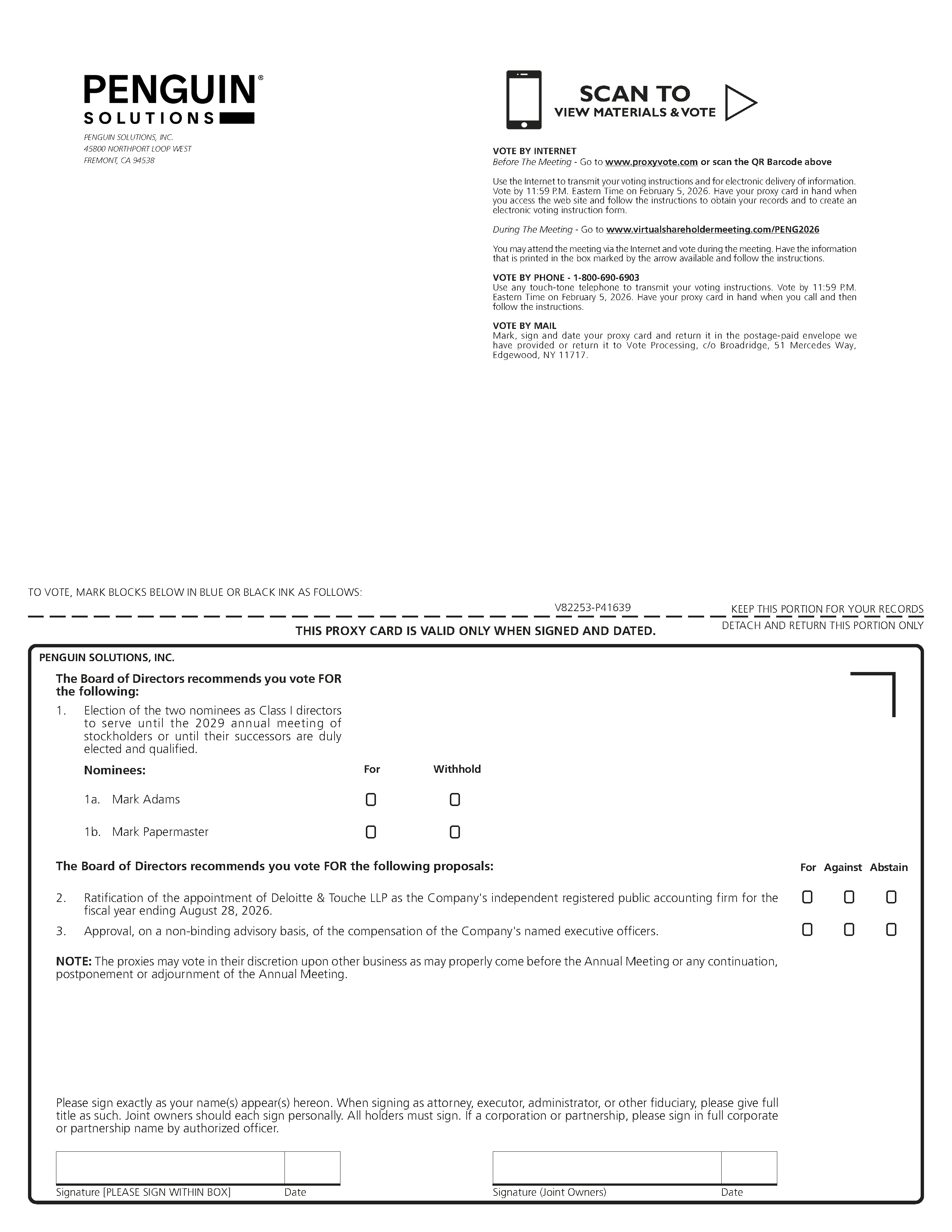
| A9 | The procedures for voting depend on whether your shares are registered in your name or are held by a bank, broker, or other nominee. Stockholder of Record: Shares Registered in Your Name If you are a stockholder of record on the Record Date, you may vote during the Annual Meeting, vote by proxy via telephone, vote by proxy via internet, or vote by proxy using a proxy card that you may request or that we may elect to deliver at a later time. Whether or not you plan to attend the Annual Meeting, we urge you to vote by proxy to ensure your vote is counted. You may still attend the Annual Meeting and vote during the Annual Meeting even if you have already voted by proxy. Voting during the Annual Meeting will have the effect of revoking your previously submitted proxy (see “Can I change my vote after submitting my proxy?” below). •To vote via telephone, dial toll-free (800) 690-6903 using a touch-tone phone and follow the recorded instructions. You will be asked to provide the 16-digit control number from the Proxy Availability Notice. Your vote must be received by 11:59 p.m. Eastern Time on February 5, 2026 in order to be counted. •To vote via internet, go to www.proxyvote.com to complete an electronic proxy card. You will be asked to provide the 16-digit control number from the Proxy Availability Notice. Your vote must be received by 11:59 p.m. Eastern Time on February 5, 2026 in order to be counted. •To vote using the proxy card, simply complete, sign, and date the proxy card that may be delivered to you and return it promptly in the envelope provided. If you return your signed proxy card to us and we receive it before the Annual Meeting, we will vote your shares as you direct. •To vote during the Annual Meeting, please visit www.virtualshareholdermeeting.com/PENG2026. Instructions on how to vote during the Annual Meeting will be posted on the website. The availability of online voting may depend on the voting procedures of the organization that holds your shares. |
| | | | | | | | | | | |
| Beneficial Owner: Shares Registered in the Name of a Broker, Bank, or Other Nominee If you are a beneficial owner of shares registered in the name of your broker, bank, or other nominee, you should have received a Proxy Availability Notice containing voting instructions from that organization rather than from Penguin Solutions. Simply follow the voting instructions in the Proxy Availability Notice to ensure that your vote is counted. |
| Q10 | How many votes do I have? |
| A10 | On each matter to be voted upon, holders of common stock have one vote for each share of common stock they own as of the Record Date, and holders of Issued CPS have such number of votes equal to the largest number of whole shares of common stock into which all shares of Issued CPS held by such holder as of the Record Date could then be converted. |
| Q11 | What if I return a proxy card or otherwise vote but do not make specific choices? |
| A11 | If you return a signed and dated proxy card or otherwise vote without marking voting selections, your shares will be voted, as applicable, “For” the election of each of the two nominees for director named in this Proxy Statement, “For” the ratification of the appointment of Deloitte as our independent registered public accounting firm, and “For” the approval, on a non-binding advisory basis, of the compensation of our NEOs. If any other matter is properly presented at the Annual Meeting, your proxy holder (one of the individuals named on your proxy card) will vote your shares using his or her best judgment. |
| Q12 | Will my vote be kept confidential? |
| A12 | We handle proxies, ballots, and voting tabulations on a confidential basis to protect your voting privacy. This information will not be disclosed except as required by law. |
| Q13 | Who is soliciting my proxy? |
| A13 | The accompanying proxy is solicited by the Board on our behalf for use at the Annual Meeting. |
| Q14 | Who is paying for this proxy solicitation? |
| A14 | We will pay for the entire cost of soliciting proxies. In addition to these proxy materials, members of our Board and our employees may also solicit proxies in person, by telephone, or by other means of communication. Directors and employees will not be paid any additional compensation for soliciting proxies. We have engaged MacKenzie Partners, Inc. (“MacKenzie”) as the proxy solicitor for the Annual Meeting for an approximate fee of $15,000 plus fees for additional services, if needed. We have also agreed to reimburse MacKenzie for reasonable out-of-pocket expenses. We may also reimburse brokerage firms, banks, and other agents for the cost of forwarding proxy materials to beneficial owners. |
| Q15 | Can I change my vote after submitting my proxy? |
| A15 | Yes. You can revoke your proxy at any time before the final vote at the Annual Meeting. If you are the record holder of your shares, you may revoke your proxy in any one of the following ways: •You may submit another properly completed proxy card with a later date. •You may grant a subsequent proxy by telephone or through the internet. •You may send a timely written notice to our Secretary that you are revoking your proxy. •You may attend the Annual Meeting and vote during the Annual Meeting. Simply attending the Annual Meeting will not, by itself, revoke your proxy. Your most current proxy card or telephone or internet proxy is the one that will be counted, so long as it is provided within the applicable deadline. If your shares are held by your broker, bank, or other nominee, you should follow the instructions provided by your broker, bank, or other nominee to change your vote or revoke your proxy. |
| | | | | | | | | | | |
| Q16 | When are stockholder proposals for inclusion in our proxy statement for next year’s annual meeting due? |
| A16 | Stockholders wishing to present proposals for inclusion in our proxy statement for our 2027 annual meeting of stockholders (the “2027 Annual Meeting”) pursuant to Rule 14a-8 of the Securities Exchange Act of 1934, as amended (the “Exchange Act”), must submit their proposals so that they are received by us at our executive offices no later than August 21, 2026. Proposals should be sent to our Secretary, c/o Penguin Solutions, Inc., 45800 Northport Loop West, Fremont, CA 94538. |
| Q17 | When are other proposals and stockholder nominations for next year’s annual meeting due? |
| A17 | With respect to proposals and director nominations not to be included in our proxy statement pursuant to Rule 14a-8 of the Exchange Act, our Amended and Restated Bylaws (our “Bylaws”) provide that stockholders who wish to nominate a director or propose other business to be brought before the stockholders at an annual meeting of stockholders must notify our Secretary by a written notice, which notice must be received at our executive offices not less than 90 days nor more than 120 days prior to the one-year anniversary of the preceding year’s annual meeting of stockholders. Stockholders wishing to present nominations for director or proposals for consideration at the 2027 Annual Meeting under these provisions of our Bylaws must submit their nominations or proposals so that they are received at our executive offices not earlier than October 9, 2026 and not later than November 8, 2026 in order to be considered. In the event that we hold the 2027 Annual Meeting more than 30 days before or more than 60 days after the one-year anniversary date of this Annual Meeting, then, for notice by the stockholder to be timely, our Bylaws provide that such notice must be received by the Company not earlier than 120 days prior to the 2027 Annual Meeting and not later than the later of 90 days prior to the date of the 2027 Annual Meeting or the 10th day following the day on which public announcement of the date of the 2027 Annual Meeting was first made by the Company. Nominations or proposals should be sent in writing to our Secretary, c/o Penguin Solutions, Inc., 45800 Northport Loop West, Fremont, CA 94538. A stockholder’s notice to nominate a director or bring any other business before the 2027 Annual Meeting must set forth certain information, which is specified in our Bylaws. A complete copy of our Bylaws may be found by accessing Penguin Solutions’ filings on the SEC’s website at www.sec.gov. Stockholders who intend to solicit proxies in support of director nominees other than the Company’s nominees must also comply with the additional requirements of Rule 14a-19(b). |
| Q18 | How are votes counted? |
| A18 | Votes will be counted by the inspector of elections appointed for the Annual Meeting. |
| Q19 | What is a “vote withheld,” an “abstention,” and a “broker non-vote,” and do they count for determining a quorum? |
| A19 | Votes Withheld and Abstentions: A “vote withheld,” in the case of the proposal regarding the election of directors, or an “abstention,” in the case of the other proposals before the Annual Meeting, represents a stockholder’s affirmative choice to decline to vote on a proposal. Votes withheld and abstentions are counted as present and entitled to vote for purposes of determining a quorum. Broker Non-Votes: Generally, “broker non-votes” occur when shares held by a broker in “street name” for a beneficial owner are not voted with respect to a particular proposal because the broker (i) has not received voting instructions from the beneficial owner and (ii) lacks discretionary voting power to vote those shares. A broker is entitled to vote shares held for a beneficial owner on routine matters, such as the ratification of the appointment of Deloitte as our independent registered public accounting firm, without instructions from the beneficial owner of those shares. On the other hand, absent instructions from the beneficial owner of such shares, a broker is not entitled to vote shares held for a beneficial owner on non-routine matters. Proposals No. 1 and No. 3 are non-routine matters. Broker non-votes count for purposes of determining whether a quorum is present. |
| | | | | | | | | | | |
| Q20 | How many votes are needed to approve each proposal? |
A20 | Proposal | Vote Required |
| No. 1. | Election of Directors | Plurality |
| No. 2. | Ratification of the Appointment of Our Independent Registered Public Accounting Firm | Majority Cast |
| No. 3. | Approval, on a Non-Binding Advisory Basis, of the Compensation of Our NEOs | Majority Cast |
| | | |
| A “Plurality,” with regard to Proposal No. 1, means that the two nominees who receive the highest number of affirmative “FOR” votes will be elected to the Board. A “Majority Cast,” with regard to each of Proposal No. 2 and Proposal No. 3, means that, to be approved, the holders of a majority in voting power of the votes cast (excluding abstentions and broker non-votes) on the proposal must be voted “FOR” the proposal. Accordingly: •Proposal No. 1: For the election of directors, the two nominees receiving the highest number of “FOR” votes will be elected as Class I directors to hold office until the 2029 Annual Meeting. Votes that are “WITHHELD” will have the same effect as an abstention and will not count as a vote “FOR” or “AGAINST” a director, because directors are elected by plurality voting. Broker non-votes will not be considered votes cast and will have no effect on Proposal No. 1. •Proposal No. 2: To be approved, a majority in voting power of the votes cast (excluding abstentions and broker non-votes) on Proposal No. 2 must be voted “FOR” the ratification of the appointment of Deloitte as our independent registered public accounting firm for the fiscal year ending August 28, 2026. Abstentions and broker non-votes will have no effect on Proposal No. 2; however, Proposal No. 2 is a matter on which a broker, bank, or other nominee has discretionary voting authority, and thus, we do not expect any broker non-votes with respect to Proposal No. 2. •Proposal No. 3: To be approved, a majority in voting power of the votes cast (excluding abstentions and broker non-votes) on Proposal No. 3 must be voted “FOR” the approval, on a non-binding advisory basis, of the compensation of our NEOs. Only votes “FOR” or “AGAINST” will affect the outcome. Abstentions and broker non-votes will have no effect on Proposal No. 3. None of the proposals, if approved, entitles stockholders to appraisal rights under Delaware law or the Company’s governing documents. |
| Q21 | What is the quorum requirement? |
| A21 | A quorum of stockholders is necessary to hold a valid stockholder meeting. A quorum will be present if the holders of a majority in voting power of the stock issued and outstanding and entitled to vote at the Annual Meeting are present, in person or by remote communication, or represented by proxy. On the Record Date, there were 52,560,157 shares of common stock outstanding and entitled to vote and 200,000 shares of Issued CPS outstanding and entitled to vote, which are convertible, in the aggregate, into 6,096,103 shares of common stock and therefore entitled to 6,096,103 votes in the aggregate. Accordingly, on the Record Date, the holders of our common stock and Issued CPS are entitled to an aggregate of 58,656,260 votes in respect of such shares of common stock and Issued CPS (on an as-converted to common stock basis). Thus, the holders of at least 29,328,131 votes must be present, in person or by remote communication, or represented by proxy at the Annual Meeting to have a quorum. Your shares will be counted towards the quorum only if you submit a valid proxy by mail, over the phone, or through the internet (or if one is submitted on your behalf by your broker, bank, or other nominee), or if you vote during the Annual Meeting. |
| | | | | | | | | | | |
| Abstentions, votes to “Withhold,” and broker non-votes will be counted towards the quorum requirement. If there is no quorum, then either the chair of the Annual Meeting or the holders of a majority in voting power of the stockholders entitled to vote and present at the Annual Meeting or represented by proxy may adjourn the meeting to a later date. At any adjourned Annual Meeting at which a quorum is present, any business may be transacted that might have been transacted at the Annual Meeting as originally notified. If the adjournment is for more than 30 days, or if after that adjournment a new record date is fixed for the adjourned Annual Meeting, a notice of the adjourned Annual Meeting shall be given to each stockholder of record entitled to vote at the adjourned Annual Meeting. |
| Q22 | How can I find out the results of the voting at the Annual Meeting? |
| A22 | Preliminary voting results will be announced at the Annual Meeting. In addition, final voting results will be published in a Current Report on Form 8-K that we expect to file with the SEC within four business days after the Annual Meeting. If final voting results are not available to us in time to file a Form 8-K with the SEC within four business days after the Annual Meeting, we intend to file a Form 8-K to publish the preliminary results within four business days after the Annual Meeting and will file an additional Form 8-K to publish the final results within four business days after the final results are known to us. |
| Q23 | Will there be a question and answer session during the Annual Meeting? |
A23 | As part of the Annual Meeting, we will hold a live Q&A session, during which we intend to answer questions submitted online during the meeting that are pertinent to the meeting matters, as time permits. Only stockholders that have accessed the Annual Meeting as a stockholder (rather than a “Guest”) by following the procedures outlined above in “How do I attend the Annual Meeting?” will be permitted to submit questions during the Annual Meeting. Each stockholder is limited to no more than one question. Questions should be succinct and only cover a single topic. We will not address questions that are, among other things: •in excess of the one question limit; •irrelevant to the business of the Annual Meeting; •related to material non-public information of the Company; •related to any pending, threatened, or ongoing litigation; •related to personal grievances; •derogatory references to individuals or that are otherwise in bad taste; •substantially repetitious of questions already submitted by another stockholder; •in furtherance of the stockholder’s personal or business interests; or •out of order or not otherwise suitable for the conduct of the Annual Meeting as determined by the Chair of the Annual Meeting or Secretary in their reasonable judgment. Additional information regarding the Q&A session will be available in the “Rules of Conduct” available on the Annual Meeting webpage for stockholders that have accessed the Annual Meeting as a stockholder (rather than a “Guest”) by following the procedures outlined above in “How do I attend the Annual Meeting?”. |
Interest of Certain Persons in Matters to Be Acted Upon
The Board knows of no matters to come before the Annual Meeting other than the matters referred to in this Proxy Statement; however, if any other matters should properly come before the meeting, the persons named in the enclosed proxy intend to vote in accordance with their best judgment. No director, nominee for election as director, or executive officer of Penguin Solutions since the beginning of the last fiscal year or their associates has any substantial interest, direct or indirect, by security holdings or otherwise, in any matter to be voted upon other than election to the Board.
Forward-Looking Statements
This Proxy Statement contains forward-looking statements within the meaning of Section 27A of the Securities Act of 1933, as amended (the “Securities Act”), and Section 21E of the Exchange Act, including but not limited to, statements concerning future risks and trends related to our risk management efforts; goals and expectations for our performance; identification of emerging issues that may affect our strategies, corporate governance, compensation practices, or other aspects of our operations; assessments of our leadership structure and board oversight; effectiveness of our corporate governance policies and executive compensation philosophy; our efforts to transform, evolve, and expand our business; our plans and expectations with respect to the SKT Investment (as defined under “Certain Relationships and Related Person Transactions” below); future plans with respect to our compensation practices; estimated payments to our Named Executive Officers upon termination or change in control; our environmental and social sustainability goals, commitments, and expected improvements; estimations of future payouts under our incentive plans; expected changes to the composition of the committees of the Board; and statements regarding our future financial or operating performance. These statements can be identified by the fact that they do not relate strictly to historical or current facts. Forward-looking statements often use words such as “anticipate,” “target,” “commit,” “expect,” “estimate,” “intend,” “plan,” “goal,” “believe,” “could,” and other words of similar meaning. Forward-looking statements provide our current expectations or forecasts of future events, circumstances, results, or aspirations and are subject to significant risks and uncertainties. These risks and uncertainties could cause our actual results to differ materially from those set forth in such forward-looking statements. Some of these risks and uncertainties are described in our Annual Report on Form 10-K for the fiscal year ended August 29, 2025. Except as required by law, we do not undertake to update the forward-looking statements included in this Proxy Statement to reflect the impact of circumstances or events that may arise after the date that the forward-looking statements were made. Additionally, part of the information in this Proxy Statement, including certain information on our sustainability initiatives, is informed by various stakeholder expectations, as well as third-party frameworks on such matters. Such information, and information on similar topics in other disclosures (including on our website), is not necessarily, and should not be deemed to be, material for purposes of our reporting obligations, including under U.S. federal securities laws. Moreover, while we may reference various third-party frameworks and standards in our reporting, we cannot guarantee complete alignment with such frameworks or any specific interpretation thereof. Our approach to disclosures and the underlying methodology for such information may evolve due to a variety of factors, including changes in business or regulatory policies, data availability or quality, or other factors which may be in or out of our control.
CORPORATE GOVERNANCE AND BOARD MATTERS
This section describes the key corporate governance guidelines and practices that we have adopted. Complete copies of our Corporate Governance Guidelines, the charters of the committees of the Board, and our Code of Business Conduct and Ethics, described below, can be found in the Governance section of the Investors section of our website at ir.penguinsolutions.com. Information on our website is not incorporated by reference in this Proxy Statement. Alternatively, you can request a copy of any of these documents free of charge by writing to our Secretary, c/o Penguin Solutions, Inc., 45800 Northport Loop West, Fremont, CA 94538.
Board Composition and Refreshment
Our Board currently consists of eight members. In accordance with our Amended and Restated Certificate of Incorporation, our Board is divided into three classes with staggered three-year terms. At each annual meeting of stockholders, the directors or the successors to directors whose terms are set to expire will be elected to serve from the time of election and qualification until the third annual meeting following election. The number of directors may be changed by the affirmative vote of a majority of the directors.
Our directors are divided among the three classes as follows:
•Class I directors (formerly Class III directors) consist of Mark Adams, Bryan Ingram, and Mark Papermaster, whose terms expire at the Annual Meeting;
•Class II directors (formerly Class I directors) consist of Sandeep Nayyar, Mary Puma, and Maximiliane Straub, whose terms expire at the 2027 annual meeting of stockholders; and
•Class III directors (formerly Class II directors) consist of Min Yong Ha and Penelope Herscher, whose terms expire at the 2028 annual meeting of stockholders.
In connection with our U.S. Redomiciliation, all then-sitting directors of Penguin Solutions Cayman were appointed directors of Penguin Solutions Delaware and the three director classes were realigned solely for administrative continuity under our new governing documents. Specifically, the then‑sitting Class I directors became Class II directors, the then‑sitting Class II directors became Class III directors, and the then‑sitting Class III directors became Class I directors. This realignment did not change the length of any director’s remaining term, accelerate or extend any term, or alter the staggered nature of the Board.
The division of our Board into three classes with staggered three-year terms may delay or prevent a change of our management or a change in control.
Our Board recognizes the importance of board renewal to introduce new perspectives, backgrounds, and skillsets to the Board, while maintaining a balance with experience and continuity. In fiscal 2024, our Board amended our Corporate Governance Guidelines to provide that a director will generally not be nominated for re-election or reappointed to the Board after reaching the age of 75, although our Board in its discretion may nominate any such director for re-election if it determines that it is in the best interests of our Company and stockholders for such director to continue his or her service on our Board in light of his or her particular contributions or expertise. Our Board also recognizes the importance of experience and continuity and has not adopted term limits. While term limits offer some advantages, our Board believes that the benefit is outweighed by the disadvantage of losing experienced directors who have developed valuable insight into the Company and its operations during the course of their service on our Board.
Investor Agreement
Director Designation Rights
Pursuant to the SKT Investment (as defined under “Certain Relationships and Related Person Transactions” below) and the Amended and Restated Investor Agreement (as defined under “Certain Relationships and Related Person Transactions” below), for so long as SK Telecom Co., Ltd. (“SKT”) or its subsidiaries or affiliates together beneficially own Issued CPS (and our common stock issued with respect thereto) representing at least 5% of our common stock then outstanding, calculated on a fully-diluted basis (such period, the “Director Period”), SKT and its affiliates that hold Issued CPS, acting together, may nominate to be elected or appointed to our Board: (i) one director, if the total number of directors is 11 or fewer, and (ii) two directors, if the total number of directors is 12 or
greater (any such director, an “Investor Designee”), provided that each such director meets customary qualification requirements and is reasonably acceptable to our Board at the time of his or her designation.
During the Director Period (i) our Board will nominate the Investor Designee(s) or their designated successors for appointment or re-appointment at the applicable stockholder meetings and use commercially reasonable efforts to cause such Investor Designee(s) to be appointed or re-appointed, (ii) we will use reasonable best efforts to cause the appointment of each Investor Designee, including voting all unrestricted proxies in their favor and recommending approval of their appointment, and (iii) neither we nor our Board will decrease the size of our Board if such decrease would require an Investor Designee to resign. In December 2024, upon the closing of the SKT Investment, Min Yong Ha joined our Board as the Investor Designee. Mr. Ha currently serves as a Class III director and his term expires at the 2028 annual meeting of stockholders.
Voting Requirements
Pursuant to the voting requirements contained in the Amended and Restated Investor Agreement, SKT and its affiliates are required (i) for so long as the standstill is in effect, to vote their shares of Issued CPS in accordance with the recommendation of our Board and (ii) for so long as the shares of Issued CPS purchased by SKT remain outstanding, to vote such shares of Issued CPS in accordance with the recommendation of our Board on all matters for which the shares of Issued CPS are entitled to vote as a separate class and for which their prior consent is not required pursuant to the Certificate of Designation (as defined under “Certain Relationships and Related Person Transactions” below). The standstill in the Amended and Restated Investor Agreement will remain in place until the later of (i) December 13, 2025 or (ii) 30 days after no Investor Designee serves on our Board.
Independence of the Board of Directors
The Board has determined that all of the nominees and continuing directors, except for Mr. Adams, our Chief Executive Officer (“CEO”), and Mr. Ha, the Investor Designee of SKT, are independent directors. The Board also previously determined that Randy Furr, a former director who served on the Board until the 2025 annual meeting of stockholders (the “2025 Annual Meeting”), was independent during his tenure. We define “independent directors” pursuant to the rules of the SEC and the listing standards of the Nasdaq Stock Market (“Nasdaq”). To be considered independent, a director cannot be an officer or employee of our Company or our subsidiaries and cannot have a relationship with our Company or our subsidiaries that, in the opinion of our Board, would interfere with the exercise of independent judgment in carrying out the responsibilities of a director. In making the “independence” determination, our Board considered all relevant facts and circumstances, including the director’s commercial, industrial, banking, consulting, legal, accounting, charitable, and familial relationships. Our Board consults with our legal counsel to ensure that its determinations are consistent with all relevant laws, rules, and regulations regarding the definition of “independent director,” including applicable securities laws, and the rules of the SEC and Nasdaq. There are no family relationships between any of our directors or executive officers.
Board Leadership Structure
The Board believes that it is important to retain the flexibility to structure its board leadership in any manner that it determines to be in our best interests at any point in time. This includes flexibility to determine whether to maintain a separate office of Chair of the Board. Our policies do not preclude our CEO from also serving as a Board member or as Chair of the Board. Currently, the role of Chair of the Board is separated from the role of CEO. Ms. Herscher serves as our independent Chair of the Board, and Mr. Adams serves as our President and CEO. The Board reviews its leadership structure periodically and believes that its current structure provides effective leadership. We believe that separating these positions allows our CEO to focus on our day-to-day business operations and strategy, while allowing our Chair of the Board to lead the Board in its fundamental role of providing advice to, and independent oversight of, our management team. Our Board recognizes the time, effort, and energy that the CEO is required to devote to his position in the current business environment, as well as the commitment required to serve as Chair of the Board, particularly as the Board’s oversight responsibilities continue to grow.
The independent and non-executive members of the Board meet regularly without management and the Chair of the Board chairs those meetings.
Role of the Board in Risk Oversight
Risk is inherent with every business, and we face a number of risks, including strategic, financial, business, operational, legal and compliance, and reputational risks. One of the Board’s key functions is providing informed oversight of our risk management process. The Board believes that its current leadership structure facilitates its risk oversight responsibilities. The Board does not have a standing risk management committee, but rather administers this oversight function directly through the Board as a whole, as well as through various Board standing committees that address risks inherent in their respective areas of oversight. For example, the Board acts as our ultimate decision-making body and advises and oversees management, who are responsible for our day-to-day operations and management. The Board believes this division of labor amongst the Board, committees, and management allows us to appropriately monitor risks over the short, intermediate, and long terms. We also engage with outside advisors, such as our compensation consultant, legal counsel, auditors, and other advisors to identify future risks and trends so that we can anticipate our ongoing risk management obligations at our regularly scheduled meetings. The Audit Committee of the Board (the “Audit Committee”) monitors compliance with legal and regulatory requirements, in addition to providing oversight for the performance of our internal audit function and our system of internal controls. The Nominating and Corporate Governance Committee of the Board (the “NCG Committee”) monitors the effectiveness of our corporate governance guidelines and policies. The Compensation Committee of the Board (the “Compensation Committee”) assesses and monitors whether any of our compensation policies and programs has the potential to encourage excessive risk-taking. The Cybersecurity and Technology Risk Management Committee of the Board (the “Cybersecurity Committee”) oversees our information technology use and data security, including, but not limited to, enterprise cybersecurity, generative artificial intelligence (“AI”), privacy, data collection, and protection, and compliance with information security and data protection laws. The Cybersecurity Committee receives regular reports from our Chief Information Officer regarding any significant cybersecurity events, as well as any events with lesser impact potential. The Chief Information Officer periodically reports to the Board regarding cybersecurity risks and our cybersecurity risk management program. Please refer to “Information Regarding Committees of the Board of Directors” below for a more detailed explanation of how our Board committees support the Board and management in risk oversight.
It is the responsibility of the committee chairs to report findings regarding material risk exposures to the Board as quickly as possible. Our Chief Legal Officer and Chief Financial Officer (“CFO”) coordinate between the Board and management with regard to the determination and implementation of responses to any problematic risk management issues.
Meetings of the Board of Directors
The Board oversees our business. It establishes overall policies and standards and reviews the performance of management. During the fiscal year ended August 29, 2025 (“fiscal 2025”), the Board held five meetings. Each then-serving Board member attended 75% or more of the aggregate meetings of the Board and of each committee on which he or she served during the period for which he or she was a director or committee member. Our directors are encouraged to attend our annual meetings of stockholders, but we do not currently have a policy requiring director attendance. All but two of the then-serving members of our Board attended our previous annual meeting of stockholders.
The independent and non-executive members of our Board meet regularly in executive sessions outside of the presence of management, often prior to or following regularly scheduled meetings of the Board. The independent and non-executive directors also conducted telephonic / videoconference meetings and/or updates during fiscal 2025.
Stockholder Communications with the Board of Directors
Our relationship with our stockholders is an important part of our corporate governance program. Engaging with our stockholders helps us to understand how they view us, to set goals and expectations for our performance, and to identify emerging issues that may affect our strategies, corporate governance, compensation practices, or other aspects of our operations. Our stockholder and investor outreach includes investor road shows, analyst meetings, and investor conferences and meetings. We also communicate with stockholders and other stakeholders through various media, including our annual report and SEC filings, proxy statement, news releases, and our website. Our conference calls for quarterly earnings releases are open to all. These calls are available in real time and as archived webcasts on our website for a period of time.
As set forth in our Corporate Governance Guidelines, unless otherwise indicated in such guidelines or our policies, all requests by stockholders for communications with individual directors or the Board shall initially be made to our Secretary, who will relay such requests to the Chair of the Board or other directors as appropriate. Such requests should be sent to c/o Penguin Solutions, Inc., 45800 Northport Loop West, Fremont, CA 94538. As set forth in our Policy for Reporting Concerns, stockholders who are also directors, employees, or contractors of Penguin Solutions should report concerns related to accounting, auditing, and ethical violations directly to the CFO or his designee, to the Chair of the Audit Committee (to the extent that the concerns relate to accounting, auditing, or internal controls), or via our anonymous whistleblower hotline. Any such concerns shall be communicated to our officers or directors as set forth in the policy.
Code of Business Conduct and Ethics
The Board has adopted a Code of Business Conduct and Ethics that applies to all directors, officers, and employees, including those officers responsible for financial reporting. A copy of our Code of Business Conduct and Ethics is available in the Governance section of the Investors section of our website at ir.penguinsolutions.com. If we make any substantive amendments to our Code of Business Conduct and Ethics or grant any waiver from a provision of our Code of Business Conduct and Ethics to any director or our principal executive officer, principal financial officer, principal accounting officer, or controller, or persons performing similar functions, we will promptly disclose the nature of the amendment or waiver on our website in accordance with the requirements of Item 5.05 of Form 8-K.
Director and Officer Stock Ownership Retention Policy
As stated in our Corporate Governance Guidelines, the Board believes that directors and officers should hold meaningful equity ownership positions in the Company. In fiscal year 2020, the Board adopted a Director and Officer Stock Ownership Retention Policy (also referred to as our “stock ownership guidelines”), which provides equity ownership requirements for our independent directors and Section 16 officers. A copy of our Director and Officer Stock Ownership Retention Policy is available in the Governance section of the Investors section of our website at ir.penguinsolutions.com.
Insider Trading and Confidentiality Policy; Anti-Hedging and Anti-Pledging Policy
We have adopted an Insider Trading and Confidentiality Policy that we believe is reasonably designed to promote compliance with insider trading laws, rules, and regulations, and any listing standards applicable to the Company. Under this policy, directors, officers, and other employees and contractors of the Company and its subsidiaries, and other persons who may have access to material nonpublic information, are prohibited from engaging in certain transactions relating to Company securities, including but not limited to short sales, transactions in put or call options, hedging transactions, or other inherently speculative transactions in PENG shares, and are barred from pledging PENG shares in any circumstance, including by purchasing PENG shares on margin or holding PENG shares in a margin account. A copy of our Insider Trading and Confidentiality Policy is available in the Governance section of the Investors section of our website at ir.penguinsolutions.com.
INFORMATION REGARDING COMMITTEES
OF THE BOARD OF DIRECTORS
The Board currently has the following standing committees: Audit Committee, Compensation Committee, NCG Committee, and Cybersecurity Committee. Below is a description of each of these committees. Each committee has authority to engage legal counsel or other experts or consultants as it deems appropriate in order to carry out its responsibilities.
The following table sets forth information on the committee membership of our directors as of December 8, 2025:
| | | | | | | | | | | | | | | | | | | | | | | |
| Name | Audit Committee | | Compensation Committee | | Nominating and Corporate Governance Committee | | Cybersecurity and Technology Risk Management Committee |
| Mark Adams | — | | — | | — | | — |
Min Yong Ha | — | | — | | — | | — |
Penelope Herscher (1) | — | | — | | X | | — |
Bryan Ingram (1) | — | | Chair | | X | | X |
Sandeep Nayyar (1) | Chair | | — | | — | | — |
Mark Papermaster (1) | — | | X | | — | | Chair |
Mary Puma (1) | X | | X | | — | | — |
Maximiliane Straub (1) | X | | — | | Chair | | X |
(1)As noted in “Independence of the Board of Directors” above, the Board has determined Mses. Herscher, Puma, and Straub and Messrs. Ingram, Nayyar, and Papermaster to be independent directors.
Audit Committee
The Board has a separately designated standing Audit Committee, established in accordance with Section 3(a)(58)(A) of the Exchange Act. The Audit Committee was established by the Board to assist the Board in its oversight of the integrity of our financial statements and internal controls; the design, implementation, and performance of our internal audit function; and our compliance with legal and regulatory requirements. To that end, the Audit Committee is responsible for, without limitation, the following:
•Overseeing the accounting and financial reporting processes and the audits of our financial statements;
•Reviewing the qualifications, independence, and performance, and approving the terms of engagement of our independent auditor;
•Reviewing the performance of, and overseeing our internal audit function;
•Preparing any reports required of the committee under the rules of the SEC or under the rules of any applicable stock market or exchange;
•Overseeing our cash management and investment and borrowing policies, and periodically reviewing our investment and borrowing policies; and
•Overseeing and reviewing our policies with respect to entry into derivatives transactions for hedging and risk management purposes.
The Audit Committee is currently composed of three directors: Mr. Nayyar (Chair) and Mses. Puma and Straub. The Audit Committee is governed by a written charter, which can be found in the Governance section of the Investors section of our website at ir.penguinsolutions.com. The Audit Committee has the authority to obtain, at our expense, advice and assistance from internal and external legal, accounting, or other advisors and consultants and other external resources that the Audit Committee considers necessary or appropriate in the performance of its duties. During fiscal 2025, the Audit Committee held six meetings. We have not identified a material weakness in our internal control over financial reporting since fiscal 2021.
The Audit Committee’s charter provides for self-evaluation at least every other year. The Audit Committee also reviews and assesses the adequacy of its charter at least annually and recommends any proposed changes to the Board for approval. The Audit Committee is also responsible for overseeing compliance with the Code of Business Conduct and Ethics and reporting on such compliance to the Board.
The Board has determined that Mr. Nayyar and Mses. Puma and Straub all satisfy the “independence” requirements of Nasdaq and the Exchange Act applicable to members of an audit committee of a listed company’s board of directors. The Board has determined that all members are qualified as audit committee financial experts within the meaning of SEC regulations.
Audit Committee Report
The Audit Committee reviews the Company’s financial reporting process on behalf of the Board. Management has the primary responsibility for the preparation and integrity of the consolidated financial statements and the reporting process, including establishing and monitoring the system of internal financial controls. In this context, during fiscal 2025, the Audit Committee met and held discussions with management and Deloitte, the Company’s independent registered public accounting firm. Management has represented to the Audit Committee that the Company’s consolidated financial statements for the fiscal year ended August 29, 2025 were prepared in accordance with accounting principles generally accepted in the United States of America (“GAAP”), and the Audit Committee has reviewed and discussed the Company’s audited financial statements with the Company’s management and with Deloitte. In addition, the Audit Committee has discussed with Deloitte the matters required to be discussed by the applicable requirements of the Public Company Accounting Oversight Board (“PCAOB”) and the SEC. The Audit Committee has received from Deloitte the written disclosures and the letter required by applicable requirements of the PCAOB regarding Deloitte’s communications with the Audit Committee concerning independence and has discussed with Deloitte the independence of Deloitte. The Audit Committee has also concluded that the provision of the non-audit services to the Company in fiscal 2025 was compatible with Deloitte’s independence. Based on the foregoing, the Audit Committee has recommended to the Board, and the Board has approved, that the audited financial statements be included in the Company’s Annual Report on Form 10-K for the fiscal year ended August 29, 2025 for filing with the SEC. The Audit Committee and the Board have also recommended the selection of Deloitte as the Company’s independent registered public accounting firm for the fiscal year ending August 28, 2026.
The material in this report is not deemed “soliciting material,” is not deemed “filed” with the SEC, is not subject to Regulation 14A or 14C or to the liabilities of Section 18 of the Exchange Act, and is not to be incorporated by reference into any filing of the Company under the Securities Act or the Exchange Act, whether made before or after the date hereof and irrespective of any general incorporation language in any such filing.
Respectfully submitted by the members of the Audit Committee of the Board of Directors:
Sandeep Nayyar, Chair
Mary Puma
Maximiliane Straub
Compensation Committee
The Compensation Committee acts on behalf of the Board to oversee our director and executive compensation and benefits policies and to evaluate executive officer performance and compensation. Among other things, the Compensation Committee is responsible for the following:
•Reviewing and approving, or recommending to the Board to approve, the compensation for our senior executives;
•Reviewing and approving the compensation for independent directors;
•Reviewing and evaluating our executive compensation and benefits policies generally;
•Administering and overseeing the Company’s compliance with the compensation recovery policy;
•Reporting to our Board periodically;
•Evaluating its own performance at least once every other year and reporting to our Board on such evaluation; and
•Reviewing and assessing periodically, and at least annually, consistent with Nasdaq listing requirements, the adequacy of its charter and recommending any proposed changes to the Board for approval.
The Compensation Committee is currently composed of three directors: Messrs. Ingram (Chair) and Papermaster and Ms. Puma. Mr. Ingram will serve as Chair of the Compensation Committee until his term expires and Ms. Puma will serve as Chair of the Compensation Committee effective at the conclusion of the Annual Meeting. The Board is in the process of selecting a member of the Compensation Committee to replace Mr. Ingram after his term expires, and such information will be reflected in the Governance section of the Investors section of our website at ir.penguinsolutions.com. The Board has determined that Messrs. Ingram and Papermaster and Ms. Puma all satisfy the “independence” requirements of Nasdaq and the Exchange Act applicable to members of a compensation committee of a listed company’s board of directors. During fiscal 2025, the Compensation Committee held five meetings.
The Compensation Committee is governed by a written charter, which can be found in the Governance section of the Investors section of our website at ir.penguinsolutions.com. The Compensation Committee charter grants the Compensation Committee sole authority to retain or obtain the advice of a compensation consultant, legal counsel, or other advisor, including the authority to approve the consultant’s reasonable compensation. The Compensation Committee may select such advisors, or receive advice from any other advisor, only after taking into consideration all factors relevant to that person’s independence from management, including those independence factors enumerated by Nasdaq. The Compensation Committee may delegate its authority under its charter to one or more subcommittees or the chair of the Compensation Committee as it deems appropriate and in our best interests from time to time. The Compensation Committee may also delegate to one or more officers the authority to make grants and awards of stock rights or options to certain employees, as further described in its charter and subject to the terms of our equity-based plans.
Consideration and Determination of Our Compensation Programs for Executives and Directors
The Compensation Committee is responsible for overseeing our compensation programs for executive officers and directors and all related policies and practices. Our Compensation Committee, which reports to our Board, meets at least quarterly during the year and retains a compensation consultant (described below under “Role of the Compensation Consultant”) to provide support to the Compensation Committee, including an annual review and assessment of our compensation programs for executive officers and directors. The annual compensation review includes a determination of the companies to be considered in our peer group and a review of external market compensation comparisons relative to our peer companies and other comparable companies, including executive base salaries, cash incentives, and long-term equity awards as well as fees and equity awards for directors. The Compensation Committee reviews and determines whether and to what extent to approve all final recommendations from management regarding all forms of compensation for the NEOs (other than the CEO). The Compensation Committee also evaluates the performance of the CEO, reviews all forms of compensation paid to the CEO, and can either approve or modify such compensation, with any decision being reported to the Board.
Role of Management
In carrying out its responsibilities, the Compensation Committee asks the CEO to provide information on Company and individual performance, market data, and management’s perspective and recommendations on compensation matters. The Compensation Committee believes that it is important to consider the CEO’s input, particularly his evaluation of individual performance as well as the expected contribution and future potential of the other NEOs, because of his daily interaction with them. The CEO may recommend changes in base salaries, target cash incentives, and annual equity awards for executive officers (other than himself) and assists the Compensation Committee in assessing the individual performance of each executive officer for purposes of determining amounts to be paid under our annual bonuses. The CEO’s role in determining the compensation of executive officers is advisory only and the Compensation Committee (or the Board, on the recommendation of the Compensation Committee) provides final approval of all compensation matters for NEOs. The CEO also recommends the annual operating plan to the Board for approval, which includes corporate and division or business unit performance objectives and financial goals for the fiscal year.
The CEO also reviews the compensation data gathered from compensation surveys and analyses to make his recommendations to the Compensation Committee on base salary, annual cash incentive target amounts, and equity awards for each NEO other than himself.
Role of the Compensation Consultant
During fiscal 2025, the Compensation Committee retained Semler Brossy Consulting Group (“Semler”) as its outside, independent compensation consultant. Semler reports directly and is accountable to the Compensation Committee. Semler has been engaged to provide advice, information, and recommendations relating to compensation of our executive officers and directors, including base salary, cash incentive and equity incentive levels, and program structures, as well as other retention incentives, and how this compensation compares to compensation for executive officers and directors of members of Penguin Solutions’ peer group and comparably sized technology companies. In addition, Semler assists the Compensation Committee with the development of a peer group and the design and refinement of our compensation philosophy. Semler also advises the Compensation Committee regarding compensation disclosures, compensation risk assessments, stock ownership guidelines, stockholder proposals, and trends and best practices in executive and director pay.
In the course of its work, Semler interacts with management to understand existing Company programs and policies, collects current pay program data, reviews competitive compensation data, obtains feedback on industry trends and best practices, and provides input on the Compensation Discussion and Analysis disclosure in our proxy statements. Semler does not provide, and has not been retained to provide, any services to the Company outside of the work assigned by the Compensation Committee.
The Compensation Committee has assessed the independence of Semler consistent with SEC rules and Nasdaq listing standards. In doing so, the Compensation Committee considered each of the factors set forth by the SEC and Nasdaq with respect to a compensation consultant’s independence. The Compensation Committee also considered the nature and amount of work performed for the Compensation Committee and the fees paid for those services in relation to the firm’s total revenues. On the basis of its consideration of the foregoing and other relevant factors, the Compensation Committee has determined that Semler is independent and that no conflicts of interest exist between the Company and Semler.
Compensation Committee Interlocks and Insider Participation
In fiscal 2025, Messrs. Ingram and Papermaster and Ms. Puma, and former director Mr. Furr, served as members of our Compensation Committee. None of the fiscal 2025 members of the Compensation Committee was at any time one of our officers or employees. None of our executive officers currently serves, or served during the last completed fiscal year, on the compensation committee or board of directors of any other entity that has one or more executive officers serving as a member of our Board or Compensation Committee.
Nominating and Corporate Governance Committee
The NCG Committee is generally responsible for identifying qualified Board candidates, recommending director nominees and appointments to Board committees, evaluating Board performance, reviewing management succession planning, reviewing matters relating to corporate social responsibility, and overseeing our Corporate Governance Guidelines. To that end, the NCG Committee is responsible for, without limitation, the following:
•Reviewing qualifications of candidates for membership on our Board and identifying and recommending to the Board qualified individuals for membership on the Board and its committees;
•Evaluating, at least once every other year, the performance of the directors as well as the committee’s own performance and reporting to the Board on such evaluation;
•Reviewing the adequacy of the composition of the Board and its committees;
•Overseeing compliance with the Corporate Governance Guidelines and reporting on such compliance to the Board, including recommendations in connection with directors’ and officers’ indemnification and insurance matters;
•Overseeing orientation and continuing education programs for directors meeting the requirements set forth in our Corporate Governance Guidelines;
•Reviewing the Company’s actions in furtherance of its corporate social responsibility, including considering the impact of Company procedures and processes on employees, citizens, and communities;
•Reviewing our strategies and policies related to human capital management, including with respect to matters such as inclusion and belonging, employee engagement, and talent development;
•Reviewing our management succession planning, including policies for CEO selection and succession in the event of the incapacitation, retirement, or removal of the CEO, and evaluations of, and development plans for, any potential successors to the CEO; and
•Reviewing and assessing periodically the adequacy of its charter and recommending any proposed changes to the Board for approval.
The NCG Committee is currently composed of three directors: Mses. Herscher and Straub (Chair) and Mr. Ingram. Mr. Ingram will serve on the NCG Committee until his term expires at the conclusion of the Annual Meeting. The NCG Committee held four meetings during fiscal 2025. The Board determined that Mses. Herscher and Straub and Mr. Ingram are all independent within the meaning of the Nasdaq rules.
The NCG Committee is governed by a written charter that can be found in the Governance section of the Investors section of our website at ir.penguinsolutions.com. The NCG Committee charter complies with the guidelines established by Nasdaq.
The charter of the NCG Committee grants the NCG Committee authority to retain and terminate any advisors, including search firms to identify director candidates, and sole authority to approve all such advisors’ fees and other retention terms. In selecting candidates for recommendation to the Board, the NCG Committee considers the long-term interests of the stockholders, our needs, and the appropriate skills, characteristics, and experience of the candidates, including multiple factors that are more fully described below. In addition to candidates identified by Board members, the NCG Committee considers candidates proposed by stockholders and evaluates them using the same criteria. A stockholder who wishes to suggest a candidate for the NCG Committee’s consideration should follow the procedures described under the heading “When are other proposals and stockholder nominations for next year’s annual meeting due?”
Listed below are the skills and experience that we consider most important for our directors in light of our current business and structure.
•Independence: To ensure the Board acts in the best interests of our stockholders, we seek to identify candidates who would be considered independent directors.
•Senior Leadership Experience: Directors who have served in senior leadership positions are important to us because they have the experience and perspective to analyze, shape, and oversee the execution of important operational and policy issues.
•Experience in Semiconductor and Electronic Equipment Manufacturing: Because we are a leader in the design and manufacturing of specialty solutions for the computing, memory, and LED markets, understanding of and experience with manufacturing and other operational processes is a valuable asset to the Board.
•Technical Expertise: Because we design and manufacture specialty high-performance computing and AI solutions, education or experience in relevant technology is useful for understanding our R&D efforts, competing technologies, the products and processes we develop, our manufacturing and assembly and test operations, and the market segments in which we compete.
•Sales and Marketing Experience: Directors with sales, marketing, and brand management experience can provide expertise and guidance as we seek to grow sales and enhance our brand.
•Government and International Experience: We are a global organization with R&D, manufacturing, assembly and test facilities, and sales and other offices in many countries, and we market our products to OEMs and commercial and government customers. Directors with global and government experience can provide valuable perspectives and insights regarding many important aspects of our business.
•Public Company Board Experience: Directors with public company board experience understand the dynamics and operation of a corporate board, the relationship of a public company board to the CEO and other senior management personnel, the legal and regulatory landscape in which public companies must operate, the importance of particular agenda and oversight issues, and the oversight of an ever-changing mix of strategic, operational, regulatory, and compliance-related matters.
•Contribution to Board Perspectives: Members representing a range of relevant personal and professional backgrounds can expand the Board’s understanding of the needs and viewpoints of our customers, partners, employees, governments, stockholders, the environment, and other stakeholders worldwide.
•Financial Expertise: Directors with financial literacy, risk management experience, transactional experience (including M&A), and other financial expertise, such as audit management practices, including cybersecurity, can help us navigate compliance with complex and changing financial regulations, transactions, and other ongoing compliance matters.
Cybersecurity and Technology Risk Management Committee
In June 2021, the Board formed the Cybersecurity Committee, which acts on behalf of the Board to oversee our information technology use, data security, AI governance matters, and compliance with information security and data protection laws. Among other things, the Cybersecurity Committee is responsible for:
•Cybersecurity: Overseeing our global IT strategy, including the quality and effectiveness of our policies and procedures with respect to our IT systems, enterprise cybersecurity, AI, and privacy;
•Data Collection: Overseeing the systems, controls, and procedures used by us and our business partners engaged to collect, create, use, maintain, process, and protect personal information and/or any information or assets of our customers, employees, and business partners (collectively, “Company Information Assets”);
•Data Protection: Overseeing policies, procedures, plans, and execution intended to provide security, confidentiality, availability, and integrity of Company Information Assets;
•AI Governance: Along with management, reviewing the implementation, use, and management of generative AI tools at the Company to ensure that AI initiatives align with the Company's ethical standards, regulatory requirements, and strategic objectives;
•Product Oversight: Providing high-level guidance on the risk of compromise of any of our products, services (including software), and processes and controlling procedures put in place to mitigate such risks;
•New Acquisition IT: Overseeing, planning, and mitigating risk in relation to the integration of new acquisitions’ IT systems and data;
•Incident Response: Overseeing any of our policies and procedures that pertain to our response to any material incidents;
•Disaster Recovery: Periodically reviewing our disaster recovery capabilities with management;
•Legal Compliance and Internal Audits: Overseeing our compliance with applicable information security and data protection laws and industry standards, and overseeing any internal audits of our IT systems and processes;
•Risk Education and Culture: Overseeing our education of employees regarding cybersecurity, AI, privacy, and related risks;
•Cyber Insurance: Reviewing our cyber insurance policies to ensure appropriate coverage; and
•Knowledge Management: Maintaining current knowledge of changing cybersecurity threats, countermeasures, and other information relevant to cybersecurity and technology risk oversight.
The Cybersecurity Committee includes directors with technology and cybersecurity experience and is currently composed of three directors: Messrs. Ingram and Papermaster (Chair) and Ms. Straub. Mr. Ingram will serve on the Cybersecurity Committee until his term expires at the conclusion of the Annual Meeting.
During fiscal 2025, the Cybersecurity Committee held three meetings. At each of those meetings, the Cybersecurity Committee received updates from our Chief Information Officer, among other members of management, on technology investments, IT programs and operations, AI governance matters, and our information security programs, matters, and efforts. Such efforts include employee information security training for new hires and our broader employee population on an annual basis. Management also timely briefs the Board on policy and regulatory cybersecurity and AI governance matters.
The Cybersecurity Committee is governed by a written charter, which can be found in the Governance section of the Investors section of our website at ir.penguinsolutions.com. The Cybersecurity Committee may request that our Chief Information Officer and other appropriate Company personnel work with the committee to review strategic plans and implementation, as well as to check on any identified issues. The Cybersecurity Committee has the sole authority to retain and terminate any advisors, including cybersecurity or data privacy experts and legal counsel, and has sole authority to approve all such advisors’ fees and other retention terms. The Cybersecurity Committee also has the authority to conduct or authorize investigations into or studies of any matters within its scope of responsibilities.
CORPORATE RESPONSIBILITY
We strive to engage in business practices that are sustainable in addition to being beneficial to our stockholders and the wider community. We aim to set ambitious goals and make tangible investments to advance progress in the areas of environmental sustainability, governance and ethics, human capital, supply chain responsibility, and community engagement.
Our Environmental, Social, and Governance Steering Committee (the “Steering Committee”), which reports to our Board’s NCG Committee, meets regularly to develop and implement strategies regarding our environmental and social sustainability profile. The Steering Committee is made up of senior executives in Legal, Human Resources, Supply Chain and Operations, and Marketing and Communications. The Steering Committee reviews our policies, evaluates and sets long-term objectives, and approves public disclosures regarding corporate social responsibility, and the NCG Committee is responsible for overseeing such efforts. The Steering Committee provides regular updates to the NCG Committee, and the NCG Committee updates the full Board.
Over the past four years, we have achieved a number of goals related to improved safety in our operations, enhanced protection of our employees, and expanded sourcing of clean energy. In 2025, we took further steps to pursue our goal of achieving net zero Scope 1 and Scope 2 carbon emissions by 2030, pursued opportunities to responsibly promote an inclusive workplace (we take such efforts seriously, along with our responsibility to comply with applicable civil rights laws), and prioritized supporting employee engagement by implementing initiatives focused on employee recognition, career development, and well-being.
Our Sustainability Initiatives
In 2025, we reaffirmed our efforts on the following goals established in prior years with regard to environmental sustainability, governance and ethics, and inclusion and belonging (our “Future Impact Goals”):
| | | | | |
| Future Impact Goals |
| Environmental Sustainability | •Achieve net-zero Scope 1 and Scope 2 carbon emissions by 2030.
•Transparently report on our climate action and water management efforts publicly and measure our success against industry-accepted frameworks, ratings, and scores.
•Maintain ISO 14001 and ISO 45001 certifications at all major sites.
•Require all new key suppliers to adhere to our Supplier Code of Conduct and conflict mineral requirements. |
| Governance and Ethics | •Transparently report on our sustainability program and meaningfully engage with stakeholders to integrate feedback and seek continuous and appropriate improvement on our performance.
•Increase executive accountability to sustainability initiatives, including by adding measurable human capital and environmental stewardship performance goals in our executive bonus program in order to hold our executives accountable for progress on environmental and social sustainability issues, beginning in fiscal 2023.
•Add oversight responsibility with respect to the Company’s use of AI, including by adding AI governance to the Cybersecurity Committee charter.
•Form AI Governance Committee with key executive participation. |
Workforce Inclusion | •Collaborate with external partners to seek out a broad pool of qualified talent for our open positions.
•Leverage the findings of our gender compensation analyses to inform our efforts to continue to advance pay equity within Penguin Solutions, including seeking to foster an equitable pay structure that remains consistent throughout our company, regardless of an individual’s personal background.
•We launched our employee resource groups (“ERGs”) in fiscal 2023, providing new spaces for employees to connect, and we continue to support and develop our ERGs, which are open to all employees. Additionally, an internal management council conducts regular reviews of our HR policies and practices, and helps inform our talent recruiting process, talent acquisition strategies, and professional development programs. These reviews include an assessment from a legal compliance lens as part of our continued legal compliance efforts, including civil rights laws. |
We believe that our attention to climate action, governance, and inclusion and belonging is not only forward-thinking, but that it also creates value for Penguin Solutions and our stockholders by contributing to more robust and inclusive planning and analysis around the pursuit of new market opportunities, greater brand recognition, and mitigation of costs and risks.
Our Governance and Ethics Framework
Corporate Governance
Penguin Solutions believes that sound governance contributes to good corporate citizenship, competitive strength, investor confidence, long-term success, and sustained stockholder value. Penguin Solutions is governed by the Board and the committees of the Board, which meet throughout the year. The Board and management regularly review and evaluate our corporate governance practices, policies, and procedures. Penguin Solutions’ corporate governance documents, including the charters of the Audit Committee, Compensation Committee, NCG Committee, and Cybersecurity Committee, as well as the Code of Business Conduct and Ethics, Corporate Governance Guidelines, and Policy for Reporting Concerns are available on the Governance section of the Investors section of our website at ir.penguinsolutions.com.
Ethics and Compliance
Penguin Solutions is committed to ethical business practices, as demonstrated by our Code of Business Conduct and Ethics, our Supplier Code of Conduct, and our membership in and commitment to the Responsible Business Alliance (“RBA”) and its code of conduct, which align with the United Nations (“UN”) Guiding Principles and its framework on the issue of human rights and transnational corporations and other business enterprises.
Privacy and Data Security
Our Board takes a direct interest in privacy, data security, and IP protection. In 2021, the Board formed the Cybersecurity Committee, which oversees information technology use and data security, including enterprise cybersecurity, AI, privacy, data collection and protection, and compliance with information security and data protection laws in accordance with our ongoing implementation of our Information Security Risk Management framework, which is built with reference to National Institute of Standards and Technology and International Organization for Standardization (“ISO”) standards. In 2023, we took steps to strengthen our information technology strategy and cybersecurity protections, including increasing the size of our cybersecurity team and implementing a new comprehensive cybersecurity training program. Key elements of our cybersecurity risk management program include: periodic risk assessments designed to help identify material cybersecurity risks to critical systems and information; use of external service providers, where appropriate, to assess, test or otherwise assist with aspects of our security processes; cybersecurity awareness training for employees; an information security event response plan and a cross‑functional information security event response team; and third‑party risk management processes for key IT vendors based on their criticality and risk profile. Our Chief Information Officer is primarily responsible for assessing and managing our material risks from cybersecurity threats, and, together with our management team, supervises our internal cybersecurity personnel and retained external cybersecurity consultants. During fiscal 2023, 2024, and 2025, we did not identify any risks from cybersecurity threats, including as a result of any previous cybersecurity incidents, that materially affected us.
AI Governance
In fiscal 2024, we formed an AI Governance Committee, which oversees the implementation, use, and management of generative AI tools at the Company to ensure that our AI initiatives align with the Company's ethical standards, regulatory requirements, and strategic objectives. The AI Governance Committee, which consists of key executives across Company departments, reports its activities and findings to the Cybersecurity Committee at least annually. We also adopted a Generative AI Use in the Workplace Policy to set forth rules, requirements, and processes governing our employees’ use of AI tools.
Product Safety and Compliance
Product safety and compliance efforts are also central to Penguin Solutions. For example, we work with our suppliers so that we have visibility into the components we use which, based on our suppliers’ transparency, are lead-free and compliant with the most current version of the European Union’s Restriction of Hazardous Substances directive. Penguin Solutions also complies with the EU’s Registration, Evaluation, Authorisation, and Restriction of Chemicals regulations to manage and mitigate the risks of chemical exposure for our employees, our community, and the environment.
Environmental Management Systems
Penguin Solutions has established a quality, environment, health, and safety (“QEHS”) management system, which is aligned to the principles of ISO and defines elements by which Penguin Solutions conducts its global business and the protection of its employees and stakeholders, the public, and the environment. It provides the framework to develop, implement, monitor, and improve QEHS objectives, targets, and performance standards to mitigate our exposure to risks. We conduct internal and external audits annually to maintain our standards of operation and maintain our ISO certification. The QEHS management system applies to all Penguin Solutions’ business locations, units, and functions, as well as all aspects of our global business processes.
Our Focus on Environmental Sustainability, Human Capital, Supply Chain Responsibility, and Community Engagement
Environmental Sustainability
As a global technology company involved in multiple lines of business, we are positioned to make a positive impact on our environment and in our communities. We strive to deploy environmentally sustainable business practices to help minimize the impact of our operations on the environment.
Our environmental sustainability strategy and programs are managed by the Steering Committee, which sets goals, tracks progress, and promotes compliance to legal requirements. The team meets regularly to address these issues and consider our business nexus with the environment, with an aim to holistically consider risks, opportunities, impacts, and dependencies.
Energy Management
A significant portion of our operational greenhouse gas emissions can be attributed to our energy use. As a result, we are focused on our energy management as a part of our broader climate strategy. We take actions to measure, reduce, and report on our climate impact and proactively invest in projects that support conservation and renewable energy.
Water Management
Penguin Solutions recognizes water as both a critical global resource and an essential part of our business operations. We monitor our water usage and consistently look for opportunities to reduce our water withdrawal and consumption.
Waste Management
Penguin Solutions has a sustained focus on consuming fewer resources, producing less waste, and recycling and reusing as much as possible. We engage in sustainable packing and shipping practices, such as increasing packing density to reduce the need for multiple deliveries, packaging products using materials that are recyclable, reusable and made of post-consumer materials, and re-using recycled packing materials. We also seek to reduce our production of hazardous waste and to repurpose the hazardous waste that we do produce.
Human Capital
At Penguin Solutions, we value our employees and understand the importance of supporting their development and creating opportunities for their advancement. As part of our “put people first” mindset, we invest in key initiatives such as employee engagement and development; health, safety and wellness; and inclusion and belonging.
Employee Engagement and Development
In 2023, we reviewed our approach to employee engagement and culture to determine whether it continues to meet the needs of our evolving workforce. We value and foster capable leadership that can meet the challenges of business growth while contributing to a supportive and inclusive company culture. At all locations, we provide our employees with performance assessments and evaluations. Where applicable, employees also have access to coaching programs and job-specific training. We also provide our employees with training on workplace culture and enrichment through our learning platform, which covers topics such as harassment, creating healthy work environments, inclusion, and global ethics and compliance. We have prioritized supporting employee engagement by implementing initiatives focused on employee recognition, career development, and well-being.
Health, Safety, and Wellness
We strive to provide and maintain a safe work environment and to promote overall wellness among employees. We prioritize employee wellbeing throughout our operations as well as through specific wellness programs. We also support mental health and wellness through our Employee Assistance Program, which offers free and confidential counseling and support for our employees and members of their households.
We promote a safe working environment by taking steps to comply with all related Occupational Safety and Health (“OSH”) Legislation, the ISO 45001 standard, and effective OSH procedures and policy implementation. We conduct health and safety programs such as Crime Prevention, Fire Prevention, and CPR Awareness to promote a healthier, safer workplace. In addition, risk assessments and periodic safety inspections performed by the QEHS team identify areas for improvement in safety and prevention in order to minimize safety-related incidents.
Workforce Inclusion
We believe workforce inclusion supports better results for both people and business. When individuals feel they are included and able to achieve their potential, regardless of background, it allows us to access a broader pool of talent to identify the most qualified individuals for positions and to foster an engaged workforce, which helps to advance our business solutions and serve our customers. Our non-discrimination policy, which is outlined in our employee handbook, articulates people-oriented and fair treatment principles in the recruitment, hiring, training, promotion, compensation, benefits, transfer, and disciplinary action of all employees.
Supply Chain Responsibility
Supply Chain Strategy
Penguin Solutions strives to maintain sustainable supply chain practices to promote the highest environmental and social standards throughout our value chain. We work to be trusted supply chain partners by following all applicable laws and hold ourselves accountable against high ethical standards. We joined the RBA over a decade ago and have worked to uphold their code of conduct (the “RBA Code of Conduct”) ever since. Our Supplier Code of Conduct outlines our standards for our suppliers, who we expect to adhere to the practices and principles of the RBA Code of Conduct as well as our Supplier Code of Conduct and conduct periodic reviews to confirm such compliance.
Conflict Minerals
Responsible sourcing is integral to sourcing safe and ethically-created products. Our Conflict Minerals program was created to monitor the sourcing of tin, tantalum, tungsten, and gold from the Democratic Republic of Congo and adjoining countries, which are at risk of being mined and sold under the control of armed groups to finance conflict. We leverage resources and guidance from RBA’s Responsible Mining Initiative (“RMI”), including having suppliers complete the RMI Conflict Minerals Reporting Template annually.
Human Rights
Penguin Solutions seeks to respect human rights in our business practices and to contribute to prosperity globally through our products and our services and by providing a workplace that promotes meaningful work and growth. Our expectations are reflected in our Supplier Code of Conduct. For example, we do not allow any forms of forced labor, child labor, or bonded labor and leverage the standards of the International Labour Organization in defining these terms. Additionally, we require that non-exempt employees do not work over 40 hours without added compensation. We expect all suppliers to adhere to our Supplier Code of Conduct to promote accountability for human rights violations, including forced or involuntary labor, child labor, unfair wages and benefits, unfair working hours, discrimination, freedom of association, health and safety concerns, and conflict minerals.
Through the adoption of the RBA Code and through our own Code of Business Conduct and Ethics, we aim to align our efforts to the UN Guiding Principles on Business and Human Rights, the UN Universal Declaration of Human Rights, the UN Global Compact, the International Labour Organization’s International Labour Standards, and the Organisation for Economic Co-operation and Development’s Guidelines for Multinational Enterprises.
Community Engagement
Throughout the world, we engage locally to make a positive impact in our communities by encouraging employees to volunteer and participate in charitable giving opportunities that matter to them. We support and host volunteer opportunities, and our employee donation matching program allows employees to select nonprofits for a company match of up to $2,500 per employee each calendar year.
DIRECTOR COMPENSATION
The Compensation Committee is responsible for approving the compensation of our independent directors. As part of this process, the Compensation Committee periodically reviews the independent director compensation program to evaluate whether it is competitive with market practices after considering input from the Compensation Committee’s independent compensation consultant with respect to market data for the same peer group of companies as is used for evaluating executive compensation decisions. Following this review, the Compensation Committee decided to adjust the independent director compensation program, which consists of the compensation set forth in the table below, effective as of the commencement of fiscal 2025.
Annual Retainers
| | | | | | | | | | | |
| Chair | | Member |
| Board Retainers | | | |
Cash Retainer (1) | $ | 110,000 | | | $ | 60,000 | |
Equity Retainer (2)(3) |
|
| $ | 175,000 | |
| | | |
Committee Cash Retainers (1) |
| |
|
| Audit | $ | 30,000 | | | $ | 10,000 | |
| Compensation | $ | 20,000 | | | $ | 7,500 | |
| Nominating and Corporate Governance | $ | 15,000 | | | $ | 5,000 | |
Cybersecurity and Technology Risk Management | $ | 15,000 | | | $ | 5,000 | |
(1)Annual Cash Retainer: Annual cash retainers are paid quarterly. The Board chair retainer is inclusive of the Board member retainer and the committee chair retainers are inclusive of payment for service as a committee member. There are no separate meeting fees.
(2)Initial RSU Grant: Upon first being appointed to the Board and to cover the director’s annual equity retainer for the first partial year of service and his or her following full year of service on the Board, each new independent director will receive a prorated restricted stock unit (“RSU”) grant, with the grant date fair value determined as follows: (x) $10,000, multiplied by (y) the number of months from the first day of the calendar month of appointment, through and including January 31st of the second January after appointment. These initial equity grants vest in part on the first anniversary of the grant date, with the remainder vesting the second January after the appointment (the “Initial Director RSUs”).
(3)Annual RSU Grant: Effective as of fiscal 2025, each independent director who has served on the Board for at least twelve months will receive RSUs on the first Friday following the date of the annual stockholder meeting (or if such meeting occurs on a Friday, then on the date of such meeting), with a grant date value of approximately $175,000 and vesting in full on the first anniversary (or, if earlier, on the date of the next annual meeting of stockholders at which the director’s term would expire) (the “Annual Director RSUs”).
For purposes of RSU awards granted to our directors, grant date fair values are determined based on the closing price of our common stock at the close of trading on the last trading day immediately prior to the date of grant and are rounded down to the nearest whole share.
The Initial Director RSUs and the Annual Director RSUs fully vest upon a change in control.
We do not provide separate compensation for service on our Board to directors who are not independent. We provide all of our directors with reimbursement for expenses incurred in connection with their service on our Board.
Stock Ownership Requirements
The Compensation Committee believes that, in order to more closely align the interests of our independent directors with those of our other stockholders, all independent directors who participate in our independent director compensation program (“Covered Directors”) should maintain a minimum level of equity interests in our common stock. The Compensation Committee initially adopted stock ownership guidelines in fiscal year 2020 and adopted more robust guidelines in March 2024 and in January 2025, requiring ownership of five times (reflecting an increase from three times) the annual cash Board member retainer for Covered Directors. Covered Directors are required to be in compliance with the policy by the later of: (i) January 31, 2028 and (ii) the date that is five years after appointment to the Board. As of August 29, 2025, all Covered Directors were in compliance with our stock ownership guidelines or were in the five-year transition period.
The following table summarizes the compensation of our then-serving independent directors for fiscal 2025. Mr. Ha, who joined our Board in December 2024, was designated to be appointed to the Board by SKT in connection with SKT’s preferred equity investment in the Company, was not determined to be an independent director, and did not receive any compensation as a director. Mr. Adams, who served as one of our executive officers, did not receive separate compensation for his service as a director during fiscal 2025. Information regarding the compensation received by Mr. Adams for fiscal 2025 is disclosed in the 2025 Summary Compensation Table and in “Compensation Discussion and Analysis” below.
Director Compensation Table for Fiscal 2025
| | | | | | | | | | | | | | | | | |
Name | Fees Earned or Paid in Cash | | Stock Awards (1)(2) | | Total |
Randy Furr (3) | $ | 39,808 | | | $ | — | | | $ | 39,808 | |
| Min Yong Ha | $ | — | | | $ | — | | | $ | — | |
| Penelope Herscher | $ | 115,000 | | | $ | 174,406 | | | $ | 289,406 | |
| Bryan Ingram | $ | 84,505 | | | $ | 174,406 | | | $ | 258,911 | |
| Sandeep Nayyar | $ | 90,000 | | | $ | 174,406 | | | $ | 264,406 | |
| Mark Papermaster | $ | 82,500 | | | $ | 174,406 | | | $ | 256,906 | |
| Mary Puma | $ | 77,500 | | | $ | 174,406 | | | $ | 251,906 | |
| Maximiliane Straub | $ | 90,000 | | | $ | 174,406 | | | $ | 264,406 | |
(1)Represents the grant date fair value of each RSU award granted during fiscal 2025 in accordance with the Financial Accounting Standard Board’s Accounting Standards Codification Topic 718 (“FASB ASC Topic 718”), disregarding for this purpose the estimate of forfeitures related to service-based vesting conditions. For a discussion of assumptions used to calculate the FASB ASC Topic 718 grant date fair value, refer to the Stock-Based Compensation Note to our consolidated financial statements included in our Annual Report on Form 10-K for the fiscal year ended August 29, 2025.
(2)As of August 29, 2025, our non-employee directors held the equity awards set forth in the following table:
| | | | | | | | |
| Name | RSUs |
| Randy Furr (3) | — |
| Min Yong Ha | — |
| Penelope Herscher | 8,397 |
| Bryan Ingram | 8,397 |
| Sandeep Nayyar | 8,397 |
| Mark Papermaster | 8,397 |
| Mary Puma | 8,397 |
| Maximiliane Straub | 8,397 |
(3) Mr. Furr served as a member of our Board until his term expired at the 2025 Annual Meeting.
PROPOSAL NO. 1: ELECTION OF DIRECTORS
THE BOARD OF DIRECTORS RECOMMENDS A VOTE IN FAVOR OF
EACH NAMED NOMINEE.
Our Board is presently composed of eight members who are divided into three classes, designated as Class I, Class II, and Class III. One class of directors is elected by the stockholders at each annual meeting of stockholders to serve from the time of their election until the third annual meeting of stockholders following their election. Class I directors consist of Mark Adams, Bryan Ingram, and Mark Papermaster. Class II directors consist of Sandeep Nayyar, Mary Puma, and Maximiliane Straub. Class III directors consist of Min Yong Ha and Penelope Herscher. The current terms of our Class I directors expire at the Annual Meeting.
The following table sets forth information regarding the Board nominees and other members of the Board as of December 8, 2025.
| | | | | | | | | | | | | | | | | |
Name | Age | Position with Penguin Solutions | Director Since | Class | Term Expires |
Mark Adams | 61 | Director and Nominee, President and CEO | 2020 | I | 2026 |
| Bryan Ingram | 61 | Director | 2018 | I | 2026 |
| Mark Papermaster | 64 | Director and Nominee | 2022 | I | 2026 |
Sandeep Nayyar | 66 | Director | 2014 | II | 2027 |
| Mary Puma | 67 | Director | 2023 | II | 2027 |
| Maximiliane Straub | 61 | Director | 2019 | II | 2027 |
| Min Yong Ha | 55 | Director | 2024 | III | 2028 |
Penelope Herscher | 65 | Director | 2021 | III | 2028 |
The NCG Committee has nominated Messrs. Adams and Papermaster as Class I director nominees for a three-year term expiring at the 2029 Annual Meeting and until their respective successors are duly elected and qualified, or, if sooner, until the director’s death, resignation, or removal. Each of the nominees has consented to being named in this Proxy Statement and to serve if elected. Mr. Ingram, currently a Class I director, is not standing for re-election at the Annual Meeting. We thank him for his distinguished service to Penguin Solutions.
A brief biography of each nominee and each continuing director is set forth below as of December 8, 2025, as well as information regarding the experience, qualifications, attributes, and/or skills of each nominee that led the NCG Committee to believe that the director should continue to serve on the Board.
We are party to the Amended and Restated Investor Agreement (as defined under “Certain Relationships and Related Person Transactions” below), under which SKT and its affiliates are required to vote their shares of Issued CPS in accordance with the recommendation of our Board.
If you submit a proxy but do not indicate any voting instructions, the persons named as proxies will vote the shares represented thereby for the election as Class I directors of the nominees whose names and biographies appear herein. In the event that any of the nominees should become unable to serve, or for good cause will not serve, as a director, it is intended that votes will be cast for a substitute nominee designated by the Board or the Board may elect to reduce its size. The Board has no reason to believe that the nominees named below will be unable to serve if elected. Proxies cannot be voted for a greater number of persons than two at the Annual Meeting, the number of nominees named in this Proxy Statement.
Nominees for Election as Class I Directors for a Term Expiring at the 2029 Annual Meeting
Mark Adams became our President and CEO as of August 31, 2020 and has served as a director since September 2020. Mr. Adams served as CEO of Lumileds, Inc. from February 2017 until March 2019. Previously, Mr. Adams served as President of Micron Technology, Inc. (“Micron”) from February 2012 to February 2016. From 2006 to February 2012, Mr. Adams served in a number of positions at Micron, including as Vice President of Worldwide Sales and Vice President of Digital Media. Prior to joining Micron, Mr. Adams served as COO of Lexar Media, Inc. in 2006. Mr. Adams also served as Vice President of Sales and Marketing of Creative Labs, Inc. (“Creative Labs”) from 2002 to 2006. In addition, he held numerous roles at Creative Labs prior to 2002, including five years as General Manager of Latin America. Prior to joining Creative Labs, Mr. Adams spent five years in major account sales for the enterprise server business of NCR Corporation. Mr. Adams has served as a member of the boards of directors of Cadence Design Systems, Inc. since February 2015 and Seagate Technology Holdings plc (“Seagate”) since October 2024, and he previously served as a member of the board of directors of Seagate from January 2017 to October 2022. Mr. Adams holds a Bachelor of Arts in Economics from Boston College and a Master of Business Administration from Harvard University.
As our top executive, Mr. Adams has direct responsibility for strategy development and execution. We believe that Mr. Adams’ substantial experience in investing and finance and his service as a senior executive and on the boards and board committees of technology companies, make him well qualified for service as a director.
Mark Papermaster has served as a director since August 2022. Mr. Papermaster is an experienced Chief Technology Officer overseeing corporate technical direction and product development with a demonstrated history of delivering impactful, leading-edge products to market. Since January 2019, he has served as Chief Technology Officer and Executive Vice President, Technology and Engineering, at Advanced Micro Devices, Inc. (“AMD”), where he is responsible for corporate technical direction, product development, advanced research, and the information technology foundation of compute infrastructure and services. Before joining AMD as the company’s Senior Vice President and Chief Technology Officer in October 2011, he held senior leadership positions at Cisco Systems, Inc., Apple, Inc., and International Business Machines Corporation. Mr. Papermaster holds a Bachelor of Science from the University of Texas at Austin and a Master of Science from the University of Vermont, both in Electrical Engineering. He is a long-term member of the University of Texas Cockrell School of Engineering Advisory Board, the Juvenile Diabetes Research Foundation, the CTO Forum Advisory Board, IEEE Industry Advisory Board, the Global Semiconductor Alliance Board of Directors, and the National Academy of Engineering.
We believe that Mr. Papermaster’s substantial engineering experience, including significant leadership roles managing the development of a wide range of products from microprocessors to mobile devices and high-performance servers, as well as his cyber, technology, and information security background as a Chief Technology Officer, make him well qualified for service as a director.
Class II Directors: Continuing in Office Until the 2027 Annual Meeting
Sandeep Nayyar has served as a director since September 2014. Since October 2025, Mr. Nayyar has served as CFO of Altera Corporation, a leading supplier of programmable hardware, software, and development tools. Before Altera Corporation, Mr. Nayyar served as Vice President and CFO of Power Integrations, Inc., a supplier of high-performance electronic components, from 2010 to October 2025. From 2001 to 2009, Mr. Nayyar served as Vice President of Finance for Applied Biosystems, Inc., a developer and manufacturer of life sciences products. From 1990 to 2001, Mr. Nayyar served in various senior finance roles including Vice President, Finance at Quantum Corporation, a computer storage company. Mr. Nayyar was with Ernst & Young LLP, a public accounting firm, from 1986 to 1990, including service as an Audit Manager. Mr. Nayyar holds a Bachelor of Commerce from the University of Delhi, India and is a Certified Public Accountant.
We believe that Mr. Nayyar’s substantial experience in complex technology companies in the semiconductor, life sciences, and storage industries and the perspective he brings as a Certified Public Accountant make him well qualified for service as a director.
Mary Puma has served as a director since July 2023. Ms. Puma previously served as Chief Executive Officer and President of Axcelis Technologies, Inc. (“Axcelis”), a publicly-held company engaged in the supply of capital equipment for the semiconductor chip manufacturing industry, from January 2002 to May 2023 and served as an executive advisor to Axcelis from May 2024 to July 2025. Prior to becoming Chief Executive Officer of Axcelis, she served as the company’s President and Chief Operating Officer beginning in July 2000. In 1998, Ms. Puma was appointed General Manager and Vice President of Axcelis’ predecessor, the Implant Systems Division of Eaton Corporation, a global diversified industrial manufacturer, after having joined in 1996 as General Manager of Eaton’s Commercial Controls Division. Prior to joining Eaton, Ms. Puma spent 15 years in various marketing and general management positions for the General Electric Company. Ms. Puma has served on the boards of directors of Ciena Corporation, an American telecommunications networking equipment and software services supplier, since August 2023, Allegro MicroSystems, Inc., a global leader in power and sensing semiconductor solutions for motion control and energy-efficient systems, since October 2023, and Entegris, Inc., a leading supplier of advanced materials and process solutions for the semiconductor and other high-technology industries, since September 2024. Ms. Puma served as Chairperson of the Board of SEMI, a global industry association serving the manufacturing supply chain for the micro- and nano-electronics industries, from January 2023 to May 2025, served as Executive Chairperson of the Board of Axcelis from May 2023 to May 2024 and as Chairperson of the Board from 2005 to 2015, and served as a director of Nordson Corporation from July 2001 to November 2023. Ms. Puma holds a Bachelor of Arts degree in Economics from Tufts University and a Master of Science degree from the MIT Sloan School of Management.
We believe that Ms. Puma’s substantial expertise as an industry leader in the technology, electronics, and semiconductor industries, as well as her extensive supply chain expertise, make her well qualified for service as a director.
Maximiliane Straub has served as a director since April 2019. Ms. Straub served with the Robert Bosch LLC companies (“Robert Bosch companies”) for over 30 years, most recently as President Global Business Services Bosch from January 2020 to May 2024. Ms. Straub also served as CFO and Executive Vice President of Finance, Controlling, and Administration of Bosch North America from June 2010 to December 2021. Prior to joining the Robert Bosch companies, Ms. Straub held several financial positions within the semiconductor division of Siemens AG and Siemens Matsushita Components. In 2010, 2015, and 2020, Ms. Straub was recognized by Automotive News as one of the “Top 100 Women in the Auto Industry.” She is a guest lecturer for the University of Michigan Ross School of Business program “Ascending to the C-Suite: From Theory to Practice.” Ms. Straub served on the boards of directors of Aquantia Corp. from June 2019 to September 2019, Horizon Global Corporation from May 2018 to May 2019, and MTS Systems Corporation from January 2017 to February 2019, and currently serves on the boards of two private companies. Ms. Straub's educational degrees include Industriekauffrau IHK and an Advanced Business Administration degree with thesis, Diplom-Betriebswirt from the University of Munich.
We believe that Ms. Straub’s substantial experience as an executive at public and private companies in the technology sector, as well as her extensive financial and operational expertise and her background in industrial technology, make her well qualified for service as a director.
Class III Directors: Continuing in Office Until the 2028 Annual Meeting
Min Yong Ha has served as a director since December 2024, as a designee of SKT. Mr. Ha has served as SKT’s Head of AI DC Business Division since December 2024 and served as SKT’s Chief Development Officer from April 2022 to December 2024. Previously, Mr. Ha also served as the Chief Executive Officer of AI semiconductor companies and affiliates of SKT, SAPEON Inc. from July 2024 until November 2024 and SAPEON Korea Inc. from July 2024 until December 2024. Prior to his positions at SKT and its affiliates, Mr. Ha held various positions at SKT since January 2019, including as Vice President, Global Alliance until January 2020, Vice President, Corporate Planning until January 2021, and Vice President, Innovation Suite until April 2022. Mr. Ha also serves on the board of directors of Rebellions Inc., an affiliate of SKT. Mr. Ha holds a Bachelor’s degree in Economics from the University of Seoul and a Master of Business Administration from the Indiana University Kelley School of Business.
We believe that Mr. Ha’s substantial experience as an executive and director at technology, semiconductor, and AI companies, as well as his background in business development and corporate strategy, make him well qualified for service as a director.
Penelope Herscher has served as a director since September 2021. Ms. Herscher is a seasoned technology public company board director, executive, and entrepreneur, with more than 15 years of experience as a high-tech CEO in Silicon Valley and more than 15 years of experience serving on public company boards of directors. She currently serves as chair of the board of directors at Lumentum Holdings, Inc. and as a member of the board of directors of FORVIA SA and one private company. Ms. Herscher previously served as a member of the board of directors of Embark Trucks, Inc. from September 2022 to August 2023, Verint Systems, Inc. from March 2017 to June 2021, PROS Holdings, Inc. from January 2018 to May 2021, and Rambus, Inc. from July 2006 to April 2018. Since 2004, Ms. Herscher held various executive positions as CEO of First Rain, Inc., Executive Vice President and Chief Marketing Officer of Cadence Design Systems, Inc., and CEO of Simplex Solutions, Inc. Ms. Herscher holds a BA Hons, MA in Mathematics from Cambridge University in England.
We believe that Ms. Herscher’s substantial experience as a director at public companies and as an executive in the technology sector make her well qualified for service as a director.
Vote Required
Directors are elected by a plurality of the votes cast. The two nominees receiving the highest number of “FOR” votes will be elected as Class I directors to hold office until the 2029 Annual Meeting. Votes that are “WITHHELD” will have the same effect as an abstention and will not count as a vote “FOR” or “AGAINST” a director. Broker non-votes will not be considered votes cast and will have no effect.
THE BOARD OF DIRECTORS RECOMMENDS A VOTE “FOR” THE ELECTION OF EACH OF THE TWO NOMINEES FOR CLASS I DIRECTOR: MARK ADAMS AND MARK PAPERMASTER
(PROPOSAL NO. 1)
PROPOSAL NO. 2: RATIFICATION OF THE APPOINTMENT OF OUR
INDEPENDENT REGISTERED PUBLIC ACCOUNTING FIRM
THE BOARD OF DIRECTORS RECOMMENDS A VOTE IN FAVOR OF PROPOSAL NO. 2.
The Audit Committee has appointed Deloitte & Touche LLP (“Deloitte”) as our independent registered public accounting firm for the fiscal year ending August 28, 2026. Deloitte has served as our independent registered public accounting firm since 2014. Representatives of Deloitte plan to attend the Annual Meeting and will be available to answer appropriate questions from stockholders. They will also have the opportunity to make a statement if they desire to do so.
Neither our Bylaws nor other governing documents or law require stockholder ratification of the appointment of Deloitte as our independent registered public accounting firm; however, the Audit Committee is submitting the appointment of Deloitte to the stockholders for ratification as a matter of good corporate practice. If the stockholders fail to ratify the appointment, the Audit Committee will reconsider whether or not to retain Deloitte. Even if the appointment is ratified, the Audit Committee in its discretion may direct the appointment of a different independent registered public accounting firm at any time during the year if the Audit Committee determines that such a change would be in our best interests and the interests of our stockholders.
We are party to the Amended and Restated Investor Agreement (as defined under “Certain Relationships and Related Person Transactions” below), under which SKT and its affiliates are required to vote their shares of Issued CPS in accordance with the recommendation of our Board.
Auditor Fees and Services
The following is a summary of the fees and services provided to us by Deloitte and the member firms of Deloitte Touche Tohmatsu Limited, and their respective affiliates for fiscal 2025 and 2024:
| | | | | | | | | | | |
| Fiscal Year |
| Description of Services Provided by Deloitte | 2025 | | 2024 |
Audit Fees (1) | $ | 4,362,224 | | | $ | 4,521,378 | |
Audit-Related Fees (2) | — | | | 313,834 | |
Tax Fees (3) | 587,900 | | | 356,198 | |
All Other Fees (4) | 3,790 | | | 3,790 | |
| TOTAL | $ | 4,953,914 | | | $ | 5,195,200 | |
(1)Audit fees for Deloitte for fiscal 2025 and 2024 were for professional services rendered for the audits of our financial statements, review of interim financial statements, audit of internal control over financial reporting in accordance with Section 404 of the Sarbanes-Oxley Act of 2002, assistance with registration statements filed with the SEC, and services that are normally provided by Deloitte in connection with statutory and regulatory filings or engagements.
(2)Audit-related fees for fiscal 2024 included due diligence fees associated with a potential acquisition.
(3)Includes fees for tax compliance, tax advice, and tax planning services. These services include assistance regarding federal, state, and international tax compliance, tax return review, tax audits, and miscellaneous consulting services. Tax fees for fiscal 2025 also include transfer pricing documentation preparation and services related to the U.S. Redomiciliation.
(4)Includes fees for professional services other than the services reported above. These services include permissible business advisory and consulting services, such as training seminars and subscriptions to an accounting regulatory database.
Pre-Approval Policies and Procedures
The Audit Committee or delegate thereof pre-approves the scope of the audit, audit-related, and tax services provided by our independent registered public accounting firm as well as all associated fees and terms, pursuant to pre-approval policies and procedures established by the Audit Committee, provided that such policies and procedures are detailed as to particular services; do not involve delegation to management of the Audit Committee’s responsibilities under its charter; and the Audit Committee is informed as to each such service for which the independent registered public accounting firm is engaged pursuant to such policies and procedures at its next scheduled meeting. The Audit Committee evaluates the independent registered public accounting firm’s qualifications, performance, and independence and presents its conclusions to the full Board on at least an annual basis. All of the services provided by Deloitte in fiscal 2025 and 2024, and fees for such services, were pre-approved by the Audit Committee in accordance with these standards.
Vote Required
To be approved, the holders of a majority in voting power of the votes cast (excluding abstentions and broker non-votes) on Proposal No. 2 must be voted “FOR” the ratification of the appointment of Deloitte as our independent registered public accounting firm for the fiscal year ending August 28, 2026. Abstentions and broker non-votes will have no effect on Proposal No. 2; however, Proposal No. 2 is a matter on which a broker, bank, or other nominee has discretionary voting authority, and thus, we do not expect any broker non-votes with respect to Proposal No. 2.
THE BOARD OF DIRECTORS RECOMMENDS A VOTE “FOR” THE RATIFICATION OF THE APPOINTMENT OF OUR INDEPENDENT REGISTERED PUBLIC ACCOUNTING FIRM
(PROPOSAL NO. 2)
PROPOSAL NO. 3: APPROVAL, ON A NON-BINDING
ADVISORY BASIS, OF THE COMPENSATION OF
OUR NAMED EXECUTIVE OFFICERS
THE BOARD OF DIRECTORS RECOMMENDS A VOTE IN FAVOR OF PROPOSAL NO. 3.
Our Board is committed to excellence in governance. At our 2025 Annual Meeting, our Board recommended and our stockholders approved, in a non-binding advisory vote, that a non-binding advisory vote to approve the compensation of our NEOs (the “Say-on-Pay” vote) be held every year. Consistent with this preference expressed by our stockholders, the Board determined that our stockholders should be provided with an opportunity to vote on a Say-on-Pay proposal every year.
We utilize a “pay-for-performance” philosophy as the foundation for all decisions regarding compensation of our NEOs. In designing the compensation program for our NEOs, we start by evaluating our businesses’ objectives and take into account the complexity of our businesses in tailoring our compensation program toward furthering these objectives. We implement corporate governance best practices into our executive compensation programs, along with high standards of risk management, in order to protect the interests of our stockholders.
Our executive compensation philosophy and program, as approved by our Compensation Committee, have been central to our objective to attract, retain, and motivate individuals who can lead in our efforts to achieve superior stockholder returns. The Compensation Committee is engaged in reevaluating our compensation philosophy and our compensation programs and practices. Please refer to “Compensation Discussion and Analysis” below for a more detailed explanation of the compensation of our NEOs.
Pursuant to Schedule 14A of the Exchange Act, we are asking for stockholder approval, in the form of a non-binding advisory resolution, of the compensation of our NEOs as disclosed in this Proxy Statement in accordance with SEC rules, which includes the disclosure under “Compensation Discussion and Analysis” below, the compensation tables, and the narrative discussion following the compensation tables. This vote is not intended to address any specific item of compensation, but rather the overall compensation of our NEOs and the executive compensation policies and practices described in this Proxy Statement. This advisory vote gives you, as a stockholder, the opportunity to endorse or not endorse the compensation of our NEOs through the following resolution:
Resolution for Proposal No. 3:
The following resolution will be put to stockholders at the Annual Meeting:
“RESOLVED, that the compensation paid to the Company's Named Executive Officers, as disclosed pursuant to Item 402 of Regulation S-K in the Compensation Discussion and Analysis section and compensation tables as well as the other narrative executive compensation disclosures contained in the Proxy Statement for the Annual Meeting of Stockholders, is approved on an advisory basis.”
While we intend to carefully consider the voting results of this proposal, this vote is advisory and therefore not binding on the Company, the Compensation Committee, or the Board. The Board and the Compensation Committee value the opinions of our stockholders. To the extent that there is any significant vote against the NEO compensation as disclosed in this Proxy Statement, we will consider those stockholders’ concerns and the Compensation Committee will evaluate whether any actions are necessary to address those concerns.
We are party to the Amended and Restated Investor Agreement (as defined under “Certain Relationships and Related Person Transactions” below), under which SKT and its affiliates are required to vote their shares of Issued CPS in accordance with the recommendation of our Board.
Vote Required
To be approved, the holders of a majority in voting power of the votes cast (excluding abstentions and broker non-votes) on Proposal No. 3 must be voted “FOR” the approval, on a non-binding advisory basis, of the compensation of our NEOs. Only votes “FOR” or “AGAINST” will affect the outcome. Abstentions and broker non-votes will have no effect on Proposal No. 3.
THE BOARD OF DIRECTORS RECOMMENDS A VOTE “FOR” THE APPROVAL, ON A NON-BINDING ADVISORY BASIS, OF THE COMPENSATION OF OUR NAMED EXECUTIVE OFFICERS
(PROPOSAL NO. 3)
OTHER INFORMATION RELATED TO PENGUIN SOLUTIONS, THE
DIRECTORS, AND THE EXECUTIVE OFFICERS
Security Ownership of Certain Beneficial Owners and Management and Related Stockholder Matters
The following table presents the beneficial ownership of our shares as of December 8, 2025 for:
•Each of our NEOs (as defined in our “Compensation Discussion and Analysis” below);
•Each of our directors;
•Each person known to us to be the beneficial owner of more than 5% of any class of our voting securities; and
•All of our current executive officers and directors as a group.
We have determined beneficial ownership in accordance with the rules of the SEC. Except as indicated by the footnotes below, we believe, based on the information furnished to us, that the persons and entities named in the tables below have sole or shared voting and investment power with respect to all shares that they beneficially own, subject to applicable community property laws.
Shares of common stock subject to options under the Penguin Solutions, Inc. Amended and Restated 2017 Stock Incentive Plan (the “2017 Plan”) that are currently exercisable or exercisable within 60 days of December 8, 2025, and RSUs under the 2017 Plan and the Penguin Solutions, Inc. Amended and Restated 2021 Inducement Plan (the “Inducement Plan”) that are scheduled to be released within 60 days of December 8, 2025 (excluding any performance or market-based awards where the performance or market conditions have not been satisfied as of such date), are deemed to be outstanding and beneficially owned by the person holding the options or the RSUs for the purpose of computing the percentage ownership of that person but are not treated as outstanding for the purpose of computing the percentage ownership of any other person. Shares potentially issuable upon conversion of our convertible senior notes due 2026, our convertible senior notes due 2029, or our convertible senior notes due 2030 are not deemed to be outstanding. Percentage ownership is based on, as of December 8, 2025, 52,560,157 shares of common stock outstanding and 200,000 shares of Issued CPS outstanding. The total voting power percentage represents voting power with respect to all shares of our common stock and Issued CPS voting as a single class. Holders of shares of common stock are entitled to one vote for each share of common stock, and holders of Issued CPS are entitled to such number of votes equal to the largest number of whole shares of common stock into which all shares of Issued CPS held by such holder could then be converted, which is currently 6,096,103 shares of common stock.
| | | | | | | | | | | | | | | | | | | | | | | | | | | | | |
| Common Stock | | Issued CPS | | |
Name of Beneficial Owner** | Amount and Nature of Beneficial Ownership (1) | | Percentage of Shares Beneficially Owned | | Amount and Nature of Beneficial Ownership (1) | | Percentage of Shares Beneficially Owned | | Total Voting Power |
5% Stockholders: | | | | | | | | | |
BlackRock, Inc. (2) | 7,549,038 | | | 14.4 | % | | — | | | — | | | 12.9 | % |
The Vanguard Group (3) | 6,416,696 | | | 12.2 | % | | — | | | — | | | 10.9 | % |
FMR LLC (4) | 4,688,413 | | | 8.9 | % | | — | | | — | | | 8.0 | % |
State Street Corporation (5) | 2,866,133 | | | 5.5 | % | | — | | | — | | | 4.9 | % |
SK Telecom Co., Ltd. (6) | — | | | — | | | 200,000 | | | 100.0 | % | | 10.4 | % |
| | | | | | | | | | | | | | | | | | | | | | | | | | | | | |
| Common Stock | | Issued CPS | | |
Name of Beneficial Owner** | Amount and Nature of Beneficial Ownership (1) | | Percentage of Shares Beneficially Owned | | Amount and Nature of Beneficial Ownership (1) | | Percentage of Shares Beneficially Owned | | Total Voting Power |
Directors and Named Executive Officers: | | | | | | | | |
Mark Adams (7) | 918,032 | | 1.7 | % | | — | | | — | | | 1.6 | % |
Min Yong Ha | — | | — | | | — | | | — | | | — | |
Penelope Herscher (8) | 13,727 | | * | | — | | | — | | | * |
Bryan Ingram (9) | 52,495 | | * | | — | | | — | | | * |
Sandeep Nayyar (10) | 26,986 | | * | | — | | | — | | | * |
Mark Papermaster (11) | 24,782 | | * | | — | | | — | | | * |
Mary Puma (12) | 6,967 | | * | | — | | | — | | | * |
Maximiliane Straub (13) | 48,544 | | * | | — | | | — | | | * |
Joseph Clark (14) | 88,750 |
| * |
| — | |
| — | |
| * |
Tony Frey (15) | 1,481 |
| * |
| — | |
| — | |
| * |
Anne Kuykendall (16) | 86,602 | | * | | — | | | — | | | * |
Pete Manca (17) | 16,737 | | * | | — | | | — | | | * |
Nate Olmstead (18) | 23,533 | | * | | — | | | — | | | * |
All directors and current executive officers as a group (13 persons) (19) | 1,514,979 | | 2.9 | % | | — | | | — | | | 2.6 | % |
* Represents beneficial ownership of less than 1.0%.
** Unless otherwise indicated, the mailing address of each of the individuals below is c/o Penguin Solutions, Inc., 45800 Northport Loop West, Fremont, CA 94538.
(1)Shares shown in the table include shares held in the beneficial owner’s name or jointly with others, or in the name of a bank, nominee, or trustee for the beneficial owner’s account.
(2)Includes (i) 7,425,365 shares over which BlackRock, Inc. (“BlackRock”) possesses sole voting power and (ii) 7,549,038 shares over which BlackRock possesses sole dispositive power. The information presented for BlackRock is based on a Schedule 13G/A filed with the SEC on October 17, 2025 with respect to shares of common stock held as of September 30, 2025. The address of BlackRock, Inc. is 50 Hudson Yards, New York, NY 10001.
(3)Includes (i) 31,804 shares over which The Vanguard Group (“Vanguard”) has shared voting power, (ii) 6,324,993 shares over which Vanguard has sole dispositive power, and (iii) 91,703 shares over which Vanguard has shared dispositive power. Vanguard’s clients, including investment companies registered under the Investment Company Act of 1940 and other managed accounts, have the right to receive or the power to direct the receipt of dividends from, or the proceeds from the sale of, the shares of common stock. The information presented for Vanguard is based on a Schedule 13G/A filed with the SEC on April 30, 2025 with respect to shares of common stock held as of March 31, 2025. The address for Vanguard is 100 Vanguard Boulevard, Malvern, PA 19355.
(4)Includes (i) 4,684,569 shares over which FMR LLC (“FMR”) has sole voting power and (ii) 4,688,413 shares over which each of FMR and Abigail P. Johnson has sole dispositive power. The information presented for FMR and Abigail P. Johnson is based on a Schedule 13G/A filed with the SEC on August 6, 2025 with respect to shares of common stock held as of June 30, 2025. The address for the foregoing beneficial owners is 245 Summer Street, Boston, MA 02210.
(5)Includes (i) 2,725,822 shares over which State Street Corporation (“State Street”) has shared voting power and (ii) 2,866,133 shares over which State Street has shared dispositive power. The information presented for State Street is based on a Schedule 13G/A filed with the SEC on November 10, 2025 with respect to shares of common stock held as of September 30, 2025. The address for State Street is One Congress Street, Suite 1, Boston, MA 02114.
(6)Includes 200,000 shares of Issued CPS directly held by Astra AI Infra LLC, a special purpose vehicle established by SKT to invest in the Company (“Astra”), which are convertible into 6,096,103 shares of common stock. Astra has sole voting and dispositive power with respect to the shares of Issued CPS, subject to the Amended and Restated Investor Agreement (as defined below). SKT may be deemed to have sole voting and dispositive power with respect to the shares of Issued CPS held by Astra, subject to the Amended and Restated Investor Agreement. The information presented for SKT and Astra is based on a Schedule 13D filed with the SEC on December 20, 2024 with respect to shares held as of December 13, 2024. The address for SKT and Astra is SK T-Tower 65, Eulji-ro, Jung-gu, Seoul, Korea, 04539.
(7)Consists of (i) 708,144 shares held of record by Mr. Adams, (ii) 29,640 shares held through the Adams Family Trust, (iii) 156,250 shares issuable pursuant to outstanding stock options held by Mr. Adams that are currently exercisable or will be exercisable within 60 days of December 8, 2025, and (iv) 23,998 shares issuable pursuant to outstanding RSUs held by Mr. Adams that are scheduled to be released within 60 days of December 8, 2025.
(8)Consists of (i) 9,143 shares held of record by Ms. Herscher and (ii) 4,584 shares held through the 2001 Herscher Family Trust U/A/D 6/14/2001, for which Ms. Herscher and her spouse serve as co-trustees.
(9)Consists of (i) 44,098 shares held of record by Mr. Ingram and (ii) 8,397 shares issuable pursuant to outstanding RSUs held by Mr. Ingram that are scheduled to be released within 60 days of December 8, 2025.
(10)Consists of 26,986 shares held of record by Mr. Nayyar.
(11)Consists of (i) 16,385 shares held of record by Mr. Papermaster and (ii) 8,397 shares issuable pursuant to outstanding RSUs held by Mr. Papermaster that are scheduled to be released within 60 days of December 8, 2025.
(12)Consists of 6,967 shares held of record by Ms. Puma.
(13)Consists of 48,544 shares held of record by Ms. Straub.
(14)Consists of (i) 83,495 shares held of record by Mr. Clark and (ii) 5,255 shares issuable pursuant to outstanding RSUs held by Mr. Clark that are scheduled to be released within 60 days of December 8, 2025.
(15)Consists of 1,481 shares issuable pursuant to outstanding RSUs held by Mr. Frey that are scheduled to be released within 60 days of December 8, 2025.
(16)Consists of (i) 80,591 shares held of record by Ms. Kuykendall and (ii) 6,011 shares issuable pursuant to outstanding RSUs held by Ms. Kuykendall that are scheduled to be released within 60 days of December 8, 2025.
(17)Consists of 16,737 shares held of record by Mr. Manca.
(18)Consists of (i) 16,283 shares held of record by Mr. Olmstead and (ii) 7,250 shares issuable pursuant to outstanding RSUs held by Mr. Olmstead that are scheduled to be released within 60 days of December 8, 2025.
(19)Includes (i) 1,260,523 shares held of record by our current executive officers and directors, (ii) 34,224 shares indirectly held of record by our current executive officers and directors, (iii) 156,250 shares issuable pursuant to outstanding stock options that are currently exercisable or will be exercisable within 60 days of December 8, 2025, and (iv) 63,982 shares issuable pursuant to outstanding RSUs that are scheduled to be released within 60 days of December 8, 2025.
Executive Officers
The following table sets forth information concerning our executive officers as of December 8, 2025 (other than for Mr. Adams, our President and CEO, whose biographical information appears above under “Proposal No. 1: Election of Directors–Nominees for Election as Class I Directors for a Term Expiring at the 2029 Annual Meeting”).
| | | | | | | | |
| Name | Age | Position with Penguin Solutions |
Mark Adams | 61 | President and Chief Executive Officer, Penguin Solutions |
| Joseph Clark | 53 | Senior Vice President, Penguin Solutions and President, Optimized LED |
| Tony Frey | 56 | Senior Vice President and Chief Revenue Officer, Penguin Solutions |
| Anne Kuykendall | 48 | Senior Vice President and Chief Legal Officer, Penguin Solutions |
| Nate Olmstead | 53 | Senior Vice President and Chief Financial Officer, Penguin Solutions |
| Jack Pacheco | 65 | Executive Vice President and Chief Operating Officer, Penguin Solutions and President, Integrated Memory |
Joseph Clark has served as our SVP and President, Optimized LED (formerly known as LED Solutions) since September 2022. He brings to Penguin Solutions more than 25 years of experience in the lighting and technology industries. He joined CreeLED in 1998 where he began his career as an R&D Engineer in LED Epitaxy. In the years following until 2017, Mr. Clark held various leadership roles, ultimately, ending as Head of LED R&D. Subsequently, he led the Board & Module business as Vice President of Integrated Lighting Solutions. Before Mr. Clark’s appointment to President, he led worldwide LED operations, including strategy and engineering, as Vice President of Global Operations. Prior to CreeLED and Penguin Solutions, Mr. Clark worked for Intel Corporation as a Characterization and Yield Engineer. Mr. Clark holds a Bachelor of Science and Master of Science in Materials Science and Engineering from North Carolina State University and more than a dozen patents related to LED lighting.
Tony Frey has served as our SVP and Chief Revenue Officer since August 2025. Before joining Penguin Solutions, Mr. Frey served as Vice President, Global Strategic Accounts at NetApp, Inc., an intelligent data infrastructure company, from February 2023 to May 2025. Prior to NetApp, Mr. Frey served in various enterprise sales and operations roles at Informatica Inc., a data management company, from November 2013 to December 2022, most recently as Group Vice President and General Manager, Sales & Operations - APAC & Japan from November 2019 to December 2022. Prior to Informatica, he served in sales roles of increasing responsibility at Taulia, Inc. (acquired by SAP SE), Monitise plc (acquired by Fiserv, Inc.), Progress Software Corporation, Kabira Technologies, Inc. (acquired by TIBCO Software Inc.), New Era of Networks, Inc. (acquired by Sybase, Inc.) and Compuware Corporation. Mr. Frey holds a Bachelor of Science in Political Science from the University of California, Berkeley.
Anne Kuykendall has served as our SVP, Chief Legal Officer, and Chief Compliance Officer since September 2023 and served as our Vice President, General Counsel, and Chief Compliance Officer from April 2021 to September 2023. Most recently, Ms. Kuykendall served as General Counsel and Head of HR for MariaDB Corporation Ab. Prior to that, she served in various legal leadership roles with DriveOn, Inc., Cloudera, Inc., and Cadence Design Systems, Inc. Ms. Kuykendall earned her Juris Doctor at the University of California, Berkeley School of Law, and holds a Master’s degree and a Bachelor of Arts degree from Stanford University.
Nate Olmstead has served as our Senior Vice President and Chief Financial Officer since June 2024. Most recently, Mr. Olmstead served in various financial management roles at Logitech International S.A., a software-enabled hardware solutions company, including as Chief Financial Officer from July 2019 to February 2023, interim Chief Financial Officer from June 2019 to July 2019, and Vice President of Business Finance from April 2019 to June 2019. Prior to that, Mr. Olmstead served in various financial management roles at Hewlett-Packard Company and Hewlett Packard Enterprise, a multinational information technology company, most recently as Vice President of Finance for Global Operations at Hewlett Packard Enterprise. He also served as Vice President of Finance, EG Global Supply Chain and Quality, Vice President of Finance, HP Storage and HP Converged Systems, and Director, HP Investor Relations. Mr. Olmstead holds a Masters in Business Administration from Harvard Business School and a Bachelor of Arts in Quantitative Economics from Stanford University.
Jack Pacheco has served as our Executive Vice President, Chief Operating Officer (“COO”), and President, Integrated Memory (formerly known as Memory Solutions) since September 2020. He previously served as our SVP, COO, and CFO from October 2011 to September 2020. Previously, from 2004 to 2008, Mr. Pacheco served as our CFO. Prior to rejoining us, from 2008 to 2011, Mr. Pacheco served as Vice President and CFO of Mirion Technologies, Inc., a provider of radiation detection, measurement, analysis, and monitoring products. From 2001 to 2004, Mr. Pacheco served as CFO for Ignis Optics, Inc., an optical components startup acquired by Bookham Technology Inc. Mr. Pacheco holds a Master in Business Administration from Golden Gate University and a Bachelor of Science in Business Administration from Washington State University.
COMPENSATION DISCUSSION AND ANALYSIS
This section discusses the compensation program for the Company’s NEOs for fiscal 2025, who are set forth in the table below.
Our Named Executive Officers
| | | | | |
| Name | Title |
| Mark Adams | President and Chief Executive Officer, Penguin Solutions |
Nate Olmstead | Senior Vice President and Chief Financial Officer, Penguin Solutions |
| Tony Frey * | Senior Vice President and Chief Revenue Officer, Penguin Solutions |
| Anne Kuykendall | Senior Vice President and Chief Legal Officer, Penguin Solutions |
| Joseph Clark | Senior Vice President, Penguin Solutions and President, Optimized LED |
| Pete Manca ** | Former Senior Vice President, Penguin Solutions and President, Advanced Computing |
* Mr. Frey commenced employment with the Company as Senior Vice President and Chief Revenue Officer, Penguin Solutions effective August 25, 2025. Because Mr. Frey did not participate in the Company’s standard annual executive compensation program for fiscal 2025, the compensation he received with respect to fiscal 2025 is described in “Other Elements of Our Fiscal 2025 Executive Compensation Program – Employment and Severance Arrangements – Frey Offer Letter” below, and references to our fiscal 2025 annual executive compensation program in this Compensation Discussion and Analysis exclude Mr. Frey.
** Mr. Manca ceased serving as Senior Vice President, Penguin Solutions and President, Advanced Computing effective July 28, 2025, and his employment with the Company terminated effective August 1, 2025. Please see “Employment and Severance Agreements; Potential Payments upon Termination or Change in Control” below for a description of Mr. Manca’s separation agreement.
Overview
Our Compensation Discussion and Analysis (“CD&A”) is divided into three sections:
| | | | | |
| Executive Summary | •Fiscal 2025 Business Highlights |
•Fiscal 2025 Executive Compensation Structure and Mix |
•Our Executive Compensation Practices |
•2025 Say-on-Pay Vote |
•Investor Engagement |
| How We Make Executive Compensation Decisions | •Executive Compensation Objectives |
•Role of the Board, the Compensation Committee, and Our Executive Officers |
•Guidance from Independent Compensation Consultant |
•Comparison to Relevant Peer Group |
| Elements of Executive Compensation | •Base Salary |
•Short-Term Cash Incentive Compensation |
•Equity Compensation |
•Other Elements of Our Fiscal 2025 Executive Compensation Program |
Executive Summary
Fiscal 2025 Business Highlights
Fiscal 2025 was a defining year for our Company, as we took meaningful steps to evolve from a holding company structure into a leading provider of AI infrastructure solutions. In October 2024, we changed our corporate name from “SMART Global Holdings, Inc.” to “Penguin Solutions, Inc.”, reflecting the Company’s strategic transformation and evolving focus on key areas such as AI infrastructure deployment, high-performance computing, and advanced memory enterprise solutions. In December 2024, we closed a previously announced $200 million strategic investment from SKT, which positioned us to augment our capabilities and add to our financial flexibility as we further expand the scope and scale of our end-to-end AI factory offerings. We completed the design, build, and deployment of Haien, one of South Korea’s largest and most powerful GPU-as-a-Service systems, developed by SKT for the Korea Ministry of Science and Technology as a key element in the country’s
Sovereign AI initiative. We now manage the Haien system, which is our first international AI infrastructure implementation, on an ongoing basis. In June 2025, we completed the refinancing of our credit facilities, which strengthened our balance sheet, significantly reduced our leverage, extended our debt maturities, and is expected to lower our debt service costs. Also in June 2025, we consummated the redomiciliation of the parent company of our corporate group from the Cayman Islands to the State of Delaware in the United States, which we believe will further our strategic objectives and streamline our organizational and regulatory structure, and reflects our increased business and operational focus in the United States.
We also enhanced our leadership team by welcoming Tony Frey as SVP and Chief Revenue Officer and Ted Gillick as SVP of Strategy & Corporate Development, both in August 2025. These additions are part of an updated organizational structure that is intended to accelerate growth, support product innovation, and further enable go-to-market strategies in systems, software, services, and end-to-end advanced computing solutions.
Our fiscal 2025 operational and financial performance also showed continued progress despite ongoing challenges in areas like geopolitical instability, the global macroeconomic environment, and supply chain constraints. We reinforced our commitment to act as our customers’ trusted advisor, providing high-performance, high-availability infrastructure solutions to address their most complex needs. We continued to innovate, expanding our Advanced Computing pipeline and adding several new customers, supporting our ongoing customer diversification strategy, and developing and expanding key partnerships. Highlights from our fiscal 2025 financial performance include delivering 17% top-line growth in net sales, 260 basis points of GAAP operating margin expansion and 190 basis points of non-GAAP operating margin expansion, and increases in GAAP diluted EPS from $(0.85) to $0.28 and non-GAAP diluted EPS from $1.25 to $1.90.* The following table summarizes our significant transformation activities and key results for fiscal 2025.
| | | | | | | | |
Fiscal 2025 Transformation Activities |
Business Progress •Expanded Advanced Computing pipeline •Deployed first international AI infrastructure implementation •Diversified sources of revenue with new customers | SKT Investment and Strategic Partnerships •Closed $200M SKT strategic investment •Established or strengthened partnerships with NVIDIA, CDW, Insight, and Dell
| Strengthening of Foundation •Rebranded to Penguin Solutions •Redomiciled to the United States •Refinanced debt to strengthen balance sheet •Strengthened leadership team |
Fiscal 2025 Financial Highlights |
Net Sales Up 17% to $1.37B | Operating Margin GAAP up 260 bps to 4.2% Non-GAAP up 190 bps to 12.2% * | Diluted EPS GAAP up from $(0.85) to $0.28 Non-GAAP up 53% to $1.90 * |
| | |
* Please refer to Appendix A for a reconciliation of each of the non-GAAP amounts discussed in this section.
As we look back on fiscal 2025, we are proud of the progress we have made and excited about the future. At the time of our IPO in 2017, Integrated Memory was 100% of our net sales. In fiscal 2025, Integrated Memory was just 34% of our net sales, with Advanced Computing and Optimized LED comprising 47% and 19% of net sales, respectively. In addition, Services is now a much larger portion of our total net sales, having grown from $148 million, or 11% of the Company’s overall net sales, in fiscal 2022, to $264 million, or 19% of the Company’s overall net sales, in fiscal 2025.
We also remained dedicated to responsible business practices and sound governance. In fiscal 2025, a significant portion of total executive compensation continued to be tied to Company and individual performance through a combination of cash performance incentives and equity compensation. Our pay-for-performance model strikes a balance between connecting pay to performance and attracting, retaining, and motivating our executives in an intensely competitive market and challenging macroeconomic environment. We also focused on reducing our burn rate, managing our overhang, and enhancing employee engagement. Our burn rate over the prior three years was higher than that of our peers, primarily due to stock price volatility and through investments in the business by way of new hires at key positions and acquisitions. Our gross burn rate for fiscal 2025 is in line with fiscal 2024, which are both down from fiscal 2023 levels, despite two significant executive new hires, with accompanying equity grants, in each of fiscal 2024 and fiscal 2025. Over the longer-term, we expect a slight decrease in overhang as previously granted equity vests. And finally, we prioritized supporting employee engagement by implementing initiatives focused on employee recognition, career development, and well-being.
Fiscal 2025 Executive Compensation Structure and Mix
† These charts reflect the value of the fiscal 2025 target total direct compensation opportunity with respect to our CEO and other NEOs (excluding Mr. Frey, who commenced employment with us in fiscal 2025) as follows: (i) annual base salary for fiscal 2025, (ii) target fiscal 2025 short-term cash incentive program opportunity, and (iii) the grant date fair value of equity awards granted in September 2024.
Our executive compensation program is built on a performance-driven culture and stockholder-focused executive compensation philosophies and objectives, as described below under “Executive Compensation Objectives.” The following table outlines each of the principal elements of our fiscal 2025 annual executive compensation program:
| | | | | | | | | | | | | | |
| | Pay Element * |
| Base Salary | Short-Term Cash Incentive Compensation | Time-Based RSUs | Performance-Based RSUs |
| Recipients | All NEOs | All NEOs | All NEOs | All NEOs |
| When Granted | Annually | Annually | Annually | Annually |
| Form of Delivery | Cash | Cash | Equity | Equity |
| Type of Performance | Short-term emphasis, fixed | Short-term emphasis, variable | Long-term emphasis, variable | Long-term emphasis, variable |
| Performance / Vesting Period | Annual, fixed | One-year performance period | Quarterly vesting over a four-year period, subject to continued service through the applicable vesting date | Three-year performance period |
| How Payout Is Determined | Compensation Committee determination | Compensation Committee determination based upon attainment of performance condition(s) previously approved by the Compensation Committee | Service throughout the vesting period | Compensation Committee certification of attainment of performance condition(s) previously approved by Compensation Committee and service throughout performance period and through vesting date |
2025 Performance Measures | Individual | Performance is weighted 75% based on financial performance (net sales and non-GAAP operating income) and 25% based on individual performance | Stock price | Total stockholder return relative to Russell 2000 (and for the CEO, the compound annual growth rate of the Company’s stock price) |
* This chart illustrates the principal elements of the Company’s annual executive compensation program. As referenced above, this chart does not capture the pay elements of Mr. Frey’s fiscal 2025 compensation as he joined the Company in August 2025 and did not participate in the Company’s standard annual executive compensation program for fiscal 2025.
Our Executive Compensation Practices
The Compensation Committee reviews our executive compensation program on an ongoing basis in order to evaluate it against our executive compensation philosophies and objectives as well as stockholder interests. The Compensation Committee established the following practices in order to achieve our executive compensation objectives:
| | | | | |
| Our Executive Compensation Practices |
| ✔ | Substantial percentage of target annual compensation is at risk and delivered in the form of variable compensation tied to financial performance measured against pre-established targets based on financial metrics in our annual operating plan, or tied to performance of our stock price or total stockholder return |
| ✔ | Emphasis on performance in our short-term and long-term incentive programs, where actual payouts vary based on Company performance against both Company-specific and relative metrics. Under the cash incentive program, Company performance is measured on an annual basis against pre-established financial metrics. And, with regard to annual equity grants to our then-serving executive officers in fiscal 2022 through fiscal 2025, 50% of the grant was in the form of performance-based restricted stock units (“PSUs”) with vesting tied to the achievement of total stockholder return relative to the Russell 2000 (and in fiscal 2025, for the CEO, the compound annual growth rate of the Company’s stock price) over a three-year performance period |
| ✔ | Ten percent of each executive’s target bonus is subject to performance on predetermined, measurable goals related to human capital and environmental stewardship |
| ✔ | Market comparison of executive compensation against a relevant peer group |
| ✔ | Independent Compensation Committee |
| ✔ | Use of an independent compensation consultant that provides no other services to the Company and reports directly to the Compensation Committee |
| ✔ | Robust stock ownership guidelines for our independent directors and executive officers, including updated guidelines in fiscal 2024 and fiscal 2025 requiring ownership of five times (previously, three times) the annual cash Board member retainer for Covered Directors, and two times (previously, one times) the annual base salary for executive officers other than the CEO |
| ✔ | Commitment to managing dilution over the long term, including through stock repurchases |
| ✔ | Clawback policy that is compliant with the SEC’s clawback rules but also goes beyond by providing for discretion to seek recovery of incentive-based compensation in the case of misconduct |
| ✔ | Annual Say-on-Pay vote |
| ✔ | Management consideration and implementation of stockholder feedback related to executive compensation matters |
| ✔ | Limited perquisites |
| ✔ | No excessive severance benefits |
| ✔ | Payment of dividends or dividend equivalents on unearned performance-based equity awards is not permitted under our long-term incentive plan until such awards vest and/or are earned |
| ✔ | Prohibition on hedging, pledging, or short sales of our securities |
| ✔ | Pay equity studies of our U.S. workforce designed to inform our efforts to promote pay parity amongst our employees, which required modest changes that we subsequently implemented |
2025 Say-on-Pay Vote
The Compensation Committee is focused on aligning our executive compensation program with the interests of our stockholders. In January and February 2025, we reached out to our top 25 stockholders, representing over 77% of our shares outstanding as of the record date for our 2025 Annual Meeting. Stockholders have been largely receptive to the revised compensation practices that the Compensation Committee has implemented in conjunction with our management team since fiscal 2021. At our 2025 Annual Meeting, 98.2% of the votes cast approved our compensation practices. The Compensation Committee believes that the outcome of this vote reflects stockholder approval of the changes we have made to improve upon past pay practices. Beginning in fiscal 2022, our compensation program shifted from our legacy compensation practices to practices more aligned with our peers, including a twelve-month performance period for executive bonuses and performance-based equity that measures performance relative to that of the median company in the Russell 2000 Index over a three-year performance period. We view the stockholder vote at our 2025 Annual Meeting as an indication of support for the Compensation Committee’s approach, as well as its commitment to continuing to address stockholder concerns in the years ahead.
Investor Engagement
We believe in listening to our stockholders. Each year, we conduct outreach to stockholders in order to solicit feedback on matters including our executive compensation and corporate governance practices. Last year, with the support of MacKenzie Partners, Inc., we reached out to our top 25 stockholders in advance of our 2025 Annual Meeting and spoke with every stockholder who accepted our invitation to meet. Feedback was generally positive and acknowledged the Company’s efforts to follow responsible governance practices. In addition, throughout the year, we engage with our stockholders and we are available to discuss our executive compensation practices.
To ensure effective and transparent communication with our stockholders, we convey relevant information through our Investor Relations website, our Annual Report, and this Proxy Statement.
We value the input of our stockholders and have revised our compensation philosophy in direct response to their feedback. Based on insights from our stockholders and our review of executive compensation and corporate responsibility best practices, we implemented the following policy improvements beginning in fiscal 2022 and continuing through fiscal 2025:
| | | | | |
Best Practice | Our Policy Improvements |
Executive Compensation: Executive compensation closely tied to performance and stockholder returns. | •For fiscal 2022 through fiscal 2025, 50% of the annual equity grant to each of our then-serving NEOs included PSUs with vesting tied to the achievement of total stockholder return goals relative to the Russell 2000 (and in fiscal 2025, for the CEO, the compound annual growth rate of the Company’s stock price) over a three-year performance period. The remaining 50% of the annual equity grant, time-based RSUs, vests subject to continued service over a longer four-year vesting period. •More than 86% of our NEOs’ compensation in fiscal 2025 (excluding new hires) was weighted towards at-risk, variable incentive awards (short-term cash incentives and equity grants) rather than base salaries. •Beginning in fiscal 2022 and continuing through fiscal 2025, performance under the short-term cash incentive executive compensation program is measured on an annual basis rather than every six months. We set robust goals for our cash incentive program taken from our Board-approved annual operating plan and we adhered rigorously to our structured short-term cash incentive program. •While our burn rate over the prior three fiscal years was high compared to our peers, primarily due to stock price volatility, new hires in key positions, and acquisitions, our gross burn rate for fiscal 2025 is in line with fiscal 2024 and below fiscal 2023 levels, and over the longer-term we expect a slight decrease in overhang as granted equity vests. •We adopted a clawback policy that is compliant with the SEC’s clawback rules but also goes beyond by providing for discretion to seek recovery of incentive-based compensation in the case of misconduct. •Our Board revised our Director and Officer Stock Ownership Retention Policy in fiscal 2024, to require ownership of five times (previously, three times) the annual cash Board member retainer for Covered Directors, and in fiscal 2025, to require ownership of two times (previously, one times) the annual base salary for executive officers other than our CEO. |
| | | | | |
Best Practice | Our Policy Improvements |
Board Composition: A Board with a balance of experience, perspectives, backgrounds, and skillsets. | •We have increased the number of women in leadership positions on the Board. Ms. Herscher has served as our independent Chair of the Board since February 2022, Ms. Straub has served as chair of our NCG Committee since September 2021, and Ms. Puma joined our Board in July 2023. •If all director nominees are elected at this Annual Meeting, 43% of our directors will be female and 57% of our directors will be male. •In fiscal 2024, our Board revised our Corporate Governance Guidelines to provide that a director will generally not be nominated for re-election or reappointed to the Board after reaching the age of 75, subject to exceptions if the Board determines that it is in the best interests of our Company and stockholders in light of such director’s particular contributions or expertise. •In fiscal 2024, our Board revised our Corporate Governance Guidelines to require an external assessment of the Board at least once per three-year period. •In fiscal 2025, we added Mr. Ha to our Board, as a designee of SKT. Mr. Ha has substantial experience as an executive and director at technology, semiconductor, and AI companies, and a background in business development and corporate strategy, adding an international business perspective to our Board. |
| |
| Best Practice | Our Policy Improvements |
Cybersecurity and AI Governance: Enhance oversight of cybersecurity and information technology matters and establish an AI governance framework. | •We leveraged the experience and expertise of our Board’s Cybersecurity Committee to continue to improve oversight of our information technology use, data security, and compliance with information security and data protection laws. •We took steps to strengthen our information technology strategy and cybersecurity protections, including increasing the size of our cybersecurity team and implementing a new comprehensive cybersecurity training program. •We formed an AI Governance Committee and adopted a Generative AI Use in the Workplace Policy, as described in “Corporate Responsibility – Our Governance and Ethics Framework – AI Governance” above. |
| |
| Best Practice | Our Policy Improvements |
Sustainability Disclosures and Governance: Enhance environmental and social sustainability practices, goals, and disclosures. | •We formed the Steering Committee in 2021 and have continued our efforts to support a sustainable future and a better world. •We have demonstrated progress toward reaching our longer-term measurable environmental stewardship goals, including reduction of our Scope 1 and Scope 2 carbon emissions (primarily through the purchase of renewable energy and carbon offsets) in support of our commitment to achieve net-zero Scope 1 and Scope 2 carbon emissions by 2030. •We launched our ERGs in fiscal 2023, providing new spaces for employees to connect, and we continue to support and develop our ERGs, which are open to all employees. We have conducted robust gender pay equity studies of our U.S. workforce to inform our efforts to advance pay parity amongst our employees, which resulted in modest changes that we subsequently implemented. •In fiscal 2023, 2024, and 2025, our Compensation Committee approved measurable human capital and environmental stewardship goals for assessing executive performance. Ten percent of each executive’s target bonus is affected by performance on predetermined goals focused on human capital and environmental stewardship, which will be measured year-over-year using a scorecard-based approach. |
How We Make Executive Compensation Decisions
Executive Compensation Objectives
Our executive compensation program is designed around five primary objectives:
•Aligning executive and stockholder interests;
•Maintaining levels of guaranteed compensation aligned with our peer group and other comparably sized companies;
•Motivating and rewarding executives for performance against our annual operating plan;
•Attracting, motivating, and retaining qualified executives; and
•Improving quality of life by way of health and welfare benefits.
In furtherance of these objectives, the variable components of our executive compensation program tie significant portions of total compensation to Company and individual performance, using a combination of cash performance incentives and equity compensation. The Compensation Committee believes that the executive compensation program should motivate the executive team to drive strong and sustained performance for Penguin Solutions. Accordingly, executive compensation is weighted towards at-risk, variable incentive awards — short-term cash incentives and equity grants — rather than base salaries. This focus on performance and equity aligns our executive compensation with the performance of individuals and the Company as a whole and the interests of our stockholders. Furthermore, aligning compensation with performance incentivizes strong executive performance.
| | | | | |
| At-Risk Executive Compensation |
| Pay Element | Objectives |
| Performance-Based Equity Awards | •Directly links compensation to relative total stockholder return goals (and in fiscal 2025, for the CEO, the compound annual growth rate of the Company’s stock price) |
| Time-Based Equity Awards | •Supports executive retention by tying awards to specific timelines •Provides an opportunity for executives to benefit from the creation of stockholder value over time •Provides appropriate incentive to drive Company performance |
| Short-Term Cash Incentive Program | •Ties fiscal 2025 performance goals to net sales and non-GAAP operating income in order to incentivize top-line growth and profitability •Fiscal 2025 performance goals are designed to be challenging but achievable, and are taken directly from the Board-approved annual operating plan •Assesses performance based on goals related to human capital and environmental stewardship, with specific, measurable metrics previously established for fiscal 2025 |
Role of the Board, the Compensation Committee, and Our Executive Officers
At least once per year, and always prior to awarding annual short-term cash incentive compensation, the CEO assesses each NEO’s performance, taking into account accomplishments, areas of strength, achievement against established executive leadership goals, and opportunities for development. The CEO bases this evaluation on his knowledge of each NEO’s performance and the individual’s self-assessment. This evaluation also includes a review of the NEOs’ collective progress on human capital and environmental stewardship matters, which is presented to the Compensation Committee and informs the CEO’s recommendations for any upward or downward adjustments to target compensation and the actual payout amount of the short-term cash incentive. For fiscal 2025, ten percent of each executive’s target bonus was subject to performance on predetermined, measurable goals related to human capital and environmental stewardship. This performance is evaluated year-over-year using a scorecard approach. NEOs, including our CEO, do not propose or seek approval of their own compensation or participate in the discussion of their performance with the Compensation Committee. After considering the CEO’s recommendations and a variety of other factors outlined below, the Compensation Committee has final authority to implement any changes to the compensation of each NEO.
The CEO’s annual performance review is conducted by the Compensation Committee, which is composed of independent directors only. This evaluation takes several factors into account, including the criteria listed above as well as overall actual Company performance relative to Company performance goals for the fiscal year. The Compensation Committee also considers the CEO’s individual contributions to Company performance, including his leadership and stewardship in achieving the Company’s actual performance. They then consider these evaluations in conjunction with any input they receive from other directors in order to arrive at an overall evaluation of the CEO’s performance. The Compensation Committee also considers whether any changes to the CEO’s compensation are warranted and presents any such changes to the Board.
Guidance from Independent Compensation Consultant
During fiscal 2025, Semler Brossy Consulting Group (“Semler” or the “Compensation Consultant”) provided executive and director compensation consulting services to the Compensation Committee.
The Compensation Committee’s independent Compensation Consultant reports directly to and is accountable to the Compensation Committee. The Compensation Consultant was engaged to provide advice, information, and recommendations relating to the compensation of our executive officers and directors, including base salary, cash incentive and equity incentive levels, and program structures and other retention incentives, and assessed how this compensation compares to compensation for executive officers and directors of members of our peer group and comparably sized technology companies. In addition, the Compensation Consultant assisted the Compensation Committee with the development of a peer group and the design and refinement of our compensation philosophy. The Compensation Consultant also advised the Compensation Committee regarding compensation disclosures, compensation risk assessments, stock ownership guidelines, clawback provisions, stockholder proposals, and trends and best practices in executive and director pay.
In the course of its work, the Compensation Consultant interacts with management to understand existing Company programs and policies, collects current pay program data, reviews competitive compensation data, obtains feedback on industry trends and best practices, and provides input on the CD&A disclosure in our proxies. Semler does not provide and has not been retained to provide any services to us outside of the work assigned by the Compensation Committee. The Compensation Committee has assessed the independence of the Compensation Consultant pursuant to the Nasdaq listing standards and concluded that the Compensation Consultant’s work for the Compensation Committee did not raise any conflict of interest.
Comparison to Relevant Peer Group
In determining actual pay, the Compensation Committee considers compensation levels at peer group and other comparably sized companies. However, it is only one factor among the following five:
•Company and individual performance;
•Scope of the relevant role;
•Experience;
•Qualifications; and
•Competitive compensation data from our peer group and other comparably sized companies.
Comparative Framework
Each year, the Compensation Committee works with the Compensation Consultant to develop and/or evaluate a peer group intended to represent companies with technology product manufacturing operations and a financial profile similar to ours. After consulting with its independent Compensation Consultant, the Compensation Committee updated the peer group used for purposes of compiling compensation benchmarking data for our fiscal 2025 executive compensation programs in order to broaden our peer group and reflect our strategic shift toward the advanced computing and software and services space. Given the evolution of our business and the Company’s revenue profile and valuation in fiscal 2024, the Compensation Committee sought to include companies with similar growth profiles and business characteristics to Penguin Solutions (e.g., business-to-business products and services, semiconductor and semiconductor equipment, computing infrastructure, high-level computing, and internet-of-things companies) against which our business can be appropriately compared.
The peer group for fiscal 2025 was selected based on the following criteria:
•Publicly traded, U.S.-headquartered companies;
•Comparable semiconductor, semiconductor materials and equipment, software and services, technology hardware and equipment, communications equipment, electronics manufacturing, and electronics equipment and instruments companies;
•Market capitalization generally targeted between 0.25x and 5x that of Penguin Solutions;
•Revenue for the most recent four quarters generally targeted between 0.33x and 3x that of Penguin Solutions; and
•Valuation multiple above 1.5x and gross margin of +50% for software and services companies.
Based on the foregoing review, in June 2024 the Compensation Committee removed Diodes Incorporated, Methode Electronics, Inc., OSI Systems, Inc., and SunPower Corporation from the executive compensation peer group and added BlackBerry Limited, Digi International Inc., NetScout Systems, Inc., and Pegasystems Inc. for fiscal 2025. The following eighteen companies represent the revised executive compensation peer group used for NEO pay competitiveness assessments in fiscal 2025:
| | | | | | | | |
| Advanced Energy Industries, Inc. | ePlus inc. | NetScout Systems, Inc. |
| Alpha and Omega Semiconductor Limited | Extreme Networks, Inc. | Pegasystems Inc. |
| BlackBerry Limited | Ichor Holdings, Ltd. | Photronics, Inc. |
| Cohu, Inc. | Infinera Corporation | Ribbon Communications Inc. |
| Corsair Gaming, Inc. | MaxLinear, Inc. | Semtech Corporation |
| Digi International Inc. | Mercury Systems, Inc. | Ultra Clean Holdings, Inc. |
Elements of Executive Compensation
The fiscal 2025 compensation of our executive officers, including the NEOs, comprised the following elements:
•Total direct compensation, consisting of:
◦Base salary;
◦Short-term cash incentive compensation; and
◦Equity compensation (including time-based and performance-based awards).
•Other compensation benefits, consisting of:
◦Employee benefit plans; and
◦Severance benefits.
Base Salary
The Compensation Committee reviews the base salaries of our executives, including the NEOs, as part of its annual review of our executive compensation program. As noted above, the base salaries of individual NEOs are determined based on (a) company and individual performance, (b) scope of the relevant role, (c) experience, (d) qualifications, and (e) competitive compensation data from our peer group and other comparably sized companies. In September 2024, our Compensation Committee approved an increase to Mr. Adams’ fiscal 2025 base salary at the recommendation of our Compensation Consultant following a review of the competitiveness of his compensation relative to our peer group and other executives at the Company, and noting that there was significant competition for talent in the AI industry, that his on-hire awards had fully vested, and that his base salary had remained unchanged since he joined the company in 2020. The Compensation Committee maintained the base salaries of the other then-serving NEOs for fiscal 2025 at their respective fiscal 2024 levels. The base salary for Mr. Frey, who commenced employment with us in fiscal 2025, was initially set based on the factors noted above and at levels deemed necessary to induce him to join the Company.
The table below sets forth the fiscal 2024 and fiscal 2025 annual base salary levels for each of our NEOs:
| | | | | | | | | | | |
| Named Executive Officer | 2025 Annual Base Salary | | 2024 Annual Base Salary |
| Mark Adams | $ | 890,000 | | | $ | 750,000 | |
| Nate Olmstead | $ | 500,000 | | | $ | 500,000 | |
Tony Frey (1) | $ | 425,000 | | | $ | — | |
| Anne Kuykendall | $ | 450,000 | | | $ | 450,000 | |
| Joseph Clark | $ | 450,000 | | | $ | 450,000 | |
| Pete Manca | $ | 500,000 | | | $ | 500,000 | |
| | | |
(1)Mr. Frey commenced employment with us in August 2025.
Short-Term Cash Incentive Compensation
The Compensation Committee approved fiscal 2025 financial performance targets early in the year, including ambitious goals that were designed to be challenging but attainable, with achievement over 100% as a stretch goal.
Fiscal 2025 Short-Term Cash Incentive Program for Then-Serving NEOs
Performance Period. For fiscal 2025, performance under our short-term cash incentive program was measured over an annual period to promote executive focus on long-term results and to encourage executive retention. Bonus payouts are prorated based on the number of days employed during a particular bonus period.
Performance Factors. For fiscal 2025, each NEO’s actual bonus was determined by multiplying their target bonus amount by a Financial Performance Factor (weighted 75%) and an Individual Performance Factor (weighted 25%).
Financial Performance Factor. Financial performance targets for each performance period are set forth for Penguin Solutions as a whole (the aggregate of each of the three individual business segments) in our Board-approved annual operating plan (“AOP”). The AOP is approved by the Board before the beginning of each fiscal year or as soon as is practicable thereafter. For fiscal 2025, the financial performance of Penguin Solutions (the “Financial Performance Factor”) was calculated based on achievement of non-GAAP operating income targets (weighted 75%) and net sales targets (weighted 25%), as set forth under “Calculation of Fiscal 2025 Financial Performance Factor” below.
Financial Performance Factor Accelerator/Decelerator. In order to (a) incentivize over-achievement and long-term positive performance and (b) significantly reduce the Financial Performance Factor in cases of under-achievement, the Compensation Committee adopted an accelerator/decelerator mechanism that was applied to the Financial Performance Factor calculation. At 100% attainment, the Financial Performance Factor would remain unchanged. For every percentage point over 100% attainment, however, the Financial Performance Factor would be increased according to the graph below, up to a maximum of 200%. Conversely, for every percentage point below 100% attainment, the Financial Performance Factor would be decreased according to the graph below, with the Financial Performance Factor reduced to 0% at below 80% attainment.
The performance targets were designed to be challenging but achievable based on economic and market conditions at the time when the fiscal 2025 AOP was approved. Payouts at the maximum levels, however, were intended to be stretch goals.
Individual Performance Factor. The Compensation Committee determined each NEO’s Individual Performance Factor based on two areas of achievement, executive leadership (weighted 60%) and human capital and environmental stewardship (weighted 40%). For executive leadership, the CEO evaluated each NEO’s individual performance, taking into account accomplishments, areas of strength, and opportunities for development as considered against executive leadership goals established early in the fiscal year. The CEO based this evaluation on his knowledge of each NEO’s performance and the individual’s self-assessment. The Board and the Compensation Committee assessed the individual performance of the CEO. For evaluation of human capital and environmental stewardship, the CEO evaluated the NEOs’ progress on qualitative and quantitative goals, such as progress toward achieving a total of net zero Scope 1 and Scope 2 carbon emissions across all lines of business by 2030. The Committee also noted the NEOs’ support of enhanced employee engagement initiatives, a sustained focus on reduced water consumption, and efforts to improve our energy efficiency. For fiscal 2025, the Individual Performance Factor may not exceed (a) 100%, if the Financial Performance Factor percentage (after accelerator/decelerator) is 100% or less, or (b) the Financial Performance Factor percentage (after accelerator/decelerator), if such percentage is greater than 100%.
These evaluations were shared with the Compensation Committee and informed the CEO’s recommendations for any upward or downward adjustments to compensation and the actual payout amount of the short-term cash incentive. For fiscal 2025, after considering each NEO’s individual performance, achievement against each NEO’s fiscal 2025 leadership goals, and the Company’s overall performance in fiscal 2025, the CEO recommended and the Compensation Committee approved (and for the CEO, the Compensation Committee approved) the respective Individual Performance Factor percentages set forth in “Fiscal 2025 Target and Payout Amounts for Then-Serving NEOs” below.
Bonus Calculation Diagram
Calculation of Fiscal 2025 Financial Performance Factor. The maximum and target financial performance goals used in calculating the fiscal 2025 Financial Performance Factor, as well as the actual amounts achieved, are set forth below.
| | | | | | | | |
Payout Opportunity | Non-GAAP Operating Income (1) (in millions) | Net Sales (in millions) |
| Maximum (150% Achievement) | $252.5 | $2,078.7 |
| Target (100% Achievement) | $168.3 | $1,385.8 |
| Actual Achievement | $167.7 | $1,368.8 |
| % of Target | 99.6% | 98.8% |
(1)For purposes of determining cash incentive targets and attainment, “Non-GAAP Operating Income” is defined as GAAP operating income excluding stock-based compensation expense, amortization of acquisition-related intangible assets (consisting of amortization of developed technology, customer relationships, and trademarks/trade names acquired in connection with business combinations), cost of sales-related restructuring, diligence, acquisition, and integration expense, redomiciliation costs, restructuring charges, impairment of goodwill, and other infrequent or unusual items. The Compensation Committee determined that it was appropriate to exclude these items in order to better measure and assess Penguin Solutions’ core operating performance.
During fiscal 2025, we achieved $167.7 million in non-GAAP operating income, representing 99.6% of the $168.3 million target, and $1.37 billion in net sales, representing 98.8% of the $1.39 billion target. Net sales and GAAP operating income are presented in our audited consolidated financial statements in our Annual Report on Form 10-K for the fiscal year ended August 29, 2025. Non-GAAP operating income is presented, with reconciliation to GAAP operating income, in “PART II – Item 7. Management’s Discussion and Analysis of Financial Condition and Results of Operations” of our Annual Report on Form 10-K for the fiscal year ended August 29, 2025. Weighting non-GAAP operating income achievement at 75% and net sales achievement at 25% yielded a Financial Performance Factor of 99.4%. After application of the decelerator, the Financial Performance Factor for fiscal 2025 decreased to 98.5%.
Fiscal 2025 Target and Payout Amounts for Then-Serving NEOs. The table below sets forth the fiscal 2025 cash incentive targets established in September 2024 for each of our then-serving NEOs and the fiscal 2025 cash incentive payouts to each of our NEOs who served at least 50% of the working days in fiscal 2025 based upon fiscal 2025 performance.
| | | | | | | | | | | | | | | | | |
| Named Executive Officer | 2025 Cash Incentive Target | Financial Performance Factor – Before Accelerator/ Decelerator (weighted 75%) | Financial Performance Factor – After Accelerator/ Decelerator (weighted 75%) | Individual Performance Factor (1) (weighted 25%) | Total 2025 Cash Incentive Payout |
| Mark Adams | $ | 1,112,500 | | 99.4 | % | 98.5 | % | 100.0 | % | $ | 1,099,777 | |
Nate Olmstead | $ | 400,000 | | 99.4 | % | 98.5 | % | 100.0 | % | $ | 395,425 | |
Anne Kuykendall | $ | 292,500 | | 99.4 | % | 98.5 | % | 100.0 | % | $ | 289,155 | |
Joseph Clark | $ | 337,500 | | 99.4 | % | 98.5 | % | 80.0 | % | $ | 316,765 | |
Pete Manca (2) | $ | 461,538 | | 99.4 | % | 98.5 | % | 60.0 | % | $ | 410,106 | |
(1)The Compensation Committee determined each NEO’s Individual Performance Factor percentage as set forth above after considering each NEO’s performance, achievement against each NEO’s fiscal 2025 leadership goals, and the Company’s overall performance in fiscal 2025. In making this determination, the Compensation Committee considered the recommendation of the CEO with respect to Messrs. Olmstead, Clark, and Manca, and Ms. Kuykendall.
(2)Mr. Manca’s employment with the Company terminated in August 2025. He was eligible to receive a prorated cash incentive payout amount under the Company’s annual bonus program with respect to the portion of fiscal 2025 for which he provided services as an employee (i.e., from the beginning of fiscal 2025 and ending on his separation date), with the actual amount to be based on the determination by the Compensation Committee of performance through his separation date. Please see “Employment and Severance Agreements; Potential Payments upon Termination or Change in Control” below for a description of the severance amounts paid to Mr. Manca in accordance with his separation agreement.
Short-Term Cash Incentive Program for NEO Who Joined in Fiscal 2025
Mr. Frey joined the Company in August 2025 and, pursuant to the terms of his amended and restated offer letter, was not eligible to receive a performance bonus with respect to fiscal 2025 as he was not employed by the Company and working for at least 50% of the working days in fiscal 2025. However, upon joining the Company, Mr. Frey received a sign-on bonus of $50,000, which is subject to repayment if his employment is terminated by us for “cause” or if he resigns without “good reason” (each as defined in Mr. Frey’s amended and restated offer letter) prior to the one-year anniversary of his start date of August 25, 2025.
Equity Compensation
We believe that equity awards are long-term incentives that support retention of executives by rewarding them for improving Penguin Solutions’ performance and creating stockholder value. In determining individual equity awards, the Compensation Committee consults with the Compensation Consultant and, with their guidance, considers five key factors:
•Organizational criticality of the individual’s role;
•Individual performance;
•Company performance;
•Competitive market practices; and
•Unvested equity position.
As part of its annual review of our long-term incentive program, in September 2024 the Compensation Committee decided to grant fiscal 2025 equity awards for each then-serving NEO in the form of (i) 50% time-based RSUs, with a longer four-year vesting period in order to enhance the retention component of our executive compensation program, and (ii) 50% PSUs tied to a three-year performance period in order to further align our executive compensation program with market practices and stockholder interests.
PSU Vesting Condition – TSR. All NEOs’ PSUs are earned, if at all, based on the Company’s total stockholder return (“TSR”) relative to the performance of the median company in the Russell 2000 Index, as identified on the date of grant, following the end of a given three-year performance period, subject to the executive’s continued employment through the date of the Compensation Committee’s certification of our performance. Upon a change in control (as defined in the 2017 Plan) that (i) occurs within twelve months of the grant date, the performance goals applicable to the PSUs are deemed satisfied at the target performance level and the PSUs vest as of the date of such change in control under the 2017 Plan and are earned in an amount consistent with the target performance level, or (ii) occurs more than twelve months following the grant date, the PSUs vest as of the date of the change in control under the 2017 Plan based on actual performance through the date of such change in control under the 2017 Plan and are earned in an amount consistent with the executives’ actual performance.
| | | | | |
Company TSR Performance Relative to Median Company in Russell 2000 Index * | Percentage of Target PSUs Eligible to Vest * |
| + 25% of median company performance | 200% |
| +12.5% of median company performance | 150% |
| At median company performance | 100% |
| -12.5% of median company performance | 75% |
| -25% of median company performance | 50% |
| Less than -25% of median company performance | 0% |
* If the Company’s TSR performance falls between the levels indicated above, the percentage of target PSUs eligible to vest will be determined on a straight-line basis (i.e., linearly interpolated) between the two nearest payout vesting percentages indicated above.
For fiscal 2025 PSU awards, TSR is measured as the percentage change in the 30-trading-day rolling average closing price of a share as measured on the first day and the last day of the three-year period beginning on September 30, 2024 (the “Performance Period”).
Additional Performance-Based Vesting Opportunity for CEO – Share Price CAGR. Additionally, for Mr. Adams’ fiscal 2025 PSU award, provided that at least the target performance level of TSR is achieved, the percentage of target PSUs eligible to vest (in addition to the percentage of target PSUs eligible to vest as determined by the Company’s TSR performance above) may be increased to a maximum of 300%, based on the Company’s “Share Price CAGR” (as defined below) over the Performance Period. “Share Price CAGR” is the compound annual growth rate of the Company’s stock price, tied to the share price at the end of the Performance Period as compared to the beginning of the Performance Period.
The Compensation Committee incorporated this feature to reinforce alignment with stockholders and to ensure that this additional vesting opportunity occurs only when the Company delivers both strong relative TSR results and significant multi-year absolute stock price appreciation. Under this structure, no additional vesting opportunity is available unless (i) the Company achieves at least target-level TSR performance and (ii) the Company’s Share Price CAGR is at least 15%, which reflects a substantial level of sustained value creation over the three-year period. As a result, the Share Price CAGR vesting opportunity under Mr. Adams’ fiscal 2025 PSU award requires meeting two separate performance conditions that each focus on long-term stockholder value creation.
| | | | | |
Company Share Price CAGR Performance * | Additional Percentage of Target PSUs Eligible to Vest * |
+25% | 100% |
+20% | 50% |
+15% | 25% |
< 15% | N/A |
* If the Company’s Share Price CAGR performance falls between the levels indicated above, the additional percentage of target PSUs eligible to vest (in addition to the percentage of target PSUs eligible to vest as determined by the Company’s TSR performance above) will be determined on a straight-line basis (i.e., linearly interpolated) between the two nearest payout vesting percentages indicated above.
In September 2024, our then-serving NEOs were granted the following equity awards as part of the annual executive compensation program for fiscal 2025:
| | | | | | | | |
| Named Executive Officer | RSUs (1) | PSUs (2) |
| Mark Adams | 138,876 | 138,876 |
Nate Olmstead (3) | 25,250 | 25,250 |
| Anne Kuykendall | 30,300 | 30,300 |
Joseph Clark | 18,937 | 18,937 |
Pete Manca (3)(4) | 25,250 | 25,250 |
(1)These RSUs vested as to 6.25% on January 20, 2025 and continue to vest in 15 equal quarterly installments thereafter, subject to the NEO’s continued service through each applicable vesting date.
(2)These PSUs vest contingent on continuation of employment and achievement of the TSR performance goals (and for Mr. Adams, the Share Price CAGR performance goals) described above.
(3)Messrs. Olmstead and Manca received larger new-hire equity grants in the second half of fiscal 2024, which grants were taken into account by the Compensation Committee when determining the amounts of their annual equity grants for fiscal 2025.
(4)Mr. Manca’s employment with the Company terminated effective August 1, 2025. Pursuant to the terms of his amended and restated offer letter and his equity compensation award agreements, Mr. Manca forfeited all outstanding and unvested RSUs and PSUs upon his separation.
Mr. Frey commenced employment in August 2025 and did not participate in the Company’s standard annual executive compensation program for fiscal 2025. Please see “Other Elements of Our Fiscal 2025 Executive Compensation Program – Employment and Severance Arrangements – Frey Offer Letter” below for a description of the new hire equity awards granted to Mr. Frey in fiscal 2025.
Equity Award Timing Policies and Practices
We do not grant equity awards in anticipation of the release of material nonpublic information and we do not time the release of material nonpublic information based on equity award grant dates or for the purpose of affecting the value of executive compensation. In addition, we do not take material nonpublic information into account when determining the timing and terms of such awards. Although we do not have a formal policy with respect to the timing of our equity award grants, the Compensation Committee has historically granted such awards on a predetermined annual schedule. In fiscal 2025, we did not grant new awards of stock options, stock appreciation rights, or similar option‐like instruments to our NEOs.
Attainment of Performance Conditions for Prior-Year Awards
August 2020 PSAs. Fifty percent of the performance-based restricted share awards granted to Mr. Adams on August 31, 2020 in connection with his commencement of employment with us as President and CEO (the “PSAs”) were subject to the 150% PSA Vesting Condition (defined below) and vested in four equal tranches of 25% on October 20, 2021 and each of the first three annual anniversaries thereof if the Fair Market Value (as defined in the 2017 Plan) of a share of the Company equaled or exceeded 150% of the Fair Market Value of a share of the Company on the grant date for at least 60 consecutive trading days at any time during the one-year period immediately preceding the applicable vesting date or any subsequent annual vesting date (the “150% PSA Vesting Condition”), subject to Mr. Adams’ continued service as CEO through each applicable vesting date. The Compensation Committee certified the satisfaction of the 150% PSA Vesting Condition for the first tranche, second tranche, third tranche, and fourth tranche on September 27, 2021, October 12, 2022, September 25, 2023, and September 30, 2024, respectively.
The remaining fifty percent of the PSAs granted to Mr. Adams were subject to the 200% PSA Vesting Condition (defined below) and also vested in four equal tranches of 25% on October 20, 2021 and each of the first three annual anniversaries thereof if the Fair Market Value (as defined in the 2017 Plan) of a share of the Company equaled or exceeded 200% of the Fair Market Value of a share of the Company on the grant date for at least 60 consecutive trading days at any time during the one-year period immediately preceding the applicable vesting date or any subsequent annual vesting date (the “200% PSA Vesting Condition”), subject to Mr. Adams’ continued service as CEO through each applicable vesting date. The Compensation Committee certified the satisfaction of the 200% PSA Vesting Condition for the first tranche and second tranche on October 12, 2022. The third tranche and fourth tranche of PSAs subject to the 200% PSA Vesting Condition were forfeited due to non-attainment of the 200% PSA Vesting Condition.
Fiscal 2022 PSUs. On October 1, 2021, PSUs were granted to each of Messrs. Adams and Pacheco and Ms. Kuykendall (the “Fiscal 2022 PSUs”) with a performance goal based on the Company’s TSR relative to the performance of the median company in the Russell 2000 Index as identified on the date of grant (the “Fiscal 2022 Index Group”) over the three-year performance period from October 1, 2021 through October 1, 2024 (the “Fiscal 2022 Performance Period”). In October 2024 (which was in fiscal 2025), the Compensation Committee certified the achievement of the performance goal applicable to the Fiscal 2022 PSUs at 2.60% above the TSR of the median company in the Fiscal 2022 Index Group over the Fiscal 2022 Performance Period, corresponding to a vesting percentage of 110.39% of target Fiscal 2022 PSUs eligible to vest.
Fiscal 2023 PSUs. On September 26, 2022, PSUs were granted to each of Messrs. Adams and Clark and Ms. Kuykendall (the “Fiscal 2023 PSUs”) with a performance goal based on the Company’s TSR relative to the performance of the median company in the Russell 2000 Index as identified on the date of grant (the “Fiscal 2023 Index Group”) over the three-year performance period from September 26, 2022 through September 26, 2025 (the “Fiscal 2023 Performance Period”). In October 2025 (which was in fiscal 2026), the Compensation Committee certified the achievement of the performance goal applicable to the Fiscal 2023 PSUs at 37.51% above the TSR of the median company in the Fiscal 2023 Index Group over the Fiscal 2023 Performance Period, corresponding to a vesting percentage of 200.00% of target Fiscal 2023 PSUs eligible to vest.
Other Elements of Our Fiscal 2025 Executive Compensation Program
Employment and Severance Arrangements
We generally execute an offer of employment before an executive joins our Company. This offer describes the basic terms of the executive’s employment, including their initial base salary, target cash incentives, equity compensation opportunities, and severance benefits. The terms of the offer letter are set after considering compensation levels paid to similarly situated Penguin Solutions executive officers, competitive market data on external practices at peer companies, input from the Compensation Committee’s independent Compensation Consultant, and the amount of compensation deemed necessary to induce the executive to join us. The offer letters also provide for severance and other benefits in the event of certain qualifying terminations of employment and in connection with a Company change in control (as defined in the executive offer letters). The Compensation Committee believes that these severance benefits help secure the continued employment and dedication of our NEOs and are important as a recruitment and retention device, particularly given that many of the companies with which we compete for executive talent have similar agreements in place for their senior management. For additional information about these arrangements with each of the NEOs, refer to “Employment and Severance Agreements; Potential Payments upon Termination or Change in Control” below.
Frey Offer Letter. Effective July 29, 2025, we entered into an amended and restated offer letter with Mr. Frey for his service as Senior Vice President and Chief Revenue Officer, which amended and restated his original offer letter dated July 2, 2025 to reflect a revised reporting structure. The terms of Mr. Frey’s amended and restated offer letter were determined based on a review by the Compensation Committee of competitive market data on compensation levels at peer companies, input from the Compensation Consultant, and the amount of compensation deemed necessary to induce Mr. Frey to join the Company, and provide for the following:
•An annualized base salary of $425,000 per year;
•A sign-on bonus of $50,000, which is subject to repayment if his employment is terminated by us for “cause” or if he resigns without “good reason” (each as defined in Mr. Frey’s amended and restated offer letter) prior to the one-year anniversary of his start date of August 25, 2025;
•Commencing in fiscal 2026, an annual bonus opportunity with a target amount equal to 100% of his annualized base salary, or $425,000 on an annualized basis; provided that he is employed and working for no less than 50% of the working days in any performance period to be eligible for a bonus with respect to such performance period; further provided that for fiscal 2026 only, his annual bonus is determined on a quarterly basis (with 20% of the target annual bonus amount applying to each of the first and second fiscal quarters and 30% of the target annual bonus amount applying to each of the third and fourth fiscal quarters), with a maximum quarterly payout of 100% of the target bonus amount applicable to the first three fiscal quarters, and with any additional portion being held back for review after the end of fiscal 2026;
•An initial grant of RSUs with respect to 51,858 shares of common stock of the Company, which vest as to 25% on October 20, 2026 and continue to vest in 12 equal quarterly installments thereafter, subject to his continued service through each applicable vesting date;
•An initial grant of PSUs with respect to 51,858 shares of common stock of the Company at the target level of performance, which vest, if at all, based on the Company’s TSR relative to the performance of the median company in the Russell 2000 Index as of August 25, 2025, following the end of a three-year performance period beginning on August 25, 2025, and otherwise consistent with the terms of the PSUs granted to other NEOs (other than the CEO) in September 2024 and described under “Equity Compensation – PSU Vesting Condition – TSR” above; and
•Certain severance benefits, as described under “Employment and Severance Agreements; Potential Payments upon Termination or Change in Control” below.
Manca Separation Agreement. We entered into a separation agreement with Mr. Manca effective as of August 10, 2025, pursuant to which Mr. Manca (i) ceased to serve as Senior Vice President of the Company and President of Advanced Computing effective July 28, 2025 and his employment with the Company terminated effective August 1, 2025, and (ii) was paid severance benefits following his employment separation that qualified as a termination without “cause” pursuant to the terms of his existing amended and restated offer letter. The separation agreement with Mr. Manca is described under “Employment and Severance Agreements; Potential Payments upon Termination or Change in Control” below.
Benefits and Perquisites
Executive officers are eligible to participate in all of our employee benefit plans, including medical, dental, vision, group life, disability, and accidental death and dismemberment insurance, and our 401(k) plan on substantially the same basis as other employees. Our 401(k) plan permits us to make matching contributions to eligible participants. In fiscal 2025, we continued our practice of matching 100% of participant contributions up to 3% of eligible compensation, and 50% of participant contributions of the next 2% of eligible compensation, in each case subject to applicable Internal Revenue Service limits. Our NEOs are also eligible to participate in our Amended and Restated 2018 Employee Stock Purchase Plan (the “ESPP”). In addition, we provide limited additional benefits for our NEOs that include enhanced life insurance coverage, enhanced disability insurance coverage, annual physical exams, reimbursement for certain medical expenses, and reimbursement for financial counseling services.
Stock Ownership Requirements
The Compensation Committee believes that, in order to more closely align the interests of executives with the interests of our other stockholders, all executives should maintain a minimum level of equity interests in our common stock. The Compensation Committee has adopted robust stock ownership guidelines requiring ownership of six times annual base salary for our President and CEO, five times annual cash Board member retainer for our directors (reflecting an increase from three times adopted in fiscal 2024), and two times annual base salary for our other executive officers (reflecting an increase from one times adopted in fiscal 2025). Covered individuals are required to be in compliance with the policy by the later of: (i) January 31, 2028 or (ii) the date that is five years after such individual first became subject to the ownership guidelines. Until this requirement is met, an executive officer must retain 20% of after-tax shares acquired upon the exercise of stock options and vesting of other equity awards. As of August 29, 2025, all of our then-serving NEOs and our directors were in compliance with our stock ownership guidelines or were in the five-year transition period.
Eligible equity under our stock ownership guidelines generally includes shares beneficially owned by the executive, the after-tax value of unvested time-based restricted stock and time-based RSUs, and the after-tax value of performance-based restricted stock and performance-based RSUs, but solely to the extent that the underlying performance condition has been achieved. The following shares do not count toward achievement of the stock ownership guidelines: unexercised stock options and unvested stock options, unearned performance-based restricted stock, and unearned performance-based RSUs.
Clawback Policy
We maintain a clawback policy that allows our Board to seek recovery of certain excess incentive compensation paid to our executive officers, including our NEOs, in the event of a restatement of our financials or in the event that an NEO’s misconduct caused, or could cause, financial or reputational harm to us, in each case to the extent such recovery is permitted by applicable law. The clawback policy is compliant with Rule 10D-1 under the Exchange Act and Nasdaq listing standards, and generally provides that if the Company is required to prepare an accounting restatement (including a restatement to correct an error that would result in a material misstatement if the error were corrected in the current period or left uncorrected in the current period), the Company must recover from its current and former executive officers any incentive-based compensation that was erroneously received on or after October 2, 2023 and during the three years preceding the date that the Company is required to prepare such accounting restatement. The amount required to be recovered under this provision is the excess of the amount of incentive-based compensation received over the amount that otherwise would have been received based on the restated financial measure.
Anti-Hedging and Anti-Pledging Policy
Under our Insider Trading and Confidentiality Policy, all of our executive officers and directors are prohibited from engaging in short sales, transactions in put or call options, hedging transactions, or other inherently speculative transactions in PENG shares and from pledging PENG shares in any circumstance, including by purchasing PENG shares on margin or holding PENG shares in a margin account.
Compensation Committee Report
The material in this report is not deemed “soliciting material,” is not deemed “filed” with the SEC, is not subject to Regulation 14A or 14C or to the liabilities of Section 18 of the Exchange Act, and is not to be incorporated by reference into any filing of Penguin Solutions under the Securities Act or the Exchange Act, whether made before or after the date hereof and irrespective of any general incorporation language in any such filing.
The Compensation Committee has reviewed and discussed with management the Compensation Discussion and Analysis contained in this Proxy Statement. Based upon this review and discussion, the Compensation Committee recommended to the Board of Directors that the Compensation Discussion and Analysis be included in this Proxy Statement and incorporated by reference in the Company’s Annual Report on Form 10-K for the fiscal year ended August 29, 2025.
Members of the Compensation Committee
Bryan Ingram, Chair
Mark Papermaster
Mary Puma
FISCAL 2025 EXECUTIVE COMPENSATION
2025 Summary Compensation Table
The following table provides information regarding the compensation earned by our NEOs for fiscal 2025 and, to the extent required under the SEC executive compensation disclosure rules, fiscal 2024 and fiscal 2023.
| | | | | | | | | | | | | | | | | | | | | | | | |
Name and Principal Position | Year | Salary | Bonus (1) | Stock Awards (2) | | Non-equity Incentive Plan Compensation (3) | All Other Compensation (4) | Total |
| Mark Adams | 2025 | $ | 890,000 | | $ | — | | $ | 9,681,046 | | | $ | 1,099,777 | | $ | 40,674 | | $ | 11,711,497 | |
President and Chief Executive Officer | 2024 | $ | 750,000 | | $ | — | | $ | 5,131,454 | | | $ | 93,750 | | $ | 23,212 | | $ | 5,998,416 | |
| 2023 | $ | 750,000 | | $ | — | | $ | 2,284,931 | | | $ | 150,000 | | $ | 29,411 | | $ | 3,214,342 | |
Nate Olmstead | 2025 | $ | 500,000 | | $ | — | | $ | 1,387,235 | | | $ | 395,425 | | $ | 21,146 | | $ | 2,303,806 | |
Senior Vice President and Chief Financial Officer | 2024 | $ | 82,692 | | $ | 180,000 | | $ | 3,770,017 | | | $ | — | | $ | — | | $ | 4,032,709 | |
| | | | | | | |
Tony Frey (5) | 2025 | $ | 8,173 | | $ | 50,000 | | $ | 3,274,833 | | | $ | — | | $ | — | | $ | 3,333,006 | |
Senior Vice President and Chief Revenue Officer | | | | | | | | |
| | | | | | | |
| Anne Kuykendall | 2025 | $ | 450,000 | | $ | — | | $ | 1,664,682 | | | $ | 289,155 | | $ | 14,312 | | $ | 2,418,149 | |
| Senior Vice President and Chief Legal Officer | 2024 | $ | 450,000 | | $ | 100,000 | | $ | 1,282,832 | | | $ | 40,219 | | $ | 17,126 | | $ | 1,890,177 | |
| | | | | | | |
| Joseph Clark | 2025 | $ | 450,000 | | $ | — | | $ | 1,040,399 | | | $ | 316,765 | | $ | 17,944 | | $ | 1,825,108 | |
Senior Vice President and President, Optimized LED | 2024 | $ | 450,000 | | $ | — | | $ | 962,140 | | | $ | 37,969 | | $ | 18,099 | | $ | 1,468,208 | |
| 2023 | $ | 375,000 | | $ | — | | $ | 1,158,669 | | | $ | 56,250 | | $ | 15,275 | | $ | 1,605,194 | |
Pete Manca (6) | 2025 | $ | 471,154 | | $ | — | | $ | 1,387,235 | | | $ | 410,106 | | $ | 425,211 | | $ | 2,693,706 | |
Former Senior Vice President and President, Advanced Computing | 2024 | $ | 192,308 | | $ | 195,418 | | $ | 5,305,281 | | | $ | — | | $ | 5,703 | | $ | 5,698,710 | |
| | | | | | | |
(1)The amount reported in this column for fiscal 2025 for Mr. Frey represents a sign-on bonus in the amount of $50,000, which is further described in “Compensation Discussion and Analysis” above.
(2)Amounts reported in this column for fiscal 2025 represent the grant date fair values of the RSUs and PSUs granted during fiscal 2025, as calculated in accordance with FASB ASC Topic 718. See our Stock-Based Compensation Note to the consolidated financial statements included in our Annual Report on Form 10-K for the fiscal year ended August 29, 2025 for the assumptions used in calculating the amounts reported in this column. Under FASB ASC Topic 718, the vesting conditions related to the PSUs granted to the NEOs in fiscal 2025 are considered market conditions and not performance conditions. Accordingly, there is no grant date fair value in excess of the amount reflected in the table above that could be calculated and disclosed based on achievement of the underlying market condition. The fair values of PSUs granted in September 2024 and August 2025 were determined as of the date of grant using the Monte Carlo simulation method, which utilizes multiple input variables to estimate the probability of meeting the performance objectives established for the award, including the expected volatility of our stock price relative to the group of peer companies listed in “How We Make Executive Compensation Decisions – Comparison to Relevant Peer Group” above at the end of the three-year performance period and risk-free interest rates of 3.55% and 3.65%, respectively, derived from linear interpolation of the term structure of Treasury Constant Maturities yield rates for such periods; as such, their maximum grant date fair values were the same as their target grant date fair values shown in the table. Based on the Monte Carlo simulation method, the grant date fair values of the PSUs were 232.73% of our average stock price on the grant date for Mr. Adams; 162.22% of our average stock price on the grant date for Messrs. Olmstead, Clark, and Manca, and Ms. Kuykendall; and 158.06% of our average stock price on the grant date for Mr. Frey. The grant date fair values of the PSUs were $6,771,594, $858,248, $2,005,867, $643,669, $858,248, and $1,029,897 for Messrs. Adams, Olmstead, Frey, Clark, and Manca, and Ms. Kuykendall, respectively.
(3)See the “Short-Term Cash Incentive Compensation” section above for a description of these amounts for Messrs. Adams, Olmstead, Clark, and Manca, and Ms. Kuykendall.
(4)Amounts in this column for fiscal 2025 include the following:
(a)for Mr. Adams, (i) $14,000 for 401(k) plan matching contributions by the Company, (ii) $8,257 for life insurance premium payments by the Company, (iii) $10,000 for the reimbursement of executive medical examination fees and $4,738 for the related tax gross-up, and (iv) $2,500 for the reimbursement of tax preparation fees and $1,179 for the related tax gross-up;
(b)for Mr. Olmstead, (i) $18,462 for 401(k) plan matching contributions by the Company and (ii) $2,684 for life insurance premium payments by the Company;
(c)for Ms. Kuykendall, (i) $12,319 for 401(k) plan matching contributions by the Company and (ii) $1,993 for life insurance premium payments by the Company;
(d)for Mr. Clark, (i) $13,800 for 401(k) plan matching contributions by the Company, (ii) $3,645 for life insurance premium payments by the Company, and (iii) $499 for a tax gross-up related to the reimbursement of tax preparation fees; and
(e)for Mr. Manca, (i) $20,385 for 401(k) plan matching contributions by the Company, (ii) $8,007 for life insurance premium payments by the Company, (iii) $1,251 for a tax gross-up related to the reimbursement of tax preparation fees, (iv) $375,000 in accrued severance payments, and (v) $20,568 in accrued post-termination healthcare continuation coverage.
(5)Mr. Frey joined the Company in August 2025.
(6)Mr. Manca’s employment with the Company terminated in August 2025. Pursuant to the terms of his amended and restated offer letter and his equity compensation award agreements, Mr. Manca forfeited all outstanding and unvested RSUs and PSUs upon his departure.
2025 Grants of Plan-Based Awards Table
The following table provides information on non-equity incentive awards for fiscal 2025 and equity awards granted in fiscal 2025 under our Inducement Plan (for Mr. Frey) and our 2017 Plan (for each of our other NEOs). There can be no assurance that the grant date fair value for any equity award, as listed in this table, will ever be realized. The grant date fair value amounts for equity awards reported here are also included in the “Stock Awards” column of the 2025 Summary Compensation Table.
| | | | | | | | | | | | | | | | | | | | | | | | | | | | | | | | | | | | | | |
| Name | Grant Date | Estimated Possible Payouts under Non-Equity Incentive Plan Awards (1) | | Estimated Future Payouts under Equity Incentive Plan Awards (2) | | All Other Stock Awards: Number of Shares of Stock or Units | | Grant Date Fair Value of Stock and Option Awards (3) |
| Threshold | Target | Maximum | | Threshold | Target | Maximum | |
| Mark Adams | | $ | — | | $ | 1,112,500 | | $ | 2,225,000 | | | — | — | — | | — | | $ | — | |
| 9/30/2024 | $ | — | | $ | — | | $ | — | | | 69,438 | 138,876 | 416,628 | | — | | $ | 6,771,594 | |
| 9/30/2024 | $ | — | | $ | — | | $ | — | | | — | — | — | | 138,876 | (4) | $ | 2,909,452 | |
Nate Olmstead | | $ | — | | $ | 400,000 | | $ | 800,000 | | | — | — | — | | — | | $ | — | |
| 9/30/2024 | $ | — | | $ | — | | $ | — | | | 12,625 | 25,250 | 50,500 | | — | | $ | 858,248 | |
| 9/30/2024 | $ | — | | $ | — | | $ | — | | | — | — | — | | 25,250 | (4) | $ | 528,988 | |
Tony Frey | 8/25/2025 | $ | — | | $ | — | | $ | — | | | 25,929 | 51,858 | 103,716 | | — | | $ | 2,005,867 | |
| 8/25/2025 | $ | — | | $ | — | | $ | — | | | — | — | — | | 51,858 | (5) | $ | 1,268,965 | |
Anne Kuykendall | | $ | — | | $ | 292,500 | | $ | 585,000 | | | — | — | — | | — | | $ | — | |
| 9/30/2024 | $ | — | | $ | — | | $ | — | | | 15,150 | 30,300 | 60,600 | | — | | $ | 1,029,897 | |
| 9/30/2024 | $ | — | | $ | — | | $ | — | | | — | — | — | | 30,300 | (4) | $ | 634,785 | |
| Joseph Clark | | $ | — | | $ | 337,500 | | $ | 675,000 | | | — | — | — | | — | | $ | — | |
| 9/30/2024 | $ | — | | $ | — | | $ | — | | | 9,469 | 18,937 | 37,874 | | — | | $ | 643,669 | |
| 9/30/2024 | $ | — | | $ | — | | $ | — | | | — | — | — | | 18,937 | (4) | $ | 396,730 | |
| Pete Manca | | $ | — | | $ | 500,000 | | $ | 1,000,000 | | | — | — | — | | — | | $ | — | |
| 9/30/2024 (6) | $ | — | | $ | — | | $ | — | |
| 12,625 | 25,250 | 50,500 |
| — |
| $ | 858,248 | |
| 9/30/2024 (6) | $ | — | | $ | — | | $ | — | |
| — | — | — |
| 25,250 | (4) | $ | 528,988 | |
(1)For Messrs. Adams, Olmstead, Clark, and Manca, and Ms. Kuykendall, these amounts represent an opportunity to earn an annual cash incentive award based on attainment of pre-established goals as described in detail in the “Short-Term Cash Incentive Compensation” section above. Payouts of such cash incentive awards may range from $0 to the applicable maximum as set forth above. Therefore, no amounts are included in the “Threshold” column. Additionally, Mr. Manca’s employment with the Company terminated in August 2025, and he was only eligible to receive a prorated cash incentive payout amount with respect to the portion of fiscal 2025 for which he provided services as an employee.
(2)These PSUs will vest on the date of the Compensation Committee’s certification of our performance following the end of a three-year performance period contingent upon the NEO’s continued employment through the vesting date and the Compensation Committee certifying that the Company’s total stockholder return during the performance period relative to that of the median company in the Russell 2000 Index equals or exceeds the applicable threshold level of performance. For Mr. Adams, the payout under the PSUs ranges from 50% of target at threshold to a maximum of 300% of target based on the increase to the compound annual growth rate of the Company’s stock price in addition to the Company’s relative total stockholder return performance, and for Messrs. Olmstead, Frey, Clark, and Manca, and Ms. Kuykendall, payouts under the PSUs range from 50% of target at threshold to a maximum of 200% of target, as described in the “Equity Compensation” section above.
(3)The amounts reported represent the grant date fair values associated with the grants of RSUs and PSUs, as computed in accordance with FASB ASC Topic 718. See our Equity Plans Note to the consolidated financial statements included in our Annual Report on Form 10-K for the fiscal year ended August 29, 2025 for the assumptions used in calculating these amounts. The fair values of PSUs granted in September 2024 and August 2025 were determined as of the date of grant using the Monte Carlo simulation method, which utilizes multiple input variables to estimate the probability of meeting the performance objectives established for the award, including the expected volatility of our stock price relative to the group of peer companies listed in “How We Make Executive Compensation Decisions – Comparison to Relevant Peer Group” above at the end of the three-year performance period and risk-free interest rates of 3.55% and 3.65%, respectively, derived from linear interpolation of the term structure of Treasury Constant Maturities yield rates for such periods.
(4)These RSUs vested as to 6.25% of the shares on January 20, 2025 and continue to vest in 15 equal quarterly installments thereafter, subject to the NEO’s continued service through each applicable vesting date.
(5)These RSUs vest as to 25% on October 20, 2026 and continue to vest in 12 equal quarterly installments over the following three years, subject to the NEO’s continued service through each applicable vesting date.
(6)Mr. Manca’s employment with the Company terminated in August 2025, and as a result, his PSUs and the unvested portion of his RSUs listed on this table have been forfeited and returned to the Company.
Outstanding Equity Awards at 2025 Fiscal Year End
The following table sets forth information regarding options, RSUs, and PSUs held by our NEOs as of August 29, 2025.
| | | | | | | | | | | | | | | | | | | | | | | | | | | | | | | | | | | | | | | | | | | | |
| | Option Awards | | Stock Awards |
Name (1) | Grant Date | Number of Securities Underlying Unexercised Options Exercisable | | Number of Securities Underlying Unexercised Options Unexercisable | Equity Incentive Plan Awards: Number of Securities Underlying Unexercised Unearned Options | Option Exercise Price | Option Expiration Date | | Number of Shares or Units of Stock That Have Not Vested | | Market Value of Shares or Units of Stock That Have Not Vested (2) | Equity Incentive Plan Awards: Number of Unearned Shares, Units, or Other Rights That Have Not Vested | | Equity Incentive Plan Awards: Market or Payout Value of Unearned Shares, Units or Other Rights That Have Not Vested (2) |
Mark Adams | 9/28/2020 | 156,250 | (3) | — | — | $ | 13.50 | | 9/27/2030 | | — | | $ | — | | — | | $ | — | |
| 10/1/2021 | — |
| — | — | — | | — |
| 5,272 | (4) | $ | 127,213 | | — |
| $ | — | |
| 9/26/2022 | — | | — | — | — | | — | | 16,869 | (5) | $ | 407,049 | | — |
| $ | — | |
| 9/26/2022 | — | | — | — | — | | — | | — |
| $ | — | | 107,958 | (6) | $ | 2,605,027 | |
| 9/25/2023 | — | | — | — | — | | — | | 46,400 | (7) | $ | 1,119,632 | | — | | $ | — | |
| 9/25/2023 | — | | — | — | — | | — | | — |
| $ | — | | 82,486 | (8) | $ | 1,990,387 | |
| 9/30/2024 | — | | — | — | — | | — | | 112,837 | (9) | $ | 2,722,757 | | — | | $ | — | |
| 9/30/2024 | — | | — | — | — | | — | | — |
| $ | — | | 416,628 | (6) | $ | 10,053,234 | |
| Nate Olmstead | 6/26/2024 | — | | — | — | — | — | | 45,999 | (10) | $ | 1,109,956 | | — | | $ | — | |
| 6/26/2024 | — | | — | — | — | — | | — |
| $ | — | | 122,662 | (6) | $ | 2,959,834 | |
| 9/30/2024 | — | | — | — | — | | — | | 20,516 | (9) | $ | 495,051 | | — | | $ | — | |
| 9/30/2024 | — | | — | — | — | | — | | — |
| $ | — | | 50,500 | (6) | $ | 1,218,565 | |
| Tony Frey | 8/25/2025 | — | | — | — | — | — | | 51,858 | (11) | $ | 1,251,334 | | — | | $ | — | |
| 8/25/2025 | — | | — | — | — | — | | — |
| $ | — | | 51,858 | (8) | $ | 1,251,334 | |
| Anne Kuykendall | 10/1/2021 | — | | — | — | — | | — | | 660 | (4) | $ | 15,926 | | — | | $ | — | |
| 9/26/2022 | — | | — | — | — | | — | | 6,748 | (5) | $ | 162,829 | | — | | $ | — | |
| 9/26/2022 | — | | — | — | — | | — | | — |
| $ | — | | 43,182 | (6) | $ | 1,041,982 | |
| 9/25/2023 | — | | — | — | — | | — | | 11,600 | (7) | $ | 279,908 | | — | | $ | — | |
| 9/25/2023 | — | | — | — | — | | — | | — |
| $ | — | | 20,621 | (8) | $ | 497,585 | |
| 9/30/2024 | — | | — | — | — | | — | | 24,619 | (9) | $ | 594,056 | | — | | $ | — | |
| 9/30/2024 | — | | — | — | — | | — | | — |
| $ | — | | 60,600 | (6) | $ | 1,462,278 | |
| Joseph Clark | 4/7/2022 | — | | — | — | — | | — | | 1,684 | (12) | $ | 40,635 | | — | | $ | — | |
| 9/2/2022 | — | | — | — | — | | — | | 6,475 | (13) | $ | 156,242 | | — | | $ | — | |
| 9/26/2022 | — | | — | — | — | — | | — |
| $ | — | | 53,978 | (6) | $ | 1,302,489 | |
| 9/25/2023 | — | | — | — | — | — | | 8,701 | (7) | $ | 209,955 | | — | | $ | — | |
| 9/25/2023 | — | | — | — | — | — | | — |
| $ | — | | 15,466 | (8) | $ | 373,195 | |
| 9/30/2024 | — | | — | — | — | — | | 15,387 | (9) | $ | 371,288 | | — | | $ | — | |
| 9/30/2024 | — | | — | — | — | — | | — |
| $ | — | | 37,874 | (6) | $ | 913,900 | |
| | | | | | | | | | | | | | |
(1)Excludes Mr. Manca, who departed the Company in August 2025 and did not hold any outstanding equity awards at fiscal year-end.
(2)The market value of shares or units of stock that have not vested reflects a stock price of $24.13, our closing stock price on August 29, 2025.
(3)These options are fully vested and exercisable.
(4)These RSUs vested as to 25% on October 20, 2022 and continued to vest in 12 equal quarterly installments over the following three years, subject to the NEO’s continued service through each applicable vesting date.
(5)These RSUs vested as to 6.25% on January 20, 2023 and continue to vest in 15 equal quarterly installments thereafter, subject to the NEO’s continued service through each applicable vesting date.
(6)Represents the maximum number of PSUs granted on each of September 26, 2022, June 26, 2024, and September 30, 2024 based on actual performance tracking at above target through fiscal year-end. These PSUs will vest on the date of the Compensation Committee’s certification of our performance following the end of a three-year performance period contingent upon the NEO’s continued employment through the vesting date and the Compensation Committee certifying that the Company’s total stockholder return during the performance period relative to that of the median company in the Russell 2000 Index equals or exceeds the applicable threshold level of performance and, in the case of the PSUs granted to Mr. Adams on September 30, 2024, the increase to the compound annual growth rate of the Company’s stock price in addition to the Company’s relative total stockholder return performance.
(7)These RSUs vested as to 6.25% on January 20, 2024 and continue to vest in 15 equal quarterly installments thereafter, subject to the NEO’s continued service through each applicable vesting date.
(8)Represents the target number of PSUs granted on each of September 25, 2023 and August 25, 2025 based on actual performance tracking between threshold and target through fiscal year-end. These PSUs will vest on the date of the Compensation Committee’s certification of our performance following the end of a three-year performance period contingent upon the NEO’s continued employment through the vesting date and the Compensation Committee certifying that the Company’s total stockholder return during the performance period relative to that of the median company in the Russell 2000 Index equals or exceeds the applicable threshold level of performance.
(9)These RSUs vested as to 6.25% on January 20, 2025 and continue to vest in 15 equal quarterly installments thereafter, subject to the NEO’s continued service through each applicable vesting date.
(10)These RSUs vested as to 25% on July 20, 2025 and continue to vest in 12 equal quarterly installments over the following three years, subject to the NEO’s continued service through each applicable vesting date.
(11)These RSUs vest as to 25% on October 20, 2026 and continue to vest in 12 equal quarterly installments over the following three years, subject to the NEO’s continued service through each applicable vesting date.
(12)These RSUs vested as to 6.25% on July 20, 2022 and continue to vest in 15 equal quarterly installments thereafter, subject to the NEO’s continued service through each applicable vesting date.
(13)These RSUs vested as to 6.25% on October 20, 2022 and continue to vest in 15 equal quarterly installments thereafter, subject to the NEO’s continued service through each applicable vesting date.
2025 Option Exercises and Stock Awards Vested
The following table sets forth information regarding options exercised and stock vested during the fiscal year ended August 29, 2025 under RSU, restricted stock award (“RSA”), PSU, and PSA awards granted to our NEOs.
| | | | | | | | | | | | | | | | | |
| Option Awards | | Stock Awards |
Name | Number of Shares Acquired on Exercise | Value Realized on Exercise (1) | | Number of Shares Acquired on Vesting | Value Realized on Vesting (2) |
| Mark Adams | — | | $ | — | | | 264,985 | | $ | 4,466,719 | |
| Nate Olmstead | — | | $ | — | | | 20,066 | | $ | 470,535 | |
| Tony Frey | — | | $ | — | | | — | | $ | — | |
| Anne Kuykendall | — | | $ | — | | | 37,843 | | $ | 677,355 | |
Joseph Clark | — | | $ | — | |
| 30,944 | | $ | 569,765 | |
| Pete Manca | — | | $ | — | | | 37,871 | | $ | 678,850 | |
(1)Values were determined based on the difference between the fair market value of our common stock on the date of exercise and the exercise price of the options.
(2)Values were determined based on the fair market value of our common stock on the vesting date.
Employment and Severance Agreements; Potential Payments upon Termination or Change in Control
Offer Letters
We have entered into agreements with our NEOs pursuant to which such officers will be eligible for severance and/or change in control benefits under specified conditions. The following summarizes the severance and change in control benefits under these agreements.
We entered into offer of employment letters with each of Messrs. Adams, Olmstead, Frey, and Manca, and Ms. Kuykendall in connection with the commencement of their employment, an offer letter with Mr. Clark in connection with his promotion in August 2022, an amended and restated offer letter with Ms. Kuykendall in connection with her promotion in September 2023, an amended and restated offer letter with Mr. Manca acknowledging his revised start date and title in May 2024, and an amended and restated offer letter with Mr. Frey acknowledging a revised reporting structure in July 2025 (together, the “Executive Offer Letters”). The Executive Offer Letters provide for the severance payments and benefits described further below.
Manca Separation Agreement
Mr. Manca’s employment with the Company was terminated on August 1, 2025 (the “Separation Date”). In connection therewith, Mr. Manca entered into a separation agreement effective as of August 10, 2025 (the “Separation Agreement”), pursuant to which he ceased to serve as Senior Vice President of the Company and President of Advanced Computing effective July 28, 2025 and his employment with the Company terminated on the Separation Date.
The terms of Mr. Manca’s Executive Offer Letter provided for certain severance benefits (as described below and set forth in the Separation Agreement) in the event of his termination of employment without Cause (as defined in the Executive Offer Letter) or his resignation for Good Reason (as defined in the Executive Offer Letter) (each, a “Qualifying Termination”). The Compensation Committee determined that Mr. Manca’s termination of employment constituted a termination without Cause and therefore constituted a Qualifying Termination. Following the Separation Date, in accordance with his Executive Offer Letter and in exchange for providing a release of claims, under the Separation Agreement Mr. Manca is entitled to receive the following severance benefits, subject to his continued compliance with the terms of the Separation Agreement:
•An aggregate amount equal to $375,000, representing 75% of his fiscal 2025 annual base salary of $500,000, to be paid in accordance with the Company’s regular payroll practices in substantially equal installments over the 12-month period following the Separation Date;
•An amount equal to $410,106, representing the prorated bonus amount with respect to the portion of fiscal 2025 for which he provided services as an employee, as determined by the Compensation Committee based on actual performance and paid in November 2025 (at the same time annual bonuses for fiscal 2025 were paid to the Company’s other executive officers); and
•Payment or reimbursement of the cost of health benefit continuation coverage until the earlier of nine months following the end of the month in which the Separation Date falls or the date Mr. Manca becomes eligible for health benefits with another employer (with an anticipated cost of up to $20,568).
Benefits Provided Upon Termination by Us Without Cause or Termination by Employee for Good Reason
Pursuant to the Executive Offer Letters, subject to the execution and non-revocation of a release of claims against us or any of our affiliates within 60 days following termination, if an NEO’s employment is terminated by us without Cause (as defined in the Executive Offer Letters), or if an NEO terminates employment for Good Reason (as defined in the Executive Offer Letters), and such termination or resignation occurs outside of the Change in Control Protection Period (as defined below), then we will be obligated to:
•Pay an amount equal to 100%, in the case of Messrs. Adams and Olmstead, and 75%, in the case of Messrs. Frey and Clark and Ms. Kuykendall, of their then-current annual base salary;
•Pay, with respect to Messrs. Adams, Olmstead, Frey, and Clark, and Ms. Kuykendall, to the extent a bonus could be earned for the year, the annual bonus for the then-current fiscal year prorated through the date of termination (based on the Board’s determination of our performance through the date of termination) (the “Prorated Bonus”); and
•Continue to provide for or reimburse health benefit continuation coverage until the earlier of twelve months, in the case of Messrs. Adams and Olmstead, and nine months, in the case of Messrs. Frey and Clark and Ms. Kuykendall, following the date of termination or the date they become eligible for health benefits with another employer.
With respect to Messrs. Adams, Olmstead, Frey, and Clark, and Ms. Kuykendall, the “Change in Control Protection Period” refers to the period beginning two months prior to and ending twelve months following a Change in Control.
The foregoing severance benefits are subject to each NEO’s execution and non-revocation of a release of claims against us or any of our affiliates. We are obligated to pay the cash base salary benefits in accordance with our regular payroll practices in equal or substantially equal payments over a maximum of twelve months. The Prorated Bonus is to be paid at the same time as bonuses are paid to other executives.
Benefits Provided Upon Termination by Us Without Cause or Termination by Employee for Good Reason Related to a Change in Control
Subject to the execution and non-revocation of a release of claims against us or any of our affiliates, if an NEO’s employment is terminated within the Change in Control Protection Period by us without Cause or by the NEO for Good Reason, then in lieu of the basic severance above, we will be obligated to:
•Pay, with respect to Messrs. Adams, Olmstead, Frey, and Clark, and Ms. Kuykendall, an amount equal to 150% of their then-current annual base salary plus 150% of the annual bonus paid or payable for the most recently completed fiscal year;
•Pay, with respect to Messrs. Adams, Olmstead, Frey, and Clark, and Ms. Kuykendall, the Prorated Bonus;
•Continue to provide for or reimburse health benefit continuation coverage for Messrs. Adams, Olmstead, Frey, and Clark, and Ms. Kuykendall until the earlier of eighteen months following the date of termination or the date the NEO becomes eligible for health benefits with another employer; and
•Accelerate the vesting of 100% of the NEO’s unvested and outstanding equity awards.
Except for the Prorated Bonus, which is to be paid at the same time that bonuses are paid to other executives, and the health benefit continuation coverage, we are obligated to pay the foregoing benefits in accordance with our regular payroll practices in equal or substantially equal payments over a maximum of twelve months following the execution and non-revocation of the NEO’s release of claims against us or any of our affiliates.
Benefits Provided Upon a Change in Control
The Executive Offer Letters provide that, except as otherwise provided in the applicable award agreement, upon a Change in Control, a prorated portion of any then-unvested performance-based equity awards held by Messrs. Adams, Olmstead, Frey, and Clark, and Ms. Kuykendall will vest based on actual performance measured through the date of such Change in Control and the remainder will vest in equal monthly installments over the remainder of the original performance period, provided that such remaining portion will immediately vest upon a Change in Control in which the successor to our Company does not assume or substitute such awards with substantially equivalent awards. Under the PSUs granted in fiscal 2022 through fiscal 2025, upon a change in control (as defined in the 2017 Plan or the Inducement Plan, as applicable), that (i) occurs within twelve months of the grant date, the performance goals applicable to the PSUs are deemed satisfied at the target performance level and the PSUs vest as of the date of such change in control and are earned in an amount consistent with the target performance level, or (ii) occurs more than twelve months following the grant date, the PSUs vest as of the date of the change in control based on actual performance through the date of such change in control and are earned in an amount consistent with the executives’ actual performance.
The following table quantifies the payments and benefits that would be provided to Mr. Adams under different scenarios in connection with termination of his employment or a Change in Control, effective August 29, 2025, the last day of our most recently completed fiscal year.
| | | | | | | | | | | | | | | | | | | | |
| | Trigger Event |
Name | Payment/Benefit Type | Involuntary Termination | Death | Disability | Change in Control | Involuntary Termination During Change in Control Protection Period |
| Mark Adams | Severance (1) | $ | 890,000 | | $ | — | | $ | — | | $ | — | | $ | 2,984,665 | |
| Prorated Bonus (2) | — | | — | | — | | — | | — | |
| Equity Awards (3) | — | | — | | — | | 7,633,984 | | 12,010,635 | |
| Continued Health Coverage (4) | 38,772 | | — | | — | | — | | 57,591 | |
| Life Insurance Benefit (5) | — | | 2,000,000 | | — | | — | | — | |
| Disability Benefit (6) | — | | — | | 1,023,445 | | — | | — | |
(1)Upon an involuntary termination on August 29, 2025, Mr. Adams would have received severance benefits including 100% of his base salary. Upon an involuntary termination during the Change in Control Protection Period on August 29, 2025, Mr. Adams would have received severance benefits including 150% of his base salary and 150% of the annual bonus paid or payable for the most recently completed fiscal year.
(2)Upon (i) an involuntary termination or (ii) an involuntary termination during the Change in Control Protection Period on August 29, 2025, Mr. Adams would have received his bonus for the fiscal year, prorated for his service during that year. These estimates are based on a deemed termination at the end of the fiscal year, so a prorated bonus has not been included.
(3)Upon a Change in Control on August 29, 2025, the PSUs granted on each of September 26, 2022, September 25, 2023, and September 30, 2024 would vest in accordance with their terms at 200% of the target level, 84.30% of the target level, and 100% of the target level, respectively. The value of these awards as of August 29, 2025 has been measured using a price of $24.13 per share, the closing price of our common stock on August 29, 2025. Upon an involuntary termination during the Change in Control Protection Period on August 29, 2025, Mr. Adams would have vested in 100% of his outstanding unvested equity awards. Pursuant to SEC guidance, the value of any accelerated vesting of Mr. Adams’ equity awards has been estimated using a price of $24.13 per share, the closing price of our common stock on August 29, 2025.
(4)Upon an involuntary termination on August 29, 2025, Mr. Adams would have received continued health coverage for up to twelve months following his termination. Upon an involuntary termination during the Change in Control Protection Period on August 29, 2025, Mr. Adams would have received continued health coverage for up to eighteen months following his termination.
(5)Represents a life insurance benefit payable to Mr. Adams’ beneficiaries with a face value of seven times his base salary as in effect on August 29, 2025, with a maximum benefit of $2,000,000.
(6)Represents the present value of a weekly short-term disability benefit for 52 weeks following termination on August 29, 2025, followed by a monthly long-term disability benefit for a period of 48 months.
The following table quantifies the payments and benefits that would have been provided to Mr. Olmstead under different scenarios in connection with termination of his employment or a Change in Control, effective August 29, 2025, the last day of our most recently completed fiscal year.
| | | | | | | | | | | | | | | | | | | | |
| | Trigger Event |
Name | Payment/Benefit Type | Involuntary Termination | Death | Disability | Change in Control | Involuntary Termination During Change in Control Protection Period |
Nate Olmstead | Severance (1) | $ | 500,000 | | $ | — | | $ | — | | $ | — | | $ | 1,343,138 | |
| Prorated Bonus (2) | — | | — | | — | | — | | — | |
| Equity Awards (3) | — | | — | | — | | 2,607,753 | | 4,212,760 | |
| Continued Health Coverage (4) | 17,388 | | — | | — | | — | | 25,828 | |
| Life Insurance Benefit (5) | — | | 2,000,000 | | — | | — | | — | |
| Disability Benefit (6) | — | | — | | 1,987,878 | | — | | — | |
(1)Upon an involuntary termination on August 29, 2025, Mr. Olmstead would have received severance benefits including 100% of his base salary. Upon an involuntary termination during the Change in Control Protection Period on August 29, 2025, Mr. Olmstead would have received severance benefits including 150% of his base salary and 150% of the annual bonus paid or payable for the most recently completed fiscal year.
(2)Upon (i) an involuntary termination or (ii) an involuntary termination during the Change in Control Protection Period on August 29, 2025, Mr. Olmstead would have received his bonus for the fiscal year, prorated for his service during that year. These estimates are based on a deemed termination at the end of the fiscal year, so a prorated bonus has not been included.
(3)Upon a Change in Control on August 29, 2025, the PSUs granted on June 26, 2024 and September 30, 2024 would vest in accordance with their terms at 135.04% of the target level and 100% of the target level, respectively. The value of these awards as of August 29, 2025 has been measured using a price of $24.13 per share, the closing price of our common stock on August 29, 2025. Upon an involuntary termination during the Change in Control Protection Period on August 29, 2025, Mr. Olmstead would have vested in 100% of his outstanding unvested equity awards. Pursuant to SEC guidance, the value of any accelerated vesting of Mr. Olmstead’s equity awards has been estimated using a price of $24.13 per share, the closing price of our common stock on August 29, 2025.
(4)Upon an involuntary termination on August 29, 2025, Mr. Olmstead would have received continued health coverage for up to twelve months following his termination. Upon an involuntary termination during the Change in Control Protection Period on August 29, 2025, Mr. Olmstead would have received continued health coverage for up to eighteen months following his termination.
(5)Represents a life insurance benefit payable to Mr. Olmstead’s beneficiaries with a face value of seven times his base salary as in effect on August 29, 2025, with a maximum benefit of $2,000,000.
(6)Represents the present value of a weekly short-term disability benefit for 52 weeks following termination on August 29, 2025, followed by a monthly long-term disability benefit until the month of Mr. Olmstead’s 65th birthday.
The following table quantifies the payments and benefits that would have been provided to Mr. Frey under different scenarios in connection with termination of his employment or a Change in Control, effective August 29, 2025, the last day of our most recently completed fiscal year.
| | | | | | | | | | | | | | | | | | | | |
| | Trigger Event |
Name | Payment/Benefit Type | Involuntary Termination | Death | Disability | Change in Control | Involuntary Termination During Change in Control Protection Period |
Tony Frey | Severance (1) | $ | 318,750 | | $ | — | | $ | — | | $ | — | | $ | 637,500 | |
| Prorated Bonus (2) | — | | — | | — | | — | | — | |
| Equity Awards (3) | — | | — | | — | | 1,251,334 | | 2,502,667 | |
| Continued Health Coverage (4) | 1,659 | | — | | — | | — | | 3,270 | |
| Life Insurance Benefit (5) | — | | 2,000,000 | | — | | — | | — | |
| Disability Benefit (6) | — | | — | | 1,611,638 | | — | | — | |
(1)Upon an involuntary termination on August 29, 2025, Mr. Frey would have received severance benefits including 75% of his base salary. Upon an involuntary termination during the Change in Control Protection Period on August 29, 2025, Mr. Frey would have received severance benefits including 150% of his base salary and 150% of the annual bonus paid or payable for the most recently completed fiscal year. Mr. Frey joined the Company in August 2025 and was not eligible for the fiscal 2025 bonus.
(2)Upon (i) an involuntary termination or (ii) an involuntary termination during the Change in Control Protection Period on August 29, 2025, Mr. Frey would have received his bonus for the fiscal year, prorated for his service during that year. Mr. Frey joined the Company in August 2025 and was not eligible for the fiscal 2025 bonus.
(3)Upon a Change in Control on August 29, 2025, the PSUs granted on August 25, 2025 would vest at the target level in accordance with their terms. The value of these awards at the target level as of August 29, 2025 has been measured using a price of $24.13 per share, the closing price of our common stock on August 29, 2025. Upon an involuntary termination during the Change in Control Protection Period on August 29, 2025, Mr. Frey would have vested in 100% of his outstanding unvested equity awards. Pursuant to SEC guidance, the value of any accelerated vesting of Mr. Frey’s equity awards has been estimated using a price of $24.13 per share, the closing price of our common stock on August 29, 2025.
(4)Upon an involuntary termination on August 29, 2025, Mr. Frey would have received continued health coverage for up to nine months following his termination. Upon an involuntary termination during the Change in Control Protection Period on August 29, 2025, Mr. Frey would have received continued health coverage for up to eighteen months following his termination.
(5)Represents a life insurance benefit payable to Mr. Frey’s beneficiaries with a face value of seven times his base salary as in effect on August 29, 2025, with a maximum benefit of $2,000,000.
(6)Represents the present value of a weekly short-term disability benefit for 52 weeks following termination on August 29, 2025, followed by a monthly long-term disability benefit until the month of Mr. Frey’s 65th birthday.
The following table quantifies the payments and benefits that would have been provided to Ms. Kuykendall under different scenarios in connection with termination of her employment or a Change in Control, effective August 29, 2025, the last day of our most recently completed fiscal year.
| | | | | | | | | | | | | | | | | | | | |
| | Trigger Event |
Name | Payment/Benefit Type | Involuntary Termination | Death | Disability | Change in Control | Involuntary Termination During Change in Control Protection Period |
Anne Kuykendall | Severance (1) | $ | 337,500 | | $ | — | | $ | — | | $ | — | | $ | 1,108,732 | |
| Prorated Bonus (2) | — | | — | | — | | — | | — | |
| Equity Awards (3) | — | | — | | — | | 2,192,572 | | 3,245,292 | |
| Continued Health Coverage (4) | 493 | | — | | — | | — | | 972 | |
| Life Insurance Benefit (5) | — | | 2,000,000 | | — | | — | | — | |
| Disability Benefit (6) | — | | — | | 2,614,296 | | — | | — | |
(1)Upon an involuntary termination on August 29, 2025, Ms. Kuykendall would have received severance benefits including 75% of her base salary. Upon an involuntary termination during the Change in Control Protection Period on August 29, 2025, Ms. Kuykendall would have received severance benefits including 150% of her base salary and 150% of the annual bonus paid or payable for the most recently completed fiscal year.
(2)Upon (i) an involuntary termination or (ii) an involuntary termination during the Change in Control Protection Period on August 29, 2025, Ms. Kuykendall would have received her bonus for the fiscal year, prorated for her service during that year. These estimates are based on a deemed termination at the end of the fiscal year, so a prorated bonus has not been included.
(3)Upon a Change in Control on August 29, 2025, the PSUs granted on each of September 26, 2022, September 25, 2023, and September 30, 2024 would vest in accordance with their terms at 200% of the target level, 84.30% of the target level, and 100% of the target level, respectively. The value of these awards as of August 29, 2025 has been measured using a price of $24.13 per share, the closing price of our common stock on August 29, 2025. Upon an involuntary termination during the Change in Control Protection Period on August 29, 2025, Ms. Kuykendall would have vested in 100% of her outstanding unvested equity awards. Pursuant to SEC guidance, the value of any accelerated vesting of Ms. Kuykendall’s equity awards has been estimated using a price of $24.13 per share, the closing price of our common stock on August 29, 2025.
(4)Upon an involuntary termination on August 29, 2025, Ms. Kuykendall would have received continued health coverage for up to nine months following her termination. Upon an involuntary termination during the Change in Control Protection Period on August 29, 2025, Ms. Kuykendall would have received continued health coverage for up to eighteen months following her termination.
(5)Represents a life insurance benefit payable to Ms. Kuykendall’s beneficiaries with a face value of six times her base salary as in effect on August 29, 2025, with a maximum benefit of $2,000,000.
(6)Represents the present value of a weekly short-term disability benefit for 52 weeks following termination on August 29, 2025, followed by a monthly long-term disability benefit until the month of Ms. Kuykendall’s 65th birthday.
The following table quantifies the payments and benefits that would have been provided to Mr. Clark under different scenarios in connection with termination of his employment or a Change in Control, effective August 29, 2025, the last day of our most recently completed fiscal year.
| | | | | | | | | | | | | | | | | | | | |
| | Trigger Event |
Name | Payment/Benefit Type | Involuntary Termination | Death | Disability | Change in Control | Involuntary Termination During Change in Control Protection Period |
Joseph Clark | Severance (1) | $ | 337,500 | | $ | — | | $ | — | | $ | — | | $ | 1,150,148 | |
| Prorated Bonus (2) | — | | — | | — | | — | | — | |
| Equity Awards (3) | — | | — | | — | | 2,074,022 | | 2,852,142 | |
| Continued Health Coverage (4) | 22,432 | | — | | — | | — | | 44,208 | |
| Life Insurance Benefit (5) | — | | 2,000,000 | | — | | — | | — | |
| Disability Benefit (6) | — | | — | | 2,067,772 | | — | | — | |
(1)Upon an involuntary termination on August 29, 2025, Mr. Clark would have received severance benefits including 75% of his base salary. Upon an involuntary termination during the Change in Control Protection Period on August 29, 2025, Mr. Clark would have received severance benefits including 150% of his base salary and 150% of the annual bonus paid or payable for the most recently completed fiscal year.
(2)Upon (i) an involuntary termination or (ii) an involuntary termination during the Change in Control Protection Period on August 29, 2025, Mr. Clark would have received his bonus for the fiscal year, prorated for his service during that year. These estimates are based on a deemed termination at the end of the fiscal year, so a prorated bonus has not been included.
(3)Upon a Change in Control on August 29, 2025, the PSUs granted on September 26, 2022, September 25, 2023, and September 30, 2024 would vest in accordance with their terms at 200% of the target level, 84.30% of the target level, and 100% of the target level, respectively. The value of these awards as of August 29, 2025 has been measured using a price of $24.13 per share, the closing price of our common stock on August 29, 2025. Upon an involuntary termination during the Change in Control Protection Period on August 29, 2025, Mr. Clark would have vested in 100% of his outstanding unvested equity awards. Pursuant to SEC guidance, the value of any accelerated vesting of Mr. Clark’s equity awards has been estimated using a price of $24.13 per share, the closing price of our common stock on August 29, 2025.
(4)Upon an involuntary termination on August 29, 2025, Mr. Clark would have received continued health coverage for up to nine months following his termination. Upon an involuntary termination during the Change in Control Protection Period on August 29, 2025, Mr. Clark would have received continued health coverage for up to eighteen months following his termination.
(5)Represents a life insurance benefit payable to Mr. Clark’s beneficiaries with a face value of seven times his base salary as in effect on August 29, 2025, with a maximum benefit of $2,000,000.
(6)Represents the present value of a weekly short-term disability benefit for 52 weeks following termination on August 29, 2025, followed by a monthly long-term disability benefit until the month of Mr. Clark’s 65th birthday.
Pay Ratio
In accordance with the requirements of Section 953(b) of the Dodd-Frank Act and Item 402(u) of Regulation S-K (collectively, the “Pay Ratio Rule”), we are providing the following estimated information for fiscal 2025:
•The annual total compensation of our median employee (excluding our President and CEO) was $44,715;
•The annual total compensation of our President and CEO was $11,711,497; and
•The ratio of these two amounts was 262 to 1. We believe that this ratio is a reasonable estimate calculated in a manner consistent with the requirements of the Pay Ratio Rule.
SEC rules for identifying the median employee compensation and calculating the pay ratio allow companies to apply various methodologies and assumptions. As a result, the pay ratio reported by us may not be comparable to the pay ratio reported by other companies. For fiscal 2025, we identified our median employee by considering the Form W-2 (or for non-U.S. employees, Form W-2 equivalent) income for fiscal 2025 of individuals who were our employees on August 29, 2025. In order to align with our fiscal year-end, we used a median employee determination date of August 29, 2025 for fiscal 2025. Each resulting compensation figure in a currency other than U.S. dollars was converted to a U.S. dollar figure using the relevant average currency conversion rates for fiscal 2025. We determined the median employee from a population of 2,702 employees worldwide as of August 29, 2025 (excluding our President and CEO), including 871 U.S. employees and 1,831 non-U.S. employees.
The annual total compensation of our median employee was determined in a manner consistent with the calculation of compensation required to be disclosed for each of our NEOs in the Summary Compensation Table. The resulting figure was converted to a U.S. dollar figure using the relevant currency conversion rate on August 29, 2025.
Pay Versus Performance Table
The following table sets forth information concerning the compensation of our principal executive officers identified in footnote 1 to the table below (our “PEOs”) and our other NEOs (our “non-PEO NEOs”) for each of fiscal 2021, 2022, 2023, 2024, and 2025, and our financial performance for each such fiscal year:
| | | | | | | | | | | | | | | | | | | | | | | | | | | | | | | | |
| Year | Summary Compensation Table Total for Adams | Summary Compensation Table Total for Shah | Compensation Actually Paid to Adams (1)(2) | Compensation Actually Paid to Shah (1)(2) | Average Summary Compensation Table Total for Non-PEO NEOs | Average Compensation Actually Paid to Non-PEO NEOs (1)(2) | Value of Initial Fixed $100 Investment Based on: | Net Income (Loss) (in thousands) | Company Selected Measure: Non-GAAP Operating Income (in thousands) (5)(6) |
Total Shareholder Return (3) | Peer Group Total Shareholder Return (4) |
| 2025 | $ | 11,711,497 | | $ | — | | $ | 9,749,104 | | $ | — | | $ | 2,514,755 | | $ | 1,677,073 | | $ | 192 | | $ | 283 | | $ | 28,835 | | $ | 167,652 | |
| 2024 | $ | 5,998,416 | | $ | — | | $ | 1,709,660 | | $ | — | | $ | 3,326,212 | | $ | 1,748,401 | | $ | 164 | | $ | 186 | | $ | (49,933) | | $ | 120,257 | |
| 2023 | $ | 3,214,342 | | $ | — | | $ | 4,918,909 | | $ | — | | $ | 2,234,537 | | $ | 2,732,723 | | $ | 205 | | $ | 145 | | $ | (185,694) | | $ | 179,794 | |
| 2022 | $ | 6,664,870 | | $ | — | | $ | 5,198,254 | | $ | — | | $ | 1,878,963 | | $ | 1,260,114 | | $ | 146 | | $ | 128 | | $ | 68,592 | | $ | 177,461 | |
2021 (7) | $ | 14,810,329 | | $ | 47,437 | | $ | 29,451,132 | | $ | 5,856,579 | | $ | 2,948,891 | | $ | 3,702,862 | | $ | 192 | | $ | 144 | | $ | 22,506 | | $ | 83,484 | |
(1) Amounts represent compensation actually paid to our PEOs and the average compensation actually paid to our non-PEO NEOs for the relevant fiscal year, as determined under SEC rules (and described below), which includes the individuals indicated in the table below for each fiscal year:
| | | | | | | | |
| Year | PEO | Non-PEO NEOs |
| 2025 | Mark Adams | Nate Olmstead, Tony Frey, Anne Kuykendall, Joseph Clark, and Pete Manca |
| 2024 | Mark Adams | Nate Olmstead, Pete Manca, Jack Pacheco, Anne Kuykendall, Ken Rizvi, and David Laurello |
| 2023 | Mark Adams | Ken Rizvi, David Laurello, Jack Pacheco, Joseph Clark, and Thierry Pellegrino |
| 2022 | Mark Adams | Ken Rizvi, Jack Pacheco, Claude Demby, and Thierry Pellegrino |
2021 | Mark Adams, Ajay Shah | Ken Rizvi, Jack Pacheco, Claude Demby, Thierry Pellegrino, and Anne Kuykendall |
Compensation actually paid to our NEOs represents the “Total” compensation reported in the Summary Compensation Table for the applicable fiscal year, as adjusted as follows:
| | | | | | | | | | | | | | | | | | | | | | | | | | | | | | | | | | | |
| 2021 | | 2022 | | 2023 | | 2024 | | 2025 |
Adjustments | Adams |
| Shah |
| Adams |
| Adams |
| Adams |
| Adams |
| Deduction for Amounts Reported under the “Stock Awards” and “Option Awards” Columns in the Summary Compensation Table for Applicable FY | $ | (12,751,338) | | | $ | — | | | $ | (4,995,747) | | | $ | (2,284,931) | | | $ | (5,131,454) | | | $ | (9,681,046) | |
| Increase based on ASC 718 Fair Value of Awards Granted during Applicable FY that Remain Unvested as of Applicable FY End, determined as of Applicable FY End | 27,392,141 | | | — | | | 4,140,801 | | | 3,369,794 | | | 3,644,066 | | | 10,232,804 | |
| Increase based on ASC 718 Fair Value of Awards Granted during Applicable FY that Vested during Applicable FY, determined as of Vesting Date | — | | | — | | | — | | | 196,325 | | | 328,219 | | | 527,897 | |
| Increase/deduction for Awards Granted during Prior FYs that were Outstanding and Unvested as of Applicable FY End, determined based on change in ASC 718 Fair Value from Prior FY End to Applicable FY End | — | | | 3,916,398 | | | (2,814,656) | | | 3,789,781 | | | (1,209,681) | | | 1,230,848 | |
| Increase/deduction for Awards Granted during Prior FYs that Vested During Applicable FY, determined based on change in ASC 718 Fair Value from Prior FY End to Vesting Date | — | | | 1,892,744 | | | 2,202,986 | | | (3,366,402) | | | (1,919,906) | | | (1,516,646) | |
| Deduction of ASC 718 Fair Value of Awards Granted during Prior FYs that were Forfeited during Applicable FY, determined as of Prior FY End | — | | | — | | | — | | | — | | | — | | | (2,756,250) | |
| TOTAL ADJUSTMENTS | $ | 14,640,803 | | | $ | 5,809,142 | | | $ | (1,466,616) | | | $ | 1,704,567 | | | $ | (4,288,756) | | | $ | (1,962,393) | |
| | | | | | | | | | | | | | | | | | | | | | | | | | | | | |
| 2021 | | 2022 | | 2023 | | 2024 | | 2025 |
Adjustments | Average Non-PEO NEOs |
| Average Non-PEO NEOs |
| Average Non-PEO NEOs |
| Average Non-PEO NEOs |
| Average Non-PEO NEOs |
| Deduction for Amounts Reported under the “Stock Awards” and “Option Awards” Columns in the Summary Compensation Table for Applicable FY | $ | (2,275,835) | | | $ | (936,673) | | | $ | (1,307,151) | | | $ | (2,325,023) | | | $ | (1,750,877) | |
| Increase based on ASC 718 Fair Value of Awards Granted during Applicable FY that Remain Unvested as of Applicable FY End, determined as of Applicable FY End | 2,528,042 | | | 776,376 | | | 1,622,677 | | | 1,770,750 | | | 1,535,002 | |
| Increase based on ASC 718 Fair Value of Awards Granted during Applicable FY that Vested during Applicable FY, determined as of Vesting Date | — | | | — | | | 81,831 | | | 44,277 | | | 75,817 | |
| Increase/deduction for Awards Granted during Prior FYs that were Outstanding and Unvested as of Applicable FY End, determined based on change in ASC 718 Fair Value from Prior FY End to Applicable FY End | 317,778 | | | (479,258) | | | 249,068 | | | (195,456) | | | 281,558 | |
| Increase/deduction for Awards Granted during Prior FYs that Vested During Applicable FY, determined based on change in ASC 718 Fair Value from Prior FY End to Vesting Date | 183,986 | | | 20,706 | | | (72,809) | | | (135,265) | | | (52,012) | |
| Deduction of ASC 718 Fair Value of Awards Granted during Prior FYs that were Forfeited during Applicable FY, determined as of Prior FY End | — | | | — | | | (75,430) | | | (737,094) | | | (927,170) | |
| TOTAL ADJUSTMENTS | $ | 753,971 | | | $ | (618,849) | | | $ | 498,186 | | | $ | (1,577,811) | | | $ | (837,682) | |
(2) Fair value or change in fair value, as applicable, of equity awards in the “Compensation Actually Paid” columns was determined by reference to (i) for solely service-vesting RSU and RSA awards, the closing price per share on the applicable fiscal year-end date(s) or, in the case of vesting dates, the closing price per share on the applicable vesting date(s), (ii) for PSU awards (excluding any market-based awards), the same valuation methodology as RSU and RSA awards above except that the fiscal year-end values are multiplied by the probability of achievement of the applicable performance objective as of the applicable date, (iii) for market-based PSU and PSA awards, the fair value calculated by a Monte Carlo simulation model as of the applicable fiscal year-end date(s), and (iv) for stock options, a Black-Scholes value as of the applicable fiscal year-end or vesting date(s), determined based on the same methodology as used to determine grant date fair value but using the closing share price on the applicable revaluation date as the current market price and with an expected life set based on the moneyness factor of the award – if the moneyness factor is below 0.4, the remaining contractual term is used, if the moneyness factor is between 0.4 and 0.7, the midway point between the remaining contractual term and the remaining expected term is used, and if the moneyness term is above 0.7, the remaining expected term is used, and in all cases based on volatility and risk free rates determined as of the revaluation date based on the expected life period and based on an expected dividend rate of 0%. For additional information on the assumptions used to calculate the valuation of the awards, see the Notes to Consolidated Financial Statements in our Annual Report on Form 10-K for the fiscal year ended August 29, 2025 and prior fiscal years.
(3) Pursuant to Item 402(v) of Regulation S-K, the comparison assumes $100 was invested on August 31, 2020 in our common stock. Historic stock price performance is not necessarily indicative of future stock performance.
(4) For the relevant fiscal year, represents the cumulative TSR (the “Peer Group TSR”) of the Nasdaq Electronic Components Index (the “Peer Group”).
(5) Non-GAAP operating income is presented on a continuing operations basis and excludes the operations of SMART Brazil.
(6) We have selected non-GAAP operating income as the Company Selected Measure because it is a core driver of our performance and stockholder value creation and, accordingly, was utilized in the Company’s short-term cash incentive program. Non-GAAP operating income is defined as GAAP operating income (loss) excluding stock-based compensation expense, amortization of acquisition-related intangible assets (consisting of amortization of developed technology, customer relationships, trademarks/trade names and backlog acquired in connection with business combinations), acquisition-related inventory adjustments, acquisition-related expenses, restructure charges and integration expenses, redomiciliation costs, impairment of goodwill, changes in the fair value of contingent consideration, and other infrequent or unusual items.
(7) In fiscal 2021, the Company underwent a transition to an almost entirely new management team, including the appointments of PEO Mr. Adams and non-PEO NEOs Mr. Rizvi, Mr. Demby, Mr. Pellegrino, and Ms. Kuykendall.
Narrative Disclosure to Pay Versus Performance Table
Relationship Between Financial Performance Measures
The graphs below compare the compensation actually paid to our PEO(s) and the average of the compensation actually paid to our non-PEO NEOs, with (i) our cumulative TSR and our Peer Group TSR, (ii) our net income (loss), and (iii) our non-GAAP operating income, in each case, for each of fiscal 2021, 2022, 2023, 2024, and 2025. Non-GAAP operating income is presented on a continuing operations basis and excludes the operations of SMART Brazil. For fiscal 2021, the compensation actually paid to our two PEOs has been aggregated for purposes of the graphical relationship disclosure below, and as described in footnote 7 above, five of the NEOs received sign-on inducement equity compensation and/or cash sign-on awards in fiscal 2021, which resulted in higher relative Summary Compensation Table total compensation amounts for fiscal 2021.
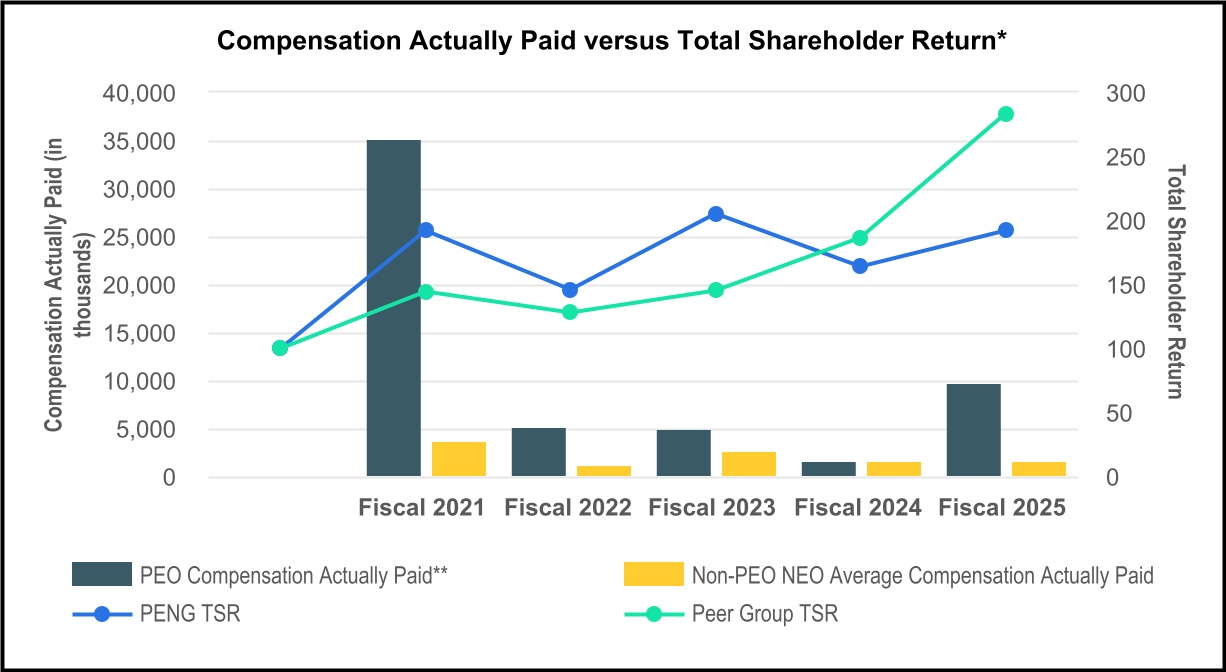
*TSR amounts reported in the graph assume an initial fixed investment of $100.
**For fiscal 2021, PEO Compensation Actually Paid represents the aggregate of Mr. Adams’ and Mr. Shah’s compensation actually paid.
*For fiscal 2021, PEO Compensation Actually Paid represents the aggregate of Mr. Adams’ and Mr. Shah’s compensation actually paid.
*For fiscal 2021, PEO Compensation Actually Paid represents the aggregate of Mr. Adams’ and Mr. Shah’s compensation actually paid.
Tabular List of Financial Performance Measures
We believe the following performance measures represent the most important financial performance measures used by us to link compensation actually paid to our NEOs for fiscal 2025:
•Net sales;
•Non-GAAP operating income; and
•Relative TSR.
For additional details regarding our most important financial performance measures, please see the sections titled “Elements of Executive Compensation – Short-Term Cash Incentive Compensation” and “Elements of Executive Compensation – Equity Compensation” in our CD&A above.
EQUITY COMPENSATION PLAN INFORMATION
The following table provides certain information as of August 29, 2025 with respect to all of our equity compensation plans in effect on that date.
| | | | | | | | | | | | | | | | | | | | |
| Plan Category | (a) Number of Securities to be Issued Upon Exercise of Outstanding Options and Rights | | (b) Weighted-Average Exercise Price of Outstanding Options and Rights (1) | | (c) Number of Securities Remaining Available for Future Issuance Under Equity Compensation Plans (Excluding Securities Reflected in Column (a)) | |
Equity compensation plans approved by security holders (2) | 3,945,538 | | (3) | $ | 13.74 | | | 6,776,368 | | (4) |
Equity compensation plans not approved by security holders (5) | 356,399 | | (6) | $ | — | |
| 1,856,341 | |
|
| Total | 4,301,937 | | | $ | 13.74 | | | 8,632,709 | | |
(1)Represents the weighted-average exercise price of outstanding options. Because RSUs do not have an exercise price, the weighted-average exercise price does not take into account outstanding RSUs.
(2)Consists of the 2017 Plan and the ESPP.
(3)Consists of 522,094 shares of common stock underlying outstanding options, 2,859,184 shares of common stock underlying outstanding RSUs, and 564,260 shares of common stock underlying outstanding PSUs (based on target performance). Does not include rights to acquire shares of common stock under the ESPP.
(4)Consists of 4,785,460 shares of common stock available for issuance under the 2017 Plan and 1,990,908 shares of common stock available for issuance under the ESPP (of which 247,451 shares of common stock were purchased in the offering period in effect on August 29, 2025 that ended October 15, 2025).
(5)Consists of the Inducement Plan.
(6)Consists of 243,210 shares of common stock underlying outstanding RSUs and 113,189 shares of common stock underlying outstanding PSUs (based on target performance).
The number of shares reserved under the 2017 Plan is subject to an automatic annual increase on the first day of each fiscal year (ending with the fiscal year starting September 1, 2026), equal to the lesser of (i) 3,000,000 shares, (ii) 2.5% of the shares of common stock outstanding on such date, and (iii) an amount determined by the Board.
The number of shares authorized for sale under the ESPP is subject to an automatic annual increase on each September 1 (through and including September 1, 2027), equal to the lesser of (i) 600,000 shares, (ii) 1.5% of the shares of common stock outstanding on the last day of the immediately preceding fiscal year, and (iii) an amount determined by the Board.
Our Inducement Plan provides for the issuance of equity awards to provide inducements for certain individuals to enter into employment with us within the meaning of Rule 5635(c)(4) of the Nasdaq Marketplace Rules, and to motivate such persons to contribute to, and to enable them to share in any long-term growth and financial success we may experience. Such awards include options, stock appreciation rights, RSAs, RSUs, and performance-based awards such as PSAs and PSUs.
CERTAIN RELATIONSHIPS AND RELATED PERSON TRANSACTIONS
Transactions with Related Persons, Promoters, and Certain Control Persons
The following are certain transactions, arrangements, and relationships with our directors, executive officers, and stockholders owning 5% or more of any class of our voting securities, or any member of the immediate family of any of the foregoing persons, since the beginning of fiscal 2025, other than certain equity and other compensation, employment arrangements, and other agreements and transactions that are described elsewhere in this Proxy Statement.
Transactions with SKT
Closing of SKT Investment. On December 13, 2024, we closed the SKT Investment (as defined below). Pursuant to the terms of the Securities Purchase Agreement dated July 14, 2024 by and between Penguin Solutions and SKT (the “SKT Purchase Agreement”) we sold to Astra, an affiliate of SKT, 200,000 convertible preferred shares, par value $0.03 per share (the “Cayman CPS”), of Penguin Solutions Cayman at a price of $1,000 per share or an aggregate price of $200.0 million (the “SKT Investment”).
Investor Agreement and Certificate of Designation. Additionally, on the closing date of the SKT Investment, we and Astra entered into an Investor Agreement (the “Investor Agreement”), and the certificate of designation relating to the Cayman CPS (the “Cayman Certificate of Designation”) became effective. The Investor Agreement and the Cayman Certificate of Designation provided for certain rights and restrictions relating to the SKT Investment, including but not limited to board representation rights, participation rights, registration rights, information rights and consent rights set forth in the certificate of designation, and standstill provisions, disposition restrictions, and voting requirements.
On June 27, 2025, in connection with the U.S. Redomiciliation, the Company executed and adopted a Certificate of Designation of Convertible Preferred Stock (the “Certificate of Designation”) that sets forth the terms, rights, and obligations of the Issued CPS. The principal attributes of the Cayman CPS and the Issued CPS are substantially the same, with changes to give effect to requirements of Delaware law. On June 30, 2025, effective upon the consummation of the U.S. Redomiciliation, the Company assumed the Investor Agreement from Penguin Solutions Cayman, and the Company and SKT amended and restated the Investor Agreement (as amended and restated, the “Amended and Restated Investor Agreement”) such that the rights and restrictions relating to SKT’s beneficial ownership of the Cayman CPS in place prior to the U.S. Redomiciliation apply in respect of SKT’s holdings of Issued CPS following consummation of the U.S. Redomiciliation.
Investor Designee. Also on the closing date of the SKT Investment, the Board increased the authorized size of the Board to nine members, and upon the recommendation of the NCG Committee, the Board appointed Mr. Ha to the Board as SKT’s designee, effective immediately. Except for the SKT Purchase Agreement, the Investor Agreement, and the Cayman Certificate of Designation, Mr. Ha was not selected pursuant to any arrangement or understanding between him and any other person. There are no family relationships between Mr. Ha and any director or executive officer of the Company, and except as described above, Mr. Ha does not have a direct or indirect material interest in any transaction required to be disclosed pursuant to Item 404(a) of Regulation S-K.
Master Purchase and Services Agreement with SKT. On May 26, 2025, we entered into an agreement with SKT, under which we subsequently entered into statements of work to provide solutions to support SKT’s future AI data center infrastructure initiatives. In fiscal 2025, we recognized a total transaction amount of $50.7 million for cash received for payment on the fulfillment of AI hardware solutions and installation services, of which $32.4 million of the order was completed and recognized as revenue in fiscal 2025, and the remaining $18.3 million was recorded as contract liability as of the end of fiscal 2025. During the fiscal quarter ended November 28, 2025, we recognized revenue of $32.2 million on the fulfillment of AI hardware solutions and installation services, and managed services. As of November 28, 2025, $15.1 million remained outstanding in accounts receivable.
Indemnification
We have entered into indemnification agreements with our directors and executive officers. The indemnification agreements provide our directors and executive officers with indemnification, to the maximum extent permitted by Delaware law.
Procedures for Approval of Related Person Transactions
Pursuant to our written Audit Committee charter, the Audit Committee must review all related person transactions required to be disclosed in our financial statements and approve any such related person transaction, unless the transaction is approved by another independent committee of our Board.
In furtherance of this requirement, the Board has adopted a Related Person Transaction Policy that is in conformity with the requirements for companies having shares of common stock listed on Nasdaq. This policy addresses the reporting, review, and approval or ratification of transactions with related persons, and applies to the following persons (each, a “Related Person”):
•Any of our directors or executive officers;
•Any nominee for director;
•A beneficial owner of 5% or more of our voting securities; or
•Any immediate family member of the foregoing.
A transaction involving the Company in which a Related Person has a direct or indirect material interest, as determined by the Audit Committee (or comparable body of the Board consisting solely of independent directors), is considered a “Related Person Transaction.”
Except as otherwise provided in the policy, each Related Person Transaction must be approved by the Audit Committee and each director, director nominee, and executive officer must promptly notify our Secretary of any Related Person Transaction and all the material facts thereof. If advance approval of a proposed Related Person Transaction is not feasible, our Audit Committee will review such new or proposed Related Person Transaction at its next occurring regular meeting.
In addition, on at least an annual basis, the Audit Committee reviews previously approved Related Person Transactions to determine whether such transactions should continue.
In reviewing the transaction or proposed transaction, the Audit Committee considers all relevant facts and circumstances, including without limitation the commercial reasonableness of the terms, the benefit and perceived benefit, or lack thereof, to the Company, opportunity costs of alternate transactions, the materiality and character of the Related Person’s direct or indirect interest, and the actual or apparent conflict of interest of the Related Person. The Audit Committee will not approve or ratify a Related Person Transaction unless it determines that, upon consideration of all relevant information, the transaction is in, or not inconsistent with, the best interests of the Company and its stockholders.
If after its review, the Audit Committee determines not to approve or ratify a Related Person Transaction (whether such transaction is being reviewed for the first time or has previously been approved and is being reviewed on at least an annual basis), the transaction will not be entered into or continued, as directed by the Audit Committee.
Finally, our written Code of Business Conduct and Ethics requires that directors, executive officers, and employees make appropriate disclosure of potential conflict of interest situations to the Audit Committee (in the case of accounting, internal accounting controls or auditing matters) or to their supervisor or the legal department.
HOUSEHOLDING OF PROXY MATERIALS
The SEC has adopted rules that permit companies and intermediaries (e.g., brokers) to satisfy the delivery requirements for Proxy Availability Notice or other proxy materials with respect to two or more stockholders sharing the same address by delivering a single Proxy Availability Notice or other proxy materials addressed to those stockholders. This process, which is commonly referred to as “householding,” potentially provides extra convenience for stockholders and cost savings for companies. Stockholders who participate in householding will continue to be able to access and receive separate proxy cards.
This year, a number of brokers with account holders who are our stockholders will be householding our proxy materials. A Proxy Availability Notice or proxy materials will be delivered in one single envelope to multiple stockholders sharing an address unless contrary instructions have been received from one or more of the affected stockholders. Once you have received notice from your broker that they will be householding communications to your address, householding will continue until you are notified otherwise or until you revoke your consent. If, at any time, you no longer wish to participate in householding and would prefer to receive a separate Proxy Availability Notice or proxy materials, please notify your broker or contact our Secretary, c/o Penguin Solutions, Inc., 45800 Northport Loop West, Fremont, CA 94538, or by telephone: (510) 623-1231. Stockholders who currently receive multiple copies of the Proxy Availability Notice or proxy materials at their address and would like to request householding of their communications should contact us at the address or telephone number above or contact their broker if they are a street name stockholder. In addition, we will promptly deliver, upon written or oral request to the address or telephone number above, a separate copy of the Proxy Availability Notice or proxy materials to a stockholder at a shared address to which a single copy of the documents was delivered.
OTHER MATTERS
The Board knows of no other matters that will be presented for consideration at the Annual Meeting. If any other matters are properly brought before the Annual Meeting, it is the intention of the persons named in the accompanying proxy to vote on such matters in accordance with their best judgment.
Stockholders may obtain our proxy statement (and any amendments and supplements thereto) and other documents when filed with the SEC without charge from the SEC’s website at: www.sec.gov.
WHETHER OR NOT YOU PLAN TO ATTEND THE ANNUAL MEETING ONLINE, WE URGE YOU TO VOTE YOUR SHARES VIA THE TOLL-FREE PHONE NUMBER OR OVER THE INTERNET, AS DESCRIBED IN THIS PROXY STATEMENT. IF YOU REQUESTED TO RECEIVE PAPER PROXY MATERIALS, THEN YOU MAY ALSO VOTE BY MAILING A COMPLETED, SIGNED, AND DATED PROXY CARD OR VOTING INSTRUCTION CARD IN THE ENVELOPE PROVIDED. PROMPTLY VOTING YOUR SHARES WILL ENSURE THE PRESENCE OF A QUORUM AT THE ANNUAL MEETING AND WILL SAVE US THE EXPENSE OF FURTHER SOLICITATION.
By Order of the Board of Directors
Mark Adams
Director, President and Chief Executive Officer
Fremont, California
December 19, 2025
A copy of our Annual Report on Form 10-K for the fiscal year ended August 29, 2025, including the financial statements and the financial statement schedules thereto but not including exhibits, as filed with the SEC on October 21, 2025, is available without charge upon written request to our Secretary, c/o Penguin Solutions, Inc., 45800 Northport Loop West, Fremont, CA 94538, or by accessing a copy on Penguin Solutions’ website at ir.penguinsolutions.com in the Financials section of the Investors section under “SEC Filings.” Information on our website is not incorporated by reference in this Proxy Statement. Exhibits to the Annual Report on Form 10-K for the fiscal year ended August 29, 2025 are available upon payment of a reasonable fee, which is limited to our expenses in furnishing the requested exhibit.
APPENDIX A
Penguin Solutions, Inc.
Reconciliation of GAAP to Non-GAAP Financial Measures
GAAP to Non-GAAP Reconciliation
Our management uses non-GAAP financial measures to supplement our financial results under GAAP, including non-GAAP operating margin, non-GAAP diluted earnings per share, and non-GAAP operating income. Our management uses these measures to analyze the Company’s operations and make decisions as to future operational plans and believes that this supplemental non-GAAP information is useful to investors in analyzing and assessing the Company’s past and future operating performance. These non-GAAP measures exclude certain items, such as stock-based compensation expense; amortization of acquisition-related intangible assets (consisting of amortization of developed technology, customer relationships, trademarks/trade names, and backlog acquired in connection with business combinations); cost of sales-related restructuring; diligence, acquisition, and integration expense; redomiciliation costs; restructuring charges; impairment of goodwill; changes in the fair value of contingent consideration; (gains) losses from changes in currency exchange rates; amortization of debt issuance costs; (gain) loss on extinguishment or prepayment of debt; other infrequent or unusual items; and related tax effects and other tax adjustments. While amortization of acquisition-related intangible assets is excluded, the revenues from acquired companies are reflected in the Company’s non-GAAP measures and these intangible assets contribute to revenue generation. Our management believes the presentation of operating results that exclude certain items provides useful supplemental information to investors and facilitates the analysis of the Company’s core operating results and comparison of operating results across reporting periods.
Non-GAAP financial measures should not be considered as a substitute for, or superior to, measures of financial performance prepared in accordance with GAAP, as they exclude important information about Penguin Solutions’ financial results, as noted above. The presentation of these adjusted amounts varies from amounts presented in accordance with GAAP and therefore may not be comparable to amounts reported by other companies. Investors are encouraged to review the “Reconciliation of GAAP to Non-GAAP Financial Measures” tables below.
Penguin Solutions, Inc.
Reconciliation of GAAP to Non-GAAP Financial Measures
(In thousands, except percentages and per share amounts)
| | | | | | | | | | | |
| | Fiscal Year Ended |
| | August 29,
2025 | | August 30,
2024 |
| GAAP operating income | $ | 58,135 | | | $ | 18,295 | |
| Stock-based compensation expense | 41,176 | | | 43,160 | |
| Amortization of acquisition-related intangibles | 34,838 | | | 39,272 | |
| | | |
| | | |
| Cost of sales-related restructuring | 746 | | | 2,136 | |
| Diligence, acquisition and integration expense | 1,829 | | | 8,772 | |
Redomiciliation costs (1) | 10,038 | |
| 470 | |
| Impairment of goodwill | 16,063 | | | — | |
| | | |
| Restructuring charges | 2,098 | | | 7,064 | |
Other (1) | 2,729 | |
| 1,088 | |
| Non-GAAP operating income | $ | 167,652 | | | $ | 120,257 | |
| | | |
| GAAP operating margin | 4.2 | % | | 1.6 | % |
| Effect of adjustments | 8.0 | % | | 8.7 | % |
| Non-GAAP operating margin | 12.2 | % | | 10.3 | % |
| | | |
| GAAP net income (loss) attributable to Penguin Solutions | $ | 25,391 | | | $ | (44,324) | |
| Stock-based compensation expense | 41,176 | | | 43,160 | |
| Amortization of acquisition-related intangibles | 34,838 | | | 39,272 | |
| Cost of sales-related restructuring | 746 | | | 2,136 | |
| Diligence, acquisition and integration expense | 1,829 | | | 8,772 | |
Redomiciliation costs (1) | 10,038 | | | 470 | |
| Impairment of goodwill | 16,063 | | | — | |
| Restructuring charges | 2,098 | | | 7,064 | |
| Amortization of debt issuance costs | 3,493 | | | 3,724 | |
| Loss (gain) on extinguishment or prepayment of debt | 2,908 | | | 22,763 | |
| Foreign currency (gains) losses | 205 | | | (830) | |
Other (1) | 2,729 | |
| 1,088 | |
Income tax effects (2) | (21,189) | |
| (16,388) | |
| Non-GAAP net income attributable to Penguin Solutions | 120,325 | | | 66,907 | |
| | | |
| Preferred stock dividends | 8,667 | | | — | |
| Non-GAAP income available for distribution | 111,658 | | | 66,907 | |
| Income allocated to participating securities | 8,250 | | | — | |
| Non-GAAP net income available to common stockholders | $ | 103,408 | | | $ | 66,907 | |
| | | |
| Weighted-average shares outstanding - Diluted: | | | |
| GAAP weighted-average shares outstanding | 54,368 | | | 52,428 | |
| Adjustment for dilutive securities and capped calls | — | | | 1,268 | |
| Non-GAAP weighted-average shares outstanding | 54,368 | | | 53,696 | |
| | | |
| Diluted earnings (loss) per share from continuing operations: | | | |
| GAAP diluted earnings (loss) per share | $ | 0.28 | | | $ | (0.85) | |
| Effect of adjustments | 1.62 | | | 2.10 | |
| Non-GAAP diluted earnings per share | $ | 1.90 | | | $ | 1.25 | |
| | | | |
| | | |
| | | |
| | | |
| | | |
| | | |
| | | |
| | | |
| | | |
| | | |
| | | |
| | | |
| | | |
| | | |
| | | |
| | | |
(1) In the second quarter of fiscal 2025 we began breaking out costs related to the U.S. Redomiciliation from “Other.” All periods presented have been adjusted to reflect this change. |
(2) The fiscal year ended August 29, 2025 includes ($8,249) as a one-time tax effect of the U.S. Redomiciliation completed in the fourth quarter of fiscal 2025. |