Please wait
SCHEDULE 14A
(Rule 14a-101)
INFORMATION REQUIRED IN PROXY STATEMENT
SCHEDULE 14A INFORMATION
PROXY STATEMENT PURSUANT TO SECTION 14(A) OF THE
SECURITIES EXCHANGE ACT OF 1934
(AMENDMENT NO. )
Filed by the Registrant ☒ Filed by a Party other than the Registrant ☐
Check the appropriate box:
|
| | |
☐ | | Preliminary Proxy Statement |
| |
☐ | | Confidential, for Use of the Commission Only (as permitted by Rule 14a-6(e)(2)) |
| |
☒ | | Definitive Proxy Statement |
| |
☐ | | Definitive Additional Materials |
| |
☐ | | Soliciting Material Pursuant to Rule 14a-11(c) or Rule 14a-12 |
VALERITAS HOLDINGS, INC.
(Name of Registrant as Specified in Its Charter)
(Name of Person(s) Filing Proxy Statement, if Other Than the Registrant)
Payment of Filing Fee (Check the appropriate box):
|
| | | | |
☒ | | No fee required. |
☐ | | Fee computed on table below per Exchange Act Rules 14a-6(i)(1) and 0-11. |
| | (1) | | Title of each class of securities to which transaction applies:
|
| | (2) | | Aggregate number of securities to which transaction applies:
|
| | (3) | | Per unit price or other underlying value of transaction computed pursuant to Exchange Act Rule 0-11 (set forth the amount on which the filing fee is calculated and state how it was determined):
|
| | (4) | | Proposed maximum aggregate value of transaction:
|
| | (5) | | Total fee paid:
|
| | | | |
☐ | | Fee paid previously with preliminary materials. |
☐ | | Check box if any part of the fee is offset as provided by Exchange Act Rule 0-11(a)(2) and identify the filing for which the offsetting fee was paid previously. Identify the previous filing by registration statement number, or the form or schedule and the date of its filing. |
| | | | |
| | (1) | | Amount Previously Paid:
|
| | (2) | | Form, Schedule or Registration Statement No.:
|
| | (3) | | Filing Party:
|
| | (4) | | Date Filed:
|
VALERITAS HOLDINGS, INC.
750 Route 202 South, Suite 600
Bridgewater, New Jersey 08807
May 4, 2017
Dear Stockholder,
You are cordially invited to attend the 2017 Annual Meeting of Stockholders of Valeritas Holdings, Inc. (the “Annual Meeting”) that will be held on Tuesday, June 6, 2017 at 8:30 a.m. local time, at the offices of Morgan, Lewis & Bockius LLP at 502 Carnegie Center Drive, Princeton, NJ 08540.
Details regarding admission to the Annual Meeting and the business to be conducted are described in the accompanying proxy materials. Also included is a copy of our 2016 Annual Report. We encourage you to read this information carefully.
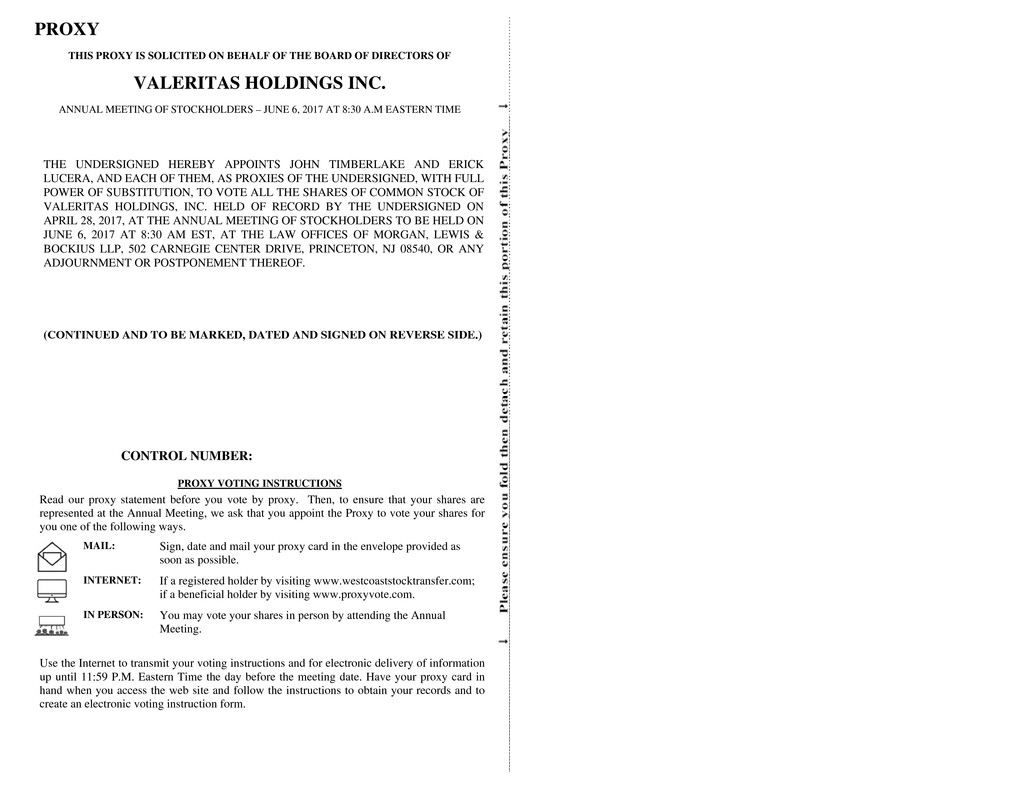
Your vote is important. Whether or not you plan to attend the Annual Meeting, we hope you will vote as soon as possible. You may vote over the Internet, by telephone or by mailing a proxy card, if you have requested one. Voting over the Internet, by telephone or by written proxy will ensure your representation at the Annual Meeting regardless of whether or not you attend in person. Please review the instructions in the Proxy Materials you received in the mail regarding each of these voting options.
Thank you for your ongoing support of Valeritas.
Very truly yours,
/s/ John E. Timberlake
John E. Timberlake
Chief Executive Officer and President
VALERITAS HOLDINGS, INC.
750 Route 202 South, Suite 600
Bridgewater, New Jersey 08807
NOTICE OF
2017 ANNUAL MEETING OF STOCKHOLDERS
|
| | |
| | |
Time and Date: | | Tuesday, June 6, 2017 at 8:30 a.m. local time. |
Place: | | The offices of Morgan, Lewis & Bockius LLP at 502 Carnegie Center Drive, Princeton, NJ 08540 |
Items of Business: | | (1) To elect three directors named in the proxy statement accompanying this notice to serve as a Class I director until the annual meeting held in 2020 and until their successors are duly elected and qualified. |
| | (2) To ratify the appointment of Friedman LLP as Valeritas Holdings, Inc.’s independent registered public accounting firm for the year ending December 31, 2017. |
| | (3) To approve the Valeritas Holdings, Inc. Employee Stock Purchase Plan; and |
| | (4) To transact such other business as may properly come before the annual meeting or any adjournment thereof. |
| | These items of business are more fully described in the proxy statement accompanying this notice. |
Adjournments and Postponements: | | Any action on the items of business described above may be considered at the annual meeting at the time and on the date specified above or at any time and date to which the annual meeting may be properly adjourned or postponed. |
Record Date: | | You are entitled to vote if you were a stockholder of record as of the close of business on April 28, 2017. |
Voting: | | Your vote is very important. Whether or not you plan to attend the annual meeting, we encourage you to read the proxy statement and vote on the Internet or by telephone or submit your proxy card, if you have requested one, as soon as possible. For specific instructions on how to vote your shares, please refer to the section herein entitled “Questions and Answers About Procedural Matters.” |
By order of the board of directors,
/s/ Erick Lucera
Erick Lucera
Secretary
This notice of annual meeting, proxy statement and accompanying form of proxy card are being made available on or about May 4, 2017.
Proxy Statement Table of Contents
VALERITAS HOLDINGS, INC.
750 Route 202, Suite 600
Bridgewater, New Jersey 08807
|
|
PROXY STATEMENT FOR 2017 ANNUAL MEETING OF STOCKHOLDERS |
This proxy statement is furnished in connection with solicitation of proxies by our board of directors for use at the 2017 Annual Meeting of Stockholders (the “Annual Meeting”) to be held at 8:30 a.m. local time on Tuesday, June 6, 2017, and any postponements or adjournments thereof. The Annual Meeting will be held at the offices of Morgan, Lewis & Bockius LLP at 502 Carnegie Center Drive, Princeton, New Jersey 08540. As used in this proxy statement, the terms “Valeritas,” “we,” “us,” and “our” mean Valeritas Holdings, Inc. unless the context indicates otherwise.
QUESTIONS AND ANSWERS ABOUT PROCEDURAL MATTERS
Annual Meeting
|
| |
Q: | Why am I receiving these proxy materials? |
|
| |
A: | Our board of directors is providing these proxy materials to you in connection with the solicitation of proxies for use at the Annual Meeting to be held on Tuesday, June 6, 2017 at 8:30 a.m. local time, and at any adjournment or postponement thereof, for the purpose of considering and acting upon the matters set forth herein. We intend to mail the notice of Annual Meeting, this proxy statement, accompanying form of proxy card, and our 2016 Annual Report on Form 10-K to you on or about May 5, 2017. This proxy statement includes information that we are required to provide to you by the Securities and Exchange Commission, or the SEC, and that is designed to assist you in voting your shares. |
|
| |
Q: | What is included in the proxy materials? |
|
| |
A: | The proxy materials include: |
|
| | | |
| | | This proxy statement for the Annual Meeting; |
|
| | | |
| | | Our 2016 Annual Report to Stockholders, which consists of our Annual Report on Form 10-K for the year ended December 31, 2016; and |
|
| | | |
| | | The proxy card or a voting instruction form for the Annual Meeting, if you have requested that the proxy materials be mailed to you. |
|
| |
Q: | How can I get electronic access to the proxy materials? |
|
| |
A: | The Company’s proxy materials are available at at www.valeritas.com. Our website address is included for reference only. The information contained on our website is not incorporated by reference into this proxy statement. |
|
| |
Q: | What information is contained in this proxy statement? |
|
| |
A: | The information in this proxy statement relates to the proposals to be voted on at the Annual Meeting, the voting process, the compensation of our directors and certain of our executive officers, corporate governance, and certain other required information. |
| |
Q: | Where is the Annual Meeting? |
|
| |
A: | The Annual Meeting will be held at the offices of Morgan, Lewis & Bockius LLP at 502 Carnegie Center Drive, Princeton, New Jersey, 08540. |
|
| |
Q: | Can I attend the Annual Meeting? |
|
| |
A: | You are invited to attend the Annual Meeting if you were a stockholder of record or a beneficial owner as of April 28, 2017, the Record Date. Admission will begin at 8:15 a.m. local time on the date of the Annual Meeting, and you must present valid picture identification such as a driver’s license or passport and, if asked, provide proof of stock ownership as of the Record Date. The use of mobile phones, pagers, recording or photographic equipment, tablets and/or computers is not permitted at the Annual Meeting. The Annual Meeting will begin promptly at 8:30 a.m. local time. |
Stock Ownership
|
| |
Q: | What is the difference between holding shares as a stockholder of record and as a beneficial owner? |
|
| |
A: | Stockholders of record - If your shares are registered directly in your name with our transfer agent, West Coast Stock Transfer, Inc., you are considered, with respect to those shares, the “stockholder of record,” and the proxy materials were provided to you directly by us. As the stockholder of record, you have the right to grant your voting proxy directly to the individuals listed on the proxy card or to vote in person at the Annual Meeting. |
Beneficial owners - Many Valeritas stockholders hold their shares through a broker, trustee or other nominee, rather than directly in their own name. If your shares are held in a brokerage account or by a bank or another nominee, you are considered the “beneficial owner” of shares held in “street name.” The proxy materials were forwarded to you by your broker, trustee or nominee who is considered, with respect to those shares, the stockholder of record.
As the beneficial owner, you have the right to direct your broker, trustee or nominee on how to vote your shares. Beneficial owners are also invited to attend the Annual Meeting. However, since beneficial owners are not stockholders of record, you may not vote your shares in person at the Annual Meeting unless you follow your broker’s procedures for obtaining a legal proxy. If you request a printed copy of the proxy materials by mail, your broker or nominee will provide a voting instruction card for you to use.
Quorum and Voting
|
| |
Q: | How many shares must be present or represented to conduct business at the Annual Meeting? |
|
| |
A: | A quorum is the minimum number of shares required to be present at the Annual Meeting for the meeting to be properly held under our amended and restated bylaws and the Delaware General Corporation Law, or the DGCL. The presence, in person or by proxy, of a majority of the aggregate voting power of the issued and outstanding shares of stock entitled to vote at the Annual Meeting will constitute a quorum at the Annual Meeting. |
|
| |
| A proxy submitted by a stockholder may indicate that the shares represented by the proxy are not being voted, referred to as stockholder withholding with respect to a particular matter. |
Under the DGCL, abstentions and broker “non-votes” are counted as present and entitled to vote and are, therefore, included for purposes of determining whether a quorum is present at the Annual Meeting.
A broker non-vote occurs when a nominee holding shares for a beneficial owner does not vote on a particular proposal because the nominee does not have discretionary voting power with respect to that item and has not received instructions from the beneficial owner.
|
| |
Q: | Who is entitled to vote at the Annual Meeting? |
|
| |
A: | Holders of record of our common stock at the close of business on the Record Date are entitled to receive notice of and to vote their shares at the Annual Meeting. As of the Record Date, we had 6,890,885 shares of common stock outstanding. In deciding all matters at the Annual Meeting, each holder of common stock of Valeritas will be entitled to one vote for each share of common stock held as of the close of business on the Record Date. We do not have cumulative voting rights for the election of directors. |
|
| |
Q: | How can I vote my shares in person at the Annual Meeting? |
|
| |
A: | Shares held in your name as the stockholder of record may be voted in person at the Annual Meeting. Shares held beneficially in street name may be voted in person at the Annual Meeting only if you obtain a legal proxy from the broker, trustee or other nominee that holds your shares giving you the right to vote the shares. Even if you plan to attend the Annual Meeting, we recommend that you also submit your proxy card, if you have requested one, or follow the voting directions described below, so that your vote will be counted if you later decide not to attend the Annual Meeting. |
|
| |
Q: | How can I vote my shares without attending the Annual Meeting? |
|
| |
A: | Stockholder of record - If you are a stockholder of record, there are three ways to vote without attending the Annual Meeting: |
|
| | | |
| | | Via the Internet - You may vote by proxy via the Internet by following the instructions provided in the proxy card. |
|
| | | |
| | | By Telephone - You may vote by proxy by telephone by calling the toll free number found on the proxy card. |
|
| | | |
| | | By Mail - You may vote by proxy by filling out the proxy card and returning it in the envelope provided. |
Beneficial owners - If you are a beneficial owner holding shares through a bank, broker or other nominee, please refer to information forwarded by your bank or broker to see which voting options are available to you.
|
| |
Q: | What proposals will be voted on at the Annual Meeting? |
|
| |
A: | At the Annual Meeting, stockholders will be asked to vote: |
|
| | |
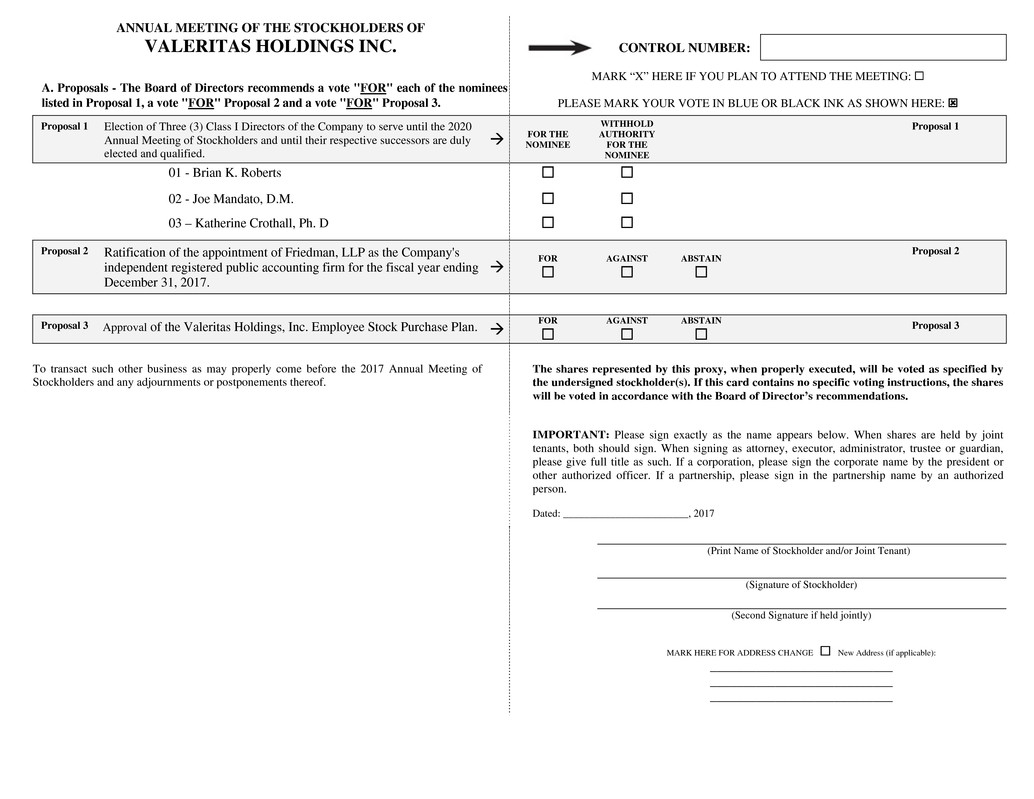
| (1) | To elect the three directors identified in this proxy statement to serve as a Class I director until the annual meeting held in 2020 and until their successors are duly elected and qualified; |
|
| | |
| (2) | To ratify the appointment of Friedman LLP as our independent registered public accounting firm for the year ending December 31, 2017; |
|
| | |
| (3) | To approve the Valeritas Holdings, Inc. Employee Stock Purchase Plan; and |
|
| | |
| (4) | To transact such other business as may properly come before the Annual Meeting or any adjournment thereof. |
|
| |
Q: | What is the voting requirement to approve each of the proposals? |
|
| |
A: | Proposal One - The election of a director requires a plurality vote of the shares of common stock voted at the Annual Meeting. “Plurality” means that the individual who receives the largest number of votes cast “for” is elected as a director, however, a nominee is not required to receive a majority of votes “for”. As a result, any shares not voted “for” the nominee (whether as a result of stockholder withholding or a broker non-vote) will not be counted in the nominee’s favor. |
Proposal Two - The affirmative vote of a majority of votes cast is required to ratify the appointment of Friedman LLP as our independent registered public accounting firm. Abstentions will have the effect of a vote against this proposal and broker non-votes will have no effect on the outcome of this proposal.
Proposal Three - The affirmative vote of a majority of votes cast is required to approve the Valeritas Holdings, Inc. Employee Stock Purchase Plan.
|
| |
Q: | How does the board of directors recommend that I vote? |
|
| |
A: | Our board of directors unanimously recommends that you vote your shares: |
|
| | | |
| | | “FOR” the nominees for election as director listed in Proposal One; |
|
| | | |
| | | “FOR” the ratification of the appointment of Friedman LLP as our independent registered public accounting firm for the year ending December 31, 2017; and |
|
| | | |
| | | “FOR” the approval of the Valeritas Holdings, Inc. Employee Stock Purchase Plan. |
|
| |
Q: | What happens if I do not give specific voting instructions? |
|
| |
A: | Stockholder of record - If you are a stockholder of record and you: |
|
| | | |
| | | Indicate when voting on the Internet or by telephone that you wish to vote as recommended by our board of directors; or |
|
| | | |
| | | Sign and return a proxy card without giving specific voting instructions, then the persons named as proxy holders will vote your shares in the manner recommended by the board of directors on all matters presented in this proxy statement and as the proxy holders may determine in their discretion with respect to any other matters properly presented for a vote at the Annual Meeting. |
| | | |
| | | Beneficial owners - If you are a beneficial owner of shares held in street name and do not provide the organization that holds your shares with specific voting instructions then, under applicable rules, the organization that holds your shares may generally vote on “routine” matters but cannot vote on “non-routine” matters. If the organization that holds your shares does not receive instructions from you on how to vote your shares on a non-routine matter, that organization will inform the inspector of election that it does not have the authority to vote on this matter with respect to your shares. This is generally referred to as a “broker non-vote.”
|
|
| |
Q: | How may my brokerage firm or other intermediary vote my shares if I fail to provide timely directions? |
|
| |
A: | Brokerage firms and other intermediaries holding shares of common stock in street name for customers are generally required to vote such shares in the manner directed by their customers. In the absence of timely directions, your broker will have discretion to vote your shares on our sole routine matter - the proposal to ratify the appointment of Friedman LLP. Your broker will not have discretion to vote on the election of directors. |
Please note that brokers may not vote your shares on the election of directors in the absence of your specific instructions as to how to vote, so we encourage you to provide instructions to your broker regarding the voting of your shares.
|
| |
Q: | What happens if additional matters are presented at the Annual Meeting? |
|
| |
A: | If any other matters are properly presented for consideration at the Annual Meeting, including, among other things, consideration of a motion to adjourn the Annual Meeting to another time or place (including, without limitation, for the purpose of soliciting additional proxies), the persons named in the proxy card and acting thereunder will have discretion to vote on those matters in accordance with their best judgment. We do not currently anticipate that any other matters will be raised at the Annual Meeting. |
|
| |
Q: | Can I change or revoke my vote? |
|
| |
A: | Subject to any rules your broker, trustee or nominee may have, you may change your proxy instructions at any time before your proxy is voted at the Annual Meeting. |
If you are a stockholder of record, you may change your vote by: (1) filing with our Corporate Secretary, prior to your shares being voted at the Annual Meeting, a written notice of revocation or a duly executed proxy card, in either case dated later than the prior proxy card relating to the same shares; or (2) by attending the Annual Meeting and voting in person (although attendance at the Annual Meeting will not, by itself, revoke a proxy). A stockholder of record that has voted on the Internet or by telephone may also change his or her vote by later making a timely and valid Internet or telephone vote.
If you are a beneficial owner of shares held in street name, you may change your vote: (1) by submitting new voting instructions to your broker, trustee or other nominee; (2) if you have obtained a legal proxy from the broker, trustee or other nominee that holds your shares giving you the right to vote the shares, by attending the Annual Meeting and voting in person; or (3) filing with our Corporate Secretary, prior to your shares being voted at the Annual Meeting, a written notice of revocation or a duly executed proxy card, in either case dated later than the prior proxy card relating to the same shares.
Any written notice of revocation or subsequent proxy card must be received by our Corporate Secretary prior to the taking of the vote at the Annual Meeting. Such written notice of revocation or subsequent proxy card should be hand delivered to our Corporate Secretary or should be sent so as to be delivered to our principal executive offices, Attention: Corporate Secretary.
|
| |
Q: | Who will bear the cost of soliciting votes for the Annual Meeting? |
|
| |
A: | We will bear all expenses of this solicitation, including the cost of preparing and mailing these proxy materials. We may reimburse brokerage firms, custodians, nominees, fiduciaries and other persons representing beneficial owners of common stock for their reasonable expenses in forwarding solicitation material to such beneficial owners. Directors, officers and employees of Valeritas may also solicit proxies in person or by other means of communication. Such directors, officers and employees will not be additionally compensated but may be reimbursed for reasonable out-of-pocket expenses in connection with such solicitation. We may engage the services of a professional proxy solicitation firm to aid in the solicitation of proxies from certain brokers, bank nominees and other institutional owners. Our costs for such services, if retained, will not be significant. If you choose to access the proxy materials and/or vote through the Internet, you are responsible for any Internet access charges you may incur. |
|
| |
Q: | Is my vote confidential? |
|
| |
A: | Proxy instructions, ballots, and voting tabulations that identify individual stockholders are handled in a manner that protects your voting privacy. Your vote will not be disclosed either within Valeritas or to third parties, except as necessary to meet applicable legal requirements, to allow for the tabulation of votes and certification of the vote, or to facilitate a successful proxy solicitation. |
|
| |
Q: | Where can I find the voting results of the Annual Meeting? |
|
| |
A: | We intend to announce preliminary voting results at the Annual Meeting and will publish final results in a current report on Form 8-K within four business days after the Annual Meeting. |
|
|
Stockholder Proposals and Director Nominations |
|
| |
Q: | What is the deadline to propose actions for consideration at next year’s annual meeting of stockholders or to nominate individuals to serve as directors? |
|
| |
A: | You may submit proposals, including director nominations, for consideration at future stockholder meetings. |
Requirements for stockholder proposals to be considered for inclusion in our proxy materials - Stockholders may present proper proposals for inclusion in our proxy statement and for consideration at our next annual meeting of stockholders by submitting their proposals in writing to our Corporate Secretary in a timely manner. In order to be included in the proxy statement for the 2018 annual meeting of stockholders, stockholder proposals must be received by our Corporate Secretary no later than March 8, 2018, and must otherwise comply with the requirements of Rule 14a-8 of the Securities Exchange Act of 1934, as amended, or the Exchange Act.
Requirements for stockholder proposals to be brought before an annual meeting - In addition, our bylaws establish an advance notice procedure for stockholders who wish to present certain matters before an annual meeting of stockholders. In general, nominations for the election of directors may be made by our board of directors or any committee thereof or any stockholder, who is a stockholder of record on the date of the giving of such notice and on the record date for the determination of stockholders entitled to vote at such meeting, who is entitled to vote at such meeting and who has delivered written notice to our Corporate Secretary no later than the Notice Deadline (as defined below), which notice must contain specified information concerning the nominees and concerning the stockholder proposing such nominations.
Our bylaws also provide that the only business that may be conducted at an annual meeting is business that is (1) specified in the notice of meeting (or any supplement thereto) given by or at the direction of our board of directors, (2) otherwise properly brought before the meeting by or at the direction of our board of directors (or any committee thereto) or (3) properly brought before the meeting by a stockholder who has delivered written notice to our Corporate Secretary no later than the Notice Deadline (as defined below).
The “Notice Deadline” is that date which is not less than 90 days nor more than 120 days prior to the one year anniversary of the previous year’s annual meeting of stockholders. As a result, the Notice Deadline for the 2018 annual meeting of stockholders is between February 6, 2018 and March 8, 2018.
If a stockholder who has notified us of his or her intention to present a proposal at an annual meeting does not appear to
present his or her proposal at such meeting, we need not present the proposal for vote at such meeting.
Recommendation of director candidates -You may recommend candidates to our board of directors for consideration by our nominating and governance committee by following the procedures set forth below in “Corporation Governance - Stockholder Communications with the Board of Directors.”
|
| |
Q: | How may I obtain a copy of the bylaw provisions regarding stockholder proposals and director nominations? |
|
| |
A: | A copy of the full text of the bylaw provisions discussed above may be obtained by writing to our Corporate Secretary. In addition, this and other information about our company may be obtained at the web site maintained by the SEC that contains reports, proxy and information statements and other information regarding registrants that file electronically with the SEC. The address of the SEC’s website is www.sec.gov. All notices of proposals by stockholders, whether or not included in Valeritas’s proxy materials, should be sent to our principal executive offices, Attention: Corporate Secretary. |
|
| |
Additional | Information about the Proxy Materials |
|
| |
Q: | What does it mean if multiple members of my household are stockholders but we only received one full set of proxy materials in the mail? |
|
| |
A: | We have adopted a procedure called “householding,” which the SEC has approved. Under this procedure, we deliver a single copy of the notice of the Annual Meeting and the proxy materials to multiple stockholders who share the same address unless we received contrary instructions from one or more of the stockholders. This procedure reduces our printing costs, mailing costs, and fees. Stockholders who participate in householding will continue to be able to access and receive separate proxy cards. Upon written request, we will deliver promptly a separate copy of the notice of the Annual Meeting and the proxy materials to any stockholder at a shared address to which we delivered a single copy of any of these documents. To receive a separate copy of the notice of the Annual Meeting and the proxy materials, stockholders should send their requests to our principal executive offices, Attention: Corporate Secretary. Stockholders who hold shares in street name (as described below) may contact their brokerage firm, bank, broker-dealer, or other similar organization to request information about householding. |
|
| |
Q: | What is the mailing address for Valeritas’ principal executive offices? |
|
| |
A: | Our principal executive offices are located at 750 Route 202 South, Suite 600, Bridgewater, New Jersey 08807. The telephone number at that location is (908) 927-9920. |
Any written requests for additional information, copies of the proxy materials and 2016 Annual Report, notices of stockholder proposals, recommendations for candidates to our board of directors, communications to our board of directors or any other communications should be sent to the address above.
IMPORTANT NOTICE REGARDING THE AVAILABILITY OF PROXY MATERIALS FOR THE STOCKHOLDER ANNUAL MEETING TO BE HELD ON June 6, 2017.
The proxy statement and annual report to stockholders is available at http://www.westcoaststocktransfer.com/proxy-vlrx.
PROPOSAL ONE
ELECTION OF DIRECTORS
General
Our board of directors may establish the authorized number of directors from time to time by resolution. Our board of directors is currently comprised of seven members who are divided into three classes with staggered three-year terms. A director serves in office until his or her respective successor is duly elected and qualified or until his or her earlier death or resignation. This classification of the board of directors into three classes with staggered three-year terms may have the effect of delaying or preventing changes in our control or management. The term of office of our Class I directors, Brian K. Roberts, Joseph Mandato, D.M. and Katherine Crothall, Ph.D., will expire at this year’s Annual Meeting. Your proxy cannot be voted for a greater number of persons than the number of nominees named in this proxy statement.
Nominees
Three Class I directors have been nominated for reelection at the Annual Meeting for a three-year term expiring in 2020. Upon the recommendation of our nominating and governance committee, our board of directors has nominated Brian Roberts, Joseph Mandato, D.M. and Katherine Crothall, Ph.D. for reelection as a Class I director. Each of Mr. Roberts, Mr. Mandato and Ms. Crothall was previously elected as a Class I director in 2016, for a term expiring at the first Annual Meeting. We did not pay any fees to any third parties to identify or assist in identifying or evaluating nominees for the Annual Meeting.The term of office of the nominees elected as director will continue until such director’s term expires in 2020 and until his or her successor has been duly elected and qualified.
Information Regarding the Nominees and Other Directors
Nominees for Class I Director for a Term Expiring in 2020
The following contains information about each nominee as of April 28, 2017, including each nominee's age, business experience, public company director positions held currently or at any time during the last five years, involvement in certain legal or administrative proceedings, if applicable, and the experiences, qualifications, attributes or skills that caused the nominating/corporate governance committee and our board of directors to determine that each nominee should serve as one of our directors.
|
| |
Name, age, and position with the Company | Principal Occupation and Business Experience |
Brian Roberts Age: 46 Director since 2016 Audit Committee Chairperson | Brian Roberts has served as a member of our board of directors since July 2016. From January 2015 to September 2016, Mr. Roberts served as the Chief Operating and Financial Officer of Avedro, a corneal cross-linking science company. From January 2009 through December 2014, he served as Chief Financial Officer for Insulet Corporation, a tubeless insulin pump technology company. From August 2007 to December 2008, Mr. Roberts served as Chief Financial Officer of Jingle Networks, a provider of advertising and technology solutions for voice and mobile business search. Mr. Roberts is currently a member of the board of directors of ViewRay, Inc. and serves as chair of its audit committee. Mr. Roberts received his Bachelor of Science in Accounting and Finance degree from Boston College. Mr. Roberts is qualified to serve as a director because of his extensive business experience and financial and accounting insight.
|
Joseph Mandato, D.M. Age: 72 Director since 2016 Nominating and Corporate Governance Committee Chairperson | Joseph Mandato, D.M. has served as a member of our board of directors since December 2016. Since March 2003, Dr. Mandato has served as a managing director of DeNovo Ventures, a venture capital firm focused on life sciences. Prior to DeNovo Ventures, Dr. Mandato held top leadership positions at Ioptex, Confer Software, Gynecare and Origin Medsystems. Dr. Mandato also served as a member of the Board of Directors of AxoGen Corporation from February 2006 until its merger with and into AxoGen, Inc. in September 2011, and then served on the Board of AxoGen, Inc. until September 2016. Dr. Mandato served as a member of the Board of Directors of Hansen Medical, Inc. from August 2006 until February 2012. Dr. Mandato received a doctorate in management from Case Western Reserve University, and now serves on its Board of Trustees. Dr. Mandato also holds the Carlo Rossi Chair in Entrepreneurship and Management at the University of San Francisco, is a Lecturer at Stanford University and has served as a Fellow in the Harvard University Advanced Leadership Initiative. Additionally, Dr. Mandato currently serves on the boards of both the Embrace Global and Save the Children organizations. Dr. Mandato is qualified to serve as a director because of his extensive work in the healthcare industry and his venture capital experience. |
Katherine Crothall, Ph. D Age: 68 Director since 2016 Nominating and Corporate Governance Committee Member | Katherine Crothall, Ph.D. has served as a member of our board of directors since October 2016. Since 2010, Dr. Crothall has served as President, CEO and Chairman of the Board of Aspire Bariatrics, a company committed to providing safe and effective treatments for obesity to patients worldwide. Dr. Crothall was a Principal at Liberty Venture Partners, a venture capital firm, from 2006 until November 2010. Dr. Crothall was Founder, President and CEO of Animas Corporation, a manufacturer of insulin infusion pumps, from its inception to its acquisition by Johnson & Johnson Corporation in 2006. Dr. Crothall was also the Founder, President and CEO of two other medical device companies, Luxar Corporation ,which was sold to ESC Medical, and Laakmann Electro-Optics, which was sold to Johnson & Johnson. Dr. Crothall continued running Laakmann Electro-Optics for five years post-acquisition. Dr. Crothall received her B.S. from the University of Pennsylvania and her Ph.D. from the University of Southern California, both in Electrical Engineering. She holds over twenty patents and is the recipient of the Ernst & Young Entrepreneur of the Year Award and the Greater Philadelphia Raymond Rafferty Entrepreneurial Excellence Award. Dr. Crothall is a director of Adhezion BioMedical and Xanitos, Inc. She also sits on the Board of Overseers of the School of Engineering and Applied Sciences at the University of Pennsylvania. Dr. Crothall is qualified to serve as a director because of her extensive clinical and business experience, specifically in the healthcare industry.
|
OUR BOARD OF DIRECTORS UNANIMOUSLY RECOMMENDS A VOTE “FOR” THE CLASS I NOMINEES NAMED ABOVE.
The following contains certain information about those directors whose terms do not expire at the Annual Meeting and who are not standing for reelection, including each director's age, business experience, public company director positions held currently or at any time during the last five years, involvement in certain legal or administrative proceedings, if applicable, and the experiences, qualifications, attributes or skills that caused the nominating and corporate governance committee and our board of directors to determine that each director should serve as one of our directors. The age of each director as of April 28, 2017 is set forth below.
Incumbent Class II Directors Whose Terms Expire in 2018
|
| |
Name, age, and position with the Company | Principal Occupation and Business Experience |
Peter Devlin Age: 49 Director since 2016 Compensation Committee Chairperson Audit Committee Member | Peter Devlin has served as a member of our board of directors since April 2016. Since September 2014, Mr. Devlin has served as a consultant for various life sciences and investment companies. From August 2009 to September 2014, Mr. Devlin was the Chief Commercial Officer at Insulet Corporation, a tubeless insulin pump technology company. Mr. Devlin held several leadership roles at Abbott Laboratories, Inc. From February 2008 to July 2009, he served as Divisional Vice President of Abbott’s Global Strategic Marketing in the diabetes care unit, prior to which he served as General Manager, Hospital & Government in the diabetes care unit from December 2006 to February 2008, and prior to which he served as Director of Abbott’s Canadian diabetes unit from September 2003 to December 2006. Mr. Devlin received his Bachelor of Science degree from the University of Massachusetts. Mr. Devlin is qualified to serve as a director because of his extensive business experience in the field of diabetes.
|
Rodney Altman, M.D. Age: 54 Director since 2016 Audit Committee Member Compensation Committee Member | Rodney Altman, M.D. has served as a member of our board of directors since April 2016. Since June 2016, Dr. Altman has been a member of the board of directors of Milestone Pharmaceuticals and Thrasos Pharmaceuticals in his capacity as an advisor to Business Development Bank of Canada. Since 2011, he has been an Advisor and beginning in March 2016 he has been a Managing Director at Spindletop Capital, a private equity and venture capital firm. Prior to joining Spindletop Capital, he was Regional Medical Director at TeamHealth, an American hospital staffing firm. Dr. Altman was a senior partner at a venture capital firm, CMEA Capital, LLC, from 2006 to 2011, where he built and managed the firm’s medical device practice. Dr. Altman has also held investing roles at other venture funds including Aphelion Capital, LLC, Piper Jaffray Ventures, and TVM Techno Venture Management. Dr. Altman received his medical degree from McGill University and an M.B.A. with honors from the University of Chicago, Booth School of Business. Dr. Altman is qualified to serve as a director because of his extensive clinical and venture capital experience.
|
Incumbent Class III Directors Whose Terms Expire in 2019
|
| |
Name, age, and position with the Company | Principal Occupation and Business Experience |
Luke Düster Age: 42 Director since 2016
| Luke Düster has served as a member of our board of directors since January 2016. Since 2009, Mr. Düster served as managing director at Capital Royalty Group, a healthcare-focused investment firm. Mr. Düster was at Harris Williams & Co., an investment firm, from 2004 to 2009, where he served as Vice President. Mr. Düster also held investment banking roles at the Wallach Company, a regional investment banking boutique, from 2000 to 2002, and at the Nord Companies, a healthcare advisory firm, from 1998 to 2000. Mr. Düster received his B.S. summa cum laude from the University of Colorado at Boulder and an M.B.A. with honors from the Wharton School at the University of Pennsylvania. Mr. Düster is qualified to serve as a director because of his significant experience working with companies backed by private equity investors, particularly in the healthcare industry, as well as his experience with healthcare investing.
|
John E. Timberlake Age: 52 Director since 2016
| John E. Timberlake has served as our Chief Executive Officer, President and a member of our Board of Directors since February 2016, prior to which he served as President and Chief Commercial Officer since August 2008. Before becoming Chief Executive Officer and President and Chief Commercial Officer, Mr. Timberlake was a General Manager with our company from September 2006 to August 2008. Prior to joining Valeritas, Mr. Timberlake held positions of increasing responsibility from 1991 to 2006 at Sanofi-Aventis (now Sanofi), with his last role as Vice President of Diabetes Marketing, where he was responsible for the diabetes franchise, including the brands Lantus, Apidra and Amaryl. Prior to Sanofi, Mr. Timberlake was a manager with Deloitte & Touche LLP, from 1986 to 1991, and was both a Certified Management Accountant and a Certified Public Accountant. He earned a B.S. in Accounting at Northwest Missouri State University, an M.S. in Management from Purdue University and an M.B.A. from NEOMA Business School (f/k/a E.S.C. Rouen) in France. Mr. Timberlake is qualified to serve as a director because of his role with us, and his extensive operational knowledge of, and executive level management experience in, the biopharmaceutical and medical technology industries.
|
There are no family relationships among any of our directors or executive officers. See “Corporate Governance” below for additional information regarding our board of directors.
PROPOSAL TWO
RATIFICATION OF THE APPOINTMENT OF
INDEPENDENT REGISTERED PUBLIC ACCOUNTING FIRM
General
Our audit committee has appointed the firm of Friedman LLP, independent registered public accountants, to audit our financial statements for the year ending December 31, 2017. Friedman LLP was appointed as our independent registered public accounting firm in connection with the 2016 Merger, as described under "Corporate History" below.
Notwithstanding its selection and even if our stockholders ratify the selection, our audit committee, in its discretion, may appoint another independent registered public accounting firm at any time during the year if the audit committee believes that such a change would be in the best interests of Valeritas and its stockholders. At the Annual Meeting, the stockholders are being asked to ratify the appointment of Friedman LLP as our independent registered public accounting firm for the year ending December 31, 2017. Our audit committee is submitting the selection of Friedman LLP to our stockholders because we value our stockholders’ views on our independent registered public accounting firm and as a matter of good corporate governance. Representatives of Friedman LLP will be present at the Annual Meeting and they will have an opportunity to make statements and will be available to respond to appropriate questions from stockholders.
If this proposal does not receive the affirmative approval of a majority of the votes cast on the proposal, the audit committee would reconsider the appointment.
Principal Accounting Fees and Services
During the fiscal years ended December 31, 2016 and December 31, 2015, neither we nor anyone on our behalf has consulted with Friedman LLP regarding (i) the application of accounting principles to a specific transaction, either completed or proposed or (ii) the type of audit opinion that might be rendered on our consolidated financial statements and, in the case of either (i) or (ii), a written report or oral advice that Friedman LLP concluded was an important factor considered by us in reaching a decision as to accounting, auditing or financial reporting issues, or (iii) any matter that was the subject of a disagreement within the meaning of Item 304(a)(1)(iv) of Regulation S-K, or (iv) any “reportable event” within the meaning of Item 304(a)(1)(v) of Regulation S-K.
The following table sets forth all fees paid or accrued by us for professional audit services and other services rendered by Friedman LLP during the years ended December 31, 2016 and 2015:
|
| | | | | | |
| 2016 | 2015 |
Audit Fees (1) | $ | 268,000 |
| $ | 155,000 |
|
Audit-Related Fees (2) | 75,000 |
| — |
|
Tax Fees (3) | — |
| — |
|
Total | $ | 343,000 |
| $ | 155,000 |
|
| |
(1) | Audit Fees consist of fees billed for professional services rendered for the audit of our consolidated annual financial statements and review of the interim consolidated financial statements included in quarterly reports and services that are normally provided by the Independent Registered Public Accounting Firm in connection with statutory and regulatory filings or engagements. |
| |
(2) | Audit-Related Fees consist of fees billed for assurance and related services that are reasonably related to the performance of the audit or review of our consolidated financial statements and are not reported under "Audit Fees". |
| |
(3) | Tax Fees consist of fees billed for professional services rendered for tax compliance, tax advice and tax planning (domestic and international). These services include assistance regarding federal, state and international tax compliance; tax planning and compliance work in connection with acquisitions and international tax planning. |
Pre-Approval of Audit and Non-Audit Services
Consistent with requirements of the SEC and the Public Company Accounting Oversight Board regarding auditor independence, our audit committee is responsible for the appointment, compensation and oversight of the work of our independent registered public accounting firm. In recognition of this responsibility, our audit committee (or the chair if such
approval is needed on a time urgent basis) generally pre-approves of all audit and permissible non-audit services provided by the independent registered public accounting firm. These services may include audit services, audit-related services, tax services and other services.
OUR BOARD OF DIRECTORS UNANIMOUSLY RECOMMENDS A VOTE “FOR” RATIFICATION OF THE APPOINTMENT OF FRIEDMAN LLP AS OUR INDEPENDENT REGISTERED PUBLIC ACCOUNTING FIRM FOR THE YEAR ENDING DECEMBER 31, 2017.
PROPOSAL THREE
VALERITAS HOLDINGS, INC. EMPLOYEE STOCK PURCHASE PLAN
You are being asked to approve the adoption of the Valeritas Holdings, Inc. Employee Stock Purchase Plan (the “ESPP”), under which 2% of the shares of Valeritas' capital stock outstanding as of May 3, 2017 will be reserved for issuance; however, our board of directors may elect, prior to implementation of the ESPP, not to make available the full share reserve for purposes of the ESPP. The ESPP was adopted by our board of directors on May 3, 2017, subject to stockholder approval of the ESPP at the Annual Meeting, provided, however, that our board of directors reserved the right to elect not to implement the ESPP.
The ESPP is designed to allow eligible employees of Valeritas and its participating subsidiaries (whether now existing or subsequently established) to purchase shares of common stock at designated intervals through their accumulated payroll deductions.
The following is a summary of the principal features of the ESPP. The summary, however, is not intended to be a complete description of all the provisions of the ESPP and is qualified in its entirety by reference to the complete text of the ESPP. A copy of the actual ESPP is attached as Appendix A to this Proxy Statement.
Administration
The ESPP will be administered by our compensation committee. Such committee will as plan administrator have full authority to establish administrative rules and regulations and to interpret the provisions of the ESPP.
Securities Subject to the ESPP
The number of shares of our common stock reserved for issuance under the ESPP will initially be limited to 2% of the shares of Valeritas' capital stock outstanding as of May 3, 2017. The shares issuable under the ESPP may be made available from authorized but unissued or reacquired shares of common stock, including treasury shares and shares purchased on the open market.
Unless determined otherwise by our board of directors, the number of shares of common stock available for issuance under the ESPP will automatically increase on the first trading day in January each calendar year during the term of the ESPP, beginning with the 2018 calendar year, by an amount equal to .25% (i.e., one quarter of one percent) of the total number of shares of common stock outstanding as measured as of the last trading day in the immediately preceding calendar year, but in no event will any such annual increase exceed 100,000 shares or such lesser number of shares determined by our board of directors in its discretion.
Should any change be made to the shares of our common stock by reason of any stock split, stock dividend, recapitalization, combination of shares, reincorporation, exchange of shares, spin-off transaction or other change affecting the outstanding common stock as a class without our receipt of consideration or should the value of the outstanding shares of the Company’s common stock be substantially reduced as a result of a spin-off transaction or an extraordinary dividend or distribution, then equitable adjustments will be made by the plan administrator to (i) the maximum number and class of securities issuable under the ESPP, (ii) the maximum number and class of securities by which the share reserve is to increase automatically each year, as described above, (iii) the maximum number and class of securities purchasable per participant during any offering period and on any one purchase date, and (iv) the number and/or class of securities and the price per share in effect under each outstanding purchase right. The adjustments will be made in such manner as the plan administrator deems appropriate and such adjustments will be final, binding, and conclusive.
Offering Periods and Purchase Rights
Shares of our common stock will be offered for purchase under the ESPP through a series of successive offering periods, which will be of such duration (not to exceed 27 months) as determined by the plan administrator. Each offering period will be comprised of one or more successive 6-month purchase intervals, as determined by the plan administrator (unless the plan administrator designates a different length for the purchase interval). Prior to the start of the applicable offering period, the plan administrator will establish: (i) the length of each offering period, (ii) the start date of each offering period, (iii) the length of each purchase interval (e.g., each offering period may be comprised of one purchase interval), (iv) the commencement date for each offering period and (v) the purchase price per share at which common stock will be purchased on the participant’s behalf on each purchase date within the offering period.
On the start date of each offering period, each participant will be granted a purchase right to acquire shares of the Company’s common stock on the last day of each purchase interval during that offering period, subject to certain limitations described below.
Eligibility and Participation
Any individual who is an employee of Valeritas or any participating parent or subsidiary (whether any such company is currently a parent or subsidiary or is subsequently established at any time during the term of the ESPP) on the start date of the offering period implemented under the ESPP will be eligible to participate in that offering period only on such start date. However, the following employees will not be eligible to participate in the ESPP, unless determined otherwise by the plan administrator: (i) employees whose customary employment is 20 hours or less per week; (ii) employees whose customary employment is for not more than 5 months in any calendar year; and (iii) employees who are citizens or residents of a foreign jurisdiction that prohibit or make impractical the participation of such employees in the ESPP.
To participate in a particular offering period, an eligible employee must complete and file the requisite enrollment forms on or before the start date of that offering period. The plan administrator may determine that participants who enroll in an offering period shall be automatically re-enrolled in the ESPP for each subsequent offering period until the participant withdraws from the ESPP in accordance with the plan terms.
As of April 28, 2017, approximately 99 employees, including 5 executive officers, would have been eligible to participate in the ESPP had it been in effect on such date.
Payroll Deductions and Stock Purchases
Each participant may authorize periodic payroll deductions in any multiple of 1% up to a maximum of 10% of the base salary paid to the participant (or total hourly compensation for a participant who is compensated on an hourly basis) for the offering period, unless the plan administrator establishes a different maximum prior to the start of the offering period. No interest will accrue on the payroll deductions, unless determined otherwise by the plan administrator.
The accumulated contributions will automatically be applied to the acquisition of common stock at six-month intervals, unless the plan administrator establishes a different purchase interval. Accordingly, on each such purchase date, each participant’s payroll deductions accumulated for the purchase interval ending on that purchase date will automatically be applied to the purchase of whole shares of common stock at the purchase price in effect for the participant for that purchase date. The first purchase under the ESPP will occur on the last business day of the sixth month after the plan administrator implements the first offering period, unless determined otherwise by the plan administrator.
Purchase Price
The purchase price of our common stock acquired on each purchase date will be fixed by the plan administrator prior to the start of each offering period, and will not be less than 85% of the lower of (i) the fair market value per share of our common stock on the start date of the offering period or (ii) the fair market value on the purchase date.
The fair market value per share of our common stock on any particular date under the ESPP will be the closing selling price per share on such date on the national stock exchange serving as the primary market for our common stock at that time (or if there is no closing price on such date, then the closing selling price per share on the last preceding date for which such quotation exists). On April 28, 2017, the fair market value of our common stock determined on such basis was $6.68 per share, the closing selling price per share on that date on the Nasdaq Capital Market.
The ESPP imposes certain limitations upon a participant’s rights to acquire common stock, including the following limitations:
| |
• | Purchase rights granted to a participant may not permit such individual to purchase more than $25,000 worth of our common stock (valued at the time each purchase right is granted) for each calendar year those purchase rights are outstanding at any time. |
| |
• | Purchase rights may not be granted to any individual if such individual would, immediately after the grant, own or hold outstanding options or other rights to purchase, stock possessing 5% or more of the |
total combined voting power or value of all classes of our outstanding capital stock or the outstanding capital stock of any of our affiliates.
| |
• | No participant may purchase more than 25,000 shares of common stock during an offering period (such limit to be adjusted ratably for offering periods greater or less than 12 months). |
The plan administrator will have the discretionary authority to increase or decrease the per participant and total participant purchase limitations as of the start date of any new offering period under the ESPP, with the new limits to be in effect for that offering period. As indicated above, the applicable limitations will be adjusted for any stock split, stock dividend, recapitalization, combination of shares, or similar transaction affecting the number of shares of our outstanding common stock without the receipt of consideration.
| |
| Termination of Purchase Rights |
The participant may withdraw from the ESPP at any time up to the next scheduled purchase date, and his or her accumulated payroll deductions for the purchase interval in which that purchase date occurs will, at the participant’s election, either be applied to the purchase of shares on that purchase date or be refunded immediately.
The participant’s purchase right will immediately terminate upon his or her cessation of employment or loss of eligible employee status. Any payroll deductions or other permitted contributions that the participant may have made for the purchase interval in which such cessation of employment or loss of eligibility occurs will be refunded and will not be applied to the purchase of common stock.
We may require that the shares purchased on behalf of each participant be deposited directly into a brokerage account that we establish for the participant at a Valeritas-designated brokerage firm (an “ESPP Broker Account”). Except as otherwise provided below, the deposited shares may not be transferred from the ESPP Broker Account until the later of the following two periods: (i) the end of the 2-year period measured from the start date of the offering period in which the shares were purchased and (ii) the end of the 1-year period measured from the actual purchase date of those shares. Any shares held for the required holding period may thereafter be transferred to other accounts or to other brokerage firms.
The foregoing procedures do not in any way limit when the participant may sell his or her shares. Those procedures are designed solely to assure that any sale of shares prior to the satisfaction of the required holding period is made through the ESPP Broker Account.
No participant will have any stockholder rights with respect to the shares covered by his or her purchase rights until the shares are actually purchased on the participant’s behalf and the participant has become a holder of record of the purchased shares. No adjustment will be made for dividends, distributions or other rights for which the record date is prior to the date of such purchase.
No purchase rights will be assignable or transferable by the participant, and the purchase rights will be exercisable only by the participant.
In the event of a change in control, all outstanding purchase rights will automatically be exercised immediately prior to the effective date of such change in control. The purchase price will be based on the purchase price formula in effect for the purchase interval in which such change in control occurs. The limitation on the maximum number of shares purchasable by each participant on any one purchase date will be applicable to any purchase date attributable to such change in control. A change in control will be deemed to occur for purposes of the ESPP in the event of (a) a merger, consolidation, or other reorganization unless more than 50% of the total combined voting power of the successor corporation are owned by the stockholders immediately prior to the transaction, (b) a sale of all or substantially all of our assets or (c) if there is a change in the majority of our board of directors over a period of 36 months or less occasioned by one or more contested elections of the members of our board of directors.
Should the total number of shares of common stock to be purchased pursuant to outstanding purchase rights on any particular date exceed the number of shares then available for issuance under the ESPP, then the plan administrator will make a pro-rata allocation of the available shares on a uniform and nondiscriminatory basis, and the payroll deductions of each participant, to the extent in excess of the aggregate purchase price payable for the common stock pro-rated to such individual, will be refunded.
| |
| Amendment and Termination |
Unless sooner terminated by the board of directors, the ESPP will terminate upon the earliest to occur of (i) the 10th anniversary of the effective date of the ESPP, (ii) the date on which all shares available for issuance thereunder are sold pursuant to exercised purchase rights or (iii) the date on which all purchase rights are exercised in connection with a change in control or ownership.
Our board of directors may alter or amend the ESPP at any time to become effective as of the start date of the next offering period thereafter. In addition, our board of directors may suspend or terminate the ESPP at any time to become effective immediately following the close of any purchase interval.
In no event may our board of directors effect either of the following amendments or revisions to the ESPP without the approval of the stockholders: (i) increase the number of shares of our common stock issuable under the ESPP, except for permissible adjustments in the event of certain changes in our capitalization or (ii) modify the eligibility requirements for participation in the ESPP.
No Employment Rights
Nothing in the ESPP confers upon the participant any right to continue in the employ of the Company or any affiliate for any period of specific duration or interferes with or otherwise restricts in any way the rights of the Company (or any affiliate employing such person) or of the participant to terminate such person’s employment at any time for any reason, with or without cause.
Use of Funds
Unless the plan administrator determines otherwise prior to the start of the applicable offering period, the amounts collected from the participant are not required to be held in any segregated account or trust fund and may be commingled with the general assets of Valeritas and used for any corporate purpose.
New Plan Benefits
The ESPP will not become effective unless it is approved by the stockholders at the Annual Meeting and no purchase rights have been granted under the ESPP.
Summary of Federal Income Tax Consequences
The ESPP is intended to be an “employee stock purchase plan” within the meaning of Section 423 of the Internal Revenue Code. Under a plan which so qualifies, no taxable income will be recognized by a participant, and no deductions will be allowable to us, upon either the grant or the exercise of the purchase rights. Taxable income will not be recognized until there is a sale or other disposition of the shares acquired under the ESPP or in the event the participant should die while still owning the purchased shares.
If the participant sells or otherwise disposes of the purchased shares within two years after the start date of the offering period in which such shares were acquired or within one year after the purchase date of those shares, then the participant will recognize ordinary income in the year of sale or disposition equal to the amount by which the fair market value of the shares on the purchase date exceeded the purchase price paid for those shares, and we will be entitled to an income tax deduction, for the taxable year in which such sale or disposition occurs, equal in amount to such excess.
If the participant sells or disposes of the purchased shares more than two years after the start date of the offering period in which the shares were acquired and more than one year after the purchase date of those shares, then the participant will recognize ordinary income in the year of sale or disposition equal to the lesser of (i) the amount by which the fair market value of the shares on the sale or disposition date exceeded the purchase price paid for those shares or (ii) the amount by which the fair market value
of the shares on the start date of the offering period exceeded the purchase price for the shares determined as of the start date of the offering period, and any additional gain upon the disposition will be taxed as a long-term capital gain. We will not be entitled to an income tax deduction with respect to such sale or disposition.
If the participant still owns the purchased shares at the time of death, then the participant will recognize ordinary income at such time equal to the lesser of (i) the amount by which the fair market value of the shares on the date of death exceeds the purchase price or (ii) the amount by which the fair market value of the shares on the start date of the offering period exceeded the purchase price for the shares determined as of the start date of the offering period.
| |
| Summary of Accounting Treatment |
Pursuant to Accounting Standards Codification Topic 718 of the Financial Accounting Standards Board, compensation expense will be charged to the Company's reported earnings over the offering period to which that purchase right pertains.
Approval of the ESPP requires the affirmative vote of a majority of the shares of common stock present in person or represented by proxy and voting at the annual meeting.
| |
| Recommendation of Board of Directors |
Our board of directors believes that it is in the best interests of Valeritas to provide our employees with the opportunity to acquire an ownership interest in Valeritas through their participation in the ESPP, and thereby encourage them to remain in Valeritas' employ and more closely align their interests with those of the stockholders.
OUR BOARD OF DIRECTORS UNANIMOUSLY RECOMMENDS A VOTE “FOR” APPROVAL OF THE VALERITAS HOLDINGS, INC. EMPLOYEE STOCK PURCHASE PROGRAM.
CORPORATE HISTORY
We were incorporated as Cleaner Yoga Mat, Inc. in Florida on May 9, 2014. Pursuant to the 2016 Merger and the Split-Off (each as defined below), we discontinued our prior business of engaging in the sale of sanitizing solutions for Yoga and Pilates studios as well as conventional gyms and acquired the business of Valeritas, Inc. a Delaware corporation, referred to as Valeritas or the private company, which is a commercial-stage medical technology company focused on improving health and simplifying life for people with diabetes by developing and commercializing innovative technologies, and we now operate the existing business of Valeritas as a publicly traded company under the name Valeritas Holdings, Inc.
On May 3, 2016, our wholly owned subsidiary, Valeritas Acquisition Corp., a corporation formed in the State of Delaware on April 27, 2016, or the Acquisition Sub, merged with and into Valeritas, with such merger being referred to as the 2016 Merger. Valeritas was the surviving corporation in the 2016 Merger and became our wholly owned subsidiary. All of the outstanding stock of Valeritas was converted into shares of our common stock or canceled upon closing of the 2016 Merger.
Also on May 3, 2016, we adopted an amended and restated certificate of incorporation and filed it with the Secretary of State of the State of Delaware and adopted amended and restated bylaws
Upon the closing of the 2016 Merger, under the terms of a Split-Off Agreement and a General Release Agreement, we transferred all of our pre-2016 Merger operating assets and liabilities to our wholly owned special-purpose subsidiary, CYGM Operating Corp., a Florida corporation, or the Split-Off Subsidiary, formed on April 28, 2016. Thereafter, pursuant to the Split-Off Agreement, we transferred all of our outstanding shares of capital stock of the Split-Off Subsidiary to Leisa Swanson, our pre-2016 Merger majority stockholder and former sole officer and director, referred to as the Split-Off, in consideration of and in exchange for (i) the surrender and cancellation of all of the shares of our common stock held by Ms. Swanson, consisting of an aggregate of 5,060,750 shares (which were canceled and resumed the status of authorized but unissued shares of our common stock), and (ii) certain representations, covenants and indemnities. As a result of the 2016 Merger and Split-Off, we discontinued our pre-2016 Merger business and acquired the business of Valeritas and going forward will continue the existing business operations of Valeritas as a publicly traded company. Following the 2016 Merger and Split-Off, the shareholders of Valeritas effectively control the combined companies, and, accordingly, Valeritas is deemed to be the accounting acquirer in the 2016 Merger.
Each of the shares of Valeritas’ Series AB Preferred Stock issued and outstanding immediately prior to the closing of the 2016 Merger was converted into shares of our common stock. All other outstanding capital stock of Valeritas was canceled upon consummation of the 2016 Merger, including all shares of common stock, Series D Preferred Stock and Series AA Preferred Stock. In addition, Valeritas’ stock options and warrants were canceled without consideration. Our pre-2016 Merger stockholders, other than our former sole officer and director, retained an aggregate of 125,000 shares of our common stock.
On March 8, 2017, our stockholders approved, and our board of directors subsequently adopted, an eight-to-one reverse stock split of our common stock. All share and per share numbers in this proxy statement reflect the reverse stock split.
CORPORATE GOVERNANCE
Code of Business Conduct and Ethics
We have adopted a written code of business conduct and ethics that applies to our directors, officers and employees, including our principal executive officer, principal financial officer, principal accounting officer or controller, or persons performing similar functions. Our code of business conduct and ethics is available under the Corporate Governance section of our website at www.valeritas.com. In addition, we post on our website all disclosures that are required by law or the listing standards of The Nasdaq Capital Market, or Nasdaq, concerning any amendments to, or waivers from, any provision of our code of business conduct and ethics. The reference to our website address does not constitute incorporation by reference of the information contained at or available through our website, and you should not consider it to be a part of this filing.
Board Composition
Our business and affairs are organized under the direction of our board of directors, which currently consists of seven (7) members. The primary responsibility of our board of directors is to provide oversight, strategic guidance, counseling, and direction to our management team. Our board of directors meets on a regular basis and additionally as required. One of our directors, Luke Düster, was elected to serve on our board of directors pursuant to the Third Amended and Restated Voting Agreement, dated as of January 29, 2016, by and among Valeritas and certain of Valeritas’ stockholders. Pursuant to the voting agreement, Mr. Düster was selected to serve on our board of directors as designated by Capital Royalty Partners II L.P. or its affiliates.
A majority of the authorized number of directors constitutes a quorum of the Board of Directors for the transaction of business. The directors must be present at the meeting to constitute a quorum. However, any action required or permitted to be taken by the Board of Directors may be taken without a meeting if all members of the Board of Directors individually or collectively consent in writing to the action.
Director Independence
Under the listing requirements and rules of Nasdaq, independent directors must compose a majority of a listed company’s board of directors within a one year period following the completion of our initial public offering. In addition, applicable Nasdaq rules require that, subject to specified exceptions, a majority of the board of directors and each member of a listed company’s audit, compensation, and nominating and corporate governance committees must be independent within the meaning of applicable Nasdaq rules. Audit committee members must also satisfy the independence criteria set forth in Rule 10A-3 under the Securities Exchange Act of 1934, as amended, or the Exchange Act.
Our board of directors undertook a review of the independence of each director and considered whether any director has a material relationship with us that could compromise his or her ability to exercise independent judgment in carrying out his or her responsibilities. In making this determination, our board of directors considered the current and prior relationships that each non-employee director has with our company and all other facts and circumstances our board of directors deemed relevant in determining their independence, including the beneficial ownership of our capital stock by each non-employee director and the association of our directors with the holders of more than 5% of our common stock.
As a result of this review, our board of directors determined that all of our directors, other than John E. Timberlake and Luke Düster, qualify as “independent” directors within the meaning of Nasdaq rules. We believe we are compliant with these independence requirements. As required under applicable Nasdaq rules, our independent directors meet in regularly scheduled executive sessions at which only independent directors are present. There are no family relationships among any of our directors or executive officers.
Audit committee members must also satisfy the independence criteria set forth in Rule 10A-3 under the Exchange Act. In order to be considered independent for purposes of Rule 10A-3, a member of an audit committee of a listed company may not, other than in his or her capacity as a member of the audit committee, the board of directors, or any other board committee: accept, directly or indirectly, any consulting, advisory, or other compensatory fee from the listed company or any of its subsidiaries; or be an affiliated person of the listed company or any of its subsidiaries. Each of our directors, other than John E. Timberlake and Luke Düster, qualify as an independent director pursuant to Rule 10A-3.
Board Leadership Structure
Our board of directors does not currently have a chairman of the board. We have a separate chair for each committee of our board of directors, all of whom are independent directors. There are currently three (3) active committees of the board: the audit committee, the compensation committee and the nominating and corporate governance committee. The chairs of each committee report on the activities of their committees in fulfilling their responsibilities at the meetings of our board of directors. In the absence of a chairman, one or more of our independent board members oversees the executive session. The chief executive officer works with all of our board members to set the agendas for our board meetings. Our board of directors has concluded that our current leadership structure is appropriate at this time. However, our board of directors will continue to periodically review our leadership structure and may make such changes in the future as it deems appropriate.
Board Committees
Audit Committee
As of April 28, 2017, the members of our audit committee are Brian Roberts, Dr. Rodney Altman and Peter Devlin and Mr. Roberts serves as the chair. Our board of directors has determined that each of the members of our audit committee satisfies Nasdaq and SEC independence requirements and that Mr. Roberts qualifies as an "audit committee financial expert" within the meaning of SEC regulations. In making this determination, our board has considered the formal education and nature and scope of his previous experience. Our audit committee met three times during the year ended December 31, 2016.
Among other matters, the audit committee is responsible for:
| |
• | appointing our independent registered public accounting firm; |
| |
• | evaluating our independent registered public accounting firm’s qualifications, independence and |
performance;
| |
• | determining the engagement of our independent registered public accounting firm; |
| |
• | reviewing and approving the scope of the annual audit and the audit fee; |
| |
• | discussing with management and our independent registered public accounting firm the results of the annual |
audit and the review of our quarterly financial statements;
| |
• | approving the retention of our independent registered public accounting firm to perform any proposed |
permissible non-audit services;
| |
• | monitoring the rotation of partners of our independent registered public accounting firm on our engagement |
team as required by law;
| |
• | reviewing our financial statements and our management’s discussion and analysis of financial condition and |
results of operations to be included in our annual and quarterly reports to be filed with the SEC;
| |
• | reviewing our critical accounting policies and estimates; and |
| |
• | annually reviewing the audit committee charter and the committee’s performance. |
The audit committee operates pursuant to a charter adopted by our board of directors that satisfies the applicable standards of the SEC and Nasdaq, a copy of which is available at our website at www.valeritas.com.
Compensation Committee
As of April 28, 2017, the members of our compensation committee are Peter Devlin and Dr. Rodney Altman and Mr. Devlin serves as the chair. Our board of directors has determined that each of the members of our compensation committee satisfies Nasdaq and SEC independence requirements. The compensation committee operates under a written charter that satisfies the applicable standards of Nasdaq, a copy of which is available at our website at www.valeritas.com. Our compensation committee met once during the year ended December 31, 2016. The compensation committee’s responsibilities include:
| |
• | annually reviewing and making recommendations to the board of directors with respect to corporate goals |
and objectives relevant to the compensation of our chief executive officer;
| |
• | evaluating the performance of our chief executive officer in light of such corporate goals and objectives and |
making recommendations to the board of directors with respect to the compensation of our chief executive
officer;
| |
• | reviewing and approving the compensation of our other executive officers; |
| |
• | reviewing and establishing our overall management compensation, philosophy and policy; |
| |
• | overseeing and administering our compensation and similar plans; |
| |
• | reviewing and approving our policies and procedures for the grant of equity-based awards; |
| |
• | reviewing and making recommendations to the board of directors with respect to director compensation; |
| |
• | reviewing and discussing with management the compensation discussion and analysis that may be required |
from time to time to be included in our annual proxy statement or Annual Report on Form 10-K; and
| |
• | reviewing and discussing with the board of directors corporate succession plans for the chief executive officer |
and other key officers.
Certain of our executive officers may provide information and assist our compensation committee in carrying out its functions, however, the compensation committee considers potential compensation actions and makes decisions independently. In February 2017, our compensation committee engaged the services of Nancy Arnosti, a compensation consultant, to advise the compensation committee regarding the amount and types of compensation that we provide to our executives and directors and how our compensation practices compared to the compensation practices of other companies. Ms. Arnosti reports directly to the compensation committee. Ms. Arnosti does not provide any services to us other than the services provided to the compensation
committee. The compensation committee believes that Ms. Arnosti does not have any conflicts of interest in advising the compensation committee under applicable SEC rules or NASDAQ listing standards.
Nominating and Corporate Governance Committee
As of April 28, 2017, the members of our nominating and corporate governance committee are Joe Mandato, D.M. and Katherine Crothall, Ph.D., with Dr. Mandato serving as the chair. Our board of directors has determined that each member of the committee satisfies Nasdaq and SEC independence requirements. The nominating and corporate governance committee operates under a written charter that satisfies the applicable standards of Nasdaq, a copy of which is available at our website at www.valeritas.com. Our nominating and corporate governance committee was established in December 31, 2016, and did not meet during the year ended December 31, 2016. The nominating and corporate governance committee’s responsibilities include, among other things:
| |
• | developing and recommending to the board of directors criteria for board and committee membership; |
| |
• | establishing procedures for identifying and evaluating board of director candidates, including nominees |
recommended by stockholders;
| |
• | reviewing the size and composition of the board of directors to ensure that it is composed of members with |
the appropriate skills and expertise to advise us;
| |
• | identifying individuals qualified to become members of the board of directors; |
| |
• | recommending to the board of directors the persons to be nominated for election as directors and to each of |
the board’s committees;
| |
• | developing and recommending to the board of directors a code of business conduct and ethics and a set of |
corporate governance guidelines;
| |
• | developing a mechanism by which violations of the code of business conduct and ethics can be reported in a |
confidential manner; and
| |
• | overseeing the evaluation of the board of directors and management. |
Our board of directors may from time to time establish other committees.
Compensation Committee Interlocks and Insider Participation
None of our executive officers currently serves, or during the last completed fiscal year has served, as a member of the board of directors or compensation committee of any entity that has one or more executive officers on our board of directors or compensation committee.
Meetings of the Board of Directors
The full board of directors met ten times during the year ended December 31, 2016. No director attended fewer than 75% of the total number of meetings of the board of directors and of any committees of the board of directors of which he or she was a member during our year ended December 31, 2016.
It is our policy that directors are invited and encouraged to attend our annual meetings of stockholders. We have scheduled our Annual Meeting on the same day as a regularly scheduled board of directors meeting in order to facilitate attendance by the members of our board of directors. This will be our first annual meeting of stockholders since we completed our public offering in March 2017.
Role of the Board in Risk Oversight
One of the key functions of our board of directors is informed oversight of our risk management process. The board of directors does not have a standing risk management committee, but rather administers this oversight function directly through the board of directors as a whole, as well as through various standing committees of our board of directors that address risks
inherent in their respective areas of oversight. In particular, our board of directors is responsible for monitoring and assessing strategic risk exposure, and our audit committee has the responsibility to consider and discuss our major financial risk exposures and the steps our management has taken to monitor and control these exposures, including guidelines and policies to govern the process by which risk assessment and management is undertaken. Our nominating and corporate governance committee monitors the effectiveness of our corporate governance practices, including whether they are successful in preventing illegal or improper liability-creating conduct. While each committee is responsible for evaluating certain risks and overseeing the management of such risks, the entire board is regularly informed through committee reports about such risks.
Director Nomination Process
In considering whether to recommend any candidate for inclusion in our board of directors’ slate of recommended directors, including candidates recommended by stockholders, the nominating and corporate governance committee applies a certain set of criteria, including, but not limited to, the candidate’s integrity, business acumen, experience, commitment, diligence, conflicts of interest and the ability to act in the interests of all stockholders. We believe that the value of diversity on the board should be considered by the nominating and corporate governance committee in the director identification and nomination process. The committee seeks nominees with a broad diversity of experience, professions, skills, geographic representation and backgrounds. The committee does not assign specific weights to particular criteria and no particular criterion is necessarily applicable to all prospective nominees. We believe that the backgrounds and qualifications of the directors, considered as a group, should provide a significant breadth of experience, knowledge and abilities that will allow our board of directors to fulfill its responsibilities. Nominees are not discriminated against on the basis of race, religion, national origin, sex, sexual orientation, disability or any other basis proscribed by law.
Director Compensation
Directors who are employees of us or our principal stockholders have not historically received compensation for their services on our board of directors. During 2016, our independent, non-employee directors received annual cash retainers of $35,000, paid in quarterly installments and pro-rata according to each director's date of election, as compensation for their services on our board as indicated in the table below. In addition, we have from time to time granted stock option awards to certain non-employee directors as compensation for their service on our board.
The table below shows information regarding compensation earned during the year ended December 31, 2016 by our non-employee directors who served on our board of directors during 2016.
|
| | | |
Name | Fee Earned or Paid in Cash ($) | Option Awards ($)(1) | Total ($) |
Nathan Hukill (2) | — | — | — |
Luke Duster (3) | — | — | — |
Cameron Hui (4) | — | — | — |
Katherine Crothall, Ph.D. (5) | 7,972 | 68,696 | 76,668 |
Rodney Altman, M.D. (6) | 29,908 | 55,332 | 85,240 |
Peter Devlin (7) | 30,408 | 55,332 | 85,740 |
Brian K. Roberts (8) | 23,750 | 55,995 | 79,745 |
Joseph Mandato, D.M. (9) | 2,917 | 59,807 | 62,724 |
| |
(1) | Represents the aggregate grant-date fair value of stock options granted during 2016 and still outstanding as at December 31, 2016, computed in accordance with ASC Topic 718, excluding the effect of estimated forfeitures. |
| |
(2) | Resigned from the board of directors effective as of December 1, 2016. |
| |
(3) | Appointed as a director effective as of January 29, 2016. |
| |
(4) | Resigned from the board of directors effective as of October 10, 2016. |
| |
(5) | Appointed as a director effective as of October 10, 2016. As of December 31, 2016, Ms. Crothall has19,000 option awards outstanding in the aggregate. |
| |
(6) | Appointed as a director effective as of April 18, 2016. As of December 31, 2016, Mr. Rodman has19,000 option awards outstanding in the aggregate. |
| |
(7) | Appointed as a director effective as of April 25, 2016. As of December 31, 2016, Mr. Devlin has19,000 option awards outstanding in the aggregate. |
| |
(8) | Appointed as a director effective as of July 11, 2016. As of December 31, 2016, Mr. Roberts has19,000 option awards outstanding in the aggregate. |
| |
(9) | Appointed as a director effective as of December 1, 2016. As of December 31, 2016, Mr. Mandato has19,000 option awards outstanding in the aggregate. |
The following table provides information about the options held by our non-employee directors as of December 31, 2016.
|
| |
Name | Aggregate Option Awards Outstanding (#) |
Nathan Hukill | — |
Luke Duster | — |
Cameron Hui | — |
Katherine Crothall, Ph.D. | 19,000(1) |
Rodney Altman, M.D. | 19,000(2) |
Peter Devlin | 19,000(2) |
Brian Roberts | 19,000(3) |
Joseph Mandato, D.M. | 19,000(1) |
| |
(1) | As of December 31, 2016, no shares underlying this option were vested. The shares underlying this option vest in equal quarterly installments over eight quarters. |
| |
(2) | As of December 31, 2016, 4,750 shares underlying this option were vested and the remaining shares vest in equal quarterly installments over six quarters. |
| |
(3) | As of December 31, 2016, 2,375 shares underlying this option were vested and the remaining shares vest in equal quarterly installments over seven quarters. |
In December 2016, the compensation committee, working with its independent compensation consultant, approved the following cash compensation for the non-employee directors for each director's board services, as applicable:
•$35,000 per year for service as a board of directors member;
•$15,000 per year for service as chairman of the board of directors;
•$15,000 per year for service as chairman of the audit committee;
•$5,000 per year for service as chairman of the compensation committee;
•$5,000 per year for service as chairman of the nominating and corporate governance committee;
•$7,000 per year for service as a member of the audit committee;
•$2,000 per year for service as a member of the compensation committee; and
•$2,000 per year for service as a member of the nominating and corporate governance committee.
Limitation on Liability and Indemnification Matters
Our amended and restated certificate of incorporation contains provisions that limit the liability of our directors for monetary damages to the fullest extent permitted by the Delaware General Corporation law. Consequently, our directors will not be personally liable to us or our stockholders for monetary damages for any breach of fiduciary duties as directors, except liability for:
| |
• | any breach of the director’s duty of loyalty to us or our stockholders; |
| |
• | any act or omission not in good faith or that involves intentional misconduct or a knowing violation of law; |
| |
• | unlawful payments of dividends or unlawful stock repurchases or redemptions as provided in Section 174 of the Delaware General Corporation Law; or |
| |
• | any transaction from which the director derived an improper personal benefit. |
Our amended and restated certificate of incorporation and amended and restated bylaws provide that we are required to indemnify our directors and officers, in each case to the fullest extent permitted by Delaware law. Our amended and restated bylaws also provide that we are obligated to advance expenses incurred by a director or officer in advance of the final disposition of any action or proceeding, and permit us to secure insurance on behalf of any officer, director, employee or other
agent for any liability arising out of his, her or its actions in that capacity regardless of whether we would otherwise be permitted to indemnify him, her or it under Delaware law.
In addition to the indemnification required in our amended and restated certificate of incorporation and amended and restated bylaws, we have entered into indemnification agreements with each of our directors. These agreements provide for the indemnification of our directors, officers and certain other reasonable expenses and liabilities incurred in connection with any action or proceeding brought against them by reason of the fact that they are or were our agents. We believe that these provisions in our amended and restated certificate of incorporation, amended and restated bylaws and indemnification agreements are necessary to attract and retain qualified persons as directors and officers. This description of the limitation of liability and indemnification provisions of our amended and restated certificate of incorporation, of our amended and restated bylaws and of our indemnification agreements is qualified in its entirety by reference to these documents, each of which is attached as an exhibit to this prospectus.
The limitation of liability and indemnification provisions in our amended and restated certificate of incorporation may discourage stockholders from bringing a lawsuit against directors for breach of their fiduciary duties. They may also reduce the likelihood of derivative litigation against directors and officers, even though an action, if successful, might benefit us and our stockholders. A stockholder’s investment may be harmed to the extent we pay the costs of settlement and damage awards against directors and officers pursuant to these indemnification provisions. Insofar as indemnification for liabilities arising under the Securities Act may be permitted to our directors, officers and controlling persons pursuant to the foregoing provisions, or otherwise, we have been advised that in the opinion of the SEC such indemnification is against public policy as expressed in the Securities Act and is, therefore, unenforceable. There is no pending litigation or proceeding naming any of our directors, officers or employees as to which indemnification is being sought, nor are we aware of any pending or threatened litigation that may result in claims for indemnification by any director, officer or employee.
Stockholder Communications with the Board of Directors
Stockholders wishing to communicate with the board of directors or with an individual member of the board of directors may do so by writing to the board of directors or to the particular member of the board of directors, care of the Corporate Secretary by mail to our principal executive offices, Attention: Corporate Secretary. The envelope should indicate that it contains a stockholder communication. All such stockholder communications will be forwarded to the director or directors to whom the communications are addressed.
MANAGEMENT
The following table provides information concerning our executive officers as of April 28, 2017:
|
| | |
Name | Age | Position |
John E. Timberlake | 52 | Chief Executive Officer, President and Director |
Erick Lucera | 49 | Chief Financial Officer |
Mark Conley | 55 | Vice President, Corporate Controller and Treasurer |
Geoffrey Jenkins | 65 | Executive Vice President, Manufacturing, Operations and Research & Development |
Matthew Nguyen | 47 | Chief Commercial Officer |
Executive Officers
John E. Timberlake. Please see Mr. Timberlake's biography on page 11 of this proxy statement under the section entitled "Proposal One--Election of Director--Incumbent Class III Directors Whose Terms Expire in 2019."
Erick Lucera. Mr. Lucera has served as our Chief Financial Officer since August 2016. From April 2015 to August 2016, Mr. Lucera served as the Chief Financial Officer, Treasurer and Secretary of Viventia Bio Inc., a late-stage oncology company. From December 2012 to April 2015, he served as Vice President, Corporate Development at Aratana Therapeutics, Inc., a specialty pharmaceutical company focused on companion animals. He served as Vice President, Corporate Development at Sunshine Heart, Inc. a medical device company from March 2012 to December 2012. Mr. Lucera served as Vice President, Healthcare Analyst at Eaton Vance Management, a global asset manager, from February 2008 to November 2011. Mr. Lucera also held various positions at Intrepid Capital Partners, Independence Investment Associates, LLC and Price Waterhouse & Co. from 1990 to 2008. Mr. Lucera earned a C.P.H. from Harvard University in 2001, an M.S.F. from Boston College in 1999, an M.B.A. from Indiana University in 1995 and a Bachelor’s Degree in Accounting from The University of Delaware in 1990. Mr. Lucera currently holds a CFA designation. Mr. Lucera previously held CMA and CPA designations, both of which are expired.
Mark Conley. Mr. Conley has served as our Vice President, Corporate Controller and Treasurer since February 2016, prior to which he served as our Director of Financial Planning & Analysis since joining Valeritas in August 2012. Mr. Conley was Global Finance Director of the radiation instrumentation business at Thermo Fisher Scientific from 2007 to 2012. In addition, he served at Iron Mountain, Inc. as Vice President, Financial Planning & Analysis from 2005 to June 2007 and Division Controller from 1998 to 2004, as Chief Financial Officer and Controller at HoltraChem Group from 1996 to 1998 and in successive financial leadership roles including Operations Controller at Haemonetics Corporation from 1991 to 1996. Mr. Conley earned a B.S. in Accounting from Oklahoma State University, an M.B.A. from Bryant College, and is a Certified Public Accountant.
Geoffrey Jenkins. Mr. Jenkins has served as our Executive Vice President, Manufacturing, Operations and Research & Development since he joined Valeritas in April 2009. Mr. Jenkins was Vice President of Worldwide Operations for Inverness Medical, a healthcare technology company, from 2005 to 2009. From 2000 to 2005, he was President and Founding Partner of UV-Solutions, LLC, a healthcare technology company, and from 1997 to 1999 he was Chief Operating Officer of MDI Instruments, Inc., a healthcare technology company. Mr. Jenkins was also Corporate Vice President of Operations of MediSense, Inc. from 1991 to 1997. Prior to becoming Corporate Vice President of Operations, he held various other positions in Operations and Engineering Management with MediSense from 1984 to 1991. Mr. Jenkins earned a B.A. and a B.S. from Clarkson University.
Matthew Nguyen. Mr. Nguyen has served as our Chief Commercial Officer since December 2016. Mr. Nguyen served as our Sr. Vice President, Commercial from February 2016 to December 2016 and as our Vice President for Integrated Healthcare Management since joining Valeritas in September 2006. Mr. Nguyen was a New Business Development Director for Janssen, LP, a division of Johnson & Johnson, from 2005 to 2006. He served as head of health economics research for metabolism, new product marketing, and head of analytics and commercial effectiveness for the CNS business unit at Sanofi from 2000 to 2005. Mr. Nguyen earned a B.S. in Pharmacy and a Doctor of Pharmacy from the Philadelphia College of Pharmacy and Science. He also completed a Fellowship in Health Economics and Outcomes Research in conjunction with Thomas Jefferson University Hospital and Janssen Pharmaceutical, Inc. and earned an M.B.A. from Rutgers University in New Jersey.
EXECUTIVE COMPENSATION
Our Chief Executive Officer, our Chief Financial Officer and our two other most highly compensated executive officers, which we refer to as our NEOs, for the year ended December 31, 2016 were:
•John E. Timberlake, Chief Executive Officer and President;
•Geoffrey Jenkins, Executive Vice President, Manufacturing Operations & R&D;
•Erick Lucera, Chief Financial Officer; and
•Matthew Nguyen, Chief Commercial Officer.
Summary Compensation Table
The following table sets forth information concerning the compensation of the NEOs for the years ended December 31, 2016 and 2015. All amounts reflect compensation received from Valeritas. No figures referenced in this section have been adjusted to reflect the exchange ratio after consummation of the 2016 Merger.
|
| | | | | | | |
Name and Principal Position | Year | Salary ($) | Option Awards(4) ($) | Stock Awards(4) ($) | Non-Equity Incentive Plan Compensation(5) ($) | All Other Compensation(6) ($) | Total ($) |
John E. Timberlake(3) | 2016 | 389,268 | 1,049,823 | 441,500 | 194,634(8) | 5,200 | 2,080,425 |
Chief Executive Officer and President | 2015 | 385,740 | — | — | 65,357 | 5,200 | 456,297 |
Erick Lucera(7) | 2016 | 85,000 | 368,430 | — | 29,750(8) | 1,200 | 484,380 |
Chief Financial Officer | | | | | | | |
Geoffrey Jenkins | | | | | | | |
Executive Vice President, Manufacturing | 2016 | 367,937 | 546,061 | 250,000 | 128,778(8) | 19,046 | 1,311,822 |
Operations and R&D | 2015 | 370,620 | — | — | 62,795 | 5,200 | 438,615 |
Matthew Nguyen | 2016 | 281,976 | 315,373 | 130,000 | 102,639(8) | 48,200 | 878,188 |
Chief Commercial Officer | 2015 | 262,697 | — | — | 38,151 | 5,200 | 306,048 |
Former Executive Officers | | | | | | | |
Leisa Swanson(1) | 2016 | — | — | — | — | — | — |
| 2015 | 60,000 | — | — | — | — | 60,000 |
Kristine Peterson(2) | 2016 | 491,090 | — | — | — | 1,387 | 492,477 |
| 2015 | 465,447 | — | — | 144,670 | 5,200 | 615,407 |
| |
(1) | Resigned as our sole executive officer effective as of May 3, 2016 in connection with the 2016 Merger. All salary payments earned prior to the consummation of the 2016 Merger have been waived by Ms. Swanson and we have no liability for such payments subsequent to the 2016 Merger. |
| |
(2) | Resigned as Chief Executive Officer on February 22, 2016. To be paid through August 2017. |
| |
(3) | Appointed as Chief Executive Officer on February 22, 2016. Mr. Timberlake retained his title as President and Chief Commercial Officer until December 2016 when he was replaced by Mr. Nguyen as Chief Commercial Officer. |
| |
(4) | Represents the aggregate grant-date fair value of stock options and restricted stock granted during the indicated year computed in accordance with ASC Topic 718, excluding the effect of estimated forfeitures. |
| |
(5) | Represents amounts earned for the indicated year under our annual performance bonus program. For additional information, see “Annual Performance Bonuses” below. |
| |
(6) | Represents company matching contributions to 401(k) plan accounts and discretionary bonus payments. |
| |
(7) | Appointed as Chief Financial Officer on August 29, 2016. |
| |
(8) | Payment of bonus amounts earned in calendar year 2016 were contingent upon the completion of an equity financing with gross proceeds of at least $40 million, which was completed in March 2017. |
Narrative Explanation of Certain Aspects of the Summary Compensation Table
The primary elements of compensation for the named executive officers are base salary, cash bonuses and long-term equity-based compensation awards. The named executive officers also participate in employee benefit plans and programs that are offered to other full-time employees on the same basis.
Base Salaries
The named executive officers receive a base salary to compensate them for the satisfactory performance of services rendered to our company. The base salary payable to each named executive officer is intended to provide a fixed component of compensation reflecting the executive’s skill set, experience, role and responsibilities. Base salaries for the named executive officers have generally been set at levels deemed necessary to attract and retain individuals with superior talent and were originally established in each named executive officer’s employment agreement.
In February 2015, our compensation committee reviewed the annual salaries of the named executive officers and approved a 3% increase for Ms. Peterson, Mr. Timberlake and Mr. Jenkins of their respective base salaries, effective March 2015. Following the increases, the new base salary for Ms. Peterson was $450,639, for Mr. Timberlake was $373,468 and for Mr. Jenkins was $358,829.
In February 2016, our compensation committee reviewed the annual salaries of the named executive officers and approved a 3% increase for Geoffrey Jenkins his base salary and a 5% increase for John E. Timberlake, effective February 24, 2016. Following the increases, the new base salary for Geoffrey Jenkins was $393,593 and for John E. Timberlake was $392,141.
The 2015 and 2016 increases in base salary were made in recognition of our named executive officers’ individual performance and contributions to company performance in those years. Additionally, in February 2017, our compensation committee approved an increase in the base salary of each of our named executive officers in recognition of contributions to the Company during 2016.
In August 2016, Mr. Lucera was hired as our Chief Financial Officer with a starting base salary of $260,000. In December 2016, Mr. Nguyen was promoted to the position of Chief Commercial Officer with a starting base salary of $287,000.
In February 2017, our compensation committee reviewed the annual salaries of the NEOs and approved an increase to the base salary of each NEO, effective February 24, 2017. Following the increases, effective as of January 1, 2017, the new base salaries for Mr. Timberlake, Mr. Lucera, Mr. Jenkins and Mr. Nguyen were $412,000, $275,000, $380,750 and $300,000, respectively.
Annual Performance Bonuses
We offer our named executive officers the opportunity to earn annual cash bonuses that are intended to compensate them for achieving short-term company and individual performance goals. Our compensation committee establishes the target bonuses of our named executive officers, which are evaluated from time to time.
Each named executive officer’s target annual bonus is typically expressed as a percentage of base salary. For 2015, Ms. Peterson’s target bonus was 50% of her base salary and Messrs. Timberlake’s and Jenkins’ target bonuses were 35% of their respective base salaries. For 2016, Mr. Timberlake’s target bonus was 50% of his base salary and Messrs. Jenkins', Nguyen's and Lucera's target bonuses were 35% of their base salaries.
For 2015 and 2016, annual cash bonuses were based on achievement of a combination of individual and corporate objectives. The 2015 and 2016 corporate objectives related to revenue, manufacturing efficiency and quality, financial management and fundraising. The 2015 and 2016 individual objectives for each named executive officer related to each named executive officer’s areas of responsibility within Valeritas and the named executive officer’s ability to influence the success of those areas.
Actual payouts of Valeritas’ 2015 and 2016 cash bonuses were determined by multiplying each named executive officer’s respective target amount by their base pay earnings for the fiscal year, multiplied by an individual bonus multiplier (0-150%), which was then multiplied by the company bonus multiplier (0-150%). The bonus multipliers represent the compensation committee’s evaluation of company performance and each named executive officer’s individual performance against the established targets.
In February 2017, our compensation committee approved bonuses in the amounts set forth in the summary compensation table, based upon 100% achievement of each named executive officer's 2016 individual and corporate objectives. Our compensation committee and board of directors also approved target bonuses for each of our named executive officers in the amount of 75% for Mr. Timberlake, and 50% for each of Messrs. Jenkins, Nguyen and Lucera.
Notwithstanding the establishment of the performance components and the formula for determining the cash bonus payment amounts as described above, the compensation committee may exercise positive or negative discretion in determining the levels of achievement of performance goals or elect to award a greater or lesser amount to the named executive officers than the amount determined by the annual cash bonus formula if, in the exercise of its business judgment, the compensation committee determines that adjustments are warranted under the circumstances.
Equity Compensation
We offer stock options to our key employees, including our named executive officers, as the long-term incentive component of our compensation program, which we consider necessary to enable us and certain of our affiliates to obtain and retain services of these individuals, which we believe is essential to our long-term success. We typically grant stock options to key employees when they commence employment with us and may thereafter grant additional awards in the discretion of our board of directors. Our stock options generally allow key employees to purchase shares of our common stock at a price per share equal to the fair market value of our common stock on the date of grant, as determined by the board of directors, and may be intended to qualify as incentive stock options under the Internal Revenue Code.
On June 20, 2014, Valeritas adopted the Valeritas, Inc. 2014 Incentive Compensation Plan, or the 2014 Plan, to facilitate the grant of cash and equity incentives to directors, employees (including named executive officers) and consultants of Valeritas and certain of its affiliates.
Stock options under the 2014 Plan typically vested as to 25% of the shares subject to the option on the initial vesting date and in equal monthly installments over the following 36 months, subject to the holder’s continued employment with Valeritas.
In connection with the 2016 Merger, the 2014 Plan was terminated and we adopted our 2016 Incentive Compensation Plan, and options held by the named executive officers to purchase shares of Valeritas common stock under the 2014 Plan were canceled.
From time to time, our board of directors may also construct alternate vesting schedules as it determines are appropriate to motivate particular employees. Stock options granted to our key employees may be subject to accelerated vesting in certain circumstances.
On March 7, 2017, the compensation committee approved additional option grants to the NEOs and our independent, non-employee directors. The number of shares underlying these grants is set forth in the table below. The options were granted on March 23, 2017. The options have an exercise price equal to $7.12, the closing price of our common stock on March 23, 2017. The options vest over time up to three years from the date of grant, and expire on the tenth anniversary of the date of grant.
|
| |
Name | Number of Securities Underlying Options (#) |
John E. Timberlake | 262,200 |
Erick Lucera | 73,800 |
Geoffrey Jenkins | 135,000 |
Matt Nguyen | 81,500 |
Rodney Altman, M.D. | 11,700 |
Peter Devlin | 11,700 |
Brian K. Roberts | 11,700 |
Joe Mandato, D.M. | 11,700 |
Katherine Crothall, Ph.D. | 11,700 |
No stock options were granted to our named executive officers during 2015 or 2016 under the 2014 Plan.
Retirement, Health, Welfare and Additional Benefits
The named executive officers are eligible to participate in our employee benefit plans and programs, including medical and dental benefits, flexible spending accounts and short- and long-term disability and life insurance, to the same extent as other full-time employees, subject to the terms and eligibility requirements of those plans. The named executive officers are also eligible to participate in a tax qualified 401(k) defined contribution plan to the same extent as other full-time employees. Currently, we match contributions made by participants in the 401(k) plan up to 2% of the employee contributions, and these matching contributions fully vest on the fifth anniversary of the date on which the contribution is made.
Outstanding Equity Awards as of December 31, 2016
The following tables summarize the outstanding equity awards held by the named executive officers as of December 31, 2016 which consists of company options and restricted stock.
|
| | | | | |
| Option Awards | Stock Awards |
Name | Number of Securities Underlying Options (#) Unexercisable | Option Exercise Price ($) | Option Expiration Date | Number of Shares of Stock That Have Not Vested (#) | Market Value of Shares of Stock That Have Not Vested ($)(4) |
John E. Timberlake | 44,125(1) | 40.00 | 5/3/2026 | 1,137(3) | 441,500 |
Erick Lucera | 14,375(1) | 42.88 | 9/7/2026 | | |
Geoffrey Jenkins | 23,312(2) | 40.00 | 5/3/2026 | 6,250(3) | 250,000 |
Matt Nguyen | 12,750(1) | 40.00 | 5/3/2026 | 3,250(3) | 130,000 |
| |
(1) | 33% of shares underlying option will vest one year after date of grant with the remaining vesting in substantially equal monthly installments over 24 months. |
| |
(2) | 50% of shares underlying option will vest one year after date of grant with the remaining vesting in substantially equal monthly installments over 12 months. |
| |
(3) | The restricted shares shall vest on the earliest of (a) September 23, 2017 (b) the three year anniversary of the grant date, (c) the participant’s termination of service due to Involuntary Termination (as defined in the 2016 Plan), death or Permanent Disability (as defined in the 2016 Plan) and (d) a Change in Control (as defined in the 2016 Plan), subject in all cases to continued employment with us until such vesting date. |
| |
(4) | Calculated using the closing price of our common stock on December 31, 2016. |
March 2015 Employment Agreements
Valeritas entered into a new employment agreement with each of Ms. Peterson, Mr. Timberlake, and Mr. Jenkins on March 4, 2015.
Ms. Peterson’s agreement was terminated upon her resignation, although Mr. Jenkins’ agreement is still effective after the 2016 Merger. Mr. Timberlake’s agreement was first amended in February 2016, whereby he was appointed as Interim Chief Executive Officer while retaining his titles of President and Chief Commercial Officer upon the resignation of Ms. Peterson, and this agreement was later amended to appoint him as Chief Executive Officer while retaining his titles of President and Chief Commercial Officer as of May 3, 2016. In December 2016, Mr. Nguyen replaced Mr. Timberlake as Chief Commercial Officer. These agreements have, or had, in the case of Ms. Peterson, initial terms of three years and automatically renew for successive one-year periods following the initial term unless either party gives at least 30 days advance written notice of non-renewal prior to the end of the applicable term.
The agreements entitled Ms. Peterson prior to her resignation and entitle Mr. Timberlake and Mr. Jenkins to initial annual base salaries of $450,639, $392,141 and $358,829, respectively, and annual target bonus opportunities of 50%, 50% and 35%, respectively, of their annual base salaries, with the amount of any such bonus based on the level of attainment of performance goals established by our board of directors.
In the event an NEO’s employment terminates on account of death or disability, the NEO (or the NEO’s estate in the case of death) is entitled to receive 3 months of base salary continuation.
2016 Employment Agreements
Mr. Lucera
The employment agreement with Mr. Lucera was entered into on August 29, 2016 in connection with his appointment as our Chief Financial Officer. The agreement provides for an initial annual base salary of $260,000, subject to adjustment pursuant to Valeritas’ employee compensation policies in effect from time to time, and an annual target bonus opportunity of 35% of Mr. Lucera’s base salary based upon achievement of mutually agreed goals for each year.
If Mr. Lucera is terminated without cause or resigns for good reason, provided that he has timely executed a release of claims, he is entitled to receive, among other things, 9 months of base salary continuation and payment of a portion of COBRA premiums for up to 9 months of continued health insurance coverage, based on active employee cost-sharing rates.
Mr. Nguyen
The employment agreement with Mr. Nguyen was entered into on December 20, 2016 in connection with his appointment as our Chief Commercial Officer. The agreement provides for an initial annual base salary of $287,000, subject to adjustment pursuant to Valeritas’ employee compensation policies in effect from time to time, and an annual target bonus opportunity of 35% of Mr. Nguyen’s base salary based upon achievement of mutually agreed goals for each year.
If Mr. Nguyen is terminated without cause or resigns for good reason, provided that he has timely executed a release of claims, he is entitled to receive, among other things, 9 months of base salary continuation and payment of a portion of COBRA premiums for up to 9 months of continued health insurance coverage, based on active employee cost-sharing rates.
Severance and Change in Control Benefits
Unless otherwise set forth in the applicable employment agreement, in the event we terminate an NEO’s employment without cause or the NEO resigns for good reason (other than in connection with a change in control or due to death or disability), the NEO is entitled to receive (i) 9 months of base salary continuation; (ii) a pro-rated portion of the annual bonus the NEO would otherwise have earned for the year of termination, based on actual performance for the full year and payable when such bonus would have otherwise been paid; (iii) any annual bonus earned but not yet paid for the completed fiscal year immediately prior to the termination date; and (iv) reimbursement for the our cost of providing continued health coverage for a period of 9 months or until the NEO is offered benefits from a subsequent employer, if earlier.
In the event we terminate an NEO’s employment without cause or the NEO resigns for good reason (other than due to death or disability), in either case, within 3 months prior to a change in control (but within the “pre-closing period” described below) or within 12 months following a change in control, the NEO is entitled to receive (i) 12 months of base salary continuation; (ii) a pro-rated portion of the NEO’s target annual bonus for the year of termination; (iii) any annual bonus earned but not yet paid for the completed fiscal year immediately prior to the termination date; and (iv) reimbursement for the our cost of providing continued health coverage for a period of 12 months or until the NEO is offered benefits from a subsequent employer, if earlier. “Pre-closing period” means the period commencing with our execution of a definitive agreement for a change in control transaction and ending on the earlier to occur of the closing of the change in control or the termination of such definitive agreement without the consummation of the change in control.
The severance payments and benefits described above are subject to the NEO timely executing a release of claims in our favor (except in the event of the NEO’s death) and to reduction in the event that the payments and benefits received in connection with a change in control would result in the imposition of excise taxes under Section 4999 of the Code and such reduction results in the NEO retaining a greater after-tax amount.
“Cause” is generally defined in the employment agreements as the NEO’s (i) misappropriation of funds with respect to our company or affiliates; (ii) material violation of the employment agreement or the company’s employment policies; (iii) breach of any written confidentiality, nonsolicitation or noncompetition covenant with our company or affiliates; (iv) conviction of a felony; or (v) misconduct that has a material adverse effect on the business, operations, assets, properties, or financial condition of our company or affiliates.
“Good reason” is generally defined in the employment agreements as the occurrence of any of the following, subject to notice requirements and cure rights, without the NEO’s written consent (i) a material diminution in duties, authority or responsibilities; (ii) relocation of the NEO’s principal office location to a location more than 50 miles from the NEO’s principal office location immediately before the change; (iii) a material diminution by the company of the NEO’s base salary or target annual bonus; or (iv) any material breach by the company of the employment agreement.
The employment agreements contain restrictive covenants pursuant to which each NEO has agreed to refrain from competing with us or soliciting our clients, customers or employees, in each case, while employed and following the NEO’s termination of employment for a period of 9 months or 12 months if such termination is in connection with a change in control.
Long-term Incentive Plans
The following summarizes the material terms of the long-term incentive plans in which our employees, including the NEOs, participate. The summaries below are not intended to be a complete description of the long-term incentive plans and are qualified in their entirety by the actual text of the plans to which reference is made.
2016 Incentive Compensation Plan
We adopted the 2016 Incentive Compensation Plan, or the 2016 Plan, in May 2016 upon the closing of the 2016 Merger. The 2016 Plan permits us to grant cash, stock and stock-based awards to eligible service providers. The 2016 Plan is intended to promote our interests by providing eligible service providers with the opportunity to participate in incentive compensation programs designed to encourage their continued service to us.
Eligibility and Administration
Our employees, consultants and directors, and employees, consultants and directors of our parent or subsidiaries are eligible to receive awards under the 2016 Plan. The 2016 Plan is administered by a committee of two or more non-employee directors who qualify as independent under applicable stock exchange rules, 162(m) of the Internal Revenue Code and the Securities Exchange Act of 1934, except that the board of directors may ratify or approve any awards as it deems appropriate and the board administers the 2016 Plan with respect to awards made to non-employee directors. The committee may delegate authority to one or more subcommittees. The particular entity administering the plan is referred to in this summary as the plan administrator.
The plan administrator has the authority (subject to the provisions of the 2016 Plan) to establish such rules and regulations as it may deem appropriate for proper administration of the 2016 Plan and to make such determinations under, and issue such interpretations of, the provisions of the 2016 Plan and any outstanding awards thereunder as it may deem necessary or advisable. The plan administrator also sets the terms and conditions of all awards under the 2016 Plan, including any vesting and vesting acceleration conditions. Decisions of the plan administrator are final and binding on all parties having an interest under the 2016 Plan or any award thereunder.
Nothing in the 2016 Plan confers on the participant any right to continue in service for any period of time, or restricts our right, or the right of the participant, to terminate such person’s service at any time for any reason.
Limitation on Awards and Shares Available
At December 31, 2016, an aggregate of 375,000 shares of common stock were allowed to be issued under the 2016 Plan, 48,637 of which were issued as voting, but unvested, restricted stock, 6,093 of which were issued as vested restricted stock, 252,850 of which were issued as options, each to certain of our employees and officers, and 73,513 remained available for issuance under awards granted pursuant to the 2016 Plan. The number of shares available for issuance will be automatically increased on the first trading day in January of each calendar year during the term of the 2016 Plan by an amount equal to 4% of the shares of common stock outstanding on the final trading day of the immediately preceding calendar year, subject to an annual increase limit of 187,500 shares. As a result, the amount of shares available for issuance under the 2016 Plan automatically increased to 139,097 shares effective as of January 1, 2017. No more than 375,000 shares of common stock may be issued upon the exercise of incentive stock options, which amount will automatically be increased on the first trading day in January each calendar year by the number of shares of our common stock added to the share reserve on that day pursuant to automatic share increase feature of the 2016 Plan. Shares issued under the 2016 Plan may be authorized but unissued or reacquired shares, or shares purchased in the open market. On February 7, 2017, our board of directors approved an increase in the shares available under the 2016 Plan, which became effective on March 22, 2017. The increase in the number of shares reserved under the 2016 Plan resulted in an aggregate reserve under the 2016 Plan of 2,116,007 shares, based upon the number of shares outstanding as of December 31, 2016.
If an award under the 2016 Plan expires, terminates or is forfeited or cancelled, any shares subject to such award may, to the extent of such expiration, termination, forfeiture or cancellation, be used again for new grants under the 2016 Plan. If the exercise price of an option granted under the 2016 Plan is paid with shares of common stock, then the number of shares available for issuance under the 2016 Plan will be reduced by the net number of shares issued under the exercised option and not by the gross number of shares for which the option was exercised. Upon the exercise of a stock appreciation right under the 2016 Plan, the number of shares available for issuance under the 2016 Plan will be reduced by the net number of shares issued
under the stock appreciation right and not by the gross number of shares for which the stock appreciation right was exercised. If shares of common stock are withheld in satisfaction of withholding taxes incurred in connection with the issuance, exercise or vesting of an award, then the authorized number of shares available for issuance under the 2016 Plan will be reduced by the net number of shares issued, exercised or vested under such award.
The 2016 Plan imposes the following limitations on the size of the awards which may be made on a per participant basis:
| |
• | No one person may receive stock options and stand-alone stock appreciation rights for more than 187,500 shares of our common stock in the aggregate per calendar year. |
| |
• | No one person may receive direct stock issuances or stock-based awards (other than stock options and stand-alone stock appreciation rights) for more than 187,500 shares of our common stock in the aggregate per calendar year. |
| |
• | The maximum dollar amount for which a participant may receive awards denominated in dollars and subject to one or more performance measures will be limited to $3,000,000 in the aggregate per calendar year within the applicable performance measurement period. |
Awards
The 2016 Plan is divided into three incentive programs, which include (i) the discretionary grant program under which eligible persons may be granted options, including incentive stock options, or ISOs, and nonqualified stock options, or NSOs, or stock appreciation rights, or SARs; (ii) the stock issuance program under which eligible persons may be issued direct stock, restricted stock awards, restricted stock units, performance shares or other stock-based awards; and (iii) the incentive bonus program under which eligible persons may be issued performance unit awards, dividend equivalent rights or cash incentive awards.
Certain awards under the 2016 Plan may constitute or provide for a deferral of compensation, subject to Section 409A of the Internal Revenue Code, which may impose additional requirements on the terms and conditions of such awards. Awards under the 2016 Plan will be set forth in award agreements, which will detail the terms and conditions of the awards, including any applicable vesting and payment terms and post-termination exercise limitations. Awards other than cash awards generally will be settled in shares of our common stock, but the plan administrator may provide for cash settlement of any award. A brief description of each award type available for issuance under each of the discretionary grant program, stock issuance program and incentive bonus program follows.
Discretionary Grant Program
| |
• | Stock Options. Stock options provide for the purchase of shares of our common stock in the future at an exercise price set on the grant date. ISOs, by contrast to NSOs, may provide tax deferral beyond exercise and favorable capital gains tax treatment to their holders if certain holding period and other requirements of the Internal Revenue Code are satisfied. ISOs may only be granted to our employees. Anyone eligible to participate in the 2016 Plan may receive an award of NSOs. The exercise price of a stock option may not be less than 100% of the fair market value of the underlying share on the date of grant (or 110% in the case of ISOs granted to certain significant stockholders), except with respect to certain substitute options granted in connection with a corporate transaction. The term of a stock option may not be longer than ten years (or five years in the case of ISOs granted to certain significant stockholders). To the extent that the aggregate fair market value of shares of our common stock, determined on the date of grant, with respect to which ISOs become exercisable for the first time by an option holder during any calendar year exceeds $100,000, such ISOs will be treated as NSOs. The plan administrator may determine the time or times when a stock option is to become exercisable, the vesting schedule (if any) applicable to a stock option and whether a granted stock option is an ISO or NSO. In general, an option may only be exercised while an option holder is employed by, or providing service to, us or our subsidiaries, unless provided otherwise in the option holder’s award agreement. An option holder may exercise an option by delivering notice of exercise to us. The option holder will pay the exercise price (in the form as provided in the 2016 Plan and the award agreement) and any withholding taxes for the option. The plan administrator will have the authority to effect, at any time and from time to time, with the consent of the affected option holders, the cancellation of any or all outstanding options under the 2016 Plan and to grant in substitution therefore new options covering the same or different number of shares with an exercise price per share based on the fair market value per share on the new option grant date. |
| |
• | SARs. Two types of SARs are authorized for issuance under the 2016 Plan, tandem SARs and stand-alone SARs. Tandem SARs entitle their holder to elect to exercise the underlying option in exchange for shares of common stock or, with the consent of the plan administrator, to surrender the option in exchange for an amount equal to the excess |
of the fair market value of the shares on the date of surrender over the aggregate exercise price of such shares. Stand-alone SARs entitle their holder, upon exercise, to receive from us an amount equal to the excess of the fair market value of the shares on the date of exercise over the aggregate base price of such shares. The base price of a stand-alone SAR will not be less than 100% of the fair market value of the underlying share on the date of grant and the term may not be longer than ten years. The plan administrator may determine the time or times when a SAR is to become exercisable and the vesting schedule (if any) applicable to a SAR. SARs may be settled in cash, shares of common stock or a combination of the two, as determined by the plan administrator.
| |
• | Rights as a Stockholder. Participants will not have any stockholder rights with respect to the shares subject to options or SARs until the award vests, the participant exercises the option or SAR and pays the exercise price |
(if applicable) and the shares are actually issued.
Stock Issuance Program
| |
• | Restricted Stock, RSUs, Performance Shares and Stock Payments. Restricted stock is an award of nontransferable shares of our common stock that remain forfeitable unless and until specified conditions are met, and which may be subject to a purchase price. RSUs are contractual promises to deliver shares of our common stock in the future if specified conditions are met. Delivery of the shares underlying RSUs may be deferred under the terms of the award or at the election of the participant, if the plan administrator permits such a deferral. Performance shares are contractual rights to receive a number of shares of our common stock in the future based on the attainment of specified performance goals, in addition to other conditions which may apply to these awards. Conditions applicable to restricted stock, RSUs and performance shares may be based on continuing service, the attainment of performance goals and/or such other conditions as the plan administrator may determine. Stock payments are awards of fully vested shares of our common stock that may be issued for any of the following items of consideration: cash or check, past services rendered to the company or any other valid consideration. |
| |
• | Rights as a Stockholder. Participants will have full stockholder rights with respect to any shares of stock issued under the stock issuance program, whether or not the participant’s interest in those shares is vested. Accordingly, participants will have the right to vote such shares and to receive any regular cash dividends paid on such shares, subject to any applicable vesting requirements, including (without limitation) the requirement that any dividends paid on shares subject to performance vesting conditions will be held in escrow by us and will not vest or be paid prior to the time those shares vest. Participants will not have any stockholder rights with respect to the shares subject to restricted stock units or share right awards until that award vests and the shares are actually issued. However, dividend equivalents (as described below) may be paid or credited, either in cash or in actual or phantom shares of stock, on outstanding restricted stock unit or share right awards, subject to terms and conditions the plan administrator deems appropriate. No dividend equivalents relating to restricted stock units or share right awards subject to performance vesting conditions will vest or otherwise become payable prior to the time the underlying award (or portion thereof to which the dividend equivalents units relate) vests. |
Incentive Bonus Program
| |
• | Cash Awards and Performance Unit Awards. Cash awards are cash incentive bonuses subject to vesting conditions or performance goals as determined by the plan administrator. Performance unit awards represent the holder’s right to receive cash or participate in a bonus pool, the value of which is tied to the attainment of pre-established corporate objectives and receipt of which may be based on continuing service as determined by the plan administrator. |
| |
• | Dividend Equivalents. Dividend equivalents represent the right to receive the equivalent value of dividends paid on shares of our common stock and may be granted alone or in tandem with awards. Dividend equivalents are credited as of dividend record dates during the period between the date an award is granted and the date such award vests, is exercised, is distributed or expires, as determined by the plan administrator. |
Performance Awards
Performance awards include any of the foregoing awards that are granted subject to vesting and/or payment based on the attainment of specified performance objectives that may include but are not limited to: (i) revenue, organic revenue, net sales, or new-product revenue or net sales, (ii) achievement of specified milestones in the discovery and development of the company’s technology or of one or more of the company’s products, (iii) achievement of specified milestones in the commercialization of one or more of the company’s products, (iv) achievement of specified milestones in the manufacturing of one or more of the company’s products, (v) expense targets, (vi) share price, (vii) total shareholder return, (viii) earnings per share, (ix) operating margin, (x) gross margin, (xi) return measures (including, but not limited to, return on assets, capital, equity, or sales), (xii) productivity ratios, (xiii) operating income, (xiv) net operating profit, (xv) net earnings or net income (before or after taxes), (xvi) cash flow (including, but not limited to, operating cash flow, free cash flow and cash flow return on
capital), (xvii) earnings before or after interest, taxes, depreciation, amortization and/or stock-based compensation expense, (xviii) economic value added, (xix) market share, (xx) working capital targets, (xxi) achievement of specified milestones relating to corporate partnerships, collaborations, license transactions, distribution arrangements, mergers, acquisitions, dispositions or similar business transactions, and (xxii) employee retention and recruiting and human resources management. Performance goals may be based upon the attainment of specified levels of performance under one or more of these measures relative to the performance of other entities and may also be based on the performance of any of our business units or divisions or any of our affiliates. Each applicable performance goal may be structured at the time of grant to provide for appropriate adjustments or exclusions for unusual or infrequently occurring items or events, and such other events as set forth in the 2016 Plan.
The plan administrator has the authority, consistent with section 162(m) of the Internal Revenue Code, to structure awards under the stock issuance program so that the awards vest upon the achievement of certain pre-established corporate performance objectives based on one or more of the performance goals described above and measured over the performance period specified by the plan administrator.
Certain Transactions
The plan administrator has broad discretion to take action under the 2016 Plan, as well as to make adjustments to the terms and conditions of existing and future awards, to prevent the dilution or enlargement of intended benefits and facilitate necessary or desirable changes in the event of certain transactions and events affecting our common stock, such as stock dividends, stock splits, mergers, acquisitions, consolidations and other corporate transactions. In addition, in the event of certain non-reciprocal transactions with our stockholders, the plan administrator will make equitable adjustments to the 2016 Plan and outstanding awards. In the event of a change in control of our company (as defined in the 2016 Plan), each outstanding award under the discretionary grant program and stock issuance program may, as determined by the plan administrator, be continued or assumed by the successor entity, be replaced with a cash incentive program of the successor entity or be subject to other limitations as imposed by the plan administrator at the time of grant. However, if the plan administrator determines that any outstanding award is not to be continued, assumed or replaced, such award shall become fully vested and exercisable. Awards under the incentive bonus program may be structured by the plan administrator such that those awards automatically vest upon a change in control of our company or upon the holder’s subsequent termination within a specified period following a change in control and any performance-based vesting conditions may be converted into service-based vesting conditions that will vest upon the completion of a service period coterminous with the portion of the performance period remaining at the time of the change in control. Individual award agreements may provide for additional accelerated vesting and payment provisions as determined by the plan administrator.
No award under the 2016 Plan affects the right of the company to adjust, reclassify, reorganize or otherwise change its capital or business structure or to merge, consolidate, dissolve, liquidate or sell or transfer all or any part of its business or assets.
Foreign Participants, Clawback Provisions, Transferability, and Participant Payments
The plan administrator has authority to adopt and implement from time to time such addenda or subplans to the 2016 Plan as it deems necessary in order to bring the 2016 Plan into compliance with applicable laws and regulations of any foreign jurisdictions in which grants or awards are to be made under the Plan or to obtain favorable tax treatment in those foreign jurisdictions for the individuals to whom the grants or awards are made. All awards will be subject to the provisions of any clawback, recoupment or similar policy implemented by our company to the extent set forth in such policy and/or in the applicable award agreement. With limited exceptions for estate planning, domestic relations orders, certain beneficiary designations and the laws of descent and distribution, awards under the 2016 Plan are generally non-transferable prior to vesting, and are exercisable only by the participant.
With regard to tax withholding, exercise price and purchase price obligations arising in connection with awards under the 2016 Plan, the plan administrator may, in its discretion, accept cash or check, shares of our common stock that meet specified conditions, a market sell order or such other consideration as it deems suitable.
Plan Expiration, Amendment and Termination
The board of directors may amend or terminate the 2016 Plan at any time; however, stockholder approval will be required for any amendment that increases the number of shares available under the 2016 Plan or to the extent such approval is required under applicable law, regulation or stock exchange listing rule. No amendment of the 2016 Plan may adversely affect the rights and obligations of outstanding awards without the award holder’s consent. The 2016 Plan will expire on the first to occur of (i) May 2, 2026, (ii) the date on which all shares available for issuance under the 2016 Plan shall have been issued as fully vested shares or (iii) the termination of all outstanding awards in connection with a change in control. Should the 2016 Plan
terminate on May 2, 2026, then all awards outstanding at that time will continue to have force and effect in accordance with the provisions of the documents evidencing the awards.
COMPENSATION COMMITTEE REPORT
The information contained in the following report of Valeritas' compensation committee is not considered to be “soliciting material,” “filed” or incorporated by reference in any past or future filing by us under the Securities Exchange Act of 1934 or the Securities Act of 1933 unless and only to the extent that Valeritas specifically incorporates it by reference.
The compensation committee has reviewed and discussed the section captioned “Executive Compensation,” included in this proxy statement, with management and, based on such review and discussion, the compensation committee has recommended to our board of directors that this “Executive Compensation” section be included in this proxy statement.
Submitted by the compensation committee of the board of directors:
Peter Devlin (Chair)
Rodney Altman, M.D.
SECURITY OWNERSHIP OF CERTAIN BENEFICIAL OWNERS AND MANAGEMENT
Beneficial ownership is determined in accordance with the rules of the SEC and generally includes voting or investment power with respect to securities. In accordance with SEC rules, shares of our common stock which may be acquired upon exercise of stock options or warrants which are currently exercisable or which become exercisable within 60 days of the date of the applicable table below are deemed beneficially owned by the holders of such options and warrants and are deemed outstanding for the purpose of computing the percentage of ownership of such person, but are not treated as outstanding for the purpose of computing the percentage of ownership of any other person. Subject to community property laws, where applicable, the persons or entities named in the tables below have sole voting and investment power with respect to all shares of our common stock indicated as beneficially owned by them.
The following table sets forth information with respect to the beneficial ownership of our common stock as of April 28, 2017, or the Determination Date, by (i) each stockholder known by us to be the beneficial owner of more than 5% of our common stock (our only classes of voting securities), (ii) each of our directors and executive officers, and (iii) all of our directors and executive officers as a group. To the best of our knowledge, except as otherwise indicated, each of the persons named in the table has sole voting and investment power with respect to the shares of our common stock beneficially owned by such person, except to the extent such power may be shared with a spouse. To our knowledge, none of the shares listed below are held under a voting trust or similar agreement, except as noted.
Unless otherwise indicated in the following table, the address for each person named in the table is c/o Valeritas Holdings, Inc., 750 Route 202 South, Suite 600, Bridgewater, NJ 08807.
|
| | | | |
Name and address of beneficial owner | Number of Shares Beneficially Owned | Percentage of Shares Beneficially Owned (1) |
5% and Greater Stockholders | | |
Capital Royalty L.P.(2) 1000 Main St. Suite 2500 Houston, TX 77002 | 7,685,968 |
| 81.8 | % |
Named Executive Officers and Directors | | |
John E. Timberlake(3) | 36,972 |
| * |
|
Leisa Swanson | — |
| — |
|
Kristine Peterson | — |
| — |
|
Matt Nguyen(4) | 10,356 |
| * |
|
Erick Lucera | 3,000 |
| * |
|
Geoffrey Jenkins(5) | 19,479 |
| * |
|
Luke Düster 1000 Main St. Suite 2500 Houston, TX 77002
| — |
| — |
|
Rodney Altman, M.D.(6) | 2,650 |
| * |
|
Peter Devlin(6) | 2,650 |
| * |
|
Brian Roberts(7) | 2,353 |
| * |
|
Joe Mandato, D.M.(8) | 2,056 |
| * |
|
Katherine Crothall, Ph.D.(9) | 2,054 |
| * |
|
All of our directors and executive officers as a group (12 Persons) | 81,570 |
| 1.2 | % |
* Less than 1%
| |
(1) | Percentage ownership is based on 6,890,885 shares of common stock outstanding as of the Determination Date, together with securities exercisable or convertible into shares of common stock within 60 days after the Determination Date, for each shareholder. These amounts include 20,537 shares of unvested restricted stock, which are excluded on our financial statements. Beneficial ownership is determined in accordance with the rules of the SEC and generally includes voting or investment power with respect to securities. |
| |
(2) | Includes (a) 576,686 shares of common stock and 273,648 shares of Series A Convertible Preferred Stock ("Preferred Stock") held by Capital Royalty Partners II L.P. (“Capital Royalty Partners II”), (b) 210,773 shares of common stock and 96,705 shares of Preferred Stock held by Capital Royalty Partners II (Cayman) L.P. (“Capital Royalty Partners Cayman”), (c) 645,058 shares of common stock and 306,397 shares of Preferred Stock held by Capital Royalty Partners II Parallel Fund “A” L.P. (“Capital Royalty Partners A”), (d) 2,687,061 shares of common stock and 500,250 shares of Preferred Stock held by Capital Royalty Partners II Parallel Fund “B” (Cayman) L.P. (“Capital Royalty Partners B”), and (e) 1,066,390 shares of common stock and 1,323,001 shares of Preferred Stock held by Parallel Investment Opportunities Partners II, L.P. (“Parallel Partners”). Capital Royalty Partners II, Capital Royalty Partners Cayman, Capital Royalty Partners A, Capital Royalty Partners B, and Parallel Partners are indirectly wholly owned by Capital Royalty L.P. (“Capital Royalty”). As the sole and managing member of Capital Royalty, Charles Tate may be deemed to beneficially own such shares of common stock held by Capital Royalty Partners II, Capital Royalty Partners Cayman, Capital Royalty Partners A, Capital Royalty Partners B, and Parallel Partners. |
| |
(3) | Consists of 11,037 shares of restricted stock that have been granted under our 2016 Plan to Mr. Timberlake, 10,000 shares of unrestricted common stock, and 15,935 shares of common stock underlying options that are vested and exercisable within 60 days of the Determination Date. The shares of restricted stock held by Mr. Timberlake vest on the earliest of (a) September 23, 2017, (b) the three year anniversary of the grant date (which grant date shall be the date of the completion of the 2016 Merger), (c) the participant’s termination of service due to Involuntary Termination (as defined in the 2016 Plan), death or Permanent Disability (as defined in the 2016 Plan) and (d) a Change in Control (as defined in the 2016 Plan), subject in all cases to the Participant’s continued employment with us until such vesting date. |
| |
(4) | Consists of 3,250 shares of restricted stock that have been granted under our 2016 Plan to Mr. Nguyen, 2,500 shares of unrestricted common stock, and 4,606 shares of common stock underlying options that are vested and exercisable within 60 days of the Determination Date. The shares of restricted stock held by Mr. Nguyen vest similarly to those of Mr. Timberlake described in footnote (3) above. |
| |
(5) | Consists of 6,250 shares of restricted stock that have been granted under our 2016 Plan to Mr. Jenkins, 600 shares of unrestricted common stock, and 12,629 shares of common stock underlying options that are vested and exercisable within 60 days of the Determination Date. The shares of restricted stock held by Mr. Jenkins vest similarly to those of Mr. Timberlake described in footnote (3) above. |
| |
(6) | Represents 2,650 shares of common stock underlying options that are vested and exercisable within 60 days of the Determination Date. |
| |
(7) | Represents 2,353 shares of common stock underlying options that are vested and exercisable within 60 days of the Determination Date. |
| |
(8) | Represents 2,056 shares of common stock underlying options that are vested and exercisable within 60 days of the Determination Date. |
| |
(9) | Represents 2,054 shares of common stock underlying options that are vested and exercisable within 60 days of the Determination Date. |
EQUITY COMPENSATION PLAN INFORMATION
The following table contains information about our equity compensation plans as of December 31, 2016.
|
| | | | | | | | | | | |
| | | | | | | | |
Equity Compensation Plan Information | |
| | | | | | | Number of | |
| | | | | | | securities | |
| | | | | | | remaining | |
| | | | | | | available for | |
| | | | | | | future issuance | |
| | Number of | | | | | under equity | |
| | securities to be | | Weighted-average | | compensation | |
| | issued upon | | exercise price of | | plans (excluding | |
| | exercise of | | outstanding | | securities reflected | |
Plan Category | | outstanding options | | options | | in column (a)) | |
| | (a) | | (b) | | (c) | |
Equity compensation plans approved by security holders | | 282,850 |
| | $ | 40.16 |
| | 7,890 |
| |
Equity compensation plans not approved by security holders | | - |
| | | - |
| | 0 |
| |
Total | | 282,850 |
| | $ | 40.16 |
| | 7,890 |
| |
CERTAIN RELATIONSHIPS AND RELATED PARTY TRANSACTIONS
The following is a description of transactions since January 1, 2016, in which we were a party and the amount involved exceeded or will exceed $120,000, and in which any of our executive officers, directors, or holders of more than 5% of any class of our voting securities, or an affiliate or immediate family member thereof, had or will have a direct or indirect material interest. We believe the terms obtained or consideration that we paid or received, as applicable, in connection with the transactions described below were comparable to terms available or amounts that would be paid or received, as applicable, in arm’s-length transactions with unrelated third parties.
Investors’ Rights Agreement
We entered into an Investors’ Rights Agreement on June 19, 2014, with Holdings LLC and the other holders of our Preferred Stock, including entities with which certain of our former directors are affiliated, and the holders of units of Holdings LLC, including entities with which certain of our former directors are affiliated. This agreement was terminated upon the cancellation of Holdings LLC in March 2016. This agreement provided for certain rights relating to the registration of the shares of common stock held by Holdings LLC, the common stock distributable to holders of units of Holdings LLC upon liquidation of Holdings LLC and common stock issuable upon conversion of the Preferred Stock, and a right of first offer to our preferred shareholders and the holders of units of Holdings LLC to purchase future securities sold by us.
Indemnification Agreements
We have entered into indemnification agreements with each of our directors. These agreements, among other things, require us to indemnify each director (and in certain cases their related venture capital funds) to the fullest extent permitted by Delaware law, including indemnification of expenses such as attorneys’ fees, judgments, fines and settlement amounts incurred by the director in any action or proceeding, including any action or proceeding by or in right of us, arising out of the person’s services as a director.
Capital Royalty Group Term Loan
On May 23, 2013, we entered into the Term Loan of $50.0 million with CRG structured as a senior secured loan with a six-year term. The Term Loan is secured by substantially all of our assets, including our material intellectual property. The Term Loan bears interest at 11% per annum and compounds annually. Until the third anniversary of the Term Loan, we had the option to pay quarterly interest of 7.5% in cash and 3.5% PIK interest which is added to the aggregate principal amount of the Term Loan on the last day of each quarter. Thereafter, interest on the Term Loan was payable only in cash. The Term Loan contained a minimum revenue covenant, which was $50.0 million for 2015.
Certain events of default that occurred led us to enter into a series of forbearance agreements with CRG. The initial forbearance agreement was entered on May 18, 2015 and has subsequently been amended five times. The forbearance agreements, as amended entered in 2015, contained a number of terms and conditions in exchange for CRG’s agreement to forbear. The forbearance agreement imposed an interest rate at the default interest rate of 15% per annum and a prepayment premium of 4% on the aggregate outstanding balance on the date of the repayment. As of December 31, 2015, the parties deferred the forbearance expiration date again to January 22, 2016.
On January 22, 2016, we amended the forbearance agreement to extend the forbearance period to March 31, 2016. As part of the terms within the forbearance agreement, dated January 29, 2016, we issued warrants to CRG exercisable into 16,000,000 shares of private company Series AB Preferred Stock of the private company at $1.25 per share. On March 25, 2016, we amended forbearance agreement to extend the expiration of the forbearance period to April 30, 2016 and included a number of events that could trigger an earlier expiration of the forbearance agreement.
Concurrently with the closing of the 2016 Merger on May 3, 2016, we restructured the Term Loan and executed a forbearance termination agreement whereby the forbearance agreement was terminated. CRG converted its outstanding accrued interest and prepayment premium of $16.5 million into 8,609,824 shares of private company Series AB preferred stock and 4,649,859 shares of private company common stock. The private company Series AB shares were then converted into 256,744 of our common stock upon the 2016 Merger and all private company common shares were canceled upon the 2016 Merger. The principal balance was restated as $50.0 million with interest rate charged at 11% per annum, which is PIK interest through June 30, 2018 and then both PIK and cash interest thereafter. The restructured Term Loan Agreement requires quarterly interest payments during the term of the loan, which are set to commence on June 30, 2018. The repayment of principal on amounts borrowed under the Loan is scheduled to be completed on March 31, 2021.
On February 9, 2017, we entered into an amendment to the Second Amended and Restated Term Loan Agreement with CRG to (i) extend the interest only-period of the Term Loan by one year to March 31, 2022 from March 31, 2021; (ii) extend the time required prior to the initial required cash interest payments by one year to June 30, 2019 from June 30, 2018; (iii) extend the deadline for full payment under the Term Loan to March 31, 2022 from March 31, 2021; and (iv) reduce the minimum cash and cash equivalent requirements to $2.0 million from the previous requirement of $5.0 million.
WCAS Capital Partners Note Payable
In 2011, we issued a $5.0 million senior subordinated note, or the WCAS Note, to WCAS Capital Partners IV, L.P., or WCAS. Amounts due under the WCAS Note originally bore interest at 10% per annum, payable semi-annually. On May 23, 2013, the WCAS Note was amended such that the note bore interest at 12% per annum, and all interest accrues as compounded PIK interest and is added to the aggregate principal amount of the loan semi-annually. The then outstanding principal amount of the note, including accrued PIK interest, is due in full in September 2021.
Concurrently with the closing of the 2016 Merger on May 3, 2016, we restructured the WCAS Note. WCAS converted its outstanding accrued interest and fees of $2.1 million to 1,660,530 shares of private company Series AB preferred stock, which were then converted into 49,526 shares of common stock of the Company upon the 2016 Merger.
The principal balance was restated as $5.0 million with 10% per annum payable entirely as PIK interest and debt maturity date set at September 8, 2021. No interest payments are required during the term of the loan. The principal balance and any interest accrued during the term of the loan are due on the maturity date.
Debt Conversion
On February 14, 2017, we entered into an agreement with CRG and WCAS to convert a total of $27.5 million of the outstanding principal amount of our debt, including the Term Loan, into shares of our Series A Convertible Preferred Stock at $10.00 per share. On March 22, 2017, the debt was converted into an aggregate of 2,750,000 shares of Series A Preferred Stock.
Policies and Procedures for Related Person Transactions
Our board of directors has adopted a written related person transaction policy setting forth the policies and procedures for the review and approval or ratification of related person transactions. This policy covers, with certain exceptions set forth in Item 404 of Regulation S-K under the Securities Act, any transaction, arrangement or relationship, or any series of similar transactions, arrangements or relationships, in which we were or are to be a participant, where the amount involved exceeds $120,000 in any fiscal year and a related person had, has or will have a direct or indirect material interest, including without limitation, purchases of goods or services by or from the related person or entities in which the related person has a material interest, indebtedness, guarantees of indebtedness and employment by us of a related person. In reviewing and approving any such transactions, our audit committee is tasked to consider all relevant facts and circumstances, including, but not limited to, whether the transaction is on terms comparable to those that could be obtained in an arm’s-length transaction and the extent of the related person’s interest in the transaction. All of the transactions, with the exception of the debt conversion, described in this section occurred prior to the adoption of this policy.
SECTION 16(a) BENEFICIAL OWNERSHIP REPORTING COMPLIANCE
Section 16(a) of the Securities Exchange Act of 1934, as amended, requires that our executive officers and directors and persons who own more than 10% of our common stock, file reports of ownership and changes of ownership with the SEC. Such directors, executive officers and 10% stockholders are required by SEC regulation to furnish us with copies of all Section 16(a) forms they file.
SEC regulations require us to identify in this proxy statement anyone who filed a required report late during the most recent fiscal year. Based on our review of forms we received, or written representations from reporting persons, we believe that during fiscal 2016, all Section 16(a) filing requirements were satisfied in a timely manner.
AUDIT COMMITTEE REPORT
The information contained in the following report of Valeritas' audit committee is not considered to be “soliciting material,” “filed” or incorporated by reference in any past or future filing by us under the Securities Exchange Act of 1934 or the Securities Act of 1933 unless and only to the extent that Valeritas specifically incorporates it by reference.
Role of the Audit Committee
The audit committee operates under a written charter adopted by our board of directors. The audit committee of our board of directors oversees our accounting practices, system of internal controls, audit processes and financial reporting processes. Among other things, our audit committee is responsible for reviewing our disclosure controls and processes, and the adequacy and effectiveness of our internal controls. It also discusses the scope and results of the audit with our independent registered public accounting firm, reviews with our management and our independent registered public accounting firm our interim and year-end operating results and, as appropriate, initiates inquiries into aspects of our financial affairs. Our audit committee is responsible for establishing procedures for the receipt, retention and treatment of complaints regarding accounting, internal accounting controls or auditing matters, and for the confidential, anonymous submission by our employees of concerns regarding questionable accounting or auditing matters. In addition, our audit committee has sole and direct responsibility for the appointment, retention, compensation and oversight of the work of our independent registered public accounting firm, including approving services and fee arrangements. Significant related party transactions will be approved by our audit committee before we enter into them, as required by applicable rules and listing standards. A more detailed description of the functions and responsibilities of the audit committee can be found in Valeritas' audit committee charter, published on the corporate governance section of Valeritas' website at www.valeritas.com.
The audit committee oversees our financial reporting process on behalf of the board of directors. Management is responsible for our internal controls, financial reporting process, selection of accounting principles, determination of estimates and compliance with laws, regulations and ethical business conduct. Our independent registered public accounting firm is responsible for expressing an opinion as to the conformity of our consolidated financial statements with generally accepted accounting principles.
Review of Audited Financial Statements for the Year Ended December 31, 2016
The audit committee has reviewed and discussed with Valeritas' management and Friedman LLP the audited consolidated financial statements of Valeritas Holdings, Inc. for the year ended December 31, 2016. The audit committee has also discussed with Friedman LLP the matters required to be discussed by applicable requirements of the Public Company Accounting Oversight Board regarding communications between our independent registered public accounting firm and audit committee.
The audit committee has received and reviewed the written disclosures and the letter from Friedman LLP required by applicable requirements of the Public Company Accounting Oversight Board regarding the independent accountant’s communications with the audit committee concerning independence, and has discussed with Friedman LLP its independence from us.
Based on the review and discussions referred to above, the audit committee recommended to the board of directors that the audited financial statements be included in Valeritas' annual report on Form 10-K for the year ended December 31, 2016 for filing with the Securities and Exchange Commission.
Submitted by the audit committee of the board of directors:
Brian K. Roberts (Chair)
Rodney Altman, M.D.
Peter Devlin
OTHER MATTERS
We know of no other matters to be submitted at the Annual Meeting. If any other matters properly come before the Annual Meeting, it is the intention of the persons named in the proxy card to vote the shares they represent as Valeritas may recommend.
It is important that your shares be represented at the Annual Meeting, regardless of the number of shares that you hold. You are, therefore, urged to vote at your earliest convenience on the Internet or by telephone as instructed, or by executing and returning a proxy card, if you have requested one, in the envelope provided.
THE BOARD OF DIRECTORS
Bridgewater, NJ
May 4, 2017
Appendix A
Valeritas Holdings, Inc. Employee Stock Purchase Plan
(see attached)
VALERITAS HOLDINGS, INC.
EMPLOYEE STOCK PURCHASE PLAN
I.PURPOSE OF THE PLAN
This Employee Stock Purchase Plan is intended to promote the interests of Valeritas Holdings, Inc., a Delaware corporation, by providing eligible employees with the opportunity to acquire a proprietary interest in the Company through participation in an employee stock purchase plan designed to qualify under Section 423 of the Code for one or more specified offerings made under such plan.
II.ADMINISTRATION OF THE PLAN
A.The Plan Administrator shall have full authority to interpret and construe any provision of the Plan, to establish, amend, and rescind any rules and regulations relating to the Plan, and to make any other determinations that it deems necessary or desirable for the administration of the Plan. The Plan Administrator may correct any defect or supply any omission or reconcile any inconsistency in the Plan in the manner and to the extent the Plan Administrator deems necessary or desirable. All actions, interpretations, and decisions of the Plan Administrator shall be conclusive and binding on all persons, and shall be given the maximum possible deference allowed by law. Subject to Section 16 of the 1934 Act or other applicable law, the Plan Administrator may delegate its duties and powers under the Plan to such individuals as it designates in its sole discretion.
B.Decisions of the Plan Administrator shall be final and binding on all parties claiming or having an interest in the Plan.
III.STOCK SUBJECT TO PLAN
A.Subject to Section III.C, the number of shares of Common Stock reserved for issuance under the Plan shall initially be limited to 2% of the shares of the Company’s capital stock outstanding as of May 3, 2017. The stock purchasable under the Plan shall be shares of authorized but unissued or reacquired Common Stock, including treasury shares and shares purchased on the open market.
B.Unless determined otherwise by the Board, the number of shares of Common Stock available for issuance under the Plan shall automatically increase on the first trading day in January each calendar year during the term of the Plan, beginning with the 2018 calendar year, by an amount equal to one quarter of one percent (.25%) of the total number of shares of Common Stock outstanding as measured as of the last trading day in the immediately preceding calendar year, but in no event shall any such annual increase exceed 100,000 shares or such lesser number of shares determined by the Board in its discretion.
C.Should any change be made to the Common Stock by reason of any stock split, stock dividend, recapitalization, combination of shares, reincorporation, exchange of shares, spin-off transaction or other change affecting the outstanding Common Stock as a class without the Company’s receipt of consideration or should the value of outstanding shares of Common Stock be substantially reduced as a result of a spin-off transaction or an extraordinary dividend or distribution, then equitable adjustments shall be made by the Plan Administrator to (i) the maximum number and class of securities issuable under the Plan, (ii) the maximum number and class of securities by which the share reserve is to increase automatically each calendar year pursuant to the provisions of Section III.B, (iii) the maximum number and class of securities purchasable per Participant during any offering period and on any one Purchase Date during that offering period, and (iv) the number and class of securities and the price per share in effect under each outstanding purchase right. The adjustments shall be made in such manner as the Plan Administrator deems appropriate, and such adjustments shall be final, binding, and conclusive.
IV.OFFERING PERIODS
A.Shares of Common Stock shall be offered for purchase under the Plan through a series of successive offering periods until such time as (i) the maximum number of shares of Common Stock available for issuance under the Plan shall have been purchased or (ii) the Plan shall have been sooner terminated.
B.Each offering period shall commence at such time and be of such duration not to exceed twenty-seven (27) months, as determined by the Plan Administrator prior to the start of the applicable offering period.
C.The terms and conditions of each offering period may vary, and two or more offerings periods may run concurrently under the Plan, each with its own terms and conditions. In addition, special offering periods may be established with respect to entities that are acquired by the Company (or any subsidiary of the Company) or under such other circumstances as the Plan Administrator deems appropriate. In no event, however, shall the terms and conditions of any offering period contravene the express limitations and restrictions of the Plan, and the Participants in each separate offering period conducted by one or more Participating Companies in the United States shall have equal rights and privileges under that offering in accordance with the requirements of Section 423(b)(5) of the Code and the applicable Treasury Regulations thereunder.
D.Each offering period shall be comprised of one or more Purchase Intervals as determined by the Plan Administrator.
E.An Eligible Employee may participate in only one offering period at a time.
V.ELIGIBILITY
A.Each individual who is an Eligible Employee on the start date of an offering period under the Plan may enter that offering period only on such start date. The date an individual enters an offering period shall be designated his or her Entry Date for purposes of that offering period.
B.An Eligible Employee must, in order to participate in the Plan for a particular offering period, complete and submit the enrollment and payroll deduction authorization forms prescribed by the Plan Administrator in accordance with enrollment procedures prescribed by the Plan Administrator (which may include accessing the website designated by the Company and electronically enrolling and authorizing payroll deductions) on or before his or her scheduled Entry Date. The Plan Administrator may determine that Participants who enroll in an offering period shall be automatically re-enrolled in the Plan for each subsequent offering period until the Participant withdraws from the Plan pursuant to Section VII.G.
C.Each U.S. company that becomes an Affiliate after the Effective Date shall automatically become a Participating Company effective as of the start date of the first offering date coincident with or next following the date on which it becomes such an affiliate, unless the Plan Administrator determines otherwise prior to the start date of that offering period. Each non-U.S. company that becomes an Affiliate after the Effective Date shall become a Participating Company when authorized by the Plan Administrator to extend the benefits of the Plan to its Eligible Employees.
VI.PAYROLL DEDUCTIONS
A.The payroll deductions that each Participant may authorize for purposes of acquiring shares of Common Stock during an offering period may be in any multiple of one percent (1%) of the Base Salary paid to that Participant during each Purchase Interval within such offering period, up to a maximum of ten percent (10%), unless the Plan Administrator establishes a different maximum percentage prior to the start date of the applicable offering period.
B.The rate of payroll deduction shall continue in effect throughout the offering period, except for changes effected in accordance with the following guidelines:
(i)The Participant may, at any time during the offering period, reduce the rate of his or her payroll deduction to become effective as soon as administratively possible after filing the appropriate form with the Plan Administrator. The Participant may not, however, effect more than one (1) such reduction per Purchase Interval.
(ii)The Participant may, at any time during the offering period, increase the rate of his or her payroll deduction (up to the maximum percentage limit for that offering period) to become effective as soon as administratively possible after filing the appropriate form with the Plan Administrator. The Participant may not, however, effect more than one (1) such increase per Purchase Interval.
(iii)The Participant may at any time reduce his or her rate of payroll deduction under the Plan to zero percent (0%). Such reduction shall become effective as soon as administratively possible after filing the appropriate form with the Plan Administrator. The Participant’s existing payroll deductions shall be applied to the purchase of shares of Common Stock on the next scheduled Purchase Date.
C.Payroll deductions shall begin on the first pay day administratively feasible following the Participant’s Entry Date into the offering period and shall (unless sooner terminated by the Participant) continue through the pay day ending with or immediately prior to the last day of that offering period. The payroll deductions collected shall be credited to the Participant’s
book account under the Plan, but no interest shall be paid on the balance from time to time outstanding in such account, unless otherwise required by the terms of that offering period. Unless the Plan Administrator determines otherwise prior to the start of the applicable offering period, the amounts collected from the Participant shall not be required to be held in any segregated account or trust fund and may be commingled with the general assets of the Company and used for any corporate purpose.
D.Payroll deductions authorized by the Participant shall automatically cease upon the termination of the Participant’s purchase right in accordance with the provisions of the Plan.
E.The Plan Administrator may permit Eligible Employees of one or more Participating Companies to participate in the Plan by making contributions other than through payroll deductions.
F.The Participant’s acquisition of Common Stock under the Plan on any Purchase Date shall neither limit nor require the Participant’s acquisition of Common Stock on any subsequent Purchase Date, whether within the same or a different offering period.
VII.PURCHASE RIGHTS
A.Grant of Purchase Right. A Participant shall be granted a separate purchase right for each offering period in which he or she participates. The purchase right shall be granted on the Participant’s Entry Date into the offering period. Unless the Plan Administrator determines otherwise prior to the start date of the applicable offering period and subject to the limitations of Article VIII below, each purchase right granted for an offering period shall provide the Participant with the right to purchase up to 25,000 shares of Common Stock within that offering period, such limit to be adjusted ratably by the Committee for offering periods greater than or less than 12 months (subject to any adjustments in Section III.C).
Under no circumstances shall purchase rights be granted under the Plan to any Eligible Employee if such individual would, immediately after the grant, own (within the meaning of Code Section 424(d)) and/or hold outstanding options or other rights to purchase, stock possessing five percent (5%) or more of the total combined voting power or value of all classes of stock of the Company or any Affiliate.
B.Exercise of the Purchase Right. Each purchase right shall be automatically exercised in installments on each successive Purchase Date within the offering period, and shares of Common Stock shall accordingly be purchased on behalf of each Participant (other than Participants whose payroll deductions have previously been refunded pursuant to the Termination of Purchase Right provisions below) on each such Purchase Date. The purchase shall be effected by applying the Participant’s authorized payroll deductions for the Purchase Interval ending on such Purchase Date to the purchase of whole shares of Common Stock at the purchase price in effect for the Participant for that Purchase Date.
C.Purchase Price. The purchase price per share at which Common Stock will be purchased on the Participant’s behalf on each Purchase Date within the offering period will be established by the Plan Administrator prior to the start of that offering period, but in no event shall such purchase price be less than eighty-five percent (85%) of the lower of (i) the Fair Market Value per share of Common Stock on the Participant’s Entry Date into that offering period or (ii) the Fair Market Value per share of Common Stock on that Purchase Date.
D.Number of Purchasable Shares. The number of shares of Common Stock purchasable by a Participant on each Purchase Date during the offering period shall be the number of whole shares obtained by dividing the amount collected from the Participant through his or her authorized payroll deductions during the Purchase Interval ending with that Purchase Date by the purchase price in effect for the Participant for that Purchase Date. However, the maximum number of shares of Common Stock purchasable per Participant on any one Purchase Date shall be governed by the limitation set forth in Article VII.A, as adjusted pursuant to Section III.C. However, the Plan Administrator shall have the discretionary authority, exercisable prior to the start of any offering period under the Plan, to increase or decrease the limitations to be in effect for the number of shares purchasable per Participant (and the corresponding maximum number of shares purchasable per Participant for that offering period), subject to the accrual limits in Article VIII.
E.Excess Payroll Deductions. Any authorized payroll deductions not applied to the purchase of shares of Common Stock on any Purchase Date because they are not sufficient to purchase a whole share of Common Stock shall be held for the purchase of Common Stock on the next Purchase Date. However, any authorized payroll deductions not applied to the purchase of Common Stock by reason of the limitation on the maximum number of shares purchasable per Participant or in the aggregate on the Purchase Date shall be promptly refunded.
F.Suspension of Payroll Deductions. In the event that a Participant is, by reason of the accrual limitations in Article VIII, precluded from purchasing additional shares of Common Stock on one or more Purchase Dates during the offering period in which he or she is enrolled, then no further payroll deductions authorized by the Participant for that offering period shall
be collected from such Participant with respect to those Purchase Dates. The suspension of such deductions shall not terminate the Participant’s purchase right for the offering period in which he or she is enrolled, and the Participant’s authorized payroll deductions shall automatically resume on behalf of such Participant once he or she is again able to purchase shares during that offering period in compliance with the accrual limitations of Article VIII.
G.Termination of Purchase Right. The following provisions shall govern the termination of outstanding purchase rights:
(i)A Participant may withdraw from the offering period in which he or she is enrolled by filing the appropriate form with the Plan Administrator (or its designate) at any time prior to the next scheduled Purchase Date in that offering period, and no further payroll deductions shall be collected from the Participant with respect to the offering period. Any payroll deductions authorized by the Participant and collected during the Purchase Interval in which such withdrawal occurs shall, at the Participant’s election, be immediately refunded or held for the purchase of shares on the next Purchase Date. If no such election is made at the time of such withdrawal, then the payroll deductions authorized by the Participant and collected with respect to the Purchase Interval in which such withdrawal occurs shall be refunded to the Participant as soon as possible.
(ii)The Participant’s withdrawal from the offering period shall be irrevocable, and the Participant may not subsequently rejoin that offering period. In order to resume participation in any subsequent offering period, such individual must re-enroll in the Plan (by making a timely filing of the prescribed enrollment forms) on or before his or her scheduled Entry Date into that offering period.
(iii)Should the Participant cease to remain an Eligible Employee for any reason (including death, disability or change in status) while his or her purchase right remains outstanding, then that purchase right shall immediately terminate, and all of the Participant’s authorized payroll deductions for the Purchase Interval in which the purchase right so terminates shall be immediately refunded. However, should the Participant cease to remain in active service by reason of an approved unpaid leave of absence, then the Participant shall have the right, exercisable up until the last business day of the Purchase Interval in which such leave commences, to (a) withdraw all the payroll deductions authorized by the Participant and collected to date on his or her behalf for that Purchase Interval or (b) have such funds held for the purchase of shares on his or her behalf on the next scheduled Purchase Date. In no event, however, shall any further payroll deductions be collected on the Participant’s behalf during such leave. Upon the Participant’s return to active service (x) within three (3) months following the commencement of such leave or (y) prior to the expiration of any longer period for which such Participant is provided with reemployment rights by statute or contract, his or her authorized payroll deductions under the Plan shall automatically resume at the rate in effect at the time the leave began, unless the Participant withdraws from the Plan prior to his or her return. An individual who returns to active employment following a leave of absence which exceeds in duration the applicable (x) or (y) time period above will be treated as a new employee for purposes of subsequent participation in the Plan and must accordingly re-enroll in the Plan (by making a timely filing of the prescribed enrollment forms) on or before his or her scheduled Entry Date into the offering period.
H.Change in Control. Each outstanding purchase right shall automatically be exercised, immediately prior to the effective date of any Change in Control, by applying the authorized payroll deductions of each Participant for the Purchase Interval in which such Change in Control occurs to the purchase of whole shares of Common Stock at the purchase price per share in effect for that Purchase Internal pursuant to the Purchase Price provisions of Paragraph C of this Article VII. However, the applicable limitation on the number of shares of Common Stock purchasable per Participant shall continue to apply to any such purchase.
The Company shall use reasonable efforts to provide at least ten (10) days prior written notice of the occurrence of any Change in Control, and Participants shall, following the receipt of such notice, have the right to terminate their outstanding purchase rights prior to the effective date of the Change in Control.
I.Proration of Purchase Rights. Should the total number of shares of Common Stock to be purchased pursuant to outstanding purchase rights on any particular date exceed the number of shares then available for issuance under the Plan, the Plan Administrator shall make a pro-rata allocation of the available shares on a uniform and nondiscriminatory basis, and the authorized payroll deductions of each Participant, to the extent in excess of the aggregate purchase price payable for the Common Stock pro-rated to such individual, shall be refunded.
J.ESPP Broker Account. The Company may require that the shares purchased on behalf of each Participant shall be deposited directly into a brokerage account which the Company shall establish for the Participant at a Company-designated brokerage firm. The account will be known as the ESPP Broker Account. Except as otherwise provided below, the deposited shares may not be transferred (either electronically or in certificate form) from the ESPP Broker Account until the later of the following two periods: (i) the end of the two (2)-year period measured from the Participant’s Entry Date into the offering
period in which the shares were purchased and (ii) the end of the one (1)-year period measured from the actual Purchase Date of those shares. Such limitation shall apply both to transfers to different accounts with the same ESPP broker and to transfers to other brokerage firms. Any shares held for the required holding period may thereafter be transferred (either electronically or in certificate form) to other accounts or to other brokerage firms.
The foregoing procedures shall not in any way limit when the Participant may sell his or her shares. Those procedures are designed solely to assure that any sale of shares prior to the satisfaction of the required holding period is made through the ESPP Broker Account. In addition, the Participant may request a stock certificate or share transfer from his or her ESPP Broker Account prior to the satisfaction of the required holding period should the Participant wish to make a gift of any shares held in that account. However, shares may not be transferred (either electronically or in certificate form) from the ESPP Broker Account for use as collateral for a loan, unless those shares have been held for the required holding period.
The foregoing procedures shall apply to all shares purchased by each Participant in the United States, whether or not that Participant continues in employee status.
K.Assignability. The purchase right shall be exercisable only by the Participant and shall not be assignable or transferable by the Participant.
L.Stockholder Rights. A Participant shall have no stockholder rights with respect to the shares subject to his or her outstanding purchase right until the shares are purchased on the Participant’s behalf in accordance with the provisions of the Plan and the Participant has become a holder of record of the purchased shares.
VIII.ACCRUAL LIMITATIONS
A.No Participant shall be entitled to accrue rights to acquire Common Stock pursuant to any purchase right outstanding under the Plan if and to the extent such accrual, when aggregated with (i) rights to purchase Common Stock accrued under any other purchase right granted under the Plan and (ii) similar rights accrued under other employee stock purchase plans (within the meaning of Code Section 423) of the Company or any Affiliate, would otherwise permit such Participant to purchase more than Twenty-Five Thousand Dollars ($25,000.00) worth of stock of the Company or any Affiliate (determined on the basis of the Fair Market Value per share on the date or dates such rights are granted) for each calendar year such rights are at any time outstanding.
B.For purposes of applying such accrual limitations to the purchase rights granted under the Plan, the following provisions shall be in effect:
(i)The right to acquire Common Stock under each outstanding purchase right shall accrue in a series of installments on each successive Purchase Date during the offering period on which such right remains outstanding.
(ii)No right to acquire Common Stock under any outstanding purchase right shall accrue to the extent the Participant has already accrued in the same calendar year the right to acquire Common Stock under one or more other purchase rights at a rate equal to Twenty-Five Thousand Dollars ($25,000.00) worth of Common Stock (determined on the basis of the Fair Market Value per share on the date or dates of grant) for each calendar year such rights were at any time outstanding.
C.If by reason of such accrual limitations, any purchase right of a Participant does not accrue for a particular Purchase Interval, then the authorized payroll deductions which the Participant made during that Purchase Interval with respect to such purchase right shall be promptly refunded.
D.In the event there is any conflict between the provisions of this Article VIII and one or more provisions of the Plan or any instrument issued thereunder, the provisions of this Article VIII shall be controlling.
IX.EFFECTIVE DATE AND TERM OF THE PLAN
A.The Board approved the Plan on May 3, 2017, subject to stockholder approval at the Company’s 2017 Annual Meeting of Stockholders. The Plan shall become effective (the “Effective Date”) on the date on which the stockholders approve the Plan. Notwithstanding anything to the contrary in the Plan, the Board reserves the right not to implement the Plan, in its discretion.
B.Unless sooner terminated by the Board, the Plan shall terminate upon the earliest of (i) the ten year anniversary of the Effective Date, (ii) the date on which all shares available for issuance under the Plan shall have been sold
pursuant to purchase rights exercised under the Plan or (iii) the date on which all purchase rights are exercised in connection with a Change in Control. No further purchase rights shall be granted or exercised, and no further payroll deductions shall be collected, under the Plan following such termination.
X.AMENDMENT OF THE PLAN
A.The Board may alter or amend the Plan at any time to become effective as of the start date of the next offering period thereafter under the Plan. In addition, the Board may suspend or terminate the Plan at any time to become effective immediately following the close of any subsequent Purchase Interval.
B.In no event may the Board effect any of the following amendments or revisions to the Plan without the approval of the Company’s stockholders: (i) increase the number of shares of Common Stock issuable under the Plan, except for permissible adjustments pursuant to Section III.C or (ii) modify the eligibility requirements for participation in the Plan.
XI.GENERAL PROVISIONS
A.All costs and expenses incurred in the administration of the Plan shall be paid by the Company; however, each Plan Participant shall bear all costs and expenses incurred by such individual in the sale or other disposition of any shares purchased under the Plan.
B.Nothing in the Plan shall confer upon the Participant any right to continue in the employ of the Company or any Affiliate for any period of specific duration or shall interfere with or otherwise restrict in any way the rights of the Company (or any Affiliate employing such person) or of the Participant, which rights are hereby expressly reserved by each, to terminate such person’s employment at any time for any reason, with or without cause.
C.The provisions of the Plan shall be governed by the laws of the State of Delaware, without resort to that State’s conflict-of-laws rules.
XII.Definitions
The following definitions shall be in effect under the Plan:
A.Affiliate shall mean any parent or subsidiary corporation of the Company (as determined in accordance with Code Section 424), whether now existing or subsequently established.
B.Base Salary shall, unless otherwise specified by the Plan Administrator prior to the start of an offering period, mean the regular base salary paid to such Participant by one or more Participating Companies during such individual’s period of participation in one or more offering periods under the Plan. Base Salary shall be calculated before deduction of (i) any income or employment tax or other withholdings or (ii) any contributions made by the Participant to any Code Section 401(k) salary deferral plan or Code Section 125 cafeteria benefit program now or hereafter established by the Company or any Affiliate. Base Salary shall not include any contributions made on the Participant’s behalf by the Company or any Affiliate to any employee benefit or welfare plan now or hereafter established (other than Code Section 401(k) or Code Section 125 contributions deducted from such Base Salary).
C.Board shall mean the Company’s Board of Directors.
D.Change in Control shall mean a change in ownership or control of the Company effected through any of the following transactions:
(i)the closing of a merger, consolidation or other reorganization approved by the Company’s stockholders, unless securities representing more than fifty percent (50%) of the total combined voting power of the voting securities of the successor corporation are immediately thereafter beneficially owned, directly or indirectly and in substantially the same proportion, by the persons who beneficially owned the Company’s outstanding voting securities immediately prior to such transaction;
(ii)the closing of a stockholder-approved sale, transfer or other disposition (including in whole or in part through one or more licensing arrangements) of all or substantially all of the Company’s assets; or
(iii)a change in the composition of the Board over a period of thirty-six (36) consecutive months or less such that a majority of the Board members ceases, by reason of one or more contested elections for Board membership, to be comprised of individuals who either (A) have been Board members continuously since the beginning of such period or (B) have been elected or nominated for election as Board members during such period by at least a majority of the Board members described in clause (A) who were still in office at the time the Board approved such election or nomination.
Unless otherwise determined by the Board, in no event shall (i) a Change in Control be deemed to have occurred for purposes of the Plan as a result of a majority of the Board being designated by Capital Royalty Partners II, L.P. and/or its affiliates or Capital Royalty Partners II, L.P. and/or its affiliates acquiring, directly or indirectly, beneficial ownership of securities (or interests convertible into or exercisable for securities) of the Company as a result of one or more equity financing transactions, and (ii) a change in the Stock Exchange in which the Common Stock is listed be deemed to constitute a Change in Control.
E.Code shall mean the Internal Revenue Code of 1986, as amended.
F.Common Stock shall mean the Company’s common stock.
G.Company shall mean Valeritas Holdings, Inc., a Delaware corporation, and any corporate successor to all or substantially all of the assets or voting stock of Valeritas Holdings, Inc. that shall assume the Plan.
H.Effective Date shall have the meaning set forth in Section IX.
I.Eligible Employee shall mean any person who is employed by a Participating Company, provided that the following employees shall not be eligible to participate in the Plan for any relevant offering period, unless otherwise determined by the Plan Administrator: (i) employees whose customary employment is twenty (20) hours or less per week; (ii) employees whose customary employment is for not more than five (5) months in any calendar year; and (iii) employees who are citizens or residents of a foreign jurisdiction that prohibit or make impractical the participation of such employees in the Plan. Notwithstanding the foregoing, the Plan Administrator may, prior to the start of the applicable offering period, waive one or all of the restrictions set forth in subsections (i)-(iii) above.
J.Entry Date shall mean the date an Eligible Employee first commences participation in the offering period in effect under the Plan.
K.Fair Market Value per share of Common Stock on any relevant date shall be the closing selling price per share of Common Stock at the close of regular trading hours (i.e., before after-hours trading begins) on the date in question on the Stock Exchange determined by the Plan Administrator to be the primary market for the Common Stock, as such price is reported by the National Association of Securities Dealers (if primarily traded on the Nasdaq Global or Global Select Market) or as officially quoted in the composite tape of transactions on any other Stock Exchange on which the Common Stock is then primarily traded. If there is no closing selling price for the Common Stock on the date in question, then the Fair Market Value shall be the closing selling price on the last preceding date for which such quotation exists.
L.1934 Act shall mean the Securities Exchange Act of 1934, as amended.
M.Participant shall mean any Eligible Employee of a Participating Company who is actively participating in the Plan.
N.Participating Company shall mean the Company and such Affiliate or Affiliates as may be authorized, in accordance with Section V.C of the Plan, to extend the benefits of the Plan to their Eligible Employees.
O.Plan shall mean the Valeritas Holdings, Inc. Employee Stock Purchase Plan, as set forth in this document.
P.Plan Administrator shall mean the Compensation Committee of the Board, or a committee of two (2) or more Board members appointed by the Board to administer the Plan.
Q.Purchase Date shall mean the last business day of each Purchase Interval.
R.Purchase Interval shall mean each successive six (6)-month period within the offering period at the end of which there shall be purchased shares of Common Stock on behalf of each Participant; provided, however, that the Plan
Administrator may, prior to the start of the applicable offering period, designate a different duration for the Purchase Intervals within that offering period.
S.Stock Exchange shall mean the Nasdaq Capital, Global or Global Select Market, the NYSE MKT, or the New York Stock Exchange.