REGISTRATION STATEMENT PURSUANT TO SECTION 12(b) OR (g) OF THE SECURITIES EXCHANGE ACT OF 1934
OR
☒
ANNUAL REPORT PURSUANT TO SECTION 13 OR 15(d) OF THE SECURITIES EXCHANGE ACT OF 1934
For the fiscal year ended
December 31, 2025
OR
☐
TRANSITION REPORT PURSUANT TO SECTION 13 OR 15(d) OF THE SECURITIES EXCHANGE ACT OF 1934
OR
☐
SHELL COMPANY REPORT PURSUANT TO SECTION 13 OR 15(d) OF THE SECURITIES EXCHANGE ACT OF 1934
Commission file number 001-36906
BRIGHTSTAR LOTTERY PLC
(Exact name of Registrant as specified in its charter)
England and Wales
(Jurisdiction of incorporation or organization)
2 and 3 Eldon Street, Fifth Floor
London,EC2M 7LS
United Kingdom
(Address of principal executive offices)
Christopher Spears
Executive Vice President and General Counsel
Telephone: (401) 392-1000 Fax: (401) 392-4812
E-mail: Christopher.Spears@BrightstarLottery.com
10 Memorial Boulevard, Providence, RI02903
(Name, Telephone, E-mail and/or Facsimile number and Address of Company Contact Person)
Securities registered pursuant to Section 12(b) of the Act:
Title of each class
Trading Symbol
Name of each exchange on which registered
Ordinary Shares, nominal value $0.10
BRSL
New York Stock Exchange
Securities registered or to be registered pursuant to Section 12(g) of the Act: None
Securities for which there is a reporting obligation pursuant to Section 15(d) of the Act: None
Indicate the number of outstanding shares of each of the issuer’s classes of capital or common stock as of the close of the period covered by the annual report:
186,851,561
ordinary shares, nominal value $0.10 per share
Indicate by check mark if the registrant is a well-known seasoned issuer, as defined in Rule 405 of the Securities Act.
xYesoNo
If this report is an annual or transition report, indicate by check mark if the registrant is not required to file reports pursuant to Section 13 or 15(d) of the Securities Exchange Act of 1934.
oYes xNo
Indicate by check mark whether the registrant: (1) has filed all reports required to be filed by Section 13 or 15(d) of the Securities Exchange Act of 1934 during the preceding 12 months (or for such shorter period that the registrant was required to file such reports), and (2) has been subject to such filing requirements for the past 90 days.
xYesoNo
Indicate by check mark whether the registrant has submitted electronically every Interactive Data File required to be submitted pursuant to Rule 405 of Regulation S-T (§232.405 of this chapter) during the preceding 12 months (or for such shorter period that the registrant was required to submit such files).
xYesoNo
Indicate by check mark whether the registrant is a large accelerated filer, an accelerated filer, a non-accelerated filer or an emerging growth company. See definition of “large accelerated filer,” “accelerated filer,” and “emerging growth company” in Rule 12b-2 of the Exchange Act.
Large accelerated filer
x
Accelerated filer
o
Non-accelerated filer
o
Emerging growth company
o
If an emerging growth company that prepares its financial statements in accordance with U.S. GAAP, indicate by check mark if the registrant has elected not to use the extended transition period for complying with any new or revised financial accounting standards provided pursuant to Section 13(a) of the Exchange Act. o
Indicate by check mark whether the registrant has filed a report on and attestation to its management’s assessment of the effectiveness of its internal control over financial reporting under Section 404(b) of the Sarbanes-Oxley Act (15 U.S.C. 7262(b)) by the registered public accounting firm that prepared or issued its audit report. x
If securities are registered pursuant to Section 12(b) of the Act, indicate by check mark whether the financial statements of the registrant included in the filing reflect the correction of an error to previously issued financial statements. ☐
Indicate by check mark whether any of those error corrections are restatements that required a recovery analysis of incentive-based compensation received by any of the registrant’s executive officers during the relevant recovery period pursuant to §240.10D-1(b). ☐
Indicate by check mark which basis of accounting the registrant has used to prepare the financial statements included in this filing:
U.S. GAAP
x
International Financial Reporting Standards as issued by the International Accounting Standards Board
o
Other
o
If “Other” has been checked in response to the previous question indicate by check mark which financial statement item the registrant has elected to follow.
oItem 17 oroItem 18
If this is an annual report, indicate by check mark whether the registrant is a shell company (as defined in Rule 12b-2 of the Exchange Act).
PRESENTATION OF FINANCIAL AND CERTAIN OTHER INFORMATION
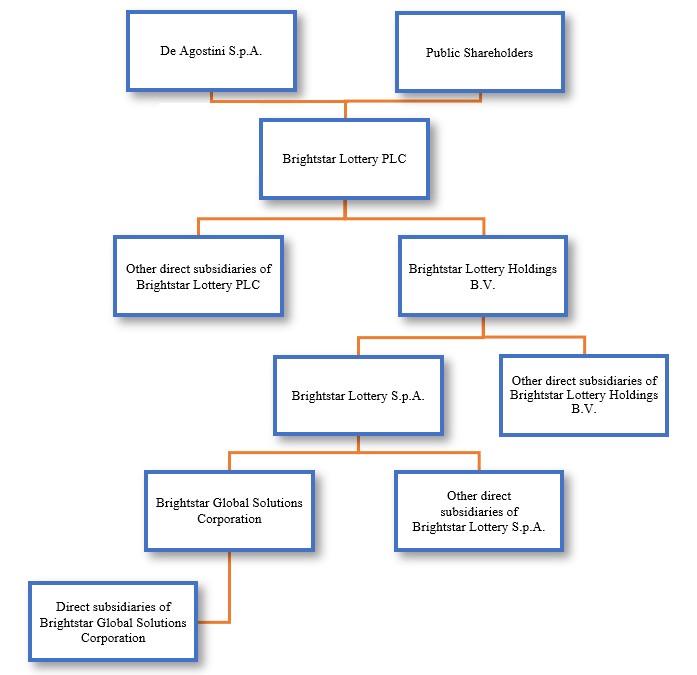
Brightstar Lottery PLC (the “Parent”), together with its consolidated subsidiaries, is a global leader in lottery. In July 2025, the Parent changed its corporate name from International Game Technology PLC to Brightstar Lottery PLC (NYSE: BRSL). This Form 20-F will not distinguish between the prior and current corporate name and will refer to the current corporate name throughout. As such, unless expressly specified or the context otherwise indicates, the terms “Brightstar,” “Brightstar Lottery,” “Brightstar Lottery PLC,” and the “Company” refer to the business and operations of the Parent and its consolidated subsidiaries.
This annual report on Form 20-F includes the Consolidated Financial Statements of the Company for the years ended December 31, 2025, 2024, and 2023 (the “Consolidated Financial Statements”) prepared in accordance with United States Generally Accepted Accounting Principles as issued by the Financial Accounting Standards Board. Unless otherwise noted, all discussions below, including amounts and percentages for all periods, reflect the results of operations and financial condition of the Parent’s continuing operations. The Company operates and manages its business as a pure-play lottery business, and reports a single segment for the purposes of assessing performance and making operating decisions.
The financial information is presented in U.S. dollars. All references to “U.S. dollars,” “U.S. dollar,” “U.S. $,” “USD,” and “$” refer to the currency of the United States of America (the “U.S.”). All references to “Euro,” “euro,” “EUR,” and “€” refer to the currency introduced at the start of the third stage of the European Economic and Monetary Union pursuant to the Treaty on the Functioning of the European Union, as amended.
Amounts reported in millions are computed based on the amounts in thousands. Certain amounts in columns and rows within tables may not foot due to rounding. Percentages and earnings per share amounts presented are calculated from the underlying unrounded amounts.
The language of this annual report on Form 20-F is English. Certain legislative references and technical terms have been cited in their original language so that the correct technical meaning may be ascribed to them under applicable law.
The glossary is used to define common terms and abbreviations that appear throughout the annual report on Form 20-F. Other, less common, terms and phrases are defined in the sections in which they appear, as they may either be Company or industry-specific. Additionally, definitions in “Item 18. Financial Statements” stand alone and are independently defined in that section.
Abbreviation/Term
Definition
ADM
Agenzia delle Dogane e Dei Monopoli, the governmental authority responsible for regulating and supervising gaming in Italy
Adjusted EBITDA or AEBITDA
EBITDA adjusted for foreign exchange gain (loss), net, other expenses, net, impairment losses, restructuring expenses, stock-based compensation, litigation expense (income), and certain other non-recurring items
Adjusted Free Cash Flow
cash flow from operations less capital expenditures and payments on license obligations, excluding the net of tax cash payments in connection with material litigation
Apollo Funds
funds managed by affiliates of Apollo Global Management, Inc.
ASC
Accounting Standards Codification
ASU
Accounting Standards Update
B2B
business-to-business
B2C
business-to-consumer
Board
the Board of Directors of Brightstar Lottery PLC
Buyer
Voyager Parent, LLC, a holding company owned by Apollo Funds
CEO
Chief Executive Officer
CFO
Chief Financial Officer
CA 2006
Companies Act 2006, as amended
Constant-currency
amounts calculated by applying the prior-year/period exchange rates to current financial data expressed in local currency
De Agostini
De Agostini S.p.A.
EBITDA
earnings before interest, taxes, depreciation and amortization
EMEA
Europe, Middle East and Africa
ESG
environmental, social and governance
E.U.
European Union
Everi
Everi Holdings Inc., a Delaware corporation
FMC
facilities management contract
GAAP
United States Generally Accepted Accounting Principles
GDPR
E.U. General Data Protection Regulation (“E.U. GDPR”) and the E.U. GDPR as retained as law in England and Wales by the European Union (Withdrawal) Act (“U.K. GDPR”)
iGaming
real money digital (interactive) gaming
IGT Gaming
Brightstar Lottery’s Gaming & Digital segment as of immediately prior to the time of the announcement of the sale
Italian Lotto
Italian Gioco del Lotto
LAC
Latin America and the Caribbean
LMA
lottery management agreement
Loyalty Plan
the terms and conditions related to the Special Voting Shares
Loyalty Register
the register of ordinary shares for which holders thereof have validly elected to exercise the related Special Voting Shares
net debt
debt minus capitalized debt issuance costs and cash and cash equivalents, including cash and cash equivalents held for sale
NYSE
New York Stock Exchange
Transaction
the transactions between the Company, Ignite Rotate, LLC (a Delaware limited liability company and direct wholly owned subsidiary of the Parent), Everi, the Buyer and Voyager Merger Sub, Inc. (a Delaware corporation and direct wholly owned subsidiary of the Buyer) resulting in IGT Gaming and Everi being simultaneously acquired by a then-newly formed holding company owned by Apollo Funds and combined into a privately-owned enterprise
R&D
research and development
same-store sales
wagers, at constant currency, recorded in lottery jurisdictions where we are the operator or facilities management supplier, using the same lottery jurisdictions and perimeter for comparison between periods
This annual report on Form 20-F includes forward-looking statements (including within the meaning of the Private Securities Litigation Reform Act of 1995) concerning the Company and other matters. These statements may discuss goals, intentions, and expectations as to future plans and strategies, expected growth, transactions, trends, events, products and services, customer relationships, dividends, results of operations, and/or financial condition or measures, including our expectations on future revenue, income, cash, and capital expenditures guidance, and assumptions regarding the EUR to USD exchange ratio, or otherwise, based on current beliefs of the management of the Company as well as assumptions made by, and information currently available to, such management. Forward-looking statements may be accompanied by words such as “aim,” “anticipate,” “believe,” “plan,” “could,” “would,” “should,” “shall,” “continue,” “estimate,” “expect,” “forecast,” “future,” “guidance,” “intend,” “may,” “will,” “outlook,” “possible,” “potential,” “predict,” “project,” “target,” “designed to,” “strategy,” “committed to” or the negative or other variations of them. These forward-looking statements speak only as of the date on which such statements are made and are subject to various risks and uncertainties, many of which are outside the Company’s control. Should one or more of these risks or uncertainties materialize, or should any of the underlying assumptions prove incorrect, actual results may differ materially from those predicted in the forward-looking statements and from past results, performance, or achievements. Therefore, you should not place undue reliance on such statements. Factors that could cause actual results to differ materially from those in the forward-looking statements include (but are not limited to):
•the possibility that the Company may not achieve its anticipated financial results in one or more future periods and create incremental value for shareholders;
•the possibility that the Parent will be unable to pay dividends to shareholders or that the amount of such dividends may be less than anticipated;
•the Company’s ability to successfully maintain its relationships with its customers or attract new customers, including its ability to continue to win, renew, or extend licenses, lottery contracts, and other service contracts on favorable terms;
•the Company’s ability to win long-term contracts in a competitive industry;
•the Company’s ability to compete with other forms of comparable entertainment, including shifts toward digital channels;
•changing economic conditions in the global markets where the Company operates, including economic slowdowns, rising interest rates, inflationary and other economic factors that pressure customer spending, changes in customer demand for products and services and a slowdown in customer payments;
•unanticipated changes relating to competitive factors in the industries in which the Company operates;
•the Company’s ability to develop and manage frequent introductions of innovative products and respond to technological changes, including the use of artificial intelligence;
•the Company’s international operations, which are subject to the risks of currency fluctuations and foreign exchange controls;
•the impact of supply chain constraints on the Company’s ability to meet demand for its products;
•an increase in costs resulting from supply chain constraints, including, but not limited to, increases in input costs, labor costs and freight costs, among others;
•reliance on and integration of information technology systems, including the ability to prevent, mitigate or timely recover from cybersecurity incidents;
•the Company’s ability to hire and retain key personnel;
•The Company’s use of intellectual property, including its ability to protect its own intellectual property and license third-party intellectual property;
•the Company’s ability to achieve future growth by executing on strategic alliances and corporate transactions such as mergers, acquisitions, divestitures, and spin offs;
•changes in legislation, governmental regulations, or the enforcement thereof, including changes in tax laws and tariffs in or between the jurisdictions in which the Company operates, that could affect the Company;
•the effects of geopolitical or military conflicts, including events concerning Ukraine, Taiwan and Israel, that could affect the Company, its suppliers and/or customers;
•conditions in the credit markets;
•risks associated with assumptions the Company makes in connection with its critical accounting estimates; and
•the resolution of pending and potential future legal, regulatory, or tax proceedings and investigations.
The foregoing list of factors is not exhaustive. You should carefully consider the foregoing factors and the other risks and uncertainties that affect the Company’s business, including those described in “Item 3. Key Information—D. Risk Factors”, “Item 5. Operating and Financial Review and Prospects” and other documents filed by the Parent from time to time with the SEC. Except as required under applicable law, the Company does not assume any obligation to update these forward-looking statements. Nothing in this annual report is intended, or is to be construed, as a profit forecast or to be interpreted to mean that earnings per share of the Parent for the current or any future financial years will necessarily match or exceed the historical
published earnings per share of the Parent, as applicable. All forward-looking statements contained in this annual report on Form 20-F are qualified in their entirety by this cautionary statement.
Item 1.Identity of Directors, Senior Management and Advisers
Not applicable.
Item 2.Offer Statistics and Expected Timetable
Not applicable.
Item 3.Key Information
A. Reserved
B. Capitalization and Indebtedness
Not applicable.
C. Reasons for the Offer and Use of Proceeds
Not applicable.
D. Risk Factors
The following risks should be considered in conjunction with “Item 5. Operating and Financial Review and Prospects”, the Consolidated Financial Statements, including the notes thereto, included in this annual report, and the other risks described in the Forward-Looking Statements safe harbor under the Private Securities Litigation Reform Act of 1995. These risks may affect the Company's operating results and, individually or in the aggregate, could cause its actual results to differ materially from past and anticipated future results. The following discussion of risks may contain forward-looking statements which are intended to be covered by the Safe Harbor Statement. Except as may be required by law, the Company undertakes no obligation to publicly update forward-looking statements, whether as a result of new information, future events, or otherwise. The Company invites you to consult any further related disclosures made by the Parent from time to time in materials filed with or furnished to the SEC.
Risks related to the Company's Business and Industry
The Company has a concentrated customer base, and the loss of any of its larger customers (or lower sales from any of these customers) could lead to significantly lower revenue.
A substantial portion of the Company’s revenues is derived from exclusive licenses awarded to the Company by ADM, the governmental authority responsible for regulating and supervising gaming in Italy. For the years ended December 31, 2025 and 2024, approximately 18%, at both periods, of the Company’s total consolidated revenues was earned from services provided for the operation of the Italian Lotto games and approximately 19% and 17%, respectively, was earned from services provided for the operation of the Italian Scratch & Win (Gratta e Vinci) instant ticket games.
The Company expects that a significant portion of its revenues and profits will continue to depend upon the licenses awarded to the Company by ADM. These licenses are not renewable and may be terminated prior to their expiration dates upon the occurrence of certain events of default affecting the Company, or if such licenses are deemed to be against the public interest, or terminated or annulled if successfully challenged by competitors. In addition, the conditions for any new license will be established by law and included in the rules of the new license. Any material reduction in the Company’s revenues from these licenses, including as a result of an annulment, early termination, or non-renewal of these licenses following their expiration, has had, and may in the future have, a material adverse effect on the Company’s results of operations, business, financial condition, or prospects.
In addition, recurring revenues from the Company’s top 10 customers outside of Italy accounted for approximately 35% of its total consolidated revenues for the year ended December 31, 2025. In August 2025, Allwyn UK, one of our historic top ten customers outside of Italy, completed its U.K. lottery system transition to another supplier, thereby resulting in the loss of a customer which accounted for approximately $37 million and $54 million in revenues in 2025 and 2024, respectively.
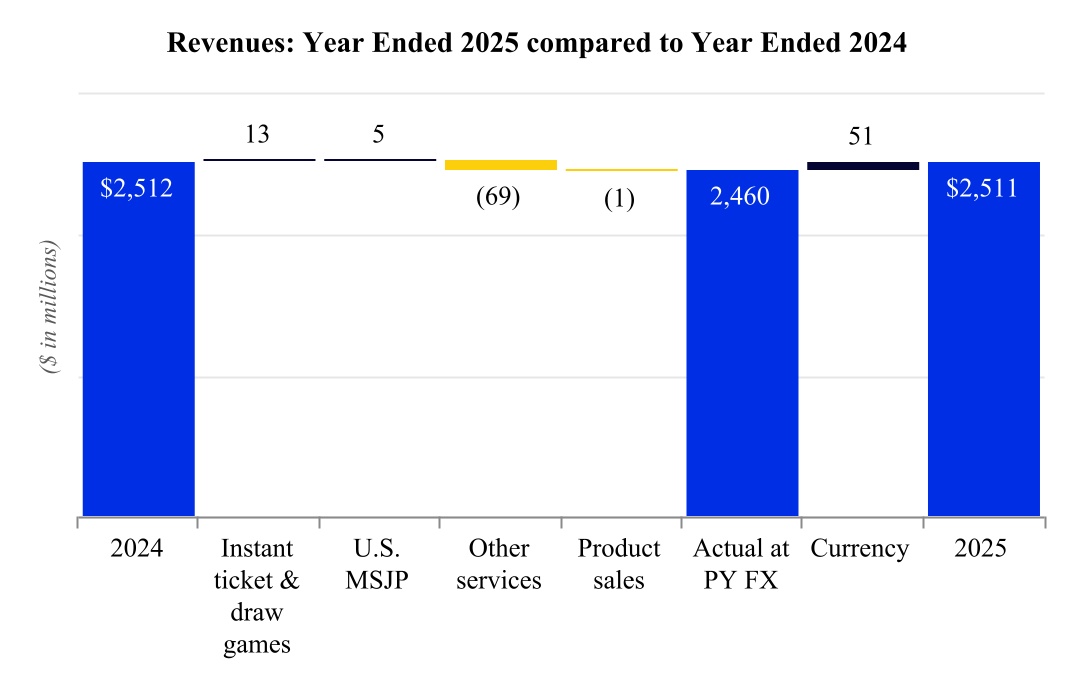
Furthermore, lower‑than‑expected sales by one or more of the Company’s larger customers could materially adversely affect the Company. For example, LMAs include performance‑based incentive mechanisms that may result in the Company earning additional payments if specified contractual metrics are achieved, or incurring shortfall payments if such metrics are not met. In 2025, the change in the incentive payment was reduced by $51 million, mainly due to lower MSJP activity.
If the Company were to lose any of its other larger customers, or if these larger customers experience lower sales and consequently reduced revenues, which are primarily service revenues, there could be a material adverse effect on the Company’s results of operations, business, financial condition, or prospects.
The Company’s operations are dependent upon its continued ability to retain and extend its existing contracts and win new contracts with its customers.
The Company derives a substantial portion of its revenues from its portfolio of long-term lottery operating contracts, FMCs, and LMAs (equal to approximately 92% of its total consolidated revenues for the year ended December 31, 2025), awarded through competitive procurement processes. The Company’s U.S. lottery contracts typically permit a lottery authority to terminate the contract at any time for material, uncured breaches and for other specified reasons out of the Company's control, such as the failure by a state legislature to approve the required budget appropriations. In addition, many of these contracts in the U.S. permit the lottery authority to terminate the contract at will with limited notice and do not specify the compensation to which the Company would be entitled were such termination to occur. If one or more of the Company’s U.S. lottery contracts were terminated, or were not renewed or extended, there is no guarantee that the Company would be able to identify replacement sources of revenue in a timely fashion, or at all. Additionally, the loss of one or more of the Company’s U.S. lottery contracts to a competitor could place the Company at a competitive disadvantage.
In the event that the Company is unable or unwilling to perform under certain lottery contracts, such contracts permit the lottery authority a right to use the Company's system-related equipment and software necessary for the performance of the contract until the expiration or earlier termination of the contract.
The termination of or failure to renew or extend one or more of the Company’s lottery contracts, or the renewal or extension of one or more of the Company’s lottery contracts on materially altered terms, could have a material adverse effect on the Company’s results of operations, business, financial condition, or prospects.
The lottery industry is a competitive industry, and the Company’s success largely depends on its ability to win long-term lottery contracts.
The Company’s business depends heavily on the ability to win, maintain, and renew long‑term lottery contracts, and substantial revenue could be lost if the Company is unable to renew such contracts on substantially similar terms or at all. As certain jurisdictions seek to privatize or outsource lottery service operations, the Company faces increasing competition from both traditional and new market participants, including, in some cases, competitors with greater financial resources. In pursuing these opportunities, the Company may find it necessary or desirable to enter into strategic relationships with third parties, including competitors, and may be required to commit significant financial resources.
Competition for long‑term lottery contracts has caused, and may in the future cause, the Company to enter into agreements on less favorable terms and at significant cost. If the Company is unable to secure contracts on favorable terms, this has resulted, and may in the future result, in the award of contracts on terms that increase costs or impose other commercial risks, any of which could have a material adverse effect on the Company’s business and results of operations.
Competition from other forms of comparable entertainment and shifts toward digital channels could adversely affect the Company’s business.
The Company’s lottery products compete with numerous other forms of comparable entertainment that seek to attract consumers’ discretionary spending, including sports betting, iGaming, land based gaming, casino sweepstakes, social gaming, and prediction markets. Expansion of these activities or increased consumer participation in such alternatives may reduce demand for lottery products. Any shift in consumer spending away from lottery products could adversely affect the Company’s business, financial condition, and results of operations.
In certain jurisdictions, the Company holds a retail lottery license but does not hold the corresponding digital or iLottery license. In these jurisdictions, consumers may migrate from retail lottery products to digital gaming channels. If demand shifts to digital formats, the Company may be unable to participate in or benefit from that shift at all or in a timely manner, which could lead to reduced retail lottery sales and adverse effects on the Company’s revenues, profitability, and competitive position.
Even if the Company is able to shift the affected retail lottery products to digital formats, the pace and extent of changes in consumer behavior and channel preference are difficult to predict, and such changes could materially impact the Company’s operations and financial condition.
Adverse changes in discretionary consumer spending and behavior, including as a result of the occurrence or perception of economic slowdown, rising interest rates and/or inflation, may adversely affect the demand for lottery and overall economic trends specific to the lottery industry and the Company's business.
Sociopolitical and economic factors that impact consumer confidence may result in decreased discretionary spending by consumers and have a negative effect on the Company's business. Unfavorable changes in social, political and economic conditions and economic uncertainties, as well as decreased discretionary spending by consumers, may adversely impact customers, suppliers and business partners in a variety of ways.
Consumer discretionary income and its potential effects on lottery activity may directly or indirectly impact the revenues generated by the Company's business. Economic factors resulting in a reduction, or the perception of a reduction, in such discretionary income could negatively impact draw game, instant ticket, and iLottery play.
The occurrence or perception of an economic slowdown or recession may also have a negative impact on consumer discretionary spending, particularly when combined with the occurrence or perception of rising interest rates and inflation (or increases in the prices of consumer products, including food and energy). If these conditions persist or worsen, it may result in declines in draw game, instant ticket, and iLottery participation, which could have a material adverse effect on the Company’s business and results of operations.
The Company is subject to substantial penalties for failure to perform.
The Company’s Italian licenses, lottery contracts in the U.S. and in other jurisdictions, and other service contracts often require performance bonds or letters of credit to secure its performance under such contracts and require the Company to pay substantial monetary liquidated damages in the event of non-performance by the Company.
At December 31, 2025, the Company had outstanding performance bonds and letters of credit in an aggregate amount of approximately $696 million. These instruments present a potential expense for the Company and could divert financial resources from other uses. Claims on performance bonds, drawings on letters of credit, and payment of liquidated damages could individually or in the aggregate have a material adverse effect on the Company's results of operations, business, financial condition, liquidity, or prospects.
The Company’s success depends in large part on its ability to develop and manage frequent introductions of innovative products and the ability to respond to technological changes, and slow growth or declines in the lottery market could lead to lower revenues for the Company.
The Company’s future success will depend, in part, on the lottery industry’s success in attracting and retaining new players in the face of increased competition in the entertainment and lottery markets, as well as the Company's own success in developing innovative services, products, and distribution methods/systems to achieve this goal. The Company must continually introduce and successfully market new lottery games and technologies to remain competitive and effectively stimulate customer demand. The process of developing new lottery products is inherently complex and uncertain. It requires accurate anticipation of changing customer needs and end-user preferences as well as emerging technological trends. If the Company's competitors develop new content or innovative products and the Company fails to keep pace, its business could be adversely affected. Additionally, if the Company’s competitors adopt and employ new technologies, such as artificial intelligence, more rapidly than the Company is able to do so, the Company could experience a competitive disadvantage or comparatively higher costs than its competitors.
In addition, if the Company fails to accurately anticipate customer needs and end-user preferences through the development of new products, services and technologies, the Company could lose business to its competitors, which would adversely affect its results of operations, business, financial condition, or prospects. While the Company intends to continue investing resources in research and development, which includes new lottery hardware, software, content, services and systems, these investments may not guarantee successful products. Because the Company’s newer products are generally more technologically sophisticated than those it has produced in the past, the Company must continually refine its design, development, and delivery capabilities to ensure product innovation. Newer products also require adequate supply of electronic components and other raw materials, for which the Company relies on third party suppliers. See “The Company depends on its suppliers and faces supply chain risks that could adversely affect its financial results” within “Operational Risks” below.
If the Company cannot efficiently adapt its processes and infrastructure to meet the needs of its product innovations, or if the Company is unable to source adequate supplies to manufacture its newer products, its results of operations, business, financial condition, or prospects could be negatively impacted.
The Company’s use of artificial intelligence, machine learning, data science, and similar technologies could result in reputational harm, competitive harm, legal liability, and adverse effects on results of operations.
The Company uses artificial intelligence (including generative artificial intelligence), machine learning, data science, and similar technologies (collectively, “AI”) in its technology and infrastructure, and these technologies may become increasingly important to the Company’s operations over time. Competitors or other third parties may incorporate AI in a similar or different manner, and may do so more quickly or more successfully than the Company, which could impair the Company’s ability to compete effectively and could adversely affect results of operations. Additionally, if the content, analyses, materials, software, or recommendations that AI produces or assists in producing are, or are alleged to be, infringing or otherwise violative of others’ rights (including intellectual property rights), or illegal, the Company may be subject to legal liability, or its business, reputation, financial condition, and results of operations may otherwise be adversely affected.
The content, analyses, materials, software, recommendations, and other outputs produced by AI (particularly generative AI) may be subject to limited or no intellectual property or other proprietary protection. The Company may lose intellectual property or proprietary rights in any data, content, confidential information, trade secrets, or other materials provided as inputs to AI technologies. If the Company is unable to assert proprietary rights in such outputs or inputs against use by third parties, the Company may experience competitive harm, and its financial condition and results of operations may be adversely affected.
The use of AI, particularly generative AI, may lead to unintended consequences, including outputs that appear correct but are factually inaccurate, misleading, or otherwise flawed, which could harm the Company’s reputation and business. In addition, the use of AI may result in violations of applicable data security or data privacy laws, or in cybersecurity incidents involving the personal data of end customers, employees, or other third parties. Any such violation or cybersecurity incident related to the Company’s use of AI could result in legal liability or could otherwise adversely affect the Company’s reputation and results of operations.
If the Company’s use of AI becomes controversial, the Company may experience brand or reputational harm or competitive harm. AI is subject to a dynamic and rapidly evolving legal and regulatory environment, the scope and application of which may be uncertain and may vary or conflict across jurisdictions. Compliance with existing and potential government regulation of AI may require significant resources, including resources designed to develop, test, and maintain platforms, offerings, services, and features that incorporate AI in accordance with applicable law, and to mitigate potential adverse effects on the Company’s results of operations.
If the Company is unable to protect its intellectual property or prevent its unauthorized use by third parties, its ability to compete in the lottery market may be harmed.
At December 31, 2025, the Company held more than 475 patent applications and granted patents and more than 2,350 trademarks filed and registered worldwide. However, intellectual property laws in the U.S., Italy, and in other jurisdictions may afford differing and limited protection, may not permit the Company to gain or maintain a competitive advantage, and may not prevent its competitors from duplicating its products, designing around its patented products, or gaining access to its proprietary information and technology.
The Company may not be able to prevent the unauthorized disclosure or use of its technical knowledge or trade secrets. For example, there can be no assurance that consultants, vendors, partners, former employees, or current employees will not breach their obligations regarding non-disclosure and restrictions on use. In addition, anyone could seek to challenge, invalidate, circumvent, or render unenforceable any of the Company's patents. Any pending or future patent applications the Company holds may not result in an issued patent, or, if patents are issued, such patents may not necessarily provide meaningful protection against competitors and competitive technologies or adequately protect the Company’s then-current technologies. The Company may not be able to detect the unauthorized use of its intellectual property, prevent breaches of its cybersecurity efforts, or take appropriate steps to enforce its intellectual property rights effectively. In addition, certain contractual provisions, including restrictions on use, copying, transfer, and disclosure of software, may be unenforceable under the laws of certain jurisdictions.
The Company’s success depends in part on its ability to obtain trademark protection for the names or symbols under which it markets its products and to obtain copyright protection and patent protection of its technologies and game innovations. The
Company may not be able to build and maintain goodwill in its trademarks or obtain trademark or patent protection, and any trademark, copyright, or issued patent may not provide competitive advantages for the Company or that the Company’s intellectual property could be successfully challenged or circumvented by competitors.
The Company maintains various patents, trademarks, copyrights and trade secrets and intends to enforce its intellectual property rights. From time to time, the Company may assert claims against third parties that it believes are infringing its intellectual property rights. Litigation initiated or defended to protect and enforce the Company’s intellectual property rights could be costly, time consuming and distracting to management, could fail to obtain the results sought, and could have a material adverse effect on the Company’s results of operations, business, financial condition, or prospects.
If the Company is unable to license intellectual property from third parties, its ability to compete in the lottery market may be harmed.
The Company licenses intellectual property rights from third parties, including the various trademarks and copyrights for Ghostbusters®, Wheel of Fortune®, and other popular franchises. If such third parties do not properly maintain or enforce the intellectual property rights underlying such licenses, or if such licenses are terminated or expire without being renewed, the Company could lose the right to use the licensed intellectual property, which could adversely affect its competitive position or its ability to commercialize certain of its technologies, products, or services.
Third party intellectual property infringement claims against the Company could limit its ability to compete effectively.
Third parties could assert that the Company’s products infringe the intellectual property rights of such third parties. Infringement and other intellectual property claims and proceedings brought against the Company, whether successful or not, are costly, time consuming and distracting to management, and could harm the Company's reputation. In addition, intellectual property claims and proceedings could require the Company to do one or more of the following: (i) cease selling or using any of its products that allegedly incorporate the infringed intellectual property, (ii) pay substantial damages, (iii) obtain a license from the third-party owner, which license may not be available on reasonable terms, if at all, (iv) rebrand or rename its products, and (v) redesign its products to avoid infringing the intellectual property rights of third parties, which may not be possible and, if possible, could be costly, time consuming, or result in a less effective product. A successful claim against the Company could have a material adverse effect on its results of operations, business, financial condition, or prospects.
The Company’s inability to successfully complete, integrate or leverage strategic alliances could limit its future growth or otherwise be disruptive to its ongoing business.
From time to time, the Company expects it will enter into certain commercial alliances or relationships, or pursue corporate transactions such as mergers, acquisitions, divestitures, and spin offs, in support of its strategic goals. There can be no assurance that such strategic opportunities will be available on acceptable terms or at all or that the Company will be able to obtain necessary financing or regulatory approvals to complete such transactions. The Company’s ability to succeed in implementing its strategy will depend to some degree upon the ability of its management to identify, complete, arrange financing for, and successfully integrate commercially viable alliances or acquisitions. Such transactions may disrupt the Company’s ongoing business and distract management from other responsibilities. Further, the Company may incur unexpected costs, or fail to realize expected benefits from such transactions. In connection with any such transactions, the Company could face significant challenges in managing and integrating its expanded or combined operations, including acquired assets, operations, and personnel.
The Company’s results of operations, cash flows and financial condition could be affected by public health issues, geopolitical and regulatory instability and other potentially disruptive events in the locations where the Company’s customers, suppliers or regulators operate.
The Company may be impacted by public health crises (including the outbreak of communicable diseases such as COVID-19) that could negatively impact the Company’s operations or the operations of the Company’s customers, suppliers, data service providers and regulators.
The Company’s operations could also be impacted by geopolitical instability, including the uncertainty, outbreak and escalation of war (such as the Russia-Ukraine conflict and the conflict in Gaza), political unrest, terrorism, diplomatic instability, or other acts of violence any of which could adversely affect the Company’s ability to operate and deliver its products and services.
The Company’s operations and business could be impacted by regulatory and political uncertainty, including as a result of new or increased tariffs, trade wars, and other restrictions on trade between or among countries in which it operates, tensions
between or among the jurisdictions in which it operates, changing or conflicting regulations and market expectations that may differ between jurisdictions in which it operates, and increased costs of compliance as a result of the foregoing. Any of these events could have a material adverse effect on the Company or its customers, which could have a material adverse effect on the Company’s results of operations, cash flows, financial condition, and reputation.
The Company’s insurance may not adequately, or at all, compensate the Company for any losses incurred as a result of natural or other disasters. Any serious disruption to the Company’s operations, or those of the Company’s customers, suppliers, data service providers, or regulators, could have a material adverse effect on the Company’s results of operations, cash flows and financial condition.
Divestitures may materially adversely affect the Company’s financial condition, results of operations or cash flows.
From time to time, the Company has, and may in the future, pursue divestitures in support of its strategic goals. For example, in July 2025, the Parent consummated the Transaction and completed the sale of its IGT Gaming business to a holding company owned by funds managed by affiliates of Apollo Global Management, Inc.
Divestitures involve risks, including difficulties in the separation of operations, services, products and personnel, the diversion of management's attention from other business concerns, the disruption of business, the potential loss of revenues, increased customer concentration, departures of key employees, the retention of uncertain contingent liabilities related to the divested business, and potential reputational harm resulting from proposed transactions or the failure to consummate a proposed transaction. The Company may not be successful in managing these or any other significant risks that it encounters in any divestiture the Company may undertake, and any such divestiture could materially and adversely affect the Company’s business, financial condition, results of operations and cash flows, and may also result in a diversion of management attention, operational difficulties and losses. Further, there can be no assurance whether any particular planned divestiture will be completed on the originally proposed terms and timeline, or at all, or that the strategic benefits and expected financial impact of any divestiture will be achieved.
The Company faces reputational risks related to the use of social media.
The Company frequently uses social media platforms as marketing tools. These platforms provide the Company, as well as individuals, with access to a broad audience of consumers and other interested persons. Negative commentary regarding the Company or the products it sells may be posted on social media platforms and similar devices at any time and may be adverse to the Company’s reputation or business. Further, as laws, regulations, and different platforms’ terms of service rapidly evolve to govern the use of social media, the failure by the Company, its employees or third parties acting at the Company's direction to abide by applicable laws and regulations in the use of these platforms and devices could adversely impact the Company’s business, financial condition, and results of operations or subject it to fines or other penalties.
Legal and Compliance Risks
The Company faces risks related to the extensive and complex governmental regulation applicable to its operations.
The Company’s activities are subject to extensive and complex governmental regulation, including restrictions on advertising, increases in or differing interpretations by authorities on taxation, limitations on the use of cash, and anti-money laundering compliance procedures. These regulatory requirements are constantly evolving and may vary from jurisdiction to jurisdiction. In addition, the perception or threat of changing regulations may result in industry adoption of new or different practices. Any potential or actual changes in the legal or regulatory framework or other changes, such as increased taxation, changes in the compensation paid to licensees, or increases in the number of licenses, authorizations, or licenses awarded to the Company's competitors, could materially affect its profitability.
In addition, in the U.S. and in many international jurisdictions where the Company currently operates or seeks to do business, lotteries are not permitted unless expressly authorized by law. The successful implementation of the Company’s growth strategy and its business could be materially adversely affected if jurisdictions that do not currently authorize lotteries do not approve such activities or if those jurisdictions that currently authorize lotteries do not continue to permit such activities.
Changes to trade regulation, quotas, duties or tariffs may materially adversely affect customer demand for the Company’s services and products.
The U.S. has recently enacted and proposed significant new tariffs on goods imported from numerous countries, including countries in which the Company conducts business. U.S. federal agencies have been directed to evaluate key aspects of U.S.
trade policy further, and there has been ongoing discussion regarding potential significant changes to U.S. trade policies, treaties, and tariffs. As a result, significant uncertainty continues to exist regarding the future relationship between the U.S. and other countries with respect to such trade policies, treaties, and tariffs.
Furthermore, due to policy changes and government proposals, there may be greater restrictions and economic disincentives on international trade generally. New tariffs and other changes in U.S. trade policy could trigger retaliatory actions by affected countries, and foreign governments have instituted or are considering instituting trade sanctions on U.S. goods. Such changes have the potential to adversely impact the U.S. economy or sectors thereof, including the industries and countries in which the Company operates, and, as a result, could negatively affect the Company’s business, financial condition, and results of operations.
Investigations by governmental and licensing entities can result in adverse findings or negative publicity.
From time to time, the Company is subject to extensive background investigations, and other investigations of various types are conducted by governmental and licensing authorities with respect to applicable lottery regulations. These regulations and investigations vary from time to time and from jurisdiction to jurisdiction where the Company operates. The Company’s operations may be impacted if the Company is unable to obtain a privileged lottery license or has a privileged lottery license revoked by a regulatory authority. Because the Company’s reputation for integrity is an important factor in its business dealings with lottery and other governmental agencies, a governmental allegation or a finding of improper conduct by or attributable to the Company in any manner, the prolonged investigation of these matters by governmental or regulatory authorities, and/or the adverse publicity resulting therefrom could have a material adverse effect on the Company’s results of operations, business, financial condition, or prospects, including its ability to retain existing contracts or to obtain new or renewed contracts, both in the subject jurisdiction and elsewhere.
Failure to comply with data privacy laws, including the GDPR could result in significant penalties.
The Company’s business is subject to the E.U. GDPR and the U.K. GDPR. The GDPR imposes a number of obligations on controllers, including, among others, requirements in relation to: accountability, data minimization, storage limitation, transparency, privacy by design and default, automated individual decision-making, information security and personal data breach reporting.
The GDPR also prohibits the international transfer of personal data to countries outside the EEA/U.K. not deemed as having “adequate” data privacy laws unless a data transfer mechanism is implemented or GDPR derogation can be relied upon. Certain transfers also require that a transfer impact assessment be carried out.
Other jurisdictions in which the Company operates have implemented, or are considering implementing, data privacy laws similar to the GDPR. Several of the Parent’s subsidiaries deal with a significant amount of employee personal data. There is a risk that the Company's policies and procedures for compliance with data privacy laws, including the GDPR will not be implemented correctly or that individuals within the Company will not be fully compliant with the new procedures. Failure to comply with data privacy laws may have serious financial consequences to the Company, as well as significant administrative sanctions and reputational damage that could have a material adverse effect on the Company’s results of operations, business, financial condition, or prospects. There is a risk that we could be impacted by a cybersecurity incident that results in loss or unauthorized disclosure of personal data, potentially resulting in the Company facing harms similar to those described above.
Compliance with these and any other applicable privacy and data security laws and regulations is a rigorous and time-intensive process, and we may be required to put in place additional mechanisms ensuring compliance with any new data protection rules. In addition, states are constantly adopting new laws or amending existing laws, requiring attention to frequently changing requirements. For example, California enacted the California Consumer Privacy Act (the “CCPA”), which took effect on January 1, 2020, and was further amended on January 1, 2023. The CCPA, as amended, is a comprehensive state privacy law that imposes, among other things, data protection obligations on companies doing business in California, including consumer rights processes, limitations on data storage and uses, new audit requirements for higher risk data, and opt outs for certain uses of personal or sensitive data. The CCPA also provides for civil penalties for violations, as well as a private right of action for data breaches. Similar laws have been adopted and proposed in other states, and if passed, such laws may have potentially conflicting requirements that would make compliance challenging. Multiple other states and the federal government are considering enacting similar legislation, demonstrating a strong trend towards more stringent state privacy, data protection, and data security legislation in the U.S., which could increase our potential liability and adversely affect our business.
The Federal Trade Commission (the “FTC”) and many state attorneys general are interpreting existing federal and state consumer protection laws to impose evolving standards for the collection, use, dissemination and security of personally identifiable information. The FTC has authority under Section 5 of the FTC Act to regulate unfair or deceptive practices and has used this authority to initiate enforcement actions against companies that implement inadequate controls around privacy and information security in violation of their externally facing policies. For instance, the FTC published an advance notice of proposed rulemaking on commercial surveillance and data security in 2022 and may implement new trade regulation rules or other regulatory alternatives concerning the ways in which companies (1) collect, aggregate, protect, use, analyze, and retain consumer data, as well as (2) transfer, share, sell, or otherwise monetize that data in ways that are unfair or deceptive in the coming years. Privacy laws require us to publish statements that describe how we handle personal information and choices individuals may have about the way we handle their personal information. Violating individuals’ privacy rights, publishing false or misleading information about security practices, or failing to take appropriate steps to keep individuals’ personal information secure may constitute unfair or deceptive acts or practices in violation of Section 5 of the FTC Act. Federal regulators, state attorneys general and plaintiffs’ attorneys have been and will likely continue to be active in this space, and if we do not comply with existing or new laws and regulations related to personally identifiable information, we could be subject to criminal or civil sanctions.
The Company is exposed to significant risks in relation to compliance with anti-corruption laws and regulations and economic sanction programs.
Doing business worldwide requires the Company to comply with the laws and regulations of various jurisdictions. In particular, the Company's operations are subject to anti-corruption laws and regulations, such as the U.S. Foreign Corrupt Practices Act of 1977, the U.K. Bribery Act of 2010, and other anti-corruption laws that apply in countries where the Company operates. Other laws and regulations applicable to the Company control trade by imposing economic sanctions on countries and persons and creating customs requirements and currency exchange regulations. The Company's continued global expansion, including in countries which lack a developed legal system or have high levels of corruption, increases the risk of actual or alleged violations of such laws.
The Company cannot predict the nature, scope, or effect of future regulatory requirements to which its operations might be subject or the manner in which such laws might be administered or interpreted.
The policies and procedures the Company has implemented may not have been, and in the future may not be, followed at all times or may not effectively detect and prevent violations of these laws by one or more of the Company's directors, officers, employees, consultants, agents, joint-venture partners or other third-party partners. As a result, the Company could be subject to investigations, criminal and civil penalties, sanctions and/or other remedial measures that in turn could have a material adverse effect on its business, results of operations and financial condition.
Negative perceptions and publicity surrounding the lottery industry could lead to increased regulation.
The popularity and acceptance of lottery games is influenced by prevailing social attitudes toward the lottery, and changes in social attitudes toward the lottery could result in reduced acceptance of lottery play as a leisure activity. Further, from time to time, the lottery industry is exposed to negative publicity related to player behavior, play by minors, the presence of point-of-sale machines in too many locations, risks related to iLottery accessibility, and alleged association with money laundering. Publicity regarding problem gambling and other concerns with the lottery industry, even if not directly connected to the Company, could adversely impact its business, results of operations, and financial condition. For example, if the perception develops that the lottery industry is failing to address responsible lottery concerns adequately, the resulting political pressure may result in the industry becoming subject to increased regulation and restrictions on operations. Such an increase in regulation could adversely impact the Company's results of operations, business, financial condition, or prospects.
Changes to U.S. and foreign tax laws could adversely affect the Company.
The Company is subject to tax laws in the U.S. and several foreign tax jurisdictions and judgment is required in determining the Company’s global provision for income taxes. It is possible that the Company’s tax positions are not consistent with the tax laws in the jurisdictions in which it conducts business, and these positions may be overturned by tax authorities, which could have a significant impact on the Company’s global provision for income taxes.
Furthermore, changes in tax laws or regulations may be proposed or enacted that could significantly affect the Company’s overall tax expense.
The Organisation for Economic Co-operation and Development’s (“OECD”) project on base erosion and profit shifting (“BEPS”) has given rise to significant changes in domestic and international tax laws in recent years. For example, BEPS has resulted in jurisdictions implementing laws which (among other things): (i) limit deductibility of interest payments; (ii) expand the scope of permanent establishment (thereby extending the scope of jurisdictions' taxing rights); (iii) counteract hybrid mismatch arrangements; and (iv) strengthen 'Controlled Foreign Company' rules.
In addition, the OECD is continuing to work on a two-pillar initiative, “BEPS 2.0,” which is aimed at (i) shifting taxing rights to the jurisdiction of the consumer (“Pillar One”); and (ii) ensuring all companies pay a global minimum tax (“Pillar Two”).
Under the Pillar One proposals, multinational enterprises (“MNEs”) with global turnover in excess of 20 billion euros (excluding extractives and regulated financial services) would become subject to rules reallocating 25% of profits in excess of a 10% profit margin to the jurisdictions where the customers and users of those MNEs are located. The Pillar One proposals are continuing to be negotiated, with the detail of the final Pillar One rules and implementation thereof remaining uncertain.
Pillar Two is aimed at ensuring that MNEs with annual global revenues of at least 750 million euros are subject to a minimum effective tax rate of 15% in the jurisdictions in which they operate. Pillar Two proposes that participating jurisdictions introduce three interlocking domestic rules: (i) a qualifying domestic minimum top-up tax (“QDMT”), which imposes a “top-up” tax on an entity in the implementing jurisdiction which has an effective tax rate below 15%; (ii) an Income Inclusion Rule (“IIR”), which imposes top-up tax on a parent entity in the implementing jurisdiction in respect of the low-taxed income of a constituent entity; and (iii) an Undertaxed Payment Rule (“UTPR”), which denies deductions of or requires an equivalent adjustment by an entity in the implementing jurisdiction to the extent the low-taxed income of a constituent entity is not subject to tax under an IIR. Pillar Two also includes a treaty-based Subject To Tax Rule (“STTR”) that allows source jurisdictions to impose limited source taxation on certain related party payments subject to tax below a minimum rate. Various participating jurisdictions (including the U.K.) have already implemented or are in the process of implementing the Pillar Two rules by adopting QDMT, IIR and/or UTPR rules in their domestic legislation, with these rules beginning to come into effect in certain jurisdictions starting from 2024. A limited number of participating jurisdictions have either signed or expressed an intention to sign a multilateral convention to implement the STTR, although the timeline for implementation of the STTR remains uncertain.
Depending on whether and how the Pillar Two rules are implemented in jurisdictions relevant to the Company’s business and the business of the companies in which the Company invests, effective tax rates payable by the Company and the companies in which the Company invests could increase. The implementation may also increase the complexity and costs of compliance, and could necessitate or increase the probability of some restructuring of the Company’s group or business operations.
The Company may be subject to an unfavorable outcome with respect to pending regulatory, tax, or other legal proceedings, which could result in substantial monetary damages or other harm to the Company.
The Company is involved in a number of legal, regulatory, tax, and arbitration proceedings including claims by and against it as well as injunctions by third parties arising out of the ordinary course of its business or its other business activities and is subject to investigations and compliance inquiries related to its ongoing operations. It is difficult to estimate accurately the outcome of any proceeding. As such, the amounts of the Company’s provision for litigation risks could vary significantly from the amounts the Company may be asked to pay or ultimately pay in any such proceeding. In addition, unfavorable resolution of or significant delay in adjudicating such proceedings could require the Company to pay substantial monetary damages or penalties and/or incur costs that may exceed any provision for litigation risks or, under certain circumstances, cause the termination or revocation of the relevant lottery license or authorization and thereby have a material adverse effect on the Company’s results of operations, business, financial condition, or prospects.
The Company is subject to physical risks relating to climate change and transitional risks relating to governmental and societal responses to climate change.
The Company, as well as its customers, suppliers, and partners, are subject to physical and transitional risks relating to climate change. Physical risks to our operations, and those of our affiliates, include increasingly severe and frequent weather-related events and natural disasters, such as hurricanes, floods, drought, wildfires, storms, and stresses on the water supply. The occurrence of one or more of these events could disrupt our properties, supply chain, and operations, and the Company’s suppliers, partners, and customers could pass along any increased costs to us, experience an interruption in their dealings with us, or experience decreased demand for our products and services. These risks could increase the Company’s operating costs (including the cost of our electricity and energy use) and compliance costs, impacting our ability to produce and market our products and the ultimate demand for our products and services.
Transitional risks arise from regulatory changes and societal shifts by governmental authorities, non-governmental organizations, customers, investors, employees, and other stakeholders, who are increasingly sensitive to ESG matters, including climate change. The effects could include, for example, a global transition away from fossil fuels that may result in increased energy prices; shifting customer preferences; stakeholder pressure to decarbonize assets; or new legal or regulatory requirements that result in new or expanded carbon pricing, taxes, restrictions on greenhouse gas emissions, and increased greenhouse gas disclosure and transparency. Regulatory changes or shifts in consumer preferences could restrict our ability to manufacture certain products or require us to find alternatives for the manufacture of certain products. In addition, governments and the public increasingly expect companies like us to report on our business practices with respect to sustainability and environmental impact, among other ESG-related topics. For example, the E.U. has adopted the Corporate Sustainability Reporting Directive (CSRD) that requires sustainability disclosures, including climate-related information, in accordance with specified reporting standards. Similarly, the State of California recently passed the Climate Corporate Data Accountability Act and the Climate-Related Financial Risk Act which may impose broad climate-related disclosure obligations on companies doing business in California. The Climate-Related Financial Risk Act was stayed pending litigation in 2025, and the court is also examining whether any relief should extend to theClimate Corporate Data Accountability Act. The SEC adopted a final rule in 2024 requiring certain climate disclosures. This rule was stayed pending litigation, and in 2025, the SEC voted to end its defense of the rule, with the result that it did not go into effect. More recently, the U.S. government has signaled a change in course on climate regulations, including through the issuance of executive orders and the determination to withdraw from the Paris Agreement on climate change.
This focus on ESG matters, and the need to comply with complex and potentially conflicting requirements and expectations in different jurisdictions, may lead to increased costs of compliance as well as new expectations or requirements that could result in increased costs associated with research, development, manufacture, or distribution of our products, and with our and our customers’ operations more generally. Our ability to compete could also be affected by changing customer preferences and requirements, such as growing demand for companies to establish validated sustainability targets or offer more sustainable products. Failure to meet evolving regulatory requirements and stakeholder expectations could also result in litigation or regulatory actions, affecting demand for our products, which may have a material adverse impact on our financial results and longer-term loss of trust, undermining the credibility of the Company.
Operational Risks
The Company depends on its suppliers and faces supply chain risks that could adversely affect its financial results.
The Company purchases most of the parts, components, and subassemblies necessary for its lottery terminals from outside sources primarily located throughout Asia, including China, Taiwan, and Vietnam. The Company then outsources the manufacturing and assembly of certain lottery terminals to third-party vendors. The Company’s operating results could be adversely affected if one or more of its manufacturing and assembly outsourcing vendors fails to meet defined quality standards and production schedules. Disruptions and delays could adversely affect our suppliers’ ability to meet production schedules.
While the Company continues to seek opportunities to diversify its supply chain, the Company has experienced in the past, and may continue to experience, disruptions throughout its supply chain. In particular, the Company could be adversely impacted by a shortage in the supply of electronic components necessary for the manufacture of lottery terminals. These shortages would require the Company to adjust some of its delivery and production schedules, and could cause the Company to be unable to meet demand for its products or to introduce new products on schedule, leading to a reduction in potential sales. The duration, extent, and likelihood of shortages in electronic components, or other parts, components or subassemblies necessary for the manufacture of any of the Company’s finished products, is extremely difficult to predict. Furthermore, global supply chain constraints have also generally led to an increase in costs, including supply costs (such as the cost of paper and electronic components), freight costs, energy costs and labor costs, among others. The Company may not be able to pass these increased costs on to customers, which may lead to decreased profit margins. As a result, the Company's results of operations, business, financial condition, or prospects could be adversely affected by these supply chain disruptions, or any future supply chain disruptions.
In the Company’s business, the Company transmits data using cellular technology and satellite transponders, generally pursuant to long-term contracts. The technical failure of any of these cellular or satellite services would require the Company to obtain other communication services, including other cellular or satellite access. Any of the Company’s backup systems, which are designed to limit the Company’s exposure in the event of such a failure, may be inadequate. Therefore, the Company may not have access to such other cellular services or satellites or, if applicable, may not have the ability to use such other cellular services or satellites on favorable terms or in a timely manner. While cellular and satellite failures are infrequent, the operation of each is generally outside of the Company’s control.
The Company’s management believes that if a supply contract with one of its vendors were to be terminated or breached, it may take time to replace such vendor under some circumstances and any replacement parts, components, or subassemblies may be more expensive, which could reduce the Company’s operating margins. Depending on a number of factors, including the Company’s available inventory of replacement parts, components or subassemblies, the time it takes to replace a vendor may result in a delay for a customer. Further, supply chain constraints and shortages could cause the Company’s existing vendors to be unable to meet supply commitments, which may cause delays in the Company’s ability to meet its contractually committed delivery schedules. Generally, if the Company fails to meet its delivery schedules under its contracts, it may be subject to substantial penalties or liquidated damages, or contract termination, which in turn could adversely affect the Company's results of operations, business, financial condition, or prospects.
The Company and its operations are subject to cyberattacks and cybersecurity risks which may have an adverse effect on its business and results of operations and result in increasing costs to minimize these risks.
The Company's business involves the storage and transmission of confidential business and personal information, including trade secrets, customer information, and other sensitive information, and theft, security breaches, or unauthorized access of a Company system may expose the Company to a risk of loss of, or improper use and disclosure of, such information, which may result in significant litigation expenses, liability exposure, reputational harm, and loss of consumer confidence in the integrity and security of the Company’s products and systems. Cyberattacks on businesses, including those targeting the lottery industry, are becoming more frequent and increasingly more difficult to anticipate and prevent due to their rapidly evolving nature, and the Company believes that risks and exposures related to cybersecurity will remain high for the foreseeable future. The Company has identified, reported, and managed cybersecurity incidents in the past, including the incident disclosed by the Company in November 2024, and it is possible that the Company could experience a material cybersecurity incident in the future.
Within the Company’s information security management system (the “ISMS”), the Company maintains policies, procedures, and controls designed to prevent, detect, and mitigate the potential negative effects of malware attacks, phishing attacks, password attacks, “Man-in-the-Middle” attacks, Denial-of-Service attacks, and other cybersecurity risks. However, the Company has experienced cyberattacks in the past and may not be able to prevent or detect every cyberattack or incident or reduce the negative effects they may cause.
Cyberattacks could also compromise trade secrets and other sensitive information and result in such information being disclosed to others and becoming less valuable, which could have a material adverse effect upon the Company’s results of operations, business, financial condition, or prospects. The Company’s security measures could be breached due to employee error, malfeasance, system errors, or vulnerabilities, including the vulnerabilities of the Company’s subcontractors, vendors, suppliers, or otherwise. Because the techniques used to obtain unauthorized access, disable or degrade service, or sabotage systems change frequently, become more sophisticated, and often are not recognized until launched against a target, the Company may be unable to anticipate these techniques or to implement adequate preventative measures.
The Company’s first and third-party cybersecurity insurance policies may not be sufficient to mitigate all the potential negative effects of a cyberattack or incident that occurs.
Failure to attract, retain and motivate personnel may adversely affect the Company's ability to compete.
The Company's ability to attract and retain key management, product development, finance, marketing, and research and development personnel, and its ability to attract and maintain a workforce with a wide range of backgrounds, attributes, viewpoints and experiences, is directly linked to the Company's continued success. In all of the industries in which the Company operates, the market for qualified executives and highly-skilled technical workers is intensely competitive, and increasing competition for talent and changing expectations of current and prospective employees pose new challenges relating to the attraction and retention of key personnel. The loss of key employees or an inability to hire a sufficient number of technical staff could limit the Company's ability to develop successful products and could cause delays in getting new products to the market, which could in turn adversely affect the Company's results of operations and prospects.
The Company’s business prospects and future success rely heavily upon the integrity of its employees, directors, and agents.
The Company strives to set exacting standards of personal integrity for its employees, directors and agents and its reputation in this regard is an important factor in its business dealings with lottery and other governmental agencies. For this reason, an allegation or a finding of improper conduct on the Company’s part, or on the part of one or more of its current or former employees, directors or agents, or the failure to detect fraudulent activity in a timely manner, or potential investigations and
other governmental reviews and inspections (including any resulting adverse impact on the perceived integrity and security of the Company’s products and systems), could have a material adverse effect upon the Company’s results of operations, business, financial condition, or prospects, including its ability to retain or renew existing contracts or obtain new contracts.
The success of the Company’s business is dependent on customers’ confidence in the integrity of the Company’s products and systems.
The real and perceived integrity and security of the Company’s products and systems are critical to its ability to attract customers and players. In the event of an actual or alleged defect in a Company product, the Company’s existing and prospective customers may lose confidence in the integrity and security of the Company’s products and systems. Such a failure could have a material adverse effect upon the Company’s results of operations, business, financial condition or prospects, including its ability to attract new customers and retain its existing customers.
Technology failures may disrupt the Company’s business and have an adverse effect on its results of operations.
The Company’s success depends on its ability to avoid, detect, replicate, and correct software and hardware defects and fraudulent manipulation of its products and internal information technology systems and applications. The Company incorporates security features into the design of its products and monitors its internal and external software and hardware, but such security features or technical efforts may not be effective.
In addition, any disruption in the Company’s network or telecommunications services, or those of third parties that the Company uses in its operations, could affect the Company’s ability to operate its systems, which could result in reduced revenues and customer downtime. The Company’s network and databases of business and customer information, including intellectual property and other proprietary business information and those of third parties the Company uses, are susceptible to outages due to fire, floods, power loss, break-ins, cyberattacks, network penetration, data privacy or security breaches, denial of service attacks, and similar events, including inadvertent dissemination of information due to increased use of social media. Disruptions with such systems could result in a wide range of negative outcomes, including devaluation of the Company’s intellectual property, increased expenditures on data security, and costly litigation and potential payment of liquidated damages, each of which could have a material adverse effect on the Company’s results of operations, business, financial condition, or prospects.
Financial Risks
Covenants in the Company’s debt agreements may limit its ability to pay dividends, repurchase shares and operate its business, and the Company’s breach of such covenants could materially and adversely affect its results of operations, business, financial condition, or prospects.
Certain of the Company’s debt agreements require that it comply with covenants that may limit the Company’s ability to:
•return capital to shareholders either through the payment of dividends and/or share repurchases;
•raise additional capital, including the issuance of debt;
•react to industry changes or economic conditions;
•acquire assets of other companies or acquire, merge or consolidate with other companies;
•dispose of assets;
•manage interest rate risk on its variable rate debt; and
•grant security interests in its assets.
The Company’s ability to comply with these covenants may be affected by events beyond its control, such as prevailing economic, financial, regulatory and industry conditions, and these covenants may limit its ability to react to market conditions or take advantage of potential business opportunities. Further, a breach of such covenants could, if not cured or waived, result in acceleration of its indebtedness, result in the enforcement of security interests or force the Company into bankruptcy or liquidation. Such a breach or any failure to otherwise timely repay outstanding indebtedness could have a material adverse effect on the Company’s results of operations, business, financial condition or prospects.
The Company may incur impairment charges.
The Company reviews its long-lived and amortizable intangible assets for impairment when events or changes in circumstances indicate the carrying value may not be recoverable. The Company tests goodwill and other indefinite-lived intangible assets for impairment at least annually. Factors that may indicate a change in circumstances, such that the carrying value of the
Company’s goodwill, amortizable intangible assets, or other non-amortizing assets may not be recoverable, include a decline in the Company’s stock price and market capitalization, reduced future cash flow estimates, and slower growth rates in industry segments in which the Company participates. If one or more of these factors occur, the Company may be required to record a significant charge in its Consolidated Financial Statements during the period in which any impairment of goodwill or intangible assets is determined, which would negatively affect the Company’s results of operations, and may negatively affect the price of the Company’s stock.
Fluctuations in foreign currency exchange rates affect our reported operating results in U.S. dollar terms.
Revenue generated and expenses incurred by our subsidiaries are often denominated in the currencies of the local countries. As a result, our consolidated U.S. dollar financial statements are subject to fluctuations due to changes in exchange rates when the financial results of our international subsidiaries are translated from local currencies into U.S. dollars. In addition, our financial results are subject to changes in exchange rates that impact the settlement of transactions in non-functional currencies. Our primary foreign currency exchange rate exposure arises from translating Euros into U.S. dollars.
Global events, including geopolitical developments, fluctuating commodity prices, trade tariff developments, and inflation, have caused and/or contributed to, and may in the future cause or contribute to, economic uncertainty and uncertainty about the interest rate environment. These factors could amplify the volatility of currency fluctuations, as has been the case in jurisdictions including Argentina in recent years. Therefore, fluctuations in the value of foreign currencies may impact our operating results when translated into U.S. dollars. Such fluctuations may also impact our ability to accurately predict our future results. Additionally, the Company’s hedging program may not be effective in offsetting the adverse financial impacts that may result from unfavorable movements in foreign currency exchange rates.
The establishment and utilization of alternative reference rates may increase the amount of interest the Company pays with respect to floating rate indebtedness denominated in U.S. dollars.
From time to time, the Company in the past has incurred and may in the future incur indebtedness subject to an interest rate calculated with reference to the Secured Overnight Financing Rate (“SOFR”), the principal replacement reference rate for the U.S. dollar London Inter-Bank Offered Rate (“USD LIBOR”). SOFR has a limited history, having been first published in April 2018. There is no assurance that SOFR will perform in the same or similar way as USD LIBOR would have performed, that SOFR will be a suitable replacement for USD LIBOR, or that the replacement of USD LIBOR with SOFR will not increase the amount of interest that the Company pays with respect to floating rate indebtedness denominated in U.S. dollars.
Risks related to the Loyalty Voting Structure
The concentrated voting power held by De Agostini, and the Parent’s loyalty voting structure, may limit other shareholders' ability to influence corporate decisions.
At February 19, 2026, De Agostini has an economic interest in the Parent of approximately 46.29% (excluding treasury shares) and, due to its election to exercise the Special Voting Shares associated with its ordinary shares pursuant to the Loyalty Plan, a voting interest in the Parent of approximately 63.28% of the total voting rights (excluding treasury shares). See “Item 7. Major Shareholders and Related Party Transactions” for additional information. Accordingly, this shareholder may make decisions with which other shareholders may disagree, including, among other things, delaying, discouraging, or preventing a change of control of the Company or a potential merger, consolidation, tender offer, takeover, or other business combination and may also prevent or discourage shareholders’ initiatives aimed at changes in the Company’s management.
The tax consequences of the loyalty voting structure under the Loyalty Plan are uncertain.
No statutory, judicial, or administrative authority has provided public guidance in respect of the Special Voting Shares of the Parent and as a result, the tax consequences of owning such shares are uncertain. The fair market value of the Parent's Special Voting Shares, which may be relevant to the tax consequences of owning, acquiring, or disposing of such shares, is a factual determination and is not governed by any guidance that directly addresses such a situation. Because, among other things, (i) the Special Voting Shares are not transferable (other than in very limited circumstances as provided for in the loyalty voting structure), (ii) in a winding up or otherwise, the holders of the Special Voting Shares will only be entitled to receive out of the Parent's assets available for distribution to its shareholders, in aggregate, $1, and (iii) loss of the entitlement to instruct the nominee on how to vote in respect of Special Voting Shares will occur without consideration, the Parent believes and takes the position that the value of each special voting share is minimal. However, the relevant tax authorities could assert that the value of the Special Voting Shares as determined by the Parent is incorrect. Shareholders are urged to consult their own tax advisors
with respect to treatment of Special Voting Shares. See “Item 10. Additional Information – E.Taxation” for additional information.
The loyalty voting structure under the Loyalty Plan may affect the liquidity of the Parent's ordinary shares and reduce their ordinary share price.
The loyalty voting structure under the Loyalty Plan may limit the liquidity and adversely affect the trading prices of the Parent's ordinary shares. The loyalty voting structure is intended to reward shareholders for maintaining long-term share ownership by granting persons holding ordinary shares continuously for at least three years the option to elect to receive Special Voting Shares. The Special Voting Shares cannot be traded and, immediately prior to the deregistration of ordinary shares from the register of loyalty shares, any corresponding Special Voting Shares shall cease to confer any voting rights in connection with such Special Voting Shares. This loyalty voting structure is designed to encourage a stable shareholder base, but it may deter trading by those shareholders who are interested in gaining or retaining the Special Voting Shares. Therefore, the loyalty voting structure may reduce liquidity in the Parent's ordinary shares and adversely affect their trading price.
Item 4. Information on the Company
A. History and Development of the Company
Brightstar Lottery PLC was organized in 2014 as a public limited company under the laws of England and Wales. The Parent’s principal office is located at 2 and 3 Eldon Street, Fifth Floor, London EC2M 7LS, United Kingdom, telephone number +44 (0) 203 866 1240. The Company conducts business through various subsidiaries and variable interest entities (see “Item 4.C. – Organizational Structure”), and the Parent is publicly-traded on the NYSE under the symbol “BRSL”.
Capital Expenditures and Divestitures
For a description, including the amount invested, of the Company’s principal capital expenditures for the years ended December 31, 2025, 2024, and 2023, see “Item 5. Operating and Financial Review and Prospects - B. Liquidity and Capital Resources—Capital Expenditures.”
For a description of the Company’s principal divestitures for the years ended December 31, 2025, 2024, and 2023, see “Item 5. Operating and Financial Review and Prospects - A. Operating Results.”
More Information
The SEC maintains an internet site that contains reports, proxy and information statements, and other information regarding issuers that file electronically with the SEC at https://www.sec.gov. The Company’s SEC filings can be found there and on the Company’s website: www.brightstarlottery.com.
B. Business Overview
The Company is a global leader in lottery focused on innovation and forward-thinking strategies and solutions, building on our renowned expertise in delivering secure technology and producing reliable, comprehensive solutions for our customers. As a pure-play global lottery company, our best-in-class lottery operations, retail and digital solutions, and award-winning lottery games enable our customers to achieve their goals, responsibly entertain players, and distribute meaningful benefits to communities. The Company has a well-established local presence and is a trusted partner to governments and regulators around the world, creating value by adhering to the highest standards of service, integrity, and responsibility.
The Company operates and provides an integrated portfolio of innovative lottery solutions, including lottery management services and instant lottery systems. The Company operates a worldwide land-based lottery and iLottery business, including sales, operations, product development, technology, and support, and is a leading iLottery platform provider globally. The Company is supported by central corporate support functions, including finance, people and culture, legal, corporate communications, and strategy and corporate development.
The Company is headquartered in London, United Kingdom, with principal operating facilities located in Providence, Rhode Island and Rome, Italy. Research and development and product assembly are mostly centralized in North America. The Company had approximately 5,815 employees at December 31, 2025.
The Company has the global scale to complement its geographic and customer diversification, providing B2C and B2B products and services to customers across six continents, supplying a unique set of lottery solutions to nearly 90 customersworldwide, including to 37 of the 48 U.S. lotteries (including the District of Columbia, Puerto Rico, and U.S. Virgin Islands). Lottery customers frequently designate their revenues for particular purposes, such as education, economic development, conservation, transportation, programs for senior citizens and veterans, health care, sports facilities, capital construction projects, cultural activities, tax relief, and others. Many governments have become increasingly dependent on their lotteries as revenues from lottery ticket sales are often a significant source of funding for these programs.
Land-Based Lottery
Land-based lottery products and services are provided through operating contracts, FMCs, LMAs, and product sales contracts. In the majority of jurisdictions, lottery authorities award contracts through a competitive bidding process. Typical service contracts range from five (5) to ten (10) years in duration, often with multiple multi-year extension options. After the expiration of the initial or extended contract term, a lottery authority generally may either seek to negotiate further extensions or commence a new competitive bidding process. From time to time, there are challenges or other proceedings relating to the awarding of the lottery contracts. Upon being awarded a contract, certain customers may require the Company to pay an upfront fee for the right to exclusively manage their lottery.
The Company designs, sells, leases, and operates a complete suite of point-of-sale machines that are electronically linked with a centralized transaction processing system that reconciles lottery funds between the retailer and the lottery authority. The Company provides and operates lottery transaction processing systems that are designed to be secure and capable of processing a significant number of transactions per minute. The Company deploys more than 350,000 point-of-sale devices to lottery customers and lotteries worldwide. The Company also produces high-quality instant ticket games and provides printing services such as instant ticket marketing plans and graphic design, programming, packaging, shipping, and delivery services.
The Company has developed and continues to develop new lottery games and installs a range of new lottery distribution devices, all of which are designed to drive responsible same-store sales growth for its customers.
In connection with its delivery of lottery services, the Company actively advises many of its customers on growth strategies. Depending on the type of contract and the jurisdiction, the Company also provides marketing services, including retail optimization and lottery brand awareness campaigns. The Company works closely with its lottery customers and retailers to help retailers sell lottery games more effectively. These programs include product merchandising and display recommendations, a selection of appropriate lottery product mix for each location, and account reviews to plan lottery sales growth strategies. The Company leverages years of experience accumulated from being the exclusive licensee for the Italian Lotto and the Italian Scratch & Win (Gratta e Vinci) instant ticket lottery, two of the world’s largest lotteries. This lottery B2C expertise in Italy, which includes management of all the activities along the lottery value chain, allows the Company to better serve B2B customers.
iLottery
The Company provides a comprehensive, end-to-end iLottery ecosystem designed to enable government-regulated lotteries to engage players through integrated digital channels. Our iLottery solution is anchored by our proprietary, cloud-based Remote Game Server ('RGS') and our OMNIA™ integrated lottery solution, which facilitate the high-performance delivery of a digital game portfolio comprising over 200 eInstant titles, digital draw games, and premium licensed content. Through our 'Connected Play' initiatives, the Company provides an omnichannel experience that bridges retail and digital environments via universal eWallets, mobile prize claims, and second-chance programs. Furthermore, the Company leverages artificial intelligence and predictive analytics—specifically through its Game Recommendation Engine—to optimize player engagement and personalize content delivery. This digital infrastructure is engineered to meet stringent regulatory requirements across global jurisdictions and incorporates advanced responsible gaming safeguards, including AI-driven monitoring of player behavior, to ensure a secure and compliant operating environment.
Worldwide, the Company currently has 15 Platform customers which also receive either eInstant and/or draw games.
Customer Contracts
The Company operates in the highly regulated global lottery market, with a customer base of public and private entities that are secured on a contractual basis. With an established industry position, particularly in the land-based lottery space, the Company’s competitor base has remained largely static year to year.
Lottery services are provided through operating contracts, FMCs, LMAs, iLottery, and product sales contracts. The Company has also entered into certain material customer contracts, including the Italian Lotto license and the Italian Scratch and Win (Gratta e Vinci) lottery license.
Operating and Facilities Management Contracts
The majority of the Company’s revenue comes from operating contracts and FMCs.
Since 1998, and for a term expiring in November 2034 (through several award periods, most recently in July 2025), the Company has been the exclusive licensee for the Italian Lotto (management of operations commenced in 1994). Beginning in November 2016, the Company’s exclusive license for the Italian Lotto includes purely financial partners as part of a joint venture. Lottoitalia s.r.l. (“Lottoitalia”), a joint venture company among Brightstar Lottery S.p.A., Italian Gaming Holding a.s., Arianna 2001 (an entity associated with the Federation of Italian Tobacconists), and Novomatic Italia, is the exclusive manager of the Italian Lotto game pursuant to the Italian Lotto license. Lottoitalia is 61.5% owned by Brightstar Lottery S.p.A. The Company, through Lottoitalia, manages the activities along the lottery value chain, such as creating games, determining payouts, collecting wagers through its network, paying out prizes, managing all accounting and other back-office functions, running advertising and promotions, operating data transmission networks and processing centers, training staff, providing retailers with assistance and supplying materials including play slips, tickets and receipts, and marketing and point-of-sale materials for the game.
Since 2004, and for a term expiring in September 2028, the Company also has been the exclusive licensee for the Scratch and Win (Gratta e Vinci) instant ticket lottery through Lotterie Nazionali S.r.l., a joint venture 64.0% owned by the Parent’s subsidiary Brightstar Lottery S.p.A., with the remainder directly and indirectly owned by Scientific Games Corporation and Arianna 2001.
As of December 31, 2025, the revenue weighted-average remaining term of these Italian licenses was 5.6 years.
The Company’s FMCs typically require the Company to design, install, and operate the lottery system and retail terminal network for an initial term, which is typically five (5) to ten (10) years. The Company’s FMCs are granted on an exclusive basis and usually contain extension options under the same or similar terms and conditions, generally ranging from one (1) to five (5) years. Under a typical FMC, the Company maintains ownership of the technology and equipment, and is responsible for capital investments throughout the duration of the contract, although the investments are generally concentrated during the early years, while the lottery authority maintains, in most instances, responsibility for the overall lottery operations. The Company provides a wide range of services to lottery customers related to the technology, equipment, and facilities such as hosting, maintenance, marketing, and other support services. The Company generally provides its lottery customers retailer terminal and communication network equipment through operating leases. In return, the Company typically receives fees based upon a percentage of the sales of all lottery tickets, including draw-based or instant ticket games, though under certain of its agreements, the Company may receive fixed fees for certain goods or services. In limited instances, the Company provides instant tickets and lottery systems and services under the same FMC. As of December 31, 2025, the Company’s largest FMCs by annual service revenue were Texas, California, Georgia, New York, and Florida, and the revenue weighted-average remaining term of the Company’s existing FMCs was 5.1 years (7.6 years including available extensions). For existing U.S. FMCs alone, the Company’s revenue weighted-average remaining term was 5.3 years (7.8 years including available extensions) as of December 31, 2025. Also, as of February 19, 2026, the Company operated under operating contracts or FMCs in 13 jurisdictions outside of Italy and the U.S.
Operating contracts and FMCs often require the Company to pay substantial monetary liquidated damages in the event of non-performance by the Company. The Company’s revenues from operating contracts and FMCs are generally service fees paid to the Company directly by the lottery authority based on a percentage of such lottery’s wagers or ticket sales. The Company categorizes revenue from operating contracts and FMCs as service revenue from “Operating and facilities management contracts (includes amortization of upfront license fees)” as described in “Notes to the Consolidated Financial Statements—4. Revenue Recognition” included in “Item 18. Financial Statements.”
Another form of operating contract is an LMA. Under an LMA, the Company manages, within parameters determined by the lottery customer, the core lottery functions, including the lottery systems and the majority of the day-to-day activities along the lottery value chain. This includes managing accounting and other back-office functions, running advertising and promotions, operating data transmission networks and processing centers, training staff, providing retailers with assistance, and supplying materials for the games. LMAs also include a separate FMC, pursuant to which the Company leases certain hardware and equipment, and provides access to software and support services. The Company provides lottery management services in New
Jersey as part of a joint venture where the Company manages a wide range of the lottery’s day-to-day operations as well as provides marketing and sales services under a license valid through June 2029, and in Indiana through a wholly-owned subsidiary of the Parent under a license valid through June 2031. The Company’s revenues from LMAs include potential incentives or shortfalls based on achievement of or failure to achieve contractual metrics, respectively, and, with respect to the supply agreements, are based generally on a percentage of wagers. The Company categorizes revenue from LMAs as service revenue from “Operating and facilities management contracts (includes amortization of upfront license fees)” as described in “Notes to the Consolidated Financial Statements—4. Revenue Recognition” included in “Item 18. Financial Statements.”
Instant Ticket Services Contracts
As an end-to-end provider of instant tickets and related services, the Company produces high-quality instant ticket games and provides ancillary services such as instant ticket marketing plans and graphic design, programming, packaging, shipping, and delivery services. Instant tickets are sold at numerous types of retail outlets but most successfully in grocery and convenience stores.
Instant ticket services contracts are priced based on a percentage of ticket sales revenues or on a price per unit basis. Government-sponsored lotteries grant printing contracts on both an exclusive and non-exclusive basis where there is typically one primary vendor and one or more secondary vendors. A primary contract permits the vendor to supply the lottery’s ticket printing needs and includes the complete production process from concept development through production and shipment. It also typically includes marketing and research support. A primary printing contract can include any or all of the following services: warehousing, distribution, marketing, and sales/field support. A secondary printing contract includes providing backup printing services and alternate product sources.
For instant ticket lotteries in Italy, instant tickets are available for sale at approximately 53,000 points of sale. As of February 19, 2026, the Company provided instant ticket printing products and services to 31 customers in North America and 30 customers in international jurisdictions and has secured over 60 instant ticket service contracts. In recent years, the Company has also developed Infinity Instants™, a revolutionary digital instant ticket printing technology that offers a wide portfolio of unique content, and has produced more than 110 Infinity Instants™ games since 2022. These achievements highlight the Company’s ability to deliver innovative solutions and exceptional services across diverse geographic regions as a leading provider of high-quality printing services, which include instant ticket marketing plans and graphic design, programming, packaging, shipping and delivery services. The instant ticket production business is highly competitive and subject to strong, price-based competition. Our ability to offer competitive pricing is dependent in part on maintaining sufficient production volumes and consistent, high‑quality production batches. The Company categorizes revenue from instant ticket printing contracts that are not part of an operator or LMA contract as product sales from “Product sales” as described in “Notes to the Consolidated Financial Statements—4. Revenue Recognition” included in “Item 18. Financial Statements.”
Product Sales and Services Contracts
Under product sales and services contracts, the Company assembles, sells, delivers, and installs turnkey lottery systems or lottery equipment, provides related services, and licenses related software. The lottery authority maintains, in most instances, responsibility for lottery operations. The Company sells additional machines and central computers to expand existing systems or replace existing equipment and provides ancillary maintenance and support services related to the systems, equipment sold, and software licensed. The Company categorizes revenue from product sales and services contracts on a case-by-case basis as either service revenue or product sales from “Systems, software, and other” or “Product sales” respectively, as described in “Notes to the Consolidated Financial Statements—4. Revenue Recognition” included in “Item 18. Financial Statements.”
Commercial Services Contracts
The Company develops innovative technology and offers commercial and payment services over a standalone network. Leveraging its distribution network and secure transaction processing experience, the Company offers high-volume processing of commercial and payment transactions including: prepaid cellular telephone recharges, bill payments, e-vouchers, electronic tax payments, stamp duty services and prepaid card recharges. These services are primarily offered in LAC and EMEA.The Company categorizes revenue from commercial services as service revenue from “Systems, software, and other” as described in “Notes to the Consolidated Financial Statements—4. Revenue Recognition” included in “Item 18. Financial Statements.”
Revenues for the year ended December 31, are as follows:
For a further description of the principal services and products the Company provides, including a breakdown of the Company’s revenues by geographic market, see “Item 5. Operating and Financial Review and Prospects” and “Notes to the Consolidated Financial Statements—4.Revenue Recognition and 23.Segment Information”included in “Item 18. Financial Statements.”
Seasonality
The Company generally experiences seasonality based on when contracts with customers are executed or extensions are negotiated and seasonal patterns in consumer demand impacting wagers. This seasonality is reflected, to a greater extent, in revenues from LMAs which include potential incentive or shortfall payments based on achievement of or failure to achieve contractual metrics over the contract year due to the fact that these LMA incentives are estimated and accrued over the lotteries’ fiscal year, which ends June 30. Lottery consumption may increase in December and around the holidays but decrease over the summer months due to the tendency of consumers to be on vacation during that time.
Source of Materials
The Company uses a variety of raw materials across its business. Metals, woods, plastics, glass, electronic components, and LCD screens are frequently used during the manufacturing of lottery terminals. The instant ticket printing facility consumes significant quantities of paper, toner, and ink throughout production. When ultimately delivering these goods to customers, the packaging process employs large amounts of paper, including cardboard. The Company generally has global material suppliers and uses multi-sourcing practices to promote component and raw material availability, quality assurance, and cost consciousness.
Product Development
The Company devotes resources to research and development of lottery products and services and incurred $47 million, $43 million, and $36 million of related expenses, excluding amortization of capitalized software, in 2025, 2024, and 2023, respectively. In addition to expensed R&D, a portion of the investment in R&D has been capitalized and recorded as Systems, equipment and other assets related to contracts, net or Intangible assets, net - Computer software. The Company’s research and development efforts cover multiple creative and engineering disciplines for its business, including innovative retail solutions, hardware and software, creative lottery games and game content, and instant ticket printing technology and design. These products are created primarily by employee designers, engineers, and artists, as well as third-party content creators.
Product assembly operations primarily involve the configuration and assembly of electronic components, cables, harnesses, video monitors, and prefabricated parts purchased from outside sources.
The Company maintains a significant intellectual property portfolio comprised of patents, trademarks, copyrights, and other licensed rights, and the Company’s business depends in part on its ability to protect and enforce its intellectual property rights. The Company routinely obtains, retains, and expands licenses for popular intellectual property, such as the retention of licensing rights to the Wheel of Fortune® franchise. As of December 31, 2025, the Company held more than 475 patent applications and granted patents and more than 2,350 trademarks filed and registered worldwide.
The Company relies on trade secret protection, believing that its technical “know-how” and the creative skills of its personnel are of substantial importance to its success. Most of the Company’s products are marketed under trademarks and copyrights that provide product recognition and promote widespread acceptance. The Company seeks protection for its copyrights and trademarks in the U.S. and various foreign countries, where applicable, and uses intellectual property assets offensively and defensively to protect its innovation. The Company also has a program where it licenses its patents to others under terms designed to promote standardization in the lottery industry.
Software Development
The Company has developed software for use in the management of a range of lottery functions and products, including leveraging integration with third-party software components. Software developed by the Company is used in a variety of applications including: (i) in centralized systems for the management of lotteries and other commercial services; (ii) to enhance lottery functions connected to services provided through websites and mobile applications; and (iii) in a variety of back-office functions. Software developed by the Company is also used in machines for the management of lotteries.
Regulatory Framework
The lottery industry is subject to extensive and evolving governmental regulation in the U.S. and other jurisdictions.
A comprehensive network of internal and external resources and controls is required to achieve compliance with the broad governmental oversight of the Company’s business. The Company maintains a robust enterprise compliance program designed to ensure compliance with applicable requirements imposed in connection with its lottery activities, as well as legal requirements generally applicable to publicly traded companies in the U.S. The Company employs approximately 40 individuals to support global compliance, which is directed on a day-to-day basis by a senior manager. The Company’s Legal department, in addition to outside experts, provide legal advice and support on compliance matters, as may be deemed necessary.
U.S. Lottery Regulations
Lotteries in the U.S. are regulated by state or other applicable law. There are currently 48 U.S. jurisdictions (including the District of Columbia, Puerto Rico, and the U.S. Virgin Islands) that authorize the operation of lotteries. Additionally, a few state lotteries offer internet instant ticket game sales to in-state lottery customers and several states allow subscription sales of draw games over the internet. The ongoing operations of lotteries and lottery operators are typically subject to extensive and broad regulation, which vary state-by-state. The awarding of lottery contracts and ongoing operations of lotteries in international jurisdictions are also extensively regulated, although international regulations typically vary from those prevailing in the U.S.
Lottery regulatory authorities generally exercise significant discretion, including with respect to: (i) the determination of the types of games played; (ii) the price of each wager; (iii) the manner in which the lottery is marketed; (iv) the selection of suppliers of equipment, technology, and services; and (v) the retailers of lottery products. To ensure the integrity of contract awards and lottery operations, most jurisdictions require detailed background disclosure on a continuous basis from vendors and their officers, directors, subsidiaries, affiliates, and principal stockholders. Background investigations of the vendors’ employees who will be directly responsible for the operation of lottery systems are also generally conducted. Certain jurisdictions also require extensive personal and financial disclosure and background checks from persons and entities beneficially owning a specified percentage of a vendor’s securities.
Italian Lottery Regulations
The Company is subject to regulatory oversight by ADM in Italy. As of December 31, 2025, the Company held licenses in Italy for the operation of: (i) lotto; (ii) the Scratch and Win (Gratta e Vinci) instant ticket lottery; and (iii) remote gaming (online).
Gaming in Italy (which includes betting) is reserved to the State and the Italian gaming sector’s regulations are subject to continuous changes. Any game that is carried out without proper authorization is illegal and subject to criminal penalties. Italian law grants the Ministry of Economy and Finance, through ADM, the power to introduce games and to manage gaming activities directly or by granting licenses to qualified operators selected by means of public tenders as further explained below. The process of creating and granting gaming licenses in Italy is heavily regulated.
Gaming licenses are granted pursuant to a public tender procurement process. The license provides for all of the licensee’s requirements, in accordance with the provisions of Italian law and regulation, activities, and duties, including collection of the game’s revenues, the payment of winnings, the payment of the point of sale, payment of gaming taxes and all the other amounts due to the State, the drawings and the management of all of the technological assets to operate gaming, requirements of the technological infrastructure, and the relevant service levels.
Licenses are for a determined time period, generally nine (9) years, and are not renewable unless indicated in the licensing agreement; in such event, the renewal is not guaranteed to be on the same terms. In certain cases, the license may be extended at the option of ADM on the same terms. Under other circumstances, which are typically defined in the licensing agreement, the license may be revoked or terminated. Most cases of early termination are related to the breach of the terms of the licensing agreement or the non-fulfillment of conditions of that agreement as well as the loss of the requirements prescribed by Italian law and regulation for the assignment and the maintenance of gaming licenses. In some cases, the early termination of the license allows the State to draw upon the entire amount of the performance bond presented by the licensee. Upon governmental request, the licensee has an obligation to transfer to the State, free of charge, the assets that are necessary to operate the license at the end of its term or in the event of its revocation or early termination. Each single license contains specific provisions enacting such general obligation.
A listing of the Parent’s directly and indirectly owned significant subsidiaries at February 19, 2026 is set forth in Exhibit 8.1 to this annual report on Form 20-F. At February 19, 2026, De Agostini had an economic interest in the Parent of approximately 46.29% (excluding treasury shares) and, due to its election to exercise the Special Voting Shares associated with its ordinary shares pursuant to the Loyalty Plan, a voting interest in the Parent of approximately 63.28% of the total voting rights (excluding treasury shares). See “Item 7. Major Shareholders and Related Party Transactions.”
The following is a diagram of the Parent and certain of its subsidiaries and associated companies at February 19, 2026. For more information regarding the Company’s significant subsidiaries, see Exhibit 8.1.
The Parent’s principal office is located at 2 and 3 Eldon Street, Fifth Floor, London EC2M 7LS, United Kingdom, telephone number +44 (0) 203 866 1240. As of February 19, 2026, the Company leased approximately: (i) 110 properties in the U.S. under approximately 130 leases; and (ii) 50 properties outside of the U.S. under approximately 80 leases. Certain properties leased by the Company are subject to multiple leases (e.g., buildings where each floor leased by the Company is under a separate lease). As of February 19, 2026, the Company owned a number of facilities and properties, including an approximately 13,050 square foot enterprise data center in West Greenwich, Rhode Island.
The following table shows the Company’s material properties at February 19, 2026:
U.S. Properties
Location
Square Feet
Use and Productive Capacity
Extent of Utilization
Holding Status
4000 South Frontage Road, Suite 101 Lakeland, FL
174,720
Printing Plant: Printing facility; Storage and Distribution; Office
100
%
Leased
55 Technology Way, West Greenwich, RI
170,000
Office; Research and Testing; Storage and Distribution
Texas Warehouse and National Response Center: Contact Center; Storage and Distribution; Office
95
%
Leased
8200 Cameron Road, Suite E120, Austin, TX
41,705
Data Center of the Americas: Data Center; Network Operations; Office
80
%
Leased
5300 Riata Park Court, Bldg. E, Suite 100, Austin, TX
26,759
Austin Tech Campus: Research and Test; Office
80
%
Leased
47 Technology Way, West Greenwich, RI
13,050
Enterprise Data Center: Data Center; Network Operations
100
%
Owned
Non-U.S. Properties
Location
Square Feet
Use and Productive Capacity
Extent of Utilization
Holding Status
Viale del Campo Boario 56/D 00154 Roma, Italy
174,526
Principal Operating Facility in Italy; Office; Italy Data Center: Data Center; Network Operations
100
%
Leased
Via delle Monachelle S.N.C. Pomezia, Rome, Italy
129,220
Instant Ticket Warehouse; Instant Ticket Distribution
100
%
Leased
Al. Jerozolimskie, 92 Brama Building,
Warsaw, Poland
48,265
Global Tech Hub; Office; Research and Test
95
%
Leased
2 and 3 Eldon Street, Fifth Floor, London EC2M 7LS, United Kingdom
6,324
Registered Global Headquarters of the Parent; Global Management HQ
100
%
Leased
Brightstar has adopted a hybrid working arrangement for employees who are capable of performing their function remotely, with the Company’s employees afforded the ability to work both in the office and remotely.
Brightstar maintains its facilities in good condition, and these locations are fit for the purposes for which the Company uses them. There are no known environmental issues that may affect the Company’s utilization of its real property assets.
Brightstar does not have any plans to construct, expand, or improve its facilities in any material manner other than general maintenance of facilities. As such, the Company does not anticipate an increase in productive capacity.
None of the Company’s properties are subject to mortgages or other material security interests.
Item 5. Operating and Financial Review and Prospects
Management’s Discussion and Analysis
The following discussion and analysis of Brightstar’s financial condition and results of operations should be read in conjunction with the Consolidated Financial Statements, including the notes thereto, included in this annual report, as well as “Presentation of Financial and Certain Other Information,” “Item 3.Key Information – D. Risk Factors,” and “Item 4.Information on the Company – B. Business Overview.”
The following discussion includes information for the fiscal years ended December 31, 2025 and 2024. For a discussion and analysis of Brightstar’s consolidated operating results and non-operating results for the year ended December 31, 2024, compared to the year ended December 31, 2023, please refer to the disclosure under “Item 5. Operating and Financial Review and Prospects - A. Operating Results” in the Company’s Annual Report on Form 20-F for the fiscal year ended December 31, 2024, filed with the SEC on February 25, 2025 (the “2024 Form 20-F”).
A. Operating Results
Business Overview
Brightstar is a global leader in lottery focused on innovation and forward-thinking strategies and solutions, building on our renowned expertise in delivering secure technology and producing reliable, comprehensive solutions for our customers. As a pure-play global lottery company, our best-in-class lottery operations, retail, and digital solutions, and award-winning lottery games enable our customers to achieve their goals, responsibly entertain players, and distribute meaningful benefits to communities. Brightstar has a well‑established local presence and is a trusted partner to governments and regulators around the world, creating value by adhering to the highest standards of service, integrity and responsibility.
The Company operates and provides an integrated portfolio of innovative lottery solutions, including lottery management services and instant lottery systems. The Company operates a worldwide land-based lottery and iLottery business, including sales, operations, product development, technology, and support, and is a leading iLottery platform provider globally. The Company is supported by central corporate support functions including finance, people and culture, legal, corporate communications, and strategy and corporate development.
During 2025, Brightstar Lottery completed its transformation into a pure‑play global lottery operator following the sale of IGT Gaming on July 1, 2025. Our results of operations for the year were principally influenced by (i) the renewal of the Italian Lotto license and the resulting increase in upfront license fee amortization, (ii) lower LMA incentive revenues driven by U.S. multi‑state jackpot activity, (iii) continued growth in instant ticket and draw game sales, and (iv) the execution of the OPtiMa 3 restructuring programs to realign our cost structure.
We ended 2025 with a strong liquidity position, reflecting disciplined capital allocation, debt reduction following the divestiture, and the return of capital to shareholders through dividends and share repurchases.
Key Factors Affecting Operations and Financial Condition
The Company’s worldwide operations can be affected by industrial, economic, and political factors on both a regional and global level. Geopolitical instability such as the ongoing conflict between Russia and Ukraine and the conflict in Gaza, the tightening of monetary policy by central banks and other macroeconomic factors have caused disruptions and uncertainty in the global economy, including rising interest rates, increased inflationary pressures, foreign exchange rate fluctuations, cybersecurity risks, changes in consumer sentiment and exacerbated supply chain challenges. The extent to which our business, or the business of our suppliers or manufacturers, will be impacted by these factors in the future is unknown. We will continue to monitor the effects of these events on our business, as well as the prospect of trade wars involving the U.S. and other countries, which could raise the prices of certain consumer goods, on our business and our results of operations. The following
are the principal factors which have affected the Company’s results of operations and financial condition and/or which may affect results of operations and financial condition for future periods.
Sale of IGT Gaming: On July 1, 2025, the Company completed the previously announced sale of IGT Gaming, pursuant to the Transaction Agreements entered into on July 26, 2024. IGT Gaming and Everi were simultaneously acquired in the Transaction.
Product Sales: Product sales fluctuate from year to year due to the mix, volume, and timing of the transactions. Product sales amounted to $151 million, $149 million, and $171 million, or approximately 6%, 6%, and 7% of total revenues for the years ended December 31, 2025, 2024, and 2023, respectively.
Jackpots: The Company believes that the performance of lottery products is influenced by the size of advertised multi-state or multi-jurisdictional jackpots. Typically, as jackpots increase, sales of lottery tickets also increase, further increasing the advertised jackpot level. However, in a rising interest rate environment, advertised jackpot levels will increase more rapidly than they previously did given the annuity basis of the displayed jackpots. Therefore, in a higher interest rate environment, jackpot game ticket sales may be increasing at a relatively slower rate than the corresponding jackpot levels. In a lower interest rate environment, advertised jackpot levels are slower to increase which can negatively impact the sales of lottery tickets.
Effects of Foreign Exchange Rates: The Company is affected by fluctuations in foreign exchange rates (i) through translation of foreign currency financial statements into U.S. dollars for consolidation, which is referred to as the translation impact, and (ii) through transactions by subsidiaries in currencies other than their own functional currencies, which is referred to as the transaction impact. Translation impacts arise in the preparation of the Consolidated Financial Statements; in particular, the Consolidated Financial Statements are prepared in U.S. dollars while the financial statements of each of the Company’s subsidiaries are generally prepared in the functional currency of that subsidiary. In preparing Consolidated Financial Statements, assets and liabilities measured in the functional currency of the subsidiaries are translated into U.S. dollars using the exchange rate prevailing at the balance sheet date, while income and expenses are translated using the average exchange rates for the period covered. Accordingly, fluctuations in the exchange rate of the functional currencies of the Company’s subsidiaries against the U.S. dollar impacts the Company’s results of operations. The Company is particularly exposed to movements in the Euro/U.S. dollar exchange rate. Although the fluctuations in exchange rates have had a significant impact on the Company’s revenues, net income, and net debt, the impact on operating income and cash flows is less significant as revenues are typically matched to costs denominated in the same currency.
Given the impact of foreign exchange rates on our consolidated results, certain key performance indicators (such as same-store sales) and financial fluctuations are reported on a constant-currency basis in order to facilitate period-to-period comparisons of our results without regard to the impact of fluctuating foreign currency exchange rates.
Legal Proceedings
From time to time, the Parent and/or one or more of its subsidiaries are party to legal, regulatory, or administrative proceedings regarding, among other matters, claims by and against us, and injunctions by third parties arising out of the ordinary course of business or its other business activities. Licenses are also subject to legal challenges by competitors seeking to annul awards made to the Company. The Parent and/or one or more of its subsidiaries are also, from time to time, subjects of, or parties to, ethics and compliance inquiries and investigations related to the Company’s ongoing operations.
There are no new material legal, regulatory, or administrative proceedings. Please refer to “Notes to the Consolidated Financial Statements - “18. Commitments and Contingencies” included in “Item 18.Financial Statements”for additional information.
Comparison of the years ended December 31, 2025 and 2024
Revenues and Key Performance Indicators
For the year ended December 31,
2025
2024
Change
($ in millions)
$
$
$
%
Operating and facilities management contracts
2,530
2,506
24
+1
Upfront license fee amortization
(223)
(198)
(25)
-12
Operating and facilities management contracts (includes amortization of upfront license fees)
2,307
2,307
(1)
—
Systems, software, and other
54
55
(2)
-3
Service revenue (includes amortization of upfront license fees)
2,360
2,363
(2)
—
Product sales
151
149
1
+1
Total revenue
2,511
2,512
(1)
—
Total revenue for the year ended December 31, 2025 decreased $1 million, primarily driven by lower revenue from operating and facilities management contracts attributable to reduced LMA incentive revenues and incremental upfront license fee amortization, primarily reflecting one additional month of incremental amortization related to the €2,230 million upfront fee for the new nine (9) year Italian Lotto license. These declines were partially offset by increased revenues from Instant ticket and draw games, as well as U.S. multi‑state jackpot (“U.S. MSJP”) games (Mega Millions® and Powerball®), as discussed in further detail below.
Service revenue for the year ended December 31, 2025 decreased slightly, primarily due to a $51 million reduction in LMA revenue and an incremental $25 million ($14 million when excluding the impact of currency translation) of upfront license fee amortization. The reduction in LMA revenue is primarily related to the recognition of an incentive shortfall in the first and second quarters triggered by the lack of significant U.S. MSJP activity during the second half of the LMA’s fiscal year. The increase in upfront license fee amortization was due to the higher upfront fee paid for the new nine (9) year Italian Lotto license. These decreases were partially offset by higher revenues generated from Instant ticket & draw games, including currency translation benefits, and the U.S. MSJP game (Powerball®).
Product sales for the year ended December 31, 2025 decreased slightly from the prior corresponding period, mainly due to timing of software deliveries.
Cost of Revenue
For the year ended December 31,
Change
($ in millions)
2025
2024
$
%
Cost of services (excluding D&A)
1,116
1,068
48
+4
Cost of product sales (excluding D&A)
128
111
17
+15
Cost of services (excluding Depreciation and amortization (“D&A”)) for the year ended December 31, 2025 increased by $48 million, compared to the prior corresponding period. The increase was primarily driven by higher activity‑related costs, including an $11 million increase in postage and freight and a $9 million increase in point‑of‑sale consumables associated with higher instant ticket and draw game volumes, as well as a combined $7 million increase in payroll and benefit costs and higher outside services and occupancy costs.
Cost of product sales (excluding D&A) increased by $17 million as compared to the prior corresponding period, and the cost of product sales as a percentage of product sales increased, primarily due to higher costs associated with instant ticket reprinting and expedited shipping in connection with new production initiatives at our Lakeland printing facility.
Other Expenses
For the year ended December 31,
Change
($ in millions)
2025
2024
$
%
General and administrative
215
235
(20)
-8
General and administrative expenses decreased primarily due to expense recoveries and lower payroll and benefit costs reflecting structural savings from OPtiMa 3 headcount reductions, as well as a period‑over‑period decrease in long‑term incentive compensation compared to the prior corresponding period.
Research and development expenses increased $4 million compared to the prior corresponding period, primarily reflecting the impact of foreign currency, while core research and development activity levels remained consistent year over year.
For the year ended December 31,
Change
($ in millions)
2025
2024
$
%
Sales and marketing
123
122
—
—
Sales and marketing expenses remained stable compared to the prior corresponding period, reflecting consistent levels of activity year over year.
For the year ended December 31,
Change
($ in millions)
2025
2024
$
%
Depreciation and amortization
221
204
18
+9
Depreciation and amortization expenses increased $18 million compared to the prior corresponding period, primarily due to higher depreciation associated with contract renewals and capitalized assets placed into service with a higher cost basis.
For the year ended December 31,
Change
($ in millions)
2025
2024
$
%
Restructuring
28
39
(11)
-28
Restructuring expenses decreased $11 million compared to the prior corresponding period. Restructuring costs during 2025 primarily related to Phase 2 of the OPtiMa 3 restructuring plan, while costs during 2024 primarily related to Phase 1. Costs incurred in both periods were principally comprised of severance and related employee costs.
For the year ended December 31,
Change
($ in millions)
2025
2024
$
%
Interest expense, net
172
206
(34)
-16
Net interest expense decreased $34 million compared to the prior corresponding period, primarily due to debt reductions executed in connection with the sale of IGT Gaming and interest income earned on invested cash, partially offset by borrowings under the new senior facilities agreement entered into during 2025 as described in “Item 18. Financial Statements – Notes to the Consolidated Financial Statements—Note 15. Debt.”
For the year ended December 31,
Change
($ in millions)
2025
2024
$
%
Foreign exchange loss (gain), net
124
(52)
176
> 200.0
Foreign exchange loss, net, increased $176 million compared to the prior corresponding period, primarily reflecting non‑cash remeasurement of euro‑denominated debt as a result of movements in the euro‑to‑U.S. dollar exchange rate, as well as the loss recognized upon settlement of a short‑duration foreign exchange forward contract in order to preserve the U.S. Dollar purchasing power of the Euro debt issued in September 2024, resulting in a $7.4 million loss on settlement.
For the year ended December 31,
Change
($ in millions)
2025
2024
$
%
Other expense, net
39
16
23
+145
Other expense, net, increased $23 million compared to the prior corresponding period, primarily driven by debt extinguishment costs of $8 million and higher professional advisory fees and other costs related to rebranding and separation activities.
Provision for income taxes for the year ended December 31, 2025, decreased $85.0 million compared to the prior corresponding period. The decrease was primarily due to lower pre-tax income. The increase in the effective tax rate was primarily related to non-deductible foreign exchange losses in the Parent.
Income from discontinued operations
For the year ended December 31,
Change
($ in millions)
2025
2024
$
%
Income from discontinued operations, net of tax
75
238
(162)
-68
Gain on sale of discontinued operations, net of tax
77
—
77
—
On July 1, 2025, we completed the sale of IGT Gaming, and its results have been presented in discontinued operations for all periods presented, Income from discontinued operations, net of tax decreased primarily due to the sale, with a gain on sale recorded in the third quarter. See “Notes to the Consolidated Financial Statements—Note 3. Discontinued Operations and Assets Held for Sale” included in “Item 18. Financial Statements.”
B. Liquidity and Capital Resources
Overview
The Company’s business is capital intensive and requires liquidity to meet its obligations and fund growth. Historically, the Company’s primary sources of liquidity have been cash flows from operations and, to a lesser extent, cash proceeds from financing activities, including amounts available under the Revolving Credit Facilities. In addition to general working capital and operational needs, the Company’s liquidity requirements arise primarily from its need to meet debt service obligations and to fund capital expenditures and upfront license fee payments. In 2025, the Company’s upfront license fee payments included the first two installments of the Italian Lotto license of $926 million in the aggregate, with the balance to be paid in 2026. For more information regarding the Italian Lotto license, refer to “Notes to the Consolidated Financial Statements—7. Other Assets” included in “Item 18. Financial Statements.” The Company also requires liquidity to fund acquisitions and associated costs. The Company’s cash flows generated from operating activities together with cash flows generated from financing activities have historically been sufficient to meet the Company's liquidity needs.
The Company believes its ability to generate cash from operations to reinvest in its business is one of its fundamental financial strengths. Combined with funds currently available and committed borrowing capacity, the Company expects to have sufficient liquidity to meet its financial obligations in the ordinary course of business for the 12 months following the date of issuance of this report and for the longer-term period thereafter.
The cash management activities, funding of operations, and investment of excess liquidity are centrally coordinated by a dedicated treasury team with the objective of ensuring effective and efficient management of funds.
At December 31, 2025 and 2024, the Company’s total available liquidity was as follows, respectively:
December 31,
($ in millions)
2025
2024
Revolving Credit Facilities
1,590
1,364
Cash and cash equivalents
1,446
584
Total Liquidity
3,036
1,948
The Revolving Credit Facilities are subject to customary covenants (including maintaining a minimum ratio of EBITDA to total net interest costs and a maximum ratio of total net debt to EBITDA) and events of default, none of which are expected to impact the Company’s liquidity or capital resources. At December 31, 2025, the issuers were in compliance with such covenants.
Refer to the “Notes to the Consolidated Financial Statements—15. Debt” included in “Item 18. Financial Statements” for information regarding the Company’s debt obligations, including the maturity profile of borrowings and committed borrowing facilities.
The following table summarizes the Company’s USD equivalent cash and cash equivalent balances by currency:
December 31, 2025
December 31, 2024
($ in millions)
$
%
$
%
Euros
1,004
69
296
51
U.S. dollars
326
23
182
31
Other currencies
117
8
105
18
Total Cash and cash equivalents
1,446
100
584
100
The Company maintains its cash deposits in a diversified portfolio of global banks, the majority of which are considered Global Systemically Important Banks. The Company holds $50 million in cash where there may be legal or economic restrictions on the ability of subsidiaries to transfer funds in the form of cash dividends, loans, or advances. Approximately $30 million of this cash is held in Trinidad and Tobago where there are certain regulatory restrictions due to the shortage of foreign exchange reserves. These legal or economic restrictions do not impact the Company’s ability to meet its cash obligations.
Cash Flow Summary
The following tables summarize the Consolidated Statements of Cash Flows. A complete statement of cash flows is provided in the Consolidated Financial Statements included in “Item 18. Financial Statements.”
Continuing Operations
Discontinued Operations
Total
($ in millions)
2025
2024(1)
2025
2024
2025
2024(1)
Net cash (used in) provided by operating activities
(193)
709
94
341
(99)
1,050
Net cash provided by (used in) investing activities
(367)
(150)
3,868
(207)
3,502
(357)
Net cash used in financing activities
(2,573)
(556)
(143)
(50)
(2,716)
(606)
Effect of exchange rate changes on cash and cash equivalents and restricted cash and cash equivalents
39
(51)
Net increase in cash and cash equivalents and restricted cash and cash equivalents
686
87
(1) As discussed in “Notes to the Consolidated Financial Statements-2.Changes in Presentation included in “Item 18. Financial Statements” during 2025, we reclassified certain cash flow activity related to funds held on behalf of others from operating to financing and recast prior periods.
Net cash used in operating activities from continuing operations was $193 millionfor the year ended December 31, 2025, compared with net cash provided of $709 million for the same period in 2024. The decrease was primarily due to payment of the first two installments of the Italian Lotto license of $926 million. Excluding the impact of the Italian Lotto upfront license payments, net cash generated from operating activities would have been $733 million primarily due to net income of $135 million, as well as adjustments for non-cash expenses including depreciation and amortization of $444 million and foreign exchange losses of $124 million.
Net cash used in investing activities from continuing operations for the year ended December 31, 2025 was $367 million, compared with net cash used of $150 million for the year ended December 31, 2024. This change was primarily due to a $166 million increase in capital expenditures, primarily for systems, equipment and other assets related to contracts in California, Colorado, Kentucky, and Italy.
Net cash used in financing activities from continuing operations for the year ended December 31, 2025 was $2,573 million, compared with net cash used of $556 million in the same period of 2024. The change was primarily due to debt reductions, resulting in a $1,455 million net decrease as payments on debt exceeded proceeds from new debt issuances in the year ended December 31, 2025 compared to the same period in 2024. In addition, financing cash outflows during 2025 reflected the return of capital to shareholders as part of the Company’s capital allocation strategy following the completion of the divestiture. See “Notes to the Consolidated Financial Statements – 15. Debt” included in “Item 18. Financial Statements.”
Net cash provided by operating activities from discontinued operations was $94 million in the year ended December 31, 2025, compared with $341 million for the same period in 2024, decreased primarily due to the sale of IGT Gaming on July 1, 2025. Net cash provided by investing activities from discontinued operations was $3,868 million in the year ended December 31, 2025, compared with net cash used in investing activities of $207 million for the same period in 2024. The change was primarily due to cash proceeds received for the sale of IGT Gaming of $4.0 billion. Net cash used for financing activities from discontinued operations was $143 million in the year ended December 31, 2025, compared with $50 million for the same period in 2024. Net cash used for financing activities primarily related to a $125 million payment on the Sony deferred license obligation.
Cash Returned to Shareholders
($ in millions)
In 2025, the Company returned an additional $880 million of cash to shareholders compared to the year ended December 31, 2024, reflecting the portion completed during the year of the Company’s previously announced plan to return $1.1 billion of net cash proceeds from the IGT Gaming divestiture to shareholders.
Capital Expenditures
For the year ended December 31, 2025, capital expenditures are principally composed of:
Capital expenditures for 2025 of $316 million principally consisted of $235 million for investments in systems, equipment and other assets related to contracts, including systems and equipment deployed in California, Colorado, Kentucky, and Italy; investments in intangible assets of $53 million primarily in Italy and global iLottery; and investments in property, plant and equipment of $27 million primarily for our global printing operations and equipment required to complete the separation of IGT Gaming.
Capital expenditures for 2024 of $149 million principally consisted of $108 million for investments in systems, equipment and other assets related to contracts, including systems and equipment deployed in Georgia, California, and Texas; investments in intangible assets of $21 million; and investments in property, plant and equipment of $20 million.
At December 31, 2025, the Company’s material cash requirements are as follows:
Payments due by period
($ in millions)
Total
Less than 1 year
1-3 years
3-5 years
More than 5 years
Long-term debt (1)
4,203
118
1,293
2,043
750
Italy Lotto upfront fee
1,680
1,680
—
—
—
Operating leases (2)
112
30
39
23
20
Total
5,994
1,827
1,331
2,065
770
(1) Long-term debt consists of the principal amount of long-term debt, including current portion, as included in “Notes to the Consolidated Financial Statements—15. Debt” included in “Item 18. Financial Statements.” Certain of the Company’s long-term debt is denominated in euros.
(2) Operating leases principally relate to leases for facilities and equipment used in the Company’s business. The amounts presented include the imputed interest to the counterparties.
Unconditional Purchase Obligations
The Company’s principal commitments consist of unconditional purchase obligations resulting from agreements to purchase goods and services in the ordinary course of business. Unconditional purchase obligations exclude agreements that are cancellable without penalty. As of December 31, 2025, the Company had unconditional purchase obligations of approximately $64 million with various terms of up to eight (8) years. For more information on our unconditional purchase obligations, see “Notes to the Consolidated Financial Statements—18. Commitments and Contingencies” included in “Item 18. Financial Statements.”
The Company expects to have sufficient cash flows from the above cited sources to meet the material cash requirements of these commitments as they become settleable in the ordinary course of business.
Off-Balance Sheet Arrangements
The Company has the following off-balance sheet arrangements:
Performance and other bonds
Certain contracts require us to provide a surety bond as a guarantee of performance for the benefit of customers and bid and litigation bonds for the benefit of potential customers.
These bonds give beneficiaries the right to obtain payment and/or performance from the issuer of the bond if certain specified events occur. In the case of performance bonds, which generally have a term of one year, such events include our failure to perform our obligations under the applicable contract(s). In general, we would only be liable for these guarantees in the event of default in our performance of our obligations under each contract, the probability of which we believe is remote.
Letters of Credit
The Parent and certain of its subsidiaries obtain letters of credit under the Revolving Credit Facilities and under senior unsecured uncommitted demand credit facilities. These letters of credit secure various obligations, including obligations arising under customer contracts and real estate leases. The following table summarizes the letters of credit outstanding at December 31, 2025 and 2024 and the weighted-average annual cost of such letters of credit:
($ in millions)
Letters of Credit Outstanding (1)
Weighted- Average Annual Cost
December 31, 2025
263
0.71
%
December 31, 2024
111
1.06
%
(1) There were no letters of credit outstanding under the Revolving Credit Facilities.
C. Research and Development, Patents and Licenses, etc.
To remain competitive, the Company invests resources toward its R&D efforts to introduce new and innovative products to attract new customers and retain existing customers. The Company’s R&D efforts cover multiple creative and engineering disciplines, including innovative retail solutions, hardware and software development, creative lottery games and game content, and instant ticket printing technology and design. These products are created primarily by employee designers, engineers, and artists, as well as third-party content creators.
R&D costs, which principally include employee compensation costs and outside services, are expensed as incurred, with the exception of certain costs incurred in the development of our externally-sold software products, software for services provided to customers, and software for internal use. Once technological feasibility is established, all software development costs are capitalized until the externally-sold software product is available for general release to customers, while software for services provided to customers and software for internal use are capitalized during the application development phase.
The Company devotes continued investment in R&D to create new and enhanced lottery products and services, as set forth below:
For the year ended December 31,
($ in millions)
2025
2024
2023
Research and development expenses, gross
188
168
161
Amounts charged to customer deliveries or capitalized
142
126
125
Research and development expenses, net
47
43
36
Research and development expenses, gross represented approximately 8% of total revenue in 2025, approximately 7% of total revenue in 2024, and approximately 6% of total revenue in 2023. After attributing research and development expenses to customer deliveries or capital projects, net research and development expenses represented approximately 2% of total revenue in 2025 and 2024, and approximately 1% of total revenue in 2023. The Company expects to continue to make investments in research and development.
See “Item 4. Information on the Company — B. Business Overview — Intellectual Property” and “Item 4. Information on the Company — B. Business Overview — Regulatory Framework”for further information on our material intellectual property and licenses.
D. Trend Information
See “Item 5. Operating and Financial Review and Prospects — A. Operating Results” and “Item 5. Operating and Financial Review and Prospects — B. Liquidity and Capital Resources.”
E. Critical Accounting Estimates
The Company’s Consolidated Financial Statements are prepared in conformity with GAAP which require the use of estimates, judgments, and assumptions that affect the carrying amount of assets and liabilities and the amounts of income and expenses recognized. The estimates and underlying assumptions are based on information available at the date that the financial statements are prepared, on historical experience, judgments, and assumptions considered to be reasonable and realistic.
The Company periodically reviews estimates and assumptions. Actual results for those areas requiring management judgment or estimates may differ from those recorded in the Consolidated Financial Statements due to the occurrence of events and the uncertainties which characterize the assumptions and conditions on which the estimates are based.
The areas that require greater subjectivity of management in making estimates and judgments and where a change in such underlying assumptions could have a significant impact on the Company’s Consolidated Financial Statements are fully described in “Notes to the Consolidated Financial Statements—2. Summary of Significant Accounting Policies” included in “Item 18. Financial Statements.” Certain critical accounting estimates are discussed below.
Revenue Recognition
Application of GAAP related to the measurement and recognition of revenue requires us to make judgments and estimates. Specifically, complex arrangements with nonstandard terms and conditions may require significant contract interpretation to
determine the appropriate accounting, including whether promised goods and services specified in an arrangement are distinct performance obligations. Other significant judgments include determining whether the Company is acting as the principal in a transaction and whether separate contracts should be combined and considered part of one arrangement.
Revenue recognition is also impacted by our ability to determine when a contract is probable of collection and to estimate variable consideration, including, for example, rebates, volume discounts, service-level penalties, and performance bonuses. We consider various factors when making these judgments, including a review of specific transactions, historical experience, and market and economic conditions. Evaluations are conducted each quarter to assess the adequacy of the estimates.
The Company recognized service and product revenues of $2.4 billion and $151 million, respectively, for the year ended December 31, 2025. The Company often enters into contracts with customers that consist of a combination of services and products that are accounted for as one or more distinct performance obligations. Management applies judgment in identifying and evaluating the contractual terms and conditions that impact the identification of performance obligations and the pattern of revenue recognition. The Company’s revenue recognition policy, which requires significant judgments and estimates, is fully described in “Notes to the Consolidated Financial Statements—2. Summary of Significant Accounting Policies” included in “Item 18. Financial Statements.”
Item 6. Directors, Senior Management, and Employees
A. Directors and Senior Management
As of February 19, 2026, the Board consists of 13 directors. Eight (8) of the current directors were determined by the Board to be independent under the listing standards and rules of the NYSE, as required by the Articles of Association of the Parent (the “Articles”). For a director to be independent under the listing standards of the NYSE, the Board must affirmatively determine that the director has no material relationship with the Company (either directly or as a partner, stockholder or officer of an organization that has a relationship with the Company). The Board has made an affirmative determination that the members of the Board so designated in the table below meet the standards for “independence” set forth in the Parent’s Corporate Governance Guidelines and applicable NYSE rules. The Articles require that for as long as the Parent’s ordinary shares are listed on the NYSE, the Parent will comply with all NYSE corporate governance standards set forth in Section 3 of the NYSE Listed Company Manual applicable to non-controlled domestic U.S. issuers, regardless of whether the Parent is a foreign private issuer.
On May 16, 2018, the Board approved the observer agreement (the “Observer Agreement”) between De Agostini and the Company permitting De Agostini to appoint an observer to attend meetings of the Parent’s directors. Further to several renewals, effective October 30, 2025, the Observer Agreement was renewed for a new two-year term and Alessandro Vergottini, the Chief Financial Officer of De Agostini, acknowledged and agreed to his renewed appointment by De Agostini as an observer pursuant to the terms of the Observer Agreement. The Observer Agreement will expire following the meeting of the Board at which the financial results for the third quarter of 2027 are reviewed.
At February 19, 2026, the directors and certain senior managers are as set forth below:
Directors
Name
Age
Position
Marco Sala
66
Executive Chair of the Board; Executive Director
Professional Experience
–Notable Roles
•Executive Chair of the Board since January 2022.
•CEO of De Agostini S.p.A., from June 2022 to June 2025.
•Chairman and CEO of DeA Capital S.p.A. from April 2022 and April 2023, respectively, to June 2025.
•Director of B&D Holding S.p.A. from December 2024 until June 2025.
•Previously served as CEO of the Company from April 2015 to January 2022.
•Previously served as Director of Opap from 2003 to June 2019.
–40 total years of professional experience.
Education and Professional Credentials
Bocconi University, Milan, Italy
Bachelor of Science, Major in Business and Economics
Vice-Chairperson of the Board; Lead Independent Director; Non-executive Director
Professional Experience
–Notable Roles
•Vice-Chairperson of the Board, Lead Independent Director and Chair of the Nominating and Corporate Governance Committee of the Board since April 2015.
•Chairman of 1-800-Flowers.com, Inc. since he founded it in 1986, and CEO until May 2025.
•Chairman of Smile Farms Inc., a 501c3 not-for-profit organization.
•Chairman of Worth Media Group, a publishing and event company.
•Previously served as Director of Amyris Inc. from 2019 to April 2024.
•Previously served as Chair and CEO of Clarim Acquisition Corporation, a blank-check company targeting consumer-facing e-commerce, from 2020-2022.
•Previously served as Chairman of the Board of Directors of Willis Watson Towers from January 2016 to January 2019, as well as Chairman of the Nominating and Governance Committee until his retirement in May 2019.
–54 total years of professional experience.
Education and Professional Credentials
John Jay College, New York City, New York
Bachelor of Arts, Psychology
Name
Age
Position
Massimiliano Chiara
57
Executive Vice President, Chief Financial Officer; Executive Director
Professional Experience
–Notable Roles
•Executive Vice President, Chief Financial Officer and Executive Director since April 2020.
•Previously served as Chief Financial Officer of CNH Industrial from September 2013 to April 2020, where he was also named Chief Sustainability Officer in 2016 and Head of Mergers & Acquisitions in 2017.
–33 total years of professional experience.
Education and Professional Credentials
Bocconi University, Milan, Italy
CEMS Master’s Degree in International Management, with Univesität zu Koln in Cologne, Germany as host school
Bachelor of Science, Major in Business Administration cum laude
Directorship Certified by the National Association of Corporate Directors
Other
Mr. Chiara has informed the Company of his intention to step down from the Board at the end of his current term and not stand for re‑election at the 2026 AGM.
Name
Age
Position
Alberto Dessy
73
Independent Non-executive Director
Professional Experience
–Notable Roles
•Independent Non-executive Director since the formation of the Company in April 2015, and a member of the Audit Committee and Compensation Committee.
•Appointed Senior Professor at the SDA Bocconi School of Management of the Bocconi University in Milan, Italy upon his retirement in 2023.
•Faculty member since 1979, where he served as Director of Corporate Division, as Associate Dean for Corporate Development, and as a member of the Distinguished Faculty during his tenure.
•Non-executive Director of the Board since March 2024.
•Executive Chairman of De Agostini S.p.A. since June 2025.
•Chairman of DeA Capital S.p.A. since July 2025.
•Vice Chairman of De Agostini S.p.A. from June 2021 to June 2025.
•Previously served as Chief Executive Officer of IGT’s PlayDigital business from September 2021 to March 2024.
•Previously served as the Company’s Senior Vice President of PlayDigital from 2018 to 2021.
–27 total years of professional experience.
Education and Professional Credentials
IESE Business School, University of Navarra, Barcelona, Spain
Master in Business Administration
Bocconi University, Milan, Italy
Bachelor of Science, Business Administration
Other
Mr. Drago is the step son-in-law to Lorenzo Pellicioli, Non-Executive Director.
Name
Age
Position
Ashley M. Hunter
46
Independent Non-executive Director
Professional Experience
–Notable Roles
•Independent Non-executive Director since January 2022, including a member of the Nominating and Corporate Governance Committee.
•Founding partner of A. Hunter & Company, a leading risk management advisory firm.
•Lecturer at the University of Texas at Austin School of Information since 2015.
–25 total years of professional experience.
Education and Professional Credentials
Texas A&M University, College Station, Texas
Masters in Business Administration
Centenary College of Louisiana, Shreveport, Louisiana
Bachelor of Music in Music Theory and Composition
Other
Ms. Hunter is an active member of the Professional Liability Underwriting Society, Women in Private Equity and The Waters Street Club. She also serves as a director for Affordable Central Texas, as a trustee for Zach Theatre, on the Zoning Board of Adjustment in Fredericksburg, Texas and as a gubernatorial appointee to the Motor Vehicle Crime Prevention Authority of the Texas Department of Motor Vehicles.
Name
Age
Position
Heather J. McGregor
63
Independent Non-executive Director
Professional Experience
–Notable Roles
•Independent Non-executive Director since March 2017, including a member of the Audit Committee.
•Vice President and Provost of Heriot-Watt University in Dubai, previously serving as the Executive Dean in Scotland.
•Previously served as a director of Non-Standard Finance Plc from 2014 to 2022, and Fundsmith Emerging Equities Trust from 2021 to 2022.
•Founder of the Taylor Bennett Foundation, which works to promote diversity in the communications industry.
•Founding member of the Steering Committee of the 30% Club, which is working to raise the representation of women at senior levels within U.K. publicly listed companies.
Bachelor of Science in Agricultural Economics & Marketing
Chartered Institute of Management Accountants, U.K.
Chartered Global Management Accountant
Other
Professor McGregor was one of the first two people at Heriot-Watt University to be named a Principal Fellow of the Higher Education Academy, and she was elected in 2021 as a Fellow of the Royal Society of Edinburgh, Scotland. She was made a Dame Commander of the Order of the British Empire in King Charles III’s 2023 New Year Honours List for her services to education, to business and to heritage in Scotland.
Name
Age
Position
Lorenzo Pellicioli
74
Non-executive Director
Professional Experience
–Notable Roles
•Non-executive Director since the formation of the Company in April 2015, having served as Chair of the Board from November 2018 to January 2022.
•Board member of De Agostini S.p.A.
•Board member of Assicurazioni Generali S.p.A. since 2007, where he sits on the Appointments and Remuneration Committee and Investments and Strategic Operations Committee.
•Serves as: (i) a board member of B&D Holding S.p.A. (since 2012); (ii) the sole director of Flavus S.r.l. (since 2014); (iii) a member of the Advisory Board of Palamon Capital Partners (since 2008); and (iv) Chairman of Xantos Sasu, St. Remy de Provence (since 2002).
•Previously served as: (i) a director of DeA Capital S.p.A (2007 to 2022); (ii) a member of the Supervisory Board of Banijay Group (2016 to 2022); (iii) a board member of L.D.H. S.a.S (2016 to 2022); (iv) a director of De Agostini Editorie S.p.A. (2003 to 2020), and (v) Chairman of De Agostini S.p.A. (2022 to 2025), a role he assumed following his retirement as Chief Executive Officer in June 2022.
–53 total years of professional experience.
Education and Professional Credentials
ITIS Chimici (Paleocapa), Bergamo, Italy
Industrial Chemicals
Other
Mr. Pellicioli is step-father-in-law to Enrico Drago, Non-Executive Director.
Name
Age
Position
Maria Pinelli
63
Independent Non-executive Director
Professional Experience
–Notable Roles
•Independent Non-executive Director since January 2022, including Chair of the Audit Committee.
•Member of the Board of Directors and Chair of the Audit Committee for Globant S.A., a publicly traded company headquartered in Luxembourg and listed on the NYSE.
•Member of the Board of Directors, Chair of the Audit Committee and member of the Compensation Committee for Archer Aviation, Inc., a publicly traded company headquartered in San Jose, CA and listed on the NYSE.
•Chief Executive Officer of Strategic Growth Advisors, LLC since December 2020.
•Previously served as a director and Chair of the Audit Committee of Clarim Acquisition Corporation from 2020-2022, which was publicly listed on the Nasdaq.
•From 1986-2020, held a variety of leadership roles for Ernst & Young, including Consumer Products and Retail Leader, Technology Leader, Global Vice Chair of Strategic Growth Markets, Global IPO Leader and Americas Leader for Strategic Growth Markets.
Canadian Institute of Chartered Public Accountants
Fellow, Chartered Public Accountant
Institute of Chartered Accountants in England and Wales
Chartered Accountant
Executive education completed at Harvard Business School in Cambridge, Massachusetts, and The Kellogg School of Management at Northwestern University, Evanston, Illinois
Other
Ms. Pinelli was recognized as one of the Square Mile’s most inspiring Power 100 Women (London, U.K.)
Name
Age
Position
Samantha F. Ravich
59
Independent Non-executive Director
Professional Experience
–Notable Roles
•Independent Non-executive Director since July 2019, including a member of the Compensation Committee and effective from February 19, 2026, the Audit Committee. She previously served as a member of the Nominating and Corporate Governance Committee.
•Chair of the Center on Cyber and Technology Innovation at the Foundation for Defense of Democracies and its Transformative Cyber Innovation Lab since 2016.
•Member of the Board of NDX Management, LLC since 2022.
•Previously served as the Vice Chair of the President’s Intelligence Advisory Board, as a Commissioner on the Congressionally mandated Cyberspace Solarium Commission and as a member of the Secretary of Energy’s Advisory Board at the U.S. Department of Energy.
–32 total years of professional experience.
Education and Professional Credentials
Pardee RAND Graduate School, Santa Monica, California
Ph.D. in Policy Analysis
Stuart Weitzman School of Design, University of Pennsylvania, Philadelphia, Pennsylvania
Master of City Planning
The Wharton School, University of Pennsylvania, Philadelphia, Pennsylvania
Bachelor of Science in Engineering
Name
Age
Position
Vincent L. Sadusky
60
Chief Executive Officer; Executive Director
Professional Experience
–Notable Roles
•Chief Executive Officer of the Company and Executive Director on the Board since 2022; served as Interim Chief Executive Officer, Global Lottery from July 2023 to February 2024.
•Formerly an Independent Non-executive Director and Chair of the Audit Committee from the formation of the Company until 2022.
•Previously served as Chief Executive Officer and member of the Board of Directors of Univision Communications Inc., the largest Hispanic media company in the U.S., from 2018 to 2021.
–39 total years of professional experience.
Education and Professional Credentials
New York Institute of Technology, New York City, New York
Master of Business Administration
Pennsylvania State University, State College, Pennsylvania
•Independent Non-executive Director of the Company since April 2015, including serving as Chair of the Compensation Committee.
•A member of the Strategic Advisory Board of Planet Farms Holding S.p.A in Italy.
•Previously served as Chairman of HMSHost Corporation, Autogrill Italia S.p.A. and Autogrill Europe S.p.A, as well as CEO and director of Autogrill S.p.A. from 2003 to February 2023.
•Previously served as Chairman of World Duty Free S.p.A., a director of World Duty Free Group S.A.U., and a member of the Advisory Board of Rabobank in Holland.
–46 total years of professional experience.
Education and Professional Credentials
Ca’Foscari University, Venice, Italy
Bachelor of Science, Economics
Name
Age
Position
Mariangela Zappia
66
Independent Non-executive Director
Professional Experience
–Notable Roles
•On February 19, 2026, the Board appointed Ms. Zappia to the Board, and as a member of the Nominating & Corporate Governance Committee, effective immediately. Ms. Zappia will hold office until the 2026 AGM, at which time Ms. Zappia will stand for election by shareholders.
•Independent Board Member and a member of the Appointments and Governance Committees at Intesa San Paolo Bank since 2025.
•Ambassador of Italy to the United Nations from 2018 to 2021.
•Ambassador of Italy to the United States of America from 2021 to 2025.
•Chairwoman of the Italian Institute for International Political Studies.
–42 total years of professional experience.
Education and Professional Credentials
University of Florence, Florence, Italy
Political Science Graduate
University of Florence, Florence, Italy
Masters in Diplomacy
Other
Ms. Zappia has been the first woman in Italy to hold the positions of Ambassador to NATO, to the United Nations in New York, and to the United States of America. She has also been the first woman Diplomatic Counselor to the Prime Minister of Italy and G7/G20 Sherpa. She also has extensive leadership and managerial experience of complex structures.
Senior Management
Name
Age
Position
Renato Ascoli
64
Chief Executive Officer, Global Lottery
Professional Experience
–Notable Roles
•Named Chief Executive Officer, Global Lottery in February 2024.
•Previously responsible for leading IGT’s gaming business since 2015, including Italy Gaming, Global Gaming Sales, Global Gaming Product Management, Global Gaming Studios, Global Manufacturing, Operations and services including Global Gaming Technology.
•Oversees Brightstar Lottery’s People and Culture function, including oversight of all senior strategic business partners and the total rewards, diversity & inclusion, organization transformation and global services and talent management centers of excellence, a role she has held since 2015.
–29 total years of professional experience.
Education and Professional Credentials
Johnson & Wales University, Providence, Rhode Island
Master in Business Administration
Rhode Island College, Providence, Rhode Island
Bachelor of Science, Business Management
University of Michigan, Ross School of Business Executive Education, Ann Arbor, Michigan
Certificate in Advanced Human Resource Executive Program
Name
Age
Position
Wendy Montgomery
63
Senior Vice President, Marketing, Communications and Sustainability
Professional Experience
–Notable Roles
•Oversees the strategy for the Company’s global brand, trade shows, product marketing and external communications, including community relations, responsible gaming and corporate social responsibility.
•Joined the Company in 2018 as Senior Vice President, Global Lottery Marketing before her promotion.
–42 total years of professional experience.
Education and Professional Credentials
Institute of Marketing Management, Johannesburg, South Africa
Diploma in Marketing Management
Greenwich University, London, United Kingdom
Higher National Diploma in Business Studies
Queen’s University, Kingston, Canada
Executive Leadership Program
Name
Age
Position
David T. Morgan
45
Senior Vice President, Chief Accounting Officer
Professional Experience
–Notable Roles
•Oversees Accounting and Tax, including developing and maintaining systems and internal controls over financial reporting, and the preparation of the Company’s consolidated annual reporting in accordance with generally accepted accounting principles.
•Previously served as Vice President & Corporate Controller of the Company from 2017 to 2023.
•Prior to joining the Company, served as Senior Manager at PricewaterhouseCoopers LLP.
University of New Hampshire, Durham, New Hampshire
Bachelor of Science, Business Administration: Accounting
Massachusetts Board of Public Accountancy
Certified Public Accountant
Name
Age
Position
Christopher Spears
58
Executive Vice President, General Counsel
Professional Experience
–Notable Roles
•Oversees the Company’s global legal strategy and function, including managing the internal legal team and outside legal advisors, providing counsel to the Board of Directors and executive leadership team and managing corporate governance, compliance, litigation, mergers and acquisitions, intellectual property licensing, commercial and operational issues and other global subject matter areas.
–32 total years of professional experience.
Education and Professional Credentials
University of Kentucky, J. David Rosenberg College of Law, Lexington, Kentucky
Juris Doctor
University of Kentucky, Gatton College of Business and Economics, Lexington, Kentucky
Master of Business Administration
Berea College, Berea, Kentucky
Bachelor of Science, Business Administration
B. Compensation
Non-Executive Director Compensation
The Parent’s compensation policy for non-executive directors is to provide an annual cash retainer payable in quarterly tranches as well as equity awards typically in the form of a restricted share unit (“RSU”) award vesting on an annual basis, or such other form of equity awards under the Parent’s 2021 Equity Incentive Plan (the “Equity Incentive Plan”). Additional cash retainers are provided for the non-executive directors serving as Chairpersons of the Board, Audit Committee, Compensation Committee, and Nominating and Corporate Governance Committee as well as the Lead Independent Director.
Equity Awards
An RSU award is normally granted to each existing non-executive director annually, and to a new non-executive director at the time of appointment.
The number of RSUs covered by each award is generally determined by dividing (1) the Annual Grant Value (see table below in the “Annual Compensation” section) by (2) the closing price of an ordinary share as of the date of grant, prorated accordingly in respect of grants made to new non-executive directors. RSUs normally vest at the next annual general meeting (“AGM”) of the Parent after grant date, subject to continued service of the non-executive director as a director of the Parent. Where a non-executive director resigns from their directorship prior to the normal vesting date, the Parent will consider the non-executive director to have retired from the Board if such director has completed at least eight years of service, and any outstanding RSUs held by the non-executive director will become fully vested as of the date of their termination of service. Further, any outstanding RSUs held by a non-executive director will automatically vest in full in the event of their death or termination of service due to disability.
(1) All fees are established in USD but paid quarterly in GBP, with the amount paid converted from USD to GBP based on the exchange rate in effect on the date of processing the payment.
(2) This compensation is not paid to the current Chairperson of the Board, Marco Sala, given that he is an executive director.
The following table sets forth the approximate compensation received or earned, calculated in accordance with the CA 2006 and relevant regulations, as applicable, by the Company’s non-executive directors during the year ended December 31, 2025. Dollar amounts are presented in thousands.
Name & Position(s)
Fees ($)
Taxable Benefits(1)
RSUs ($)(2)
Total
James F. McCann
Non-executive Director
Vice-Chairperson of the Board
Lead Independent Director
Chairperson of the Nominating and Corporate Governance Committee
140
3
265
408
Alberto Dessy(3)
Non-executive Director
119
10
241
370
Enrico Drago
Non-executive Director
100
8
241
349
Ashley M. Hunter
Non-executive Director
100
5
241
346
Heather J. McGregor
Non-executive Director
100
2
241
343
Lorenzo Pellicioli
Non-executive Director
100
6
241
347
Maria Pinelli
Non-executive Director
Chairperson of the Audit Committee
140
11
241
392
Dr. Samantha Ravich
Non-executive Director
100
6
241
347
Gianmario Tondato da Ruos
Non-executive Director
Chairperson of the Compensation Committee
130
5
241
376
(1) Includes certain costs that are incidental to fulfilling their duties as directors, which under U.K. tax law represent taxable income
(2) Amount reflects the number of RSUs granted on May 13, 2025 and subsequently adjusted in connection with the Company’s 2025 special dividend to preserve the value of the awards on July 14, 2025, multiplied by $16.29, the three-month average closing share price as of December 31, 2025. The RSUs are scheduled to vest on the date of the 2026 AGM.
(3) Includes a 4% stipend related to Italian regulatory requirements.
Executive Director and Senior Management Compensation
Total Executive Director and Senior Management Compensation
The following table sets forth the approximate 2025 compensation received or earned, calculated in accordance with the CA 2006 and relevant regulations, as applicable, by the Company’s executive directors and senior management as of December 31, 2025, including Marco Sala, Executive Chair of the Board; Vincent Sadusky, CEO and Executive Director of the Board; Renato Ascoli, CEO, Global Lottery; Massimiliano Chiara, Executive Vice President, CFO and Executive Director of the Board; Dorothy Costa, Senior Vice President, People & Culture; Wendy Montgomery, Senior Vice President, Marketing, Communications and Sustainability; David Morgan, Senior Vice President and Chief Accounting Officer; and Christopher Spears, Executive Vice President and General Counsel.
($ in thousands)
Salary
2025 Bonus(2)
Equity
Awards(3)
Other(4)
Total
Marco Sala,
Executive Chair(1)
1,002
1,214
2,065
1,226
5,507
Vincent Sadusky,
Chief Executive Officer
1,500
1,517
11,204
446
14,667
Massimiliano Chiara, Chief Financial Officer
800
888
2,142
74
3,904
Other Senior Management Leaders
2,520
2,272
2,670
8,100
15,563
(1) Mr. Sala’s annual salary as Executive Chair of the Board is $900 thousand of which 70% is paid in GBP and 30% in EUR, both of which are converted using fiscal year-to-date exchange rates. In addition to base salary, the amount may include true-up payments related to foreign currency fluctuations, per his employment contract.
(2) Represents the short-term incentive compensation earned for the 2025 fiscal year, expected to be paid in March 2026. In addition to the annual bonus, Mr. Sala’s amount may include an estimated true-up payment related to foreign currency fluctuations, per his employment contract.
(3) Mr. Sala’s, Mr. Sadusky’s, and Mr. Chiara’s equity awards compensation represent an 82% achievement of the 2023-2025 performance conditions for performance share units (“PSUs”) granted in 2023, which will vest 50% in 2026 and 2027, respectively, based on their continued service. Other senior managers’ equity awards compensation represents a weighted-average 82% achievement of the 2023-2025 performance conditions for PSUs granted in 2023, which will vest 50% in 2026 and 2027, respectively, based on their continued service. Mr. Sadusky’s equity award compensation includes a one-time retention award of RSUs with a grant date of February 20, 2025, which will vest in January 1, 2027 and January 1, 2028 based on his continued service. The equity awards compensation includes a one-time RSU grant on July 14, 2025 that was granted to address the impact of the special cash dividend of $3.00 per ordinary share. The amount of compensation reflects the total number of shares expected to vest multiplied by Brightstar Lottery’s three-month average closing share price as of December 31, 2025, which was $16.29.
(4) Represents the value of certain health, welfare, and other benefits received during 2025 (including tax preparation, employer contributions to post-retirement plans, relocation benefits, tax equalization, taxable life insurance premiums paid, car allowances, housing allowances, private air travel, perquisites, and one-time transaction related bonuses paid to certain senior management members in connection with the sale of IGT Gaming, which were intended to retain key personnel and recognize their contributions to the transaction).
Short-Term Incentive Compensation Plans
The Company's 2025 short-term incentive (“STI”) compensation plans are performance-based and designed to encourage achievement of both short-term financial results and longer-term strategic objectives. The STI plans recognize growth achievement with an opportunity to earn an incentive on the upside, as well as limit the downside potential. Payments under the STI plans were based on the Company's 2025 financial performance and individual Management by Objectives (“MBOs”). The Company's senior managers participated in the same STI plans as other employees during 2025.
Senior Managers STI
For purposes of the STI plans, financial performance for senior managers was measured based on a combination of Consolidated Adjusted EBITDA or AEBITDA, Consolidated Adjusted EBITDA minus capital expenditures (“Capex”), and Consolidated Revenue. STI targets as a percentage of base salary are 100% for the CEO (capped at 167% of base salary), 150% for the Executive Chair (capped at $1.75 million), and between 70% and 100% for the Company's other senior management leaders (capped at between 140% and 200% of base salary). STI financial performance can be adjusted to account for unusually negative or positive financial results due to events outside of the control of the Company's senior managers. All STI objectives had a mix of financial and individual metrics, which is presented in the table below.
Level
Financial Performance
Individual MBOs
Financial Metric Mix
Support Functions
80%
20%
30% Consolidated AEBITDA
30% Consolidated AEBITDA-Capex
20% Consolidated Revenue
All financial objectives were established by the Compensation Committee of the Board for the Executive Chair of the Board
and the CEO, and by the Board for the other senior managers, upon recommendation of the Compensation Committee.
Long-Term Incentive Compensation Plans
The Company’s long-term incentive (“LTI”) compensation plan provides for several different types of stock-based awards, including stock options, restricted stock and RSUs, both time and performance-based. No stock options were granted under the LTI plan in 2025.
The principal purposes of granting LTI awards are to assist the Company in attracting and retaining senior managers, to provide a market-competitive total compensation package, and to motivate recipients to increase shareholder value by enabling them to participate in the value created, thus aligning their interests with those of the Company’s shareholders.
Grants of PSUs
PSUs were granted in 2025 that will vest 50% in 2028 and 2029, respectively, based on cumulative performance over the 2025-2027 period and continued service through the applicable vesting date. The awards provide for full vesting in the event of the participant’s death, and pro rata vesting in the event of disability.
The vesting of the PSUs granted in 2025 is tied to the following performance metrics:
–Cumulative Consolidated Adjusted Free Cash Flow;
–Cumulative Consolidated AEBITDA
–Relative Total Shareholder Return (“TSR”) performance against the Russell 3000 Mid Cap Market Index.
AEBITDA and TSR were selected as performance measures to provide a strong focus on profit and alignment to shareholder returns, respectively. Adjusted Free Cash Flow is designed to focus on deleveraging and reducing the Net Debt. AEBITDA and Adjusted Free Cash Flow performance are independently scored using separate payout curves; the outcomes of which could result in vested shares that are greater than, equal to, or less than the original amount of total target shares. The performance factor is the product of the individual AEBITDA and Adjusted Free Cash Flow payout curves, multiplied by the relative TSR performance factor.
Actual vesting under the award can range from 0% to 145% of target if all maximum performance targets are met. Financial objectives were established by the Compensation Committee and reviewed by the Board, consistent with the authorization provided by the Company’s shareholders.
The table below sets forth the PSUs granted pursuant to the Company’s compensation plans to its senior managers during 2025.
Name
No. of Target
Shares
Grant Date Fair Value
Vesting Period
Grant Date
Per Share Market Price on Date of Grant
Marco Sala, Executive Chair
126,502
$
15.58
2025-2029
5/8/2025
$
17.27
Vincent Sadusky, Chief Executive Officer
284,630
$
15.58
2025-2029
5/8/2025
$
17.27
Massimiliano Chiara, Chief Financial Officer
126,502
$
15.58
2025-2029
5/8/2025
$
17.27
Other Senior Management Leaders
275,143
$
15.58
2025-2029
5/8/2025
$
17.27
Restricted share units - special dividend adjustment
In July 2025, the Committee approved adjustments to outstanding equity awards to address the impact of the special cash dividend of $3.00 per ordinary share authorized by the Board. These adjustments were designed to preserve the economic value and original incentive objectives, ensuring that participants are not disadvantaged by this extraordinary distribution. Holders of outstanding performance share units, including the Executive Directors, received an additional award of restricted share units, which will vest in three equal annual installments, beginning on the first anniversary of the grant date and continuing on each subsequent anniversary, subject to the participant’s continued service through the applicable vesting dates.The award also provides for full vesting in the event of death, and pro rata vesting in the event of disability.
The table below sets forth the RSUs granted pursuant to the Company’s compensation plans to its senior managers during 2025.
Name
No. of Target
Shares
Grant Date Fair Value(1)
Vesting
Period(2)
Grant Date
Per Share Market Price on Date of Grant
Marco Sala, Executive Chair
66,933
$
—
2026-2028
7/14/2025
$
14.74
Vincent Sadusky, Chief Executive Officer
141,015
$
—
2026-2028
7/14/2025
$
14.74
Massimiliano Chiara, Chief Financial Officer
71,641
$
—
2026-2028
7/14/2025
$
14.74
Other Senior Management Leaders
113,729
$
—
2026-2028
7/14/2025
$
14.74
(1) There is no grant date fair value since awards were granted to preserve the economic value of the original equity awards.
(2) Vests in three equal installments: July 2026, July 2027, and July 2028.
Vesting of RSUs and PSUs
The table below sets forth the RSUs and PSUs that vested pursuant to the Company’s compensation plans for its senior managers during 2025.
Name
Grant
Date(s)
Vest Date
No. of Shares
Per Share Market Price on Vest Date
Marco Sala, Executive Chair
May 18, 2021
May 1, 2025
153,304
$
16.42
Marco Sala, Executive Chair
May 4, 2022
May 1, 2025
42,998
$
16.42
Vincent Sadusky, Chief Executive Officer
January 24, 2022
January 24, 2025
285,714
$
17.15
Vincent Sadusky, Chief Executive Officer
January 24, 2022
May 1, 2025
62,143
$
16.42
Vincent Sadusky, Chief Executive Officer
May 4, 2022
May 1, 2025
48,373
$
16.42
Massimiliano Chiara, Chief Financial Officer
May 18, 2021
May 1, 2025
91,043
$
16.42
Massimiliano Chiara, Chief Financial Officer
May 4, 2022
May 1, 2025
42,998
$
16.42
Other Senior Management Leaders
May 18, 2021, May 4, 2022 and July 27, 2023
May 1, 2025
104,555
$
16.42
PSU Performance Results
A portion of the compensation included in the equity awards section of the executive compensation table reflects PSUs granted in 2023 where the measurement period for the performance conditions completed in 2025. Vesting was dependent on cumulative performance over the three financial years ended on December 31, 2025 and continued service until May 2026 for 50% of the PSUs earned and May 2027 for the remaining 50% of PSUs earned.
Weighting
Performance % of Target
Payout %
Corporate
Adjusted Free Cash Flow
75%
125%
116%
Consolidated AEBITDA
25%
99%
83%
Relative TSR Modifier
76%
Corporate performance results (% of target)(1)
82%
Corporate total units earned (% of maximum)(2)
56%
(1) The performance results calculated as the weighted sum of (a) the performance of the Adjusted Free Cash Flow payment matrix and (b) the performance of Consolidated AEBITDA payment matrix. This calculated payout % is then multiplied by the relative Total Shareholder Return percentile payout.
(2) The maximum number of shares to be earned under the plan is 145% of target.
Compensation Actions Relating to CEO Employment Letter Amendment
Effective January 16, 2025, Vincent L. Sadusky’s employment agreement was amended to include, among other compensation actions, the following:
1.Mr. Sadusky received a one-time retention award of RSUs with a grant date in the first quarter of 2025, and a target grant date value of $5 million, with an opportunity to earn up to an additional 233,333 shares depending on the share price of the Parent’s ordinary shares for the 60 days immediately preceding and ending on the vesting date of January 1, 2027 and
2.Mr. Sadusky received a one-time retention award of RSUs with a grant date in the first quarter of 2025, and a target grant date value of $2.5 million, with an opportunity to earn up to an additional 116,667 shares depending on the share
price of the Parent’s ordinary shares for the 60 days immediately preceding and ending on the vesting date of January 1, 2028, which is three years after the grant date.
The awards were granted on February 20, 2025.
Amounts accrued for pensions and similar benefits
At December 31, 2025, the total amount accrued by the Company to provide pension, retirement, or similar benefits for its senior managers is $0.2 million.
Severance Arrangements
Senior managers of the Company are entitled to severance payments and benefits if such senior manager’s employment is terminated other than for cause under either individual employment agreements or pursuant to provisions of national collective agreements for executives of the industry.
U.S. Senior Management
The employment agreements with U.S.-based senior management (i.e., Messrs. Chiara, Morgan, Sadusky, and Spears and Mses. Costa and Montgomery) generally provide for the following benefits upon a termination other than for “cause”, or upon death or disability:
•18 months of base salary;
•18 months of STI (based upon a three-year average) and perquisites;
•18 months tax preparation;
•any accrued but unpaid STI earned for the prior fiscal year;
•a prorated STI for the current fiscal year based on actual performance;
•18 months (upon a termination other than for “cause”) or 24 months (upon death or disability) of health and welfare benefits continuation; and
•18 months following termination of employment to exercise vested stock options, unless the options otherwise expire under the original terms and conditions of the award during such 18-month period.
Upon U.S.-based officer’s retirement from the Company, the employment agreements also provide for accelerated vesting of a portion of an officer’s outstanding RSUs and PSUs and an ability to exercise vested options until the expiration date.
Italian Senior Management
Pursuant to the terms of the Italian national collective agreement for executives of the industry (Contratto Collettivo Nazionale di Lavoro per i Dirigenti di Aziende produttrici di beni e servizi), Mr. Ascoli is generally entitled, unless ad hoc agreements provide differently, to the following severance payments and benefits upon a termination of employment by Brightstar Lottery S.p.A. (formerly Lottomatica Holding S.r.l.) other than for “cause,” a resignation for “good reason,” or due to the senior manager’s death or disability:
•severance pay determined under the collective agreement;
•any accrued but unpaid STI earned for the prior fiscal year; and
•a notice indemnity equal to a minimum of six and a maximum of 12 months of total base salary and STI compensation.
Executive Chair Service and Severance Arrangements
Mr. Sala’s base salary as Executive Chair of the Board is £523,732 ($630,000) and €252,720 ($270,000) under his service agreements with the Parent (70%) and Brightstar Lottery S.p.A. (30%), respectively. In connection with his appointment as Executive Chair, certain arrangements in Mr. Sala’s service agreement with the Parent were restructured.
Mr. Sala’s service agreement with the Parent (70% of employment) can be terminated by either party on the giving of six months’ notice, if not, immediately for cause. Mr. Sala cannot resign without prior approval from the Board. Following termination of employment, for a period of 24 months thereafter, Mr. Sala is subject to certain restrictive covenants, including restrictions on soliciting or providing goods or services to certain customers, employing or enticing away from the group certain persons employed by any group company or being involved with any business in competition with any group company, among
others. As consideration for compliance with the post-employment restrictive covenants, Mr. Sala is entitled to a fixed payment amount upon termination of employment equal to the GBP equivalent of $7.5 million.
According to a severance agreement entered into between the Company and Mr. Sala, subject to Mr. Sala continuing to work during his notice period, he is entitled to a severance payment equal to one year’s base salary (plus any amounts owed to Mr. Sala) and a pro-rated STI payment as of the date of termination based on the projection of the Company’s full year business and financial results. The severance payment is subject to the Company determining that Mr. Sala is a good leaver which includes, but is not limited to, circumstances involving redundancy, permanent incapacity, or retirement with the agreement of the Company. No severance payment will be made if Mr. Sala’s employment is terminated for cause.
Under Mr. Sala’s Brightstar Lottery S.p.A. service agreement (30% of employment), he is entitled to the severance payments and benefits described in the “Italian Senior Management” section above.
Change in Control
In the event of a change in control, the Equity Incentive Plan provides for full accelerated vesting of all outstanding share options, share appreciation rights and full-value awards (other than performance-based awards), when a replacement award is not provided. In addition, any performance-based award for which a replacement award is not issued will be deemed to be earned and payable with all applicable performance metrics deemed achieved at the greater of: (a) the applicable target level; or (b) the level of achievement as determined by the Compensation Committee not later than the date of the change in control, taking into account performance through the latest date preceding the change in control as to which performance can practically be determined, but in no case, later than the end of the applicable performance period. In the event of the termination of service of a participant other than for cause within 24 months following a change in control, all replacement awards held by such participant will fully vest and be deemed to be earned in full, with all applicable performance metrics deemed achieved at the greater of: (a) the applicable target level; or (b) the level of achievement as determined by the Compensation Committee taking into account performance through the latest date preceding the termination of service as to which performance can, as a practical matter, be determined (but not later than the applicable performance period).
C. Board Practices
As of February 19, 2026, the Board consists of 12 members who were elected by shareholder vote on May 13, 2025, and one member appointed by the Board on February 19, 2026, who will stand for election by shareholders at the 2026 AGM. See “Item 6. Directors, Senior Management, and Employees – A. Directors and Senior Management” above. The term of office of the current Board will expire at the conclusion of the next annual general meeting of the Company. Each director may be re-elected at any subsequent general meeting of shareholders. None of the Parent’s directors have service contracts with the Parent (or any subsidiary) providing for benefits upon termination of employment as a director.
The directors are responsible for the management of the Company’s business, for which purpose they may exercise all of the powers of the Parent whether relating to the management of the business or not. As described above in section “Item 6.A. Directors and Senior Management,” as of February 19, 2026, the Board is comprised of: (i) eight (8) independent directors including James F. McCann, the Vice Chairperson of the Board and Lead Independent Director; and (ii) five (5) non-independent directors, including the Parent’s CEO, Vincent Sadusky, the Parent’s CFO, Massimiliano Chiara, the Board’s Executive Chair, Marco Sala, Lorenzo Pellicioli, and Enrico Drago. Mr. Drago is the Executive Chairman of the board of De Agostini. Messrs. Pellicioli and Sala also serve on the board of De Agostini.
The Board maintains the following committees: (i) an Audit Committee; (ii) a Nominating and Corporate Governance Committee; and (iii) a Compensation Committee. The membership of each committee meets the independence and eligibility requirements of the NYSE and applicable law. The members of each committee are appointed by and serve at the discretion of the Board until such member’s successor is duly elected and qualified or until such member’s earlier resignation or removal. The chairperson of each committee is appointed by the Board.
The Audit Committee
The Parent’s Audit Committee is primarily responsible for, among other things, assisting the Board’s oversight of:
•the integrity of the Parent’s financial statements and forecasts;
•the Parent’s compliance with legal and regulatory requirements;
•the independent registered public accounting firm’s qualifications and independence;
•the performance of the Parent’s internal audit function and independent registered public accounting firm; and
•the Parent’s internal controls over financial reporting and systems of disclosure controls and procedures, including the review of related party transactions and other accounting and treasury matters.
The Audit Committee oversees risk assessment and risk management, including financial, compliance, strategic and operational risk exposures, including sustainability and climate-related risk, cybersecurity, and information security. The Audit Committee and managementmaymake recommendations to the Board for any changes, amendments, and modifications to the Parent’s ethical codes of practice, such as the Code of Conduct and the Code of Ethics, and promptly disclosing any waivers for directors or senior managers, as required by applicable law.
The Board reviews the adequacy and effectiveness of the Company’s enterprise risk management program, including the approval of risk appetites for the Company’s key risks. The Audit Committee receives periodic reports from management, reviews updates to the Company’s principal and emerging risks, and conducts deep dive reviews of risk management activities to assess whether such risks are within the Company’s risk appetite.
Since 2022, the Audit Committee also holds dedicated sessions to receive and discuss updates and demonstrations on data protection and cybersecurity and engages with management on the Company’s incident prevention plans and policies, threat-detection measures and prompt response to malicious activity and attacks to ensure the Company is well placed to meet the evolving risks and external threats in this area.
The Audit Committee regularly meets with the external auditor, the CFO, the General Counsel, the CAO, and the Compliance and Internal Audit Officer in separate, closed sessions. The Audit Committee regularly reports to the Board on the matters for which it has oversight responsibility.
The Audit Committee consists of Maria Pinelli (chairperson), Alberto Dessy, Heather J. McGregor and Samantha Ravich. Each member of the Audit Committee must meet the financial literacy requirement, as such qualification is interpreted by the Board in its business judgment, or must become financially literate within a reasonable period of time after his or her appointment to the Audit Committee. In addition, at least one (1) member of the Audit Committee must have accounting or related financial management expertise, as the Board interprets such qualification in its business judgment. See “Item 16A. Audit Committee Financial Expert” of this annual report on Form 20-F for additional information regarding Audit Committee financial experts.
The Compensation Committee
The Compensation Committee discharges the responsibilities of the Board relating to compensation of the Parent’s executives and directors and other human capital management matters, which include:
•ensuring that provisions regarding disclosure of information, including pensions, as set out in the Large and Medium-sized Companies and Groups (Accounts and Reports) Regulations 2008 (U.K.), are fulfilled;
•producing a report of the Parent’s remuneration policy and practices to be included in the Parent’s U.K. Annual Report and Accounts and ensuring that it is approved by the Board and put to shareholders for approval at the annual general meeting in accordance with the CA 2006;
•reviewing management recommendations and advising management on broad compensation policies, such as salary ranges, deferred compensation, incentive programs, pension, and executive stock plans;
•reviewing and approving goals and objectives relevant to the CEO’s compensation, evaluating the CEO’s performance in light of those goals and objectives and reviewing the results of such evaluations with the Board, and setting the CEO’s compensation level based on this evaluation;
•reviewing and approving the compensation, incentive compensation plans and equity-based plans of the Company’s Executive Chair (if any);
•making recommendations to the Board with respect to non-CEO senior managers (excluding the Executive Chair) compensation, incentive compensation plans and equity-based plans that are subject to Board approval;
•monitoring issues associated with succession and management development of the CEO and other senior executives;
•overseeing the administration by the Company of Brightstar Lottery’s equity-based plans and reviewing and/or approving (as applicable) grants and/or awards of equity-based compensation under the Company’s incentive compensation and equity-based plans;
•monitoring and assessing performance conditions applicable to any long- and short-term incentive plans adopted by the Company;
•reviewing and recommending the amount of compensation paid to directors for Board and committee service and for serving as the Chairperson of a committee or Chairperson of the Board;
•creating, modifying, amending, terminating, and monitoring compliance with share ownership guidelines for directors and executives of the Company;
•overseeing, reviewing, monitoring, and, where appropriate or required, making recommendations to the Board on human capital management matters, including culture and employee engagement and diversity, equity and inclusion.
•overseeing the design, review, and amendment of the Company’s policies relating to anti-harassment and coercion, as appropriate, and providing oversight of the enforcement of such policies by People & Culture;
•exercising any discretion or judgment on compensation issues in accordance with the remuneration policies of the Company, including any clawback and malus policies adopted by the Company;
•overseeing, in conjunction with other Board committees delegated with such authority (if any), engagement with investors/shareholders and proxy advisory firms on executive compensation matters; and
•together with the Audit Committee, evaluating risks associated with the Company’s employees and employee-benefit related risks, including the Company’s compensation and benefits policies, plans, and programs and discussing with management procedures to identify and mitigate any such risks.
The Compensation Committee also reviews, monitors, and makes recommendations to the Board on talent tracking, development, and retention through customized training and career progression plans, and succession planning. Workplace safety and employee health and well-being are also topics that receive the Compensation Committee’s attention.
The Compensation Committee consists of Gianmario Tondato da Ruos (chairperson), Alberto Dessy, and Samantha Ravich.
The Nominating and Corporate Governance Committee
The Nominating and Corporate Governance Committee is responsible for, among other things:
•recommending to the Board, consistent with criteria approved by the Board, the names of qualified persons to be nominated for election or re-election as directors (including, in consultation with the Compensation Committee, the CEO’s successor) and the membership and chairperson of each Board committee;
•reviewing each director’s character and integrity prior to appointment and in connection with re-nomination decisions and Board evaluations;
•reviewing, at least annually, the appropriate skills, characteristics, experience, and other expertise required of Board members in the context of the current composition of the Board and its committees;
•periodically reviewing the size, composition (including diversity of backgrounds, experiences, and perspectives), and leadership of the Board and committees thereof and recommending any proposed changes to the Board;
•reviewing directorships in other public companies held by or offered to directors of the Parent with a view to ensuring that such external positions do not have a negative impact on the performance of such director;
•reviewing and reassessing from time to time the Parent’s Corporate Governance Guidelines and recommending any changes to the Board;
•determining, at least annually, the independence of each director under the independence requirements of the NYSE and any other regulatory requirements and reporting such findings to the Board;
•overseeing, at least annually, the evaluation of the performance of the Board and each Board committee, as well as individual directors where appropriate;
•assisting the Parent in making the periodic disclosures related to the Nominating and Corporate Governance Committee and required by rules issued or enforced by the SEC, the CA 2006, and any other rules and regulations of applicable law;
•periodically reviewing and making recommendations to the Board concerning CEO emergency succession plans;
•giving due consideration to the Parent’s legal obligations in the context of nominations and corporate governance, including any changes in applicable law and to recommendations and associated guidance from advisors, professional bodies, and proxy advisory firms;
•overseeing the Company’s strategy on sustainability and monitoring implementation of the Company’s sustainability program, including review of the Company’s public disclosures regarding sustainability matters; and
•overseeing, in conjunction with other Board committees delegated with such authority (if any), engagement with investors/shareholders and proxy advisory firms on sustainability matters.
The Nominating and Corporate Governance Committee periodically reviews: (i) the size, composition (including from a personal and professional diversity standpoint), working and leadership of the Board and its committees; and (ii) key attributes of directors (including eligibility, independence, and Audit Committee members’ financial literacy/expertise) to detect any gaps against market benchmarks — including the U.S. Spencer Stuart Board Index and S&P MidCap 400 Index — and suggest adjustments, where appropriate. The Nominating and Corporate Governance Committee also reviews proposed shareholder resolutions, proxy advisor guidelines and voting recommendations, as well as voting results, and oversees Brightstar Lottery’s global sustainability plan and its integration into business plans.
The Nominating and Corporate Governance Committee consists of James McCann (chairperson), Ashley M. Hunter, and Mariangela Zappia.
The charters for each of the Audit Committee, the Compensation Committee, and the Nominating and Corporate Governance Committee are available at www.brightstarlottery.com; information contained thereon, including each committee charter, is not included in, or incorporated by reference into, this annual report on Form 20-F.
Indemnification of Members of the Board
The Parent has committed, to the fullest extent permitted under applicable law, to indemnify and hold harmless (and advance any expenses incurred, provided that the person receiving such advancement undertakes to repay such advances if it is ultimately determined such person was not entitled to indemnification), each of the Parent’s and its subsidiaries’ present and former directors, officers, and employees against all costs and expenses (including attorneys’ fees), judgments, fines, losses, claims, damages, liabilities, and settlement amounts paid in connection with any claim, action, suit, proceeding, or investigation arising out of or related to such person’s service as a director, officer, or employee of the Parent or any of its subsidiaries.
D. Employees
As of December 31, 2025, Brightstar Lottery conducted business in more than 100 jurisdictions around the world and had 5,815 employees. The Company believes that its relationship with its employees is generally satisfactory. Most of Brightstar Lottery’s employees are not represented by any labor union. However, labor agreements are common in some countries around the world, and the Company recognizes such arrangements and works closely with the applicable work councils. Relations with the Company’s mid-level employees and production workers in Italy are subject to Italy’s collective bargaining agreement for the tertiary sector, distribution, and services (CCNL Terziario, della Distribuzione e dei Servizi). Relations with the Company’s executives in Italy are subject to the national collective bargaining agreement for executives in the industry companies producing services (CCNL Dirigenti Industria). Since inception of these agreements, Brightstar Lottery has not experienced any strike that significantly influenced its business activities. In the U.S., the Company currently has one (1) active bargaining unit that has elected representation by third-party union organization, totaling 30 employees. A collective bargaining agreement with this union is set to expire on February 28, 2026, and the Company is making arrangements with the union to negotiate in good faith to reach a new agreement.
Human Capital
Brightstar Lottery recognizes human capital development as a critical strategic process and actively builds employee skills and capabilities in an agile and outcome-focused way. In addition to offering well-structured and competitive reward and benefit packages designed to attract and retain the employees, the Company invests in training and career development opportunities to support its employees in their careers and strives to create a fair and inclusive culture that values unity, diversity, and belonging in its people, players, customers, and communities.
Career development is a partnership between each employee, their manager, and the Company and requires a conscious choice to grow and stretch individual capabilities and further a professional career. Employees and managers have a responsibility to drive their individual growth and development, with Brightstar Lottery providing the resources necessary to achieve these goals. New capabilities are developed through learning experiences, specific trainings, coaching, mentoring, and feedback. Individual Development Plans, aligned to personal growth goals and business objectives, enable employees to develop the most needed skills to reach individual goals. To support development, Brightstar Lottery has designed upskilling and reskilling plans to ensure people’s employability and to keep the Company competitive in the market.
Brightstar Lottery understands that its employees’ unique backgrounds, experiences, and perspectives should reflect its global customers and the local communities where the Company operates. Diversity must be supported by a fair and inclusive culture that enables all employees to feel valued, respected, engaged, and empowered to contribute to the business.
The Company established the Office of Talent, Culture, & Inclusion (“TCI”) to guide strategic TCI initiatives and ensure that these topics continue to stay in focus and are embedded throughout the Company’s business processes.
Employees
As of December 31,
2025
2024
2023
Number of Employees
5,815
6,025
6,045
Interns and temporary employees
69
79
63
Staff voluntary attrition rate
10%
6%
8%
As of December 31, 2025, the proportion of women among permanent employees was 33% and 25% of employees with the title of vice president or higher were female. In 2025, 564 employees left the Company voluntarily. Additionally, 322 employees had their employment involuntarily terminated, 84 of which were workforce reductions.
On July 28, 2015, the Board approved share ownership guidelines for Senior Vice Presidents and above (the “Share Ownership Guidelines”). These Share Ownership Guidelines were most recently amended on November 7, 2024, and are summarized below:
Policy Effective Date:
July 28, 2015
Stock Ownership Guidelines apply to:
Share plans starting in 2015 Any award vesting after the Policy Effective Date Unvested Options as of the Policy Effective Date
Covered Executives:
Executive Chair CEO Business Unit CEOs and Executive Vice Presidents Senior Vice Presidents
Ownership Requirement Multiple of Base Salary:
Executive Chair - 5x
CEO - 5x
Business Unit CEOs and Executive Vice Presidents - 3x
Senior Vice Presidents reporting to the CEO - 1x
Senior Vice Presidents not reporting to the CEO - 0.5x
Shares Included in Ownership:
All ordinary shares in the Company beneficially owned (regardless of whether such shares were acquired (i) on the market, (ii) through the exercise of share options, or (iii) through the vesting of other equity awards), including shares owned outright and shares held in trust for the benefit of the executive or their family members.
This includes any shares (i) allocated to an executive pursuant to a share allocation plan or other equity award plan of the Company or any of its predecessor companies that have vested, or (ii) resulting from the exercise of share options, but in either case where shares have not yet been delivered to the executive.
Note that Unearned Performance Shares do not count towards the Share Ownership Guidelines until earned. (i.e., Performance Factor has not been determined/applied)
Legacy Plan Holding Requirements:
Holding requirements stated in Legacy Plans are still in effect, in addition to the new Stock Ownership Guidelines
Additional Holding Requirement - Not in Compliance with Stock Ownership Requirements*:
Minimum number of shares equal to 50% of those resulting from each particular vesting of awards or from each exercise of share options (in either case net of any shares withheld or sold to cover tax withholding requirements, or exercise price relating to the vest or exercise, or broker fees (if any)) until that individual has met their applicable target level of share ownership defined under “Ownership Requirement Multiple of Base Salary.”
Additional Holding Requirement - In Compliance with Stock Ownership Requirements*:
Minimum number of shares equal to 20% of those resulting from each particular vesting of awards, or from the exercise of share options (in either case net of any shares withheld or sold to cover tax withholding requirements, or exercise price relating to the vest or exercise, or broker fees (if any)) for at least three (3) years from the date of vest or exercise of such awards or share options.
Executive Directors
Each Executive Director must hold all net settled shares received under a plan of the Parent for a period of at least five years from the date of grant. The period expires on the fifth anniversary of the date of grant, provided the relevant Executive Director has met their applicable target level of share ownership defined under “Ownership Requirement Multiple of Base Salary.”
Executive Director Post-Employment Holding Requirement
Each Executive Director is required to hold: (i) for the period beginning upon cessation of their employment and ending on the first anniversary of such cessation, such number of shares equal to the target level defined in the Share Ownership Guidelines (or if they hold a lower number of shares at the time of cessation of their employment, such lower number of shares); and (ii) for the period beginning upon the first anniversary of cessation of their employment and ending on the second anniversary of such cessation, such number of shares equal to 50% of the target level under these Share Ownership Guidelines (or if they hold a lower number of shares at the first anniversary of cessation of their employment, such lower number of shares).
*Additional Holding Requirement only applicable to Covered Executives who are not Executive Directors.
Beginning November 10, 2020 (or five years after joining the Board if such date is subsequent to November 10, 2020), each non-executive director is expected to hold, for as long as they remain on the Board, ordinary shares of the Parent that have a fair market value equal to at least three (3) times the base annual retainer amount then in effect for non-executive directors. The current base annual retainer amount is $100,000. Non-compliant non-executive directors are prohibited from selling shares of the Parent until they have met their applicable target level of share ownership, excluding any shares sold to cover any applicable tax withholding requirements, the exercise price of any share options, nominal value of shares, or broker fees (if any).
Beneficial Ownership of Directors and Senior Management
The following table sets forth information, as of February 19, 2026, regarding the beneficial ownership of the Parent’s ordinary shares, including:
•each member of the Board;
•each member of senior management of the Parent; and
•all members of the Board and senior managers taken together.
Beneficial ownership is determined under the rules of the SEC and generally includes voting or investment power over securities. Except in cases where community property laws apply or as indicated in the footnotes to this table, the Parent believes that each shareholder identified in the table possesses sole voting and investment power over all ordinary shares of the Parent shown as beneficially owned by that shareholder. Percentage of beneficial ownership is based on approximately 184.5 million ordinary shares (which excludes treasury shares) of the Parent outstanding as of February 19, 2026.
Name of Beneficial Owner
Number of Ordinary Shares
Number of Ordinary Shares issuable upon vest within 60 days
Percentage(1)
Directors:
Marco Sala
1,594,423
—
0.86
Vincent L. Sadusky
354,880
—
0.19
James F. McCann
103,482
—
0.06
Massimiliano Chiara
240,082
—
0.13
Alberto Dessy
86,050
—
0.05
Enrico Drago
49,275
—
0.03
Ashley Hunter
25,572
—
0.01
Heather J. McGregor
52,772
—
0.03
Lorenzo Pellicioli
181,833
—
0.10
Maria T. Pinelli
27,103
—
0.01
Samantha F. Ravich
54,357
—
0.03
Gianmario Tondato da Ruos
96,257
—
0.05
Mariangela Zappia
—
—
—
Members of Senior Management:
Renato Ascoli
287,103
—
0.16
Dorothy Costa
41,448
—
0.02
Wendy Montgomery
55,869
—
0.03
David T. Morgan
20,611
—
0.01
Christopher Spears
95,144
—
0.05
3,366,261
—
1.82
(1) Any securities not outstanding that are subject to options or conversion privileges exercisable within 60 days of February 19, 2026 are deemed outstanding for the purpose of computing the percentage of outstanding securities of the class owned by any person holding such securities and by all Board members and senior managers as a group, but are not deemed outstanding for the purpose of computing the percentage of the class owned by any other individual person. Except where noted, percentages have been rounded to the nearest hundredth.
The table below sets forth the options on the Parent’s ordinary shares granted to Mr. Sala that were outstanding as of February 19, 2026. As of such date, no senior manager other than Mr. Sala held outstanding options. Further, none of the directors held outstanding options, other than Mr. Sala. For each of the option grants listed below, the options are exercisable for ordinary shares of the Parent, and there is no purchase price applicable to the options other than the exercise price indicated below.
Name
Grant Date
Amount of Shares Underlying Grant
Amount Exercisable (Vested)
Amount Unexercisable (Unvested)
Exercise Price
Expiration Date
Marco Sala
May 11, 2021
172,500
172,500
—
$
17.37
May 14, 2028
For a further discussion of stock-based employee compensation, please see “Notes to the Consolidated Financial Statements—20. Stock-Based Compensation” included in “Item 18. Financial Statements.”
F. Disclosure of a Registrant’s Action to Recover Erroneously Awarded Compensation
Not applicable.
Item 7. Major Shareholders and Related Party Transactions
A. Major Shareholders
At February 19, 2026, the Parent’s outstanding capital stock consisted of 184,528,609 ordinary shares having a nominal value of $0.10 per share, 209,968,921 Special Voting Shares of $0.000001 each, and 50,000 sterling non-voting shares of £1.00 each, held by CSC Fiduciary Services (UK) Limited. Each ordinary share carries one (1) vote and each special voting share carries 0.9995 votes.
The following table sets forth information with respect to beneficial ownership of the Parent’s ordinary shares by persons known by the Parent to beneficially own 5% or more of voting rights as a result of their ownership of ordinary shares, including by election to exercise the votes of Special Voting Shares by placing the associated ordinary shares on the Loyalty Register as of February 19, 2026.
Name of Beneficial Owner
Number of Ordinary Shares Owned
Percent of
Ordinary
Shares Owned(1)
Number of Ordinary Shares on the Loyalty Register
Percent of Total
Voting Power(1)
De Agostini S.p.A.
85,422,324
46.29%
85,422,324
63.28%
Lazard Asset Management LLC(2)
9,504,747
5.15%
—
—
(1) Excluding treasury shares.
(2) According to the information provided in a Schedule 13G report filed by Lazard Asset Management LLC (“Lazard”) on February 17, 2026, Lazard has sole voting power and sole dispositive power over 9,504,747 ordinary shares.
At February 19, 2026, B&D Holding S.p.A. (“B&D Holding”) owned 61.69% of De Agostini. Lorenzo Pellicioli serves as a director of B&D Holding. B&D Holding is in turn owned by members of the Boroli and Drago families.
Voting Rights
De Agostini controls the Parent but does not have different voting rights from the Parent’s other shareholders, aside from the election to exercise the votes of the Special Voting Shares related to the shares owned by De Agostini. However, through its voting rights, De Agostini has the ability to control the Company and significantly influence the decisions submitted to a vote of the Parent’s shareholders, including approval of annual dividends, the election and removal of directors, mergers or other business combinations, the acquisition or disposition of assets, and issuances of equity, and the incurrence of indebtedness.
The Parent’s ordinary shares are listed on the NYSE under the symbol “BRSL” and can be traded in U.S. dollars. The Parent’s ordinary shares may be held in the following two ways:
•beneficial interests in the Parent’s ordinary shares that are traded on the NYSE are held through the book-entry system provided by The Depository Trust Company (“DTC”) and are registered in the register of shareholders in the name of Cede & Co., as DTC’s nominee; and
•in certificated form.
All of the Parent’s ordinary shares are held on the U.S. registry. At February 19, 2026, there were 178 record holders in the U.S. holding approximately 99.99% of the Parent’s outstanding ordinary shares, including ordinary shares held by Cede & Co., the nominee for DTC. Ordinary shares held through DTC may be beneficially owned by holders within or outside of the U.S. The shares held by De Agostini are beneficially owned by an entity organized under the laws of Italy. At February 19, 2026, there were 85,422,324 Special Voting Shares of the Parent outstanding, which are all held by Computershare Company Nominees Limited in its capacity as the nominee appointed by the Parent to hold the Special Voting Shares under the terms of the Parent’s Loyalty Plan.
The Parent’s Special Voting Shares are not listed on the NYSE and will be transferable only in very limited circumstances. For more information regarding the Special Voting Shares, please see “Item 10.Additional Information – B Memorandum and Articles of Association—Loyalty Plan.”
B. Related Party Transactions
The Company engages in business transactions with certain related parties, which include: (i) entities and individuals capable of exercising control, joint control, or significant influence over the Company; (ii) De Agostini or entities directly or indirectly controlled by De Agostini; and (iii) unconsolidated subsidiaries or joint ventures of the Company. Members of the Board, executives with authority for planning, directing, and controlling the activities of the Company and such directors’ and executives’ close family members are also considered related parties.
Amounts receivable from De Agostini and subsidiaries of De Agostini (together, the “De Agostini Group”) are non-interest bearing. Transactions with the De Agostini Group include payments for support services provided and office space rented pursuant to a lease entered into prior to the formation of the Company.
The Company generally carries out transactions with related parties on commercial terms that are normal in their respective markets, considering the characteristics of the goods or services involved. For a further discussion of transactions with related parties, including transactions with De Agostini and companies in which we have strategic investments that develop software, hardware, and other technologies or provide services supporting the Company’s technologies, please see “Notes to the Consolidated Financial Statements—24.Related Party Transactions” included in “Item 18. Financial Statements”.
C. Interests of Experts and Counsel
Not applicable.
Item 8. Financial Information
A. Consolidated Statements and Other Financial Information
See “Item 18. Financial Statements” for the Company’s Consolidated Financial Statements including the Notes thereto and report of its independent registered public accounting firm. The Company has not yet implemented a formal policy on dividend distributions, and any future dividend payment is subject to Board approval.
B. Significant Changes
Except as disclosed elsewhere in this annual report, no significant changes have occurred since December 31, 2025, the date of the financial statements included in this annual report on Form 20-F.
The Parent’s ordinary shares are listed on the NYSE under the symbol “BRSL”.
B. Plan of Distribution
Not applicable.
C. Markets
The Parent’s outstanding ordinary shares are listed on the NYSE under the symbol “BRSL”.
D. Selling Shareholders
Not applicable.
E. Dilution
Not applicable.
F. Expenses of the Issue
Not applicable.
Item10.Additional Information
A. Share Capital
Not applicable.
B. Memorandum and Articles of Association
The Parent is a public limited company registered in England and Wales under company number 09127533. Its objects are unrestricted, in line with the default position under the CA 2006. The following is a summary of certain provisions of the Articles and of the applicable laws of England. The following is a summary and, therefore, does not contain full details of the Articles, which are attached as Exhibit 1.1 to this annual report on Form 20-F. A description of the Company’s ordinary shares is attached as Exhibit 2.18 to this annual report on Form 20-F.
The Board
Directors’ interests
Except as otherwise provided in the Articles, a director may not vote on or be counted in the quorum in relation to a resolution of the directors or committee of the directors concerning a matter where they have a direct or indirect interest which is, to their knowledge, a material interest (otherwise than by virtue of their interest in shares or debentures or other securities of or otherwise in or through the Parent), but this prohibition does not apply to any interest arising only because a resolution concerns any of the following matters:
•the giving of a guarantee, security, or indemnity in respect of money lent or obligations incurred by the director or any other person at the request of or for the benefit of the Parent or any of its subsidiary undertakings;
•the giving of a guarantee, security, or indemnity in respect of a debt or obligation of the Parent or any of its subsidiary undertakings for which the director has assumed responsibility in whole or in part, either alone or jointly with others, under a guarantee or indemnity or by the giving of security;
•a transaction or arrangement concerning an offer of shares, debentures, or other securities of the Parent or any of its subsidiary undertakings for subscription or purchase, in which offer the director is or may be entitled to participate as a holder of securities or in the underwriting or sub-underwriting of which he is to participate;
•a transaction or arrangement to which the Parent is or is to be a party concerning another company (including a subsidiary undertaking of the Parent) in which the director or any person connected with them is interested (directly or indirectly) whether as an officer, shareholder, creditor, or otherwise (a “Relevant Company”), if the director and any persons connected with them do not to their knowledge hold an interest in shares (as that term is used in Sections 820 to 825 of the CA 2006) representing 1% or more of either any class of the equity share capital (excluding any share of that class held as treasury shares) in the Relevant Company or of the voting rights available to members of the Relevant Company;
•a transaction or arrangement for the benefit of the employees of the Parent or any of its subsidiary undertakings (including any pension fund or retirement, death or disability scheme) which does not award the director a privilege or benefit not generally awarded to the employees to whom it relates; or
•a transaction or arrangement concerning the purchase or maintenance of any insurance policy for the benefit of directors or for the benefit of persons including directors.
Directors’ borrowing powers
The directors may exercise all the powers of the Parent to borrow money and to mortgage or charge all or part of the undertaking, property, and assets (present or future) and uncalled capital of the Parent and, subject to the CA 2006, to issue debentures and other securities, whether outright or as collateral security for a debt, liability, or obligation of the Parent or of a third party.
Directors’ shareholding requirements
A director need not hold shares in the Parent to qualify to serve as a director.
Age limit
There is no age limit applicable to directors in the Articles.
Compliance with NYSE Rules
For as long as the Parent’s ordinary shares are listed on the NYSE, the Parent intends to comply with all NYSE corporate governance standards set forth in Section 3 of the NYSE Listed Company Manual applicable to non-controlled domestic U.S. issuers, regardless of whether the Parent is a foreign private issuer.
Classes of shares
The Parent has three (3) classes of shares in issue. This includes (i) ordinary shares of U.S. $0.10 each; (ii) Special Voting Shares of U.S. $0.000001 each; and (iii) sterling non-voting shares of £1.00 each (the “Sterling Non-Voting Shares”).
Dividends and distributions
Subject to the CA 2006, the Parent’s shareholders may declare a dividend on the Parent’s ordinary shares by ordinary resolution, and the Board may decide to pay an interim dividend to holders of the Parent’s ordinary shares in accordance with their respective rights and interests in the Parent, and may fix the time for payment of such dividend. Under English law, dividends may only be paid out of distributable reserves, defined as accumulated realized profits (so far as not previously utilized by distribution or capitalization) less accumulated realized losses (so far as not previously written off in a reduction or reorganization of capital duly made), and not out of share capital, which includes the share premium account.
The Special Voting Shares and Sterling Non-Voting Shares do not entitle their holders to dividends.
If twelve (12) years have passed from the date on which a dividend or other sum from the Parent became due for payment and the distribution recipient has not claimed it, the distribution recipient is no longer entitled to that dividend or other sum and it ceases to remain owing by the Parent.
The Articles also permit a scrip dividend scheme under which the directors may, with the prior authority of an ordinary resolution of the Parent, allot to those holders of a particular class of shares who have elected to receive them further shares of
that class or ordinary shares in either case credited as fully paid instead of cash in respect of all or part of a dividend or dividends specified by the resolution.
Voting rights
Subject to any rights or restrictions as to voting attached to any class of shares and subject to disenfranchisement in the event of non-payment of any call or other sum due and payable in respect of any shares not fully paid, the voting rights of shareholders of the Parent in a general meeting are as follows:
1.On a show of hands,
a.the shareholder of the Parent who (being an individual) is present in person or (being a corporation) is present by a duly authorized corporate representative at a general meeting of the Parent will have one vote; and
b.every person present who has been appointed by a shareholder as a proxy will have one vote, except where:
i.that proxy has been appointed by more than one shareholder entitled to vote on the resolution; and
ii.the proxy has been instructed:
A.by one or more of those shareholders to vote for the resolution and by one or more of those shareholders to vote against the resolution; or
B.by one or more of those shareholders to vote in the same way on the resolution (whether for or against) and one or more of those shareholders has permitted the proxy discretion as to how to vote,
in which case, the proxy has one vote for and one vote against the resolution.
2. On a poll taken at a meeting, every shareholder present and entitled to vote on the resolution has one vote for every ordinary share of the Parent where they are the holder, and 0.9995 votes for every Special Voting Share where they are entitled under the terms of the Parent’s loyalty voting structure to direct the exercise of the vote.
Under the Articles, a poll on a resolution may be demanded by the chairperson, the directors, five (5) or more people having the right to vote on the resolution, or a shareholder or shareholders (or their duly appointed proxies) having not less than 10% of either the total voting rights or the total paid up share capital. Once a resolution is declared, such persons may demand the poll both in advance of, and during, a general meeting, either before or immediately after a show of hands on such resolution.
In the case of joint holders, only the vote of the senior holder who votes (or any proxy duly appointed by him) may be counted by the Parent.
The necessary quorum for a general shareholder meeting is the shareholders who together represent at least a majority of the voting rights of all the shareholders entitled to vote at the meeting, present in person or by proxy, save that if the Parent only has one (1) shareholder entitled to attend and vote at the general meeting, one (1) shareholder present in person or by proxy at the meeting and entitled to vote is a quorum.
In case of a meeting requisitioned by the shareholders, where the quorum is not met the meeting is dissolved. In case of other meetings, where the quorum is not met, the meeting is adjourned. If a meeting is adjourned for lack of quorum, the quorum of the adjourned meeting will be one shareholder present in person or by proxy.
The Sterling Non-Voting Shares carry no voting rights (save where required by law).
Winding up
On a return of capital of the Parent on a winding up or otherwise, the holders of the Parent’s ordinary shares (and any other shares outstanding at the relevant time which rank equally with such shares) will share equally, on a share for share basis, in the Parent’s assets available for distribution, after paying:
•the holders of the Special Voting Shares who will be entitled to receive out of the assets of the Parent available for distribution to its shareholders the sum of, in aggregate, U.S. $1.00 but shall not be entitled to any further participation in the assets of the Parent; and
•the holders of the Sterling Non-Voting Shares who will be entitled to receive out of the assets of the Parent available for distribution to its shareholders the sum of, in aggregate, £1.00 but shall not be entitled to any further participation in the assets of the Parent.
The Special Voting Shares may be redeemed by the Parent for nil consideration in certain circumstances (as set out in the Articles).
The Sterling Non-Voting Shares may be redeemed by the Parent for nil consideration at any time.
Sinking fund provisions
None of the Parent’s shares are subject to any sinking fund provision under the Articles or as a matter of English law.
Liability to further calls
No holder of any share in the Parent is liable to make additional contributions of capital in respect of its shares.
Discriminating provisions
There are no provisions discriminating against a shareholder because of their ownership of a particular number of shares.
Variation of class rights
The Articles treat the Parent’s ordinary shares and the Special Voting Shares as a single class for the purposes of voting. Any special rights attached to any shares in the Parent’s capital may (unless otherwise provided by the terms of issue of the shares of that class) be varied or abrogated, either while the Parent is a going concern or during or in contemplation of a winding up, with the consent in writing of those entitled to attend and vote at general meetings of the Parent representing 75% of the voting rights attaching to the Parent’s ordinary shares and the Special Voting Shares, in aggregate, which may be exercised at such meetings, or with the sanction of 75% of those votes attaching to the Parent’s ordinary shares and the Special Voting Shares, in aggregate, cast on a special resolution proposed at a separate general meeting of all those entitled to attend and vote at the Parent’s general meetings, but not otherwise. The CA 2006 allows an English company to vary class rights of shares by a resolution of 75% of the shareholders of the class in question.
A resolution to vary any class rights relating to the giving, variation, revocation, or renewal of any authority of the directors to allot shares or relating to a reduction of the Parent’s capital may only be varied or abrogated in accordance with the CA 2006 but not otherwise.
The rights attached to a class of shares are not, unless otherwise expressly provided for in the rights attaching to those shares, deemed to be varied by the creation, allotment, or issue of further shares ranking pari passu with or subsequent to them or by the purchase or redemption by the Parent of its own shares in accordance with the CA 2006.
General meetings and notices
The Board has the power to call a general meeting of shareholders at any time. The Board shall determine whether a general meeting (including an annual general meeting) is to be held as a physical general meeting or an electronic general meeting (or a combination thereof). In addition, the Board must convene such a meeting if it has received requests to do so from shareholders representing at least 5% of the paid-up share capital of the Parent as carries voting rights at general meetings in accordance with Section 303 of the CA 2006.
An annual general meeting must be called by not less than 21 clear days’ notice (i.e., excluding the date of receipt or deemed receipt of the notice and the date of the meeting itself). All other general meetings will be called by not less than 14 clear days’ notice. A general meeting may be called by shorter notice if it is agreed to by a majority in number of the shareholders having the right to attend and vote at the meeting, being a majority who together hold not less than 95% in nominal value of the shares giving that right. At least seven (7) clear days’ notice is required for any meeting adjourned for 28 days or more or for an indefinite period.
The notice of a general meeting will be given to the shareholders (other than any who, under the provisions of the Articles or the terms of allotment or issue of shares, are not entitled to receive notice), to the Board, to the beneficial owners nominated to enjoy information rights under the CA 2006, and to the auditors. The shareholders entitled to receive notice of and attend a
general meeting are those on the share register at the close of business on a day determined by the directors. Under English law, the Parent is required to hold an annual general meeting within six months from the day following the end of its fiscal year and, subject to the foregoing, the meeting may be held at a time and place (whether physical or electronic or a combination thereof) determined by the Board whether within or outside of the U.K.
The notice of general meeting must specify a time (which must not be more than 48 hours, excluding any part of a day that is not a working day, before the time fixed for the meeting) by which a person must be entered on the share register in order to have the right to attend or vote at the meeting. Only such persons or their duly appointed proxies have the right to attend and vote at the meeting of shareholders.
Limitations on rights to own shares
There are no limitations imposed by the Articles or the applicable laws of England & Wales on the rights to own shares, including the right of non-residents or foreign persons to hold or vote the Parent’s shares, other than limitations that would generally apply to all shareholders.
Change of control
There is no specific provision in the Articles that directly would have an effect of delaying, deferring, or preventing a change in control of the Parent and that would operate only with respect to a merger, acquisition, or corporate restructuring involving the Parent or any of its subsidiaries. However, the loyalty voting structure may make it more difficult for a third party to acquire, or attempt to acquire, control of the Parent. As a result of the loyalty voting structure, it is possible that a relatively large portion of the voting rights of the Parent could be concentrated in a relatively small number of holders who would have significant influence over the Parent. Such shareholders participating in the loyalty voting structure could reduce the likelihood of change of control transactions that may otherwise benefit holders of the Parent’s ordinary shares. For a discussion of this risk, see “Item 3. Key Information - D. Risk Factors.”
Disclosure of ownership interests in shares
Under the Articles, shareholders must comply with the notification obligations to the Parent contained in Chapter 5 (Vote Holder and Issuer Notification Rules) of the Disclosure Guidance and Transparency Rules (“DTR”) (including, without limitation, the provisions of DTR 5.1.2) as if the DTR applies to the Parent, save that the obligation arises if the percentage of voting rights reaches, exceeds, or falls below 1% and each one (1) percent threshold thereafter (up or down) up to 100%. In effect, this means that a shareholder must notify the Parent if the percentage of voting rights in the Parent it holds reaches 1% and crosses any one (1) percent threshold thereafter (up or down).
Section 793 of the CA 2006 gives the Parent the power to require persons whom it knows have, or whom it has reasonable cause to believe have, or within the previous three (3) years have had, any ownership interest in any shares of the Parent to disclose specified information regarding those shares. Failure to provide the information requested within the prescribed period (or knowingly or recklessly providing false information) after the date the notice is sent can result in criminal or civil sanctions being imposed against the person in default.
Under the Articles, if any shareholder, or any other person appearing to be interested in the Parent’s shares held by such shareholder, fails to give the Parent the information required by a Section 793 notice, then the Board may withdraw voting rights and place restrictions on the rights to receive dividends, and transfer of such shares (including any shares allotted or issued after the date of the Section 793 notice in respect of those shares).
Changes in share capital
The Articles authorize the Company to allot (with or without conferring rights of renunciation), issue, grant options over or otherwise deal with or dispose of shares in the capital of the Company and to grant rights to subscribe for, or to convert any security into, shares in the capital of the Company to such persons, at such times and upon such terms as the directors may decide, provided that no share may be issued at a discount. Pursuant to a shareholder resolution passed on May 13, 2025, for a period expiring (unless previously revoked, varied or renewed) at the end of the next annual general meeting of the Company or, if sooner, on August 12, 2026, directors are authorized to:
(i) allot ordinary shares in the Parent, or to grant rights to subscribe for or to convert or exchange any security into shares in the Parent, up to a maximum aggregate nominal amount (i.e., par value) of U.S. $6,734,431.40 and up to an
aggregate nominal amount of U.S. $6,734,431.40 where the allotment is in connection with an offer by way of a rights issue;
(ii) allot Special Voting Shares and to grant rights to subscribe for, or to convert any security into, Special Voting Shares, up to a maximum aggregate nominal amount of $134.70; and
(iii) exclude pre-emption rights: first, in relation to offers of equity securities by way of rights issue; second, in relation to the allotment of equity securities for cash up to an aggregate nominal amount (i.e., par value) of U.S. $2,020,329.40; and third, in relation to an acquisition or other capital investment up to an aggregate nominal amount (i.e., par value) of U.S. $2,020,329.40.
These provisions are more restrictive than required under English law which does not prescribe a limit for the maximum amounts for allotment of shares or exclusion of pre-emption rights.
Pursuant to a shareholder resolution passed on May 13, 2025, for a period expiring (unless previously revoked, varied or renewed) at the end of the next annual general meeting of the Company or, if sooner, on November 12, 2026, the Parent is authorized to purchase its own ordinary shares on the terms of the share repurchase contracts approved by the shareholders, provided that the maximum aggregate number of ordinary shares hereby authorized to be purchased is 30,302,921, representing approximately 15% of the Company’s issued ordinary share capital (excluding treasury shares).
These provisions are more restrictive than required under English law which does not prescribe a limit for the maximum aggregate number or price paid for an "off market" repurchase of shares.
Loyalty Plan
Scope
The Parent has implemented a Loyalty Plan, the purpose of which is to reward long-term ownership of the Parent’s ordinary shares and promote stability of the Parent’s shareholder base by granting long-term shareholders, subject to certain terms and conditions, with the equivalent of 1.9995 votes for each ordinary share that they hold. The Loyalty Plan is governed by the provisions of the Articles and the Loyalty Plan Terms and Conditions from time to time adopted by the Board, a copy of which is available on the Company’s website, together with some Frequently Asked Questions.
Characteristics of Special Voting Shares
Each Special Voting Share carries 0.9995 votes. The Special Voting Shares and ordinary shares will be treated as if they are a single class of shares and not divided into separate classes for voting purposes (save upon a resolution in respect of any proposed termination of the Loyalty Plan).
The Special Voting Shares have only minimal economic entitlements. Such economic entitlements are designed to comply with English law but are immaterial for investors.
Issue
The number of Special Voting Shares on issue equals the number of ordinary shares on issue. A nominee appointed by the Parent (the “Nominee”), which is currently Computershare Company Nominees Limited, holds the Special Voting Shares on behalf of the shareholders of the Parent as a whole, and will exercise the voting rights attached to those shares in accordance with the Articles.
Participation in the Loyalty Plan
In order to become entitled to elect to participate in the Loyalty Plan, a person must maintain ownership in accordance with the Loyalty Plan for a continuous period of three (3) years or more (an “Eligible Person”).
An Eligible Person within the Loyalty Plan Terms and Conditions may elect to participate in the Loyalty Plan by submitting a validly completed and signed election form (the “Election Form”) and, if applicable, the requisite custodial documentation, to the Parent’s designated agent (the “Agent”). The Election Form is available on the Company’s website. Upon receipt of a valid Election Form and, if applicable, custodial documentation, the Agent will register the relevant ordinary shares on a separate register (the “Loyalty Register”). In order for an Eligible Person’s ordinary shares to remain on the Loyalty Register, they may not be sold, disposed of, transferred, pledged or subjected to any lien, fixed or floating charge or other encumbrance, except in very limited circumstances.
The Nominee will exercise the votes attaching to the Special Voting Shares held by it from time to time at a general meeting or a class meeting: (a) in respect of any Special Voting Shares associated with ordinary shares held by an Eligible Person, in the same manner as the Eligible Person exercises the votes attaching to those Brightstar ordinary shares; and (b) in respect of all other Special Voting Shares, in the same percentage as the outcome of the vote of any general meeting (taking into account any votes exercised pursuant to (a) above).
The proxy or voting instruction form in respect of an Eligible Person’s ordinary shares will contain an instruction and authorization in favor of the Nominee to exercise the votes attaching to the Special Voting Shares associated with those ordinary shares in the same manner as that Eligible Person exercises the votes attaching to those ordinary shares.
Transfer or withdrawal
If, at any time and for any reason, one (1) or more ordinary shares are de-registered from the Loyalty Register, or any ordinary shares held by an Eligible Person on the Loyalty Register are sold, disposed of, transferred (other than with the benefit of a waiver in respect of certain permitted transfers), pledged or subjected to any lien, fixed or floating charge or other encumbrance, the Special Voting Shares associated with those ordinary shares will cease to confer on the Eligible Person any voting rights (or any other rights) in connection with those Special Voting Shares and such person will cease to be an Eligible Person in respect of those Special Voting Shares.
A shareholder may request the de-registration of their ordinary shares from the Loyalty Register at any time by submitting a validly completed Withdrawal Form to the Agent. The Agent will release the ordinary shares from the Loyalty Register within three (3) business days thereafter. Upon de-registration from the Loyalty Register, such ordinary shares will be freely transferable. From the date on which the Withdrawal Form is processed by the Agent, the relevant shareholder will be considered to have waived their rights in respect of the relevant Special Voting Shares.
Termination of the Plan
The Loyalty Plan may be terminated at any time with immediate effect by a resolution passed on a poll taken at a general meeting with the approval of members representing 75% or more of the total voting rights attaching to the ordinary shares of members who, being entitled to vote on that resolution, do so in person or by proxy. For the avoidance of doubt, the votes attaching to the Special Voting Shares will not be exercisable upon such resolution.
Upon termination of the Loyalty Plan, the directors may elect to redeem or repurchase the Special Voting Shares from the Nominee for nil consideration and cancel them, or convert the Special Voting Share into deferred shares carrying no voting rights and no economic rights (or any other rights), save that on a return of capital or a winding up, the holder of the deferred shares shall be entitled to, in aggregate, $1.00.
Transfer
The Special Voting Shares may not be transferred, except in exceptional circumstances, e.g., for transfers between Loyalty Plan nominees.
Repurchase or redemption
Special Voting Shares may only be purchased or redeemed by the Parent in limited circumstances, including to reduce the number of Special Voting Shares held by the Nominee in order to align the aggregate number of ordinary shares and Special Voting Shares in issue from time to time or upon termination of the Loyalty Plan. Special Voting Shares may be redeemed or repurchased for nil consideration.
C. Material Contracts
Sale of IGT Gaming
On July 1, 2025, the Company completed the previously announced sale of IGT Gaming pursuant to the Transaction Agreements with Apollo Funds, whereby IGT Gaming and Everi were simultaneously acquired in the Transaction. Total consideration, net of $134 million of cash and restricted cash transferred, was $4.1 billion and resulted in a pre-tax gain on sale
of $112 million ($77 million net of $35 million of income taxes related to the internal separations). The consideration is inclusive of a $47 million receivable from the Buyer, which will be collected through 2026.
Observer Agreement with De Agostini
On May 16, 2018, the Board approved the Observer Agreement between De Agostini and the Company permitting De Agostini to appoint an observer to attend meetings of the Parent’s directors. Further to several renewals, effective October 30, 2025, the Observer Agreement was renewed for a new two-year term and Alessandro Vergottini, the Chief Financial Officer of De Agostini, acknowledged and agreed to his renewed appointment by De Agostini as an observer pursuant to the terms of the Observer Agreement. The Observer Agreement will expire following the meeting of the Board at which the financial results for the third quarter of 2027 are reviewed.
Related Party Agreements
For a discussion of the Company’s related party transactions, including additional transactions with De Agostini, please see “Notes to the Consolidated Financial Statements—24. Related Party Transactions” included in “Item 18. Financial Statements.”
Compensation Arrangements
For a description of compensation arrangements with the Parent’s directors and senior managers, please see “Item 6. Directors, Senior Management, and Employees — B. Compensation.”
Customer Contracts
For a description of the Company’s Material Contracts, please see “Item 4. Information on the Company – B. Business Overview – Customer Contracts”and “Notes to the Consolidated Financial Statements—7. Other Assets” included in “Item 18. Financial Statements.”
Financing
For a description of the Company’s outstanding financing agreements, please see section “Item 5.B. Liquidity and Capital Resources.”
D. Exchange Controls
Other than applicable taxation, anti-money laundering, and counter-terrorist financing law and regulations and certain economic sanctions which may be in force from time to time, there are currently no English laws or regulations, or any provision of the Articles, which would prevent the transfer of capital or remittance of dividends, interest, and other payments to holders of the Parent’s securities who are not residents of the U.K. on a general basis.
E. Taxation
Material U.S. Federal Income Tax Considerations
This section summarizes certain material U.S. federal income tax considerations regarding the ownership and disposition of the Parent’s ordinary shares by a U.S. holder (as defined below). This summary is based on U.S. federal income tax law, including the Internal Revenue Code of 1986, as amended (the “Code”), the Treasury regulations promulgated thereunder, administrative guidance and court decisions in effect on the date hereof, all of which are subject to change, possibly with retroactive effect, and to differing interpretations. No ruling from the Internal Revenue Service (the “IRS”) has been sought with respect to any U.S. federal income tax considerations described below, and there can be no assurance that the IRS or a court will not take a contrary position. The discussion assumes that the Parent’s shareholders hold their ordinary shares, as “capital assets” within the meaning of Section 1221 of the Code (generally, property held for investment).
This summary does not constitute tax advice and does not address all aspects of U.S. federal income taxation that may be relevant to the Parent’s shareholders in light of their personal circumstances, including any tax consequences arising under the tax on certain investment income pursuant to the Health Care and Education Reconciliation Act of 2010 or arising under the U.S. Foreign Account Tax Compliance Act (or any Treasury regulations or administrative guidance promulgated thereunder, any intergovernmental agreement entered into in connection therewith or any non-U.S. laws, rules or directives implementing
or relating to any of the foregoing), or to shareholders subject to special treatment under the Code, including (but not limited to):
•banks, thrifts, mutual funds, and other financial institutions;
•regulated investment companies;
•real estate investment trusts;
•traders in securities that elect to apply a mark-to-market method of accounting;
•broker-dealers;
•tax-exempt organizations and pension funds;
•U.S. holders that own (directly, indirectly, or constructively) 10% or more of the Parent’s stock (by vote or value);
•insurance companies;
•dealers or brokers in securities or foreign currency;
•individual retirement and other deferred accounts;
•U.S. holders whose functional currency is not the U.S. dollar;
•U.S. expatriates;
•“passive foreign investment companies” or “controlled foreign corporations”;
•persons subject to the alternative minimum tax;
•U.S. holders that hold their shares as part of a straddle, hedging, conversion, constructive sale or other risk reduction transaction; and
•U.S. holders that received their shares through the exercise of employee stock options or otherwise as compensation or through a tax-qualified retirement plan.
This discussion does not address any non-income tax considerations or any state, local or non-U.S. tax consequences. For purposes of this discussion, a “U.S. holder” means a beneficial owner of the Parent’s ordinary shares that is, for U.S. federal income tax purposes:
•an individual who is a citizen or resident of the U.S.;
•a corporation (or other entity treated as a corporation for U.S. federal income tax purposes) created or organized in the U.S. or under the laws of the U.S., any state thereof or the District of Columbia;
•an estate, the income of which is includible in gross income for U.S. federal income tax purposes regardless of its source; or
•a trust if: (1) a court within the U.S. is able to exercise primary supervision over the administration of the trust and one or more U.S. persons have the authority to control all substantial decisions of the trust; or (2) the trust has a valid election in effect to be treated as a U.S. person for U.S. federal income tax purposes.
This discussion does not purport to be a comprehensive analysis or description of all potential U.S. federal income tax considerations. Each of the Parent’s shareholders is urged to consult with such shareholder’s tax advisor with respect to the particular tax consequences of the ownership and disposition of the Parent’s ordinary shares to such shareholder.
If a partnership, including for this purpose any entity or arrangement that is treated as a partnership for U.S. federal income tax purposes, holds the Parent’s ordinary shares, the tax treatment of a partner therein will generally depend upon the status of such partner, the activities of the partnership and certain determinations made at the partner level. Any such holder that is a partnership and the partners in such partnership should consult their tax advisors about the U.S. federal income tax consequences of the ownership and disposition of their ordinary shares.
Ownership and Disposition of the Parent’s Ordinary Shares
The following discusses certain material U.S. federal income tax consequences of the ownership and disposition of the Parent's ordinary shares by U.S. holders and assumes that the Parent will be a resident exclusively of the U.K. for all tax purposes.
Taxation of Distributions
Subject to the discussion below under “Passive Foreign Investment Company Considerations,” the gross amount of distributions with respect to the Parent’s ordinary shares (including the amount of any non-U.S. withholding taxes) will be taxable as dividends, to the extent that they are paid out of the Parent’s current or accumulated earnings and profits, as determined under U.S. federal income tax principles. Such dividends will be includable in a U.S. holder’s gross income as ordinary dividend income on the day actually or constructively received by the U.S. holder. Such dividends will not be eligible for the dividends-received deduction allowed to corporations under the Code.
The gross amount of the dividends paid by the Parent to non-corporate U.S. holders may be eligible to be taxed at reduced rates of U.S. federal income tax applicable to “qualified dividend income.” Recipients of dividends from non-U.S. corporations will be taxed at this rate, provided that certain holding period requirements are satisfied and certain other requirements are met, if the dividends are received from “qualified foreign corporations,” which generally include corporations eligible for the benefits of an income tax treaty with the U.S. that the U.S. Secretary of the Treasury determines is satisfactory and includes an information exchange program. The U.S. Department of the Treasury and the IRS have determined that the U.K.-U.S. Income Tax Treaty is satisfactory for these purposes and the Parent believes that it is eligible for benefits under such treaty. Dividends paid with respect to stock of a foreign corporation which stock is readily tradable on an established securities market in the U.S. will also be treated as having been received from a “qualified foreign corporation.” The U.S. Department of the Treasury and the IRS have determined that common stock is considered readily tradable on an established securities market if it is listed on an established securities market in the U.S., such as the NYSE.
Non-corporate U.S. holders that do not meet a minimum holding period requirement during which they are not protected from the risk of loss, or that elect to treat the dividend income as “investment income” pursuant to Section 163(d)(4) of the Code, will not be eligible for the reduced rates of taxation regardless of the Parent’s status as a qualified foreign corporation. In addition, even if the minimum holding period requirement has been met, the rate reduction will not apply to dividends if the recipient of a dividend is obligated to make related payments with respect to positions in substantially similar or related property. Each U.S. holder should consult its own tax advisors regarding the application of these rules given its particular circumstances.
To the extent that the amount of any distribution exceeds the Parent’s current and accumulated earnings and profits for a taxable year, as determined under U.S. federal income tax principles, the excess will first be treated as a tax-free return of capital to the extent of each U.S. holder’s adjusted tax basis in the Parent’s ordinary shares and will reduce such U.S. holder’s basis accordingly. The balance of the excess, if any, will be taxed as capital gain, which would be long-term capital gain if the holder has held the Parent’s ordinary shares for more than one year at the time the distribution is received. Long-term capital gain of certain non-corporate U.S. holders, including individuals, is generally taxed at reduced rates. The deduction of capital losses is subject to limitations.
The amount of any distribution paid in foreign currency will be the U.S. dollar value of the foreign currency distributed by the Parent, calculated by reference to the exchange rate in effect on the date the distribution is includable in the U.S. holder’s income, regardless of whether the payment is in fact converted into U.S. dollars on the date of receipt. Generally, a U.S. holder would not recognize any foreign currency gain or loss if the foreign currency is converted into U.S. dollars on the date the payment is received. However, any gain or loss resulting from currency exchange fluctuations during the period from the date the U.S. holder includes the distribution payment in income to the date such U.S. holder actually converts the payment into U.S. dollars will generally be treated as ordinary income or loss.
Sale, Exchange, or Other Taxable Disposition
Subject to the discussion below under “Passive Foreign Investment Company Considerations,” a U.S. holder will generally recognize taxable gain or loss on the sale, exchange or other taxable disposition of the Parent’s ordinary shares in an amount equal to the difference, if any, between the amount realized on the sale, exchange, or other taxable disposition and the U.S. holder’s tax basis in such Parent’s ordinary shares. Such gain or loss generally will be capital gain or loss and will be long-term capital gain or loss if the ordinary shares have been held for more than one year. Long-term capital gain of certain non-corporate U.S. holders, including individuals, is generally taxed at reduced rates. The deduction of capital losses is subject to limitations.
Passive Foreign Investment Company Considerations
A Passive Foreign Investment Company (“PFIC”) is any foreign corporation if, after the application of certain “look-through” rules, (a) at least 75% of its gross income is “passive income” as that term is defined in the relevant provisions of the Code, or (b) at least 50% of the average value of its assets produces “passive income” or is held for the production of “passive income.” The determination as to PFIC status is a fact-intensive determination that includes ascertaining the fair market value (or, in certain circumstances, tax basis) of all the Parent’s assets on a quarterly basis and the character of each item of income, and cannot be completed until the close of a taxable year. If a U.S. holder is treated as owning PFIC stock, such U.S. holder will be subject to special rules generally intended to reduce or eliminate the benefit of the deferral of U.S. federal income tax that results from investing in a foreign corporation that does not distribute all of its earnings on a current basis. These rules may adversely affect the tax treatment to a U.S. holder of distributions paid by the Parent and of sales, exchanges, and other dispositions of the Parent’s ordinary shares, and may result in other adverse U.S. federal income tax consequences.
The Parent believes that the ordinary shares should not be treated as shares of a PFIC in the current taxable year, and the Parent does not expect that it will become a PFIC in the future. However, there can be no assurance that the IRS will not successfully challenge this position or that the Parent will not become a PFIC at some future time as a result of changes in the Parent’s assets, income, or business operations.
Each U.S. holder is urged to consult its tax advisor concerning the U.S. federal income tax consequences of acquiring, owning or disposing of the Parent’s ordinary shares if the Parent is or becomes classified as a PFIC, including the possibility of making a mark-to-market election. The remainder of the discussion below assumes that the Parent is not a PFIC, has not been a PFIC and will not become a PFIC in the future.
Information Reporting
U.S. individuals and certain entities with interests in “specified foreign financial assets” (including, among other assets, the Parent’s ordinary shares, unless such shares were held on such U.S. holder’s behalf through certain financial institutions) with values in excess of certain thresholds are required to file an information report with the IRS. Taxpayers that fail to file the information report when required are subject to penalties. U.S. holders should consult their own tax advisors as to the possible obligation to file such information reports in light of their particular circumstances.
Special Voting Shares
NO STATUTORY, JUDICIAL OR ADMINISTRATIVE AUTHORITY DIRECTLY DISCUSSES HOW THE RECEIPT, OWNERSHIP, OR LOSS OF ENTITLEMENT TO INSTRUCT THE NOMINEE ON HOW TO VOTE IN RESPECT OF SPECIAL VOTING SHARES SHOULD BE TREATED FOR U.S. FEDERAL INCOME TAX PURPOSES AND AS A RESULT, THE U.S. FEDERAL INCOME TAX CONSEQUENCES THEREOF ARE UNCERTAIN. ACCORDINGLY, U.S. HOLDERS SHOULD CONSULT THEIR TAX ADVISORS AS TO THE TAX CONSEQUENCES OF THE RECEIPT, OWNERSHIP, AND LOSS OF ENTITLEMENT TO INSTRUCT THE NOMINEE ON HOW TO VOTE IN RESPECT OF SPECIAL VOTING SHARES.
While the tax consequences of the receipt, ownership, and loss of entitlement to instruct the nominee on how to vote in respect of Special Voting Shares are unclear, such receipt, ownership, and loss is not expected to constitute a separate transaction from ownership of the ordinary shares for U.S. federal income tax purposes. As such, neither the receipt of the Special Voting Shares nor the loss of entitlement to instruct the nominee on how to vote the Special Voting Shares is expected to give rise to a taxable event for U.S. federal income tax purposes.
Material U.K. Tax Considerations
The following summary is intended to apply only as a general guide to certain U.K. tax considerations, and is based on current U.K. tax law and current published practice of His Majesty’s Revenue and Customs (“HMRC”), both of which are subject to change at any time, possibly with retrospective effect. It relates only to certain limited aspects of the U.K. taxation treatment of investors who are resident in (and only in) the U.K. (and, in the case of individuals, have no claims pursuant to the U.K.’s foreign income and gains regime) for U.K. tax purposes (except to the extent that the position of non-U.K. resident shareholders is expressly referred to), who will hold the Parent’s ordinary shares as investments (other than under an individual savings account or a self-invested personal pension) and who are the absolute beneficial owners of the Parent’s ordinary shares. The statements may not apply to certain classes of investors such as (but not limited to) persons acquiring their ordinary shares in connection with an office or employment, dealers in securities, insurance companies, pension schemes, qualifying asset holding companies, and collective investment schemes.
Any shareholder or potential investor should obtain advice from his or her own investment or taxation advisor.
Dividends
The Parent will not be required to withhold U.K. tax at the source from dividend payments it makes.
U.K. resident individual shareholders
All dividends received by an individual shareholder from the Parent or from other sources will form part of that shareholder’s total income for income tax purposes and will constitute the top slice of that income. For the tax year 2025/2026, to the extent that the dividends they receive (whether from the Parent or other companies) exceed the tax free dividend allowance of £500, they are taxed on such dividends at either 8.75% (to the extent shareholders are liable to tax only at the basic rate), 33.75% (to
the extent shareholders are liable to pay tax at the higher rate) or 39.35% (to the extent shareholders are liable to pay tax at the additional rate). It is expected that the dividend tax rates will remain at the current rates from April 6, 2026 for the new tax year 2026/2027.
U.K. resident corporate shareholders
A corporate shareholder resident in the U.K. for tax purposes which is a “small company” for the purposes of Chapter 2 of Part 9A of the Corporation Tax Act 2009 will not be subject to U.K. corporation tax on any dividend received from the Parent provided that certain conditions are met (including an anti-avoidance condition).
Other corporate shareholders resident in the U.K. for tax purposes will not be subject to U.K. corporation tax on any dividend received from the Parent so long as the dividends fall within an exempt class and certain conditions are met. For example (and without limitation), (i) dividends paid on ordinary shares that are not redeemable and do not carry any present or future preferential rights to dividends or to a company’s assets on its winding up; and (ii) dividends paid to a person holding less than a 10% interest in the Parent, should generally fall within an exempt class. However, the exemptions mentioned above are not comprehensive and are subject to anti-avoidance rules.
If the conditions for exemption are not met or cease to be satisfied, if anti-avoidance provisions apply, or if such a corporate shareholder elects an otherwise exempt dividend to be taxable, the shareholder will be subject to U.K. corporation tax on dividends received from the Parent, at the rate of corporation tax applicable to that corporate shareholder (currently, 25% for corporate shareholders that are liable to U.K. corporation tax at the main rate).
Non-U.K. resident shareholders
A shareholder resident outside the U.K. for tax purposes and who holds the Parent’s ordinary shares as investments will not generally be liable to tax in the U.K. on any dividend received from the Parent unless he or she carries on (whether solely or in partnership) a trade, profession or vocation in the U.K. through a branch or agency (or, in the case of a corporate holder of ordinary shares where the dividend exemption does not apply, through a permanent establishment) to which the ordinary shares are attributable. There are certain exceptions for trading in the U.K. through independent agents, such as some brokers and investment managers.
A non-U.K. resident shareholder may also be subject to taxation on dividend income under local law. A shareholder who is not solely resident in the U.K. for tax purposes should consult his or her own tax advisors concerning his or her tax liabilities (in the U.K. and any other country) on dividends received from the Parent, whether he or she is entitled to claim any part of the tax credit and, if so, the procedure for doing so, and whether any double taxation relief is due in any country in which he or she is subject to tax.
Taxation of Capital Gains
Disposal of the Parent’s Ordinary Shares
A disposal or deemed disposal of the Parent's ordinary shares by a shareholder who is resident in the U.K. for tax purposes may, depending upon the shareholder’s circumstances and subject to any available exemptions and reliefs (such as the annual exempt amount for individuals), give rise to a chargeable gain or an allowable loss for the purposes of U.K. taxation of capital gains.
If an individual shareholder becomes liable to U.K. capital gains tax on the disposal of the Parent’s ordinary shares, the applicable rate will be either 18% (to the extent the shareholder is liable to tax only at the basic rate) or 24% (to the extent the shareholder is liable to pay tax at the higher rate or the additional rate), respectively (save in some limited circumstances).
If a corporate shareholder becomes liable to U.K. corporation tax on the disposal (or deemed disposal) of ordinary shares, U.K. corporation tax (currently, 25% for corporate shareholders that are liable to U.K. corporation tax at the main rate) would apply, subject to any exemptions, reliefs and/or allowable losses.
A shareholder which is not resident in the U.K. for tax purposes should not normally be liable to U.K. taxation on chargeable gains on a disposal or deemed disposal of the Parent’s ordinary shares unless (i) the ordinary shares derive 75% or more of their value from U.K. real estate or (ii) the person is carrying on (whether solely or in a partnership) a trade, profession or vocation in the U.K. through a branch or agency (or, in the case of a corporate holder of ordinary shares, through a permanent establishment) to which the ordinary shares are attributable. However, an individual shareholder who has ceased to be resident in the U.K. for a period of less than five (5) years (and had U.K. residence for at least four (4) out of the seven (7) tax years
immediately prior to the year of departure) and who disposes of the Parent’s ordinary shares during that period of temporary non-residence may be liable upon return to the U.K. (or upon ceasing to be regarded as resident outside the U.K.) to U.K. taxation on any capital gain so realized (subject to any available exemption or relief).
Diverted Profits Tax
The U.K. diverted profits tax (“DPT”) is currently separate from U.K. corporation tax and is charged at a higher rate of 31% (subject to certain limited exceptions). It is an anti-avoidance measure aimed at protecting the U.K. tax base against the artificial diversion of profits that are being earned by activities carried out in the U.K. but which are not otherwise being taxed in the U.K., in particular as a result of arrangements amongst companies in the same multinational group. The U.K.’s network of double tax treaties does not currently offer protection from a DPT charge. In the event that the rules apply to certain arrangements, then upfront payment of HMRC’s estimate of the deemed tax liability may be required. If any of our U.K. or non-U.K. companies is liable for DPT as a result of intra-group arrangements, this could have a material adverse effect on the Company’s and/or the Parent’s results. HMRC’s response to the June 19, 2023 consultation to reform U.K. law in relation to transfer pricing, permanent establishment, and DPT, published on January 16, 2024, proposed to remove DPT’s status as a separate tax and bring in an equivalent charge to U.K. corporation tax. A technical consultation on draft legislation to implement the proposals closed on July 7, 2025. Broadly, that reform would be intended to clarify the relationship between DPT and transfer pricing and provide access to treaty benefits for DPT.
Inheritance Tax
The Parent’s ordinary shares will be assets situated in the U.K. for the purposes of U.K. inheritance tax. A gift or settlement of such assets by, or on the death of, an individual holder of such assets may (subject to certain exemptions and reliefs and depending upon the shareholder’s circumstances) give rise to a liability to U.K. inheritance tax even if the holder is not a resident of or domiciled in the U.K. for tax purposes. For inheritance tax purposes, a transfer of assets at less than market value may be treated as a gift and particular rules apply to gifts where the donor reserves or retains some benefit.
A charge to inheritance tax may arise in certain circumstances where the Parent’s ordinary shares are held by close companies and by trustees of settlements. Shareholders should consult an appropriate tax advisor as to any inheritance tax implications if they intend to make a gift or transfer at less than market value or intend to hold the Parent’s ordinary shares through a close company or trust arrangement.
Shareholders and/or potential investors who are in any doubt as to their tax position, or who are subject to tax in any jurisdiction other than the U.K., should consult a suitable professional advisor.
F. Dividends and Paying Agents
Not applicable.
G. Statement by Experts
Not applicable.
H. Documents on Display
The Parent files reports, including annual reports on Form 20-F, furnishes current reports on Form 6-K, and discloses other information with the SEC pursuant to the rules and regulations of the SEC that apply to foreign private issuers. These may be accessed by visiting the SEC’s website at www.sec.gov.
Item 11. Quantitative and Qualitative Disclosures About Market Risk
The Company’s activities expose it to a variety of market risks including interest rate risk and foreign currency exchange rate risk. The Company’s overall risk management strategy focuses on the unpredictability of financial markets and seeks to minimize potential adverse effects on its performance through ongoing operational and finance activities. The Company monitors and manages its exposure to such risks both centrally and at the local level, as appropriate, as part of its overall risk management program with the objective of seeking to reduce the potential adverse effects of such risks on its results of operations and financial position.
Depending upon the risk assessment, the Company uses selected derivative hedging instruments, including principally interest rate swaps and foreign currency forward contracts, for the purposes of managing interest rate risk and currency risks arising from its operations and sources of financing. The Company’s policy is not to enter into such contracts for speculative purposes.
The following section provides qualitative and quantitative disclosures on the effects that these risks may have. The quantitative data reported below does not have any predictive value and does not reflect the complexity of the markets or reactions which may result from any changes that are assumed to have taken place.
Interest Rate Risk
Indebtedness
The Company’s exposure to changes in market interest rates relates primarily to its cash and financial liabilities which bear floating interest rates. The Company’s policy is to manage interest cost using a mix of fixed and variable rate debt. The Company has historically used various techniques to mitigate the risks associated with future changes in interest rates, including entering into interest rate swap and treasury rate lock agreements.
At December 31, 2025 and 2024, approximately 36% and 25% of the Company’s debt portfolio was exposed to interest rate fluctuations, respectively. The Company’s exposure to floating rates of interest primarily relates to the Revolving Credit Facilities, Euro Term Loan Facilities due January 2027, and Euro Term Loan Facilities due September 2030. At December 31, 2025 and December 31, 2024, the Company did not hold any interest rate swaps.
A hypothetical 100 basis points increase in interest rates for 2025 and 2024, with all other variables held constant, would have resulted in approximately $15 million and $9 million, of incremental interest expense attributed to continuing operations, respectively. For 2024, incremental interest expense attributed to discontinued operations would have resulted in approximately $4 million.
Foreign Currency Exchange Rate Risk
The Company operates on an international basis across a number of geographical locations. The Company is exposed to (i) transactional foreign exchange risk when an entity enters into transactions in a currency other than its functional currency, and (ii) translation foreign exchange risk which arises when the Company translates the financial statements of its foreign entities into U.S. dollars for the preparation of the Consolidated Financial Statements.
Transactional Risk
The Company’s subsidiaries generally execute their operating activities in their respective functional currencies. In circumstances where the Company enters into transactions in a currency other than the functional currency of the relevant entity, the Company seeks to minimize its exposure by (i) sharing risk with its customers (for example, in limited circumstances, but whenever possible, the Company negotiates clauses into its contracts that allows for price adjustments should a material change in foreign exchange rates occur), (ii) creating a natural hedge by netting receipts and payments, (iii) utilizing foreign currency borrowings, and (iv) where applicable, by entering into foreign currency forward and option contracts.
The principal foreign currency to which the Company is exposed is the euro. A hypothetical 10% decrease in the year end U.S. dollar to euro exchange rate, with all other variables held constant, would have resulted in lower income from continuing operations before provision for income taxes of approximately $84 million and $86 million for December 31, 2025 and 2024, respectively. Our euro exposure primarily arises from euro denominated long-term debt. Based on our long-term forecast, the Company undertakes to match and maintain the mix of euro denominated debt to the mix of euro sourced EBITDA.
From time to time, the Company’s subsidiaries enter into foreign currency forward and option contracts to reduce the exposure associated with certain firm commitments, variable service revenues, and certain assets and liabilities denominated in foreign currencies. These contracts generally have average maturities of 12 months or less, and are regularly renewed to provide continuing coverage throughout the year. It is the Company’s policy to negotiate the terms of the hedge derivatives to match the terms of the hedged item to maximize hedge effectiveness.
At December 31, 2025, the Company’s subsidiaries had forward contracts for the sale of approximately $147 million of foreign currency (primarily euro, Czech koruna, Colombian peso, and Mexican peso) and the purchase of approximately $232 million of foreign currency (primarily U.S. dollar, British pounds, Mexican peso, and Polish zlotys).
At December 31, 2024, the Company’s subsidiaries had forward contracts for the sale of approximately $93 million of foreign currency (primarily euro, Canadian dollar, Swiss franc, New Taiwan dollar, and Colombian peso) and the purchase of approximately $918 million of foreign currency (primarily euro, U.S. dollar, British pounds, and Mexican peso).
Translation Risk
Certain of the Company’s subsidiaries are located in countries that are outside of the U.S., in particular the Eurozone. As the Company’s reporting currency is the U.S. dollar, the income statements of those entities are converted into U.S. dollars using the average exchange rate for the period, and while revenues and costs are unchanged in local currency, changes in exchange rates may lead to effects on the converted balances of revenues, costs, and the result in U.S. dollars. The monetary assets and liabilities of consolidated entities that have a reporting currency other than the U.S. dollar are translated into U.S. dollars at the period-end foreign exchange rate. The effects of these changes in foreign exchange rates are recognized directly in the Consolidated Statements of Shareholders’ Equity within accumulated other comprehensive income.
The Company’s foreign currency exposure primarily arises from changes between the U.S. dollar and the euro. A hypothetical 10% decrease in the U.S. dollar to euro exchange rate, with all other variables held constant, would have reduced equity by $37 million for 2025 and increased equity by $60 million for 2024.
Item 12. Description of Securities Other than Equity Securities
Item 13. Defaults, Dividend Arrearages, and Delinquencies
None.
Item 14. Material Modifications to the Rights of Security Holders and Use of Proceeds
See the description of the Loyalty Plan in “Item 10. Additional Information—B. Memorandum and Articles of Association—Loyalty Plan.”
Item 15. Controls and Procedures
Disclosure Controls and Procedures
Brightstar management maintains disclosure controls and procedures that are designed to provide reasonable assurance that information required to be disclosed in the Company’s reports that it files or furnishes under the Securities Exchange Act of 1934, as amended (the “Exchange Act”), is recorded, processed, summarized, and reported within time periods specified in the SEC’s rules and forms, and that such information is accumulated and communicated to management, including the CEO and CFO, as appropriate, to allow timely decisions regarding required disclosures. In designing and evaluating its disclosure controls and procedures, Brightstar recognizes that any controls and procedures, no matter how well designed and operated, can provide only reasonable assurance of achieving the desired control objectives, as the Company’s are designed to do.
As required by Rule 13a-15(b) under the Exchange Act, an evaluation of the effectiveness of Brightstar’s disclosure controls and procedures (as defined in Rule 13a-15(e) under the Exchange Act) as of December 31, 2025 was conducted under the supervision and with the participation of its management including its CEO and CFO. Based on this evaluation, its CEO and CFO concluded that its disclosure controls and procedures were effective as of December 31, 2025 at a reasonable assurance level.
Management’s Report on Internal Control over Financial Reporting
Brightstar’s management is responsible for establishing and maintaining adequate internal control over financial reporting (as defined by Rules 13a-15(f) and 15d-15(f) under the Exchange Act).
The Company’s internal control over financial reporting is a process designed to provide reasonable assurance regarding the reliability of financial reporting and the preparation of financial statements for external purposes in accordance with generally accepted accounting principles.
Brightstar’s internal control over financial reporting includes those policies and procedures that:
•pertain to the maintenance of records that, in reasonable detail, accurately and fairly reflect the transactions and dispositions of the assets of the Company;
•provide reasonable assurance that transactions are recorded, as necessary, to permit preparation of financial statements in accordance with generally accepted accounting principles and that receipts and expenditures of the Company are made only in accordance with authorizations of the Company’s management and directors; and
•provide reasonable assurance that unauthorized acquisition, use or disposition of the Company’s assets, that could have a material effect on the financial statements, would be prevented or detected on a timely basis.
Because of its inherent limitations, internal control over financial reporting may not prevent or detect misstatements. Also, projections of any evaluation of effectiveness to future periods are subject to the risk that controls may become inadequate because of changes in business conditions or due to non-compliance with applicable policies and procedures.
Brightstar’s management assessed the effectiveness of internal control over financial reporting as of December 31, 2025 based upon the framework presented in Internal Control-Integrated Framework (2013) issued by the Committee of Sponsoring Organizations of the Treadway Commission. Based on this assessment, management concluded that the Company’s internal control over financial reporting was effective as of December 31, 2025.
Brightstar’s independent registered public accounting firm, PricewaterhouseCoopers LLP, has audited the effectiveness of the Company’s internal control over financial reporting as of December 31, 2025 as stated in their report appearing in “Report of Independent Registered Public Accounting Firm” included in “Item 18. Financial Statements.”
Changes in Internal Control over Financial Reporting
There have been no changes in internal control over financial reporting during the year ended December 31, 2025 that have materially affected, or are reasonably likely to materially affect, the Company’s internal control over financial reporting.
Item 16A. Audit Committee Financial Expert
The Parent’s Board of Directors has deemed Maria Pinelli, chairperson of the Audit Committee, and Alberto Dessy and Heather McGregor, both members of the Audit Committee, to qualify as audit committee financial experts. Ms. Pinelli, Mr. Dessy and Ms. McGregor are independent directors under the NYSE standards.
Item 16B. Code of Ethics
Brightstar has adopted a Code of Ethics for Principal Executive Officer and Senior Financial Officers (the “Code of Ethics” or “Code”), which is applicable to its principal executive officer, principal financial officer, the principal accounting officer and controller, and any persons performing similar functions (each, a “Covered Officer”). The Code of Ethics was most recently reviewed and approved by the Board on November 7, 2024, with updates incorporated to: (i) allow the General Counsel and Audit Committee or any of its delegates to review and potentially approve any actual or potential conflicts of interest in lieu of the Board; and (ii) clarify that employees responsible for preparing, reviewing, or verifying filings and communications carry the responsibility to ensure they meet the reporting standards established within the Code. This Code of Ethics is available on the Company’s website, www.brightstarlottery.com, and may be found as follows: from the main page, first click on “Investors” and then on “Governance” and then on “Governance Documents.” The information contained on the Company’s website is not included in, or incorporated by reference into, this Annual Report on Form 20-F. To the extent that the Company amends any provision of the Code, or grants any waiver from a provision of the Code, to any Covered Officer, the Company intends to disclose such amendment or waiver on the “Governance Documents” page within the “Investors Relations” section of the Company’s website at www.brightstarlottery.com.
Item 16C. Principal Accountant Fees and Services
PricewaterhouseCoopers LLP (“PwC US”) has been serving as the Company’s independent auditor since 2015.
Aggregate fees for professional services and other services rendered by PwC US and its foreign entities belonging to the PwC network in 2025 and 2024, all of which were approved by the Audit Committee pursuant to its policies and procedures, were as follows:
For the year ended December 31,
($ in millions)
2025
2024
Audit fees
11
12
Audit-related fees
2
7
Tax fees
5
3
19
22
•Audit fees consist of professional services performed in connection with the annual financial statements and include amounts incurred for our Transaction, as defined in “Notes to the Consolidated Financial Statements—3. Discontinued Operations and Assets Held for Sale” included in “Item 18. Financial Statements.”
•Audit-related fees consist of assurance and related services that are reasonably related to the performance of the audit or review of the financial statements and agreed upon procedures for certain financial statement areas. The audit-related fees include amounts incurred for our Transaction.
•Tax fees consist of professional services for tax planning and compliance. The tax fees include professional services incurred for our Transaction.
•All other fees (nominal amounts), other than those reported above, mainly consist of services in relation to compliance-related services and access to online accounting research software applications.
Audit Committee’s Pre-Approval Policies and Procedures
The Audit Committee pre-approves engagements of the Company’s independent registered public accounting firm to audit the Company’s Consolidated Financial Statements. The Audit Committee has a policy requiring management to obtain the Audit Committee’s approval before engaging the Company’s independent registered public accounting firm to provide any other audit or permitted non-audit services to the Company or its subsidiaries. Pursuant to this policy, which is designed to ensure that such engagements do not impair the independence of the Company’s independent registered public accounting firm, the Audit Committee reviews and pre-approves, if appropriate, specific audit and non-audit services in the categories audit services, tax services, audit-related services, and any other services that may be performed by the Company’s independent registered public accounting firm.
Item 16D. Exemptions from the Listing Standards for Audit Committees
None.
Item 16E. Purchases of Equity Securities by the Issuer and Affiliated Purchasers
Below is a summary of share repurchases for the year ended December 31, 2025. Refer to “Notes to the Consolidated Financial Statements—19.Shareholders’ Equity”included in “Item 18. Financial Statements.”
Period
Total Number of Shares Repurchased
Average Price Paid Per Share
Total Number of Shares Purchased as Part of Publicly Announced Programs
Approximate Dollar Value (in millions) that May Yet be Purchased Under the Program(1)
August 1 – August 31
13,573,035
$
16.41
13,573,035
$
250
September 1 – September 30
—
—
—
$
250
October 1 – October 31
—
—
—
$
250
November 1 – November 30
—
—
—
$
250
December 1 – December 31
2,671,129
$
16.15
2,671,129
$
230
Total
16,244,164
16,244,164
$
230
(1) On and effective as of July 1, 2025, the Board authorized a new $500 million share repurchase program (the “Program”), which superseded and replaced prior authorizations. This new program authorizes the Parent to repurchase, from time to time during a period of two years from its approval, up to an aggregate of $500 million of the Parent’s outstanding ordinary shares through open market repurchases in compliance with Rule 10b-18 under the Securities Exchange Act of 1934 or through privately negotiated transactions at management’s discretion based on market and business conditions, applicable legal requirements, and other factors.
On July 29, 2025, and as part of the Program, the Parent entered into an accelerated share repurchase agreement (“ASR Agreement”) with a third party financial institution to repurchase an aggregate of $250 million of the Parent’s ordinary shares. Pursuant to the ASR Agreement, the Parent paid $250 million at inception and took delivery of approximately 13.6 million shares, which were recorded in treasury stock.
The ASR Agreement completed on December 3, 2025. Upon final settlement, the Parent took delivery of an additional 1.7 million ordinary shares, bringing the total number of shares delivered under the ASR Agreement to approximately 15.2 million. The final number of shares was determined based on the volume-weighted average price of the Parent’s ordinary shares during the ASR Agreement measurement period, subject to the terms of the ASR Agreement.
On November 7, 2025, the Parent entered into a Rule 10b5‑1 trading plan to facilitate repurchases of up to $50 million of the Parent’s outstanding ordinary shares under the Program. As of December 31, 2025, the Parent repurchased 1.3 million ordinary shares for $20 million (of which 0.3 million shares were delivered in January 2026). Through February 6, 2026, the Parent repurchased an additional 2.1 million shares for $30 million completing the November 2025 Rule 10b5-1 trading plan.
The Parent repurchases ordinary shares under the Program based on the market price on the trade date and the Parent cancels repurchased ordinary shares or holds them in treasury. If the Parent holds repurchased ordinary shares in treasury, all amounts paid to repurchase such shares have been recorded as treasury stock in our Consolidated Balance Sheets until they are reissued or retired. Repurchases of the Parent’s ordinary shares paid out of distributable reserves reduce the amount of distributable reserves available for the Parent to make distributions to its shareholders, including the payment of dividends which, under English law, may only be paid out of distributable reserves.
Item 16F. Change in Registrant’s Certifying Accountant
None.
Item 16G. Corporate Governance
The Parent is a public limited company incorporated under the laws of England and Wales and qualifies as a foreign private issuer under the rules and regulations of the SEC and the listing standards of the NYSE. In accordance with the NYSE listing rules related to corporate governance, listed companies that are foreign private issuers are permitted to follow home-country practice in some circumstances in lieu of the provisions of the corporate governance rules contained in Section 303A of the NYSE Listed Company Manual that are otherwise applicable to listed companies. However, for as long as the Parent’s ordinary shares are listed on the NYSE, the Company intends to comply with all NYSE corporate governance standards set forth in Section 3 of the NYSE Listed Company Manual applicable to non-controlled domestic U.S. issuers, regardless of whether the Company is a foreign private issuer. The Board has adopted Corporate Governance Guidelines, a copy of which is available on the “Investor Relations” page of www.brightstarlottery.com.
Item 16H. Mine Safety Disclosure
Not applicable.
Item 16I. Disclosure Regarding Foreign Jurisdictions that Prevent Inspections
Not applicable.
Item 16J. Insider Trading Policies
The Company has adopted a Securities Trading Policy governing the purchase, sale, and/or other dispositions of the registrant’s securities by directors, officers and employees that are reasonably designed to promote compliance with insider trading laws, rules and regulations, and applicable listing standards. This description is qualified by reference to the Company’s Securities Trading Policy, as amended, which is filed herewith as Exhibit 11.1.
As discussed in Part I, Item 3.D – Risk Factors – ‘The Company and its operations are subject to cyberattacks and cybersecurity risks which may have an adverse effect on its business and results of operations and result in increasing costs to minimize these risks’, the Company faces an evolving cybersecurity and information security risk landscape that could impact the achievement of strategic, financial and operational objectives. While it is not possible to identify or anticipate every cybersecurity and information security risk, the Company has implemented cybersecurity measures designed to support the confidentiality, integrity, and availability of our data. These include processes, policies, procedures and controls that are designed to assess, identify, and manage material risks from cyber and information security threats (collectively, the “Information and Cybersecurity Program”). The Information and Cybersecurity Program is integrated into the Company’s enterprise risk management program, and is aligned to the govern, identify, protect, detect, respond, and recover functions within the National Institute of Standards and Technology’s (“NIST”) Cybersecurity Framework. The Company tests, evaluates, and evolves these processes, security measures, and incident responses, as appropriate.While the Company has experienced cybersecurity incidents in the past, including the incident previously disclosed in November 2024, the Company has not experienced a cybersecurity incident that has materially affected, or that is reasonably likely to materially affect it, including its business strategy, results of operations, or financial condition.
Under the supervision of the Chief Information Officer of the Company (the “CIO”), the Chief Information Security Officer of the Company (the “CISO”) is responsible for performing, managing, maintaining, and updating the Information and Cybersecurity Program. The CIO reports to the Chief Financial Officer of the Company. The CIO and CISO have a combined 58 years of experience in information technology, cybersecurity, and risk management, including prior leadership roles overseeing enterprise‑wide security programs aligned to NIST and other mandatory jurisdictional requirements.
The Global Cybersecurity Services Team
In connection with their management of the Information and Cybersecurity Program, the CIO and CISO oversee the Global Cybersecurity Services (“GCS”) team, which is tasked with identifying and escalating cybersecurity risks, as well as coordinating and tracking mitigation activities. If a cybersecurity incident occurs, GCS is responsible for providing timely, organized responses pursuant to the Company’s policies and procedures. As needed, the GCS team works with the CISO to coordinate a response with other departments (including the Legal department and executive team).
GCS also routinely tests and monitors the operational effectiveness of cybersecurity controls using a variety of testing methods that are selected and implemented to align with industry best practices, which include penetration and vulnerability scanning of systems and environments. Findings from these tests and any related remediation efforts are reported to executive management and the Audit Committee.
Third Party Involvement
The Company maintains processes designed to assess and oversee cybersecurity risks associated with third‑party service providers and vendors, including those supporting critical operations. Information security monitoring of vendors is managed through GCS, in collaboration with the Company’s procurement team.
The Company undergoes third party assessments each year to validate that controls are suitably designed and operating effectively. These independent assessments include, among others: (i) risk assessments; (ii) System and Organizational Controls (“SOC”) 1, SOC 2, and SOC 3 audits; (iii) Payment Card Industry assessments; (iv) World Lottery Association assessments; (v) ISO 27001 certification audits; and (vi) SWIFT assessments.
Cybersecurity Governance and Oversight Responsibilities
To oversee the effectiveness of the Company’s Information and Cybersecurity Program, the Company has implemented the following governance model:
•Board:The Board is responsible for oversight of the Company’s cybersecurity risk management practices. The Board periodically reviews the adequacy and effectiveness of the Company’s Information and Cybersecurity Program, including the various policies, practices, and internal controls. It also reviews annual reports on cyber and information security provided by the Audit Committee.
•Audit Committee: The Audit Committee meets with the CIO and CISO on a quarterly basis and holds dedicated sessions to discuss updates on data protection and cybersecurity. The Audit Committee also engages with executive management on the Company’s incident prevention plans and policies, threat-detection measures and prompt response to malicious activity and attacks. The Audit Committee provides periodic updates on cybersecurity risk oversight and related matters to the Board.
•Cybersecurity Governance Committee(or the “CGC”): The CGC is comprised of senior management and is led by the CISO. This CGC is tasked with reviewing the policies, standards and other governance documents that comprise the Information and Cybersecurity Program at least annually. Decisions and recommendations from the CGC are communicated to executive management and the Audit Committee, as appropriate, by the CISO.
•Cybersecurity Incident Response Committee (or the “CIRC”): The CIRC is a cross-functional committee charged with reviewing significant cybersecurity incidents that have been escalated by the CISO. In the event of an incident, the CIRC is tasked with completing a materiality analysis to support the identification of appropriate steps, which may include disclosure in accordance with applicable SEC rules and regulations, as well as certain other measures and responses in accordance with law, and reporting its findings to executive management and the Board.
Cover Page Interactive Data File (embedded within the Inline XBRL document)
* Portions of this exhibit have been omitted.
Note: There have not been filed as exhibits to this Form 20-F certain long-term debt instruments, none of which relates to indebtedness that exceeds 10% of the consolidated assets of Brightstar Lottery PLC. Brightstar Lottery PLC agrees to furnish the Securities and Exchange Commission, upon its request, a copy of any instrument defining the rights of holders of long-term debt of Brightstar Lottery PLC and its consolidated subsidiaries.
The registrant hereby certifies that it meets all of the requirements for filing on Form 20-F and has duly caused and authorized the undersigned to sign this annual report on its behalf.
Report of Independent Registered Public Accounting Firm
To theBoard of Directors and Shareholders of Brightstar Lottery PLC
Opinions on the Financial Statements and Internal Control over Financial Reporting
We have audited the accompanying consolidated balance sheets of Brightstar Lottery PLC and its subsidiaries (the “Company”) as of December 31, 2025 and 2024, and the related consolidated statements of operations, of comprehensive income, of shareholders' equity and of cash flows for each of the three years in the period ended December 31, 2025, including the related notes (collectively referred to as the “consolidated financial statements”). We also have audited the Company's internal control over financial reporting as of December 31, 2025, based on criteria established in Internal Control - Integrated Framework (2013) issued by the Committee of Sponsoring Organizations of the Treadway Commission (COSO).
In our opinion, the consolidated financial statements referred to above present fairly, in all material respects, the financial position of the Company as of December 31, 2025 and 2024, and the results of its operations and its cash flows for each of the three years in the period ended December 31, 2025 in conformity with accounting principles generally accepted in the United States of America. Also in our opinion, the Company maintained, in all material respects, effective internal control over financial reporting as of December 31, 2025, based on criteria established in Internal Control - Integrated Framework (2013)issued by the COSO.
Basis for Opinions
The Company's management is responsible for these consolidated financial statements, for maintaining effective internal control over financial reporting, and for its assessment of the effectiveness of internal control over financial reporting, included in Management’s Report on Internal Control over Financial Reporting appearing under Item 15. Our responsibility is to express opinions on the Company’s consolidated financial statements and on the Company's internal control over financial reporting based on our audits. We are a public accounting firm registered with the Public Company Accounting Oversight Board (United States) (PCAOB) and are required to be independent with respect to the Company in accordance with the U.S. federal securities laws and the applicable rules and regulations of the Securities and Exchange Commission and the PCAOB.
We conducted our audits in accordance with the standards of the PCAOB. Those standards require that we plan and perform the audits to obtain reasonable assurance about whether the consolidated financial statements are free of material misstatement, whether due to error or fraud, and whether effective internal control over financial reporting was maintained in all material respects.
Our audits of the consolidated financial statements included performing procedures to assess the risks of material misstatement of the consolidated financial statements, whether due to error or fraud, and performing procedures that respond to those risks. Such procedures included examining, on a test basis, evidence regarding the amounts and disclosures in the consolidated financial statements. Our audits also included evaluating the accounting principles used and significant estimates made by management, as well as evaluating the overall presentation of the consolidated financial statements. Our audit of internal control over financial reporting included obtaining an understanding of internal control over financial reporting, assessing the risk that a material weakness exists, and testing and evaluating the design and operating effectiveness of internal control based on the assessed risk. Our audits also included performing such other procedures as we considered necessary in the circumstances. We believe that our audits provide a reasonable basis for our opinions.
Definition and Limitations of Internal Control over Financial Reporting
A company’s internal control over financial reporting is a process designed to provide reasonable assurance regarding the reliability of financial reporting and the preparation of financial statements for external purposes in accordance with generally accepted accounting principles. A company’s internal control over financial reporting includes those policies and procedures that (i) pertain to the maintenance of records that, in reasonable detail, accurately and fairly reflect the transactions and dispositions of the assets of the company; (ii) provide reasonable assurance that transactions are recorded as necessary to permit preparation of financial statements in accordance with generally accepted accounting principles, and that receipts and expenditures of the company are being made only in accordance with authorizations of management and directors of the company; and (iii) provide reasonable assurance regarding prevention or timely detection of unauthorized acquisition, use, or disposition of the company’s assets that could have a material effect on the financial statements.
Because of its inherent limitations, internal control over financial reporting may not prevent or detect misstatements. Also, projections of any evaluation of effectiveness to future periods are subject to the risk that controls may become inadequate because of changes in conditions, or that the degree of compliance with the policies or procedures may deteriorate.
Critical Audit Matters
The critical audit matter communicated below is a matter arising from the current period audit of the consolidated financial statements that was communicated or required to be communicated to the audit committee and that (i) relates to accounts or disclosures that are material to the consolidated financial statements and (ii) involved our especially challenging, subjective, or complex judgments. The communication of critical audit matters does not alter in any way our opinion on the consolidated financial statements, taken as a whole, and we are not, by communicating the critical audit matter below, providing a separate opinion on the critical audit matter or on the accounts or disclosures to which it relates.
Revenue Recognition – Identifying and Evaluating Contractual Terms and Conditions
As described in Notes 2 and 4 to the consolidated financial statements, the Company generated service and product revenues of $2,360 million and $151 million, respectively, for the year ended December 31, 2025. The Company often enters into contracts with customers that consist of a combination of services and products that are accounted for as one or more distinct performance obligations. As disclosed by management, judgment is applied in identifying and evaluating the contractual terms and conditions that impact the identification of performance obligations and the pattern of revenue recognition.
The principal considerations for our determination that performing procedures relating to revenue recognition, specifically identifying and evaluating contractual terms and conditions, is a critical audit matter are the significant judgment by management in identifying and evaluating contractual terms and conditions that impact the identification of performance obligations and the pattern of revenue recognition, which in turn led to a high degree of auditor judgment, subjectivity, and effort in performing procedures to evaluate whether terms and conditions in contracts were appropriately identified and evaluated by management.
Addressing the matter involved performing procedures and evaluating audit evidence in connection with forming our overall opinion on the consolidated financial statements. These procedures included testing the effectiveness of controls relating to revenue recognition, including controls related to the identification and evaluation of contractual terms and conditions impacting the identification of performance obligations and the pattern of revenue recognition. These procedures also included, among others, (i) evaluating and testing management’s process for identifying performance obligations and assessing the pattern of revenue recognition, and (ii) evaluating, on a test basis, the completeness and accuracy of the contractual terms and conditions identified in contracts with customers.
/s/ PricewaterhouseCoopers LLP
Boston, Massachusetts
February 24, 2026
We have served as the Company’s auditor since 2015.
($ and shares in millions, except per share amounts)
December 31,
Notes
2025
2024
Assets
Current assets:
Cash and cash equivalents
1,446
584
Restricted cash and cash equivalents
54
120
Trade and other receivables, net
5
526
468
Inventories, net
6
116
113
Other current assets
7
193
114
Assets held for sale
3
—
4,765
Total current assets
2,336
6,165
Systems, equipment and other assets related to contracts, net
10
678
581
Property, plant and equipment, net
10
90
85
Operating lease right-of-use assets
11
92
102
Goodwill
13
2,707
2,650
Intangible assets, net
14
125
89
Other non-current assets
7
3,130
606
Total non-current assets
6,822
4,113
Total assets
9,158
10,278
Liabilities and shareholders’ equity
Current liabilities:
Accounts payable
766
718
Current portion of long-term debt
15
118
208
Payable to ADM
1,680
—
Other current liabilities
16
508
619
Liabilities held for sale
3
—
1,142
Total current liabilities
3,072
2,687
Long-term debt, less current portion
15
4,060
5,153
Deferred income taxes
17
208
170
Operating lease liabilities
11
72
83
Other non-current liabilities
16
156
125
Total non-current liabilities
4,496
5,530
Total liabilities
7,568
8,217
Commitments and contingencies
3, 18
Shareholders’ equity
Common stock, par value $0.10 per share; 210 shares issued and 187 shares outstanding at December 31, 2025; 209 shares issued and 202 shares outstanding at December 31, 2024
21
21
Additional paid-in capital
1,153
1,931
Retained deficit
(513)
(660)
Treasury stock, at cost; 23 shares and 7 shares at December 31, 2025 and December 31, 2024, respectively
19
(413)
(156)
Accumulated other comprehensive income
19
628
516
Total Brightstar Lottery PLC’s shareholders’ equity
875
1,652
Non-controlling interests
715
409
Total shareholders’ equity
1,590
2,061
Total liabilities and shareholders’ equity
9,158
10,278
The accompanying notes are an integral part of these Consolidated Financial Statements.
In July 2025, we changed our corporate name from International Game Technology PLC to Brightstar Lottery PLC (NYSE: BRSL) (“Brightstar”). We will not distinguish between our prior and current corporate name and will refer to our current corporate name throughout this Form 20-F. As such, unless we expressly indicate or the context requires otherwise, the terms “Brightstar,” “Company,” “we,” “us,” and “our” in this filing refer to Brightstar Lottery PLC (the “Parent”) and where appropriate, its consolidated subsidiaries.
Brightstar is a global leader in lottery focused on innovation and forward-thinking strategies and solutions, building on our renowned expertise in delivering secure technology and producing reliable, comprehensive solutions for our customers. As a pure-play global lottery company, our best-in-class lottery operations, retail, and digital solutions, and award-winning lottery games enable our customers to achieve their goals, responsibly entertain players, and distribute meaningful benefits to communities. Brightstar has a well‑established local presence and is a trusted partner to governments and regulators around the world, creating value by adhering to the highest standards of service, integrity and responsibility.
On July 1, 2025, the Company completed the sale of the Gaming & Digital business (“IGT Gaming”) to a holding company (the “Buyer”) owned by funds managed by affiliates of Apollo Global Management, Inc. (NYSE: APO) (the “Apollo Funds”), pursuant to definitive agreements (the “Transaction Agreements”) entered into on July 26, 2024. Refer to Note 3. Discontinued Operations and Assets Held for Sale.
2.Summary of Significant Accounting Policies
Basis of Preparation
Our Consolidated Financial Statements and accompanying notes are prepared in accordance with accounting principles generally accepted in the United States of America (“GAAP”). The Consolidated Financial Statements are stated in millions of United States (“U.S.”) dollars, except per share data or unless otherwise indicated, and are computed based on the amounts in thousands. Certain amounts in columns and rows within tables may not foot due to rounding. Percentages and earnings per share amounts presented are calculated from the underlying unrounded amounts.
As further described in Note 3. Discontinued Operations and Assets Held for Sale, on July 1, 2025, the Company completed the sale of IGT Gaming, which met the criteria to be reported as a discontinued operation during the third quarter of 2024. As a result, IGT Gaming is presented in the Consolidated Financial Statements as a discontinued operation for all periods presented.
In the presentation of our consolidated statements of operations and associated footnotes, certain prior period amounts have been reclassified to conform with the current period presentation. We implemented these changes to align with industry practices, streamline reporting for our investors, aggregate depreciation and amortization into a single financial statement line item, and to enhance transparency by further disaggregating expense categories including separately presenting sales and marketing expenses. These reclassifications have no effect on previously reported total revenues, income from continuing operations, or net income
Principles of Consolidation
The Consolidated Financial Statements include the accounts of the Parent, our majority-owned or controlled subsidiaries, and any variable interest entities in which we are the primary beneficiary. Intercompany accounts and transactions have been eliminated in consolidation. Earnings or losses attributable to non-controlling interests in a subsidiary are included in net income in the Consolidated Statements of Operations.
Investments in which we have the ability to exercise significant influence, but do not control, and with respect to which we are not the primary beneficiary, are accounted for using the equity method of accounting. Equity investments in which we have no ability to exercise significant influence that do not have a readily determinable fair value and do not have a Net Asset Value per share are measured at cost, less impairment, plus or minus changes resulting from observable price changes. Equity method investments and equity investments in which we have no ability to exercise significant influence are included within other non-current assets in the Consolidated Balance Sheets.
During the fourth quarter of 2025, the Company elected to change the presentation of certain cash flows on its Consolidated Statement of Cash Flows. The change in liabilities relating to cash held for the benefit of others was reclassified from operating activities to financing activities, reflected within the caption Funds payable and amounts due to others. The Company concluded the related cash flows are more appropriately classified as financing activities because they represent changes in amounts owed to others rather than changes in operating working capital.
Prior period comparative amounts have been recast to conform to the current period presentation. This change had the impact of decreasing cash flow provided by operating activities by $30 million (prior to derecognizing the restricted cash related to the prior Italian Lotto license) and $28 million for the years ended December 31, 2025 and 2023, respectively, and increasing cash flow provided by operating activities by $20 million, for the year ended December 31, 2024 with corresponding offsets in cash used in financing activities. This reclassification did not affect the previously reported total cash balances on the Consolidated Statement of Cash Flows. Additionally, these reclassifications had no impact on the Consolidated Statements of Operations and Comprehensive Income, Consolidated Balance Sheets, or Consolidated Statements of Shareholders’ Equity.
Use of Estimates
The preparation of our Consolidated Financial Statements requires us to make estimates, judgments, and assumptions which affect the reported amounts of assets, liabilities, equity, revenues and expenses, and related disclosure of contingent liabilities. We evaluate our estimates, judgments, and methodologies on an ongoing basis. We base our estimates on historical experience and on various other assumptions that we believe are reasonable, the results of which form the basis for making judgments about the carrying values of assets, liabilities, and equity, and the amount of revenues and expenses. Accordingly, actual results and outcomes could differ from those estimates.
New Accounting Standards - Recently Adopted
In December 2023, the FASB issued Accounting Standard Update (“ASU”) No. 2023-09, Improvements to Income Tax Disclosures (“ASU 2023-09”). The amendments create additional disclosure requirements with respect to income tax information. Entities must disclose certain categories in the income tax rate reconciliation of the effective and statutory tax rates along with explanations for reconciling items that are not otherwise evident. The disclosures also require disaggregation of income taxes paid by federal (national), state, or foreign as well as by individual jurisdiction. Additionally, the amendments codify certain disclosures related to income (loss) before provision for income taxes and provision for income taxes that had been required by the U.S. Securities and Exchange Commission’s Regulation S-X. The amendments remove disclosure requirements related to potential unrecognized tax benefit changes in the next twelve months. We adopted ASU 2023-09 prospectively for the year ended December 31, 2025.
New Accounting Standards - Not Yet Adopted
In September 2025, the FASB issued ASU 2025-06, Intangibles—Goodwill and Other—Internal-Use Software (Subtopic 350-40), which changes the capitalization criteria for internal-use software and aligns impairment testing with the model in ASC 360. The ASU also clarifies that related disclosures should follow the guidance in Accounting Standards Codification (“ASC”) 360 rather than ASC 350. The amendments are effective for annual periods beginning after December 15, 2027, with early adoption permitted. We expect to adopt ASU 2025-06 effective January 1, 2028 and do not expect the adoption of this ASU to have a material impact on our consolidated financial statements.
In July 2025, the FASB issued ASU 2025-05, Financial Instruments—Credit Losses (Topic 326): Measurement of Credit Losses for Accounts Receivable and Contract Assets, which introduces a practical expedient and an accounting policy election for estimating expected credit losses on current accounts receivable and current contract assets arising from revenue transactions with customers. The amendments are effective for annual periods beginning after December 15, 2025, with early adoption permitted. We do not expect the adoption of this ASU to have a material impact on our consolidated financial statements.
In November 2024, the FASB issued ASU No. 2024-03, Income Statement - Reporting Comprehensive Income - Expense Disaggregation Disclosure (Subtopic 220-40): Disaggregation of Income Statement Expenses. The amendment requires additional disclosure, in tabular format, about specific types of expenses included within the expense captions presented on the face of the income statement, including amounts for: (a) purchases of inventory, (b) employee compensation, (c) depreciation, (d) intangible asset amortization, and (e) certain expenses that are already required to be disclosed under current GAAP. In addition, the amendment requires a qualitative description for the amounts remaining in relevant expense captions that are not
separately disaggregated quantitatively and disclosure of total selling expenses. ASU 2024-03 is effective for fiscal years beginning after December 15, 2026, and interim reporting periods beginning after December 15, 2027. Early adoption is permitted. We expect to adopt ASU 2024-03 upon the effective date and expect to apply the amendment prospectively.
There are no additional new accounting standards not yet adopted for the year ended December 31, 2025 with a significant effect on the Consolidated Financial Statements.
Revenue
We account for a contract with a customer when: we have written approval; the parties are committed to perform their respective obligations; the rights of the parties, including payment terms, are identified; the contract has commercial substance; and collection of consideration is probable.
We report revenue net of any revenue-based taxes assessed by governmental authorities that are imposed on and concurrent with specific revenue-producing transactions.
We generally expense incremental costs of obtaining a contract (e.g., sales commissions) when incurred because the amount is immaterial. These costs are recorded within sales and marketing expense in our Consolidated Statements of Operations. For certain contracts, recoverable costs are capitalized and amortized on a straight-line basis over the expected customer relationship period.
In determining the transaction price, we do not account for significant financing components if the period between when we transfer the promised service or product to the customer and when the customer pays for that service or product will be one year or less.
We do not disclose the value of unsatisfied performance obligations for (i) contracts with an original expected length of one year or less, (ii) performance obligations for which we recognize variable revenue at the amount that we have the right to invoice for services performed, (iii) contracts for which variable consideration is accounted for in accordance with sales-based or usage-based royalty guidance, and (iv) wholly unperformed contracts.
Additional information on revenue recognition is included in Note 4 - Revenue Recognition.
Significant Judgments and Estimates
Revenue recognition is impacted by our ability to determine when a contract is probable of collection and to estimate variable consideration, including, for example, rebates, volume discounts, service-level penalties, and performance bonuses. We consider various factors when making these judgments, including a review of specific transactions, historical experience and market and economic conditions. Evaluations are conducted each quarter to assess the adequacy of the estimates.
Our contracts with customers often include promises to transfer multiple products and services to a customer. Specifically, complex arrangements with nonstandard terms and conditions may require significant contract interpretation to determine the appropriate accounting, including whether the promised products and services specified in the arrangement are distinct performance obligations. Contracts may consist of a combination of products and services delivered at or over different time periods. We apply judgment in identifying and evaluating the contractual terms and conditions that impact the identification of performance obligations and the pattern of revenue recognition.
Judgment is required to determine the standalone selling price (“SSP”) for each distinct performance obligation. The SSP is the price at which we would sell a promised product or service separately to a customer. In some instances, we are able to establish SSP based on the observable prices of services or products sold separately in comparable circumstances to a similar customer. We typically establish an SSP range for our products and services that are reassessed on a periodic basis or when facts and circumstances change. In other instances, we may not be able to establish an SSP range based on observable prices, and we estimate the SSP by considering multiple factors including, but not limited to, overall market conditions, including geographic or regional specific factors, competitive positioning, competitor actions, internal costs, profit objectives, and pricing practices.
Determining whether we are acting as a principal or an agent for subcontractor services or third-party vendor services requires judgment. In certain arrangements, revenue from sales of third-party vendor products or services are recorded net of costs when we are acting as an agent between the customer and the vendor, and gross when we are the principal for the transaction. To determine whether we are an agent or principal, we consider whether we obtain control of the services or products before they are transferred to the customer. In making this evaluation, several factors are considered, most notably whether we have
primary responsibility for fulfillment to the customer, as well as inventory risk and pricing discretion.
Contract Costs
Certain eligible, non-recurring costs incurred in the initial phases of service contracts are capitalized and amortized ratably over the expected period of benefit, which includes anticipated contract renewals or extensions. Recurring operating costs in these contracts are recognized as incurred.
Upfront License Fees
We periodically make long-term investments in contracts to obtain the right to supply products and/or services to our customers. As consideration, we pay upfront fees, which are classified as other non-current assets in the Consolidated Balance Sheets. We recognize, on a straight-line basis, the amortization of these upfront fees as a reduction of service revenue, to the extent that the customer did not transfer us any distinct goods or services, over the estimated economic life of the contract term. This method reflects the pattern in which economic benefits are expected to be realized. The recoverability of these fees is subject to significant estimates about future revenues related to the contracts’ future cash flows. We evaluate these assets for impairment and update amortization rates on an agreement by agreement basis. The assets are reviewed for impairment whenever events or changes in circumstances indicate their carrying amount may not be recoverable. In periods in which payments are made to the customer, we classify the payment as a cash outflow from operating activities in the Consolidated Statements of Cash Flows.
Advertising
Advertising costs, which primarily consist of outside marketing services, trade shows and conferences, sponsorships, and other general costs associated with marketing the Company’s products and services, are expensed as incurred. Advertising expense was $14 million, $16 million, and $14 million for the years ended December 31, 2025, 2024 and 2023, respectively.
Research and Development Costs
Research and development (“R&D”) costs, which principally include employee compensation costs, are expensed as incurred, except certain costs incurred related to capitalized software development as described below in the Capitalized Software Development Costs policy.
Cash and Cash Equivalents
Cash and cash equivalents consist primarily of highly liquid investments purchased with an original maturity of three months or less at the date of acquisition, such as bank deposits, money market funds, and interest-bearing bank accounts with insignificant interest rate risk.
Restricted Cash and Cash Equivalents
Restricted cash and cash equivalents consist primarily of cash balances held on behalf of our customers, the use of which is restricted based on the contract with the customer.
Allowance for Expected Credit Losses
We maintain an allowance for expected credit losses on receivables resulting from the expected failure or inability of our customers to make required payments. The allowance is regularly reviewed by considering factors such as the creditworthiness of our customers, historical experience, aging of receivables, current market and economic conditions, as well as management’s expectations of future conditions. The allowance is deducted from the amortized cost basis of the receivable to present the net amount expected to be collected.
We estimate expected credit losses on receivables on a collective (pool) basis when similar risk characteristics exist. Trade and other receivables represent the initial pools which are segregated further by geography, internal risk rating, and aging. The risk of loss is assessed over the contractual life of the receivables and we adjust historical loss rates for current and future conditions based on qualitative considerations. The expected loss rate for each receivable pool is applied to the aggregate receivable balance to determine the allowance requirement. Receivables are written off against the allowance in the period they are determined to be uncollectible.
For amounts due from the majority of our Lottery customers, we have not established an allowance as we have no expectation of loss based on a long history of no credit losses and the explicit guarantee of a sovereign entity.
Inventories
Inventories are stated at the lower of cost (applying the first in, first out method) and net realizable value. Allowances are made for defective, obsolete, or excess inventory.
Fair Value Measurements
We account for certain financial assets and liabilities at fair value. Financial assets and liabilities are categorized, based on the inputs to the valuation technique, into a three-level fair value hierarchy. The fair value hierarchy gives the highest priority to the use of observable inputs and the lowest priority to the use of unobservable inputs. When inputs used to measure fair value fall within different levels of the hierarchy, the level within which the fair value measurement is categorized is based on the lowest level input that is significant to the fair value measurement. These levels are as follows:
•Level 1 - inputs are based upon unadjusted quoted prices for identical instruments in active markets
•Level 2 - inputs are based upon quoted prices for similar instruments in active markets, quoted prices for identical or similar instruments in markets that are not active, and model-based valuation techniques for which all significant inputs are observable in the market or can be corroborated by observable market data for substantially the full term of the instruments
•Level 3 - inputs are unobservable and typically reflect management’s estimates of assumptions that market participants would use in pricing the asset or liability
The carrying values of certain financial instruments, including cash and cash equivalents, accounts receivable, accounts payable, and short-term borrowings are recorded at cost, which approximates their fair values, primarily due to their short-term nature.
Derivative Financial Instruments
We use derivative financial instruments for the management of foreign currency risks. We do not enter into derivatives for speculative purposes. Derivatives are recognized as either assets or liabilities in the Consolidated Balance Sheets at fair value. All derivatives are recorded gross, except netting of foreign exchange contracts and counterparty netting of interest receivable and payable related to interest rate swaps, as applicable. The accounting for changes in the fair value of a derivative depends on the nature of the hedge and the hedge effectiveness. Cash flows from our derivatives are reported in the Consolidated Statements of Cash Flows consistent with the classification of the cash flows from the underlying hedged items.
For derivative instruments designated as cash flow hedges, gains and losses are recorded in other comprehensive income (loss) and are subsequently reclassified when the hedged item affects earnings. At that time, the amount is reclassified from other comprehensive income (loss) to the same income statement line as the earnings effect of the hedged item.
Changes in the fair value of derivative instruments not designated as hedges are recorded in foreign exchange loss (gain), net in the Consolidated Statements of Operations.
Systems, Equipment and Other Assets Related to Contracts, Net and Property, Plant and Equipment, Net
We have two categories of fixed assets: systems, equipment and other assets related to contracts (“Systems & Equipment”) and property, plant and equipment (“PPE”).
Systems & Equipment are assets that primarily support our operating contracts and FMCs (collectively, the “Contracts”) and are principally composed of lottery assets, including those that are accounted for as operating leases with our customers. PPE are assets we use internally, not associated with Contracts, primarily related to production and assembly, general and administration, and R&D.
Systems & Equipment and PPE are stated at cost, net of accumulated depreciation and accumulated impairment loss, if any. Costs incurred for Systems & Equipment and PPE not yet placed into service are classified as construction in progress and are not depreciated until placed in service. Depreciation is recognized on a straight-line basis over the estimated useful lives of the
assets. Repair and maintenance costs are expensed as incurred, whereas major improvements that increase asset values and extend useful lives are capitalized.
Systems & Equipment and PPE are tested for impairment whenever events or changes in circumstances indicate the carrying amount of those assets may not be recoverable. An impairment loss is recognized only if the carrying amount is not recoverable and exceeds its fair value. The carrying amount is not recoverable if it exceeds the sum of the undiscounted forecasted cash flows resulting from the use and eventual disposition of such asset. An impairment loss is measured as the amount by which the carrying amount exceeds its fair value.
Leases
We determine whether a contract is or contains a lease at inception. As a lessee, we recognize right-of-use (“ROU”) assets and lease liabilities on the lease commencement date based on the present value of lease payments over the lease term. ROU assets also include any upfront lease payments or initial direct costs and are adjusted for lease incentives received.
We consider renewal and termination options, including whether they are reasonably certain to be exercised, in determining the lease term and establishing the ROU assets and lease liabilities. ROU assets and lease liabilities are calculated using our incremental borrowing rate, which is based on the lease currency and length of the lease, unless the implicit rate is determinable.
Most of our lease contracts contain both lease and non-lease components. As a lessee, we combine lease and non-lease components into a single lease component for all classes of underlying assets except certain communication equipment. For certain communication equipment, we allocate the consideration between lease and non-lease components based on relative standalone price. Lease expense is recognized on a straight-line basis over the lease term.
Variable lease payments are generally expensed as incurred except for certain rent payments that depend on an index, which are included in lease payments using the index rate in effect as of the lease commencement date.
Short-term leases, which are leases with an initial term of 12 months or less with no purchase options that are reasonably certain of exercise, are not recognized on the balance sheet. The rental payments are recognized as lease expense on a straight-line basis over the lease term.
Certain long-term lottery arrangements include leases for equipment installed at customer locations. As the lessor, we combine lease and non-lease components for all classes of underlying assets in arrangements that involve operating leases. The single combined component is accounted for under ASC 842, Leases, or ASC 606, Revenue from Contracts with Customers (“ASC 606”), depending on which component is the predominant component in the arrangement. If a component cannot be combined, the consideration is allocated between the lease component and the non-lease component based on relative standalone selling price.
Assets and Liabilities Held for Sale
We classify a group of assets and liabilities (disposal group) to be sold in a single or concurrent transactions as held for sale in the period in which all of the following criteria are met: (a) management, having the authority to approve the action, commits to a plan to sell the disposal group; (b) the disposal group is available for immediate sale in its present condition subject to terms customary for sales of such disposal groups; (c) an active program to locate a buyer and other actions required to complete the plan to sell the disposal group have been initiated; (d) the sale of the disposal group is probable, and transfer of the disposal group is expected to qualify for recognition as a completed sale within one year; (e) the disposal group is being actively marketed for sale at a price that is reasonable in relation to its current fair value; and (f) actions required to complete the plan indicate that it is unlikely that significant changes to the plan will be made or that the plan will be withdrawn.
We initially measure a disposal group that is classified as held for sale at the lower of its carrying value or fair value less any costs to sell. Any loss resulting from this measurement is recognized in the period in which the held for sale criteria are met. Conversely, gains are not recognized on the sale of a disposal group until the date of sale. We assess the fair value of a disposal group, less any costs to sell, in each reporting period it remains classified as held for sale and report any subsequent changes as an adjustment to the carrying value of the disposal group, as long as the new carrying value does not exceed the carrying value of the disposal group at the time it was initially classified as held for sale.
Upon determining that a disposal group meets the criteria to be classified as held for sale, we report the assets and liabilities of the disposal group, if material, in the line items assets held for sale and liabilities held for sale in the consolidated balance sheet in each period presented.
Goodwill
The assets and liabilities of acquired businesses are recorded under the acquisition method of accounting at their estimated fair values at the date of acquisition. Goodwill represents costs in excess of fair values assigned to the underlying identifiable net assets of acquired businesses, and is stated at cost less accumulated impairment losses.
Goodwill is tested for impairment annually, in the fourth quarter, or whenever events or changes in circumstances indicate the carrying amount may not be recoverable. A qualitative analysis is performed to determine whether it is more likely than not that the fair value of a reporting unit is less than its carrying amount, including an assessment of the following indicators:
a.Macroeconomic conditions
b.Industry and market considerations
c.Cost factors
d.Overall financial performance
e.Other relevant entity-specific events
f.Events affecting a reporting unit
g.If applicable, a sustained decrease in share price (consider in both absolute terms and relative to peers)
If, after assessing the totality of events or circumstances such as those described above, it is determined that it is more likely than not that the fair value of a reporting unit is less than its carrying amount, then a quantitative goodwill impairment test is performed. The goodwill impairment test compares the fair value of a reporting unit with its carrying amount and an impairment loss is recognized for the amount by which the carrying amount exceeds the reporting unit’s fair value.
Goodwill is tested for impairment at the reporting unit level, which is the same level as our single operating segment.
Capitalized Software Development Costs
Costs incurred during the application development phase of software for services provided to customers are capitalized as internal-use software within Systems, equipment and other assets related to contracts, net and Intangible assets, net - Computer software and amortized over the useful life to depreciation and amortization in the Consolidated Balance Sheets and Consolidated Statements of Operations, respectively.
Costs incurred during the application development of software for internal use, and not for use in services provided to customers, are capitalized within Property, plant and equipment, net and amortized over the useful life to depreciation and amortization expenses in the Consolidated Balance Sheets and Consolidated Statements of Operations, respectively.
Cost incurred after technological feasibility is established and until the software is available for general release for external use, are capitalized within intangible assets, net, and amortized over the estimated useful life to depreciation and amortization expenses in the Consolidated Balance Sheets and Consolidated Statements of Operations, respectively.
Intangible Assets
Intangible assets, which include indefinite-lived and definite-lived intangible assets, are stated at cost, less accumulated amortization and accumulated impairment losses.
Indefinite-lived intangible assets are composed of trademarks for which there is no foreseeable limit of the period over which they are expected to generate net cash inflows. Definite-lived intangible assets, which are primarily composed of customer relationships, computer software, developed technologies, and licenses, are capitalized and amortized on a straight-line basis over their estimated useful lives. Estimated useful lives are determined considering the period the assets are expected to contribute to future cash flows. Amortization of intangibles is included in depreciation and amortization expenses in the Consolidated Statements of Operations depending on the use and nature of the asset.
Income Taxes
Deferred tax assets and liabilities are recognized for the expected future tax consequences of events that have been included in the financial statements or tax returns. Deferred tax assets and liabilities are determined based on the difference between the tax basis of assets and liabilities and their reported amounts using the enacted tax rates in effect for the year in which the
differences are expected to reverse. Tax credits are generally recognized as reductions of income tax provisions in the year in which the credits arise. The measurement of deferred tax assets is reduced by a valuation allowance if, based upon available evidence, it is more likely than not that some or all of the deferred tax assets will not be realized. The effect of a change in income tax rates is recognized as income or expense in the period that includes the enacted or substantively enacted date.
Accounting for uncertainty in income taxes recognized in the Consolidated Financial Statements is in accordance with accounting authoritative guidance, which prescribes a two-step process to determine the amount of tax benefit to be recognized. First, the tax position must be evaluated to determine the likelihood that it will be sustained upon external examination. If the tax position is deemed “more likely than not” to be sustained, the tax position is then assessed to determine the amount of the benefit to recognize in the Consolidated Financial Statements. The amount of the benefit that may be recognized is the largest amount that has a greater than 50 percent likelihood of being realized upon ultimate settlement.
We recognize interest and penalties related to unrecognized tax benefits in provision for income taxes in the consolidated statement of operations. Accrued interest and penalties are included within other non-current liabilities in the Consolidated Balance Sheets.
We use the period cost method for global intangible low-taxed income (“GILTI”) provisions and therefore have not recorded deferred taxes for basis differences expected to reverse in future periods.
A provision for foreign withholding taxes has not been recorded on undistributed profits of the Company’s subsidiaries that are determined to be indefinitely reinvested. If management intentions change in the future, there may be a significant impact on the provision for income taxes in the period the change occurs.
Process for Disclosure and Recording of Liabilities Related to Legal Proceedings
Many lawsuits and claims involve highly complex legal and related issues, including issues relating to causation, evidence, and alleged actual damages, all of which are otherwise subject to substantial uncertainties. Assessments of lawsuits and claims can involve a series of complex judgments about future events and can rely heavily on estimates and assumptions. When making determinations about recording liabilities related to legal proceedings, the Company complies with the requirements of ASC 450, Contingencies, and related guidance, and records liabilities in those instances where it can reasonably estimate the amount of the loss and when the loss is probable. Where the reasonable estimate of the probable loss is a range, the Company records as an accrual in its financial statements the most likely estimate of the loss, or the low end of the range if there is no one best estimate. The Company either discloses the amount of a possible loss or range of loss in excess of established accruals if estimable, or states that such an estimate cannot be made. The Company discloses significant legal proceedings even where liability is not probable or the amount of the liability is not estimable, or both, if the Company believes there is at least a reasonable possibility that a loss may be incurred. All legal costs are expensed as incurred.
Because legal proceedings are subject to inherent uncertainties, and unfavorable rulings or developments could occur, there can be no certainty that the Company may not ultimately incur charges in excess of presently recorded liabilities. Many of the matters described are at preliminary stages or seek an indeterminate amount of damages. It is not uncommon for claims to be resolved over many years. A future adverse ruling, settlement, unfavorable development, or increase in accruals for one or more of these matters could result in future charges that could have a material adverse effect on the Company’s results of operations or cash flows in the period in which they are recorded. Based on experience and developments, the Company reexamines its estimates of probable liabilities and associated expenses and receivables each quarterly period, and whether it is able to estimate a liability previously determined to be not estimable and/or not probable. Where appropriate, the Company makes additions to or adjustments of its estimated liabilities. As a result, the current estimates of the potential impact on the Company’s consolidated financial position, results of operations, and cash flows for the legal proceedings and claims pending against the Company could change in the future.
Treasury Stock
We account for treasury stock acquisitions using the cost method. We account for the retirement of treasury stock by deducting its par value from common stock and reflecting any excess of cost over par value as a deduction from additional paid-in capital in the Consolidated Balance Sheets.
Foreign Currency Translation and Foreign Currency Transactions
The financial statements of subsidiaries with functional currencies other than the U.S. dollar are translated into U.S. dollars, with the resulting translation adjustments recorded as a component of accumulated other comprehensive income (“AOCI”)
within shareholders’ equity. Assets and liabilities are translated into U.S. dollars using the exchange rates in effect at the balance sheet date, while income and expense items are translated using the average exchange rates during the period.
Subsidiaries with monetary assets and liabilities denominated in a currency other than the functional currency of the subsidiary are subject to remeasurement, the impact of which is recorded in foreign exchange loss (gain), net in the Consolidated Statements of Operations.
Stock-Based Compensation
Stock-based compensation expense represents the cost related to stock-based awards granted to directors and employees. Stock-based compensation cost is measured at the grant date or modification date, based on the estimated fair value of the award and recognized as expense, net of estimated forfeitures, over the vesting periods. For awards subject to cliff vesting, compensation cost is recognized by way of a straight-line method over the award’s expected vesting period. For awards subject to graded vesting, compensation cost is recognized by way of an accelerated attribution method over the entire awards’ expected vesting periods.
3.Discontinued Operations and Assets Held for Sale
IGT Gaming Discontinued Operations and Assets Held for Sale
On July 1, 2025, the Company completed the previously announced sale of IGT Gaming to the Buyer owned by funds managed by affiliates of the Apollo Funds, pursuant to the Transaction Agreements entered into on July 26, 2024. IGT Gaming and Everi were simultaneously acquired in the Transaction, resulting in a privately owned combined company and no further equity ownership of IGT Gaming for the Parent’s shareholders, except for De Agostini’s investment referenced under “Item 4.Information on the Company.”
Total consideration, net of $134 million of cash and restricted cash transferred, was $4.1 billion and resulted in a pre-tax gain on sale of $112 million ($77 million net of $35 million of income taxes related to the internal separations). The consideration is inclusive of a $47 million receivable from the Buyer, which will be collected through 2026.
The criteria for reporting the IGT Gaming disposal group as held for sale were met upon entering into the Transaction Agreements in 2024. The Transaction represented a strategic shift that had a major effect on the Company’s operations and financial results and accordingly, IGT Gaming is presented in the accompanying Consolidated Financial Statements as a discontinued operation for all periods presented.
The following represents the major classes of the IGT Gaming assets and liabilities held for sale:
December 31,
($ in millions)
2024
Assets:
Cash and cash equivalents
63
Trade and other receivables, net
321
Inventories, net
153
Other current assets
254
Systems, equipment and other assets related to contracts, net and Property, plant and equipment, net
Shown below is the summarized statement of operations and selected cash flows for the IGT Gaming discontinued operations:
For the year ended December 31,
($ in millions)
2025
2024
2023
Total revenue
796
1,810
1,781
Total cost of revenue
290
788
884
General and administrative
179
377
419
Interest expense, net (1)
38
77
78
Other expense, net
150
257
259
Income from discontinued operations before provision for income taxes
139
311
141
Provision for income taxes
64
73
98
Gain on sale of discontinued operations before provision for income taxes
112
—
—
Provision for income taxes on sale of discontinued operations (2)
35
—
—
Income from discontinued operations, net of tax
152
238
43
Less: Net income attributable to non-controlling interests from discontinued operations
4
6
2
Income from discontinued operations attributable to Brightstar Lottery PLC
148
231
41
(1) Includes interest expense allocated to discontinued operations for contractual and planned repayments related to $2 billion of debt that was required to be repaid as a result of the Transaction, within six months of the closing date, in accordance with our Revolving Credit Facilities’ and Term Loan Facilities’ agreements.
(2) Relates to the tax effects of the internal separations of certain assets to IGT Gaming.
Continuing Involvement
The Company has continuing involvement with the IGT Gaming business via a transition services agreement (“TSA”). As part of the TSA, the Company provides various services such as information technology (i.e. data center hosting), human resources (i.e. payroll and benefits), and other back-office services for which the Company receives compensation. These services generally expire within two years of the Transaction closing.
In addition, the Company and IGT Gaming license or sublicense certain software, brands, and intellectual property to one another, which are subject to expiration based on the underlying contractual or statutory terms.
With respect to the Company’s 60.0% ownership in Rhode Island VLT Company LLC (“RI VLT”), we retained our ownership interest, but entered into a management contract with IGT Gaming transferring the economic benefits to IGT Gaming.
The Parent guarantees a lease between IGT Gaming (lessee) and a third-party lessor, which expires on September 30, 2032. As of December 31, 2025, the maximum exposure under the guarantee for base rent under the lease is $101 million. In addition, a bank has issued a letter of credit on behalf of IGT Gaming for the benefit of the Parent, which provides partial credit support for this exposure. On an annual basis, IGT Gaming is obligated to cause the term of the letter of credit to be extended and the stated amount to be increased by three percent. As of December 31, 2025, the Parent’s estimated liability is $10 million, which is included within Other current liabilities and Other non-current liabilities in the Consolidated Balance Sheets.
For the year ended December 31,
Selected Cash Flows from Discontinued Operations ($ millions)
2025
2024
2023
Depreciation and amortization
—
178
307
Cash paid during the period for:
Interest
49
82
85
Income taxes (1)
108
98
56
Capital expenditures
93
222
252
Payment on license obligations
137
29
22
(1) Includes amounts paid by the disposal group for U.S. and foreign taxes, as well as taxes paid in connection with the separation activities.
The following table summarizes revenue disaggregated by the source of the revenue:
For the year ended December 31,
($ in millions)
2025
2024
2023
Operating and facilities management contracts
2,530
2,506
2,504
Upfront license fee amortization
(223)
(198)
(199)
Operating and facilities management contracts (includes amortization of upfront license fees)
2,307
2,307
2,305
Systems, software, and other
54
55
54
Service revenue (includes amortization of upfront license fees)
2,360
2,363
2,358
Product sales
151
149
171
Total revenue
2,511
2,512
2,529
Refer to Note 23. Segment Information for revenues by geographical location.
Sources of Revenue
Service Revenue
Service revenue is derived from the following sources:
•Operating and facilities management contracts (includes amortization of upfront license fees); and
•Systems, software, and other
Operating and facilities management contracts (includes amortization of upfront license fees)
Our revenue from operating contracts is derived primarily from long-term exclusive operating licenses in Italy. Under operating contracts, we manage all the activities along the lottery value chain including creating games, determining payouts, collecting wagers through our network, paying out prizes, managing all accounting and other back-office functions, running advertising and promotions, operating data transmission networks and processing centers, training staff, providing retailers with assistance, supplying materials including play slips, tickets, and receipts, and marketing and point-of-sale materials for the game. In most cases, the arrangement is accounted for as a single performance obligation composed of a series of distinct services that are substantially the same and have the same pattern of transfer (i.e., distinct days of service).
Under operating contracts, we typically satisfy the performance obligation and recognize revenue over time because the customer simultaneously receives and consumes the benefits provided as we perform the services. The amount of consideration to which we are typically entitled is variable based on a percentage of sales. Revenue is typically recognized in the amount that we have the right to invoice the customer as this corresponds directly with the value to the customer of our performance completed to date. In arrangements where we are performing services on behalf of the government and the government is considered our customer, revenue is recognized net of prize payments, taxes, retailer commissions, and remittances to state authorities. Under operating contracts, we are generally required to pay an upfront license fee. Refer to the Upfront License Fees policy above for further details.
Our revenue from FMCs is generated by designing, installing, and operating the lottery system and retail terminal network. Under a typical FMC, we maintain ownership of the technology and equipment, and we are responsible for capital investments throughout the duration of the contract, although investments are generally concentrated during the early years, while the lottery authority maintains, in most instances, responsibility for the overall lottery operations. FMCs typically include a wide range of services to lottery customers related to the technology, equipment, and facilities such as hosting, maintenance, marketing, and other support services. We generally provide our lottery customers retailer terminal and communication network equipment through operating leases. In most cases, the arrangement is accounted for as a single performance obligation composed of a series of distinct services that are substantially the same and that have the same pattern of transfer. Under FMCs, we typically satisfy the performance obligation and recognize revenue over time because the customer simultaneously receives and consumes the benefits provided as we perform the services. The amount of transaction price to which we are entitled is typically
variable based on a percentage of the sales of all lottery tickets, including draw-based or instant ticket games, although under certain of our agreements, we may receive fixed fees for certain goods or services. Revenue is typically recognized in the amount that we have the right to invoice the customer, as this corresponds directly with the value to the customer of our completed performance.
Systems, software, and other
Our lottery contracts generally include other services, including telephone support, software maintenance, hardware maintenance, and the right to receive unspecified upgrades or enhancements on a when-and-if-available basis, and other professional services including software development. Fees earned for other services are generally recognized as service revenue in the period the service is performed (i.e., over the support period).
We also develop technology to enable lotteries to offer commercial services over their existing lottery infrastructure or over standalone networks separate from the lottery. Leveraging our distribution network and secure transaction processing, we offer high-volume processing of commercial transactions including prepaid cellular telephone recharges, bill payments, e-vouchers and retail-based programs, electronic tax payments, stamp duty services, prepaid card recharges, and money transfers. These services are primarily offered outside of North America. In most cases, these arrangements are considered to be short in duration. The amount of transaction price that we are typically entitled to is variable based on the number of transactions processed. Revenue is typically recognized in the amount that we have the right to invoice the customer as this corresponds directly with the value to the customer of our completed performance.
Product Sales
Product sales revenue primarily includes the sale of lottery equipment, lottery systems, and printed products.
Our revenue from the sale or sales-type lease of lottery systems and equipment typically includes multiple performance obligations, where we assemble, sell, deliver, and install turnkey lottery systems or lottery equipment (inclusive of point-of-sale terminals, if applicable) or deliver equipment and license the computer software for a fixed price. The lottery authority maintains, in most instances, responsibility for lottery operations. Our credit terms are predominantly short-term in nature. Revenue from the sale of lottery systems and equipment is recognized based upon the contractual terms of each arrangement. These arrangements generally include customer acceptance provisions and general rights to terminate the contract if we are in breach of the contract. In some arrangements, the performance obligation is satisfied over time if the customer controls the asset as it is created (i.e., when the asset is built at the customer site) or if our performance does not create an asset with an alternative use and we have an enforceable right to payment plus a reasonable profit for performance completed to date. If revenue is not recognized over time, it is generally recognized upon transfer of physical possession of the goods or the satisfaction of customer acceptance provisions. If the transaction includes multiple performance obligations, it is accounted for under arrangements with multiple performance obligations, discussed below.
Our other lottery product sales are primarily derived from the production and sales of instant tickets and related services under instant ticket services contracts. Instant ticket services contracts are priced based on a percentage of ticket sales revenue or on a price per unit basis. In these arrangements, the performance obligation is generally satisfied at a point in time (i.e., upon transfer of control of the instant tickets to the customer) based on the contractual terms of each arrangement.
Contract Balances
Contract assets reflect revenue recognized in advance of invoicing our customer. The amount of contract assets, which is included within Other current assets and Other non-current assets in the Consolidated Balance Sheets, was $57 million and $51 million at December 31, 2025 and December 31, 2024, respectively.
Contract liabilities relate to payments received in advance of the satisfaction of performance under the contract. The amount of contract liabilities, which is included within Other current liabilities and Other non-current liabilities in the Consolidated Balance Sheets, was $62 million and $61 million at December 31, 2025 and December 31, 2024, respectively.
The amount of revenue recognized during the years ended December 31, 2025, 2024, and 2023 that was included in the contract liabilities balance at the beginning of each period was $22 million, $25 million, and$28 million, respectively.
Transaction Price Allocated to Remaining Performance Obligations
At December 31, 2025, the transaction price allocated to unsatisfied performance obligations for contracts expected to be greater than one year, or performance obligations for which we do not have a right to consideration from the customer in the amount that corresponds to the value to the customer for our performance completed to date, variable consideration which is not accounted for in accordance with the sales-based or usage-based royalties guidance, or contracts which are not wholly unperformed, is approximately $774 million. Of this amount, we expect to recognize as revenue approximately 28% within the next 12 months, approximately 33% between 13 and 36 months, approximately 21% between 37 and 60 months, and the remaining balance through July 9, 2036.
5. Trade and Other Receivables, net
Trade and other receivables are recorded at amortized cost, net of allowance for credit losses, and represent a contractual right to receive money on demand or on fixed or determinable dates that are typically short-term with payment due within 90 days or less.
December 31,
($ in millions)
2025
2024
Trade and other receivables, gross
527
469
Allowance for credit losses (1)
(1)
(1)
Trade and other receivables, net
526
468
(1) As of and for the years ended December 31, 2025, 2024, and 2023, balances and activity related to the allowance for credit losses were immaterial.
We enter into various factoring agreements with third-party financial institutions to sell certain of our trade receivables. We factored trade receivables of $440 million and $403 million during the years ended December 31, 2025 and 2024, respectively, under these factoring arrangements. The cash received from these arrangements is reflected as net cash (used in) provided by operating activities in the Consolidated Statements of Cash Flows. In certain of these factoring arrangements, for ease of administration, we will collect customer payments related to the factored gross receivables, including our trade receivables, which we then remit to the financial institutions. At December 31, 2025 and 2024, we had $149 million and $152 million, respectively, that was collected on behalf of the financial institutions and recorded as other current liabilities in the Consolidated Balance Sheets. The net cash flows relating to these collections are reported as financing activities in the Consolidated Statements of Cash Flows.
6. Inventories, net
December 31,
($ in millions)
2025
2024
Raw materials
28
25
Work in progress
2
3
Finished goods
96
87
Inventories, gross
126
114
Obsolescence reserve (1)
(10)
(2)
Inventories, net
116
113
(1) As of and for the years ended December 31, 2025, 2024, and 2023, balances and activity related to excess and obsolete inventory reserves were immaterial.
(1) Upfront license fees are amortized on a straight-line basis.
Italian Lotto License
On July 16, 2025, the Company was notified by ADM that Lottoitalia, a consortium comprised of Allwyn, Arianna 2001, and Novomatic Italia, and led by Brightstar, had been awarded the Italian Gioco del Lotto (“Italian Lotto”) license, effective as of December 1, 2025. The Italian Lotto license has a term of nine years beginning December 1, 2025. The first €500 million ($579 million) installment of the €2,230 million investment was paid on July 17, 2025. On November 28, 2025, Lottoitalia made the second installment payment of €300 million ($347 million), with the balance of €1,430 million ($1,680 million) to be made in 2026.
Financial Assets and Liabilities Measured at Fair Value on a Recurring Basis
As of December 31, 2025, the carrying amounts of our significant financial assets and liabilities measured at fair value on a recurring basis are as follows:
December 31, 2025
($ in millions)
Balance Sheet Location
Level 1
Level 2
Level 3
Total Fair Value
Assets:
Derivative assets
Other current assets
—
—
—
—
Equity investments
Other non-current assets
5
—
—
5
Liabilities:
Derivative liabilities
Other current liabilities
—
3
—
3
As of December 31, 2024, there were $6 million of derivative assets, $5 million of equity investments, and $48 million of derivative liabilities.
Derivative assets and liabilities classified as Level 2 were derived from quoted market prices for similar instruments or by discounting the future cash flows with adjustment for credit risk as appropriate. All significant inputs were derived from or corroborated by observable market data including current forward exchange rates, among others.
Financial Assets and Liabilities Measured at Fair Value on a Nonrecurring Basis
The Parent guarantees a lease between IGT Gaming (lessee) and a third-party lessor. Refer to Note 3 - Discontinued Operations and Assets Held for Sale for further information. As of December 31, 2025, the Parent’s estimated liability is $10 million, which was determined at the closing of the sale of IGT Gaming. The balance is included within Other current liabilities and Other non-current liabilities in the Consolidated Balance Sheets. We classify the liability as Level 3 since the significant inputs to the liability include the expected risk exposure by year as well as historical default rates of companies with similar risk profiles as IGT Gaming. The exposure from the base rent was $107 million at the date of the sale of IGT Gaming.
Financial Assets and Liabilities Not Measured at Fair Value
Long-term debt
The fair value of Senior Secured Notes are valued using quoted market prices or dealer quotes for identical or similar instruments. All other debt is valued using current interest rates, excluding the effect of debt issuance costs. The carrying amount of long-term debt was $4,169 million and $5,361 million, and the estimated fair value was $4,181 million and $5,346 million at December 31, 2025 and 2024, respectively. If measured at fair value in the financial statements, long-term debt (including the current portion) would be classified in the fair value hierarchy.
Equity method investments
Equity method investments are measured at cost, less impairment, plus or minus changes resulting from observable price changes, which approximates fair value. No impairment loss was recorded for all periods presented.
9. Derivative Financial Instruments
We use derivative hedging instruments, principally foreign currency forward contracts and interest rate swaps, for the purpose of managing currency risks and interest rate risk arising from our operations and sources of financing.
Cash Flow Hedges
The notional amount of foreign currency forward contracts, designated as cash flow hedges, outstanding at December 31, 2025 and 2024 were $88 million and $68 million, respectively. The amount recorded within other comprehensive income (loss) at December 31, 2025 is expected to impact the consolidated statement of operations in 2026.
Refer to Note 19 - Shareholders’ Equity- Accumulated Other Comprehensive Income for further information.
Derivatives Not Designated as Hedging Instruments
The notional amount of foreign currency forward contracts, not designated as hedging instruments, outstanding at December 31, 2025 and 2024 was $291 million and $942 million, respectively.
Included in the outstanding foreign currency forward contracts at December 31, 2024, were two forward contracts entered into in the third quarter of 2024 related to anticipated proceeds from the sale of IGT Gaming. Specifically, the Company entered into deal-contingent foreign exchange forward contracts for a notional amount of €450 million, with no upfront cash cost, to manage its exposure to foreign currency exchange rate fluctuations of the U.S. denominated proceeds against the Euro. The forward contracts net cash settled in July 2025, realizing a gain of $61 million for the year ended December 31, 2025. There were unrealized losses of $34 million as of December 31, 2024. All realized and unrealized gains and losses are classified within foreign exchange loss (gain), net in the Consolidated Statements of Operations.
10. Systems, Equipment and Other Assets Related to Contracts, net and Property, Plant and Equipment, net
Systems & Equipment and PPE, net consist of the following:
Systems & Equipment, net
PPE, net
Estimated life in years
December 31,
December 31,
($ in millions)
2025
2024
2025
2024
Land
—
—
1
1
Buildings
40
—
—
14
13
Terminals and systems
<10
2,249
2,048
—
—
Furniture and equipment
5 - 10
153
146
264
292
Construction in progress
118
53
5
32
2,519
2,247
283
338
Accumulated depreciation
(1,841)
(1,666)
(194)
(254)
678
581
90
85
For the year ended December 31,
($ in millions)
2025
2024
2023
Depreciation expense
182
171
176
11. Leases
Lessee
We have operating and finance leases for real estate (warehouses, office space, data centers), vehicles, communication equipment, and other equipment. Many of our real estate leases include one or more options to renew, while some include termination options. Certain vehicle and equipment leases include residual value guarantees and options to purchase the leased asset. Many of our real estate leases include variable payments for maintenance, real estate taxes, and insurance that are determined based on the actual costs incurred by the landlord.
Maturities of operating and finance lease liabilities at December 31, 2025 are as follows ($ in millions):
Year
Operating Leases
Finance Leases
Total (1)
2026
30
10
40
2027
23
7
29
2028
16
4
21
2029
13
4
16
2030
10
1
11
Thereafter
20
1
21
Total lease payments
112
26
138
Less: Imputed interest
(15)
(2)
(17)
Present value of lease liabilities
97
24
121
(1) The maturities above exclude leases that have not yet commenced. We have committed lease payments of $16 million for leases that will commence in 2026 with lease terms of up to 9 years.
Cash flow information and non-cash activity related to leases is as follows:
For the year ended December 31,
($ in millions)
2025
2024
2023
Cash paid for amounts included in the measurement of lease liabilities:
Operating cash flows from operating and finance leases
34
31
30
Financing cash flows from finance leases
8
6
8
Non-cash activity:
ROU assets obtained in exchange for lease obligations (net of early terminations)
Operating leases
13
24
7
Finance leases
10
7
—
12. Restructuring
OPtiMa 3
During the third quarter of 2024, we initiated a multi-phase restructuring plan (“OPtiMa 3”) to realign and optimize our cost structure due to the ending of the TSA period after the two Italian dispositions (Italian gaming business-to-consumer (“B2C”) businesses & Italian commercial services business) and the sale of IGT Gaming. The plan is focused on realigning and optimizing our general and administrative activities. Actions under the plan include the reduction of approximately 3% of our workforce, the optimization of our real estate footprint given our hybrid workforce and headcount reductions, and the reduction of other indirect costs previously incurred due to a larger business portfolio.
OPtiMa 3.1 commenced in the third quarter of 2024. Since the plan’s inception, we incurred approximately $37 million in severance and related employee costs through December 31, 2025. Cash payments associated with these programs are expected to be made through 2032. In the second quarter of 2025, we commenced OPtiMa 3.2, which is expected to be completed within an approximate 12-month period from inception. During the year ended December 31, 2025, we incurred $29 million under OPtiMa 3.2 in severance and related employee costs, and expect to incur an additional $3 million in other costs during the 12-month period from inception.
2021 Italian Workforce Redundancies
In connection with the sale of our Italian B2C businesses, management agreed to provide to the buyer information technology and back-office services for a period of one to three years via a TSA. As certain of these services were concluding, during the fourth quarter of 2021 management performed a detailed review of redundant roles and created a plan to eliminate certain redundancies as TSA services lapsed, by commencing voluntary early retirement programs. Since the plan’s inception, we incurred approximately $32 million in severance and related employee costs associated with these early retirement programs through December 31, 2025, as management and the identified employees reached a mutual understanding of the separation benefits. Cash payments associated with these programs are expected to be made through 2030. During the years ended December 31, 2025 and 2024, severance and related employee costs under the plan were nominal. During the year ended December 31, 2023, we incurred $13 million of severance and related employee costs under the plan.
The following table presents the activity in the restructuring liability under the above and other ongoing plans for the years ended December 31, 2025 and 2024:
OPtiMa 3 Plan
($ millions)
OPtiMa 3.1
OPtiMa 3.2
2021 Italian Workforce Redundancies
Total
Balance at December 31, 2023
—
—
22
22
Restructuring expense, net
38
—
—
39
Cash payments
(7)
—
(6)
(12)
Other adjustments, net
(2)
—
(1)
(3)
Balance at December 31, 2024
29
—
16
46
Restructuring expense, net
(1)
29
—
28
Cash payments
(20)
(3)
(5)
(29)
Other adjustments, net(1)
3
—
2
5
Balance at December 31, 2025
11
26
13
49
Cumulative expense
37
29
32
98
(1) Includes foreign currency translation adjustments
All liabilities are related to severance and related employee costs.
13.Goodwill
The Company completed the annual impairment testing in the fourth quarter, where we assessed qualitative factors to determine whether it was necessary to perform a quantitative goodwill impairment test. Based on the qualitative analysis completed, we determined that it was more likely than not that the fair value exceeds the carrying value, and as such, the quantitative goodwill impairment analysis was not necessary.
Changes in the carrying amount of goodwill consist of the following:
December 31,
($ in millions)
2025
2024
Balance at beginning of year
2,650
2,678
Foreign currency translation
57
(28)
Balance at end of year
2,707
2,650
Classified as Assets Held for Sale
—
1,814
As of December 31, 2024, there were accumulated impairment losses of $1.3 billion, included within Assets Held for Sale.
The Company’s long-term debt obligations consist of the following:
December 31, 2025
December 31, 2024
($ in millions)
Principal
Debt issuance cost, net
Total
Principal
Debt issuance cost, net
Total
4.125% Senior Secured U.S. Dollar Notes due April 2026
—
—
—
750
(2)
748
3.500% Senior Secured Euro Notes due June 2026
—
—
—
779
(2)
777
6.250% Senior Secured U.S. Dollar Notes due January 2027
—
—
—
750
(2)
748
2.375% Senior Secured Euro Notes due April 2028
588
(2)
586
519
(2)
517
5.250% Senior Secured U.S. Dollar Notes due January 2029
750
(3)
747
750
(4)
746
4.250% Senior Secured Euro Notes due March 2030
588
(6)
581
519
(6)
513
5.750% Senior Secured U.S. Dollar Notes due January 2033
750
(8)
742
—
—
—
Senior Secured Notes
2,675
(18)
2,657
4,068
(18)
4,050
Euro Term Loan Facilities due January 2027
235
(1)
234
623
(5)
619
Euro Term Loan Facilities due September 2030
1,175
(6)
1,169
—
—
—
Revolving Credit Facility A due July 2027
—
—
—
163
(6)
157
Revolving Credit Facility B due July 2027
—
—
—
334
(6)
328
Long-term debt, less current portion
4,085
(25)
4,060
5,188
(35)
5,153
Euro Term Loan Facilities due January 2027
118
—
118
208
—
208
Current portion of long-term debt
118
—
118
208
—
208
Total debt
4,203
(25)
4,178
5,396
(35)
5,361
At December 31, 2025, $8 million of debt issuance costs, net for the Revolving Credit Facilities with no outstanding borrowings was recorded as other non-current assets in the Consolidated Balance Sheets. At December 31, 2024, there were no debt issuance costs, net recorded as other non-current assets in the Consolidated Balance Sheets.
The principal amount of long-term debt maturing over the next five years and thereafter, as of December 31, 2025, is as follows ($ in millions):
All of the senior secured notes (the “Notes”) were rated BBB- by Fitch Ratings, Inc. (“Fitch”), Ba1 by Moody’s Investor Service (“Moody’s”), and BB+ by Standard & Poor’s Ratings Services (“S&P”), at December 31, 2025. The key terms of the Notes are as follows:
Description
Principal (in millions)
Effective Interest Rate
Issuer(s)
2.375% Senior Secured Euro Notes due April 2028
€500
2.50%
Parent
5.250% Senior Secured U.S. Dollar Notes due January 2029
$750
5.39%
Parent
4.250% Senior Secured Euro Notes due March 2030
€500
4.52%
Brightstar Lottery Holdings B.V.
5.750% Senior Secured U.S. Dollar Notes due January 2033
$750
5.93%
Parent/Brightstar Global Solutions Corporation
The issuers of the debt (each, an “Issuer”) may redeem in whole or in part at any time prior to the first date set forth in the redemption price schedule at 100% of their principal amount together with accrued and unpaid interest and a make-whole premium. After such date, the Issuer may redeem in whole or in part at a redemption price set forth in the redemption price schedule in the indenture governing the applicable Notes, together with accrued and unpaid interest. The Issuer may also redeem in whole but not in part at 100% of the principal amount together with accrued and unpaid interest in connection with certain tax events. Upon the occurrence of certain events, the Issuer will be required to offer to repurchase all of the applicable Notes at a price equal to 101% of their principal amount together with accrued and unpaid interest.
The 2.375% Senior Secured Euro Notes due April 2028 and the 5.250% Senior Secured U.S. Dollar Notes due January 2029 are guaranteed by certain of the Parent’s subsidiaries. The 4.250% Senior Secured Euro Notes due March 2030 (the “4.250% Notes”) and the 5.750% Senior Secured USD Notes due January 2033 are guaranteed by the Parent and certain of its other subsidiaries. The Notes are secured by the shares of Brightstar Lottery S.p.A., certain intercompany loans with principal balances in excess of $10 million, and certain accounts receivable.
Interest on the Notes is payable semi-annually in arrears. The Notes contain customary covenants and events of default. At December 31, 2025, the Issuers were in compliance with such covenants.
In December 2025, the Parent and Brightstar Lottery Global Solutions Corporation, a subsidiary of the Parent, as co-issuers, issued $750 million of 5.750% Senior Secured Notes due January 2033 (the "5.750% Notes") at par. The 5.750% Notes are guaranteed on a senior basis by certain of the Parent’s other subsidiaries. The Company used the proceeds from the sale of the 5.750% Notes and cash on hand to redeem $750 million of the Parent's outstanding $750 million 6.250% Senior Secured U.S. Dollar Notes due January 2027 (the “6.250% Notes”) at a redemption price of $1,012.20 per $1,000.00 of the 6.250% Notes on December 16, 2025 and to pay certain debt issuance costs incurred in connection with the 5.750% Notes.
The Company recorded a $10 million loss on extinguishment of debt in connection with the redemption of the 6.250% Notes, which is classified in other expense, net in the Consolidated Statements of Operations for the year-ended December 31, 2025. The guarantees of the 5.750% Notes by the Parent’s applicable subsidiaries are full and unconditional and rank equally with all other unsecured obligations of such subsidiaries.
Prior to December 15, 2028, the Issuers may redeem the 5.750% Notes in whole or in part at 100% of their principal amount together with accrued and unpaid interest and a make-whole premium. From December 15, 2028 to December 15, 2029, the Issuers may redeem the 5.750% Notes in whole or in part at 102.875% of their principal amount together with accrued and unpaid interest. From December 15, 2029 to December 15, 2030, the Issuers may redeem the 5.750% Notes in whole or in part at 101.438% of their principal amount together with accrued and unpaid interest. On or after December 15, 2030, the Issuers may redeem the 5.750% Notes in whole or in part at 100% of their principal amount together with accrued and unpaid interest. Upon the occurrence of certain events constituting a change of control, the Issuers may be required to offer to repurchase all of the 5.750% Notes at a price equal to 101% of the principal amount together with accrued and unpaid interest. In certain events of default, the 5.750% Notes outstanding may become due and payable immediately.
Concurrent with the sale of IGT Gaming, the Parent exercised its right to redeem in whole the 4.125% Senior Secured U.S. Dollar Notes due April 2026 and the 3.500% Senior Secured Euro Notes due June 2026 for total consideration, excluding interest, of $750 million and €750 million ($878 million), respectively, and prepaid €300 million ($350 million) and $53 million of the 2027 Euro Term Loan Facilities (as defined below) and the Revolving Credit Facilities (as defined below), respectively. The Company recorded a $6 million loss on extinguishment of debt in connection with such redemptions and
prepayments, which is classified in other expense, net in the Consolidated Statements of Operations for the year ended December 31, 2025.
In September 2024, Brightstar Lottery Holdings B.V. issued €500 million of the 4.250% Notes at par. The Company used the proceeds from the 4.250% Notes primarily to redeem the 6.500% Senior Secured U.S. Dollar Notes due February 2025 in full at par for total consideration, excluding interest, of $500 million. The Company recorded a $0.4 million loss on extinguishment of debt in connection with such redemption, which is classified in other expense, net in the consolidated statement of operations for the year ended December 31, 2024.
2030 Euro Term Loan Facilities
In March 2025, the Parent, Brightstar Lottery S.p.A., a subsidiary of the Parent, and certain other subsidiaries of the Parent entered into a Senior Facilities Agreement (the “2030 TLF Agreement”) which provides for two senior secured term loan facilities each in the amount of €500 million to Brightstar Lottery S.p.A. (each a “2030 Euro Term Loan Facility” and collectively the “2030 Euro Term Loan Facilities”). The Company used the proceeds from one 2030 Euro Term Loan Facility in March 2025 to repay borrowings under the Revolving Credit Facilities and the proceeds from the other 2030 Euro Term Loan Facility in June 2025 to fund its proportionate share of the Italian Lotto license fee.
Brightstar Lottery S.p.A. must repay the 2030 Euro Term Loan Facilities in installments, as detailed below:
Due Date
Amounts (€ in millions)
September 14, 2027
200
September 14, 2028
200
September 14, 2029
200
September 14, 2030
400
Interest on the 2030 Euro Term Loan Facilities is payable either three or six months in arrears at rates equal to the applicable EURIBOR plus a margin based on the Parent’s solicited long-term credit ratings issued by Fitch, Moody’s, and S&P. At December 31, 2025, the effective interest rate on the 2030 Euro Term Loan Facilities was 3.48%.
The 2030 Euro Term Loan Facilities are guaranteed by the Parent and certain of its other subsidiaries, and are secured by the shares of Brightstar Lottery S.p.A., certain intercompany loans with principal balances in excess of $10 million, and certain accounts receivable. Upon the occurrence of certain events, Brightstar Lottery S.p.A. may be required to prepay its 2030 Euro Term Loan Facilities in full. The 2030 TLF Agreement limits the aggregate amount that the Parent can pay with respect to dividends and repurchases of ordinary shares in each year to $400 million if any two of the Parent’s solicited long-term credit ratings issued by Fitch, Moody’s, and S&P are lower than Ba1/BB+ and $550 million if any two of the Parent’s solicited long-term credit ratings issued by Fitch, Moody’s, and S&P are equal to or higher than Ba1/BB+, provides that such limit is eliminated if any two of the Parent’s solicited long-term credit ratings issued by Fitch, Moody’s, and S&P are equal to or higher than Baa3/BBB-, and provides that dividends and repurchases in an aggregate amount not exceeding the difference between the net proceeds of $4.1 billion from the sale of IGT Gaming and $2 billion, during the period commencing July 1, 2025 and expiring on January 1, 2027, are permitted. The 2030 TLF Agreement also contains customary covenants (including maintaining a minimum ratio of EBITDA to net interest costs and maximum ratio of total net debt to EBITDA) and events of default. At December 31, 2025, the Parent was in compliance with such covenants.
2027 Euro Term Loan Facilities
The Parent, Brightstar Lottery Holdings B.V., a subsidiary of the Parent, and certain of its other subsidiaries of the Parent are party to an Amended and Restated Senior Facilities Agreement dated July 21, 2021, as amended (the “2027 TLF Agreement”), which provided for two €500 million senior secured term loan facilities maturing in January 2027, one to the Parent and one to Brightstar Lottery Holdings B.V. (each a “2027 Euro Term Loan Facility” and collectively the “2027 Euro Term Loan
Facilities”). In July 2025, the Parent made a principal payment of €300 million on its 2027 Euro Term Loan Facilities, and thus, is no longer a borrower under the 2027 TLF Agreement.
Brightstar Lottery Holdings B.V. must repay its 2027 Euro Term Loan Facility in installments, as detailed below:
Due Date
Amount (€ in millions)
January 25, 2026
100
January 25, 2027
200
Interest on such 2027 Euro Term Loan Facility is payable between one and six months in arrears at rates equal to the applicable EURIBOR plus a margin based on (i) the Parent’s solicited long-term credit ratings issued by Fitch, Moody’s, and S&P and (ii) the Parent’s environmental, social and governance (“ESG”) rating by Institutional Shareholder Services Inc. (“ISS”). At December 31, 2025 and 2024, the effective interest rate on such 2027 Euro Term Loan Facility was 3.52% and 4.81%, respectively.
Such 2027 Euro Term Loan Facility is guaranteed by the Parent and certain of its other subsidiaries and is secured by the shares of Brightstar Lottery S.p.A., certain intercompany loans with principal balances in excess of $10 million, and certain accounts receivable. Upon the occurrence of certain events, Brightstar Lottery Holdings B.V. may be required to prepay its 2027 Euro Term Loan Facility in full. The 2027 TLF Agreement limits the aggregate amount that the Parent can pay with respect to dividends and repurchases of ordinary shares in each year to $400 million if any two of the Parent’s solicited long-term credit ratings issued by Fitch, Moody’s, and S&P are lower than Ba1/BB+ and $550 million if any two of the Parent’s solicited long-term credit ratings issued by Fitch, Moody’s, and S&P are equal to or higher than Ba1/BB+, provides that such limit is eliminated if any two of the Parent’s solicited long-term credit ratings issued by Fitch, Moody’s, and S&P are equal to or higher than Baa3/BBB-, and provides that dividends and repurchases in an aggregate amount not exceeding the difference between the net proceeds of $4.1 billion from the sale of IGT Gaming and $2 billion, during the period commencing July 1, 2025 and expiring on January 1, 2027, are permitted. The 2027 TLF Agreement also contains customary covenants (including maintaining a minimum ratio of earnings before interest, taxes, depreciation and amortization (“EBITDA”) to net interest costs and maximum ratio of total debt minus capitalized debt issuance costs and cash and cash equivalents, including cash and cash equivalents held for sale (“net debt”) to EBITDA) and events of default. At December 31, 2025, the Parent was in compliance with such covenants.
Revolving Credit Facilities
The Parent and certain of its subsidiaries are parties to an Amended and Restated Senior Facilities Agreement dated July 27, 2022 (the “RCF Agreement”), which provides for the following senior secured multi-currency revolving credit facilities (the “Revolving Credit Facilities”) maturing in July 2027:
Facility (1)
Maximum Amount Available (in millions)
Revolving Credit Facility A
$650
Revolving Credit Facility B
€800
(1) The Parent, Brightstar Lottery Global Solutions Corporation, Brightstar Lottery Foreign Holdings B.V., and Brightstar Lottery S.p.A. are all borrowers under the Revolving Credit Facilities.
At December 31, 2025, the amounts available to be borrowed under Revolving Credit Facility A and Revolving Credit Facility B were $650 million and €800 million ($940 million), respectively.
Interest on the Revolving Credit Facilities is payable between one and six months in arrears at rates equal to the applicable Secured Overnight Financing Rate (“SOFR”) or Sterling Overnight Index Average (“SONIA”) rate, in each case subject to a credit adjustment spread, for borrowings in U.S. Dollars and Pounds Sterling, respectively, or the applicable EURIBOR for borrowings in Euro, plus a margin based on (i) the Parent’s solicited long-term credit ratings issued by Fitch, Moody’s, and S&P and (ii) the Parent’s ESG rating by ISS. At December 31, 2025, there were no borrowings under the Revolving Credit Facilities. At December 31, 2024, the weighted average effective interest rate on the Revolving Credit Facilities was 5.71%.
The RCF Agreement provides that the following fees, which are recorded in interest expense, net in the Consolidated Statements of Operations, are payable quarterly in arrears:
•Commitment fees - payable on the aggregate undrawn and un-cancelled amount of the Revolving Credit Facilities based on a 0.35% margin.
•Utilization fees - payable on the aggregate drawn amount of the Revolving Credit Facilities at a rate ranging from 0.10% to 0.60% dependent on the percentage of the Revolving Credit Facilities utilized. The applicable rate was 0.10% at December 31, 2025.
The Revolving Credit Facilities are guaranteed by the Parent and certain of its subsidiaries and are secured by the shares of Brightstar Lottery S.p.A., certain intercompany loans with principal balances in excess of $10 million, and certain accounts receivable. Upon the occurrence of certain events, the borrowers may be required to repay the Revolving Credit Facilities and the lenders may have the right to cancel their commitments. The RCF Agreement limits the aggregate amount that the Parent can pay with respect to dividends and repurchases of ordinary shares in each year to $400 million if any two of the Parent’s solicited long-term credit ratings issued by Fitch, Moody’s, and S&P are lower than Ba1/BB+ and $550 million if any two of the Parent’s solicited long-term credit ratings issued by Fitch, Moody’s, and S&P are equal to or higher than Ba1/BB+, provides that such limit is eliminated if any two of the Parent’s solicited long-term credit ratings issued by Fitch, Moody’s, and S&P are equal to or higher than Baa3/BBB-, and provides that dividends and repurchases in an aggregate amount not exceeding the difference between the net proceeds of $4.1 billion from the sale of IGT Gaming and $2 billion, during the period commencing July 1, 2025 and expiring on January 1, 2027, are permitted. The RCF Agreement also contains customary covenants (including maintaining a minimum ratio of EBITDA to net interest costs and a maximum ratio of total net debt to EBITDA), a covenant requiring the Parent to reduce or cause to be reduced the Company’s financial indebtedness by $2 billion on or before January 1, 2026 and events of default. At December 31, 2025, the Parent was in compliance with such covenants.
Other Credit Facilities
The Parent and certain of its subsidiaries may borrow under unsecured uncommitted demand credit facilities made available by several financial institutions. At December 31, 2025 and December 31, 2024, there were no borrowings under such credit facilities.
Letters of Credit
The Parent and certain of its subsidiaries obtain letters of credit under the Revolving Credit Facilities and under unsecured uncommitted demand credit facilities made available by several financial institutions. The letters of credit secure various obligations, including obligations arising under customer contracts and real estate leases. The following table summarizes the letters of credit outstanding at December 31, 2025 and 2024 and the weighted-average annual cost of such letters of credit:
($ in millions)
Letters of Credit Outstanding (1)
Weighted-Average Annual Cost
December 31, 2025
263
0.71
%
December 31, 2024
111
1.06
%
(1) There were no letters of credit outstanding under the Revolving Credit Facilities.
The amounts of cash income taxes paid by the Company were as follows:
($ in millions)
For the year ended December 31, 2025
U.K.
Italy
181
U.S. Federal
18
Other
21
220
The amount of cash income taxes paid by the Company during the years ended December 31, 2024 and 2023 was $241 million and $149 million, respectively.
At December 31, 2025, undistributed profits of subsidiaries are considered indefinitely reinvested. Foreign withholding taxes on these undistributed earnings would be approximately $14 million.
The Parent is a tax resident in the United Kingdom (the “U.K.”). A reconciliation of the provision for income taxes to the amount computed by applying the 25% statutory U.K. main corporation tax rate to income from continuing operations before provision for income taxes after the adoption of ASU 2023-09 is as follows:
A reconciliation of the provision for income taxes to the amount computed by applying the U.K. statutory main corporation tax rates enacted in each of the Parent’s calendar year reporting periods (2023 tax rate is based on a weighted average rate of the U.K. statutory tax rate enacted on April 1, 2023) to income from continuing operations before provision for income taxes for years prior to the adoption of ASU 2023-09 is as follows:
Our net deferred income taxes are recorded in the Consolidated Balance Sheets as follows:
December 31,
($ in millions)
2025
2024
Deferred income taxes - non-current asset
40
37
Deferred income taxes - non-current liability
(208)
(170)
(168)
(133)
Net Operating Loss Carryforwards
We have a $956 million gross tax loss carryforward, of which $781 million relates to the U.K and $175 million relates to other tax jurisdictions. Carryforwards in certain tax jurisdictions begin to expire in 2026 while others have an unlimited carryforward period. A valuation allowance has been provided on $821 million of the gross net operating loss carryforwards. Portions of the tax loss carryforwards are subject to annual limitations in most of our significant tax jurisdictions, including the U.K.
Valuation Allowance
A reconciliation of the valuation allowance is as follows:
December 31,
($ in millions)
2025
2024
2023
Balance at beginning of year
237
225
181
Net charges to expense
41
19
60
Held-for-sale reclassification
—
(8)
(17)
Balance at end of year
278
237
225
The valuation allowance primarily relates to our Parent’s net operating losses and business interest expense limitation carryforward that the Company does not expect to realize. In assessing the need for a valuation allowance, we considered both positive and negative evidence for each jurisdiction including past operating results, estimates of future taxable income, and the feasibility of tax planning strategies. At December 31, 2025, the Parent’s valuation allowance was $264M of the $278M total balance and represents $38M of the total $41M charged to income tax expense in 2025.
Accounting for Uncertainty in Income Taxes
A reconciliation of the unrecognized tax benefits, excluding interest and penalties, is as follows:
December 31,
($ in millions)
2025
2024
2023
Balance at beginning of year
17
10
24
Additions to tax positions - current year
6
2
—
Additions to tax positions - prior years
2
7
16
Reductions to tax positions - prior years
—
(2)
(1)
Settlements
—
—
(29)
Balance at end of year
25
17
10
At December 31, 2025, 2024, and 2023, $25 million, $17 million, and $10 million, respectively, of the unrecognized tax benefits, if recognized, would affect our effective tax rates.
We recognize interest and penalties related to income tax matters in income tax expense. In 2025, we recognized $5 million in interest expense, penalties, and inflationary adjustments. The charges were nominal for 2024 and 2023. The gross balance of accrued interest and penalties was $32 million and $27 million at December 31, 2025 and 2024, respectively.
We file income tax returns in various jurisdictions of which the U.K., U.S., and Italy represent the major tax jurisdictions. As of December 31, 2025, we are subject to income tax audits in various tax jurisdictions globally, most significantly in Italy and Mexico.
Based on a 2006 tax examination, the Company’s Mexican subsidiary, GTECH Mexico S.A. de C.V., was issued an income tax assessment of approximately Mexican peso (“MXN”) 425 million. The assessment relates to the denial of a deduction for cost of goods sold and the taxation of intercompany loan proceeds. The Company has unsuccessfully contested the two issues in the Mexican court system receiving unfavorable decisions by the Mexican Supreme Court in June 2017 and October 2019, respectively. Based on the unfavorable decisions received, in 2017, the Company recorded a liability of MXN342 million. The Company continues to accrue interest, penalties and inflationary adjustments. As of December 31, 2025 the liability was MXN602 million (approximately $33 million), which is reported within other non-current liabilities in the Consolidated Balance Sheets.
Italy Tax Audits - Settled in 2023
Since February 2020, the Company’s Italian corporate income tax returns for the calendar years ended December 31, 2015 through December 31, 2019 were under examination. In October 2020, the Italian Tax Authorities issued a final audit report for calendar year 2015. The Company filed a defense memorandum with the Italian Tax Authorities in May 2021 rejecting all findings. In December 2021, the Company received a tax assessment notice for €15 million relating to calendar year 2015. The Company filed an appeal with the Italian Tax Court in May 2022 relating to the 2015 tax assessment. On March 21, 2023, the Company received a tax assessment notice for €27 million relating to calendar year 2016. On September 7, 2023, the Company signed a Settlement Agreement with the Italian Tax Authorities pursuant to which the Company agreed to settle the 2015 and 2016 tax assessments for €10 million. Additionally, the Company agreed to settle the 2015 and 2016 audit findings that were relevant to tax years 2017-2022 for €13 million. The total impact, net of amounts previously reserved, was $14 million.
Pillar Two Global Minimum Tax Framework - Legislative Updates
In December 2021, the Organization for Economic Cooperation and Development (“OECD”) enacted model rules for a new global minimum tax framework (“Pillar Two”). Many non-U.S. tax jurisdictions, including the European Union, have committed to adopting Pillar Two, which establishes a global minimum tax of 15% and is intended to be effective for tax years beginning in 2024. The OECD has since issued administrative guidance providing transition and safe harbor rules around the implementation of the Pillar Two global minimum tax. Based on the Company’s current analysis of the Pillar Two provisions, these tax law changes did not have a material impact on the Company’s financial statements for fiscal year 2025.
U.S. Tax Update
On July 4, 2025, H.R. 1 was enacted as Public Law 119‑21 (commonly referred to as the One Big Beautiful Bill Act (“OBBBA”)) in the U.S. The legislation introduces a range of significant tax measures, such as the permanent extension of certain expiring provisions of the Tax Act, modifications to the international tax framework, and the restoration of favorable tax treatment for certain business-related tax items. The OBBBA includes multiple effective dates, with certain provisions applicable beginning in 2025 and others phased in through 2027.
18.Commitments and Contingencies
Commitments
Unconditional purchase obligations
As of December 31, 2025, we had unconditional purchase obligations of approximately $64 million, primarily related to contracts with vendors for third-party equipment and data service fees. Our unconditional purchase obligations include agreements to purchase goods or services that are enforceable and legally binding on the Company and that specify all significant terms, including fixed or minimum quantities to be purchased, price provisions, and the approximate timing of the transaction. Unconditional purchase obligations exclude agreements that are cancellable without penalty and unconditional purchase obligations with a remaining term of one year or less.
Certain contracts require us to provide a surety bond as a guarantee of performance for the benefit of customers and bid and litigation bonds for the benefit of potential customers.
These bonds give beneficiaries the right to obtain payment and/or performance from the issuer of the bond if certain specified events occur. In the case of performance bonds, which generally have a term of one year, such events include our failure to perform our obligations under the applicable contracts. In general, we would only be liable for these guarantees in the event of default in our performance of our obligations under each contract, the probability of which we believe is remote. Accordingly, no liability has been recorded as of December 31, 2025 and 2024 related to these bonds.
Legal Proceedings
From time to time, the Parent and/or one or more of its subsidiaries are party to legal, regulatory, or administrative proceedings regarding, among other matters, claims by and against us, and injunctions by third parties arising out of the ordinary course of business or its other business activities. Licenses are also subject to legal challenges by competitors seeking to annul awards made to the Company. The Parent and/or one or more of its subsidiaries are also, from time to time, subjects of, or parties to, ethics and compliance inquiries and investigations related to the Company’s ongoing operations. At December 31, 2025, provisions for all legal proceedings was $3 million. With respect to legal proceedings where we have determined that an incremental loss is reasonably possible but we are unable to determine an estimate of that reasonably possible loss in excess of amounts already accrued, no additional amounts have been accrued, given the uncertainties of litigation and the inherent difficulty of predicting the outcome of legal proceedings.
19.Shareholders’ Equity
Shares Authorized and Outstanding
The Board of Directors of the Company (the “Board”) may issue ordinary shares of the Parent upon shareholder approval. At the Parent’s 2025 annual general meeting, the shareholders authorized the issuance of up to 135 million additional ordinary shares (of which 67 million can be issued in connection with an offer by way of a rights issue), with a par value of $0.10 per share, for a period expiring at the end of the 2026 annual general meeting, or, if sooner, on August 12, 2026, unless previously revoked, varied, or renewed.
Ordinary shares outstanding were as follows:
December 31,
(Shares in thousands)
2025
2024
2023
Balance at beginning of year
201,859
200,482
199,079
Shares issued under stock awards
1,237
1,377
1,403
Repurchases of common stock
(16,244)
—
—
Balance at end of year
186,852
201,859
200,482
Share Repurchase Program
On and effective as of July 1, 2025, the Board authorized a new $500 million share repurchase program (the “Program”), which superseded and replaced prior authorizations. This new program authorizes the Parent to repurchase, from time to time during a period of two years from its approval, up to an aggregate of $500 million of the Parent’s outstanding ordinary shares through open market repurchases in compliance with Rule 10b-18 under the Securities Exchange Act of 1934 or through privately negotiated transactions at management’s discretion based on market and business conditions, applicable legal requirements and other factors.
On July 29, 2025, and as part of the Program, the Parent entered into an accelerated share repurchase agreement (“ASR Agreement”) with a third party financial institution to repurchase an aggregate of $250 million of the Parent’s ordinary shares. Pursuant to the ASR Agreement, the Parent paid $250 million at inception and took delivery of approximately 13.6 million shares, which were recorded in treasury stock.
The ASR Agreement completed on December 3, 2025. Upon final settlement, the Parent took delivery of an additional 1.7 million ordinary shares, bringing the total number of shares delivered under the ASR Agreement to approximately
15.2 million. The final number of shares was determined based on the volume‑weighted average price of the Parent’s ordinary shares during the ASR measurement period, subject to the terms of the ASR Agreement.
On November 7, 2025, the Parent entered into a Rule 10b5‑1 trading plan to facilitate repurchases of up to $50 million of the Parent’s outstanding ordinary shares under the Program. As of December 31, 2025, the Parent repurchased 1.3 million ordinary shares for $20 million (of which 0.3 million shares were delivered in January 2026). Through February 6, 2026, the Parent repurchased an additional 2.1 million shares for $30 million completing the November 2025 Rule 10b5-1 trading plan.
The Parent repurchases ordinary shares under the Program at the market price on the trade date and the Parent cancels repurchased ordinary shares or holds them in treasury. If the Parent holds repurchased ordinary shares in treasury, all amounts paid to repurchase such shares have been recorded as treasury stock in our Consolidated Balance Sheets until they are reissued or retired. Repurchases of the Parent’s ordinary shares paid out of distributable reserves reduce the amount of distributable reserves available for the Parent to make distributions to its shareholders, including the payment of dividends which, under English law, may only be paid out of distributable reserves.
Dividends
We declared a $0.22 cash dividend per share in the fourth quarter of 2025, a $0.20 cash dividend per share in the first, second, and third quarters of 2025, as well as in all four quarters of 2024 and 2023.
On July 1, 2025, the Board declared a special cash dividend equal to $3.00 per share. The special dividend, of approximately $609 million in the aggregate, was paid on July 29, 2025. Under U.S. tax law, the Company did not have positive accumulated earnings and profits (“E&P”) as of the date of the distribution or current E&P for the year ended December 31, 2025. Accordingly, for U.S. shareholders the distribution was treated as a non-taxable return of basis under applicable U.S. tax law.
On February 19, 2026, the Board declared a quarterly cash dividend of $0.23 per share. The dividend, of approximately $42 million in the aggregate, is payable on March 24, 2026, to shareholders of record at the close of business on March 10, 2026. Future dividends are subject to Board approval.
(1)Foreign currency translation of approximately $112 million and unrealized loss on hedges of approximately $6 million were reclassified into gain on sale of discontinued operations, net of tax on the Consolidated Statements of Operations for the year ended December 31, 2025. Foreign currency translation adjustments were reclassified into foreign exchange loss (gain), net on the Consolidated Statements of Operations for subsidiaries liquidated for the years ended December 31, 2024. Unrealized gain (loss) on hedges were reclassified into service revenue (includes amortization of upfront license fees) on the Consolidated Statements of Operations for the years ended December 31, 2025, 2024, and 2023.
20.Stock-Based Compensation
Incentive Compensation Awards
Stock-based incentive awards were provided to directors and employees under the terms of our 2015 and 2021 Equity Incentive Plans (collectively, the “Plans”) as administered by the Board. Awards available under the Plans principally include stock options, performance share units, restricted share units or any combination thereof. The maximum number of new shares that may be granted under the Plans is 20 million shares. To the extent any award is forfeited, expires, lapses, or is settled for cash, the award is available for reissue under the Plans. We utilize authorized and unissued shares to satisfy all shares issued under the Plans.
Stock Options
Stock options were awards that allow the employee to purchase shares of our stock at a fixed price. Stock options were granted under the Plans at an exercise price not less than the fair market value of a share on the date of grant. No stock options were granted in 2025, 2024, or 2023.
Stock Awards
Stock awards were principally made in the form of performance share units (“PSUs”) and restricted share units (“RSUs”).
PSUs are stock awards where the number of shares ultimately received by the employee depends on the Company’s performance against specified targets, which may include EBITDA adjusted for foreign exchange gain (loss), net, other expenses, net, impairment losses, restructuring expenses, stock-based compensation, litigation expense (income), and certain other non-recurring items (“Adjusted EBITDA”), cash flow from operations less capital expenditures and payments on license obligations, excluding the net of tax cash payments in connection with material litigation (“Adjusted Free Cash Flow”), Total Shareholder Return (“TSR”) relative to the Russell Mid Cap Market Index, or share price. PSUs typically vest 50% over an
approximate three-year period and 50% over an approximate four-year period (i.e. four years to vest both tranches). Dividend equivalents are not paid under the Plans. The fair value of each PSU is determined on the grant date or modification date, based on the Company’s stock price, adjusted for the exclusion of dividend equivalents, and assumes that performance targets will be achieved. Over the performance period, the number of shares of stock that will be issued is adjusted based upon the probability of achievement of performance targets. The ultimate number of shares issued and the related compensation cost recognized as expense is based on a comparison of the final performance metrics to the specified targets, if applicable.
RSUs are stock awards that entitle the holder to shares of common stock as the award vests. Dividend equivalents are not paid under the Plans. During 2025, in connection with the special dividend, RSUs were granted to eligible employees, which will vest in approximately one-, two-, and three-year periods.
Stock Option Activity
A summary of our stock option activity and related information is as follows:
Weighted-Average
(Shares in thousands)
Stock Options
Exercise Price Per Share ($) (1)
Remaining Contractual Term (in years)
Aggregate Intrinsic Value ($ in millions)
Outstanding at January 1, 2025
173
20.37
Granted
—
—
Forfeited
—
—
Exercised
—
—
Outstanding at December 31, 2025
173
17.37
2.36
At December 31, 2025:
Vested and expected to vest
—
—
—
—
Exercisable
173
17.37
2.36
—
(1)In July 2025, the company paid a special cash dividend of $3.00 per share. The exercise price of all outstanding stock options was decreased by $3.00 per option to preserve the intrinsic value of the awards.
No stock options were exercised in 2025, 2024, 2023.
A summary of our stock award activity and related information, which includes both continuing and discontinued operations unless otherwise noted, is as follows:
(Shares in thousands)
PSUs(1)
Weighted- Average Grant Date Fair Value ($)
RSUs(2)
Weighted- Average Grant Date Fair Value ($)
Nonvested at January 1, 2025
5,126
24.55
88
20.60
Granted(3)
2,618
14.23
1,009
16.19
Vested
(1,838)
28.64
(88)
20.60
Forfeited
(1,172)
19.06
(15)
—
Nonvested at December 31, 2025
4,733
16.76
993
16.19
At December 31, 2025:
Unrecognized cost for nonvested awards ($ in millions)
40
—
Weighted-average future recognition period (in years)
2.50
0.36
(1) Unless otherwise noted, the number of PSUs granted are based on the target number of shares. Based on specified targets, actual performance may result in additional shares vesting, up to a maximum 145% payout achievement.
(2) In connection with the special dividend, RSUs were granted to eligible employees as required under the Plans. These awards did not impact the weighted average grant date fair value since there was no incremental fair value.
(3) Includes 106 thousand PSUs for vestings above the target thresholds. These PSUs were granted in prior years and either vested in 2025 or will vest in 2026 upon achievement of normal service requirements.
The total vest-date fair value of PSUs vested was $30 million, $43 million, and $36 million in 2025, 2024, and 2023, respectively. The total vest-date fair value of RSUs vested was $1 million, $1 million, and $2 million for 2025, 2024, and 2023, respectively.
We estimated the fair value of PSUs at the date of grant using a Monte Carlo simulation valuation model, as the awards include a market condition. The market condition is based on the Company’s TSR relative to the Russell Midcap Market Index.
During 2025, 2024, and 2023, we estimated the fair value of RSUs at the date of grant based on our stock price. Details of the grants, which includes both continuing and discontinued operations for 2024 and 2023, are as follows:
(Shares in thousands)
2025
2024
2023
PSUs granted during the year
2,511
1,842
1,408
Weighted-average grant date fair value ($)
13.55
18.36
28.39
RSUs granted during the year
112
89
68
Weighted-average grant date fair value ($)
16.19
20.62
26.96
Stock-Based Compensation Expense
Total continuing operations compensation cost for our stock-based compensation plans is recorded based on the employees’ respective functions as detailed below.
For the year ended December 31,
($ in millions)
2025
2024
2023
Cost of services
1
3
2
General and administrative
11
27
27
Research and development
—
1
1
Sales and marketing
3
7
4
Share-based compensation expense before income taxes
15
38
34
Income tax benefit
4
10
9
Total share-based compensation, net of tax
11
29
25
(1) Amounts exclude stock-based compensation expense related to discontinued operations recognized during the period, which was included in Income from discontinued operations, net of tax in the Consolidated Statements of Operations.
Modifications
In 2025, we modified the measurement of certain performance conditions for the outstanding PSUs granted in 2024 and 2025 due to improved visibility into the Company’s financial performance following the sale of IGT Gaming, which had not been contemplated at the time those PSUs were granted. The modification affected approximately 233 employees and resulted in a nominal increase in compensation cost for the period. We estimate an incremental fair value of $27 million in additional compensation cost, which will be recognized over the respective vesting periods. The impact of this modification is included on the Consolidated Statements of Operations.
In 2024, certain PSUs for employees that transferred with IGT Gaming were modified. For unvested PSUs granted prior to 2024 and scheduled to vest prior to the expected closing date, the awards vested at target performance. For the remaining PSUs granted prior to 2024, the awards were modified to vest at target performance and settle in cash, 50% at the Transaction closing date, and 50% one year following the closing date. At Transaction closing, $8 million was paid to settle the Company’s obligation. The modifications affected approximately 144 employees, which resulted in $2 million of incremental compensation cost that is included in discontinued operations for the year ended December 31, 2025.
The following table presents the computation of basic and diluted income (loss) per share of common stock:
For the year ended December 31,
($ and shares in millions, except per share amounts)
2025
2024
2023
Numerator:
Net (loss) income from continuing operations attributable to Brightstar Lottery PLC
(1)
117
116
Net income from discontinued operations attributable to Brightstar Lottery PLC
148
231
41
Net income attributable to Brightstar Lottery PLC
147
348
156
Denominator:
Weighted-average shares - basic
197
202
200
Incremental shares under stock based compensation plans
—
2
3
Weighted-average shares - diluted
197
204
203
Continuing operations
Net (loss) income from continuing operations attributable to Brightstar Lottery PLC per common share - basic
(0.01)
0.58
0.58
Net (loss) income from continuing operations attributable to Brightstar Lottery PLC per common share - diluted
(0.01)
0.57
0.57
Discontinued operations
Net income from discontinued operations attributable to Brightstar Lottery PLC per common share - basic
0.75
1.15
0.20
Net income from discontinued operations attributable to Brightstar Lottery PLC per common share - diluted
0.75
1.14
0.20
Total
Net income attributable to Brightstar Lottery PLC per common share - basic
0.74
1.73
0.78
Net income attributable to Brightstar Lottery PLC per common share - diluted
0.74
1.71
0.77
Certain stock options to purchase common shares were outstanding, but were excluded from the computation of diluted earnings per share, because the exercise price of the options was greater than the average market price of the common shares for the full year, and therefore, the effect would have been antidilutive.
During years when we are in a net loss position for continuing operations attributable to Brightstar Lottery PLC, certain outstanding stock options and unvested restricted stock awards are excluded from the computation of diluted earnings per share because including them would have had an antidilutive effect. The exclusion also applies to net income from discontinued operations attributable to Brightstar Lottery PLC and net income attributable to Brightstar Lottery PLC.
There were 2 million stock options and unvested restricted stock awards excluded from the computation of diluted earnings per share for the year ended December 31, 2025 as their inclusion would have had an antidilutive effect. For the years ended 2024 and 2023, there were nominal stock options and unvested restricted stock awards shares excluded.
22.Variable Interest Entities
We hold ownership interests in and consolidate the following variable interest entities (“VIEs”):
Name of subsidiary
% Ownership held by the Company
Lottoitalia S.r.l. (“Lottoitalia”)
61.50
%
Lotterie Nazionali S.r.l. (“LN”)
64.00
%
Northstar New Jersey Lottery Group, LLC (“Northstar NJ”) (1)
72.00
%
(1) Northstar New Jersey Holding Company LLC, of which we are a 90.70% shareholder, holds the 72.00% ownership in Northstar NJ.
Lottoitalia holds a license to operate the Lotto game in Italy through November 2034. LN holds a license to operate the Scratch & Win instant lottery game in Italy through September 2028. Northstar NJ manages a wide range of the lottery’s day-to-day operations in the State of New Jersey, as well as provides marketing and sales services under a license valid through June 2029.
We are the principal operating partner fulfilling the requirements under the licenses held by the VIEs. As such, we have the power to direct the activities that significantly affect the VIEs’ economic performance, along with the right to receive benefits or the obligation to absorb losses that could potentially be significant to the VIEs. As a result, we concluded we are the primary beneficiary of the VIEs and they have been consolidated. Accordingly, the balance sheet and operating activity of the VIEs are included in our Consolidated Financial Statements and we adjust the net income in our Consolidated Statements of Operations to exclude the non-controlling interests’ proportionate share of results. We present the proportionate share of non-controlling interests as equity in the Consolidated Balance Sheets.
The carrying amounts and classification of these VIEs’ assets and liabilities in our Consolidated Balance Sheets at December 31, 2025 and 2024 are as follows:
December 31,
($ in millions)
2025
2024
Current assets
1,476
1,240
Non-current assets
2,963
510
Total assets
4,439
1,750
Total liabilities
2,550
753
The balances presented above are net of intercompany balances and transactions that are eliminated in our Consolidated Financial Statements.
Additionally, Brightstar is part of three VIE consortiums, each of which we are not the primary beneficiary.
Brightstar holds a 50.00% ownership interest in SP Loterias SPE S.A. (“SPL”), a Brazilian joint venture formed in July 2025 after the award of an exclusive 15-year license to operate draw-based, instants, and passive lottery in the State of Sao Paolo, Brazil. In December 2025, in connection with the award of the license, both parties to the joint venture equally funded the upfront fee as required by the terms of the license ($53 million for Brightstar). No other assets or liabilities exist as of December 31, 2025.
Brightstar holds a 50.00% ownership interest in a consortium, Mineria da Sorte Loteria SPE LTDA (“Brazil Lottery”), formed in June 2023, which holds an exclusive 20-year license to operate instants and passive lottery in the State of Minas Gerais, Brazil.
Brightstar continues to hold a 60.00% ownership interest in Rhode Island VLT Company LLC (“RI VLT”). The RI VLT consortium holds the exclusive technology provider license in the State of Rhode Island through June 2043. In connection with sale of IGT Gaming, Brightstar deconsolidated the RI VLT for a $79 million gain, which is classified in gain on sale of discontinued operations, net of tax in the Consolidated Statements of Operations for the year-ended December 31, 2025. Refer to Note 3. Discontinued Operations and Assets Held for Sale.
As of December 31, 2025, these consortiums were unconsolidated and accounted for under the equity method.
23. Segment Information
The Company operates and manages its continuing operations business as a single segment for the purposes of assessing performance and making operating decisions. All significant operating decisions are based upon an analysis of the continuing business as one operating segment, which is the same as its reporting segment. We are a pure-play lottery business that derives revenues from providing sales, operations, product development, technology, and support to worldwide traditional lottery and iLottery customers. The chief operating decision maker (“CODM”) is our Chief Executive Officer.
The CODM reviews net income, as reported in the consolidated financial results from continuing operations, when making decisions about allocating resources and evaluating financial performance. The CODM uses net income to evaluate the overall capital allocation strategy in deciding whether to reinvest profits into capital expenditures, or into other parts of the business such as paying down debt, paying dividends, or for acquisitions.
The segment’s accounting policies are the same as those described in Note 2. Summary of Significant Accounting Policies. All required segment information can be found in these Consolidated Financial Statements. The measure of segment assets is reported on the consolidated balance sheets as total assets.
Revenue from external customers, which is based on the geographical location of our customers, is as follows:
For the year ended December 31,
($ in millions)
2025
2024
2023
U.S.
1,176
1,199
1,237
Italy
1,018
968
934
Rest of Europe
195
199
208
All other
123
146
150
Total
2,511
2,512
2,529
Revenue from one customer represented approximately 37%, 35%, and 34% of revenue from continuing operations in 2025, 2024, and 2023, respectively.
Long-lived assets, which are comprised of Systems & Equipment and PPE, are based on the geographical location of the assets as follows:
December 31,
($ in millions)
2025
2024
U.S.
590
540
Italy
107
52
Rest of Europe
50
56
All other
21
17
Total
768
665
For the year ended December 31,
($ in millions)
2025
2024
2023
Expenditures for long-lived assets
262
128
133
24.Related Party Transactions
We engage in business transactions with certain related parties which may include (i) De Agostini or entities directly or indirectly controlled by De Agostini, (ii) other entities and individuals capable of exercising control, joint control, or significant influence over us, and (iii) our unconsolidated subsidiaries or joint ventures. Members of the Board, executives with authority for planning, directing, and controlling the activities of the Company and such Directors’ and executives’ close family members are also considered related parties. We may make investments in such entities, enter into transactions with such entities, or both.
De Agostini Group
De Agostini has a controlling interest in Brightstar. As of December 31, 2025, De Agostini had an economic interest of approximately 45.7% (excluding treasury shares) and, due to its election to exercise the special voting shares associated with its ordinary shares pursuant to the Loyalty Plan, a voting interest of approximately 62.7% of the total voting rights (excluding treasury shares).
Amounts receivable from De Agostini and subsidiaries of De Agostini (collectively, the “De Agostini Group”) are non-interest bearing. Transactions with the De Agostini Group include payments for support services provided and office space rented pursuant to a lease entered into prior to the formation of the Company.
Related party amounts due to or from the De Agostini Group are as follows:
On March 9, 2022, Enrico Drago, then Chief Executive Officer of the PlayDigital business and immediate family member of Marco Drago, a member of the Board up until May 14, 2024, was granted a synthetic equity award pursuant to the PlayDigital Equity Award Program designed to align the incentives of certain employees of the Company’s PlayDigital business with the growth in the valuation of such business. The synthetic equity award was scheduled to vest in three, four, and five years after the grant date with tranche percentages of 35%, 25%, and 40% and could be settled in equity or cash.
On March 27, 2024, Enrico Drago’s synthetic equity award was modified to change the valuation methodology applicable to the award and to allow for the continued vesting of the award in consideration of his new role as a member of the Board following his resignation from the role of Chief Executive Officer of the PlayDigital Business and the planned sale or other disposition of the PlayDigital business.
On June 25, 2025, Enrico Drago’s synthetic equity award was modified to accelerate the vesting upon the sale of IGT Gaming and change the valuation methodology to align the award with the other plan participant. The award was cash settled in 2025 for $6 million.
Unconsolidated Subsidiaries, Partnerships and Joint Ventures
From time to time, we make strategic investments in publicly traded and privately held companies that develop software, hardware, and other technologies or provide services supporting its technologies. We may also purchase from or make sales to these organizations.
Ringmaster S.r.l.
We have a 50% interest in Ringmaster S.r.l. (“Ringmaster”), an Italian joint venture, that is accounted for using the equity method of accounting. Ringmaster provides software development services pursuant to an agreement dated December 7, 2011. Our investment in Ringmaster was $1 million at December 31, 2025 and 2024.
We incurred $14 million, $11 million, and $14 million in expenses to Ringmaster for the years ended December 31, 2025, 2024, and 2023, respectively, which include amounts from continuing and discontinued operations.
Connect Ventures One LP and Connect Ventures Two LP
Historically, we held investments in two venture capital funds, Connect Ventures One LP and Connect Ventures Two LP (the “Connect Ventures”), accounted for as equity method investments. De Agostini holds an investment in the Connect Ventures, and Nicola Drago, an immediate family member of Enrico Drago, a member of the Parent’s board of directors, held a 10% ownership interest in, and is a non-executive member of, Connect Ventures LLP, the fund that manages Connect Ventures.
During the year ended December 31, 2024, the Company sold 100% of its investment in Connect Ventures One LP which resulted in a gain of $2 million and is recorded as income in Other expense, net in the Consolidated Statements of Operations. Our investment in Connect Ventures Two LP was $5 million and $6 million at December 31, 2025 and 2024, respectively. In November 2025, the partners agreed to exercise their options to extend the life of the fund by two years.