
Amended
NOTICE
The annual information form was inadvertently filed with the incorrect date on December 18, 2024 and is
being re-filed. This replaces the previously filed version.
2024 ANNUAL INFORMATION FORM OF
ORGANIGRAM HOLDINGS INC.
For the Year Ended September 30, 2024
Dated December 18, 2024
- 2 -
TABLE OF CONTENTS
- 3 -
ANNUAL INFORMATION FORM
In this annual information form ("Annual Information Form"), unless otherwise noted or the context indicates otherwise, the "Company", "Organigram", "we", "us" and "our" refer to Organigram Holdings Inc. and its wholly-owned subsidiaries. All financial information in this Annual Information Form is in Canadian dollars and was prepared using International Financial Reporting Standards as issued by the International Accounting Standards Board. The information contained herein is dated as of September 30, 2024 unless otherwise stated.
FORWARD-LOOKING STATEMENTS
This Annual Information Form contains certain information that may constitute "forward-looking information" and "forward-looking statements" within the meaning of applicable securities laws (collectively, "forward-looking statements") which are necessarily based upon the Company's current internal expectations, estimates, forecasts, assumptions and beliefs regarding, among other things, the future performance and results of the Company's business and operations, general economic conditions, global events and applicable regulatory regime. Such statements can be identified by the use of forward-looking terminology such as "expect", "likely", "may", "will", "should", "intend", "anticipate", "potential", "proposed", "estimate" and other similar words, including negative and grammatical variations thereof, or statements that certain events or conditions "may", "will" or "could" happen, or by discussions of strategy. Forward-looking statements include estimates, plans, expectations, opinions, forecasts, projections, targets, guidance, and all other statements that are not statements of fact. The forward-looking statements included in this Annual Information Form are made only as of the date of this Annual Information Form. Forward-looking statements in this Annual Information Form include, but are not limited to, statements with respect to:
- 4 -
Certain of the forward-looking statements and other information contained herein are based on estimates prepared by the Company using data from publicly available governmental sources as well as from market research and industry analysis, and on assumptions based on data and knowledge of the medical cannabis industry, industrial hemp industry and the adult-use recreational cannabis industry which the Company believes to be reasonable. However, although generally indicative of relative market positions, market shares and performance characteristics, such data is inherently imprecise. While the Company is not aware of any misstatement regarding any industry or government data presented herein, the medical cannabis industry, industrial hemp industry, and the adult-use recreational cannabis industry involve risks and uncertainties that are subject to change based on various factors.
- 5 -
Although the Company believes that the expectations reflected in such forward-looking statements are reasonable, it can give no assurance that such expectations will prove to be correct. The Company's forward-looking statements are expressly qualified in their entirety by this cautionary statement. A number of factors could cause actual events, performance or results to differ materially from what is projected in the forward-looking statements. These factors include, but are not limited to, risks related to competition, changes in the Canadian cannabis industry and market, governmental regulation, changes in laws, regulations and guidelines, reliance primarily on a single cultivation facility, reliance on key inputs and volatility in the wholesale and retail prices of cannabis, the Company's success in developing new products and finding a market for the sale of new products, licence renewal risks, risk inherent in the agricultural business, rising energy costs, negative cash flows from operations, dividends, competition from illicit markets, acquisition and integration risk, volatility in the market for the Company's securities, history of losses, product liability, sufficiency of insurance, management of growth, financing risks, risks relating to developing and maintaining effective internal controls for reliable financial reporting and for fraud prevention, reliance on key personnel, risks relating to the resurgence of pandemic and catastrophic events, product recalls, risks relating to litigation and securities class actions, difficulties with forecasts, uninsured and uninsurable events risks, risks relating to inflation, unknown health impacts of the use of cannabis and cannabis-derivatives, reliance on third-party transportation, ability to meet target production capacity, scale of operations, supply chain and distribution disruptions, facility and technological risks, packaging and shipping logistics, potential time frame for the implementation of legislation to legalize cannabis internationally, risks relating to the ability of the Company to obtain and/or maintain their status as a licensed producer, the potential size of the regulated adult-use recreational cannabis market, demand for and changes to products, the development of the vapour market, political conditions, market opportunities, timing of final implementation of the Company's enterprise resource planning system ("ERP system"), contracts or other arrangements with provincial governments are not guaranteed, TSX and NASDAQ listing requirements and the ability to continue to meet listing standards for the TSX and the NASDAQ, risks relating to the Company's designation as a "large accelerated filer", differing shareholder protections across jurisdictions, increased volatility for dual-listed shares, market liquidity risks, investment risk, risks relating to the Company's status as a foreign private issuer in the U.S., risks relating to expansion into new markets, foreign investment risk, risk of corruption and fraud in emerging markets and relating to ownership of real property, risks relating to the Israel-Hamas war and its impact on the supply of product in the market and the demand for product in Israel as well as the impact of the war on collection of accounts receivable; the outcome of the final determination in the Anti-Dumping Investigation, risks relating to the Company's IP, credit risk, liquidity risk, concentration risk, risks associated with significant shareholders, dividends, publicity or consumer perception, cyber security and privacy, product security, environmental and employee health and safety regulations, regulatory proceedings, investigations and audits, fraudulent or illegal activity by employees, restrictions on foreign investors, regulatory and operational risks associated with expansion into foreign jurisdictions, reliance on international advisers and consultants, anti-money laundering laws and regulation risks, anti-corruption and anti-bribery laws, global economic risks, future acquisitions, general business risks and liabilities, dilution, constraints on marketing products, provincial legislative controls, suppliers and skilled labour, conflicts of interest, risks associated with the Company's status as a holding company and the other risks described in this Annual Information Form under the heading "Risk Factors". Material factors and assumptions used in establishing forward-looking information include that construction and production activities will proceed as planned and regulatory conditions will advance in the manner expected by management. The purpose of forward-looking statements is only to provide the reader with a description of management's expectations relating to future periods, and, as such, forward-looking statements are not appropriate for any other purpose. You should not place undue reliance on forward-looking statements contained in this Annual Information Form. We undertake no obligation to update or revise any forward-looking statements, whether as a result of new information, future events or otherwise, except as required by applicable law.
CORPORATE STRUCTURE
Organigram Holdings Inc. was incorporated under the Business Corporations Act (British Columbia) on July 5, 2010 as "Inform Resources Corp.". The Company changed its name to "0885160 B.C. Ltd." on September 13, 2010, and subsequently to "Inform Exploration Corp." ("Inform") on February 16, 2011. On November 21, 2011, Inform completed its initial public offering and its common shares commenced trading on the TSX Venture Exchange (the "TSX-V") on November 24, 2011.
- 6 -
On August 22, 2014, Inform and Organigram Inc. entered into an acquisition agreement (the "Acquisition Agreement") pursuant to which Inform agreed, among other things, to change its name to "Organigram Holdings Inc." and to effect a consolidation of the outstanding Inform common shares on a 0.883604747 to 1 basis. Under the Acquisition Agreement, Inform acquired all of the outstanding common shares of Organigram Inc. On April 6, 2016, the Company was continued under the Canada Business Corporations Act ("CBCA").
The Company graduated from the TSX-V to the TSX in August 2019. As a result of the graduation, the common shares of the Company (the "Common Shares") commenced trading on the TSX under the symbol "OGI" effective August 22, 2019. The Common Shares have also been listed for trading on the NASDAQ Global Select Market under the symbol "OGI" effective May 21, 2019, and were delisted from the OTCQX Best Market after market close on May 20, 2019.
In May 2023, the Company decided to change its financial year end from August 31 to September 30, resulting in a 13-month period for the financial year ending September 30, 2023.
The Company's core operations are based in Moncton, New Brunswick with two other facilities in Winnipeg, Manitoba and Lac-Supérieur, Québec. As a result of the acquisition of Motif described below, the Company now operates two additional cannabis processing facilities in Southwestern Ontario, one in Aylmer and the other in London.
The Company's head office is located at 1400-145 King Street West, Toronto, Ontario, and the registered office is located at 35 English Drive, Moncton, New Brunswick. The Company's telephone number is 1 (844) 644-4726 and its corporate website is www.organigram.ca.
Subsidiaries
Organigram Inc. was incorporated under the Business Corporations Act (New Brunswick) on March 1, 2013. On October 1, 2023, Organigram Inc. amalgamated under the CBCA with The Edibles and Infusions Corporation ("EIC") and Laurentian Organic Inc. ("LAU"), both then 100% owned subsidiaries of Organigram Holdings Inc. (the "Amalgamation"), and continued as a single corporation under the name "Organigram Inc." ("OGI"), a 100% owned subsidiary of Organigram Holdings Inc.
10870277 Canada Inc., incorporated under the CBCA on July 4, 2018, is a 100% owned subsidiary of Organigram Holdings Inc., and is used as a special purpose holding company for the Company's investment in alpha-cannabis Pharma GmbH as further described herein.
Motif Labs Ltd., incorporated under the CBCA on December 18, 2017, is a 100% owned subsidiary of Organigram Holdings Inc. Organigram Holdings Inc. acquired 100% of the shares in Motif on December 6th, 2024.
- 7 -
The following chart illustrates, as of December 11, 2024, the Company's corporate structure:
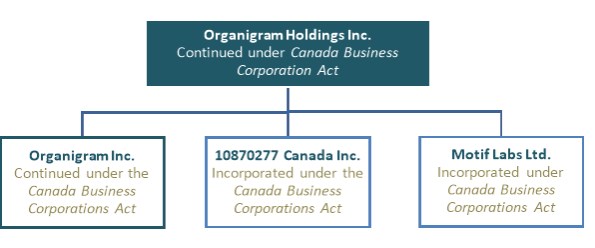
Certain subsidiaries of the Company, each of which does not represent more than 10% of the consolidated assets of the Company and not more than 10% of the consolidated revenue of the Company, and all of which, in the aggregate, represent not more than 20% of the total consolidated assets and the total consolidated revenue of the Company as at the most recent financial year end of the Company, have been omitted from the chart above.
GENERAL DEVELOPMENT OF THE BUSINESS
Licences
OGI holds a licence for the Moncton Campus (the "OGI Licence") issued by Health Canada under the Cannabis Act (Canada) ("Cannabis Act") on November 9, 2018 for standard cultivation, standard processing and sale of cannabis for medical purposes as well as for sale of dried cannabis and cannabis oil products to adult-use recreational sales channels. The OGI Licence was amended by Health Canada on October 21, 2019 following changes to the Cannabis Regulations (Canada) (the "Cannabis Regulations") to expand the classes of cannabis products that may be sold to include cannabis topicals, cannabis extracts and edible cannabis. The OGI Licence is valid until March 20, 2025.
OGI also holds a cannabis licence ("Excise Licence") under the Excise Act, 2001 (the "Excise Act"), which is valid until March 20, 2025. All holders of a licence under the Cannabis Act who are authorized to cultivate, produce and package cannabis products are required to hold a cannabis licence under the Excise Act. The Excise Licence applies to all three of the Company's operational sites in Moncton, NB, Winnipeg, MB, and Lac-Supérieur, QC.
On October 23, 2019, Health Canada issued a research licence to OGI, authorizing the conduct of research on cannabis (the "Research Licence"). The Research Licence allowed the Company to test inhalable cannabis in the extracts class of cannabis, and ingestible cannabis in the extracts and edibles classes of cannabis, on human research subjects for assessments of taste, sight, smell or touch ("Sensory Research"). The activities authorized under the Research Licence supported the Company's innovation initiatives and commercialization of cannabis products. The Research Licence expired on October 23, 2024. The Company did not seek to renew it as the regulatory regime for research on cannabis was phased out by Health Canada effective December 2, 2024, and replaced with a new research regime having more onerous application and authorization requirements. The Company intends to continue conducting Sensory Research under the new Non-Therapeutic Research on Cannabis (NTRC) regime. The Company was issued its first NTRC licence on July 18, 2024, authorizing it to conduct research on cannabis vapour topography. The Company subsequently applied for an additional NTRC licence for Sensory Research, and it expects such licence to be issued imminently.
- 8 -
Prior to the Amalgamation, EIC held a research licence having an effective date of November 22, 2019, authorizing it to develop confectionary cannabis product formulations. The Company allowed the licence to expire on November 22, 2024 as it no longer conducts research at the Winnipeg Facility. On December 11, 2020, Health Canada issued EIC a standard processing and medical sales licence under the Cannabis Act. On May 3, 2022, Health Canada issued EIC an amended licence authorizing the sale of cannabis extracts, edible cannabis and topical cannabis products to adult-use recreational sales channels, such licence being valid until November 29, 2028 (the "EIC Licence").
Prior to the Amalgamation, LAU held a standard cultivation and standard processing licence issued April 17, 2020, authorizing the cultivation of cannabis and manufacturing of dried cannabis, cannabis extract, edible and topical products. On December 3, 2020, Health Canada issued LAU an amended licence authorizing the sale of dried cannabis, cannabis extract, edible and topical products to adult recreational sales channels, such licence being valid until April 17, 2025 (the "LAU Licence").
As a result of the Amalgamation, the EIC Licence and the LAU Licence are held by OGI. The Company intends to renew its licences prior to their respective expiration dates, and it is anticipated that Health Canada and the CRA will renew such licences at the end of their current terms. See "Risk Factors - Reliance on Licence Renewal".
Facilities
The Company acquired its Moncton facility (the "Moncton Campus") located in Moncton, New Brunswick in March 2014, and undertook a series of expansions since its acquisition.
The Company continually assesses the critical facets of the lighting and environmental elements in its facilities in an effort to drive maximum quality and yield in the plants it produces. The Company intends to continuously improve its cultivation and post-harvesting practices in an effort to achieve a competitive advantage. In July 2022, the Company completed an expansion of 29 additional grow rooms. With the addition of environmental enhancements and the expansion, the Moncton Campus now has the capacity to produce approx. 85,000 kg of flower annually. In June 2023, the Company commissioned its high-speed pre-roll tube-style machine enabling the Company to enter the growing tube-style pre-roll segment with its popular SHRED brand.
The Company is in the process of obtaining European Union Good Manufacturing Practice (EUGMP) certification at the Moncton Campus, which opens up business opportunities in international markets where this manufacturing standard is in demand. The Company submitted an EUGMP certification application in Q1 Fiscal 2024. A preliminary audit of the Monton Campus facility was completed in February 2024. The final audit was conducted in November 2024, and the Company is currently awaiting the results. The Company expects to achieve EUGMP certification at the Moncton Campus in 2025.
The Company has a purpose-built, highly-automated manufacturing facility in Winnipeg, Manitoba (the "Winnipeg Facility") that was acquired in 2021 as part of the acquisition of EIC. The facility and equipment specifications were designed under EUGMP standards and are capable of handling both smaller-batch artisanal manufacturing as well as large-scale nutraceutical-grade high-efficiency manufacturing. The Winnipeg Facility can produce highly customizable, precise and scalable cannabis-infused products in various formats and dosages including pectin, gelatin, and sugar-free soft chews (gummies). In May 2022, a high speed packaging line for pouches was commissioned as part of the Company's effort to optimize the Winnipeg Facility.
- 9 -
The Company has a facility in Lac-Supérieur, Quebec that was acquired in 2021 as part of the acquisition of LAU (the "Lac-Supérieur Facility"). The Lac-Supérieur Facility was recently expanded with the addition of four new grow rooms and an expanded packaging area.
As a result of the acquisition of Motif on December 6, 2024, the Company now operates two additional cannabis processing facilities in Southwestern Ontario; one in Ayler and the other in London. The facility in Aylmer houses best-in-class CO2 and Hydrocarbon extraction capabilities, and is optimized for formulation refinement, post-processing of minor cannabinoids, and pre-roll production. The facility in London will be optimized for labelling, packaging, and national fulfillment.
The forward-looking estimate of production capacity and budget amounts noted above are based on a number of material factors and assumptions including that: (a) the facility size will be as estimated with the same amount of cultivation space being used per grow room for cultivation as used to date, (b) the ratio of dried flower cultivated per canopy square foot of grow room will be consistent with historical output in the Company's existing facilities, (c) all grow rooms designated as production rooms will be utilized for their intended purposes (from time to time rooms may be used for other purposes, such as for storage), and (d) a number of factors can cause actual costs to differ from estimates. See "Risk Factors".
Three-Year History
Developments during the financial year ended August 31, 2022
On November 1, 2021, the Company announced it had made an international shipment to Canndoc Ltd. ("Canndoc") in Israel in the first quarter of fiscal year 2022 pursuant to a supply agreement. The Company also announced it had signed a supply agreement with the Yukon Liquor Corporation adding territorial distribution to its existing 10 provincial distribution arrangements.
On November 18, 2021, the Company announced the launch of Monjour, a wellness brand offering high quality CBD-based products. Monjour's first offerings included vegan-friendly and sugar-free soft chews, both in assorted flavours.
On December 21, 2021, the Company announced the acquisition of LAU for $36 million, net of working capital adjustments, plus earnout share consideration, if any. The acquisition added more premium products to the Company's portfolio and strengthened its presence in the province of Québec.
On December 22, 2021, the Company announced that it had made an additional $2.5 million investment in Hyasynth Biologicals Inc. ("Hyasynth"). The Company has to date invested $10 million in Hyasynth.
On February 23, 2022, the Company announced that the BAT nominee, Mr. Simon Ashton, was appointed to the Company's board of directors.
On March 1, 2022, the Company announced that BAT had invested $6.3 million to exercise its rights pursuant to the Investor Rights Agreement (as defined below) to enhance its equity ownership position in the Company to 19.5% (as at December 31, 2021) from 18.8%.
On March 17, 2022, the Company launched its social impact strategy, Organigram Operating for Good, joining the 'Pledge 1%' movement by donating up to 1% of employee time towards causes aimed at "Building Healthy Communities Where We Live and Work."
On June 23, 2022, the Company announced that it had reached a proposed settlement (the "Settlement") in a class action related to medical cannabis that was voluntarily recalled in December 2016 and January 2017. As part the Settlement, the Company agreed to pay an amount in the aggregate of $2,310,000. On August 31, 2022, the Supreme Court of Nova Scotia held a hearing and approved the Settlement. See "Legal Proceedings and Regulatory Actions".
- 10 -
Developments during the financial year ended September 30, 2023
On November 17, 2022, the Company announced that it had entered into a new multi-year agreement for the supply of dried flower to Canndoc (the "2022 Canndoc Agreement"). The 2022 Canndoc Agreement provides for a commitment of 10,000kg of dried flower. As of December 15, 2023, approximately 4,900kg have been delivered to Canndoc and credited against their total volume commitment. The Company agreed to exclusively supply Canndoc in Israel during the three-year term of the 2022 Canndoc Agreement. The Company granted exclusivity to Canndoc on certain popular genetics for distribution into Canndoc's international supply chain, subject to local regulations.
On December 8, 2022, the Company announced that it had won KIND Magazine's Cannabis Company of the Year award and Most Innovative Product of the Year for the Company's Edison Cannabis Co. brand's Edison JOLTS product.
On January 26, 2023, the Company announced that it received notification (the "Notification") from NASDAQ that it was not in compliance with the minimum bid price requirement in NASDAQ Listing Rule 5450(a)(1) for continued listing on the NASDAQ Global Select Market, as the closing bid price for the Company's common shares listed on NASDAQ was below US$1.00 for 30 consecutive trading days. NASDAQ Listing Rule 5450(a)(1) requires the issuer's common shares to maintain a minimum bid price of US$1.00 per share (the "Minimum Bid Requirement"), and NASDAQ Listing Rule 5810(c)(3)(A) provides that failure to meet such requirement exists if the deficiency continues for a period of 30 consecutive business days. The Notification had no immediate effect on the listing of the Company's common shares on the NASDAQ. Under NASDAQ Listing Rule 5810(c)(3)(A), the Company had a period of 180 calendar days from the date of Notification, being until July 24, 2023, to regain compliance with the Minimum Bid Requirement.
On February 27, 2023, the Company announced the launch of SHRED X Rip-Strip Hash, which is an extension of the Company's SHRED product portfolio that includes SHRED pre-milled flower, SHRED Jar of Joints, SHRED'ems gummies and SHRED X Vapes.
On March 13, 2023, the Company announced that Health Canada had determined that certain Edison JOLTS lozenge products in their 100mg THC per package format (the "Edison JOLTS Products") had been improperly classified as a cannabis extract rather than edible cannabis under the Cannabis Regulations. The Company launched the Edison JOLTS products in August 2021 following significant research, development and regulatory work.
On March 21, 2023, the Company announced that BAT had designated Caroline Ferland as a nominee to the Company's board of directors. On September 1, 2023, the Company announced that Caroline Ferland had resigned from the Company's board of directors as a result of her appointment to Group Company Secretary & Assistant General Counsel for BAT.
On March 31, 2023, the Company announced that it had entered into a product purchase agreement ("Purchase Agreement") with Greentank and a subscription agreement (the "Greentank Subscription Agreement") with Greentank's parent company, Weekend Holdings Corp ("Weekend Holdings"). The Purchase Agreement provided the Company with an exclusivity period in Canada for new technology incorporated into 510 vape cartridges (along with other formats) for use with cannabis, including the development of a custom all-in-one device that will be proprietary to the Company. Pursuant to the terms of the Greentank Subscription Agreement, the Company subscribed for preferred shares for an aggregate subscription price of US$4.0 million (~$5.5 million CAD) representing an approximate 2.6% interest in Weekend Holdings.
- 11 -
On May 12, 2023, the Company filed a notice that it had decided to change its financial year end from August 31 to September 30, resulting in a 13 month period for the financial year ending September 30, 2023. The change was undertaken by the Company on the basis that it would better align the Company's financial statement reporting requirements with other public companies and calendar quarters.
On May 23, 2023, the Company announced that it had entered into a supply agreement (the "Supply Agreement") for dried flower with the medical division of German cannabis company Sanity Group, a health and life sciences company based in Berlin, Germany, dedicated to the medical applications of cannabinoids. Under the terms of the Supply Agreement, the Company will provide high-quality, indoor-grown dried flower product to Sanity Group and grant Sanity Group strain exclusivity on certain genetics.
On May 25, 2023, the Company announced that it had reached agreement with Phylos, a U.S. cannabis genetics company and provider of production ready seeds, based in Portland, Oregon, to initiate a wide-ranging technical and commercial relationship in Canada. Under the terms of the loan agreement with Phylos (the "Loan Agreement"), the Company will advance up to US$8 million to Phylos in three tranches. The Company advanced Phylos an initial US$3.25 million on May 25, 2023 ("Initial Closing Date") with a commitment to fund up to an additional US$4.75 million over two tranches within 12 and 24 months from the Initial Closing Date, upon the completion of certain milestones. The convertible loan will accrue paid-in-kind interest, subject to certain conditions. The maturity date of the convertible loan will be on the fifth anniversary of the Initial Closing Date subject to one-year extensions and subject to certain conditions. The convertible loan (principal and paid-in-kind interest outstanding) is convertible into common share equity of Phylos under certain circumstances (including but not limited to federal legalization or decriminalization of cannabis in the United States). In November 2023, the Company announced that Phylos achieved the first milestone under the Loan Agreement and closed the second tranche under the Loan Agreement with Organigram advancing US$2.75 million to Phylos.
On June 21, 2023, the Company announced the launch of SHRED X Heavies, a line of innovative infused pre-rolls.
On July 5, 2023, the Company completed a consolidation of its issued and outstanding Common Shares at a consolidation ratio of four pre-consolidation Common Shares for every one post-consolidation Common Share (the "Share Consolidation"). The Share Consolidation was implemented to ensure the Company continues to comply with NASDAQ Minimum Bid Requirement.
On August 2, 2023, the Company announced the launch of its new tube-style pre-rolls, SHRED Dartz and Holy Smokes.
On August 10, 2023, the Company announced that the Federal Court of Canada (the "Federal Court") had granted the Company's application for judicial review of the decision by Health Canada to reclassify the Edison Jolts Product as a cannabis edible rather than a cannabis extract. The matter was remitted back to Health Canada for redetermination taking the Federal Court's reasons into consideration.
On August 15, 2023, the Company announced that it had entered into a supply agreement to provide dried medical cannabis flower to 4C LABS, a healthcare, technology, and pharmaceutical company focused on virtual prescribing, pharmaceutical distribution, and clinical development of cannabis-based products for human health in the United Kingdom. Pursuant to the terms of the agreement, the Company has supplied approximately 288 kilograms of high-quality, indoor-grown dried flower product to 4C LABS to date, less than the initially anticipated 600 kilograms. The Company has also granted 4C LABS strain exclusivity within the geographical boundaries of the United Kingdom and Channel Islands for as long as minimum purchase commitments are satisfied under the terms of the agreement.
- 12 -
On September 25, 2023, the Company filed a preliminary short form base shelf prospectus with the securities commissions in each of the provinces and territories of Canada, and concurrently filed a base shelf registration statement with the United States Securities and Exchange Commission (the "SEC") on Form F-10 under the United States Securities Act of 1933, as amended, pursuant to the Multijurisdictional Disclosure System (SEC File No. 333-274686). The base shelf prospectus allows the Company to qualify the distribution of up to $500 million of Common Shares, debt securities, subscription receipts, warrants, and units during the 25‐month period that the base shelf prospectus remains effective. The Company obtained a receipt for its final short form base shelf prospectus (the "Base Shelf Prospectus") on October 11, 2023, and related Form F-10 base shelf registration statement was declared effective by the SEC on November 29, 2023.
Developments during the financial year ended September 30, 2024
On November 6, 2023, the Company announced a $124.6 million follow-on strategic equity investment from BT DE Investments Inc. (the "Investor"), a wholly-owned subsidiary of BAT (the "Follow-on BAT Investment"). The majority of the $124.6 million investment will be used by Organigram to create a strategic investment pool, named Jupiter ("Jupiter"). Jupiter will target investments in emerging cannabis opportunities that will enable the Company to apply its industry-leading capabilities to new markets. Pursuant to the terms of a Subscription Agreement (as defined below) and subject to the receipt of certain regulatory approvals, approval from the Company's shareholders and other conditions, the Investor will subscribe for a total of 38,679,525 Common Shares and Class A preferred shares (the "Class A Preferred Shares" and together with the Common Shares, the "Shares") in the capital of the Company (the "Investment") across three tranches. As of the entering into the Subscription Agreement, BAT beneficially owned 15,249,027 Common Shares, representing approximately 18.8% of the issued and outstanding Common Shares on a non-diluted basis. Pursuant to the terms of the Subscription Agreement, Shares issued in each of the three tranches will be allocated between Common Shares and Class A Preferred Shares such that if the number of Common Shares owned by the Investor or its affiliates, associates, related parties and any joint actors, including BAT, would exceed 30% of the aggregate number of Common Shares issued and outstanding (the "30% Threshold") after the closing of the applicable tranche, the Company will issue to the Investor the greatest number of Common Shares issuable pursuant to such closing without exceeding the 30% Threshold, with the remainder of the Common Shares issuable as Class A Preferred Shares, as set for in greater detail in the Subscription Agreement.
On November 10, 2023, the Company announced that Derrick West had resigned as Chief Financial Officer of the Company. Paolo De Luca had been appointed interim Chief Financial Officer effective November 13, 2023, while the Company completed a search for a new permanent Chief Financial Officer.
On November 28, 2023, the Company announced that Phylos has achieved the first milestone under the Loan Agreement entered into in May 2023 and closed the second tranche under the Loan Agreement with Organigram advancing US$2.75 million to Phylos. This second tranche followed the initial tranche of US$3.25 million advanced in May 2023 for a total of US$6 million in senior secured convertible loans then outstanding.
On December 13, 2023, the Company announced it had won KIND Magazine's 2023 Innovation of the Year Award (the "Award") for its revolutionary SHRED X Rip-Strips Hash. This was the second consecutive time the Company won the Award, having won in 2022 for its patented Edison JOLTS product.
On December 18, 2023, the Company announced that Greg Guyatt CPA, CA, formerly of Phoena Holdings Inc., had been appointed to the role of Chief Financial Officer of Organigram effective January 8, 2024. Mr. Guyatt leads Organigram's Finance and IT divisions and reports directly to Beena Goldenberg, Organigram's Chief Executive Officer.
- 13 -
On January 18, 2024, the Company obtained Shareholders' approval of the Follow-on BAT Investment and the amendment of the Company's articles to create a new class of Class A Preferred Shares to be issued by the Company to the Investor in the Follow-on BAT Investment. Following receipt of the necessary Shareholder approval, the Company filed articles of amendment to create the new class of Class A Preferred Shares.
On January 19, 2024 the Company announced the appointment of BAT nominee Karina Gehring to the Company's board of directors.
On January 24, 2024, the Company announced that it closed the first of three tranches of the previously announced Follow-on BAT Investment. Pursuant to the first tranche closing, the Investor acquired 12,893,175 common shares of the Company at a price of C$3.2203 per share (the "Per Share Price") for gross proceeds of C$41,519,891.
On January 31, 2024, the Company announced that it had sent its first shipment of bulk dried flower to the medical division of German cannabis company Sanity Group, a health and sciences organization dedicated to the medical applications of cannabinoids. The shipment was completed under the Company's multi-year agreement with Sanity Group. Under the terms of the agreement first announced in 2023, Organigram would provide high-quality, indoor-grown dried flower product to Sanity Group and grant Sanity Group strain exclusivity on certain genetics.
On February 28, 2024, the Company announced its support of the recommendation by the Canadian House of Commons Standing Committee on Finance that the excise duty framework for cannabis be adjusted to a 10% ad valorem rate from the current 35%, reflecting the lower average selling price per gram of cannabis in 2024 compared to when cannabis was legalized recreationally in 2018.
On March 22, 2024, the Company announced that, despite strong evidence supporting the classification of its Edison JOLTS product as a cannabis extract, it had received a final redetermination from Health Canada that the products are to be classified as edible cannabis. The final redetermination followed the August 2023 decision of the Federal Court to grant Organigram's application for judicial review of a decision of Health Canada determining that the Edison JOLTS Products are to be classified as edible cannabis. The Court found there was a breach of procedural fairness by Health Canada and the matter was then remitted back to Health Canada for redetermination taking the Federal Court's reasons into consideration.
On March 26, 2024, the Company announced a USD $2 million minority investment in OBX in the form of a convertible note, using proceeds from its Jupiter strategic investment pool. Based in Roxboro, NC within North Carolina's "Research Triangle," OBX specializes in legal cannabinoid ingredient production and serves as a one-stop formulation and finished goods manufacturer, simplifying its clients' supply chains.
On April 2, 2024, the Company announced the closing of its previously announced public offering (the "Offering") of units of the Company (the "Units") pursuant to an underwriting agreement entered into between the Company and ATB Securities Inc., as lead underwriter, on behalf of itself and a syndicate of underwriters including A.G.P. Canada Investments ULC (collectively, the "Underwriters") for total gross proceeds of C$28,750,230. The Offering was completed pursuant to a prospectus supplement filed under the Base Shelf Prospectus and the Registration Statement. The Company sold 8,901,000 Units at a price of C$3.23 per Unit, which included 1,161,000 Units sold pursuant to the exercise in full of the Underwriters' over-allotment option. Each Unit comprised of one common share of the Company (a "Common Share") and one half of one common share purchase warrant of the Company (each full common share purchase warrant, a "Warrant"). Each Warrant will be exercisable to acquire one Common Share (a "Warrant Share") for a period of four years following the closing date of the Offering at an exercise price of C$3.65 per Warrant Share, subject to adjustment in certain events.
- 14 -
On April 8, 2024, the Company announced it was recognized on the 2024 Globe & Mail's Report on Business 'Women Lead Here' list for gender diversity for the fourth consecutive year. Fifty percent of the Company's executive leadership team, including its chief executive officer ("CEO"), are women. The Women Lead Here benchmark was established in 2020 and applies a proprietary research methodology to provide an overview of the largest Canadian corporations with the highest degree of gender diversity among executive ranks. The ranked companies have made tangible and organizational progress related to executive gender parity.
On April 16, 2024, KPMG LLP provided the Company with notice that it would not stand for reappointment as auditor of the Company for the fiscal year 2025. The Company filed a notice of change of auditor under the Company's profile on SEDAR+ on April 25, 2024. On June 28, 2024, the Company appointed PKF O'Connor Davies, LLP as its successor auditor.
On May 28, 2024, the Company announced its second international medical cannabis customer in the United Kingdom, Avida Medical Limited ("Avida"), a full-service medical cannabis and specials medicines manufacturing business. Subject to the terms of the agreement with Avida, the Company expects to supply 1,700 kilograms of high quality, indoor-grown dried cannabis flower to Avida in the United Kingdom over a period of three years.
On June 25, 2024, the Company announced a strategic investment in Sanity Group, representing its first significant strategic investment aimed at expanding its presence in the European cannabis market. Using proceeds from its Jupiter strategic investment pool, the Company agreed to invest €14 million (~ C$21 million) initially comprised of €11.5 million via an unsecured convertible note and €2.5 million in cash to purchase equity interests from existing Sanity Group founders and shareholders providing the Company with a minority stake in Sanity Group. In addition, the Company may advance another €3 million (~ C$4.5 million) as a second tranche of the unsecured convertible note for future opportunities to be pursued by Sanity subject to the satisfaction of certain conditions.
On July 24, 2024 the Company announced that it completed an early partial funding of its final third tranche investment into Phylos with the remaining portion of the final tranche to be funded upon completion of the newly expanded final milestone. As part of the expanded milestone, Phylos delivered 21 unique auto-flower seed varietals for testing and phenotyping by Organigram by September 30, 2024, and is required to deliver a second cohort of 21 auto flower seed varietals no later than January 31, 2025. In addition to the auto-flower seeds, Organigram received an expanded genetics licence from Phylos that, in addition to tetrahydrocannabivarin ("THCV"), includes access to high potency cannabigerol ("CBG"), cannabichromene ("CBC") and cannabidivarin ("CBDV") seed based cultivars.
On July 29, 2024, the Company announced the appointment of BAT nominee Craig Harris to the Company's board of directors.
On August 7, 2024, the Company unveiled the preliminary results of its landmark clinical pharmacokinetic study conducted via the Product Development Collaboration (the "PDC") between the Company and BAT on its latest innovation, nanoemulsion technology. This patent-pending technology, branded FAST™ (Fast Acting Soluble Technology) ("FAST"), is the first innovation to be commercialized by Organigram leveraging the output of the PDC, a "Center of Excellence" established to focus on developing next-generation cannabis products. The clinical study was completed in January 2024, and the final data set has been received and reviewed. The final report is expected to be published in 2025.
- 15 -
On September 3, 2024, the Company announced that on August 30, 2024, the Company closed the second of three tranches of the previously announced Follow-on BAT Investment. Pursuant to the closing of the second tranche of the Follow-on BAT Investment, the Investor acquired 4,429,740 Common Shares and 8,463,435 Class A Preferred Shares of the Company at the Per Share Price for gross proceeds of USD$30,821,684.69 (equal to C$41,519,891). The remaining 12,893,175 Common Shares and Class A Preferred Shares subscribed for are due to be issued at the Per Share Price in the final tranche on or around February 28, 2025.
Developments subsequent to the financial year ended September 30, 2024
On November 26, 2024, the Company announced the launch of Edison Sonics gummies, Organigram's inaugural product powered by FAST™. Products with FAST™ deliver up to ~50% faster onset and improved bioavailability delivering nearly double the cannabinoids at peak effect compared to traditional edible products. This is made possible as FAST™ is an advanced nanoemulsion technology delivery system that breaks down cannabinoids into tiny particles, allowing them to be absorbed more quickly and efficiently during consumption. These results have been scientifically verified through one of the largest pharmacokinetic studies conducted in the cannabis industry, completed in January 2024.
On December 6th, 2024, the Company announced the acquisition of 100% of the issued and outstanding shares of Motif for upfront consideration of $90 million, consisting of $50 million in cash and $40 million of Organigram common shares priced based on the 30 day trading volume weighted average price ("VWAP") of $2.3210 on the Toronto Stock Exchange ("TSX"). In addition, Motif shareholders will be entitled to receive additional contingent consideration of $10 million payable in Organigram common shares ("Contingent Consideration"), conditional on Organigram achieving a price per share exceeding $3.2203, based on the rolling 30-trading day VWAP on the TSX, within 12 months of the date of the transaction. The Contingent Consideration shall be priced at $3.22031 per share.
DESCRIPTION OF THE BUSINESS
Company Overview
The Company is a leading Canadian licensed producer of high quality cannabis and cannabis-derived products for adult-use recreational consumers and medical patients in Canada. The Company also has various international business relationships that it continuously seeks to develop in order to expand its global footprint.
A description of the regulatory framework is included below under the heading "Canadian Regulatory Framework". For a summary of the Cannabis Act and Cannabis Regulations as well as the Company's licences issued under the Cannabis Act and Excise Act, see "Canadian Regulatory Framework - Licences, Permits and Authorizations".
Principal Products and Brands
The Company has established strong brands for use in the adult-use recreational cannabis market and seeks to create a portfolio of diverse brands and products. The Company's adult-use recreational cannabis brand strategy reflects its views about current and potential consumers, the industry, future product development and opportunities for growth.
Adult Use Recreational Cannabis
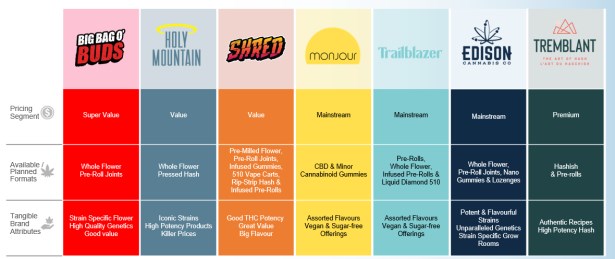
The Company developed its portfolio of adult-use recreational cannabis brands to specifically meet the diverse needs of Canada's adult-use recreational cannabis consumers. Based on a robust consumer segmentation study, Organigram has and will continue to develop a competitive range of brands designed to deliver profitable growth across the largest product categories. The suite of brands includes SHRED, Holy Mountain, Big Bag O' Buds, Monjour, Trailblazer, Edison Cannabis Co., and Tremblant. Each brand is unique to a specific consumer segment with a product offering designed to meet the needs of its target audience, as described below, including potencies, cannabinoid content and price point.
- 16 -
Medical Cannabis
The Company offers a broad range of medical cannabis products in Canada and abroad through our international business partners. Our range of products available in the medical channel includes whole flower, milled flower, pre-rolls, infused pre-rolls, vapes, gummies & concentrates.
New Product Development and Innovation
Research & Development
The Company continues to focus on consumer insight driven innovation, research and product development ("R&D") across all key product categories. Current development work is focused on the operationalization of pre-rolls and infused pre-rolls at high throughput speed, the development and re-launch of the vapour portfolio across a number of brands and pricing tiers, and continued investment in milled flower, gummies and hash portfolios with a robust pipeline of disruptive and innovative products.
R&D efforts in cannabis extraction and raw material processing have resulted in a significant yield increase and quality improvements to our CO2 and solventless extraction and isolation capabilities. The Company has begun extraction and isolation of several minor cannabinoids such as THCV and cannabidiol ("CBN") at scale, and has developed methods and processes to assess, analyse and extract a robust range of rare minor cannabinoids that are being cultivated at the Moncton Campus with novel and proprietary high-potency cultivars.
Product Development Collaboration - Centre of Excellence with BAT
The PDC agreement (the "PDC Agreement") entered into with BAT in March 2021 and the strategic investment of approximately $221 million in the Company by BAT is another example of the Company's hallmark dedication to consumer-driven product innovation. The strategic collaboration with BAT strengthens Organigram's ability to create innovative, differentiated products that appeal to adult consumers. No assurance can be given that the Company will be successful in bringing these products to the market. See "Risk Factors - The Company May Not be Able to Successfully Develop New Products or Find a Market for Their Sale".
- 17 -
The Company and BAT entered into the PDC Agreement pursuant to which the Centre of Excellence ("CoE") was established to focus on research and product development activities for the next generation of cannabis products, with an initial focus on CBD. The CoE is located at the Moncton Campus, which holds the Health Canada licences required to conduct R&D activities with cannabis products. Both companies contributed scientists, researchers, and product developers to the CoE which is governed and supervised by a steering committee consisting of an equal number of senior members from both companies. Under the terms of the PDC Agreement, both Organigram and BAT have access to certain of each other's IP and, subject to certain limitations, have the right to independently, globally commercialize the products, technologies and IP created in the CoE.
Per the PDC Agreement, Organigram and BAT have agreed to jointly develop cannabis vapour products, cannabis oral products and any other products, IP or technologies the parties mutually agree to develop. BAT will own all IP developed under this collaboration and will grant to Organigram a royalty-free, perpetual, global licence to all such IP. Each party has also agreed to grant to the other a non-exclusive, perpetual and irrevocable licence to certain existing IP of such party and its affiliates for purposes of conducting the development activities and exploiting the products, technologies and IP created by the CoE per the PDC Agreement, subject to certain restrictions.
All key working spaces of the CoE have been completed including the R&D laboratories, enhanced analytics space, quality assurance and control laboratory, GPP (Good Production Practices, as prescribed by Part 5 of the Cannabis Regulations) production space, sensory testing laboratory and a state-of-the-art biolab for advanced plant science research. The CoE has completed the first generation of product concepts across the gummies, vapour and novel beverage formats. Organigram has begun commercialization of CoE driven innovations throughout 2024 as the R&D focus now shifts to the second generation of product development in line with latest category and consumer insights, with the FAST products discussed above being the first innovation to be commercialized.
On August 7, 2024, the Company unveiled the preliminary results of its landmark clinical pharmacokinetic study conducted via the PDC on its latest innovation, nanoemulsion technology. This patent-pending technology, FAST™, is the first innovation to be commercialized by Organigram leveraging the output of the CoE. The clinical study was completed in January 2024, and the final data set has been received and reviewed. The final report is expected to be published in 2025.
Distribution and Sales
Adult-Use Recreational Cannabis
The Cannabis Act provides provincial, territorial and municipal governments with the authority to prescribe regulations regarding retail and distribution of adult-use recreational cannabis. As such, the distribution model for adult-use recreational cannabis is prescribed by provincial regulations and differs from province to province. Some provinces have government-run retailers, while others have government-licensed private retailers, and some have a combination of both. The Company is authorized by its licence for wholesale distribution of adult-use recreational cannabis and derivative products in all provinces of Canada and in Yukon, and has supply arrangements in different forms with the responsible government agency or equivalent in each province and territory.
The Cannabis Act imposes restrictions on the promotion of cannabis products, cannabis accessories and services related to cannabis. These include restrictions on the content of promotions as well as locations where promotions may take place. With this in mind, the Company has created a portfolio of brands that address unique consumer needs, including potency, yield, flavours, occasions, price points, volume discounts or promotional pricing. As the industry matures, certain seasonal sales trends are starting to emerge such as an increased popularity for pre-rolls during the summer months and an increased popularity for vape pens during the winter months. See "Description of the Business - Canadian Regulatory Framework" for additional information on current distribution channels under the Cannabis Act.
- 18 -
Medical Cannabis
The Company distributes medical cannabis through MyMedi.ca, an online medical cannabis platform managed by Avicanna Inc. The online medical cannabis platform offers a wide range of medical products and dedicated customer service. The Company's prices for cannabis and derivative products vary based on growth time, strain yield and market prices. The Company may from time to time offer volume discount or promotional pricing. The Company is also authorized for wholesale shipping of medical cannabis plant cuttings and dried flower to other licensed producers. The Company is able to ship wholesale medical cannabis products to certain international jurisdictions by obtaining the required approvals and permits from Health Canada and the applicable regulatory authority of the purchaser. See "Description of the Business - Canadian Regulatory Framework" for additional information on current distribution channels under the Cannabis Act.
Cannabis Edibles
Effective October 17, 2019, the Cannabis Regulations permit the sale to the public of edible cannabis products and concentrates through medical and adult-use consumer channels. Following the investment in a high-speed, high-capacity, fully automated production line, the Company began shipping edibles to retailers across Canada in February 2020. The Company subsequently began evaluating future prospects for its chocolate production line based on its declining utilization and declining revenues from its chocolate output and ultimately made the strategic decision to cease manufacturing chocolate products. Following the acquisition of EIC, the Company launched SHRED'ems cannabis-infused gummies and Monjour, a gummy brand focusing on CBD-forward products. The previously-discussed FAST technology developed by the CoE that was announced by the Company in August 2024 is anticipated to improve the Company's edible cannabis products by decreasing the average time required for the effects of edible cannabis to be felt by a consumer.
Cannabis Extracts and Concentrates
The Company continues to expand its vape offering by having introduced a liquid diamond vape cartridge as well as Shred 510 vapes featuring distillate and botanical terpene blends. Following the acquisition of LAU, the Company established a robust hash innovation pipeline, expanded the Tremblant hash brand nationally via new higher potency hash temple balls, and introduced other new hash products into the market.
Cannabis Vapour Products
In March 2023, Organigram entered into an agreement with Greentank for the development and commercialization of novel vapour heating technology. The Company is expecting commercialization to begin in late fiscal year 2025. The Greentank hardware is expected to deliver to the consumer greater vapour volume, stronger flavour and cannabinoid performance through improved and smaller particle size in vapour with their new heating engine.
International Customers
- 19 -
Outside of Canada, the Company serves several international markets via exports and seeks to augment sales channels internationally over time. Future international shipments are contingent upon the timing and receipt of regulatory approval from Health Canada, including obtaining an export permit, as well as timing and receipt of regulatory approval from the purchaser's regulatory authority, including obtaining an import permit.
Operations
The Company has assembled a capable management team with significant experience in the management and growth of successful enterprises.
Presently, a significant portion of the Company's revenue is derived from the sale of cannabis, cannabis product and cannabis plant material produced, cultivated and/or processed by the Company at its Moncton Campus. The Company grows cannabis at its Moncton Campus for the purposes of sale and distribution of finished products. The Moncton Campus has 115 grow rooms with staggered cultivation cycles averaging 14 weeks per cycle. As the grow rooms are all indoor, seasonality has negligible impact on cultivation cycles.
In July 2022, the Company acquired the Winnipeg Facility which it had been previously leasing. EIC held the EIC Licence issued under the Cannabis Act, which was transitioned to be held by OGI as a result of the Amalgamation. The Company is currently producing cannabis-infused gummies and cannabis-infused lozenges at the Winnipeg Facility.
In September 2023, the Company completed the expansion of the Lac-Supérieur Facility adding four hybrid greenhouses increasing the cultivation footprint to 14,500 sq. ft. The Lac-Supérieur Facility is destined to produce craft flower with a staggered cultivation cycle averaging 11-12 weeks per cycle as the Lac-Supérieur Facility receives clones ready for transplant.
Cultivation
The Company's breeding and phenotyping program continues to produce a robust and strategic flower pipeline, with significant progress made to increase the quality, potency and terpene concentrations of the Company's flower portfolio. Several large-scale garden strategies have begun implementation, including start-up of seed based manufacturing, move to segment plant care based on cultivar and portfolio value, and ongoing introduction of improved irrigation practices, specific LED light recipes and crop cycle changes to improve quality output while reducing crop cycle, drying and curing time.
In May 2023, Organigram entered into an innovation agreement with Phylos to develop and operationalize F1 hybrid seed based production which scaled our production by up to 17% of harvests in FY 2024, significantly reducing the garden cost profile while improving economics on certain milled and ready to consume brands in the portfolio. In addition, Organigram has further capitalized on the investment with the launch of first to market, whole flower THCV offerings in both edible and vapour categories. Organigram expects to expand the offering with further development of a range of novel high potency rare cannabinoids via the proprietary, patent protected cultivation methods developed by Phylos.
Storage and Security
The Cannabis Act prescribes physical security requirements that are necessary to secure sites where licensed producers conduct activities with cannabis. All facilities currently in production operate in accordance with the Cannabis Act requirements, including in relation to the security requirements. Health Canada conducts ad hoc, unscheduled site inspections of licensed producers under the Cannabis Act. The Company has been subject to these inspections numerous times. The Company has responded to and complied with all requests from Health Canada within the time frames indicated in such requests. As of the date hereof, there are no outstanding inspection issues with Health Canada beyond day-to-day adjustments that may occur in order to ensure ongoing compliance.
- 20 -
Specialized Skill and Knowledge
The nature of growing cannabis is not substantially different from the nature of growing other agricultural products. Variables such as temperature, humidity, and lighting, air flow, watering and feeding cycles are meticulously defined and controlled to produce consistent product and to avoid contamination. The product is cut, sorted and dried under defined conditions that are established to protect the activity and purity of the product. Once processing is complete, each and every processed batch is subjected to full testing against stringent quality specifications set for activity and purity. The Company has recruited a production team with specialized skill sets unique to indoor agricultural cultivation and processing of cannabis plants and products at industrial scale.
In addition, in order to ensure compliance with the Cannabis Act and any directives issued by Health Canada, which includes strict security measures, equipment required to manage production, HVAC (heating, ventilation, and air conditioning) systems, odour control systems and laboratory equipment to monitor and test product quality, the Company must employ a number of regulatory personnel to assist the Company to remain compliant with the complex and rapidly evolving regulations applicable to the industry. The Company has successfully recruited the necessary personnel with this skill set.
The Company's management includes individuals who have extensive expertise in the cannabis industry. In addition, the Company's board of directors is comprised of experienced professionals from various relevant industries. See "Directors and Executive Officers".
Competitive Conditions
As of the date hereof, Health Canada has issued cultivation, processing or cannabis sales licences to a total of 1,001 licence holders. There are also a number of unlicensed illicit growers of cannabis that compete with the legal market. The Cannabis Act allows for adults to legally grow up to four cannabis plants for personal use; however, the Company believes that competition from homegrown cannabis is limited and does not currently have a significant impact on market demand for high quality cannabis flower.
As the demand for cannabis products increases both nationally and internationally, the Company believes that new competitors will enter the market. The principal aspects of competition between the Company and its competitors are the price and quality of the products offered and client service provided to patients, government entities and private retailers.
Since edible cannabis products became legal in Canada, they have become a large market for licensed producers. Edibles are an attractive alternative that appeal to a broader audience, particularly to those who are not interested in combustion. The Company continues to invest in new product development through research and development, the acquisition of new technologies and the acquisition of other businesses where appropriate. The Company deploys a strategy aimed at product depth as opposed to breadth to maintain its strong track record of delivering on supply commitments, which is critical to building brand equity.
It is possible that the Company will face intense competition from other cannabis producers, some of which having longer operating histories and more financial resources and manufacturing and marketing experience than the Company. Increased competition by larger and better financed competitors could materially and adversely affect the business, financial condition and results of operations of the Company. In addition, over the past year the cannabis industry has experienced, and continues to experience, price compression, which may adversely impact the Company's profitability. In addition, such price compression, as well as, or together with, the oversupply of certain types of inventory in the industry, may result in the Company incurring additional impairment losses on inventory in the event the cost of our inventory exceeds its net realizable value. Ongoing and potential changes of these market conditions represent uncertainties that may affect the Company's future financial results.
- 21 -
Employees
As of September 30, 2024, the Company employed approximately 898 employees. Following the Company's acquisition of Motif, its employee count increased to 1,135 individuals as of December 11, 2024.
Canadian Regulatory Framework
On October 17, 2018, the Cannabis Act and the Cannabis Regulations came into force, legalizing the sale of cannabis for adult recreational use in Canada. Prior to the Cannabis Act and the Cannabis Regulations coming into force, only the sale of medical cannabis was legal. Such sales of medical cannabis were regulated under the Access to Cannabis for Medical Purposes Regulations (the "ACMPR").
The Cannabis Act and Cannabis Regulations establish a licensing and permitting scheme for the cultivation, processing, importation, exportation, testing, transportation, sale, possession and disposal of cannabis both for medical and non-medical use (i.e. adult recreational use). This scheme replaced the ACMPR for purposes of the medical cannabis regime.
The Cannabis Act allows for the import and export of cannabis only for medical or scientific purposes. Import and export permits are applied for and received on a case-by-case basis.
Transitional provisions of the Cannabis Act provided that every licence, permit and security clearance issued under the ACMPR that was in force immediately before the day on which the Cannabis Act came into force (being October 17, 2018) is deemed to be a licence or permit issued under the Cannabis Act and that such licence or permit will continue in force until it is revoked or expires.
On May 8, 2019, Health Canada changed its licensing criteria for new applicants for licences to cultivate, process and sell cannabis for medical purposes. These categories of licence applicants are now required to have a fully built site that meets all the requirements of the Cannabis Regulations at the time of their application, as well as satisfying any other applicable application criteria.
On October 17, 2019, amendments to the Cannabis Act and Cannabis Regulations came into force. The Cannabis Act and Cannabis Regulations were amended to, among other things, allow for the production, distribution and sale of cannabis extracts, cannabis topicals and edible cannabis in addition to the other previously permitted product categories. The Cannabis Regulations set out certain requirements for the sale of cannabis products, including limiting the THC content and size of certain product forms.
Certain provinces have imposed restrictions on the launch and sale of edible and vaporizable cannabis products in their markets, including Québec and Newfoundland and Labrador. Additionally, in February 2021 Health Canada announced its intent to restrict the use of flavours in vaporizable products, and in June 2021 Health Canada proposed amendments that would restrict inhalable cannabis extracts from having a flavour other than the flavour of cannabis. These amendments were expected to come into force in 2022, however they are not yet in force as of the date hereof. As the market and regulations continue to develop the impact of these announcements is not readily determinable at this time. See "Risk Factors - Changes in Laws, Regulations and Guidelines".
- 22 -
Licences, Permits and Authorizations
The Cannabis Regulations establish six classes of licences under the Cannabis Act: cultivation licences; processing licences; analytical testing licences; licences for sale; research licences; and cannabis drug licences. The Cannabis Regulations also establish subclasses for cultivation licences (standard cultivation, micro-cultivation and nursery) and processing licences (standard processing and micro-processing). Different licences and each subclass therein carry differing rules and requirements that are intended to be proportional to the public health and safety risks posed by each licence category and subclass. The Cannabis Regulations provide that all licences issued under the Cannabis Act must include both the effective date and expiry date of the licence, and may be renewed on or before the expiry date.
The Cannabis Regulations permit licence holders to conduct activities only at the site and building set out in the licence (except for destruction, antimicrobial treatment and distribution) and no licensed activities can take place in a "dwelling-house". The holder of a licence must not produce, test, store, package or label cannabis outdoors, except for obtaining cannabis by cultivating, propagating or harvesting it.
The Industrial Hemp Regulations ("IHR") promulgated under the Cannabis Act came into force on October 17, 2018. The regulatory scheme for industrial hemp remained largely the same; however, the IHR permit the sale of hemp plants to licensed cannabis producers, the use of additional parts of the hemp plant and licensing requirements have been eased in accordance with the low risk posed by industrial hemp. The IHR define "industrial hemp" as cannabis plants whose leaves and flowering heads do not contain more than 0.3% THC.
Security Clearances
Certain people associated with cannabis licensees, including individuals occupying a "key position" such as directors, officers, significant shareholders and individuals identified by Canada's Minister of Health (the "Minister"), must hold a valid security clearance issued by the Minister. Under the Cannabis Regulations, the Minister may refuse to grant security clearances to individuals with associations to organized crime or with past convictions for, or in association with, drug trafficking, corruption or violent offences. This is largely the approach that has been in place under the ACMPR and other related regulations governing the licensed production of cannabis for medical purposes. Individuals who have histories of nonviolent, lower-risk criminal activity (e.g. simple possession of cannabis, or small-scale cultivation of cannabis plants) are not precluded by legislation from participating in the legal cannabis industry, and the grant of security clearance to such individuals is at the discretion of the Minister and such applications are reviewed on a case-by-case basis. Security clearances issued under the ACMPR are considered to be security clearances for the purposes of the Cannabis Act and the Cannabis Regulations.
Cannabis Tracking and Licensing System
Under the Cannabis Act, the Minister is authorized to establish and maintain a national cannabis tracking system. The Cannabis Regulations set out a national cannabis tracking system to track cannabis throughout the supply chain to help prevent diversion of cannabis into, and out of, the legal market. The Cannabis Act also provides the Minister with the authority to make a ministerial order requiring certain persons named in such order to report specific information about their authorized activities with cannabis, in the form and manner specified by the Minister. Accordingly, the Minister has introduced the Cannabis Tracking and Licensing System, and licence holders are required to use this system to submit monthly reports to the Minister, among other things.
- 23 -
Cannabis Products
As of October 17, 2018, the Cannabis Act and Cannabis Regulations permitted the sale to the public of dried cannabis, cannabis oil, fresh cannabis, cannabis plants, and cannabis seeds by authorized licence holders. On October 17, 2019, there was an amendment to the Cannabis Regulations adding edibles cannabis, cannabis extracts and cannabis topicals as new classes of cannabis permitted to be sold through medical and adult-use consumer channels. The THC content and size of cannabis products is limited by the Cannabis Regulations. Effective October 17, 2020 cannabis oil was deleted from the Cannabis Act and must now be sold as a cannabis extract, subject to compliance with other prohibitions and requirements of the Cannabis Regulations. See "Changes in Laws, Regulations and Guidelines".
Packaging and Labelling
The Cannabis Regulations set out requirements pertaining to the packaging and labelling of cannabis products, which requirements are intended to promote informed consumer choice and allow for the safe handling and transportation of cannabis, while also reducing the appeal of cannabis to youth and promoting safe consumption. These requirements include plain packaging for cannabis products, strict requirements for logos, colours and branding as well as packaging that is tamper-proof and child-resistant. The Cannabis Regulations further require mandatory health warnings, product source information, including the class of cannabis and the name, phone number and email address of the producer, the standardized cannabis symbol and specific product information including the THC and CBD content.
Promotion
The Cannabis Act introduces strict restrictions on the promotion of cannabis products to, among other things, prevent promotion that could be appealing to young persons or evoke a positive or negative emotion about or image of, a way of life. Specifically, the Cannabis Act prohibits the promotion of cannabis, cannabis accessories or any services related to cannabis, unless such promotion is authorized under the Cannabis Act. Therefore, the Company may only advertise or promote its products in compliance with the provisions of the Cannabis Act.
Cannabis for Medical Purposes
The Cannabis Regulations set out the regime governing access to medical cannabis which largely reflects the rules under the ACMPR. Patients who have the authorization of their healthcare provider continue to have access to medical cannabis, either purchased directly from a federally licensed producer, or by registering to produce a limited amount of cannabis for their own medical purposes, or designating someone to produce cannabis for them.
Provincial Regulatory Framework
While the Cannabis Act provides for the regulation of the commercial production of cannabis for adult-use recreational purposes and related matters by the Government of Canada, the Cannabis Act enables the provinces and territories of Canada to regulate other aspects of adult-use recreational cannabis (similar to what is currently the case for liquor and tobacco products), such as sale and distribution, minimum age requirements, places where cannabis can be consumed, and a range of other matters.
As at the date hereof, the Company has entered into arrangements with distributors in all the provinces of Canada and the Yukon. The nature of these arrangements vary by jurisdiction.
The governments of every Canadian province and territory have, to varying degrees, enacted regulatory regimes for the distribution and sale of cannabis for adult-use recreational purposes within those jurisdictions. Most of these Canadian jurisdictions have a minimum age of 19 years old for buying, using or possessing cannabis, except for Québec and Alberta, where the minimum age is 21 and 18, respectively.
- 24 -
There are three general frameworks enabled by provincial and territorial governments: (i) private cannabis retailers licenced by the provincial government; (ii) government run retail stores; and (iii) a combination of both frameworks. Regardless of the framework, the adult-use recreational cannabis market is ultimately supplied by federally licenced cultivators and processors. In most instances, provinces and territories have a government run wholesaler that is the exclusive source of cannabis products for retailers. The wholesalers, in turn, acquire cannabis products from the federally licenced cultivators and processors. The following chart outlines the current basic regime for adult-use recreational cannabis sales in each province and territory of Canada.
| Activity | Privately Operated | Publicly Operated |
| Storefront Adult Use Sale | British Columbia Alberta Saskatchewan Manitoba Ontario Newfoundland and Labrador Nunavut Yukon Northwest Territories |
British Columbia Québec New Brunswick Nova Scotia Prince Edward Island |
| Online Adult Use Sale | Alberta Saskatchewan Manitoba Nunavut Yukon |
British Columbia Ontario Québec New Brunswick Nova Scotia Prince Edward Island Newfoundland and Labrador Northwest Territories |
Foreign Operations
Our business operates entirely in Canada but a significant portion of our business depends on partnerships located in foreign jurisdictions, including the United States, Germany, the United Kingdom, Israel and Australia. See "Risk Factors - The Company's Operations in Emerging Markets are Subject to Political and Other Risks Associated with Operating in a Foreign Jurisdiction" and "Risk Factors - Israel-Hamas War and Conditions in Israel".
Israeli Regulatory Framework
Cannabis, including all parts of the plant and the roots (but excluding oil extracted from its seeds) is defined, under the Israeli Dangerous Drugs Ordinance (New Version), 5737-1973, as a "dangerous drug" such that the sale and use of cannabis are prohibited unless a permit has been granted by the Israeli Ministry of Health (the "MOH").
In recent years, the MOH has made a significant progress in regulating cannabis for medical use - with the end goal of treating medical cannabis as any other pharmaceutical drug. As part of such "medicalization" of cannabis progress, the Israeli Medical Cannabis Agency (the "IMCA"), was established (acting as a "Government Agency" pursuant to the United Nations Single Convention on Narcotic Drugs of 1961), and has been granted the authority to issue licences for the use of cannabis for medical purposes and for the following aspects related to medical cannabis supply chain: cultivation, manufacturing, storage, sale and for medical cannabis related research. Under such medicalization reform, the IMCA has issued several directives, which set clear and detailed standards and requirements for obtaining licences for all such aspects of the medical cannabis.
- 25 -
The MOH issued, in December 2016 (last updated in November 2021) a procedure titled "Guidelines for Approval of Applications for Importation of Dangerous Drug of Cannabis Type for Medical Use and for Research" ("Procedure 109"). Procedure 109 provides guidelines for import applications and respective approval process, for research and medical use of cannabis. According to Procedure 109, the following permits and licences are required to be obtained in order to be granted cannabis import licence (for medical and research uses): (i) IMCA granted licence to possess and operate in the medical cannabis field, (ii) a licence to import plant material (to the extent that the imported cannabis is in a form of a plant, such as seeds, tissue culture), granted by the applicable department within the Israeli Ministry of Agriculture, (iii) a permit to import narcotic drugs, pursuant to the Dangerous Drugs Ordinance, and (iv) a licence to import a dangerous drug, granted by the Department of Pharmaceutical Imports and Narcotics within the MOH. The IMCA has the discretion to grant or refuse to grant an import licence, as well as to revoke a licence previously granted. According to Procedure 109, importation of raw materials (cannabis inflorescence) will only be permitted if such plant materials were grown and cultivated in a post-harvest IMC-GAP certified facility (or an equivalent certification, such as CUMCS), or alternatively if the farm is GACP certificated (or equivalent), and the post-harvest facility if EU-GMP certified. Finished medical cannabis products are only allowed to be imported if they were manufactured in accordance with IMC-GMP or equivalent standard (e.g. EU-GMP).
On January 31, 2022, the Economic Affairs Committee of the Israeli Parliament held a discussion regarding the adverse effect of substantial imports of medical cannabis on the local industry. The discussion was summoned with a request that the Ministry of Health (MOH) would study the matter and consider a halt of importation until a balance is reached between imports and exports of medical cannabis.
In July 2022, a committee appointed by the Director General of the MOH for the purpose of examination of the professional and regulatory framework that will allow the transition from a licensing regime to a prescriptions' regime with respect to the use of medical cannabis (the "Committee"), published its recommendations. The Committee concluded that it was advisable to transition from the grant of personal patient licences to the issuance of prescriptions available through public healthcare services (the "Reform"). The new regulations adapting this Reform (the "Reform Regulations") made a transition from a licensing regime to a prescription regime, allowing medical cannabis to be prescribed by physicians, trained and certified as stipulated in the Reform Regulations, and to be held and distributed by pharmacies. The Reform was approved by the Israeli Parliament's health committee in June 2023, published in July 2023, and entered into effect as of April 1, 2024.
On August 30, 2023, following issuance of the recommendations of the Committee, the Director General of the MOH appointed an additional committee, authorized to comprehensively examine which cannabinoids and parts of the cannabis plant have a psychoactive-addictive effect and therefore there is a justification to maintain their classification as a "dangerous drug" under the definition set forth in the Dangerous Drugs Ordinance (the "2023 Committee"). The 2023 Committee had been requested to provide its recommendations by January 1, 2024. To date, no official publication has been made available to the public, at the MOH's website, with respect to such recommendations.
In January 2024, the Ministry of Economy and Industry launched an anti-dumping investigation into Canadian cannabis exports to Israel, claiming that cannabis was being dumped at unacceptably low prices (the "Anti-Dumping Investigation"). The Company responded to these allegations and demonstrated with data that it did not engage in the practice of dumping. Notwithstanding this data, on November 11, 2024, the Anti-Dumping Trade Commissioner of Israel published his conclusions, finding dumping by all Canadian cannabis exporters to Israel, and calling for a dumping duty on all cannabis imports from Canada. The Company and the Israeli Ministry of Health, among others, disputed the Commissioner's findings, which were then reviewed by an Israeli government Advisory Committee. The Advisory Committee held a hearing for stakeholders on December 11, 2024, and will submit its recommendation for a final decision on the question of dumping to be determined by the Israeli Ministry of Economy in 2025.
- 26 -
German Regulatory Framework
The Company, through its wholly-owned subsidiary 10870277 Canada Inc., acquired a 25% interest in the capital of alpha-cannabis Pharma GmbH ("ACG"). In addition, the Company has entered into two supply agreements with ACG: one for the supply of CBD isolate from ACG, and the other for the supply of dried cannabis flower from Organigram Inc. to ACG, for which the Company has provided notice of termination.
On June 25, 2024, the Company announced a strategic investment in the Germany-based Sanity Group, representing its first significant strategic investment aimed at expanding its presence in the European cannabis market. Using proceeds from its Jupiter strategic investment pool, the Company has agreed to invest €14 million (~ $21 million) initially comprised of €11.5 million via an unsecured convertible note and €2.5 million cash to purchase equity interests from existing Sanity Group founders and shareholders providing the Company with a minority stake in Sanity Group. In addition, the Company may advance another €3 million (~ $4.5 million) as a second tranche of the unsecured convertible note for future opportunities to be pursued by Sanity subject to the satisfaction of certain conditions.
In 2024, Germany fundamentally revised the legal framework regarding cannabis by passing the so-called Cannabis Act (Cannabisgesetz - CanG), which introduced the Law on the handling of cannabis for consumption (Konsumcannabisgesetz - KCanG) and the Medical Cannabis Act (Medizinal-Cannabisgesetz - MedCanG) and amended other related laws, inter alia the BtMG. Cannabis is no longer a narcotic drug within the meaning of Sec. 1 German Federal Law on Narcotic Drugs (Betäubungsmittelgesetz - BtMG).
Cannabis may be prescribed by doctors for medical purposes. The system for prescribing medical cannabis introduced in Germany in 2017 is now laid down in the MedCanG. The MedCanG aims to facilitate the access of patients to medicinal cannabis and prevent its misuse. In principle, a licence is required by anyone wishing to cultivate, produce, trade, import, export, dispense, sell, otherwise place on the market, obtain or acquire cannabis for medical purposes or cannabis for medical-scientific purposes. The licence is issued by the Cannabis Agency as part of the Bundesinstitut für Arzneimittel und Medizinprodukte and is subject to numerous conditions, including that the cannabis must be cultivated in accordance with the guidelines on Good Agricultural and Collection Practices ("GACP"). The previous procedure of issuing licences by tender for the cultivation of cannabis for medical purposes has been abolished. An extensive tendering procedure after which the Cannabis Agency concludes supply and service contracts under civil law with the successful bidders, then buys the cannabis produced and subsequently sells it to pharmacies, wholesalers etc., is no longer necessary. Instead, the distribution of domestically harvested cannabis for medical purposes will be carried out under the market economy and legal responsibility and decision of the economic operators holding a cultivation licence or a marketing authorisation.
However, the most fundamental change is that Germany has created legal access to cannabis for recreational use. The approach is based on two pillars: The first pillar allows for private cultivation by adults for their own use, and for shared, non-commercial cultivation of cannabis in cultivation associations. The new regulatory framework for this is set out in the KCanG. The second pillar provides for regional model projects with commercial supply chains.
- 27 -
For private cultivation for personal use, it is now permitted for adults aged 18 and above to possess up to 25 grams of dried cannabis in public and up to 50 grams in private. The cultivation of up to three female flowering cannabis plants per person is permitted. Also, non-commercial cultivation associations, so-called cannabis social clubs, with up to 500 members can be founded. These associations are allowed to cultivate cannabis collectively and distribute it among their members. A licence is required, which is subject to numerous conditions. It is prohibited to consume cannabis in certain areas, e.g. near schools, in the premises of cultivation associations and in pedestrian zones between 7:00 and 20:00.
Among other things, the KCanG does not consider CBD to be 'cannabis', meaning that it is not subject to the prohibition regulation under Sec. 1 para. 1 KCanG. The extraction of CBD from the cannabis plant is also not prohibited.
Moreover, dealing of cannabis seeds is permitted as long as the cannabis seeds are not intended for unauthorised cultivation. However, the import of cannabis seeds for the purpose of private home cultivation of cannabis or the communal home cultivation of cannabis in cultivation associations is only permitted from Member States of the European Union. The import and export of recreational cannabis remains prohibited as well as importing cannabis products.
The second pillar envisages the implementation of a scientifically designed pilot project in selected regions for five years. This will allow companies to produce, sell and distribute recreational cannabis within a licensed and state-controlled framework to adults in specialised shops. The model will be scientifically monitored and evaluated. The effects of a commercial supply chain on the protection of health and minors as well as the black market will be analysed in more detail. However, no legal provisions have yet been created for the establishment of model regions, so that the second pillar is so far only a concept. In view of the current political situation in Germany and the complex deliberations required for the adoption of the legal regulations, it is uncertain whether such regulations will be created.
Despite legalisation, challenges remain, particularly in relation to the bureaucratic hurdles faced by cultivation associations when they are set up. Furthermore, some political parties have announced their intention to reverse the legalisation.
United Kingdom Regulatory Framework
In the United Kingdom, cannabis, certain cannabinoids, and products containing those ingredients are controlled drugs (unless exempt). Accordingly, it is unlawful to possess, supply, offer to supply, produce, import or export these drugs except under a Home Office ("HO") licence. There are, however, regulations which allow for the possession and use of cannabis-based products for medicinal use in humans ("CBPM") without a HO licence provided strict rules are met.
Correspondingly, the regulations allow for the import of finished CBPMs, or ingredients for the use in, and the manufacture of, CBPMs in the UK. In particular, only persons with certain registrations and licences from both the HO and the Medicines and Healthcare Products Regulatory Agency ("MHRA") can import CBPMs or ingredients for the manufacturing of CBPMs. Importers and manufacturers must comply with strict requirements regarding packaging, storage, processing and record keeping in relation to CBPMs (amongst others).
Cannabis is a Class B controlled drug under Part 2 of Schedule 2 to the Misuse of Drugs Act 1971 ("MDA 1971"). Cannabis is defined in section 37(1) of the MDA 1971 and is, in summary, the plant or any part of the plant with limited exceptions (the exceptions are the mature stalk; fibre produced from the mature stalk; or the seed of any such plant). Cannabis is also listed in Schedule 1 to the Misuse of Drugs Regulations 2001 ("MDR 2001"), which provides the legal framework for access to controlled drugs for legitimate purposes.
- 28 -
Further, a number of cannabinoids are controlled as Class B drugs under Part 2 of Schedule 2 to the MDA 1971 and Schedule 1 of MDR 2001, including cannabinol and its derivatives. Pure cannabidiol (CBD) is not a controlled drug, however preparations or products from which it is derived may be. It is unlawful to possess, supply, offer to supply, produce, import or export controlled drugs except under a HO licence, which may be obtained for various legitimate purposes - including in relation to CBPMs (see below). It is also an offence to cultivate any plant of the genus cannabis except under a Home Office licence.
With effect from 1 November 2018, the UK government amended the MDRs 2001 to permit unlicensed CBPMs to be used in humans, under certain circumstances. Regulation 2 or MDR 2001 defines CBPMs as:
"a preparation or other product […] which (a) is or contains cannabis, cannabis resin, cannabinol or a cannabinol derivative (not being dronabinol or its stereoisomers); (b) is produced for medicinal use in humans; and (c) is(i) a medicinal product, or (ii) a substance or preparation for use as an ingredient of, or in the production of an ingredient of, a medicinal product;" Under regulation 16A of the MDRs 2001, unlicensed CBPMs may be ordered where they are (a) for use in a clinical trial; (b) subject to a "marketing authorisation" granted by the MHRA; or (c) a special medicinal product for use in accordance with a prescription or direction of a specialist medical practitioner registered under section 34D of the Medical Act 1983.
Special medicinal product is defined in the Human Medicines Regulations 2012, regulation 167. In summary, this includes products that are supplied in response to an unsolicited order, manufactured and assembled in accordance with the specification of specialist medical practitioners, and are for use by a patient whose treatment that practitioner is directly responsible to fulfil the special needs of that patient. The only persons entitled to acquire these special medicinal products are: (a) doctors or dentists registered in the UK; supplementary prescribers (e.g. an appropriately qualified nurse or pharmacist); nurse independent prescribers or pharmacist independent prescribers; pharmacists in hospitals, health centres or registered pharmacies; wholesale dealers licensed for distribution for supply to the order of any of the above; manufacturers licensed for manufacture, assembly or import for supply to the order of any of the above.
Specialist Importers that intend to import unlicensed CBPMs, or ingredients to manufacture unlicensed CBPMs, must; (a) obtain an HO domestic licence - permitting the control, use and possession of controlled drugs within the UK; (b) obtain an Active Substance registration with the MHRA ; and (c) obtain either: (i) a Wholesale Dealer's Licence (WDA (H)) if unlicensed CBPMs or ingredients for manufacture of those products are being imported from an European Economic Area member state; or (ii) a Manufacturer's (Specials) Licence if unlicensed CBPMs or ingredients for manufacture of those products are to be imported from a third country.
There are various HO and MRHA requirements that Specialist Importers must comply with in order to obtain the appropriate registrations and licences. Further, in relation to each import, a Specialist Importer must: (a) apply to the HO for a licence to import the relevant product in the requested quantity. These are usually processed within 10 working days of receipt and last for three months for a single use; and (b) notify the MHRA of the intention to import the requested quantity at least 28 days before the proposed date of import. This notification must contain certain, specified information.
Once products arrive in the UK, they will be subject to a customs check and placed into quarantine at a specialist importer warehouse to be checked to ensure they meet any MHRA standards. Importers and manufacturers must comply with strict requirements regarding packaging, storage, processing and record keeping in relation to CBPMs (amongst others).
Australian Regulatory Framework
- 29 -
Under Australia's federal system, activities related to medical cannabis are regulated at both the Commonwealth (national/federal) level and at the individual state and territory level. In October 2016, the Australian Government introduced amendments to the Narcotic Drugs Act 1967 (Cth) (the "ND Act"), through the Narcotic Drugs Amendment Act 2016 (Cth), and a new Narcotic Drugs Regulation 2016 (Cth) (the "ND Regulation") which introduced a Commonwealth (national) licensing and permit scheme for the cultivation, production and manufacture of medical cannabis and medical cannabis products. The scheme is administered primarily by the Office of Drug Control (the "ODC") within the Commonwealth Department of Health and Aged Care. The scheme was amended in 2021 by the passage of the Narcotic Drugs Amendment (Medicinal Cannabis) Act 2021 (Cth), to streamline the current Commonwealth licensing and permit scheme. Licences and permits for cultivation, production and manufacture of medical cannabis and medical cannabis products are issued and managed by the Medicinal Cannabis Section of the ODC and compliance is monitored by the Monitoring and Compliance Section of the ODC.
The Therapeutic Goods Act 1989 (Cth) (the "TG Act") and its subordinate legislation (particularly the Therapeutic Goods Regulations 1990 (Cth) (the "TG Regulations")) also operate at the Commonwealth level in parallel to the ND Act and ND Regulation to more generally regulate therapeutic goods, including medical cannabis products. Such regulation covers their import into or export from Australia, and their manufacture, advertisement and supply in Australia, including the import, export and production of medical cannabis raw materials for use in the manufacture of finished therapeutic goods. The Commonwealth therapeutic goods regime is administered by the Therapeutic Goods Administration. One of the key requirements is that therapeutic goods must be registered, listed or included in the Australian Register of Therapeutic Goods ("ARTG") before they can be imported, exported, manufactured or supplied in Australia, unless they exempt from this requirement. Medical cannabis products are usually dealt with pursuant to exemptions that accommodate certain schemes administered by the TGA which provide access to unapproved therapeutic goods, primarily the Special Access Scheme ("SAS"), Authorised Prescriber Scheme ("APS") and schemes relating to the conduct of clinical trials.
In late 2023 and through the course of 2024, a series of significant changes were made to the TG Act, TG Regulations and other subordinate legislation and instruments to reform the regulation of "vaping goods" in Australia. Although the reforms were predominantly focused on tightly regulating the lawful importation, manufacture and supply in Australia of vaping goods for smoking cessation or nicotine dependence (being vaping goods containing nicotine as the only active ingredient or no active ingredients at all), and effectively banning all other recreational and therapeutic vaping goods, they have had important ancillary regulatory effects on products that comprise or contain medical cannabis for vaping (including both liquid and solid forms).
Further, for medical cannabis materials or products that are imported into or exported from Australia, there is an additional import/export regime that applies under the Customs Act 1901 (Cth), and the Customs (Prohibited Imports) Regulations 1956 (Cth) (the "CPI Regulations") and the Customs (Prohibited Exports) Regulations 1958 (Cth) (the "CPE Regulations"). Although the regimes under the ND Act and TG Act described above touch on import and/or export activities, the import and export of medical cannabis materials and products also requires compliance with the additional import-specific and export-specific requirements of the CPI Regulations and CPE Regulations respectively. New, additional import-export obligations may apply if the medical cannabis products are vaping goods.
As 'prohibited drugs' under the CPI Regulations and CPE Regulations, cannabis and medical cannabis products (whether raw/starting materials, refined active ingredients or finished dosage forms) can only be imported by a person holding an import licence and import permit under the CPI Regulations. A licence must be obtained from the Narcotics Control Section (the "NCS") of the ODC, which requires, among other things, establishing the qualifications and experience of the applicant, that they are a fit and proper person to hold the licence and undertake the proposed activities, and that adequate security arrangements will be implemented in respect of the goods. In the case of medical cannabis products that are prefilled (refillable) vaping devices, or that are vaping substances packaged with a vaping device or accessory, a separate licence and permit to import those items as "vaping goods" is also required.
- 30 -
Similarly, cannabis and medical cannabis products in their various forms can only be exported by a person holding an export licence and export permit under the CPE Regulations, which also must be obtained from the NCS pursuant to a similar assessment of the applicant's qualifications, experience and suitability to hold an export licence. An important additional requirement for obtaining an export permit for a consignment of medical cannabis materials or products is demonstrating that the competent authority in the receiving country has given its prior approval to the proposed import into that country.
All medical cannabis materials and products manufactured in Australia, or manufactured overseas and imported for human therapeutic use in Australia, must also meet all mandatory standards applicable to such goods under the TG Act. Key among these are the standards set out in Therapeutic Goods (Standard for Medicinal Cannabis) (TGO 93) Order 2017 ("TGO 93"). Significant amendments to TGO 93 were made in March 2022, which were subject to transition periods to allow industry time to make any necessary changes in respect of their products, with all medical cannabis products released for supply in Australia on or after July 1, 2023 having needed to comply with these requirements. One of the key requirements of TGO 93 is that, except for certain kinds of starting material, medical cannabis products that are manufactured overseas must meet, and must be certified, licensed or confirmed to meet, certain minimum good manufacturing practice ("GMP") standards.
In addition, as a result of the vaping goods reforms, medical cannabis that is imported into Australia to be used as starting material in the manufacture of finished goods that are vaping substances is now subject to the requirement that its importation be formally notified to the TGA before the importation occurs. A similar TGA notification requirement applies to the importation of vaping devices and accessories which are intended to be used with medical cannabis and which rely on the usual exemption pathways for unapproved goods.
Where medical cannabis products are imported, manufactured or supplied in the form of prefilled vaping devices, or medical cannabis substances for vaping are supplied in a packaged form that includes a vaping device (or vaping device accessory), the device components of those goods are generally required to comply with certain 'essential principles' for medical devices specified in the Therapeutic Goods (Medical Devices) Regulations 2002 (Cth) (the "MD Regulations") (which are subordinate to the TG Act). A significant requirement of the essential principles is that the sponsor of a device must hold, or be able to readily obtain from the manufacturer, evidence (including clinical evidence) establishing the safety and performance of the device for its intended purpose.
The Australian states and territories regulate lawful dealings in medicines and poisons primarily by reference to their scheduling status. Medicines and poisons are categorized into different schedules depending on their intended use(s) and potential for harm, with the intention that different levels of control will be applied by reference to the different schedules. There is a measure of national uniformity due to the fact that the categorization of substances into schedules occurs at the Commonwealth level, through promulgation and regular amendment of the Standard for the Uniform Scheduling of Medicines and Poisons (the "Poisons Standard") (most recently made - as at the date of preparation of this summary - as the Therapeutic Goods (Poisons Standard-October 20243) Instrument 20243). However, each state and territory individually, through its own laws, adopts the Poisons Standard (with occasional jurisdictional modifications) and to a similar (but not identical) extent the various intended controls.
- 31 -
Medical cannabis products for human therapeutic use are mostly in Schedule 8, a category which the Poisons Standard describes as 'controlled drugs', being substances which should be available for use but require restrictions on manufacture, supply, distribution, possession and use to reduce abuse, misuse and physical or psychological dependence. A limited class of medical cannabis products containing predominantly cannabidiol are also listed in Schedule 4 (being 'prescription-only' medicines) and in Schedule 3 ('pharmacist-only medicines'). Cannabis products for non-human research are in Schedule 9 - such 'prohibited substances' are susceptible to abuse or misuse and their manufacture, possession, sale or use should be prohibited by law except when required for medical or scientific research or for analytical, teaching or training purposes with approval of Commonwealth and/or state or territory health authorities.
RISK FACTORS
There are a number of risk factors that could cause future results to differ materially from those described herein. The risks and uncertainties described herein are not the only ones the Company faces. Additional risks and uncertainties, including those that the Company does not know about now or that it currently deems immaterial, may also adversely affect the Company's business.
If any of the following risks actually occur, the Company's business may be harmed and its financial condition and results of operations may suffer significantly.
Competition
There is potential that the Company will face intense competition from other companies, some of which have longer operating histories, more financial resources and production and marketing experience, and lower costs than the Company.
The cannabis industry and businesses ancillary to and directly involved with cannabis businesses are undergoing rapid growth and substantial change, which has resulted in an increase in new and existing competitors, consolidation and formation of strategic relationships. As such, the Company faces competition from companies that may have greater capitalization, access to public equity markets, more experienced management or more maturity as a business. The Company is likely to continue to face increasing and intense competition from these companies. Increased competition by larger and better financed competitors could materially and adversely affect the Company's business, financial condition and results of operations. The Company expects that competition will become more intense as current and future competitors begin to offer an increasing number of diversified products to respond to such increased demand. To remain competitive, the Company will require a continued investment in research and development, marketing, sales and client support. The Company may not have sufficient resources to maintain sufficient levels of investment in research and development, marketing, sales and client support efforts to remain competitive, which could materially and adversely affect the Company's business, financial condition and results of operations.
Acquisitions or other consolidating transactions in the cannabis industry could harm the Company in a number of ways, including losing customers, revenue and market share, or forcing it to expend greater resources to meet new or additional competitive threats, all of which could harm the Company's operating results. As competitors enter the market and become increasingly sophisticated, competition in the industry may intensify and place downward pressure on retail prices for the Company's products and services, which could negatively impact the Company's profitability.
Changes in the number of licenses granted and the number of Licensed Producers ultimately authorized by Health Canada, as well as other regulatory changes in both Canada and internationally that have the effect of increasing competition, could have an adverse impact on the Company's ability to compete for its market share.
- 32 -
The Company has identified a trend of certain Licensed Producers inflating THC potency values being labeled on flower products in order to gain market share. As the Company has not engaged in, nor does it intend to engage in, the practice of seeking inflated THC level, this practice has negatively impacted the Company's flower sales and margins and may continue to do so for the foreseeable future.
Cyber Security
The Company has entered into agreements with third parties for hardware, software, telecommunications and other information technology services in connection with its operations. The Company's operations depend, in part, on how well it and its suppliers protect networks, equipment, information technology systems and software against damage from a number of threats, including, but not limited to, cable cuts, damage to physical plants, natural disasters, intentional damage and destruction, fire, power loss, hacking, computer viruses, vandalism and theft. The Company's operations also depend on the timely maintenance, upgrade and replacement of networks, equipment, information technology systems and software, as well as pre-emptive expenses to mitigate the risks of failures. Any of these and other events could result in information system failures, delays, and/or increase in capital expenses. The failure of information systems or a component of information systems could, depending on the nature of any such failure, adversely impact the Company's reputation and results of operations.
Cyber incidents can result from deliberate attacks or unintentional events. Cyber-attacks could result in any person gaining unauthorized access to digital systems for purposes of misappropriating assets or sensitive information, including personally identifiable information, corrupting data, or causing operational disruption. Cyber-attacks could result in important remediation costs, increased cybersecurity costs, lost revenues due to a disruption of activities, litigation, and reputational harm affecting customer and investor confidence, which ultimately could materially adversely affect the Company's business, financial condition and operations.
The Company has not experienced any material losses to date relating to cyber-attacks or other information security breaches, but there can be no assurance that the Company will not incur such losses in the future. The Company's risk and exposure to these matters cannot be fully mitigated because of, among other things, the evolving nature of these threats. As a result, cyber security and the continued development and enhancement of controls, processes and practices designed to protect systems, computers, software, data and networks from attack, damage or unauthorized access is a priority.
Despite the Company making a number of device-level cyber remediations, as cyber threats continue to evolve, the Company may be required to expend additional resources to continue to modify or enhance protective measures or to investigate and remediate any security vulnerabilities.
Acquisition and Integration Risk
The Company has in the past made and may in the future make acquisitions and investments that could divert management's attention, result in operating difficulties and dilution to shareholders and otherwise disrupt the operations of the Company. The Company may have difficulty integrating any such acquisitions successfully or realising the anticipated benefits therefrom, any of which could have a material adverse effect on the Company's business, financial condition, results of operations and cash flows. See "Developments during the financial year ended August 31, 2022" as it relates to the Company's acquisitions of EIC, LAU, and Motif, respectively.
Pursuing potential strategic acquisitions or investment opportunities is one possible growth strategy. Any transactions that the Company enters into could be material to its business, financial condition, results of operations, cash flows and prospects. The process of acquiring and integrating another company or technology could create unforeseen operating difficulties and expenditures. Acquisitions and investments involve a number of risks, including:
- 33 -
Expansion into New Markets
The Company's expansion into jurisdictions outside of Canada is subject to risks. In jurisdictions outside of Canada, there can be no assurance that any market for the Company's products will develop. The Company may face new or unexpected risks or significantly increase its exposure to one or more existing risk factors, including economic instability, changes in laws and regulations, and the effects of competition. These factors may limit the Company's ability to successfully expand its operations into such jurisdictions and may have a material adverse effect on the Company's business, financial condition and results of operations.
Competition from the Illicit Market
The Company faces competition from unlicensed and unregulated market participants, including individuals or groups that process cannabis without a licence under the Cannabis Act, such as illicit medical dispensaries and other illicit participants selling cannabis and cannabis-based products in Canada. These competitors may be able to offer products with higher concentrations of active ingredients than the Company would be authorized to produce and sell, use delivery methods that are currently prohibited form offering to individuals in Canada, use marketing and branding strategies that are restricted under the Cannabis Act and the Cannabis Regulations, and make claims not permissible under the Cannabis Act and other regulatory regimes. The competition presented by these participants, and any unwillingness by consumers currently using these illicit distribution channels to begin purchasing from the regulated market for any reason, or any inability of law enforcement authorities to enforce existing laws prohibiting the unlicensed cultivation, production and sale of cannabis and cannabis-based products, could adversely affect the Company's market share, result in increased competition through the illicit market for cannabis or have an adverse impact on the public perception of cannabis use, and of Canadian federal licence holders, all of which could have a materially adverse effect on the Company's business, operations and financial condition.
- 34 -
Constraints on Marketing Products
In view of the restrictions on marketing and promotional activities set forth in the Cannabis Act and related regulations, the Company's business and operating results may be hindered by applicable restrictions on sales, branding and marketing activities. If the Company is unable to effectively brand and market its products and compete for market share, or if the costs of compliance with government legislation and regulation cannot be absorbed through increased selling prices for its products, the Company's sales and operating results could be adversely affected.
Additionally, the Company's success depends on its ability to attract and retain customers, and the restrictions on marketing, advertising and promotion of the Company's cannabis products may adversely impact its ability to establish brand presence, acquire new customers, retain existing customers and maintain a loyal customer base. The failure to acquire and retain customers could have a material adverse effect on the Company's business, financial condition and results of operations.
Reliance on Key Inputs and Wholesale Price of Cannabis Volatility
The Company's revenues are in a large part derived from the production, sale, and distribution of cannabis. The cost of production, sale, and distribution of cannabis is dependent on a number of key inputs and their related costs, including equipment and supplies, labour and raw materials related to the Company's growing operations, as well other overhead costs such as electricity, water, and utilities. In light of ongoing international military conflicts, any governmental measures taken as a result may have a negative impact on the costs, including for input materials, energy and transportation. Any significant interruption or negative change in the availability or economics of the supply chain for key inputs could materially impact the Company's financial condition and operating results.
Some of the Company's key inputs may only be available from a single supplier or a limited group of suppliers. If a sole source supplier was to go out of business, the Company might be unable to find a replacement for such source in a timely manner or at all. If a sole source supplier were to be acquired by a competitor, that competitor may elect not to sell to the Company in the future.
Any inability to secure required supplies and services or to do so on appropriate terms could have a materially adverse impact on the business, financial condition and operating results of the Company. This includes any change in the selling price of products set by the applicable province or territory. There is currently no established market price for cannabis and the price of cannabis is affected by numerous factors beyond the Company's control, including but not limited to, government regulation, interest rates, inflation or deflation, supply and demand, and general prevailing political and economic conditions. Any price decline may have a material adverse effect on the Company's business, financial condition and operations.
Ability to Meet Production Targets
The Company sets production targets on dried flower, extracted oil and formulated oil. Actual production amounts may not achieve targeted production figures as a result of many factors including but not limited to: genetic drift in the strains of cannabis plants grown, shift in strains grown as a result of competitive pressure, natural variations in plant development, inability to precisely influence growth measures as a result of numerous variables that may influence the plant growth that are varied from one growth cycle to another, product that does not meet quality assurance specifications including, but not limited to, pesticide or heavy metals testing, tetrahydrocannabinol and cannabidiol specifications, terpene profile or visual appearance, operational inefficiencies from extraction processes or in production of formulated oil for sale.
- 35 -
Partnerships and Strategic Alliances/Investments
The Company operates parts of its business through partnerships and strategic alliances (which includes strategic investments) with other companies, and the Company may enter into additional partnerships and strategic alliances in the future. The Company's ability to complete partnerships and strategic alliances is dependent upon, and may be limited by, the availability of suitable candidates and capital. In addition, such arrangements could present unforeseen integration obstacles or costs, may not enhance the Company's business, and may involve risks that could adversely affect the Company, including significant amounts of management time that may be diverted from operations in order to pursue and complete such transactions or maintain such arrangements. Future partnerships and strategic alliances could result in the incurrence of additional debt, costs and contingent liabilities, and there can be no assurance that future arrangements will achieve, or that the Company's existing arrangements will continue to achieve, the expected benefits to the Company's business or that the Company will be able to consummate future strategic alliances on satisfactory terms, or at all. Any of the foregoing could have a material adverse effect on the Company's business, financial condition and results of operations.
Government Regulation
The business and activities of the Company are heavily regulated in all jurisdictions where the Company carries on business. The Company's operations are subject to various laws, regulations and guidelines by governmental authorities, particularly Health Canada, relating to the manufacture, marketing, management, transportation, storage, sale, pricing and disposal of cannabis, cannabis extracts, and cannabis derivatives. The Company is also subject to laws and regulations relating to health and safety, insurance coverage, the conduct of operations and the protection of the environment. Laws and regulations, applied generally, grant government agencies and self-regulatory bodies broad administrative discretion over the activities of the Company, including the power to limit or restrict business activities as well as impose additional disclosure requirements on the Company regarding its products and services.
Achievement of the Company's business objectives are contingent, in part, upon compliance with regulatory requirements enacted by governmental authorities and obtaining all regulatory approvals, where necessary, for the production and sale of its products. The Company cannot predict the time required to secure all appropriate regulatory approvals for its products, or the extent of testing and documentation that may be required by governmental authorities. Any delays in obtaining, or failure to obtain regulatory approvals would significantly delay the development of markets and products and could have a material adverse effect on the business, results of operations and financial condition of the Company.
Failure to comply with the laws and regulations applicable to the Company's operations may lead to possible sanctions including the revocation or imposition of additional conditions on licences to operate the Company's business; the suspension or expulsion from a particular market or jurisdiction or of its key personnel; the imposition of additional or more stringent inspection, testing and reporting requirements; and, the imposition of fines and censures. To the extent that there are changes to the existing laws and regulations or the enactment of future laws and regulations that affect the sale or offering of the Company's products or services in any way, the Company's revenues may be adversely affected.
In light of the illegality of cannabis under U.S. federal law (other than measures to legalize hemp) any engagement in cannabis-related activities, both in Canada as well as in foreign jurisdictions, may lead to heightened scrutiny by regulatory bodies and other authorities that could negatively impact the Company and/or its personnel.
- 36 -
Recent Developments in the Canadian Cannabis Industry and Market
As a licence holder authorized to process, formulate and manufacture cannabis products, the Company is operating its business in a relatively new industry and market, and the Company's success in the cannabis market will depend in part on its ability to attract and retain customers, develop and maintain commercial relationships with Canadian and international cannabis brands and develop innovative products. In addition to being subject to general business risks applicable to a business involving an agricultural product and a regulated consumer product, the Company will need to make significant investments in its business strategy. These investments include the procurement of raw material, equipment relating to the distillation, extraction and formulation of cannabis products, site improvements and research and development projects. The Company expects that competitors will undertake similar investments to compete with it. Competitive conditions, consumer preferences, customer requirements and spending patterns in this industry and market are relatively unknown and may have unique circumstances that differ from other existing industries and markets and cause the Company's future efforts to develop its business to be unsuccessful or to have undesired consequences for it. As a result, the Company may not be successful in its efforts to attract customers, leverage its commercial partnerships or to develop new cannabis products and produce and distribute these cannabis products, or these activities may require significantly more resources than it currently anticipates in order to be successful.
Reliance on Key Personnel
The success of the Company is dependent upon the ability, expertise, judgment, discretion and good faith of its executive and senior management. The Company's future success depends on its continuing ability to attract, develop, motivate and retain highly qualified and skilled employees. Qualified individuals are in high demand, and the Company may incur significant costs to attract and retain them. The loss of the services of a member of the Company's executive and senior management, or an inability to attract other suitably qualified persons when needed, could have a material adverse effect on the Company's ability to execute on its business plan and strategy, and the Company may be unable to find adequate replacements on a timely basis, or at all. Further, as designated individuals of a licencee under the Cannabis Act, key personnel of the Company are subject to a security clearance by Health Canada. There is no assurance that any of the Company's key personnel who presently or may in the future require a security clearance will be able to obtain or renew such clearances or that new personnel who require a security clearance will be able to obtain one. A failure by any of those individuals to maintain or renew his or her security clearance, could result in a material adverse effect on the Company's business, financial condition and results of operations. In addition, if any such individual leaves the Company, and the Company is unable to find a suitable replacement that has a security clearance required by the Cannabis Act in a timely manner, or at all, there could occur a material adverse effect on the Company's business, financial condition and results of operations.
Negative Cash Flow from Operations
During the year ended September 30, 2024, the Company had positive cash flow from operating activities. The Company's cash and short-term investments as at September 30, 2024, were approximately $3.9 million (excluding restricted cash). In prior years, the Company has had negative cash flow from operations.
Although the Company anticipates it will have positive cash flow from operating activities in future periods, the Company cannot guarantee it will have a cash flow positive status in the future due to continued investing in the business, and its efforts to become the leader in the adult-use recreational cannabis market in Canada and globally. To the extent that the Company has negative cash flow in any future period, certain of the proceeds from its offerings may be used to fund such negative cash flow from operating activities.
- 37 -
Risks Related to International Sales
The Company currently sells its products in a number of jurisdictions and the sale of the products are subject to a variety of laws that vary by jurisdiction, many of which are unsettled and still developing. There is no assurance that the Company will continue to meet the legal and regulatory requirements applicable to each jurisdiction. Any change in laws or regulations may adversely impact the Company's ability to sell its products in certain jurisdictions.
In January 2024, the Israeli government notified the Company that it was the subject of the Anti-Dumping Investigation in respect of its cannabis exports to Israel. The Company last shipped products to Israel in the second quarter of fiscal year 2023. Future shipments to Israel are contingent on, among other factors, customer buying patterns, receipt of applicable import and export permits, and contractual matters. Although the Company believes it is in compliance with international trade law related to its shipments to Israel, the outcome of the Israeli Anti-Dumping Investigation may result in risks to future shipments to Israel including potential imposition of a dumping duty on Israeli importers of Canadian cannabis exports. A final decision on the question of dumping is expected in calendar 2025.
Reliance Primarily on a Single Cultivation Facility
To date, the Company's cultivation activities have been primarily focused on the Moncton Campus in Moncton, New Brunswick and the Company will continue to primarily rely on it for the foreseeable future. Adverse changes or developments affecting the Moncton Campus could have a material and adverse effect on the Company's business, financial condition and prospects, including impacting the quantity of product produced by the Company.
Future Acquisitions or Dispositions and Management of the Impact of Such Transactions on the Company's Operations
In the event that the Company proceeds with a material acquisition, disposition or other strategic transaction, such transaction would be subject to a number of risks, including: (i) potential disruption of the Company's ongoing business, (ii) distraction of management, (iii) the Company may become more financially leveraged, (iv) the anticipated benefits and cost savings of those transactions may not be realized fully or at all or may take longer to realize than expected, (v) increasing the scope and complexity of the Company's operations, and (vi) loss or reduction of control over certain of the Company's assets.
The presence of one or more material liabilities of an acquired company that are unknown to the Company at the time of acquisition could have a material adverse effect on the results of operations, business prospects and financial condition of the Company. A strategic transaction may result in a significant change in the nature of the Company's business, operations and strategy. In addition, the Company may encounter unforeseen obstacles or costs in implementing a strategic transaction or integrating any acquired business into the Company's operations.
Failure to Develop and Maintain Effective Internal Controls for Reliable Financial Results and to Prevent Fraud (SOX)
Under Section 404 of the Sarbanes-Oxley Act ("SOX") and SEC rules promulgated thereunder, the Company is required to design, document and test the effectiveness of its internal controls over financial reporting ("ICFR") during the fiscal year ended September 30, 2024. ICFR are designed to provide reasonable assurance that the Company's financial reporting is reliable and that its financial statements have been prepared in accordance with the International Financial Reporting Standards ("IFRS"), as issued by the International Accounting Standards Board (the "IASB"). There is no assurance that the Company's efforts to design, develop and maintain its internal controls will be successful or sufficient to meet its obligations under SOX. Effective internal controls are required for the Company to accurately and reliably report its financial results and other financial information. Any failure to design, develop or maintain effective controls, or difficulties encountered in implementing, improving or remediating lapses in internal controls, may affect the Company's ability to prevent fraud, detect material misstatements, and fulfill its reporting obligations. The Company does not know the specific time-frame needed to fully remediate the material weaknesses identified below.
- 38 -
The design of any system of internal controls is based in part upon certain assumptions about the likelihood of future events, and there can be no assurance that any design will succeed in achieving the stated goals under all potential future conditions. In addition, regardless of how well controls are designed, internal controls have inherent limitations and can only provide reasonable assurance that the controls are meeting the Company's objectives in providing reliable financial reporting information in accordance with IFRS.
The Company's management, under the supervision and with the participation of its CEO and CFO, conducted an evaluation of the effectiveness of the Company's ICFR as of September 30, 2024, using the criteria set forth by the Committee of Sponsoring Organizations of the Treadway Commission (COSO) 2013 Framework. Based on this evaluation, management concluded that internal control over financial reporting was not effective as of September 30, 2024, due to the following material weaknesses in internal control over financial reporting.
A material weakness is a deficiency, or a combination of deficiencies, in internal control over financial reporting, such that there is a reasonable possibility that a material misstatement of the Company's annual or interim financial statements will not be prevented or detected on a timely basis. Management has identified the following material weaknesses:
As a consequence of the above, the Company had ineffective control activities related to the design, implementation and operations of process level and financial statement close controls.
Management of Growth
The Company may be subject to growth-related risks, including capacity constraints and pressure on its internal systems and controls. The ability of the Company to manage growth effectively will require it to continue to implement and improve its operational and financial systems and to expand, train and manage its employee base. If the Company is unable to deal with this growth, it may have a material adverse effect on the Company's business, financial condition, results of operations and prospects.
Volatile Market Price of the Company's Securities
The market price of the Company's securities may be volatile and subject to wide fluctuations in response to numerous factors, many of which are beyond the Company's control. This volatility may affect the ability of holders of Company's securities to sell their securities at an advantageous price. Market price fluctuations in the Company's securities may be due to the Company's operating results, significant acquisitions or business combinations, strategic partnerships, joint ventures or capital commitments by or involving the Company or its competitors, failing to meet expectations of securities analysts or investors in any period, downward revision in securities analysts' estimates, adverse changes in general market conditions, economic trends, acquisitions, dispositions, or material public announcements by government and regulatory authorities, the Company or its competitors, along with a variety of additional factors. Broad market fluctuations may adversely affect the market price of the Company's securities.
- 39 -
Financial markets have at times historically experienced significant price and volume fluctuations that have particularly affected the market prices of equity securities of companies and that have often been unrelated to the operating performance, underlying asset values or prospects of such companies. Accordingly, the market price of the Company's securities may decline even if the Company's operating results, underlying asset values or prospects have not changed. Additionally, these factors, as well as other related factors, may cause decreases in asset values that are deemed to be other than temporary, which may result in impairment losses. There can be no assurance that continuing fluctuations in price and volume will not occur. If such increased levels of volatility and market turmoil continue, the Company's operations could be adversely impacted and the trading price of the Company's securities may be materially adversely affected.
The Company May Expand into Other Geographic Areas, which could Increase the Company's Operational, Regulatory and Other Risks
In addition to the jurisdictions described elsewhere in this Annual Information Form, the Company may in the future expand into other geographic areas, which could increase the Company's operational, regulatory, compliance, reputational and foreign exchange rate risks. The failure of the Company's operating infrastructure to support such expansion could result in operational failures and regulatory fines or sanctions. Future international expansion could require the Company to incur a number of up-front expenses, including those associated with obtaining regulatory approvals, as well as additional ongoing expenses, including those associated with infrastructure, staff and regulatory compliance. The Company may not be able to successfully identify suitable acquisition and expansion opportunities or integrate such operations successfully with the Company's existing operations.
Market Risk
Market risk is the risk that the fair value or future cash flows of a financial instrument will fluctuate because of changes in market prices. Market risk comprises two types of risk: currency rate risk and interest rate risk:
Difficulties with Forecasts
The Company must rely largely on its own market research to forecast sales as detailed forecasts are not generally obtainable from other sources at this early stage of the cannabis industry, domestically and internationally. Market research and projections by the Company are based on assumptions from limited and unreliable market data. A failure in the Company's ability to forecast demand for its products could have a material adverse effect on the business, results of operations and financial condition of the Company.
Difficulties in Implementing its New ERP System Could Materially Adversely Affect the Company
During Fiscal 2023 and Fiscal 2024, the Company launched a new ERP system, which provides for a more robust and secure financial system of record, among other supply chain and operational data. Various IT general controls are now centralized currently in the midst of stabilizing a new ERP system, which replaces its previous financial system. There can be no assurance that the ERP system will provide the information and benefits expected by management.
The stabilization of the ERP system requires an investment of significant personnel and financial resources, including substantial expenditures for outside consultants, cloud computing and software costs, in addition to other expenses in connection with the transformation of the Company's organizational structure and financial and operating processes. The stabilization of the new ERP system may result in delays, increased costs and other difficulties, including potential design defects, miscalculations, testing requirements, and the diversion of management's attention from day-to-day business operations. If it is unable to stabilize the new ERP system as planned, the effectiveness of the internal control over financial reporting could be adversely affected, the ability to assess those controls adequately and to disseminate its financial documents could be delayed, the Company's operations could be affected and the Company's financial condition, results of operations and cash flows could be negatively impacted.
- 40 -
Third Party Transportation
In order for customers of the Company to receive their product, the Company must rely on third-party transportation services. This can cause logistical problems with and delays in patients, government entities and private retailers obtaining their orders and cannot be directly controlled by the Company. Any delay, theft, misappropriation or non compliance with applicable laws by third party transportation services may adversely affect the Company's financial performance. Rising costs associated with the transportation service providers the Company uses to ship its products may also adversely impact the business and the ability of the Company to operate profitably.
Moreover, security of the product during transportation to and from the Moncton Campus, the Winnipeg Facility and the Lac-Supérieur Facility is critical due to the nature of the product. A breach of security during transport could have material adverse effects on the Company's business, financials and prospects. Any such breach could impact the Company's ability to continue operating under its licences or the prospect of renewing its licences.
Information Systems Risk
The Company's business operations are managed through a variety of IT systems. Certain of the Company's key IT systems are dated and require, or are in the process of, modernization. The Company's IT systems may also be vulnerable to damage or interruption from circumstances beyond the Company's control, including fire, flood, natural disasters, systems failures, network or communications failures, power outages, public health emergencies, security breaches, cyber-attacks and terrorism. If one of the Company's key IT systems were to suffer a failure, no assurance can be given that the Company's backup systems or contingency plans will sustain critical aspects of the Company's operations, and the Company's business, results of operations or financial condition could be materially adversely affected. Further, the Company relies on large outsourcing contracts for IT services with major third-party service providers, and if such service providers were to fail or the relationships with the Company were to end, and the Company were unable to find suitable replacements in a timely manner, the Company's business, results of operations or financial condition could be materially adversely affected.
The Company is continually modifying and enhancing its IT systems and technologies to increase productivity, efficiency and security. As new systems and technologies are implemented, the Company could experience unanticipated difficulties resulting in unexpected costs and adverse impacts to its financial reporting and manufacturing and other business processes. When implemented, the systems and technologies may not provide the benefits anticipated and could add costs and complications to ongoing operations, which may have a material adverse effect on the Company's business, results of operations or financial condition.
During Fiscal 2023 and Fiscal 2024, the Company launched a new ERP system, which provides for a more robust and secure financial system of record, among other supply chain and operational data. Various IT general controls are now centralized currently in the midst of stabilizing a new ERP system, which replaces its previous financial system. There can be no assurance that the ERP system will provide the information and benefits expected by management.
The long-term stabilization of the ERP system requires an investment of significant personnel and financial resources, including substantial expenditures for outside consultants, cloud computing and software costs, in addition to other expenses in connection with the transformation of the Company's organizational structure and financial and operating processes. The stabilization of the new ERP system may result in delays, increased costs and other difficulties, including potential design defects, miscalculations, testing requirements, and the diversion of management's attention from day-to-day business operations. If it is unable to stabilize the new ERP system as planned, the effectiveness of the internal control over financial reporting could be adversely affected, the ability to assess those controls adequately and to disseminate its financial documents could be delayed, the Company's operations could be affected and the Company's financial condition, results of operations and cash flows could be negatively impacted.
- 41 -
Israel-Hamas War and Conditions in Israel
On October 7, 2023, a war began between the terrorist organization Hamas and Israel. The Company continues to monitor the conflict in Israel and impacts the conflict has had and potential impacts the conflict could have on the Company's business in Israel, including in respect of its sales to Canndoc and collection of its accounts receivable. The extent to which the conflict may continue to impact the Company's business and activities will depend on future developments which remain highly uncertain and cannot be predicted.
The Company's commercial insurance does not cover losses that may occur as a result of events associated with war and terrorism. Any losses or damages incurred by the Company could have a material adverse effect on its business.
Prior to the Hamas attack in October 2023, the Israeli government pursued extensive changes to Israel's judicial system, which sparked extensive political debate and unrest. In response to such initiative, many individuals, organizations and institutions, both within and outside of Israel, have voiced concerns that the proposed changes may negatively impact the business environment in Israel including due to reluctance of foreign investors to invest or transact business in Israel as well as to increased currency fluctuations, downgrades in credit rating, increased interest rates, increased volatility in security markets, and other changes in macroeconomic conditions. To the extent that any of these negative developments do occur, they may have an adverse effect on the Company's business and its results of operations.
Product Liability
As a manufacturer and distributor of products designed to be ingested or vaporized by humans, the Company faces an inherent risk of exposure to product liability claims, regulatory action and litigation if its products are alleged to have caused significant loss or injury. In addition, the manufacture and sale of the Company's products involve the risk of injury to consumers due to tampering by unauthorized third parties or product contamination. Previously unknown adverse reactions resulting from human consumption of the Company's products alone or in combination with other medications or substances could occur. The Company may be subject to various product liability claims, including, among others, that the Company's products caused injury or illness, include inadequate instructions for use or include inadequate warnings concerning possible side effects or interactions with other substances. A product liability claim or regulatory action against the Company could result in increased costs, could adversely affect the Company's reputation with its clients and consumers generally, and could have a material adverse effect on our results of operations and financial condition of the Company.
There can be no assurances that the Company will be able to obtain or maintain product liability insurance on acceptable terms or with adequate coverage against potential liabilities. Such insurance is expensive and may not be available in the future on acceptable terms, or at all. The inability to obtain sufficient insurance coverage on reasonable terms or to otherwise protect against potential product liability claims could prevent or inhibit the commercialization of the Company's potential products. As of the current date, the Company has a small amount of insurance coverage for product liabilities.
- 42 -
Risks Inherent in Investments
The Company is not directly involved in the ownership or operation of and may have limited contractual rights relating to the operations of its current and future investee entities. An investee generally has the power to determine the manner in which its business is developed, expanded and operated, and the Company's interest in an investee is subject to the risks applicable to the business carried on by the investee, and the Company may fail to realize all of the potential benefits from its investments. The interests of the Company and its investees may not always be aligned. As a result, any cash flows of the Company from investees will be dependent upon the activities of the investees, which creates the risk that at any time those investees may: (i) have business interests or targets that are inconsistent with those of the Company, (ii) take action contrary to the Company's policies or objectives, (iii) be unable or unwilling to fulfill their obligations under their agreements with the Company, (iv) experience financial, operational or other difficulties, including insolvency, which could limit or suspend an investee's ability to perform its obligations under agreements with the Company, or (v) fail to comply with applicable laws or best practices.
Rising Energy Costs
The Company's extraction and manufacturing operations consume considerable energy, making the Company vulnerable to rising energy costs. Rising or volatile energy costs may adversely impact the business of the Company and its ability to operate profitably.
Publicity or Consumer Perception
The Company believes the cannabis industry is highly dependent upon consumer perception regarding the safety, efficacy and quality of the cannabis and other products produced by the Company from time to time. Consumer perception of the Company's products can be significantly influenced by scientific research or findings, regulatory investigations, litigation, media attention and other publicity regarding the consumption of cannabis products. There can be no assurance that future scientific research, findings, regulatory proceedings, litigation, media attention or other research findings or publicity will be favourable to the cannabis market or any particular product, or consistent with earlier publicity. Future research reports, findings, regulatory proceedings, litigation, media attention or other publicity that are perceived as less favourable than, or that question, earlier research reports, findings or publicity could have a material adverse effect on the demand for the Company's products and the business, results of operations, financial condition and the Company's cash flows. The Company's dependence upon consumer perceptions means that adverse scientific research reports, findings, regulatory proceedings, litigation, media attention or other publicity, whether or not accurate or with merit, could have a material adverse effect on the Company, the demand for the Company's products, and the business, results of operations, financial condition and cash flows of the Company.
Any product recall affecting the cannabis industry more broadly could lead consumers to lose confidence in the safety and security of the products sold by licensed producers generally, which could have a material adverse effect on the Company's business, financial condition and results of operations. Adverse publicity reports or other media attention regarding the safety, efficacy and quality of cannabis and derivative products in general, or the Company's products specifically, or associating the consumption of cannabis or use of derivative products with illness or other negative effects or events, could have such a material adverse effect. Such adverse publicity reports or other media attention could arise even if the adverse effects associated with such products resulted from consumers' failure to consume such products appropriately or as directed.
Research in Canada, the U.S. and internationally regarding the benefits, viability, safety, efficacy, dosing and social acceptance of cannabis or isolated cannabinoids (such as CBD and THC) remains in early stages. There have been relatively few clinical trials on the benefits of cannabis or isolated cannabinoids (such as CBD and THC). Although the Company believes that the articles, reports and studies support its beliefs regarding the medical benefits, viability, safety, efficacy, dosing and social acceptance of cannabis, future research and clinical trials may prove such statements to be incorrect, or could raise concerns regarding, and perceptions relating to, cannabis. Given these risks, uncertainties and assumptions, prospective purchasers of securities should not place undue reliance on such articles and reports. Future research studies and clinical trials may draw opposing conclusions to those stated in this Annual Information Form or reach negative conclusions regarding the medical benefits, viability, safety, efficacy, dosing, social acceptance or other facts and perceptions related to medical cannabis, which could have a material adverse effect on the demand for the Company's products with the potential to lead to a material adverse effect on the Company's business, financial condition and results of operations.
- 43 -
Changes in Laws, Regulations and Guidelines
The Company's business is subject to a variety of laws, regulations and guidelines relating to marketing, acquisition, manufacture, management, transportation, storage, sale and disposal of cannabis but also laws and regulations relating to health and safety, the conduct of operations and the protection of the environment. Changes to such laws, regulations and guidelines may cause adverse effects to the Company's operations.
The legislative framework pertaining to the Canadian adult-use recreational cannabis market is subject to significant federal, provincial and territorial regulation, which varies across provinces and territories and results in an asymmetric regulatory and market environment, different competitive pressures and significant additional compliance and other costs and/or limitations on the Company's ability to participate in such markets.
The laws, regulations and guidelines applicable to the cannabis industry domestically and internationally, including in Germany, United Kingdom, Australia and Israel, may change in ways currently unforeseen by the Company. The Cannabis Act became effective on October 17, 2018; however, continued uncertainty exists with respect to the future implementation, interpretation and evolution of the Cannabis Act, federal regulations thereunder as well as the various provincial and territorial regimes governing the distribution and sale of cannabis for adult-use recreational purposes.
The laws and regulations may change both federally and provincially, with new rules and regulations arising regularly. The Cannabis Regulations were amended effective October 17, 2019, to allow for cannabis edibles to be introduced into the market and expand the use of cannabis derivatives commercially. However, the amendments are highly restrictive, and include restrictions on adding caffeine, nicotine, or alcohol to cannabis edibles.
Additional restrictions on edible and other cannabis derivative based products may also be introduced by the provincial and territorial governments. For example, effective January 1, 2020, the legal age to buy adult-use recreational cannabis increased to 21 in Québec and the Québec government banned the sale of certain edible cannabis products in the form of chocolate, candy and other desserts. Staying on side of regularly changing rules and regulations will require ongoing time and attention from Company management. In addition, the Company's derivative product strategy includes vaporizable products which may be subject to negative consumer perception and may be subject to additional regulation and restriction over and above the current regulatory requirements in place under the Cannabis Act. This may include governmental restriction of the sale of such products and/or imposition of additional costs.
While the Company does not currently have a licence issued under Section 9 of the IHR, it may purchase industrial hemp from such licencees. Any change to the Cannabis Act or the IHR promulgated thereunder that impacts suppliers' ability to cultivate, produce, or sell industrial hemp to the Company could adversely impact the Company's ability to deliver its products or services, should the Company depend on such supply to meet its product production goals or obligations.
- 44 -
On December 5, 2023, Health Canada published new guidance on cannabis products with what it deems to be intoxicating cannabinoids other than THC. The guidance identifies the cannabinoids CBN and THCV as "intoxicating" and recommends that they be regulated in the same manner as THC, whose potency is capped in the edible and extract categories. While the guidance encourages licensed processors to follow recommended controls, it does not mandate any action and does not have the force of law without legislative change. The guidance does, however, create some uncertainty regarding the manner in which certain cannabinoids may be regulated in the future.
Liquidity Risk
The Company's liquidity risk is the risk the Company will not be able to meet its financial obligations as they become due. The Company manages its liquidity risk by reviewing on an ongoing basis its capital requirements.
Unknown Health Impact of Use of Cannabis and Derivatives
There is little in the way of longitudinal studies on the short-term and long-term effects of cannabis use on human health, whether used for recreational or medical purposes. As such, there are inherent risks associated with using the Company's cannabis and derivative products. Previously unknown or unforeseeable adverse reactions arising from human consumption of cannabis products may occur which could adverse affect social acceptance of cannabis and the demand for the Company's products.
Risk Related to Dilution
The Company may issue additional securities in the future, which may dilute a shareholder's holdings, or a holder of a convertible security's underlying relative interest, in the Company. The Company's articles permit the issuance of an unlimited number of Common Shares and preferred shares, and shareholders, other than BAT, will have no pre-emptive rights in connection with any such further issuance. The directors of the Company have discretion to determine the price and the terms of further issuances. Moreover, additional Common Shares will be issued by the Company on the exercise of options under its stock option plan and pursuant to the 2020 Equity Incentive Plan (as defined below) pursuant to which the Company has issued options, restricted share units and performance share units.
Regulatory Proceedings, Investigations, and Audits
The Company's business requires compliance with many laws and regulations. Failure to comply with these laws and regulations could subject the Company to regulatory proceedings or investigations and could also lead to damage awards, fines and penalties. The Company may become involved in a number of government proceedings, investigations and audits. The outcome of any regulatory or agency proceedings, investigations, audits, and other contingencies could harm the Company's reputation, require the Company to take, or refrain from taking, actions that could harm its operations or require the Company to pay substantial amounts of money, harming its financial condition. There can be no assurance that any pending or future regulatory proceedings, investigations and audits will not result in substantial costs or a diversion of management's attention and resources or have a material adverse impact on the Company's business, financial condition and results of operation.
- 45 -
General Business Risk and Liability
Given the nature of the Company's business, it may from time to time be subject to claims or complaints from investors or others in the normal course of business. The legal risks facing the Company, its directors, officers, employees or agents in this respect include potential liability for violations of securities laws, breach of fiduciary duty and misuse of investors' funds. Some violations of securities laws and breach of fiduciary duty could result in civil liability, fines, sanctions, or the suspension or revocation of the Company's right to carry on its existing business. The Company may incur significant costs in connection with such potential liabilities.
Product Recalls
On January 9, 2017, the Company expanded its voluntary recall to a further 69 lots of product in addition to the recall of five lots of product initiated on December 28, 2016. The recalled products included dried cannabis and cannabis oil supplied between February and December 2016, after testing revealed the presence of low levels of myclobutanil and/or bifenazate in some of the lots, which are unapproved pesticides not registered for use in cannabis production under the Pest Control Products Act. While the initial recall had classified the recall as a Type III recall (not likely to cause harm), the second recall elevated this classification to a Type II recall (product exposure may cause temporary adverse health consequences). There can be no assurance that additional adverse reaction reports will not be filed with Health Canada. To the extent any additional adverse reaction reports are filed, such an occurrence could have an adverse impact on the business, results of operations and financial condition of the Company. A class action lawsuit has also been filed, certified and now settled.
Manufacturers and distributors of products are sometimes subject to the recall or return of their products for a variety of reasons, including product defects, such as contamination, unintended harmful side effects or interactions with other substances, packaging safety and inadequate or inaccurate labeling disclosure. Undiscovered product liability claims are always a potential risk. However, if any of the Company's products are recalled due to an alleged product defect or for any other reason, the Company would be required to incur the unexpected expense of the recall and any legal proceedings that might arise in connection with the recall. The Company may lose a significant amount of sales and may not be able to replace those sales at an acceptable margin or at all. In addition, a product recall may require significant management attention thereby reducing the amount of time members of management would otherwise have focused towards managing the Company. Although the Company has detailed procedures in place for testing finished products, there can be no assurance that any quality, potency or contamination problems will be detected in time to avoid unforeseen product recalls, regulatory action or lawsuits. Additionally, if one of the Company's significant brands were subject to recall, the image of that brand and the Company could be harmed. A recall for any of the foregoing reasons could lead to decreased demand for the Company's products and could have a material adverse effect on the results of operations and financial condition of the Company. Additionally, product recalls may lead to increased scrutiny of the Company's operations by Health Canada or other regulatory agencies, requiring further management attention and potential legal fees and other expenses.
- 46 -
Inflationary Risk
In the past year, the worldwide economy has experienced significant inflation and inflationary pressures. General inflationary pressures may affect labour and other operating costs, which could have a material adverse effect on the Company's financial condition, results of operations, and the capital expenditures required to advance the Company's business plans. While the Company has and will continue to take actions, wherever possible, to reduce the impact of the effects of inflation, in the case of sustained inflation across several of the markets in which the Company operates, it could become increasingly difficult to effectively mitigate the increases to the costs. In addition, any governmental action to combat the inflationary environment may not be effective or may contribute to economic uncertainty or a recession. Governmental action to address inflation or deflation may also affect currency values. Accordingly, inflation and any governmental response thereto may have a material adverse effect on the Company's business, results of operations, cash flow, financial condition, and the trading price of its shares.
History of Losses
The Company began its business in 2013, and generated minimal revenue until fiscal 2017 and incurred losses since inception. Due to the disruption and slower than anticipated growth of the cannabis market globally and in Canada, the Company is subject to all of the associated business risks and uncertainties which include, but are not limited to, under-capitalization, cash shortages, limitations with respect to personnel, financial and other resources, failure to successfully integrate the ERP System into the Company's operations, and lack of revenues. The Company may not be able to achieve or maintain profitability and may continue to incur significant losses in the future. There is no assurance that the Company will be successful in achieving a return on shareholders' investments.
Anti-Dumping Risk
The Company exports cannabis to customers in several countries outside of Canada and intends to continue pursuing international opportunities in jurisdictions where cannabis is or becomes legal for sale. It is possible that, due to the Company's ability to produce cannabis at lower costs than in some other countries, the Company will be able to offer its products at lower prices than those of domestic producers in some international markets. As a result, local authorities in these markets may take the position that the Company's prices constitute "dumping" under trade law, and they may launch an investigation similar to the Israeli Anti-Dumping Investigation discussed in the "Foreign Operations" section above. Such investigations may result in detrimental outcomes, such as the imposition of a dumping duty on the import of the Company's products into international markets, thereby impacting the Company's ability to remain competitive in such markets.
Risks Inherent in an Agricultural Business
The Company's business involves the growing of cannabis, an agricultural product. As such, the business is subject to the risks inherent in the agricultural business, such as insects, plant diseases and similar agricultural risks that may create crop failures, lower THC or less desirable products and supply interruptions for the Company's customers. Although the Company grows its products indoors under climate-controlled conditions and carefully monitors the growing conditions with trained personnel, there can be no assurance that natural elements will not have a material adverse effect on the production of its products.
Suppliers and Skilled Labour
The Company's ability to compete and grow will be dependent on having access, at a reasonable cost and in a timely manner, to skilled labor, equipment, parts and components. No assurances can be given that the Company will be successful in maintaining its required supply of skilled labor, equipment, parts and components. It is also possible that the final costs of the major equipment contemplated by the Company's capital expenditure program may be significantly greater than anticipated by management, and may be greater than funds available to the Company, in which circumstance the Company may curtail, or extend the timeframes for completing, capital expenditure plans. This could have an adverse effect on the Company's financial results.
- 47 -
The Company's success will depend on the ability of its directors and officers to develop and execute on the Company's business strategies and manage its ongoing operations, and on the Company's ability to attract and retain key quality assurance, scientific, sales, public relations and marketing staff or consultants. The loss of any key personnel or the inability to find and retain new key persons could have a material adverse effect on the Company's business. Competition for qualified technical, sales and marketing staff, as well as officers and directors can be intense and no assurance can be provided that the Company will be able to attract or retain key personnel in the future, which may adversely impact the Company's operations.
Credit Risk
Credit risk is the risk of a potential loss to the Company if a customer or third party to a financial instrument fails to meet its contractual obligations, and arises from deposits with banks, short term investments and outstanding receivables. For trade receivables, the Company does not hold any collateral as security but mitigates this risk by dealing only with what management believes to be financially sound counterparties and, accordingly, does not anticipate significant loss for non-performance. For other receivables, out of the normal course of business, management may obtain guarantees and general security agreements.
Financing
There is no guarantee that the Company will be able to achieve its business objectives. The continued development of the Company may require additional financing. The failure to raise such capital could result in the delay or indefinite postponement of current business objectives or the Company ceasing to carry on business. There can be no assurance that additional capital or other types of financing will be available if needed or that, if available, the terms of such financing will be favourable to the Company. In addition, from time to time, the Company may enter into transactions to acquire assets or the shares of other corporations. These transactions may be financed wholly or partially with debt, which may increase the Company's debt levels above industry standards.
Significant Shareholder
The Company has a significant shareholder, BT DE Investments Inc., a wholly owned subsidiary of BAT, that could significantly influence matters submitted to the shareholders for approval, including the election of directors and the approval of certain corporate transactions. In some cases, the significant shareholder's interests may not be the same as those of the other shareholders.
The Company May Not be Able to Successfully Develop New Products or Find a Market for Their Sale
The medical and adult-use recreational cannabis industries are in the early stages of development and it is likely that the Company, and its competitors, will seek to introduce new products in the future. In attempting to keep pace with any new market developments, the Company may need to expend significant amounts of capital in order to successfully develop and generate revenues from new products introduced by the Company. As well, the Company may be required to obtain and maintain additional regulatory approvals from Health Canada and any other applicable regulatory authority, which may take significant amounts of time. The Company may not be successful in developing effective and safe new products, bringing such products to market in time to be effectively commercialized, or obtaining any required regulatory approvals, which, together with any capital expenditures made in the course of such product development and regulatory approval processes, may have a material adverse effect on the Company's business, financial condition and results of operations.
- 48 -
Reliance on Licence Renewal
The Company's ability to produce, store and sell cannabis, cannabis extracts and derivative products in Canada is dependent on its licences from Health Canada. Failure to comply with the requirements of the licences or any failure to maintain these licences would have a material adverse impact on the business, financial condition and operating results of the Company. The OGI Licence for processing and sale expires on March 20, 2025, the EIC Licence for processing and sale expires November 29, 2028, and the LAU Licence expires on April 17, 2025. The Company intends to renew its licences.
Although management believes it will meet the requirements of the Cannabis Act for extension of its licences, there can be no guarantee that Health Canada will extend or renew the licences or, if they are extended or renewed, that they will be extended or renewed on the same or similar terms. Should Health Canada not extend or renew the licences, or should it renew the licences on different terms or not provide the amendments as requested for anticipated capacity or storage increases, the business, financial condition and results of the operations of the Company will be materially adversely affected. OGI has also been issued a cannabis licence under the Excise Act in respect to all three sites, which is required to package and distribute cannabis, and a research licence as described herein.
The Company's Operations in Emerging Markets are Subject to Political and Other Risks Associated with Operating in a Foreign Jurisdiction
The Company's investments have operations in various emerging and foreign markets and the Company will be seeking to grow its operations through prudent synergistic acquisitions or development of international operations.
Such operations expose the Company to the socioeconomic conditions as well as the laws governing the cannabis industry in such countries. Inherent risks with conducting foreign operations include, but are not limited to: high rates of inflation; extreme fluctuations in currency exchange rates, military repression; war or civil war; social and labour unrest; organized crime; hostage taking; terrorism; violent crime; expropriation and nationalization; renegotiation or nullification of existing licences, approvals, permits and contracts; changes in taxation policies; restrictions on foreign exchange and repatriation; and changing political norms, banking and currency controls and governmental regulations that favour or require the Company to award contracts in, employ citizens of, or purchase supplies from, the jurisdiction.
Governments in certain foreign jurisdictions intervene in their economies, sometimes frequently, and occasionally make significant changes in policies and regulations. Changes, if any, in cannabis industry or investment policies or shifts in political attitude in the countries in which the Company operates may adversely affect the Company's operations or profitability. Operations may be affected in varying degrees by government regulations with respect to, but not limited to, restrictions on production, price controls, export controls, currency remittance, importation of product and supplies, income and other taxes, royalties, the repatriation of profits, expropriation of property, foreign investment, maintenance of concessions, licences, approvals and permits, environmental matters, land use, land claims of local people, water use and workplace safety. Failure to comply strictly with applicable laws, regulations and local practices could result in loss, reduction or expropriation of licences, or the imposition of additional local or foreign parties as joint venture partners with carried or other interests.
The Company continues to monitor developments and policies in the emerging and foreign markets in which it operates or invests and assess the impact thereof to its operations; however such developments cannot be accurately predicted and could have an adverse effect on the Company's operations or profitability.
- 49 -
Risk Related to the Strategic Equity Investment from BT DE Investments Inc.
On November 5, 2023, the Company entered into a subscription agreement with the Investor, a wholly owned subsidiary of BAT, pursuant to which the Investor agreed to subscribe for a total of 38,679,525 Shares in the capital of the Company over the course of three tranches, for aggregate subscription proceeds of $124,559,674.36 (the "Subscription Agreement"). The Follow-on BAT Investment involves certain risks, which are summarized below.
Although the Company expects the final tranche of the Follow-on BAT Investment, in the amount of $41.5 million, to be completed, there can be no certainty, nor can the Company provide any assurance, that all conditions precedent to the Follow-on BAT Investment will be satisfied or waived, nor can there be any certainty of the timing of their satisfaction or waiver.
The completion of the third tranche of the Follow-on BAT Investment is subject to the satisfaction of certain closing conditions, some of which are outside the control of the parties, including, without limitation, stock exchange approval, there having not occurred a BAT Material Adverse Effect or a Change in Law (each as defined in the Subscription Agreement), and the satisfaction of certain other customary closing conditions. The Company is also required to certify, as of the closing of each tranche, that certain fundamental representations and warranties of the Company remain true and correct, and all other representations and warranties of the Company remain true and correct to a materially correct standard. The Company's inability to bring-down its representations and warranties, a substantial delay in obtaining satisfactory approvals and/or the imposition of unfavourable terms or conditions in the approvals to be obtained could result in the termination of the Subscription Agreement.
If the final tranche of the Follow-on BAT Investment is not completed: (i) the market price of the Common Shares could be adversely affected, and may decline to the extent the current market price reflects an assumption that the Follow-on BAT Investment will be completed, (ii) certain costs related to the Follow-on BAT Investment, such as the Company's legal fees, must be paid by the Company even if the Follow-on BAT Investment is not completed, a certain amount of the Investor's legal fees, regardless of whether the third tranche is not completed, (iii) the Company may not be successful in finding another business opportunity that is of equal or greater benefit to the Company, and (iv) the time and attention of the Company's management will have been diverted away from the conduct of the Company's business in the ordinary course.
Each of the Investor and the Company has the right, in certain circumstances, to terminate the Subscription Agreement. Accordingly, there can be no certainty, nor can the Company provide any assurance, that the Subscription Agreement will not be terminated by either the Investor or the Company prior to the completion of the Follow-on BAT Investment. If the Subscription Agreement is terminated and the Company is unable to complete the final tranche of the Follow-on BAT Investment, there could be an adverse effect on the Company's business, financial condition, operating results and the price of its Common Shares. Further, a termination of the Subscription Agreement could materially adversely affect the relationship between the Company and the Investor, which the Company believes is important to its successful growth.
- 50 -
Upon completion of the Follow-on BAT Investment, it is anticipated that the Investor will own 30.0% of the Company's post-issuance issued and outstanding Common Shares on a fully-diluted basis and an approximate 45.0% overall economic interest (excluding any accretion of the Class A Preferred Shares). As a result, the current holdings of the shareholders of the Company (other than the Investor) will be significantly diluted following the completion of the Follow-on BAT Investment.
In light of such ownership, the Investor will be in a position to exercise significant influence over certain matters, affecting, or submitted to a vote of, the shareholders of the Company, including the election of directors and the determination of significant corporate actions. Pursuant to the Amended and Restated IRA, the Investor has the right to designate up to 30% of the nominees to the Company's board of directors so long as the Investor continues to maintain certain share ownership thresholds and specific approval rights over certain fundamental actions taken by the Company. Accordingly, on completion of the Follow-on BAT Investment, the Investor will have significant influence over the Company and there can be no assurance that the Investor's interests will align with the interests of the Company or other shareholders of the Company.
If the Follow-on BAT Investment is completed, the Common Shares may be less liquid and trade at a discount relative to the trading that could occur in circumstances where the Investor did not have the ability to significantly influence or determine matters affecting the Company. Additionally, the Investor's significant voting interest in the Company may discourage transactions involving a change of control of the Company, including transactions in which an investor, as a holder of Common Shares, might otherwise receive a premium for its Common Shares over the then-current market price.
The Company believes that the completion of the Follow-on BAT Investment will allow it to capitalize on the significant growth opportunities in cannabis worldwide. As part of its growth strategy, the Company will continue to use proceeds from the Follow-on BAT Investment to invest in emerging cannabis opportunities and expand into international markets. However, certain risks and uncertainties are associated with such an investment strategy and expansion into new markets. For example, the Company may be unable to: identity suitable target investments that satisfy the investment parameters set out in the Amended and Restated IRA; successfully obtain and/or maintain any required regulatory approvals in foreign jurisdictions, potentially causing delays or impacting the development of its operations; and achieve satisfactory returns on acquired companies, particularly in countries where the Company does not currently operate. The failure to successfully implement any of the Company's strategic initiatives following the Follow-on BAT Investment could have a material adverse effect on the Company's business and results of operations.
If the Company succeeds in expanding its existing business, that expansion may place increased demands on the Company's management, operating systems, internal controls and financial and physical resources. If not managed effectively, these increased demands may adversely affect the Company's financial condition and results of operations. Additionally, the process of integrating acquired businesses, particularly in new markets, may involve unforeseen difficulties and may require a disproportionate amount of the Company management's attention and the Company's financial and other resources. The Company can give no assurance that the Company will ultimately be able to effectively manage the operations of any acquired business or realize anticipated synergies.
- 51 -
Subject to certain temporary restrictions set out in the Amended and Restated IRA, the Investor is not obligated to maintain its equity stake in the Company at current levels or at all. Subject to compliance with applicable securities laws, the Investor may sell some or all of its Shares in the future. The Amended and Restated IRA contains demand and piggyback registration rights, on terms customary for a significant shareholder, pursuant to which the Company has agreed to facilitate sales of Shares by the Investor. If the Investor sells some or all of its Shares, including the Shares issued in connection with the Follow-on BAT Investment, the Company may not realize the benefits of the Investor's strategic partnership. No prediction can be made as to the effect, if any, future sales by the Investor of Shares or other securities will have on the market price of the Common Shares prevailing from time to time. However, the future sale of a substantial number of Common Shares by the Investor, or the perception that such sales could occur, could adversely affect prevailing market prices for the Common Shares.
Fraudulent or Illegal Activity by the Company's Employees, Contractors and Consultants
The Company is exposed to the risk that its employees, independent contractors and consultants may engage in fraudulent or other illegal activity. Misconduct by these parties could include intentional, reckless and/or negligent conduct that violates: (i) government regulations, (ii) manufacturing standards, (iii) federal and provincial healthcare fraud and abuse laws and regulations, or (iv) laws that require the true, complete and accurate reporting of financial information or data. It is not always possible for the Company to identify and deter misconduct by its employees and other third parties, and the precautions taken by the Company to detect and prevent this activity may not be effective in controlling unknown or unmanaged risks or losses or in protecting the Company from governmental investigations or other actions or lawsuits stemming from a failure to comply with such laws or regulations. If any such actions are instituted against the Company, and it is not successful in defending itself or asserting its rights, those actions could have a significant impact on the Company's business, including the imposition of civil, criminal and administrative penalties, damages, monetary fines, contractual damages, reputational harm, diminished profits and future earnings, and curtailment of the Company's operations, any of which could have a material adverse effect on the Company's business, financial condition and results of operations.
No Assurance of Active and Liquid Market for Securities
The Common Shares are listed on the TSX and on NASDAQ, however, there can be no assurance that an active and liquid market for the Common Shares will be maintained and an investor may find it difficult to resell any securities of the Company. The market price for Common Shares may be volatile and subject to wide fluctuations in response to numerous factors, many of which are outside of the Company's control.
- 52 -
Scale of Operations
The Company has implemented supplier arrangements that it believes will adequately meet demand for its product. Should demand for the Company's products increase, there exists the risk of the Company being unable to fulfil demand. Although the Company is currently on track to meet its intended capacity goals, delays in meeting its capacity goals could result in unfulfilled purchase orders and the Company may lose a significant amount of sales. Any inability to secure the required supply of cannabis to meet the demands of supplier agreements either by means of internal generation or through acquisition could have a materially adverse impact on operating results of the Company.
Litigation
On June 16, 2020, a claim in connection with a proposed national consumer protection class-action lawsuit was filed with the Court of Queen's Bench in Alberta seeking damages against several Canadian cannabis companies including the Company. On July 17, 2024, a discontinuance of claim was filed by the plaintiffs.
In addition to ongoing litigation, the Company may become party to litigation from time to time in the ordinary course of business which could adversely affect its business. Should any litigation in which the Company becomes involved be determined against the Company, such a decision could adversely affect the Company's ability to continue operating and the market price for the Common Shares, and could require the use of significant resources. Even if the Company is involved in litigation and wins, litigation can redirect significant Company resources.
Marketing Risks Arising from Provincial Legislative Controls
The provincial and territorial adult-use recreational cannabis markets are end-consumer driven. It is not possible to predict the quantities of product that will be purchased and made available to the end consumer in such adult-use recreational cannabis markets. Further, regulations like those currently implemented in Québec may limit the marketability of some of the Company's products and the Company's number of end consumers. These factors may have an adverse effect on the Company's business.
No Assurance That Listing Standards of TSX & NASDAQ Will Continue to be Met
The Company must meet continuing listing standards to maintain the listing of the Common Shares on the TSX and NASDAQ, including sustaining a minimum bid price for such Common Shares. If the Company fails to comply with listing standards and the TSX or NASDAQ delists the Common Shares, the Company and its shareholders could face significant material adverse consequences, including: (i) a limited availability of market quotations for the Common Shares, (ii) reduced liquidity for the Common Shares, (iii) a determination that the Common Shares are "penny stock," which would require brokers trading in the Common Shares to adhere to more stringent rules and possibly result in a reduced level of trading activity in the secondary trading market for the Common Shares, (iv) a limited amount of news about the Company and analyst coverage, and (v) a decreased ability for the Company to issue additional equity securities or obtain additional equity or debt financing in the future.
On January 23, 2023, the Company received the Notification from NASDAQ that it is not in compliance with the Minimum Bid Requirement, since the closing bid price for the Company's common shares listed on NASDAQ was below US$1.00 for 30 consecutive trading days. Under NASDAQ Listing Rule 810(c)(3)(A), the Company has a period of 180 calendar days from the date of notification, or until July 24, 2023, to regain compliance with the Minimum Bid Requirement, during which time the Common Shares will continue to trade on the NASDAQ Global Select Market. To regain compliance, the closing bid price of the Common Shares must remain at or above US$1.00 per share for a minimum of 10 consecutive business day. In the event the Company does not regain compliance with the Minimum Bid Requirement by July 24, 2023, the Company may be eligible for an additional period of 180 calendar days to regain compliance or may be subject to delisting of the Common Shares from NASDAQ. The Company has effected the Share Consolidation with the view to facilitating compliance with the Minimum Bid Requirement, with legal effect from July 5, 2023. However, there can be no assurance that the Company will regain compliance with the Minimum Bid Requirement or otherwise maintain compliance with any of the other NASDAQ listing requirements. Any delisting of the Common Shares from NASDAQ could adversely affect the Company's ability to attract new investors, reduce the liquidity of the outstanding Common Shares, reduce the Company's ability to raise additional capital, reduce the price at which the Common Shares trade on the TSX, result in, negative publicity and increase the transaction costs inherent in trading such shares with overall negative effects for the Company's shareholders. In addition, delisting of the Common Shares from NASDAQ could deter U.S. broker-dealers from making a market in or otherwise seeking or generating interest in the Common Shares and might deter certain institutions or persons from investing in the Company's securities at all.
- 53 -
Health Epidemics and Other Infectious Diseases
A local, regional, national or international outbreak of a contagious disease, or the fear of a potential outbreak, could decrease the willingness of the general population to travel, cause staff shortages, reduced customer traffic, supply shortages and increased government regulation all of which may negatively impact the business, financial condition and results of operations of the Company. The risk of a pandemic, or public perception of the risk, could cause customers to avoid public places, including retail properties, and could cause temporary or long-term disruptions in the Company's supply chains and/or delays in the delivery of the Company's inventory. Moreover, an epidemic, pandemic, outbreak or other public health crisis could cause employees to avoid Company properties, which could adversely affect the Company's ability to adequately staff and manage its businesses. Risks related to an epidemic, pandemic or other health crisis could also lead to the complete or partial closure of one or more of the Company's facilities or operations of the Company's sourcing partners. The ultimate extent of the impact of any epidemic, pandemic or other health crisis on the Company's business, financial condition and results of operations will depend on future developments, which are highly uncertain and cannot be predicted, including new information that may emerge concerning the severity of such epidemic, pandemic or other health crisis and actions taken to contain or prevent their further spread, among others. These and other potential impacts of an epidemic, pandemic or other health crisis could therefore materially and adversely impact the Company's business, financial condition and results of operations.
Uninsured or Uninsurable Risks
While the Company may have insurance to protect its assets, operations, and employees, such insurance is subject to coverage limits and exclusions and may not be available for the risks and hazards to which the Company is exposed. No assurance can be given that such insurance will be adequate to cover the Company's liabilities or that it will be available in the future or at all, and that it will be commercially justifiable. The Company may be subject to liability for risks against which it cannot insure or against which it may elect not to insure due to the high cost of insurance premiums or other factors. The payment of any such liabilities would reduce the funds available for the Company's normal business activities. Payment of liabilities for which the Company does not carry insurance may have a material adverse effect on its financial position and operations.
Foreign Investment
In relation to investments in international operations, in addition to the foregoing, there is also the risk of increased disclosure requirements; currency fluctuations; restrictions on the ability of local operating companies to hold Canadian dollars or other foreign currencies in offshore bank accounts; import and export regulations; increased regulatory requirements and restrictions; limitations on the repatriation of earnings; and increased financing costs.
- 54 -
These risks may limit or disrupt the Company's strategic alliances or investments, restrict the movement of funds, cause the Company to have to expend more funds than previously expected or required, or result in the deprivation of contract rights or the taking of property by nationalization or expropriation without fair compensation, and may materially adversely affect the Company's financial position and/or results of operations. In addition, the enforcement by the Company of its legal rights in foreign countries, including rights to exploit properties or utilize permits and licences and contractual rights may not be recognized by the court systems in such foreign countries or enforced in accordance with the rule of law.
Global Economic Risk
An economic downturn of global capital markets has been shown to make the raising of capital by equity or debt financing more difficult. The Company will be dependent upon the capital markets to raise additional financing in the future, while it establishes a user base for its products. As such, the Company is subject to liquidity risks in meeting its development and future operating cost requirements in instances where cash positions are unable to be maintained or appropriate financing is unavailable. These factors may impact the Company's ability to raise equity or obtain loans and other credit facilities in the future and on terms favourable to the Company and its management. If uncertain market conditions persist, the Company's ability to raise capital could be jeopardized, which could have an adverse impact on the Company's operations and the trading price of the Company's shares on the TSX and NASDAQ.
Product Security
Given the nature of the Company's products and the lack of legal availability of such products outside of channels approved by the Government of Canada, as well as the concentration of inventory at the Moncton Campus, Winnipeg Facility and Lac-Supérieur Facility, despite meeting or exceeding legislative security requirements, there remains a risk of shrinkage as well as theft. A security breach at the Moncton Campus, Winnipeg Facility or Lac-Supérieur Facility could expose the Company to additional liability and to potentially costly litigation, increased expenses relating to the resolution and future prevention of these breaches and may deter potential patients or recreational adult-users from choosing the Company's products.
Risk of Securities Class Action Litigation
Securities class action litigation is often brought against companies following a period of volatility in the market price of their securities. Litigation can result in significant costs and damages and divert management attention and resources.
Increased Volatility for Dual Listed Shares
The Company's listing on both the TSX and NASDAQ may increase volatility due to the ability to buy and sell Common Shares in two places, different market conditions in different capital markets, and different trading volumes. This may result in less liquidity on both exchanges, different liquidity levels, and different prevailing trading prices.
- 55 -
Catastrophic Events
Natural disasters, such as earthquakes, tsunamis, floods or wildfires, public health crises, such as epidemics and pandemics, political instability, acts of terrorism, war or other conflicts and other events outside of the Company's control, may adversely impact its business and operating results. In addition to the direct impact that such events could have on the Company's facilities and workforce, these types of events could negatively impact consumer spending in the impacted regions or depending on the severity, globally, which would impact the Company's strategic partners and in turn impact on demand for its products and services.
TSX and NASDAQ Requirements
The Common Shares commenced trading on the TSX on August 22, 2019 following the Company's graduation from the TSX-V. The Company's Common Shares also began trading on NASDAQ on May 21, 2019.
The Company is required to comply with TSX and NASDAQ rules, policies and guidelines, especially when pursuing business internationally. As a public company, the business is subject to corporate governance and public disclosure requirements that may at times increase the Company's compliance costs and risk of non-compliance. These regulations, rules, policies and guidelines may change over time, and failure to continue to meet them could result in significant material adverse consequences.
The TSX has issued guidance directed at cannabis companies, and specifically with respect to any company operating in the United States. In addition, in connection with its listing on NASDAQ, the Company certified that neither it nor any of its subsidiaries will conduct any business activities in the U.S., or utilize any employees, facilities or operations in the U.S. Presently, the Company has no business in the U.S., but this could present additional barriers in the future should the Company seek to do business in any form in the U.S. Any violation of U.S. federal law regarding cannabis could result in delisting of the Company from TSX and NASDAQ.
As a public company in the U.S., the Company is subject to additional legal, insurance, accounting, administrative and other costs and expenses which, in the aggregate, can be substantial.
Intellectual Property
The ownership and protection of trademarks, patents, trade secrets and other intellectual property rights, are significant aspects of the Company's future success. Unauthorized parties may attempt to replicate or otherwise obtain and use the Company's products and technology or the Company may not be able to secure required protection. Policing the unauthorized use of the Company's current or future trademarks, patents, trade secrets or intellectual property rights could be difficult, expensive, time- consuming and unpredictable, as may be enforcing these rights against unauthorized use by others.
In addition, other parties may claim that the Company's products infringe on their proprietary or patent protected rights. Such claims, whether or not meritorious, may result in the expenditure of significant financial and managerial resources, legal fees, injunctions, temporary restraining orders and/or require the payment of damages. As well, the Company may need to obtain licences from third parties who allege that the Company has infringed on their lawful rights. Such licences, however, may not be available on terms acceptable to the Company or at all. In addition, the Company may not be able to obtain or utilize on terms that are favourable to it, or at all, licences or other rights with respect to intellectual property that it does not own.
- 56 -
The Company's Operations may be Impaired as a Result of Restrictions on the Acquisition or Use of Properties by Foreign Investors or Local Companies under Foreign Control
Non-resident individuals and non-domiciled foreign legal entities may be subject to restrictions on the acquisition or lease of properties in certain emerging markets. Limitations also apply to legal entities domiciled in such countries which are controlled by foreign investors, such as the entities through which the Company may make investments. Accordingly, the Company's current and future operations may be impaired as a result of such restrictions on the acquisition or use of property, and the Company's ownership or access rights in respect of any property it owns or leases in such jurisdictions may be subject to legal challenges, all of which could result in a material adverse effect on the Company's business, results of operations, financial condition and cash flows.
Environmental and Employee Health and Safety Regulations
The Company's operations are subject to environmental and safety laws and regulations concerning, among other things, emissions and discharges to water, air and land, the handling and disposal of hazardous and non-hazardous materials and wastes, and employee health and safety. The Company will incur ongoing costs and obligations related to compliance with environmental and employee health and safety matters. Failure to comply with environmental and safety laws and regulations may result in additional costs for corrective measures, penalties or in restrictions on the Company's manufacturing operations. In addition, changes in environmental, employee health and safety or other laws, more vigorous enforcement thereof or other unanticipated events could require extensive changes to the Company's operations or give rise to material liabilities, which could have a material adverse effect on the business, results of operations and financial condition of the Company.
Government approvals and permits are currently and may in the future be required in connection with, the Company's operations. To the extent such approvals are required and not obtained, the Company may be curtailed or prohibited from its proposed production of medical and/or adult-use recreational cannabis or from proceeding with the development of its operations as currently proposed.
Concentration Risk
The Company's accounts receivables are primarily due from the Government of Canada, provincial government agencies, and patients covered under group insurance, and, thus, the Company believes that the accounts receivable balance is collectible.
Sufficiency of Insurance
The Company maintains various types of insurance which may include financial institution bonds; errors and omissions insurance; directors' and officers' insurance; property coverage; cargo insurance; credit insurance; and, general commercial and liability insurance. There is no assurance that claims will not exceed the limits of available coverage, if any, that any insurer will remain solvent or willing to continue providing insurance coverage with sufficient limits or at a reasonable cost, or that any insurer will not dispute coverage of certain claims. There is also no assurance that coverage will be available to cover any or all claims. A judgment against the Company or any member of the Company in excess of available coverage could have a material adverse effect on the Company in terms of damages awarded and the impact on the reputation of the Company. There can also be no assurance that the Company will be able to secure insurance coverage on commercially reasonable terms, or at all, as it may require to implement its business objectives, including with respect to derivative products.
- 57 -
The Company Relies on International Advisors and Consultants in Order to Keep Abreast of Material Legal, Regulatory and Government Developments that Impact the Company's Business and Operations in the Jurisdictions in Which it Operates
The legal and regulatory requirements in the foreign countries in which the Company may invest or operate with respect to the cultivation and sale of cannabis, banking systems and controls, as well as local business culture and practices are different from those in Canada. The Company's officers and directors must rely, to a great extent, on local legal counsel and consultants in order to keep abreast of material legal, regulatory and governmental developments as they pertain to and affect the Company's business operations, and to assist with governmental relations. The Company must rely, to some extent, on those members of management and the board of directors who have previous experience working and conducting business in these countries, if any, in order to enhance its understanding of and appreciation for the local business culture and practices. The Company also relies on the advice of local experts and professionals in connection with current and new regulations that develop in respect of the cultivation and sale of cannabis as well as in respect of banking, financing, labour, litigation and tax matters in these jurisdictions. Any developments or changes in such legal, regulatory or governmental requirements or in local business practices are beyond the Company's control. The impact of any such changes may adversely affect the Company's business.
Continuance of Contractual or Other Relations with Provincial and Territorial Governments Cannot be Guaranteed
The Company expects to derive a significant portion of its future revenues from its supply arrangements with the various Canadian provinces and territories. There are many factors which could impact the Company's contractual arrangements with the provinces and territories, including but not limited to availability of supply, product selection and the popularity of the Company's products with retail customers. If the Company's supply arrangements with certain Canadian provinces and territories are amended, terminated or otherwise altered, the Company's sales and results of operations could be adversely affected, which could have a material adverse effect on the Company's business, financial condition and results of operations. Some provinces and territories have letters of intent or have moved to purchase orders or other listing agreements to form the basis of their distribution arrangements.
In addition, not all of the Company's supply arrangements with the various Canadian provinces and territories contain purchase commitments or otherwise obligate the provincial or territorial wholesaler to buy a minimum or fixed volume of cannabis products from the Company. The amount of cannabis that the provincial and territorial wholesalers may purchase under the supply arrangements may therefore vary from what the Company expects or has planned for. As a result, the Company's revenues could fluctuate materially in the future and could be materially and disproportionately impacted by the purchasing decisions of the provincial and territorial wholesalers. If any of the provincial or territorial wholesalers decide to purchase lower volumes of products from the Company than the Company expects, alters its purchasing patterns at any time with limited notice, decides to return product or decides not to continue to purchase the Company's cannabis products at all, the Company's revenues could be materially adversely affected, which could have a material adverse effect on the Company's business, financial condition, results of operations and prospects.
The Company is a Foreign Private Issuer Within the Meaning of the U.S. Securities Exchange Act of 1934
The Company is a "foreign private issuer", as such term is defined in Rule 405 under the United States Securities Act of 1933, as amended and Rule 3b-4 under the United States Securities Exchange Act of 1934, as amended (the "U.S. Exchange Act"), and is permitted to prepare its financial statements (including those contained in its annual reports filed under the U.S. Exchange Act on Form 40-F) in accordance with IFRS, as issued by the IASB. The Company's financial statements therefore may not be comparable to financial statements of U.S. domestic companies, which are required to be prepared in accordance with United States generally accepted accounting principles. In addition, as a "foreign private issuer" the Company is not required to file quarterly reports on Form 10-Q or current reports on Form 8-K that a U.S. domestic issuer would be required to file under the Exchange Act, although the Company will be required to furnish to the SEC on Form 6-K the continuous disclosure documents that is required to file in Canada un Canadian securities laws.
- 58 -
Furthermore, the Company's officers, directors, and principal shareholders are exempt from the reporting and "short swing" profit recovery provisions of Section 16 of the U.S. Exchange Act. Therefore, the Company's shareholders may not know on as timely a basis when the Company's officers, directors and principal shareholders purchase or sell shares, as the reporting deadlines under the corresponding Canadian insider reporting requirements are long.
As a foreign private issuer, the Company is also exempt from the rules and regulations under the U.S. Exchange Act related to the furnishing and content of proxy statements. While the Company will comply with the corresponding requirements relating to proxy statements and disclosure of material non-public information under Canadian securities laws, these requirements differ from those under the U.S. Exchange Act, and shareholders should not expect to receive the same information at the same time as such information is provided by U.S. domestic companies.
The Company's status as a foreign private issuer under the Exchange Act would be lost if a majority of its Common Shares were held by persons in the United States and the Company failed to meet any of the additional requirements necessary to avoid loss of foreign private issuer status. The regulatory and compliance costs to the Company under U.S. securities laws as a U.S. domestic issuer would be greater than the cost incurred as a Canadian foreign private issuer.
Risks Related to Third-Party Data
The Company relies on independent third-party data for market share position and there is no assurance third party data provides an accurate representation of actual sales as some third parties use different methodologies or calculations to estimate market share position, and because market and industry data is inherently imprecise, subject to interpretation and cannot be verified with complete certainty due to limits on the availability and reliability of raw data, the voluntary nature of the data gathering process, and other limitations and uncertainties inherent in any statistical survey or data collection process. The Company also relies on its own market research and internal data to determine the accuracy of such third-party data.
The Company is No Longer an Emerging Growth Company
Based on the market value of its equity securities held by non-affiliates as of February 28, 2021, the Company became a "large accelerated filer", and are no longer an "emerging growth company" (as each of those terms are defined in Rule 12b-2 under the United States Securities Exchange Act of 1934, as amended), as of August 31, 2021. As such, the Company is no longer permitted to rely on an exemption from the auditor attestation requirements of Section 404(b) of the Sarbanes-Oxley Act of 2002. As a result, the Company continues to incur significant additional expenses that it did not previously incur while it qualified as an emerging growth company. In particular, the Company expects to continue to incur substantial accounting expense and expend significant management time on additional compliance-related issues. If the Company or its independent registered public accounting firm continues to identify deficiencies in its internal control over financial reporting as material weaknesses, the Company may be required to make prospective or retroactive changes to its financial statements, consider other areas for further attention or improvement, or be unable to obtain the required attestation in a timely manner, if at all.
- 59 -
Privacy
In addition, the Company stores personal information about patients and customers, and is responsible for protecting that information from privacy breaches. A privacy breach may occur through procedural or process failure, information technology malfunction, or deliberate unauthorized intrusions. Theft of data for competitive purposes is an ongoing risk whether perpetrated via employee collusion or negligence or through deliberate cyber-attack. Any such theft or privacy breach would have a material adverse effect on the Company's business, financial condition and results of operations.
In addition, there are a number of federal and provincial laws protecting the privacy and confidentiality of certain patient health information, including patient records, and restricting the collection, use and disclosure of that protected information. In particular, the privacy rules under the Personal Information Protection and Electronics Documents Act (Canada) ("PIPEDA") and provincial statutes regulating the collection, use and disclosure of personal information, protect medical records and other personal health information by limiting their use and disclosure of health information to the minimum level reasonably necessary to accomplish the intended purpose. If the Company was found to be in violation of the privacy or security rules under PIPEDA or other laws protecting the privacy and confidentiality of patient health information, it could be subject to sanctions and civil or criminal penalties, which could increase its liabilities, harm its reputation and have a material adverse effect on the business, results of operations and financial condition of the Company.
Canadian Company and Shareholder Protection may Differ from Shareholder Protection in US or Elsewhere
The Company is organized and exist under the laws of Canada and, accordingly, are governed by the CBCA. The CBCA differs in certain material respects from laws generally applicable to United States corporations and shareholders, including the provisions and proceedings relating to interested directors, mergers, amalgamations, restructuring, takeovers, shareholders' suits, indemnification of directors, and inspection of corporation records.
Corruption and Anti-Bribery Law Violation Risks
The Company's business is subject to the Corruption of Foreign Public Officials Act (Canada) (the "CFPOA"), which generally prohibits companies and employees from engaging in bribery or other prohibited payments to foreign officials for the purpose of obtaining or retaining business. In addition, the Company is subject to the Foreign Corrupt Practices Act (United States) (the "FCPA"), and is or may become subject to anti-bribery laws of any other countries in which it conducts business now or in the future. The Company's employees or other agents may, without its knowledge and despite its efforts, engage in prohibited conduct under the Company's policies and procedures and anti-bribery laws for which the Company may be held responsible. The CFPOA and the FCPA also require companies to maintain accurate books and records and internal controls, including at foreign controlled subsidiaries. The Company's policies mandate compliance with these anti-corruption and anti-bribery laws. However, there can be no assurance that the Company's internal control policies and procedures will always protect it from recklessness, fraudulent behaviour, dishonesty or other inappropriate acts committed by its affiliates, employees, contractors or agents. If the Company's employees or other agents are found to have engaged in such practices, the Company could suffer severe penalties and other consequences that may have a material adverse effect on its business, financial condition and results of operations.
Corruption and Fraud in Certain Emerging Markets Relating to Ownership of Real Property
There are uncertainties, corruption and fraud relating to title ownership of real property in certain emerging markets in which the Company may invest. Property disputes over title ownership are frequent in emerging markets, and, as a result, there is a risk that errors, fraud or challenges could adversely affect the Company's ability to successfully invest in such jurisdictions.
- 60 -
Anti-Money Laundering Laws and Regulation Risks
The Company is subject to a variety of laws and regulations pertaining to money laundering, financial recordkeeping and proceeds of crime, including the Proceeds of Crime (Money Laundering) and Terrorist Financing Act (Canada), as amended and the rules and regulations thereunder, the Criminal Code (Canada) and any related or similar rules, regulations or guidelines, issued, administered or enforced by governmental authorities internationally.
In the event that any of the Company's operations or investments, any proceeds thereof, any dividends or distributions therefrom, or any profits or revenues accruing from such operations or investments were found to be in violation of money laundering legislation, such transactions may be viewed as proceeds of crime under one or more of the statutes noted above or any other applicable legislation. This could restrict or otherwise jeopardize the Company's ability to declare or pay dividends, effect other distributions or subsequently repatriate such funds back to Canada. Furthermore, while the Company has no current intention to declare or pay dividends in the foreseeable future, in the event that a determination was made that proceeds obtained by the Company could reasonably be shown to constitute proceeds of crime, the Company may decide or be required to suspend declaring or paying dividends without advance notice and for an indefinite period of time.
Holding Company Status
The Company is a holding company and essentially all of its operating assets are the capital stock of its primary subsidiaries, OGI, Motif Labs Ltd., and 10870277 Canada Inc. As a result, investors in the Company are subject to the risks attributable to its subsidiaries. As a holding company, the Company conducts substantially all of its business through its subsidiaries, which generates substantially all of its revenues. Consequently, the Company's cash flows and ability to complete current or desirable future enhancement opportunities are dependent on the earnings of the subsidiary and the distribution of those earnings to the Company.
Conflicts of Interest
The Company may be subject to various potential conflicts of interest because of the fact that some of its officers and directors may be engaged in a range of business activities. In some cases, the executive officers and directors may have fiduciary obligations associated with these business interests that interfere with their ability to devote time to the Company and its affairs, and that could adversely affect Company operations. These business interests could require significant time and attention of the Company's executive officers and directors. In addition, the Company may also become involved in other transactions which conflict with the interests of the Company's directors and officers who may from time to time deal with persons, firms, institutions or corporations with which the Company may be dealing, or which may be seeking investments similar to those the Company desires. The interests of these persons could conflict with the Company's interests. In addition, from time to time, these persons may be competing with the Company for available investment opportunities. Conflicts of interest, if any, will be subject to the procedures and remedies provided under applicable laws. In particular, in the event that such a conflict of interest arises at a meeting of directors, a director who has such a conflict will abstain from voting for or against the approval of such participation or such terms. In accordance with applicable laws, directors are required to act honestly, in good faith and in the Company's best interests.
- 61 -
Dividends
The Company has no dividend record and may not pay any dividends on the Common Shares in the foreseeable future. Dividends paid by the Company could be subject to tax and, potentially, withholdings.
Currency Risk
Currency risk is the risk to the Company's earnings that arise from fluctuations of foreign exchange rates. The Company is exposed to foreign currency risk, specifically with respect to the United States Dollar (USD). The translation of foreign currencies to Canadian dollars is performed for balance sheet accounts using exchange rates in effect at the balance sheet date, and for revenues and expense using an average exchange rate for the period. Therefore, fluctuations in the value of the Canadian dollar affect the reported amounts of net revenue, expenses, assets and liabilities. The resulting translation adjustments are reported as a component of accumulated other comprehensive income or loss on the consolidated balance sheet. As a result, changes arising from these risks have impacted the Company previously and it may be impacted for the foreseeable future.
Interest Risk
Interest risk is the risk that the fair value or future cash flows of a financial instrument will fluctuate because of changes in market interest rates.
Since the beginning of 2022, the Bank of Canada increased its overnight interest rate by 475 basis points in an attempt to bring inflation under control. During 2022, inflation in Canada rose to its highest level in four decades and was a result of, but not limited to the effects of, the tight labour market, global supply chain disruptions, strong economic growth and the war in Ukraine. Starting in June 2024 to the date of this Annual Information Form, the Bank of Canada has decreased its overnight rate by a total of 175 basis points. The Bank of Canada is continuing to monitor inflation figures which could result in further interest rate cuts in its overnight rate.
The Company may be exposed to interest rate risk pursuant to any long-term debt that it incurs from time to time.
DIVIDENDS
As of the date of this Annual Information Form, the Company has no current intention to declare dividends on its Common Shares in the foreseeable future. Any decision to pay dividends on its Common Shares in the future will be at the discretion of the Company's board of directors, subject to prior written consent of BAT under the terms of the Amended and Restated IRA, and will depend on, among other things, the Company's results of operations, current and anticipated cash requirements and surplus, financial condition, any contractual restrictions and financing agreement covenants, solvency tests imposed by corporate law, and other factors that the Company's board of directors may deem relevant.
CAPITAL STRUCTURE
Common Shares
The Company is authorized to issue an unlimited number of Common Shares and an unlimited number of preferred shares. As of September 30, 2024, there were 108,585,492 Common Shares issued and outstanding and as of December 11, 2024, there were 126,156,673 Common Shares issued and outstanding. The holders of the Common Shares are entitled to one vote per share at all meetings of the shareholders of the Company. The holders of Common Shares are also entitled to dividends, if and when declared by the Company's board of directors, and to the distribution of the residual assets of the Company in the event of a liquidation, dissolution or winding up of the Company. Dividends are subject to the prior written consent of BAT pursuant to the Amended and Restated IRA.
- 62 -
The Company has three equity compensation plans in place: (a) the 2011 stock option plan (the "SOP"), (b) the 2017 equity incentive plan (the "2017 Plan"), and (c) a long term-omnibus equity incentive plan adopted on February 25, 2020 (the "2020 Equity Incentive Plan"). The 2020 Equity Incentive Plan permits the Company to grant equity-based incentive awards in the form of options, restricted share units, performance share units and deferred share units. Following the adoption of the 2020 Equity Incentive Plan, all future grants of equity-based awards will be made pursuant to, or as otherwise permitted by, the 2020 Equity Incentive Plan and no further equity-based awards will be made pursuant to the SOP or the 2017 Plan. The maximum number of Common Shares that may be issued upon exercise of awards granted under the 2020 Equity Incentive Plan shall not exceed 10% of the Company's issued and outstanding Common Shares from time to time, combined with any equity securities granted under all other compensation plans previously adopted by the Company, including the SOP and 2017 Plan.
In connection with the strategic investment from BAT, the Company entered into an investor rights agreement with BAT on March 10, 2021, which was amended and restated on January 23, 2024 (the "Amended and Restated IRA"). Pursuant to the Amended and Restated IRA, the Company granted BAT certain rights, including pre-emptive rights, to participate in distributions of Common Shares to maintain its proportionate ownership in certain circumstances, as well as other rights ("Top-Up Rights") to subscribe for additional Common Shares in specified circumstances where the pre-emptive rights are not applicable (referred to in the Amended and Restated IRA as "Exempt Distributions") and in specified circumstances where pre-emptive rights were not exercised (referred to in the Amended and Restated IRA as a "bought deal Distribution"). The price per Common Share to be paid by BAT pursuant to the exercise of its Top-Up Rights will equal the price paid by other participants in the Exempt Distribution or bought deal Distribution, subject to certain restrictions (including, if such price is not permitted pursuant to securities laws, at the lowest price permitted thereunder).
On July 5, 2023, the Company completed a consolidation of its issued and outstanding Common Shares at a consolidation ratio of four pre-consolidation Common Shares for every one post-consolidation Common Share. Immediately prior to the Share Consolidation, the Company had 321,994,768 Common Shares issued and outstanding. Following the Share Consolidation, the Company had 80,498,692 Common Shares issued and outstanding.
Class A Preferred Shares
As of September 30, 2024, and December 11, 2024, there were 8,463,435 Class A preferred shares issued and outstanding. Unless required by law, the holders of Class A Preferred Shares are neither entitled to attend any general meeting of the shareholders nor vote at any such meeting. In the event of liquidation, dissolution or winding up of the Company, whether voluntary or involuntary, or in the event of any other distribution of assets of the Company to its shareholders for the purposes of winding up its affairs, the holders of the Class A Preferred Shares shall be entitled to participate pari passu with the holders of Common Shares, on an as converted basis.
The holders of Class A Preferred Shares will be entitled to receive dividends as and when declared by the Board in such amounts and in such form as the Board may determine from time to time. The Board of directors may not declare any dividend payable in cash or property (other than a stock dividend payable in Class A Preferred Shares) on the Class A Preferred Shares unless the Board simultaneously declares a corresponding dividend payable in cash or property (other than a stock dividend payable in Class A Preferred Shares or Common Shares) on the Common Shares in an equivalent per share amount, taking into account the conversion value of the Class A Preferred Shares.
- 63 -
In the event that the Common Shares are at any time sub-divided, consolidated or changed into a greater or lesser number of shares of the same or another class, or a stock dividend is paid on the Common Shares, an appropriate adjustment, as determined in good faith by the Board, shall be made in the rights and conditions attached to the Class A Preferred Shares so as to maintain the relative rights of the holders of those shares.
The Class A Preferred Shares are not listed for trading on the TSX or on any other stock exchange and, other than to affiliates, are non-transferrable.
Options and Restricted Share Units
As of September 30, 2024, there were 2,691,336 options issued and outstanding. As of December 11, 2024, there are 2,683,636 options issued and outstanding. As of September 30, 2024, there were 2,973,643 restricted share units issued and outstanding. As of December 11, 2024, there are 3,710,864 restricted share units issued and outstanding. As of September 30, 2024, there were 1,117,218 performance share units issued and outstanding. As of December 11, 2024, there are 1,845,571 performance share units issued and outstanding. As of September 30, 2024, there were nil deferred share units issued and outstanding. As of December 11, 2024, there are nil deferred share units issued and outstanding.
Warrants
As of September 30, 2024, the Company had 4,235,913 Warrants outstanding. As of December 11, 2024, there are 4,235,913 Warrants issued and outstanding. Each such Warrant entitles the holder thereof to acquire one Warrant Share at an exercise price of $3.65 per Warrant Share, until 5:00 p.m. (Eastern Time) on April 2, 2028, subject to adjustment in certain customary events, after which time the Warrants expired and become null and void.
MARKET FOR SECURITIES
Common Shares
Common Shares are listed and traded on the TSX under the trading symbol "OGI". The following table sets forth the price range per share and trading volume for the Common Shares on the TSX for the periods indicated.
| Period | High Trading Price ($) | Low Trading ($) | Volume (000's) |
| September 2024 | 2.72 | 2.32 | 4,030 |
| August 2024 | 2.84 | 1.98 | 7,149 |
| July 2024 | 2.48 | 2.03 | 2,944 |
| June 2024 | 2.37 | 2.02 | 2,400 |
| May 2024 | 2.89 | 2.32 | 7,938 |
| April 2024 | 3.16 | 2.45 | 12,849 |
| March 2024 | 3.95 | 2.51 | 10,039 |
| February 2024 | 3.12 | 2.25 | 6,185 |
| January 2024 | 2.62 | 1.67 | 5,642 |
| December 2023 | 1.96 | 1.61 | 2,294 |
- 64 -
| Period | High Trading Price ($) | Low Trading ($) | Volume (000's) |
| November 2023 | 2.17 | 1.41 | 3,168 |
| October 2023 | 1.84 | 1.35 | 1,867 |
Common Shares are listed and traded on the NASDAQ Global Select Market under the trading symbol "OGI". The following table sets forth the price range per share and trading volume for the Common Shares on the NASDAQ Global Select Market for the periods indicated.
|
Period |
High Trading Price (USD) |
Low Trading (USD) |
Volume (000's) |
|
September 2024 |
2.00 |
1.72 |
7,625 |
|
August 2024 |
2.08 |
1.31 |
18,691 |
|
July 2024 |
1.8 |
1.48 |
11,313 |
|
June 2024 |
1.74 |
1.48 |
13,332 |
|
May 2024 |
2.11 |
1.70 |
25,398 |
|
April 2024 |
2.37 |
1.78 |
44,812 |
|
March 2024 |
2.91 |
1.85 |
31,533 |
|
February 2024 |
2.32 |
1.68 |
20,729 |
|
January 2024 |
1.96 |
1.25 |
21,866 |
|
December 2023 |
1.45 |
1.20 |
14,376 |
|
November 2023 |
1.6 |
1.02 |
57,196 |
|
October 2023 |
1.34 |
0.97 |
5,769 |
PRIOR SALES
The following table summarizes details of securities that are not listed or quoted on a marketplace issued by the Company during the period between October 1, 2023 and September 30, 2024:
|
Date of Issuance |
Security |
Issuance/Exercise |
Number of Securities |
|
December 21, 2023 |
Restricted Share Units |
$1.75 |
2,194,845 |
|
December 21, 2023 |
Performance Share Units |
$1.75 |
911,213 |
|
February 27, 2024 |
Restricted Share Units |
$2.73 |
989,059 |
|
February 27, 2024 |
Restricted Share Units |
$2.74 |
170,297 |
|
February 27, 2024 |
Stock Options |
$5.60 |
62,000 |
|
May 21, 2024 |
Restricted Share Units |
$2.64 |
24,869 |
- 65 -
|
Date of Issuance |
Security |
Issuance/Exercise |
Number of Securities |
| August 19, 2024 | Restricted Share Units | $2.72 | 61,508 |
| September 3, 2024 | Class A Preferred Shares | $3.22 | 8,463,435 |
ESCROWED SECURITIES AND SECURITIES SUBJECT TO CONTRACTUAL RESTRICTION ON TRANSFER
The following table summarizes details of the Company's securities of each class held, to the Company's knowledge, in escrow or that were subject to a contractual restriction on transfer as of December 11, 2024:
|
Designation of Class |
Number of securities held in |
Percentage of Class1 |
|
Common Shares |
32,571,9422 |
29.99% |
|
Common Shares |
17,233,9503 |
15.87% |
|
Class A Preferred Shares |
8,463,435 |
100% |
1 Based on 108,585,492 Common Shares outstanding as of September 30, 2024.
2 The Common Shares and Class A Preferred Shares acquired by BAT are subject to certain transfer restrictions outlined in the Amended and Restated IRA between the Company and BAT.
3 Represents Common Shares issued to former shareholders of Motif that are subject to escrow. A portion of these Common Shares are subject to an 18-month escrow with the TSX Trust Company from December 6, 2024 in order to satisfy indemnification claims by the Company under the definitive agreement with the former shareholders of Motif. The remaining Common Shares are subject to an escrow with the TST Trust Company and will be released to former Motif shareholders in equal parts on or around the three-, six-, nine- and twelve-month dates from December 6, 2024.
- 66 -
DIRECTORS AND EXECUTIVE OFFICERS
Name, Occupation and Security Holding
Below are the names, province and country of residence, principal occupation and periods of service of the directors and executive officers of the Company as of December 11, 2024.
| Name, Province and Country of Residence(1) |
Principal Occupation for the Past Five Years |
Position and Offices held with the Company |
Number of Shares Beneficially Owned or Controlled(2) |
| Beena Goldenberg Toronto, Ontario Canada |
May 2005 to April 2020 - Chief Executive Officer of Hain Celestial Canada; April 2020 to August 2021 - President and CEO of The Supreme Cannabis Company Inc.; September 2021 to present - Chief Executive Officer of the Company | Chief Executive Officer since September 9, 2021; and Director since November 19, 2021 |
47,400 (~0.0375%) |
| Greg Guyatt, CPA, CA Mississauga, Ontario Canada |
February 2019 to February 2020 - Chief Financial Officer of CannTrust Holdings Inc.; February 2020 to February 2023 - Chief Executive Officer and Board Member of Phoena Holdings Inc.; January 2024 to present - Chief Financial Officer of the Company | Chief Financial Officer since January 8, 2024 |
Nil (0%) |
| Paolo De Luca, CPA, CA, CFA Woodbridge, Ontario Canada | December 2017 to March 2020 - Chief Financial Officer of the Company; March 2020 to present - Chief Strategy Officer of the Company | Chief Strategy Officer since March 4, 2020; Interim Chief Financial Officer from November 13, 2023 to January 8, 2024; and Chief Financial Officer from December 19, 2017 to March 3, 2020 |
24,519 (~0.0194%) |
| Timothy Emberg Ottawa, Ontario Canada |
October 2017 to July 2021 - Senior Vice President, Sales and Commercial Operations of the Company; July 2021 to October 2022 - Chief Revenue Officer of the Company; October 2022 to present - Chief Commercial Officer | Chief Commercial Officer since October 6, 2022; Chief Revenue Officer from July 15, 2021 to October 5, 2022; Senior Vice President, Sales and Commercial Operations from September 9, 2018 to July 14, 2021; Vice President of Sales and Commercial Operations from October 2, 2017 to September 8, 2018 |
23,681 (~0.0188%) |
- 67 -
|
Name, Province and |
Principal Occupation for the |
Position and Offices |
Number of Shares |
| Helen Martin Toronto, Ontario Canada |
November 2018 to July 2021 - Vice-President, Strategic Initiatives and Legal Affairs of the Company; July 2021 to present - Chief Legal Officer of the Company | Chief Legal Officer since July 15, 2021; Senior Vice President, Strategic and Legal Affairs from April 5, 2019 to July 14, 2021; Vice President, Strategic Initiatives and Legal Affairs from November 26, 2018 to April 4, 2019; Corporate Secretary since March 4, 2019 |
24,524 (~0.0194%) |
| Megan McCrae Toronto, Ontario Canada |
September 2019 - May 2020 -Chief Marketing Officer, Aphria Inc.; May 2021 to July 2024 - SVP Marketing and Communications of the Company; July 2024 to present: SVP Global Brands and Corporate Affairs of the Company | Senior Vice President of Marketing and Communications: May 31, 2021 - July 1, 2024; Senior Vice President of Global Brands and Corporate Affairs since July 2, 2024 |
12,041 (~0.0095%) |
| Nathalie Kubrick Moncton, New Brunswick Canada |
January 2014 to May 2020 - Director of Sales and Operations of Irving Oil Limited; November 2020 to March 2021 - President of Infinite Impact Consulting Corp.; March 2021 to June 2021 - Plant Manager of the Company; June 2021 to October 2022 - VP Operations of the Company; October 2022 to present - Senior VP Operations | Senior Vice President of Operations since October 6, 2022; Vice President of Operations from June 1, 2021 to October 5, 2022 |
12,388 (~0.0098%) |
| Katrina McFadden Milton, Ontario Canada |
January 2019 to July 2021 - VP People and Culture of Telus; July 2021 to January 2022 - VP Human Resources of Weston Foods; August 2022 to Present - Chief People Officer of the Company | Chief People Officer since August 29, 2022 |
15,948 (~0.0124%) |
| Geoff Riggs Montreal, Québec Canada |
July 2018 to Aug 2020 Chief Information Officer of The Green Organic Dutchman; October 2020 to April 2021 - Director of Systems of The Cronos Group; October 2021 to 2022 Senior Manager, Tech Strategy of Deloitte Canada; August 2022 to Present, Chief Information Officer of the Company | Chief Information Officer since August 15, 2022 |
11,049 (~0.0088%) |
- 68 -
|
Name, Province and |
Principal Occupation for the |
Position and Offices |
Number of Shares |
| Mario Naric London, Ontario Canada |
2017-December 5, 2024 - Founder and CEO of Motif Labs Ltd; December 6, 2024 -present -Executive Vice-President, Business Development of the Company |
Executive Vice President of Business Development since December 6, 2024 |
3,068,934 (~2.4307%) |
| Peter Amirault Mississauga, Ontario Canada |
2009 to present - President of BML Group Limited | Director since June 2, 2016; Executive Chair from May 3, 2021 to October 31, 2021 |
40,000 (~0.0317%) |
| Geoffrey Machum(4)(5) Halifax, Nova Scotia Canada |
1985 to present - Commercial Litigation Partner at Stewart McKelvey LLP; 2016 to present - Director of WildBrain Ltd. |
Director since February 25, 2020 Lead Independent Director from May 3, 2021 to October 31, 2021 Chair of the Governance, Nominating and Sustainability Committee |
1,125 (~0.0009%) |
| Stephen Smith(3)(6) Etobicoke, Ontario, Canada | 2018 to 2023 - Director of MAV Beauty Brands Inc.; 2020 to 2023 - Director of Freshii Inc.; 2014 to 2018 - EVP and Advisory Board Director, Jackman Reinvention Inc.; 2022 to 2024 - Director of CE Brands; 2022 to present - Director of Flow Beverage Corp; 2023 to present - Chair of the Board of CanPR Technology Inc. |
Director since February 25, 2020 Chair of the Audit Committee |
2,575 (~0.002%) |
| Sherry Porter, CM(4)(5) Halifax, Nova Scotia Canada |
February 2024 to Present - Director and Trustee of the National Arts Centre; 2014 to March 2024 - Board member of the Halifax International Airport Authority; March 2015 to August 2023 - Board member of Pharmasave Drugs (Atlantic) Limited |
Director since December 17, 2018 Chair of the Compensation Committee |
4,875 (~0.0039%) |
- 69 -
|
Name, Province and |
Principal Occupation for the |
Position and Offices |
Number of Shares |
| Dexter John(3)(5)(6) Whitby, Ontario Canada |
April 2019 - November 2021 - President and CEO of Gryphon Advisors Inc.; November 2021 to present - President and CEO of Morrow Sodali & Co. |
Director since December 17, 2018 Chair of the Investment Committee |
1,530 (~0.0012%) |
| Marni Wieshofer(3)(6) Santa Monica, California USA |
December 2019 to January 2023 - Director of Thunderbird Entertainment; December 2019 to present - Director of several companies including Hycroft Mining Holding Corporation and Acceso Impact, Inc. | Director since January 12, 2021 |
2,500 (~0.002%) |
| Simon Ashton(3)(6) Staines-upon-Thames England |
August 2019 to August 2021 - Area head of Finance (North West Europe) at BAT; August 2021 to March 2023 - Group Head of New Categories and Combustibles Finance at BAT. | Director since February 23, 2022 |
Nil (0%) |
| Karina Gehring (5) London England |
September 2019 to April 2022 - Head of Strategic Planning and Insights at BAT Canada; May 2022 to September 2024 - Head of New Categories Innovations Insights at Nicoventures Global; October 2024 to Present - Head of Strategic Planning and Insights at BAT Canada. | Director since January 18, 2024 |
Nil (0%) |
| Craig Harris (7) Berkhamsted England |
October 2015 to January 2020 - Head of M&A Legal at BAT; February 2020 to August 2021 - Area Head of Legal & External Affairs (North West Europe) at BAT; September 2021 to March 2023 - Regional Head of Legal & External Affairs (Europe & North Africa) at BAT; March 2023 to January 2024 - Regional Head of Legal & External Affairs (Americas & Europe) at BAT; February 2024 to Present - Assistant General Counsel (Corporate & Commercial Legal) at BAT. | Director since July 29, 2024 |
Nil (0%) |
Notes:
(1) The previous term of the current directors of the Company expired at the conclusion of the annual meeting of the shareholders held on January 18, 2024. All of the directors noted above were re-elected and their terms will expire at the conclusion of the next annual meeting of shareholders with the exception of Karina Gehring and Craig Harris who were appointed as nominees by BAT subsequent to the annual meeting held on January 18, 2024.
- 70 -
(2) As of December 11, 2024, all directors and executive officers noted above of the Company, as a group, beneficially own, directly or indirectly, or exercise control or direction over 3,293,299 Common Shares of the Company, representing 2.6082% of the Company's outstanding Common Shares. The total number of issued and outstanding shares as of December 11, 2024 is 126,156,673 Common Shares.
(3) Member of the Audit Committee.
(4) Member of the Governance, Nominating and Sustainability Committee.
(5) Member of the Compensation Committee.
(6) Member of the Investment Committee.
(7) Observer of Corporate Governance, Nominating and Sustainability Committee and Investment Committee.
DIRECTOR & EXECUTIVE OFFICER BIOGRAPHIES
Beena Goldenberg - Director and Chief Executive Officer
Ms. Goldenberg has more than 30 years of experience in consumer packaged goods. Ms. Goldenberg assumed the role of Chief Executive Officer of Organigram on September 9, 2021. Prior to that, Ms. Goldenberg was President and CEO of The Supreme Cannabis Company Inc., where she achieved significant growth in the first year of her tenure through a focus on distribution, innovation, and brand portfolio development. Ms. Goldenberg also served as Chief Executive Officer, President and General Manager at Hain-Celestial Canada, ULC where, among other notable accomplishments, she led the strategic growth of the company through the organic growth of existing brands by increasing distribution, launching on-trend innovations, integrating newly acquired US brands, and completing two Canadian acquisitions. During this time, Ms. Goldenberg also served two years as the Chief Executive Officer of Cultivate Ventures, the growth venture platform for The Hain Celestial Group, where she was responsible for investment in small portfolio brands and incubator opportunities with a focus on health and wellness. She also served on the Board of Food and Consumer Products of Canada, the largest CPG industry association, from 2008 to 2020. She holds a Bachelor and Master of Engineering (Chemical) from McGill University and holds the ICD.D designation.
Greg Guyatt, CPA, CA - Chief Financial Officer
Mr. Guyatt brings nearly 30 years of experience building high-performing teams from the cannabis, consumer packaged goods, pharmaceutical and retail sectors, most recently as Chief Executive Officer of Phoena Holdings. Previously, Mr. Guyatt held senior finance roles at KingSett Capital, Sears Canada and Biovail Corporation, and has a wealth of experience in M&A and capital markets. Earlier in his career Mr. Guyatt was an investment banker with UBS Warburg in the UK, trained as a CPA, CA with Deloitte, and holds a Bachelor of Commerce from Mount Allison University.
Paolo De Luca, CPA, CA, CFA - Chief Strategy Officer
Mr. De Luca assumed the role as the Company's Chief Strategy Officer on March 4, 2020, having previously held the position of Chief Financial Officer. With more than 25 years of diversified financial business experience, Mr. De Luca has held senior financial, investor relations, and accounting leadership roles at companies, including West Face Capital, one of Canada's leading alternative asset management firms; Meridian LNG; Potash Ridge; C.A. Bancorp; and TD Securities. With this diverse industry and international background, he has extensive experience with both traditional and non-traditional financings and debt offerings as well as M&A activities. Mr. De Luca is a graduate of York University's Schulich School of Business, is a Chartered Professional Accountant and a member of the Chartered Professional Accountants of Ontario, and is a CFA Charter holder.
Timothy Emberg - Chief Commercial Officer
Mr. Emberg, Chief Commercial Officer, is an accomplished, bilingual, senior sales and marketing leader with a proven track record in healthcare, over-the-counter and consumer packaged goods organizations including Roche Canada, Jamieson Laboratories and Frito-Lay Canada. Mr. Emberg also brings an extensive knowledge of the Canadian market access and regulatory environments to the role, which will be an asset moving forward. As Chief Commercial Officer, his role is to lead both adult-use recreational and medical cannabis sales while ensuring that the Company is well established and strongly represented nationally. Mr. Emberg will also play a key role in other commercially driven initiatives that will help set the stage for future growth and development of the organization while further enhancing the Company's position as an industry leader in Canada.
- 71 -
Helen Martin - Chief Legal Officer and Corporate Secretary
Ms. Martin joined the Company as its Vice President Strategic Initiatives and Legal Affairs in November 2018 and was appointed Corporate Secretary in March 2019. She was promoted to Senior Vice President, Strategic and Legal Affairs, in April 2019, and to Chief Legal Officer in July 2021. Prior to joining Organigram, she was the Chief Operating Officer of Crosswinds Holdings Inc. from November 2014 to October 2018. She was Senior Legal Counsel at AUM Law Professional Corporation where she held various legal roles since 2011. Ms. Martin was employed as General Counsel and Corporate Secretary of C.A. Bancorp Inc. from 2009 to 2011 and In-House Counsel at Sentry Select Capital Corp. from 2007 to 2008. Prior to joining Sentry Select, Ms. Martin was a lawyer in the securities group at Blake, Cassels & Graydon LLP from 2005 to 2007. Ms. Martin is a member of the Law Society of Ontario. She received her law degree from the University of Toronto and a Bachelor of Arts (Honours) from the University of Victoria.
Megan McCrae - Senior Vice President of Global Brands and Corporate Affairs
Ms. McCrae is a seasoned marketing professional with 20 years of consumer packaged goods marketing & sales management, communications, brand building, and consumer insights experience. Ms. McCrae is a cannabis industry veteran having spent nearly four years with Aphria Inc. where she led the company's brand and portfolio management, consumer insights, innovation, and digital strategy. Ms. McCrae also spent ten years in various global progressive consumer, trade, and sales management roles with global tobacco giant Japan Tobacco International (JTI) as well as holding the position of Board Chair on the Cannabis Council of Canada.
Nathalie Kubrick - Senior Vice President Operations
Ms. Kubrick (formerly Nathalie Batten) has recently held senior-level positions, including Director, Fleet Sales and Operations, and Director, Blending and Packaging at Irving Oil, an international refining and marketing company that operates Canada's largest refinery and more than 1,200 fuelling locations. There, Nathalie built high-performance teams and led the development and execution of strategic business plans. Before Irving Oil, she held various roles in business development and strategy at Keyera Corporation. Nathalie is a professional industrial engineer, has a Master of Business Administration from the University of Calgary, a Bachelor of Mechanical Engineering from Queen's University, and is an Executive Coach from Royal Roads University.
Katrina McFadden - Chief People Officer
Ms. McFadden is an experienced Human Resources executive who has worked across several industries including telecommunications, manufacturing and consumer goods. Throughout her 20-year career she held senior leadership positions with organizations such as ArcelorMittal Dofasco, TELUS and most recently Weston Foods, supporting these organizations in earning accolades for innovative people and culture programs focused on enhancing the employee experience. Ms. McFadden holds a Bachelor of Applied Science in Chemical Engineering from the University of Waterloo and a Masters of Business Administration from McMaster University.
- 72 -
Geoff Riggs - Chief Information Officer
Mr. Riggs has spent 25 years in technology and business strategy including six years in the cannabis industry, starting as the CIO at The Green Organic Dutchman in 2018, then Director of Systems at Cronos and most recently as the cannabis technology strategy leader with Deloitte Canada. Previously he spent 20 years with IBM in a variety of roles including project management, business development, and strategy consulting. He has operated across Canada, the US and Europe and has experience in numerous sectors including finance, oil and gas, transportation, natural resources, and government. He has a track record of successful complex systems implementations and driving innovation into emerging market spaces. Mr. Riggs holds a Bachelor of Commerce in Management Information Systems from Memorial University and a Masters of Business Administration from Antioch University with focus on Sustainability. He holds designations of PMP and ITIL, and numerous IT-related training certifications.
Mario Naric - Executive Vice President of Business Development
Mr. Naric is the Founder & former CEO of Motif Labs, a leading brand house shaping Canada's cannabis 2.0 market with a portfolio of iconic brands, including Boxhot, Rizzlers, DEBUNK and Boondocks. With a passion for creating exceptional products and a background in chemical engineering, Mr. Naric grew Motif Labs into the retailer's brand of choice, solidifying its position as a leader in Canada's 2.0 cannabis market. Mr. Naric's cannabis journey began in 2017 when he founded Motif Labs with a vision to define high standards of excellence and to create products that leave a lasting impression.
Peter Amirault - Chairman of the Board
Mr. Amirault is currently the President of BML Group Limited in Toronto, a holding company with interests in real estate development and private investments. Prior to joining BML Group, Mr. Amirault held varying executive roles including: President of Swiss Chalet North America for the Cara Group of Companies, CEO of Creemore Springs Brewery Ltd, Senior Vice President of Molson Coors Canada, Managing Director of Sleeman Brewing Ltd, along with senior roles at Nestle Canada and The Premium Beer Company of Toronto. Mr. Amirault holds a Bachelor of Business Administration from Acadia University and a Master of Business Administration from The Schulich School of Business. Mr. Amirault's previous board experience and roles at senior management levels will bring a wealth of knowledge to the corporate director team at the Company.
Geoffrey Machum - Director
Mr. Machum is a commercial litigation partner at Stewart McKelvey LLP, Atlantic Canada's largest law firm and one of the top 15 largest firms in Canada. He currently serves on the firm's Compensation Committee, and previously served as Chairman of the firm's Regional Partnership Board and on its Human Resources and Governance Committee, and its Audit and Finance Committee. Mr. Machum was awarded Kings Counsel in 2003, and has received repeated recognition by Lexpert, Best Lawyers, and Benchmark Canada for his extensive experience in practice areas including commercial litigation, directors and officers' liability, corporate governance, insurance, construction law, and products liability. Mr. Machum currently serves on the board of WildBrain Ltd., where he is the Chair of its Governance and Nomination Committee and member of its Human Resources and Compensation Committee and previously served on the Board's Special Strategic Review Committee. Previously, he chaired the board of Halifax Port Authority, and served on the Governance, Human Resources and Audit and Finance Committees. Mr. Machum holds a BA in Economics Political Science from Dalhousie University, and University of New Brunswick. Mr. Machum also received ICD.D designation from the University of Toronto Rotman School of Management in 2015.
- 73 -
Dexter John - Director
Mr. John is currently the President and CEO of Sodali & Co. Prior to that, he was President and CEO of Gryphon Advisors Inc. Mr. John has over 20 years of experience in the capital markets and has spent six years in structured finance where he executed over $4 billion in transactions. He has worked at a major Canadian law firm as a securities associate, focusing on the public equities market with emphasis on mergers and acquisitions. In addition, Mr. John also has regulatory experience through his tenure at Investment Industry Regulatory Organization of Canada, the Ontario Securities Commission and the Toronto Stock Exchange. Mr. John holds a Bachelor of Laws degree from Queens University and the ICD.D designation.
Sherry Porter, CM - Director
Ms. Porter is a seasoned executive with 30 years of experience with a myriad of organizations in Canada. She has held senior corporate roles with Sobeys Inc., Nova Scotia Power, Shoppers Drug Mart and The Caldwell Partners. She also has experience with trade associations in the grocery and retail drug area. She was the founding President and CEO of the Canadian Association of Chain Drug Stores, working with the chief executive officers of the traditional drug chains, mass merchants and grocery operations in Canada. Ms. Porter chaired the board of directors of the Nova Scotia Liquor Corporation from 2010-2017 and was a board member of the Halifax International Airport Authority and Pharmasave Atlantic. She is a past Vice Chair of Dalhousie University and a past chair of Human Resources, Governance and Nominating. She is a director and trustee of the National Arts Centre and she also serves as a board member of the QEII Health Sciences Centre Foundation and the Symphony Nova Scotia Foundation.
Stephen Smith - Director
Mr. Smith is an accomplished executive with extensive leadership and managerial experience in complex, low margin and highly competitive retail environments. He currently serves on the board of directors of Flow Beverage Corp. and CanPR Technology Inc. (Chair). From 2018 to 2019, Mr. Smith served on the board of directors of Newstrike Brands Ltd. (Lead Director and Audit Committee Chair). From 2013 to 2017, Mr. Smith served on the board of directors of CST Brands Inc., an SEC registrant (Audit Committee and Executive Committee). From 2014 to 2018, Mr. Smith held the position of Executive Vice President and Advisory Board Director of Jackman Reinvention, Inc., a privately held brand and strategy consulting firm in Toronto. From 2007 until 2013, Mr. Smith served as Co-Chief Executive Officer and Chief Financial Officer of Cara Operations Limited (now Recipe Unlimited), Canada's oldest and largest full-service restaurant company. From 1985 to 2007, Mr. Smith held various senior and executive level positions, including Executive Vice President, from 1999 to 2006, with Loblaw Companies Limited, the leading food and pharmacy retailer in Canada. Mr. Smith is a Chartered Professional Accountant (CPA, CA) and holds a Bachelor of Commerce degree from the University of Toronto.
Marni Wieshofer - Director
Ms. Wieshofer has more than thirty years of diverse experience, including Board membership at public and private companies, particularly in the U.S., international M&A, and finance. She was recognized by Variety magazine in the 2018 Dealmakers Impact Report. Previous roles have included CFO and EVP of Corporate Development at Lions Gate Entertainment Corporation, a multi-billion dollar global entertainment company, where she oversaw the company's M&A and other strategic financial initiatives including the acquisitions and integration of Trimark Pictures, Artisan Entertainment and Redbus Films Distribution U.K. Her background also includes being a Managing Director in Houlihan Lokey's TMT Corporate Finance Group, based out of Los Angeles, providing M&A, capital markets, financial restructuring, and financial advisory services. Before joining Houlihan Lokey, Ms. Wieshofer was a Managing Director at MESA, a boutique advisory investment bank and prior to MESA, she was the SVP of M&A and CFO at Media Rights Capital. Ms. Wieshofer is a Chartered Professional Accountant (CPA, CA), holds an MBA from the Rotman School of Management at the University of Toronto and also holds the ICD.D designation.
- 74 -
Simon Ashton - Director
Mr. Ashton has extensive expertise in finance and business leadership and was Group Head of New Categories and Combustibles Finance at BAT. Throughout his nearly 30-year career with BAT, Mr. Ashton has led various Finance teams across Europe, Asia, the Middle East and Africa driving revenue growth, leading business transformation initiatives and finding innovative solutions to economic challenges. In addition, he also spent time in M&A, Operations Finance, and Audit.
Karina Gehring - Director
With over 25 years of experience in marketing and trade at BAT, Mrs. Gehring is a seasoned executive proficient in commercial delivery, brand management, strategy, consumer insights and key account management. Leading diverse teams, she has played a pivotal role in transformative initiatives across Europe and Canada. Mrs. Gehring has successfully executed full portfolio brand repositioning, deepened BAT's consumer understanding to foster connections beyond surface insights and introduced innovative key account management programs.
Craig Harris - Director
Mr. Harris brings over 20 years of experience as a commercial lawyer, with a background in private practice and legal and regulatory engagement roles for various corporations. He is currently the Assistant General Counsel - Corporate & Commercial Legal at BAT. In his role at BAT, Mr. Harris has contributed to a range of significant projects, including BAT's US$49 billion merger with Reynolds American Inc., engaging for the creation of global regulations for BAT's non-combustible nicotine products, and the establishment of BAT's sponsorship and technology partnership with the McLaren Formula 1 team. Additionally, Craig sits on several BAT company boards, including B.A.T. International Finance plc, and is a member of the Investment Committee for Btomorrow Ventures, BAT's venture capital arm. Prior to joining BAT, Mr. Harris qualified as a UK solicitor and practiced corporate law for eight years at the prestigious international law firm Allen & Overy (A&O). During his tenure at A&O, he completed secondments at GlaxoSmithKline plc and Petro-Canada. Furthermore, Mr. Harris served three full terms as a director and trustee of the London Borough funded charity Parks for London.
CEASE TRADE ORDERS, BANKRUPTCIES, PENALTIES OR SANCTIONS
Except as disclosed herein, to the knowledge of the Company, no director or executive officer of the Company is, as of the date of this Annual Information Form or within ten years prior to the date of this Annual Information Form has been, a director, chief executive officer of chief financial officer of any company (including the Company) that:
- 75 -
Except as disclosed herein, to the knowledge of the Company, no director or executive officer of the Company, or a shareholder holding a sufficient number of securities of the Company to affect materially the control of the Company:
No director or executive officer of the Company, or a shareholder holding a sufficient number of securities of the Company to affect materially the control of the Company, has, to the knowledge of the Company, been subject to (i) any penalties or sanctions imposed by a court relating to securities legislation or by a securities regulatory authority or has entered into a settlement agreement with a securities regulatory authority, or (ii) any other penalties or sanctions imposed by a court or regulatory body that would likely be considered important to a reasonable investor in making an investment decision.
Mr. Stephen Smith is a director of MAV Beauty Brands Inc. ("MAV Beauty"). On November 14, 2023, MAV Beauty commenced voluntary proceedings under the Companies' Creditors Arrangement Act (Canada) ("CCAA") in the Ontario Superior Court of Justice (Commercial List) in order to facilitate a restructuring through a going-concern sale of substantially all of the assets of MAV Beauty. On November 20, 2023, the Ontario Securities Commission issued a cease trade order in respect of the trading of MAV Beauty's securities for the failure to file certain periodic reports following the commencement of the CCAA proceedings. During the CCAA proceedings, on December 8, 2023, MAV Beauty completed a sale of substantially all of the assets of the company and its subsidiaries to an affiliate of Nexus Capital Management LP. The trading of MAV Beauty's common shares on the TSX was halted and the TSX delisted MAV Beauty's common shares on December 21, 2023. Mr. Smith resigned as a director of MAV Beauty effective December 20, 2023.
On March 31, 2020, proceedings under the CCAA were commenced against CannTrust Holdings Inc., subsequently renamed Phoena Holdings Inc. ("Phoena"), in the Ontario Superior Court of Justice (Commercial List), at which time Mr. Greg Guyatt was the chief executive officer of Phoena. Subsequently, Phoena received a Cease Trade Order issued by the Ontario Securities Commission on April 13, 2020.
CONFLICTS OF INTEREST
The Company may from time to time become involved in transactions which conflict with the interests of the directors and the officers of the Company. The interest of these persons could conflict with those of the Company. Conflicts of interest, if any, will be subject to the procedures and remedies provided under applicable laws.
- 76 -
In particular, in the event that such a conflict of interest arises at a meeting of the directors of the Company, a director who has such a conflict will abstain from voting for or against the approval of such participation or such terms. In accordance with applicable laws, the board of directors of the Company are required to act honestly, in good faith and in the best interest of the Company.
LEGAL PROCEEDINGS AND REGULATORY ACTIONS
On June 16, 2020, a legal action was commenced in the Court of Queen's Bench in Alberta, which action sought damages against many of the largest Canadian cannabis companies, including the Company. On July 17, 2024, a discontinuance of claim was filed by the plaintiffs.
In July 2024, the Company received a dispute notice from the Laurentian vendors purporting to cover the first year and second year earnout. The Company and the Laurentian vendors have entered into an engagement letter appointing BDO Canada LLP as neutral accountant to review the items in the dispute notice in accordance with the share purchase agreement dated December 21, 2021.
INTEREST OF MANAGEMENT AND OTHERS IN MATERIAL TRANSACTIONS
Except as set forth below, no director, executive officer, or principal shareholder of the Company and no associate or affiliate of the foregoing have had a material interest, direct or indirect, in any transaction in which the Company has participated within the three most recently completed financial years or during the current financial year, which has materially affected or is reasonably expected to materially affect the Company.
Upon the closing of the second tranche of the Follow-on BAT Investment in September 2024, BAT beneficially held 29.99% of the issued and outstanding Common Shares on a non-diluted basis and 100% of the Class A Preferred Shares. Pursuant to the terms of the Subscription Agreement, and as more particularly described above, BAT will beneficially own, on completion of the three tranches, such number of Common Shares as may be permitted by the 30% Threshold. See "Three-Year History - Developments subsequent to the financial year ended September 30, 2023" and "Risk Factors - Risks Related to the Strategic Equity Investment from BT DE Investments Inc.".
Mario Naric was a director, the Chief Executive Officer and a shareholder of Motif prior to its acquisition by the Company on December 6, 2024. At the time of the transaction, Mr. Naric had no role within the Company. Following the completion of the transaction, Mr. Naric was appointed as the Executive Vice President of Business Development of the Company.
TRANSFER AGENT AND REGISTRAR
The transfer agent and registrar of the Company is TSX Trust Company at its offices in Vancouver, British Columbia and Toronto, Ontario. VStock Transfer, LLC is the Company's co-transfer agent in the United States.
MATERIAL CONTRACTS
Except for contracts entered into in the ordinary course of business, there are no contracts entered into by the Company during the year ending September 30, 2024, which are material or entered into before the year ending September 30, 2024, but are still in effect which are material, except as disclosed below:
- 77 -
Copies of the Warrant Indenture, Amended and Restated Investor Rights Agreement, the PDC Agreement, and the Subscription Agreement are available under the Company's corporate profile on the Canadian Securities Administrators' SEDAR+ website at www.sedarplus.ca and on the United States Securities and Exchange Commission's EDGAR website at www.sec.gov.
INTERESTS OF EXPERTS
The Company's former auditors were KPMG LLP. KPMG LLP was independent within the meaning of the relevant rules and related interpretations prescribed by the relevant professional bodies in Canada and any applicable legislation or regulations, and within the meaning of the United States Securities Exchange Act of 1934, as amended, and the applicable rules and regulations thereunder adopted by the Securities Exchange Commission and the Public Company Accounting Oversight Board (United States) until June 27, 2024.
The Company's present auditors are PKF O'Connor Davies, LLP and they have confirmed with respect to the Company that they are independent within the meaning of the relevant rules and related interpretations prescribed by the relevant professional bodies in Canada and any applicable legislation or regulations, and within the meaning of the United States Securities Exchange Act of 1934, as amended, and the applicable rules and regulations thereunder adopted by the Securities Exchange Commission and the Public Company Accounting Oversight Board (United States).
AUDIT COMMITTEE INFORMATION
Audit Committee Charter
The charter of the Company's Audit Committee is attached to this Annual Information Form as Appendix "A".
Composition of Audit Committee & Relevant Education and Experience
As of September 30, 2024 and the date hereof, the members of the Audit Committee are Stephen Smith (Chair), Dexter John, Marni Wieshofer, and Simon Ashton, each of whom is independent and financially literate within the meaning of National Instrument 52-110. The education and experience of each Audit Committee member are described in this Annual Information Form under the section entitled "Directors and Executive Officers".
Each of the Audit Committee members has an understanding of the accounting principles used to prepare the Company's financial statements, experience preparing, auditing, analyzing or evaluating comparable financial statements and experience as to the general application of relevant accounting principles, as well as an understanding of the internal controls and procedures necessary for financial reporting.
The Company's board of directors has determined that Stephen Smith qualifies as an "audit committee financial expert" (as defined in paragraph (8)(b) of General Instruction B to Form 40-F under the Exchange Act). The United States Securities and Exchange Commission has indicated that the designation of a director as an audit committee financial expert does not make such director an "expert" for any other purpose, impose any duties, obligations or liability on such director that are greater than those imposed on members of the Audit Committee and Board who do not carry this designation or affect the duties, obligations or liability of any other member of the Audit Committee.
- 78 -
The Audit Committee has the primary function of fulfilling its responsibilities in relation to reviewing the integrity of the Company's financial statements, financial disclosures and internal controls over financial reporting; monitoring the system of internal control; monitoring the Company's compliance with legal and regulatory requirements, selecting the external auditor for shareholder approval; reviewing the qualifications, independence and performance of the external auditor; and reviewing the qualifications, independence and performance of the Company's internal auditors. The Audit Committee has specific responsibilities relating to the Company's financial reports; the external auditor; the internal audit function; internal controls; regulatory reports and returns; legal or compliance matters that have a material impact on the Company; and the Company's whistleblowing procedures. In fulfilling its responsibilities, the Audit Committee meets regularly with the internal and external auditor and key management members. Information concerning the relevant education and experience of the Audit Committee members can be found in "Directors and Executive Officers" above. The full text of the Audit Committee's charter is disclosed in Appendix "A".
Audit Committee Oversight
At no time since the commencement of the Company's most recently completed financial year have any recommendations by the Audit Committee respecting the appointment and/or compensation of the Company's external auditor not been adopted by the board of directors of the Company.
Pre-Approval Policies and Procedures
The Audit Committee will pre-approve all non-audit services to be provided to the Company or any subsidiary entities by its external auditors or by the external auditors of such subsidiary entities. The Audit Committee may delegate to one or more of its members the authority to pre-approve non- audit services but preapproval by such member or members so delegated shall be presented to the full Audit Committee at its first scheduled meeting following such pre-approval.
External Auditor Service Fees
The following table sets forth, by category, the fees for all services rendered by the Company's current external auditors PKF O'Connor Davies, LLP ("PKF") as well as the Company's former auditors, KPMG LLP ("KPMG") who ceased providing auditing services to the Company effective June 27, 2024, for the financial years ended September 30, 2024 and September 30, 2023 (including estimates).
|
Type of Work |
Year ended September 30, 2024 |
Year ended September 30, 2023 |
|||
|
Fees |
Percentage |
Fees |
Percentage |
||
|
|
KPMG |
PKF |
Combined |
KPMG |
KPMG |
|
Audit fees(1) |
$321,055 |
$954,000 |
96% |
$2,483,131(3) |
96% |
|
Audit-related fees |
Nil |
Nil |
Nil |
Nil |
Nil |
|
Tax fees(2) |
$55,373 |
Nil |
4% |
$107,803 |
4% |
- 79 -
|
All other fees |
$5,457 |
Nil |
~0% |
Nil |
Nil |
|
Total |
$381,885 |
$954,000 |
100% |
$2,590,934 |
100% |
Notes:
(1) For the year ended September 30, 2023 ("FY'2023") audit fees were comprised of quarterly reviews and the annual audit (including the audit of internal controls over financial reporting). For the year ended September 30, 2024 ("FY'2024") audit fees were comprised of quarterly reviews, and the annual audit (including the audit of internal controls over financial reporting).
(2) Includes fees for all tax services other than those included in "Audit Fees" and "Audit-Related Fees". This category includes fees for tax compliance and advisory in FY'2024 and FY'2023. Tax advice includes advice related to mergers and acquisitions and a captive insurance structure.
(3) Of these fees, $394,282 relates to the fiscal year 2022 audit fees but was only invoiced in FY'2023.
ADDITIONAL INFORMATION
Additional information, including directors' and officers' remuneration and indebtedness, principal holders of securities of the Company and securities authorized for issuance under equity compensation plans, is contained in the Company's management information circular relating to the most recent annual meeting of shareholders of the Company. Additional financial information is contained in the Company's financial statements and management discussion and analysis for the year ended September 30, 2024. Additional information relating to the Company may also be found on the Canadian Securities Administrators' SEDAR+ website at www.sedarplus.com and on the United States Securities and Exchange Commission's EDGAR website at www.sec.gov. Copies of all of these documents may be obtained upon request from Organigram's Investor Relations department at 1400-145 King Street West, Toronto, Ontario M5H 1J8.
- 80 -
APPENDIX "A"
CHARTER OF THE AUDIT COMMITTEE
This Charter of the Audit Committee (the "Charter") was adopted by the board of directors of the Corporation (the "Board") on August 26, 2019, and last reviewed on September 16, 2024.
1. Purpose
The Audit Committee (the "Committee") is a committee of the Board. The members of the Committee and the chair of the Committee (the "Chair") are appointed by the Board on an annual basis (or until their successors are duly appointed) for the purpose of overseeing the Corporation's financial controls and reporting and monitoring whether the Corporation complies with financial covenants and legal and regulatory requirements governing financial disclosure matters and financial risk management.
2. Composition
a) The Committee should be comprised of a minimum of three directors of the Corporation.
b) All members of the Committee must meet the independence and audit committee composition requirements promulgated by all governmental and regulatory bodies having jurisdiction over the Corporation as may be in effect from time to time, including Rule 10A-3 of the United States Securities Exchange Act of 1934, as amended (the "Exchange Act"), Rule 5605 of the Nasdaq Marketplace Rules, National Instrument 52-110 - Audit Committees ("NI 52-110"), and the relevant rules of any other stock exchanges on which the Corporation's securities are listed. In general, each member of the Committee must be free from any relationship that, in the view of the Board, could be reasonably expected to interfere with the exercise of his or her independent judgment as a member of the Committee.
c) All members of the Committee must be financially literate (which is defined as the ability to read and understand a set of financial statements that present a breadth and level of complexity of accounting issues that are generally comparable to the breadth and complexity of the issues that can reasonably be expected to be raised by the Corporation's financial statements). At least one member of the Committee must satisfy the definition of "financial expert" as set out in Item 407(d)(5)(ii) of Regulation S-K under the United States Securities Act of 1933, as amended, and the Exchange Act.
d) The Board shall designate the Chair of the Committee, who shall have responsibility for overseeing that the Committee fulfills its mandate and duties effectively. If the Board does not designate a Chair, the Committee will elect a Chair from among their members.
e) Any member of the Committee may be removed or replaced at any time by the Board and will cease to be a member of the Committee on ceasing to be a director of the Corporation. The Board may fill vacancies on the Committee by election from among the Board. If and whenever a vacancy will exist on the Committee, the remaining members may exercise all powers of the Committee so long as a quorum remains.
- 81 -
f) No members of the Committee shall receive, directly or indirectly, other than for service on the Board or the Committee or other committees of the Board, any consulting, advisory, or other compensatory fee from the Corporation or any of its related parties or subsidiaries.
g) Prior to any member of the Committee or the Board engaging the services of the Corporation's auditor in a personal capacity, the consent of the Chair of the Committee shall be obtained.
3. Limitations on Committee's Duties
In contributing to the Committee's discharge of its duties under this Charter, each member of the Committee will be obliged only to exercise the care, diligence and skill that a reasonably prudent person would exercise in comparable circumstances. Nothing in this Charter is intended or may be construed as imposing on any member of the Committee a standard of care or diligence that is in any way more onerous or extensive than the standard to which any member of the Board may be otherwise subject.
Members of the Committee are entitled to rely, absent actual knowledge to the contrary, on (a) the integrity of the persons and organizations from whom they receive information, (b) the accuracy and completeness of the information provided, (c) representations made by management of the Corporation ("Management") as to the non-audit services provided to the Corporation by the external auditor, (d) financial statements of the Corporation represented to them by a member of Management or in a written report of the external auditors to present fairly the financial position of the Corporation in accordance with applicable generally accepted accounting principles, and (e) any report of a lawyer, accountant, engineer, appraiser or other person whose profession lends credibility to a statement made by any such person.
4. Meetings
The Committee shall meet regularly, but not less frequently than quarterly. A quorum for the transaction of business at any meeting of the Committee will be a majority of the members of the Committee or such greater number as the Committee will by resolution determine. The Committee will keep minutes of each meeting of the Committee. A copy of the minutes will be provided to each member of the Committee.
Meetings of the Committee will be held from time to time and at such place as any member of the Committee will determine upon two days' prior notice to each of the other Committee members. The members of the Committee may waive the requirement for notice. In addition, each of the Chief Executive Officer, the Chief Financial Officer and the external auditor will be entitled to request that the Chair call a meeting.
The Committee may ask members of Management and employees of the Corporation (including, for greater certainty, its affiliates and subsidiaries) or others (including the external auditor) to attend meetings and provide such information as the Committee requests. Members of the Committee will have full access to information of the Corporation (including, for greater certainty, its affiliates, subsidiaries and their respective operations) and will be permitted to discuss such information and any other matters relating to the results of operations and financial position of the Corporation with Management, employees, the external auditor and others as they consider appropriate.
- 82 -
The Committee or its Chair should meet at least once per year with Management and the external auditor in separate sessions to discuss any matters that the Committee or either of these groups desires to discuss privately. In addition, the Committee or its Chair should meet with Management quarterly in connection with the Corporation's interim financial statements.
The Committee will determine any desired agenda items.
5. Committee Responsibilities
As part of its function in assisting the Board in fulfilling its oversight responsibilities (and without limiting the generality of the Committee's role), the Committee is mandated to carry out the following responsibilities:
External Auditors
a) Subject to applicable law, appointing, compensating, overseeing and terminating the external auditors. The external auditors shall report directly to the Committee and shall be accountable to the Board and the Committee as representatives of the shareholders.
b) Pre-approving all non-audit mandates and fees for services the external auditor shall undertake, and considering whether the nature of such services will harm the firm's independence in carrying out its audit function.
c) Reviewing, negotiating and either signing or recommending to the Board the execution of all engagement letters of the external auditors, both for audit and non-audit services.
d) Satisfying itself, on behalf of the Board, that the external auditor is independent of Management. In assessing such independence, the Committee shall discuss with the external auditors, and may require a letter from the external auditor outlining any relationships between the external auditors and the Corporation or its affiliates.
e) Reviewing the audit plan of the external auditors, the integration of the external audit with the internal control program, and the results of the audit, which shall include reviewing the external auditor's letter to Management and Management's response thereto and other material written communications between Management and the external auditors.
f) Reviewing the performance of the external auditors, including the compensation, scope, and timeliness of the audits and all other related services and any non-audit services provided by the external auditors.
- 83 -
g) Satisfying itself, annually or more frequently as the Committee considers appropriate, as to the external auditors' internal quality control procedures and any material issues raised by the most recent internal quality control review, or peer review, of the external auditor, or by any public enquiry, review, or investigation by governmental, professional or other regulatory authorities.
h) Periodically reviewing and discussing with Management and the external auditors the quality and acceptability of the Corporation's accounting policies and practices, the materiality levels which the external auditors propose to employ, any significant changes in the accounting policies and any proposed changes in accounting or financial reporting that may have a significant impact on the Corporation.
i) Discussing with Management and the external auditors of the Corporation all alternative treatments of financial information within International Financial Reporting Standards ("IFRS") accounting principles that have been discussed with Management by the external auditors, the ramifications of these alternative treatments and the treatment preferred by the external auditors.
j) Reviewing, where there is to be a change of external auditors, all issues related to the change, including the information to be included in the notice of change of auditor called for under National Instrument 51-102 - Continuous Disclosure Obligations or any successor legislation ("NI 51-102"), and the planned steps for an orderly transition. The Committee shall further review all reportable events, including disagreements, unresolved issues and consultations, as defined in NI 51-102 or any successor legislation, on a routine basis, whether or not there is to be a change of external auditor.
k) Establishing and overseeing policies with regards to the hiring by the Corporation of any partners, employees, and any former partners or employees of any present or former firms that acted as external auditors of the Corporation.
Financial Information
l) Ensuring, through discussions with Management and the external auditors, that the audited annual financial statements and the unaudited quarterly financial statements, as applicable, present fairly (in accordance with IFRS) in all material respects the financial condition, results of operations and cash flows of the Corporation as of and for the periods presented and, where appropriate, recommending for approval to the Board such financial statements of the Corporation.
m) Reviewing any errors or omissions in the current or prior year's financial statements.
n) Reviewing with the external auditors the level of co-operation they received from Management, employees and personnel of the Corporation during the audit process, any issues encountered by the auditors and any impediments on the external auditor's work.
o) Reviewing and resolving any disagreements between Management and the external auditors with respect to accounting practices and principles.
- 84 -
p) Monitoring the objectivity and credibility of the Corporation's financial reports.
q) Reviewing the status of material contingent liabilities as reported to the Committee by the Corporation's Management, and the manner in which any material contingent liability has been disclosed in the Corporation's financial statements.
r) Reviewing any legal matters or claims that could have a material impact on the financial statements of the Corporation, and the manner in which any such legal matters or claims have been disclosed in the Corporation's financial statements.
s) Reviewing any reserves, accruals, provisions, estimates or adopted programs and policies, including factors that affect asset and liability carrying values and the timing of revenue and expense recognition that may have a material effect upon the financial statements of the Corporation.
t) Reviewing the use of special purpose entities and the business purpose and economic effect of off-balance sheet transactions, arrangements, obligations, guarantees and other relationships of the Corporation and their impact on the reported financial results of the Corporation.
u) Reviewing the treatment for financial reporting purposes of any significant transactions which are not a normal part of the Corporation's operations.
v) Reviewing Management's determination of tangible or intangible asset impairment, if any, as required by applicable accounting standards.
w) Reviewing the annual report to shareholders and other financial information (including the annual and quarterly management's discussion and analysis, the annual information form and any prospectus, offering circular or other disclosure document issued by the Corporation or on behalf of the Corporation) prepared by the Corporation with Management and, where appropriate, recommending such documents for approval to the Board and for filing with regulatory bodies.
x) Reviewing any news releases and reports to be issued by the Corporation containing earnings guidance or financial information for research, analysts and rating agencies. The Committee shall also review the Corporation's policies relating to financial disclosure and the release of earnings guidance and the Corporation's compliance with financial disclosure rules and regulations.
y) Remaining apprised, through discussions with Management and the external auditors, of important trends and developments in financial reporting practices and requirements and their effect on the Corporation's financial statements, including consolidated financial statements.
z) Reviewing the financial statements and other financial information of material subsidiaries of the Corporation and any auditor recommendations concerning such subsidiaries.
- 85 -
aa) Reviewing the financial reporting obligations of the Corporation pursuant to its by-laws, its borrowing covenants, the Canada Business Corporations Act and applicable securities regulation and monitor the Corporation's compliance thereunder.
Internal Control
bb) Annually and in advance of each respective fiscal period, completing a financial review of the Corporation's strategic plan and annual budget, and reporting to the Board the results of its review.
cc) Overseeing the adequacy and effectiveness of the Corporation's internal control systems, through discussions with the Corporation's external auditors and Management, and reporting its findings to the Board on an annual basis.
dd) Reviewing and comparing Management's quarterly report of operating against its budget variances and reporting the results of such review and comparison to the Board.
ee) Establishing procedures for:
i. The receipt, retention, and treatment of complaints received by the Corporation regarding accounting, internal accounting controls, or auditing matters; and
ii. The confidential, anonymous submission by employees of the Corporation of concerns regarding questionable accounting or auditing matters.
ff) Annually reviewing the Corporation's Whistleblower Policy and its effectiveness and enforcement.
Compliance with Legal and Regulatory Requirements
gg) Reviewing with Management, and/or any internal or external counsel as the Committee considers appropriate, any legal matters (including the status of pending litigation) that may have a material impact on the Corporation and any material reports.
hh) Reviewing with Management and the Board any issues with regulatory agencies that are likely to have a significant financial impact on the Corporation.
ii) Reviewing with counsel the adequacy and effectiveness of the Corporation's procedures to ensure compliance with the legal and regulatory responsibilities.
jj) Reviewing the status of income tax returns and any significant tax issues as they are reported to the Committee by Management or the Board.
kk) Reviewing any inquiries, investigations, or audits of a financial nature by any government, regulatory, or taxation authorities.
- 86 -
ll) Reviewing any legal matters or claims that could have a material impact on the Corporation's compliance policies or any material reports, inquiries, or other correspondence received from regulators or governmental agencies.
Other
mm) Assisting the Board in the discharge of its duties relating to the Corporation's accounting policies and practices, reporting practices and internal controls, including under its by-laws, securities regulations and otherwise.
nn) Reviewing the appointments of the Corporation's Chief Financial Officer, internal auditor (or persons appointed to perform the internal audit function), and any key financial executives involved in the financial reporting process of the Corporation and any material subsidiary.
oo) Establishing and overseeing the effectiveness of procedures for the receipt, retention and treatment of complaints regarding accounting, internal accounting controls or auditing under the Corporation's Whistleblower Policy.
pp) Ensuring that this Charter or an appropriate summary of it which has been granted approval by the Committee is properly disclosed in accordance with any securities laws or regulatory requirements.
qq) Reviewing the integrity of the Corporation's financial reporting processes, both internal and external, in consultation with the external auditor.
rr) Periodically assessing the Corporation's need for an internal audit function, if not present.
ss) Reviewing all material balance sheet issues, material contingent obligations and material related party transactions.
tt) Taking such other actions within the general scope of its responsibilities as the Committee shall deem appropriate or as directed by the Board.
6. Resources
a) The Committee shall have the authority, in its sole discretion, to retain independent legal, accounting and other consultants to advise the Committee at the expense of the Corporation. The Committee shall be provided with the necessary funding to compensate the external auditors and any other advisors they engage.
b) The Committee shall have access to such officers and employees of the Corporation and to the Corporation's external auditors and legal counsel, and any information with regards to the Corporation as it considers necessary in order to discharge its duties under this Charter.
c) The Committee, through the Chair, may contact any director, member of Management or other officer or employee of the Corporation as it deems necessary, and any director, member of Management or other officer or employee of the Corporation may bring any matter before the Committee involving illegal, questionable, improper, or unethical practices or transactions.
- 87 -
d) The external auditors shall be entitled to communicate directly with the Chair of the Committee and may meet separately with the Committee and any member of the Committee.
e) The Committee may request any director, member of Management or other officer or employee of the Corporation or the Corporation's external counsel or external auditors to attend a meeting of the Committee or to meet with any member of, or consultants to, the Committee. The Committee shall have full access to all of the Corporation's books, records, properties, facilities and personnel, subject to compliance with any leases or similar contracts governing same.
f) The Committee may delegate its authority and duties to subcommittees or individual members of the Committee as it deems appropriate from time to time.
7. Annual Evaluation
At least annually, the Committee shall, in a manner it determines to be appropriate:
a) Perform a review and evaluation of the performance of the Committee and its members, including the compliance of the Committee with this Charter.
b) Review and assess the adequacy of this Charter and recommend to the Board any improvements to this Charter that the Committee believes to be appropriate.
8. Inconsistencies with Applicable Laws
In the event of any conflict or inconsistency between this Charter and the applicable laws, in each case as amended, restated or amended and restated from time to time, the provisions hereof shall be ineffective and shall be superseded by the provisions of such applicable laws to the extent necessary to resolve such conflict or inconsistency.