Please wait
false0001640266--12-31Q10001640266srt:MinimumMembervygr:EmployeeStockPurchasePlan2015Member2015-10-012015-10-310001640266srt:MaximumMembervygr:EmployeeStockPurchasePlan2015Member2015-10-012015-10-310001640266vygr:EmployeeStockIncentivePlan2025Member2025-06-030001640266vygr:NonProfitAgreementMember2016-01-012016-12-310001640266vygr:NonProfitAgreementMember2016-12-310001640266vygr:NonProfitAgreementMember2017-12-310001640266vygr:TauSilencingGeneTherapyProgramMembervygr:SingleReportableSegmentMember2026-01-012026-03-310001640266vygr:PartneredProgramsMembervygr:SingleReportableSegmentMember2026-01-012026-03-310001640266vygr:OtherResearchAndDevelopmentProgramsAndPlatformsMembervygr:SingleReportableSegmentMember2026-01-012026-03-310001640266vygr:AntiTauAntibodyProgramMembervygr:SingleReportableSegmentMember2026-01-012026-03-310001640266vygr:TauSilencingGeneTherapyProgramMembervygr:SingleReportableSegmentMember2025-01-012025-03-310001640266vygr:Sod1SilencingGeneTherapyProgramMembervygr:SingleReportableSegmentMember2025-01-012025-03-310001640266vygr:PartneredProgramsMembervygr:SingleReportableSegmentMember2025-01-012025-03-310001640266vygr:OtherResearchAndDevelopmentProgramsAndPlatformsMembervygr:SingleReportableSegmentMember2025-01-012025-03-310001640266vygr:AntiTauAntibodyProgramMembervygr:SingleReportableSegmentMember2025-01-012025-03-310001640266vygr:EmployeeStockPurchasePlan2015Member2015-10-012015-10-310001640266srt:MaximumMember2026-01-012026-03-310001640266srt:MaximumMember2025-01-012025-12-310001640266vygr:NeurocrineBiosciencesIncMembervygr:DiscoveryProgramThreeMembervygr:NeurocrineCollaborativeAgreementTwentyTwentyThreeAndNeurocrineCollaborativeAgreementTwentyNineteenMember2026-01-012026-03-310001640266us-gaap:CommonStockMember2025-01-012025-03-310001640266us-gaap:CommonStockMember2026-01-012026-03-310001640266us-gaap:RetainedEarningsMember2026-03-310001640266us-gaap:AdditionalPaidInCapitalMember2026-03-310001640266us-gaap:AccumulatedOtherComprehensiveIncomeMember2026-03-310001640266us-gaap:RetainedEarningsMember2025-12-310001640266us-gaap:AdditionalPaidInCapitalMember2025-12-310001640266us-gaap:AccumulatedOtherComprehensiveIncomeMember2025-12-310001640266us-gaap:RetainedEarningsMember2025-03-310001640266us-gaap:AdditionalPaidInCapitalMember2025-03-310001640266us-gaap:AccumulatedOtherComprehensiveIncomeMember2025-03-310001640266us-gaap:RetainedEarningsMember2024-12-310001640266us-gaap:AdditionalPaidInCapitalMember2024-12-310001640266us-gaap:AccumulatedOtherComprehensiveIncomeMember2024-12-310001640266us-gaap:CommonStockMember2026-03-310001640266us-gaap:CommonStockMember2025-12-310001640266us-gaap:CommonStockMember2025-03-310001640266us-gaap:CommonStockMember2024-12-3100016402662024-01-012024-12-310001640266vygr:EmployeeStockIncentivePlan2025Member2026-03-310001640266vygr:EmployeeStockPurchasePlan2015Member2015-10-310001640266vygr:RestrictedStockUnitsAndPerformanceBasedRestrictedStockUnitsMember2026-03-310001640266vygr:RestrictedStockUnitsAndPerformanceBasedRestrictedStockUnitsMember2025-12-310001640266vygr:RestrictedStockUnitsAndPerformanceBasedRestrictedStockUnitsMember2026-01-012026-03-3100016402662025-01-012025-12-310001640266vygr:NeurocrineBiosciencesIncMemberus-gaap:RelatedPartyMembervygr:NeurocrineCollaborationAgreement2019And2023Member2026-01-012026-03-310001640266vygr:NeurocrineBiosciencesIncMemberus-gaap:RelatedPartyMembervygr:NeurocrineCollaborationAgreement2019And2023Member2025-01-012025-03-310001640266vygr:SidneyStreet75And64LeasesMember2026-03-310001640266vygr:DrDinahSahMemberus-gaap:RelatedPartyMember2026-01-012026-03-310001640266vygr:DrDinahSahMemberus-gaap:RelatedPartyMember2025-01-012025-03-310001640266us-gaap:AccumulatedOtherComprehensiveIncomeMember2026-01-012026-03-310001640266us-gaap:AccumulatedOtherComprehensiveIncomeMember2025-01-012025-03-310001640266vygr:Sidney64StreetMember2024-06-012024-06-300001640266us-gaap:RetainedEarningsMember2026-01-012026-03-310001640266us-gaap:RetainedEarningsMember2025-01-012025-03-310001640266us-gaap:FairValueInputsLevel2Memberus-gaap:FairValueMeasurementsRecurringMemberus-gaap:CorporateBondSecuritiesMember2026-03-310001640266us-gaap:FairValueInputsLevel2Memberus-gaap:FairValueMeasurementsRecurringMemberus-gaap:CommercialPaperMember2026-03-310001640266us-gaap:FairValueInputsLevel1Memberus-gaap:FairValueMeasurementsRecurringMemberus-gaap:USTreasurySecuritiesMember2026-03-310001640266us-gaap:FairValueInputsLevel1Memberus-gaap:FairValueMeasurementsRecurringMemberus-gaap:USGovernmentAgenciesDebtSecuritiesMember2026-03-310001640266us-gaap:FairValueMeasurementsRecurringMemberus-gaap:USTreasurySecuritiesMember2026-03-310001640266us-gaap:FairValueMeasurementsRecurringMemberus-gaap:USGovernmentAgenciesDebtSecuritiesMember2026-03-310001640266us-gaap:FairValueMeasurementsRecurringMemberus-gaap:CorporateBondSecuritiesMember2026-03-310001640266us-gaap:FairValueMeasurementsRecurringMemberus-gaap:CommercialPaperMember2026-03-310001640266us-gaap:FairValueInputsLevel2Memberus-gaap:FairValueMeasurementsRecurringMemberus-gaap:CorporateBondSecuritiesMember2025-12-310001640266us-gaap:FairValueInputsLevel1Memberus-gaap:FairValueMeasurementsRecurringMemberus-gaap:USTreasurySecuritiesMember2025-12-310001640266us-gaap:FairValueInputsLevel1Memberus-gaap:FairValueMeasurementsRecurringMemberus-gaap:USGovernmentAgenciesDebtSecuritiesMember2025-12-310001640266us-gaap:FairValueMeasurementsRecurringMemberus-gaap:USTreasurySecuritiesMember2025-12-310001640266us-gaap:FairValueMeasurementsRecurringMemberus-gaap:USGovernmentAgenciesDebtSecuritiesMember2025-12-310001640266us-gaap:FairValueMeasurementsRecurringMemberus-gaap:CorporateBondSecuritiesMember2025-12-310001640266vygr:Facility75HaydenAvenueMember2024-02-010001640266vygr:SingleReportableSegmentMember2026-01-012026-03-310001640266vygr:SingleReportableSegmentMember2025-01-012025-03-310001640266us-gaap:RestrictedStockUnitsRSUMember2026-01-012026-03-310001640266us-gaap:EmployeeStockOptionMember2026-01-012026-03-310001640266vygr:PerformanceBasedRestrictedStockUnitsMember2026-03-310001640266us-gaap:RestrictedStockUnitsRSUMember2026-03-310001640266us-gaap:EmployeeStockOptionMember2026-03-310001640266vygr:NeurocrineCollaborativeAgreementTwentyTwentyThreeAndNeurocrineCollaborativeAgreementTwentyNineteenMember2026-03-310001640266vygr:NeurocrineCollaborativeAgreementTwentyTwentyThreeAndNeurocrineCollaborativeAgreementTwentyNineteenMember2025-12-310001640266vygr:NeurocrineCollaborativeAgreementTwentyTwentyThreeAndNeurocrineCollaborativeAgreementTwentyNineteenMember2026-01-012026-03-310001640266vygr:EmployeeStockPurchasePlan2015Member2026-03-3100016402662025-03-3100016402662024-12-310001640266us-gaap:MoneyMarketFundsMemberus-gaap:FairValueInputsLevel1Memberus-gaap:FairValueMeasurementsRecurringMember2026-03-310001640266us-gaap:MoneyMarketFundsMemberus-gaap:FairValueMeasurementsRecurringMember2026-03-310001640266us-gaap:MoneyMarketFundsMember2026-03-310001640266us-gaap:MoneyMarketFundsMemberus-gaap:FairValueInputsLevel1Memberus-gaap:FairValueMeasurementsRecurringMember2025-12-310001640266us-gaap:FairValueInputsLevel2Memberus-gaap:FairValueMeasurementsRecurringMemberus-gaap:CommercialPaperMember2025-12-310001640266us-gaap:MoneyMarketFundsMemberus-gaap:FairValueMeasurementsRecurringMember2025-12-310001640266us-gaap:FairValueMeasurementsRecurringMemberus-gaap:CommercialPaperMember2025-12-310001640266us-gaap:MoneyMarketFundsMember2025-12-310001640266us-gaap:CommercialPaperMember2026-03-310001640266us-gaap:CommercialPaperMember2025-12-310001640266us-gaap:USTreasurySecuritiesMember2026-03-310001640266us-gaap:USGovernmentAgenciesDebtSecuritiesMember2026-03-310001640266us-gaap:CorporateBondSecuritiesMember2026-03-310001640266us-gaap:USTreasurySecuritiesMember2025-12-310001640266us-gaap:USGovernmentAgenciesDebtSecuritiesMember2025-12-310001640266us-gaap:CorporateBondSecuritiesMember2025-12-310001640266us-gaap:FairValueInputsLevel2Memberus-gaap:FairValueMeasurementsRecurringMember2026-03-310001640266us-gaap:FairValueInputsLevel1Memberus-gaap:FairValueMeasurementsRecurringMember2026-03-310001640266us-gaap:FairValueMeasurementsRecurringMember2026-03-310001640266us-gaap:FairValueInputsLevel2Memberus-gaap:FairValueMeasurementsRecurringMember2025-12-310001640266us-gaap:FairValueInputsLevel1Memberus-gaap:FairValueMeasurementsRecurringMember2025-12-310001640266us-gaap:FairValueMeasurementsRecurringMember2025-12-310001640266vygr:Facility75HaydenAvenueMember2023-08-010001640266vygr:RestrictedStockUnitsAndPerformanceBasedRestrictedStockUnitsMember2026-01-012026-03-310001640266us-gaap:EmployeeStockOptionMember2026-01-012026-03-310001640266vygr:RestrictedStockUnitsAndPerformanceBasedRestrictedStockUnitsMember2025-01-012025-03-310001640266us-gaap:EmployeeStockOptionMember2025-01-012025-03-310001640266us-gaap:ResearchAndDevelopmentExpenseMember2026-01-012026-03-310001640266us-gaap:GeneralAndAdministrativeExpenseMember2026-01-012026-03-310001640266us-gaap:ResearchAndDevelopmentExpenseMember2025-01-012025-03-310001640266us-gaap:GeneralAndAdministrativeExpenseMember2025-01-012025-03-310001640266us-gaap:AdditionalPaidInCapitalMember2026-01-012026-03-310001640266us-gaap:AdditionalPaidInCapitalMember2025-01-012025-03-3100016402662025-01-012025-03-3100016402662026-03-3100016402662025-12-310001640266vygr:GregoryShifermanMember2026-01-012026-03-3100016402662026-04-3000016402662026-01-012026-03-31xbrli:sharesiso4217:USDutr:sqftiso4217:USDxbrli:sharesvygr:itemvygr:segmentvygr:multiplexbrli:pure

Table of Contents

UNITED STATES

SECURITIES AND EXCHANGE COMMISSION

Washington, D.C. 20549

FORM 10-Q

QUARTERLY REPORT PURSUANT TO SECTION 13 OR 15(d) OF THE SECURITIES EXCHANGE ACT OF 1934

For the quarterly period ended March 31, 2026

TRANSITION REPORT PURSUANT TO SECTION 13 OR 15(d) OF THE SECURITIES EXCHANGE ACT OF 1934

For the transition period from ______ to ______

Commission file number: 001-37625

Voyager Therapeutics, Inc.

(Exact name of Registrant as specified in its charter)

Delaware

46-3003182

(State or other jurisdiction of
incorporation or organization)

(I.R.S. Employer
Identification No.)

75 Hayden Avenue,
Lexington, Massachusetts

02421

(Address of principal executive offices)

(Zip Code)

(857) 259-5340

(Registrant’s telephone number, including area code)

Not Applicable

(Former name, former address and former fiscal year, if changed since last report)

Securities registered pursuant to Section 12(b) of the Act:

Title of each class

Trading Symbol(s)

Name of each exchange on which registered

Common Stock, $0.001 par value

VYGR

Nasdaq Global Select Market

Indicate by check mark whether the registrant (1) has filed all reports required to be filed by Section 13 or 15(d) of the Securities Exchange Act of 1934 during the preceding 12 months (or for such shorter period that the registrant was required to file such reports), and (2) has been subject to such filing requirements for the past 90 days. Yes     No  

Indicate by check mark whether the registrant has submitted electronically every Interactive Data File required to be submitted pursuant to Rule 405 of Regulation S-T (§232.405 of this chapter) during the preceding 12 months (or for such shorter period that the registrant was required to submit such files). Yes       No  

Indicate by check mark whether the registrant is a large accelerated filer, an accelerated filer, a non-accelerated filer, a smaller reporting company, or an emerging growth company. See the definitions of “large accelerated filer,” “accelerated filer,” “smaller reporting company,” and “emerging growth company” in Rule 12b-2 of the Exchange Act.

Large accelerated filer

Accelerated filer

Non-accelerated filer

Smaller reporting company

Emerging growth company

If an emerging growth company, indicate by check mark if the registrant has elected not to use the extended transition period for complying with any new or revised financial accounting standards provided pursuant to Section 13(a) of the Exchange Act.

Indicate by check mark whether the registrant is a shell company (as defined in Rule 12b-2 of the Exchange Act). Yes       No  

The number of outstanding shares of the registrant’s common stock, par value $0.001 per share, as of April 30, 2026, was 60,421,287.

Table of Contents

Forward-Looking Statements

This Quarterly Report on Form 10-Q contains forward-looking statements that involve substantial risks and uncertainties. All statements other than statements of historical facts contained in this Quarterly Report on Form 10-Q, including statements regarding our strategy, future operations, future financial position, future revenue, projected costs, prospects, plans, objectives of management and expected market growth, are forward-looking statements. These statements involve known and unknown risks, uncertainties and other important factors that may cause our actual results, performance or achievements to be materially different from any future results, performance or achievements expressed or implied by the forward-looking statements.

The words “anticipate,” “believe,” “estimate,” “expect,” “intend,” “may,” “might,” “plan,” “predict,” “project,” “target,” “potential,” “contemplate,” “anticipate,” “goals,” “will,” “would,” “could,” “should,” “continue,” and similar expressions are intended to identify forward-looking statements, although not all forward-looking statements contain these identifying words. These forward-looking statements include, among other things, statements about:

our plans to develop and commercialize our proprietary adeno-associated virus, or AAV, gene therapy, antibody, non-viral therapeutic, and small molecule product candidates;

our ability to continue to develop our proprietary gene therapy platform technologies, including our TRACERTM (Tropism Redirection of AAV by Cell-type-specific Expression of RNA) discovery platform, our non-viral therapeutics platform, including VOYAGER NEUROSHUTTLETM, and our proprietary antibody, small molecule, gene therapy, shuttled or vectorized antibody, and non-viral therapeutic programs;

our ability to identify and optimize product candidates, proprietary AAV capsids, and non-viral blood-brain-barrier shuttles;

our strategic collaborations and licensing agreements with, and funding from, our collaboration partners Neurocrine Biosciences, Inc. and Novartis Pharma AG and our licensee Alexion, AstraZeneca Rare Disease (successor-in-interest to former licensee Pfizer Inc.);

our collaboration with Transition Bio, Inc. to advance small molecules targeting TDP-43 to treat amyotrophic lateral sclerosis and frontotemporal dementia with TDP-43 pathology;

our ongoing and planned clinical trials, preclinical development efforts, related timelines and studies, including our plans to generate initial data from the Phase 1 multiple ascending dose clinical trial of VY7523 in early Alzheimer’s disease patients in the second half of 2026, complete the investigational new drug, or IND, application process for the VY1706 program in the second quarter of 2026, and, subject to successful IND clearance, initiate a clinical trial for the VY1706 program in the second half of 2026;

our ability to enter into future collaborations, strategic alliances, or option and license arrangements;

the timing of and our ability to submit applications and obtain and maintain regulatory approvals for our product candidates, including the ability to submit IND applications for our programs;

our belief as to potential outcomes of our clinical development activities, and plans and potential outcomes with respect to interactions with regulatory authorities;

our estimates regarding future revenue, expenses, contingent liabilities, existing cash resources, capital requirements and cash runway;

our intellectual property position and our ability to obtain, maintain and enforce intellectual property protection for our proprietary assets;

2

Table of Contents

our estimates regarding the size of the potential markets for our product candidates and our ability to serve those markets;

our need for and the timing of additional funding and our plans and ability to raise additional capital, including through equity offerings, debt financings, collaborations, strategic alliances, and option and license arrangements;

our competitive position and the success of competing products that are or might become available for the indications that we are pursuing;

the impact of government laws and regulations, including in the United States, the European Union, and other important geographies such as Japan; and

our ability to control costs and prioritize our product candidate pipeline and platform development objectives successfully in connection with our strategic initiatives.

These forward-looking statements are only predictions, and we may not actually achieve the plans, intentions or expectations disclosed in our forward-looking statements. You should not place undue reliance on our forward-looking statements. Actual results or events could differ materially from the plans, intentions and expectations disclosed in the forward-looking statements we make. We have based these forward-looking statements largely on our current expectations and projections about future events and trends that we believe may affect our business, financial condition and operating results. We have included important factors in the cautionary statements included in our Annual Report on Form 10-K filed with the Securities and Exchange Commission on March 9, 2026, particularly in “Part I, Item 1A — Risk Factors,” and, if applicable, this Quarterly Report on Form 10-Q, particularly in “Part II, Item 1A — Risk Factors,” that could cause actual future results or events to differ materially from the forward-looking statements that we make. Our forward-looking statements do not reflect the potential impact of any future acquisitions, mergers, dispositions, strategic collaborations, licenses, joint ventures or investments we may make or enter into.

You should read this Quarterly Report on Form 10-Q and the documents that we have filed as exhibits to this Quarterly Report on Form 10-Q with the understanding that our actual future results may be materially different from what we expect. We do not assume any obligation to update any forward-looking statements whether as a result of new information, future events or otherwise, except as required by applicable law.

We obtained the statistical and other industry and market data in this Quarterly Report on Form 10-Q and the documents we have filed as exhibits to the Quarterly Report on Form 10-Q from our own internal estimates and research, as well as from industry and general publications and research, surveys, studies and trials conducted by third parties. Some data is also based on our good faith estimates, which are derived from management’s knowledge of the industry and independent sources. This data involves a number of assumptions and limitations, and you are cautioned not to give undue weight to such estimates. In addition, while we believe the market opportunity information included in this Quarterly Report on Form 10-Q and the documents we have filed as exhibits to the Quarterly Report on Form 10-Q is reliable and is based upon reasonable assumptions, such data involves risks and uncertainties and are subject to change based on various factors, including those discussed under “Risk Factors” and in the documents we have filed as exhibits to the Quarterly Report on Form 10-Q. In addition, statements that “we believe” and similar statements reflect our beliefs and opinions on the relevant subject. These statements are based upon information available to us as of the date of this Quarterly Report on Form 10-Q, and while we believe such information forms a reasonable basis for such statements, such information may be limited or incomplete, and our statements should not be read to indicate that we have conducted an exhaustive inquiry into, or review of, all potentially available relevant information. These statements are inherently uncertain, and investors are cautioned not to unduly rely upon these statements.

We own various U.S. federal trademark registrations and applications and unregistered trademarks, including our corporate logo. This Quarterly Report on Form 10-Q and the documents filed as exhibits to the Quarterly Report on Form 10-Q contain references to trademarks, service marks and trade names referred to in this Quarterly Report on Form 10-Q and the information incorporated herein, including logos, artwork, and other visual displays, that may appear

3

Table of Contents

without the ® or TM symbols, but such references are not intended to indicate, in any way, that we will not assert, to the fullest extent under applicable law, our rights or the rights of the applicable licensor to these trademarks, service marks or trade names. We do not intend our use or display of other companies’ trade names, service marks or trademarks to imply a relationship with, or endorsement or sponsorship of us by, any other companies. All trademarks, service marks and trade names included or incorporated by reference into this Quarterly Report on Form 10-Q and the documents filed as exhibits to the Quarterly Report on Form 10-Q are the property of their respective owners.

4

Table of Contents

VOYAGER THERAPEUTICS, INC.

FORM 10-Q

TABLE OF CONTENTS

Page

PART I. FINANCIAL INFORMATION

ITEM 1.

  ​ ​

CONDENSED CONSOLIDATED FINANCIAL STATEMENTS (UNAUDITED)

CONDENSED CONSOLIDATED BALANCE SHEETS

6

CONDENSED CONSOLIDATED STATEMENTS OF OPERATIONS AND COMPREHENSIVE LOSS

7

CONDENSED CONSOLIDATED STATEMENTS OF STOCKHOLDERS’ EQUITY

8

CONDENSED CONSOLIDATED STATEMENTS OF CASH FLOWS

9

NOTES TO UNAUDITED CONDENSED CONSOLIDATED FINANCIAL STATEMENTS

10

ITEM 2.

MANAGEMENT’S DISCUSSION AND ANALYSIS OF FINANCIAL CONDITION AND RESULTS OF OPERATIONS

20

ITEM 3.

QUANTITATIVE AND QUALITATIVE DISCLOSURES ABOUT MARKET RISK

34

ITEM 4.

CONTROLS AND PROCEDURES

34

PART II. OTHER INFORMATION

ITEM 1.

LEGAL PROCEEDINGS

35

ITEM 1A.

RISK FACTORS

35

ITEM 5.

OTHER INFORMATION

35

ITEM 6.

EXHIBITS

37

SIGNATURES

39

5

Table of Contents

PART I. FINANCIAL INFORMATION

Voyager Therapeutics, Inc.

Condensed Consolidated Balance Sheets

(amounts in thousands, except share and per share data)

(unaudited)

March 31, 

December 31, 


  ​ ​ ​

2026

  ​ ​ ​

2025


Assets

  ​ ​ ​

  ​ ​ ​

Current assets:

Cash and cash equivalents

$

43,314

$

65,300

Marketable securities


98,165


131,147

Accounts receivable

1,494

1,761

Related party collaboration receivable

151

151

Prepaid expenses and other current assets


3,857


4,328

Total current assets


146,981


202,687

Property and equipment, net


12,218


13,136

Restricted cash


2,736


2,736

Marketable securities, non-current


30,181


5,244

Operating lease, right-of-use assets

27,209

28,478

Total assets

$

219,325

$

252,281

Liabilities and stockholders’ equity

Current liabilities:

Accounts payable

$

2,723

$

5,013

Accrued expenses


6,972


12,098

Operating lease liabilities

7,363

7,840

Deferred revenue


395


1,590

Total current liabilities


17,453

26,541

Operating lease liabilities, net of current portion

27,203

28,659

Other non-current liabilities


1,000


1,000

Total liabilities


45,656

56,200

Commitments, contingencies, and other liabilities (see note 8)

Stockholders’ equity:

Preferred stock, $0.001 par value: 5,000,000 shares authorized at March 31, 2026 and December 31, 2025; no shares issued and outstanding at March 31, 2026 and December 31, 2025

Common stock, $0.001 par value: 120,000,000 shares authorized at March 31, 2026 and December 31, 2025; 60,310,526 and 59,047,860 shares issued and outstanding at March 31, 2026 and December 31, 2025, respectively


60


59

Additional paid-in capital


647,714


641,895

Accumulated other comprehensive (loss) income


(263)


32

Accumulated deficit


(473,842)


(445,905)

Total stockholders’ equity


173,669


196,081

Total liabilities and stockholders’ equity

$

219,325

$

252,281

The accompanying notes are an integral part of these condensed consolidated financial statements.

6

Table of Contents

Voyager Therapeutics, Inc.

Condensed Consolidated Statements of Operations and Comprehensive Loss

(amounts in thousands, except share and per share data)

(unaudited)

Three Months Ended

March 31, 


2026

2025


Collaboration revenue

$

2,593

$

6,473

Operating expenses:

Research and development


24,602


31,526

General and administrative


8,261


9,640

Total operating expenses


32,863

41,166

Operating loss

(30,270)

(34,693)

Other income, net:

Interest income


1,912


3,291

Other income


435


418

Total other income, net


2,347


3,709

Loss before income taxes

(27,923)

(30,984)

Income tax provision

14

37

Net loss

$

(27,937)

$

(31,021)

Other comprehensive (loss) income:

Net unrealized (loss) gain on available-for-sale securities


(295)


208

Total other comprehensive (loss) income


(295)


208

Comprehensive loss

$

(28,232)

$

(30,813)

Net loss per share, basic and diluted

$

(0.47)

$

(0.53)

Weighted-average common shares outstanding, basic and diluted


59,496,329


58,349,769

The accompanying notes are an integral part of these condensed consolidated financial statements.

7

Table of Contents

Voyager Therapeutics, Inc.

Condensed Consolidated Statements of Stockholders’ Equity

(amounts in thousands, except share data)

(unaudited)

Accumulated

Additional

Other

Common Stock

Paid-In

Comprehensive

Accumulated

Stockholders'

  ​ ​ ​

Shares

  ​ ​ ​

Amount

  ​ ​ ​

Capital

  ​ ​ ​

Loss

  ​ ​ ​

Deficit

  ​ ​ ​

Equity

Balance at December 31, 2024

54,731,316

$

55

$

626,296

$

(407)

$

(326,184)

$

299,760

Exercises of stock options

27,613

82

82

Vesting of restricted stock units

450,556

Stock-based compensation expense

3,673

3,673

Unrealized gain on available-for-sale securities, net of tax

208

208

Net loss

(31,021)

(31,021)

Balance at March 31, 2025

55,209,485

$

55

$

630,051

$

(199)

$

(357,205)

$

272,702

Balance at December 31, 2025

59,047,860

59

641,895

32

(445,905)

196,081

Exercises of stock options

87,081

294

294

Vesting of restricted stock units

545,015

Issuance of common stock from at-the-market sales agreement, net of issuance costs

630,570

1

3,037

3,038

Stock-based compensation expense

2,488

2,488

Unrealized gain on available-for-sale securities, net of tax

(295)

(295)

Net loss

(27,937)

(27,937)

Balance at March 31, 2026

60,310,526

$

60

$

647,714

$

(263)

$

(473,842)

$

173,669

The accompanying notes are an integral part of these condensed consolidated financial statements.

8

Table of Contents

Voyager Therapeutics, Inc.

Condensed Consolidated Statements of Cash Flows

(amounts in thousands)

(unaudited)

Three Months Ended

March 31, 


  ​ ​ ​

2026

  ​ ​ ​

2025


Cash flow from operating activities

  ​ ​ ​

  ​ ​ ​

Net loss

$

(27,937)

$

(31,021)

Adjustments to reconcile net loss to net cash used in operating activities:

Stock-based compensation expense


2,488


3,673

Depreciation


932


1,014

Amortization of premiums and discounts on marketable securities

(365)

(998)

Loss on disposal of fixed assets

30

Non-cash lease expense

1,269

1,221

Changes in operating assets and liabilities:

Accounts receivable

267

(119)

Related party collaboration receivable

189

Prepaid expenses and other current assets

471

868

Accounts payable

(2,290)

(1,362)

Accrued expenses


(5,126)


(5,118)

Operating lease liabilities


(1,933)


(1,730)

Deferred revenue


(1,195)


(4,542)

Net cash used in operating activities


(33,419)


(37,895)

Cash flow from investing activities

Purchases of property and equipment


(14)


(658)

Purchases of marketable securities

(43,441)

(76,924)

Proceeds from sales and maturities of marketable securities


51,556


118,783

Net cash provided by investing activities


8,101


41,201

Cash flow from financing activities

Proceeds from the exercise of stock options

294

82

Proceeds from the issuance of common stock from at-the-market sales agreement, net of issuance costs

3,038

Net cash provided by financing activities


3,332


82

Net (decrease) increase in cash, cash equivalents, and restricted cash


(21,986)


3,388

Cash, cash equivalents, and restricted cash, beginning of period


68,036


74,241

Cash, cash equivalents, and restricted cash, end of period

$

46,050

$

77,629

The accompanying notes are an integral part of these condensed consolidated financial statements.

9

Table of Contents

VOYAGER THERAPEUTICS INC.

NOTES TO UNAUDITED CONDENSED CONSOLIDATED FINANCIAL STATEMENTS

1. Nature of business

Voyager Therapeutics, Inc. (the “Company”) is a biotechnology company whose mission is to leverage the power of human genetics to modify the course of and ultimately cure neurological diseases. Its pipeline includes programs for Alzheimer’s disease; Friedreich’s ataxia; Parkinson’s disease; and multiple other diseases of the central nervous system (“CNS”). Its pipeline includes programs it wholly owns and programs it is advancing with licensees and collaborators, including Alexion, AstraZeneca Rare Disease; Novartis Pharma AG (“Novartis”); Neurocrine Biosciences, Inc. (“Neurocrine”); and Transition Bio, Inc.

Many of the Company’s programs are derived from its TRACER™ (Tropism Redirection of AAV by Cell-type-specific Expression of RNA) adeno-associated virus (“AAV”) capsid discovery platform, which it has used to generate novel capsids and identify associated receptors to potentially enable high brain penetration with genetic medicines following intravenous dosing. TRACER is a broadly applicable, RNA-based screening platform that enables rapid discovery of AAV capsids with robust penetration of the blood-brain barrier (“BBB”) and enhanced CNS tropism in multiple species, including non-human primates. The Company is also developing a second, non-viral therapeutics platform focused on non-viral receptor-mediated transport across the BBB, the Voyager NeuroShuttleTM platform.

The Company has a history of incurring annual net operating losses. As of March 31, 2026, the Company had an accumulated deficit of $473.8 million. The Company has not generated any product revenue and has financed its operations primarily through public offerings and private placements of its equity securities and funding from fees, milestone payments, and cost reimbursements associated with its prior and current collaborations and license agreements.

As of March 31, 2026, the Company had cash, cash equivalents, and marketable securities of $171.7 million. Based upon its current operating plan, the Company expects that its existing cash, cash equivalents, and marketable securities at March 31, 2026, to be sufficient to meet the Company’s planned operating expenses and capital expenditure requirements for at least twelve months from the issuance of these condensed consolidated financial statements.

There can be no assurance that the Company will be able to obtain additional debt or equity financing on terms acceptable to the Company or generate product revenue or revenue from collaboration partners, on a timely basis or at all. The failure of the Company to obtain sufficient funds on acceptable terms when needed could have a material adverse effect on the Company’s business, results of operations, and financial condition.

2. Summary of significant accounting policies and basis of presentation

Basis of Presentation

The accompanying unaudited condensed consolidated financial statements of the Company have been prepared in accordance with accounting principles generally accepted in the United States (“GAAP”) for interim financial reporting. Accordingly, they do not include all of the information and footnotes required by GAAP for complete financial statements. For further information, refer to the consolidated financial statements and footnotes included in the Company’s Annual Report on Form 10-K for the fiscal year ended December 31, 2025, as filed with the Securities and Exchange Commission on March 9, 2026. These interim condensed consolidated financial statements, in the opinion of management, reflect all normal recurring adjustments necessary for a fair presentation of the Company’s financial position and results of operations for the periods presented. Any reference in these notes to applicable guidance is meant to refer to the authoritative GAAP, which can be found in the Accounting Standards Codification and Accounting Standards Updates of the Financial Accounting Standards Board.

10

Table of Contents

Principles of Consolidation

The unaudited interim condensed consolidated financial statements include the accounts of the Company and its wholly-owned subsidiary as disclosed in Note 2, Summary of Significant Accounting Policies and Basis of Presentation, within the “Notes to Consolidated Financial Statements” accompanying the Company’s Annual Report on Form 10-K for the fiscal year ended December 31, 2025. Intercompany balances and transactions have been eliminated.

Use of Estimates

The preparation of condensed consolidated financial statements in conformity with GAAP requires management to make estimates and assumptions that affect the amounts reported in the condensed consolidated financial statements and accompanying notes. On an ongoing basis, the Company’s management evaluates its estimates, which include, but are not limited to, estimates related to revenue recognition, research and development accrued expenses, stock-based compensation expense, and income taxes. The Company bases its estimates on historical experience and other market-specific or other relevant assumptions that it believes to be reasonable under the circumstances. Actual results may differ from those estimates or assumptions.

Summary of Significant Accounting Policies

There have been no changes in the Company’s significant accounting policies as described in Note 2, Summary of Significant Accounting Policies and Basis of Presentation, within the “Notes to Consolidated Financial Statements” accompanying the Company’s Annual Report on Form 10-K for the fiscal year ended December 31, 2025.

3. Fair value measurements

Assets and liabilities measured at fair value on a recurring basis as of March 31, 2026 and December 31, 2025, are as follows:

Quoted Prices

Significant


in Active

Other

Significant


Markets for

Observable

Unobservable


Identical Assets

Inputs

Inputs

Assets

  ​ ​ ​

Total

  ​ ​ ​

(Level 1)

  ​ ​ ​

(Level 2)

  ​ ​ ​

(Level 3)


March 31, 2026

(in thousands)


Cash equivalents:

  ​ ​ ​

Money market funds

$

29,992

  ​ ​ ​

$

29,992

$

  ​ ​ ​

$

Marketable securities:

U.S. Treasury notes

57,393

57,393

U.S. Government agency securities

18,976

18,976

Corporate bonds

47,035

47,035

Commercial paper

4,942

4,942

Total cash equivalents and marketable securities

$

158,338

$

106,361

$

51,977

$

December 31, 2025

Cash equivalents:

  ​ ​ ​

Money market funds

$

51,161

$

51,161

$

$

Commercial paper

3,477

3,477

Marketable securities:

U.S. Treasury notes

72,805

72,805

U.S. Government agency securities

15,387

15,387

Corporate bonds

44,260

44,260

Commercial paper

3,939

3,939

Total cash equivalents and marketable securities

$

191,029

$

139,353

$

51,676

$

11

Table of Contents

The Company measures the fair value of money market funds, U.S. Treasury notes and U.S. Government agency securities based on quoted prices in active markets for identical securities. The Company measures the fair value of the Level 2 securities, including corporate bonds and commercial paper, based on recent trades of securities in inactive markets or based on quoted market prices of similar instruments and other significant inputs derived from or corroborated by observable market data.

4. Cash equivalents and available-for-sale marketable securities

Cash equivalents and available-for-sale marketable securities included the following as of March 31, 2026 and December 31, 2025:

Unrealized Losses

  ​ ​ ​

Amortized Cost

  ​ ​ ​

Unrealized Gains

  ​ ​ ​

Less than 12 months

Greater than 12 months

Fair Value

(in thousands)

As of March 31, 2026

  ​ ​ ​

  ​ ​ ​

  ​ ​ ​

  ​ ​ ​

  ​ ​ ​

  ​ ​ ​

  ​ ​ ​

  ​ ​ ​

Cash equivalents:

Money market funds

$

29,992

$

$

$

$

29,992

Marketable securities:

U.S. Treasury notes

57,381

58

(6)

(40)

57,393

U.S. Government agency securities

19,024

7

(5)

(50)

18,976

Corporate bonds

47,134

1

(55)

(45)

47,035

Commercial paper

4,942

4,942

Total money market funds and marketable securities

$

158,473

$

66

$

(66)

$

(135)

$

158,338

As of December 31, 2025

  ​ ​ ​

  ​ ​ ​

  ​ ​ ​

  ​ ​ ​

  ​ ​ ​

  ​ ​ ​

  ​ ​ ​

  ​ ​ ​

Cash equivalents:

Money market funds

$

51,161

$

$

$

$

51,161

Commercial paper

3,477

3,477

Marketable securities:

U.S. Treasury notes

72,665

141

(1)

72,805

U.S. Government agency securities

15,376

18

(7)

15,387

Corporate bonds

44,251

19

(10)

44,260

Commercial paper

3,939


3,939

Total cash equivalents and marketable securities

$

190,869

$

178

$

(11)

$

(7)

$

191,029

All of the Company’s marketable securities as of March 31, 2026 and December 31, 2025, have a contractual maturity of two years or less.

The Company reviews investments whenever the fair value of an investment is less than the amortized cost and evidence indicates that an investment’s carrying amount is not recoverable within a reasonable period of time. In connection with these investments, the Company evaluates whether the decline in fair value has resulted from credit losses or other factors, considering the extent to which fair value is less than amortized cost, any changes to the rating of the security by a rating agency, and adverse conditions specifically related to the security, among other factors. If this assessment indicates that a credit loss exists, the present value of cash flows expected to be collected from the security is compared to the amortized cost basis of the security. If the present value of cash flows expected to be collected is less than the amortized cost basis, a credit loss exists and an allowance for credit losses is recorded for the credit loss on the condensed consolidated balance sheet, limited by the amount that the fair value is less than the amortized cost basis. Any impairment that is not related to credit is recognized in other comprehensive (loss) income. Changes in the allowance for credit losses are recorded as a provision for (or reversal of) credit loss expense in other income, net within the condensed consolidated statement of operations and comprehensive (loss) income. Losses are charged against the allowance when the Company believes the uncollectability of an available-for-sale security is confirmed or when either of the criteria regarding intent or requirement to sell is met. No credit losses were recorded during the periods presented.

12

Table of Contents

As of March 31, 2026 and December 31, 2025, the Company held 57 and 20 marketable securities, respectively, that were in an unrealized loss position, representing $73.5 million and $26.6 million in fair value, respectively. The unrealized losses as of March 31, 2026 and December 31, 2025, were attributable to changes in interest rates and do not represent credit losses. The Company does not intend to sell these securities, and it is not more likely than not that it will be required to sell them before recovery of their amortized cost basis.

The following table provides a reconciliation of cash, cash equivalents, and restricted cash within the condensed consolidated balance sheets that sum to the total of the same amounts shown in the condensed consolidated statements of cash flows:

As of March 31, 

As of December 31, 

2026

  ​ ​ ​

2025

(in thousands)

Cash and cash equivalents

$

43,314

$

65,300

Restricted cash included in deposits and other non-current assets

2,736

2,736

Total cash, cash equivalents, and restricted cash

$

46,050

$

68,036

Restricted cash balances for both periods presented are held in the form of money market accounts and represent collateral for the Company’s facility lease obligations.

5. Accrued expenses

Accrued expenses as of March 31, 2026 and December 31, 2025, consist of the following:

As of March 31, 

As of December 31, 

  ​ ​ ​

2026

  ​ ​ ​

2025

(in thousands)

Employee compensation costs

$

3,307

$

9,091

Research and development costs


2,621


2,069

Accrued other


511


549

Professional services

533

389

Total

$

6,972

$

12,098

Employee compensation costs include $1.3 million in accrued severance costs related to a restructuring that occurred and was recognized in December 2025 but that remain partially unpaid as of March 31, 2026.

6. Lease obligation

Operating Leases

As of March 31, 2026, the Company has a lease for laboratory and office space at 75 Hayden Avenue in Lexington, Massachusetts (the “Lexington Facility”) through January 31, 2031, and a lease for additional office and laboratory space at 64 Sidney Street in Cambridge, Massachusetts (the “Cambridge Facility”) through November 30, 2026.

In August 2023, the Company entered into a first amendment (the “First Amendment”) to its existing lease for the Lexington Facility, pursuant to which the Company agreed to lease approximately 61,307 square feet of additional office and laboratory space. The commencement date for the First Amendment occurred on February 1, 2024. The expected contractual obligation under the First Amendment to the Company’s existing lease for the Lexington Facility is approximately $35.4 million, to be paid over the 7-year term of the lease.

The Company’s lease agreements require the Company to maintain a cash deposit or irrevocable letter of credit in the aggregate amount of $2.7 million payable to its landlords as security for the performance of its obligations under the leases. These amounts are recorded as restricted cash in the accompanying condensed consolidated balance sheets.

13

Table of Contents

In June 2024, the Company vacated the Cambridge Facility. The Company recorded an impairment charge of $2.8 million to operating expenses during the second quarter of 2024 as a result of the carrying value of the leased office and laboratory space asset group exceeding the undiscounted cash flows projected from a planned sublease of the facility. The impairment charge reduced the carrying value of the leased office and laboratory space asset group by $2.8 million. In August 2024, the Company executed the sublease of the Cambridge Facility (the “Sublease Agreement”). Payments received under the Sublease Agreement are included in other income in the condensed consolidated statements of operations and comprehensive (loss) income. Subject to certain conditions set forth therein, the Sublease Agreement terminates simultaneously with the Company’s lease for the Cambridge Facility.

Total lease cost for operating leases of approximately $1.9 million was incurred during each of the three months ended March 31, 2026 and 2025. As of March 31, 2026, the weighted average remaining lease term was 3.5 years and the weighted average incremental borrowing rate used to determine the operating lease liability was 6.5%.

The following table summarizes the operating sublease income generated under the Sublease Agreement for the three months ended March 31, 2026 and 2025:

Three Months Ended

March 31, 

2026

  ​ ​ ​

2025

(in thousands)

Operating sublease income

$

402

$

440

Future minimum lease payments due under operating leases are as follows:

  ​ ​ ​

Total Minimum


Year Ending December 31,

  ​ ​ ​

Lease Payments


(in thousands)

Remainder of 2026

$

7,461

2027

7,763

2028

7,996

2029

8,235

2030

8,483

Thereafter

227

Total future minimum lease payments

$

40,165

Less: imputed interest

(5,599)

Total operating lease liabilities

$

34,566

Reported as:

Operating lease liabilities

$

7,363

Operating lease liabilities, net of current portion

27,203

Total operating lease liabilities

$

34,566

7. Commitments, contingencies and other liabilities

Other Agreements

In 2016, the Company entered into a research and development funding arrangement with a non-profit organization that provided up to $4.0 million in funding to the Company upon the achievement of clinical and development milestones. The agreement, as amended in 2022, provides that the Company is obligated to repay amounts received under certain circumstances, including termination of the agreement, and to pay an amount up to 2.6 times the funding received upon successful development and commercialization of any products developed. In 2017, the Company earned a milestone payment of $1.0 million. The Company evaluated the arrangement and concluded that it represents a research and development financing arrangement as it is probable that the Company will repay amounts received under

14

Table of Contents

the arrangement. As a result, the $1.0 million is recorded as a non-current liability in the condensed consolidated balance sheet.

Litigation

The Company was not a party to any material legal matters or claims as of March 31, 2026 or December 31, 2025. The Company did not have contingency reserves established for any litigation liabilities as of March 31, 2026 or December 31, 2025.

8. Significant agreements

The Company’s significant agreements are described in Note 9, Significant Agreements, within the “Notes to Consolidated Financial Statements” accompanying the Company’s Annual Report on Form 10-K for the fiscal year ended December 31, 2025. During the three months ended March 31, 2026, there were no material changes to the Company’s collaboration agreements or option and license agreements, and the Company did not enter into any new collaboration or license agreements. The Company recorded collaboration revenue of $2.6 million and $6.5 million during the three months ended March 31, 2026 and 2025, respectively.

Related Party Collaboration Receivable and Deferred Revenue

The following table presents changes in the balances of the Company’s related party collaboration receivable and contract liabilities (reflected as deferred revenue in the condensed consolidated balance sheets) for the collaboration and license agreement the Company entered into with Neurocrine in January 2023 (the “2023 Neurocrine Collaboration Agreement”) and the collaboration and license agreement the Company entered into with Neurocrine in January 2019 (the “2019 Neurocrine Collaboration Agreement”) during the three months ended March 31, 2026:

Balance at

  ​ ​ ​

Balance at

December 31, 2025

Additions

Deductions

March 31, 2026

(in thousands)

Related party collaboration receivables

$

151

$

151

$

(151)

$

151

Contract liabilities:

Deferred revenue

$

1,590

$

$

(1,195)

$

395

The change in the related party collaboration receivable balance for the three months ended March 31, 2026, is primarily driven by amounts owed to the Company for research and development services provided, offset by amounts collected during the period, under the 2023 and 2019 Neurocrine Collaboration Agreements. Deferred revenue activity for the period includes the recording of $1.2 million of collaboration revenue recognized on the proportional performance model during the period for the 2023 and 2019 Neurocrine Collaboration Agreements.

9. Stock-based compensation

Stock-Based Compensation Expense

Total compensation cost recognized for all stock-based compensation awards in the condensed consolidated statements of operations and comprehensive (loss) income was as follows:

Three Months Ended

March 31, 


  ​ ​ ​

2026

  ​ ​ ​

2025


(in thousands)

Research and development

$

660

$

1,485

General and administrative


1,828


2,188

Total stock-based compensation expense

$

2,488

$

3,673

15

Table of Contents

Employee Stock Purchase Plan

In October 2015, the Company’s board of directors (the “Board”) and stockholders approved the 2015 Employee Stock Purchase Plan (the “2015 ESPP”). Under the 2015 ESPP, all full-time employees of the Company are eligible to purchase common stock of the Company twice per year, at the end of each six-month payment period. During each payment period, eligible employees who so elect, may authorize payroll deductions in an amount of 1% to 10% (whole percentages only) of the employee’s base pay for each payroll period. At the end of each payment period, the accumulated deductions are used to purchase shares of common stock from the Company at a discount. A total of 262,362 shares of common stock were initially authorized for issuance under the 2015 ESPP.

On March 18, 2025, the Board adopted, and on June 3, 2025, the stockholders approved, the Amended and Restated 2015 Employee Stock Purchase Plan (together with the 2015 ESPP, the “ESPP”) to (i) eliminate the evergreen provision in the 2015 ESPP and (ii) expand the class of eligible employees by eliminating the requirement that participants must have completed six months of employment.

As of March 31, 2026, there were 1,809,493 shares available for future purchase under the ESPP.

2025 Stock Incentive Plan

On March 18, 2025, the Board adopted, and on June 3, 2025, the stockholders approved, the 2025 Stock Incentive Plan (the “2025 Plan”). Under the 2025 Plan, the Company may issue awards for up to a number of shares of common stock equal to the sum of: (i) 3,631,952 shares of common stock; and (ii) such additional number of shares of common stock (up to 14,190,976 shares) as is equal to the sum of (x) the number of shares of common stock reserved for issuance under the Company’s 2015 Stock Option and Incentive Plan (the “2015 Plan”) that remained available for grant thereunder immediately prior to the date that the 2025 Plan was approved by our stockholders and (y) the number of

shares of common stock subject to awards granted under the 2015 Plan that were outstanding as of the date that the 2025 Plan was approved by our stockholders and which awards expire, terminate or are otherwise surrendered, cancelled, forfeited or repurchased by the Company at their original issuance price pursuant to a contractual repurchase right (subject, however, in the case of incentive stock options, to any limitations under the Internal Revenue Code of 1986, as amended, and any regulations thereunder).

The Company intends to utilize the 2025 Plan to grant equity awards to the Company’s employees, non-employee directors, consultants, and advisors in order to recruit, incentivize, retain and reward those who are critical to the Company’s success. No new awards will be granted under the 2015 Plan.

As of March 31, 2026, there were 4,799,738 shares available under the 2025 Plan.

Restricted Stock Units and Performance Restricted Stock Units

A summary of the status of and changes in unvested restricted stock unit (“RSU”) activity and performance-based restricted stock unit (“PRSU”) activity under the Company’s equity award plans for the three months ended March 31, 2026, was as follows:

Weighted Average Grant

  ​ ​ ​

Units

  ​ ​ ​

Date Fair Value Per Unit

Unvested as of December 31, 2025


2,296,920

$

5.39

Granted


708,348

3.68

Vested


(545,015)

6.05

Forfeited


(351,626)

5.89

Outstanding as of March 31, 2026


2,108,627

$

4.56

All RSUs granted in the three months ended March 31, 2026, vest in equal amounts, annually over three years. Stock-based compensation for RSUs is based on the fair value of the Company’s common stock on the date of grant and is recognized over the vesting period.

16

Table of Contents

As of March 31, 2026, the Company had unrecognized stock-based compensation expense related to its unvested RSUs (excluding PRSUs) of $6.1 million, which is expected to be recognized over the remaining average vesting period of 2.1 years.

During the three months ended March 31, 2025, in connection with the Company’s annual compensation cycle, the Company granted PRSUs to members of the Company’s senior leadership team to more closely align with long-term performance incentives. The awards vest as to a certain number of PRSUs upon the achievement of specified clinical performance milestones over multiple years. Stock-based compensation for PRSUs is based on the fair value of the Company’s common stock on the date of grant and will be recognized at the time the achievement of the specified performance milestones becomes probable. The Company did not recognize any stock-based compensation expense in connection with the PRSUs during the three months ended March 31, 2026.

As of March 31, 2026, the Company had unrecognized stock-based compensation expense related to its unvested PRSUs of $2.3 million. The Company will recognize a cumulative catch-up adjustment in the period in which the specified performance condition is considered probable.

Stock Options

The following is a summary of stock option activity for the three months ended March 31, 2026:

  ​ ​ ​

  ​ ​ ​

Weighted

  ​ ​ ​

Remaining

  ​ ​ ​

Aggregate

Average

Contractual

Intrinsic Value

Shares

Exercise Price

Life (in years)

(in thousands)

Outstanding as of December 31, 2025


9,613,881

$

7.26

6.8

$

1,251

Granted


2,328,200

3.72

Exercised


(87,450)

3.39

Cancelled or forfeited


(756,056)

6.14

Outstanding as of March 31, 2026


11,098,575

$

6.63

6.8

$

1,452

Exercisable as of March 31, 2026


6,603,226

$

7.93

5.3

$

880

As of March 31, 2026, the Company had unrecognized stock-based compensation expense related to its unvested stock options of $13.3 million, which is expected to be recognized over the remaining weighted-average vesting period of 2.8 years.

10. Net loss per share

For purposes of the diluted net loss per share, unvested restricted common stock awards, unvested RSUs and PRSUs, and outstanding stock options are considered to be potentially dilutive securities. Unvested RSUs and PRSUs and outstanding stock options were excluded from the calculation of diluted net loss per share in the three months ended March 31, 2026 and 2025, because their effect would be anti-dilutive and therefore, basic and diluted net loss per share were the same for the three months ended March 31, 2026 and 2025.

The following table sets forth the outstanding potentially dilutive securities that have been excluded in the calculation of diluted net loss per share because to include them would be anti-dilutive:

As of March 31, 

  ​ ​ ​

2026

  ​ ​ ​

2025

Unvested RSUs and PRSUs

2,108,627

2,849,278

Outstanding stock options


11,098,575


10,522,083

Total


13,207,202


13,371,361

17

Table of Contents

11. Related-party transactions

During the three months ended March 31, 2026, the Company received scientific advisory board and other scientific advisory services from one of its prior executives, Dinah Sah, Ph.D., the Company’s former Chief Scientific Officer. The total amount of fees paid to Dr. Sah for services provided during the three months ended March 31, 2026 and 2025 was $0.1 million and 0.2 million, respectively.

Under both the 2019 Neurocrine Collaboration Agreement and the 2023 Neurocrine Collaboration Agreement, the Company and Neurocrine have agreed to conduct research, development and commercialization activities for certain of the Company’s AAV gene therapy product candidates. Any amounts due from Neurocrine are reflected as related party collaboration receivable. Amounts received from Neurocrine that have not yet been recognized as revenue are reflected as deferred revenue. Refer to Note 8 for further description of these account balances.

For the three months ended March 31, 2026 and 2025, the Company recognized collaboration revenue of $1.4 million and $5.0 million, respectively, related to the 2023 and 2019 Neurocrine Collaboration Agreements.

12. Segment Information

The Company’s Chief Operating Decision Maker (“CODM”), the Company’s Chief Executive Officer, views the Company’s operations and manages its business as a single operating segment, which is the business of developing and commercializing genetic medicines. The Company therefore has one reportable segment.

The CODM reviews the segment’s profit or loss based on net loss reported on the condensed consolidated statement of operations and comprehensive loss and considers forecast-to-actual variances quarterly for expenses that are deemed significant in making resource allocation decisions and assessing performance. Further, the CODM reviews the segment’s assets based on total assets reported on the condensed consolidated balance sheets. All long-lived assets are held in the United States.

The CODM views specific categories within research and development expenses and general and administrative expenses in totality as significant. Further, the CODM views the external research and development expenses of specific programs as significant given the impact on achieving the Company’s corporate goals. The following table reconciles reported collaboration revenue and segment expenses to net loss under the significant expense principle for the three months ended March 31, 2026 and 2025:

Three Months Ended March 31, 

2026

  ​ ​ ​

2025

Collaboration revenue

  ​ ​ ​

$

2,593

  ​ ​ ​

$

6,473

  ​ ​ ​

External research and development (1):

Anti-tau antibody program (VY7523)

2,377

4,249

Tau silencing gene therapy program (VY1706)

5,636

3,174

SOD1 silencing gene therapy program

1,886

Partnered programs (2)

672

991

Other programs and platforms (3)

1,699

3,181

Internal research and development (4)

8,093

9,958

Facilities and other research and development (5)

6,125

8,087

General and administrative (5)

8,261

9,640

Interest income

1,912

3,291

Other income

435

418

Income tax provision

14

37

Net loss

$

(27,937)

$

(31,021)

(1)External research and development is allocated to the Company’s programs and platforms and includes laboratory supplies and non-employee consultant and contractor costs.

18

Table of Contents

(2)Partnered programs include programs in which the Company is collaborating with partners to develop AAV gene therapy products and product candidates under the Company’s 2019 and 2023 Neurocrine Collaboration Agreements and the License and Collaboration Agreement the Company entered into with Novartis on December 28, 2023.
(3)Other programs and platforms consist of expenses related to other early research programs and platforms that are not considered quantitatively and qualitatively significant, including capsid discovery, non-viral delivery, and early research programs.
(4)Internal research and development consist of employee-related expenses, including salaries, benefits, and stock-based compensation expense.
(5)Depreciation and amortization expense is allocated between general and administrative and facilities and other research and development.

19

Table of Contents

ITEM 2. MANAGEMENT’S DISCUSSION AND ANALYSIS OF FINANCIAL CONDITION AND RESULTS OF OPERATIONS

The following discussion and analysis of our financial condition and results of operations should be read in conjunction with our unaudited condensed consolidated financial statements and related notes appearing elsewhere in this Quarterly Report on Form 10-Q and the audited financial information and the notes thereto included in our Annual Report on Form 10-K for the fiscal year ended December 31, 2025, which was filed with the Securities and Exchange Commission, or the SEC, on March 9, 2026.

Our actual results and timing of certain events may differ materially from the results discussed, projected, anticipated, or indicated in any forward-looking statements. We caution you that forward-looking statements are not guarantees of future performance and that our actual results of operations, financial condition and liquidity and the development of the industry in which we operate may differ materially from the forward-looking statements contained in this Quarterly Report on Form 10-Q. The following information and any forward-looking statements should be considered in light of factors discussed in Part I, Item 1A, "Risk Factors" of our Annual Report on Form 10-K for the fiscal year ended December 31, 2025, and, if applicable, those included under Part II, Item 1A of our Quarterly Reports on Form 10-Q, that could cause actual future results or events to differ materially from the forward-looking statements that we make.

Overview

We are a biotechnology company whose mission is to leverage the power of human genetics to modify the course of and ultimately cure neurological diseases. Our pipeline includes programs for Alzheimer’s disease, or AD; Friedreich’s ataxia, or FA; Parkinson’s disease, or PD; and multiple other diseases of the central nervous system, or CNS. Many of our programs are derived from our TRACER™ (Tropism Redirection of AAV by Cell-type-specific Expression of RNA) adeno-associated virus, or AAV, capsid discovery platform, which we have used to generate novel capsids, or TRACER Capsids, and identify associated receptors to potentially enable high brain penetration with genetic medicines following intravenous, or IV, dosing. Some of our programs are wholly-owned, and some are advancing with licensees and collaborators, including Alexion, AstraZeneca Rare Disease, or Alexion; Novartis Pharma AG, or Novartis; Neurocrine Biosciences, Inc., or Neurocrine; and Transition Bio, Inc., or Transition Bio.

We are advancing our own proprietary pipeline of drug candidates for neurological diseases, with a focus on AD. Our wholly-owned prioritized pipeline includes two tau targeting programs: VY1706, a tau silencing gene therapy for AD, and VY7523, an anti-tau antibody for AD. VY1706 is a gene therapy that leverages an intravenously delivered TRACER Capsid containing a vectorized small interfering RNA specifically targeting tau mRNA. In a non-human primate, or NHP, study, a single 1.3E13 vector genomes per kilogram, or vg/kg, dose of VY1706 delivered intravenously resulted in reductions in tau mRNA levels of 50% to 73% across the cerebral cortex, including in areas of the brain where tau accumulates during the progression of AD. We completed investigational new drug-enabling good laboratory practices, or GLP, toxicology in the first quarter of 2026. Having had a Type C communication with the FDA in the first quarter of 2026, we anticipate completion of the investigational new drug, or IND, application process for the VY1706 program in the second quarter of 2026 and, subject to successful IND clearance, initiation of a clinical trial for the VY1706 program in the second half of 2026. VY7523 is an IV-administered, recombinant, humanized IgG4 monoclonal antibody developed to inhibit the spread of pathological tau, which is closely correlated with disease progression and cognitive decline in AD. The murine version of VY7523 reduced tau spread by approximately 70% in preclinical studies. VY7523 demonstrated an acceptable safety, tolerability, and immunogenicity profile as well as expected pharmacokinetic results in a Phase 1, single ascending dose clinical trial in healthy volunteers. In February 2025, we initiated a Phase 1 multiple ascending dose, or MAD, clinical trial of VY7523 in early AD patients. Enrollment in this MAD clinical trial was completed in the fourth quarter of 2025, and we expect initial tau positron emission tomography imaging efficacy data in the second half of 2026.

Our proprietary pipeline also includes an early research initiative to develop a non-viral therapeutic that leverages our proprietary Voyager NeuroShuttleTM platform for the treatment of an undisclosed neurological disease.

20

Table of Contents

In addition to our wholly-owned pipeline, we are advancing three programs with collaboration partners for which we retain options to participate in future development and commercialization. Two of these programs are in collaboration with Neurocrine: a frataxin (FXN) gene therapy program for FA, or the FA Program, and a glucosylceramidase beta 1 gene therapy program that will focus on Gaucher disease and PD, or the GBA1 Program. Neurocrine has stated that, pending successful FDA IND clearance, it intends to initiate a clinical trial with NBIB-’223 for FA in the second half of 2026. In preclinical studies, IV-administered NBIB-’223 resulted in protein expression in the brain and heart, and GLP toxicology studies for NBIB-’223 are now complete. In May 2026, FDA granted orphan drug designation to NBIB-’223 for the treatment of FA. Neurocrine has informed us that it continues to progress the GBA1 Program in addition to three gene therapy programs for which we do not have opt-in rights. We maintain options to co-develop and co-commercialize the FA Program, under which profits and losses of the program would be allocated 60% to Neurocrine and 40% to us, and the GBA1 Program, under which profits and losses of the program would be allocated 50% to Neurocrine and 50% to us, in each case in the U.S.

Our third opt-in program is our collaboration with Transition Bio to develop selective small molecules for the treatment of amyotrophic lateral sclerosis, or ALS, and frontotemporal dementia with TDP-43 pathology. We have an option for an exclusive license to the worldwide rights to develop and commercialize this program, which is in the research stage.

In addition to the three partnered programs for which we retain opt-in rights, we have entered into multiple additional collaboration and licensing agreements with collaboration partners.

We are collaborating with Neurocrine on three gene therapy programs against undisclosed targets. Two of these three programs have development candidates selected and are advancing through preclinical toxicology studies. In addition to the Neurocrine collaborations, we have partnered with Novartis on TRACER Capsid-based gene therapies for spinal muscular atrophy, or SMA, and Huntington’s disease, or HD. We have also licensed capsids to Novartis for one undisclosed CNS target and to Alexion for one undisclosed rare neurological disease target. In total, our partnerships have delivered more than $500.0 million in non-dilutive funding to us to date, including upfront fees, development milestone payments, option exercise fees, license fees, and research and development expense reimbursement. Looking forward, we have the potential to earn up to $6.8 billion in milestone payments across the partnered portfolio, including $2.4 billion in potential development milestone payments, as well as royalties.

All of the gene therapies in our wholly-owned and collaborative pipeline are delivered intravenously leveraging TRACER capsids. TRACER is a broadly applicable, RNA-based screening platform that enables rapid discovery of AAV capsids with robust penetration of the blood-brain barrier, or BBB, and enhanced CNS tropism in multiple species, including NHPs. We subsequently utilized these BBB-penetrant capsids to identify the receptors by which the capsids enter the BBB. We have identified multiple receptors, including alkaline phosphatase, or ALPL, that are capable of transporting a large biologic molecule, such as a capsid, across the BBB.

We have leveraged our knowledge of BBB receptors, discovered using TRACER, to develop a second delivery platform called Voyager NeuroShuttleTM. Voyager NeuroShuttle is a non-viral delivery platform leveraging novel receptor-binding molecules to transport multiple modalities of neurotherapeutics across the BBB. The first NeuroShuttle within the platform leverages the ALPL receptor. During the third quarter of 2025, we shared the results of initial murine proof-of-concept studies of ALPL-VYGR-NeuroShuttle demonstrating in the study sustained brain expression over three weeks, compared to less than one week for transferrin receptor, or TfR, shuttles, with no impact on circulating reticulocytes or downstream measurements of anemia. In addition to the initial murine proof-of-concept data provided for the ALPL-VYGR-NeuroShuttle, a proof-of-concept study using anti-amyloid antibodies demonstrated that the ALPL-NeuroShuttle showed similar target engagement to a TfR shuttle. We initiated a discovery program using ALPL-VYGR-NeuroShuttle to target an undisclosed neurological disease.

21

Table of Contents

Overview of Our Pipeline
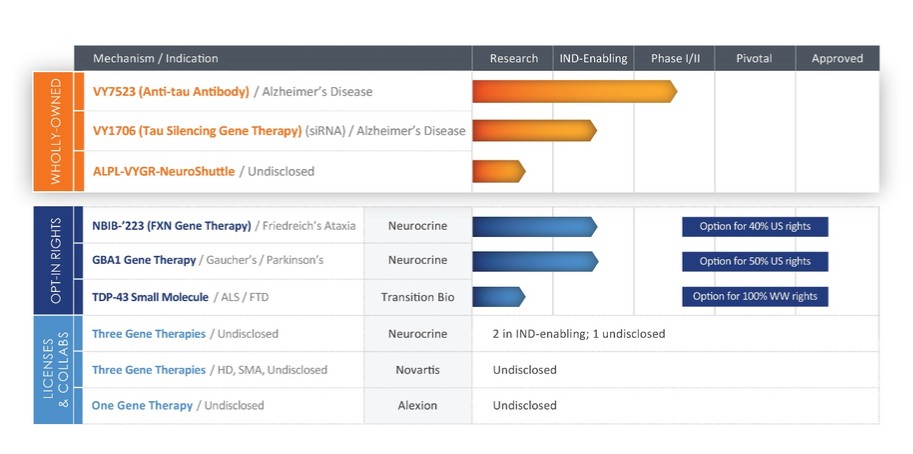
Graphic

Collaboration and License Agreements

2023 Novartis License and Collaboration Agreement

On December 28, 2023, we entered into a License and Collaboration Agreement with Novartis, or the 2023 Novartis Collaboration Agreement, to (a) provide rights to Novartis with respect to certain TRACER Capsids for use in the research, development, and commercialization by Novartis of AAV gene therapy products and product candidates, comprising such TRACER Capsids and payloads intended for the treatment of SMA, or the Novartis SMA Program, and (b) collaborate to develop AAV gene therapy products and product candidates intended for the treatment of HD, or the Novartis HD Program, in each case, leveraging TRACER Capsids and other intellectual property controlled by us. We refer to products and product candidates developed under the Novartis SMA Program as Novartis SMA Program Products, and products and candidates developed under the Novartis HD Program as Novartis HD Program Products. With respect to the Novartis HD Program, the parties have agreed to conduct research and pre-clinical development of Novartis HD Program Products pursuant to a research plan, with Novartis reimbursing us for our activities thereunder in accordance with the agreed-to budget.

Under the 2023 Novartis Collaboration Agreement, we are eligible to receive specified development, regulatory, and commercialization milestone payments of up to an aggregate of $200.0 million for the Novartis SMA Program and up to an aggregate of $225.0 million for the Novartis HD Program, in each case for the first corresponding product to achieve the corresponding milestone. We are also eligible to receive (a) specified sales milestone payments of up to an aggregate of $400.0 million for the Novartis SMA Program and up to an aggregate of $375.0 million for the Novartis HD Program and (b) tiered, escalating royalties in the high single-digit to low double-digit percentages of annual net sales of the Novartis SMA Program Products and the Novartis HD Program Products. The royalties are subject to potential customary reductions, including patent claim expiration, payments for certain third-party licenses, and biosimilar market penetration, subject to specified limits. For a further description of the 2023 Novartis Collaboration Agreement, refer to Note 9, Significant Agreements, to our consolidated financial statements included in our Annual Report on Form 10-K for the fiscal year ended December 31, 2025, under the caption “2023 Novartis Collaboration Agreement.”

2022 Novartis Option and License Agreement

On March 4, 2022, we entered into an option and license agreement with Novartis, or the 2022 Novartis Option and License Agreement. Pursuant to the 2022 Novartis Option and License Agreement, we granted Novartis options, or

22

Table of Contents

the Novartis License Options, to license TRACER Capsids, or the Novartis Licensed Capsids, for exclusive use in programs targeting three specified genes, or the Initial Novartis Targets, to develop and commercialize AAV gene therapy candidates comprised of Novartis Licensed Capsids and payloads directed to the Initial Novartis Targets, or the Novartis Initial Licensed Products. Effective as of March 1, 2023, Novartis exercised its Novartis License Options to license TRACER Capsids for use in gene therapy programs against two undisclosed Initial Novartis Targets. Upon Novartis’ exercise of the two Novartis License Options for Initial Novartis Targets, we granted Novartis a target-exclusive, worldwide license, with the right to sublicense, under certain of our intellectual property, the rights to develop and commercialize the applicable Novartis Licensed Capsid as incorporated into Novartis Initial Licensed Products. We also agreed to provide certain additional know-how to enable Novartis to exploit the Novartis Licensed Capsid and a payload directed to the applicable Initial Novartis Target for use in a Novartis Initial Licensed Product. Novartis elected not to license a capsid for one Initial Novartis Target prior to the expiration of the applicable Novartis License Option. As a result, the non-exclusive research license that we granted to Novartis in connection with this third Initial Novartis Target terminated, and all capsid rights with respect to that Initial Novartis Target returned to us.

On September 3, 2024, we entered into an amendment, or the Novartis Amendment, to the 2022 Novartis Option and License Agreement. Pursuant to the Novartis Amendment, we agreed to amend the 2022 Novartis Option and License Agreement to incorporate the grant to Novartis of a direct license, or a Novartis Direct License, to a TRACER Capsid, or the Novartis Direct Licensed Capsid, for exclusive use with a certain gene, or the Novartis Direct License Target, to develop and commercialize the Novartis Direct Licensed Capsid as incorporated into AAV gene therapy candidates comprised of the Novartis Direct Licensed Capsid and a payload directed to the Novartis Direct License Target, or the Novartis Direct Licensed Products. We refer to (a) the two Initial Novartis Targets for which Novartis has exercised its Novartis License Options and the Novartis Direct License Target collectively as Novartis Licensed Targets, and (b) the Novartis Initial Licensed Products and Novartis Direct Licensed Products collectively as Novartis Licensed Products. As a result of the Novartis Amendment, the Novartis Direct License Target was deemed a Licensed Target under the 2022 Novartis Option and License Agreement, as such term is defined therein, and the Novartis Direct License became subject to all other terms and conditions applicable to other licenses granted to Novartis under the 2022 Novartis Option and License Agreement. In connection with the Novartis Amendment, the parties acknowledged that Novartis’ prior rights to exercise options for any initial targets and additional targets as described in the 2022 Novartis Option and License Agreement, other than those that had previously been exercised, had expired as of the effective date of the Novartis Amendment.

Under the terms of the 2022 Novartis Option and License Agreement, Novartis has the right to terminate the agreement, in whole or in part, for any or no reason upon ninety days’ written notice to us. In October 2025, Novartis notified us of its partial termination of the 2022 Novartis Option and License Agreement with respect to one Initial Novartis Target and the Novartis Direct License Target, in each case effective February 1, 2026, or the Effective Partial Termination Date.

Following the termination of the two programs, the licenses we granted to Novartis regarding the applicable Initial Novartis Target and the Novartis Direct License Target expired, and all intellectual property rights that we licensed to Novartis with respect to such programs reverted to us in accordance with the 2022 Novartis Option and License Agreement. As of the Effective Partial Termination Date, we are no longer eligible to receive the milestone payments or royalties associated with these programs. The 2022 Novartis Option and License Agreement remains in full force and effect for, and we remain eligible to receive milestone payments and royalties in connection with, the remaining Initial Novartis Target.

We are eligible to receive specified development, regulatory, and commercialization milestone payments of up to an aggregate of $125.0 million for the first Novartis Initial Licensed Product for the remaining Initial Novartis Target for which a Novartis License Option has been exercised to achieve the corresponding milestone. We are eligible to receive (a) specified sales milestone payments of up to an aggregate of $175.0 million per Novartis Licensed Product directed to the remaining Initial Novartis Target and (b) tiered, escalating royalties in the mid-to high-single-digit percentages based on annual net sales of each Novartis Licensed Product directed to the remaining Initial Novartis Target. The remaining Initial Novartis Target is distinct from targets in our wholly-owned and partnered pipeline. For a further description of the 2022 Novartis Option and License Agreement, refer to Note 9, Significant Agreements, to our

23

Table of Contents

consolidated financial statements included in our Annual Report on Form 10-K for the fiscal year ended December 31, 2025, under the caption “2022 Novartis Option and License Agreement.”

2023 Neurocrine Collaboration Agreement

On January 8, 2023, we entered into a collaboration and license agreement with Neurocrine, or the 2023 Neurocrine Collaboration Agreement, for the research, development, manufacture and commercialization of the GBA1 Program, and three new programs focused on the research, development, manufacture and commercialization of gene therapies designed to address CNS diseases or conditions associated with rare genetic targets, or the 2023 Discovery Programs, and, collectively with the GBA1 Program, the 2023 Neurocrine Programs. With the exception of one preclinical study where we agreed to share costs, Neurocrine has agreed to be responsible for all costs we incur in conducting preclinical development activities for each 2023 Neurocrine Program, in accordance with workplans and budgets agreed upon by a Joint Steering Committee, or the JSC.

The 2023 Neurocrine Collaboration Agreement provides for aggregate development milestone payments from Neurocrine to us for the gene therapy products, or the 2023 Collaboration Products, under (a) the GBA1 Program of up to $985.0 million; and (b) each of the three 2023 Discovery Programs of up to $175.0 million for each 2023 Discovery Program. We may be entitled to receive aggregate commercial milestone payments for up to two 2023 Collaboration Products under the GBA1 Program of up to $950.0 million per 2023 Collaboration Product and for one 2023 Collaboration Product under each 2023 Discovery Program of up to $275.0 million per 2023 Discovery Program. We agreed to forfeit certain milestones and royalties on net sales in the United States if we exercise our option to co-develop and co-commercialize 2023 Collaboration Products in the GBA1 Program in the United States upon the occurrence of a specified event.

Neurocrine has also agreed to pay us tiered royalties, based on future net sales of the 2023 Collaboration Products. Such royalty percentages, for net sales in and outside the United States, range from (a) for the GBA1 Program, the low double-digits to twenty and the high single-digits to mid-teens, respectively, and (b) for each 2023 Discovery Program, high single-digits to mid-teens and mid-single digits to low double-digits, respectively. For a further description of the 2023 Neurocrine Collaboration Agreement, refer to Note 9, Significant Agreements, to our consolidated financial statements included in our Annual Report on Form 10-K for the fiscal year ended December 31, 2025, under the caption “2023 Neurocrine Collaboration Agreement.”

2019 Neurocrine Collaboration Agreement

In January 2019, we entered into the 2019 Neurocrine Collaboration Agreement for the research, development and commercialization of certain of our AAV gene therapy products. Under the 2019 Neurocrine Collaboration Agreement, we agreed to collaborate on the conduct of four collaboration programs, which we refer to collectively as the 2019 Neurocrine Programs: the NBIb-1817 (VY-AADC) program for the treatment of PD, or the VY-AADC Program; the FA Program; and two other programs, or the 2019 Discovery Programs. Effective August 2, 2021, Neurocrine terminated the VY-AADC Program under the 2019 Neurocrine Collaboration Agreement, and the license granted by us to Neurocrine expired and we regained worldwide intellectual property rights regarding such program.

On April 30, 2025, as a result of Neurocrine no longer prioritizing the two 2019 Discovery Programs, the JSC mutually agreed to discontinue the activities associated with such programs, and to return the rights to those targets to us. As a result of the discontinuation, the licenses granted by us to Neurocrine thereunder regarding the 2019 Discovery Programs terminated and we regained worldwide intellectual property rights regarding such programs. The 2019 Neurocrine Collaboration Agreement remains in full force and effect for the FA Program.

The 2019 Neurocrine Collaboration Agreement provides for aggregate development milestone payments from Neurocrine to us for the gene therapy products, or the 2019 Collaboration Products under the FA Program of up to $195.0 million. We may be entitled to receive aggregate commercial milestone payments for each 2019 Collaboration Product of up to $275.0 million, for a total of up to $550.0 million under the FA Program. Neurocrine has also agreed to pay us royalties, based on future net sales of the 2019 Collaboration Products. Such royalty percentages, for net sales in and outside the United States, as applicable, range from the low-teens to high-teens and high-single digits to mid-teens,

24

Table of Contents

for the FA Program. For a further description of the 2019 Neurocrine Collaboration Agreement, refer to Note 9, Significant Agreements, to our consolidated financial statements included in our Annual Report on Form 10-K for the fiscal year ended December 31, 2025 under the caption “2019 Neurocrine Collaboration Agreement.”

Alexion Option and License Agreement

On October 1, 2021, we entered into an option and license agreement, or the Alexion Agreement, with Pfizer Inc., or Pfizer, pursuant to which we granted Pfizer options to receive an exclusive license to certain TRACER Capsids to develop and commercialize certain AAV gene therapy candidates comprised of a capsid and specified transgene. Effective as of September 30, 2022, Pfizer exercised one option with respect to a capsid for a specified transgene for the potential treatment of a rare neurological disease, and we granted Pfizer an exclusive, worldwide license, with the right to sublicense, under certain of our intellectual property, the rights to develop and commercialize rare neurological disease products utilizing the capsid candidate and incorporating the specified transgene.

Effective upon the closing of a transaction on September 20, 2023, Alexion (via Alexion Pharma International Operations Limited, or APIO) acquired all of Pfizer’s rights under the Alexion Agreement and became the successor-in-interest to Pfizer thereunder. APIO subsequently assigned the Alexion Agreement to its affiliate AstraZeneca Ireland Limited, or AstraZeneca. Neither the acquisition by Alexion nor the subsequent assignment from APIO to AstraZeneca impacted the material terms of the Alexion Agreement.

Pursuant to an amendment to the Alexion Agreement effective as of September 30, 2024, we agreed to extend the research term thereunder until April 1, 2025, during which period we may, at our sole discretion and expense, conduct further research activities to identify additional TRACER Capsids for potential use in the development of AAV gene therapies under the Alexion Agreement. Effective March 15, 2025, we agreed to further extend the research term to October 1, 2025. On October 1, 2025, Alexion exercised its right to substitute another TRACER Capsid for the TRACER Capsid that was originally licensed under the Alexion Agreement. For a further description of the Alexion Agreement, refer to Note 9, Significant Agreements, to our consolidated financial statements included in our Annual Report on Form 10-K for the fiscal year ended December 31, 2025, under the caption “Alexion Option and License Agreement (Formerly Pfizer Option and License Agreement).”

License Agreement with Transition Bio

In June 2025, we entered into a research collaboration, option and license agreement with Transition Bio, or the Transition Bio Agreement. The Transition Bio Agreement superseded a prior agreement between us and Transition Bio dated December 24, 2024. Under the terms of the agreement, Transition Bio is responsible for the discovery and optimization of small molecules targeting TDP-43 until nomination of a development candidate, upon which we will have an option to license the worldwide exclusive rights to develop and commercialize the program. The Transition Bio Agreement contains a termination for convenience clause that allows for either party to terminate the arrangement for any reason or no reason upon sixty days prior written notice. In the event that we terminate the Transition Bio Agreement due to a change in control, we are obligated to pay Transition Bio up to $2.0 million in termination fees.

We paid Transition Bio a low single-digit million dollar upfront payment during the year ended December 31, 2024 in connection with a prior agreement. During the fourth quarter of 2025, we paid Transition Bio an additional low single-digit million dollar payment for the achievement of a research milestone. Transition Bio is eligible to receive potential research, development, commercial and net sales milestone payments totaling up to $500.0 million. Transition Bio is also eligible for high single-digit to low double-digit royalties on net sales during the royalty term of up to ten years. For a further description of the Transition Bio Agreement, refer to Note 9, Significant Agreements, to our consolidated financial statements included in our Annual Report on Form 10-K for the fiscal year ended December 31, 2025, under the caption “Other Agreements.”

License Agreement with Touchlight IP Limited

In November 2022, we and Touchlight IP Limited, or Touchlight, entered into a license agreement, or the Touchlight License Agreement, to authorize historical use by us of a certain DNA preparation process, or the Subject

25

Table of Contents

DNA Preparation Process, and to authorize the prospective exploitation of TRACER Capsids created with the use of the Subject DNA Preparation Process. The terms of the Touchlight License Agreement include future milestone payments and low single-digit royalties payable to Touchlight by us if we or our program collaborators or licensees choose to utilize in a therapeutic product certain TRACER Capsids that were created with the historical use of the Subject DNA Preparation Process. Additionally, we are obligated to pay low single-digit royalties to Touchlight on future payments we receive in connection with licensing of certain TRACER Capsids that were created with the historical use of the Subject DNA Preparation Process, excluding the licensing of or collaboration on any of our therapeutic programs. For a further description of the TouchLight License Agreement, refer to Note 9, Significant Agreements, to our consolidated financial statements included in our Annual Report on Form 10-K for the fiscal year ended December 31, 2025, under the caption “Other Agreements.”

Accumulated Deficit; Expenses

We have a history of incurring significant losses. We reported a net loss of $27.9 million for the three months ended March 31, 2026, and a net loss of $119.7 million for the fiscal year ended December 31, 2025. As of March 31, 2026, we had an accumulated deficit of $473.8 million. We expect to continue to incur significant expenses and operating losses for the foreseeable future in connection with our ongoing activities, if and as we:

initiate and conduct clinical trials in connection with our VY1706 tau silencing program, which we expect to initiate in the second half of 2026, and continue to conduct clinical trials in connection with our VY7523 anti-tau antibody program;
continue investing in our proprietary antibody program, non-viral therapeutics platform, gene therapy platforms and programs, and other research and development initiatives;
continue investing in NeuroShuttle, our proprietary non-viral delivery platform leveraging novel receptor-binding molecules to transport multiple modalities of neurotherapeutics across the BBB;
continue investing in and supporting TRACER, our proprietary discovery platform to facilitate the selection of TRACER Capsids, and our investment to discover TRACER Capsids with broad tropism in CNS and other tissues with cell-specific transduction properties for particular therapeutic applications;
continue investing in our collaboration with Transition Bio to advance small molecules targeting TDP-43 to treat ALS and frontotemporal dementia with TDP-43 pathology;
increase our investment in the discovery and development of additional modalities for receptor-mediated non-viral delivery of therapeutic payloads to the CNS, including but not limited to our ALPL and other BBB-receptor;
conduct joint research and development under our strategic collaborations for the research, development, and commercialization of certain of our pipeline programs, including our FA Program, pursuant to the 2019 Neurocrine Collaboration Agreement, our GBA1 Program, pursuant to the 2023 Neurocrine Collaboration Agreement, and the Novartis HD Program, pursuant to the 2023 Novartis Collaboration Agreement;
initiate additional preclinical studies and clinical trials for, and continue research and development of, our other programs;
continue our process research and development activities, as well as establish our research-grade manufacturing capabilities;
identify additional diseases for treatment with our AAV gene and non-viral therapies and BBB-crossing technologies and develop additional programs or product candidates;

26

Table of Contents

seek marketing and regulatory approvals for any of our product candidates that successfully complete clinical development;
maintain, expand, protect and enforce our intellectual property portfolio;
identify, acquire or in-license other product candidates and technologies;
expand our operational, financial and management systems and personnel, including personnel to support our clinical development, manufacturing and commercialization efforts;
increase our clinical trial insurance coverage as we expand our clinical trials and increase our product liability insurance once we engage in commercialization efforts; and
continue to operate as a public company.

As discussed within “Liquidity and Capital Resources”, we expect to continue to rely on additional financing and business development transactions to achieve our business objectives. If we are unable to raise additional funds when needed, we may be required to delay, limit, reduce or terminate our product development or future commercialization efforts or grant rights to develop and market products or product candidates that we would otherwise prefer to develop and market ourselves.

Financial Operations Overview

Revenue

To date, we have not generated any revenue from product sales and do not expect to generate any revenue from product sales for the foreseeable future. For the three months ended March 31, 2026, we recognized $1.3 million of collaboration revenue from the 2023 Neurocrine Collaboration Agreement, $0.1 million of collaboration revenue from the 2019 Neurocrine Collaboration Agreement, and $1.2 million of collaboration revenue in connection with the 2023 Novartis Collaboration Agreement. For the three months ended March 31, 2025, we recognized $4.5 million of collaboration revenue from the 2023 Neurocrine Collaboration Agreement, $0.5 million of collaboration revenue from the 2019 Neurocrine Collaboration Agreement, $1.2 million of collaboration revenue in connection with the 2023 Novartis Collaboration Agreement, and $0.3 million of other collaboration revenue.

For additional information about our revenue recognition policy related to collaborations pursuant to the 2023 and 2019 Neurocrine Collaboration Agreements and the 2023 Novartis Collaboration Agreement, refer to Note 9, Significant Agreements, of the December 31, 2025, consolidated financial statements included in our Annual Report on Form 10-K for the fiscal year ended December 31, 2025.

For the foreseeable future, we expect substantially all of our revenue will be generated from the 2019 Neurocrine Collaboration Agreement, the 2023 Neurocrine Collaboration Agreement, the 2023 Novartis Collaboration Agreement, the 2022 Novartis Option and License Agreement, and the Alexion Agreement, and any other strategic collaborations and out-licensing arrangements we may enter into in the future. If our development efforts are successful, we may also generate revenue from product sales.

Expenses

Research and Development Expenses

Research and development expenses consist primarily of costs incurred for our research activities, including our program discovery efforts and the development of our proprietary antibody, gene therapy, and non-viral therapeutic platforms and programs, which include:

employee-related expenses including salaries, benefits, and stock-based compensation expense;

27

Table of Contents

costs of funding research performed by third parties that conduct research and development, preclinical and clinical activities, manufacturing and production design on our behalf;

the cost of purchasing laboratory supplies and non-capital equipment used in designing, developing and manufacturing preclinical and clinical study materials;
consultant fees;
facility costs, including rent, depreciation and maintenance expenses;
the cost of securing and protecting intellectual property rights associated with our research and development activities;
fees for maintaining licenses under our third-party licensing agreements; and
payments under our research and collaboration agreements.

Research and development costs are expensed as incurred. Costs for certain activities, such as manufacturing, preclinical studies, and clinical trials, are generally recognized based on an evaluation of the progress to completion of specific tasks using information and data provided to us by our vendors and collaborators.

Research and development activities are central to our business model. We are in the early stages of development of our product candidates. We expect research and development expenses to decrease in the near term as a result of continued portfolio prioritization and alignment of operating expenditures with our current capital resources. At this time, we cannot reasonably estimate or know the nature, timing and estimated costs of the efforts that will be necessary to complete the development of our product candidates.

Because of the numerous risks and uncertainties associated with pharmaceutical product development, we are unable to accurately predict the timing or amount of increased expenses. Our expenses will increase if:

we are required by the FDA or the European Medicines Agency or other regulatory agencies to redesign or modify trials or studies or to perform trials or studies in addition to those currently expected;
there are any delays in the receipt of regulatory clearance to begin our planned clinical programs; or
there are any delays in site initiation, enrollment of participants in or completion of our clinical trials or the development of our product candidates.

General and Administrative Expenses

General and administrative expenses consist primarily of salaries and other related costs, including stock-based compensation, for personnel in executive, finance, accounting, information technology, business development, legal and human resource functions. Other significant costs include corporate facility costs not otherwise included in research and development expenses, legal fees related to patent and corporate matters, and fees for accounting and consulting services. We expect general and administrative costs to decrease in the near term as a result of our continued disciplined expense management.

Other Income, Net

Other income, net consists primarily of interest income on our marketable securities and payments received under the sublease of the office and laboratory space in Cambridge, Massachusetts.

Critical Accounting Policies and Estimates

We believe that several accounting policies are important to understanding our historical and future performance. We refer to these policies as critical because these specific areas generally require us to make judgments

28

Table of Contents

and estimates about matters that are uncertain at the time we make the estimate. There were no changes to our critical accounting policies during the three months ended March 31, 2026, as compared to those identified in our Annual Report on Form 10-K for the fiscal year ended December 31, 2025. It is important that the discussion of our operating results that follow be read in conjunction with the critical accounting policies disclosed in Item 7 “Management’s Discussion and Analysis of Financial Condition and Results of Operations – Critical Accounting Policies and Estimates in our Annual Report on Form 10-K, as filed with the SEC on March 9, 2026.

Results of Operations

Comparison of the three months ended March 31, 2026 and 2025

The following table summarizes our results of operations for the three months ended March 31, 2026, and 2025:

Three Months Ended

March 31, 

2026

  ​ ​ ​

2025

  ​ ​ ​

Change

(in thousands)

Collaboration revenue

$

2,593

  ​ ​ ​

$

6,473

  ​ ​ ​

$

(3,880)

Operating expenses:

Research and development


24,602


31,526


(6,924)

General and administrative


8,261


9,640


(1,379)

Total operating expenses


32,863


41,166


(8,303)

Other income, net:

Interest income

1,912

3,291

(1,379)

Other income

435

418

17

Total other income, net


2,347


3,709


(1,362)

Loss before income taxes

(27,923)

(30,984)

3,061

Income tax provision

14

37

(23)

Net loss

$

(27,937)

$

(31,021)

$

3,084

Collaboration Revenue

Collaboration revenue was $2.6 million and $6.5 million for the three months ended March 31, 2026 and 2025, respectively. During the three months ended March 31, 2026, we recognized $1.3 million of collaboration revenue under the 2023 Neurocrine Collaboration Agreement, $0.1 million of collaboration revenue under the 2019 Neurocrine Collaboration Agreement, and $1.2 million of collaboration revenue under the 2023 Novartis Collaboration Agreement. During the three months ended March 31, 2025, we recognized $4.5 million of collaboration revenue under the 2023 Neurocrine Collaboration Agreement, $0.5 million of collaboration revenue under the 2019 Neurocrine Collaboration Agreement, $1.2 million of collaboration revenue under the 2023 Novartis Collaboration Agreement, and $0.3 million in other collaboration revenue.

29

Table of Contents

Research and Development Expense

The following table summarizes our research and development expenses for the three months ended March 31, 2026 and 2025:

Three Months Ended

March 31, 

2026

  ​ ​ ​

2025

  ​ ​ ​

Change

(in thousands)

Internal research and development

$

8,093

$

9,958

$

(1,865)

External research and development:


Anti-tau antibody program (VY7523)

2,377

4,249

(1,872)

Tau silencing gene therapy program (VY1706)

5,636

3,174

2,462

SOD1 silencing gene therapy program

1,886

(1,886)

Partnered programs

672

991

(319)

Other programs and platforms

1,699

3,181

(1,482)

Facilities and other


6,125


8,087


(1,962)

Total research and development expenses

$

24,602

$

31,526

$

(6,924)

Research and development expense was $24.6 million and $31.5 million for the three months ended March 31, 2026 and March 31, 2025, respectively. The $6.9 million decrease was primarily due to the discontinuation of the SOD1 program, reduced spend on the anti-tau antibody program (VY7523) as enrollment in planned clinical trials was completed, and lower employee-related expenses as we had lower headcount due to cost-cutting initiatives. The decrease was partially offset by an increase in the tau silencing gene therapy program (VY1706) in preparation for the planned clinical trial initiation.

General and Administrative Expense

General and administrative expense decreased by $1.4 million from $9.6 million for the three months ended March 31, 2025 to $8.3 million for the three months ended March 31, 2026. The decrease in general and administrative expense was primarily attributable to lower legal fees and reduced employee-related expenses as a result of lower headcount year-over-year due to cost-cutting and efficiency initiatives.

Other Income, Net

Other income, net decreased by $1.4 million from $3.7 million for the three months ended March 31, 2025 to $2.3 million for the three months ended March 31, 2026. The decrease was primarily due to decreased interest income on our marketable securities balances, as our marketable securities balance decreased during the three months ended March 31, 2026, as compared to the three months ended March 31, 2025.

Liquidity and Capital Resources

Sources of Liquidity

We have funded our operations primarily through private placements of redeemable convertible preferred stock, public offerings and private placements of our common stock, strategic collaborations and option and license arrangements, including our 2019 Neurocrine Collaboration Agreement, 2023 Neurocrine Collaboration Agreement, 2022 Novartis Option and License Agreement, 2023 Novartis Collaboration Agreement, Alexion Agreement, and our prior collaboration agreements.

In November 2025, we entered into a sales agreement with TD Securities (USA) LLC, as the sales agent, pursuant to which we may from time to time, issue and sell common stock with an aggregate value of up to $100.0 million in an at-the-market offering, or the ATM Facility. We sold 630,570 shares of our common stock under the ATM Facility during the three months ended March 31, 2026. These shares were sold at a weighted average price per share of

30

Table of Contents

$4.92 for aggregate net proceeds of $3.0 million, after deducting commissions and offering costs. As of March 31, 2026, $96.9 million remained available to be sold under the ATM Facility.

Cash Flows

The following table provides information regarding our cash flows for the three months ended March 31, 2026, and 2025:

Three Months Ended March 31, 

2026

  ​ ​ ​

2025

  ​ ​ ​(in thousands)

Net cash (used in) provided by:


Operating activities

$

(33,419)

$

(37,895)

Investing activities


8,101


41,201

Financing activities


3,332


82

Net increase in cash, cash equivalents, and restricted cash

$

(21,986)

$

3,388

Net Cash Used in Operating Activities

Net cash used in operating activities was $33.4 million during the three months ended March 31, 2026, compared to $37.9 million during the three months ended March 31, 2025. The decrease in net cash used in operating activities is primarily attributed to a lower net loss. Net cash used in operating activities during the three months ended March 31, 2026, was primarily due to our net loss of $27.9 million, combined with changes in our working capital accounts, including decreases in accrued expenses and accounts payable and deferred revenue during the three months ended March 31, 2026.

Net cash used in operating activities during the three months ended March 31, 2025, was primarily due to our net loss of $31.0 million, combined with changes in our working capital accounts, including a decrease in accrued expenses and deferred revenue during the three months ended March 31, 2025.

Net Cash Provided by Investing Activities

Net cash provided by investing activities was $8.1 million during the three months ended March 31, 2026, compared to $41.2 million during the three months ended March 31, 2025. The decrease was primarily due to a decrease in proceeds from sales and maturities of marketable securities of $67.2 million, partially offset by decreases in purchases of marketable securities of $33.5 million during the three months ended March 31, 2026.

Net Cash Provided by Financing Activities

Net cash provided by financing activities was $3.3 million during the three months ended March 31, 2026, compared to $0.1 million during the three months ended March 31, 2025. The increase was primarily due to $3.0 million in proceeds during the three months ended March 31, 2026, from the issuance of common stock from the ATM Facility.

Funding Requirements

Our expenses decreased during the three months ended March 31, 2026, as compared with the three months ended March 31, 2025, as a result of continued portfolio prioritization and alignment of operating expenditures with our current capital resources. We expect we will continue to incur research and development expenses as we continue our research and development activities, conduct clinical trials, including completing the Phase 1 MAD clinical trial for VY7523 and initiating the clinical trial for VY1706, pending successful IND clearance, and seek marketing approval of our product candidates, and as we continue to enter into or conduct activities in connection with our collaboration agreements. In addition, if we obtain marketing approval for any of our product candidates, we expect to incur significant expenses related to program sales, marketing, manufacturing and distribution to the extent that such sales, marketing and distribution are not the responsibility of potential collaborators. Furthermore, we expect to continue to

31

Table of Contents

incur costs associated with operating as a public company, including executing financial statement controls, satisfying regulatory and quality standards, fulfilling healthcare compliance requirements, and maintaining product, clinical trial and directors’ and officers’ liability insurance coverage. We also anticipate the cost of goods and services and the levels of compensation paid to employees will increase due to inflationary conditions existing in the general economy. Accordingly, we will need to obtain substantial additional funding in connection with our continuing operations. If we are unable to raise capital or enter into business development transactions when needed or on acceptable terms, we could be forced to delay, reduce or eliminate our research and development programs or any future commercialization efforts.

As of March 31, 2026, we had cash, cash equivalents, and marketable securities of $171.7 million. Based upon our current operating plan, we expect that our existing cash, cash equivalents, and marketable securities at March 31, 2026, along with amounts expected to be received as reimbursement for development costs under our collaboration and license agreements with Neurocrine and Novartis and interest income, to be sufficient to meet our planned operating expenses and capital expenditure requirements into 2028. Our future capital requirements will depend on many factors, including:

the scope, progress, results, and costs of product discovery, preclinical studies and clinical trials for our product candidates, including our ongoing Phase 1 clinical trial to evaluate VY7523 and our planned Phase 1 clinical trial to evaluate VY1706;
the scope, progress, results, costs, prioritization, and number of our research and development programs;
the progress and status of our strategic collaborations and option and license agreements and any similar arrangements we may enter into in the future, including any research and development costs for which we are responsible, future additional obligations that we may be committed to in connection with these agreements, including, for example, if we elect to exercise our rights for any of the three programs for which we retain opt-in rights, and our receipt of any expense reimbursements, future milestone payments and royalties from our collaboration partners or licensors;
the extent to which we are obligated to reimburse preclinical development and clinical trial costs, or the achievement of milestones or occurrence of other developments that trigger milestone and royalty payments, under any collaboration or license agreements to which we might become a party, such as the Touchlight License Agreement and the Transition Bio Agreement;
the costs, timing and outcome of regulatory review of our product candidates;
our ability to establish and maintain collaboration, distribution, or other marketing arrangements for our product candidates on favorable terms, if at all;
the costs and timing of preparing, filing and prosecuting patent applications, maintaining and enforcing our intellectual property rights and defending intellectual property-related claims;
the extent to which we acquire or in-license other product candidates and technologies, including any intellectual property associated with such candidates or technologies, acquire or invest in other businesses, or out-license our product candidates, capsids or other technologies;
the costs of advancing our manufacturing capabilities and securing manufacturing arrangements for pre-commercial and commercial production;
the level of product sales by us or our collaborators from any product candidates for which we obtain marketing approval in the future;
the costs of operating as a public company and maintaining adequate product, clinical trial, and directors’ and officers’ liability insurance coverage; and

32

Table of Contents

the costs of establishing or contracting for sales, manufacturing, marketing, distribution, and other commercialization capabilities if we obtain regulatory approvals to market our product candidates.

Identifying potential product candidates and conducting preclinical studies and clinical trials is a time-consuming, expensive and uncertain process that takes years to complete. We may never generate the necessary data or results required to obtain marketing approval and achieve product sales. In addition, our product candidates, if approved, may not achieve commercial success. Our product revenues, if any, and any commercial milestone payments or royalty payments under our collaboration agreements will be derived from sales of products that may not be commercially available for many years, if at all. Accordingly, we will need to continue to rely on additional financing and business development transactions to achieve our business objectives. Adequate additional financing may not be available to us on acceptable terms, or at all.

Until such time, if ever, as we can generate product revenues sufficient to achieve consistent profitability, we expect to finance our cash needs through a combination of equity offerings, debt financings, collaborations, strategic alliances, and option and license arrangements. We do not have any committed external source of funds other than the amounts we are entitled to receive from our collaboration partners and licensees for reimbursement of certain research and development expenses, potential option exercises, the achievement of specified regulatory and commercial milestones, and royalty payments under our collaboration, and option and license agreements, as applicable. To the extent that we raise additional capital through the sale of equity or equity-linked securities, including convertible debt, our stockholders’ ownership interests will be diluted, and the terms of these securities may include liquidation or other preferences that adversely affect our existing stockholders’ rights as holders of our common stock. Debt financing and preferred equity financing, if available, may involve agreements that include covenants limiting or restricting our ability to take specific actions, such as incurring additional debt, obtaining additional capital, acquiring or divesting businesses, making capital expenditures or declaring dividends.

If we raise additional funds through collaborations, strategic alliances, or option and license arrangements with third parties, we may have to relinquish valuable rights to our technologies, future revenue streams, research programs or product candidates or to grant licenses on terms that may not be favorable to us. If we are unable to raise additional funds through equity or debt financings when needed, we may be required to delay, limit, reduce or terminate our product development or future commercialization efforts or grant rights to develop and market products or product candidates that we would otherwise prefer to develop and market ourselves.

Contractual Obligations

We enter into agreements in the normal course of business with clinical research organizations, contract manufacturing organizations, and institutions to license intellectual property. These contracts generally are cancelable at any time by us upon 30 to 90 days prior written notice.

Our agreements to license intellectual property generally include potential milestone payments that are dependent upon the development of products using the intellectual property licensed under the agreements and contingent upon the achievement of clinical trial or regulatory approval milestones. We may also be required to pay annual maintenance fees or minimum amounts payable ranging from low-four digits to low five-digits depending upon the terms of the applicable agreement. In certain instances, we are also obligated to pay our licensors royalties based on sales of products, if approved, using the intellectual property licensed under the applicable agreement.

We also have non-cancelable operating lease commitments arising from our leases of office and laboratory space at our facilities in Cambridge and Lexington, Massachusetts. For more information, refer to Note 6 to our unaudited condensed consolidated financial statements included elsewhere in this Quarterly Report on Form 10-Q.

Off-Balance Sheet Arrangements

We did not have, during the periods presented, and we do not currently have, any off-balance sheet arrangements, as defined under applicable SEC rules.

33

Table of Contents

ITEM 3. QUANTITATIVE AND QUALITATIVE DISCLOSURES ABOUT MARKET RISK

We are exposed to market risk related to changes in interest rates. We have policies requiring us to invest in high-quality issuers, limit our exposure to any individual issuer, and ensure adequate liquidity. Our primary exposure to market risk is interest rate sensitivity, which is affected by changes in the general level of U.S. interest rates, particularly because our investments, including cash equivalents, are in the form of money market funds and marketable securities and are invested in U.S. Treasury notes or government obligations and corporate securities. Due to the short-term duration of our investment portfolio and the low risk profile of our investments, we believe an immediate 100 basis point change in interest rates would not have a material effect on the fair market value of our portfolio.

We are not currently exposed to market risk related to changes in foreign currency exchange rates; however, we may contract with vendors that are located in Asia and Europe in the future and may be subject to fluctuations in foreign currency rates at that time.

Inflation generally affects us by increasing our costs of labor, goods, and services. We do not believe that inflation had a material effect on our business, financial condition, or results of operations during the three months ended March 31, 2026.

ITEM 4. CONTROLS AND PROCEDURES

Management’s Evaluation of Disclosure Controls and Procedures

We maintain disclosure controls and procedures,” as defined in Rules 13a-15(e) or 15d-15(e) under the Exchange Act of 1934, or the Exchange Act, to mean controls and other procedures of a company that are designed to ensure that information required to be disclosed by a company in the reports that it files or submits under the Exchange Act is recorded, processed, summarized, and reported within the time periods specified in the SEC’s rules and forms. Our disclosure controls and procedures include, without limitation, controls and other procedures designed to ensure that information required to be disclosed by us in the reports we file or submit under the Exchange Act is accumulated and communicated to our management, including our principal executive officer and principal financial officer, as appropriate, to allow timely decisions regarding required disclosure.

Our management, with the participation of our principal executive officer and principal financial officer, evaluated the effectiveness of our disclosure controls and procedures as of March 31, 2026. Our management recognizes that any controls and procedures, no matter how well designed and operated, can provide only reasonable assurance of achieving their objectives, and management necessarily applies its judgment in evaluating the cost-benefit relationship of possible controls and procedures. Our principal executive officer and principal financial officer have concluded based upon the evaluation described above that, as of March 31, 2026, our disclosure controls and procedures were effective at the reasonable assurance level.

We continue to review and document our disclosure controls and procedures and may from time to time make changes aimed at enhancing their effectiveness and to ensure that our systems evolve with our business.

Changes in Internal Control over Financial Reporting

During the first quarter of 2026, we completed the implementation of a new enterprise resource planning, or ERP, system to replace our previous ERP system. As a result of this implementation, we modified certain existing internal controls over financial reporting and implemented application controls related to the new ERP system. The changes in process and procedures under the new ERP system continue to be subject to our evaluation of the operating effectiveness of internal control over financial reporting. During the three months ended March 31, 2026, there have been no other changes in our internal control over financial reporting, as such term is defined in Rules 13a-15(f) and 15d-15(f) under the Exchange Act, that have materially affected, or are reasonably likely to materially affect, our internal control over financial reporting.

34

Table of Contents

PART II. OTHER INFORMATION

ITEM 1. LEGAL PROCEEDINGS

In the ordinary course of business, we are from time to time involved in lawsuits, claims, investigations, proceedings, and threats of litigation relating to intellectual property, commercial arrangements and other matters. While the outcome of any such matters cannot be predicted with certainty, as of March 31, 2026, we were not party to any material pending proceedings. No material governmental proceedings are pending or, to our knowledge, contemplated against us. We are not a party to any material proceedings in which any director, member of senior management or affiliate of ours is either a party adverse to us or our subsidiaries or has a material interest adverse to us or our subsidiaries.

ITEM 1A. RISK FACTORS

We are subject to a number of risks that could adversely affect our business, results of operations financial condition and future prospects, including those identified in our Annual Report on Form 10-K for the fiscal year ended December 31, 2025, filed with the Securities and Exchange Commission on March 9, 2026. Any of the risks and uncertainties described in our Annual Report on Form 10-K could materially and adversely affect our business, financial condition, results of operations and future growth prospects, and such risks and uncertainties are not the only ones we face. Additional risks and uncertainties not presently known to us or that we presently deem less significant may also impair our business operations. Please see the discussion under the caption “Forward-Looking Statements” in this Quarterly Report on Form 10-Q for a discussion of some of the forward-looking statements that are qualified by these risk factors.

ITEM 5.OTHER INFORMATION

Director and Officer Trading Arrangements

A portion of the compensation of our directors and officers (as defined in Rule 16a-1(f) under the Securities Exchange Act of 1934, as amended, or the Exchange Act,) is in the form of equity awards and, from time to time, directors and officers engage in open-market transactions with respect to the securities acquired pursuant to such equity awards or our other securities, including to satisfy tax withholding obligations when equity awards vest or are exercised, and for diversification or other personal reasons.

Transactions in our securities by directors and officers are required to be made in accordance with our insider trading policy, which requires that the transactions be in accordance with applicable U.S. federal securities laws that prohibit trading while in possession of material nonpublic information. Rule 10b5-1 under the Exchange Act provides an affirmative defense that enables directors and officers to prearrange transactions in our securities in a manner that avoids concerns about initiating transactions while in possession of material nonpublic information.

35

Table of Contents

The following table describes, for the quarterly period covered by this report, each trading arrangement for the sale or purchase of our securities adopted or terminated by our directors and officers that is either (1) a contract, instruction or written plan intended to satisfy the affirmative defense conditions of Rule 10b5-1(c) (a “Rule 10b5-1 trading arrangement”), or (2) a “non-Rule 10b5-1 trading arrangement” (as defined in Item 408(c) of Regulation S-K):

Name (Title)

Action Taken
(Date of Action)

Type of Trading
Arrangement

Nature of
Trading
Arrangement

Duration of Trading
Arrangement

Aggregate Number of Securities

Gregory Shiferman
(Senior Vice President, General Counsel & Secretary)

Adoption (January 5, 2026)

Durable Rule 10b5-1 trading arrangement for sell-to-cover transactions related to restricted stock units, or RSUs

Sale

Until final settlement of any covered RSU

Indeterminable (1)

(1) The number of shares subject to covered RSUs that will be sold to satisfy applicable tax withholding obligations upon vesting is unknown as the number will vary based on the extent to which vesting conditions are satisfied, the market price of our common stock at the time of settlement, and the potential future grant of additional RSUs subject to this arrangement. This trading arrangement, which applies to RSUs whether vesting based on the passage of time or the achievement of performance milestones, provides for the automatic sale of shares that would otherwise be issuable on each settlement date of a covered RSU in an amount sufficient to satisfy the applicable withholding obligation, with the proceeds of the sale delivered to us in satisfaction of the applicable withholding obligation.

36

Table of Contents

ITEM 6.EXHIBITS

The exhibits filed or furnished as part of this Quarterly Report are set forth on the Exhibit Index, which is incorporated herein by reference.

INDEX TO EXHIBITS

Incorporated by Reference to:

Exhibit
No.

  ​

Description

  ​ ​

Form or
Schedule

  ​ ​

Exhibit
No.

  ​

Filing
Date with
SEC

  ​

SEC File
Number

  ​

Filed
Herewith

10.1#

Employment Agreement, by and between the Registrant and Gregory Shiferman, dated as of December 4, 2025.

X

10.2#

Form of Stock Option Agreement under 2025 Stock Incentive Plan

X

10.3#

Form of Non-Employee Director Non-Statutory Stock Option Agreement under 2025 Stock Incentive Plan

X

10.4#

Form of Restricted Stock Unit Agreement under 2025 Stock Incentive Plan

X

31.1

Certification of Principal Executive Officer pursuant to Exchange Act Rules 13a-14 or 15d-14.

X

31.2

Certification of Principal Financial Officer pursuant to Exchange Act Rules 13a-14 or 15d-14.

X

32.1+

Certification of Principal Executive Officer and Principal Financial Officer pursuant to Exchange Act Rules 13a-14(b) or 15d-14(b) and 18 U.S.C. Section 1350.

X

101.INS

Inline XBRL Instance Document – the instance document does not appear in the Interactive Data File because XBRL tags are embedded within the Inline XBRL document.

X

101.SCH

Inline XBRL Taxonomy Extension Schema Document.

X

101.CAL

Inline XBRL Taxonomy Extension Calculation Linkbase Document.

X

101.DEF

Inline XBRL Taxonomy Extension Definition Linkbase Document.

X

101.LAB

Inline XBRL Taxonomy Extension Label Linkbase Document.

X

101.PRE

Inline XBRL Taxonomy Extension Presentation Linkbase Document.

X

104

Cover Page Interactive Data File – The cover page interactive data file does not appear in the Interactive Data File because its XBRL tags are embedded within the Inline XBRL document

37

Table of Contents

#

Management contract or compensatory plan or arrangement.

+

The certification furnished in Exhibit 32.1 hereto is deemed to be furnished with this Quarterly Report on Form 10-Q and will not be deemed to be “filed” for purposes of Section 18 of the Securities Exchange Act of 1934, as amended, except to the extent that the Registrant specifically incorporates it by reference.

38

Table of Contents

SIGNATURES

Pursuant to the requirements of the Securities Exchange Act of 1934, the registrant has duly caused this report to be signed on its behalf by the undersigned, thereunto duly authorized.

Date: May 7, 2026

VOYAGER THERAPEUTICS, INC.

By:

/s/ Alfred Sandrock, M.D., Ph.D.

Alfred Sandrock, M.D., Ph.D.

Chief Executive Officer, President, and Director

(Principal Executive Officer)

By:

/s/ Nathan Jorgensen, Ph.D.

Nathan Jorgensen, Ph.D.

Chief Financial Officer

(Principal Financial and Accounting Officer)

39