
5805 Sepulveda Blvd, Suite 801 · Sherman Oaks, CA · 91411 · 424.273.8675
March 29, 2024
Division of Corporation Finance
Office of Life Sciences
United States Securities and Exchange Commission
Washington, DC 20549
| Re: | Avenir Wellness Solutions, Inc. |
| Form 10-K for the Year Ended December 31, 2022 Form 10-Q for the Period Ended September 30, 2023 |
Dear Ladies and Gentlemen:
We are in receipt of your comment letter dated March 8, 2024 relating to our response dated February 16, 2024 to your November 17, 2023 comment letter in reference to the above noted filings of Avenir Wellness Solutions, Inc. (the “Company”). Our responses follow each of the corresponding comments below:
Form 10-K for the Year Ended December 31, 2022
Item 7. Management’s Discussion and Analysis of Financial Condition and Results of Operation
Comparison of the Year Ended December 31, 2022 to the Year Ended December 31, 2021, page 31
| 1. | We acknowledge your proposed revised disclosure and response to comment one. Please revise your proposed disclosure to include the name of the inventory product(s) described as having “lower product costs” and to name the product(s) for which you describe as having “the aging and short shelf-life of inventory which experienced lower sales.” |
Company Response:
Revised MD&A explanations related to Cost of Goods Sold are as follows:
Cost of goods sold was $1.6 million for the year ended December 31, 2022 compared to $1.7 million for the year ended December 31, 2021. The decrease of $192 thousand was primarily due to the decrease in DTC and PPE sales in addition to achieving higher gross margin on our Sera Relief Miracle Gummies due to lower product costs accomplished by changing suppliers, offset in part by an increase in inventory reserves due to product obsolescence ($362 thousand) during the year ended December 31, 2022 compared to the same period in 2021. The increase in the inventory reserve in 2022 was due to the excessive quantities, aging and short shelf-life of inventory of our product lines including Seratopical beauty ($262 thousand), Seratopical Revolution beauty ($27 thousand) and Nutri-Strip wellness ($23 thousand) products which experienced lower sales during the period in which funds were limited for advertising and promotion. Product expiration dates and sales history of the inventory on hand were among the factors considered in the determination of the inventory reserves.
Item 9. Changes in and Disagreements with Accountants on Accounting and Financial Disclosures, page 41
| 2. | We acknowledge your response to comments three and four however no response was found for certain bullet points. Therefore, please revise to address the following: |
|
| · | Please provide revised disclosures for the Liquidity section, addressing the Company's funding needs or lack of funding in its own bank account that necessitated the use of ALT’s bank account. To the extent you determined that the use of the related party entity's bank account was linked to certain features of that bank account rather than use of the related party entity's funds in the bank account, revise to clarify those facts, clearly identifying the favorable features of the bank account and why they were not otherwise available to you without the use of the related party's bank account. |
|
|
|
|
|
| · | Identify in your response and revise to discuss the specific section and terms of the Distribution Services Agreement with ALT that you determined authorized your employees to use the ALT bank account and related funding features. Clearly identify the contractual basis for your employees' legal authorization to disperse funds from the ALT bank account. |
|
|
|
|
|
| · | Provide disclosures to be included in the Risk Factors section to highlight the use of ALT's bank account, how the Company's employees were facilitating the use of these accounts by recording the bookkeeping transactions in ALT's accounts, as well as the bookkeeping and reporting of the transactions within the Company's accounts that then rolled-up to the financial reporting on Avenir's financial statements. |
|
|
|
|
|
| · | We note your statement that "management disagrees that the aforementioned use of the ALT bank account by Sera Labs should be deemed to be a related party transaction that would otherwise require disclosure." Given definition of related party in ASC 850-10-20, please revise to remove this assertion and clearly label ALT as a related party or provide support for how you determined otherwise under the applicable literature. Accordingly, revise to clearly quantify all revenues and expenses as well as cash inflows and outflows related to the transactions with ALT, including clear quantification of the amounts transacted through ALT's bank account as previously requested. |
Company Response:
Bullet 1 –
The Company did not have funding needs nor was there a lack of funding. That was not the business purpose of entering into the agreement with ALT nor did it provide additional liquidity to the Company. The ALT structure afforded Sera Labs logistical flexibility in payment processing to pay its vendors in a timelier manner as required by such vendors (i.e., weekly as is the industry standard for the direct-to-consumer sales channel) than the corporate department could.
Bullet 2 –
The Distribution Services Agreement with ALT does not contain any specific terms granting access or otherwise authorizing the Company’s employees to use the ALT bank account. Rather, the authorization was granted extemporaneously by the chief executive office of the Company who is the beneficial owner of ALT in order to help facilitate the administration of the agreement.
Bullet 3 –
Risk Factors Disclosure:
|
| · | Use of Third-Party Bank Accounts: The Company was provided access to the bank account of ALT (referred to hereafter as "the third-party account") in connection with the administration of the distribution services agreement entered into with ALT for certain business transactions. This practice was adopted to ensure vendors from a new channel of business were paid timely (i.e., weekly) to ensure availability of product and the execution of promotional campaigns as part of the Company’s sales growth strategy. We recognize that this arrangement may present unique risks, including the potential for misunderstandings or miscommunications regarding the ownership and allocation of funds, as well as complexities in financial reconciliation. |
| 2 |
|
| · | Employee Involvement in Third-Party Transactions: Employees of the Company have been involved in facilitating the use of the third-party account by recording bookkeeping transactions. While all employees are trained and instructed to adhere to strict accounting and ethical standards, the involvement of our personnel in transactions pertaining to an external account could increase the risk of errors in transaction recording and financial reporting, despite our rigorous controls and oversight. |
|
| · | Bookkeeping and Reporting of Transactions: The transactions conducted through the third-party account are recorded and reported within the Company's accounting records, in accordance with Generally Accepted Accounting Principles (GAAP). These transactions are then consolidated into our financial statements. While we maintain strict controls and adhere to high standards of financial reporting, the use of a third-party account introduces an additional layer of complexity to our financial management processes. We continuously evaluate and enhance our internal controls to mitigate the risk of misstatements or inaccuracies in our financial reporting. |
We are committed to ensuring the accuracy and transparency of our financial statements. Our management, in collaboration with our external auditors, conducts regular reviews of our financial reporting processes and internal controls, especially as they pertain to the use of third-party accounts and the related transactions.
Bullet 4 -
The Company will revise its financial statements and accompanying disclosures to clearly label ALT as a related party and will quantify all revenues and expenses as well as cash inflows and outflows related to the transactions with ALT, including clear quantification of the amounts transacted through ALT's bank account.
Item 9A. Controls and Procedures, page 42
| 3. | Please revise to address the following regarding your proposed disclosure revisions in response to prior comment five: |
|
| · | We note your statement that you did not consider that the funds were commingled. However, your disclosures on page F-29, under Note 11. Related Party Transactions, states that ALT was paid 5% of Sera Lab's product sales as payment for its services. It appears ALT's fees for the services provided were held in the ALT bank account along with the rest of the revenue from Sera Lab's product sales, resulting in the commingling of funds from both parties. Revise to disclose this fact and how you considered this fact as part of your evaluation of internal control over financial reporting (ICFR) and disclosure controls and procedures (DCP). |
|
|
|
|
|
| · | Further, the overall nature of and extent of transactions involving the ALT account were not adequately disclosed. Revise your discussion of DCP accordingly as previously requested. The revised disclosures do not sufficiently explain that disclosure controls and procedure were not effective due in part to the failure to disclosure the extent of the transactions involving Sera Lab's product sales (i.e. to include, but not be limited to the use of another entity's bank account, the same employees recording all parts of the transactions for ALT as well as recording the same transactions for Sera Labs, the error identified in the weighted average common shares outstanding and resulting earnings per share presentation, etc.). |
Company Response:
In response to the SEC's comments, we provide the following revised disclosures to more accurately reflect the nature of our transactions with ALT and the use of ALT's bank account, as well as the implications for our internal control over financial reporting (ICFR) and disclosure controls and procedures (DCP).
Revised Related Party Transactions Disclosure:
The contractual arrangement with ALT involves the commingling of the Company’s funds with those of ALT, wherein ALT's fees for services provided were held within the same ALT bank account as the revenue from the sale of the Sera Labs products. This commingling resulted from the operational practices under our distribution services agreement with ALT, whereby ALT was responsible for collecting sales proceeds, deducting its service fee of 5% of the net proceeds, as defined, and remitting the balance to the Company. This practice was initially not identified as a commingling of funds due to the clear contractual obligations and records maintained that delineated ALT's fees from the net proceeds due to the Company. However, upon a more thorough evaluation, we recognize this arrangement did indeed result in the commingling of funds, which should have been disclosed and considered more explicitly in our evaluation of our ICFR and DCP.
| 3 |
Impact on Internal Control over Financial Reporting (ICFR) and Disclosure Controls and Procedures (DCP):
|
| 1. | ICFR Considerations: The existence of commingled funds within ALT's account, overseen by Company employees, introduced complexities in maintaining a clear and auditable trail of transactions. This situation was compounded by the inadequate segregation of duties—a result of our Company's size and staffing constraints. Recognizing these challenges, we now understand this arrangement posed risks to the effectiveness of our ICFR, as it may have increased the likelihood of inaccuracies in financial reporting. |
|
|
|
|
|
| 2. | DCP Considerations: The failure to fully disclose the nature and extent of transactions involving the ALT account, including the commingling of funds, was an oversight that impacted the effectiveness of our DCP. Specifically, this omission hindered our ability to ensure that all relevant and material information concerning our financial position and operational practices was accurately reported in our financial statements and disclosures. |
Management’s Plan to Remediate the Material Weakness:
To address these issues, we are implementing the following measures:
|
| 1. | Enhancing Transparency: We commit to fully disclosing all relevant details of related party transactions, including the nature of any commingling of funds, in our financial statements and notes. |
|
| 2. | Improving ICFR and DCP: We will undertake a comprehensive review of our ICFR and DCP to identify and rectify any weaknesses that contributed to this oversight. This includes improving segregation of duties and ensuring that all transactions are accurately and transparently reported. |
|
| 3. | Ending Use of ALT Bank Account: As part of our commitment to enhancing our financial controls and reporting transparency, we will cease using the ALT bank account for collecting sales proceeds and paying vendors. We will transition these activities to accounts directly owned and operated by our Company. |
We appreciate the SEC's guidance in highlighting these issues and are committed to taking all necessary steps to enhance our financial reporting, internal controls, and compliance processes.
Consolidated Balance Sheet, page F-8
| 4. | We note your response to prior comment six and await the inclusion of the requested information in your revised Form 10-K, specifically including all transactions made on your behalf through ALT's bank account. |
Company Response:
The SEC's comment is noted. The Company awaits the final determination on the restatement of the previously filed 10-K.
Note 2. Summary of Significant Accounting Policies
Revenue Recognition, page F-18
| 5. | Please revise to address the following regarding your response to comment eight: |
|
| · | Revise your proposed disclosure to define the nature of services provided by ALT to Sera Labs, including the nature of the "auxiliary services." |
| 4 |
|
| · | Revise to clarify the sections of the Distribution Services Agreement which authorized your employees to execute transactions through ALT's bank account, including the features used in that bank account. |
|
| · | Revise your revenue recognition policy disclosures to more clearly describe the basis for your determination that you are the principal in these transactions. |
Company Response:
Bullet 1 -
Nature of Services Provided by ALT to Sera Labs
Revised disclosure in the Revenue Recognition section on page F-18 is as follows:
ALT was engaged by the Company to provide a range of auxiliary services to Sera Labs designed to support the direct-to-consumer (DTC) sales channel, enhancing the efficiency and effectiveness of our product distribution. These services include, but are not limited to, processing customer payments, handling customer service inquiries, and managing logistics and fulfillment coordination with RT Fulfillment (RTF). ALT's role is instrumental in facilitating the seamless operation of our DTC model, acting as an extension of our operational infrastructure to ensure customer satisfaction and streamline sales processes. However, ALT does not have its own employees and the management of the aforementioned processes is performed by employees of Sera Labs. Additionally, pursuant to Section 14 – Assignment of the Agreement, Sera Labs is permitted to “assign, transfer or otherwise delegate [the] Agreement or any of its rights or obligations [under the Agreement] without the written consent of ALT”, which Sera Labs did in having its employees administer the Agreement.
Bullet 2 -
Authorization under the Distribution Services Agreement
The Distribution Services Agreement between Sera Labs and ALT (the “Agreement”) contemplated the use by ALT of its own bank account, but it did not explicitly authorize Sera Labs employees to directly execute transactions through ALT's bank account. The authorization was granted extemporaneously by the beneficial owner of ALT, who is the chief executive officer of the Company. Such authorization was provided to help facilitate the administration of the Agreement and encompasses the following key features:
|
| 1. | Transaction Execution: Sera Labs employees are permitted to initiate and approve transactions related to the sales of our products, including the collection of revenues and payment of expenses associated with our direct-to-consumer sales channel. |
|
| 2. | Bank Account Management: Specific protocols are outlined for the oversight and reconciliation of the bank account, ensuring transparency and accountability in its use. This includes regular auditing and reporting mechanisms to monitor the flow of funds and to ensure they are accurately attributed to the respective parties. |
|
| 3. | Operational Integration: The intent was for the integration of ALT’s services to be performed similar to TSL’s operational procedures, ensuring that ALT’s bank account usage is consistent with our overall business objectives and financial reporting practices. |
Bullet 3 -
Revision to Revenue Recognition Policy
Sera Labs recognizes revenue in its DTC sales channel based on the principle that control of the specified goods—namely, our Power Keto and Immunity nutraceutical products—is transferred to the customer. This control is evidenced through our agreement with RT Fulfillment (RTF), which stipulates that TSL has the unilateral ability to direct RTF to produce and ship the products directly to the customer upon order receipt. Despite RTF retaining legal title to the products until the point of sale, the immediate transfer of legal title from TSL to the customer upon sale (flash title transfer) demonstrates Sera Labs' control over the goods.
| 5 |
Key factors supporting our determination as the principal in these transactions include:
Primary Responsibility for Goods and Services: Under the terms of the Agreement, Sera Labs has ultimate responsibility for the specified goods' delivery and quality, indicating our control over the goods before they are transferred to the customer.
Inventory Risk: Under the terms of the Agreement, Sera Labs bears ultimate inventory risk before the goods are transferred to customers, as evidenced by our commitment to purchase the goods from RTF upon receiving a customer order.
Pricing Discretion: Under the terms of the Agreement, Sera Labs has the sole discretion to establish the pricing for the specified goods, further supporting our role in directing the use of and obtaining the benefits from the sale of these goods.
These factors affirm the position of Sera Labs as the principal in the transactions under ASC 606, ensuring the correct recognition of revenue on a gross basis.
Correction of an Error, page F-25
| 6. | Please address the following regarding your response to prior comment nine: |
|
| · | You note that the error was not explicitly described under Item 9. Controls and Procedures. Please revise Item 9 to clearly disclose the nature of the error and how it was identified and considered as part of your evaluation of ICFR and DCP. |
|
| · | You state in your response that the error impacted only the "secondary presentation of per-share earnings by decreasing the actual loss per share." Please tell us what this statement means here, and explain how you considered the importance and relevance of earnings per share presentations to investors. |
|
| · | Please tell us the month and year the errors in the weighted average shares of common stock and earnings per share presentation for 2021 were identified. |
|
| · | Your response does not appear to address the rest of the original comment. Provide us with a revised analysis that explains in further detail the quantitative and qualitative factors you considered in concluding whether the error was material. Considering the error in the amount of weighted average common shares was approximately 24% higher and the net loss per share was approximately 19% lower than what was previously reported, specifically address how you considered the quantitative significance of the error. |
|
| · | Your response indicates that the past independent auditor (“predecessor auditor”) was not involved in the discovery or correction of the identified error. Tell us whether the predecessor auditor reissued their report dated April 1, 2022 on the December 31, 2021 financial statement to you for inclusion in your Form 10-K for the fiscal year ended December 31, 2022, and filed on July 28, 2023. As part of your response, please tell us the extent to which the predecessor auditor was aware of the change to the weighted average common shares outstanding and loss per share for the year ended December 31, 2021 due to the correction of the error prior to the inclusion of the 2021 financial statements in your 2022 Form 10-K. |
|
| · | Tell us whether your current auditor or the predecessor auditor audited the restatement of the correction of the error due to the incorrect calculation of your weighted average shares outstanding and loss per share. As part of your response, please tell us why neither the report of the current auditor or the predecessor auditor took responsibility for the auditing of the correction of this error in the audit report. |
|
| · | Please revise to include an audit report from either your current auditor or the predecessor auditor to make clear which auditor was responsible for auditing the adjustments necessary for the error correction in the 2021 consolidated financial statements. In this regard, we note your current auditor added an explanatory paragraph to their audit report to clearly indicate they audited the reclassification adjustments necessary to the 2021 consolidated financial statements to retrospectively apply the change due to discontinued operations, but this explanatory paragraph does not describe any audit work related to the error correction to the 2021 consolidated financial statements. To the extent that your current auditor audited the adjustments necessary for the error correction, please provide a revised audit report to make that clear. Additionally, please inquire whether your predecessor auditor needs to add any explanatory language in their reissued audit report related to the adjustments made to the 2021 financial statements related to the correction of the error and adjustments related to discontinued operations. |
| 6 |
Company Response:
Bullet 1 –
Wording to insert after the paragraph on Evaluation of Disclosure Controls and Procedures.
Identification and Correction of Errors in Earnings Per Share Calculation
During the preparation of our 10-K filing for the year ended December 31, 2022, we identified an error in the calculation of earnings per share (EPS) that affected the financial statements included in all quarterly reports on Form 10-Q in 2021, the annual report on Form 10-K for 2021, and the quarterly reports on Form 10-Q for the first and second quarters of 2022. The error was attributed to a spreadsheet error which caused the incorrect calculation of the weighted average shares outstanding used to compute EPS. Upon discovery, we promptly initiated a comprehensive review of our EPS calculations and revised our reported EPS figures accordingly.
Evaluation of Disclosure Controls and Procedures
We maintain disclosure controls and procedures (as that term is defined in Rules 13a-15(e) and 15d-15(e) under the Exchange Act) that are designed to ensure that information required to be disclosed in our reports under the Exchange Act is recorded, processed, summarized and reported within the time periods specified in the SEC’s rules and forms, and that such information is accumulated and communicated to our management, including our Chief Executive Officer and Chief Financial Officer, as appropriate, to allow timely decisions regarding required disclosures. In designing disclosure controls and procedures, our management necessarily was required to apply its judgment in evaluating the cost-benefit relationship of possible disclosure controls and procedures. The design of any disclosure controls and procedures also is based in part upon certain assumptions about the likelihood of future events, and there can be no assurance that any design will succeed in achieving its stated goals under all potential future conditions. Any controls and procedures, no matter how well designed and operated, can provide only reasonable, not absolute, assurance of achieving the desired control objectives.
Our management, with the participation of our Chief Executive Officer and Chief Financial Officer, has evaluated the effectiveness of the design and operation of our disclosure controls and procedures as of the end of the period covered by this Annual Report. Based upon that evaluation and subject to the foregoing, our Chief Executive Officer and Chief Financial Officer concluded that, our disclosure controls and procedures were not effective due to the material weaknesses in internal control over financial reporting described below.
Following the identification of the error in our EPS calculation, and as part of our commitment to ensure the accuracy and reliability of our financial reporting, we have taken steps to enhance our disclosure controls and procedures. These steps include implementing additional review and verification processes for the calculation of EPS and enhancing our training programs for personnel involved in the financial reporting process to prevent similar errors in the future.
Conclusion
While our internal controls over financial reporting were deemed ineffective as of the end of the period covered by this report, the identification of the error in EPS calculation has led to an increased focus on enhancing our controls and procedures related to the financial reporting process. We are committed to maintaining the highest standards of accuracy and transparency in our financial reporting.
| 7 |
Bullet 2
The statement in question refers to the distinction between the primary financial statements (i.e., the aggregate dollar income statement) and the per-share earnings information presented at the bottom therein. The primary financial statements showed no change in our reported net loss figure as a result of the error. The impact of the error in question was isolated to only EPS, which is considered a “secondary presentation” in the context of our financial reporting – appearing below the aggregate dollar income statement information. This means that while EPS is a critical measure “of assessing a company’s performance on a per-share basis, the error did not alter the fundamental financial results of the Company that had a significant loss in 2021 and has had a history of significant losses in the recent past.
We fully acknowledge the significance of EPS as a key indicator used by investors to gauge the profitability of a company on a per-share basis. EPS figures help investors in making informed decisions by providing an additional view of a company's profitability relative to the number of shares outstanding. In recognizing the importance of this metric, our determination regarding the non-materiality of the error and its disclosure was guided by thorough quantitative and qualitative assessments.
Bullet 3 -
The following table summarizes the periods impacted by the identified errors:
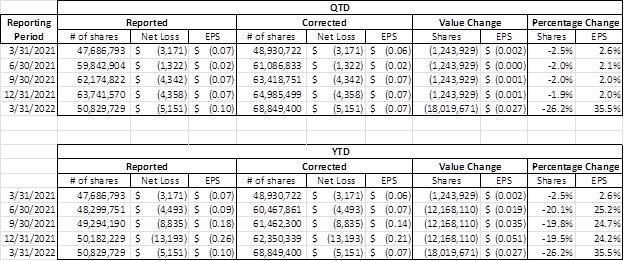
Bullet 4 -
Quantitative and Qualitative Considerations
Our assessment took into account the fact that the correction of the EPS did not impact the reported net loss, nor did it alter the Company's financial position, cash flows, or its overall trend of significant losses. From a quantitative perspective, although the correction represented a significant percentage change in the reported EPS, it resulted in only a slight improvement in the absolute loss per share figures without misleadingly transforming a loss into income or concealing a change in the Company’s earnings trend. Further, as in this case, the closer the amounts are to break even, the greater the resulting magnitude as a percentage change in earnings per share with no parallel impact on the reported net loss.
Qualitatively, we considered the relevance of the EPS adjustment in the context of the Company's ongoing operations and financial performance. Given our history of significant losses, the adjustment in the loss per share did not materially change the narrative of our financial health as would be perceived by reasonable investors. It was our judgment that the correction of the EPS, while necessary and properly disclosed, would not have altered the decision-making process of a reasonable investor, given the overall context of our financial reporting (i.e., the results taken as a whole) and performance history.
| 8 |
Conclusion
In summary, while we recognize the importance of accurate EPS presentations and have taken the appropriate steps to correct the error including the related disclosure and enhance our financial reporting controls, our assessment concluded that the error did not materially affect the overall understanding of our financial performance by investors. We believe this reflects a careful consideration of the error's implications within the broader context of our financial reporting and investor communication. We hope this explanation satisfactorily addresses the Commission's request for additional information regarding our treatment of the EPS calculation error. We remain committed to maintaining high standards of transparency and accuracy in all aspects of our financial reporting.
Bullet 5 -
To clarify this point, the Company discovered the identified error and informed both the predecessor auditor and the successor auditor of the error. The predecessor auditor reissued their report dated April 1, 2022 on the December 31, 2021 financial statement to us for inclusion in our Form 10-K for the fiscal year ended December 31, 2022, and filed on July 28, 2023, pursuant to an engagement letter with the Company under which the predecessor auditor was to “perform the procedures required by Public Company Accounting Oversight Board Auditing Standards (i.e., AS 4101 - Responsibilities Regarding Filings Under Federal Securities Statutes) and [their] firm policies in order for [them] to re-issue [their] report and to provide [their] consent for the use of [their] audit report.” Additionally, specific reference to the identified error was made in the Company’s Management Representation Letter dated July 28, 2023 issued to the predecessor auditor in connection with the reissuance of their opinion. The table included in Bullet 3 above, which summarizes the periods impacted by the identified errors, was provided to the predecessor auditor in connection with their reissuance consent review.
Bullet 6 -
The Company’s current auditor and its predecessor auditor each performed their respective procedures as they deemed appropriate in connection with the Company’s voluntary restatement of the correction of the error due to the incorrect calculation of our 2021 weighted average shares outstanding and loss per share, and they also considered any impact of the voluntary correction on their respective opinions on the Company’s 2021 and 2022 financial statements. In their professional opinions, it was ultimately determined to not be significant to warrant the restatement of previously issued financial statements or include specific language in their respective opinions regarding the voluntary correction.
Bullet 7 –
Based on the foregoing and it not otherwise being the responsibility of our current auditor to audit the adjustments necessary for the error correction related to 2021, their 2022 audit report does not require any modification to clarify their reference to unrelated 2021 reclassification adjustments related to the Company’s discontinued operations. As for the opinion of our predecessor auditor for 2021, a dual-dated opinion is not required as the opinion otherwise covers the 2021 financial statements and disclosures as presented by the Company, including the manner in which the correction of the error in the EPS calculation was made and the adjustments made to the 2021 financial statements related to the correction of the error and adjustments related to discontinued operations.
Note 11. Related Party Transactions, page F-28
| 7. | Please address the following regarding your response to prior comment eleven: |
|
| · | Revise your proposed disclosure to more clearly describe the "auxiliary services" outlined in the Distribution Services Agreement. |
|
| · | It is unclear which sections of the Distribution Services Agreement authorized your employees to use ALT's bank account. Revise Note 11 to address this fact. |
|
| · | You indicate that you initially considered only the amount of the fees to be paid to ALT rather than an aggregate of the transactions that you executed through the related party's bank account as would be necessary. We await the filing of the agreement as an exhibit. |
Company Response:
Bullet 1 -
Please refer to Bullet 1 in Comment 5 above.
| 9 |
Bullet 2 -
Please refer to Bullet 2 in Comment 5 above.
Bullet 3 –
The agreement was attached as Exhibit 1 to our February 16, 2024 response to the initial November 17, 2023 SEC comment letter. The disclosures related to the agreement will be revised as indicated in this and the previous response and the agreement will be included as an exhibit in the Company’s next regular filing with the SEC.
Note 22. Discontinued Operations, page F-45
| 8. | Please address the following regarding your response to prior comment 13. Total assets classified as assets held for sale were $26,160,000 as of December 31, 2021. You disclose on page F-45 that the Net book value of assets sold as of the July 22, 2022 sale was $20,616,000. You disclose on page F-46 "To write down the total net assets to fair value an additional impairment loss of $2.0 million, including $100 thousand of estimated costs to sell, was charged to impairment of goodwill as of June 30, 2022 and included in the loss from disposal group." Your response indicates that assets classified as held for sale on page F-46 are essentially the same as the Net book value of assets sold disclosed on page F-46, just at a different point in time. Besides the $2 million impairment, tell us and revise to more clearly identify the nature of the $5,544,000 decrease in assets held for sale between December 31, 2021 and July 22, 2022, providing quantification of the other significant drivers of the change. |
Company Response:
In addition to the $2.0 million goodwill impairment charge recorded as of June 30, 2022, a goodwill impairment charge of $2.7 million was recording in the three months ended March 31, 2022, bringing the total goodwill impairment charges for the Cure Pharmaceutical Reporting Unit to $4.7 million for the period from January 1, 2022 to closing date of the sale transaction, July 22, 2022, as disclosed on pages F-47 and F-17. The remaining difference in the decrease in the amount of assets held for sale during this time period of $0.8 million was attributable to the normal recurring amortization of limited-lived assets (namely, intellectual property) as disclosed on page F-47.
Form 10-Q for the Period Ended September 30, 2023
Item 4. Controls and Procedures
Evaluation of Disclosure Controls and Procedures, page 45
| 9. | Please address the following regarding your response to prior comment 14. Your Forms 10-Q for the quarters ended March 31, June 30, and September 30, 2023 do not provide a conclusion on the effectiveness of your DCP. Your proposed revisions state that you have concluded that your DCP was effective for these time periods. However, this conclusion does not appear consistent with the following: |
|
| · | your conclusion that your ICFR was ineffective and that associated disclosures were unclear, |
|
| · | the recent error to your 2021 earnings per share and related required disclosures, |
|
| · | the insufficient and unclear disclosures in various areas, including that of related party transactions, |
|
| · | and the fact that these Forms are missing the mandated disclosure of your conclusion on your DCP. |
|
| Please revise your conclusion to better reflect all relevant factors including but not limited to the above. | |
Company Response:
Revised Disclosure in the Evaluation of Disclosure Controls and Procedures on page 45 is as follows:
In accordance with Rules 13a-15(f) and 15d-15(f) of the Securities Exchange Act of 1934 (the "Exchange Act"), our company has established and maintains Disclosure Controls and Procedures (DCP). These controls and procedures are designed to ensure that information required to be disclosed by us in the reports that we file or submit under the Exchange Act is recorded, processed, summarized, and reported within the specified time periods and that such information is communicated to our management, including our Chief Executive Officer and Chief Financial Officer, to allow timely decisions regarding required disclosure.
| 10 |
As part of our ongoing commitment to uphold the integrity and accuracy of our financial reporting, we continually assess the effectiveness of our DCP. This assessment includes consideration of the adequacy of our internal control over financial reporting (ICFR), the impact of any identified errors in financial statements, and the clarity and completeness of our disclosures, including those pertaining to related party transactions.
For the quarter ended September 30, 2023, our assessment was that our DCP were ineffective during the period. Such assessment considered the following critical factors:
|
| · | The conclusion that our ICFR was not effective, which inherently affects the overall assessment of our DCP, given the interrelation between these controls and the accurate and timely reporting of financial information. |
|
|
|
|
|
| · | The identification and correction of an error in the calculation of our 2021 earnings per share and the subsequent required disclosures. This situation highlighted the need for enhanced review and verification processes within our DCP to prevent similar occurrences in the future. |
|
|
|
|
|
| · | The recognition that disclosures in certain areas, including transactions involving related parties, were insufficient and unclear. This acknowledgment has prompted us to undertake a thorough review of our disclosure practices to ensure greater transparency and comprehensiveness in our reporting. |
|
|
|
|
|
| · | The omission of explicit conclusions regarding the effectiveness of our DCP in our Forms 10-Q for the referenced quarters. This oversight has been rectified in our current and future filings to ensure compliance with SEC requirements and to provide clear communication to our stakeholders about the state of our DCP. |
Given these considerations, we acknowledge that while we have made significant efforts to enhance our DCP, challenges and limitations have impacted our ability to assert that our DCP was fully effective for the quarter ended September 30, 2023. We are actively addressing these issues through targeted improvements in our internal controls and disclosure processes. Our management is committed to achieving and maintaining the highest standards of financial reporting accuracy and transparency.
Please let us know if you have any further questions or require any additional information or clarification.
| Sincerely, |
|
|
|
|
| /s/ Joel Bennett |
|
Joel Bennett
Chief Financial Officer
| 11 |