October 5, 2026 VAX-31 OPUS-1 Pivotal Phase 3 Adult Trial: Topline Results .2

October 5, 2026 Strong Track Record in Vaccines and Biopharma Grant Pickering, MBA Chief Executive Officer, Director & Co-Founder Andrew Guggenhime, MBA President & Chief Financial Officer Jim Wassil, MS, MBA Executive VP, Chief Operating Officer & Chief Scientific Officer Luis Jodar, PhD Chief Medical Officer Mike Mullette, MBA Chief Commercial Officer Vaxcyte Leadership Team on Today’s Call
Forward-Looking Statements October 5, 2026 This presentation contains forward-looking statements within the meaning of the Private Securities Litigation Reform Act of 1995. These statements include, but are not limited to, statements related to the potential benefits of Vaxcyte’s carrier-sparing platform and vaccine candidates, including breadth of coverage and the ability to deliver potentially better immune responses, best-in-class vaccines and the improvement upon the standard-of-care; demand for Vaxcyte’s vaccine candidates; the design, timing of initiation, progress and expected results of Vaxcyte’s preclinical studies, clinical trials and research and development plans; the ability of Vaxcyte’s cell-free platform to deliver the broadest-spectrum PCVs that provide protection against both currently circulating and historically prevalent strains; expectations with regard to serotype cross-reactivity; the standards for review and licensure of vaccines and regulators accepting Vaxcyte’s study as designed; the ability of Vaxcyte to commercialize its PCV candidates and to meet the PCV franchise market demand for commercial markets; the growth and expansion of the pneumococcal vaccine market, and the potential to address the need for broader-spectrum of coverage in such market; the market opportunity for Vaxcyte’s vaccines; Vaxcyte’s expectations regarding the potential benefits, spectrum coverage, clinical or regulatory pathways, adoption speed and immunogenicity of its vaccine candidates and other statements that are not historical fact. The words “anticipate,” “believe,” “continue,” “could,” “designed,” “estimate,” “expect,” “intend,” “may,” “plan,” “potential,” “predict,” “project,” “should,” “target,” “will,” “would” and similar expressions are intended to identify forward-looking statements, although not all forward-looking statements contain these identifying words. These forward-looking statements are based on Vaxcyte’s current expectations and actual results and timing of events could differ materially from those anticipated in such forward-looking statements as a result of risks and uncertainties, including, without limitation, risks related to Vaxcyte’s product development programs, including development timelines, success and timing of chemistry, manufacturing and controls and related manufacturing activities; potential delays or inability to obtain and maintain required regulatory approvals for its vaccine candidates; the risks and uncertainties inherent with preclinical and clinical development processes; the success, cost and timing of all development activities and clinical trials; and sufficiency of cash and other funding to support Vaxcyte’s development programs and other operating expenses. These and other risks are described more fully in Vaxcyte’s filings with the Securities and Exchange Commission (SEC), including its Quarterly Report on Form 10-Q filed with the SEC on August 5, 2026 or in other documents Vaxcyte subsequently files with or furnishes to the SEC. Vaxcyte undertakes no duty or obligation to update any forward-looking statements contained in this presentation as a result of new information, future events or changes in its expectations.
October 5, 2026 Introduction and results overview Agenda OPUS-1 Study and TOPLINE results Trial Design, Disposition and Demographics Tolerability and Safety Data Immunogenicity in Adults Aged ≥50 Years and 18-49 Years Vax-31 PROGRAM Next Steps

Introduction and Results Overview October 5, 2026
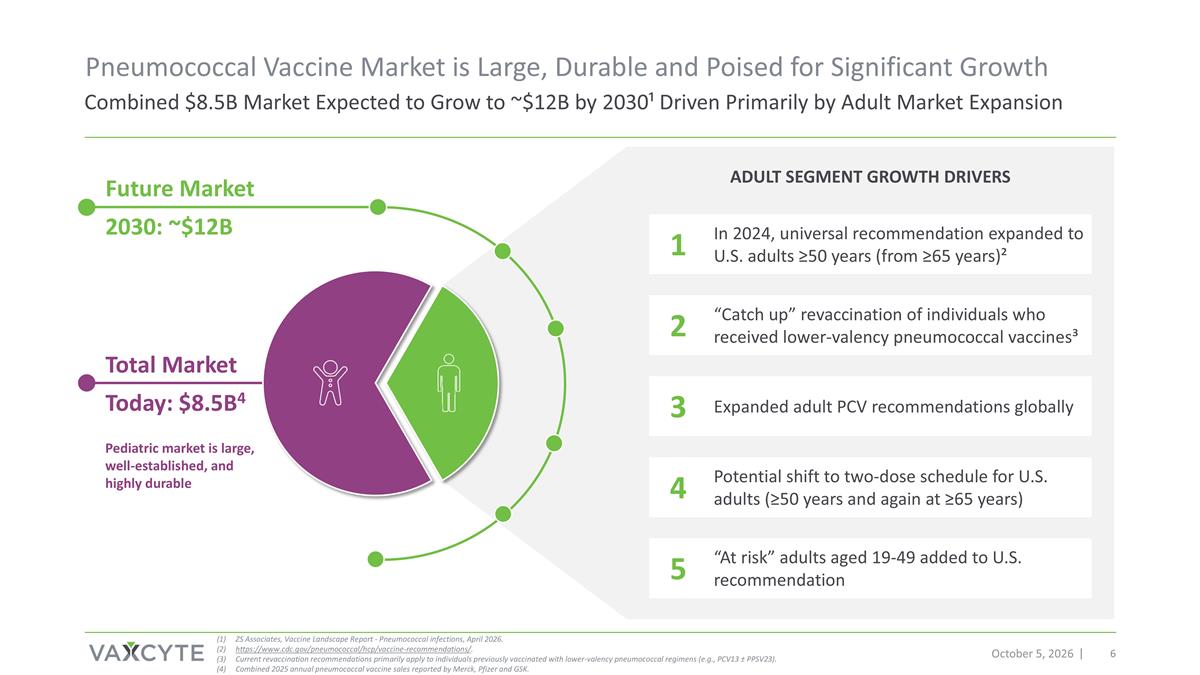
October 5, 2026 Combined $8.5B Market Expected to Grow to ~$12B by 2030¹ Driven Primarily by Adult Market Expansion Pneumococcal Vaccine Market is Large, Durable and Poised for Significant Growth Future Market 2030: ~$12B Pediatric market is large, well-established, and highly durable Total Market Today: $8.5B4 ADULT SEGMENT GROWTH DRIVERS In 2024, universal recommendation expanded to U.S. adults ≥50 years (from ≥65 years)² “Catch up” revaccination of individuals who received lower-valency pneumococcal vaccines³ Expanded adult PCV recommendations globally Potential shift to two-dose schedule for U.S. adults (≥50 years and again at ≥65 years) “At risk” adults aged 19-49 added to U.S. recommendation ZS Associates, Vaccine Landscape Report - Pneumococcal infections, April 2026. https://www.cdc.gov/pneumococcal/hcp/vaccine-recommendations/. Current revaccination recommendations primarily apply to individuals previously vaccinated with lower‑valency pneumococcal regimens (e.g., PCV13 ± PPSV23). Combined 2025 annual pneumococcal vaccine sales reported by Merck, Pfizer and GSK. 1 2 3 4 5
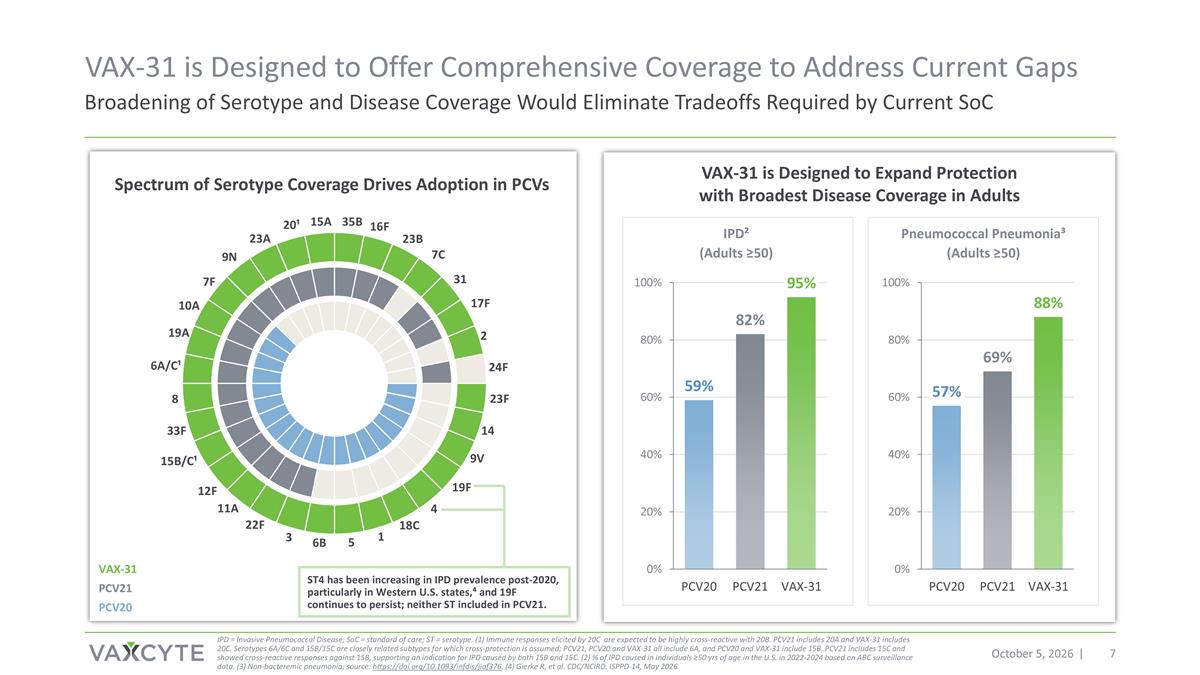
VAX-31 is Designed to Expand Protection with Broadest Disease Coverage in Adults IPD² (Adults ≥50) IPD = Invasive Pneumococcal Disease; SoC = standard of care; ST = serotype. (1) Immune responses elicited by 20C are expected to be highly cross-reactive with 20B. PCV21 includes 20A and VAX-31 includes 20C. Serotypes 6A/6C and 15B/15C are closely related subtypes for which cross-protection is assumed; PCV21, PCV20 and VAX-31 all include 6A, and PCV20 and VAX-31 include 15B. PCV21 includes 15C and showed cross-reactive responses against 15B, supporting an indication for IPD caused by both 15B and 15C. (2) % of IPD caused in individuals ≥50 yrs of age in the U.S. in 2022-2024 based on ABC surveillance data. (3) Non-bacteremic pneumonia; source: https://doi.org/10.1093/infdis/jiaf376. (4) Gierke R, et al. CDC/NCIRD. ISPPD-14, May 2026. October 5, 2026 ST4 has been increasing in IPD prevalence post-2020, particularly in Western U.S. states,⁴ and 19F continues to persist; neither ST included in PCV21. 16F 35B 15A 20¹ 24F 2 17F 31 7C 23B 23A 9N 7F 10A 19A 6A/C¹ 23F 14 9V 19F 4 18C 1 5 6B 3 22F 11A 12F 15B/C¹ 33F 8 VAX-31 PCV21 PCV20 Spectrum of Serotype Coverage Drives Adoption in PCVs Pneumococcal Pneumonia³ (Adults ≥50) Broadening of Serotype and Disease Coverage Would Eliminate Tradeoffs Required by Current SoC VAX-31 is Designed to Offer Comprehensive Coverage to Address Current Gaps
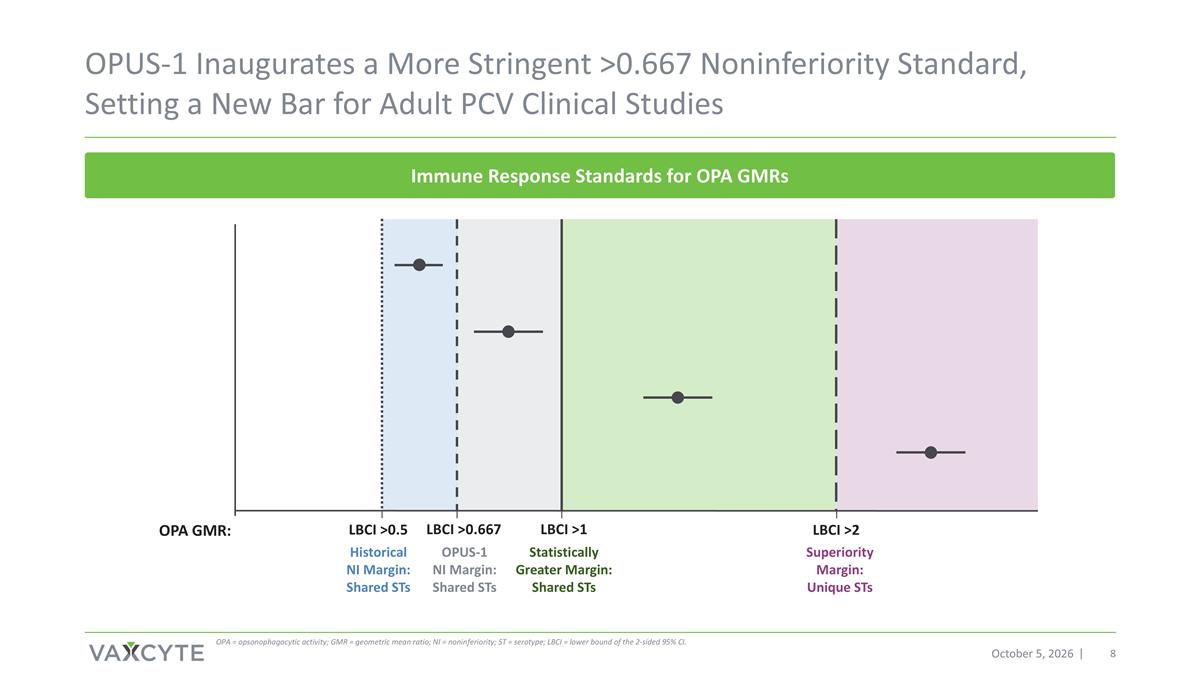
LBCI >1 OPUS-1 Inaugurates a More Stringent >0.667 Noninferiority Standard, Setting a New Bar for Adult PCV Clinical Studies October 5, 2026 OPA GMR: LBCI >0.5 LBCI >0.667 Immune Response Standards for OPA GMRs OPA = opsonophagocytic activity; GMR = geometric mean ratio; NI = noninferiority; ST = serotype; LBCI = lower bound of the 2-sided 95% CI. Historical NI Margin: Shared STs OPUS-1 NI Margin: Shared STs Statistically Greater Margin: Shared STs LBCI >2 Superiority Margin: Unique STs
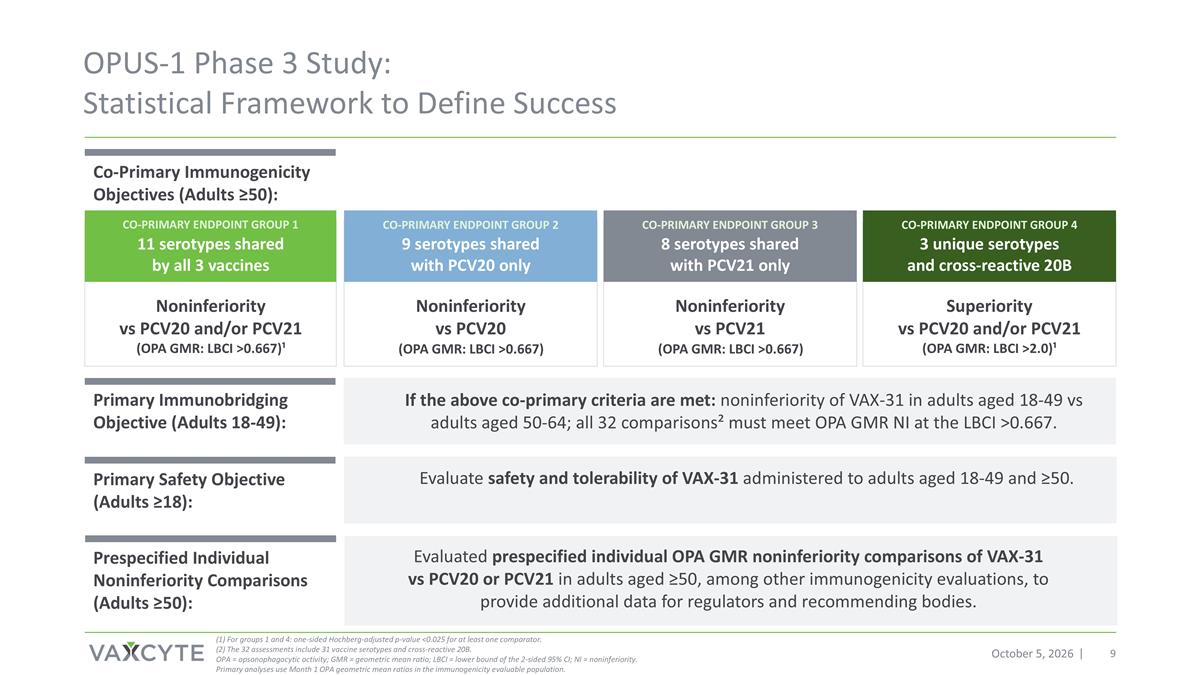
October 5, 2026 OPUS-1 Phase 3 Study: Statistical Framework to Define Success 11 serotypes shared by all 3 vaccines Noninferiority vs PCV20 and/or PCV21 (OPA GMR: LBCI >0.667)¹ 9 serotypes shared with PCV20 only Noninferiority vs PCV20 (OPA GMR: LBCI >0.667) 8 serotypes shared with PCV21 only Noninferiority vs PCV21 (OPA GMR: LBCI >0.667) 3 unique serotypes and cross-reactive 20B Superiority vs PCV20 and/or PCV21 (OPA GMR: LBCI >2.0)¹ (1) For groups 1 and 4: one-sided Hochberg-adjusted p-value <0.025 for at least one comparator. (2) The 32 assessments include 31 vaccine serotypes and cross-reactive 20B. OPA = opsonophagocytic activity; GMR = geometric mean ratio; LBCI = lower bound of the 2-sided 95% CI; NI = noninferiority. Primary analyses use Month 1 OPA geometric mean ratios in the immunogenicity evaluable population. CO-PRIMARY ENDPOINT GROUP 1 CO-PRIMARY ENDPOINT GROUP 2 CO-PRIMARY ENDPOINT GROUP 3 CO-PRIMARY ENDPOINT GROUP 4 Prespecified Individual Noninferiority Comparisons (Adults ≥50): Primary Safety Objective (Adults ≥18): Primary Immunobridging Objective (Adults 18-49): Co-Primary Immunogenicity Objectives (Adults ≥50): If the above co-primary criteria are met: noninferiority of VAX-31 in adults aged 18-49 vs adults aged 50-64; all 32 comparisons² must meet OPA GMR NI at the LBCI >0.667. Evaluate safety and tolerability of VAX-31 administered to adults aged 18-49 and ≥50. Evaluated prespecified individual OPA GMR noninferiority comparisons of VAX-31 vs PCV20 or PCV21 in adults aged ≥50, among other immunogenicity evaluations, to provide additional data for regulators and recommending bodies.
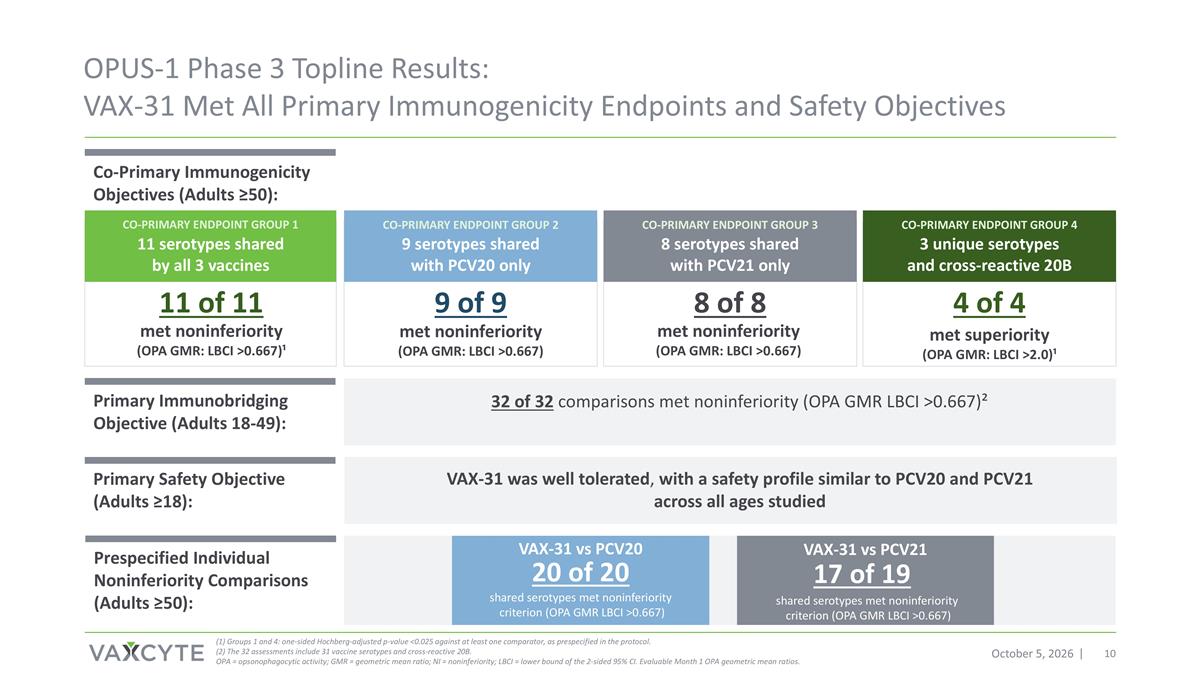
October 5, 2026 OPUS-1 Phase 3 Topline Results: VAX-31 Met All Primary Immunogenicity Endpoints and Safety Objectives (1) Groups 1 and 4: one-sided Hochberg-adjusted p-value <0.025 against at least one comparator, as prespecified in the protocol. (2) The 32 assessments include 31 vaccine serotypes and cross-reactive 20B. OPA = opsonophagocytic activity; GMR = geometric mean ratio; NI = noninferiority; LBCI = lower bound of the 2-sided 95% CI. Evaluable Month 1 OPA geometric mean ratios. VAX-31 was well tolerated, with a safety profile similar to PCV20 and PCV21 across all ages studied VAX-31 vs PCV20 shared serotypes met noninferiority criterion (OPA GMR LBCI >0.667) 20 of 20 VAX-31 vs PCV21 shared serotypes met noninferiority criterion (OPA GMR LBCI >0.667) 17 of 19 Co-Primary Immunogenicity Objectives (Adults ≥50): Prespecified Individual Noninferiority Comparisons (Adults ≥50): Primary Safety Objective (Adults ≥18): Primary Immunobridging Objective (Adults 18-49): 32 of 32 comparisons met noninferiority (OPA GMR LBCI >0.667)² 11 serotypes shared by all 3 vaccines 9 serotypes shared with PCV20 only 8 serotypes shared with PCV21 only 3 unique serotypes and cross-reactive 20B CO-PRIMARY ENDPOINT GROUP 1 CO-PRIMARY ENDPOINT GROUP 2 CO-PRIMARY ENDPOINT GROUP 3 CO-PRIMARY ENDPOINT GROUP 4 11 of 11 met noninferiority (OPA GMR: LBCI >0.667)¹ 9 of 9 met noninferiority (OPA GMR: LBCI >0.667) 8 of 8 4 of 4 met superiority (OPA GMR: LBCI >2.0)¹ met noninferiority (OPA GMR: LBCI >0.667)

OPUS-1 Study and Topline Results October 5, 2026

Trial Design, Disposition and Demographics October 5, 2026
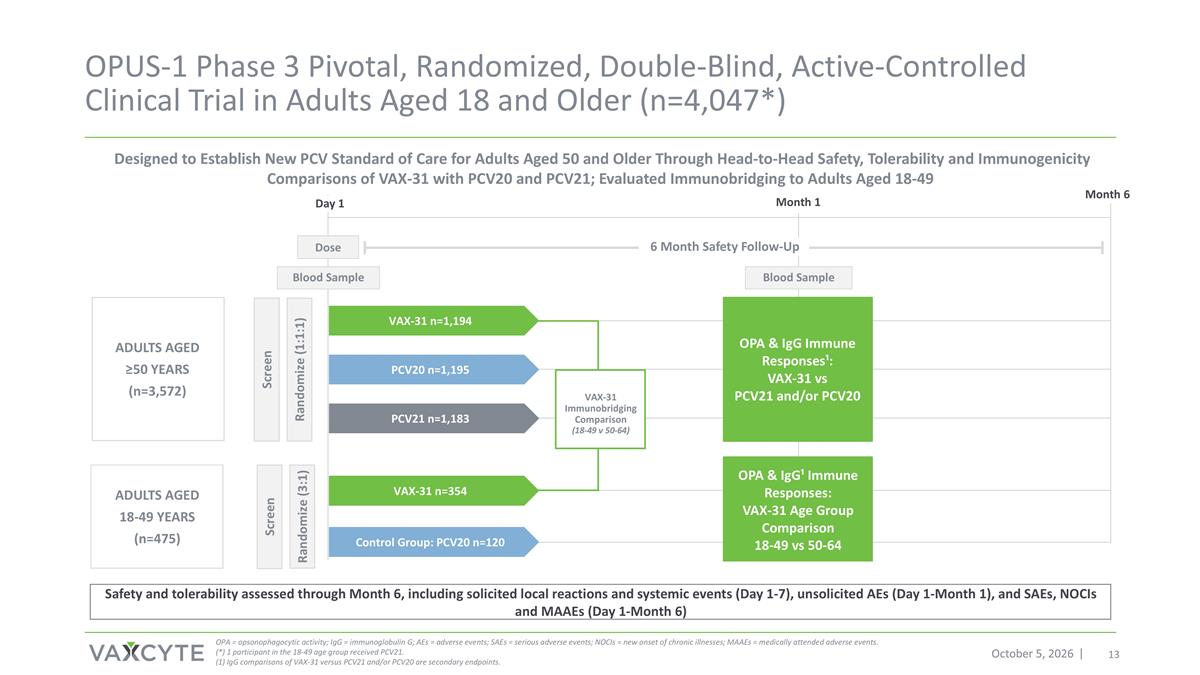
6 Month Safety Follow-Up OPUS-1 Phase 3 Pivotal, Randomized, Double-Blind, Active-Controlled Clinical Trial in Adults Aged 18 and Older (n=4,047*) October 5, 2026 Adults aged ≥50 years (n=3,572) Adults aged 18-49 years (n=475) Screen Blood Sample Screen Randomize (3:1) Month 1 Month 6 Day 1 Blood Sample Dose Designed to Establish New PCV Standard of Care for Adults Aged 50 and Older Through Head-to-Head Safety, Tolerability and Immunogenicity Comparisons of VAX-31 with PCV20 and PCV21; Evaluated Immunobridging to Adults Aged 18-49 OPA = opsonophagocytic activity; IgG = immunoglobulin G; AEs = adverse events; SAEs = serious adverse events; NOCIs = new onset of chronic illnesses; MAAEs = medically attended adverse events. (*) 1 participant in the 18-49 age group received PCV21. (1) IgG comparisons of VAX‑31 versus PCV21 and/or PCV20 are secondary endpoints. Safety and tolerability assessed through Month 6, including solicited local reactions and systemic events (Day 1-7), unsolicited AEs (Day 1-Month 1), and SAEs, NOCIs and MAAEs (Day 1-Month 6) OPA & IgG Immune Responses¹: VAX-31 vs PCV21 and/or PCV20 OPA & IgG¹ Immune Responses: VAX-31 Age Group Comparison 18-49 vs 50-64 Control Group: PCV20 n=120 Randomize (1:1:1) VAX-31 Immunobridging Comparison (18-49 v 50-64) PCV21 n=1,183 VAX-31 n=1,194 PCV20 n=1,195 VAX-31 n=354
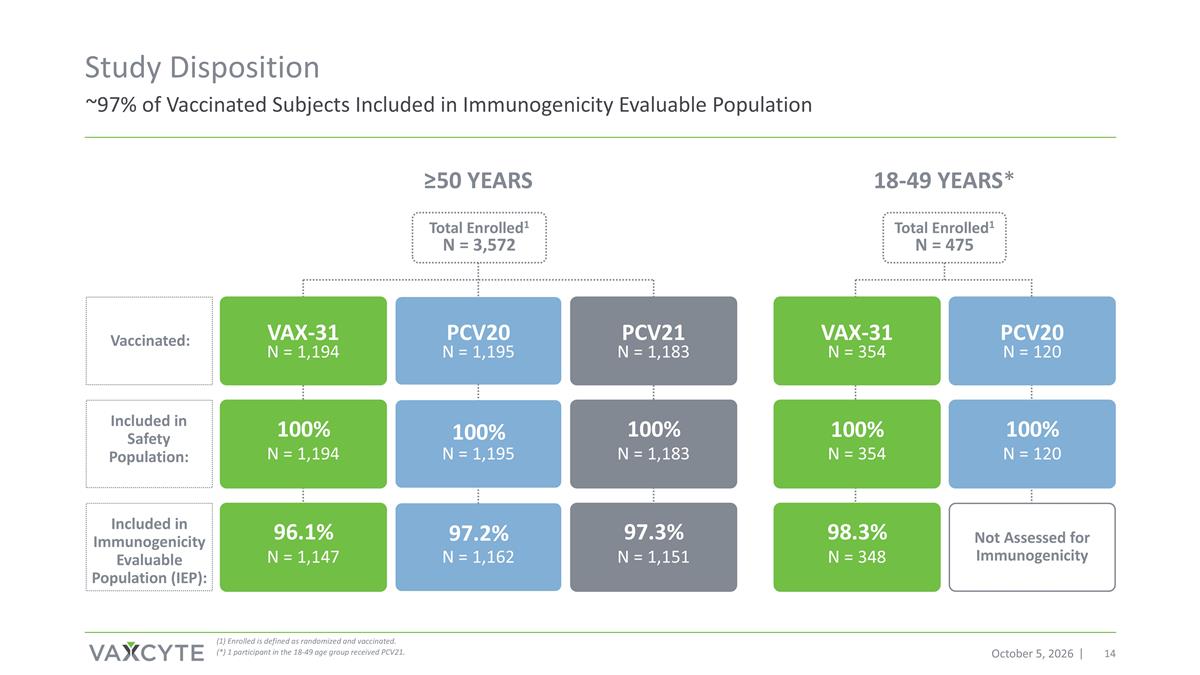
~97% of Vaccinated Subjects Included in Immunogenicity Evaluable Population Study Disposition October 5, 2026 ≥50 YEARS 18-49 YEARS* Total Enrolled1 N = 3,572 Total Enrolled1 N = 475 VAX-31 N = 1,194 PCV20 N = 1,195 PCV21 N = 1,183 N = 1,194 N = 1,195 N = 1,183 N = 1,147 N = 1,162 N = 1,151 VAX-31 N = 354 PCV20 N = 120 N = 354 N = 120 N = 348 Not Assessed for Immunogenicity 100% 100% 100% 100% 96.1% 97.3% 98.3% Included in Safety Population: Included in Immunogenicity Evaluable Population (IEP): Vaccinated: (1) Enrolled is defined as randomized and vaccinated. (*) 1 participant in the 18-49 age group received PCV21. 100% 97.2%
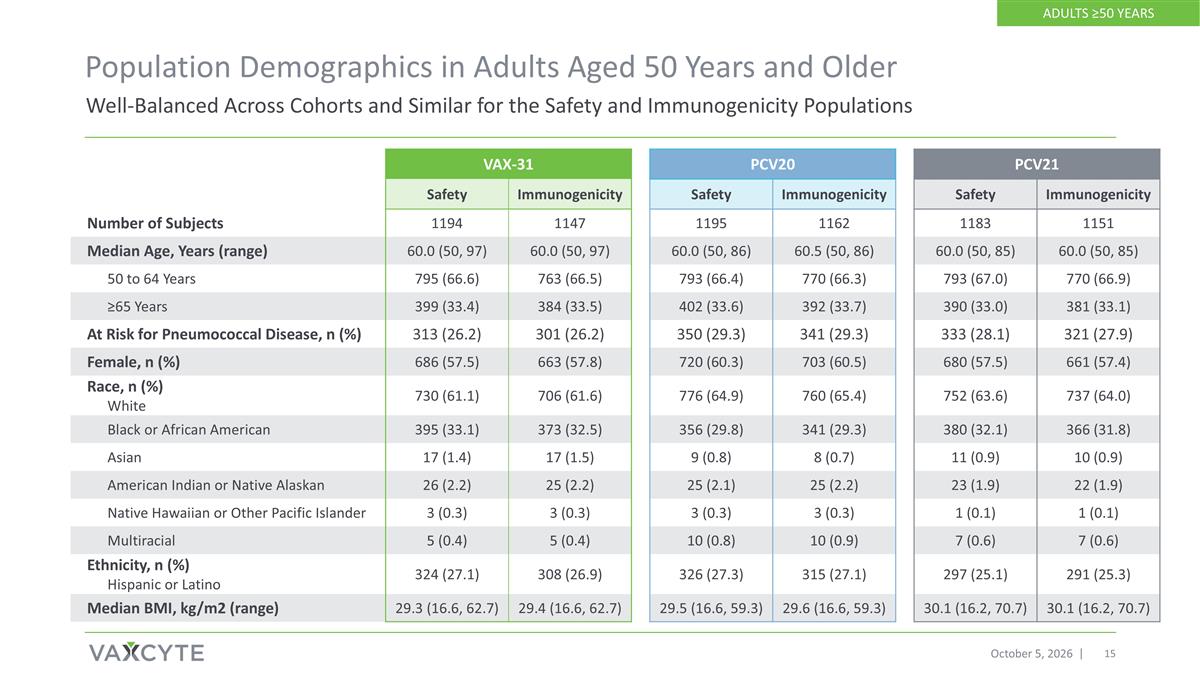
Population Demographics in Adults Aged 50 Years and Older October 5, 2026 VAX-31 PCV20 PCV21 Safety Immunogenicity Safety Immunogenicity Safety Immunogenicity Number of Subjects 1194 1147 1195 1162 1183 1151 Median Age, Years (range) 60.0 (50, 97) 60.0 (50, 97) 60.0 (50, 86) 60.5 (50, 86) 60.0 (50, 85) 60.0 (50, 85) 50 to 64 Years 795 (66.6) 763 (66.5) 793 (66.4) 770 (66.3) 793 (67.0) 770 (66.9) ≥65 Years 399 (33.4) 384 (33.5) 402 (33.6) 392 (33.7) 390 (33.0) 381 (33.1) At Risk for Pneumococcal Disease, n (%) 313 (26.2) 301 (26.2) 350 (29.3) 341 (29.3) 333 (28.1) 321 (27.9) Female, n (%) 686 (57.5) 663 (57.8) 720 (60.3) 703 (60.5) 680 (57.5) 661 (57.4) Race, n (%) White 730 (61.1) 706 (61.6) 776 (64.9) 760 (65.4) 752 (63.6) 737 (64.0) Black or African American 395 (33.1) 373 (32.5) 356 (29.8) 341 (29.3) 380 (32.1) 366 (31.8) Asian 17 (1.4) 17 (1.5) 9 (0.8) 8 (0.7) 11 (0.9) 10 (0.9) American Indian or Native Alaskan 26 (2.2) 25 (2.2) 25 (2.1) 25 (2.2) 23 (1.9) 22 (1.9) Native Hawaiian or Other Pacific Islander 3 (0.3) 3 (0.3) 3 (0.3) 3 (0.3) 1 (0.1) 1 (0.1) Multiracial 5 (0.4) 5 (0.4) 10 (0.8) 10 (0.9) 7 (0.6) 7 (0.6) Ethnicity, n (%) Hispanic or Latino 324 (27.1) 308 (26.9) 326 (27.3) 315 (27.1) 297 (25.1) 291 (25.3) Median BMI, kg/m2 (range) 29.3 (16.6, 62.7) 29.4 (16.6, 62.7) 29.5 (16.6, 59.3) 29.6 (16.6, 59.3) 30.1 (16.2, 70.7) 30.1 (16.2, 70.7) Well-Balanced Across Cohorts and Similar for the Safety and Immunogenicity Populations ADULTS ≥50 YEARS
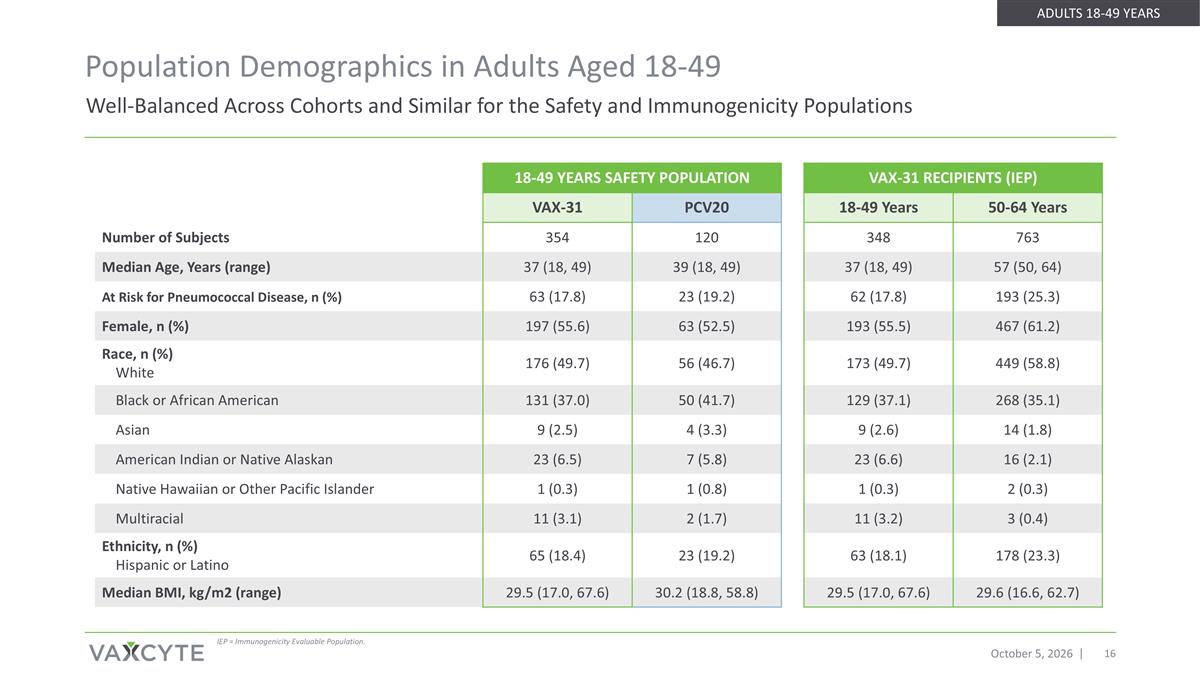
Well-Balanced Across Cohorts and Similar for the Safety and Immunogenicity Populations Population Demographics in Adults Aged 18-49 October 5, 2026 18-49 YEARS SAFETY POPULATION VAX-31 RECIPIENTS (IEP) VAX-31 PCV20 18-49 Years 50-64 Years Number of Subjects 354 120 348 763 Median Age, Years (range) 37 (18, 49) 39 (18, 49) 37 (18, 49) 57 (50, 64) At Risk for Pneumococcal Disease, n (%) 63 (17.8) 23 (19.2) 62 (17.8) 193 (25.3) Female, n (%) 197 (55.6) 63 (52.5) 193 (55.5) 467 (61.2) Race, n (%) White 176 (49.7) 56 (46.7) 173 (49.7) 449 (58.8) Black or African American 131 (37.0) 50 (41.7) 129 (37.1) 268 (35.1) Asian 9 (2.5) 4 (3.3) 9 (2.6) 14 (1.8) American Indian or Native Alaskan 23 (6.5) 7 (5.8) 23 (6.6) 16 (2.1) Native Hawaiian or Other Pacific Islander 1 (0.3) 1 (0.8) 1 (0.3) 2 (0.3) Multiracial 11 (3.1) 2 (1.7) 11 (3.2) 3 (0.4) Ethnicity, n (%) Hispanic or Latino 65 (18.4) 23 (19.2) 63 (18.1) 178 (23.3) Median BMI, kg/m2 (range) 29.5 (17.0, 67.6) 30.2 (18.8, 58.8) 29.5 (17.0, 67.6) 29.6 (16.6, 62.7) ADULTS 18-49 YEARS IEP = Immunogenicity Evaluable Population.
Tolerability and Safety Data October 5, 2026
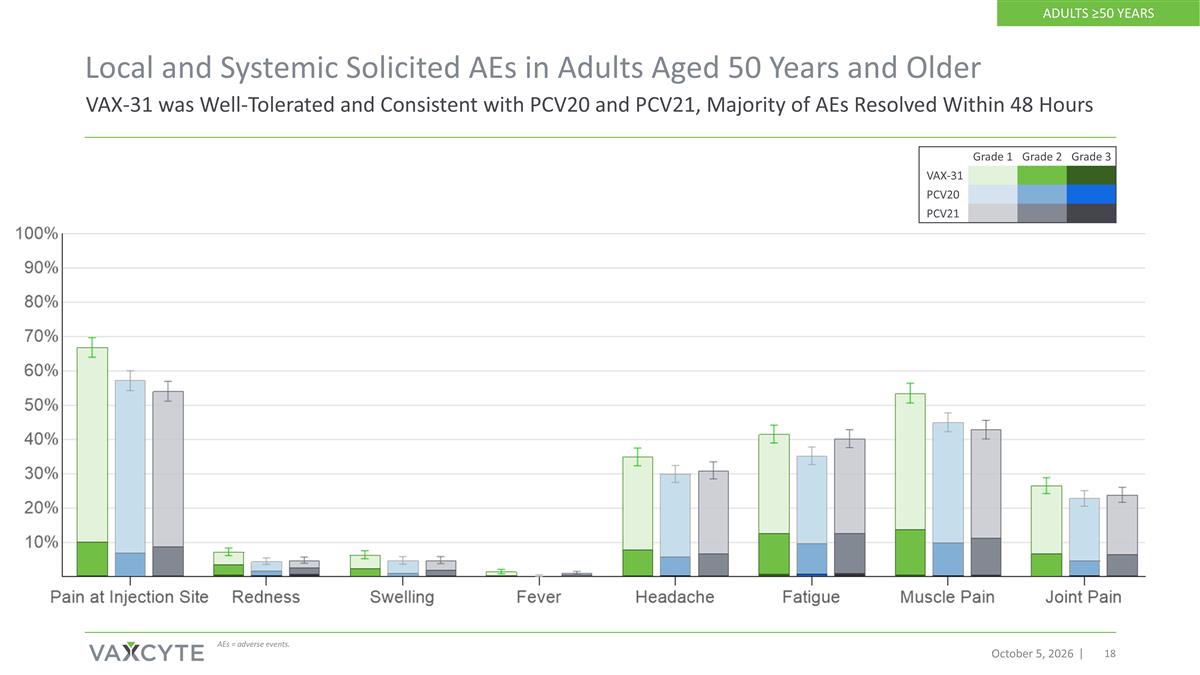
Local and Systemic Solicited AEs in Adults Aged 50 Years and Older October 5, 2026 VAX-31 was Well-Tolerated and Consistent with PCV20 and PCV21, Majority of AEs Resolved Within 48 Hours AEs = adverse events. Grade 1 Grade 2 Grade 3 VAX-31 PCV20 PCV21 ADULTS ≥50 YEARS
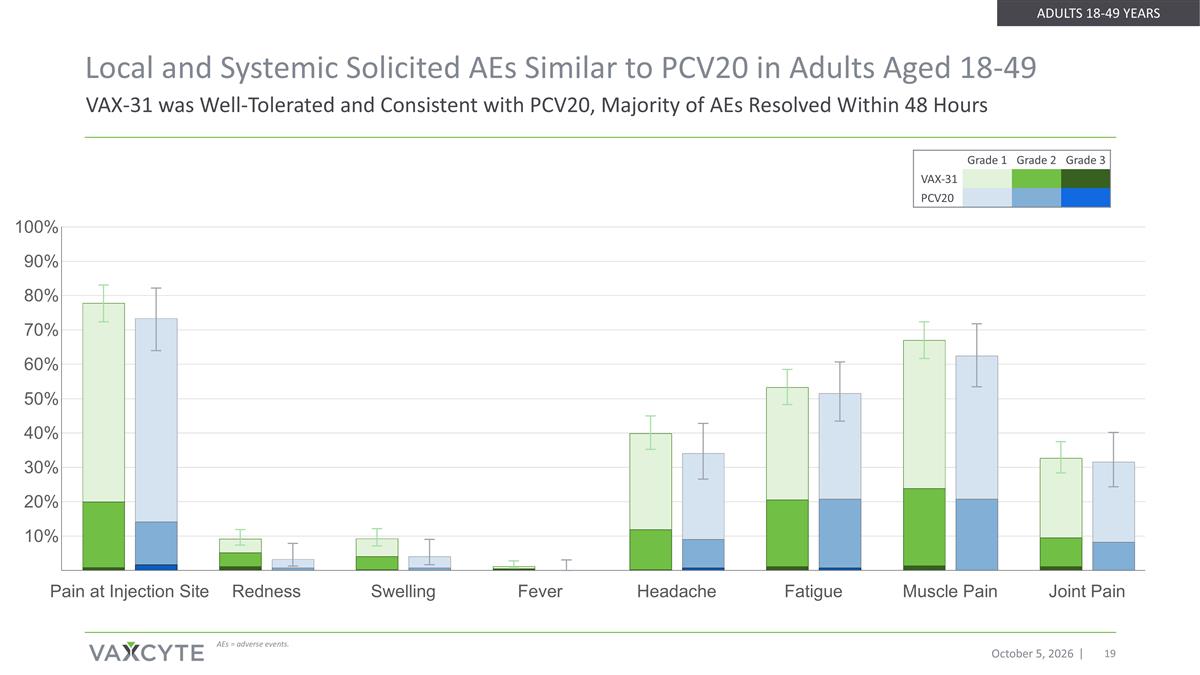
Local and Systemic Solicited AEs Similar to PCV20 in Adults Aged 18-49 October 5, 2026 AEs = adverse events. VAX-31 was Well-Tolerated and Consistent with PCV20, Majority of AEs Resolved Within 48 Hours Grade 1 Grade 2 Grade 3 VAX-31 PCV20 ADULTS 18-49 YEARS
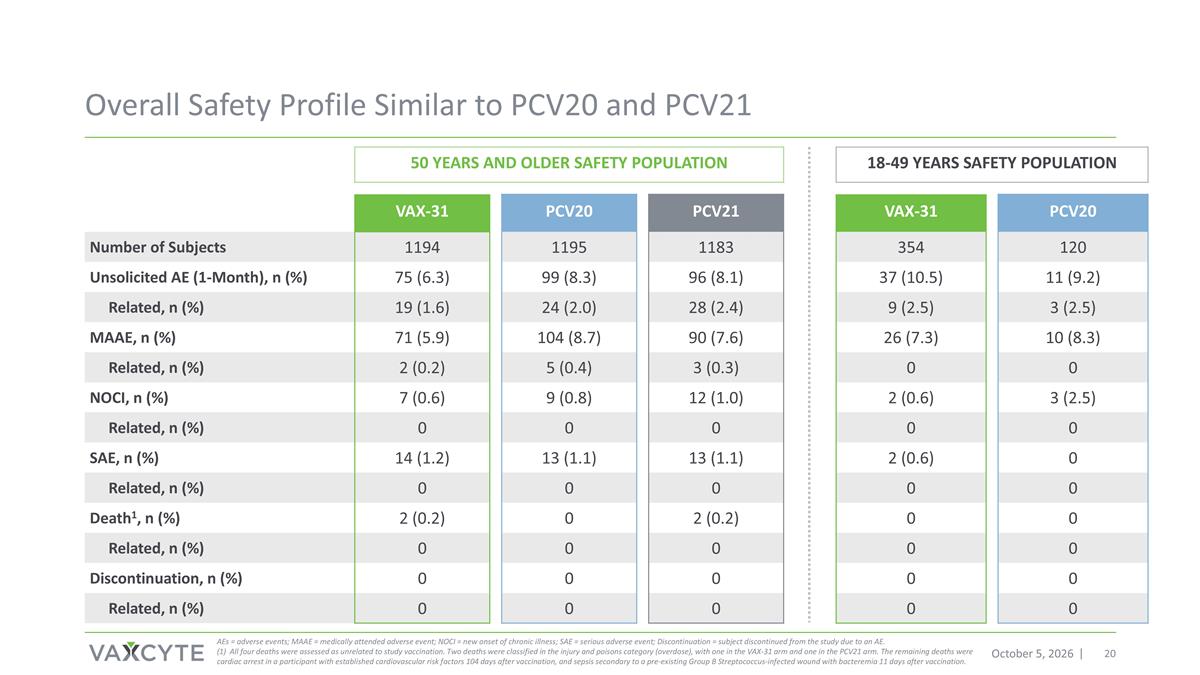
Overall Safety Profile Similar to PCV20 and PCV21 October 5, 2026 AEs = adverse events; MAAE = medically attended adverse event; NOCI = new onset of chronic illness; SAE = serious adverse event; Discontinuation = subject discontinued from the study due to an AE. (1) All four deaths were assessed as unrelated to study vaccination. Two deaths were classified in the injury and poisons category (overdose), with one in the VAX-31 arm and one in the PCV21 arm. The remaining deaths were cardiac arrest in a participant with established cardiovascular risk factors 104 days after vaccination, and sepsis secondary to a pre-existing Group B Streptococcus-infected wound with bacteremia 11 days after vaccination. 50 YEARS AND OLDER SAFETY POPULATION 18-49 YEARS SAFETY POPULATION VAX-31 PCV20 PCV21 VAX-31 PCV20 Number of Subjects 1194 1195 1183 354 120 Unsolicited AE (1-Month), n (%) 75 (6.3) 99 (8.3) 96 (8.1) 37 (10.5) 11 (9.2) Related, n (%) 19 (1.6) 24 (2.0) 28 (2.4) 9 (2.5) 3 (2.5) MAAE, n (%) 71 (5.9) 104 (8.7) 90 (7.6) 26 (7.3) 10 (8.3) Related, n (%) 2 (0.2) 5 (0.4) 3 (0.3) 0 0 NOCI, n (%) 7 (0.6) 9 (0.8) 12 (1.0) 2 (0.6) 3 (2.5) Related, n (%) 0 0 0 0 0 SAE, n (%) 14 (1.2) 13 (1.1) 13 (1.1) 2 (0.6) 0 Related, n (%) 0 0 0 0 0 Death1, n (%) 2 (0.2) 0 2 (0.2) 0 0 Related, n (%) 0 0 0 0 0 Discontinuation, n (%) 0 0 0 0 0 Related, n (%) 0 0 0 0 0
Immunogenicity Data In Adults Aged ≥50 Years and 18-49 Years October 5, 2026
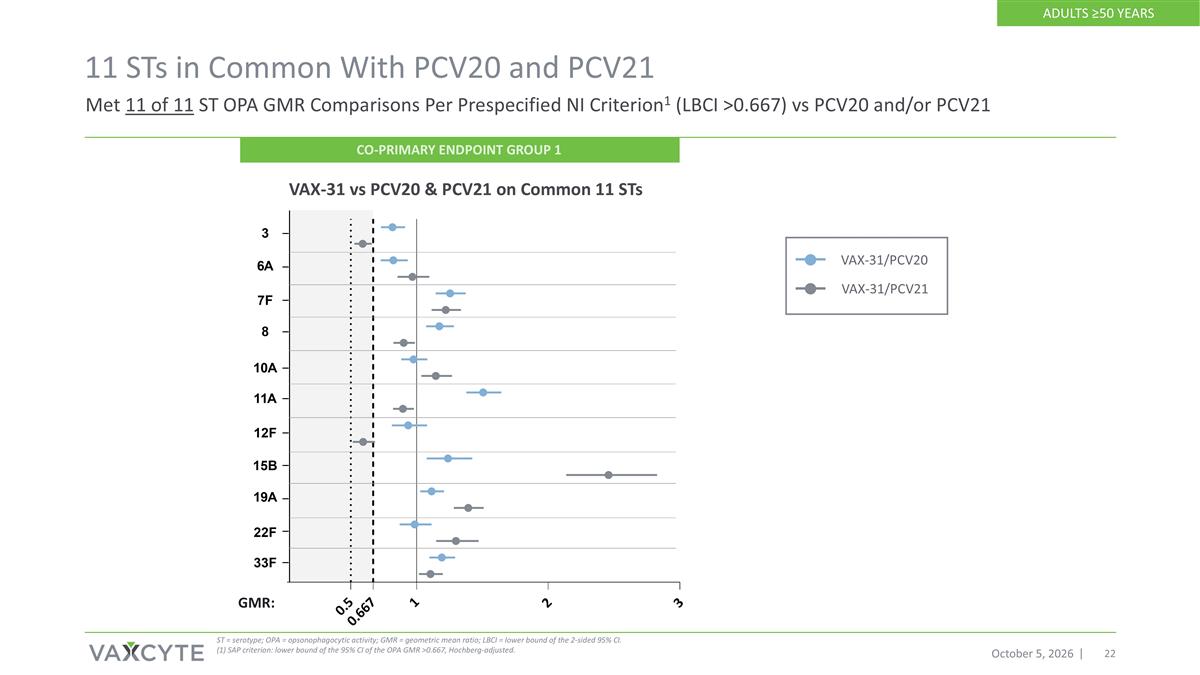
VAX-31/PCV20 VAX-31/PCV21 11 STs in Common With PCV20 and PCV21 October 5, 2026 VAX-31 vs PCV20 & PCV21 on Common 11 STs ST = serotype; OPA = opsonophagocytic activity; GMR = geometric mean ratio; LBCI = lower bound of the 2-sided 95% CI. (1) SAP criterion: lower bound of the 95% CI of the OPA GMR >0.667, Hochberg-adjusted. Met 11 of 11 ST OPA GMR Comparisons Per Prespecified NI Criterion1 (LBCI >0.667) vs PCV20 and/or PCV21 GMR: CO-PRIMARY ENDPOINT GROUP 1 ADULTS ≥50 YEARS
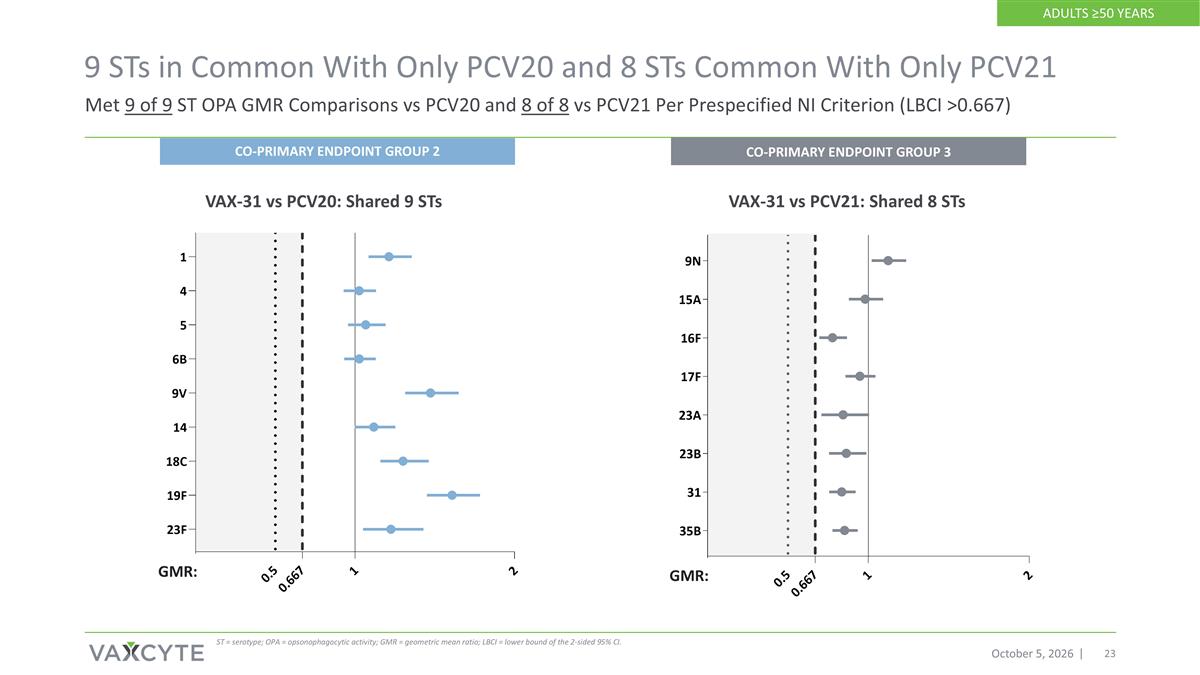
9 STs in Common With Only PCV20 and 8 STs Common With Only PCV21 October 5, 2026 ST = serotype; OPA = opsonophagocytic activity; GMR = geometric mean ratio; LBCI = lower bound of the 2-sided 95% CI. VAX-31 vs PCV20: Shared 9 STs GMR: Met 9 of 9 ST OPA GMR Comparisons vs PCV20 and 8 of 8 vs PCV21 Per Prespecified NI Criterion (LBCI >0.667) VAX-31 vs PCV21: Shared 8 STs GMR: CO-PRIMARY ENDPOINT GROUP 2 CO-PRIMARY ENDPOINT GROUP 3 ADULTS ≥50 YEARS
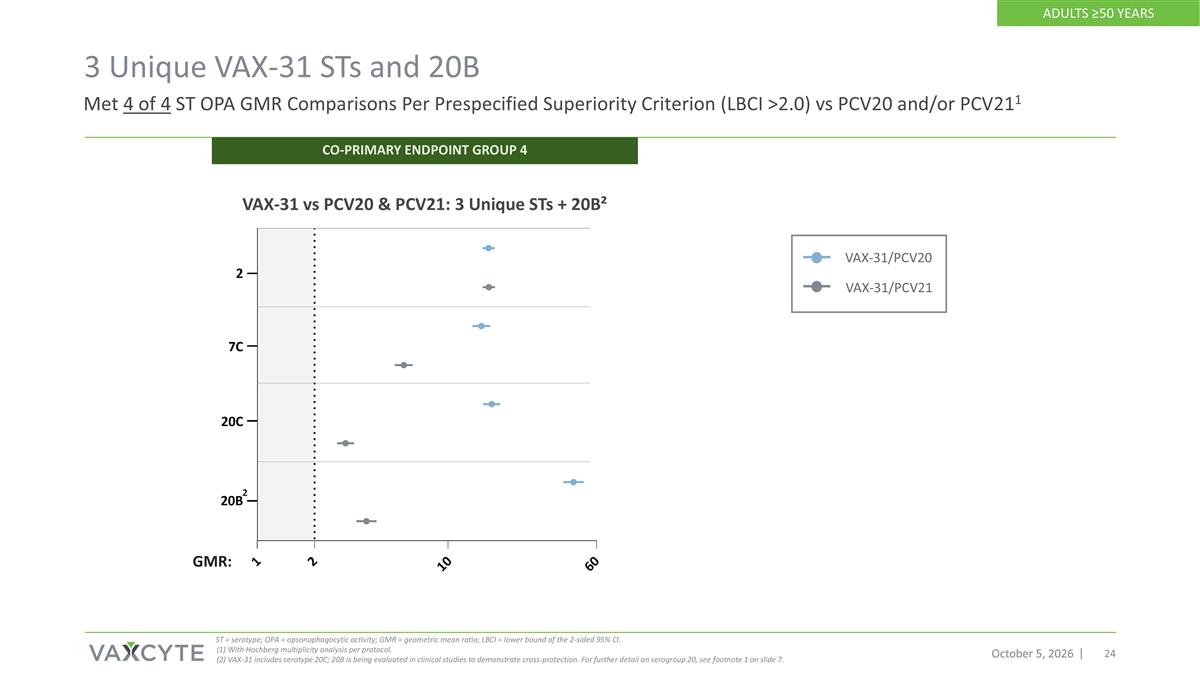
3 Unique VAX-31 STs and 20B October 5, 2026 ST = serotype; OPA = opsonophagocytic activity; GMR = geometric mean ratio; LBCI = lower bound of the 2-sided 95% CI. (1) With Hochberg multiplicity analysis per protocol. (2) VAX-31 includes serotype 20C; 20B is being evaluated in clinical studies to demonstrate cross-protection. For further detail on serogroup 20, see footnote 1 on slide 7. Met 4 of 4 ST OPA GMR Comparisons Per Prespecified Superiority Criterion (LBCI >2.0) vs PCV20 and/or PCV211 VAX-31 vs PCV20 & PCV21: 3 Unique STs + 20B² GMR: VAX-31/PCV20 VAX-31/PCV21 2 CO-PRIMARY ENDPOINT GROUP 4 ADULTS ≥50 YEARS
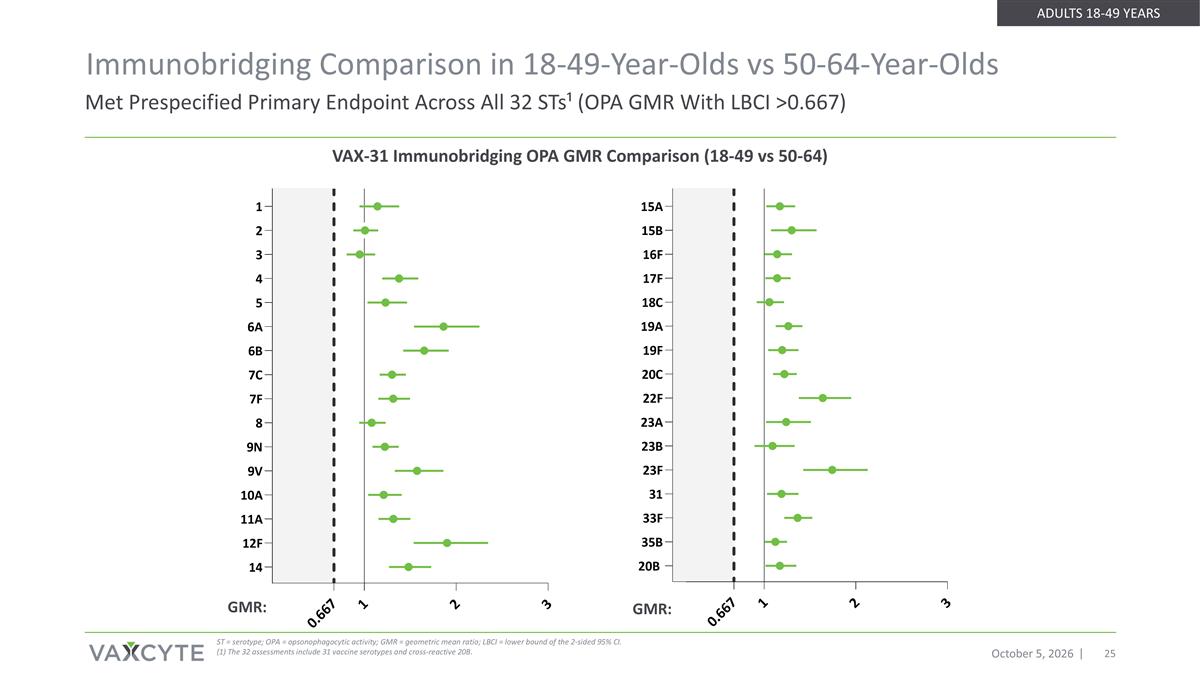
October 5, 2026 Met Prespecified Primary Endpoint Across All 32 STs¹ (OPA GMR With LBCI >0.667) ST = serotype; OPA = opsonophagocytic activity; GMR = geometric mean ratio; LBCI = lower bound of the 2-sided 95% CI. (1) The 32 assessments include 31 vaccine serotypes and cross-reactive 20B. GMR: GMR: VAX-31 Immunobridging OPA GMR Comparison (18-49 vs 50-64) Immunobridging Comparison in 18-49-Year-Olds vs 50-64-Year-Olds ADULTS 18-49 YEARS
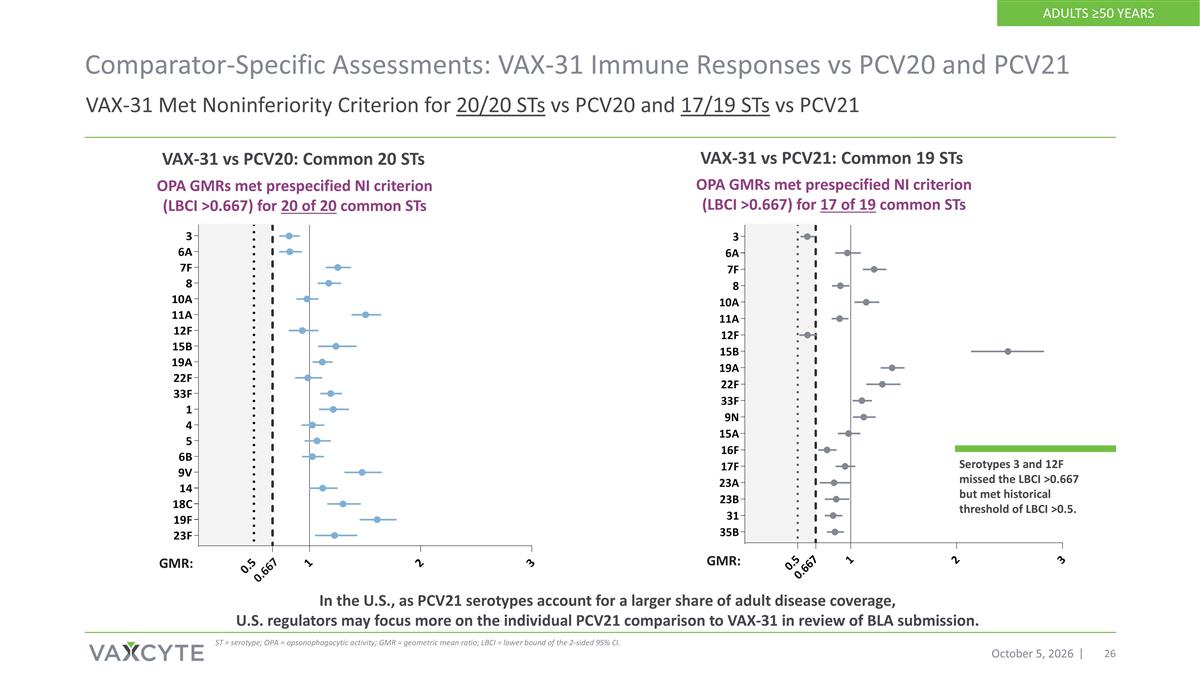
0.667 VAX-31 Met Noninferiority Criterion for 20/20 STs vs PCV20 and 17/19 STs vs PCV21 Comparator-Specific Assessments: VAX-31 Immune Responses vs PCV20 and PCV21 October 5, 2026 VAX-31 vs PCV20: Common 20 STs ST = serotype; OPA = opsonophagocytic activity; GMR = geometric mean ratio; LBCI = lower bound of the 2-sided 95% CI. OPA GMRs met prespecified NI criterion (LBCI >0.667) for 20 of 20 common STs VAX-31 vs PCV21: Common 19 STs OPA GMRs met prespecified NI criterion (LBCI >0.667) for 17 of 19 common STs GMR: GMR: In the U.S., as PCV21 serotypes account for a larger share of adult disease coverage, U.S. regulators may focus more on the individual PCV21 comparison to VAX-31 in review of BLA submission. Serotypes 3 and 12F missed the LBCI >0.667 but met historical threshold of LBCI >0.5. ADULTS ≥50 YEARS
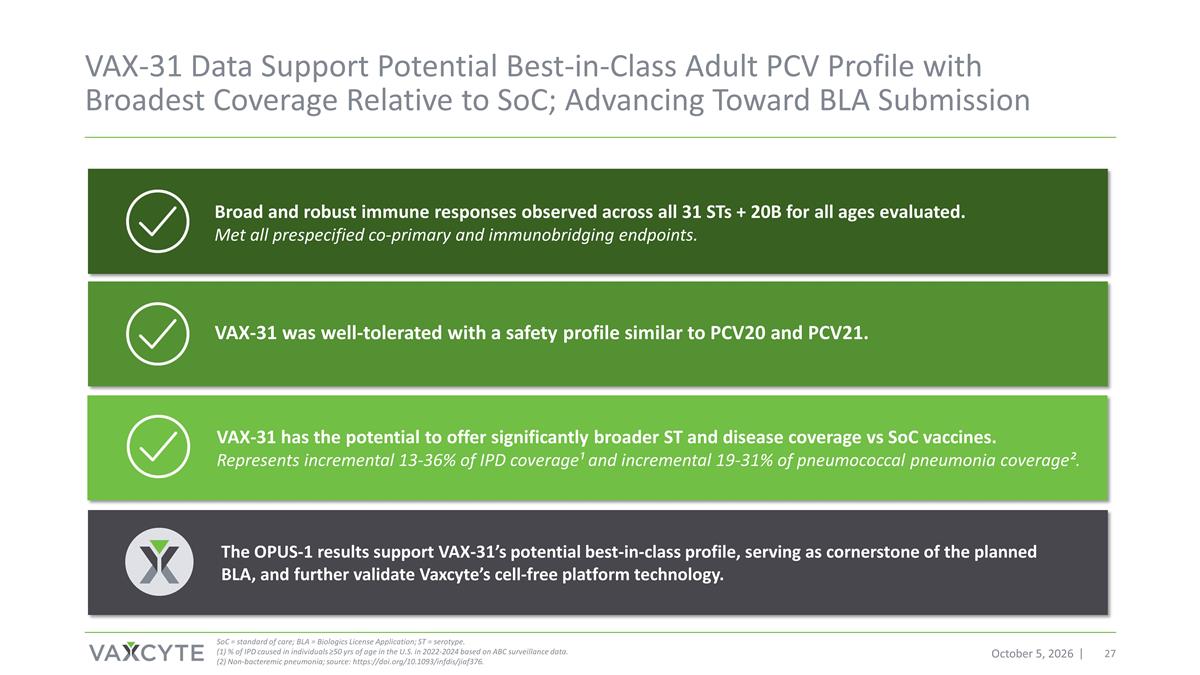
VAX-31 Data Support Potential Best-in-Class Adult PCV Profile with Broadest Coverage Relative to SoC; Advancing Toward BLA Submission October 5, 2026 SoC = standard of care; BLA = Biologics License Application; ST = serotype. (1) % of IPD caused in individuals ≥50 yrs of age in the U.S. in 2022-2024 based on ABC surveillance data. (2) Non-bacteremic pneumonia; source: https://doi.org/10.1093/infdis/jiaf376. Broad and robust immune responses observed across all 31 STs + 20B for all ages evaluated. Met all prespecified co-primary and immunobridging endpoints. VAX-31 has the potential to offer significantly broader ST and disease coverage vs SoC vaccines. Represents incremental 13-36% of IPD coverage¹ and incremental 19-31% of pneumococcal pneumonia coverage². The OPUS-1 results support VAX-31’s potential best-in-class profile, serving as cornerstone of the planned BLA, and further validate Vaxcyte’s cell-free platform technology. VAX-31 was well-tolerated with a safety profile similar to PCV20 and PCV21.
VAX-31 Program Next Steps October 5, 2026
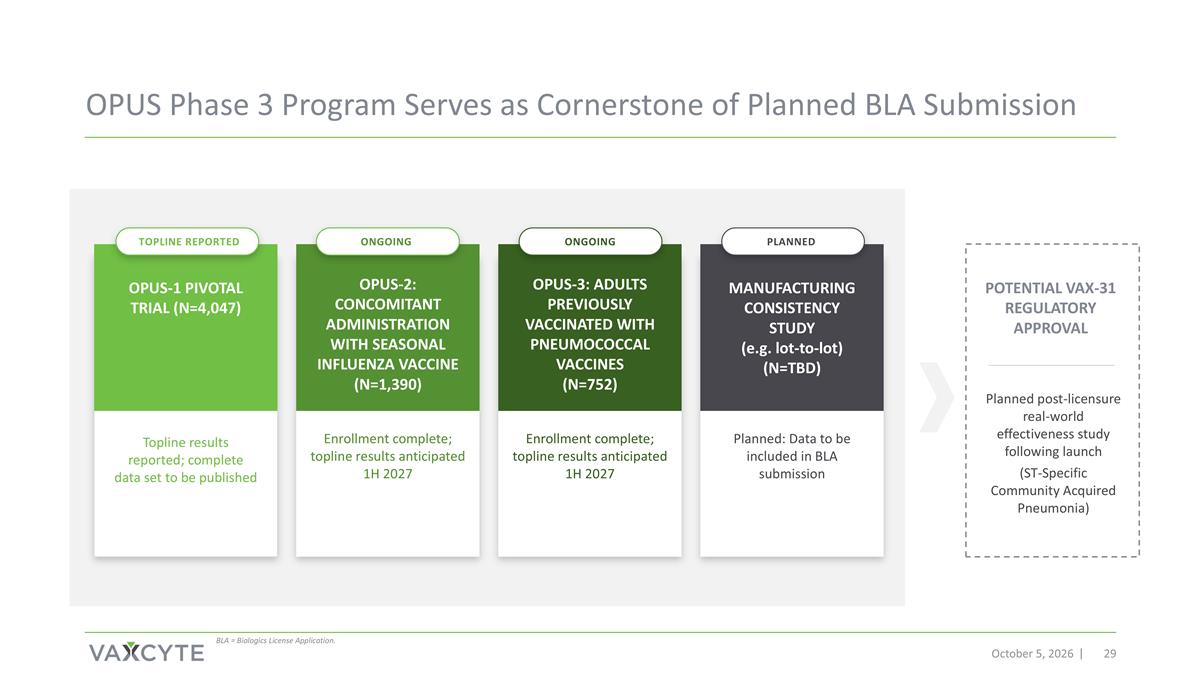
October 5, 2026 OPUS-1 PIVOTAL TRIAL (N=4,047) Topline results reported; complete data set to be published MANUFACTURING CONSISTENCY STUDY (e.g. lot-to-lot) (N=TBD) OPUS-2: CONCOMITANT ADMINISTRATION WITH SEASONAL INFLUENZA VACCINE (N=1,390) Enrollment complete; topline results anticipated 1H 2027 OPUS-3: ADULTS PREVIOUSLY VACCINATED WITH PNEUMOCOCCAL VACCINES (N=752) Enrollment complete; topline results anticipated 1H 2027 POTENTIAL VAX-31 REGULATORY APPROVAL OPUS Phase 3 Program Serves as Cornerstone of Planned BLA Submission Planned post-licensure real-world effectiveness study following launch (ST-Specific Community Acquired Pneumonia) Planned: Data to be included in BLA submission BLA = Biologics License Application. TOPLINE REPORTED ONGOING ONGOING PLANNED
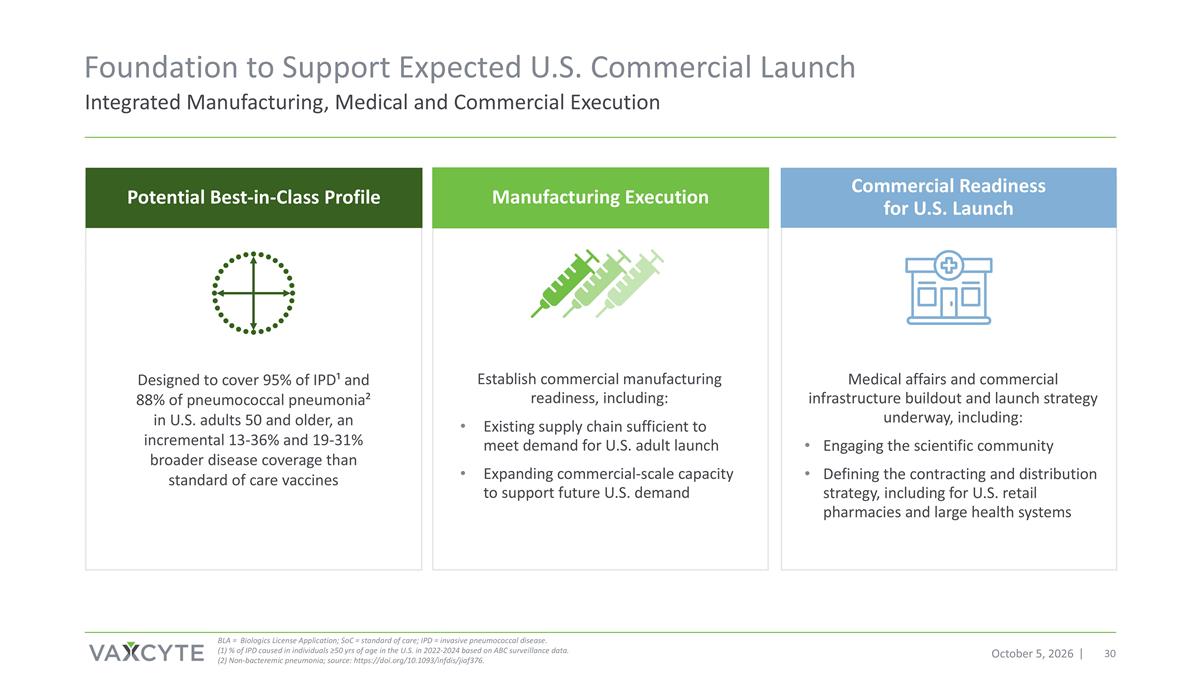
Establish commercial manufacturing readiness, including: Existing supply chain sufficient to meet demand for U.S. adult launch Expanding commercial-scale capacity to support future U.S. demand Foundation to Support Expected U.S. Commercial Launch October 5, 2026 Medical affairs and commercial infrastructure buildout and launch strategy underway, including: Engaging the scientific community Defining the contracting and distribution strategy, including for U.S. retail pharmacies and large health systems Designed to cover 95% of IPD¹ and 88% of pneumococcal pneumonia² in U.S. adults 50 and older, an incremental 13-36% and 19-31% broader disease coverage than standard of care vaccines BLA = Biologics License Application; SoC = standard of care; IPD = invasive pneumococcal disease. (1) % of IPD caused in individuals ≥50 yrs of age in the U.S. in 2022-2024 based on ABC surveillance data. (2) Non-bacteremic pneumonia; source: https://doi.org/10.1093/infdis/jiaf376. Potential Best-in-Class Profile Manufacturing Execution Commercial Readiness for U.S. Launch Integrated Manufacturing, Medical and Commercial Execution
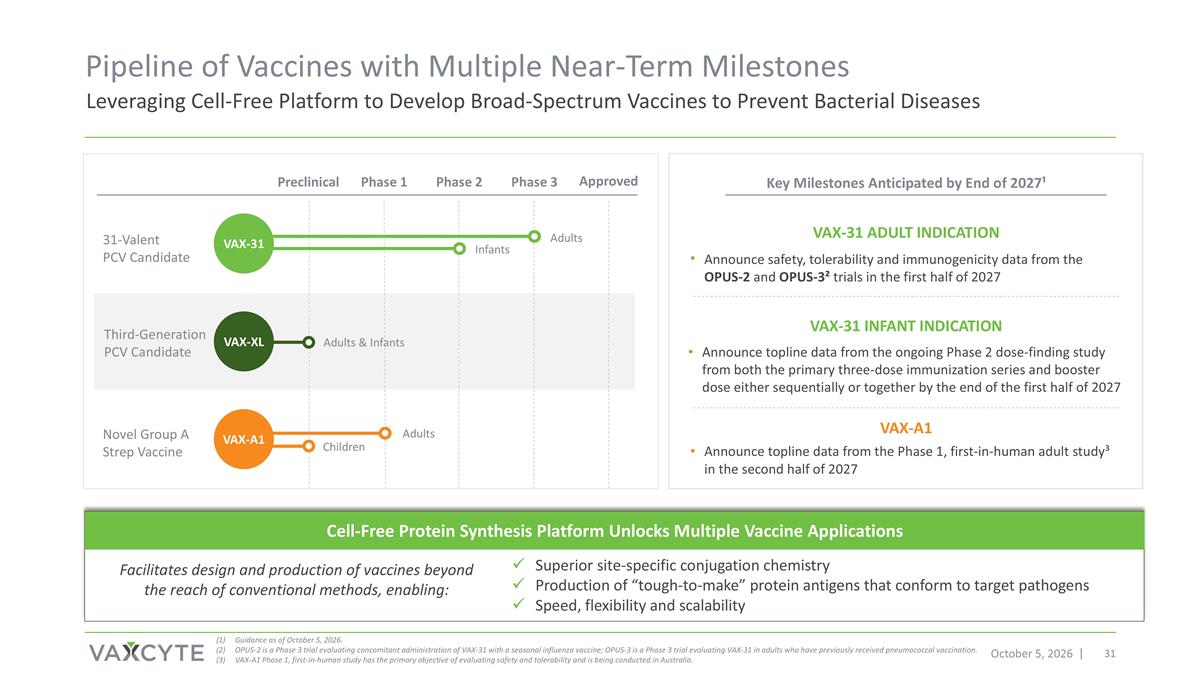
Announce safety, tolerability and immunogenicity data from the OPUS-2 and OPUS-3² trials in the first half of 2027 Pipeline of Vaccines with Multiple Near-Term Milestones October 5, 2026 Guidance as of October 5, 2026. OPUS-2 is a Phase 3 trial evaluating concomitant administration of VAX-31 with a seasonal influenza vaccine; OPUS-3 is a Phase 3 trial evaluating VAX-31 in adults who have previously received pneumococcal vaccination. VAX-A1 Phase 1, first-in-human study has the primary objective of evaluating safety and tolerability and is being conducted in Australia. Leveraging Cell-Free Platform to Develop Broad-Spectrum Vaccines to Prevent Bacterial Diseases Preclinical Phase 1 Phase 2 Phase 3 Approved 31-Valent PCV Candidate Adults Infants VAX-31 Third-Generation PCV Candidate Adults & Infants VAX-XL Key Milestones Anticipated by End of 2027¹ Announce topline data from the ongoing Phase 2 dose-finding study from both the primary three-dose immunization series and booster dose either sequentially or together by the end of the first half of 2027 VAX-31 Adult indication VAX-31 Infant indication Announce topline data from the Phase 1, first-in-human adult study³ in the second half of 2027 VAX-A1 Cell-Free Protein Synthesis Platform Unlocks Multiple Vaccine Applications Superior site-specific conjugation chemistry Production of “tough-to-make” protein antigens that conform to target pathogens Speed, flexibility and scalability Facilitates design and production of vaccines beyond the reach of conventional methods, enabling: Novel Group A Strep Vaccine Adults VAX-A1 Children


Appendix October 5, 2026
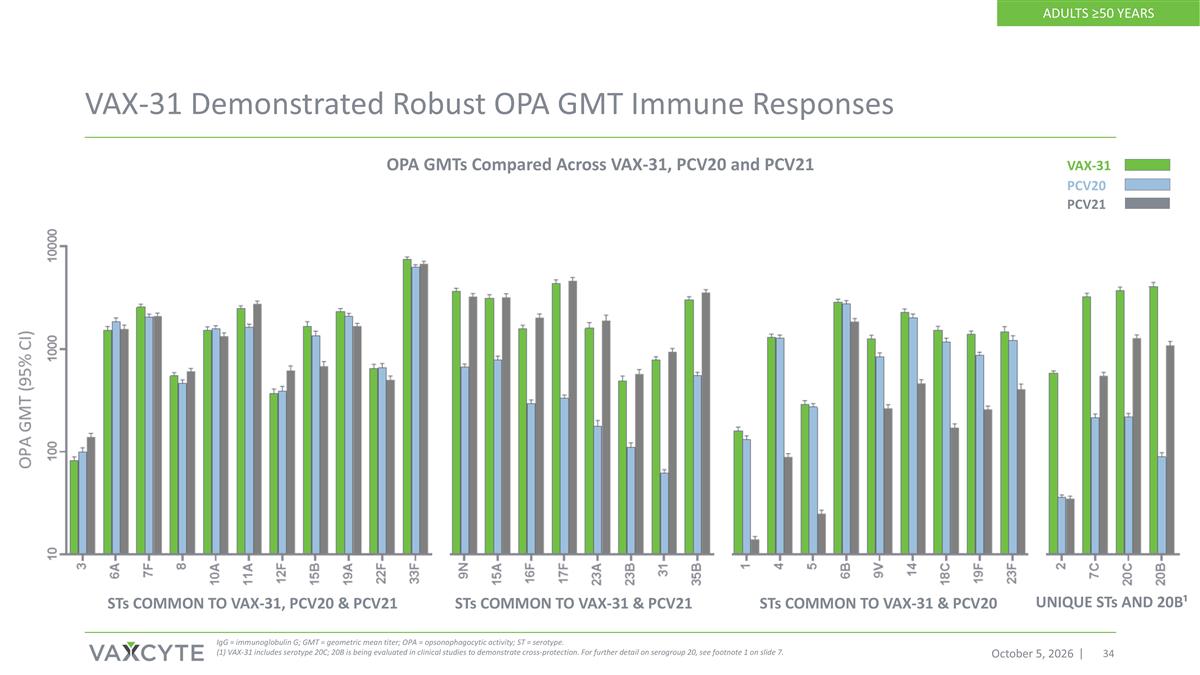
VAX-31 Demonstrated Robust OPA GMT Immune Responses October 5, 2026 IgG = immunoglobulin G; GMT = geometric mean titer; OPA = opsonophagocytic activity; ST = serotype. (1) VAX-31 includes serotype 20C; 20B is being evaluated in clinical studies to demonstrate cross-protection. For further detail on serogroup 20, see footnote 1 on slide 7. STs COMMON TO VAX-31, PCV20 & PCV21 STs COMMON TO VAX-31 & PCV20 STs COMMON TO VAX-31 & PCV21 UNIQUE STs AND 20B¹ OPA GMTs Compared Across VAX-31, PCV20 and PCV21 ADULTS ≥50 YEARS VAX-31 PCV21 PCV20
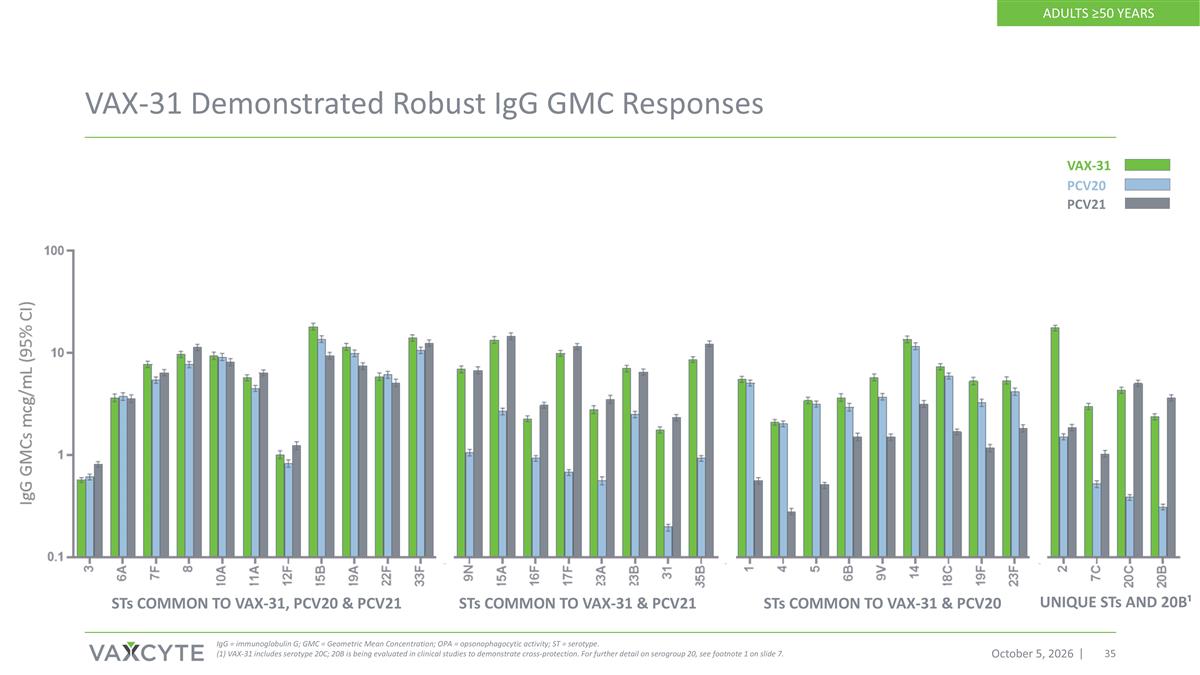
VAX-31 Demonstrated Robust IgG GMC Responses October 5, 2026 IgG = immunoglobulin G; GMC = Geometric Mean Concentration; OPA = opsonophagocytic activity; ST = serotype. (1) VAX-31 includes serotype 20C; 20B is being evaluated in clinical studies to demonstrate cross-protection. For further detail on serogroup 20, see footnote 1 on slide 7. STs COMMON TO VAX-31, PCV20 & PCV21 STs COMMON TO VAX-31 & PCV20 STs COMMON TO VAX-31 & PCV21 UNIQUE STs AND 20B¹ ADULTS ≥50 YEARS VAX-31 PCV21 PCV20