.3

MANAGEMENT
DISCUSSION & ANALYSIS
For the year ended December 31, 2025
.3
MANAGEMENT
DISCUSSION & ANALYSIS
For the year ended December 31, 2025

Management Discussion and Analysis | 2 |
This Management Discussion and Analysis (“MD&A”) dated March 25, 2026, has been prepared according to Regulation 51-102 of the continuous disclosure requirements and approved by the Board of Directors of Nouveau Monde Graphite Inc. (the “Company” or “NMG”).
This MD&A should be read in conjunction with the Company’s audited consolidated financial statements for the years ended December 31, 2025, and December 31, 2024, and related notes included therein. The Company’s consolidated financial statements have been prepared in accordance with the International Financial Reporting Standards, as published by the International Accounting Standards Board (“IASB”) (“IFRS Accounting Standards”). All monetary amounts included in this MD&A are expressed in thousands of Canadian dollars (“CAD”), the Company’s reporting and functional currency, unless otherwise noted.
This MD&A report is for the year ended December 31, 2025, with additional information up to March 25, 2026.
CAUTIONARY NOTE REGARDING FORWARD-LOOKING STATEMENTS
This MD&A contains “forward-looking information” and “forward-looking statements” within the meaning of applicable securities legislation (collectively, “forward-looking statements”), including, but not limited to, statements relating to future financial or operating events or future performance of the Company and reflect management’s expectations and assumptions regarding the Company’s growth, results, performance and business prospects and opportunities. Such forward-looking statements reflect management’s current beliefs and are based on information currently available to it. In some cases, forward-looking statements can be identified by words such as “aim”, “anticipate”, “aspire”, “attempt”, “believe”, “budget”, “could”, “estimate”, “expect”, “forecast”, “intend”, “may”, “mission”, “plan”, “potential”, “predict”, “progress”, “outlook”, “schedule”, “should”, “study”, “target”, “will”, “would” or the negative of these terms or other similar expressions concerning matters that are not historical facts. In particular, statements regarding the Company’s future results, the intended construction and commissioning timeline of the Matawinie Mine Project and the Bécancour Battery Material Plants Project, the Shaping Demonstration Plant, the Coating Demonstration Plant and the Concentrator Demonstration Plant, the intended development of the Matawinie Mine, the intended development of the First-Stage Bécancour Battery Material Plant, the intended development of the Second-Stage Bécancour Battery Material Plant, including the ability to source raw materials for the Second-Stage Bécancour Battery Material Plant, the intended execution strategy of the Company’s projected development of the Matawinie Mine Project and the First-Stage Bécancour Battery Material Plants Project, including the possibility of sequencing financing stages, the intent of the Company to prioritize, as an initial milestone for the Bécancour Battery Material Plants (as defined herein), the development of the First-Stage Bécancour Battery Material Plant, the possibility that the powerline may or may not be operational in due time for the Matawinie Mine Project commissioning phase, the intended development of the Uatnan Mining Project (as described herein), the economic performance and product development efforts, as well as the Company’s expected achievement of milestones, including the ability to obtain sufficient financing for the development of the Matawinie Mine Project and the Bécancour Battery Material Plants Project on favorable terms for the Company, including the completion of the financing and the FID, the satisfaction of the terms and conditions, conditions precedent, as well as qualification requirements of the product and the commercial operations as set forth in the offtakes agreements entered into with the Company, including the Panasonic Energy Agreement and the amended and restated offtake and joint marketing agreement with Traxys, the ability of the Company to enter into definitive agreements with the GoC and allied country entities, the satisfaction of the conditions precedent to the Panasonic Energy Agreement, the Company’s development activities and production plans, including the operation of the Shaping Demonstration Plant, the Coating Demonstration Plant and the Concentrator Demonstration Plant, the ability to achieve the Company’s environmental, social and
Management Discussion and Analysis | 3 |
governance (“ESG”) initiatives, the execution and implementation of agreements with First Nations, communities and key stakeholders on favorable terms for the Company, the Company’s ability to provide advanced materials while promoting sustainability and supply chain traceability, including the Company’s green and sustainable lithium-ion active anode material initiatives, the Company’s ability to establish a local, carbon-neutral, and traceable turnkey supply of graphite for the Western World, the Company’s electrification strategy and its intended results, market trends, the consumers demand for components in lithium-ion batteries for electric vehicles, energy storage solutions, and consumer technology applications, as well as niche applications in traditional, specialized, defense industries, the Company’s competitive advantages, macroeconomic conditions, the impact of applicable laws and regulations, the results of the 2025 Matawinie Mine Feasibility Study, the results of the AACE Project Cost Estimates (as defined herein), the results of the 2023 Uatnan Mining Project Report and any other feasibility study and preliminary economic assessments and any information as to future plans and outlook for the Company are or involve forward looking-statements.
Forward-looking statements are based on reasonable assumptions that have been made by the Company as at the date of such statements and are subject to known and unknown risks, uncertainties, and other factors that may cause the actual results, level of activity, performance, or achievements of the Company to be materially different from those expressed or implied by such forward-looking statements, including but not limited to, the actual results of current development, engineering and planning activities, access to capital and future prices of graphite, new mining operation inherent risks, mineral exploration and development activities inherent risks, the speculative nature of mining development, changes in mineral production performance, the uncertainty of processing the Company’s technology on a commercial basis, development and production timetables; competition and market risks; pricing pressures; other risks of the mining industry, and additional engineering and other analysis is required to fully assess their impact; the fact that certain of the initiatives described in this MD&A, are still in the early stages and may not materialize; business continuity and crisis management; political instability and international conflicts; and such other assumptions and factors as set out herein and in this MD&A, and additionally, such other factors discussed in the section entitled “Risk Factors” in the Company’s most recent annual information form, which is available under the Company’s profile on SEDAR+ (www.sedarplus.ca).
Although the Company has attempted to identify important factors that could cause actual results to differ materially from those contained in forward-looking statements, there may be other factors that may cause results not to be as anticipated, estimated, or intended. There can be no assurance that such statements will prove to be accurate, as actual results and future events could differ materially from those anticipated in such statements. Accordingly, readers should not place undue reliance on forward-looking statements and are cautioned that the list of risks, uncertainties, assumptions and other factors are not exhaustive. The Company does not undertake to update or revise any forward-looking statements that are included in this MD&A, whether as a result of new information, future events, or otherwise, except in accordance with applicable securities laws. Additional information regarding the Company can be found in the most recent annual information form, which is available under the Company’s profile on SEDAR+ (www.sedarplus.ca), under the Company’s issuer profile.
TECHNICAL INFORMATION AND CAUTIONARY NOTE TO U.S. INVESTORS
Scientific and technical information in this MD&A has been reviewed and approved by Eric Desaulniers, geo, President and CEO of NMG, a Qualified Person as defined by National Instrument 43-101 Standards of Disclosure for Mineral Projects (“NI 43-101”). Further information about the Matawinie Mine Project, including a description of key assumptions, parameters, methods, and risks, is available in a technical report following NI 43-101 rules and guidelines, titled “NI 43-101 Technical Report: 2025 Feasibility Study for the Matawinie Graphite Mine, Saint-Michel-des-Saints, Québec, Canada” dated and effective November 12, 2025 , and available on SEDAR+ and EDGAR (the “2025 Matawinie Mine Feasibility Study”). Further information about the Uatnan Mining Project, including a description of key assumptions, parameters, methods, and risks, is available in a technical report following NI 43-101 rules and guidelines, titled “NI 43-101 Technical
Management Discussion and Analysis | 4 |
Report – PEA Report for the Uatnan Mining Project”, effective January 10, 2023, and available on SEDAR+ and EDGAR (the “2023 PEA”).
Disclosure regarding Mineral Reserve and Mineral Resource estimates included herein were prepared in accordance with NI 43-101 and applicable mining terms are as defined in accordance with the CIM Definition Standards on Mineral Resources and Reserves adopted by the Canadian Institute of Mining, Metallurgy and Petroleum Council (the “CIM Definition Standards”), as required by NI 43-101. Unless otherwise indicated, all reserve and resource estimates included in this MD&A have been prepared in accordance with the CIM Definition Standards, as required by NI 43-101.
NI 43-101 is a rule developed by the Canadian Securities Administrators that establishes standards for all public disclosure an issuer makes of scientific and technical information concerning mineral projects. NI 43-101 differs from the disclosure requirements of the United States Securities and Exchange Commission (the “SEC”) applicable to U.S. companies. Accordingly, information contained herein may not be comparable to similar information made public by U.S. companies reporting pursuant to SEC reporting and disclosure requirements.
Market and industry data presented throughout this MD&A was obtained from third-party sources and industry reports, publications, websites, and other publicly available information, as well as industry and other data prepared by the Company or on behalf of the Company based on its knowledge of the markets in which the Company operates, including information provided by suppliers, partners, customers and other industry participants.
The Company believes that the market and economic data presented throughout this MD&A is accurate as of the date of publication and, with respect to data prepared by the Company or on behalf of the Company, that estimates and assumptions are currently appropriate and reasonable, but there can be no assurance as to the accuracy or completeness thereof. The accuracy and completeness of the market and economic data presented throughout this MD&A are not guaranteed and the Company does not make any representation as to the accuracy of such data. Actual outcomes may vary materially from those forecasted in such reports or publications, and the prospect of material variation can be expected to increase as the length of the forecast period increases. Although the Company believes it to be reliable as of the date of publication, the Company has not independently verified any of the data from third-party sources referred to in this MD&A, analyzed or verified the underlying studies or surveys relied upon or referred to by such sources, or ascertained the underlying market, economic and other assumptions relied upon by such sources. Market and economic data are subject to variations and cannot be verified due to limits on the availability and reliability of data inputs, the voluntary nature of the data-gathering process and other limitations and uncertainties inherent in any statistical survey.
The Company was established on December 31, 2012, under the Canada Business Corporations Act. NMG’s registered office is located at 481 Brassard Street, Saint-Michel-des-Saints, Québec, Canada, J0K 3B0.
In view of final investment decisions (“FID”) on its Phase-2 projects, the Company incorporated NMG Matawinie Inc. and NMG Bécancour Inc. on June 20, 2025. The Company now has four subsidiaries (with equity ownership indicated below) namely:
Management Discussion and Analysis | 5 |
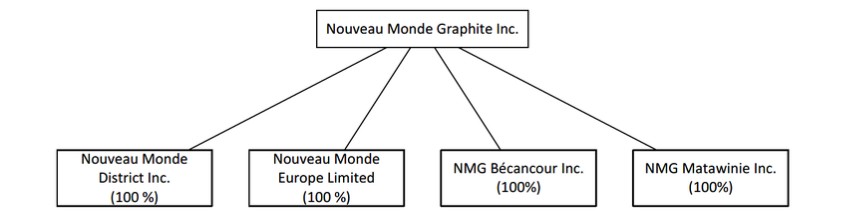
The Company’s shares are listed under the symbol NOU on the Toronto Stock Exchange (“TSX”) and NMG on the New York Stock Exchange (“NYSE”).
The Company’s consolidated financial statements have been prepared using accounting principles applicable to a going concern, which contemplates the realization of assets and settlement of liabilities in the normal course of business as they come due. In assessing whether the going concern assumption is appropriate, management considers all available information about the future, which is at least, but not limited to, the next twelve months.
Management believes that without additional funding, the Company does not have sufficient liquidity to pursue its planned expenditures. These circumstances indicate the existence of material uncertainties that cast substantial doubt upon the Company’s ability to continue as a going concern and, accordingly, the appropriateness of the use of IFRS Accounting Standards applicable to a going concern.
The Company’s ability to continue future operations and fund its development and acquisition activities is dependent on management’s ability to secure additional financing, which may be completed in a number of ways including, but not limited to, the issuance of debt or equity instruments, expenditure reductions, or a combination of strategic partnerships, joint venture arrangements, project debt finance, offtake financing, royalty financing, and other capital markets alternatives. While management has been successful in securing financing in the past, there can be no assurance it will be able to do so in the future or that these sources of funding or initiatives will be available for the Company or that they will be available on terms which are acceptable to the Company.
Although management has taken steps to verify the ownership rights in mining properties in which the Company holds an interest in accordance with industry standards for the current stage of exploration of such properties, these procedures do not guarantee the title property for the Company. The title may be subject to unregistered prior agreements and may not comply with regulatory requirements.
NMG is an integrated company developing responsible mining and advanced processing operations to supply the global economy with carbon-neutral advanced graphite materials. The Company is developing in Québec, Canada, a fully integrated ore-to-processed-graphite value chain to serve tomorrow’s industries in energy, advanced technology, and manufacturing. With recognized ESG standards and structuring partnerships with major customers, NMG is set to become a strategic supplier of advanced materials to leading specialized manufacturers while promoting sustainability, innovation, and supply chain traceability.
Vision | To accelerate the transition to a decarbonized and just future. |
Mission | To become the industry benchmark by producing high-quality graphite solutions responsibly and safely. |
Values | Caring, responsibility, openness, integrity, and entrepreneurial spirit. |
Management Discussion and Analysis | 6 |
Based in Québec, Canada, the Company’s activities are focused on the planned Matawinie graphite mine and concentrator (the “Matawinie Mine”) and the planned commercial value-added graphite products transformation facilities (the “Bécancour Battery Material Plants”), both of which are progressing concurrently towards FID in view of commercial operations. NMG is also planning the development of the Uatnan mining project (the “Uatnan Mining Project”) as a subsequent expansion phase. Underpinning these projects are NMG’s Matawinie and Lac Guéret graphite deposits and clean hydroelectricity powering its operations. The Company is developing what is projected to be North America’s one of the first and largest fully integrated natural graphite production.
| » | Phase-2 Matawinie Mine advancement toward FID on the basis of the 2025 Matawinie Mine Feasibility Study, commercial agreements, as well as lenders and investors respective processes, with an H1-2026 target date. |
| » | Fully committed senior secured project debt package of US$335 million with EDC and CIB, a long-tenor, flexible project-finance structure with competitive rates and repayment terms, underpinned by ESG credentials in line with international standards |
| » | Demonstrated commercial foundation for NMG’s Phase 2 highlighted by sales and marketing agreements with Panasonic Energy, Traxys and the Government of Canada, securing diversified demand for active anode material and graphite concentrate. |
| » | Construction readiness at the Phase-2 Matawinie Mine, including completion of preparatory works, execution planning, significant advancement of detailed engineering, and award of key contracts covering more than 50% of projected CAPEX, within financial estimates. |
| » | Designation by the Government of Canada of the Matawinie Mine as a Major Project of National Interest, affirming NMG’s strategic role in critical minerals development and North American supply chain sovereignty. |
| » | Acquisition of a brownfield site in Bécancour enabling accelerated construction and commissioning of the First- Stage Bécancour Battery Material Plant to deliver on Panasonic Energy’s active anode material offtake. |
| » | Completion of a US$20-million public equity offering to fund long-lead items, detailed engineering, and corporate expenses ahead of FID. |
| » | Continued ESG leadership and operational discipline, with no major environmental incidents, a year-end TRIFR of 1.78 at Company facilities and 0 at worksites, and maintenance of a carbon-neutral balance through reduction initiatives and verified offsets. |
| » | R&D collaborations with leading Canadian researchers to develop multifunctional graphite–polymer composites and next-generation battery materials, supporting a diversified marketing strategy. |
| » | Favorable position to benefit from structural critical minerals tailwinds, as governments in the Western World intensify policy actions to secure domestic and allied supply chains for graphite and battery materials. |
| » | Period-end cash position of $73,940. |
Striving to establish a local, carbon-neutral, and traceable turnkey supply of graphite for the Western World, the Company is advancing an integrated business operation, from responsible mining to advanced processing. NMG is marketing its future production of graphite concentrate and active anode material to serve in lithium-ion batteries for EVs, energy storage solutions, and consumer technology applications, as well as niche applications in traditional, industrial, and specialized industries.
The Company is carrying out a phased development plan for its Matawinie Mine and Bécancour Battery Material Plants (respectively, with the applicable demonstration plants (Phase 1), the “Matawinie Mine Project” and the “Bécancour Battery Material Plants Project” (Phase 2)) to derisk its projects and advance towards FID in view of commercial operations.
Management Discussion and Analysis | 7 |
To support growth and meet customers’ demand beyond its Phase 2, the Company is planning the development of the Uatnan Mining Project targeted as NMG’s Phase-3 expansion.
Demonstration Plants | ||
Phase 1 – Demonstration Plants | ||
| Concentrator Demonstration Plant | In operation to support product sampling and qualification to customers’ specifications. |
| Battery Material Demonstration Plants | In operation to support product sampling and qualification to customers’ specifications. Ongoing testing is also being conducted at third-party facilities. |
Matawinie Mine Project | ||
To support the development of the Matawinie Mine, NMG plans to continue optimizing its processes, products, and operational practices to align with the technical requirements of its customers using its Phase-1 demonstration plant; advance detailed engineering, construction planning, and procurement activities; and finalize the project financing with the various financial stakeholders engaged in the project to reach FID and launch construction of the Phase 2. A positive FID is dependent on the financing structure in light of the 2025 Matawinie Mine Feasibility Study, updated financial model, the conclusions of the due diligence processes, and negotiations with the various financial stakeholders, including the completion of the conditions precedent, as well as project-related and definitive agreements with customers. | ||
Phase 2 – Matawinie Mine | Mining decree obtained. Preparatory works completed; concrete-ready in preparation for launch of construction upon a positive FID. Completion and issuance of the 2025 Matawinie Mine Feasibility Study reflecting advancement in engineering, in technological development, in project optimizations, and in the financial model. Detailed engineering, construction planning, and procurement strategy advancing in parallel to project financing. | |
Management Discussion and Analysis | 8 |
Bécancour Battery Material Plants Project | ||
To support the development of the Bécancour Battery Material Plants, NMG plans to continue optimizing its processes, products, and operational practices to align with the technical requirements of its customers using its Phase-1 demonstration plants; refine environmental performance and operational parameters of the chemical purification technology; advance engineering, construction planning, and procurement activities; and finalize the project financing for the First-Stage Bécancour Battery Material Plant with the various financial stakeholders engaged in the project to reach FID and launch construction for this facility. A positive FID is dependent on the financing structure in light of the First-Stage Bécancour Battery Material Plant Class 3 AACE Estimate, updated financial model, the conclusions of the due diligence processes, and negotiations with the various financial stakeholders, including the completion of the conditions precedent and the project-related agreement with Panasonic Energy. | ||
Phase 2 – Bécancour Battery Material Plants | ||
| First-Stage Bécancour Battery Material Plant | Acquisition of a brownfield site located in Bécancour. Class 3 AACE Estimate in preparation to retrofit plans to the building; permitting, engineering, construction planning, and procurement activities advancing in parallel. |
| Second-Stage Bécancour Battery Material Plant | Ongoing commercial discussions to finalize product mix and development plan. |
Uatnan Mining Project | ||
To support the advancement of the Uatnan Mining Project, NMG plans engaging with the Innu First Nation of Pessamit to establish a collaboration model in view of advancing a feasibility study along with an environmental and social impact assessment. Additional funding will be required to support this development. The Company also aims at formalizing commercial engagement for this contemplated production. The development of the project leading to governmental authorizations is dependent on positive studies results, successful public consultation and First Nation engagement, favorable market demand, and commercial interest. | ||
Phase 3 – Uatnan Mining Project | Preliminary economic assessment (“2023 PEA”) completed; detailed work plan for subsequent studies ready for deployment. Assessment of potential sites for processing plants initiated. | |
Since 2018, the Company has been operating demonstration plants to support its business plan, technological development, and commercialization strategy. It enables to:
| » | qualify the Company’s graphite products and establish sales agreements; |
| » | test and improve processes for commercial operations; |
| » | test new technologies of tailings management and site restoration; and |
| » | train employees and promote future employment opportunities to local labor. |
Concentrator Demonstration Plant (Phase 1)
Graphite concentrate is produced from ore extracted from the West Zone Deposit of the Matawinie graphite property with grades between 95-98% Cg (as per technical requirements). The production serves as the feedstock for the Company’s Phase-1 Battery Material Demonstration Plants and as samples for potential customers interested in flake
Management Discussion and Analysis | 9 |
graphite. An authorization from the government for an additional 10,000 tpa of bulk ore sampling has been granted by the government to extend the production of samples at Phase-1 facilities.
Battery Material Demonstration Plants (Phase 1)
Shaping, purification, and coating modules at NMG’s Phase-1 facilities and partnering laboratories produce samples of varying specifications to provide inputs for the engineering of the Phase-2 Bécancour Battery Material Plants, support qualification efforts, and optimize technological and operational parameters of advanced refining processes. Site visits with customers enable the harmonization of test protocols at NMG’s battery laboratory.
The Matawinie graphite property includes 176 exclusive exploration rights covering 9,264 hectares (“ha”) as of the date of this MD&A, in which the Company owns a 100% interest. The Tony Block, or mining property, part of the Matawinie graphite property, is composed of 159 exclusive exploration rights totaling 8,266 hectares. The Tony Block is located approximately 120 km as the crow flies north of Montréal, Québec, Canada, in Saint-Michel-des-Saints. This block is easily accessible via the dedicated access road connecting to the local highway and is close to key infrastructure, including paved roads and high-voltage power lines, and the regional community, which provides a pool of workers and contractors. The project is located in proximity to the Montréal metropolitan area, which also has skilled labor and suppliers of goods and services.
A comprehensive exploration program has identified crystalline flake graphite mineralization and defined Mineral Resources and Reserves as presented in the 2025 Matawinie Mine Feasibility Study. The Mineral Resource for the West Zone of the mining property is based on a total of 8,274 assay intervals collected from core drilling and three surface trenches providing 207 channel samples. Proper quality control measures, including the insertion of duplicate, blank, and standard samples, were used throughout the exploration programs and returned within acceptable limits.
Current Pit-Constrained Mineral Resource Estimate for the West Zone
Current Resources (November 12, 2025)5, 6, 7 | |||
Tonnage (Mt) | C(g) Grade (%)3 | Contained Graphite (Mt) | |
Measured | 28.5 | 4.28 | 1.22 |
Indicated | 101.8 | 4.26 | 4.33 |
Measured + Indicated | 130.3 | 4.26 | 5.55 |
Inferred4 | 23.0 | 4.28 | 0.98 |
1 The Mineral Resources provided in this table were estimated by Yann Camus P.Eng., Qualified Person of SGS Geological Services, using current Canadian Institute of Mining, Metallurgy and Petroleum (“CIM”) Standards on Mineral Resources and Reserves, Definitions and Guidelines. 2 Mineral Resources that are not Mineral Reserves have not demonstrated economic viability. Additional trenching and/or drilling will be required to convert Inferred and Indicated Mineral Resources to Measured Mineral Resources. There is no certainty that any part of a Mineral Resource will ever be converted into Reserves. 3 All analyses used for the Resource Estimates were performed by ALS Minerals Laboratories and delivered as % C(g), internal analytical code C-IR18. 4 Inferred Mineral Resources represent material that is considered too speculative to be included in economic evaluations. Additional trenching and/or drilling will be required to convert Inferred Mineral Resources to Indicated or Measured Mineral Resources. It cannot be assumed that all or any part of the Inferred Resources will ever be upgraded to a higher Resource category. 5 Current Resources effective November 12, 2025. 6 Mineral Resources are stated at a cut-off grade of 1.78% C(g). 7 Quality control standards used for these Mineral Resources returned within acceptable limits, no significant bias was found. | |||
A combined Mineral Resource of the South-East and South-West zones is also present on the mining property. While these deposits are part of the mining property, they have not been studied to be integrated in the Mineral Reserves or the mine plan.
Matawinie Mineral Reserve for the West Zone
Management Discussion and Analysis | 10 |
Category | Tonnage (Mt) | C(g) Grade (%) | Contained Graphite (Mt) |
Proven | 17.3 | 4.16 | 0.7 |
Probable | 44.3 | 4.26 | 1.9 |
Proven & Probable | 61.7 | 4.23 | 2.6 |
1 The Qualified Person for the Mineral Reserve Estimate is Jeffrey Cassoff, P.Eng., of BBA Inc. 2 The effective date of the estimate is November 12, 2025. 3 Mineral Reserves were estimated using a graphite concentrate selling price of US$1,334/t, and consider a 2% royalty, and selling costs of US$34.23/t. An average grade of 97% C(t) was considered for the graphite concentrate. 4 A metallurgical recovery of 93% was used. 5 A cut-off grade of 2.20% C(g) was used. 6 The strip ratio for the open pit is 1.16 to 1. 7 The Mineral Reserves are inclusive of mining dilution and ore loss. 8 The reference point for the Mineral Reserves is the primary crusher. 9 Totals may not add due to rounding. | |||
The Company mandated engineering firm BBA Inc. (“BBA”), with the support of various technical consultants, to carry out a segregated and updated feasibility study for the Phase-2 Matawinie Mine, the 2025 Matawinie Mine Feasibility Study in accordance with National Instrument 43-101 (“NI 43-101”). With a project globally unchanged, the 2025 Matawinie Mine Feasibility Study refined some financial parameters to reflect the commercial agreements and latest CAPEX projections in line with ongoing procurement activities. Results continue to demonstrate technical and economic viability of the Phase-2 Matawinie Mine.
Project highlights for the Matawinie Mine include:
| » | Life of mine (“LOM”): 25 years |
| » | Stripping ratio (LOM): 1.16:1 |
| » | Nominal annual processing rate: 2.563M metric tonnes |
| » | Average recovery: 93% |
| » | Nominal annual graphite concentrate production: 105,882 metric tonnes |
| » | Finished product purity: 97.5% Ct |
| » | CAPEX: US$421M |
| » | Annual OPEX: US$44M |
| » | After-tax NPV (8% discount rate): US$238M |
| » | After-tax IRR: 15.8% |
| » | After-tax payback: 5.3 years |
The Matawinie Mine Project is now advancing toward FID (see the Financing section, under Governance for further details).
A governmental decree authorizes the project and provides the Company with the regulatory requirements to build and operate the Phase-2 Matawinie Mine, upon positive FID and project financing. The Company works collaboratively with various authorities to plan and advance the permitting process for the various construction and operation activities.
| » | The Company has requested an amendment to the government decree to clarify certain operating conditions. The main adjustment concerns the maximum authorized tonnage, which would be increased from 100,000 tpa to a maximum of 106,000 tpa based on the peak production years as stated in the 2025 Matawinie Mine Feasibility Study, as well as the resulting adjustments to operations. The request is in active review with the authorities. |
| » | Numerous permit/authorization applications for the upcoming construction have been submitted in line with the project execution schedule. |
Management Discussion and Analysis | 11 |
| » | Various mitigation measures, environmental initiatives, and sub-project components for the community are being advanced in line with commitments and obligations detailed in the governmental decree and/or permitting requirements. |
The Company is advancing under an integrated project team (“IPT”) model where the NMG’s owner team is assisted by strategic partners in engineering, procurement, construction management, and project controls. The IPT strategy offers several advantages, including greater control over the project's direction as well as reduced project management and engineering costs.
| » | Detailed engineering is progressing with AtkinsRealis (concentrator), SRK Consulting (tailings and environmental infrastructure), and BBA (mining infrastructure), supporting the preparation of purchase orders for vendor engineering and long-lead items. |
| » | Pomerleau was appointed as Construction Manager responsible for overseeing construction sequencing, contractor supervision, logistics, health and safety, and quality implementation across the mine facilities. |
| » | The 120kV electrical substation contract was awarded to ABB. ABB will lead construction of the substation as the primary connection point between the mining site and Hydro-Québec’s hydropower line, enabling full electrification of the Matawinie Mine using renewable energy. Dedicated ABB technical experts will oversee engineering, supply, commissioning, and start-up of the substation. |
| » | Metso will supply key concentrator and mineral processing equipment, including crushing stations, feeders, mills, flotation cells, and filter presses. |
| » | Manawan-Fournier, an Atikamekw joint-venture between the Manawan Atikamekw Band Council and L. Fournier & Fils, an established East Canadian mining and civil contractor, was awarded the first and largest construction package to perform civil works, including networks, industrial structures, concrete, and related site development. |
| » | Beauce Atlas was contracted to engineer, source, fabricate, and install the steel structures for the project’s industrial buildings, crane rails, and associated components. Additional procurement activities are on-going to ensure the Company is ready to start construction upon reaching FID, including direct meetings with local and Indigenous businesses representatives to document the capacity, service offerings, and availability of businesses in the region. |
| » | Construction preparation is actively refining the execution plan, detailed construction sequence and schedule, as well as health and safety, environment, and quality programs. |
| » | The Company mandated Hydro-Québec, the state-owned corporation, that produces, transports, and delivers power, for planning the construction of the 120-kV dedicated electrical line that will supply the mine site with clean hydroelectricity. |
Major contracts awarded, with provisions for full execution upon the Company having reached a positive FID, represent over 50% of the project’s CAPEX and are within estimates of the 2025 Matawinie Mine Feasibility Study.
Since obtaining the mining decree, the Company has carried out early works to prepare the site, namely:
| » | Tree clearing for the industrial platform, key environmental infrastructure, and the first construction zones. |
| » | An 8-km access road was built to connect the mine to the local highway. |
| » | The construction of environmental infrastructure (water ditches, water collection basin, organic and overburden stockpiles) has prepared the site for the next phase of civil works. |
| » | The site is concrete-ready for the start of construction, upon a positive FID, project financing, and construction authorizations. |
While the base case of the 2025 Matawinie Mine Feasibility Study presents a diesel operation, NMG is advancing its electrification strategy with the objective of having both mining and concentration operations become fully electric when the machinery and equipment reach viable technical and economic parameters. The Company is pursuing this opportunity
Management Discussion and Analysis | 12 |
via a collaboration with Caterpillar Inc. (“Caterpillar”) for the development of an integrated zero-emission solution for the Matawinie Mine encompassing the fleet, charging and energy storage infrastructure, as well as maintenance service.
| » | Definitive agreements between NMG and Caterpillar provide a framework for the research and development of equipment, preferential supply arrangements once such machines become commercially available, and fleet leasing or acquisition via Caterpillar’s Job Site Solutions. |
| » | A calendar is established to deploy Early Learners and/or pilot models, to test equipment in actual terrain and weather, and to plan the gradual transition to zero-emission machines. |
| » | Technical teams work in close collaboration to inform technology development and reflect contemplated electric operations into the design of the mining infrastructure, charging network, operational plan, and energy management strategies. |
BÉCANCOUR BATTERY MATERIAL PLANTS PROJECT
The Bécancour Battery Material Plants, approximately 150 km northeast of Montréal on the Saint Lawrence River, is planned to become NMG’s comprehensive advanced processing platform, in the heart of Québec’s “battery valley”. Bécancour offers direct access to highways, railway, and port for easy logistics, robust industrial infrastructure, nearby labor pool, along with potential synergies within the industrial park with battery material and chemical producers.
The Company is advancing a two-stage development plan for its Phase-2 Bécancour Battery Material Plants, leveraging contiguous brownfield and greenfield sites. The Phase-2 Bécancour Battery Material Plants are designed to receive Matawinie’s graphite concentrate production for refining in preparation for commercial distribution into specialized markets. The Company is advancing technical project development to fulfill its committed volumes upon reaching a sequenced FID for the Bécancour Battery Material Plants project.
First-Stage Bécancour Battery Material Plant
The 143,000-m2 brownfield site includes a 22,000-m2 facility, large storing and logistics area, and connections to key industrial infrastructure. NMG will leverage this brownfield facility to build a first production capacity of active anode material dedicated to Panasonic Energy. Offering a full integration from ore to battery materials, graphite concentrate from the Company’s Phase-2 Matawinie Mine will be refined at this Bécancour Battery Material Plant into 13,000 tpa of active anode material as per Panasonic Energy’s technical and quality specifications.
Leveraging the technology and engineering work carried out thus far, the Company is working to retrofit its plan to the newly acquired building and develop a Class 3 estimate as per the American Association of Cost Engineers (“AACE”) Recommended Practice 47R-11 for this brownfield development. The Company’s IPT execution model extends to the First-Stage Bécancour Battery Material Plant to advance the project development to FID and construction upon a favorable investment decision.
| » | The industrial building and associated infrastructure should enable the Company to lower infrastructure costs, optimize CAPEX per tonne costs for this first stage development, and streamline permitting, engineering, and construction timelines to align the commissioning period with that of the Matawinie Mine. |
| » | Processing technologies are being optimized by leveraging data from large-scale testing at partnering facilities. |
| » | The procurement strategy is advancing for key technical expertise, specialized equipment, and long-lead items, including proactive risk mitigation for potentially sourcing out certain specialized equipment from Asia. |
Second-Stage Bécancour Battery Material Plant
NMG owns a 200,000 m2 land in the Bécancour industrial park in Québec, Canada, where the Company intends to build an integrated processing plant, the Second-Stage Bécancour Battery Material Plant, for active anode material and/or advanced graphite materials production upon having secured offtakes for such production.
| » | Preliminary works – tree clearing, on-site road construction, and site grading – were carried out in 2024. |
Management Discussion and Analysis | 13 |
The Uatnan Mining Project is located in the Côte-Nord administrative region, Québec, Canada, approximately 220 km as the crow flies, north northwest of the closest community, the city of Baie-Comeau. It is accessible by paved and Class-1 forestry roads.
On January 21, 2024, NMG entered into an asset purchase agreement with Mason Resources Inc. (“Mason”) for the acquisition of 100% of the Lac Guéret Property, targeted for the development of the Uatnan Mining Project. The acquisition was paid by issuing 6,208,210 common shares of NMG and a subsequent payment of $5 million is to be made to Mason at the start of commercial production of the contemplated Uatnan Mining Project. The transaction closed on January 31, 2024.
This acquisition of another major asset in Québec, Canada, reinforces NMG’s fully vertically integrated business model in North America and underpins the Company’s expansion plans to become a leading producer of active anode material for the Western market.
Property and Mineral Resources
The Uatnan property presently consists of 205 map-designated exclusive exploration rights totaling 11,082.95 hectares, wholly owned (100%) by NMG.
Exploration work on the Uatnan property targeted graphite mineralization and consists to date of airborne geophysics, prospecting, ground geophysics, trenching/channel sampling, and core drilling. Exploration work uncovered significant crystalline flake graphite mineralization, ultimately leading to the identification of Mineral Resources and Mineral Reserves (see Mason’s press release dated November 9, 2015). Although parameters to determine reasonable prospects for eventual economic extraction were updated, there are no significant changes between the current Mineral Resources and the Mineral Resources last published in 2015.
Uatnan Current Pit-Constrained Mineral Resource Estimate
IN-PIT CONSTRAINED MINERAL RESOURCES | | Tonnes (Mt) | | Grade (% Cg) | | Cg (Mt) | |||||
Measured 5.75% < Cg < 25% | | 15.65 | | 15.2 | | 2.38 | |||||
Measured Cg > 25% | | 3.35 |
| 30.6 |
| 1.02 | |||||
Total Measured | | 19.00 |
| 17.9 |
| 3.40 | |||||
Indicated 5.75% < Cg < 25% | | 40.29 |
| 14.6 |
| 5.89 | |||||
Indicated Cg > 25% | | 6.33 |
| 31.6 |
| 2.00 | |||||
Total Indicated | | 46.62 |
| 16.9 |
| 7.89 | |||||
Indicated + Measured 5.75% < Cg < 25% | | 55.94 |
| 14.8 |
| 8.27 | |||||
Indicated + Measured Cg > 25% | | 9.70 |
| 31.2 |
| 3.03 | |||||
Total Measured + Indicated | | 65.64 |
| 17.2 |
| 11.30 | |||||
Inferred 5.75% < Cg < 25% | | 15.35 |
| 14.9 |
| 2.28 | |||||
Inferred Cg > 25% | | 2.47 |
| 31.8 |
| 0.79 | |||||
Total Inferred |
| 17.82 |
| 17.2 |
| 3.07 | |||||
Notes:
| 1. | The Mineral Resources provided in this table were estimated by M. Rachidi P.Geo., and C. Duplessis, Eng., (QPs) of GoldMinds Geoservices Inc., using current CIM Standards on Mineral Resources and Reserves, Definitions and Guidelines. |
| 2. | Mineral Resources that are not Mineral Reserves do not have demonstrated economic viability. The estimate of Mineral Resources may be materially affected by environmental, permitting, legal, title, market, or other relevant issues. The quantity and grade of reported Inferred Mineral Resources are uncertain in nature and there has not been sufficient work to define these Inferred Mineral Resources as indicated or Measured Mineral Resources. There is no certainty that any part of a Mineral Resource will ever be converted into Mineral Reserves. |
| 3. | The Mineral Resources presented here were estimated with a block size of 3mE x 3mN x 3mZ. The blocks were interpolated from equal-length composites (3 m) calculated from the mineralized intervals. |
| 4. | The Mineral Resource estimate was completed using the inverse distance to the square methodology utilizing three runs. For run 1, the number of composites was limited to ten with a maximum of two composites from the same drillhole. For runs two and three the number of composites was limited to ten with a maximum of one composite from the same drillhole. |
| 5. | The Measured Mineral Resources classified using a minimum of four drillholes. Indicated resources classified using a minimum of two drillholes. The Inferred Mineral Resources were classified by a minimum of one drillholes. |
Management Discussion and Analysis | 14 |
| 6. | Tonnage estimates are based on a fixed density of 2.9 t/m3. |
| 7. | A pit shell to constrain the Mineral Resources was developed using the parameters presented in the PEA. The effective date of the current Mineral Resources is January 10, 2023. |
| 8. | Mineral Resources are stated at a cut-off grade of 5.75% C(g). |
Uatnan Mining Project (Phase 3)
In 2023, NMG published the 2023 PEA, conducted by engineering firms BBA and GoldMinds Geoservices Inc. according to NI 43-101, for the Uatnan Mining Project. The Uatnan Mining Project optimizes the Mineral Resources and expands the original mining project to cater to the anode material market.
Project highlights for the Uatnan Mining Project include:
| » | LOM: 24 years |
| » | Stripping ratio (LOM): 1.3:1 |
| » | Nominal annual processing rate: 3.4 million metric tonnes |
| » | Average recovery: 85% |
| » | Contemplated average annual graphite concentrate production: 500,000 metric tonnes |
| » | Finished product purity: 94% Cg |
| » | CAPEX: C$ 1,417 M |
| » | Annual OPEX: C$ 135 M |
The Uatnan Mining Project would be operated as a conventional open pit with a concentrator near the deposit and electricity to be sourced from the Manic-5 hydroelectric power station. In line with NMG’s responsible mining approach, plans include progressive site closure with backfilling of the pit with waste rock as much as possible and assessment of fleet electrification.
NMG has mapped out a detailed workplan to enable the preparation of a feasibility study, including geological, environmental and social components. An initial technical and economic planning study covering camp and logistics requirements was carried out in 2024. The Company maintains a transparent dialogue with the Innu First Nation of Pessamit as it advances the project development to ensure the respect of their rights, the protection of the environment, their culture and way of life, as well as the inclusion of their perspective, and traditional knowledge.
Additionally, the Company has initiated the assessment of industrial sites for the establishment of battery material plants to refine the future Uatnan graphite concentrate production.
Graphite is a critical input across multiple high-growth sectors: it supports lithium-ion batteries powering electric vehicles (“EVs”) and grid-scale energy storage systems for AI/data centers and renewable energy; underpins industrial applications such as refractory materials for steel and cement and other specialty manufacturing uses; and serves advanced technology applications such as foils in electronics, thermal and fire protection materials, electromagnetic shielding, hydrogen fuel cells, and specialty composites.
With a diversified portfolio of products, NMG is aligning its business plan and associated commercial strategy to cater to energy, advanced technology, and manufacturing industries in the Western World and allied nations.
NMG has incorporated advanced processing capacities into its production model in order to tailor products to unique customer specifications. The integrated material flowsheet developed for the Company’s Phase 2 is designed – with some flexibility in the allocation of volumes – to optimize the value of large and jumbo flakes into specialty markets, and sell graphite concentrate, active anode materials and refined graphite materials into battery, industrial, and other market segments.
Management Discussion and Analysis | 15 |
By covering the full value chain – from ore to advanced materials – and offering product customization, the Company is positioning itself as a turnkey, local supplier to Western manufacturers.
With evolving market conditions and project financing requirements, NMG has worked with its main customers to update existing commercial agreements. The Company has also rallied the Government of Canada’s support in aggregating demand from allied nations and strategic industrial stakeholders.
Panasonic Energy
The 2025 Panasonic Energy Binding Offtake Agreement has been revised in October 2025 with the objective of advancing the production of 13,000 tpa of active anode material via NMG’s Phase-2 integrated value chain. Approximately 25,000 tpa of graphite concentrate is being reserved of the future Phase-2 Matawinie Mine production to execute this Panasonic Energy volume. NMG’s active anode material continues to progress through Panasonic Energy’s qualification protocol to confirm its quality and performance.
The sales price will be based on an agreed upon price formula linked to future prevailing market prices as well as a pricing mechanism to satisfy project financing ratios and ensure stable procurement for Panasonic Energy. The 2025 Panasonic Energy Binding Offtake Agreement is subject to conditions precedent which are standard for a project of this nature, including among others, the successful start of commercial operation and final product qualification. It also contains standard termination rights for an agreement of this nature.
Panasonic Energy has reiterated its intent to support the development of NMG’s Phase-2 facilities, which may entail an equity investment by Panasonic at the Phase-2 First-Stage Bécancour Battery Material Plant FID, in line with Panasonic’s initial investment in 2024.
Through the 2025 Panasonic Energy Binding Offtake Agreement, Panasonic Energy is set to leverage NMG’s fully integrated North American production, carbon neutrality profile, and proactive ESG practices for the establishment of a reliable, local, and responsible battery manufacturing value chain.
Traxys
The commercial and marketing agreement with Traxys has been updated (“2025 Traxys Binding Offtake and Marketing Agreement”) to secure up to 20,000-tpa of graphite concentrate offtake from the Phase-2 Matawinie Mine. With an initial seven-year term, the agreement includes sales pricing based on market indices with 10,000 tpa of firm take-or-pay volume.
Traxys’ established relationships with hundreds of industrial customers enables NMG to tap into a stable, growing industry for refractory products in North America and Europe (Grand View Research, 2025).
Government of Canada
NMG has signed a binding term sheet with the Government of Canada for a seven-year offtake of 30,000 tpa of graphite concentrate reserved for Canada and allied countries and entities for strategic applications and commercialization in domestic markets.
Through this commitment, the Government of Canada is set to secure 15,000 tpa of graphite concentrate on a take-or-pay basis at a fixed North American market price for a basket of products ranging from fine to large and jumbo flakes at a minimum 94% Cg purity level. This offtake framework is subject to NMG entering into offtake(s) with allied countries or entities on substantially the same terms for aggregate annual commitments equal to 15,000 tpa, and to satisfaction of all conditions precedent.
Management Discussion and Analysis | 16 |
A marketing term sheet in relation to the Government of Canada’s committed volume allows NMG to market their volume and includes a 50-50 profit split above the agreed upon fixed price net of any losses that the Government of Canada may have incurred and any marketing fees paid to NMG.
NMG and the Government of Canada will actively work towards finalizing the definitive agreements and obtaining the relevant governmental approvals, which includes the treasury board approval, due diligence, and the appropriation process. No assurance can be given that NMG will be able to conclude definitive agreements with allied countries, entities and/or the Government of Canada and will be able to satisfy all conditions precedent.
The Canadian Critical Minerals Strategy places graphite among a prioritized group of minerals designated to stimulate domestic manufacturing and build integrated supply chains. Supporting local graphite production and value-added processing is aligned with Canada’s strategy to develop critical minerals to fuel industrial growth, advance climate action, expand trade partnerships, and fulfill its investment commitment to NATO.
GM & Parallel Active Negotiations
GM and NMG have agreed to terminate their previously announced Subscription Agreement and Supply Agreement effective November 30, 2025.
Business Development
In addition, the Company is actively engaged with other tier-1 potential customers interested in NMG’s Phase-2 production for natural flake graphite, active anode material, and/or specialized graphite materials for niche applications. The Company’s Phase-1 operations support technical marketing and product qualification efforts with said manufacturers.
PARTNERSHIPS, RESEARCH AND DEVELOPMENT
The Company maintains a portfolio of R&D projects to refine its line of specialty products based on market demands and innovations. The Company is exploring R&D avenues in advanced graphite materials through collaborations with academia and research centers, focusing on new precursors, coating technologies, engineered composites and eco-friendly processes. These projects aim to enhance graphite performance, reduce environmental impact, lower production costs, and valorize residual and bio-sourced materials.
| » | The Company pursues its intellectual property strategy for its proprietary technologies. |
As a member of the Global Battery Alliance, a World Economic Forum initiative, dedicated to helping establish a sustainable battery value chain, the Company participates in the development of the Battery Passport. Battery traceability is increasingly important as governments and consumers seek assurance of responsible production and transparent information on key ESG metrics related to mining, processing, manufacturing, and recycling along the battery value chain.
Management Discussion and Analysis | 17 |
Global investment in the energy transition reached a record US$2.3 trillion in 2025, representing an 8% year-over-year increase despite macroeconomic headwinds and policy variability (BloombergNEF, January 2026). Capital deployment remained concentrated in electrified transport, renewable generation, grid infrastructure, and energy storage.
While structural drivers – including energy security, decarbonization efforts, industrial competitiveness and supply chain resilience – remain intact, 2025 marked a period of recalibration across several segments. Higher interest rates, geopolitical fragmentation as well as evolving governmental agendas and incentives contributed to a more selective investment cycle (Forbes, February 2026). The long-term trajectory toward electrification remains clear; however, timelines are adjusting to reflect more measured adoption curves (CNBC, December 2025).
Automakers sold a record number of EVs globally in 2025 with forecasts for another 24.3 million passenger EVs to be sold in 2026, representing a potential 12% growth over 2025 levels (Bloomberg, January 2026). The situation reflects a combination of reduced Chinese subsidies, evolving European internal combustion engine phase-out discussions and shifting U.S. policy signals. Industry analysts characterize this development as normalization rather than structural decline, with U.S. EV penetration projected to approach approximately 19% of total light vehicle sales by 2030 (CNBC, December 2025). In parallel, certain OEMs adjusted EV capital expenditure programs while increasing focus on battery technologies and energy storage applications.
| » | EV infrastructure expansion continued at pace in North America, with the U.S. adding charging at a record rate in 2025, particularly in the fourth quarter (Bloomberg, January 2026). Expanded fast-charging capacity is expected to support longer-term EV adoption through improved consumer confidence and vehicle utilization economics. |
Despite evolving policy environments, renewable electricity generation reached record levels in 2025. U.S. utilities generated approximately 1,162 TWh of electricity from renewable sources, representing 26% of total electricity production for the year (Bloomberg, January 2026). These dynamics reinforce the structural role of renewables in energy mixes and support continued demand for complementary storage technologies. Grid-scale energy storage systems (“ESS”) continued to expand rapidly in 2025. Over 246 GWh of new capacity came online globally during the year, representing a 46% year-over-year increase (Rho Motion, January 2026).
| » | The U.S. added approximately 47 GWh of grid-scale ESS capacity (+19% year-over-year) (Rho Motion, January 2026). |
| » | Europe commissioned over 10 GWh of new large-scale ESS capacity (+28% year-over-year), led by the United Kingdom (+34%) (Rho Motion, January 2026). |
| » | Battery installations have become a major source of new electricity capacity in the U.S., second only to solar generation in 2025 (Washington Post, January 2026). The acceleration of grid storage reflects structural demand for renewable integration, grid stabilization and energy security. |
With sustained demand pressure driven by the global energy transition and a push from Western jurisdictions to bolster local manufacturing and national security, governments intensified policy actions aimed at guaranteeing access to critical minerals and strengthening domestic and allied processing capacity.
| » | A Section 232 investigation into processed critical minerals and derivative products concluded that the U.S. is fully import-reliant for 12 critical minerals and heavily reliant for 29 additional minerals, with limited domestic processing capacity (U.S. Department of Commerce, January 2026). The U.S. administration issued a proclamation establishing mechanisms to secure critical mineral imports, including a directive to federal agencies to negotiate supply agreements and consider trade measures (White House Proclamation following Section 232 Investigation, January 2026). |
| » | The U.S. also launched Project Vault, backed by a US$10 billion commitment from the Export-Import Bank of the United States (“EXIM”) and nearly US$2 billion in private-sector investment, which establishes the U.S. Strategic |
Management Discussion and Analysis | 18 |
| Critical Minerals Reserve as an independently governed public-private partnership intended to store essential raw materials and enhance long-term supply chain resilience (EXIM, February 2026). |
| » | Canada launched the Critical Minerals Production Alliance under its G7 2025 Presidency aimed at strengthening supply chains and reduce strategic vulnerabilities. After an initial announcement of 26 investments, partnerships and policy measures designed to unlock about $6.4 billion in critical minerals projects – including NMG’s Phase-2 Matawinie Mine – Canada released over $3.6 billion in new programs and investments (Natural Resources Canada, March 2026). |
| » | Canada and Japan announced a Comprehensive Strategic Partnership to deepen cooperation on security, economic resilience – including energy and critical minerals – , trade, investment, and technology (Government of Canada, March 2026). |
| » | Canada and India signed an MoU on cooperation in critical minerals value chains, covering exploration, mining, beneficiation, processing, investment promotion, technical exchange and ESG best practices with a view to support trade, investment and supply chain diversification between the two countries (Government of Canada, March 2026). |
| » | Canada and Greenland signed a Joint Declaration of Intent on critical minerals and energy cooperation, aimed at strengthening collaboration on geological knowledge, energy security, energy transition solutions, ESG best practices and commercial partnerships for critical mineral supply chains (Government of Canada, March 2026). |
| » | Canada and the European Investment Bank signed a Letter of Intent to explore cooperation on critical raw materials, building on the existing EU-Canada Strategic Partnership on Raw Materials to support secure, sustainable and diversified supply chains for minerals and metals critical to the green and digital transitions (Government of Canada, March 2026). |
| » | Québec and Germany signed a joint declaration on critical minerals cooperation along with several corporate agreements aimed at bolstering supply chains for EV, defense and renewable energy materials (Government of Québec, March 2026). |
| » | Canada advanced its critical minerals diplomacy through a memorandum of understanding with Saudi Arabia’s Ministry of Industry and Mineral Resources to strengthen cooperation in mineral value chains, promote trade and investment and support sustainable supply chains (Government of Canada, January 2026). |
| » | In Europe, governments continued to advance industrial and trade policy frameworks aimed at securing critical mineral supply chains. The European Union’s Critical Raw Materials Act establishes targets to limit reliance on any single third country. Implementation of the Act includes the designation of strategic mining and processing projects as well as the development of international partnerships with resource-rich countries such as Canada to diversify supply chains and attract investment (European Commission, March 2026). |
Collectively, these developments reflect a structural shift toward national security-driven mineral policy, domestic processing capacity and allied supply chain integration. Policymakers are increasingly focused on midstream and downstream processing capacity, not solely raw material extraction. This emphasis aligns with identified gaps in Western processing capacity and underscores the strategic importance of integrated supply chains.
Natural graphite, a designated critical mineral in Canada, the U.S., the European Union, Australia, the United Kingdom and NATO, continues to be tied to a single-source supply chain (U.S. Geological Survey, 2026). While EV demand growth moderated relative to prior years, battery manufacturing continues to scale in response to cumulative fleet growth, charging infrastructure expansion and accelerating grid storage deployment (Bloomberg, January 2026). The diversification of battery applications into utility-scale storage further broadens the long-term demand base for anode materials and graphite.
| » | Flake graphite prices remained globally flat during the year and into early 2026 (Benchmark Mineral Intelligence, February 2026). |
Management Discussion and Analysis | 19 |
| » | Global lithium-ion battery production is expected to reach approximately 10.6 TWh in 2035, reflecting continued structural growth driven by electric mobility, energy storage and industrial electrification (Benchmark Mineral Intelligence, February 2026). |
| » | Global anode material production capacity is projected to reach 35.8 million tpa by 2035, directly driving demand growth for natural graphite, reflecting the material intensity of anode manufacturing (Benchmark Mineral Intelligence, February 2026). |
| » | While China is expected to remain dominant, North America’s share of global anode capacity could rise from less than 1% today to over 5% by 2035, reflecting policy incentives and supply-chain diversification strategies (Benchmark Mineral Intelligence, February 2026) |
| » | Global natural graphite demand, generated by both energy and industrial markets, is forecasted to reach 2.953 million tpa by 2035 (Benchmark Mineral Intelligence, March 2026). |
While short-term market adjustments may influence capital deployment timing and offtake decision cycles, underlying drivers – including energy security, industrial sovereignty, decarbonization, and grid resilience – continue to support sustained medium-and long-term demand for battery materials.
From mining to advanced processing, NMG strives to drive greater sustainability along its value chain. The Company embedded leading ESG principles in its business model alongside carbon-neutral operations and traceability capacity of its value chain. Sustainability guided the development of the Matawinie Mine Project from day one through extensive stakeholder engagement and pioneering design choices to protect the environment. This philosophy was carried over in the Bécancour Battery Material Plants Project and Uatnan Mining Project.
On a foundation of accountability with a view to contributing to global sustainability goals, NMG publishes an annual ESG Report to disclose its managerial approach to addressing material topics and highlight significant sustainability milestones and indicators. The Company is committed to engaging in this transparency exercise yearly to provide its stakeholders with a comprehensive set of data on its ESG performance. The 2024 ESG Report was issued on May 15, 2025; the 2025 ESG Report is set to be published in Q2-2026. The Company’s established ESG disclosure practices provide shareholders, investors, and stakeholders with a transparent and complete portrait of the Company’s risks, opportunities, and perspectives.
NMG also voluntarily discloses its environmental impact management via CDP’s annual Climate questionnaire. The Company reports its detailed carbon balance, reduction targets and initiatives, as well as its climate risks, opportunities and resilience. CDP ranked the Company’s climate performance in the B segment.
The Company continues to top Benchmark Mineral Intelligence’s Sustainability Index as the only natural graphite producer in the “Industry Leading” category ahead of all Western, African, and Chinese producers. Steered by Benchmark Mineral Intelligence’s team of expert ESG analysts and Life cycle assessment practitioners, the ESG assessment of the natural graphite industry examines the sustainability credentials of over 73 flake graphite companies against 87 ESG indicators across key topics of concern. Bloomberg rates the Company’s ESG Score as “Leading” based on its methodology, independent assessment and sector benchmarking.
Management Discussion and Analysis | 20 |
The Company is committed to providing a safe work environment to its staff and business partners. The Company seeks to prevent, minimize, and manage occupational health and safety risks at every level of its operations. As such, the Company has implemented dedicated measures at each site and facility, which are regularly reviewed and adapted to reflect the changing nature of operations and seasons. Measures include onsite hazard and operability studies, training, joint health and safety committee as well as third-party risk assessment with public health authorities.
For the twelve-month rolling period ended December 31, 2025, NMG reported a total recordable injury frequency rate (“TRIFR”) of 3.92 and severity rate of 47.07 at the Company’s facilities.
| » | The Company also tracks the contractors’ health and safety performance on-site; the TRIFR at worksites is 0 for the period. |
The Company is expanding its programs as it prepares to launch construction of its Phase-2 sites and later starts operational readiness planning. A strategic plan is being deployed to strengthen practices and programs, with a special focus on leadership, communication, risk management, and incident analysis.
As the Company advances its projects, recruitment of key personnel continues both at the operational and corporate levels. NMG regards diversity and inclusion as an important driver of strategy, creative thinking, and business performance. The Company promotes local and Indigenous recruitment opportunities to maximize benefits within its communities and strives to ensure representation of its milieu.
The Company recognizes that attraction, hiring, and retention of human capital pose challenges in today’s labor market. Hence, NMG is actively working to position itself as an employer of choice and a purpose-driven company in its communities, industries, and academic circles.
To facilitate employment, NMG supports initiatives to train and hire local workers in collaboration with industrial, institutional, and business partners.
The Company is developing its projects to extract and refine natural graphite while limiting its environmental footprint, preserving ecosystems, maintaining its carbon-neutral status, and maximizing its products’ contribution to global decarbonization efforts. To protect the environment and the well-being of nearby communities, NMG has developed an environmental surveillance and monitoring program to oversee the construction, operation, and closure activities of its facilities.
| » | In 2025, NMG maintained its track record with no major environmental incidents as per the Global Reporting Initiative’s definition. Through its work protocols, continuous monitoring, and environmental program, it responsibly conducted its operations and worked to diligently address and mitigate any minor incident at its sites. |
Dedicated to stringent sustainability standards, NMG is committed to adopting a fully electric operating model – both at the mining and advanced processing facilities – leveraging Québec’s renewable hydropower. The base case of the 2025 Matawinie Mine Feasibility Study is a diesel operation, with the opportunity to develop a zero-emission fleet aiming for a transition when the equipment reaches viable technical and economic parameters (additional details on NMG’s electrification program presented in the Matawinie Mine section).
Management Discussion and Analysis | 21 |
NMG has integrated innovative environmental initiatives into the design and operational model of the Phase-2 Matawinie Mine to limit potential impact on the natural and human milieu. The Matawinie Mine Project was submitted to the regulatory environmental procedure at the Government of Québec and to public consultations via the Bureau d’audiences publiques sur l’environnement (“BAPE”). Following a rigorous environmental review complementary to the BAPE’s analysis, the Québec Government issued a ministerial decree on February 10, 2021, authorizing NMG’s Matawinie Mine.
NMG has put forward innovative design criteria by prioritizing the desulphurization of tailings, the gradual backfilling of the pit, and the co-disposal of waste rock and tailings. Field-scale cells demonstrated in real conditions the performance of this innovative environmental method and helped calibrate the parameters with respect to the performance of the tailings co-disposal objectives design including preventing sulfide oxidation and mine water contamination.
Proactive environmental management at the Matawinie site enables the advancement of initiatives in support of progressive reclamation, water protection, biodiversity stewardship, air quality, and energy efficiency.
NMG is committed to promoting responsible production across its value chain for responsibly extracted, environmentally transformed, and ethically sourced materials. NMG actively seeks opportunities to enhance the properties of its materials, optimize technological solutions, reduce its footprint, improve its products’ life cycle, and develop recycling processes to drive sustainable production across the various industries it caters to.
The Company has taken concrete steps to avoid, reduce, and fully offset its GHG emissions, confirming its carbon-neutral status and mapping its intended transition to Net Zero by 2030. NMG’s Climate Action Plan details efforts for the Company’s embedded emissions around transparent reporting, reduction of its climate impact, transition to Net Zero, research and development for low-carbon materials and activities, as well as industry leadership. NMG’s targets are based on, but not limited to, Scope 1, Scope 2, and some Scope 3 emissions, including business travel, direct emissions associated with the facilities' construction and the transportation of goods between sites.
| » | For 2025, the Company reports GHG emissions of 744 tonnes of CO2 equivalent for carrying out its operations at its Phase-1 demonstration plants and corporate offices. NMG has purchased verified carbon credits to offset this balance. |
| » | Detailed performance will be reviewed in NMG’s 2025 ESG Report set to be issued in Q2-2026. |
| » | Historical data is available via NMG’s website and past ESG Reports. |
NMG’s confirmed capacity to tap into Québec’s hydroelectricity network provides a solid foundation for deploying new equipment and technologies with a view to produce advanced materials with a low climate change impact, in line with global decarbonization efforts.
NMG strives to develop business activities that are supported by its communities and by First Nations and contribute to the overall development and advancement of the areas where the Company operates. NMG’s projects are embedded in different and dynamic territories, marked by unique heritages, communities, interests, and priorities. The Company promotes a tailored approach to stakeholder engagement, respectful of First Nations’ rights and context on their ancestral land, and drawing citizens, community and environmental groups, elected officials and governmental branches, business owners, socioeconomic organizations, etc., into proactive consultation and continued communication.
The Matawinie Mine is located in the municipality of Saint-Michel-des-Saints, Québec. In keeping with its environmental and ethical development goals, the Company has launched many initiatives since the deposit was discovered in 2015 to
Management Discussion and Analysis | 22 |
align the project with the realities, concerns, and values of the local community. Information events, consultations as part of the environmental and social impact assessment, community offices with dedicated resources, a Monitoring Committee, public communication platforms, and a social responsibility program ensure local communities are consulted early and often throughout the development process.
| » | A collaboration and benefit-sharing agreement with the municipality of Saint-Michel-des-Saints was signed in 2020 to set out a concrete social, economic, and environmental development partnership through financial and participatory mechanisms. |
| » | An impact and benefit agreement with the Atikamekw First Nation of Manawan was signed in December 2024 (see Indigenous Relations section below). |
Originated from NMG’s stakeholder engagement and commitment to harmonious integration within the milieu, a four-season recreational center – Espace Nature Haute-Matawinie – is being implemented adjacent to the Matawinie mining site. The non-for-profit organization leading the project development secured over $4.1 million in government funding and community investments, including a financial and in-kind contribution from NMG, to support the construction and launch of operations.
| » | The center will offer recreational, sporting, educational, and cultural activities accessible to the local community and visitors, thus contributing to the region's quality of life and economic development. It was conceived in collaboration with the community and local tourism stakeholders to enhance the region's recreational and tourism offering. |
| » | The center was part of NMG’s sustainable development pledge to the community and reflected in the parameters of its mining decree. Securing the financing for the construction of the center helps demonstrate to the community, the government, and key stakeholders, NMG’s commitment to a socially responsible operation that generates shared value. |
NMG’s open and proactive engagement approach also extends to its Bécancour Battery Material Plants in Bécancour, Québec. The Company’s site is located in one of the largest industrial parks in Canada with access to a deep-water international port on the St. Lawrence River. The Company initiated outreach activities in early 2022 and intends to continue as it makes progress in terms of project development.
As part of the Uatnan Mining Project development, NMG has connected with key stakeholders in the Baie-Comeau/Manicouagan region, including local organizations, groups, citizens, authorities, and elected officials. NMG is committed to maintaining active engagement with the milieu as it advances the development of the Uatnan Mining Project.
Respect for the rights, culture, aspirations, and interests of Indigenous Peoples guides the development of NMG’s sustainable business practices.
The Company has consulted and continues to engage with the Atikamekw First Nation in the Manawan community (85 km North of the Saint-Michel-des-Saints) and with the Band Council in the development of the Matawinie Mine.
| » | On the back of the framework agreement (2018) and pre-development agreement (2019), NMG signed an impact and benefit agreement with the Atikamekw First Nation of Manawan in December 2024. |
| » | With this agreement, the Manawan Atikamekw give their consent to the Matawinie Mine project. |
| » | The agreement went through an exhaustive negotiation and consultation process to ensure that the interests and concerns of the First Nation were taken into account. It includes provisions for the Manawan Atikamekw to take part in the project’s environmental management and monitoring, the implementation of adapted and preferential training and employability measures, the promotion of business opportunities during the mine’s construction and |
Management Discussion and Analysis | 23 |
| operations, as well as the recognition of Atikamekw culture and the inclusion of cultural safety measures. The agreement also sets out the sharing of financial benefits from NMG’s graphite development operations. |
| » | An Implementation Committee with representatives from Manawan and NMG initiated work in 2025 to advance the dispositions, initiatives and priorities set for in the IBA. Efforts focused on business opportunities, training, and employment throughout the period. |
NMG is engaged in an open dialogue with the W8banakiak First Nation (the Wôlinak community is 5 km South of Bécancour) as part of the development of the Bécancour Battery Material Plant.
| » | Territory guardians were consulted prior to tree clearing and preparatory work on NMG’s Bécancour greenfield site. |
| » | An archeological potential study was carried out by the W8banaki in 2022 for NMG’s industrial land; no presence of archeological artifacts was confirmed. |
| » | Continued dialogue and collaboration with the Ndakina Office which is responsible for consultation and environmental protection are helping define interests, concerns, and opportunities for cooperation. |
As part of the Uatnan Mining Project, the Company is in contact with the Innu First Nation of Pessamit (315 km South of the property) to understand their perspective, concerns, and priorities towards this project. NMG is committed to prioritizing the establishment of a long-term relationship with the community and signing a pre-development agreement to guide the advancement of the Uatnan Mining Project.
A Director responsible of Indigenous Relations liaises with Indigenous communities, leaders, and organizations. She develops engagement strategies to facilitate the participation of the Indigenous workforce, businesses, and communities in NMG’s activities, coordinates flagship partnerships that support Indigenous community priorities, and assists diversity, equity, and inclusion efforts within the Company.
NMG is committed to continuing its tradition of listening and responding to community and First Nations’ concerns and needs, creating well-paying jobs for the local communities to maximize local employment, being a leader in environmental stewardship, and investing in the region and province through tax generation and the purchase of goods and services.
The Company’s management team and Board of Directors recognize the value of good corporate governance. The Company’s Code of Conduct, Board of Directors charter, and key policies can be found on NMG’s website at www.NMG.com.
The Company’s directors have vast experience in mining development and exploration; risk management; government relations; business leadership; strategy development and implementation; international markets; health, environment, and safety; construction management and execution; legal; corporate finance and mergers and acquisitions; corporate governance; sustainability; Indigenous relations as well as human resources. NMG recognizes that a diverse and inclusive environment that values the diversity of thought, background, skills, and experience facilitates a broader exchange of perspectives and improves oversight, decision-making, and governance in the best interests of the Company. The Governance Committee, which is responsible for recommending director nominees to the Board of Directors, seeks to attract high-quality individuals. In assessing potential candidates, the Committee considers their merit based on a balance of skills, abilities, personal qualities, educational qualifications, and professional experience.
| » | At the Company’s 2025 Annual General and Special Meeting of Shareholders, Daniel Buron, Eric Desaulniers, Paola Farnesi, Édith Jacques, Stéphane Leblanc, Nathalie Pilon, and Chantal Sorel were elected or reelected. |
Management Discussion and Analysis | 24 |
The Board of Directors is supported by the Audit Committee, the Human Resources Committee, the Governance Committee, the ESG Committee, and the Projects and Development Committee. Charters are available on the Company’s website at www.NMG.com.
The Company operates in an industry that contains various risks and uncertainties. For a more comprehensive discussion of these inherent risks, see “Risk Factors”’ in the Company’s most recent annual information form on file with the Canadian provincial securities regulatory authorities and on SEDAR+ and on EDGAR.
On December 19, 2025, NMG completed a public offering via the issuance of 8,333,334 of its common shares at a price of US$2.40 for aggregate gross proceeds of approximately US$20 million. Proceeds are set to enable procurement of long-lead equipment, initiate certain construction activities, cover detailed engineering and indirect costs for the Matawinie Mine, fund engineering activities to deliver an AACE class 3 estimate for the First-Stage Bécancour Battery Material Plant, and fund general working capital and corporate expenditures.
From the date the prospectus supplement no. 1 was filed on December 18, 2025 to December 31, 2025, the Company did not incur any material expenditures from the proceeds of the offering. Accordingly, no use of proceeds is reported for the period ended December 31, 2025. The Company began deploying the proceeds in the first quarter of 2026.
Planned Use of Proceeds:
| | In millions of CAD $ |
| | Planned in prospectus |
| | supplement no. 1 (Note A) |
Phase 2 – Matawinie Mine Project | | 14.7 |
Phase 2 – Bécancour Battery Material Plants Project | | 4.0 |
General Working Capital and Corporate Expenses | | 6.5 |
Total | | 25.2 |
Note A: The above figures were disclosed in the prospectus supplement no. 1 in US Dollars and were converted in CAD amounts using the exchange rate of 1.3782 found in the prospectus supplement no. 1.
The project financing process for the Phase-2 Matawinie Mine is nearing completion with due diligence processes, credit and/or investment committee presentations, advancement of legal documentation, and finalization of a definitive offtake agreement with the Government of Canada.
NMG has secured a senior secured project financing debt commitment letter with Export Development Canada (“EDC”) and Canada Infrastructure Bank (“CIB”). The facilities account for a majority of the project’s capital structure and offer competitive terms supportive of long-term project economics. Facilities will be available upon completion of the definitive documentation, final legal, insurance and regulatory due diligence, and satisfaction of customary conditions precedents.
| » | Total senior project-level debt facilities of US$335 million, including: |
| - | US$290 million senior secured term loan facility |
| - | US$45 million senior secured cost overrun debt facility |
| » | Competitive interest rate and repayment structure to support commercial launch |
| » | First-ranking security over the Matawinie Mine project and all material assets |
Management Discussion and Analysis | 25 |
| » | NMG credentials aligned with international best practices for environmental, social and governance standards, including Equator Principles and IFC Performance Standards |
The senior debt facilities will be used to fund eligible project construction costs, working capital requirements prior to completion, and transaction costs associated with the financing. The cost overrun facility provides additional protection against construction cost overruns, subject to defined conditions.
In light of this, NMG is actively progressing its negotiations with targeted strategic investors for the equity component of the financing with a view to completing the Matawinie financing structure in a timely manner.
The Company is advancing a sequenced FID for the Phase-2 First-Stage Bécancour Battery Material Plant. Upon the completion of the AACE Class 3 estimate, NMG intends to refine and crystallize the financing structure with contemplated lenders and investors that have already been identified and confirmed their interest. The Company is targeting a FID in H2-2026 for this project.
In January 2025, the Company uplisted to the TSX upon having met the necessary listing requirements.
Management Discussion and Analysis | 26 |
During the three-month period ended December 31, 2025, the Company recorded a net income of $4,988 (net loss of $21,904 in 2024), basic earnings per share of $0.03 (basic loss per share of $0.19 in 2024) and diluted earnings per share of $0.03 (diluted loss per share of $0.19 in 2024).
Description | | Q4-2025 | | Q3-2025 | | Q2-2025 | | Q1-2025 |
| | (note a) | | (note b) | | (note c) | | (note d) |
|
| $ |
| $ |
| $ |
| $ |
Net income (loss) | | 4,988 | | (76,707) | | (21,016) | | (12,442) |
Basic earnings (loss) per share | | 0.03 | | (0.50) | | (0.14) | | (0.08) |
Diluted earnings (loss) per share | | 0.03 | | (0.50) | | (0.14) | | (0.08) |
Description | | Q4-2024 | | Q3-2024 | | Q2-2024 | | Q1-2024 |
| | $ | | $ | | $ | | $ |
Net income (loss) | | (21,904) | | (8,062) | | (11,082) | | (32,237) |
Basic earnings (loss) per share | | (0.19) | | (0.07) | | (0.10) | | (0.43) |
Diluted earnings (loss) per share | | (0.19) | | (0.07) | | (0.10) | | (0.43) |
| a) | The net loss in Q4-2025 decreased by $26,892 compared to Q4-2024 mainly due to a $4,787 gain related to the fair value revaluation of derivative warrant liabilities and a $16,151 gain on the settlement of the derivative warrant liability related to the termination of GM’s warrant exercisable at FID. For more details on the accounting treatment of this transaction, refer to Note 15 of the Company’s audited consolidated financial statements for the year ended December 31, 2025. |
| b) | The net loss in Q3-2025 increased by $68,645 compared to Q3-2024, mainly due to the fair value revaluation of the derivative warrant liabilities. This revaluation resulted in a non-cash loss of $63,550 in 2025, compared to a gain in 2024, and is mainly correlated with the increase in the Company’s market share price during the quarter. Additionally, the increase in the net loss can be explained by increased activities in connection with technical audits and due diligence processes from potential lenders. These impacts were partially offset by a decrease in engineering expenses following a change in project strategy with a focus on refining engineering for an initial capacity of active anode material production of 13,000 tpa to fulfill Panasonic Energy’s offtake volume. |
| c) | The net loss in Q2-2025 increased by $9,934 compared to Q2-2024, mainly due to the fair value revaluation of the derivative warrant liabilities, which resulted in a gain of $14,611 in 2024 compared to a loss in 2025. Additionally, the increase can be explained by increased activities in connection with technical audits and due diligence processes for potential lenders. These impacts were partially offset by a $7,548 loss recognized in 2024 from the settlement of convertible notes with Mitsui and Pallinghurst, as well as lower share-based compensation expense in 2025 due to a revised assumption related to performance-based stock options granted to key employees, combined with the decrease in options granted to consultants. |
| d) | The net loss in Q1-2025 decreased by $19,795 compared to Q1-2024, mainly due to a non-cash expense of $18,638 recorded in the Q1-2024 consolidated statement of loss and comprehensive loss related to the acquisition of the Lac Guéret Property combined with lower interest expenses on the convertible note due to having only the Investissement Québec note of USD$12,500 remaining. This decrease was partially offset by the increased engineering activities in connection with the Updated Feasibility Study, published on March 31, 2025, and higher share-based compensation expenses due to options granted to key employees in April 2024 that vest upon a positive FID. |
Management Discussion and Analysis | 27 |
The major variances that occurred in the fourth quarter of 2025 versus 2024 are due to the differences hereunder.
| | Q4-2025 | | Q4-2024 | | VARIATION |
| | $ | | $ | | $ |
Mining projects expenses (a) | | 1,937 |
| 1,228 |
| 709 |
Battery Material Plant Project expenses (b) | | 2,842 |
| 9,913 |
| (7,071) |
General and administrative expenses (c) | | 6,692 |
| 4,234 |
| 2,458 |
Net financial costs (income) (d) | | (16,561) |
| 6,429 |
| (22,990) |
| b) | The Bécancour Battery Material Plant Project expenses decreased by $7,071 in the fourth quarter of 2025 compared to 2024, mainly due to decreased engineering activities due to a shift in project strategy in the second half of 2025, with a focus on refining engineering parameters for an initial capacity of active anode material production of 13,000-tpa to fulfill Panasonic Energy’s offtake agreement. This decrease was partially offset by increased engineering fees related to the support of specialized Asian firms with expertise in the graphite and anode material industry. The decrease is also explained by the recognition of a grant related to the coating demonstration plant, following the receipt of confirmation from a milestone report, which provided reasonable assurance of eligibility for the associated grants. |
| c) | The General and administrative expenses increased by $2,458 in the fourth quarter of 2025 compared to 2024, mainly due to higher legal costs associated with progress on the project financing, combined with legal fees in connection with the base shelf prospectus published in December 2025. This was partially offset by legal fees incurred in 2024 related to the negotiation of the impact and benefit agreement with the Atikamekw First Nation of Manawan, signed in December 2024. |
| d) | The net financial costs decreased by $22,990 in the fourth quarter of 2025 compared to 2024, resulting in net financial income during the quarter, mainly due to a $16,151 gain on the settlement of the derivative warrant liability related to the termination of GM’s warrants exercisable at FID, combined with a $4,787 favorable variance related to the fair value revaluation of derivative warrant liabilities, which resulted in a loss of $1,132 in 2025, compared to a loss of $5,919 in 2024. |
Management Discussion and Analysis | 28 |
Annual information as at and for the years ended December 31, 2025, 2024, and 2023.
Description | | 2025 | | 2024 | | 2023 |
Net loss and comprehensive loss |
| 105,177 |
| 73,285 |
| 55,983 |
Basic loss per share |
| (0.68) |
| (0.71) |
| (0.93) |
Diluted loss per share |
| (0.68) |
| (0.71) |
| (0.93) |
Total assets (a) |
| 174,444 |
| 204,100 |
| 123,939 |
Mine under construction included in Property, plant and equipment (b) | | 76,020 | | 62,479 | | 48,477 |
Bécancour Battery Material Plant under construction included in Property, plant and equipment | | 1,219 | | 1,175 | | — |
Non-current liabilities |
| 3,190 |
| 3,467 |
| 3,901 |
| a) | The decrease of $29,656 in total assets between December 31, 2025, and December 31, 2024, is mainly explained by a $32,356 decrease in cash and cash equivalents, despite the public offering completed on December 19, 2025, for gross proceeds of $27,563 (US$20,000). The net decrease is therefore mainly explained by a monthly cash expenditure rate of approximately $4,654. This is partially offset by a $7,760 increase in property, plant, and equipment due to investments and continued progress on the development of the Phase-2 Matawinie Mine. |
| b) | The increase of $13,541 in Mine under construction between December 31, 2025, and December 31, 2024, is related to costs incurred for the Phase-2 Matawinie Mine, which have been capitalized under property, plant, and equipment. These costs are primarily associated with continued progress of detailed engineering for the concentrator, tailings, and mining infrastructures ($8,095), long-lead equipment deposit for the electrical substation ($377), borrowing costs ($2,122), wages and benefits ($1,603), and a deposit for the engineering and construction of the electrical powerline with Hydro-Québec ($1,250). |
Management Discussion and Analysis | 29 |
| | | | | | |
Description | | December 31, 2025 | | December 31, 2024 | | Variation |
| | $ | | $ | | $ |
Wages and benefits (a) | | 4,941 |
| 3,934 |
| 1,007 |
Share-based compensation (b) | | 874 |
| 648 |
| 226 |
Engineering | | 36 |
| — |
| 36 |
Consulting fees | | 128 |
| 164 |
| (36) |
Materials, consumables, and supplies | | 723 |
| 623 |
| 100 |
Maintenance and subcontracting (c) | | 797 |
| 587 |
| 210 |
Geology and drilling | | 35 |
| — |
| 35 |
Utilities | | 332 |
| 362 |
| (30) |
Depreciation and amortization | | 316 |
| 254 |
| 62 |
Other | | 226 |
| 285 |
| (59) |
Uatnan Mining Project - Exploration and evaluation expenses (d) | | 37 |
| 18,681 |
| (18,644) |
Grants | | (5) |
| (29) |
| 24 |
Tax credits | | (490) |
| (455) |
| (35) |
Mining projects expenses | | 7,950 |
| 25,054 |
| (17,104) |
Management Discussion and Analysis | 30 |
BATTERY MATERIAL PLANT PROJECT EXPENSES
| | | | | | |
Description | | December 31, 2025 | | December 31, 2024 | | Variation |
| | $ | | $ | | $ |
Wages and benefits (a) | | 4,357 |
| 5,696 | | (1,339) |
Share-based compensation | | 506 |
| 411 | | 95 |
Engineering (b) | | 11,732 |
| 17,998 | | (6,266) |
Consulting fees | | 533 |
| 824 | | (291) |
Materials, consumables, and supplies (c) | | 909 |
| 2,066 | | (1,157) |
Maintenance and subcontracting | | 1,441 |
| 2,228 | | (787) |
Utilities | | 248 |
| 455 | | (207) |
Depreciation and amortization (d) | | 6,880 |
| 8,634 | | (1,754) |
Other | | 344 |
| 344 | | — |
Grants (e) | | (1,293) |
| (476) | | (817) |
Tax credits | | (590) |
| (1,069) | | 479 |
Battery Material Plant project expenses | | 25,067 |
| 37,111 | | (12,044) |
| a) | The decrease of $1,339 in wages and benefits for the year ended December 31, 2025, is mainly due to the decrease in operational activities at the Purification Demonstration Plant. |
| c) | The decrease of $1,157 in materials, consumables, and supplies expenses for the year ended December 31, 2025, is mainly due to the decrease in operational activities at the Purification Demonstration Plant. This reduction is aligned with the decommissioning of the facility, which is now completed. |
| d) | The decrease of $1,754 for the year ended December 31, 2025, is mainly due to the end of the useful life of production equipment depreciation at the Purification Demonstration Plant, as well as a depreciation adjustment of $1,013 related to a grant receivable recorded against the coating equipment. This adjustment followed the receipt of confirmation from a milestone report, which provided reasonable assurance of eligibility for the associated grant. |
| e) | The increase of $817 in grants recorded for the year ended December 31, 2025, is mainly due to the recognition of a grant receivable related to the coating demonstration plant, following the receipt of confirmation from a milestone report, which provided reasonable assurance. |
Management Discussion and Analysis | 31 |
GENERAL AND ADMINISTRATIVE EXPENSES
| | | | | | |
Description | | December 31, 2025 | | December 31, 2024 | | Variation |
| | $ | | $ | | $ |
Wages and benefits | | 7,810 |
| 7,324 |
| 486 |
Share-based compensation | | 3,064 |
| 2,871 |
| 193 |
Professional fees (a) | | 4,358 |
| 3,176 |
| 1,182 |
Consulting fees (b) | | 3,179 |
| 2,493 |
| 686 |
Travelling, representation and convention | | 963 |
| 1,084 |
| (121) |
Office and administration (c) | | 6,333 |
| 5,370 |
| 963 |
Stock exchange, authorities, and communication | | 741 |
| 492 |
| 249 |
Depreciation and amortization | | 147 |
| 205 |
| (58) |
Loss on write-off/disposal of property, plant and equipment (d) | | — |
| 1,098 |
| (1,098) |
Other financial fees | | 74 |
| 50 |
| 24 |
Grants | | — |
| (46) |
| 46 |
General and administrative expenses | | 26,669 |
| 24,117 |
| 2,552 |
| a) | The increase in professional fees of $1,182 for the year ended December 31, 2025, is mostly due to higher legal costs associated with progress on the project financing structure, combined with legal fees in connection with the base shelf prospectus. This is partially offset by legal fees attributable to the warrants granted in the private placement with GM and Panasonic completed in February 2024, the private placement with Mitsui and Pallinghurst completed in May 2024, and the private placement with IQ and CGF completed in December 2024, as well as legal fees incurred in 2024 related to the negotiation of the impact and benefit agreement with the Atikamekw First Nation of Manawan, signed in December 2024. |
| b) | The increase of $686 in consulting fees for the year ended December 31, 2025, is mostly due to increased activities in connection with technical audits and due diligence processes related to the project financing. |
| c) | The increase in office and administration fees of $963 for the year ended December 31, 2025, is mainly due to milestone payments totaling $800 under the agreement with Espace Nature Haute-Matawinie ("Espace Nature"), a non-profit organization. This project is part of NMG’s sustainable development pledge and demonstrates the Company’s commitment to a socially responsible operation that generates shared value. This is partially offset by lower Director & Officer insurance fees in 2025 versus 2024. |
| d) | The decrease of $1,098 for the year ended December 31, 2025, is related to the demolition of several cottages near the mine in August 2024. The demolition resulted in a write-off of $1,098 in the consolidated statements of loss and comprehensive loss. The land on which these cottages were built will continue to be utilized for potential future auxiliary installations that will support the mining project. |
The increase of $58,488 in financial costs for the year ended December 31, 2025, is mainly due to the fair value revaluation of derivative warrant liabilities, which resulted in a loss of $64,723 in 2025 compared to a gain in 2024. The $64,723 represents a non-cash loss, primarily attributable to the increase in NMG’s share price during the period.
This increase was partially offset by lower interest and accretion expenses on the convertible notes, following the surrender and cancellation of the notes by Mitsui and Pallinghurst as part of the private placement completed on May 2, 2024. Additional offsets include a $16,151 gain on the settlement of the derivative warrant liability related to the termination of GM’s warrant exercisable at FID, a $7,548 loss on the settlement of convertible notes recorded in 2024, as well as a foreign exchange gain in 2025, compared to a foreign exchange loss during the same period in 2024.
Management Discussion and Analysis | 32 |
As at December 31, 2025, the Company’s current liabilities exceeded its current assets by $11,954, primarily due to the derivative warrant liabilities, which are recorded as a liability. However, the derivative warrant liabilities are classified as short-term liabilities due to their conversion features. Additionally, the Company held $73,940 in cash and cash equivalents as of December 31, 2025.
Liquidity risk is the risk that the Company encounters difficulty in meeting obligations associated with financial liabilities that are settled by delivering cash or another financial asset.
The Company manages its liquidity risk by using budgets that enable it to determine the amounts required to fund its exploration, evaluation, and development expenditure programs. The Company’s liquidity and operating results may be adversely affected if the Company’s access to the capital markets or other alternative forms of financing is hindered, whether because of a downturn in stock market conditions generally or related to matters specific to the Company. The Company has historically generated cash flow primarily from its financing activities.
Management believes that without additional funding, the Company does not have sufficient liquidity to pursue its planned expenditures. These circumstances indicate the existence of material uncertainties that cast substantial doubt upon the Company’s ability to continue as a going concern and, accordingly, the appropriateness of the use of IFRS Accounting Standards applicable to a going concern. For more detail, refer to note 1 of the Company’s audited consolidated financial statements for the year ended December 31, 2025.of the Financial Statements.
As at December 31, 2025, all of the Company’s short-term liabilities totalling $91,406 ($46,976 as at December 31, 2024) have contractual maturities of less than one year and are subject to normal trade terms, except for the Derivative warrants liabilities, which are recorded in short-term liabilities due to their conversion features. The Company regularly evaluates its cash position to ensure preservation and security of capital as well as maintenance of liquidity.
| | | | | | As at December 31, 2025 | ||||
| | Carrying | | Contractual | | Year | | Year | | 2028 and |
| | amount | | cash flows | | 2026 | | 2027 | | Onward |
| | $ | | $ | | $ | | $ | | $ |
Accounts payable and other | | 10,482 | | 10,482 | | 10,482 | | — | | — |
Lease liabilities |
| 1,676 |
| 1,870 |
| 649 | | 440 | | 781 |
Borrowings |
| 764 |
| 825 |
| 300 | | 300 | | 225 |
Convertible Notes – Host[i] |
| 16,948 |
| 17,133 |
| 17,133 | | — | | — |
[i]The Convertible Notes are translated at the spot rates as of December 31, 2025
For the year ended December 31, 2025, the Company had an average monthly cash expenditure rate of approximately $4,654 including additions to property, plant and equipment, deposits to suppliers, and all operating expenses. This expenditure rate can be adjusted to preserve liquidity. The Company anticipates it will continue to have negative cash flows from operating activities in future periods, at least until commercial production is achieved. Significant additional financing will be needed to bring the Matawinie Mine and the Bécancour Battery Material Plants to commercial production.
| For the Year Ended | ||
Cash flows provided by (used in) | December 31, 2025 | | December 31, 2024 |
| $ | | $ |
Operating activities before the net change in working capital items | (45,329) |
| (50,448) |
Net change in working capital items | 3,158 |
| (1,505) |
Operating activities | (42,171) |
| (51,953) |
Investing activities | (13,678) |
| (14,055) |
Financing activities | 24,007 |
| 135,463 |
Effect of exchange rate changes on cash and cash equivalents | (514) |
| 509 |
Increase (decrease) in cash and cash equivalents | (32,356) |
| 69,964 |
Management Discussion and Analysis | 33 |
For the year ended December 31, 2025, cash outflows from operating activities totalled $42,171, compared to $51,953 cash outflows for the same period in 2024. The net cash outflows were lower mainly due to a lower net loss, when excluding non-cash items, combined with a positive variance in the net change in working capital items. Further details regarding the net change in working capital items are provided in Note 23 of the consolidated audited financial statements.
For the year ended December 31, 2025, cash used in investing activities totalled $13,678, whereas for the same period in 2024, they totalled $14,055. Further details regarding the net cash flow used in investing activities are provided in Note 23 of the consolidated audited financial statements
For the year ended December 31, 2025, the Company had net cash receipts related to financings of $24,007 whereas, for the same period in 2024, cash inflows related to financing activities were $135,463. The variance is mainly due to the closing of the private placement with GM and Panasonic for gross proceeds of $67,870 in 2024, combined with the closing of the private placement with CGF and IQ for gross proceeds of $71,195 in December 2024. This is partially offset by the closing of a public offering in December 2025, for gross proceeds of $27,563.
The Company considers its directors and officers to be key management personnel. Transactions with key management personnel are set out as follows:
| | For the Year Ended | ||
| | December 31, 2025 | | December 31, 2024 |
| | $ | | $ |
Key management compensation | | |
| |
Wages and short-term benefits | | 1,793 |
| 2,189 |
Share-based payments | | 2,658 |
| 1,839 |
Board fees | | 868 |
| 897 |
OFF-BALANCE SHEET TRANSACTIONS
There are no off-balance sheet transactions.
CRITICAL ACCOUNTING ESTIMATES, NEW ACCOUNTING POLICIES, JUDGEMENTS AND ASSUMPTIONS
The preparation of annual financial statements in conformity with IFRS Accounting Standards requires management to apply accounting policies and make estimates and assumptions that affect amounts reported in the consolidated financial statements and accompanying notes. There is full disclosure of the Company’s critical accounting policies and accounting estimates in notes 3, 4, and 5 of the audited consolidated financial statements for the year ended December 31, 2025.
Management Discussion and Analysis | 34 |
FINANCIAL INSTRUMENTS AND RISK MANAGEMENT
Refer to note 26 of the audited consolidated financial statements.
CONTRACTUAL OBLIGATIONS AND COMMITMENTS
Refer to note 28 of the audited consolidated financial statements.
| | As at March 24, 2026 |
Common shares | | 160,826,539 |
Options |
| 7,510,750 |
RSU/PSU | | 592,000 |
Warrants |
| 70,932,538 |
Warrants - Convertible Notes |
| 2,500,000 |
Convertible Notes |
| 2,500,000 |
Other reserves - settlement of interests on Convertible Notes |
| 1,772,352 |
Fully diluted |
| 246,634,179 |
SUBSEQUENT EVENTS TO DECEMBER 31, 2025
In March 2026, in preparation for its commercial Phase 2, the Company acquired the brownfield site and industrial facilities adjacent to its greenfield site in Bécancour, Québec, for a total consideration of $2,000. The purchase enables the Company to deploy the first stage of its refining operations to fulfill Panasonic Energy’s 13,000-tpa active anode material offtake and reinforces NMG’s presence in Bécancour, at the heart of the Canadian battery hub and two hours from the Matawinie Mine.
On March 17, 2026, the Company executed a commitment letter in respect of senior secured project debt to support the construction, development and commissioning of the Phase 2 Matawinie Mine: EDC and CIB have committed to providing facilities totaling US$335 million, subject to completion of the definitive documentation, final legal, insurance and regulatory due diligence, and satisfaction of customary conditions precedents.
DISCLOSURE CONTROLS AND PROCEDURES AND INTERNAL CONTROLS OVER FINANCIAL REPORTING
Disclosure Controls and Procedures
The Chief Executive Officer ("CEO") and Chief Financial Officer ("CFO") of the Company have designed, or caused to be designed, disclosure controls and procedures ("DC&P") under their supervision, to provide reasonable assurance that material information pertaining to the Company is promptly communicated to Management, particularly during the preparation of the annual filings. These procedures ensure that information required to be disclosed by the Company in its annual filings, interim filings or other reports filed or submitted by the Company under securities legislation is recorded, processed, summarized and reported within the time periods specified in securities legislation.
The CEO and CFO of the Company have evaluated, or caused to be evaluated, under their supervision, the design and operating effectiveness of the Company's DC&P as defined in National Instrument 52-109 – Certification of Disclosure in Issuer's Annual and Interim Filings (“52-109”) respecting Certification of Disclosure in Issuer's Annual Filings as at December 31, 2025, and have concluded that such DC&P were designed and operating effectively.
Management Discussion and Analysis | 35 |
Internal Control over Financial Reporting
Internal controls over financial reporting are designed to provide reasonable assurance regarding the reliability of financial reporting and the preparation of financial statements in accordance with IFRS Accounting Standards. Management is also responsible for the design of the Company's internal control over financial reporting in order to provide reasonable assurance regarding the reliability of financial reporting and the preparation of financial statements for external purposes in accordance with IFRS Accounting Standards.
As at December 31, 2025, there has not been any material change to internal controls over financial reporting for the period which have materially affected or are reasonably likely to materially affect the Company's internal controls over financial reporting. Management, including the CEO and CFO, has evaluated the effectiveness of the design and operation of the Company's internal controls over financial reporting. As of December 31, 2025, the CEO and CFO have each concluded that the Company's internal controls over financial reporting, as defined in Regulation 52-109, are effective to achieve the purpose for which they have been designed. The CEO and CFO have signed form 52‐109F1, Certification of Annual Filings, which can be found on SEDAR+ at www.sedarplus.ca.
Because of their inherent limitations, internal controls over financial reporting can provide only reasonable, and not absolute, assurance with respect to the reliability of the financial reporting and financial statements preparation. Accordingly, management, including the CEO and CFO, does not expect that the internal controls over financial reporting of the Company will prevent or detect all errors and all frauds. Furthermore, projections of any evaluation of effectiveness to future periods are subject to the risk that controls may become inadequate because of changes in conditions, or that the degree of compliance with the policies or procedures may deteriorate. The control framework used to evaluate the effectiveness of the design and operation of the Company's internal controls over financial reporting is the 2013 Internal Control – Integrated Framework published by the Committee of Sponsoring Organizations of the Treadway Commission.
ADDITIONAL INFORMATION AND CONTINUOUS DISCLOSURE
Additional information on the Company is available through regular filings of press releases, financial statements, and the most recent annual information form on SEDAR+ (www.sedarplus.ca) and on EDGAR (www.sec.gov). These documents and other information about NMG may also be found on our website at www.nmg.com.
March 25, 2026
(signed) Eric Desaulniers | (signed) Charles-Olivier Tarte |
Eric Desaulniers, MSc, géo. | Charles-Olivier Tarte, CPA |
President and Chief Executive Officer | Chief Financial Officer |
Management Discussion and Analysis | 36 |