Please wait
Exhibit 3.1
| 
| Number: BC1559985
CERTIFICATE
OF
CHANGE OF NAME
BUSINESS CORPORATIONS ACT
I Hereby Certify that 1559985 B.C. LTD. changed its name to BROOKFIELD BUSINESS
CORPORATION on March 27, 2026 at 12:02 AM Pacific Time.
Issued under my hand at Victoria, British Columbia
On March 27, 2026
KERRY TAYLOR
Registrar of Companies
Province of British Columbia
Canada
ELECTRONIC CERTIFICATE |
| 
| Mailing Address:
PO Box 9431 Stn Prov Govt
Victoria BC V8W 9V3
www.corporateonline.gov.bc.ca
Location:
2nd Floor - 940 Blanshard Street
Victoria BC
1 877 526-1526
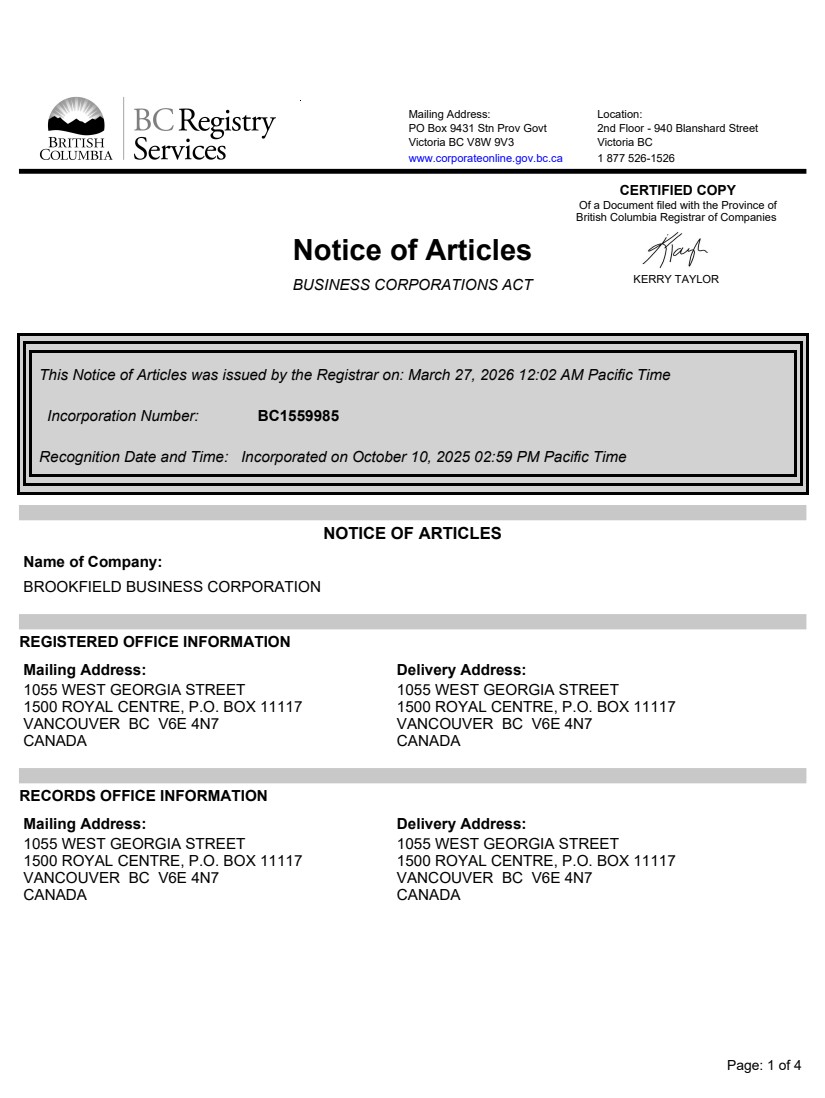
Notice of Articles
BUSINESS CORPORATIONS ACT
CERTIFIED COPY
Of a Document filed with the Province of
British Columbia Registrar of Companies
KERRY TAYLOR
This Notice of Articles was issued by the Registrar on: March 27, 2026 12:02 AM Pacific Time
Incorporation Number: BC1559985
Recognition Date and Time: Incorporated on October 10, 2025 02:59 PM Pacific Time
NOTICE OF ARTICLES
Name of Company:
BROOKFIELD BUSINESS CORPORATION
REGISTERED OFFICE INFORMATION
Mailing Address:
1055 WEST GEORGIA STREET
1500 ROYAL CENTRE, P.O. BOX 11117
VANCOUVER BC V6E 4N7
CANADA
Delivery Address:
1055 WEST GEORGIA STREET
1500 ROYAL CENTRE, P.O. BOX 11117
VANCOUVER BC V6E 4N7
CANADA
RECORDS OFFICE INFORMATION
Mailing Address:
1055 WEST GEORGIA STREET
1500 ROYAL CENTRE, P.O. BOX 11117
VANCOUVER BC V6E 4N7
CANADA
Delivery Address:
1055 WEST GEORGIA STREET
1500 ROYAL CENTRE, P.O. BOX 11117
VANCOUVER BC V6E 4N7
CANADA
Page: 1 of 4 |
| 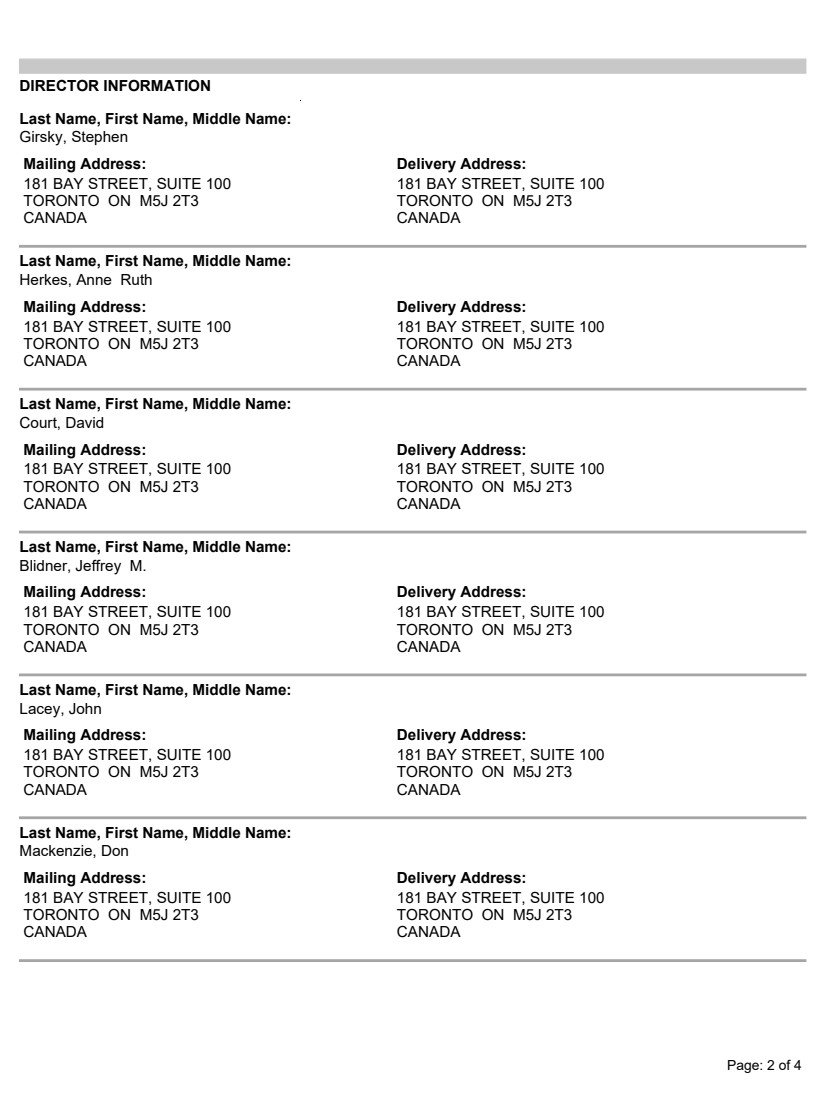
| DIRECTOR INFORMATION
Last Name, First Name, Middle Name:
Girsky, Stephen
Mailing Address:
181 BAY STREET, SUITE 100
TORONTO ON M5J 2T3
CANADA
Delivery Address:
181 BAY STREET, SUITE 100
TORONTO ON M5J 2T3
CANADA
Last Name, First Name, Middle Name:
Herkes, Anne Ruth
Mailing Address:
181 BAY STREET, SUITE 100
TORONTO ON M5J 2T3
CANADA
Delivery Address:
181 BAY STREET, SUITE 100
TORONTO ON M5J 2T3
CANADA
Last Name, First Name, Middle Name:
Court, David
Mailing Address:
181 BAY STREET, SUITE 100
TORONTO ON M5J 2T3
CANADA
Delivery Address:
181 BAY STREET, SUITE 100
TORONTO ON M5J 2T3
CANADA
Last Name, First Name, Middle Name:
Blidner, Jeffrey M.
Mailing Address:
181 BAY STREET, SUITE 100
TORONTO ON M5J 2T3
CANADA
Delivery Address:
181 BAY STREET, SUITE 100
TORONTO ON M5J 2T3
CANADA
Last Name, First Name, Middle Name:
Lacey, John
Mailing Address:
181 BAY STREET, SUITE 100
TORONTO ON M5J 2T3
CANADA
Delivery Address:
181 BAY STREET, SUITE 100
TORONTO ON M5J 2T3
CANADA
Last Name, First Name, Middle Name:
Mackenzie, Don
Mailing Address:
181 BAY STREET, SUITE 100
TORONTO ON M5J 2T3
CANADA
Delivery Address:
181 BAY STREET, SUITE 100
TORONTO ON M5J 2T3
CANADA
Page: 2 of 4 |
| 
| Last Name, First Name, Middle Name:
Zuccotti, Patricia
Mailing Address:
181 BAY STREET, SUITE 100
TORONTO ON M5J 2T3
CANADA
Delivery Address:
181 BAY STREET, SUITE 100
TORONTO ON M5J 2T3
CANADA
Last Name, First Name, Middle Name:
Warren, Michael
Mailing Address:
181 BAY STREET, SUITE 100
TORONTO ON M5J 2T3
CANADA
Delivery Address:
181 BAY STREET, SUITE 100
TORONTO ON M5J 2T3
CANADA
Last Name, First Name, Middle Name:
Hamill, David
Mailing Address:
181 BAY STREET, SUITE 100
TORONTO ON M5J 2T3
CANADA
Delivery Address:
181 BAY STREET, SUITE 100
TORONTO ON M5J 2T3
CANADA
Last Name, First Name, Middle Name:
Madon, Cyrus
Mailing Address:
181 BAY STREET, SUITE 100
TORONTO ON M5J 2T3
CANADA
Delivery Address:
181 BAY STREET, SUITE 100
TORONTO ON M5J 2T3
CANADA
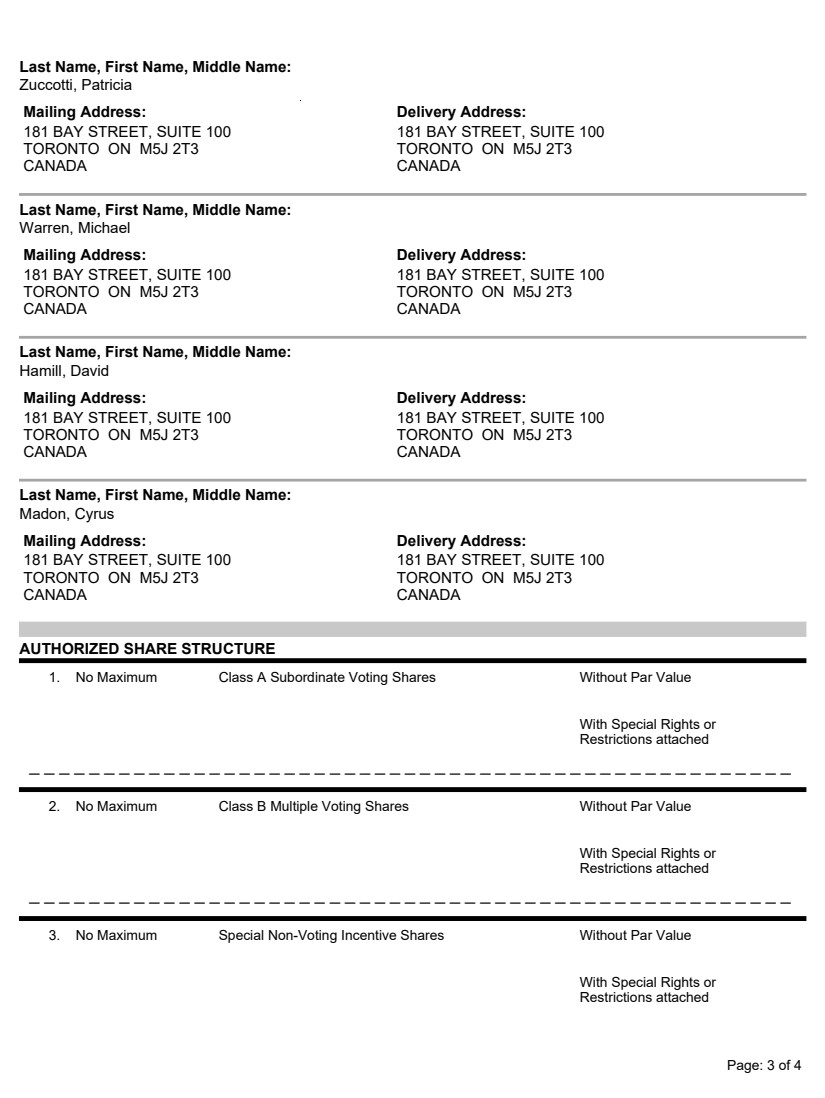
AUTHORIZED SHARE STRUCTURE
1. No Maximum Class A Subordinate Voting Shares Without Par Value
With Special Rights or
Restrictions attached
_ _ _ _ _ _ _ _ _ _ _ _ _ _ _ _ _ _ _ _ _ _ _ _ _ _ _ _ _ _ _ _ _ _ _ _ _ _ _ _ _ _ _ _ _ _ _ _ _ _ _
2. No Maximum Class B Multiple Voting Shares Without Par Value
With Special Rights or
Restrictions attached
_ _ _ _ _ _ _ _ _ _ _ _ _ _ _ _ _ _ _ _ _ _ _ _ _ _ _ _ _ _ _ _ _ _ _ _ _ _ _ _ _ _ _ _ _ _ _ _ _ _ _
3. No Maximum Special Non-Voting Incentive Shares Without Par Value
With Special Rights or
Restrictions attached
Page: 3 of 4 |
| 
| _ _ _ _ _ _ _ _ _ _ _ _ _ _ _ _ _ _ _ _ _ _ _ _ _ _ _ _ _ _ _ _ _ _ _ _ _ _ _ _ _ _ _ _ _ _ _ _ _ _ _
4. No Maximum Class A Preferred Shares Without Par Value
With Special Rights or
Restrictions attached
_ _ _ _ _ _ _ _ _ _ _ _ _ _ _ _ _ _ _ _ _ _ _ _ _ _ _ _ _ _ _ _ _ _ _ _ _ _ _ _ _ _ _ _ _ _ _ _ _ _ _
Page: 4 of 4 |
Name Change of the Company was approved by resolution of the directors on March 16, 2026, filed with BC Registry on March 18, 2026 with
effect on March 27, 2026 @ 12:02AM Pacific Time.
Number: BC1559985
BUSINESS
CORPORATIONS ACT
ARTICLES
of
BROOKFIELD BUSINESS CORPORATION
1559985 B.C. LTD.
Table
of Contents
Page
| Part 1
INTERPRETATION |
1 |
| |
|
| Part 2
SHARES AND SHARE CERTIFICATES |
5 |
| |
|
| Part 3
ISSUE OF SHARES |
6 |
| |
|
| Part 4
SHARE REGISTERS |
7 |
| |
|
| Part 5
SHARE TRANSFERS |
8 |
| |
|
| Part 6
TRANSMISSION OF SHARES |
9 |
| |
|
| Part 7
PURCHASE, REDEEM OR OTHERWISE ACQUIRE SHARES |
9 |
| |
|
| Part 8
BORROWING POWERS |
10 |
| |
|
| Part 9
ALTERATIONS |
10 |
| |
|
| Part 10
MEETINGS OF SHAREHOLDERS |
11 |
| |
|
| Part 11
PROCEEDINGS AT MEETINGS OF SHAREHOLDERS |
13 |
| |
|
| Part 12
VOTES OF SHAREHOLDERS |
17 |
| |
|
| Part 13
DIRECTORS |
21 |
| |
|
| Part 14
ELECTION AND REMOVAL OF DIRECTORS |
22 |
| |
|
| Part 15
POWERS AND DUTIES OF DIRECTORS |
28 |
| |
|
| Part 16
INTERESTS OF DIRECTORS AND OFFICERS |
28 |
| |
|
| Part 17
PROCEEDINGS OF DIRECTORS |
30 |
| |
|
| Part 18
EXECUTIVE AND OTHER COMMITTEES |
32 |
| |
|
| Part 19
OFFICERS |
34 |
| |
|
| Part 20
INDEMNIFICATION |
34 |
| |
|
| Part 21
DIVIDENDS |
36 |
| |
|
| Part 22
ACCOUNTING RECORDS AND AUDITOR |
38 |
| |
|
| Part 23
NOTICES |
38 |
| |
|
| Part 24
PROHIBITIONS |
40 |
| |
|
| Part 25 FORUM SELECTION |
41 |
TABLE OF CONTENTS
(continued)
Page
| Part 26
SPECIAL RIGHTS AND RESTRICTIONS CLASS A SUBORDINATE VOTING SHARES |
41 |
| |
|
| Part 27
SPECIAL RIGHTS AND RESTRICTIONS CLASS B MULTIPLE VOTING SHARES |
43 |
| |
|
| Part 28
SPECIAL RIGHTS AND RESTRICTIONS Special Non-Voting Incentive Shares |
44 |
| |
|
| Part 29
SPECIAL RIGHTS AND RESTRICTIONS Class A Preferred Shares |
48 |
Number: BC1559985
BUSINESS
CORPORATIONS ACT
ARTICLES
of
BROOKFIELD BUSINESS CORPORATION
1559985 B.C. LTD.
(the
“Company”)
Part 1
INTERPRETATION
Definitions
1.1 In
these Articles, unless the context otherwise requires:
(a) “Accrued
Incentive Amounts” has the meaning provided in §28.4;
(b) “Act”
means the Business Corporations Act (British Columbia) from time to time in force and all amendments thereto and includes all regulations
and amendments thereto made pursuant to that Act;
(c) “affiliate”
means with respect to a Person, any other Person that, directly or indirectly, through one or more intermediaries, Controls or is Controlled
by such Person, or is under common Control of a third Person;
(d) “Applied
Incentive Amount” has the meaning provided in §28.10;
(e) “BBU”
means Brookfield Business Partners L.P., a Bermuda exempted limited partnership, and is deemed to refer to all successors, including,
without limitation, by operation of Law;
(f) “BBU
Unit” means a limited partnership interest in BBU representing a fractional part of all the limited partner interests in BBU;
(g) “Bid”
has the meaning provided in §28.5
(h) “BN”
means Brookfield Corporation, a corporation existing under the Laws of the Province of Ontario, and is deemed to refer to all successors,
including, without limitation, by operation of Law;
(i) “board
of directors”, “directors” and “board” mean the directors or sole director of the Company
as applicable;
(j) “Business
Day” means any day except a Saturday, Sunday or other day on which commercial banks in New York, New York, United States of
America or Toronto, Ontario, Canada are authorized or required by Law to close;
(k) “Class A
Preferred Share” means a class A preferred share of the Company;
(l) “Class A
Share” means a class A subordinate voting share of the Company;
(m) “Class A
Shareholder” means a holder of a Class A Share;
(n) “Class B
Share” means a class B multiple voting share of the Company;
(o) “Class B
Shareholder” means a holder of a Class B Share;
(p) “Company”
means 1559985 B.C. Ltd.; Brookfield Business Corporation
(q) “Control”
means the control by one Person of another Person in accordance with the following: a Person (“A”) controls another
Person (“B”) where A has the power to determine the management and policies of B by contract or status (for example,
the status of A being the general partner of B) or by virtue of the beneficial ownership of or control over a majority of the voting interests
in B; and, for certainty and without limitation, if A owns or has control over shares or other securities to which are attached more than
50% of the votes permitted to be cast in the election of directors of the Governing Body of B or A is the general partner of B, a limited
partnership, then in each case A controls B for this purpose;
(r) “Equivalent
Security” means any Security (as such term is defined in the Master Services Agreement) that is determined by the board to be
the economic equivalent of a Class A Share;
(s) “Governing
Body” means (i) with respect to a corporation or limited company, the board of directors of such corporation or limited
company, (ii) with respect to a limited liability company, the manager(s), director(s) or managing partner(s) of such limited
liability company, (iii) with respect to a partnership, the board, committee or other body of each general partner or managing partner
of such partnership, respectively, that serves a similar function (or if any such general partner is itself a partnership, the board,
committee or other body of such general or managing partner’s general or managing partner that serves a similar function), and (iv) with
respect to any other Person, the body of such Person that serves a similar function, and in the case of each of (i) through (iv) includes
any committee or other subdivision of such body and any Person to whom such body has delegated any power or authority, including any officer
or managing director;
(t) “Holding
Entity” has the meaning ascribed to such term in the Master Services Agreement;
(u) “Holding
LP LPA” means the limited partnership agreement of Brookfield Business L.P., as amended from time to time;
(v) “IDT
Adjustment Event” has the meaning provided in §28.5;
(w) “Incentive
Distribution Account” has the meaning provided in §28.9;
(x) “Incentive
Dividend Amount” for a Quarter means an amount equal to (A) 0.20 multiplied by the amount, if any, by which (i) the
Quarterly Market Value for such Quarter exceeds (ii) the Incentive Dividend Threshold for such Quarter multiplied by (B) the
aggregate number of Class A Shares and Equivalent Securities issued and outstanding on the last Business Day of such Quarter;
(y) “Incentive
Dividend Threshold” means (i) for the Quarter in which the Listing Date occurs the Incentive Dividend Threshold on the
first Business Day of such Quarter as determined in accordance with the Holding LP LPA, and (ii) for each subsequent Quarter thereafter,
such higher number, if any, resulting from the Reset Calculation for such Quarter, in each case subject to adjustment from time to time
in accordance with §28.5;
(z) “Incentive
Dividends” has the meaning provided in §28.2;
(aa) “Interpretation
Act” means the Interpretation Act (British Columbia) from time to time in force and all amendments thereto and includes
all regulations and amendments thereto made pursuant to that Act;
(bb) “Invested
Capital” means, on any particular date, the amount of capital contributed (directly or indirectly and either as debt or equity)
to an Operating Entity or Holding Entity prior to such date;
(cc) “Laws”
means all federal, provincial, state, municipal, regional and local laws (including common law), by-laws, statutes, rules, regulations,
principles of law and equity, orders, rulings, certificates, ordinances, judgments, injunctions, determinations, awards, decrees, legally
binding codes, policies or other requirements, whether domestic or foreign, and the terms and conditions of any grant of approval, permission,
authority or license of any governmental entity, and the term “applicable” with respect to such Laws and in a context that
refers to one or more Persons, means such Laws as are binding upon or applicable to such Person or its assets;
(dd) “legal
personal representative” means the personal or other legal representative of the shareholder;
(ee) “Liquidation
Event” has the meaning provided in §26.10;
(ff) “Listing
Date” means the date on which the Class A Shares first commence trading on a stock exchange;
(gg) “Market
Value of a Class A Share” means, as of a specified date, the volume-weighted average trading price of the Class A
Shares on the Principal Exchange for the five (5) trading days preceding such date;
(hh) “Master
Services Agreement” means the master services agreement of the Company entered into between those Persons who receive services
and those Persons appointed to act as service providers pursuant to such agreement;
(ii) “Operating
Entities” has the meaning ascribed to such term in the Master Services Agreement;
(jj) “Person”
means any natural person, partnership, limited partnership, limited liability partnership, joint venture, syndicate, sole proprietorship,
company or corporation (with or without share capital), limited liability corporation, unlimited liability company, joint stock company,
unincorporated association, trust, trustee, executor, administrator or other legal personal representative, governmental entity or other
entity however designated or constituted and pronouns have a similarly extended meaning;
(kk) “Principal
Exchange” means (i) prior to the Listing Date, the principal stock exchange or public quotation system on which the BBU
Units are listed, and (ii) from and after the Listing Date, the principal stock exchange or public quotation system on which the
Class A Shares are listed;
(ll) “Quarter”
means a calendar quarter ending on the last day of March, June, September or December;
(mm) “Quarterly
Market Value” means:
(i) for
the Quarter in which the Listing Date occurs, the volume-weighted average trading price of a BBU Unit (in respect of the period in such
Quarter prior to the Listing Date) and a Class A Share (in respect of the period in such Quarter from and after the Listing Date)
on the applicable Principal Exchange for all of the trading days in such Quarter; and
(ii) for
each Quarter thereafter, the volume-weighted average trading price of a Class A Share on the Principal Exchange for all of the trading
days in such Quarter on which Class A Shares traded;
(nn) “registered
address” of a shareholder means the shareholder’s address as recorded in the central securities register;
(oo) “Regular
Quarterly Dividend” means the amount set by the board of directors, from time to time, as the regular quarterly dividend to
be declared and paid on each Class A Share;
(pp) “Reset
Calculation” has the meaning provided in §28.3;
(qq) “Securities
Transfer Act” means the Securities Transfer Act (British Columbia) from time to time in force and all amendments thereto
and includes all regulations and amendments thereto;
(rr) “share”
means a share in the share structure of the Company;
(ss) “special
majority” means the number of votes described in §11.2 which is required to pass a special resolution;
(tt) “Special
Share” means a special non-voting incentive share of the Company;
(uu) “Special
Shareholder” means a holder of a Special Share;
(vv) “Transfer”
means any sale, assignment, surrender, gift or transfer of ownership of, the granting or foreclosure of a pledge, mortgage, charge, security
interest, hypothecation or other encumbrance, whether voluntary, involuntary, by operation of law or otherwise, or the entry into of any
contract, option or other arrangement or understanding with respect to the foregoing; and
(ww) “Underlying
Incentive Distributions” has the meaning provided in §28.9.
Act and Interpretation Act Definitions Applicable
1.2 The
definitions in the Act and the definitions and rules of construction in the Interpretation Act, with the necessary changes, so far
as applicable, and except as the context requires otherwise, apply to these Articles as if they were an enactment. If there is a conflict
between a definition in the Act and a definition or rule in the Interpretation Act relating to a term used in these Articles, the
definition in the Act will prevail. If there is a conflict or inconsistency between these Articles and the Act, the Act will prevail.
Actions on Non-Business Days
1.3 Whenever
any payment to be made or action to be taken hereunder is required to be made or taken on a day other than a Business Day, such payment
shall be made or action taken on the next following day that is a Business Day.
Currency
1.4 Except
where otherwise expressly provided herein, all amounts are stated in U.S. currency.
Part 2
SHARES AND SHARE CERTIFICATES
Authorized Share Structure
2.1 The
authorized share structure of the Company consists of shares of the class or classes and series, if any, described in the Notice of Articles
of the Company.
Form of Share Certificate
2.2 Each
share certificate issued by the Company must comply with, and be signed as required by, the Act.
Shareholder Entitled to Certificate, Acknowledgment or Written Notice
2.3 Unless
the shares of which the shareholder is the registered owner are uncertificated shares, each shareholder is entitled, without charge, to
(a) one share certificate representing the shares of each class or series of shares registered in the shareholder’s name or
(b) a nontransferable written acknowledgment of the shareholder’s right to obtain such a share certificate, provided that in
respect of a share held jointly by several persons, the Company is not bound to issue more than one share certificate and delivery of
a share certificate for a share to one of several joint shareholders or to one of the shareholders’ duly authorized agents will
be sufficient delivery to all. If a shareholder is the registered owner of uncertificated shares, the Company must send to a holder of
an uncertificated share a written notice containing the information required by the Act within a reasonable time after the issue or transfer
of such share.
Delivery by Mail
2.4 Any
share certificate or non-transferable written acknowledgment of a shareholder’s right to obtain a share certificate may be sent
to the shareholder by mail at the shareholder’s registered address and neither the Company nor any director, officer or agent of
the Company is liable for any loss to the shareholder because the share certificate or acknowledgement is lost in the mail or stolen.
Replacement of Worn Out or Defaced Certificate or Acknowledgement
2.5 If
a share certificate or a non-transferable written acknowledgment of the shareholder’s right to obtain a share certificate is worn
out or defaced, the Company must, on production of the share certificate or acknowledgment, as the case may be, and on such other terms,
if any, as are deemed fit:
(a) cancel
the share certificate or acknowledgment; and
(b) issue
a replacement share certificate or acknowledgment.
Replacement of Lost, Stolen or Destroyed Certificate or Acknowledgment
2.6 If
a share certificate or a non-transferable written acknowledgment of a shareholder’s right to obtain a share certificate is lost,
stolen or destroyed, the Company must issue a replacement share certificate or acknowledgment, as the case may be, to the person entitled
to that share certificate or acknowledgment, if it receives:
(a) proof
satisfactory to it of the loss, theft or destruction; and
(b) any
indemnity the directors consider adequate.
Splitting Share Certificates
2.7 If
a shareholder surrenders a share certificate to the Company with a written request that the Company issue in the shareholder’s name
two or more share certificates, each representing a specified number of shares and in the aggregate representing the same number of shares
as the share certificate so surrendered, the Company must cancel the surrendered share certificate and issue replacement share certificates
in accordance with that request.
Certificate Fee
2.8 There
must be paid to the Company, in relation to the issue of any share certificate under §2.5, §2.6 or §2.7, the amount, if
any, not exceeding the amount prescribed under the Act, determined by the directors.
Recognition of Trusts
2.9 Except
as required by law or statute or these Articles, no person will be recognized by the Company as holding any share upon any trust, and
the Company is not bound by or compelled in any way to recognize (even when having notice thereof) any equitable, contingent, future or
partial interest in any share or fraction of a share or (except as required by law or statute or these Articles or as ordered by a court
of competent jurisdiction) any other rights in respect of any share except an absolute right to the entirety thereof in the shareholder.
Part 3
ISSUE OF SHARES
Directors Authorized
3.1 Subject
to the Act and the rights, if any, of the holders of issued shares of the Company, the Company may allot, issue, sell or otherwise dispose
of the unissued shares, and issued shares held by the Company, at the times, to the persons, including directors, in the manner, on the
terms and conditions and for the consideration (including any premium at which shares with par value may be issued) that the directors
may determine. The issue price for a share with par value must be equal to or greater than the par value of the share.
Commissions and Discounts
3.2 The
Company may at any time pay a reasonable commission or allow a reasonable discount to any person in consideration of that person’s
purchase or agreement to purchase shares of the Company from the Company or any other person’s procurement or agreement to procure
purchasers for shares of the Company.
Brokerage
3.3 The
Company may pay such brokerage fee or other consideration as may be lawful for or in connection with the sale or placement of its securities.
Conditions of Issue
3.4 Except
as provided for by the Act, no share may be issued until it is fully paid. A share is fully paid when:
(a) consideration
is provided to the Company for the issue of the share by one or more of the following:
(i) past
services performed for the Company;
(ii) property;
(iii) money;
and
(b) the
value of the consideration received by the Company equals or exceeds the issue price set for the share under §3.1.
Share Purchase Warrants and Rights
3.5 Subject
to the Act and the rights if any, of the holders of issued shares of the Company, the Company may issue share purchase warrants, options
and rights upon such terms and conditions as the directors determine, which share purchase warrants, options and rights may be issued
alone or in conjunction with debentures, debenture stock, bonds, shares or any other securities issued or created by the Company from
time to time.
Part 4
SHARE REGISTERS
Central Securities Register
4.1 As
required by and subject to the Act, the Company must maintain a central securities register and may appoint an agent to maintain such
register. The directors may appoint one or more agents, including the agent appointed to keep the central securities register, as transfer
agent for shares or any class or series of shares and the same or another agent as registrar for shares or such class or series of shares,
as the case may be. The directors may terminate such appointment of any agent at any time and may appoint another agent in its place.
If the directors designate a location outside British Columbia as the location at which the company maintains its central securities register,
the central securities register must be available for inspection and copying in accordance with the Act at a location inside British Columbia
by means of a computer terminal or other electronic technology.
Part 5
SHARE TRANSFERS
Registering Transfers
5.1 Subject
to Part 24, Section 27.13 of the Act and the Securities Transfer Act, a transfer of a share must not be registered unless:
(a) the
Company or the transfer agent or registrar for the class or series of shares to be transferred has received:
(i) in
the case where the Company has issued a share certificate in respect of the share to be transferred, that share certificate and a written
instrument of transfer (which may be on a separate document or endorsed on the share certificate) made by the shareholder or other appropriate
person or by an agent who has actual authority to act on behalf of that person;
(ii) in
the case of a share that is not represented by a share certificate (including an uncertificated share within the meaning of the Act and
including the case where the Company has issued a non-transferable written acknowledgement of the shareholder's right to obtain a share
certificate in respect of the share to be transferred), a written instrument of transfer, made by the shareholder or other appropriate
person or by an agent who has actual authority to act on behalf of that person; and
(iii) such
other evidence, if any, as the Company or the transfer agent or registrar for the class or series of shares to be transferred may require
to prove the title of the transferor or the transferor's right to transfer the share, that the written instrument of transfer is genuine
and authorized and that the transfer is rightful or to a protected purchaser; or
(b) all
the preconditions for a transfer of a share under the Securities Transfer Act have been met and the Company is required under the Securities
Transfer Act to register the transfer.
Form of Instrument of Transfer
5.2 The
instrument of transfer in respect of any share of the Company must be either in the form, if any, on the back of the Company’s share
certificates of that class or series or in any other form satisfactory to the Company or the transfer agent for the class or series of
shares to be transferred.
Transferor Remains Shareholder
5.3 Except
to the extent that the Act otherwise provides, the transferor of a share is deemed to remain the holder of it until the name of the transferee
is entered in a securities register of the Company in respect of the transfer.
Signing of Instrument of Transfer
5.4 If
a shareholder, or the shareholder’s duly authorized attorney, signs an instrument of transfer in respect of shares registered in
the name of the shareholder, the signed instrument of transfer constitutes a complete and sufficient authority to the Company and its
directors, officers and agents to register the number of shares specified in the instrument of transfer or specified in any other manner,
or, if no number is specified, all the shares represented by the share certificates or set out in the written acknowledgments deposited
with the instrument of transfer:
(a) in
the name of the person named as transferee in that instrument of transfer; or
(b) if
no person is named as transferee in that instrument of transfer, in the name of the person on whose behalf the instrument is deposited
for the purpose of having the transfer registered.
Enquiry as to Title Not Required
5.5 Neither
the Company nor any director, officer or agent of the Company is bound to inquire into the title of the person named in the instrument
of transfer as transferee or, if no person is named as transferee in the instrument of transfer, of the person on whose behalf the instrument
is deposited for the purpose of having the transfer registered or is liable for any claim related to registering the transfer by the shareholder
or by any intermediate owner or holder of the shares transferred, of any interest in such shares, of any share certificate representing
such shares or of any written acknowledgment of a right to obtain a share certificate for such shares.
Transfer Fee
5.6 Subject
to the applicable rules of any stock exchange on which the shares of the Company may be listed, there must be paid to the Company,
in relation to the registration of a transfer, the amount, if any, determined by the directors.
Part 6
TRANSMISSION OF SHARES
Legal Personal Representative Recognized on Death
6.1 In
case of the death of a shareholder, the legal personal representative of the shareholder, or in the case of shares registered in the shareholder’s
name and the name of another person in joint tenancy, the surviving joint holder, will be the only person recognized by the Company as
having any title to the shareholder’s interest in the shares. Before recognizing a person as a legal personal representative of
a shareholder, the Company shall receive the documentation required by the Act.
Rights of Legal Personal Representative
6.2 The
legal personal representative of a shareholder has the same rights, privileges and obligations that attach to the shares held by the shareholder,
including the right to transfer the shares in accordance with these Articles, provided the documents required by the Act and the directors
have been deposited with the Company. This §6.2 does not apply in the case of the death of a shareholder with respect to shares registered
in the name of the shareholder and the name of another person in joint tenancy.
Part 7
PURCHASE, REDEEM OR OTHERWISE ACQUIRE SHARES
Company Authorized to Purchase, Redeem or Otherwise Acquire Shares
7.1 Subject
to the special rights or restrictions attached to the shares of any class or series and the Act, the Company may, if authorized by the
directors, purchase or otherwise acquire any of its shares at the price and upon the terms determined by the directors.
Sale and Voting of Purchased, Redeemed or Otherwise Acquired Shares
7.2 If
the Company retains a share redeemed, purchased or otherwise acquired by it, the Company may sell, gift, cancel or otherwise dispose of
the share, but, while such share is held by the Company, it:
(a) is
not entitled to vote the share at a meeting of its shareholders;
(b) must
not pay a dividend in respect of the share; and
(c) must
not make any other distribution in respect of the share.
Company Entitled to Purchase, Redeem or Otherwise Acquire Share
Fractions
7.3 The
Company may, without prior notice to the holders, purchase, redeem or otherwise acquire for fair value any and all outstanding share fractions
of any class or kind of shares in its authorized share structure as may exist at any time and from time to time. Upon the Company delivering
the purchase funds and confirmation of purchase or redemption of the share fractions to the holders’ registered or last known address,
or if the Company has a transfer agent then to such agent for the benefit of and forwarding to such holders, the Company shall thereupon
amend its central securities register to reflect the purchase or redemption of such share fractions and if the Company has a transfer
agent, shall direct the transfer agent to amend the central securities register accordingly.
Part 8
BORROWING POWERS
8.1 The
Company, if authorized by the directors, may:
(a) borrow
money in the manner and amount, on the security, from the sources and on the terms and conditions that they consider appropriate;
(b) issue
bonds, debentures and other debt obligations either outright or as security for any liability or obligation of the Company or any other
person and at such discounts or premiums and on such other terms as the directors consider appropriate;
(c) guarantee
the repayment of money by any other person or the performance of any obligation of any other person; and
(d) mortgage,
charge, whether by way of specific or floating charge, grant a security interest in, or give other security on, the whole or any part
of the present and future assets and undertaking of the Company.
Part 9
ALTERATIONS
Alteration of Authorized Share Structure
9.1 Subject
to §9.2, the special rights or restrictions attached to the shares of any class or series of shares and the Act, the Company may
by ordinary resolution (or a resolution of the directors in the case of §9.1(c) or §9.1(f)):
(a) create
one or more classes of shares or, if none of the shares of a class of shares are allotted or issued, eliminate that class of shares;
(b) increase,
reduce or eliminate the maximum number of shares that the Company is authorized to issue out of any class of shares or establish a maximum
number of shares that the Company is authorized to issue out of any class of shares for which no maximum is established;
(c) subdivide
or consolidate all or any of its unissued, or fully paid issued, shares;
(d) if
the Company is authorized to issue shares of a class of shares with par value:
(i) decrease
the par value of those shares; or
(ii) if
none of the shares of that class of shares are allotted or issued, increase the par value of those shares;
(e) change
all or any of its unissued, or fully paid issued, shares with par value into shares without par value or any of its unissued shares without
par value into shares with par value;
(f) alter
the identifying name of any of its shares; or
(g) otherwise
alter its shares or authorized share structure when required or permitted to do so by the Act where it does not specify by a special resolution;
and, if applicable, alter its Notice of Articles
and Articles accordingly.
Special Rights or Restrictions
9.2 Subject
to the Act and in particular those provisions of the Act relating to the rights of holders of outstanding shares to vote if their rights
are prejudiced or interfered with, the Company may by ordinary resolution:
(a) create
special rights or restrictions for, and attach those special rights or restrictions to, the shares of any class of shares, whether or
not any or all of those shares have been issued; or
(b) vary
or delete any special rights or restrictions attached to the shares of any class of shares, whether or not any or all of those shares
have been issued,
and alter its Notice of Articles and Articles
accordingly.
Change of Name
9.3 The
Company may by directors resolution authorize an alteration of its Notice of Articles in order to change its name or adopt or change any
translation of that name.
Other Alterations
9.4 If
the Act does not specify the type of resolution and these Articles do not specify another type of resolution, the Company may by ordinary
resolution alter these Articles.
Part 10
MEETINGS OF SHAREHOLDERS
Annual General Meetings
10.1 Unless
an annual general meeting is deferred or waived in accordance with the Act, the Company must hold its first annual general meeting within
18 months after the date on which it was incorporated or otherwise recognized, and after that must hold an annual general meeting at least
once in each calendar year and not more than 15 months after the last annual reference date at such time and place as may be determined
by the directors.
Resolution Instead of Annual General Meeting
10.2 If
all the shareholders who are entitled to vote at an annual general meeting consent in writing by a unanimous resolution to all of the
business that is required to be transacted at that annual general meeting, the annual general meeting is deemed to have been held on the
date of the unanimous resolution. The shareholders must, in any unanimous resolution passed under this §10.2, select as the Company’s
annual reference date a date that would be appropriate for the holding of the applicable annual general meeting. A unanimous resolution
passed in writing under this §10.2 may be by signed document, fax, email or any other method of transmitting legibly recorded messages.
Any electronic signature on a unanimous resolution, whether digital or encrypted, shall be deemed to have the same force and effect as
a manual signature. A unanimous resolution in writing may be in two or more counterparts which together are deemed to constitute one unanimous
resolution in writing.
Calling of Meetings of Shareholders
10.3 The
directors may, at any time, call a meeting of shareholders.
Notice for Meetings of Shareholders
10.4 The
Company must send notice of the date, time and location of any meeting of shareholders (including, without limitation, any notice specifying
the intention to propose a resolution as a special resolution and any notice to consider approving a continuation into a foreign jurisdiction,
an arrangement or the adoption of an amalgamation agreement, and any notice of a general meeting, class meeting or series meeting), in
the manner provided in these Articles, or in such other manner, if any, as may be prescribed by ordinary resolution (whether previous
notice of the resolution has been given or not), to each shareholder entitled to attend the meeting, to each director and to the auditor
of the Company, unless these Articles otherwise provide, at least the following number of days before the meeting:
(a) if
the Company is a public company, 21 days;
(b) otherwise,
10 days.
Record Date for Notice
10.5 The
directors may set a date as the record date for the purpose of determining shareholders entitled to notice of any meeting of shareholders.
The record date must not precede the date on which the meeting is to be held by more than two months or, in the case of a general meeting
requisitioned by shareholders under the Act, by more than four months. The record date must not precede the date on which the meeting
is held by fewer than:
(a) if
the Company is a public company, 21 days;
(b) otherwise,
10 days.
If no record date is set, the record date is 5
p.m. on the day immediately preceding the first date on which the notice is sent or, if no notice is sent, the beginning of the meeting.
Record Date for Voting
10.6 The
directors may set a date as the record date for the purpose of determining shareholders entitled to vote at any meeting of shareholders.
The record date must not precede the date on which the meeting is to be held by more than two months or, in the case of a general meeting
requisitioned by shareholders under the Act, by more than four months. If no record date is set, the record date is 5 p.m. on the
day immediately preceding the first date on which the notice is sent or, if no notice is sent, the beginning of the meeting.
Failure to Give Notice and Waiver of Notice
10.7 The
accidental omission to send notice of any meeting of shareholders to, or the non-receipt of any notice by, any of the persons entitled
to notice does not invalidate any proceedings at that meeting. Any person entitled to notice of a meeting of shareholders may, in writing
or otherwise, waive that entitlement or may agree to reduce the period of that notice. Attendance of a person at a meeting of shareholders
is a waiver of entitlement to notice of the meeting unless that person attends the meeting for the express purpose of objecting to the
transaction of any business on the grounds that the meeting is not lawfully called.
Notice of Special Business at Meetings of Shareholders
10.8 If
a meeting of shareholders is to consider special business within the meaning of §11.1, the notice of meeting must:
(a) state
the general nature of the special business; and
(b) if
the special business includes considering, approving, ratifying, adopting or authorizing any document or the signing of or giving of effect
to any document, have attached to it a copy of the document or state that a copy of the document will be available for inspection by shareholders:
(i) at
the Company’s records office, or at such other reasonably accessible location in British Columbia as is specified in the notice;
and
(ii) during
statutory business hours on any one or more specified days before the day set for the holding of the meeting.
Place of Meetings
10.9 In
addition to any location in British Columbia, any general meeting may be held in any location outside British Columbia approved by a resolution
of the directors, or if so approved by a resolution of the directors, any general meeting may be held entirely by means of an electronic
or other communication facility that permits all persons participating in the meeting to communicate adequately with each other to the
extent permitted by the Act.
Part 11
PROCEEDINGS AT MEETINGS OF SHAREHOLDERS
Special Business
11.1 At
a meeting of shareholders, the following business is special business:
(a) at
a meeting of shareholders that is not an annual general meeting, all business is special business except business relating to the conduct
of or voting at the meeting;
(b) at
an annual general meeting, all business is special business except for the following:
(i) business
relating to the conduct of or voting at the meeting;
(ii) consideration
of any financial statements of the Company presented to the meeting;
(iii) consideration
of any reports of the directors or auditor;
(iv) the
setting or changing of the number of directors;
(v) the
election or appointment of directors;
(vi) the
appointment of an auditor;
(vii) the
setting of the remuneration of an auditor;
(viii) business
arising out of a report of the directors not requiring the passing of a special resolution; and
(ix) any
other business which, under these Articles or the Act, may be transacted at a meeting of shareholders without prior notice of the business
being given to the shareholders.
Special Resolutions
11.2 The
number of votes required for the Company to pass a special resolution at a general meeting of shareholders is two-thirds of the votes
cast on the resolution.
Ordinary Resolutions
11.3 The
number of votes required for the Company to pass an ordinary resolution at a general meeting of shareholders is a majority of the votes
cast on the resolution.
Quorum
11.4 Subject
to the special rights or restrictions attached to the shares of any class or series of shares, and to §11.6, the quorum for the transaction
of business at a meeting of shareholders is at least two shareholders who, whether present in person or represented by proxy, in the aggregate,
hold at least 25% of the votes attached to the shares entitled to be voted at the meeting.
11.5 Where
a separate vote by a class or series or classes or series is required, the quorum for that matter is at least two shareholders who, whether
present in person or represented by proxy, in the aggregate, hold at least 25% of the votes attached to the shares of such class or series
or classes or series entitled to vote on that matter.
One Shareholder May Constitute Quorum
11.6 If
there is only one shareholder entitled to vote at a meeting of shareholders:
(a) the
quorum is one person who is, or who represents by proxy, that shareholder, and
(b) that
shareholder, present in person or by proxy, may constitute the meeting.
Persons Entitled to Attend Meeting
11.7 In
addition to those persons who are entitled to vote at a meeting of shareholders, the only other persons entitled to be present at the
meeting are the directors, the president (if any), the secretary (if any), the assistant secretary (if any), any lawyer for the Company,
the auditor of the Company, any persons invited to be present at the meeting by the directors or by the chair of the meeting and any persons
entitled or required under the Act or these Articles to be present at the meeting; but if any of those persons does attend the meeting,
that person is not to be counted in the quorum and is not entitled to vote at the meeting unless that person is a shareholder or proxy
holder entitled to vote at the meeting.
Requirement of Quorum
11.8 No
business, other than the election of a chair of the meeting and the adjournment of the meeting, may be transacted at any meeting of shareholders
unless a quorum of shareholders entitled to vote is present at the commencement of the meeting, but such quorum need not be present throughout
the meeting.
Lack of Quorum
11.9 If,
within one-half hour from the time set for the holding of a meeting of shareholders, a quorum is not present:
(a) in
the case of a general meeting requisitioned by shareholders, the meeting is dissolved, and
(b) in
the case of any other meeting of shareholders, the meeting stands adjourned to the same day in the next week at the same time and place
specified in the notice calling the meeting unless otherwise determined by an ordinary resolutions of those shareholders present and for
which notification is provided to all shareholders entitled to attend such meeting.
Lack of Quorum at Succeeding Meeting
11.10 If,
at the meeting to which the meeting referred to in §11.9(b) was adjourned, a quorum is not present within one-half hour from
the time set for the holding of the meeting, the person or persons present and being, or representing by proxy one or more shareholders,
entitled to attend and vote at the meeting shall be deemed to constitute a quorum.
Chair
11.11 The
following individual is entitled to preside as chair at a meeting of shareholders:
(a) the
chair of the board, if any; or
(b) if
the chair of the board is absent or unwilling to act as chair of the meeting, the president, if any.
Selection of Alternate Chair
11.12 If,
at any meeting of shareholders, there is no chair of the board or president present within 15 minutes after the time set for holding the
meeting, or if the chair of the board and the president are unwilling to act as chair of the meeting, or if the chair of the board and
the president have advised the secretary, if any, or any director present at the meeting, that they will not be present at the meeting,
the directors present may choose either one of their number or the lawyer of the Company to be chair of the meeting. If all of the directors
present decline to take the chair or fail to so choose or if no director is present or the lawyer of the Company declines to take the
chair, the shareholders entitled to vote at the meeting who are present in person or by proxy may choose any person present at the meeting
to chair the meeting.
Adjournments
11.13 The
chair of a meeting of shareholders may, and if so directed by the meeting must, adjourn the meeting from time to time and from place to
place, but no business may be transacted at any adjourned meeting other than the business left unfinished at the meeting from which the
adjournment took place.
Notice of Adjourned Meeting
11.14 It
is not necessary to give any notice of an adjourned meeting of shareholders or of the business to be transacted at an adjourned meeting
of shareholders except that, when a meeting is adjourned for 30 days or more, notice of the adjourned meeting must be given as in the
case of the original meeting.
Decisions by Show of Hands or Poll
11.15 Subject
to the Act, every motion put to a vote at a meeting of shareholders will be decided on a show of hands unless a poll, before or on the
declaration of the result of the vote by show of hands, is directed by the chair or demanded by any shareholder entitled to vote who is
present in person or by proxy.
Declaration of Result
11.16 The
chair of a meeting of shareholders must declare to the meeting the decision on every question in accordance with the result of the show
of hands or the poll, as the case may be, and that decision must be entered in the minutes of the meeting. A declaration of the chair
that a resolution is carried by the necessary majority or is defeated is, unless a poll is directed by the chair or demanded under §11.15,
conclusive evidence without proof of the number or proportion of the votes recorded in favour of or against the resolution.
Motion Need Not be Seconded
11.17 No
motion proposed at a meeting of shareholders need be seconded unless the chair of the meeting rules otherwise, and the chair of any
meeting of shareholders is entitled to propose or second a motion.
Casting Vote
11.18 In
case of an equality of votes, the chair of a meeting of shareholders does not, either on a show of hands or on a poll, have a second or
casting vote in addition to the vote or votes to which the chair may be entitled as a shareholder.
Manner of Taking Poll
11.19 Subject
to §11.20, if a poll is duly demanded at a meeting of shareholders:
(a) the
poll must be taken:
(i) at
the meeting, or within seven days after the date of the meeting, as the chair of the meeting directs; and
(ii) in
the manner, at the time and at the place that the chair of the meeting directs;
(b) the
result of the poll is deemed to be the decision of the meeting at which the poll is demanded; and
(c) the
demand for the poll may be withdrawn by the person who demanded it.
Demand for Poll on Adjournment
11.20 A
poll demanded at a meeting of shareholders on a question of adjournment must be taken immediately at the meeting.
Chair Must Resolve Dispute
11.21 In
the case of any dispute as to the admission or rejection of a vote given on a poll, the chair of the meeting must determine the dispute,
and the determination of the chair made in good faith is final and conclusive.
Casting of Votes
11.22 On
a poll, a shareholder entitled to more than one vote need not cast all the votes in the same way.
No Demand for Poll on Election of Chair
11.23 No
poll may be demanded in respect of the vote by which a chair of a meeting of shareholders is elected.
Demand for Poll Not to Prevent Continuance of Meeting
11.24 The
demand for a poll at a meeting of shareholders does not, unless the chair of the meeting so rules, prevent the continuation of a meeting
for the transaction of any business other than the question on which a poll has been demanded.
Retention of Ballots and Proxies
11.25 The
Company must, for at least three months after a meeting of shareholders, keep each ballot cast on a poll and each proxy voted at the meeting,
and, during that period, make them available for inspection during normal business hours by any shareholder or proxy holder entitled to
vote at the meeting. At the end of such three month period, the Company may destroy such ballots and proxies.
Part 12
VOTES OF SHAREHOLDERS
Number of Votes by Shareholder or by Shares
12.1 Subject
to any special rights or restrictions attached to any shares and to the restrictions imposed on joint shareholders under §12.3:
(a) on
a vote by show of hands, every person present who is a shareholder or proxy holder and entitled to vote on the matter has one vote; and
(b) on
a poll, every shareholder entitled to vote on the matter has one vote in respect of each share entitled to be voted on the matter and
held by that shareholder and may exercise that vote either in person or by proxy.
Votes of Persons in Representative Capacity
12.2 A
person who is not a shareholder may vote at a meeting of shareholders, whether on a show of hands or on a poll, and may appoint a proxy
holder to act at the meeting, if, before doing so, the person satisfies the chair of the meeting, or the directors, that the person is
a legal personal representative or a trustee in bankruptcy for a shareholder who is entitled to vote at the meeting.
Votes by Joint Holders
12.3 If
there are joint shareholders registered in respect of any share:
(a) any
one of the joint shareholders may vote at any meeting of shareholders, personally or by proxy, in respect of the share as if that joint
shareholder were solely entitled to it; or
(b) if
more than one of the joint shareholders is present at any meeting of shareholders, personally or by proxy, and more than one of them votes
in respect of that share, then only the vote of the joint shareholder present whose name stands first on the central securities register
in respect of the share will be counted.
Legal Personal Representatives as Joint Shareholders
12.4 Two
or more legal personal representatives of a shareholder in whose sole name any share is registered are, for the purposes of §12.3,
deemed to be joint shareholders registered in respect of that share.
Representative of a Corporate Shareholder
12.5 If
a corporation, that is not a subsidiary of the Company, is a shareholder, that corporation may appoint a person to act as its representative
at any meeting of shareholders of the Company, and:
(a) for
that purpose, the instrument appointing a representative must be received:
(i) at
the registered office of the Company or at any other place specified, in the notice calling the meeting, for the receipt of proxies, at
least the number of Business Days specified in the notice for the receipt of proxies, or if no number of days is specified, two Business
Days before the day set for the holding of the meeting or any adjourned meeting; or
(ii) at
the meeting or any adjourned meeting, by the chair of the meeting or adjourned meeting or by a person designated by the chair of the meeting
or adjourned meeting;
(b) if
a representative is appointed under this §12.5:
(i) the
representative is entitled to exercise in respect of and at that meeting the same rights on behalf of the corporation that the representative
represents as that corporation could exercise if it were a shareholder who is an individual, including, without limitation, the right
to appoint a proxy holder; and
(ii) the
representative, if present at the meeting, is to be counted for the purpose of forming a quorum and is deemed to be a shareholder present
in person at the meeting.
Evidence of the appointment of any such representative
may be sent to the Company by written instrument, fax or any other method of transmitting legibly recorded messages.
Proxy Provisions Do Not Apply to All Companies
12.6 If
and for so long as the Company is a public company or a pre-existing reporting company which has the Statutory Reporting Company Provisions
as part of its Articles or to which the Statutory Reporting Company Provisions apply, then §12.7 to §12.15 are not mandatory,
however the directors of the Company are authorized to apply all or part of such sections or to adopt alternative procedures for proxy
form, deposit and revocation procedures to the extent that the directors deem necessary in order to comply with securities laws applicable
to the Company.
Appointment of Proxy Holders
12.7 Every
shareholder of the Company, including a corporation that is a shareholder but not a subsidiary of the Company, entitled to vote at a meeting
of shareholders may, by proxy, appoint one or more (but not more than five) proxy holders to attend and act at the meeting in the manner,
to the extent and with the powers conferred by the proxy.
Alternate Proxy Holders
12.8 A
shareholder may appoint one or more alternate proxy holders to act in the place of an absent proxy holder.
Proxy Holder Need Not Be Shareholder
12.9 A
proxy holder need not be a shareholder of the Company.
Deposit of Proxy
12.10 A
proxy for a meeting of shareholders must:
(a) be
received at the registered office of the Company or at any other place specified, in the notice calling the meeting, for the receipt of
proxies, at least the number of Business Days specified in the notice, or if no number of days is specified, two Business Days before
the day set for the holding of the meeting or any adjourned meeting; or
(b) unless
the notice provides otherwise, be received, at the meeting or any adjourned meeting, by the chair of the meeting or adjourned meeting
or by a person designated by the chair of the meeting or adjourned meeting.
A proxy may be sent to the Company by written
instrument, fax or any other method of transmitting legibly recorded messages, including through Internet or telephone voting or by email,
if permitted by the notice calling the meeting or the information circular for the meeting.
Validity of Proxy Vote
12.11 A
vote given in accordance with the terms of a proxy is valid notwithstanding the death or incapacity of the shareholder giving the proxy
and despite the revocation of the proxy or the revocation of the authority under which the proxy is given, unless notice in writing of
that death, incapacity or revocation is received:
(a) at
the registered office of the Company, at any time up to and including the last Business Day before the day set for the holding of the
meeting or any adjourned meeting at which the proxy is to be used; or
(b) at
the meeting or any adjourned meeting by the chair of the meeting or adjourned meeting, before any vote in respect of which the proxy has
been given has been taken.
Form of Proxy
12.12 A
proxy, whether for a specified meeting or otherwise, must be either in the following form or in any other form approved by the directors
or the chair of the meeting:
[name of company]
(the “Company”)
The undersigned, being a shareholder
of the Company, hereby appoints [name] or, failing that person, [name], as proxy holder for the undersigned to attend, act and vote for
and on behalf of the undersigned at the meeting of shareholders of the Company to be held on [month, day, year] and at any adjournment
of that meeting.
Number of shares in respect of which
this proxy is given (if no number is specified, then this proxy is given in respect of all shares registered in the name of the undersigned):
______________________
| |
Signed [month, day, year] |
| |
|
| |
[Signature of shareholder] |
| |
|
| |
[Name of shareholder—printed] |
Revocation of Proxy
12.13 Subject
to §12.14, every proxy may be revoked by an instrument in writing that is received:
(a) at
the registered office of the Company at any time up to and including the last Business Day before the day set for the holding of the meeting
or any adjourned meeting at which the proxy is to be used; or
(b) at
the meeting or any adjourned meeting, by the chair of the meeting or adjourned meeting, before any vote in respect of which the proxy
has been given has been taken.
Revocation of Proxy Must Be Signed
12.14 An
instrument referred to in §12.13 must be signed as follows:
(a) if
the shareholder for whom the proxy holder is appointed is an individual, the instrument must be signed by the shareholder or the shareholder’s
legal personal representative or trustee in bankruptcy;
(b) if
the shareholder for whom the proxy holder is appointed is a corporation, the instrument must be signed by the corporation or by a representative
appointed for the corporation under §12.5.
Production of Evidence of Authority to Vote
12.15 The
chair of any meeting of shareholders may, but need not, inquire into the authority of any person to vote at the meeting and may, but need
not, demand from that person production of evidence as to the existence of the authority to vote.
Part 13
DIRECTORS
First Directors; Number of Directors
13.1 The
first directors are the persons designated as directors of the Company in the Notice of Articles that applies to the Company when it is
recognized under the Act. The number of directors, excluding additional directors appointed under §14.8, is set at:
(a) subject
to §(b) and §(c), the number of directors that is equal to the number of the Company’s first directors;
(b) if
the Company is a public company, the greater of three and the most recently set of:
(i) the
number of directors set by a resolution of the directors (whether or not previous notice of the resolution was given); and
(ii) the
number of directors in office pursuant to §14.4;
(c) if
the Company is not a public company, the most recently set of:
(i) the
number of directors set by a resolution of the directors (whether or not previous notice of the resolution was given); and
(ii) the
number of directors in office pursuant to §14.4.
Change in Number of Directors
13.2 If
the number of directors is set under §13.1(b)(i) or §13.1(c)(i), subject to any restrictions in the Act and to §14.8,
the board of directors may appoint the directors needed to fill any vacancies in the board of directors up to that number.
Directors’ Acts Valid Despite Vacancy
13.3 An
act or proceeding of the directors is not invalid merely because fewer than the number of directors set or otherwise required under these
Articles is in office.
Qualifications of Directors
13.4 A
director is not required to hold a share in the share structure of the Company as qualification for his or her office but must be qualified
as required by the Act to become, act or continue to act as a director.
Remuneration of Directors
13.5 The
directors are entitled to the remuneration for acting as directors, if any, as the directors may from time to time determine. If the directors
so decide, the remuneration of the directors, if any, will be determined by the shareholders.
Reimbursement of Expenses of Directors
13.6 The
Company must reimburse each director for the reasonable expenses that he or she may incur in and about the business of the Company.
Special Remuneration for Directors
13.7 If
any director performs any professional or other services for the Company that in the opinion of the directors are outside the ordinary
duties of a director, he or she may be paid remuneration fixed by the directors, or at the option of the directors, fixed by ordinary
resolution, and such remuneration will be in addition to any other remuneration that he or she may be entitled to receive.
Gratuity, Pension or Allowance on Retirement of Director
13.8 Unless
otherwise determined by ordinary resolution, the directors on behalf of the Company may pay a gratuity or pension or allowance on retirement
to any director who has held any salaried office or place of profit with the Company or to his or her spouse or dependants and may make
contributions to any fund and pay premiums for the purchase or provision of any such gratuity, pension or allowance.
Part 14
ELECTION AND REMOVAL OF DIRECTORS
Election at Annual General Meeting
14.1 At
every annual general meeting and in every unanimous resolution contemplated by §10.2:
(a) the
shareholders entitled to vote at the annual general meeting for the election of directors must elect, or in the unanimous resolution appoint,
a board of directors consisting of the number of directors for the time being set under these Articles; and
(b) all
the directors cease to hold office immediately before the election or appointment of directors under §(a), but are eligible for re-election
or re-appointment.
Consent to be a Director
14.2 No
election, appointment or designation of an individual as a director is valid unless:
(a) that
individual consents to be a director in the manner provided for in the Act;
(b) that
individual is elected or appointed at a meeting at which the individual is present and the individual does not refuse, at the meeting,
to be a director; or
(c) with
respect to first directors, the designation is otherwise valid under the Act.
Failure to Elect or Appoint Directors
14.3 If:
(a) the
Company fails to hold an annual general meeting, and all the shareholders who are entitled to vote at an annual general meeting fail to
pass the unanimous resolution contemplated by §10.2, on or before the date by which the annual general meeting is required to be
held under the Act; or
(b) the
shareholders fail, at the annual general meeting or in the unanimous resolution contemplated by §10.2, to elect or appoint any directors;
then each director then in office continues to
hold office until the earlier of:
(c) when
his or her successor is elected or appointed; and
(d) when
he or she otherwise ceases to hold office under the Act or these Articles.
Places of Retiring Directors Not Filled
14.4 If,
at any meeting of shareholders at which there should be an election of directors, the places of any of the retiring directors are not
filled by that election, those retiring directors who are not re-elected and who are asked by the newly elected directors to continue
in office will, if willing to do so, continue in office to complete the number of directors for the time being set pursuant to these Articles
but their term of office shall expire no later than the date on which new directors are elected at a meeting of shareholders convened
for that purpose. If any such election or continuance of directors does not result in the election or continuance of the number of directors
for the time being set pursuant to these Articles, the number of directors of the Company is deemed to be set at the number of directors
actually elected or continued in office.
Directors May Fill Casual Vacancies
14.5 Any
casual vacancy occurring in the board of directors may be filled by the directors.
Remaining Directors Power to Act
14.6 The
directors may act notwithstanding any vacancy in the board of directors, but if the Company has fewer directors in office than the number
set pursuant to these Articles as the quorum of directors, the directors may only act for the purpose of appointing directors up to that
number or of calling a meeting of shareholders for the purpose of filling any vacancies on the board of directors or, subject to the Act,
for any other purpose.
Shareholders May Fill Vacancies
14.7 If
the Company has no directors or fewer directors in office than the number set pursuant to these Articles as the quorum of directors, the
shareholders may elect or appoint directors to fill any vacancies on the board of directors.
Additional Directors
14.8 Notwithstanding
§13.1, §13.2, and §14.1, between annual general meetings or by unanimous resolutions contemplated by §10.2, the directors
may appoint one or more additional directors but the number of additional directors appointed under this §14.8 must not at any time
exceed one-third of the number of the current directors who were elected or appointed as directors other than under this §14.8. Any
director so appointed ceases to hold office immediately before the next election or appointment of directors under §14.1(a), but
is eligible for re-election or reappointment.
Ceasing to be a Director
14.9 A
director ceases to be a director when:
(a) the
term of office of the director expires;
(b) the
director dies;
(c) the
director resigns as a director by notice in writing provided to the Company or a lawyer for the Company; or
(d) the
director is removed from office pursuant to §14.10 or §14.11.
Removal of Director by Shareholders
14.10 The
Company may remove any director before the expiration of his or her term of office by special resolution. In that event, the shareholders
may elect, or appoint by ordinary resolution, a director to fill the resulting vacancy. If the shareholders do not elect or appoint a
director to fill the resulting vacancy contemporaneously with the removal, then the directors may appoint or the shareholders may elect,
or appoint by ordinary resolution, a director to fill that vacancy.
Removal of Director by Directors
14.11 The
directors may remove any director before the expiration of his or her term of office if the director is convicted of an indictable offence,
or if the director ceases to be qualified to act as a director of a company and does not promptly resign, and the directors may appoint
a director to fill the resulting vacancy.
Nomination of Directors
14.12
(a) Subject
only to the Act, only persons who are nominated in accordance with the following procedures shall be eligible for election as directors
of the Company. Nominations of persons for election to the board may be made at any annual meeting of shareholders, or at any special
meeting of shareholders (but only if the election of directors is a matter specified in the notice of meeting given by or at the direction
of the person calling such special meeting):
(i) by
or at the direction of the board or an authorized officer of the Company, including pursuant to a notice of meeting;
(ii) by
or at the direction or request of one or more shareholders pursuant to a proposal made in accordance with the provisions of the Act or
a requisition of the shareholders made in accordance with the provisions of the Act; or
(iii) by
any person (a “Nominating Shareholder”) (A) who, at the close of business on the date of the giving of the notice
provided for below in this §14.12 and on the record date for notice of such meeting, is entered in the securities register as a holder
of one or more shares carrying the right to vote at such meeting or who beneficially owns shares that are entitled to be voted at such
meeting and (B) who complies with the notice procedures set forth below in this §14.12.
(b) In
addition to any other applicable requirements, for a nomination to be made by a Nominating Shareholder, such person must be given:
(i) timely
notice thereof in proper written form to an officer of the Company of the Company at the principal executive offices of the Company in
accordance with this §14.12 and
(ii) the
representation and agreement with respect to each candidate for nomination as required by, and within the time period specified in §14.12(c).
(c) To
be timely under §14.12(b)(i), a Nominating Shareholder’s notice to an officer of the Company, being either the Chief Executive
Officer, the Chief Financial Officer, or the Corporate Secretary (singularly, “an officer of the Company”), must be
made:
(i) in
the case of an annual meeting of shareholders, not less than 40 days prior to the date of the annual meeting of shareholders; provided,
however, that in the event that the annual meeting of shareholders is called for a date that is less than 50 days after the date (the
“Notice Date”) on which the first public announcement of the date of the annual meeting was made, notice by the Nominating
Shareholder may be made not later than the tenth (10th) day following the Notice Date; and
(ii) in
the case of a special meeting (which is not also an annual meeting) of shareholders called for the purpose of electing directors (whether
or not called for other purposes), not later than the fifteenth (15th) day following the day on which the first public announcement of
the date of the special meeting of shareholders was made.
(iii) Notwithstanding
the foregoing, the board may, in its sole discretion, waive any requirement in this §14.12(c).
(d) To
be in proper written form, a Nominating Shareholder’s notice to an officer of the Company, under §14.12(b) must set forth:
(i) as
to each person whom the Nominating Shareholder proposes to nominate for election as a director (A) the name, age, business address
and residence address of the person, (B) the principal occupation or employment of the person, (C) the class or series and number
of shares in the capital of the Company which are controlled or which are owned beneficially or of record by the person as of the record
date for the Meeting of Shareholders (if such date shall then have been made publicly available and shall have occurred) and as of the
date of such notice, (D) a statement as to whether such person would be “independent” of the Company (within the meaning
of sections 1.4 and 1.5 of National Instrument 52-110 – Audit Committees of the Canadian Securities Administrators, as such
provisions may be amended from time to time and, if applicable, the listing standards of the securities exchange(s) on which the
Class A Shares may then be listed) if elected as a director at such meeting and the reasons and basis for such determination and
(E) any other information relating to the person that would be required to be disclosed in a dissident’s proxy circular in
connection with solicitations of proxies for election of directors pursuant to the Act and Applicable Securities Laws; and
(ii) as
to the Nominating Shareholder giving the notice, (A) any information relating to such Nominating Shareholder that would be required
to be made in a dissident’s proxy circular in connection with solicitations of proxies for election of directors pursuant to the
Act and Applicable Securities Laws, and (B) the class or series and number of shares in the capital of the Company which are controlled
or which are owned beneficially or of record by the Nominating Shareholder as of the record date for the Meeting of Shareholders (if such
date shall then have been made publicly available and shall have occurred) and as of the date of such notice.
(e) No
person shall be eligible for election as a director of the Company unless nominated in accordance with the provisions of this §14.12;
provided, however, that nothing in this §14.12 shall be deemed to preclude discussion by a shareholder (as distinct from nominating
directors) at a meeting of shareholders of any matter in respect of which it would have been entitled to submit a proposal pursuant to
the provisions of the Act. The chair of the meeting shall have the power and duty to determine whether a nomination was made in accordance
with the procedures set forth in the foregoing provisions and, if any proposed nomination is not in compliance with such foregoing provisions,
to declare that such defective nomination shall be disregarded.
(f) For
purposes of this §14.12:
(i) “Applicable
Securities Laws” means the Securities Act (British Columbia) and the equivalent legislation in the other provinces and
in the territories of Canada, as amended from time to time, the rules, regulations and forms made or promulgated under any such statute
and the published national instruments, multilateral instruments, policies, bulletins and notices of the securities commissions and similar
regulatory authorities of each of the applicable provinces and territories of Canada;
(ii) “Associate”,
when used to indicate a relationship with a specified person, shall mean (A) any corporation or trust of which such person owns beneficially,
directly or indirectly, voting securities carrying more than 10% of the voting rights attached to all voting securities of such corporation
or trust for the time being outstanding, (B) any partner of that person, (C) any trust or estate in which such person has a
substantial beneficial interest or as to which such person serves as trustee or in a similar capacity, (D) a spouse of such specified
person, (E) any person of either sex with whom such specified person is living in conjugal relationship outside marriage or (F) any
relative of such specified person or of a person mentioned in clauses (D) or (E) of this definition if that relative has
the same residence as the specified person;
(iii) “Derivatives
Contract” shall mean a contract between two parties (the “Receiving Party” and the “Counterparty”) that
is designed to expose the Receiving Party to economic benefits and risks that correspond substantially to the ownership by the Receiving
Party of a number of shares in the capital of the Company or securities convertible into such shares specified or referenced in such contract
(the number corresponding to such economic benefits and risks, the “Notional Securities”), regardless of whether obligations
under such contract are required or permitted to be settled through the delivery of cash, shares in the capital of the Company or securities
convertible into such shares or other property, without regard to any short position under the same or any other Derivatives Contract.
For the avoidance of doubt, interests in broad-based index options, broad-based index futures and broad-based publicly traded market baskets
of stocks approved for trading by the appropriate governmental authority shall not be deemed to be Derivatives Contracts;
(iv) “Meeting
of Shareholders” shall mean such annual shareholders meeting or special shareholders meeting, whether general or not, at which
one or more persons are nominated for election to the board by a Nominating Shareholder;
(v) “owned
beneficially” or “owns beneficially” means, in connection with the ownership of shares in the capital of
the Company by a person, (A) any such shares as to which such person or any of such person’s affiliates or Associates owns
at law or in equity, or has the right to acquire or become the owner at law or in equity, where such right is exercisable immediately
or after the passage of time and whether or not on condition or the happening of any contingency or the making of any payment, upon the
exercise of any conversion right, exchange right or purchase right attaching to any securities, or pursuant to any agreement, arrangement,
pledge or understanding whether or not in writing; (B) any such shares as to which such person or any of such person’s affiliates
or Associates has the right to vote, or the right to direct the voting, where such right is exercisable immediately or after the passage
of time and whether or not on condition or the happening of any contingency or the making of any payment, pursuant to any agreement, arrangement,
pledge or understanding whether or not in writing; (C) any such shares which are beneficially owned, directly or indirectly, by a
Counterparty (or any of such Counterparty’s affiliates or Associates) under any Derivatives Contract (without regard to any short
or similar position under the same or any other Derivatives Contract) to which such person or any of such person’s affiliates or
Associates is a Receiving Party; provided, however that the number of shares that a person owns beneficially pursuant to this clause (C) in
connection with a particular Derivatives Contract shall not exceed the number of Notional Securities with respect to such Derivatives
Contract; provided, further, that the number of securities owned beneficially by each Counterparty (including their respective affiliates
and Associates) under a Derivatives Contract shall for purposes of this clause be deemed to include all securities that are owned beneficially,
directly or indirectly, by any other Counterparty (or any of such other Counterparty’s affiliates or Associates) under any Derivatives
Contract to which such first Counterparty (or any of such first Counterparty’s affiliates or Associates) is a Receiving Party and
this proviso shall be applied to successive Counterparties as appropriate; and (D) any such shares which are owned beneficially within
the meaning of this definition by any other person with whom such person is acting jointly or in concert with respect to the Company or
any of its securities; and
(vi) “public
announcement” shall mean disclosure in a press release reported by a national news service in Canada, or in a document publicly
filed by the Company or its agents under its profile on the System of Electronic Document Analysis and Retrieval at www.sedarplus.ca.
(g) Notwithstanding
any other provision to this §14.12, notice or any delivery given to an officer of the Company pursuant to this §14.12 may only
be given by personal delivery, facsimile transmission, email or other electronic transmission method made available by the Company, and
shall be deemed to have been given and made only at the time it is served by personal delivery, email, electronic transmission or sent
by facsimile transmission (provided that receipt of confirmation of such transmission has been received) to an officer of the Company
at the address of the principal executive offices of the Company; provided that if such delivery or electronic communication is made on
a day which is a not a Business Day or later than 5:00 p.m. (Toronto time) on a day which is a Business Day, then such delivery or
electronic communication shall be deemed to have been made on the subsequent day that is a Business Day.
14.13 In
no event shall any adjournment or postponement of a Meeting of Shareholders or the announcement thereof commence a new time period for
the giving of a Nominating Shareholder’s notice as described in §14.12(c).
Part 15
POWERS AND DUTIES OF DIRECTORS
Powers of Management
15.1 The
directors must, subject to the Act and these Articles, manage or supervise the management of the business and affairs of the Company and
have the authority to exercise all such powers of the Company as are not, by the Act or by these Articles, required to be exercised by
the shareholders of the Company.
Appointment of Attorney of Company
15.2 The
directors may from time to time, by power of attorney or other instrument, appoint any person to be the attorney of the Company for such
purposes, and with such powers, authorities and discretions (not exceeding those vested in or exercisable by the directors under these
Articles and excepting the power to fill vacancies in the board of directors, to remove a director, to change the membership of, or fill
vacancies in, any committee of the directors, to appoint or remove officers appointed by the directors and to declare dividends) and for
such period, and with such remuneration and subject to such conditions as the directors may think fit. Any such power of attorney may
contain such provisions for the protection or convenience of persons dealing with such attorney as the directors think fit. Any such attorney
may be authorized by the directors to sub-delegate all or any of the powers, authorities and discretions for the time being vested in
him or her.
Part 16
INTERESTS OF DIRECTORS AND OFFICERS
Obligation to Account for Profits
16.1 A
director or senior officer who holds a disclosable interest (as that term is used in the Act) in a contract or transaction into which
the Company has entered or proposes to enter is liable to account to the Company for any profit that accrues to the director or senior
officer under or as a result of the contract or transaction only if and to the extent provided in the Act.
Restrictions on Voting by Reason of Interest
16.2 A
director who holds a disclosable interest in a contract or transaction into which the Company has entered or proposes to enter is not
entitled to vote on any directors’ resolution to approve that contract or transaction, unless all the directors have a disclosable
interest in that contract or transaction, in which case any or all of those directors may vote on such resolution.
Interested Director Counted in Quorum
16.3 A
director who holds a disclosable interest in a contract or transaction into which the Company has entered or proposes to enter and who
is present at the meeting of directors at which the contract or transaction is considered for approval may be counted in the quorum at
the meeting whether or not the director votes on any or all of the resolutions considered at the meeting.
Disclosure of Conflict of Interest or Property
16.4 A
director or senior officer who holds any office or possesses any property, right or interest that could result, directly or indirectly,
in the creation of a duty or interest that materially conflicts with that individual’s duty or interest as a director or senior
officer, must disclose the nature and extent of the conflict as required by the Act.
Director Holding Other Office in the Company
16.5 A
director may hold any office or place of profit with the Company, other than the office of auditor of the Company, in addition to his
or her office of director for the period and on the terms (as to remuneration or otherwise) that the directors may determine.
No Disqualification
16.6 No
director or intended director is disqualified by his or her office from contracting with the Company either with regard to the holding
of any office or place of profit the director holds with the Company or as vendor, purchaser or otherwise, and no contract or transaction
entered into by or on behalf of the Company in which a director is in any way interested is liable to be voided for that reason.
Professional Services by Director or Officer
16.7 Subject
to the Act, a director or officer, or any person in which a director or officer has an interest, may act in a professional capacity for
the Company, except as auditor of the Company, and the director or officer or such person is entitled to remuneration for professional
services as if that director or officer were not a director or officer.
Director or Officer in Other Corporations
16.8 A
director or officer may be or become a director, officer or employee of, or otherwise interested in, any person in which the Company may
be interested as a shareholder or otherwise, and, subject to the Act, the director or officer is not accountable to the Company for any
remuneration or other benefits received by him or her as director, officer or employee of, or from his or her interest in, such other
person.
Part 17
PROCEEDINGS OF DIRECTORS
Meetings of Directors
17.1 The
directors may meet together for the conduct of business, adjourn and otherwise regulate their meetings as they think fit, and meetings
of the directors held at regular intervals may be held at the place, at the time and on the notice, if any, as the directors may from
time to time determine.
Voting at Meetings
17.2 Questions
arising at any meeting of directors are to be decided by a majority of votes and, in the case of an equality of votes, the chair of the
meeting does not have a second or casting vote.
Chair of Meetings
17.3 The
following individual is entitled to preside as chair at a meeting of directors:
(a) the
chair of the board, if any;
(b) in
the absence of the chair of the board, the president, if any, if the president is a director; or
(c) any
other director chosen by the directors if:
(i) neither
the chair of the board nor the president, if a director, is present at the meeting within 15 minutes after the time set for holding the
meeting;
(ii) neither
the chair of the board nor the president, if a director, is willing to chair the meeting; or
(iii) the
chair of the board and the president, if a director, have advised the secretary, if any, or any other director, that they will not be
present at the meeting.
Place of Meetings
17.4 Meetings
of directors may be held at any place within or outside of Canada, or if so approved by all of the directors, such meeting may be held
entirely by means of an electronic or other communication facility that permits all persons participating in the meeting to communicate
adequately with each other to the extent permitted by the Act.
Meetings by Telephone or Other Communications Medium
17.5 A
director may participate in a meeting of the directors or of any committee of the directors:
(a) in
person; or
(b) by
telephone or by other communications medium if all directors participating in the meeting, whether in person or by telephone or other
communications medium, are able to communicate with each other.
A director who participates in a meeting in a
manner contemplated by this §17.5 is deemed for all purposes of the Act and these Articles to be present at the meeting and to have
agreed to participate in that manner.
Calling of Meetings
17.6 A
director may, and the secretary or an assistant secretary of the Company, if any, on the request of a director must, call a meeting of
the directors at any time.
Notice of Meetings
17.7 Other
than for meetings held at regular intervals as determined by the directors pursuant to §17.1, reasonable notice of each meeting of
the directors, specifying the place, day and time of that meeting must be given to each of the directors by any method set out in §23.1
or orally or by telephone.
When Notice Not Required
17.8 It
is not necessary to give notice of a meeting of the directors to a director if:
(a) the
meeting is to be held immediately following a meeting of shareholders at which that director was elected or appointed, or is the meeting
of the directors at which that director is appointed; or
(b) the
director has waived notice of the meeting.
Meeting Valid Despite Failure to Give Notice
17.9 The
accidental omission to give notice of any meeting of directors to, or the non-receipt of any notice by, any director, does not invalidate
any proceedings at that meeting.
Waiver of Notice of Meetings
17.10 Any
director may send to the Company a document signed by him or her waiving notice of any past, present or future meeting or meetings of
the directors and may at any time withdraw that waiver with respect to meetings held after that withdrawal. After sending a waiver with
respect to all future meetings and until that waiver is withdrawn, no notice of any meeting of the directors need be given to that director
and all meetings of the directors so held are deemed not to be improperly called or constituted by reason of notice not having been given
to such director. Attendance of a director at a meeting of the directors is a waiver of notice of the meeting unless that director attends
the meeting for the express purpose of objecting to the transaction of any business on the grounds that the meeting is not lawfully called.
Quorum
17.11 The
quorum necessary for the transaction of the business of the directors may be set by the directors and, if not so set, is deemed to be
a majority of the directors or, if the number of directors is set at one, is deemed to be set at one director, and that director may constitute
a meeting.
Validity of Acts Where Appointment Defective
17.12 Subject
to the Act, an act of a director or officer is not invalid merely because of an irregularity in the election or appointment or a defect
in the qualification of that director or officer.
Consent Resolutions in Writing
17.13 A
resolution of the directors or of any committee of the directors may be passed without a meeting:
(a) in
all cases, if each of the directors entitled to vote on the resolution consents to it in writing; or
(b) in
the case of a resolution to approve a contract or transaction in respect of which a director has disclosed that he or she has or may have
a disclosable interest, if each of the other directors who have not made such a disclosure consents in writing to the resolution.
A consent in writing under this §17.13 may
be by signed document, fax, email or any other method of transmitting legibly recorded messages. Any electronic signature on a consent,
whether digital or encrypted, shall be deemed to have the same force and effect as a manual signature. A consent in writing may be in
two or more counterparts which together are deemed to constitute one consent in writing. A resolution of the directors or of any committee
of the directors passed in accordance with this §17.13 is effective on the date stated in the consent in writing or on the latest
date stated on any counterpart and is deemed to be a proceeding at a meeting of directors or of the committee of the directors and to
be as valid and effective as if it had been passed at a meeting of the directors or of the committee of the directors that satisfies all
the requirements of the Act and all the requirements of these Articles relating to meetings of the directors or of a committee of the
directors.
Part 18
EXECUTIVE AND OTHER COMMITTEES
Appointment and Powers of Executive Committee
18.1 The
directors may, by resolution, appoint an executive committee consisting of the director or directors that they consider appropriate, and
this committee has, during the intervals between meetings of the board of directors, all of the directors’ powers, except:
(a) the
power to fill vacancies in the board of directors;
(b) the
power to remove a director;
(c) the
power to change the membership of, or fill vacancies in, any committee of the directors; and
(d) such
other powers, if any, as may be set out in the resolution or any subsequent directors’ resolution.
Appointment and Powers of Other Committees
18.2 The
directors may, by resolution:
(a) appoint
one or more committees (other than the executive committee) consisting of the director or directors that they consider appropriate;
(b) delegate
to a committee appointed under §(a) any of the directors’ powers, except:
(i) the
power to fill vacancies in the board of directors;
(ii) the
power to remove a director;
(iii) the
power to change the membership of, or fill vacancies in, any committee of the directors; and
(iv) the
power to appoint or remove officers appointed by the directors; and
(c) make
any delegation referred to in §(b) subject to the conditions set out in the resolution or any subsequent directors’ resolution.
Obligations of Committees
18.3 Any
committee appointed under §18.1 or §18.2, in the exercise of the powers delegated to it, must:
(a) conform
to any rules that may from time to time be imposed on it by the directors; and
(b) report
every act or thing done in exercise of those powers at such times as the directors may require.
Powers of Board
18.4 The
directors may, at any time, with respect to a committee appointed under §18.1 or §18.2:
(a) revoke
or alter the authority given to the committee, or override a decision made by the committee, except as to acts done before such revocation,
alteration or overriding;
(b) terminate
the appointment of, or change the membership of, the committee; and
(c) fill
vacancies in the committee.
Committee Meetings
18.5 Subject
to §18.3(a) and unless the directors otherwise provide in the resolution appointing the committee or in any subsequent resolution,
with respect to a committee appointed under §18.1 or §18.2:
(a) the
committee may meet and adjourn as it thinks proper;
(b) the
committee may elect a chair of its meetings but, if no chair of a meeting is elected, or if at a meeting the chair of the meeting is not
present within 15 minutes after the time set for holding the meeting, the directors present who are members of the committee may choose
one of their number to chair the meeting;
(c) a
majority of the members of the committee constitutes a quorum of the committee; and
(d) questions
arising at any meeting of the committee are determined by a majority of votes of the members present, and in case of an equality of votes,
the chair of the meeting does not have a second or casting vote.
Part 19
OFFICERS
Directors May Appoint Officers
19.1 The
directors may, from time to time, appoint such officers, if any, as the directors determine and the directors may, at any time, terminate
any such appointment.
Functions, Duties and Powers of Officers
19.2 The
directors may, for each officer:
(a) determine
the functions and duties of the officer;
(b) entrust
to and confer on the officer any of the powers exercisable by the directors on such terms and conditions and with such restrictions as
the directors think fit; and
(c) revoke,
withdraw, alter or vary all or any of the functions, duties and powers of the officer.
Qualifications
19.3 No
person may be appointed as an officer unless that person is qualified in accordance with the Act. One person may hold more than one position
as an officer of the Company. Any person appointed as the chair of the board, chair of a committee of the board or lead independent director,
if any, must be a director. Any other officer need not be a director.
Remuneration and Terms of Appointment
19.4 All
appointments of officers are to be made on the terms and conditions and at the remuneration (whether by way of salary, fee, commission,
participation in profits or otherwise) that the directors thinks fit and are subject to termination at the pleasure of the directors,
and an officer may in addition to such remuneration be entitled to receive, after he or she ceases to hold such office or leaves the employment
of the Company, a pension or gratuity.
Part 20
INDEMNIFICATION
Definitions
20.1 In
this Part 20:
(a) “eligible
party”, in relation to a company, means an individual who:
(i) is
or was a director or officer of the Company;
(ii) is
or was a director or officer of another corporation
| (A) | at a time when the corporation is or was an affiliate of the Company, or |
| (B) | at the request of the Company; or |
(iii) at
the request of the Company, is or was, or holds or held a position equivalent to that of, a director or officer of a partnership, trust,
joint venture or other unincorporated entity,
and includes, except in the definition
of “eligible proceeding” and Sections 163(1)(c) and (d) and 165 of the Act, the heirs and personal or other legal
representatives of that individual;
(b) “eligible
penalty” means a judgment, penalty or fine awarded or imposed in, or an amount paid in settlement of, an eligible proceeding;
(c) “eligible
proceeding” means a proceeding in which an eligible party or any of the heirs and personal or other legal representatives of
the eligible party, by reason of the eligible party being or having been a director or officer of, or holding or having held a position
equivalent to that of a director or officer of, the Company or an associated corporation
(i) is
or may be joined as a party; or
(ii) is
or may be liable for or in respect of a judgment, penalty or fine in, or expenses related to, the proceeding;
(d) “expenses”
has the meaning set out in the Act and includes costs, charges and expenses, including legal and other fees, but does not include judgments,
penalties, fines or amounts paid in settlement of a proceeding; and
(e) “proceeding”
includes any legal proceeding or investigative action, whether current, threatened, pending or completed.
Mandatory Indemnification of Eligible Parties
20.2 Subject
to the Act, the Company must indemnify each eligible party and his or her heirs and legal personal representatives against all eligible
penalties to which such person is or may be liable, and the Company must, after the final disposition of an eligible proceeding, pay the
expenses actually and reasonably incurred by such person in respect of that proceeding. Each eligible party is deemed to have contracted
with the Company on the terms of the indemnity contained in this §20.2.
Indemnification of Other Persons
20.3 Subject
to any restrictions in the Act, the Company may agree to indemnify and may indemnify any person (including an eligible party) against
eligible penalties and pay expenses incurred in connection with the performance of services by that person for the Company.
Authority to Advance Expenses
20.4 The
Company may advance expenses to an eligible party to the extent permitted by and in accordance with the Act.
Non-Compliance with Act
20.5 Subject
to the Act, the failure of an eligible party of the Company to comply with the Act or these Articles or, if applicable, any former Companies
Act or former Articles does not, of itself, invalidate any indemnity to which he or she is entitled under this Part 20.
Company May Purchase Insurance
20.6 The
Company may purchase and maintain insurance for the benefit of any eligible party (or the heirs or legal personal representatives of any
eligible party) against any liability incurred by any eligible party.
Part 21
DIVIDENDS
Payment of Dividends Subject to Special Rights
21.1 The
provisions of this Part 21 are subject to the rights, if any, of shareholders holding shares with special rights as to dividends.
Declaration of Dividends
21.2 Subject
to the Act, the directors may from time to time declare and authorize payment of such dividends as they may deem advisable.
No Notice Required
21.3 The
directors need not give notice to any shareholder of any declaration under §21.2.
Record Date
21.4 The
directors must set a date as the record date for the purpose of determining shareholders entitled to receive payment of a dividend. The
record date must not precede the date on which the dividend is to be paid by more than two months.
Manner of Paying Dividend
21.5 A
resolution declaring a dividend may direct payment of the dividend wholly or partly in money or by the distribution of specific assets
or of fully paid shares or of bonds, debentures or other securities of the Company or any other entity, or in any one or more of those
ways.
Settlement of Difficulties
21.6 If
any difficulty arises in regard to a distribution under §21.5, the directors may settle the difficulty as they deem advisable, and,
in particular, may:
(a) set
the value for distribution of specific assets;
(b) determine
that money in substitution for all or any part of the specific assets to which any shareholders are entitled may be paid to any shareholders
on the basis of the value so fixed in order to adjust the rights of all parties; and
(c) vest
any such specific assets in trustees for the persons entitled to the dividend.
When Dividend Payable
21.7 Any
dividend may be made payable on such date as is fixed by the directors.
Dividends to be Paid in Accordance with Number of Shares
21.8 All
dividends on shares of any class or series of shares must be declared and paid according to the number of such shares held.
Receipt by Joint Shareholders
21.9 If
several persons are joint shareholders of any share, any one of them may give an effective receipt for any dividend, bonus or other money
payable in respect of the share.
Dividend Bears No Interest
21.10 No
dividend bears interest against the Company.
Fractional Dividends
21.11 If
a dividend to which a shareholder is entitled includes a fraction of the smallest monetary unit of the currency of the dividend, that
fraction may be disregarded in making payment of the dividend and that payment represents full payment of the dividend.
Payment of Dividends
21.12 Any
dividend or other distribution payable in money in respect of shares may be paid (i) by cheque, made payable to the order of the
person to whom it is sent, and mailed to the registered address of the shareholder, or in the case of joint shareholders, to the registered
address of the joint shareholder who is first named on the central securities register, or to the person and to the address the shareholder
or joint shareholders may direct in writing or (ii) by wire transfer or other electronic means. In the case of payment of a dividend
by cheque, mailing of such cheque will, to the extent of the sum represented by the cheque (plus the amount of the tax required by law
to be deducted), discharge all liability for the dividend unless such cheque is not paid on presentation or the amount of tax so deducted
is not paid to the appropriate taxing authority. In the case of payment of a dividend by wire transfer or other electronic means, the
initiation of such payment by the Company will, to the extent of the sum represented by the transfer (plus the amount of the tax required
by law to be deducted), discharge all liability for the dividend unless the amount of tax so deducted is not paid to the appropriate taxing
authority. Subject to the requirements of applicable Law with respect to unclaimed property, no shareholder will be entitled to recover
by action or other legal process against the Company any dividend that is represented by a cheque that has not been duly presented to
the Company’s bankers for payment or that otherwise remains unclaimed for a period of two years from the date on which such dividend
was first payable.
Capitalization of Retained Earnings or Surplus
21.13 Notwithstanding
anything contained in these Articles, the directors may from time to time capitalize any retained earnings or surplus of the Company and
may from time to time issue, as fully paid, shares or any bonds, debentures or other securities of the Company as a dividend representing
the retained earnings or surplus so capitalized or any part thereof.
Part 22
ACCOUNTING RECORDS AND AUDITOR
Recording of Financial Affairs
22.1 The
directors must cause adequate accounting records to be kept to record properly the financial affairs and condition of the Company and
to comply with the Act.
Inspection of Accounting Records
22.2 Unless
the directors determine otherwise, or unless otherwise determined by ordinary resolution, no shareholder of the Company is entitled to
inspect or obtain a copy of any accounting records of the Company.
Remuneration of Auditor
22.3 The
directors may set the remuneration of the auditor of the Company.
Part 23
NOTICES
Method of Giving Notice
23.1 Unless
the Act or these Articles provide otherwise, a notice, statement, report or other record required or permitted by the Act or these Articles
(a “Notice”) to be sent by or to a person may be sent by:
(a) mail
addressed to the person at the applicable address for that person as follows:
(i) for
a Notice mailed to a shareholder, the shareholder’s registered address;
(ii) for
a Notice mailed to a director or officer, the prescribed address for mailing shown for the director or officer in the records kept by
the Company or the mailing address provided by the recipient for the sending of Notices of that class;
(iii) in
any other case, the mailing address of the intended recipient;
(b) delivery
at the applicable address for that person as follows, addressed to the person:
(i) for
a Notice delivered to a shareholder, the shareholder’s registered address;
(ii) for
a Notice delivered to a director or officer, the prescribed address for delivery shown for the director or officer in the records kept
by the Company or the delivery address provided by the recipient for the sending of Notices of that class;
(iii) in
any other case, the delivery address of the intended recipient;
(c) sending
the Notice by fax to the fax number provided by the intended recipient for the sending of Notices that class;
(d) sending
the Notice by email to the email address provided by the intended recipient for the sending of Notices of that class;
(e) sending
the Notice by other means of electronic transmission accessible by the intended recipient for the sending of Notices of that class in
accordance with applicable Law; and
(f) physical
delivery to the intended recipient.
Press Release
23.2 Unless
the Act or these Articles provide otherwise, a Notice to be sent to a shareholder shall be deemed conclusively to have been given or made,
and the obligation to give any Notice shall, unless otherwise required by applicable Laws and regulations, be deemed conclusively to have
been fully satisfied upon issuing a press release complying with applicable Laws and regulations if deemed by the board of directors to
be a reasonable or appropriate means of providing such Notice.
Deemed Receipt of Mailing
23.3 A
notice, statement, report or other record that is:
(a) mailed
to a person by ordinary mail to the applicable address for that person referred to in §23.1 is deemed to be received by the person
to whom it was mailed on the day (Saturdays, Sundays and holidays excepted) following the date of mailing;
(b) faxed
to a person to the fax number provided by that person under §23.1 is deemed to be received by the person to whom it was faxed on
the day it was faxed;
(c) emailed
to a person to the e-mail address provided by that person under §23.1 is deemed to be received by the person to whom it was e-mailed
on the day that it was emailed; and
(d) sent
to a person by other means of electronic transmission under §23.1 is deemed to be received by the person to whom it was transmitted
on the day that such transmission occurred.
Certificate of Sending
23.4 A
certificate signed by the secretary, if any, or other officer of the Company or of any other corporation acting in that capacity on behalf
of the Company stating that a notice, statement, report or other record was sent in accordance with §23.1 is conclusive evidence
of that fact.
Notice to Joint Shareholders
23.5 A
notice, statement, report or other record may be provided by the Company to the joint shareholders of a share by providing such record
to the joint shareholder first named in the central securities register in respect of the share.
Notice to Legal Personal Representatives and Trustees
23.6 A
notice, statement, report or other record may be provided by the Company to the persons entitled to a share in consequence of the death,
bankruptcy or incapacity of a shareholder by:
(a) mailing
the record, addressed to them:
(i) by
name, by the title of the legal personal representative of the deceased or incapacitated shareholder, by the title of trustee of the bankrupt
shareholder or by any similar description; and
(ii) at
the address, if any, supplied to the Company for that purpose by the persons claiming to be so entitled; or
(b) if
an address referred to in §23.6(a)(ii) has not been supplied to the Company, by giving the notice in a manner in which it might
have been given if the death, bankruptcy or incapacity had not occurred.
Undelivered Notices
23.7 If
on two consecutive occasions, a notice, statement, report or other record is sent to a shareholder pursuant to §23.1 and on each
of those occasions any such record is returned because the shareholder cannot be located, the Company shall not be required to send any
further records to the shareholder until the shareholder informs the Company in writing of his or her new address.
Part 24
PROHIBITIONS
Definitions
24.1 In
this Part 24:
(a) “designated
security” means:
(i) a
voting security of the Company;
(ii) a
security of the Company that is not a debt security and that carries a residual right to participate in the earnings of the Company or,
on the liquidation or winding up of the Company, in its assets; or
(iii) a
security of the Company convertible, directly or indirectly, into a security described in §(a) or §(b);
(b) “security”
has the meaning assigned in the Securities Act (British Columbia); and
(c) “voting
security” means a security of the Company that:
(i) is
not a debt security; and
(ii) carries
a voting right either under all circumstances or under some circumstances that have occurred and are continuing.
Application
24.2 §24.3
does not apply to the Company if and for so long as it is a public company, a private company which is no longer eligible to use the private
issuer exemption under the Securities Act (British Columbia) or a pre-existing reporting company which has the Statutory Reporting
Company Provisions as part of its Articles or a company to which the Statutory Reporting Company Provisions apply.
Consent Required for Transfer of Shares or Designated Securities
24.3 No
share or designated security may be sold, transferred or otherwise disposed of without the consent of the directors and the directors
are not required to give any reason for refusing to consent to any such sale, transfer or other disposition.
Part 25
Forum
Selection
25.1 Unless
the Company consents in writing to the selection of an alternative forum, the federal district courts of the United States of America
shall, to the fullest extent permitted by law, be the exclusive forum for the resolution of any complaint asserting a cause of action
arising under the Securities Act of 1933, as amended.
Nothing in this §25.1 shall be deemed to
apply to any suits brought to enforce any liability or duty created by the U.S. Securities Exchange Act of 1934, as amended. Any person
or entity purchasing or otherwise acquiring any interest in any security of the Company shall be deemed to have notice of and consented
to the provisions of this §25.1.
Part 26
SPECIAL RIGHTS AND RESTRICTIONS
CLASS A SUBORDINATE VOTING SHARES
Special Rights and Restrictions
26.1 The
Class A Shares as a class shall have attached thereto the special rights and restrictions specified in this Part 26.
DIVIDENDS
Dividend Rights
26.2 Subject
to the prior rights of the holders of the Class A Preferred Shares, the Special Shareholders pursuant to §28.4 and any other
shares ranking senior as to dividends, the Class A Shareholders shall be entitled to receive such dividends as the board of directors
may, in its discretion, declare from time to time.
26.3 Each
Class A Shareholder shall be entitled to receive, and the Company shall pay thereon, as and when declared by the board of directors
and subject to applicable Law, a dividend on each Class A Share of the same type and in an amount equal to any dividend declared
and paid on each Class B Share.
Record and Payment Dates
26.4 The
record date with respect to any dividend on the Class A Shares declared by the board of directors and the payment date of such dividend
will be the same date as the record date and the payment date, respectively, for the corresponding dividend on the Class B Shares,
each as approved by the board of directors.
VOTING
Voting Rights
26.5 Except
as expressly provided herein, each Class A Shareholder will be entitled to receive notice of, and to attend and vote at, all meetings
of shareholders of the Company, except for meetings at which only holders of another specified class or series of shares are entitled
to vote separately as a class or series. Each Class A Shareholder shall be entitled to cast one vote for each Class A Share
held at the record date for the determination of shareholders entitled to vote on any matter.
26.6 Except
as otherwise expressly provided herein or as required by Law, the Class A Shareholders and Class B Shareholders will vote together
and not as separate classes.
26.7 The
holders of the outstanding Class A Shares and Class B Shares, voting together, shall be entitled to vote in respect of the election
of all directors of the Company.
Amendment with Approval of Class A Shareholders
26.8 In
addition to any other approvals required by Law, the rights, privileges, restrictions and conditions attached to the Class A Shares
as a class may be added to, changed or removed but only with the approval of the Class A Shareholders given as hereinafter specified.
26.9 The
approval of the Class A Shareholders to add to, change or remove any right, privilege, restriction or condition attaching to the
Class A Shares as a class or in respect of any other matter requiring the consent of the Class A Shareholders may be given in
such manner as may then be required by Law, subject to a minimum requirement that such approval be given by resolution signed by all the
Class A Shareholders or passed by the affirmative vote of at least two thirds of the votes cast at a meeting of the Class A
Shareholders duly called for that purpose. On every poll taken at every meeting of the Class A Shareholders as a class, each Class A
Shareholder entitled to vote thereat shall have one vote in respect of each Class A Share held.
LIQUIDATION
Liquidation Rights
26.10 Subject
to applicable Law and to the priority in payment to the holders of Special Shares of all Accrued Incentive Amounts in accordance with
§28.17(a) and any Incentive Dividend Amount in accordance with §28.17(c), upon the liquidation, dissolution or winding
up of the Company, whether voluntary or involuntary, or any other distribution of the assets of the Company among its shareholders for
purposes of winding up its affairs (a “Liquidation Event”), the holders of the Class A Shares shall rank on a
parity with the holders of Class B Shares and Special Shares and junior to the holders of the Class A Preferred Shares and shall
share ratably with the holders of the Class B Shares and the Special Shares and any other class of shares ranking on a parity with
the Class B Shares and Special Shares in the remaining property and assets of the Company.
Part 27
SPECIAL RIGHTS AND RESTRICTIONS
CLASS B MULTIPLE VOTING SHARES
Special Rights and Restrictions
27.1 The
Class B Shares as a class shall have attached thereto the special rights and restrictions specified in this Part 27.
DIVIDENDS
Dividend Rights
27.2 Subject
to the prior rights of the holders of the Class A Preferred Shares, the Special Shareholders pursuant to §28.4 and any other
shares ranking senior as to dividends, the Class B Shareholders shall be entitled to receive such dividends as the board of directors
may, in its discretion, declare from time to time.
27.3 Each
Class B Shareholder shall be entitled to receive, and the Company shall pay thereon, as and when declared by the board of directors
and subject to applicable Law, a dividend on each Class B Share of the same type and in an amount equal to any dividend declared
and paid on each Class A Share.
Record and Payment Dates
27.4 The
record date with respect to any dividend on the Class B Shares declared by the board of directors and the payment date of such dividend
will be the same date as the record date and the payment date, respectively, for the corresponding dividend on the Class A Share,
each as approved by the board of directors.
VOTING
Voting Rights
27.5 Except
as expressly provided herein, each Class B Shareholder will be entitled to receive notice of, and attend and vote at, all meetings
of shareholders of the Company, except for meetings at which only holders of another specified class or series of shares are entitled
to vote separately as a class or series. Each Class B Shareholder will be entitled to cast a number of votes per Class B Share
held at the record date for the determination for the shareholders entitled to vote on any manner, equal to: (i) the number that
is three times the number of Class A Shares then issued and outstanding, divided by (ii) the number of Class B Shares
then issued and outstanding.
27.6 Except
as otherwise expressly provided herein or as required by Law, the Class A Shareholders and the Class B Shareholders will vote
together and not as separate classes.
27.7 At
any time that no Class A Shares are outstanding or for any vote held only in respect of the Class B Shares, each Class B
Shareholder will be entitled to cast one vote per Class B Share.
27.8 The
holders of the outstanding Class A Shares and Class B Shares, voting together, shall be entitled to vote for the election of
all directors of the Company.
Amendment with Approval of Class B Shareholders
27.9 In
addition to any other approvals required by Law, the rights, privileges, restrictions and conditions attached to the Class B Shares
as a class may be added to, changed or removed but only with the approval of the Class B Shareholders given as hereinafter specified.
27.10 The
approval of the Class B Shareholders to add to, change or remove any right, privilege, restriction or condition attaching to the
Class B Shares as a class or in respect of any other matter requiring the consent of the Class B Shareholders may be given in
such manner as may then be required by Law, subject to a minimum requirement that such approval be given by resolution signed by all the
Class B Shareholders or passed by the affirmative vote of at least two thirds of the votes cast at a meeting of the Class B
Shareholders duly called for that purpose. On every poll taken at every meeting of the Class B Shareholders as a class, each Class B
Shareholder entitled to vote thereat shall have one vote in respect of each Class B Share held.
LIQUIDATION
Liquidation Rights
27.11 Subject
to applicable Law and to the priority in payment to the holders of Special Shares of all Accrued Incentive Amounts in accordance with
§28.17(a) and any Incentive Dividend Amount in accordance with §28.17(c), upon a Liquidation Event, the holders of the
Class B Shares shall rank on a parity with the holders of Class A Shares and Special Shares and junior to the holders of the
Class A Preferred Shares and shall share ratably with the holders of the Class A Shares and the Special Shares and any other
class of shares ranking on a parity with the Class A Shares and Special Shares in the remaining property and assets of the Company.
Transfer
restrictions
Transfer Restrictions
27.12 The
Class B Shares may not be Transferred to any Person other than to BN or a Person Controlled by BN. If any Class B Shares are
Transferred in contravention of the preceding sentence, (i) such Transfer shall be null and void, and the Company shall not register
or otherwise recognize the Transfer of the Class B Shares to the transferee, (ii) any rights to vote attaching to the Class B
Shares so Transferred may not be exercised by any Person, (iii) any payment by the Company on the Class B Shares so Transferred
shall be prohibited and any such payment shall be forfeited, and (iv) any rights that an ineligible transferee may have as a result
of being a holder of Class B Shares shall be null and void, in each case, until such time as such Transfer is cancelled.
Part 28
SPECIAL RIGHTS AND RESTRICTIONS
Special Non-Voting Incentive Shares
Special Rights and Restrictions
28.1 The
Special Shares as a class shall have attached thereto the special rights and restrictions specified in this Part 28.
Dividends
Dividend Rights
28.2 Each
Special Shareholder shall be entitled to receive, and the Company shall pay thereon, as and when declared by the board of directors and
subject to applicable Law, (i) a dividend on each Special Share of the same type and in an amount equal to any dividend declared
and paid on each Class A Share; and (ii) provided that a quarterly cash dividend on the Class A Shares in the amount prescribed
by the Company’s then-existing dividend policy, if any, has been declared by the board of directors, quarterly cumulative dividends
(“Incentive Dividends”) in an amount per share equal to the Incentive Dividend Amount divided by the number of Special
Shares then outstanding.
Reset Calculation
28.3 The
Incentive Dividend Threshold shall be reset quarterly (the “Reset Calculation”) on the first Business Day of each Quarter
(commencing with the first Quarter after the Quarter in which the Listing Date occurs), to be equal to the number that is the greater
of (i) the Quarterly Market Value and (ii) the Incentive Dividend Threshold for the immediately preceding Quarter.
Cumulative Payment of Incentive Dividend Amount
28.4 To
the extent that all or a portion of the Incentive Dividend Amount in respect of any Quarter is not declared and paid as Incentive Dividends,
the holders of the Special Shares will continue to be entitled to receive, as and when declared by the board of directors, dividends on
the Special Shares in an amount per Special Share equal to the aggregate accrued and unpaid Incentive Dividend Amounts from all previous
Quarters divided by the number of Special Shares then outstanding (such unpaid amount per Special Share being the “Accrued Incentive
Amount”). If, as and when declared by the board of directors, any Accrued Incentive Amounts shall be declared and paid in priority
with respect to the payment of any dividends on the Class A Shares and Class B Shares.
Adjustment to Incentive Dividend Threshold
28.5 In
the event that there is (i) a cash dividend on the Class A Shares in any Quarter that exceeds the Regular Quarterly Dividend,
(ii) any change in the number of Class A Shares outstanding from time to time as a result of a reverse split, subdivision, consolidation,
reclassification, capital reorganization or similar change in the Class A Shares, as the case may be, (iii) a stock dividend
or distribution with respect to Class A Shares in Class A Shares, (iv) an issuance of options, rights or warrants to holders
of Class A Shares entitling them to purchase Class A Shares or securities convertible or exchangeable into Class A Shares
at a price per Class A Share (or having a conversion or exchange price per share) less than the Market Value of a Class A Share
on the earlier of the applicable record date and the date on which Company publicly announces its intention to make such issuance, (v) a
dividend or distribution to holders of Class A Shares of (a) securities of the Company or any subsidiary of the Company other
than Class A Shares, (b) rights, options or warrants to subscribe for or purchase any of the Company’s or its subsidiaries’
securities (other than those referenced in §28.5(iv)) or (c) cash, evidence of indebtedness, securities, non-cash dividends
not otherwise made the subject of adjustments pursuant to this paragraph or other property or assets, (vi) a completion of a tender
or exchange offer or substantial issuer bid by or on behalf of the Company (collectively, a “Bid”) for the Class A
Shares where the cash and value of other consideration included in the payment per Class A Share exceeds the Market Value of a Class A
Share on the tenth day following the expiration of the Bid, or (vii) any similar event to the foregoing events affecting the value
of Class A Shares (each such event, an “IDT Adjustment Event”), then the Incentive Dividend Threshold shall be
adjusted as follows:
(i) the
board of directors shall make an appropriate adjustment to the Incentive Dividend Threshold immediately following the IDT Adjustment Event
to ensure the calculation of the Incentive Dividend Amount after the IDT Adjustment Event is fair and reasonable;
(ii) if
appropriate and necessary to ensure the fair treatment of the holders of the Special Shares, the board of directors shall make an appropriate
adjustment to the Quarterly Market Value used for purposes of determining the Incentive Dividend Amount for any Quarter in which the Quarterly
Market Value was affected by the IDT Adjustment Event.
28.6 Notwithstanding
any other provision to §28.5, no adjustment shall be made in respect of an event otherwise requiring an adjustment under §28.5
except to the extent such event is actually consummated.
28.7 After
an adjustment in the Incentive Dividend Threshold pursuant to §28.5, any subsequent event requiring an adjustment under §28.5
shall cause an adjustment to such Incentive Dividend Threshold as so adjusted.
28.8 In
addition, upon the occurrence of any event in respect of the Class B Shares that is similar in nature to an IDT Adjustment Event,
the board of directors shall make appropriate adjustments to the Incentive Dividend Threshold and/or Quarterly Market Value in a manner
consistent with §28.5.
Payment from Incentive Distribution Account
28.9 The
Company shall maintain a notional account (as may be adjusted as provided for herein, the “Incentive Distribution Account”)
that shall track the aggregate amount of any performance-based dividends, distributions or other profit entitlements that have been paid
or are payable at any time or from time to time after the first day of the Quarter in which the Listing Date occurred by any Operating
Entity or Holding Entity to any member of the Brookfield Group (as defined in the Master Services Agreement) with respect to Invested
Capital in such Operating Entity or Holding Entity (“Underlying Incentive Distributions”).
28.10 The
amount of any Incentive Dividend Amount or Accrued Incentive Amount otherwise payable to the holders of Special Shares shall be reduced
(but will not be reduced to less than zero) by any amount in the Incentive Distribution Account at the time the Incentive Dividend Amount
or Accrued Incentive Amount, as applicable, is paid (any such amount, once applied to reduce an amount otherwise payable, an “Applied
Incentive Amount”). The amount by which an Incentive Dividend Amount or Accrued Incentive Amount is reduced by an Applied Incentive
Amount shall be adjusted on an equitable basis as necessary to take into account the benefit the Company would have received had the Underlying
Incentive Distributions not been paid or payable. The Incentive Distribution Account shall be adjusted from time to time to deduct the
amount of any Applied Incentive Amount or any clawback or similar amount paid or contributed to an Operating Entity or Holding Entity
in respect of an Underlying Incentive Distribution.
Payment in Class A Shares
28.11 For
any available Quarter in which the board of directors determines, in its sole discretion, that the Company has insufficient cash to pay
an Accrued Incentive Amount or an Incentive Dividend Amount for such Quarter (in each case, after taking into account any Applied Incentive
Amount), the board of directors may elect to pay all or a portion of the Accrued Incentive Amount or Incentive Dividend Amount by issuing
a number of Class A Shares to the holders of the Special Shares equal to the amount of cash that would be otherwise paid to the holders
of the Special Shares pursuant to §28.2 divided by the Market Value of a Class A Share on the date such election is made, provided
that (A) any such election shall be made by the end of the applicable Quarter and (B) no fractional Class A Shares will
be issued, and such number will be rounded down to the nearest whole number of Class A Shares with the remainder payable to the holders
of the Special Shares in cash.
28.12 The
holders of the Special Shares may elect, in their sole discretion, to reinvest any Incentive Dividends or Accrued Incentive Amounts paid
or payable by the Company in exchange for a number of Class A Shares equal to the amount of cash that would be otherwise paid to
the holders of the Special Shares divided by the Market Value of a Class A Share on the date that such Incentive Dividend or Accrued
Incentive Amount, as the case may be, is declared.
Waiver of Incentive Dividends
28.13 In
any Quarter the holders of the Special Shares may, in their sole discretion, waive their entitlement to any Incentive Dividend declared
by the board of directors, in which case the Incentive Dividend Amount or portion thereof that was otherwise to be paid by way of such
Incentive Dividend shall not constitute Accrued Incentive Amounts and shall not accrue to subsequent Quarters.
voting
Voting Rights
28.14 Subject
to applicable Law, the holders of Special Shares shall be entitled to receive notice of and to attend but shall not be entitled to vote
at any meeting of the shareholders of the Company.
Amendment with approval of the holders of Special Shares
28.15 In
addition to any other approval required by Law, the rights, privileges, restrictions and conditions attached to the Special Shares as
a class may be added to, changed or removed but only with the approval of the holders of the Special Shares given as hereinafter specified.
28.16 The
approval of the holders of the Special Shares to add to, change or remove any right, privilege, restriction or condition attaching to
the Special Shares as a class or in respect of any other matter requiring the consent of the holders of the Special Shares may be given
in such manner as may then be required by Law, subject to a minimum requirement that such approval be given by resolution signed by all
the holders of the Special Shares or passed by the affirmative vote of at least two thirds of the votes cast at a meeting of the holders
of the Special Shares duly called for that purpose. On every poll taken at every meeting of the holders of the Special Shares as a class,
or at any joint meeting of the holders of two or more series of Special Shares, each holder of Special Shares entitled to vote thereat
shall have one vote in respect of each Special Share held.
Liquidation Rights
28.17 Subject
to applicable Law:
(a) upon
a Liquidation Event, the holders of the Special Shares shall be entitled to receive, subject to the rights of the holders of Class A
Preferred Shares and any other class of shares of the Company ranking in priority to the Special Shares, all Accrued Incentive Amounts
before any amounts shall be paid or any assets of the Company distributed to the Class A Shareholders or Class B Shareholders
or any other shares ranking junior to the Special Shares;
(b) after
payment of any Accrued Incentive Amounts, the holders of the Special Shares shall then be entitled to distributions of the property and
assets of the Company (which distributions shall be paid, pari passu, to the holders of the Class A Shares and Class B
Shares and any other class of shares ranking on a parity with the Class A Shares and Class B Shares) until the holders of the
Special Shares have received an amount per share equal to Regular Quarterly Dividend, if any;
(c) after
payment of the amounts in (b) above, the holders of the Special Shares shall then be entitled to receive any Incentive Dividend Amount
for the Quarter in which the Liquidation Event has occurred, before any additional amounts shall be paid or any property or assets of
the Company are distributed to the holders of the Class A and Class B Shares and over any other shares ranking junior to the
Special Shares; and
(d) after
payment of the amounts in (c) above, the holders of the Special Shares shall be entitled to share ratably with the holders of the
Class A Shares and Class B Shares and any other class of shares ranking on a parity with the Class A Shares and Class B
Shares in the remaining property and assets of the Company.
Part 29
SPECIAL RIGHTS AND RESTRICTIONS
Class A Preferred Shares
Special Rights and Restrictions
29.1 Subject
to the rights, if any, of the holders of issued shares of the Company, the Class A Preferred Shares as a class shall have attached
thereto the special rights and restrictions specified in this Part 29.
Directors’ Right to Issue in One or More Series
29.2 The
Class A Preferred Shares may be issued at any time or from time to time in one or more series. Before any Class A Preferred
Shares of a series are issued, the board of directors shall, subject to the Act, by resolution:
(a) determine
the maximum number of shares of any of those series of shares that the Company is authorized to issue, determine that there is no maximum
number or, if none of the shares of that series is issued, alter any determination so made, and authorize the alteration of the Notice
of Articles accordingly;
(b) alter
the Articles, and authorize the alteration of the Notice of Articles, to create an identifying name by which the shares of any of those
series of shares may be identified or, if none of the shares of that series is issued, to alter any such identifying name so created;
and
(c) alter
the Articles, and authorize the alteration of the Notice of Articles accordingly, to attach special rights or restrictions to the shares
of any of those series of shares, including, but without in any way limiting or restricting the generality of the foregoing, the rate
or amount of dividends, whether cumulative, non-cumulative or partially cumulative, the dates, places and currencies of payment thereof,
the consideration for, and the terms and conditions of, any purchase, retraction or redemption thereof, including redemption after a fixed
term or at a premium, conversion or exchange rights, the terms and conditions of any share purchase plan or sinking fund, the restrictions
respecting payment of dividends on, or the repayment of capital in respect of, any other shares of the Company and voting rights and restrictions
but no special right or restriction so created, defined or attached shall contravene the provisions of §29.3 and §29.4, or,
if none of the shares of that series is issued, to alter any such special rights or restrictions.
Ranking of the Class A Preferred Shares
29.3 The
Class A Preferred Shares of each series shall, as to the payment of dividends and return of capital in a Liquidation Event, rank
on a parity with the Class A Preferred Shares of every other series and senior to the Special Shares, the Class A Shares and
the Class B Shares and over any other shares ranking junior to the Class A Preferred Shares with respect to priority in payment
of dividends and return of capital in a Liquidation Event.
Voting
29.4 Except
as hereinafter referred to or as required by Law or unless provision is made in the Articles of the Company relating to any series of
Class A Preferred Shares that such series is entitled to vote (and subject to applicable Law), the holders of the Class A Preferred
Shares as a class shall not be entitled as such to receive notice of, to attend or to vote at any meeting of the shareholders of the Company.
Amendment with Approval of Holder of Class A Preferred Shares
29.5 In
addition to any other approval required by Law, the rights, privileges, restrictions and conditions attached to the Class A Preferred
Shares as a class may be added to, changed or removed but only with the approval of the holders of the Class A Preferred Shares given
as hereinafter specified.
29.6 The
approval of the holders of the Class A Preferred Shares to add to, change or remove any right, privilege, restriction or condition
attaching to the Class A Preferred Shares as a class or in respect of any other matter requiring the consent of the holders of the
Class A Preferred Shares may be given in such manner as may then be required by Law, subject to a minimum requirement that such approval
be given by resolution signed by all the holders of the Class A Preferred Shares or passed by the affirmative vote of at least two
thirds of the votes cast at a meeting of the holders of the Class A Preferred Shares duly called for that purpose. On every poll
taken at every meeting of the holders of the Class A Preferred Shares as a class, or at any joint meeting of the holders of two or
more series of Class A Preferred Shares, each holder of Class A Preferred Shares entitled to vote thereat shall have one vote
in respect of each Class A Preferred Share held.
[Signature page follows]
| Full name and signature of Incorporator |
Date of signing |
BPEG BN Holdings LP by its general partner Brookfield Private Equity Inc.
|
|
| By: |
/s/
A.J. Silber |
October 10, 2025 |
| |
Authorized Signatory |