Please wait
.3
| | | | | | | | |
| Management Discussion and Analysis |
| | | | | | | | | | | | | | |
| | | | |
| Contents |
| About Fortis | 1 | | Cash Flow Requirements | 17 |
| Key Developments | 2 | | Cash Flow Summary | 18 |
| Performance at a Glance | 2 | | Contractual Obligations | 20 |
| The Industry | 5 | | Capital Structure and Credit Ratings | 21 |
| Focus on Sustainability | 6 | | Capital Plan | 21 |
| Operating Results | 9 | | Business Risks | 25 |
| Business Unit Performance | 10 | | Accounting Matters | 32 |
| ITC | 10 | | Financial Instruments | 35 |
| UNS Energy | 10 | | Long-Term Debt and Other | 35 |
| Central Hudson | 11 | | Derivatives | 35 |
| FortisBC Energy | 11 | | Selected Annual Financial Information | 38 |
| FortisAlberta | 12 | | Fourth Quarter Results | 39 |
| FortisBC Electric | 12 | | Summary of Quarterly Results | 40 |
| Other Electric | 12 | | Related-Party and Inter-Company Transactions | 41 |
| Corporate and Other | 13 | | Management's Evaluation of Controls and Procedures | 41 |
| Non-U.S. GAAP Financial Measures | 13 | | Outlook | 42 |
| Regulatory Highlights | 14 | | Forward-Looking Information | 42 |
| Financial Position | 16 | | Glossary | 44 |
| Liquidity and Capital Resources | 17 | | Annual Consolidated Financial Statements | F-1 |
| | | | |
Dated February 8, 2024
This MD&A has been prepared in accordance with National Instrument 51-102 - Continuous Disclosure Obligations. It should be read in conjunction with the 2023 Annual Financial Statements and is subject to the cautionary statement and disclaimer provided under "Forward-Looking Information" on page 42. Further information about Fortis, including its Annual Information Form filed on SEDAR+, can be accessed at www.fortisinc.com, www.sedarplus.ca, or www.sec.gov.
Financial information herein has been prepared in accordance with U.S. GAAP (except for indicated Non-U.S. GAAP Financial Measures) and, unless otherwise specified, is presented in Canadian dollars based, as applicable, on the following U.S. dollar-to-Canadian dollar exchange rates: (i) average of 1.35 and 1.30 for the years ended December 31, 2023 and 2022, respectively; (ii) 1.32 and 1.36 as at December 31, 2023 and 2022, respectively; (iii) average of 1.36 for the quarters ended December 31, 2023 and 2022; and (iv) 1.30 for all forecast periods. Certain terms used in this MD&A are defined in the "Glossary" on page 44.
ABOUT FORTIS
Fortis (TSX/NYSE: FTS) is a well-diversified leader in the North American regulated electric and gas utility industry, with revenue of $12 billion in 2023 and total assets of $66 billion as at December 31, 2023.
Regulated utilities account for 99% of the Corporation's assets. The Corporation's 9,600 employees serve 3.5 million utility customers in five Canadian provinces, ten U.S. states and three Caribbean countries. As at December 31, 2023, 64% of the Corporation's assets were located in the U.S., 33% in Canada and the remaining 3% in the Caribbean. Operations in the U.S. accounted for 56% of the Corporation's 2023 revenue, with the remaining 39% in Canada, and 5% in the Caribbean.
Fortis is principally an energy delivery company, with 93% of its assets related to transmission and distribution. The business is characterized by low-risk, stable and predictable earnings and cash flows. Earnings, EPS and TSR are the primary measures of financial performance.
Fortis' regulated utility businesses are: ITC (electric transmission - Michigan, Iowa, Minnesota, Illinois, Missouri, Kansas, Oklahoma and Wisconsin); UNS Energy (integrated electric and natural gas distribution - Arizona); Central Hudson (electric transmission and distribution, and natural gas
| | | | | | | | |
1 | FORTIS INC. | DECEMBER 31, 2023 |
| | | | | | | | |
| Management Discussion and Analysis |
distribution - New York State); FortisBC Energy (natural gas transmission and distribution - British Columbia); FortisAlberta (electric distribution - Alberta); FortisBC Electric (integrated electric - British Columbia); Newfoundland Power (integrated electric - Newfoundland and Labrador); Maritime Electric (integrated electric - Prince Edward Island); FortisOntario (integrated electric - Ontario); Caribbean Utilities (integrated electric - Grand Cayman); and FortisTCI (integrated electric - Turks and Caicos Islands). Fortis also holds equity investments in the Wataynikaneyap Partnership (electric transmission - Ontario) and Belize Electricity (integrated electric - Belize).
The Corporation's non-regulated business is limited to Fortis Belize (three hydroelectric generation facilities - Belize). The Aitken Creek natural gas storage facility in British Columbia was sold on November 1, 2023 with a March 31, 2023 effective date (see "Key Developments" below). With the disposition of Aitken Creek, the Corporation's non-regulated business is now reported in the Corporate and Other segment.
Fortis has a unique operating model with a small corporate office in St. John's, Newfoundland and Labrador and business units that operate on a substantially autonomous basis. Each utility has its own management team and board of directors, with most having a majority of independent board members, which provides effective oversight within the broad parameters of Fortis policies and best practices. Subsidiary autonomy supports constructive relationships with regulators, policy makers, customers and communities. Fortis believes this model enhances accountability, opportunity and performance across the Corporation's businesses, and positions Fortis well for future investment opportunities.
Fortis is focused on providing safe, reliable and cost-effective energy service to customers. Delivering a cleaner energy future is the Corporation's core purpose. In addition, management is focused on delivering long-term profitable growth for shareholders through the execution of its Capital Plan and the pursuit of investment opportunities within and proximate to its service territories.
Additional information about the Corporation's business and reporting units is provided in Note 1 in the 2023 Annual Financial Statements.
KEY DEVELOPMENTS
Regulatory Updates
See "Regulatory Highlights - Significant Regulatory Matters" on page 14.
Sale of Aitken Creek
On November 1, 2023, FortisBC Holdings Inc. completed the sale of its Aitken Creek business to a subsidiary of Enbridge Inc. for approximately $470 million including working capital and closing adjustments, following the satisfaction of all regulatory requirements. The transaction reflected a March 31, 2023 effective date. Net proceeds from the transaction further strengthened the Corporation's balance sheet and provided additional funding flexibility in support of our regulated utility growth strategy.
In accordance with U.S. GAAP, Common Equity Earnings includes the results for Aitken Creek until the November 1, 2023 date of disposition. Management has excluded Aitken Creek's earnings recognized from the March 31st effective date through to the November 1st disposition date, as well as the gain recorded on the sale, in arriving at Adjusted Common Equity Earnings and Adjusted Basic EPS (see "Non-U.S. GAAP Financial Measures" on page 13).
| | | | | | | | | | | | | | | | | |
| PERFORMANCE AT A GLANCE | | | | | |
| Key Financial Metrics | | | | | |
| ($ millions, except as indicated) | 2023 | | | 2022 | | | Variance |
| Common Equity Earnings | | | | | |
| Actual | 1,506 | | | 1,330 | | | 176 | |
Adjusted (1) | 1,502 | | | 1,329 | | | 173 | |
Basic EPS ($) | | | | | |
| Actual | 3.10 | | | 2.78 | | | 0.32 | |
Adjusted (1) | 3.09 | | | 2.78 | | | 0.31 | |
Dividends | | | | | |
Paid per common share ($) | 2.29 | | | 2.17 | | | 0.12 | |
Actual Payout Ratio (%) | 73.7 | | | 78.1 | | | (4.4) | |
Adjusted Payout Ratio (%) (1) | 73.9 | | | 78.1 | | | (4.2) | |
Weighted average number of common shares outstanding (# millions) | 486.3 | | | 478.6 | | | 7.7 | |
Operating Cash Flow | 3,545 | | | 3,074 | | | 471 | |
Capital Expenditures (1) | 4,329 | | | 4,034 | | | 295 | |
(1)See "Non-U.S. GAAP Financial Measures" on page 13
| | | | | | | | |
2 | FORTIS INC. | DECEMBER 31, 2023 |
| | | | | | | | |
| Management Discussion and Analysis |
Earnings and EPS
Common Equity Earnings increased by $176 million in comparison to 2022. The increase was primarily driven by Rate Base growth across our utilities and the new cost of capital parameters approved for FortisBC effective January 1, 2023. Higher earnings in Arizona also contributed to earnings growth, reflecting higher retail electricity sales, new customer rates at TEP effective September 1, 2023, and lower depreciation expense associated with retirement of the San Juan generating station in 2022. An increase in the market value of certain investments that support retirement benefits, and the higher U.S.-to-Canadian dollar exchange rate, also favourably impacted earnings year over year. The increase was partially offset by higher corporate finance costs and lower earnings from Aitken Creek.
In addition to the above-noted items impacting earnings, the change in EPS also reflected an increase in the weighted average number of common shares outstanding, largely associated with the Corporation's DRIP.
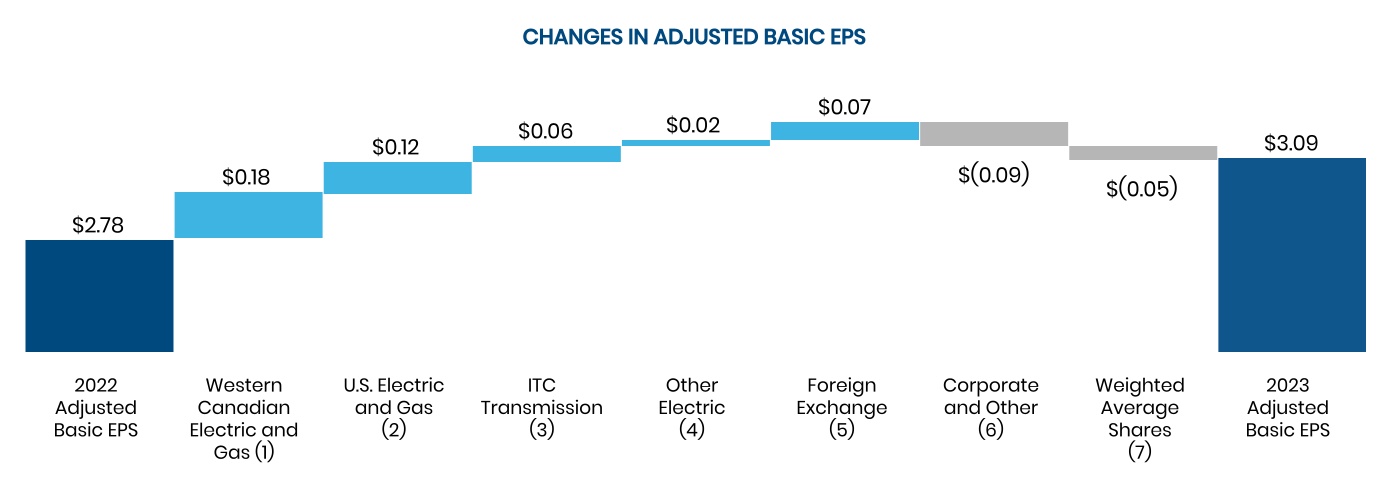
Adjusted Common Equity Earnings and Adjusted Basic EPS increased by $173 million and $0.31, respectively. Refer to "Non-U.S. GAAP Financial Measures" on page 13 for a reconciliation of these measures. The changes in Adjusted Basic EPS are illustrated in the chart below.
(1) Includes FortisBC Energy, FortisAlberta and FortisBC Electric. Primarily reflects the impact of the new cost of capital parameters approved for FortisBC effective January 1, 2023 and Rate Base growth
(2) Includes UNS Energy and Central Hudson. Reflects higher earnings at UNS Energy due to: (i) new customer rates at TEP effective September 1, 2023; (ii) higher retail electricity sales, including the impact of warmer weather and customer additions; (iii) lower depreciation expense associated with the retirement of the San Juan generating station in 2022; and (iv) an increase in the market value of investments that support retirement benefits, partially offset by higher operating costs due to inflationary increases and higher income tax expense. Earnings at Central Hudson were consistent with 2022.
(3) Reflects Rate Base growth and an increase in the market value of investments that support retirement benefits, partially offset by higher non-recoverable finance and stock-based compensation costs
(4) Primarily reflects Rate Base growth and higher electricity sales, as well as equity income from Wataynikaneyap Power
(5) Average foreign exchange rate of 1.35 in 2023 compared to 1.30 in 2022
(6) Reflects higher holding company finance costs, lower hydroelectric production in Belize, and lower earnings from Aitken Creek due to the March 31, 2023 effective date of disposition
(7) Weighted average shares of 486.3 million in 2023 compared to 478.6 million in 2022
Dividends
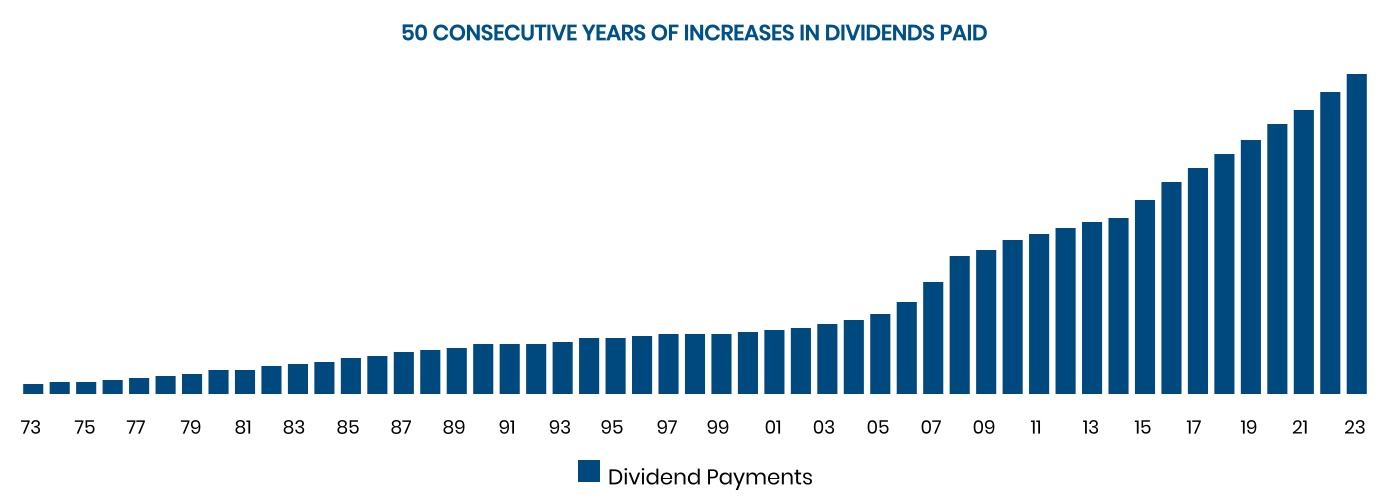
Fortis paid a dividend of $0.59 per common share in the fourth quarter of 2023, up 4.4% from $0.565 paid in each of the previous four quarters. This marked the Corporation's 50th consecutive year of increases in dividends paid. The Actual Payout Ratio was 74% in 2023 and an average of 71% over the five-year period of 2019 through 2023.
| | | | | | | | |
3 | FORTIS INC. | DECEMBER 31, 2023 |
| | | | | | | | |
| Management Discussion and Analysis |
Fortis is targeting annual dividend growth of approximately 4-6% through 2028. See "Outlook" on page 42.
Growth in dividends and changes in the market price of the Corporation's common shares have yielded the following TSRs.
| | | | | | | | | | | | | | | | | | | | | | | |
TSR (1) (%) | 1-Year | | 5-Year | | 10-Year | | 20-Year |
| Fortis | 4.8 | | | 7.6 | | | 10.1 | | | 10.7 | |
(1)Annualized TSR per Bloomberg, as at December 31, 2023
Operating Cash Flow
The $471 million increase in Operating Cash Flow was due to: (i) higher cash earnings, reflecting Rate Base growth as well as higher retail electricity sales and new customer rates at TEP; (ii) the timing of flow-through costs in customer rates, reflecting fluctuations in commodity costs, as well as transmission-related amounts in Alberta; and (iii) the higher U.S.-to-Canadian dollar exchange rate. The increase in Operating Cash Flow was partially offset by higher development expenditures, net of deposits received, associated with the Eagle Mountain Woodfibre Gas Line project, as well as proceeds received in 2022 at ITC related to the settlement of interest rate swaps. Higher interest and income tax payments also tempered the increase in Operating Cash Flow for the year.
Capital Expenditures
Capital Expenditures in 2023 were $4.3 billion, consistent with the annual Capital Plan. For a detailed discussion of the Corporation's Capital Expenditure program, see "Capital Plan" on page 21. Capital Expenditures in 2023 were $0.3 billion higher than in 2022, primarily due to construction of the Roadrunner Reserve battery energy storage project in Arizona and investments in various smaller distribution projects across the Corporation's regulated utilities, as well as the impact of the higher average foreign exchange rate.
The Corporation's 2024-2028 Capital Plan of $25 billion is the largest in the Corporation’s history and is $2.7 billion higher than the previous five-year plan. The increase is driven by organic growth, largely reflecting regional transmission projects at ITC associated with tranche one of the MISO LRTP, as well as investments in Arizona to support TEP’s exit from coal. Investments supporting system adaptation and resiliency, customer growth and economic development are also driving capital growth across the Corporation's regulated utilities.
Funding of the Capital Plan is expected to be primarily through Operating Cash Flow, debt issued at the regulated utilities and common equity proceeds expected to be sourced from the Corporation's DRIP and ATM Program.
The five-year Capital Plan is expected to increase midyear Rate Base from $37.0 billion in 2023 to $49.4 billion by 2028, translating into a five-year CAGR of 6.3%.
Capital Expenditures and Capital Plan reflect Non-U.S. GAAP financial measures. Refer to "Non-U.S. GAAP Financial Measures" on page 13 and "Capital Plan" on page 21.
| | | | | | | | |
4 | FORTIS INC. | DECEMBER 31, 2023 |
| | | | | | | | |
| Management Discussion and Analysis |
Beyond the five-year Capital Plan, additional opportunities to expand and extend growth include: further expansion of the electric transmission grid in the U.S. to facilitate the interconnection of cleaner energy, including infrastructure investments associated with the IRA and the MISO LRTP; climate adaptation and grid resiliency investments; RNG solutions and LNG infrastructure in British Columbia; and the acceleration of cleaner energy infrastructure investments across our jurisdictions.
THE INDUSTRY
The North American energy transformation is accelerating rapidly, driven by the impacts of climate change and the growing need for the development of cleaner energy sources and the deployment of energy conservation measures. The goal of carbon emissions reduction, including associated advancements in technology, has attracted interest from investors and customers. Electric transmission is seen as a critical enabler of large-scale renewable generation. Natural gas continues to be an important part of the energy mix, providing resiliency, a supplemental source of generation to support the intermittent nature of renewables, and a cost-effective heating source. Longer term, advancements in the use of hydrogen and RNG will further contribute to carbon reduction. These factors are driving significant investment opportunities in the utility sector.
Meaningful customer engagement is important for utilities as customer expectations change. Customers want to make informed energy choices and become active participants in the delivery of their energy. They also expect personalized service, customized self-service offerings, and more real-time, digital communication. Fortis' utilities are enhancing customer information systems and digital technologies to improve customer service.
Energy policies at the federal, state, and provincial levels reflect the rising focus on climate change, with clean energy and carbon reduction at the forefront. In the U.S., the IRA has been passed into law and includes, among other items, incentives and tax credits to encourage investment in clean energy, energy storage, electric vehicles and manufacturing, all to support a targeted 40% reduction in carbon emissions by 2030. With states and provinces also setting ambitious carbon reduction targets, the regulatory and compliance environment continues to evolve. These changes are creating opportunities to expand investment in new, renewable generation sources, as well as transmission infrastructure to connect renewable energy sources to the grid. Investment opportunities in energy storage technology are also being created. Electrification of the transportation sector continues to grow rapidly and represents a significant opportunity to reduce carbon emissions while increasing the output and efficiency of the grid. The Corporation's utilities are well positioned and actively involved in pursuing these opportunities, which will drive significant investment.
New technology is stimulating change across all of the Corporation's service territories. Energy delivery systems are becoming more intelligent, with advanced meters, additional remote sensing and grid automation, and more capable operational technology providing utilities with detailed usage data and predictive maintenance information to improve cost efficiency and safety. Energy management capabilities are expanding through emerging storage and demand response systems, and customers have increasing options to access distributed generation and to manage their energy usage. Grid resilience is growing in importance with the increasing frequency and intensity of weather events such as hurricanes, wildfires, floods and storms. With electricity expected to represent a larger portion of society's energy mix, investments in grid hardening and resiliency are necessary to improve the grid’s ability to withstand and recover from these climate events.
| | | | | | | | |
5 | FORTIS INC. | DECEMBER 31, 2023 |
| | | | | | | | |
| Management Discussion and Analysis |
Fortis' culture of innovation underlies a continuous drive to find better ways to safely, reliably and affordably deliver the energy and services that customers need, and the choice and control they increasingly seek. Fortis is a partner in Energy Impact Partners, a strategic private venture fund that invests in emerging technologies, products, services and business models that are transforming the industry. The Corporation is also involved in the Low Carbon Resources Initiative, a collaboration between EPRI and GTI Energy, along with other major utilities, to develop and demonstrate the low- and zero-carbon energy technologies needed to enable pathways to decarbonization. Fortis has also joined EPRI’s Climate READi, an initiative involving major North American utilities, regulators, policy makers, and other stakeholders focused on developing an industry-wide best practice framework for managing physical climate risk.
On the security front, with the advent of new and increasing cyber threats to our information and operations technology systems, increased focus and investment on protection and response to these cyber threats is an ongoing priority. Upgrades to the physical security environment are also required to keep pace with evolving challenges. All these technological advancements and challenges offer strategic investment opportunities for improving and expanding customer service and enhancing security.
The Corporation's culture and decentralized structure support the efforts required to meet changing customer expectations. Each of our utilities work constructively with regulators and all stakeholders on policy, energy and service solutions, and are an integral partner in all the communities they serve. Fortis is committed to be an industry leader in the clean energy transition.
FOCUS ON SUSTAINABILITY
Fortis is dedicated to operating in an environmentally and socially responsible manner in the interests of all of its stakeholders. Oversight and accountability for sustainability are established at the most senior levels of the Corporation and its operating subsidiaries. At Fortis, the Board has overall responsibility for sustainability. However, primary oversight of the issues, policies and practices pertaining to sustainability has been delegated to the governance and sustainability committee of the Board, reflecting sustainability’s important role in the Corporation’s strategy and risk management.
Key aspects of Fortis' sustainability program and practices are outlined below.
Climate Change and Environmental Matters
Fortis is primarily an energy delivery company with 93% of its assets related to transmission and distribution. The focus for Fortis is the delivery of cleaner energy to its customers and this limits the impact of the Corporation’s utilities on the environment when compared to more generation-intensive businesses. Fortis has a relatively small amount of fossil-fuel generation in its portfolio and plans to transition to more renewable sources of energy for its customers.
The Corporation's direct GHG emissions come primarily from its generation assets, which largely consist of fossil fuel-based generation at TEP, representing 4% of the Corporation's total assets. Fortis continues to lower its already low emissions profile, and has set a 2050 net-zero direct GHG emissions target. This goal is in addition to the Corporation’s interim targets to reduce direct GHG emissions 50% by 2030 and 75% by 2035 from a 2019 base year. Fortis expects to achieve both interim targets primarily through TEP's plan to exit from coal, as well as clean energy initiatives across the Corporation's other utilities.
Fortis has made significant progress on its emissions reduction targets. Through 2023, the Corporation’s Scope 1 emissions were 33% lower compared to 2019 levels. The retirement of certain coal generating stations, the commencement of seasonal operations at other generating stations, and the introduction of renewable wind and solar energy in Arizona, have supported our carbon emissions reduction to date.
Beyond 2035, most of the Corporation's Scope 1 emissions are expected to relate to natural gas generation at TEP. To reach net-zero by 2050, TEP will focus on developing and adopting new technologies, improving the efficiency of natural gas units, utilizing lower-carbon fuels and preparing its generating units for future hydrogen injection. Reliability and affordability will remain key priorities as Fortis works to meet its emissions reduction targets.
The Corporation expects to issue its second Climate Report in 2024. This report will provide further information on Fortis' strategy and actions to address climate change, physical and transition risks, and business opportunities including investments in resilient and adaptable infrastructure.
In the development of the Corporation's five-year Capital Plan, each of the utilities considered the investment required to deliver cleaner energy to customers, strengthen infrastructure, and improve network resiliency to deal with the expected impacts of climate change on utility infrastructure. Fortis' 2024-2028 Capital Plan includes Cleaner Energy Investments of approximately $7 billion, with investments focused on connecting renewables to the grid, renewable energy and energy storage, and cleaner natural gas solutions. Additional information can be found in the "Capital Plan" section on page 21. In support of the Capital Plan, Fortis' unsecured $1.3 billion revolving term committed credit facility agreement incorporates a sustainability-linked loan structure based on the Corporation's achievement of targets related to diversity on the Board and reduction of Scope 1 GHG emissions through 2025.
| | | | | | | | |
6 | FORTIS INC. | DECEMBER 31, 2023 |
| | | | | | | | |
| Management Discussion and Analysis |
The Corporation's environmental statement sets out its commitment to comply with all applicable laws and regulations relating to the protection of the environment, regularly conduct monitoring and audits of environmental management systems, seek feasible, cost-effective opportunities to decrease GHG emissions and increase renewable energy sources. Each operating subsidiary has extensive environmental compliance programs aligned with the ISO 14001 standard, regularly reviews its environmental management systems and protocols, strives for continual performance improvement and sets and reviews its own environmental objectives, targets and programs.
Safety and Reliability
Fortis is an industry leader in safety and reliability, with the Corporation consistently performing above industry averages. Fortis leverages its unique operating model and utility experience to deliver safe and reliable service to its customers and the communities it serves. Senior operational executives from all Fortis utilities meet regularly to share best practices and identify opportunities for collaboration on a range of operational areas including health and safety.
All contractors are required to share our commitment to conduct work in a safe manner. Contractors must demonstrate a strong safety program with a high level of training centered around risk management. Historical safety performance is a consideration when selecting successful contractors.
Engaging with Stakeholders and Communities
Fortis' utilities work closely with their customers and communities to improve the overall customer service experience. Customer satisfaction targets are established and customer service surveys are completed regularly focusing on customer satisfaction, reliability and accuracy of billing and metering, contact center services and reliability of energy supply.
Customer affordability is a priority for Fortis. Historically, Fortis utilities have managed annual increases in controllable operating costs per customer to below inflation. As we transition to a cleaner energy future, Fortis utilities continue to focus on controlling costs, identifying efficiencies and implementing innovative practices to maintain affordability. In addition, Fortis' utilities work to ensure customers are aware of available bill payment options, external government payment assistance programs, as well as energy efficiency programs and rebates.
Fortis and its utilities work with a number of Indigenous groups, with the goal of developing long-term partnerships and creating economic opportunities. The Wataynikaneyap Power Transmission project is connecting 17 First Nations communities to the Ontario power grid for the first time. These communities have had inefficient and unreliable access to electricity based on diesel generation, compromising their economic and social well-being and limiting opportunities for growth. The project is majority-owned by 24 First Nations, while Fortis has a 39% ownership interest and acts as project manager. Additional information can be found in the "Capital Plan" section on page 21.
In October 2023, FortisBC was awarded silver-level designation in Progressive Aboriginal RelationsTM from the Canadian Council of Aboriginal Business. The Progressive Aboriginal Relations certification program is an internationally recognized, Indigenous-led program that confirms corporate performance in Indigenous relations at the bronze, silver or gold level. Earning a Progressive Aboriginal Relations designation marks a significant achievement in FortisBC's long-standing commitment to fostering strong, respectful and mutually beneficial relationships with Indigenous communities.
Regular community engagement includes donations to local charities, partnerships with educational institutions, and participation on local boards, which enables Fortis and its utilities to serve as meaningful contributors to their local communities. In 2023, the Fortis group of companies contributed $11 million to the communities they serve.
Cybersecurity
Fortis' CRMP aims to continually improve information sharing and the culture of security. Fortis has an enterprise-wide CRMP that allows for the identification, measurement, monitoring and management of cybersecurity risks. Further, the Corporation and each of the utilities continually consider investments required in security, in both the corporate and grid environments, during the development of the five-year Capital Plan. Physical and cyber security leaders share best practices in areas such as threat monitoring, protecting customer information and risk management. The group also conducts training exercises to test systems and identify opportunities to improve. Oversight of cybersecurity is the responsibility of Fortis' Vice President, Chief Information Officer as well as the respective boards and executive committees at Fortis and at each utility. The Corporation has not had any material cybersecurity breaches since we began reporting this performance indicator in 2018.
People
Fortis values its 9,600 employees and recognizes that success is dependent on a strong workforce which is safe, supported and empowered. Fortis and its utilities have compensation and benefit programs designed to attract and retain talent. Fortis believes that the foundation for a healthy work environment starts with leadership from the most senior levels of the organization and must be driven by clearly articulated values that are understood and practiced at all levels of the organization.
| | | | | | | | |
7 | FORTIS INC. | DECEMBER 31, 2023 |
| | | | | | | | |
| Management Discussion and Analysis |
Fortis has a longstanding corporate-wide talent management strategy that enhances our ability to identify, mentor and develop current executives and employees for more senior positions. The Corporation seeks to continually enhance its talent management strategy. The second cohort of our leadership training program for high-potential employees across the organization was completed in 2023, providing attendees substantive training, mentoring opportunities and exposure to senior management. This program supports talent development and ensures there is a pipeline of qualified talent, preparing the Corporation and its utilities for an orderly succession of critical roles.
Our utilities strive to maintain good employee and labour relations and regular communications and collaboration between union and management leaders. Approximately 50% of the employees across our group of companies are represented by a labour union.
Advancing DEI remains a priority at Fortis. The Corporation has adopted an Inclusion and Diversity Commitment that applies to all employees of Fortis and its operating subsidiaries. The commitment is supported by a framework built upon three pillars - talent, culture and community. A DEI Advisory Council with diverse, senior level representation from across the Fortis organization guides the inclusion and diversity strategy and its implementation.
We are committed to building a diverse, equitable and inclusive workplace. Engagement is key to fostering inclusion and sustainable high performance. In 2023, we partnered with an independent research-based consulting company to conduct a confidential employee engagement survey that provided an enterprise-wide baseline inclusion index.
The Corporation's Board and Executive Diversity Policy describes the principles and objectives for diversity among the Board and executive leadership, including a commitment to maintain a Board where women and men each represent at least 40% of independent directors. As of December 31, 2023, 58% of Board members were women, 50% of Fortis' executives were women and 82% of Fortis utilities had either a female president or female board chair. The Corporation has also achieved its objective of having at least two Board members who identify as a visible minority or Indigenous person.
Ethical Conduct & Executive Compensation
The Fortis Code of Conduct is guided by the Corporation's purpose and values and sets out standards for the ethical conduct of its directors, officers, and employees. The core principles of the Code of Conduct apply across the organization, with each operating subsidiary adopting its own substantially similar Code. Fortis and its utilities hold regular Code of Conduct employee training and all Fortis employees and Board members annually certify compliance.
The Code of Conduct is supported by other policies that outline the actions and behaviours expected from management and employees, including the Anti-Corruption Policy and Respectful Workplace Policy. As of January 1, 2024, the Corporation adopted a Vendor Code of Conduct, which applies to vendors, suppliers, contractors, consultants and other service providers that do business with the Corporation, and a Human Rights Policy which details the Corporation's commitment to respecting and upholding human rights. All Fortis operating subsidiaries have policies in place that uphold the Corporation's values as contained in these policies and demonstrate their commitment to ensuring equal opportunity and providing safe, respectful work environments.
Fortis and each of its operating subsidiaries have a Speak Up Policy to support and facilitate the anonymous reporting of conduct that may breach the Code of Conduct or other workplace policies.
Achieving Fortis' sustainability objectives is a focus for the Board and forms a component of executive compensation. Sustainability-related performance measures relating to climate, carbon reduction, safety and reliability, and people are embedded in the Corporation's executive compensation program.
| | | | | | | | |
8 | FORTIS INC. | DECEMBER 31, 2023 |
| | | | | | | | |
| Management Discussion and Analysis |
| | | | | | | | | | | | | | | | | | | | | | | |
| OPERATING RESULTS | | | | | | | |
| | | | | Variance |
| ($ millions) | 2023 | | | 2022 | | | FX | | Other |
| Revenue | 11,517 | | | 11,043 | | | 233 | | | 241 | |
| Energy supply costs | 3,771 | | | 3,952 | | | 66 | | | (247) | |
| Operating expenses | 2,889 | | | 2,683 | | | 69 | | | 137 | |
| Depreciation and amortization | 1,773 | | | 1,668 | | | 35 | | | 70 | |
| | | | | | | |
| Other income, net | 291 | | | 165 | | | 6 | | | 120 | |
| Finance charges | 1,305 | | | 1,102 | | | 24 | | | 179 | |
| Income tax expense | 360 | | | 289 | | | 8 | | | 63 | |
| | | | | | | |
| | | | | | | |
| Net earnings | 1,710 | | | 1,514 | | | 37 | | | 159 | |
| | | | | | | |
| Net earnings attributable to: | | | | | | | |
| Non-controlling interests | 137 | | | 120 | | | 4 | | | 13 | |
| Preference equity shareholders | 67 | | | 64 | | | — | | | 3 | |
| Common equity shareholders | 1,506 | | | 1,330 | | | 33 | | | 143 | |
| Net Earnings | 1,710 | | | 1,514 | | | 37 | | | 159 | |
Revenue
The increase in revenue, net of foreign exchange, was due primarily to: (i) Rate Base growth; (ii) higher retail revenue at UNS Energy driven by new customer rates effective September 1, 2023, customer additions, and warmer weather; and (iii) the recognition of a regulatory deferral at FortisBC associated with the new cost of capital parameters approved by the BCUC effective January 1, 2023 (see "Regulatory Highlights - Significant Regulatory Matters" on page 14). The increase was partially offset by the flow-through of lower commodity costs in customer rates.
Energy Supply Costs
The decrease in energy supply costs, net of foreign exchange, was due primarily to lower commodity costs, mainly at FortisBC Energy, reflecting reduced pricing and volumes.
Operating Expenses
The increase in operating expenses, net of foreign exchange, was due primarily to general inflationary and employee-related cost increases.
Depreciation and Amortization
The increase in depreciation and amortization, net of foreign exchange, was due to continued investment in energy infrastructure at the Corporation's regulated utilities, partially offset by lower depreciation expense at UNS Energy associated with the retirement of the San Juan generating station in 2022.
Other Income, Net
The increase in other income, net of foreign exchange, was due primarily to: (i) gains on total return swaps and foreign exchange contracts, as compared to losses in 2022, as well as the pre-tax gain recognized on the sale of Aitken Creek, included in the Corporate and Other segment; (ii) an increase in the market value of certain investments that support retirement benefits at UNS Energy and ITC; and (iii) higher interest income, mainly at UNS Energy and ITC, largely reflecting interest on short-term deposits and regulatory deferrals.
Finance Charges
The increase in finance charges, net of foreign exchange, was due to higher debt levels to support the Corporation's Capital Plan, as well as higher interest rates impacting the Corporation's credit facilities and new debt issuances.
Income Tax Expense
The increase in income tax expense, net of foreign exchange, was driven by higher earnings before taxes.
Net Earnings
See "Performance at a Glance - Earnings and EPS" on page 3.
| | | | | | | | |
9 | FORTIS INC. | DECEMBER 31, 2023 |
| | | | | | | | |
| Management Discussion and Analysis |
| | | | | | | | | | | | | | | | | | | | | | | |
| BUSINESS UNIT PERFORMANCE | | | | | | | |
| Common Equity Earnings | | | | | Variance |
| ($ millions) | 2023 | | | 2022 | | | FX (1) | | Other |
| Regulated Utilities | | | | | | | |
| ITC | 508 | | | 454 | | | 17 | | | 37 | |
| UNS Energy | 400 | | | 328 | | | 11 | | | 61 | |
| Central Hudson | 105 | | | 103 | | | 3 | | | (1) | |
| FortisBC Energy | 274 | | | 203 | | | — | | | 71 | |
| FortisAlberta | 162 | | | 151 | | | — | | | 11 | |
| FortisBC Electric | 68 | | | 64 | | | — | | | 4 | |
Other Electric (2) | 146 | | | 134 | | | 2 | | | 10 | |
| 1,663 | | | 1,437 | | | 33 | | | 193 | |
| Non-Regulated | | | | | | | |
Corporate and Other (3) | (157) | | | (107) | | | — | | | (50) | |
| Common Equity Earnings | 1,506 | | | 1,330 | | | 33 | | | 143 | |
(1)The reporting currency of ITC, UNS Energy, Central Hudson, Caribbean Utilities, FortisTCI and Fortis Belize is the U.S. dollar. The reporting currency of Belize Electricity is the Belizean dollar, which is pegged to the U.S. dollar at BZ$2.00=US$1.00. Certain corporate and non-regulated holding company transactions, included in the Corporate and Other segment, are denominated in U.S. dollars
(2)Consists of the utility operations in eastern Canada and the Caribbean: Newfoundland Power; Maritime Electric; FortisOntario; Wataynikaneyap Partnership; Caribbean Utilities; FortisTCI; and Belize Electricity
(3)Consists of non-regulated holding company expenses, as well as long-term contracted generation assets in Belize. Also includes Aitken Creek up to the November 1, 2023 date of disposition
| | | | | | | | | | | | | | | | | | | | | | | |
| ITC | | | | | Variance |
| ($ millions) | 2023 | | | 2022 | | | FX | | Other |
Revenue (1) | 2,085 | | | 1,906 | | | 72 | | | 107 | |
Earnings (1) | 508 | | | 454 | | | 17 | | | 37 | |
(1)Revenue represents 100% of ITC. Earnings represent the Corporation's 80.1% controlling ownership interest in ITC and reflect consolidated purchase price accounting adjustments.
Revenue
The increase in revenue, net of foreign exchange, was due primarily to Rate Base growth and higher flow-through costs in customer rates.
Earnings
The increase in earnings, net of foreign exchange, mainly reflected Rate Base growth, an increase in the market value of certain investments that support retirement benefits, and costs incurred in 2022 related to the suspension of the Lake Erie Connector project. The increase was partially offset by higher non-recoverable finance and stock-based compensation costs.
In 2023, the state of Iowa reduced its corporate income tax rate from 8.4% to 7.1%, effective January 1, 2024. As a result, ITC revalued the related deferred income tax assets, resulting in a $9 million unfavourable impact to earnings. A similar corporate income tax rate reduction was implemented by the state of Iowa in 2022.
| | | | | | | | | | | | | | | | | | | | | | | |
| UNS Energy | | | | | Variance |
| ($ millions, except as indicated) | 2023 | | | 2022 | | | FX | | Other |
Retail electricity sales (GWh) | 10,786 | | | 10,658 | | | — | | | 128 | |
Wholesale electricity sales (GWh) (1) | 5,387 | | | 5,401 | | | — | | | (14) | |
Gas sales (PJ) | 17 | | | 16 | | | — | | | 1 | |
Revenue | 3,006 | | | 2,758 | | | 96 | | | 152 | |
Earnings | 400 | | | 328 | | | 11 | | | 61 | |
(1) Primarily short-term wholesale sales
Sales
The increase in retail electricity sales was due primarily to warmer weather and customer additions.
| | | | | | | | |
10 | FORTIS INC. | DECEMBER 31, 2023 |
| | | | | | | | |
| Management Discussion and Analysis |
The decrease in wholesale electricity sales was driven by lower long-term wholesale sales, partially offset by an increase in short-term wholesale sales. Revenue from short-term wholesale sales, which relate to contracts that are less than one-year in duration, is primarily credited to customers through the PPFAC mechanism and, therefore, does not materially impact earnings.
Gas sales were consistent with 2022.
Revenue
The increase in revenue, net of foreign exchange, was due primarily to: (i) the recovery of overall higher fuel and non-fuel costs through the normal operation of regulatory mechanisms; (ii) new customer rates effective September 1, 2023 at TEP; and (iii) higher retail electricity sales, discussed above. The increase was partially offset by lower wholesale electricity sales.
Earnings
The increase in earnings, net of foreign exchange, was due primarily to: (i) new customer rates effective September 1, 2023 at TEP; (ii) higher retail electricity sales, discussed above; (iii) lower depreciation expense associated with the retirement of the San Juan generating station in 2022; and (iv) an increase in the market value of certain investments that support retirement benefits. The increase was partially offset by higher operating costs and income tax expense.
| | | | | | | | | | | | | | | | | | | | | | | |
| Central Hudson | | | | | Variance |
| ($ millions, except as indicated) | 2023 | | | 2022 | | | FX | | Other |
Electricity sales (GWh) | 4,921 | | | 5,002 | | | — | | | (81) | |
Gas sales (PJ) | 24 | | | 25 | | | — | | | (1) | |
Revenue | 1,360 | | | 1,325 | | | 49 | | | (14) | |
Earnings | 105 | | | 103 | | | 3 | | | (1) | |
Sales
The decrease in electricity and gas sales was due primarily to lower average consumption by residential customers due to milder weather.
Changes in electricity and gas sales at Central Hudson are subject to regulatory revenue decoupling mechanisms and, therefore, do not materially impact earnings.
Revenue
The decrease in revenue, net of foreign exchange, was due primarily to the flow-through of lower energy supply costs driven by commodity prices, partially offset by an increase in gas and electricity delivery rates effective July 1, 2023.
Earnings
The decrease in earnings, net of foreign exchange, was due to higher operating expenses related to an increase in labour costs, as well as finance costs in excess of amounts collected in customer rates, partially offset by Rate Base growth.
| | | | | | | | | | | | | | | | | |
| FortisBC Energy | | | | | |
| ($ millions, except as indicated) | 2023 | | | 2022 | | | Variance |
Gas sales (PJ) | 213 | | | 231 | | | (18) | |
Revenue | 1,955 | | | 2,084 | | | (129) | |
Earnings | 274 | | | 203 | | | 71 | |
Sales
The decrease in gas sales was due primarily to lower average consumption by residential, commercial and transportation customers, largely due to milder weather, partially offset by customer additions.
Revenue
The decrease in revenue was due to a lower cost of natural gas recovered from customers. The decrease was partially offset by revenue associated with the new cost of capital parameters approved by the BCUC effective January 1, 2023, which has been recognized through a regulatory deferral to be collected in future customer rates (see "Regulatory Highlights - Significant Regulatory Matters" on page 14), and Rate Base growth.
| | | | | | | | |
11 | FORTIS INC. | DECEMBER 31, 2023 |
| | | | | | | | |
| Management Discussion and Analysis |
Earnings
The increase in earnings was due primarily to the new cost of capital parameters, discussed above, which resulted in $46 million of earnings in 2023. Rate Base growth also contributed to the increase in earnings.
FortisBC Energy earns approximately the same margin regardless of whether a customer contracts for the purchase and delivery of natural gas or only for delivery. Due to regulatory deferral mechanisms, changes in consumption levels and commodity costs do not materially impact earnings.
| | | | | | | | | | | | | | | | | |
| FortisAlberta | | | | | |
| ($ millions, except as indicated) | 2023 | | | 2022 | | | Variance |
Electricity deliveries (GWh) | 16,976 | | | 16,923 | | | 53 | |
Revenue | 738 | | | 680 | | | 58 | |
Earnings | 162 | | | 151 | | | 11 | |
Deliveries
The increase in electricity deliveries was due to higher average consumption by residential customers due to colder weather, as well as customer additions.
As approximately 85% of FortisAlberta's revenue is derived from fixed or largely fixed billing determinants, changes in quantities of energy delivered are not entirely correlated with changes in revenue. Revenue is a function of numerous variables, many of which are independent of actual energy deliveries. Significant variations in weather conditions, however, can impact revenue and earnings.
Revenue and Earnings
The increase in revenue and earnings was due to: (i) Rate Base growth; (ii) higher revenue associated with an increase in demand charges, as well as higher energy deliveries due to colder weather and customer additions, as discussed above; and, (iii) the operation of the PBR efficiency carry-over mechanism, which was earned in the second term of PBR and recognized in 2023. The increases were partially offset by the lower recovery of costs attributable to REAs (see "Regulatory Highlights - Significant Regulatory Matters" on page 14).
| | | | | | | | | | | | | | | | | |
| FortisBC Electric | | | | | |
| ($ millions, except as indicated) | 2023 | | | 2022 | | | Variance |
Electricity sales (GWh) | 3,478 | | | 3,542 | | | (64) | |
Revenue | 528 | | | 487 | | | 41 | |
Earnings | 68 | | | 64 | | | 4 | |
Sales
The decrease in electricity sales was due primarily to lower average consumption by residential customers due to milder weather.
Revenue
The increase in revenue was due primarily to the normal operation of regulatory mechanisms, including the regulatory deferral associated with the new cost of capital parameters approved by the BCUC effective January 1, 2023 (see "Regulatory Highlights - Significant Regulatory Matters" on page 14). Higher energy supply costs recovered from customers and Rate Base growth also contributed to the increase in revenue, partially offset by lower electricity sales and a decrease in third party contract work.
Earnings
The increase in earnings was primarily due to the new cost of capital parameters, discussed above. Rate Base growth also contributed to the increase in earnings, partially offset by higher operating costs reflecting inflationary increases.
Due to regulatory deferral mechanisms, changes in consumption levels do not materially impact earnings.
| | | | | | | | | | | | | | | | | | | | | | | |
| Other Electric | | | | | Variance |
| ($ millions, except as indicated) | 2023 | | | 2022 | | | FX | | Other |
Electricity sales (GWh) | 9,753 | | | 9,470 | | | — | | | 283 | |
Revenue | 1,761 | | | 1,652 | | | 16 | | | 93 | |
Earnings | 146 | | | 134 | | | 2 | | | 10 | |
| | | | | | | | |
12 | FORTIS INC. | DECEMBER 31, 2023 |
| | | | | | | | |
| Management Discussion and Analysis |
Sales
The increase in electricity sales was due primarily to higher average consumption by residential and commercial customers, as well as customer additions. Higher average consumption was largely due to the conversion of home heating systems from oil to electric in Eastern Canada.
Revenue
The increase in revenue, net of foreign exchange, was due to higher electricity sales, discussed above, and the normal operation of regulatory mechanisms at Newfoundland Power.
Earnings
The increase in earnings, net of foreign exchange, was due to Rate Base growth and higher electricity sales, partially offset by higher operating and finance costs. Equity income from Wataynikaneyap Power also contributed to the increase in earnings.
| | | | | | | | | | | | | | | | | |
| Corporate and Other | | | | | |
| ($ millions) | 2023 | | | 2022 | | | Variance |
Electricity sales (GWh) (1) | 164 | | | 225 | | | (61) | |
Revenue (2) | 84 | | | 151 | | | (67) | |
Net loss (3) | (157) | | | (107) | | | (50) | |
(1) Reflects electricity sales at Fortis Belize
(2) Includes revenue for Fortis Belize as well as revenue for Aitken Creek up to the November 1, 2023 date of disposition
(3) Includes non-regulated holding company expenses, earnings for Fortis Belize, as well as earnings for Aitken Creek up to the November 1, 2023 date of disposition
Sales
The decrease in electricity sales reflected a decrease in hydroelectric production in Belize associated with lower rainfall levels.
Revenue
The decrease in revenue reflected: (i) the disposition of Aitken Creek, including the unfavourable impact of mark-to-market accounting of natural gas derivatives at Aitken Creek, which resulted in unrealized losses of $22 million through November 1, 2023 compared to unrealized gains of $20 million in 2022; and (ii) lower hydroelectric production in Belize.
Net Loss
The increase in net loss includes lower earnings at Aitken Creek of $25 million. The decrease in earnings at Aitken Creek reflects the November 1, 2023 disposition date and the unfavourable impact of mark-to-market accounting of natural gas derivatives, partially offset by higher margins on gas sold. The impact of lower earnings at Aitken Creek was partially offset by the $10 million gain on disposition of Aitken Creek recognized by FortisBC Holdings Inc., also included in the Corporate and Other segment.
Excluding the impacts associated with Aitken Creek, the net loss in the Corporate and Other segment increased by $35 million year over year. The increase reflected: (i) higher holding company finance costs, reflecting higher interest rates and borrowings outstanding under the Corporation's credit facilities, as well as the refinancing of long-term debt; and (ii) lower hydroelectric production in Belize. The increase was partially offset by unrealized gains on foreign exchange contracts, reflecting market conditions.
NON-U.S. GAAP FINANCIAL MEASURES
Adjusted Common Equity Earnings, Adjusted Basic EPS, Adjusted Payout Ratio and Capital Expenditures are Non-U.S. GAAP Financial Measures and may not be comparable with similar measures used by other entities. They are presented because management and external stakeholders use them in evaluating the Corporation's financial performance and prospects.
Net earnings attributable to common equity shareholders (i.e., Common Equity Earnings) and basic EPS are the most directly comparable U.S. GAAP measures to Adjusted Common Equity Earnings and Adjusted Basic EPS, respectively. The Actual Payout Ratio calculated using Common Equity Earnings is the most comparable U.S. GAAP measure to the Adjusted Payout Ratio. These adjusted measures reflect the removal of items that management excludes in its key decision-making processes and evaluation of operating results.
Capital Expenditures include additions to property, plant and equipment and additions to intangible assets, as shown on the consolidated statements of cash flows. It also includes Fortis' 39% share of capital spending for the Wataynikaneyap Transmission Power Project, consistent with Fortis' evaluation of operating results and its role as project manager during the construction of this MCP.
| | | | | | | | |
13 | FORTIS INC. | DECEMBER 31, 2023 |
| | | | | | | | |
| Management Discussion and Analysis |
| | | | | | | | | | | | | | | | | |
| Non-U.S. GAAP Reconciliation | | | | | |
| ($ millions, except as indicated) | 2023 | | | 2022 | | | Variance |
Adjusted Common Equity Earnings, Adjusted Basic EPS and Adjusted Payout Ratio | | | | | |
| Common Equity Earnings | 1,506 | | | 1,330 | | | 176 | |
| Adjusting items: | | | | | |
Disposition of Aitken Creek (1) | (15) | | | — | | | (15) | |
Unrealized loss (gain) on mark-to-market of derivatives (2) | 2 | | | (20) | | | 22 | |
Revaluation of deferred income tax assets (3) | 9 | | | 9 | | | — | |
Lake Erie Connector project suspension costs (4) | — | | | 10 | | | (10) | |
| Adjusted Common Equity Earnings | 1,502 | | | 1,329 | | | 173 | |
Adjusted Basic EPS (5) ($) | 3.09 | | | 2.78 | | | 0.31 | |
Adjusted Payout Ratio (6) (%) | 73.9 | | | 78.1 | | | (4.2) | |
| | | | | |
| Capital Expenditures | | | | | |
| Additions to property, plant and equipment | 3,986 | | | 3,587 | | | 399 | |
| Additions to intangible assets | 183 | | | 278 | | | (95) | |
| Adjusting item: | | | | | |
Wataynikaneyap Transmission Power Project (7) | 160 | | | 169 | | | (9) | |
| Capital Expenditures | 4,329 | | | 4,034 | | | 295 | |
(1) Aitken Creek was sold on November 1, 2023, with a March 31, 2023 effective date. The adjustment represents: (i) the $10 million gain on disposition, net of income tax expense of $13 million; and (ii) $5 million of net earnings at Aitken Creek, recognized in accordance with U.S. GAAP, during the March 31, 2023 to November 1, 2023 stub period, net of income tax expense of $2 million, included in the Corporate and Other segment
(2) Represents the impact of mark-to-market accounting of natural gas derivatives at Aitken Creek through the March 31, 2023 effective date of disposition, net of income tax recovery of $1 million in 2023 (2022 - net of income tax expense of $7 million), included in the Corporate and Other segment
(3) Represents the revaluation of deferred income tax assets resulting from the reduction in the corporate income tax rate in the state of Iowa, included in the ITC segment
(4) Represents costs incurred upon the suspension of the Lake Erie Connector project, net of income tax recovery of $4 million, included in the ITC segment
(5) Calculated using Adjusted Common Equity Earnings divided by weighted average common shares of 486.3 million in 2023 (2022 - 478.6 million)
(6) Calculated using dividends paid per common share of $2.29 in 2023 (2022 - $2.17) divided by Adjusted Basic EPS
(7) Represents Fortis' 39% share of capital spending for the Wataynikaneyap Transmission Power Project, included in the Other Electric segment
REGULATORY HIGHLIGHTS
General
The earnings of the Corporation's regulated utilities are determined under COS regulation, with some using PBR mechanisms.
Under COS regulation, the regulator sets customer rates to permit a reasonable opportunity for the timely recovery of the estimated costs of providing service, including a fair rate of return on a deemed or targeted capital structure applied to an approved Rate Base. PBR mechanisms generally apply a formula that incorporates inflation and assumed productivity improvements for a set term.
The ability to recover prudently incurred costs of providing service and earn the regulator‑approved ROE or ROA may depend on achieving the forecasts established in the rate-setting process. There can be varying degrees of regulatory lag between when costs are incurred and when they are recovered in customer rates.
Transmission operations in the U.S. are regulated federally by FERC. Remaining utility operations in the U.S. and Canada are regulated by state or provincial regulators. Utility operations in the Caribbean are regulated by regulatory and governmental authorities.
Additional information about regulation and the regulatory matters discussed below is provided in Note 2 in the 2023 Annual Financial Statements. Also refer to "Business Risks - Utility Regulation" on page 25.
Significant Regulatory Matters
ITC
MISO Base ROE: In 2022, the D.C. Circuit Court issued a decision vacating certain FERC orders that had established the methodology for setting the base ROE for transmission owners operating in the MISO region, including ITC. This matter dates back to complaints filed at FERC in 2013 and 2015 challenging the MISO base ROE then in effect. The court has remanded the matter to FERC for further process, the timing and outcome of which remain unknown.
| | | | | | | | |
14 | FORTIS INC. | DECEMBER 31, 2023 |
| | | | | | | | |
| Management Discussion and Analysis |
Transmission Incentives: In 2021, FERC issued a supplemental NOPR on transmission incentives modifying the proposal in the initial NOPR released by FERC in 2020. The supplemental NOPR proposes to eliminate the 50-basis point RTO ROE incentive adder for RTO members that have been members for longer than three years. The timing and outcome of this proceeding remain unknown.
Although any potential impact to Fortis is uncertain, every 10-basis point change in ROE at ITC impacts Fortis' annual EPS by approximately $0.01.
Transmission ROFR: In December 2023, the Iowa District Court ruled that the manner in which Iowa's ROFR statute was passed is unconstitutional. The statute grants incumbent electric transmission owners, including ITC, a ROFR to construct, own and maintain certain electric transmission assets in the state. The District Court did not make any determination on the merits of the ROFR itself, but did issue a permanent injunction preventing ITC and others from taking further action to construct the MISO LRTP tranche one Iowa projects in reliance on the ROFR. ITC has filed for reconsideration of the District Court’s decision with respect to the scope of the injunction.
MISO's decision with respect to the assignment of the tranche one LRTP projects was finalized on July 25, 2022. MISO is the only entity charged with determining what projects are to be competitively bid pursuant to its tariff, and we believe it is unlikely that MISO will change the designation of the tranche one LRTP projects. Further, under the MISO tariff, approximately 70% of the Iowa tranche one projects are upgrades to ITC facilities along existing rights-of-way, which under MISO's tariff grants ITC the option to construct the upgrades regardless of the outcome of the ROFR legislation. For any portion of the first tranche of MISO’s LRTP projects in Iowa to be competitively bid, we believe it would require a federal decision that significantly departs from existing rules under the MISO tariff.
Forecast capital expenditures for 2024 associated with the first tranche of MISO's LRTP in Iowa is US$40 million, and approximately US$900 million is reflected in the 2024-2028 Capital Plan. The timing and outcome of the filing for reconsideration, and any other subsequent legal proceedings, as well as the impact on the five-year Capital Plan and the potential for future projects, is unknown.
UNS Energy
TEP General Rate Application: In August 2023, the ACC issued a decision on TEP's general rate application approving, among other things, an increase in non-fuel revenue of US$100 million, a 9.55% ROE and a 54.32% common equity component of capital structure. The decision reflects an increase from TEP's previous ROE and common equity component of capital structure of 9.15% and 53%, respectively. New customer rates became effective on September 1, 2023.
UNS Electric General Rate Application: In January 2024, the ACC issued a decision on UNS Electric's general rate application approving, among other things, an increase in the ROE and common equity component of capital structure from 9.50% and 52.8% to 9.75% and 53.7%, respectively. The decision also approved the System Reliability Benefit mechanism which allows UNS Electric to recover qualifying generation and energy storage investments between rate cases subject to an annual cap and earnings test. New customer rates became effective on February 1, 2024.
Central Hudson
General Rate Application: In July 2023, Central Hudson filed a rate application with the PSC requesting an increase in electric and natural gas delivery rates effective July 1, 2024. The application includes a request to set Central Hudson's ROE at 9.8% and a 50% common equity component of capital structure. The timing and outcome of this proceeding remain unknown.
CIS Implementation: In January 2023, Central Hudson filed a response to the PSC's Order to Commence Proceeding and Show Cause, which had directed Central Hudson to explain why the PSC should not pursue civil or administrative penalties or initiate a proceeding to review the prudence of implementation costs associated with its new CIS. In July 2023, an interim agreement was reached with the PSC, in which Central Hudson agreed to independent third-party verification of recent system improvements related to its billing system, and to accelerate the implementation of its monthly meter reading plan. The independent third-party review remains ongoing and an initial report is expected in the first quarter of 2024. The timing and outcome of this proceeding remain unknown.
FortisBC Energy and FortisBC Electric
GCOC Proceeding: In September 2023, the BCUC issued a decision on the GCOC proceeding approving new cost of capital parameters for FortisBC Energy and FortisBC Electric retroactive to January 1, 2023. For FortisBC Energy, the decision increased the ROE and common equity component of capital structure from 8.75% and 38.5% to 9.65% and 45%, respectively. For FortisBC Electric, the decision increased the ROE and common equity component of capital structure from 9.15% and 40% to 9.65% and 41%, respectively. Recovery of the GCOC decision in customer rates will begin in 2024, and the associated revenue deficiency deferral is expected to be fully collected by the end of 2029.
FortisAlberta
2024 GCOC Proceeding: In October 2023, the AUC issued a decision on the 2024 GCOC proceeding. The decision, which is effective January 1, 2024, adopts a formulaic approach in determining the ROE on an annual basis, which will adjust the notional ROE of 9.0% with reference to forecast long-term Government of Canada bond and utility bond yields. The ROE for 2024 has been set at 9.28%, an increase from FortisAlberta's previous ROE of 8.50%. The decision also concluded that there will be no change in the common equity component of capital structure of 37%.
| | | | | | | | |
15 | FORTIS INC. | DECEMBER 31, 2023 |
| | | | | | | | |
| Management Discussion and Analysis |
In November 2023, FortisAlberta sought permission to appeal the GCOC decision to the Court of Appeal of Alberta on the basis that the AUC erred in its decision to not adjust FortisAlberta's ROE and common equity component of capital structure to address incremental business risk associated with competition from REAs located in FortisAlberta's service area, as well as heightened regulatory risk due to the non-recovery of costs attributable to REAs (see "REA Cost Recovery" below). The decision on the request for appeal is expected by the end of 2024.
Third PBR Term: In October 2023, the AUC issued a decision establishing the parameters for the third PBR term for the period of 2024-2028. FortisAlberta's base distribution rates for the third PBR term are based on the 2023 COS revenue requirement previously approved by the AUC. The third PBR plan incorporates new inputs for the calculation of the inflation and productivity factors, the introduction of an earnings sharing mechanism that will allocate achieved earnings above the approved ROE between the utility and its customers, and the removal of the efficiency carry-over incentive mechanism. Capital funding mechanisms are preserved with modifications including: (i) base capital funding established on the approved 2023 COS Rate Base and a level of annual capital additions premised on 2018-2022 historical averages that are escalated as prescribed by the AUC; and (ii) criteria to meet eligibility for incremental capital funding on extraordinary expenditures is expanded to provide potential eligibility for net-zero plan related expenditures.
In November 2023, FortisAlberta sought permission to appeal the Third PBR decision to the Court of Appeal of Alberta on the basis that the AUC erred in its decision to determine capital funding using 2018-2022 historical capital investments without consideration for funding of new capital programs included in the company's 2023 COS revenue requirement as approved by the AUC. The decision on the request for appeal is expected by the end of 2024.
REA Cost Recovery: In 2021, the AUC determined that costs attributable to REAs, approximating $10 million annually, can no longer be recovered from FortisAlberta's rate payers, effective January 1, 2023. FortisAlberta continues to assess other means, including legislative amendments, to recover these costs.
FINANCIAL POSITION
| | | | | | | | | | | |
Significant Changes between December 31, 2023 and 2022 |
| | | |
| Balance Sheet Account | Variance | |
| ($ millions) | FX | Other | Explanation |
| Cash and cash equivalents | (3) | | 419 | | Primarily due to the issuance of US$800 million in unsecured senior notes at ITC in June 2023. ITC expects to utilize the unused net proceeds from this issuance to fund short-term capital requirements. Balances on hand have been largely invested in interest-bearing accounts. |
| Accounts receivable and other current assets | (30) | | (491) | | Due to: (i) a decrease in the fair value of energy contracts at UNS Energy and FortisBC Energy; and (ii) lower gas sales in the fourth quarter of 2023, as compared to the fourth quarter of 2022, at FortisBC Energy due to milder weather, partially offset by an increase in income taxes receivable. |
| | | |
| | | |
| Regulatory assets (current and long-term) | (32) | | 407 | | Due primarily to: (i) an increase in deferred income taxes; (ii) unrealized losses on energy derivatives at UNS Energy and FortisBC Energy; and (iii) higher energy management costs to be recovered in customer rates. |
| Property, plant and equipment, net | (615) | | 2,337 | | Due to capital expenditures, partially offset by depreciation. |
| | | |
| Goodwill | (253) | | (27) | | Reflects the disposition of Aitken Creek. |
| Short-term borrowings | (6) | | (128) | | Reflects the repayment of commercial paper at ITC. |
| Accounts payable & other current liabilities | (36) | | (280) | | Due to: (i) lower energy supply costs, primarily at UNS Energy and FortisBC Energy; and (ii) lower customer deposits, largely related to the Eagle Mountain Woodfibre Gas Line project, partially offset by an increase in trade accounts payable due to the timing of payments. |
| Other liabilities | (16) | | 140 | | Reflects an increase in employee future benefit liabilities driven by lower discount rates. |
| | | |
| Deferred income taxes | (59) | | 398 | | Due to higher temporary differences associated with ongoing capital investment as well as lower deferred tax assets associated with the utilization of tax losses. |
| | | | | | | | |
16 | FORTIS INC. | DECEMBER 31, 2023 |
| | | | | | | | |
| Management Discussion and Analysis |
| | | | | | | | | | | |
Significant Changes between December 31, 2023 and 2022 |
| | | |
| Balance Sheet Account | Variance | |
| ($ millions) | FX | Other | Explanation |
| Long-term debt (including current portion) | (428) | | 1,547 | | Reflects debt issuances, partially offset by debt repayments, and higher borrowings under committed credit facilities, in support of the Corporation's Capital Plan. |
| | | |
| Shareholders' equity | (361) | | 836 | | Due primarily to: (i) Common Equity Earnings for 2023, less dividends declared on common shares; and (ii) the issuance of common shares, largely under the DRIP. |
| | | |
LIQUIDITY AND CAPITAL RESOURCES
Cash Flow Requirements
At the subsidiary level, it is expected that operating expenses and interest costs will be paid from Operating Cash Flow, with varying levels of residual cash flow available for capital expenditures and/or dividend payments to Fortis. Remaining capital expenditures are expected to be financed primarily from borrowings under credit facilities, long-term debt offerings and equity injections from Fortis. Borrowings under credit facilities may be required periodically to support seasonal working capital requirements.
Cash required of Fortis to support subsidiary growth is generally derived from borrowings under the Corporation's committed credit facility, the operation of the DRIP, as well as issuances of long-term debt, preference equity, and common shares including those issued through the ATM Program discussed below. The subsidiaries pay dividends to Fortis and receive equity injections from Fortis when required. Both Fortis and its subsidiaries initially borrow through their committed credit facilities and periodically replace these borrowings with long-term financing. Financing needs also arise to refinance maturing debt.
Credit facilities are syndicated primarily with large banks in Canada and the U.S., with no one bank holding more than approximately 20% of the Corporation's total revolving credit facilities. Approximately $5.7 billion of the total credit facilities are committed with maturities ranging from 2024 through 2028. Available credit facilities are summarized in the following table.
| | | | | | | | | | | | | | | | | | | | | | | |
| Credit Facilities | | | | | | | |
| As at December 31 | Regulated | | Corporate | | | | |
($ millions) | Utilities | | and Other | | 2023 | | 2022 | |
Total credit facilities (1) | 3,943 | | | 2,233 | | | 6,176 | | | 5,850 | |
| Credit facilities utilized: | | | | | | | |
| Short-term borrowings | (119) | | | — | | | (119) | | | (253) | |
Long-term debt (including current portion) | (910) | | | (662) | | | (1,572) | | | (1,657) | |
| Letters of credit outstanding | (78) | | | (23) | | | (101) | | | (128) | |
| Credit facilities unutilized | 2,836 | | | 1,548 | | | 4,384 | | | 3,812 | |
(1)Additional information about the Corporation's credit facilities is provided in Note 14 in the 2023 Annual Financial Statements
In April 2023, ITC increased its total credit facilities available from US$900 million to US$1 billion and extended the maturity to April 2028.
In May 2023, the Corporation amended its $1.3 billion revolving term committed credit facility agreement to extend the maturity to July 2028. Also in May 2023, the Corporation extended the maturity on its unsecured US$500 million non-revolving term credit facility to May 2024. The facility is repayable at any time without penalty.
In October 2023, FortisUS Inc., a holding company subsidiary of Fortis, entered into a US$150 million uncommitted revolving credit facility. The facility matures in October 2025 and will provide funding flexibility for short-term liquidity needs.
The Corporation's ability to service debt and pay dividends is dependent on the financial results of, and the related cash payments from, its subsidiaries. Certain regulated subsidiaries are subject to restrictions that limit their ability to distribute cash to Fortis, including restrictions by certain regulators limiting annual dividends and restrictions by certain lenders limiting debt to total capitalization. There are also practical limitations on using the net assets of the regulated subsidiaries to pay dividends, based on management's intent to maintain the subsidiaries' regulator-approved capital structures. Fortis does not expect that maintaining such capital structures will impact its ability to pay dividends in the foreseeable future.
| | | | | | | | |
17 | FORTIS INC. | DECEMBER 31, 2023 |
| | | | | | | | |
| Management Discussion and Analysis |
As at December 31, 2023, consolidated fixed-term debt maturities/repayments are expected to average $1,492 million annually over the next five years and approximately 73% of the Corporation's consolidated long-term debt, excluding credit facility borrowings, had maturities beyond five years.
In November 2022, Fortis filed a short-form base shelf prospectus with a 25-month life under which it may issue common or preference shares, subscription receipts, or debt securities in an aggregate principal amount of up to $2.0 billion. In September 2023, Fortis established an ATM Program pursuant to the short-form base shelf prospectus, that allows the Corporation to issue up to $500 million of common shares from treasury to the public from time to time, at the Corporation's discretion. As at December 31, 2023, $500 million remained available under the ATM Program and $1.5 billion remained available under the short-form base shelf prospectus.
Fortis is well positioned with strong liquidity. This combination of available credit facilities and manageable annual debt maturities/repayments provides flexibility in the timing of access to capital markets. Given current credit ratings and capital structures, the Corporation and its subsidiaries currently expect to continue to have reasonable access to long-term capital in 2024.
Fortis and its subsidiaries were in compliance with debt covenants as at December 31, 2023 and are expected to remain compliant in 2024.
| | | | | | | | | | | | | | | | | |
| Cash Flow Summary | | | | | |
| Summary of Cash Flows | | | | | |
| Years ended December 31 | | | | | |
| ($ millions) | 2023 | | | 2022 | | | Variance |
| Cash and cash equivalents, beginning of year | 209 | | | 131 | | | 78 | |
| Cash from (used in): | | | | | |
| Operating activities | 3,545 | | | 3,074 | | | 471 | |
| Investing activities | (3,742) | | | (4,059) | | | 317 | |
| Financing activities | 613 | | | 1,035 | | | (422) | |
| Effect of exchange rate changes on cash and cash equivalents | — | | | 28 | | | (28) | |
| | | | | |
| Cash and cash equivalents, end of year | 625 | | | 209 | | | 416 | |
Operating Activities
See "Performance at a Glance - Operating Cash Flow" on page 4.
Investing Activities
The decrease in cash used in investing activities was due to proceeds received on the disposition of Aitken Creek, lower planned equity contributions associated with the Wataynikaneyap Transmission Power Project, and higher customer contributions in aid of construction. The decrease was partially offset by higher capital expenditures in 2023, as well as the higher U.S.-to-Canadian dollar exchange rate. See "Performance at a Glance - Capital Expenditures" on page 4 and "Capital Plan" on page 21.
Financing Activities
Cash flow related to financing activities will fluctuate as a result of changes in the subsidiaries' capital expenditures and the amount of Operating Cash Flow available to fund those capital expenditures, which together impact the amount of funding required from debt and common equity issuances. See "Cash Flow Requirements" on page 17. The decrease in cash from financing activities in 2023 also reflected the repayment of credit facility borrowings with the proceeds received from the sale of Aitken Creek.
| | | | | | | | |
18 | FORTIS INC. | DECEMBER 31, 2023 |
| | | | | | | | |
| Management Discussion and Analysis |
| | | | | | | | | | | | | | | | | | | | | | | | | | | | | |
| Debt Financing | Month
Issued | | Interest Rate (%) | | Maturity | | Amount ($ millions) | | Use of Proceeds |
| Significant Long-Term Debt Issuances | | | | |
Year ended December 31, 2023
| | | | |
| ITC | | | | | | | | | |
Unsecured senior notes | June | | 5.40 | | (1) | 2033 | | US | 500 | | | (2) (3) (4) |
Unsecured senior notes | June | | 4.95 | | (5) | 2027 | | US | 300 | | | (2) (3) (4) |
Secured senior notes | November | | 5.65 | | | 2028 | | US | 90 | | | (3) (4) (6) |
| UNS Energy | | | | | | | | | |
| Unsecured senior notes | February | | 5.50 | | | 2053 | | US | 375 | | | (2) (3) |
| Unsecured senior notes | August | | 5.65 | | | 2038 | | US | 50 | | | (2) |
| Central Hudson | | | | | | | | | |
| Unsecured senior notes | March | | 5.68 | | | 2033 | | US | 40 | | | (3) (4) |
| Unsecured senior notes | March | | 5.78 | | | 2035 | | US | 15 | | | (3) (4) |
| Unsecured senior notes | March | | 5.88 | | | 2038 | | US | 35 | | | (3) (4) |
| Unsecured senior notes | November | | 6.17 | | | 2028 | | US | 60 | | | (3) (4) |
| FortisAlberta | | | | | | | | | |
| Unsecured senior debentures | May | | 4.86 | | | 2053 | | 200 | | | (3) (4) |
| Newfoundland Power | | | | | | | | | |
| First mortgage sinking fund bonds | August | | 5.12 | | | 2053 | | 90 | | | (3) (4) |
| Maritime Electric | | | | | | | | | |
| First mortgage bonds | September | | 5.20 | | | 2053 | | 60 | | | (3) (4) |
| Fortis | | | | | | | | | |
| Unsecured senior notes | November | | 5.68 | | (7) | 2033 | | 500 | | | (3) (4) |
(1) ITC entered into interest rate locks which reduced the effective interest rate to 5.32%. See Note 26 to the 2023 Annual Financial Statements(2) Repay maturing long-term debt
(3) General corporate purposes
(4) Repay short-term and/or credit facility borrowings
(5) Represents a second tranche of ITC's existing 4.95% senior notes, originally issued in 2022
(6) Fund capital expenditures
(7) Fortis entered into an interest rate lock which reduced the effective interest rate to 5.52%. See Note 26 to the 2023 Annual Financial Statements
In January 2024, ITC issued US$85 million of 10-year, 5.98% secured senior notes, US$75 million of 5-year, 5.11% first mortgage bonds, and US$75 million of 10-year, 5.38% first mortgage bonds. Proceeds will be used to repay credit facility borrowings, fund capital expenditures, and for general corporate purposes.
| | | | | | | | | | | | | | | | | |
| Common Equity Financing | | | | | |
| Common Equity Issuances and Dividends Paid |
| Years ended December 31 |
| ($ millions, except as indicated) | 2023 | | | 2022 | | | Variance |
| Common shares issued: | | | | | |
Cash (1) | 43 | | | 53 | | | (10) | |
Non-cash (2) | 409 | | | 366 | | | 43 | |
| Total common shares issued | 452 | | | 419 | | | 33 | |
Number of common shares issued (# millions) | 8.4 | | | 7.4 | | 1.0 | |
| Common share dividends paid: | | | | | |
| Cash | (701) | | | (673) | | | (28) | |
Non-cash (3) | (408) | | | (364) | | | (44) | |
| Total common share dividends paid | (1,109) | | | (1,037) | | | (72) | |
Dividends paid per common share ($) | 2.29 | | 2.17 | | | 0.12 | |
(1) Includes common shares issued under stock option and employee share purchase plans
(2) Common shares issued under the DRIP and stock option plan
(3) Common share dividends reinvested under the DRIP
On December 6, 2023 and February 8, 2024, Fortis declared a dividend of $0.59 per common share payable on March 1, 2024 and June 1, 2024, respectively. The payment of dividends is at the discretion of the Board and depends on the Corporation's financial condition and other factors.
| | | | | | | | |
19 | FORTIS INC. | DECEMBER 31, 2023 |
| | | | | | | | |
| Management Discussion and Analysis |
On September 1, 2023, the annual fixed dividend per share for the First Preference Shares, Series G was reset from $1.0983 to $1.5308 for the five-year period up to but excluding September 1, 2028.
| | | | | | | | | | | | | | | | | | | | | | | |
| Contractual Obligations | | | | | | | |
| Contractual Obligations | | | | | |
As at December 31, 2023 | | |
| ($ millions) | Total | Year 1 | Year 2 | Year 3 | Year 4 | Year 5 | Thereafter |
| Long-term debt: | | | | | | | |
Principal (1) | 29,703 | | 2,296 | | 511 | | 2,388 | | 2,334 | | 1,501 | | 20,673 | |
| Interest | 18,007 | | 1,189 | | 1,154 | | 1,123 | | 1,038 | | 955 | | 12,548 | |
Finance leases (2) | 1,158 | | 36 | | 36 | | 36 | | 36 | | 36 | | 978 | |
Other obligations (3) | 435 | | 127 | | 82 | | 91 | | 28 | | 26 | | 81 | |
Other commitments: (4) | | | | | | | |
| Gas and fuel purchase obligations | 6,073 | | 697 | | 592 | | 490 | | 439 | | 339 | | 3,516 | |
| Waneta Expansion capacity agreement | 2,418 | | 55 | | 56 | | 58 | | 59 | | 60 | | 2,130 | |
| Renewable power purchase agreements | 1,754 | | 128 | | 128 | | 128 | | 127 | | 127 | | 1,116 | |
| Power purchase obligations | 1,534 | | 336 | | 253 | | 199 | | 120 | | 114 | | 512 | |
| | | | | | | |
| ITC easement agreement | 354 | | 13 | | 13 | | 13 | | 13 | | 13 | | 289 | |
| TEP EPC Agreement for Roadrunner Reserve Project | 270 | | 266 | | 4 | | — | | — | | — | | — | |
| Debt collection agreement | 102 | | 3 | | 3 | | 3 | | 3 | | 3 | | 87 | |
| Renewable energy credit purchase agreements | 63 | | 19 | | 7 | | 6 | | 6 | | 6 | | 19 | |
| Other | 139 | | 30 | | 24 | | 8 | | 5 | | 4 | | 68 | |
| 62,010 | | 5,195 | | 2,863 | | 4,543 | | 4,208 | | 3,184 | | 42,017 | |
(1)Amounts not reduced by unamortized deferred financing and discount costs of $172 million. Additional information is provided in Note 14 of the 2023 Annual Financial Statements
(2)Additional information is provided in Note 15 of the 2023 Annual Financial Statements
(3)Primarily includes commitments with respect to long-term compensation and employee future benefit arrangements
(4)Represents unrecorded commitments. Additional information is provided in Note 27 of the 2023 Annual Financial Statements
Other Contractual Obligations
The Corporation's regulated utilities are obligated to provide service to customers within their respective service territories. Capital Expenditures are forecast to be approximately $4.8 billion for 2024 and approximately $25 billion over the five-year 2024-2028 Capital Plan. See "Capital Plan" on page 21.
Under a funding framework with the Governments of Ontario and Canada, Fortis will contribute a minimum of approximately $155 million of equity capital to the Wataynikaneyap Partnership, based on Fortis' proportionate 39% ownership interest and the final regulatory-approved capital cost of the related project. The Wataynikaneyap Partnership has loan agreements in place to finance the project during construction. In the event a lender under the loan agreements realizes security on the loans, Fortis may be required to accelerate its equity capital contributions, which may be in excess of the amount otherwise required of Fortis under the funding framework, to a maximum total funding of $235 million. Equity of $137 million has been contributed as of December 31, 2023.
UNS Energy has joint generation performance guarantees with participants at Four Corners and Luna, with agreements expiring in 2041 and 2046, respectively, and at San Juan and Navajo through decommissioning. The participants have guaranteed that in the event of payment default, each non-defaulting participant will bear its proportionate share of expenses otherwise payable by the defaulting participant. In exchange, the non-defaulting participants are entitled to receive their proportionate share of the generation capacity of the defaulting participant. In the case of San Juan and Navajo, participants would seek financial recovery from the defaulting party. There is no maximum amount under these guarantees, except for a maximum of $331 million for Four Corners. As at December 31, 2023, there was no obligation under these guarantees.
Off-Balance Sheet Arrangements
With the exception of letters of credit outstanding of $101 million as at December 31, 2023 and the unrecorded commitments in the table above, the Corporation had no off-balance sheet arrangements.
| | | | | | | | |
20 | FORTIS INC. | DECEMBER 31, 2023 |
| | | | | | | | |
| Management Discussion and Analysis |
Capital Structure and Credit Ratings
Fortis requires ongoing access to capital and, therefore, targets a consolidated long-term capital structure that will enable it to maintain investment-grade credit ratings. The regulated utilities maintain their own capital structures in line with those reflected in customer rates.
| | | | | | | | | | | | | | | | | | | | | | | |
Consolidated Capital Structure | 2023 | | 2022 |
| As at December 31 | ($ millions) | | (%) | | ($ millions) | | (%) |
Debt (1) | 29,364 | | | 55.7 | | | 28,792 | | | 55.8 | |
Preference shares | 1,623 | | | 3.1 | | | 1,623 | | | 3.1 | |
Common shareholders' equity and non-controlling interests (2) | 21,709 | | | 41.2 | | | 21,219 | | | 41.1 | |
| 52,696 | | | 100.0 | | | 51,634 | | | 100.0 | |
(1)Includes long-term debt and finance leases, including current portion, and short-term borrowings, net of cash
(2)Includes shareholders equity, excluding preference shares, and non-controlling interests. Non-controlling interests represented 3.5% as at December 31, 2023 (December 31, 2022 - 3.5%)
Outstanding Share Data
As at February 8, 2024, the Corporation had issued and outstanding 490.6 million common shares and the following First Preference Shares: 5.0 million Series F; 9.2 million Series G; 7.7 million Series H; 2.3 million Series I; 8.0 million Series J; 10.0 million Series K; and 24.0 million Series M.
Only the common shares of the Corporation have voting rights. The Corporation's first preference shares do not have voting rights unless and until Fortis fails to pay eight quarterly dividends, whether or not consecutive or declared.
If all outstanding stock options were exercised as at February 8, 2024, an additional 1.9 million common shares would be issued and outstanding.
Credit Ratings
The Corporation's credit ratings shown below reflect its low business risk profile, diversity of operations, the stand-alone nature and financial separation of each regulated subsidiary, and the level of holding company debt.
| | | | | | | | | | | | | | | | | |
As at December 31, 2023 | Rating | | Type | | Outlook |
| S&P | A- | | Issuer | | Negative |
| BBB+ | | Unsecured debt | | |
| DBRS Morningstar | A (low) | | Issuer | | Stable |
| A (low) | | Unsecured debt | | Stable |
| Moody's | Baa3 | | Issuer | | Stable |
| Baa3 | | Unsecured debt | | |
In November 2023, S&P confirmed the Corporation's 'A-' issuer and 'BBB+' senior unsecured debt credit ratings and revised the issuer rating outlook for the Corporation and certain of its subsidiaries from stable to negative. S&P noted that the change reflects rising exposure to physical risks due to climate change. S&P also revised the funds from operations (FFO) to debt downgrade threshold for the Corporation from 10.5% to 12.0%.
Capital Plan
Capital investment in energy infrastructure is required to ensure the continued and enhanced performance, reliability and safety of the electricity and gas systems, to meet customer growth, and to deliver cleaner energy.
Capital Expenditures of $4.3 billion were in-line with the 2023 Capital Plan. During 2023, over $700 million of capital investment related to delivering cleaner energy to customers.
| | | | | | | | | | | | | | | | | | | | | | | | | | | | | | | | | | | | | | | | | | | | | | | | | | | | | | | | | | | |
2023 Capital Expenditures (1) |
| Regulated Utilities | | Total
Regulated
Utilities | | Non-Regulated Corporate and Other | | Total |
| ($ millions, except as indicated) | ITC | | UNS
Energy | | Central
Hudson | | FortisBC
Energy | | Fortis
Alberta | | FortisBC
Electric | | Other Electric | | | |
| Total | 1,103 | | | 916 | | | 341 | | | 593 | | | 608 | | | 126 | | | 626 | | | 4,313 | | | 16 | | | 4,329 | |
| | | | | | | | |
21 | FORTIS INC. | DECEMBER 31, 2023 |
| | | | | | | | |
| Management Discussion and Analysis |
| | | | | | | | | | | | | | | | | | | | | | | | | | | | | | | | | | | | | | | | | | | | | | | | | | | | | | | | | | | |
Forecast 2024 Capital Expenditures (2)(3) |
| Regulated Utilities | | Total
Regulated
Utilities | | Non-Regulated Corporate and Other | | Total (4) |
| ($ millions, except as indicated) | ITC | | UNS Energy | | Central Hudson | | FortisBC Energy | | Fortis Alberta | | FortisBC Electric | | Other Electric | | | |
| Total | 1,252 | | | 1,111 | | | 408 | | | 764 | | | 586 | | | 134 | | | 507 | | | 4,762 | | | 7 | | | 4,769 | |
| | | | | | | | | | | | | | | | | | | | | | | | | | | | | | | | | | | |
2024-2028 Capital Plan (2)(3) |
| ($ billions) | 2024 | | 2025 | | 2026 | | 2027 | | 2028 | | Total (4) |
| Five-year capital plan | 4.8 | | | 4.8 | | | 4.8 | | | 5.6 | | | 5.0 | | | 25.0 | |
(1)See "Non-U.S. GAAP Financial Measures" on page 13
(2)Represents a forward-looking non-U.S. GAAP financial measure calculated in the same manner as Capital Expenditures. See "Non-U.S. GAAP Financial Measures" on page 13
(3)Excludes the non-cash equity component of AFUDC
(4)Reflects an assumed U.S. dollar-to-Canadian dollar exchange rate of 1.30. On average, Fortis estimates that a five-cent increase or decrease in the U.S. dollar relative to the Canadian dollar would increase or decrease Capital Expenditures by approximately $600 million over the five-year planning period
The Corporation's 2024-2028 Capital Plan of $25 billion is $2.7 billion higher than the previous five-year plan. The increase is driven by organic growth, largely reflecting regional transmission projects at ITC associated with tranche one of the MISO LRTP, as well as investments in Arizona to support TEP’s exit from coal. Investments supporting system adaptation and resiliency, customer growth and economic development are also driving capital growth across the Corporation's regulated utilities.
Cleaner Energy Investments of approximately $7 billion are expected over the five-year planning period, and are largely related to connecting renewables to the grid, renewable and storage investments in Arizona and the Caribbean, and cleaner natural gas solutions in British Columbia. Fortis remains focused on maintaining customer affordability by controlling costs, investing in cleaner energy resulting in fuel savings for customers, utilizing available tax credits, and implementing innovative practices, among other initiatives.
The five-year Capital Plan is low risk and highly executable, with nearly 100% of planned expenditures to occur at the regulated utilities and approximately 20% of investments relating to major capital projects. Geographically, 58% of planned expenditures are expected in the U.S., including 29% at ITC, with 38% in Canada and the remaining 4% in the Caribbean.
The five-year Capital Plan is expected to be funded primarily by cash from operations and regulated utility debt. Common equity proceeds are expected to be sourced from the Corporation's DRIP and ATM Program.
Planned Capital Expenditures are based on detailed forecasts of energy demand as well as labour and material costs, including inflation, supply chain availability, general economic conditions, foreign exchange rates and other factors. These could change and cause actual expenditures to differ from forecast.
| | | | | | | | | | | | | | | | | |
Midyear Rate Base (1) |
| ($ billions) | 2023 | | 2024 | | | 2028 | |
| ITC | 11.5 | | | 12.0 | | | 15.6 | |
| UNS Energy | 7.3 | | | 7.6 | | | 9.5 | |
| Central Hudson | 3.0 | | | 3.1 | | | 4.1 | |
| FortisBC Energy | 5.9 | | | 5.9 | | | 8.4 | |
| FortisAlberta | 4.2 | | | 4.4 | | | 5.2 | |
| FortisBC Electric | 1.7 | | | 1.7 | | | 2.0 | |
| Other Electric | 3.4 | | | 3.7 | | | 4.6 | |
| Total | 37.0 | | | 38.4 | | | 49.4 | |
(1)Simple average of Rate Base at beginning and end of the year
Total midyear Rate Base is forecast to grow to $49.4 billion by 2028 underpinned by the five-year Capital Plan, translating to a CAGR of 6.3%.
| | | | | | | | |
22 | FORTIS INC. | DECEMBER 31, 2023 |
| | | | | | | | |
| Management Discussion and Analysis |
| | | | | | | | | | | | | | | | | | | | | | | | | | | | | | |
Major Capital Projects in 2024-2028 Capital Plan | | | | | Forecast | | | |
| Pre- | | Actual | | | | 2025- | | Expected | |
| ($ millions) | 2023 | | | 2023 | | | 2024 | | | 2028 | | | Completion | |
ITC | | | | | | | | | | |
| MISO LRTP | — | | | 25 | | | 106 | | | 1,371 | | | Post-2028 | |
UNS Energy | | | | | | | | | | |
| Roadrunner Reserve Battery Storage Project | — | | | 137 | | | 300 | | | 45 | | | 2025 | | |
| Vail-to-Tortolita Transmission Project | 65 | | | 87 | | | 76 | | | 210 | | | 2026 | | |
| IRP Energy Resources | — | | | — | | | 110 | | | 307 | | | 2027 | | |
| FortisBC Energy | | | | | | | | | | |
Eagle Mountain Woodfibre Gas Line Project (1) (2) | — | | | — | | | 250 | | | 500 | | | 2027 | | |
| Tilbury LNG Storage Expansion | 20 | | | 9 | | | 18 | | | 519 | | | Post-2028 | |
| AMI Project | 2 | | | 5 | | | 20 | | | 495 | | | 2028 | | |
| Tilbury 1B Project | 36 | | | 8 | | | 30 | | | 348 | | | Post-2028 | |
| Okanagan Capacity Upgrade | 15 | | | 2 | | | 14 | | | 199 | | | 2026 | | |
| Other Electric | | | | | | | | | | |
Wataynikaneyap Transmission Power Project (3) | 524 | | | 160 | | | 65 | | | — | | | 2024 | |
| Total | | | 433 | | | 989 | | | 3,994 | | | | |
(1)Capital expenditures of $71 million in 2023 were fully funded by customer contributions
(2)2024 through 2028 is net of customer contributions
(3)Fortis' share of estimated capital spending. Under the funding framework, Fortis will be funding its equity component only.
MISO LRTP
In 2022, the MISO board approved the first tranche of projects associated with the LRTP, representing 18 transmission projects across the MISO Midwest subregion with total associated costs estimated at US$10 billion. Six of these projects run through ITC's MISO operating companies' service territories, including Michigan and Iowa, where ROFR provisions have existed for incumbent transmission owners (see "Regulatory Highlights - Significant Regulatory Matters" on page 14). ITC estimates transmission investments of US$1.4 billion to US$1.8 billion through 2030 associated with six of the 18 projects, with capital expenditures of approximately $1.5 billion (US$1.2 billion) included in the Corporation's 2024-2028 Capital Plan. Other projects within ITC's MISO service territory may be subject to competitive bidding, depending on the state in which they are located.
Roadrunner Reserve Battery Storage Project
The largest battery energy storage system in TEP's portfolio. The 200 MW system will store 800 MW hours of energy, enough to serve approximately 42,000 homes for four hours when deployed at full capacity. TEP will own and operate the system which is scheduled for completion in 2025.
Vail-to-Tortolita Transmission Project
Construction and upgrades to connect existing TEP substations to a new 230kV line within TEP’s service territory. Construction commenced in late 2023, and is scheduled for completion in 2026.
IRP Energy Resources
Includes capital expenditures for resource requirements, including wind and solar generation and energy storage systems, supporting the transition to cleaner energy as outlined in TEP's 2023 IRP. An All-Source Request for Proposal was issued in late 2023 based on the company's resource requirements. TEP will be reviewing the proposals and determining next steps in 2024.
Eagle Mountain Woodfibre Gas Line Project
Gas line expansion to a proposed LNG site in Squamish, British Columbia. FortisBC Energy commenced construction of the project in the second half of 2023, with costs funded through contributions from Woodfibre LNG. The project is scheduled for completion in 2027.
FortisBC Energy's total anticipated investment in the project has increased to $750 million, net of customer contributions, as compared to $420 million previously expected. The increase was due to amendments to previous development, construction, transportation and other commercial agreements with Woodfibre LNG Limited and other partners, that became effective with the completion of the remaining substantive conditions, including BCUC approval of amended transportation rate schedules. The projected five-year Capital Plan for FortisBC Energy, and the Corporation, remains unchanged in consideration of timing of approvals which may shift certain capital expenditures beyond the five year period.
| | | | | | | | |
23 | FORTIS INC. | DECEMBER 31, 2023 |
| | | | | | | | |
| Management Discussion and Analysis |
Tilbury LNG Storage Expansion
This project replaces the original LNG storage tank at the Tilbury site and increases the available regasification capacity to provide backup gas supply for lower mainland customers. The regulatory process was adjourned in early 2023 in order for FortisBC Energy to prepare further information in support of the CPCN application. FortisBC Energy intends to file the additional evidence in mid-2024, with a decision from the BCUC expected by the end of 2024.
AMI Project
The project includes replacement of residential and small commercial meters with advanced meters to support the safety, resiliency, and efficient operation of FortisBC Energy's gas distribution system. The CPCN application was approved by the BCUC in 2023, and installation of the advanced meters is expected to commence in 2024, with construction to be substantially complete in 2028.
Tilbury 1B Project
Construction of additional liquefaction and dispensing, including on-shore piping, in support of marine bunkering and to further optimize the Tilbury Phase 1A Expansion Project. This FortisBC Energy project received an Order in Council from the Government of British Columbia in 2017. An initial project scope has been filed with regulators to support the federal impact assessment and provincial environmental assessment required to further expand the Tilbury site. Engineering design and related studies will continue in 2024.
Okanagan Capacity Upgrade
Construction of a new section of pipeline and associated facilities to address expected load growth in the Okanagan region. In May 2023, FortisBC Energy submitted a supplemental filing with the BCUC to provide updates to key evidence in the proceeding. In December 2023, the BCUC denied the CPCN application, stating that it may not be the optimal solution to address the imminent capacity shortfall, and approved the establishment of a deferral account to capture development costs already incurred.
FortisBC Energy is awaiting a decision from the BCUC on its Revised Renewable Gas Comprehensive Review application, the purpose of which is to enable all new residential connections to receive 100% renewable gas. The outcome of that application, as well as other alternatives being considered, will provide the company an opportunity to rescope the project, if necessary, or resubmit the current CPCN application with certain modifications. FortisBC Energy will be determining the next steps with respect to this project with the BCUC by mid-2024.
Wataynikaneyap Transmission Power Project
Construction of an 1,800 kilometer, regulated transmission line to connect 17 remote First Nations communities in Northwestern Ontario to the main electricity grid, in which Fortis holds a 39% equity interest. FortisOntario is responsible for construction management and operation of the transmission line. As at December 31, 2023, project construction was 98% complete, with 1,353 kilometers of transmission line and 14 substations energized, and ten First Nation communities connected to the electric grid. The project is on track to be completed in 2024.
Additional Investment Opportunities
Fortis is pursuing additional investment opportunities within existing service territories that are not yet included in the five-year Capital Plan.
Inflation Reduction Act of 2022
In 2022, the IRA was passed into U.S. law which included, among other items, a focus on energy security and climate change programs. With incentives and clean energy tax credits encouraging investments in clean energy, energy storage, electric vehicles and manufacturing, the IRA aligns with Fortis' cleaner energy goals and provides an opportunity for continued investment in a cleaner energy future.
ITC - MISO LRTP
The MISO LRTP is expected to consist of four tranches. Incremental opportunity associated with the first tranche of projects is outlined above. MISO is expected to identify projects associated with the second tranche of the LRTP in the second half of 2024, which is expected to provide further investment opportunities at ITC.
UNS Energy - 2023 IRPs
The 2023 IRPs for TEP and UNS Electric were filed with the ACC in November 2023 and outlined the resource energy transition required to satisfy customers’ increasing energy needs over the next 15 years while reducing carbon emissions and other environmental impacts. This transition is expected to reduce carbon emissions by 80% by 2035. This plan supports reliable and affordable service and is expected to provide incremental capital investment opportunity of approximately US$2.5 billion to US$5.0 billion through 2038. The IRPs may be impacted by various federal and state energy policies, including policies currently under consideration. The ACC review process is expected to conclude in the fall of 2024. Details of specific projects will continue to be defined as the review process evolves and further information becomes available.
FortisBC Energy - LNG
LNG infrastructure opportunities in British Columbia include further expansion of the Tilbury LNG facility, which is uniquely positioned to meet customer demand for clean-burning natural gas. The site is scalable and can accommodate additional storage and liquefaction equipment and is close to international shipping lanes.
| | | | | | | | |
24 | FORTIS INC. | DECEMBER 31, 2023 |
| | | | | | | | |
| Management Discussion and Analysis |
With respect to further Tilbury expansion, FortisBC Energy's parent company, FortisBC Holdings Inc., has entered into an agreement with an Indigenous community to provide the ability to participate, through equity ownership, in certain future LNG investments if the parties are able to satisfy certain obligations. Any proposed transaction is subject to regulatory approvals and certain conditions precedent.
Propel New York Energy Project
Central Hudson owns a minority equity interest in Transco, a joint venture with affiliates of other investor-owned utilities in New York State, which was created to develop, own, and operate electric transmission projects in the state. In June 2023, the New York Independent System Operator selected a proposal by Transco, in partnership with the New York Power Authority, to construct transmission infrastructure to deliver at least 3,000 MW from Long Island offshore wind facilities to the rest of the state by 2030. Transco's portion of the project, titled the "Propel New York Energy Project," is estimated to cost approximately US$2.2 billion, of which Central Hudson's share is approximately 10%.
Other Opportunities
Includes incremental regulated transmission investment and grid modernization projects at ITC; energy storage projects, grid modernization, infrastructure resiliency, and transmission investments at UNS Energy; further gas infrastructure opportunities at FortisBC Energy; and cleaner energy infrastructure, as well as climate change adaptation investments across our jurisdictions.
BUSINESS RISKS
Fortis has an ERM program that identifies and evaluates the severity and probability of risks to its business. The Fortis Board, through its audit committee, oversees Fortis’ ERM program ensuring that management has an effective risk management system to support strategic planning. The ERM program at the subsidiary level is overseen by each subsidiary's board of directors and any material risks identified form part of Fortis' ERM program. Materiality thresholds are reviewed annually. Systems of internal controls are used by management to monitor and manage identified risks. A summary of the Corporation's significant business risks follows.
Utility Regulation
Regulated utility assets represented approximately 99% of the Corporation's total assets as at December 31, 2023. Regulatory jurisdictions include five Canadian provinces, ten U.S. states and three Caribbean countries, as well FERC regulation for transmission assets in the U.S.
Regulators administer legislation covering material aspects of the utilities' business including: customer rates, allowed ROEs and deemed capital structures; capital expenditures; the terms and conditions for the provision of energy and capacity, ancillary services and affiliate services; securities issuances; and certain accounting matters. Regulatory or legislative changes and decisions, and delays in the recovery of costs in rates due to regulatory lag, could have a Material Adverse Effect. The risk of regulatory lag is particularly significant for UNS Energy given the use of historical test years by its regulator in setting customer rates.
The ability to recover the actual cost of service and earn the approved ROE or ROA typically depends upon achieving the forecasts established in the rate-setting process. For those utilities subject to PBR mechanisms, rates reflect assumed inflation rates and productivity improvement factors, and variances therefrom could adversely affect rates of return. Failure to recover costs and/or earn a return could have a Material Adverse Effect.
For transmission operations, the underlying elements of FERC-established formula rates can be challenged by third parties which could result in rate reductions and customer refunds. These underlying elements include the ROE, ROE adders and deemed capital structure, as well as operating and capital expenditures.
In addition, the U.S. Congress periodically considers enacting energy legislation that could assign new responsibilities to FERC, modify provisions of the U.S. Federal Power Act or the Natural Gas Act, or provide FERC or another entity with increased authority to regulate U.S. federal energy matters.
While Fortis is well-positioned to maintain constructive regulatory relationships through local management teams and subsidiary boards of directors comprised mostly of independent local members, it cannot predict future legislative or regulatory changes, whether caused by economic, political or other factors. The Corporation and its utilities may experience challenges and compliance costs in responding to such regulatory changes in an effective and timely manner. Any such regulatory changes or operational impacts could have a Material Adverse Effect.
Physical Risks
The provision of electric and gas service is subject to physical risks, including impacts from severe weather and natural disasters, wars, terrorism, vandalism, critical equipment failure and other catastrophic events within and outside the Corporation's service territories.
Certain electric utilities operate in remote or mountainous terrain that can be difficult to access for timely repairs and maintenance, or otherwise face risk of loss or damage from wildfires, floods, hurricanes, storm surges, washouts, landslides, earthquakes, avalanches, snow or ice storms, and other acts of nature. Also, the operation of electricity transmission and distribution assets has the potential to cause fires, mainly as a result of equipment failure, falling trees or lightning strikes to lines or equipment.
The gas utilities are exposed to operational risks associated with natural gas, including fires, explosions, pipeline corrosion and leaks, accidental damage to mains and service lines, equipment failure, damage and destruction from earthquakes, fires, floods and other natural disasters.
| | | | | | | | |
25 | FORTIS INC. | DECEMBER 31, 2023 |
| | | | | | | | |
| Management Discussion and Analysis |
Accidents or natural disasters affecting any of the Corporation's electricity or gas utilities can lead to service disruption, spills and commensurate environmental or other liability.
Generating equipment and facilities are subject to physical risks, including equipment breakdown or damage from fire, floods or other natural disasters, that may result in the uncontrolled release of water, interruption of fuel supply, lower-than-expected operational efficiency or performance, and service disruption.
The foregoing risks associated with fire damage vary depending on weather, forestation, the proximity of habitation and third-party facilities to utility facilities, and other factors. The utilities may become liable for fire-suppression costs, regeneration and timber value costs, and third-party claims if their facilities are determined to have been responsible for, or contributed to, a fire.
Electricity and gas systems require ongoing maintenance, improvement and replacement. The utilities are responsible for operating and maintaining their assets in a safe manner, including the development and application of appropriate standards, system processes and/or procedures to ensure the safety of employees, contractors and the general public.
Service disruption, other effects and liability, whether caused by the failure to properly implement or complete approved maintenance and capital expenditures, severe weather or other physical risks, if not mitigated through insurance policies or the recovery of such costs in customer rates, could result in loss. Any of the foregoing potential impacts of physical risk could have a Material Adverse Effect.
The foregoing physical risks can be exacerbated by the "Climate Change" risks discussed below.
Climate Change
Climate-Related Physical Risk
Climate change may negatively impact the ability to provide reliable and safe electric and gas service. The changing climate is predicted to lead to higher temperatures and more frequent and severe weather events which may impact or disrupt the reliability of electric or gas systems. The physical risks associated with a changing climate requires the Corporation’s utilities to respond to continue delivering reliable service to customers.
Severe weather and events related to severe weather impact the Corporation's service territories, primarily in the form of thunderstorms, flooding, wildfires, hurricanes, storm surges, atmospheric rivers and snow, or ice storms. Increased frequency of such events could increase the cost of providing service through increased repairs and use of contingency plans. Extreme weather conditions and changes in air temperature require system backup and can result in system stress, including service disruptions, and decreased efficiency of operating facilities over time. Changes in precipitation that impact soil moisture and water levels, or result in droughts, could increase the risk of wildfire caused by the Corporation's electricity assets or may cause water shortages that could adversely affect operations.
Longer-term climate change impacts, such as sustained higher temperatures, higher sea levels, larger storm surges and floods, could result in service disruption, shortened asset life, increased repair and replacement costs, and costs associated with strengthened design standards and systems. The impacts of climate change can intensify the "Physical Risks" (see "Physical Risks" on page 25).
The physical risks posed by the impacts of climate change and resultant damage to assets, service disruption repair and replacement costs, and liability for third party damages could have a Material Adverse Effect if not resolved in a timely and effective manner and/or mitigated through insurance policies or regulatory cost recovery. An increase in business risk associated with climate change can also impact credit ratings, which could affect credit risk spreads on new long-term debt and credit facilities, as well as their availability (see "Access to Capital" on page 31).
Climate-Related Transition Risk
As economies transition toward decarbonization and increase renewable energy use under various national and international commitments, risks arise related to associated policy, legal, technological and market changes, which may have related capital and financial implications for the Corporation and its utilities.
The impacts of the transition to a cleaner energy future will require the Corporation’s utilities to effectively manage, among other things, evolving regulatory and legislative requirements, new resiliency standards, the integration of new technologies and impacts on customer demand and rates. Failure to appropriately respond to climate change and decarbonize may disrupt the ability of the utilities to provide safe and cost-effective service, which could cause reputational harm and other impacts.
Fortis expects the pace of government policy and regulatory changes to accelerate in the coming years (see "Environmental Regulation" on page 27). Further, the emergence of initiatives designed to reduce GHG emissions, increase renewable energy use, and control or limit the effects of climate change has increased the incentive for the development of new technologies that produce renewable energy, enable more efficient storage of energy and reduce energy consumption. As new technologies become widely available, infrastructure design risks and time delays may emerge. Utility energy delivery systems will require technological changes and updates in order to effectively deliver increasing amounts of renewable energy to customers (see "Technology Developments" on page 28).
The availability of regulatory mechanisms or the ability of the Corporation's utilities to pass related costs on to customers remains uncertain. Regulatory lag in relation to the adoption of climate change initiatives and/or the availability of regulatory recovery mechanisms in certain jurisdictions could contribute to financial harm to Fortis and its utilities (see "Utility Regulation" on page 25).
| | | | | | | | |
26 | FORTIS INC. | DECEMBER 31, 2023 |
| | | | | | | | |
| Management Discussion and Analysis |
Fortis has a plan to reduce GHG direct emissions 50% by 2030 and 75% by 2035 from a 2019 base year. Technological advancements will be required in order for the Corporation to eliminate the last 25% of its GHG direct emissions by 2050 to achieve its net-zero target while preserving system reliability and customer affordability. In addition to the development and implementation of relevant energy technologies, the Corporation's ability to achieve its climate-related targets depends upon many factors, including the size of the Corporation's service territory, capacity needs remaining in line with current expectations, the impacts of future regulations or legislation, or the adoption of alternative energy products by the public, any of which could cause actual results and the ability to achieve such targets to materially differ from expectations. The ultimate impact of achieving or failing to achieve such targets could cause reputational damage which could result in a Material Adverse Effect.
Cybersecurity and Information and Operations Technology
As operators of critical energy infrastructure, the Corporation's utilities are at risk of cybercrime, including cyber attacks, data breaches, cyber extortion and similar compromises. The ability of the Corporation's utilities to operate effectively is dependent upon using and maintaining complex information systems and infrastructure that: (i) support the operation of generation, transmission and distribution facilities, including electric and gas facilities; (ii) provide customers with billing, consumption and load settlement information, where applicable; and (iii) support financial and general operations. The Corporation also engages third-party service providers to help facilitate the management and monitoring of the Corporation's information security systems, communication tools and data processing.
Information and operations technology systems, including those of the Corporation's third-party service providers, may be vulnerable to unauthorized access or disruption due to cyber- and other attacks, including hacking, malware, acts of war or terrorism, and acts of vandalism, among others. Further, geopolitical conflicts may further increase the sophistication, magnitude or frequency of cyberattacks, some of which may even be initiated by nation state actors. Any such event could result in the disruption of energy service and other business operations, including disruption of internal control processes, property damage, corruption or unavailability of critical data, and the theft, loss, misappropriation and/or disclosure of sensitive, confidential and proprietary business information, intellectual property, or personal information of customers and/or employees. The Corporation's exposure to these risks increases as the Corporation continues to partner with third-party providers (see "Reliance on Supply Chain and Third Parties" on page 30).
A material cybersecurity breach of the Corporation's information security systems or those of a third-party service provider, or any delay or failure in assessing the materiality of such breach and related reporting/disclosure, could adversely affect the financial performance of the Corporation, its reputation and standing with customers, regulators and financial markets, and expose it to claims for third-party damages or regulatory penalties. The resultant financial impacts may not be fully covered by insurance policies or, in the case of utilities, through regulatory cost recovery, and could have a Material Adverse Effect.
Growth
Fortis has a history of both growth through acquisitions and organic growth from capital investment in existing service territories. The Corporation's dividend growth guidance is significantly dependent upon achieving the Rate Base growth expected from the execution of the five-year Capital Plan as described under "Capital Plan" on page 21. Projects, particularly Major Capital Projects, are subject to risks of delay and cost overruns during construction caused by commodity price fluctuations, supply and labour costs, supply chain constraints, supplier non-performance, weather, geologic conditions or other factors beyond the Corporation's control. There is no assurance that regulators will approve: (i) all of the planned projects or their amounts or timing; (ii) permits in a timely manner, or with reasonable terms and conditions; or (iii) the recovery of cost overruns in customer rates, which may have a Material Adverse Effect.
Environmental Regulation
The Corporation's businesses are subject to environmental laws and regulations, including those which concern emissions into the air, discharges into water or soil, use of water, hazardous waste disposal and containment, and the investigation and remediation of contamination, among others.
The risk of contamination of air, soil and water associated with electricity operations primarily relates to: (i) the transportation, handling, storage and combustion of fuel; (ii) the use of petroleum-based products, mainly transformer and lubricating oil; (iii) the management and disposal of coal combustion residuals and other wastes; and (iv) accidents resulting in hazardous release at or from coal mines that supply generating facilities. Contamination risks at gas operations primarily relate to leaks and other accidents involving gas systems. The key environmental risks for hydroelectric generation operations include dam failures and the creation of artificial water flows that may disrupt natural habitats.
Failure to comply with environmental laws and regulations, or to obtain or comply with any necessary environmental permits pursuant to such laws and regulations, could result in injunctions, fines or other penalties. Further, liabilities relating to contamination investigation and remediation, and related claims for personal injury or property damage, may arise at many locations, including formerly and currently owned/operated properties and waste treatment or disposal sites, regardless of whether such contamination was caused by the business at the time it owned the property, whether it resulted from non-compliance with applicable environmental laws and regulations, or whether it resulted from any act or omission of the business. These liabilities could result in substantial monetary judgments for clean-up costs, damages, fines and/or penalties. To the extent not fully covered by insurance or through regulatory mechanisms, these foregoing costs could have a Material Adverse Effect.
| | | | | | | | |
27 | FORTIS INC. | DECEMBER 31, 2023 |
| | | | | | | | |
| Management Discussion and Analysis |
Environmental laws and regulations continue to develop and may result in significant additional expense. In particular, the management of GHG emissions and related decarbonization requirements is a major concern due to new and emerging federal, state and provincial GHG laws, regulations and guidelines. Regulation and the pace of regulatory change to address reliability, resiliency, resource planning and safety is expected to increase in response to climate change. Future legislation could impact generation assets, operations, energy supply, operational costs, reporting obligations and other material aspects of the Corporation's business. Increased compliance costs or additional operating restrictions from revised or additional regulation could have a Material Adverse Effect (see "Climate Change" at page 26).
Health and Safety
The operations of the Corporation's utilities inherently involve risk to the health and safety of both employees and the public. Personal injury or loss of life could result from failure to implement or observe appropriate health and safety procedures and gives rise to operational, reputational or financial impacts, any of which could have a Material Adverse Effect. In addition, failure to comply with health and safety regulations could result in fines, penalties, reputational damage, litigation, increased capital and operating costs or adverse regulatory outcomes.
Natural Gas Competitiveness
Approximately 21% of the Corporation's revenue is derived from the delivery of natural gas. In British Columbia, which accounts for 80% of the Corporation's natural gas revenue, natural gas primarily competes with electricity for space and hot water heating load. Upfront capital costs for gas service continue to present competitive challenges for natural gas compared to electricity service. If gas becomes less competitive due to price or other factors, such as government policy or public perception of natural gas or its carbon intensity relative to other energy sources, the ability to add new customers could be impaired. Existing customers could also reduce their consumption or switch to electricity, placing further pressure on rates and, in the extreme, could ultimately lead to an inability to recover the utility's cost of service through customer rates.
Government policy could further impact the competitiveness of natural gas in British Columbia. As governments develop policies to address climate change, any resultant changes to energy policy may impact the competitiveness of natural gas relative to other energy sources.
Additionally, there are other competitive challenges that are impacting the penetration of natural gas into new housing stock such as the carbon intensity of the energy source and the type of housing stock being built. As part of their own climate change policy plans, local governments may use various tools at their disposal such as franchise agreements, permits, building codes and zoning bylaws to impose limitations on energy sources permitted in new and existing developments. Municipalities can also provide incentives, such as higher density allowance, to builders to adopt carbon free energy options for their developments. These actions and policies may hinder the Corporation's ability to attract new natural gas customers or retain existing customers.
A decrease in the competitiveness of natural gas due to pricing, government policy or other factors could have a Material Adverse Effect.
Political Environment
The political environment, at the local, national or global level, may impact energy laws, governmental energy policies or regulatory decisions. For example, political pressure or intervention to address energy prices and customer affordability concerns may impact regulatory decisions, as well as the period over which the Corporation’s utilities recover allowed costs.
The business is further exposed to risks associated with international relations and geopolitical events. Political, economic or social instability or events, trade disputes, increased tariffs, changes in laws or the imposition of onerous regulations applicable to existing operations, currency restrictions, and the impacts of changes in political leadership could lead to an increase in commodity prices, impact the availability and cost of energy or generally affect global economic conditions, any of which could have a Material Adverse Effect (see "Environmental Regulation" at page 27 and "General Economic Conditions" at page 29).
Technology Developments
New technology developments in distributed generation, particularly solar, and energy efficiency products and services, as well as the implementation of renewable energy and energy efficiency standards, will continue to impact retail sales. Heightened awareness of energy costs and environmental concerns have increased demand for products that reduce energy consumption. The Corporation's utilities are also promoting demand-side management programs. New technologies available to customers include energy derived from renewable sources, customer-owned generation, energy-efficient appliances, battery storage and control systems. Advances in these or other technologies could have a significant impact on retail sales with a potential Material Adverse Effect.
Further, the implementation of new information technology systems and emerging technologies, such as cloud computing and artificial intelligence, into the business, including those impacting utility operations and customer billing systems, carries risk that any such technology or system will not operate as expected. Failure to maintain, upgrade, replace or properly implement such new technology or systems could result in increased risk of a cybersecurity incident and have an adverse effect on operational efficiency, revenue or reputation (see "Cybersecurity and Information and Operations Technology" on page 27).
Weather Variability and Seasonality
Electricity consumption varies significantly in response to seasonal weather changes which have been and will continue to be impacted by climate change (see "Climate Change" on page 26). Cool summers may reduce the use of air conditioning and other cooling equipment, while less severe winters may reduce heating load. Alternatively, severe weather could unexpectedly increase heating and cooling loads, negatively impacting system reliability. Hydroelectric generation is sensitive to rainfall levels and unexpected variations in seasonal rainfall levels can negatively impact operations.
| | | | | | | | |
28 | FORTIS INC. | DECEMBER 31, 2023 |
| | | | | | | | |
| Management Discussion and Analysis |
Weather and seasonality have a significant impact on gas distribution volumes as a major portion of natural gas is used for space heating by residential customers. The earnings of the Corporation's gas utilities are typically highest in the first and fourth quarters. Regulatory deferral and revenue decoupling mechanisms are in place at certain of the Corporation's utilities to minimize the volatility in earnings that would otherwise be caused by variations in weather conditions. The absence or the discontinuance of key regulatory mechanisms could result in significant and prolonged weather variations from seasonal norms having a Material Adverse Effect.
Required Approvals
The acquisition, ownership and operation of electric and gas businesses require numerous licences, permits, agreements, orders, certificates, consultations, and other approvals from various levels of government, regulators, government agencies and/or other third parties. There is no assurance that: (i) such approvals will be obtained, continuously maintained or renewed without delay; and (ii) the terms and conditions thereof will be fully complied with at all times and will not change in a material adverse manner. Significant failures in these regards could prevent the operation of the businesses and have a Material Adverse Effect.
Reliability Standards
The Energy Policy Act of 2005 provides for a regulatory framework which requires owners, operators and users of the bulk electric system in the U.S. to meet mandatory reliability standards developed by the North American Electric Reliability Corporation and its regional entities, which are approved and enforced by FERC. Many of these, or similar, standards have been adopted in certain Canadian provinces including British Columbia and Alberta. The failure to develop, implement and maintain appropriate operating practices/systems and capital plans to address reliability obligations could lead to compliance violations and a Material Adverse Effect, including as a result of the exclusion of related costs from customer rates and other potentially significant penalties.
Indigenous Peoples' Land Claims
In British Columbia, the Corporation's utilities provide service to customers on Indigenous Peoples' lands and maintain facilities on lands that are subject to Indigenous Peoples' land claims. Various treaty negotiation processes involving Indigenous Peoples and the Governments of British Columbia and Canada are underway, but the basis for potential settlements is unclear and not all Indigenous Peoples are participating in such processes. To date, the policy of the Government of British Columbia has been to structure settlements without prejudicing existing third-party rights; however, there is no assurance that the settlement processes will not have a Material Adverse Effect.
FortisAlberta has distribution assets on Indigenous Peoples' lands in Alberta with access permits held by a third party. Some of these permits require approvals from First Nations and Crown-Indigenous Relations and Northern Affairs Canada. FortisAlberta may be unable to obtain such approvals or negotiate land-use agreements with reasonable terms. Significant failures in these regards could have a Material Adverse Effect.
Certain jointly owned facilities and portions of TEP's transmission lines are located on tribal lands pursuant to leases, land easements and other rights-of-way that are effective for specified time periods. The inability to receive future approvals for continued access to the facilities and land could have a Material Adverse Effect.
Joint-Ownership Interests and Third-Party Operators
Certain generating facilities from which TEP receives power are jointly owned with, or are operated by, third parties. TEP may not have sole discretion or any ability to affect the management or operations of such facilities, including how to best address changing economic conditions or environmental requirements. A divergence in the interests of TEP and those of the joint owners or operators could have a Material Adverse Effect.
Wataynikaneyap Partnership, which is owned 51% by 24 First Nations communities and 49% by a partnership between Fortis (80%) and Algonquin Power & Utilities Corp. (20%), is responsible for the Wataynikaneyap Transmission Power Project. Fortis does not have sole discretion on decisions for the project and divergence in the interest of Fortis and the other partners could delay the project's completion, increase its anticipated cost, or adversely affect the reputation of Fortis, any of which could have a Material Adverse Effect.
General Economic Conditions
Fluctuations in general economic conditions, inflation, energy prices, employment levels, personal disposable incomes, housing starts, industrial activity and other factors may lower energy demand and sales and reduce capital spending, particularly to the extent that related customer and Rate Base growth are impacted. A severe and prolonged economic downturn could also impair customers' ability to pay their bills in a timely manner. Each of these factors could lead to the impairment of goodwill or other long-term assets, and could have a Material Adverse Effect. Further, the impact of macroeconomic factors, including, but not limited to, international relations and geopolitical events, could cause weaker economic conditions or increase the volatility of the equity capital markets, which could impact the business and financial condition of the Corporation or adversely impact the Corporation's share price.
Commodity Price Volatility
Purchased power and gas, and generation fuel costs are subject to commodity price volatility, which is managed through regulator-approved: (i) mechanisms that permit the flow through in customer rates of commodity price changes and/or that provide for rate-stabilization and other deferral accounts; and (ii) price-risk management strategies such as the use of derivative contracts that effectively fix costs (see "Financial Instruments - Derivatives" on page 35).
| | | | | | | | |
29 | FORTIS INC. | DECEMBER 31, 2023 |
| | | | | | | | |
| Management Discussion and Analysis |
There is no assurance that current regulator-approved mechanisms or strategies will continue to exist in the future. Additionally, despite these mechanisms and strategies, severe and prolonged commodity price increases could result in rates that customers are unable to pay and/or could affect consumption and sales growth, which could have a Material Adverse Effect.
Purchased Power Supply
A significant portion of electricity and gas sold by the Corporation's utilities is purchased through the wholesale energy markets or pursuant to contracts with energy suppliers and is not being produced by the Corporation's utilities. A disruption in the wholesale energy markets, or a failure on the part of energy or fuel suppliers or operators of energy delivery systems that connect to the Corporation's utilities, could result in a loss and/or increase in the cost of purchased power and gas, which could have a Material Adverse Effect. The cost and availability of purchased power and gas may be adversely impacted by factors discussed under "Climate Change" on page 26, "Environmental Regulation" on page 27 and "Commodity Price Volatility" on page 29.
Counterparty Credit Risk
ITC has a concentration of credit risk as approximately 70% of its revenue is derived from three customers. These customers have investment-grade credit ratings and credit risk is further managed by MISO by requiring a letter of credit or cash deposit equal to the credit exposure, which is determined by a credit-scoring model and other factors.
FortisAlberta has a concentration of credit risk as its distribution service billings are to a relatively small group of retailers. Credit risk is managed by obtaining from the retailers either a cash deposit, letter of credit, an investment-grade credit rating, or a financial guarantee from an entity with an investment-grade credit rating.
Central Hudson has seen an increase in accounts receivable due to the suspension of collection efforts in response to the COVID-19 Pandemic, as well as higher commodity prices. Central Hudson continues to proactively contact customers regarding past-due balances to advise them of financial assistance available through state programs, and collection efforts continue to expand. Under its regulatory framework, Central Hudson can defer uncollectible write-offs that exceed 10 basis points above the amounts collected in customer rates for future recovery.
UNS Energy, Central Hudson, FortisBC Energy, and Fortis may be exposed to credit risk from non‑performance by counterparties to derivative contracts. Credit risk is managed by net settling payments, when possible, and dealing only with counterparties that have investment-grade credit ratings. At UNS Energy, Central Hudson and FortisBC Energy, certain contractual arrangements require counterparties to post collateral.
There is no assurance that credit risk management strategies will continue to be effective. Significant counterparty defaults could have a Material Adverse Effect.
Reliance on Supply Chain and Third Parties
Domestic and global supply chain disruptions, as a result of either physical or cyber issues, may delay the delivery or result in shortages of certain materials, equipment and other resources that are critical to the operation of the Corporation's utilities. Failure to eliminate or manage constraints in the supply chain may impact the availability of items that are necessary to support operations as well as materials that are required for continued infrastructure growth and could have a Material Adverse Effect. Further, cybersecurity incidents in the Corporation's supply chain or cyber attacks originating from the Corporation's supply chain may further result in disruption of energy service and other business operations which could have a Material Adverse Effect.
Interest Rates
Generally, the market price of the Corporation's common shares is inversely correlated to interest rate changes. Additionally, allowed ROEs are exposed to changes in long-term interest rates. While a rising interest rate environment could result in higher allowed ROEs, such ROE changes tend to lag as a result of regulatory timelines. Borrowings under variable-rate credit facilities and long-term debt, as well as new debt issuances, are also exposed to interest rate changes. Although interest costs at the regulated utilities are generally recovered through customer rates, the discontinuance of regulatory mechanisms that permit the flow-through of actual interest costs, the impact of regulatory lag at UNS Energy, and higher finance costs on holding company debt could have a Material Adverse Effect.
Foreign Exchange Exposure
As at December 31, 2023, 67% of the Corporation's assets were located outside Canada and 61% of 2023 revenue was derived from foreign operations. The reporting currency of ITC, UNS Energy, Central Hudson, Caribbean Utilities, FortisTCI, Fortis Belize and Belize Electricity is, or is pegged to, the U.S. dollar. The earnings and cash flow from, and net investments in, these entities are exposed to fluctuations in the U.S. dollar-to-Canadian dollar exchange rate. The Corporation’s $25 billion five-year Capital Plan for 2024 through 2028 also includes exposure to foreign exchange.
Fortis has limited its U.S. dollar currency exposure through hedging. The Corporation has issued and designated U.S. dollar-denominated long-term debt as an effective hedge of foreign net investments. Fortis has also entered into foreign exchange contracts and cross-currency swaps to manage a portion of its exposure to foreign currency risk.
Given only partial hedging, earnings and cash flow continue to be impacted by exchange rate fluctuations. In addition, there is no assurance that existing hedging strategies will continue to be effective, and therefore a significant, prolonged decrease in the U.S. dollar-to-Canadian dollar exchange rate could have a Material Adverse Effect.
| | | | | | | | |
30 | FORTIS INC. | DECEMBER 31, 2023 |
| | | | | | | | |
| Management Discussion and Analysis |
Access to Capital
The Corporation and certain of its subsidiaries have incurred material amounts of indebtedness. Ongoing access to cost-effective capital is required to fund, among other things, capital expenditures and the repayment of maturing debt.
Operating Cash Flow may not be sufficient to fund the repayment of all outstanding liabilities when due or fund anticipated capital expenditures.
The ability to meet long-term debt repayments is dependent upon obtaining sufficient and cost-effective financing to replace maturing indebtedness. The ability to arrange financing is subject to numerous factors, including the results of operations and financial condition of Fortis and its subsidiaries, the regulatory environments including regulatory decisions regarding capital structure and allowed ROEs, capital market conditions, general economic conditions, credit ratings, and the environmental, social and governance profile of Fortis and its subsidiaries. Changes in credit ratings could affect credit risk spreads on new long-term debt and credit facilities, as well as their availability.
Fortis is a holding company and, as such, has no revenue-generating operations of its own. The Corporation’s subsidiaries are separate legal entities and have no independent obligation to pay dividends to Fortis. Prior to paying dividends to the Corporation, the subsidiaries have financial obligations that must be satisfied, including, among others, their operating expenses and obligations to creditors. Furthermore, the Corporation’s utilities are required by regulation to maintain a minimum equity-to-total capital ratio that may restrict their ability to pay dividends to the Corporation or may require the Corporation to contribute capital to such subsidiaries. The future enactment of laws or regulations may prohibit or further restrict the ability of the Corporation's subsidiaries to pay dividends or to repay intercorporate indebtedness. In addition, in the event of a subsidiary’s liquidation or reorganization, the Corporation’s right to participate in a distribution of assets is subject to the prior claims of the subsidiary’s creditors. As a result, the Corporation’s ability to generate cash flow to service its debt obligations and pay dividends is reliant on the ability of its subsidiaries to generate sustained earnings and cash flows and to pay dividends and repay loans.
There is no assurance that sufficient capital will continue to be available on acceptable terms. For further information see "Liquidity and Capital Resources" on page 17.
Taxation
Earnings at Fortis and its subsidiaries could be impacted by changes in income tax rates and other tax legislation in Canada, the U.S. and other international jurisdictions. The nature, timing or impact of changes in tax laws cannot be predicted and could have a Material Adverse Effect. Although income taxes at the regulated utilities are generally recovered in customer rates, tax-related regulatory lag can result in recovery delays or non-recovery for certain periods. At the non-regulated level, changes in income tax rates and other tax legislation could materially affect the after-tax cost of existing and future debt which is not recoverable in customer rates.
Insurance
Insurance is maintained with reputable industry insurers for property damage, potential liabilities and business interruption for coverage considered appropriate and in accordance with industry practice.
A significant portion of transmission and distribution assets is uninsured, as is customary in North America, as the cost to insure such assets is prohibitive. Insurance is subject to coverage limits and deductibles, as well as time-sensitive claims discovery and reporting provisions. There is no assurance that: (i) the amounts and types of losses from actual damage, liabilities or business interruption will be fully covered by insurance; (ii) regulatory relief would be obtained for coverage shortfalls; (iii) adequate insurance at reasonable rates will continue to be available; or (iv) insurers will fulfill their obligations. Significant actual shortfalls in insurance coverage or claims payment could have a Material Adverse Effect. The availability and cost of certain types of insurance may be adversely impacted by the risks described under "Climate Change" on page 26.
Pandemics and Public Health Crises
The Corporation could be negatively impacted by widespread outbreaks of communicable diseases or other public health crises that cause economic and/or other disruptions. Outbreaks of communicable diseases, as well as efforts to reduce the health impacts and control disease spread, can lead to restrictions on business operations, including business closures and the potential impacts of reduced labour availability and productivity, supply chain disruptions, project construction delays, disruptions to capital markets, governmental and regulatory action, and a prolonged reduction in economic activity. An extended economic slowdown could reduce energy sales and adversely impact the ability of customers, contractors and suppliers to fulfill their obligations and could disrupt operations and capital expenditure programs or cause impairment of goodwill (see "General Economic Conditions" on page 29).
The Corporation's utilities provide essential services and must be operational and maintained throughout any pandemic or public health crisis, though such events can challenge operations and increase operating costs. The duration and severity of a pandemic or public health crisis could have a Material Adverse Effect.
Talent Management
The delivery of safe, reliable and cost-effective service depends on the attraction, development and retention of a skilled workforce as well as filling strategic positions. Like its peers, Fortis faces demographic challenges and competitive markets relating to trades, technical and professional staff, particularly considering its significant Capital Plan. ITC relies heavily on agreements with third parties to provide services for the construction, maintenance and operation of certain aspects of its business. Significant failures in attracting or retaining a skilled workforce or filling strategic positions within the Corporation or its utilities could have a Material Adverse Effect.
| | | | | | | | |
31 | FORTIS INC. | DECEMBER 31, 2023 |
| | | | | | | | |
| Management Discussion and Analysis |
Labour Relations
Most of the Corporation's utilities employ members of labour unions or associations under collective bargaining agreements. Fortis considers its labour relationships to be satisfactory, but there is no assurance that this will continue or that existing collective bargaining agreements will be renewed on reasonable terms without work disruption or other job action. Significant failures in these regards could cause service interruptions and/or labour cost increases for which regulators may not allow full recovery in customer rates, and could have a Material Adverse Effect.
Post-Retirement Obligations
Fortis and most of its subsidiaries maintain a combination of defined benefit pension and/or OPEB plans for certain employees and retirees. The most significant cost drivers for these plans are investment performance and interest rates, which are affected by global financial markets. Regulatory deferral mechanisms are in place at many of the Corporation’s utilities that permit the flow through in customer rates of certain impacts associated with market fluctuations. Severe and prolonged market disruptions, significant declines in the market values of investments held to meet plan obligations, discount rate changes, participant demographics, changes in laws and regulations, as well as changes in existing regulatory treatment of post-retirement benefit costs, may increase plan expenses or require additional plan funding and could have a Material Adverse Effect.
Reputation, Relationships and Stakeholder Activism
There can be no assurance that internal processes, controls or audits will ensure compliance with the Corporation's internal policies, including its Code of Conduct, or anti-bribery and anti-corruption laws. Employees, affiliates, independent contractors or agents may violate such policies and laws, which may potentially lead to reputational damage, in addition to potential fines, penalties or litigation, any of which could have a Material Adverse Effect.
The Corporation's operations and growth prospects require strong relationships with key stakeholders, including regulators, governments and agencies, Indigenous communities, landowners, and environmental organizations. Inadequately managing expectations and issues important to stakeholders, including those arising during construction of Major Capital Projects, could affect the Corporation's reputation as well as have a significant impact on its operations and infrastructure development. See "Required Approvals" and "Indigenous Land Claims" at page 29.
External stakeholders are increasingly challenging companies regarding climate change, sustainability, diversity, returns (including ROEs and ROAs), executive compensation and other matters. Public opposition to larger infrastructure projects is becoming increasingly common, which can challenge capital plans and resultant organic growth. While the Corporation actively monitors such activism and is committed to developing stronger relationships with its external stakeholders, failure to effectively manage or respond to stakeholder activism could have a Material Adverse Effect.
DCP and ICFR
DCP and ICFR may not prevent or detect all misstatements, and even those controls determined to be effective can only provide reasonable, not absolute, assurance with respect to financial statement preparation and presentation. Failure to adequately prevent, detect and correct misstatements could have a Material Adverse Effect.
Legal, Administrative and Other Proceedings
Legal, administrative and other proceedings arise in the ordinary course of business and may include environmental claims, employment-related claims, securities-based litigation, contractual disputes, personal injury or property damage claims, actions by regulatory or tax authorities, and other matters. Unfavourable outcomes such as judgments or settlements for monetary or other damages, injunctions, denial or revocation of permits, reputational harm, and other results could have a Material Adverse Effect.
ACCOUNTING MATTERS
Future Accounting Pronouncements
Segment Reporting
ASU No. 2023-07, Improvements to Reportable Segment Disclosures, issued in November 2023, is effective for Fortis on January 1, 2024 for annual periods and on January 1, 2025 for interim periods, both on a retrospective basis. The ASU requires disclosure of incremental segment information on an annual and interim basis, including significant segment expenses and other segment items that are included in segment profit or loss. Fortis is assessing the impact of adoption on its disclosures.
Income Taxes
ASU No. 2023-09, Improvements to Income Tax Disclosures, issued in December 2023, is effective for Fortis on January 1, 2025 on a prospective basis, with retrospective application and early adoption permitted. The ASU requires additional disclosure of income tax information by jurisdiction to reflect an entity's exposure to potential changes in tax legislation, and associated risks and opportunities. Fortis is assessing the impact of adoption on its disclosures.
Additional information about future accounting pronouncements is provided in Note 3 in the 2023 Annual Financial Statements.
| | | | | | | | |
32 | FORTIS INC. | DECEMBER 31, 2023 |
| | | | | | | | |
| Management Discussion and Analysis |
Critical Accounting Estimates
General
The preparation of the 2023 Annual Financial Statements required management to make estimates and judgments that affect the reported amounts of, and disclosures related to, assets, liabilities, revenues, expenses, gains, losses and contingencies. Management evaluates these estimates on an ongoing basis based upon historical experience, current conditions, and assumptions believed to be reasonable at the time they are made, with any adjustments recognized in the period they become known. Actual results may differ significantly from these estimates.
Regulatory Assets and Liabilities
As at December 31, 2023, Fortis recognized regulatory assets of $4.4 billion (2022 - $4.0 billion) and regulatory liabilities of $4.0 billion (2022 - $3.9 billion).
Regulatory assets represent future revenues and/or receivables associated with certain costs incurred that will be, or are expected to be, recovered from customers in future periods through the rate-setting process. Regulatory liabilities represent: (i) future reductions or limitations of increases in revenue associated with amounts that will be, or are expected to be, refunded to customers through the rate-setting process; or (ii) obligations to provide future service that customers have paid for in advance.
The recognition of regulatory assets and liabilities and the period(s) of settlement are often estimates based on past, existing or expected regulatory orders in relation to the nature of the underlying amounts, and are subject to regulatory approval. There is no assurance that actual settlement amounts and the related settlement periods will not be materially different from those estimated. Differences arising from the regulator's orders would be recognized in accordance with those orders, whereby any amounts disallowed would be immediately recognized in earnings with the remainder recognized in earnings in accordance with their inclusion in customer rates.
| | | | | | | | | | | | | | | | | | | | | | | |
| Employee Future Benefits | | | | | | | |
| Key Estimates and Assumptions | Defined Benefit Pension Plans | | OPEB Plans |
| Years ended December 31 | |
| ($ millions, except as indicated) | 2023 | | | 2022 | | | 2023 | | | 2022 | |
Funded status: (1) | | | | | | | |
Benefit obligation (2) | (3,347) | | | (3,063) | | | (596) | | | (582) | |
| Plan assets | 3,313 | | | 3,079 | | | 430 | | | 389 | |
| (34) | | | 16 | | | (166) | | | (193) | |
Net benefit cost (2) | 21 | | | 19 | | | 15 | | | 26 | |
Key assumptions: (weighted average %) | | | | | | | |
| | | | | | | |
| | | | | | | |
Discount rate as at December 31 (3) | 4.84 | | | 5.27 | | | 4.94 | | | 5.36 | |
Expected long-term rate of return on plan assets (4) | 6.58 | | | 5.87 | | | 5.92 | | | 5.00 | |
Rate of compensation increase | 3.37 | | | 3.33 | | | — | | | — | |
Health care cost trend increase rate (5) | — | | | — | | | 4.52 | | | 4.48 | |
(1)Periodic actuarial valuations determine funding contributions for the pension plans and U.S. OPEB plans, while Canadian OPEB plans are unfunded
(2)Actuarially determined using the projected benefits method prorated on service and management's best estimate of expected plan investment performance, salary escalation, average remaining service life of employees, mortality rates and, for OPEB plans, expected health care costs
(3)Reflects market interest rates on high‑quality bonds with cash flows that match the timing and amount of expected pension payments. The discount rate used during the year for defined benefit pension plans is 5.36% (2022 - 2.97%) and 5.39% (2022 - 2.97%) for OPEB Plans
(4)Developed using best estimates of expected returns, volatilities and correlations for each class of asset. Estimates are based on historical performance, future expectations and periodic portfolio rebalancing among the diversified asset classes
(5)Actuarially determined, the projected 2024 rate is 5.95% and is assumed to decrease over the next 10 years to the ultimate rate of 4.52% in 2033 and thereafter
| | | | | | | | | | | | | | | | | | | | | | | | | | | | | | | | | | | |
| Sensitivity Analysis | Rate of Return | | Discount Rate | | Health Care Costs
Trend Rate |
Year ended December 31, 2023 | 1% change | | 1% change | | 1% change |
| ($ millions) | Increase | | Decrease | | Increase | | Decrease | | Increase | | Decrease |
| Defined benefit pension plans: | | | | | | | | | | | |
| Net benefit cost | (30) | | | 26 | | | (29) | | | 38 | | | n/a | | n/a |
| Projected benefit obligation | 8 | | | (58) | | | (382) | | | 456 | | | n/a | | n/a |
| OPEB plans: | | | | | | | | | | | |
| Net benefit cost | (4) | | | 4 | | | (9) | | | 10 | | | 13 | | | (11) | |
| Accumulated benefit obligation | — | | | — | | | (71) | | | 87 | | | 66 | | | (63) | |
| | | | | | | | |
33 | FORTIS INC. | DECEMBER 31, 2023 |
| | | | | | | | |
| Management Discussion and Analysis |
At the regulated utilities, changes in net benefit cost are generally expected to be reflected in customer rates, subject to regulatory lag and forecast risk at certain utilities.
ITC, Central Hudson, FortisBC Energy, FortisBC Electric and Newfoundland Power have regulator‑approved mechanisms to defer variations between actual net pension cost and that forecast and reflected in customer rates. There is no assurance that these deferral mechanisms will continue in the future.
Depreciation and Amortization
As at December 31, 2023, Fortis recognized property, plant and equipment and intangible assets of $44.9 billion (2022 - $43.2 billion) representing 68% of total assets (2022 - 67%). Depreciation and amortization of these assets totalled $1.7 billion for 2023 (2022 - $1.6 billion).
Depreciation and amortization reflect the estimated useful lives of the underlying assets, which considers historical experience, manufacturers' ratings and specifications, the past and expected future pattern and nature of usage, and other factors.
At the regulated utilities, depreciation rates require regulatory approval and include a provision for estimated future removal costs, not identified as a legal obligation. Estimates primarily reflect historical experience and expected cost trends. The provision is recognized as a long-term regulatory liability against which actual removal costs are netted when incurred. As at December 31, 2023, this regulatory liability was $1.5 billion (2022 - $1.3 billion).
Depreciation rates at the regulated utilities are typically determined through periodic depreciation studies performed by external experts. Where actual experience differs from previous estimates, resultant differences are generally reflected in future depreciation rates and thereby recovered or refunded through customer rates in the manner prescribed by the regulator.
Goodwill Impairment
As at December 31, 2023, Fortis recognized goodwill of $12.2 billion (2022 - $12.5 billion), representing 18% of total assets (2022 - 19%). The decrease in goodwill was due to a lower U.S.-to-Canadian dollar exchange rate at December 31, 2023 in comparison to December 31, 2022, and the associated impact on the translation of U.S. dollar-denominated goodwill. Goodwill was also reduced by $27 million in 2023 due to the disposition of Aitken Creek.
Goodwill at each of the Corporation's reporting units is tested for impairment annually and whenever an event or change in circumstances indicates that fair value may be below carrying value. If so determined, goodwill is written down to estimated fair value and an impairment loss is recognized.
The Corporation performs a qualitative assessment on each reporting unit and if it is determined that it is not likely that fair value is less than carrying value, then a quantitative estimate of fair value is not required. When a quantitative assessment is performed, the primary method for estimating fair value of the reporting units is the income approach, whereby net cash flow projections are discounted. Underlying estimates and assumptions, with varying degrees of uncertainty, include the amount and timing of expected future cash flows, growth rates, and discount rates. A secondary valuation, the market approach along with a reconciliation of the total estimated fair value of all the reporting units to the Corporation's market capitalization, is also performed and evaluated.
The recognition of impairment losses could have a Material Adverse Effect. Such losses are not recoverable in regulated utility rates. To the extent impairment losses signal lower expected future cash flows to support interest payments on unregulated holding company debt and dividends on common shares, they could adversely affect the future cost of such capital, expressed as higher interest rates on such debt, which is not recoverable in regulated utility rates, and lower common share market prices.
Income Tax
As at December 31, 2023, deferred income tax liabilities, income tax receivable included in accounts receivable and other current assets, deferred income taxes included in regulatory assets, and deferred income taxes included in regulatory liabilities totalled $4.4 billion, $78 million, $2.1 billion and $1.3 billion, respectively (2022 - $4.1 billion, income tax payable in accounts payable and other current liabilities of $88 million, $1.9 billion and $1.4 billion, respectively). Income tax expense was $360 million in 2023 (2022 - $289 million).
Current income taxes reflect the estimated taxes payable/receivable in the current year based on enacted tax rates and laws, and the estimated proportion of taxable earnings/loss attributable to various jurisdictions.
Deferred income tax assets and liabilities reflect temporary differences between the tax and accounting basis of assets and liabilities. A deferred income tax asset or liability is determined for each temporary difference based on enacted income tax rates and laws in effect when the temporary differences are expected to be recovered or settled. A valuation allowance is recognized in earnings to the extent that future tax recovery is not assessed as "more likely than not".
| | | | | | | | |
34 | FORTIS INC. | DECEMBER 31, 2023 |
| | | | | | | | |
| Management Discussion and Analysis |
At the regulated utilities, differences between the income tax expense or recovery recognized under U.S. GAAP and reflected in customer rates, which is expected to be recovered from, or refunded to, customers in future rates, are recognized as regulatory assets or liabilities. These are subsequently amortized to earnings in accordance with their inclusion in customer rates pursuant to the regulator's orders. Otherwise, changes in expectations and resultant estimates arising from changes in tax rates, tax laws, jurisdictional earnings allocations and other factors are recognized in earnings upon occurrence.
The Corporation and certain of its subsidiaries are subject to taxation in Canada, the United States and other foreign jurisdictions. The material jurisdictions in which the Corporation is subject to potential income tax compliance examinations include the United States (Federal, Arizona, Kansas, Iowa, Michigan, Minnesota and New York) and Canada (Federal, British Columbia and Alberta). The Corporation's 2018 to 2023 taxation years are still open for audit in Canadian jurisdictions, and its 2019 to 2023 taxation years are still open for audit in U.S. jurisdictions. The impact of such income tax compliance examinations could be material to the Corporation (see "Business Risks - Taxation" on page 31).
In 2023, the U.S. introduced a 15% corporate alternative minimum income tax. There was no material impact to Fortis in 2023 and the Corporation does not currently expect it to have a material impact on its financial results, Operating Cash Flow or credit ratings over the five-year planning period.
In November 2023, the Canadian Department of Finance updated its draft legislation with respect to interest deductibility limitations and global minimum tax. Legislation is expected to be enacted in 2024 with an effective date of January 1, 2024. While this limitation and tax are expected to be applicable to Fortis, the Corporation does not currently expect it to have a material impact on its financial results, Operating Cash Flow or credit ratings.
Derivatives
The fair values of derivatives are based on estimates that cannot be determined with precision as they involve uncertainties and matters of judgment and, therefore, may not be relevant in predicting future earnings or cash flows.
Contingencies
The Corporation and its subsidiaries are subject to various legal proceedings and claims arising in the ordinary course of business, including those generally described under "Business Risks - Legal, Administrative and Other Proceedings" on page 32, for which no amounts have been accrued because the outcomes currently cannot be reasonably determined. Further information is provided in Note 27 in the 2023 Annual Financial Statements.
FINANCIAL INSTRUMENTS
Long-Term Debt and Other
As at December 31, 2023, the carrying value of long-term debt, including the current portion, was $29.7 billion (2022 - $28.6 billion) compared to an estimated fair value of $27.9 billion (2022 - $25.8 billion).
The consolidated carrying value of the remaining financial instruments, other than derivatives, approximates fair value, reflecting their short-term maturity, normal trade credit terms and/or nature.
Derivatives
The Corporation generally limits the use of derivatives to those that qualify as accounting, economic or cash flow hedges, or those that are approved for regulatory recovery. Derivatives are recorded at fair value, with certain exceptions, including those derivatives that qualify for the normal purchase and normal sale exception.
Energy contracts subject to regulatory deferral
UNS Energy holds electricity power purchase contracts, customer supply contracts and gas swap contracts to reduce its exposure to energy price risk. Fair values are measured primarily under the market approach using independent third-party information, where possible. When published prices are not available, adjustments are applied based on historical price curve relationships, transmission costs and line losses.
Central Hudson holds swap contracts for electricity and natural gas to minimize price volatility by fixing the effective purchase price. Fair values are measured using forward pricing provided by independent third-party information.
FortisBC Energy holds gas supply contracts to fix the effective purchase price of natural gas. Fair values reflect the present value of future cash flows based on published market prices and forward natural gas curves.
| | | | | | | | |
35 | FORTIS INC. | DECEMBER 31, 2023 |
| | | | | | | | |
| Management Discussion and Analysis |
Unrealized gains or losses associated with changes in the fair value of these energy contracts are deferred as a regulatory asset or liability for recovery from, or refund to, customers in future rates, as permitted by the regulators. As at December 31, 2023, unrealized losses of $197 million (2022 - $84 million) were recognized as regulatory assets and unrealized gains of $37 million (2022 - $224 million) were recognized as regulatory liabilities.
Energy contracts not subject to regulatory deferral
UNS Energy holds wholesale trading contracts to fix power prices and realize potential margin, of which 10% of any realized gains is shared with customers through rate stabilization accounts. Fair values are measured using a market approach incorporating, where possible, independent third-party information.
Aitken Creek, which was sold on November 1, 2023, held gas swap contracts to manage exposure to changes in natural gas prices, capture natural gas price spreads, and manage the financial risk posed by physical transactions. Fair values were measured using forward pricing from published market sources.
Unrealized gains or losses associated with changes in the fair value of these energy contracts are recognized in revenue. In 2023, unrealized losses of $28 million (2022 - gains of $34 million) were recognized in revenue.
Total return swaps
The Corporation holds total return swaps to manage the cash flow risk associated with forecast future cash settlements of certain stock-based compensation obligations. The swaps have a combined notional amount of $118 million and terms of one to three years expiring at varying dates through January 2026. Fair value is measured using an income valuation approach based on forward pricing curves. Unrealized gains and losses associated with changes in fair value are recognized in other income, net. In 2023, unrealized losses of less than $1 million (2022 - $22 million) were recognized in other income, net.
Foreign exchange contracts
The Corporation holds U.S. dollar-denominated foreign exchange contracts to help mitigate exposure to foreign exchange rate volatility. The contracts expire at varying dates through September 2025 and have a combined notional amount of $467 million. Fair value was measured using independent third-party information. Unrealized gains and losses associated with changes in fair value are recognized in other income, net. In 2023, unrealized gains of $10 million (2022 - losses of $9 million) were recognized in other income, net.
Interest rate locks
During 2023, the Corporation entered into and settled an interest rate lock with a notional value of $100 million. The contract was used to manage interest rate risk associated with the issuance of $500 million unsecured senior notes in November 2023. A realized gain of $8 million was recognized in other comprehensive income, which will be reclassified to earnings as a component of interest expense over 10 years.
ITC also entered into and settled interest rate locks in 2023 with a combined notional value of US$500 million. The contracts were used to manage interest rate risk associated with the issuance of US$500 million unsecured senior notes in June 2023. Realized gains of US$4 million were recognized in other comprehensive income, which will be reclassified to earnings as a component of interest expense over 10 years.
Cross-Currency interest rate swaps
The Corporation holds cross-currency interest rate swaps, maturing in 2029, to effectively convert its $500 million, 4.43% unsecured senior notes to US$391 million, 4.34% debt. The Corporation has designated this notional U.S. debt as an effective hedge of its foreign net investments and unrealized gains and losses associated with exchange rate fluctuations on the notional U.S. debt are recognized in other comprehensive income, consistent with the translation adjustment related to the foreign net investments. Other changes in the fair value of the swaps are also recognized in other comprehensive income but are excluded from the assessment of hedge effectiveness. Fair value is measured using a discounted cash flow method based on secured overnight financing rates. In 2023, unrealized gains of $15 million (2022 - unrealized losses of $17 million) were recorded in other comprehensive income.
Other investments
UNS Energy holds investments in money market accounts, and ITC and Central Hudson hold investments in trust associated with supplemental retirement benefit plans for select employees, which include mutual funds and money market accounts. These investments are recorded at fair value based on quoted market prices in active markets. Gains and losses are recognized in other income, net. In 2023, unrealized gains of $8 million (2022 - unrealized losses of $11 million) were recognized in other income, net.
| | | | | | | | |
36 | FORTIS INC. | DECEMBER 31, 2023 |
| | | | | | | | |
| Management Discussion and Analysis |
Derivative Fair Values
The following table presents derivative assets and liabilities that are accounted for at fair value on a recurring basis.
| | | | | | | | | | | | | | | | | | | | | | | |
| ($ millions) | Level 1 (1) | | Level 2 (1) | | Level 3 (1) | | Total |
As at December 31, 2023 | | | | | | | |
Assets (2) | | | | | | | |
| Energy contracts subject to regulatory deferral | — | | | 49 | | | — | | | 49 | |
| Energy contracts not subject to regulatory deferral | — | | | 6 | | | — | | | 6 | |
| Foreign exchange contracts | — | | | 5 | | | — | | | 5 | |
| Other investments | 145 | | | — | | | — | | | 145 | |
| 145 | | | 60 | | | — | | | 205 | |
| | | | | | | |
Liabilities (3) | | | | | | | |
| Energy contracts subject to regulatory deferral | — | | | (209) | | | — | | | (209) | |
| Energy contracts not subject to regulatory deferral | — | | | (3) | | | — | | | (3) | |
| Total return and cross-currency interest rate swaps | — | | | (6) | | | — | | | (6) | |
| — | | | (218) | | | — | | | (218) | |
| | | | | | | |
As at December 31, 2022 | | | | | | | |
Assets (2) | | | | | | | |
| Energy contracts subject to regulatory deferral | — | | | 304 | | | — | | | 304 | |
| Energy contracts not subject to regulatory deferral | — | | | 49 | | | — | | | 49 | |
| | | | | | | |
| Other investments | 150 | | | — | | | — | | | 150 | |
| 150 | | | 353 | | | — | | | 503 | |
| | | | | | | |
Liabilities (3) | | | | | | | |
| Energy contracts subject to regulatory deferral | — | | | (164) | | | — | | | (164) | |
| Energy contracts not subject to regulatory deferral | — | | | (8) | | | — | | | (8) | |
| Foreign exchange contracts, total return and cross-currency interest rate swaps | — | | | (26) | | | — | | | (26) | |
| — | | | (198) | | | — | | | (198) | |
(1)Under the hierarchy, fair value is determined using: (i) Level 1 - unadjusted quoted prices in active markets; (ii) Level 2 - other pricing inputs directly or indirectly observable in the marketplace; and (iii) Level 3 - unobservable inputs, used when observable inputs are not available. Classifications reflect the lowest level of input that is significant to the fair value measurement.
(2)Included in cash and cash equivalents, accounts receivable and other current assets or other assets
(3)Included in accounts payable and other current liabilities or other liabilities
| | | | | | | | | | | |
| Derivative Volumes | | | |
| As at December 31 | 2023 | | | 2022 | |
Energy contracts subject to regulatory deferral (1) | | | |
Electricity swap contracts (GWh) | 628 | | | 586 | |
Electricity power purchase contracts (GWh) | 588 | | | 224 | |
Gas swap contracts (PJ) | 228 | | | 185 | |
Gas supply contracts (PJ) | 134 | | | 148 | |
Energy contracts not subject to regulatory deferral (1) | | | |
Wholesale trading contracts (GWh) | 1,310 | | | 1,886 | |
Gas swap contracts (PJ) | 3 | | | 34 | |
(1)Energy contracts settle on various dates through 2029
| | | | | | | | |
37 | FORTIS INC. | DECEMBER 31, 2023 |
| | | | | | | | |
| Management Discussion and Analysis |
SELECTED ANNUAL FINANCIAL INFORMATION
| | | | | | | | | | | | | | | | | |
| Years ended December 31 | | | | | |
| ($ millions, except as indicated) | 2023 | | | 2022 | | | 2021 | |
Revenue | 11,517 | | | 11,043 | | | 9,448 | |
Net earnings | 1,710 | | | 1,514 | | | 1,405 | |
Common Equity Earnings | 1,506 | | | 1,330 | | | 1,231 | |
EPS: ($) | | | | | |
Basic | 3.10 | | | 2.78 | | | 2.61 | |
Diluted | 3.10 | | | 2.78 | | | 2.61 | |
Total assets | 65,920 | | | 64,252 | | | 57,659 | |
Long-term debt (excluding current portion) | 27,235 | | | 25,931 | | | 23,707 | |
Dividends declared: ($) | | | | | |
Per common share | 2.31 | | | 2.20 | | | 2.08 | |
Per first preference share: | | | | | |
Series F | 1.2250 | | | 1.2250 | | | 1.2250 | |
Series G (1) | 1.3145 | | | 1.0983 | | | 1.0983 | |
Series H | 0.4588 | | | 0.4588 | | | 0.4588 | |
Series I (2) | 1.5619 | | | 0.9157 | | | 0.3926 | |
Series J | 1.1875 | | | 1.1875 | | | 1.1875 | |
Series K | 0.9823 | | | 0.9823 | | | 0.9823 | |
Series M | 0.9783 | | | 0.9783 | | | 0.9783 | |
(1)The annual dividend per share was reset to $1.5308 for the five-year period from September 1, 2023 up to but excluding September 1, 2028
(2)Floating quarterly dividend rate is reset every quarter based on the then current three-month Government of Canada Treasury Bill rate plus the applicable reset dividend yield
2023/2022
For a discussion of the changes in revenue, net earnings, Common Equity Earnings, EPS, total assets and long-term debt see "Performance at a Glance" on page 2, "Operating Results" on page 9, and "Financial Position" on page 16.
2022/2021
The increase in revenue was due to: (i) higher flow-through costs in customer rates, driven by higher commodity prices; (ii) Rate Base growth; and (iii) higher retail and wholesale electricity sales, as well as transmission revenue, at UNS Energy, partially offset by the normal operation of regulatory deferrals at FortisBC Energy. The increase in revenue was also due to a higher U.S.-to-Canadian dollar exchange rate.
Common Equity Earnings increased by $99 million compared to 2021. The increase was primarily driven by Rate Base growth across our utilities. The increase in earnings was also due to: (i) higher retail and wholesale electricity sales, as well as transmission revenue in Arizona; (ii) higher margins on gas sold and the mark-to-market accounting of natural gas derivatives at Aitken Creek; and (iii) the impact of new customer rates at Central Hudson. The translation of U.S. dollar-denominated subsidiary earnings at the higher U.S.-to-Canadian dollar foreign exchange rate and lower stock based compensation costs also contributed to results, with these impacts exceeding the related losses on derivatives associated with hedging activities.
Growth in Common Equity Earnings was tempered by certain discrete items at ITC including: (i) costs associated with the suspension of the Lake Erie Connector project; (ii) the revaluation of deferred income tax assets due to a reduction in the corporate income tax rate in the state of Iowa; and (iii) a favourable adjustment recognized in 2021 related to interest rate swaps. Losses on investments that support retirement benefits at UNS Energy and ITC, higher operating costs at Central Hudson related to the implementation of a new CIS, and higher corporate costs also tempered results.
In addition to the above-noted items impacting earnings, the change in EPS reflected an increase in the weighted average number of common shares outstanding, largely associated with the Corporation's DRIP.
The increase in total assets was primarily due to: (i) the translation of U.S. dollar-denominated assets at a higher U.S.-to-Canadian dollar exchange rate; (ii) capital expenditures in 2022; and (iii) an increase in accounts receivable and other current assets, largely due to the flow through of higher energy supply costs.
| | | | | | | | |
38 | FORTIS INC. | DECEMBER 31, 2023 |
| | | | | | | | |
| Management Discussion and Analysis |
FOURTH QUARTER RESULTS
| | | | | | | | | | | | | | | | | |
| Sales | | | | | |
| (GWh, except as indicated) | 2023 | | | 2022 | | | Variance |
| Regulated Utilities | | | | | |
UNS Energy | | | | | |
Retail Electricity | 2,302 | | | 2,264 | | | 38 | |
Wholesale Electricity | 1,349 | | | 1,247 | | | 102 | |
Gas (PJ) | 5 | | | 5 | | | — | |
Central Hudson | | | | | |
Electricity | 1,196 | | | 1,158 | | | 38 | |
Gas (PJ) | 6 | | | 8 | | | (2) | |
FortisBC Energy (PJ) | 66 | | | 75 | | | (9) | |
FortisAlberta | 4,273 | | | 4,200 | | | 73 | |
FortisBC Electric | 901 | | | 967 | | | (66) | |
Other Electric | 2,525 | | | 2,443 | | | 82 | |
Non-Regulated | | | | | |
| Corporate and Other | 58 | | | 83 | | | (25) | |
The increase in electricity sales was driven by: (i) UNS Energy, due to higher short-term wholesale electricity sales, as well as higher retail electricity sales due to customer additions; (ii) FortisAlberta, reflecting customer additions and higher average consumption from commercial and industrial customers; and (iii) the Other Electric segment, due to higher average consumption by residential and commercial customers. The increase was partially offset by FortisBC Electric, reflecting lower average consumption by residential customers due to milder weather.
The decrease in gas sales was driven by FortisBC Energy due to lower average consumption by residential, commercial and transportation customers due to milder weather.
| | | | | | | | | | | | | | | | | | | | | | | | | | | | | | | | | | | |
| Revenue and Common Equity Earnings | Revenue | | Earnings |
| ($ millions, except as indicated) | 2023 | | | 2022 | | | Variance | | 2023 | | | 2022 | | | Variance |
| Regulated Utilities | | | | | | | | | | | |
| ITC | 527 | | | 500 | | | 27 | | | 136 | | | 126 | | | 10 | |
| UNS Energy | 706 | | | 716 | | | (10) | | | 62 | | | 45 | | | 17 | |
| Central Hudson | 311 | | | 396 | | | (85) | | | 36 | | | 37 | | | (1) | |
| FortisBC Energy | 544 | | | 725 | | | (181) | | | 105 | | | 84 | | | 21 | |
| FortisAlberta | 188 | | | 169 | | | 19 | | | 36 | | | 34 | | | 2 | |
| FortisBC Electric | 145 | | | 136 | | | 9 | | | 15 | | | 14 | | | 1 | |
| Other Electric | 457 | | | 448 | | | 9 | | | 35 | | | 40 | | | (5) | |
| Non-regulated | | | | | | | | | | | |
| Corporate and Other | 7 | | | 78 | | | (71) | | | (44) | | | (10) | | | (34) | |
| | | | | | | | | | | |
| Total | 2,885 | | | 3,168 | | | (283) | | | 381 | | | 370 | | | 11 | |
| | | | | | | | | | | |
Weighted average number of common shares outstanding (# millions) | | 489.4 | | | 481.1 | | | 8.3 | |
Basic EPS ($) | | | | | | | 0.78 | | | 0.77 | | | 0.01 | |
The decrease in revenue was due primarily to: (i) lower flow-through costs in customer rates, driven by lower commodity prices at FortisBC Energy and Central Hudson; (ii) lower wholesale electricity sales revenue at UNS Energy due to market prices; and (iii) the disposition of Aitken Creek on November 1, 2023, including the impact of mark-to-market accounting of natural gas derivatives, reflected in the Corporate and Other segment. The decrease was partially offset by Rate Base growth, higher retail electricity revenue at TEP due to new customer rates effective September 1, 2023 and customer additions, and the new cost of capital parameters approved for FortisBC in 2023.
The increase in Common Equity Earnings was driven by: (i) Rate Base growth; (ii) higher retail revenue in Arizona, due to new customer rates at TEP; and (iii) the new cost of capital parameters approved for FortisBC effective January 1, 2023. The increase was partially offset by lower earnings at Aitken Creek, due to the November 1, 2023 disposition, as well as the recognition of mark-to-market accounting gains on natural gas derivatives and margins on gas sold in the fourth quarter of 2022.
| | | | | | | | |
39 | FORTIS INC. | DECEMBER 31, 2023 |
| | | | | | | | |
| Management Discussion and Analysis |
The increase in basic EPS reflects higher Common Equity Earnings, as discussed above, partially offset by an increase in the weighted average number of common shares outstanding, largely associated with the Corporation's DRIP.
| | | | | | | | | | | | | | | | | |
| Cash Flows | | | | | |
| ($ millions) | 2023 | | | 2022 | | | Variance |
| Cash and cash equivalents, beginning of period | 765 | | | 395 | | | 370 | |
| Cash from (used in): | | | | | |
| Operating activities | 746 | | | 869 | | | (123) | |
| Investing activities | (748) | | | (1,152) | | | 404 | |
| Financing activities | (134) | | | 103 | | | (237) | |
| Effect of exchange rate changes on cash and cash equivalents | (13) | | | (6) | | | (7) | |
| Change in cash associated with assets held for sale | 9 | | | — | | | 9 | |
| Cash and cash equivalents, end of period | 625 | | | 209 | | | 416 | |
Operating Activities
The decrease in Operating Cash Flow was largely driven by FortisBC Energy, reflecting: (i) the timing of flow-through costs in customer rates, due to fluctuations in commodity costs; and (ii) higher development expenditures, net of deposits received, associated with the Eagle Mountain Woodfibre Gas Line project. Higher interest and income tax payments also impacted Operating Cash Flow for the quarter. The decrease was partially offset by higher cash earnings, reflecting Rate Base growth, as well as new customer rates at TEP, and the timing of flow-through of transmission-related amounts in Alberta.
Investing Activities
The decrease in cash used in investing activities was due to proceeds received on the disposition of Aitken Creek and higher customer contributions in aid of construction, partially offset by higher capital expenditures.
Financing Activities
See "Cash Flow Summary" on page 18.
SUMMARY OF QUARTERLY RESULTS
| | | | | | | | | | | | | | | | | | | | | | | |
| | | Common | | | | |
| | | Equity | | | | |
| Revenue | | Earnings | | Basic EPS | | Diluted EPS |
| Quarter ended | ($ millions) | | ($ millions) | | ($) | | ($) |
| December 31, 2023 | 2,885 | | | 381 | | | 0.78 | | | 0.78 | |
| September 30, 2023 | 2,719 | | | 394 | | | 0.81 | | | 0.81 | |
| June 30, 2023 | 2,594 | | | 294 | | | 0.61 | | | 0.61 | |
| March 31, 2023 | 3,319 | | | 437 | | | 0.90 | | | 0.90 | |
| December 31, 2022 | 3,168 | | | 370 | | | 0.77 | | | 0.77 | |
| September 30, 2022 | 2,553 | | | 326 | | | 0.68 | | | 0.68 | |
| June 30, 2022 | 2,487 | | | 284 | | | 0.59 | | | 0.59 | |
| March 31, 2022 | 2,835 | | | 350 | | | 0.74 | | | 0.74 | |
Generally, within each calendar year, quarterly results fluctuate in accordance with seasonality. Given the diversified nature of the Corporation's subsidiaries, seasonality varies. Most of the annual earnings of the gas utilities are realized in the first and fourth quarters due to space-heating requirements. Earnings for the electric distribution utilities in the U.S. are generally highest in the second and third quarters due to the use of air conditioning and other cooling equipment.
Generally, from one calendar year to the next, quarterly results reflect: (i) continued organic growth driven by the Corporation's Capital Plan; (ii) any significant temperature fluctuations from seasonal norms; (iii) the impact of market conditions, particularly with respect to long-term wholesale sales and transmission revenue at UNS Energy; (iv) the timing and significance of any regulatory decisions; (v) changes in the U.S.-to-Canadian dollar exchange rate; (vi) for revenue, the flow through in customer rates of commodity costs; and (vii) for EPS, increases in the weighted average number of common shares outstanding.
| | | | | | | | |
40 | FORTIS INC. | DECEMBER 31, 2023 |
| | | | | | | | |
| Management Discussion and Analysis |
December 2023/December 2022
See "Fourth Quarter Results" on page 39.
September 2023/September 2022
Common Equity Earnings increased by $68 million and basic EPS increased by $0.13 in comparison to the third quarter of 2022. The increase was primarily due to the new cost of capital parameters approved for FortisBC by the BCUC in September 2023, which resulted in $38 million of earnings in the quarter, including $26 million associated with the retroactive impact to January 1, 2023. The increase in earnings was also driven by higher retail revenue in Arizona, due to warmer weather and new customer rates at TEP effective September 1, 2023, as well as Rate Base growth across our utilities. A higher U.S.-to-Canadian dollar exchange rate and higher earnings at Aitken Creek, reflecting market conditions, also favourably impacted earnings. Earnings were tempered by: (i) lower long-term wholesale and transmission revenue, as well as higher operating costs and income tax expense at UNS Energy; (ii) higher corporate finance costs; and (iii) higher operating expenses at Central Hudson and FortisAlberta, as expected, due to the timing of costs in the first half of the year. The change in basic EPS also reflected an increase in the weighted average number of common shares outstanding, largely associated with the Corporation's DRIP.
June 2023/June 2022
Common Equity Earnings increased by $10 million and basic EPS increased by $0.02 in comparison to the second quarter of 2022 primarily due to Rate Base growth, largely at ITC and the western Canadian utilities. Also contributing to growth was the timing of operating expenses at Central Hudson and FortisAlberta, an increase in the market value of certain investments that support retirement benefits, and a higher U.S.-to-Canadian dollar exchange rate. Growth was tempered by lower earnings in Arizona, driven by a decrease in retail electricity sales due to milder weather, the timing of wholesale sales, and higher operating costs, partially offset by lower depreciation expense associated with the retirement of the San Juan generating station in June 2022. Lower earnings from Aitken Creek due to the mark-to-market accounting of natural gas derivatives, as well as higher corporate finance costs, also impacted results as compared to the second quarter of 2022. The change in basic EPS also reflected an increase in the weighted average number of common shares outstanding, largely associated with the Corporation's DRIP.
March 2023/March 2022
Common Equity Earnings increased by $87 million and basic EPS increased by $0.16 in comparison to the first quarter of 2022 due to Rate Base growth, mainly at ITC and the western Canadian utilities, as well as higher earnings at UNS Energy. Market conditions resulted in wholesale electricity sales with favourable margins and higher transmission revenue at UNS Energy in the first quarter of 2023 compared to later quarters in 2022. Higher retail electricity sales, including the impact of favourable weather, and lower depreciation expense associated with the retirement of the San Juan generating station in June 2022, also contributed to results in Arizona. Results for the quarter also reflected higher earnings at Aitken Creek, an increase in the market value of investments that support retirement benefits at UNS Energy and ITC, and a higher U.S.-to-Canadian dollar exchange rate, partially offset by higher corporate finance costs. The change in basic EPS also reflected an increase in the weighted average number of common shares outstanding, largely associated with the Corporation's DRIP.
RELATED-PARTY AND INTER-COMPANY TRANSACTIONS
Related-party transactions are in the normal course of operations and are measured at the amount of consideration agreed to by the related parties. There were no material related-party transactions in 2023 or 2022.
The lease of gas storage capacity and gas sales from Aitken Creek to FortisBC Energy, from January 1, 2023 through to the November 1, 2023 disposition of Aitken Creek, of $25 million (twelve month period in 2022 - $37 million) are inter-company transactions between non-regulated and regulated entities, which were not eliminated on consolidation.
Fortis periodically provides short-term financing to subsidiaries to support capital expenditures and seasonal working capital requirements, the impacts of which are eliminated on consolidation. As at December 31, 2023 and 2022, there were no inter-segment loans outstanding. Interest charged on inter-segment loans was not material in 2023 and 2022.
MANAGEMENT'S EVALUATION OF CONTROLS AND PROCEDURES
Disclosure Controls and Procedures
DCP are designed to provide reasonable assurance that information required to be disclosed in reports filed with, or submitted to, securities regulatory authorities is recorded, processed, summarized and reported within the time periods specified under Canadian and U.S. securities laws. As of December 31, 2023, an evaluation was carried out under the supervision of, and with the participation of, the Corporation's management, including the CEO and CFO, of the effectiveness of the Corporation's DCP, as defined in the applicable Canadian and U.S. securities laws. Based on that evaluation, the CEO and CFO concluded that such DCP are effective as of December 31, 2023.
| | | | | | | | |
41 | FORTIS INC. | DECEMBER 31, 2023 |
| | | | | | | | |
| Management Discussion and Analysis |
Internal Control over Financial Reporting
ICFR is designed by, or under the supervision of, the Corporation's CEO and CFO and effected by the Corporation's Board, management and other personnel to provide reasonable assurance regarding the reliability of financial reporting and the preparation of financial statements for external purposes in accordance with U.S. GAAP. Because of its inherent limitations, ICFR may not prevent or detect misstatements. Also, projections of any evaluation of effectiveness to future periods are subject to the risk that controls may become inadequate because of changes in conditions, or that the degree of compliance with the policies or procedures may deteriorate.
The Corporation's management, including the Corporation's CEO and CFO, assessed the effectiveness of the Corporation's ICFR as of December 31, 2023, based on the criteria set forth in Internal Control - Integrated Framework (2013) issued by the Committee of Sponsoring Organizations of the Treadway Commission. Based on this assessment, management concluded that, as of December 31, 2023, the Corporation's ICFR was effective.
During the year ended December 31, 2023, there have been no changes in the Corporation's ICFR that have materially affected, or are reasonably likely to materially affect, the Corporation's ICFR.
OUTLOOK
Fortis is executing on the transition to a cleaner energy future and is on track to achieve its corporate-wide targets to reduce direct GHG emissions by 50% by 2030 and 75% by 2035 from a 2019 base year. The Corporation's additional 2050 net-zero direct GHG emissions target reinforces Fortis' commitment to further decarbonize over the long-term, while continuing our focus on reliability and affordability.
Fortis continues to enhance shareholder value through the execution of its Capital Plan, the balance and strength of its diversified portfolio of regulated utility businesses, and growth opportunities within and proximate to its service territories. The Corporation's $25 billion five-year Capital Plan is expected to increase midyear Rate Base from $37.0 billion in 2023 to $49.4 billion by 2028, translating into a five-year CAGR of 6.3%.
Beyond the five-year Capital Plan, additional opportunities to expand and extend growth include: further expansion of the electric transmission grid in the U.S. to facilitate the interconnection of cleaner energy, including infrastructure investments associated with the IRA and the MISO LRTP; climate adaptation and grid resiliency investments; RNG solutions and LNG infrastructure in British Columbia; and the acceleration of cleaner energy infrastructure investments across our jurisdictions.
Fortis expects its long-term growth in Rate Base will drive earnings that support dividend growth guidance of 4-6% annually through 2028, and is premised on the assumptions and material factors listed under "Forward-Looking Information".
FORWARD-LOOKING INFORMATION
Fortis includes forward-looking information in the MD&A within the meaning of applicable Canadian securities laws and forward-looking statements within the meaning of the U.S. Private Securities Litigation Reform Act of 1995, (collectively referred to as "forward-looking information"). Forward-looking information reflects expectations of Fortis management regarding future growth, results of operations, performance, business prospects and opportunities. Wherever possible, words such as anticipates, believes, budgets, could, estimates, expects, forecasts, intends, may, might, plans, projects, schedule, should, target, will, would, and the negative of these terms, and other similar terminology or expressions, have been used to identify the forward-looking information, which includes, without limitation: the expectation that Fortis is well-positioned for future investment opportunities that will drive significant investment; forecast capital expenditures for 2024 and 2024 through 2028, including Cleaner Energy Investments; the expected timing, outcome and impact of legal and regulatory proceedings and decisions; the recovery of the GCOC decision in customer rates and the collection of the associated revenue deficiency deferral; annual dividend growth guidance through 2028; the expected sources of funding for the Capital Plan; the expected sources of common equity proceeds; forecast Rate Base and Rate Base growth for 2024 and through 2028; the expectation that advancements in the use of hydrogen and RNG will further contribute to carbon reduction; the 2050 net-zero direct GHG emissions target; the 2030 and 2035 direct GHG emissions reduction targets; how GHG emissions targets are expected to be achieved, including TEP's plan to exit coal by 2032; the release of the 2024 climate report and expected contents thereof; the nature, timing, benefits and expected costs of certain capital projects, including ITC's transmission projects associated with the MISO LRTP, the Roadrunner Reserve Battery Storage Project, the Vail-to-Tortolita Transmission Project, IRP Energy Resources, the Eagle Mountain Woodfibre Gas Line Project, the Tilbury LNG Storage Expansion, the AMI Project; the Tilbury 1B Project, the Okanagan Capacity Upgrade, the Wataynikaneyap Transmission Power Project, and additional opportunities beyond the capital plan, including investments associated with the IRA, the MISO LRTP, UNS Energy's 2023 IRPs, FortisBC Energy's LNG infrastructure, the Propel New York Energy Project, climate adaptation and grid resiliency, further gas infrastructure opportunities in British Columbia, and other cleaner energy infrastructure; the targeted capital structure; the expected or potential funding sources for operating expenses, interest costs and capital expenditures; the expected consolidated fixed-term debt maturities and repayments over the next five years; the expectation that maintaining the targeted capital structure of the regulated operating subsidiaries will not have an impact on the Corporation's ability to pay dividends in the foreseeable future; the expectation that the Corporation and its subsidiaries will continue to have access to long-term capital and will remain compliant with debt covenants in 2024; the expected uses of proceeds from debt financings; the performance of contractual obligations to provide equity capital to the Wataynikaneyap Partnership; the potential and expected impacts of income tax compliance examinations, the U.S. corporate alternative minimum income tax and the enactment of draft Canadian legislation with respect to interest deductibility limitations and global minimum tax; and the expectation that long-term growth in Rate Base will drive earnings that support dividend growth guidance of 4-6% annually through 2028.
| | | | | | | | |
42 | FORTIS INC. | DECEMBER 31, 2023 |
| | | | | | | | |
| Management Discussion and Analysis |
Forward-looking information involves significant risks, uncertainties and assumptions. Certain material factors or assumptions have been applied in drawing the conclusions contained in the forward-looking information including, without limitation: reasonable legal and regulatory decisions and the expectation of regulatory stability; the successful execution of the capital plan; no material capital project or financing cost overrun; sufficient human resources to deliver service and execute the capital plan; the realization of additional opportunities beyond the capital plan; no significant variability in interest rates; the Board exercising its discretion to declare dividends, taking into account the financial performance and condition of the Corporation; no significant operational disruptions or environmental liability or upset; the continued ability to maintain the performance of the electricity and gas systems; no severe and prolonged economic downturn; sufficient liquidity and capital resources; the ability to hedge exposures to fluctuations in foreign exchange rates, natural gas prices and electricity prices; the continued availability of natural gas, fuel, coal and electricity supply; continuation of power supply and capacity purchase contracts; no significant changes in government energy plans, environmental laws and regulations that could have a material negative impact; maintenance of adequate insurance coverage; the ability to obtain and maintain licences and permits; retention of existing service areas; no significant changes in tax laws and the continued tax deferred treatment of earnings from the Corporation's foreign operations; continued maintenance of information technology infrastructure and no material breach of cybersecurity; continued favourable relations with Indigenous Peoples; and favourable labour relations.
Fortis cautions readers that a number of factors could cause actual results, performance or achievements to differ materially from those discussed or implied in the forward-looking information. These factors should be considered carefully and undue reliance should not be placed on the forward-looking information. Risk factors which could cause results or events to differ from current expectations are detailed under the heading "Business Risks" in this MD&A and in other continuous disclosure materials filed from time to time with Canadian securities regulatory authorities and the Securities and Exchange Commission. Key risk factors for 2024 include, but are not limited to: uncertainty regarding changes in utility regulation, including the outcome of regulatory proceedings at the Corporation's utilities; the physical risks associated with the provision of electric and gas service, which are exacerbated by the impacts of climate change; risks related to environmental laws and regulations; risks associated with capital projects and the impact on the Corporation's continued growth; risks associated with cybersecurity and information and operations technology; the impact of weather variability and seasonality on heating and cooling loads, gas distribution volumes and hydroelectric generation; risks associated with commodity price volatility and supply of purchased power; and risks related to general economic conditions, including inflation, interest rate and foreign exchange risks.
All forward-looking information herein is given as of February 8, 2024. Fortis disclaims any intention or obligation to update or revise any forward-looking information, whether as a result of new information, future events or otherwise.
| | | | | | | | |
43 | FORTIS INC. | DECEMBER 31, 2023 |
| | | | | | | | |
| Management Discussion and Analysis |
2023 Annual Financial Statements: the Corporation's audited consolidated financial statements and notes thereto for the year ended December 31, 2023
Actual Payout Ratio: dividends paid per common share divided by basic EPS
Adjusted Basic EPS: Adjusted Common Equity Earnings divided by the basic weighted average number of common shares outstanding
Adjusted Common Equity Earnings: net earnings attributable to common equity shareholders adjusted as shown under "Non-U.S. GAAP Financial Measures" on page 13
Adjusted Payout Ratio: dividends paid per common share divided by Adjusted Basic EPS as shown under "Non-U.S. GAAP Financial Measures" on page 13
AFUDC: allowance for funds used during construction
Aitken Creek: Aitken Creek Gas Storage ULC, a 93.8%-owned subsidiary of FortisBC Holdings Inc., sold on November 1, 2023
AMI: Advanced Metering Infrastructure
ATM Program: at-the-market equity program
ACC: Arizona Corporation Commission
ASU: accounting standards update
AUC: Alberta Utilities Commission
BCUC: British Columbia Utilities Commission
Belize Electricity: Belize Electricity Limited, in which Fortis indirectly holds a 33% equity interest
Board: Board of Directors of the Corporation
CAGR(s): compound annual growth rate of a particular item CAGR=(EV/BV)(1/n)-1, where: (i) EV is the ending value of the item; (ii) BV is the beginning value of the item; and (iii) n is the number of periods. Calculated on a constant U.S. dollar-to-Canadian dollar exchange rate
Capital Expenditures: cash outlay for additions to property, plant and equipment and intangible assets as shown in the Annual Financial Statements, as well as Fortis' 39% share of capital spending for the Wataynikaneyap Transmission Power Project. See "Non-U.S. GAAP Financial Measures" on page 13
Capital Plan: forecast Capital Expenditures. Represents a non-U.S. GAAP financial measure calculated in the same manner as Capital Expenditures
Caribbean Utilities: Caribbean Utilities Company, Ltd., an indirect approximately 60%-owned (as at December 31, 2023) subsidiary of Fortis, together with its subsidiary
Central Hudson: CH Energy Group, Inc., an indirect wholly owned subsidiary of Fortis, together with its subsidiaries, including Central Hudson Gas & Electric Corporation
CEO: Chief Executive Officer of Fortis
CFO: Chief Financial Officer of Fortis
CIS: customer information system
Cleaner Energy Investments: capital expenditures that support reductions in air emissions, water usage and/or increases customer energy efficiency
Common Equity Earnings: net earnings attributable to common equity shareholders
Corporation: Fortis Inc.
COS: cost of service
CPCN: Certificate of Public Convenience and Necessity
CRMP: Cybersecurity Risk Management Program
DBRS Morningstar: DBRS Limited
D.C. Circuit Court: U.S. Court of Appeals for the District of Columbia Circuit
DCP: disclosure controls and procedures
DEI: diversity, equity and inclusion
DRIP: dividend reinvestment plan
EPC: engineering, procurement and construction
EPRI: Electric Power Research Institute
EPS: earnings per common share
ERM: enterprise risk management
ESG: environmental, social and corporate governance
FERC: Federal Energy Regulatory Commission
Fortis: Fortis Inc.
FortisAlberta: FortisAlberta Inc., an indirect wholly owned subsidiary of Fortis
FortisBC Electric: FortisBC Inc., an indirect wholly owned subsidiary of Fortis, together with its subsidiaries
FortisBC Energy: FortisBC Energy Inc., an indirect wholly owned subsidiary of Fortis, together with its subsidiaries
FortisOntario: FortisOntario Inc., a direct wholly owned subsidiary of Fortis, together with its subsidiaries
FortisTCI: FortisTCI Limited, an indirect wholly owned subsidiary of Fortis, together with its subsidiary
Fortis Belize: Fortis Belize Limited, an indirect wholly owned subsidiary of Fortis
Four Corners: Four Corners Generating Station, Units 4 and 5
FX: foreign exchange associated with the translation of U.S. dollar-denominated amounts. Calculated by applying the change in the U.S.-to-Canadian dollar FX rates to the prior period U.S. dollar balance.
GCOC: generic cost of capital
GHG: greenhouse gas
| | | | | | | | |
44 | FORTIS INC. | DECEMBER 31, 2023 |
| | | | | | | | |
| Management Discussion and Analysis |
GWh: gigawatt hour(s)
ICFR: internal control over financial reporting
IRA: Inflation Reduction Act of 2022
IRP: Integrated Resource Plan
ITC: ITC Investment Holdings Inc., an indirect 80.1%-owned subsidiary of Fortis, together with its subsidiaries, including International Transmission Company, Michigan Electric Transmission Company, LLC, ITC Midwest LLC, and ITC Great Plains, LLC
LNG: liquefied natural gas
LRTP: long range transmission plan
Luna: Luna Energy Facility
kV: kilovolt
Major Capital Projects: projects, other than ongoing maintenance projects, individually costing $200 million or more
Maritime Electric: Maritime Electric Company, Limited, an indirect wholly owned subsidiary of Fortis
Material Adverse Effect: a material adverse effect on the Corporation's business, results of operations, financial position or liquidity, on a consolidated basis
MD&A: the Corporation's management discussion and analysis for the year ended December 31, 2023
MISO: Midcontinent Independent System Operator, Inc.
Moody's: Moody's Investor Services, Inc.
MW: megawatt(s)
Navajo: Navajo Generating Station
Newfoundland Power: Newfoundland Power Inc., a direct wholly owned subsidiary of Fortis
Non-U.S. GAAP Financial Measures: financial measures that do not have a standardized meaning prescribed by U.S. GAAP
NOPR: notice of proposed rulemaking
NYSE: New York Stock Exchange
OPEB: other post-employment benefits
Operating Cash Flow: cash from operating activities
PBR: performance-based rate-setting
PJ: petajoule(s)
PPFAC: purchased power and fuel adjustment clause
PSC: New York State Public Service Commission
Rate Base: the stated value of property on which a regulated utility is permitted to earn a specified return in accordance with its regulatory construct
REA: Rural Electrification Association
RNG: renewable natural gas
ROA: rate of return on Rate Base
ROE: rate of return on common equity
ROFR: right of first refusal
RTO: regional transmission organization
S&P: Standard & Poor's Financial Services LLC
SEDAR+: Canadian System for Electronic Document Analysis and Retrieval
TEP: Tucson Electric Power Company, a direct wholly owned subsidiary of UNS Energy
Transco: New York Transco LLC
TSR: total shareholder return, which is a measure of the return to common equity shareholders in the form of share price appreciation and dividends (assuming reinvestment) over a specified time period in relation to the share price at the beginning of the period.
TSX: Toronto Stock Exchange
UNS Electric: UNS Electric, Inc.
UNS Energy: UNS Energy Corporation, an indirect wholly owned subsidiary of Fortis, together with its subsidiaries, including TEP, UNS Electric and UNS Gas, Inc.
U.S.: United States of America
U.S. GAAP: accounting principles generally accepted in the U.S.
Waneta Expansion: Waneta Expansion hydroelectric generation facility
Wataynikaneyap Partnership: Wataynikaneyap Power Limited Partnership
| | | | | | | | |
45 | FORTIS INC. | DECEMBER 31, 2023 |