Please wait
0001674416falsePRE 14A0001674416ecd:DvddsOrOthrErngsPdOnEqtyAwrdsNtOthrwsRflctdInTtlCompForCvrdYrMemberecd:PeoMember2023-01-012023-12-310001674416ecd:EqtyAwrdsInSummryCompstnTblForAplblYrMemberecd:PeoMember2022-01-012022-12-310001674416ecd:PeoMember2023-01-012023-12-310001674416ecd:NonPeoNeoMember2022-01-012022-12-310001674416ecd:DvddsOrOthrErngsPdOnEqtyAwrdsNtOthrwsRflctdInTtlCompForCvrdYrMemberecd:PeoMember2025-01-012025-12-310001674416ecd:ChngInFrValAsOfVstngDtOfPrrYrEqtyAwrdsVstdInCvrdYrMemberecd:PeoMember2023-01-012023-12-310001674416ecd:NonPeoNeoMemberecd:VstngDtFrValOfEqtyAwrdsGrntdAndVstdInCvrdYrMember2025-01-012025-12-310001674416ecd:NonPeoNeoMemberecd:VstngDtFrValOfEqtyAwrdsGrntdAndVstdInCvrdYrMember2021-01-012021-12-310001674416ecd:NonPeoNeoMemberecd:YrEndFrValOfEqtyAwrdsGrntdInCvrdYrOutsdngAndUnvstdMember2022-01-012022-12-310001674416ecd:YrEndFrValOfEqtyAwrdsGrntdInCvrdYrOutsdngAndUnvstdMemberecd:PeoMember2023-01-012023-12-310001674416ecd:NonPeoNeoMember2023-01-012023-12-310001674416ecd:ChngInFrValAsOfVstngDtOfPrrYrEqtyAwrdsVstdInCvrdYrMemberecd:PeoMember2025-01-012025-12-310001674416ecd:NonPeoNeoMemberecd:ChngInFrValOfOutsdngAndUnvstdEqtyAwrdsGrntdInPrrYrsMember2025-01-012025-12-310001674416ecd:PeoMember2025-01-012025-12-310001674416ecd:NonPeoNeoMemberecd:EqtyAwrdsInSummryCompstnTblForAplblYrMember2022-01-012022-12-310001674416ecd:NonPeoNeoMemberecd:FrValAsOfPrrYrEndOfEqtyAwrdsGrntdInPrrYrsFldVstngCondsDrngCvrdYrMember2023-01-012023-12-310001674416ecd:DvddsOrOthrErngsPdOnEqtyAwrdsNtOthrwsRflctdInTtlCompForCvrdYrMemberecd:PeoMember2024-01-012024-12-3100016744162021-01-012021-12-3100016744162023-01-012023-12-3100016744162024-01-012024-12-310001674416ecd:NonPeoNeoMemberecd:ChngInFrValOfOutsdngAndUnvstdEqtyAwrdsGrntdInPrrYrsMember2023-01-012023-12-310001674416ecd:NonPeoNeoMemberecd:YrEndFrValOfEqtyAwrdsGrntdInCvrdYrOutsdngAndUnvstdMember2023-01-012023-12-310001674416ecd:PeoMember2021-01-012021-12-310001674416ecd:NonPeoNeoMemberecd:VstngDtFrValOfEqtyAwrdsGrntdAndVstdInCvrdYrMember2023-01-012023-12-310001674416ecd:ChngInFrValAsOfVstngDtOfPrrYrEqtyAwrdsVstdInCvrdYrMemberecd:PeoMember2021-01-012021-12-310001674416ecd:ChngInFrValOfOutsdngAndUnvstdEqtyAwrdsGrntdInPrrYrsMemberecd:PeoMember2022-01-012022-12-310001674416ecd:ChngInFrValAsOfVstngDtOfPrrYrEqtyAwrdsVstdInCvrdYrMemberecd:PeoMember2022-01-012022-12-310001674416ecd:ChngInFrValOfOutsdngAndUnvstdEqtyAwrdsGrntdInPrrYrsMemberecd:PeoMember2023-01-012023-12-3100016744162025-01-012025-12-310001674416ecd:NonPeoNeoMemberecd:ChngInFrValAsOfVstngDtOfPrrYrEqtyAwrdsVstdInCvrdYrMember2021-01-012021-12-310001674416ecd:NonPeoNeoMemberecd:EqtyAwrdsInSummryCompstnTblForAplblYrMember2024-01-012024-12-310001674416ecd:ChngInFrValAsOfVstngDtOfPrrYrEqtyAwrdsVstdInCvrdYrMemberecd:PeoMember2024-01-012024-12-310001674416ecd:YrEndFrValOfEqtyAwrdsGrntdInCvrdYrOutsdngAndUnvstdMemberecd:PeoMember2021-01-012021-12-310001674416ecd:YrEndFrValOfEqtyAwrdsGrntdInCvrdYrOutsdngAndUnvstdMemberecd:PeoMember2022-01-012022-12-310001674416ecd:DvddsOrOthrErngsPdOnEqtyAwrdsNtOthrwsRflctdInTtlCompForCvrdYrMemberecd:PeoMember2021-01-012021-12-310001674416ecd:EqtyAwrdsInSummryCompstnTblForAplblYrMemberecd:PeoMember2024-01-012024-12-310001674416ecd:NonPeoNeoMemberecd:ChngInFrValAsOfVstngDtOfPrrYrEqtyAwrdsVstdInCvrdYrMember2023-01-012023-12-310001674416ecd:NonPeoNeoMemberecd:DvddsOrOthrErngsPdOnEqtyAwrdsNtOthrwsRflctdInTtlCompForCvrdYrMember2021-01-012021-12-310001674416ecd:NonPeoNeoMemberecd:EqtyAwrdsInSummryCompstnTblForAplblYrMember2021-01-012021-12-310001674416ecd:FrValAsOfPrrYrEndOfEqtyAwrdsGrntdInPrrYrsFldVstngCondsDrngCvrdYrMemberecd:PeoMember2023-01-012023-12-310001674416ecd:NonPeoNeoMemberecd:YrEndFrValOfEqtyAwrdsGrntdInCvrdYrOutsdngAndUnvstdMember2021-01-012021-12-310001674416ecd:NonPeoNeoMemberecd:DvddsOrOthrErngsPdOnEqtyAwrdsNtOthrwsRflctdInTtlCompForCvrdYrMember2025-01-012025-12-310001674416ecd:NonPeoNeoMemberecd:ChngInFrValAsOfVstngDtOfPrrYrEqtyAwrdsVstdInCvrdYrMember2024-01-012024-12-310001674416ecd:FrValAsOfPrrYrEndOfEqtyAwrdsGrntdInPrrYrsFldVstngCondsDrngCvrdYrMemberecd:PeoMember2022-01-012022-12-310001674416ecd:NonPeoNeoMemberecd:FrValAsOfPrrYrEndOfEqtyAwrdsGrntdInPrrYrsFldVstngCondsDrngCvrdYrMember2025-01-012025-12-310001674416ecd:NonPeoNeoMemberecd:ChngInFrValAsOfVstngDtOfPrrYrEqtyAwrdsVstdInCvrdYrMember2022-01-012022-12-310001674416ecd:VstngDtFrValOfEqtyAwrdsGrntdAndVstdInCvrdYrMemberecd:PeoMember2023-01-012023-12-310001674416ecd:NonPeoNeoMemberecd:VstngDtFrValOfEqtyAwrdsGrntdAndVstdInCvrdYrMember2022-01-012022-12-310001674416ecd:ChngInFrValOfOutsdngAndUnvstdEqtyAwrdsGrntdInPrrYrsMemberecd:PeoMember2021-01-012021-12-310001674416ecd:EqtyAwrdsInSummryCompstnTblForAplblYrMemberecd:PeoMember2025-01-012025-12-310001674416ecd:VstngDtFrValOfEqtyAwrdsGrntdAndVstdInCvrdYrMemberecd:PeoMember2024-01-012024-12-310001674416ecd:EqtyAwrdsInSummryCompstnTblForAplblYrMemberecd:PeoMember2023-01-012023-12-310001674416ecd:NonPeoNeoMemberecd:FrValAsOfPrrYrEndOfEqtyAwrdsGrntdInPrrYrsFldVstngCondsDrngCvrdYrMember2024-01-012024-12-310001674416ecd:FrValAsOfPrrYrEndOfEqtyAwrdsGrntdInPrrYrsFldVstngCondsDrngCvrdYrMemberecd:PeoMember2021-01-012021-12-310001674416ecd:NonPeoNeoMemberecd:FrValAsOfPrrYrEndOfEqtyAwrdsGrntdInPrrYrsFldVstngCondsDrngCvrdYrMember2021-01-012021-12-310001674416ecd:NonPeoNeoMemberecd:EqtyAwrdsInSummryCompstnTblForAplblYrMember2023-01-012023-12-310001674416ecd:NonPeoNeoMemberecd:ChngInFrValOfOutsdngAndUnvstdEqtyAwrdsGrntdInPrrYrsMember2024-01-012024-12-310001674416ecd:NonPeoNeoMemberecd:YrEndFrValOfEqtyAwrdsGrntdInCvrdYrOutsdngAndUnvstdMember2025-01-012025-12-310001674416ecd:NonPeoNeoMember2024-01-012024-12-310001674416ecd:YrEndFrValOfEqtyAwrdsGrntdInCvrdYrOutsdngAndUnvstdMemberecd:PeoMember2024-01-012024-12-310001674416ecd:EqtyAwrdsInSummryCompstnTblForAplblYrMemberecd:PeoMember2021-01-012021-12-310001674416ecd:VstngDtFrValOfEqtyAwrdsGrntdAndVstdInCvrdYrMemberecd:PeoMember2021-01-012021-12-310001674416ecd:NonPeoNeoMemberecd:DvddsOrOthrErngsPdOnEqtyAwrdsNtOthrwsRflctdInTtlCompForCvrdYrMember2022-01-012022-12-310001674416ecd:NonPeoNeoMemberecd:VstngDtFrValOfEqtyAwrdsGrntdAndVstdInCvrdYrMember2024-01-012024-12-310001674416ecd:PeoMember2022-01-012022-12-310001674416ecd:NonPeoNeoMemberecd:EqtyAwrdsInSummryCompstnTblForAplblYrMember2025-01-012025-12-310001674416ecd:NonPeoNeoMemberecd:DvddsOrOthrErngsPdOnEqtyAwrdsNtOthrwsRflctdInTtlCompForCvrdYrMember2023-01-012023-12-310001674416ecd:NonPeoNeoMemberecd:ChngInFrValOfOutsdngAndUnvstdEqtyAwrdsGrntdInPrrYrsMember2021-01-012021-12-310001674416ecd:NonPeoNeoMemberecd:DvddsOrOthrErngsPdOnEqtyAwrdsNtOthrwsRflctdInTtlCompForCvrdYrMember2024-01-012024-12-310001674416ecd:VstngDtFrValOfEqtyAwrdsGrntdAndVstdInCvrdYrMemberecd:PeoMember2022-01-012022-12-310001674416ecd:DvddsOrOthrErngsPdOnEqtyAwrdsNtOthrwsRflctdInTtlCompForCvrdYrMemberecd:PeoMember2022-01-012022-12-310001674416ecd:NonPeoNeoMemberecd:ChngInFrValAsOfVstngDtOfPrrYrEqtyAwrdsVstdInCvrdYrMember2025-01-012025-12-310001674416ecd:ChngInFrValOfOutsdngAndUnvstdEqtyAwrdsGrntdInPrrYrsMemberecd:PeoMember2025-01-012025-12-310001674416ecd:NonPeoNeoMemberecd:FrValAsOfPrrYrEndOfEqtyAwrdsGrntdInPrrYrsFldVstngCondsDrngCvrdYrMember2022-01-012022-12-3100016744162022-01-012022-12-310001674416ecd:FrValAsOfPrrYrEndOfEqtyAwrdsGrntdInPrrYrsFldVstngCondsDrngCvrdYrMemberecd:PeoMember2025-01-012025-12-310001674416ecd:PeoMember2024-01-012024-12-310001674416ecd:FrValAsOfPrrYrEndOfEqtyAwrdsGrntdInPrrYrsFldVstngCondsDrngCvrdYrMemberecd:PeoMember2024-01-012024-12-310001674416ecd:NonPeoNeoMemberecd:ChngInFrValOfOutsdngAndUnvstdEqtyAwrdsGrntdInPrrYrsMember2022-01-012022-12-310001674416ecd:NonPeoNeoMember2025-01-012025-12-310001674416ecd:YrEndFrValOfEqtyAwrdsGrntdInCvrdYrOutsdngAndUnvstdMemberecd:PeoMember2025-01-012025-12-310001674416ecd:NonPeoNeoMemberecd:YrEndFrValOfEqtyAwrdsGrntdInCvrdYrOutsdngAndUnvstdMember2024-01-012024-12-310001674416ecd:VstngDtFrValOfEqtyAwrdsGrntdAndVstdInCvrdYrMemberecd:PeoMember2025-01-012025-12-310001674416ecd:ChngInFrValOfOutsdngAndUnvstdEqtyAwrdsGrntdInPrrYrsMemberecd:PeoMember2024-01-012024-12-310001674416ecd:NonPeoNeoMember2021-01-012021-12-31iso4217:USD
UNITED STATES
SECURITIES AND EXCHANGE COMMISSION
Washington, D.C. 20549
SCHEDULE 14A
Proxy Statement Pursuant to Section 14(a) of the
Securities Exchange Act of 1934
(Amendment No. )
Filed by the Registrant ☒ Filed by a Party other than the Registrant ☐
Check the appropriate box:
|
|
|
☒ |
Preliminary Proxy Statement |
|
|
☐ |
Confidential, for Use of the Commission Only (as permitted by Rule 14a-6(e)(2)) |
|
|
☐ |
Definitive Proxy Statement |
|
|
☐ |
Definitive Additional Materials |
|
|
☐ |
Soliciting Material Pursuant to §240.14a-12 |
CRISPR THERAPEUTICS AG
(Name of Registrant as Specified in Its Charter)
(Name of Person(s) Filing Proxy Statement, if Other Than the Registrant)
Payment of Filing Fee (Check all boxes that apply):
|
|
|
☒ |
No fee required. |
|
|
☐ |
Fee paid previously with preliminary materials. |
|
|
☐ |
Fee computed on table in exhibit required by Item 25(b) per Exchange Act Rules 14a-6(i)(1) and 0-11. |
PRELIMINARY PROXY STATEMENT - SUBJECT TO COMPLETION

CRISPR THERAPEUTICS AG
Baarerstrasse 14
6300 Zug
Switzerland
+41 (0) 41 561 32 77
NOTICE OF INVITATION TO 2026 ANNUAL GENERAL MEETING OF SHAREHOLDERS
To Be Held On June 4, 2026
|
|
Important Notice: Please also read the accompanying proxy statement, which forms an integral part of this notice. The proxy statement contains in particular: the statement of reasons for the below proposals of the Company’s board of directors (pages 46-60), details regarding admission to the meeting and persons eligible to vote (page 2), the voting procedure (pages 2-4) and details regarding the independent voting representative (page 4). |
Dear Shareholders:
You are cordially invited to the 2026 annual general meeting of shareholders, or the 2026 Annual General Meeting, of CRISPR Therapeutics AG, or the Company, to be held on June 4, 2026 at 8:00 a.m. Central European Summer Time (2:00 a.m. Eastern Daylight Time) as a physical meeting at the offices of Walder Wyss Ltd., Seefeldstrasse 123, 8008 Zurich, Switzerland. At the 2026 Annual General Meeting, the Company’s board of directors, or the Board of Directors, will propose to the Company’s shareholders to consider and vote on the below matters. The Company’s common shares are listed only on The Nasdaq Global Market and are traded under the symbol “CRSP”.
1.Approval of the Swiss Management Report, the Consolidated Financial Statements and the Statutory Financial Statements of the Company for the year ended December 31, 2025.
The Board of Directors proposes to the shareholders to approve the Swiss management report, the consolidated financial statements and the statutory financial statements of the Company for the year ended December 31, 2025 and to take note of the reports of the auditors. Copies of these documents are available on the Internet at ir.crisprtx.com/swiss-statutory-financial-statements-and-audit-reports and available for download at www.proxydocs.com/CRSP.
2.Approval of the Appropriation of Financial Results.
The Board of Directors proposes to the shareholders to carry forward the net loss resulting from the appropriation of financial results as follows:
|
|
|
|
|
|
|
|
|
|
Proposed Appropriation of Net Loss: in Swiss Francs (“CHF”) |
|
|
|
|
|
|
|
Balance brought forward from previous years |
|
CHF |
|
|
|
(1,385,677,360 |
) |
|
Net loss for the period (on a stand-alone unconsolidated basis): |
|
CHF |
|
|
|
(508,714,076 |
) |
|
Total accumulated net loss: |
|
CHF |
|
|
|
(1,894,391,436 |
) |
|
Resolution proposed by the Board of Directors: |
|
|
|
|
|
|
|
- RESOLVED, that the net loss for the period of CHF
508,714,076 shall be carried forward. |
|
|
|
|
|
|
|
3.Discharge of the Members of the Board of Directors and the Executive Committee.
The Board of Directors proposes to the shareholders that the members of the Board of Directors and the executive committee of the Company, or the Executive Committee, be discharged from personal liability for the business year ended December 31, 2025.
4.Re-election of the Members to the Board of Directors and the Chairman.
The Board of Directors proposes to the shareholders that Samarth Kulkarni, Ph.D., be re-elected as member of the Board of Directors and as Chairman of the Board of Directors and that each of Ali Behbahani, M.D.; Maria Fardis, Ph.D.; H. Edward Fleming, Jr., M.D.; Simeon J. George, M.D.; John T. Greene; Katherine A. High, M.D.; Sandesh Mahatme, LL.M.; Briggs W. Morrison, M.D.; Christian Rommel, Ph.D. and Douglas A. Treco, Ph.D., be re-elected as directors, each for a term extending until completion of the 2027 annual general meeting of shareholders. Information on the professional backgrounds and qualifications of each director nominee, as well as information on committee memberships, can be found under “Board of Directors and Corporate Governance—Election of Directors” on pages 6-9 in the accompanying proxy statement and is available at www.proxydocs.com/CRSP.
4.a Re-election of Samarth Kulkarni, Ph.D., as member and Chairman
4.b Re-election of Ali Behbahani, M.D.
4.c Re-election of Maria Fardis, Ph.D.
4.d Re-election of H. Edward Fleming, Jr., M.D.
4.e Re-election of Simeon J. George, M.D.
4.f Re-election of John T. Greene
4.g Re-election of Katherine A. High, M.D.
4.h Re-election of Sandesh Mahatme, LL.M.
4.i Re-election of Briggs W. Morrison, M.D.
4.j Re-election of Christian Rommel, Ph.D.
4.k Re-election of Douglas A. Treco, Ph.D.
5.Re-election of the Members of the Compensation Committee.
The Board of Directors proposes to the shareholders to re-elect each of Ali Behbahani, M.D., H. Edward Fleming, Jr., M.D., John T. Greene and Briggs W. Morrison, M.D. (subject to approval of Proposal 4 hereto) as members of the Compensation Committee of the Board of Directors, each for a term extending until completion of the 2027 annual general meeting of shareholders. Information on the professional backgrounds and qualifications of each director nominee can be found under “Board of Directors and Corporate Governance—Election of Directors” on pages 6-9 in the accompanying proxy statement and are available at www.proxydocs.com/CRSP.
5.a Re-election of Ali Behbahani, M.D.
5.b Re-election of H. Edward Fleming, Jr., M.D.
5.c Re-election of John T. Greene
5.d Re-election of Briggs W. Morrison, M.D.
6.Approval of the Compensation for the Board of Directors and the Executive Committee and Non-Binding Advisory Vote on the 2025 Compensation Report.
The Board of Directors proposes to the shareholders to hold the following separate votes on the non-performance-related compensation and the variable compensation of the Board of Directors and the Executive Committee:
6.a Binding vote on maximum non-performance-related compensation for members of the Board of Directors from the 2026 Annual General Meeting to the 2027 annual general meeting of shareholders.
The Board of Directors proposes to the shareholders to approve the maximum amount of non-performance-related compensation for the members of the Board of Directors covering the period from the 2026 Annual General Meeting to the 2027 annual general meeting of shareholders, i.e., USD $670,000 (cash based compensation).
6.b Binding vote on maximum equity for members of the Board of Directors from the 2026 Annual General Meeting to the 2027 annual general meeting of shareholders.
The Board of Directors proposes to the shareholders to approve the maximum grant of equity or equity linked instruments for the members of the Board of Directors covering the period from the 2026 Annual General Meeting to the 2027 annual general meeting of shareholders with maximum value of USD $12,389,198 (equity grant date value).
6.c Binding vote on maximum non-performance-related compensation for members of the Executive Committee from July 1, 2026 to June 30, 2027.
The Board of Directors proposes to the shareholders to approve the maximum amount of non-performance-related cash compensation for the members of the Executive Committee covering the period from July 1, 2026 to June 30, 2027, i.e., USD $3,700,579 (cash based compensation plus social security costs).
6.d Binding vote on maximum variable compensation for members of the Executive Committee for the current year ending December 31, 2026.
The Board of Directors proposes to the shareholders to approve the maximum amount of variable compensation for the members of the Executive Committee for the current year ending December 31, 2026, i.e., USD $3,195,625 (cash based compensation plus social security costs).
6.e Binding vote on maximum equity for members of the Executive Committee from the 2026 Annual General Meeting to the 2027 annual general meeting of shareholders.
The Board of Directors proposes to the shareholders to approve the maximum grant of equity or equity linked instruments for the members of the Executive Committee covering the period from the 2026 Annual General Meeting of shareholders to the 2027 annual general meeting of shareholders with maximum value of USD $58,618,973 (equity grant date value).
6.f. Non-binding advisory vote on the 2025 Compensation Report.
The Board of Directors proposes to the shareholders the endorsement (a non-binding advisory vote) of the 2025 Compensation Report. The 2025 Compensation Report is available on the Internet at ir.crisprtx.com/swiss-statutory-financial-statements-and-audit-reports and available for download at www.proxydocs.com/CRSP.
7.Non-Binding Advisory Vote on the Compensation Paid to the Company’s Named Executive Officers under U.S. Securities Law Requirements.
The Board of Directors proposes to the shareholders to approve an advisory resolution approving the compensation of the Company’s named executive officers, as disclosed in the accompanying proxy statement for the 2026 Annual General Meeting pursuant to the executive compensation disclosure rules promulgated by the Securities and Exchange Commission.
8.Approval of an Increase to the Company’s Capital Band.
The Board of Directors proposes to increase the Company’s capital band in art. 3a of the articles of association of the Company, or the Articles of Association, to the upper limit of CHF 3,521,838.51 and to amend art. 3a para. 1 of the Articles of Association as follows (changes in bold (new wording) or strikethrough (no longer applicable wording)):
|
|
|
Art. 3a Capital Band The Board of Directors is authorized to conduct one or more increases of the share capital at any time until June 8, 2028, or the expiry of the capital band if earlier, up to an upper limit of CHF 3,197,637.93 3,521,838.51 by issuing a corresponding number of registered shares with a nominal value of CHF 0.03 each to be fully paid in. An increase of the share capital by means of an offering underwritten by a financial institution, a syndicate or another third party or third parties, followed by an offer to the then-existing shareholders of the Company shall also be permissible. |
Art. 3a Kapitalband Der Verwaltungsrat ist ermächtigt, das Aktienkapital jederzeit bis zum 8. Juni 2028 oder dem früheren Dahinfallen des Kapitalbands einmal oder mehrmals bis zur Obergrenze von CHF 3'197'637.93 3'521'838.51 durch Ausgabe einer entsprechenden Anzahl vollständig zu liberierenden Namenaktien mit einem Nennwert von je CHF 0.03 zu erhöhen. Eine Erhöhung des Aktienkapitals durch die Zeichnung von Aktien aufgrund eines von einem Finanzinstitut, eines Verbandes, einer anderen Drittpartei oder Drittparteien unter-zeichneten Angebots, gefolgt von einem Angebot gegenüber den zu diesem Zeitpunkt bestehenden Aktionären der Gesellschaft ist zulässig. |
9.Approval of an Increase to the Conditional Share Capital for the Conversion of Bonds and Similar Debt Instruments.
The Board of Directors proposes to increase the conditional share capital for the conversion of bonds and similar debt instruments from 8,202,832 shares to 9,366,947 shares and amend art. 3b para. 1 of the Articles of Association to reflect the foregoing as follows (changes in bold (new wording) or strikethrough (no longer applicable wording)):
|
|
|
Art. 3b Conditional Capital Increase for Bonds and Similar Debt Instruments The share capital of the Company shall be increased by a maximum amount of CHF 246,084.96 281,008.41 through |
Art. 3b Bedingtes Kapital für Anleihensobligationen oder ähnliche Instrumente Das Aktienkapital der Gesellschaft wird im Maximalbetrag von CHF 246'084.96 281'008.41 durch |
|
|
|
the issue of a maximum of 8,202,832 9,366,947 registered shares, payable in full, each with a nominal value of CHF 0.03 through the exercise of conversion and/or option rights granted in connection with bonds or similar instruments, issued or to be issued by the Company or by subsidiaries of the Company, including convertible debt instruments. |
Ausgabe von höchstens 8'202'832 9'366'947 vollständig zu liberierenden Namenaktien mit einem Nennwert von CHF 0.03 je Aktie erhöht durch die Ausübung von Wandlungs- und/oder Optionsrechte, welche im Zusammenhang mit von der Gesellschaft oder ihren Tochtergesellschaften emittierten oder noch zu emittierenden Anleihensobligationen oder ähnlichen Instrumenten eingeräumt wurden oder werden, einschliesslich Wandelanleihen. |
10.Approval of the CRISPR Therapeutics AG 2026 Stock Option and Incentive Plan.
The Board of Directors proposes to approve the CRISPR Therapeutics AG 2026 Stock Option and Incentive Plan, or the 2026 Plan, and provide for a total number of common shares which may be issued pursuant to the 2026 Plan equal to the remaining number of common shares available for issuance under the CRISPR Therapeutics AG 2018 Stock Option and Incentive Plan, as amended, or 2018 Plan, as of immediately prior to the effective date of the 2026 Plan, plus any common shares underlying any awards that are forfeited, canceled, or are otherwise terminated (other than by exercise) under the 2026 Plan, 2018 Plan, and the CRISPR Therapeutics AG Amended and Restated 2016 Stock Option and Incentive Plan, or the 2016 Plan.
11.Re-election of the Independent Voting Rights Representative.
The Board of Directors proposes to the shareholders the re-election of lic. iur. Marius Meier, Attorney at Law, c/o Bratschi AG, Lange Gasse 15, P.O. Box, CH-4052 Basel, Switzerland, as the independent voting rights representative until the closing of the 2027 annual general meeting of shareholders.
12.Re-election of the Auditors.
The Board of Directors proposes to the shareholders to re-elect Ernst & Young AG, Basel, as the Company’s statutory auditor for the term of office of one year and the re-election of Ernst & Young LLP as the Company’s independent registered public accounting firm for the year ending December 31, 2026.
13.Transact any Other Business that may Properly Come Before the 2026 Annual General Meeting or any Adjournment or Postponement thereof.
The Board of Directors proposes to the shareholders for any other business that may properly come before the 2026 Annual General Meeting or any adjournment or postponement thereof, to follow the respective proposal of the Board of Directors as proposed at the 2026 Annual General Meeting.
The foregoing items of business are more fully described in the accompanying proxy statement, which forms a part of this notice and is incorporated herein by reference. Shareholders of record at the close of business on April 20, 2026 will be entitled to notice of and to vote at the 2026 Annual General Meeting or any adjournment or postponement thereof.
We have elected to provide access to our proxy materials over the Internet under the Securities and Exchange Commission’s “notice and access” rules. We believe that providing our proxy materials over the Internet expedites shareholders’ receipt of proxy materials, lowers costs and reduces the environmental impact of our annual general meeting.
Thank you for your ongoing support and continued interest in CRISPR Therapeutics AG.
|
|
|
By Order of the Board of Directors, |
|
|
Samarth Kulkarni, Ph.D. Chairman of the Board of Directors and Chief Executive Officer |
Zug, Switzerland
April , 2026
Important Notice Regarding Internet Availability of Proxy Materials: This proxy statement and our 2025 annual report to shareholders, or the 2025 Annual Report, which includes our Annual Report on Form 10-K for the year ended December 31, 2025, are available at www.proxydocs.com/CRSP. These documents are also available to any shareholder who wishes to receive a paper copy by calling (800) 579-1639, by emailing sendmaterial@ProxyVote.com or by submitting a request over the Internet at www.ProxyVote.com.
CRISPR THERAPEUTICS AG
Baarerstrasse 14
6300 Zug
Switzerland
+41 (0) 41 561 32 77
PROXY STATEMENT
2026 ANNUAL GENERAL MEETING OF SHAREHOLDERS
To Be Held on June 4, 2026
INFORMATION CONCERNING SOLICITATION AND VOTING
This proxy statement and the enclosed proxy card are being furnished in connection with the solicitation of proxies by the board of directors, or the Board of Directors, of CRISPR Therapeutics AG, or the Company, for use at the 2026 annual general meeting of shareholders, or the 2026 Annual General Meeting, to be held on June 4, 2026 at 8:00 a.m. Central European Summer Time (2:00 a.m. Eastern Daylight Time) at the offices of Walder Wyss Ltd., Seefeldstrasse 123, 8008 Zurich, Switzerland, and at any adjournment thereof.
Unless otherwise stated, all references to “us,” “our,” “CRISPR,” “CRISPR Therapeutics,” “we,” the “Company” and similar designations refer to CRISPR Therapeutics AG and its consolidated subsidiaries. References to our website are inactive textual references only, and the contents of our website are not incorporated by reference into this proxy statement. The Company’s common shares are listed only on The Nasdaq Global Market and are traded under the symbol “CRSP.”
This proxy statement summarizes information about the proposals to be considered at the 2026 Annual General Meeting and other information you may find useful in determining how to vote. The proxy card is the means by which you actually authorize another person to vote your shares in accordance with your instructions. We are making this proxy statement, the related proxy card and our 2025 annual report to shareholders, or the 2025 Annual Report, which includes our Annual Report on Form 10-K for the year ended December 31, 2025, available to shareholders for the first time on or about April , 2026.
A copy of our Annual Report on Form 10-K for the year ended December 31, 2025, as filed with the United States Securities and Exchange Commission, or the SEC, on February 12, 2026, except for exhibits, will be furnished without charge to any shareholder upon written or oral request to CRISPR Therapeutics, Inc., 105 West First Street, South Boston, Massachusetts 02127, on the internet at www.proxydocs.com/CRSP, by calling (800) 579-1639, by emailing sendmaterial@ProxyVote.com or by submitting a request over the Internet at www.ProxyVote.com. This proxy statement and our Annual Report on Form 10-K for the year ended December 31, 2025 are also available on the SEC’s website at www.sec.gov.
IMPORTANT INFORMATION ABOUT THE 2026 ANNUAL GENERAL MEETING AND VOTING
Q. Why did I receive these proxy materials?
A. Our Board of Directors has made these materials available to you on the Internet in connection with the solicitation of proxies for use at our 2026 Annual General Meeting to be held on June 4, 2026 at 8:00 a.m. Central European Summer Time (2:00 a.m. Eastern Daylight Time) at the offices of Walder Wyss Ltd., Seefeldstrasse 123, 8008 Zurich, Switzerland. As a holder of common shares, you are invited to the 2026 Annual General Meeting and are requested to vote on the items of business described in this proxy statement. This proxy statement includes information that is designed to assist you in voting your shares and that we are required to provide to you under the SEC rules and applicable Swiss laws. Our common shares are listed only on The Nasdaq Global Market and are traded under the symbol “CRSP”.
Q. Why did I receive a notice in the mail regarding the Internet availability of proxy materials instead of a full set of proxy materials?
A. In accordance with the SEC rules, we may furnish proxy materials, including this proxy statement and our 2025 Annual Report, to our shareholders by providing access to such documents on the Internet instead of mailing printed copies. If you would like to receive a paper copy of our proxy materials, you should follow the instructions for requesting such materials in the notice.
Q. Where can I access the Company’s Swiss management report, consolidated financial statements for the year ended December 31, 2025, statutory financial statements and 2025 Compensation Report?
A. The “management report” under Swiss law consists of (i) the Company’s 2025 Annual Report; (ii) the consolidated financial statements of CRISPR Therapeutics AG for the year ended December 31, 2025, including the report thereto of the Company’s statutory auditor; (iii) the statutory financial statements of CRISPR Therapeutics AG, including the report thereto of the Company’s statutory auditor, and (iv) the Company’s 2025 Compensation Report, prepared in compliance with Swiss law, including the report thereto of the Company’s statutory auditor. Copies of these documents are available on the Internet at ir.crisprtx.com/swiss-statutory-financial-statements-and-audit-reports, as well as www.proxydocs.com/CRSP, and will also be available for physical inspection at the Company’s registered office at CRISPR Therapeutics AG, Baarerstrasse 14, 6300 Zug, Switzerland. These documents are also available to any shareholder who wishes to receive a paper copy by calling (800) 579-1639 by emailing sendmaterial@ProxyVote.com or by submitting a request over the Internet at www.ProxyVote.com.
Q. What is the purpose of the 2026 Annual General Meeting?
A. At the 2026 Annual General Meeting, shareholders will consider and vote on the following matters:
1.Approval of the Swiss management report, the consolidated financial statements and the statutory financial statements of the Company for the year ended December 31, 2025 (Proposal 1);
2.Approval of the appropriation of financial results (Proposal 2);
3.Discharge of the members of the Board of Directors and the Executive Committee (Proposal 3);
4.Re-election of eleven members to the Board of Directors, including the Chairman of the Board of Directors, each for a term extending until the completion of the 2027 annual general meeting of shareholders (Proposals 4.a-4.k);
5.Re-election of the members of the Compensation Committee (Proposals 5.a-5.d);
6.Approval of the compensation for the Board of Directors and the Executive Committee and non-binding advisory vote on the 2025 Compensation Report (Proposals 6.a-6.f);
7.Non-binding advisory vote on the compensation paid to the Company’s named executive officers under U.S. securities law requirements (Proposal 7);
8.Approval of an increase to the Company’s capital band (Proposal 8);
9.Approval of an increase of the conditional share capital for the conversion of bonds and similar debt instruments (Proposal 9):
10.Approval of the CRISPR Therapeutics AG 2026 Stock Option and Incentive Plan (Proposal 10);
11.Re-election of the independent voting rights representative (Proposal 11);
12.Re-election of the auditors (Proposal 12); and
13.Transact any other business that may properly come before the 2026 Annual General Meeting or any adjournment or postponement thereof (Proposal 13).
Q. Who can vote at the 2026 Annual General Meeting?
A. To be entitled to vote, you must have been a shareholder of record at the close of business on April 20, 2026, the record date for our 2026 Annual General Meeting. As of the record date, there were common shares outstanding and entitled to vote at the 2026 Annual General Meeting. Our common shares are listed only on The Nasdaq Global Market and are traded under the symbol “CRSP”.
Members of our Board of Directors and our Executive Committee are not allowed to vote on the proposal to discharge the members of the Board of Directors and the Executive Committee from personal liability for the business year ended December 31, 2025.
Each share carries one vote. The exercise of the voting right is subject to the voting restrictions set out in our Articles of Association, a summary of which is contained in the section “Restrictions on Voting Rights.”
Q. How many votes do I have?
A. Each common share that you own as of the record date will entitle you to one vote on each matter considered at the 2026 Annual General Meeting. There is no cumulative voting in the election of directors.
Q. How do I vote?
A. If you are the “record holder” of your shares, meaning that your shares are registered in your name in the records of our transfer agent, Equiniti Trust Company, LLC, and not through a bank, brokerage firm or other nominee, you may vote your shares at the meeting in person or by proxy as follows:
1.Over the Internet: To vote over the Internet, please go to the following website: www.ProxyVote.com, and follow the instructions on that website for submitting your proxy electronically. If you vote over the Internet, you do not need to complete and mail your proxy card. You must specify how you want your shares voted, or your Internet vote cannot be completed and you will receive an error message. You must submit your Internet proxy before 6:00 p.m. Central European Summer Time (12:00 p.m. Eastern Daylight Time), on June 3, 2026, the day before the 2026 Annual General Meeting, for your proxy to be valid and your vote to count.
2.By Mail: To vote by mail, you must mark, sign and date the proxy card and then mail the proxy card in accordance with the instructions on the proxy card. If you vote by mail, you do not need to vote over the Internet. Broadridge Financial Solutions, Inc. must receive the proxy card before 6:00 p.m. Central European Summer Time (12:00 p.m. Eastern Daylight Time), on June 3, 2026, the day before the 2026 Annual General Meeting, for your proxy to be valid and your vote to count. If you return your proxy card but do not specify how you want your shares voted on any particular matter, they will be voted in accordance with the recommendations of our Board of Directors.
3.In-Person Attendance at the 2026 Annual General Meeting: If you attend the 2026 Annual General Meeting in person, you may deliver your completed proxy card in person or you may vote by completing a ballot, which we will provide to you at the meeting. For admission to the 2026 Annual General Meeting, shareholders and their authorized representatives must bring a valid government-issued photo identification, such as a driver’s license or a passport.
If your shares are held in “street name,” meaning they are held for your account by an intermediary, such as a broker, then you are deemed to be the beneficial owner of your shares, and the broker that actually holds the shares for you is the record holder and is required to vote the shares it holds on your behalf according to your instructions. The proxy materials, as well as voting and revocation instructions, should have been forwarded to you by the broker that holds your shares. In order to vote your shares, you will need to follow the instructions that your broker provides you. Many brokers solicit voting instructions over the Internet or by telephone.
If you do not give instructions to your broker, your broker will still be able to vote your shares with respect to certain “routine” items. The following proposals are considered routine items:
- Proposal No. 1 (approval of the Swiss management report, the consolidated financial statements and statutory financial statements of the Company for the year ended December 31, 2025);
- Proposal No. 2 (approval of the appropriation of financial results);
- Proposal No. 8 (approval of an increase to the capital band);
- Proposal No. 11 (re-election of the independent voting rights representative); and
- Proposal No. 12 (re-election of the auditors).
Accordingly, your broker may vote your shares in its discretion with respect to these proposals even if you do not give voting instructions.
Although brokers have discretionary authority to vote shares on “routine” matters, they do not have authority to vote shares on “non-routine” matters under applicable stock exchange rules. We believe that the following proposals to be voted on at the 2026 Annual General Meeting will be considered to be “non-routine” under the applicable stock exchange rules and, if you do not give your broker voting instructions on such proposals, your broker may not vote your shares with respect to these matters and your shares will be counted as “broker non-votes” with respect to the proposal. A “broker non-vote” occurs when shares held by a broker are not voted with respect to a particular proposal because the broker does not have or did not exercise discretionary authority to vote on the matter and has not received voting instructions from its clients. As a result, a broker non-vote is neither a vote cast nor a vote represented, respectively.
- Proposal No. 3 (discharge of the members of the Board of Directors and Executive Committee);
- Proposal Nos. 4.a-4.k (re-election of members of the Board of Directors, including the Chairman of the Board of Directors);
- Proposal Nos. 5.a-5.d (re-election of the members of the Compensation Committee);
- Proposal Nos. 6.a-6.f (approval of the compensation for the Board of Directors and the Executive Committee and non-binding advisory vote on the 2025 Compensation Report);
- Proposal No. 7 (non-binding advisory vote on the compensation paid to the Company’s named executive officers under U.S. securities law requirements);
- Proposal No. 9 (approval of an increase to the conditional share capital for the conversion of bonds and similar debt instruments); and
- Proposal No. 10 (approval of the CRISPR Therapeutics AG 2026 Stock Option and Incentive Plan).
Q. Can I change my vote?
A. If your shares are registered directly in your name, you may revoke your proxy and change your vote before the vote is taken at the 2026 Annual General Meeting. To do so, you must do one of the following:
1.Vote over the Internet as instructed above. Only your latest Internet vote is counted.
2.Sign and return a new proxy card. Only your latest dated and timely received proxy card will be counted.
3.Give our corporate secretary written notice before or at the 2026 Annual General Meeting that you want to revoke your proxy.
4.Attend the 2026 Annual General Meeting and vote in person as instructed above. Attending the meeting will not alone revoke your Internet vote or proxy card submitted by mail, as the case may be.
If you choose any of the first three methods above, you must take the described action no later than 6:00 p.m. Central European Summer Time (12:00 p.m. Eastern Daylight Time) on June 3, 2026. Once voting on a particular matter is completed at the 2026 Annual General Meeting, you will not be able to revoke your proxy or change your vote. If your shares are held in street name by a broker or other nominee, you must contact that institution to change or revoke your vote in the manner required by such broker or other nominee.
If your shares are held in “street name,” you may submit new voting instructions by contacting your broker or other nominee.
Q. How many shares must be represented to have a quorum and hold the 2026 Annual General Meeting?
A. There is no quorum requirement for the meeting. Under Swiss law, public companies do not have specific quorum requirements for shareholder meetings, and our Articles of Association do not otherwise provide for a quorum requirement.
Q. Who is the independent voting representative for the 2026 Annual General Meeting and how do I get in touch?
A. The independent voting representative for the 2026 Annual General Meeting is lic. iur. Marius Meier, Attorney at Law, Basel, Switzerland. The independent voting representative may be contacted by mail (lic. iur. Marius Meier, Attorney at Law, c/o Bratschi AG, Lange Gasse 15, P.O. Box, CH-4050 Basel, Switzerland).
Q. What vote is required to approve each matter and how are votes counted?
A. Each proposal, except Proposals 8 and 9, requires the affirmative vote of a majority of the share votes cast at the 2026 Annual General Meeting, excluding unmarked, invalid and non-exercisable votes and abstentions. Proposals 8 and 9 require the affirmative vote of at least two thirds of the represented share votes and the absolute majority of the represented shares par value at the 2026 Annual General Meeting.
Q. How does the Board of Directors recommend that I vote on the proposals?
A. Our Board of Directors recommends that you vote “FOR” each of the proposals.
Q. Are there other matters to be voted on at the 2026 Annual General Meeting?
A. We do not know of any matters that may come before the 2026 Annual General Meeting other than the proposals set forth in this notice. If any other matters are properly presented at the annual general meeting, the persons named in the accompanying proxy intend to vote, or otherwise act, in accordance with their judgment on the matter.
Q. Where can I find the voting results?
A. We plan to announce preliminary voting results at the 2026 Annual General Meeting and will report final voting results in a Current Report on Form 8-K filed with the SEC within four business days following the end of the meeting.
Q. What are the costs of soliciting these proxies?
A. We will bear the cost of soliciting proxies. In addition to solicitation by mail, our directors, officers and employees may solicit proxies by telephone, e-mail, facsimile and in person without additional compensation. We may reimburse brokers or persons holding shares in their names, or in the names of their nominees, for their expenses in sending proxies and proxy material to beneficial owners. We have retained Georgeson LLC to assist in the solicitation of proxies for a fee of approximately $26,500 plus customary costs and expenses for these services.
Q. Whom should I contact if I have any questions?
A. If you have any questions about the 2026 Annual General Meeting or your ownership of our common shares, please contact AJ Silver, our Senior Vice President, Finance. He may be contacted before June 3, 2026 at 105 West First Street, South Boston, Massachusetts 02127; telephone: +1 617-315-4600. Alternatively, any questions may be directed by e-mail to: secretary@crisprtx.com.
BOARD OF DIRECTORS AND CORPORATE GOVERNANCE
Election of Directors
Our Board of Directors is comprised of one class, with members holding office for one-year terms. There are currently eleven directors on our Board of Directors (Samarth Kulkarni, Ph.D., Ali Behbahani, M.D., Maria Fardis, Ph.D., H. Edward Fleming, Jr., M.D., Simeon J. George, M.D., John T. Greene, Katherine A. High, M.D., Sandesh Mahatme, LL.M., Briggs W. Morrison, M.D., Christian Rommel, Ph.D. and Douglas A. Treco, Ph.D.), whose terms expire at the 2026 Annual General Meeting, subject to such director’s earlier death, resignation or removal.
Set forth below are the names and certain information for each member and nominee of the Board of Directors, as of March 31, 2026. The information presented includes each director and nominee’s principal occupation and business experience for the past five years, and the names of other public companies of which he or she has served as a director during the past five years. The information presented below regarding the specific experience, qualifications, attributes and skills of each director and nominee led our Nominating and Corporate Governance Committee of the Board of Directors, or Nominating Committee, and our Board of Directors to conclude that he or she should serve as a director and be nominated for directorship at the 2026 Annual General Meeting. In addition, we believe that each director and nominee possesses the attributes or characteristics which the Nominating Committee expects of each director. These attributes and characteristics are further described under “Board of Directors and Corporate Governance—Corporate Governance Matters—Director Nomination Process.” There are no family relationships among any of our directors or executive officers.
|
|
|
|
|
|
Name |
|
Age |
|
Position(s) |
Ali Behbahani, M.D. (1a)(1b)(2a)(2b) |
|
49 |
|
Director |
Maria Fardis, Ph.D. (3a)(3b) |
|
58 |
|
Director |
H. Edward Fleming, Jr., M.D. (1a)(1b) |
|
63 |
|
Director |
Simeon J. George, M.D. |
|
49 |
|
Director |
John T. Greene (1a)(1b)(3a)(3b) |
|
60 |
|
Director |
Katherine A. High, M.D. (2a)(2b) |
|
74 |
|
Director |
Samarth Kulkarni, Ph.D. |
|
47 |
|
Chairman and Chief Executive Officer |
Sandesh Mahatme, LL.M (3a)(3b) |
|
61 |
|
Director |
Briggs W. Morrison, M.D (1a)(1b) |
|
67 |
|
Director |
Christian Rommel, Ph.D. |
|
59 |
|
Director |
Douglas A. Treco, Ph.D. (2a)(2b)(3a)(3b) |
|
68 |
|
Lead Independent Director |
(1a) Current member of the Compensation Committee.
(1b) Subject to and following the election of directors at the 2026 Annual General Meeting, will be a member of the Compensation Committee.
(2a) Current member of the Nominating Committee.
(2b) Subject to and following the election of directors at the 2026 Annual General Meeting, will be a member of the Nominating Committee.
(3a) Current member of the Audit Committee.
(3b) Subject to and following the election of directors at the 2026 Annual General Meeting, will be a member of the Audit Committee.
Nominee for Re-Election as Member and Chairman of the Board of Directors
Samarth Kulkarni, Ph.D., Chief Executive Officer and Chairman: Dr. Kulkarni has served as our Chief Executive Officer since December 2017, a member of our Board of Directors since June 2018, and as the Chairman of our Board of Directors since September 2023. Previous to that, Dr. Kulkarni served as our President and Chief Business Officer. Dr. Kulkarni has more than 15 years of experience in the Biopharmaceutical industry, driving strategy and innovation, and bringing transformative medicines to patients. Prior to joining our Company, Dr. Kulkarni was at McKinsey & Company from 2006 to 2015, with various titles, his most recent being Partner within the Pharmaceuticals and Biotechnology practice. Dr. Kulkarni also has served as a member of the board of directors Black Diamond Therapeutics, Inc. (Nasdaq: BDTX), a precision oncology company, since January 2020; Oruka Therapeutics, Inc. (Nasdaq: ORKA), a biotechnology company since June 2024; and Centessa Pharmaceuticals plc (Nasdaq: CNTA), a biotechnology company (entered into a definitive agreement to be acquired by Eli Lilly and Company, expected to close third quarter 2026), since February 2021. Dr. Kulkarni previously served as a member of the board of directors of Repare Therapeutics Inc. (Nasdaq: RPTX) (acquired by XenoTherapeutics in January 2026), from January 2020 to January 2026. Dr. Kulkarni received a Ph.D. in Bioengineering and Nanotechnology from the University of Washington and a B. Tech. from the Indian Institute of Technology. Dr. Kulkarni has authored several publications in leading scientific and business journals and has received several industry honors. We believe Dr. Kulkarni’s experience as our Chief Executive Officer, his previous experience as our President and Chief Business Officer, and his experience in the biopharmaceutical industry, qualifies him to serve on our Board of Directors.
Nominees for Re-Election as Member of the Board of Directors
Ali Behbahani, M.D., M.B.A., Director: Dr. Behbahani has served on our Board of Directors since April 2015. Dr. Behbahani joined New Enterprise Associates, Inc., or NEA, in 2007 and is a Partner and Co-Head of Healthcare. Dr. Behbahani also has served as a member of the board of directors of Nkarta, Inc. (Nasdaq: NKTX), a biopharmaceutical company, since August 2015 and as chairman
since August 2019; Black Diamond Therapeutics, Inc. (Nasdaq: BDTX), a precision oncology company, since December 2018; Monte Rosa Therapeutics, Inc. (Nasdaq: GLUE), a biopharmaceutical company, since April 2020; Korro Bio, Inc. (Nasdaq; KRRO), a biopharmaceutical company, since August 2019; and Arcellx, Inc. (Nasdaq: ACLX), a biotechnology company (entered into a definitive agreement to be acquired by Gilead Sciences, expected to close second quarter 2026), since February 2015. Dr. Behbahani previously served as a member of the board of directors of Adaptimmune Therapeutics plc (Nasdaq: ADAP), a biopharmaceutical company, from September 2014 to November 2025; CVRx, Inc. (Nasdaq: CVRX), a biopharmaceutical company, from July 2013 to September 2024; Minerva Surgical Inc. (Nasdaq: UTRS), a biotechnology company, from May 2011 to January 2024; Oyster Point Pharma, Inc. (Nasdaq: OYST), a biopharmaceutical company, from July 2017 to January 2023; and Genocea Biosciences, Inc. (Nasdaq: GNCA), a biopharmaceutical company, from February 2018 to May 2022. Prior to joining NEA, Dr. Behbahani served as a consultant in business development at The Medicines Company, a pharmaceutical company. In addition, Dr. Behbahani formerly served as a Venture Associate at Morgan Stanley and as a Healthcare Investment Banking Analyst at Lehman Brothers. Dr. Behbahani received an M.D. from the University of Pennsylvania School of Medicine, an M.B.A. from the Wharton School of the University of Pennsylvania and a B.S. in Biomedical Engineering, Electrical Engineering and Chemistry from Duke University. We believe Dr. Behbahani’s experience in the biopharmaceutical industry, as well as his experience as a member on the boards of directors of multiple companies in the industry, qualifies him to serve on our Board of Directors.
Maria Fardis, Ph.D., Director: Dr. Fardis has served on our Board of Directors since June 2022. Since January 2026, Dr. Fardis has been Chief Executive Officer at AirNexis Therapeutics, a biotech company. Prior to AirNexis Therapeutics, Dr. Fardis served as Chief Executive Officer at Lassen Therapeutics since April 2023 where she remains in a consultant role. Dr. Fardis has been a venture partner at Frazier Life Sciences since 2021. Dr. Fardis previously served as President and Chief Executive Officer of Iovance Biotherapeutics, Inc. (Nasdaq: IOVA), a biopharmaceutical company, and as a member of its board of directors from June 2016 through June 2021. Dr. Fardis previously served as the Chief Operating Officer of Acerta Pharma B.V., a biopharmaceutical company, from 2015 to 2016. From 2011 to 2014, she was at Pharmacyclics, Inc. and served as Chief of Oncology Operations and Alliances. Prior to joining Pharmacyclics, from 2001 to 2011, Dr. Fardis held increasingly senior positions in Medicinal Chemistry and the project and portfolio management at Gilead Sciences, Inc. Dr. Fardis received her Ph.D. in Organic Chemistry from the University of California, Berkeley and her B.S. summa cum laude, in chemistry from the University of Illinois, Urbana-Champaign. Dr. Fardis holds an M.B.A. from Golden Gate University. We believe Dr. Fardis’ experience as an executive in the life sciences industry, extensive experience in drug development, and strong scientific background qualifies her to serve on our Board of Directors.
H. Edward Fleming, Jr., M.D., Director: Dr. Fleming has served on our Board of Directors since June 2021. Since November 2022, Dr. Fleming has served as the Executive Vice President, Commercial of Enavate Sciences, a biotech venture capital firm, where he works closely to invest in and build therapeutic companies. From January 1997 until August 2022, Dr. Fleming held multiple positions at McKinsey & Company, or McKinsey, most recently as Senior Partner and global leader of McKinsey’s research and development practice. Dr. Fleming also has served as a member of the board of directors of Upstream Bio, Inc. (Nasdaq: UPB), a clinical-stage biotechnology company, since June 2023, and Sionna Therapeutics, Inc. (Nasdaq: SION), a clinical-stage biopharmaceutical company, since March 2024. In addition, Dr. Fleming is a member of the boards of directors of several private companies and serves on the Board of Visitors for Vanderbilt’s School of Basic Sciences. Dr. Fleming earned his B.A. in Chemistry from Harvard University, his M.D. from Vanderbilt University, and completed internal medicine training at Johns Hopkins Hospital and subspecialty training in pulmonary and critical care medicine at the University of California, San Francisco. We believe Dr. Fleming’s experience in the healthcare industry, including working closely with biopharmaceutical companies on strategy, operational performance and research and development innovation, qualifies him to serve on our Board of Directors.
Simeon J. George, M.D., M.B.A., Director: Dr. George has served on our Board of Directors since April 2015. Dr. George is the Chief Executive Officer and Managing Partner of SR One Capital Management, LP, a transatlantic biotech venture capital firm, where he has been employed since September 2020. Previously, Dr. George was the Chief Executive Officer and President of S.R. One, Limited, now called GSK Equity Investments, Limited, an indirect, wholly-owned subsidiary of GlaxoSmithKline plc, where he had been employed since 2007. Dr. George was formerly a consultant at Bain & Company and an investment banker at
Goldman Sachs and Merrill Lynch. Dr. George currently serves on the boards of directors of several privately held companies and the following publicly held companies; Nkarta, Inc. (Nasdaq: NKTX), a biopharmaceutical company, since February 2020 (and previously from July 2015 to September 2017) and Design Therapeutics, Inc. (Nasdaq: DSGN), a biopharmaceutical company, since February 2020. In addition, Dr. George previously served as a director on the boards of additional biotechnology companies, including Principia Biopharma Inc. (acquired by Sanofi in 2020), from February 2011 to September 2020; Progyny, Inc. (Nasdaq: PGNY), a health benefits management company, from May 2012 to October 2019; and Turning Point Therapeutics, Inc. (Nasdaq: TPTX) (acquired by Bristol Myers Squibb in August 2022), a biopharmaceutical company, from May 2017 to August 2022. Dr. George received his B.A. in Neuroscience from Johns Hopkins University, where he graduated Phi Beta Kappa. He received an M.D. from the University of Pennsylvania School of Medicine and an M.B.A. (Mayer Scholar) from the Wharton School of the University of Pennsylvania. We believe Dr. George’s experience in the biopharmaceutical industry, as well as his experience as a member on the boards of directors of multiple companies in the industry, qualifies him to serve on our Board of Directors.
John T. Greene, Director: Mr. Greene has served on our Board of Directors since June 2019. Mr. Greene is Corporate Vice President and Chief Financial Officer for Northrop Grumman Corporation (NYSE: NOC), an aerospace and defense technology company. From September 2019 to July 2025, Mr. Greene served as Executive Vice President and Chief Financial Officer of Discover Financial Services (NYSE: DFS). From November 2016 to April 2018, Mr. Greene served as Executive Vice President, Chief Financial Officer and Treasurer of Bioverativ, Inc., a global biopharmaceutical company. Prior to joining Bioverativ, Mr. Greene was the Chief Financial Officer of Willis Group Holdings, risk advisory, insurance and reinsurance brokerage company, from June 2014 until January 2016. Before joining Willis Group, Mr. Greene held senior executive roles at HSBC, the global financial services company, for eight years, including Chief Financial Officer for Retail Bank and Wealth Management business. Prior to HSBC, Mr. Greene worked for 12
years in various roles at General Electric Company. Mr. Greene has an undergraduate degree from the State University of New York, and an M.B.A. from Northwestern University’s Kellogg School of Management. We believe Mr. Greene’s experience in the biotechnology industry, as well as his experience as an executive at several large companies in other business sectors, qualifies him to serve on our Board of Directors.
Katherine A. High, M.D., Director: Dr. High has served on our Board of Directors since June 2019. Since December 2024, Dr. High has served as Chief Executive Officer and board member of RhyGaze AG, a private biotech start-up. From January 2023 until December 2024, Dr. High served as a Visiting Professor at Rockefeller University in New York. From January 2021 until December 2022, Dr. High served as the President, Therapeutics of Asklepios BioPharmaceutical, Inc., or AskBio, a subsidiary of Bayer AG, and as a member of AskBio’s board of directors. Previously, Dr. High co-founded Spark Therapeutics, Inc. and from September 2014 to December 2019, she served as its President and as a member of its board of directors and served as its Head of Research & Development from September 2017 to February 2020. Dr. High also has served as a director of Incyte Corporation (Nasdaq: INCY), a biopharmaceutical company, since March 2020. From 2004 to 2014, Dr. High was a Professor at the Perelman School of Medicine at the University of Pennsylvania, an Investigator at Howard Hughes Medical Institute and the Director of the Center for Cellular and Molecular Therapeutics at the Children’s Hospital of Philadelphia. She completed a five-year term from 2000 to 2005 on the U.S. Food and Drug Administration Advisory Committee on Cell, Tissue and Gene Therapies and is a past president of the American Society of Gene & Cell Therapy. Dr. High holds an A.B. in chemistry from Harvard University, an M.D. from the University of North Carolina School of Medicine, a business certification from the University of North Carolina Business School Management Institute for Hospital Administrators and an honorary M.A. from The University of Pennsylvania. We believe Dr. High’s experience as an executive and scientific leader in the life sciences industry qualifies her to serve on our Board of Directors.
Sandesh Mahatme, LL.M., Director: Mr. Mahatme has served on our Board of Directors since May 2024. Since July 2025, Mr. Mahatme has served as Chief Executive Officer and Chief Business Officer of Vor Biopharma, Inc. (Nasdaq: VOR), a clinical-stage company. From July 2020 to June 2024, Mr. Mahatme served as President, Chief Operating Officer and Chief Financial Officer of National Resilience Inc., a technology-focused biomanufacturing company dedicated to broadening access to complex medicines. From November 2012 to July 2020, Mr. Mahatme served in various executive positions, including as Executive Vice President, Chief Financial Officer and Chief Business Officer of Sarepta Therapeutics, Inc., a publicly traded biopharmaceutical company. Prior to those roles, he worked at Celgene Corporation, where he served in various positions including Senior Vice President of Corporate Development, Senior Vice President of Finance, Corporate Treasurer and Head of Tax. Mr. Mahatme served in senior roles in business development and corporate finance at Pfizer after starting his career at Ernst & Young LLP. Since May 2020, Mr. Mahatme has served as a director of Idorsia Pharmaceuticals Ltd. (SIX: IDIA). In addition, Mr. Mahatme previously served as a director on the boards of Aeglea BioTherapeutics, Inc. (Nasdaq: AGLE), a clinical-stage biotechnology company, from June 2015 to July 2022, and Flexion Therapeutics, Inc. (Nasdaq: FLXN), a biopharmaceutical company, beginning in 2014 to June 2021. Mr. Mahatme earned Master of Laws degrees from Cornell Law School and the New York University School of Law and is a member of the New York State Bar Association. We believe Mr. Mahatme is qualified to serve on our Board of Directors due to his experience in the pharmaceutical industry and his financial expertise.
Briggs W. Morrison, M.D., Director: Dr. Morrison has served on our Board of Directors since June 2025. Dr. Morrison has served as Executive Partner at MPM Capital, Inc., since June 2015, and as the Chief Executive Officer and a member of the board of directors of Crossbow Therapeutics, Inc., a privately held biotechnology company, since February 2022. Previously, he served as President, Head of Research and Development, of Syndax Pharmaceuticals, Inc. (Nasdaq: SNDX), a biopharmaceutical company, from February 2022 to April 2023, and prior to that was the Chief Executive Officer of Syndax Pharmaceuticals, Inc., from June 2015 to January 2022. Dr. Morrison also has served as a member of the board of directors of Arvinas Holding Company, LLC (Nasdaq: ARVN), a biopharmaceutical company, since June 2018, and Werewolf Therapeutics (Nasdaq: HOWL), a biopharmaceutical company, since December 2019. Dr. Morrison previously served as a member of the board of directors of Carisma Therapeutics Inc. (Nasdaq: CARM), a biopharmaceutical company, between July 2020 and October 2025, Repare Therapeutics Inc. (Nasdaq: RPTX), a biopharmaceutical company, from June 2017 to August 2024 and Syndax Pharmaceuticals, Inc. (Nasdaq: SNDX) from July 2015 to May 2024. He also serves as a member of the board of directors of several privately held biotechnology companies. Previously, Dr. Morrison was the Chief Medical Officer and Head of Global Medicines Development at AstraZeneca plc (Nasdaq: AZN) from January 2012 to June 2015. Before joining AstraZeneca, he held several positions at Pfizer Inc. (NYSE: PFE), or Pfizer, including Head, Medical Affairs, Safety and Regulatory Affairs for Pfizer’s human health business. Dr. Morrison also previously held several positions at Merck Research Laboratories, a division of Merck & Co., Inc. (NYSE: MRK), including Vice President, Clinical Sciences, Oncology. He was a member of the executive committee of the Clinical Trials Transformation Initiative sponsored by the FDA. Dr. Morrison has a B.S. in biology from Georgetown University and an M.D. from the University of Connecticut Medical School. He completed residency training in internal medicine at Massachusetts General Hospital and a fellowship in medical oncology at the Dana-Farber Cancer Institute. We believe Dr. Morrison’s experience in the biopharmaceutical industry, as well as his experience as a member on the boards of directors of multiple companies in the industry, qualifies him to serve on our Board of Directors.
Christian Rommel, Ph.D., Director: Dr. Rommel has served on our Board of Directors since May 2024. Since February 2021, Dr. Rommel has served as Executive Vice President, Global Head of Research & Development and a Member of the Executive Committee of Bayer Pharmaceuticals, Inc., a biotechnology and pharmaceutical company. From January 2014 to February 2021, Dr. Rommel served in various roles at F. Hoffmann-La Roche Ltd, a biopharmaceutical company, most recently as Senior Vice President, Global Head of Oncology, Pharma Research and Early Development (pRED) from January 2018 to February 2021. Before that, Dr. Rommel worked at Amgen Inc. (Nasdaq: AMGN), a global biopharmaceutical company, where he held roles such as Vice President of External Research and Development and Vice President, Research Oncology. Previously, he served as Chief Scientific Officer of
Intellikine Inc., a biopharmaceutical company, from its inception to its acquisition by Takeda Pharmaceutical Company Limited. Dr. Rommel received his Ph.D. in molecular oncology from the Max Planck Institute in Berlin, Germany and the Institute of Medical Virology at the University of Zurich, Switzerland. He is also a lecturer of biotechnology at the ETH Zurich, Switzerland. He has authored more than 70 publications, including papers in Science and Nature. We believe Dr. Rommel’s experience in the biopharmaceutical industry qualifies him to serve on our Board of Directors.
Douglas A. Treco, Ph.D., Lead Independent Director: Dr. Treco has served on our Board of Directors since June 2020 and as our Lead Independent Director since December 2021. From April 2023 to July 2025, Dr. Treco served as Chief Executive Officer and Chairman of Inozyme Pharma (Nasdaq: INZY) (acquired by BioMarin Pharmaceutical in July 2025), a biopharmaceutical company, and served as Chairman of the board of directors of Inozyme from May 2020 to July 2025. He also serves as an advisor or a member of the board of directors of several privately held companies. Previously, Dr. Treco co-founded Ra Pharmaceuticals, Inc., a biopharmaceutical company, in 2008, which was acquired by UCB S.A. in April 2020. He served as its President and Chief Executive Officer and as a member of its board of directors from its inception in 2008 through July 2020. From April 2021 to April 2022, Dr. Treco served as Chief Executive Officer of Alchemab Therapeutics (London, England) and as a member of its board of directors, and he was an entrepreneur-in-residence with Morgenthaler Ventures between January 2008 and May 2014. In 1988, he co-founded Transkaryotic Therapies Inc., a biopharmaceutical company, which was acquired in 2005 by Shire Pharmaceuticals Group plc. Dr. Treco was a visiting scientist in the Department of Molecular Biology at Massachusetts General Hospital and a lecturer in genetics at Harvard Medical School from 2004 to 2007. Dr. Treco received his Ph.D. in biochemistry and molecular biology from the State University of New York, Stony Brook, and performed postdoctoral studies at the Salk Institute for Biological Studies and Massachusetts General Hospital. We believe Dr. Treco’s experience as an executive and scientific leader in the life sciences industry, in particular, his unique focus on rare disease, gene targeting, and gene therapy, qualifies him to serve on our Board of Directors.
Corporate Governance Matters
Our Board of Directors believes that good corporate governance is important to ensure that our Company is managed for the long-term benefit of shareholders. This section describes key corporate governance guidelines and practices that our Board of Directors has adopted. Complete copies of our Articles of Association; our Organizational Rules; corporate governance guidelines; committee charters for each of our Audit Committee of the Board of Directors, or Audit Committee, Compensation Committee of the Board of Directors, or Compensation Committee, and Nominating Committee; Charter of the Lead Independent Director and Code of Business Conduct and Ethics are available on the “Investors—Corporate Governance” section of our website, which is located at http://ir.crisprtx.com/gov-highlights. Alternatively, you can request a copy of any of these documents by writing us at CRISPR Therapeutics, Inc., 105 West First Street, South Boston, Massachusetts 02127, Attention: Investor Relations. The information on our website is not intended to form a part of or be incorporated by reference into this proxy statement.
Code of Business Conduct and Ethics
Our Board of Directors has adopted a Code of Business Conduct and Ethics, or the Code of Conduct, which we updated in 2023, that is applicable to all of our employees, executive officers and directors, including our principal executive officer, principal financial officer, principal accounting officer or controller and persons performing similar functions. A copy of our Code of Conduct is available on the “Investors—Corporate Governance” section of our website, which is located at http://ir.crisprtx.com/gov-highlights. The Audit Committee is responsible for overseeing the Code of Conduct. Approval of the Audit Committee is required for any waivers of the Code of Conduct for employees, executive officers and directors. Any amendments to the Code of Conduct, or any waivers of its requirements, will be disclosed at the same location on our website or in our public filings.
Board Leadership Structure and Risk Oversight
Board Leadership Structure
Under our corporate governance guidelines, the positions of chair of our Board of Directors and of chief executive officer may, but need not be, the same person. Until September 2023, we separated the roles of chief executive officer and chair of our Board of Directors. Beginning in September 2023, Samarth Kulkarni, Ph.D., our Chief Executive Officer, began serving as the chair of our Board of Directors. As Chief Executive Officer, Dr. Kulkarni is responsible for managing our executive leadership team and, together with that team, setting the strategic direction for our Company and the day-to-day leadership and performance of our Company. As the chair of the Board of Directors, Dr. Kulkarni also presides over meetings of the Board of Directors, including executive sessions, and performs oversight responsibilities. Our Board of Directors has concluded that our current leadership structure is appropriate at this time and is of the view that the combined role of chair and chief executive officer promotes united leadership and direction and provides management a clear focus to execute our strategy and business plans.
In addition, recognizing the equal importance of effective independent oversight of the Board of Directors, at the recommendation of the Nominating Committee and in accordance with section 3.2 of the Organizational Rules of the Company, the Board of Directors created the role of Lead Independent Director in December 2021 to facilitate a comprehensive plan of corporate governance. The independent members of the Board of Directors have designated Douglas A. Treco, Ph.D. to serve as Lead Independent Director. Members of the Board of Directors annually elect an independent non-employee director to serve as the Lead Independent Director of the Board of Directors, whose leadership responsibilities include, among others:
•presiding at all meetings of the Board of Directors at which the chair of the Board of Directors is not present, including all
executive sessions of independent and non-employee directors;
•being consulted in connection with meeting agenda items and, as appropriate, facilitating the Board of Directors’ input on such items and its approval of the number and frequency of meetings to ensure there is sufficient time for discussion of all agenda items, and approving of and advising the chair of the Board of Directors on the quality, quantity and timeliness of information provided to members of the Board of Directors;
•serving as the principal liaison between the chair of the Board of Directors and the independent and non-employee directors;
•facilitating the retention of outside advisors and consultants who report directly to the Board of Directors on board-wide issues;
•calling meetings of the independent and non-employee directors and ensuring that the independent and non-employee directors have adequate resources to support their decision-making and effectively and responsibly perform their duties, and adequate opportunities to discuss issues in meetings without management present; and
•engaging with shareholders, as appropriate.
In addition, our Board of Directors has three standing committees that currently consist of, and are chaired by, independent directors. Our Board of Directors delegates substantial responsibilities to the committees, which then report their activities and actions back to the full Board of Directors. We believe that the independent committees of our Board of Directors and each committee’s chair promote effective independent governance. We believe this structure represents an appropriate allocation of roles and responsibilities for our Company at this time because it strikes an effective balance between management and independent leadership participation in our Board of Directors proceedings.
Risk Oversight
Our Board of Directors oversees the management of risks inherent in the operation of our business and the implementation of our business strategies. Our Board of Directors performs its oversight role by using several different levels of review. In connection with its reviews of the operations and corporate functions of our Company, our Board of Directors addresses the primary risks associated with those operations and corporate functions. In addition, our Board of Directors reviews the risks associated with our Company’s business strategies periodically throughout the year as part of its consideration of undertaking any such business strategies.
Each committee of our Board of Directors also oversees the management of our Company’s risk that falls within the committee’s areas of responsibility. In performing this function, each committee has full access to management, as well as the ability to engage advisors. Our Compensation Committee oversees risks associated with our compensation policies and practices to help ensure that such policies and practices do not incentivize or encourage excessive risk-taking, our Nominating Committee oversees risks related to our governance structure and succession planning, and our Audit Committee oversees the operation of our risk management program, including the identification of the primary risks associated with our business and periodic updates to such risks. Specifically, as part of our Audit Committee’s oversight of our risk management program, it is also responsible for oversight of the internal audit and compliance functions, including our policies and programs related to our financial and accounting systems, accounting policies and investment strategies and internal audit function, including risks arising from related party transactions, if any, as well as oversight of and management of our information security and technology risks, which includes our cybersecurity and related risk management programs. In connection with its risk management role, our Audit Committee meets privately with representatives from our independent registered public accounting firm and our Chief Executive Officer. Each of our committees reports to our Board of Directors regarding its activities as needed. In addition, our Chief Executive Officer reports to the Audit Committee and Board of Directors and is responsible for identifying, evaluating and implementing risk management controls and methodologies to address any identified risks.
Board of Directors Meetings and Attendance
Our Board of Directors held five formal meetings during 2025. During 2025, each of the directors then in office attended at least 75% of the aggregate of the number of Board of Directors meetings and the number of meetings held by all committees of the Board of Directors on which such director then served.
Although we do not have a formal policy regarding attendance by members of our Board of Directors at our annual general meeting of shareholders, we encourage all of our directors to attend. All members of our Board of Directors who were then directors attended our 2025 annual general meeting of shareholders.
Board of Directors Determination of Independence
Since our common shares are listed only on The Nasdaq Global Market, we are subject to the listing standards of Nasdaq Rule 5605 of the Nasdaq Listing Rules, which requires a majority of a listed company’s board of directors to be comprised of independent directors within one year of listing. In addition, the Nasdaq Listing Rules require that, subject to specified exceptions, each member of a listed company’s audit, compensation and nominating and corporate governance committees be independent under the Securities Exchange Act of 1934, as amended, or the Exchange Act. Audit committee members must also satisfy the independence criteria set forth in Rule 10A-3 under the Exchange Act, and compensation committee members must also satisfy the independence criteria set forth in Rule 10C-1 under the Exchange Act. Under Rule 5605(a)(2) of the Nasdaq Listing Rules, a director will only qualify as an “independent director” if, in the opinion of our Board of Directors, that person does not have a relationship that would interfere with the
exercise of independent judgment in carrying out the responsibilities of a director. In order to be considered independent for purposes of Rule 10A-3, a member of an audit committee of a listed company may not, other than in his or her capacity as a member of the audit committee, the Board of Directors, or any other committee of the Board of Directors, accept, directly or indirectly, any consulting, advisory, or other compensatory fee from the listed company or any of its subsidiaries or otherwise be an affiliated person of the listed company or any of its subsidiaries. In order to be considered independent for purposes of Rule 10C-1, the Board of Directors must consider, for each member of a compensation committee of a listed company, all factors specifically relevant to determining whether a director has a relationship to such company which is material to that director’s ability to be independent from management in connection with the duties of a compensation committee member, including, but not limited to: (1) the source of compensation of the director, including any consulting advisory or other compensatory fee paid by such company to the director; and (2) whether the director is affiliated with the company or any of its subsidiaries or affiliates.
Our Board of Directors has undertaken a review of its composition, the composition of its committees and the independence of each director. Based upon information requested from and provided by each director concerning his or her background, employment and affiliations, including family relationships, our Board of Directors has determined that the following members of the Board of Directors: Ali Behbahani, M.D., Maria Fardis, Ph.D., H. Edward Fleming, Jr., M.D., Simeon J. George, M.D., John T. Greene, Katherine A. High, M.D., Sandesh Mahatme, LL.M., Briggs W. Morrison, M.D., Christian Rommel, Ph.D. and Douglas A. Treco, Ph.D., do not have any relationships that would interfere with the exercise of independent judgment in carrying out the responsibilities of a director and that each of these non-employee directors is “independent” as that term is defined under the applicable rules and regulations of the SEC, and the listing requirements and rules of the Nasdaq Listing Rules. In making this determination, our Board of Directors considered the current and prior relationships that each non-employee director has with our Company and all other facts and circumstances our Board of Directors deemed relevant in determining their independence, including the beneficial ownership of our common shares by each non-employee director. There are no family relationships among any of our directors or executive officers.
Communicating with the Independent Directors
Our Board of Directors will give appropriate attention to written communications that are submitted by shareholders and will respond if and as appropriate. The Chairman of the Board of Directors is primarily responsible for monitoring communications from shareholders and for providing copies or summaries to the other directors as he considers appropriate. In addition, the Lead Independent Director may also engage with shareholders, as appropriate.
Shareholders who wish to send communications on any topic to our Board of Directors should address such communications to CRISPR Therapeutics AG, Baarerstrasse 14, 6300 Zug, Switzerland, Attn: General Counsel and Secretary, telephone +41 (0)41 561 32 77 and CRISPR Therapeutics, Inc., 105 West First Street, South Boston, Massachusetts 02127, Attn: General Counsel and Secretary, telephone: +1 617 315-4600.
Committees of the Board of Directors
We have established an Audit Committee, a Compensation Committee, and a Nominating Committee. Each of these committees operates under a charter that has been approved by our Board of Directors. A copy of each committee’s charter can be found under the “Investors—Corporate Governance” section of our website, which is located at http://ir.crisprtx.com/gov-highlights.
Audit Committee
Our Audit Committee currently consists of Maria Fardis, Ph.D., John T. Greene, Sandesh Mahatme, LL.M, and Douglas A. Treco, Ph.D., and, subject to and following the election of directors at the 2026 Annual General Meeting, each will continue serving as a member of our Audit Committee. Our Board of Directors has determined that each member and prospective member of our Audit Committee is independent under the Nasdaq listing standards and Rule 10A-3(b)(1) of the Exchange Act. The chair of our Audit Committee is Mr. Greene, and if Mr. Greene is re-elected to the Board of Directors at the 2026 Annual General Meeting, Mr. Greene will continue serving as the chair of our Audit Committee. Our Board of Directors has determined that each of Mr. Greene and Mr. Mahatme is an “Audit Committee financial expert” within the meaning of SEC regulations. Our Board of Directors has also determined that each member and prospective member of our Audit Committee can read and understand fundamental financial statements in accordance with applicable requirements. In arriving at these determinations, the Board of Directors has examined each Audit Committee member’s and prospective member’s scope of experience and the nature of such individual’s employment in the corporate finance sector. The Audit Committee held four formal meetings during 2025.
The Audit Committee has the responsibility to, among other things:
•review and assess the qualifications, independence and performance of our independent registered public accounting firm;
•review and approve the overall audit plan with our independent registered public accounting firm and members of management responsible for preparing our financial statements, including matters related to rotation of the lead audit partner;
•approve any audit and permissible non-audit services, and the terms of such services, to be provided by our independent registered public accounting firm;
•coordinate the oversight and review of the adequacy of our internal controls over financial reporting;
•review and discuss with management and our independent registered public accounting firm our annual and quarterly
financial statements and related disclosures, as well as any other financial statements intended for publication, including critical accounting policies and any significant changes in practices used by us;
•review, in cooperation with our independent registered public accounting firm and management, whether the accounting principles applied are appropriate in view of our size and complexity;
•periodically review our policies and procedures for risk management and assess the effectiveness thereof including discussing with management our major financial risk exposures and the steps that have been taken to monitor and control such exposures, as well as cybersecurity risks;
•prepare the audit committee report required by the Exchange Act to be included in our annual proxy statement;
•establish policies and procedures for the receipt, retention and treatment of finance-related complaints and concerns;
•approve any related person transaction in accordance with our related person transaction policy and inform the Board of Directors about the decision of the Audit Committee;
•discuss with management and external advisors any legal matters that may have a material impact on our financial statements and any material reports or inquiries from regulatory or governmental agencies which could materially impact our contingent liabilities and risks; and
•approve any activities in connection with legal actions, litigations or other official proceedings and inform the Board of Directors about any ongoing activities related to legal actions.
Compensation Committee
Our Compensation Committee currently consists of Ali Behbahani, M.D., H. Edward Fleming, Jr., M.D., John T. Greene and Briggs W. Morrison, M.D., and, subject to and following the election of directors at the 2026 Annual General Meeting, each will continue serving as a member of our Compensation Committee. Briggs W. Morrison, M.D. began serving on our Compensation Committee beginning June 2025 upon his election to our Board of Directors. Our Board of Directors has determined that each member and prospective member of our Compensation Committee is independent under the Nasdaq listing standards, is an outside director within the definition of Section 162(m) of the U.S. Internal Revenue Code of 1986, as amended, or the Code, and is a “non-employee director” for purposes of Rule 16b-3 promulgated by the SEC, and Rule 10C-1(b)(1) of the Exchange Act. The chair of our Compensation Committee is Dr. Morrison, and if Dr. Morrison is re-elected to the Board of Directors at the 2026 Annual General Meeting, Dr. Morrison will continue serving as the chair of our Compensation Committee. The Compensation Committee held four formal meetings during 2025.
Our Compensation Committee has the responsibility to, among other things:
•review and recommend to our Board of Directors the compensation of our directors;
•review and establish our overall management compensation, philosophy and policy as appropriate for the Company and to provide incentives that further the Company’s long-term strategic plan and are consistent with the culture of the Company and the overall goal of enhancing shareholder value;
•annually review corporate goals and objectives relevant to the compensation of our chief executive officer and our other executive officers, and evaluate the performance of our chief executive officer and our other executive officers in light of such corporate goals and objectives;
•review and recommend that our Board of Directors approve the compensation of our executive officers and the terms of compensatory arrangements with our executive officers;
•review and make such recommendations to the Board of Directors as deemed advisable with regard to our policies and procedures for the grant of equity-based awards by the Company;
•review and approve the compensation of all members of our senior management (other than the executive officers), including with respect to any incentive-compensation plans and equity-based plans;
•review and approve, or recommend that our Board of Directors approve, incentive compensation and equity plans, and any other compensatory arrangements for our executive officers and other senior management, as appropriate, and administer our share and equity incentive plans;
•select independent compensation consultants and assess whether there are any conflicts of interest with any of the committee’s compensation advisers;
•review and establish general policies relating to compensation and benefits of our employees and reviewing our overall compensation philosophy;
•establish the terms of, amend and administer the Company’s compensation recovery policy; and
•reviewing and discussing with management the compensation discussion and analysis to be included in our annual proxy statement or Annual Report on Form 10-K.
Compensation Committee Interlocks and Insider Participation
Ali Behbahani, M.D., H. Edward Fleming, Jr., M.D., Simeon J. George, M.D., Briggs W. Morrison, M.D. and John T. Greene served as members of our Compensation Committee during the fiscal year ended December 31, 2025. None of the members of our
Compensation Committee is currently, or has been at any time, one of our officers or employees. None of our executive officers currently serves, or has served during the last year, as a member of the board of directors or compensation committee of any entity that has one or more executive officers serving as a member of our Board of Directors or Compensation Committee.
Nominating Committee
Our Nominating Committee currently consists of Ali Behbahani, M.D., Katherine A. High, M.D., and Douglas A. Treco, Ph.D., and, subject to and following the election of directors at the 2026 Annual General Meeting, each will continue serving as a member of our Nominating Committee. Our Board of Directors has determined that each member and prospective member of the Nominating Committee is independent under the Nasdaq listing standards. The current chair of our Nominating Committee is Dr. Treco, and if Dr. Treco is re-elected to the Board of Directors at the 2026 Annual General Meeting, Dr. Treco will continue serving as the chair of our Nominating Committee. The Nominating Committee held one formal meeting during 2025.
The Nominating Committee has the responsibility to, among other things:
•identify, evaluate and select, or recommend that our Board of Directors approve, nominees for election to our Board of Directors;
•evaluate the performance of our Board of Directors and of individual directors;
•consider and make recommendations to our Board of Directors regarding the composition of the committees of the Board of Directors;
•review developments in corporate governance practices, as well as evaluate the adequacy of our corporate governance practices and reporting;
•develop and make recommendations to our Board of Directors regarding corporate governance practices, guidelines and matters;
•oversee an annual evaluation of the Board of Directors’ performance; and
•review management succession plans.
Director Nomination Process
The process followed by our Nominating Committee to identify and evaluate director candidates includes requests to board members and others for recommendations, meetings from time to time to evaluate biographical information and background material relating to potential candidates and interviews of selected candidates by members of the Nominating Committee and our Board of Directors.
Criteria and Diversity
In considering whether to recommend to our Board of Directors any particular candidate for inclusion in our Board of Directors’ slate of recommended director nominees, including candidates recommended by shareholders, the Nominating Committee applies the criteria set forth in our corporate governance guidelines. These criteria include the candidate’s experience at a strategic or policymaking level in a business, government, non-profit or academic organization of high standing, accomplishments in the candidate’s respective field, the candidate’s reputation for high ethical and moral standards, the candidate’s time and ability to devote to the affairs of the Company, and to the extent applicable, the candidates history of actively contributing to any boards of directors on which the candidate has previously served.
The director biographies set forth in this proxy statement indicate each nominee’s experience, qualifications, attributes and skills that led our Nominating Committee and our Board of Directors to conclude he or she should serve or continue to serve as a director. Our Nominating Committee and our Board of Directors believe that each of the nominees has the individual attributes and characteristics required of each of our directors, and the nominees as a group possess the skill sets and specific experience desired of our Board of Directors as a whole.
We do not have a policy (formal or informal) with respect to diversity, but we believe that our Board of Directors, taken as a whole, should embody a diverse set of skills, experiences and backgrounds. In this regard, our Nominating Committee and our Board of Directors also take into consideration the diversity (with respect to gender, race and national origin) of our board members but do not make any particular weighting of diversity or any other characteristic in evaluating nominees and directors. Our Nominating Committee’s and our Board of Directors’ priority in selecting board members is identification of persons who will further the interests of our shareholders.
Shareholder Nominations
Under Swiss law, one or more registered shareholders who together represent shares representing at least (i) 0.5 percent of the share capital or (ii) 0.5 percent of the voting rights may demand that an item be placed on the agenda of a meeting of shareholders. You may also contact the General Counsel and Secretary of the Company at secretary@crisprtx.com to request a copy of the relevant provisions of our Articles of Association.
Nominations of director candidates by registered shareholders must follow the rules for shareholder proposals described under “Other Matters—Shareholder Proposals and Directors Nominations.” Assuming that appropriate biographical and background material has been provided on a timely basis, the Nominating Committee will evaluate shareholder-recommended candidates by following substantially the same process, and applying substantially the same criteria, as it follows for candidates submitted by others. If the Board of Directors determines to nominate a shareholder-recommended candidate and recommends his or her election, then his or her name will be included in our proxy card for the next annual general meeting.
Our Corporate Responsibility Efforts
We are dedicated to conducting business with the highest standards of corporate responsibility. Our culture is built around our core way of working: collaborative, undaunted, entrepreneurial, and results-oriented. Our goal is to build a culture of passionate people striving to positively impact patients, our communities, and broader society.
We focus on the following areas:
•Nurturing Employee Talent: a commitment to the long-term growth of our employees. We believe our employees are critical to our success. We foster a strong relationship with and among our employees with ongoing efforts such as training and development programs, including skill development courses, manager training, leadership development opportunities, tuition reimbursement and robust online course training libraries for reference on a myriad of development topics. We also support cross-functional career development pathways, in addition to traditional promotions within functions in the organization. Our facilities are designed with innovative collaboration spaces to foster an inclusive culture where employees can safely work together, make an impact and further develop skills.
•Serving Patient Communities: a commitment to thoughtful research and patient engagement. Our goal is to foster ongoing relationships with patient communities and organizations based on transparency, compassion and respect. We also support various patient advocacy groups that provide critical community programs, as well as sponsor and engage in education initiatives that create informed and empowered patient communities.
•Community Engagement: a commitment to our local and global communities. We actively support the well-being of the communities in which we operate through support of various initiatives, including participation in employee volunteer days and annual fundraising walks. Our community engagement goal is to support and connect people working for a healthier future.
•Environmental Responsibility: a commitment to stewardship of natural resources. Our facilities are designed to maximize interior daylight and we maintain energy efficient research facilities and offices. For example, LEED design standards are incorporated into our manufacturing and office buildings. Additionally, our facilities are designed to be adaptable and flexible to respond to future needs. We encourage our employees to practice environmental sustainability and energy efficiency at our offices and laboratories in Switzerland, the United States and around the world.
•Good Governance: a commitment to corporate governance practices that reflect our aspirations. Our Board of Directors believes that good corporate governance is important to ensure that our Company is managed for the long-term benefit of various stakeholders.
In addition, we are committed to recruiting the best people for the job regardless of gender, race, ethnicity, age, disability, sexual orientation, gender identity, cultural background, or religious belief. In all the countries in which we operate, it is our policy to fully comply with all applicable laws regarding discrimination in the workplace. For more information about our corporate responsibility efforts, please refer to the Corporate Responsibility section of our website at http://www.crisprtx.com/about-us/corporate-responsibility. These materials and our website are not incorporated by reference herein and are not part of this proxy statement.
Policies and Procedures for Related Person Transactions
Our Board of Directors has adopted a written related person transaction policy to set forth policies and procedures for the review and approval or ratification of related person transactions. This policy covers any transaction, arrangement or relationship, or any series of similar transactions, arrangements or relationships, in which we were or are to be a participant and any director or executive officer, director nominee, holder of 5% or more of any class of our voting securities or any member of the immediate family of or entities affiliated with any of the foregoing had or will have a direct or indirect material interest, including, without limitation, purchases of goods or services by or from the related person or entities in which the related person has a material interest, indebtedness, guarantees of indebtedness and employment by us of a related person. Any such transaction must be presented to our Audit Committee for review, consideration and approval. In approving or rejecting any such proposal, our Audit Committee is to consider the relevant facts and circumstances available and deemed relevant to the Audit Committee, including, but not limited to, the extent of the related party’s interest in the transaction, and whether the transaction is on terms no less favorable to us than terms we could have generally obtained from an unaffiliated third party under the same or similar circumstances.
Related Person Transactions
Other than the compensation arrangements for our named executive officers and directors, which are described elsewhere in the “Executive Compensation” and “Director Compensation” sections of this proxy statement, we did not enter into any related party transactions in 2025.
EXECUTIVE OFFICERS
Certain information regarding our executive officers who are not also directors, as of March 31, 2026, is set forth below.
|
|
|
|
|
|
Name |
|
Age |
|
Position(s) |
Raju Prasad, Ph.D. |
|
42 |
|
Chief Financial Officer |
James R. Kasinger |
|
54 |
|
General Counsel and Secretary |
Naimish Patel, M.D. |
|
54 |
|
Chief Medical Officer |
Raju Prasad, Ph.D., Chief Financial Officer: Dr. Prasad has served as our Chief Financial Officer since March 2023. Prior to joining our Company, Dr. Prasad served in various roles at William Blair & Company from March 2014 to March 2023, most recently as a Partner since January 2021. While at William Blair, Dr. Prasad was a senior biotechnology analyst covering small-cap, mid-cap and large-cap companies. He led the firm’s initiative on launching coverage in the areas of cell therapy, gene therapy, and gene editing. Dr. Prasad previously worked as a research associate with the University of North Carolina at Chapel Hill’s Gillings School of Global Public Health and as an independent consultant with the U.S. Environmental Protection Agency. He also serves on the advisory board of Portal Innovations, a life sciences venture development engine. Dr. Prasad has a B.A. in cell biology and neuroscience from Rutgers University, an M.S. in exercise physiology from the University of Delaware, and a Ph.D. in environmental sciences and engineering from the University of North Carolina at Chapel Hill with a focus in genetic toxicology and mutagenesis. Dr. Prasad has authored several publications in scientific journals and is the author of Building Breakthroughs: On the Frontier of Medical Innovation.
James R. Kasinger, General Counsel and Secretary: Mr. Kasinger has served as our General Counsel and Secretary since May 2017. In his role, Mr. Kasinger leads, among other areas, legal, governance, corporate compliance and intellectual property matters. Prior to joining our Company, Mr. Kasinger served as the General Counsel and Secretary of Moderna, Inc., a biotechnology company, from April 2014 to May 2017. Prior to these roles, Mr. Kasinger was a partner at Goodwin Procter LLP, where he represented life sciences, technology and other high-growth companies. Mr. Kasinger started his legal career at Testa, Hurwitz & Thibeault. Mr. Kasinger holds a J.D. from Boston College Law School and a B.A. from Wheaton College.
Naimish Patel, M.D., Chief Medical Officer: Dr. Patel has served as our Chief Medical Officer since May 2024. Prior to joining our Company, Dr. Patel most recently served as the Global Development Therapeutic Area Head of Immunology and Inflammation at Sanofi from October 2019 to May 2024. Previously, he was the Global Program Head for Dupilumab at Sanofi, from January 2018 to October 2019, leading multiple waves of indication expansion including chronic obstructive pulmonary disease and eosinophilic esophagitis. During his time at Sanofi, Dr. Patel led the development of an industry leading pipeline across key therapeutic areas including respiratory, dermatology, gastroenterology, and rheumatology. He also oversaw key business development and merger and acquisition activities during a rapid phase of pipeline expansion. He is a pulmonary and critical care physician with an extensive background in translational medicine and clinical trials. Dr. Patel received a B.S. in Mechanical Engineering from MIT and an M.D. from McGill University. He completed his internal medicine training at Columbia-Presbyterian Hospital and his fellowship training in Pulmonary and Critical Medicine at Harvard Medical School. After completing his fellowship, Dr. Patel was a member of the faculty at Harvard and Beth Israel Deaconess Medical Center where he led an NIH-funded lab in translational immunology focused on innate defense functions of the lungs. He previously held positions in clinical development and discovery project leadership at AstraZeneca and Vertex Pharmaceuticals.
EXECUTIVE COMPENSATION
Compensation Discussion and Analysis
This section describes our executive compensation program and the 2025 compensation for our named executive officers, or NEOs. This section should be read with the compensation tables and related disclosures for our NEOs.
Our NEOs for the fiscal year ended December 31, 2025 were as follows:
•Samarth Kulkarni, Ph.D., our Chief Executive Officer;
•Raju Prasad, Ph.D., our Chief Financial Officer;
•James R. Kasinger, our General Counsel and Corporate Secretary;
•Naimish Patel, M.D., our Chief Medical Officer; and
•Julianne Bruno, M.B.A., our former Chief Operating Officer.
Recent Management Changes
Ms. Bruno ceased serving as our Chief Operating Officer on March 24, 2025 and remained employed as an employee of CRISPR Therapeutics, Inc. until April 11, 2025.
Executive Summary
Our mission is to create transformative gene-based medicines for serious human diseases. We are a leading biopharmaceutical company focused on the development of CRISPR-based therapeutics, including by using CRISPR/Cas9 technology. CRISPR/Cas9 is a revolutionary technology for gene editing, the process of precisely altering specific sequences of genomic DNA. We have advanced this technology from discovery to an approved medicine with unparalleled speed, culminating in the landmark first approval of a CRISPR-based therapy, CASGEVY (exagamglogene autotemcel [exa-cel]), in 2023 with our collaborators at Vertex Pharmaceuticals Incorporated, or Vertex.
We have established a portfolio of therapeutic programs spanning four core franchises: hemoglobinopathies, in vivo, CAR T approaches and regenerative medicine. Depending on the program, we take either an ex vivo approach, in which we edit cells outside of the human body before administering them to the patient, or an in vivo editing approach, where we deliver the CRISPR-based therapeutic directly to target cells within the human body. We continue to innovate on our platform to develop next-generation technologies that can enable new therapies.
We are developing other technologies, including delivery technologies and other gene editing technologies, like SyNTase. Through these efforts, we aim to unlock the full potential of CRISPR-based therapeutics to create medicines that can transform people’s lives. We believe that our innovative research, translational expertise and clinical development experience position us as a leader in the development of CRISPR-based therapeutics and may enable us to create an entirely new class of highly effective and potentially curative therapies for patients with both rare and common diseases for whom current biopharmaceutical approaches have had limited success.
Overview of Executive Compensation Program
Executive Compensation Philosophy
Our executive compensation program is guided by our overarching philosophy of paying for demonstrable performance. Consistent with this philosophy, we have designed our executive compensation program to achieve the following primary goals:
•attract, motivate and retain top-performing senior executives;
•establish compensation opportunities that are competitive and reward performance; and
•align the interests of our senior executives with the interests of our shareholders to drive the creation of sustainable long-term value.
Executive Compensation Program Design
Our executive compensation program is designed to be reasonable and competitive, and balance our goal of attracting, motivating, rewarding and retaining top-performing senior executives with our goal of aligning their interests with those of our shareholders. The Compensation Committee annually evaluates our executive compensation program to ensure that it is consistent with our short-term and long-term goals and the dynamic nature of our business and makes executive compensation recommendations to the Board of Directors.
Our executive compensation program consists of a mix of compensation elements that balance achievement of our short-term goals with our long-term performance. We provide short-term incentive compensation opportunities in the form of annual cash bonuses, which focus on our achievement of annual corporate goals. We also provide long-term incentive compensation opportunities in the form of equity awards.
Say-on-Pay
We have developed a compensation policy that is designed to attract and retain key executives responsible for our success and motivate management to enhance long-term shareholder value. We believe our compensation policy strikes an appropriate balance between the implementation of responsible, measured compensation practices and the effective provision of incentives for our NEOs to exert their best efforts for our success.
Requirements under Swiss Law
Pursuant to Swiss law and Article 18 of our Articles of Association, our shareholders must annually approve (i) the maximum non-performance-related compensation of our Executive Committee for the 12-month period starting on July 1 following the annual general meeting of shareholders, (ii) the maximum variable compensation for the Executive Committee for the current calendar year and (iii) the maximum grant of options or shares in the Company to the Executive Committee from the annual general meeting of shareholders to the next annual general meeting of shareholders. At our 2025 annual general meeting, shareholders approved the proposed compensation for the Executive Committee. As in prior years, the Compensation Committee was mindful of shareholder support for our pay-for-performance compensation philosophy at our 2024 annual general meeting when setting fiscal year 2025 compensation for our Board of Directors and Executive Committee. The Compensation Committee also took into account shareholder support of our Executive Committee’s compensation at the 2025 annual general meeting in maintaining our general compensation practices in fiscal year 2025 and setting the fiscal year 2026 compensation for our Board of Directors and Executive Committee, to be resolved upon by the shareholders at this year’s annual general meeting of shareholders (Proposals 6.a-6.e).
In addition, under Swiss law, we are required to prepare a Swiss statutory compensation report each year that contains specific items in a presentation format determined by Swiss regulations. The Swiss statutory compensation report of the Company for the year ended December 31, 2025, or the 2025 Compensation Report, must be submitted to shareholders for approval or disapproval on a non-binding advisory basis if variable compensation is voted on prospectively (Proposal 6.f). As such vote is advisory, it is not binding upon our Board of Directors or our Compensation Committee and neither the Board of Directors nor the Compensation Committee are required to take any action as a result of the outcome of such vote. However, our Compensation Committee carefully considers the outcome of this vote when considering future executive compensation policies. The 2025 Compensation Report is available on the Internet at ir.crisprtx.com/swiss-statutory-financial-statements-and-audit-reports, as well as www.proxydocs.com/CRSP.
Requirements under U.S. Securities Laws
As part of our commitment to excellence in corporate governance, and as required by Section 14A(a)(1) of the Exchange Act, periodically we must provide our shareholders with an opportunity to provide an advisory vote related to the compensation of our NEOs, commonly known as the “say-on-pay” proposal. The SEC say-on-pay vote generally covers the calendar year prior to the date of our proxy statement. As such vote is advisory, it is not binding upon our Board of Directors or our Compensation Committee and neither the Board of Directors nor the Compensation Committee are required to take any action as a result of the outcome of such vote. However, our Compensation Committee carefully considers the outcome of this vote when considering future executive compensation policies.
As reported in our current report on Form 8-K, filed with the SEC on June 9, 2025, at our 2025 annual general meeting, approximately 71% of the votes cast on our SEC say-on-pay proposal expressed support for the compensation program offered to our NEOs as disclosed in last year’s proxy statement. While our Compensation Committee and Board of Directors believe the approval of our executive compensation program annually under Swiss law already provides our shareholders a consistent and clear communication channel for shareholder concerns about our executive compensation programs (especially since Swiss executive say-on-pay allows shareholders to vote on executive compensation relating to the next year), currently our Board of Directors plans to continue to hold shareholder U.S. advisory votes regarding the compensation program for our NEOs annually consistent with our shareholders’ approval of a proposal, on an advisory basis, at our 2022 annual general meeting, to take the say-on-pay vote annually. Accordingly, our next SEC say-on-pay vote will occur at this year’s annual general meeting (Proposal 7), and annually thereafter.
As a company organized under the laws of Switzerland, we are subject to Swiss law and regulations; as such, our ability to engage with individual shareholders regarding certain matters (namely, compensation or governance) is more limited than peer companies organized in other jurisdictions such as the State of Delaware. Since our 2025 annual general meeting, we have continued to engage with our shareholders regarding various matters relating to our business and prospects, in each case, in accordance with applicable Swiss law and regulations. During those engagements, members of our management team may discuss various matters impacting our business including, among other things, our overall compensation philosophy, the critical role that our personnel play in achieving our short-term and long-term goals and how best to attract, retain and incentivize our personnel including our NEOs. Consistent with past practices, Dr. Kulkarni keeps our Board of Directors and Compensation Committee generally apprised of feedback regarding compensation matters and, as applicable, our Board of Directors and Compensation Committee may take this feedback into account when evaluating compensation matters that may impact our personnel including our NEOs.
We are committed to continuing our ongoing engagement on matters of board and executive compensation and corporate governance in accordance with applicable Swiss law and regulations. As our shareholders’ views and market practices on board and executive compensation evolve, our Board of Directors and Compensation Committee will continue to evaluate and, when needed, make changes to our board and executive compensation programs, ensuring that the programs continue to, as appropriate, reflect our pay-for-performance compensation philosophy and objectives. Our Board of Directors and Compensation Committee will continue to consider
the feedback received throughout the year, including when making compensation decisions for our NEOs in the future and will continue engaging with shareholders in the ordinary course of business in accordance with applicable Swiss law and regulations.
For more information regarding our binding votes on aggregate compensation, see “Matters to Be Voted On—Proposal 6.a-6.e: Approval of Compensation for the Board of Directors and the Executive Committee—.”
For more information regarding our advisory votes on executive compensation, see “Matters to Be Voted On—Proposal 6.f: —Non-Binding Advisory Vote on the 2025 Compensation Report” and “Proposal 7: Non-Binding Advisory Vote on the Compensation Paid to the Company’s Named Executive Officers under the U.S. Securities Law Requirements.”
Governance of Executive Compensation Program
Our executive compensation program is also designed to incorporate sound practices for compensation governance. Below we summarize such practices.
What We Do:
✓ Maintain an Independent Compensation Committee. The Compensation Committee consists solely of independent directors.
✓ Retain an Independent Compensation Advisor. The Compensation Committee engages its own compensation advisor to provide information and analysis related to annual executive compensation decisions, including the 2025 executive compensation decisions, and other advice on executive compensation independent of management.
✓ Review Executive Compensation Annually. The Compensation Committee annually reviews our compensation strategy, including a review and determination of our compensation peer group used for comparative purposes.
✓ Shareholder Approval of Board of Directors and Executive Committee Compensation Limits. Shareholders annually approve our compensation program limits for our Board of Directors and Executive Committee.
✓ Design Compensation At-Risk. Our executive compensation program is designed so that a significant portion of our NEOs’ compensation is “at risk” based on our corporate performance, as well as equity-based, to align the interests of our executive officers and shareholders.
✓ Use a Pay-for-Performance Philosophy. The majority of our NEOs’ compensation is directly linked to corporate performance and includes a significant long-term equity component, thereby making a substantial portion of each NEO’s total compensation dependent upon our stock price and/or total shareholder return.
✓ Use Double Trigger Change-in-Control Protection. Change-in-control payments and benefits to our NEOs occur only upon a qualifying termination of employment, not merely upon a change in control.
✓ Maintain a Clawback Policy. Maintain a clawback policy covering erroneously awarded incentive compensation paid to our executive officers and any other person designated by our Board of Directors or the Compensation Committee.
What We Don’t Do:
✗ No Executive Retirement Plans. We do not offer pension arrangements or retirement plans or arrangements to our executive officers that are different from or in addition to those offered to our other employees.
✗ No Special Perquisites. We do not provide perquisites to our executive officers.
✗ No Special Health and Welfare Benefits. Our executive officers participate in our health and welfare benefits programs on the same basis as our other employees.
✗ No Post-Employment Tax Payment Reimbursement. We do not provide any tax reimbursement payments (including “gross-ups”) on any change-in-control or severance payments or benefits.
✗ No Hedging or Pledging Our Equity Securities. We prohibit our executive officers, the members of our Board of Directors and certain other employees from hedging or pledging our securities.
✗ No Stock Option Re-Pricing. Our 2016 Plan, our 2018 Plan and, if approved by shareholders, our 2026 Plan, do not permit stock options to be repriced to a lower exercise or strike price without the approval of our shareholders.
Role of the Compensation Committee and the Board of Directors
The Compensation Committee discharges many of the responsibilities of our Board of Directors relating to the compensation of our executive officers, including our NEOs. The Compensation Committee oversees and evaluates our compensation and benefits policies generally, and the compensation plans, policies and practices applicable to our Chief Executive Officer and other executive officers. As described below, the Compensation Committee retains a compensation consultant to provide support in its review and assessment of our executive compensation program.
At the beginning of the year, the Compensation Committee reviews and recommends to the Board of Directors that it approve the primary elements of compensation—base salary increases, annual cash bonuses, and annual equity awards—for our Chief Executive Officer and members of our Executive Committee (which includes our other NEOs). In addition, the Compensation Committee may deem it advisable to review and approve subsequent compensation opportunities for our NEOs and may deem it advisable to recommend such opportunities to the Board of Directors for final review and approval.
Compensation-Setting Factors
When reviewing and recommending to the Board of Directors the amount of each compensation element and the target total compensation opportunity for our executive officers, including our NEOs, the Compensation Committee considers one or more of the following factors:
•our performance against the annual corporate goals established by the Compensation Committee in consultation with management;
•each NEO’s skills, experience and qualifications relative to other similarly-situated executives at the companies in our compensation peer group;
•the scope of each NEO’s role compared to other similarly-situated executives at the companies in our compensation peer group;
•the performance of each NEO, based on an assessment of his or her contributions to our overall performance, ability to lead his or her department and work as part of a team, all of which reflect our core values;
•compensation parity among our NEOs and other executive officers;
•our financial performance and financial position relative to our peers;
•the compensation practices of our compensation peer group and the positioning of each NEO’s compensation in a ranking of peer company compensation levels; and
•the recommendations provided by our Chief Executive Officer with respect to the compensation of our other NEO’s and our other executive officers.
These factors provide the framework for compensation decisions for each of our executive officers, including our NEOs. The Compensation Committee and the Board of Directors, as applicable, do not assign relative weights or rankings to these factors, and do not consider any single factor as determinative in the compensation of our executive officers. Rather, the Compensation Committee and the Board of Directors, as applicable, rely on their own knowledge and judgment in assessing these factors and making compensation decisions.
Role of Management
In discharging its responsibilities, the Compensation Committee works with management, including our Chief Executive Officer. Our management assists the Compensation Committee by providing information on corporate and individual performance, market compensation data and management’s perspective on compensation matters.
In addition, at the beginning of each year, our Chief Executive Officer reviews the performance of our other executive officers, including our other NEOs, based on our achievement of our annual corporate goals and each executive officer’s achievement of his or her departmental and individual goals established for the prior year and his or her overall performance during that year. The Compensation Committee solicits and reviews our Chief Executive Officer’s recommendations for base salary increases, annual cash bonuses, annual long-term incentive compensation and other compensation opportunities for our other executive officers, including our other NEOs, and considers our Chief Executive Officer’s recommendations in determining such compensation, but has the authority to make the final decision independent of our Chief Executive Officer’s recommendation.
Role of Compensation Consultant
The Compensation Committee engages an external compensation consultant to assist it by providing information, analysis and other advice relating to our executive compensation program. For 2025, the Compensation Committee has continued to retain the services of Alpine Rewards, LLC, or Alpine, as its third-party compensation consultant and has engaged Alpine to advise on executive compensation matters including:
•review and analysis of compensation for our executive officers, including our NEOs;
•reviewing and approving, or making recommendations to our Board of Directors with respect to, incentive compensation and equity plans;
•review and analysis of market practice and support in the consideration and amendment of our post-employment compensation policy for our executive officers;
•research, development and review of our compensation peer group; and
•support on other compensation matters as requested throughout the year.
Alpine reported directly to the Compensation Committee (including to the Compensation Committee chair). Alpine also coordinated with our management for data collection and job matching for our executive officers. Alpine did not provide any other services to us in 2025. The Compensation Committee evaluated Alpine’s independence pursuant to the listing standards of the relevant Nasdaq Listing Rules and SEC rules and determined that no conflict of interest exists as a result of the work performed by Alpine.
Role of Market Data
For purposes of comparing our executive compensation against the competitive market, the Compensation Committee reviews and considers the compensation levels and practices of a group of peer companies. This compensation peer group consists of public biotechnology companies that are similar to us in terms of market capitalization, stage of development, geographical location and number of employees. The Compensation Committee reviews our compensation peer group at least annually and makes adjustments to our peer group if necessary, taking into account changes in both our business and our peer companies’ businesses.
In August 2024, the Compensation Committee, with the assistance of Alpine, reviewed and updated our compensation peer group for 2025, referred to as our 2025 peer group, considering the acquisition of certain peer companies, as applicable, and the change in our market capitalization, as reflected in the following criteria:
•publicly-traded companies primarily headquartered in the United States;
•companies in the clinical biotechnology sector with a focus on gene editing and gene therapy;
•market value—in most cases, between $1.5 billion and $12 billion (~0.3x to ~3x the Company’s valuation at time of peer group evaluation);
•the stage of development primarily pre-commercial companies through recently commercial companies; and
•similar headcount—in most cases, within a range of 175 and 1,700 employees (~0.3x to ~3x the Company’s headcount at time of peer group evaluation).
Based on a review of the analysis prepared by Alpine, the Compensation Committee approved the updated compensation peer group below for 2025.
|
|
|
|
|
|
2025 peer group |
Apellis Pharmaceuticals |
|
Cytokinetics + |
|
Prothena |
Arrowhead Pharmaceuticals |
|
Denali Therapeutics |
|
Revolution Medicines + |
Avidity Biosciences + |
|
Dyne Therapeutics + |
|
Sarepta Therapeutics |
Beam Therapeutics |
|
Intellia Therapeutics |
|
Ultragenyx Pharmaceutical |
Blueprint Medicines |
|
Ionis Pharmaceuticals |
|
Vaxcyte |
BridgeBio Pharma |
|
Legend Biotech |
|
Vir Biotechnology |
|
|
Neurocrine Biosciences |
|
|
+ New addition to peer group for 2025.
In August 2025, the Compensation Committee, with the assistance of Alpine, reviewed and updated our compensation peer group for 2026, referred to as our 2026 peer group, considering the acquisition of certain peer companies, as applicable, and the change in our market capitalization, as reflected in the following criteria:
•publicly-traded companies primarily headquartered in the United States;
•companies in the clinical biotechnology sector with a focus on gene editing and gene therapy;
•market value—in most cases, between $1.5 billion and $12 billion (no change from prior year range);
•the stage of development primarily pre-commercial companies through recently commercial companies; and
•similar headcount—in most cases, within a range of 150 and 1,000 employees (~0.3x to ~3x the Company’s headcount at time of peer group evaluation).
Based on a review of the analysis prepared by Alpine, the Compensation Committee approved the updated compensation peer group below for 2026.
|
|
|
|
|
|
2026 peer group |
Apellis Pharmaceuticals |
|
Cytokinetics |
|
Legend Biotech |
Arcellx + |
|
Denali Therapeutics |
|
Neurocrine Biosciences |
Arrowhead Pharmaceuticals |
|
Dyne Therapeutics |
|
Revolution Medicines |
Avidity Biosciences |
|
Intellia Therapeutics |
|
Scholar Rock + |
Beam Therapeutics |
|
Ionis Pharmaceuticals |
|
Ultragenyx Pharmaceutical |
BridgeBio Pharma |
|
Krystal Biotech + |
|
Vaxcyte |
|
|
Kymera Therapeutics + |
|
|
+ New addition to peer group for 2026.
The Compensation Committee uses market data—from our compensation peer group, public filings and from the Aon Global Life Sciences Compensation survey—as one factor in evaluating whether the compensation for our executive officers is competitive in the market. In addition, the Compensation Committee and the Board of Directors, as applicable, also rely on their own knowledge and judgment in evaluating market data and making compensation decisions.
Primary Elements of Executive Compensation Program
To achieve our compensation objectives, we provide executives with a total compensation package consisting primarily of the following fixed and variable compensation elements:
|
|
|
|
Compensation Element |
|
Purpose |
Base Salary |
|
Recognize performance of job responsibilities and attract
and retain individuals with superior talent |
Annual Cash Incentive Program |
|
Provide short-term incentives to attain key business and
program objectives |
Equity Incentive Awards |
|
Promote the maximization of shareholder value by aligning
the interests of our executive officers and shareholders |
We do not have a specific policy regarding the percentage allocation between short-term and long-term, or fixed and variable, compensation elements.
Our executive officers, including our NEOs, are also eligible to participate in our standard employee benefit plans, such as our employee stock purchase plan and retirement, health and welfare benefits plans, on the same basis as our other employees. In addition, as described below, our executive officers, including our NEOs, are entitled to certain change-in-control payments and benefits, as well as certain termination payments and benefits not in connection with a change in control.
Base Salary
We pay base salaries to our executive officers, including our NEOs, as the fixed portion of their compensation to provide them with a reasonable degree of financial certainty, and to attract and retain top-performing individuals. At the time of hire, base salaries are determined for our executive officers, including our NEOs. Typically, at the beginning of each year, the Compensation Committee reviews base salaries for our executive officers, including our NEOs, to determine if an increase is appropriate. In addition, base salaries may be adjusted in the event of a promotion or significant change in responsibilities.
2025 Base Salary
In March 2025, the Compensation Committee reviewed the base salaries of our executive officers, including our NEOs. The Compensation Committee considered the factors described above under “Executive Compensation—Compensation Discussion and Analysis—Governance of Executive Compensation Program—Compensation-Setting Factors,” including an analysis prepared by Alpine. The Compensation Committee recommendation aspires to generally align the base salaries of our executive officers, including our NEOs, to approximately the fiftieth percentile of our peer group. Thereafter, the Compensation Committee recommended to the Board of Directors to adjust the annual base salaries of our NEOs as set forth below, effective as of January 1, 2025, and the Board of Directors approved that recommendation.
|
|
|
|
|
|
|
|
|
|
|
|
|
|
2024 Annual
Base Salary ($)(1) |
|
|
2025 Annual
Base Salary ($)(1) |
|
|
Percentage
Increase |
Samarth Kulkarni, Ph.D. |
|
|
746,235 |
|
|
|
768,622 |
|
|
3.0% |
Raju Prasad, Ph.D. |
|
|
479,136 |
|
|
|
493,510 |
|
|
3.0% |
Naimish Patel, M.D. |
|
|
535,000 |
|
|
|
551,050 |
|
|
3.0% |
James R. Kasinger |
|
|
479,774 |
|
|
|
494,167 |
|
|
3.0% |
Julianne Bruno, M.B.A. (2) |
|
|
460,000 |
|
|
|
473,800 |
|
|
3.0% |
(1)The actual base salaries paid to our NEOs in 2025 are set forth in the “Summary Compensation Table” below.
(2)Ms. Bruno resigned as our Chief Operating Officer effective as of March 24, 2025.
Annual Cash Bonuses
We provide short-term incentive compensation opportunities to our executive officers, including our NEOs, in the form of annual cash bonuses to drive our short-term success under our senior executive cash incentive bonus plan. The annual cash bonus review provides that:
•the Compensation Committee will establish the annual corporate performance goals and weighting;
•the Compensation Committee will review and establish a target bonus opportunity for each executive;
•annual cash bonuses may not be paid unless and until the Compensation Committee makes a determination with respect to achievement of the annual corporate performance goals; and
•the Compensation Committee may adjust annual cash bonuses based on individual performance, and based on such other terms and conditions as it may in its discretion determine.
The Compensation Committee may also make certain immaterial rounding adjustments to the annual cash bonuses.
Corporate Performance Goals
At the end of each year, the Compensation Committee, after reviewing management’s proposal, establishes the annual corporate performance goals that it believes will be the most significant drivers of our short-term and long-term success. The corporate performance goals include target achievement dates based on calendar quarters. The Compensation Committee then recommends to the Board of Directors that it approve of the proposed corporate performance goals. Each corporate performance goal has a percentage weighting, and may include an additional percentage weighting for overachievement, based on the Compensation Committee’s assessment of the goal’s relative significance. Each executive officer, including each NEO, is eligible to receive an annual performance-based cash bonus based primarily on achievement of corporate performance goals as assessed by our Compensation Committee and Board of Directors with adjustment for individual performance based on input on individual performance achievement from our Chief Executive Officer. Each executive officer, including each NEO, has a target annual bonus award amount, expressed as a percentage of each NEO’s base salary then in effect. After the fiscal year is completed, the Compensation Committee reviews actual corporate and individual performance against the stated goals (as discussed in more detail below) and determines subjectively what it believes to be the appropriate level of cash bonus, if any, for our NEOs.
As a general matter, at the end of the year for which the corporate performance goals have been established, the Compensation Committee, after reviewing management’s self-assessment, evaluates our achievement of the prior year’s corporate performance goals, and our overall success for the year, and determines the total percentage achievement level for the Company. The Compensation Committee then recommends to the Board of Directors that it approve of such percentage achievement level for the Company.
In addition, our Chief Executive Officer evaluates the other executive officers’ individual performance, including the other NEOs’ individual performance, and makes recommendations for total percentage achievement level for each such executive officer. Such evaluation is made, in part, by considering the performance relative to the executive officer’s functional attainments and impact on corporate goals, as well as other factors related to conformance with the Company’s core values and policies and the expected competencies and skills for the executive officer’s role. The Compensation Committee considers our Chief Executive Officer’s recommendations, and discusses, reviews and recommends the total percentage achievement level for each of the executive officers. The Compensation Committee then independently evaluates our Chief Executive Officer’s performance using similar criteria used in our Chief Executive Officer’s evaluation of the other executive officers. Since an executive officer’s total percentage achievement level is determined by taking the Company’s percentage achievement level for the most recently completed fiscal year together with the individual executive officer’s percentage achievement level awarded in connection with the annual performance review cycle, the total percentage achievement level for such executive officer could exceed the stated percentage achievement level for the Company. The Compensation Committee then recommends to the Board of Directors that it approve the total percentage achievement level for each executive officer, including our NEOs.
For 2025, the actual bonus amounts for our NEOs were reviewed and approved by our Compensation Committee and the Board of Directors.
Target Annual Bonuses
At the beginning of each year, the Compensation Committee reviews the annual target bonuses for our executive officers, including our NEOs and, if appropriate, makes a recommendation to the Board of Directors to adjust the annual target bonus for our NEOs. The Compensation Committee considers the factors described above and benchmarking analyses prepared by the Compensation Committee’s third-party compensation consultant, with an emphasis on market data from our compensation peer group for comparable positions. Target annual bonuses represent a specific percentage of annual base salary.
2025 Target Annual Bonus
In March 2025, the Compensation Committee reviewed the target annual bonuses of our executive officers, including our NEOs. The Compensation Committee considered the factors described under “Executive Compensation—Compensation Discussion and Analysis—Primary Elements of Executive Compensation Program—Annual Cash Bonuses” above, as well as the benchmarking analyses prepared by Alpine, particularly the market data from the companies in the compensation peer group. The Compensation Committee recommendation aspires to generally align the target annual bonuses of our executive officers, including our NEOs, to approximately the fiftieth percentile of our peer group. The target annual bonus for each of our NEOs did not change in 2025 as compared to 2024.
|
|
|
|
|
|
|
|
|
|
|
|
2024 Target
Annual Bonus |
|
|
2025 Target
Annual Bonus |
|
Samarth Kulkarni, Ph.D. |
|
|
70 |
% |
|
|
70 |
% |
Raju Prasad, Ph.D. |
|
|
45 |
% |
|
|
45 |
% |
Naimish Patel, M.D. |
|
|
45 |
% |
|
|
45 |
% |
James R. Kasinger |
|
|
45 |
% |
|
|
45 |
% |
Julianne Bruno, M.B.A. (1) |
|
|
45 |
% |
|
|
45 |
% |
(1)Ms. Bruno resigned as our Chief Operating Officer effective as of March 24, 2025.
2025 Corporate Performance Goals
In the fourth quarter of 2024, the Compensation Committee and the Board of Directors approved our 2025 annual corporate performance goals and weightings, as summarized below.
|
|
|
|
|
|
Category |
|
Corporate Goals |
|
Weighting |
Program Goals |
|
● Advance pre-clinical and clinical activities related to our in vivo programs
● Advance clinical activities related to our CAR T programs in auto-immune disease and immuno-oncology
● Advance next-generation activities in hemoglobinopathies
● Advance pre-clinical and clinical activities related to our regenerative medicine programs |
|
65% |
Platform and Capabilities |
|
● Continue to advance platform activities, including enhancing scientific and manufacturing capabilities |
|
20% |
G&A Goals |
|
● Manage operations in a fiscally-responsible manner, including advancing strategic partnerships and alliances and high organizational engagement |
|
15% |
Our executive compensation program seeks to incentivize and reward strong corporate performance. In the fourth quarter of 2025, the Compensation Committee evaluated our achievement of the 2025 corporate performance goals, considering the extent to which we had achieved each goal, the weighting established for each goal, management’s self-assessment, and our overall corporate performance in 2025. The Compensation Committee determined that we achieved meaningful corporate goals during 2025 and exceeded our base 2025 corporate performance goals. Thereafter, the Compensation Committee recommended to the Board of Directors the foregoing, including the approval of up to 120% achievement level, and the Board of Directors accepted that recommendation and approved the same.
Highlights of our 2025 corporate performance include:
Program Goals:
In vivo:
•Advancing a portfolio of programs leveraging in vivo editing for both common and rare diseases, as well as using siRNA approaches.
oEstablishment of a leading platform for in vivo gene editing, including a proprietary LNP delivery platform to enable gene editing in the liver using both CRISPR/Cas9 and our novel, proprietary SyNTase editing technologies.
oOngoing clinical trial of CTX310 targeting angiopoietin-related protein 3 (ANGPTL3) in patients with heterozygous familial hypercholesterolemia, homozygous familial hypercholesterolemia, mixed dyslipidemias, or severe hypertriglyceridemia.
▪In November 2025, presented positive Phase 1 data from our ongoing clinical trial evaluating CTX310 during a late-breaking session at the American Heart Association Scientific Sessions and published simultaneously in The New England Journal of Medicine in a peer-reviewed article entitled “Phase 1 Trial of CRISPR-Cas9 Gene Editing Targeting ANGPTL3.” Based on the positive Phase 1 results we have advanced CTX310 into Phase 1b clinical trials, prioritizing development in severe hypertriglyceridemia and refractory hypercholesterolemia.
oProgressing earlier stage investigational in vivo programs, including: CTX340, CTX460 and CTX321 through IND/CTA-enabling studies.
oOur siRNA-based portfolio includes clinical-stage programs in cardiovascular and thromboembolic diseases, developed in collaboration with Sirius.
▪In May 2025, partnered with Sirius Therapeutics and certain of its affiliates, or Sirius, and entered into a collaboration, option and license agreement, pursuant to which, among other things, we and Sirius are collaborating on the research, development, manufacture, commercialization and use of certain collaboration products utilizing Sirius’ siRNA technology for targeting Factor XI, including CTX611 (formerly known as SRSD107); and (2) Sirius granted to us options to exclusively license Sirius siRNA technology to target up to two licensed targets for the research, develop, manufacture and commercialization of licensed products.
oOngoing Phase 2 clinical trial of CTX611 in patients undergoing total knee arthroplasty. CTX611 is a novel double-stranded, long-acting siRNA, designed to target the human coagulation factor XI, or FXI, messenger
RNA and inhibit FXI protein expression.
CAR T (Autoimmune Disease and Immuno-oncology):
•Continued to advance zugo-cel (formerly CTX112) in both autoimmune disease and hematologic malignancies.
oOngoing clinical trial of zugo-cel in adult patients with systemic lupus erythematosus, or SLE, systemic sclerosis, and inflammatory myositis.
▪In December 2025 and updated in January 2026, released preliminary clinical data demonstrating zugo-cel has been well tolerated to date. The first patient with SLE, refractory to 9 prior therapies with a baseline Systemic Lupus Erythematosus Disease Activity Index 2000, or SLEDAI-2K, score of 8, has maintained drug-free DORIS clinical remission through month 9 following CAR T therapy. Additionally, the second SLE patient with a baseline SLEDAI-2K score of 8, has sustained B cell depletion with SLEDAI-2K score of 0 through month 2 following CAR T therapy.
oInitiated a second clinical trial of zugo-cell in adult patients with immune thrombocytopenia purpura and warm autoimmune hemolytic anemia; such clinical trial is ongoing.
oOngoing clinical trial of zugo-cel in adult patients with relapsed or refractory B-cell malignancies who have received at least two prior lines of therapy.
▪In December 2025, we released initial clinical data and shared that the recommended Phase 2 dose had been recently endorsed for the large b-cell lymphoma cohort.
▪Positive clinical data generated through December 2025 support the advancement of zugo-cel into the Phase 2 portion of the ongoing Phase 1/2 clinical trial.
Hemoglobinopathies:
•To date, CASGEVY has been approved by regulatory authorities in the United States, European Union, Great Britain, Canada, Switzerland, Kingdom of Saudi Arabia, Kingdom of Bahrain, Qatar, the United Arab Emirates and Kuwait for the treatment of eligible patients 12 years and older with severe sickle cell disease, or SCD, or transfusion-dependent beta thalassemia, or TDT.
•We and Vertex continue to investigate CASGEVY, including in clinical trials designed to assess the safety and efficacy of a single dose of CASGEVY in patients ages 12 to 35 with severe SCD and TDT, respectively, two pivotal trials in patients 5 to 11 years of age, one in severe SCD and a second in TDT, and long-term follow-up clinical trials designed to follow participants for up to 15 years after CASGEVY infusion.
•At the American Society of Hematology annual meeting, or ASH, in December 2025, positive data from the pivotal studies of CASGEVY in children ages 5 to 11 years old with SCD or TDT were presented. The safety profile of CASGEVY in younger patients is consistent with myeloablative conditioning and autologous transplant in both SCD and TDT, as established in clinical studies in older patients. Consistent with studies in older patients, children treated with CASGEVY have durable increases in HbF and stable allelic editing.
•In addition, longer-term data for people with SCD and TDT ages 12 years and older treated with CASGEVY were also presented at ASH. These data, as of April 2025, continue to demonstrate the transformative, durable clinical benefits that CASGEVY provides to people living with SCD or TDT. In SCD, 100% of patients (45/45) achieved VF12 in either CLIMB-121 or the long-term follow-up study CLIMB-131, with a mean duration of VOC-free for 35.3 months (range 12.9–67.7 months). In TDT, 98.2% of patients (55/56) achieved TI12 in either CLIMB-111 or CLIMB-131 with a mean duration of transfusion independence of 41.4 months (range 13–72.3 months). The safety profile remained consistent with myeloablative conditioning and autologous transplant in both SCD and TDT.
•Continued to advance internally developed targeted conditioning program, as well as in vivo hematopoietic stem cell editing approaches utilizing lipid nanoparticle-mediated delivery through preclinical studies.
Regenerative Medicine:
•Progress in regenerative medicine continues. Advancing CTX213, a deviceless beta cell replacement product candidate consisting of unencapsulated precursor islet cells derived from induced pluripotent stem cells for the treatment of T1D. CTX213 benefits from work on a precursor product candidate. Preclinical studies have shown direct administration of CTX213 leads to improved glycemic control and C-peptide production in a diabetic rat model.
Platform & Capabilities:
•We continued to build and enhance our scientific and manufacturing capabilities, including next-generation technologies, including editing modalities, that can enable new therapies.
•Developed a proprietary, next-generation, site-specific gene correction platform called SyNTase editing. SyNTase editors represent a significant advance over currently described prime editing systems by combining compact Cas9 proteins with a novel class of engineered polymerases. When integrated with optimized Cas9, SyNTase editors can
utilize engineered templates with improved serum stability, enabling higher target correction efficiency.
G&A Goals:
•We continued to build and advance certain strategic partnerships and alliances and manage our operations in a fiscally-responsible manner.
2025 Annual Cash Bonuses
In the first quarter of 2026, the Compensation Committee considered our Chief Executive Officer’s recommendations with respect to the individual performance for 2025 of our executive officers, including our other NEOs, and independently evaluated the same for each executive officer, including our Chief Executive Officer, using similar criteria used in our Chief Executive Officer’s evaluation of the other executive officers. Thereafter, the Compensation Committee recommended to the Board of Directors the total percentage achievement level based on corporate performance goals and individual performance for each of our executive officers, including our other NEOs, and the Board of Directors accepted that recommendation and approved the same. For fiscal year 2025, our Board of Directors determined that the individual performance of each of Dr. Kulkarni, Dr. Prasad, Mr. Kasinger and Dr. Patel for 2025 merited a total percentage achievement level that equaled 122.5%, based on individual impact to corporate goals, individual competencies and skills, demonstrated leadership and embodiment of our core way of working: collaborative, undaunted, entrepreneurial, and results-oriented. Ms. Bruno departed the Company in April 2025, accordingly, she was not eligible to receive a bonus in 2025.
The table below sets forth the target annual cash bonus for each NEO who was eligible to earn a bonus, and the actual bonus amount earned by such NEO, for 2025.
|
|
|
|
|
|
|
|
|
|
|
|
Target Annual
Cash Bonus ($) |
|
|
Actual Annual
Cash Bonus ($) |
|
Samarth Kulkarni, Ph.D. |
|
|
538,035 |
|
|
|
659,093 |
|
Raju Prasad, Ph.D. |
|
|
222,080 |
|
|
|
272,047 |
|
Naimish Patel, M.D. |
|
|
247,973 |
|
|
|
303,766 |
|
James R. Kasinger |
|
|
222,375 |
|
|
|
272,410 |
|
Julianne Bruno, M.B.A. (1) |
|
|
213,210 |
|
|
|
— |
|
(1)Ms. Bruno resigned as our Chief Operating Officer effective as of March 24, 2025. As a result, she was not eligible to receive a bonus for 2025.
Long-Term Incentive Compensation
We view long-term incentive compensation in the form of equity awards as an important element of our executive compensation program. The value of equity awards is directly related to share price appreciation over time, which incentivizes our executive officers to achieve long-term corporate goals and create long-term value for our shareholders. Equity awards also help us attract and retain top-performing executive officers in a competitive market.
Consistent with the practice of our peer group companies and historical practice, we grant our employees, including our NEOs, a mix of stock options and restricted stock units at the time of hire, and in certain instances at the time of promotion, equity awards are granted to our executive officers, including our NEOs. In addition, during our annual employee performance review cycle, as a general practice, we grant a mix of equity awards to employees, including our NEOs, twice yearly with the initial award made during the third or fourth quarter of the year for which the equity grant is awarded and the remainder of the annual equity grant is awarded during the first quarter of the following year. We believe granting equity awards bi-annually better delivers consistent equity value to our employees. As a general practice, the first tranche of awards are comprised of 100% stock options and equate roughly to one-third of a typical annual option grant and the second tranche of awards are comprised of a mix of equity awards roughly equating to two-thirds of a typical annual option grant, as well as restricted stock units adjusted for performance. The Compensation Committee recommendation aspires to generally align equity awards granted to our executive officers, including our NEOs, to the sixtieth percentile of our peer group. For more information on our equity award grant policy, see “Executive Compensation—Compensation Discussion and Analysis—Other Compensation Policies and Practices—Equity Award Grant Policy” below.
At the beginning of each year, the Compensation Committee typically reviews the equity awards for our executive officers, including our NEOs, and determines, based upon performance in the prior year, the amounts of the second tranche of annual equity awards it deems reasonable and appropriate based on the factors described above under “Executive Compensation—Compensation Discussion and Analysis—Governance of Executive Compensation Program—Compensation-Setting Factors”, as well as the benchmarking analyses prepared by the Compensation Committee’s third-party compensation consultant. In addition, the Compensation Committee may deem it advisable to grant subsequent equity awards to our executive officers (including our NEOs), in the event of a promotion, significant change in responsibilities, recognition for achievement of other performance milestones, recognition of other contributions to the Company, or for purposes of retention. See, for example, the complete list of equity awards granted to our NEOs in 2025 described below in the “Grants of Plan-Based Awards for Fiscal Year 2025” table, as well as additional information contained below under “Executive Compensation—Compensation Discussion and Analysis—Primary Elements of Executive Compensation Program—Retention of Executive Leadership Team.”
2025-2026 Annual Equity Awards Based on 2025 Performance
|
|
|
|
|
|
|
|
|
|
|
|
Stock Options
(Number of Shares)(1)(2) |
|
|
Restricted Stock
Units
(Number of Shares)(2)(3) |
|
Samarth Kulkarni, Ph.D. (4) |
|
|
163,749 |
|
|
|
81,875 |
|
Raju Prasad, Ph.D. (5) |
|
|
54,999 |
|
|
|
27,500 |
|
Naimish Patel, M.D. (6) |
|
|
54,999 |
|
|
|
30,000 |
|
James R. Kasinger (7) |
|
|
54,999 |
|
|
|
25,000 |
|
Julianne Bruno, M.B.A. (8) |
|
|
— |
|
|
|
— |
|
(1)The stock options vest, and become exercisable, over a four-year period, with 1/48th of the underlying shares vesting on a monthly basis after the vesting commencement date, so that all of the underlying shares will be vested on the date four years after the vesting commencement date, subject to continuous service to us or any of our subsidiaries.
(2)Under applicable SEC reporting rules, all awards granted in March 2026 will not be reported in the compensation tables below, but rather will be reported in the compensation tables in the Company’s proxy statement in 2027 with respect to 2026 compensation.
(3)Restricted stock units are subject to time-based vesting criteria established by the Compensation Committee. Vesting terms for restricted stock units granted in 2025 are described in the notes to the “Outstanding Equity Awards at December 31, 2025” table below. Restricted stock units granted in March 2026 will vest annually over four years. In addition, information regarding certain retention-focused awards granted in 2025 are not included in this table, but are described under “Executive Compensation—Compensation Discussion and Analysis—Primary Elements of Executive Compensation Program—Retention of Executive Leadership Team” below.
(4)The equity incentive awards summarized above for Dr. Kulkarni reflect an award of 49,500 stock options granted in October 2025, 114,249 stock options granted in March 2026 and 81,875 restricted stock units granted in March 2026.
(5)The equity incentive awards summarized above for Dr. Prasad reflect an award of 16,500 stock options granted in October 2025, as well as an award of 38,499 stock options granted in March 2026 and 27,500 restricted stock units granted in March 2026.
(6)The equity incentive awards summarized above for Dr. Patel reflect an award of 16,500 stock options granted in October 2025, 38,499 stock options granted in March 2026 and 30,000 restricted stock units granted in March 2026.
(7)The equity incentive awards summarized for Mr. Kasinger reflect an award of 16,500 stock options granted in October 2025, as well as an award of 38,499 stock options granted in March 2026 and 25,000 restricted stock units granted in March 2026.
(8)Ms. Bruno resigned as our Chief Operating Officer effective as of March 24, 2025 and, as a result, Ms. Bruno was not eligible for annual equity awards based on 2025 performance.
Retention of Executive Leadership Team
A primary goal of our executive compensation program is to attract, motivate and retain our executive leadership team. The Compensation Committee believes that it is in the best interests of our shareholders to maintain a disciplined, yet flexible, executive compensation program that is focused on reinforcing and encouraging retention of our executive officers. Moreover, the Compensation Committee believes that continuity amongst our executive leadership team is critical to the operation of our business, our ability to consistently deliver key corporate performance objectives, and our ability to focus on shareholder value creation without distraction. On an ongoing basis, the Compensation Committee, in consultation with its independent compensation advisor, Alpine, and the Board of Directors, evaluates the overall compensation packages for the Company’s executive leadership team to assess the need for retention in light of specific circumstances facing the Company. Given the Company’s stage of development, the Compensation Committee and the Board of Directors believe that equity grants with time-based vesting features best promote executive retention because this feature incentivizes our executive leadership team to remain at the Company during the vesting period. However, in certain instances, equity grants with performance-based vesting features serve as an appropriate motivational and retention vehicle for certain members of our executive management team.
In the second quarter of 2025, the Compensation Committee, in consultation with Alpine, recommended to the Board of Directors, and the Board of Directors approved, the grant of retention equity awards to certain executive officers in the form of time-based restricted stock units in an effort to incentivize such executives continued employment with the Company through the next phase of the Company’s development and as a result of their individual impact and leadership to date. The Compensation Committee and independent members of the Board of Directors believe the leadership of Dr. Prasad and Dr. Patel are important to lead the Company through the next phase of the Company’s development. Accordingly, Dr. Prasad was granted 20,000 restricted stock units and Dr. Patel was granted 25,000 restricted stock units. Each such award vests in full on the third anniversary of the grant date, subject to continued service to the Company or any of its subsidiaries.
Other Employee Benefits
Health and Welfare Benefits
Our executive officers, including our NEOs, are eligible to participate in the same employee benefit plans that are generally available to all of our employees, subject to the satisfaction of certain eligibility requirements, such as medical, dental, and life and disability insurance plans. We pay, on behalf of our employees, a percentage of the premiums for health, life and disability insurance.
401(k) Savings Plan
Our U.S. executive officers, including our NEOs, are eligible to participate in a tax-qualified retirement plan, or the 401(k) Plan,
on the same basis as our other employees. The 401(k) Plan provides eligible U.S. employees with an opportunity to save for retirement on a tax advantaged basis. Employees are fully vested in their contributions. The 401(k) Plan also permits us to make discretionary employer contributions. In 2025, we made matching contributions under the 401(k) Plan equal to 100% of employee deferral contributions up to a deferral rate of 2% of eligible compensation and 50% of employee deferral contributions from 2% to 6% of eligible compensation up to a maximum deferral rate of 4% of eligible compensation. Matching contributions vest after two years. Matching contributions made to each of our NEOs are included in the “Summary Compensation Table” below.
Employee Stock Purchase Plan
Pursuant to our employee stock purchase plan, employees, including our NEOs, have an opportunity to purchase our common shares at a discount on a tax-qualified basis through payroll deductions. The employee stock purchase plan is designed to qualify as an “employee stock purchase plan” under Section 423 of the Internal Revenue Code. The purpose of the employee stock purchase plan is to encourage our employees, including our NEOs, to become our shareholders and better align their interests with those of our other shareholders.
Special Perquisites
We do not provide special perquisites to our executive officers, including our NEOs,
Employment and Other Arrangements with our NEOs
We have entered into employment agreements with each of our NEOs in connection with his or her employment with us. These employment agreements provide for certain notice periods and severance benefits, as described under “Executive Compensation—NEO Compensation Tables—Employment and Other Arrangements with our NEOs—NEO Employment Agreements” below. The Compensation Committee believes that it is in the best interests of our shareholders to extend these benefits to our executives to reinforce and encourage retention and focus of shareholder value creation without distraction.
Additional Compensation and Other Policies and Practices
Equity Award Grant Policy
We have adopted an equity award grant policy that sets forth the process and timing for us to follow when we grant equity awards to our employees, including our executive officers, or advisors or consultants to us pursuant to any of our equity compensation plans. Pursuant to the policy, all grants of equity awards must be approved in advance by, as applicable, our Board of Directors, the Compensation Committee or, subject to the delegation requirements in the policy, our Chief Executive Officer.
•Each year the Compensation Committee recommends to the Board of Directors, and the Board of Directors approves, an annual budget for all equity awards to be made during that year.
•Annual equity awards to employees, including our NEOs, are granted twice yearly, with the initial award made during the third or fourth quarter of the year for which the equity grant is awarded and the remainder of the annual equity grant is awarded during the first quarter of the following year.
•The Board of Directors has delegated to our Chief Executive Officer the ability to grant equity awards to existing and new employees (senior vice president and below), consultants and other qualified individuals provided that such grants are consistent with the equity award grant policy and related guidelines that are reviewed and approved annually by the Compensation Committee.
•Equity awards to our NEOs and members of the Board of Director are effective on the date of approval by our Board of Directors, or such later date as specified in such approval. Our Board of Directors retains the discretion to grant equity awards at other times to the extent appropriate for such awards.
•The Compensation Committee does not take material nonpublic information into account when determining the timing and terms of equity awards, and we have not timed the disclosure of material nonpublic information for the purpose of affecting the value of executive compensation.
In addition, our equity award grant policy sets forth the manner in which our equity awards will be priced. The dollar value of restricted stock and restricted stock units will be determined by multiplying the number of common shares underlying the award by the closing market price on the Nasdaq Global Market of a common share on the effective date of grant. The exercise price of all stock options will be at least equal to the closing market price on the Nasdaq Global Market of our common shares on the effective date of grant.
In 2025, we did not grant any options to any named executive officer during the period beginning four business days prior to and ending one business day following the filing of any periodic report on Form 10-K, Form 10-Q or any Form 8-K filing disclosing material nonpublic information.
Insider Trading Policy
The Company has adopted an insider trading policy governing the purchase, sale and other dispositions of the Company’s securities that applies to all of its directors, officers, employees and other covered persons, or our “Insider Trading Policy”. The Company believes that its Insider Trading Policy is reasonably designed to promote compliance with insider trading laws, rules and regulations,
as well as listing standards applicable to the Company. It is also the policy of the Company to comply with all insider trading laws and regulations. A copy of our Insider Trading Policy has been filed with our Annual Report on Form 10-K filed with the SEC on February 12, 2026.
Policy Prohibiting Hedging and Pledging
Our Insider Trading Policy prohibits our executive officers, the non-employee members of our Board of Directors and certain designated employees who in the course of the performance of their duties have access to material, nonpublic information regarding our Company from engaging in the following transactions:
•selling any of our securities that they do not own at the time of the sale (a “short sale”);
•buying or selling puts, calls, other derivative securities of our Company or any derivative securities that provide the economic equivalent of ownership of any of our securities or an opportunity, direct or indirect, to profit from any change in the value of our securities or engaging in any other hedging transaction with respect to our securities at any time;
•using our securities as collateral in a margin account; and
•pledging our securities as collateral for a loan (or modifying an existing pledge).
Clawback Policy
Our Board of Directors, at the recommendation of our Compensation Committee, has adopted a compensation recovery policy. Our policy sets forth the circumstances and procedures under which we or any of our subsidiaries must recover certain erroneously awarded compensation paid to our executive officers and any other person designated by our Board of Directors or the Compensation Committee as being subject to our policy, or covered executives. The policy provides that if we are required to prepare an accounting restatement due to our material non-compliance with any financial reporting requirement under the securities laws, the covered executive must repay to us any qualifying erroneously awarded compensation received by the covered executive during the three completed fiscal years immediately preceding the date it is determined a restatement is required to be prepared. For purposes of this policy, excess incentive compensation means any compensation provided, directly or indirectly, by us or any of our subsidiaries that is granted, earned, or vested based, in whole or in part, upon the attainment of a financial reporting measure that is in excess of the amount such covered executive would have received if such compensation had been determined wholly or in part based on the restated financial reporting measures. A copy of our compensation recovery policy has been filed with our Annual Report on Form 10-K filed with the SEC on February 12, 2026.
Tax and Accounting Considerations
Deductibility of Executive Compensation
Generally, Section 162(m) of the Code, or Section 162(m), disallows a federal income tax deduction for public corporations of remuneration in excess of $1 million paid in any fiscal year to certain specified executive officers.
In designing our executive compensation program and determining the compensation of our executive officers, including our NEOs, the Compensation Committee considers a variety of factors, including the potential impact of the Section 162(m) deduction limit. However, the Compensation Committee will not necessarily limit executive compensation to that which is or may be deductible under Section 162(m). The deductibility of some types of compensation depends upon the timing of an executive officer’s vesting or exercise of previously granted rights. Further, interpretations of and changes in the tax laws, and other factors beyond the Compensation Committee’s control also affect the deductibility of compensation. The Compensation Committee will consider various alternatives to preserving the deductibility of compensation payments and benefits to the extent consistent with its compensation goals.
To maintain flexibility to compensate our executive officers in a manner designed to promote our short-term and long-term corporate goals, the Compensation Committee has not adopted a policy that all compensation must be deductible. The Compensation Committee believes that our shareholders’ interests are best served if its discretion and flexibility in awarding compensation is not restricted in order to allow such compensation to be consistent with the goals of our executive compensation program, even though some compensation awards may result in non-deductible compensation expense.
Accounting for Stock-Based Compensation
We follow the Financial Accounting Standard Board’s Accounting Standards Codification Topic 718, or ASC 718, for our stock-based compensation awards. ASC 718 requires us to measure the compensation expense for all share-based payment awards made to our employees and non-employee members of our Board of Directors, including stock options to purchase common shares and other stock awards, based on the grant date “fair value” of these awards. This calculation is performed for accounting purposes and reported in the executive compensation tables required by the federal securities laws, even though the recipient of the awards may never realize any value from their awards.
Taxation of “Parachute” Payments
Sections 280G and 4999 of the Code provide that executive officers and directors who hold significant equity interests and certain other service providers may be subject to significant additional U.S. taxes if they receive payments or benefits in connection with a change in control of the company that exceeds certain prescribed limits, and that the company (or a successor) may forfeit a deduction on the amounts subject to this additional tax. We have not agreed to provide any executive officer, including any NEO, with a “gross-up” or other reimbursement payment for any tax liability that the executive officer might owe as a result of the application of Sections 280G or 4999 of the Code.
NEO Compensation Tables
Summary Compensation Table
The following table sets forth information regarding total compensation awarded to, earned by and paid to each of our NEOs during the fiscal years ended December 31, 2025, 2024 and 2023, to the extent he or she was a NEO in such year.
|
|
|
|
|
|
|
|
|
|
|
|
|
|
|
|
|
|
|
|
|
|
|
|
|
|
|
|
|
Name |
Year |
Salary ($) |
|
|
Bonus ($) |
|
|
Share
Awards
($)(1) |
|
|
Option
Awards
($)(1) |
|
|
Non-Equity
Incentive
Compensation
($)(2) |
|
All Other
Compensation
($) |
|
|
Total ($) |
|
Samarth Kulkarni, Ph.D. |
2025 |
|
768,622 |
|
|
|
— |
|
|
|
3,474,900 |
|
|
|
2,768,862 |
|
|
|
659,093 |
|
|
7,000 |
|
(3) |
|
7,678,477 |
|
Chairman and Chief Executive Officer |
2024 |
|
746,235 |
|
|
|
— |
|
|
|
25,344,025 |
|
|
|
6,436,600 |
|
|
|
637,285 |
|
|
11,481 |
|
|
|
33,175,626 |
|
|
2023 |
|
724,500 |
|
|
|
— |
|
|
|
4,435,690 |
|
|
|
6,531,705 |
|
|
|
618,723 |
|
|
11,578 |
|
|
|
12,322,196 |
|
|
|
|
|
|
|
|
|
|
|
|
|
|
|
|
|
|
|
|
|
|
Raju Prasad, Ph.D. |
2025 |
|
493,510 |
|
|
|
— |
|
|
|
1,884,100 |
|
|
|
922,937 |
|
|
|
272,047 |
|
|
14,000 |
|
(3) |
|
3,586,594 |
|
Chief Financial Officer |
2024 |
|
479,136 |
|
|
|
— |
|
|
|
2,558,500 |
|
|
|
2,198,854 |
|
|
|
263,046 |
|
|
13,800 |
|
|
|
5,513,336 |
|
|
2023 |
|
371,648 |
|
|
|
100,000 |
|
|
|
1,806,000 |
|
|
|
3,224,406 |
|
|
|
204,228 |
|
|
12,284 |
|
|
|
5,718,566 |
|
|
|
|
|
|
|
|
|
|
|
|
|
|
|
|
|
|
|
|
|
|
Naimish Patel, M.D. |
2025 |
|
551,050 |
|
|
|
— |
|
|
|
2,276,150 |
|
|
|
1,174,677 |
|
|
|
303,766 |
|
|
3,674 |
|
(3) |
|
4,309,317 |
|
Chief Medical Officer |
2024 |
|
319,514 |
|
|
|
200,000 |
|
|
|
2,193,600 |
|
|
|
3,468,023 |
|
|
|
174,620 |
|
|
5,000 |
|
|
|
6,360,757 |
|
|
|
|
|
|
|
|
|
|
|
|
|
|
|
|
|
|
|
|
|
|
James R. Kasinger |
2025 |
|
494,167 |
|
|
|
— |
|
|
|
1,158,300 |
|
|
|
922,937 |
|
|
|
272,410 |
|
|
14,000 |
|
(3) |
|
2,861,814 |
|
General Counsel |
2024 |
|
479,774 |
|
|
|
— |
|
|
|
3,293,500 |
|
|
|
2,069,408 |
|
|
|
263,396 |
|
|
13,800 |
|
|
|
6,119,878 |
|
|
2023 |
|
465,800 |
|
|
|
— |
|
|
|
1,231,765 |
|
|
|
1,543,909 |
|
|
|
255,724 |
|
|
13,200 |
|
|
|
3,510,398 |
|
|
|
|
|
|
|
|
|
|
|
|
|
|
|
|
|
|
|
|
|
|
Julianne Bruno, M.B.A. |
2025 |
|
134,602 |
|
(4) |
|
— |
|
|
|
2,372,970 |
|
(5) |
|
1,139,666 |
|
(5) |
|
— |
|
|
10,422 |
|
(3) |
|
3,657,660 |
|
Former Chief Operating Officer |
2024 |
|
434,124 |
|
|
|
— |
|
|
|
2,208,700 |
|
|
|
1,460,623 |
|
|
|
252,540 |
|
|
13,800 |
|
|
|
4,369,787 |
|
(1)The amounts reported in the “Share Awards” and “Option Awards” columns above represent the aggregate grant date fair value of the stock options and restricted stock units granted to such NEO during 2023, 2024 and 2025 as computed in accordance with ASC 718, not including any estimates of forfeitures related to service-based vesting conditions. See Note 11 of “Notes to Consolidated Financial Statements” in our Annual Report on Form 10-K for the year ended December 31, 2025 and filed with the SEC on February 12, 2026 for a discussion of assumptions made in determining the aggregate grant date fair value of our stock option and restricted stock unit awards. Note that the amounts reported in these columns reflect the accounting cost for these stock options and restricted stock units and do not correspond to the actual economic value that may be received by a NEO from the stock options and restricted stock units.
(2)Amounts reported in this column represent cash incentive payments under our annual cash incentive program earned based on achievement of Company goals and/or individual performance during the applicable year and paid in the first quarter of the following year.
(3)The amounts reported in this column for 2025 consist of employer matching contributions received by Dr. Kulkarni, Dr. Prasad, Dr. Patel, Mr. Kasinger and Ms. Bruno under our 401(k) plan.
(4)Ms. Bruno ceased serving as our Chief Operating Officer on March 24, 2025 and remained employed as an employee of CRISPR Therapeutics, Inc. until April 11, 2025. Ms. Bruno was not entitled to receive any termination benefits from us and was not eligible to receive an annual cash bonus based on her 2025 performance. Ms. Bruno’s base salary for 2025 reflects actual amounts earned in 2025 based on a base salary of $473,800.
(5)Amounts reported for Ms. Bruno were calculated in accordance with ASC 718 and include accounting adjustments under ASC 718 related to the continued vesting of equity awards under Ms. Bruno’s consulting agreement.
Grants of Plan-Based Awards for Fiscal Year 2025
The following table sets forth the individual awards made to each of our NEOs during 2025. For a description of the types of awards indicated below, please see “Executive Compensation—Compensation Discussion and Analysis” above:
|
|
|
|
|
|
|
|
|
|
|
|
|
|
|
|
|
|
|
|
|
|
|
|
|
|
|
|
|
|
|
Name |
|
Grant Date (1) |
|
|
Approval Date |
|
Estimated
future
payouts
under
non-equity
incentive
plan
awards:
Target
($)(2) |
|
|
Estimated
future
payouts
under
equity
incentive
plan
awards:
Target
(#) |
|
|
All other
stock
awards:
Number of
shares of
stock or units
(#) (3) |
|
|
All other
option
awards:
Number of
securities
underlying
options (#)(4) |
|
|
Exercise or
base price
of
stock and
option
awards
($/Share)(5) |
|
|
Grant date
fair value of
stock and
option
awards
($)(6) |
|
Samarth Kulkarni, Ph.D. |
|
|
|
|
|
|
|
538,035 |
|
|
|
— |
|
|
|
— |
|
|
|
— |
|
|
|
— |
|
|
|
— |
|
|
|
3/14/2025 |
|
|
3/13/2025 |
|
|
— |
|
|
|
— |
|
|
|
82,500 |
|
|
|
— |
|
|
|
— |
|
|
|
3,474,900 |
|
|
|
3/14/2025 |
|
|
3/13/2025 |
|
|
— |
|
|
|
— |
|
|
|
— |
|
|
|
110,000 |
|
|
|
42.12 |
|
|
|
2,768,700 |
|
|
|
10/3/2025 |
|
|
10/3/2025 |
|
|
— |
|
|
|
— |
|
|
|
— |
|
|
|
49,500 |
|
|
|
67.74 |
|
|
|
2,015,145 |
|
Raju Prasad, Ph.D. |
|
|
|
|
|
|
|
222,080 |
|
|
|
— |
|
|
|
— |
|
|
|
— |
|
|
|
— |
|
|
|
— |
|
|
|
3/14/2025 |
|
|
3/13/2025 |
|
|
— |
|
|
|
— |
|
|
|
27,500 |
|
|
|
— |
|
|
|
— |
|
|
|
1,158,300 |
|
|
|
3/14/2025 |
|
|
3/13/2025 |
|
|
— |
|
|
|
— |
|
|
|
— |
|
|
|
36,666 |
|
|
|
42.12 |
|
|
|
922,883 |
|
|
|
5/30/2025 |
|
|
5/30/2025 |
|
|
— |
|
|
|
— |
|
|
|
20,000 |
|
(7) |
|
— |
|
|
|
— |
|
|
|
725,800 |
|
|
|
10/3/2025 |
|
|
10/3/2025 |
|
|
— |
|
|
|
— |
|
|
|
— |
|
|
|
16,500 |
|
|
|
67.74 |
|
|
|
671,715 |
|
Naimish Patel, M.D. |
|
|
|
|
|
|
|
247,973 |
|
|
|
— |
|
|
|
— |
|
|
|
— |
|
|
|
— |
|
|
|
— |
|
|
|
3/14/2025 |
|
|
3/13/2025 |
|
|
— |
|
|
|
— |
|
|
|
32,500 |
|
|
|
— |
|
|
|
— |
|
|
|
1,368,900 |
|
|
|
3/14/2025 |
|
|
3/13/2025 |
|
|
— |
|
|
|
— |
|
|
|
— |
|
|
|
46,667 |
|
|
|
42.12 |
|
|
|
1,174,608 |
|
|
|
5/30/2025 |
|
|
5/30/2025 |
|
|
— |
|
|
|
— |
|
|
|
25,000 |
|
(7) |
|
— |
|
|
|
— |
|
|
|
907,250 |
|
|
|
10/3/2025 |
|
|
10/3/2025 |
|
|
— |
|
|
|
— |
|
|
|
— |
|
|
|
16,500 |
|
|
|
67.74 |
|
|
|
671,715 |
|
James R. Kasinger |
|
|
|
|
|
|
|
222,375 |
|
|
|
— |
|
|
|
— |
|
|
|
— |
|
|
|
— |
|
|
|
— |
|
|
|
3/14/2025 |
|
|
3/13/2025 |
|
|
— |
|
|
|
— |
|
|
|
27,500 |
|
|
|
— |
|
|
|
— |
|
|
|
1,158,300 |
|
|
|
3/14/2025 |
|
|
3/13/2025 |
|
|
— |
|
|
|
— |
|
|
|
— |
|
|
|
36,666 |
|
|
|
42.12 |
|
|
|
922,883 |
|
|
|
10/3/2025 |
|
|
10/3/2025 |
|
|
— |
|
|
|
— |
|
|
|
— |
|
|
|
16,500 |
|
|
|
67.74 |
|
|
|
671,715 |
|
Julianne Bruno, M.B.A. |
|
|
|
|
|
|
|
213,210 |
|
|
|
— |
|
|
|
— |
|
|
|
— |
|
|
|
— |
|
|
|
— |
|
|
|
3/14/2025 |
|
|
3/13/2025 |
|
|
— |
|
|
|
— |
|
|
|
27,500 |
|
|
|
— |
|
|
|
— |
|
|
|
1,158,300 |
|
|
|
3/14/2025 |
|
|
3/13/2025 |
|
|
— |
|
|
|
— |
|
|
|
— |
|
|
|
36,666 |
|
|
|
42.12 |
|
|
|
922,883 |
|
(1)Awards of stock options and restricted stock units granted in March 2025 are reflective of, and were awarded based upon, the Company’s performance in 2024. Awards of stock options granted in October 2025 are reflective of, and were awarded based upon, the Company’s performance in 2025. Awards of stock options and restricted stock units granted in March 2026 are reflective of 2025 performance and will be reported in next year’s proxy statement in accordance with applicable SEC rules. See note 7 of this table for information regarding awards of restricted stock units granted in May 2025.
(2)Represents the target amount of each NEO’s cash incentive payments under our 2025 annual cash incentive program as established by the Compensation Committee and described in “Executive Compensation—Compensation Discussion and Analysis” above. Actual payments made for 2025 are provided in the “Summary Compensation Table.” Cash incentive payments are not subject to threshold or maximum payout levels and, accordingly, those columns have been omitted.
(3)Restricted stock units are subject to time-based vesting criteria established by the Compensation Committee and described in the notes to the “Outstanding Equity Awards at December 31, 2025” table below.
(4)Options are subject to time-based vesting criteria established by the Compensation Committee and described in the notes to the “Outstanding Equity Awards at December 31, 2025” table below.
(5)The exercise price of these stock options is equal to the closing price of our common shares on the Nasdaq Global Market on the grant date.
(6)Amounts represent the grant date fair value of the NEO’s stock options and restricted stock units, calculated in accordance with ASC 718. The grant date fair value of our stock options is calculated using a Black-Scholes valuation model. For purposes of these calculations, we have disregarded the estimate of forfeitures related to service-based vesting conditions.
(7)This award of restricted stock units was granted for retention purposes. For additional information, see “Executive Compensation—Compensation Discussion and Analysis—Primary Elements of Executive Compensation Program—Retention of Executive Leadership Team” above.
Outstanding Equity Awards at Fiscal Year End
The following table sets forth certain information with respect to outstanding equity awards held by each of our NEOs.
|
|
|
|
|
|
|
|
|
|
|
|
|
|
|
|
|
|
|
|
|
|
|
|
|
|
|
|
|
|
|
|
|
|
Option Awards (1) |
|
|
Stock Awards (2) |
|
Name |
|
Vesting
Commencement
Date |
|
Number of
Securities
Underlying
Unexercised
Options
Exercisable
(#) |
|
|
|
Number of
Securities
Underlying
Unexercised
Options
Unexercisable
(#) |
|
|
|
Option
Exercise
Price
($) |
|
|
Option
Expiration
Date |
|
|
Number of
Shares or
Units of
Stock That
Have Not
Vested (#) |
|
|
|
Market
Value
of Shares or
Units of
Stock
That Have
Not
Vested ($) |
|
Samarth Kulkarni, Ph.D. |
|
12/1/2017 |
|
|
100,000 |
|
|
|
|
— |
|
|
|
|
19.12 |
|
|
12/1/2027 |
|
|
|
— |
|
|
|
|
— |
|
|
|
3/7/2018 |
|
|
136,000 |
|
|
|
|
— |
|
|
|
|
51.49 |
|
|
3/7/2028 |
|
|
|
— |
|
|
|
|
— |
|
|
|
6/15/2018 |
|
|
109,000 |
|
|
|
|
— |
|
|
|
|
59.31 |
|
|
6/15/2028 |
|
|
|
— |
|
|
|
|
— |
|
|
|
|
|
|
|
|
|
|
|
|
|
|
|
|
|
|
|
|
|
|
|
|
|
|
|
|
|
|
|
|
|
|
3/5/2019 |
|
|
250,000 |
|
|
|
|
— |
|
|
|
|
40.87 |
|
|
3/5/2029 |
|
|
|
— |
|
|
|
|
— |
|
|
|
3/10/2020 |
|
|
142,000 |
|
|
|
|
— |
|
|
|
|
44.67 |
|
|
3/10/2030 |
|
|
|
— |
|
|
|
|
— |
|
|
|
10/5/2020 |
|
|
47,333 |
|
|
|
|
— |
|
|
|
|
86.75 |
|
|
10/5/2030 |
|
|
|
— |
|
|
|
|
— |
|
|
|
3/11/2021 |
|
|
100,000 |
|
|
|
|
— |
|
|
|
|
133.88 |
|
|
3/11/2031 |
|
|
|
— |
|
|
|
|
— |
|
|
|
10/15/2021 |
|
|
43,000 |
|
|
|
|
— |
|
|
|
|
97.00 |
|
|
10/15/2031 |
|
|
|
— |
|
|
|
|
— |
|
|
|
2/18/2022 |
|
|
110,208 |
|
|
|
|
4,792 |
|
|
|
|
58.29 |
|
|
2/18/2032 |
|
|
|
— |
|
|
|
|
— |
|
|
|
2/18/2022 |
|
|
— |
|
|
|
|
— |
|
|
|
|
— |
|
|
|
— |
|
|
|
13,250 |
|
|
|
|
694,830 |
|
|
|
3/10/2023 |
|
|
129,250 |
|
|
|
|
58,750 |
|
|
|
|
43.22 |
|
|
3/10/2033 |
|
|
|
— |
|
|
|
|
— |
|
|
|
3/10/2023 |
|
|
— |
|
|
|
|
— |
|
|
|
|
— |
|
|
|
— |
|
|
|
38,500 |
|
|
|
|
2,018,940 |
|
|
|
10/13/2023 |
|
|
28,437 |
|
|
|
|
24,063 |
|
|
|
|
44.31 |
|
|
10/13/2033 |
|
|
|
— |
|
|
|
|
— |
|
|
|
10/13/2023 |
|
|
— |
|
|
|
|
— |
|
|
|
|
— |
|
|
|
— |
|
|
|
8,333 |
|
(3) |
|
|
436,983 |
|
|
|
3/20/2024 |
|
|
45,937 |
|
|
|
|
59,063 |
|
|
|
|
72.94 |
|
|
3/20/2034 |
|
|
|
— |
|
|
|
|
— |
|
|
|
3/20/2024 |
|
|
— |
|
|
|
|
— |
|
|
|
|
— |
|
|
|
— |
|
|
|
59,062 |
|
|
|
|
3,097,211 |
|
|
|
10/16/2024 |
|
|
16,041 |
|
|
|
|
38,959 |
|
|
|
|
49.00 |
|
|
10/16/2034 |
|
|
|
— |
|
|
|
|
— |
|
|
|
10/16/2024 |
|
|
— |
|
|
|
|
— |
|
|
|
|
— |
|
|
|
— |
|
|
|
300,000 |
|
|
|
|
15,732,000 |
|
|
|
3/14/2025 |
|
|
20,625 |
|
|
|
|
89,375 |
|
|
|
|
42.12 |
|
|
3/14/2035 |
|
|
|
— |
|
|
|
|
— |
|
|
|
3/14/2025 |
|
|
— |
|
|
|
|
— |
|
|
|
|
— |
|
|
|
— |
|
|
|
82,500 |
|
|
|
|
4,326,300 |
|
|
|
10/3/2025 |
|
|
2,062 |
|
|
|
|
47,438 |
|
|
|
|
67.74 |
|
|
10/3/2035 |
|
|
|
— |
|
|
|
|
— |
|
Raju Prasad, Ph.D. |
|
3/14/2023 |
|
|
68,750 |
|
(4) |
|
|
31,250 |
|
|
|
|
45.15 |
|
|
3/14/2033 |
|
|
|
— |
|
|
|
|
— |
|
|
|
3/14/2023 |
|
|
— |
|
|
|
|
— |
|
|
|
|
— |
|
|
|
— |
|
|
|
20,000 |
|
|
|
|
1,048,800 |
|
|
|
10/13/2023 |
|
|
7,492 |
|
|
|
|
6,340 |
|
|
|
|
44.31 |
|
|
10/13/2033 |
|
|
|
— |
|
|
|
|
— |
|
|
|
3/20/2024 |
|
|
15,823 |
|
|
|
|
20,345 |
|
|
|
|
72.94 |
|
|
3/20/2034 |
|
|
|
— |
|
|
|
|
— |
|
|
|
3/20/2024 |
|
|
— |
|
|
|
|
— |
|
|
|
|
— |
|
|
|
— |
|
|
|
18,750 |
|
|
|
|
983,250 |
|
|
|
10/16/2024 |
|
|
5,347 |
|
|
|
|
12,986 |
|
|
|
|
49.00 |
|
|
10/16/2034 |
|
|
|
— |
|
|
|
|
— |
|
|
|
10/16/2024 |
|
|
— |
|
|
|
|
— |
|
|
|
|
— |
|
|
|
— |
|
|
|
15,000 |
|
(5) |
|
|
786,600 |
|
|
|
3/14/2025 |
|
|
6,874 |
|
|
|
|
29,792 |
|
|
|
|
42.12 |
|
|
3/14/2035 |
|
|
|
— |
|
|
|
|
— |
|
|
|
3/14/2025 |
|
|
— |
|
|
|
|
— |
|
|
|
|
— |
|
|
|
— |
|
|
|
27,500 |
|
|
|
|
1,442,100 |
|
|
|
5/30/2025 |
|
|
— |
|
|
|
|
— |
|
|
|
|
— |
|
|
|
— |
|
|
|
20,000 |
|
(6) |
|
|
1,048,800 |
|
|
|
10/3/2025 |
|
|
687 |
|
|
|
|
15,813 |
|
|
|
|
67.74 |
|
|
10/3/2035 |
|
|
|
— |
|
|
|
|
— |
|
|
|
|
|
|
|
|
|
|
|
|
|
|
|
|
|
|
|
|
|
|
|
|
|
Naimish Patel, M.D. |
|
5/28/2024 |
|
|
33,646 |
|
(4) |
|
|
51,354 |
|
|
|
|
54.84 |
|
|
5/28/2034 |
|
|
|
— |
|
|
|
|
— |
|
|
|
5/28/2024 |
|
|
— |
|
|
|
|
— |
|
|
|
|
— |
|
|
|
— |
|
|
|
30,000 |
|
|
|
|
1,573,200 |
|
|
|
10/16/2024 |
|
|
5,347 |
|
|
|
|
12,986 |
|
|
|
|
49.00 |
|
|
10/16/2034 |
|
|
|
— |
|
|
|
|
— |
|
|
|
3/14/2025 |
|
|
8,750 |
|
|
|
|
37,917 |
|
|
|
|
42.12 |
|
|
3/14/2035 |
|
|
|
— |
|
|
|
|
— |
|
|
|
3/14/2025 |
|
|
— |
|
|
|
|
— |
|
|
|
|
— |
|
|
|
— |
|
|
|
32,500 |
|
|
|
|
1,704,300 |
|
|
|
5/30/2025 |
|
|
— |
|
|
|
|
— |
|
|
|
|
— |
|
|
|
— |
|
|
|
25,000 |
|
(6) |
|
|
1,311,000 |
|
|
|
10/3/2025 |
|
|
687 |
|
|
|
|
15,813 |
|
|
|
|
67.74 |
|
|
10/3/2035 |
|
|
|
— |
|
|
|
|
— |
|
James R. Kasinger |
|
5/31/2017 |
|
|
93,632 |
|
(4) |
|
|
— |
|
|
|
|
13.62 |
|
|
5/31/2027 |
|
|
|
— |
|
|
|
|
— |
|
|
|
3/7/2018 |
|
|
12,500 |
|
|
|
|
— |
|
|
|
|
51.49 |
|
|
3/7/2028 |
|
|
|
— |
|
|
|
|
— |
|
|
|
6/15/2018 |
|
|
32,000 |
|
|
|
|
— |
|
|
|
|
59.31 |
|
|
6/15/2028 |
|
|
|
— |
|
|
|
|
— |
|
|
|
3/5/2019 |
|
|
65,000 |
|
|
|
|
— |
|
|
|
|
40.87 |
|
|
3/5/2029 |
|
|
|
— |
|
|
|
|
— |
|
|
|
3/10/2020 |
|
|
35,000 |
|
|
|
|
— |
|
|
|
|
44.67 |
|
|
3/10/2030 |
|
|
|
— |
|
|
|
|
— |
|
|
|
10/5/2020 |
|
|
11,666 |
|
|
|
|
— |
|
|
|
|
86.75 |
|
|
10/5/2030 |
|
|
|
— |
|
|
|
|
— |
|
|
|
3/11/2021 |
|
|
25,360 |
|
|
|
|
— |
|
|
|
|
133.88 |
|
|
3/11/2031 |
|
|
|
— |
|
|
|
|
— |
|
|
|
10/15/2021 |
|
|
10,800 |
|
|
|
|
— |
|
|
|
97.00 |
|
|
10/15/2031 |
|
|
|
— |
|
|
|
|
— |
|
|
|
2/18/2022 |
|
|
32,775 |
|
|
|
|
1,424 |
|
|
|
|
58.29 |
|
|
2/18/2032 |
|
|
|
— |
|
|
|
|
— |
|
|
|
2/18/2022 |
|
|
— |
|
|
|
|
— |
|
|
|
|
— |
|
|
|
— |
|
|
|
3,825 |
|
|
|
|
200,583 |
|
|
|
10/7/2022 |
|
|
11,083 |
|
|
|
|
2,917 |
|
|
|
|
61.65 |
|
|
10/7/2032 |
|
|
|
— |
|
|
|
|
— |
|
|
|
3/10/2023 |
|
|
27,500 |
|
|
|
|
12,500 |
|
|
|
|
43.22 |
|
|
3/10/2033 |
|
|
|
— |
|
|
|
|
— |
|
|
|
3/10/2023 |
|
|
— |
|
|
|
|
— |
|
|
|
|
— |
|
|
|
— |
|
|
|
11,000 |
|
|
|
|
576,840 |
|
|
|
10/13/2023 |
|
|
9,027 |
|
|
|
|
7,640 |
|
|
|
|
44.31 |
|
|
10/13/2033 |
|
|
|
— |
|
|
|
|
— |
|
|
|
10/13/2023 |
|
|
— |
|
|
|
|
— |
|
|
|
|
— |
|
|
|
— |
|
|
|
2,113 |
|
(3) |
|
|
110,806 |
|
|
|
3/20/2024 |
|
|
14,583 |
|
|
|
|
18,750 |
|
|
|
|
72.94 |
|
|
3/20/2034 |
|
|
|
— |
|
|
|
|
— |
|
|
|
3/20/2024 |
|
|
— |
|
|
|
|
— |
|
|
|
|
— |
|
|
|
— |
|
|
|
18,750 |
|
|
|
|
983,250 |
|
|
|
10/16/2024 |
|
|
5,347 |
|
|
|
|
12,986 |
|
|
|
|
49.00 |
|
|
10/16/2034 |
|
|
|
— |
|
|
|
|
— |
|
|
|
10/16/2024 |
|
|
— |
|
|
|
|
— |
|
|
|
|
— |
|
|
|
— |
|
|
|
30,000 |
|
(5) |
|
|
1,573,200 |
|
|
|
3/14/2025 |
|
|
6,874 |
|
|
|
|
29,792 |
|
|
|
|
42.12 |
|
|
3/14/2035 |
|
|
|
— |
|
|
|
|
— |
|
|
|
3/14/2025 |
|
|
— |
|
|
|
|
— |
|
|
|
|
— |
|
|
|
— |
|
|
|
27,500 |
|
|
|
|
1,442,100 |
|
|
|
10/3/2025 |
|
|
687 |
|
|
|
|
15,813 |
|
|
|
|
67.74 |
|
|
10/3/2035 |
|
|
|
— |
|
|
|
|
— |
|
Julianne Bruno, M.B.A. |
|
10/22/2019 |
|
|
2,200 |
|
|
|
|
— |
|
|
|
|
39.00 |
|
|
3/31/2026 |
|
|
|
— |
|
|
|
|
— |
|
|
|
3/10/2020 |
|
|
987 |
|
|
|
|
— |
|
|
|
|
44.67 |
|
|
3/31/2026 |
|
|
|
— |
|
|
|
|
— |
|
|
|
10/5/2020 |
|
|
1,800 |
|
|
|
|
— |
|
|
|
|
86.75 |
|
|
3/31/2026 |
|
|
|
— |
|
|
|
|
— |
|
|
|
3/11/2021 |
|
|
4,719 |
|
|
|
|
— |
|
|
|
|
133.88 |
|
|
3/31/2026 |
|
|
|
— |
|
|
|
|
— |
|
|
|
10/15/2021 |
|
|
1,966 |
|
|
|
|
— |
|
|
|
|
97.00 |
|
|
3/31/2026 |
|
|
|
— |
|
|
|
|
— |
|
|
|
2/18/2022 |
|
|
3,250 |
|
|
|
|
— |
|
|
|
|
58.29 |
|
|
3/31/2026 |
|
|
|
— |
|
|
|
|
— |
|
|
|
10/7/2022 |
|
|
166 |
|
|
|
|
— |
|
|
|
|
61.65 |
|
|
3/31/2026 |
|
|
|
— |
|
|
|
|
— |
|
|
|
3/10/2023 |
|
|
10,541 |
|
|
|
|
— |
|
|
|
|
43.22 |
|
|
3/31/2026 |
|
|
|
— |
|
|
|
|
— |
|
|
|
10/13/2023 |
|
|
5,416 |
|
|
|
|
— |
|
|
|
|
44.31 |
|
|
3/31/2026 |
|
|
|
— |
|
|
|
|
— |
|
|
|
3/20/2024 |
|
|
8,750 |
|
|
|
|
— |
|
|
|
|
72.94 |
|
|
3/31/2026 |
|
|
|
— |
|
|
|
|
— |
|
|
|
10/16/2024 |
|
|
764 |
|
|
|
|
— |
|
|
|
|
49.00 |
|
|
3/31/2026 |
|
|
|
— |
|
|
|
|
— |
|
|
|
3/14/2025 |
|
|
6,874 |
|
|
|
|
— |
|
|
|
|
42.12 |
|
|
3/31/2026 |
|
|
|
— |
|
|
|
|
— |
|
(1)Unless otherwise specified below, each award vests in 48 equal monthly installments commencing upon the vesting commencement date, subject to continuous service through each such date. Awards granted on or after October 18, 2016 and prior to June 15, 2018 were made pursuant to our 2016 Plan. Awards granted on or after June 15, 2018 were made under the 2018 Plan.
(2)Unless otherwise specified below, each award vests in four equal annual installments commencing upon the vesting commencement date, subject to continuous service through each such date. The market value is calculated by multiplying the number of unvested shares by $52.44, which was the fair market value of our common shares as of December 31, 2025, the last trading day of our common shares in 2025.
(3)This award of restricted stock units vests in three equal annual installments on October 13, 2024 (one-third), October 13, 2025 (one-third), and October 13, 2026 (one-third).
(4)This option vests with respect to 25% of the shares on the first anniversary of the vesting commencement date and the remaining 75% vests in equal monthly installments over the next three years thereafter, subject to continuous service through each such date.
(5)This award of restricted stock units vests in one installment on October 16, 2027.
(6)This award of restricted stock units vests in one installment on May 30, 2028.
Option Exercises and Stock Vested in Fiscal Year 2025
The following table sets forth the number of shares acquired and the value realized upon exercises of stock options and vesting of restricted stock units during the fiscal year ended December 31, 2025 by each of our NEOs.
|
|
|
|
|
|
|
|
|
|
|
|
|
|
|
|
|
|
|
|
Option Awards |
|
|
Stock Awards |
|
|
|
Number of
Shares
Acquired on
Exercise (#) |
|
|
Value
Realized on
Exercise
($) (1) |
|
|
Number of
Shares
Acquired on
Vesting (#) |
|
|
Value
Realized on
Vesting
($) (2) |
|
Samarth Kulkarni, Ph.D. |
|
|
— |
|
|
|
— |
|
|
|
194,522 |
|
|
|
11,623,474 |
|
Raju Prasad, Ph.D. |
|
|
— |
|
|
|
— |
|
|
|
16,250 |
|
|
|
678,513 |
|
Naimish Patel, M.D. |
|
|
— |
|
|
|
— |
|
|
|
10,000 |
|
|
|
372,250 |
|
James R. Kasinger |
|
|
— |
|
|
|
— |
|
|
|
39,939 |
|
|
|
1,929,522 |
|
Julianne Bruno, M.B.A. |
|
|
22,201 |
|
|
|
297,255 |
|
|
|
35,734 |
|
|
|
1,843,659 |
|
(1)The value realized upon the exercise of stock option awards does not represent proceeds from any sale of any common shares acquired upon exercise but is determined by multiplying the number of shares acquired upon exercise by the difference between the per share exercise price of the option and the closing price of a common share on the Nasdaq Global Market at each time of exercise.
(2)The value realized upon vesting of restricted stock units is calculated by multiplying the number of shares of restricted stock units vested by the market price on the vest date.
Potential Payments on Termination or Change in Control
Our wholly-owned subsidiary, CRISPR Therapeutics, Inc., has entered into employment agreements with each of our NEOs, together, the NEO Employment Agreements. The NEO Employment Agreements provide for “at will” employment. The material terms of the NEO Employment Agreements are summarized below in the section “Executive Compensation—NEO Compensation Tables—Employment and Other Arrangements with our NEOs.”
Under the terms of the NEO Employment Agreements, each NEO is entitled to receive certain termination and/or change-in-control payments and benefits if such NEO is terminated by us or our acquirer or successor without cause or resigns for good reason (as such terms are defined in such NEO’s employment agreement), in either case, within stipulated periods after the triggering event, subject to such NEO’s compliance with the terms of such NEO’s employment agreement, including an execution and non-revocation of a general release of claims.
The following table quantifies the potential payments that would have become due to our NEOs (other than Ms. Bruno) assuming that one of the triggering events described under such NEO’s respective employment agreement occurred as of December 31, 2025.
|
|
|
|
|
|
|
|
|
|
|
|
Name (1) |
|
Termination
without Cause
or Resignation
for Good
Reason Not in
Connection
with a Change
in Control ($) |
|
|
|
Termination
without Cause
or Resignation
for Good
Reason
in Connection
with a Change
in Control ($) |
|
|
Samarth Kulkarni, Ph.D. |
|
|
|
|
|
|
|
|
Cash Severance Payment |
|
|
768,622 |
|
(2) |
|
|
768,622 |
|
(2) |
Cash Incentive Bonus Payment |
|
|
538,035 |
|
(3) |
|
|
538,035 |
|
(3) |
Continued Equity Vesting—(Time-Based) |
|
|
10,370,390 |
|
(4) |
|
|
— |
|
|
Accelerated Equity Vesting—(Time-Based) |
|
|
— |
|
|
|
|
28,099,940 |
|
(5) |
Raju Prasad, Ph.D. |
|
|
|
|
|
|
|
|
Cash Severance Payment |
|
|
246,755 |
|
(6) |
|
|
493,510 |
|
(2) |
Cash Incentive Bonus Payment |
|
|
111,040 |
|
(7) |
|
|
222,080 |
|
(3) |
Continued Equity Vesting—(Time-Based) |
|
|
1,373,045 |
|
(8) |
|
|
— |
|
|
Accelerated Equity Vesting—(Time-Based) |
|
|
— |
|
|
|
|
5,941,032 |
|
(5) |
Naimish Patel, M.D. |
|
|
|
|
|
|
|
|
Cash Severance Payment |
|
|
275,525 |
|
(6) |
|
|
551,050 |
|
(2) |
Cash Incentive Bonus Payment |
|
|
123,986 |
|
(7) |
|
|
247,973 |
|
(3) |
Continued Equity Vesting—(Time-Based) |
|
|
1,018,553 |
|
(8) |
|
|
— |
|
|
Accelerated Equity Vesting—(Time-Based) |
|
|
— |
|
|
|
|
5,024,475 |
|
(5) |
James R. Kasinger |
|
|
|
|
|
|
|
|
Cash Severance Payment |
|
|
247,084 |
|
(6) |
|
|
494,167 |
|
(2) |
Cash Incentive Bonus Payment |
|
|
111,188 |
|
(7) |
|
|
222,375 |
|
(3) |
Continued Equity Vesting—(Time-Based) |
|
|
1,295,509 |
|
(8) |
|
|
— |
|
|
Accelerated Equity Vesting—(Time-Based) |
|
|
— |
|
|
|
|
5,416,267 |
|
(5) |
(1)Ms. Bruno resigned as our Chief Operating Officer effective as of March 24, 2025 and did not receive any termination payments or benefits. See Note 4 to the “Summary Compensation Table” above for more information regarding Ms. Bruno’s resignation.
(2)Represents twelve months of the NEO’s base salary.
(3)Represents one times (1x) the NEO’s target annual bonus opportunity.
(4)Represents twelve months of vesting for unvested awards as of December 31, 2025 based on the market price of our common shares on December 31, 2025 of $52.44.
(5)Represents full vesting of time-based equity awards based on the market price of our common shares on December 31, 2025 of $52.44.
(6)Represents six months of the NEO’s base salary.
(7)Represents 50% of the NEO’s target annual bonus opportunity.
(8)Represents six months of vesting for unvested awards as of December 31, 2025 based on the market price of our common shares on December 31, 2025 of $52.44.
Employment and Other Arrangements with our NEOs
NEO Employment Agreements
Our wholly-owned subsidiary, CRISPR Therapeutics, Inc., has entered into employment agreements with each of our NEOs in connection with their employment with us. These employment agreements provide for “at will” employment. The material terms of the employment agreements with Dr. Kulkarni, Dr. Prasad, Ms. Bruno, Mr. Kasinger and Dr. Patel are summarized below.
Samarth Kulkarni, Ph.D. In October 2017, CRISPR Therapeutics, Inc. entered into a second amended and restated employment agreement with Dr. Kulkarni. As of January 1, 2026, Dr. Kulkarni receives an annual base salary in an amount equal to $795,524, and Dr. Kulkarni’s annual target bonus is currently set at not less than 70% of his salary. Dr. Kulkarni is also eligible to participate in our employee benefit plans on the same terms as other executives.
Raju Prasad, Ph.D. In March 2023, CRISPR Therapeutics, Inc. entered into an employment agreement with Dr. Prasad. As of January 1, 2026, Dr. Prasad receives an annual base salary in an amount equal to $523,121, and Dr. Prasad’s annual target bonus is currently set at 45% of his annual base salary. Dr. Prasad is also eligible to participate in our employee benefit plans on the same terms as other executives.
James R. Kasinger. In May 2017, CRISPR Therapeutics, Inc. entered into an employment agreement with Mr. Kasinger. As of January 1, 2026, Mr. Kasinger receives an annual base salary in an amount equal to $511,463, and Mr. Kasinger’s annual target bonus is currently set at 45% of his annual base salary. Mr. Kasinger is also eligible to participate in our employee benefit plans on the same terms as other executives.
Naimish Patel, M.D. In May 2024, CRISPR Therapeutics, Inc. entered into an employment agreement with Dr. Patel. As of January 1, 2026, Dr. Patel receives an annual base salary in an amount equal to $570,337, and Dr. Patel’s annual target bonus is currently
set at 45% of his annual base salary. Dr. Patel is also eligible to participate in our employee benefit plans on the same terms as other executives.
Pursuant to each such employment agreement, if a NEO’s employment is terminated by CRISPR Therapeutics, Inc. without cause or by a NEO for good reason (in each case, as defined under such NEO’s respective employment agreement), such NEO, other than Dr. Kulkarni, is entitled to six months’ notice, or the notice period. In the case of Dr. Kulkarni, Dr. Kulkarni is entitled to twelve months’ notice. During any such notice period, and subject to a NEO’s execution of a release of claims in favor of CRISPR Therapeutics, Inc., such NEO would continue to receive base salary, benefits and, except to the extent the applicable equity award agreements provided otherwise, continued vesting during such period and would be entitled to receive an amount equal to his or her target bonus for the year in which the termination occurs, prorated based upon the number of days in the notice period.
During the notice period, the respective NEO will be placed on garden leave on the 15th day following receipt of the notice (or such earlier date as CRISPR Therapeutics, Inc. may determine in its sole discretion), and CRISPR Therapeutics, Inc. will be required to release such NEO from his or her working obligations for the remainder of the notice period. During this period of garden leave, such NEO may enter into other employment or consulting arrangements and accept board positions with other companies (subject to certain non-compete obligations). However, such NEO will continue to be entitled to all compensation under his or her employment agreement through the garden leave period.
In the case of a notice of termination by CRISPR Therapeutics, Inc. without cause or by a NEO for good reason, in each case, that occurs on or within 12 months following a change in control, all vesting or similar restrictions on any equity awards held by such NEO will vest and become exercisable or nonforfeitable upon the date of such termination, subject to his or her execution of a release. However, in the event CRISPR Therapeutics, Inc. determines at the time of the change in control, in its sole discretion and in reliance on opinion of counsel, that the acceleration described in the preceding sentence is not permissible under applicable law, all equity-based awards held by such NEO as of the date of the change in control, would vest and become exercisable or nonforfeitable as of the date of the change in control.
Prior to her resignation, we had a similar arrangement with Ms. Bruno.
Julianne Bruno, M.B.A. In May 2024, CRISPR Therapeutics, Inc. entered into an employment agreement with Ms. Bruno. Ms. Bruno ceased serving as our Chief Operating Officer on March 24, 2025 and remained employed as an employee of CRISPR Therapeutics, Inc. until April 11, 2025. Through such date, Ms. Bruno received an annual base salary in an amount equal to $473,800, and Ms. Bruno’s annual target bonus was set at 45% of her annual base salary. Ms. Bruno was also eligible to participate in our employee benefit plans on the same terms as other executives through her last day of employment. On April 11, 2025, CRISPR Therapeutics, Inc. entered into a short-term consulting agreement with Ms. Bruno through December 31, 2025, at which time her outstanding unvested stock options and unvested restricted stock unit awards were forfeited.
Other Agreements
Employee Confidentiality, Non-Competition, Non-Solicitation and Assignment Agreements
Each of our NEOs has entered into an agreement with respect to confidential information and assignment of inventions. Among other things, this agreement obligates each NEO to refrain from disclosing any of our proprietary information received during the course of employment or other service and to assign to us any inventions conceived or developed during the course of employment or other service. In addition, our NEOs are also subject to certain non-competition and/or non-solicitation obligations as set forth in their respective employment or other agreements with us.
Indemnification Agreements
We have entered into indemnification agreements with each of our directors and executive officers. In addition, subject to Swiss law, Article 29 of the Articles of Association provides for indemnification of the existing and former members of the Board of Directors, executive management and their heirs, executors and administrators, against liabilities arising in connection with the performance of their duties in such capacity, and permits us to advance the expenses of defending any act, suit or proceeding to our directors and executive management.
Furthermore, under general principles of Swiss employment law, an employer may be required to indemnify an employee against losses and expenses incurred by such employee in the proper execution of their duties under the employment agreement with the employer. In addition, as is customary for Swiss corporations and in accordance with Article 698, subsection 2, item 7 of the Swiss Code of Obligations, shareholders are requested to discharge the members of the Board of Directors and the Executive Committee from liability for the past business year. Discharge pursuant to the proposed resolution is only effective with respect to facts that have been disclosed to shareholders and only binds shareholders who either voted in favor of the proposal or who subsequently acquired shares with knowledge that the shareholders have approved this proposal.
Insofar as indemnification for liabilities arising under the Securities Act may be permitted to directors, officers or persons controlling us pursuant to the foregoing provisions, we have been informed that in the opinion of the SEC such indemnification is against public policy as expressed in the Securities Act and is therefore unenforceable.
COMPENSATION COMMITTEE REPORT
The following Compensation Committee Report is not considered proxy solicitation material and is not deemed filed with the Securities and Exchange Commission. Notwithstanding anything to the contrary set forth in any of our filings made under the Securities Act of 1933 or the Exchange Act that might incorporate our filings under those statutes, the Compensation Committee Report shall not be incorporated by reference into any of our prior filings or into any of our future filings under those statutes.
The Compensation Committee of the Board of Directors has reviewed and discussed the Compensation Discussion and Analysis required by Item 402(b) of Regulation S-K with the Company’s management. Based on this review and discussion, the Compensation Committee recommended to the Board of Directors, and the Board of Directors approved, that the Compensation Discussion and Analysis be included in this Proxy Statement for the Annual General Meeting and incorporated by reference in the Company’s Annual Report on Form 10-K for the fiscal year ended December 31, 2025.
By the Compensation Committee of the Board of Directors of CRISPR Therapeutics AG.
|
|
|
|
Briggs Morrison, M.D., Chair |
|
Ali Behbahani, M.D. |
|
H. Edward Fleming, Jr., M.D. |
|
John T. Greene |
CEO PAY RATIO DISCLOSURE
As required by Section 953(b) of the Dodd-Frank Wall Street Reform and Consumer Protection Act, or the Dodd-Frank Act, and Item 402(u) of Regulation S-K, we are providing the following information about the relationship of the total annual compensation of our employees and the total annual compensation of Samarth Kulkarni, Ph.D., our Chief Executive Officer. This information is being provided for compliance purposes and is a reasonable estimate calculated in a manner consistent with SEC rules, based on our internal records and the methodology described below. The SEC rules for identifying the median compensated employee allow companies to adopt a variety of methodologies, to apply certain exclusions and to make reasonable estimates and assumptions that reflect their employee populations and compensation practices. Accordingly, the pay ratio reported by other companies may not be comparable to the pay ratio reported below, as other companies have different employee populations and compensation practices and may use different methodologies, exclusions, estimates and assumptions in calculating their own pay ratios. Neither the Compensation Committee nor management of the Company used the CEO Pay Ratio measure in making compensation decisions and is being provided solely for compliance purposes.
Pay Ratio Disclosure
For 2025, our last completed fiscal year:
•the total annual compensation of our median employee was $295,181 as determined in accordance with Item 402 of Regulation S-K; and
•the total annual compensation of our Chief Executive Officer, as determined in accordance with Item 402 of Regulation S-K and reported in the “Summary Compensation Table” included elsewhere in this proxy statement, was $7,678,477.
Based on this information, for 2025, the ratio of the total annual compensation of Dr. Kulkarni, our Chief Executive Officer, to the total annual compensation of our median employee was approximately 26 to 1.
Methodology
We selected December 31, 2025, which is within the last three months of our fiscal year, as the date upon which we would identify the median employee. As of December 31, 2025, we had 278 employees globally. In determining the identity of our median employee, we evaluated our global workforce and jurisdictions where those employees were located and excluded all non-U.S. employees (i.e., (1) employee from Switzerland) which in aggregate represents less than 5% of our workforce. After making those adjustments, we determined the identity of our median employee from a population of 277 U.S. employees.
Under the relevant rules, we were required to identify the median employee by use of a “consistently applied compensation measure,” or CACM. We chose a CACM that closely approximates the annual target total direct compensation of our employees. We identified the “median employee” by looking at annual base pay and the annual target cash incentive opportunity for all active U.S. employees as of that date. We did not make any cost-of-living adjustments and did not annualize compensation.
After applying our CACM methodology, we identified the median employee. Once the median employee was identified, we calculated the median employee’s annual target total direct compensation in accordance with the requirements of the “Summary Compensation Table.”
PAY VERSUS PERFORMANCE
As required by Section 953(a) of the Dodd-Frank Wall Street Reform and Consumer Protection Act and Item 402(v) of Regulation S-K, we are providing the following information about the relationship between compensation actually paid and certain financial performance metrics for our Company.
This information was not referenced or used by management or the Compensation Committee in any way when making compensation decisions and is being provided solely for compliance purposes. The amounts set forth below under the headings “Compensation Actually Paid to PEO” and “Average Compensation Actually Paid to Non-PEO NEOs” have been calculated in a manner consistent with Item 402(v) of Regulation S-K. Equity values presented below are calculated in accordance with FASB ASC Topic 718. Use of the term “compensation actually paid” is required by the SEC’s rules and, as a result of the calculation methodology required by the SEC, such amounts differ significantly from the compensation actually earned, realized or received by the individuals and the compensation decisions described in the section entitled “Executive Compensation—Compensation Discussion and Analysis” of this proxy statement.
As described in more detail above in the section entitled “Executive Compensation—Compensation Discussion and Analysis— Primary Elements of Executive Compensation Program,” while we utilize several performance measures to align executive compensation with our performance, as a general matter, we do not use financial performance measures when setting compensation goals and making compensation decisions for our executive officers, except for certain performance-based equity awards with both market and service conditions granted to our Chief Executive Officer in August 2022. Our annual performance-based cash incentive program is designed to align, motivate and reward our executives for short-term achievement based on defined annual corporate goals and to reward our executives for individual achievement towards these goals. Moreover, our long-term equity incentive award program, which is an integral part of our executive compensation program, is designed to align our executive officers’ interests with those of our shareholders by providing a continuing financial incentive to maximize long-term value for our shareholders and by encouraging our executive officers to continue in our service for the long-term. Such equity-incentive awards, including stock options, provide value only if the executive officer continues in our service over the vesting period and, in the case of stock options, only if the market price of our common shares increases.
The peer group total stockholder return, or TSR, set forth in this table utilizes the Nasdaq Biotechnology Index, which we also utilize in the stock performance graph required by Item 201(e) of Regulation S-K included in our Annual Report. The TSR measurement period is the period beginning at market close on the last trading day before the earliest fiscal year in the table below, through and including the end of the fiscal year for which cumulative total shareholder return is being calculated. The closing price has been converted into a fixed investment of $100, and the amounts included in the table above represent the value of such fixed investment based on the cumulative shareholder returns as of the end of that year. Historical stock performance is not necessarily indicative of future stock performance.
Due to our status as a clinical-stage biopharmaceutical company whose primary focus is research and development of our product candidates and because we are not yet a commercial-stage company, we did not have any revenue during the periods presented, other than (a) non-recurring revenue in 2021 associated with our collaboration agreements with Vertex and an upfront payment we received in connection with the amendment and restatement of our joint development and commercialization agreement with Vertex and (b) non-recurring revenue in 2023 and 2024 associated with the achievement of certain milestones under our amended and restated joint development and commercialization agreement with Vertex and our non-exclusive license agreement with Vertex. Consequently, we have not historically utilized net (loss) income as a performance measure for our executive compensation program. As a result, we do not believe there is any meaningful relationship between our net loss and compensation actually paid to our NEOs during the periods presented. For additional information about how we align executive compensation with company performance, please see the section entitled “Executive Compensation—Compensation Discussion and Analysis.”
Last, as stated above, we do not generally use financial performance measures when setting compensation goals and making compensation decisions for our executive officers, except for certain performance-based equity awards with both market and service conditions granted to our Chief Executive Officer in August 2022. Accordingly, although we did not use any financial performance measures to link executive compensation to our financial performance in 2021, 2023, 2024 or 2025 we have included “stock price” as our “company selected measure” in the below table which reflects the average price of our common shares for the thirty-day period ending December 31, 2025, 2024, 2023, 2022 and 2021.
|
|
|
|
|
|
|
|
|
|
|
|
|
|
|
|
|
|
|
|
|
|
|
|
|
|
|
|
|
|
|
|
|
|
|
|
|
|
|
|
|
|
|
|
|
Value of Initial Fixed $100
Investment Based On: |
|
|
|
|
|
|
|
Year (1) |
|
Summary Compensation Table
Total for PEO ($) |
|
|
Compensation Actually Paid
to PEO ($)(2) |
|
|
Average Summary Compensation Table Total
for Non-PEO NEOs ($) |
|
|
Average Compensation Actually Paid to
Non-PEO NEOs ($)(3) |
|
|
Total Shareholder
Return ($) |
|
Peer Group
Shareholder Return ($) |
|
Net (Loss) Income
($ in thousands) |
|
|
Company
Stock Price ($) |
|
|
2025 |
|
|
7,678,477 |
|
|
|
21,973,308 |
|
|
|
3,603,846 |
|
|
|
5,862,897 |
|
|
34.25 |
|
119.92 |
|
|
(581,599 |
) |
|
|
54.68 |
|
|
2024 |
|
|
33,175,626 |
|
|
|
10,016,562 |
|
|
|
5,590,940 |
|
|
|
4,657,955 |
|
|
64.63 |
|
113.84 |
|
|
(366,252 |
) |
|
|
46.13 |
|
|
2023 |
|
|
12,322,196 |
|
|
|
24,808,888 |
|
|
|
2,611,791 |
|
|
|
4,800,818 |
|
|
102.78 |
|
115.42 |
|
|
(153,610 |
) |
|
|
65.91 |
|
|
2022 |
|
|
20,734,359 |
|
|
|
1,727,717 |
|
|
|
3,860,812 |
|
|
|
2,095,985 |
|
|
66.74 |
|
111.27 |
|
|
(650,175 |
) |
|
|
49.67 |
|
|
|
|
|
|
|
|
|
|
|
|
|
|
|
|
|
|
|
|
|
|
|
|
|
|
|
|
|
|
|
|
|
2021 |
|
|
17,037,015 |
|
|
|
(27,368,684 |
) |
|
|
5,646,542 |
|
|
|
(2,811,574 |
) |
|
124.42 |
|
124.89 |
|
|
377,661 |
|
|
|
77.98 |
|
|
(1)The PEO and Non-PEO NEOs included in the above compensation columns reflect the following:
|
|
|
|
|
|
Year |
|
CEO/PEO |
|
Non-PEO NEOs |
2025 |
|
Samarth Kulkarni, Ph.D. |
|
Raju Prasad, Ph.D., James R. Kasinger, Naimish Patel, M.D., Julianne Bruno, M.B.A. |
2024 |
|
Samarth Kulkarni, Ph.D. |
|
Raju Prasad, Ph.D., Julianne Bruno, M.B.A., James R. Kasinger, Naimish Patel, M.D. |
2023 |
|
Samarth Kulkarni, Ph.D. |
|
Raju Prasad, Ph.D., James R. Kasinger, Phuong Khanh Morrow, M.D. FACP, Rodger Novak, M.D., Brendan Smith |
2022 |
|
Samarth Kulkarni, Ph.D. |
|
Brendan Smith, James R. Kasinger, Lawrence O. Klein, Ph.D., Phuong Khanh Morrow, M.D. FACP, Rodger Novak, M.D. |
2021 |
|
Samarth Kulkarni, Ph.D. |
|
Brendan Smith, James R. Kasinger, Lawrence O. Klein, Ph.D., Tony W. Ho, M.D., Michael J. Tomsicek |
(2)“Compensation Actually Paid” to the PEO reflects the following adjustments from total compensation reported in the “Summary Compensation Table”:
|
|
|
|
|
|
|
|
|
|
|
|
|
|
|
|
|
|
|
|
|
|
|
|
|
|
|
|
PEO |
Adjustments to Determine Compensation “Actually Paid” for PEO ($) |
|
2025 |
|
|
2024 |
|
|
2023 |
|
|
2022 |
|
|
2021 |
|
|
Total Compensation per Summary Compensation Table |
|
|
7,678,477 |
|
|
|
33,175,626 |
|
|
|
12,322,196 |
|
|
|
20,734,359 |
|
|
|
17,037,015 |
|
|
Less: Stock and option award amounts per Summary Compensation Table |
|
|
(6,243,762 |
) |
|
|
(31,780,625 |
) |
|
|
(10,967,395 |
) |
|
|
(19,424,359 |
) |
|
|
(15,774,627 |
) |
|
Plus: The year-end fair value of any equity awards granted in the covered fiscal year that are outstanding and unvested as of the end of the covered fiscal year |
|
|
8,562,084 |
|
|
|
21,536,794 |
|
|
|
15,014,722 |
|
|
|
8,521,013 |
|
|
|
7,425,803 |
|
|
The amount of change as of the end of the covered fiscal year in fair value of any awards granted in prior years that are outstanding and unvested as of the end of the covered fiscal year from the end of the prior fiscal year |
|
|
6,705,798 |
|
|
|
(13,273,053 |
) |
|
|
6,163,189 |
|
|
|
(6,017,784 |
) |
|
|
(20,341,274 |
) |
|
For awards granted in the covered fiscal year that vest in the covered fiscal year, the amount equal to the fair value as of the vesting date |
|
|
700,008 |
|
|
|
539,154 |
|
|
|
1,287,727 |
|
|
|
918,718 |
|
|
|
1,198,494 |
|
|
For awards granted in prior years that vest in the covered fiscal year, the amount equal to the change as of the vesting date in fair value from the end of the prior fiscal year |
|
|
4,736,531 |
|
|
|
(181,334 |
) |
|
|
988,449 |
|
|
|
(3,004,230 |
) |
|
|
(16,914,095 |
) |
|
Less: For awards granted in prior years that are determined to fail to meet the applicable vesting conditions during the covered fiscal year, a deduction for the amount equal to the fair value at the end of the prior fiscal year |
|
|
(165,828 |
) |
|
|
— |
|
|
|
— |
|
|
|
— |
|
|
|
— |
|
|
Plus: Value of dividends or other earnings paid on stock or option awards not otherwise reflected in fair value or total compensation |
|
|
— |
|
|
|
— |
|
|
|
— |
|
|
|
— |
|
|
|
— |
|
|
Total Adjustments |
|
|
14,294,831 |
|
|
|
(23,159,064 |
) |
|
|
12,486,692 |
|
|
|
(19,006,642 |
) |
|
|
(44,405,699 |
) |
|
Compensation Actually Paid |
|
|
21,973,308 |
|
|
|
10,016,562 |
|
|
|
24,808,888 |
|
|
|
1,727,717 |
|
|
|
(27,368,684 |
) |
|
(3)The average “Compensation Actually Paid” to the Non-PEO NEOs reflects the following adjustments from total compensation reported in the “Summary Compensation Table”:
|
|
|
|
|
|
|
|
|
|
|
|
|
|
|
|
|
|
|
|
|
|
|
|
|
|
|
|
Non-PEO NEOs |
Adjustments to Determine Compensation “Actually Paid” for Non-PEO NEOs ($) |
|
2025 Average |
|
|
2024 Average |
|
|
2023 Average |
|
|
2022 Average |
|
|
2021 Average |
|
|
Total Compensation per Summary Compensation Table |
|
|
3,603,846 |
|
|
|
5,590,940 |
|
|
|
2,611,791 |
|
|
|
3,860,812 |
|
|
|
5,646,542 |
|
|
Less: Stock and option award amounts per Summary Compensation Table |
|
|
(1,481,467 |
) |
|
|
(2,431,401 |
) |
|
|
(1,084,503 |
) |
|
|
(1,647,420 |
) |
|
|
(2,363,065 |
) |
|
Plus: The year-end fair value of any equity awards granted in the covered fiscal year that are outstanding and unvested as of the end of the covered fiscal year |
|
|
2,862,280 |
|
|
|
2,824,227 |
|
|
|
2,931,678 |
|
|
|
1,509,363 |
|
|
|
2,246,917 |
|
|
|
|
|
|
|
|
|
|
|
|
|
|
|
|
|
|
|
|
|
|
|
|
|
The amount of change as of the end of the covered fiscal year in fair value of any awards granted in prior years that are outstanding and unvested as of the end of the covered fiscal year from the end of the prior fiscal year |
|
|
806,730 |
|
|
|
(1,443,164 |
) |
|
|
534,860 |
|
|
|
(1,256,206 |
) |
|
|
(5,483,881 |
) |
|
For awards granted in the covered fiscal year that vest in the covered fiscal year, the amount equal to the fair value as of the vesting date |
|
|
242,563 |
|
|
|
121,865 |
|
|
|
122,958 |
|
|
|
184,940 |
|
|
|
254,538 |
|
|
For awards granted in prior years that vest in the covered fiscal year, the amount equal to the change as of the vesting date in fair value from the end of the prior fiscal year |
|
|
371,537 |
|
|
|
(4,512 |
) |
|
|
296,209 |
|
|
|
(555,504 |
) |
|
|
(3,112,625 |
) |
|
Less: For awards granted in prior years that are determined to fail to meet the applicable vesting conditions during the covered fiscal year, a deduction for the amount equal to the fair value at the end of the prior fiscal year |
|
|
(542,592 |
) |
|
|
— |
|
|
|
(612,175 |
) |
|
|
— |
|
|
|
— |
|
|
Plus: Value of dividends or other earnings paid on stock or option awards not otherwise reflected in fair value or total compensation |
|
|
— |
|
|
|
— |
|
|
|
— |
|
|
|
— |
|
|
|
— |
|
|
Total Adjustments |
|
|
2,259,051 |
|
|
|
(932,985 |
) |
|
|
2,189,027 |
|
|
|
(1,764,827 |
) |
|
|
(8,458,116 |
) |
|
Compensation Actually Paid |
|
|
5,862,897 |
|
|
|
4,657,955 |
|
|
|
4,800,818 |
|
|
|
2,095,985 |
|
|
|
(2,811,574 |
) |
|
Tabular List
Item 402(v) of Regulation S-K requires us to identify the most important financial measure that we used to link compensation actually paid to our NEOs to Company performance for the most recently completed fiscal year, or the “Company-Selected Measure”. As discussed above, in 2022, we granted performance-based equity awards to our Chief Executive Officer that contain both market-based and service-based vesting conditions. As a result, stock price is our Company-Selected Measure solely by virtue of being our only financial measure and was one of many factors considered in determining the compensation paid to our NEOs in 2022. Further, this financial performance measure applies solely to an award made to our Chief Executive Officer in 2022. No financial performance measures are used to link pay to performance for our non-PEO NEOs. Further, we did not use any financial performance measures to link executive compensation to our financial performance in 2021, 2023, 2024 or 2025.
Analysis of the Information Presented in the Pay Versus Performance Table
As required by Item 402(v) of Regulation S-K, we are also providing the following graphs to illustrate the relationship between the pay and performance figures that are included in the pay versus performance tabular disclosure above. As noted above, “compensation actually paid” for purposes of the tabular disclosure and the following graphs were calculated in accordance with SEC rules and do not fully represent the actual final amount of compensation earned by or actually paid to our NEOs during the applicable year.
The first graph compares our PEO and average non-PEO NEO Compensation Actually Paid versus our TSR and our peer group TSR, and also compares our TSR versus our peer group TSR:
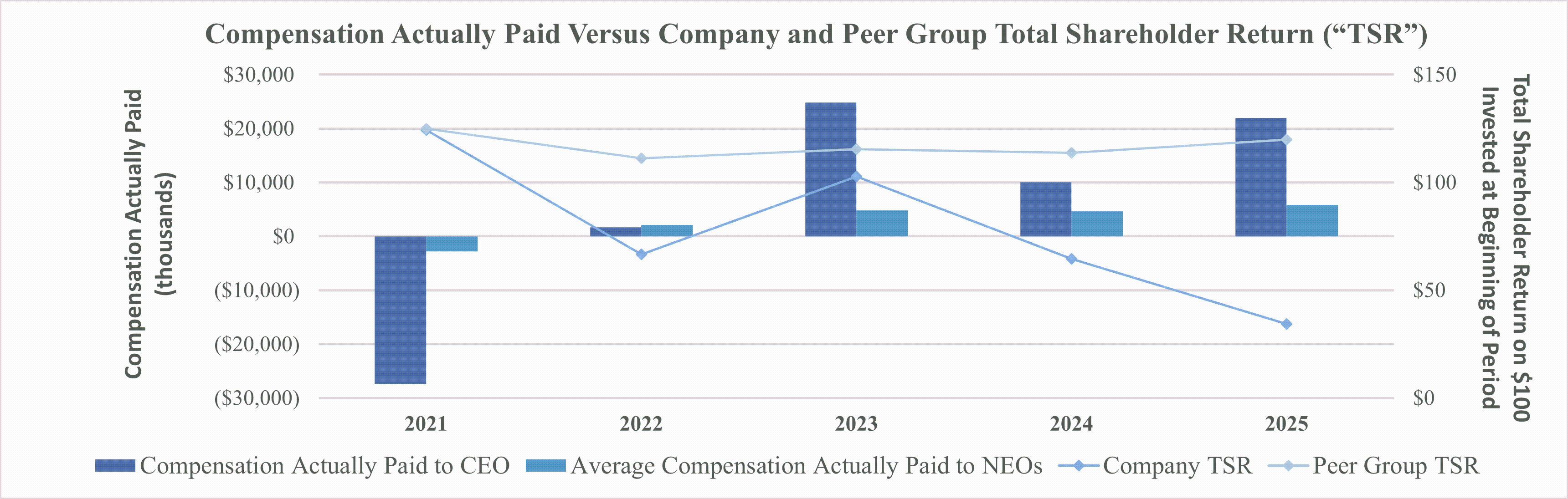
The second graph compares our PEO and average non-PEO NEO Compensation Actually Paid versus our net (loss) income:
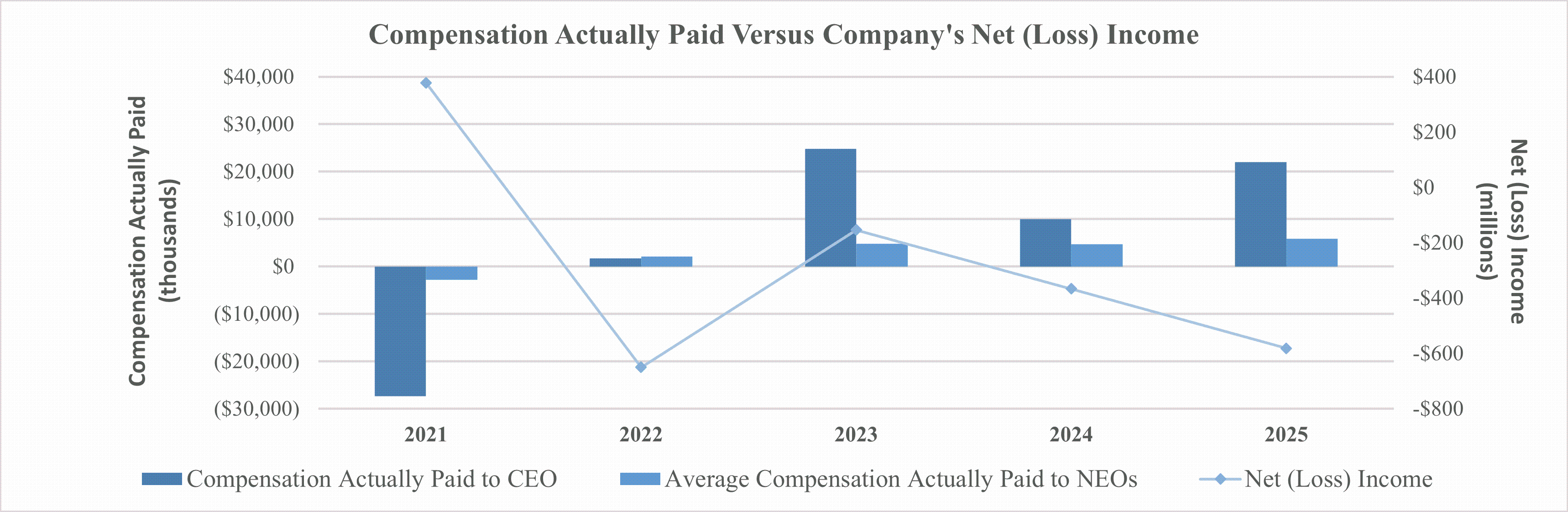
The third graph compares the Compensation Actually Paid to our PEO and the average amount of Compensation Actually Paid to our Non-PEO NEOs during the periods presented and sets forth the relationship between compensation actually paid to our PEO and the average amount of compensation actually paid to our Non-PEO NEOs during the periods presented and the Company’s average stock price for the thirty-day period ending December 31, 2021, 2022, 2023, 2024 and 2025:
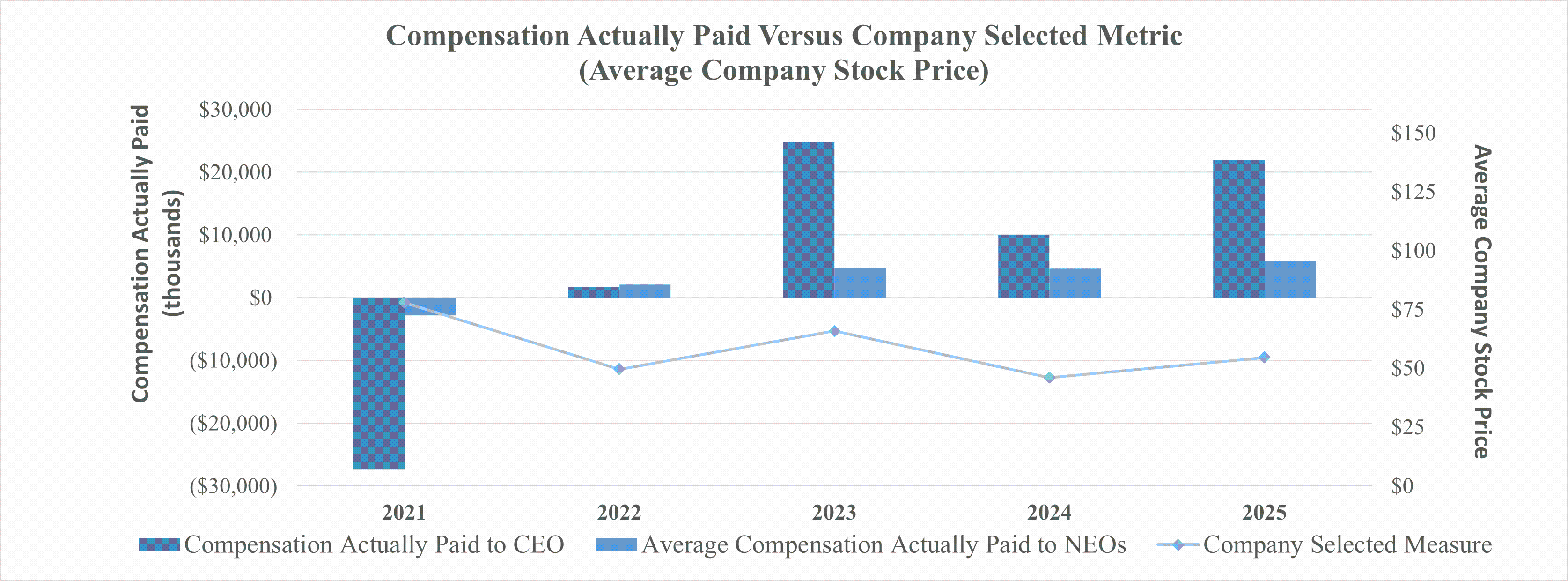
All information provided above under the “Pay Versus Performance” heading will not be deemed to be incorporated by reference into any filing of the Company under the Securities Act of 1933, as amended, or the Securities Exchange Act of 1934, as amended, whether made before or after the date hereof and irrespective of any general incorporation language in any such filing, except to the extent the Company specifically incorporates such information by reference.
DIRECTOR COMPENSATION
We have adopted a non-employee director compensation policy, which is designed to provide a total compensation package that enables us to attract and retain, on a long-term basis, high caliber non-employee directors. Under the non-employee director compensation policy, our non-employee directors are compensated as follows:
•each non-employee director will receive an annual cash fee of $50,000 ($65,000 for the chair of the Board of Directors);
•each non-employee director who is a member of the Audit Committee will receive an additional annual cash fee of $10,000 ($20,000 for the Audit Committee chair);
•each non-employee director who is a member of the Compensation Committee will receive an additional annual cash fee of $7,500 ($15,000 for the Compensation Committee chair);
•each non-employee director who is a member of the Nominating Committee will receive an additional annual cash fee of $5,000 ($10,000 for the Nominating Committee chair);
•the lead independent director will receive an additional annual cash fee of $15,000;
•each new non-employee director will receive an initial grant of an option to purchase 26,000 common shares upon his or her initial election to our Board of Directors; and
•each returning non-employee director will receive an annual grant of an option to purchase 13,000 common shares upon the date of the annual general meeting of shareholders.
The stock options granted to our non-employee directors will have an exercise price equal to the fair market value of our common shares on the date of grant and will expire ten years after the date of grant. The initial stock options granted to new non-employee directors will vest in equal monthly installments over a three-year period following the grant date, subject to such director’s continued service on the Board of Directors. The annual stock options granted to our non-employee directors will vest in twelve equal monthly installments and will vest in full upon the earlier of the first anniversary of the date of grant or the date of the following annual general meeting of shareholders, subject to such director’s continued service on the Board of Directors. Any initial stock options and annual stock options granted to each of our non-employee directors will automatically accelerate and become fully vested and exercisable upon the non-employee director’s death or disability or upon a sale event (as defined in the equity plan).
All cash fees will be paid quarterly, in arrears, or upon the earlier resignation or removal of the non-employee director. The amount of each payment will be prorated for any portion of a quarter that a non-employee director is not serving on our Board of Directors, based on the number of calendar days served by such non-employee director.
Each non-employee director is also entitled to reimbursement for reasonable travel and other expenses incurred in connection with attending meetings of the Board of Directors and any committee on which he or she serves.
In March 2026, the Compensation Committee approved to maintain the 2025 cash and equity policy for non-employee directors for 2026.
In addition, pursuant to Swiss law and Article 18 of the Articles of Association of the Company, our shareholders must annually approve (i) the non-performance-related compensation of our Board of Directors for the next term of office and (ii) any additional compensation of the Board of Directors for the preceding business year. At our 2025 annual general meeting, shareholders approved the proposed compensation for the Board of Directors. For more information regarding the binding votes on aggregate compensation for our Board of Directors, see “Matters to be Voted On—Proposals 6.a-6.e: Approval of Compensation for the Board of Directors and the Executive Committee—.”
Director Compensation Table
The following table sets forth a summary of the compensation for our non-employee directors during 2025.
|
|
|
|
|
|
|
|
|
|
|
|
|
|
|
|
|
|
Board Member (1)(2) |
|
Fees Earned
or Paid
in Cash ($)(2) |
|
|
Option
Awards
($)(3) |
|
|
All Other
Compensation ($) |
|
|
Total |
|
Ali Behbahani, M.D. (4) |
|
|
62,500 |
|
|
|
285,740 |
|
|
|
— |
|
|
|
348,240 |
|
Maria Fardis, Ph.D. (5) |
|
|
63,975 |
|
|
|
285,740 |
|
|
|
— |
|
|
|
349,715 |
|
H. Edward Fleming, Jr., M.D. (6) |
|
|
57,614 |
|
|
|
285,740 |
|
|
|
— |
|
|
|
343,354 |
|
Simeon J. George, M.D. (7) |
|
|
56,428 |
|
|
|
285,740 |
|
|
|
— |
|
|
|
342,168 |
|
John T. Greene (8) |
|
|
78,177 |
|
|
|
285,740 |
|
|
|
— |
|
|
|
363,917 |
|
Katherine A. High, M.D. (9) |
|
|
72,383 |
|
|
|
285,740 |
|
|
|
— |
|
|
|
358,123 |
|
Sandesh Mahatme, LL.M. (10) |
|
|
67,387 |
|
|
|
285,740 |
|
|
|
— |
|
|
|
353,127 |
|
Briggs W. Morrison, M.D (11) |
|
|
38,107 |
|
|
|
285,740 |
|
(12) |
|
17,222 |
|
(13) |
|
341,069 |
|
Christian Rommel, Ph.D. (14) |
|
|
50,000 |
|
|
|
285,740 |
|
|
|
— |
|
|
|
335,740 |
|
Douglas A. Treco, Ph.D. (15) |
|
|
85,000 |
|
|
|
285,740 |
|
|
|
— |
|
|
|
370,740 |
|
(1)Dr. Kulkarni, our Chief Executive Officer, does not receive any compensation for his service as a member of our Board of Directors. The compensation received by Dr. Kulkarni, as a NEO of our Company, is presented in “Executive Compensation—NEO Compensation Tables—Summary Compensation Table—2025.”
(2)Amounts reported represent fees earned by each director for their service on the Board of Directors and any committee or committees thereof for the year ending December 31, 2025. Each director was eligible to receive compensation in accordance with the non-employee director compensation policy described above during the year 2025.
(3)These amounts represent the aggregate grant date fair value of awards granted to our directors in 2025, computed in accordance with ASC 718. See Note 11 to the audited consolidated financial statements in our Annual Report on Form 10-K for the year ended December 31, 2025 regarding assumptions underlying the valuation of equity awards.
(4)As of December 31, 2025, Dr. Behbahani held options to purchase 151,000 common shares.
(5)As of December 31, 2025, Dr. Fardis held options to purchase 63,000 common shares.
(6)As of December 31, 2025, Dr. Fleming held options to purchase 76,000 common shares.
(7)As of December 31, 2025, Dr. George held options to purchase 151,000 common shares.
(8)As of December 31, 2025, Mr. Greene held options to purchase 116,000 common shares.
(9)As of December 31, 2025, Dr. High held options to purchase 106,000 common shares.
(10)As of December 31, 2025, Mr. Mahatme held options to purchase 52,000 common shares.
(11)As of December 31, 2025, Dr. Morrison held options to purchase 39,000 common shares.
(12)Prior to his election to the Board of Directors, Dr. Morrison provided consulting services to the Company. In connection therewith, in December 2024, prior to his election to the Board of Directors, Dr. Morrison received a grant of an option to purchase 26,000 common shares, consistent with the new non-employee initial grant policy described above. In 2025, upon his initial election to our Board of Directors following the Company’s annual general meeting of shareholders, Dr. Morrison received a grant of an option to purchase 13,000 common shares, consistent with the returning non-employee director grant policy described above, the value of which is presented in the table, consistent with Note 3.
(13)Prior to his election to the Board of Directors, Dr. Morrison provided consulting services to the Company. The amount reported in this column represents consulting fees earned by Dr. Morrison for his consulting services provided during fiscal year 2025. The consulting arrangement with Dr. Morrison terminated by its terms upon his election to the Board of Directors.
(14)As of December 31, 2025, Dr. Rommel held options to purchase 39,000 common shares.
(15)As of December 31, 2025, Dr. Treco held options to purchase 91,000 common shares.
SECURITIES AUTHORIZED FOR ISSUANCE UNDER EQUITY COMPENSATION PLANS
The following table provides information about the securities authorized for issuance under our equity compensation plans as of December 31, 2025. As of December 31, 2025, we had three equity compensation plans, each of which was approved by our shareholders: the 2016 Plan, the 2016 Employee Stock Purchase Plan, or 2016 ESPP, and the 2018 Plan.
Equity Compensation Plan Information
|
|
|
|
|
|
|
|
|
|
|
|
|
|
|
|
|
|
|
|
Name |
|
Number of
securities to be
issued upon
exercise of
outstanding
stock options |
|
|
Number of
securities to be
issued upon
vesting of
outstanding
restricted stock units |
|
|
Weighted average
exercise price of
outstanding stock options(1) |
|
|
|
Number of securities
remaining available
for
future issuance
under
equity compensation
plans (excluding
securities reflected
in column (a)) |
|
|
|
|
(a) |
|
|
|
|
|
(b) |
|
|
|
(c) |
|
|
Equity compensation plans
approved by security holders |
|
|
6,707,835 |
|
|
|
1,965,567 |
|
|
|
56.82 |
|
|
|
|
9,250,992 |
|
(2) |
Equity compensation plans not
approved by security holders (3) |
|
|
40,000 |
|
|
|
— |
|
|
|
12.57 |
|
|
|
|
3,183 |
|
|
Total |
|
|
6,747,835 |
|
|
|
1,965,567 |
|
|
|
|
|
|
|
9,254,175 |
|
|
(1)The weighted average exercise price is calculated based solely on outstanding stock options.
(2)As of December 31, 2025, (i) 9,043,980 shares remained available for future issuance under the 2018 Plan and (ii) 207,012 shares remained available for future issuance under the 2016 ESPP.
(3)In 2016, prior to our initial public offering, we granted stock options to certain then-employees and nonemployee advisors outside of our shareholder-approved plans. These options are fully vested and expire on August 18, 2026.
REPORT OF THE AUDIT COMMITTEE OF THE BOARD OF DIRECTORS
Our Audit Committee has reviewed our audited consolidated financial statements and the statutory financial statements for the year ended December 31, 2025 and discussed them with our management and our independent registered public accounting firm, Ernst & Young LLP and our statutory auditor, Ernst & Young AG.
Our Audit Committee has also received from, and discussed with, Ernst & Young LLP various communications that Ernst & Young LLP is required to provide to our Audit Committee, including the matters required to be discussed by the statement on Auditing Standard No. 1301, “Communication with Audit Committees,” as adopted by the Public Company Accounting Oversight Board.
In addition, Ernst & Young LLP provided our Audit Committee with the written disclosures and the letter required by applicable requirements of the Public Company Accounting Oversight Board regarding the independent registered public accounting firm’s communications with the Audit Committee concerning independence, and has discussed with the Company’s independent registered public accounting firm their independence.
Based on the review and discussions referred to above, our Audit Committee recommended to our Board of Directors that the audited consolidated financial statements be included in our Annual Report on Form 10-K for the year ended December 31, 2025.
By the Audit Committee of the Board of Directors of CRISPR Therapeutics AG.
|
|
|
|
John T. Greene, Chair |
|
Maria Fardis, Ph.D. |
|
Sandesh Mahatme, LL.M |
|
Douglas A. Treco, Ph.D. |
MATTERS TO BE VOTED ON
Proposal 1: Approval of the Swiss Management Report, the Consolidated Financial Statements and the Statutory Financial Statements of the Company for the year ended December 31, 2025
Explanation
Under Swiss law, a company must submit a management report, its consolidated financial statements and its statutory financial statements to shareholders for approval or disapproval at each annual general meeting. In the event of a negative vote on this proposal by shareholders, the Board of Directors will call an extraordinary general meeting of shareholders for reconsideration of this proposal by shareholders.
The “management report” under Swiss law consists of (i) the Company’s 2025 Annual Report; (ii) the consolidated financial statements of CRISPR Therapeutics AG for the year ended December 31, 2025, including the report thereto of the Company’s statutory auditor; (iii) the statutory financial statements of CRISPR Therapeutics AG, including the report thereto of the Company’s statutory auditor, and (iv) the Company’s 2025 Compensation Report, prepared in compliance with Swiss law, including the report thereto of the Company’s statutory auditor. Copies of these documents are available on the Internet at ir.crisprtx.com/swiss-statutory-financial-statements-and-audit-reports, as well as www.proxydocs.com/CRSP and will also be available for physical inspection at the Company’s registered office at CRISPR Therapeutics AG, Baarerstrasse 14, 6300 Zug, Switzerland. These documents are also available to any shareholder who wishes to receive a paper copy by calling (800) 579-1639, by emailing sendmaterial@ProxyVote.com or by submitting a request over the Internet at www.ProxyVote.com.
Ernst & Young AG, Basel have audited the consolidated financial statements of the Company as the Company’s statutory auditors and have issued an unqualified recommendation to the 2026 Annual General Meeting that the consolidated and statutory financial statements of CRISPR Therapeutics AG for the year ended December 31, 2025 be approved. Ernst & Young AG expressed their opinion that the “consolidated financial statements for the year ended December 31, 2025 present fairly, in all material respects, the financial position, the results of operations and the cash flows in accordance with accounting principles generally accepted in the United States of America (U.S. GAAP) and comply with Swiss law.”
Further Ernst & Young AG expressed their opinion and confirmed that the consolidated financial statements, the statutory financial statements and the proposed appropriation of financial results comply with Swiss law and the Articles of Association of CRISPR Therapeutics AG. Ernst & Young AG also expressed their opinion that the 2025 Compensation Report complies with applicable Swiss law.
Voting Requirement to Approve Proposal
The affirmative “FOR” vote of a majority of the votes cast at the 2026 Annual General Meeting, not counting unmarked, invalid and non-exercisable votes and abstentions.
Recommendation
The Board of Directors recommends a vote “FOR” approval of the Swiss management report, the consolidated financial statements and the statutory financial statements of the Company for the year ended December 31, 2025.
Proposal 2: Approval of the Appropriation of Financial Results
Explanation
Under Swiss law, the appropriation of the financial results as set forth in the Company’s statutory financial statements must be submitted to shareholders for approval at each annual general meeting of shareholders. The Board of Directors proposes to carry forward the net loss resulting from the following appropriation of financial results:
|
|
|
|
|
|
|
|
|
|
Proposed Appropriation of Net Loss: in Swiss Francs (“CHF”) |
|
|
|
|
|
|
|
Balance brought forward from previous years |
|
CHF |
|
|
|
(1,385,677,360 |
) |
|
Net loss for the period (on a stand-alone unconsolidated basis): |
|
CHF |
|
|
|
(508,714,076 |
) |
|
Total accumulated net loss: |
|
CHF |
|
|
|
(1,894,391,436 |
) |
|
Resolution proposed by the Board of Directors: |
|
|
|
|
|
|
|
- RESOLVED, that the net loss for the period of CHF
508,714,076 shall be carried forward. |
|
|
|
|
|
|
|
Voting Requirement to Approve Proposal
The affirmative “FOR” vote of a majority of the votes cast at the 2026 Annual General Meeting, not counting unmarked, invalid and non-exercisable votes and abstentions.
Recommendation
The Board of Directors recommends a vote “FOR” approval of the proposed appropriation of retained earnings with respect to the year ended December 31, 2025.
Proposal 3: Discharge of the Members of the Board of Directors and the Executive Committee
Explanation
As is customary for Swiss corporations and in accordance with Article 698, subsection 2, item 7 of the Swiss Code of Obligations, shareholders are requested to release the members of the Board of Directors and Executive Committee from liability for the business year ended December 31, 2025. Discharge pursuant to the proposed resolution is only effective with respect to facts that have been disclosed to shareholders (including through any publicly available information, whether or not included in our filings with the SEC) and only binds shareholders who either voted in favor of the proposal or who subsequently acquired shares with knowledge that the shareholders have approved this proposal. In addition, shareholders who vote against this proposal, abstain from voting on this proposal, do not vote on this proposal, or acquire their shares without knowledge of the approval of this proposal, may bring, as a plaintiff, any claims in a shareholder derivative suit within six months after the approval of the proposal. After the expiration of the six-month period, such shareholders will generally no longer have the right to bring, as a plaintiff, claims in shareholder derivative suits against members of the Board of Directors or the Executive Committee with respect to activities during the business year 2025.
Voting Requirement to Approve Proposal
The affirmative “FOR” vote of a majority of the votes cast at the 2026 Annual General Meeting, not counting unmarked, invalid and non-exercisable votes and abstentions and not counting the votes of any member of the Board of Directors or of any of the members of the Executive Committee.
Recommendation
The Board of Directors recommends a vote “FOR” the proposal to release the members of the Board of Directors and the Executive Committee from liability for activities during the year ended December 31, 2025.
Proposal 4: Re-election of the Members of the Board of Directors and the Chairman
Explanation
Our Board of Directors is presently composed of eleven members. Each director, as well as the Chairman of the Board of Directors, must be elected annually and individually for a term extending until completion of the next annual general meeting of shareholders.
At the recommendation of the Nominating Committee, our Board of Directors has nominated the eleven individuals below to serve as directors for one-year terms, beginning in each case as of the 2026 Annual General Meeting and ending at the closing of the 2027 annual general meeting of shareholders. All nominees currently serve as members of our Board of Directors. Their current terms expire upon the closing of the 2026 Annual General Meeting.
Under Swiss law, board members may only be elected by shareholders. If the individuals below are re-elected, our Board of Directors will be composed of eleven members. Our Board of Directors has no reason to believe that any of our nominees will be unwilling or unable to serve if elected as a director. There will be a separate vote on each nominee.
For further information on our Board of Directors, including the current members of the Board of Directors, the committees of the Board of Directors, the means by which the Board of Directors exercises supervision of our executive officers, and other information, please see “Board of Directors and Corporate Governance” starting on page 6.
4.a Re-election of Samarth Kulkarni, Ph.D. as member and Chairman
Proposal: The Board of Directors proposes that Samarth Kulkarni, Ph.D. be re-elected to the Board of Directors for a one-year term ending at the closing of the 2027 annual general meeting of shareholders and be re-elected as Chairman of the Board of Directors for a one-year term ending at the closing of the 2027 annual general meeting of shareholders.
For biographical information and qualifications of Dr. Kulkarni, please refer to “Board of Directors and Corporate Governance—Election of Directors” on page 6.
4.b Re-election of Ali Behbahani, M.D.
Proposal: The Board of Directors proposes that Ali Behbahani, M.D. be re-elected to the Board of Directors for a one-year term ending at the closing of the 2027 annual general meeting of shareholders.
For biographical information and qualifications of Dr. Behbahani, please refer to “Board of Directors and Corporate Governance—Election of Directors” on page 6.
4.c Re-election of Maria Fardis, Ph.D.
Proposal: The Board of Directors proposes that Maria Fardis, Ph.D. be re-elected to the Board of Directors for a one-year term ending at the closing of the 2027 annual general meeting of shareholders.
For biographical information and qualifications of Dr. Fardis, please refer to “Board of Directors and Corporate Governance—Election of Directors” on page 7.
4.d Re-election of H. Edward Fleming, Jr., M.D.
Proposal: The Board of Directors proposes that H. Edward Fleming, Jr., M.D. be re-elected to the Board of Directors for a one-year term ending at the closing of the 2027 annual general meeting of shareholders.
For biographical information and qualifications of Dr. Fleming, please refer to “Board of Directors and Corporate Governance—Election of Directors” on page 7.
4.e Re-election of Simeon J. George, M.D.
Proposal: The Board of Directors proposes that Simeon J. George, M.D. be re-elected to the Board of Directors for a one-year term ending at the closing of the 2027 annual general meeting of shareholders.
For biographical information and qualifications of Dr. George, please refer to “Board of Directors and Corporate Governance—Election of Directors” on page 7.
4.f Re-election of John T. Greene
Proposal: The Board of Directors proposes that John T. Greene be re-elected to the Board of Directors for a one-year term ending at the closing of the 2027 annual general meeting of shareholders.
For biographical information and qualifications of Mr. Greene, please refer to “Board of Directors and Corporate Governance—Election of Directors” on page 7.
4.g Re-election of Katherine A. High, M.D.
Proposal: The Board of Directors proposes that Katherine A. High, M.D. be re-elected to the Board of Directors for a one-year term ending at the closing of the 2027 annual general meeting of shareholders.
For biographical information and qualifications of Dr. High, please refer to “Board of Directors and Corporate Governance—Election of Directors” on page 8.
4.h Re-election of Sandesh Mahatme, LL.M.
Proposal: The Board of Directors proposes that Sandesh Mahatme, LL.M. be re-elected to the Board of Directors for a one-year term ending at the closing of the 2027 annual general meeting of shareholders.
For biographical information and qualifications of Mr. Mahatme, please refer to “Board of Directors and Corporate Governance—Election of Directors” on page 8.
4.i Re-election of Briggs W. Morrison, M.D.
Proposal: The Board of Directors proposes that Briggs W. Morrison, M.D. be re-elected to the Board of Directors for a one-year term ending at the closing of the 2027 annual general meeting of shareholders.
For biographical information and qualifications of Dr. Morrison, please refer to “Board of Directors and Corporate Governance—Election of Directors” on page 8.
4.j Re-election of Christian Rommel, Ph.D.
Proposal: The Board of Directors proposes that Christian Rommel, Ph.D. be re-elected to the Board of Directors for a one-year term ending at the closing of the 2027 annual general meeting of shareholders.
For biographical information and qualifications of Dr. Rommel, please refer to “Board of Directors and Corporate Governance—Election of Directors” on page 8.
4.k Re-election of Douglas A. Treco, Ph.D.
Proposal: The Board of Directors proposes that Douglas A. Treco, Ph.D. be re-elected to the Board of Directors for a one-year term ending at the closing of the 2027 annual general meeting of shareholders.
For biographical information and qualifications of Dr. Treco, please refer to “Board of Directors and Corporate Governance—Election of Directors” on page 9.
Voting Requirement to Approve Proposals
The affirmative “FOR” vote for each nominee of a majority of the votes cast at the 2026 Annual General Meeting, not counting unmarked, invalid and non-exercisable votes and abstentions.
Recommendation
The Board of Directors recommends a vote “FOR” the election and re-election of each nominee to the Board of Directors and the Chairman.
Proposal 5: Re-election of the Members of the Compensation Committee
Explanation
Our Compensation Committee is presently composed of four members, all of whom are standing for re-election to the Board of Directors and to the Compensation Committee. In accordance with Swiss law, the members of the Compensation Committee are to be elected annually and individually by the shareholders. Only members of the Board of Directors can be elected as members of the Compensation Committee.
At the recommendation of the Nominating Committee, our Board of Directors has nominated the four individuals below to serve as members of the Compensation Committee for a term of one year. All of the nominees currently serve as members of the Compensation Committee and, as required by our Compensation Committee charter, all of the nominees are independent in accordance with the requirements of the listing standards of the Nasdaq Stock Market, the outside director definition of Section 162(m) of the Code, the definition of a “non-employee director” for purposes of Rule 16b-3 promulgated by the SEC and Rule 10C-1(b)(1) of the Exchange Act.
The term of office for each member of the Compensation Committee ends at the closing of the next annual general meeting. There will be a separate vote on each nominee.
5.a Re-election of Ali Behbahani, M.D.
Proposal: The Board of Directors proposes that Ali Behbahani, M.D. be re-elected to the Compensation Committee for a one-year term ending at the closing of the 2027 annual general meeting of shareholders.
For biographical information and qualifications of Dr. Behbahani, please refer to “Board of Directors and Corporate Governance—Election of Directors” on page 6.
5.b Re-election of H. Edward Fleming, Jr., M.D.
Proposal: The Board of Directors proposes that H. Edward Fleming, Jr., M.D. be re-elected to the Compensation Committee for a one-year term ending at the closing of the 2027 annual general meeting of shareholders.
For biographical information and qualifications of Dr. Fleming, please refer to “Board of Directors and Corporate Governance—Election of Directors” on page 7.
5.c Re-election of John T. Greene
Proposal: The Board of Directors proposes that John T. Greene be re-elected to the Compensation Committee for a one-year term ending at the closing of the 2027 annual general meeting of shareholders.
For biographical information and qualifications of Mr. Greene, please refer to “Board of Directors and Corporate Governance—Election of Directors” on page 7.
5.d Re-election of Briggs W. Morrison, M.D.
Proposal: The Board of Directors proposes that Briggs W. Morrison, M.D. be re-elected to the Compensation Committee for a one-year term ending at the closing of the 2027 annual general meeting of shareholders.
For biographical information and qualifications of Dr. Morrison, please refer to “Board of Directors and Corporate Governance—Election of Directors” on page 8.
Voting Requirement to Approve Proposals
The affirmative “FOR” vote of a majority of the votes cast at the 2026 Annual General Meeting, not counting unmarked, invalid and non-exercisable votes and abstentions.
Recommendation
The Board of Directors recommends a vote “FOR” the re-election of each of the nominees to the Compensation Committee.
Proposal 6: Approval of the Compensation for the Board of Directors and the Executive Committee and Non-Binding Advisory Vote on the 2025 Compensation Report
Explanation
Pursuant to Swiss law and Article 18 of the Articles of Association of the Company, the shareholders must annually approve (i) the maximum non-performance-related compensation of the Board of Directors for the next term of office, (ii) any additional compensation of the Board of Directors for the preceding business year, (iii) the maximum non-performance-related compensation of the Executive Committee for the 12-month period starting on July 1 following the annual general meeting of shareholders, (iv) the maximum variable compensation for the Executive Committee for the current business year and (v) the maximum grant of options or shares in the Company to the Board of Directors and the Executive Committee. The compensation amounts below factor in possible annual compensation increases and changes in equity value due to market volatility.
Proposals 6(a)-(b) relate to the compensation of the Board of Directors and are based on the Board of Directors consisting of eleven directors, of whom ten are non-employee directors. Only the non-employee directors are included in this proposal. Our Chief Executive Officer, who is also a member of the Board of Directors, does not receive any compensation for his role as a director.
Proposals 6(c)-(e) relate to the compensation of our Executive Committee. Pursuant to Article 6.1 of the Organizational Rules of the Company, the Executive Committee consists of the chief executive officer, the chief financial officer, the chief operating or business officer, the chief medical or scientific officer, the chief legal officer and any other “C-level” executive officer(s) expressly designated by the Board of Directors to be members of the Executive Committee. As such, our Executive Committee is comprised of the following persons: Samarth Kulkarni, Ph.D., James R. Kasinger, Naimish Patel, M.D. and Raju Prasad, Ph.D. Prior to her resignation as Chief Operating Officer on March 24, 2025, Julianne Bruno was a member of our Executive Committee.
In addition, under Swiss law, we are required to prepare a Swiss statutory compensation report each year that contains specific items in a presentation format determined by Swiss regulations. The 2025 Compensation Report contains the principles governing the compensation paid to the Board of Directors and the Executive Committee and reports on the amounts paid to the members of both bodies for 2025. The 2025 Compensation Report is available on the Internet at ir.crisprtx.com/swiss-statutory-financial-statements-and-audit-reports, as well as www.proxydocs.com/CRSP. Additional information on the proposed compensation related to amounts paid in fiscal year 2025 is provided in the 2025 Compensation Report.
6.a Binding vote on maximum non-performance-related compensation for members of the Board of Directors from the 2026 Annual General Meeting to the 2027 annual general meeting of shareholders
The Board of Directors proposes that shareholders approve the maximum amount of non-performance-related compensation for the members of the Board of Directors covering the period from the 2026 Annual General Meeting to the 2027 annual general meeting of shareholders, i.e., USD $670,000 (cash based compensation).
6.b Binding vote on maximum equity for members of the Board of Directors from the 2026 Annual General Meeting to the 2027 annual general meeting of shareholders
The Board of Directors proposes that shareholders approve the maximum grant of equity or equity linked instruments for the members of the Board of Directors covering the period from the 2026 Annual General Meeting to the 2027 annual general meeting of shareholders with maximum value of USD $12,389,198 (equity value).
6.c Binding vote on maximum non-performance-related compensation for members of the Executive Committee from July 1, 2026 to June 30, 2027
The Board of Directors proposes that shareholders approve the maximum amount of non-performance-related cash compensation for the members of the Executive Committee covering the period from July 1, 2026 to June 30, 2027, i.e., USD $3,700,579 (cash based compensation plus social security costs).
6.d Binding vote on maximum variable compensation for members of the Executive Committee for the current year ending December 31, 2026
The Board of Directors proposes that shareholders approve the maximum amount of variable compensation for the members of the Executive Committee for the current year ending December 31, 2026, i.e., USD $3,195,625 (cash based compensation plus social security costs).
6.e Binding vote on maximum equity for members of the Executive Committee from the 2026 Annual General Meeting to the 2027 annual general meeting of shareholders
The Board of Directors proposes that shareholders approve the maximum of equity or equity linked instruments for the members of the Executive Committee covering the period from the 2026 Annual General Meeting to the 2027 annual general meeting of shareholders with maximum value of USD $58,618,973 (equity value).
6.f. Non-binding advisory vote on the 2025 Compensation Report
The Board of Directors proposes to the shareholders the endorsement (non-binding advisory vote) of the 2025 Compensation Report.
Voting Requirement to Approve Proposals
The affirmative “FOR” vote of a majority of the votes cast at the 2026 Annual General Meeting, not counting unmarked, invalid and non-exercisable votes and abstentions.
Recommendation
The Board of Directors recommends a vote “FOR” the approval of the limits on compensation for the Board of Directors and the members of the Executive Committee, as well as the advisory vote on the 2025 Compensation Report.
Proposal 7: Non-Binding Advisory Vote on the Compensation Paid to the Company’s Named Executive Officers under the U.S. Securities Law Requirements
Explanation
The Board of Directors is committed to excellence in governance. As part of that commitment, and as required by Section 14A(a)(1) of the Exchange Act, the Board of Directors is providing the shareholders with an opportunity to provide an advisory vote related to the compensation of our named executive officers, or NEOs, commonly known as the “say-on-pay” proposal. The SEC say-on-pay vote generally covers the calendar year prior to the date of our proxy statement. As a result, our approach to Swiss executive say-on-pay will allow shareholders to vote on executive compensation relating to the next year, while the SEC say-on-pay advisory vote provides for a look-back to the calendar year before the date of the applicable proxy statement.
As described above under “Executive Compensation—Compensation Discussion and Analysis,” we have developed a compensation policy that is designed to attract and retain key executives responsible for our success and motivate management to enhance long-term shareholder value. We believe our compensation policy strikes an appropriate balance between the implementation of responsible, measured compensation practices and the effective provision of incentives for our NEOs to exert their best efforts for our success.
For the reasons discussed above, the Board of Directors unanimously recommends that shareholders vote in favor of the following resolution:
“RESOLVED, that the Company’s shareholders hereby approve, on an advisory basis, the compensation of the NEOs, as disclosed in the Company’s proxy statement for the 2026 Annual General Meeting of shareholders pursuant to the compensation disclosure rules of the Securities and Exchange Commission, including the “Compensation Discussion and Analysis,” “Summary Compensation Table” and the other compensation related tables and disclosure.”
As this vote is advisory, it will not be binding upon the Board of Directors or the Compensation Committee and neither the Board of Directors nor the Compensation Committee will be required to take any action as a result of the outcome of this vote. However, the Compensation Committee will carefully consider the outcome of this vote when considering future executive compensation policies.
Voting Requirement to Approve Proposals
The affirmative “FOR” vote of a majority of the votes cast at the 2026 Annual General Meeting, not counting unmarked, invalid and non-exercisable votes and abstentions.
Recommendation
The Board of Directors recommends a vote “FOR” the approval of the advisory vote on the compensation paid to our NEOs as set forth above.
Proposal 8: Approval of an Increase to the Company’s Capital Band
Explanation
As a company organized under Swiss law, our Articles of Association include a customary capital band that sets forth (i) the maximum number of authorized share capital that the Company may issue in connection with financing activities, as well as strategic transactions and acquisitions and (ii) the date by which the Company may issue such authorized share capital in connection with those financing activities. Swiss law allows our shareholders to authorize share capital that can be issued by the Board of Directors without additional shareholder approval.
At our general meeting of shareholders held in June 2023, the shareholders adopted the current capital band (which is effective through June 8, 2028) which permits using authorized share capital with a capital band range that has an upper limit. Specifically, in art.
3a of the Articles of Association, the shareholders approved of a capital band with an upper limit of CHF 2,920,321.14, corresponding at that date to a maximum of 13,805,691 registered shares with a nominal value of CHF 0.03 each to be fully paid in.
At our general meeting held in May 2024, the shareholders approved of an increase to the current capital band to the upper limit of CHF 3,100,452.06 by authorizing the Board of Directors to issue a corresponding number of common shares. The maximum number of registered shares under the capital band (i.e. 14,830,592 registered shares) represented approximately 17.5% of the common shares outstanding at that time.
Since May 2024, the Company has issued shares out of the capital band for common share financing purposes on different occasions as well as in connection with entering into a collaboration, option and license agreement with Sirius Therapeutics and certain of its affiliates in May 2025. Accordingly, the Board of Directors proposes to amend and restate art. 3a para. 1 of the Articles of Association to increase the capital band of the Company to the upper limit of CHF 3,521,838.51 by authorizing the Board of Directors to issue a corresponding number of common shares, which as of March 31, 2026 corresponds to up to 18,795,173 of our common shares and represents approximately 19% of our common shares outstanding as of March 31, 2026 (i.e. 96,385,506 common shares).
As is the case under the current capital band, the Board of Directors shall have the right to restrict or withdraw shareholders’ subscriptions in the event of an issue of shares within the capital band. The reasons for the restriction or withdrawal of subscription rights remain the same as under the current capital band. The Board of Directors shall be authorized within the capital band to increase the share capital once or several times and in any amounts up to this upper limit until June 8, 2028, or until an earlier expiry of the capital band.
We are incorporated in Switzerland, outside the United States, and listed solely on a U.S. exchange, The Nasdaq Global Market. Our shares trade under the symbol “CRSP.” The registered share capital corresponding to the capital band, if approved by our shareholders, would be limited to approximately 19% of our common shares outstanding as of March 31, 2026. Importantly, we are a pre-revenue company that is heavily reliant on periodic equity financing. We believe that for a company of our size and development stage, maintaining a capital band of share capital equal to 19% of our common shares outstanding not tied to a specific transaction or financial proposal is appropriate, representative of best corporate practices, and in line with the stated policies of certain proxy advisory firms, as well as conversations management has had with such advisory firms.
We have a history of operating losses and expect to continue to incur operating losses for the foreseeable future. We expect that we will need to continue to raise additional capital including through the sale of our capital shares to fund our continued growth with the objective of increasing shareholder value. Moreover, in addition to financing activities, we may benefit from deploying our share capital as we pursue strategic licensing transactions, collaborations, and acquisitions, which we believe will grow shareholder value and continue to position us as a leading gene editing company. It is important to note that the approval of this proposal does not mean that the maximum number of share capital will, in fact, be issued. Rather, approval of this proposal gives the Board of Directors, in its discretion, the ability to raise additional funds through one or more financing transactions (subject to the aforementioned upper limit of share capital that may be issued) to, inter alia, fund the Company’s business and operations.
Furthermore, on March 16, 2026, the Company completed its private offering of $600.0 million aggregate principal amount of its Convertible Senior Notes due 2031, or the Notes. In connection with the Notes, the Company is obligated at all times to reserve (or issue in reserve or acquire and hold in reserve exclusively for the purpose of delivery of such common shares upon conversion of the Notes) a number of common shares assuming the maximum conversion rate under the Notes under its conditional share capital as per article 3b of its Articles of Association and, to the extent not reserved under the conditional share capital, under its capital band as per article 3a of its Articles of Association. To fulfill its contractual obligations under the Notes, the Company may need to reserve additional common shares under the capital band as per article 3a of its Articles of Association.
If this proposal for an increase to the capital band is not approved, the maximum number of registered shares under the existing capital band the Board of Directors would be authorized to issue is 7,988,487 registered shares, representing approximately 8% of the common shares outstanding as of March 31, 2026.
We have no current plans, agreements, arrangements or understandings, whether written or oral, relating to the issuance of the additional common shares issued from the capital band that will become available as a result of the proposed amendment of art. 3a para. 1 of the Articles of Association. The outcome of the vote on this Proposal 8 has no impact on the outcome of the vote on Proposal 9.
If this proposal is approved, the current art. 3a para. 1 of the Articles of Association will be amended to reflect the foregoing as follows (changes in bold (new wording) or strikethrough (no longer applicable wording)):
|
|
|
Art. 3a Capital Band The Board of Directors is authorized to conduct one or more increases of the share capital at any time until June 8, 2028, or the expiry of the capital band if earlier, up to an upper limit of CHF 3,197,637.93 3,521,838.51 by issuing a corresponding number of registered shares with a nominal value of CHF 0.03 each to be fully paid in. An increase of the share capital by means of an offering underwritten by a financial institution, a syndicate or another third party or third parties, followed by an offer to the |
Art. 3a Kapitalband Der Verwaltungsrat ist ermächtigt, das Aktienkapital jederzeit bis zum 8. Juni 2028 oder dem früheren Dahinfallen des Kapitalbands einmal oder mehrmals bis zur Obergrenze von CHF 3'197'637.93 3'521'838.51 durch Ausgabe einer entsprechenden Anzahl vollständig zu liberierenden Namenaktien mit einem Nennwert von je CHF 0.03 zu erhöhen. Eine Erhöhung des Aktienkapitals durch die Zeichnung von Aktien aufgrund eines von einem Finanzinstitut, eines |
|
|
|
then-existing shareholders of the Company shall also be permissible. |
Verbandes, einer anderen Drittpartei oder Drittparteien unter-zeichneten Angebots, gefolgt von einem Angebot gegenüber den zu diesem Zeitpunkt bestehenden Aktionären der Gesellschaft ist zulässig. |
Voting Requirement to Approve Proposal
The affirmative “FOR” vote of at least two thirds of the represented share votes at the 2026 Annual General Meeting and the absolute majority of the par value of the represented shares at the 2026 Annual General Meeting.
Recommendation
Our Board of Directors recommends a vote “FOR” the approval of an increase to the Company’s capital band.
Proposal 9: Approval of an Increase to the Conditional Share Capital for the Conversion of Bonds and Similar Debt Instruments
Explanation
As a company organized under Swiss corporate law, our Articles of Association set forth the maximum number of shares authorized by our shareholders for the issuance of common shares in connection with the exercise of conversion and/or option rights granted in connection with bonds or similar instruments, issued or to be issued by us or by our subsidiaries, including convertible debt instruments. Under Swiss corporate law, we must have sufficient shares available, either through conditional capital, treasury shares, or a combination of the two, to cover any conversion rights under derivative securities at the time the securities are issued.
Our existing Articles of Association provide for a conditional share capital that permits us to issue up to 8,202,832 additional common shares without obtaining additional shareholder approval to cover any conversion and/or option rights under future bonds or similar instruments. This represents approximately 8% of the share capital of the Company currently recorded in the commercial register of the Canton of Zug.
The Board of Directors proposes to increase the conditional share capital for the conversion of bonds and similar debt instruments under our Articles of Association from 8,202,832 shares to 9,366,947 shares. This would represent approximately 9% of the share capital of the Company currently recorded in the commercial register of the Canton of Zug (i.e. 98,599,444 registered shares).
Common shares to be issued out of the conditional share capital may only be issued in connection with the issuance of bonds or similar instruments, including convertible debt instruments, by us or by our subsidiaries. Shareholders’ advance subscription rights with regard to the new bonds or similar instruments may be restricted or excluded by decision of the Board of Directors in order to finance or re-finance the acquisition of companies, parts of companies or holdings, or new investments planned by the Company, or in order to issue convertible bonds or similar instruments on the international capital markets or through private placement. If advance subscription rights are excluded, then (i) the instruments are to be placed at market conditions, (ii) the exercise period is not to exceed ten years from the date of issue of option rights and twenty years for conversion rights and (iii) the conversion or exercise price for the new shares is to be set at least in line with the market conditions prevailing at the date on which the instruments are issued. Shareholders’ subscription rights to the common shares to be issued are excluded.
On March 16, 2026, the Company completed its private offering of $600.0 million aggregate principal amount of its Convertible Senior Notes due 2031, or the Notes. In connection with the Notes, the Company is obligated at all times to reserve (or issue in reserve or acquire and hold in reserve exclusively for the purpose of delivery of such common shares upon conversion of the Notes) a number of common shares assuming the maximum conversion rate under the Notes under its conditional share capital as per article 3b of its Articles of Association and, to the extent not reserved under the conditional share capital, under its capital band as per article 3a of its Articles of Association. As explained above, the Company’s existing Articles of Association provide for a conditional share capital that permits it to issue up to 8,202,832 additional common shares to cover any conversions and/or option rights under future bonds or similar instruments without obtaining additional shareholder approval. In connection with the Notes, the Company is seeking to increase the conditional share capital for the conversion of bonds and similar debt instruments under our Articles of Association by 1,164,115 common shares. The Board of Directors has determined that such an adjustment from approximately 8% to approximately 9% of the share capital is consistent with past practices and will aid the Company in meeting its contractual obligations under the Notes and reduce the number of common shares required to be reserved under its capital band as per article 3a of its Articles of Association.
If the proposal by the Board of Directors is approved no further authorization from the shareholders will be necessary or solicited prior to an issuance of bonds or similar instruments within the limits under the proposal. The outcome of the vote on this Proposal 9 has no impact on the outcome of the vote on Proposal 8.
If this proposal to adjust the conditional share capital for the conversion of bonds and similar debt instruments is approved, the current article 3b para. 1 of the Articles of Association will be amended as follows (changes in bold (new wording) or strikethrough (no longer applicable wording)):
|
|
|
Art. 3b Conditional Capital Increase for Bonds and Similar Debt Instruments The share capital of the Company shall be increased by a maximum amount of CHF 246,084.96 281,008.41 through the issue of a maximum of 8,202,832 9,366,947 registered shares, payable in full, each with a nominal value of CHF 0.03 through the exercise of conversion and/or option rights granted in connection with bonds or similar instruments, issued or to be issued by the Company or by subsidiaries of the Company, including convertible debt instruments. |
Art. 3b Bedingtes Kapital für Anleihensobligationen oder ähnliche Instrumente Das Aktienkapital der Gesellschaft wird im Maximalbetrag von CHF 246'084.96 281'008.41 durch Ausgabe von höchstens 8'202'832 9'366'947 vollständig zu liberierenden Namenaktien mit einem Nennwert von CHF 0.03 je Aktie erhöht durch die Ausübung von Wandlungs- und/oder Optionsrechte, welche im Zusammenhang mit von der Gesellschaft oder ihren Tochtergesellschaften emittierten oder noch zu emittierenden Anleihensobligationen oder ähnlichen Instrumenten eingeräumt wurden oder werden, einschliesslich Wandelanleihen. |
Voting Requirement to Approve Proposal
The affirmative “FOR” vote of at least two thirds of the represented share votes at the 2026 Annual General Meeting and the absolute majority of the par value of the represented shares at the 2026 Annual General Meeting.
Recommendation
Our Board of Directors recommends a vote “FOR” the approval of an increase to the conditional share capital for the conversion of bonds and similar debt instruments.
Proposal 10: Approval of the CRISPR Therapeutics AG 2026 Stock Option and Incentive Plan
Explanation
The Board of Directors believes that options to purchase common shares and other share-based incentive awards can play an important role in the success of the Company by encouraging and enabling the employees, officers, non-employee directors and other key persons of the Company and its subsidiaries upon whose judgment, initiative and efforts the Company largely depends for the successful conduct of its business to acquire a proprietary interest in the Company. The Board of Directors anticipates that providing such persons with a direct stake in the Company will assure a closer identification of the interests of such individuals with those of the Company and its shareholders, thereby stimulating their efforts on the Company’s behalf and strengthening their desire to remain with the Company.
On March 19, 2026 subject to shareholder approval, the Board of Directors approved the Company’s 2026 Stock Option and Incentive Plan, or the 2026 Plan, which will replace our CRISPR Therapeutics AG 2018 Stock Option and Incentive Plan, as amended, the 2018 Plan. If the 2026 Plan is approved by our shareholders, we will no longer grant awards under our 2018 Plan. The 2026 Plan will reserve the remaining number of shares reserved for issuance under the 2018 Plan on the effective date of the 2026 Plan, plus any common shares underlying any awards that are forfeited, canceled or are otherwise terminated, other than by exercise, under the 2026 Plan, the 2018 Plan, and the 2016 Plan.
Importantly, the Company is not seeking an increase to the number of shares reserved for issuance under the 2026 Plan. As of March 31, 2026, there were approximately 8,010,996 common shares available for future grants under the 2018 Plan. The 2026 Plan is designed to enhance the flexibility to grant equity and non-equity incentive awards to our officers, employees, non-employee directors and other key persons and to ensure that we can continue to grant awards to eligible recipients at levels determined to be appropriate by the Board of Directors and/or the Compensation Committee. A copy of the 2026 Plan is attached as Appendix A to this proxy statement and is incorporated herein by reference.
Shareholder approval of the 2026 Plan is critical to our ongoing effort to build shareholder value. Equity incentive awards are an important component of the compensation of our executive and non-executive employees and our non-employee directors. Our Compensation Committee and the Board of Directors believe that we must continue to offer a competitive equity compensation program in order to attract, retain and motivate the talented and qualified employees and non-employee directors necessary for our continued growth and success.
We manage our long-term shareholder dilution by limiting the number of equity incentive awards granted annually. The Compensation Committee carefully monitors our annual net burn rate, total dilution and equity expense in order to maximize shareholder value by granting only the number of equity incentive awards that it believes are necessary and appropriate to attract, reward and retain our employees, officers and non-employee directors. Our employee compensation philosophy reflects broad-based eligibility for equity incentive awards for high performing employees. By doing so, we link the interests of those employees with those of our shareholders and motivate our employees to act as owners of the business.
Summary of Material Features and Important Aspects of the 2026 Plan Designed to Protect Shareholder Interests
The material features of the 2026 Plan are:
•The maximum number of common shares to be issued under the 2026 Plan is a number equal to the sum of (i) the number of shares remaining available for issuance under the 2018 Plan on the effective date of the 2026 Plan, plus (ii) any common shares underlying any awards that are forfeited, canceled or are otherwise terminated, other than by exercise, under the 2026 Plan, the 2018 Plan, and the 2016 Plan;
•The 2026 Plan permits the award of stock options (both incentive and non-qualified options), stock appreciation rights, restricted stock, restricted stock units, unrestricted stock, performance shares, rights to receive cash and dividend equivalent rights;
•The term of the 2026 Plan will expire on June 4, 2036, the tenth anniversary of shareholder approval of the 2026 Plan; and
•Awards made under the 2026 Plan shall only accelerate upon the consummation of a “sale event” if such awards are not assumed, continued or substituted.
The 2026 Plan contains certain provisions designed to protect our shareholders’ interests and reflect corporate governance best practices including those set forth below, which are qualified in their entirety by the “Summary of the 2026 Plan” and the full text of the 2026 Plan hat is attached hereto as Appendix A.
•Shareholder approval required for additional shares. The 2026 Plan does not contain an annual “evergreen” provision. As such, shareholder approval is required each time we need to increase the common shares reserved for issuance under the 2026 Plan, thereby allowing our shareholders the ability to have a say on our equity compensation programs.
•No repricing of equity awards. Stock options and stock appreciation rights will not be repriced in any manner without shareholder approval.
•Material amendments require shareholder approval. Any material amendment to the 2026 Plan is subject to approval by our shareholders.
•Flexibility in designing equity compensation scheme. The 2026 Plan allows us to provide a broad array of equity incentives, including traditional option grants, restricted stock awards, restricted stock unit awards, cash-based awards and performance-based awards. By providing this flexibility, the Board of Directors can quickly and effectively react to trends in compensation practices and continue to offer competitive compensation arrangements to attract and retain the talent necessary for the success of our business.
•No right to vote or receive dividends. Until common shares are delivered in accordance with the 2026 Plan in connection with the exercise of outstanding stock options, no right to vote or receive dividends or any other rights of a shareholder will exist with respect to shares underlying such options.
The shares we issue under the 2026 Plan will be authorized but unissued shares as well as shares that we reacquire. The common shares underlying any awards that are forfeited, canceled or are otherwise terminated, other than by exercise, under the 2026 Plan, the 2018 Plan, and the 2016 Plan will be added back to the common shares available for issuance under the 2026 Plan.
Summary of the 2026 Plan
The following description of certain features of the 2026 Plan is intended to be a summary only. The summary is qualified in its entirety by the full text of the 2026 Plan that is attached hereto as Appendix A.
Administration. The 2026 Plan is administered by the Board of Directors or our compensation committee. References to the “Board of Directors” in this summary shall generally refer to the Board of Directors or compensation committee, as applicable. The Board of Directors has full power to select, from among the individuals eligible for awards, the individuals to whom awards will be granted, to make any combination of awards to participants, and to determine the specific terms and conditions of each award, subject to the provisions of the 2026 Plan. The Board of Directors may delegate to our Chief Executive Officer the authority to grant awards to employees who are not subject to the reporting and other provisions of Section 16 of the Exchange Act and who are not directors or members of the executive committee, subject to certain limitations and guidelines.
Eligibility. All full-time and part-time officers, employees, non-employee directors and other key persons (including consultants) are eligible to participate in the 2026 Plan, subject to the discretion of the administrator. There are certain limits on the number of awards that may be granted under the 2026 Plan. For example, under the 2026 Plan, no more than 17,717,382 shares may be granted in the form of incentive stock options. As of March 31, 2026, approximately 290 individuals were eligible to participate in the 2026 Plan, which includes 268 employees, four named executive officers, ten eligible non-employee directors and eight consultants.
Stock Options. The 2026 Plan permits the granting of (1) options to purchase common shares intended to qualify as incentive stock options under Section 422 of the Code and (2) options that do not so qualify. Options granted under the 2026 Plan will be non-qualified options if they fail to qualify as incentive options or exceed the annual limit on incentive stock options. Incentive stock options
may only be granted to employees of the Company and its subsidiaries. Non-qualified options may be granted to any persons eligible to receive incentive options and to non-employee directors and key persons. The option exercise price of each option will be determined by the Board of Directors but may not be less than 100% of the fair market value of the common shares on the date of grant. Fair market value for this purpose will be the last reported sale price of the common shares on Nasdaq on the grant date. The exercise price of an option may not be reduced after the date of the option grant, other than to appropriately reflect changes in our capital structure.
The term of each option will be fixed by the Board of Directors and may not exceed ten years from the date of grant. The Board of Directors will determine at what time or times each option may be exercised. Options may be made exercisable in installments and the exercisability of options may be accelerated by the Board of Directors. In general, unless otherwise permitted by the Board of Directors, no option granted under the 2026 Plan is transferable by the optionee other than by will or by the laws of descent and distribution, and options may be exercised during the optionee’s lifetime only by the optionee, or by the optionee’s legal representative or guardian in the case of the optionee’s incapacity.
Upon exercise of options, the option exercise price must be paid in full either in cash, by certified or bank check or other instrument acceptable to the Board of Directors or by delivery (or attestation to the ownership) of common shares that are beneficially owned by the optionee and that are not subject to risk of forfeiture. Subject to applicable law, the exercise price may also be delivered to the Company by a broker pursuant to irrevocable instructions to the broker from the optionee. In addition, the Board of Directors may permit non-qualified options to be exercised using a net exercise feature which reduces the number of shares issued to the optionee by the number of shares with a fair market value equal to the exercise price.
To qualify as incentive options, options must meet additional U.S. federal tax requirements, including a $100,000 limit on the value of common shares subject to incentive options that first become exercisable by a participant in any one calendar year.
Stock Appreciation Rights. The Board of Directors may award stock appreciation rights subject to such conditions and restrictions as the Board of Directors may determine. Stock appreciation rights entitle the recipient to common shares equal to the value of the appreciation in the stock price over the exercise price. The exercise price is the fair market value of the common shares on the date of grant. The term of a stock appreciation right may not exceed ten years.
Restricted Stock. The Board of Directors may award common shares to participants subject to such conditions and restrictions as the Board of Directors may determine. These conditions and restrictions may include the achievement of certain performance goals (as summarized above) and/or continued employment or service with us through a specified restricted period. During the vesting period, restricted stock awards may be credited with dividend equivalent rights (but dividend equivalents payable with respect to restricted stock awards with vesting tied to the attainment of performance criteria shall not be paid unless and until such performance conditions are attained).
Restricted Stock Units. The Board of Directors may award restricted stock units to any participants. Restricted stock units are ultimately payable in the form of common shares and may be subject to such conditions and restrictions as the Board of Directors may determine. These conditions and restrictions may include the achievement of certain performance goals (as summarized above) and/or continued employment with the Company through a specified vesting period. In the Board of Director’s sole discretion, it may permit a participant to make an advance election to receive a portion of his or her future cash compensation otherwise due in the form of a restricted stock unit award, subject to the participant’s compliance with the procedures established by the Board of Directors and requirements of Section 409A of the Code. During the deferral period, the deferred stock awards may be credited with dividend equivalent rights.
Unrestricted Stock Awards. The Board of Directors may also grant common shares which are free from any restrictions under the 2026 Plan. Unrestricted stock may be granted to any participant in recognition of past services or other valid consideration and may be issued in lieu of cash compensation due to such participant.
Cash-Based Awards. The Board of Directors may grant cash-based awards that entitles the grantee to a payment in cash upon the attainment of specified performance goals.
Dividend Equivalent Rights. The Board of Directors may grant dividend equivalent rights to participants which entitle the recipient to receive credits for dividends that would be paid if the recipient had held specified common shares. Dividend equivalent rights granted as a component of another award (other than a stock option or stock appreciation right) may be paid only if the related award becomes vested. Dividend equivalent rights may be settled in cash, common shares or a combination thereof, in a single installment or installments, as specified in the award.
Change of Control Provisions. The 2026 Plan provides that upon the effectiveness of a “sale event,” as defined in the 2026 Plan, the parties thereto may cause the assumption or continuation of awards theretofore granted by the successor entity, or the substitution of such awards with new awards of the successor entity or parent thereof, with appropriate adjustment as to the number and kind of shares and, if appropriate, the per share exercise prices, as such parties shall agree. To the extent the parties do not provide for the assumption, continuation or substitution of awards, all options and stock appreciation rights with time-based vesting conditions or restrictions that are not exercisable immediately prior to the effective time of the sale event shall become fully exercisable as of the
effective time of the sale event, all other awards with time-based vesting, conditions or restrictions, shall become fully vested and nonforfeitable as of the effective time of the sale event and all awards with conditions and restrictions relating to the attainment of performance goals may become vested and nonforfeitable in the discretion of the compensation committee, and the 2026 Plan and all awards granted under the 2026 Plan shall terminate. In addition, in connection with the termination of the 2026 Plan upon a sale event, we may make or provide for a cash payment to participants holding options and stock appreciation rights equal to the difference between the per share cash consideration payable to shareholders in the sale event and the exercise price of the options or stock appreciation rights.
Adjustments for Stock Dividends, Stock Splits, Etc. The 2026 Plan requires the Board of Directors to make appropriate adjustments to the number of common shares that are subject to 2026 Plan, to certain limits in the 2026 Plan, and to any outstanding awards to reflect stock dividends, stock splits, extraordinary cash dividends and similar events.
Tax Withholding. Participants in the 2026 Plan are responsible for the payment of any federal, state or local taxes that the Company is required by law to withhold upon the exercise of options or stock appreciation rights or vesting of other awards. Subject to approval by the Board of Directors, participants may elect to have the minimum tax withholding obligations satisfied by authorizing us to withhold common shares to be issued pursuant to the exercise or vesting.
Amendments and Termination. The Board of Directors may at any time amend or discontinue the 2026 Plan and the Board of Directors may at any time amend or cancel any outstanding award for the purpose of satisfying changes in the law or for any other lawful purpose. However, no such action may adversely affect any rights under any outstanding award without the holder’s consent. To the extent required under the rules of Nasdaq, any amendments that materially change the terms of the 2026 Plan will be subject to approval by our shareholders.
Effective Date of Plan. Our 2026 Plan was adopted by our Board of Directors on March 19, 2026 and will become effective upon the date it is approved by our shareholders. Awards of incentive options may be granted under the 2026 Plan until March 19, 2036. Other awards may be granted under the 2026 Plan until the date that is ten years from the date of shareholder approval.
New Plan Benefits
Because the grant of awards under the 2026 Plan is within the discretion of the Board of Directors, the Company cannot determine the dollar value or number of common shares that will in the future be received by or allocated to any participant in the 2026 Plan.
Tax Aspects Under the Code
The following is a summary of the principal U.S. federal income tax consequences of certain transactions under the 2026 Plan. It describes the consequences based on U.S. federal laws in effect as of the date of mailing of this proxy statement. This summary does not describe all U.S. federal tax consequences under the 2026 Plan, nor does it describe foreign, state or local tax consequences.
Incentive Options. No taxable income is generally realized by the optionee upon the grant or exercise of an incentive option. If common shares issued to an optionee pursuant to the exercise of an incentive option are sold or transferred after two years from the date of grant and after one year from the date of exercise, then upon sale of such shares, any amount realized in excess of the option price (the amount paid for the shares) will be taxed to the optionee as a long-term capital gain, and any loss sustained will be a long-term capital loss. The exercise of an incentive option will give rise to an item of tax preference that may result in alternative minimum tax liability for the optionee.
If common shares acquired upon the exercise of an incentive option are disposed of prior to the expiration of the two-year and one-year holding periods described above (a “disqualifying disposition”), generally the optionee will realize ordinary income in the year of disposition in an amount equal to the excess (if any) of the fair market value of the common shares at exercise (or, if less, the amount realized on a sale of such common shares) over the option price thereof. Special rules will apply where all or a portion of the exercise price of the incentive option is paid by tendering common shares.
If an incentive option is exercised at a time when it no longer qualifies for the tax treatment described above, the option is treated as a non-qualified option. Generally, an incentive option will not be eligible for the tax treatment described above if it is exercised more than three months following termination of employment (or one year in the case of termination of employment by reason of disability). In the case of termination of employment by reason of death, the three-month rule does not apply.
Non-Qualified Options. No income is realized by the optionee at the time the option is granted. Generally (i) at exercise, ordinary income is realized by the optionee in an amount equal to the difference between the option price and the fair market value of the common shares on the date of exercise, and (ii) at disposition, appreciation or depreciation after the date of exercise is treated as either short-term or long-term capital gain or loss depending on how long the common shares have been held. Special rules will apply where all or a portion of the exercise price of the non-qualified option is paid by tendering common shares. Upon exercise, the optionee will also be subject to Social Security taxes on the excess of the fair market value over the exercise price of the option.
Other Awards. Participants typically are subject to income tax and recognize such tax at the time that an award is exercised, vests or becomes non-forfeitable, unless the award provides for a further deferral.
Parachute Payments. The vesting of any portion of an option or other award that is accelerated due to the occurrence of a change in control (such as a sale event) may cause a portion of the payments with respect to such accelerated awards to be treated as “parachute payments” as defined in the Code. Any such parachute payments may be non-deductible to the Company, in whole or in part, and may subject the recipient to a non-deductible 20% federal excise tax on all or a portion of such payment (in addition to other taxes ordinarily payable).
Limitation on Deductions. Under Section 162(m) of the Code, assuming that such section were applicable, the Company’s deduction for certain awards under the 2026 Plan may be limited to the extent that any “covered employee” (within the meaning of Section 162(m) of the Code) receives compensation in excess of $1 million a year.
Voting Requirement to Approve Proposal
The affirmative “FOR” vote of a majority of the votes cast in person or by proxy at the 2026 Annual General Meeting, not counting abstentions.
Recommendation
Our Board of Directors recommends a vote “FOR” the approval of the CRISPR Therapeutics AG 2026 Stock Option and Incentive Plan.
Proposal 11: Re-Election of the Independent Voting Rights Representative
Explanation
Swiss law requires that the independent representative of the shareholders (Independent Representative) be elected on the occasion of each annual general meeting for a one-year term ending at the closing of the following annual general meeting.
The Board of Directors proposes that lic. iur. Marius Meier, Attorney at Law, c/o Bratschi AG, Lange Gasse 15, P.O. Box, CH-4050 Basel, Switzerland, be re-elected as Independent Representative for a one-year term ending at the closing of the 2027 annual general meeting of shareholders.
Shareholders may either represent their shares themselves or have them represented by a third party, whether or not a shareholder, if the latter is given a written proxy. In accordance with Swiss law, each shareholder may be represented at the general meeting by the Independent Representative, Mr. Meier, or by a third-party proxy. Mr. Meier is a notary public and has served as the Independent Representative at the Company’s previous annual general meetings of shareholders.
Under Swiss law, the Independent Representative must satisfy strict independence requirements. In the absence of instructions, the Independent Representative must abstain from voting. General voting instructions can be given with respect to a particular general meeting of shareholders with respect to proposals and agenda items that have not been disclosed in the invitation to the general meeting.
Voting Requirement to Approve Proposal
The affirmative “FOR” vote of a majority of the votes cast at the 2026 Annual General Meeting, not counting unmarked, invalid and non-exercisable votes and abstentions.
Recommendation
Our Board of Directors recommends a vote “FOR” the re-election of Mr. Meier as Independent Representative.
Proposal 12: Re-election of the Auditors
Explanation
Pursuant to Swiss law and art. 8 para. 2 of the Articles of Association, the auditors are to be elected annually by the annual general meeting of shareholders.
Upon recommendation of the Audit Committee, the Board of Directors proposes that Ernst & Young AG, Basel, be re-elected as statutory auditor for the Company and Ernst & Young LLP be re-elected as the Company’s independent registered public accounting firm for the year ending December 31, 2026. Ernst & Young AG assumed its first audit mandate for the Company during the year ended December 31, 2013 and Ernst & Young LLP assumed its first audit mandate for the Company during the year ended December 31, 2015. Pursuant to Swiss law, the shareholders must elect the auditors of the Company.
Information on the fees paid by the Company to Ernst & Young AG and LLP, the Company’s auditors and independent registered public accounting firm for the years ended December 31, 2025 and December 31, 2024 is set forth below. Additional information regarding Ernst & Young AG and LLP, is included in the “Report of the Audit Committee.”
Members of Ernst & Young AG will be present at the 2026 Annual General Meeting, will have the opportunity to make a statement, and will be available to respond to appropriate questions you may ask.
Audit Fees and Services
The following table summarizes the fees of Ernst & Young billed to us for each of the last two years.
|
|
|
|
|
|
|
|
|
|
Fee Category |
|
Year ended
December 31,
2025 |
|
|
Year ended
December 31,
2024 |
|
Audit Fees (1) |
|
$ |
1,421,361 |
|
|
$ |
1,337,561 |
|
Audit-Related Fees (2) |
|
|
67,416 |
|
|
|
25,758 |
|
Tax Fees (3) |
|
|
34,945 |
|
|
|
54,435 |
|
All Other Fees (4) |
|
|
— |
|
|
|
— |
|
Total |
|
$ |
1,523,723 |
|
|
$ |
1,417,754 |
|
(1)“Audit Fees” consist of fees for the audit of our annual consolidated financial statements, the review of the interim financial statements included in our quarterly reports on Form 10-Q, costs associated with securities offerings, audits of statutory audit financial statements, and other professional services provided in connection with regulatory filings or consultations on accounting matters directly related to the audit and assistance with, review of, and consents for, documents filed with the SEC.
(2)“Audit-Related Fees” consist of fees billed by Ernst & Young LLP for assurance and related services that are reasonably related to the performance of audit services required for Swiss regulatory purposes other than the audit of our financial statements.
(3)Tax fees are related to tax advisory services and tax compliance.
(4)“All Other Fees” consist of fees for access to Ernst & Young’s online accounting research tool. No such fees were incurred in 2025 or 2024.
Pre-Approval Policies and Procedures
Our Audit Committee has adopted procedures requiring the pre-approval of all non-audit services performed by our independent registered public accounting firm in order to assure that these services do not impair the auditor’s independence. These procedures generally approve the performance of specific services subject to a cost limit for all such services. This general approval is reviewed, and if necessary modified, at least annually. Management must obtain the specific prior approval of the Audit Committee for each engagement of the independent registered public accounting firm to perform other audit-related or other non-audit services. The Audit Committee does not delegate its responsibility to approve services performed by the independent registered public accounting firm to any member of management.
The standard applied by the Audit Committee in determining whether to grant approval of any type of non-audit service, or of any specific engagement to perform a non-audit service, is whether the services to be performed, the compensation to be paid therefore and other related factors are consistent with the independent registered public accounting firm’s independence under guidelines of the SEC and applicable professional standards. Relevant considerations include whether the work product is likely to be subject to, or implicated in, audit procedures during the audit of our financial statements, whether the independent registered public accounting firm would be functioning in the role of management or in an advocacy role, whether the independent registered public accounting firm’s performance of the service would enhance our ability to manage or control risk or improve audit quality, whether such performance would increase efficiency because of the independent registered public accounting firm’s familiarity with our business, personnel, culture, systems, risk profile and other factors, and whether the amount of fees involved, or the non-audit services portion of the total fees payable to the independent registered public accounting firm in the period would tend to reduce the independent registered public accounting firm’s ability to exercise independent judgment in performing the audit.
Voting Requirement to Approve Proposal
The affirmative “FOR” vote of a majority of the votes cast at the 2026 Annual General Meeting, not counting unmarked, invalid and non-exercisable votes and abstentions.
Recommendation
The Board of Directors recommends a vote “FOR” the election of Ernst & Young AG as the statutory auditor of the Company and the election of Ernst & Young LLP as the Company’s independent registered public accounting firm, each for the year ending December 31, 2026.
Proposal 13: Transact any Other Business that may Properly Come Before the 2026 Annual General Meeting or any
Adjournment or Postponement Thereof
The Board of Directors knows of no other matters that will be presented for consideration at the 2026 Annual General Meeting as of the date of this Proxy Statement. If any other matters are properly brought before the 2026 Annual General Meeting or there is an ad hoc proposal at such meeting, the independent voting rights representative named in the accompanying proxy intends to vote on such matters in accordance with the instructions on such proxy. The Board of Directors will make a voting proposal for each such proposal (if any) proposed at the 2026 Annual General Meeting, whereby the Board of Directors may propose, for each such proposal individually, to approve or reject the respective proposal. A vote “FOR” leads to voting in accordance with the respective proposal of the Board of Directors as proposed at the 2026 Annual General Meeting. A vote “Against” leads to voting contrary to the respective proposal of the Board of Directors as proposed at the 2026 Annual General Meeting. A vote “Abstain” leads to abstain from voting on any such proposal.
Voting Requirement to Approve Proposal
The affirmative “FOR” vote of a majority of the votes cast at the 2026 Annual General Meeting, not counting unmarked, invalid and non-exercisable votes and abstentions, with the exception of proposals requiring at least two thirds of the represented share votes and the absolute majority of the par value of the represented shares at the 2026 Annual General Meeting as per the Articles of Association or the law.
Recommendation
The Board of Directors recommends a vote “FOR” the respective proposal of the Board of Directors as proposed at the 2026 Annual General Meeting.
STOCK OWNERSHIP AND REPORTING
Security Ownership of Certain Beneficial Owners and Management
Unless otherwise provided below, the following table sets forth information regarding beneficial ownership of our common shares as of March 31, 2026 by:
•each person, or group of affiliated persons, known to us to be the beneficial owner of 5% or more of our outstanding common shares;
•each of our current directors and director nominees;
•our principal executive officer, our principal financial officer and our three other current and former executive officers who served during the year ended December 31, 2025, named in the “Summary Compensation Table” above, whom we collectively refer to as our named executive officers; and
•all of our executive officers and directors as a group.
Beneficial ownership is determined in accordance with the rules and regulations of the SEC and includes voting or investment power with respect to our common shares. Our common shares issuable under options that are exercisable within 60 days after March 31, 2026 and shares of restricted stock units vesting within 60 days after March 31, 2026 are considered outstanding and beneficially owned by the person holding the options for the purpose of calculating the percentage ownership of that person, but not for the purpose of calculating the percentage ownership of any other person. Except as otherwise noted, to our knowledge, the persons and entities in this table have sole voting and investing power with respect to all of the common shares beneficially owned by them, subject to applicable community property laws. The inclusion herein of any shares as beneficially owned does not constitute an admission of beneficial ownership.
The column entitled “Percentage of Shares Beneficially Owned” is based on a total of 96,385,506 common shares outstanding as of March 31, 2026. Except as otherwise set forth below, the address of the beneficial owner is c/o CRISPR Therapeutics AG, Baarerstrasse 14, 6300 Zug, Switzerland.
|
|
|
|
|
|
|
|
|
|
Name and address of beneficial owner |
|
Number of Shares Beneficially Owned |
|
|
Percentage of Shares Beneficially Owned |
|
5% Shareholders |
|
|
|
|
|
|
ARK Investment Management LLC (1) |
|
|
9,786,973 |
|
|
|
10.2 |
% |
BlackRock, Inc. (2) |
|
|
5,932,433 |
|
|
|
6.2 |
% |
Orbis Investment Management LTD (3) |
|
|
5,934,328 |
|
|
|
6.2 |
% |
Directors, Nominees and Executive Officers |
|
|
|
|
|
|
Samarth Kulkarni, Ph.D. (4) |
|
|
1,603,279 |
|
|
|
1.6 |
% |
Raju Prasad, Ph.D. (5) |
|
|
80,544 |
|
|
* |
|
James R. Kasinger (6) |
|
|
509,452 |
|
|
* |
|
Naimish Patel, M.D. (7) |
|
|
90,520 |
|
|
* |
|
Ali Behbahani, M.D. (8) |
|
|
150,187 |
|
|
* |
|
Maria Fardis, Ph.D. (9) |
|
|
61,917 |
|
|
* |
|
H. Edward Fleming, Jr., M.D. (10) |
|
|
74,917 |
|
|
* |
|
Simeon J. George, M.D. (11) |
|
|
2,188,680 |
|
|
|
2.3 |
% |
John T. Greene (12) |
|
|
121,917 |
|
|
* |
|
Katherine A. High, M.D. (13) |
|
|
104,917 |
|
|
* |
|
Sandesh Mahatme, LL.M. (14) |
|
|
47,306 |
|
|
* |
|
Briggs W. Morrison, M.D (15) |
|
|
29,404 |
|
|
* |
|
Christian Rommel, Ph.D. (16) |
|
|
29,250 |
|
|
* |
|
Douglas A. Treco, Ph.D. (17) |
|
|
111,917 |
|
|
* |
|
All executive officers, directors and nominees as a group (14 persons) |
|
|
5,204,207 |
|
|
|
5.2 |
% |
* Indicates beneficial ownership of less than 1% of the total issued and outstanding common shares.
(1)Based solely on a Schedule 13G/A filed with the SEC on November 4, 2025 by ARK Investment Management LLC. The address for ARK Investment Management LLC is 200 Central Avenue, St. Petersburg, FL 33701.
(2)Based solely on a Schedule 13G filed with the SEC on July 17, 2025 by BlackRock, Inc. The address for BlackRock, Inc. is 50 Hudson Yards, New York, NY 10001.
(3)Based solely on a Schedule 13G/A filed with the SEC on February 17, 2026 by Orbis Investment Management LTD. The address for Orbis Investment Management LTD is 25 Front Street, Hamilton, Bermuda, HM11.
(4)Consists of (a) 255,501 common shares owned directly and (b) 1,347,778 common shares underlying options exercisable and restricted stock units vesting within 60 days of March 31, 2026.
(5)Consists of (a) 15,565 common shares owned directly and (b) 64,979 common shares underlying options exercisable and restricted stock units vesting within 60 days of March 31, 2026.
(6)Consists of (a) 94,308 common shares owned directly and (b) 415,144 common shares underlying options exercisable and restricted stock units vesting within 60 days of March 31, 2026.
(7)Consists of (a) 13,143 common shares owned directly and (b) 77,377 common shares underlying options exercisable and restricted stock units vesting within 60 days of March 31, 2026.
(8)Consists of (a) 256 common shares owned directly, (b) 14 common shares held by The Ali Behbahani Revocable Trust dated June 26, 2015, of which Dr. Behbahani serves as trustee, and (c) 149,917 common shares underlying options exercisable within 60 days of March 31, 2026.
(9)Consists of 61,917 common shares underlying options exercisable within 60 days of March 31, 2026.
(10)Consists of 74,917 common shares underlying options exercisable within 60 days of March 31, 2026.
(11)Based solely on a Form 4 filed with the SEC on July 17, 2025, information provided by Dr. George and the Company’s equity records (with respect to stock options). Consists of (a) 149,917 common shares underlying options exercisable within 60 days of March 31, 2026; (b) 69,687 common shares held by SR One Capital Fund II Aggregator, LP (“SR One Fund II Aggregator”); Dr. George is the sole managing member of SR One Capital Management, LLC (“SR One Capital Management”), which is the sole general partner of SR One Capital Partners II, LP (“SR One Partners II”), which is the sole general partner of SR One Fund II Aggregator; (c) 238,897 common shares held by SR One Capital Opportunities Fund I, LP (“SR One Opportunities Fund I”); Dr. George is the sole managing member of SR One Capital Management, which is the sole general partner of SR One Capital Opportunities Partners I, LP, which is the sole general partner of SR One Opportunities Fund I; and (d) 1,730,179 common shares held by AMZL, LP (“AMZL”); Dr. George is the sole managing member of SR One Capital Management, which is the sole general partner of SR One Capital SMA Partners, LP, which is the sole general partner of AMZL. Dr. George disclaims beneficial ownership, within the meaning of Section 16 of the Securities Exchange Act of 1934, as amended, or otherwise of such portion of the securities described in clauses (b), (c) and (d) of this footnote in which Dr. George has no pecuniary interest.
(12)Consists of (a) 7,000 common shares owned directly and (b) 114,917 underlying options exercisable within 60 days of March 31, 2026.
(13)Consists of 104,917 common shares underlying options exercisable within 60 days of March 31, 2026.
(14)Consists of 47,306 common shares underlying options exercisable within 60 days of March 31, 2026.
(15)Consists of (a) 5,209 common shares owned directly and (b) 24,195 common shares underlying options exercisable within 60 days of March 31, 2026.
(16)Consists of 29,250 common shares underlying options exercisable within 60 days of March 31, 2026.
(17)Consists of (a) 22,000 common shares owned directly and (b) 89,917 common shares underlying options exercisable within 60 days of March 31, 2026.
Section 16(a) Beneficial Ownership Reporting Compliance
Section 16(a) of the Exchange Act requires our directors and officers and holders of more than 10% of our common shares to file with the SEC initial reports of ownership of our common shares and other equity securities on a Form 3 and reports of changes in such ownership on a Form 4 or Form 5. Directors and officers and holders of 10% of our common shares are required by SEC regulations to furnish us with copies of all Section 16(a) forms they file. To our knowledge, based solely on a review of our records and representations made by our directors and officers regarding their filing obligations, all Section 16(a) filing requirements were satisfied with respect to 2025 except for the following: Naimish Patel, M.D., filed one late Form 4 relating to a single transaction.
Restrictions on Voting Rights
Pursuant to Article 16 of our current Articles of Association, each share is entitled to one vote. Our current Articles of Association contain in Article 4, however, certain restrictions on voting rights.
No person or entity shall be registered with voting rights over its shares (including “Controlled Shares” as defined below) that exceed 5% or more of the registered share capital recorded in the commercial register of the Canton of Zug. This restriction of registration also applies to persons acquiring shares through the exercise of conversion and/or option rights granted in connection with bonds or similar instruments, including convertible debt instruments. Furthermore, this restriction of registration applies to persons who hold some or all of their shares through nominees.
Persons who do not expressly declare in the registration application that they are holding the shares on their own account (nominees) shall forthwith be recorded in the share register as shareholders with voting rights up to a maximum of 3% of the share capital. Beyond that limit, registered shares of nominees shall only be entered as voting if the nominees in question confirm in writing that they are willing to disclose the names, addresses and shareholdings of the persons on whose account they hold 0.5% or more of the share capital.
When exercising voting rights, no person or entity can accumulate voting rights over its shares (including over “Controlled Shares” as defined below) of more than 15% of the registered share capital recorded in the commercial register of the Canton of Zug. This restriction on exercise of voting rights does not apply to the exercise of voting rights by the independent voting rights representative.
“Controlled Shares” in reference to any individual or entity means:
a)all shares of the Company directly, indirectly or constructively owned by such individual or entity; it being further understood that
i.shares owned, directly or indirectly, by or for a partnership, or trust or estate will be considered as being owned proportionately by its partners or beneficiaries to such partners’ or beneficiaries’ economic equivalent in such
partnership, trust or estate; and;
ii.shares owned, directly or indirectly, by or for a corporation will be considered as being owned by such individual to the extent such individual exercises the power to vote, or to direct the voting, of such shares;
iii.shares subject to options, warrants or other similar rights shall be deemed to be owned.
b)all shares of the Company directly, indirectly or beneficially owned by such individual or entity; it being further understood that
i.a beneficial owner of a security includes any person who, directly or indirectly, through any contract, arrangement, understanding, relationship, or otherwise alone or together with other such persons has or shares: (1) voting power which includes the power to vote, or to direct the voting of, such security; and/or (2) investment power which includes the power to dispose, or to direct the disposition of, such security;
ii.any person who, directly or indirectly, creates or uses a trust, proxy, power of attorney, pooling arrangement or any other contract, arrangement, or device with the purpose or effect of divesting such person of beneficial ownership of shares of the Company or preventing the vesting of such beneficial ownership as part of a plan or scheme to evade the provisions of these articles of association shall be deemed to be the beneficial owner of such shares;
iii.a person shall be deemed to be the beneficial owner of shares if that person has the right to acquire beneficial ownership of such shares within 60 days, including but not limited to any right acquired: (1) through the exercise of any option, warrant or right; (2) through the conversion of a security; (3) pursuant to the power to revoke a trust, discretionary account, or similar arrangement; or (4) pursuant to the automatic termination of a trust, discretionary account or similar arrangement.
Furthermore, with respect to our capital band, the Board of Directors is authorized to withdraw or limit the preemptive rights of the shareholders and to allot them to third parties following a shareholder or a group of shareholders acting in concert having accumulated shareholdings in excess of 15% of the share capital registered in the commercial register without having submitted to the other shareholders a takeover offer recommended by the Board of Directors, or for the defense of an actual, threatened or potential takeover bid, in relation to which the Board of Directors, upon consultation with an independent financial adviser retained by it, has not recommended to the shareholders acceptance on the basis that the Board of Directors has not found the takeover bid to be financially fair to the shareholders.
OTHER MATTERS
As of the date of this proxy statement, we know of no matter not specifically referred to above as to which any action is expected to be taken at the 2026 Annual General Meeting. The persons named as proxies will vote the proxies, insofar as they are not otherwise instructed, regarding such other matters and the transaction of such other business as may be properly brought before the meeting, as seems to them to be in the best interest of our Company and our shareholders.
Shareholder Proposals and Directors Nominations
According to Swiss law, one or more registered shareholders who together represent shares representing at least (i) 0.5 percent of our issued share capital or (ii) 0.5 percent of the votes may demand that an item be placed on the agenda of a meeting of shareholders. Any such proposal must be included by the Board of Directors in our materials for the meeting. A request for inclusion of an item on the agenda must be requested in writing delivered to or mailed and received at the registered office of the Company at least 120 calendar days before the first anniversary of the date that the Company’s proxy statement was released to shareholders in connection with the previous year’s annual general meeting. As such, the deadline for inclusion of a shareholder proposal for the 2026 Annual General Meeting was December 17, 2025. With respect to the 2027 annual general meeting of shareholders, the deadline to receive proposals for the agenda is expected to be .
In addition, if you are a registered shareholder and satisfy the shareholding requirements under Rule 14a-8 of the Exchange Act, you may submit a proposal for consideration by the Board of Directors for inclusion in the 2027 annual general meeting of shareholders agenda by delivering a request and a description of the proposal to the General Counsel and Secretary of the Company at secretary@crisprtx.com no later than , which is 120 calendar days before the anniversary date of the Company’s proxy statement released to shareholders in connection with the previous year’s annual general meeting. The proposal will need to comply with Rule 14a-8 of the Exchange Act, which lists the requirements for the inclusion of shareholder proposals in company-sponsored proxy materials under U.S. securities laws.
Nominations of director candidates by registered shareholders must follow the rules for shareholder proposals above. Assuming that appropriate biographical and background material has been provided on a timely basis, the Nominating Committee will evaluate shareholder-recommended candidates by following substantially the same process, and applying substantially the same criteria, as it follows for candidates submitted by others. If the board determines to nominate a shareholder-recommended candidate and recommends his or her election, then his or her name will be included in our proxy card for the next annual general meeting.
In addition, to comply with the universal proxy rules, shareholders who intend to solicit proxies in support of director nominees other than the Company’s nominees must provide notice that sets forth the information required by Rule 14a-19 under the Securities Exchange Act of 1934 no later than April 19, 2027.
Householding of Annual General Meeting Materials
Some brokers and other nominee record holders may be “householding” our proxy materials. This means a single notice and, if applicable, the proxy materials will be delivered to multiple shareholders sharing an address unless contrary instructions have been received. We will promptly deliver a separate copy of the notice and, if applicable, the proxy materials and our 2025 Annual Report to shareholders, which consists of our Annual Report on Form 10-K for the year ended December 31, 2025, to you if you write or call us at CRISPR Therapeutics AG, Baarerstrasse 14, 6300 Zug, Switzerland, Attn: General Counsel and Secretary, telephone +41 (0)41 561 32 77 and CRISPR Therapeutics, Inc., 105 West First Street, South Boston, Massachusetts 02127, Attn: General Counsel and Secretary, telephone: +1 617 315-4600. If you would like to receive separate copies of our proxy materials and annual reports in the future, or if you are receiving multiple copies and would like to receive only one copy for your household, you should contact your bank, broker, or other nominee record holder, or you may contact us at the above address and telephone number.
Trademarks
“CRISPR Therapeutics®” standard character mark and design logo, “CRISPR TX™,” “CTX112™,” “CTX213™,” “CTX310®,” “CTX321™,”“CTX340™,” “CTX460™,” “CTX611™” and “SyNTase™” are trademarks and registered trademarks of CRISPR Therapeutics AG. CASGEVY® and the CASGEVY logo are registered trademarks of Vertex Pharmaceuticals Incorporated, and Vertex Pharmaceuticals Incorporated is the manufacturer and exclusive license holder of CASGEVY. Solely for convenience, trademarks, service marks and trade names referred to in this proxy statement may appear without the ® or ™ symbols and any such omission is not intended to indicate waiver of any such rights.
Appendix A
CRISPR THERAPEUTICS AG
2026 STOCK OPTION AND INCENTIVE PLAN
SECTION 1. GENERAL PURPOSE OF THE PLAN; DEFINITIONS
The name of the plan is the CRISPR Therapeutics AG 2026 Stock Option and Incentive Plan (the “Plan”). The purpose of the Plan is to encourage and enable the officers, employees, Non-Employee Directors and Consultants of CRISPR Therapeutics AG (the “Company”) and its Affiliates upon whose judgment, initiative and efforts the Company largely depends for the successful conduct of its business to acquire a proprietary interest in the Company. It is anticipated that providing such persons with a direct stake in the Company’s welfare will assure a closer identification of their interests with those of the Company and its shareholders, thereby stimulating their efforts on the Company’s behalf and strengthening their desire to remain with the Company.
The following capitalized terms used herein or used in any Award Certificate shall have the following meanings:
“Administrator” means either the Board or the compensation committee of the Board or a similar committee performing the functions of the compensation committee and which is comprised of not less than two Non‑Employee Directors who are independent.
“Affiliate” means, at the time of determination, any “parent” or “subsidiary” of the Company as such terms are defined in Rule 405 of the US Securities Act. The Administrator will have the authority to determine the time or times at which “parent” or “subsidiary” status is determined within the foregoing definition.
“Award” or “Awards”, except where referring to a particular category of grant under the Plan, shall include Incentive Stock Options, Non-Qualified Stock Options, Stock Appreciation Rights, Restricted Stock Units, Restricted Stock Awards, Unrestricted Stock Awards, Cash-Based Awards and Dividend Equivalent Rights.
“Award Certificate” means a written or electronic document setting forth the terms and provisions applicable to an Award granted under the Plan. Each Award Certificate is subject to the terms and conditions of the Plan.
“Board” means the Board of Directors of the Company.
“Cause” shall have the same meaning as set forth in an applicable written agreement between recipient of an Award and the Company (or any Affiliate thereof), or, if not otherwise defined in an Award Certificate, shall mean a determination by the Administrator, in its sole discretion, that the recipient’s Service Relationship was terminated as a result of (i) any material breach by the recipient of any agreement between the recipient and the Company (or any Affiliate thereof) or any material breach by the recipient of any policy of the Company (or any Affiliate thereof), (ii) any act of dishonesty; the conviction of, indictment for or plea of nolo contendere by the recipient to any crime involving moral turpitude; or the conviction of, indictment for or plea of nolo contendere by the recipient to any felony; or (iii) any material misconduct or willful and deliberate non-performance (other than by reason of disability) by the recipient of the recipient’s duties to the Company (or any Affiliate thereof).
“Clawback Policy” means the CRISPR Therapeutics AG Compensation Recovery Policy adopted pursuant to Rule 10D-1 promulgated under the US Exchange Act and Nasdaq Rule 5608, or any successor rule, or any such other Company clawback policy, each as amended and in effect from time to time.
“Common Shares” means the common shares, nominal value CHF 0.03 per share, of the Company, subject to adjustments pursuant to Section 3.
“Consultant” means any consultant or advisor that provides bona fide services to the Company or any Affiliate thereof as an independent contractor and who qualifies as a consultant or advisor under Instruction A.1.(a)(1) of Form S-8 under the US Securities Act.
“Covered Employee” means an employee who is a member of the Board or the Company’s executive committee and thus subject to approval requirement pursuant to art. 735 of the Swiss Code of Obligations (Obligationenrecht).
“Dividend Equivalent Right” means an Award entitling the grantee to receive credits based on cash dividends that would have been paid on each Common Share specified in the Dividend Equivalent Right (or other award to which it relates) if such shares had been issued to and held by the grantee.
“Effective Date” means the date on which the Plan becomes effective as set forth in Section 19.
“Fair Market Value” of the Common Shares on any given date means the fair market value of the Common Shares determined in good faith by the Administrator; provided, however, that if the Common Shares are listed on the National Association of Securities Dealers Automated Quotation System (“Nasdaq”), Nasdaq Global Market or another national securities exchange, the determination shall be made by reference to market quotations. If there are no market quotations for such date, the determination shall be made by reference to the last date preceding such date for which there are market quotations.
“Incentive Stock Option” means any Stock Option designated and qualified as an “incentive stock option” as defined in Section 422 of the US Tax Code.
“Non-Employee Director” means a member of the Board who is not also an employee of the Company or any Affiliate thereof.
“Non-Qualified Stock Option” means any Stock Option that is not an Incentive Stock Option.
“Option” or “Stock Option” means any option to purchase Common Shares granted pursuant to Section 5.
“Restricted Shares” means the Common Shares underlying a Restricted Stock Award that remain subject to a risk of forfeiture or the Company’s right of repurchase.
“Restricted Stock Award” means an Award of Restricted Shares subject to such restrictions and conditions as the Administrator may determine at the time of grant.
“Restricted Stock Units” means an Award of stock units subject to such restrictions and conditions as the Administrator may determine at the time of grant.
“Sale Event” shall mean (i) the sale of all or substantially all of the assets of the Company on a consolidated basis to an unrelated person or entity, (ii) a merger, reorganization or consolidation pursuant to which the holders of the Company’s outstanding voting power and outstanding stock immediately prior to such transaction do not own a majority of the outstanding voting power and outstanding stock or other equity interests of the resulting or successor entity (or its ultimate parent, if applicable) immediately upon completion of such transaction, (iii) the sale of all of the Common Shares of the Company to an unrelated person, entity or group thereof acting in concert or (iv) any other transaction in which the holders of the Company’s outstanding voting power immediately prior to such transaction do not own at least a majority of the outstanding voting power of the Company or any successor entity immediately upon completion of the transaction other than as a result of the acquisition of securities directly from the Company.
“Sale Price” means the value as determined by the Administrator of the consideration payable, or otherwise to be received by shareholders, per Common Share pursuant to a Sale Event.
“Section 409A” means Section 409A of the US Tax Code and the regulations and other guidance promulgated thereunder.
“Service Relationship” means any relationship as an employee, director or Consultant of the Company or any Affiliate thereof (e.g., a Service Relationship shall be deemed to continue without interruption in the event an individual’s status changes from full-time employee to part-time employee or Consultant without interruption).
“Stock Appreciation Right” means an Award entitling the recipient to receive Common Shares (or cash, to the extent explicitly provided for in the applicable Award Certificate) having a value equal to the excess of the Fair Market Value of the Common Shares on the date of exercise over the exercise price of the Stock Appreciation Right multiplied by the number of Common Shares with respect to which the Stock Appreciation Right shall have been exercised.
“Ten Percent Owner” means an employee who owns or is deemed to own (by reason of the attribution rules of Section 424(d) of the US Tax Code) more than 10 percent of the combined voting power of all classes of stock of the Company or any parent or subsidiary corporation.
“Unrestricted Stock Award” means an Award of Common Shares free of any restrictions.
“US Exchange Act” means the U.S. Securities Exchange Act of 1934, as amended, and the rules and regulations thereunder.
“US Securities Act” means the U.S. Securities Act of 1933, as amended, and the rules and regulations thereunder.
“US Tax Code” means the U.S. Internal Revenue Code of 1986, as amended, and any successor US Tax Code, and related rules, regulations and interpretations.
SECTION 2. ADMINISTRATION OF PLAN; ADMINISTRATOR AUTHORITY TO SELECT GRANTEES AND DETERMINE AWARDS
(a)Administration of Plan. The Plan shall be administered by the Administrator.
(b)Powers of Administrator. The Administrator shall have the power and authority to grant Awards consistent with the terms of the Plan, including the power and authority:
(i)to select the individuals to whom Awards may from time to time be granted;
(ii)to determine the time or times of grant, and the extent, if any, of Incentive Stock Options, Non-Qualified Stock Options, Stock Appreciation Rights, Restricted Stock Awards, Restricted Stock Units, Unrestricted Stock Awards, Cash-Based Awards and Dividend Equivalent Rights, or any combination of the foregoing, granted to any one or more grantees;
(iii)to determine the number of Common Shares to be covered by any Award;
(iv)to determine and modify from time to time the terms and conditions, including restrictions, not inconsistent with the terms of the Plan, of any Award, which terms and conditions may differ among individual Awards and grantees, and to approve the forms of Award Certificates;
(v)to accelerate at any time the exercisability or vesting of all or any portion of any Award;
(vi)subject to the provisions of Section 5(c), to extend at any time the period in which Stock Options may be exercised;
(vii)to cancel any Award (other than Stock Options and Stock Appreciation Rights where the Fair Market Value is less than the grant price on the date of cancellation) provided that a fair compensation is given to the holder whereby the fairness of the compensation shall be determined by the Administrator in its reasonable judgment; and
(viii)at any time to adopt, alter and repeal such rules, guidelines and practices for administration of the Plan and for its own acts and proceedings as it shall deem advisable; to interpret the terms and provisions of the Plan and any Award (including related written instruments); to make all determinations it deems advisable for the administration of the Plan; to decide all disputes arising in connection with the Plan; and to otherwise supervise the administration of the Plan.
All decisions and interpretations of the Administrator shall be binding on all persons, including the Company and Plan grantees.
(c)Delegation of Authority to Grant Awards. Subject to applicable law, the Administrator, in its discretion, may delegate to a committee consisting of one or more officers of the Company, including the Chief Executive Officer of the Company, all or part of the Administrator’s authority and duties with respect to the granting of Awards to individuals who are (i) not subject to the reporting and other provisions of Section 16 of the US Exchange Act and (ii) not Covered Employees. Any such delegation by the Administrator shall include a limitation as to the number of Common Shares underlying Awards that may be granted during the period of the delegation and shall contain guidelines as to the determination of the exercise price and the vesting criteria. The Administrator may revoke or amend the terms of a delegation at any time but such action shall not invalidate any prior actions of the Administrator’s delegate or delegates that were consistent with the terms of the Plan.
(d)Award Certificate. Awards under the Plan shall be evidenced by Award Certificates that set forth the terms, conditions and limitations for each Award which may include, without limitation, the term of an Award and the provisions applicable in the event employment or service terminates.
(e)Indemnification. Neither the Board nor the Administrator, nor any member of either or any delegate thereof, shall be liable for any act, omission, interpretation, construction or determination made in good faith in connection with the Plan, and the
members of the Board and the Administrator (and any delegate thereof) shall be entitled in all cases to indemnification and reimbursement by the Company in respect of any claim, loss, damage or expense (including, without limitation, reasonable attorneys’ fees) arising or resulting therefrom to the fullest extent permitted by law and/or under the Company’s articles or bylaws or any directors’ and officers’ liability insurance coverage which may be in effect from time to time and/or any indemnification agreement between such individual and the Company.
(f)Compliance with Laws or Practices. Notwithstanding any provision of the Plan to the contrary, in order to comply with the laws or practices in countries in which the Company and any Affiliate thereof operate or have employees or other individuals eligible for Awards, the Administrator, in its sole discretion, shall have the power and authority to: (i) determine which Affiliates shall be covered by the Plan; (ii) determine which individuals are eligible to participate in the Plan; (iii) modify the terms and conditions of any Award granted to individuals; (iv) establish subplans and modify exercise procedures and other terms and procedures, to the extent the Administrator determines such actions to be necessary or advisable (and such subplans and/or modifications shall be attached to this Plan as appendices); provided, however, that no such subplans and/or modifications shall increase the share limitations contained in Section 3(a) hereof; and (v) take any action, before or after an Award is made, that the Administrator determines to be necessary or advisable to obtain approval or comply with any local governmental regulatory exemptions or approvals. Notwithstanding the foregoing, the Administrator may not take any actions hereunder, and no Awards shall be granted, that would violate art. 732 seqq. of the Swiss Code of Obligations regarding compensation in listed stock corporations , the US Exchange Act or any other applicable United States securities law, the US Tax Code, or any other applicable United States governing statute or law.
SECTION 3. STOCK ISSUABLE UNDER THE PLAN; MERGERS; SUBSTITUTION
(a)Stock Issuable. The maximum number of Common Shares reserved and available for issuance under the Plan shall be the number of Common Shares remaining available for issuance under the Company’s 2018 Stock Option and Incentive Plan (the “2018 Plan”) as of immediately prior to the Effective Date, subject to adjustment as provided in Section 3. For purposes of this limitation, the Common Shares underlying any Awards under the Plan or any Common Shares underlying any awards under the Company’s Amended and Restated 2016 Stock Option and Incentive Plan or the 2018 Plan that are forfeited, canceled, or otherwise terminated (other than by exercise) shall be added back to the Common Shares available for issuance under the Plan and, to the extent permitted under Section 422 of the US Tax Code and the regulations promulgated thereunder, the Common Shares that may be issued as Incentive Stock Options. Notwithstanding the foregoing, the following shares shall not be added back to the shares available for issuance under the Plan: (i) shares tendered or held back upon exercise of an Option or settlement of an Award to cover the exercise price of tax withholding and (ii) shares subject to a Stock Appreciation Right that are not issued in connection with the stock settlement of the Stock Appreciation Right upon exercise thereof. In the event the Company repurchases Common Shares on the open market, such shares shall not be added to the Common Shares available for issuance under the Plan. Subject to such overall limitations, Common Shares may be issued up to such maximum number pursuant to any type or types of Award; provided, however, that no more than 17,717,382 Common Shares may be issued in the form of Incentive Stock Options. The shares available for issuance under the Plan may be unissued Common Shares from the Company’s conditional share capital (bedingtes Kapital) or Common Shares reacquired by the Company.
(b)Compliance with Swiss Law. Any grant to a Covered Employee must be within the limits approved by the Shareholders’ Meeting and thus be in compliance with art. 732 seqq. of the Swiss Code of Obligations regarding compensation in listed stock corporations.
(c)Changes in Common Shares. Subject to Section 3(d) hereof, if, as a result of any reorganization, recapitalization, reclassification, stock dividend, stock split, reverse stock split or other similar change in the Company’s capital stock, the outstanding Common Shares are increased or decreased or are exchanged for a different number or kind of shares or other securities of the Company, or additional shares or new or different shares or other securities of the Company or other non-cash assets are distributed with respect to such Common Shares or other securities, or, if, as a result of any merger or consolidation, sale of all or substantially all of the assets of the Company, the outstanding Common Shares are converted into or exchanged for securities of the Company or any successor entity (or a parent or subsidiary thereof), the Administrator shall make an appropriate or proportionate adjustment in (i) the maximum number of shares reserved for issuance under the Plan, including the maximum number of shares that may be issued in the form of Incentive Stock Options, (ii) the number and kind of shares or other securities subject to any then outstanding Awards under the Plan, (iii) the repurchase price, if any, per share subject to each outstanding Restricted Stock Award and (iv) the exercise price for each share subject to any then outstanding Stock Options and Stock Appreciation Rights under the Plan, without changing the aggregate exercise price (i.e., the exercise price multiplied by the number of shares subject to Stock Options and Stock Appreciation Rights) as to which such Stock Options and Stock Appreciation Rights remain exercisable. The Administrator shall also make equitable or proportionate adjustments in the number of shares subject to outstanding Awards and the exercise price and the terms of outstanding Awards to take into consideration cash dividends paid other than in the ordinary course or any other extraordinary corporate event. The adjustment by the Administrator shall be final, binding and conclusive. No fractional Common Shares shall be issued under the Plan resulting from any such adjustment, but the Administrator in its discretion may make a cash payment in lieu of fractional shares.
(d)Mergers and Other Transactions. In the case of and subject to the consummation of a Sale Event, the parties thereto may cause the assumption or continuation of Awards theretofore granted by the successor entity, or the substitution of such Awards with new Awards of the successor entity or parent thereof, with appropriate adjustment as to the number and kind of shares and, if appropriate, the per share exercise prices, as such parties shall agree. To the extent the parties to such Sale Event do not provide for the assumption, continuation or substitution of Awards, upon the effective time of the Sale Event, the Plan and all outstanding Awards granted hereunder shall terminate. In such case, except as may be otherwise provided in the relevant Award Certificate, all Options and Stock Appreciation Rights with time-based vesting conditions or restrictions that are not vested and/or exercisable immediately prior to the effective time of the Sale Event shall become fully vested and exercisable as of the effective time of the Sale Event, all other Awards with time-based vesting, conditions or restrictions shall become fully vested and nonforfeitable as of the effective time of the Sale Event, and all Awards with conditions and restrictions relating to the attainment of performance goals may become vested and nonforfeitable in connection with a Sale Event in the Administrator’s discretion or to the extent specified in the relevant Award Certificate. In the event of such termination, (i) the Company shall have the option (in its sole discretion) to make or provide for a payment, in cash or in kind, to the grantees holding Options and Stock Appreciation Rights, in exchange for the cancellation thereof, in an amount equal to the difference between (A) the Sale Price multiplied by the number of Common Shares subject to outstanding Options and Stock Appreciation Rights (to the extent then exercisable at prices not in excess of the Sale Price) and (B) the aggregate exercise price of all such outstanding Options and Stock Appreciation Rights (provided that, in the case of an Option or Stock Appreciation Right with an exercise price equal to or greater than the Sale Price, such Option or Stock Appreciation Right shall be cancelled for no consideration); or (ii) each grantee shall be permitted, within a specified period of time prior to the consummation of the Sale Event as determined by the Administrator, to exercise all outstanding Options and Stock Appreciation Rights (to the extent then exercisable) held by such grantee. The Company shall also have the option (in its sole discretion) to make or provide for a payment, in cash or in kind, to the grantees holding other Awards in an amount equal to the Sale Price multiplied by the number of vested Common Shares under such Awards.
Grantees under the Plan will be such full or part-time officers and other employees, Non-Employee Directors or Consultants of the Company and any Affiliate thereof as are selected from time to time by the Administrator in its sole discretion.
(a)Award of Stock Options. The Administrator may grant Stock Options under the Plan. Any Stock Option granted under the Plan shall be in such form as the Administrator may from time to time approve.
Stock Options granted under the Plan may be either Incentive Stock Options or Non-Qualified Stock Options. Incentive Stock Options may be granted only to employees of the Company or any Affiliate thereof that is a “subsidiary corporation” within the meaning of Section 424(f) of the US Tax Code. To the extent that any Option does not qualify as an Incentive Stock Option, it shall be deemed a Non-Qualified Stock Option.
Stock Options granted pursuant to this Section 5 shall be subject to the following terms and conditions and shall contain such additional terms and conditions, not inconsistent with the terms of the Plan, as the Administrator shall deem desirable. If the Administrator so determines, Stock Options may be granted in lieu of cash compensation at the optionee’s election, subject to such terms and conditions as the Administrator may establish.
(b)Exercise Price. The exercise price per Common Share covered by a Stock Option granted pursuant to this Section 5 shall be determined by the Administrator at the time of grant but shall not be less than 100 percent of the Fair Market Value on the date of grant. In the case of an Incentive Stock Option that is granted to a Ten Percent Owner, the exercise price of such Incentive Stock Option shall be not less than 110 percent of the Fair Market Value on the grant date.
(c)Option Term. The term of each Stock Option shall be fixed by the Administrator, but no Stock Option shall be exercisable more than ten years after the date the Stock Option is granted. In the case of an Incentive Stock Option that is granted to a Ten Percent Owner, the term of such Stock Option shall be no more than five years from the date of grant.
(d)Exercisability; Rights of a Shareholder. Stock Options shall become exercisable at such time or times, whether or not in installments, as shall be determined by the Administrator at or after the grant date. The Administrator may at any time accelerate the exercisability of all or any portion of any Stock Option. An optionee shall have the rights of a shareholder only as to shares acquired upon the exercise of a Stock Option and not as to unexercised Stock Options.
(e)Method of Exercise. Stock Options may be exercised in whole or in part, by giving written or electronic notice of exercise to the Company, specifying the number of shares to be purchased. Payment of the purchase price may be made by one or more of the following methods except to the extent otherwise provided in the Award Certificate:
(i)In cash, by certified or bank check or other instrument acceptable to the Administrator;
(ii)Through the delivery (or attestation to the ownership following such procedures as the Company may prescribe) of Common Shares that are not then subject to restrictions under any Company plan. Such surrendered shares shall be valued at Fair Market Value on the exercise date;
(iii)By the optionee delivering to the Company a properly executed exercise notice together with irrevocable instructions to a broker to promptly deliver to the Company cash or a check payable and acceptable to the Company for the purchase price; provided that in the event the optionee chooses to pay the purchase price as so provided, the optionee and the broker shall comply with such procedures and enter into such agreements of indemnity and other agreements as the Company shall prescribe as a condition of such payment procedure; or
(iv)At the election of the Administrator, with respect to Stock Options that are not Incentive Stock Options, by a “net exercise” arrangement pursuant to which the Company will reduce the number of Common Shares issuable upon exercise by the largest whole number of shares with a Fair Market Value that does not exceed the aggregate exercise price.
Payment instruments will be received subject to collection. The transfer to the optionee in the share register or the register in book entry form of uncertified securities (Wertrechte) of the Company or of the transfer agent of the Common Shares to be purchased pursuant to the exercise of a Stock Option will be contingent upon receipt from the optionee (or a purchaser acting in his or her stead in accordance with the provisions of the Stock Option) by the Company of the full purchase price for such shares and the fulfillment of any other requirements contained in the Award Certificate or applicable provisions of laws (including the satisfaction of any withholding taxes that the Company is obligated to withhold with respect to the optionee). In the event an optionee chooses to pay the purchase price by previously-owned Common Shares through the attestation method, the number of Common Shares transferred to the optionee upon the exercise of the Stock Option shall be net of the number of attested shares. In the event that the Company establishes, for itself or using the services of a third party, an automated system for the exercise of Stock Options, such as a system using an internet website or interactive voice response, then the paperless exercise of Stock Options may be permitted through the use of such an automated system.
(f)Annual Limit on Incentive Stock Options. To the extent required for “incentive stock option” treatment under Section 422 of the US Tax Code, the aggregate Fair Market Value (determined as of the time of grant) of the Common Shares with respect to which Incentive Stock Options granted under this Plan and any other plan of the Company or its parent and subsidiary corporations become exercisable for the first time by an optionee during any calendar year shall not exceed $100,000. To the extent that any Stock Option exceeds this limit, it shall constitute a Non-Qualified Stock Option.
SECTION 6. STOCK APPRECIATION RIGHTS
(a)Award of Stock Appreciation Rights. The Administrator may grant Stock Appreciation Rights under the Plan. A Stock Appreciation Right is an Award entitling the recipient to receive Common Shares (or cash, to the extent explicitly provided for in the applicable Award Certificate) having a value equal to the excess of the Fair Market Value of a Common Share on the date of exercise over the exercise price of the Stock Appreciation Right multiplied by the number of Common Shares with respect to which the Stock Appreciation Right shall have been exercised.
(b)Exercise Price of Stock Appreciation Rights. The exercise price of a Stock Appreciation Right shall not be less than 100 percent of the Fair Market Value of the Common Shares on the date of grant.
(c)Grant and Exercise of Stock Appreciation Rights. Stock Appreciation Rights may be granted by the Administrator independently of any Stock Option granted pursuant to Section 5 of the Plan.
(d)Terms and Conditions of Stock Appreciation Rights. Stock Appreciation Rights shall be subject to such terms and conditions as shall be determined on the date of grant by the Administrator. The term of a Stock Appreciation Right may not exceed ten years. The terms and conditions of each such Award shall be determined by the Administrator, and such terms and conditions may differ among individual Awards and grantees.
SECTION 7. RESTRICTED STOCK AWARDS
(a)Nature of Restricted Stock Awards. The Administrator may grant Restricted Stock Awards under the Plan. A Restricted Stock Award is any Award of Restricted Shares subject to such restrictions and conditions as the Administrator may determine at the time of grant. Conditions may be based on maintaining a continuous Service Relationship with the Company or any Affiliate thereof and/or achievement of pre-established performance goals and objectives.
(b)Rights as a Shareholder. Upon the grant of the Restricted Stock Award and payment of any applicable purchase price, a grantee shall have the rights of a shareholder with respect to the voting of the Restricted Shares and receipt of dividends; provided that if the lapse of restrictions with respect to the Restricted Stock Award is tied to the attainment of performance goals, any dividends paid by the Company during the performance period shall accrue and shall not be paid to the grantee until and to the extent the performance goals are met with respect to the Restricted Stock Award. Unless the Administrator shall otherwise determine, (i) uncertificated Restricted Shares shall be accompanied by a notation in the share register or the register in book entry form of uncertified securities (Wertrechte) or the transfer agent to the effect that they are subject to forfeiture until such Restricted Shares are vested as provided in Section 7(d) below, and (ii) certificated Restricted Shares shall remain in the possession of the Company until such Restricted Shares are vested as provided in Section 7(d) below, and the grantee shall be required, as a condition of the grant, to deliver to the Company such instruments of transfer as the Administrator may prescribe.
(c)Restrictions. Restricted Shares may not be sold, assigned, transferred, pledged or otherwise encumbered or disposed of except as specifically provided herein or in the Restricted Stock Award Certificate. Except as may otherwise be provided by the Administrator either in the Award Certificate or, subject to Section 16 below, in writing after the Award is issued, if a grantee’s Service Relationship with the Company or any Affiliate thereof terminates for any reason, any Restricted Shares that have not vested at the time of termination shall automatically and without any requirement of notice to such grantee from or other action by or on behalf of, the Company be deemed to have been reacquired by the Company at its original purchase price (if any) from such grantee or such grantee’s legal representative simultaneously with such termination of grantee’s Service Relationship, and thereafter shall cease to represent any ownership of the Company by the grantee or rights of the grantee as a shareholder. Following such deemed reacquisition of Restricted Shares that are represented by physical certificates, a grantee shall surrender such certificates to the Company upon request without consideration.
(d)Vesting of Restricted Shares. The Administrator at the time of grant shall specify the date or dates and/or the attainment of pre-established performance goals, objectives and other conditions on which the non-transferability of the Restricted Shares and the Company’s right of repurchase or forfeiture shall lapse. Subsequent to such date or dates and/or the attainment of such pre-established performance goals, objectives and other conditions, the shares on which all restrictions have lapsed shall no longer be Restricted Shares and shall be deemed “vested.”
SECTION 8. RESTRICTED STOCK UNITS
(a)Nature of Restricted Stock Units. The Administrator may grant Restricted Stock Units under the Plan. A Restricted Stock Unit is an Award of stock units that may be settled in Common Shares (or cash, to the extent explicitly provided for in the applicable Award Certificate) upon the satisfaction of such restrictions and conditions at the time of grant. Conditions may be based on maintaining a continuous Service Relationship with the Company or any Affiliate thereof and/or achievement of pre-established performance goals and objectives. The terms and conditions of each such Award shall be determined by the Administrator, and such terms and conditions may differ among individual Awards and grantees. Except in the case of Restricted Stock Units with a deferred settlement date that complies with Section 409A, at the end of the vesting period, the Restricted Stock Units, to the extent vested, shall be settled in the form of Common Shares. Restricted Stock Units with deferred settlement dates are subject to Section 409A and shall contain such additional terms and conditions as the Administrator shall determine in its sole discretion in order to comply with the requirements of Section 409A.
(b)Election to Receive Restricted Stock Units in Lieu of Compensation. The Administrator may, in its sole discretion, permit a grantee to elect to receive a portion of future cash compensation otherwise due to such grantee in the form of an award of Restricted Stock Units. Any such election shall be made in writing and shall be delivered to the Company no later than the date specified by the Administrator and in accordance with Section 409A and such other rules and procedures established by the Administrator. Any such future cash compensation that the grantee elects to defer shall be converted to a fixed number of Restricted Stock Units based on the Fair Market Value of Common Shares on the date the compensation would otherwise have been paid to the grantee if such payment had not been deferred as provided herein. The Administrator shall have the sole right to determine whether and under what circumstances to permit such elections and to impose such limitations and other terms and conditions thereon as the Administrator deems appropriate. Any Restricted Stock Units that are elected to be received in lieu of cash compensation shall be fully vested, unless otherwise provided in the Award Certificate.
(c)Rights as a Shareholder. A grantee shall have the rights as a shareholder only as to Common Shares acquired by the grantee upon settlement of Restricted Stock Units; provided, however, that the grantee may be credited with Dividend Equivalent Rights with respect to the stock units underlying his or her Restricted Stock Units, subject to the provisions of Section 11 and such terms and conditions as the Administrator may determine.
(d)Termination. Except as may otherwise be provided by the Administrator either in the Award Certificate or, subject to Section 16 below, in writing after the Award is issued, a grantee’s right in all Restricted Stock Units that have not vested shall automatically terminate upon the termination of grantee’s Service Relationship with the Company or any Affiliate thereof for any
SECTION 9. UNRESTRICTED STOCK AWARDS
Grant or Sale of Unrestricted Stock. The Administrator may grant (or sell at nominal value or such higher purchase price determined by the Administrator) an Unrestricted Stock Award under the Plan. An Unrestricted Stock Award is an Award pursuant to which the grantee may receive Common Shares free of any restrictions under the Plan. Unrestricted Stock Awards may be granted in respect of past services or other valid consideration, or in lieu of cash compensation due to such grantee.
SECTION 10. CASH-BASED AWARDS
Grant of Cash-Based Awards. The Administrator may grant Cash-Based Awards under the Plan. A Cash-Based Award is an Award that entitles the grantee to a payment in cash upon the attainment of specified performance goals. The Administrator shall determine the maximum duration of the Cash-Based Award, the amount of cash to which the Cash-Based Award pertains, the conditions upon which the Cash-Based Award shall become vested or payable, and such other provisions as the Administrator shall determine. Each Cash-Based Award shall specify a cash-denominated payment amount, formula or payment ranges as determined by the Administrator. Payment, if any, with respect to a Cash-Based Award shall be made in accordance with the terms of the Award and may be made in cash.
SECTION 11. DIVIDEND EQUIVALENT RIGHTS
(a)Dividend Equivalent Rights. The Administrator may grant Dividend Equivalent Rights under the Plan. Subject to Section 18(c), a Dividend Equivalent Right is an Award entitling the grantee to receive credits based on cash dividends that would have been paid on the Common Shares specified in the Dividend Equivalent Right (or other Award to which it relates) if such shares had been issued to the grantee. A Dividend Equivalent Right may be granted hereunder to any grantee as a component of an award of Restricted Stock Units or as a freestanding award. The terms and conditions of Dividend Equivalent Rights shall be specified in the Award Certificate. Dividend equivalents credited to the holder of a Dividend Equivalent Right may be paid currently or may be deemed to be reinvested in additional Common Shares, which may thereafter accrue additional equivalents. Any such reinvestment shall be at Fair Market Value on the date of reinvestment or such other price as may then apply under a dividend reinvestment plan sponsored by the Company, if any. Dividend Equivalent Rights may be settled in cash or Common Shares or a combination thereof, in a single installment or installments. A Dividend Equivalent Right granted as a component of an Award of Restricted Stock Units shall provide that such Dividend Equivalent Right shall be settled only upon settlement or payment of, or lapse of restrictions on, such other Award, and that such Dividend Equivalent Right shall expire or be forfeited or annulled under the same conditions as such other Award.
(b)Termination. Except as may otherwise be provided by the Administrator either in the Award Certificate or, subject to Section 16 below, in writing after the Award is issued, a grantee’s rights in all Dividend Equivalent Rights shall automatically terminate upon the termination of grantee’s Service Relationship with the Company or any Affiliate thereof for any reason.
SECTION 12. Transferability of Awards
(a)Transferability. Except as provided in Section 12(b) below, during a grantee’s lifetime, his or her Awards shall be exercisable only by the grantee, or by the grantee’s legal representative or guardian in the event of the grantee’s incapacity. No Awards shall be sold, assigned, transferred or otherwise encumbered or disposed of by a grantee other than by will or by the laws of descent and distribution or pursuant to a domestic relations order. No Awards shall be subject, in whole or in part, to attachment, execution, or levy of any kind, and any purported transfer in violation hereof shall be null and void.
(b)Administrator Action. Notwithstanding Section 12(a), the Administrator, in its discretion, may provide either in the Award Certificate regarding a given Award or by subsequent written approval that the grantee (who is an employee or director) may transfer his or her Non-Qualified Stock Options to his or her immediate family members, to trusts for the benefit of such family members, or to partnerships in which such family members are the only partners, provided that the transferee agrees in writing with the Company to be bound by all of the terms and conditions of this Plan and the applicable Award. In no event may an Award be transferred by a grantee for value.
(c)Family Member. For purposes of Section 12(b), “family member” shall mean a grantee’s child, stepchild, grandchild, parent, stepparent, grandparent, spouse, former spouse, sibling, niece, nephew, mother-in-law, father-in-law, son-in-law, daughter-in-law, brother-in-law, or sister-in-law, including adoptive relationships, any person sharing the grantee’s household (other than a tenant of the grantee), a trust in which these persons (or the grantee) have more than 50 percent of the beneficial interest, a foundation in which these persons (or the grantee) control the management of assets, and any other entity in which these persons (or the grantee) own more than 50 percent of the voting interests.
(d)Designation of Beneficiary. To the extent permitted by the Company, each grantee to whom an Award has been made under the Plan may designate a beneficiary or beneficiaries to exercise any Award or receive any payment under any Award payable on or after the grantee’s death. Any such designation shall be on a form provided for that purpose by the Administrator and shall not be effective until received by the Administrator. If no beneficiary has been designated by a deceased grantee, or if the designated beneficiaries have predeceased the grantee, the beneficiary shall be the grantee’s estate.
SECTION 13. TAX and social security WITHHOLDING
(a)Payment by Grantee. Each grantee shall, no later than the date as of which the value of an Award or of any Common Shares or other amounts received thereunder first becomes includable in the gross income of the grantee for income tax and, if applicable, social security purposes, pay to the Company, or make arrangements satisfactory to the Administrator regarding payment of, any Federal, state, or local taxes of any kind required by law to be withheld by the Company with respect to such income. The Company and its Affiliates shall, to the extent permitted by law, have the right to deduct any such taxes from any payment of any kind otherwise due to the grantee. The Company’s obligation to deliver evidence of book entry (or stock certificates) to any grantee is subject to and conditioned on tax withholding obligations being satisfied by the grantee.
(b)Payment in Common Shares. Subject to approval by the Administrator, a grantee may elect to have the Company’s required tax and, if applicable, social security withholding obligation satisfied, in whole or in part, by authorizing the Company to withhold from Common Shares to be issued pursuant to any Award a number of shares with an aggregate Fair Market Value (as of the date the withholding is effected) that would satisfy the withholding amount due; provided, however, that the amount withheld does not exceed the maximum statutory tax rate or such lesser amount as is necessary to avoid adverse accounting treatment. The Administrator may also require Awards to be subject to mandatory share withholding up to the required withholding amount. For purposes of share withholding, the Fair Market Value of withheld shares shall be determined in the same manner as the value of Common Shares includible in income of the Participants. The Administrator may also require the Company’s tax withholding obligation to be satisfied, in whole or in part, by an arrangement whereby a certain number of Common Shares are immediately sold and proceeds from such sale are remitted to the Company in an amount that would satisfy the withholding amount due.
SECTION 14. Section 409A awards
Awards are intended to be exempt from Section 409A to the greatest extent possible and to otherwise comply with Section 409A. The Plan and all Awards shall be interpreted in accordance with such intent. To the extent that any Award is determined to constitute “nonqualified deferred compensation” within the meaning of Section 409A (a “409A Award”), the Award shall be subject to such additional rules and requirements as specified by the Administrator from time to time in order to comply with Section 409A. In this regard, if any amount under a 409A Award is payable upon a “separation from service” (within the meaning of Section 409A) to a grantee who is then considered a “specified employee” (within the meaning of Section 409A), then no such payment shall be made prior to the date that is the earlier of (i) six months and one day after the grantee’s separation from service, or (ii) the grantee’s death, but only to the extent such delay is necessary to prevent such payment from being subject to interest, penalties and/or additional tax imposed pursuant to Section 409A. Further, the settlement of any 409A Award may not be accelerated except to the extent permitted by Section 409A.
SECTION 15. TERMINATION OF SERVICE RELATIONSHIP, TRANSFER, LEAVE OF ABSENCE, ETC.
(a)Termination of Service Relationship. If the grantee’s Service Relationship is with an Affiliate and such Affiliate ceases to be an Affiliate, the grantee shall be deemed to have terminated his or her Service Relationship for purposes of the Plan.
(b)For purposes of the Plan, the following events shall not be deemed a termination of a Service Relationship:
(i)a transfer to the employment of the Company from an Affiliate or from the Company to an Affiliate, or from one Affiliate to another; or
(ii)an approved leave of absence for military service or sickness, or for any other purpose approved by the Company, if the employee’s right to re-employment is guaranteed either by a statute or by contract or under the policy pursuant to which the leave of absence was granted or if the Administrator otherwise so provides in writing.
SECTION 16. AMENDMENTS AND TERMINATION
The Board may, at any time, amend or discontinue the Plan and the Administrator may, at any time, amend or cancel any outstanding Award for the purpose of satisfying changes in law or for any other lawful purpose, but no such action shall materially and adversely affect rights under any outstanding Award without the holder’s consent. Except as provided in Section 3(c) or 3(d), without prior shareholder approval, in no event may the Administrator exercise its discretion to reduce the exercise price of
outstanding Stock Options or Stock Appreciation Rights or effect repricing through cancellation and re-grants or cancellation of Stock Options or Stock Appreciation Rights in exchange for cash or other Awards. To the extent required under the rules of any securities exchange or market system on which the Common Shares are listed or to the extent determined by the Administrator to be required by the US Tax Code to ensure that Incentive Stock Options granted under the Plan are qualified under Section 422 of the US Tax Code, Plan amendments shall be subject to approval by the Company shareholders entitled to vote at a meeting of shareholders. Nothing in this Section 16 shall limit the Administrator’s authority to take any action permitted pursuant to Section 3(c) or 3(d).
SECTION 17. STATUS OF PLAN
With respect to the portion of any Award that has not been exercised and any payments in cash, Common Shares or other consideration not received by a grantee, a grantee shall have no rights greater than those of a general creditor of the Company unless the Administrator shall otherwise expressly determine in connection with any Award or Awards. In its sole discretion, the Administrator may authorize the creation of trusts or other arrangements to meet the Company’s obligations to deliver Common Shares or make payments with respect to Awards hereunder, provided that the existence of such trusts or other arrangements is consistent with the foregoing sentence.
SECTION 18. GENERAL PROVISIONS
(a)No Distribution. The Administrator may require each person acquiring Common Shares pursuant to an Award to represent to and agree with the Company in writing that such person is acquiring the shares without a view to distribution thereof.
(b)No Delivery of Stock Certificates. No stock certificates to grantees under the Plan shall be delivered, as all Common Shares are recorded in the Company’s share register or in book entry form as uncertified securities (Wertrechte).
(c)Shareholder Rights. Until a grantee has been recorded in the Company’s share register, no right to vote or receive dividends or any other rights of a shareholder will exist with respect to Common Shares to be issued in connection with an Award, notwithstanding the exercise of a Stock Option or any other action by the grantee with respect to an Award.
(d)Other Compensation Arrangements; No Employment Rights. Nothing contained in this Plan shall prevent the Board from adopting other or additional compensation arrangements, including trusts, and such arrangements may be either generally applicable or applicable only in specific cases. The adoption of this Plan and the grant of Awards do not confer upon any employee any right to continued employment with the Company or any Affiliate thereof.
(e)Trading Policy Restrictions. Option exercises and other Awards under the Plan shall be subject to the Company’s insider trading policies and procedures, as in effect from time to time.
(f)Clawback Policy. Awards under the Plan shall be subject to the Company’s Clawback Policy.
(g)Interpretation. References to any specific law, rule, regulation or form, or article, section or other division thereof, will be deemed to include the then-current amendments thereto or any replacement or successor, law, rule, regulation or form thereof.
SECTION 19. EFFECTIVE DATE OF PLAN
This Plan shall become effective upon shareholder approval in accordance with applicable law, the Company’s articles of association, and applicable stock exchange rules. No grants of Stock Options and other Awards may be made hereunder after the tenth anniversary of the Effective Date and no grants of Incentive Stock Options may be made hereunder after the tenth anniversary of the date the Plan is approved by the Board.
SECTION 20. GOVERNING LAW and jurisdiction
This Plan and all Awards and actions taken thereunder shall be governed by, and construed in accordance with, the substantive laws of Switzerland, without regard to the conflict of law principles, and exclusive place of jurisdiction shall be Zug, Switzerland.
DATE APPROVED BY BOARD OF DIRECTORS: March 19, 2026
DATE APPROVED BY SHAREHOLDERS:
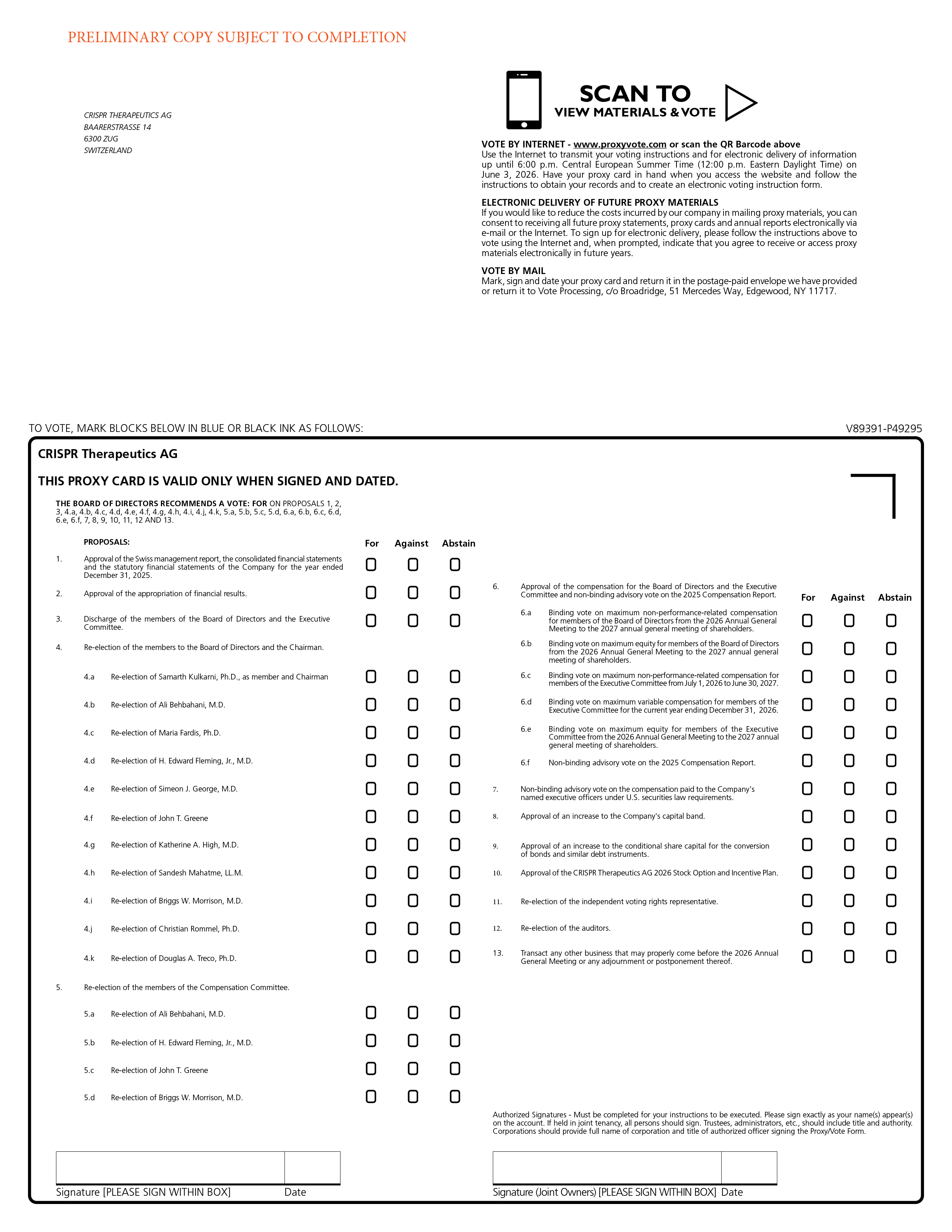
PRELIMINARY COPY SUBJECT TO COMPLETION CRISPR THERAPEUTICS AG BAARERSTRASSE 14 6300 ZUG SWITZERLAND SCAN TO VIEW MATERIALS & VOTE VOTE BY INTERNET - www.proxyvote.com or scan the QR Barcode above Use the Internet to transmit your voting instructions and for electronic delivery of information up until 6:00 p.m. Central European Summer Time (12:00 p.m. Eastern Daylight Time) on June 3, 2026. Have your proxy card in hand when you access the website and follow the instructions to obtain your records and to create an electronic voting instruction form. ELECTRONIC DELIVERY OF FUTURE PROXY MATERIALS If you would like to reduce the costs incurred by our company in mailing proxy materials, you can consent to receiving all future proxy statements, proxy cards and annual reports electronically via e-mail or the Internet. To sign up for electronic delivery, please follow the instructions above to vote using the Internet and, when prompted, indicate that you agree to receive or access proxy materials electronically in future years. VOTE BY MAIL Mark, sign and date your proxy card and return it in the postage-paid envelope we have provided or return it to Vote Processing, c/o Broadridge, 51 Mercedes Way, Edgewood, NY 11717. TO VOTE, MARK BLOCKS BELOW IN BLUE OR BLACK INK AS FOLLOWS: V89391-P49295 CRISPR Therapeutics AG THIS PROXY CARD IS VALID ONLY WHEN SIGNED AND DATED. THE BOARD OF DIRECTORS RECOMMENDS A VOTE: FOR ON PROPOSALS 1, 2, 3, 4.a, 4.b, 4.c, 4.d, 4.e, 4.f, 4.g, 4.h, 4.i, 4.j, 4.k, 5.a, 5.b, 5.c, 5.d, 6.a, 6.b, 6.c, 6.d, 6.e, 6.f, 7, 8, 9, 10, 11, 12 AND 13. PROPOSALS: 1. Approval of the Swiss management report, the consolidated financial statements and the statutory financial statements of the Company for the year ended December 31, 2025. 2. Approval of the appropriation of financial results. 3. Discharge of the members of the Board of Directors and the Executive Committee. 4. Re-election of the members to the Board of Directors and the Chairman. 4.a Re-election of Samarth Kulkarni, Ph.D., as member and Chairman 4.b Re-election of Ali Behbahani, M.D. 4.c Re-election of Maria Fardis, Ph.D. 4.d Re-election of H. Edward Fleming, Jr., M.D. 4.e Re-election of Simeon J. George, M.D. 4.f Re-election of John T. Greene 4.g Re-election of Katherine A. High, M.D. 4.i Re-election of Briggs W. Morrison, M.D. 4.j Re-election of Christian Rommel, Ph.D. 4.h Re-election of Sandesh Mahatme, LL.M. 4.k Re-election of Douglas A. Treco, Ph.D 5. Re-election of the members of the Compensation Committee. 5.a Re-election of Ali Behbahani, M.D. 5.b Re-election of H. Edward Fleming, Jr., M.D. 5.c Re-election of John T. Greene 5.d Re-election of Briggs W. Morrison, M.D. For Against Abstain 6. Approval of the compensation for the Board of Directors and the Executive Committee and non-binding advisory vote on the 2025 Compensation Report. 6.a Binding vote on maximum non-performance-related compensation for members of the Board of Directors from the 2026 Annual General Meeting to the 2027 annual general meeting of shareholders. 6.b Binding vote on maximum equity for members of the Board of Directors from the 2026 Annual General Meeting to the 2027 annual general meeting of shareholders 6.c Binding vote on maximum non-performance-related compensation for members of the Executive Committee from July 1, 2026 to June 30, 2027. 6.d Binding vote on maximum variable compensation for members of the Executive Committee for the current year ending December 31, 2026. 6.e Binding vote on maximum equity for members of the Executive Committee from the 2026 Annual General Meeting to the 2027 annual general meeting of shareholders. 6.f Non-binding advisory vote on the 2025 Compensation Report. 7. Non-binding advisory vote on the compensation paid to the Company’s named executive officers under U.S. securities law requirements. 8. Approval of an increase to the Company's capital band. 9. Approval of an increase to the conditional share capital for the conversion of bonds and similar debt instruments. 10. Approval of the CRISPR Therapeutics AG 2026 Stock Option and Incentive Plan. 11. Re-election of the independent voting rights representative. 12. Re-election of the auditors. 13. Transact any other business that may properly come before the 2026 Annual General Meeting or any adjournment or postponement thereof. Authorized Signatures - Must be completed for your instructions to be executed. Please sign exactly as your name(s) appear(s) on the account. If held in joint tenancy, all persons should sign. Trustees, administrators, etc., should include title and authority. Corporations should provide full name of corporation and title of authorized officer signing the Proxy/Vote Form. For Against Abstain Signature (Joint Owners) [PLEASE SIGN WITHIN BOX] Date
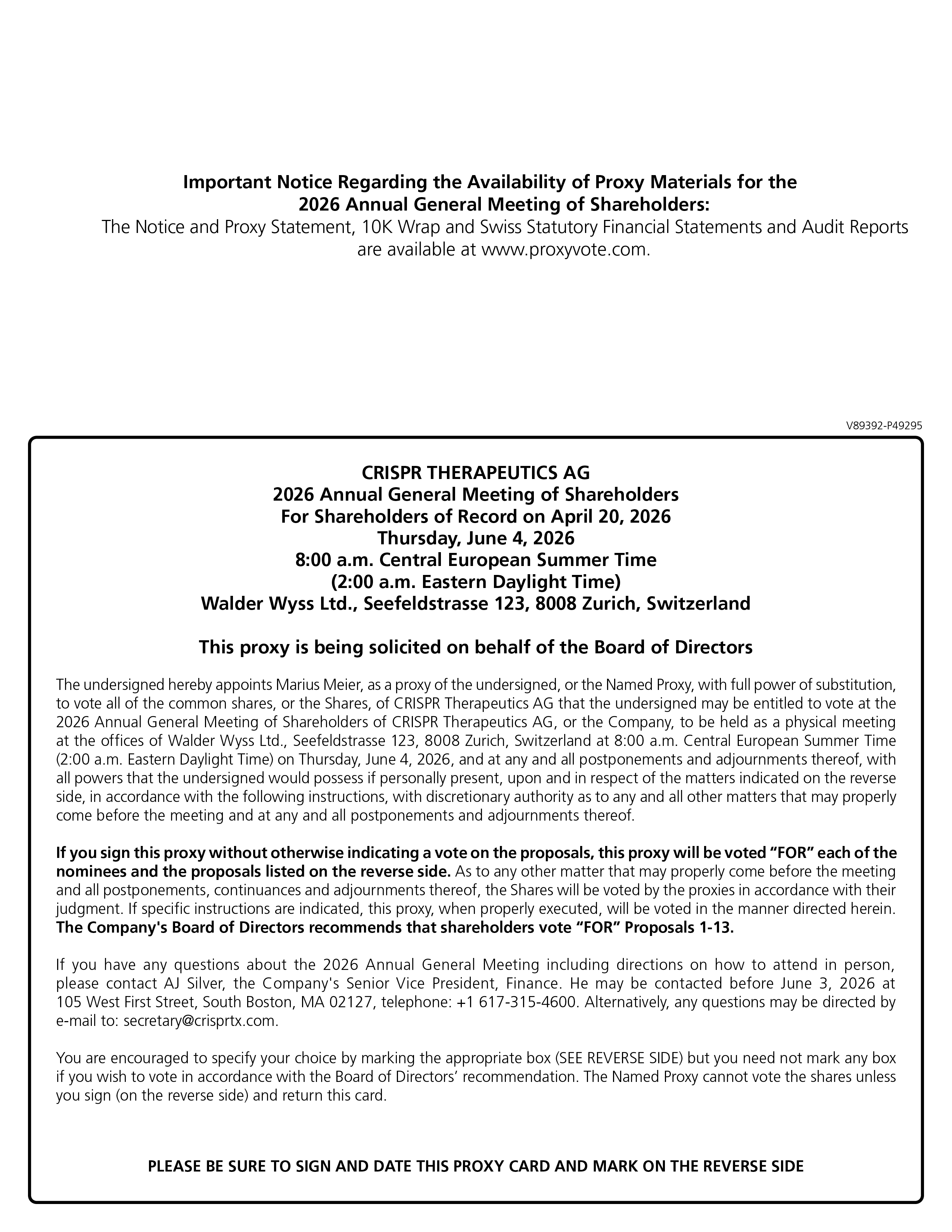
Important Notice Regarding the Availability of Proxy Materials for the 2026 Annual General Meeting of Shareholders: The Notice and Proxy Statement, 10K Wrap and Swiss Statutory Financial Statements and Audit Reports are available at www.proxyvote.com. CRISPR THERAPEUTICS AG 2026 Annual General Meeting of Shareholders For Shareholders of Record on April 20, 2026 Thursday, June 4, 2026 8:00 a.m. Central European Summer Time (2:00 a.m. Eastern Daylight Time) Walder Wyss Ltd., Seefeldstrasse 123, 8008 Zurich, Switzerland This proxy is being solicited on behalf of the Board of Directors The undersigned hereby appoints Marius Meier, as a proxy of the undersigned, or the Named Proxy, with full power of substitution, to vote all of the common shares, or the Shares, of CRISPR Therapeutics AG that the undersigned may be entitled to vote at the 2026 Annual General Meeting of Shareholders of CRISPR Therapeutics AG, or the Company, to be held as a physical meeting at the offices of Walder Wyss Ltd., Seefeldstrasse 123, 8008 Zurich, Switzerland at 8:00 a.m. Central European Summer Time (2:00 a.m. Eastern Daylight Time) on Thursday, June 4, 2026, and at any and all postponements and adjournments thereof, with all powers that the undersigned would possess if personally present, upon and in respect of the matters indicated on the reverse side, in accordance with the following instructions, with discretionary authority as to any and all other matters that may properly come before the meeting and at any and all postponements and adjournments thereof. If you sign this proxy without otherwise indicating a vote on the proposals, this proxy will be voted “FOR” each of the nominees and the proposals listed on the reverse side. As to any other matter that may properly come before the meeting and all postponements, continuances and adjournments thereof, the Shares will be voted by the proxies in accordance with their judgment. If specific instructions are indicated, this proxy, when properly executed, will be voted in the manner directed herein. The Company's Board of Directors recommends that shareholders vote “FOR” Proposals 1-13. If you have any questions about the 2026 Annual General Meeting including directions on how to attend in person, please contact AJ Silver, the Company's Senior Vice President, Finance. He may be contacted before June 3, 2026 at 105 West First Street, South Boston, MA 02127, telephone: +1 617-315-4600. Alternatively, any questions may be directed by e-mail to: secretary@crisprtx.com. You are encouraged to specify your choice by marking the appropriate box (SEE REVERSE SIDE) but you need not mark any box if you wish to vote in accordance with the Board of Directors’ recommendation. The Named Proxy cannot vote the shares unless you sign (on the reverse side) and return this card. PLEASE BE SURE TO SIGN AND DATE THIS PROXY CARD AND MARK ON THE REVERSE SIDE