ORLA MINING LTD. | |
Annual Information Form | |
Year ended December 31, 2025 | United States dollars unless otherwise stated |
3 | |
6 | |
16 | |
19 | |
71 | |
88 | |
90 | |
90 | |
92 | |
96 | |
96 | |
96 | |
96 | |
97 | |
98 | |
101 | |
102 |
Page 2 |
ORLA MINING LTD. | |
Annual Information Form | |
Year ended December 31, 2025 | United States dollars unless otherwise stated |
INTRODUCTORY NOTES AND CAUTIONARY STATEMENTS
GENERAL
In this Annual Information Form (“AIF”), Orla Mining Ltd., together with its subsidiaries, as the context requires, is referred to as the “Company” and “Orla”. Unless otherwise stated, all information contained in this AIF is as of December 31, 2025, being the last day of the Company’s most recently completed financial year.
This AIF should be read in conjunction with the Company’s audited consolidated financial statements and management’s discussion and analysis for the financial year ended December 31, 2025, which are available under the Company’s profile on the System for Electronic Document Analysis and Retrieval + (“SEDAR+”) at www.sedarplus.ca and through the United States Securities and Exchange Commission’s (“SEC”) Electronic Data Gathering and Retrieval System (“EDGAR”) at www.sec.gov.
CURRENCY PRESENTATION AND EXCHANGE RATE INFORMATION
This AIF contains references to Canadian dollars (“C$”) and United States dollars (“$”, “US$”, or “US dollars”). All dollar amounts referenced, unless otherwise indicated, are expressed in United States dollars. Unless otherwise indicated, Canadian dollar amounts have been converted to United States dollars at the indicative exchange rate on December 31, 2025, as quoted by the Bank of Canada, of US$0.7296 = C$1.00.
CAUTIONARY NOTE REGARDING FORWARD-LOOKING STATEMENTS
This AIF contains “forward-looking statements” or “forward-looking information” within the meaning of applicable securities legislation (collectively, “forward-looking statements”). Forward-looking statements are included to provide information about management’s current expectations and plans that allows investors and others to get a better understanding of the Company’s operating environment, the business operations, and financial performance and condition.
Forward-looking statements include, but are not limited to, statements regarding: the estimation of Mineral Resources and Mineral Reserves (as such terms are defined below); projected production rates, all-in sustaining costs (“AISC”), cash costs, sustaining and operating costs, mine production plans, and projected mining and process recovery rates; proposed exploration plans and expected results, costs, and timing thereof; preliminary economic assessments and feasibility studies and the economic results thereof, including future production, processing, recoveries, revenues, net present value, internal rate of return, costs, payback period, cash flows, dilution assumptions, the concentrate market, sensitivities, expenses, and other similar information; timeline for receipt of any required agreements, approvals, or permits; closure costs and requirements; the timing of permitting, construction, and production of the South Railroad Project; Orla’s ability to obtain required mine licences, mine permits, required agreements with third parties, and regulatory approvals required in connection with exploration plans and future mining operations; community and ejido relations; the expected price of gold and silver; currency exchange rates; the Company’s dividend policy and payment of future dividends; the Company’s sustainability strategy and its short-term and long-term sustainability goals, and the timing thereof; and the Company’s other objectives and strategies. Any statements that express or involve discussions with respect to predictions, expectations, beliefs, plans, projections, objectives, assumptions, or future events or performance (often, but not always, identified by words or phrases such as “expects”, “is expected”, “anticipates”, “believes”, “plans”, “projects”, “estimates”, “assumes”, “intends”, “strategy”, “goals”, “objectives”, “potential”, “possible”, or variations thereof or stating that certain actions, events, conditions or results “may”, “could”, “would”, “should”, “might”, or “will” be taken, occur or be achieved (or the negative of any of these terms and similar expressions) are not statements of fact and may be forward-looking statements.
Forward-looking statements are based upon a number of factors and assumptions that, if untrue, could cause actual results, performance, or achievements to be materially different from future results, performance, or achievements expressed or implied by such statements. Forward-looking statements are based upon a number of estimates and assumptions that, while considered reasonable by the Company at this time, are inherently subject to significant business, economic, and competitive uncertainties and contingencies that may cause the
Page 3 |
ORLA MINING LTD. | |
Annual Information Form | |
Year ended December 31, 2025 | United States dollars unless otherwise stated |
Company’s actual financial results, performance, or achievements to be materially different from those expressed or implied herein. Some of the material factors or assumptions used to develop forward-looking statements include, without limitation: the future price of gold and silver; anticipated costs and the Company’s ability to fund its programs; the Company’s ability to carry on exploration, development, and mining activities; tonnage of ore to be mined and processed; ore grades and recoveries; decommissioning and reclamation estimates; currency exchange rates remaining as estimated; prices for energy inputs, labour, materials, supplies, and services remaining as estimated; the Company’s ability to secure and to meet obligations under property agreements, including the Layback Agreement (as defined below); that all conditions of the Credit Facility (as defined below) will be met; the timing and results of drilling programs; Mineral Reserve and Mineral Resource estimates and the assumptions on which they are based; the discovery of Mineral Resources and Mineral Reserves on the Company’s mineral properties; that political and legal developments will be consistent with current expectations; the timely receipt of required approvals and permits, including those approvals and permits required for successful project permitting, construction, and operation of projects; the timing of cash flows; the costs of operating and exploration expenditures; the Company’s ability to operate in a safe, efficient, and effective manner; the Company’s ability to obtain financing as and when required and on reasonable terms; that the Company’s activities will be in accordance with the Company’s public statements and stated goals; and that there will be no material adverse change or disruptions affecting the Company or its properties.
Forward-looking statements are subject to a variety of known and unknown risks, uncertainties, and other factors that could cause actual events or results to differ from those expressed or implied. There can be no assurance that such statements will prove to be accurate, as actual results and future events could differ materially from those anticipated in such statements. Certain important factors that could cause actual results, performance, or achievements to differ materially from those in the forward-looking statements include, among others: uncertainty and variations in the estimation of Mineral Resources and Mineral Reserves; risks related to the Company’s indebtedness and gold prepay; risks related to exploration, development, and operation activities; foreign country and political risks, including risks relating to foreign operations; tailings risks; reclamation costs; delays in obtaining or failure to obtain governmental permits, or non-compliance with permits; tailings risks; reclamation costs; environmental and other regulatory requirements; loss of, delays in, or failure to get access from surface rights owners; uncertainties related to title to mineral properties; water rights; risks related to natural disasters, terrorist acts, health crises, and other disruptions and dislocations; financing risks and access to additional capital; risks related to guidance estimates and uncertainties inherent in the preparation of feasibility studies and preliminary economic assessments; uncertainty in estimates of production, capital, and operating costs and potential production and cost overruns; the fluctuating price of gold and silver; risks related to the Cerro Quema Project; unknown labilities in connection with acquisitions; global financial conditions; uninsured risks; climate change risks; competition from other companies and individuals; conflicts of interest; risks related to compliance with anti-corruption laws; volatility in the market price of the Company’s securities; assessments by taxation authorities in multiple jurisdictions; foreign currency fluctuations; litigation risks; the Company’s ability to identify, complete, and successfully integrate acquisitions; intervention by non-governmental organizations; outside contractor risks; risks related to historical data; risks related to the Company’s foreign subsidiaries; risks related to the Company’s accounting policies and internal controls; the Company’s ability to satisfy the requirements of SOX (as defined below); enforcement of civil liabilities; the Company’s status as a PFIC (as defined below) for U.S. federal income tax purposes; information and cyber security; gold industry concentration; shareholder activism; and other risks associated with executing the Company’s objectives and strategies.
This list is not exhaustive of the factors that may affect any of the Company’s forward-looking statements. Although the Company believes its expectations are based upon reasonable assumptions and have attempted to identify important factors that could cause actual actions, events, or results to differ materially from those described in forward-looking statements, there may be other factors that cause actions, events, or results not to be as anticipated, estimated, or intended. See the section entitled “Risk Factors” below for additional risk factors that could cause results to differ materially from forward-looking statements.
Investors are cautioned not to put undue reliance on forward-looking statements. The forward-looking statements contained herein are made as of the date of this AIF and, accordingly, are subject to change after such date. The Company does not intend, and does not assume any obligation, to update this forward-looking information, except as required by law. Investors are urged to read the Company’s filings with Canadian securities regulatory agencies, which can be viewed online under the Company’s profile on SEDAR+ at www.sedarplus.ca and the Company’s documents filed with, or furnished to, the SEC, which are available on EDGAR at www.sec.gov.
Page 4 |
ORLA MINING LTD. | |
Annual Information Form | |
Year ended December 31, 2025 | United States dollars unless otherwise stated |
SCIENTIFIC AND TECHNICAL INFORMATION
Unless otherwise indicated, scientific and technical information in this AIF relating to the Company’s mineral properties has been reviewed and approved by J. Andrew Cormier, P.Eng., Chief Operating Officer of the Company, and Sylvain Guerard, P. Geo., Senior Vice President, Exploration of the Company. Mr. Cormier and Mr. Guerard are each a “Qualified Person” (or “QP”) as defined under National Instrument 43-101 – Standards of Disclosure for Mineral Projects (“NI 43-101”).
The disclosure included in this AIF uses Mineral Reserves and Mineral Resources classification terms that comply with reporting standards in Canada and the Mineral Reserves and Mineral Resources estimations are made in accordance with the Canadian Institute of Mining, Metallurgy and Petroleum (“CIM”) Definition Standards on Mineral Reserves and Mineral Resources adopted by the CIM Council on May 10, 2014 (the “CIM Standards”) and NI 43-101. NI 43-101 is a rule developed by the Canadian Securities Administrators that establishes standards for all public disclosure an issuer makes of scientific and technical information concerning mineral projects.
CAUTIONARY NOTE TO UNITED STATES INVESTORS CONCERNING ESTIMATES OF MEASURED, INDICATED, AND INFERRED MINERAL RESOURCES
This AIF has been prepared in accordance with Canadian standards for the reporting of Mineral Resource and Mineral Reserve estimates, which differ in some material respects from the disclosure requirements of United States securities laws. In particular, and without limiting the generality of the foregoing, the terms “Mineral Reserve”, “Proven Mineral Reserve”, “Probable Mineral Reserve”, “Inferred Mineral Resources”, “Indicated Mineral Resources”, “Measured Mineral Resources” and “Mineral Resources” used or referenced in this AIF are Canadian mineral disclosure terms as defined in accordance with NI 43-101 and the CIM Definition Standards. The definitions of these terms, and other mining terms and disclosures, differ from the definitions of such terms, if any, for purposes of the SEC’s disclosure rules for domestic United State issuers (the “SEC Rules”), including the requirements of the SEC in Regulation S-K Subpart 1300 under the United States Securities Exchange Act of 1934, as amended (the “Exchange Act”). As a foreign private issuer that is eligible to file reports with the SEC pursuant to the multijurisdictional disclosure system, the Company is not required to provide disclosure on its mineral properties under the SEC Rules and provides disclosure under NI 43-101 and the CIM Definition Standards. Accordingly, Mineral Reserve and Mineral Resource information and other technical information contained or incorporated by reference herein or documents incorporated by reference may not be comparable to similar information disclosed by United States companies subject to the SEC’s reporting and disclosure requirements for domestic United States issuers.
Mineral Resources that are not Mineral Reserves do not have demonstrated economic viability. Due to the uncertainty of Measured Mineral Resources, Indicated Mineral Resources or Inferred Mineral Resources, these Mineral Resources may never be upgraded to Proven Mineral Reserves and Probable Mineral Reserves. Investors are cautioned not to assume that any part of mineral deposits in these categories will ever be converted into reserves or recovered. In addition, United States investors are cautioned not to assume that any part or all of the Company’s Measured Mineral Resources, Indicated Mineral Resources or Inferred Mineral Resources constitute or will be converted into Mineral Reserves or are or will be economically or legally mineable.
NON-GAAP MEASURES
This AIF includes certain performance measures (“non-GAAP measures”) which are not specified, defined, or determined under generally accepted accounting principles (in the Company’s case, IFRS Accounting Standards “IFRS”), namely AISC and cash costs per ounce. These are common performance measures in the gold mining industry, but because they do not have any mandated standardized definitions, they may not be comparable to similar measures presented by other issuers. Accordingly, the Company uses such measures to provide additional information, and readers should not consider them in isolation or as a substitute for measures of performance prepared in accordance with generally accepted accounting principles.
Please see the information under the heading “Non-GAAP Measures” in the Company’s management’s discussion and analysis for the financial year ended December 31, 2025, which section is incorporated by reference in this AIF, for a description of the non-GAAP measures noted above. The Company’s management’s discussion and analysis may be found on SEDAR+ at www.sedarplus.ca and on EDGAR at www.sec.gov.
Page 5 |
ORLA MINING LTD. | |
Annual Information Form | |
Year ended December 31, 2025 | United States dollars unless otherwise stated |
OVERVIEW
Orla is a Canadian company listed on the Toronto Stock Exchange (“TSX”) under the symbol “OLA” and on the NYSE American LLC (the “NYSE American”) under the symbol “ORLA”. Orla’s corporate strategy is to acquire, explore, develop, and operate mineral properties where its expertise can substantially increase stakeholder value. Orla has three material gold projects for the purposes of NI 43-101:
| ● | the Musselwhite gold mine (“Musselwhite” or the “Musselwhite Mine”) located in Ontario, Canada; |
| ● | the Camino Rojo project (“Camino Rojo” or the “Camino Rojo Project”) located in Zacatecas, Mexico, which consists of the Camino Rojo oxide gold mine (the “Camino Rojo Oxide Mine”) and the Camino Rojo underground project (the “Camino Rojo Underground Project”); and |
| ● | the South Railroad project (“South Railroad” or the “South Railroad Project”) located in Nevada, which consists of the Dark Star and Pinion deposits and is situated within the prospective land package called the “South Carlin Complex” along the Carlin trend. |
For further details regarding the Camino Rojo Project, the Musselwhite Mine, and the South Railroad Project, including information regarding their associated NI 43-101 technical reports, see “Summary of Mineral Reserve and Mineral Resource Estimates” and “Mineral Projects”.
NAME, ADDRESS AND INCORPORATION
The Company was incorporated under the Business Corporations Act (Alberta) on May 31, 2007 as a Capital Pool Company (as defined by the TSX Venture Exchange). On June 3, 2010, the Company was continued into British Columbia under the Business Corporations Act (British Columbia) and on April 21, 2015, the Company was continued into Ontario under the Business Corporations Act (Ontario). On June 12, 2015, the Company changed its name from “Red Mile Minerals Corp.” to “Orla Mining Ltd.” On December 2, 2016, in order to facilitate the acquisition of Pershimco Resources Inc. (“Pershimco”), the Company was continued as a federal company under the Canada Business Corporations Act (the “CBCA”). Following the continuance, on December 6, 2016, the plan of arrangement under the CBCA involving Orla and Pershimco was affected. Pursuant to the plan of arrangement, among other things, Orla and Pershimco were amalgamated and continued as one company under the name “Orla Mining Ltd.”
The Company’s registered office and its head and principal office is located at Suite 2020 – 666 Burrard Street, Vancouver, British Columbia, Canada, V6C 2X8.
Page 6 |
ORLA MINING LTD. | |
Annual Information Form | |
Year ended December 31, 2025 | United States dollars unless otherwise stated |
INTERCORPORATE RELATIONSHIPS
The following is a diagram of the intercorporate relationships among Orla and its subsidiaries, including their respective jurisdictions of incorporation as of March 19, 2026.
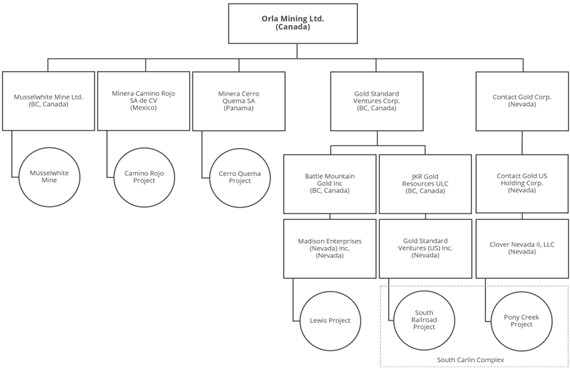
Certain inactive subsidiaries with both less than 10% of the total assets of the Company and 10% of the total revenues of the Company are excluded from the diagram. The Company holds 100% of the shares of each subsidiary, provided that, as required under Mexican corporate law, Minera Camino Rojo SA de CV (“Minera Camino Rojo”) has two shareholders – Orla Mining Ltd. holds 98% of the shares and 2% are held by a wholly owned Canadian subsidiary of the Company, which holds its shares in trust for the Company.
THREE YEAR HISTORY
DEVELOPMENTS DURING 2023
On June 21, 2023, the Company held its 2023 annual general meeting. At the meeting, Ms. Ana Sofía Ríos was elected as a director of the Company.
On August 21, 2023, the Company released its inaugural Sustainability Report, which highlighted the Company’s approach and performance on its environmental, social, and governance (“ESG”) initiatives. See “Description of the Business – Environmental, Social and Governance” below for additional information.
On August 28, 2023, the Company amended and restated its existing credit agreement in respect of an amended credit facility through its existing syndicate of lenders comprised of The Bank of Nova Scotia, Bank of Montreal, and Canadian Imperial Bank of Commerce. The amended facility consisted of a US$150 million revolving term facility.
Page 7 |
ORLA MINING LTD. | |
Annual Information Form | |
Year ended December 31, 2025 | United States dollars unless otherwise stated |
The Company appointed Mr. Rob Krcmarov to its Board of Directors on November 20, 2023.
On December 15, 2023, the Panamanian Ministry of Commerce and Industry (“MICI”) rejected the Company’s requests for extension for the three mining concessions comprising the Company’s Cerro Quema gold project (the “Cerro Quema Project”), declared the concessions cancelled and declared the area comprising the concessions to be a reserve area. In response, the Company has commenced international arbitration proceedings against Panama as further described below under “Developments during 2024”. See “Mineral Properties – Other Properties – Cerro Quema Project” for additional information.
DEVELOPMENTS DURING 2024
On February 25, 2024, Orla entered into a definitive arrangement agreement with Contact Gold Corp. (“Contact”) pursuant to which the Company agreed to acquire all of the issued and outstanding common shares of Contact (the “Contact Shares”) pursuant to a court-approved plan of arrangement under the BCBCA. Under the terms of the transaction, Contact shareholders received, in exchange for each Contact Share held, 0.0063 of a Common Share. Contact’s key asset was the 100%-owned Pony Creek property, a 4,500-hectare exploration land package, strategically located adjacent to the South Railroad Project in the Carlin trend in Nevada. The transaction closed on April 29, 2024. Subsequent to the transaction closing, the Company renamed the entire prospective land package as the “South Carlin Complex”.
In March 2024, the Company filed a Notice of Intent to Arbitrate with the Government of Panama under the Canada-Panama Free Trade Agreement (the “FTA”). The Notice of Intent asserted that the measures taken by Panama constituted violations of Panama’s legal obligations under the FTA and customary international law. The Notice of Intent was intended to facilitate a 30-day consultation period to reach an amicable resolution to the Company’s claim. As no resolution was reached, the Company proceeded with filing a Request to Arbitrate on July 3, 2024. As part of the FTA requirements, the Company submitted an initial and preliminary estimate of damages claimed of no less than US$400 million, plus pre-award and post-award interest. The Company filed written submissions to the arbitration tribunal (referred to as its Memorial on Liability and Quantum) in late March 2025. See “Mineral Properties – Other Properties – Cerro Quema Project” and “Risk Factors –The Cerro Quema Project” for additional information.
On August 26, 2024, the Company released its second annual Sustainability Report. See “Description of the Business – Environmental, Social and Governance” below for additional information.
On November 17, 2024, the Company entered into a definitive agreement (the “Musselwhite Agreement”) to acquire Musselwhite from Newmont for upfront cash consideration of $810 million and gold-price linked contingent consideration of $40 million (the “Musselwhite Transaction”). The $40 million in contingent consideration is payable as follows:
| ● | $20 million, which was paid in March 2026 as a result of the average spot gold price exceed $2,900/oz for the one-year period ending February 28, 2026; and |
| ● | $20 million to be paid should the average spot gold price exceed $3,000/oz for the one-year period ending February 28, 2027. |
The $810 million in upfront consideration was funded from a combination of sources, as follows:
| ● | Credit Facility. $150 million under a revolving credit facility (the “Revolving Loan”) and a $100 million term loan (the “Term Loan” and together with the Revolving Loan, the “Credit Facility”) with a syndicate of lenders comprised of the Bank of Nova Scotia, Bank of Montreal, Canadian Imperial Bank of Commerce, and ING Capital LLC. The Credit Facility is governed by the terms of a second amended and restated credit agreement (the “Second Amended Credit Agreement”) between the Company and such lenders. |
Page 8 |
ORLA MINING LTD. | |
Annual Information Form | |
Year ended December 31, 2025 | United States dollars unless otherwise stated |
The Term Loan has a three-year term with no principal payments during the first two quarters. The Term Loan is now being repaid in quarterly installments of $5 million, which commenced on December 31, 2025, with the balance repaid at maturity. The Revolving Loan will mature in August 2027. The Company may repay the Credit Facility in full, without penalties, at any time prior to the maturity date.
The interest rate under the Credit Facility is based on the term Secured Overnight Financing Rate (“SOFR”), plus an applicable margin ranging from 2.50% to 3.75% based on the Company’s leverage ratio at the end of each fiscal quarter.
| ● | Convertible Notes. A private placement of $200 million in senior unsecured convertible notes (the “Convertible Notes”) led by the Company’s cornerstone shareholders, Fairfax Financial Holdings Limited (“Fairfax”), Pierre Lassonde, and Trinity Capital Partners Corporation (the “Concurrent Private Placement”). |
The Convertible Notes mature five years from the date of issuance and bear interest at 4.5% per annum, payable in cash. The Convertible Notes may be converted in full or in part at any time prior to the maturity date, by the holder thereof, into common shares of the Company (“Common Shares”) at a price of C$7.90 (the “Conversion Price”), converted to US dollars at a fixed exchange rate of C$1.40/US$1.00, subject to standard anti-dilution provisions. Based on the Conversion Price, 35,443,026 Shares were issuable on conversion of the Convertible Notes upon closing. The Company may also redeem the Convertible Notes following the 18-month anniversary of the date of issuance, provided that the 20-day volume weighted average price of the Common Shares is not less than 130% of the Conversion Price.
Holders of the Convertible Notes were also issued 23,392,397 common share purchase warrants (the “Warrants”) to acquire Common Shares, representing 0.66 Warrants for each Common Share issuable under the Convertible Notes. The Warrants have an exercise price of C$11.50 per Share and shall expire on February 28, 2030.
| ● | Gold Prepay. $360 million gold prepayment (the “Gold Prepay”) from a syndicate of lenders including Bank of Montreal, ING Capital Markets LLC, and Canadian Imperial Bank of Commerce (the “Gold Prepay Providers”). Under the terms of the Gold Prepay, the Company is required to deliver a total of 144,887 ounces of gold to the Gold Prepay Providers over a three-year term. |
DEVELOPMENTS DURING 2025
The Musselwhite Transaction and the Concurrent Private Placement required approval of the shareholders of the Company under applicable securities laws and the rules of the TSX, excluding votes held by Newmont, Fairfax, and Mr. Lassonde. The Company held a special meeting of shareholders on January 21, 2025, where shareholders of the Company overwhelmingly approved the Musselwhite Transaction and Concurrent Private Placement.
On February 28, 2025, the Company closed the Musselwhite Transaction and the Concurrent Private Placement. The Company filed a business acquisition report in respect of the Musselwhite Transaction on May 13, 2025 in accordance with National Instrument 51-102 – Continuous Disclosure Obligations.
On June 5, 2025, the Company announced the initial underground Mineral Resource estimate for Camino Rojo. The Company filed the corresponding technical report on July 17, 2025, which has since been superseded by the Camino Rojo Report (as defined below).
Camino Rojo experienced an uncontrolled material movement along the temporary north wall of the open pit on July 23, 2025. As a result, in-pit mining operations were temporarily paused as an action plan was established. As a result of the operational pause and mining resequencing, Orla updated its annual consolidated guidance with respect to gold production and AISC. The Company achieved the revised production and cost guidance, see the Company’s management’s discussion and analysis for the financial year ended December 31, 2025 for additional information.
Page 9 |
ORLA MINING LTD. | |
Annual Information Form | |
Year ended December 31, 2025 | United States dollars unless otherwise stated |
On August 13, 2025, the Company announced that the U.S. Department of the Interior Bureau of Land Management (“BLM”) has published the Noticed of Intent (“NOI”) for the South Railroad Project. The publication of the NOI represents a major milestone in the federal permitting process, as it formally initiates the process to complete the National Environmental Policy Act (“NEPA”) review and preparation of an Environmental Impact Statement by the BLM. Following receipt of all required state and federal permits, anticipated by mid-2026, onsite construction can begin.
On September 15, 2025, the Company filed a short form base shelf prospectus (the “Base Shelf Prospectus”) with the securities regulatory authorities in each of the provinces and territories of Canada, which allows the Company to offer for sale and issue from time to time Common Shares, warrants to purchase Common Shares, subscription receipts, units and debt securities, or any combination thereof (collectively, the “Securities”) during the 25-month period that the Base Shelf Prospectus, including any amendments thereto, remains effective. The Base Shelf Prospectus was part of a registration statement on Form F-10 which the Company also filed with the SEC under the U.S. Securities Act, qualifying the Securities for distribution in the United States.
On September 23, 2025, Mr. Scott Langley resigned from the Company’s Board of Directors. Mr. Langley was Newmont’s nominee to the Board in accordance with its investor rights agreement with the Company, which was terminated following Newmont’s disposition of its Common Shares in September 2025.
On December 15, 2025, the Company appointed Ms. Joanna Pearson to its Board of Directors.
On December 3, 2025, the Board of Directors declared an inaugural quarterly cash dividend of $0.015 per Common Share, which was payable on February 10, 2026 to shareholders of record as of January 12, 2026. The Board of Directors also approved a policy under which the Company intends to pay a regular quarterly dividend of $0.015 per Common Share, or $0.06 per Common Share annually. See “Dividends” for additional information.
DEVELOPMENTS DURING 2026
On January 15, 2026, the Company announced the results of the optimized Feasibility Study for the South Railroad Project and confirmed the Board’s approval to begin spending for detailed engineering, procurement, and project execution. The Board also approved the start of project construction, subject to receipt of all required permits. The Company filed the corresponding South Railroad Report (as defined below) on February 27, 2026. See “Mineral Projects – South Railroad Project” for additional information.
On February 19, 2026, the Company announced the results of the Preliminary Economic Assessment (“PEA”) for the Camino Rojo Underground Project. The PEA evaluates the technical and economic potential of a stand-alone, underground development project beneath the existing Camino Rojo Oxide Mine operation and outlines a potential pathway toward development of a larger-scale and long-life underground mining operation and processing facility. The Company filed the corresponding Camino Rojo Report on March 18, 2026. See “Mineral Projects – Camino Rojo” for additional information.
On March 18, 2026, the Company announced that the Mexican Federal Environmental Department (“SEMARNAT”) approved the Company’s Environmental Impact Statement (“Manifestación de Impacto Ambiental” or “MIA”) for the expansion of the Camino Rojo Oxide Mine. This approval, together with the Change of Land Use authorization which was also received, provides the permits required to mine the remainder of the oxide open pit, including the layback area to the north. The MIA also permits construction of an exploration decline to support continued advancement of the Camino Rojo Underground Project. This milestone provides operating flexibility at Camino Rojo and supports both oxide mine optimization and underground development. The approval of the MIA is conditional upon Orla meeting certain customary conditions and standard requirements.
Page 10 |
ORLA MINING LTD. | |
Annual Information Form | |
Year ended December 31, 2025 | United States dollars unless otherwise stated |
ENVIRONMENTAL, SOCIAL, AND GOVERNANCE (ESG)
OVERVIEW
Orla’s commitment to strong ESG practices is critical to adding value to its business by allowing Orla to attract and retain top talent, earn the trust of rightsholders and stakeholders, effectively manage risk, and ensure Orla’s long-term competitiveness and sustainability.
Orla is committed to conducting business in a responsible manner at all times, which means protecting the health and safety of employees and contractors, caring for the environment, contributing to the sustainable development of local communities and respecting Indigenous Rights and human rights across the Company’s value chain. Orla believes that it is its responsibility to transform Mineral Resources into a net positive benefit for stakeholders and rightsholders.
Orla has been focused on strengthening its ESG approach through aligning Company practices to industry leading standards and adopting robust reporting and sustainability disclosures.
Orla has conducted an ESG Materiality Assessment, which focused on identifying, assessing and prioritizing the environmental, social, and governance issues that are most relevant and impactful to Orla and those affected by the Company’s activities. The Company considered leading ESG frameworks and standards (including the Sustainability Accounting Standards Board and the recommendations of the Task Force on Climate-related Financial Disclosures) as well as relevant regulations and initiatives. The ESG Materiality Assessment is reviewed and updated bi-annually.
In 2025, Orla also released its third annual Sustainability Report, highlighting the Company’s approach and performance on ESG initiatives. The Sustainability Report reiterates the Company’s “Towards 2030 Sustainability Strategy”, first introduced in 2023. This strategy sets clear priorities, key performance indicators, action plans, and timelines to drive progress in areas such as health and safety, climate change mitigation, water stewardship, biodiversity, community impact management, workforce diversity, equity, and inclusion. The Sustainability Report also outlined the Company’s key sustainability performance highlights for 2024. Notably, at Camino Rojo:
| ● | Achieved industry-leading GHG emissions intensity of 0.24 tonnes of CO2 equivalent per ounce of gold produced (Scope 1 and 2). |
| ● | Maintained a water intensity of 0.12 m³ per tonne of processed ore, with 100% of water reused and recycled and zero water discharge. |
| ● | Spent US$9.6 million on goods and services through local suppliers. |
| ● | Delivered an average of 106 hours of health and safety training per employee, a 116% increase from the previous year. |
| ● | Company-wide, 58% of direct employees at sites were hired from local communities, up from 49% in 2023. |
Moreover, Orla introduced four new environmental management standards covering water management, biodiversity, air emissions and noise, and hazardous materials, strengthening site-level accountability. These standards apply at all Orla sites.
The Sustainability Report can be found on Orla’s website at www.orlamining.com/sustainability/governance/.
Page 11 |
ORLA MINING LTD. | |
Annual Information Form | |
Year ended December 31, 2025 | United States dollars unless otherwise stated |
The following sections provide an overview of certain aspects of Orla’s approach to ESG.
EHS&SR COMMITTEE AND POLICIES
The Board has established an Environment, Health and Safety and Social Responsibility Committee, which is responsible for all ESG matters particularly as they apply to environmental, health and safety and social concerns, assessing environmental and social risks and the Company’s risk management thereof. Orla has also adopted a number of policies in support of its sustainability goals, as further discussed below. The full text of these policies can be found on Orla’s website at www.orlamining.com/sustainability/governance.
ENVIRONMENT, HEALTH & SAFETY POLICY
The Company is committed to meeting or surpassing regulatory requirements in all of its exploration and development activities, while working to protect the environment both within and beyond the Company’s operational boundaries and creating social value across the value chain. In keeping with this commitment, Orla has adopted an Environment, Health & Safety Policy. The Company will conduct all of its operations in a manner that ensures full compliance with its Environment, Health & Safety Policy, applicable legislation, and government requirements. The aim of this policy is to protect the surroundings in which the Company operates, to minimize and manage environmental risk, and to enhance sustainable practices. Orla will ensure that all of its activities are conducted in an environmentally safe and responsible manner and will ensure that its contractors adhere to the same high environmental standards.
SOCIAL RESPONSIBILITY POLICY
The Company is committed to conducting its business in a responsible manner at all times. In keeping with this commitment, Orla has implemented a Social Responsibility Policy (the “SR Policy”) which sets out the guidelines by which the Company will (i) endeavour to respect the health and safety of its employees, (ii) protect the environment, (iii) respect the human rights of its employees and the residents in the communities in which the Company operates, and (iv) contribute to the sustainable development of those communities.
HUMAN RIGHTS POLICY
The Company is committed to respecting the human rights of all individuals impacted by its business activities, including local communities, Indigenous Peoples and the Company’s employees, contractors, consultants, and other rightsholders. In support of this commitment, the Company has adopted a Human Rights Policy, which sets out the Company’s commitment to human rights and seeks to integrate human rights best practices into the Company’s management, business relationships, governance structures, and programs.
INDIGENOUS PEOPLES POLICY
Further to its Human Rights Policy, the Company also recognizes that it operates within the ancestral territories and along-side the communities of a diversity of Indigenous Peoples. The Company recognizes the United Nations Declaration on the Rights of Indigenous Peoples and the International Labour Organization Convention 169 and has adopted an Indigenous Peoples Policy. The Indigenous Peoples Policy reiterates the Company’s commitment to respecting Indigenous Rights and building positive and sustainable relationships with Indigenous Peoples, based on trust and respect, and focused on finding common goals through open dialogue.
ENVIRONMENT
Mining, exploration, development, and production activities are subject to various levels of federal, provincial, state, and local laws and regulations relating to the protection of the environment at all phases of operation. These regulations govern exploration, development, tenure, production, taxes, labour standards, occupational health, waste disposal, protection and remediation of the environment, reclamation, mine safety, toxic substances management, and other matters. These regulations mandate, among other things, the maintenance of air and water quality standards and land reclamation. They also set forth limitations on the general handling,
Page 12 |
ORLA MINING LTD. | |
Annual Information Form | |
Year ended December 31, 2025 | United States dollars unless otherwise stated |
transportation, storage, and disposal of solid and hazardous waste. Environmental legislation requires strict standards and enforcement, with potential fines and penalties for non-compliance, stringent environmental assessments of proposed projects and a high degree of responsibility for companies and their officers, directors, and employees.
Orla is committed to ensuring that all its activities are conducted in an environmentally safe and responsible manner and will require that its contractors adhere to the same high environmental standards. In 2025, there were no category 4 or 5 incidents across the Company operations and projects as defined by the U.S. Environmental Protection Agency. None of Orla’s sites were charged with fines or sanctions related to environmental incidents in 2025.
Environmental protection requirements did not have a material effect on the capital expenditures, earnings, or competitive position of Orla during the 2025 financial year and are not expected to have a material effect during the 2026 financial year.
SOCIAL
OVERVIEW
Orla strives to actively engage and make positive contributions in the communities associated with the Company’s business activities.
At the Camino Rojo Project, the Company has agreements in place with the ejidos of San Tiburcio, El Berrendo, La Pardita, and San Francisco de los Quijano, with commitments to deliver land leasing payments and social support such as scholarships, community infrastructure upgrades, social and economic development initiatives, and donation of food and medicines to the most vulnerable community members. Camino Rojo’s full-time community relations team is responsible to implement Orla’s SR Policy at site. Camino Rojo’s community response mechanism allows Orla to receive, document, and resolve community requests, concerns, and complaints in an equitable and respectful manner. In 2025 Camino Rojo completed an independently-led socio-economic impact assessment, updating a socio-economic baseline and identifying actions to address concerns and opportunities which further strengthened the site’s social management plan.
As part of the closing of the acquisition of Musselwhite at the end of February 2025, Orla remained focused on ensuring safe, operational continuity, and maintaining alignment with the agreements signed between Musselwhite and local Indigenous partners. The Company also continued to advance social closure planning and honouring social commitments as part of its ongoing integration work.
At the South Carlin Complex in 2025, the focus was on community and government engagement and community investment initiatives. The Orla team conducted meetings with federal, state, municipal leaders and organizations, as well as Indigenous Nation representatives. In September 2025, Orla participated in public meetings about the South Railroad Project as part of the project’s public scoping process. Throughout the year, the Company also continued to advance projects that increase awareness of Orla’s business and the mining industry in general. Mining education activities reached elementary students and community members through presentations and local events such as the Elko Mining Expo. Community investment efforts included delivering meals to students in need, scholarships for high school students, and donations to local organizations.
HEALTH AND SAFETY
Orla is committed to the health and safety of its employees and contractors. The Company is committed to complying with all applicable health and safety laws, rules, and regulations and strives to create and maintain a safe working environment for all. Orla acknowledges that there are safety risks associated with its business and, through proactive risk management, continuously aims to minimize and control these risks. Camino Rojo, Musselwhite and South Carlin have Health and Safety departments with full-time personnel and Orla continues to develop Health and Safety policies and procedures to comply with regulations and industry best practices. For 2025, the Company had a lost time injury frequency rate (“LTIFR”) of 2.43 across all sites.
Page 13 |
ORLA MINING LTD. | |
Annual Information Form | |
Year ended December 31, 2025 | United States dollars unless otherwise stated |
EMPLOYEES AND CONTRACTORS
On December 31, 2025, the Company had 1,085 employees, which included 33 employees in corporate offices in Canada, as well as site-based employees in Mexico (290), Nevada (24), Panama (3), and at the Musselwhite Mine in Canada (735). In addition, there were 290 contractors working on the Camino Rojo Project, four at the corporate offices in Canada, 421 at the Musselwhite Mine, and six contractors at the South Carlin Complex. No management functions of the Company are performed to any substantial degree by a person other than the Directors or executive officers of the Company.
The Company respects and supports the rights of its employees and contractors, including freedom of association and collective bargaining, and the Company promotes ongoing engagement and proactive dialogue with its workers’ unions. In total, approximately 54% of the workforce at Camino Rojo was unionized in 2025.
LABOR RIGHTS POLICY
Orla introduced a Labor Rights Policy in 2025, reiterating the Company’s support and respect for internationally recognized labor rights as proclaimed by the International Labor Organization’s Declaration on Fundamental Principles and Rights at Work and international labor standards. The Company recognizes its responsibility to comply with the employment and labor laws and regulations that govern our operations, respecting local norms, practices, and laws. Orla’s Labor Rights Policy seeks to integrate labor rights best practices into the Company’s management, business relationships, governance structures and programs, fostering a safe, productive, supportive, and fair working environment that is valued by our employees, contractors, suppliers, consultants, and other stakeholders.
GOVERNANCE
Orla recognizes the importance of corporate governance to the effective management of the Company and to the protection of its stakeholders and rightsholders. Orla’s approach to significant issues of corporate governance is designed to ensure that the business and affairs of Orla are effectively managed to enhance value. Additional information on Orla’s corporate governance practices is contained in Orla’s Management Information Circular dated May 9, 2025, prepared for its most recent annual meeting of shareholders held on June 24, 2025 and filed on SEDAR+ at www.sedarplus.ca and on EDGAR at www.sec.gov. This information will also be contained in the Management Information Circular of the Company to be prepared in connection with the Company’s 2026 annual meeting of shareholders currently scheduled to be held in June 2026, which will be available on SEDAR+ at www.sedarplus.ca and on EDGAR at www.sec.gov. Orla’s current governance policies can be found on Orla’s website at www.orlamining.com/sustainability/governance.
FURTHER INFORMATION
SPECIALIZED SKILL AND KNOWLEDGE
All aspects of the Company’s business require specialized skills and knowledge. Such skills and knowledge include the areas of geology, mining, metallurgy, environmental, permitting, occupational health and safety, corporate social responsibility, finance, accounting, and legal. Orla faces competition for qualified personnel with these specialized skills and knowledge, which may increase costs of operations or result in delays.
COMPETITIVE CONDITIONS
The mineral exploration and mining business is competitive. Competition is primarily for: (a) mineral properties that can be developed and operated economically; (b) technical experts that can find, develop, and mine such mineral properties; (c) labour to operate the mineral properties; and (d) capital to finance development and operations.
Page 14 |
ORLA MINING LTD. | |
Annual Information Form | |
Year ended December 31, 2025 | United States dollars unless otherwise stated |
The Company competes with other mining companies, some of which have greater financial resources and technical facilities, for the acquisition and exploitation of mineral concessions, claims, leases, and other interests, to finance its activities and in the recruitment and retention of qualified employees. The ability of the Company to acquire, develop, and operate precious metal properties will depend not only on its ability to raise the necessary funding and operate its properties economically, but also on its ability to select and acquire suitable prospects for precious metal development and operation or metal exploration. See “Financing Risks” and “Competition” under “Risk Factors”.
BANKRUPTCY AND SIMILAR PROCEDURES
There have been no bankruptcy, receivership, or similar proceedings against the Company or any of its subsidiaries, or any voluntary bankruptcy, receivership, or similar proceedings by the Company or any of its subsidiaries, within the three most recently completed financial years or during or proposed for the current financial year.
FOREIGN OPERATIONS
The locations of the Company’s Camino Rojo Project in Mexico and South Railroad Project in Nevada expose the Company to certain risks, including currency fluctuations and possible political or economic instability that may result in the impairment or loss of mining titles or other mineral rights and opposition from environmental or other non-governmental organizations. Mineral exploration and mining activities in foreign jurisdictions may also be affected in varying degrees by political stability and governmental regulations relating to the mining industry; labour unrest; expropriation; renegotiation, or termination of existing concessions; ability of governments to unilaterally alter agreements; surface land access; illegal mining; changes in taxation policies or laws; security issues; and repatriation of funds. Any changes in regulations or shifts in political attitudes in such foreign countries are beyond the Company’s control and may adversely affect the Company’s business.
The Company also holds an interest in the Cerro Quema Project in Panama. In November 2023, Panama passed a legislative moratorium on mining activity and in December 2023, cancelled the Company’s renewal applications for the mining concessions comprising the Cerro Quema Project.
See “Risk Factors – Foreign Country and Political Risk”, “– Foreign Subsidiaries” and “– Cerro Quema Project”.
REORGANIZATIONS
There have been no material reorganizations of the Company or any of its subsidiaries within the three most recently completed financial years or during or proposed for the current financial year.
PRINCIPAL MARKETS AND DISTRIBUTION
The Company currently sells its refined gold and silver to customers located in the United States and Canada. The Company evaluates the counterparties to which it sells its product. The Company is not economically dependent on a limited number of customers for the sale of its gold and silver as its products can be sold through numerous world-wide commodity markets, traders, and financial institutions.
Page 15 |
ORLA MINING LTD. | |
Annual Information Form | |
Year ended December 31, 2025 | United States dollars unless otherwise stated |
SUMMARY OF MINERAL RESERVE AND MINERAL RESOURCE ESTIMATES
MINERAL RESERVES
The following tables summarize the Company’s Mineral Reserve estimates on its material mineral properties, the Camino Rojo Project, Musselwhite Mine, and South Railroad Project, in each case as at the dates set out in the footnotes.
| | | | | | Proven | | Probable | | Proven and Probable | ||||||||||||
Gold (Au) | | 000’s t | | g/t | | koz | | 000’s t | | g/t | | koz | | 000’s t | | g/t | | koz | ||||
Ontario | | Musselwhite | | Oxide | | — | | — | | — | | — | | — | | — | | — | | — | | — |
|
| |
| Sulphide |
| 4,254 |
| 5.76 |
| 788 |
| 4,465 |
| 4.64 |
| 666 |
| 8,719 |
| 5.18 | | 1,453 |
Mexico | | Camino Rojo | | Oxide | | 2,920 | | 0.73 | | 68 | | 28,794 | | 0.75 | | 690 | | 31,714 | | 0.74 | | 759 |
|
| |
| Sulphide |
| — |
| — |
| — |
| — |
| — |
| — |
| — |
| — | | — |
Nevada |
| South Railroad |
| Oxide |
| 10,585 |
| 1.04 |
| 354 |
| 56,033 |
| 0.65 |
| 1,162 |
| 66,618 |
| 0.71 |
| 1,516 |
|
| |
| Sulphide |
| — |
| — |
| — |
| — |
| — |
| — |
| — |
| — | | — |
| | | | Total Gold |
| 17,760 |
| 2.12 |
| 1,210 |
| 89,291 | | 0.88 |
| 2,518 |
| 107,051 |
| 1.08 |
| 3,728 |
| | | | | | | | | | | | | | | | | | | | | | |
| | | | | | Proven | | Probable | | Proven and Probable | ||||||||||||
SILVER (Ag) | | | | | | 000’s t | | g/t | | koz | | 000’s t | | g/t | | koz | | 000’s t | | g/t | | koz |
Ontario | | Musselwhite | | Oxide | | — | | — | | — | | — | | — | | — | | — | | — | | — |
|
| |
| Sulphide |
| — |
| — |
| — |
| — |
| — |
| — |
| — |
| — | | — |
Mexico | | Camino Rojo | | Oxide | | 2,920 | | 18.1 | | 1,697 | | 28,794 | | 14.7 | | 13,584 | | 31,714 | | 15.0 | | 15,281 |
|
| |
| Sulphide |
| — |
| — |
| — |
| — |
| — |
| — |
| — |
| — | | — |
Nevada |
| South Railroad |
| Oxide |
| 2,113 |
| 6.6 |
| 445 |
| 35,779 |
| 5.0 |
| 5,749 |
| 37,892 |
| 5.1 |
| 6,195 |
|
| |
| Sulphide |
| — |
| — |
| — |
| — |
| — |
| — |
| — |
| — | | — |
| | | | Total Silver |
| 5,033 |
| 13.2 |
| 2,142 |
| 64,573 | | 9.3 |
| 19,333 |
| 69,606 |
| 9.6 |
| 21,476 |
MINERAL RESERVE FOOTNOTES
All Mineral Reserves
| 1. | The Mineral Reserve estimates have been prepared in accordance with the CIM Standards. |
| 2. | Rounding as required by reporting guidelines may result in summation differences. |
| 3. | The estimate of Mineral Reserves may be materially affected by geology, environment, permitting, legal, title, taxation, sociopolitical, marketing, or other relevant issues. |
| 4. | koz = 1,000 troy ounces; t = tonne (1,000 kilograms). |
Musselwhite, Ontario
| 1. | The Mineral Reserve estimate for Musselwhite has an effective date of December 31, 2025. |
| 2. | Jack Lawson, P.Eng. of Musselwhite Mine is the QP responsible for the Mineral Reserve estimate for Musselwhite Mine. |
| 3. | Mineral Reserves are constrained within stope shapes generated by Deswik Stope Optimizer. |
| 4. | Mineral Reserves are reported within stope shapes using cut-off basis with a gold price of US$2,300/oz and an exchange rate of $CAD1.34/$USD1.00. |
| 5. | The Mineral Reserves cut-off grade varies by zone. The Mineral Reserves were estimated using a cut-off grade of not less than 2.80 g/t Au |
| 6. | The cut-off grade values account for metal recoveries, refining costs, and royalties. |
| 7. | Values are inclusive of mining recovery and dilution. Values are determined as of delivery to the mill and therefore not inclusive of milling recoveries. |
| 8. | Mineral Resource estimations were interpolated using Ordinary Kriging (OK). |
| 9. | See “Mineral Properties – Musselwhite Project – Mineral Reserves” for additional information. |
Camino Rojo, Mexico
| 1. | The Mineral Reserve estimate for Camino Rojo has an effective date of December 31, 2025. |
| 2. | Stephen Ling, P.Eng., Director, Technical Services of the Company, is the QP responsible for the Mineral Reserve estimate for Camino Rojo. |
| 3. | Mineral Reserves are based on prices of $2,300/oz gold and $25/oz silver. |
| 4. | Mineral Reserves are based on net smelter returns (“NSR”) cut-off of $8.44 per tonne |
| 5. | NSR value for leach material is as follows: |
Page 16 |
ORLA MINING LTD. | |
Annual Information Form | |
Year ended December 31, 2025 | United States dollars unless otherwise stated |
| ● | Kp Oxide: NSR ($/t) = 50.12 x gold (g/t) + 0.078 x silver (g/t), based on gold recovery of 70% and silver recovery of 11%. |
| ● | Ki Oxide: NSR ($/t) = 40.10 x gold (g/t) + 0.107 x silver (g/t), based on gold recovery of 56% and silver recovery of 15%. |
| ● | Tran-Hi: NSR ($/t) = 42.96 x gold (g/t) + 0.192 x silver (g/t), based on gold recovery of 60% and silver recovery of 27%. |
| ● | Tran-Lo: NSR ($/t) = 28.64 x gold (g/t) + 0.242 x silver (g/t), based on gold recovery of 40% and silver recovery of 34%. |
| 6. | The NSR values account for metal recoveries, refining costs, and refinery payable percentages. |
| 7. | Stockpiles are all derived from Camino Rojo mined material and are calculated using reconciled production figures adjusted for mining accuracy. Stockpile grades are calculated from grade control block grades. For the stockpile, no cut‐off grade is used for reporting |
| 8. | See “Mineral Properties – Camino Rojo Project – Mineral Reserves” for additional information. |
South Railroad, Nevada
| 1. | The Mineral Reserve estimate for South Railroad has an effective date of September 30, 2025. |
| 2. | Consistent with the Company’s other reported Mineral Reserves, the Mineral Reserve estimate for the South Railroad Project in this AIF has been reported in metric units, which has been converted from Imperial system units currently in use at South Railroad and in the South Railroad Report (as defined below), using a conversion rate of 0.9071847 between short tonnes and metric tonnes and a conversion rate of 34.285718 between oz/short ton and g/metric tonne. |
| 3. | The estimate of Mineral Reserves was done by Thomas L. Dyer, PE of RESPEC. |
| 4. | Mineral Reserves are reported based on gross metal value (GMV) cutoff grades based on gold prices of $2,300 per ounce Au and silver prices of $25.00 per ounce Ag. |
| 5. | Economic parameters and recoveries are described in the South Railroad Report. |
| 6. | Cutoff grades are applied by material type as described in the South Railroad Report. |
| 7. | As Mineral Reserves were defined using lower metal prices compared to the economic analysis that supports them, resulting Proven and Probable Mineral Reserves are justified. |
| 8. | Proven and Probable Mineral Reserves for Pinion include silver as reported above; Silver Mineral Reserves apply to Pinion only, and silver grade is based on Pinion tonnes. |
| 9. | See “Mineral Properties – South Railroad Project – Mineral Reserves” for additional information. |
MINERAL RESOURCES
The following tables summarize the Company’s Mineral Resource estimates on its material mineral properties, the Camino Rojo Project, Musselwhite Mine, and South Railroad Project, in each case as at the dates set out in the footnotes. Mineral resources are reported inclusive of Mineral Reserves for the Camino Rojo Project and South Railroad Project and exclusive of Mineral Reserves for the Musselwhite Mine.
MEASURED AND INDICATED RESOURCES
| | | | | | Measured | | Indicated | | Measured and Indicated | ||||||||||||
Gold (Au) | | | | | | 000’s t | | g/t | | koz | | 000’s t | | g/t | | koz | | 000’s t | | g/t | | koz |
Ontario |
| Musselwhite | | Oxide | | — | | — | | — | | — | | — | | — | | — | | — | | — |
|
| |
| Sulphide |
| 2,315 |
| 4.02 |
| 299 |
| 5,357 |
| 3.31 |
| 569 |
| 7,672 |
| 3.52 | | 869 |
Mexico |
| Camino Rojo |
| Oxide |
| 3,261 |
| 0.73 |
| 76 |
| 38,778 |
| 0.85 |
| 1,065 |
| 42,038 |
| 0.84 |
| 1,142 |
|
| |
| Sulphide |
| — | | — | | — | | 48,178 | | 2.46 | | 3,805 | | 48,178 | | 2.46 | | 3,805 |
Nevada |
| South Railroad |
| Oxide |
| 13,609 |
| 0.92 |
| 401 |
| 85,534 |
| 0.57 |
| 1,558 |
| 99,143 |
| 0.61 |
| 1,959 |
|
| |
| Sulphide |
| — |
| — |
| — |
| 6,762 |
| 2.30 |
| 500 |
| 6,762 |
| 2.30 | | 500 |
| | | | | | Measured | | Indicated | | Measured and Indicated | ||||||||||||
Silver (Ag) | | | | | | 000’s t | | g/t | | koz | | 000’s t | | g/t | | koz | | 000’s t | | g/t | | koz |
Ontario |
| Musselwhite | | Oxide | | — | | — | | — | | — | | — | | — | | — | | — | | — |
|
| |
| Sulphide |
| — |
| — |
| — |
| — |
| — |
| — |
| — |
| — | | — |
Mexico |
| Camino Rojo |
| Oxide |
| 3,261 |
| 17.2 |
| 1,799 |
| 38,778 |
| 13.3 |
| 16,602 |
| 42,038 |
| 13.6 |
| 18,400 |
|
| |
| Sulphide |
| — |
| — |
| — |
| 48,178 |
| 11.2 |
| 17,308 |
| 48,178 |
| 11.2 | | 17,308 |
Nevada |
| South Railroad |
| Oxide |
| 2,616 |
| 6.1 |
| 509 |
| 48,062 |
| 4.5 |
| 6,915 |
| 50,678 |
| 4.6 |
| 7,424 |
|
| |
| Sulphide |
| — |
| — |
| — |
| — |
| — |
| — |
| — |
| — | | — |
Page 17 |
ORLA MINING LTD. | |
Annual Information Form | |
Year ended December 31, 2025 | United States dollars unless otherwise stated |
| | | | | | Measured | | Indicated | | Measured and Indicated | ||||||||||||
Zinc (Zn) | | | | | | 000’s t | | % | | Mlb | | 000’s t | | % | | Mlb | | 000’s t | | % | | Mlb |
Mexico | | Camino Rojo | | Oxide | | — | | — | | — | | — | | — | | — | | — | | — | | — |
|
| |
| Sulphide |
| — |
| — | | — |
| 48,178 |
| 0.38 | % | 403 |
| 48,178 |
| 0.38 | % | 403 |
INFERRED MINERAL RESOURCES
| | | | | | Inferred Gold (Au) | | Inferred Silver (Ag) | ||||||||
| | | | | | 000’s t | | g/t | | koz | | koz | | g/t | | koz |
Ontario |
| Musselwhite | | Oxide | | — | | — | | — | | — | | — | | — |
|
| |
| Sulphide |
| 4,223 |
| 4.06 |
| 552 |
| — |
| — | | — |
Mexico |
| Camino Rojo |
| Oxide |
| 1,636 |
| 0.95 |
| 50 |
| 1,636 |
| 13.0 |
| 682 |
|
| |
| Sulphide |
| 4,045 |
| 2.48 |
| 323 |
| 4,045 |
| 10.9 | | 1,418 |
Nevada |
| South Railroad |
| Oxide |
| 26,845 |
| 0.32 |
| 278 |
| 1,302 |
| 2.7 |
| 111 |
|
| |
| Sulphide |
| 28,869 |
| 0.79 |
| 735 |
| — |
| — | | — |
| | | | | | Inferred Zinc (Zn) | ||||
| | | | | | 000’s t | | % | | Mlb |
Mexico | | Camino Rojo | | Oxide | | — | | — | | — |
|
| |
| Sulphide |
| 4,045 |
| 0.65 | % | 58 |
MINERAL RESOURCE NOTES
All Mineral Resources
| 1. | All figures are rounded to reflect the relative accuracy of the estimate and therefore numbers may not appear to add precisely. Columns may not sum exactly due to rounding. |
| 2. | Mineral Resources that are not Mineral Reserves do not have demonstrated economic viability. An Inferred Mineral Resource has a lower level of confidence than that applying to an Indicated Mineral Resource and must not be converted to a Mineral Reserve. |
| 3. | The Mineral Resource estimates have been prepared in accordance with the CIM Standards. |
| 4. | koz = 1,000 troy ounces; mlb = million pounds (imperial); t = tonne (1,000 kilograms). |
Musselwhite, Ontario
| 1. | The Mineral Resource estimate for Musselwhite has an effective date of December 31, 2025. |
| 2. | Mark Williams, P.Geo., Chief Geologist of Musselwhite Mine, is the QP responsible for the Mineral Resource estimate for Musselwhite Mine. |
| 3. | Mineral Resources are reported exclusive of Mineral Reserves. |
| 4. | The reference point for the Mineral Resources is the point of delivery to the process plant (diluted and mine recovered). |
| 5. | Mineral Resources are constrained within stope shapes generated by Deswik Stope Optimizer. |
| 6. | Stope shapes were developed using a gold sales price of US$2,800/oz and an exchange rate of $CAD1.34/$USD1.00. |
| 7. | The Mineral Resources cut-off grade varies by zone. The Mineral Resources were estimated using a cut-off grade of not less than 2.30 g/t Au. |
| 8. | Mineral Resource estimations were interpolated using Ordinary Kriging (OK). |
| 9. | See “Mineral Properties – Musselwhite Mine – Mineral Resources” for additional information. |
Camino Rojo, Mexico
| 1. | Marie-Christine Gosselin, P.Geo. of SLR Consulting (Canada) Ltd. (“SLR”), is the QP responsible for the Mineral Resource estimate for Camino Rojo. |
| 2. | The effective date of the open pit Mineral Resource (predominantly oxide) is December 31, 2025. The effective date of the underground Mineral Resource (predominantly sulphide) is September 30, 2025. |
| 3. | Mineral Resources are estimated in the optimized pit shell at a NSR cut-off value of $8.44/t for leach material and $14.06/t for Mill material, while the underground reporting shapes are using a NSR cut-off value for long-hole stoping of $57/t for heap leach material and $63/t for mill material were applied. For cut-and-fill mining, NSR cut-off values of $66/t for heap leach material and $72/t for mill material were used. Stockpiles are using a cut-off grade of 0.21 g/t Au. |
| 4. | Mineral Resources are estimated using a long-term price of $2,800 per ounce for gold, $33 per ounce for silver, and $1.25 per pound for zinc, with an US$:C$ exchange rate of 1:1.34. |
| 5. | Bulk density varies from 2.40 t/m3 to 2.67 t/m3 for the mineralization and estimation domains and 2.0 t/m3 for the overburden. |
Page 18 |
ORLA MINING LTD. | |
Annual Information Form | |
Year ended December 31, 2025 | United States dollars unless otherwise stated |
| 6. | Metallurgical recoveries vary according to geometallurgical domains and process type (Leach or Mill) and are either a constant or formula based. Heap leach recoveries range from 40% to 70% for gold and 11% to 34% for silver. For mill flotation concentrate, recoveries range from 80% to 89% for gold, 52% to 86% for silver, and 87% to 90% for zinc; zinc recovery is assumed to be 0% for the Transition and S1a_CAR geometallurgical domains. |
| 7. | The NSR is calculated by material type with the following formulas: |
Heap Leach Material NSR ($/t) = (Au grade (g/t) x (((2,800-1.69) x Au recovery Heap Leach x 0.999 x (1-0.03)) / 31.103477)) + (Ag grade (g/t) x (((33-1.69) x Ag recovery Heap Leach x 0.98 x (1-0.03)) / 31.103477))
Mill Material NSR ($/t) = (Au NSP ($/g Au) x Au grade (g/t)) + (Ag NSP ($/g Ag) x Ag grade (g/t)) + (Zn NSP ($/g Zn) x Zn grade (ppm))
| 8. | The gold equivalent (AuEq) by material types are calculated with the following formulas: |
Heap Leach Material AuEq = Au grade (g/t) + (Ag NSP ($/g) / Au NSP ($/g) x Ag grade (g/t)).
Mill Material AuEq = Au grade (g/t) + (Ag NSP ($/g) / Au NSP ($/g) x Ag grade (g/t)) + ((Zn NSP ($/lb) x 2,204.62 / 100 / Au NSP ($/g)) x Zn grade (ppm) / 10,000))
| 9. | Mineral Resources are constrained by an optimized resource pit shell and underground resource panels with a minimum mining width of 2 m for long-hole stoping and 5 m for cut-and-fill. |
| 10. | See “Mineral Properties – Camino Rojo Project – Mineral Resources” for additional information. |
South Railroad, Nevada
Notes - Dark Star, Pinion, Jasperoid Wash and North Bullion Deposits.
| 1. | The estimate of Mineral Resources was done by Michael S. Lindholm, CPG of RESPEC in Imperial tons. |
| 2. | The base cases for all Mineral Resources are reported at a gold price of $2,800 oz Au and have an effective date of September 30, 2025. |
| 3. | Tabulations comprise all model blocks at variable cutoff grades for oxide/transitional and sulphide materials within the $2,800 optimized pits or within a 2.57 Au g/t grade shell for underground. Pit optimizations vary by deposit and throughput rates of 11 kt/day and 18 kt/day; waste mining costs of US$2.34/t mined to US$2.43/t mined; crushing, stacking and heap leaching costs of US$4.01/t to US$4.94/t; and general and administrative costs of $1.26/t. At North Bullion, transportation costs of $44.09/t are applied for shipping refractory material off-site. |
| 4. | Recoveries are calculated within each block model, and vary by deposit, ore-type, redox state, sulphide-sulfur and inorganic-carbon content, and gold and silver grade. At Dark Star, assumed minimum metallurgical recoveries of 65% and 70% for gold for ROM and crushed ore, respectively, are applied. At Pinion, assumed variable metallurgical recoveries with base cases at 53% and 70% for gold for ROM and crushed ore, respectively, and base cases at 5% and 15% for silver for ROM and crushed ore, respectively. |
| 5. | The average grades of the tabulations are comprised of the weighted average of block-diluted grades within the optimized pits. |
| 6. | See “Mineral Properties – South Railroad Project – Mineral Resources” for additional information. |
Notes - Pony Creek Resources:
| 1. | The estimate of Mineral Resources was completed by Warren Black, P.Geo, APEX. |
| 2. | There are no known legal, political, environmental or other risks that could materially affect the potential development. |
| 3. | The reported open-pit Mineral Resources utilize a cutoff of 0.103 Au g/t Au for heap leach (high recovery) and 0.171 Au g/t for vat leach (low recovery) material. |
| 4. | Economic assumptions used include US$2,800/oz Au, process recoveries of 75% for Au in heap leach material and 85% for Au in vat leach material, a processing cost of US$1.90/t for heap leach and US$6.70/t for vat leach material, and a G&A cost of US$0.56/t. |
| 5. | The base cases for all Mineral Resources have an effective date of September 30, 2025. |
| 6. | The constraining pit optimization parameters included a mining cost of US$2.49/t for both mineralized and waste material and assumed pit slope angles of 45°. |
| 7. | Economic assumptions used include US$2,800/oz Au, process recoveries of 75% for Au in heap leach material and 85% for Au in vat leach material, a processing cost of US$1.90/t for heap leach and US$6.70/t for vat leach material, and a G&A cost of US$0.56/t. |
| 8. | See “Mineral Properties – South Railroad Project – Mineral Resources” for additional information. |
The Company’s focus is on the acquisition, exploration, development, and exploitation of mineral properties in which the Company’s exploration, development, and operating expertise could substantially enhance shareholder value. The Company’s three material projects are the Musselwhite Mine, Camino Rojo Project, and South Railroad Project. The Company also holds a 100% interest in the Cerro Quema Project located in Panama and the Lewis Project located in Nevada. The Cerro Quema Project and the Lewis Project are not considered to be material projects for the Company for the purposes of NI 43-101.
THE MUSSELWHITE MINE
The following disclosure relating to the Musselwhite Mine has been derived, in part, from the technical report title “Technical Report – Musselwhite Mine Project, Ontario, Canada” with an effective date of November 18, 2024 (the “Musselwhite Report”) for Musselwhite, prepared by Ryan S. Wilson, P. Geo., David Frost, FAusIMM, Daniel Gagnon, P.Eng., of DRA Americas Inc. (“DRA”), James
Page 19 |
ORLA MINING LTD. | |
Annual Information Form | |
Year ended December 31, 2025 | United States dollars unless otherwise stated |
Theriault, P.Eng., of SLR, Paul Gauthier, P.Eng., Paul Palmer, P.Eng. and William Richard McBride, P.Eng., of WSP Canada Inc. (“WSP”), each of whom is independent of the Company and a QP under NI 43-101. Reference should be made to the full text of the Musselwhite Report, which is available under the Company’s profile on SEDAR+ at www.sedarplus.ca and on EDGAR at www.sec.gov, as the Musselwhite Report contains additional assumptions, qualifications, references, reliances, and procedures that are not fully described herein.
Unless otherwise indicated, technical information disclosed herein since the release of the Musselwhite Report has been updated under the supervision of, or reviewed, in the case of Mineral Resources, by Mark Williams, P.Geo., Chief Geologist at the Musselwhite Mine, and in the case of mining and Mineral Reserves, by Jack Lawson, P.Eng., Engineering Superintendent at the Musselwhite Mine, each of whom is a QP under NI 43-101.
PROPERTY DESCRIPTION AND LOCATION
The Musselwhite Mine property is located in the Patricia Mining District in north-western Ontario; National Topographic System (NTS) 53 B/9, latitude 52°36’50” N and longitude 90°21’43” W. UTM Coordinates correspond to NAD83 UTM Zone 15N. The Musselwhite Mine is located on traditional territory of North Caribou Lake First Nation, in the Kenora District of Ontario, Canada. The operation is approximately 500 kilometers north of Thunder Bay and is accessible by road via Ontario highways ON-17 and ON-599N and by air.
The property is accessed by chartered air service from Thunder Bay and a weekly community flight is from Sioux Lookout/Pickle Lake and touches down in the Cat Lake, North Caribou Lake, Kingfisher Lake and Wunnumin Lake. A gravel air strip suitable for STOL-type (short take-off and landing) aircraft is maintained year-round. The communities of Mishkeegogamang and Pickle Lake have year-round road access while communities north of Pickle Lake only have winter road access. For the remainder of the year, access to these northern communities is by aircraft.
Road access to the Musselwhite site by the all-weather gravel road from the Town of Pickle Lake includes 42 km of access road that begins at the North Road approximately 160 km from Pickle Lake. There are six (6) Bailey type bridges between Pickle Lake and the turnoff to Musselwhite and one bridge built to Ontario Ministry of Natural Resources (“MNR”) standards on the Musselwhite access road.
Musselwhite is comprised of 940 exploration claims and 338 mining leases, issued under the Ontario Mining Act. Orla holds a 100% interest in the claims and leases which are registered under Musselwhite Mine Ltd. The total of 338 leases covers a total leased area of 5,427 hectares. The mining leases are surrounded by the 940 exploration claims that cover 60,222 hectares covering most of the North Caribou Greenstone Belt (“NCGB”). The Mining Act of Ontario grants and renews mining rights to leases and patents for a period of 21 years. Renewal/expiry of the Musselwhite Mine leases will occur between 2029 and 2046.
Surface rights have also been granted by the Government of Ontario with the mining leases, with the exception of waterways and lakes.
There are currently three (3) open and active royalty agreements, with two being actively paid. The two agreements being paid currently are noted as follows:
| ● | 1975 – Musselwhite Brothers, Brian Musselwhite; Goldcorp Canada Ltd.; Vivian Musselwhite. Started 8/8/1980 – $40,000 per year advanced royalty, and; |
| ● | 1980 – Gold Fields Resources, currently Franco Nevada, Franco-Nevada Corporation; Goldcorp Canada Ltd. Started 9/30/1980 – 5% net profit interest. |
Page 20 |
ORLA MINING LTD. | |
Annual Information Form | |
Year ended December 31, 2025 | United States dollars unless otherwise stated |
The third open agreement, which is not being paid currently as it applies to areas outside of the current mine plan is detailed as follows:
| ● | 2017 – Premier Gold Mines NWO Inc., Franco-Nevada Corporation; Goldcorp Canada Ltd.; Goldcorp Inc.; Premier Gold Mines Limited; Premier Gold Mines NWO Inc. Started 7/19/2017. |
HISTORY
As of December 31, 2025, Musselwhite Mine has milled approximately 34.1 Mt of ore at a head grade of about 5.89 g/t Au, for a total of approximately 6.2 million recovered ounces.
The Musselwhite Mine has a long and storied history that spans over four (4) decades and is summarized in Table 1.1.
Table 1.1 – Musselwhite Mine Chronology
Year | | Description |
|---|---|---|
| | |
1960 | | Harold and Alan Musselwhite prospect the region. |
1962 | | Gold first discovered in the area by brothers Harold and Allan Musselwhite of Kenpat Mines Ltd. (the “Musselwhite Brothers”) who found erratic gold mineralization in a quartz vein on the north side of Opapimiskan Lake and several showings in iron formation on the south side of the lake. |
1962 to 1973 | | Early exploration and claims to gold at the site |
1973 | | The Musselwhite Prospecting Grubstake is initiated. |
1973 to 1984 | | Several exploration campaigns are carried out. |
1983 | | The Musselwhite Joint Venture is formed. |
1985 to 1986 | | Surface drilling confirms a discovery with economic potential has been made. |
1986 to 1987 | | A Pre-Feasibility Study is completed. |
1988 to 1989 | | An underground exploration program is completed. The three (3) remaining partners, Placer Dome (43%), Inco Gold (32%) and Corona (25%), initiate a feasibility study. The economics do not justify developing the mine. |
1992 to 1993 | | A drilling program focuses on the OP and PQ mineralized zones. |
1993 | | Placer Dome purchases the 25% share of Musselwhite, acquired by Homestake Mining Co. through the latter’s merger with Corona. |
1994 | | An underground program begins on the T-Antiform structure. The PQ zone is explored by surface diamond drilling. |
1994 to 1995 | | Sinking of exploration shaft commences. |
1995 | | All-weather road connection to north road is completed. Portal excavation commences. |
1996 | | The Musselwhite Joint Venture partners decide to put the property into production, and construction begins immediately following completion of a feasibility study. Underground development of the T-Antiform deposit, and open pit mining of the OP zone, begin. |
1997 | | The first gold bar is poured on March 10, 1997, and the mine enters commercial production on April 1, 1997. Production from the open pit is suspended in August 1997. |
2001 | | One million ounces are produced as of November 7, 2001. |
2002 | | Underground crusher and conveyor are commissioned. |
2002 to 2003 | | The merger of Kinross, TVX, and Echo Bay is completed. The new Kinross Gold Corporation (“Kinross”) acquires approximately 32% of the Musselwhite Mine. |
2003 | | PQ Deeps deposit discovered. This deposit is notably higher grade than the existing mine’s reserve at the time. |
2005 | | Mine produces record 250,383 ounces of gold. |
Page 21 |
ORLA MINING LTD. | |
Annual Information Form | |
Year ended December 31, 2025 | United States dollars unless otherwise stated |
Year | | Description |
|---|---|---|
| | |
2006 | | Barrick successfully completes take-over of Placer Dome and sells Musselwhite Mine to Goldcorp Canada Ltd. |
2006 | | Total gold production reaches 2 million ounces. |
| | |
2007 | | Mining commenced in the Esker Deposit. Goldcorp acquired the 32% Kinross Gold Corporation participation becoming the 100% owner. |
2010 | | Third millionth ounce pour. In February Musselwhite becomes the first Canadian Mine to adopt the International Cyanide Code. |
2011 | | Esker Vent shaft sinking project commenced. |
2012 | | June the site was evacuated, except for a skeleton crew, due to a severe forest fire. It was stopped by the MNR fire fighters, mostly aircraft, very close to the Esker site. |
2014 | | September Harmonic filter bank installed and commissioned at Esker site; Poured cumulative 4,000,000 oz Au on July 31, 2014; Abandonment of the Esker Mine Shaft Project; the 6.2 m (20.3 ft) diameter shaft is now used as an exhaust raise from 315 m (1,033.5 ft) L. The Esker Mine Shaft Project was cancelled in favour of the new Winze Project. |
2015 | | Total gold production reaches 4 million ounces. |
2016 | | Materials Handling Project works commence; The unlined raise (“Esker Mine Shaft”) was completed in 2016. Two new 2,012 kW (1,500 hp) variable pitch downcast fans were installed for this project and also to upgrade existing mine ventilation. |
2017 | | Implementation of multi-unit tele-remote scoop operation on site and remote mucking operation from Thunder Bay office. Underground tagging and tracker system (Electronic Tag Board) implemented. |
2018 | | Musselwhite Integrated Remote Operations Centre (“IROC”) opened in Thunder Bay in June to provide tele remote operational support to the underground mining operations |
2019 | | Newmont acquired Musselwhite in connection with its $10-billion acquisition of Goldcorp in 2019. Materials Handling Project completed, with the first ore processed in Q1. |
2019 to 2021 | | Conveyor system caught fire on March 29, leading to a power shutdown and subsequent flooding that would halt production for a period of nearly 1 year. Restoration efforts were nearing completion when Covid-19 pandemic related shutdowns led to further commissioning delays in 2020 and 2021. |
2020 | | Geotechnical studies and Map3D numerical model completed to assess the proposed mine plan and provide guidance on PQD Extension 1. |
2021 | | Strategic planning session with a cross-functional team to understand the potential of the PQD orebody / align on the path to add PQD reserves to the LoM. Supported by completion of much technical work / test work / studies. |
2022 | | In 2022, Musselwhite transitions all line-of-sight load, haul and dump activities underground to fully remote operations with the introduction of automation technology. |
2023 | | Electrical Upgrade completed - The Wataynikaneyap Project, expands the power capacity line serving Musselwhite Mine from a maximum site capacity of 19,500 kW to 23,000 kW. |
2024 | | As announced on November 18, 2024, Orla agreed to acquire Musselwhite from Newmont. The acquisition was completed on February 28, 2025. |
Page 22 |
ORLA MINING LTD. | |
Annual Information Form | |
Year ended December 31, 2025 | United States dollars unless otherwise stated |
GEOLOGICAL SETTING AND MINERALIZATION
REGIONAL, LOCAL AND PROPERTY GEOLOGY
The North Caribou Greenstone Belt (“NCGB”) is located in the middle of the North Caribou terrane of the Western Superior Province, on the south side of a large-scale crustal boundary between the North Caribou Core and Island Lake Domain (Stott et al., 2010). It comprises nine (9) volcanic-dominated assemblages formed during two major magmatic phases dated at ca. 2980 and ca. 2870 Ma. Sedimentary-dominated assemblages lie in the core of the NCGB, and are interpreted to have been deposited after 2980 Ma in the northern NCGB, and after 2850 Ma in the southeastern NCGB. Stratigraphic correlations between assemblages of the NCGB are based on the nature of their contacts, geochronological constraints, and geological and geochemical characteristics of their respective sequence. All assemblages are metamorphosed ranging from greenschist to amphibolite, with rare pockets of granulite. The NCGB is bounded by five (5) main intrusive phases emplaced during the two magmatic phases at ca. 2870-2850 Ma and ca. 2750-2690 Ma (Oswald, 2018).
The envelope of the main structural fabric and fold structures is roughly parallel to the contact of the narrow, elongate, two-arc shape of the North Caribou belt. Three (3) major phases of ductile to brittle-ductile deformation have been documented (D1, D2, D3) with the dominant regional structural pattern being related to D2. Gold occurrences have been identified in seven of the nine assemblages of the NCGB. Other commodity occurrences include Ag-Zn-Pb-Cu, Zn-Cu-Pb and Pt-Pd. Gold is frequently spatially associated with D2 related structures. Most gold occurrences are quartz-vein type hosted in mafic volcanic rocks and silicate facies iron formation, with subordinate mineralization hosted in biotite and amphibolite schists. (Oswald, 2018).
MINERALIZED ZONES
Mineralization at Musselwhite is predominantly found in sub-vertical high strain zones in the favourable silicate facies of the Northern Iron Formation, and to a lesser extent the oxide facies in both the Northern and Southern Iron Formation. Significant mineralization is also locally hosted in mafic volcanics and garnet-biotite schists in the West Limb deposits. In addition to the main hosts of mineralization, anomalous gold concentrations also occur property-wide and within all of the major lithologies. A positive correlation exists between gold and pyrrhotite mineralization in the Northern Iron Formation silicate facies. In general terms, this translates to 1 g/t Au for each percentage increase in pyrrhotite, up to approximately 15% pyrrhotite. This correlation between gold and pyrrhotite does not apply to mineralization in the Southern Iron Formation or the West Limb.
Mineralization is sulfide replacement of iron formation with quartz-pyrrhotite flooding and veining. Mineralization is best developed where structural permeability has been increased, either by folding, brittle or ductile deformation or in combination. Mineralization is thought to have been emplaced during D2 deformation and peak metamorphism (Oswald, 2018).
Quartz-pyrrhotite veins/floods are composed of massive, glassy blue to grey quartz with up to 20% fine to medium-grained pyrrhotite locally and occur as anastomosing networks of multiple veinlets that pinch and swell along strike as well as up and down dip. Accessory minerals include albite, almandine garnet and calcite, minor arsenopyrite, pyrite, chalcopyrite, and native gold. Sulfide mineralization in the veins is strongly structurally controlled, occurring within small-scale boudins, along the margins of the veins and as fine stringers within the vein itself. Sulfide replacement style mineralization is characterized by 2% to locally 15% fine-grained disseminated pyrrhotite, trace to locally 2% arsenopyrite, trace to 2% pyrite. Gangue minerals consist of almandine garnet, quartz and or chert, grunerite, actinolite, biotite, magnetite, calcite with accessory epidote and zircon.
Visible native gold is commonly observed as isolated specks within quartz. The majority of the gold occurs in pyrrhotite micro-fractures within garnet-rich, silicate domains.
Page 23 |
ORLA MINING LTD. | |
Annual Information Form | |
Year ended December 31, 2025 | United States dollars unless otherwise stated |
DEPOSIT TYPES
The mineralization at Musselwhite Mine can be classified as an Iron Formation-hosted gold deposit. Typically, gold in these deposits occurs in cross-cutting quartz veins and veinlets or as fine disseminations associated with pyrite, pyrrhotite, and arsenopyrite hosted in iron formations and adjacent rocks within volcanic or sedimentary sequences (McMillan, 1996).
The Musselwhite Mine deposit exhibits many features common with this deposit type:
| ● | Gold occurring as free (native) gold in quartz veining, sulfides and metamorphic minerals; |
| ● | Quartz veining (but not predominantly cross cutting); |
| ● | Predominantly stratabound mineralization; and |
| ● | Gold mineralization associated with shear zones. |
Mineralization is generally within, or near, favourable iron formations. Most deposits occur adjacent to prominent regional structural and stratigraphic features, and mineralization is often related to local structures.
Other examples of this style of deposit in Canada include Lupin and Cullaton Lake (Northwest Territories), Detour Lake, Madsen Red Lake, Pickle Crow and Dona Lake (Ontario), and Meadowbank (Nunavut).
International examples include Homestake (South Dakota, USA), Mt. Morgans (Western Australia), Hill 50 (Australia); Morro Vehlo, Amapari, Raposos, Mineas Gerais (Brazil); Vubachikwe and Bar 20 (Zimbabwe), and Mallappakoda, Kolar District (India).
EXPLORATION WORK AND DRILLING
HISTORICAL CHRONOLOGY OF NOTABLE EXPLORATION WORK
The following is a summarized chronology of exploration related work carried out at and around the location of the Musselwhite mine:
| ● | 1938 – (Satterley 1941) First geological map of the North Caribou Greenstone Belt produced at a scale of 1 inch to 1 Mile (1:63360). |
| ● | 1960 – Geological survey of Canada conducted an airborne magnetometer survey of the North Caribou Greenstone Belt. |
| ● | 1962 – Economic gold mineralization was first identified on the adjacent Musselwhite mining leases by the Musselwhite Brothers in 1962. |
| ● | 1963 – The Karl Zeemal property was optioned by Kenpat Mines Ltd. in 1963. The company conducted geological and geophysical surveys. |
| ● | 1962 to 1963 – Inco Limited conducted an 18-hole diamond drill hole program around Zeemal Lake and an additional Eight holes in area of Karl and Markop Lakes. |
| ● | 1973 – The Musselwhite brothers optioned their property to a consortium led by Dome Exploration Ltd. Subsequent exploration activities resulted in the discovery of the “West Anticline Zone” in 1980. |
| ● | 1981 – The Dome Exploration Ltd Consortium commissioned Aerodat Ltd. to conduct an airborne magnetic and electromagnetic geophysical survey over the area surrounding the Musselwhite deposit. |
Page 24 |
ORLA MINING LTD. | |
Annual Information Form | |
Year ended December 31, 2025 | United States dollars unless otherwise stated |
| ● | 1984 – Dome Mines Ltd. excavated an exploration decline into the West Anticline Zone to help delineate gold mineralization in this area. |
| ● | 1985 – The Ontario Geological Survey commissioned Aerodat Ltd. to perform an extensive Airborne Magnetic and Electromagnetic survey of the North Caribou Greenstone Belt. Maps 80744 and 80745 cover the Karl Zeemal area. |
| ● | 1986 – Extensive surface drilling by Dome Mines Ltd focused on the East Bay Synform. |
| ● | 1987 – Geocanex Ltd. conducted surface mapping and diamond drill programs on behalf of Santa Maria Resources Ltd on the Zeemal Lake property. |
| ● | 1988 – Power Explorations Inc. conducted extensive mapping, prospecting, trenching and diamond drilling along the mineralized Karl-Zeemal iron formation. |
| ● | 2005 – Goldcorp Canada Inc. extensive exploration drilling along the mineralized trend identified by Power Explorations Inc. in their 1988 drilling. |
| ● | 2006 – Barrick Gold acquired 100% of Placer Dome shares in January, and Goldcorp Canada Ltd. later acquired sole ownership of Musselwhite Mine from Barrick Gold and Kinross Gold Corp. |
| ● | 2018 – Goldcorp Canada Inc. soil-, litho-, and bio-geochemical sampling program. Detailed exploration drilling along mineralized trends and geochemical anomalies conducted within the Karl Zeemal and North Shore target areas. |
| ● | 2019 – Newmont acquired ownership of Goldcorp Inc. and all its properties. Greenfields exploration program conducted by Bayside Geoscience within Newmont-Goldcorp northern tenement along NCGB, and the near-mine Karl Zeemel target area. |
| ● | 2023 – Outcrop sampling program, and a 30,319 ha fixed-wing airborne gravity gradiometric survey was conducted over the Musselwhite Mine property and portions of regional claim tenement by CGG Canada Services Ltd. |
| ● | 2024 – Soil, vegetation and outcrop sampling continued. The majority of the exploration drilling was collared underground, focused on MRE conversion and replacement. |
2025 Exploration
Following the Company’s acquisition of Musselwhite Mine on February 28, 2025, during the year, Orla initiated an exploration program focused on (1) deep directional drilling to test the down-plunge extension of the Mine Trend, (2) underground drilling to support reserve replacement and resource growth, and (3) near-mine surface drilling to identify shallow mineralization proximal to existing infrastructure. A total of 51,241 metres of exploration drilling was completed, including 12,553 metres of surface deep directional drilling 32,131 metres of underground drilling, and 6,558 m of near-mine surface drilling. Results from the 2025 program confirmed the continuity of gold mineralization along the Mine Trend approximately 2 km beyond current operations. Underground drilling intersected high-‑grade mineralization in the upper and lower mine areas across the Redwings, Lynx, West Limb, and PQ Extension zones, while near-‑mine surface exploration returned shallow, encouraging mineralization from early-‑stage targets at Camp Bay, Karl Zeemal, and Bottenfield. The deep directional drilling program also indicates the potential for stacked mineralized horizons at depth, interpreted as the Lynx and PQE zones, which remain under evaluation with additional drilling planned through 2026.
See “Production, Outlook, and Future Plans” below for information on planned exploration activities subsequent to December 31, 2025.
Page 25 |
ORLA MINING LTD. | |
Annual Information Form | |
Year ended December 31, 2025 | United States dollars unless otherwise stated |
DRILLING
From 1974 to 2025, a total of 10,021 diamond drill holes with a cumulative length of 2,056,426 m had been completed at Musselwhite Mine and surrounding near-mine target areas. Drilling included in the 2024 East Limb model update included 257 new holes compared to the previous model update completed in 2023. The 2024 West Limb model contained 603 new holes compared to the previous model update completed in 2021. There were no new holes included in the 2025 Resource Model updates. The planned 2026 year-end Resource Model update will include new holes from drilling conducted in 2025.
See “Production, Outlook, and Future Plans” below for information on planned exploration activities subsequent to December 31, 2025.
DATA VERIFICATION, SAMPLING PREPARATION, ANALYSIS, AND SECURITY
It is of the Musselwhite Report QP’s opinion that the standard operating procedures employed by Musselwhite Mine in the sampling and analysis of drill core samples, including the implemented QA/QC program, do not lead to any factors that may significantly impact the integrity of the data. The QA/QC process and results conducted for exploration and delineation (infill) drilling at Musselwhite is summarized below:
| ● | Planned versus actual collar checks are built into the collar data entry. Any collar with a difference of greater than 2 meters must be approved by an Exploration Supervisor. |
| ● | Drill holes are reviewed for downhole survey doglegs and approved by an Exploration Supervisor for use in the resource model. |
| ● | Core logging peer reviews are conducted monthly on 5% of processed drill core, and drill holes are checked for lithological contacts and descriptions, appropriate specific gravity locations, sample intervals, and proper core cutting. All concerns and issues/errors are reviewed with the Exploration Supervisor and then documentation is then signed off by the Exploration Manager. |
| ● | Beginning March 2021, once the core logging review report is reviewed by an Exploration Supervisor and signed off by the Exploration Manager, the reports are sent out to the Exploration Geologists. A section was added to the report that outlines any items that need to be corrected, who is responsible for making the corrects, and when the corrections should be completed by. These items are then reviewed during the following months review. |
| ● | The results of monthly lab sieve tests on random pulp and rejects are provided; if there are any failures, the lab will correct, provide the corrective action, and re-test the samples. |
| ● | The 2024 East Limb model QA/QC report includes 71,194 regular core samples, 3,171 CRMs, 3,167 blanks, and 797 field duplicates. There were 1,143 reject duplicates and 5,022 pulp duplicates completed by Actlabs. Additionally, 284 reject duplicates and 555 pulp duplicates were completed by SGS. Actlabs and SGS are independent of the Company. |
| ● | The 2024 West Limb model QA/QC report includes 159,214 regular core samples, 6,996 certified reference materials (CRMs), 7,004 blanks, and 2,454 field duplicates. There were 3,011 reject duplicates and 14,100 pulp duplicates completed by Actlabs. |
| ● | 1% of samples were selected for umpire analysis at the on site Musselwhite lab. Starting in January 2024 the Umpire lab for SGS is Actlabs. |
| ● | 1% of samples were selected for resubmission to the original assay lab as blind pulp checks. |
Page 26 |
ORLA MINING LTD. | |
Annual Information Form | |
Year ended December 31, 2025 | United States dollars unless otherwise stated |
| ● | Specific gravity measurements are taken at Musselwhite Mine by Exploration Geologists and quality control is done by the geologist doing the monthly logging peer review by re-measuring selected samples in the of the exploration and production drill holes. As of January 2023, external checks were done by sending 5% of specific gravity samples to Actlabs Dryden. Since January 2024 SG checks are sent to SGS Red Lake. |
| ● | The West Limb model included 11,998 new density measurements. Quality control checks were completed on 152 internally and 426 completed through an external lab. |
| ● | The East Limb model included 7,745 new density measurements. |
MINERAL PROCESSING AND METALLURGICAL TESTING
Metallurgical test work completed on variability samples selected from across the current reserve shows minor to no amounts of elements and minerals that are deleterious to gold recovery and reagent consumption. Ores to be processed over the current life-of-mine are consistently of moderate hardness, with respect to grinding. Gold recoveries are expected to remain high, on average, with occasionally lower gold recovery resulting from elevated sulfide sulfur content and potentially changing gold mineralogy. Sulfide sulfur content did not explain all recovery outliers and variability.
MINERAL RESOURCES ESTIMATE
See “Summary of Mineral Reserve and Mineral Resource Estimates” above for the Mineral Resources estimate table.
The key steps applied to the block modeling processes are as follows:
| ● | Validation of Geology Wireframes – Peer review and validation of interpretations. |
| ● | Exploratory Data Analysis – Statistic on data and domaining based on stratigraphic unit and fault block. |
| ● | Variography – Variography for the unfolded domains was done on the unfolded data, variography for the domains that are not unfolded was done on the folded data. Down hole, omni-directional and directional variograms were calculated and modeled on uncapped data. |
| ● | Model Construction - Block models were constructed using 1m x 10m x 5m parent blocks with a sub cell size of 1m x 2.5m x 2.5m to account for resolution in the folded geology. The block models are non-rotated and aligned north-south with the primary Musselwhite Mine grid. |
| ● | Grade Interpolation – Completed using Ordinary Kriging. |
| ● | Estimation Validation – Validation is completed using a combination of visual checks, swathplots, global bias, and reconciliation performance. |
| ● | Mineral Classification – Classification was performed using the 3-hole rule to determine the average distance to the nearest three drillholes informing each block, and then classify based on threshold distances based on the current drillhole spacings defined for each class. After the initial classification based on the 3-hole rule, an algorithmic cleaning step was performed to clean the classification using an anisotropic search filter in order to smooth classification in the down plunge direction of continuity. After applying the cleaning filter, additional downgrades to classification were performed on lithology domains that |
Page 27 |
ORLA MINING LTD. | |
Annual Information Form | |
Year ended December 31, 2025 | United States dollars unless otherwise stated |
| do not have sufficient geological understanding on controls of mineralization to support Measured or Indicated classifications. A final manual cleaning was then performed by visually inspecting the model for areas where isolated volumes of one classification were surrounded by blocks of a different class, and reclassifying (upgrading or downgrading) to improve consistency. |
| ● | Comparisons to Previous Model – Visual and numerical comparison to previous models were completed where it was practical to do so. |
The gold price of US$2,800/oz is used in the December 31, 2025 Mineral Rources estimate for Musselwhite.
MINERAL RESERVE ESTIMATION
See “Summary of Mineral Reserve and Mineral Resource Estimates” above for the Mineral Reserve estimate table.
The mine design, scheduling, and Mineral Reserve estimate were prepared by the technical services department at Musselwhite and verified by the QP responsible for these estimates.
Material factors that may cause actual results to materially vary from the conclusions, estimates, designs, forecasts, or projections, include any significant differences in anyone, or more, of the material factors, or information, including metal prices, mining methods, mining dilution and recovery, labor costs, consumables costs, metal recoveries and transportation costs.
Musselwhite employed procedures recognized in the mining industry to estimate Mineral Reserves. The method consists of converting Measured and Indicated Mineral Resources to proven and probable reserves by identifying material that exceeds the cut-off grade while conforming to the geometrical constraints determined by the mining method and applying modifying factors such as dilution and mining recovery.
The conversion of Mineral Resources to Mineral Reserves involves the application of modifying factors. The economic modifying factors used in estimating the Mineral Reserve are metal prices and cut-off, while the mining modifying factors used in the estimate are dilution and mining recovery.
The gold price of US$2,300/oz is used in the December 31, 2025 Mineral Reserve estimate for Musselwhite.
Mineable Shape Optimizer (MSO) embedded in Deswik mine design software was used to determine the mineable portion of the Mineral Resource. The application generates and evaluates potentially mineable shapes in the geological block model to define optimal stope designs that maximize the economic value of the orebody.
MINING OPERATIONS
The deposit consists of seven (7) zones called West Limb (WEL), Upper Lynx (ULYNX), Redwings (RDW), Lynx North (LNXN), Lynx (LYNX), T-Antiform (TANT), and PQ Deeps (PQD) which contains the majority of the ore reserve.
GEOTECHNICAL
The Musselwhite Mine has developed geotechnical systems that are standard for underground operating mines in Ontario and Canada. The standards are based on protocols outlined in the following key documents:
| ● | Musselwhite Mine Ground Control Management Plan (GCMP) dated May 15, 2025 |
Page 28 |
ORLA MINING LTD. | |
Annual Information Form | |
Year ended December 31, 2025 | United States dollars unless otherwise stated |
| ● | Musselwhite Mine Seismic Risk Management Plan (SRMP) date May 15, 2025. |
Musselwhite Mine has an ongoing process of geotechnical data collection involving the systematic gathering, analysis, and interpretation of information about the expected and encountered ground conditions. This data is then used to define the pre-mining condition by defining the rockmass classification system and compare against empirical methods to define the appropriate stope/drift spans, underground support requirements and pillar dimensions. Designs are further complemented with 3D numerical modeling. This is further updated during mining and post mining to address changing ground conditions to identify changes to the mining sequence, stope sizing, ground support, and seismic re-entry protocols.
The Musselwhite Mine rock mechanics department also completes various types of underground operation reports due to fall of ground and seismic damage events. These reports are used to assist with making operational changes to address safety and production challenges.
The key geotechnical challenge at Musselwhite Mine is the transition from a lower stress seismic environment to a medium and higher stress environment within the PQ Deeps zone. Musselwhite Mine has addressed seismic related events by changing to ground support, planned extensions to the seismic system and pre-conditioning of secondary transverse stopes. Additional operational considerations may be required as the seismicity in the mine increases including just in time development, modifications to re-entry protocols, changes to mining sequence, stope size review, expansion of stope pre-conditioning and increased ground support requirements in order to meet future production plans. These types of operational considerations will need to be studied by the Musselwhite Mine with assistance from external consultants as required.
HYDROGEOLOGY
The underground mining is directly below Opapimiskan Lake. Three (3) type of water inflows are considered as risk. The greatest inflows risk is the result of a major instability in the crown pillar (i.e., wedge failure or collapse of the surface crown). A second risk is the un-grouted exploration boreholes drilled directly below the pond (in winter). The third risk would be the potential excavation of fractures (such as dyke or water bearing faults) intersection inflows. Several consultants have been invited to carry out hydrogeology related studies. Itasca Consultant Canada Inc. (Itasca) evaluated the crown pillar design thickness between 25 to 35 m and determined it is within the stable limit.
MINE DESIGN
The Mineral Reserve estimate is based on a mine design and schedule which was prepared in Deswik software. The development parameters used for mine design and planning include the cross-sections of drifts and ramps, the diameter of ventilation raises, and the advance rates for the diverse headings. The production parameters include mining methods, pillar thicknesses, dip constraints, minimum mining widths, stope dimensions, and production rates.
STOPING METHODS
The mining method predominantly in use at Musselwhite is sub-level blasthole stoping with backfill. The sub-level blasting stoping method is excavated using three methods:
| ● | Standard AVOCA method; |
| ● | Modified AVOCA method; and |
| ● | Transverse Longhole method. |
Page 29 |
ORLA MINING LTD. | |
Annual Information Form | |
Year ended December 31, 2025 | United States dollars unless otherwise stated |
The AVOCA and Modified AVOCA mining methods are the standard mining method for most of the orebodies (e.g., Redwing, West Limb, Lynx) above the 4090 m mine elevation (1220 m Level) and where the orebody width has increased at depth, below 4090 m to 3750 m elevations, the mining method has changed to Transverse (PQ Deeps).
MINE INFRASTRUCTURE
Musselwhite Mine is a mechanized mine, and access to the underground workings is provided by a system of ramps. The main ramp extends from the portal (5290EL) to 3810EL in the PQ Deeps.
Ore extracted from the PQ Deeps zone is hoisted by an internal winze to the 280 mL. From the Truck Loadout (TLO) on 280m L ore is transferred to a dumping point at 400 mL, and thereafter conveyed to surface. The distance between the TLO and the 400 mL dump point is approximately 3,000 m in a ramp of + and -15%. The current average trucking performance on this level is around 320 t per shift per truck.
In the LoM, around 60% of the total annual ore production will be produced from the PQD.
The cement slurry for the cemented rockfill is produced underground by a portable cement slurry plant. The cement powder is transported underground by tote bag with a flatbed truck that carries 4 bags per trip. Only three (3) to four (4) trips can be transported per shift. Musselwhite has recognized that this process is inefficient and creates delays in the mining sequence of the PQ Deeps zone. Options to improve this process are under evaluation.
The underground mine has two (2) independent pump systems, one cascading system from the 770 mL to the 220 mL and pumped to the Tailings Storage Facility (TSF). On the 770 mL, an UV system is installed to remove bacteria where this industrial is directed to an underground reservoir that feeds the PQ Deeps zone.
The pumping on the 537 Level collects the ground water from the mid mine and esker. This water is directly pumped to the surface.
The mine is serviced by an underground repair shop and two underground service bays for light breakdown repairs. Major repairs and overhauls are conducted in the surface maintenance facility.
MINE EQUIPMENT
Musselwhite is a mechanized mine employing rubber-tired diesel equipment for all phases of mining operations. Its mobile mine equipment fleet includes seven (7) jumbo drills, two (2) cable bolters, three (3) longhole production drill rigs, fifteen (15) Load Haul Dumps (LHD), fourteen (14) 45-ton underground mine trucks, two (2) transmixers, one (1) shotcrete sprayer and seven (7) explosives chargers, and a number of ancillary vehicles for mine services and personnel. The mine ventilation system takes into consideration the air flow required to remove the exhaust products from internal combustion engines.
MINE PERSONNEL
The underground mine works two (2) 12-hour shifts, and there are four (4) rosters, working rotations of 14 days on and 14 days off. Currently, Musselwhite is using an underground contractor to supplement their development crews and perform cemented rock fill (“CRF”) plant operation. A single contractor production drill (Stopemaster) is in use on site to support the three company longhole rigs. All other production activities (except development) are performed by Musselwhite personnel.
Page 30 |
ORLA MINING LTD. | |
Annual Information Form | |
Year ended December 31, 2025 | United States dollars unless otherwise stated |
PROCESSING AND RECOVERY OPERATIONS
The Musselwhite processing facility was constructed in 1996 and began operations in 1997. The total operating life of the mill has been over 25 years. Upgrades over time have increased the original processing design throughput from 3,200 tonnes per day (tpd) to 4,000 tpd nominally (Samuel Engineering, 2018). Mill throughput is currently limited to approximately 1.1 Mtpa by mine production, which is the current life-of-mine plan requirement. Average gold recovery has been above 95% over the last 15 years of operation.
The Musselwhite process flowsheet begins with primary crushing underground. The product from the primary crusher reports to a secondary crusher on surface and is then milled in an open-circuit rod mill followed by a closed-circuit ball mill. The ball mill circuit contains gravity concentration and intensive cyanide leaching. The grinding circuit product passes through the remaining gold extraction processes consisting of cyanide leaching, carbon-in-pulp adsorption, carbon elution and regeneration, electrowinning and refining. Doré bars assay approximately 90% gold. Mill tailings are first treated in a two-thickener counter-current-decantation circuit to recycle cyanide, followed by cyanide detoxification, thickening and final deposition.
PROJECT INFRASTRUCTURE
The Musselwhite Mine has been in production since 1997 and has the necessary infrastructure required to support the current underground mining operation. This includes, but is not limited to, process plant, laboratory, airstrip, fuel storage, chemical storage, power supply, water supply, tailings storage facility, camp, waste facility, and all the necessary offices, warehouses, and workshops to sustain the current operation.
ENVIRONMENTAL STUDIES, PERMITTING AND SOCIAL OR COMMUNITY IMPACT
The Musselwhite Mine underwent a federal Environmental Assessment (EA) prior to going into production in 1997. To support the EA process, an Environmental Impact Statement (EIS) and Comprehensive Study Report were completed in 1995 (Newmont, 2024a). In addition, the mine has received several provincial environmental approvals over the years. One of the main approvals is the Environmental Assessment (EA) for the installation and operation of up to 20 megawatts of diesel-generated capacity, as mandated by the former Electricity Project Regulation (O.Reg. 116/01). The on-site diesel generation is comprised of eleven (11) diesel generator sets with varying outputs. Public and Indigenous Communities (ICs) consultation was completed during the preparation of the EA.
The site has extensive monitoring programs that are reported to regulatory agencies on a regular basis, in accordance with regulatory requirements. Comprehensive surface and groundwater monitoring supports a detailed understanding of current conditions and is incorporated into predictive models to support risk mitigation and closure planning.
The latest amendment to the Closure Plan for the mine was completed in 2018 and filed in 2019 (SNC-Lavalin, 2018) and the associated Financial Assurance was recently updated, at the request of the Ministry of Mines (MINES) to account for inflation from 2018 to 2024. Musselwhite complies with the requisite bonding levels for the implementation of the approved Closure Plan. The next update to the Closure Plan is tentatively scheduled for late 2026 to early 2027 and will incorporate findings from various ongoing studies, monitoring and predictive modelling.
Mining impacted water is routed from the TSF Pond and either recycled back to the mill or pumped to the Polishing Pond from where it is discharged seasonally through a treatment wetland. Primary inputs to the TSF Pond include bleed water from tailings deposition, dewatering from the underground workings, pump back from the groundwater interception system and seepage collection pond and direct precipitation. The mine consistently meets water quality discharge limits although it is understood that levels of Co are somewhat elevated and both Fe and As have been flagged as potential contaminants of concern. Studies are ongoing to characterize TSF geochemical performance and predict future water quality and possible requirement for additional mitigations.
Page 31 |
ORLA MINING LTD. | |
Annual Information Form | |
Year ended December 31, 2025 | United States dollars unless otherwise stated |
Musselwhite Mine is located on the traditional territory of North Caribou Lake First Nation and the mine’s associated activities are within the shared traditional territories of the Nations. Kingfisher Lake is located 58 km to the northeast; North Caribou Lake is located 76 km to the northwest; Wunnumin Lake is located 84 km to the east; Cat Lake is located 140 km to the southwest, and Mishkeegogamang is located 30 km south of Pickle Lake. Kingfisher Lake and Wunnumin Lake First Nation communities are affiliated with the Shibogama First Nation Council. North Caribou Lake and Cat Lake are affiliated with the Windigo First Nations Council. Mishkeegogamang is an independent band (SNC-Lavalin, 2018).
Musselwhite has identified more than 150 stakeholders including Indigenous Communities (IC) Signatory and affiliates communities, Indigenous Organizations and community members outside of Signatory Communities, municipalities, government and regulators, suppliers, contractors, consultants, Academy/Training Partner and others (Civil Society, Chamber of Commerce, Community Investments, Mining Associations) (Newmont, 2024).
Musselwhite was one of the first mines in Canada to enter into a comprehensive agreement with local ICs. The agreement is called the Musselwhite Agreement and was originally signed in 1992. Signatories of the Musselwhite Agreement are four ICs and two First Nation Councils. These include North Caribou Lake First Nation, Cat Lake First Nation, Kingfisher Lake First Nation, Wunnumin Lake First Nation, Windigo First Nation Council, and Shibogama First Nation Council. The Musselwhite Agreement has been reviewed and renegotiated in the past, with the last amendment being completed in 2019. There is also a Trapper Compensation Agreement with North Caribou Lake First Nations and a Cooperation Agreement with Mishkeegogamang First Nation. The Musselwhite Agreement sets targets for ICs employment, opportunities for business development, and environmental protection. The Agreement establishes revenue sharing, implementation funding and environmental funding. The established target for the percentage of ICs employees included in the Musselwhite Agreement has proven to be challenging despite continuous operator efforts.
CAPITAL AND OPERATING COSTS
Item | | 2025 Actual | | 2026 Guidance | ||
Sustaining Capital ($m) |
| $ | 72.0 |
| $ | 120 |
Non-Sustaining Capital ($m) |
| $ | 23.4 |
| $ | 55 |
All-in Sustaining Costs(1) ($/oz) |
| $ | 1,603 |
| $ | 1,650 - $1,850 |
Note: (1) All-in sustaining cost is a non-GAAP measure. See “Non-GAPP Measures” above.
Musselwhite sustaining capital is primarily focused on underground development ($50 million), additional mining and mining support equipment ($30 million), and PQ Extensions development ($14 million) which continues to provide access for the purposes of ore extraction from this zone. Non-sustaining capital is also being deployed for the purpose of investing in future growth development and capitalized exploration. This includes capital development for the purposes of providing additional underground drill platforms, a significant increase in drilling activities from these platforms, and the continuation of the surface directional program.
Page 32 |
ORLA MINING LTD. | |
Annual Information Form | |
Year ended December 31, 2025 | United States dollars unless otherwise stated |
PRODUCTION, OUTLOOK, AND FUTURE PLANS
PRODUCTION
The Company acquired Musselwhite on February 28, 2025. The following table sets forth production at the Musselwhite Mine since March 1, 2025. For additional information, see the heading “Discussion of Operations – A. Musselwhite Mine, Canada – Musselwhite Operational Update” in the Company’s management’s discussion and analysis for the financial year ended December 31, 2025.
| | | | | | Ore Grade | | | | | | |
| | Ore Mined | | Ore Milled | | Milled(1) | | MillRecovery | | Gold Produced | | Gold Sold |
Year | | (t) | | (t) | | (g/t) | | Rate | | (oz) | | (oz) |
2025 |
| 1,107,311 |
| 1,089,896 |
| 6.04 |
| 95.77 | % | 203,856 |
| 198,970 |
Full year gold production at Musselwhite was 236,908 ounces, of which 203,856 ounces were produced after acquisition by Orla.
In 2026, Musselwhite plans to mine and process approximately 1.2 million tonnes of ore at an average grade of about 6.25 g/t. To support this production profile, the mine is targeting approximately 12,000 metres of lateral development, representing an increase of roughly 2,000 metres over 2025. Mined and processed grades are expected to improve sequentially through the year, building through the first three quarters before stabilizing, and ranging from approximately 5.00 to 7.00 g/t, positioning the second half of the year as a particularly strong production period. Approximately 60% of ore tonnes will be sourced from PQ Extensions with the remainder of tonnes being derived from other areas of the mine.
PLANNED 2026 EXPLORATION
For 2026, Orla plans to continue to advance the second year of its two-year exploration program, building on programs initiated in 2025. Efforts will continue to target the Mine Trend Extension, underground Mineral Resource and Reserve growth, and selective near-mine satellite opportunities, supporting potential mine life extensions and future operational expansions. The deep directional surface, underground exploration and follow-up near-mine surface programs are already ongoing.
THE CAMINO ROJO PROJECT
The following disclosure relating to the Camino Rojo Project has been derived, in part, from the technical report titled “NI 43-101 Technical Report Camino Rojo Project, Zacatecas State, Mexico” dated March 18, 2026, with an effective date of September 30, 2025 (the “Camino Rojo Report”), prepared for the Company by Andrew Boushy, P. Eng., and David Frost, FAusIMM, of DRA; Caleb Cook, P.E., Kappes, Cassiday & Associates (“KCA”); Marie-Christine Gosselin, P.Geo., Frank Palkovits, P.Eng., James (Jim) Theriault, P. Eng., and Luis Vasquez, P.Eng., of SLR; Andrew Kelly, P. Eng., of Blue Coast Research Ltd. (“BCR”); and Patrick James McCann, P. Eng., of Entech Mining Ltd. (“Entech”), each of whom is independent of the Company and a QP under NI 43-101, and Sylvain Guerard, P.Geo., Senior Vice President Exploration at the Company, and Stephen Ling, P.Eng., Director of Technical Services at the Company, each of whom is a QP under NI 43-101. Neither of Mr. Guerard or Mr. Ling are independent of Orla for the purposes of NI 43-101 as they are employees of the Company.
Reference should be made to the full text of the Camino Rojo Report, which is available under the Company’s profile on SEDAR+ at www.sedarplus.ca and on EDGAR at www.sec.gov, as the Camino Rojo Report contains additional assumptions, qualifications, references, reliances, and procedures that are not fully described herein.
Unless otherwise indicated, technical information disclosed herein since the release of the Camino Rojo Report has been updated under the supervision of, or reviewed, in the case of Mineral Resources, by Marie-Christine Gosselin, P. Geo, of SLR, and in the case of mining and Mineral Reserves, by Stephen Ling, P.Eng., Director of Technical Services at Orla, each of whom is a QP under NI 43-101.
Page 33 |
ORLA MINING LTD. | |
Annual Information Form | |
Year ended December 31, 2025 | United States dollars unless otherwise stated |
PROJECT DESCRIPTION, LOCATION, AND ACCESS
The Camino Rojo Project is located in the Municipality of Mazapil, State of Zacatecas, Mexico, and situated along a wide, flat valley near the village of San Tiburcio. The property lies 190 km northeast of the city of Zacatecas, 48 km south-southwest of the town of Concepción del Oro, and 54 km south-southeast of the Peñasquito Mine owned by Newmont. The Camino Rojo Project area is centered at approximately 244150 E 2675900 N UTM NAD27 Zone 14N.
Access to the Camino Rojo mine site is by the paved, four lane Mexican Highway 54 and by Route 62, a secondary paved highway that passes through San Tiburcio. The Camino Rojo mine site is approximately 260 km southwest of Monterrey and 190 km northeast of Zacatecas. A private road enters the Camino Rojo Project approximately 250 m northeast of the intersection of Highway 54 and Route 62. This road provides access to the camps, offices, mine, process plant, and other Camino Rojo Project facilities. Camino Rojo site access roads include approximately 20 km of paved, dirt, and gravel roads. There are numerous gravel roads within the property linking the surrounding countryside with the two highways. There are very few locations within the property that are not readily accessible by four-wheel drive vehicle.
The Camino Rojo Project’s mineral rights are held by Orla’s Mexican subsidiary, Minera Camino Rojo S.A. de C.V. (“MCR”), in seven concessions covering 138,639.75 hectares (ha). Surface rights in the Camino Rojo Project area are owned by several federally defined agrarian communities (“Ejidos”). The land that includes the Mineral Resource at the Camino Rojo Project is controlled by the San Tiburcio Ejido. Exploration work has been carried out under the authority of agreements between the Camino Rojo Project operators and the Ejidos. Payment has been made in full at the time of signing the relevant expropriation agreement and no further payments are due to the Ejidos. Such agreement is valid and expires in 2043 and covers the area of the Mineral Resource discussed in the Camino Rojo Report. Orla is party to certain surface rights agreements requiring payments to maintain good standing. However, such agreements cover areas of the Camino Rojo Project outside of the relevant areas to the Mineral Resource and Mineral Reserve estimates presented in the Camino Rojo Report.
On December 21, 2020, Orla announced that it had entered into an agreement (the “Layback Agreement”) with Fresnillo plc (“Fresnillo”), granting Orla the right to expand the Camino Rojo oxide pit onto a portion of Fresnillo’s 782 ha “Guachichil D1” mineral concession, Title 245418, located immediately to the north of Orla’s Camino Rojo Project. The Layback Agreement received Federal Competition Commission (Comisión Federal de Competencia Económica) approval in February 2021, and the surface access rights were ceded in December 2022.
Under the terms of the asset purchase agreement dated June 20, 2017 (“Acquisition Agreement”) between Orla and Goldcorp Inc. (“Goldcorp”), a subsidiary of Newmont, Newmont acquired a 2% NSR royalty on all metal production from the Camino Rojo Project, except for metals produced under a sulphide joint venture option as stipulated in the Acquisition Agreement. On October 27, 2021, the 2% NSR royalty was sold to Maverix Metals Inc. (which was subsequently acquired and is wholly-owned by Triple Flag Precious Metals Corp).
A 1% royalty is payable to the Mexican government as an Extraordinary Mining Duty, mandated by Federal Law, and applies to precious metal production from all mining concessions, regardless of owner or other royalty encumbrances. This royalty was increased to 1% from 0.5% and is in effect starting in 2025.
As of the effective date of the Camino Rojo Report, the authors thereof were not aware of any significant factors or risks that may affect access, title, or the right or ability to perform work on the Camino Rojo Project. A valid surface access agreement allows Orla to explore and develop the Camino Rojo Project, and surface access rights were ceded under the Layback Agreement in December 2022. No risks to the validity of title have been identified and permits for normal exploration and exploitation activities are expected to be attainable. See “Environment and Permitting” below for additional information.
Page 34 |
ORLA MINING LTD. | |
Annual Information Form | |
Year ended December 31, 2025 | United States dollars unless otherwise stated |
HISTORY
The Camino Rojo deposit was discovered by geologists under contract to Canplats Resources Corporation (“Canplats”) in mid-2007. The Camino Rojo deposit was concealed beneath post-mineral cover in a broad, low relief alluvial valley adjacent to the western flank of the Sierra Madre Oriental. A shallow pit excavated through a thin veneer of alluvium, located adjacent to a stock pond (“Represa”) was the discovery exposure of the deposit. Canplats began concurrent programs of surface geophysics and reverse-circulation (“RC”) drilling in late 2007 and began core drilling in 2008. Elevated chargeability zones from the surface geophysics were interpreted as large volumes of sulphide mineralized rocks. Drilling by Canplats, and later drilling by Goldcorp, confirmed the presence of sulphide mineralization at depth in the Represa zone (now the Camino Rojo deposit), and a deeper sulphide mineralized zone to the southwest at Don Julio (now part of the Camino Rojo sulphides zone).
Canplats was acquired by Goldcorp in early 2010. Validation, infill, condemnation, and expansion drilling began in January 2011, mostly focused on the Represa and Don Julio zones, and their immediate surroundings. Airborne gravity, magnetic and transient electromagnetic surveys were carried out, and rotary air blast (“RAB”) and RC drilling tested other exploration targets within the concession.
Orla acquired the Camino Rojo Project from Goldcorp in 2017. Mineral Resource and Mineral Reserve estimates prepared prior to Orla’s acquisition of the Camino Rojo Project are considered to be historical in nature and should not be relied upon.
The Camino Rojo Oxide Mine achieved its first gold pour in December 2021 and began commercial production in April 2022. No prior production occurred on the Camino Rojo Project.
See “Production, Outlook, and Future Plans” below for additional information on the Company’s production and exploration activities at the Camino Rojo Project.
GEOLOGICAL SETTING, MINERALIZATION AND DEPOSIT TYPES
The Camino Rojo deposit is located beneath a broad pediment of predominantly Tertiary and Quaternary alluvium and sedimentary rocks along the boundary between the Mesa Central physiographic province and the Sierra Madre Oriental fold and thrust belt near the pre-Laramide continental-margin. The oldest rocks are Triassic metamorphic continental rocks overlain by Early to Middle Jurassic red beds. Upper Jurassic to Upper Cretaceous marine facies rocks overlie the red beds at a disconformity and comprise a package of shelf carbonate rocks comprising the Zuloaga to Cuesta del Cura Formations and the basin-filling flysch sediments of the Indidura and Caracol Formations. The deposit lies within the southern extent of the northwest striking San Tiburcio fault zone.
Mineralization styles in the region include polymetallic and gold-copper skarn and limestone manto (replacement) silver-lead-zinc sulphide ores. The nearest significant producing mines or past producers are Newmont’s Peñasquito mine, located 53 km north-northwest of Camino Rojo, and various mines of the Concepción del Oro district, 47 km north-northeast of Camino Rojo. The Peñasquito mine exploits gold-silver-lead-zinc mineralization hosted in igneous diatreme-breccias and the surrounding Caracol Formation.
The Camino Rojo Project geology is dominated by siliciclastic and carbonate Cretaceous sedimentary units which are intruded by northeast-southwest and east-west striking mafic to intermediate dikes. The Camino Rojo Project-scale map pattern is dominated by northeast vergent folds, commonly cored by limestones of the Cupido Formation. Northeast directed shortening is pre- to post-tectonic with respect to intrusion of dikes and formation of ore-stage polymetallic veins and mantos. Cenozoic extension resulted in the formation of horsts and grabens at the Camino Rojo Project.
The Camino Rojo deposit is gold-dominant, with lesser silver, lead and zinc and displays transitional mineralization styles, forming a continuum between intermediation sulphidation epithermal and skarn mineralization. The oxide and the Caracol-hosted sulphide zones exhibit characteristics typical of intermediate sulphidation epithermal deposits, while zone 22 shows features of distal skarn zones. The
Page 35 |
ORLA MINING LTD. | |
Annual Information Form | |
Year ended December 31, 2025 | United States dollars unless otherwise stated |
Late Cretaceous Caracol Formation is the primary host of Camino Rojo oxides and Camino Rojo sulphides mineralized zones, while zone 22 extends into the underlying carbonate-rich Indidura, Cuesta del Cura, La Peña and Cupido formations.
The distribution of auriferous mineralization at the Camino Rojo Project is controlled by steep northwest and shallow south dipping polymetallic veins within the siliciclastic hosted Oxide and Sulphide zones. Within the carbonate hosted zone 22, auriferous mineralization is controlled by disseminated, patchy and massive polymetallic sulphide replacement (manto type) of carbonate strata and sulphide breccias along the margins and crosscutting dioritic dikes. Pervasive, near surface oxidation extends to approximately 150–200 m below surface, and extends to greater depths along structurally controlled zones of fracturing and permeability.
Orla geologists developed, and the QP reviewed, multiple geological models in Leapfrog using an implicit modelling approach with manual adjustments such as polylines and points. Additionally, models of the oxide, alteration, geometallurgical domains, arsenic, structures, and organic carbon were created. The QP confirmed the provided geological models were suitable for Mineral Resource estimation.
EXPLORATION
Orla continues to conduct exploration activities across parts of its Camino Rojo mining concessions. Numerous regional exploration activities have been executed, including mapping, prospecting, diamond drill holes (“DDH”), RAB, and RC drill programs, geophysical surveys, and soil, rock and biogeochemical sampling since the acquisition of the property in October 2017. In addition to regional drilling, Orla has also conducted numerous other regional exploration activities across portions of its mining concessions. This includes mapping, prospecting, geophysical surveys (1,103.8 km2 drone magnetometry, 243 km2 gravity, 346 km2 induced polarization), soil sampling (18,086 samples), rock sampling (3,2133,273 samples) and biogeochemical sampling (22 samples).
Induced polarization geophysical surveys, totaling 346 km2. have been completed in various areas across the Camino Rojo Project. Generally, the grids were designed with 200 / 400 / 800 m line separation and 100 m station spacing. Dipole spacing was selected to search for features at depths greater than 100 m to 200 m.
A total of 1,103.8 km2 of drone magnetometer (MAG) surveys has been flown across the property. The grids were designed with north-south trending flight lines spaced at 100 m with an average survey elevation of 35 m. Additionally, 243 km2 of gravity surveys have been completed across the property. The grids were designed with 200 m line separation and stations every 200 m.
Orla’s 2025 regional exploration program included:
| ● | A ~5,000 m regional drill program, following up on two positive drill results from 2024 (Hacheros and Lago Azul) and drill testing two new targets (Majoma and Miserias). |
| ● | Target generation and definition activities including prospecting, mapping, soil sampling, rock sampling and magnetic drone survey across the Majoma-Miserias target areas. |
The four regional targets tested by Orla in 2025 were:
| ● | Hacheros: bleached and highly fractured Indidura Formation, with Fe-oxides and carbonate veinlets along fractures. Follow-up on a positive drill hole result from 2024. |
| ● | Lago Azul: prospective northwest-southeast trending structure with Ag-epithermal characteristics. Follow-up on a positive drill hole result from 2024. |
Page 36 |
ORLA MINING LTD. | |
Annual Information Form | |
Year ended December 31, 2025 | United States dollars unless otherwise stated |
| ● | Majoma: phyllic alteration and proximity to potential intrusive source in Caracol Fm. Subtle high-level magnetic anomalies have been identified through MAG drone survey. Soil sampling and IP anomaly. |
| ● | Las Miserias: geochemical anomalies in rocks and soil samples have been observed. Mapping and analysis of historical RAB drilling has identified silicification and oxidized breccias with hydrothermal minerals. |
Other potential regional drill targets identified by Orla include:
| ● | Guanamero East: alteration at Caracol Formation contacts with abundant intermediate dikes as potential heat/fluid source of the alteration. Gold mineralization intercept in historical drilling. |
| ● | Berrendo: a colluvium covered area, geochemical anomalies and alteration intersected in historical RAB drill holes. Northeast magnetic highs, NNW faults with Mn-calcite veining. Alteration zones in Caracol Fm. include chlorite +/- Mn-calcite, or sericite-K-feldspar or K-illite-chlorite. |
| ● | La Sierrita: northeast trending oxidized hydrothermal calcite veins, soil anomalies, boiling textures and polyphasic breccia with altered clasts. |
| ● | Potrero: Northwest-trending San Tiburcio structure in Caracol Fm. Au mineralization intercept along northeast trend from historical drilling. |
DRILLING
The drill hole database for the Camino Rojo Project contains 1,651 drill holes and 543,635 m of drilling.
| ● | During 2007 and 2008, Canplats drilled 121 holes, comprising 92 RC holes and 29 DDH holes, for 39,831 m of drilling. |
| ● | Between 2011 and 2015, Goldcorp drilled 779 holes for 328,587 m of drilling. These were 95 RC holes, 306 RAB holes, and 378 DDH holes. The 2015 holes and some of the late 2014 holes were drilled for geotechnical investigations. |
| ● | Orla drilling includes all drilling conducted between 2018 to June 30, 2025, including resource drilling, regional exploration, condemnation, etc. |
CANPLATS
Canplats conducted drilling during 2007 and 2008. Four PQ (85.0 mm) holes were drilled to collect metallurgical samples and three of them have assays for individual samples in the SLR database (CRM-006, CRM-014, and CRM-020). There are no assays available for CRM-038. Canplats’ drilling discovered and partially delineated the oxide mineral deposit that occurs at the northeast end of the Camino Rojo deposit, in the Represa zone, and discovered the deeper sulphide deposit to the southwest, in the Don Julio zone.
GOLDCORP
Goldcorp conducted drilling from 2011 to 2015. The RC holes were 4.75 inches to 5.125 inches in diameter (12 cm to 13 cm). The core holes were generally HQ core. In addition to the core and RC holes, 306 RAB holes were drilled. The average depth of these holes was only about 100 m, and they were mostly peripheral to the main deposit area. Downhole surveys were conducted for the core and RC drilling but not for the RAB holes. They were assumed to be vertical.
Page 37 |
ORLA MINING LTD. | |
Annual Information Form | |
Year ended December 31, 2025 | United States dollars unless otherwise stated |
ORLA
Orla has conducted drilling programs from 2018 through to the effective date of the Camino Rojo Report. Core is usually HQ, and for RC a 5 ¼” (13.34 cm) diameter face return bit with shroud is used.
For core holes, core logging by Orla personnel was conducted on unsplit whole core. Lithology, structure, alteration, oxidation, and mineralization data were recorded on paper drill logs, then transcribed into an electronic database from 2018 to 2021. Rock quality designation and core recovery information was similarly captured. During 2021, paper logging was replaced by electronic logging using Geobank software; in 2023 Orla switched to MX Deposit software. Drill core was photographed prior to sampling.
For RC, RC chips were logged by Orla geologists. Lithology, alteration, oxidation, and mineralization data were recorded on paper drill logs, then transcribed into an electronic database. During 2021, paper logging was replaced by logging electronically with Geobank software. Drill cuttings were sampled by splitting the sample at the drill rig with a cyclone, or in the case of wet samples, with a rotary splitter. Depending on recovery, a ½ or ¼ split was sent for assay and the remaining sample preserved and stored in warehouses in San Tiburcio.
Gyroscopic downhole surveys were completed for both diamond core and reverse circulation drill holes by Silver State Surveys Inc., supported by their Concepción del Oro, Zacatecas office.
Orla has conducted various near-mine drilling programs between 2020-2025. In 2025, Orla continued to focus on Zone 22, with the objective of confirming, upgrading and extending the continuity of high-grade polymetallic mineralization along the down-plunge extension of the Camino Rojo deposit, to support an updated underground Mineral Resource estimate. Drill spacing was tightened to 30–80 metres within the upper 500 metres of Zone 22 to improve geological and grade continuity interpretation. The program returned high-grade intersections, including 9.8 g/t gold equivalent (“AuEq”) over 9.4 m in hole CRSX25-47B and 9.0 g/t AuEq over 7.9 m in hole CRSX25-48A, supporting the interpreted continuity of high-grade polymetallic mineralization. The initial 15,000 m program was completed in July. Based on encouraging results, an additional 5,000 m was allocated to further test Zone 22.
See Section 10 of the Camino Rojo Report for additional information on drilling conducted at the Camino Rojo Project and “Outlook and Future Plans” below for information on drilling activities completed by the Company subsequent to the effective date of the Camino Rojo Report.
SAMPLING, ANALYSIS AND DATA VERIFICATION
SAMPLING AND ANALYSIS
Sample Preparation and Analysis
Orla drill core was sampled by cutting the core with a diamond saw and sending half of the core for assay and retaining half of the core in the core box for archive. Sample intervals were generally 1.5 m long, except where geologic contacts or lack of recovery required a different sample length. Sampling was conducted in secure facilities at the Camino Rojo Project core logging facility in San Tiburcio.
Orla has been managing the Camino Rojo Project process sampling and analysis since the 2018 drilling campaign. The ALS Chemex laboratory (“ALS”), located in North Vancouver, British Columbia, has served as the primary assay laboratory for routine surface and drill sample assaying in the Canplats, Goldcorp, and Orla drilling and sampling programs. All assays were conducted at ALS, which is certified under ISO 9001:2000 and 2008, and accredited under ISO 17025:2005. ALS operates independently of Canplats, Goldcorp, and Orla.
Page 38 |
ORLA MINING LTD. | |
Annual Information Form | |
Year ended December 31, 2025 | United States dollars unless otherwise stated |
Sample preparation occurred at the ALS laboratory located in Zacatecas, following the PREP-31 standard procedure:
| ● | Samples were dried at 105ºC, coarse crushed to 70% passing (P70) a 10-mesh screen (-2.0 mm), riffle split (200 g to 250 g), and pulverized to 85% passing (P85) a 200-mesh screen (-75 µm). |
| ● | Gold was assayed using a 30-gram fire assay fusion, with Atomic Absorption finish (ALS Chemex Code Au-AA23). Over-limits (10.0 g/t Au) for gold were automatically re-assayed using a 30-gram fire assay fusion with gravimetric finish (method code Au-GRA21). |
| ● | A total of 34 other elements were determined using a multielement inductively coupled plasma – atomic emission spectroscopy (“ICP-AES”) instrument and four-acid sample digestion. Over-limits for silver, copper, zinc, and lead were automatically determined by ICP-AES and four-acid digestion for ore-grade samples. |
In 2024, samples with more than 1% sulphide content were tested using the Au-SCR21 screen fire assay.
Sample Security
Orla assumed control of the former Goldcorp facility in San Tiburcio, which now securely stores core samples, assay pulps, and RC chip trays. The site is enclosed and protected by locked gates. Orla personnel transport core boxes to its secure storage facilities in San Tiburcio at the conclusion of each drill shift. The core is labeled, photographed, logged, and sampled under the supervision of staff geologists. The geologists define the intervals for sampling, after which the drill core is split following established procedures. Following cutting, half of the core is placed in a plastic sample bag, while the other half is returned to the core box. Each sample is tagged and bagged, with quality control samples inserted into the sampling sequence. Samples destined for assay are packaged into shipping bags and dispatched directly to the ALS sample preparation facility in Zacatecas. Sampled holes, rejects, and pulps are retained after analysis in storage facilities at the site.
QA/QC
Orla has implemented a more robust quality assurance / quality control (“QA/QC”) program during its drilling campaigns, which included 908 coarse blank, 907 CRM, 1,764 field duplicate, 497 coarse duplicate, and 508 pulp duplicate samples as well as 48 pulp duplicate check assays from blast holes sent to Bureau Veritas Laboratories in British Columbia, Canada, a third-party laboratory (independent of Orla) in 2019, accredited by SCC and holding certification ISO/IEC 17025.
Blank samples, consisting of unmineralized post-mineral volcanic rocks, were inserted at a rate of 1:50, ideally following visible gold or high-grade mineralization intervals.
Ten different CRMs sourced either by CND Resource Laboratories or Rocklabs of New Zealand were inserted every 50 samples. CRMs OXC145, OXD127, OXI121, OXI145 from Rocklabs were certified for gold and CRMs CDN-ME-1404, CDN-ME-1414, CDN-ME-1704, CDN-ME-1706, CDN-ME-2103, and CDN-ME-1409 were certified for gold plus the multi-element ICP spectrum.
Field duplicates were inserted into the sample stream at a rate of one in 50 and were selected and taken from either a split of the RC drilling chips or quartered drill core, which was later increased to half drill core samples. A total of 1,764 field duplicates were inserted blindly. Coarse duplicates were also inserted into the sample stream at a rate of one coarse duplicate every 100 samples. Pulp duplicates were inserted at the same rate.
The QP is of the opinion that the QA/QC protocols in place have been improved during the recent drilling phases, and a more continuous correction of biases in a timely manner has been observed. In general, good performances were achieved from CRMs and blanks, and acceptable precision rates from duplicates, considering the gold nugget effect at the Camino Rojo Project, however, the QP recommended certain improvements for the QA/QC program as set out in Section 11 of the Camino Rojo Report.
Page 39 |
ORLA MINING LTD. | |
Annual Information Form | |
Year ended December 31, 2025 | United States dollars unless otherwise stated |
DATA VERIFICATION
Mineral Resources
The relevant QP conducted cross-checks between the Camino Rojo assay database and ALS assay certificates and found no significant discrepancies. A detailed review included 630 drill holes using 3,254 assay certificates relevant 2007 to 2025, covering 229,273 core samples, and 135 RC drill holes with 171 certificates and 16,337 samples. Overall, the relevant QP verified 93% of the core and RC assays in the drill hole database. Minor discrepancies were detected, including certain samples from drill hole CRSX22-13 with inconsistent gold values, and investigation and correction are recommended. Other element values were consistent with original certificates. For RC samples, nine minor discrepancies were found, but were considered non-material. The relevant QP is of the opinion that the database is well maintained and verification procedures for Camino Rojo comply with industry standards and are adequate for Mineral Resource estimation.
Mineral Reserves
The relevant QP prepared checklists for the Camino Rojo open-pit Mineral Reserves process to ensure that all relevant aspects have been considered in the estimations and workflow, including a list of factors to consider based on the 2019 Canadian Institute of Mining, Metallurgy and Petroleum Estimation of Mineral Resources & Mineral Reserves Best Practice Guidelines and are completed and signed for every Mineral Reserves update by the QPs and reviewers.
Metallurgical Testing and Recovery Methods
The relevant QP reviewed the available metallurgical test work data supporting the metallurgical recoveries, production data, assumptions used in the life-of-mine (“LOM”) plan and reviewed sustaining and operating cost forecasts for the process plant. Additionally, during the site visit, the relevant QP reviewed the heap leach and processing facilities, reviewed laboratory operating procedures and met with site metallurgists to discuss metallurgical accounting methods. The relevant QP reviewed the available metallurgical test work data supporting the metallurgical recoveries used for the sulphide portion of the Mineral Resource estimate.
MINERAL PROCESSING AND METALLURGICAL TESTING
The Camino Rojo Project is an open pit heap leach operation which has been in production since late 2021. Ore is crushed at a rate of 19,200 tonnes per day to 80% passing 25 mm using a two-stage closed crushing circuit and conveyor stacked onto a leach pad in 10 m lifts. Lime is added to the material for pH control before being stacked and leached with a dilute cyanide solution. Pregnant solution flows by gravity to a pregnant solution pump box before being pumped to the Merrill-Crowe Plant for precious metal recovery. Gold and silver are precipitated from the pregnant solution via zinc cementation. The precious metal precipitate is dewatered using filters, dried in a mercury retort to remove mercury values, and smelted to produce the final doré product.
Overall, gold recovery from the start of operation through September of 2025 is 62% and silver recovery is 8% based on ounces recovered to doré, with an estimated inventory of 30,000 oz for gold and 510,000 oz for silver. These inventories include metals in solution, in-heap within partially leached ore and any areas not under leach including newly stacked ore and side slopes.
Overall, modeled recoveries versus actual production for gold is in good agreement with reasonable inventory levels. Gold inventory has recently started to increase due to several possible factors, including the processing of run-of-mine material and should be monitored and corrective actions taken if these values continue to increase. Silver shows a significantly larger variance, and several factors may be contributing to this including slower leach kinetics for silver than expected, insufficient free cyanide in solutions within the leach pad to maximize silver recovery, or too high silver recovery estimates. It is likely that the silver recoveries for the initial ores stacked and irrigated were overestimated; however, the QP recommended that the recovery estimates not be changed at this time as silver production has been improving significantly since 2023.
Page 40 |
ORLA MINING LTD. | |
Annual Information Form | |
Year ended December 31, 2025 | United States dollars unless otherwise stated |
There are no deleterious elements that could have a significant effect on potential economic extraction.
MINERAL RESOURCE ESTIMATE
See “Summary of Mineral Reserve and Mineral Resource Estimates” above for the Company’s current Mineral Resource estimates for the Camino Rojo Project.
SLR and the relevant QP estimated the Mineral Resources at the Camino Rojo Project, assuming both open pit and underground mining scenarios, primarily using diamond drill hole data. Mineral Resources for the Camino Rojo Open Pit have an effective date of December 31, 2025 and the Camino Rojo Underground Project have an effective date of September 30, 2025.
Orla provided the drill hole database, which the relevant QP reviewed and verified. The database includes over 1,000 drill holes totaling approximately 533,000 m, with detailed geological, assay, and geotechnical information. Only drill holes within the defined resource area were used in the Mineral Resource estimate. Geological models, including lithology, alteration, and geometallurgical domains, were developed in Leapfrog by Orla and reviewed by the relevant QP.
To prevent isolated high-grade assays from skewing the grade estimation, capping was applied based on statistical analyses. High-grade restrictions were also implemented in lower-grade domains (LG and OUT) to limit the impact of anomalous values. After capping, assays were composited into fixed 1.5 m intervals within mineralized wireframes, with short composites (under 0.45 m) added to the previous interval to maintain consistency in the estimation process.
The relevant QP estimated the Camino Rojo grade block model using ID² or ID³ interpolation in three to four passes, with hard boundaries across all domains and variable orientation. A density sub-domaining strategy was established using the high-grade, LG, and OUT domains based on oxidation levels (oxide [Ox], transition [Tr], and sulphide [Sx]), resulting in nine density domains, with values ranging from 2.4 g/cm³ to 2.67 g/cm³, that the QP considered appropriate for the deposit. An octree block model with 5 m parent blocks, sub-blocked to 1.25 m, was built in Leapfrog Edge. The relevant QP deemed the model and block size suitable for both open pit and underground mine planning. A 10 m x 10 m x 10 m regularized block model with the same origins has also been prepared for open pit reporting. The underground Mineral Resource estimates were reported from the sub-blocked model.
The relevant QP classified the Camino Rojo Mineral Resources based on drill hole spacing within key estimation domains (OxTrHi, 100, 200, 300, 500, and LG). Measured Mineral Resources, limited to the OxTrHi domain, required a drill spacing of greater than or equal to 25 m, visual validation with blast hole data, and grade continuity above the 0.25 g/t Au production cut-off. Indicated Mineral Resources were defined by spacing of approximately 25 m to 50 m and Inferred Mineral Resources by approximately 50 m to 100 m. Classification also considered drill hole geometry (minimum three holes) and data distribution. Where downdip drill holes lacked perpendicular support within 25 m in the 100 series, Indicated Mineral Resource blocks were downgraded to Inferred Mineral Resources.
The relevant QP validated the Camino Rojo block model using visual checks and statistical comparisons to ensure the reliability of domain flagging and interpolated grades. This included comparing block model grades to composite and blast hole assays, evaluating swath plots across estimation methods (inverse distance, ordinary kriging, nearest neighbor) and composites, and checking volumetric consistency between wireframes and the model. This update focused on the deeper mineralization in Zone 22 (located below the Caracol formation) and an updated reconciliation was not considered necessary since there were no material changes to the open pit portion of the model. The reconciliation results presented correspond to the March 31, 2025 Mineral Resource estimate. The reconciliation with the production grade control model confirmed good alignment for gold (2% tonnage, 1% grade, 3% ounces variance), while silver showed a 40% negative variance, attributed to differing assay methods. Overall, the QP concluded the model is robust and suitable for public disclosure.
The relevant QP engaged to estimate the Mineral Resources at the Camino Rojo Project is not aware of any environmental, permitting, legal, title, taxation, socio-economic, marketing, political, or other relevant factors that could materially affect the Mineral Resource estimate.
Page 41 |
ORLA MINING LTD. | |
Annual Information Form | |
Year ended December 31, 2025 | United States dollars unless otherwise stated |
MINERAL RESERVE ESTIMATE
See “Summary of Mineral Reserve and Mineral Resource Estimates” above for the Company’s current Mineral Reserve estimates for the Camino Rojo Project.
Mineral Reserve estimates reflect the reasonable expectation that all necessary permits and approvals will be obtained and maintained. The Mineral Reserve estimate has an effective date of December 31, 2025.
Mineral Reserves are estimated assuming only heap leach processing and open pit mining methods.
To estimate open pit Mineral Reserves, the Camino Rojo Project’s updated block model was regularized and re-blocked to a 10 m x 10 m x 10 m cell size. Orla and the relevant QP completed several audits and verification exercises to ensure proper block model transfer and import into Hexagon MinePlan software.
No additional dilution or ore loss was added to the regularized block model. Compositing of assays and estimating blocks with multiple composites introduces some smoothing of model grades that are analogous to dilution and ore loss effects. Additionally, regularization and re-blocking of a sub-blocked model incorporates increased tonnage and grade dilution.
The pit optimization process was completed using Geovia’s Whittle software package. Only gold and silver are considered in the pit optimization, and the only material types considered are the oxide material with pervasive potassic alteration, oxide material with incipient potassic or phyllic alteration, transition material with high (60-90%) oxidation, and transition material with low (30-60%) oxidation. Given the two products (gold and silver doré) and variable metallurgical recoveries by material type, an NSR cut-off value was used to determine the Mineral Reserve estimates.
The mining operating cost assumption is based on completing mining operations using a mining contractor.
The relevant QP engaged to estimate the Mineral Reserves at the Camino Rojo Project is not aware of any environmental, permitting, legal, title, taxation, socio-economic, marketing, political, or other relevant factors that could materially affect the Mineral Reserve estimate.
MINING OPERATIONS
The Camino Rojo mine is a conventional open pit mine. Mining operations consist of drilling medium diameter blast holes (approximately 17 cm), blasting with either explosive slurries or ammonium nitrate and fuel oil, and loading blasted materials into large, off-road trucks with hydraulic shovels and wheel loaders. Ore is delivered to the primary crusher and waste rock is delivered to a waste rock storage facility (“WRSF”) southeast of the current pit.
Contract mining services are used at the Camino Rojo open pit and mining is carried out using 100 t capacity haul trucks, with additional equipment, including loading units, sized to match this haulage fleet.
The current LOM plan was developed by MCR and Orla to supply ore to a conventional crushing and heap leach facility with the capacity to process 18,900 tpd.
Since the start-up of mining operations at MCR, selective mining practices and the mine’s stockpiling strategy have resulted in a build-up of low-grade stockpiled ore south of the open pit. This low-grade ore will be stacked on the heap leach facility at the end of mine life.
Page 42 |
ORLA MINING LTD. | |
Annual Information Form | |
Year ended December 31, 2025 | United States dollars unless otherwise stated |
Surface water runoff is diverted around active or planned mining areas via a series of diversion channels and redirected to natural drainage locations at the southern boundary of the property. The main goal of the diversion channels is to avoid contamination of surface water and to avoid inflow into the pit that would affect mining operations. The overall pit condition is considered to be dry; however, occasionally water from mining facilities is collected in ponds and used for operational requirements, such as dust management.
The ultimate pit design includes pit haul roads and sufficient working room for all mining equipment. The pit haul road design width is 25 m, allowing for the construction of a berm and drainage ditch, at a maximum grade of 10%. The design accommodates trucks of approximately 100 t capacity such as the Caterpillar 777 class truck.
Since the start of mining operations, MCR has been following the recommended geotechnical parameters presented in the feasibility study prepared by certain qualified persons from KCA in 2021 (“KCA 2021 Study”), and the current LOM design uses the KCA 2021 Study geotechnical parameters. Piteau Associates Engineering Ltd. (“Piteau”) completes annual geotechnical site visits to assess slope performance in the pit, at stockpile locations, and at the WRSF, and conduct reviews of heap leach pad stability. Additionally, Piteau’s annual reviews provide opportunities to train operational staff and further calibrate the assumed geotechnical parameters, such as evaluating the potential for pit slope or face angle steepening.
Following a pit wall event that occurred in July 2025 on a small portion of the North wall, Piteau provided a technical memorandum that included an assessment of the of the wall event and an action plan for the pit re-entry, along with North wall pushback design update.
The following are the design updates to the North wall:
| ● | A minimum 50 m push-back should be planned (measured from the current toe of the North wall) at a maximum interramp angle of 42°. Single (10 m) benches are recommended to mitigate toppling risk. |
| ● | Long, straight segments should be avoided wherever possible. A gradual concave curvature to the wall provides optimal conditions for slope stability. Convex shapes (in plan or section) should be avoided. |
Operating and monitoring advice provided by Piteau was incorporated into MCR open pit design and operating procedures. Additional site visits by Piteau are planned to monitor the North wall, above the annual reviews. Based on the performance of the North wall push back, Piteau will be issuing design parameters for the final design in 2026.
The waste dump is currently being constructed with a face angle of 36 degrees, 20 m height and 50 m berms. The remaining capacity for the WRSF is sufficient for the remaining LOM, with 46.4 Mt of storage capacity as of the end of September 2025.
The current LOM plan assumes a supply of ore to the crushing and heap leach facilities at a stacking rate of 18,900 tpd, based on current crusher performance.
From 2025 to 2027, the current LOM plan mining rate of total material moved rate ranges from 38,000 tpd to 70,000 tpd on a month-to-month basis, and from 2028 to 2030, ranges from 18,500 tpd to 48,500 tpd, including rehandling of the low-grade.
PROCESSING AND RECOVERY OPERATIONS
The Camino Rojo Project is an open pit heap leach operation which has been in production since late 2021. Open pit mining commenced in August 2021, with processing facilities commissioned in Q4 2021 (with the Merrill-Crowe Plant in operation in December 2021). The first gold pour occurred on December 13, 2021, and commercial production was achieved on April 1, 2022.
Page 43 |
ORLA MINING LTD. | |
Annual Information Form | |
Year ended December 31, 2025 | United States dollars unless otherwise stated |
The Camino Rojo Project is currently operating a crushed ore heap leach, processing approximately 19,200 tonnes of ore per day on average over the life of the mine to a target crush size of 80% passing 25 mm using a two-stage closed crushing circuit and conveyor stacked onto a leach pad in 10-metre lifts.
As of September 30, 2025, realized recoveries for gold are overall in agreement with predicted production results. Silver recoveries show a significantly larger variance and several factors may be contributing to this including slower leach kinetics for silver than expected, insufficient free cyanide in the leach pad to maximize silver recovery, or silver recovery estimates that need to be better calibrated. Overall gold recovery from the start of operation through September 30, 2025, is approximately 62% (based on ounces recovered to doré) and silver recovery is 8.3% plus an additional 1.6% recovery for gold and 0.4% for silver when accounting for gold and silver values recovered to the Merrill-Crowe precipitate and leach solutions.
Silver recoveries for the Camino Rojo Project to date are less than expected based on the metallurgical test work. Although the silver recoveries have shown significant improvements over the last two years, there is a risk that the predicted silver recoveries, especially for the early operating years, were overstated and the projected silver production targets may not be achieved.
INFRASTRUCTURE, PERMITTING AND COMPLIANCE ACTIVITIES
INFRASTRUCTURE
The MCR operation includes an open pit mine, a WRSF, a low-grade stockpile, a heap leach pad, and two topsoil stockpiles. Key surface infrastructure to support operations at the Camino Rojo Project is in place, and includes:
| ● | Haulage roads; |
| ● | Camp facilities; |
| ● | Site buildings; and |
| ● | Service infrastructure, including water, power, and waste infrastructure. |
Within the scope of the recently approved permit (MIA-R 2024), expansions or additions to the Camino Rojo Project are planned for the following:
| ● | Open pit; |
| ● | WRSF; |
| ● | Low-grade ore stockpile; |
| ● | Diversion channels; |
| ● | Underground portals within the open pit as part of an exploration decline; and |
| ● | Environmentally focused works such as a nursery, botanical garden, conservation and restoration areas, and the addition of a new area for soil protection. |
The Camino Rojo Oxide Mine’s main haul road was established during the Camino Rojo Project’s pre-production period. There are multiple branches of haul road off the main haul road from the Camino Rojo pit, including access to the Camino Rojo mine truck shop, WRSF, and low-grade ore stockpile. There are approximately 2.1 km of haul roads constructed from the top of the pit ramp to all associated haul truck destinations.
Fuel for the mining fleet is handled and stored at a fuel station adjacent to the mine truck shop which has four diesel storage tanks for a total of 180 m3. Fuel is delivered to the mine site via tanker trucks.
The existing power supply to the mine site is from a connection to the national commercial grid. Overhead powerlines are connected to the 34.5 kV, three phase and 60 Hz power system, to a metering and switching substation.
Page 44 |
ORLA MINING LTD. | |
Annual Information Form | |
Year ended December 31, 2025 | United States dollars unless otherwise stated |
The mine site includes a one kilometre by 30 m wide air strip to allow for small passenger planes to land and take off.
Access to the mine site is limited to one main gate to ensure that only authorized employees, contractors, and visitors are allowed onto the property or inside the critical facilities. The entrance is staffed 24 hours per day, 7 days per week.
ENVIRONMENT AND PERMITTING
Orla has launched a “Towards 2030 Sustainability Strategy” to ratify its commitment to being a responsible, sustainability-driven company. The Camino Rojo Project has an Environment, Health and Safety Policy, and several environmental standards, plans, and programs in place, including among others, a waste rock management plan, a management plan for potentially acid generating materials, an environmental monitoring plan, flora rescue and relocation plan, fauna rescue and relocation plan, waste management plan, a stormwater and sedimentation control plan, a preventive and corrective equipment maintenance program, a health and safety program, a cyanide management plan, an emergency response plan, and a blasting vibration monitoring program. The QP understands that Orla has set targets and defined key performance indicators to measure their progress on environmental and social governance actions.
The existing Camino Rojo mine has the requisite environmental permits to explore and operate, and it is in the process of obtaining additional approvals for mining of the open pit layback, east-west pit expansion and the transition to underground, including the associated changes in the land use to accommodate the additional areas related to this transition.
The Camino Rojo Project site water supply is sourced exclusively from underground wells, with current valid permits expiring in 2030 and 2050.
As part of the work that supports the updated Environmental Impact Statement, MCR prepared a detailed analysis of compliance with the obligations derived from the authorization contained in the resolution official letter SGPA/DGIRA/DG/03478 dated August 11, 2020. The approval comprises 148 obligations. Of these obligations, there are no known non-compliances, and 31 obligations are not currently applicable.
The environmental authorities require the submission of compliance reports as part of the permit requirements where MCR documents the environmental performance of the Camino Rojo Project and how the conditions stated in the environmental permits are met. Currently, the Camino Rojo Project completes several reports in a semi-annual or annual basis to be submitted to the environmental authorities.
The most recent conceptual mine closure plan (“MCP”) for the Camino Rojo Project was prepared in 2022. The conceptual MCP addresses final closure actions, and post-closure inspection and monitoring. The closure schedule includes 4.5 years of closure followed by 10 years of post-closure monitoring. A closure cost estimate was included in the MCP.
Orla and MCR have executed agreements with communities within the Camino Rojo Project area of influence for the use of the land and for supporting community investment activities.
Orla and MCR have established policies and practices to enhance the economic benefits of the Camino Rojo Project, including local employment, contracting opportunities, and community investment. The Camino Rojo Project has a full-time community relations team managing relationships with the communities in the direct and indirect areas of influence. In addition to Orla’s community investment standard, the Camino Rojo Project has developed a list to document and track the community incidents and grievances, including the resolutions.
Page 45 |
ORLA MINING LTD. | |
Annual Information Form | |
Year ended December 31, 2025 | United States dollars unless otherwise stated |
CAPITAL AND OPERATING COSTS
Item | | 2025 Actual | | 2026 Guidance | ||
Sustaining Capital ($m) |
| $ | 7.0 |
| $ | 35 |
Non-Sustaining Capital ($m) |
| $ | 9.7 |
| $ | 5 |
All-in Sustaining Costs(1) ($/oz) |
| $ | 865 |
| $ | 1,150 - $1,250 |
Note: (1) All-in sustaining cost is a non-GAAP measure. See “Non-GAPP Measures” above.
Sustaining capital at Camino Rojo is expected to total $35 million, with $16 million related to capitalized stripping and $12 million related to the phase three leach pad expansion. Approximately two-thirds of the sustaining capital is expected to be spent in the first half of the year at Camino Rojo resulting in higher AISC in the first half compared with the second half. Non-sustaining capital is expected to total $5 million and relates to early development and exploration of the Camino Rojo Underground Project. The Company may look at increasing non-sustaining capital beyond the current 2026 guidance as it relates to advancing the exploration decline to support future drilling for the Camino Rojo Underground Project.
Total operating costs in 2026 are expected to be largely in line with 2025 levels, although royalties are anticipated to be higher from sustained higher gold prices. Sustaining capital and capitalized stripping represent notable year-over-year variances in 2026 and are expected to increase AISC accordingly. Camino Rojo is a high-margin gold producer and is well positioned to continue delivering strong cash flows to the business.
Following the release of the PEA for the Camino Rojo Underground Project as discussed below, the Company continues to advance additional testwork and field investigations in support of a Pre-Feasibility Study (“PFS”), with the resulting project parameters expected to form the basis for a permit application in Mexico in 2027.
CAMINO ROJO UNDERGROUD PROJECT PEA
The PEA for the Camino Rojo Project Underground Project demonstrates robust economics over the 17 years of mine life and outlines a pathway to extend the life of the Camino Rojo mine beyond the current open pit and heap leach operation.
The PEA results highlight an after-tax net present value (discounted at 5%) of $1.3 billion with an internal rate of return of 30% at $3,100/oz gold price. Initial capital expenditure is estimated at $608 million with a payback period of 38 months.
The Camino Rojo Project mine plan contemplated in the PEA includes a Measured and Indicated Mineral Resource estimate of 33.0 million tonnes at 2.80 g/t resulting in an estimated 2.97 million ounces of gold (3.16 million of ounces of gold equivalent), an Inferred Mineral Resource estimate of 2.8 million tonnes at 2.81 g/t resulting in an estimated 0.25 million ounces of gold (0.27 million of ounces of gold equivalent) and an additional 1.4 million tonnes of diluting material included within mineable shapes. Mineral Resources that are not Mineral Reserves do not have demonstrated economic viability.
The Camino Rojo processing plant is designed for a nominal throughput of 8,000 tonnes per day, operating 24 hours per day with an assumed availability of 92%. Average gold recovered in concentrate across all domains is estimated at 87% of the gold contained in the mined ore. The flowsheet proposes a primary crushing followed by crushed material stockpiling and reclaim. Grinding will consist of primary and secondary stages, featuring a semi-autogenous grinding mill with pebble crushing, and a ball mill operating in closed circuit with hydro-cyclones. Selective flotation circuits (carbon flotation, gold flotation, zinc flotation, and gold-bearing pyrite flotation) will produce separate gold, zinc, and pyrite concentrates, which will be filtered prior to load-out, storage and transportation to markets.
Tailings will be thickened and directed to a paste backfill plant for filtration and to provide the underground Camino Rojo mining operation with paste backfill. Surplus filtered tailings will be directed to a filtered tailings management facility.
Page 46 |
ORLA MINING LTD. | |
Annual Information Form | |
Year ended December 31, 2025 | United States dollars unless otherwise stated |
Over the first 10-years of the mine life, the average annual gold and gold equivalent production in concentrate is projected to be 215,000 ounces and 228,000 ounces, respectively, and the average annual payable gold and payable gold equivalent is projected to be 190,000 ounces and 201,000 ounces, respectively.
The PEA is preliminary in nature; it includes Inferred Mineral Resources that are considered too speculative geologically to have the economic considerations applied to them that would enable them to be categorized as Mineral Reserves, and there is no certainty that the preliminary economic assessment will be realized. Mineral Resources that are not Mineral Reserves do not have demonstrated economic viability. The PEA has been completed independent of the Camino Rojo open pit project and is treated as a separate development project.
Economic Analysis Summary
Area | | Metric | | Units | | Base Case |
Production | | Mineable Inventory | | Mt | | 37,196 |
| Throughput | | tpd | | 8,000 | |
| Total Au Conc | | 000 tonnes | | 506 | |
| Total Zn Conc | | 000 tonnes | | 110 | |
| Total Py Conc | | 000 tonnes | | 4,870 | |
| Total Payables Au | | koz | | 2,478 | |
| Total Payables Ag | | koz | | 8,404 | |
| Total Payables Zn | | 000 lb | | 91,870 | |
| Tailings | | 000 tonnes | | 31,710 | |
| Grade AuEq | | g/t | | 2.19 | |
Revenue & OPEX | | Gross Revenue | | $/t mined | | 217.70 |
| NSR | | $/t mined | | 205.93 | |
| Total Site OPEX | | $/t mined | | 70.77 | |
| Royalties | | $/t mined | | 4.12 | |
| Total Cash Costs | | $/oz Au | | 1,067.50 | |
CAPEX | | Initial Capital | | $ million | | 608 |
| Total Investment (incl Closure) | | $ million | | 1,127 | |
| Net AISC (oz Au) | | $/oz Au | | 1,339 | |
Returns | | Annual Post-Tax Operating CF (10 years) | | $ per year | | 213 |
| Post-Tax NPV (0%) | | $ million | | 3,747 | |
| Post-Tax NPV (5%) | | $ million | | 1,272 | |
| Post-Tax IRR | | % | | 30.2 | |
| Post-Tax Payback | | years | | 3.2 | |
| Pre-Tax NPV | | $ million | | 2,345 | |
| Pre-Tax IRR | | % | | 47.7 | |
| Pre-Tax Payback | | years | | 2.0 |
Page 47 |
ORLA MINING LTD. | |
Annual Information Form | |
Year ended December 31, 2025 | United States dollars unless otherwise stated |
Notes;
1. | Cash costs and AISC do not have a standardized meaning under IFRS. See “Non-GAAP Measures” above for additional information. |
2. | Gold equivalencies were determined using total contained and payable metals and the respective ratio of metals prices. |
3. | Evaluation includes financial impacts of existing royalties but does not include the financial impact of any upfront payments for which there is uncertainty regarding the exact timing of future payments. See the Company’s financial statements and management’s discussion and analysis for the financial year ended December 31, 2025 for additional details regarding any Royalties. |
4. | Total investment includes initial capital & sustaining capital, operating and closure costs. |
Note: gold equivalent (AuEq) reflects total metal presented on an equivalent basis. Orla uses conversion ratios for calculating gold equivalent for its silver and zinc production, which are calculated by multiplying the volumes of silver and zinc by the respective assumed metal prices, recoveries (varies), and dividing the resulting figure by assumed gold price. The following metal prices and recoveries (averaged) were used:
| ● | Gold: $3,100/oz and 87% recovery |
| ● | Silver: $37.50/oz and 75% recovery |
| ● | Zinc: $1.20/lb and 40% recovery |
PRODUCTION, OUTLOOK, AND FUTURE PLANS
PRODUCTION
Camino Rojo achieved first gold pour in December 2021 and commercial production was achieved effective April 1, 2022. The following table sets forth production at Camino Rojo since the first gold pour in December 2021. For additional information, see the heading “Discussion of Operations – B. Camino Rojo, Mexico – Camino Rojo Operational Update” in the Company’s management’s discussion and analysis for the financial year ended December 31, 2025.
Year | | Ore Mined (t) | | Mined Grade(1) (g/t) | | Ore Stacked (t) | | Stacked Grade (g/t) | | Gold Production (oz) |
2021 |
| 2,058,041 |
| 0.71 |
| 1,188,328 |
| 0.74 |
| 2,422 |
2022 |
| 8,299,621 |
| 0.71 |
| 6,882,063 |
| 0.82 |
| 109,596 |
2023 |
| 7,436,960 |
| 0.75 |
| 7,005,694 |
| 0.79 |
| 121,877 |
2024 |
| 7,613,734 |
| 0.86 |
| 7,204,928 |
| 0.88 |
| 136,748 |
2025 |
| 6,305,454 |
| 0.62 |
| 8,938,173 |
| 0.54 |
| 96,764 |
Note: (1) Includes low grade material that was stockpiled.
In 2026, Camino Rojo is expected to mine approximately 7.8 million tonnes of ore and 17.0 million tonnes of waste, resulting in an implied strip ratio of about 2.2. About 1.0 million tonnes of lower grade mined ore is expected to be stockpiled. The mine is projected to crush and stack nearly 7.0 million tonnes of material on the heap leach pad, equivalent to approximately 19,000 tonnes per day. Of the total waste mined, nearly 10.0 million tonnes are located in the layback area. The ore grade processed in 2026 is expected to average approximately 0.85 g/t. Similar to Musselwhite, the production profile is weighted toward the second half of the year, with mined grades improving steadily over the course of the year—from about 0.60 g/t early in the year to approximately 0.95 g/t in the latter part of the year.
Page 48 |
ORLA MINING LTD. | |
Annual Information Form | |
Year ended December 31, 2025 | United States dollars unless otherwise stated |
PLANNED 2026 EXPLORATION
Exploration efforts at Camino Rojo for 2026 will advance a directional drill program to generate metallurgical, geotechnical and hydrological material to support the planned PFS for the Camino Rojo Underground Project. Additionally, priority regional drill targets will be tested for new discoveries. The Company plans on conducting 8,700 metres of drilling in Mexico during the year.
THE SOUTH RAILROAD PROJECT
The following disclosure relating to the South Railroad Project has been derived from the technical report titled “South Railroad Project NI 43-101 Feasibility Study Update, Elko County, Nevada” dated February 27, 2026, with an effective date of September 30, 2025 (the “South Railroad Report”), prepared for the Company by Matthew Sletten, P.E. and Benjamin Bermudez, P.E. of M3 Engineering & Technology Corporation (“M3”); Michael S. Lindholm, CPG, Thomas Dyer, P.E. and Gary (Joe) Petersen, SME-RM, QP, of RESPEC Company LLC (“RESPEC”); Raymond H. Walton, P.E. of Ray Walton Consulting; Richard DeLong, QP-MMSA, RG, PG of Westland Engineering; and Warren Black, M.Sc., P. Geo. and Michael Dufresne, M.Sc., P. Geo, of APEX Geoscience Ltd. (“APEX”), each of whom is independent of the Company and a QP under NI 43-101.
Reference should be made to the full text of the South Railroad Report, which is available under the Company’s profile on SEDAR+ at www.sedarplus.ca and on EDGAR at www.sec.gov, as the South Railroad Report contains additional assumptions, qualifications, references, reliances, and procedures that are not fully described herein.
PROJECT DESCRIPTION, LOCATION, AND ACCESS
The South Railroad Project is situated on a contiguous land packaged comprised of three contiguous areas of mineral tenure located in the Bullion mining district of the southern Carlin trend in Nevada, and is now referred to by the Company as the South Carlin Complex. The South Carlin Complex includes the area previously referred to as the Railroad-Pinion property, which comprises two contiguous areas of mineral tenure held by the Company that straddle the Piñon Range in the Railroad mining district at the southeast end of the Carlin trend, a northwest-southeast trending belt of prolific gold endowment in northern Nevada. In previous technical reports, the northern portion of the land holdings, now referred to as the North Railroad portion of the Railroad-Pinion property, has been referred to as the Railroad project and the Railroad property. The southern portion of the Railroad-Pinion property, now referred to as the South Railroad portion of the Railroad-Pinion property, was referred to as the Pinion project and the Pinion property in previous technical reports. In November 2017, Gold Standard Ventures Corp. (“Gold Standard”) published a technical report on the Railroad-Pinion property, which included a Mineral Resource estimate for the North Bullion, POD, and Sweet Hollow gold deposits, located in the North Railroad portion of the Railroad-Pinion property, approximately 6 miles (“mi”) north of the Dark Star and Pinion deposits. Based on available information, North Bullion, POD, and Sweet Hollow would not likely share a common mining infrastructure with Dark Star and Pinion.
The Railroad-Pinion property in the Piñon Range is accessed primarily from the four-lane transcontinental U.S. Interstate 80 (“I-80”), approximately 275 mi west of Salt Lake City, Utah, and 290 mi east of Reno, Nevada. The Railroad-Pinion property is located between 8 and 29 mi south of I-80 and can be reached by a series of paved and gravel roads from Elko, Nevada (population 20,800).
The Pony Creek property lies in the Piñon Mountain range in the Railroad mining district, at the southeast end of the Carlin trend and the South end of the South Railroad portion of the Railroad-Pinion property. The Pony Creek property is accessed either from Elko or Carlin, Nevada. From Elko, the property is accessed by traveling southeast on NV-227 E, then south on NV-228 S, past the town of Jiggs, Nevada, to the Red Rock Ranch gravel county road. From there, a series of gravel roads lead to the property’s eastern edge, where unmaintained two-track roads provide internal access to the northern and southern portions of the property. Alternatively, from Carlin, the Pony Creek property is accessed by heading south on NV-278 S, then briefly taking an unnamed gravel road to Indian Pony road, which provides internal access to the western edge of the property.
Page 49 |
ORLA MINING LTD. | |
Annual Information Form | |
Year ended December 31, 2025 | United States dollars unless otherwise stated |
The South Carlin Complex constitutes a combined land position totaling 66,507 acres in Elko County, Nevada, centered approximately at UTM NAD27 Zone 11 with coordinates of 585,000E and 4,480,000N. The Company owns or otherwise controls 100% of the subsurface mineral rights on a total of 29,942 acres of land held as patented and unpatented lode claims. This includes 1,454 claims owned by the Company and 207 claims held under lease, a total of 30 of which claims are patented. There is also a total of 23,628 gross acres of private lands of which the Company’s ownership of the subsurface mineral rights varies from 49.2% to 100%, for a net position of approximately 20,658 gross acres.
Private surface and private mineral property are wholly owned and subject to lease agreement payments and property taxes (paid on an annual basis) as determined by Elko County, Nevada. Unpatented lode mining claims grant the holder 100% of the locatable mineral rights and access to the surface for exploration activities which cause insignificant surface disturbance. Ownership of the unpatented mining claims is in the name of the holder, subject to the paramount title of the United States of America (“U.S.”), under the administration of the United States Bureau of Land Management (the “BLM”). Under the Mining Law of 1872, which governs the location of unpatented mining claims on federal lands, the holder has the right to explore, develop, and mine minerals on unpatented mining claims without payments of production royalties to the U.S. government, subject to the surface management regulation of the BLM. Currently, annual claim-maintenance fees are the only federal payments related to unpatented mining claims. The mineral rights do not expire if the unpatented claims are maintained by paying an annual fee of $200 per claim to the U.S. Department of Interior, BLM prior to the end of the business day on August 31 every year. A notice of intent to hold must also be filed with the Elko or Eureka County Recorder on or before November 1 annually, along with a filing fee of $12.00 per claim, plus a $12.00 document fee.
The Company has completed its federal claim maintenance fee obligations for the owned and leased unpatented claims for the 2025-2026 assessment year. As of the date of this AIF, the Company’s estimated claim maintenance fee cost for 2026 for the owned and leased unpatented claims is $713,902, and the Company’s total estimated cost to maintain its property package for 2026 is $2,387,774.
Portions of the unpatented and private lands are encumbered with royalties predominantly in the form of standard net (or gross) smelter return and mineral production royalty agreements, or net profit interest agreements, ranging from 1% to 5%. Additional details as well as the locations and aerial distribution of the currently relevant royalty encumbrances for the South Railroad Project are set forth in Section 4.2 of the South Railroad Report.
As of the effective date of the South Railroad Report, the authors thereof were not aware of any significant factors or risks that may affect access, title, or the right or ability to perform work on the South Railroad Project. The Company controls sufficient ground and has sufficient permitting in place to access the South Railroad Project and continue future exploration programs. See “Environment and Permitting” below for additional information.
HISTORY
The Railroad-Pinion property is being explored on an ongoing basis by the Company using geological mapping, geochemical and geophysical surveying, and drilling. Exploration work by Gold Standard commenced in 2010 and resulted in the identification of 17 prospect areas or zones of mineralization within the Railroad-Pinion property.
Twenty-five different historical operators are known to have drilled 1,300 holes, for a total of 632,387 feet (“ft”), from 1969 through 2008 on the Railroad-Pinion and Pony Creek properties. As of the database effective dates of the South Railroad Report, Gold Standard and the Company had drilled 1,300 holes for a total of 1,075,690 ft on the Railroad-Pinion property, and Contact Gold Corp. (“Contact”) and the Company had drilled 156 holes for a total of 110,264 ft on the Pony Creek property. At least 82% of all drilling used reverse-circulation drilling method (“RC”). However, the amount of RC drilling may be understated because the hole-types are not known for 88 holes drilled in the late 1980s and 1990s, when RC drilling was common. See “Drilling” below for additional information on historic drilling.
Several historical Mineral Resource estimates have been estimated by a variety of companies for the Pinion and Dark Star, POD and Pony Creek deposits. All such historical Mineral Resource estimates are superseded by the current Mineral Resources presented under
Page 50 |
ORLA MINING LTD. | |
Annual Information Form | |
Year ended December 31, 2025 | United States dollars unless otherwise stated |
the heading “Summary of Mineral Reserves and Mineral Resources” of this AIF above. The historical Mineral Resource estimates are not in accordance with NI 43-101, and readers are cautioned not to treat them, or any part of them, as current Mineral Resources or Mineral Reserves. See Sections 6.4 and 14 of the South Railroad Report for additional information on historical estimates on the South Railroad Project.
The North Railroad portion of the Railroad-Pinion property covers the historic Railroad district. Sources cited in the South Railroad Report suggested that historic production records for the district are not very reliable for the period between 1869 and 1905. Only the total volumes of tons mined, and commodities produced were reported, if they were reported. These sources estimated the total value of production through 1956 to be worth $2 million using the value of the commodity produced for the year it was produced. A reported 43,940 total tons of ore were mined from historical mines in the North Railroad area with mineral production distributed as follows:
Gold - 6,918 ounces
Silver - 382,000 ounces
Copper - 2,850,000 pounds
Lead - 4,340,000 pounds
Zinc - 372,000 pounds
There has been no mineral production reported for the South Railroad portion of the Railroad-Pinion property.
There has been no recorded mineral production attributed to the Pony Creek property and no workings larger than a few small prospect pits are known to exist at the Pony Creek property.
See “Outlook and Future Plans” below for additional information on the Company’s planned activities on the South Railroad Project subsequent to the effective date of the South Railroad Report.
GEOLOGICAL SETTING, MINERALIZATION AND DEPOSIT TYPES
The South Railroad Project is located in the southern portion of the Carlin trend, centered on the Railroad dome in the Piñon Range, which is comprised of Ordovician through Permian marine sedimentary rocks. Eastern assemblage formations throughout the property include the Pogonip, Hanson Creek, Eureka Quartzite, Lone Mountain Dolomite, Oxyoke, Beacon Peak, Sentinel Mountain Dolomite, and Devils Gate Limestone and Tripon Pass formations. Siliceous clastic units include those of the Webb, Chainman, and Tonka formations. The north-south-striking Bullion fault corridor separates Tertiary volcanic rocks to the east from the Paleozoic sedimentary units in the range, which have been intruded by a complex of Eocene igneous rocks centered south of Bald Mountain, in the core and east flank of the range.
The gold-silver deposits within the South Railroad Project that are the focus of the South Railroad Report are considered to be Carlin-type, sedimentary-rock-hosted deposits. Precious metal mineralization is generally submicroscopic, disseminated, and hosted principally in sedimentary rocks, with some mineralization in felsic dikes and sills as well.
In the South Railroad portion of the Railroad-Pinion property, the Dark Star Main and Dark Star North zones, which comprise the Dark Star deposit are hosted primarily within Pennsylvanian-Permian rocks, with minor amounts of gold mineralization found in the Chainman Formation and Tertiary conglomerates. The deposits are centered along the roughly north-south Dark Star fault corridor, within which is a horst block and associated silicified zone bounded by the West fault and Dark Star fault. Gold mineralization in the horst block is hosted in the middle, coarse-grained conglomeratic and bioclastic limestone-bearing unit of a Pennsylvanian-Permian undifferentiated sequence interpreted to be equivalent to the Tomera Formation. The unit is moderately folded in a north-south-trending anticline between the West and Dark Star faults. Mineralization dips steeply to the west in Dark Star North, but dips less steeply in Dark Star Main.
Page 51 |
ORLA MINING LTD. | |
Annual Information Form | |
Year ended December 31, 2025 | United States dollars unless otherwise stated |
Also, in the South Railroad portion of the Railroad-Pinion property, the Pinion deposit is situated in a sequence of Paleozoic sedimentary rocks exposed within large horst blocks in which the sedimentary rocks have been broadly folded into a south- to southeastward-plunging, asymmetric anticline. The axis of this Pinion anticline trends approximately N20ºW and can be traced for approximately 2 mi. The limbs of the anticline dip shallowly at 10° to 35° to the west, and more steeply at 25° to 50° to the east. Disseminated gold and silver mineralization at the Pinion deposit is strongly controlled by a 50 ft to 500 ft-thick dissolution-collapse breccia at the contact between calcarenite of the Devils Gate Limestone and the overlying silty micrite of the Tripon Pass Formation. Gold deposition was contemporaneous with breccia development, quartz veins formation, silica ± barite replacement, and infill of open spaces.
The Jasperoid Wash disseminated gold deposit, also located in the South Railroad portion of the Railroad-Pinion property, is hosted by altered Tertiary feldspar porphyry dikes and their host Pennsylvanian-Permian conglomeratic rocks of a Tomera Formation equivalent. The deposit has approximate extents of 6,200 ft to the north and a width of about 2,300 ft, and is partially contained within an elongate, north to south, steeply dipping structural corridor. Drilling shows the deposit dips steeply to the west nearby and within Tertiary dikes; east of the dikes, the deposit dips gently to the west. The gold is inferred to be submicroscopic in grain size, however, petrographic studies have yet to be performed.
In the North Railroad portion of the Railroad-Pinion property, disseminated gold mineralization has been defined by drilling in the North Bullion, POD, Sweet Hollow, and South Lodes deposits. The mineralization is focused in the footwall of the Bullion fault zone. Faults and stratigraphy appear to be important controls on mineralization. In general, gold-silver mineralization is localized in gently to moderately dipping, strongly sheared rocks of the Chainman and Webb formations, in dissolution-collapse breccia developed above and within silty micrite of the Tripon Pass Formation, and calcarenite of the Devils Gate Limestone. Only POD and Sweet Hollow are exposed at the surface. The top of gold mineralization in the North Bullion deposit varies from 250 ft to 1,300 ft below the surface and varies in dip from 15° to the southeast. Gold is associated with “sooty” sulfide minerals, silica, carbon, clay, barite, realgar, and orpiment.
The primary zones of gold mineralization at the Pony Creek property are the Bowl, Stallion, Appaloosa and Pony Spur zones. Additional target areas include Stallion-Bowl Trend, Palamino, Willow, Mustang, Elliott Dome, and Robinson.
The gold mineralization discovered to date at the Pony Creek property is principally hosted within the Tertiary (or Jurassic) rhyolite, or within altered and silicified calcareous clastic rocks of the Pennsylvanian – Permian Moleen Formation. Known stratigraphic controls of mineralization include: the pre-mineral rhyolite intrusion acting as a barrier to focus auriferous fluids along its lower margin and within it at structural intersections. Other lithologies to host mineralization include permeable calcareous conglomerates and sandstones, and fossil hash limestone beds.
Interpreted structural controls on gold mineralization at the Pony Creek property include:
| ● | Northeast striking folds and thrust faults and northwest striking transverse faults formed during Mesozoic compressional deformation events; |
| ● | North-south striking tension faults formed between the northwest transverse faults, as first order controls on mineralization; and |
| ● | Intersections of northwest and northeast striking faults as secondary controls. |
Page 52 |
ORLA MINING LTD. | |
Annual Information Form | |
Year ended December 31, 2025 | United States dollars unless otherwise stated |
EXPLORATION
The South Railroad Report summarizes exploration efforts by the Company through to September 30, 2025, the effective date of the South Railroad Report. See “Outlook and Future Plans” below for information on the Company’s completed and planned exploration activities subsequent to such date.
The Railroad-Pinion property was explored on an ongoing basis by Gold Standard, using geological mapping, geochemical and geophysical surveying, and drilling. Since the Company’s acquisition of the Railroad-Pinion property in 2022, no new geophysical surveys have been completed.
Prior to 2015, exploration activities by Gold Standard were focused on the North Railroad portion of the Railroad-Pinion property. Work completed in 2015 was largely focused on the Pinion area in the South Railroad portion of the Railroad-Pinion property, after its acquisition in 2014. A thorough discussion of these work programs and their results and interpretations is available in previous technical reports on the Railroad-Pinion property.
Exploration work by Gold Standard resulted in the identification of 17 prospect areas or zones of mineralization within the overall property position, including the Bald Mountain area and North Bullion deposits in the North Railroad portion of the Railroad-Pinion property, the Pinion, Dark Star, and Jasperoid Wash deposits, and other areas of the South Railroad portion of the Railroad-Pinion property. Drilling conducted by Gold Standard is summarized below and in Section 10 of the South Railroad Report.
The Pony Creek property was explored on an ongoing basis by Contact from 2017 - 2019, using geological mapping, rock and soil geochemical sampling, a ground gravity survey with processing and interpretation, and a controlled-source audio-frequency magneto-tellurics geophysics program. From 2020 until the Company’s acquisition of the Pony Creek property in 2024, no exploration work was conducted by Contact Gold. Since the Company’s acquisition, exploration work including rock sampling, mapping and drilling has been completed.
DRILLING
RESPEC received a summary database of all drilling conducted within the Railroad-Pinion and Pony Creek properties through 2024 from the Company. This data was used to update the property-wide drilling information summarized in the 2020 technical report for the Railroad-Pinion property (Ibrado et. al. (2020)). In total, there are records for 1,815,115 ft drilled in 2,752 holes since drilling commenced in 1969. These totals exclude two holes for which RESPEC has collar locations, but no depths drilled, hole type, company or assays. Twenty-five different historical operators are known to have drilled 1,300 holes, for a total of 632,387 ft, from 1969 through 2008. As of May 2025, Gold Standard and the Company had drilled 1,300 holes for a total of 1,075,690 ft on the Railroad-Pinion property, which includes five holes for 4,017 ft drilled in the North Bullion and POD areas after the December 22, 2023 effective date of the North Bullion resource database. As of May 2025, Contact and the Company have drilled 152 holes for a total of 107,039 ft on the Pony Creek property, including 30 RC drill holes drilled by the Company on the Pony Creek property since its acquisition of Pony Creek in 2024. The drilling was done using imperial units of measure.
Page 53 |
ORLA MINING LTD. | |
Annual Information Form | |
Year ended December 31, 2025 | United States dollars unless otherwise stated |
Approximately 82% of the holes have records to indicate they were drilled with RC methods. Approximately 14% of the holes were drilled with core methods or RC with core tails. There is a total of 33,357 ft drilled in 88 historical holes for which the relevant author of the South Railroad Report had no reliable information on the type of hole or drilling methods used. The authors of the South Railroad Report believe the amount of RC drilling may be understated because the historical holes with no hole-type attribute were drilled in the late 1980s and 1990s when RC drilling was common in Nevada.
All Drilling – South Railroad Project 1969 – 2024
| | | | | | | | | | RC + | | RC + | | | | | | | | |
| | Rotary | | Rotary | | | | | | Core Tail | | Core Tail | | Unknown | | Unknown | | | | |
Period | | & RC Holes | | & RC (ft) | | Core Holes | | Core (ft) | | Holes | | (ft) | | Type Holes | | Type (ft) | | Total Holes | | Total (ft) |
Historical Drilling 1969 - 2008 | | 1,137 | | 541,561 | | 75 | | 57,468 | | | | | | 88 | | 33,357 | | 1,300 | | 632,387 |
Gold Standard/Orla 2010 - 2024 | | 990 | | 760,183 | | 257 | | 236,445 | | 49 | | 75,837 | | | | | | 1,296 | | 1,072,465 |
Contact/Orla 2017-2024 | | 151 | | 101,125 | | 5 | | 9,139 | | | | | | | | | | 156 | | 110,264 |
Totals |
| 2,278 |
| 1,402,869 |
| 337 |
| 303,052 |
| 49 |
| 75,837 |
| 88 |
| 33,357 |
| 2,752 |
| 1,815,115 |
For the Pinion, Dark Star, Jasperoid Wash, and North Bullion resources, the relevant authors of the South Railroad Report are of the opinion that Gold Standard’s and Orla’s drilling, sampling, and logging methods and procedures provided samples that are representative and of sufficient quality for use in Mineral Resource estimations, and that the available data is adequate to support the geological interpretations, mineralization modelling, and the classification of the Pony Creek Mineral Resource estimates.
See Section 10 of the South Railroad Report for additional information on drilling conducted at the Railroad-Pinion and Pony Creek properties and “Outlook and Future Plans” below for information on planned drilling activities the Company subsequent to the effective date of the South Railroad Report.
SAMPLING, ANALYSIS AND DATA VERIFICATION
SAMPLING AND ANALYSIS – NORTH RAILROAD
Commencing in 2010, Gold Standard’s RC samples were transported via truck from the drill sites by representatives of ALS or Inspectorate America Corporation, a division of Bureau Veritas Mineral Laboratories USA (“Bureau Veritas”) to their respective laboratories in Elko or Reno, Nevada. Excessively wet samples were kept at the drill sites for a few days to drain and dry prior to collection by the laboratory staff.
ALS and Bureau Veritas are commercial laboratories independent of the Company and the authors of the South Railroad Report. ALS is accredited to the standard ISO/IEC 17025:2005 for specific analytical procedures, while most of their laboratories have attained ISO 9001:2008 certification. Bureau Veritas’ laboratory in Sparks, Nevada is accredited to the standard ISO/IEC 17025:2017, RG- MINERAL:2017. The Bureau Veritas laboratory in Vancouver, British Columbia is accredited to the standard ISO/IEC 17025:2005 and ISO 9001:2008.
Core samples were transported daily from the drill sites to Gold Standard’s logging and core-cutting facility in Elko by Gold Standard personnel. After logging and marking core-sample intervals by Gold Standard geologists, the core was photographed prior to being sawed lengthwise by contractor technicians. Whole HQ-size core was sawed in half. Whole PQ- size core was sawed in quarters. One half of the HQ core, and three quarters of the PQ core, were returned to the core boxes and the remainder was placed in pre-numbered sample bags that were closed with ties. Following insertion of QA/QC blanks and certified reference materials (“CRMs”), the core samples were transported by representatives of ALS or Bureau Veritas to their respective laboratories for preparation and analysis.
Samples from Gold Standard’s RC and core drilling at the North Bullion prospect in 2010 through 2014, and at the Bald Mountain prospect in 2014, were prepared at the ALS laboratories in Elko and Reno, Nevada. The samples were dried and crushed in their entirety to 70% at less than 0.079 in. The crushed samples were riffle-split to obtain 8.82 troy ounces (“oz”) subsamples that were pulverized to
Page 54 |
ORLA MINING LTD. | |
Annual Information Form | |
Year ended December 31, 2025 | United States dollars unless otherwise stated |
85% less than 75 microns (“µm”). The pulps were shipped by air freight by ALS to the ALS laboratory in North Vancouver, British Columbia, for analysis. Gold was determined by 30 grams (“g”) fire assay (“FA”) fusion with an atomic absorption spectrometry (“AA”) finish (method code Au-AA23). Samples assayed at ≥0.292 troy ounces of gold per short ton of gold (“oz Au/ton”) were re-analyzed with a second 30 g aliquot by FA fusion and gravimetric finish (method code Au-GRA21). Separate aliquots of 0.5 g were analyzed for silver and 34 major, minor and trace elements by inductively-coupled plasma-emission spectrometric method (“ICP”) following an aqua regia digestion. In some cases, the ICP analyses were conducted on pulps from 5 ft drill samples. In other cases, ICP analyses were conducted on composited pulps representing 20 ft drill intervals for silver or zinc by ICP. Samples that assayed >292 troy ounces per short ton (“oz/t”) for silver were re-analyzed using AA following aqua regia digestion of 0.1 g aliquots.
A minority of the 2010 through 2012 drill samples were analyzed by SGS Canada Inc. (“SGS”) of Vancouver, British Columbia. The assay certificates do not indicate how or where the samples were prepared for analysis. At the SGS laboratory in Burnaby, British Columbia, gold was determined by 30 g FA fusion with an AA finish and separate aliquots were analyzed by ICP for 35 major, minor, and trace elements. SGS was a commercial laboratory independent of Gold Standard. RESPEC is not aware of certifications held by SGS at that time.
In 2013, pulps from previously prepared samples from North Bullion were analyzed by Bureau Veritas in Sparks, Nevada. Gold was determined by 30 g FA fusion with an AA finish. Some of the samples were analyzed using a 30 g aliquot by FA fusion and gravimetric finish. In 2014, some of the Bald Mountain drill sample pulps were re-analyzed at Bureau Veritas’ laboratory in Vancouver, British Columbia for copper by cyanide-H2SO4 leach. Other pulps were analyzed for 45 major, minor and trace elements by a combination of ICP and mass spectrometry (“ICP-MS”) after 4-acid digestion.
Samples from the 2015, 2016, and 2017 drilling at North Bullion and Bald Mountain were analyzed at ALS and Bureau Veritas. At ALS, the methods and procedures of preparation were the same as those used in 2010 through 2014. Gold was determined using ALS method code Au-AA23 and Au-GRA21 principally in the ALS laboratory in North Vancouver. Most gold assays on 2017 North Bullion samples were performed in the ALS laboratory in Reno with the same methods (Au-AA23; Au-GRA21). Separate aliquots of 0.5 g were analyzed for silver and 34 major, minor and trace elements by ICP following an aqua regia digestion in the North Vancouver laboratory. In some cases, these were composited pulps representing 20 ft drill intervals.
A significant portion of the samples from the 2016 North Bullion drilling, and the majority of the 2017 North Bullion samples, were prepared and analyzed by Bureau Veritas. These samples were prepared in the Bureau Veritas laboratory in Elko. After crushing, an 8 oz riffle-split subsample was obtained from each drill sample. These subsamples were pulverized to 200-mesh size and the pulps were shipped to the Bureau Veritas laboratory in Sparks, Nevada. Gold was determined by FA fusion of 30 g aliquots with an AA finish. The pulps were shipped via air freight by Bureau Veritas to their analytical laboratory in Vancouver where they were analyzed for 45 major, minor and trace elements by ICP-MS after 4-acid digestion.
Samples from Gold Standard’s 2019 North Bullion drilling were analyzed at Bureau Veritas. A total of 40 major, minor and trace elements, including gold, were analyzed by ICP following an aqua regia digestion. The 2020 North Bullion drilling samples were analyzed at ALS for gold using a 30 g aliquot by FA fusion followed by an AA finish. The 2021 drill samples were analyzed at Bureau Veritas by 30 g FA with an AA finish. Both the 2022 and 2023 drill programs used independent American Assay Laboratories (“AAL”) as the primary laboratory, using a 30 g FA with an AA finish. At Gold Standard’s request, second analyses with a gravimetric finish were performed when assays exceeded specified grades. The 2024 drilling used Bureau Veritas again, with a 30 g FA with an AA finish, failing over to a gravimetric finish as needed. Thirty-ft composites were also created at the laboratory and analyzed using an ICP-MS method with a 4-acid digestion for 45 elements.
SAMPLING AND ANALYSIS – SOUTH RAILROAD
Commencing in 2012, Gold Standard’s RC samples were transported from the drill sites by representatives of ALS or Bureau Veritas via truck to their respective laboratories in Elko or Reno, Nevada. Excessively wet samples were kept at the drill sites for a few days to drain and dry prior to collection by the laboratory staff.
Page 55 |
ORLA MINING LTD. | |
Annual Information Form | |
Year ended December 31, 2025 | United States dollars unless otherwise stated |
Core samples were transported daily from the drill sites to Gold Standard’s logging and core cutting facility in Elko by Gold Standard personnel. After logging and marking core-sample intervals by Gold Standard geologists, the core was photographed prior to being sawed lengthwise by contractor technicians. Whole HQ-size core was sawed in half. Whole PQ- size core was sawed in quarters. One half of the HQ core, and three quarters of the PQ core, were returned to the core boxes and the remainder was placed in pre-numbered sample bags that were closed with ties. Following insertion of QA/QC blanks and CRMs, the core samples were transported by representatives of ALS or Bureau Veritas to their respective laboratories for preparation and analysis.
Samples from Gold Standard’s Pinion area drilling in 2012, 2014, 2015, 2016, and 2017 were analyzed by ALS. The samples were prepared at the ALS laboratory in Elko, Nevada. The samples were dried and crushed in their entirety to 70% at less than 0.079 in. The crushed samples were riffle-split to obtain 8 oz subsamples that were pulverized to 85% at less than 75 µm. The pulps were analyzed in ALS’ Reno facility or shipped via air freight by ALS to the ALS laboratory in North Vancouver, British Columbia, for analysis. Gold was determined by 30 g FA fusion with an AA finish (method code Au-AA23). Samples assayed at ≥0.292 oz/ton were re-analyzed with a second 30 g aliquot by FA fusion and gravimetric finish (method code Au-GRA21). Separate aliquots of 0.5 g were analyzed for silver and 34 major, minor and trace elements by ICP following an aqua regia digestion. In some cases, the ICP analyses were conducted on pulps from 5 ft drill samples. In other cases, ICP analyses were conducted on composited pulps representing 20 ft drill intervals. Some samples in 2014 were analyzed for silver by FA fusion of 30 g aliquots with a gravimetric finish. In 2014, some samples were also assayed for 48 major, minor and trace elements by ICP-MS after 4-acid digestions. During 2017, some samples were analyzed for gold by cyanide leach with an AA finish.
In 2018, Pinion area drill samples were analyzed at Bureau Veritas and AAL. At the Bureau Veritas laboratory in Sparks, Nevada, samples were crushed in their entirety and riffle-split to obtain 8 oz subsamples. These subsamples were pulverized to 200-mesh size. Gold was determined by 30 g FA fusion with an AA finish. Some samples were analyzed for gold by cyanide leach with an AA finish. The pulps were shipped to the Bureau Veritas laboratory in Vancouver, British Columbia. Carbon, CO2, and sulfur were determined by induction-furnace infrared absorption and thermal conductivity (“LECO”) analyses of 0.1 g aliquots. Gold, silver, and 35 major, minor and trace elements were assayed by ICP following aqua regia digestion of 0.5 g aliquots. Additional silver assays were completed in 2019 at Bureau Veritas using drill-sample pulps from previous analyses. Silver was determined by AA following 4-acid digestion of 1 g aliquots. At AAL in Sparks, Nevada, composited pulps of 2018 Pinion area drill samples were analyzed for gold by 30 g FA fusion with an AA finish, and in some cases, with a gravimetric finish. Some of the samples were analyzed for gold by cyanide leach and an AA finish. Gold, silver, and 49 major, minor and trace elements were determined in some samples by ICP-MS following digestion in aqua regia.
AAL also analyzed selected, previously assayed drill-sample pulps for elemental barium using an energy-dispersive, x-ray fluorescence (“XRF-ED”) procedure. Pressed-powder pellets made from 2 g aliquots of sample pulps were used for the XRF-ED analyses, which were performed in 2018 and 2019. Other selected sample pulps were analyzed for barium using XRF-ED with 2 g pressed-powder pellets. Some of these were also analyzed for barite using wave-length dispersive x-ray fluorescence following lithium metaborate fusion of 0.5 g aliquots. Other sample pulps were analyzed for elemental barium by NITON hand-held x-ray fluorescence (“XRF”) on both loose-powder aliquots. These were also analyzed by x-ray diffraction for barite, witherite, and calcite, as well as sulfur and carbon by LECO.
Gold Standard also performed assays of elemental barium together with 39 major, minor, and trace elements using hand-held NITON XRF analyzers. These assays were done in 2018 in Elko, Nevada by independent contractor Rangefront Mining Services using selected drill-sample pulps in loose powder form.
In 2019, the Pinion drilling samples were analyzed at Bureau Veritas. Gold was determined by ICP following an aqua regia digestion and by cyanide leach followed by an AA finish. Silver was analyzed by AA following a 4-acid digestion and by ICP following an aqua regia digestion. Thirty-seven major, minor and trace elements were analyzed by ICP following an aqua regia digestion. Carbon species, sulfur species and CO2 were determined by LECO methods.
Page 56 |
ORLA MINING LTD. | |
Annual Information Form | |
Year ended December 31, 2025 | United States dollars unless otherwise stated |
The 2020 drilling samples from Pinion were analyzed at Paragon Geochemical (“Paragon”). Paragon is an independent commercial analytical laboratory in Sparks, Nevada with ISO/IEC 17025 certification. Thirty-four major, minor and trace elements were analyzed by ICP following an aqua regia digestion. Some of the samples were analyzed by ICP following a 4- acid digestion. Silver was analyzed by AA and by ICP following a 4-acid digestion. Gold was determined using a 30 g fire-assay fusion with an ICP finish. Gold was also analyzed by cyanide leach of a 30 g aliquot with an AA finish.
In 2021, Pinion drilling samples were analyzed at AAL, Bureau Veritas and Paragon. The same methods of analysis used at each of these three laboratories in prior years were also used for the 2021 drilling samples. Gold Standard obtained XRF barium assays in-house using NITON and Olympus units, and through AAL and Paragon laboratories.
Samples from the 2022 drill program were sent to AAL to be analyzed by 30 g FA with an ICP finish. At Gold Standard’s request, second analyses with a gravimetric finish were performed when assays exceeded 0.292 oz Au/ton. Cyanide leach analyses were also routinely run using a 30 g aliquot. The 2023 to 2024 drilling samples were sent to Bureau Veritas to be analyzed by 30 g FA with an AA finish, and assays over 0.292 oz Au/ton were re-assayed with a gravimetric finish. A few samples were analyzed by AAL in 2023.
Gold Standard’s 2015 drilling samples from the Dark Star area were mostly analyzed by Bureau Veritas after preparation in the Bureau Veritas laboratory in Elko, Nevada. The samples were crushed in their entirety and riffle-split to obtain 8 oz subsamples. These subsamples were pulverized to 200-mesh size. Gold was determined by 30 g FA fusion with an AA finish in Bureau Veritas’ laboratory in Sparks, Nevada. Composited pulps were analyzed in Bureau Veritas’ laboratory in Vancouver, British Columbia, for gold, silver and 35 major, minor and trace elements by ICP-MS following aqua regia digestion of 0.5 g aliquots. Some of the 2015 pulps were re-analyzed by ALS in North Vancouver, British Columbia, for gold by 30 g FA fusion with an AA finish.
The 2016 and 2017 drilling samples from the Dark Star area were analyzed in part by Bureau Veritas and in part by ALS, with sample preparation in their respective laboratories in Elko, Nevada, using the same procedures that were used for the Pinion area samples as summarized above. The ALS assays were carried out in their Reno and North Vancouver laboratories where gold was determined by 30 g FA fusion with an AA finish. Samples with ≥0.292 oz Au/ton were re-analyzed with a second 30 g aliquot by FA fusion and gravimetric finish. Silver and 34 major, minor, and trace elements were assayed by ICP following aqua regia digestion of 0.5 g aliquots.
The Bureau Veritas assays of the 2016 and 2017 Dark Star drilling samples were performed in Bureau Veritas’ laboratories in Sparks, Nevada, and Vancouver, British Columbia. Gold was determined by FA fusion of 30 g aliquots with an AA finish and in some cases with a gravimetric finish. Some samples were analyzed for gold by cyanide leach and an AA finish, and some samples were analyzed for gold with a screen-FA procedure. Gold, silver, and 35 major, minor, and trace elements were assayed in the Vancouver laboratory by ICP-MS following aqua regia digestion of 0.5 g aliquots.
The 2018 and 2019 drilling samples from the Dark Star area were prepared in either Bureau Veritas’ Elko or Sparks, Nevada, laboratories and analyzed in their Sparks and Vancouver laboratories. Gold and multi-element assays were carried out with the same methods and procedures used for the 2016-2017 samples. In addition, some samples were analyzed for carbon species, sulfur species, and CO2 by LECO methods.
Bureau Veritas was the principal laboratory for the analysis of the 2020 and 2021 Dark Star drilling samples. Silver was analyzed by AA following a 4-acid digestion, as well as by ICP following an aqua regia digestion. Gold was determined using a 30 g FA fusion with an AA finish. Gold was also analyzed using a 30 g cyanide leach with an AA finish. Thirty-seven major, minor and trace elements, including gold and silver, were analyzed by ICP following an aqua regia digestion. Carbon species, sulfur species and CO2 were determined with LECO methods.
ALS analyzed some of the 2020 Dark Star samples for gold using a 30 g FA fusion with an AA finish, as well as a 30 g cyanide leach with an AA finish. Samples that assayed ≥0.292 oz Au/ton were re-analyzed with a second 30 g aliquot by fire- assay fusion and gravimetric finish.
Page 57 |
ORLA MINING LTD. | |
Annual Information Form | |
Year ended December 31, 2025 | United States dollars unless otherwise stated |
AAL analyzed gold in some of the 2021 Dark Star drilling samples using a 30 g cyanide leach with an AA finish. Samples were also analyzed for gold using a 30 g FA fusion followed by an ICP finish. Samples that assayed ≥0.292 oz Au/ton were re-analyzed with a second 30 g aliquot by FA fusion and gravimetric finish. AAL was also the principal laboratory for the 2022 drilling, using the same analytical methods as in 2021. Paragon performed some of the analytical work in later 2020 and early 2021, analyzing for gold by 30 g FA with an ICP finish, and obtaining silver analyses by 30 g 4-acid digestion with an AA finish.
For the 2023 to 2024 drilling, Bureau Veritas was the principal laboratory, by 30 g FA fusion with an AA finish. Samples over 0.292 oz Au/ton were re-analyzed by 30 g FA with a gravimetric finish.
The 2017 drilling samples from the Jasperoid Wash area were analyzed in part by Bureau Veritas and in part by ALS following preparation at their respective laboratories in Elko, Nevada. Gold and multi-element analyses were performed at their respective laboratories in Sparks, Nevada, Vancouver and North Vancouver, British Columbia, using the same methods and procedures used for the 2016-2017 Dark Star samples as summarized above.
All of the 2018 drill samples from Jasperoid Wash were prepared and analyzed by Bureau Veritas in Sparks, Nevada and Vancouver, British Columbia, using the same methods and procedures used for the 2016-2017 Dark Star samples as summarized above.
The 2019 drill samples from Jasperoid Wash were analyzed at Bureau Veritas. Thirty-seven major, minor and trace elements, including gold and silver, were analyzed by ICP following an aqua regia digestion. Gold was also analyzed by cyanide leach. Carbon species, sulfur species and CO2 were determined with LECO methods. In 2020, some of the earlier Jasperoid Wash drilling samples were analyzed for silver using AA following a 4-acid digestion. Samples from the 2022 and 2023 drill programs were sent to AAL to be analyzed by 30 g FA with an ICP finish. At Gold Standard’s request, second analyses with a gravimetric finish were performed when assays exceeded 0.292 oz Au/ton. Cyanide leach analyses were also routinely run using a 30 g aliquot. Most of the 2024 drill samples were sent to Bureau Veritas to be analyzed by 30 g FA with an AA finish, and assays over 0.292 oz Au/ton were re-assayed with a gravimetric finish. A few samples in early 2024 were analyzed at AAL.
For additional information on the specific assaying and analytical procedures used by the Company and historic operators of the property, see Section 11 of the South Railroad Report.
DATA VERIFICATION
The applicable author of the South Railroad Report is satisfied that the Pinion, Dark Star, Jasperoid Wash, and North Bullion drilling databases are in good condition. Various audits and checks were performed by Mine Development Associates Inc (MDA) and RESPEC to verify collar coordinates, down-hole deviation surveys, geology, and assay data in the drill-hole databases. All Gold Standard gold assay data was verified using digital laboratory certificates. However, about one third of the Pinion assays and one quarter of the Dark Star assays from historical drill campaigns were unsupported with original assay certificates. The same is true at North Bullion, where Gold Standard and Company drilling makes up only 37% of the database, most of which is in the North Bullion deposit. The drill-hole data at the POD, Sweet Hollow and South Lodes deposits was almost entirely historical until Gold Standard and the Company drilled more holes into the areas from 2020 to 2025. Drill-hole data lacking adequate supporting documentation, as well as data from holes observed during sectional modeling to be inconsistent with surrounding holes, were treated as lower confidence, or excluded from use in modeling and estimation.
In 2019, Gold Standard supplemented their Pinion silver database with re-assayed individual samples for which composites of multiple intervals had previously been analyzed. Over 50% of the original certificates were available for all silver data and were used for verification. QA/QC data was also evaluated, and the silver data was deemed acceptable for use in estimation of classified Mineral Resources.
Page 58 |
ORLA MINING LTD. | |
Annual Information Form | |
Year ended December 31, 2025 | United States dollars unless otherwise stated |
There is no evidence of significant historical QA/QC programs for drilling prior to 2014. For Gold Standard programs at Dark Star, Pinion, and Jasperoid Wash, the QA/QC program was minimal in 2014 through 2016 but was more comprehensive in 2017 to 2024. Similarly at North Bullion, over the full-time span of the Gold Standard drilling from 2010 to 2017 and 2020 to 2025 there is a reasonable implementation of QA/QC protocols, but during some of the former time period, it is less substantial. The results and amount of QA/QC data, as well as non-remedied QA/QC “failures,” were considered in Mineral Resource classification for the Dark Star, Pinion, Jasperoid Wash and North Bullion deposits. The applicable author of the South Railroad Report concluded that the Dark Star, Pinion, Jasperoid Wash, and North Bullion analytical data are adequate for the purposes used in the South Railroad Report, subject to issues described in Sections 11 and 12 of the South Railroad Report.
Cyanide-soluble gold assays at Dark Star and Pinion were verified, but no QA/QC data was available for evaluation. Carbon and sulfur species data were audited and determined to be adequate for use in their respective estimates done for waste handling and metallurgical characterization. No QA/QC data was associated with the carbon and sulfur analyses.
Barium was estimated in the Pinion deposit block model for metallurgical characterization. Barium analyses were done using pressed-powder energy-dispersive XRF-ED and loose-powder NITON XRF analytical methods. These methods were evaluated by running additional analyses on duplicate pulp samples by various methods. After evaluating the reliability and relationship of barium assays produced by the two methods, and verification of the data, the data was used to model and estimate NITON XRF-derived barium grades.
The Pony Creek property has been the site of numerous exploration programs since the 1980’s as a result, a substantial volume of geological data has been generated, some of which is historical and was collected prior to the adoption of NI 43-101.
In 2022, APEX personnel completed a thorough data verification program that investigated the following historical information and data:
| ● | Historical and Contact surface sampling locations and assay analytical results. |
| ● | Historical and Contact drill-hole data, including drill logs, assay analytical results and laboratory certificates. |
| ● | Contact metallurgical test work data and laboratory certificates. |
The 2022 data verification procedures included compiling all digital drilling data and creating a drill-hole database. Once verified, data were compiled into the Micromine drill-hole database. A total of 373 drill holes, with collar and assay data, were compiled into the database. Once compiled, a brief and concise validation program was completed comparing the original drill logs, assay certificates and collar coordinates to the compiled database.
In 2025, additional verification was undertaken to assess drilling completed at the Pony Creek property since 2022. The verification covered all 25 drill holes from 2024, distributed across Appaloosa, Bowl, Mustang, Pony Spur, and Stallion prospects. Collar locations, downhole surveys, assays and lithologies were all compared against original data and were found to be in excellent shape with no errors found.
In addition to verifying the database against source data, APEX personnel conducted logical validation checks in Leapfrog Geo, specifically for overlapping intervals and maximum depth exceedances. No errors were identified, indicating internal consistency of the drill hole data. Overall, the applicable authors of the South Railroad Report consider the Pony Creek property drilling database accurate and acceptable for resource estimation and development.
Page 59 |
ORLA MINING LTD. | |
Annual Information Form | |
Year ended December 31, 2025 | United States dollars unless otherwise stated |
MINERAL PROCESSING AND METALLURGICAL TESTING
A review of the metallurgy and proposed process route described in the previous feasibility study (“FS”) for the South Railroad Property concluded that run-of-mine (“RoM”) leaching is high risk, particularly for the Railroad-Pinion property. This perceived risk applies to both the predicted RoM particle size of 80% passing 6 in, and the recovery estimates. The recovery estimates for RoM leaching were 71.9% for the Dark Star deposit and 56.3% for the Pinion deposit. The estimates were based on an assumed linear logarithmic relationship between particle size and recovery. The FS predicted average differences in recovery between 80% passing 1 in and 6 in at approximately 5% for Pinion and 2% for Dark Star. However, the recent review agreed with the FS in that it also concluded that the recovery from Dark Star ore is much less sensitive to crush size than Pinion ore. It was therefore decided to crush Pinion ore and retain the RoM leach for Dark Star.
The Pinion and Dark Star deposits have different geo-metallurgical characteristics, which are briefly summarized as follows:
| ● | The Pinion deposit can be characterized as hard and abrasive material, with a steep feed theoretical square screen-opening, through which 80 weight percent of the particles will pass (“P80”) vs. gold recovery response. Much of the gold is contained in the rock ground mass and requires fine crushing (-1/4” in) to liberate gold for the most efficient cyanide-leach extraction. |
| ● | The Dark Star deposit can be characterized as hard and moderately abrasive material, with a flat feed P80 vs. gold recovery response. Most of the gold is contained in fractures that have been oxidized and accessible to cyanide solutions that easily pass through the rock matrix. Consequently, high gold extractions are achieved at coarse particle size, requiring no crushing prior to heap leaching. |
Economic analyses of alternative process routes for Pinion, such as RoM, secondary and tertiary crushing of the ores indicated that closed-circuit secondary crushing has acceptable economics and avoids the high-risk RoM leach, and the high cost, high power and high wear issues associated with tertiary crushing.
Analysis has shown that the Pinion North, Main and West zones are metallurgically similar, although Pinion North has a slightly higher estimated recovery. Pinion East is a separate high Barium zone with lower recovery. Dark Star uses Main, North and Transition sample designations. The Main and North zones have similar metallurgy and recovery, and there is only a small amount of transition material.
Each set of data, in both the Pinion and Dark Star deposits, has fairly large variations in recovery. No single analytical, or test-related reason, for the high variation in recoveries was identified. However, possible reasons are high Barium and/or silica, variations in rock-quality designation or preg-robbing by organic carbon etc. In Phase 6, four columns exhibited recoveries below 40%. These were removed from the analysis. Some of these low recoveries can be explained by high “preg-robbing”, high sulfide values and in some cases very high Barium content. The recoveries do not have the 2 or 3% field reduction recommended by Kappes, Cassiday & Associates (“KCA”) and others. This is because the leach curves in the test reports show that leaching is continuing and life-of-mine (“LOM”) cycle times will be much longer than the cycle times used in testing.
In Pinion test Phases 1 and 6, there is a strong trend between particle size and recovery. This is not the case at Dark Star, where “twinning” of samples and testing in bottle rolls and columns was tested. For most twinned Dark Star samples, testing indicated almost no trend between particle size and recovery, at least at the ranges tested. This indicates that the Dark Star deposit is likely to be more amenable to RoM leaching than Pinion.
Page 60 |
ORLA MINING LTD. | |
Annual Information Form | |
Year ended December 31, 2025 | United States dollars unless otherwise stated |
Test Phases Summary (Pinion)
Test Phase or name | | Title | | KCA file no. | | Date | | Comments | | No. of useful column tests |
|---|---|---|---|---|---|---|---|---|---|---|
1 | | Column leach tests | | PIN 07-02 | | 2016 - 2017 | | Samples are labelled Pinion Main and North | | 27 |
2 | | High pressure grinding rolls (“HPGR”) test work | | PIN 09-01 | | 2019 | | The Phase 2 columns are filled with material fine crushed by HPGR and compared with material crushed conventionally to ½ in. The results are not considered relevant to the current flow sheet. | | - |
3 | | Phase 3 met program | | PIN 09-04 | | 2019 | | Samples are labelled Pinion Main and North, and by rock type | | 24 |
3A | | Phase 3 HPGR test work | | PIN 10-01 | | 2019 | | Conventional crush results suspect, therefore, not used. | | - |
4 | | Variability Composites | | PIN 11-02 | | 2020 | | Samples are Transition, of which there is very little in the Pinion pit. | | - |
5 | | HPGR Feasibility comps. | | PIN 12-05 | | | | Samples are labelled Pinion East and West. | | 2 |
6 | | Mining Phase 4 Composites | | PIN 12-06 | | 2022 | | Samples are labelled by rock type. Some have the zones listed as Pinion East and West. | | 29 |
TKK | | Testing of Pinion and Dark Star composites by Conv. Crush & HPGR. | | | | 2021/22 | | Samples are labelled as Pinion East and West. | | |
2023-2024 | | PC23-01 Column Group 1-4 and DSC23- 02 Column Group 1-2. Report of Metallurgical Test Work. | | SRR06_07 | | 2024 | | Samples are labelled Pinion. However, they are high sulfide and therefore not used. | | - |
Page 61 |
ORLA MINING LTD. | |
Annual Information Form | |
Year ended December 31, 2025 | United States dollars unless otherwise stated |
Test Phases Summary (Dark Star)
Test Phase or name | | Title | | KCA file no. | | Date | | Comments | | No. of useful column tests |
|---|---|---|---|---|---|---|---|---|---|---|
1 | | Dark Star Project Bottle Roll and Column Leach Tests. Report of Metallurgical Test Work 2017 | | DKST01 | | 2017 | | Samples are labelled Dark Star and Main. Contains twinning results. | | 44 |
2 | | Dark Star Project HPGR Test Work. Report of Metallurgical Test Work. | | DKST02 | | 2018 | | Samples are labelled Dark Star Main and North Composites | | 2 |
3 | | Dark Star Phase 3 met program. | | DKST03 | | 2019 | | Samples are labelled Dark Star Main and North, and by rock type. Contains twinning results. | | 50 |
TKK | | Testing of Pinion and Dark Star composites by Conv. Crush & HPGR. | | - | | 2021-2022 | | Samples are labelled Dark Star Main and North Composites. | | 2 |
Forte | | Dark Star Diffusion testing. | | 20009/21032 | | 2022 | | Samples are labelled Dark Star Main and North Composites | | 4 |
2023-2024 | | PC23-01 Column Group 1-4 and DSC23-02 Column Group 1-2, Report of Metallurgical Test Work. | | SRR06_07 | | 2024 | | Samples are labelled Dark Star, they are high sulfide and therefore not used, except to indicate the relationship between sulfide and recovery. | |
The process selected for recovery of gold and silver from the Pinion and Dark Star ore is a conventional heap-leach recovery circuit. The ore will be mined by standard open pit mining methods from two separate pits. Pinion and Dark Star ore will be truck-stacked on the heap. Approximately half of the ore will be truck-stacked as RoM ore directly; the other half of the ore will be truck-stacked after passing through a two-stage crushing circuit to produce a particle size of 80% passing equal to 1-in.
MINERAL RESOURCE ESTIMATE
See “Summary of Mineral Reserve and Mineral Resource Estimates” above for the Company’s current Mineral Resource estimates for the South Railroad Project.
The estimated Mineral Resources presented were classified in order of increasing geological and quantitative confidence into Inferred, Indicated, and Measured categories to be in accordance with the CIM Standards. Mineral Resources are reported at cutoffs that are reasonable for deposits of this nature given anticipated mining methods and plant processing costs, while also considering economic conditions, because of the regulatory requirements that a Mineral Resource exists “in such form and quantity and of such a grade or quality that it has reasonable prospects for eventual economic extraction.”
The applicable author of the South Railroad Report modeled geology and metal domains for the Dark Star, Pinion, Jasperoid Wash and North Bullion deposits, then estimated and classified gold Mineral Resources. A silver Mineral Resource estimate was also produced for the Pinion deposit. Orla and RESPEC updated the geologic modeling for the various deposits and Gold Standard was intimately involved with metal domain modeling. Block sizes were 30 ft x 30 ft x 30 ft for Dark Star and Pinion, and 20 ft x 20 ft x 20 ft for Jasperoid Wash. The block size for modeling and estimation at the North Bullion deposits model was 10 ft x 10 ft x 10 ft for evaluation
Page 62 |
ORLA MINING LTD. | |
Annual Information Form | |
Year ended December 31, 2025 | United States dollars unless otherwise stated |
of underground potential, but reblocked to 30 ft x 30 ft x 30 ft to optimize open pits. Estimation was done using inverse-distance methods with powers ranging from two to four. Multiple models were estimated in order to optimize the estimation parameters.
The Mineral Resources estimated by applicable author of the South Railroad Report for the Railroad-Pinion property is the block-diluted inverse-distance estimate and is reported at variable cutoffs for open-pit and underground mining. The cutoff for oxidized and transitional redox material in an open pit is 0.003 oz Au/ton, whereas the cutoff for sulfide material is 0.017 oz Au/ton. Potential sulfide underground resources, present at the Dark Star North and the North Bullion deposit, are reported at a cutoff of 0.075 oz Au/ton. Mineral Resources were classified as Measured, Indicated or Inferred for each deposit separately. Factors considered for classification include results of data verification and QA/QC results, the level of geologic understanding of each deposit, and performance of past Mineral Resource block models with new drilling.
The Mineral Resource estimates set forth under the heading “Summary of Mineral Reserve and Mineral Resource Estimates” present the optimized pit- and underground grade shell-constrained estimated Mineral Resources for the Dark Star, Jasperoid Wash and North Bullion deposits based on a $2,800/oz gold price. The Pinion Mineral Resource estimates are reported at a cutoff grade based on a gold price of $2,800/oz and silver price of $33.00/oz, and within pits optimized using a gold price of $2,300/oz and silver price of $27.00/oz.
Barium was estimated into the Pinion deposit block model for use in metallurgical characterization of the Pinion mineralized material. The average barium grade is ~2.65% for the gold mineralization grading at least 0.005 oz Au/ton. Factoring between barium analytical results were required, which added some uncertainty to the model.
Cyanide-soluble gold block models were produced for the Pinion and Dark Star deposits. These estimates appear reasonable in areas with Gold Standard drilling, however, there is less confidence in some areas where cyanide-soluble gold data is lacking, such as where historical drilling is predominant.
An acid-base accounting model was generated for Pinion and Dark Star to characterize waste material for mine planning and handling. An organic carbon model was also produced to evaluate effects on metallurgy at Pinion. Because of limited data, these estimates can only be considered as guides for environmental planning and metallurgy.
The applicable author of the South Railroad Report completed the 2025 Pony Creek Mineral Resource estimates in NAD27 / BLM 11N (ftUS) Coordinate System (EPSG:4411), and utilized a block model with a size of 20 ft (X) by 20 ft (Y) by 10 ft (Z) to honor the mineralization wireframes for estimation. Gold grades were estimated for each block using Ordinary Kriging with locally varying anisotropy to ensure grade continuity in various directions is reproduced in the block model. The Mineral Resource estimate is reported as undiluted.
The reported open-pit resources for Pony Creek utilize a cutoff of 0.103 Au g/t Au for heap leach and 0.17 Au g/t for vat leach material. The resource block model underwent pit optimization using Deswik’s Pseudoflow pit optimization. The resulting pit shell is used to constrain the reported open-pit resources. Economic assumptions used include a gold price of US$2,800/oz, process recoveries of 75% for gold in heap leach material and 85% for gold in vat leach material, a processing cost of US$1.90/t for heap leach and US$6.70/t for vat leach material, and a G&A cost of US$0.56/t.
Page 63 |
ORLA MINING LTD. | |
Annual Information Form | |
Year ended December 31, 2025 | United States dollars unless otherwise stated |
MINERAL RESERVE ESTIMATE
See “Summary of Mineral Reserve and Mineral Resource Estimates” above for the Company’s current Mineral Reserve estimates for the South Railroad Project.
Measured and Indicated Mineral Resources were used as the basis to define Mineral Reserves for both the Dark Star and Pinion deposits. Mineral Reserve definition was done by first identifying ultimate pit limits using economic parameters and applying pit optimization techniques. The resulting optimized pit shells were then used for guidance in pit design to allow access for equipment and personnel. Modifying factors including mining, processing, metallurgical, infrastructure, economic, marketing, legal, environmental, social, and governmental factors have been applied in the estimate of Mineral Reserves.
RESPEC provided the final production schedule to M3 who developed the final cash-flow model, which demonstrates that the Pinion and Dark Star deposits make a positive cash flow and are reasonable with respect to statement of Mineral Reserves for these deposits. Within the designed pits, there are a total of 294 million t of waste associated with the in-pit Mineral Reserves. This results in an overall project strip ratio of 4 t of waste for each ton of material processed.
MINING OPERATIONS
The FS for the South Railroad Project includes mining at both the Dark Star and Pinion deposits; both are planned as open-pit, truck and shovel operations. The truck and shovel method provides reasonable costs and selectivity for these deposits. The production schedule considers the processing of material by RoM. All RoM material will be dumped in place directly on the RoM leach pad. Monthly periods were used to create the production schedule with pre-stripping starting in Dark Star at month -2. Start of RoM processing is assumed to be month 8, while crushed processing is expected to begin in month 9.
The total Dark Star mining rate would ramp up from 18,900 tons per day to about 102,300 tons per day over a period of 7 months during pre-production. The maximum mining rate required in Pinion is 129,400 tons per day.
The FS has assumed owner mining to keep the cost lower than it would be with contract mining. The production schedule was used along with additional efficiency factors, cycle times, and productivity rates to develop the first principle hours required for primary mining equipment to achieve the production schedule. Primary mining equipment includes drills, loaders, hydraulic shovels, and 200-t capacity haul trucks.
Waste storage facility designs were created for the FS to contain the material that is not processed. A 1.3 swell factor was assumed which provides for both swell when mined and re-compaction when placed into the facility.
PROCESSING AND RECOVERY OPERATIONS
The process selected for recovery of gold and silver from the Pinion and Dark Star ore is a conventional heap-leach recovery circuit. The ore will be mined by standard open pit mining methods from two separate pits. Pinion and Dark Star ore will be truck-stacked on the heap. Approximately half of the ore will be truck-stacked as RoM ore directly; the other half of the ore will be truck-stacked after passing through a two-stage crushing circuit to produce a particle size of 80% passing equal to 1 in.
Oxide and transition material types will be leached with a dilute cyanide solution. The leached gold and silver will be recovered from solution using a carbon adsorption circuit. Gold and silver will be stripped from carbon using a desorption process, followed by electrowinning to produce a precipitate sludge. The precipitate sludge will be processed using a retort oven for drying and mercury separation and recovery, and then refined in a melting furnace to produce gold and silver doré bars.
Page 64 |
ORLA MINING LTD. | |
Annual Information Form | |
Year ended December 31, 2025 | United States dollars unless otherwise stated |
The Pinion and Dark Star deposits have a total estimated Mineral Reserve of 73.4 million t. The total estimated mine life is 10 years; solution application on the heap leach pad will continue for an additional 3 years after mining operations have ceased to recover additional solubilized metal ounces. The nominal RoM ore placement rate on the pad is an average of 5.1 million tons per annum, equivalent to 14,000 t per day. The nominal two-stage crushed ore placement rate on the pad is an average of 4.015 million tons per annum, equivalent to 11,000 tons per day.
The gold and silver recoveries for heap leaching of the Pinion and Dark Star ore have been taken from the recommendations detailed in Section 13 of the South Railroad Report, as discussed above under “Mineral Processing and Metallurgical Testing”.
For the Pinion and Dark Star Mineral Resources, the overall LOM average gold recovery for the ore is estimated at 70.8%, and the overall LOM average silver recovery for the ore is estimated at 12.4%. Dark Star Mineral Resources recovery is estimated higher than Pinion. For Dark Star, the LOM gold recovery is estimated at 75.5% for RoM material and 82.1% for two-stage crushed material. For Pinion, the LOM gold recovery is estimated at 51.7% for RoM material and 61.5% for two-stage crushed material.
INFRASTRUCTURE, PERMITTING AND COMPLIANCE ACTIVITIES
INFRASTRUCTURE
Project infrastructure for South Railroad has been developed to support the mining and heap leaching operations. Electrical power will be generated onsite by generators powered by liquified natural gas. Project buildings located at the site will include Security and Emergency services, Administration, Change House, Crushing, Truck Shop, adsorption, desorption, and regeneration/Refinery Plant, and Laboratory buildings. These will mainly be located between Pinion and Dark Star pits for ease of access and be connected by local roads and haul routes.
ENVIRONMENT AND PERMITTING
The Company and Gold Standard conducted environmental baseline studies over the past several years as part of their ongoing permitting efforts and in preparation for the submittal of permit applications for conduct mining operations. The main portion for the South Railroad Project area has been surveyed for surface water resources, including Waters of the United States, biological resources, and cultural resources. The South Railroad Project access road, and the water management area remain to be surveyed. In 2018, Gold Standard commenced material characterization testing of the mineralized material and waste rock to determine the metal leaching and acid generation potential. Additionally, an evaluation of the groundwater resources was commenced to determine groundwater supply potential, as well as the potential impacts from groundwater pumping and pit lake development.
Within and adjacent to the South Railroad Project area there are greater sage grouse and golden eagles. These species will have an effect on how the South Railroad Project is permitted and what mitigation is required or proposed. The Company is working with the BLM on the management of these species.
The review and approval process for the Nevada Reclamation Permit Application (“Plan Application”) by the BLM constitutes a federal action under the National Environmental Policy Act (“NEPA”) and BLM regulations. Thus, for the BLM to process the Plan Application, the BLM is required to comply with the NEPA and prepare either an Environmental Impact Assessment, or an Environmental Impact Statement (“EIS”). The BLM has determined that this process requires an EIS, due to the mine dewatering and potential pit lake. Preparation of the EIS is currently underway, with the South Railroad Project accepted into the FAST-41 permitting process and now benefitting from a predictable and transparent coordinated project plan that outlines a Record of Decision in mid-2026. The Company will also need an Individual Section 404 permit from the United States Army Corps of Engineers, and this agency will be a cooperating agency on the NEPA documents.
There are a number of environmental permits issued by the Nevada Department of Environmental Protection (“NDEP”) that are necessary to develop the South Railroad Project and which the Company needs to permit the South Railroad Project. The NDEP issues
Page 65 |
ORLA MINING LTD. | |
Annual Information Form | |
Year ended December 31, 2025 | United States dollars unless otherwise stated |
permits that address water and air pollution, as well as land reclamation. The Nevada Division of Water Resources issues water rights for the use and management of water.
While the South Railroad Project is a previously explored minerals property with exploration related disturbance, there have been very long periods of non-operation. There are no known ongoing environmental issues with any of the regulatory agencies. Gold Standard and the Company conducted baseline data collection for a couple of years for environmental studies required to support the Plan Application and permitting process. The waste and mineralized material characterization and the hydrogeologic evaluation are currently in their latter stages of development. Material characterization indicates the need to manage a significant portion of the waste rock as potentially acid generating in engineered facilities. Additional results to date indicate limited cultural issues, air quality impacts appear to be within State of Nevada standards, traffic and noise issues are present but at low levels, and socioeconomic impacts are positive.
Social and community impacts have been and are being considered and evaluated for the Plan Application and plan amendment performed for the South Railroad Project in accordance with the NEPA and other federal laws. Potentially affected Native American tribes, tribal organizations, and/or individuals are consulted during the preparation of all plan amendments to advise on the proposed projects that may have an effect on cultural sites, resources, and traditional activities.
Potential community impacts to existing population and demographics, income, employment, economy, public finance, housing, community facilities, and community services are evaluated for potential impacts as part of the NEPA process. There are no known social or community issues that would have a material impact on the South Railroad Project’s ability to extract Mineral Resources. Identified socioeconomic issues (employment, payroll, services and supply purchases, and state and local tax payments) are anticipated to be positive.
A Tentative Plan for Permanent Closure (“TPPC”) for the South Railroad Project would be submitted to the NEDP with the water pollution control permit application. In the TPPC, the proposed heap leach closure approach would consist of fluid management through evaporation, covering the heap leach pad and waste rock facilities with growth media, and then revegetating. The design of the process components is not sufficiently advanced to determine the closure costs. Any residual heap leach or waste rock facilities drainage will be managed with evaporation cells.
The Company developed a water management plan (the “Water Management Plan”) for South Railroad in support of the South Railroad Report. The Water Management Plan formed the basis for evaluating the infrastructure and associated cost to manage water through the life cycle of the mine. The purpose of the Water Management Plan is to present the water management strategies that focus on water as an asset and allow the Company to proactively plan and manage water from development to post-closure such that operational and stakeholder water needs are met, and that human health and the environment are protected.
CAPITAL AND OPERATING COSTS
The capital expenditure schedule for the LOM as set forth in the South Railroad Report is shown in the table below.
Capital Expenditure Schedule
| | Initial | | Sustaining | | Total | ||||||||||||||||||||||||||||||
Capital Expenditure ($000) | | Year -1 | | Year 1 | | Year 2 | | Year 3 | | Year 4 | | Year 5 | | Year 6 | | Year 7 | | Year 8 | | Year 9 | | Year 10 | | | ||||||||||||
Mine Pre-Production | | $ | 31,719 |
| | — |
| | — |
| | — |
| | — |
| | — |
| | — |
| | — |
| | — |
| | — |
| | — | | $ | 31,719 |
Mine Capital | | $ | 28,047 | | $ | 30,906 | | $ | 37,058 | | $ | 25,700 | | $ | 10,390 | | $ | 7,178 | | $ | 7,336 | | $ | 799 | | $ | — |
| $ | — |
| $ | — | | $ | 147,414 |
Process | | $ | 324,138 | | $ | 45,460 | | $ | 5,028 | | $ | 15,051 | | $ | 13,148 | | $ | 4,201 | | $ | — | | $ | — | | $ | — | | $ | — | | $ | — | | $ | 407,025 |
Owner’s Cost | | $ | 10,837 | | $ | 6,861 | |
| — | |
| — | |
| — | |
| — | |
| — | |
| — | |
| — | |
| — | |
| — | | $ | 17,697 |
Total | | $ | 394,741 | | $ | 83,226 | | $ | 42,085 | | $ | 40,751 | | $ | 23,538 | | $ | 11,379 | | $ | 7,336 | | $ | 799 | | $ | — | | $ | — | | $ | — | | $ | 603,855 |
Page 66 |
ORLA MINING LTD. | |
Annual Information Form | |
Year ended December 31, 2025 | United States dollars unless otherwise stated |
The total production cost includes mine operations, process plant operations, general and administration, reclamation and closure, and government fees. The following table below shows the operating costs as set forth in the South Railroad Report over the LOM by area.
LOM Operating Costs
LOM Operating Cost ($000) | |||
Mining | | $ | 816,007 |
Process Plant | | $ | 302,204 |
G&A | | $ | 80,678 |
Refining | | $ | 2,308 |
Total Operating Cost | | $ | 1,201,197 |
Royalty | | $ | 97,464 |
Salvage Value | | $ | (16,419) |
Reclamation/Closure | | $ | 29,193 |
Total Production Cost | | $ | 1,311,435 |
The FS indicates an average gold production over the estimated 10-year LOM of about 104,000 ounces per year, with peak production in Year 1 and Year 5 of 149,000 ounces of gold. Cash costs1 are estimated to be $1,207 per ounce of gold after by-product credit, and AISC1 are estimated to be $1,505 per ounce of gold. The resulting after-tax cash flow is $1.09 billion, for an after-tax NPV (5%) of $782.7 million and an estimated payback period of 2 years. A summary of the pre-tax and after-tax FS economic indicators is shown in the following table.
1 Total cash cost and AISC are non-GAAP measures. See “Introductory Notes and Cautionary Statements – Non-GAAP Measures” for additional information.
Economic Analysis Summary
Indicators | | Before-Tax | | After-Tax |
| ||
LOM Cash Flow ($000) | | $ | 1,413,021 | | $ | 1,094,559 | |
NPV @ 5% ($000) | | $ | 1,010,583 | | $ | 782,677 | |
NPV @ 10% ($000) | | $ | 733,940 | | $ | 564,747 | |
IRR | |
| 54.7 | % |
| 48.0 | % |
Payback (years) | |
| 1.8 | |
| 2.0 | |
Note: Gold price at $3,100 per ounce; silver price at $36.50 per ounce.
Page 67 |
ORLA MINING LTD. | |
Annual Information Form | |
Year ended December 31, 2025 | United States dollars unless otherwise stated |
SENSITIVITY ANALYSIS
The following table shows the sensitivity analysis of the key economic indicators (cash flow, NPV, IRR, and payback) to changes in gold prices.
Sensitivity Analysis
Financial Indicators | | $4,500 Gold | | $3,500 Gold | | Base Case | | $2,500 Gold | | $2,000 Gold |
| |||||
Gold Price (per troy oz) | | $ | 4,500 | | $ | 3,500 | | $ | 3,100 | | $ | 2,500 | | $ | 2,000 | |
Silver Price (per troy oz) | | $ | 52.98 | | $ | 41.21 | | $ | 21.50 | | $ | 29.44 | | $ | 23.55 | |
Pre-tax Cash Flow, $M | | $ | 2,872.1 | | $ | 1,332.1 | | $ | 1,413.0 | | $ | 787.7 | | $ | 266.6 | |
Pre-tax Net Present Value (5%) in $M | | $ | 2,136.0 | | $ | 989.5 | | $ | 1,010.6 | | $ | 528.3 | | $ | 126.3 | |
Pre-tax Internal Rate of Return (IRR) | |
| 106.6 | % |
| 69.5 | % |
| 54.7 | % |
| 32.2 | % |
| 12.1 | % |
Pre-tax Payback (Years) | |
| 0.9 | |
| 1.4 | |
| 1.8 | |
| 2.9 | |
| 4.8 | |
After-tax Cash Flow, $M | | $ | 2,203.7 | | $ | 1,030.9 | | $ | 1,094.6 | | $ | 611.7 | | $ | 201.8 | |
After-tax Net Present Value (5%) in $M | | $ | 1,650.9 | | $ | 764.7 | | $ | 782.7 | | $ | 405.5 | | $ | 82.5 | |
After-tax Internal Rate of Return (IRR) | |
| 95.1 | % |
| 61.2 | % |
| 48.0 | % |
| 28.1 | % |
| 10.0 | % |
After-tax Payback (Years) | |
| 0.9 | |
| 1.5 | |
| 2.0 | |
| 3.1 | |
| 4.9 | |
EXPLORATION, DEVELOPMENT, AND PRODUCTION
2025 EXPLORATION
In 2025, Orla completed 18,184 metres of drilling at the South Carlin Complex. The program focused on strengthening geological understanding, refining models, expanding and upgrading resources at Dark Star and Pinion, and advancing satellite deposits. Drilling also identified new zones of oxide gold mineralization, including Spike and the emerging Firebox target.
PLANNED 2026 EXPLORATION AND DEVELOPMENT
Orla will transition to the execution phase in 2026, beginning with pre-construction spending for detailed engineering, construction readiness activities, and long-lead procurement. Full construction is expected to begin in mid-2026, following receipt of the Record of Decision.
The 2026 exploration program is planned to commence in Q2, 2026 and will focus on potential pit extensions at Pinion, Dark Star and Jasperoid Wash to support resource and reserve growth and assess opportunities to extend mine life, as well as advancing oxide targets and mineralized zones proximal to the South Railroad development area.
OTHER MINERAL PROJECTS
CERRO QUEMA PROJECT
The Cerro Quema Project is located on the Azuero Peninsula in the Los Santos Province of Southwestern Panama, about 45 km southwest of the city of Chitre. The project includes a pre-feasibility-stage, open-pit, heap leach gold project, a copper-gold sulphide resource, and various exploration targets. Additional information on the Cerro Quema Project is set forth in the technical report titled “Project Pre-Feasibility Updated NI 43-101 Technical Report on the Cerro Quema Project Province of Los Santos, Panama”, dated effective January 18, 2022 (the “Cerro Quema Report”).
Page 68 |
ORLA MINING LTD. | |
Annual Information Form | |
Year ended December 31, 2025 | United States dollars unless otherwise stated |
On October 27, 2023, Panama’s President, Laurentino Cortizo Cohen, signed Executive Decree No. 23/2023 (“Decree 23-2023”). Decree 23-2023 (i) banned the granting of new concessions for the exploration, extraction, transportation, and exploitation of metal mining in Panama, (ii) rejected all pending requests for the granting of new concessions for the exploration, extraction, transport, and exploitation of metal mining and (iii) ordered MICI to dispose of the files within three months of the passing of Decree 23-2023. On November 3, 2023, the National Assembly of Panama passed Law 407, which instituted a moratorium on granting, renewing, or extending concessions for the exploration, extraction, transportation, or exploitation of metal mining in Panama. On December 15, 2023, Minera Cerro Quema SA de CV (“MCQSA”), the Company’s subsidiary that holds the Cerro Quema Project, received three resolutions from MICI. The resolutions rejected the request for extension for the three mining concessions comprising the Cerro Quema Project, retroactively declared the concessions canceled, and declared the area comprising the concessions to be a reserve area under the Panamanian mining code. Under the Panamanian mining code, MICI is prohibited from granting mining concessions for exploration or extraction on a reserve area. On December 26, 2023, MCQSA filed requests for reconsideration of MICI’s decisions. On March 11, 2024, MICI rejected the requests for reconsideration.
In March 2024, the Company filed a Notice of Intent to Arbitrate with the Government of Panama under the FTA. The Notice of Intent asserted that the measures taken by Panama, including those described above, constituted violations of Panama’s legal obligations under the FTA and customary international law. The Notice of Intent was intended to facilitate a 30-day consultation period to reach an amicable resolution to the Company’s claim. As no resolution was reached, the Company proceeded with filing a Request to Arbitrate on July 3, 2024. As part of the FTA requirements, the Company submitted an initial and preliminary estimate of damages claimed of no less than US$400 million, plus pre-award and post-award interest.
The arbitration will be facilitated and administered by the International Centre for Settlement of Investment Disputes (ICSID) in Washington, DC, under its Arbitration Rules. A tribunal for the arbitration (the “Tribunal”) has been constituted in accordance with the Arbitration Rules.
The following procedural steps have occurred to date and the Company expects a Tribunal hearing to occur in June 2027.
| ● | The Company filed its written submissions (referred to as its Memorial on Liability and Quantum) to the Tribunal in late March 2025. |
| ● | On May 12, 2025, Panama submitted a bifurcation request, asking the Tribunal to hear Panama’s preliminary objections prior to the merits and to hear the merits prior to quantum. On June 24, 2025, the Tribunal decided that the bifurcation request was admissible and ordered a suspension of the arbitration proceedings on the merits pending the resolution of Panama’s bifurcation request. |
| ● | On July 24, 2025, the Company filed a proposal for disqualification of one of the Tribunal arbitrators pursuant to the ICSID Rules. The proceedings on Panama’s bifurcation request were stayed pending the resolution of the Company’s disqualification request. In September 2025, the Company’s proposal was considered by the two remaining Tribunal members and was denied. |
| ● | In December 2025, the Tribunal held a hearing on Panama’s bifurcation request, which it subsequently denied. |
| ● | Panama filed its Counter-Memorial on Liability and Quantum with the Tribunal on March 11, 2026. |
Although the Company intends to vigorously pursue these legal remedies, the Company’s preference is a constructive resolution with the Government of Panama that results in a positive outcome for all stakeholders.
As a result of the foregoing, the Company has removed the Mineral Resources and Mineral Reserve estimates for the Cerro Quema Project from the “Summary of Mineral Reserve and Mineral Resource Estimates” set forth in this AIF. In the event that the Company is
Page 69 |
ORLA MINING LTD. | |
Annual Information Form | |
Year ended December 31, 2025 | United States dollars unless otherwise stated |
able to reach an agreement with the Panamanian government or Law 407 is repealed, the Company expects to publicly report on such estimates again in future periods. For additional information, please refer to the Cerro Quema Report and the Company’s annual information form for the year ended December 31, 2022.
See “Risk Factors – The Cerro Quema Project”.
LEWIS PROJECT
The Lewis Project was acquired by the Company through its acquisition of Gold Standard. The project is strategically located adjacent to the north and within the Plan of Operations boundary of Nevada Gold Mines’ Phoenix Operation. The Lewis Project has an Inferred Mineral Resource of 206,000 ounces of gold (7.74 million tonnes at 0.83 g/t gold) and several additional prospective targets that have the potential to expand the resource base. For additional detail, see the technical report titled “Technical Report and Mineral Resource Estimate for the Lewis Project, Lander County, Nevada, USA” dated June 15, 2020 and an effective date of May 1, 2020, which is available on SEDAR and EDGAR under Gold Standard’s profile at www.sedarplus.ca and www.sec.gov, respectively, as well as the Company’s website. The Lewis Project is not considered to be a material project for the Company. No exploration activities are planned at the Lewis Project in 2025.
[Remainder of page intentionally left blank.]
Page 70 |
ORLA MINING LTD. | |
Annual Information Form | |
Year ended December 31, 2025 | United States dollars unless otherwise stated |
In addition to the usual risks associated with an investment in a mineral exploration, development, and operating company, the Company believes that, in particular, the risk factors set out below should be considered. It should be noted that this list is not exhaustive and that other risk factors may apply. If any of these risks materialize into actual events or circumstances or other possible additional risks and uncertainties of which the Directors of the Company are currently unaware or which they consider not to be material in relation to the Company’s business, actually occur, the Company’s assets, liabilities, financial condition, results of operations (including future results of operations), business, and business prospects could be materially adversely affected. In such circumstances, the price of the Company’s securities could decline and investors may lose all or part of their investment. An investment in the Company may not be suitable for all investors.
UNCERTAINTY IN THE ESTIMATION OF MINERAL RESERVES AND MINERAL RESOURCES
The figures for Mineral Reserves and Mineral Resources contained in this AIF are estimates only and no assurance can be given that the anticipated tonnages and grades will be achieved, that the indicated level of recovery will be realized, or that Mineral Reserves or Mineral Resources will be mined or processed profitably. The Company cannot give any assurance that such estimates will be achieved. Failure to achieve such estimates could have an adverse impact on the Company’s future cash flows, profitability, results of operations and financial condition.
Until a deposit is actually mined and processed, the quantity of metal and grades must be considered as estimates only. Actual Mineral Reserves or Mineral Resources may not conform to geological, metallurgical, or other expectations, and the volume and grade of ore recovered may differ from estimated levels. There are numerous uncertainties inherent in estimating Mineral Reserves and Mineral Resources, including many factors beyond the Company’s control. Such estimation is a subjective process, and the accuracy of any Mineral Reserve or Mineral Resource estimate is a function of the quantity and quality of available data and of the assumptions made and judgments used in engineering and geological interpretation. It is inherently impossible to have full knowledge of particular geological structures, faults, voids, intrusions, natural variations in and within rock types, and other occurrences. Failure to identify such occurrences in the Company’s assessment of Mineral Reserves and Mineral Resources may have a material adverse effect on the Company’s future cash flows, results of operations, and financial condition.
Short-term operating factors relating to the Mineral Reserves, such as the need for orderly development of the ore bodies or the processing of new or different ore grades, may cause the mining operation to be unprofitable in any particular accounting period. In addition, there can be no assurance that gold recoveries in small scale laboratory tests will be duplicated in larger scale tests under on-site conditions or during production. Fluctuations in gold, silver, and base or other precious metals prices, results of drilling, metallurgical testing and production, and the evaluation of studies, reports, and plans subsequent to the date of any estimate may result in a revision of estimates from time to time or may render the estimates uneconomic to exploit. Mineral Resource and Mineral Reserve data is not indicative of future results of operations. Estimated Mineral Resources or Mineral Reserves for the Company’s properties are evaluated from time to time and may require adjustments or downward revisions based upon further exploration or development work, geological interpretation, drilling results, metal prices, or actual production experience. Any material reductions in estimates could have a material adverse effect on the Company’s results of operations and financial condition.
The category of Inferred Mineral Resource is the least reliable Mineral Resource category and is subject to the most variability. Due to the uncertainty which may attach to Inferred Mineral Resources, there is no assurance that Inferred Mineral Resources will be upgraded to Proven Mineral Reserves and Probable Mineral Reserves as a result of continued exploration. Mineral Resources that are not Mineral Reserves do not have demonstrated economic viability.
INDEBTEDNESS AND GOLD PREPAY
As of the date of this AIF, Orla has indebtedness under the Credit Facility and Convertible Notes, as well as the Gold Prepay obligations to the Gold Prepay Providers, each as discussed under the heading “General Development of the Business – Developments During
Page 71 |
ORLA MINING LTD. | |
Annual Information Form | |
Year ended December 31, 2025 | United States dollars unless otherwise stated |
2024”. This indebtedness and the Gold Prepay obligations will impact the portion of the Company’s cash flow available for other business opportunities by (i) reducing the available cash flow, and (ii) allocating a significant portion of the remaining cash flow to service principal and interest payments. The Company’s ability to meet these obligations will depends on its future performance, which is subject to a variety of risks, including economic, financial, competitive, and other factors beyond its control. The Company may not generate cash flow from operations in the future sufficient to service debt and make necessary capital expenditures or produce sufficient gold ounces to meet its obligations under the Gold Prepay. If the Company is unable to generate such cash flow or meet its gold delivery obligations, it may be required to adopt one or more alternatives, such as selling assets, restructuring debt, or obtaining additional equity capital on terms that may be onerous or highly dilutive. The Company’s ability to refinance its indebtedness or the Gold Prepay will depend on the capital markets and its financial condition at such time. The Company may not be able to engage in any of these activities or engage in these activities on desirable terms, which could result in a default. The terms of the documents required to consummate the Credit Facility, Convertible Notes, and the Gold Prepay require the Company to satisfy various affirmative and negative covenants and financial ratios. These covenants and ratios limit, among other things, the Company’s ability to incur further indebtedness, create certain liens on assets, engage in certain types of transactions, or pay dividends. The Company can provide no assurances that in the future, it will not be limited in its ability to respond to changes in its business or competitive activities or be restricted in its ability to engage in mergers, acquisitions, or dispositions or acquisitions of assets. Furthermore, a failure to comply with these covenants and ratios would likely result in an event of default under such agreements and may allow the lenders or providers to accelerate the Company’s obligations, which could materially and adversely affect the Company’s business, financial condition, and results of operations, as well as the market price of the Company’s securities.
EXPLORATION, DEVELOPMENT, AND PRODUCTION RISKS
The business of exploring for minerals, development, and mining involves a high degree of risk. The operations of the Company may be disrupted by a variety of risks and hazards normally encountered in the exploration, development, and production of precious metals, including, without limitation, unusual and unexpected geologic formations, seismic activity, rock bursts, cave-ins, pit wall failures, flooding, and other conditions involved in the drilling and removal of material, any of which could result in damage to, or destruction of, mines and other producing facilities, personal injury or loss of life, and damage to tailings dams, property, and environmental damage, all of which may result in possible legal liability. The occurrence of any of these events could result in a prolonged interruption of the Company’s activities that would have a material adverse effect on its business, financial condition, results of operations, and prospects. Further, the Company may be subject to liability or sustain losses in relation to certain risks and hazards against which it cannot insure or for which it may elect not to insure. The occurrence of operational risks and/or a shortfall or lack of insurance coverage could have a material adverse impact on the Company’s results of operations and financial condition.
On July 23, 2025, Camino Rojo experienced an uncontrolled material movement on the temporary north wall within the open pit. Ramp access to the pit remained unaffected but open pit mining operations were temporarily suspended while the Company undertook a geotechnical assessment to support a safe action plan and restart of in-pit mining activities. As a result of the pit wall event, the Company revised its 2025 guidance. See “General Development of the Business – Developments During 2025” for additional information.
The exploration for and development of mineral deposits involves significant risks, which even a combination of careful evaluation, experience, and knowledge may not eliminate. While the discovery of an ore body may result in substantial rewards, few properties that are explored are ultimately developed into producing mines. Even when mineralization is discovered, it may take several years until production is possible, during which time the economic feasibility of production may change. Major expenses may be required to locate and establish Mineral Reserves, to develop metallurgical processes, and to construct mining and processing facilities at a particular site. It is impossible to ensure that the exploration or development programs planned by Orla will result in a profitable commercial mining operation. Whether a mineral deposit will be commercially viable depends on a number of factors, some of which are: the particular attributes of the deposit, such as size, grade and proximity to infrastructure, metal prices that are highly cyclical, and government regulations, including regulations relating to prices, taxes, royalties, land tenure, land use, importing and exporting of minerals, and environmental protection. The exact effect of these factors cannot be accurately predicted, but the combination of these factors may result in the Company not receiving an adequate return on invested capital. There is no certainty that the expenditures made towards the search and evaluation of mineral deposits will result in discoveries or development of commercial quantities of ore. Development
Page 72 |
ORLA MINING LTD. | |
Annual Information Form | |
Year ended December 31, 2025 | United States dollars unless otherwise stated |
projects have no operating history upon which to base estimates of future capital and operating costs. For development projects, Mineral Resource estimates and estimates of operating costs are, to a large extent, based upon the interpretation of geologic data obtained from drill holes and other sampling techniques, and feasibility and pre-feasibility studies, which derive estimates of capital and operating costs based upon anticipated tonnage and grades of ore to be mined and processed, ground conditions, the configuration of the ore body, expected recovery rates of minerals from ore, estimated operating costs, and other factors. As a result, actual production, cash operating costs, and economic returns could differ significantly from those estimated. It is not unusual for new mining operations to experience problems during the start-up phase, and delays in the commencement of production can often occur.
FOREIGN COUNTRY AND POLITICAL RISK
Certain of the Company’s principal mineral properties are located in Mexico and the United States. The Company is subject to certain risks as a result of conducting foreign operations, including, but not limited to: currency fluctuations; possible political or economic instability that may result in the impairment or loss of mineral titles or other mineral rights; opposition from environmental or other non-governmental organizations; government regulations relating to the mining industry; renegotiation, cancellation, or forced modification of existing contracts; expropriation or nationalization of property; changes in laws or policies or increasing legal and regulatory requirements including those relating to taxation, royalties, imports, exports, duties, tariffs, currency, or other claims by government entities, including retroactive claims and/or changes in the administration of laws, policies, and practices; uncertain political and economic environments; war, terrorism, narco-terrorist actions or activities, sabotage, and civil disturbances; delays in obtaining or the inability to obtain or maintain necessary governmental or similar permits or to operate in accordance with such permits or regulatory requirements; currency fluctuations; import and export regulations, including restrictions on the export of gold or other minerals; limitations on the repatriation of earnings; and increased financing costs. Any changes in regulations or shifts in political attitudes are beyond the control of the Company and may adversely affect its business.
The introduction of new tax laws, regulations, or rules, or changes to, or differing interpretation of, or application of, existing tax laws, regulations, or rules in any of the countries in which the Company currently conducts business or in the future may conduct business, could result in an increase in taxes, or other governmental charges, duties, or impositions. No assurance can be given that new tax laws, rules, or regulations will not be enacted or that existing tax laws will not be changed, interpreted, or applied in a manner that could result in the Company being subject to additional taxation or that could otherwise have a material adverse effect on the Company.
New laws or regulations, or amendments to current laws and regulations governing the operations and activities of the Company or more stringent implementation thereof could have a material adverse effect on the Company’s business, financial condition, and results of operations.
The Company does not carry political risk insurance.
A significant portion of the Company’s operations are currently conducted in Mexico. Violence in Mexico is well documented and has, over time, been increasing. Conflicts between the drug cartels and violent confrontations with authorities are not uncommon. Other criminal activity, such as kidnapping and extortion, is also an ongoing concern. Many incidents of crime and violence go unreported, and efforts by police and other authorities to reduce criminal activity are challenged by a lack of resources, corruption and the pervasiveness of organized crime. Incidents of criminal activity can affect communities in the vicinity of the Company’s operations. Such incidents may prevent access to the Company’s mines or offices; halt or delay operations and production; result in harm to employees, contractors, visitors, or community members; increase employee absenteeism; create or increase tension in nearby communities; or otherwise adversely affect the Company’s ability to conduct business. Additionally, the Company’s security measures employed in response to criminal activities may give rise to further risks if not carried out consistently with international standards relating to the use of force and respect for human rights. The Company can provide no assurance that criminal activities and related security incidents, in the future, will not have a material adverse effect on its operations.
On February 20, 2025, the U.S. State Department designated certain criminal organizations as Foreign Terrorist Organizations (FTOs) and Specially Designated Global Terrorists (SDGTs) under applicable US anti-terrorism laws. On the same day, the Government of
Page 73 |
ORLA MINING LTD. | |
Annual Information Form | |
Year ended December 31, 2025 | United States dollars unless otherwise stated |
Canada designated a similar list of organizations as terrorist groups under Canadian criminal law. These designations included a number of cartels operating in Mexico and more specifically in the vicinity of the Company’s operations. The designations, which make it unlawful to provide material support or resources to the designated entities, further expose companies that transact with the designated entities to severe criminal, civil and regulatory consequences. Due to the pervasive presence of these criminal organizations in Mexico – as well as such groups’ use of threats of extortion, violence, or kidnapping – the Company’s policies, internal controls, security, and training may not be sufficient to address the risk of such organizations infiltrating the Company’s operations or third-party organizations, suppliers, vendors or other service providers. Failure to comply with U.S., Canadian or other similar foreign legislation could expose the Company and/or its senior management to civil and/or criminal penalties, other sanctions and remedial measures, legal expenses, and reputational damage, all of which could materially and adversely affect the Company’s business, financial condition, and results of operations. Likewise, any investigation of any potential violations by Canadian, U.S., or foreign authorities could also have an adverse impact on the Company’s business, financial condition, and results of operations. As a result, the Company faces a significant risk of liability from its operations in Mexico given the pervasive presence of the cartels in the region in which it operates.
As previously disclosed, the Company is reviewing potential criminal activity at its Camino Rojo mine in Mexico. The Company has voluntarily notified the Office of the Attorney General in Mexico, the Royal Canadian Mounted Police in Canada and the Department of Justice in the United States and is cooperating with these authorities. For additional information, see section IV – Discussion of Operations – B. Camino Rojo, Mexico – Regulatory Matters in the Company’s management’s discussion and analysis for the financial year ended December 31, 2025.
In Mexico, recent and proposed changes to the mining legal and regulatory framework may also materially affect the Company’s existing concessions, development plans and operating practices. In May 2023, the Mexican government completed a decree reforming various provisions of the mining law (the “Decree”), which was published in the Official Gazette and became law on May 9, 2023. The Decree makes significant changes to the current mining laws, including but not limited to: reducing new mining license concession terms; restricting the granting of mining concessions requiring public auctions; imposing conditions on water use and availability; imposing regulations on mining concession transfers; imposing additional grounds for cancellation of mining concessions and further limitations on mining in protected areas; granting preferential rights to mining strategic minerals to state owned enterprises; imposing additional requirements for financial instruments to be provided to guarantee preventive, mitigation, and compensation measures resulting from the social impact assessment, as well as potential damages that may occur during mining activities. The full impact of the Decree on the Company is currently unknown, as the Mexican Government has yet to publish the associated regulations.
On June 19, 2023, the Company filed an “Amparo” in the Second District Court of the State of Zacatecas against the Decree on various grounds. An Amparo is a judicial action to protect a party’s rights from acts or omissions of governmental authorities that violate the rights and guarantees of such party that are protected by the Mexican Constitution. On August 25, 2023, the District Court judge declined to grant the Company’s motion to suspend application of the Decree while the Company awaits a final judgment on its Amparo, which decision the Company has appealed. The hearing for the Amparo was held in December 2023. In February 2024, District Court dismissed the Company’s Amparo. The Company has appealed such decision to the Collegiate Circuit Court of Mexico. However, the Supreme Court of Justice of Mexico has ordered that District and Circuit Courts postpone the issuance of any decisions in relation to the Decree until certain constitutional challenges raised by opposition parties in the Mexican government are resolved by the Supreme Court, the timeline for which is uncertain. If our challenge to the Decree is not successful, the changes to the mining law may have material impacts on our current and future exploration activities and operations in Mexico, the extent of which is yet to be determined.
PERMITTING RISKS
The Company’s operations in each of the jurisdictions in which it operates are subject to receiving and maintaining permits (including environmental permits) from appropriate governmental authorities. Furthermore, prior to any development on any of its properties, the Company must receive permits from appropriate governmental authorities. The Company can provide no assurance that necessary permits will be obtained, that previously issued permits will not be suspended for a variety of reasons, including through government or court action, or that delays will not occur in connection with obtaining all necessary permits, renewals of permits for existing operations, or additional permits for any possible future changes to operations, or additional permits associated with new legislation. In addition,
Page 74 |
ORLA MINING LTD. | |
Annual Information Form | |
Year ended December 31, 2025 | United States dollars unless otherwise stated |
the timing of permits is uncertain and processing times may be negatively affected by unforeseen circumstances. The Company can provide no assurance that it will continue to hold or obtain, if required to, all permits necessary to develop or continue operating at any particular site, which would materially adversely affect its operations.
South Railroad will require various other environmental permits issued by the Nevada Department of Environmental Protection and from other state and local agencies. In particular, South Railroad is located in greater sage grouse habitat and the project is subject to the Nevada Conservation Credit System (the “CCS”), a regulatory framework designed to offset the impact to greater sage-grouse from anthropogenic disturbances, such as mining. The CCS requires South Railroad (as a debit generator) to acquire or purchase credits under the system, which may lead to increased operational costs and potential delays. Further, changes in the greater sage grouse population, evolving interpretations of existing rules under the CCS or alterations in the credit system itself may lead to additional costs and delays. There can be no assurance that the Company will acquire sage grouse credits on economically acceptable terms.
ENVIRONMENTAL AND OTHER REGULATORY REQUIREMENTS
The activities of the Company are subject to environmental regulations promulgated by government agencies from time to time. Environmental legislation generally provides for restrictions and prohibitions on spills, releases, or emissions of various substances produced in association with certain mining industry operations, such as seepage from tailings disposal areas, which would result in environmental pollution. A breach of such legislation may result in imposition of fines and penalties. In addition, certain types of operations require the submission and approval of environmental impact assessments. Environmental legislation is evolving to stricter standards and enforcement, and fines and penalties for noncompliance are more stringent. Environmental assessments of proposed projects carry a heightened degree of responsibility for companies and directors, officers, and employees. The cost of compliance with changes in governmental regulations has a potential to reduce the profitability of operations. Environmental hazards may exist on the properties in which the Company holds its interests or on properties that will be acquired which are unknown to the Company at present and which have been caused by previous or existing owners or operators of those properties.
The Company’s current or future activities, including exploration and development activities and operations of the Company require licenses, permits, or other approvals from various governmental authorities and activities are and will be governed by laws and regulations governing exploration, labour standards, occupational health, waste disposal, toxic substances, land use, environmental protection, safety, mine permitting, and other matters. Companies engaged in exploration and development activities generally experience increased costs and delays as a result of the need to comply with applicable laws, regulations, and permits. There can be no assurance that all permits that the Company may require for exploration and development will be obtainable on reasonable terms or on a timely basis, or that such laws and regulations would not have an adverse effect on any project that the Company may undertake. There may also be unforeseen environmental liabilities resulting from exploration, development, and/or mining activities and these may be costly to remedy.
The Company does not maintain insurance against all environmental risks. As a result, any claims against the Company may result in liabilities that could have a significant adverse effect on the operations and financial condition of the Company.
Failure to comply with applicable laws, regulations, and permitting requirements may result in enforcement actions thereunder, including orders issued by regulatory or judicial authorities causing operations to cease or be curtailed, and may include corrective measures requiring capital expenditures, installation of additional equipment, or remedial actions. Parties engaged in exploration and development operations may be required to compensate those suffering loss or damage by reason of the exploration and development activities and may have civil or criminal fines or penalties imposed for violations of applicable laws or regulations and, in particular, environmental laws.
Amendments to current laws, regulations, and permits governing operations and activities of exploration companies, or more stringent implementation thereof, could have a material adverse impact on the Company and cause increases in expenditures and costs or require abandonment or delays in developing new mining properties.
Page 75 |
ORLA MINING LTD. | |
Annual Information Form | |
Year ended December 31, 2025 | United States dollars unless otherwise stated |
The Company cannot give any assurances that breaches of environmental laws (whether inadvertent or not) or environmental pollution will not materially or adversely affect its financial condition. There is no assurance that future changes to environmental regulation, if any, will not adversely affect the Company.
For example, an ecological tax implemented by the state Congress of Zacatecas in 2017 could have a significant impact on the economics of the Camino Rojo Project. This tax is applied to cubic metres of material extracted during mining, square metres of material impacted by dangerous substances, tonnes of carbon dioxide produced during mining processes, and tonnes of waste stored in landfills. Due to the uncertainty of application of this tax and turbulence between active mining companies and the State of Zacatecas, the long-term effects and implementation of this ecological tax are currently unknown and were not considered in the Camino Rojo Report. The Company has received assessments in respect of this tax; however, the Company’s view is that the sections of the law pursuant to which these assessments have been issued do not apply to the Company at this time and, accordingly, the Company has filed the appropriate appeals. We expect this matter will be resolved by judicial process. Due to this uncertainty, no amounts have been accrued in the Company’s financial statements in respect of this ecological tax. The amounts eventually paid in respect of this tax could be material.
TAILINGS RISKS
Mining companies face innate risks in their operations with respect to tailings storage facilities and structures built for the containment of processed rock that remains after the target minerals are extracted, known as tailings, which will expose the Company to certain risks in connection with operations at the Musselwhite Mine. Unexpected failings or breaches of tailings storage facilities, such as slope failures, foundation failures, or erosion, could release tailings and result in extensive environmental damage to the surrounding area as well as damage to property, personal injury, or death. Tailings storage facility failures can result in the immediate suspension of mining operations by government authorities and lead to significant costs and expenses, write offs of material assets, and the recognition of provisions for remediation, which could affect the Company’s operations at the Musselwhite Mine and financial condition.
The unexpected failure of a tailings storage facility could subject the Company to any or all of the potential impacts discussed above in “Environmental and Other Regulatory Requirements”, among others. A major spill or failure of the tailings facilities (including as a result of matters beyond the Company’s control such as extreme weather, a seismic event, or other incident) could cause damage to the environment and the surrounding communities, wildlife, and areas. Failure to comply with existing or new environmental, health, and safety laws and regulations could lead to injunctions, fines, suspension, or revocation of permits and other penalties. The costs and delays associated with compliance with these laws, regulations, and permits may prevent the Company from proceeding with the development of a project or the operation or further development of the Musselwhite Mine or increase the costs of development or production, or otherwise impact the Company’s ability to execute its strategic plans, and may materially adversely affect the Company’s business, results of operations at the Musselwhite Mine, or financial condition. The Company could also be held responsible for the costs associated with investigating and addressing contamination (including claims for natural resource damages) or for fines or penalties from governmental authorities relating to contamination issues at the Musselwhite Mine. The Company could also be found liable for claims relating to exposure to hazardous and toxic substances and major spills, breach, or other failure of the tailing facilities. The costs associated with such responsibilities and liabilities could be significant, be higher than estimated, and may involve a time consuming clean-up. Furthermore, in the event that the Company is deemed liable for any damage caused by overflow, the Company’s losses or consequences of regulatory action might not be sufficiently covered by insurance policies. Should the Company be unable to fully fund the cost of remedying such environmental concerns, the Company could be required to temporarily or permanently suspend operations at the Musselwhite Mine. If any such risks were to occur, this could materially and adversely affect the Company’s reputation and its ability to conduct its operations, and could subject the Company to liability and result in a material adverse effect on its business, financial condition and results of operations.
RECLAMATION COSTS
The Company’s operations are subject to closure and reclamation plans that establish obligations to reclaim properties after minerals have been mined from a site. These obligations represent significant future costs for the Company. It may be necessary to revise reclamation timing, concepts, and plans, which could increase costs.
Page 76 |
ORLA MINING LTD. | |
Annual Information Form | |
Year ended December 31, 2025 | United States dollars unless otherwise stated |
Reclamation bonds or other forms of financial assurance are often required to secure reclamation activities. Governing authorities require companies to periodically recalculate the amount of a reclamation bond and may require bond amounts to be increased. It may be necessary to revise the planned reclamation expenditures and the operating plan for the Company’s operations in order to fund an increase to a reclamation bond. Reclamation bonds may represent only a portion of the total amount of money that will be spent on reclamation over the life of a mine operation. The Company’s accruals for the costs of reclamation of its operations are estimates only and may not represent the actual amounts that will be required to complete all reclamation activity. Obtaining regulatory approval of the Company’s reclamation activity may also add additional time and costs to reclamation. If actual costs are significantly higher than current estimates, then results of the Company’s operations and financial position could be materially adversely affected.
SURFACE RIGHTS
CAMINO ROJO
There are four ejido communities in the vicinity of the main area of operations and drilling at the Camino Rojo Project and other ejido lands cover most of the rest of the property. The lands that are used by the Company for the open pit mine and heap leach facility are subject to an expropriation agreement between the Company and the Ejido San Tiburcio. Currently, the Company has the legal possession of such lands until 2043. For exploration activities, the Company enters into temporary occupation agreements with the ejido communities, which allow the Company to use the surface of the lands for its mining activities for a set period of time. In Mexico, mining rights that are covered under a concession do not include direct ownership or possession rights over the surface, or surface access, and at any particular time the Company may be involved in negotiations with various ejido communities to enter into new temporary occupation agreements or other surface access agreements or amend existing agreements. Failure to reach new agreements or disputes regarding existing agreements may cause, blockades, suspension of operations, delays to projects, and, on occasion, may lead to legal disputes. Any such failure to reach new agreements or disputes regarding existing agreements may have a material adverse effect on the Company’s business.
SOUTH RAILROAD
Access to the Company’s South Railroad Project and certain mineral properties at the project are or will be governed by surface use agreements or other forms of access rights or agreements such as easements and rights-of-way. Failure to meet or otherwise satisfy required contractual obligations and make payments with respect to such agreements and rights or to otherwise obtain such agreements or rights may result in loss of access to the project or to certain mineral properties.
TITLE MATTERS
The acquisition of title to mineral tenures in Mexico, the United States and Canada is a detailed and time-consuming process. The Company cannot guarantee title to its mineral title and can provide no assurances that there are no title defects affecting its properties. Other parties may dispute title to any of the Company’s mineral properties and any of the Company’s properties may be subject to prior unregistered liens, agreements, transfers or claims, and title may be affected by, among other things, undetected encumbrances or defects or governmental actions. Title to the Company’s properties may also be affected by undisclosed and undetected defects. If any claim or challenge is made regarding title, the Company may be subject to monetary claims or be unable to develop properties as permitted or to enforce its rights with respect to its properties.
MUSSELWHITE
The Musselwhite Mine claims, tenures, leases, titles, and other real property may be subject to the rights or the asserted rights of various community stakeholders, including First Nations and other Indigenous peoples. The presence of community stakeholders may impact the Company’s ability to develop or operate the Musselwhite Mine or to engage in other related activities. Accordingly, the Musselwhite Mine is subject to the risk that one or more groups may oppose the continued operation, further development, or new development or
Page 77 |
ORLA MINING LTD. | |
Annual Information Form | |
Year ended December 31, 2025 | United States dollars unless otherwise stated |
exploration of the Musselwhite Mine. Such opposition may be directed through legal or administrative proceedings, or through protests or other campaigns against the Company’s activities at the Musselwhite Mine.
Governments in many jurisdictions must consult with, or require the Company to consult with, Indigenous peoples with respect to grants of mineral rights and the issuance or amendment of project authorizations. On July 21, 2021, the Canadian federal government’s UNDRIP Act came into force marking Canada’s first substantive step towards ensuring Canadian federal laws reflect the standards outlined in the United Nations Declaration on the Rights of Indigenous Peoples. It is yet to be determined what near-term impacts and changes, if any, will follow; however, such legislation may potentially have numerous implications for Indigenous groups, government authorities, and natural resource project proponents.
Consultation and other rights of Indigenous peoples may require accommodation including undertakings regarding employment, royalty payments, and other matters. The risk of unforeseen title claims by Indigenous peoples also could affect future development and operations at the Musselwhite Mine.
SOUTH RAILROAD
Certain of the Company’s mineral rights at the South Railroad Project consist of unpatented mining claims. Unpatented mining claims are unique real property interests and are generally considered to be subject to greater risk than other real property interests because the legal validity of unpatented mining claims is often uncertain. Unpatented mining claims provide only possessory title and their legal validity is often subject to contest by third parties or the federal government. These uncertainties relate to such things as the sufficiency of mineral discovery, proper posting and marking of mining claim boundaries and location monuments, assessment work, unregistered agreements, undetected defects, and possible conflicts with other mining claims. Since a substantial portion of all mineral exploration, development and mining in the western United States now occurs on unpatented mining claims, this uncertainty is inherent in the mining industry.
The South Railroad Project is also subject to annual compliance with assessment work or fee requirements, property taxes, lease payments, and other contractual payments and obligations. Any failure to make such payments or comply with such requirements or obligations could result in the loss of all or a portion of the Company’s interest in the South Railroad Project.
In addition, certain of the Company’s subsurface mineral rights to the South Railroad Project are secured or controlled by a contractual interest in private surface and mineral property in the form of various surface use agreements and mining/mineral leases. Subject to the terms of those agreements and leases, certain of those agreements and leases may not have provisions for automatic renewal. If the Company is not able to negotiate for the extension of those agreements and leases they may expire and no longer form part of the Company’s mineral portfolio, which may have a material adverse effect on the Company’s business.
WATER RIGHTS
The Company’s current and future mining operations will require significant quantities of water for mining, ore processing and related support facilities. In particular, the Company’s properties in Mexico and Nevada are in areas where water is scarce and competition among users for continuing access to water is significant. Continuous production and project development is dependent on the Company’s ability to acquire and maintain water rights and claims and to defeat claims adverse to current water uses in legal proceedings. The Company cannot predict the potential outcome of future legal proceedings relating to enforcement of water rights, claims and uses, or potential pressure from other users of water, government agencies and officials, and/or non-governmental organizations to limit the amount of water made available to or used for mining activities, regardless of legally valid water rights. Water shortages may also result from weather or environmental and climate impacts outside of the Company’s control, see “Risk Factors – Climate Change Risk”. Shortages in water supply or the inability to acquire and maintain water rights could result in development delays, as well as production and processing interruptions. In addition, the scarcity of water in certain regions could result in increased costs to obtain sufficient quantities of water for the Company to develop projects or conduct operations.
Page 78 |
ORLA MINING LTD. | |
Annual Information Form | |
Year ended December 31, 2025 | United States dollars unless otherwise stated |
The loss of some or all water rights, ongoing litigation to enforce existing or new water rights, ongoing shortages of water to which the Company has rights and/or significantly higher costs to obtain sufficient quantities of water could result in the Company’s inability to develop its projects, maintain production at current or expected levels, require the Company to curtail or shut down mining operations, and could prevent the Company from pursuing expansion or development opportunities, which could adversely affect the Company’s results of operations and financial condition. Laws and regulations may be introduced in some jurisdictions in which the Company operates which could also limit access to sufficient water resources, adversely affecting existing operations or expansion or development plans.
For example, in Nevada, where the Company’s South Railroad Project is located, all water belongs to the public and is subject to appropriation for beneficial uses, such as mining. The Nevada State Engineer is responsible for administering and enforcing Nevada water law, which includes the appropriation of surface and ground water in the State. Water rights may be acquired by making an application to the State Engineer to acquire new water rights, or by leasing or purchasing existing water rights from a third party. New water rights are issued by the State Engineer based on prior appropriation (also known as “first in time, first in right”), which prioritizes parties with senior water rights in the event of overallocation, and water availability within an applicable hydrographic basin. The acquisition of water rights in Nevada is a systemic issue in mining and if water rights cannot be obtained on economically viable terms by the Company, the development of the South Railroad Project will be delayed or may no longer be economically feasible.
NATURAL DISASTERS, TERRORIST ACTS, HEALTH CRISES AND OTHER DISRUPTIONS AND DISLOCATIONS WHETHER THOSE EFFECTS ARE LOCAL, NATIONWIDE, OR GLOBAL
Upon the occurrence of a natural disaster, pandemic, or upon an incident of war, riot, or civil unrest, the impacted country, and the overall global economy, may not efficiently and quickly recover from such an event, which could have a material adverse effect on the Company. Terrorist attacks, public health crises, including epidemics, pandemics, outbreaks of new infectious diseases or viruses, and related events can result in volatility and disruption to global supply chains, operations, mobility of people, patterns of consumption and service, and the financial markets, which could affect interest rates, credit ratings, credit risk, inflation, business, financial conditions, results of operations, and other factors relevant to the Company.
FINANCING RISKS
The Company’s mining, process, exploration, and development activities may require additional financing. Historically, the Company has been financed through the issuance of Common Shares, debt, and other equity securities. Although the Company has been successful in the past in obtaining financing, there can be no assurance that additional funding, if required, will be available to it in the future to fulfill the Company’s existing obligations or further exploration and development and, if obtained, on terms favourable to the Company. The ability of the Company to arrange additional financing in the future will depend, in part, on prevailing capital market conditions as well as the business performance of the Company. If the Company raises additional financing through the issuance of Common Shares or securities convertible into Common Shares, this may result in dilution to the equity ownership of the Company’s existing shareholders. Failure to obtain required financing could result in delay or indefinite postponement of its anticipated activities in the coming years and could cause the Company to forfeit its interests in some or all of the Company’s properties or to reduce or terminate the Company’s operations. Failure to obtain required financing would have a material adverse effect on the Company’s business, financial condition, and results of operations.
PRODUCTION ESTIMATES
The Company has Mineral Reserve estimations for certain of its projects as set forth in this AIF and has published production and cost guidance for 2026. The Company cannot give any assurance that such estimates will be achieved. Failure to achieve such estimates could have an adverse impact on the Company’s future cash flows, profitability, results of operations, and financial condition. The realization of estimates is dependent on, among other things, the accuracy of Mineral Reserve and Mineral Resource estimates, the accuracy of assumptions regarding grades and recovery rates, ground conditions (including hydrology), the physical characteristics of deposits, the presence or absence of particular metallurgical characteristics, and the accuracy of the estimated rates and costs of mining,
Page 79 |
ORLA MINING LTD. | |
Annual Information Form | |
Year ended December 31, 2025 | United States dollars unless otherwise stated |
haulage, and processing. Actual production may vary from estimates for a variety of reasons, including the actual ore mined varying from estimates of grade or tonnage; dilution and metallurgical and other characteristics (whether based on representative samples of ore or not); short-term operating factors such as the need for sequential development of ore bodies; mine failures or slope failures; industrial accidents; natural phenomena such as inclement weather conditions, floods, droughts, rock slides, and earthquakes; encountering unusual or unexpected geological conditions; changes in power costs and potential power shortages; shortages of principal supplies needed for mining operations, including explosives, fuels, chemical reagents, water, equipment parts, and lubricants; plant and equipment failure; the inability to process certain types of ores; labour shortages or strikes; and restrictions or regulations imposed by government agencies or other changes in the regulatory environment. Such occurrences could also result in damage to mineral properties or mines, interruptions in production, injury or death to persons, damage to property of the Company or others, monetary losses, and legal liabilities, in addition to adversely affecting mineral production.
COST ESTIMATES
Capital and operating cost estimates discussed herein may not prove accurate. Capital and operating cost estimates are based on the interpretation of geological data, feasibility studies, anticipated climatic conditions, market conditions for required products and services, and other factors and assumptions regarding foreign exchange currency rates. Any of the following events could affect the ultimate accuracy of such estimate: unanticipated changes in grade and tonnage of ore to be mined and processed; incorrect data on which engineering assumptions are made; delay in construction schedules, unanticipated transportation costs; the accuracy of major equipment and construction cost estimates; labour negotiations; changes in government regulation (including regulations regarding prices, cost of consumables, royalties, duties, taxes, permitting, and restrictions on production quotas on exportation of minerals); and title claims. Changes in the Company’s anticipated production costs could have a major impact on any future profitability. Changes in costs of the Company’s anticipated mining and processing operations could occur as a result of unforeseen events, including international and local economic and political events, a change in commodity prices, increased costs (including oil, steel, and diesel) and scarcity of labour, and could result in changes in profitability or Mineral Reserve and Mineral Resource estimates. Many of these factors may be beyond the Company’s control. There is no assurance that actual costs will not exceed such estimates. Exceeding cost estimates could have an adverse impact on the Company’s future results of operations or financial condition.
METAL PRICES
The Company’s long-term viability depends, in large part, upon the market price of gold and silver. Market price fluctuations of gold could adversely affect the profitability of the Company’s operations and lead to impairments and write downs of mineral properties. Metal prices have fluctuated widely, particularly in recent years. The marketability of metals is also affected by numerous other factors beyond the control of the Company, including government regulations relating to price, royalties, global consumption patterns, supply of, and demand for, metals, speculative activities, allowable production, and importing and exporting of minerals, the effect of which cannot accurately be predicted. There can be no assurance that the price of any commodities will be such that any of the properties in which the Company has an interest may be mined at a profit.
Declining metal prices can also impact operations by requiring a reassessment of the feasibility of a particular project. Even if a project is ultimately determined to be economically viable, the need to conduct such a reassessment may cause substantial delays and/or may interrupt operations until the reassessment can be completed, which may have a material adverse effect on the Company’s results of operations.
THE CERRO QUEMA PROJECT
As discussed above under “Mineral Projects – Other Mineral Projects – Cerro Quema Project”, the Company has filed an arbitration claim against the Government of Panama under the FTA. The outcome of the arbitration process is uncertain. There is no certainty as to the quantum or timing of any award on damages and/or compensatory interest, recovery of all, or any, legal costs, or the Company’s ability to enforce any award against Panama. If the arbitration process is unsuccessful, the Company may lose its ability to monetize or put the Cerro Quema Project into production.
Page 80 |
ORLA MINING LTD. | |
Annual Information Form | |
Year ended December 31, 2025 | United States dollars unless otherwise stated |
UNKNOWN LIABILITIES IN CONNECTION WITH ACQUISITIONS
As part of the Company’s acquisitions, including Musselwhite, the Company has assumed certain liabilities and risks. There may be liabilities or risks that the Company failed, or was unable, to discover in the course of performing due diligence investigations or for which the Company was not indemnified in connection with such acquisitions. Any such liabilities, individually or in the aggregate, could have a material adverse effect on the Company’s financial position and results of operations.
GLOBAL FINANCIAL CONDITIONS
Global financial and political instability, including hostilities and military activity in various parts of the world, oil embargoes, trade sanctions, trade tariffs, credit risk, and high market volatility, continue to drive uncertainty and commodity price fluctuations. These external factors may impact demand for metals like gold and silver, credit availability, investor confidence, inflation, energy costs, tax rates, employment, interest rates, and overall financial market liquidity, all of which could adversely affect the Company’s operations and business conditions. These factors may also impact the ability of the Company to obtain equity or debt financing in the future and, if obtained, on terms favourable to the Company. Increased levels of volatility and market turmoil can adversely impact the Company’s operations and the price of the Common Shares could be adversely affected.
In particular, the imposition of protectionist or retaliatory trade tariffs by countries may impact the Company’s ability to import materials needed to conduct its operations, construct its projects, or to export its products at prices that are economically feasible. On February 1, 2025, the President of the United States signed an executive order which introduced tariffs on imports from countries including Canada and Mexico. In response, a number of foreign governments announced retaliatory tariffs on imports from the United States. Subsequently, certain of these tariffs have been delayed, lifted, adjusted, or reimposed, creating substantial uncertainty as to whether tariffs will be applied and, if so, the rates that will apply.
The Company believes its revenues will be largely unaffected by the tariffs as it has flexibility where its gold production is refined. The Company is reviewing its exposure to the potential tariffs and is considering alternatives to inputs sourced from suppliers that may be subject to tariffs. Labour, contractors, and energy are locally sourced and are not expected to be directly affected. The Company continues to monitor developments and will take steps to limit the impact of such tariffs as appropriate.
UNINSURED RISKS
Exploration, development, and production operations on mineral properties involve numerous risks, including but not limited to unexpected or unusual geological operating conditions, rock bursts, cave-ins, fires, floods, landslides, earthquakes, and other environmental occurrences, risks relating to the storage and shipment of precious metal concentrates or doré bars, and political and social instability. Such occurrences could result in damage to mineral properties, damage to underground development, damage to production facilities, personal injury or death, environmental damage to the Company’s properties or the properties of others, delays in the ability to undertake exploration, monetary losses, and possible legal liability. Should such liabilities arise, they could reduce or eliminate future profitability and result in increasing costs and a decline in the value of the securities of the Company.
Although the Company maintains insurance to protect against certain risks in such amounts as it considers reasonable, its insurance policies do not cover all the potential risks associated with a mining company’s operations. The Company may also be unable to maintain insurance to cover these risks at economically feasible premiums. Insurance coverage may not continue to be available or may not be adequate to cover any resulting liability. Moreover, insurance against risks such as environmental pollution or other hazards as a result of exploration and production is not always available to the Company or to other companies in the mining industry on acceptable terms. The Company might also become subject to liability for pollution or other hazards which it may not be insured against or which the Company may elect not to insure against because of premium costs or other reasons. The Company does not currently maintain insurance against political risks, underground development risks, production facilities risks, business interruption or loss of profits, theft of doré bars, the economic value to re-create core samples, environmental risks, and other risks. Furthermore, insurance limits currently in place
Page 81 |
ORLA MINING LTD. | |
Annual Information Form | |
Year ended December 31, 2025 | United States dollars unless otherwise stated |
may not be sufficient to cover losses arising from insured events. Losses from any of the above events may cause the Company to incur significant costs that could have a material adverse effect upon its financial performance and results of operations.
CLIMATE CHANGE
A number of governments have introduced or are moving to introduce climate change legislation and treaties at the international, national, state/provincial, and local levels. Regulation relating to emission levels (such as carbon taxes), energy efficiency, and reporting of climate-change related risks is becoming more stringent. If the current regulatory trend continues, this may result in increased costs at some or all of the Company’s operations. In addition, the physical risks of climate change may also have an adverse effect on the Company’s operations. These risks include, among other things, extreme weather events, resource shortages, changes in rainfall and in storm patterns and intensities, water shortages, and extreme temperatures. Climate-related events such as mudslides, floods, droughts, and fires can also have significant impacts, directly and indirectly, on the Company’s operations and could result in damage to facilities, disruptions in accessing its sites with labour and essential materials or in shipping products from its mines, risks to the safety and security of its personnel and to communities, shortages of required supplies such as fuel and chemicals, inability to source enough water to supply its development and operations (see “Risk Factors – Water Rights” above), and the temporary or permanent cessation of one or more of the Company’s operations.
There can be no assurance that efforts to mitigate the risks of climate changes will be effective and that the physical risks of climate change will not have an adverse effect on the Company’s business, financial condition, and results of operations.
COMPETITIVE LANDSCAPE
The mineral exploration business is competitive in all of its phases. The Company competes with numerous other companies and individuals, including competitors with greater financial, technical, and other resources than the Company, in the search for and acquisition of exploration and development rights on desirable mineral properties, for capital to finance its activities, and in the recruitment and retention of qualified employees. There is no assurance that the Company will continue to be able to compete successfully with its competitors in acquiring exploration and development rights, financing, or recruiting and retaining employees.
CONFLICTS OF INTEREST
The Company’s Directors and Officers may serve as directors or officers of other companies or have significant shareholdings in other resource companies and, to the extent that such other companies may participate in ventures in which the Company may participate, the Directors of the Company may have a conflict of interest in negotiating and concluding terms respecting the extent of such participation. In the event that such a conflict of interest arises at a meeting of the Company’s Directors, a Director who has such a conflict will abstain from voting for or against the approval of such participation or such terms. In accordance with the CBCA, the Directors of the Company are required to act honestly, in good faith, and in the best interests of the Company.
COMPLIANCE WITH ANTI-CORRUPTION LAWS
The Company is subject to various anti-corruption laws and regulations including, but not limited to, the Canadian Corruption of Foreign Public Officials Act, the US Foreign Corrupt Practices Act, and similar laws in any country in which the Company conducts business. In general, these laws prohibit a company and its employees and intermediaries from bribing or making other prohibited payments to foreign officials or other persons to obtain or retain business or gain some other business advantage. In recent years, there has been a general increase in both the frequency of enforcement and the severity of penalties under such laws, resulting in greater scrutiny and punishment to companies convicted of violating anti-corruption and anti-bribery laws. Furthermore, a company may be found liable for violations by not only its employees, but also by its contractors and third-party agents.
The Company’s Camino Rojo Project is located in Mexico and the Cerro Quema Project is located in Panama, both of which countries which are perceived as having fairly high levels of corruption. Orla cannot predict the nature, scope, or effect of future anti-corruption
Page 82 |
ORLA MINING LTD. | |
Annual Information Form | |
Year ended December 31, 2025 | United States dollars unless otherwise stated |
regulatory requirements to which the Company’s operations might be subject or the manner in which existing laws might be administered or interpreted.
Failure to comply with the applicable legislation and other similar foreign laws could expose the Company and/or its senior management to civil and/or criminal penalties, other sanctions and remedial measures, legal expenses, and reputational damage, all of which could materially and adversely affect the Company’s business, financial condition, and results of operations. Likewise, any investigation of any potential violations of the applicable anti-corruption legislation by Canadian, American, or foreign authorities could also have an adverse impact on the Company’s business, financial condition, and results of operations.
As a consequence of these legal and regulatory requirements, the Company has instituted policies with regard to anti-corruption and anti-bribery, as well as business ethics, which have been designed to ensure that Orla and its employees comply with applicable anti-corruption laws and regulations. However, there can be no assurance or guarantee that such efforts have been and will be completely effective in ensuring the Company’s compliance, and the compliance of its employees, consultants, contractors, and other agents, with all applicable anti-corruption laws and regulations.
SHARE PRICE FLUCTUATIONS
The Common Shares are listed and posted for trading on the TSX and the NYSE American. An investment in the Company’s securities is highly speculative. In recent years, the securities markets have experienced a high level of price and volume volatility, and the market price of securities of many companies, particularly those considered exploration, development, and early-production stage companies such as the Company, have experienced wide fluctuations in price which have not necessarily been related to the operating performance, underlying asset values, or prospects of such companies. There can be no assurance that continual fluctuations in price will not occur.
TAX MATTERS
The Company is subject to income taxes and other taxes in a variety of jurisdictions and the Company’s tax structure is subject to review by both Canadian and foreign taxation authorities. The Company’s taxes are affected by a number of factors, some of which are outside of its control, including the application and interpretation of the relevant tax laws and treaties. If the Company’s filing position were to be challenged for whatever reason, this could have a material adverse effect on the Company’s business, results of operations, and financial condition.
CURRENCY FLUCTUATIONS
The Company’s operations in Mexico, the United States and Canada make it subject to foreign currency fluctuations and such fluctuations may materially affect the Company’s financial position and results. The Company reports its financial results in U.S. dollars, with the majority of transactions denominated in U.S. dollars, Canadian dollars, and Mexican pesos. As the exchange rates of the Canadian dollar and Mexican peso fluctuate against the U.S. dollar, the Company will experience foreign exchange gains or losses. As further described in the Company’s financial statements for the years ended December 31, 2025 and 2024, the Company has entered into forward contracts to mitigate a portion of its exposure to currency fluctuations. Such contracts may not be effective due to timing differences, changes in underlying exposures, market conditions, counterparty risk or other factors, and the Company may remain subject to foreign exchange losses.
LITIGATION RISK
All industries, including the mining industry, are subject to legal claims, with and without merit. Defence and settlement costs of legal claims can be substantial, even with respect to claims that have no merit. Due to the inherent uncertainty of the litigation and dispute resolution process, the litigation process could take away from management time and efforts and the resolution of any particular legal proceeding to which the Company may become subject could have a material adverse effect on the Company’s financial position, results of operations, or the Company’s property development or operations.
Page 83 |
ORLA MINING LTD. | |
Annual Information Form | |
Year ended December 31, 2025 | United States dollars unless otherwise stated |
ACQUISITIONS AND INTEGRATION
From time to time, the Company examines opportunities to acquire additional mining assets and businesses, including its recent acquisition of Musselwhite. Any acquisition that the Company may choose to complete may be of a significant size, may change the scale of the Company’s business and operations, and may expose the Company to new geographic, political, operating, financial, and geological risks. The Company’s success in its acquisition activities depends on its ability to identify suitable acquisition candidates, negotiate acceptable terms for any such acquisition, and integrate the acquired operations successfully with those of the Company. Any acquisitions would be accompanied by risks. For example, there may be a significant change in commodity prices after the Company has committed to complete the transaction and established the purchase price or exchange ratio; a material property may prove to be below expectations; the Company may have difficulty integrating and assimilating the operations and personnel of any acquired companies, realizing anticipated synergies and maximizing the financial and strategic position of the combined enterprise, and maintaining uniform standards, policies and controls across the organization; the integration of the acquired business or assets may disrupt the Company’s ongoing business and its relationships with employees, customers, suppliers, and contractors; and the acquired business or assets may have unknown liabilities which may be significant. In the event that the Company chooses to raise debt capital to finance any such acquisition, the Company’s leverage will be increased. If the Company chooses to use equity as consideration for such acquisition, existing shareholders may experience dilution. Alternatively, the Company may choose to finance any such acquisition with its existing resources. There can be no assurance that the Company would be successful in overcoming these risks or any other problems encountered in connection with such acquisitions.
NON-GOVERNMENTAL ORGANIZATION INTERVENTION
In recent years, certain communities of both Indigenous People and others, as well as non-governmental organizations, have been vocal and negative with respect to mining activities. The Company’s relationship with the communities in which it operates is critical to ensure the future success of its existing operations and the construction and development of its projects. Community groups or non-governmental organizations may create or inflame public unrest and anti-mining sentiment among the inhabitants in areas of mineral development. These communities and organizations have taken such actions as protests, road closures, work stoppages, and initiating lawsuits for damages. Such organizations can be involved, with financial assistance from various groups, in mobilizing sufficient local anti-mining sentiment to prevent the issuance of required permits for the development of mineral projects of other companies. While the Company is committed to operating in a socially responsible manner and obtain and increase its social acceptance to operate, there is no guarantee that the Company’s efforts in this respect will mitigate this potential risk. Any actions by communities and non-governmental organizations may have a material adverse effect on the Company’s development activities, financial position, cash flow, and results of operations.
OUTSIDE CONTRACTOR RISKS
Certain aspects of the Company’s mining operations, such as drilling, blasting, development, transportation, and other day-to-day operations, are conducted by outside contractors. As a result, the Company is subject to a number of risks, including: reduced control over the aspects of the tasks that are the responsibility of the contractors; failure of the contractors to perform under their agreements with the Company; inability to replace the contractors if their contracts are terminated; interruption of services in the event that the contractors cease operations due to insolvency or other unforeseen events; failure of the contractors to comply with applicable legal and regulatory requirements; and failure of the contractors to properly manage their workforce resulting in labour unrest or other employment issues.
UNRELIABLE HISTORICAL DATA
The Company has compiled technical data in respect of its projects, some of which was not prepared by the Company. While the data represents a useful resource for the Company, much of it must be verified by the Company before being relied upon in formulating exploration programs.
Page 84 |
ORLA MINING LTD. | |
Annual Information Form | |
Year ended December 31, 2025 | United States dollars unless otherwise stated |
FOREIGN SUBSIDIARIES
The Company conducts certain of its operations through foreign subsidiaries and some of its assets are held in such entities. Any limitation on the transfer of cash or other assets between the Company and such entities, or among such entities, could restrict the Company’s ability to fund its operations efficiently. Any such limitations, or the perception that such limitations may exist now or in the future, could have an adverse impact on the Company’s valuation and stock price.
ACCOUNTING POLICIES AND INTERNAL CONTROLS
The Company prepares its financial reports in accordance with IFRS Accounting Standards applicable to publicly accountable enterprises. In preparing financial reports, management may need to rely upon assumptions, make estimates, or use their best judgment in determining the financial condition of the Company. Significant accounting policies are described in more detail in the Company’s annual consolidated financial statements. In order to have a reasonable level of assurance that financial transactions are properly authorized, assets are safeguarded against unauthorized or improper use, and transactions are properly recorded and reported, the Company has implemented and continues to analyze its internal control systems for financial reporting. Although the Company believes its financial reporting and annual consolidated financial statements are prepared with reasonable safeguards to ensure reliability, the Company cannot provide absolute assurance.
INTERNAL CONTROL OVER FINANCIAL REPORTING PURSUANT TO THE SARBANES-OXLEY ACT
The Company is required to assess its internal controls in order to satisfy the requirements of the Sarbanes–Oxley Act of 2002 (“SOX”). SOX requires an annual assessment by management of the effectiveness of the Company’s internal control over financial reporting. Its auditor is also required to attest to the effectiveness of the Company’s internal control over financial reporting. The Company may fail to achieve and maintain the adequacy of its internal control over financial reporting, as such standards are modified, supplemented, or amended from time to time, and the Company may not be able to ensure that it can conclude on an ongoing basis that it has effective internal controls over financial reporting in accordance with SOX and the Company’s auditor may issue an adverse opinion on the effectiveness of its internal control over financial reporting. The Company’s failure to satisfy the requirements on an ongoing, timely basis could result in the loss of investor confidence in the reliability of its financial statements which, in turn, could harm the Company’s business and negatively impact the trading price of its securities. In addition, any failure to implement required new or improved controls, or difficulties encountered in their implementation, could harm the Company’s operating results or cause it to fail to meet its reporting obligations. There can be no assurance that the Company will be able to remediate material weaknesses, if any, identified in future periods, or maintain all of the controls necessary for continued compliance, and there can be no assurance that the Company will be able to retain sufficient skilled finance and accounting personnel.
Future acquisitions of companies, if any, may provide the Company with challenges in implementing the required processes, procedures, and controls in its acquired operations. Future acquired companies, if any, may not have disclosure controls and procedures or internal control over financial reporting that are as thorough or effective as those required by securities laws currently applicable to the Company.
No evaluation can provide complete assurance that the Company’s internal control over financial reporting will detect or uncover all failures of persons within the Company to disclose material information otherwise required to be reported. The effectiveness of the Company’s controls and procedures could also be limited by simple errors or faulty judgments. In addition, as the Company continues to expand, the challenges involved in implementing appropriate internal controls over financial reporting will increase and will require that the Company continue to improve its internal controls over financial reporting. Although the Company intends to devote substantial time and incur costs, as necessary, to ensure compliance, the Company cannot be certain that it will be successful in complying with these requirements on an ongoing basis.
The Company’s internal control over financial reporting may not prevent or detect all misstatements because of inherent limitations. Additionally, projections of any evaluation of effectiveness to future periods are subject to the risk that controls may become inadequate because changes in conditions or deterioration in the degree of compliance with the Company’s policies and procedures.
Page 85 |
ORLA MINING LTD. | |
Annual Information Form | |
Year ended December 31, 2025 | United States dollars unless otherwise stated |
ENFORCEMENT OF CIVIL LIABILITIES
A substantial portion of the assets of the Company are located outside of Canada and certain of the Directors of the Company are resident outside of Canada. As a result, it may be difficult or impossible to enforce judgments granted by a court in Canada against the assets of the Company or the Directors of the Company residing outside of Canada.
POSSIBLE U.S. FEDERAL INCOME TAX CONSEQUENCES FOR U.S. INVESTORS
The Company may be treated as a “passive foreign investment company” under the U.S. Internal Revenue Code, which could result in adverse U.S. federal income tax consequences for U.S. investors. Prospective U.S. investors should be aware that they could be subject to certain adverse U.S. federal income tax consequences if the Company is classified as a passive foreign investment company (“PFIC”) for U.S. federal income tax purposes. The determination of whether the Company is a PFIC for a taxable year depends, in part, on the application of complex U.S. federal income tax rules, which are subject to differing interpretations, and such determination will depend on the composition of the Company’s income, expenses, and assets from time to time and the nature of the activities performed by its officers and employees. Prospective U.S. investors should consult their own tax advisors regarding the likelihood and consequences of the Company being treated as a PFIC for U.S. federal income tax purposes, including the advisability of making certain elections that may mitigate certain possible adverse income tax consequences but may result in an inclusion in gross income without receipt of such income.
INFORMATION AND CYBER SECURITY
The Company’s information systems, and those of its third-party service providers and vendors, are vulnerable to an increasing threat of continually evolving cyber security risks. Unauthorized parties may attempt to gain access to these systems or the Company’s information through fraud or other means of deceiving the Company’s third-party service providers or vendors.
The Company’s operations depend, in part, on how well the Company and its suppliers, protect networks, equipment, information technology (“IT”) systems and software against damage from a number of threats. Orla has entered into agreements with third parties for hardware, software, telecommunications, and other services in connection with its operations. The Company also depends on the timely maintenance, upgrade, and replacement of networks, equipment, IT systems, and software, as well as pre-emptive expenses to mitigate the risks of failures. Any of these and other events could result in information system failures, delays, and/or increases in capital expenses. The failure of information systems or a component of information systems could, depending on the nature of any such failure, adversely impact the Company’s reputation and results of operations.
Although to date the Company has not experienced any known material losses relating to cyber attacks or other data/information security breaches, there can be no assurance that Orla will not incur such losses in the future. The Company’s risk and exposure to these matters cannot be fully mitigated because of, among other things, the evolving nature of these threats. As a result, cyber security and the continued development and enhancement of controls, processes, and practices designed to protect systems, computers, software, data, and networks from attack, damage, or unauthorized access remain a priority.
Any future significant compromise or breach of the Company’s data/information security, whether external or internal, or misuse of data or information, could result in additional significant costs, lost sales, fines, and lawsuits, and damage to the Company’s reputation. In addition, as the regulatory environment related to data/information security, data collection and use, and privacy becomes increasingly rigorous, with new and constantly changing requirements applicable to the Company’s business, compliance with those requirements could also result in additional costs. As cyber threats continue to evolve, the Company may be required to expend additional resources to continue to modify or enhance protective measures or to investigate and remediate any security vulnerabilities.
Page 86 |
ORLA MINING LTD. | |
Annual Information Form | |
Year ended December 31, 2025 | United States dollars unless otherwise stated |
GOLD INDUSTRY CONCENTRATION
Orla is concentrated in the gold mining industry, and as such, the Common Shares and Orla’s profitability will be particularly sensitive to changes in, and its performance will depend to a greater extent on, the overall condition of the gold mining industry. Orla may be susceptible to an increased risk of loss, including losses due to adverse occurrences affecting the Company more than the market as a whole, as a result of the fact that its operations are concentrated in the gold mining sector.
SHAREHOLDER ACTIVISM
Publicly traded companies are often subject to demands or publicity campaigns from activist shareholders advocating for changes to corporate governance practices, such as executive compensation practices, social issues, or for certain corporate actions or reorganizations. There can be no assurance that the Company will not be subject to any such campaign, including proxy contests, media campaigns, or other activities. Responding to challenges from activist shareholders can be costly and time consuming and may have an adverse effect on the Company’s reputation. In addition, responding to such campaigns would likely divert the attention and resources of the Company’s management and Board, which could have an adverse effect on the Company’s business and results of operations. Even if the Company were to undertake changes or actions in response to activism, activist shareholders may continue to promote or attempt to effect further changes and may attempt to acquire control of the Company. If shareholder activists are ultimately elected to the Board, this could adversely affect the Company’s business and future operations. This type of activism can also create uncertainty about the Company’s future strategic direction, resulting in loss of future business opportunities, which could adversely affect the Company’s business, future operations, profitability, and the Company’s ability to attract and retain qualified personnel.
[Remainder of page intentionally left blank.]
Page 87 |
ORLA MINING LTD. | |
Annual Information Form | |
Year ended December 31, 2025 | United States dollars unless otherwise stated |
DESCRIPTION OF CAPITAL STRUCTURE
COMMON SHARES
The authorized share capital of the Company consists of an unlimited number of Common Shares without par value and an unlimited number of Class A preferred shares. As of December 31, 2025, there were 340,136,534 Common Shares and no Class A preferred shares issued and outstanding and, as of the date of this AIF, there were 345,573,798 Common Shares and no Class A preferred shares issued and outstanding. The Class A preferred shares were issued in connection with the Company’s acquisition of Pershimco, and all such shares were cancelled in accordance with their terms and no additional Class A preferred shares will be issued.
Holders of Common Shares are entitled to receive notice of any meetings of shareholders of the Company, to attend and to cast one vote per Common Share at all such meetings. Holders of Common Shares do not have cumulative voting rights with respect to the election of Directors and, accordingly, holders of a majority of the Common Shares entitled to vote in any election of Directors may elect all Directors standing for election. Holders of Common Shares are entitled to receive on a pro rata basis such dividends, if any, as and when declared by the Board at its discretion from funds legally available for the payment of dividends and upon the liquidation, dissolution or winding up of the Company are entitled to receive on a pro rata basis the net assets of the Company after payment of debts and other liabilities, in each case subject to the rights, privileges, restrictions, and conditions attaching to any other series or class of shares ranking senior in priority to or on a pro rata basis with the holders of Common Shares with respect to dividends or liquidation. The Common Shares do not carry any pre-emptive, subscription, redemption, or conversion rights, nor do they contain any sinking or purchase fund provisions.
CONVERTIBLE NOTES
Under the Concurrent Private Placement, which closed on February 28, 2025, the Company issued $200 million in Convertible Notes with the following terms.
| ● | Coupon: 4.5% per annum, payable in cash. |
| ● | Maturity: March 1, 2030. |
| ● | Conversion Right: The Convertible Notes may be converted in full or in part at any time prior to the maturity date, by the holder thereof, into Common Shares. |
| ● | Conversion Price: The initial Conversion Price for the Convertible Notes will be C$7.90 per Common Share, which will be translated to US dollars at a fixed exchange rate of C$1.40/US$1.00. Based on the Conversion Price, 35,443,026 Shares are issuable on conversion of the Convertible Notes. |
| ● | Redemption Right: After the 18-month anniversary of the issuance, the Company may redeem the Convertible Notes, provided that the 20-day volume weighted average price of the Shares is not less than 130% of the Conversion Price. |
The Convertible Notes are not listed and posted for trading on the TSX or the NYSE American.
WARRANTS
None of the Company’s outstanding share purchase warrants are listed and posted for trading on the TSX or the NYSE American and none of the Company’s outstanding share purchase warrants are governed by the terms of a warrant indenture.
Page 88 |
ORLA MINING LTD. | |
Annual Information Form | |
Year ended December 31, 2025 | United States dollars unless otherwise stated |
The following table summarizes information about the number of warrants outstanding as of December 31, 2025 and as of the date of this AIF:
Expiry date | | Exercise price | | December 31, 2025 | | Date of this AIF | |||
December 18, 2026 | | C$ | 3.00 | |
| 9,527,500 | |
| 7,978,333 |
February 23, 2026 (1) | | C$ | 7.94 | | | 181,125 | | | NIL |
February 28, 2030 | | C$ | 11.50 | | | 23,392,397 | | | 22,996,195 |
Total number of warrants | |
| | |
| 33,101,022 | | | 30,974,528 |
| | | | | | | | | |
Weighted average exercise price | | | | | C$ | 9.03 | | C$ | 9.31 |
Notes:
| 1. | Represents 50,000,000 share purchase warrants of Contact (the “Contact Warrants”), which became exercisable for Common Shares in accordance with the terms of the plan of arrangement, resulting in 315,000 Common Shares becoming issuable at such time. The effective exercise price of the Contact Warrants was determined by dividing the original exercise price of the Contact Warrants by the exchange ratio for the transaction (0.0063 Common Share per Contact Share). |
STOCK OPTIONS, RESTRICTED SHARE UNITS, DEFERRED SHARE UNITS AND BONUS SHARES
As at March 18, 2026:
| ● | 2,074,485 Common Shares are issuable on exercise of outstanding stock options and Replacement Options; |
| ● | 955,686 Common Shares are issuable upon vesting of outstanding Restricted Share Units; and |
| ● | 825,185 Common Shares are issuable upon vesting of outstanding Deferred Share Units (or cash may be payable in lieu thereof). |
In addition, the Company has granted an entitlement to its Chairman of the Board to receive a one-time award of 500,000 Common Shares (“Chairman Bonus Shares”) at a deemed price of C$1.39 per Chairman Bonus Share in consideration for his acting as Chairman of the Board, which Chairman Bonus Shares have certain vesting restrictions. The Chairman Bonus Shares will vest and become issuable on the date that Mr. Jeannes ceases to act as a Director of the Company, unless the Chairman Bonus Shares sooner vest upon a change of control of the Company as defined in the award agreement.
Page 89 |
ORLA MINING LTD. | |
Annual Information Form | |
Year ended December 31, 2025 | United States dollars unless otherwise stated |
On December 3, 2025, the Board declared an inaugural quarterly cash dividend of $0.015 per Common Share, which was payable on February 10, 2026, to holders of record as at the close of business on the record date of January 12, 2026. At the same time, the Board also approved a policy under which the Company intends to pay a regular quarterly dividend of $0.015 per Common Share or $0.06 per Common Share annually.
The declaration, amount, and payment of future dividends remain subject to the discretion of the Board of Directors and will depend upon the Company’s financial results, capital requirements, business conditions, and other factors. The Company will review the dividend policy on an ongoing basis and may amend it at any time depending on the Company’s then current financial position, capital allocation framework, profitability, cash flow, compliance with debt covenants, legal requirements, and other factors considered relevant. In particular, under the terms of the Credit Facility, the Company is prohibited from declaring, paying, or setting aside for payment any dividend on the Common Shares unless certain financial covenants and ratios are met. As such, aside from the inaugural dividend, no assurance can be made that any future dividends will be declared and paid or that any particular level of dividend amount will be maintained.
TRADING PRICE AND VOLUME
The Common Shares are currently listed and posted for trading on the TSX under the symbol “OLA” and on the NYSE American under the symbol “ORLA”. The following table sets forth information relating to the trading of the Common Shares on the TSX and NYSE American for the most recently completed financial year ended December 31, 2025.
TSX | NYSE AMERICAN |
Month | | High (C$) | | Low (C$) | | Volume | | Month | | High ($) | | Low ($) | | Volume |
January 2025 |
| 9.00 |
| 7.80 |
| 9,438,298 |
| January 2025 |
| 6.25 |
| 5.38 |
| 11,173,823 |
February 2025 |
| 10.92 |
| 8.84 |
| 11,701,222 |
| February 2025 |
| 7.62 |
| 6.02 |
| 18,346,324 |
March 2025 |
| 13.76 |
| 9.94 |
| 17,938,121 |
| March 2025 |
| 9.62 |
| 6.85 |
| 32,143,820 |
April 2025 |
| 16.53 |
| 10.43 |
| 12,863,977 |
| April 2025 |
| 11.95 |
| 7.08 |
| 32,567,947 |
May 2025 |
| 16.25 |
| 11.86 |
| 11,210,680 |
| May 2025 |
| 11.81 |
| 8.50 |
| 22,718,441 |
June 2025 |
| 16.98 |
| 12.93 |
| 14,371,216 |
| June 2025 |
| 12.43 |
| 9.42 |
| 45,956,504 |
July 2025 |
| 17.45 |
| 12.67 |
| 16,191,203 |
| July 2025 |
| 12.83 |
| 9.16 |
| 29,042,426 |
August 2025 |
| 15.38 |
| 12.81 |
| 14,863,558 |
| August 2025 |
| 11.21 |
| 9.29 |
| 27,759,236 |
September 2025 |
| 17.78 |
| 13.94 |
| 42,233,690 |
| September 2025 |
| 12.91 |
| 10.11 |
| 73,779,450 |
October 2025 |
| 19.50 |
| 13.77 |
| 33,431,066 |
| October 2025 |
| 13.91 |
| 9.83 |
| 64,990,957 |
November 2025 |
| 19.77 |
| 13.31 |
| 20,944,936 |
| November 2025 |
| 14.14 |
| 9.41 |
| 35,166,785 |
December 2025 |
| 20.58 |
| 16.59 |
| 30,792,057 |
| December 2025 |
| 14.98 |
| 11.99 |
| 74,292,920 |
The price of the Common Shares as quoted by the TSX and NYSE American on December 31, 2025, was C$18.46 and $13.47, respectively, and on March 18, 2026, was C$19.73 and $14.38, respectively.
Page 90 |
ORLA MINING LTD. | |
Annual Information Form | |
Year ended December 31, 2025 | United States dollars unless otherwise stated |
PRIOR SALES
Except as disclosed below with respect to the Company’s equity compensation arrangements and the Concurrent Private Placement, the Company did not issue any securities in its most recent financial year that are of a class that is not listed or quoted for trading on a marketplace. During 2025, the Company issued the following securities under its equity compensation arrangements and under the Concurrent Private Placement:
| | | | | | | Issue Price / | |
Type of Security | | Number of Securities | | Date Issued | | Exercise Price | ||
Convertible Notes(1) | | US$ | 200,000,000 | | February 28, 2025 | | C$ | 7.90 |
Warrants(1) | | | 23,392,397 | | February 28, 2025 | | C$ | 11.50 |
Stock options | |
| 361,355 |
| March 28, 2025 | | C$ | 13.10 |
| | | 94,300 | | June 6, 2025 | | C$ | 15.18 |
| |
| 18,352 |
| August 18, 2025 | | C$ | 13.96 |
| |
| 17,405 |
| September 16, 2025 | | C$ | 15.81 |
| |
| 15,753 |
| November 24, 2025 | | C$ | 17.80 |
Performance share units(2)(3) | | | 160,637 | | March 28, 2025 | | C$ | 13.10 |
Restricted share units(2) | |
| 383,066 | | March 28, 2025 | | C$ | 13.10 |
| | | 9,180 | | August 18, 2025 | | C$ | 13.96 |
Deferred share units(2) | |
| 75,570 | | March 28, 2025 | | C$ | 13.10 |
| | | 6,511 | | December 15, 2025 | | C$ | 18.43 |
Notes:
(1) | See “Description of the Business – Three Year History – Developments During 2024” for additional information. |
(2) | Represents the deemed value of the performance share units, restricted share units or deferred share units on the date of award by the Company, although no money has been, or will be, paid to the Company in connection with the settlement of such rights. |
(3) | The Company’s performance share units are settled in cash. |
For detailed information about the Company’s equity compensation arrangements, specifically, the Company’s stock option plan, performance share unit plan, restricted share unit plan and deferred share unit plan, including the compensation principles that govern the grants made, please refer to the Management Information Circular of the Company dated May 9, 2025 prepared for its most recent annual meeting of shareholders held on June 24, 2025 and filed on SEDAR+ at www.sedarplus.ca and on EDGAR at www.sec.gov. This information will also be contained in the Management Information Circular of the Company to be prepared in connection with the Company’s 2026 annual meeting of shareholders currently scheduled to be held in June 2026, which will be available on SEDAR+ at www.sedarplus.ca and on EDGAR at www.sec.gov.
Page 91 |
ORLA MINING LTD. | |
Annual Information Form | |
Year ended December 31, 2025 | United States dollars unless otherwise stated |
NAME, OCCUPATION AND SECURITY HOLDING
The following table sets out the name, province or state, and country of residence of each current Director and executive officer of the Company, their respective positions held with the Company and their respective principal occupations during the preceding five years.
Name, Province and Country of Residence, and Position | Director/ Executive Officer Since | Principal Occupation for the Past Five Years |
|---|---|---|
Jason D. Simpson 3 President, Chief Executive Officer and Director Ontario, Canada | November 2018 | Director, President and Chief Executive of the Company since November 2018; Chief Operating Officer of Torex Gold Resources Inc. (mining company) from January 2013 to November 2018. |
Charles A. Jeannes 1, 4 Director Nevada, USA | June 2017 | Non-Executive Chairman of the Board of Directors; Director of Tahoe Resources Inc. from January 2017 to February 2019; Director of Pan American Silver Corp. since February 2019 and Wheaton Precious Metals Corp. (formerly Silver Wheaton Corp.) since November 2016 (mining companies); former President and Chief Executive Officer of Goldcorp (mining company) from 2009 until April 2016, and Executive Vice President, Corporate Development from 2006 until 2008; serves as a Trustee of the Wolf Pack Athletic Association of the University of Nevada (a non-profit Board). |
Jean Robitaille 2, 5 Director Ontario, Canada | December 2016 | Executive Vice-President, Chief Strategy & Technology Officer at Agnico Eagle (mining company) since 2022; Over 35 years at Agnico Eagle, including as Senior Vice-President, Corporate Development, Business Strategy & Technical Services (2020-2022), Senior Vice-President, Business Strategy & Technical Services (2014-2019), Senior Vice-President, Technical Services and Project Development (2008 to 2013), Vice-President, Metallurgy and Marketing, General Manager, Metallurgy and Marketing and Mill Superintendent and Project Manager; prior to Agnico Eagle, Mr. Robitaille worked as a metallurgist with Teck Mining Group (mining company); director of Pershimco Resources Inc. (2011 to 2016). |
David Stephens 1, 4 Director Ontario, Canada | March 2018 | Partner, Agentis Capital Mining Partners (capital markets advisory) and consultant (mining and technology) from 2019-present; VP, Marketing and Director at San Cristobal Mining Inc. from 2023-present; Head of Engineering at Vrify Technologies Inc. (mining investment technology) from 2020-2022; Vice President, Corporate Development and Marketing at Goldcorp (mining company) from 2017-2019; Vice President, Treasurer of Goldcorp (2016-2017). |
Page 92 |
ORLA MINING LTD. | |
Annual Information Form | |
Year ended December 31, 2025 | United States dollars unless otherwise stated |
Name, Province and Country of Residence, and Position | Director/ Executive Officer Since | Principal Occupation for the Past Five Years |
|---|---|---|
Elizabeth McGregor 1, 2 Director British Columbia, Canada | June 2019 | Executive Vice President and Chief Financial Officer of Tahoe Resources Inc. (mining company) from August 9, 2016 until the acquisition by Pan American Silver Corp. on February 22, 2019; prior to her role as Chief Financial Officer, she served as Tahoe Resources Inc.’s VP Treasurer; Goldcorp (mining company) from 2007 to 2013, where she held various financial roles including Director of Project Finance and Cost Control; Administration Manager at the Peñasquito mine; and Director of Risk. She has served as a director of Kinross since November 6, 2019. |
Tamara Brown 2, 3, 5 Director Ontario, Canada | June 2022 | Partner, Oberon Capital Corporation (boutique investment bank) from 2022 to present; Director, Lithium Royalty Corp. (mining royalty company) and 29 Metals Limited (mining company) from 2023 – present. Previous experience also includes positions as a non-executive director of Lundin Gold, Eastmain Resources and Superior Gold; as well as Vice President, Investor Relations and Corporate Development (Americas) for Newcrest Mining; Vice President, Corporate Development and Investor Relations for Primero Mining; and Director of Investor Relations for IAMGOLD (all mining companies). |
Ana Sofía Ríos 3, 4 Director Mexico | June 2023 | Partner, Chevez Ruiz Zamarripa (law firm) since 2019. Previous experience as a Founding Partner at Tuloyer (law firm) and general counsel at Alsis Funds (financial advisor). Currently an alternate independent board member of Grupo Corporativo Cever, S.A. de C.V. (a private Mexican corporate group that manages vehicle dealerships and restaurant brands) and the Vice-president Legal Committee, Banking Commission of the International Chamber of Commerce - Mexico (ICC Mexico). |
Rob Krcmarov 3, 5 Director Idaho, USA | November 2023 | Currently President, Chief Executive Officer and a Director of Hecla Mining since 2024 (mining company). Previously held various positions at Barrick Gold Corporation from 2001 to 2023, most recently as Executive Vice President Exploration and Growth, and was an independent board member of Coeur Mining (both mining companies), Osisko Gold Royalties (royalty company) and Major Drilling (mining drilling company). |
Joanna Pearson Director British Columbia, Canada | December 2025 | Currently a director of Rupert Resources Ltd. (since 2025), Hochschild Mining plc (since 2023), and Gold X2 Mining Inc. (since 2021) (all mining companies). Previously was Chief Financial Officer of Endeavour Mining plc (mining company) from 2020 to 2023 and was an audit partner with Deloitte LLP (accounting firm) from 2008 to 2020. |
Etienne Morin Chief Financial Officer British Columbia, Canada | April 2018 | Chief Financial Officer of the Company since April 2018; previously held various financial and capital markets roles at Goldcorp (mining company) from 2006 to 2018, including Director, Investor Relations, Director, Corporate Development, and Director, Business Planning and Financial Evaluations. |
Page 93 |
ORLA MINING LTD. | |
Annual Information Form | |
Year ended December 31, 2025 | United States dollars unless otherwise stated |
Name, Province and Country of Residence, and Position | Director/ Executive Officer Since | Principal Occupation for the Past Five Years |
|---|---|---|
Andrew Cormier Chief Operating Officer Ontario, Canada | April 2020 | Chief Operating Officer of the Company since April 2020; previously was VP Development and Construction at Alamos Gold Inc. from 2013 to 2020; Project Manager at AuRico Gold Inc. 2007 to 2013; Principal Metallurgist at SNC-Lavalin from 2004 to 2007; he worked for various mining companies in operations from 1993 to 2004. |
Silvana Costa Chief Sustainability Officer British Columbia, Canada | January 2025 | Chief Sustainability Officer of the Company since January 2025. Previously Director, Social Performance at Tech Resources Limited from April 2022 to December 2024; Director, Social Responsibility at Equinox Gold Corp. from December 2020 to April 2022; and Director of Corporate Social Responsibility, First Majestic Silver Corp. from June 2018 to December 2020 (all mining companies). |
Sylvain Guerard Senior Vice President, Exploration New Brunswick, Canada | August 2020 | Senior Vice President, Exploration of the Company since August 2020; Senior Vice President Exploration at McEwen Mining Inc. from 2017 to August 2020; Senior Vice President, Exploration at Kinross from 2014 to 2016 and various other roles at Kinross from 2009 to 2014 (all mining companies). |
Vice President, Finance and Accounting British Columbia, Canada | April 2022 | Vice President, Finance and Accounting of the Company since 2022 and previously the Company’s Corporate Controller from 2018 to 2022. Previously was Corporate Controller, Fortuna Silver Mines (mining company) from 2016 to 2018 and VP Finance and Reporting at Hunter Dickinson (mining management services) from 2007 to 2016. |
Andrew Bradbury Vice President, Corporate Development and Investor Relations Ontario, Canada | April 2022 | Vice President, Corporate Development and Investor Relations of the Company since 2022 and previously Director, Investor Relations from 2020 to 2022. Previously held roles in corporate development and business improvement at Teranga Gold Corporation (mining company). |
Brendan DePoe Vice President, Legal and Corporate Secretary British Columbia, Canada | April 2023 | Vice President, Legal of the Company since 2025 (previously Corporate Counsel from 2021 to 2025) and Corporate Secretary of the Company since 2021. Previously was an associate at Blake, Cassels & Graydon LLP (law firm) from 2013 to 2021. |
Paul Schmidt Vice President, Human Resources Texas, United States | April 2024 | Vice President, Human Resources, of the Company since 2024, previously Director, Human Resources of the Company from 2021-2024. Previously was HR Manager at Torex Gold Resources Inc. from September 2017 to April 2021 (mining company). |
Kevin Oakes Vice President, Project Development Ontario, Canada | May 2025 | Vice President, Project Development, of the Company since 2025. Previously Vice President, Project Development for NexGen Energy Ltd. (mining company) from 2020 to 2025 and before that held various positions with JDS Energy & Mining Inc. (mining services contractor) from 2013 to 2020, most recently, Vice President, Project Development. |
Page 94 |
ORLA MINING LTD. | |
Annual Information Form | |
Year ended December 31, 2025 | United States dollars unless otherwise stated |
Notes:
| (1) | Member of the Audit Committee. Ms. McGregor is the Chairperson of the Audit Committee. |
| (2) | Member of the Human Resources and Compensation Committee. Mr. Robitaille is the Chairman of the Human Resources and Compensation Committee. |
| (3) | Member of the Environment, Health and Safety and Social Responsibility Committee. Mr. Krcmarov is the Chairman of the Environment, Health and Safety and Social Responsibility Committee. |
| (4) | Member of the Corporate Governance & Nominating Committee. Mr. Stephens is the Chairman of the Corporate Governance & Nominating Committee. |
| (5) | Member of the Technical Committee. Ms. Brown is the Chairman of the Technical Committee. |
Each Director’s term of office expires at the next annual meeting of shareholders of the Company or when his/her successor is duly elected or appointed, unless his/her term ends earlier in accordance with the articles or by-laws of the Company, he/she resigns from office or he/she becomes disqualified to act as a Director of the Company.
As at March 18, 2026, and based on the disclosure available on the System for Electronic Disclosure by Insiders (“SEDI”), the Directors and executive officers of the Company, as a group, beneficially own, directly or indirectly, or exercise control or direction over 5,612,938 Common Shares, representing approximately 1.6% of the total number of Common Shares outstanding before giving effect to the exercise of stock options, restricted share units, deferred share units or warrants to purchase Common Shares held by such Directors and executive officers.
CEASE TRADE ORDERS, BANKRUPTCIES, PENALTIES OR SANCTIONS
To the knowledge of the Company, none of the Directors or executive officers of the Company is, as at the date of this AIF, or was within ten years before the date of this AIF, a director, chief executive officer or chief financial officer of any company (including the Company), that: (a) was subject to a cease trade order or similar order or an order that denied the relevant company access to any exemption under securities legislation, which order was in effect for a period of more than 30 consecutive days (an “Order”) that was issued while the director or executive officer was acting in the capacity as director, chief executive officer or chief financial officer; or (b) was subject to an Order that was issued after the director or executive officer ceased to be a director, chief executive officer or chief financial officer and which resulted from an event that occurred while that person was acting in the capacity as director, chief executive officer or chief financial officer.
None of the Directors or executive officers of the Company or, to the Company’s knowledge, any shareholder holding a sufficient number of securities of the Company to affect materially the control of the Company have been subject to: (a) any penalties or sanctions imposed by a court relating to securities legislation or by a securities regulatory authority or have entered into a settlement agreement with a securities regulatory authority, or (b) any other penalties or sanctions imposed by a court or regulatory body that would likely be considered important to a reasonable investor in making an investment decision.
None of the Directors or executive officers of the Company, or, to the Company’s knowledge, any shareholder holding a sufficient number of securities of the Company to affect materially the control of the Company: (a) is, as at the date of this AIF, or has been within ten years before the date of this AIF, a director or executive officer of any company (including the Company) that, while that person was acting in that capacity, or within a year of that person ceasing to act in that capacity, became bankrupt, made a proposal under any legislation relating to bankruptcy or insolvency or was subject to or instituted any proceedings, arrangement or compromise with creditors or had a receiver, receiver manager or trustee appointed to hold its assets; or (b) has, within the ten years before the date of this AIF, become bankrupt, made a proposal under any legislation relating to bankruptcy or insolvency, or become subject to or instituted any proceedings, arrangement or compromise with creditors, or had a receiver, receiver manager or trustee appointed to hold the assets of the director, executive officer or shareholder.
Page 95 |
ORLA MINING LTD. | |
Annual Information Form | |
Year ended December 31, 2025 | United States dollars unless otherwise stated |
CONFLICTS OF INTEREST
To the best of the Company’s knowledge and other than as disclosed in this AIF, there are no known existing or potential conflicts of interest between the Company and any of the Company’s Directors or officers. However, certain of the Directors and officers of the Company are directors, officers and/or shareholders of other private and publicly listed companies, including companies that engage in mineral exploration and development and therefore it is possible that a conflict may arise between their duties to the Company and their duties to such other companies. All such conflicts will be dealt with pursuant to the provisions of the applicable corporate legislation and the Company’s Code of Business Conduct and Ethics. In the event that such a conflict of interest arises at a meeting of the Directors, a Director affected by the conflict must disclose the nature and extent of his interest and abstain from voting for or against matters concerning the matter in respect of which the conflict arises. Directors and executive officers are required to disclose any conflicts or potential conflicts to the Board of Directors as soon as they become aware of them. See the section of this AIF entitled “Risk Factors – Conflicts of Interest”.
LEGAL PROCEEDINGS AND REGULATORY ACTIONS
Except as discussed above under “Mineral Projects – Other Mineral Projects – Cerro Quema Project” with respect to the Company’s arbitration proceedings against the Government of Panama, there are no material legal proceedings or regulatory actions involving Orla or its properties as at the date of this AIF, and Orla is not aware of any such proceedings or actions currently contemplated.
INTEREST OF MANAGEMENT AND OTHERS IN MATERIAL TRANSACTIONS
Except as described below, no Director or executive officer of the Company, no person or company that beneficially owns, or controls or directs, directly or indirectly, more than 10% of any class or series of the Company’s outstanding voting securities and no associate or affiliate of any of such persons or companies has any material interest, direct or indirect, in any transaction within the three most recently completed financial years or during the current financial year that has materially affected or is reasonably expected to materially affect the Company.
As discussed above under “Description of the Business – Three Year History – Developments During 2024”, on November 17, 2024, the Company entered into the Musselwhite Agreement with Newmont for the acquisition of Musselwhite. At such time, Newmont held greater than 10% of the Common Shares of the Company and had nominated Mr. Scott Langley, Group Head, Corporate Development of Newmont, to the Board. Mr. Langley declared his interest and recused himself from any Board discussions or voting in respect of the Musselwhite Transaction. In addition, the Company completed the Concurrent Private Placement with Fairfax and Mr. Lassonde, both of whom held greater than 10% of the Common Shares at such time.
TRANSFER AGENTS AND REGISTRARS
The transfer agent and registrar for the Common Shares is Computershare Investor Services Inc. at its principal offices in Vancouver, British Columbia and Toronto, Ontario. The co-transfer agent and registrar for the Common Shares in the United States of America is Computershare Trust Company, N.A. in Canton, Massachusetts, Jersey City, New Jersey and Louisville, Kentucky.
The only material contracts entered into by the Company within the financial period ended December 31, 2025 or since such time or before such time that are still in effect, other than those in the ordinary course of business, are as follows:
| 1. | The Second Amended Credit Agreement in respect of the Credit Facility. See “Description of the Business – Three Year History – Developments During 2024” for further details. |
Page 96 |
ORLA MINING LTD. | |
Annual Information Form | |
Year ended December 31, 2025 | United States dollars unless otherwise stated |
| 2. | The Convertible Notes. See “Description of the Business – Three Year History – Developments During 2024” for further details. |
| 3. | The Musselwhite Agreement in respect of the Musselwhite Transaction. See “Description of the Business – Three Year History – Developments During 2024” for further details. |
| 4. | The Layback Agreement. See “Mineral Projects – The Camino Rojo Project – Project Description, Location, and Access” for further details. |
QUALIFIED PERSONS UNDER NI 43-101
The following persons have been named as having prepared or certified a report, valuation, statement, or opinion described or included in a filing, or referred to in a filing, made under National Instrument 51-102 – Continuous Disclosure Obligations during, or relating to, the Company’s financial year ended December 31, 2025:
| ● | Musselwhite Report - Ryan S. Wilson, P. Geo., David Frost, FAusIMM, Daniel Gagnon, P.Eng., of DRA; James Theriault, P.Eng., of SLR; and Paul Gauthier, P.Eng., Paul Palmer, P.Eng. and William Richard McBride, P.Eng., of WSP. |
| ● | Camino Rojo Report – Marie-Christine Gosselin, P.Geo, Luis Vasquez, M. Sc., P. Eng and Frank Palkovits and James (Jim) Theriault of SLR; Caleb Cook, P.E. of KCA; Andrew Kelly, P. Eng. of BCR, Andrew Boushy and David Frost of DRA; Patrick McCann of Entech; and Sylvain Guerard and Stephen Ling, both employees of the Company. Ms. Gosselin is also the QP responsible for the updated Mineral Resource estimate for the Camino Rojo Oxide Mine as set out in this AIF under “Summary of Mineral Reserve and Mineral Resource Estimates”. |
| ● | South Railroad Report – Matthew Sletten, P.E. and Benjamin Bermudez, P.E. of M3; Michael S. Lindholm, CPG, Thomas Dyer, P.E. and Gary (Joe) Petersen, SME-RM, QP, of RESPEC; Raymond H. Walton, P.E. of Ray Walton Consulting; Richard DeLong, QP-MMSA, RG, PG of Westland Engineering; and Warren Black, M.Sc., P. Geo. and Michael Dufresne, M.Sc., P. Geo, of APEX Geoscience Ltd. |
None of the foregoing persons, or any director, officer, employee, or partner thereof, as applicable, received or has received a direct or indirect interest in the Company’s property or the property of any of the Company’s associates or affiliates. Other than Mr. Guerard and Mr. Ling, each of the aforementioned persons are independent of the Company and held an interest in either less than 1% or none of the Company’s securities or the securities of any associate or affiliate of the Company at the time of preparation of the respective reports and after the preparation of such reports and estimates, and they did not receive any direct or indirect interest in any of the Company’s securities or the securities of any associate or affiliate of the Company in connection with the preparation of the applicable report. Other than Mr. Guerard and Mr. Ling, none of the aforementioned persons nor any director, officer, employee, or partner, as applicable, of the aforementioned companies or partnerships is currently expected to be elected, appointed, or employed as a director, officer or employee of the Company or of any associate or affiliate of the Company.
All scientific and technical information in this AIF has been reviewed and approved by J. Andrew Cormier, P.Eng., Chief Operating Officer of the Company, and Sylvain Guerard, P. Geo., Senior Vice President, Exploration, of the Company, each of whom is a QP under NI 43-101. Mr. Guerard was also an author of the Camino Rojo Report. In addition, as set out in this AIF under “Summary of Mineral Reserve and Mineral Resource Estimates” and “Mineral Properties – Camino Rojo”: (i) Mr. Stephen Ling, P. Eng., Director of Technical Services at Orla, is responsible for the updated Mineral Reserve estimate for the Camino Rojo Oxide Mine and was also an author of the Camino Rojo Report; (ii) Jack Lawson, P. Eng., Engineering Superintendent at Musselwhite, is responsible for the updated Mineral Reserve estimate for the Musselwhite Mine; and (iii) Mark Williams, Chief Geologist at Musselwhite, is responsible for the updated Mineral Resource estimate for the Musselwhite Mine. Each of the aforementioned individuals is an employee of the
Page 97 |
ORLA MINING LTD. | |
Annual Information Form | |
Year ended December 31, 2025 | United States dollars unless otherwise stated |
Company, a QP under NI 43-101, and holds less than 1% of the Company’s securities or the securities of any associate or affiliate of the Company.
AUDITORS
The Company’s independent auditors are Deloitte LLP, Chartered Professional Accountants, who have issued an Independent Auditor’s Report in respect to the Company’s consolidated financial statements for the year ended December 31, 2025. Deloitte LLP is independent with respect to the Company within the meaning of the U.S. Securities Act of 1933, as amended and the applicable rules and regulations thereunder adopted by the SEC and the Public Company Accounting Oversight Board (United States) (“PCAOB”) and within the meaning of the rules of professional conduct of the Chartered Professional Accountants of British Columbia.
The Company’s predecessor auditors Ernst & Young LLP, Chartered Professional Accountants, have audited the Company’s consolidated financial statements for the year ended December 31, 2024. Ernst & Young LLP has advised the Company that, as of March 18, 2025 and throughout the period covered by the financial statements on which they reported, they were independent with respect to the Company within the context of the CPA Code of Professional Conduct of the Chartered Professional Accountants of British Columbia and were in compliance with Rule 3520 of the Public Company Accounting Oversight Board (United States) (“PCAOB”) and the rules and regulations adopted by the Securities and Exchange Commission.
The Audit Committee has the responsibility of, among other things: overseeing financial reporting, internal controls, the audit process and the establishment of “whistleblower” and related policies; recommending the appointment of the independent auditor and reviewing the annual audit plan and auditor compensation; pre-approving audit, audit related and tax services to be provided by the independent auditor; and reviewing and recommending approval to the Board of Directors of annual and quarterly financial statements and management’s discussion and analysis.
The Audit Committee’s charter sets out its responsibilities and duties, qualifications for membership, procedures and reporting to the Company’s Board of Directors. A copy of the charter is attached hereto as Schedule “A” to this AIF.
COMPOSITION OF THE AUDIT COMMITTEE
The Audit Committee is comprised of three Directors. The following table sets out the name of each current Audit Committee member and whether they are “independent” and “financially literate”. To be considered independent, a member of the Audit Committee must not have any direct or indirect material relationship with the Company. A material relationship is a relationship which could, in the view of the Board, reasonably interfere with the exercise of a member’s independent judgement. To be considered financially literate, a member of the Audit Committee must have the ability to read and understand a set of financial statements that present a breadth and level of complexity of accounting issues that are generally comparable to the breadth and complexity of the issues that can reasonably be expected by the Company’s financial statements.
Name of Member | | Independent | | Financially Literate |
Elizabeth McGregor | | Yes(1) | | Yes(1) |
Charles A. Jeannes | | Yes(1) | | Yes(1) |
David Stephens | | Yes(1) | | Yes(1) |
Note:
| (1) | As defined under National Instrument 52-110 Audit Committees (“NI 52-110”) and within the meaning of the applicable NYSE American listing standards and requirements. |
Page 98 |
ORLA MINING LTD. | |
Annual Information Form | |
Year ended December 31, 2025 | United States dollars unless otherwise stated |
RELEVANT EDUCATION AND EXPERIENCE
The education and experience of each Audit Committee member that is relevant to the performance of his or her responsibilities as an Audit Committee member and, in particular, any education or experience that would provide the member with: an understanding of the accounting principles used by Orla to prepare its financial statements; the ability to assess the general application of such accounting principles in connection with the accounting for estimates, accruals and provisions; experience preparing, auditing, analyzing, or evaluating financial statements that present a breadth and level of complexity of accounting issues that are generally comparable to the breadth and complexity of issues that can reasonably be expected to be raised by Orla’s financial statements, or experience actively supervising one or more persons engaged in such activities; and an understanding of internal controls and procedures for financial reporting, is set out below.
ELIZABETH MCGREGOR
Ms. McGregor served as the Executive Vice President and Chief Financial Officer of Tahoe Resources Inc. from August 2016 until the acquisition by Pan American Silver Corp. in February 2019. Ms. McGregor is a Canadian Chartered Professional Accountant (CPA, CA) and, prior to her role as Chief Financial Officer, served as Tahoe Resources Inc.’s VP Treasurer. She directed financial planning, corporate liquidity, financial reporting and risk management. Prior to joining Tahoe Resources Inc., she worked at Goldcorp from 2007 to 2013 where she held various financial roles including Director of Project Finance and Cost Control; Administration Manager at the Peñasquito mine; and Director of Risk. Ms. McGregor has also served as a director of Kinross Gold Corporation since November 6, 2019. Ms. McGregor began her career at KPMG as Audit Manager. She holds a B.A. (Hons) from Queen’s University in Kingston.
DAVID STEPHENS
Mr. Stephens is a partner at Agentis Capital Mining Partners, which provides capital markets advisory services. Mr. Stephens is also VP, Marketing and a director of San Cristobal Mining Inc. He also provides consulting services in the mining and technology industries through his private consulting company. He was the Vice President, Corporate Development and Marketing at Goldcorp until its acquisition by Newmont, having previously served as Vice President and Treasurer. Prior to joining Goldcorp, Mr. Stephens spent ten years working in investment banking and equity research at various organizations including Macquarie Capital Markets Canada Ltd. and Orion Securities. Mr. Stephens holds a Bachelor’s degree in Electrical Engineering and Computer Science from Harvard University.
CHARLES JEANNES
Mr. Jeannes served as President and Chief Executive Officer of Goldcorp from 2009 until April 2016, and Executive Vice President, Corporate Development from 2006 until 2008. From 1999 until the acquisition of Glamis Gold Ltd. (“Glamis”) by Goldcorp, he was Executive Vice President, Administration, General Counsel and Secretary of Glamis. Prior to joining Glamis, Mr. Jeannes worked for Placer Dome Inc., most recently as Vice President of Placer Dome North America. He is also currently a Director of Pan American Silver Corp. and Wheaton Precious Metals Corp. (formerly Silver Wheaton Corp.) and serves as a Trustee of the Wolf Pack Athletic Association of the University of Nevada (a non-profit Board). He holds a Bachelor of Arts degree from UNR and graduated from the University of Arizona School of Law with honours in 1983. He practiced law from 1983 until 1994 and has broad experience in capital markets, mergers and acquisitions, public and private financing, and international operations.
AUDIT COMMITTEE OVERSIGHT
Since the commencement of Orla’s most recently completed financial year, there has not been a recommendation of the Audit Committee to nominate or compensate an external auditor which was not adopted by the Board of Directors.
Page 99 |
ORLA MINING LTD. | |
Annual Information Form | |
Year ended December 31, 2025 | United States dollars unless otherwise stated |
RELIANCE ON CERTAIN EXEMPTIONS
At no time since the commencement of the Company’s most recently completed financial year has the Company relied on the exemption in Section 2.4, Section 3.2, Section 3.4, Section 3.5 or Section 3.8 of NI 52-110 or an exemption from NI 52-110, in whole or in part, granted under Part 8 of NI 52-110.
PRE-APPROVAL POLICIES AND PROCEDURES
The Audit Committee has established policies and procedures that are intended to control the services provided by the Company’s auditors and to monitor their continuing independence. Under these policies, no services may be undertaken by the Company’s auditors, unless the engagement is specifically approved by the Audit Committee or the services are included within a category that has been pre-approved by the Audit Committee. The maximum charge for services is established by the Audit Committee when the specific engagement is approved or the category of services pre-approved. Management is required to notify the Audit Committee of the nature and value of pre-approved services undertaken.
The Audit Committee will not approve engagements relating to, or pre-approve categories of, non-audit services to be provided by Orla’s auditors (i) if such services are of a type whereby the performance of which would cause the auditors to cease to be independent within the meaning of applicable rules, and (ii) without consideration, among other things, of whether the auditors are best situated to provide the required services and whether the required services are consistent with their role as auditor.
EXTERNAL AUDITOR SERVICE FEES
The aggregate fees billed by the Company’s external auditors in each of the last two financial years are as follows:
Financial Year Ended | | Audit Fees (1) | | Audit-Related Fees (2) | | Tax Fees (3) | | All Other Fees (4) | ||||
December 31, 2025 | | C$ | 1,576,000 | | C$ | 17,000 | | C$ | 140,000 | | C$ | 6,000 |
December 31, 2024 | | C$ | 1,660,300 | | C$ | 34,500 | | C$ | 133,700 | | C$ | 36,600 |
Notes:
| (1) | Fees billed for professional services rendered by the Company’s external auditor for the audit and review of the financial statements or services that are normally provided by the external auditor in connection with statutory and regulatory filings or engagements. |
| (2) | Fees billed by the Company’s external auditor for assurance-related services that are not included in “audit fees”. |
| (3) | Fees for professional services rendered by the Company’s external auditor for tax compliance, tax advice and tax planning. |
| (4) | Fees for products and services provided by the Company’s external auditor, other than services reported under the table headings “Audit Fees”, “Audit-Related Fees” or “Tax Fees”. |
Page 100 |
ORLA MINING LTD. | |
Annual Information Form | |
Year ended December 31, 2025 | United States dollars unless otherwise stated |
Additional information relating to the Company may be found on SEDAR+ at www.sedarplus.ca, on EDGAR at www.sec.gov and on the Company’s website at www.orlamining.com.
Additional information, including Directors’ and officers’ remuneration and indebtedness, principal holders of the Company’s securities and securities authorized for issuance under equity compensation plans, is contained in the Management Information Circular of the Company dated May 9, 2025 prepared for its most recent annual meeting of shareholders held on June 24, 2025 and filed on SEDAR+ at www.sedarplus.ca and on EDGAR at www.sec.gov. This information will also be contained in the Management Information Circular of the Company to be prepared in connection with the Company’s 2026 annual meeting of shareholders, currently scheduled to be held in June 2026 which will be available on SEDAR+ at www.sedarplus.ca and on EDGAR at www.sec.gov. Additional financial information is provided in the Company’s audited consolidated financial statements and management discussion and analysis for the financial year ended December 31, 2025, which are filed on SEDAR+ at www.sedarplus.ca and on EDGAR at www.sec.gov.
Page 101 |
ORLA MINING LTD. | |
Annual Information Form | |
Year ended December 31, 2025 | United States dollars unless otherwise stated |
ORLA MINING LTD.
CHARTER OF THE AUDIT COMMITTEE
INTRODUCTION
The primary responsibility of the Audit Committee (the “Committee”) is to oversee Orla Mining Ltd.’s (the, “Company” or “Orla”) financial reporting process on behalf of the Company’s Board of Directors (the “Board”) in order to assist the directors of the Company in meeting their responsibilities with respect to financial reporting by the Company.
Management is responsible for the preparation, presentation and integrity of the Company’s financial statements and for the appropriateness of the accounting principles and reporting policies that are used by the Company. The independent auditors are responsible for auditing the Company’s annual financial statements.
1.RESPONSIBILITIES AND AUTHORITY
The role, responsibility, authority and power of the Committee includes, but is not be limited to the following:
| (a) | the Committee shall be directly responsible for the appointment and termination (subject to Board and shareholder ratification), compensation and oversight of the work of the independent auditors, including resolution of disagreements between management and the independent auditors regarding financial reporting; |
| (b) | the Committee shall ensure that at all times there are direct communication channels between the Committee and the internal auditors, if applicable, and the external auditors of the Company to discuss and review specific issues, as appropriate; |
| (c) | the Committee shall discuss with the independent auditors (and internal auditors, if applicable) the overall scope and plans for their audits, including the adequacy of staff. The Committee shall discuss with management and the independent auditors the adequacy and effectiveness of the accounting and financial controls, including the Company’s policies and procedures to assess, monitor, and manage business risk and legal risk; |
| (d) | the Committee shall, at least annually, obtain and review a report by the independent auditors: |
| (i) | describing their internal quality control procedures; |
| (ii) | reviewing any material issues raised by the most recent internal quality control review, or peer review, or any inquiry or investigation by a government or professional institute or society, within the preceding five years, respecting any independent audit carried out by the independent auditors, and any steps taken to deal with any such issues; and |
| (iii) | outlining all relationships between the independent auditor and the Company in order to assess the auditor’s independence; |
| (e) | the Committee shall review and assess the performance of the independent auditors annually and share the results with the Board. |
Page 102 |
ORLA MINING LTD. | |
Annual Information Form | |
Year ended December 31, 2025 | United States dollars unless otherwise stated |
| (f) | the Committee shall meet separately, on a regular basis, with management and the independent auditors to discuss any issues or concerns, current or forthcoming, warranting Committee attention. As part of this process, the Committee shall provide sufficient opportunity for the independent auditors to meet privately with the Committee; |
| (g) | the Committee shall receive regular reports from the independent auditors on critical policies and practices of the Company, including all alternative treatment of financial information within generally accepted accounting principles which have been discussed with management. Where alternative treatment exists, the independent auditors shall be invited to express their opinion as to whether the Company is using best practices; |
| (h) | the Committee shall review management’s assertion on its assessment of the effectiveness of internal controls as of the end of the most recent fiscal year and the independent auditors’ report on management’s assertion; |
| (i) | the Committee shall review and discuss earnings press releases (including the non-GAAP measures presented in such releases), as well as information and earnings guidance provided to analysts and rating agencies; |
| (j) | the Committee shall review the interim and annual financial statements and disclosures under management’s discussion and analysis of financial condition and results of operations with management and the annual audited statements with the independent auditors, prior to recommending them to the Board for approval, release or inclusion in any reports to shareholders and/or securities commissions; |
| (k) | the Committee shall receive reports, if any, from corporate legal representatives of evidence of material violation of securities laws or breaches of fiduciary duty; |
| (l) | the Committee shall review and ensure that procedures are in place for the receipt, retention and treatment of complaints received by the Company regarding accounting and auditing matters, as well as the confidential, anonymous submission by employees of concerns regarding questionable accounting or auditing matters; |
| (m) | the Committee shall meet as often as it deems appropriate to discharge its responsibilities and, in any event, at least four (4) times per year. Additional meetings may be held as deemed necessary by the Chair of the Audit Committee (the “Chair”) or as requested by any Committee member or the external auditors or management; |
| (n) | the Committee shall review all issues related to a change of auditor, including the information to be included in the notice of change of auditor and the planned steps for an orderly transition; |
| (o) | the Committee shall pre-approve all non-audit services to be provided to the Company by the external auditors; |
| (p) | the Committee shall assess policies and procedures for cash management and review investment strategies for the Company’s cash balances on an annual basis; |
| (q) | the Committee shall review the Company’s overall tax plan and any material tax planning initiatives on an annual basis; |
| (r) | the Committee shall review the Company’s insurance policies on an annual basis and consider the extent of any uninsured exposure and the adequacy of coverage; |
| (s) | the Committee shall review the Company’s cybersecurity, privacy and data risk exposures and measures taken to protect the confidentiality, integrity and availability of information systems and Company (including employee) data; |
Page 103 |
ORLA MINING LTD. | |
Annual Information Form | |
Year ended December 31, 2025 | United States dollars unless otherwise stated |
| (t) | the Committee shall review and approve the Company’s policy with regard to the hiring of current and former partners or employees of the present and former external auditors; |
| (u) | the Committee shall review the expenses of the Chief Executive Officer and the Chairman of the Board on a quarterly basis; |
| (v) | the Committee shall report on all the foregoing matters to the directors of the Company at the next Board meeting following; |
| (w) | subject to the provisions of Part 3 of National Instrument 52-110, at all times, the membership of the Committee shall be such that: |
| (i) | it shall be comprised of no fewer than three members; |
| (ii) | each of the members thereof shall be “unrelated directors” or “independent” directors of the Company, as may be defined by the Toronto Stock Exchange, the British Columbia Securities Commission or any other regulator to which the Company reports or may report in the future; |
| (iii) | each member of the Committee shall be financially literate in terms of the ability to read and understand a set of financial statements; |
| (iv) | no member of the Committee shall have a material business relationship with the Company; |
| (x) | no business shall be transacted by the Committee except at a meeting of the members thereof at which; |
| (v) | a majority of the members thereof are present; |
| (vi) | by a resolution in writing signed by all of the members of the Committee; |
| (y) | the minutes of all meetings of the Audit Committee shall be provided to the Board. |
With regard to the Company’s Whistleblower Policy (the “Whistleblower Policy”), the Committee shall:
| (a) | review periodically and recommend to the Board any amendments to the Whistleblower Policy and monitor the procedures established by management to ensure compliance; |
| (b) | review actions taken by management to ensure compliance with the Whistleblower Policy and its response to any violations; and |
| (c) | review all reports received pursuant to the Whistleblower Policy and investigate each complaint and take appropriate action within the guidelines set forth in the Whistleblower Policy. |
Page 104 |
ORLA MINING LTD. | |
Annual Information Form | |
Year ended December 31, 2025 | United States dollars unless otherwise stated |
The fundamental responsibility of the Chair is to be responsible for the management and effective performance of the Committee and to provide leadership to the Committee in fulfilling its Charter and any other matters delegated to it by the Board. To that end, the Chair’s responsibilities shall include:
| (a) | working with the Chairman of the Board to establish the frequency of Committee meetings and the agendas for such meetings; |
| (b) | providing leadership to the Committee and presiding over Committee meetings; |
| (c) | facilitating the flow of information to and from the Committee and fostering and environment in which Committee members may ask questions and express their viewpoints; |
| (d) | reporting to the Board with respect to significant activities of the Committee and any recommendations of the Committee; |
| (e) | addressing, or causing to be addressed, all concerns communicated to the Chair under the Whistleblower Policy; |
| (f) | leading the Committee in annually reviewing and assessing the adequacy of its mandate and evaluating its effectiveness in fulfilling its mandate; and |
| (g) | taking such other steps as are reasonably required to ensure that the Committee carries out its mandate. |
ADOPTED AND APPROVED by the Board on December 6, 2016.
AMENDED AND APPROVED by the Committee and the Board on August 5, 2021.
FURTHER AMENDED AND APPROVED by the Committee and the Board on August 8, 2022.
FURTHER AMENDED AND APPROVED by the Committee and the Board on August 3, 2023.
Page 105 |