

Exhibit 96.1
|
|
SK-1300 TECHNICAL REPORT SUMMARY
ON THE
ALTO PARANAÍBA PROJECT,
MINAS GERAIS STATE, BRAZIL
Prepared for:
Atlas Critical Minerals Corporation (OTCQB: JUPGF)
Rua Antônio de Albuquerque, 156, Suite 1720, Belo Horizonte,
Minas Gerais, Brazil, 30112-010
Report Date: July 31, 2025
Effective Date: August 13, 2025
Prepared by:
SGS Canada Inc.
SGS Project #19546-02
| SGS Canada Inc. | Geological Services 10 boul. de la Seigneurie Est, Suite 203, Blainville, Québec Canada J7C 3V5 t (450) 433-1050 f (450) 433-1048 www.geostat.com | |
| Member of SGS Group (SGS SA) |
| S-K 1300 Technical Report – Alto Paranaíba REE and Titanium Project – Minas Gerais, Brazil | Page i |
TABLE OF CONTENTS
| TABLE OF CONTENTS | i | ||
| LIST OF FIGURES | ii | ||
| LIST OF TABLES | iii | ||
| 1 | SUMMARY | 4 | |
| 1.1 | Introduction | 4 | |
| 1.2 | Property Description, Location, Access, and Physiography | 4 | |
| 1.3 | History | 4 | |
| 1.4 | Geology and Mineralization | 5 | |
| 1.5 | Exploration and Drilling | 5 | |
| 1.6 | Sample Preparation, Analyses, Security | 6 | |
| 1.7 | Data Verification | 6 | |
| 1.8 | Mineral Resource Estimates | 6 | |
| 1.9 | Adjacent Properties | 6 | |
| 1.10 | Conclusions and Recommendations | 7 | |
| 2 | INTRODUCTION | 9 | |
| 2.1 | Registrant Information | 9 | |
| 2.2 | Terms of Reference and Purpose | 9 | |
| 2.3 | Sources of Information | 9 | |
| 2.4 | Personal Inspection Summary | 10 | |
| 2.5 | Previously Filed Technical Report Summary Report | 10 | |
| 2.6 | Units and Abbreviations | 10 | |
| 3 | PROPERTY DESCRIPTION | 12 | |
| 3.1 | Property Description and Location | 12 | |
| 3.2 | Mineral Tenure | 12 | |
| 3.3 | Surface Rights | 14 | |
| 3.4 | Royalties and Encumbrances | 14 | |
| 3.5 | Reliance on Other Experts | 14 | |
| 4 | ACCESSIBILITY, CLIMATE, LOCAL RESOURCES, INFRASTRUCTURE, AND PHYSIOGRAPHY | 15 | |
| 4.1 | Accessibility | 15 | |
| 4.2 | Climate | 15 | |
| 4.3 | Local Resources | 15 | |
| 4.4 | Infrastructure | 15 | |
| 4.5 | Topography, Elevation and Vegetation | 15 | |
| 5 | HISTORY | 16 | |
| 5.1 | Historical Technical Reports | 17 | |
| 5.2 | Historical Resource Estimates | 17 | |
| 5.3 | Past Production | 17 | |
| 6 | GEOLOGICAL SETTING, MINERALIZATION, AND DEPOSIT | 18 | |
| 6.1 | Regional Geology | 18 | |
| 6.2 | Local and Property Geology | 19 | |
| 6.3 | Deposit Type | 19 | |
| 7 | EXPLORATION | 20 | |
| 7.1 | Mata da Corda Geophysics | 21 | |
| 7.2 | Surface Sampling | 23 | |
| 7.3 | Block 1 | 25 | |
| 7.4 | Block 2 | 29 | |
| 7.5 | Block 2 South | 34 | |
| 7.6 | Block 3 | 39 | |
| 7.7 | Auger Drilling 1st Campaign | 43 | |
| 7.8 | Auger Drilling 2nd Campaign | 44 | |
| 7.8.1 | Block 1 | 45 | |
| 7.8.2 | Block 2 | 47 | |
| 7.8.3 | Block 2 South | 49 | |
| 8 | SAMPLE PREPARATION, ANALYSES, AND SECURITY | 52 | |
| 8.1 | Sample Preparation and Analyses | 52 | |
| 8.2 | Quality Assurance and Quality Control | 53 | |
| 8.3 | QA/QC Control Samples | 54 | |
| 8.3.1 | Certified Reference Material (CRM) | 55 | |
| 8.3.2 | Blanks | 61 | |
| 8.4 | Conclusion | 61 | |

| S-K 1300 Technical Report – Alto Paranaíba REE and Titanium Project – Minas Gerais, Brazil | Page ii |
| 9 | DATA VERIFICATION | 62 |
| 10 | MINERAL PROCESSING AND METALLURGICAL TESTING | 63 |
| 11 | MINERAL RESOURCE ESTIMATES | 64 |
| 12 | MINERAL RESERVE ESTIMATES | 65 |
| 13 | MINING METHODS | 66 |
| 14 | PROCESSING AND RECOVERY METHODS | 67 |
| 15 | INFRASTRUCTURE | 68 |
| 16 | MARKET STUDIES | 69 |
| 17 | ENVIRONMENTAL STUDIES, PERMITTING, AND PLANS, NEGOTIATIONS, OR AGREEMENTS WITH LOCAL INDIVIDUALS OR GROUPS | 70 |
| 18 | CAPITAL AND OPERATING COSTS | 71 |
| 19 | ECONOMIC ANALYSIS | 72 |
| 20 | ADJACENT PROPERTIES | 73 |
| 21 | OTHER RELEVANT DATA AND INFORMATION | 77 |
| 22 | INTERPRETATION AND CONCLUSIONS | 78 |
| 23 | RECOMMENDATIONS | 79 |
| 24 | REFERENCES | 81 |
| 25 | RELIANCE ON INFORMATION PROVIDED BY THE REGISTRANT | 82 |
LIST OF FIGURES
| Figure 3-1 | Location of the Alto Paranaíba Project | 12 |
| Figure 3-2 | Alto Paranaíba Mineral Rights Map with ANM Referred Status | 13 |
| Figure 6-1 | Geological Features of the Project’s Unit of Interest, in black named after “Sanfranciscan Basin” | 18 |
| Figure 6-2 | Region of Interest Geological Map (occurrences in green) correlating to Alcaline-Carbonatitic Complexes of Alto Paranaíba Igneous Province (Araxá, Salitre, Serra Negra and Catalão) (left) and Statigraphic Sequence of Sanfranciscana Basin, with Mata da Corda Group in the red rectangle, on top (right) | 19 |
| Figure 7-1 | Alto Paranaíba Exploration Blocks | 21 |
| Figure 7-2 | Magnetometry: Analytic Signal (left) and Vertical Derivative (right) | 22 |
| Figure 7-3 | Gamma Spectrometry K U Th (left) and Total Mag (right) | 22 |
| Figure 7-4 | Best Sampling Grades (>1500ppm TREO) of Surface Samples | 24 |
| Figure 7-5 | Geology of Block 1, with Stratigraphic Columns and Best TREO Grades (>1500 ppm) | 25 |
| Figure 7-6 | Stratigraphic Columns 1 – Block 1, with Evidence of Thick Layers of Conglomerate of Capacete Formation and Patos Formation | 26 |
| Figure 7-7 | Stratigraphic Columns and Geological Map with Best MREO Grades for Block 1 (>500 ppm MREO) | 27 |
| Figure 7-8 | Conglomerates of Capacete Formation in Block 1, Matrix Supported (top) and Clast Supported (bottom) | 28 |
| Figure 7-9 | Geology of Block 2, with Stratigraphic Columns and Best TREO Grades (>1500 ppm) | 29 |
| Figure 7-10 | Stratigraphic Columns 2 – Block 2, with Evidence of Interdigitated Conglomerate of Capacete Formation and Volcanic Rocks of Patos Formation | 30 |
| Figure 7-11 | Geology and Best MREO Grades for Block 2 (>500 ppm MREO) | 31 |
| Figure 7-12 | Conglomerates of Capacete Formation in Block 2, Clast-Supported and Matrix Supported | 32 |
| Figure 7-13 | Volcanic Rocks with Afanitic Texture and Green to Purple Matrix with Vesicles Filled with White Clays. Probably of Kamafugitic Signature | 33 |
| Figure 7-14 | Geology and TREO Grades for Block 2 South Areas | 34 |
| Figure 7-15 | Geology, TREO Results and Stratigraphic Column of Pindaíbas Permit (832,701/2024), Right Next to Equinox Project Permit | 35 |
| Figure 7-16 | Geology, TREO Results for Lagoa Formosa Permit (831,645/2024) | 36 |
| Figure 7-17 | Geology of Permit 831,643/2024 | 37 |
| Figure 7-18 | Geology of Permit 831,644/2024 | 38 |
| S-K 1300 Technical Report – Alto Paranaíba REE and Titanium Project – Minas Gerais, Brazil | Page iii |
| Figure 7-19 | Rock types of Mata da Corda Group in Block 3, Green Conglomerate (left), Red Volcanic Rock (top right) and Conglomerate Hand Sample (bottom right) | 39 |
| Figure 7-20 | Geology and Best Grades of TREO for Block 3 North | 40 |
| Figure 7-21 | Geology and Best Grades of TREO for Block 3 South | 41 |
| Figure 7-22 | Geological Map of Permits 831,277 and 831,278 with DHs Location (left) and Photograph of DHTI-001 Displaying Weathered Matrix Supported Conglomerate (right) | 42 |
| Figure 7-23 | Cross-Section of DH’s DHT-001, DHT-002 and DHT-003, with High Grade Intervals | 43 |
| Figure 7-24 | Drillholes (red triangles) in Alto Paranaíba Project Permits | 44 |
| Figure 7-25 | Drillhole sections for Auger DH’s in Block 1 | 47 |
| Figure 7-26 | Drillhole Sections for Auger DH’s in Block 2 (832,703/2024) | 49 |
| Figure 7-27 | Drillhole Sections for Auger DH’s in Block 2 South (831,645/2024) | 51 |
| Figure 8-1 | Neodymium Certified Reference Material | 55 |
| Figure 8-2 | Dysprosium Certified Reference Material | 56 |
| Figure 8-3 | Praseodymium Certified Reference Material | 57 |
| Figure 8-4 | Terbium Certified Reference Material | 58 |
| Figure 8-5 | Lanthanum Certified Reference Material | 59 |
| Figure 8-6 | Cerium Certified Reference Material | 60 |
| Figure 8-7 | Blank Quality Control | 60 |
| Figure 20-1 | Atlas Critical Minerals Permits and Their Neighboring Competition of Resouro, in Yellow, and Equinox, in Green | 74 |
| Figure 20-2 | Resouro’s Drill Holes Classified as the Highest-Grade Interception of TREO | 75 |
| Figure 20-3 | Resouro’s Drill Holes Classified as the Highest-Grade Interception of TiO2 | 75 |
| Figure 20-4 | Metallurgical Tests of Resouro - August 2024 Executed by the Company Altilium Group Limited. Leaching Test with HNO3 | 76 |
| Figure 20-5 | Equinox Section for their Patos Target, in the Region of the Block 2 Atlas Critical Minerals Areas | 76 |
LIST OF TABLES
| Table 2-1 | List of Abbreviations | 11 |
| Table 3-1 | Alto Paranaíba Mineral Rights Description (Relation between Atlas Mineral Rights and ANM Status) | 14 |
| Table 5-1 | History for 831,275/2019 – 831,276/2019 – 831,277/2019 – 831,278/2019 | 16 |
| Table 5-2 | History for 831,279/2019 | 16 |
| Table 5-3 | History for 831,073/2024 – 831,074/2024 | 16 |
| Table 5-4 | History for 831,350/2024 | 16 |
| Table 5-5 | History for 831,450 /2024 | 16 |
| Table 5-6 | History for 831,451/2024 | 16 |
| Table 5-7 | History for 831,643/2024 – 831,644/2024 – 831,645/2024 | 17 |
| Table 5-8 | History for 831,271/2021 | 17 |
| Table 5-9 | History for 831,268/2021 | 17 |
| Table 5-10 | History for 832,698/2024 – 832,699/2024 – 832,701/2024 – 832,702/2024 – 832,703/2024 – 832,704/2024 | 17 |
| Table 7-1 | Alto Paranaíba Permit Relation per Activity | 20 |
| Table 7-2 | Average of Grades for Block 1 and 2 | 23 |
| Table 7-3 | Averages for the Different Prospects | 45 |
| Table 7-4 | Grades for the Block 1 Samples. KAM: Kamafugite. Con: Conglomerate. CGA: Lateritic | 45 |
| Table 7-5 | Grades for the Block 2 Routine Samples. KAM: Kamafugite. Con: Conglomerate. CGA: Lateritic | 48 |
| Table 7-6 | Grades for the Block 2 South Routine Samples. KAM: Kamafugite. Con: Conglomerate. CGA: Lateritic. SHL: Shale of Areado Group | 50 |
| Table 8-1 | Neodymium QAQC | 55 |
| Table 8-2 | Dysprosium QAQC | 56 |
| Table 8-3 | Praseodymium QAQC | 57 |
| Table 8-4 | Terbium QAQC | 58 |
| Table 8-5 | Lanthanum QAQC | 59 |
| Table 8-6 | Cerium QAQC | 60 |
| Table 8-7 | Blank QAQC | 61 |
| S-K 1300 Technical Report – Alto Paranaíba REE and Titanium Project – Minas Gerais, Brazil | Page 4 |
| 1 | SUMMARY |
SGS was engaged by Atlas Critical Minerals Corporation (OTCQB: JUPGF, “Atlas Critical Minerals”) for the preparation of the independent Technical Report Summary (“TRS”) on the Alto Paranaíba Rare Earth Elements (“REE”) and Titanium Project, located near the city of Patos de Minas, Minas Gerais, Brazil. The purpose of this Technical Report is to support the disclosure of the Alto Paranaíba Exploration Results.
This TRS presents the results of the Property of Merit of the Alto Paranaíba Project (“Alto Paranaíba”). completed for Atlas Critical Minerals Malacacheta Project and is the first TRS for the Project filed with the United States Securities and Exchange Commission (SEC).
The scope of the TRS is to complete a Property of Merit on the Alto Paranaíba Project.
The Alto Paranaíba Project is located in western Minas Gerais State, about 350 km of Belo Horizonte, with access made through the highways BR-262, BR-354 and BR-352, or BR-040 and BR-365. The Project comprises 21 mineral rights permits, totalizing 27,737.56 ha distributed around the cities of Patos de Minas, Presidente Olegário, Carmo do Paranaíba and Tiros.
| 1.1 | Introduction |
This TRS was prepared at the request of Atlas Critical Minerals Corporation (formerly Jupiter Gold Corporation), with its principal place of business at Rua Antônio de Albuquerque, 156, Suite 1720, Belo Horizonte, Minas Gerais, Brazil, 30112-010.
Atlas Critical Minerals is a diversified mining company with significant mineral rights in rare earths elements (REEs), titanium, natural graphite, uranium, copper, nickel, iron ore, quartzite, and gold in Brazil.
Currently, Atlas Critical Minerals Corporation common stock is quoted for trading on the OTCQB operated by the OTC Markets Group, Inc. under the symbol “JUPGF.” Atlas Critical Minerals has applied for listing of their common stock on the Nasdaq Capital Market under the symbol “ATCX.”
This TRS conforms to the United States Securities and Exchange Commission’s (SEC) Modernized Property Disclosure Requirements for Mining Registrants as described in Subpart 229.1300 of Regulation S-K, Disclosure by Registrants Engaged in Mining Operations (S-K 1300) and Item 601 (b)(96) Technical Report Summary.
| 1.2 | Property Description, Location, Access, and Physiography |
The Alto Paranaíba Project is located in western Minas Gerais State, about 350 km northwest of Belo Horizonte. The Alto Paranaíba Project is located at approximately 18°48’49”S latitude and 46°9’70”W longitude, Universal Transverse Mercator (UTM) coordinates of 378,011 m E and 7,919,398 m N.
The Project can be accessed through the highways BR-262, BR-354 and BR-352, or BR-040 and BR-365. The Project comprises 21 mineral rights permits, totalizing 27,737.56 ha distributed around the cities of Patos de Minas, Presidente Olegário, Carmo do Paranaíba and Tiros.
| 1.3 | History |
The project area has been included in some regional mapping campaigns, but there is no record of historical exploration in the area.
There are no historical estimates for the project.
There is no evidence of historical artisanal mining on the property.
| S-K 1300 Technical Report – Alto Paranaíba REE and Titanium Project – Minas Gerais, Brazil | Page 5 |
| 1.4 | Geology and Mineralization |
The Alto Paranaíba Project location in the Southwest margin of São Francisco Craton exhibit a Cretaceous volcano-sedimentary sequence called Mata da Corda Group. This is the geological sequence of interest and correspond to the top of the Sanfranciscana Basin in the region. The Mata da Corda overlies Cretaceous sandstones of the Areado Group and, sometimes, Neoproterozoic siliciclastic-carbonate rocks of the Bambuí Group (Campos and Dardenne, 1997; Brod et al., 2000) (Figure 6-1).
The volcano sedimentary sequence, up to 150 meters thick, are composed by and association of kamafugiite lavas and volcanoclastic sedimentary rocks, which builds up a plateau, with 2200 km² of regional extension (Takehara, 2015).
The Mata da Corda group is subdivided into Patos Formation, which consists of volcanic rocks with a kamafugite, kimberlite and lamproite affinity (alkaline-ultramafic magmatism – with high P and K), and the Capacete Formation, which contains conglomerates and sandstones, derived from the erosion of the Patos Formation (Campos and Dardenne, 1997).
The magma source is associated with plutonic bodies of Alto Paranaíba Igneous Province, which englobe significant occurrences of alkaline -carbonatitic complex, such as Araxá (Figure 6-2) (Brod et al., 2000; Ruiz et al., 2023).
The Alto Paranaíba Project mining rights include rocks from the Bambuí Group at base level, superimposed by the Areado Group, which underlies the rocks from the Mata da Corda Group, and detritic-lateritic covers (Recent Covers). In most permits, the Areado Group form the basement of Mata da Corda Group, except for some permits in Block 2 South, whereas the basement corresponds to rocks of the Bambuí Group.
The Bambuí Group in the areas is composed by siltstones of the Lagoa Formosa Formation. The Areado Group, considered here as undivided, is represented by sandstones, siltstones and conglomerates.
Mata da Corda has a tabular and flat geometry, with its base occurring at elevations around 940 meters RL, and a thickness ranging from 80 to 110 meters, with extensive lateral continuity. The Patos and Capacete formations occur in the APP areas, sometimes presenting interdigitated contact. Patos Fm. is formed by volcanic rocks (kamafugites) with a variety of textures: aphanitic, porphyritic (with brownish crystals), with amygdales, and sometimes brecciated. Most of the time the volcanic rocks appear highly weathered. The Capacete formation displays clast or matrix supported conglomerates, monomictic or polymictic, and sandstones locally.
The recent cover features ferruginous lateritic crusts, lateritic clays, and residual soils, in this case associated with the rocks of Mata da Corda. It is on average 20 meters thick.
There are three 3 possible types of REE deposits, as are described in “Avaliação do Potêncial de Terras Raras no Brasil”, by Brazil Geological Service. The exact type is not known at the moment.
| i. | Igneous rocks deposits, in REE enriched minerals, like bastnaesite (Ce, La, and Y fluor- carbonate), monazite (Ce, La, Th and Nd phosphate) and xenotime (Y phosphate), in rocks with coarse grains, like pegmatites. | |
| ii. | Sedimentary deposits, like placers and paleoplacers, with sedimentary deposition of mineral grains, with igneous or metamorphic sources, like monazite, with examples in Bahia and Espirito Santo coastal deposits. | |
| iii. | Ionic clays, with Poços de Caldas example, resulted by supergenic enrichment of igneous rocks. |
| 1.5 | Exploration and Drilling |
Since their inception, the mining rights represented by the National Mining Agency (ANM) processes listed below have been owned by companies within the Atlas Economic Group, with no third-party companies prior to Atlas. These areas are available for research applications that give rise to a Research Permit. The processes were filed in 2019 and 2024 by Mineração Apollo Ltda., with some of them transferred to Atlas Lítio Brasil Ltda. in September 2022 and subsequently transferred to Atlas Recursos Minerais Ltda. in January 2025, as part of the Atlas economic group’s corporate and mining asset reorganization. During the research permit period, geological reconnaissance, partial topography, partial geophysic surveys, surface sample collection, geochemistry and auger drilling were carried out to support the preparation of the Partial Research Report (PRR) and the request for an extension of the Research Permit’s validity period.
| S-K 1300 Technical Report – Alto Paranaíba REE and Titanium Project – Minas Gerais, Brazil | Page 6 |
| 1.6 | Sample Preparation, Analyses, Security |
In the 2024 and 2025 period, Atlas Critical Minerals have done a range of sampling and assaying including surface samples and auger samples. Atlas Critical Minerals have utilized Quality Assurance (QA) and Quality Control (QC) methodologies under the supervision of a qualified person as defined in Regulation S-K 1300.
Atlas supplied the initial database on July 3, 2025, and have updated as results became available.
A total of 24 standards were analysed, Neodymium, Praseodymium, Lanthanum, and Cerium return acceptable values all within 2 standard deviations for OREAS 460, 461, and 463. The returned values for Nd, Pr, La, and Ce in OREAS 465 were above the detection limit of 10,000 ppm (Nd, La, and Ce) and 1,000 ppm (Pr). Dysprosium returned all acceptable values within 3 standard deviations for all four OREAS standards. There may be a possible discrepancy with the Terbium data due to different digestion methods.
A total of 15 Blanks were analysed. The analysis returned acceptable values within 5 times the detection limit for Nd, Dy, and Ce. Possible discrepancies were observed with Pr, La, and Ce.
| 1.7 | Data Verification |
No property inspection has been completed at this time.
| 1.8 | Mineral Resource Estimates |
There are no Mineral Resource Estimates on this Project.
| 1.9 | Adjacent Properties |
Atlas Critical Minerals mineral rights are located near to or adjacent to Resouro Strategic Minerals Inc. (“Resouro”) and/or Equinox Resources Limited (“Equinox”), both of which are listed companies that have publicly disclosed the presence of significant concentrations of REE and titanium in their projects.
Resouro Company released its Maiden Report with 102 drillholes along with 20 previous drillholes (executed by Vicenza and Iluka, in 2011 and 2016). The 1,000-ppm cut-off was applied to resources estimative, which gathered 1.9 billion tonnes at 3,900 ppm TREO (Measured, Indicated, Inferred) with 1,100 ppm of MREO - Pr, Nd, Tb, Dy and 12% of TiO2. Most of the Resouro’s drill holes show intervals with 7429 - 11200 ppm TREO, some reaching over 11,200 ppm TREO, and 16 – 23% TiO2, followed by many drillholes with intervals showing TiO2 grades between 23 and 31%.
In the metallurgical tests phase, Resouro executed three tests so far: the 1st was carried out by Prosper Lab presented positive results for leaching under ammonium sulfate. The 2nd tests were performed by CTDN Lab held different, with negative results. The analytical results of these first two tests were not found. In August 2024, Resouro published analytical results carried out in the laboratory of the British and Australian company Altilium Group Limited. These were leaching tests with nitric acid, showing positive results for REE recovery under different conditions (pH, time, heat). In May 2025, Resouro announced that it was studying ways to transform Anatase (TiO2) into Rutile and recover REE using sulfuric acid, but did not provide details on analytical and recovery results.
Equinox is operating a drilling campaign in four permits: 833,402/2023, 5 km from Atlas Critical Minerals Block 2; 833,403/2023, (neighbor to Atlas Critical Minerals Permit 832,701/2024); 833,404/2023 and 833,405/2023 (both neighbor to Atlas Critical Minerals Permit 831,645/2024). Equinox plans to announce Maiden Resource Report in 2025.
| S-K 1300 Technical Report – Alto Paranaíba REE and Titanium Project – Minas Gerais, Brazil | Page 7 |
| 1.10 | Conclusions and Recommendations |
SGS Geological Services Inc. (“SGS”) was contracted by Atlas Critical Minerals Corporation (“Atlas Critical Minerals” or the “Company”) to complete a Property of Merit for the Alto Paranaíba Rare Earth Elements (“REE”) and Titanium Project near the city of Patos de Minas, Brazil, and to prepare a Public Report in accordance with the §§ 229.601(b)(96) Technical report (subpart 229.1300 of Regulation S-K) written in support of a Property of Merit on the Alto Paranaíba Project.
This TRS conforms to the United States Securities and Exchange Commission’s (SEC) Modernized Property Disclosure Requirements for Mining Registrants as described in Subpart 229.1300 of Regulation S-K, Disclosure by Registrants Engaged in Mining Operations (S-K 1300) and Item 601 (b)(96) Technical Report Summary.
Initial exploration by Atlas Critical Minerals started in 2024, where mineralization was tested through auger drilling and surface samples. Surface samples were collected (589 samples), and preliminary auger core drilling was conducted (5 auger drill holes), providing strong indications of the project’s potential.
Further exploration was undertaken in 2025, which expanded the understanding of the Alto Paranaíba Project’s mineral potential. A new sampling program was completed, with 220 surface samples and 8 auger core drilling.
Initial surface and drilling samples show zones of high grades for rare earths and titanium, and geological mapping has shown high volume potential for such mineralization.
In this first phase will target the development of mineral resources on mineral rights numbers 832,699/2024 and 832,698/2024, which have been designated as Block 1. The planned activities for this block are described below:
| ● | The work will begin with Geophysical Magnetometric Survey (Drone MAG), Aerophotogrammetry, and a detailed topographic surveying using Lidar, with a budget of US$ 65,000.00. | |
| ● | In addition, the program will include a 4,000-meter drilling campaign, supported by the implementation of all necessary infrastructure for a complete sample management and quality control chain. This will encompass chemical analyses, proper sample storage in a dedicated facility, and the application of rigorous QA/QC protocols. The estimated budget for this phase is US$ 960,000.00 | |
| ● | The owner’s team will be responsible for managing and supervising field activities, with a budget of US$ 235,000.00. | |
| ● | Metallurgical Testing and SK-1,300 resource report with US$ 210,000.00. | |
| ● | Other minors cost and Contingency US$ 80,000.00. |
Totaling a value of US$ 1,550,000.00 for the resource report definition of both areas.
The second phase will target the development of mineral resources on mineral rights 832,704/2024, 832,703/2024, and 832,702/2024, collectively designated as Block 2. Located in the northernmost portion of the project area, these tenements will undergo the same set of activities previously described, as detailed below:
| ● | The work will begin with Geophysical Magnetometric Survey (Drone MAG), Aerophotogrammetry, and a detailed topographic surveying using Lidar, with a budget of US$ 76,000.00. | |
| ● | In addition, the program will include a 4,900-meter drilling campaign, supported by the implementation of all necessary infrastructure for a complete sample management and quality control chain. This will encompass chemical analyses, proper sample storage in a dedicated facility, and the application of rigorous QA/QC protocols. The estimated budget for this phase is US$ 1,175,000.00 |
| S-K 1300 Technical Report – Alto Paranaíba REE and Titanium Project – Minas Gerais, Brazil | Page 8 |
| ● | The owner’s team will be responsible for managing and supervising field activities, with a budget of US$ 290,000.00. | |
| ● | Metallurgical Testing and SK-1,300 resource report with US$ 230,000.00. | |
| ● | Other minors cost and Contingency US$ 90,000.00. |
Totaling a value of US$ 1,861,000.00 for the resource report definition of three areas.
In the final stage of the material property exploration plan, the target will be the development of mineral resources on mineral rights 832,701/2024, 831,645/2024, and 831,643/2024, which are part of Block 2. These tenements are located in the southern portion of the block. The same exploration activities previously described will be implemented in this area, as outlined below:
| ● | The work will begin with Geophysical Magnetometric Survey (Drone MAG), Aerophotogrammetry, and a detailed topographic surveying using Lidar, with a budget of US$ 71,000.00. | |
| ● | In addition, the program will include a 4,100-meter drilling campaign, supported by the implementation of all necessary infrastructure for a complete sample management and quality control chain. This will encompass chemical analyses, proper sample storage in a dedicated facility, and the application of rigorous QA/QC protocols. The estimated budget for this phase is US$ 1,100,000.00 | |
| ● | The owner’s team will be responsible for managing and supervising field activities, with a budget of US$ 270,000.00. | |
| ● | Metallurgical Testing and SK-1,300 resource report with US$ 225,000.00. | |
| ● | Other minors cost and Contingency US$ 80,000.00. |
Totaling a value of US$ 1,746,000.00 for the resource report definition of three areas.
If the outcome of this work is successful, it is recommended to evaluate a plan to generate a scoping study for the project or a similar early-stage economic assessment to guide future development decisions.
| S-K 1300 Technical Report – Alto Paranaíba REE and Titanium Project – Minas Gerais, Brazil | Page 9 |
| 2 | INTRODUCTION |
SGS was engaged by Atlas Critical Minerals Corporation (OTCQB: JUPGF, “Atlas Critical Minerals”) for the preparation of an independent Technical Report Summary (“TRS”) on the Alto Paranaíba Rare Earth Elements (“REE”) and Titanium Project, located near the city of Patos de Minas, Minas Gerais, Brazil. The purpose of this Technical Report is to support the disclosure of the Alto Paranaíba Exploration Results.
This TRS presents the results of the Property of Merit of the Alto Paranaíba Project (“Alto Paranaíba”). completed for Atlas Critical Minerals Malacacheta Project and is the first TRS for the Project filed with the United States Securities and Exchange Commission (SEC).
The scope of the TRS is to complete a Property of Merit on the Alto Paranaíba Project.
The Alto Paranaíba Project is located in western Minas Gerais State, about 350 km northwest of Belo Horizonte. The Alto Paranaíba Project is located at approximately 18°48’49”S latitude and 46°9’70”W longitude, Universal Transverse Mercator (UTM) coordinates of 378,011 m E and 7,919,398 m N.
The Project can be accessed through the highways BR-262, BR-354 and BR-352, or BR-040 and BR-365. The Project comprises 21 mineral rights permits, totalizing 27,737.56 ha distributed around the cities of Patos de Minas, Presidente Olegário, Carmo do Paranaíba and Tiros.
| 2.1 | Registrant Information |
This TRS was prepared at the request of Atlas Critical Minerals Corporation (formerly Jupiter Gold Corporation), with its principal place of business at Rua Antônio de Albuquerque, 156, Suite 1720, Belo Horizonte, Minas Gerais, Brazil, 30112-010.
Atlas Critical Minerals is a diversified mining company with significant mineral rights in rare earths elements (REEs), titanium, natural graphite, uranium, copper, nickel, iron ore, quartzite, and gold in Brazil.
Currently, Atlas Critical Minerals Corporation common stock is quoted for trading on the OTCQB operated by the OTC Markets Group, Inc. under the symbol “JUPGF.” Atlas Critical Minerals has applied for listing of their common stock on the Nasdaq Capital Market under the symbol “ATCX.”
| 2.2 | Terms of Reference and Purpose |
SGS Geological Services Inc. (“SGS”) was contracted by Atlas Critical Minerals Corporation (“Atlas Critical Minerals” or the “Company”) to complete a Property of Merit for the Alto Paranaíba Rare Earth Elements (“REE”) and Titanium Project near the city of Patos de Minas, Brazil, and to prepare a Public Report in accordance with the §§ 229.601(b)(96) Technical report (subpart 229.1300 of Regulation S-K) written in support of a Property of Merit on the Alto Paranaíba Project.
This TRS conforms to the United States Securities and Exchange Commission’s (SEC) Modernized Property Disclosure Requirements for Mining Registrants as described in Subpart 229.1300 of Regulation S-K, Disclosure by Registrants Engaged in Mining Operations (S-K 1300) and Item 601 (b)(96) Technical Report Summary.
The purpose of this Technical Report is to support the disclosure of the Alto Paranaíba Exploration Results.
| 2.3 | Sources of Information |
SGS Canada Inc. (“SGS”) was commissioned by Atlas Critical Minerals to prepare this TRS. In preparing this report, SGS relied upon input from Atlas Critical Minerals.
Section 24 includes the reference documents that are part of the sources of information used in the preparation of this TRS.
SGS is an independent company and is not associate or affiliate of Atlas Critical Minerals or any associated company of Atlas Critical Minerals.
| S-K 1300 Technical Report – Alto Paranaíba REE and Titanium Project – Minas Gerais, Brazil | Page 10 |
This TRS was prepared by SGS, and communication with Atlas Critical Minerals sources was conducted through the following list of personnel:
| ● | Eduardo Queiroz, Mariella Catarino, Andre Soares - Consultants | |
| ● | Igor Tkachenko - Advisor |
| 2.4 | Personal Inspection Summary |
No property inspection has been completed at this time.
| 2.5 | Previously Filed Technical Report Summary Report |
There have been no previous reports filed on this property.
| 2.6 | Units and Abbreviations |
All units of measurement used in this technical report are International System of Units (SI) or metric, except for Imperial units that are commonly used in industry (e.g., ounces (oz.) and pounds (lb.) for the mass of precious and base metals). All currency is in US dollars, unless otherwise noted. Frequently used abbreviations and acronyms can be found in Table 2-1.
| S-K 1300 Technical Report – Alto Paranaíba REE and Titanium Project – Minas Gerais, Brazil | Page 11 |
Table 2-1 List of Abbreviations
| $ | Dollar sign | masl | Metres above sea level | |||
| % | Percent sign | mm | millimeter | |||
| ° | Degree | mm2 | square millimeter | |||
| °C | Degree Celsius | Moz | Million troy ounces | |||
| °F | Degree Fahrenheit | MRE | Mineral Resource Estimate | |||
| µm | micron | MREO | Magnetic Rare Earths Oxides | |||
| AA | Atomic absorption | Mt | Million tonnes | |||
| Au | Gold | mtph | Metric Tonnes per Hour | |||
| Az | Azimuth | Nb | Niobium | |||
| $CAD | Canadian dollar | Nd | Neodynium | |||
| Ce | Cerium | N | North | |||
| cm | centimeter | NAD 83 | North American Datum of 1983 | |||
| cm2 | square centimeter | Ni | Nickel | |||
| cm3 | cubic centimeter | NQ | Drill core size (4.8 cm in diameter) | |||
| Co | Cobalt | OES | Optical emission spectroscopy | |||
| DDH | Diamond drill hole | Pm | Promethium | |||
| Dy | Dysprosium | Pr | Praseodynium | |||
| E | East | ppm | Parts per million | |||
| Er | Erbium | QA | Quality Assurance | |||
| Eu | Europium | QC | Quality Control | |||
| ft | Feet | QP | Qualified Person | |||
| ft2 | Square feet | RC | Reverse circulation drilling | |||
| ft3 | Cubic feet | REE | Rare Earth Elements | |||
| g | Grams | RQD | Rock quality description | |||
| GPS | Global Positioning System | Sc | Scandium | |||
| Gd | Gadolinium | Sm | Samarium | |||
| Ha | Hectares | SG | Specific Gravity | |||
| Ho | Holmium | Tb | Terbium | |||
| HQ | Drill core size (6.3 cm in diameter) | T | Titanium | |||
| HREO | Heavy Rare Earth Oxides | Th | Thorium | |||
| ICP | Induced coupled plasma | TiO2 | Titanium | |||
| kg | Kilograms | Tm | Thallium | |||
| km | Kilometers | Ton | Short Ton | |||
| km2 | Square kilometer | Tonnes or T | Metric tonnes | |||
| La | Lanthanum | TREO | Total Rare Earths Oxides | |||
| LREO | Light Rare Earth Oxides | U | Uranium | |||
| Lu | Lutetium | $US | US Dollar | |||
| m | Metres | UTM | Universal Transverse Mercator | |||
| m2 | Square meters | Y | Yttrium | |||
| m3 | Cubic meters | Yb | Ytterbium |
TREO, MREO, HREO, and LREO formulas:
| ● | TREO (Total Rare Earth Oxides): Ce2O3 + La2O3 + Nd2O3 + Pr6O11 + Sm2O3 + Dy2O3 + Er2O3 + Eu2O3 + Gd2O3 + Ho2O3 + Lu2O3 + Tb4O7 + Tm2O3 + Y2O3 + Yb2O3 | |
| ● | MREO (Magnetic Rare Earth Oxides): Dy2O3 + Nd2O3 + Pr6O11 + Tb4O7 | |
| ● | HREO (Heavy Rare Earth Oxides): Dy2O3 + Er2O3 + Eu2O3 + Gd2O3 + Ho2O3 + Lu2O3 + Tb4O7 + Tm2O3 + Y2O3 + Yb2O3 | |
| ● | LREO (Light Rare Earth Oxide): Ce2O3 + La2O3 + Nd2O3 + Pr6O11 + Sm2O3 |
| S-K 1300 Technical Report – Alto Paranaíba REE and Titanium Project – Minas Gerais, Brazil | Page 12 |
| 3 | PROPERTY DESCRIPTION |
| 3.1 | Property Description and Location |
The Alto Paranaíba Project is located in the western region of the Minas Gerais state, Brazil, near the municipalities of Carmo do Paranaíba, Lagoa Formosa, Patos de Minas, Presidente Olegário, and Tiros, approximately 350 km from Belo Horizonte. The Alto Paranaíba Project is located at approximately 18°48’49”S latitude and 46°9’70”W longitude, Universal Transverse Mercator (UTM) zone 23S, coordinates of 378,011 m E and 7,919,398 m N.
The name “Alto Paranaíba” refers to the Paranaíba River that flows in the region.
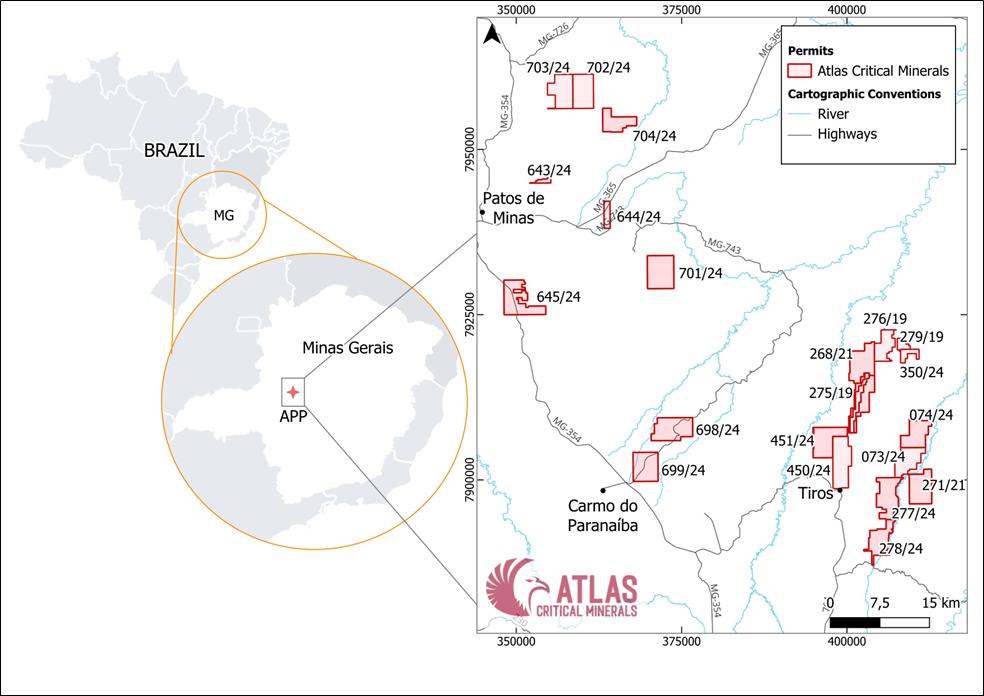
Figure 3-1 shows the location of the Alto Paranaíba Project.
Figure 3-1 Location of the Alto Paranaíba Project
| 3.2 | Mineral Tenure |
The legal framework for the development and use of mineral resources in Brazil was established by the Brazilian Federal Constitution, which was enacted on October 5, 1988 (the Brazilian Constitution) and the Brazilian mining code, which was enacted on January 29, 1940 (Decree-law 1985/40, later modified by Decree-law 227, of February 29, 1967, the Brazilian Mining Code).
According to the Brazilian Constitution, all mineral resources in Brazil are the property of the Federal Government. The Brazilian Constitution also guarantees mining companies the full property of the mineral products that are mined under their respective concessions. Mineral rights come under the jurisdiction of the Federal Government and mining legislation is enacted at the Federal level only. To apply for and acquire mineral rights, a company must be incorporated under Brazilian law, have its management domiciled within Brazil, and its head office and administration in Brazil.
| S-K 1300 Technical Report – Alto Paranaíba REE and Titanium Project – Minas Gerais, Brazil | Page 13 |
In general, there are no restrictions on foreign investment in the Brazilian mining industry, except for mining companies that operate, or hold mineral rights within a 150 km wide strip of land parallel to the Brazilian terrestrial borders. In this instance the equity interests of such companies have to be majority Brazilian-owned. Exploration and mining activities in the border zone are regulated by the Brazilian Mining Code and supporting legislation.
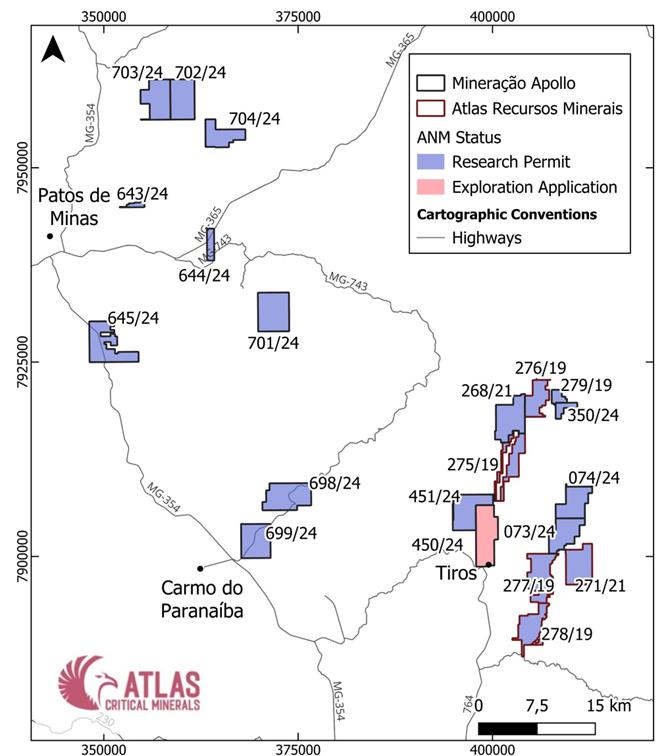
The Alto Paranaíba Project consists of 21 mineral rights, in which 20 are in permit status and 1 is under Agência Nacional de Mineração – Brazilian National Mining Agency (“ANM”) analysis (831,450/2024), covering an area of 27,737.56 Ha. Figure 3-2 shows the location of the project minerals rights in relation to nearby towns of Patos de Minas, Carmo do Paranaíba and Tiros. The tenure holdings are summarized in Table 3-1 and the location is shown in Figure 3-2.
Figure 3-2 Alto Paranaíba Mineral Rights Map with ANM Referred Status
| S-K 1300 Technical Report – Alto Paranaíba REE and Titanium Project – Minas Gerais, Brazil | Page 14 |
Table 3-1 Alto Paranaíba Mineral Rights Description (Relation between Atlas Mineral Rights and ANM Status)
| # | Permit | Area (ha) |
Owner | Status | Block | |||||
| 1 | 832,698/2024 | 1913.86 | Mineracao Apollo Ltda | Research Permit | 1 | |||||
| 2 | 832,699/2024 | 1653.78 | Mineracao Apollo Ltda | Research Permit | 1 | |||||
| 3 | 832,702/2024 | 1612.16 | Mineracao Apollo Ltda | Research Permit | 2 | |||||
| 4 | 832,703/2024 | 1603.72 | Mineracao Apollo Ltda | Research Permit | 2 | |||||
| 5 | 832,704/2024 | 1162.97 | Mineracao Apollo Ltda | Research Permit | 2 | |||||
| 6 | 831,643/2024 | 139.51 | Mineracao Apollo Ltda | Research Permit | 2 South | |||||
| 7 | 831,644/2024 | 376.67 | Mineracao Apollo Ltda | Research Permit | 2 South | |||||
| 8 | 831,645/2024 | 1948.54 | Mineracao Apollo Ltda | Research Permit | 2 South | |||||
| 9 | 832,701/2024 | 1999.55 | Mineracao Apollo Ltda | Research Permit | 2 South | |||||
| 10 | 831,073/2024 | 1368.01 | Mineracao Apollo Ltda | Research Permit | 3 | |||||
| 11 | 831,074/2024 | 1375.93 | Mineracao Apollo Ltda | Research Permit | 3 | |||||
| 12 | 831,268/2021 | 1375.93 | Mineracao Apollo Ltda | Research Permit | 3 | |||||
| 13 | 831,271/2021 | 1609.24 | Atlas Recursos Minerais Ltda. | Research Permit | 3 | |||||
| 14 | 831,275/2019 | 1187.72 | Atlas Recursos Minerais Ltda. | Research Permit | 3 | |||||
| 15 | 831,276/2019 | 1058.38 | Atlas Recursos Minerais Ltda. | Research Permit | 3 | |||||
| 16 | 831,277/2019 | 1747.17 | Atlas Recursos Minerais Ltda. | Research Permit | 3 | |||||
| 17 | 831,278/2019 | 1324.68 | Atlas Recursos Minerais Ltda. | Research Permit | 3 | |||||
| 18 | 831,451/2024 | 1675.27 | Mineracao Apollo Ltda | Research Permit | 3 | |||||
| 19 | 831,279/2019 | 270.7 | Mineracao Apollo Ltda | Research Permit | 3 | |||||
| 20 | 831,350/2024 | 346.43 | Mineracao Apollo Ltda | Research Permit | 3 | |||||
| 21 | 831,450/2024 | 1987.34 | Mineracao Apollo Ltda | Under ANM analysis | 3 |
| 3.3 | Surface Rights |
Under Brazilian law, foreign companies may acquire surface rights as long as the share capital is controlled by Brazilians. However, the holder of an exploration license is guaranteed by law access to conduct exploration field work, provided that adequate compensation is paid to third-party landowners, and that the holder of the exploration license assumes all environmental responsibilities arising from the exploration work.
After the exploration license is granted by the Brazilian government, Atlas negotiates and obtains the necessary authorizations for access to the properties for research and exploration activities, with the exercise of mining activity guaranteed by the Brazilian Federal Constitution.
Atlas is responsible for the reclamation of areas used for drilling, safety of personnel in the work area, monetary compensation to the landowner for surface damage caused by mineral exploration activities, and all environmental liabilities resultant from exploration activities.
| 3.4 | Royalties and Encumbrances |
On December 18, 2024, Atlas Critical Minerals Corporation (“Atlas Critical Minerals”) entered into an Option Agreement (“Option”) with Atlas Lithium Corporation (“Atlas Lithium”), pursuant to which Atlas Critical Minerals purchased an option to acquire 100% of Brazil Minerals Resources Corporation (“BMR”), a subsidiary of Atlas Lithium. BMR owns 100% of Atlas Recursos Minerais Ltda which holds certain mineral rights in Brazil which are of interest to Atlas Critical Minerals. The Option therefore grants Atlas Critical Minerals the opportunity to have ownership of such mineral rights in the future, should it choose to exercise the Option.
| 3.5 | Reliance on Other Experts |
The QP has not reviewed the mineral tenure, nor independently verified the legal status, ownership of the Project area, underlying property agreements or permits. The QP has fully relied upon, and disclaims responsibility for, information supplied to them by Atlas Critical Minerals.
| S-K 1300 Technical Report – Alto Paranaíba REE and Titanium Project – Minas Gerais, Brazil | Page 15 |
| 4 | ACCESSIBILITY, CLIMATE, LOCAL RESOURCES, INFRASTRUCTURE, AND PHYSIOGRAPHY |
| 4.1 | Accessibility |
The Alto Paranaíba Project is located in western Minas Gerais State, about 350 km of Belo Horizonte, with access made through the highways BR-262, BR-354 and BR-352, or BR-040 and BR-365. The Project comprises 21 mineral rights permits, totalizing 27,737.56 ha distributed around the cities of Patos de Minas, Presidente Olegário, Carmo do Paranaíba and Tiros.
The distance between the properties and urban centers, like Patos de Minas and Carmo do Paranaíba cities, vary between 7 to 30 km. The access is through highways and smaller, unpaved roads.
| 4.2 | Climate |
The Tropical Climate of Central Brazil (IBGE 2002) is the regional climate in APP region, exhibiting temperatures higher than 18°C during most of the year, while average yearly precipitation range from 1,000 and 1,500 mm (Reis, 2011), with two well defined annual seasons: a rainy summer (December to February) and dry winter (July to august). Hence, the average monthly precipitation can vary from a few millimeters to more than 200 mm in summer (Siqueira et al. 2007), setting a humid to semi-humid climate.
This climate doesn’t undermine the operation, which can occur all year long.
| 4.3 | Local Resources |
The distance between the properties and urban centers, like Patos de Minas and Carmo do Paranaíba cities, vary between 7 to 30 km. The access is through highways and smaller, unpaved roads.
The project is located near the cities of Patos de Minas (population: 159,235, according to a 2022 census), Carmo do Paranaíba (population: 29,011 according to a 2022 census) and Tiros (population: 6,424 according to a 2020 estimate).
The economic activities are mainly agriculture, services, light industry, and livestock raising.
Analytical and drilling services would be contracted in the metropolitan region of Belo Horizonte. Skilled and semi-skilled labor is available in the region to support exploration activities.
| 4.4 | Infrastructure |
The region hosts well-structured cities with robust capacities for electricity and water supply, all of which are easily accessible.
| 4.5 | Topography, Elevation and Vegetation |
The property is located within the northern sub-basin of the Paranaíba River basin.
The Alto Paranaíba Project region includes three geomorphological domains that comprise the Mata da Corda Group: Plateaus, slopes and hills.
The Plateau domain is represented by extensive plateaus with abrupt edges, elongated in N-S strike, with topography varying between 1,000 and 1,150 m. They are, in general, plane, horizontal surface with gentle slopes (<10°). The topographic heights are frequently covered by a ferruginous duricrust, with thickness of 10 m. These covers are composed of weathered volcanic fragments with additional subrounded and subangulous quartz, cemented by limonite or goethite (Sgarbi,1989).
The second domain is composed of slopes, with hilltop plain to convex, with medium inclination, in which connects plateau with gentle hills that compose the third domain. The slopes topography varies between 900 to 1000 m, with eroded ravines and dissections. Geologically, this geomorphological domain corresponds to Areado Group lithotypes, mostly sandstones (Uhlein et al, 2011).
The third domain occurs in a lower topographic level, between 800 and 900m. Is composed by hills with waved tops, a concave-convex profile and excavated valleys, with Bambui Group rocks (diamictites and siltstones) (Uhlein et al, 2011).
Savannahs are the main type of vegetation, exhibiting Fields and forests (“cerradão”) and gallery forest in the rivers and waterways. In smooth slopes the original vegetation was removed, giving space for mechanical agriculture. In a similar way, the plateaus are covered with extensive coffee, corn and bean plantations (Uhlein et al, 2011 and Fragoso et al, 2011).
| S-K 1300 Technical Report – Alto Paranaíba REE and Titanium Project – Minas Gerais, Brazil | Page 16 |
| 5 | HISTORY |
Since their inception, the mining rights represented by the National Mining Agency (ANM) processes listed below have been owned by companies within the Atlas Economic Group, with no third-party companies prior to Atlas. These areas are available for research applications that give rise to a Research Permit. The processes were filed in 2019 and 2024 by Mineração Apollo Ltda., with some of them transferred to Atlas Lítio Brasil Ltda. in September 2022 and subsequently transferred to Atlas Recursos Minerais Ltda. in January 2025, as part of the Atlas economic group’s corporate and mining asset reorganization. During the research permit period, geological reconnaissance, partial topography, partial geophysic surveys, surface sample collection, geochemistry and auger drilling were carried out to support the preparation of the Partial Research Report (PRR) and the request for an extension of the Research Permit’s validity period.
Table 5-1 History for 831,275/2019 – 831,276/2019 – 831,277/2019 – 831,278/2019
| Relationship Type | CNPJ | Name | Start Date | End Date | ||||
| Holder\Applicant | 55,757,080/0001-16 | Atlas Recursos Minerais Ltda. | Jan. 24, 2025 | |||||
| Holder\Applicant | 17,789,890/0001-65 | Atlas Litio Brasil Ltda. | Sept. 15, 2022 | Jan. 23, 2025 | ||||
| Holder\Applicant | 24,359,727/0001-28 | Mineração Apollo Ltda. | Oct. 15, 2019 | Sept. 14, 2022 |
Table 5-2 History for 831,279/2019
| Relationship Type | CNPJ | Name | Start Date | End Date | ||||
| Holder\Applicant | 24,359,727/0001-28 | Mineração Apollo Ltda. | Oct. 15, 2019 |
Table 5-3 History for 831,073/2024 – 831,074/2024
| Relationship Type | CNPJ | Name | Start Date | End Date | ||||
| Holder\Applicant | 24,359,727/0001-28 | Mineração Apollo Ltda. | June 06, 2024 |
Table 5-4 History for 831,350/2024
| Relationship Type | CNPJ | Name | Start Date | End Date | ||||
| Holder\Applicant | 24,359,727/0001-28 | Mineração Apollo Ltda. | July 15, 2024 |
Table 5-5 History for 831,450 /2024
| Relationship Type | CNPJ | Name | Start Date | End Date | ||||
| Holder\Applicant | 24,359,727/0001-28 | Mineração Apollo Ltda. | July 26, 2024 |
Table 5-6 History for 831,451/2024
| Relationship Type | CNPJ | Name | Start Date | End Date | ||||
| Holder\Applicant | 24,359,727/0001-28 | Mineração Apollo Ltda. | July 28, 2024 |
| S-K 1300 Technical Report – Alto Paranaíba REE and Titanium Project – Minas Gerais, Brazil | Page 17 |
Table 5-7 History for 831,643/2024 – 831,644/2024 – 831,645/2024
| Relationship Type | CNPJ | Name | Start Date | End Date | ||||
| Holder\Applicant | 24,359,727/0001-28 | Mineração Apollo Ltda. | Aug. 12, 2024 |
ANM processes No. 831,271/2021 and 831,268/2021 are Research Requests made on behalf of Mineração Apollo Ltda. resulting from the public auction promoted by the National Mining Agency (ANM) that took place in 2021. Process 831,271/2021 requested by Mineração Apollo Ltda. was later transferred to Atlas Lítio Brasil Ltda. in September 2022 and subsequently transferred to Atlas Recursos Minerais in January 2025, as per the corporate and mining assets reorganization of the Atlas economic group.
Table 5-8 History for 831,271/2021
| Relationship Type | CNPJ | Name | Start Date | End Date | ||||
| Holder\Applicant | 55,757,080/0001-16 | Atlas Recursos Minerais Ltda. | Jan. 24, 2025 | |||||
| Holder\Applicant | 17,789,890/0001-65 | Atlas Litio Brasil Ltda. | Sept. 15, 2022 | Jan. 23, 2025 | ||||
| Holder\Applicant | 24,359,727/0001-28 | Mineração Apollo Ltda. | June 17, 2021 | Sept. 14, 2022 |
Table 5-9 History for 831,268/2021
| Relationship Type | CNPJ | Name | Start Date | End Date | ||||
| Holder\Applicant | 24,359,727/0001-28 | Mineração Apollo Ltda. | June 17, 2021 |
ANM processes no. 832,698/2024, 832,699/2024, 832,701/2024, 832,702/2024, 832,703/2024 and 832,703/2024 are Research Requests made on behalf of Mineração Apollo Ltda. resulting from the purchase in a public auction promoted by the National Mining Agency (ANM) that took place in 2024.
Table 5-10 History for 832,698/2024 – 832,699/2024 – 832,701/2024 – 832,702/2024 – 832,703/2024 – 832,704/2024
| Relationship Type | CNPJ | Name | Start Date | End Date | ||||
| Holder\Applicant | 24,359,727/0001-28 | Mineração Apollo Ltda. | Dec., 11, 2024 |
| 5.1 | Historical Technical Reports |
There are no historical technical reports for the project.
| 5.2 | Historical Resource Estimates |
There are no historical estimates for the project.
| 5.3 | Past Production |
There is no evidence of historical artisanal mining on the property.
| S-K 1300 Technical Report – Alto Paranaíba REE and Titanium Project – Minas Gerais, Brazil | Page 18 |
| 6 | GEOLOGICAL SETTING, MINERALIZATION, AND DEPOSIT |
| 6.1 | Regional Geology |
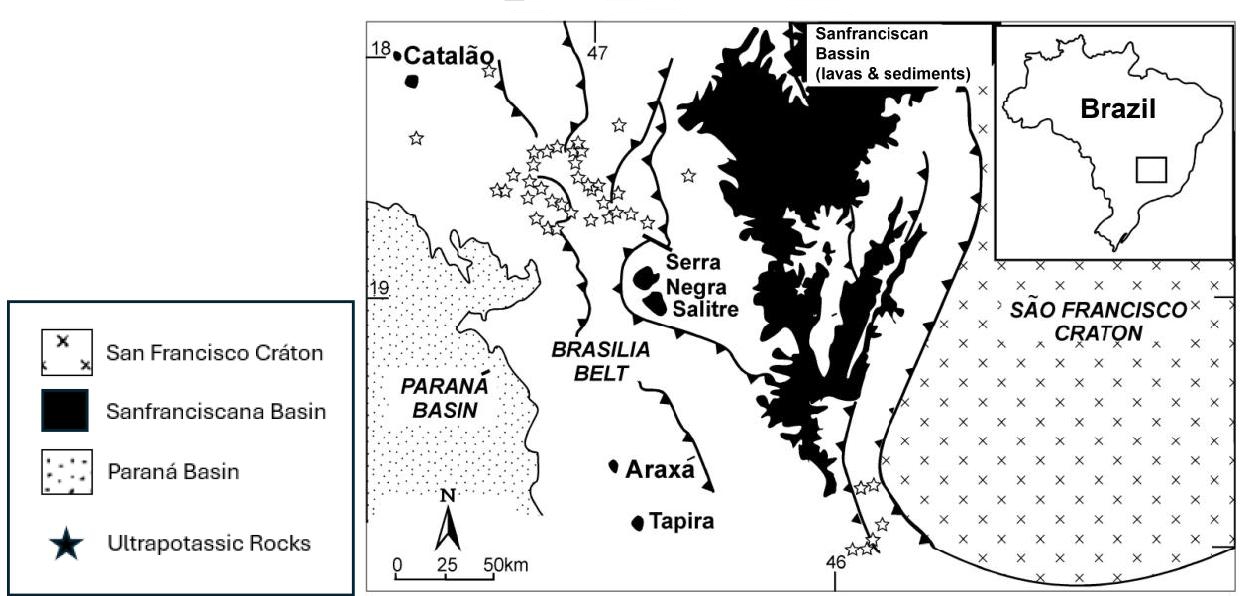
The Alto Paranaíba Project location in the Southwest margin of São Francisco Craton exhibit a Cretaceous volcano-sedimentary sequence called Mata da Corda Group. This is the geological sequence of interest and correspond to the top of the Sanfranciscana Basin in the region. The Mata da Corda overlies Cretaceous sandstones of the Areado Group and, sometimes, Neoproterozoic siliciclastic-carbonate rocks of the Bambuí Group (Campos and Dardenne, 1997; Brod et al., 2000) (Figure 6-1).
The volcano sedimentary sequence, up to 150 meters thick, are composed by and association of kamafugite lavas and volcanoclastic sedimentary rocks, which builds up a plateau, with 2200 km² of regional extension (Takehara, 2015).
The Mata da Corda group is subdivided into Patos Formation, which consists of volcanic rocks with a kamafugite, kimberlite and lamproite affinity (alkaline-ultramafic magmatism – with high P and K), and the Capacete Formation, which contains conglomerates and sandstones, derived from the erosion of the Patos Formation (Campos and Dardenne, 1997).
The magma source is associated with plutonic bodies of Alto Paranaíba Igneous Province, which englobe significant occurrences of alkaline -carbonatitic complex, such as Araxá (Figure 6-2) (Brod et al., 2000; Ruiz et al., 2023).
Figure 6-1 Geological Features of the Project’s Unit of Interest, in black named after “Sanfranciscan Basin”
Source: Brod et al., 2000.
| S-K 1300 Technical Report – Alto Paranaíba REE and Titanium Project – Minas Gerais, Brazil | Page 19 |
Figure 6-2 Region of Interest Geological Map (occurrences in green) correlating to Alcaline-Carbonatitic Complexes of Alto Paranaíba Igneous Province (Araxá, Salitre, Serra Negra and Catalão) (left) and Statigraphic Sequence of Sanfranciscana Basin, with Mata da Corda Group in the red rectangle, on top (right)
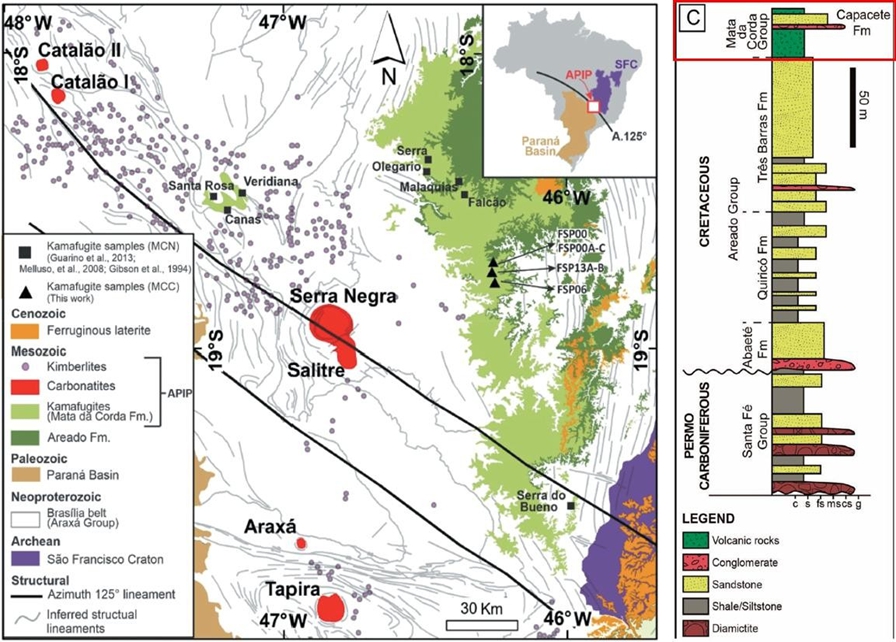
Left: Region of interest geological map (occurrences in green) correlating to alkaline-carbonatitic complexes of Alto Paranaíba Igneous Province (Araxá, Salitre, Serra Negra and Catalão). Source: Ruiz et al., 2023.
Right: Stratigraphic sequence of Sanfranciscana Basin, with Mata da Corda Group in the red rectangle, on top. Source: Serdoko et al. 2020.
| 6.2 | Local and Property Geology |
The Alto Paranaíba Project mining rights include rocks from the Bambuí Group at base level, superimposed by the Areado Group, which underlies the rocks from the Mata da Corda Group, and detritic-lateritic covers (Recent Covers). In most permits, the Areado Group form the basement of Mata da Corda Group, except for some permits in Block 2 South, whereas the basement corresponds to rocks of the Bambuí Group.
The Bambuí Group in the areas is composed by siltstones of the Lagoa Formosa Formation. The Areado Group, considered here as undivided, is represented by sandstones, siltstones and conglomerates.
Mata da Corda has a tabular and flat geometry, with its base occurring at elevations around 940 meters RL, and a thickness ranging from 80 to 110 meters, with extensive lateral continuity. The Patos and Capacete formations occur in the APP areas, sometimes presenting interdigitated contact. Patos Fm. is formed by volcanic rocks (kamafugites) with a variety of textures: aphanitic, porphyritic (with brownish crystals), with amygdales, and sometimes brecciated. Most of the time the volcanic rocks appear highly weathered. The Capacete formation displays clast or matrix supported conglomerates, monomictic or polymictic, and sandstones locally.
The recent cover features ferruginous lateritic crusts, lateritic clays, and residual soils, in this case associated with the rocks of Mata da Corda. It is on average 20 meters thick.
| 6.3 | Deposit Type |
There are three 3 possible types of REE deposits, as are described in “Avaliação do Potêncial de Terras Raras no Brasil”, by Brazil Geological Service. The exact type is not known at the time of writing this report.
| i. | Igneous rocks deposits, in REE enriched minerals, like bastnaesite (Ce, La, and Y fluor- carbonate), monazite (Ce, La, Th and Nd phosphate) and xenotime (Y phosphate), in rocks with coarse grains, like pegmatites. | |
| ii. | Sedimentary deposits, like placers and paleoplacers, with sedimentary deposition of mineral grains, with igneous or metamorphic sources, like monazite, with examples in Bahia and Espirito Santo coastal deposits. | |
| iii. | Ionic clays, with Poços de Caldas example, resulted by supergenic enrichment of igneous rocks. |
| S-K 1300 Technical Report – Alto Paranaíba REE and Titanium Project – Minas Gerais, Brazil | Page 20 |
| 7 | EXPLORATION |
The Atlas Critical Minerals geology team executed the following activities in 2024 and 2025, in order of execution and for each area:
| ● | Public data compilation: GIS containing lithology types, geophysics, mapping public data and competitor information to obtain Mata da Corda Group occurrence. Including DEM obtained from Alos Palsar for topography. | |
| ● | Geological fast-track mapping aiming the main occurrences and lithological units. | |
| ● | Surface sampling. Some permits have been previously sampled by other geologist consultant, before Atlas Critical Minerals Team 1st pass. | |
| ● | Semi-detailed Mapping: Geological semi-detailed mapping with all outcrops that are representative of the unit of interest. Topographic features such as thickness, baselevel and horizontal continuity are all taken on observation. Facies identification and distribution and more sampling. | |
| ● | LiDAR: drone flights for high resolution topography (50 cm). | |
| ● | Geophysics: airborne magnetic survey and terrestrial Gamma spectrometry | |
| ● | Auger Drilling (AD): was carried out with Atlas Critical Minerals equipment, able to drill up to 20 m deep, useful for exploratory drillhole and sampling gathering. |
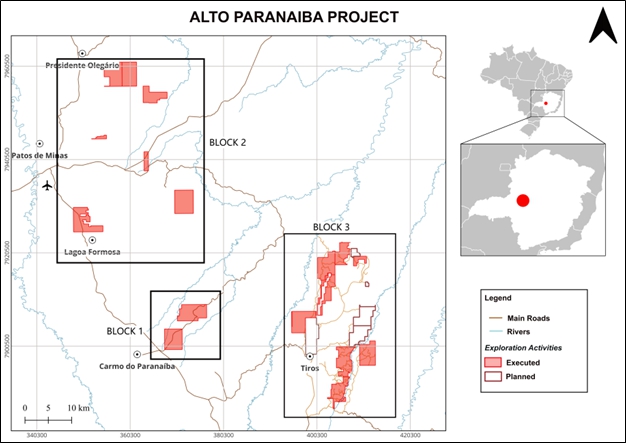
Table 7-1 presents the activities control in each of the permits. The extensive Project area has been divided into three exploration blocks for ease of exploration activities as shown in Figure 7-1.
Table 7-1 Alto Paranaíba Permit Relation per Activity
| Permit | Block | 1st Pass | Mapping | Sampling | Auger Drilling | Patos Fm. | Capacete Fm. | |||||||
| 832,698/2024 | 1 | X | X | X | X | X | ||||||||
| 832,699/2024 | 1 | X | X | X | X | X | X | |||||||
| 832,702/2024 | 2 | X | X | X | X | X | ||||||||
| 832,703/2024 | 2 | X | X | X | X | X | X | |||||||
| 832,704/2024 | 2 | X | X | X | X | X | ||||||||
| 831,643/2024 | 2 South | X | X | X | X | X | ||||||||
| 831,644/2024 | 2 South | X | X | X | X | X | ||||||||
| 831,645/2024 | 2 South | X | IP | X | X | X | X | |||||||
| 832,701/2024 | 2 South | X | X | X | X | X | ||||||||
| 831,073/2024 | 3 | |||||||||||||
| 831,074/2024 | 3 | |||||||||||||
| 831,268/2021 | 3 | X | X | X | ||||||||||
| 831,271/2021 | 3 | X | X | |||||||||||
| 831,275/2019 | 3 | X | X | X | ||||||||||
| 831,276/2019 | 3 | X | X | |||||||||||
| 831,277/2019 | 3 | X | X | X | X | X | ||||||||
| 831,278/2019 | 3 | X | X | X | X | X | X | |||||||
| 831,279/2019 | 3 | X | ||||||||||||
| 831,350/2024 | 3 | X | X | |||||||||||
| 831,450/2024 | 3 | X | X | X | ||||||||||
| 831,451/2024 | 3 | X | X |
| S-K 1300 Technical Report – Alto Paranaíba REE and Titanium Project – Minas Gerais, Brazil | Page 21 |
Figure 7-1 Alto Paranaíba Exploration Blocks
| 7.1 | Mata da Corda Geophysics |
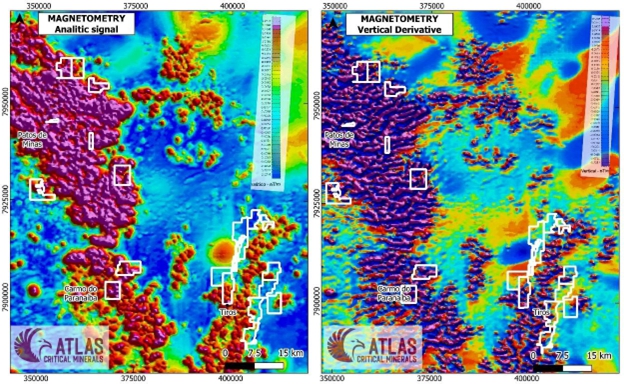
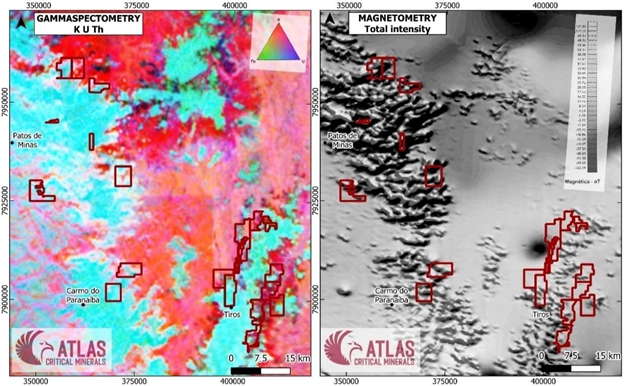
The preparation for the fieldwork included geophysical analysis of regional geophysics (Figure 7-2 and Figure 7-3), along with the investigation about geology in competitors areas and the subsequent confirmation of geological occurrences on the field is useful as guide for delimitation of geological bodies. Some drilling is recommended to test these targets for mineralization.
| S-K 1300 Technical Report – Alto Paranaíba REE and Titanium Project – Minas Gerais, Brazil | Page 22 |
Figure 7-2 Magnetometry: Analytic Signal (left) and Vertical Derivative (right)
Data source: CPRM Geophysics Public Data
Figure 7-3 Gamma Spectrometry K U Th (left) and Total Mag (right)
Data source: CPRM Geophysics Public Data
| S-K 1300 Technical Report – Alto Paranaíba REE and Titanium Project – Minas Gerais, Brazil | Page 23 |
| 7.2 | Surface Sampling |
For exploration purposes, Atlas Critical Minerals 21 mineral rights have been divided into three blocks: (i) Block 1 – Carmo do Paranaíba; (ii) Block 2 – Patos de Minas; and (iii) Block 3 (Figure 7-1).
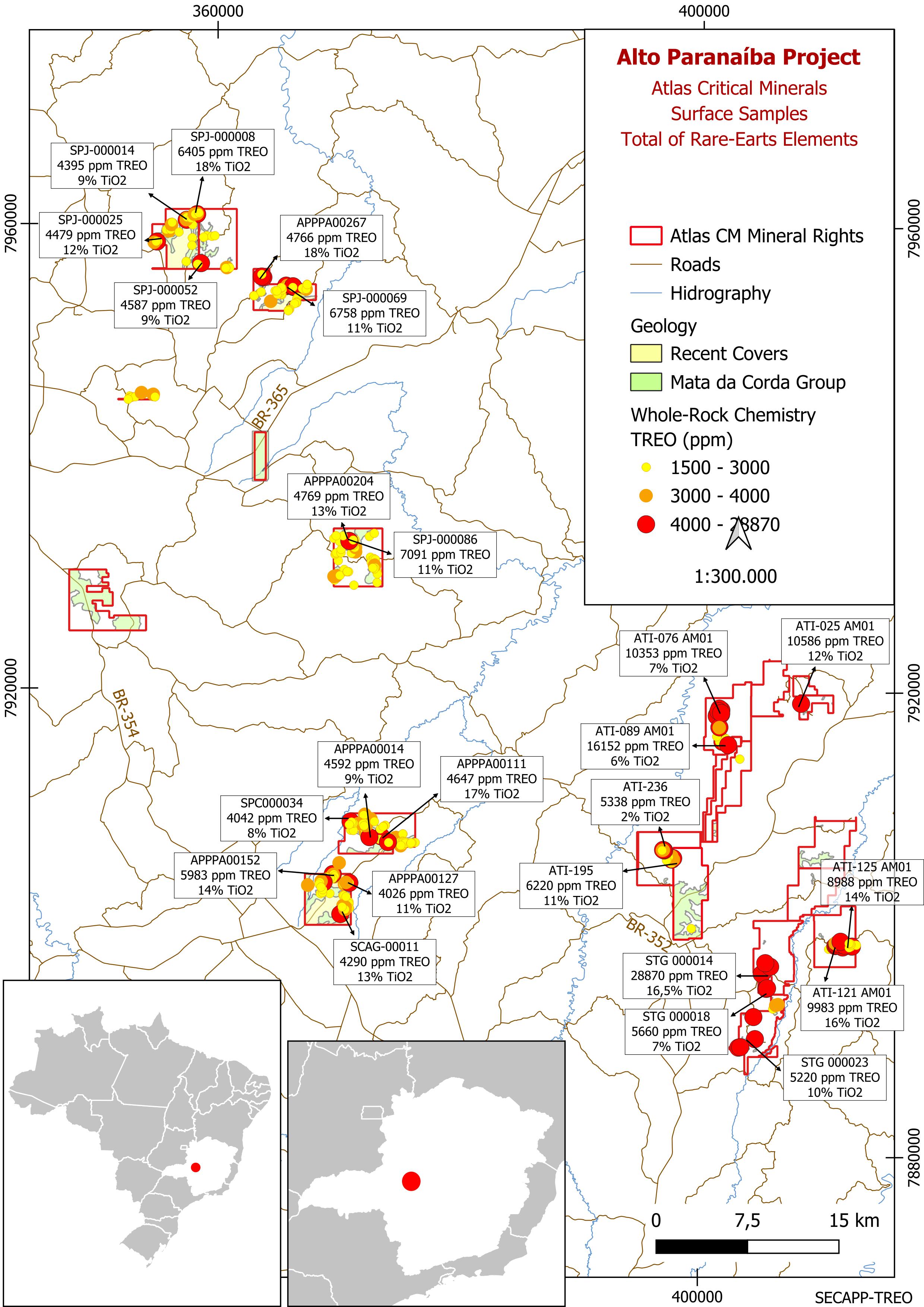
The Author used the database delivered by the client to estimate the followings statistics. High graded Total Rare Earths Oxides (“TREO”) and titanium dioxide (“TiO2”) samples resulted from an extensive sampling campaign (Figure 7-4), with so far 809 samples of soil, conglomerate, volcanic rocks, sandstones, mudstones and lateritic cover. Of the 809 samples analyzed, 608 samples are >1,000 ppm of TREO, in which 121 samples are >3,000 ppm TREO and 114 samples are >700 ppm Magnetic Rare Earths Oxides (“MREO”). Of all samples, 205 samples resulted in >10% of TiO2 and 27 samples >15% TiO2.
The best results obtained were from Block 3 (TREO>10,000 ppm, for example). The best sample for Block 1 resulted in 5,984 ppm TREO (sample APPPA00152), and for Block 2 up to 7,091 ppm TREO (SPJ-00086). The Blocks 1 and 2 present similar results when comparing the grades average, for TREO, TiO2 and MREO, but Block 1 still presents slightly higher averages (Table 7-2). The data in Table 7-2 have been compiled by the Author from the database delivered by the client.
Table 7-2 Average of Grades for Block 1 and 2
| Block 1 - Surface | Block 2 - Surface | |||
| Average TREO (ppm) | 1,928 | 1,703 | ||
| Average TiO2 (%) | 8.7 | 7.7 | ||
| Average MREO (ppm) | 451 | 402 |
Samples from Blocks 1 and 2 are in a fair spatial distribution along the Mata da Corda Group occurrence inside the permits, indicating good horizontal continuity of the mineralization. The samples reflect in the availability of outcrops, with most of their occurrences in slope regions and roads, and little exposure and low grades on top of the plateaus.
Block 2 South grades go up to 7091 ppm of TREO in a conglomerate sample of Capacete Formation, indicating a high-grade layer about 1030 to 1040 meters. Grades about >3000 ppm from samples in base level indicate Mata da Corda’s mineralized interval up to 190 m thick.
| S-K 1300 Technical Report – Alto Paranaíba REE and Titanium Project – Minas Gerais, Brazil | Page 24 |
Figure 7-4 Best Sampling Grades (>1500ppm TREO) of Surface Samples
| S-K 1300 Technical Report – Alto Paranaíba REE and Titanium Project – Minas Gerais, Brazil | Page 25 |
| 7.3 | Block 1 |
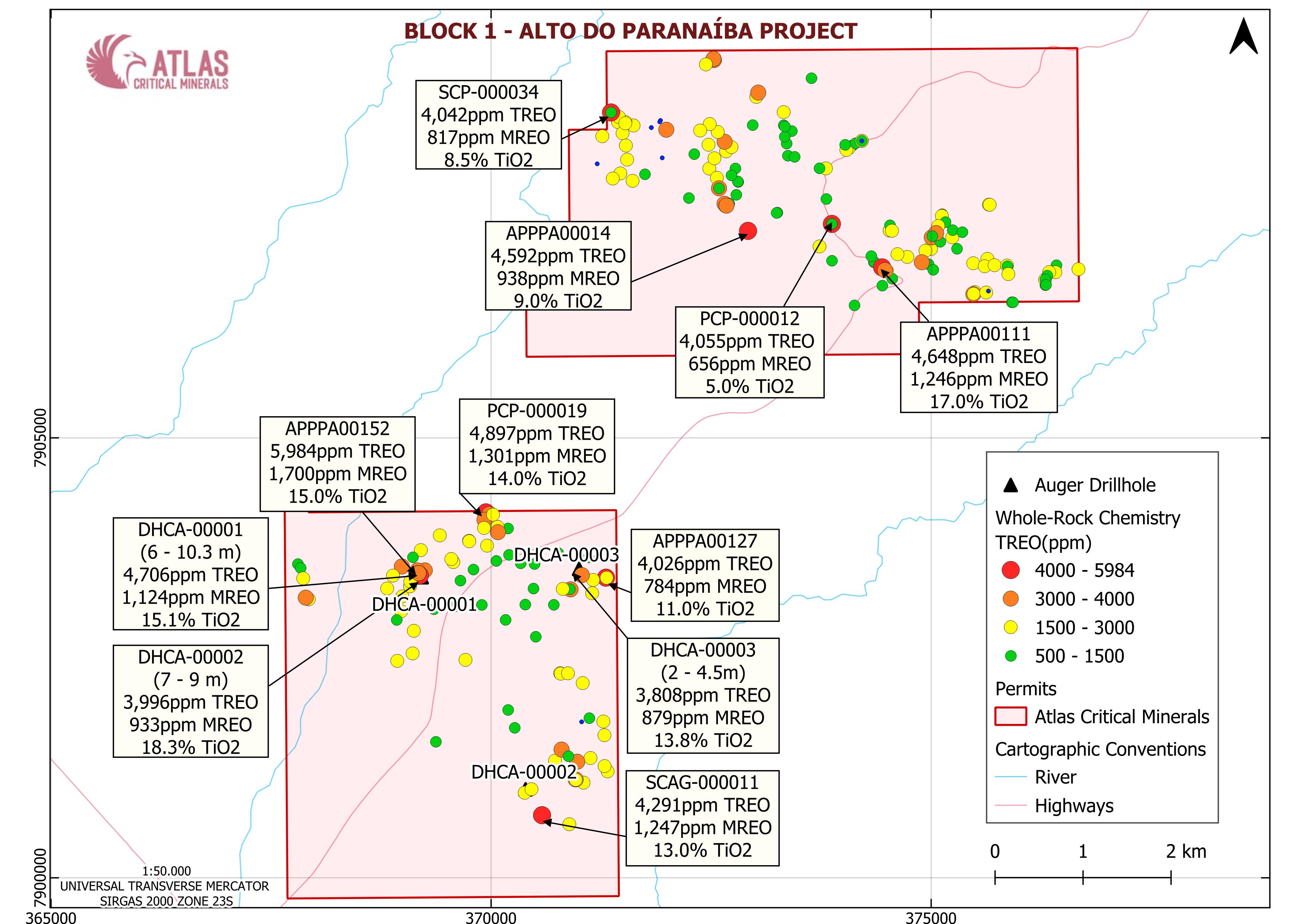
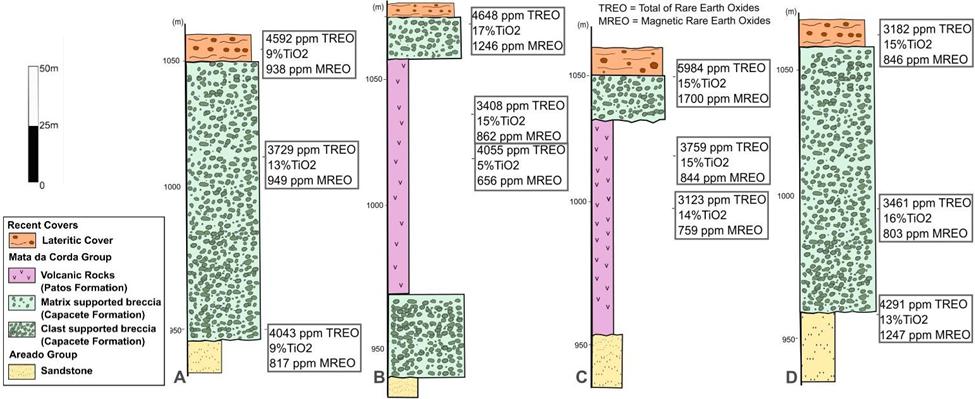
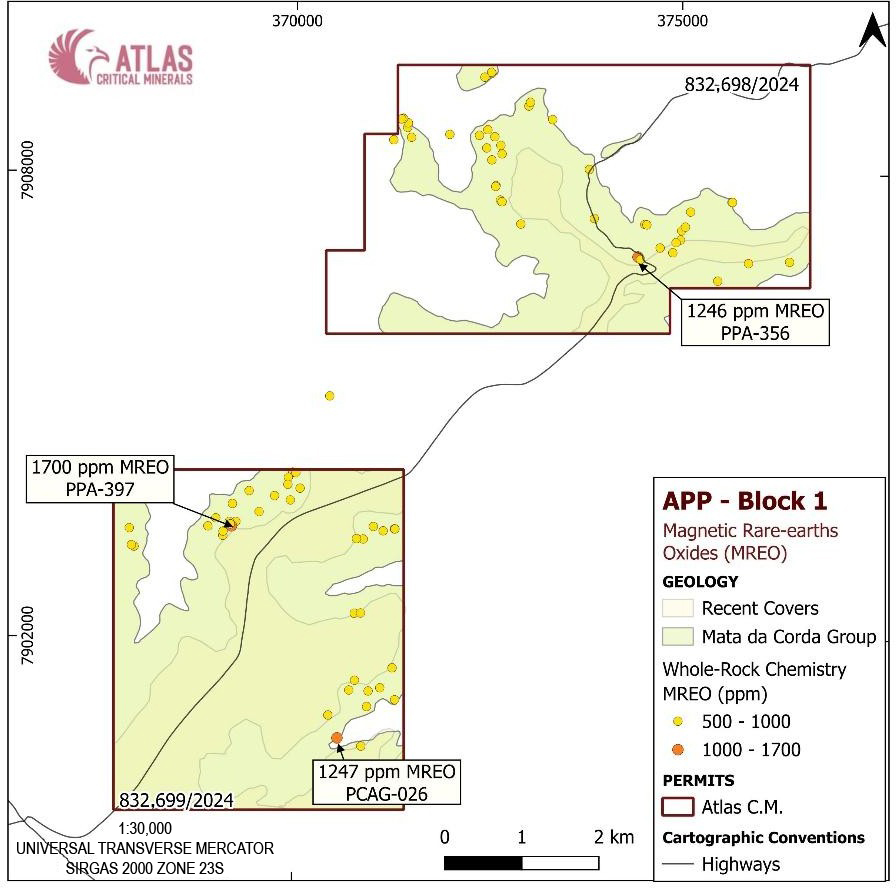
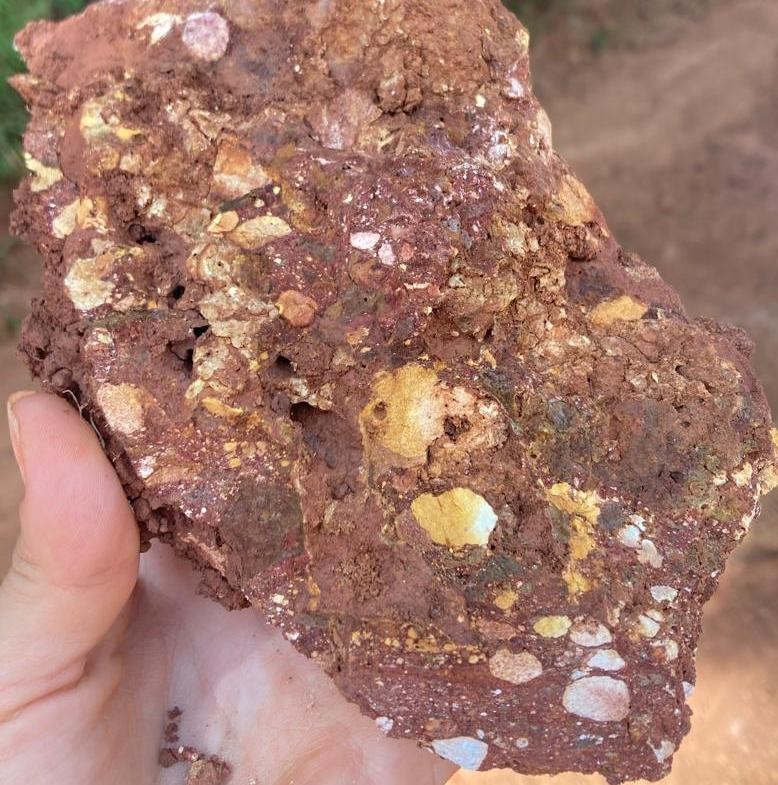
The Block 1 areas (832,698/2024 and 832,690/2024) have wide and thick (~110 metres) occurrence of Mata da Corda Group (Figure 7-5 and Figure 7-6). The Mata da Corda Group outcrops at the base level of 945 meters until 1050 meters, with a lateritic cover that overlies all Formation from base level 1050 m to 1100 m (Stratigraphic column 1). The volcanic rocks are magnetic, with aphanitic texture, locally with vesicles. Volcanic breccia occurs associated. The Capacete conglomerate is strongly magnetic, polymictic and varies from matrix to clast supported. The matrix is composed of mud and sometimes sand, colored from red to green. (Figure 7-7).
Figure 7-5 Geology of Block 1, with Stratigraphic Columns and Best TREO Grades (>1500 ppm)
| S-K 1300 Technical Report – Alto Paranaíba REE and Titanium Project – Minas Gerais, Brazil | Page 26 |
Figure 7-6 Stratigraphic Columns 1 – Block 1, with Evidence of Thick Layers of Conglomerate of Capacete Formation and Patos Formation
| S-K 1300 Technical Report – Alto Paranaíba REE and Titanium Project – Minas Gerais, Brazil | Page 27 |
Figure 7-7 Stratigraphic Columns and Geological Map with Best MREO Grades for Block 1 (>500 ppm MREO)
| S-K 1300 Technical Report – Alto Paranaíba REE and Titanium Project – Minas Gerais, Brazil | Page 28 |
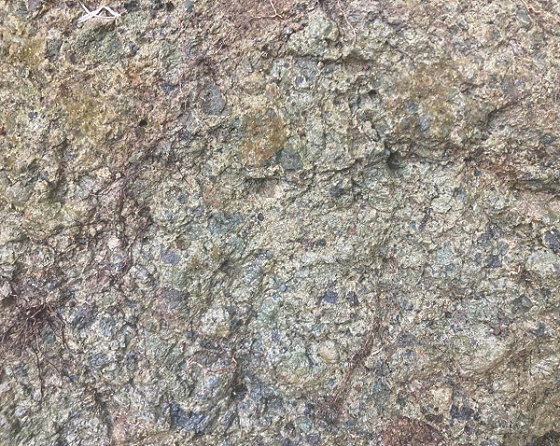
Figure 7-8 Conglomerates of Capacete Formation in Block 1, Matrix Supported (top) and Clast Supported (bottom)
| S-K 1300 Technical Report – Alto Paranaíba REE and Titanium Project – Minas Gerais, Brazil | Page 29 |
| 7.4 | Block 2 |
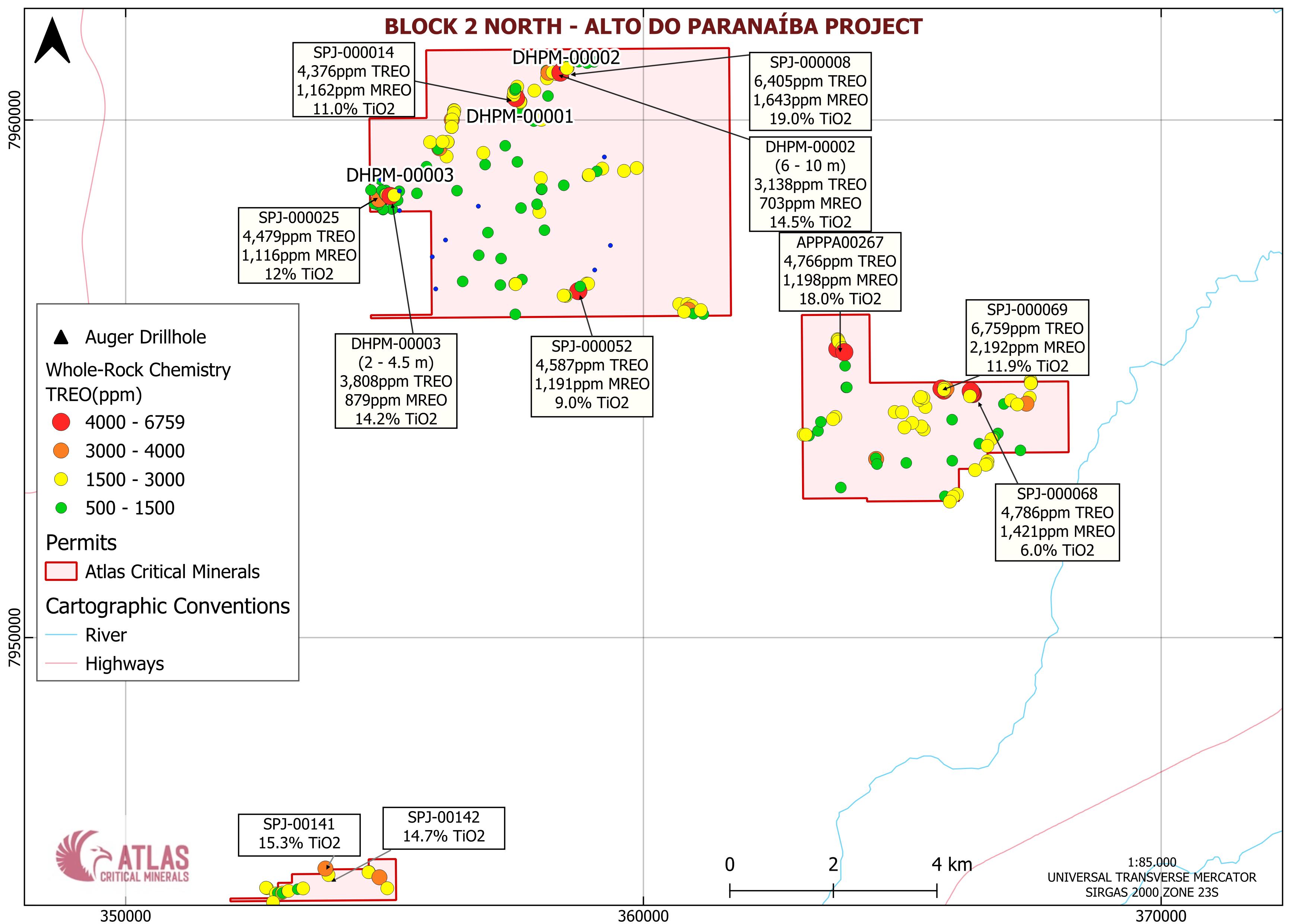
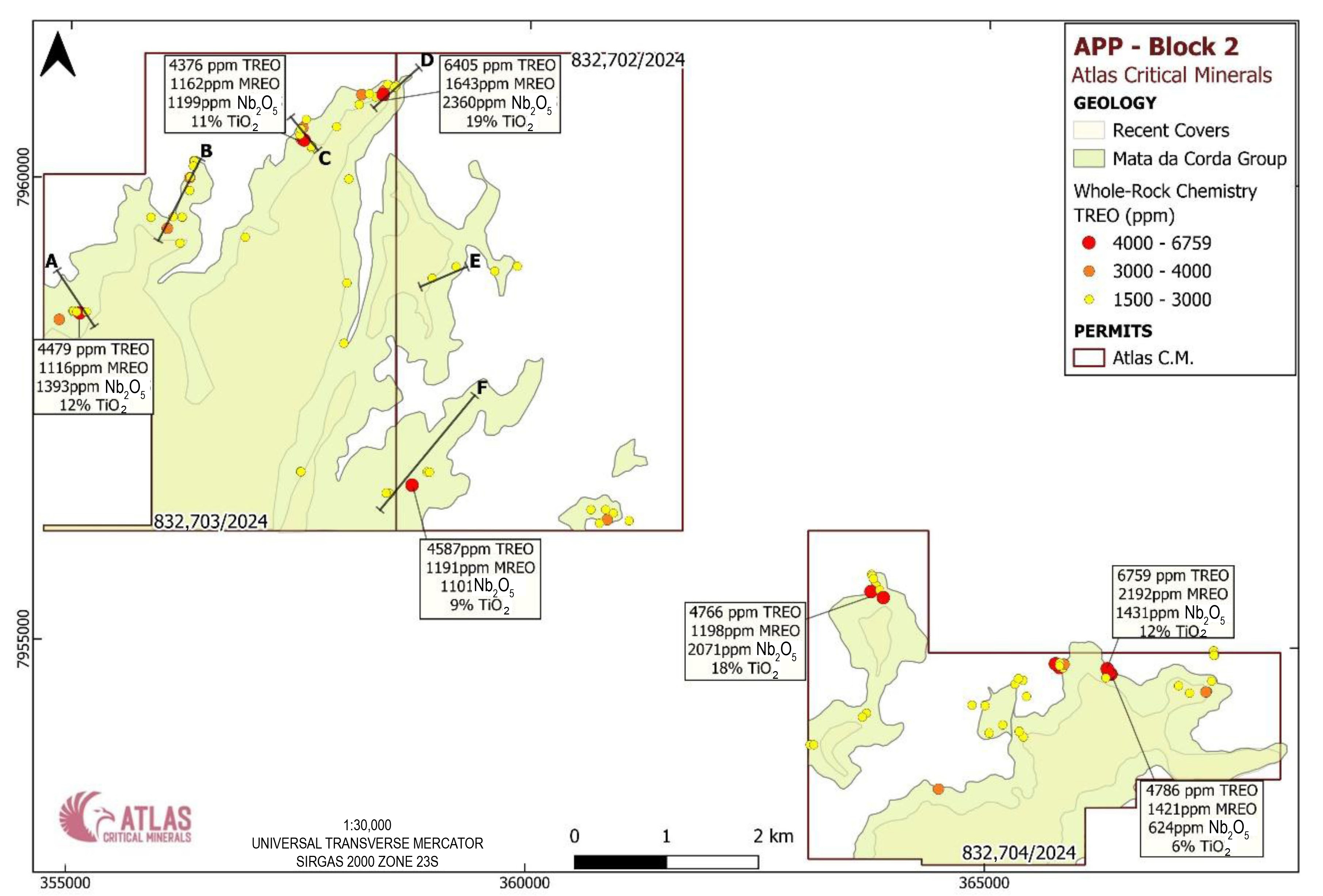
In Block 2 permits the Mata da Corda Group outcrops in wide extension of the area (Figure 7-9) and with thickness up to 80 metres, outcropping from 940 until 1020 meters RL, with Capacete Fm. Conglomerate layers up to 25 meters thick and volcanic layers of Patos Fm. (Stratigraphic columns 2). The lateritic cover (soil/clay + ferric crust) in Block 2 is up to 50 metres. The conglomerate can locally display clasts imbrication, granulometric gradation and clasts with preserved igneous textures (exe.: porphyritic).
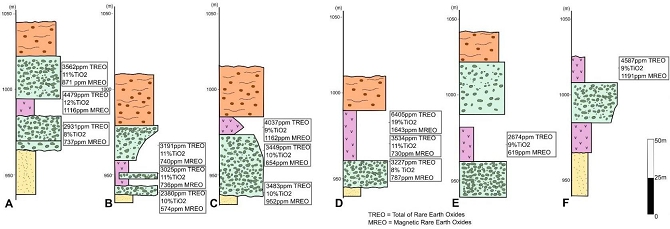
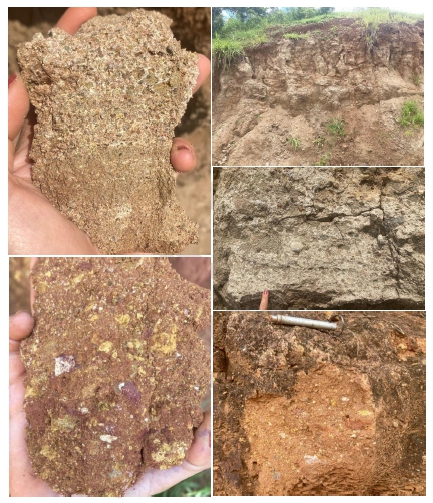
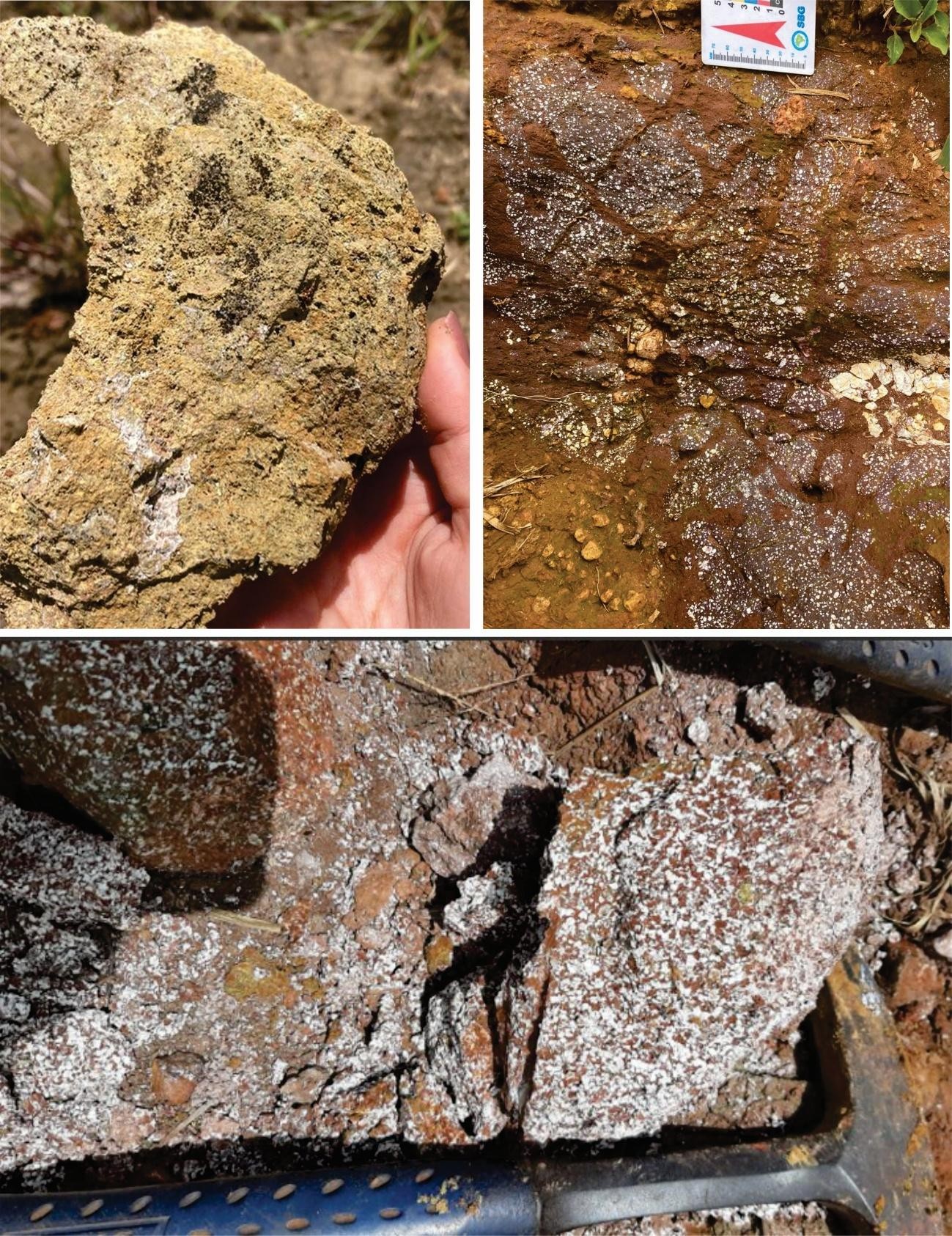
Patos Fm. display a variety of textures: aphanitic, porphyritic (with brownish crystals) and with vesicles filled by white clays, and sometimes brecciated. Most of the time the volcanic rocks appear highly weathered, becoming a clayish material. The magnetic response is moderate for the volcanic rocks, as for the conglomerates, its strong magnetism helps to distinguish the sedimentary products. The conglomerates are clast supported, monomictic to polymictic, with matrix composed of greenish clay to beige. The clasts are mainly composed of green volcanic rocks and few brownish and red minerals (Figure 7-10).
The sampling campaign proved high grades of TREO and TiO2 widely distributed laterally and vertically along the Mata da Corda Group. The MREO results are also very promising.
Figure 7-9 Geology of Block 2, with Stratigraphic Columns and Best TREO Grades (>1500 ppm)
| S-K 1300 Technical Report – Alto Paranaíba REE and Titanium Project – Minas Gerais, Brazil | Page 30 |
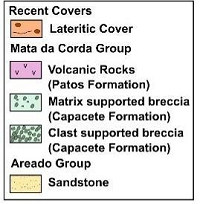
Figure 7-10 Stratigraphic Columns 2 – Block 2, with Evidence of Interdigitated Conglomerate of Capacete Formation and Volcanic Rocks of Patos Formation
| S-K 1300 Technical Report – Alto Paranaíba REE and Titanium Project – Minas Gerais, Brazil | Page 31 |
Figure 7-11 Geology and Best MREO Grades for Block 2 (>500 ppm MREO)
| S-K 1300 Technical Report – Alto Paranaíba REE and Titanium Project – Minas Gerais, Brazil | Page 32 |
Figure 7-12 Conglomerates of Capacete Formation in Block 2, Clast-Supported and Matrix Supported
| S-K 1300 Technical Report – Alto Paranaíba REE and Titanium Project – Minas Gerais, Brazil | Page 33 |
Figure 7-13 Volcanic Rocks with Afanitic Texture and Green to Purple Matrix with Vesicles Filled with White Clays. Probably of Kamafugitic Signature
| S-K 1300 Technical Report – Alto Paranaíba REE and Titanium Project – Minas Gerais, Brazil | Page 34 |
| 7.5 | Block 2 South |
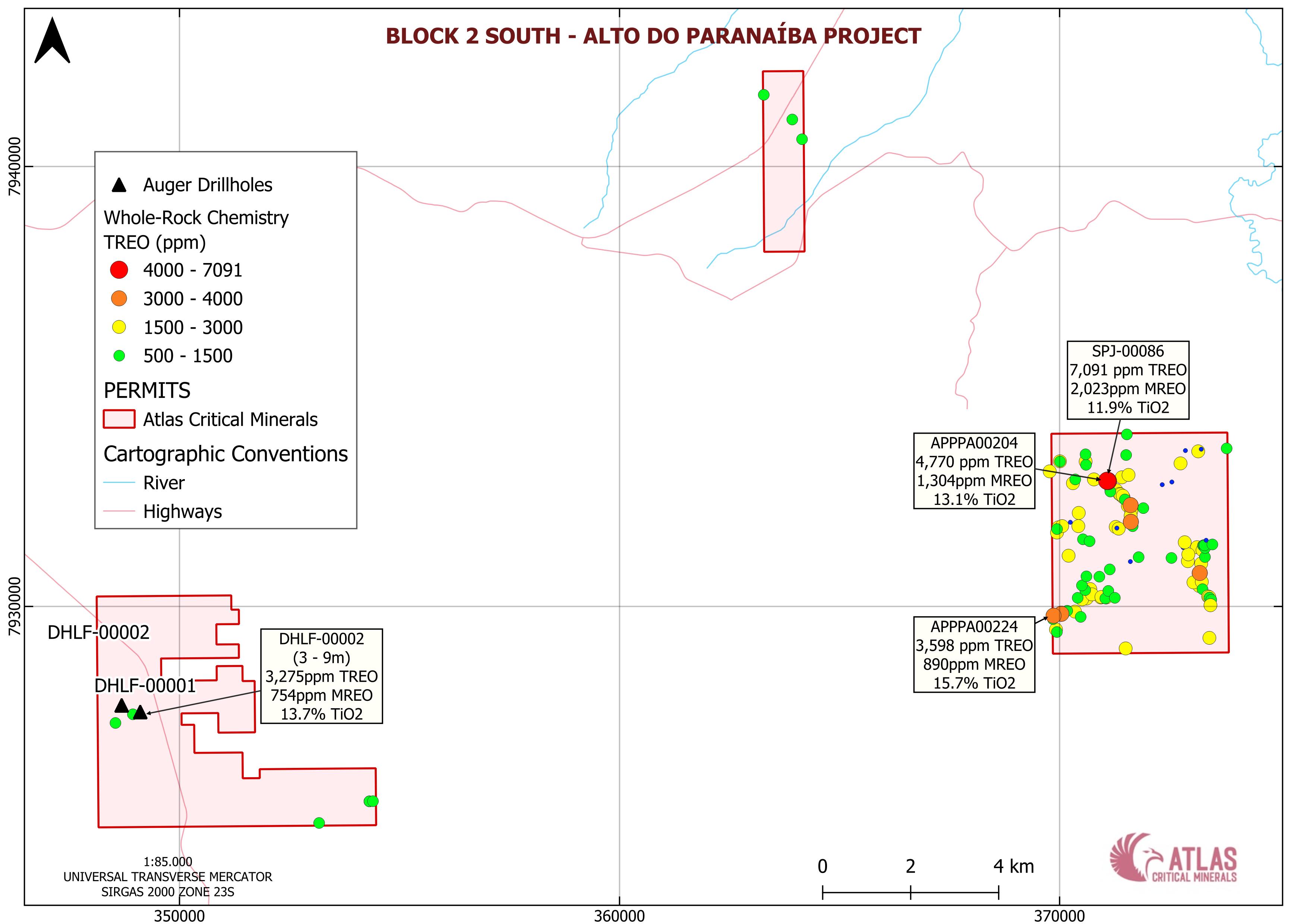
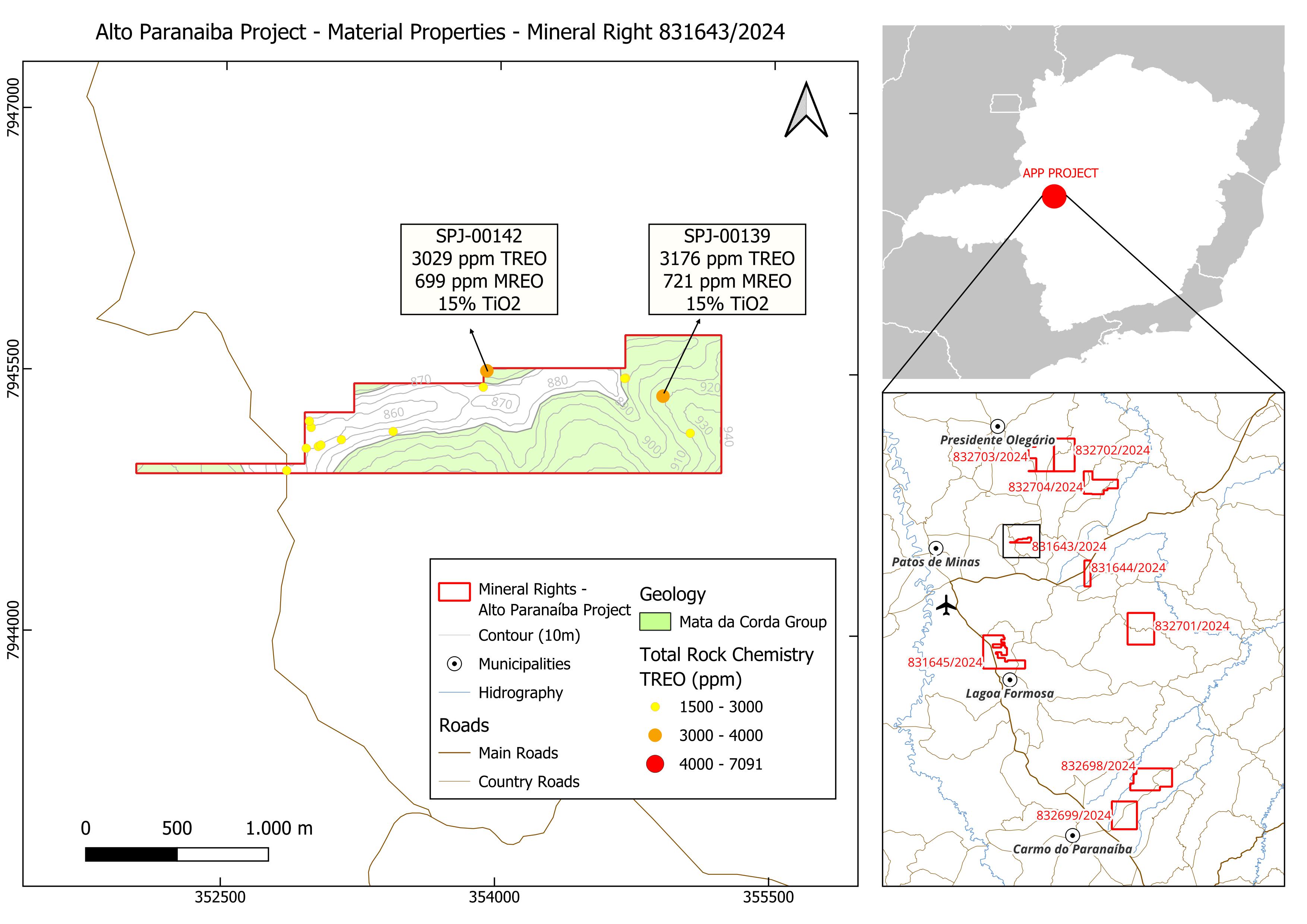
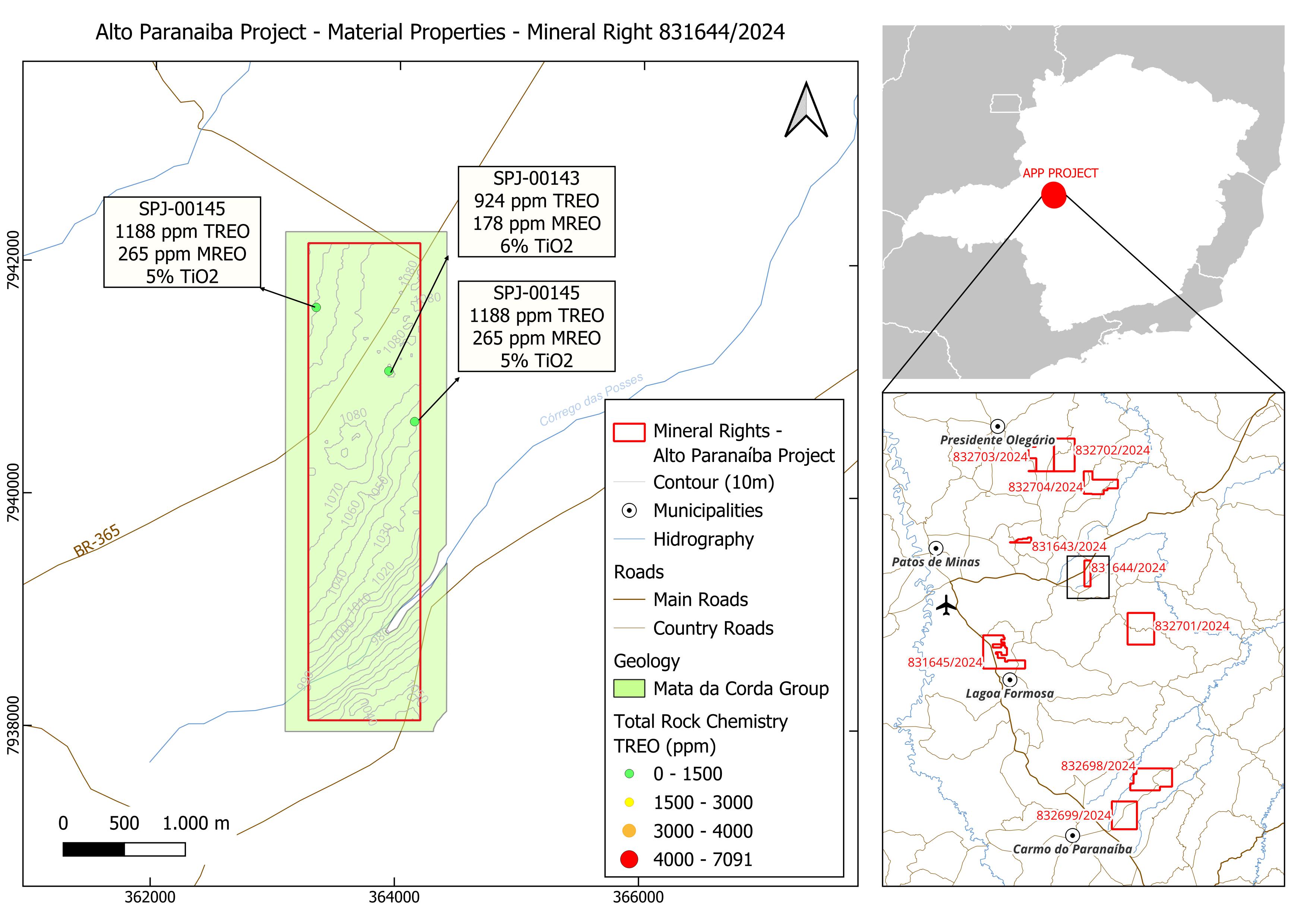
Block 2 south includes areas with good exposure of Mata da Corda Group, both conglomerates of Capacete Formation and volcanic rocks of Patos Formation. The detailed mapping allowed to confirm and expand the Mata da Corda volumes in the area, due to the decrease of the baselevel to 900 meters, turning the thickness of Mata da Corda Group in the areas bigger than previously though from regional baselevel. Two areas (Permits 831644/2024 and 831643/2024) are all covered by Mata da Corda Group, with respectively 376,7 and 139,51 ha.
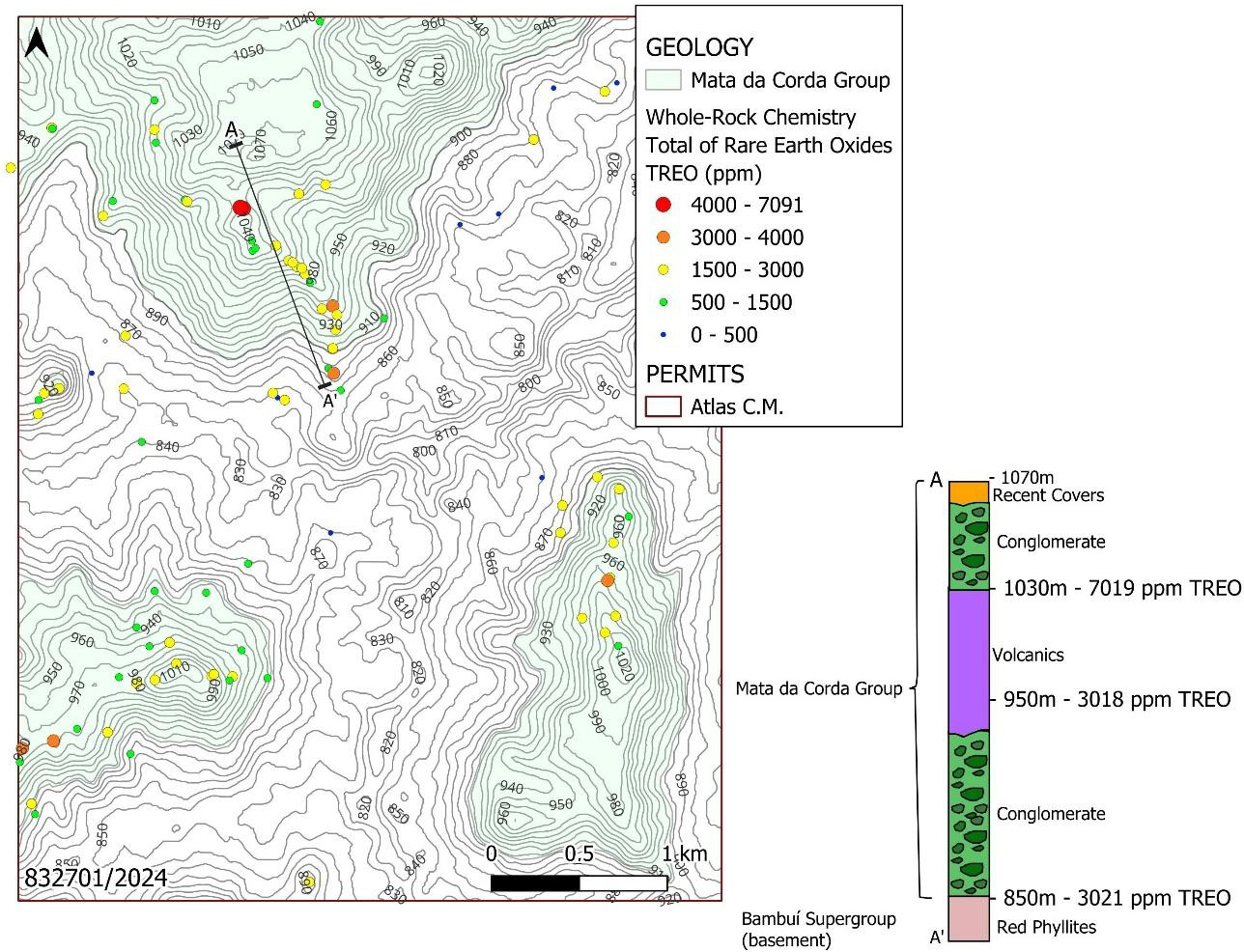
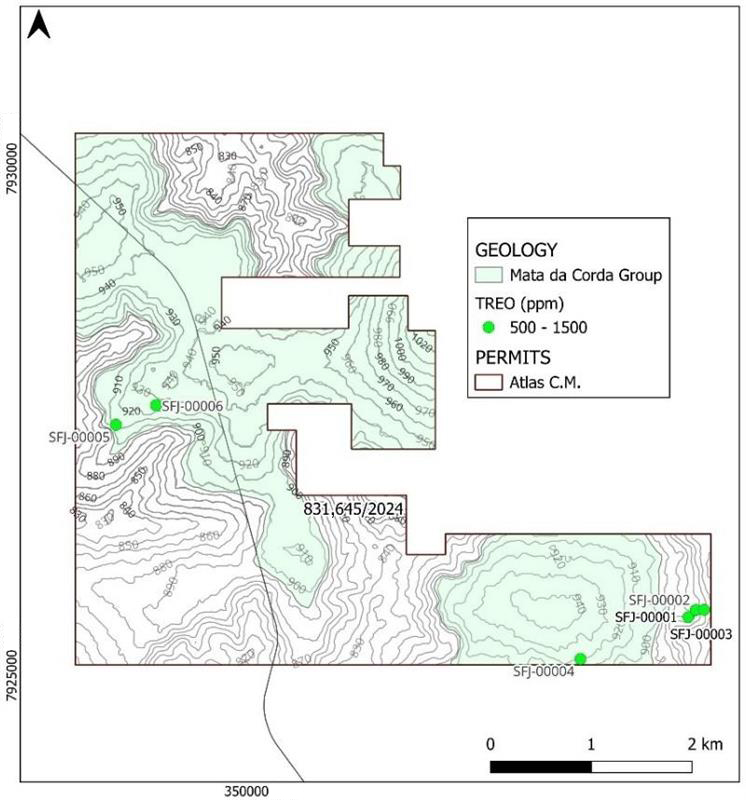
Figure 7-14 presents the geology and TREO grades for Block 2 South Areas, Figure 7-15 presents the geology, TREO results and stratigraphic column of Pindaíbas permit (832,701/2024), right next to Equinox project permit, and Figure 7-16 presents the geology, TREO Results for Lagoa Formosa Permit (831,645/2024).
Figure 7-17 and Figure 7-18 show the permits 831,643/2024 and 831,643/2024. No sampling results were available at the effective date of the current Report.
Figure 7-14 Geology and TREO Grades for Block 2 South Areas
| S-K 1300 Technical Report – Alto Paranaíba REE and Titanium Project – Minas Gerais, Brazil | Page 35 |
Figure 7-15 Geology, TREO Results and Stratigraphic Column of Pindaíbas Permit (832,701/2024), Right Next to Equinox Project Permit
| S-K 1300 Technical Report – Alto Paranaíba REE and Titanium Project – Minas Gerais, Brazil | Page 36 |
Figure 7-16 Geology, TREO Results for Lagoa Formosa Permit (831,645/2024)
| S-K 1300 Technical Report – Alto Paranaíba REE and Titanium Project – Minas Gerais, Brazil | Page 37 |
Figure 7-17 Geology of Permit 831,643/2024
| S-K 1300 Technical Report – Alto Paranaíba REE and Titanium Project – Minas Gerais, Brazil | Page 38 |
Figure 7-18 Geology of Permit 831,644/2024
| S-K 1300 Technical Report – Alto Paranaíba REE and Titanium Project – Minas Gerais, Brazil | Page 39 |
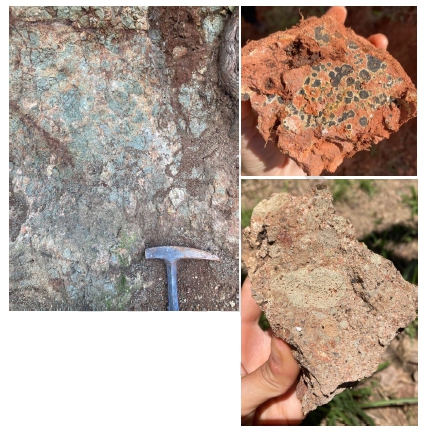
Figure 7-19 Rock types of Mata da Corda Group in Block 3, Green Conglomerate (left), Red Volcanic Rock (top right) and Conglomerate Hand Sample (bottom right)
| 7.6 | Block 3 |
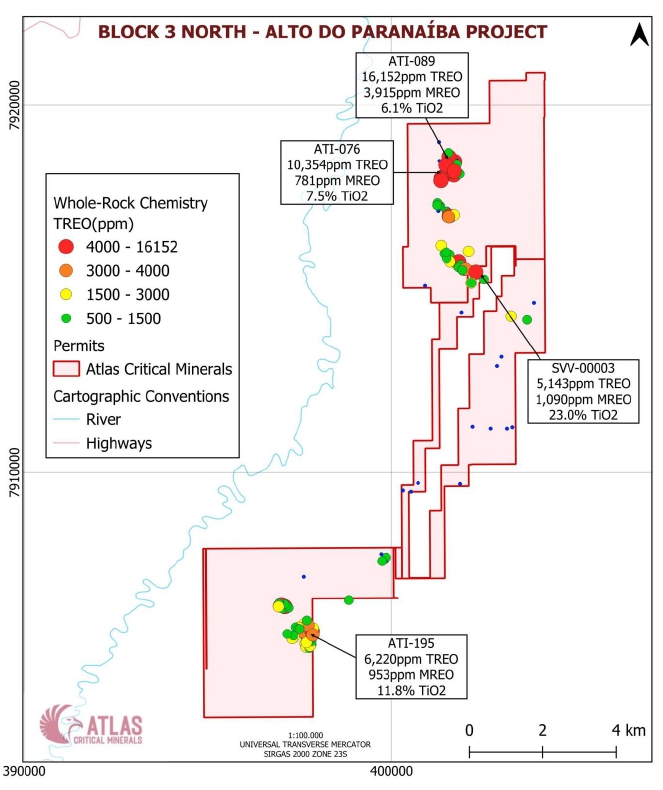
Block 3 display the highest TREO grades, as >10,000 ppm TREO and up to 28,000 ppm, but the Mata da Corda body dimensions are restricted to the highest topographic levels, above 960 meters (Figure 7-20).
At some spots is possible to identify magnetic sandstones with high grades of TREO, as in permit 831,268/2021 – Northwest Block 3. Probably these grades above 960 meters baselevel can relate to intrusion mechanisms or sedimentary/volcanic interactions.
| S-K 1300 Technical Report – Alto Paranaíba REE and Titanium Project – Minas Gerais, Brazil | Page 40 |
Figure 7-20 Geology and Best Grades of TREO for Block 3 North
| S-K 1300 Technical Report – Alto Paranaíba REE and Titanium Project – Minas Gerais, Brazil | Page 41 |
Figure 7-21 Geology and Best Grades of TREO for Block 3 South
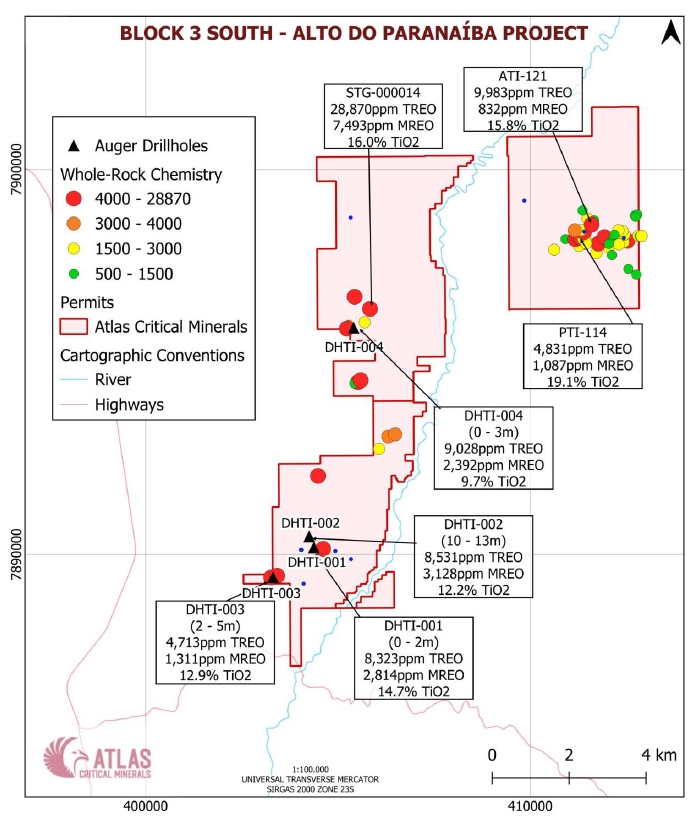
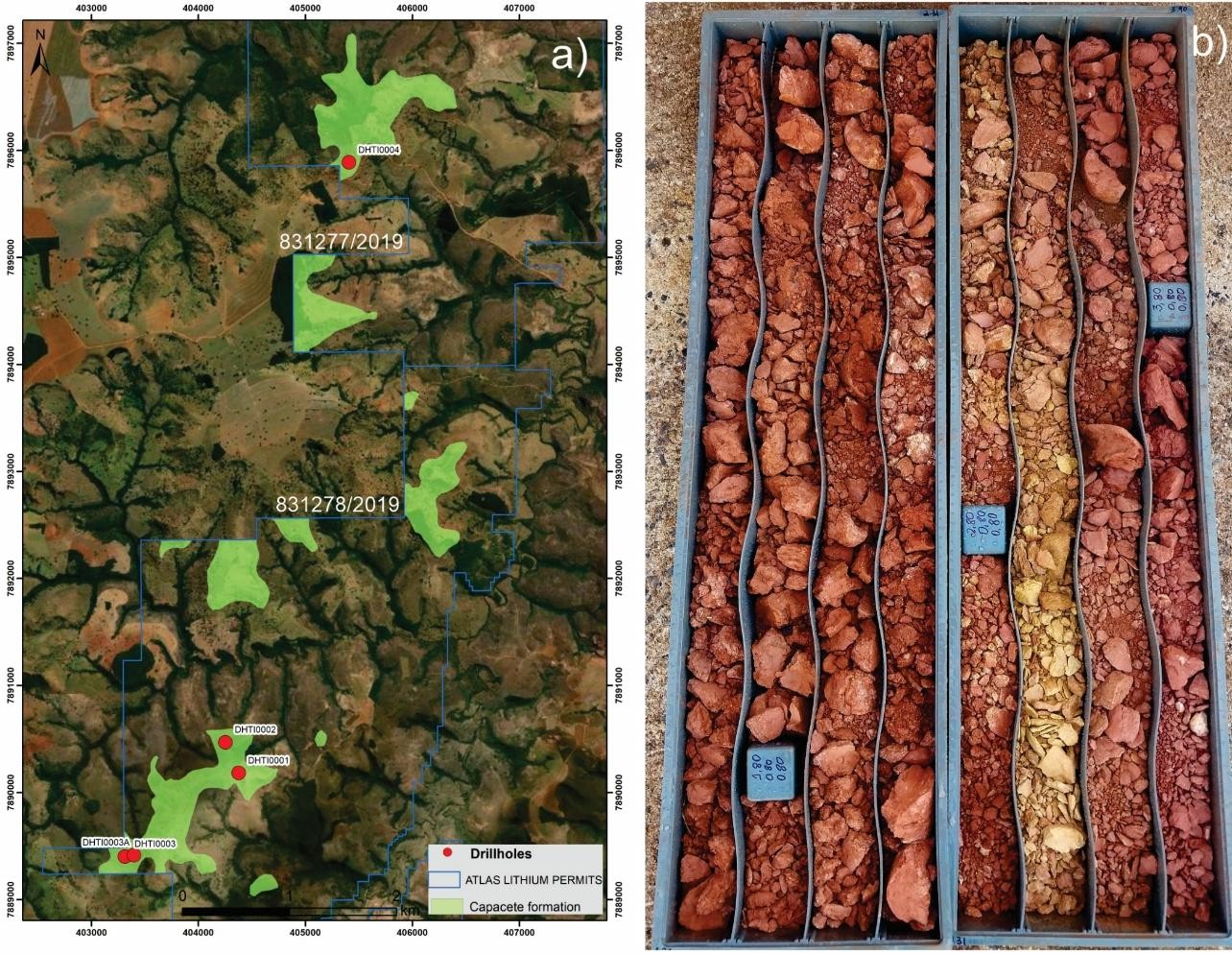
The geological mapping of the permits 831,277/2019 and 831,278/2019 confirmed the base level of Mata da Corda Group in 960 meters, where Capacete Formation is predominant, with its matrix and clast supported conglomerates Between December and January 2025, five auger drillholes were executed in these two permits (Figure 7-20). All the drillholes intercepted mineralized conglomerated from Capacete Formation highly weathered. Interesting intercepts demonstrated the Mata da Corda Group potential:
| ● | TREO average: 4,906 ppm | |
| ● | TiO2 average: 12 % | |
| ● | MREO average: 1352 ppm |
| S-K 1300 Technical Report – Alto Paranaíba REE and Titanium Project – Minas Gerais, Brazil | Page 42 |
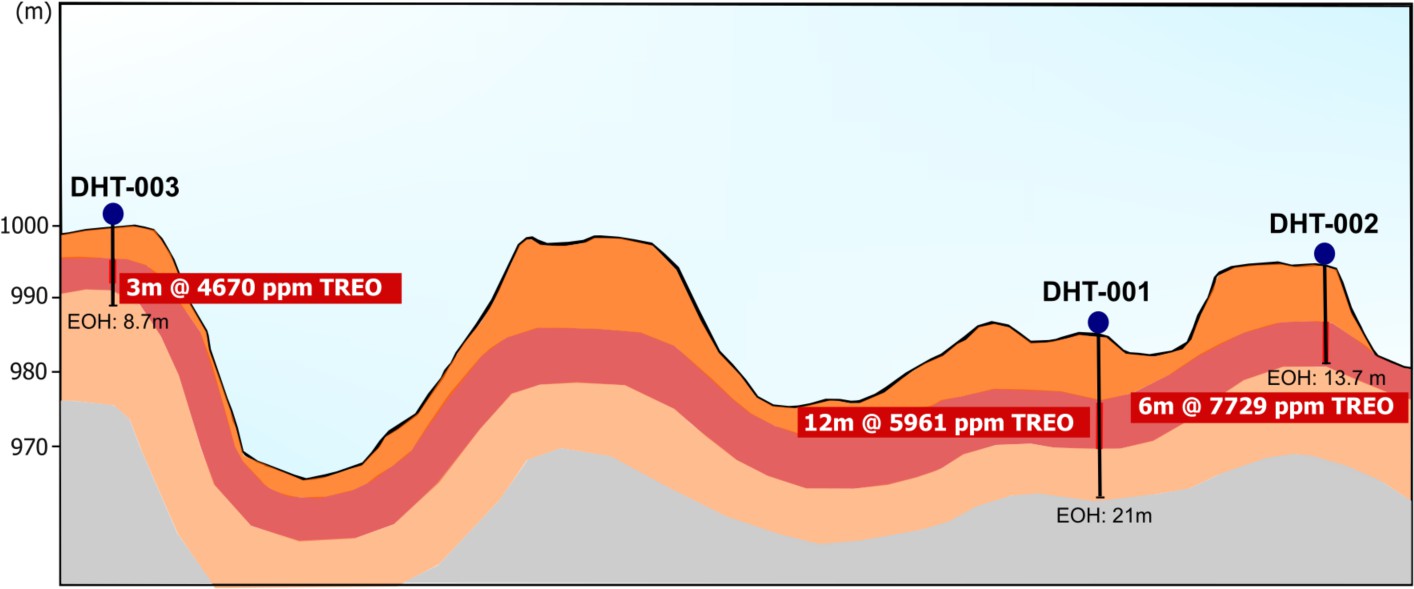
It is possible to outline a high-grade interval, shown in Figure 7-22. The two permits display a potential for hosting 40 Mt of Mata da Corda rocks.
Figure 7-22 Geological Map of Permits 831,277 and 831,278 with DHs Location (left) and Photograph of DHTI-001 Displaying Weathered Matrix Supported Conglomerate (right)
| S-K 1300 Technical Report – Alto Paranaíba REE and Titanium Project – Minas Gerais, Brazil | Page 43 |
Figure 7-23 Cross-Section of DH’s DHT-001, DHT-002 and DHT-003, with High Grade Intervals
| 7.7 | Auger Drilling 1st Campaign |
Five Auger drillholes were executed between October 2024 to January 2025, totalizing 61.54 m. The drillhole material were described and sampled according to standard procedures for Rare Earth Elements and Titanium. Sampling was executed including QA/QC sample controls, patterns and blanks. Drilling was carried out in the following permits:
| ● | 831,277/2019 (Block 3): 1 drillholes | |
| ● | 831,278/2019 (Block 3): 4 drillholes |
| S-K 1300 Technical Report – Alto Paranaíba REE and Titanium Project – Minas Gerais, Brazil | Page 44 |
| 7.8 | Auger Drilling 2nd Campaign |
Eight Auger drillholes were executed between April and May 2025, totalizing 82.3 m. The drillhole material were described and sampled according to standard procedures for Rare Earth Elements and Titanium. Sampling was executed including QA/QC sample controls, patterns and blanks. Drilling was carried out in the following permits:
| ● | 832,699/2024 (Block 1): 3 drillholes | |
| ● | 832,703/2024 (Block 2): 3 drillholes | |
| ● | 831,645/2024 (Block 2 South): 2 drillholes |
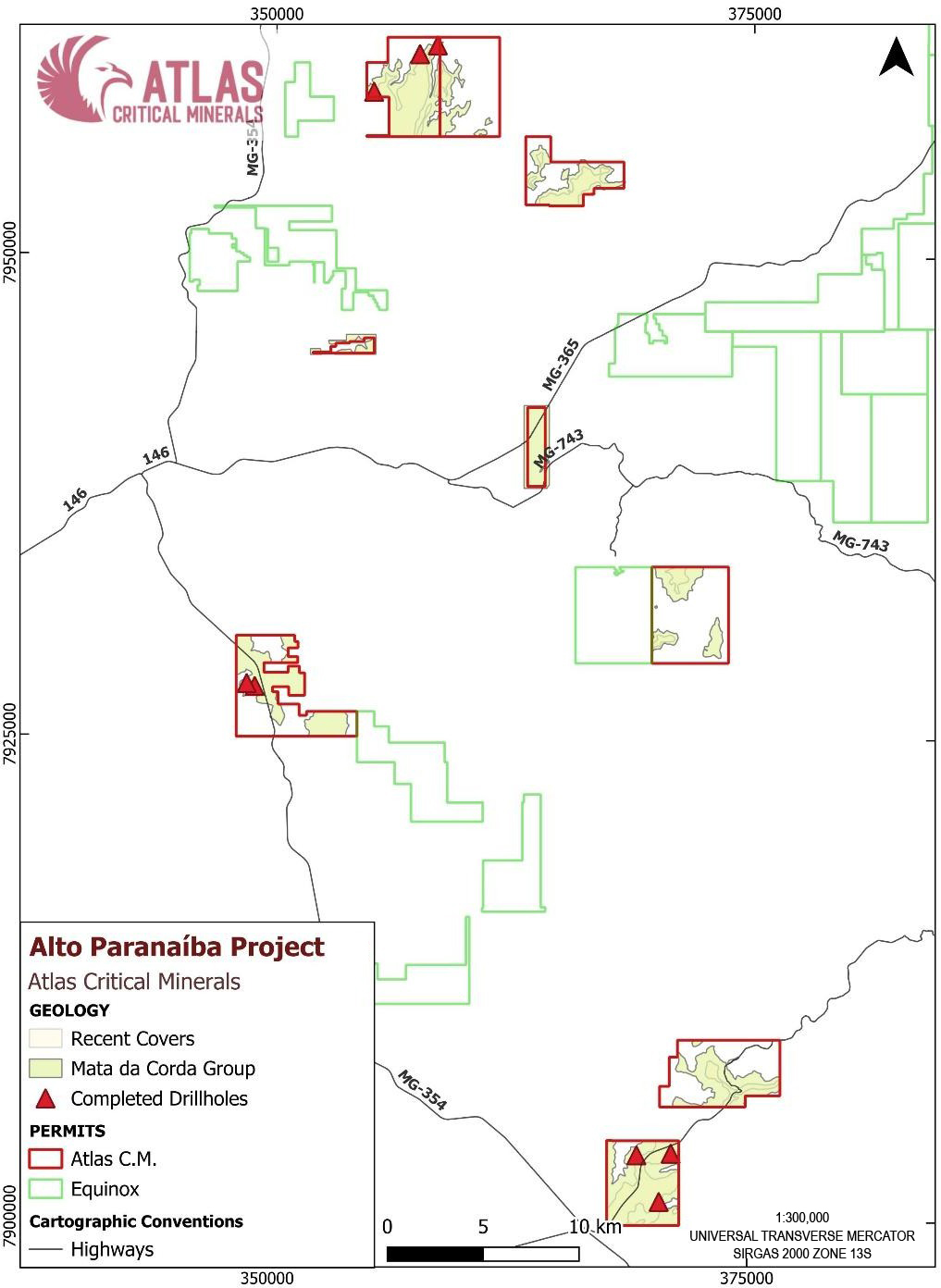
Figure 7-24 Drillholes (red triangles) in Alto Paranaíba Project Permits
| S-K 1300 Technical Report – Alto Paranaíba REE and Titanium Project – Minas Gerais, Brazil | Page 45 |
One-meter samples were prepared for the Mata da Corda group intervals, totaling 76 routine samples.
The chemical analysis presented in this report refers to the Global grade analysis. The mineralogy test results were expected for July 25 but were not available for the preparation of this report.
The global grades were positive for TREO (average of 2657 ppm) and TiO2 (average of 11.4%). The highest TREO grade was the sample CA-00009, with 5,529 ppm TREO (from DHCA00001, Block 1) and TiO2 21.2% for sample CA-00023 (from drillhole DHCA00002, also in Block 1). Block 1 scored the highest grades in terms of HREO, LREO, MREO, TREO and TiO2 (Table 7-3).
Table 7-3 Averages for the Different Prospects
| Mean | HREO (ppm) | LREO (ppm) | MREO (ppm) | TREO (ppm) | TiO2 (%) | |||||||||||||||
| Block 1 | 205 | 2,952 | 760 | 3,157 | 12.7 | |||||||||||||||
| Block 2 | 168 | 2,146 | 522 | 2,314 | 11 | |||||||||||||||
| Block 2 South | 160 | 2,149 | 539 | 2,309 | 9.2 | |||||||||||||||
| 7.8.1 | Block 1 |
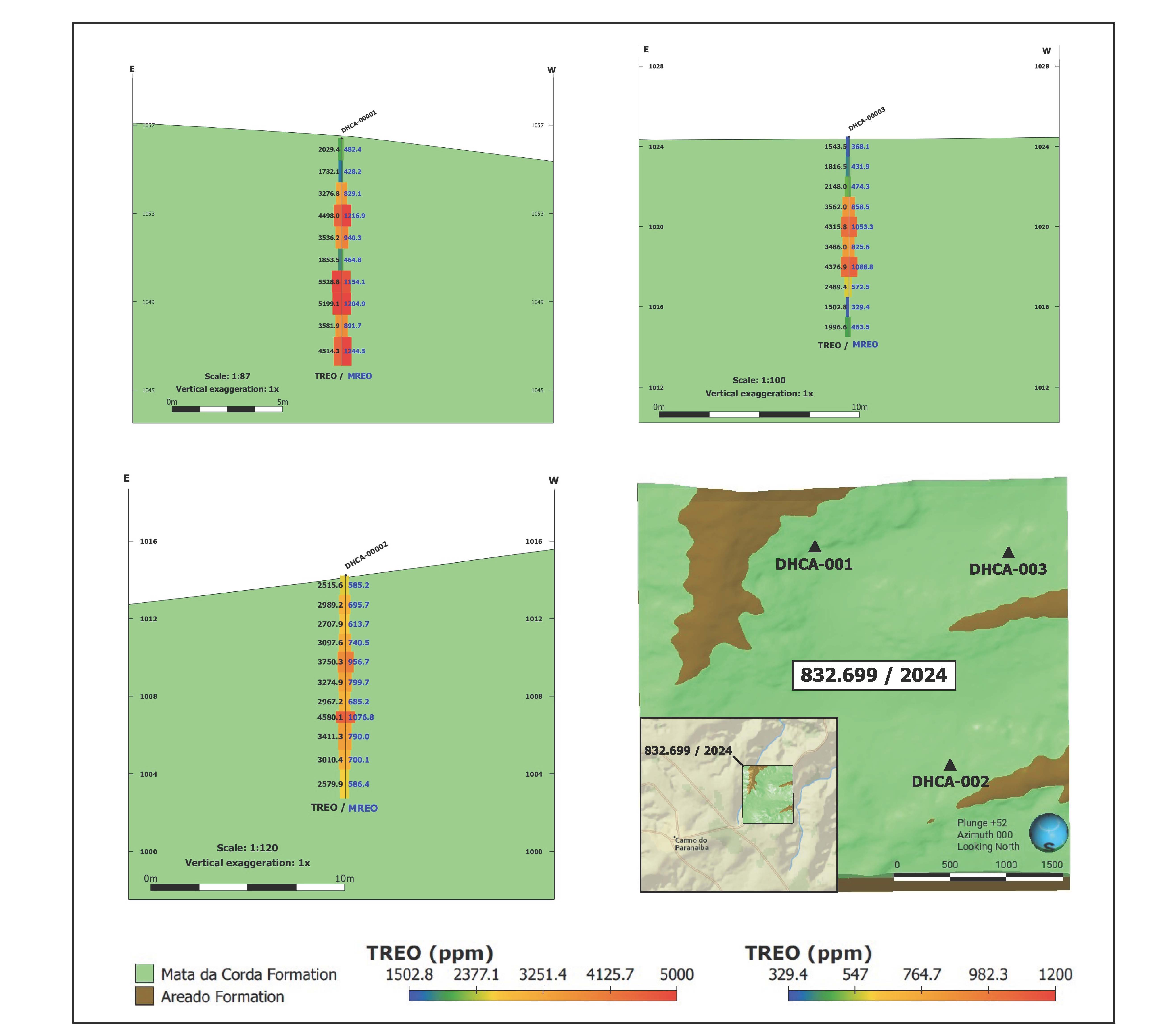
All drillholes in permit 832,699/2024 intercepted Mata da Corda Group, with occurrence of “Capacete and Patos” Formation. The intercept highlights are:
| ● | DHCA-00001: 4m @ 1124 ppm MREO, 4,706 ppm TREO and 15.1 % TiO2. | |
| ● | DHCA-00002: 6m @ 841 ppm MREO, 3,514 ppm TREO and 15.9 % TiO2. | |
| ● | DHCA-00003: 8m @ 708 ppm MREO, 2,985 ppm TREO and 10.5 % TiO2. |
Table 7-4 Grades for the Block 1 Samples. KAM: Kamafugite. Con: Conglomerate. CGA: Lateritic
| SAMPLE_ID | LITHOLOGY | HREO_ppm | LREO_ppm | MREO_ppm | TREO_ppm | TiO2% | ||||||||||||||||
| CA-00002 | CGA | 111 | 1965 | 482 | 2076 | 9.41 | ||||||||||||||||
| CA-00003 | KAM | 91 | 1679 | 428 | 1770 | 5.78 | ||||||||||||||||
| CA-00004 | KAM | 182 | 3166 | 829 | 3349 | 12.12 | ||||||||||||||||
| CA-00005 | KAM | 244 | 4349 | 1217 | 4593 | 12.24 | ||||||||||||||||
| CA-00007 | KAM | 221 | 3390 | 940 | 3611 | 14.36 | ||||||||||||||||
| CA-00008 | KAM | 130 | 1764 | 465 | 1894 | 15.23 | ||||||||||||||||
| CA-00009 | KAM | 379 | 5300 | 1154 | 5679 | 13.77 | ||||||||||||||||
| CA-00011 | KAM | 364 | 4960 | 1205 | 5324 | 14.13 | ||||||||||||||||
| CA-00012 | KAM | 326 | 3337 | 892 | 3662 | 15.87 | ||||||||||||||||
| CA-00013 | KAM | 461 | 4143 | 1244 | 4604 | 16.48 | ||||||||||||||||
| CA-00015 | CGA | 179 | 2393 | 585 | 2572 | 11.43 | ||||||||||||||||
| CA-00016 | CON | 229 | 2826 | 696 | 3056 | 13.55 | ||||||||||||||||
| CA-00018 | CON | 186 | 2583 | 614 | 2769 | 12.93 | ||||||||||||||||
| CA-00019 | CON | 187 | 2981 | 741 | 3168 | 13.87 | ||||||||||||||||
| CA-00020 | CON | 219 | 3614 | 957 | 3832 | 14.64 | ||||||||||||||||
| CA-00021 | CON | 199 | 3148 | 800 | 3347 | 15.71 | ||||||||||||||||
| CA-00022 | CON | 176 | 2859 | 685 | 3034 | 15.78 | ||||||||||||||||
| S-K 1300 Technical Report – Alto Paranaíba REE and Titanium Project – Minas Gerais, Brazil | Page 46 |
| SAMPLE_ID | LITHOLOGY | HREO_ppm | LREO_ppm | MREO_ppm | TREO_ppm | TiO2% | ||||||||||||||||
| CA-00023 | CON | 252 | 4431 | 1077 | 4683 | 21.19 | ||||||||||||||||
| CA-00024 | KAM | 232 | 3255 | 790 | 3487 | 15.39 | ||||||||||||||||
| CA-00026 | KAM | 194 | 2883 | 700 | 3076 | 15.10 | ||||||||||||||||
| CA-00027 | KAM | 168 | 2469 | 586 | 2636 | 11.97 | ||||||||||||||||
| CA-00029 | KAM | 91 | 1487 | 368 | 1578 | 8.37 | ||||||||||||||||
| CA-00030 | KAM | 115 | 1741 | 432 | 1856 | 10.44 | ||||||||||||||||
| CA-00032 | KAM | 110 | 2088 | 474 | 2197 | 11.30 | ||||||||||||||||
| CA-00033 | KAM | 188 | 3455 | 859 | 3643 | 12.05 | ||||||||||||||||
| CA-00034 | KAM | 246 | 4167 | 1053 | 4412 | 12.23 | ||||||||||||||||
| CA-00035 | CON | 200 | 3363 | 826 | 3563 | 11.01 | ||||||||||||||||
| CA-00036 | CON | 260 | 4215 | 1089 | 4476 | 11.35 | ||||||||||||||||
| CA-00037 | CON | 140 | 2407 | 572 | 2547 | 9.34 | ||||||||||||||||
| CA-00038 | CON | 109 | 1427 | 329 | 1536 | 8.53 | ||||||||||||||||
| CA-00039 | CON | 157 | 1884 | 463 | 2042 | 8.09 | ||||||||||||||||
| S-K 1300 Technical Report – Alto Paranaíba REE and Titanium Project – Minas Gerais, Brazil | Page 47 |
Figure 7-25 Drillhole sections for Auger DH’s in Block 1
| 7.8.2 | Block 2 |
All drillholes in Permit 832,703/2024, intercepted Mata da Corda Group, with occurrence of Capacete and Patos Formation. The intercept highlights are:
| ● | DHPM-00001: 6m @ 449 ppm MREO, 2,037 ppm TREO and 9.4% TiO2. | |
| ● | DHPM-00002: 6m @ 682 ppm MREO, 3,007 ppm TREO and 14% TiO2. | |
| ● | DHPM-00003: 8m @ 606 ppm MREO, 2,700 ppm TREO and 11.7% TiO2. |
| S-K 1300 Technical Report – Alto Paranaíba REE and Titanium Project – Minas Gerais, Brazil | Page 48 |
Table 7-5 Grades for the Block 2 Routine Samples. KAM: Kamafugite. Con: Conglomerate. CGA: Lateritic
| SAMPLE_ID | LITHOLOGY | HREO_ppm | LREO_ppm | MREO_ppm | TREO_ppm | TiO2% | ||||||||||||||||
| PM-00002 | CGA | 157 | 2528 | 604 | 2685 | 9.96 | ||||||||||||||||
| PM-00003 | CON | 184 | 2175 | 522 | 2359 | 9.73 | ||||||||||||||||
| PM-00004 | CON | 188 | 2086 | 503 | 2275 | 9.89 | ||||||||||||||||
| PM-00005 | CON | 220 | 2320 | 504 | 2540 | 10.42 | ||||||||||||||||
| PM-00007 | CON | 135 | 1170 | 281 | 1305 | 8.24 | ||||||||||||||||
| PM-00008 | CON | 125 | 1202 | 280 | 1327 | 8.13 | ||||||||||||||||
| PM-00009 | CON | 117 | 1231 | 287 | 1348 | 8.47 | ||||||||||||||||
| PM-00010 | CON | 119 | 1311 | 314 | 1429 | 8.3 | ||||||||||||||||
| PM-00011 | CON | 119 | 1470 | 356 | 1589 | 8.96 | ||||||||||||||||
| PM-00013 | CON | 116 | 1611 | 371 | 1727 | 10 | ||||||||||||||||
| PM-00014 | CON | 98 | 1107 | 267 | 1205 | 9.45 | ||||||||||||||||
| PM-00016 | CGA | 109 | 1768 | 474 | 1877 | 7.94 | ||||||||||||||||
| PM-00017 | CON | 172 | 2567 | 666 | 2739 | 11.41 | ||||||||||||||||
| PM-00018 | KAM | 198 | 2504 | 628 | 2702 | 12.51 | ||||||||||||||||
| PM-00019 | KAM | 258 | 2312 | 567 | 2569 | 13.12 | ||||||||||||||||
| PM-00021 | KAM | 244 | 2763 | 699 | 3007 | 13.33 | ||||||||||||||||
| PM-00022 | KAM | 231 | 2369 | 579 | 2600 | 12.91 | ||||||||||||||||
| PM-00023 | KAM | 367 | 3119 | 755 | 3486 | 13.33 | ||||||||||||||||
| PM-00025 | KAM | 231 | 2439 | 567 | 2670 | 13.71 | ||||||||||||||||
| PM-00026 | KAM | 239 | 3017 | 731 | 3256 | 15.45 | ||||||||||||||||
| PM-00027 | KAM | 237 | 3167 | 758 | 3405 | 15.44 | ||||||||||||||||
| PM-00029 | CON | 80 | 1251 | 282 | 1331 | 6.29 | ||||||||||||||||
| PM-00030 | CON | 102 | 2132 | 472 | 2234 | 11.84 | ||||||||||||||||
| PM-00031 | SHL | 167 | 3413 | 799 | 3580 | 13.55 | ||||||||||||||||
| PM-00032 | SHL | 182 | 3746 | 900 | 3928 | 14.33 | ||||||||||||||||
| PM-00034 | SHL | 226 | 3944 | 939 | 4170 | 14.7 | ||||||||||||||||
| PM-00035 | KAM | 132 | 1950 | 468 | 2082 | 10.59 | ||||||||||||||||
| PM-00036 | KAM | 122 | 2046 | 466 | 2168 | 10.01 | ||||||||||||||||
| PM-00037 | KAM | 117 | 1821 | 400 | 1938 | 9.36 | ||||||||||||||||
| PM-00038 | KAM | 105 | 1881 | 410 | 1985 | 9.71 | ||||||||||||||||
| PM-00040 | KAM | 111 | 1658 | 336 | 1768 | 9.92 | ||||||||||||||||
| S-K 1300 Technical Report – Alto Paranaíba REE and Titanium Project – Minas Gerais, Brazil | Page 49 |
Figure 7-26 Drillhole Sections for Auger DH’s in Block 2 (832,703/2024)
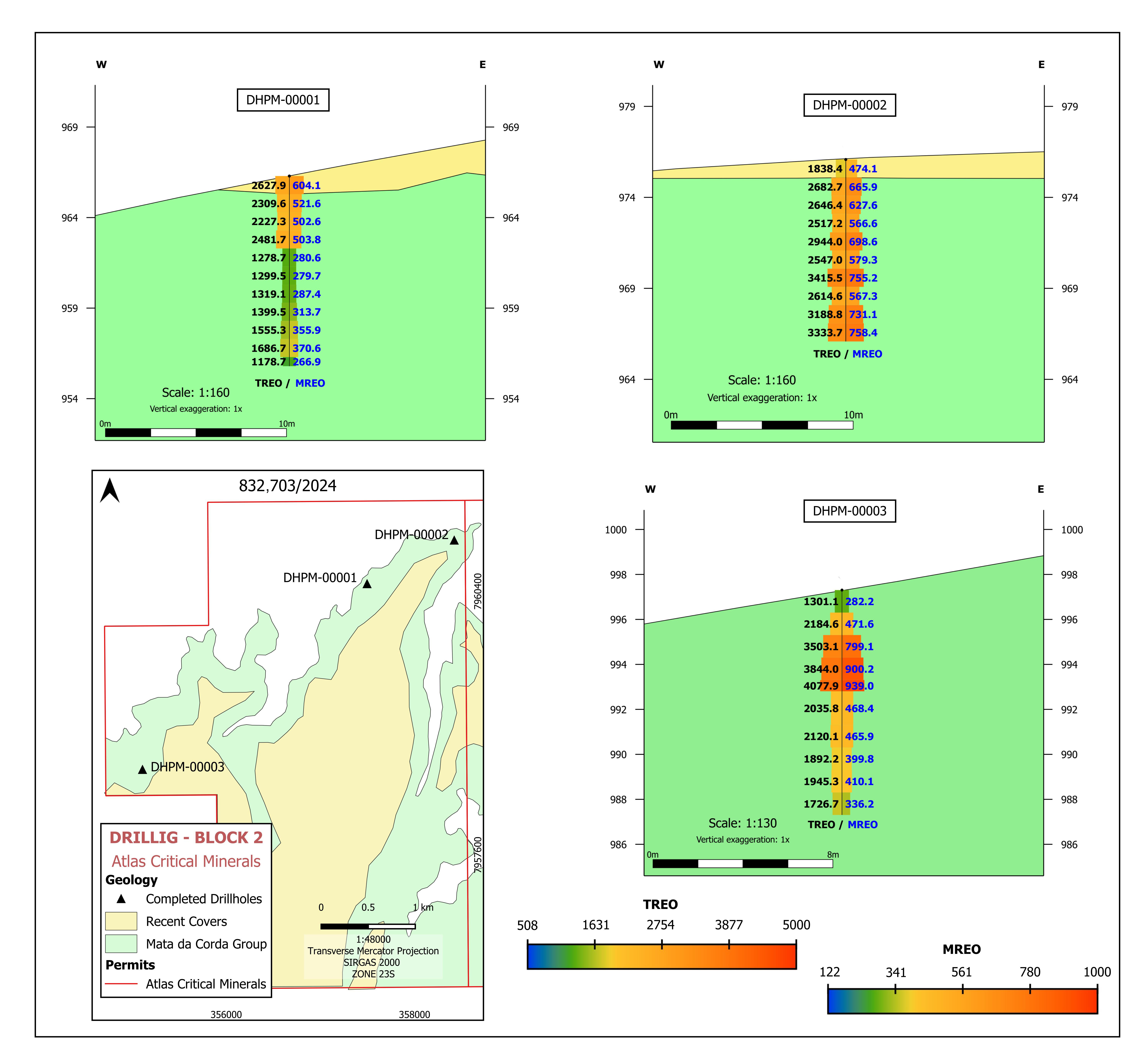
| 7.8.3 | Block 2 South |
Block 2 South (Lagoa Formosa permit – 831,645/2024)
| ● | DHLF-00001: 6m @ 754 ppm MREO, 3,275 ppm TREO and 13.8% TiO2. | |
| ● | DHLF-00002: 2m @ 416 ppm MREO, 1,752 ppm TREO and 6.4% TiO2. |
| S-K 1300 Technical Report – Alto Paranaíba REE and Titanium Project – Minas Gerais, Brazil | Page 50 |
Table 7-6 Grades for the Block 2 South Routine Samples. KAM: Kamafugite. Con: Conglomerate. CGA: Lateritic. SHL: Shale of Areado Group
| SAMPLE_ID | LITHOLOGY | HREO_ppm | LREO_ppm | MREO_ppm | TREO_ppm | TiO2% | ||||||||||||||||
| LF-00002 | CGA | 100 | 1476 | 358 | 1577 | 5.79 | ||||||||||||||||
| LF-00003 | CGA | 107 | 1617 | 388 | 1725 | 6.25 | ||||||||||||||||
| LF-00004 | CON | 145 | 2350 | 585 | 2495 | 9.54 | ||||||||||||||||
| LF-00005 | CON | 215 | 2922 | 757 | 3137 | 11.37 | ||||||||||||||||
| LF-00007 | SHL | 237 | 2839 | 714 | 3076 | 11.6 | ||||||||||||||||
| LF-00008 | SHL | 215 | 3264 | 758 | 3478 | 14.06 | ||||||||||||||||
| LF-00009 | KAM | 193 | 3481 | 830 | 3674 | 14.79 | ||||||||||||||||
| LF-00010 | KAM | 186 | 3250 | 747 | 3437 | 14.91 | ||||||||||||||||
| LF-00011 | KAM | 170 | 3114 | 718 | 3284 | 15.85 | ||||||||||||||||
| LF-00013 | SHL | 209 | 2006 | 515 | 2215 | 6.99 | ||||||||||||||||
| LF-00015 | CGA | 107 | 1627 | 400 | 1734 | 6.13 | ||||||||||||||||
| LF-00016 | CGA | 127 | 1721 | 432 | 1848 | 6.59 | ||||||||||||||||
| LF-00017 | SHL | 121 | 719 | 216 | 840 | 3.35 | ||||||||||||||||
| LF-00018 | SHL | 108 | 410 | 122 | 518 | 1.79 | ||||||||||||||||
| S-K 1300 Technical Report – Alto Paranaíba REE and Titanium Project – Minas Gerais, Brazil | Page 51 |
Figure 7-27 Drillhole Sections for Auger DH’s in Block 2 South (831,645/2024)
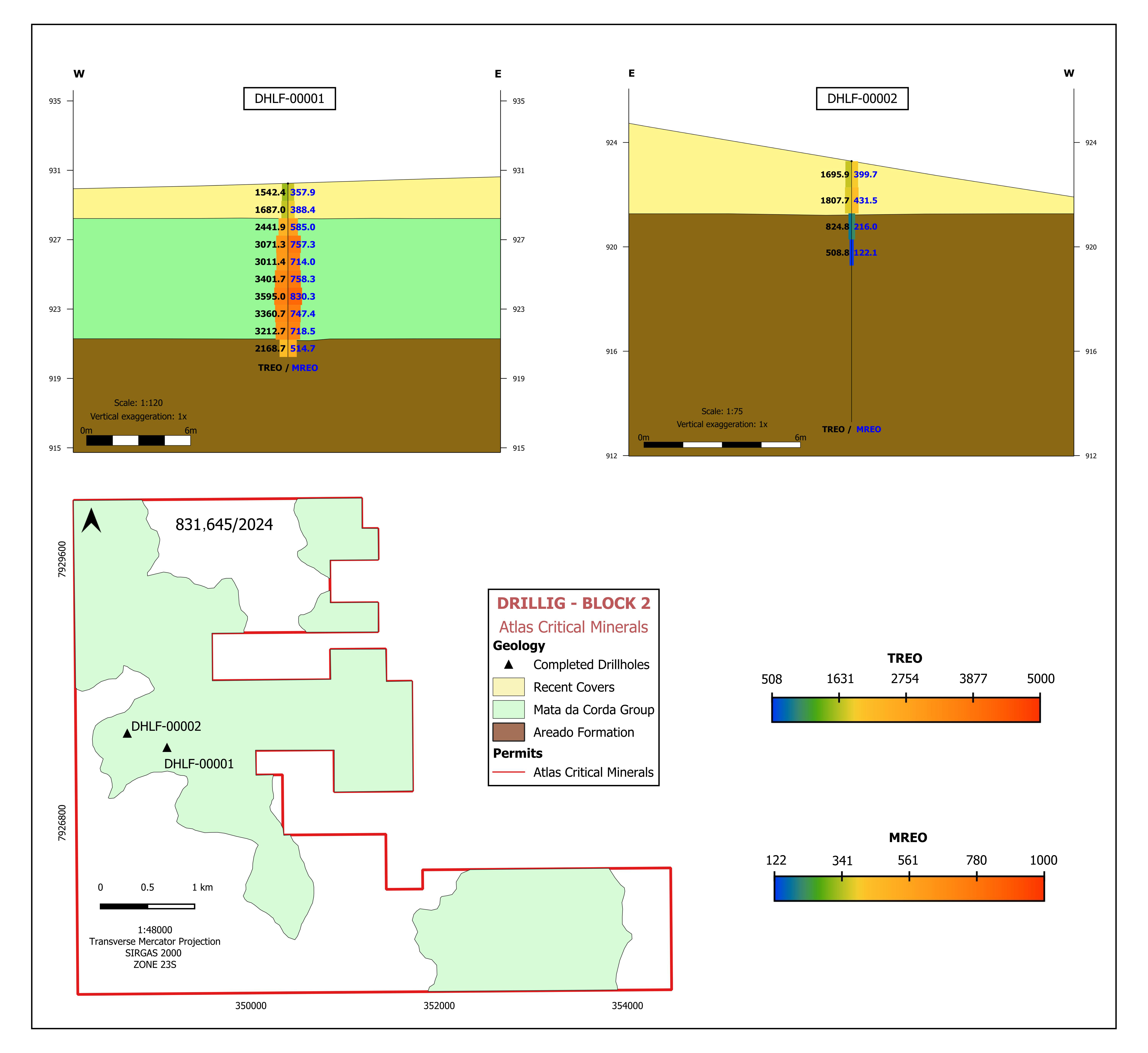
| S-K 1300 Technical Report – Alto Paranaíba REE and Titanium Project – Minas Gerais, Brazil | Page 52 |
| 8 | SAMPLE PREPARATION, ANALYSES, AND SECURITY |
In the 2024 and 2025 period, Atlas Critical Minerals have done a range of sampling and assaying including surface samples and auger samples.
| 8.1 | Sample Preparation and Analyses |
Typically, one-meter samples are prepared. The samples were submitted to SGS Brazil and divided into two parts for different analysis, according to:
| 1. | Global grade analysis (SGS Brazil) | |
| 2. | Mineralogy tests (SGS Canada) |
| S-K 1300 Technical Report – Alto Paranaíba REE and Titanium Project – Minas Gerais, Brazil | Page 53 |
| 8.2 | Quality Assurance and Quality Control |
Atlas Critical Minerals have utilized Quality Assurance (QA) and Quality Control (QC) methodologies under the supervision of a qualified person as defined in Regulation S-K 1300.
In particular, as described in Section 7 of this report, Atlas Critical Minerals carried out a surface sampling and an auger drilling campaign, aiming to identify and delineate geochemical anomalies associated with rare earth mineralization. The surface sampling campaign included soil and rock chip samples of all lithology and layers across Atlas Critical Minerals’ mineral rights. The auger drilling campaign tested possible targets to evaluate the mineralization potential. Both campaigns had all geochemical analysis performed by SGS-Geosol, an analytical laboratory located in Vespasiano, Brazil, which is considered to be the premier such testing site in Brazil (“SGS-Geosol”). SGS-Geosol is ISO 14001 and 17025 accredited by the Standards Council. SGS-Geosol is an independent third-party and provides services pursuant to arms-length contracts.
| S-K 1300 Technical Report – Alto Paranaíba REE and Titanium Project – Minas Gerais, Brazil | Page 54 |
The SGS-Geosol assays were done using the protocols ICM90A, ICP95A and IMS95A. ICM90A is an aqua regia digestion (partial) while de ICP95A and IMS95A are four-acid digestion (near total). We can therefore expect some conservative number in general compared to total digestion methods. The OREAS standards used for the QAQC are certified using borate / peroxide fusion digestion (total) so expected values are maximal. We note that the OREAS certificates state that four-acid assays can match the total digestion methods for most elements.
The auger drillholes were vertical and the reported intervals corresponded to the true thickness. The cores were placed in boxes, aligned and measured by the technician or geologist for core recovery. The core boxes were identified with a code, a hole ID and tags. The logging and sampling were performed at our core logging facilities. The sample intervals were defined by 1 meter, varying depending on the lithological contact, and the material for chemical analysis consisted of the right half of the core, resulting in samples with an average weight of 5 kg. These samples were then gathered in a labelled bag, and the remaining half is kept at the box with the sample ID tag, for reference. The bagged samples were then sent to SGS-Geosol.
All samples received at SGS-Geosol were inventoried and weighted prior to being processed. Drying was done to samples having excess humidity. Sample material was crushed using jaw crushers. The SGS-Geosol analytical method used for our samples is one of their standard packages. Analytical results were sent electronically by SGS-Geosol directly to Atlas and results were compiled in an MS Excel spreadsheet by the project geologists.
Similar procedures as described above were used for our graphite studies, described later in this prospectus.
In addition to the laboratory quality assurance quality control (QA/QC) routinely implemented by SGS Geosol using pulp duplicate analysis, Atlas Critical Minerals developed an internal QA/QC protocol for the projects, which consisted of the insertion of analytical standard reference materials (standards), blanks and core duplicates on a systematic basis with the samples shipped to the analytical laboratory.
Through the implementation of these protocols, Atlas Critical Minerals ensures the quality and integrity of data, maintaining full traceability and accuracy in the results and in the processes related to geological interpretation and evaluation.
| 8.3 | QA/QC Control Samples |
Atlas supplied the initial database on July 3, 2025, and have updated as results became available. A total of 177 auger core and chip samples were submitted for analysis by Atlas Critical Minerals from the first and second (2024 and 2025) drilling and mapping campaigns. This totalled 39 samples (21%) including 24 CRMs and 15 Blanks.
The QAQC program consists of inserting a blank or a Certified Reference Material (CRM) into the sample sequence. Four (4) different CRMs were used during the project, OREAS 460, OREAS 461, OREAS 463, and OREAS 465 which are commercial standards prepared and certified by Ore Research & Exploration. OREAS is ISO 17034 and 9001 accredited for quality production of CRMs.
| ● | OREAS 460 is an ore grade, rare earth element (TREO = 0.53%) matrix-matched certified reference material. | |
| ● | OREAS 461 is an ore grade, rare earth element (TREO = 1.06%) matrix matched. | |
| ● | OREAS 463 is an ore grade, rare earth element (TREO = 2.08%) matrix matched. | |
| ● | OREAS 465 is a high-grade ore, rare earth element (TREO = 9.88%) matrix matched. |
| S-K 1300 Technical Report – Alto Paranaíba REE and Titanium Project – Minas Gerais, Brazil | Page 55 |
| 8.3.1 | Certified Reference Material (CRM) |
| 8.3.1.1 | Neodymium |
Three of the Neodymium (Nd) CRMs returned acceptable values (Figure 8-1) all within 3 standard deviations. OREAS 465 is a high-grade CRM and all the values returned above the detection limit of 10,000 ppm Nd (Table 8-1). The overlimits were not run during initial analyses, further testing would be required to compare the high-grade Nd values. For the purpose of this report, we consider the samples to be acceptable.
Figure 8-1 Neodymium Certified Reference Material
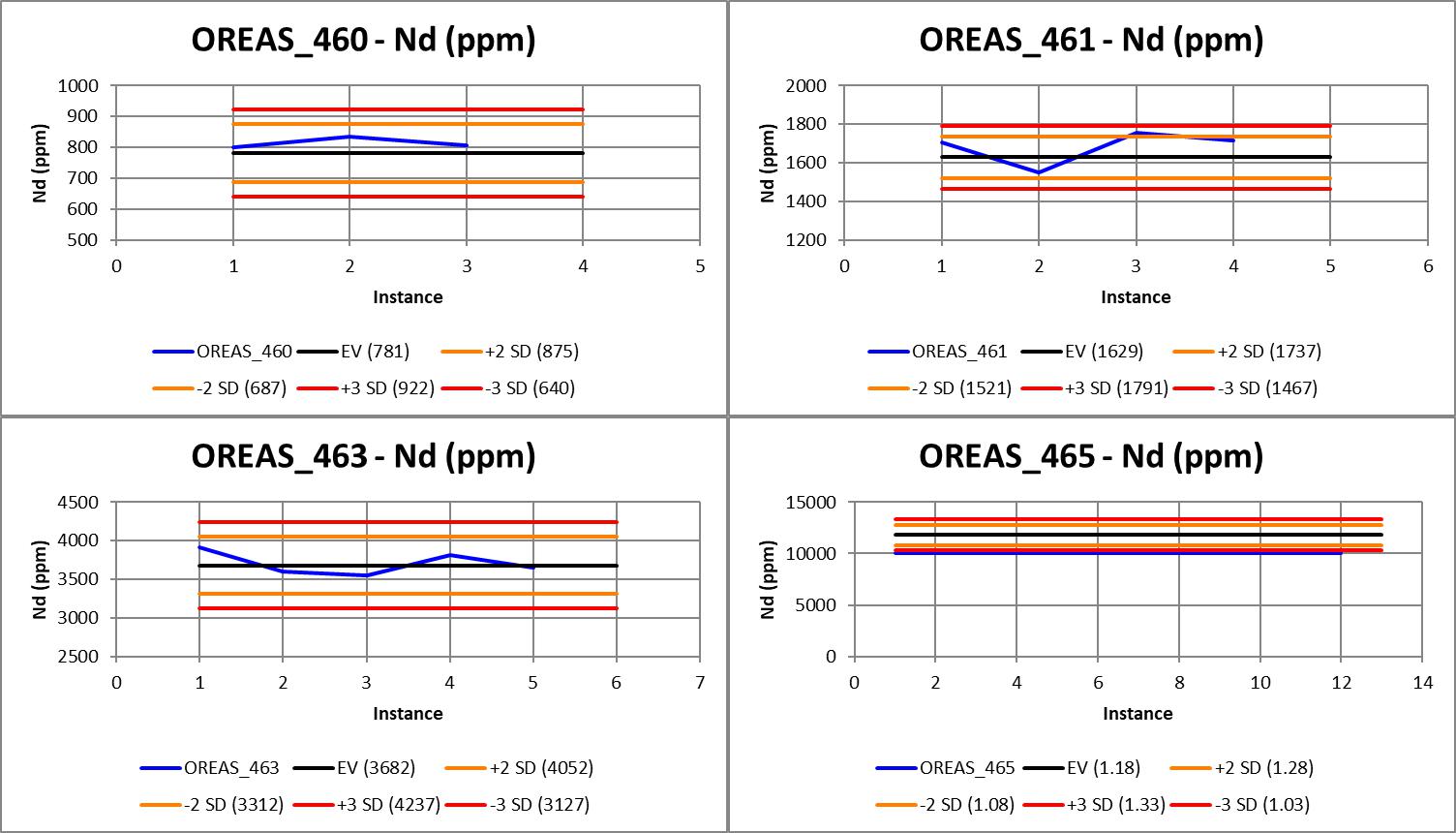
Table 8-1 Neodymium QAQC
| Standard Quality Control for Nd (ppm) | ||||||||||||||||||||||||||||
| Count | Value | Sigma | Pass | Warning | Failed | % Failed | ||||||||||||||||||||||
| OREAS_460 | 3 | 781 | 47 | 3 | 0 | 0 | 0 | |||||||||||||||||||||
| OREAS_461 | 4 | 1629 | 54 | 3 | 1 | 0 | 0 | |||||||||||||||||||||
| OREAS_463 | 5 | 3682 | 185 | 5 | 0 | 0 | 0 | |||||||||||||||||||||
| 8.3.1.2 | Dysprosium |
All of the Dysprosium (Dy) CRMs returned acceptable values all within 3 standard deviations (Figure 8-2). OREAS 461 and OREAS 465 each returned one value within 2 standard deviations (Table 8-2). Dysprosium returns acceptable values in all of the four CRMs analyzed.
| S-K 1300 Technical Report – Alto Paranaíba REE and Titanium Project – Minas Gerais, Brazil | Page 56 |
Figure 8-2 Dysprosium Certified Reference Material
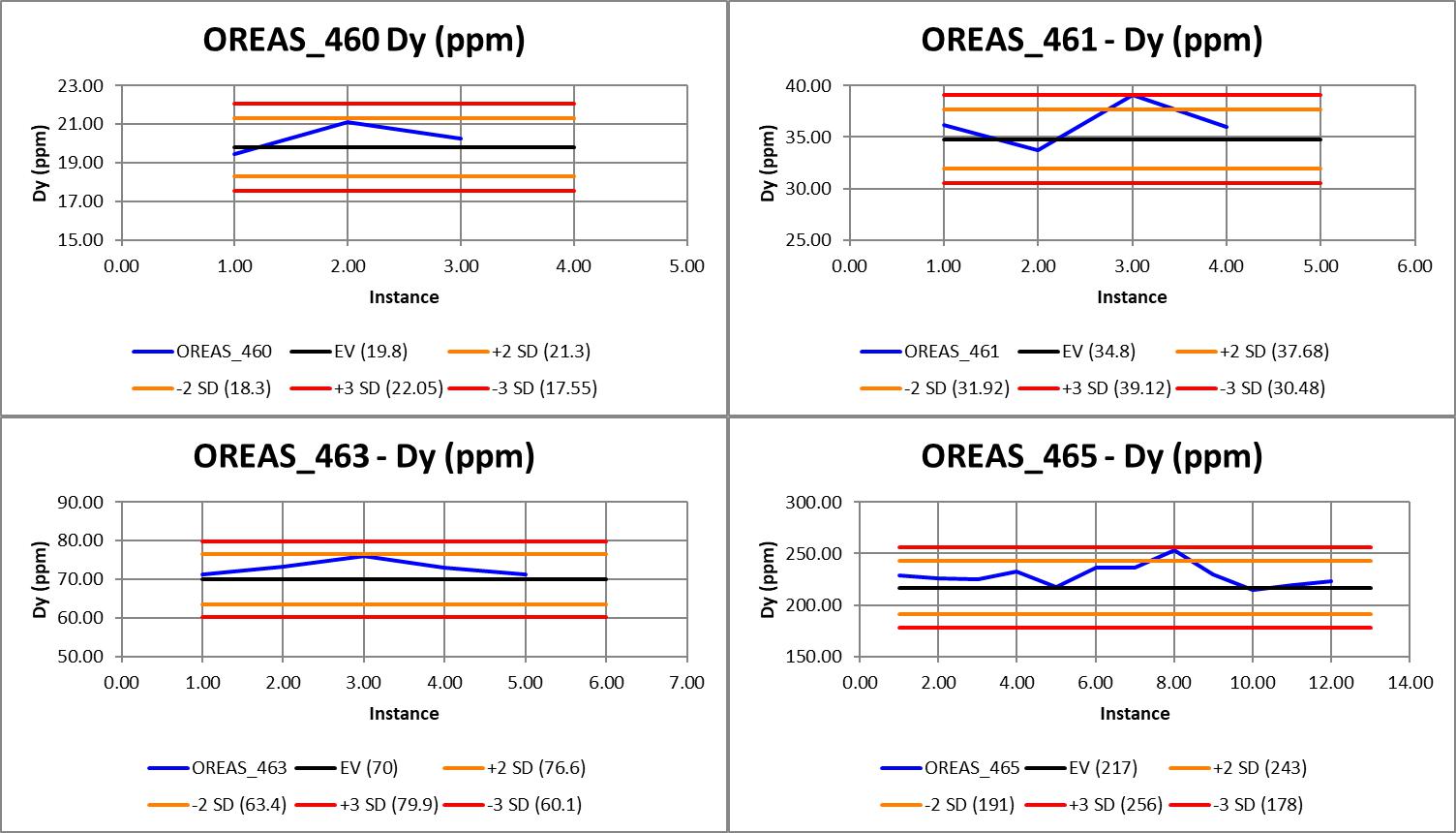
Table 8-2 Dysprosium QAQC
| Standard Quality Control for Dy (ppm) | ||||||||||||||||||||||||||||
| Count | Value | Sigma | Pass | Warning | Failed | % Failed | ||||||||||||||||||||||
| OREAS_460 | 3 | 20 | 1 | 3 | 0 | 0 | 0 | |||||||||||||||||||||
| OREAS_461 | 4 | 35 | 1 | 3 | 1 | 0 | 0 | |||||||||||||||||||||
| OREAS_463 | 5 | 70 | 3 | 5 | 0 | 0 | 0 | |||||||||||||||||||||
| OREAS_465 | 12 | 217 | 13 | 11 | 1 | 0 | 0 | |||||||||||||||||||||
| S-K 1300 Technical Report – Alto Paranaíba REE and Titanium Project – Minas Gerais, Brazil | Page 57 |
| 8.3.1.3 | Praseodymium |
Three of the Praseodymium (Pr) CRMs returned acceptable values (Figure 8-3). OREAS 465 is a high-grade CRM and all the values returned above the detection limit of 1,000 ppm Pr (Table 8-3). The overlimits were not run during initial analyses, further testing would be required to compare the high-grade Pr values. For the purpose of this report, we consider the samples to be acceptable.
Figure 8-3 Praseodymium Certified Reference Material
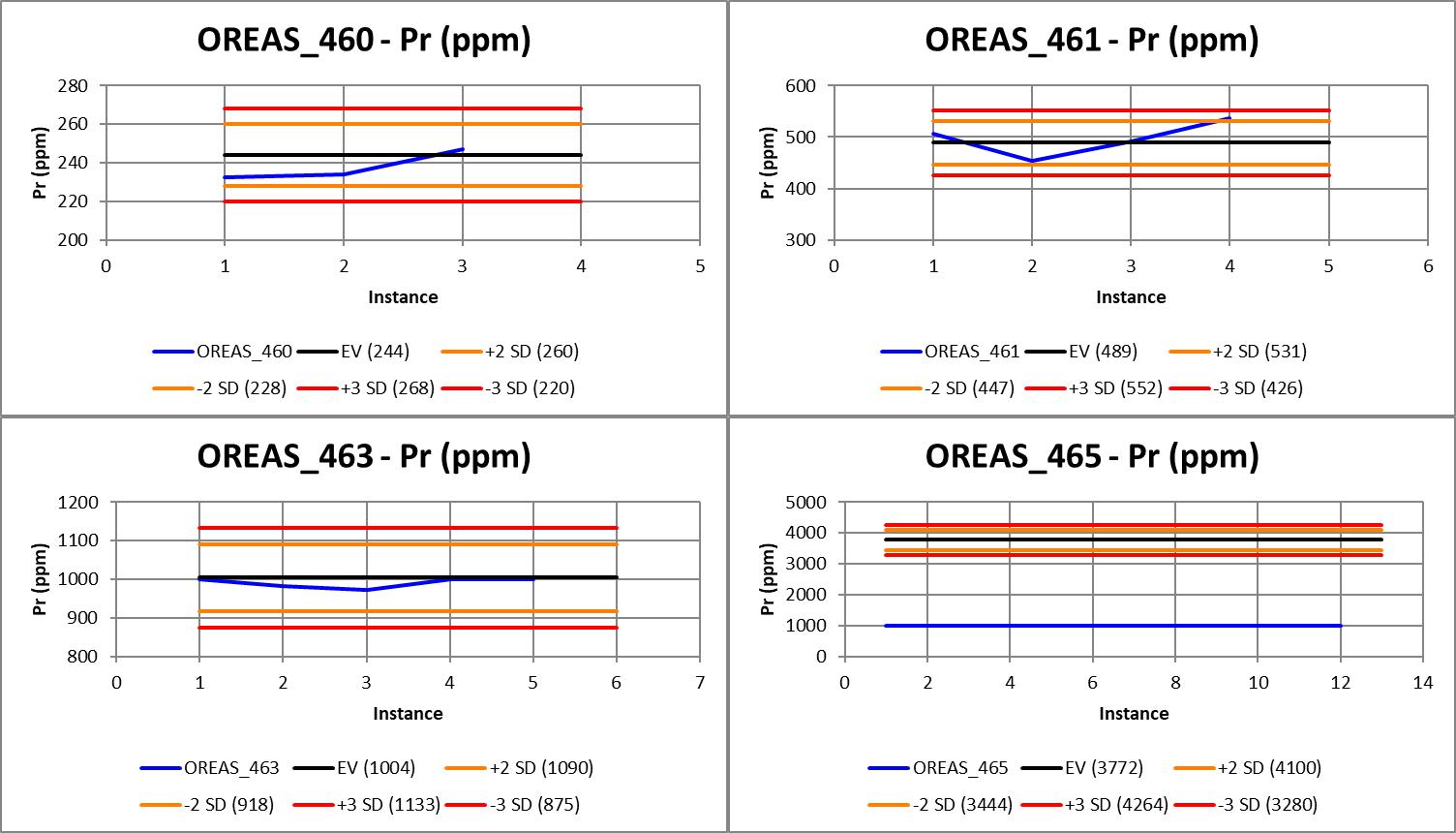
Table 8-3 Praseodymium QAQC
| Standard Quality Control for Pr (ppm) | ||||||||||||||||||||||||||||
| Count | Value | Sigma | Pass | Warning | Failed | % Failed | ||||||||||||||||||||||
| OREAS_460 | 3 | 244 | 8 | 3 | 0 | 0 | 0 | |||||||||||||||||||||
| OREAS_461 | 4 | 489 | 21 | 3 | 1 | 0 | 0 | |||||||||||||||||||||
| OREAS_463 | 5 | 1004 | 43 | 5 | 0 | 0 | 0 | |||||||||||||||||||||
| S-K 1300 Technical Report – Alto Paranaíba REE and Titanium Project – Minas Gerais, Brazil | Page 58 |
| 8.3.1.4 | Terbium |
All of the Terbium (Tb) CRMs returned varied values (Figure 8-4). The values show multiple warnings and failures for Tb (Table 8-4). It is important to note that the values in the database are always conservative, returning lower values than the expected standard value. Therefore the data can be used, albeit not giving the project the full value it deserves. This is acceptable for the use of the data in this report but should be discussed for future work as better assay methods could impact the project positively. As noted in the introduction, SGS-Geosol assays were done with aqua regia (partial digestion) and four-acid (near total digestion) while the OREAS certificates were done with borate / peroxide fusion (total digestion). The author believes that the use of different digestion methods can have led to this discrepancy.
Figure 8-4 Terbium Certified Reference Material
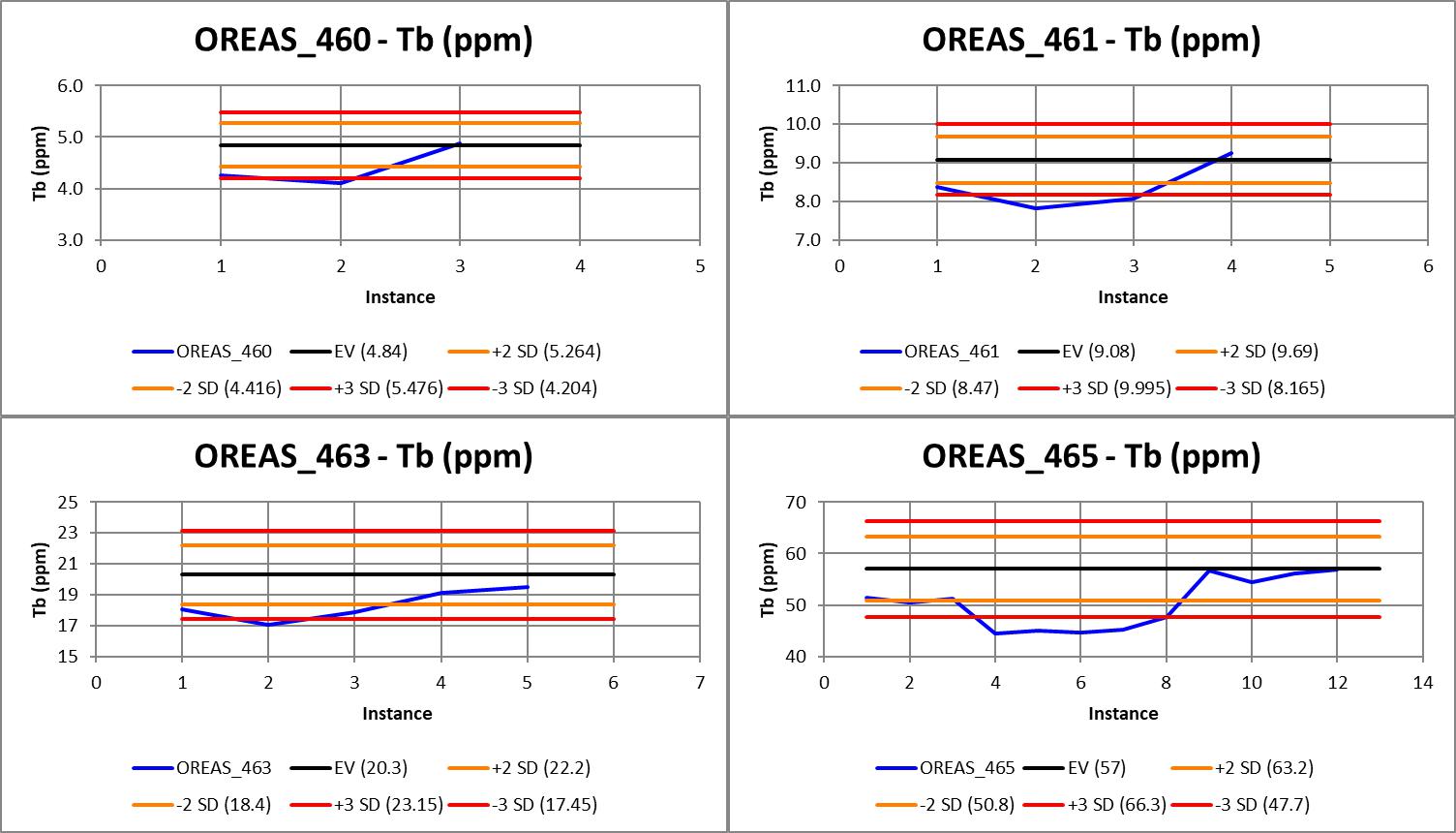
Table 8-4 Terbium QAQC
| Standard Quality Control for Tb (ppm) | ||||||||||||||||||||||||||||
| Count | Value | Sigma | Pass | Warning | Failed | % Failed | ||||||||||||||||||||||
| OREAS_460 | 3 | 5 | 0 | 1 | 1 | 1 | 33 | |||||||||||||||||||||
| OREAS_461 | 4 | 9 | 0 | 1 | 1 | 2 | 50 | |||||||||||||||||||||
| OREAS_463 | 5 | 20 | 1 | 2 | 2 | 1 | 20 | |||||||||||||||||||||
| OREAS_465 | 12 | 57 | 3 | 6 | 1 | 5 | 42 | |||||||||||||||||||||
| S-K 1300 Technical Report – Alto Paranaíba REE and Titanium Project – Minas Gerais, Brazil | Page 59 |
| 8.3.1.5 | Lanthanum |
Three of the Lanthanum (La) CRMs returned acceptable values (Figure 8-5). OREAS 465 is a high-grade CRM and all the values returned above the detection limit of 10,000 ppm La. The overlimits were not run during initial analyses, further testing would be required to compare the high-grade La values (Table 8-5). For the purpose of this report, we consider the samples to be acceptable.
Figure 8-5 Lanthanum Certified Reference Material
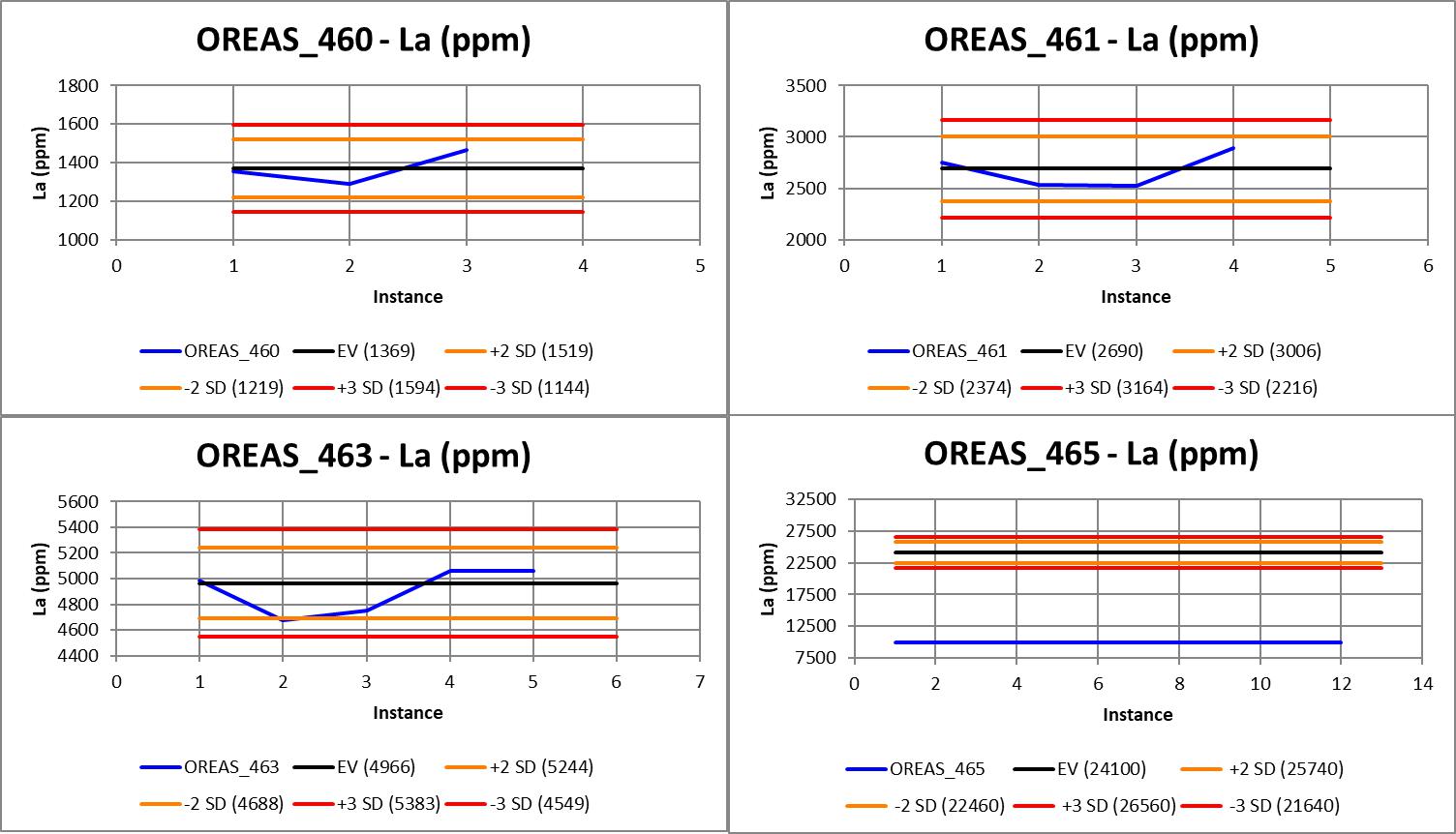
Table 8-5 Lanthanum QAQC
| Standard Quality Control for La (ppm) | ||||||||||||||||||||||||||||
| Count | Value | Sigma | Pass | Warning | Failed | % Failed | ||||||||||||||||||||||
| OREAS_460 | 3 | 1369 | 75 | 3 | 0 | 0 | 0 | |||||||||||||||||||||
| OREAS_461 | 4 | 2690 | 158 | 4 | 0 | 0 | 0 | |||||||||||||||||||||
| OREAS_463 | 5 | 4966 | 139 | 4 | 1 | 0 | 0 | |||||||||||||||||||||
| S-K 1300 Technical Report – Alto Paranaíba REE and Titanium Project – Minas Gerais, Brazil | Page 60 |
| 8.3.1.6 | Cerium |
Two of the Cerium (Ce) CRM plots return acceptable values with no warning or failure rates. OREAS 463 returns values between 60,000 and 70,000 ppm Ce (Figure 8-6). OREAS 465 returned all 12 assayed CRM’s above the detection limit of 10,000 ppm Ce. The overlimits were not run during initial analyses, further testing would be required to compare the high-grade Ce values (Table 8-6).
Figure 8-6 Cerium Certified Reference Material
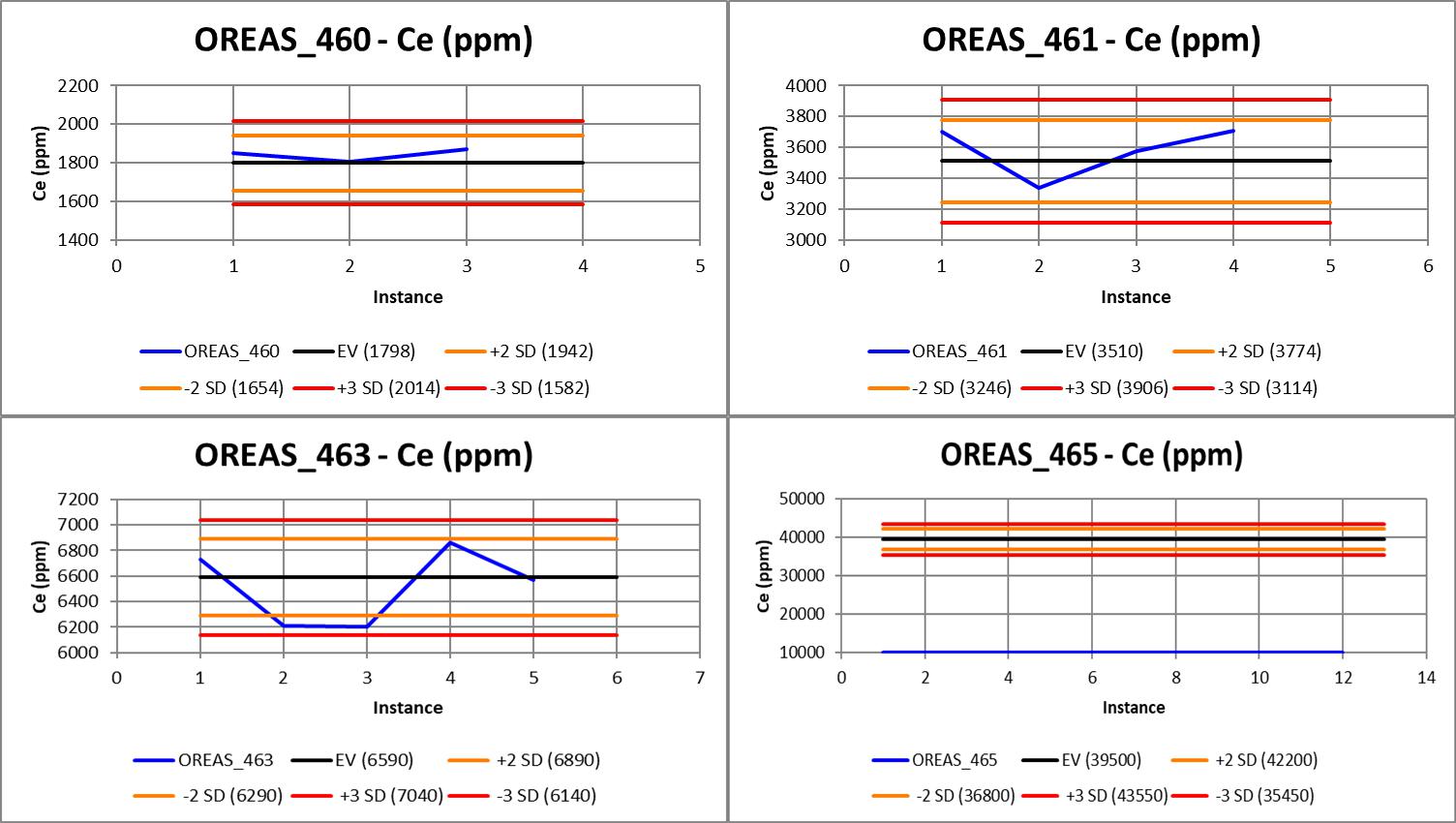
Table 8-6 Cerium QAQC
| Standard Quality Control for Ce (ppm) | ||||||||||||||||||||||||||||
| Count | Value | Sigma | Pass | Warning | Failed | % Failed | ||||||||||||||||||||||
| OREAS_460 | 3.00 | 1798 | 72 | 3.00 | 0.00 | 0.00 | 0.00 | |||||||||||||||||||||
| OREAS_461 | 4.00 | 3510 | 132 | 4.00 | 0.00 | 0.00 | 0.00 | |||||||||||||||||||||
| OREAS_463 | 5.00 | 6890 | 100 | 0.00 | 2.00 | 0.00 | 0.00 | |||||||||||||||||||||
| S-K 1300 Technical Report – Alto Paranaíba REE and Titanium Project – Minas Gerais, Brazil | Page 61 |
| 8.3.2 | Blanks |
A total of 15 Blanks were inserted into the sample sequence and analyzed at SGS Laboratories. Neodymium, Dysprosium, and Cerium return acceptable quality control results below 5 times the detection limit (Figure 8-7). Praseodymium, Lanthanum, and cerium return varied and unreliable results representing possible discrepancies (Table 8-7).
Figure 8-7 Blank Quality Control
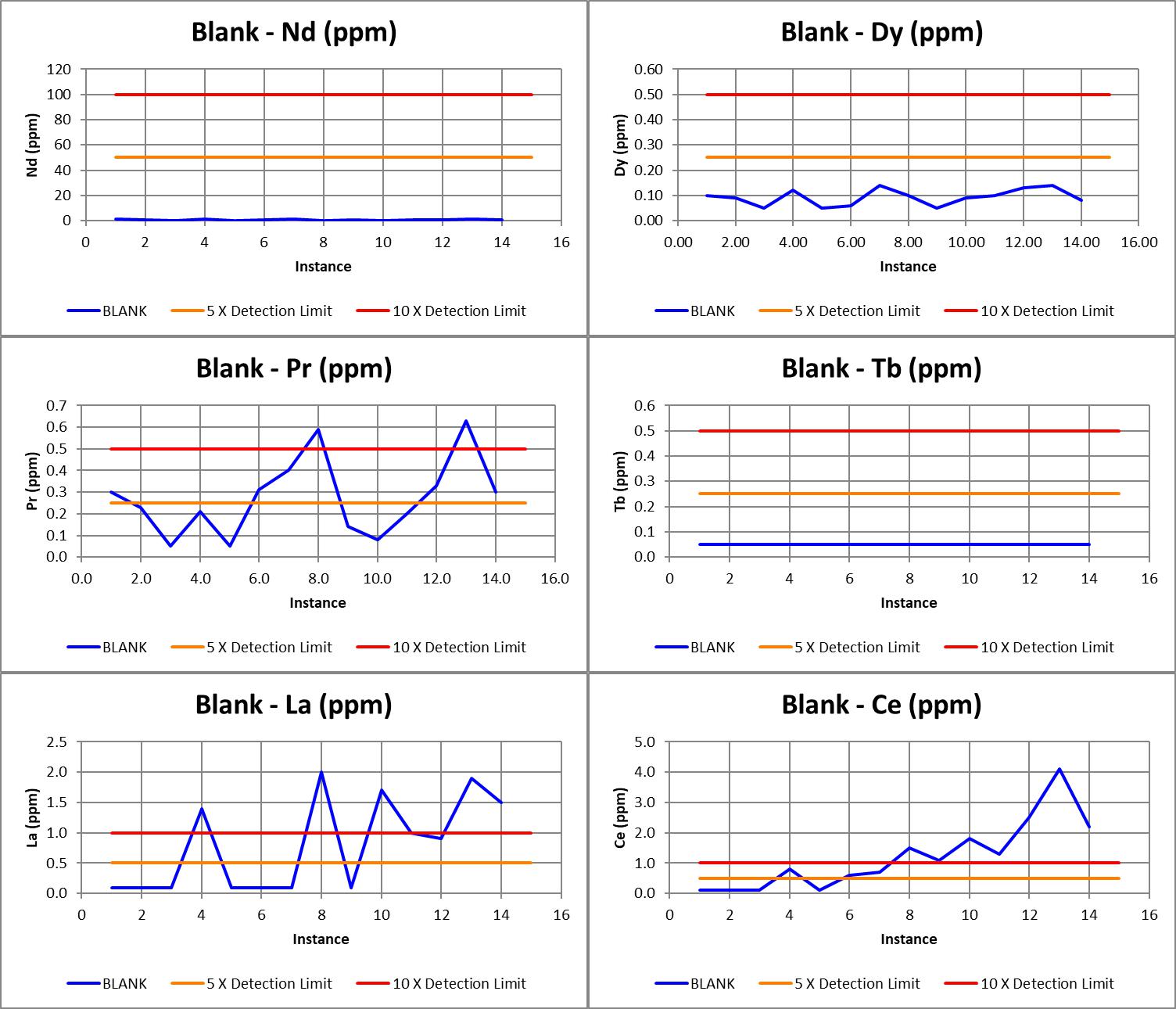
Table 8-7 Blank QAQC
| Blank | Blank: Nd (ppm) | Blank: Dy (ppm) | Blank: Pr (ppm) | Blank: Tb (ppm) | Blank: La (ppm) | Blank: Ce (ppm) | ||||||||||||||||||
| Count | 15 | 15 | 15 | 15 | 15 | 15 | ||||||||||||||||||
| Passed | 15 | 15 | 7 | 15 | 8 | 5 | ||||||||||||||||||
| Warning | 0 | 0 | 6 | 0 | 0 | 3 | ||||||||||||||||||
| Failed | 0 | 0 | 2 | 0 | 7 | 7 | ||||||||||||||||||
| % Failed | 0 | 0 | 13 | 0 | 47 | 47 | ||||||||||||||||||
| 8.4 | Conclusion |
A total of 24 standards were analysed. Neodymium, Praseodymium, Lanthanum, and Cerium returned acceptable values all within 2 standard deviations for OREAS 460, 461, and 463. The returned values for Nd, Pr, La, and Ce in OREAS 465 were above the detection limit of 10,000 ppm (Nd, La, and Ce) and 1,000 ppm (Pr). Dysprosium returned all acceptable values within 3 standard deviations for all four OREAS standards. There may be a possible discrepancy with the Terbium data due to different digestion methods.
A total of 15 Blanks were analysed. The analysis returned acceptable values within 5 times the detection limit for Nd, Dy, and Ce. Possible discrepancies were observed with Pr, La, and Ce.
| S-K 1300 Technical Report – Alto Paranaíba REE and Titanium Project – Minas Gerais, Brazil | Page 62 |
| 9 | DATA VERIFICATION |
No property inspection has been completed at this time.
| S-K 1300 Technical Report – Alto Paranaíba REE and Titanium Project – Minas Gerais, Brazil | Page 63 |
| 10 | MINERAL PROCESSING AND METALLURGICAL TESTING |
This section is not relevant to this Report.
| S-K 1300 Technical Report – Alto Paranaíba REE and Titanium Project – Minas Gerais, Brazil | Page 64 |
| 11 | MINERAL RESOURCE ESTIMATES |
There are no Mineral Resource Estimates on this Project.
| S-K 1300 Technical Report – Alto Paranaíba REE and Titanium Project – Minas Gerais, Brazil | Page 65 |
| 12 | MINERAL RESERVE ESTIMATES |
There are no Mineral Reserve Estimates on this Project.
| S-K 1300 Technical Report – Alto Paranaíba REE and Titanium Project – Minas Gerais, Brazil | Page 66 |
| 13 | MINING METHODS |
This section is not relevant to this Report.
| S-K 1300 Technical Report – Alto Paranaíba REE and Titanium Project – Minas Gerais, Brazil | Page 67 |
| 14 | PROCESSING AND RECOVERY METHODS |
This section is not relevant to this Report.
| S-K 1300 Technical Report – Alto Paranaíba REE and Titanium Project – Minas Gerais, Brazil | Page 68 |
| 15 | INFRASTRUCTURE |
This section is not relevant to this Report.
| S-K 1300 Technical Report – Alto Paranaíba REE and Titanium Project – Minas Gerais, Brazil | Page 69 |
| 16 | MARKET STUDIES |
This section is not relevant to this Report.
| S-K 1300 Technical Report – Alto Paranaíba REE and Titanium Project – Minas Gerais, Brazil | Page 70 |
| 17 | ENVIRONMENTAL STUDIES, PERMITTING, AND PLANS, NEGOTIATIONS, OR AGREEMENTS WITH LOCAL INDIVIDUALS OR GROUPS |
There are no environmental studies. There are no plans, negotiations or agreements with local individuals or groups.
| S-K 1300 Technical Report – Alto Paranaíba REE and Titanium Project – Minas Gerais, Brazil | Page 71 |
| 18 | CAPITAL AND OPERATING COSTS |
This section is not relevant to this Report.
| S-K 1300 Technical Report – Alto Paranaíba REE and Titanium Project – Minas Gerais, Brazil | Page 72 |
| 19 | ECONOMIC ANALYSIS |
This section is not relevant to this Report.
| S-K 1300 Technical Report – Alto Paranaíba REE and Titanium Project – Minas Gerais, Brazil | Page 73 |
| 20 | ADJACENT PROPERTIES |
Atlas Critical Minerals mineral rights are located near to or adjacent to Resouro Strategic Minerals Inc. (“Resouro”) and/or Equinox Resources Limited (“Equinox”), both of which are listed companies that have publicly disclosed the presence of significant concentrations of REE and titanium in their projects (Figure 20-1).
Resouro Company released its Maiden Report with 102 drillholes along with 20 previous drillholes (executed by Vicenza and Iluka, in 2011 and 2016). The 1,000-ppm cut-off was applied to resources estimative, which gathered 1.9 billion tonnes at 3,900 ppm TREO (Measured, Indicated, Inferred) with 1,100 ppm of MREO - Pr, Nd, Tb, Dy and 12% of TiO2. Most of the Resouro’s drill holes show intervals with 7429 - 11200 ppm TREO, some reaching over 11,200 ppm TREO (Figure 20-2), and 16 – 23% TiO2, followed by many drillholes with intervals showing TiO2 grades between 23 and 31% (Figure 20-3).
In the metallurgical tests phase, Resouro executed three tests so far: the 1st was carried out by Prosper Lab presented positive results for leaching under ammonium sulfate. The 2nd tests were performed by CTDN Lab held different, with negative results. The analytical results of these first two tests were not found. In August 2024, Resouro published analytical results carried out in the laboratory of the British and Australian company Altilium Group Limited (Figure 20-4). These were leaching tests with nitric acid, showing positive results for REE recovery under different conditions (pH, time, heat). In May 2025, Resouro announced that it was studying ways to transform Anatase (TiO2) into Rutile and recover REE using sulfuric acid, but did not provide details on analytical and recovery results.
Equinox is operating a drilling campaign in four permits: 833,402/2023, 5 km from Atlas Critical Minerals Block 2 (Figure 20-5); 833,403/2023, (neighbor to Atlas Critical Minerals Permit 832,701/2024); 833,404/2023 and 833,405/2023 (both neighbor to Atlas Critical Minerals Permit 831,645/2024). Equinox plans to announce Maiden Resource Report in 2025. Highlights of Equinox drilling intercepts:
| ● | 36 m at 13.9% TiO₂, 3,885 ppm TREO, 855 ppm Nb₂O₅ from surface (DD25_072). | |
| ● | 37 m at 13.0% TiO₂, 2,500 ppm TREO, 741 ppm Nb₂O₅ from surface (DD25_075). | |
| ● | 31 m at 15.1% TiO₂, 3,452 ppm TREO, 802 ppm Nb₂O₅ from surface (DD25_120). | |
| ● | 11 m at 16.17% TiO₂, 3,783 ppm TREO, 943 ppm Nb₂O₅ from surface (AD25_223). | |
| ● | 15 m at 13.6% TiO₂, 3,983 ppm TREO, 862 ppm Nb₂O₅ from surface (DD25_098). |
| S-K 1300 Technical Report – Alto Paranaíba REE and Titanium Project – Minas Gerais, Brazil | Page 74 |
Figure 20-1 Atlas Critical Minerals Permits and Their Neighboring Competition of Resouro, in Yellow, and Equinox, in Green
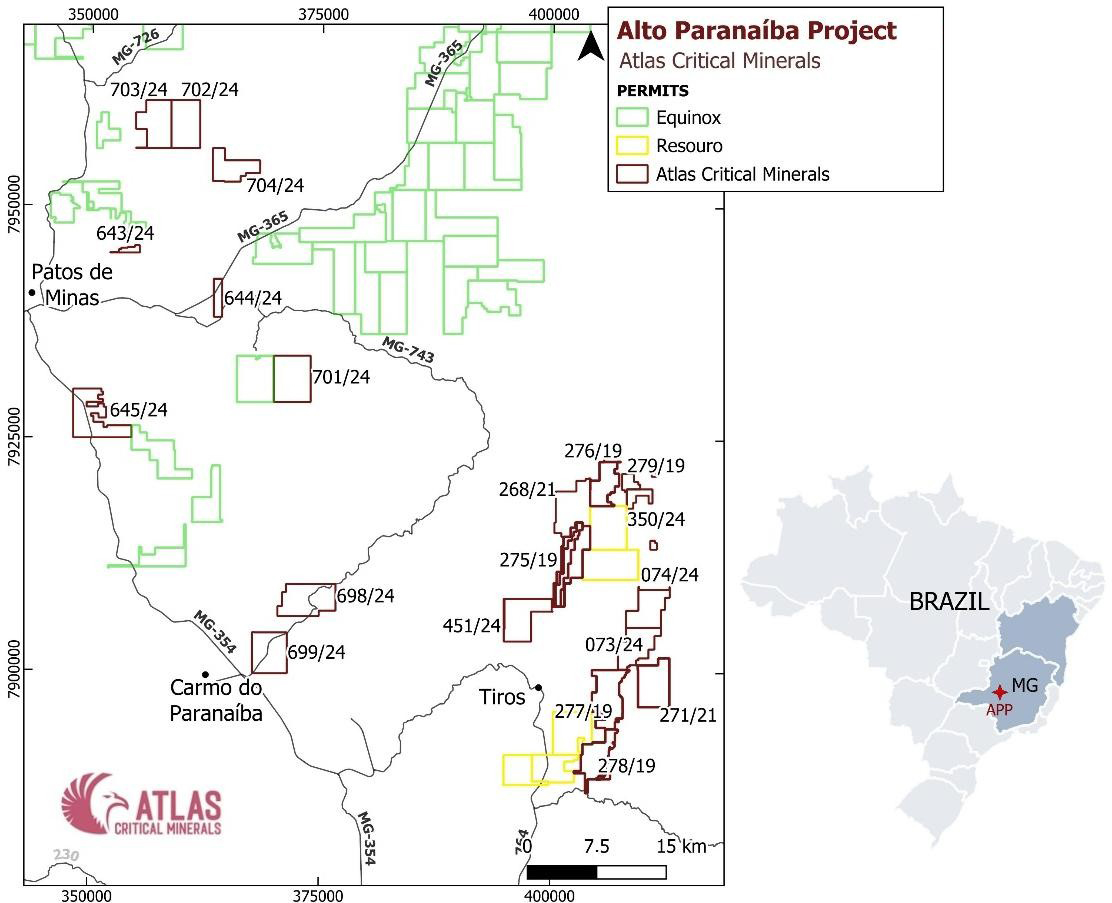
| S-K 1300 Technical Report – Alto Paranaíba REE and Titanium Project – Minas Gerais, Brazil | Page 75 |
Figure 20-2 Resouro’s Drill Holes Classified as the Highest-Grade Interception of TREO
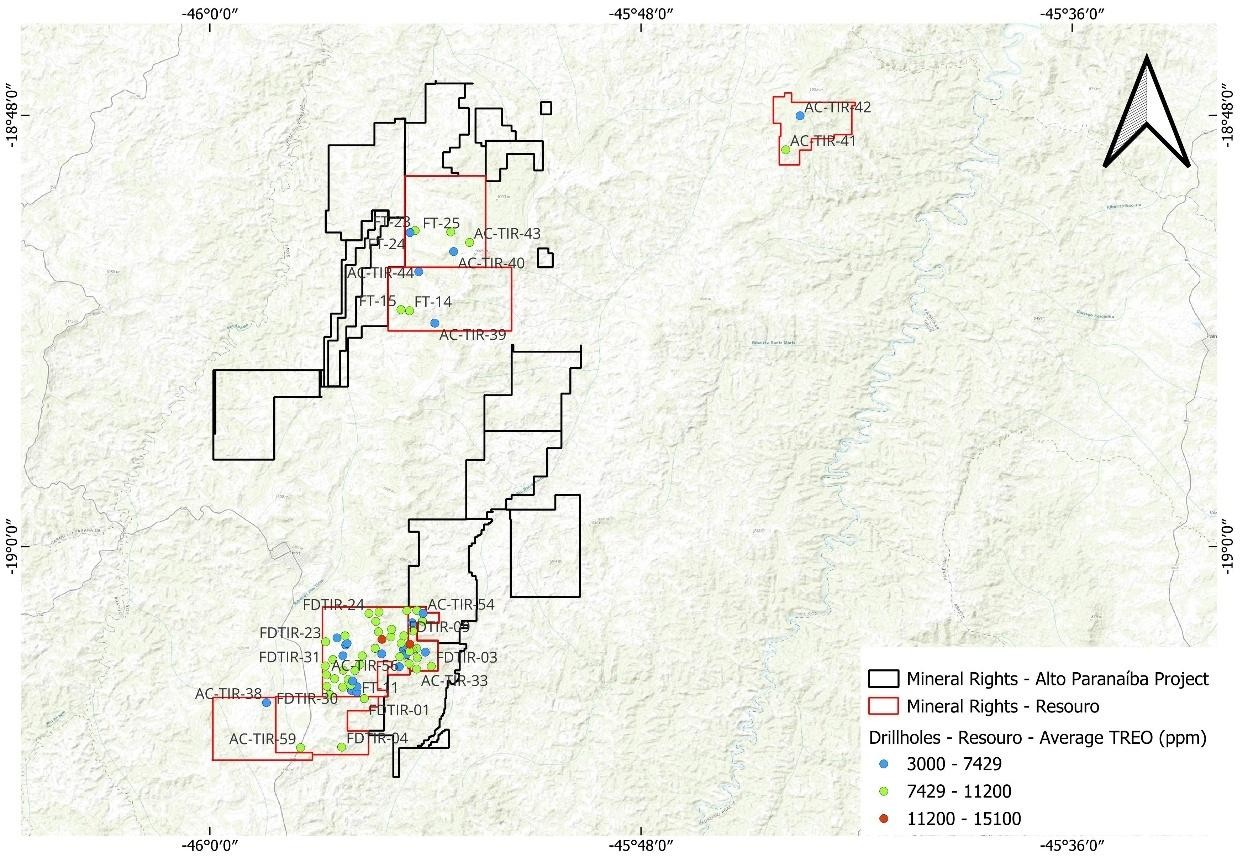
Figure 20-3 Resouro’s Drill Holes Classified as the Highest-Grade Interception of TiO2
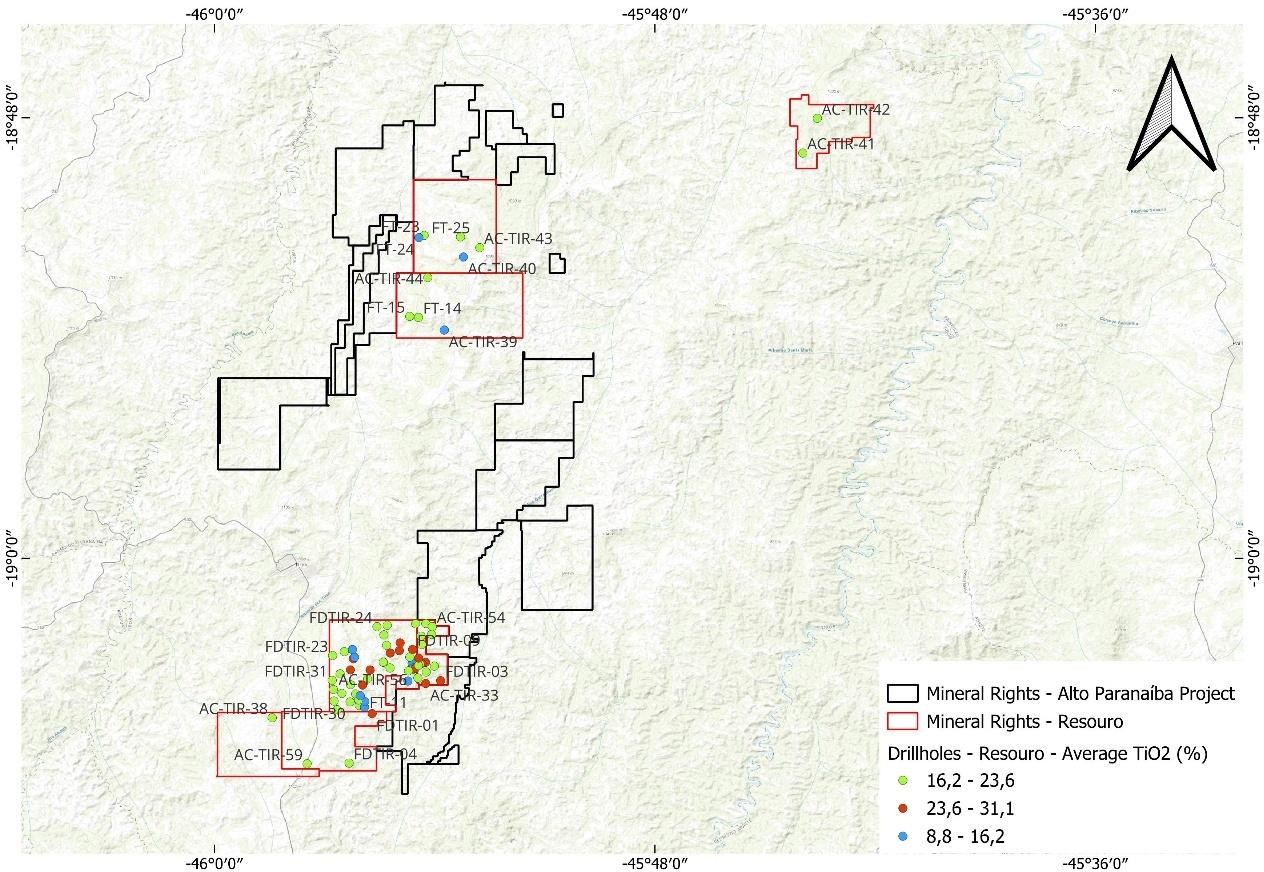
| S-K 1300 Technical Report – Alto Paranaíba REE and Titanium Project – Minas Gerais, Brazil | Page 76 |
Figure 20-4 Metallurgical Tests of Resouro - August 2024 Executed by the Company Altilium Group Limited. Leaching Test with HNO3
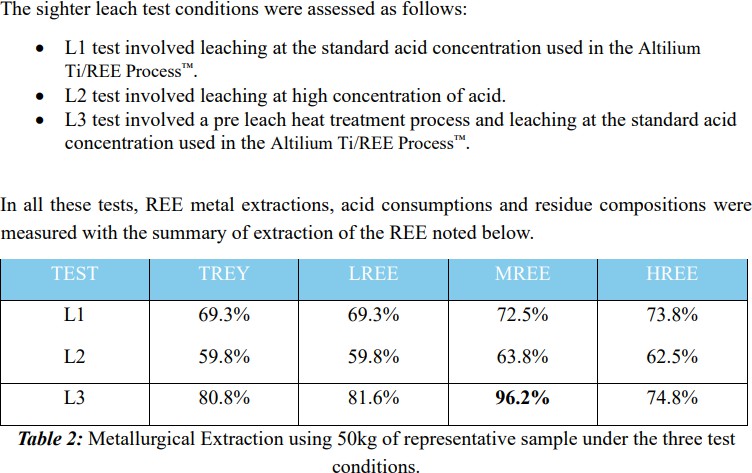
Source: https://api.investi.com.au/api/announcements/rau/8f3fb983-263.pdf
Figure 20-5 Equinox Section for their Patos Target, in the Region of the Block 2 Atlas Critical Minerals Areas
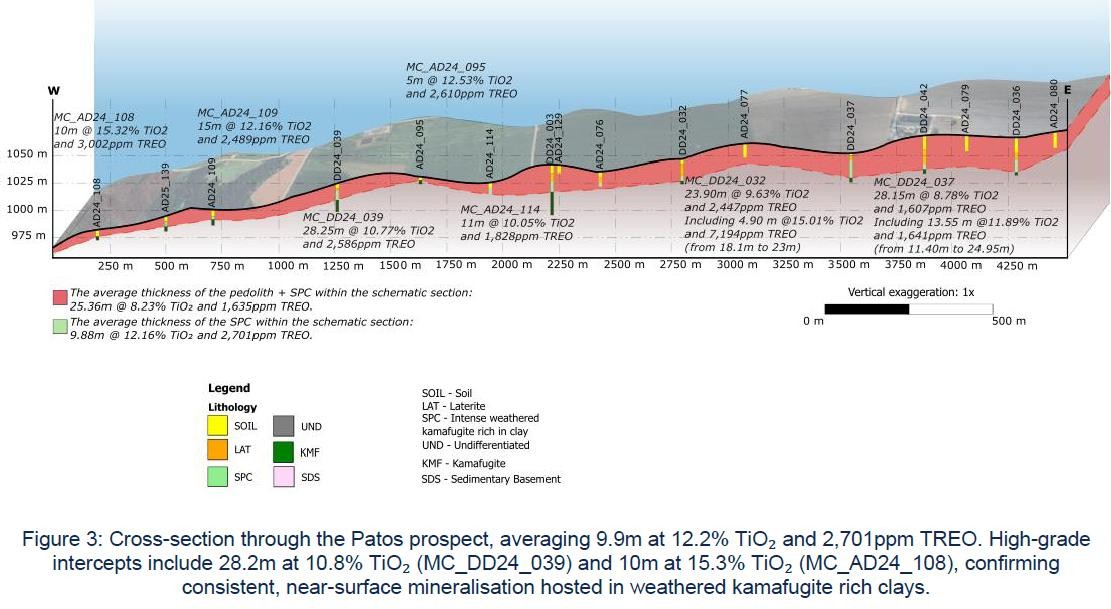
| S-K 1300 Technical Report – Alto Paranaíba REE and Titanium Project – Minas Gerais, Brazil | Page 77 |
| 21 | OTHER RELEVANT DATA AND INFORMATION |
No other information or explanation is necessary to take this TRS understandable and not misleading.
| S-K 1300 Technical Report – Alto Paranaíba REE and Titanium Project – Minas Gerais, Brazil | Page 78 |
| 22 | INTERPRETATION AND CONCLUSIONS |
SGS Geological Services Inc. (“SGS”) was contracted by Atlas Critical Minerals Corporation (“Atlas Critical Minerals” or the “Company”) to complete a Property of Merit for the Alto Paranaíba Rare Earth Elements (“REE”) and Titanium Project near the city of Patos de Minas, Brazil, and to prepare a Public Report in accordance with the §§ 229.601(b)(96) Technical report (subpart 229.1300 of Regulation S-K) written in support of a Property of Merit on the Alto Paranaíba Project.
This TRS conforms to the United States Securities and Exchange Commission’s (SEC) Modernized Property Disclosure Requirements for Mining Registrants as described in Subpart 229.1300 of Regulation S-K, Disclosure by Registrants Engaged in Mining Operations (S-K 1300) and Item 601 (b)(96) Technical Report Summary.
Initial exploration by Atlas Critical Minerals started in 2024, where mineralization was tested through auger drilling and surface samples. Surface samples were collected (589 samples), and preliminary auger core drilling was conducted (5 auger drill holes), providing strong indications of the project’s potential.
Further exploration was undertaken in 2025, which expanded the understanding of the Alto Paranaíba Project’s mineral potential. A new sampling program was completed, with 220surface samples and 8 auger core drilling.
Initial surface and drilling samples show zones of high grades for rare earths and titanium and geological mapping has shown high volume potential for such mineralization.
| S-K 1300 Technical Report – Alto Paranaíba REE and Titanium Project – Minas Gerais, Brazil | Page 79 |
| 23 | RECOMMENDATIONS |
Atlas Critical Minerals objective is to rapidly issue a resource estimate and, in the medium term, develop an integrated mine and processing plant project for the beneficiation of rare earth oxides and titanium.
For the next phase of exploration, the work has been planned to seek synergies among the mineral rights areas, enabling proximity assessments and shared use of resources such as management teams, field supervision, and the necessary infrastructure to carry out the activities, as well as for service providers. The implementation will be divided into three phases.
In this first phase will target the development of mineral resources on mineral rights numbers 832,699/2024 and 832,698/2024, which have been designated as Block 1. The planned activities for this block are described below:
| ● | The work will begin with Geophysical Magnetometric Survey (Drone MAG), Aerophotogrammetry, and a detailed topographic surveying using Lidar, with a budget of US$ 65,000.00. | |
| ● | In addition, the program will include a 4,000-meter drilling campaign, supported by the implementation of all necessary infrastructure for a complete sample management and quality control chain. This will encompass chemical analyses, proper sample storage in a dedicated facility, and the application of rigorous QA/QC protocols. The estimated budget for this phase is US$ 960,000.00 | |
| ● | The owner’s team will be responsible for managing and supervising field activities, with a budget of US$ 235,000.00. | |
| ● | Metallurgical Testing and SK-1,300 resource report with US$ 210,000.00. | |
| ● | Other minors cost and Contingency US$ 80,000.00. |
Totaling a value of US$ 1,550,000.00 for the resource report definition of both areas.
The second phase will target the development of mineral resources on mineral rights 832,704/2024, 832,703/2024, and 832,702/2024, collectively designated as Block 2. Located in the northernmost portion of the project area, these tenements will undergo the same set of activities previously described, as detailed below:
| ● | The work will begin with Geophysical Magnetometric Survey (Drone MAG), Aerophotogrammetry, and a detailed topographic surveying using Lidar, with a budget of US$ 76,000.00. | |
| ● | In addition, the program will include a 4,900-meter drilling campaign, supported by the implementation of all necessary infrastructure for a complete sample management and quality control chain. This will encompass chemical analyses, proper sample storage in a dedicated facility, and the application of rigorous QA/QC protocols. The estimated budget for this phase is US$ 1,175,000.00 | |
| ● | The owner’s team will be responsible for managing and supervising field activities, with a budget of US$ 290,000.00. | |
| ● | Metallurgical Testing and SK-1,300 resource report with US$ 230,000.00. | |
| ● | Other minors cost and Contingency US$ 90,000.00. |
Totaling a value of US$ 1,861,000.00 for the resource report definition of three areas.
| S-K 1300 Technical Report – Alto Paranaíba REE and Titanium Project – Minas Gerais, Brazil | Page 80 |
In the final stage of the material property exploration plan, the target will be the development of mineral resources on mineral rights 832,701/2024, 831,645/2024, and 831,643/2024, which are part of Block 2. These tenements are located in the southern portion of the block. The same exploration activities previously described will be implemented in this area, as outlined below:
| ● | The work will begin with Geophysical Magnetometric Survey (Drone MAG), Aerophotogrammetry, and a detailed topographic surveying using Lidar, with a budget of US$ 71,000.00. | |
| ● | In addition, the program will include a 4,100-meter drilling campaign, supported by the implementation of all necessary infrastructure for a complete sample management and quality control chain. This will encompass chemical analyses, proper sample storage in a dedicated facility, and the application of rigorous QA/QC protocols. The estimated budget for this phase is US$ 1,100,000.00 | |
| ● | The owner’s team will be responsible for managing and supervising field activities, with a budget of US$ 270,000.00. | |
| ● | Metallurgical Testing and SK-1,300 resource report with US$ 225,000.00. | |
| ● | Other minors cost and Contingency US$ 80,000.00. |
Totaling a value of US$ 1,746,000.00 for the resource report definition of three areas.
If the outcome of this work is successful, it is recommended to evaluate a plan to generate a scoping study for the project or a similar early-stage economic assessment to guide future development decisions.
Note: Other areas not considered material properties are not have a planning for exploration at this time.
| S-K 1300 Technical Report – Alto Paranaíba REE and Titanium Project – Minas Gerais, Brazil | Page 81 |
| 24 | REFERENCES |
Brod, J. A., Gibson, S. A., Thompson, R. N., Junqueira-Brod, T. C., Seer, H. J., Moraes, L. D., and Boaventura, G. R. (2000). The kamafugite-carbonatite association in the Alto Paranaíba Igneous Province (APIP) southeastern Brazil. Revista Brasileira de Geociências, 30(3), 408-412.
Campos J.E.G., and Dardenne, M.A., 1997. Estratigrafia e sedimentação da bacia Sanfranciscana: Uma Revisão. Revista Brasileira Geociências, 27(3): 269-282.
Fragoso, D. G. C., Uhlein, A., Sanglard, J. C. D., Suckau, G. L., Guerzoni, H. T. G., and Faria, P. H., 2011. Geologia dos grupos Bambuí, Areado e Mata da Corda na folha Presidente Olegário (1: 100.000), MG: registro deposicional do Neoproterozóico ao Neocretáceo da Bacia do São Francisco. Geonomos, 19(1): 28 - 38.
Gomes, D. G. D. C., 2021. Atlas aerogeofísico do estado de Minas Gerais. Organizador Diego Guilherme da Costa Gomes. – Belo Horizonte: CPRM, 2021. 1 recurso eletrônico : PDF Levantamentos geológicos e integração geológica regional.
IBGE – Instituto Brasileiro de Geografia e Estatística, 2002. Mapa de Clima do Brasil, escala 1:5 000 000.
Noce, C.M., Pedrosa-Soares, A.C., da Silva, L.C., Armstrong, R. and Piuzana, D., 2007. Evolution of polycyclic basement complexes in the Araçuaí Orogen, based on U–Pb SHRIMP data: Implications for Brazil–Africa links in Paleoproterozoic time.
Pedrosa Soares, A. C. P., Dardenne, M. A., Hasui, Y., Castro, F. D. C., and Carvalho, M. V. A., 1994. Nota Explicativa dos Mapas Geológico, Metalogenético e de Ocorrências Minerais do Estado de Minas Gerais. Escala 1:1.000.000. Minas Gerais: Companhia Mineradora de Minas Gerais – COMIG.
Reis, H, 2011. Projeto Alto Paranaíba-Folha Serra Selada, Cap. 13. CODEMIG-UFMG. 741-785.
Sedorko, D., Alessandretti, L., Warren, L. V., Verde, M., Rangel, C. C., Ramos, K. S., and Netto, R. G., 2020. Trace fossils from the upper cretaceous capacete formation, Sanfranciscana Basin, Central Brazil. In Annales Societatis Geologorum Poloniae (Vol. 90). 13 p.
Sgarbi, G.,1989. Geologia da Formação Areado: Cretáceo Inferior a Médio da Bacia do São Francisco, oeste do Estado de Minas Gerais. M.Sc.Thesis, Universidade Federal do Rio de Janeiro-UFRJ, 324 p.
Siqueira H.R. de., Alves G de F., and Guimarães E.C. 2007. Comportamento da precipitação pluviométrica mensal do estado de Minas Gerais: Análise espacial e temporal. Rev. Horizonte Científico. 1(7):1-21.
Takehara, L., 2015. Avaliação do Potêncial de Terras Raras no Brasil. Brasília: CPRM, 2015. 218 p.: il. – (Informe de Recursos Minerais, Série Minerais Estratégicos, 02).
Uhlein, A., de Freitas, A. M., da Cruz, A. B., da Silva, W. F., de Caxito, F. A., and de Moreira, G. C., 2011. Projeto Alto Paranaíba-Folha Carmo do Paranaíba, Cap. 07. CODEMIG-UFMG. 438-476.
Velásquez Ruiz, F., Cordeiro, P., Reich, M., Motta, J. G., Ribeiro, C. C., Angerer, T., and Bernardes, R. B., 2023. The genetic link between kamafugite magmatism and alkaline–carbonatite complexes in the Late Cretaceous Alto Paranaíba Igneous Province, Central Brazil. International Geology Review, 65(13), 2148-2170.
| S-K 1300 Technical Report – Alto Paranaíba REE and Titanium Project – Minas Gerais, Brazil | Page 82 |
| 25 | RELIANCE ON INFORMATION PROVIDED BY THE REGISTRANT |
There is no other relevant data or information available that is necessary to make the technical report understandable and not misleading.