Investor Presentation June 2026
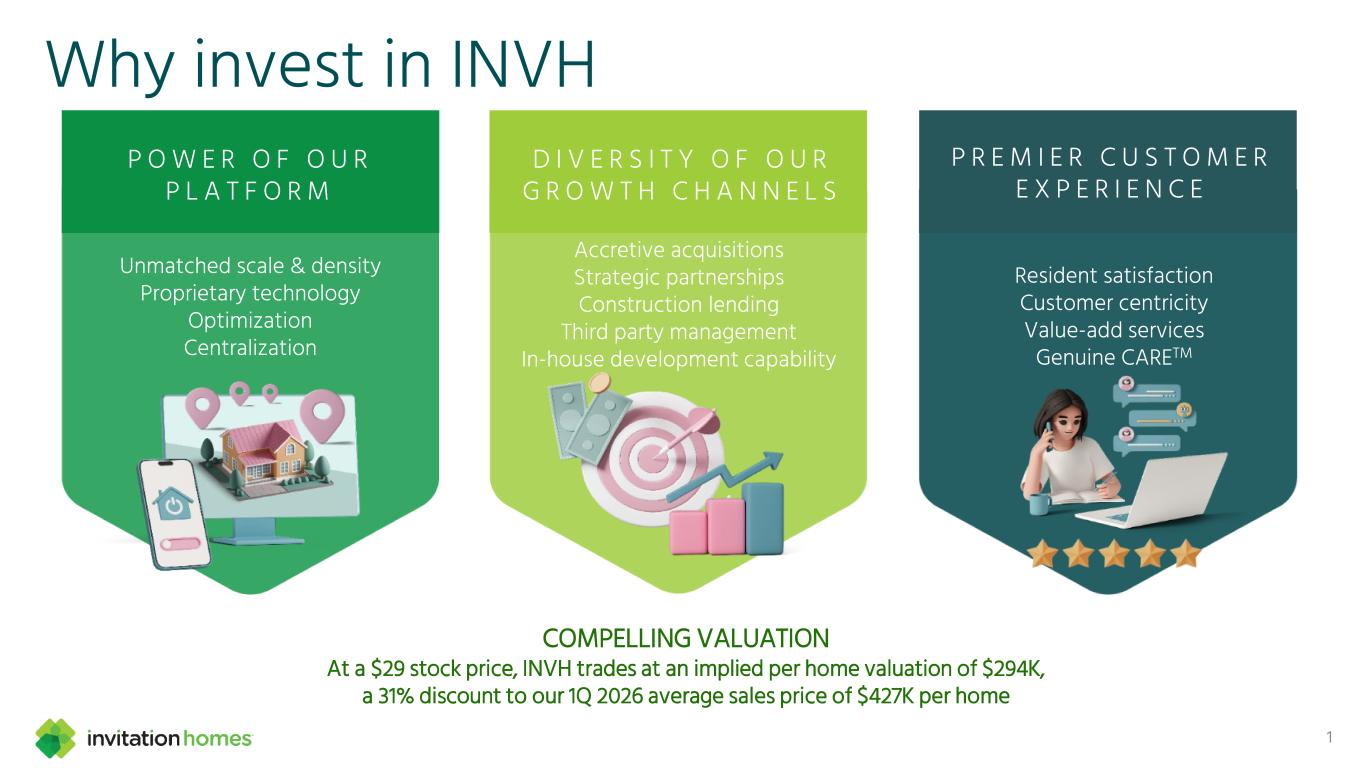
Why invest in INVH 1 Resident satisfaction Customer centricity Value-add services Genuine CARETM P R E M I E R C U S T O M E R E X P E R I E N C E P O W E R O F O U R P L A T F O R M Unmatched scale & density Proprietary technology Optimization Centralization D I V E R S I T Y O F O U R G R O W T H C H A N N E L S Accretive acquisitions Strategic partnerships Construction lending Third party management In-house development capability COMPELLING VALUATION At a $29 stock price, INVH trades at an implied per home valuation of $294K, a 31% discount to our 1Q 2026 average sales price of $427K per home
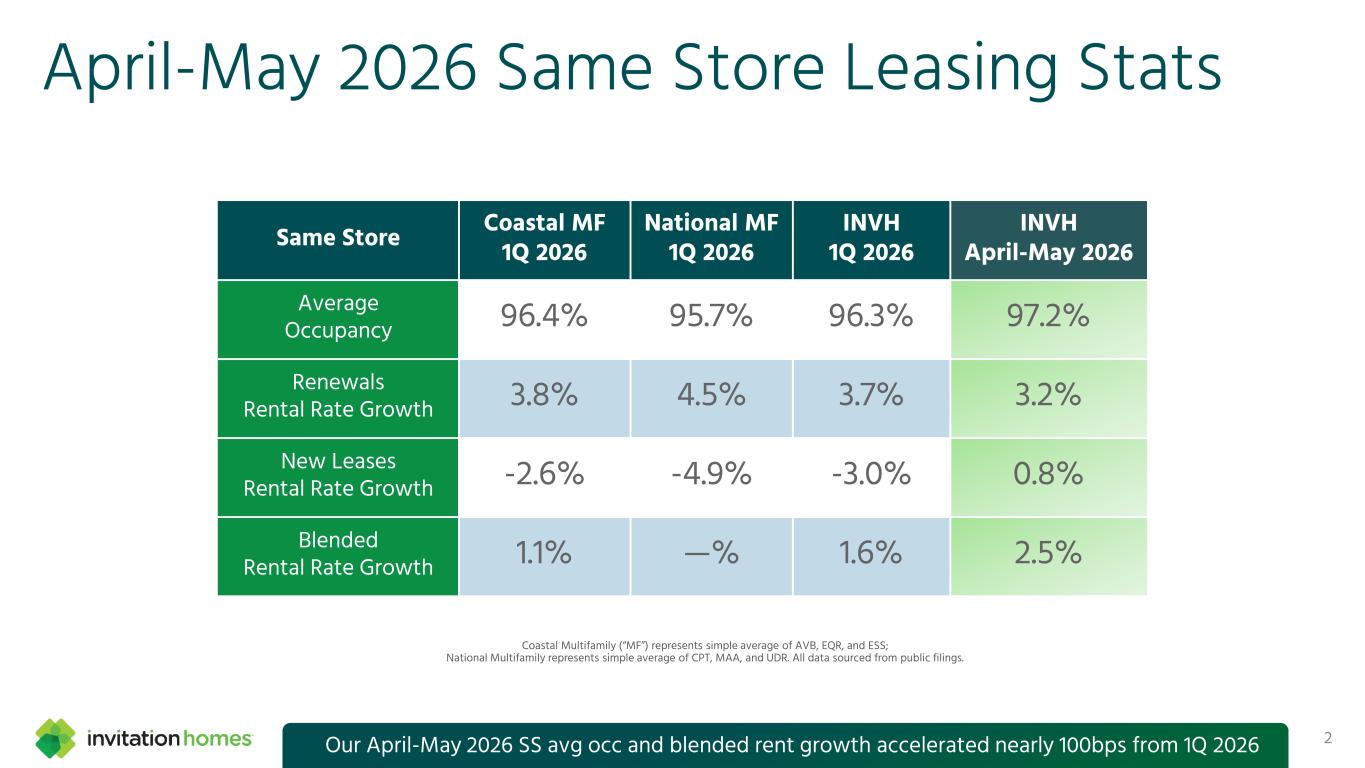
April-May 2026 Same Store Leasing Stats Same Store Coastal MF 1Q 2026 National MF 1Q 2026 INVH 1Q 2026 INVH April-May 2026 Average Occupancy 96.4% 95.7% 96.3% 97.2% Renewals Rental Rate Growth 3.8% 4.5% 3.7% 3.2% New Leases Rental Rate Growth -2.6% -4.9% -3.0% 0.8% Blended Rental Rate Growth 1.1% —% 1.6% 2.5% Our April-May 2026 SS avg occ and blended rent growth accelerated nearly 100bps from 1Q 2026 Coastal Multifamily (“MF”) represents simple average of AVB, EQR, and ESS; National Multifamily represents simple average of CPT, MAA, and UDR. All data sourced from public filings. 2
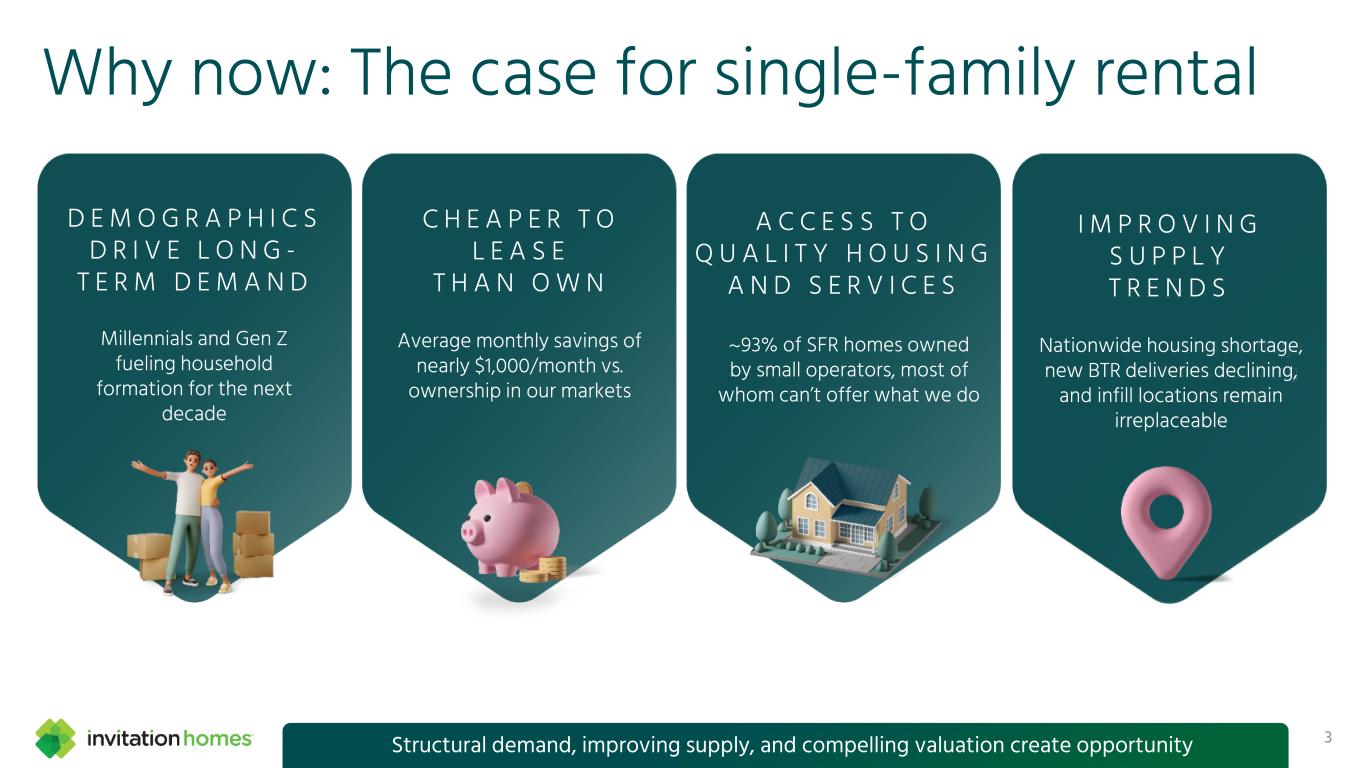
Why now: The case for single-family rental 3Structural demand, improving supply, and compelling valuation create opportunity C H E A P E R T O L E A S E T H A N O W N Average monthly savings of nearly $1,000/month vs. ownership in our markets D E M O G R A P H I C S D R I V E L O N G - T E R M D E M A N D Millennials and Gen Z fueling household formation for the next decade A C C E S S T O Q U A L I T Y H O U S I N G A N D S E R V I C E S ~93% of SFR homes owned by small operators, most of whom can’t offer what we do I M P R O V I N G S U P P L Y T R E N D S Nationwide housing shortage New BTR deliveries declining Infill locations remain irreplaceable I M P R O V I N G S P P L Y i s rtage, n li ri s declining, and infill locations remain
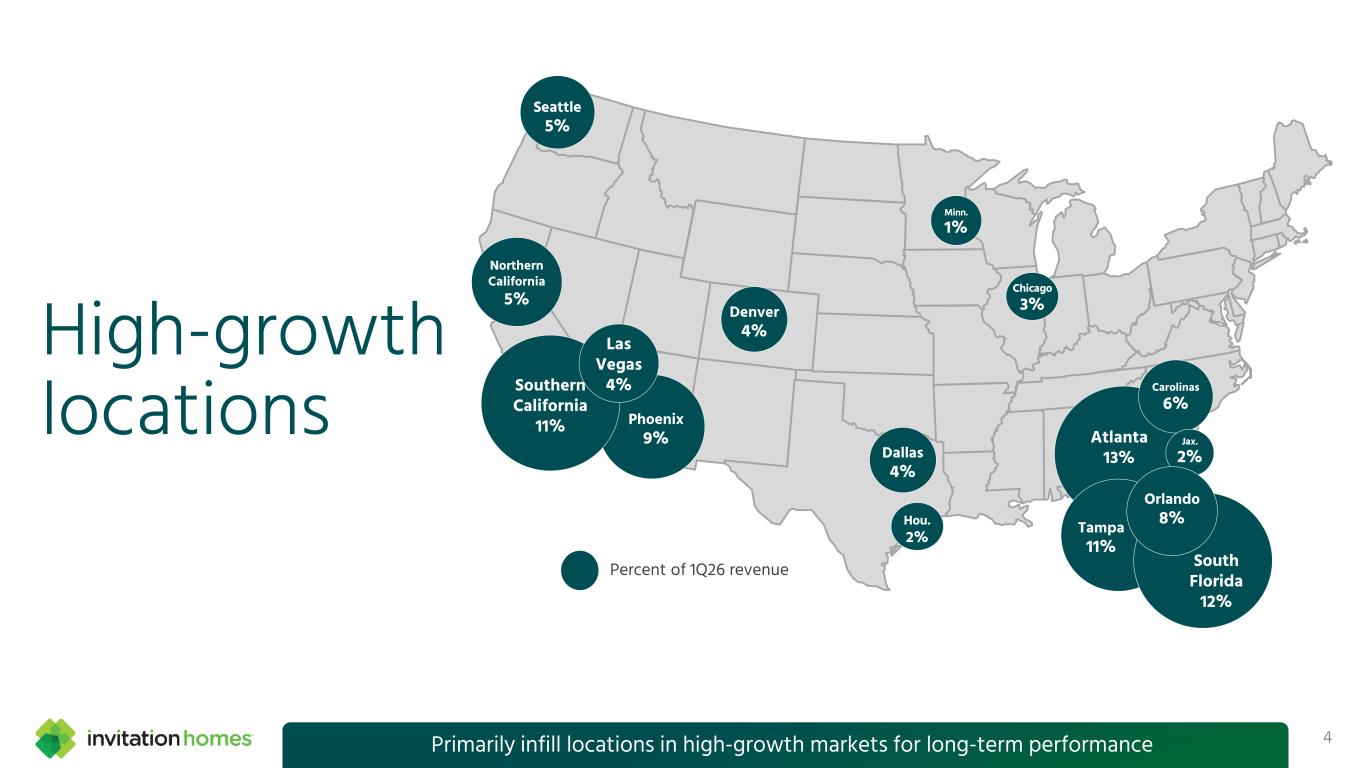
High-growth locations Percent of 1Q26 revenue Seattle 5% Minn. 1% Denver 4% Dallas 4% Phoenix 9% Atlanta 13% Tampa 11% Southern California 11% Las Vegas 4% South Florida 12% Northern California 5% Carolinas 6% Jax. 2% Orlando 8%Hou. 2% Chicago 3% Primarily infill locations in high-growth markets for long-term performance 4
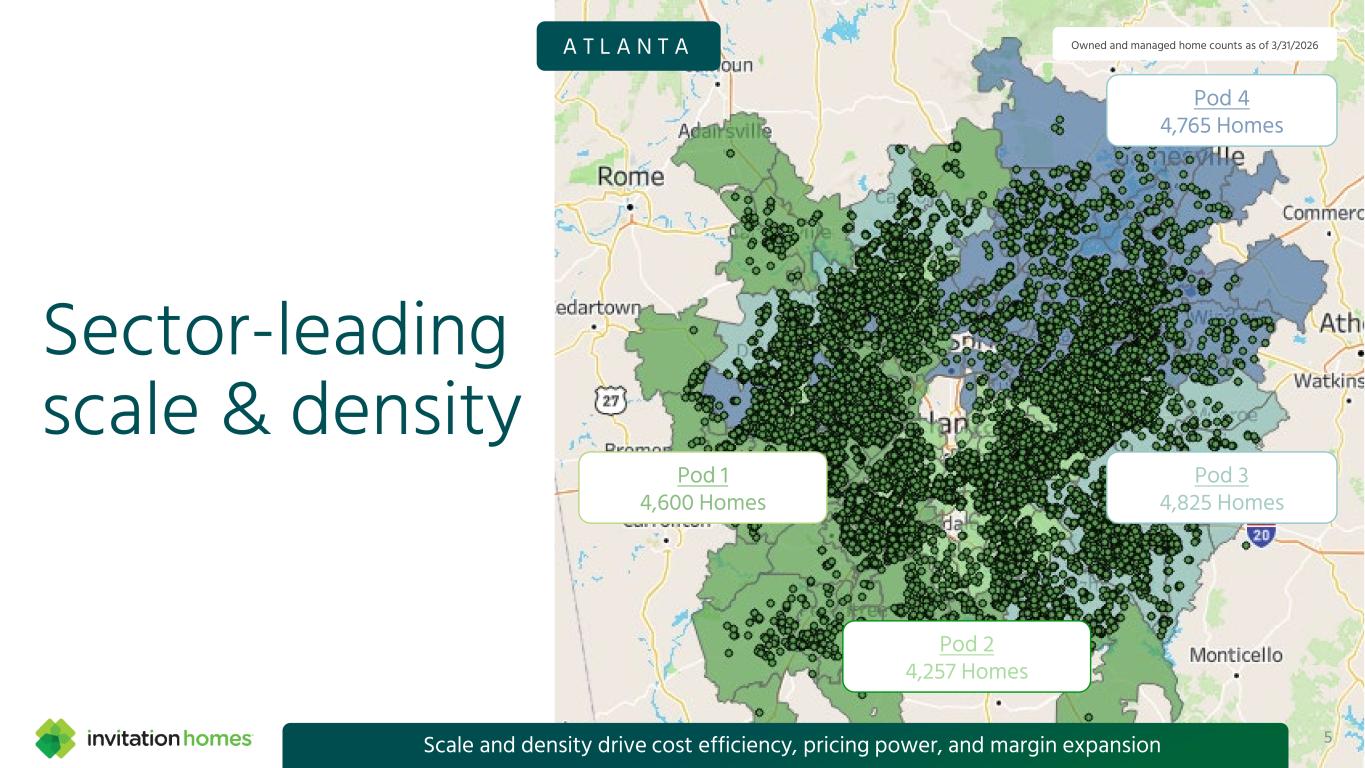
5 Sector-leading scale & density Pod 1 4,600 Homes Pod 2 4,257 Homes Pod 3 4,825 Homes Pod 4 4,765 Homes Owned and managed home counts as of 3/31/2026A T L A N T A Scale and density drive cost efficiency, pricing power, and margin expansion 5
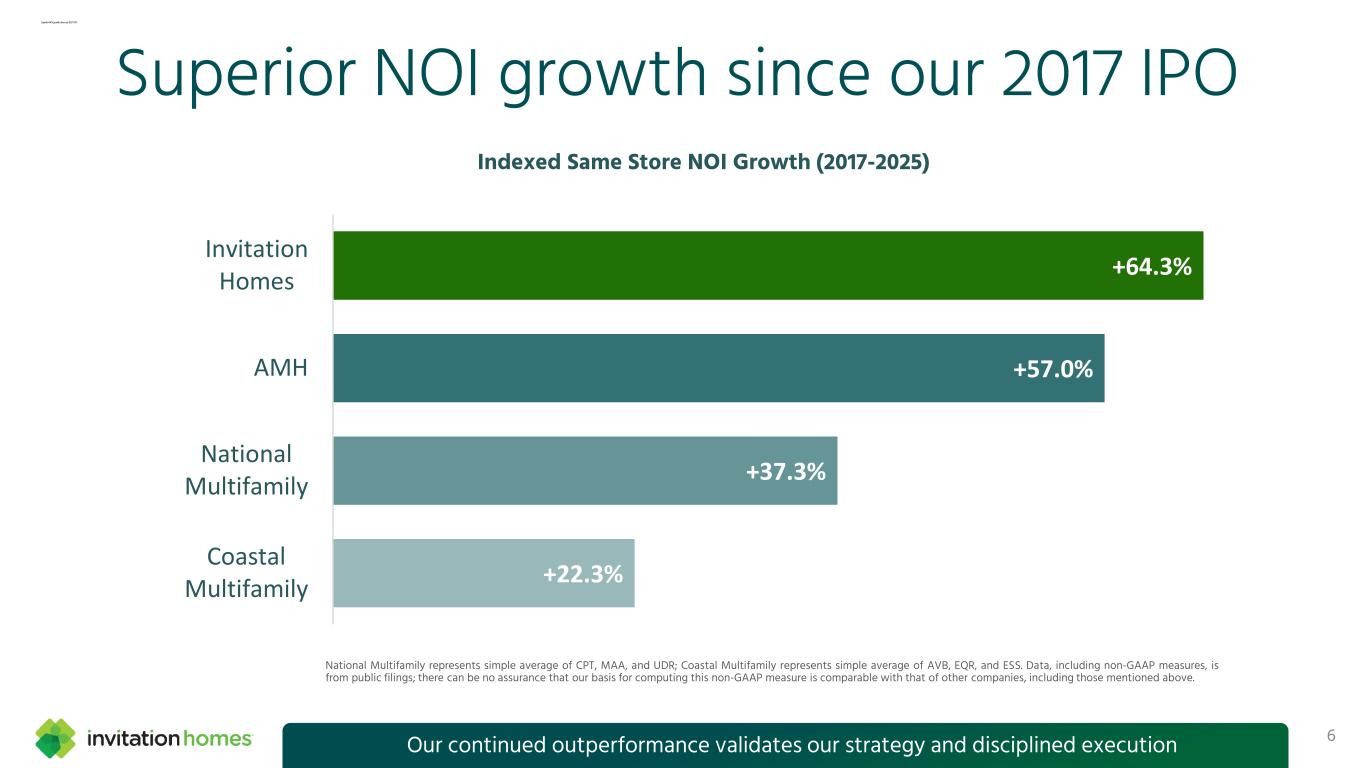
Superior NOI growth since our 2017 IPO Superior NOI growth since our 2017 IPO 6 National Multifamily represents simple average of CPT, MAA, and UDR; Coastal Multifamily represents simple average of AVB, EQR, and ESS. Data, including non-GAAP measures, is from public filings; there can be no assurance that our basis for computing this non-GAAP measure is comparable with that of other companies, including those mentioned above. Our continued outperformance validates our strategy and disciplined execution +64.3% +57.0% +37.3% +22.3% Invitation Homes AMH National Multifamily Coastal Multifamily Indexed Same Store NOI Growth (2017-2025)
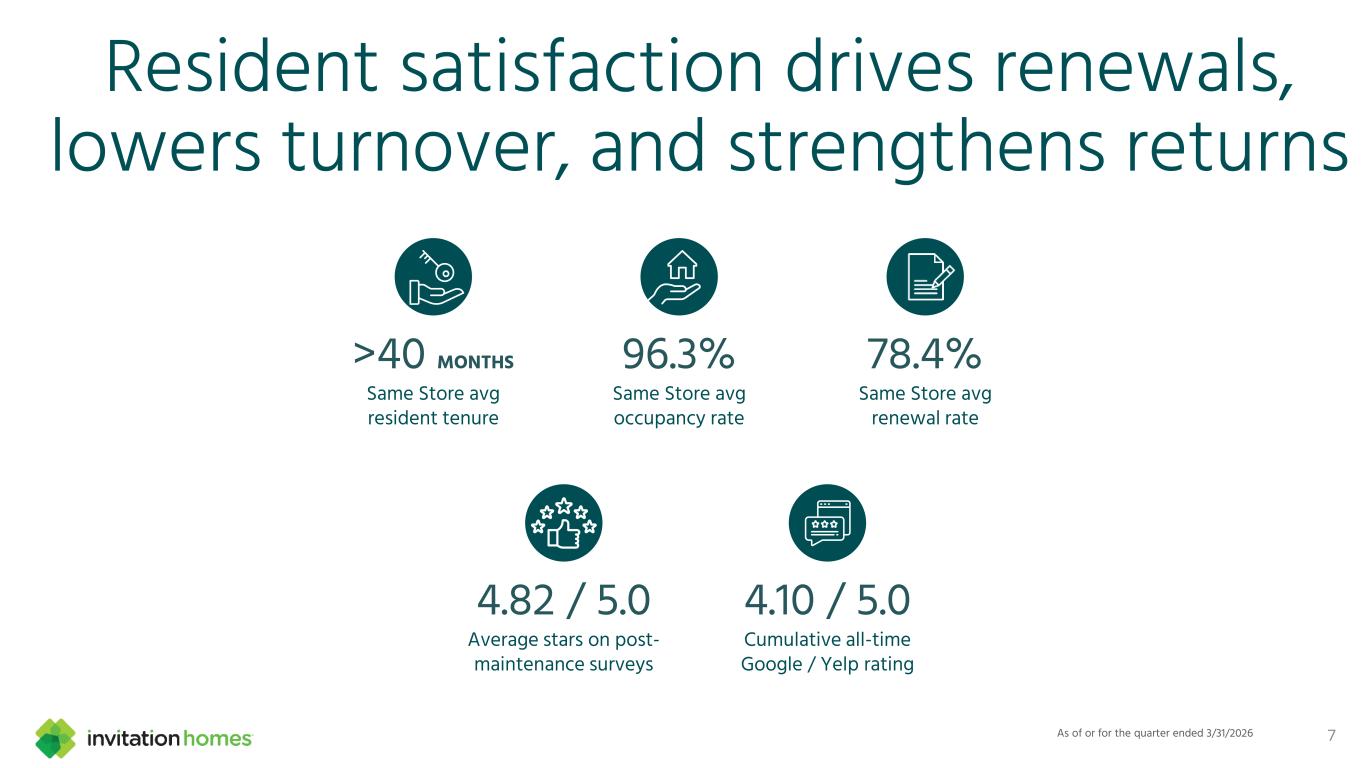
Resident satisfaction drives renewals, lowers turnover, and strengthens returns 7 4.10 / 5.0 Cumulative all-time Google / Yelp rating 4.82 / 5.0 Average stars on post- maintenance surveys >40 MONTHS Same Store avg resident tenure 96.3% Same Store avg occupancy rate 78.4% Same Store avg renewal rate As of or for the quarter ended 3/31/2026
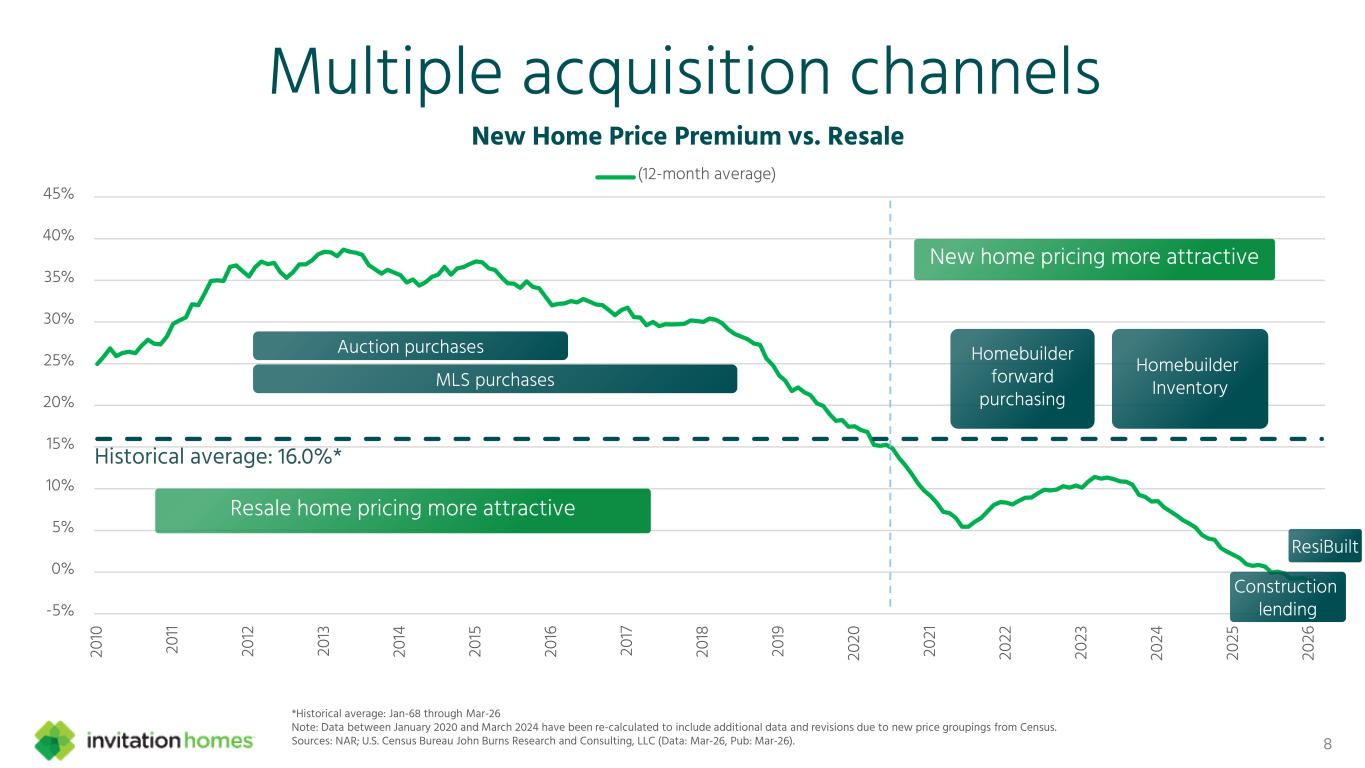
8 -5% 0% 5% 10% 15% 20% 25% 30% 35% 40% 45% 20 10 20 11 20 12 20 13 20 14 20 15 20 16 20 17 20 18 20 19 20 20 20 21 20 22 20 23 20 24 20 25 20 26 New Home Price Premium vs. Resale (12-month average) Homebuilder forward purchasing Multiple acquisition channels Auction purchases New home pricing more attractive MLS purchases Historical average: 16.0%* Homebuilder Inventory ResiBuilt Construction lending Resale home pricing more attractive *Historical average: Jan-68 through Mar-26 Note: Data between January 2020 and March 2024 have been re-calculated to include additional data and revisions due to new price groupings from Census. Sources: NAR; U.S. Census Bureau John Burns Research and Consulting, LLC (Data: Mar-26, Pub: Mar-26).
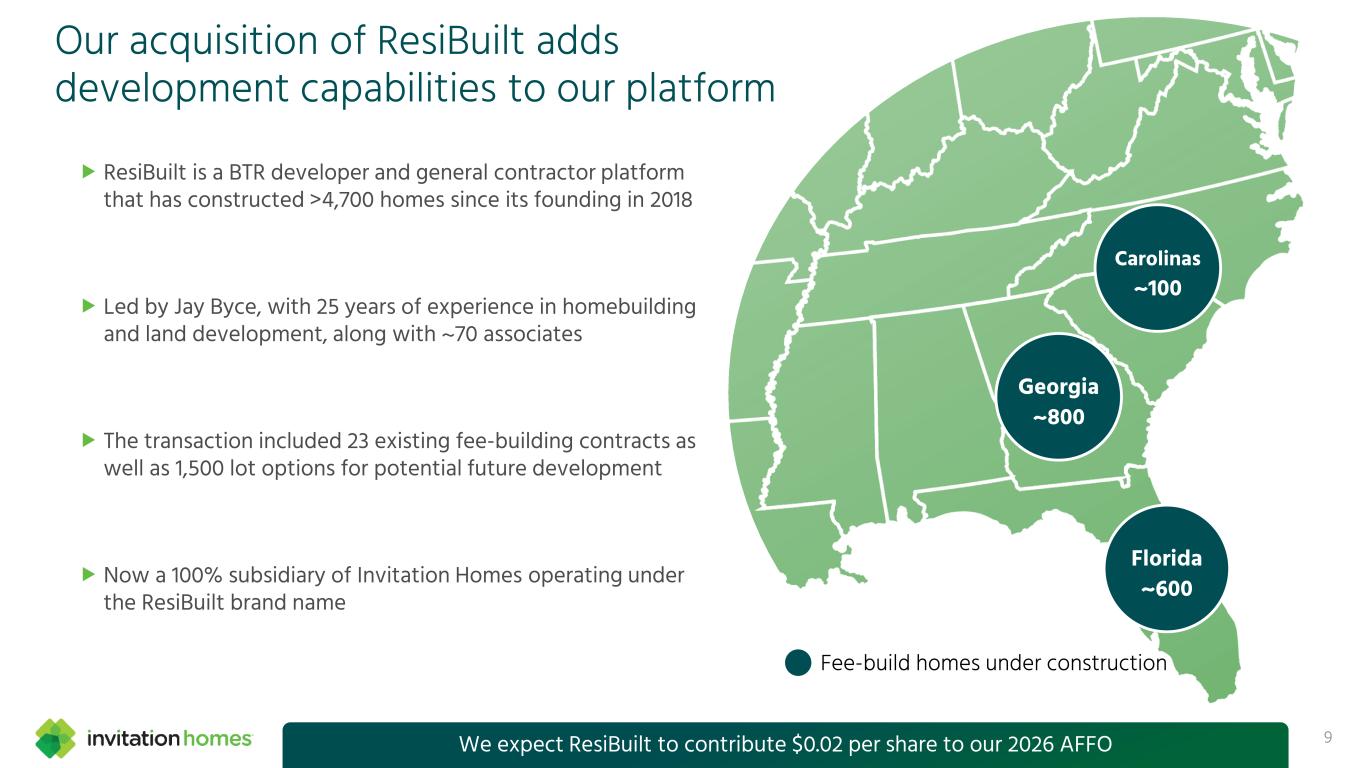
Our acquisition of ResiBuilt adds development capabilities to our platform 9 Florida ~600 Georgia ~800 Carolinas ~100 Fee-build homes under construction We expect ResiBuilt to contribute $0.02 per share to our 2026 AFFO ResiBuilt is a BTR developer and general contractor platform that has constructed >4,700 homes since its founding in 2018 Led by Jay Byce, with 25 years of experience in homebuilding and land development, along with ~70 associates The transaction included 23 existing fee-building contracts as well as 1,500 lot options for potential future development Now a 100% subsidiary of Invitation Homes operating under the ResiBuilt brand name
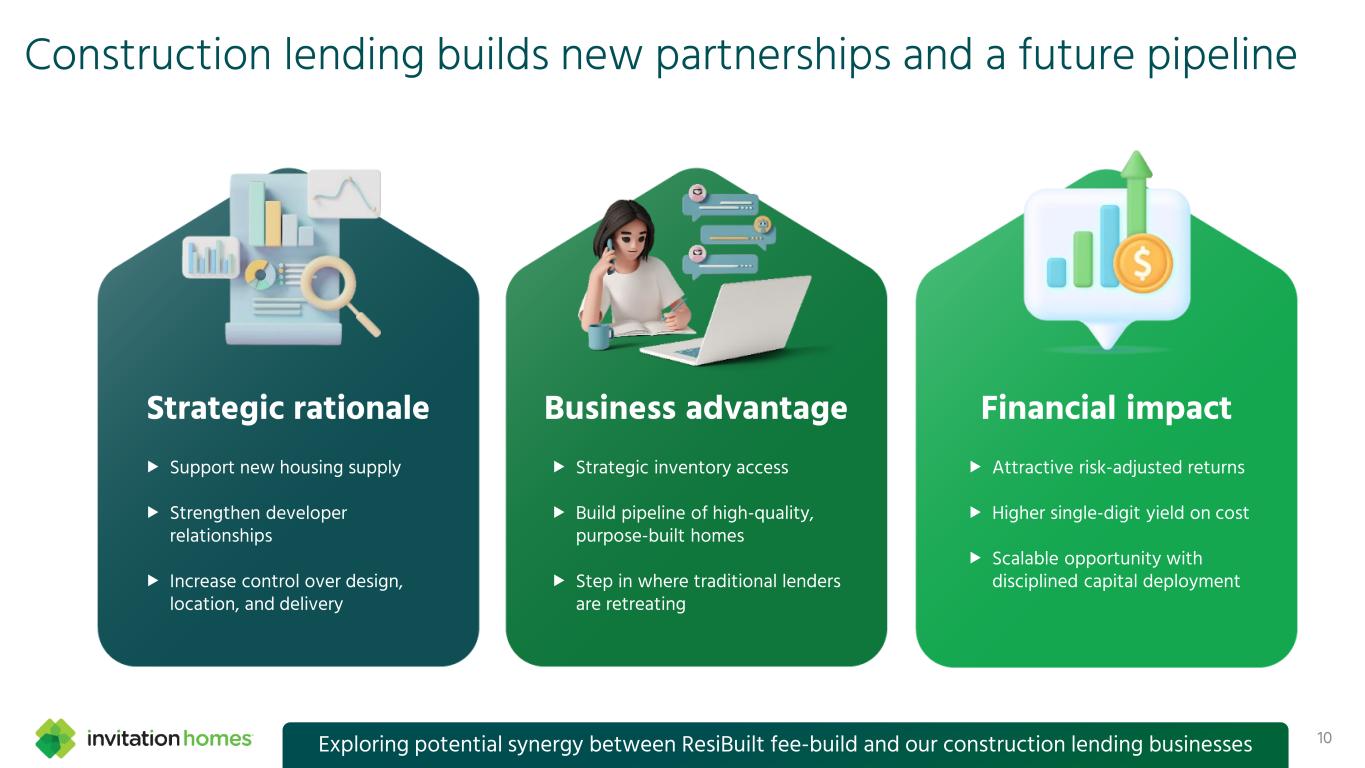
Support new housing supply Strengthen developer relationships Increase control over design, location, and delivery Strategic inventory access Build pipeline of high-quality, purpose-built homes Step in where traditional lenders are retreating Attractive risk-adjusted returns Higher single-digit yield on cost Scalable opportunity with disciplined capital deployment Strategic rationale Business advantage Financial impact 10 Construction lending builds new partnerships and a future pipeline Exploring potential synergy between ResiBuilt fee-build and our construction lending businesses
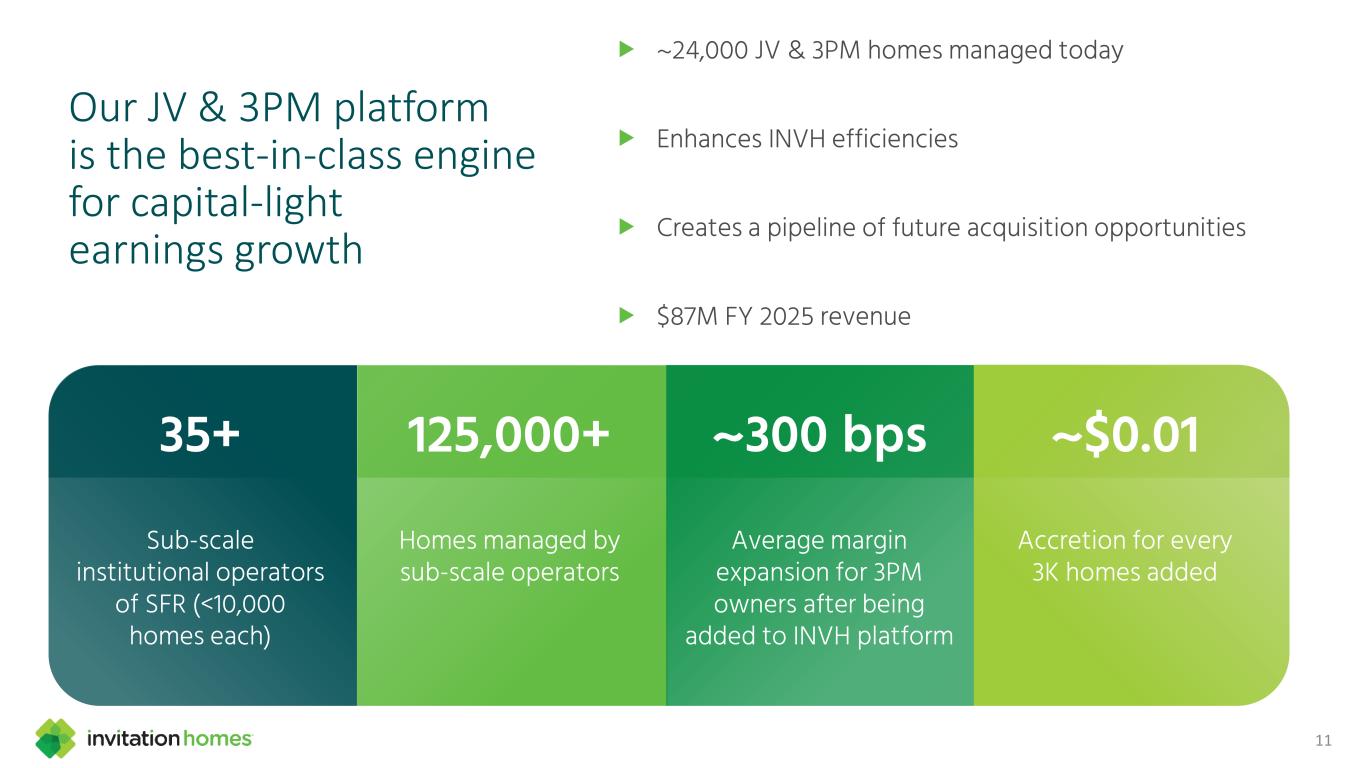
11 ~300 bps Average margin expansion for 3PM owners after being added to INVH platform 35+ Sub-scale institutional operators of SFR (<10,000 homes each) 125,000+ Homes managed by sub-scale operators ~$0.01 Accretion for every 3K homes added ~24,000 JV & 3PM homes managed today Enhances INVH efficiencies Creates a pipeline of future acquisition opportunities $87M FY 2025 revenue Our JV & 3PM platform is the best-in-class engine for capital-light earnings growth
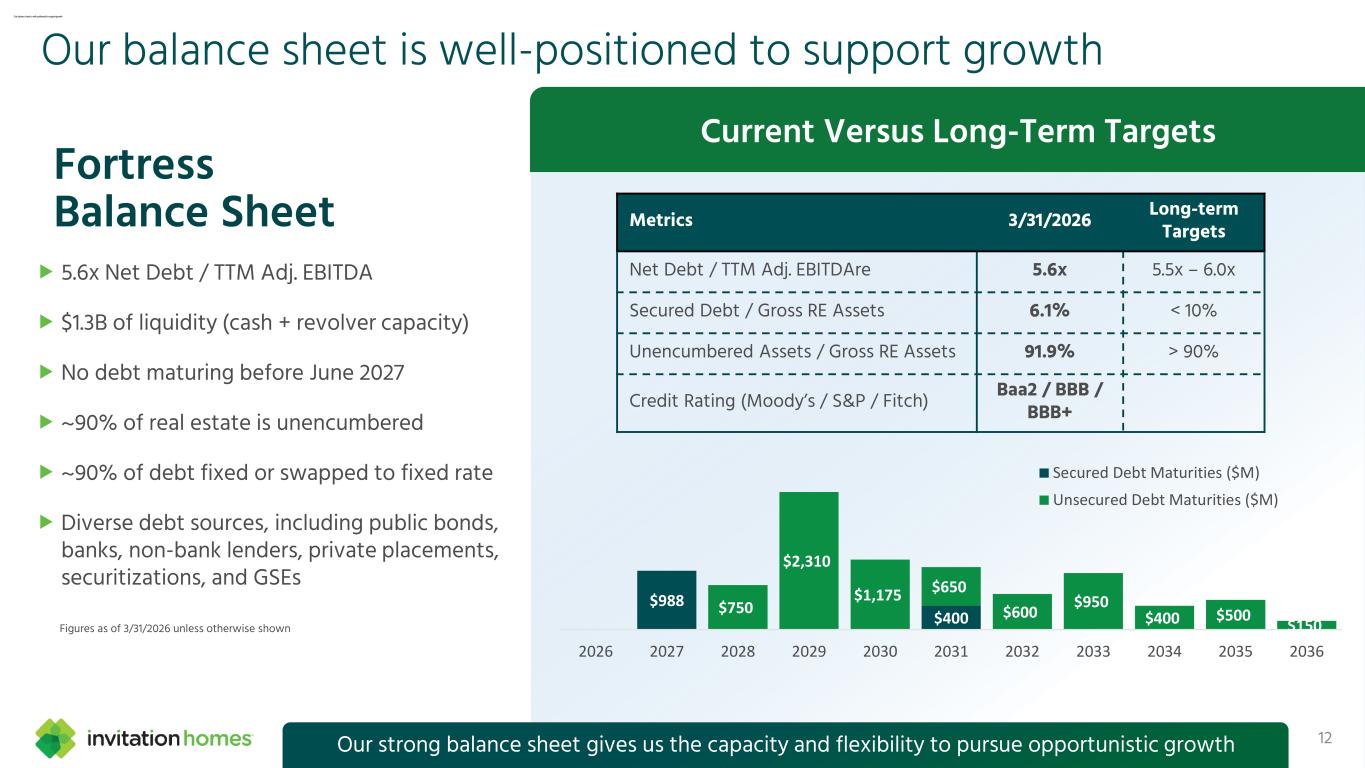
Our balance sheet is well-positioned to support growth Our balance sheet is well-positioned to support growth 5.6x Net Debt / TTM Adj. EBITDA $1.3B of liquidity (cash + revolver capacity) No debt maturing before June 2027 ~90% of real estate is unencumbered ~90% of debt fixed or swapped to fixed rate Diverse debt sources, including public bonds, banks, non-bank lenders, private placements, securitizations, and GSEs Fortress Balance Sheet Metrics 3/31/2026 Long-term Targets Net Debt / TTM Adj. EBITDAre 5.6x 5.5x – 6.0x Secured Debt / Gross RE Assets 6.1% < 10% Unencumbered Assets / Gross RE Assets 91.9% > 90% Credit Rating (Moody’s / S&P / Fitch) Baa2 / BBB / BBB+ $988 $400 $750 $2,310 $1,175 $650 $600 $950 $400 $500 $150 2026 2027 2028 2029 2030 2031 2032 2033 2034 2035 2036 Secured Debt Maturities ($M) Unsecured Debt Maturities ($M) Figures as of 3/31/2026 unless otherwise shown 12Our strong balance sheet gives us the capacity and flexibility to pursue opportunistic growth Current Versus Long-Term Targets
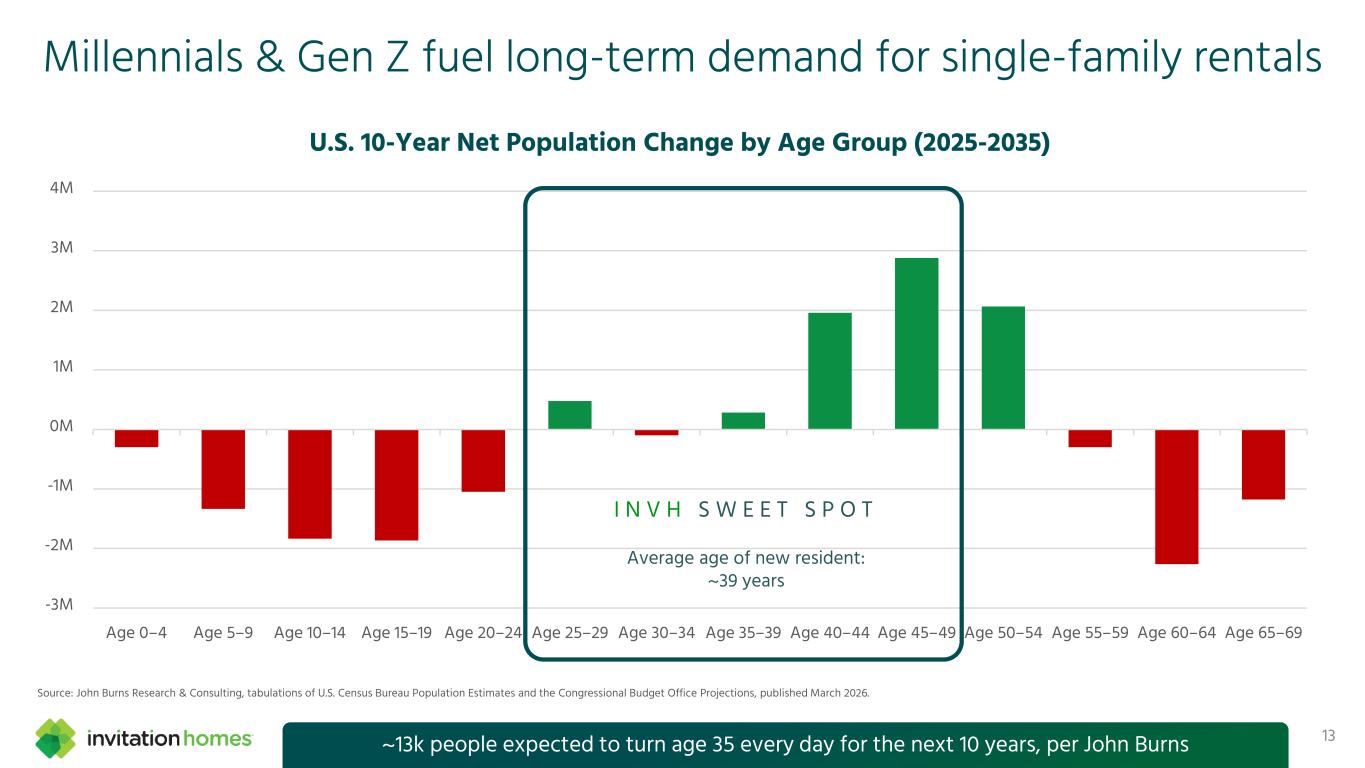
Millennials & Gen Z fuel long-term demand for single-family rentals 13~13k people expected to turn age 35 every day for the next 10 years, per John Burns -3M -2M -1M 0M 1M 2M 3M 4M Age 0–4 Age 5–9 Age 10–14 Age 15–19 Age 20–24 Age 25–29 Age 30–34 Age 35–39 Age 40–44 Age 45–49 Age 50–54 Age 55–59 Age 60–64 Age 65–69 U.S. 10-Year Net Population Change by Age Group (2025-2035) I N V H S W E E T S P O T Average age of new resident: ~39 years Source: John Burns Research & Consulting, tabulations of U.S. Census Bureau Population Estimates and the Congressional Budget Office Projections, published March 2026.
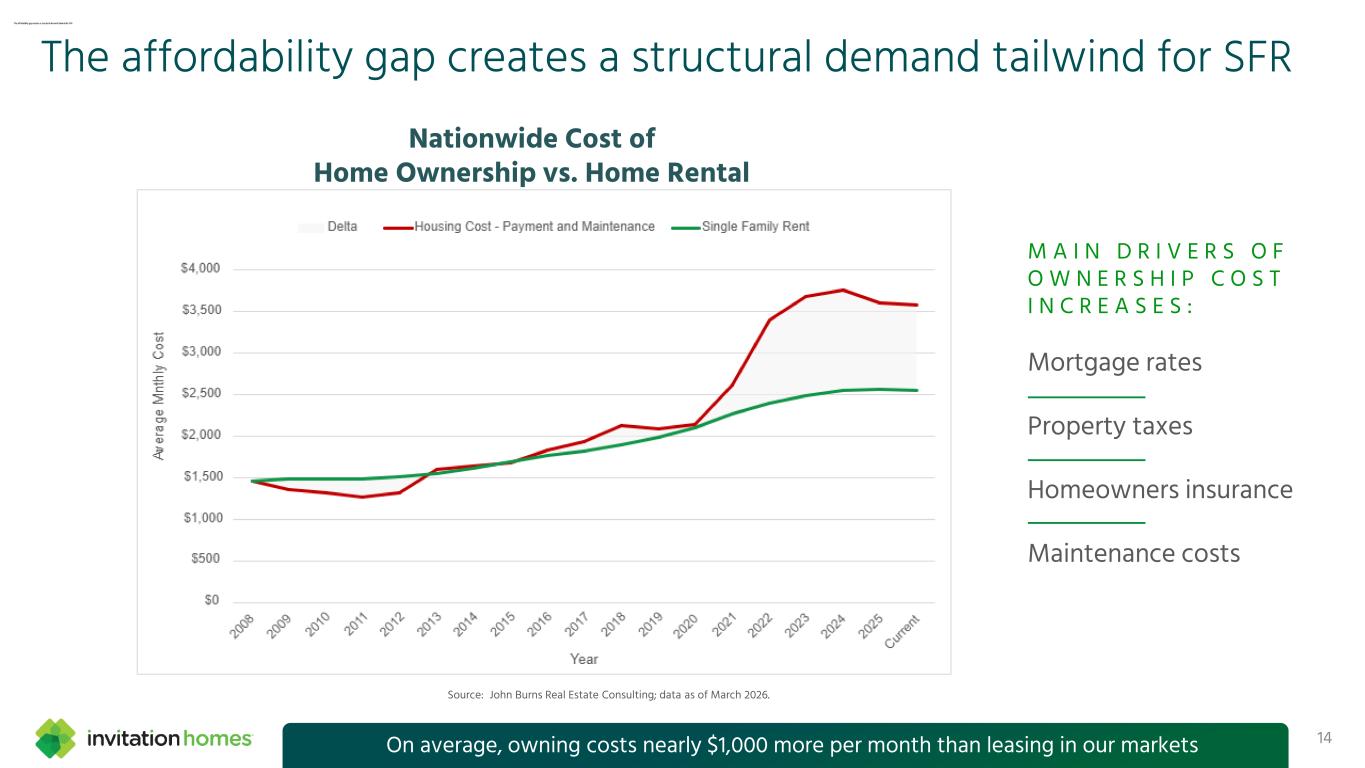
The affordability gap creates a structural demand tailwind for SFR The affordability gap creates a structural demand tailwind for SFR 14 Nationwide Cost of Home Ownership vs. Home Rental Source: John Burns Real Estate Consulting; data as of March 2026. M A I N D R I V E R S O F O W N E R S H I P C O S T I N C R E A S E S : Mortgage rates Property taxes Homeowners insurance Maintenance costs On average, owning costs nearly $1,000 more per month than leasing in our markets
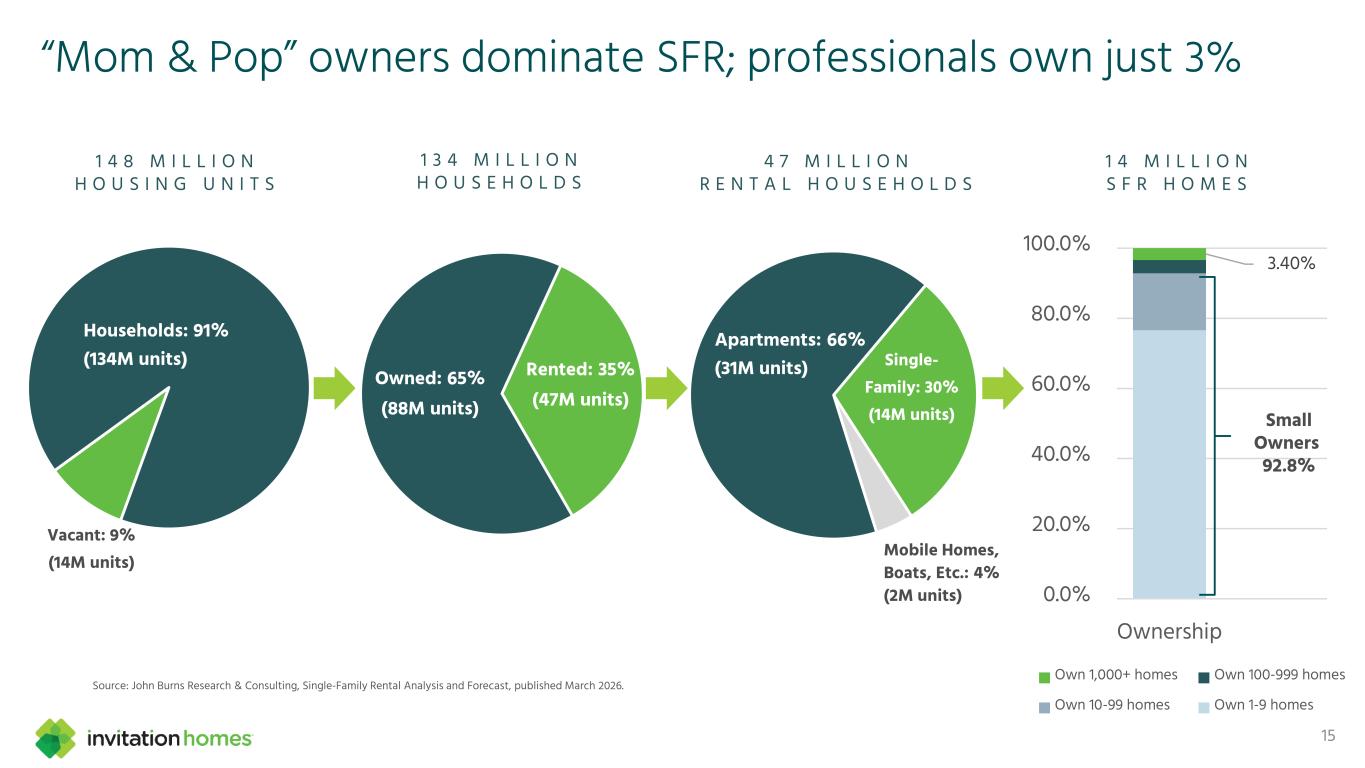
Source: John Burns Research & Consulting, Single-Family Rental Analysis and Forecast, published March 2026. 3.40% 0.0% 20.0% 40.0% 60.0% 80.0% 100.0% Ownership Own 1,000+ homes Own 100-999 homes Own 10-99 homes Own 1-9 homes 4 7 M I L L I O N R E N T A L H O U S E H O L D S Single- Family: 30% (14M units) Owned: 65% (88M units) Rented: 35% (47M units) 1 3 4 M I L L I O N H O U S E H O L D S Vacant: 9% (14M units) 1 4 8 M I L L I O N H O U S I N G U N I T S Small Owners 92.8% 1 4 M I L L I O N S F R H O M E S “Mom & Pop” owners dominate SFR; professionals own just 3% Mobile Homes, Boats, Etc.: 4% (2M units) Households: 91% (134M units) Apartments: 66% (31M units) 15
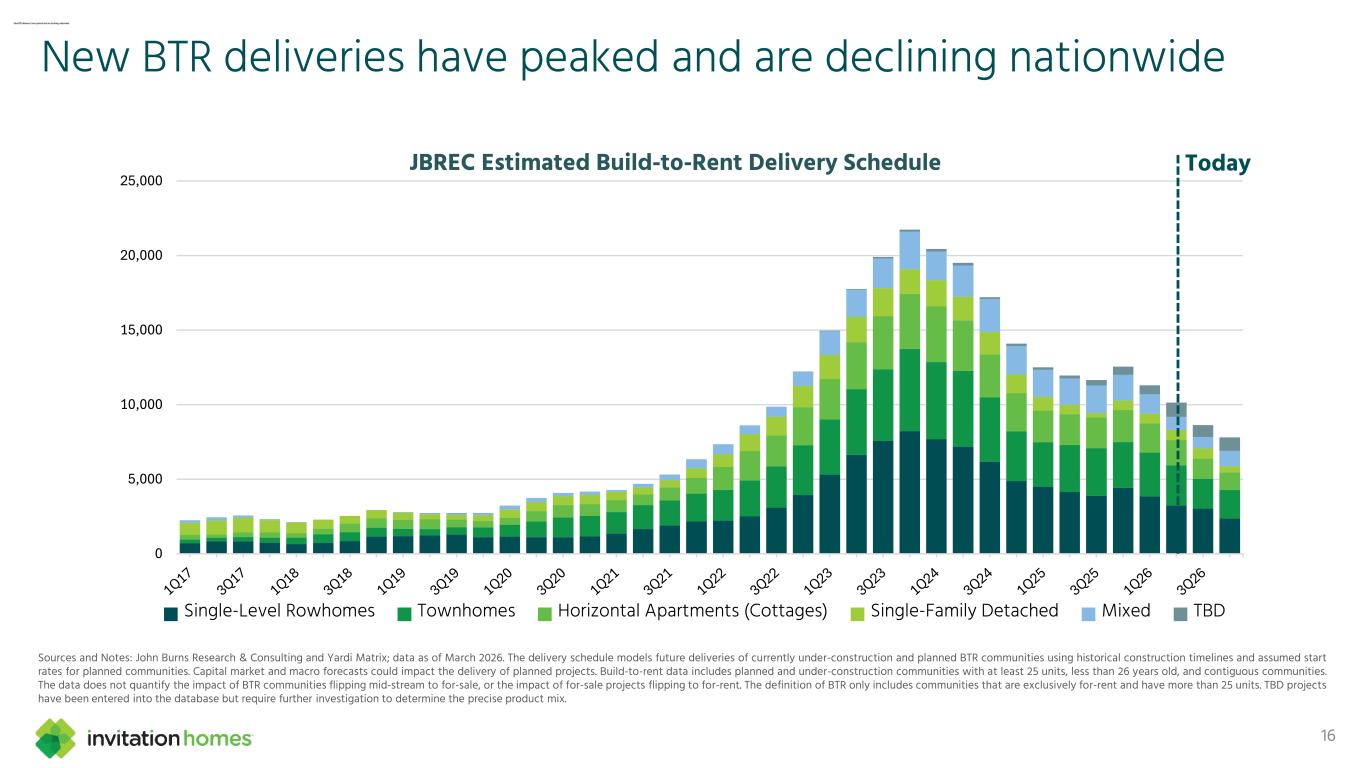
New BTR deliveries have peaked and are declining nationwide New BTR deliveries have peaked and are declining nationwide 16 0 5,000 10,000 15,000 20,000 25,000 JBREC Estimated Build-to-Rent Delivery Schedule Single-Level Rowhomes Townhomes Horizontal Apartments (Cottages) Single-Family Detached Mixed TBD Today Sources and Notes: John Burns Research & Consulting and Yardi Matrix; data as of March 2026. The delivery schedule models future deliveries of currently under-construction and planned BTR communities using historical construction timelines and assumed start rates for planned communities. Capital market and macro forecasts could impact the delivery of planned projects. Build-to-rent data includes planned and under-construction communities with at least 25 units, less than 26 years old, and contiguous communities. The data does not quantify the impact of BTR communities flipping mid-stream to for-sale, or the impact of for-sale projects flipping to for-rent. The definition of BTR only includes communities that are exclusively for-rent and have more than 25 units. TBD projects have been entered into the database but require further investigation to determine the precise product mix.
This presentation contains forward-looking statements This presentation contains forward-looking statements within the meaning of Section 27A of the Securities Act of 1933, as amended, and Section 21E of the Securities Exchange Act of 1934, as amended (the “Exchange Act”), which include, but are not limited to, statements related to our expectations regarding the performance of our business, our financial results, our liquidity and capital resources, and other non- historical statements. In some cases, you can identify these forward- looking statements by the use of words such as “outlook,” “guidance,” “believes,” “expects,” “potential,” “continues,” “may,” “will,” “should,” “could,” “seeks,” “projects,” “predicts,” “intends,” “plans,” “estimates,” “anticipates,” or the negative version of these words or other comparable words. Such forward-looking statements are subject to various risks and uncertainties that may impact our financial condition, results of operations, cash flows, business, associates, and residents, including, among others, risks inherent to the single-family rental industry and our business model, macroeconomic factors beyond our control, federal, state, and local laws, regulations, executive actions, and policy initiatives, competition in identifying and acquiring properties, competition in the leasing market for quality residents, increasing property taxes, homeowners’ association fees and insurance costs, poor resident selection and defaults and non-renewals by our residents, our dependence on third parties for key services, risks related to the evaluation of properties, performance of our information technology systems, development and use of artificial intelligence, risks related to our indebtedness, risks related to the potential negative impact of fluctuating global and United States economic conditions (including inflation and imposition or increase of tariffs and trade restrictions by the United States and foreign countries), uncertainty in financial markets (including as a result of events affecting financial institutions), geopolitical tensions, natural disasters, climate change, and public health crises. Accordingly, there are or will be important factors that could cause actual outcomes or results to differ materially from those indicated in these statements. We believe these factors include, but are not limited to, those described under Part I. Item 1A. “Risk Factors” in our Annual Report on Form 10-K for the year ended December 31, 2025 (the “Annual Report”), as such factors may be updated from time to time in our periodic filings with the Securities and Exchange Commission (the “SEC”), which are accessible on the SEC’s website at www.sec.gov. These factors should not be construed as exhaustive and should be read in conjunction with the other cautionary statements that are included in this release, in the Annual Report, and in our other periodic filings. The forward-looking statements speak only as of the date of this presentation, and we expressly disclaim any obligation or undertaking to publicly update or review any forward-looking statement, whether as a result of new information, future developments or otherwise, except to the extent otherwise required by law. 17