
Please wait
Table of Contents


UNITED STATES

SECURITIES AND EXCHANGE COMMISSION

Washington, D.C. 20549


SCHEDULE 14A

(RULE 14a-101)

SCHEDULE 14A INFORMATION

Proxy Statement Pursuant to Section 14(a) of the

Securities Exchange Act of 1934

(AMENDMENT NO.    )


Filed by the Registrant  ☒                            Filed by a Party other than the Registrant  ☐

Check the appropriate box:


  Preliminary Proxy Statement.
  Confidential, for Use of the Commission Only (as permitted by Rule 14a-6(e)(2)).
  Definitive Proxy Statement.
  Definitive Additional Materials.
  Soliciting Material Pursuant to §240.14a-12.

FOUNDATION BUILDING MATERIALS, INC.

(Exact name of Registrant as Specified In Its Charter)


(Name of Person(s) Filing Proxy Statement, if other than the Registrant)

Payment of Filing Fee (Check the appropriate box):


  No fee required.
  Fee computed on table below per Exchange Act Rules 14a-6(i)(1) and 0-11.
  (1)  

Title of each class of securities to which transaction applies:


  (2)  

Aggregate number of securities to which transaction applies:


  (3)  

Per unit price or other underlying value of transaction computed pursuant to Exchange Act Rule 0-11 (set forth the amount on which the filing fee is calculated and state how it was determined):


  (4)  

Proposed maximum aggregate value of transaction:


  (5)  

Total fee paid:


  Fee paid previously with preliminary materials.
  Check box if any part of the fee is offset as provided by Exchange Act Rule 0-11(a)(2) and identify the filing for which the offsetting fee was paid previously. Identify the previous filing by registration statement number, or the Form or Schedule and the date of its filing.
  (1)  

Amount Previously Paid:


  (2)  

Form, Schedule or Registration Statement No.:


  (3)  

Filing Party:


  (4)  

Date Filed:


Table of Contents

LOGO

FOUNDATION BUILDING MATERIALS, INC.

2741 Walnut Avenue, Suite 200

Tustin, CA 92780

April 6, 2018

To our Stockholders:

You are cordially invited to attend the 2018 Annual Meeting of Stockholders of Foundation Building Materials, Inc., or the Company. The Annual Meeting will be held on Thursday, May 17, 2018, at 1 P.M. Pacific Time at our corporate headquarters located at 2741 Walnut Avenue, Suite 200, Tustin, California 92780 to consider and act upon the following matters, all as more fully described in the accompanying Proxy Statement, which is incorporated herein by reference:


  1. To elect the three nominees named in the Proxy Statement to serve as Class I directors and hold office until the 2021 annual meeting;


  2. To approve, on an advisory basis, the compensation of the Company’s named executive officers for the year ended December 31, 2017, as set forth in the Proxy Statement;


  3. To vote, on an advisory basis, on the frequency of future advisory votes approving named executive officer compensation;


  4. To ratify the appointment of Deloitte & Touche LLP as the Company’s independent registered public accounting firm for the year ending December 31, 2018; and


  5. To transact any other business that may properly be brought before the meeting or any adjournments or postponements thereof.

In addition to the Proxy Statement you should have also received a copy of our Annual Report on Form 10-K for the year ended December 31, 2017, or fiscal year 2017, which we encourage you to read. It includes information about our operations as well as our audited consolidated financial statements. You can also access a copy of our 2017 Annual Report on Form 10-K on the Company’s website at www.fbmsales.com.

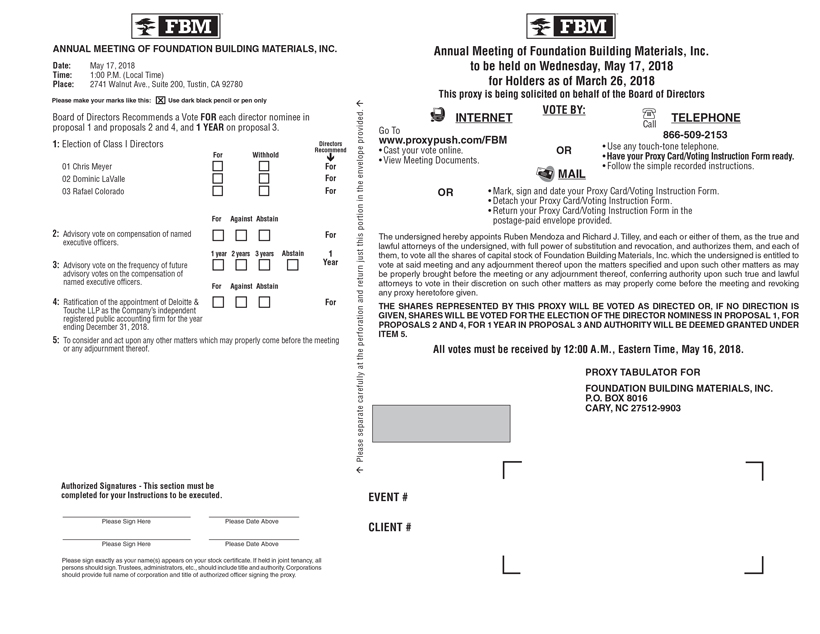
Please use this opportunity to take part in the affairs of our company by voting on the business to come before the Annual Meeting. Whether or not you plan to attend the Annual Meeting, please complete, sign, date, and return the accompanying proxy card or voting instruction card or vote electronically on the Internet or by telephone. See “About the Annual Meeting—How Do I Vote by Proxy?” in the Proxy Statement for more details. Returning the proxy card or voting instruction card does not deprive you of your right to attend the Annual Meeting and to vote your shares in person for the matters to be acted upon at the Annual Meeting.

We look forward to seeing you at the Annual Meeting.

Sincerely,

Ruben Mendoza

President and Chief Executive Officer


Table of Contents

LOGO

FOUNDATION BUILDING MATERIALS, INC.

2741 Walnut Avenue, Suite 200

Tustin, CA 92780


NOTICE OF 2018 ANNUAL MEETING OF STOCKHOLDERS


Important Notice Regarding the Availability of Proxy Materials for the Stockholder

Meeting to be Held on May 17, 2018

The Proxy Statement and accompanying Annual Report to Stockholders

are available at: https://www.proxydocs.com/FBM


TIME AND DATE    1 P.M. Pacific Time on Thursday, May 17, 2018
LOCATION   

Foundation Building Materials, Inc.

2741 Walnut Avenue, Suite 200

Tustin, California 92780

ITEMS OF BUSINESS   

1. To elect the three nominees named in the Proxy Statement to serve as Class I directors and hold office until the 2021 annual meeting;


2. To approve, on an advisory basis, the compensation of the Company’s named executive officers for the year ended December 31, 2017, as set forth in the Proxy Statement;


3. To vote, on an advisory basis, on the frequency of future advisory votes approving named executive officer compensation; and


4. To ratify the appointment of Deloitte & Touche LLP as the Company’s independent registered public accounting firm for the year ending December 31, 2018.


Stockholders will also act upon such other matters as may properly come before the Annual Meeting.

RECORD DATE    The stockholders of record at the close of business on March 26, 2018, will be entitled to vote at the Annual Meeting and any adjournment or postponement thereof.
PROXY VOTING    It is important that your shares be represented and voted at the Annual Meeting. You can vote your shares by completing and returning the proxy card or voting instruction card sent to you. You also have the option of voting your shares electronically on the Internet or by telephone. Voting instructions are printed on your proxy card or voting instruction card. You can revoke your proxy at any time prior to its exercise at the Annual Meeting by following the instructions in the Proxy Statement.

By Order of the Board of Directors

Richard J. Tilley

Vice President, Secretary and General Counsel

Tustin, California

April 6, 2018


Table of Contents

PROXY STATEMENT

Table of Contents


     Page  

Summary

     ii  

About the Annual Meeting

     1  

Proposal No. 1 - Election of Directors

     5  

Proposal No.  2 - Advisory Vote to Approve the Compensation of Our Named Executive Officers

     6  

Proposal No.  3 - Advisory Vote on the Frequency of Future Advisory Votes Approving Named Executive Officer Compensation

     7  

Proposal No. 4 - Ratification of the Appointment of Deloitte  & Touche LLP

     8  

The Board of Directors and Its Committees

     9  

Director Biographies

     9  

Meetings of the Board

     13  

Director Compensation

     13  

Controlled Company Exemption

     14  

Director Independence

     14  

Board Leadership Structure

     14  

The Board’s Role in Risk Oversight

     14  

Committees of the Board

     15  

Contacting the Board

     17  

Corporate Governance

     18  

Corporate Governance Guidelines

     18  

Code of Ethics

     18  

Availability of Documents

     18  

Audit Committee Matters

     19  

Report of the Audit Committee

     19  

Audit and Non-Audit Fees

     20  

Pre-Approval Procedures

     20  

Executive Officers

     21  

Executive Compensation

     23  

Compensation Discussion & Analysis

     23  

Compensation Committee Report

     31  

Compensation Tables for Named Executive Officers

     32  

Compensation Risk Analysis

     38  

Equity Compensation Plan Information

     38  

Security Ownership

     39  

Section 16(a) Beneficial Ownership Reporting Compliance

     41  

Certain Relationships and Related Transactions

     42  

Relationships with Lone Star and its Affiliates

     42  

Asset Advisory Fees

     42  

Registration Rights Agreement

     42  

Tax Receivable Agreement

     42  

Executive Officer and Director Indemnification Agreements

     45  

Review and Approval of Related Party Transactions

     45  

Stockholders’ Proposals

     46  

Householding of Proxy Material

     47  

Additional Information

     48  

Other Business

     49  


i


Table of Contents

SUMMARY

We are providing these materials in connection with the 2018 Annual Meeting of Stockholders of Foundation Building Materials, Inc. This summary highlights information contained elsewhere in this Proxy Statement. This summary does not contain all of the information that you should consider, and you should read this Proxy Statement before voting. For more complete information regarding the Company’s 2017 performance, please review the Company’s Annual Report on Form 10-K for the year ended December 31, 2017.

2018 ANNUAL MEETING OF STOCKHOLDERS


Date and Time

   Record Date   

Location

May 17, 2018 at 1:00 p.m.

(local time)

   March 26, 2018   

Foundation Building Materials, Inc.

2741 Walnut Ave., Suite 200

Tustin, CA 92780

Agenda Items:


Proposal

   Board
Recommendation
1    Election of the three nominees named in this Proxy Statement to serve as Class I directors    FOR each nominee
2    Advisory vote to approve named executive officer compensation    FOR
3    Advisory vote on frequency of future advisory votes to approve named executive officer compensation    1 YEAR
4    Ratification of the appointment of Deloitte & Touche LLP as the Company’s independent registered public accounting firm for the year ending December 31, 2018    FOR

VOTING YOUR SHARES

You are entitled to vote your shares if you were a stockholder at the close of business on March 26, 2018, the record date for the Annual Meeting. You may vote:

By Telephone - You may call the number listed on your proxy card or voting instruction card.

By Mail - You may complete, sign, date and return your proxy card or voting instruction card in the envelope provided.

By Internet - You may vote electronically on the Internet by visiting the webpage address listed on your proxy card or voting instruction card.

In Person - You may attend the Annual Meeting in person and vote by ballot at that time.

See “About the Annual Meeting - How do I vote by proxy?” below and your proxy or voting instruction card accompanying this Proxy Statement for further information.


ii


Table of Contents

LOGO

FOUNDATION BUILDING MATERIALS, INC.

2741 Walnut Avenue, Suite 200

Tustin, CA 92780


PROXY STATEMENT


We are providing these proxy materials in connection with the 2018 Annual Meeting of Stockholders of Foundation Building Materials, Inc., or the Annual Meeting. This proxy statement, or the Proxy Statement, the accompanying proxy card or voting instruction card, and the Company’s 2017 Annual Report on Form 10-K, or the 2017 Form 10-K, are being mailed to stockholders on or about April 12, 2018. These materials contain important information for you to consider when deciding how to vote on the matters to be brought before the Annual Meeting. Please read them carefully. Unless the context otherwise indicates, references to “Foundation Building Materials,” “our company,” “the Company,” “us,” “we” and “our” refer to Foundation Building Materials, Inc. and its consolidated subsidiaries.

ABOUT THE ANNUAL MEETING

Who is soliciting my vote?

The Board of Directors, or Board, of the Company is soliciting your vote in connection with the Annual Meeting.

What is the purpose of the Annual Meeting?

The meeting will be the Company’s regular annual meeting of stockholders. You will be voting on the following matters at the Annual Meeting:


  1. Election of the three nominees for Class I director named in this Proxy Statement to hold office until the 2021 annual meeting;


  2. Approval, on an advisory basis, of the compensation of the Company’s named executive officers for the year ended December 31, 2017, as set forth in this Proxy Statement;


  3. Vote, on an advisory basis, on the frequency of future advisory votes approving named executive officer compensation; and


  4. Ratification of the appointment of Deloitte & Touche LLP as the Company’s independent registered public accounting firm for the year ending December 31, 2018.

Stockholders will also act upon such other business that may properly come before the Annual Meeting.

How does the Board recommend I vote?

The Board recommends a vote:


  1. “For” the three nominees for Class I director named in this Proxy Statement, each to hold office until our 2021 annual meeting of stockholders;


  2. “For” the approval, on an advisory basis, of the compensation of our named executive officers for the year ended December 31, 2017, as set forth in this Proxy Statement;


1


Table of Contents
  3. For “One Year,” on an advisory basis, for the frequency of future advisory votes approving named executive officer compensation; and


  4. “For” the ratification of the appointment of Deloitte & Touche LLP as the Company’s independent registered public accounting firm for the year ending December 31, 2018.

Who is entitled to vote at the Annual Meeting?

The Board set March 26, 2018 as the record date for the Annual Meeting, or the Record Date. All stockholders who owned common stock of the Company at the close of business on the Record Date may attend and vote at the Annual Meeting.

Who is entitled to attend the Annual Meeting?

Only persons with evidence of stock ownership as of the Record Date or who are invited guests of the Company may attend and be admitted to the Annual Meeting. Stockholders with evidence of stock ownership as of the Record Date may be accompanied by one guest. Photo identification will be required (e.g., a valid driver’s license, state identification or passport). If a stockholder’s shares are registered in the name of a broker, trust, bank or other nominee, the stockholder must bring a proxy or a letter from that broker, trust, bank or other nominee or their most recent brokerage account statement that confirms that the stockholder was a beneficial owner of shares of stock of the Company as of the Record Date.

Cameras (including cell phones with photographic capabilities), recording devices and other electronic devices will not be permitted at the Annual Meeting.

How many votes can be cast by stockholders?

Each share of common stock is entitled to one vote. There is no cumulative voting. There were 42,891,252 shares of common stock outstanding and entitled to vote on the Record Date.

How many votes must be present to hold the Annual Meeting?

A majority of the outstanding shares of common stock as of the Record Date must be present at the Annual Meeting in order to hold the Annual Meeting and conduct business. This is called a “quorum.” Your shares are counted as present at the Annual Meeting if you are present at the Annual Meeting and vote in person or a proxy card or a voting instruction card has been properly submitted by you or on your behalf, or you have voted electronically on the Internet or by telephone. Both abstentions and broker non-votes are counted as present for the purpose of determining the presence of a quorum. A “broker non-vote” is a share of common stock that is beneficially owned by a person or entity and held by a broker or other nominee, but for which the broker or other nominee (1) lacks the discretionary authority to vote on certain matters and (2) has not received voting instructions from the beneficial owner in respect of those specific matters.

How many votes are required to elect directors and approve the other proposals?

Directors are elected by a plurality of the votes cast. This means that the three individuals nominated for election as Class I directors who receive the most “FOR” votes will be elected. Abstentions and broker non-votes are not counted for purposes of the election of directors and, therefore, will not affect the outcome of the election of directors.

To be approved, the proposals to approve, on an advisory basis, the compensation of our named executive officers and the ratification of Deloitte & Touche LLP as the Company’s independent registered public accounting firm for the year ending December 31, 2018 each require the affirmative vote of a majority of the


2


Table of Contents

shares of common stock present, in person or by proxy, at the Annual Meeting and entitled to vote. Abstentions have the same effect as a vote against the proposals; “broker non-votes” will not affect the outcome of either such proposal, although brokers have discretionary authority to vote on ratification of the appointment of Deloitte & Touche LLP if they do not receive voting instructions from the beneficial owner.

The proposal to vote, on an advisory basis, on the frequency of future advisory votes on named executive officer compensation will be determined based on a plurality of the votes cast. This means that the option that receives the most votes will be recommended by the stockholders to the Board. Abstentions and “broker non-votes” will not affect the outcome of this proposal.

The results of the advisory votes on the compensation of the Company’s named executive officers and on the frequency of future advisory votes on named executive officer compensation are not binding on the Board.

Lone Star Fund IX (U.S.), L.P., which we refer to in this Proxy Statement, along with its affiliates and associates (excluding us and other companies that it or they own as a result of their investment activities), as Lone Star, controlled approximately 65.4% of the Company’s common stock as of the Record Date through LSF9 Cypress Parent 2, LLC. Lone Star has indicated that it will vote its shares in favor of the three Class I director nominees named in this Proxy Statement, in favor of Proposals 2 and 4, and for “One Year” for Proposal 3. If Lone Star votes as it has indicated, its vote is sufficient to elect the nominees, recommend “One Year” as for the frequency of future advisory votes on compensation, and approve the other proposals set forth in this Proxy Statement.

How Do I Vote by Proxy?

You can vote your shares by completing and returning the proxy card or voting instruction card accompanying this Proxy Statement. You also have the option of voting your shares electronically on the Internet or by telephone. Your Internet or telephone vote authorizes the named proxies to vote your shares in the same manner as if you marked, signed and returned your proxy card or voting instruction card. Please see your proxy card or voting instruction card for more information on how to vote by proxy.

What if I don’t vote for some of the items listed on my proxy card or voting instruction card?

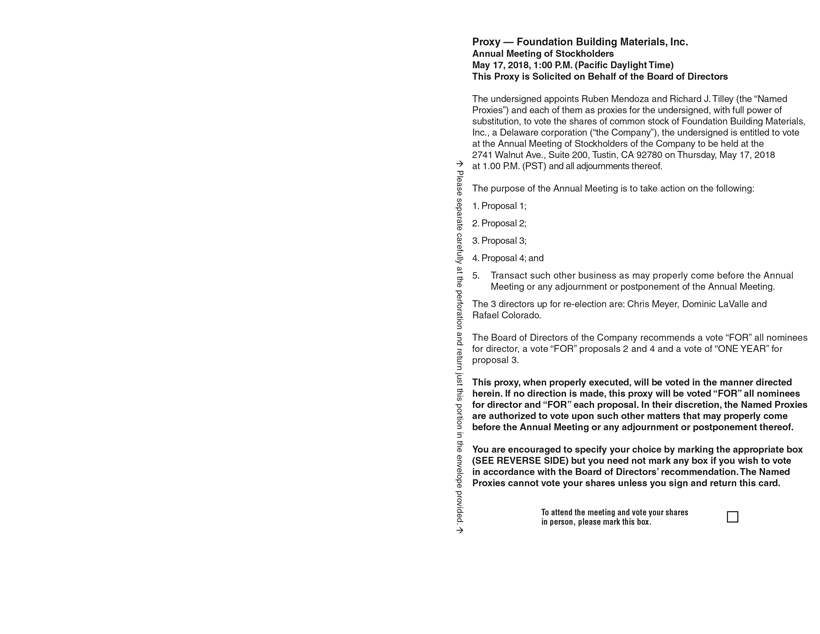
If you return your signed proxy card or voting instruction card in the enclosed envelope but do not mark selections, it will be voted in accordance with the recommendations of the Board. Similarly, if you vote electronically on the Internet or by telephone and do not vote on all matters, your shares will be voted in accordance with the recommendations of the Board for the matters on which you do not vote. In connection therewith, the Board has designated Ruben Mendoza and Richard J. Tilley as proxies. If you indicate a choice with respect to any matter to be acted upon on your proxy card or voting instruction card, your shares will be voted in accordance with your instructions. Similarly, if you vote electronically on the Internet or by telephone and vote on any matter, your shares will be voted in accordance with your instructions. If any other matter properly comes before the Annual Meeting, the shares will be voted in the discretion of the persons voting pursuant to the respective proxies.

If you are a beneficial owner and hold your shares in street name through a broker or other nominee and do not return the voting instruction card, the broker or other nominee will vote your shares on each matter at the Annual Meeting for which he or she has the requisite discretionary authority. Under applicable rules, brokers have the discretion to vote on routine matters, such as the ratification of the selection of independent registered public accounting firms. However, brokers do not have the discretion to vote on the election of directors, the advisory vote to approve named executive officer compensation, or the advisory vote on the frequency of future advisory votes approving named executive officer compensation.


3


Table of Contents

Who pays for the proxy solicitation and how will the Company solicit votes?

The Company bears the expense of printing and mailing proxy materials. In addition to this solicitation of proxies by mail, the Company’s directors, officers and other employees may solicit proxies by personal interview, telephone, facsimile or email. These individuals will not be paid any additional compensation for any such solicitation. The Company will request brokers and other nominees who hold shares of common stock in their names to furnish proxy materials to the beneficial owners of such shares. The Company will reimburse such brokers and other nominees for their reasonable expenses incurred in forwarding solicitation materials to such beneficial owners.

Can I change or revoke my vote after I return my proxy card or voting instruction card?

Yes. Even if you sign and return the proxy card or voting instruction card in the form accompanying this Proxy Statement or you vote electronically over the Internet or by telephone, you retain the power to revoke your proxy or change your vote. You can revoke your proxy or change your vote at any time before it is exercised at the Annual Meeting by giving written notice to the Secretary of the Company, specifying such revocation. You may also change your vote by timely delivering a valid, later-dated proxy or voting instruction card, a later-dated electronic vote over the Internet or by telephone or by voting in person at the Annual Meeting. However, please note that if you would like to vote at the Annual Meeting and you are not the stockholder of record, you must request, complete and deliver a proxy from your broker or other nominee.


4


Table of Contents

PROPOSAL NO. 1—ELECTION OF DIRECTORS

At the Annual Meeting, stockholders will be asked to elect three directors to serve as Class I directors. The Company’s Certificate of Incorporation provides that the Board shall consist of not fewer than one nor more than fifteen directors with the exact number to be determined from time to time by resolution adopted by the Board. The Board currently consists of ten directors. The Company’s Certificate of Incorporation divides the Board into three classes with the terms of office of the directors of each class ending in different years. The terms of directors in Classes I, II and III presently end at the annual meetings in 2018, 2019 and 2020, respectively. Classes I and III have three directors, and Class II has four directors.

Our Nominating and Corporate Governance Committee recommended, and our Board has nominated, Chris Meyer, Dominic LaValle, and Rafael Colorado for election as Class I directors for three-year terms expiring at the 2021 annual meeting. When elected, directors serve until their successors have been duly elected and qualified or until any such director’s earlier resignation or removal. Please see “The Board and Its Committees” below for information about the nominees for election as directors and the current members of the Board who will continue serving following the Annual Meeting, their business experience and other pertinent information.

Proxies cannot be voted for a greater number of persons than the number of nominees named. If you sign and return the accompanying proxy card or voting instruction card or vote electronically over the Internet or by telephone, your shares will be voted for the election of the three nominees recommended by the Board unless you choose to abstain or vote against any of the nominees. If any nominee for any reason is unable to serve or will not serve, proxies may be voted for such substitute nominee as the proxy holder may determine. The Company is not aware of any nominee who will be unable to or will not serve as a director. The Company did not receive any stockholder nominations for director for the Annual Meeting.

Directors are elected by a plurality of the votes cast. This means that the three individuals nominated for election to the Board who receive the most “FOR” votes will be elected. Abstentions and broker non-votes will not affect the outcome of the election of directors.

Our Board unanimously recommends that you vote FOR all nominees.


5


Table of Contents

PROPOSAL NO. 2— ADVISORY VOTE TO APPROVE THE COMPENSATION OF OUR NAMED EXECUTIVE OFFICERS

In accordance with Section 14A of the Securities Exchange Act of 1934, as amended, which we refer to as the Exchange Act, we are providing stockholders with an advisory vote to approve the compensation of our named executive officers, often referred to as a “say-on-pay” vote. The advisory vote is a non-binding vote on the compensation of our named executive officers as described in this Proxy Statement in the Compensation Discussion and Analysis section, the tabular disclosure regarding such compensation and the Company’s accompanying narrative disclosure. This say-on-pay vote is not intended to address any specific item of compensation, but rather the overall compensation of our named executive officers and the philosophy, policies and practices described in this Proxy Statement.

In connection with this proposal, you are encouraged to carefully review the Compensation Discussion and Analysis section as well as the information contained in the executive compensation tables and accompanying narrative discussion contained in this Proxy Statement. The Compensation Committee of the Board believes our executive compensation program is reasonable and aligned with stockholder interests.

Even though this say-on-pay vote is advisory and, therefore, will not be binding on us, our Compensation Committee and our Board value the opinions of our stockholders. Accordingly, to the extent there is a significant vote against the compensation of our named executive officers, we will consider our stockholders’ concerns, and the Compensation Committee will evaluate what actions may be necessary or appropriate to address those concerns.

Our stockholders are being asked to approve by advisory vote the following resolution relating to the compensation of the named executive officers, as described in this Proxy Statement:

“RESOLVED, that the stockholders of Foundation Building Materials, Inc. (the “Company”) hereby approve, on an advisory basis, the compensation paid to the Company’s named executive officers disclosed in the Compensation Discussion and Analysis and the related compensation tables and accompanying narrative discussion included in the Proxy Statement for the Company’s 2018 Annual Meeting of Stockholders.”

The affirmative vote of a majority of the shares of common stock present, in person or by proxy, is required to approve, on an advisory basis, the compensation awarded to named executive officers for the year ended December 31, 2017. Abstentions have the same effect as a vote against this proposal; broker non-votes will not affect the outcome of this proposal.

Our Board unanimously recommends that you vote FOR the approval, on an advisory basis, of the compensation of the Company’s named executive officers.


6


Table of Contents

PROPOSAL NO. 3 — ADVISORY VOTE ON THE FREQUENCY OF FUTURE ADVISORY VOTES APPROVING NAMED EXECUTIVE OFFICER COMPENSATION

Pursuant to Section 14A of the Exchange Act, we are required to ask stockholders, at least once every six years, to vote, on an advisory basis, on whether future say-on-pay votes should occur every year, every two years or every three years. Accordingly, stockholders will be able to specify one of four choices for Proposal 3 on the proxy card: one year, two years, three years or abstain. Stockholders are not voting to approve or disapprove the Board’s recommendation. This advisory vote on the frequency of future advisory votes to approve named executive officer compensation is non-binding on the Board.

After careful consideration, the Board has considered the matter and determined to recommend that stockholders vote for holding future advisory votes to approve named executive officer compensation every year. While our executive compensation program is designed to promote a long-term connection between pay and performance, the Board recognizes that executive compensation disclosures are made annually. Accordingly, the Board believes that an annual advisory say-on-pay vote will allow our stockholders to provide timely, direct input on our executive compensation philosophy, policies and practices as disclosed in the proxy statement each year. Notwithstanding the Board’s recommendation and the outcome of the stockholder vote, the Board may in the future decide to conduct advisory votes on a more or less frequent basis and may vary its practice based on factors such as discussions with stockholders and the adoption of material changes to compensation programs.

Even though your vote is advisory and, therefore, will not be binding on the Company, the Board and the Compensation Committee value the opinions of our stockholders and will consider our stockholders’ vote. Nonetheless, our Board may decide that it is in the best interests of our stockholders and FBM to hold an advisory vote approving executive compensation more or less frequently than the option voted by our stockholders.

The outcome of this proposal will be determined by a plurality of the votes cast. This means that the option that receives the most votes will be recommended by the stockholders to the Board. Abstentions and broker non-votes will not affect the outcome of this proposal.

Our Board unanimously recommends that you vote for, on an advisory basis, ONE YEAR for the frequency of future advisory votes approving named executive officer compensation.


7


Table of Contents

PROPOSAL NO. 4—RATIFICATION OF THE APPOINTMENT OF DELOITTE & TOUCHE LLP

Our Audit Committee has selected Deloitte & Touche LLP, or Deloitte, to audit the consolidated financial statements of the Company as of December 31, 2018, and for the fiscal year then ending. At the Annual Meeting, stockholders will be asked to ratify the appointment of Deloitte.

The Company has been advised by Deloitte that the firm has no relationship with the Company or its subsidiaries other than that arising from the firm’s engagement as auditors, tax advisors and consultants. The Company has also been advised that representatives of Deloitte will be present at the Annual Meeting where they will have an opportunity to make a statement if they so desire and will be available to respond to appropriate questions.

Neither the Company’s Certificate of Incorporation nor the Company’s bylaws require that stockholders ratify the appointment of Deloitte as the Company’s independent registered public accounting firm. However, we are requesting ratification because we believe it is a matter of good corporate practice. If the Company’s stockholders do not ratify the appointment, the Audit Committee will reconsider whether or not to retain Deloitte, but may, nonetheless, retain Deloitte as the Company’s independent registered public accountants. Even if the appointment is ratified, the Audit Committee in its discretion may change the appointment at any time if it determines that the change would be in the best interests of the Company and its stockholders.

The affirmative vote of a majority of the shares of common stock present, in person or by proxy, at the Annual Meeting is necessary to ratify the appointment of Deloitte as our independent registered public accounting firm for the fiscal year ending December 31, 2018.

The Board unanimously recommends that you vote FOR the ratification of the appointment of

Deloitte as the Company’s independent registered public accounting firm for the year ending

December 31, 2018.


8


Table of Contents

THE BOARD OF DIRECTORS AND ITS COMMITTEES

The Board believes the Board, as a whole, should possess the requisite combination of skills, professional experience, and diversity of backgrounds to oversee the Company’s business. The Board also believes there are certain attributes each individual director should possess, as reflected in the Board’s membership criteria. Accordingly, the Board and the Nominating and Corporate Governance Committee consider the qualifications of directors and director candidates individually as well as in the broader context of the Board’s overall composition and the Company’s current and future needs. The Nominating and Corporate Governance Committee is responsible for periodically reviewing with the Board the appropriate skills and characteristics required of Board members in the context of the current make-up of the Board. This assessment enables the Board to update the skills and experience it seeks in the Board as a whole, and in individual directors, as the Company’s needs evolve. This assessment takes into consideration all factors deemed relevant by the Nominating and Corporate Governance Committee, including the matters described under “—Committees of the Board—Nominating and Corporate Governance Committee” below. For incumbent directors, the factors also include past performance on the Board and its committees.

The following table sets forth the names, ages and classifications of the nominees for election as directors as well as the current members of the Board who will continue serving following the Annual Meeting. The table is followed by each individual’s specific experience, qualifications and skills that led the Board to conclude that each such nominee or director should serve on the Board. The persons who have been nominated for election and are to be voted upon at the Annual Meeting are listed first, with continuing directors following thereafter.


Name


Age


Class


Nominee or Continuing Director

Chris Meyer

   47    I    Nominee and Chairman

Dominic LaValle

   40    I    Nominee

Rafael Colorado

   40    I    Nominee

Ruben Mendoza

   54    II    Continuing Director

Chad Lewis

   35    II    Continuing Director

Kyle Volluz

   49    II    Continuing Director

Chase Hagin

   35    II    Continuing Director

Matthew Espe

   59    III    Continuing Director

Fareed Khan

   52    III    Continuing Director

James Underhill

   62    III    Continuing Director

Director Biographies

Chris Meyer - Mr. Meyer became a director upon the listing of our common stock in February 2017 and became Chairman of our Board in July 2017. Mr. Meyer has been a Managing Director of Hudson Americas L.P., an affiliate of ours and Lone Star, since February 2015. Mr. Meyer has oversight responsibility for a number of Lone Star’s private equity investments, including our Company, and also assists with the due diligence and underwriting of potential operating company investments. Prior to joining Hudson Americas, Mr. Meyer held a number of positions with McKinsey & Company, Inc. from 1993 to 2015, a global management consulting firm, most recently serving as a Director (Senior Partner). While at McKinsey, Mr. Meyer managed the Dallas office, co-led the Consumer Practice group and co-founded McKinsey’s Consumer Marketing Analytics Center. Mr. Meyer currently serves as a member of the board of directors of Forterra, Inc. and a number of privately held companies, including several for which he serves as chairman. Mr. Meyer earned a Bachelor of Science degree in Industrial Engineering from North Carolina State University and a Masters of Business Administration degree from Harvard Business School.

Mr. Meyer’s background, including as a management consultant in a wide range of industries, allows him to assist the Board in understanding and addressing a wide variety of the issues it faces. Mr. Meyer also brings significant financial and operational expertise developed through his past and current leadership and oversight


9


Table of Contents

roles. His responsibilities for Lone Star’s companies, including our Company, also provides Mr. Meyer with a deep working knowledge of our business and operations.

Dominic LaValle - Mr. LaValle became a director upon the listing of our common stock in February 2017. Mr. LaValle is a Managing Director of Hudson Americas L.P., asset manager on behalf of Lone Star, where he is responsible for sourcing, executing and managing private equity investments. Previously, Mr. LaValle served as a Director of Hudson Americas L.P. from July 2015 to December 2017. Prior to Hudson Americas, Mr. LaValle was a Managing Director at Sowell & Company from September 2013 to July 2015 and a Managing Director at Wynnchurch Capital from May 2011 to June 2013. Mr. LaValle holds an MBA from the Wharton School of the University of Pennsylvania and a Bachelor of Arts degree in Economics from Dartmouth College, where he graduated Phi Beta Kappa. Mr. LaValle also serves as a member of the board of directors of a number of privately held companies.

Mr. LaValle brings broad expertise in financial and operational management to the Board. His extensive experience in private equity and the financial markets also allows him to make valuable contributions with respect to our growth initiatives, acquisitions and investing activities.

Rafael Colorado - Mr. Colorado became a director in April 2018. Mr. Colorado has been a Director with Hudson Advisors L.P., an affiliate of ours and Lone Star, since January 2016. In such capacity, Mr. Colorado advises on legal issues impacting operating companies that are affiliates of Lone Star within North America, as well as other corporate investments for which Hudson Advisors or its subsidiaries provide underwriting and asset management services in North America. Mr. Colorado has been actively involved in the negotiation and closing of numerous acquisitions, asset sales and lending transactions, for us and other Lone Star portfolio companies. This is Mr. Colorado’s second stint with Hudson having previously served as a Vice President at the firm from 2008 to 2012. Before rejoining Hudson, Mr. Colorado was a Partner at the law firm of Perkins Coie LLP, from 2012 to 2016, where he supported clients in various types of mortgage banking transactions, private and public securities offerings, debt financing transactions and mergers and acquisitions. Prior to his time at Hudson, Mr. Colorado was an attorney with Bank of America and a CPA with Ernst & Young LLP. Mr. Colorado currently serves as a member of the board of directors of a number of privately held companies. Mr. Colorado graduated from the University of Texas at Austin where he obtained a Bachelor of Business Administration degree and a Master of Professional Accounting degree. Mr. Colorado also received a Juris Doctor degree with honors from the University of Texas School of Law. Mr. Colorado is a Certified Public Accountant in the State of Texas.

Mr. Colorado’s knowledge of our Company allows him to bring a well-informed perspective to the Board regarding our operations and the associated legal risks. His experience with debt transactions and mergers and acquisitions involving the Company and other Lone Star affiliates allows him to make valuable contributions with respect to our financial and investing activities. His legal background provides valuable insight to the Board regarding issues we may face.

Ruben Mendoza - Mr. Mendoza became a director upon the listing of our common stock in February 2017. Mr. Mendoza is the founder, President and Chief Executive Officer of our Company and has 25 years of industry experience. Prior to founding our Company in 2011, Mr. Mendoza served as the Chief Executive Officer of AMS, a leading distributor of wallboard, suspended ceiling systems, lath and plaster products, doors and other building products. Mr. Mendoza originally joined AMS in 1991 and assumed the Chief Executive Officer role in 2003 after several years as AMS’ Vice President and Sales Manager. AMS grew significantly under Mr. Mendoza’s leadership, particularly across the West Coast and Northern Mexico through greenfields and strategic acquisitions. Mr. Mendoza attended California State University and has completed executive education at Harvard Business School (Strategy), Wharton School of Business (Management) and Northwestern (Marketing).
As our Chief Executive Officer and founder, Mr. Mendoza brings a deep understanding of our business, operations and strategic planning to the Board. Mr. Mendoza has extensive industry experience gained over 25


10


Table of Contents

years, including through his prior service as Chief Executive Officer of AMS. Mr. Mendoza’s board service also provides a direct and open channel of communications between the Board and management.

Chad Lewis - Mr. Lewis became a director in April 2018. Mr. Lewis is a Vice President of Hudson Americas L.P., an affiliate of ours and Lone Star, where he is responsible for executing and managing private equity investments. Previously, Mr. Lewis served as an Associate of Hudson Americas L.P. from January 2015 to June 2015. Prior to Hudson Americas, Mr. Lewis was a Consultant at Bain & Company from January 2014 to January 2015 and an Associate at Prospect Partners, LLC from August 2009 to July 2011. Mr. Lewis began his career as an investment banking analyst, and later an Associate, at Lincoln International. Mr. Lewis holds an MBA from the University of Texas at Austin, which was earned between his time at Prospect Partners, LLC and Bain & Company, and a Bachelor of Science with Special Attainments in Commerce from Washington and Lee University, where he graduated cum laude.

Mr. Lewis brings broad expertise in financial and operational management to the Board. His experience in private equity and the financial markets also allows him to make valuable contributions to our Board with respect to our growth initiatives, acquisitions and investing activities.

Kyle Volluz - Mr. Volluz has been a member of our Board since October 2016. Mr. Volluz has been a Managing Director with Hudson Advisors L.P., an affiliate of ours and Lone Star, since January 2015, and for the five years prior to that, a Director with Hudson Advisors, in each case, with responsibility for the management of the Legal Department. In such capacity, Mr. Volluz oversees all legal issues impacting operating companies that are affiliates of Lone Star within North America, as well as other corporate investments for which Hudson Advisors or its subsidiaries provide asset management services in North America. In particular, Mr. Volluz has been actively involved in the negotiation and closing of numerous lending transactions, acquisitions and asset sales for us and other Lone Star portfolio companies since joining Hudson Advisors in 2009. Previously, Mr. Volluz was Senior Vice President and Director of Legal Services for Goldman Sachs Specialty Lending Group, an affiliate of Goldman, Sachs & Co., a position he held from 2005 to 2009. Prior thereto, Mr. Volluz was an attorney with Baker Botts L.L.P. and Thompson & Knight LLP, where he supported clients in various types of commercial banking transactions, mergers and acquisitions, private and public securities offerings and debt financing transactions. Mr. Volluz served as a member of the board of directors of Continental Building Products, Inc. from February 2014 to March 2016 and currently serves as a member of the board of directors of Forterra, Inc. and a number of privately held companies. Mr. Volluz graduated from the University of Texas at Austin in Austin, Texas. He holds a Master of Business Administration degree from the Thunderbird School of Global Management in Glendale, Arizona, and a Juris Doctor degree from the Dedman School of Law at Southern Methodist University in Dallas, Texas.

Mr. Volluz’s knowledge of our Company allows him to bring a well-informed perspective to the Board regarding our operations and the associated legal risks. His extensive experience with capital market transactions, both involving our Company and other affiliates of Lone Star, also allows him to make valuable contributions with respect to our capital structure and financing and investing activities. His legal background provides valuable insight to the Board regarding issues we may face.

Chase Hagin - Mr. Hagin became a director in February 2018. Mr. Hagin is a Director of Lone Star North America Acquisitions, L.P., an affiliate of ours and Lone Star, where he focuses on origination and underwriting activities related to corporate private equity and debt investments throughout the North America region, a position he has held since December 2017. Previously, Mr. Hagin served as a Vice President of Lone Star North America Acquisitions, L.P. from April 2015 to December 2017. Prior to joining Lone Star, Mr. Hagin served in various capacities at H.I.G. WhiteHorse, a credit affiliate of H.I.G. Capital and HM Capital Partners, a middle-market private equity firm, including Vice President, from July 2012 to April 2015, where he was responsible for identifying, evaluating and sourcing investment opportunities. Mr. Hagin, began his career as an investment banking analyst at Raymond James & Associates. Mr. Hagin currently serves as a member of the board of directors of other privately held companies. Mr. Hagin holds an MBA from Columbia University and a Bachelor of Business Administration and a Masters in Professional Accounting from the University of Texas at Austin.


11


Table of Contents

Mr. Hagin brings broad expertise in financial management to the Board. His extensive experience in private equity and the financial markets also allows him to make valuable contributions with respect to our capital structure and financing, acquisition and investing activities.

Matthew Espe - Mr. Espe became a director in February 2018. Mr. Espe served as President and Chief Executive Officer of Radial, Inc., an e-commerce services business, from January 2017 until his retirement in November 2017. He has almost 20 years of experience in executive roles and is a respected global business leader with a career record of driving industrial transformation efforts that significantly increased earnings and shareholders’ equity. Prior to Radial Inc., Mr. Espe served as President and Chief Executive Officer of Armstrong World Industries, a global building products company, from 2010 until his retirement in 2016. He also served as Chairman and CEO of Ricoh Americas from 2008 to 2010 and as Chairman and CEO of IKON Office Solutions, Inc. from 2002 to 2008. Mr. Espe is also a member of the board of directors of Realogy Holdings Corp. and Wesco International, Inc. He was formerly a member of the board of directors of Armstrong World Industries from 2010 to 2015, Unisys Corporation from 2004 to 2014, Con-Way, Inc. from June 2015 until its acquisition in November 2015, Veritiu Corporation from 2016 to 2017, and NCI Building Systems, Inc. from 2015 to 2017.
Mr. Espe brings extensive building products industry expertise to the Board. His experience with Armstrong World Industries, one of our key suppliers, provides valuable insight as the Company pursues its organic growth initiatives.

Fareed Khan - Mr. Khan became a director upon the listing of our common stock in February 2017. Mr. Khan is currently the Senior Vice President and Chief Financial Officer of Kellogg Company, a manufacturer of cereal and convenience foods, a position he has held since February 2017. He has over 20 years of experience working in financial and operational roles, leading teams in accounting, corporate strategy, information technology, supply chain, M&A and investor relations activities. Prior to Kellogg Company, Mr. Khan was the Chief Financial Officer of US Foods Holding Corp., a food service distributor, from July 2011 until February 2017. Prior to US Foods Holding Corp., he was with United Stationers Inc., a publicly traded business product wholesaler, where he served as a Senior Vice President and the Chief Financial Officer beginning in July 2011. Prior to United Stationers, Mr. Khan spent twelve years with USG Corporation where he most recently served as Executive Vice President, Finance and Strategy. Mr. Khan has an MBA from the University of Chicago and holds a Bachelor’s Degree in Mechanical Engineering from Carleton University, where he graduated with distinction.

Mr. Khan brings extensive financial and accounting expertise to the Board developed during his professional career, including through his service as a chief financial officer for multiple companies. His public company experience also provides the Board with valuable insight regarding public company reporting matters, as well as a first-hand view of management’s day-to-day duties and responsibilities.

James F. Underhill - Mr. Underhill became a director upon the listing of our common stock in February 2017. Mr. Underhill was a senior executive at MRC Global (McJunkin Red Man Corporation) for over 30 years serving in both financial and operational roles. Most recently, Mr. Underhill was the Chief Operating Officer and Executive Vice President of MRC Global’s United States / North America division, its largest segment, from November 2012 through his retirement in August 2013 and November 2011 to November 2012, respectively. Prior to that, he served as MRC Global’s Chief Financial Officer and Executive Vice President from May 2006 through October 2011. He serves on the boards of U.S. Security Associates Holding Corp., Pipeline Supply & Service, Inc., Transplace Holdings, LLC, SCADA Products, LLC and Adventure West Virginia Resorts. Mr. Underhill holds a Bachelor’s Degree in Accounting and Economics from Lehigh University and is a Certified Public Accountant.

Mr. Underhill brings broad financial and operational management expertise to the Board from his prior executive positions. His service on other boards of directors, including audit and compensation committees, also adds a depth of knowledge to our Board as to best practices in corporate governance.


12


Table of Contents

Meetings of the Board

The Board holds regularly scheduled meetings throughout the year and holds additional meetings from time to time as the Board deems necessary or desirable to carry out its responsibilities. The Board held four meetings in fiscal year 2017, all of which occurred between the closing of the Company’s initial public offering, or IPO, and the end of fiscal year 2017. All directors attended at least 75% of all meetings of the Board and of the Committees thereof on which they served during the year. The Annual Meeting will be the Company’s first annual meeting of stockholders. Pursuant to the Company’s Principles of Corporate Governance, directors are expected to attend all annual meetings of stockholders.

Director Compensation

Each of our independent directors receives an annual retainer of $65,000 per year for their services, with an additional $20,000 annual fee for service as chair of the Audit Committee, $12,000 for service as a member of the Audit Committee, $10,000 for service as a member of each of the Compensation Committee and Capital and Growth Committee and $7,500 for service as a member of the Nominating and Corporate Governance Committee. Such cash fees are paid quarterly in arrears.

In connection with our IPO in 2017, we also granted each of our independent directors an equity award of restricted stock units with a grant date fair value of approximately $20,000, which awards vested in full one year from the grant date.

In March 2018, we granted our independent directors an equity award of restricted stock units. Mr. Espe received a grant with a grant date fair value of approximately $100,000, which restricted stock units will vest in full one year from the grant date. Mr. Espe’s award was set at this higher value in recognition of the fact that he does not hold any pool units under our Long Term Incentive Plan. Each of Mr. Khan and Mr. Underhill received grants of restricted stock units with a grant date fair value of approximately $25,000, which awards will vest in full one year from the grant date. Both Mr. Khan and Mr. Underhill have previously received grants of pool units under our Long Term Incentive Plan. Directors who are also members of management or affiliated with Lone Star are not separately compensated for their services as a director. For more information on our Long Term Incentive Plan, see “Compensation Discussion & Analysis-Detailed Discussion of 2017 Compensation Program-Long-term Return-Driven Incentive Compensation” below.

The table below sets forth the compensation paid (or credited) to each of the Company’s independent directors during fiscal year 2017:


Name

   Fees Earned
or Paid in
Cash
     Stock Awards(1)      Total  

Court Carruthers(2)

   $     82,500      $         19,460      $   101,960  

Fareed Khan

   $ 77,000      $ 19,460      $ 96,460  

James F. Underhill

   $ 90,000      $ 19,460      $ 109,460  


(1)  Represents the aggregate grant date fair value of restricted stock units granted under the Company’s 2017 Stock Incentive Plan, calculated in accordance with Financial Accounting Standards Board Accounting Standards Codification Topic 718, Stock Compensation, or ASC 718. The fair value reported equals the number of restricted stock units granted to each independent director multiplied by the Company’s IPO price of $14.00 per share. As of December 31, 2017, each of our independent directors held the following number of restricted stock units:


Court Carruthers   -   1,390
Fareed Khan   -   1,390
James F. Underhill   -   1,390


(2)  Mr. Carruthers resigned from the Board in February 2018.


13


Table of Contents

Controlled Company Exemption

Lone Star controls more than 50% of the voting power of our common stock in the election of directors. Accordingly, we are and intend to continue availing ourselves of the controlled company exception available under the New York Stock Exchange, or NYSE, rules which eliminates certain requirements, such as the requirements that a company have a majority of independent directors on its board of directors, that compensation of executive officers be determined, or recommended to the board of directors for determination, by a majority of the independent directors or a compensation committee composed solely of independent directors, and that director nominees be selected, or recommended for the board of directors’ selection, by a majority of the independent directors or a nominations committee composed solely of independent directors. In the event that we cease to be a controlled company, we will be required to comply with these provisions within the transition periods specified in the applicable rules. These exemptions do not modify the independence requirements for our Audit Committee, and we comply with the applicable requirements of the Securities and Exchange Commission, which we refer to as the SEC, and the NYSE with respect to our Audit Committee.

Director Independence

The Board has affirmatively determined that each of Messrs. Espe, Khan and Underhill is, and Mr. Carruthers was, independent under the NYSE rules. The NYSE’s definition of independence includes a series of objective tests, such as that the director is not an employee of the Company and has not engaged in various types of business dealings involving the Company, which would prevent a director from being independent.

Board Leadership Structure

The Company’s Principles of Corporate Governance provide that the Board shall periodically evaluate and make a determination regarding whether or not to separate the roles of Chairman and Chief Executive Officer based upon the circumstances. Currently, the roles are separate and the Board is led by a non-executive Chairman, Mr. Meyer (and was previously led by another non-executive Chairman, Mr. Loughlin). The Board has determined that having a non-executive Chairman provides significant advantages to the Board, as it allows Mr. Mendoza to focus on the Company’s day-to-day operations, while allowing the Chairman to lead our Board in its role of providing oversight and advice to management. The Principles of Corporate Governance, however, provide us with the flexibility to combine these roles in the future, permitting the roles of Chief Executive Officer and Chairman to be filled by the same individual. This provides our Board with flexibility to determine whether the two roles should be combined in the future based on our Company’s needs and our Board’s assessment of our leadership structure from time to time.

In addition, pursuant to the Company’s Principles of Corporate Governance, the independent directors may appoint an independent director to serve as the lead independent director for a period of time as determined by the independent directors as a group. The lead independent director’s responsibilities would include such responsibilities delegated thereto by the Board, such as presiding at meetings of the Board at which the Chairman is not present, including executive sessions of the independent directors; approving information sent to the Board; approving the agenda and schedule for Board meetings to provide that there is sufficient time for discussion of all agenda items; serving as liaison between the Chairman and the independent directors; and being available for consultation and communication with major stockholders upon request. Any lead independent director would also have the authority to call executive sessions of the independent directors.

The Board’s Role in Risk Oversight

The Board oversees the Company’s risk management process. The Board oversees a Company-wide approach to risk management, designed to enhance stockholder value, support the achievement of strategic objectives and improve long-term organizational performance. The Board determines the appropriate level of risk


14


Table of Contents

for the Company generally, assesses the specific risks faced by the Company and reviews the steps taken by management to manage those risks. The Board’s involvement in setting the Company’s business strategy facilitates these assessments and reviews, culminating in the development of a strategy that reflects both the Board’s and management’s consensus as to appropriate levels of risk and the appropriate measures to manage those risks. Pursuant to this structure, risk is assessed throughout the enterprise, focusing on risks arising out of various aspects of the Company’s strategy and the implementation of that strategy, including financial, legal/compliance, operational/strategic, health and safety, and compensation risks. The Board also considers risk when evaluating proposed transactions and other matters presented to the Board, including acquisitions and financial matters.

While the Board maintains the ultimate oversight responsibility for the risk management process, its committees oversee risk in certain specified areas. In particular, the Audit Committee reviews and discusses the Company’s practices with respect to risk assessment and risk management. The Audit Committee also focuses on financial risk, including internal controls, and discusses the Company’s risk profile with the Company’s independent registered public accounting firm. In addition, the Audit Committee oversees the Company’s compliance program with respect to legal and regulatory requirements, including the Company’s codes of conduct and policies and procedures for monitoring compliance. The Compensation Committee periodically reviews compensation practices and policies to determine whether they encourage excessive risk taking, including an annual review of management’s assessment of the risk associated with the Company’s compensation programs covering its employees, including executives, and discusses the concept of risk as it relates to the Company’s compensation programs. Finally, the Nominating and Corporate Governance Committee manages risks associated with the independence of directors and Board nominees. Management regularly reports on applicable risks to the relevant committee or the Board, as appropriate, including reports on significant Company projects, with additional review or reporting on risks being conducted as needed or as requested by the Board and its committees.

Committees of the Board

The Board has established four standing committees: the Audit Committee, the Compensation Committee, the Nominating and Corporate Governance Committee and the Capital and Growth Committee. Each of these Committees is governed by a charter adopted by the Board.

Audit Committee —The primary responsibilities of our Audit Committee are to oversee the accounting and financial reporting processes of our Company as well as our subsidiary companies and to oversee the internal and external audit processes. The Audit Committee also assists the Board in fulfilling its oversight responsibilities by reviewing the financial information provided to stockholders and others and the system of internal controls established by management and the Board. The Audit Committee oversees the independent auditors, including their independence and objectivity. However, committee members do not act as professional accountants or auditors, and their functions are not intended to duplicate or substitute for the activities of management and the independent auditors.

The Audit Committee is currently composed of three members, Messrs. Khan, Underhill and Espe, with Mr. Underhill serving as chair. Our Board has determined that each of Messrs. Khan, Underhill and Espe is independent, as defined under and required by the federal securities laws and NYSE rules. Our Board has determined that each of Messrs. Khan and Underhill qualifies as an audit committee financial expert under the federal securities laws and that each member of the Audit Committee has the financial sophistication required under NYSE rules. During the fiscal year ended December 31, 2017, the Audit Committee met five times.

Dominic LaValle, a non-independent director, previously served on the Audit Committee pursuant to the transition rules of the NYSE and pursuant to the exemption provided by SEC Rule 10A-3(b)(1)(iv)(A)(2), which permit a minority of the members of a listed issuer’s Audit Committee to be exempt from the independence requirements for one year from the date of the effectiveness of the registration statement filed in connection with


15


Table of Contents

the listed issuer’s initial public offering. We do not believe Mr. LaValle’s prior service on the Audit Committee materially adversely affected the ability of the Audit Committee to act independently or satisfy the other applicable requirements of SEC Rule 10A-3 because the two other members of the Audit Committee, who represented a majority of the committee, were at all such times independent directors. As a result, the two independent committee members could approve any Audit Committee action and no action could have been approved by the Audit Committee without the concurrence of at least one of the two independent members.

Compensation Committee —The primary responsibilities of our Compensation Committee are to periodically review and approve the compensation and other benefits for our executive officers and independent directors. This includes reviewing and approving corporate goals and objectives relevant to the compensation of our executive officers and setting compensation for these officers based on those evaluations. Our Compensation Committee also administers and has discretionary authority over the issuance of equity awards under our 2017 Stock Incentive Plan.

The Compensation Committee may delegate its duties to subcommittees, or, with respect to awards made under our 2017 Stock Incentive Plan, to certain of our executive officers. Even where the Compensation Committee does not delegate authority, our executive officers will typically make recommendations to the Compensation Committee regarding compensation to be paid to our executive officers and key employees and the size of equity grants under our equity incentive plan.

The Compensation Committee is composed of three members, Messrs. Meyer, Espe and LaValle, with Mr. Meyer serving as chair. Our Board has determined that Mr. Espe is independent, as defined under NYSE rules. For so long as we are a controlled company, we are not required to have a compensation committee composed entirely of independent directors under NYSE rules. During the fiscal year ended December 31, 2017, the Compensation Committee met four times.

Compensation Committee Interlocks and Insider Participation —During the last completed fiscal year, Messrs. Carruthers, LaValle and Meyer served as members of our Compensation Committee. None of our executive officers currently serves or has served during the last completed fiscal year, as a member of the board of directors, or as a member of the compensation or similar committee, of any entity that has one or more executive officers who served on our Board. For a description of the transactions between us and members of the Compensation Committee, and entities affiliated with such members, see the transactions described under “Certain Relationships and Related Party Transactions” below.

Nominating and Corporate Governance Committee — Our Nominating and Corporate Governance Committee oversees all aspects of our corporate governance functions. The committee makes recommendations to our Board regarding director candidates and assists our Board in determining the composition of our Board and its committees. The Nominating and Corporate Governance Committee is composed of three members, Messrs. Volluz, Hagin and LaValle, with Mr. Volluz serving as chair. For so long as we are a controlled company, we are not required to have a nominating and corporate governance committee composed entirely of independent directors under NYSE rules. During the fiscal year ended December 31, 2017, the Nominating and Corporate Governance Committee met one time.

The qualifications that the Nominating and Corporate Governance Committee and Board consider in identifying qualified candidates to serve as directors include age, skills, such as financial background and abilities, education, professional and academic affiliations, industries served, length of service, positions held, and geographies served. While the Nominating and Corporate Governance Committee does not have a formal policy with respect to diversity, it also considers diversity of viewpoints, backgrounds, experience and other demographics in evaluating director candidates. The Nominating and Corporate Governance Committee may also consult with outside advisors or retain search firms to assist in the search for qualified candidates. Once potential candidates are identified, including those candidates nominated by stockholders, the Nominating and Corporate Governance Committee reviews the backgrounds of those candidates. Final candidates are then chosen and then


16


Table of Contents

interviewed by other Board or management representatives. Based on the interviews, the Nominating and Corporate Governance Committee then makes its recommendation to the Board. If the Board approves the recommendation, the candidate is nominated for election.

Capital and Growth Committee —The Capital and Growth Committee’s primary purpose is to advise management during the early stages of merger, acquisition and divestiture activity. The Capital and Growth Committee has authority to approve management actions with regard to any potential merger, acquisition or divestiture transaction that involves less than $10 million of consideration. Any merger, acquisition or divestiture transaction involving consideration of $10 million or more is reviewed by a quorum of the Board and is subject to its approval, in addition to any input from the Capital and Growth Committee, prior to completion. The Capital and Growth Committee is composed of three members, Messrs. LaValle, Meyer and Underhill, with Mr. LaValle serving as chair.

Committee Charters —The Board has adopted formal charters for each of its standing committees. These charters establish the missions of the respective committees as well as committee membership guidelines. They also define the purpose, duties, and responsibilities of each committee in relation to the committee’s role in supporting the Board and assisting the Board in discharging its duties in supervising and governing the Company. The Audit, Compensation and Nominating and Corporate Governance Committee charters are available on the Company’s website at www.fbmsales.com by following the links to “Investor Relations” and “Corporate Governance” or upon written request to the Company, as set forth under “Corporate Governance—Availability of Documents” below.

Contacting the Board

You can contact the Board to provide comments, to report concerns, or to ask a question, by email at board@fbmsales.com or by writing to the following address: Corporate Secretary, Foundation Building Materials, Inc., 2741 Walnut Avenue, Suite 200, Tustin, CA 92780. You may submit your concern anonymously or confidentially by postal mail. You may also indicate whether you are a stockholder, customer, supplier or other interested party.

Communications are distributed to the Board, or to any individual directors as appropriate, depending on the facts and circumstances outlined in the communication. In that regard, the Board has requested that certain items which are unrelated to the duties and responsibilities of the Board should be excluded, such as product complaints, product inquiries, new product suggestions, resumes and other forms of job inquiries, surveys and business solicitations or advertisements. In addition, material that is unduly hostile, threatening, illegal or similarly unsuitable will be excluded, with the provision that any communication that is filtered out must be made available to any non-management director upon request.


17


Table of Contents

CORPORATE GOVERNANCE

Corporate Governance Guidelines

The Company monitors developments in the area of corporate governance and reviews its processes and procedures in light of such developments. Accordingly, the Company reviews federal laws affecting corporate governance, such as the Sarbanes-Oxley Act of 2002, the Dodd-Frank Wall Street Reform and Consumer Protection Act and the Jumpstart Our Business Startups Act as well as various rules promulgated by the SEC and the NYSE. The Company believes that it has procedures and practices in place which are designed to enhance and protect the interests of its stockholders.

The Board has approved our Principles of Corporate Governance for the Company. The Principles of Corporate Governance address, among other things:


    The role of the Board;


    The composition of the Board, including size and membership criteria;


    Board leadership;


    Service on other boards and audit committees;


    Functioning of the Board, including regularly held meetings and executive sessions of independent directors;


    Structure and functioning of the committees of the Board;


    Director access to management, employees and advisors;


    Director compensation;


    Succession planning; and


    Board and committee performance evaluations.

Codes of Ethics

Our Board has adopted an Employee Code of Conduct that establishes the standards of ethical conduct applicable to all officers and employees of our Company, including our principal executive, financial and accounting officers. The code addresses, among other things, conflicts of interest, compliance with disclosure controls and procedures and internal control over financial reporting, corporate opportunities and confidentiality requirements. The Audit Committee is responsible for applying and interpreting our Employee Code of Conduct in situations where questions are presented to it. Any amendment to or any waiver from the requirements of the code applicable to our principal executive, financial or accounting officer, or controller that are required to be disclosed pursuant to SEC rules will be disclosed on our website at www.fbmsales.com. Our Board has also adopted a Code of Business Conduct and Ethics applicable to members of the Board which addresses, among other things, director responsibilities, conflicts of interest and compliance with laws. Copies of the codes are available on our website www.fbmsales.com by following links to “Investors” and “Corporate Governance.”

Availability of Documents

The full text of the Principles of Corporate Governance, the Employee Code of Conduct, the Code of Business Conduct and Ethics and the Charters of the Audit Committee, the Compensation Committee and the Nominating and Corporate Governance Committee are accessible by following the links to “Investor Relations” and “Corporate Governance” on the Company’s website at www.fbmsales.com. The Company will furnish without charge a copy of the foregoing to any person making such a request in writing and stating that he or she is a beneficial owner of common stock of the Company. Requests should be addressed to: Foundation Building Materials, Inc., 2741 Walnut Avenue, Suite 200, Tustin, CA 92780, Attention: Investor Relations.


18


Table of Contents

AUDIT COMMITTEE MATTERS

Report of the Audit Committee

The Audit Committee hereby reports as follows:

1.    Management has primary responsibility for the accuracy and fairness of the Company’s consolidated financial statements as well as the processes employed to prepare the financial statements, and the system of internal control over financial reporting.

2.    The Audit Committee represents the Board in discharging its responsibilities relating to the Company’s accounting, financial reporting, financial practices and system of internal controls. As part of its oversight role, the Audit Committee has reviewed and discussed with Company’s management the Company’s audited consolidated financial statements included in its 2017 Annual Report on Form 10-K.

3.    The Audit Committee has discussed with the Company’s independent registered public accounting firm, Deloitte & Touche LLP, the overall scope of and plans for its audit. The Audit Committee has met with Deloitte & Touche LLP, with and without management present, to discuss the Company’s financial reporting processes and system of internal control over financial reporting in addition to those matters required to be discussed with the independent auditors by Auditing Standard No. 1301 as adopted by the Public Company Accounting Oversight Board, or the PCAOB.

4.    The Audit Committee has received the written disclosures and the letter from Deloitte & Touche LLP required by applicable requirements of the PCAOB regarding the independent accountant’s communications with the Audit Committee concerning independence and has discussed with Deloitte & Touche LLP their independence.

5.    Based on the review and discussions referred to in paragraphs (2) through (4) above, the Audit Committee recommended to the Board and the Board approved the inclusion of the audited financial statements in the Company’s Annual Report on Form 10-K for the fiscal year ended December 31, 2017 for filing with the SEC.

James F. Underhill, Chair

Matthew Espe

Fareed Khan


19


Table of Contents

Audit and Non-Audit Fees

The following table presents fees for professional services rendered by Deloitte for the years ended December 31, 2017 and 2016.


Description

   Year Ended
December 31, 2017
     Year Ended
December 31, 2016
 

Audit fees

   $         1,875,823      $         3,702,560  

Audit-related fees

     4,000        —    

Tax fees

     702,489        211,030  

All other fees

     47,000        —    


Total

   $ 2,629,312      $ 3,913,590  

Audit Fees

Fees for audit services include aggregate fees billed for professional services rendered for the annual audits of the Company’s financial statements included in the Company’s Annual Report on Form 10-K for the years ended December 31, 2017 and 2016, including the audit of internal controls required by Section 404 of the Sarbanes-Oxley Act of 2002, and the review of financial statements included in the Company’s Quarterly Reports on Form 10-Q and other SEC filings and audit consultations including services and registration statement on Form S-1 (and related amendments) related to our IPO.

Audit-Related Fees

This category includes fees for services that are reasonably related to the performance of the audit or review of financial statements but are not included in “Audit Fees,” including assistance in responding to SEC comment letters on filings including or incorporating by reference financial statements of the Company.

Tax Fees

This category consists of fees for tax advice, planning and compliance principally in connection with the preparation of our tax returns.

All Other Fees

This category consists of fees for services that are not included in the above categories, including accounting advisory services associated with the implementation of new accounting standards.

Pre-Approval Procedures

In connection with our IPO, the Board adopted a written policy for the pre-approval of certain audit and non-audit services which the Company’s independent registered public accounting firm provides. The policy balances the need to ensure the independence of the Company’s independent registered public accounting firm while recognizing that in certain situations the Company’s independent registered public accounting firm may possess both the technical expertise and knowledge of the Company to best advise the Company on issues and matters in addition to accounting and auditing. In general, the Company’s independent registered public accounting firm cannot be engaged to provide any audit or non-audit services unless the engagement is pre-approved by the Audit Committee in compliance with the Sarbanes-Oxley Act of 2002. Certain basic services may also be pre-approved by the Chairman of the Audit Committee under the policy. However, any service that is not specifically pre-approved under the policy must be specifically pre-approved by the Audit Committee if it is to be provided by the independent registered public accounting firm. All of the fees identified in the table above were approved in accordance with SEC requirements and, following our IPO, pursuant to the policies and procedures described above.


20


Table of Contents

EXECUTIVE OFFICERS

The following table sets forth certain information regarding our executive officers as of the date hereof:


Name

     Age     

Position

Ruben Mendoza    54    President and Chief Executive Officer; Director
John Gorey    59    Chief Financial Officer
Pete Welly    60    Chief Operating Officer
Kirby Thompson    59    Senior Vice President of Sales & Marketing
Ray Sears    53    Senior Vice President of Mechanical Insulation
Jim Carpenter    61    Vice President of Business Development
Richard J. Tilley    43    Vice President, Secretary and General Counsel
Barbara J. Bitzer    51    Chief Accounting Officer and Senior Controller

Ruben Mendoza - For a brief biography of Mr. Mendoza, please see “The Board and Its Committees.”

John Gorey - Mr. Gorey is our Chief Financial Officer and has over 30 years of industry experience. Prior to starting the Company in 2011 with Mr. Mendoza, Mr. Gorey served as the Chief Financial Officer of AMS, a leading distributor of wallboard, suspended ceiling systems and other related building products. Mr. Gorey originally joined AMS in 1986 and assumed the Chief Financial Officer role in 2001 after several years as AMS’ Controller. Prior to AMS, Mr. Gorey worked for Barry McKinley and Associates, an accounting firm. He graduated from the University of Southern California with a Bachelor of Science in Accounting.

Pete Welly - Mr. Welly is our Chief Operating Officer and has over 35 years of industry experience. Prior to joining the Company as Chief Operating Officer in 2013, Mr. Welly served as Vice President of U.S. Operations for Winroc-SPI from 2001 to 2013. Prior to Winroc-SPI, Mr. Welly served in executive sales and marketing roles at AMS beginning in 1987. He has served on numerous Armstrong, Chicago Metallic and Sto advisory councils. Mr. Welly has also served on numerous industry association boards. He graduated from Miami University of Ohio with a Bachelor of Arts in Marketing Communications. He has also attended the Executive Management Program at Kellogg School at Northwestern.

Kirby Thompson - Mr. Thompson is our Senior Vice President of Sales & Marketing. Prior to joining the Company as Senior Vice President of Sales & Marketing in 2013, Mr. Thompson was Vice President of Sales for Home Acres Building Supply Co., LLC (a company we acquired), a distributor of drywall, suspended ceiling systems and other related building products, from 2002 until 2013. Mr. Thompson was previously President of Michigan Acoustical Supply House from 1984 until 1993, which was a suspended ceiling systems and wallboard distributor. He graduated from Wittenberg University and received a Bachelor of Arts in Business Administration.

Ray Sears - Mr. Sears is our Vice President of Mechanical Insulation, a position he has held since August 2016 when he joined the Company in connection with our acquisition of Winroc-SPI. Mr. Sears joined Winroc-SPI as Vice President of Supply Chain in September 2012. In January 2015, he became Vice President of Commercial & Industrial insulation operations, assuming leadership of the Commercial & Industrial insulation business segment for the company. Prior to joining Winroc-SPI, Mr. Sears was Vice President of Supply Chain for Roofing Supply Group LLC, or RSG, one of the largest distributors of roofing supplies in the United States, from 2009 to 2012. Before joining RSG, Mr. Sears worked for 21 years at Southwest Airlines, spending 14 years in positions of increasing responsibility in Finance. He held the position of Vice President of Procurement for the last seven years of his career at Southwest. Mr. Sears holds a Bachelor of Science in Computer Information Systems from Oklahoma Christian University in Oklahoma City, Oklahoma.

Jim Carpenter - Mr. Carpenter is our Vice President of Business Development, a position he has held since 2015. Prior to that, Mr. Carpenter was a Regional Vice President from 2013 to 2015. Prior to joining the


21


Table of Contents

Company in 2013, Mr. Carpenter was President of Southwest Building Materials LLC, a position he held from 2005 to 2013. Southwest Building Materials LLC (a company we acquired) was a distributor of wallboard, metal framing, suspended ceiling systems and other related building products. From 2000 until 2005, Mr. Carpenter was a Manager of Center Operations for L&W Supply Corporation, which had purchased Mr. Carpenter’s previous wallboard distribution business. Mr. Carpenter attended the University of Nebraska at Omaha and received a Bachelor of Science in Business Administration with an emphasis in Marketing.

Richard J. Tilley - Mr. Tilley is our Vice President, Secretary and General Counsel, a position he has held since 2016. Prior to joining the Company in 2016, Mr. Tilley was the Vice President of Legal Affairs for Mophie, a technology company, where he led the sale of Mophie to ZAGG, Inc. From 2009 until 2015, when he joined Mophie, Mr. Tilley was Assistant General Counsel for Multi-Fineline Electronix, Inc., a flexible printed circuit board manufacturer with operations in the United States, Asia and Europe. Mr. Tilley graduated from the Dale E. Fowler School of Law at Chapman University and has a Bachelor of Arts in History from California State University, Long Beach.

Barbara J. Bitzer – Ms. Bitzer is our Chief Accounting Officer and Senior Controller, a position she has held since 2017. Before joining the Company in 2017, Ms. Bitzer served as Vice President & Controller of Calumet Specialty Products Partners, L.P., a publicly traded manufacturer of oils, solvents and waxes, since December 2015. Prior to Calumet, Ms. Bitzer served as Vice President, Global Controller and Chief Accounting Officer of Remy International, Inc., a manufacturer and remanufacturer in the automotive, heavy duty and transportation industry, from December 2010 to November 2015. Previously, Ms. Bitzer was owner and Principal of Simons Bitzer & Associates, PC and a Senior Auditor at Arthur Andersen LLP. Ms. Bitzer attended the University of Evansville where she received a Bachelor of Science in Accounting. Ms. Bitzer is also a licensed CPA in the State of Indiana.


22


Table of Contents

EXECUTIVE COMPENSATION

Compensation Discussion & Analysis

This Compensation Discussion and Analysis details our compensation policies and programs for our Chief Executive Officer, our Chief Financial Officer and our three next most highly paid executive officers during fiscal year 2017 as determined under the rules of the SEC. We refer to this group of executive officers as our named executive officers, or NEOs. For fiscal year 2017, our NEOs were:


    Ruben Mendoza, President and Chief Executive Officer


    John Gorey, Chief Financial Officer


    Pete Welly, Chief Operating Officer


    Kirby Thompson, Senior Vice President of Sales & Marketing


    Richard J. Tilley, Vice President, Secretary and General Counsel

Corporate Governance Highlights

Our compensation program incorporates the following best practices that are designed to drive performance and serve our stockholders’ interests:


What We Do


What We Don’t Do

✓  Align pay to performance by ensuring a significant portion of executive compensation is tied to performance and not guaranteed


✓  Enforce a robust insider trading policy, including prohibiting derivative or other hedging transactions with our shares; include a clawback provision for incentive awards granted under our annual incentive plan


✓  Minimal executive perquisites and executive benefits generally aligned to those available to all of our full-time salaried employees


✓  Separate the roles of Chairman and Chief Executive Officer


✓  Engage an independent compensation consultant


×   No severance multiple in excess of two times base salary and target bonus


×   No excise tax gross-ups


×   No repricing or cash buyout of underwater stock options without stockholder approval


×   No defined benefit pension plans or enhanced retirement formulas


×   No single-trigger change-in-control arrangements

Compensation Philosophy

At the time of our IPO, our Compensation Committee was formed and became responsible for, among other things, overseeing the Company’s overall compensation philosophy, policies and programs, recommending the compensation of our CEO for approval by our Board, and determining the compensation of our other executive officers, including all of the other NEOs. Prior to our IPO, we did not have a compensation committee and the determination of components and amounts of executive officer compensation was made by our Board and, for all employees other than our executive officers, our CEO. For 2017, overall compensation levels for NEOs, including base salary, short-term incentives, and long-term incentives, were set at target levels generally intended to be competitive with the total target compensation of comparable executives at similar companies with which the Company competes for executive talent.

The primary objectives of our executive compensation program are (1) to attract, retain and motivate highly qualified executives to operate our business, and (2) to link the compensation of those executives to


23


Table of Contents

improvements in the Company’s operational and financial performance and increases in stockholder value. Accordingly, for 2017 our Board’s goals in establishing our executive compensation program included:


    ensuring that our executive compensation program is competitive within the building products industry;


    providing a base salary that serves as the foundation of a compensation package that attracts and retains the executive talent needed to achieve our business objectives;


    providing short-term variable compensation that motivates executives and rewards them for achieving short-term Company operational and financial performance targets;


    providing long-term compensation that aligns the interest of our executives with our stockholders by rewarding them for returning value to our stockholders; and


    ensuring that our executive compensation program is perceived as fundamentally fair by our employees.

Compensation Decision Process

Role of the Compensation Committee

The Compensation Committee consists of three directors and is responsible for the review and approval of all aspects of our compensation program. Among its duties, the committee is responsible for:


    Overseeing the Company’s overall compensation philosophy, policies and programs, and assessing whether the Company’s compensation philosophy establishes appropriate incentives for executive officers;


    Assessing the results of the Company’s most recent advisory vote on executive compensation, if any;


    Reviewing and assessing competitive market data;


    Evaluating the CEO’s performance and recommending the CEO’s compensation to the independent members of the Board for approval;


    Approving any changes to the compensation program for our other NEOs including, but not limited to, base salaries, annual bonuses, long-term incentives and benefits; and


    Reviewing, administering and making recommendations to the Board with respect to the Company’s incentive compensation and equity-based compensation plans that are subject to Board approval.

Role of the Compensation Consultant

In connection with our IPO, the Company engaged Willis Towers Watson, or WTW, to assist in determining the components and amounts of executive compensation. The Compensation Committee retains the right to terminate or replace WTW at any time. WTW advises the Compensation Committee on such compensation matters as are requested by the Compensation Committee. The Compensation Committee considers WTW’s advice on such matters in addition to any other information or factors it considers relevant in making its compensation determinations. The Compensation Committee has considered the factors set forth under Exchange Act Rule 10C-1(b)(4) and other relevant factors and has determined that WTW’s work for the Compensation Committee has not raised any conflicts of interest.

Role of our Chief Executive Officer

For fiscal year 2017, our Board also considered the recommendations of our CEO regarding the compensation of the other NEOs and each of his other direct reports. These recommendations included an


24


Table of Contents

assessment of each individual’s responsibilities, experience, performance and contribution to the Company’s performance, and also took into account internal factors such as historical compensation and the executive’s level within the organization, and external factors such as the current environment for attracting and retaining executives.

Compensation Peers

Following our IPO in 2017, our Compensation Committee, in consultation with WTW, selected a peer group against which the Compensation Committee benchmarked and analyzed the compensation of our executives. The peer group was selected primarily based on industry (with GICS as Trading Companies and Distributors (majority of companies); Building Products; Distributors; or Homebuilding) and company size (generally 0.5X - 2.5X the Company’s revenue; similar market capitalization and EBITDA), and reflects companies where we compete for talent. Our peer group is comprised of the following 15 companies:


Watsco, Inc.    Beacon Roofing Supply, Inc.    BMC Stock Holdings, Inc.
MRC Global Inc.    MSC Industrial Direct Co., Inc.    Pool Corporation
Applied Industrial Technologies, Inc.    GMS, Inc.    Bluelinx Holdings Inc.
Kaman Corporation    TopBuild Corp.    SiteOne Landscape Supply, Inc.
Armstrong World Industries, Inc.    DXP Enterprises, Inc.    Simpson Manufacturing, Inc.

The peer group median revenue for fiscal year 2016 was $1.9 billion (ranged from $861 million to $4.2 billion) which compared with the Company’s revenue for fiscal year 2016 of approximately $1.4 billion. This peer group provides the Compensation Committee with market data regarding similar companies and aided the Compensation Committee in making decisions around our NEO’s compensation. In addition to proxy data for the peer companies, the Compensation Committee reviews published “general industry” survey compensation data from the WTW Total Compensation Database for each NEO position. Data was compiled for companies with approximately $1 billion in annual revenue. The Compensation Committee generally benchmarked base salary, non-equity incentive plan payouts, long-term equity awards, and benefits and perquisites in 2017. Such data is only one of many factors considered by the Compensation Committee in determining NEO compensation, but generally, the Compensation Committee determined that the Company’s compensation was in line (e.g., targets the approximate 50th percentile) with its peer group and the published survey data sources.

Employment Agreements

Each of Messrs. Mendoza, Gorey, Welly and Thompson entered into a new employment agreement with Foundation Building Materials, LLC, our operating subsidiary, effective as of October 9, 2015, in connection with the Lone Star acquisition of the Company. Mr. Tilley entered into a new employment agreement with Foundation Building Materials, LLC upon joining the Company. These employment agreements all generally follow the same form, except as indicated below. The employment agreements establish each NEO’s annual base salary and annual incentive plan target bonus (as a percentage of base salary). Under his employment agreement, Mr. Mendoza is also entitled to receive a Company vehicle with a lease payment of no more than $2,300 per month. The Company is also required to reimburse Messrs. Mendoza and Welly for certain club membership costs. Each employment agreement also sets forth certain severance provisions that apply in the event that the executive is terminated without Cause (as defined in the employment agreement), resigns for Good Reason (as defined in the employment agreement), or terminates employment as a result of death or disability. These payments are described in further detail in the section entitled “—Potential Payments Upon Termination or Change in Control” below and are subject to the executive’s execution and non-revocation of a general release of claims and continued compliance with the restrictive covenants contained in the employment agreement. Each employment agreement contains a number of restrictive covenants, including a 12-month post termination employee non-solicitation provision, confidentiality obligations, intellectual property assignment provisions and a mutual non-disparagement covenant. In addition, Mr. Thompson’s employment agreement includes a 12-month post termination non-competition covenant.


25


Table of Contents

Elements of 2017 Compensation


Element


Description


Objective

Base salary   Fixed level of annual cash compensation, reviewed annually.   Provides a competitive level of base pay designed to attract and retain qualified executives.
Annual incentive compensation   Annual cash performance bonus payable upon attainment of short-term objectives. The total target level of annual incentive compensation is set as a percentage of each individual’s base salary. Awards are then earned based on the achievement of such objectives. Payment of annual incentive compensation can range from 0% to 200% of the targeted amount. Our annual incentive program includes a clawback provision.   Motivates executives to drive performance and rewards executives for achievement in key areas of operational and financial performance.
Long-term return-driven incentive compensation   Multi-year, cash-based long-term incentive plan established prior to the Company’s IPO entitling participants to potential cash payouts upon designated liquidity events in which Lone Star realizes a specified internal rate of return on its investment.   Motivates and rewards executives for increasing Company value and serves to align executive compensation with our equity holders’ realized returns.
Long-term equity incentives   In connection with our IPO, we established our 2017 Stock Incentive Plan, under which we may grant executives various types of awards tied to our stock. At the time of our IPO, our NEOs were awarded stock options and restricted stock units, each of which vests ratably over a four-year period.   Directly aligns our executives’ interests with those of our stockholders, motivates executives to increase overall stockholder value, develops an ownership culture in the Company, and serves to retain our executives.
Benefits and perquisites   Participation in broad-based employee plans offered to all full-time salaried employees generally, including a 401(k) plan matching contribution of 50% of the employee’s 401(k) deferrals up to 2.5% of compensation. Car allowances for certain executives. Reimbursement for club dues for certain executives.   Provides competitive benefits and limited perquisites to attract and retain executives. Most of the benefits offered to our executives are similarly offered to all full-time salaried employees.

Detailed Discussion of 2017 Compensation Program

For fiscal year 2017, the key elements of compensation for our NEOs were base salary, annual incentive compensation, long-term return-driven incentive compensation, long-term equity incentives, competitive benefits


26


Table of Contents

and limited perquisites. Consistent with our objective of ensuring that executive compensation is perceived as fair to all employees, the NEOs do not receive any retirement benefits beyond those generally available to our full-time employees, and we do not provide medical, dental, vision, or other insurance benefits to NEOs that are different from those offered to other full-time employees.

Base Salary

Base salaries provide our executive officers with a degree of financial certainty and stability. For fiscal year 2017, the Board determined competitive base salary levels for each executive officer using market data and input provided by WTW and the CEO (for all NEOs other than himself) and with consideration given to each executive’s role, responsibility, performance and length of service.

For fiscal year 2017, the following base salaries were in effect for our named executive officers:


    Mr. Mendoza - $600,000 (increased from $500,000 at the time of our IPO to bring base salary closer in line to competitive market levels)


    Mr. Gorey - $350,000


    Mr. Welly - $350,000


    Mr. Thompson - $350,000


    Mr. Tilley - $275,000 (increased from $235,000 at the time of our IPO to bring base salary closer in line to competitive market levels)

All salaries are subject to review on an annual basis by our Compensation Committee and may be subject to future change.

Annual Incentive Compensation

In fiscal year 2017, the Company maintained an annual incentive plan in which each of our NEOs participated. For 2017, each NEO’s target and maximum annual bonus payouts under this plan were as follows:


Name

  Target Bonus
(as a percentage of annual base salary)
    Maximum Bonus
(as a percentage of annual base salary)
 

Ruben Mendoza

    120     240

John Gorey

    100     200

Pete Welly

    100     200

Kirby Thompson

    100     200

Richard J. Tilley

    50     100

Each of our NEOs was eligible to earn an annual cash incentive based upon the achievement of a pre-established organic Adjusted EBITDA target, as well as other strategic goals, set by our Board. The strategic goals, and the relative weighting of each, for each of the NEOs were as follows:


Name

   Organic Adjusted
EBITDA
    Acquired Adjusted
EBITDA
    Cash Conversion
Cycle
    Safety  

Ruben Mendoza

     70     10     10     10

John Gorey

     60     20     10     10

Pete Welly

     70     10     10     10

Kirby Thompson

     80           10     10

Richard J. Tilley

     60     30           10


27


Table of Contents

Achievement of each of these strategic goals determined bonus funding and potential payouts under the 2017 annual incentive plan. For 2017, performance against these goals resulted in funding as follows:


Strategic Goal

   2017 Funding  

Organic Adjusted EBITDA

     0

Acquired Adjusted EBITDA

     100

Cash Conversion Cycle

     50

Safety

     200

Each of the strategic goals was set at a level intended to be difficult to attain and require significant effort on the part of the relevant NEO. Organic Adjusted EBITDA was selected because many investors currently use organic growth to review the Company’s results. Acquired Adjusted EBITDA was selected because a main driver of the Company’s growth has been and continues to be acquisitions of building products distributors that supplement the Company’s geographic presence and product offerings. Cash conversion cycle was selected because management of cash flow is key to the Company’s success. Finally, safety was selected because safer operations reduce workers compensation claims, reduce insurance premiums and drive profitability. The Company’s strategic goals, with threshold, target, and maximum targets, under the 2017 annual incentive plan were as follows:


Strategic Goals

   Threshold      Target      Maximum  

Organic Adjusted EBITDA (in millions)

   $ 150.0      $ 158.0      $ 174.0  

Acquired Adjusted EBITDA (in millions)

   $ 10.0      $ 15.0      $ 25.0  

Cash Conversion Cycle (in days)

     62 days        61 days        60 days  

Safety (days to report incidents)

     3.6 days        3.4 days        3.2 days  

The Organic Adjusted EBITDA strategic goal results of $142.5 million for fiscal year 2017 fell short of the threshold of $150.0 million set under the 2017 annual incentive plan. Organic Adjusted EBITDA was calculated as net income adjusted to eliminate the effects of net interest expense, income tax benefit, depreciation and amortization, unrealized non-cash gain on derivative financial instruments, IPO and public company readiness expenses, stock-based compensation expenses, non-cash purchase accounting effects, loss on the disposal of property and equipment, hurricane related costs, transaction costs, management fees, decrease in our tax receivable agreement liability, foreign exchange gain, board fees, and acquired adjusted EBITDA. To determine whether the Acquired Adjusted EBITDA strategic goal was met, the trailing twelve months of EBITDA prior to closing for each acquisition in fiscal year 2017 was adjusted to eliminate the effects, if any, of one-time litigation costs, ownership expenses, excess salaries, above-market lease payments, synergies and one-time bonus payments, and the results were aggregated. The Board determined that the Acquired Adjusted EBITDA target of $15.0 million under the 2017 annual incentive plan was met. The Board reviewed the results related to the Company’s cash conversion cycle and determined that, after removing the effects of pre-buys in the fourth quarter of 2017, the results met the threshold under the 2017 annual incentive plan. Finally, the Board determined the Company had reduced the days to report safety incidents to less than 3.2 days on average, reaching the maximum level under the 2017 annual incentive plan. In February 2018, the Board determined the final payouts under the 2017 annual incentive plan were as follows for each NEO:


Name

   Actual Bonus Payout
(as a percentage of target)
    Actual Bonus Payout
(in dollars)
 

Ruben Mendoza

     35.0   $               252,000  

John Gorey

     35.0   $ 122,500  

Pete Welly

     35.0   $ 122,500  

Kirby Thompson

     25.9   $ 90,711  

Richard J. Tilley

     50.0   $ 68,750  


28


Table of Contents

Long-term Return-Driven Incentive Compensation

Following the Lone Star acquisition of the Company, Lone Star implemented the Long Term Incentive Plan, or LTIP. Under the LTIP, participants were granted pool units entitling them, subject to the terms of the LTIP, to a potential cash payout upon certain monetization events. The Company maintains and is responsible for the LTIP. The LTIP was implemented effective October 9, 2015 and assigned to the Company at the time of our IPO. Each of our NEOs and certain members of our Board participate in the LTIP.

On October 9, 2015, Mr. Mendoza was awarded 155,000 pool units under the LTIP. Mr. Gorey and Mr. Welly were each awarded 60,000 pool units under the LTIP. Mr. Thompson was awarded 40,000 pool units under the LTIP, which was increased in fiscal year 2016 to 50,000 pool units. Mr. Tilley was awarded an aggregate of 20,000 pool units during fiscal year 2016.

In addition, as of December 31, 2017, the other members of management and independent directors held an aggregate of 560,000 pool units under the LTIP. The total number of pool units authorized under the LTIP is 1,000,000. As of December 31, 2017, 905,000 pool units (out of the 1,000,000 maximum) were issued and outstanding under the LTIP.

A total of thirty percent of the pool units granted to each NEO vest ratably over each of the first three anniversaries of the LTIP award agreement, with the remaining 70% of the pool units remaining unvested until the award expires. In general, unvested pool units will be forfeited upon any termination of employment (provided that if the termination is without Cause or for Good Reason (in each case, as defined in the LTIP) or due to death or disability, the pool units will nonetheless remain outstanding for six months). In addition, in general, vested pool units will automatically be forfeited on the latter of the fifth anniversary of the grant date or the date the participant terminates continuous employment. The value of a participant’s pool units is determined as of the closing date of each monetization event relative to that participant’s interest in the incentive pool, calculated as the number of outstanding pool units (whether or not vested) then held by the individual participant, divided by 1,000,000 (the total number of pool units authorized under the LTIP). The amount of proceeds received by Lone Star in connection with a monetization event that is to be credited to the incentive pool under the LTIP in connection with such monetization event will be based upon the cumulative internal rate of return realized upon a monetization event by Lone Star. In addition, the incentive pool will not be credited with any amounts and no payouts will be made unless such internal rate of return is at least 15%. Payments under the LTIP, if any, will be made in cash within sixty days after the closing of each applicable monetization event. As of December 31, 2017, no such monetization event had occurred. The amount that will be credited to the incentive pool upon each monetization event is summarized in the table and footnotes below:


Cumulative IRR (1)


Amount to Credit to Incentive Pool

14.99% or less


15% up to 20.0%

   9.5% of marginal Proceeds that result in Cumulative IRR in excess of 15%

20.1% up to 25.0%

   12.0% of marginal Proceeds that result in Cumulative IRR in excess of 20.1%

25.1% up to 35.0%

   14.0% of marginal Proceeds that result in Cumulative IRR in excess of 25.1%

35.1% up to 50%

   17.0% of marginal Proceeds that result in Cumulative IRR in excess of 35.1%

50.1% up to 100.0%

   19.0% of marginal Proceeds that result in Cumulative IRR in excess of 50.1%

Over 100%

   9.5% of marginal Proceeds that result in Cumulative IRR in excess of 100%


(1)  Cumulative IRR means the aggregate cumulative after tax internal rate of return, compounded annually, that is realized by Lone Star from its direct or indirect investment in the Company from the effective date through the date of the applicable monetization event, as reported by Lone Star.

Generally, for purposes of the LTIP, a monetization event occurs if and when:


    Lone Star sells, transfers or otherwise disposes of all or a portion of their direct and indirect ownership interests in the Company or a respective successor entity (whether through a direct sale, merger, consolidation, reorganization, or other similar transaction) to an unrelated third party for cash;


29


Table of Contents
    a firm commitment underwritten public offering of the equity interests of the Company or a respective successor entity that is registered under the Securities Act of 1933 in which Lone Star sells all or a portion of their direct and indirect ownership interests in the Company or a respective successor entity, as applicable, in such public offering; or


    the direct or indirect payment by the Company of any cash distributions to Lone Star (including in connection with a sale of the assets of the Company or a respective successor entity).

Long-term Equity Incentives

In connection with our IPO, we adopted the 2017 Stock Incentive Plan, and on February 9, 2017, our Board approved the following grants of stock options and restricted stock units to our NEOs in consideration of each officer’s efforts in connection with our IPO and to align executive and stockholder interests. Each stock option has an exercise price of $14 per share and each of these awards vests in four equal annual installments on each of the first four anniversaries of the grant date. In determining the size of the awards, the Committee took into consideration prior long-term incentives granted under the LTIP, competitive-market long-term incentive data, total pay positioning after the awards were made, and the potential contributions of each executive to the future success of the Company. Generally, the executive’s target grant value was split evenly among restricted stock units and stock options. The Compensation Committee considered the long-term incentive value mix to be appropriate because the mix encouraged retention through the time-based restricted stock units and also aligned our NEO’s interests with our stockholders by providing value through an increase in our stock price through the stock options. The Committee also took into consideration the LTIP when reviewing the long-term equity incentive mix to grant post-IPO equity awards. The Committee views the LTIP as a performance-based long-term incentive program.


Name

   Stock Options      Restricted Stock Units  

Ruben Mendoza

     60,760        24,310  

John Gorey

     19,100        7,640  

Pete Welly

     26,040        10,420  

Kirby Thompson

     15,100        6,040  

Richard J. Tilley

     23,060        9,220  

Our Compensation Committee currently intends to make equity awards to our executive officers and other key employees in the first quarter of each fiscal year, and anticipates continuing to use RSUs, stock options, and other forms of long-term incentives as part of our compensation program going forward. Per the terms of our 2017 Stock Incentive Plan, stock options will only be granted with an exercise price of at least the fair market value of our common stock on the date of grant.

Benefits and perquisites

We maintain a tax qualified 401(k) defined contribution plan for the benefit of our employees. Under the 401(k) plan, employees (including the current NEOs) are permitted to elect to reduce their current compensation by up to the statutorily prescribed annual limit and to have the amount of such reduction contributed to the 401(k) plan. The Company does not provide executive officers with any enhanced retirement benefits (i.e., executive officers are subject to the same limits on contributions as other employees, as the Company does not offer any supplemental executive retirement plan or other similar non-qualified deferred compensation plan), and they are eligible for 401(k) company-match contributions under the same terms as other employees. The amount of any matching contributions made on behalf of each NEO is reflected in the “All Other Compensation” column of the Summary Compensation Table below.

We provide other benefits to our executive officers that are intended to be part of a competitive overall compensation program and are not tied to any company performance criteria. Consistent with our goal of ensuring that executive compensation is perceived as fair by employees, the Company offers medical, dental,


30


Table of Contents

vision, life and disability insurance plans to executive officers under the same terms as such benefits are offered to other employees. Each NEO other than Mr. Welly also receives an auto allowance and the Company pays certain club membership dues for Mr. Mendoza and Mr. Welly, which amounts are reflected in the “All Other Compensation” column of the Summary Compensation Table below.

Other Compensation Considerations

Clawback Provision in Annual Incentive Plan

The Company’s 2017 and 2018 annual incentive plans both include a clawback provision that states that the Company and the Board reserve the right to require return of an award if it is determined after the payment of the award that the individual or corporate performance upon which the award was based were improperly represented to management, the Compensation Committee or the Board.

Hedging Policies

Our insider trading policy prohibits our executive officers from engaging in short-term or speculative transactions in Company securities, including short-term trading, short sales, transactions involving publicly traded options or other derivatives, such as trades in puts or calls in Company securities, and hedging transactions.

Compensation Committee Report

The Compensation Committee has reviewed and discussed the Compensation Discussion and Analysis included herein with management, and based on such review and discussions, the Compensation Committee recommended to the Board that the Compensation Discussion and Analysis be included in the Proxy Statement.

THE COMPENSATION COMMITTEE

Chris Meyer (Chair)

Matthew Espe

Dominic LaValle


31


Table of Contents

Compensation Tables for Named Executive Officers

Summary Compensation Table

The following table summarizes information concerning the compensation awarded to, earned by, or paid to our NEOs for the fiscal years ended December 31, 2017, December 31, 2016 and December 31, 2015. Mr. Tilley became an NEO for the fiscal year ended December 31, 2017.


Name and principal position

  Year   Salary (1)     Bonus (2)     Stock
Awards
(3)(4)
    Options
(3)(4)
    Non-Equity
Incentive Plan
Compensation
(5)
    All Other
Compensation
(6)
    Total  

Ruben Mendoza

  2017   $   588,462       —       $   340,340     $   427,755     $       252,000     $         58,294     $   1,666,851  
President and Chief Executive Officer   2016   $ 428,846       —         —         —       $ 593,857     $ 43,742     $ 1,066,445  
  2015   $ 321,154     $   1,129,917       —         —       $ 300,000     $ 24,827     $ 1,775,898  

John Gorey

  2017   $ 350,000       —       $ 106,960     $ 134,465     $ 122,500     $ 19,536     $ 733,461  
Chief Financial Officer   2016   $ 313,654       —         —         —       $ 361,550     $ 14,400     $ 689,604  
  2015   $ 221,154     $ 420,465       —         —       $ 160,000     $ 9,625     $ 811,244  

Pete Welly

  2017   $ 350,000       —       $ 145,880     $ 183,323     $ 122,500     $ 19,156     $ 820,859  
Chief Operating Officer   2016   $ 313,654       —         —         —       $ 345,700     $ 22,174     $ 681,528  
  2015   $ 221,154       —         —         —       $ 160,000     $ 17,662     $ 398,816  

Kirby Thompson

  2017   $ 350,000       —       $ 84,560     $ 106,305     $ 90,711     $ 18,336     $ 649,912  
Senior Vice President of Sales & Marketing   2016   $ 275,962       —         —         —       $ 363,200     $ 17,425     $ 656,587  
Richard J. Tilley, Vice President, Secretary and General Counsel   2017   $ 270,385       —       $ 129,080     $ 162,344     $ 68,750     $ 16,966     $ 647,525  


(1) The amount in this column reflects the amount of salary for services performed during the calendar year.
(2) Each of Mr. Mendoza and Mr. Gorey entered into a letter agreement on December 7, 2012 with CI (FBM) Holdings LLC, or CI Holdings, the former owner of Foundation Buildings Materials, LLC. Under such letter agreements, Messrs. Mendoza and Gorey were entitled to receive a bonus in connection with any transaction where CI Capital Partners II, L.P., or CI Capital, received a transaction fee, so long as Messrs. Mendoza and Gorey maintained a minimum ownership percentage in CI Holdings. The amount of each bonus was equal to the transaction fee received by CI Capital multiplied by the percentage equal to Messrs. Mendoza and Gorey’s respective ownership percentage in CI Holdings as of the date of the transaction. The amount in this column represents the bonus received by each of Mr. Mendoza and Mr. Gorey in connection with the Lone Star acquisition of the Company pursuant to these letter agreements.
(3) Amount reflects the grant date fair value of restricted stock units and stock options granted in connection with our IPO computed in accordance with ASC 718 and is based on the Company’s IPO price of $14.00 per share.
(4) The amounts in these columns do not reflect amounts paid to or realized by the named executive officer in the listed year. Instead, these amounts reflect the aggregate grant date fair value of awards computed in accordance with ASC 718. There is no guarantee that, if and when these awards ultimately vest, they will have this or any other value. For additional information on the valuation assumptions with respect to 2017 grants, refer to Note 12 of our Consolidated Financial Statements in the Annual Report on Form 10-K for the year ended December 31, 2017, as filed with the SEC. See the Grants of Plan Based Awards Table for the information on awards granted in 2017.
(5) We maintain a bonus plan for executives as described in more detail above under “Compensation Discussion & Analysis-Detailed Discussion of 2017 Compensation Program-Annual Incentive Compensation.” These figures represent the actual bonus payouts under such plan for each relevant year, and reflect amounts earned in a given fiscal year but not paid until the subsequent fiscal year.


32


Table of Contents
(6) The “All Other Compensation” column for 2017 includes, as applicable for each NEO: (a) Company matching contributions made by the Company under our 401(k) plan with respect to such period, (b) amounts paid to the NEO as an auto allowance, (c) certain club membership costs and (d) imputed income related to payments for long-term disability. The amounts of each benefit included for each of our NEOs is reported in the table below:


Name

   Company
401(k) Match
     Auto
Allowance
     Club
Membership
Dues
     Long Term
Disability
Imputed
Income
     Total  

Ruben Mendoza

   $         6,750      $   27,600      $     23,158      $         786      $   58,294  

John Gorey

   $ 6,750      $ 12,000      $ —        $ 786      $ 19,536  

Pete Welly

   $ 6,237      $ —        $ 12,133      $ 786      $ 19,156  

Kirby Thompson

   $ 6,750      $ 10,800      $ —        $ 786      $ 18,336  

Richard J. Tilley

   $ 6,750      $ 9,600      $ —        $ 616      $ 16,966  

Grants of Plan Based Awards

The following table sets forth information with respect to (1) the annual cash incentive bonuses awarded to each NEO for 2017, and (2) the equity plan awards granted to each NEO under our 2017 Stock Incentive Plan.


Name


Type of Award

  Grant
Date
    Estimated Future Payments under
Non-Equity Incentive Plan Awards
    All Other
Stock
Awards:
Number
of Shares
or Stock
or Units
(1)
    All Other
Option
Awards:
Number of
Securities
Underlying
Options (2)
    Exercise or
Base Price
of Option
Awards ($/
Share)
    Grant Date
Fair Value of
Stock and
Option
Awards ($)
(3)
 
      Threshold
($)
    Target ($)     Maximum
($)
         
Ruben Mendoza   2017 Annual Incentive Plan     N/A       —       $     720,000     $   1,440,000       —         —         —         —    
 

Restricted Stock Units

    2/9/2017       —         —         —         24,310       —         —       $     340,340  
 

Non-Qualified Stock Options

    2/9/2017       —         —         —         —         60,760     $       14.00     $ 427,755  
John Gorey   2017 Annual Incentive Plan     N/A       —       $ 350,000     $ 700,000       —         —         —         —    
 

Restricted Stock Units

    2/9/2017       —         —         —         7,640       —         —       $ 106,960  
 

Non-Qualified Stock Options

    2/9/2017       —         —         —         —         19,100     $ 14.00     $ 134,465  
Pete Welly   2017 Annual Incentive Plan     N/A       —       $ 350,000     $ 700,000       —         —         —         —    
 

Restricted Stock Units

    2/9/2017       —         —         —         10,420       —         —       $ 145,880  
 

Non-Qualified Stock Options

    2/9/2017       —         —         —         —         26,040     $ 14.00     $ 183,323  
Kirby Thompson   2017 Annual Incentive Plan     N/A       —       $ 350,000     $ 700,000       —         —         —         —    
 

Restricted Stock Units

    2/9/2017       —         —         —         6,040       —         —       $ 84,560  
 

Non-Qualified Stock Options

    2/9/2017       —         —         —         —         15,100     $ 14.00     $ 106,305  
Richard J. Tilley   2017 Annual Incentive Plan     N/A       —       $ 137,500     $ 275,000       —         —         —         —    
 

Restricted Stock Units

    2/9/2017       —         —         —         9,220       —         —       $ 129,080  
 

Non-Qualified Stock Options

    2/9/2017       —         —         —         —         23,060     $ 14.00     $ 162,344  


33


Table of Contents
(1) Reflects the number of restricted stock units, or RSUs, granted in February 2017. Unless an award is forfeited prior to vesting, RSUs vest 25% on each of the first, second, third and fourth anniversaries of the grant date.
(2) Reflects the number of stock options granted in February 2017. Option awards have a 10-year term and become exercisable annually over four years from the grant date in 25% increments.
(3) Represents the fair value (at grant date) of stock options and RSUs granted to NEOs in 2017 in accordance with ASC 718. The stock option grant date fair value of $7.04 per share was determined using the Black-Scholes valuation model. The RSUs are valued based on our IPO price of $14.00 per share. See footnote 4 to the Summary Compensation Table above.

Outstanding Equity Awards at Fiscal Year End


    Option Awards     Stock Awards  

Name

  Number of
Securities
Underlying
Options (#)
Exercisable
    Number of
Securities
Underlying
Unexercised
Options (#)
Unexerciseable (1)
    Option Exercise
Price ($)
    Option Expiration
Date
    Number of Shares or
Units of Stock that
Have Not Vested (#) (2)
    Market Value
of Shares or
Units of Stock
That Have Not
Vested ($)(3)
 

Ruben Mendoza

    —         60,760     $         14.00       2/9/27       24,310     $    359,545  

John Gorey

    —         19,100     $ 14.00       2/9/27       7,640     $ 112,996  

Pete Welly

    —         26,040     $ 14.00       2/9/27       10,420     $ 154,112  

Kirby Thompson

    —         15,100     $ 14.00       2/9/27       6,040     $ 89,332  

Richard J. Tilley

    —         23,060     $ 14.00       2/9/27       9,220     $ 136,364  


(1)  Options vest annually in 25% increments with 25% of these options having vested on 2/9/2018 and remaining vesting dates of 2/9/2019, 2/9/2020 and 2/9/2021.
(2)  The RSUs vest in increments of 25% with 25% of these RSUs having vested on 2/9/2018 and remaining vesting dates of 2/9/2019, 2/9/2020 and 2/9/2021.
(3)  The market value is based on the $14.79 closing price of our common stock on December 29, 2017, the last trading day of the year.

Option Exercises and Stock Vested

As of December 31, 2017, none of the stock options and restricted stock awards described above had vested. There were no stock options exercised by our NEOs during 2017.

Potential Payments Upon Termination or Change in Control

Equity Awards

Under the award agreements for the stock option and restricted stock units granted to our NEOs under our 2017 Stock Incentive Plan, if the relevant NEO’s employment were to terminate as a result of death, disability, or under the terms of a transaction constituting a Change in Control (as defined in our 2017 Stock Incentive Plan) without cause within 24 months following such Change in Control: (a) all unvested restricted stock awards would vest, and (b) all stock options would vest (if then unvested) and remain exercisable for a period of 12 months from the date of termination.

If the relevant NEO’s employment were to terminate as a result of retirement (at or after age 55 with 5 years of service or at or after age 50 with 80 points (with points meaning the sum of age and years of service)), then, subject to execution of a release: (a) a pro-rata portion of any unvested restricted stock units would vest based on the number of whole months of continuous service with the Company actually completed by the NEO during the vesting period, and (b) a pro-rata portion of any unvested stock options would vest based on the number of whole months of continuous service with the Company actually completed by the NEO during the vesting period, and all options would remain exercisable for a period of 12 months from the date of termination. Mr. Gorey was our only NEO that was “retirement” eligible under this definition as of December 31, 2017.


34


Table of Contents

Ruben Mendoza

Pursuant to his employment agreement, in the event that Mr. Mendoza’s employment is terminated by the Company without Cause or he resigns for Good Reason (in each case, as defined in such agreement), then subject to Mr. Mendoza’s execution and non-revocation of a waiver and general release of claims in a form provided by the Company and Mr. Mendoza’s compliance with the confidentiality, non-solicitation and non-disparagement restrictive covenants contained in his employment agreement, he would be entitled to (a) any accrued payments or benefits, including any then-unpaid annual cash performance bonus earned by Mr. Mendoza for the year prior to Mr. Mendoza’s termination, (b) continued payment of his base salary for a period of 24 months, (c) for twelve months (or if earlier, until he becomes eligible to receive healthcare coverage through subsequent employment or self-employment), a monthly amount equal to (1) the monthly Consolidated Omnibus Budget Reconciliation Act (COBRA) premium to cover Mr. Mendoza and his dependents under the Company’s health insurance plans minus (2) the amount Mr. Mendoza would have had to pay to receive group health coverage based on the cost sharing levels in effect on his date of termination, and (d) payment of a pro-rata annual cash performance bonus for the period of the year that Mr. Mendoza was employed by the Company, based on actual performance during the entirety of such year.

In addition, under his LTIP award agreement, in the event of a termination of employment for Cause (as defined in his employment agreement) Mr. Mendoza’s pool units (whether then vested or unvested) would be forfeited. In the event of a termination without Cause, resignation for Good Reason (as defined in his employment agreement), death or termination due to disability, all pool units (whether vested or unvested) would remain outstanding for a period of six (6) months from the date of such termination. Immediately thereafter, Mr. Mendoza would forfeit all pool units that were unvested as of the date of termination. Upon a resignation without Good Reason, Mr. Mendoza’s unvested pool units would be immediately forfeited. One fifth (31,000) of Mr. Mendoza’s LTIP pool units were vested as of December 31, 2017.

Assuming Mr. Mendoza’s employment was terminated without Cause or in a resignation for Good Reason as of December 31, 2017, the payments and benefits that would have been provided to him in connection with his separation would have been as follows:


    Base Salary
Continuation
    Health Care
Coverage
Continuation(1)
    Pro-Rata
Annual Cash
Performance
Bonus
    Stock
Options and
Restricted
Stock Units (2)
    LTIP Units(3)   Total  
Termination Without Cause or Resignation for Good Reason not in Connection with a Change in Control   $   1,200,000     $         15,528     $       252,000       N/A     Remain
outstanding until
June 30, 2018
  $   1,467,528  
Termination by the Company without Cause in connection with a Change in Control   $ 1,200,000     $ 15,528     $ 252,000     $   407,545     Remain
outstanding until
June 30, 2018
  $ 1,875,073  
Death or Disability     N/A       N/A       N/A     $ 407,545     Remain
outstanding until
June 30, 2018
  $ 407,545  


(1) Based on applicable COBRA rates in effect under Foundation Building Materials, LLC’s group health plan as of December 31, 2017.
(2) As of December 31, 2017, none of the stock options or restricted shares had vested according to the terms of the award agreements. However, in the event of a termination as a result of death, disability, or without Cause within 24 months of a Change in Control, all of Mr. Mendoza’s unvested stock options and RSUs would have accelerated. The value included above reflects the number of shares that would have accelerated multiplied by the closing price per share of our common stock of $14.79 on December 29, 2017, the last trading day of our fiscal year, less the relevant exercise price (in the case of stock options).


35


Table of Contents
(3) 31,000 of Mr. Mendoza’s pool units had vested as of December 31, 2017, but their value is not determinable until a monetization event has occurred as detailed above in the “Long-term Return-Driven Incentive Compensation.”

Other Named Executive Officers

Under their respective employment agreements, each of the other NEOs would be entitled to the following payments and benefits upon a termination of employment without Cause (as defined in such agreements) or a resignation for Good Reason (each as defined in such agreements): (a) any accrued payments or benefits, including any then-unpaid annual cash performance bonus earned for the year prior to the year of termination, (b) continued payment of the executive’s base salary for a period of 12 months (or for Mr. Tilley, 6 months) and (c) payment of a pro-rata annual cash performance bonus for the period of the year that the executive was employed by the Company, based on actual performance during such year. Payment of such amounts is subject to the executive’s execution of a general release of claims and compliance with the restrictive covenants contained in their respective employment agreements.

In addition, under their respective LTIP award agreements, in the event of a termination of employment for Cause, the executive’s pool units (whether then vested or unvested) would be forfeited. In the event of a termination without Cause, resignation for Good Reason, death or termination due to disability, all pool units (whether vested or unvested) would remain outstanding for a period of six (6) months from the date of such termination. Immediately thereafter, the executive would forfeit all pool units that were unvested as of the date of termination. Upon a resignation without Good Reason, the Executive’s unvested pool units would be immediately forfeited.

The following pool units held by each NEO were vested as of December 31, 2017:


Name

   Vested Pool Units  

John Gorey

     12,000  

Pete Welly

     12,000  

Kirby Thompson

     9,000  

Richard J. Tilley

     2,000  

Assuming each respective NEO’s employment was terminated without Cause or in a resignation for Good Reason as of December 31, 2017, the payments and benefits that would have been provided to each individual in connection with his separation would have been as follows. Pool units would similarly have remained outstanding for 6 months on a termination as a result of death or disability.


36


Table of Contents

Name


  Base Salary
Continuation
    Pro-Rata
Annual Cash
Performance
Bonus
    Stock Options
and RSUs(1)
   

LTIP Units(2)

  Total  
John Gorey            


Termination Without Cause or Resignation for Good Reason not in Connection with a Change in Control

  $    350,000     $    122,500       N/A     Remain outstanding until June 30, 2018   $ 472,500  


Termination Without Cause in Connection with a Change in Control

  $ 350,000     $ 122,500     $    128,085     Remain outstanding until June 30, 2018   $   600,585  
  Death or Disability     N/A       N/A     $ 128,085    


Remain outstanding until June 30, 2018

  $ 128,085  


Retirement

    N/A       N/A     $ 55,592     Forfeited   $ 55,592  
Pete Welly            
  Termination Without Cause or Resignation for Good Reason not in Connection with a Change in Control   $ 350,000     $ 122,500       N/A     Remain outstanding until June 30, 2018   $ 472,500  
  Termination Without Cause in Connection with a Change in Control   $ 350,000     $ 122,500     $ 174,683     Remain outstanding until June 30, 2018   $ 647,183  
  Death or Disability     N/A       N/A     $ 174,683     Remain outstanding until June 30, 2018   $ 174,683  
Kirby Thompson            


Termination Without Cause or Resignation for Good Reason not in Connection with a Change in Control

  $ 350,000     $ 90,711       N/A     Remain outstanding until June 30, 2018   $ 440,711  


Termination Without Cause in Connection with a Change in Control

  $ 350,000     $ 90,711     $ 101,261     Remain outstanding until June 30, 2018   $ 541,972  
  Death or Disability     N/A       N/A     $ 101,261    


Remain outstanding until June 30, 2018

  $ 101,261  
Richard J. Tilley            
  Termination Without Cause or Resignation for Good Reason not in Connection with a Change in Control   $ 137,500     $ 68,750       N/A     Remain outstanding until June 30, 2018   $ 206,250  
  Termination Without Cause in Connection with a Change in Control   $ 137,500     $ 68,750     $ 154,581     Remain outstanding until June 30, 2018   $ 360,831  
  Death or Disability     N/A       N/A     $ 154,581     Remain outstanding until June 30, 2018   $ 154,581  


37


Table of Contents
(1)  As of December 31, 2017, none of the stock options or restricted shares had vested according to the terms of the award agreements. However, in the event of a termination as a result of death, disability, or without cause within 24 months of a Change in Control all of the NEO’s unvested stock options and RSUs would have accelerated. The value included above reflects the number of shares that would have accelerated multiplied by the closing price per share of our common stock of $14.79 on December 29, 2017, the last trading day of our fiscal year, less the relevant exercise price (in the case of stock options).
(2)  If the NEO had been terminated on December 31, 2017, the vested pool units granted to the NEO would have remained outstanding through June 30, 2018 under the terms of each NEO’s LTIP Award Agreement.

Compensation Risk Analysis

As part of its annual risk assessment, our Compensation Committee, with the assistance of management, assessed risk in our compensation plans, practices and policies, including in all fiscal year 2017 incentive compensation plans. In performing this risk assessment, the Compensation Committee considered: the mix of fixed and variable compensation; the mix of short-term and long-term incentive compensation; the long-term incentive program mix; the extent to which performance metrics are directly linked to our business plan; the level of stretch required to attain each performance metric; appropriate maximum caps on our performance metrics for our annual cash incentive and long-term equity-based incentive plans; minimum requirements before incentives are paid; the presence of double trigger requirements for severance payments in a change-in-control situation; and our clawback provision under our 2017 annual incentive plan. Based on this assessment, the Compensation Committee has concluded that the Company’s compensation programs do not create risks that are reasonably likely to have a material adverse effect on our Company.

Equity Compensation Plan Information


Plan category

   Number of securities to
be issued upon exercise
of outstanding options,

warrants and rights
    Weighted-average
exercise price of
outstanding options,
warrants and rights
    Number of securities remaining
available for future issuance under
equity compensation plans (excluding
securities reflected in column (a))
 
     (a)     (b)     (c)  

Equity compensation plans approved by security holders

     353,170 (1)      14.01 (2)      3,191,662  

Equity compensation plans not approved by security holders

     —         —         —    

Total


(1)  Reflects stock options and RSUs outstanding under our 2017 Stock Incentive Plan as of December 31, 2017.
(2)  Does not include RSUs, which do not have an exercise price.


38


Table of Contents

SECURITY OWNERSHIP

The following table presents information regarding the beneficial ownership of our common stock as of March 26, 2018, by:


    our named executive officers;


    our directors;


    all of our directors and executive officers as a group; and


    each stockholder known by us to be the beneficial owner of more than 5% of our common stock.

We have determined beneficial ownership in accordance with the rules of the SEC, which generally includes voting or investment power over securities. Except in cases where community property laws apply or as indicated in the footnotes to this table, we believe, based on the information furnished to us, that each stockholder identified in the table possesses sole voting and investment power over all shares of common stock shown as beneficially owned by the stockholder. Shares of common stock subject to equity awards that are exercisable or have vested, or will become exercisable or will vest, as applicable, within 60 days of March 26, 2018, are considered outstanding and beneficially owned by the person holding the options or restricted stock units for the purpose of computing the percentage ownership of that person but are not treated as outstanding for the purpose of computing the percentage ownership of any other person.

The information presented in this table is based on 42,891,252 shares of our common stock outstanding on March 26, 2018. The information provided in the table is based on our records, information filed with the SEC, and information provided to us, except where otherwise noted.


Name of Beneficial Owner

   Number of Shares
of Common Stock
Beneficially Owned
     Percentage of
Shares of
Common Stock
Outstanding
 

5% Stockholder


LSF9 Cypress Parent 2 LLC(1)

     28,054,239        65.4

Executive Officers:


Ruben Mendoza(2)(3)

     132,597        *  

John Gorey(3)(4)

     28,685        *  

Pete Welly(3)(5)

     14,615        *  

Richard J. Tilley(3)(6)

     10,727        *  

Kirby Thompson(3)(7)

     12,785        *  

Jim Carpenter(3)(8)

     8,999        *  

Ray Sears(3)(9)

     12,223        *  

Barbara J. Bitzer(10)

     3,790        *  

Directors:


Rafael Colorado(11)

     —           

Matthew Espe

     —           

Chase Hagin(11)

     —           

Fareed Khan

     1,390        *  

Dominic LaValle(11)

     —           

Chad Lewis(11)

     —           

Chris Meyer(11)

     —           

James F. Underhill

     1,390        *  

Kyle Volluz(11)

     —           

All Executive Officers and Directors as a group (18 persons)

     227,201        *  


* Represents beneficial ownership of less than 1%


39


Table of Contents
(1)  LSF9 Cypress Parent 2 LLC, a Delaware limited liability company, is wholly owned by LSF9 Cypress LP, a Delaware limited partnership, which is controlled by its general partner, LSF9 GenPar LLC, a Delaware limited liability company, which is controlled by Lone Star Fund IX (U.S.), L.P., a Delaware limited partnership, which is controlled by its general partner, Lone Star Partners IX, L.P., a Bermuda exempted limited partnership, which is controlled by its general partner, Lone Star Management Co. IX, Ltd., a Bermuda exempted company, which is controlled by its sole owner (shareholder) John P. Grayken. The address for such persons is 2711 North Haskell Avenue, Suite 1700, Dallas, Texas 75204.
(2)  Includes (a) 12,500 shares held by the Ruben and Heidi Mendoza Irrevocable Trust dated Jan. 1, 2007, (b) 21,430 shares held by Milosophia LLC, (c) 77,400 shares held by The Mendoza Family Trust dated June 3, 2003, and (d) 15,190 shares of our common stock issuable upon exercise of stock options which currently are exercisable.
(3)  Owns direct non-controlling interests in LSF9 Cypress Parent 2 LLC and therefore expressly disclaims any beneficial ownership of our common stock owned by LSF9 Cypress Parent 2 LLC.
(4)  Includes (a) 12,000 shares held by the John and Claudia Gorey Trust dated October 7, 2006, (b) 10,000 shares held by the John & Claudia Gorey 2007 Irrevocable Trust U/A DTD 12/07/2007, and (c) 4,775 shares of our common stock issuable upon exercise of stock options which currently are exercisable.
(5)  Includes 6,510 shares of our common stock issuable upon exercise of stock options which currently are exercisable.
(6)  Includes 5,765 shares of our common stock issuable upon exercise of stock options which currently are exercisable.
(7)  Includes 3,775 shares of our common stock issuable upon exercise of stock options which currently are exercisable.
(8)  Includes (a) 7,500 shares held by The Carpenter Family Trust dated April 24, 1997, and (b) 937 shares of our common stock issuable upon exercise of stock options which currently are exercisable.
(9) Includes 1,735 shares of our common stock issuable upon exercise of stock options which currently are exercisable.
(10)  Includes (a) 1,896 shares of our common stock issuable upon exercise of stock options which currently are exercisable or will become exercisable within 60 days of March 26, 2018, and (b) 1,366 shares of our common stock issuable upon vesting of RSUs within 60 days of March 26, 2018.
(11)  Owns interests in entities which own direct or indirect non-controlling interests in LSF9 Cypress Parent 2 LLC and therefore expressly disclaims any beneficial ownership of our common stock owned by LSF9 Cypress Parent 2 LLC.


40


Table of Contents

SECTION 16(a) BENEFICIAL OWNERSHIP REPORTING COMPLIANCE

Section 16(a) of the Securities Exchange Act of 1934, as amended, requires the Company’s directors and executive officers and persons who own beneficially more than ten percent of a registered class of the Company’s equity securities to file with the SEC initial reports of ownership and reports of changes in ownership of common stock and other equity securities of the Company. Officers, directors and greater than ten-percent stockholders are required by SEC regulations to furnish the Company with copies of all Section 16(a) forms filed by them. To the Company’s knowledge, based solely on a review of the copies of such filings on file with the Company and written representations from its directors and executive officers, all Section 16(a) filing requirements applicable to the Company’s directors, officers and greater-than-ten-percent beneficial owners, except for one filing for Mr. Court Carruthers, were completed on a timely basis during the fiscal year ended December 31, 2017.


41


Table of Contents

CERTAIN RELATIONSHIPS AND RELATED TRANSACTIONS

Relationships with Lone Star and its Affiliates

Lone Star beneficially owns 65.4% of our outstanding common stock as of March 26, 2018.

For as long as Lone Star and its affiliates continue to beneficially own shares of common stock representing more than a majority of the voting power of our common stock, they will be able to direct the election of all of the members of our Board and exercise a controlling influence over our business and affairs, including any determinations with respect to mergers or other business combinations, the acquisition or disposition of assets, the incurrence of indebtedness, the issuance of any additional common stock or other equity securities, the repurchase or redemption of common stock and the payment of dividends. Similarly, Lone Star will have the power to determine matters submitted to a vote of our stockholders without the consent of our other stockholders, will have the power to prevent a change in our control and could take other actions that might be favorable to them.

Lone Star is not subject to any contractual obligations to retain its controlling interest. There can be no assurance as to the period of time during which Lone Star will maintain its beneficial ownership of our common stock. Lone Star will have rights to cause us to register its shares as described under “—Registration Rights Agreement” below.

Asset Advisory Fees

In connection with the Lone Star acquisition of the Company, on October 9, 2015, FBM Alpha LLC (formerly known as LSF9 Cypress Parent LLC), or Alpha, and Hudson Americas L.P., or the Manager, an affiliate of Lone Star, entered into an Asset Advisory Agreement, or the Asset Advisory Agreement. Pursuant to the Asset Advisory Agreement, the Manager provided certain asset management services with respect to the Company, its subsidiaries and its and their respective assets or acquired equity interests, or the Assets collectively, including: (i) communicating and coordinating with any personnel or other service providers hired by Alpha or its subsidiaries with respect to the Assets; (ii) assisting and advising Alpha in the pursuit of the Company’s long-term plan developed and adopted by Alpha with respect to the Assets; (iii) subject to the availability of sufficient funds, implementing the long-term plan and managing the Assets in accordance with the long-term plan; and (iv) taking any actions as it deems necessary or appropriate to protect the interests of Alpha with respect to the Assets in response to certain emergency situations. Pursuant to the Asset Advisory Agreement, Alpha paid the Manager an amount equal to 110% of the hourly billing rates of the individuals performing management services, and all expenses incurred by the Manager on behalf of Alpha were paid by Alpha. The Asset Advisory Agreement was terminated in February 2017 in connection with our IPO. In the year ended December 31, 2017, we made payments of approximately $0.4 million to Manager under the Asset Advisory Agreement.

Registration Rights Agreement

We entered into a registration rights agreement with Lone Star in connection with our IPO. The terms of the registration rights agreement include provisions for demand registration rights and piggyback registration rights in favor of Lone Star. The registration rights agreement will not provide for the payment of any consideration by us to Lone Star if a registration statement for the resale of shares of common stock held by Lone Star is not declared effective or if the effectiveness is not maintained. 28,054,239 shares of our common stock are entitled to these registration rights.

Tax Receivable Agreement

We entered into a tax receivable agreement with Lone Star at the time of the IPO. We and our subsidiaries have generated, or are expected to generate, the Covered Tax Benefits, which may reduce the actual


42


Table of Contents

liability for certain taxes that we might otherwise be required to pay. These Covered Tax Benefits include: (i) all depreciation and amortization deductions, and any offset to taxable income and gain or increase to taxable loss, resulting from the tax basis that we have in our assets as of the time of the IPO, (ii) the utilization of our and our subsidiaries’ net operating losses and tax credits, if any, attributable to periods prior to the IPO, (iii) deductions in respect of payments made, funded or reimbursed by Lone Star under the LTIP, (discussed below), (iv) deductions in respect of transaction expenses attributable to certain acquisitions made by us prior to the IPO, (v) deductions in respect of the debt issuance costs and original issue discount associated with certain of our financing agreements, (vi) deductions in respect of offering-related expenses and (vii) certain other tax benefits attributable to payments made under the tax receivable agreement. The tax receivable agreement provides for payments to Lone Star in an amount equal to 90% of the aggregate reduction in U.S. federal, state, local and non-U.S. income taxes payable realized by us and our subsidiaries (using an assumed combined state and local tax rate of 5%) from the utilization of such Covered Tax Benefits.

The obligations under the tax receivable agreement are our obligations and not obligations of our subsidiaries and are not conditioned upon Lone Star maintaining a continued direct or indirect ownership interest in us. For purposes of the tax receivable agreement, the aggregate reduction in income tax payable by us will be computed by comparing our actual income tax liability with our hypothetical liability had we not been able to utilize the Covered Tax Benefits, taking into account several assumptions and adjustments, including, for example, that:


    we will pay state and local tax at a rate of 5%, even though our actual effective state and local tax rate may be materially lower;


    tax benefits existing at the time of the offering are deemed to be utilized before any post-closing/after-acquired tax benefits;


    a non-taxable transfer of assets by us to a non-consolidated entity is treated under the tax receivable agreement as a taxable sale at fair market value; and


    a taxable sale or other taxable transfer of subsidiary stock by us (in cases where the subsidiary’s tax basis in its assets exceeds our tax basis in the subsidiary’s stock) is treated under the tax receivable agreement as a taxable sale of the subsidiary’s assets.

The foregoing assumptions and adjustments could cause us to be required to make payments under the tax receivable agreement that are significantly greater than the benefits we realize in respect of the Covered Tax Benefits.

The tax receivable agreement will remain in effect until all such Covered Tax Benefits have been used or expired, unless the agreement is terminated early, as described below.

We expect that the payments we make under the tax receivable agreement could be substantial. Assuming no material changes in the relevant tax law, and that we and our subsidiaries earn sufficient taxable income to realize the full tax benefits subject to the tax receivable agreement, we expect that future payments under the tax receivable agreement will total approximately $135.8 million (excluding any payments that may be made to Lone Star under the tax receivable agreement as a result of tax benefits recognized in connection with payments under the LTIP). Depending on the amount and timing of our future earnings (if any) and on other factors, including the effect of any limitations imposed on our ability to use the Covered Tax Benefits, it is possible that all payments required under the tax receivable agreement could become due within a relatively short period of time. The actual amount and utilization of the Covered Tax Benefits, as well as the amount and timing of any payments under the tax receivable agreement, will vary depending upon a number of factors, including the amount, character and timing of our and our subsidiaries’ taxable income in the future.

Payments under the tax receivable agreement are generally due within a specified period of time following the filing of our tax return for the taxable year with respect to which the payment obligation arises, but


43


Table of Contents

interest on such payments will begin to accrue at a rate of LIBOR plus 300 basis points from the due date (without extensions) of such tax return. Late payments will generally accrue interest at a rate of LIBOR plus 625 basis points.

The tax receivable agreement provides that if, at any time, we elect an early termination of the tax receivable agreement with approval of a majority of our independent directors and with Lone Star’s consent, we are in material breach of our obligations under the agreement, certain credit events described in the tax receivable agreement occur with respect to us, Lone Star elects to terminate the tax receivable agreement following certain changes of control or Lone Star elects to terminate the tax receivable agreement on or after the fifteenth anniversary of the IPO, we would be required to make an immediate payment equal to the present value of the anticipated future tax benefits to Lone Star. Such payment would be based on certain valuation assumptions, including the assumption that we and our subsidiaries have sufficient taxable income and tax liabilities to fully utilize such tax benefits. We may elect to completely terminate the tax receivable agreement early only with the written approval of Lone Star. The tax receivable agreement also provides that, in the event that Lone Star does not elect to terminate the tax receivable agreement upon certain changes of control, our (or our successor’s) payments under the tax receivable agreement for each taxable year after any such event would be based on certain valuation assumptions, including the assumption that we and our subsidiaries have sufficient taxable income to fully utilize the Covered Tax Benefits. Accordingly, payments under the tax receivable agreement may be made years in advance of the actual realization, if any, of the anticipated future tax benefits and may be significantly greater than the benefits we realize in respect of the tax attributes subject to the tax receivable agreement.

In addition, were the Internal Revenue Service to successfully challenge the availability or amount of any of the Covered Tax Benefits, Lone Star would not reimburse us for any payments previously made under the tax receivable agreement, but future payments under the tax receivable agreement, if any, would be netted against any unreimbursed payments to reflect the result of any such successful challenge by the Internal Revenue Service. As a result, we could make payments under the tax receivable agreement in excess of our actual cash savings in income tax.

We have full responsibility and sole discretion over all tax matters concerning the Company. However, we will be required to notify Lone Star of any audit by a taxing authority, the outcome of which is reasonably expected to affect Lone Star’s rights under the tax receivable agreement. We will not have the right to enter into any settlement of such an audit without the consent of Lone Star (not to be unreasonably withheld, conditioned or delayed). For so long as the tax receivable agreement remains outstanding, without the prior written consent of Lone Star (not to be unreasonably withheld, conditioned or delayed), we are restricted from (x) entering into any agreement or amendment, after Lone Star ceases to control the Company, that would materially restrict (or in the case of amendments, further restrict beyond the restrictions in the Company’s existing financing agreements) our ability to make payments under the tax receivable agreement, or (y) unless permitted by the terms of the indenture governing our senior secured notes due 2021 and our asset based lending credit facility, or the ABL Credit Agreement, or any replacement senior debt document to the extent that the terms thereof are no less restrictive in this regard than the Indenture and the ABL Credit Agreement, incurring debt that would cause our consolidated total leverage ratio (the ratio of consolidated total indebtedness for borrowed money less balance sheet cash to consolidated EBITDA) to exceed 6.00 to 1.00. In addition, we are prohibited under the tax receivable agreement from replacing our existing financing agreements with any senior debt document that does not permit our subsidiaries to make dividends to us to the extent necessary to make the payments under the tax receivable agreement, without conditions, unless Lone Star otherwise consents.

Certain risks related to the tax receivable agreement are discussed in greater detail in Item 1A, Risk Factors, in our 2017 Form 10-K.


44


Table of Contents

Executive Officer and Director Indemnification Agreements

Our amended and restated bylaws permit us to indemnify our executive officers and directors to the fullest extent permitted by law, subject to limited exceptions. We have entered into indemnification agreements with each of our executive officers and directors that will provide, in general, that we will indemnify them to the fullest extent permitted by law in connection with their service to us or on our behalf.

Review and Approval of Related Party Transactions

In connection with the IPO, our Board adopted a written policy pursuant to which the Audit Committee will review and approve transactions with our directors, officers and holders of more than 5% of our voting securities and their affiliates. Prior to approving any transaction with a related party, the Audit Committee will consider the material facts as to the related party’s relationship with us or interest in the transaction. Related party transactions will not be approved unless the Audit Committee has approved of the transaction. The transactions described above were entered into prior to the adoption of this policy and therefore were not approved pursuant to the terms thereof.


45


Table of Contents

STOCKHOLDERS’ PROPOSALS

Only stockholders meeting certain criteria outlined in the Company’s Bylaws are eligible to submit nominations for election to the Board or to bring other proper business before an annual meeting. Under the Company’s Bylaws, stockholders who wish to nominate persons for election to the Board or bring other proper business before an annual meeting must give proper notice to the Company not later than the close of business on the 90th day nor earlier than the close of business on the 120th day prior to the first anniversary of the preceding year’s annual meeting; provided, however, that in the event that the date of the annual meeting is more than 30 days before or more than 70 days after such anniversary date, notice by the stockholder to be timely must be delivered not earlier than the close of business on the 120th day prior to such annual meeting and not later than the close of business on the later of the 90th day prior to such annual meeting or the 10th day following the date on which public announcement of the date of such meeting is first made by the Company. Therefore, notices regarding nominations of persons for election to the Board and other proper business for consideration at the 2019 annual meeting of stockholders must be submitted to the Company no earlier than January 17, 2019 and no later than February 16, 2019. Notices regarding nominations and other proper business must include certain information concerning the nominee or the proposal and the proponent’s ownership of common stock of the Company, in each case as set forth in the Company’s Bylaws. Nominations or other proposals not meeting these requirements will not be entertained at the annual meeting. Notices must be delivered to the Secretary of the Company in writing at its principle executive offices at Foundation Building Materials, Inc., 2741 Walnut Avenue, Suite 200, Tustin, CA 92780. If timely notice of a matter is not received by the Company (or if notice is timely but the stockholder fails to satisfy the requirements of the SEC rule 14a-4), then the proxies named on the proxy cards distributed by the Company for the annual meeting may use the discretionary voting authority granted to them by the proxy card if the matter is raised at the Annual Meeting.

In order to be included in the Company’s proxy statement and form of proxy relating to the 2019 annual meeting, stockholder proposals must be received by the Secretary of the Company no later than December 7, 2018.


46


Table of Contents

HOUSEHOLDING OF PROXY MATERIALS

The SEC has adopted rules that permit companies and intermediaries such as brokers to satisfy delivery requirements for proxy statements with respect to two or more stockholders sharing the same address by delivering a single proxy statement addressed to those stockholders. This process, which is commonly referred to as “householding,” can provide extra convenience for stockholders and cost savings for companies. The Company and some brokers household proxy materials, delivering a single proxy statement to multiple stockholders sharing an address unless contrary instructions have been received from the affected stockholders.

Once you have received notice from your broker or the Company that they or the Company will be householding materials to your address, householding will continue until you are notified otherwise or until you revoke your consent. If, at any time, you no longer wish to participate in householding and would prefer to receive a separate Proxy Statement, or if you are receiving multiple copies of the Proxy Statement and wish to receive only one, please notify your broker if your shares are held in a brokerage account or the Company if you hold common stock directly. Any such requests to the Company in writing should be addressed to: Foundation Building Materials, Inc., 2741 Walnut Avenue, Suite 200, Tustin, CA 92780, Attention: Investor Relations or by calling (714) 380-3127.


47


Table of Contents

ADDITIONAL INFORMATION

The Company’s annual audited financial statements and review of operations for the fiscal year ended December 31, 2017 can be found in the 2017 Form 10-K. A copy of the 2017 Form 10-K is being mailed concurrently with this Proxy Statement to each stockholder of record on the Record Date. You can also access a copy of our 2017 Form 10-K on the Company’s website at www.fbmsales.com. The Company will furnish without charge a copy of the 2017 Form 10-K, including the financial statements and any schedules thereto or to any person requesting in writing and stating that he or she was the beneficial owner of the Company’s common stock on the Record Date. The Company will also furnish copies of any exhibits to the 2017 Form 10-K to eligible persons requesting exhibits at a cost of $0.50 per page, paid in advance. The Company will indicate the number of pages to be charged for upon written inquiry. Requests should be addressed to: Foundation Building Materials, Inc., 2741 Walnut Avenue, Suite 200, Tustin, CA 92780, Attention: Investor Relations.


48


Table of Contents

OTHER BUSINESS

The Board does not intend to present any other business for action at the Annual Meeting and does not know of any business intended to be presented by others.


Richard J. Tilley

Vice President, Secretary and General Counsel
Tustin, California
April 6, 2018


49


Table of Contents

LOGO

ANNUAL MEETING OF FOUNDATION BUILDING MATERIALS, INC. Date: May 17, 2018 Time: 1:00 P.M. (Local Time) Place: 2741 Walnut Ave., Suite 200, Tustin, CA 92780 Please make your marks like this: Use dark black pencil or pen only Board of Directors Recommends a Vote FOR each director nominee in proposal 1 and proposals 2 and 4, and 1 YEAR on proposal 3. 1: Election of Class I Directors 01 Chris Meyer 02 Dominic LaValle 03 Rafael Colorado For Withhold Directors Recommend For For For For Against Abstain 2: Advisory vote on compensation of named executive officers. For 3: Advisory vote on the frequency of future advisory votes on the compensation of named executive officers. 1 year 2 years 3 years Abstain Year 1 For Against Abstain 4: Ratification of the appointment of Deloitte & Touche LLP as the Company’s independent registered public accounting firm for the year ending December 31, 2018. 5: To consider and act upon any other matters which may properly come before the meeting or any adjournment thereof. Authorized Signatures - This section must be completed for your Instructions to be executed. Please Sign Here Please Date Above Please Sign Here Please Date Above Please sign exactly as your name(s) appears on your stock certificate. If held in joint tenancy, all persons should sign. Trustees, administrators, etc., should include title and authority. Corporations should provide full name of corporation and title of authorized officer signing the proxy. Please separate carefully at the perforation and return just this portion in the envelope provided. Annual Meeting of Foundation Building Materials, Inc. to be held on Wednesday, May 17, 2018 for Holders as of March 26, 2018 This proxy is being solicited on behalf of the Board of Directors VOTE BY: INTERNET TELEPHONE Go To www.proxypush.com/FBM Cast your vote online. View Meeting Documents. OR 866-509-2153 Use any touch-tone telephone. Have your Proxy Card/Voting Instruction Form ready. Follow the simple recorded instructions. MAIL OR Mark, sign and date your Proxy Card/Voting Instruction Form. Detach your Proxy Card/Voting Instruction Form. Return your Proxy Card/Voting Instruction Form in the postage-paid envelope provided. The undersigned hereby appoints Ruben Mendoza and Richard J. Tilley, and each or either of them, as the true and lawful attorneys of the undersigned, with full power of substitution and revocation, and authorizes them, and each of them, to vote all the shares of capital stock of Foundation Building Materials, Inc. which the undersigned is entitled to vote at said meeting and any adjournment thereof upon the matters specified and upon such other matters as may be properly brought before the meeting or any adjournment thereof, conferring authority upon such true and lawful attorneys to vote in their discretion on such other matters as may properly come before the meeting and revoking any proxy heretofore given. THE SHARES REPRESENTED BY THIS PROXY WILL BE VOTED AS DIRECTED OR, IF NO DIRECTION IS GIVEN, SHARES WILL BE VOTED FOR THE ELECTION OF THE DIRECTOR NOMINESS IN PROPOSAL 1, FOR PROPOSALS 2 AND 4, FOR 1 YEAR IN PROPOSAL 3 AND AUTHORITY WILL BE DEEMED GRANTED UNDER ITEM 5. All votes must be received by 12:00 A.M., Eastern Time, May 16, 2018. PROXY TABULATOR FOR FOUNDATION BUILDING MATERIALS, INC. P.O. BOX 8016 CARY, NC 27512-9903 EVENT # CLIENT #


Table of Contents

LOGO

Proxy — Foundation Building Materials, Inc. Annual Meeting of Stockholders May 17, 2018, 1:00 P.M. (Pacific Daylight Time) This Proxy is Solicited on Behalf of the Board of Directors The undersigned appoints Ruben Mendoza and Richard J. Tilley (the “Named Proxies”) and each of them as proxies for the undersigned, with full power of substitution, to vote the shares of common stock of Foundation Building Materials, Inc., a Delaware corporation (“the Company”), the undersigned is entitled to vote at the Annual Meeting of Stockholders of the Company to be held at the 2741 Walnut Ave., Suite 200, Tustin, CA 92780 on Thursday, May 17, 2018 at 1.00 P.M. (PST) and all adjournments thereof. The purpose of the Annual Meeting is to take action on the following: 1. Proposal 1; 2. Proposal 2; 3. Proposal 3; 4. Proposal 4; and 5. Transact such other business as may properly come before the Annual Meeting or any adjournment or postponement of the Annual Meeting. The 3 directors up for re-election are: Chris Meyer, Dominic LaValle and Rafael Colorado. The Board of Directors of the Company recommends a vote “FOR” all nominees for director, a vote “FOR” proposals 2 and 4 and a vote of “ONE YEAR” for proposal 3. This proxy, when properly executed, will be voted in the manner directed herein. If no direction is made, this proxy will be voted “FOR” all nominees for director and “FOR” each proposal. In their discretion, the Named Proxies are authorized to vote upon such other matters that may properly come before the Annual Meeting or any adjournment or postponement thereof. You are encouraged to specify your choice by marking the appropriate box (SEE REVERSE SIDE) but you need not mark any box if you wish to vote in accordance with the Board of Directors’ recommendation. The Named Proxies cannot vote your shares unless you sign and return this card. To attend the meeting and vote your shares in person, please mark this box. Please separate carefully at the perforation and return just this portion in the envelope provided.