FINANCIAL STATEMENTS With Independent Auditors’ Report PERMIAN HIGHWAY PIPELINE LLC As of December 31, 2025 and 2024 and For the Years Ended December 31, 2025 and 2024
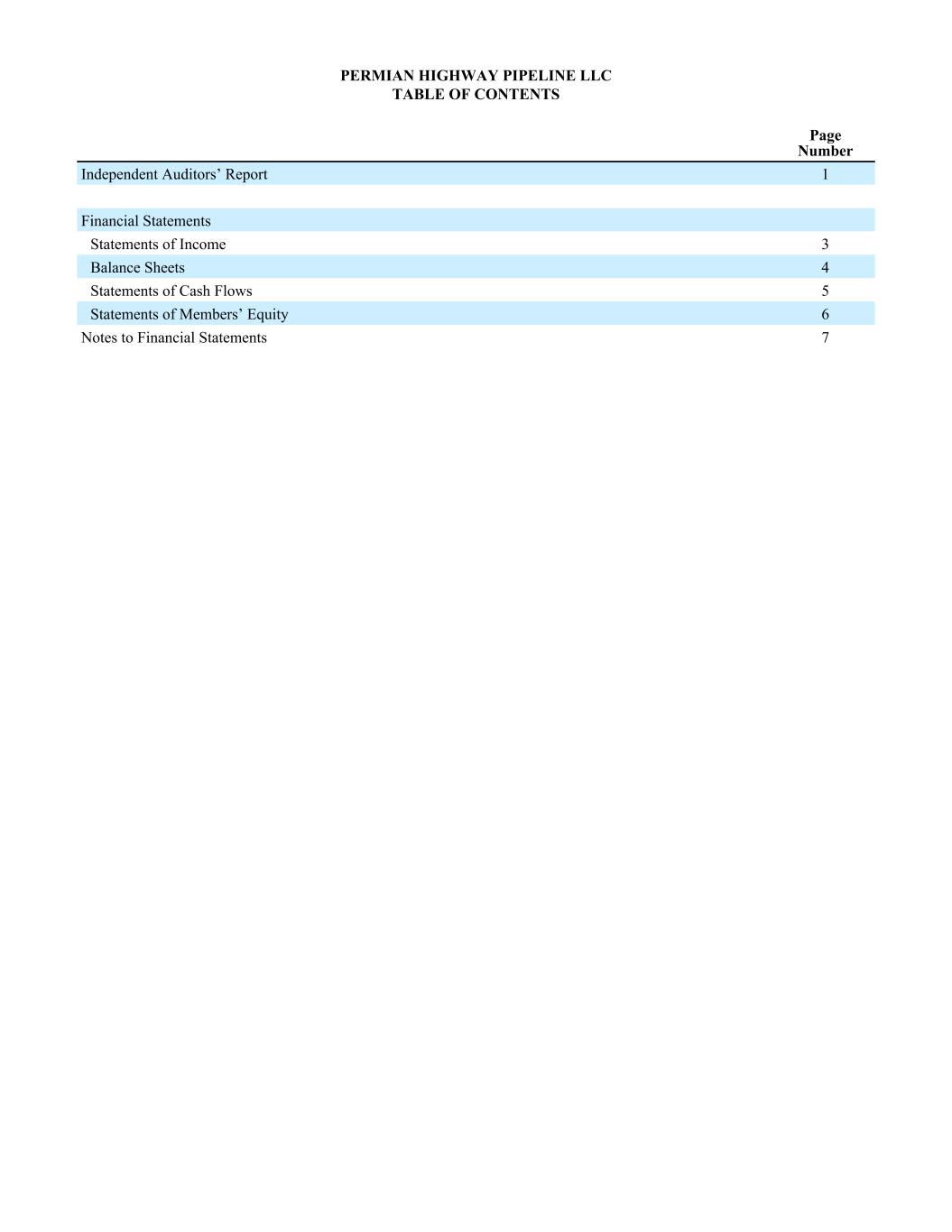
PERMIAN HIGHWAY PIPELINE LLC TABLE OF CONTENTS Page Number Independent Auditors’ Report 1 Financial Statements Statements of Income 3 Balance Sheets 4 Statements of Cash Flows 5 Statements of Members’ Equity 6 Notes to Financial Statements 7
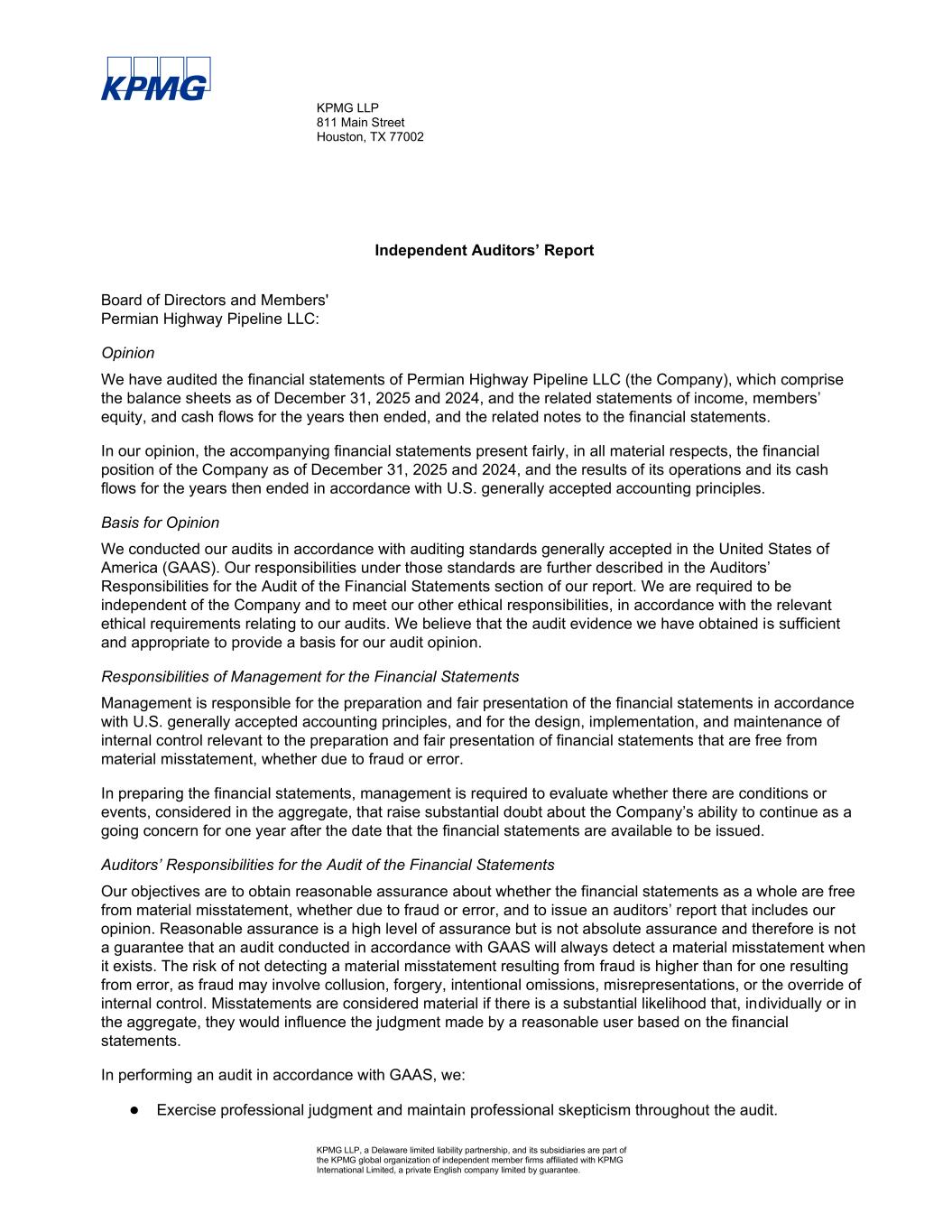
KPMG LLP 811 Main Street Houston, TX 77002 KPMG LLP, a Delaware limited liability partnership, and its subsidiaries are part of the KPMG global organization of independent member firms affiliated with KPMG International Limited, a private English company limited by guarantee. Independent Auditors’ Report Board of Directors and Members' Permian Highway Pipeline LLC: Opinion We have audited the financial statements of Permian Highway Pipeline LLC (the Company), which comprise the balance sheets as of December 31, 2025 and 2024, and the related statements of income, members’ equity, and cash flows for the years then ended, and the related notes to the financial statements. In our opinion, the accompanying financial statements present fairly, in all material respects, the financial position of the Company as of December 31, 2025 and 2024, and the results of its operations and its cash flows for the years then ended in accordance with U.S. generally accepted accounting principles. Basis for Opinion We conducted our audits in accordance with auditing standards generally accepted in the United States of America (GAAS). Our responsibilities under those standards are further described in the Auditors’ Responsibilities for the Audit of the Financial Statements section of our report. We are required to be independent of the Company and to meet our other ethical responsibilities, in accordance with the relevant ethical requirements relating to our audits. We believe that the audit evidence we have obtained is sufficient and appropriate to provide a basis for our audit opinion. Responsibilities of Management for the Financial Statements Management is responsible for the preparation and fair presentation of the financial statements in accordance with U.S. generally accepted accounting principles, and for the design, implementation, and maintenance of internal control relevant to the preparation and fair presentation of financial statements that are free from material misstatement, whether due to fraud or error. In preparing the financial statements, management is required to evaluate whether there are conditions or events, considered in the aggregate, that raise substantial doubt about the Company’s ability to continue as a going concern for one year after the date that the financial statements are available to be issued. Auditors’ Responsibilities for the Audit of the Financial Statements Our objectives are to obtain reasonable assurance about whether the financial statements as a whole are free from material misstatement, whether due to fraud or error, and to issue an auditors’ report that includes our opinion. Reasonable assurance is a high level of assurance but is not absolute assurance and therefore is not a guarantee that an audit conducted in accordance with GAAS will always detect a material misstatement when it exists. The risk of not detecting a material misstatement resulting from fraud is higher than for one resulting from error, as fraud may involve collusion, forgery, intentional omissions, misrepresentations, or the override of internal control. Misstatements are considered material if there is a substantial likelihood that, individually or in the aggregate, they would influence the judgment made by a reasonable user based on the financial statements. In performing an audit in accordance with GAAS, we: ● Exercise professional judgment and maintain professional skepticism throughout the audit.
2 ● Identify and assess the risks of material misstatement of the financial statements, whether due to fraud or error, and design and perform audit procedures responsive to those risks. Such procedures include examining, on a test basis, evidence regarding the amounts and disclosures in the financial statements. ● Obtain an understanding of internal control relevant to the audit in order to design audit procedures that are appropriate in the circumstances, but not for the purpose of expressing an opinion on the effectiveness of the Company’s internal control. Accordingly, no such opinion is expressed. ● Evaluate the appropriateness of accounting policies used and the reasonableness of significant accounting estimates made by management, as well as evaluate the overall presentation of the financial statements. ● Conclude whether, in our judgment, there are conditions or events, considered in the aggregate, that raise substantial doubt about the Company’s ability to continue as a going concern for a reasonable period of time. We are required to communicate with those charged with governance regarding, among other matters, the planned scope and timing of the audit, significant audit findings, and certain internal control related matters that we identified during the audit. Houston, Texas February 13, 2026
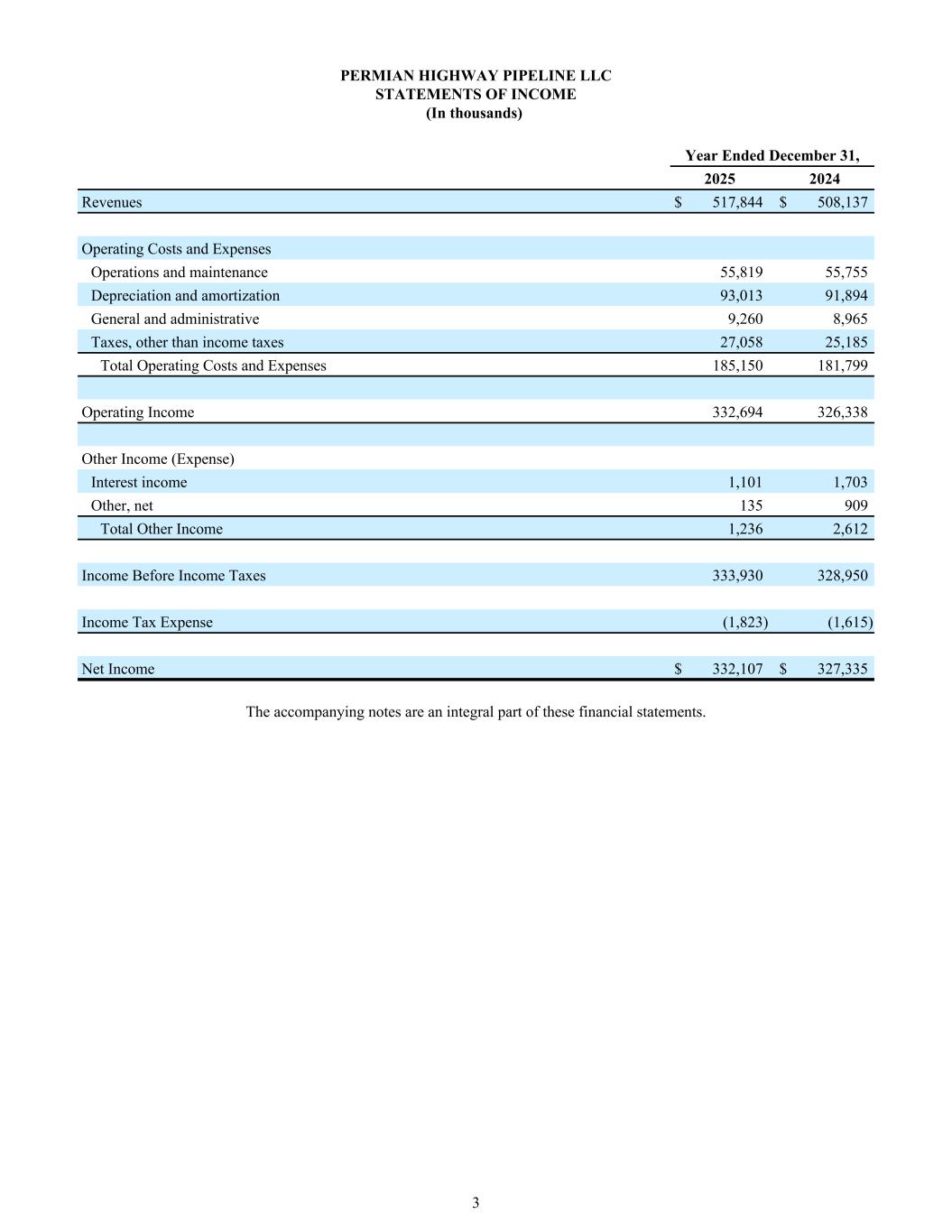
PERMIAN HIGHWAY PIPELINE LLC STATEMENTS OF INCOME (In thousands) Year Ended December 31, 2025 2024 Revenues $ 517,844 $ 508,137 Operating Costs and Expenses Operations and maintenance 55,819 55,755 Depreciation and amortization 93,013 91,894 General and administrative 9,260 8,965 Taxes, other than income taxes 27,058 25,185 Total Operating Costs and Expenses 185,150 181,799 Operating Income 332,694 326,338 Other Income (Expense) Interest income 1,101 1,703 Other, net 135 909 Total Other Income 1,236 2,612 Income Before Income Taxes 333,930 328,950 Income Tax Expense (1,823) (1,615) Net Income $ 332,107 $ 327,335 The accompanying notes are an integral part of these financial statements. 3
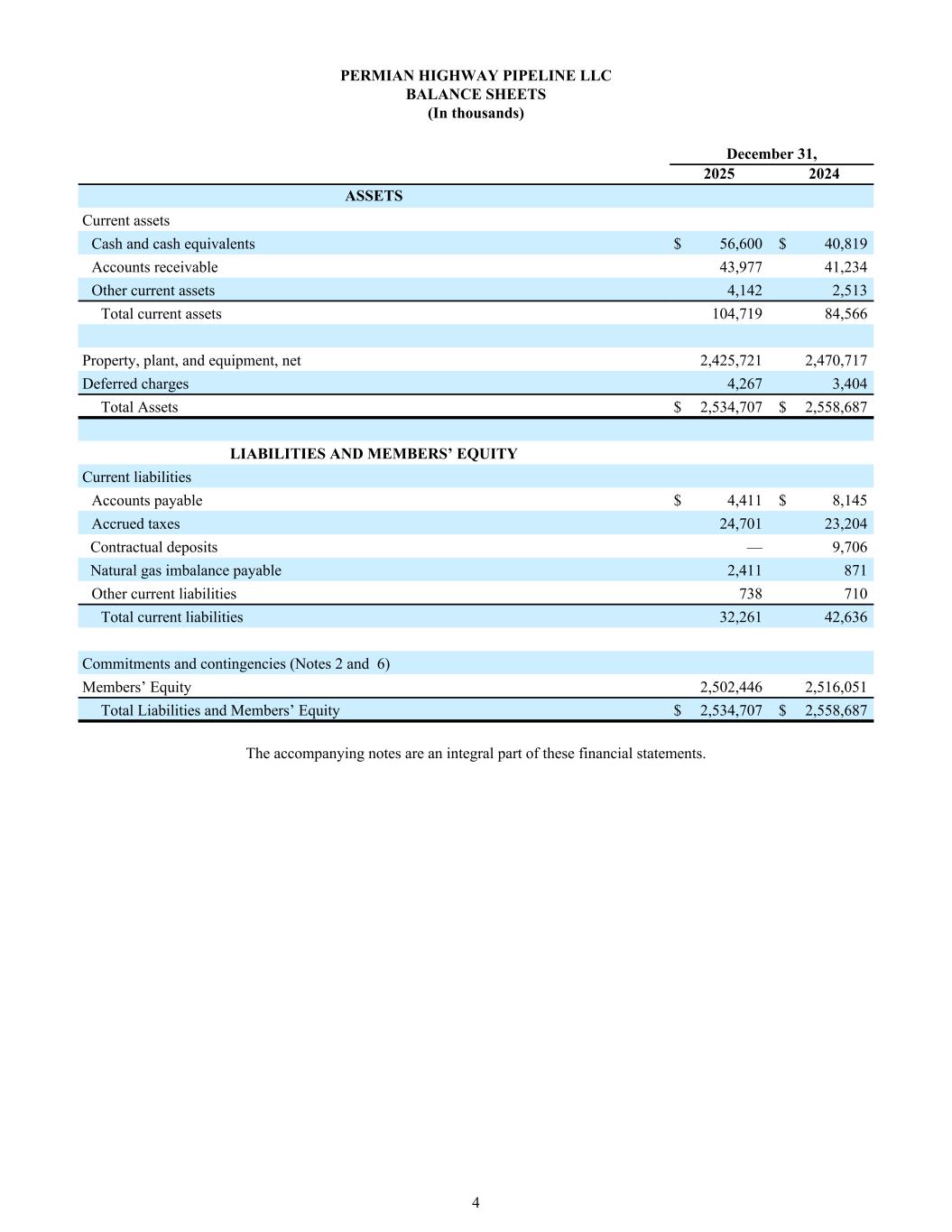
PERMIAN HIGHWAY PIPELINE LLC BALANCE SHEETS (In thousands) December 31, 2025 2024 ASSETS Current assets Cash and cash equivalents $ 56,600 $ 40,819 Accounts receivable 43,977 41,234 Other current assets 4,142 2,513 Total current assets 104,719 84,566 Property, plant, and equipment, net 2,425,721 2,470,717 Deferred charges 4,267 3,404 Total Assets $ 2,534,707 $ 2,558,687 LIABILITIES AND MEMBERS’ EQUITY Current liabilities Accounts payable $ 4,411 $ 8,145 Accrued taxes 24,701 23,204 Contractual deposits — 9,706 Natural gas imbalance payable 2,411 871 Other current liabilities 738 710 Total current liabilities 32,261 42,636 Commitments and contingencies (Notes 2 and 6) Members’ Equity 2,502,446 2,516,051 Total Liabilities and Members’ Equity $ 2,534,707 $ 2,558,687 The accompanying notes are an integral part of these financial statements. 4
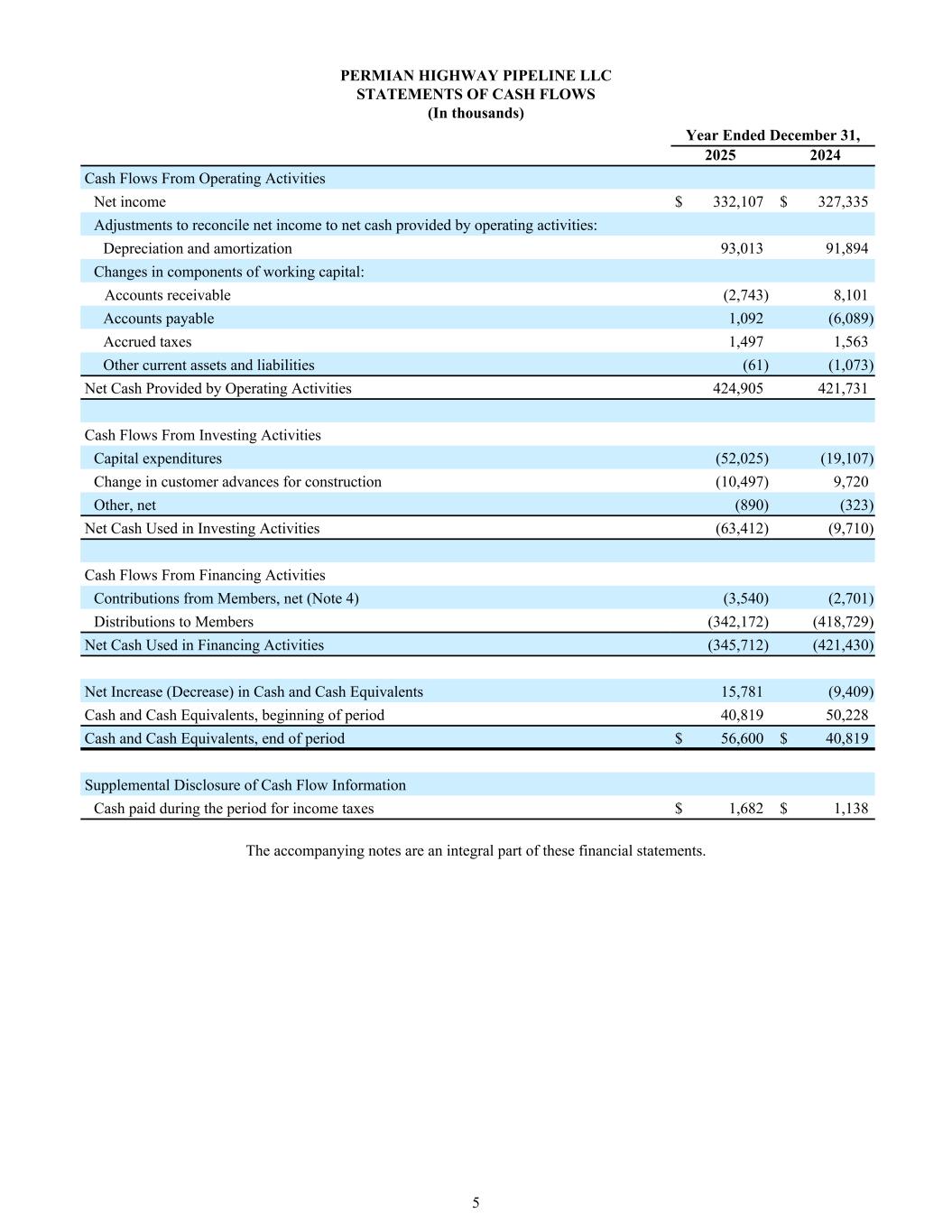
PERMIAN HIGHWAY PIPELINE LLC STATEMENTS OF CASH FLOWS (In thousands) Year Ended December 31, 2025 2024 Cash Flows From Operating Activities Net income $ 332,107 $ 327,335 Adjustments to reconcile net income to net cash provided by operating activities: Depreciation and amortization 93,013 91,894 Changes in components of working capital: Accounts receivable (2,743) 8,101 Accounts payable 1,092 (6,089) Accrued taxes 1,497 1,563 Other current assets and liabilities (61) (1,073) Net Cash Provided by Operating Activities 424,905 421,731 Cash Flows From Investing Activities Capital expenditures (52,025) (19,107) Change in customer advances for construction (10,497) 9,720 Other, net (890) (323) Net Cash Used in Investing Activities (63,412) (9,710) Cash Flows From Financing Activities Contributions from Members, net (Note 4) (3,540) (2,701) Distributions to Members (342,172) (418,729) Net Cash Used in Financing Activities (345,712) (421,430) Net Increase (Decrease) in Cash and Cash Equivalents 15,781 (9,409) Cash and Cash Equivalents, beginning of period 40,819 50,228 Cash and Cash Equivalents, end of period $ 56,600 $ 40,819 Supplemental Disclosure of Cash Flow Information Cash paid during the period for income taxes $ 1,682 $ 1,138 The accompanying notes are an integral part of these financial statements. 5
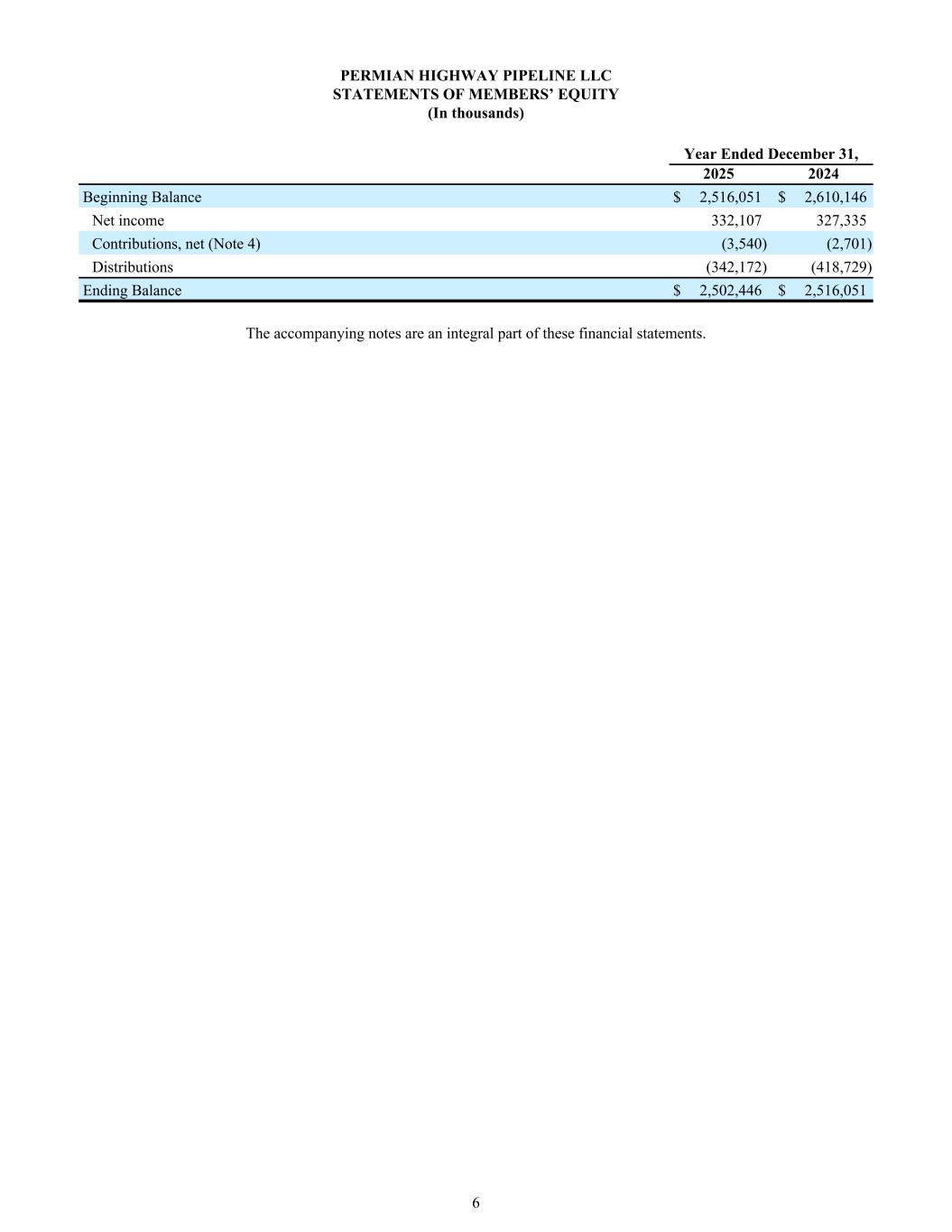
PERMIAN HIGHWAY PIPELINE LLC STATEMENTS OF MEMBERS’ EQUITY (In thousands) Year Ended December 31, 2025 2024 Beginning Balance $ 2,516,051 $ 2,610,146 Net income 332,107 327,335 Contributions, net (Note 4) (3,540) (2,701) Distributions (342,172) (418,729) Ending Balance $ 2,502,446 $ 2,516,051 The accompanying notes are an integral part of these financial statements. 6
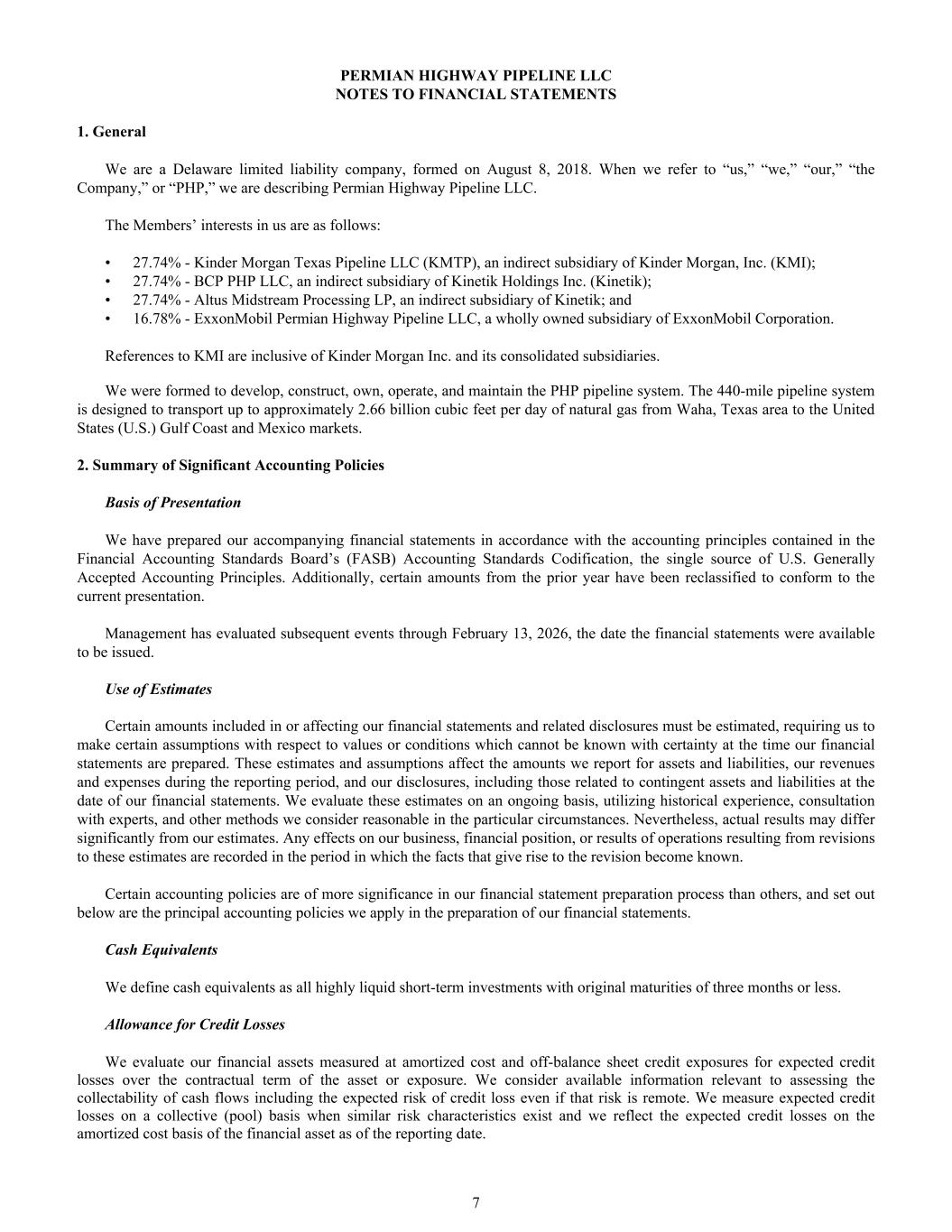
PERMIAN HIGHWAY PIPELINE LLC NOTES TO FINANCIAL STATEMENTS 1. General We are a Delaware limited liability company, formed on August 8, 2018. When we refer to “us,” “we,” “our,” “the Company,” or “PHP,” we are describing Permian Highway Pipeline LLC. The Members’ interests in us are as follows: • 27.74% - Kinder Morgan Texas Pipeline LLC (KMTP), an indirect subsidiary of Kinder Morgan, Inc. (KMI); • 27.74% - BCP PHP LLC, an indirect subsidiary of Kinetik Holdings Inc. (Kinetik); • 27.74% - Altus Midstream Processing LP, an indirect subsidiary of Kinetik; and • 16.78% - ExxonMobil Permian Highway Pipeline LLC, a wholly owned subsidiary of ExxonMobil Corporation. References to KMI are inclusive of Kinder Morgan Inc. and its consolidated subsidiaries. We were formed to develop, construct, own, operate, and maintain the PHP pipeline system. The 440-mile pipeline system is designed to transport up to approximately 2.66 billion cubic feet per day of natural gas from Waha, Texas area to the United States (U.S.) Gulf Coast and Mexico markets. 2. Summary of Significant Accounting Policies Basis of Presentation We have prepared our accompanying financial statements in accordance with the accounting principles contained in the Financial Accounting Standards Board’s (FASB) Accounting Standards Codification, the single source of U.S. Generally Accepted Accounting Principles. Additionally, certain amounts from the prior year have been reclassified to conform to the current presentation. Management has evaluated subsequent events through February 13, 2026, the date the financial statements were available to be issued. Use of Estimates Certain amounts included in or affecting our financial statements and related disclosures must be estimated, requiring us to make certain assumptions with respect to values or conditions which cannot be known with certainty at the time our financial statements are prepared. These estimates and assumptions affect the amounts we report for assets and liabilities, our revenues and expenses during the reporting period, and our disclosures, including those related to contingent assets and liabilities at the date of our financial statements. We evaluate these estimates on an ongoing basis, utilizing historical experience, consultation with experts, and other methods we consider reasonable in the particular circumstances. Nevertheless, actual results may differ significantly from our estimates. Any effects on our business, financial position, or results of operations resulting from revisions to these estimates are recorded in the period in which the facts that give rise to the revision become known. Certain accounting policies are of more significance in our financial statement preparation process than others, and set out below are the principal accounting policies we apply in the preparation of our financial statements. Cash Equivalents We define cash equivalents as all highly liquid short-term investments with original maturities of three months or less. Allowance for Credit Losses We evaluate our financial assets measured at amortized cost and off-balance sheet credit exposures for expected credit losses over the contractual term of the asset or exposure. We consider available information relevant to assessing the collectability of cash flows including the expected risk of credit loss even if that risk is remote. We measure expected credit losses on a collective (pool) basis when similar risk characteristics exist and we reflect the expected credit losses on the amortized cost basis of the financial asset as of the reporting date. 7
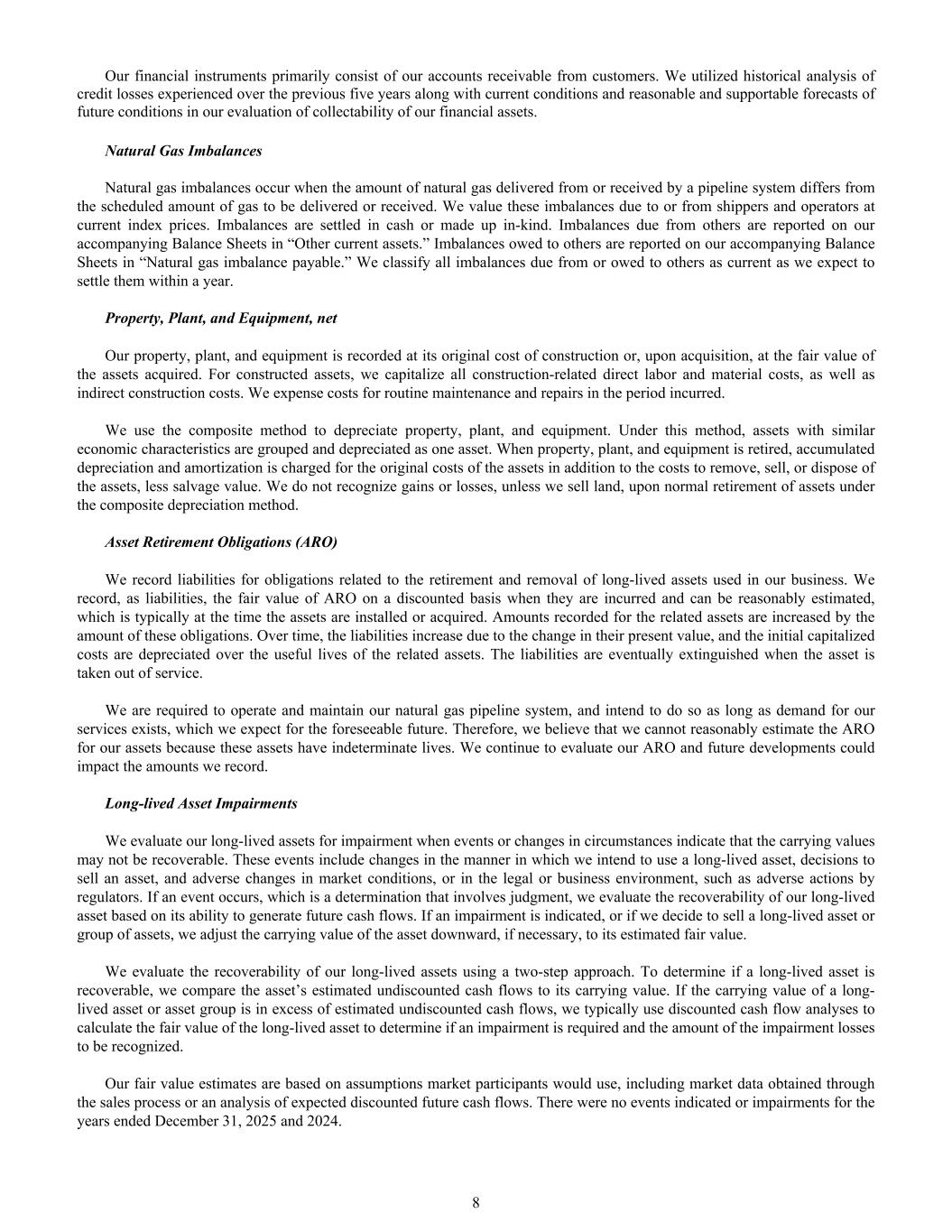
Our financial instruments primarily consist of our accounts receivable from customers. We utilized historical analysis of credit losses experienced over the previous five years along with current conditions and reasonable and supportable forecasts of future conditions in our evaluation of collectability of our financial assets. Natural Gas Imbalances Natural gas imbalances occur when the amount of natural gas delivered from or received by a pipeline system differs from the scheduled amount of gas to be delivered or received. We value these imbalances due to or from shippers and operators at current index prices. Imbalances are settled in cash or made up in-kind. Imbalances due from others are reported on our accompanying Balance Sheets in “Other current assets.” Imbalances owed to others are reported on our accompanying Balance Sheets in “Natural gas imbalance payable.” We classify all imbalances due from or owed to others as current as we expect to settle them within a year. Property, Plant, and Equipment, net Our property, plant, and equipment is recorded at its original cost of construction or, upon acquisition, at the fair value of the assets acquired. For constructed assets, we capitalize all construction-related direct labor and material costs, as well as indirect construction costs. We expense costs for routine maintenance and repairs in the period incurred. We use the composite method to depreciate property, plant, and equipment. Under this method, assets with similar economic characteristics are grouped and depreciated as one asset. When property, plant, and equipment is retired, accumulated depreciation and amortization is charged for the original costs of the assets in addition to the costs to remove, sell, or dispose of the assets, less salvage value. We do not recognize gains or losses, unless we sell land, upon normal retirement of assets under the composite depreciation method. Asset Retirement Obligations (ARO) We record liabilities for obligations related to the retirement and removal of long-lived assets used in our business. We record, as liabilities, the fair value of ARO on a discounted basis when they are incurred and can be reasonably estimated, which is typically at the time the assets are installed or acquired. Amounts recorded for the related assets are increased by the amount of these obligations. Over time, the liabilities increase due to the change in their present value, and the initial capitalized costs are depreciated over the useful lives of the related assets. The liabilities are eventually extinguished when the asset is taken out of service. We are required to operate and maintain our natural gas pipeline system, and intend to do so as long as demand for our services exists, which we expect for the foreseeable future. Therefore, we believe that we cannot reasonably estimate the ARO for our assets because these assets have indeterminate lives. We continue to evaluate our ARO and future developments could impact the amounts we record. Long-lived Asset Impairments We evaluate our long-lived assets for impairment when events or changes in circumstances indicate that the carrying values may not be recoverable. These events include changes in the manner in which we intend to use a long-lived asset, decisions to sell an asset, and adverse changes in market conditions, or in the legal or business environment, such as adverse actions by regulators. If an event occurs, which is a determination that involves judgment, we evaluate the recoverability of our long-lived asset based on its ability to generate future cash flows. If an impairment is indicated, or if we decide to sell a long-lived asset or group of assets, we adjust the carrying value of the asset downward, if necessary, to its estimated fair value. We evaluate the recoverability of our long-lived assets using a two-step approach. To determine if a long-lived asset is recoverable, we compare the asset’s estimated undiscounted cash flows to its carrying value. If the carrying value of a long- lived asset or asset group is in excess of estimated undiscounted cash flows, we typically use discounted cash flow analyses to calculate the fair value of the long-lived asset to determine if an impairment is required and the amount of the impairment losses to be recognized. Our fair value estimates are based on assumptions market participants would use, including market data obtained through the sales process or an analysis of expected discounted future cash flows. There were no events indicated or impairments for the years ended December 31, 2025 and 2024. 8
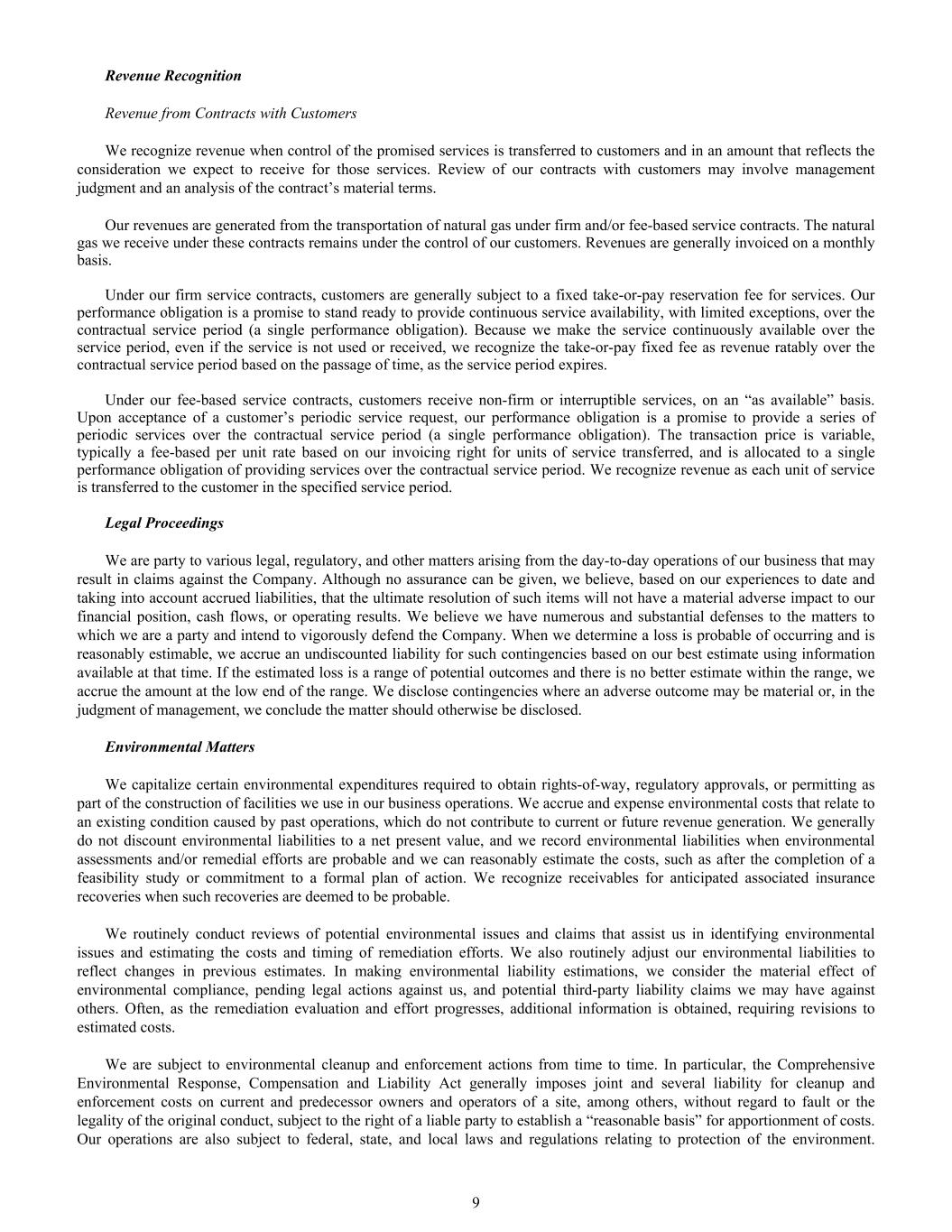
Revenue Recognition Revenue from Contracts with Customers We recognize revenue when control of the promised services is transferred to customers and in an amount that reflects the consideration we expect to receive for those services. Review of our contracts with customers may involve management judgment and an analysis of the contract’s material terms. Our revenues are generated from the transportation of natural gas under firm and/or fee-based service contracts. The natural gas we receive under these contracts remains under the control of our customers. Revenues are generally invoiced on a monthly basis. Under our firm service contracts, customers are generally subject to a fixed take-or-pay reservation fee for services. Our performance obligation is a promise to stand ready to provide continuous service availability, with limited exceptions, over the contractual service period (a single performance obligation). Because we make the service continuously available over the service period, even if the service is not used or received, we recognize the take-or-pay fixed fee as revenue ratably over the contractual service period based on the passage of time, as the service period expires. Under our fee-based service contracts, customers receive non-firm or interruptible services, on an “as available” basis. Upon acceptance of a customer’s periodic service request, our performance obligation is a promise to provide a series of periodic services over the contractual service period (a single performance obligation). The transaction price is variable, typically a fee-based per unit rate based on our invoicing right for units of service transferred, and is allocated to a single performance obligation of providing services over the contractual service period. We recognize revenue as each unit of service is transferred to the customer in the specified service period. Legal Proceedings We are party to various legal, regulatory, and other matters arising from the day-to-day operations of our business that may result in claims against the Company. Although no assurance can be given, we believe, based on our experiences to date and taking into account accrued liabilities, that the ultimate resolution of such items will not have a material adverse impact to our financial position, cash flows, or operating results. We believe we have numerous and substantial defenses to the matters to which we are a party and intend to vigorously defend the Company. When we determine a loss is probable of occurring and is reasonably estimable, we accrue an undiscounted liability for such contingencies based on our best estimate using information available at that time. If the estimated loss is a range of potential outcomes and there is no better estimate within the range, we accrue the amount at the low end of the range. We disclose contingencies where an adverse outcome may be material or, in the judgment of management, we conclude the matter should otherwise be disclosed. Environmental Matters We capitalize certain environmental expenditures required to obtain rights-of-way, regulatory approvals, or permitting as part of the construction of facilities we use in our business operations. We accrue and expense environmental costs that relate to an existing condition caused by past operations, which do not contribute to current or future revenue generation. We generally do not discount environmental liabilities to a net present value, and we record environmental liabilities when environmental assessments and/or remedial efforts are probable and we can reasonably estimate the costs, such as after the completion of a feasibility study or commitment to a formal plan of action. We recognize receivables for anticipated associated insurance recoveries when such recoveries are deemed to be probable. We routinely conduct reviews of potential environmental issues and claims that assist us in identifying environmental issues and estimating the costs and timing of remediation efforts. We also routinely adjust our environmental liabilities to reflect changes in previous estimates. In making environmental liability estimations, we consider the material effect of environmental compliance, pending legal actions against us, and potential third-party liability claims we may have against others. Often, as the remediation evaluation and effort progresses, additional information is obtained, requiring revisions to estimated costs. We are subject to environmental cleanup and enforcement actions from time to time. In particular, the Comprehensive Environmental Response, Compensation and Liability Act generally imposes joint and several liability for cleanup and enforcement costs on current and predecessor owners and operators of a site, among others, without regard to fault or the legality of the original conduct, subject to the right of a liable party to establish a “reasonable basis” for apportionment of costs. Our operations are also subject to federal, state, and local laws and regulations relating to protection of the environment. 9
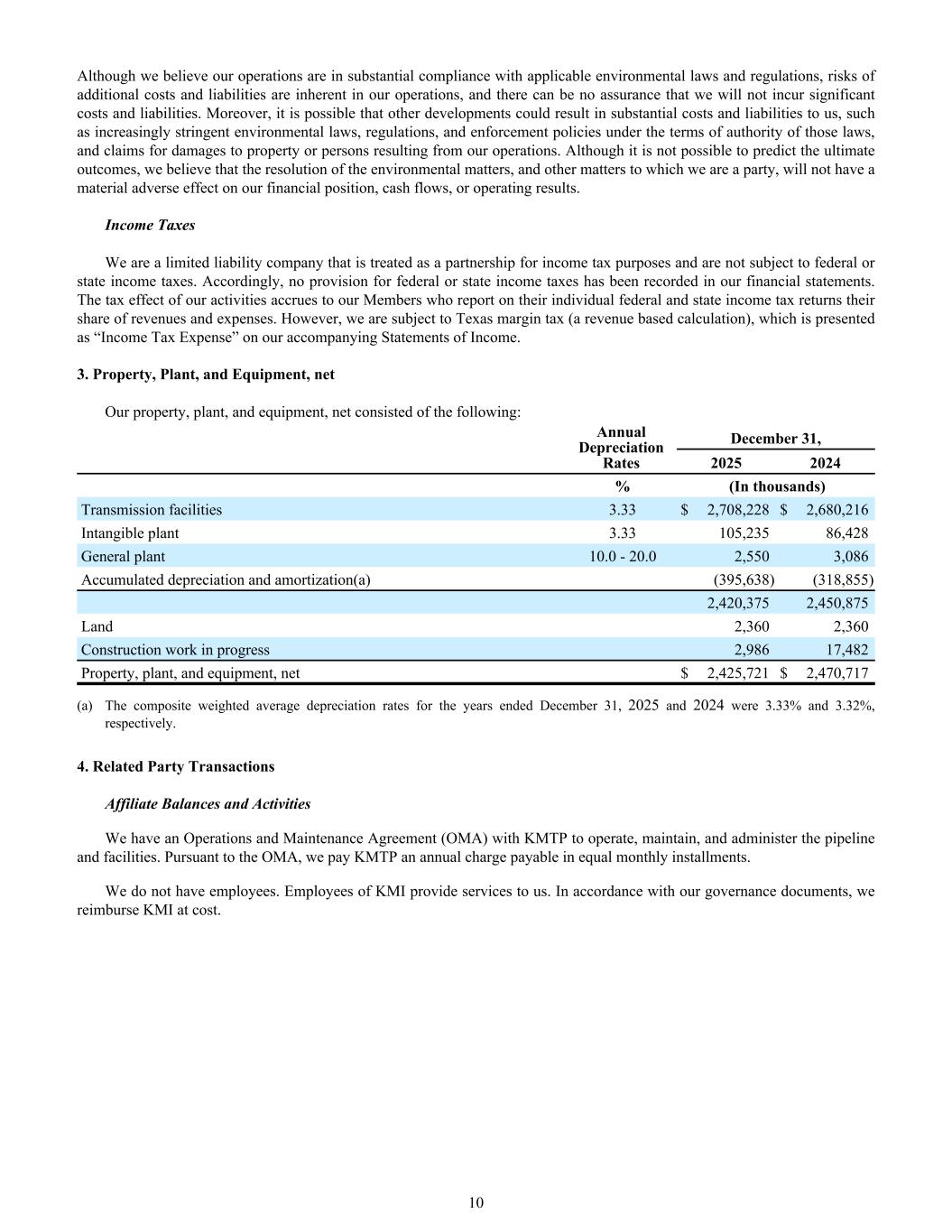
Although we believe our operations are in substantial compliance with applicable environmental laws and regulations, risks of additional costs and liabilities are inherent in our operations, and there can be no assurance that we will not incur significant costs and liabilities. Moreover, it is possible that other developments could result in substantial costs and liabilities to us, such as increasingly stringent environmental laws, regulations, and enforcement policies under the terms of authority of those laws, and claims for damages to property or persons resulting from our operations. Although it is not possible to predict the ultimate outcomes, we believe that the resolution of the environmental matters, and other matters to which we are a party, will not have a material adverse effect on our financial position, cash flows, or operating results. Income Taxes We are a limited liability company that is treated as a partnership for income tax purposes and are not subject to federal or state income taxes. Accordingly, no provision for federal or state income taxes has been recorded in our financial statements. The tax effect of our activities accrues to our Members who report on their individual federal and state income tax returns their share of revenues and expenses. However, we are subject to Texas margin tax (a revenue based calculation), which is presented as “Income Tax Expense” on our accompanying Statements of Income. 3. Property, Plant, and Equipment, net Our property, plant, and equipment, net consisted of the following: Annual Depreciation Rates December 31, 2025 2024 % (In thousands) Transmission facilities 3.33 $ 2,708,228 $ 2,680,216 Intangible plant 3.33 105,235 86,428 General plant 10.0 - 20.0 2,550 3,086 Accumulated depreciation and amortization(a) (395,638) (318,855) 2,420,375 2,450,875 Land 2,360 2,360 Construction work in progress 2,986 17,482 Property, plant, and equipment, net $ 2,425,721 $ 2,470,717 (a) The composite weighted average depreciation rates for the years ended December 31, 2025 and 2024 were 3.33% and 3.32%, respectively. 4. Related Party Transactions Affiliate Balances and Activities We have an Operations and Maintenance Agreement (OMA) with KMTP to operate, maintain, and administer the pipeline and facilities. Pursuant to the OMA, we pay KMTP an annual charge payable in equal monthly installments. We do not have employees. Employees of KMI provide services to us. In accordance with our governance documents, we reimburse KMI at cost. 10
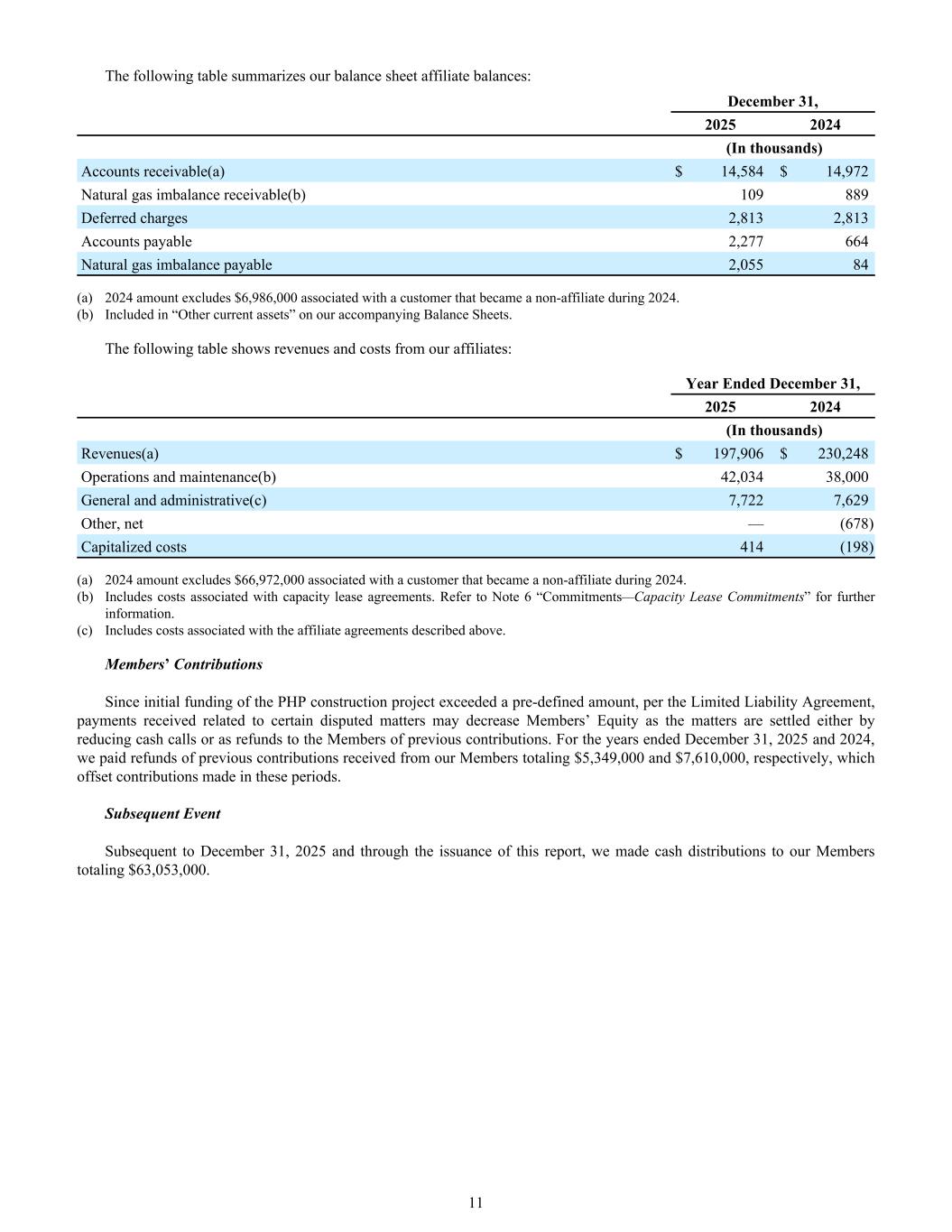
The following table summarizes our balance sheet affiliate balances: December 31, 2025 2024 (In thousands) Accounts receivable(a) $ 14,584 $ 14,972 Natural gas imbalance receivable(b) 109 889 Deferred charges 2,813 2,813 Accounts payable 2,277 664 Natural gas imbalance payable 2,055 84 (a) 2024 amount excludes $6,986,000 associated with a customer that became a non-affiliate during 2024. (b) Included in “Other current assets” on our accompanying Balance Sheets. The following table shows revenues and costs from our affiliates: Year Ended December 31, 2025 2024 (In thousands) Revenues(a) $ 197,906 $ 230,248 Operations and maintenance(b) 42,034 38,000 General and administrative(c) 7,722 7,629 Other, net — (678) Capitalized costs 414 (198) (a) 2024 amount excludes $66,972,000 associated with a customer that became a non-affiliate during 2024. (b) Includes costs associated with capacity lease agreements. Refer to Note 6 “Commitments—Capacity Lease Commitments” for further information. (c) Includes costs associated with the affiliate agreements described above. Members’ Contributions Since initial funding of the PHP construction project exceeded a pre-defined amount, per the Limited Liability Agreement, payments received related to certain disputed matters may decrease Members’ Equity as the matters are settled either by reducing cash calls or as refunds to the Members of previous contributions. For the years ended December 31, 2025 and 2024, we paid refunds of previous contributions received from our Members totaling $5,349,000 and $7,610,000, respectively, which offset contributions made in these periods. Subsequent Event Subsequent to December 31, 2025 and through the issuance of this report, we made cash distributions to our Members totaling $63,053,000. 11
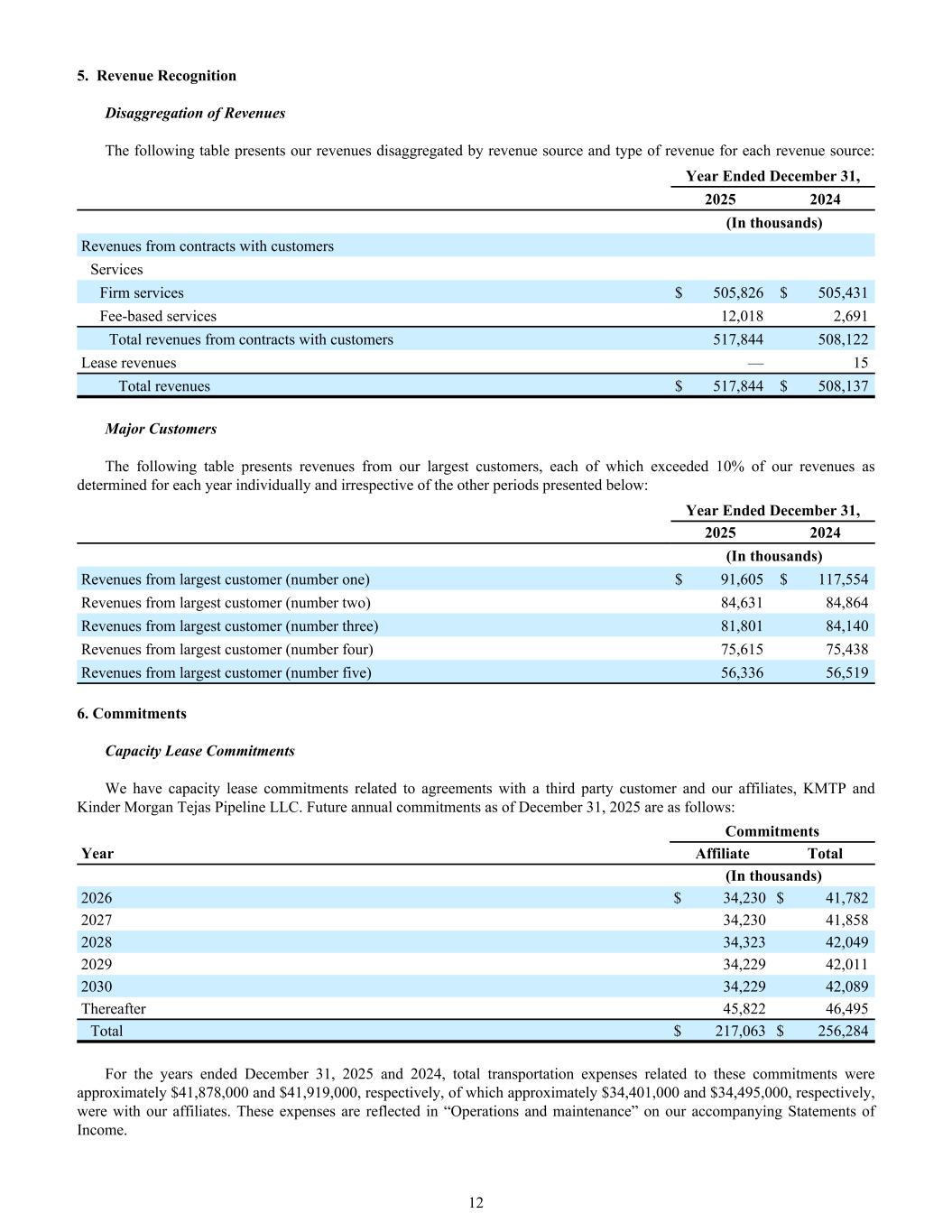
5. Revenue Recognition Disaggregation of Revenues The following table presents our revenues disaggregated by revenue source and type of revenue for each revenue source: 2025 2024 (In thousands) Revenues from contracts with customers Services Firm services $ 505,826 $ 505,431 Fee-based services 12,018 2,691 Total revenues from contracts with customers 517,844 508,122 Lease revenues — 15 Total revenues $ 517,844 $ 508,137 Year Ended December 31, Major Customers The following table presents revenues from our largest customers, each of which exceeded 10% of our revenues as determined for each year individually and irrespective of the other periods presented below: Year Ended December 31, 2025 2024 (In thousands) Revenues from largest customer (number one) $ 91,605 $ 117,554 Revenues from largest customer (number two) 84,631 84,864 Revenues from largest customer (number three) 81,801 84,140 Revenues from largest customer (number four) 75,615 75,438 Revenues from largest customer (number five) 56,336 56,519 6. Commitments Capacity Lease Commitments We have capacity lease commitments related to agreements with a third party customer and our affiliates, KMTP and Kinder Morgan Tejas Pipeline LLC. Future annual commitments as of December 31, 2025 are as follows: Commitments Year Affiliate Total (In thousands) 2026 $ 34,230 $ 41,782 2027 34,230 41,858 2028 34,323 42,049 2029 34,229 42,011 2030 34,229 42,089 Thereafter 45,822 46,495 Total $ 217,063 $ 256,284 For the years ended December 31, 2025 and 2024, total transportation expenses related to these commitments were approximately $41,878,000 and $41,919,000, respectively, of which approximately $34,401,000 and $34,495,000, respectively, were with our affiliates. These expenses are reflected in “Operations and maintenance” on our accompanying Statements of Income. 12

7. Recent Accounting Pronouncement Accounting Standards Update (ASU) No. 2025-06 On September 18, 2025, the FASB issued ASU No. 2025-06, “Intangibles—Goodwill and Other—Internal-Use Software (Subtopic 350-40): Targeted Improvements to the Accounting for Internal-Use Software.” This ASU modernizes the accounting guidance for the costs to develop software for internal use by removing outdated stage-based cost capitalization rules and replacing them with a probability-based cost-capitalization framework that aligns better with current software development methods. This ASU will be effective for annual periods beginning after December 15, 2027, for interim reporting periods beginning within those annual periods, and early adoption is permitted. Management is currently evaluating this ASU to determine its impact on the Company’s financial statements. 13