(Exact name of registrant as specified in its charter)
_____________________________
Maryland
(VICI Properties Inc.)
81-4177147
Delaware
(VICI Properties L.P.)
35-2576503
(State or other jurisdiction of incorporation or organization)
(I.R.S. Employer Identification No.)
535 Madison AvenueNew York, New York10022
(Address of Principal Executive Offices) (Zip Code)
Registrant’s telephone number, including area code: (646) 949-4631
_____________________________
Securities registered pursuant to Section 12(b) of the Act:
Title of each class
Trading Symbol
Name of each exchange on which registered
Common stock, $0.01 par value
VICI
New York Stock Exchange
Indicate by check mark whether the registrant: (1) has filed all reports required to be filed by Section 13 or 15(d) of the Securities Exchange Act of 1934 during the preceding 12 months (or for such shorter period that the registrant was required to file such reports), and (2) has been subject to such filing requirements for the past 90 days.
VICI Properties Inc. Yes☒ No ☐
VICI Properties L.P. Yes☒ No ☐
Indicate by check mark whether the registrant has submitted electronically every Interactive Data File required to be submitted pursuant to Rule 405 of Regulation S-T (§232.405 of this chapter) during the preceding 12 months (or for such shorter period that the registrant was required to submit and post such files).
VICI Properties Inc. Yes☒ No ☐
VICI Properties L.P. Yes☒ No ☐
Indicate by check mark whether the registrant is a large accelerated filer, an accelerated filer, a non-accelerated filer, a smaller reporting company, or an emerging growth company. See the definitions of “large accelerated filer,” “accelerated filer,” “smaller reporting company,” and “emerging growth company” in Rule 12b-2 of the Exchange Act. (Check one):
VICI Properties Inc.
VICI Properties L.P.
Large Accelerated Filer
☒
Accelerated filer
☐
Large Accelerated Filer
☐
Accelerated filer
☐
Non-accelerated filer
☐
Smaller reporting company
☐
Non-accelerated filer
☒
Smaller reporting company
☐
Emerging growth company
☐
Emerging growth company
☐
If an emerging growth company, indicate by check mark if the registrant has elected not to use the extended transition period for complying with any new or revised financial accounting standards provided pursuant to Section 13(a) of the Exchange Act.
VICI Properties Inc. ☐
VICI Properties L.P. ☐
Indicate by check mark whether the registrant is a shell company (as defined in Rule 12b-2 of the Exchange Act).
VICI Properties Inc. Yes ☐ No ☒
VICI Properties L.P. Yes ☐ No ☒
As of April 28, 2026, VICI Properties Inc. had 1,069,030,187 shares of common stock, $0.01 par value per share, outstanding. VICI Properties L.P. has no common stock outstanding.
EXPLANATORY NOTE
This report combines the quarterly reports on Form 10-Q for the three months ended March 31, 2026 of VICI Properties Inc. and VICI Properties L.P. Unless stated otherwise or the context otherwise requires, references to “VICI” mean VICI Properties Inc. and its consolidated subsidiaries, including VICI Properties OP LLC (“VICI OP”), and references to “VICI LP” mean VICI Properties L.P. and its consolidated subsidiaries. Unless stated otherwise or the context otherwise requires, the terms “the Company,” “we,” “our” and “us” mean VICI and VICI LP, including, collectively, their consolidated subsidiaries.
In order to highlight the differences between VICI and VICI LP, the separate sections in this report for VICI and VICI LP described below specifically refer to VICI and VICI LP. In the sections that combine disclosure of VICI and VICI LP, this report refers to actions or holdings of VICI and VICI LP as being “our” actions or holdings. Although VICI LP is the entity that generally, directly or indirectly, enters into contracts and joint ventures, holds assets and incurs debt, we believe that references to “we,” “us” or “our” in this context are appropriate because the business is one enterprise and we operate substantially all of our business and own, either directly or through subsidiaries, substantially all of our assets through VICI LP.
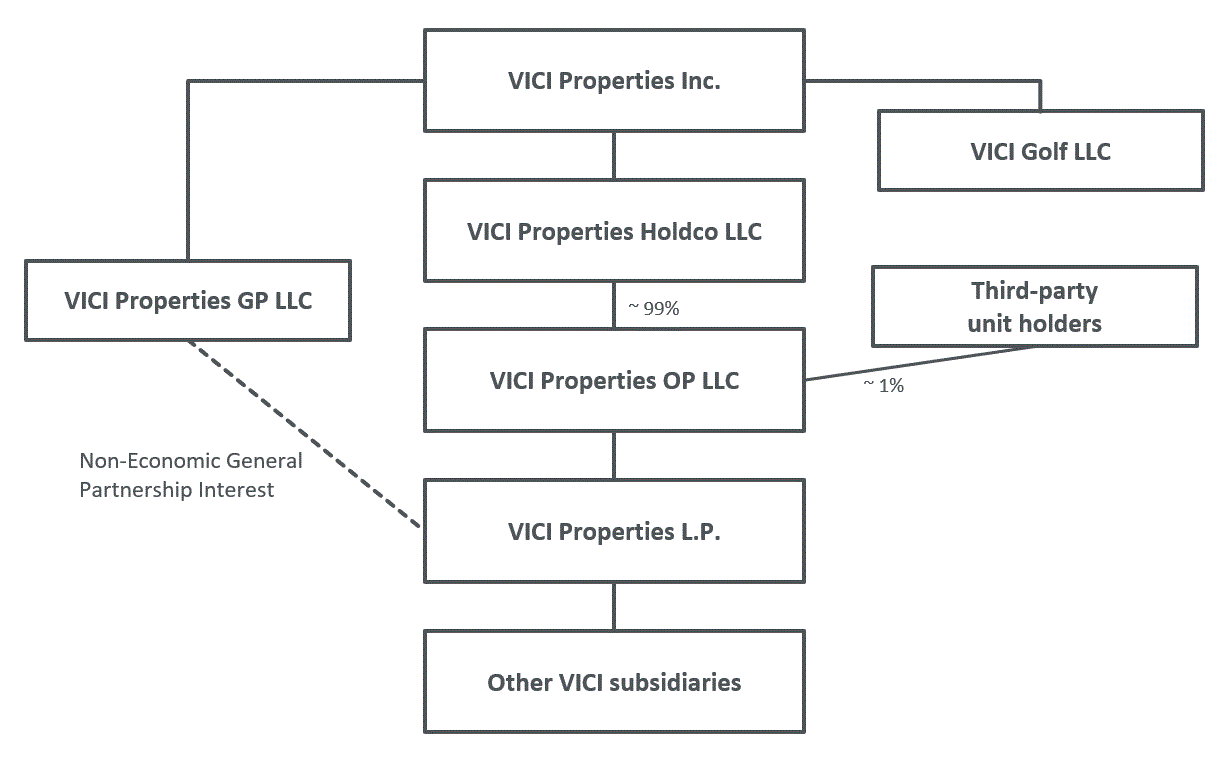
VICI is a real estate investment trust (“REIT”) that is the sole owner of VICI Properties GP LLC, the sole general partner of VICI LP. As of March 31, 2026, VICI owns 100% of the limited liability company interests of VICI Properties HoldCo LLC (“HoldCo”), which in turn owns approximately 98.9% of the limited liability company interest of VICI OP (such interests, “VICI OP Units”), our operating partnership, which in turn owns 100% of the limited partnership interest in VICI LP. The balance of the VICI OP Units not held by HoldCo are held by third-party unit holders.
The following diagram details VICI’s organizational structure as of March 31, 2026.
We believe combining the quarterly reports on Form 10-Q of VICI and VICI LP into this single report:
•enhances investors’ understanding of VICI and VICI LP by enabling investors to view the business as a whole in the same manner as management views and operates the business;
•eliminates duplicative disclosure and provides a more streamlined and readable presentation; and
•creates time and cost efficiencies through the preparation of one combined report instead of two separate reports.
We operate VICI and VICI LP as one business. Because VICI LP is managed by VICI, and VICI conducts substantially all of its operations and owns, either directly or through subsidiaries, substantially all of its assets indirectly through VICI LP, VICI’s executive officers are VICI LP’s executive officers, although, as a partnership, VICI LP does not have a board of directors.
We believe it is important to understand the few differences between VICI and VICI LP in the context of how VICI and VICI LP operate as a consolidated company. VICI is a REIT whose only material assets are its indirect interest in VICI LP, through which it conducts its real property business. VICI also conducts its golf course business through a taxable REIT subsidiary (a “TRS”), VICI Golf LLC, a Delaware limited liability company (“VICI Golf”). As a result, VICI does not conduct business itself other than issuing public equity from time to time and does not directly incur any material indebtedness, rather VICI LP
2
holds substantially all of our assets, except for those held in VICI Golf. Except for net proceeds from public equity issuances by VICI, VICI LP generates all capital required by the Company’s business, which sources include VICI LP’s operations and its direct or indirect incurrence of indebtedness.
VICI consolidates VICI LP for financial reporting purposes, and VICI does not have material assets other than its indirect investment in VICI LP. Therefore, while there are some areas of difference between the unaudited consolidated financial statements of VICI and those of VICI LP, the assets and liabilities of VICI and VICI LP are materially the same on their respective financial statements. As of March 31, 2026, the primary areas of difference between the unaudited consolidated financial statements of VICI and those of VICI LP were cash and cash equivalents, stockholders’ equity and partners’ capital, non-controlling interests and golf operations, which include the assets and liabilities and income and expenses of VICI Golf.
To help investors understand the differences between VICI and VICI LP, this report provides:
•separate consolidated financial statements for VICI and VICI LP;
•a single set of notes to such consolidated financial statements that includes separate discussions of stockholders’ equity or partners’ equity and per share and per unit data, as applicable;
•a combined Management’s Discussion and Analysis of Financial Condition and Results of Operations section that also includes discrete information related to each entity, as applicable;
•separate Part I, Item 4. Controls and Procedures sections;
•separate Part II, Item 2. Issuer Purchases of Equity Securities sections related to each entity; and
•separate Exhibits 31 and 32 certifications for each of VICI and VICI LP in order to establish that the requisite certifications have been made and that VICI and VICI LP are each compliant with Rule 13a-14(a) or Rule 15d-14(a) of the Securities Exchange Act of 1934 and 18 U.S.C. §1350.
The separate discussions of VICI and VICI LP in this report should be read in conjunction with each other to understand our results on a consolidated basis and how management operates our business.
Investments in leases - financing receivables, net
18,806,242
18,697,133
Investments in loans and securities, net
2,710,021
2,525,457
Land
148,002
148,002
Cash and cash equivalents
480,206
563,479
Short-term investments
—
44,484
Other assets
1,047,376
1,039,050
Total assets
$
47,089,674
$
46,724,168
Liabilities
Debt, net
$
16,787,100
$
16,773,241
Accrued expenses and deferred revenue
173,509
238,715
Dividends and distributions payable
486,316
486,259
Other liabilities
1,023,887
1,003,366
Total liabilities
18,470,812
18,501,581
Commitments and contingent liabilities (Note 10)
Stockholders’ equity
Common stock, $0.01 par value, 1,350,000,000 shares authorized and 1,068,988,999 and 1,068,811,371 shares issued and outstanding at March 31, 2026 and December 31, 2025, respectively
10,690
10,688
Preferred stock, $0.01 par value, 50,000,000 shares authorized and no shares outstanding at March 31, 2026 and December 31, 2025
Note: As of March 31, 2026 and December 31, 2025, our Investments in leases - sales-type, Investments in leases - financing receivables, Investments in loans and securities, and Other assets (sales-type sub-leases) are net of allowance for credit losses of $787.1 million, $726.8 million, $93.3 million and $20.4 million, respectively, and $919.2 million, $769.9 million, $56.4 million and $23.9 million, respectively. Refer to Note 5 - Allowance for Credit Losses for further details.
See accompanying Notes to Consolidated Financial Statements.
Investments in leases - financing receivables, net
18,806,242
18,697,133
Investments in loans and securities, net
2,710,021
2,525,457
Land
148,002
148,002
Cash and cash equivalents
467,664
553,412
Short-term investments
—
44,484
Other assets
969,697
961,227
Total assets
$
46,999,453
$
46,636,278
Liabilities
Debt, net
$
16,787,100
$
16,773,241
Accrued expenses and deferred revenue
171,760
236,424
Distributions payable
486,316
486,259
Other liabilities
1,010,694
990,176
Total liabilities
18,455,870
18,486,100
Commitments and contingent liabilities (Note 10)
Partners’ Capital
Partners’ capital, 1,081,220,372 and 1,081,042,744 operating partnership units issued and outstanding as of March 31, 2026 and December 31, 2025, respectively
Note: As of March 31, 2026 and December 31, 2025, our Investments in leases - sales-type, Investments in leases - financing receivables, Investments in loans and securities, and Other assets (sales-type sub-leases) are net of allowance for credit losses of $787.1 million, $726.8 million, $93.3 million and $20.4 million, respectively, and $919.2 million, $769.9 million, $56.4 million and $23.9 million, respectively. Refer to Note 5 - Allowance for Credit Losses for further details.
In these notes, the words the “Company,” “VICI,” “we,” “our,” and “us” refer to VICI Properties Inc. and its subsidiaries, including VICI LP, on a consolidated basis, unless otherwise stated or the context requires otherwise.
We refer to (i) our Condensed Consolidated Financial Statements as our “Financial Statements,” (ii) our Consolidated Balance Sheets as our “Balance Sheet,” (iii) our Consolidated Statements of Operations and Comprehensive Income as our “Statement of Operations,” and (iv) our Consolidated Statement of Cash Flows as our “Statement of Cash Flows.” References to numbered “Notes” refer to the Notes to our Consolidated Financial Statements.
Note 1 — Business and Organization
Business
We are primarily engaged in the business of owning and acquiring gaming, hospitality, wellness, entertainment and leisure destinations, subject to long-term triple-net leases. As of March 31, 2026, we own 93 experiential assets across a geographically diverse portfolio consisting of 54 gaming properties and 39 other experiential properties across the United States and Canada, including Caesars Palace Las Vegas, MGM Grand and the Venetian Resort Las Vegas (the “Venetian Resort”). Our gaming and entertainment facilities are leased to leading brands that seek to drive consumer loyalty and value with guests through superior services, experiences, products and continuous innovation. VICI also owns four championship golf courses, which are managed by Cabot-Managed Properties and are located near certain of our properties.
VICI Properties Inc., the parent company, is a Maryland corporation and internally managed REIT for U.S. federal income tax purposes. Our real property business, which represents the substantial majority of our assets, is conducted through VICI OP and indirectly through VICI LP, and our golf course business, VICI Golf, is conducted through a direct wholly owned TRS of VICI. As a REIT, we generally will not be subject to U.S. federal income taxes on our taxable income to the extent that we annually distribute substantially all of our net taxable income to stockholders and maintain our qualification as a REIT.
Note 2 — Summary of Significant Accounting Policies
Basis of Presentation
The accompanying Financial Statements have been prepared in accordance with U.S. generally accepted accounting principles (“GAAP”) for interim financial information set forth in the Accounting Standards Codification (“ASC”), as published by the Financial Accounting Standards Board, and with the applicable rules and regulations of the Securities and Exchange Commission (“SEC”). The Financial Statements, including the notes thereto, are unaudited and condense or exclude some of the disclosures and information normally required in audited financial statements.
We believe the disclosures made are adequate to prevent the information presented from being misleading. However, the accompanying unaudited Financial Statements and related notes should be read in conjunction with our audited financial statements and notes thereto included in our most recent Annual Report on Form 10-K, as updated from time to time in our other filings with the SEC.
All adjustments considered necessary for a fair statement of results for the interim period have been included and are of a normal and recurring nature. Certain prior period amounts have been reclassified to conform to the current period presentation.
Use of Estimates
The preparation of financial statements in conformity with GAAP requires us to make estimates and assumptions. These estimates and assumptions affect the reported amounts of assets and liabilities and the disclosure of contingent assets and liabilities at the date of the financial statements and the reported amounts of revenues and expenses during the reporting periods. Actual results could differ materially from these estimates.
Operating results for the three months ended March 31, 2026 are not necessarily indicative of the results that may be expected for the year ending December 31, 2026.
NOTES TO CONSOLIDATED FINANCIAL STATEMENTS (Continued)
(UNAUDITED)
Principles of Consolidation and Non-controlling Interest
The accompanying Financial Statements include our accounts and the accounts of VICI LP, and the subsidiaries in which we or VICI LP has a controlling interest. The operating partnership, VICI OP, is a variable interest entity (“VIE”) of which we are the primary beneficiary. The primary beneficiary is the entity that has (i) the power to direct the activities that most significantly impact the entity’s economic performance and (ii) the obligation to absorb losses of the VIE or the right to receive benefits from the VIE that could be significant to the VIE. Substantially all of our assets and liabilities relate to VICI LP, whose limited partnership interest is 100% owned by VICI OP. Therefore, we consolidate the accounts of VICI LP and reflect the third-party ownership in VICI OP as a non-controlling interest on the Consolidated Balance Sheets. All intercompany account balances and transactions have been eliminated in consolidation.
Non-controlling Interests
We present non-controlling interests and classify such interests as a component of consolidated stockholders’ equity or partners’ capital, separate from VICI stockholders’ equity and VICI LP partners’ capital. As of March 31, 2026, VICI’s non-controlling interests were comprised of (i) an approximately 1.1% third-party ownership of VICI OP in the form of VICI OP Units, (ii) a 20% third-party ownership of Harrah’s Joliet LandCo LLC, the entity that owns the Harrah’s Joliet facility and is the lessor under the related lease agreement with Caesars Entertainment, Inc. (together with, as the context requires, its subsidiaries, “Caesars”) for such facility (the “Joliet Lease”) and (iii) a third-party minority equity interest, in the form of Class A Units, of VICI Bowl HoldCo LLC (“Lucky Strike OP Units”), the entity that (a) owns the portfolio of bowling entertainment centers leased to Lucky Strike Entertainment Corporation (“Lucky Strike Entertainment”) and (b) is the lessor under the related Lucky Strike Entertainment master lease agreement, which interest entitles the non-controlling interest holder to a preferred return that currently approximates 4.0% of the entity’s cash flows.
VICI LP’s non-controlling interests are the third-party ownership interests in Harrah’s Joliet LandCo LLC and VICI Bowl HoldCo LLC referenced above.
Reportable Segments
Our operations consist of real estate investment activities, which represent substantially all of our business. The operating results are regularly reviewed, on a consolidated basis, by the Chief Operating Decision Maker (“CODM”) and are considered to be one operating segment. Accordingly, all operations have been considered to represent one reportable segment.
Cash consists of cash-on-hand and cash-in-bank. Highly liquid investments with an original maturity of three months or less from the date of purchase are considered cash equivalents and are carried at cost, which approximates fair value. As of March 31, 2026 and December 31, 2025, we did not have any restricted cash.
Short-Term Investments
Investments with an original maturity of greater than three months and less than one year from the date of purchase are considered short-term investments and are stated at fair value.
We may invest our excess cash in short-term investment grade commercial paper as well as discount notes issued by government-sponsored enterprises including the Federal Home Loan Mortgage Corporation and certain of the Federal Home Loan Banks. These investments generally have original maturities between 91 and 180 days and are accounted for as available for sale securities. Interest on our short-term investments is recognized as interest income in our Statement of Operations. We had $44.5 million of short-term investments as of December 31, 2025. We did not have any short-term investments as of March 31, 2026.
Purchase Accounting
We assess all of our property acquisitions under ASC 805 “Business Combinations” (“ASC 805”) to determine if such acquisitions should be accounted for as a business combination or an asset acquisition. Under ASC 805, an acquisition does not qualify as a business combination when (i) substantially all of the fair value is concentrated in a single identifiable asset or group of similar identifiable assets, (ii) the acquisition does not include a substantive process in the form of an acquired
NOTES TO CONSOLIDATED FINANCIAL STATEMENTS (Continued)
(UNAUDITED)
workforce or (iii) the acquisition does not include an acquired contract that cannot be replaced without significant cost, effort or delay. Generally, and to date, all of our acquisitions have been determined to be asset acquisitions and, in accordance with ASC 805-50, all applicable transaction costs are capitalized as part of the purchase price of the acquisition.
We allocate the purchase price, including the costs incurred to acquire the assets, to the identifiable assets acquired and liabilities assumed, as applicable, using their relative fair value. Generally, the assets acquired are comprised of land, building and site improvements and in certain instances, such as our acquisition of MGM Growth Properties LLC (“MGP”) and the acquisition of the remaining interest of the joint venture that holds the real estate assets of MGM Grand Las Vegas and Mandalay Bay, existing leases and/or debt. Further, since all the components of our leases are classified as sales-type leases or financing receivables, as further described below, the assets acquired are transferred into the net investment in lease or financing receivable, as applicable.
Investments in Leases - Sales-type, Net
We account for our investments in leases under ASC 842 “Leases” (“ASC 842”). Upon lease inception or lease modification, we assess lease classification to determine whether the lease should be classified as a direct financing, sales-type or operating lease. As required by ASC 842, we separately assess each lease component of the property, generally comprised of land and building, to determine the classification. If the lease component is determined to be a direct financing or sales-type lease, we record a net investment in the lease, which is equal to the sum of the lease receivable and the unguaranteed residual asset, discounted at the rate implicit in the lease, net of allowance for credit losses. Any difference between the fair value of the asset and the net investment in the lease is considered selling profit or loss and is either recognized upon execution of the lease or deferred and recognized over the life of the lease, depending on the classification of the lease. Since we purchase properties and simultaneously enter into new leases directly with the tenants, the net investment in the lease is generally equal to the purchase price of the asset and, accordingly, no profit or loss is recognized. In addition, due to the long-term nature of our leases, the land and building components of an investment generally have the same lease classification.
Investments in Leases - Financing Receivables, Net
In accordance with ASC 842, for transactions in which we enter into a contract to acquire an asset and lease it back to the seller under a lease classified as a sales-type lease (i.e., a sale leaseback transaction), control of the asset is not considered to have transferred to us. As a result, we do not recognize the net investment in the lease but instead recognize a financial asset in accordance with ASC 310 “Receivables” (“ASC 310”); however, the accounting for the financing receivable under ASC 310 is materially consistent with the accounting for our investments in leases - sales-type under ASC 842.
Lease Term
Under ASC 842, at the inception of a lease or upon a lease modification, we assess the noncancelable lease term, which includes any reasonably certain renewal periods. All of our lease agreements provide for an initial term, with one or more tenant renewal options.
In relation to our gaming assets and certain other irreplaceable real estate, upon lease inception or modification, we have generally concluded that the lease term includes all of the periods covered by extension options as it was reasonably certain at such time that our tenants would renew the lease agreements. At such time, we believed our tenants were economically compelled to renew the lease agreements due to the importance of our real estate to the operation of their business, the significant capital they have invested and are required to invest in our properties under the terms of the lease agreements and the lack of suitable replacement assets.
Income from Leases and Lease Financing Receivables
We recognize the related income from our sales-type leases and lease financing receivables on an effective interest basis at a constant rate of return over the terms of the applicable leases based on the future minimum lease payments. As a result, the cash payments accounted for under sales-type leases and lease financing receivables will not equal income from our lease agreements. Rather, a portion of the cash rent we receive is recorded as Income from sales-type leases or Income from lease financing receivables, loans and securities, as applicable, in our Statement of Operations and a portion is recorded as a change to Investments in leases - sales-type, net or Investments in leases - financing receivables, net, as applicable.
NOTES TO CONSOLIDATED FINANCIAL STATEMENTS (Continued)
(UNAUDITED)
Contingent rent, which is generally comprised of amounts in excess of specified floors or the variable rent portion of our leases, is recognized as income in the period in which the changes in facts and circumstances giving rise to such contingent rent or variable lease payments occur.
Initial direct costs incurred in connection with entering into investments classified as sales-type leases are included in the balance of the net investment in the lease. Such amounts will be recognized as a reduction to Income from investments in leases over the life of the lease using the effective interest method. Costs that would have been incurred regardless of whether the lease was signed, such as legal fees and certain other third-party fees, are expensed as incurred to Transaction and acquisition expenses in our Statement of Operations.
Origination fees and costs incurred in connection with entering into investments classified as lease financing receivables are included in the balance of the net investment and such amounts will be recognized as an adjustment to Income from investments in loans and lease financing receivables over the life of the lease using the effective interest method.
Investments in Loans and Securities, net
Investments in loans are held-for-investment and are carried at historical cost, inclusive of unamortized loan origination costs and fees and net of allowances for credit losses. Income is recognized on an effective interest basis at a constant rate of return over the life of the related loan.
Certain of our investments in loans contain provisions for paid-in-kind (“PIK”) interest, whereby contractual interest is added to the outstanding principal balance of the investment instead of being paid in cash when due. We recognize PIK interest as income in the period earned, with a corresponding increase to the carrying value of the related investment.
We classify our investments in securities on the date of acquisition of the investment as either trading, available-for-sale or held-to-maturity. We classify our debt securities as held-to-maturity, as we have the intent and ability to hold this security until maturity, the accounting of which is materially consistent with that of our Investments in loans.
We evaluate our loans on an individual basis to determine whether a loan should be placed on nonaccrual. We place loans on nonaccrual (i) if there is a significant deterioration in credit quality or (ii) once reasonable doubt exists about the collectability of the principal and interest due.
Allowance for Credit Losses
ASC 326 “Financial Instruments-Credit Losses” (“ASC 326”) requires that we measure and record current expected credit losses (“CECL”) for the majority of our investments, the scope of which includes our Investments in leases - sales-type, Investments in leases - financing receivables and Investments in loans and securities.
Investments in Leases
In relation to our lease portfolio, we have elected to use a discounted cash flow model to estimate the allowance for credit losses, or CECL allowance, for our Investments in leases - sales-type and Investments in leases - financing receivables, which comprise the substantial majority of our CECL allowance. This model requires us to develop cash flows that project estimated credit losses over the life of the lease and discount these cash flows at the investment’s effective interest rate. We then record a CECL allowance equal to the difference between the amortized cost basis of the investment and the present value of the expected credit loss cash flows.
Expected losses within our cash flows are determined by estimating the probability of default (“PD”) and loss given default (“LGD”) of our tenants and their parent guarantors, as applicable, over the life of each individual lease or financial investment. We have engaged a nationally recognized data analytics firm to assist us with estimating both the PD and LGD of our tenants and their parent guarantors, as applicable. The PD and LGD are estimated during a reasonable and supportable period for which we believe we are able to estimate future economic conditions (the “R&S Period”) and a long-term period for which we revert to long-term historical averages (the “Long-Term Period”). The PD and LGD estimates for the R&S Period are developed using the current financial condition of the tenant and parent guarantor, as applicable, and applied to a projection of economic conditions over a two-year term. The PD and LGD for the Long-Term Period are estimated using the average historical default rates and historical loss rates, respectively, of public companies over approximately the past 40 years that have similar credit profiles or characteristics to our tenants and their parent guarantors, as applicable. We are unable to use our historical data to estimate losses as we have no loss history to date.
NOTES TO CONSOLIDATED FINANCIAL STATEMENTS (Continued)
(UNAUDITED)
Investments in Loans
In relation to our loan portfolio, we engage a nationally recognized data analytics firm to provide loan level market data and a forward-looking commercial real estate loss forecasting tool. The credit loss model generates the PD and LGD using sub-market loan-level data and the estimated fair value of collateral to generate net operating income and forecast the expected loss for each loan.
Unfunded Commitments
We are required to estimate a CECL allowance related to contractual commitments to extend credit, such as future funding commitments under a revolving credit facility, delayed draw term loan, construction loan or through commitments made to our tenants to fund the development and construction of improvements at our properties. We estimate the amount that we will fund for each contractual commitment based on (i) discussions with our borrowers and tenants, (ii) our borrowers’ and tenants’ business plans and financial condition and (iii) other relevant factors. Based on these considerations, we apply a CECL allowance to the estimated amount of credit we expect to extend. The CECL allowance for unfunded commitments is calculated using the same methodology as the allowance for the respective investments subject to the CECL model. The CECL allowance related to these future commitments is recorded as a component of Other liabilities on our Balance Sheet.
Presentation
The initial CECL allowance is recorded as a reduction to our net Investments in leases - sales-type, Investments in leases - financing receivables, Investments in loans and securities and Sales-type sub-leases (included in Other assets) on our Balance Sheet. We are required to update our CECL allowance on a quarterly basis with the resulting change being recorded in the Statement of Operations for the relevant period. Finally, each time we make a new investment in an asset subject to ASC 326, we are required to record an initial CECL allowance for such asset, which results in a non-cash charge to the Statement of Operations for the relevant period.
Write-offs of our investments in leases and loans are deducted from the allowance in the period in which they are deemed uncollectible. Recoveries of amounts previously written off are recorded when received. There were no charge-offs or recoveries for the three months ended March 31, 2026 and 2025.
Our investments in our Canadian gaming assets and certain of our loans are denominated in foreign currencies and, accordingly, we translate the financial statements of the subsidiaries that own such assets into U.S. Dollars (“USD” or “US$”) when we consolidate their financial results and position. Generally, assets and liabilities are translated at the exchange rate in effect at the date of the Balance Sheet and the resulting translation adjustments are included in Accumulated other comprehensive income in the Balance Sheet. Certain balance sheet items, primarily equity and capital-related accounts, are reflected at the historical exchange rate. Income Statement accounts are translated using the average exchange rate for the period.
We and certain of our consolidated subsidiaries have intercompany and third-party debt that is denominated in foreign currencies, which are neither our nor our consolidated subsidiaries’ functional currency of USD. When the debt and related operating receivables and/or payables are remeasured to the functional currency of the entity, a gain or loss can result. The resulting adjustment is reflected in Other gains (losses), net in the Statement of Operations.
Other Income and Other Expenses
Other income primarily represents sub-lease income related to certain ground and use leases. Under our lease agreements, the tenants are required to pay all costs associated with such ground and use leases and provides for their direct payment to the landlord. This income and the related expenses are recorded on a gross basis in our Statement of Operations as we are the primary obligor under the ground and use leases.
NOTES TO CONSOLIDATED FINANCIAL STATEMENTS (Continued)
(UNAUDITED)
Fair Value Measurements
We measure the fair value of financial instruments based on assumptions that market participants would use in pricing the asset or liability. As a basis for considering market participant assumptions in fair value measurements, a fair value hierarchy distinguishes between market participant assumptions based on market data obtained from sources independent of the reporting entity and the reporting entity’s own assumptions about market participant assumptions. In accordance with the fair value hierarchy, Level 1 assets/liabilities are valued based on quoted prices for identical instruments in active markets, Level 2 assets/liabilities are valued based on quoted prices in active markets for similar instruments, on quoted prices in less active or inactive markets or on other “observable” market inputs, and Level 3 assets/liabilities are valued based significantly on “unobservable” market inputs.
We record our derivative financial instruments as either Other assets or Other liabilities on our Balance Sheet at fair value.
The accounting for changes in the fair value of derivatives depends on the intended use of the derivative, whether we elected to designate a derivative in a hedging relationship and apply hedge accounting and whether the hedging relationship has satisfied the criteria necessary to apply hedge accounting. Derivatives designated and qualifying as a hedge of the exposure to variability in expected future cash flows are considered cash flow hedges. We formally document our hedge relationships and designation at the contract’s inception. This documentation includes the identification of the hedging instruments and the hedged items, its risk management objectives, strategy for undertaking the hedge transaction and our evaluation of the effectiveness of its hedged transaction.
On a quarterly basis, we also assess whether the derivative we designated in each hedging relationship is expected to be, and has been, highly effective in offsetting changes in the value or cash flows of the hedged transactions. If it is determined that a derivative is not highly effective at hedging the designated exposure, hedge accounting is discontinued and the changes in fair value of the instrument are included in Net income prospectively. If the hedge relationship is terminated, then the value of the derivative previously recorded in Accumulated other comprehensive income is recognized in earnings when the hedged transactions affect earnings. Changes in the fair value of our derivative instruments that qualify as hedges are reported as a component of Accumulated other comprehensive income in our Balance Sheet with a corresponding change in Unrealized gain (loss) on cash flows hedges within Other comprehensive income on our Statement of Operations.
We use derivative instruments to mitigate the effects of interest rate volatility, whether from variable rate debt or future forecasted transactions, which could unfavorably impact our future earnings and forecasted cash flows. We do not use derivative instruments for speculative or trading purposes.
Concentrations of Credit Risk
MGM Resorts International (together with, as the context requires, its subsidiaries, “MGM”) and Caesars are the guarantors of all of the lease payment obligations of the tenants under the applicable leases of the properties that they each respectively lease from us. Revenue from our lease agreements with MGM represented 38% of our lease revenues for each of the three months ended March 31, 2026 and 2025. Contractual rent from our lease agreements with MGM represented 36% of our total contractual rent for each of the three months ended March 31, 2026 and 2025. Revenue from our lease agreements with Caesars represented 36% of our lease revenues for each of the three months ended March 31, 2026 and 2025. Contractual rent from our lease agreements with Caesars represented 37% of our total contractual rent for each of the three months ended March 31, 2026 and 2025.
Additionally, our properties on the Las Vegas Strip generated approximately 49% of our lease revenues for each of the three months ended March 31, 2026 and 2025. Other than having two tenants from which we derive and will continue to derive a substantial portion of our revenue and our concentration in the Las Vegas market, we do not believe there are any other significant concentrations of credit risk.
Recent Accounting Pronouncements
In November 2024, the Financial Accounting Standards Board issued ASU 2024-03, “Income Statement - Reporting Comprehensive Income - Expense Disaggregation Disclosures (Subtopic 220-40): Disaggregation of Income Statement Expenses” (“ASU 2024-03”) which requires disclosure of disaggregated information about certain income statement expense
NOTES TO CONSOLIDATED FINANCIAL STATEMENTS (Continued)
(UNAUDITED)
line items in the notes to the financial statements on an interim and annual basis. ASU 2024-03 will be effective for the fiscal year ending December 31, 2027, with early adoption permitted. We have elected not to early adopt and are currently evaluating the potential impact of ASU 2024-03 on our financial statements and disclosures.
Recent Tax Legislation
The Organization for Economic Co-operation and Development (“OECD”) has proposed a global minimum tax of 15% of reported profits (“Pillar Two”) that various jurisdictions around the world have adopted or proposed to adopt in domestic legislation. The OECD has published further guidance that modifies key aspects of the Pillar Two Global Minimum Tax (“GMT”) framework on a prospective basis. The new guidance includes a comprehensive “side-by-side package” that provides a safe harbor for U.S.-parented Multinational Enterprises (“MNEs”). The side-by-side package provides that taxes imposed under the Qualified Domestic Minimum Top-up Tax element of the GMT framework continue to apply to foreign operations of U.S.-parented MNEs. The changes agreed to in the side-by-side package will not be effective until jurisdictions that have implemented the GMT adopt the side-by-side package.
We have evaluated Pillar Two (including the GMT framework) and, although the current status of the safe harbor for 2026 pursuant to the side-by-side package remains unclear, we do not expect it to have a material impact on our Financial Statements. However, there also remains some uncertainty as to the final Pillar Two rules, including their adoption in each jurisdiction’s law. We will continue to monitor the United States and global legislative actions related to Pillar Two for potential impacts.
Note 3 — Real Estate Transactions
2026 Activity
Property Acquisitions and Investments
Gamehost Transaction
On March 30, 2026, we announced an agreement to acquire the real estate assets of Deerfoot Inn & Casino, Great Northern Casino and two limited-service hotels that are adjacent to Great Northern Casino (collectively, the “Gamehost Portfolio”) located in Alberta, Canada (the “Gamehost Transaction”), in connection with Pure Casino Entertainment Limited Partnership’s (“PURE”) pending take-private acquisition (the “PURE Gamehost Acquisition”) of Gamehost Inc. (GH.TO) (“Gamehost”), for an aggregate purchase price of C$200.6 million (approximately US$144.4 million based on the exchange rate at the time of the announcement).
Simultaneous with the closing of the PURE Gamehost Acquisition, the Gamehost Portfolio will be added to the existing triple-net master lease agreement between us and PURE (the “PURE Master Lease”) and annual rent will increase by C$16.1 million (US$11.6 million based on the exchange rate at the time of the announcement). The Gamehost Portfolio rent will escalate at 1.0% on February 1 following the first full 12 months post-closing (in line with the timing of the PURE Master Lease escalation), and escalation will conform to the PURE Master Lease thereafter at the greater of 1.5% or the change in Canadian CPI (capped at 2.5%). Additionally, the term of the PURE Master Lease will be extended such that, upon closing of the PURE Gamehost Acquisition, the PURE Master Lease will have a full 25 years remaining in the initial lease term, with four5-year tenant renewal options. The tenant’s obligations under the PURE Master Lease will continue to be guaranteed by Indigenous Gaming Partners Inc.
The transaction is subject to customary regulatory approvals and closing conditions and is expected to close in mid-2026.
Leasing
Northfield Park Severance Lease
On April 21, 2026, we entered into a new triple-net lease agreement (the “Northfield Park Lease”) with an affiliate of funds managed by Clairvest Group Inc. (“Clairvest”) with respect to the real property of MGM Northfield Park, located in Northfield, Ohio (“Northfield Park”), in connection with MGM’s previously announced agreement to sell the operations of Northfield Park, to an affiliate of Clairvest. In connection with the closing, we entered into an amendment to the existing MGM Master Lease in order to account for MGM’s divestiture of the operations of Northfield Park and to reduce the annual base rent under the MGM Master Lease by the initial base rent under the Northfield Park Lease. The Northfield Park Lease has an initial annual base rent
NOTES TO CONSOLIDATED FINANCIAL STATEMENTS (Continued)
(UNAUDITED)
of $53.0 million. The Northfield Park Lease has a 25-year lease term with three10-year tenant renewal options, with other economic terms substantially similar to the MGM Master Lease, including escalation of 2.0% per annum on May 1st each year, which for the avoidance of doubt, commences on May 1, 2026 (with escalation equal to the greater of 2.0% and the change in CPI (capped at 3.0%) beginning at the same time as the MGM Master Lease in 2032) and a minimum capital expenditure requirement equal to 1.0% of annual net revenue. The Northfield Park Lease is guaranteed by an affiliate of funds managed by Clairvest that owns the operations of Northfield Park, with additional credit support provided by financial covenants within the lease.
Real Estate Debt Investments
The following table summarizes our real estate debt investment activity during the three months ended March 31, 2026:
(In thousands)
Investment Name
Maximum Principal Amount
Investment Type
Collateral
One Beverly Hills Loan
$
1,500,000
Mezzanine
Luxury experiential lifestyle hub in Beverly Hills, California
Chelsea Piers Stamford Loan
10,000
Senior Secured Loan
Certain equipment of the fitness club in Stamford, Connecticut
Chelsea Piers Jersey City Loan
6,000
Senior Secured Loan
Certain equipment of the fitness club in Jersey City, New Jersey
Total
$
1,516,000
One Beverly Hills Mezzanine Loan
On March 23, 2026, we provided a $1.5 billion mezzanine loan that is subordinate to a $2.8 billion senior loan commitment led by J.P. Morgan as part of the construction financing for One Beverly Hills, a landmark 17.5-acre luxury experiential lifestyle hub in Beverly Hills, California (“One Beverly Hills”). The mezzanine loan represents a $1.05 billion incremental commitment beyond our previous $450.0 million investment in the project, which was repaid in connection with the refinancing. One Beverly Hills is being developed by Cain and will be anchored by Aman Beverly Hills, featuring an Aman Hotel and Aman-branded residences, and includes a full-scale refurbishment of The Beverly Hilton, additional retail, food and beverage offerings, and 10 acres of botanical gardens and open space. Construction of the development has commenced and is expected to be completed in 2028.
The mezzanine loan has an initial term of 4 years with one12-month extension option, subject to certain conditions, and will be deployed over the course of the initial term. Upon the closing of the transaction, we deployed an initial funding of $650.0 million.
Pending Transactions
Golden Entertainment Transaction
On November 6, 2025, we entered into an agreement to acquire 100% of the land, real property and improvements of seven casino properties (the “Golden Portfolio”) from Golden Entertainment, Inc. (“Golden Entertainment”) for $1.16 billion and to enter into a triple-net master lease (the “Golden Entertainment Master Lease”) with a newly formed entity owned and controlled by Blake L. Sartini, current chairman and chief executive officer of Golden Entertainment (“Golden OpCo”), that will acquire the operating business of Golden Entertainment in connection with the closing of the transaction. The Golden Portfolio includes: The STRAT Hotel, Casino & Tower on the North Las Vegas Strip; Arizona Charlie’s Decatur and Arizona Charlie’s Boulder in the Las Vegas Locals market; Aquarius Casino Resort and Edgewater Casino Resort in Laughlin, Nevada; and Pahrump Nugget Hotel & Casino and Lakeside RV Park & Casino in Pahrump, Nevada. The Golden Entertainment Master Lease will have an initial total annual rent of $87.0 million and an initial term of 30 years, with four5-year tenant renewal options. Rent under the Golden Entertainment Master Lease will escalate annually at 2.0% beginning in Lease Year 3. The obligations of Golden OpCo under the Golden Entertainment Master Lease will be guaranteed by a holding company that is owned and controlled by Mr. Sartini and owns all of the gaming and operating assets formerly owned by Golden Entertainment, with additional credit support provided by financial covenants within the lease.
Pursuant to the terms of the master transaction agreement governing the transaction, Golden Entertainment shareholders will receive approximately 24.3 million shares of newly issued VICI stock in exchange for the outstanding shares of Golden
NOTES TO CONSOLIDATED FINANCIAL STATEMENTS (Continued)
(UNAUDITED)
Entertainment stock upon closing, which represents an agreed-upon exchange ratio of 0.902 shares of VICI’s common stock per share of Golden Entertainment’s common stock based on VICI’s 10-day volume weighted average price as of November 5, 2025, as well as cash consideration that is payable by an affiliate of the Golden OpCo. In connection with the transaction, we will assume and immediately retire Golden Entertainment’s outstanding $426.0 million of debt.
On April 23, 2026, we announced that all gaming regulatory and shareholder approvals have been met and the transaction is expected to close on or around April 30, 2026, subject to the satisfaction of remaining customary closing conditions.
Note 4 — Real Estate Portfolio
As of March 31, 2026, our real estate portfolio consisted of the following:
•Investments in leases – sales-type, representing our investment in 26 casino assets leased on a triple-net basis to our tenants under nine separate lease agreements;
•Investments in leases – financing receivables, representing our investment in 28 casino assets and 39 other experiential properties leased on a triple-net basis to our tenants under ten separate lease agreements;
•Investments in loans and securities, representing our 21 debt investments in senior secured and mezzanine loans, preferred equity and the senior secured notes; and
•Land, representing our investment in certain underdeveloped or undeveloped land adjacent to the Las Vegas Strip and non-operating, vacant land parcels.
The following is a summary of the balances of our real estate portfolio as of March 31, 2026 and December 31, 2025:
(In thousands)
March 31, 2026
December 31, 2025
Investments in leases – sales-type, net (1)
$
23,897,827
$
23,706,563
Investments in leases – financing receivables, net (1)
18,806,242
18,697,133
Total investments in leases, net
42,704,069
42,403,696
Investments in loans and securities, net
2,710,021
2,525,457
Land
148,002
148,002
Total real estate portfolio
$
45,562,092
$
45,077,155
____________________
(1) At lease inception (or upon modification), we determine the estimated residual values of the leased property (not guaranteed) under the respective lease agreements, which has a material impact on the determination of the rate implicit in the lease and the lease classification.
Investments in Leases
The following table details the components of our income from sales-type leases and lease financing receivables:
Three Months Ended March 31,
(In thousands)
2026
2025
Income from sales-type leases – fixed rent
$
508,206
$
500,587
Income from sales-type leases – contingent rent (1)
28,511
28,017
Income from lease financing receivables – fixed rent
387,921
382,041
Income from lease financing receivables – contingent rent (1)
2,519
1,897
Total lease revenue
927,157
912,542
Non-cash adjustment (2)
(130,071)
(132,101)
Total contractual lease revenue
$
797,086
$
780,441
____________________
(1) At lease inception (or upon modification), we determine the minimum lease payments under ASC 842, which exclude amounts determined to be contingent rent. Contingent rent is generally amounts in excess of specified floors or the variable rent portion of our leases. The minimum lease payments are recognized on an effective interest basis at a constant rate of return over the life of the lease and the contingent rent portion of the lease payments are recognized as earned, both in accordance with ASC 842.
(2) Amounts represent the non-cash adjustment to the minimum lease payments from sales-type leases and lease financing receivables in order to recognize income on an effective interest basis at a constant rate of return over the term of the leases.
NOTES TO CONSOLIDATED FINANCIAL STATEMENTS (Continued)
(UNAUDITED)
At March 31, 2026, minimum lease payments owed to us for each of the five succeeding years and thereafter under sales-type leases and our leases accounted for as financing receivables, are as follows:
Minimum Lease Payments (1) (2)
Investments in Leases
(In thousands)
Sales-Type
Financing Receivables
Total
2026 (remaining)
$
1,356,960
$
961,577
$
2,318,537
2027
1,834,113
1,302,024
3,136,137
2028
1,862,806
1,326,575
3,189,381
2029
1,892,456
1,351,605
3,244,061
2030
1,922,792
1,377,124
3,299,916
Thereafter
78,315,505
87,062,759
165,378,264
Total minimum lease payments
87,184,632
93,381,664
180,566,296
Unamortized initial direct costs
42,404
48,119
90,523
Less: Present value of lease payments (3)
(62,542,146)
(73,896,741)
(136,438,887)
Less: Allowance for credit losses
(787,063)
(726,800)
(1,513,863)
Investment in leases, net
$
23,897,827
$
18,806,242
$
42,704,069
____________________
(1) Minimum lease payments do not include contingent rent, as discussed above, that may be received under the lease agreements.
(2) The minimum lease payments include the non-cancelable lease term and any tenant renewal options that we determined were reasonably assured, consistent with our conclusions under ASC 842 and ASC 310.
(3) The present value of lease payments includes the unguaranteed residual value of $16.4 billion.
Lease Provisions
As of March 31, 2026, we owned 93 assets leased under 17 separate lease agreements with our tenants, certain of which are master lease agreements governing multiple properties and certain of which are for single assets. Our lease agreements are generally long-term in nature with initial terms ranging from 15 to 32 years and are structured with several tenant renewal options extending the term of the lease for another 5 to 30 years. As of March 31, 2026, our lease agreements had a weighted average lease term based on contractual rent, including extension options, of approximately 39.5 years.
All of our lease agreements provide for annual base rent escalations, which may be fixed or variable over the life of the lease. The rent escalation provisions range from providing for a flat annual increase of 1% to 2% to an annual increase of 1% in the earlier years and the greater of 2% or CPI in later years, which may be subject to a maximum CPI-based cap with respect to each annual rent increase. Additionally, certain of our lease agreements provide for a variable rent component in which a portion of the annual rent, generally ranging from 20% to 30%, is subject to adjustment based on the revenues of the underlying asset in specified periods.
NOTES TO CONSOLIDATED FINANCIAL STATEMENTS (Continued)
(UNAUDITED)
The following is a summary of the material lease provisions of our leases with Caesars and MGM, our two most significant tenants (each, as may be amended from time to time, and each individually, as defined in the respective header):
($ In thousands)
MGM Master Lease
Caesars Regional Master Lease and Joliet Lease
Caesars Las Vegas Master Lease
MGM Grand/ Mandalay Bay Lease
Lease Provision
Initial term
25 years
18 years
18 years
30 years
Initial term maturity
4/30/2047
7/31/2035
7/31/2035
2/28/2050
Renewal terms
Three, ten-year terms
Four, five-year terms
Four, five-year terms
Two, ten-year terms
Current lease year
5/1/25 - 4/30/26 (Lease Year 4)
11/1/25 - 10/31/26 (Lease Year 9)
11/1/25 - 10/31/26 (Lease Year 9)
3/1/26 - 2/28/27 (Lease Year 7)
Current annual rent
$774,682(1)
$740,548(2)
$505,678
$328,839
Annual escalator (3)
Lease years 2-10 - 2%
Lease years 11-end of term - > 2% / change in CPI (capped at 3%)
> 2% / change in CPI
> 2% / change in CPI
Lease years 2-15 - 2%
Lease years 16-end of term – >2% / change in CPI (capped at 3%)
Variable rent adjustment (4)
None
Years 11 & 16: 80% base rent / 20% variable rent
Years 11 & 16: 80% base rent / 20% variable rent
None
Variable rent adjustment calculation
None
4% of revenue increase/decrease:
Year 11: Avg. of years 8-10 less avg. of years 5-7
Year 16: Avg. of years 13-15 less avg. of years 8-10
4% of revenue increase/decrease:
Year 11: Avg. of years 8-10 less avg. of years 5-7
Year 16: Avg. of years 13-15 less avg. of years 8-10
None
____________________
(1) On April 21, 2026, we entered into an amendment to the existing MGM Master Lease in order to account for MGM’s divestiture of the operations of Northfield Park and to reduce the annual base rent under the MGM Master Lease by the initial base rent under the Northfield Park Lease of $53.0 million.
(2) Current annual rent with respect to the Joliet Lease is presented prior to accounting for the non-controlling interest, or rent payable, to the 20% third-party ownership of Harrah’s Joliet LandCo LLC. After adjusting for the 20% non-controlling interest, combined current annual rent under the Caesars Regional Master Lease and Joliet Lease is $730.9 million.
(3) Any amounts representing rents in excess of the CPI floors specified above are considered contingent rent in accordance with GAAP.
(4) Variable rent is not subject to the annual escalator.
Capital Expenditure Requirements
We manage our residual asset risk through protective covenants in our lease agreements, which require the tenant to, among other things, hold specific insurance coverage, engage in ongoing maintenance of the property and invest in capital improvements. With respect to the capital improvements, the lease agreements specify certain minimum amounts that our tenants must spend on capital expenditures that constitute installation, restoration and repair or other improvements of items with respect to the leased properties. The following table summarizes the capital expenditure requirements of our tenants under their respective lease agreements:
Provision
Caesars Regional Master Lease and Joliet Lease
Caesars Las Vegas Master Lease
MGM Grand/ Mandalay Bay Lease
Venetian Lease
All Other Gaming Leases (1)
Yearly minimum expenditure
1% of net revenues (2)
1% of net revenues (2)
3.5% of net revenues based on 5-year rolling test, 1.5% monthly reserves
2% of net revenues based on rolling three-year basis
1% of net revenues
Rolling three-year minimum
$286 million (3)
$84 million (3)
N/A
N/A
N/A
____________________
(1) Represents the tenants under our other gaming lease agreements not specifically outlined in the table, as specified in the respective lease agreements.
(2) The leases with Caesars require a $107.5 million floor on annual capital expenditures for Caesars Palace Las Vegas, Harrah’s Joliet and the Caesars Regional Master Lease properties in the aggregate. Additionally, annual building & improvement capital improvements must be equal to or greater than 1% of prior year net revenues.
(3) Certain tenants under our leases with Caesars, as applicable, are required to spend $380.3 million on capital expenditures (excluding gaming equipment) over a rolling three-year period, with $286.0 million allocated to the regional assets, $84.0 million allocated to Caesars Palace Las Vegas and the remaining balance of $10.3 million to facilities (other than the Harrah’s Las Vegas Facility) covered by any Caesars lease in such proportion as such tenants may elect. Additionally, the tenants under the Caesars Regional Master Lease and Joliet Lease are required to spend a minimum of $531.9 million on capital expenditures (including gaming equipment) across certain of its affiliates and other assets, together with the $380.3 million requirement.
NOTES TO CONSOLIDATED FINANCIAL STATEMENTS (Continued)
(UNAUDITED)
Investments in Loans and Securities
The following is a summary of our investments in loans and securities as of March 31, 2026 and December 31, 2025:
($ In thousands)
March 31, 2026
Investment Type
Principal Balance
Carrying Value (1)
Future Funding Commitments (2)
Weighted Average Interest Rate (3)
Weighted Average Term (4)
Senior Secured Notes
$
82,875
$
80,684
$
—
11.0
%
5.0 years
Senior Secured Loans
1,165,514
1,097,154
348,378
8.4
%
4.3 years
Mezzanine Loans and Preferred Equity
1,576,563
1,532,183
1,071,646
9.7
%
3.8 years
Total
$
2,824,952
$
2,710,021
$
1,420,024
9.2
%
4.0 years
($ In thousands)
December 31, 2025
Investment Type
Principal Balance
Carrying Value (1)
Future Funding Commitments (2)
Weighted Average Interest Rate (3)
Weighted Average Term (4)
Senior Secured Notes
$
83,406
$
81,033
$
—
11.0
%
5.2 years
Senior Secured Loans
1,084,478
1,047,585
399,942
8.3
%
4.4 years
Mezzanine Loans and Preferred Equity
1,412,203
1,396,839
223,553
9.6
%
2.5 years
Total
$
2,580,087
$
2,525,457
$
623,495
9.1
%
3.4 years
____________________
(1) Carrying value includes unamortized loan origination fees and costs and are net of allowance for credit losses.
(2) Our future funding commitments are subject to our borrowers’ compliance with the financial covenants and other applicable provisions of each respective loan agreement.
(3) The weighted average interest rate is based on current outstanding principal balance and SOFR, as applicable for floating rate loans, as of March 31, 2026 and December 31, 2025.
(4) Assumes all extension options are exercised; however, our loans may be repaid, subject to certain conditions, prior to such date.
The following summarizes the activity of our investments in loans and securities for the three months ended March 31, 2026 and 2025:
NOTES TO CONSOLIDATED FINANCIAL STATEMENTS (Continued)
(UNAUDITED)
Note 5 — Allowance for Credit Losses
Under ASC 326, we are required to estimate and record a non-cash allowance for current expected credit losses, or CECL allowance, related to our historical and any future investments in sales-type leases, lease financing receivables, loans and securities classified as held-to-maturity.
The following tables detail the allowance for credit losses as of March 31, 2026 and December 31, 2025:
March 31, 2026
($ In thousands)
Amortized Cost
Allowance (1)
Net Investment
Allowance as a % of Amortized Cost
Investments in leases – sales-type
$
24,684,890
$
(787,063)
$
23,897,827
3.19
%
Investments in leases – financing receivables
19,533,042
(726,800)
18,806,242
3.72
%
Investments in loans and securities
2,803,321
(93,300)
2,710,021
3.33
%
Other assets – sales-type sub-leases
862,706
(20,412)
842,294
2.37
%
Totals
$
47,883,959
$
(1,627,575)
$
46,256,384
3.40
%
December 31, 2025
($ In thousands)
Amortized Cost
Allowance (1)
Net Investment
Allowance as a % of Amortized Cost
Investments in leases – sales-type
$
24,625,749
$
(919,186)
$
23,706,563
3.73
%
Investments in leases – financing receivables
19,467,011
(769,878)
18,697,133
3.95
%
Investments in loans and securities
2,581,839
(56,382)
2,525,457
2.18
%
Other assets – sales-type sub-leases
862,845
(23,909)
838,936
2.77
%
Totals
$
47,537,444
$
(1,769,355)
$
45,768,089
3.72
%
____________________
(1) The total allowance excludes the CECL allowance for unfunded commitments of our loans and for unfunded commitments made to our tenants to fund the development and construction of improvements at our properties. As of March 31, 2026 and December 31, 2025, such allowance is $28.5 million and $6.4 million, respectively, and is recorded in Other liabilities.
The following chart reflects the roll-forward of the allowance for credit losses on our real estate portfolio for the three months ended March 31, 2026 and 2025:
Three Months Ended March 31,
(In thousands)
2026
2025
Beginning Balance
$
1,775,753
$
1,594,931
Initial allowance from current period investments
39,887
3,539
Current period change in credit allowance
(159,547)
183,364
Charge-offs
—
—
Recoveries
—
—
Ending Balance
$
1,656,093
$
1,781,834
During the three months ended March 31, 2026, we recognized a $118.8 million decrease in our allowance for credit losses primarily driven by positive changes in the macroeconomic forecast during the current quarter and the equity market performance of our tenants, both of which impact the reasonable and supportable period, or R&S Period, probability of default, or PD, and standard annual updates to the CECL model used and certain related inputs, which decreased the estimate used for the Long-Term Period PD. The decrease was partially offset by recording an initial CECL allowance of $39.9 million on our $1.5 billion of debt investment activity and adjustments made to the inputs used in the CECL allowance calculation for certain of our loan investments.
During the three months ended March 31, 2025, we recognized a $187.0 million increase in our allowance for credit losses primarily driven by an increase in the R&S Period PD as a result of the equity market performance of our tenants and their parent guarantors, as applicable, and negative changes in the macroeconomic forecast during the quarter. In addition, we
NOTES TO CONSOLIDATED FINANCIAL STATEMENTS (Continued)
(UNAUDITED)
recorded an initial CECL allowance of $3.5 million on our $300.0 million of debt investment activity during the period. The increase was partially offset by standard annual updates to the CECL model used and certain related inputs, which decreased the estimate used for the Long-Term Period PD.
As of March 31, 2026, we have one fully funded senior secured loan collateralized by a luxury golf-resort development with an unpaid principal balance of $82.8 million on non-accrual status.
Credit Quality Indicators
We assess the credit quality of our investments through the credit ratings of the senior secured debt of the guarantors of our leases, as we believe that our lease agreements have a similar credit profile to a senior secured debt instrument. The credit quality indicators are reviewed by us on a quarterly basis as of quarter-end. In instances where the guarantor of one of our lease agreements does not have senior secured debt with a credit rating, we use either a comparable proxy company or the overall corporate credit rating, as applicable. We also use this credit rating to determine the Long-Term Period PD when estimating credit losses for each investment.
The following tables detail the amortized cost basis and year of origination of our Investments in leases - sales-type and financing receivables, Investments in loans and securities and Other assets by the credit quality indicator we assigned to each lease or loan guarantor as of March 31, 2026 and December 31, 2025:
Amortized Cost Basis by Year of Origination as of March 31, 2026 (1)
(In thousands)
2026
2025
2024
2023
2022
Prior
Total
Ba2
$
—
$
—
$
—
$
—
$
4,893,948
$
—
$
4,893,948
Ba3
—
—
—
—
13,150,101
20,694,086
33,844,187
B1
—
—
—
—
2,408,533
928,162
3,336,695
B2
—
—
—
—
—
—
—
B3
—
—
—
737,536
301,417
893,688
1,932,641
Caa1
—
—
—
396,866
—
344,715
741,581
N/A (2)
643,083
251,532
349,839
1,091,138
799,315
—
3,134,907
Total
$
643,083
$
251,532
$
349,839
$
2,225,540
$
21,553,314
$
22,860,651
$
47,883,959
Amortized Cost Basis by Year of Origination as of December 31, 2025 (1)
(In thousands)
2025
2024
2023
2022
2021
Prior
Total
Ba2
$
—
$
—
$
—
$
4,873,999
$
—
$
—
$
4,873,999
Ba3
—
—
—
13,095,110
2,194,863
18,458,589
33,748,562
B1
—
—
—
2,398,728
—
927,427
3,326,155
B2
—
—
449,694
—
—
—
449,694
B3
—
—
290,139
301,167
—
892,567
1,483,873
Caa1
—
—
398,903
—
—
344,104
743,007
N/A (2)
671,696
350,183
1,089,558
800,717
—
—
2,912,154
Total
$
671,696
$
350,183
$
2,228,294
$
21,469,721
$
2,194,863
$
20,622,687
$
47,537,444
____________________
(1)Excludes the CECL allowance for unfunded commitments recorded in Other liabilities as such commitments are not currently reflected on our Balance Sheet, rather the CECL allowance is based on our current best estimate of future funding commitments.
(2)We estimate the CECL allowance for our loan investments, and certain of our lease investments with similar credit characteristics, using a traditional commercial real estate model based on standardized credit metrics to estimate potential losses.
NOTES TO CONSOLIDATED FINANCIAL STATEMENTS (Continued)
(UNAUDITED)
Note 6 — Other Assets and Other Liabilities
Other Assets
The following table details the components of our other assets as of March 31, 2026 and December 31, 2025:
(In thousands)
March 31, 2026
December 31, 2025
Sales-type sub-leases, net (1)
$
842,294
$
838,936
Property and equipment used in operations, net
67,706
68,045
Right of use assets and sub-lease right of use assets
52,155
53,945
Deferred acquisition costs
17,471
14,562
Debt financing costs
15,870
17,138
Interest receivable
15,399
14,506
Other receivables
10,886
13,272
Deferred income taxes
8,107
9,535
Forward-starting interest rate swaps
6,690
—
Prepaid expenses
5,042
4,766
Tenant reimbursement receivables
3,447
2,357
Other
2,309
1,988
Total other assets
$
1,047,376
$
1,039,050
____________________
(1) As of March 31, 2026 and December 31, 2025, sales-type sub-leases are net of $20.4 million and $23.9 million of Allowance for credit losses, respectively. Refer to Note 5 – Allowance for Credit Losses for further details.
Other Liabilities
The following table details the components of our other liabilities as of March 31, 2026 and December 31, 2025:
NOTES TO CONSOLIDATED FINANCIAL STATEMENTS (Continued)
(UNAUDITED)
($ In thousands)
December 31, 2025
Description of Debt
Maturity
Interest Rate
Principal Amount
Carrying Value (1)
Revolving Credit Facility
USD Borrowings (2)
February 3, 2029
SOFR + 0.85%
$
—
$
—
CAD Borrowings(2)
February 3, 2029
CORRA + 0.85%
120,219
120,219
GBP Borrowings (2)
February 3, 2029
SONIA + 0.85%
22,234
22,234
MGM Grand/Mandalay Bay CMBS Debt
March 5, 2032
3.558%
3,000,000
2,827,515
2026 Maturities
4.500% Notes
September 1, 2026
4.500%
500,000
496,596
4.250% Notes
December 1, 2026
4.250%
1,250,000
1,247,385
2027 Maturities
5.750% Notes
February 1, 2027
5.750%
750,000
752,382
3.750% Notes
February 15, 2027
3.750%
750,000
748,114
2028 Maturities
4.500% Notes
January 15, 2028
4.500%
350,000
344,756
4.750% Notes
February 15, 2028
4.516% (3)
1,250,000
1,244,632
4.750% Notes
April 1, 2028
4.750%
400,000
397,012
2029 Maturities
3.875% Notes
February 15, 2029
3.875%
750,000
713,898
4.625% Notes
December 1, 2029
4.625%
1,000,000
993,732
2030 Maturities
4.950% Notes
February 15, 2030
4.541% (3)
1,000,000
992,815
4.125% Notes
August 15, 2030
4.125%
1,000,000
993,101
2031 Maturities
5.125% Notes
November 15, 2031
4.969% (3)
750,000
741,828
2032 Maturities
5.125% Notes
May 15, 2032
3.980% (3)
1,500,000
1,486,918
2034 Maturities
5.750% Notes
April 1, 2034
5.689% (3)
550,000
541,956
2035 Maturities
5.625% Notes
April 1, 2035
5.601% (3)
900,000
885,409
2052 Maturities
5.625% Notes
May 15, 2052
5.625%
750,000
736,842
2054 Maturities
6.125% Notes
April 1, 2054
6.125%
500,000
485,897
Total Debt
4.464% (4)
$
17,092,453
$
16,773,241
____________________
(1)Carrying value is net of unamortized original issue discount and unamortized debt issuance costs incurred in conjunction with debt.
(2)Borrowings under the Revolving Credit Facility bear interest at a rate based on a credit rating-based pricing grid with a range of 0.70% to 1.40% margin plus SOFR (or Canadian Overnight Repo Rate Average (“CORRA”) or Sterling Overnight Index Average (“SONIA”), as applicable), depending on our credit ratings and total leverage ratio. Additionally, the commitment fees under the Revolving Credit Facility are calculated on a credit rating-based pricing grid with a range of 0.10% to 0.30%, depending on our credit ratings and total leverage ratio. For the three months ended March 31, 2026, the commitment fee for the Revolving Credit Facility averaged 0.20%.
(3)Interest rates represent the contractual interest rates adjusted to account for the impact of the forward-starting interest rate swaps and treasury locks (as further described in Note 8 – Derivatives). The contractual interest rates on the April 2022 Notes (as defined below) maturing 2028, 2030 and 2032 are 4.750%, 4.950% and 5.125%, respectively, the contractual interest rate on the March 2024 Notes (as defined below) maturing 2034 is 5.750%, the
NOTES TO CONSOLIDATED FINANCIAL STATEMENTS (Continued)
(UNAUDITED)
contractual interest rate on the December 2024 Notes (as defined below) maturing 2031 is 5.125%, and the contractual interest rate on the April 2025 Notes (as defined below) maturing 2035 is 5.625%.
(4)The interest rate represents the weighted average interest rates of the Senior Unsecured Notes adjusted to account for the impact of the forward-starting interest rate swaps (as further described in Note 8 – Derivatives), as applicable. The contractual weighted average interest rate as of March 31, 2026, which excludes the impact of the forward-starting interest rate swaps and treasury locks, was 4.62%.
The following table is a schedule of future minimum principal payments of our debt obligations as of March 31, 2026:
(In thousands)
Future Minimum Principal Payments
2026 (remaining)
$
1,750,000
2027
1,500,000
2028
2,000,000
2029
1,890,394
2030
2,000,000
2031
750,000
Thereafter
7,200,000
Total minimum principal payments
$
17,090,394
Senior Unsecured Notes
As set forth in the above table, as of March 31, 2026, our outstanding senior unsecured notes consist of (i) $2.25 billion aggregate principal amount of Senior Notes issued on November 26, 2019 (the “November 2019 Notes”), (ii) $1.75 billion aggregate principal amount of Senior Notes issued on February 5, 2020 (the “February 2020 Notes”), (iii) $4.50 billion aggregate principal amount of Senior Notes issued on April 29, 2022 (the “April 2022 Notes”), (iv) approximately $2.3 billion aggregate principal amount of Senior Notes issued on April 29, 2022, in each case issued by VICI LP and VICI Note Co. Inc. (the “Exchange Notes”), (v) approximately $63.6 million aggregate principal amount of Senior Notes, which were originally issued by MGM Growth Properties Operating Partnership LP and a co-issuer (the “MGP OP Notes”) and remain outstanding following the issuance of the Exchange Notes pursuant to the exchange offer and consent solicitation for the then-outstanding MGP OP Notes, which settled in connection with the completion of our acquisition of MGP on April 29, 2022, (vi) $1.05 billion aggregate principal amount of Senior Notes issued on March 18, 2024 (the “March 2024 Notes”), (vii) $750.0 million aggregate principal amount of Senior Notes issued on December 19, 2024, (the “December 2024 Notes”), and (viii) $1.3 billion aggregate principal amount of Senior Notes issued on April 7, 2025 (the “April 2025 Notes”). The outstanding November 2019 Notes, February 2020 Notes, April 2022 Notes, Exchange Notes, MGP OP Notes, March 2024 Notes, December 2024 Notes and April 2025 Notes are collectively referred to as the “Senior Unsecured Notes”.
Subject to the terms and conditions of the applicable indentures (including supplemental indentures, collectively “indentures”), each series of Senior Unsecured Notes is redeemable at our option, in whole or in part, at any time for a specified period prior to the maturity date of such series at the redemption prices set forth in the applicable indenture. In addition, we may redeem some or all of such notes prior to such respective dates at a price equal to 100% of the principal amount thereof plus a “make-whole” premium or on such other terms as specified in the applicable indenture.
Guarantee and Financial Covenants
None of the Senior Unsecured Notes are guaranteed by any subsidiaries of VICI LP. The Exchange Notes, the MGP OP Notes, the April 2022 Notes, the March 2024 Notes, the December 2024 Notes and the April 2025 Notes benefit from a pledge of the limited partnership interests of VICI LP directly owned by VICI OP (the “Limited Equity Pledge”). The Limited Equity Pledge has also been granted in favor of (i) the administrative agent and the lenders under the Credit Agreement (as defined below), and (ii) the trustee under the indentures governing, and the holders of, the November 2019 Notes and the February 2020 Notes.
Pursuant to the terms of the respective indentures, in the event that the November 2019 Notes, February 2020 Notes and Exchange Notes (i) are rated investment grade by at least two of S&P, Moody’s and Fitch and (ii) no default or event of default has occurred and is continuing under the respective indentures, VICI LP and its restricted subsidiaries will no longer be subject to certain of the restrictive covenants under such indentures. On April 18, 2022, the November 2019 Notes, February 2020 Notes and Exchange Notes were rated investment grade by each of S&P and Fitch and VICI LP notified the trustee of such Suspension Date (as defined in the indentures). Accordingly, VICI LP and its restricted subsidiaries currently are not subject to
NOTES TO CONSOLIDATED FINANCIAL STATEMENTS (Continued)
(UNAUDITED)
certain of the restrictive covenants under such indentures, but are subject to a maintenance covenant requiring VICI LP and its restricted subsidiaries to maintain a certain total unencumbered assets to unsecured debt ratio. In the event that the November 2019 Notes, February 2020 Notes and Exchange Notes are no longer rated investment grade by at least two of S&P, Moody’s and Fitch, then VICI LP and its restricted subsidiaries will again be subject to all of the covenants of the respective indentures, as applicable, but will no longer be subject to the maintenance covenant.
The indentures governing each of the April 2022 Notes, March 2024 Notes, December 2024 Notes and April 2025 Notes contain certain covenants that limit the ability of VICI LP and its subsidiaries to incur secured and unsecured indebtedness and limit VICI LP’s ability to consummate a merger, consolidation or sale of all or substantially all of its assets. In addition, VICI LP is required to maintain total unencumbered assets of at least 150% of total unsecured indebtedness. These covenants are subject to a number of important exceptions and qualifications.
Unsecured Credit Facilities
On February 3, 2025, we entered into a credit agreement by and among VICI LP, the lenders party thereto, and Wells Fargo Bank, N.A., as administrative agent, as amended from time to time (the “Credit Agreement”), providing for a revolving credit facility in the amount of $2.5 billion scheduled to mature on February 3, 2029 (the “Revolving Credit Facility”).
The Revolving Credit Facility includes twosix-month maturity extension options (or onetwelve-month extension option), the exercise of which in each case is subject to customary conditions and the payment of an extension fee of (i) 0.0625% on the extended commitments, in the case of each six-month extension of the Revolving Credit Facility, and (ii) 0.125% on the extended commitments, in the case of a twelve-month extension of the Revolving Credit Facility. The Revolving Credit Facility includes the option (i) to increase the revolving loan commitments by up to $1.0 billion and (ii) to add one or more tranches of term loans of up to $2.0 billion in the aggregate, in each case, to the extent that any one or more lenders (from the syndicate or otherwise) agree to provide such additional credit extensions.
Borrowings under the Revolving Credit Facility will bear interest, at VICI LP’s option, for U.S. Dollar borrowings at either (i) a rate based on SOFR plus a margin ranging from 0.70% to 1.40%, or (ii) a base rate plus a margin ranging from 0.00% to 0.40%, in each case, with the actual margin determined according to VICI LP’s debt ratings and total leverage ratio. The base rate is the highest of (i) the prime rate of interest last quoted by the Wall Street Journal in the U.S. then in effect, (ii) the NYFRB rate from time to time plus 0.5% and (iii) the SOFR rate for a one-month interest period plus 1.0%, subject to a floor of 1.0%.In addition to U.S. Dollar borrowings, borrowings under the Revolving Credit Facility are also available in certain specific foreign currencies, bearing interest based on rates customary for such foreign currencies and subject to the same applicable margins for U.S. Dollar borrowings.In addition, the Revolving Credit Facility requires the payment of a facility fee ranging from 0.10% to 0.30% (depending on VICI LP’s debt ratings and total leverage ratio) of total commitments. The Revolving Credit Facility may be voluntarily prepaid in full or in part at any time, subject to customary breakage costs, if applicable.
The Credit Agreement contains customary representations and warranties and affirmative, negative and financial covenants.Such covenants include restrictions on mergers, affiliate transactions, and asset sales as well as certain financial maintenance covenants. The Credit Agreement also includes customary events of default, the occurrence of which, following any applicable grace period, would permit the lenders to, among other things, declare the principal, accrued interest and other obligations of VICI LP under the Credit Agreement to be immediately due and payable. The Credit Agreement is consistent with certain tax-related requirements related to security for our debt.
As of March 31, 2026, we had C$165.0 million and £16.5 million outstanding on the Revolving Credit Facility in connection with the funding of a portion of our Canadian investments and our United Kingdom investments, respectively.
MGM Grand/Mandalay Bay CMBS Debt
Our investment in the real estate assets of the MGM Grand and Mandalay Bay, through an entity that holds these assets (the “MGM Grand/Mandalay Bay PropCo”), is financed with CMBS debt (the “MGM Grand/Mandalay Bay CMBS Debt”) and is secured primarily by mortgages on our fee interest in the real estate assets of these two properties. The MGM Grand/Mandalay Bay CMBS Debt has a current outstanding principal balance of $3.0 billion, matures in March 2032 and bears interest at 3.558% per annum until March 2030, at which time the rate can change in accordance with the terms of the MGM Grand/Mandalay Bay CMBS loan agreement until maturity. The MGM Grand/Mandalay Bay CMBS loan agreement contains certain customary affirmative and negative covenants and events of default, including, among other things, restrictions on the ability of the MGM Grand/Mandalay Bay PropCo and certain of its affiliates to incur additional debt and transfer, pledge or assign certain equity interests or its assets, and covenants requiring certain affiliates of the MGM Grand/Mandalay Bay PropCo to
NOTES TO CONSOLIDATED FINANCIAL STATEMENTS (Continued)
(UNAUDITED)
exist as “special purpose entities,” maintain certain ongoing reserve funds and comply with other customary obligations for commercial mortgage-backed securities loan financings.
Financial Covenants
As described above, our debt obligations are subject to certain customary financial and protective covenants that restrict VICI LP, VICI PropCo and its subsidiaries’ ability to incur additional debt, sell certain assets and restrict certain payments, among other things. These covenants are subject to a number of exceptions and qualifications, including the ability to make restricted payments to maintain our REIT status. At March 31, 2026, we were in compliance with all financial covenants under our debt obligations.
Note 8 — Derivatives
Interest-Rate Derivatives
Outstanding Derivatives
The following tables detail our outstanding interest rate derivatives that were designated as cash flow hedges of interest rate risk as of March 31, 2026. There were no derivative instruments outstanding as of December 31, 2025.
($ In thousands)
March 31, 2026
Instrument
Number of Instruments
Fixed Rate
Notional
Index
Maturity
Forward-starting interest rate swaps
9
3.6840%
$
450,000
USD-SOFR-OIS Compound
March 31, 2036
Settled Derivatives
We have entered into, and subsequently settled, the following forward-starting interest rate swap agreements and U.S. Treasury Rate Lock agreements to hedge against changes in future cash flows resulting from changes in interest rates from the trade date through the forecasted issuance of the respective senior unsecured notes. In each case, the derivatives were designated as cash-flow hedges and, accordingly, the unrealized gain in Accumulated other comprehensive income is amortized over the term of the respective derivative instruments, which matches that of the underlying note, as a reduction in interest expense.
NOTES TO CONSOLIDATED FINANCIAL STATEMENTS (Continued)
(UNAUDITED)
The following table presents the effect of our forward-starting derivative financial instruments on our Statement of Operations:
Three Months Ended March 31,
(In thousands)
2026
2025
Unrealized gain (loss) recorded in other comprehensive income
$
6,690
$
(5,949)
Reduction in interest expense related to the amortization of the forward-starting interest rate swaps and treasury locks
(6,389)
(6,345)
Net Investment Hedges
In connection with our foreign transactions in Canada and the United Kingdom, we currently have C$165.0 million and £16.5 million, respectively, outstanding on the Revolving Credit Facility, which funds were used to reduce the impact of exchange rate variations associated with our investments, and, accordingly, have been designated as a hedge of the net investment in such entities. As non-derivative net investment hedges, the impact of changes in foreign currency exchange rates on the principal balances are recognized as a cumulative translation adjustment within accumulated other comprehensive income. For the three months ended March 31, 2026, we recognized $2.1 million in unrealized gains related to such net investment hedges, and for the three months ended March 31, 2025, we recognized $0.6 million in unrealized losses, related to such net investment hedges, which were recorded as a component of Foreign currency translation adjustments in the Statement of Operations.
Note 9 — Fair Value
The following tables summarize our assets and liabilities measured at fair value on a recurring basis as of March 31, 2026 and December 31, 2025.
(1)The fair values of our interest rate swap derivative instruments were estimated using advice from a third-party derivative specialist, based on contractual cash flows and observable inputs comprising interest rate curves and credit spreads, which are Level 2 measurements as defined under ASC 820.
(2)The carrying value of these investments is equal to their fair value due to the short-term nature of the investments, as well as their credit quality.
NOTES TO CONSOLIDATED FINANCIAL STATEMENTS (Continued)
(UNAUDITED)
The estimated fair values of our financial instruments as of March 31, 2026 and December 31, 2025 for which fair value is only disclosed are as follows:
March 31, 2026
December 31, 2025
(In thousands)
Carrying Amount
Fair Value
Carrying Amount
Fair Value
Financial assets:
Investments in leases – financing receivables (1)
$
18,806,242
$
18,108,965
$
18,697,133
$
18,030,775
Investments in loans and securities (2)
2,710,021
2,685,279
2,525,457
2,445,252
Cash and cash equivalents
480,206
480,206
563,479
563,479
Financial liabilities:
Debt (3)
Revolving Credit Facility
$
140,394
$
140,394
$
142,453
$
142,453
MGM Grand/Mandalay Bay CMBS Debt
2,834,205
2,820,056
2,827,515
2,834,520
Senior Unsecured Notes
13,812,501
13,744,407
13,803,273
13,967,990
____________________
(1)Represents our asset acquisitions structured as sale leaseback transactions. In accordance with ASC 842, since the lease agreements were determined to meet the definition of a sales-type lease and control of the asset is not considered to have been transferred to us, such lease agreements are accounted for as financings under ASC 310. Except as noted below, the fair value of these assets is based on significant “unobservable” market inputs and, as such, these fair value measurements are considered Level 3 of the fair value hierarchy.
(2)The fair value of investments in loans is based on significant “unobservable” market inputs and, as such, these fair value measurements are considered Level 3 of the fair value hierarchy. The fair value of our senior secured notes was estimated using quoted prices for identical or similar liabilities in markets that are not active and, as such, these fair value measurements are considered Level 2 of the fair value hierarchy.
(3)The fair value of our debt instruments was estimated using quoted prices for identical or similar liabilities in markets that are not active and, as such, these fair value measurements are considered Level 2 of the fair value hierarchy.
Note 10 — Commitments and Contingent Liabilities
Litigation
In the ordinary course of business, from time to time, we may be subject to legal claims and administrative proceedings. As of March 31, 2026, we are not subject to any litigation that we believe could have, individually or in the aggregate, a material adverse effect on our business, financial condition or results of operations, liquidity or cash flows.
Lease Commitments
•Operating Lease Commitments. We are liable under operating leases for: (i) land at the Cascata golf course, which expires in 2038 and has three10-year extension options, and (ii) our corporate headquarters in New York, NY, which expires in 2035 and has onefive-year renewal option.
•Sub-Lease Commitments. Certain of our acquisitions necessitate that we assume, as the lessee, ground and use leases that may be integral to the operations of the property, the cost of which is passed to our tenants through our lease agreements, which require the tenants to pay all costs associated with such ground and use leases and provide for their direct payment to the landlord.
We have determined we are the primary obligor of certain of such ground and use leases and, accordingly, have presented these leases on a gross basis on our Balance Sheet and Statement of Operations.
For the ground and use leases determined to be operating leases, we recorded sub-lease right-of-use assets in Other assets and sub-lease liabilities in Other liabilities. For ground and lease uses determined to be finance leases, we recorded a sales-type sub-lease in Other assets and finance sub-lease liability in Other liabilities.
NOTES TO CONSOLIDATED FINANCIAL STATEMENTS (Continued)
(UNAUDITED)
The following table details the balance and location in our Balance Sheet of the ground and use sub-leases as of March 31, 2026 and December 31, 2025:
(In thousands)
March 31, 2026
December 31, 2025
Other assets (operating lease and sub-leases right-of-use assets)
$
52,155
$
53,945
Other liabilities (operating lease and sub-lease liabilities)
51,871
53,654
Other assets (sales-type sub-leases, net) (1)
842,294
838,936
Other liabilities (finance sub-lease liabilities)
862,706
862,845
___________________
(1) As of March 31, 2026 and December 31, 2025, sales-type sub-leases are net of $20.4 million and $23.9 million of allowance for credit losses, respectively. Refer to Note 5 – Allowance for Credit Losses for further details.
Total rental expense for operating lease commitments and total rental income and rental expense for operating and Finance sub-lease commitments and contractual rent expense under these agreements were as follows:
Three Months Ended March 31,
(In thousands)
2026
2025
Operating leases
Rental expense (1)
$
627
$
626
Contractual rent
695
254
Operating sub-leases
Rental income and expense (2)
1,812
1,781
Contractual rent
1,733
1,650
Finance sub-leases
Rental income and expense (2)
15,951
15,962
Contractual rent
15,833
15,819
___________________
(1) Total rental expense is included in golf operations and general and administrative expenses in our Statement of Operations.
(2) Total rental income and rental expense for operating and finance sub-lease commitments are presented gross and included in Other income and Other expenses in our Statement of Operations.
The future minimum lease commitments relating to the base lease rent portion of noncancelable operating leases and ground and use sub-leases at March 31, 2026 are as follows:
($ In thousands)
Operating Lease Commitments
Operating Sub-Lease Commitments
Financing Sub-Lease Commitments
2026 (remaining)
$
2,080
$
5,281
$
49,405
2027
1,921
7,208
65,234
2028
2,813
6,470
65,295
2029
1,921
5,743
65,854
2030
2,916
2,436
66,029
2031
2,998
1,876
66,029
Thereafter
14,912
6,804
2,561,851
Total minimum lease commitments
$
29,561
$
35,818
$
2,939,697
Discounting factor
8,431
5,077
2,076,991
Lease liability
$
21,130
$
30,741
$
862,706
Discount rates (1)
5.3% – 7.0%
2.6% – 5.8%
5.6% – 8.3%
Weighted average remaining lease term
10.9 years
6.5 years
50.6 years
____________________
(1) The discount rates for the leases were determined based on the yield of our then current secured borrowings, adjusted to match borrowings of similar terms.
NOTES TO CONSOLIDATED FINANCIAL STATEMENTS (Continued)
(UNAUDITED)
Note 11 — Stockholders' Equity
Stock
Authorized
As of March 31, 2026, we have the authority to issue 1,400,000,000 shares of stock, consisting of 1,350,000,000 shares of common stock, $0.01 par value per share, and 50,000,000 shares of preferred stock, $0.01 par value per share.
Public Offerings
From time to time, we offer shares of our common stock through public offerings registered with the SEC. In connection with such offerings, we may issue and sell the offered shares of common stock upon settlement of the offering or, alternatively, enter into forward sale agreements with respect to all or a portion of the shares of common stock sold in such public offerings, pursuant to which the offered shares are borrowed by the forward sale purchasers and the issuance of such shares takes place upon settlement of the applicable forward sale agreement in accordance with its terms. There were no marketed public offerings of our common stock during the three months ended March 31, 2026 and 2025.
At-the-Market Offering Program
On May 6, 2024, we entered into an equity distribution agreement, pursuant to which we may sell, from time to time, up to an aggregate sales price of $2.0 billion of our common stock and concurrently terminated our previous equity distribution agreement (collectively under both equity distribution agreements, the “ATM Program”). Sales of common stock, if any, made pursuant to the ATM Program may be sold in negotiated transactions or transactions that are deemed to be “at the market” offerings, as defined in Rule 415 of the Securities Act. The ATM Program also provides that the Company may sell shares of its common stock under the ATM Program through forward sale agreements. Actual sales under the ATM Program will depend on a variety of factors including market conditions, the trading price of our common stock, our capital needs, and our determination of the appropriate sources of funding to meet such needs.
The following table summarizes our transactions under the ATM Program during the three months ended March 31, 2025, all of which were conducted subject to forward sale agreements, which we refer to as ATM forward sale agreements. There were no such transactions during the three months ended March 31, 2026.
(In thousands, except share and per share data)
Number of Shares
Weighted Average Share Price
Aggregate Value
Net Forward Sales Price Per Share
Aggregate Net Value
March 2025 ATM Forward Sale Agreements
7,835,973
$
32.43
$
254,156
$
32.27
$
252,840
We did not receive any proceeds from the sale of shares at the time we entered into each of the ATM forward sale agreements. We determined that the ATM forward sale agreements meet the criteria for equity classification and, therefore, are exempt from derivative accounting. We recorded the ATM forward sale agreements at fair value at inception, which we determined to be zero. Subsequent changes to fair value are not required under equity classification.
As of March 31, 2026, we had approximately 7,750,000 forward shares remaining to be settled under our ATM Program. The net forward sales price per share of forward shares sold under the ATM Program was $31.17 and would result in us receiving approximately $241.6 million in net cash proceeds if we were to physically settle the shares. Alternatively, if we were to cash settle the shares under the ATM forward sale agreements, it would result in a cash inflow of $29.9 million, or, if we were to net share settle the shares under the ATM forward sale agreements, it would result in us receiving approximately 1,092,943 shares of common stock.
Forward Settlement Activity
There was no settlement activity of the outstanding forward shares under our marketed public offerings or the ATM Program during the three months ended March 31, 2026 and 2025. Subsequent to quarter-end, on April 29, 2026, we physically settled the remaining 7,750,000 forward shares outstanding under the ATM Program in exchange for total net settlement proceeds of approximately $242.1 million.
NOTES TO CONSOLIDATED FINANCIAL STATEMENTS (Continued)
(UNAUDITED)
Common Stock Outstanding
The following table details the issuance of outstanding shares of common stock, including restricted common stock:
Three Months Ended March 31,
Common Stock Outstanding
2026
2025
Beginning Balance January 1,
1,068,811,371
1,056,366,685
Issuance of restricted and unrestricted common stock under the stock incentive program, net of forfeitures
177,628
301,369
Ending Balance March 31,
1,068,988,999
1,056,668,054
Distributions
Dividends declared (on a per share basis) during the three months ended March 31, 2026 and 2025 were as follows:
Three Months Ended March 31, 2026
Declaration Date
Record Date
Payment Date
Period
Dividend
March 5, 2026
March 19, 2026
April 9, 2026
January 1, 2026 – March 31, 2026
$
0.4500
Three Months Ended March 31, 2025
Declaration Date
Record Date
Payment Date
Period
Dividend
March 6, 2025
March 20, 2025
April 3, 2025
January 1, 2025 – March 31, 2025
$
0.4325
Note 12 — Earnings Per Share and Earnings Per Unit
Earnings Per Share
Basic earnings per share is computed by dividing net income attributable to common stockholders by the weighted-average number of shares of common stock outstanding during the period. Diluted earnings per share reflects the additional dilution for all potentially dilutive securities such as stock options, unvested restricted shares, unvested performance-based restricted shares and the shares to be issued by us upon settlement of any outstanding forward sale agreements for the period such dilutive security is outstanding. The shares issuable upon settlement of any outstanding forward sale agreements, as described in Note 11 – Stockholders' Equity, are reflected in the diluted earnings per share calculations using the treasury stock method for the period outstanding prior to settlement. Under this method, the number of shares of our common stock used in calculating diluted earnings per share is deemed to be increased by the excess, if any, of the number of shares of common stock that would be issued upon full physical settlement of the shares under any outstanding forward sale agreements for the period prior to settlement over the number of shares of common stock that could be purchased by us in the market (based on the average market price during the period prior to settlement) using the proceeds receivable upon full physical settlement (based on the adjusted forward sales price immediately prior to settlement).
The following tables reconcile the weighted-average shares of common stock outstanding used in the calculation of basic earnings per share to the weighted-average shares of common stock outstanding used in the calculation of diluted earnings per share:
Three Months Ended March 31,
(In thousands)
2026
2025
Determination of shares:
Weighted-average shares of common stock outstanding
1,068,399
1,056,012
Assumed conversion of restricted stock
128
392
Assumed settlement of forward sale agreements
—
28
Diluted weighted-average shares of common stock outstanding
NOTES TO CONSOLIDATED FINANCIAL STATEMENTS (Continued)
(UNAUDITED)
Three Months Ended March 31,
(In thousands, except per share data)
2026
2025
Basic:
Net income attributable to common stockholders
$
872,390
$
543,607
Weighted-average shares of common stock outstanding
1,068,399
1,056,012
Basic EPS
$
0.82
$
0.51
Diluted:
Net income attributable to common stockholders
$
872,390
$
543,607
Diluted weighted-average shares of common stock outstanding
1,068,528
1,056,433
Diluted EPS
$
0.82
$
0.51
Earnings Per Unit
The following section presents the basic earnings per unit (“EPU”) and diluted EPU of VICI OP, our operating partnership and the direct parent and 100% interest holder in VICI LP. VICI LP’s interests are not expressed in units. However, given that VICI OP has a unit ownership structure and the financial information of VICI OP is substantially identical with that of VICI LP, we have elected to present the EPU of VICI OP. Basic EPU is computed by dividing net income attributable to partners’ capital by the weighted-average number of units outstanding during the period. In accordance with the VICI OP limited liability company agreement, for each share of common stock issued at VICI, a corresponding unit is issued by VICI OP. Accordingly, diluted EPU reflects the additional dilution for all potentially dilutive units resulting from potentially dilutive VICI stock issuances, such as options, unvested restricted stock awards, unvested performance-based restricted stock unit awards and the units to be issued by us upon settlement of any outstanding forward sale agreements of VICI for the period such dilutive security is outstanding. The units issuable upon settlement of any outstanding forward sale agreements of VICI are reflected in the diluted EPU calculations using the treasury stock method for the period outstanding prior to settlement. Under this method, the number of units used in calculating diluted EPU is deemed to be increased by the excess, if any, of the number of units that would be issued upon full physical settlement of the units under any outstanding forward sale agreements for the period prior to settlement over the number of shares of VICI common stock that could be purchased by us in the market (based on the average market price during the period prior to settlement) using the proceeds receivable upon full physical settlement (based on the adjusted forward sales price immediately prior to settlement). Upon VICI’s physical settlement of the shares of VICI common stock under the outstanding forward sale agreement, the delivery of shares of VICI common stock resulted in an increase in the number of VICI OP Units outstanding and resulting dilution to EPU.
The following tables reconcile the weighted-average units outstanding used in the calculation of basic EPU to the weighted-average units outstanding used in the calculation of diluted EPU:
Three Months Ended March 31,
(In thousands)
2026
2025
Determination of units:
Weighted-average units outstanding
1,080,631
1,068,244
Assumed conversion of VICI restricted stock
128
392
Assumed settlement of VICI forward sale agreements
NOTES TO CONSOLIDATED FINANCIAL STATEMENTS (Continued)
(UNAUDITED)
Three Months Ended March 31,
(In thousands, except per unit data)
2026
2025
Basic:
Net income attributable to partners
$
879,462
$
547,827
Weighted-average units outstanding
1,080,631
1,068,244
Basic EPU
$
0.81
$
0.51
Diluted:
Net income attributable to partners
$
879,462
$
547,827
Weighted-average units outstanding
1,080,759
1,068,664
Diluted EPU
$
0.81
$
0.51
Note 13 — Stock-Based Compensation
The 2017 Stock Incentive Plan (the “Plan”) is designed to provide long-term equity-based compensation to our directors and employees. The Plan is administered by the Compensation Committee of the Board of Directors. Awards under the Plan may be granted with respect to an aggregate of 12,750,000 shares of common stock and may be issued in the form of (a) incentive stock options, (b) non-qualified stock options, (c) stock appreciation rights, (d) dividend equivalent rights, (e) restricted stock, (f) restricted stock units or (g) unrestricted stock. In addition, the Plan limits the total number of shares of common stock with respect to which awards may be granted to any employee or director during any one calendar year. At March 31, 2026, approximately 8.7 million shares of common stock remained available for issuance by us as equity awards under the Plan.
The following table details the stock-based compensation expense recorded as General and administrative expense in the Statement of Operations:
Three Months Ended March 31,
(In thousands)
2026
2025
Stock-based compensation expense
$
4,125
$
2,904
The following tables detail the activity of our time-based restricted stock and performance-based restricted stock units:
NOTES TO CONSOLIDATED FINANCIAL STATEMENTS (Continued)
(UNAUDITED)
Three Months Ended March 31, 2025
Time-Based Restricted Stock
Performance-Based Restricted Stock Units
(In thousands, except per share/unit data)
Shares
Weighted Average Grant Date Fair Value
Units
Weighted Average Grant Date Fair Value
Outstanding at beginning of period
527
$
24.37
908
$
25.60
Granted
237
30.09
341
34.82
Vested
(162)
30.68
(189)
29.01
Forfeited
(125)
30.41
(184)
28.68
Canceled
—
—
—
—
Outstanding at end of period
477
$
23.49
876
$
27.80
As of March 31, 2026, there was $34.2 million of unrecognized compensation cost related to non-vested stock-based compensation arrangements under the Plan. This cost is expected to be recognized over a weighted average period of 2.2 years.
Note 14 — Segment Information
Our operations consist of real estate investment activities, which represent substantially all of our business. Accordingly, all of our operations have been considered to represent one operating segment and one reportable segment. Our CODM is Edward B. Pitoniak, our CEO, who assesses the performance of our Company using consolidated Net income as reported on the Statement of Operations.
On a monthly basis, the CODM reviews the consolidated income statement, including the primary drivers of changes against the prior period, which allows him to actively monitor and review our revenues and expenses. Given the relatively predictable nature of our cash flows due to the net lease structure of our real estate portfolio, the CODM’s primary focus when reviewing the consolidated income statement is monitoring changes in the line items in the Statement of Operations as compared to the prior period and to evaluate total general and administrative expenses against the Company’s approved budget. Significant segment expenses and other segment items are identical to what is reported on the face of the Statement of Operations. The CODM does not review assets at a different asset level or category than the amounts disclosed in the Balance Sheet.
Item 2. Management’s Discussion and Analysis of Financial Condition and Results of Operations
The following discussion and analysis of the financial position and operating results of VICI Properties Inc. and VICI Properties L.P. for the three months ended March 31, 2026 should be read in conjunction with the Financial Statements and related notes thereto and other financial information contained elsewhere in this Quarterly Report on Form 10-Q and the audited consolidated financial statements and related notes for the year ended December 31, 2025, which were included in our Annual Report on Form 10-K for the year ended December 31, 2025. All defined terms included herein have the same meaning as those set forth in the Notes to the Consolidated Financial Statements contained within this Quarterly Report on Form 10-Q.
Certain statements in this Quarterly Report on Form 10-Q, including statements such as “anticipate,” “believe,” “estimate,” “expect,” “intend,” “plan,” “project,” “target,” “can,” “could,” “may,” “should,” “will,” “would” or similar expressions, constitute “forward-looking statements” within the meaning of the federal securities laws. Forward-looking statements are based on our current plans, expectations and projections about future events. We therefore caution you against relying on any of these forward-looking statements. They give our expectations about the future and are not guarantees. These statements involve known and unknown risks, uncertainties and other factors that may cause our actual results, performance and achievements to materially differ from any future results, performance and achievements expressed in or implied by such forward-looking statements.
The forward-looking statements included herein are based upon our current expectations, plans, estimates, assumptions and beliefs that involve numerous risks and uncertainties. Assumptions relating to the foregoing involve judgments with respect to, among other things, future economic, competitive and market conditions and future business decisions, all of which are difficult or impossible to predict accurately and many of which are beyond our control. Although we believe that the expectations reflected in such forward-looking statements are based on reasonable assumptions, our actual results, performance and achievements could differ materially from those set forth in the forward-looking statements and may be affected by a variety of risks and other factors, including, among others: the impact of changes in general economic conditions and market developments; the financial condition and performance of our tenants, borrowers, and their affiliates, and our dependence on them for substantially all of our revenues (including our tenants’ renewal of the respective lease agreements following the initial or subsequent terms); the performance of the gaming and other experiential industries in which our tenants and borrowers operate, and our dependence on the gaming industry and Las Vegas in particular; our ability to successfully pursue and consummate acquisitions and investments, and realize the anticipated benefits thereof; the impact of extensive regulation from gaming and other regulatory authorities; our substantial indebtedness and ability to service, refinance and fulfill our obligations thereunder, and our ability to make distributions to stockholders; our ability to maintain our qualification for taxation as a REIT; and additional operational, legal and external risks. The foregoing list is intended to identify certain of the principal factors that could cause actual results to differ materially from those described in the forward-looking statements and is not intended to be exhaustive. For a more complete discussion of the risks and uncertainties that may affect our business, see "Risk Factors" in our most recent Annual Report on Form 10-K and subsequent filings with the SEC.
Any of the assumptions underlying forward-looking statements could be inaccurate. You are cautioned not to place undue reliance on any forward-looking statements. All forward-looking statements are made as of the date of this Quarterly Report on Form 10-Q and the risk that actual results, performance and achievements will differ materially from the expectations expressed herein will increase with the passage of time. Except as otherwise required by the federal securities laws, we undertake no obligation to publicly update or revise any forward-looking statements, whether as a result of new information, future events, changed circumstances or any other reason. In light of the significant uncertainties inherent in forward-looking statements, the inclusion of such forward-looking statements should not be regarded as a representation by us.
OVERVIEW
We are primarily engaged in the business of owning and acquiring gaming, hospitality, wellness, entertainment and leisure destinations, subject to long-term triple-net leases. We own 93 experiential assets across a geographically diverse portfolio consisting of 54 gaming properties and 39 other experiential properties across the United States and Canada, including Caesars Palace Las Vegas, MGM Grand and the Venetian Resort, three of the most iconic entertainment facilities on the Las Vegas Strip. Our gaming and entertainment facilities are leased to leading brands that seek to drive consumer loyalty and value with guests through superior services, experiences, products and continuous innovation. Across approximately 127 million square feet, our well-maintained properties are currently located across urban, destination and drive-to markets in twenty-six states and
Canada, contain approximately 60,300 hotel rooms and feature over 500 restaurants, bars, nightclubs and sportsbooks.As of March 31, 2026, our properties are 100% leased with a weighted average lease term based on contractual rent, including extension options, of approximately 39.5 years.
We also have a growing array of real estate and financing partnerships with leading developers and operators in other experiential sectors, including Cabot, Cain, Canyon Ranch, Chelsea Piers, Great Wolf Resorts, Homefield, Kalahari Resorts and Lucky Strike Entertainment. This portfolio includes certain real estate debt investments that were originated for strategic purposes, including (i) the potential to convert our investment into the ownership of the underlying real estate, (ii) the opportunity to develop relationships with owners and operators that may lead to other investments in experiential asset classes that fit within our investment criteria and objectives, and (iii) the ability to make investments in experiential asset classes outside of gaming with a goal of increasing our investment activity in these asset classes over time. In addition, we own approximately 33 acres of undeveloped or underdeveloped land on and adjacent to the Las Vegas Strip that is leased to Caesars, which we may look to monetize as appropriate. VICI also owns four championship golf courses located near certain of our properties, two of which are in close proximity to the Las Vegas Strip.
Our portfolio is competitively positioned and well-maintained. Pursuant to the terms of our lease agreements, which require our tenants to invest in our properties, and in line with our tenants’ commitment to build guest loyalty, we anticipate our tenants will continue to make strategic value-enhancing investments in our properties over time, helping to maintain their competitive position. Our long-term triple-net leases provide our tenants with complete control over management at our leased properties, including sole responsibility for all operations and related expenses, including property taxes, insurance and maintenance, repair, improvement and other capital expenditures, as well as over the implementation of environmental sustainability and other initiatives.
We conduct our operations as a REIT for U.S. federal income tax purposes. We generally will not be subject to U.S. federal income taxes on our taxable income to the extent that we annually distribute substantially all of our net taxable income to stockholders and maintain our qualification as a REIT. We believe VICI’s election of REIT status, combined with the income generation from the lease agreements and loans, will enhance our ability to make distributions to our stockholders, providing investors with current income as well as long-term growth, subject to the macroeconomic environment, other global events and market conditions more broadly. We conduct our real property business through VICI OP and our golf course business through a TRS, VICI Golf.
The financial information included in this Quarterly Report on Form 10-Q is our consolidated results (including the real property business and the golf course business) for the three months ended March 31, 2026.
Impact of Material Trends on Our Business
The macroeconomic environment has introduced significant uncertainty and heightened risk for businesses, including us and our tenants, including the impact of changing interest rates, inflationary and recessionary threats, geopolitical and regulatory uncertainty, and increased cost of capital. Our tenants also face additional challenges, including potential changes in consumer confidence levels, behavior and spending, increasing competition from a variety of sources, and increased operational expenses, such as with respect to the impact of tariffs or trade barriers, labor, insurance or energy costs. As a triple-net lessor, increased operational expenses at our leased properties are borne by our tenants and do not directly impact their rent obligations (other than with respect to underlying inflation as applied to the CPI-based escalators described below) or other obligations under our lease agreements. Similarly, our borrowers are responsible for operating their businesses, subject to compliance with the terms of our loan agreements.
As part of our ongoing portfolio and asset management function, we monitor our tenants' and borrowers' financial performance on an ongoing basis. Financial underperformance or operating challenges experienced by any of our tenants or borrowers, whether driven by competitive dynamics, strategic decisions, or broader industry or macroeconomic conditions, may adversely affect their ability to fulfill their contractual obligations under our lease and loan agreements. The full extent to which the trends described herein adversely affect our tenants and borrowers, the industries in which they operate, and/or ultimately impact our business depends on future developments that cannot be predicted with confidence, including our tenants' and borrowers' business strategy and financial performance, the direct and indirect effects of the trends discussed in this section and the impact of any future measures taken in response to such trends.
For more information, refer to the sections entitled “Key Trends That May Affect Our Business” and “Risk Factors” in our Annual Report on Form 10-K for the year ended December 31, 2025 and as updated from time to time in our other filings with the SEC.
•Gamehost Transaction.On March 30, 2026, we announced an agreement to acquire the real estate assets of the Gamehost Portfolio, comprised of Deerfoot Inn & Casino, Great Northern Casino and two limited-service hotels that are adjacent to Great Northern Casino, located in Alberta, Canada, in connection with the pending PURE Gamehost Acquisition, for an aggregate purchase price of C$200.6 million (approximately US$144.4 million based on the exchange rate at the time of the announcement).
Simultaneous with the closing of the PURE Gamehost Acquisition, the Gamehost Portfolio will be added to the existing PURE Master Lease and annual rent will increase by C$16.1 million (US$11.6 million based on the exchange rate at the time of the announcement). The Gamehost Portfolio rent will escalate at 1.0% on February 1 following the first full 12 months post-closing (in line with the timing of the PURE Master Lease escalation), and escalation will conform to the PURE Master Lease thereafter at the greater of 1.5% or the change in Canadian CPI (capped at 2.5%). Additionally, the term of the PURE Master Lease will be extended such that, upon closing of the PURE Gamehost Acquisition, the PURE Master Lease will have a full 25 years remaining in the initial lease term, with four 5-year tenant renewal options. The tenant’s obligations under the PURE Master Lease will continue to be guaranteed by Indigenous Gaming Partners Inc.
The transaction is subject to customary regulatory approvals and closing conditions and is expected to close in mid-2026.
•Northfield Park Severance Lease. On April 21, 2026, we entered into the Northfield Park Lease with an affiliate of Clairvest with respect to Northfield Park, located in Northfield, Ohio, in connection with MGM’s previously announced agreement to sell the operations of Northfield Park to an affiliate of Clairvest. In connection with the closing, we entered into an amendment to the existing MGM Master Lease in order to account for MGM’s divestiture of the operations of Northfield Park and to reduce the annual base rent under the MGM Master Lease by the initial base rent under the Northfield Park Lease. The Northfield Park Lease has an initial annual base rent of $53.0 million. The Northfield Park Lease has a 25-year lease term with three 10-year tenant renewal options, with other economic terms substantially similar to the MGM Master Lease, including escalation of 2.0% per annum on May 1st each year, which for the avoidance of doubt, commences on May 1, 2026 (with escalation equal to the greater of 2.0% and the change in CPI (capped at 3.0%) beginning at the same time as the MGM Master Lease in 2032) and a minimum capital expenditure requirement equal to 1.0% of annual net revenue. The Northfield Park Lease is guaranteed by an affiliate of funds managed by Clairvest that owns the operations of Northfield Park with additional credit support provided by financial covenants within the lease.
Pending Transactions
•Golden Entertainment Transaction.On November 6, 2025, we entered into an agreement to acquire 100% of the land, real property and improvements of the Golden Portfolio from Golden Entertainment for $1.16 billion and to enter into the triple-net Golden Entertainment Master Lease with Golden OpCo, a newly formed entity owned and controlled by Blake L. Sartini, current chairman and chief executive officer of Golden Entertainment, that will acquire the operating business of Golden Entertainment in connection with the closing of the transaction. The Golden Portfolio includes: The STRAT Hotel, Casino & Tower on the North Las Vegas Strip; Arizona Charlie’s Decatur and Arizona Charlie’s Boulder in the Las Vegas Locals market; Aquarius Casino Resort and Edgewater Casino Resort in Laughlin, Nevada; and Pahrump Nugget Hotel & Casino and Lakeside RV Park & Casino in Pahrump, Nevada. The Golden Entertainment Master Lease will have an initial total annual rent of $87.0 million and an initial term of 30 years, with four 5-year tenant renewal options. Rent under the Golden Entertainment Master Lease will escalate annually at 2.0% beginning in Lease Year 3. The obligations of Golden OpCo under the Golden Entertainment Master Lease will be guaranteed by a holding company that is owned and controlled by Mr. Sartini and owns all of the gaming and operating assets formerly owned by Golden Entertainment, with additional credit support provided by financial covenants within the lease.
Pursuant to the terms of the master transaction agreement governing the transaction, Golden Entertainment shareholders will receive approximately 24.3 million shares of newly issued VICI stock in exchange for the outstanding shares of Golden Entertainment stock upon closing, which represents an agreed-upon exchange ratio of 0.902 shares of VICI’s common stock per share of Golden Entertainment’s common stock based on VICI’s 10-day volume weighted average price as of November 5, 2025, as well as cash consideration that is payable by an affiliate of
the Golden OpCo. In connection with the transaction, we will assume and immediately retire Golden Entertainment’s outstanding $426.0 million of debt.
On April 23, 2026, we announced that all gaming regulatory and shareholder approvals have been met and the transaction is expected to close on or around April 30, 2026, subject to the satisfaction of remaining customary closing conditions.
Real Estate Debt Investment Activity
•One Beverly Hills Mezzanine Loan. On March 23, 2026, we provided a $1.5 billion mezzanine loan that is subordinate to a $2.8 billion senior loan commitment led by J.P. Morgan as part of the construction financing for One Beverly Hills, a landmark 17.5-acre luxury experiential lifestyle hub in Beverly Hills, California. The mezzanine loan represents a $1.05 billion incremental commitment beyond our previous $450.0 million investment in the project, which was repaid in connection with the refinancing. One Beverly Hills is being developed by Cain and will be anchored by Aman Beverly Hills, featuring an Aman Hotel and Aman-branded residences, and includes a full-scale refurbishment of The Beverly Hilton, additional retail, food and beverage offerings, and 10 acres of botanical gardens and open space. Construction of the development has commenced and is expected to be completed in 2028.
The mezzanine loan has an initial term of 4 years with one 12-month extension option, subject to certain conditions, and will be deployed over the course of the initial term. Upon the closing of the transaction, we deployed an initial funding of $650.0 million. We have funded and intend to continue to fund the investment with cash on hand.
The following table summarizes our real estate debt investment activity (each as defined in the column titled “Real Estate Debt Investment”) for the three months ended March 31, 2026:
(In millions)
Real Estate Debt Investment
Investment Type
Maximum Principal Amount
Collateral
One Beverly Hills Loan
Mezzanine
$
1,500.0
Luxury experiential lifestyle hub in Beverly Hills, California
Chelsea Piers Stamford Loan
Senior Secured Loan
10.0
Certain equipment of the fitness club in Stamford, Connecticut
Chelsea Piers Jersey City Loan
Senior Secured Loan
6.0
Certain equipment of the fitness club in Jersey City, New Jersey
Total
$
1,516.0
Financing and Capital Markets Activity
•Forward-Starting Interest Rate Swaps. During the three months ended March 31, 2026, we entered into nine forward-starting interest rate swap agreements for an aggregate notional amount of $450.0 million to hedge against changes in future cash flows resulting from changes in interest rates from the trade date through the forecasted issuance of senior unsecured notes expected to be issued in connection with the refinancing of our senior unsecured notes maturing in September and December 2026.
The results of operations discussion of VICI and VICI LP are presented combined as there are no material differences between the two reporting entities. Further, Golf revenues and Golf expenses, which are wholly attributable to VICI and not VICI LP, are shown as separate line items in the Statement of Operations of VICI.
Three Months Ended March 31,
(In thousands)
2026
2025
Variance
Revenues
Income from sales-type leases
$
536,717
$
528,604
$
8,113
Income from lease financing receivables, loans and securities
451,953
426,480
25,473
Other income
18,899
19,513
(614)
Golf revenues
10,952
9,607
1,345
Total revenues
1,018,521
984,204
34,317
Expenses
General and administrative
15,976
14,860
1,116
Depreciation
967
996
(29)
Other expenses
18,899
19,513
(614)
Golf expenses
6,469
6,352
117
Change in allowance for credit losses
(118,775)
186,957
(305,732)
Transaction and acquisition expenses
167
45
122
Total expenses
(76,297)
228,723
(305,020)
Interest expense
(209,362)
(209,251)
(111)
Interest income
4,493
3,697
796
Other losses
(21)
(118)
97
Income before income taxes
889,928
549,809
340,119
(Provision for) benefit from income taxes
(3,974)
2,456
(6,430)
Net income
885,954
552,265
333,689
Less: Net income attributable to non-controlling interests
For the three months ended March 31, 2026 and 2025, our revenue was comprised of the following items:
Three Months Ended March 31,
(In thousands)
2026
2025
Variance
Leasing revenue
$
927,157
$
912,542
$
14,615
Income from loans and securities
61,513
42,542
18,971
Other income
18,899
19,513
(614)
Golf revenues
10,952
9,607
1,345
Total revenues
$
1,018,521
$
984,204
$
34,317
Leasing Revenue
The following table details the components of our income from sales-type and financing receivables leases:
Three Months Ended March 31,
(In thousands)
2026
2025
Variance
Income from sales-type leases
$
536,717
$
528,603
$
8,114
Income from lease financing receivables (1)
390,440
383,938
6,502
Total leasing revenue
927,157
912,542
14,615
Non-cash adjustment (2)
(130,071)
(132,101)
2,030
Total contractual leasing revenue
$
797,086
$
780,441
$
16,645
____________________
(1) Represents our asset acquisitions structured as sale leaseback transactions. In accordance with ASC 842, since the lease agreements were determined to meet the definition of a sales-type lease and control of the asset is not considered to have transferred to us, such lease agreements are accounted for as financings under ASC 310.
(2) Amounts represent the non-cash adjustment to income from sales-type leases and lease financing receivables in order to recognize income on an effective interest basis at a constant rate of return over the term of the leases.
Leasing revenue is generated from rent from our lease agreements. Total leasing revenue increased $14.6 million during the three months ended March 31, 2026, compared to the three months ended March 31, 2025. Total contractual leasing revenue increased $16.6 million during the three months ended March 31, 2026, compared to the three months ended March 31, 2025. The increases were primarily driven by the annual rent escalators from certain of our lease agreements.
Income From Loans and Securities
Income from loans and securities increased $19.0 million during the three months ended March 31, 2026, compared to the three months ended March 31, 2025. The increase was primarily driven by the origination and subsequent funding, as applicable, of our debt investments and the related interest income from the increased principal balances outstanding under such debt investments.
For the three months ended March 31, 2026 and 2025, our operating expenses were comprised of the following items:
Three Months Ended March 31,
(In thousands)
2026
2025
Variance
General and administrative
$
15,976
$
14,860
$
1,116
Depreciation
967
996
(29)
Other expenses
18,899
19,513
(614)
Golf expenses
6,469
6,352
117
Change in allowance for credit losses
(118,775)
186,957
(305,732)
Transaction and acquisition expenses
167
45
122
Total expenses
$
(76,297)
$
228,723
$
(305,020)
General and Administrative Expenses
General and administrative expenses increased $1.1 million for the three months ended March 31, 2026, compared to the three months ended March 31, 2025. The increase was primarily driven by an increase in compensation, including stock-based compensation.
Change in Allowance for Credit Losses
Change in allowance for credit losses decreased $305.7 million during the three months ended March 31, 2026, compared to the three months ended March 31, 2025, primarily as a result of positive changes in the macroeconomic forecast and changes to the reasonable and supportable period, or R&S Period, probability of default, or PD, and loss given default, or LGD, of our existing tenants and their parent guarantors (as applicable) due to market performance during the period, partially offset by a higher initial allowance on the debt investment activity. Refer to Note 5 - Allowance for Credit Losses for further details.
Other Income and Expenses
For the three months ended March 31, 2026 and 2025, our other income and expenses were comprised of the following items:
Three Months Ended March 31,
(In thousands)
2026
2025
Variance
Interest expense
$
(209,362)
$
(209,251)
$
(111)
Interest income
4,493
3,697
796
Other losses
(21)
(118)
97
Interest Expense
Interest expense increased $0.1 million during the three months ended March 31, 2026, compared to the three months ended March 31, 2025. The increase was primarily driven by an increase in the weighted average annualized interest rate of our debt, net of the impact of the forward-starting interest rate swaps and treasury locks for the three months ended March 31, 2026 compared to the three months ended March 31, 2025, as a result of a higher effective interest rate on the April 2025 Notes as compared to the debt that was refinanced by such notes, partially offset by lower amortization of noncash original issue discount and lower average debt outstanding during the three months ended March 31, 2026 compared to the three months ended March 31, 2025.
We present VICI’s Funds From Operations (“FFO”), FFO per share, Adjusted Funds From Operations (“AFFO”), AFFO per share, and Adjusted EBITDA, which are not required by, or presented in accordance with, generally accepted accounting principles in the United States (“GAAP”). These are non-GAAP financial measures and should not be construed as alternatives to net income or as an indicator of operating performance (as determined in accordance with GAAP). We believe FFO, FFO per share, AFFO, AFFO per share and Adjusted EBITDA provide a meaningful perspective of the underlying operating performance of VICI’s business.
FFO is a non-GAAP financial measure that is considered a supplemental measure for the real estate industry and a supplement to GAAP measures. Consistent with the definition used by the National Association of Real Estate Investment Trusts (Nareit), we define FFO as VICI’s net income (or loss) attributable to common stockholders (computed in accordance with GAAP) excluding (i) gains (or losses) from sales of certain real estate assets, (ii) depreciation and amortization related to real estate, (iii) gains and losses from change in control and (iv) impairment write-downs of certain real estate assets and investments in entities when the impairment is directly attributable to decreases in the value of depreciable real estate held by the entity.
AFFO is a non-GAAP financial measure that we use as a supplemental operating measure to evaluate VICI’s performance. We calculate VICI’s AFFO by adding or subtracting from FFO non-cash leasing and financing adjustments, non-cash change in allowance for credit losses, non-cash stock-based compensation expense, transaction costs incurred in connection with the acquisition of real estate investments, amortization of debt issuance costs and original issue discount, other non-cash interest expense, non-real estate depreciation (which is comprised of the depreciation related to our golf course operations), capital expenditures (which are comprised of additions to property, plant and equipment related to our golf course operations), impairment charges related to non-depreciable real estate, gains (or losses) on debt extinguishment and interest rate swap settlements, other gains (or losses), deferred income tax expenses and benefits, other non-recurring non-cash transactions and non-cash adjustments attributable to non-controlling interests with respect to certain of the foregoing.
We calculate VICI’s Adjusted EBITDA by adding or subtracting from AFFO contractual interest expense (including the impact of the forward-starting interest rate swaps and treasury locks) and interest income (collectively, interest expense, net), current income tax expense and adjustments attributable to non-controlling interests.
These non-GAAP financial measures: (i) do not represent VICI’s cash flow from operations as defined by GAAP; (ii) should not be considered as an alternative to VICI’s net income as a measure of operating performance or to cash flows from operating, investing and financing activities; and (iii) are not alternatives to VICI’s cash flow as a measure of liquidity. In addition, these measures should not be viewed as measures of liquidity, nor do they measure our ability to fund all of our cash needs, including our ability to make cash distributions to our stockholders, to fund capital improvements, or to make interest payments on our indebtedness. Investors are also cautioned that FFO, FFO per share, AFFO, AFFO per share and Adjusted EBITDA, as presented, may not be comparable to similarly titled measures reported by other real estate companies, including REITs, due to the fact that not all real estate companies use the same definitions. Our presentation of these measures does not replace the presentation of VICI’s financial results in accordance with GAAP.
As of March 31, 2026, our available cash and cash-equivalents balance, capacity under our Revolving Credit Facility and proceeds available from outstanding forward sale agreements were as follows:
(In thousands)
March 31, 2026
Cash and cash equivalents
$
480,206
Capacity under Revolving Credit Facility (1)
2,359,606
Net proceeds available from settlement of Forward Sale Agreements (2)
241,589
Total
$
3,081,401
____________________
(1)In addition, the Credit Agreement includes the option (i) to increase the revolving loan commitments by up to $1.0 billion and (ii) to add one or more tranches of term loans of up to $2.0 billion in the aggregate, in each case, to the extent that any one or more lenders (from the syndicate or otherwise) agree to provide such additional credit extensions.
(2)Assumes the physical settlement of the 7,750,000 shares remaining to be settled as of March 31, 2026 under our ATM forward sale agreements at a forward sales price of $31.17, calculated as of March 31, 2026. Subsequent to quarter-end, on April 29, 2026, we physically settled the 7,750,000 shares outstanding under the ATM Program in exchange for total net settlement proceeds of approximately $242.1 million.
We believe that we have sufficient liquidity to meet our material cash requirements, including our contractual obligations, debt maturities and commitments as well as our additional funding requirements, primarily through currently available cash and cash equivalents, cash received under our lease agreements, existing borrowings from banks, including our undrawn capacity under our Revolving Credit Facility, net proceeds available under our outstanding forward sale agreements, and proceeds from any future issuances of debt and equity securities (including issuances under the ATM Program or any future “at-the-market” program) for the next 12 months and in future periods.
All of our lease agreements call for an initial term of between fifteen and thirty-two years with additional tenant renewal options and, along with our loans, are designed to provide us with a reliable and predictable long-term revenue stream. Our cash flows from operations and our ability to access capital resources could be adversely affected due to uncertain economic factors and volatility in the financial and credit markets, including as a result of the current interest rate environment, inflationary pressures, equity market volatility, and changes in consumer behavior and spending. In particular, we can provide no assurances that our tenants will not default on their leases or fail to make full rental payments if their businesses become challenged due to, among other things, current or future adverse economic conditions. See “Overview — Impact of Material Trends on our Business” above for additional detail. In the event our tenants are unable to make all of their contractual rent payments as provided by our lease agreements, we believe we have sufficient liquidity from the other sources discussed above to meet all of our contractual obligations for a significant period of time. For more information, refer to the risk factors incorporated by reference into Part II. Item 1A. Risk Factors herein from our Annual Report on Form 10-K for the year ended December 31, 2025.
Our ability to raise funds through the issuance of debt and equity securities and access to other third-party sources of capital in the future will be dependent on, among other things, general economic conditions, general market conditions for REITs and investment grade issuers, market perceptions, the trading price of our stock, the trading value of our unsecured debt and uncertainties related to the macroeconomic environment. We will continue to analyze which sources of capital are most advantageous to us at any particular point in time and with respect to any specific funding requirements, but financing through the capital markets may not be consistently available on terms we deem attractive, or at all.
Material Cash Requirements
Contractual Obligations
Our short-term obligations consist primarily of regular interest payments on our debt obligations, dividends to our common stockholders, distributions to the VICI OP Unit holders, Lucky Strike OP Units holders and to the 20% third-party owners of Harrah’s Joliet LandCo LLC, normal recurring operating expenses, recurring expenditures for corporate and administrative needs, certain lease and other contractual commitments related to our golf operations and certain non-recurring expenditures. For more information on our material contractual commitments, refer to Note 10 - Commitments and Contingent Liabilities.
Our long-term obligations consist primarily of principal payments on our outstanding debt obligations and future funding commitments under our lease and loan agreements. As of March 31, 2026, we had $17.1 billion of debt obligations outstanding,
of which $500.0 million matures on September 1, 2026, $1.25 billion matures on December 1, 2026, $750.0 million matures on February 1, 2027 and $750.0 million matures on February 15, 2027. For a summary of principal debt balances and their maturity dates and principal terms, refer to Note 7 - Debt. For a summary of our future funding commitments under our loan portfolio, refer to Note 4 - Real Estate Portfolio.
Pursuant to our lease agreements, capital expenditures, insurance and taxes for our properties are the responsibility of the tenants. Minimum capital expenditure spending requirements of the tenants pursuant to our gaming lease agreements are described in Note 4 - Real Estate Portfolio.
Information concerning our material contractual obligations and commitments to make future payments under contracts such as our indebtedness, future funding commitments under our loans, and future contractual operating commitments (such as future lease payments under our corporate lease) are included in the following table as of March 31, 2026. Amounts in this table omit, among other things, non-contractual commitments and items such as dividends and recurring or non-recurring operating expenses and other expenditures, including acquisitions and other investments:
Payments Due By Period
(In thousands)
Total
2026 (remaining)
2027
2028
2029
2030 and Thereafter
Long-term debt, principal
Senior Unsecured Notes
$
13,950,000
$
1,750,000
$
1,500,000
$
2,000,000
$
1,750,000
$
6,950,000
MGM Grand/Mandalay Bay CMBS Debt
3,000,000
—
—
—
—
3,000,000
Revolving Credit Facility
140,394
—
—
—
140,394
—
Scheduled interest payments (1)
5,072,724
556,029
684,179
601,867
532,316
2,698,333
Total debt contractual obligations
22,163,118
2,306,029
2,184,179
2,601,867
2,422,710
12,648,333
Future funding commitments, leases and contracts (2)
Future funding commitments – loan investments (3)
1,420,024
890,278
231,637
136,584
150,541
10,984
Golf course operating lease and contractual commitments
37,307
1,648
2,241
2,286
2,331
28,801
Corporate office leases
14,921
1,307
871
1,742
828
10,173
Total future funding commitments, leases and contracts
1,472,252
893,233
234,749
140,612
153,700
49,958
Total contractual commitments
$
23,635,370
$
3,199,262
$
2,418,928
$
2,742,479
$
2,576,410
$
12,698,291
____________________
(1) Estimated interest payments on variable interest debt under our Revolving Credit Facility are based on the applicable CORRA and SONIA rates as of March 31, 2026.
(2) Excludes ground and use leases which are paid directly by our tenants to the primary lease holder.
(3) The allocation of our future funding commitments is based on construction draw schedules, commitment funding dates, expiration dates or other information, as applicable; however, we may be obligated to fund these commitments earlier than such applicable date.
Additional Funding Requirements
In addition to the contractual obligations and commitments set forth in the table above, we have and may enter into additional agreements that commit us to potentially acquire properties in the future, fund future property improvements or otherwise provide capital to our tenants, borrowers and other counterparties, including through our Partner Property Growth Fund strategy. As of March 31, 2026, we had $300.0 million of additional potential future funding commitments in connection with the Venetian Capital Investment entered into on May 1, 2024, pursuant to which the tenant has the option, but not the obligation, to draw such future funds, prior to November 1, 2026. The utilization of funding commitments under the Partner Property Growth Fund strategy, as well as the total funding ultimately provided under such arrangements, is at the discretion of the respective tenant and will be dependent upon independent decisions made by such tenant with respect to any capital improvement projects and the source of funds for such projects.
The table below summarizes our cash flows for the three months ended March 31, 2026 and 2025:
Three Months Ended March 31,
(In thousands)
2026
2025
Variance
Cash, cash equivalents and restricted cash
Provided by operating activities
$
631,864
$
591,859
$
40,005
Used in investing activities
(222,903)
(385,581)
162,678
Used in financing activities
(492,084)
(396,762)
(95,322)
Effect of exchange rate changes on cash, cash equivalents and restricted cash
(150)
186
(336)
Net decrease in cash, cash equivalents and restricted cash
(83,273)
(190,298)
107,025
Cash, cash equivalents and restricted cash, beginning of period
563,479
524,615
38,864
Cash, cash equivalents and restricted cash, end of period
$
480,206
$
334,317
$
145,889
Cash Flows from Operating Activities
Net cash provided by operating activities increased $40.0 million for the three months ended March 31, 2026 compared with the three months ended March 31, 2025. The increase was primarily driven by the receipt of payment-in-kind interest, the annual rent escalators from our lease agreements and incremental interest income from additional loan fundings.
Cash Flows from Investing Activities
Net cash used in investing activities decreased $162.7 million for the three months ended March 31, 2026 compared with the three months ended March 31, 2025.
During the three months ended March 31, 2026, the primary sources and uses of cash from investing activities included:
•Disbursements to fund investments in our loan and securities portfolio in the amount of $734.5 million;
•Principal repayments of loans and receipts of deferred fees in the amount of $468.6 million; and
•Maturities of short-term investments of $44.5 million.
During the three months ended March 31, 2025, the primary sources and uses of cash from investing activities included:
•Disbursements to fund investments in our loan and securities portfolio in the amount of $385.4 million.
Cash Flows from Financing Activities
Net cash used in financing activities increased $95.3 million for the three months ended March 31, 2026, compared with the three months ended March 31, 2025.
During the three months ended March 31, 2026, the primary sources and uses of cash in financing activities included:
•Dividend payments of $481.4 million;
•Distributions of $8.3 million to non-controlling interests; and
•Repurchase of shares of common stock for tax withholding in connection with the vesting of employee stock compensation of $2.3 million.
During the three months ended March 31, 2025, the primary sources and uses of cash from financing activities included:
•Dividend payments of $459.0 million;
•Draws of $248.4 million and repayments of $151.8 million on our Revolving Credit Facility;
•Payments of debt issuance costs of $19.1 million;
•Distributions of $8.0 million to non-controlling interests; and
•Repurchase of shares of common stock for tax withholding in connection with the vesting of employee stock compensation of $7.2 million.
For a summary of our debt obligations as of March 31, 2026, refer to Note 7 - Debt.
Covenants
Our debt obligations are subject to certain customary financial and operating covenants that restrict our ability to incur additional debt, sell certain assets and restrict certain payments, among other things. In addition, these covenants are subject to a number of important exceptions and qualifications, including, with respect to the restricted payments covenant, the ability to make unlimited restricted payments to maintain our REIT status. At March 31, 2026, we were in compliance with all debt-related covenants.
Distribution Policy
We intend to make regular quarterly distributions to holders of shares of our common stock. Dividends declared (on a per share basis) during the three months ended March 31, 2026 and 2025 were as follows:
Three Months Ended March 31, 2026
Declaration Date
Record Date
Payment Date
Period
Dividend
March 5, 2026
March 19, 2026
April 9, 2026
January 1, 2026 – March 31, 2026
$
0.4500
Three Months Ended March 31, 2025
Declaration Date
Record Date
Payment Date
Period
Dividend
March 6, 2025
March 20, 2025
April 3, 2025
January 1, 2025 – March 31, 2025
$
0.4325
Federal income tax law requires that a REIT distribute annually at least 90% of its REIT taxable income (with certain adjustments), determined without regard to the dividends paid deduction and excluding any net capital gains, and that it pay tax at regular corporate rates to the extent that it annually distributes less than 100% of its REIT taxable income, determined without regard to the dividends paid deduction and including any net capital gains. In addition, a REIT will be required to pay a 4% nondeductible excise tax on the amount, if any, by which the distributions it makes in a calendar year are less than the sum of 85% of its ordinary income, 95% of its capital gain net income and 100% of its undistributed income from prior years.
We intend to continue to make distributions to our stockholders to comply with the REIT requirements of the Internal Revenue Code of 1986, as amended (the “Code”), and to avoid or otherwise minimize paying entity level federal income or excise tax (other than at any TRS of ours). We may generate taxable income greater than our income for financial reporting purposes prepared in accordance with GAAP. Further, we may generate REIT taxable income greater than our cash flow from operations after operating expenses and debt service as a result of differences in timing between the recognition of REIT taxable income and the actual receipt of cash or the effect of nondeductible capital expenditures, the creation of reserves or required debt or amortization payments.
Critical Accounting Policies and Estimates
A complete discussion of our critical accounting policies and estimates is included in our Annual Report on Form 10-K for the year ended December 31, 2025. There have been no significant changes in our critical policies and estimates for the three months ended March 31, 2026.
Item 3. Quantitative and Qualitative Disclosures About Market Risk
Interest Rate Risk
Our interest rate risk management objective is to limit the impact of future interest rate changes on our earnings and cash flows. To achieve this objective, our consolidated subsidiaries primarily borrow on a fixed-rate basis for longer-term debt issuances. As of March 31, 2026, we had $17.1 billion aggregate principal amount of outstanding indebtedness, of which 99.2% has a fixed interest rate and 0.8% has a variable interest rate, representing the US$140.4 million outstanding balance under the Revolving Credit Facility (denominated in CAD and GBP). As of March 31, 2026, a one percent increase or decrease in the annual interest rate on our variable rate borrowings would increase or decrease our annual cash interest expense by approximately $1.4 million using the applicable exchange rate as of March 31, 2026.
Additionally, we are exposed to interest rate risk between the time we enter into a transaction and the time we finance the related transaction with long-term fixed-rate debt. In addition, when long-term debt matures, we may have to refinance such debt at a higher interest rate, thereby exposing us to interest rate risk in connection with such refinancings. In a heightened interest rate environment, we have from time to time and may in the future seek to mitigate that risk by utilizing forward-starting interest rate swap agreements, U.S. Treasury rate lock agreements and other derivative instruments. Market interest rates are sensitive to many factors that are beyond our control.
Capital Markets Risks
We are exposed to risks related to the equity capital markets, and our related ability to raise capital through the issuance of our common stock or other equity instruments. We are also exposed to risks related to the debt capital markets, and our related ability to finance our business through long-term indebtedness, borrowings under credit facilities or other debt instruments. As a REIT, we are required to distribute a significant portion of our taxable income annually, which constrains our ability to accumulate operating cash flow and therefore requires us to utilize debt or equity capital to finance our business. We seek to mitigate these risks by monitoring the debt and equity capital markets to inform our decisions on the amount, timing, and terms of capital we raise.
Foreign Currency Exchange Rates
We are exposed to foreign currency exchange variability related to investments in and earnings from our foreign investments. Foreign currency market risk is the possibility that our results of operations or financial position could be better or worse than planned because of changes in foreign currency exchange rates. We primarily hedge our foreign currency risk by borrowing in the currencies in which we invest, thereby providing a natural hedge. We continuously evaluate our foreign currency risk and may in the future use derivative financial instruments, such as currency exchange swaps, foreign currency collars, and foreign currency forward contracts with financial counterparties to further mitigate such risk.
Item 4. Controls and Procedures
VICI Properties Inc.
Evaluation of Disclosure Controls and Procedures
VICI maintains disclosure controls and procedures (as defined in Rules 13a-15(e) and 15d-15(e) of the Securities Exchange Act of 1934, as amended (the “Exchange Act”)) designed to provide reasonable assurance that information required to be disclosed in reports filed under the Exchange Act is recorded, processed, summarized and reported within the specified time periods, and is accumulated and communicated to VICI’s management, including VICI’s principal executive officer and principal financial officer, as appropriate, to allow timely decisions regarding required disclosure.
VICI’s management has evaluated, under the supervision and with the participation of our principal executive officer and principal financial officer, the effectiveness of our disclosure controls and procedures pursuant to Exchange Act Rule 13a-15(e) as of the end of the period covered by this report. Based upon this evaluation, VICI’s principal executive officer and principal financial officer concluded that VICI’s disclosure controls and procedures were effective as of the end of the period covered by this report.
Changes in Internal Control Over Financial Reporting
There have been no changes in VICI’s internal control over financial reporting (as defined in Rules 13a-15(f) and 15d-15(f) under the Exchange Act) that occurred during the three months ended March 31, 2026, that have materially affected, or are reasonably likely to materially affect, VICI’s internal control over financial reporting.
VICI Properties L.P.
Evaluation of Disclosure Controls and Procedures
VICI LP maintains disclosure controls and procedures (as defined in Rules 13a-15(e) and 15d-15(e) of the Exchange Act) designed to provide reasonable assurance that information required to be disclosed in reports filed under the Exchange Act is recorded, processed, summarized and reported within the specified time periods, and is accumulated and communicated to our management, including VICI LP’s principal executive officer and principal financial officer, as appropriate, to allow timely decisions regarding required disclosure.
VICI LP’s management has evaluated, under the supervision and with the participation of VICI LP’s principal executive officer and principal financial officer, the effectiveness of VICI LP’s disclosure controls and procedures pursuant to Exchange Act Rule 13a-15(e) as of the end of the period covered by this report. Based upon this evaluation, VICI LP’s principal executive officer and principal financial officer concluded that VICI LP’s disclosure controls and procedures were effective as of the end of the period covered by this report.
Changes in Internal Control Over Financial Reporting
There have been no changes in VICI LP’s internal control over financial reporting (as defined in Rules 13a-15(f) and 15d-15(f) under the Exchange Act) that occurred during the three months ended March 31, 2026, that have materially affected, or are reasonably likely to materially affect, VICI LP’s internal control over financial reporting.
The information contained under the heading “Litigation” in Note 10 - Commitments and Contingent Liabilities to our Financial Statements included in this report is incorporated by reference into this Item 1.
Item 1A. Risk Factors
A description of certain factors that may affect our future results and risk factors is set forth in our Annual Report on Form 10-K for the year ended December 31, 2025, and is incorporated by reference into this Item 1A. There have been no material changes to those factors for the three months ended March 31, 2026.
Item 2. Unregistered Sales of Equity Securities and Use of Proceeds
(a) Unregistered Sales of Equity Securities and Use of Proceeds
Not applicable.
(b) Use of Proceeds from Registered Securities
Not applicable.
(c) Issuer Purchases of Equity Securities
VICI Properties Inc.
During the three months ended March 31, 2026, certain employees surrendered shares of common stock owned by them to VICI to satisfy their statutory minimum federal and state income tax obligations associated with the vesting of shares of restricted common stock issued under our stock incentive plan. The following table summarizes such common stock repurchases during the three months ended March 31, 2026:
Period
Total Number of Shares Purchased
Average Price Paid per Share
Total Number Of Shares Purchased As Part Of Publicly Announced Plans Or Programs
Maximum Number Of Shares That May Yet Be Purchased Under The Plans Or Programs
January 1, 2026 through January 31, 2026
—
$
—
—
—
February 1, 2026 through February 28, 2026 (1)
76,538
30.01
—
—
March 1, 2026 through March 31, 2026
—
—
—
—
Total
76,538
$
30.01
—
—
__________________________
(1) All shares of common stock were surrendered by certain employees to VICI to satisfy their statutory minimum federal and state income tax obligations associated with the vesting of performance-based restricted stock units and shares of restricted common stock issued under our stock incentive plan.
VICI Properties L.P.
During the three months ended March 31, 2026, VICI LP did not repurchase any equity securities registered pursuant to Section 12 of the Exchange Act.
During the three months ended March 31, 2026, no director or officer of the Company adopted or terminated a “Rule 10b5-1 trading arrangement” or “non-Rule 10b5-1 trading arrangement,” as each term is defined in Item 408(a) of Regulation S-K.
Inline XBRL Instance Document - the instance document does not appear in the Interactive Data File because its XBRL tags are embedded within the Inline XBRL document
Pursuant to the requirements of the Securities Exchange Act of 1934, the registrant has duly caused this report to be signed on its behalf by the undersigned thereunto duly authorized.