As confidentially submitted to the Securities and Exchange Commission on September 23, 2025.
This draft registration statement has not been publicly filed with the
Securities and Exchange Commission and all information herein remains strictly confidential.
Registration No. 333-
UNITED STATES
SECURITIES AND EXCHANGE COMMISSION
Washington, DC 20549
FORM F-3
REGISTRATION STATEMENT
UNDER THE
SECURITIES ACT OF 1933
DOGNESS (INTERNATIONAL) CORPORATION
(Exact name of registrant as specified in its charter)
| British Virgin Islands | N/A | Not Applicable | ||
(State or other jurisdiction of incorporation or organization) |
(Translation of Registrant’s Name into English) |
(I.R.S. Employer Identification No.) |
No. 16 N. Dongke Road Tongsha Industrial Zone Dongguan, Guangdong 523217 +86-769-38958222 (Address, including zip code, and telephone number, including area code, of registrant’s principal executive offices) |
CT Corporation System 111 Eighth Avenue New York, New York 10011 (800) 624-0909 (Name, address including zip code, and telephone number, including area code, of agent for service) |
With a copy to:
Anthony W. Basch, Esq.
Chunyan Shuai, Esq.
Kaufman & Canoles, P.C.
Two James Center
1021 East Cary Street, Suite 1400
Richmond, Virginia 23219
(804) 771-5700
Approximate date of commencement of proposed sale to the public: From time to time after the effective date of this registration statement as determined by the registrant.
If the only securities being registered on this Form are being offered pursuant to dividend or interest reinvestment plans, please check the following box: ☐
If any of the securities being registered on this Form are to be offered on a delayed or continuous basis pursuant to Rule 415 under the Securities Act of 1933, check the following box. ☒
If this Form is filed to register additional securities for an offering pursuant to Rule 462(b) under the Securities Act, please check the following box and list the Securities Act registration statement number of the earlier effective registration statement for the same offering. ☐
If this Form is a post-effective amendment filed pursuant to Rule 462(c) under the Securities Act, check the following box and list the Securities Act registration statement number of the earlier effective registration statement for the same offering. ☐
If this Form is a registration statement pursuant to General Instruction I.C. or a post-effective amendment thereto that shall become effective upon filing with the Commission pursuant to Rule 462(e) under the Securities Act, check the following box. ☐
If this Form is a post-effective amendment to a registration statement filed pursuant to General Instruction I.C. filed to register additional securities or additional classes of securities pursuant to Rule 413(b) under the Securities Act, check the following box. ☐
Indicate by check mark whether the registrant is an emerging growth company as defined in Rule 405 of the Securities Act of 1933. Emerging growth company ☐
If an emerging growth company that prepares its financial statements in accordance with U.S. GAAP, indicate by check mark if the registrant has elected not to use the extended transition period for complying with any new or revised financial accounting standards† provided pursuant to Section 7(a)(2)(B) of the Securities Act. ☐
† The term “new or revised financial accounting standard” refers to any update issued by the Financial Accounting Standards Board to its Accounting Standards Codification after April 5, 2012.
The registrant hereby files this registration statement on such date or dates as may be necessary to delay its effective date until the registrant shall file a further amendment which specifically states that this registration statement shall thereafter become effective in accordance with Section 8(a) of the Securities Act of 1933 or until this registration statement shall become effective on such date as the Commission acting pursuant to said Section 8(a) may determine.
The information in this prospectus is not complete and may be changed. We may not sell these securities until the registration statement filed with the Securities and Exchange Commission is effective. This prospectus is not an offer to sell these securities and is not soliciting offers to buy these securities in any state where the offer or sale is not permitted.
| PRELIMINARY PROSPECTUS | SUBJECT TO COMPLETION | DATED [●], 2025 |
DOGNESS (INTERNATIONAL) CORPORATION
PROSPECTUS
$300,000,000
Class A Common Shares
Share Purchase Contracts
Share Purchase Units
Warrants
Debt Securities
Rights
Units
We may offer and sell, from time to time in one or more offerings on terms we may determine at the time of offering, any combination of Class A shares of no par value each of the Company (the “Class A Common Shares”), warrants, debt securities, rights, share purchase contracts, share purchase units or units (collectively, the “Securities”) having an aggregate initial offering price of up to $300,000,000.
We will provide the specific terms of these Securities in supplements to this prospectus. The prospectus supplement may also add, update or change information in this prospectus. Before you invest, we urge you to read carefully this prospectus and any prospectus supplement, as well as the documents incorporated by reference or deemed to be incorporated by reference into this prospectus.
These Securities may be offered and sold in the same offering or in separate offerings; to or through underwriters, dealers, and agents; or directly to purchasers. The names of any underwriters, dealers, or agents involved in the sale of our Securities, their compensation and any over-allotment options held by them will be described in the applicable prospectus supplement. For a more complete description of the plan of distribution of these securities, see the section entitled “Plan of Distribution” beginning on page 52 of this prospectus.
Our Class A Common Shares are listed on the NASDAQ Capital Market under the symbol “DOGZ”. On September 22, 2025, the closing sale price of our Class A Common Shares as reported by the NASDAQ Capital Market was $13.66. We have not offered any securities pursuant to General Instruction I.B.5 of Form F-3 during the prior 12 calendar month period that ends on and includes the date of this prospectus. We will provide information in any applicable prospectus supplement regarding any listing of securities other than our Class A Common Shares on any securities exchange.
All references to “we”, “us”, “our Company,” “the Company,” or “our” are to Dogness (International) Corporation and its subsidiaries. “RMB,” “Renminbi” and “¥” are to the legal currency of China and all references to “USD,” “U.S. dollars,” “dollars,” and “$” are to the legal currency of the United States.
Investing in our securities being offered pursuant to this prospectus involves a high degree of risk. You should carefully read and consider the risk factors beginning on page [18] of this prospectus and in the applicable prospectus supplement before you make your investment decision.
We are not a Chinese operating company but a British Virgin Islands holding company with operations conducted by our subsidiaries established in Delaware, Mainland China, Hong Kong Special Administrative Region of the People’s Republic of China and British Virgin Islands. Therefore, investing in our securities involves unique and a high degree of risk. You should carefully read and consider the risk factors of this prospectus (beginning on page 18), especially the risk factors under the caption “Risks Related to Our Corporate Structure and Operation” (beginning on Page 28) and “Risks Related to Doing Business in China” (beginning on page 34).
Unless otherwise indicated or the context requires otherwise, references in this prospectus to “China” or the “PRC” are to the mainland of People’s Republic of China, Taiwan, Hong Kong Special Administrative Region of the People’s Republic of China (“HKSAR” or “Hong Kong”), and the special administrative regions of Macau (for the purposes of this prospectus only); “Mainland China” are to the mainland of the People’s Republic of China, excluding Taiwan Hong Kong, and Macau (for the purposes of this prospectus only); “Mainland China Subsidiaries” refer to our subsidiaries incorporated in Mainland China, including Dogness Intelligent Technology (Dongguan) Co., Ltd., a Mainland China company (“Dongguan Dogness”), Dongguan Jiasheng Enterprise Co., Ltd., a mainland China company (“Dongguan Jiasheng”), and Zhangzhou Meijia Metal Product Co., Ltd, a Mainland China company (“Meijia”); “Hong Kong Subsidiaries” refer to our subsidiaries incorporated in Hong Kong, including Jiasheng Enterprise (Hongkong) Co., Limited, a Hong Kong company (“HK Jiasheng”) and Dogness (Hongkong) Pet’s Products Co., Limited, a Hong Kong company (“HK Dogness”). We will also refer to all of our subsidiaries, as the “Subsidiaries”.
The Securities registered under the Securities Act and the Exchange Act are of the off-shore holding company Dogness (International) Corporation (the “Company”), a British Virgin Islands business company, which owns equity interests, directly or indirectly, of the operating subsidiaries. Subsidiaries conduct operations in China and the holding company does not conduct operations in China.
We are subject to legal and operational risks associated with being based in and having the majority of the company’s operations in Mainland China and Hong Kong. These risks include, among others, the following:
| ● | PRC government oversight. The Chinese government may, through government policies, laws and regulations, intervene in or influence the operation of our Hong Kong and Mainland China operating entities and exercise significant oversight over the conduct of their business at any time, and may exert more control over offerings conducted overseas and/or foreign investment in China-based issuers, which could result in a material change in our operations and/or the value of our Class A Common Shares. Any actions by the Chinese government to exert more oversight and control over offerings that are conducted overseas and/or foreign investment in China-based issuers could significantly limit or completely hinder our ability to offer or continue to offer Securities to investors and cause the value of such securities to significantly decline or be worthless. See Risk Factors – Risks Related to Doing Business in China – “Changes in China’s economic, political and social conditions, as well as changes in any government policies, laws and regulations may be quick with little advance notice and could have a material adverse effect on our business and the value of our Class A Common Shares” and “The Chinese government exerts substantial oversight over the manner in which we must conduct our business activities and may intervene in or influence our operations at any time through government policies, laws and regulations, which could result in a material change in our operations and the value of our Class A Common Shares” and “The Chinese government exerts oversight and control over overseas offerings and listing conducted by China-based issuers under the Listing Records Rules and/or the Confidentiality Provisions, which could significantly limit or completely hinder our ability to offer or continue to offer our Class A Common Shares to investors and could cause the value of our Class A Common Shares to significantly decline or become worthless.” | |
| ● | PRC legal enforcement risk. The Mainland China legal system is based on written statutes. Prior court decisions may be cited for reference but have limited precedential value. We conduct our business primarily through our subsidiaries established in China. These subsidiaries are generally subject to laws and regulations applicable to foreign investment in China. However, since these laws and regulations and the Mainland China legal system continue to rapidly evolve, the interpretations and enforcement of many laws, regulations and rules are subject to rapid changes at the same time, which could make us unable to accurately predict what legal protections would be available to us in future. See Risk Factors – Risks Related to Doing Business in China – “Uncertainties with respect to the Mainland China legal system could have a material adverse effect on us.” | |
| ● | Shareholder enforcement risk. Since we conduct a significant portion of our operations in Mainland China, the majority of our assets are located in Mainland China, and all of our directors, officers or senior are located in Mainland China, it may be more difficult for shareholders to enforce liabilities and enforce judgments on those individuals compared to doing so in your home country against defendants resided in your home country. Our PRC legal counsel, PacGate Law Group, has advised us that Mainland China does not have treaties providing for the reciprocal recognition and enforcement of judgments of courts with the British Virgin Islands and the United States. Therefore, we cannot assure the recognition and enforcement in Mainland China of judgments of a court in British Virgin Islands or the United States in relation to any matter not subject to a binding arbitration provision. See Risk Factors – Risks Related to Doing Business in China – “You may experience difficulties in effecting service of legal process, enforcing foreign judgments or bringing original actions in Mainland China or Hong Kong against us, compared to doing so in your home country against defendants resided in your home country, and the ability of U.S. authorities to bring actions in Mainland China may also be limited.” |
| ● | Restriction on currency conversion. The PRC government imposes restrictions on the convertibility of the RMB into foreign currencies and, in certain cases, the remittance of currency out of Mainland China. We receive a majority of our revenues in Renminbi, which currently is not a freely convertible currency. Restrictions on currency conversion imposed by the PRC government may limit our ability to use revenues generated in Renminbi to fund our expenditures denominated in foreign currencies or our business activities outside Mainland China. See Risk Factors – Risks Related to Doing Business in China – “Governmental control of currency conversion may limit our ability to use our revenues effectively and the ability of our Mainland China Subsidiaries to obtain financing.” | |
| ● | Restrictions on dividend payment. As a holding company, we rely principally on dividends and other distributions on equity from our subsidiaries, including those based in China, for our cash requirements, including for services of any debt we may incur. Our Mainland China Subsidiaries’ ability to distribute dividends is based upon their distributable earnings. Current PRC regulations permit our Mainland China Subsidiaries to pay dividends to their respective shareholders only out of their accumulated profits, if any, determined in accordance with PRC accounting standards and regulations. In addition, if our Mainland China Subsidiaries incur debt on their own behalf in the future, the instruments governing the debt may restrict their ability to pay dividends or make other payments to us. Any limitation on the ability of our Mainland China Subsidiaries to distribute dividends or other payments to their respective shareholders could materially and adversely limit our ability to grow, make investments or acquisitions that could be beneficial to our business, pay dividends or otherwise fund and conduct our business. See Risk Factors – Risks Related to Doing Business in China – “We may rely on dividends and other distributions on equity paid by our subsidiaries, including those based in the PRC, for our cash and financing requirements we may have, and any limitation on the ability of our Mainland China Subsidiaries to make payments to us could have a material and adverse effect on our ability to conduct our business.” | |
| ● | Possibility to be classified as “Resident Enterprise.” Under the Enterprise Income Tax Law, Dogness may be classified as a “Resident Enterprise” of China. Such classification will likely result in unfavorable tax consequences to us and our shareholders outside of Mainland China, including repayment of any underpayments and penalties for underpayment. See Risk Factors – Risks Related to Doing Business in China – “We may be classified as a “resident enterprise” for Mainland China enterprise income tax purposes; such classification could result in unfavorable tax consequences to us and our non-PRC shareholders”. |
Recently, the PRC government initiated a series of regulatory actions and statements to regulate business operations in China with little advance notice, including cracking down on illegal activities in the securities market, adopting new measures to impose filing requirements on China-based companies for their initial public offerings or listings in overseas stock markets and extend the scope of cybersecurity reviews, and expanding the efforts in anti-monopoly enforcement.
On July 6, 2021, the General Office of the Central Committee of the Communist Party of China and the General Office of the State Council jointly released the Opinions on Severely Cracking Down on Illegal Securities Activities According to Law, or the Opinions. The Opinions emphasized the need to strengthen the administration over illegal securities activities, and the need to strengthen the supervision over overseas listings by Chinese companies. Effective measures, such as promoting the construction of relevant regulatory systems will be taken to deal with the risks and incidents of China-concept overseas listed companies, and cybersecurity and data privacy protection requirements, etc. The Opinions and any related implementing rules to be enacted may subject us to compliance requirement in the future.
On February 17, 2023, with the approval of the State Council, China Securities Regulatory Commission (the “CSRC”) issued the relevant system and rules for the management of overseas listing records, which was implemented from March 31, 2023. A total of six institutional rules (the “Listing Records Rules”) have been issued this time, including the Trial Measures for the Administration of Overseas Issuance and Listing of Securities by Domestic Enterprises (hereinafter referred to as the “Trial Measures”) and five supporting guidelines. Under the Listing Records Rules, a company established in Mainland China seeking securities offering and listing, by both direct or indirect means, in an overseas market is required to undertake filing procedures with the CSRC for its overseas offering and listing activities. The Trial Measures also set forth a list of circumstance under which overseas offering and listing by domestic companies established in Mainland China is prohibit, including: (i) where such securities offering and listing is explicitly prohibited by the PRC laws; (ii) where the intended securities offering and listing may endanger national security as reviewed and determined by competent PRC authorities under the State Council in accordance with PRC laws; (iii) where the domestic company established in Mainland China, or its controlling shareholders and the actual controller, have committed crimes such as corruption, bribery, embezzlement, misappropriation of property or undermining the order of the socialist market economy during the latest three (3) years; (iv) where the domestic company established in Mainland China seeking securities offering and listing is suspected of committing crimes or major violations of laws and regulations, and is under investigation according to law, and no conclusion has yet been made thereof; and (v) where there are material ownership disputes over equity held by the controlling shareholder of the Company established in Mainland China or by other shareholders that are controlled by the controlling shareholder and/or actual controller. In accordance with the Trial Measures, the listing and trading of our Class A Common Shares on Nasdaq is deemed as an indirect overseas offering and listing by domestic companies established in Mainland China, and thus, we are subject to the Listing Records Rules and the relevant filing procedures as required. Further, we believe, as of the date of this prospectus, none of the circumstances prohibiting the overseas offering and listing by domestic companies established in Mainland China as listed above applies to us, and we can offer and continue to offer our Class A Common Shares on Nasdaq.
In accordance with the Notice on the Arrangement for the Filing of Overseas Offering and Listing by Domestic Companies issued by the CSRC along with the Listing Records Rules on the same day, we are deemed as an “Existing Issuer” because we have been listed overseas before March 31, 2023. Under such Notice, we are not required to undertake the initial filing procedure immediately. However, we shall carry out filing procedures as required in a timely manner for the subsequent events, including any further follow-on offerings on Nasdaq, dual and/or secondary offering and listing on different overseas markets, and occurrence of material events including change of control, investigations or sanctions imposed by overseas securities regulatory agencies or other relevant competent authorities, change of listing status or transfer of listing segment, and voluntary or mandatory delisting. If we or our Mainland China Subsidiaries in future fail to undertake filing procedures as stipulated in the Trial Measures, or offer and list securities in an overseas market in violation of the Trial Measures, the CSRC may order rectification, issue warnings to us and/or our Mainland China Subsidiaries, and impose a fine of between RMB 1,000,000 yuan and RMB 10,000,000 yuan. The CSRC may also inform its regulatory counterparts in the overseas jurisdictions, such as the SEC, via cross-border securities regulatory cooperation mechanisms.
Further, on February 24, 2023, the CSRC, together with Ministry of Finance, National Administration of State Secrets Protection, and National Archives Administration of China, released the Provisions on Strengthening the Confidentiality and Archives Administration Related to the Overseas Securities Offering and Listing by Domestic Enterprises (the “Confidentiality Provisions”), which came into effect on March 31, 2023 with the Trial Measures. Under the Confidentiality Provisions, domestic companies established in Mainland China seeking overseas offering and listing, by both direct and indirect means, are required to institute a sound confidentiality and archives system. If such domestic companies established in Mainland China intend to, either directly or through its overseas listed entity, publicly disclose or provide to relevant individuals or entities including securities companies, securities service providers and overseas regulators, any documents and materials that contain state secrets or working secrets of government agencies, they shall obtain approval from competent authorities and complete the relevant filing procedure with the competent secrecy administrative department prior to their disclosure or provision of such documents and materials. Further, if they provide or publicly disclose documents and materials which may adversely affect national security or public interests, they shall strictly follow the corresponding procedures in accordance with relevant laws and regulations. Once effective, any failure or perceived failure by us or our subsidiaries to comply with the above confidentiality and archives administration requirements under the Confidentiality Provisions and other relevant PRC laws and regulations may cause relevant entities to be held legally liable by competent authorities, and referred to the judicial organ to be investigated for criminal liability if suspected of committing a crime. As of the date of this prospectus, we believe that we and our subsidiaries have not provided or publicly disclosed any documents or materials involving state secrets or work secrets of PRC government agencies or any of which may adversely affect national security or public interests, to relevant securities companies, securities service institutions, overseas regulatory agencies and other entities and individuals. We intend to continue strictly complying with the Confidentiality Provisions and other relevant PRC laws and regulations in our offering and listing on Nasdaq.
However, any failure of us or our Mainland China Subsidiaries to fully comply with the Listing Records Rules and/or the Confidentiality Provisions may significantly limit or completely hinder our ability to offer or continue to offer our Class A Common Shares on Nasdaq, cause significant disruption to our business operations, severely damage our reputation, materially and adversely affect our financial condition and results of operations and cause our Class A Common Shares to significantly decline in value or become worthless. See “Risk Factors — Risks Related to Doing Business in China — The Chinese government exerts oversight and control over overseas offerings and listing conducted by China-based issuers under the Listing Records Rules and/or the Confidentiality Provisions, which could significantly limit or completely hinder our ability to offer or continue to offer our Class A Common Shares to investors and could cause the value of our Class A Common Shares to significantly decline or become worthless.”
We or our Subsidiaries may also be subject to PRC laws relating to the use, sharing, retention, security and transfer of confidential and private information, such as personal information and other data. On September 24, 2024, the State Council released the Regulations on the Network Data Security Management (the “Data Security Management Regulations”), which became effective on January 1, 2025. Pursuant to the Data Security Management Regulations, data processors holding more than ten million users/users’ individual information are required to designate a person-in-charge and establish a dedicated data security management body, implement data security management systems and risk response measures, and report data disposal plans to the competent authorities in the event of material corporate changes. According to the latest amended Cybersecurity Review Measures, which was promulgated on December 28, 2021 and became effective on February 15, 2022, an online platform operator holding more than one million users/users’ individual information shall be subject to cybersecurity review before listing abroad. As of the date of this prospectus, we have not been informed by any PRC governmental authority of any requirement that we or our Subsidiaries file for approval for this offering. We don’t believe that we or any of our Subsidiaries will be subject to either the amended Cybersecurity Review Measures or the Data Security Management Regulations since none of us hold more than one million users/users’ individual information. However, since the existing or new laws or regulations or detailed implementations and interpretations may be modified or promulgated, there could be potential adverse impact on our Subsidiaries’ daily business operation, their ability to accept foreign investments, and our ability to continue to list or offer securities on an U.S. exchange. See “Risk Factors — Risks Related to Doing Business in China — The Chinese government exerts substantial oversight over the manner in which we must conduct our business activities and may intervene in or influence our operations at any time through government policies, laws and regulations, which could result in a material change in our operations and the value of our Class A Common Shares.”
On February 7, 2021, the Anti-Monopoly Committee of the State Council promulgated the Anti-monopoly Guidelines for the Platform Economy Sector, or the Anti-monopoly Guideline, aiming to improve anti-monopoly administration on online platforms. The Anti-monopoly Guideline, operating as the compliance guidance under the then-existing PRC anti-monopoly regulatory regime for platform economy operators, specifically prohibits certain acts of the platform economy operators that may have the effect of eliminating or limiting market competition, such as concentration of undertakings. The PRC anti-monopoly regulatory regime started with the Anti-Monopoly Law promulgated by the Standing Committee of the National People’s Congress of China (“SCNPC”) on August 30, 2007 and effective on August 1, 2008, which requires that transactions which are deemed concentrations and involve parties with specified turnover thresholds must be cleared by the Ministry of Commerce of China (“MOFCOM”) before they can be completed. In addition, on February 3, 2011, the General Office of the State Council promulgated a Notice on Establishing the Security Review System for Mergers and Acquisitions of Domestic Enterprises by Foreign Investors, or Circular 6, which officially established a security review system for mergers and acquisitions of domestic enterprises by foreign investors. Further, on August 25, 2011, MOFCOM promulgated the Regulations on Implementation of Security Review System for the Merger and Acquisition of Domestic Enterprises by Foreign Investors, or the MOFCOM Security Review Regulations, which became effective on September 1, 2011, to implement Circular 6. Under Circular 6, a security review is required for mergers and acquisitions by foreign investors having “national defense and security” concerns and mergers and acquisitions by which foreign investors may acquire the “de facto control” of domestic enterprises with “national security” concerns. Under the MOFCOM Security Review Regulations, MOFCOM will focus on the substance and actual impact of the transaction when deciding whether a specific merger or acquisition is subject to security review. If MOFCOM decides that a specific merger or acquisition is subject to security review, it will submit it to the Inter-Ministerial Panel, an authority established under the Circular 6 led by the NDRC, and MOFCOM under the leadership of the State Council, to carry out the security review. The regulations prohibit foreign investors from bypassing the security review by structuring transactions through trusts, indirect investments, leases, loans, control through contractual arrangements or offshore transactions.
The Holding Foreign Companies Accountable Act (“HFCAA”) could subject us to a number of prohibitions, restrictions and potential delisting if either we or our auditor was designated as a “Commission-Identified Issuer” or an auditor listed on an HFCAA determination list, respectively. On June 22, 2021, the U.S. Senate passed the Accelerating Holding Foreign Companies Accountable Act, which, if enacted, would decrease the number of consecutive “non-inspection years” from three years to two, and thus our shares could be prohibited from trading and delisted after two years instead of three. On August 26, 2022, the PCAOB signed a Statement of Protocol with the China Securities Regulatory Commission and the Ministry of Finance of the PRC, which sets out specific arrangements on conducting inspections and investigations by both sides over relevant audit firms within the jurisdiction of both sides, including the audit firms based in Mainland China and Hong Kong. This agreement marked an important step towards resolving the audit oversight issue that concern mutual interests, and sets forth arrangements for both sides to cooperate in conducting inspections and investigations of relevant audit firms, and specifies the purpose, scope and approach of cooperation, as well as the use of information and protection of specific types of data.
On December 15, 2022, the PCAOB Board determined that the PCAOB was able to secure access to inspect and investigate registered public accounting firms headquartered in Mainland China and Hong Kong and voted to vacate its previous determinations to the contrary. However, should PRC authorities obstruct or otherwise fail to facilitate PCAOB’s access in the future, the PCAOB Board will consider the need to issue a new determination. On December 29, 2022, the Consolidated Appropriations Act, 2023, was signed into law, which, among other things, amended the HFCAA to reduce the number of consecutive non-inspection years an issuer can be identified as a Commission-Identified Issuer before the Commission must impose an initial trading prohibition on the issuer’s securities from three years to two years. Therefore, once an issuer is identified as a Commission-Identified Issuer for two consecutive years, the Commission is required under the HCFAA to prohibit the trading of the issuer’s securities on a national securities exchange and in the over-the-counter market. However, as noted above, on December 15, 2022, the PCAOB vacated its previous determinations that it is unable to inspect and investigate completely PCAOB-registered public accounting firms headquartered in Mainland China and Hong Kong. Accordingly, until such time as the PCAOB issues any new determination, there are no issuers at risk of having their securities subject to a trading prohibition under the HFCAA.
As of the date hereof, our auditor, Audit Alliance LLP, is not among the auditor firms listed on the HFCAA determination list, which list notes all of the auditor firms that the PCAOB is not able to inspect. However, trading in our securities on any U.S. stock exchange or the U.S. over-the-counter market may be prohibited under the HFCAA if the PCAOB, issues a new determination and it also determines that it cannot inspect the work papers prepared by our auditor and that as a result an exchange may determine to delist our securities. See “Risk Factors — Trading in our securities may be prohibited under the Holding Foreign Companies Accountable Act if the PCAOB determines that it cannot inspect or investigate completed our auditors for two consecutive years.” for more information.
Please see “Risk Factors” starting on page 18 of this prospectus for additional information.
This prospectus may not be used to offer or sell our securities unless accompanied by a prospectus supplement. The information contained or incorporated in this prospectus or in any prospectus supplement is accurate only as of the date of this prospectus, or such prospectus supplement, as applicable, regardless of the time of delivery of this prospectus or any sale of our securities.
Neither the Securities and Exchange Commission, British Virgin Islands, nor any state securities commission has approved or disapproved of these securities or determined if this prospectus is truthful or complete. Any representation to the contrary is a criminal offense.
The date of this prospectus is , 2025
Table of Contents
| i |
This prospectus is part of a registration statement that we filed with the Securities and Exchange Commission (“SEC”) using a shelf registration process. Under this shelf registration process, we may offer from time to time, in one or more offerings, securities having an aggregate initial offering price of up to $250,000,000 (or its equivalent in foreign or composite currencies). This prospectus provides you with a general description of the securities that may be offered. Each time we offer securities under this shelf registration statement, we will provide you with a prospectus supplement that describes the specific amounts, prices and terms of the securities being offered. The prospectus supplement also may add, update or change information contained in this prospectus. You should read carefully both this prospectus and any prospectus supplement together with additional information described below under the caption “Where You Can Find More Information,” before making an investment decision. We have incorporated exhibits into this registration statement. You should read the exhibits carefully for provisions that may be important to you.
You should rely only on the information contained or incorporated by reference in this prospectus or any prospectus supplement. We have not authorized any person to provide you with different or additional information. If anyone provides you with different or inconsistent information, you should not rely on it. This prospectus is not an offer to sell securities, and it is not soliciting an offer to buy securities in any jurisdiction where the offer or sale is not permitted. You should assume that the information appearing in this prospectus or any prospectus supplement, as well as information we have previously filed with the SEC and incorporated by reference, is accurate as of the date on the front of those documents only. Our business, financial condition, results of operations and prospects may have changed since those dates.
We may sell securities through underwriters or dealers, through agents, directly to purchasers or through a combination of these methods. We and our agents reserve the sole right to accept or reject, in whole or in part, any proposed purchase of securities. The prospectus supplement, which we will provide to you each time we offer securities, will set forth the names of any underwriters, agents or others involved in the sale of securities and any applicable fee, commission or discount arrangements with them. See the information described below under the heading “Plan of Distribution.”
| 1 |
SPECIAL NOTE REGARDING FORWARD-LOOKING STATEMENTS
This prospectus, each prospectus supplement and the information incorporated by reference in this prospectus and each prospectus supplement contain certain statements that constitute “forward-looking statements” within the meaning of Section 27A of the Securities Act of 1933 and Section 21E of the Securities Exchange Act of 1934. The words “anticipate,” “expect,” “believe,” “goal,” “plan,” “intend,” “estimate,” “may,” “will,” and similar expressions and variations thereof are intended to identify forward-looking statements, but are not the exclusive means of identifying such statements. Any statements regarding the intent, belief or current expectations of the Company and management that are subject to known and unknown risks, uncertainties and assumptions are considered forward-looking statements. You are cautioned that any such forward-looking statements are not guarantees of future performance and involve risks and uncertainties, and that actual results may differ materially from those projected in the forward-looking statements.
Because forward-looking statements are inherently subject to risks and uncertainties, some of which cannot be predicted or quantified, you should not rely upon forward-looking statements as predictions of future events. The events and circumstances reflected in the forward-looking statements may not be achieved or occur and actual results could differ materially from those projected in the forward-looking statements. Except as required by applicable law, including the securities laws of the United States and the rules and regulations of the SEC, we do not plan to publicly update or revise any forward-looking statements contained herein after we distribute this prospectus, whether as a result of any new information, future events or otherwise.
This summary highlights information that we present more fully in the rest of this prospectus. This summary does not contain all of the information you should consider before buying Class A Common Shares in this offering. You should read the entire prospectus carefully, including the “Risk Factors” section and the financial statements and the notes to those statements.
Our Company – Overview
Our company was born from a belief that dogs and cats are important parts of many modern families and should be treated as loved family members. We design and manufacture fashionable and high-quality leashes, collars, harnesses to complement cats’ and dogs’ appearances and keep them safe. From our 10,292 square meter manufacturing facility in the Tongsha Industrial Zone in Dongguan, Guangdong, China, we design eye-catching products that pet owners are proud to have their pets wear. But beautiful leashes are useless if they break when the dog pulls or if they do not meet stringent quality standards. So we build these products to tolerances we believe they will never need, such as making sure our products withstand at least four to seven times as much force as the dogs are expected to exert, and we subject these products to a variety of demanding tests. Most of our products are exported, including to the United States and Europe, and sold to major retail stores, manufacturers, and wholesalers.
We have developed a vertically integrated production facility, where we turn raw materials like plastic resin and metal alloys into the fabrics, buckles and metal components of our pet products. We weave nylon threads into webbed ribbons for collars, dye and print patterns and colors requested by our customers, machine alloy into buckles and then sew and assemble the components into final products.
Some of our most exciting new products, the H2 smart harness and C2 smart collar, offer pet owners the ability to monitor and interact with their pets nearly anywhere there is a cellular signal. We have worked with world-class technology companies to design the software and hardware components that we think will help define the standard for smart collars. We have debuted our first run of these products at pet exhibitions in the United States, Germany and China, and we are looking forward to actively marketing these products for sale to customers.
| 2 |
We believe our products can keep pets safe, and encourage owners and pets to interact more frequently and in new and interesting ways by giving owners peace of mind that they can trust that a collar or harness is not to going to fail or that the retractable leash locking button will lock instantly and reliably or that they can find their pet wearing a smart collar before any harm comes to it.
We are not a Chinese operating company but a British Virgin Islands holding company with operations conducted by our Subsidiaries established in Delaware, PRC, British Virgin Islands, and Hong Kong.
PRC laws and regulations governing business operations will change from time to time, which may result in a material change in the operations of our Mainland China Subsidiaries and Hong Kong Subsidiaries, significant depreciation of the value of our Class A Common Shares, or a complete hindrance of our ability to offer or continue to offer our securities to investors and cause the value of such securities to significantly decline or be worthless. The Chinese government may exert signification oversight on the operations of our PRC operating entities, which could result in a material change in the operations of our PRC operating entities and/or the value of our Class A Common Shares. Further, any actions by the Chinese government to exert more oversight and supervision over offerings that are conducted overseas and/or foreign investment in China-based issuers could significantly limit or completely hinder our ability to offer or continue to offer securities to investors and cause the value of such securities to significantly decline or be worthless. Recently, the PRC government initiated a series of regulatory actions and statements to regulate business operations in China with little advance notice, including cracking down on illegal activities in the securities market, adopting new measures to extend the scope of cybersecurity reviews, and expanding the efforts in anti-monopoly enforcement. See “Prospectus Summary — Permission Required from the PRC Authorities for the Company’s Operation and to Issue Our Class A Common Shares to Foreign Investors”; “Risk Factor — Our failure to obtain prior approval, if any, or to fulfill the requisite filing and reporting requirements, of the China Securities Regulatory Commission (“CSRC”) for the listing and trading of our Class A Common Shares on a foreign stock exchange could delay this offering or could have a material adverse effect upon our business, operating results, reputation and trading price of our Class A Common Shares.”
History and Development of the Company
Dogness (International) Corporation (“Dogness”) was incorporated as a British Virgin Islands business company limited by shares under the BVI Business Companies Act (As Revised), on July 11, 2016, as a holding company. Dogness and its subsidiaries (collectively the “Company”) are principally engaged in the design and manufacture of pet products, including leashes and smart products, and lanyards in China. Most products are exported to the U.S. and Europe and sold to pet stores, including major pet store chains.
Dogness (Hongkong) Pet’s Products Co., Limited (“HK Dogness”) was incorporated in Hong Kong on March 10, 2009 as a private company limited by shares. In a private company limited by shares — which is the most common way to establish a limited company in Hong Kong — the liability of members is limited by the articles of association to the amount unpaid on the shares held by such members. By comparison, in a company limited by guarantee, no share capital is required and member liability is limited by the articles of association to the amount that the members respectively undertake to contribute in the event the company is wound up; this type of limited company is more common for non-profit organizations.
HK Dogness was established to operate principally as a trading company. The share capital of HK Dogness is HK$10,000, divided into 10,000 shares of HK$1.00 each. In connection with the formation of HK Dogness, all 10,000 shares were issued to Silong Chen, Dogness’ founder and Chief Executive Officer. On August 15, 2016, Silong Chen transferred his shares in HK Dogness to a third party who held on Mr. Chen’s behalf in preparation for the subsequent transfer to Dogness; however, Silong Chen continued to control such shares. After such interim transfer, the shares in HK Dogness were transferred to Dogness on January 9, 2017.
Jiasheng Enterprise (Hongkong) Co., Limited (“HK Jiasheng”) was incorporated in Hong Kong on July 12, 2007 as a private company limited by shares. HK Jiasheng was established to operate principally as a trading company. The share capital of HK Jiasheng is HK$10,000, divided into 10,000 shares of HK$1.00 each. In connection with the formation of HK Jiasheng, all 10,000 shares were issued to Silong Chen, Dogness’ founder and Chief Executive Officer.
| 3 |
Dogness Intelligent Technology (Dongguan) Co., Ltd. (“Dongguan Dogness”) was incorporated in China on October 26, 2016. Dongguan Dogness was established to operate principally as a holding company. Dongguan Dogness had RMB 10 million in registered capital. In connection with the formation of Dongguan Dogness, HK Dogness became the sole shareholder of Dongguan Dogness.
Dongguan Jiasheng Enterprise Co., Ltd. (“Dongguan Jiasheng”) was incorporated in China on May 15, 2009. Dongguan Jiasheng was established to develop and manufacture pet leash and lanyard products. Dongguan Jiasheng had RMB 1,000,000 in registered capital. In connection with the formation of Dongguan Jiasheng, Silong Chen, Dogness’ founder and Chief Executive Officer, became the sole shareholder of Dongguan Dogness.
On November 24, 2016, the Controlling Shareholder transferred his 100% ownership interest in Dongguan Jiasheng to Dongguan Dogness, which is 100% owned by HK Dogness and considered a wholly foreign-owned entity (“WFOE”) in Mainland China. On January 9, 2017, the Controlling Shareholder transferred his 100% equity interests in HK Dogness and HK Jiasheng to Dogness. After the reorganization, Dogness owns 100% equity interests of subsidiaries listed above.
The reorganization of the legal structure was completed on January 9, 2017. The reorganization involved the incorporation of Dogness, a BVI holding company, and Dongguan Dogness, a Mainland China holding company; and the transfer of HK Dogness, HK Jiasheng, and Dongguan Jiasheng (collectively, the “Transferred Entities”) from the Controlling Shareholder to Dogness and Dongguan Dogness. Prior to the reorganization, the Transferred Entities’ equity interests were 100% controlled by the Controlling Shareholder.
In January 2018, the Company formed a Delaware limited liability company, Dogness Group LLC (“Dogness Group”), with its operation focusing primarily on product sales in the U.S. In February 2018, Dogness Overseas Ltd (“Dogness Overseas”) was established in the British Virgin Islands as a holding company, which owns all of the interests in Dogness Group. All of the equity of Dogness Overseas is owned by Dogness (International) Corporation.
On March 16, 2018, the Dongguan Dogness entered into a share purchase agreement to acquire 100% of the equity interests in Zhangzhou Meijia Metal Product Co., Ltd (“Meijia”) from its original shareholder, Long Kai (Shenzhen) Industrial Co., Ltd (“Longkai”), for a total cash consideration of approximately $11.1 million (or RMB 71.0 million). After the acquisition, Mejia became Dongguan Dogness’ wholly-owned subsidiary. The acquisition of Meijia enabled the Company to build its own facility instead of leasing manufacturing facilities and to expand its production capacity sustainably to meet increased customer demand. Meijia plant has reached its fully production capacity as of June 30, 2021.
On July 6, 2018, a new entity called Dogness Intelligence Technology Co., Ltd. (“Intelligence Guangzhou”), was incorporated under PRC laws in Guangzhou City, Guangdong Province, China with a total registered capital of RMB 80 million (approximately $11.0 million). One of the Company’s subsidiaries, Dongguan Jiasheng, owned 58% of Intelligence Guangzhou. On August 10, 2022, the Board approved to sell the Company’s 58% ownership interest in Dogness Intelligence Technology Co., Ltd. to a third party for a price of $0.
Dogness Pet Culture (Dongguan) Co., Ltd. (“Dogness Culture”) was incorporated on December 14, 2018 with registered capital of RMB 10 million (approximately $1.5 million). The capital was not paid and there were no active business operations. On January 15, 2020, the Company’s subsidiary, Dongguan Dogness, entered into an agreement with one of the original shareholders of Dogness Culture, who is related to Mr. Silong Chen, the Chief Executive Officer, to acquire 51.2% ownership interest of Dogness Culture for a nominal fee. Dongguan Dogness thereafter contributed cash consideration of RMB 5.12 million (approximately $0.79 million) on April 16, 2020 along with other shareholders’ capital contributions of RMB 4.88 million (approximately $0.67 million). Dogness Culture is focusing on developing and expanding pet food market in China in the near future. On July 19, 2023, the Board approved the liquidation, dissolution, and termination of Dogness culture following the signing of a termination agreement among Dogness’s Culture’s shareholders on May 8, 2023. As of the date of this prospectus, Dogness Culture is in the process of being liquidated.
| 4 |
On February 5, 2019, in order to expand into the Japanese market and expedite the development of new smart pet products, Dogness Japan Co. Ltd. (“Dogness Japan”) was incorporated in Japan. The Company invested $142,000 for 51% ownership interest in Dogness Japan, with the remaining 49% owned by an unrelated individual. Due to the negative impact of COVID-19 and because no material revenue was generated since its inception, on November 28, 2020, the Board approved to the sale of the Company’s 51% ownership interest to the remaining shareholder of Dogness Japan.
At the completion of these transactions, (i) Dogness holds 100% of the equity of each of Dogness Overseas, HK Jiasheng and HK Dogness; (ii) Dogness Overseas owns 100% of the equity of Dogness Group; (iii) HK Dogness holds 100% of the equity of Dongguan Dogness; (iv) Dongguan Dogness holds 100% of the equity of Dongguan Jiasheng, Meijia and 51.2% of the equity of Dogness Culture. By virtue of these ownership relationships, Dogness is the parent, directly or indirectly, of each of Meijia, HK Jiasheng, HK Dogness, Dongguan Dogness, Dogness Group, and Dongguan Jiasheng, and such entities’ financial results are consolidated with those of Dogness.
On November 6, 2023, Dogness (International) Corporation, a British Virgin Islands business company (the “Company”), announced (i) a share consolidation of the Company’s issued and outstanding Class A Common Shares at the ratio of one-for-twenty (the “Share Consolidation”) and (ii) an amendment of the Company’s Memorandum and Articles of Association (the “Amended and Restated M&A”) to change its authorized shares from 90,931,000 Class A Common Shares with $0.002 par value per share and 19,069,000 Class B Common Shares with $0.002 par value per share to an unlimited number of authorized Class A Common Shares and Class B Common Shares, each without par value. In connection with the Share Consolidation, the aggregate number of warrant shares underlying the respective offerings of the Company which closed on July 19, 2021 (the “July 2021 Placement Agent Warrants”) and registered offering of the Company with certain institutional investors which closed on June 3, 2022 (the “June 2022 Investors Warrants”) have decreased from 174,249 to 8,713, and the aggregate number of warrant shares underlying the June 2022 Investors Warrants have decreased from 2,181,820 to 109,092, respectively.
On December 6, 2023, the Company announced that following the Company’s Share Consolidation, The Nasdaq Stock Market staff determined that for the 10 consecutive business days, from November 7, 2023, to November 20, 2023, the closing bid price of the Company’s Class A Common Shares had been at $1.00 per share or greater. Accordingly, the Company regained compliance with Listing Rule 5550(a)(2).
On May 9, 2024, the Company entered into a securities purchase agreement with various purchasers, pursuant to which the Company agreed to issue and sell to the purchasers an aggregate of 2,000,000 Class A Common Shares of the Company, at a price of US$2.50 per share for aggregate gross proceeds of US$5,000,000.
On May 6, 2025, the Company entered into a securities purchase agreement with various purchasers, pursuant to which the Company agreed to issue and sell to the purchasers an aggregate of 1,200,000 Class A Common Shares, of the Company, at a price of US$5.00 per share for aggregate gross proceeds of US$6,000,000.
On May 17, 2025, the Company entered into a share acquisition agreement to acquire a 19.5 % equity interest in Dogness Intelligent Technology Co., Ltd. (“DITC”) from a DITC shareholder in exchange for Dogness’s Class A Common Shares and warrants to purchase Class A Common Shares. Pursuant to the share acquisition agreement, the Company agreed to acquire 19.5 % of DITC’s equity in return for (a) 250,000 Class A Common Shares, (b) 1,550,000 pre-funded warrants to purchase Class A Common Shares and (c) up to 2,000,000 maximum eligibility warrants to purchase Class A Common Shares.
| 5 |
Our Corporate Structure
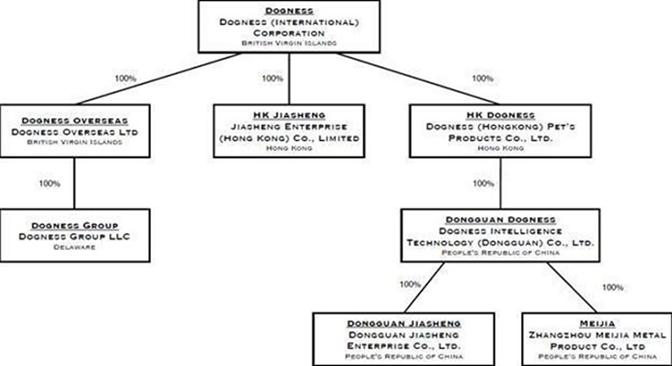
Note: Dogness Culture is in the process of being liquidated and has ceased operations. Dongguan Dogness still retain equity in Dogness Culture. Dogness Culture had completed deregistration with the PRC tax authority; however, deregistration with the PRC business administration department is still pending.
Our registered office in the British Virgin Islands is at AMS Trustees Limited, Sea Meadow House, Blackburne Highway, P.O. Box 116, Road Town, Tortola, British Virgin Islands, telephone +1 (284) 494-3399.
| ● | Dogness (International) Corporation, a British Virgin Islands business company (“Dogness” when individually referenced), which is the parent holding company issuing securities hereby); | |
| ● | Dogness Overseas Ltd (“Dogness Overseas”), a British Virgin Islands business company, which is a wholly owned subsidiary of Dogness. | |
| ● | Dogness Group LLC (“Dogness Group”), a Delaware limited company, which is a wholly owned subsidiary of Dogness Overseas; and | |
| ● | Jiasheng Enterprise (Hongkong) Co., Limited, a Hong Kong company (“HK Jiasheng” when individually referenced), which is a wholly owned subsidiary of Dogness; | |
| ● | Dogness (Hongkong) Pet’s Products Co., Limited, a Hong Kong company (“HK Dogness” when individually referenced), which is a wholly owned subsidiary of Dogness; | |
| ● | Dongguan Jiasheng Enterprise Co., Ltd., a PRC company (“Dongguan Jiasheng”), which is a wholly owned subsidiary of Dongguan Dogness; | |
| ● | Zhangzhou Meijia Metal Product Co., Ltd, a PRC company (“Meijia”), which is a Wholly owned subsidiary of Dongguan Dogness; |
| 6 |
Implication of Being a Foreign Private Issuer
We are a foreign private issuer within the meaning of the rules under the Securities Exchange Act of 1934, as amended (the “Exchange Act”). As such, we are exempt from certain provisions applicable to United States domestic public companies. For example:
| ● | we are not required to provide as many Exchange Act reports or provide periodic and current reports as frequently as a domestic public company; | |
| ● | we are exempt from certain U.S. federal securities law provisions applicable to U.S. domestic issuers and are also permitted to rely on exemptions from certain Nasdaq corporate governance standards applicable to U.S. issuers, and such exemptions may afford less protection to shareholders; | |
| ● | we are not required to provide the same level of disclosure on certain issues, such as executive compensation; | |
| ● | we are exempt from certain provisions of Regulation FD aimed at preventing issuers from making selective disclosures of material information; and | |
| ● | we are not required to comply with the sections of the Exchange Act regulating the solicitation of proxies, consents or authorizations in respect of a security registered under the Exchange Act. |
Permission Required from the PRC Authorities for the Company’s Operation and to Issue Our Class A Common Shares to Foreign Investors
As of the date of this prospectus, we and our Subsidiaries have obtained all permits and licenses that are required by Chinese authorities for our Subsidiaries to operate in China and for us to offer the securities being registered to foreign investors. Except for the potential uncertainties disclosed below, we and our Subsidiaries have not received any requirements to obtain permissions from any PRC authorities to operate in China or to issue our Class A Common Shares to foreign investors, and recent statements and regulatory actions by the Chinese government indicating an intent to exert more oversight and control over offerings that are conducted overseas and/or foreign investment in China-based issuers, such as those related to anti-monopoly concerns, have not impacted the ability of Dogness or our Subsidiaries to conduct business, accept foreign investments, or list on a U.S. or other foreign exchange.
Below is a list of the required permits and licenses of us and our Subsidiaries in the PRC:
| ● | Business Licenses | |
| ● | Food Distribution License | |
| ● | Pollutant Discharge Permit | |
| ● | License for the Discharge of Sewage into Drainage Pipelines |
As of the date of this prospectus, all our Subsidiaries in the PRC have obtained the required business licenses from the State Administration for Market Regulation for their operations, and all such licenses are currently in effect. Further, Meijia obtained a Food Distribution License from the Zhangpu County Administration for Market Regulation on June 27, 2025, with a term of five years till June 26, 2030, for its catering services provided to its workers at the cafeteria, and a Pollutant Discharge Permit for the operation of the Meijia plant from the Zhangpu Ecological Environment Bureau of Zhangzhou City on November 16, 2023, with a term of five years till November 15, 2028. Dongguan Jiasheng renewed its filing for fixed-source pollutant on December 3, 2024, with a term for five year until December 2, 2029, and obtained a License for the Discharge of Sewage into Drainage Pipelines from the Ecological Environment Bureau of Dongguan City on May 21, 2021, effective till May 20, 2026, for its manufacture.
Pursuant to the Food Safety Law of the PRC and the Administrative Measures for Food Distribution Licensing and Recordation, a permit is required for vendors engaging in the sale of food and catering services. Meijia provides catering services to its workers at its cafeteria and has obtained the Food Distribution License. In the event that Meijia could not maintain or renew such license but continues to engage in catering services, it would be subject to the confiscation of the illegal income, the illegally distributed food, and the tools, equipment, raw materials and other items that are used in the illegal distribution activities, as well as a fine of no less than RMB 50,000 but no more than RMB 100,000 if the illegally distributed food worth no more than RMB 10,000, or a fine of no less than ten times but no more than twenty times of the value of the goods if such value is no less than RMB 10,000.
Pursuant to the Environmental Protection Law of the PRC and the Regulation on the Permit Administration of Pollutant Discharge, a business operator which is subject to the permit administration of pollutant discharge, such as Meijia, shall obtain a pollutant discharge permit. If Meijia fails to maintain or renew such permit and continues to discharge pollutant, it would be subject to an order of rectification, restriction on production, or suspension of production for rectification, and a fine of no less than RMB 2 million and no more than RMB 10 million; in case of serious violation, upon the approval of the competent people’s government, it may be ordered to suspend or cease its business. Further, pollutant discharging entities that produce and discharge a relatively small amount of pollutants or have a relatively little impact on the environment, such as Dongguan Jiasheng, they shall be subject to a simplified management for their pollutant discharge, and are only required to complete the filing for stationary sources of pollution. Dongguan Jiasheng has completed such filing which is currently in effect.
| 7 |
Pursuant to the Regulations on Urban Drainage and Sewage Treatment and the Administrative Measures for the Licensing of Discharge of Urban Sewage into the Drainage Pipelines, any person or entity engaging in industry, construction, catering, medical services and other activities (the “drainage entity”) that discharges sewage into municipal drainage facilities shall apply to the competent authority for a license authorizing the sewage being discharged into drainage pipelines (the “Sewage Discharge License”), the violation of which could subject the drainage entity to (i) an order to cease the illegal act and take measures to remedy within the prescribed time, (ii) an obligation to apply for the Sewage Discharge License, and (iii) potentially, a fine of no more than RMB 500,000. Further, if the drainage entity does not discharge sewage in accordance with the requirements specified by the Sewage Discharge License, it shall be ordered to cease the illegal act and rectify within the prescribed time, and may be subject to a fine of no more than RMB 50,000; in case of serious violations, its Sewage Discharge License shall be revoked, and it shall be subject to a fine of more than RMB 50,000 but less than RMB 500,000, and the public can be informed of its violations. In the event of violations that cause damages, the drainage entity shall bear the compensation liability, and if a violation constitutes a criminal act, the drainage entity shall bear the relevant criminal liability. Dongguan Jiasheng has obtained the Sewage Discharge License and it is currently effective.
As of the date of this prospectus, except for the potential uncertainties disclosed below, we and our Subsidiaries have not received any requirements to obtain permissions from any PRC authorities, including the China Securities Regulatory Commission (“CSRC”) and the Cyberspace Administration of China (“CAC”), to operate in China or to issue our Class A Common Shares to foreign investors. In reaching this conclusion, we relied on an opinion of our PRC counsel, and a consent from the PRC counsel has been filed with this registration statement as Exhibit 23.4.
On August 8, 2006, six Chinese regulatory agencies, including the Ministry of Commerce of China (“MOFCOM”), jointly issued the Regulations on Mergers and Acquisitions of Domestic Enterprises by Foreign Investors (the “M&A Rules”), which became effective on September 8, 2006 and amended on June 22, 2009. The M&A Rules contain provisions that require that an offshore special purpose vehicle (“SPV”) formed for listing purposes and controlled directly or indirectly by Chinese companies or individuals shall obtain the approval of CSRC prior to the listing and trading of such SPV’s securities on an overseas stock exchange. On September 21, 2006, CSRC published procedures specifying documents and materials required to be submitted to it by an SPV seeking CSRC approval of overseas listings. However, the application of the M&A Rules remains unclear with no consensus currently existing among leading Chinese law firms regarding the scope and applicability of the CSRC approval requirement. We have not chosen to voluntarily request approval under the M&A Rules. Based on the understanding of the current PRC law, rules and regulations, given that Dogness was not established by a merger with or an acquisition of any PRC domestic companies as defined under the M&A Rules, we believe that, as of the date of this prospectus, CSRC’s approval under the M&A Rules is not required for the listing and trading of our Class A Common Shares on Nasdaq in the context of this offering. However, our PRC legal counsel has advised us that there remains some uncertainty as to how the M&A Rules will be interpreted or implemented, and our understanding summarized above is subject to any new laws, rules and regulations or detailed implementations and interpretations in any form relating to the M&A Rules. We cannot assure you that relevant Chinese government agencies, including the CSRC, would reach the same conclusion.
On February 7, 2021, the Anti-Monopoly Committee of the State Council promulgated the Anti-Monopoly Guidelines for the Platform Economy Sector, or the Anti-Monopoly Guideline, aiming to improve anti-monopoly administration on online platforms. The Anti-Monopoly Guideline, operating as the compliance guidance under the then-existing PRC anti-monopoly regulatory regime for platform economy operators, specifically prohibits certain acts of the platform economy operators that may have the effect of eliminating or limiting market competition, such as concentration of undertakings. The Anti-Monopoly Guideline requires that the Ministry of Commerce, or MOC, shall be notified in advance of any concentration of undertaking if certain thresholds are triggered. In addition, the security review rules issued by the MOC that became effective in September, 2011 specify that mergers and acquisitions by foreign investors that raise “national defense and security” concerns and mergers and acquisitions through which foreign investors may acquire de facto control over domestic enterprises that raise “national security” concerns are subject to strict review by the MOC, and the rules prohibit any activities attempting to bypass a security review, including by structuring the transaction through a proxy or contractual control arrangement. As of the date of this prospectus, the Chinese government’s recent statements and regulatory actions related to anti-monopoly concerns have not impacted our ability to conduct business, accept foreign investments, or list on a U.S. or other foreign exchange because neither the Company nor our Mainland China Subsidiaries engage in monopolistic behaviors that are subject to these statements or regulatory actions. In the future, however, we may grow our business by acquiring complementary businesses, and complying with the requirements of the above-mentioned regulations and other relevant rules to complete such transactions could be time consuming, and any required approval processes, including obtaining approval from the MOC or its local counterparts, may delay or inhibit our ability to complete such transactions, which could affect our ability to expand our business or maintain our market share.
| 8 |
On July 6, 2021, the General Office of the Central Committee of the Communist Party of China and the General Office of the State Council jointly released the Opinions on Severely Cracking Down on Illegal Securities Activities According to Law, or the Opinions. The Opinions emphasized the need to strengthen the administration over illegal securities activities, and the need to strengthen the supervision over overseas listings by Chinese companies. Effective measures, such as promoting the construction of relevant regulatory systems will be taken to deal with the risks and incidents of China-concept overseas listed companies, and cybersecurity and data privacy protection requirements, etc. As of the date of this prospectus, we have not received any inquiry, notice, warning, sanctions or regulatory objection to this offering from the CSRC or other PRC governmental authorities.
On February 17, 2023, with the approval of the State Council, China Securities Regulatory Commission (the “CSRC”) issued the relevant system and rules for the management of overseas listing records, which has been implemented from March 31, 2023. A total of six institutional rules (the “Listing Records Rules”) have been issued this time, including the Trial Measures for the Administration of Overseas Issuance and Listing of Securities by Domestic Enterprises (hereinafter referred to as the “Trial Measures”) and five supporting guidelines. Under the Listing Records Rules, a company established in Mainland China seeking securities offering and listing, by both direct or indirect means, in an overseas market is required to undertake filing procedures with the CSRC for its overseas offering and listing activities. The Trial Measures also set forth a list of circumstance under which overseas offering and listing by domestic companies established in Mainland China is prohibit, including: (i) where such securities offering and listing is explicitly prohibited by the PRC laws; (ii) where the intended securities offering and listing may endanger national security as reviewed and determined by competent PRC authorities under the State Council in accordance with PRC laws; (iii) where the domestic company established in Mainland China, or its controlling shareholders and the actual controller, have committed crimes such as corruption, bribery, embezzlement, misappropriation of property or undermining the order of the socialist market economy during the latest three (3) years; (iv) where the domestic company established in Mainland China seeking securities offering and listing is suspected of committing crimes or major violations of laws and regulations, and is under investigation according to law, and no conclusion has yet been made thereof; and (v) where there are material ownership disputes over equity held by the controlling shareholder of the company established in Mainland China or by other shareholders that are controlled by the controlling shareholder and/or actual controller. In accordance with the Trial Measures, the listing and trading of our Class A Common Shares on Nasdaq is deemed as an indirect overseas offering and listing by domestic companies established in Mainland China, and thus, we are subject to the Listing Records Rules and the relevant filing procedures as required. Further, we believe, as of the date of this prospectus, none of the circumstances prohibiting the overseas offering and listing by domestic companies established in Mainland China as listed above applies to us, and we can offer and continue to offer our Class A Common Shares on Nasdaq.
In accordance with the Notice on the Arrangement for the Filing of Overseas Offering and Listing by Domestic Companies issued by the CSRC along with the Listing Records Rules on the same day, we are deemed as an “Existing Issuer” because we had been listed overseas before March 31, 2023. Under such Notice, we are not required to undertake the initial filing procedure immediately. However, we shall carry out filing procedures as required in a timely manner for the subsequent events, including any further follow-up offerings on Nasdaq, dual and/or secondary offering and listing on different overseas markets, and occurrence of material events including change of control, investigations or sanctions imposed by overseas securities regulatory agencies or other relevant competent authorities, change of listing status or transfer of listing segment, and voluntary or mandatory delisting. If we or our Mainland China Subsidiaries in future fail to undertake filing procedures as stipulated in the Trial Measures, or offer and list securities in an overseas market in violation of the Trial Measures, the CSRC may order rectification, issue warnings to us and/or our Mainland China Subsidiaries, and impose a fine of between RMB 1,000,000 yuan and RMB 10,000,000 yuan. The CSRC may also inform its regulatory counterparts in the overseas jurisdictions, such as the SEC, via cross-border securities regulatory cooperation mechanisms. As of the date of this prospectus, we have submitted the relevant reports regarding our private placements to certain investors to the CSRC.
| 9 |
Further, on February 24, 2023, the CSRC, together with Ministry of Finance, National Administration of State Secrets Protection, and National Archives Administration of China, released the Provisions on Strengthening the Confidentiality and Archives Administration Related to the Overseas Securities Offering and Listing by Domestic Enterprises (the “Confidentiality Provisions”), which has come into effect on March 31, 2023 with the Trial Measures. Under the Confidentiality Provisions, domestic companies established in Mainland China seeking overseas offering and listing, by both direct and indirect means, are required to institute a sound confidentiality and archives system. If such domestic companies established in Mainland China intend to, either directly or through its overseas listed entity, publicly disclose or provide to relevant individuals or entities including securities companies, securities service providers and overseas regulators, any documents and materials that contain state secrets or working secrets of government agencies, they shall obtain approval from competent authorities and complete the relevant filing procedure with the competent secrecy administrative department prior to their disclosure or provision of such documents and materials. Further, if they provide or publicly disclose documents and materials which may adversely affect national security or public interests, they shall strictly follow the corresponding procedures in accordance with relevant laws and regulations. Any failure or perceived failure by us or our subsidiaries to comply with the above confidentiality and archives administration requirements under the Confidentiality Provisions and other relevant PRC laws and regulations may cause relevant entities to be held legally liable by competent authorities, and referred to the judicial organ to be investigated for criminal liability if suspected of committing a crime. As of the date of this prospectus, we believe that we and our subsidiaries have not provided or publicly disclosed any documents or materials involving state secrets or work secrets of PRC government agencies or any of which may adversely affect national security or public interests, to relevant securities companies, securities service institutions, overseas regulatory agencies and other entities and individuals. We intend to continue strictly complying with the Confidentiality Provisions and other relevant PRC laws and regulations in our offering and listing on Nasdaq in future.
However, any failure of us or our Mainland China subsidiaries to fully comply with the Listing Records Rules and/or the Confidentiality Provisions, may significantly limit or completely hinder our ability to offer or continue to offer our Class A Common Shares on Nasdaq, cause significant disruption to our business operations, severely damage our reputation, materially and adversely affect our financial condition and results of operations and cause our Class A Common Shares to significantly decline in value or become worthless. See “Risk Factor — Risks Related to Doing Business in China — Our failure to obtain prior approval, if any, or to fulfill the requisite filing and reporting requirements, of the China Securities Regulatory Commission (“CSRC”) for the listing and trading of our Class A Common Shares on a foreign stock exchange could delay this offering or could have a material adverse effect upon our business, operating results, reputation and trading price of our Class A Common Shares.”
We or our Subsidiaries may also be subject to PRC laws relating to the use, sharing, retention, security and transfer of confidential and private information, such as personal information and other data. On September 24, 2024, the State Council released the Regulations on the Network Data Security Management, or the Data Security Management Regulations, which became effective on January 1, 2025. Pursuant to the Data Security Management Regulations, data processor holding more than ten million users’ personal information are required to designate a person-in-charge and establish a dedicated data security management body, implement data security management systems and risk response measures, and report data disposal plans to the competent authorities in the event of material corporate changes. According to the latest amended Cybersecurity Review Measures, which was promulgated on December 28, 2021 and became effective on February 15, 2022, an online platform operator holding more than one million users’ personal information shall be subject to cybersecurity review before listing abroad.
We, through our Subsidiaries, are primarily engaged in the design, manufacturing and sales of various types of pet leashes, pet collars, pet harnesses, intelligent pet products and retractable leashes. As of the date of this prospectus, we have not been informed by any PRC governmental authority, including the CAC, of any requirement that we or our Subsidiaries file for approval for this offering. We don’t believe that we or any of our Subsidiaries will be subject to either the amended Cybersecurity Review Measures or the Data Security Management Regulations since none of us are online platform operators or data processors with more than one million users’ personal information. In reaching this conclusion, we relied on an opinion of our PRC legal counsel, who has also advised us that, since the existing or new laws or regulations or detailed implementations and interpretations may be modified or promulgated, there could be potential adverse impact on our Subsidiaries’ daily business operation, their ability to accept foreign investments, and our ability to list or offer securities on an U.S. exchange.
| 10 |
In addition, according to the Personal Information Protection Law issued by Standing Committee of the National People’s Congress of the PRC on August 20, 2021, where the purpose of the activity is to provide a product or service to that natural person located within China, such activity shall comply with the Personal Information Protection Law. Further, the Data Security Law, which took effect in September 2021, provides that where any data handling activity carried out outside of the territory of China harms the national security, public interests, or the legitimate rights and interests of citizens or organizations of China, legal liability shall be investigated in accordance with such law. As of the date hereof, we are of the view that we and our Subsidiaries are in compliance with the applicable PRC laws and regulations governing the data privacy and personal information in all material respects, including the data privacy and personal information requirements of the Cyberspace Administration of China, and we and our Subsidiaries have not received any complaints from any third party, or been investigated or punished by any PRC competent authority in relation to data privacy and personal information protection. In reaching this conclusion, we and our Subsidiaries have adopted corresponding internal control measures to ensure the security of our information system and confidentiality of our customers’ personal information, including, but not limited to the followings:
| ● | We and our Subsidiaries provide training to our employees to ensure that they are aware of our internal policies in relation to data protection. | |
| ● | We and our Subsidiaries have specific network administrator responsible for installing the network firewall, remoting backup storage of important databases, business data, and documents, and promoting information security awareness among our employees. |
For the data and personal information collected from the customers, we set out our data privacy policy and obtain the prior consent of the customers as required by the applicable laws and regulations before collecting their data and personal information. We collect personal information in accordance with the principle of legality, propriety and necessity, and do not collect personal information irrelevant to the service we provide to the customers. We have not shared, transferred or publicly disclosed user data without prior consent or authorization from the customers, unless otherwise permitted by relevant laws and regulations. However, the Personal Information Protection Law and the Data Security Law are relatively new, there remains uncertainty as to whether the PRC regulatory agencies, including the CAC, may adopt new laws, regulations, rules, or detailed implementation and interpretation related to the two laws. We may be required to comply with laws and regulations in the PRC relating to data privacy and personal information, and failure to comply with such laws and regulations may potentially lead to regulatory or civil liability.
In conclusion, we and our Subsidiaries have received all required permissions from the Chinese authorities for our operations in the PRC, and no permission has been denied. In reaching this conclusion, we relied on an opinion of our PRC legal counsel, and a consent from the PRC legal counsel has been filed with this registration statement as Exhibit 23.4. Further, we and our Subsidiaries have not received any requirements to obtain permissions from any PRC authorities, including the CSRC and the CAC, to operate in China or to issue our Class A Common Shares to foreign investors, and we have submitted the relevant reports to the CSRC regarding our private placements to certain investors as required. But we are still subject to changes to the interpretation and enforcement of the rules and regulations in the PRC, due to any future actions of the Chinese authorities from time to time. As the Listing Records Rules, Data Security Management Regulations, Cybersecurity Review Measures, Personal Information Protection Law and Data Security Law are relatively new, and their interpretation and application are still evolving, we may not accurately analyze such laws and regulation and the PRC regulatory authorities may take a view that is contrary to the analysis above. We are not sure whether the PRC regulatory authorities will adopt other rules and restrictions in the future. See “Risk Factor — The laws and regulations of Mainland China could change from time to time, and we may not be able to accurately predict what legal protections would be available to us in future” and “Risk Factor — China Securities Regulatory Commission and other Chinese government agencies may exert more oversight and supervision over offerings that are conducted overseas and foreign investment in China-based issuers, especially those in the technology filed. Additional compliance procedures may be required in connection with this offering, and, if required, we cannot predict whether we will be able to obtain such approval. If we are required to obtain PRC governmental permission to commence the sale of our securities, we will not commence the offering until we obtain such permissions. As a result, we face uncertainty about future actions by the PRC government that could significantly affect our ability to offer or continue to offer securities to investors and cause the value of our securities to significantly decline or be worthless.”
| 11 |
Dividend Distributions and Cash Transfer among Dogness and the Subsidiaries
As a holding company, we may rely on dividends and other distributions on equity paid by our subsidiaries, including those based in Mainland China, for our cash and financing requirements. If any of our Mainland China Subsidiaries incurs debt on its own behalf in the future, the instruments governing such debt may restrict their ability to pay dividends to us. To date, none of the Subsidiaries has made any dividends or distributions to Dogness, and Dogness has not made any dividends or distributions to our shareholders. We anticipate that we will retain any earnings to support operations and to finance the growth and development of our business. Therefore, we do not expect to pay Company cash dividends in the foreseeable future. Under British Virgin Islands law, we may only pay dividends from surplus (the excess, if any, at the time of the determination of the total assets of our company over the sum of our liabilities, as shown in our books of account, plus our capital), and we must be solvent before and after the dividend payment in the sense that we will be able to satisfy our liabilities as they become due in the ordinary course of business; and the realizable value of assets of our company will not be less than the sum of our total liabilities, other than deferred taxes as shown on our books of account, and our capital. If we determine to pay dividends on any of our Class A Common Shares in the future, as a holding company, we will be dependent on receipt of funds from our Hong Kong subsidiaries, HK Jiasheng and HK Dogness. Current PRC regulations permit the Mainland China Subsidiaries to pay dividends to HK Dogness only out of their accumulated profits, if any, determined in accordance with Chinese accounting standards and regulations. In addition, each of our subsidiaries in Mainland China is required to set aside at least 10% of its after-tax profits each year, if any, to fund a statutory reserve until such reserve reaches 50% of its registered capital. Each of such entity in Mainland China is also required to further set aside a portion of its after-tax profits to fund the employee welfare fund, although the amount to be set aside, if any, is determined at the discretion of its board of directors. Although the statutory reserves can be used, among other ways, to increase the registered capital and eliminate future losses in excess of retained earnings of the respective companies, the reserve funds are not distributable as cash dividends except in the event of liquidation.
The PRC government also imposes regulations on the conversion of RMB into foreign currencies and, in certain cases, the remittance of currencies out of Mainland China. We receive a majority of our revenues in Renminbi, which currently is not a freely convertible currency. Restrictions on currency conversion imposed by the PRC government may limit our ability to use revenues generated in Renminbi to fund our expenditures denominated in foreign currencies or our business activities outside China. Under China’s existing foreign exchange regulations, Renminbi may be freely converted into foreign currency for payments relating to current account transactions, which include among other things dividend payments and payments for the import of goods and services, by complying with certain procedural requirements. Our Mainland China Subsidiaries are able to pay dividends in foreign currencies to us without prior approval from the related government agencies, by complying with certain procedural requirements. Our Mainland China Subsidiaries may also retain foreign currency in their respective current account bank accounts for use in payment of international current account transactions. However, we cannot assure you that the PRC government will not at its discretion take measures in the future to restrict access to foreign currencies for current account transactions.
Conversion of Renminbi into foreign currencies, and of foreign currencies into Renminbi, for payments relating to capital account transactions, which principally includes investments and loans, generally requires the approval of China’s State Administration of Foreign Exchange (“SAFE”) or other relevant PRC governmental authorities. Any foreign loans procured by our Mainland China Subsidiaries is required to be registered with SAFE or its local branches or satisfy relevant requirements. According to the relevant PRC regulations on foreign-invested enterprises in China, capital contributions to our Mainland China Subsidiaries are subject to the approval of or filing with State Administration for Market Regulation in its local branches, the Ministry of Commerce in its local branches and registration with a local bank authorized by SAFE. For these capital account transactions, we must take the steps legally required under the PRC laws, for example, we will open a special foreign exchange account, remit the offering proceeds into such special foreign exchange account, and apply for settlement of the foreign exchange. The timing of the process is difficult to estimate because the efficiencies of different SAFE branches can vary materially. In light of the various requirements imposed by PRC regulations on loans to, and direct investment in, Mainland China entities by offshore holding companies, we cannot assure you that we will be able to complete the necessary government registrations or obtain the necessary government approvals on a timely basis, if at all, with respect to future loans by us to our Mainland China Subsidiaries or with respect to future capital contributions by us to our Mainland China Subsidiaries. If we fail to complete such registrations or obtain such approvals, our ability to use the proceeds from this offering and to capitalize or otherwise fund our Mainland China operations may be negatively affected, which could materially and adversely affect our liquidity, our ability to fund and expand our business and our Common Shares. On the other hand, restrictions on the convertibility of the Renminbi for capital account transactions could affect the ability of our Mainland China Subsidiaries to make investments overseas or to obtain foreign currency through debt or equity financing, including by means of loans or capital contributions from us. We cannot assure you that the registration process will not delay or prevent the conversion of Renminbi for use outside of China. Currently, we have installed cash management policies or procedures in place that dictate how funds are transferred, under an umbrella of corporate policies and financial reporting policies. Even though our policies do not specifically address the limitations, as discussed above, on the amount of funds the Company can transfer out of China, if we decide to transfer cash out of China in the future, all relevant transfers will be conducted in compliance with such limitations. Please see “Risk Factor — Risks Related to Doing Business in China — Changes in China’s economic, political and social conditions, as well as changes in any government policies, laws and regulations may be quick with little advance notice and could have a material adverse effect on our business and the value of our Class A Common Shares.”; “Risk Factor — Risks Related to Doing Business in China — We may rely on dividends and other distributions on equity paid by our subsidiaries, including those based in Mainland China, for our cash and financing requirements we may have, and any limitation on the ability of our Mainland China Subsidiaries to make payments to us could have a material and adverse effect on our ability to conduct our business”; “Risk Factor — Risks Related to Doing Business in China — PRC regulation of loans and direct investment by offshore holding companies to Mainland China entities may delay or prevent us from using the proceeds of this Offering to make loans or additional capital contributions to our Mainland China Subsidiary, which could materially and adversely affect our liquidity and our ability to fund and expand our business”; “Risk Factor — Risks Related to Doing Business in China — Governmental control of currency conversion may limit our ability to use our revenues effectively and the ability of our Mainland China Subsidiaries to obtain financing”; and ‘Risk Factor — Risks Related to Doing Business in China — Any transfer of funds by us to our Mainland China Subsidiaries, either as a shareholder loan or as an increase in registered capital, are subject to approval by or registration or filing with relevant governmental authorities in China, the process of which may be time-consuming, and we cannot assure that we can finish all necessary governmental registration processes in a timely manner.”
| 12 |
In addition, the transfer of funds among our Mainland China Subsidiaries are subject to the Provisions of the Supreme People’s Court on Several Issues Concerning the Application of Law in the Trial of Private Lending Cases (2020 Revision, the “Provisions on Private Lending Cases”), which was implemented on August 20, 2020 to regulate the financing activities between natural persons, legal persons and unincorporated organizations. The Provisions on Private Lending Cases does not prohibit using cash generated from one subsidiary to fund the operations of another subsidiary in China. As of the date of this prospectus, no cash generated from one subsidiary has been used to fund another subsidiary’s operations, expect for the financing obtained by the Company be transferred to operating entities for their operations. We have not been notified of any other restriction which could limit our Mainland China Subsidiaries’ ability to transfer cash between subsidiaries in China, and do not anticipate any difficulties or limitations in our ability to transfer cash between subsidiaries. As of the date of this prospectus, no cash generated from one subsidiary has been used to fund another subsidiary’s operations; for that reason, our cash management policies do not specifically address this type of transfers between subsidiaries. We do not anticipate any occasions where cash generated from one subsidiary needs to be transferred to another subsidiary and will comply with PRC laws discussed above should we decide to conduct such a transfer.
Cash flow between Dogness and the Subsidiaries primarily consists of transfers from Dogness to these Subsidiaries for short-term working capital loan, which is mainly used in payment of operating expenses and investments. To date, there are no other assets transferred between Dogness and the Subsidiaries except for the below cash transfers:
| ● | For the year ended June 30, 2022, Dogness transferred $186,500 to the Delaware subsidiary, Dogness Group LLC, for working capital loan purpose and transferred $15,577,896 to HK Dogness for working capital loan purpose. The source of the funds was mainly from equity financing and the exercise of warrants in fiscal 2022. For the year ended June 30, 2022, Dogness also received cash payment transferred from HK Dogness in the amount of $1,999,787. |
| ● | For the year ended June 30, 2023, Dogness transferred $13.3 million to HK Dogness for working capital loan purpose. The source of the funds was mainly from the equity financing and the exercise of warrants in fiscal 2022. |
| ● | For the year ended June 30, 2024, Dogness transferred $5.3 million to HK Dogness for working capital loan purpose. The source of the funds was mainly from the equity financing and the exercise of warrants in fiscal 2024. |
In the future, cash proceeds raised from overseas financing activities may be transferred by Dogness to the Subsidiaries via capital contribution or shareholder loans, as the case may be.
| 13 |
Business Overview
Overview
We believe technology can bring pets and their caregivers closer together. At Dogness, we combine our research and development expertise with customer feedback to make products that improve pets’ lives. We create and manufacture fun, useful and high-quality products for everyone to experience. We believe that high technology pet products must be accessible and reliable to capture pet lovers’ imagination and to enhance their pets’ lives.
Dogness has been making the highest quality collars, harnesses, and traditional and retractable leashes since 2003, featuring stylish design and rugged engineering. Beginning with smart collars and harnesses in 2016, based on the belief that internet-connected products could improve the lives of pets and their caregivers, Dogness developed a suite of smart products, moving past these first products into smart feeders, fountains, treat dispensers and robots to interact with pets.
Dogness focuses on connected pet care, to link pets and pet caregivers and ultimately to integrate the “Smart Pet Ecosystem” into a single cohesive platform that integrates smart technology into pets’ lives. The Smart Pet Ecosystem has four major areas: smart pet technology, pet care, leashes and collars, and pet health and wellness.
Smart Pet Technology
Through a single platform, the Dogness mobile app, our smart products allow pet owners to remotely see, hear, speak, feed, play, and interact with their pets in different ways. We accomplish all of this with a tool the owner likely already has, a smart phone. The Dogness app is available for both Android and iOS and communicates with the smart product anywhere the phone and smart product both have Wi-Fi or cellular service. If your dog will listen to you from across the room, you can tell her to roll over from around the world.
Dogness Smart Wearables: Our smart wearable collars and harnesses feature integrated electronics, which allows us to pair high quality collars with a lightweight smart component and LED lights. We have focused on the important details for dog owners, allowing owners to locate their pets, direct their pets’ movements, communicate with their dogs, provide tailored instantaneous feedback to problem barking and keep track of exercise and other biodata.
Dogness Smart iPet Robot: Pet owners will be able to see their pets through a camera, hear their pets through a built-in microphone, interact with their pets by feeding them treats, and play with their pets through an interactive laser pointer. Pet owners have full control over the 360-degree mobility of the robot through the Dogness app and can securely take and save pictures and videos of their dogs.
Dogness Mini Treat Robot: Space-conscious pet owners can see their pets through a stationary tilting camera that securely records photo and video, hear their pets through a built-in microphone, interact with their pets by feeding them treats, and play with them through an interactive laser pointer.
Dogness Smart CAM Feeder: Pet owners can now ensure that their pets are well-fed and on-schedule. Able to hold around 6.5 pounds of dry food, the smart feeder helps pet owners ensure the health of their pets, even when away from home. Pet owners can see their pets’ eating habits night and day through a built-in camera with night vision and call their pets to the feeder through a voice recording that can be programmed to be played at meal times.
| 14 |
Dogness Wide-view CAM Feeder: In addition to the original Smart CAM Feeder, this 2022 version of CAM feeder holds around 4 pounds of dry food. The camera is updated and wide-angled so that the pet owner can see not only their pets and the room, but the bowl and the food in it.
Dogness Cube App Feeder and Programmable Feeder: This 2022 version of the App Feeder and Programmable Feeder holds about 4 pounds of dry food. The food container is semi-transparent which enables the pet owners to check on the food level without opening the container. In fiscal 2024, we improved the feeder’s anti-clogging and sealed moisture-proof functions, upgraded the camera, and added night vision and wide-angle features to the App Feeder and Programmable Feeder.
Dogness Smart Fountain: The smart fountain ensures that pets stay hydrated with a source of clean filtered water from a patented filtering technology. Additional features include an oxygenating, free-falling, recirculating water stream for optimal freshness, the ability to increase or decrease the flow of water, a replaceable carbon water filter and a nano filter to maintain water freshness, a submersible pump for quiet operation, dishwasher-safe material, and an easily assembled and disassembled design.
Dogness App Fountain: This brand new App fountain is newly developed with App controlling the water level, UV sterilization and lights. In fiscal 2024, Dogness App Fountain added functions of sensor-activated water dispensing and APP reminders for filter replacement.
Dogness Wireless Sensor Fountain: This brand new wireless fountain is USB rechargeable and operates with sensors. It does not use the long cable that’s common on traditional fountains and makes the fountain portable.
Dogness Smart Fountain Mini and Smart Fountain Plus: In addition to our Smart Fountain, we have developed the Smart Fountain Mini (1L capacity) and Smart Fountain Plus (3.2L capacity) for additional options for pet owners. The Smart Fountain Mini enables our products to be used in smaller spaces, while the Smart Fountain Plus ensures an even larger reservoir for pets. Both fountains maintain a constant flow of water, so pets can drink water that is as fresh as from the faucet. The Smart Fountains have a three-stage filtering system, which ensures the water flowing out is filtered, fresh and clean.
Dogness Smart CAM Treater: Allows pet owners to see their pets night and day through a 160-degree full HD camera with night vision, hear their pets through a built-in microphone, interact with their pets by speaking to them through a built-in speaker, and play with their pets by tossing them treats.
Dogness App Feeder and App Feeder Mini: Pet owners can ensure that their pets are well-fed and on-schedule. Able to hold around 6.5 pounds of dry food, the App feeder enables pet owners to set up their pet’s feeding schedule from the App via their mobile phone, even when away from home. App Feeder Mini holds around 2.0 pounds of dry food and is suitable for cats and small dogs.
Dogness Smart Vacuumed Pet Food Storage Containers: Dogness proprietary vacuum food storage container was designed to use an intelligent, constant pressure vacuum locking method, which significantly upgrades and modernizes conventional food storage, by completely isolating mildew and moisture in the air, keeping pet food fresh and crispy for longer, and bringing a higher quality to pets’ healthy lives.
Dogness C6 GPS Tracker “Discover”: Pet owners can have peace of mind knowing where their pets are anytime when they open the GPS Tracker App on their mobile phones. The Trackers are 4G compatible and allow the owners to keep track of the location of their pets. They can also set up virtual fences and the GPS Tracker App will alert the pet parents if their pets are beyond the fences. The Trackers also monitor and provide the pets’ activity level statistics.
Dogness C5 and C5 mini-Trackers: These smaller versions of the trackers have similar features of C6 but uses NB instead of 4G. It features longer battery time with smaller size and weight.
| 15 |
Pet Care
Our pet care products currently focus on high quality pet shampoos. We launched these shampoo products in August 2018.
We have two lines of shampoos, which are focused on and tailored to Chinese online and offline consumption. Our One-on-One Service line is focused on consumer purchasers and consists of dog and cat shampoo products that feature natural plant and amino acid composition. In addition to universal-purpose products, we have also developed seven breed-tailored shampoo products for golden retrievers, poodles, huskies, bulldogs, border collies and corgis. Our Professional Bathing & Spa line is focused on professional purchasers, like dog and cat groomers. These products consist of bathing products, hair conditioners and essential oil products.
Leashes and Collars
Traditional Product Lines: We produce collars, harnesses and leashes in seven main series (Classic, Elegance, Luxury, LED, Holiday, Special Function, and Cat series). Given the choices available to customers, we currently manufacture between 500 and 600 traditional products and can add additional options to meet customer preferences. Our traditional product lines use leather, nylon, Teflon-coated fabrics and other materials to suit consumer preferences. Not only do we produce these products; we also design fabric patterns and invent improved components such as a comfort curved buckle for collars and locking closing mechanism for leashes.
Retractable Leashes: In addition to our newest smart products, we have devoted significant effort to designing and manufacturing some of the finest retractable leashes available. Retractable leashes balance freedom for the dog with control for the owner. If used well, a retractable leash promotes good communication between the two, as the dog has exactly as much room to roam as the owner permits, and this amount can be adjusted to suit the environment and circumstances. Dogness also offers an updated retractable leash to enhance the pet walking experience. The new leash allows pet owners to attach Dogness accessories to their retractable leashes, which currently include an LED light for better visibility in low light settings; a convenience box to store items such as doggie bags, treats, or keys; and a Bluetooth speaker to listen to music or answer calls.
Other Products: In addition to collars, leashes and harnesses, we also produce lanyards for use by humans and ornaments that attach to collars. As to the lanyards, we produce such lanyards using our fabric weaving machines. Because we have our production in-house, we can design lanyards that match a customer’s need, in terms of color, size, quantity and pattern. Our hanging ornament series uses high-quality electroplating techniques to create fashionable accents for pet collars. We make a variety of patterns in bright and vibrant colors, as well as custom bells for cat collars.
Upcoming New Products
Dogness expects to launch additional products, including convenient indoor pet toilets, air purifiers, and other products.
Pet Health and Wellness
One of our new research areas is pet-focused health and wellness products. One of our subsidiaries is currently serving as a distributor of a few premium pet food brands from overseas. While we do not currently offer our own branded products for sale in this category, we are currently developing supplements and nutrition products in consultation with veterinarians and pharmacists and anticipate introducing these products in the future.
Operations
Dogness has marketing and sales networks all over the world and has businesses in Dallas, Dongguan, Hong Kong and Zhangzhou. Senior management, R&D and production, marketing, customer service and finance operate from Dogness’ headquarters in Dongguan, Guangdong Province, which also serves as the manufacturing base for smart products and dog leashes. Dogness Group LLC in Dallas, Texas, USA serves as the sales and service center for all international markets and R&D center for pet health and wellness. The company’s factory in Zhangzhou, Fujian serves as a material production base, responsible for sample dyeing, ribbon dyeing and electroplating. One of Dogness’ competitive advantages comes from integrating the whole industrial chain, including retraction ropes, textiles, printing and dyeing, mold development, and hardware and plastics. In addition, Dogness’ subsidiary in the United States has R&D and design centers for pet smart products, forming a complete supply chain system with manufacturing bases in China. We benefit from vertically integrated manufacturing operations, which allow us to design, machine and assemble the vast majority of our products in house, so we can easily incorporate improvements in design.
| 16 |
Market Background
Our company’s primary market is Mainland China, with approximately 32.2%, 36.0%, and 46.3% of our products being sold in China in fiscal 2024, 2023, and 2022, respectively.
In terms of export sales, our company’s primary market is the United States, with approximately 19.2%, 35.4%, and 29.6% of our products being sold in America in fiscal 2024, 2023, and 2022, respectively. The United States has one of the highest pet ownership rates in the world. According to the 2024 APPA National Pet Owners Survey as cited in APPA’s State of the Industry Report, 82 million U.S. households own a pet.1
Pet owners in the United States have increasingly seen their pets as extended members of the family. Accordingly, spending on pets has increased steadily over the last decade. According to the APPA, in 2023, $147.0 billion was spent on pets in the U.S.2
We sell the majority of our products through specialty pet store chain retailers and mass market retailers. Although there are more than 13,000 pet stores in the United States, the vast majority of pet stores are small operations, but a significant proportion of sales come from the top few specialty retail chains, Petco and Pet Valu. Mass retailers like Target and Wal-Mart also play a key role in pet supply sales, including in particular staples like pet food. These retailers have courted pet owners with the offer of one-stop-shopping, as compared with making a special trip to a pet store.
Finally, pet owners have increasingly turned to internet sites to purchase pet supplies. In addition to selling our products to many of the largest specialty and mass retailers in the U.S., we are exploring opportunities to drive online sales as well.
Competitive Strengths
We believe we have the following competitive strengths. Some of our competitors may have these or other competitive strengths.
● Advanced technology. We have developed and made use of 201 patents in producing premium pet products.
● Strong research and development. We have leveraged our cooperation with and/or investments in Dogness Network Technology Co., Ltd (“Dogness Network”), Nanjing Rootaya Intelligence Technology Co., Ltd. (“Nanjing Rootaya”), Linsun Smart Technology Co., Ltd (“Linsun”) and our own in-house research and development efforts to design high tech pet products for our customers. Dogness Network, in which we have a 10% ownership interest, develops the smartphone apps that power our connected products, including our feeders, treaters, robots and others. Nanjing Rootayahas designed some of our pet toys and innovative water and food bowl. Linsun, in which we have a 13% ownership interest, helped create our smart feeders and treaters. Our subsidiary Dongguan Jiasheng is responsible for the technology underlying our other smart products and innovation and improvement in traditional products.
● Vertically integrated production. We are increasingly manufacturing as much of our products internally and reducing reliance on third party vendors. This allows us to control costs and ensure quality.
1 American Pet Products Association, Pet Industry Market Size, Trends & Ownership Statistics. https://www.americanpetproducts.org/press_industrytrends.asp
2 American Pet Products Association, Pet Industry Market Size, Trends & Ownership Statistics. https://www.americanpetproducts.org/press_industrytrends.asp
| 17 |
● Economies of scale. We are pleased to provide products to a variety of customers and to fill large orders for a number of those customers. These large orders allow us to increase our efficiency, reduce costs and deliver high quality products quickly and to our customers’ exacting demands.
● Strong reputation in the pet products industry. Our customer list is filled with sophisticated, multinational purchasers of pet.
Research and Development
Our R&D team has 12 dedicated employees who are focused on product development and design. Quality control has 8 employees and is an important aspect of the teams’ work and ensuring quality at every stage of the process has been a key driver in maintaining and developing brand value for our Company.
Beginning in 2016, we have been researching and testing new, more ecologically friendly materials, which we hope to use in place of PVC in certain plastic applications.
As a result of these efforts, we became certified as a National High-Tech Enterprise by the State Intellectual Property Office in March 2015, and we renewed this certification in 2021. This certification entitles us to favorable tax rates of 15%, rather than the unified rate of 25% we would pay if we were not certified.
Our research and development expenses were $610,439 in fiscal 2024, $931,078 in fiscal 2023 and $917,227 in fiscal 2022, representing 4.1%, 5.3% and 3.4%, of our total revenues for 2024, 2023, and 2022, respectively. We expect our R&D expenses to increase, as we continue to conduct research and development activities, especially seeking to increase the use of environmentally-friendly materials, and develop more new products to meet customer demands.
Intellectual Property
We use a combination of trade secret, copyright, trademark, patent and other rights to protect our intellectual property and our brand. As of the date of the prospectus, we have completed registration of 156 patents with the China State Intellectual Property Office. In addition, we have registered 19 patents in Germany, 27 in Japan, 23 in the United States, 9 in Canada, 3 in Australia, and 8 in the European Union. As of the date of this prospectus, we have successfully obtained 245 patents (including 156 in China), which includes 32 invention patents, 79 utility patents, and 134 appearance patents .
We have completed registration of 188 trademarks, with the Trademark Office of the State Administration for Industry & Commerce of the PRC. In addition, we have registered our key trademark for Dogness in Japan, Australia, Korea, Hong Kong, Taiwan and the United States. We have registered all of our patents and trademarks under Dongguan Jiasheng, Dongguan Dogness, Dogness Group, and HK Dogness. Our trademarks will expire at various dates through November 12, 2030.
Any investment in the shares is speculative and involves a high degree of risk. Before making an investment decision, you should carefully consider the risks described under “Risk Factors” in our most recent Annual Report on Form 20-F, or any updates in our reports on Form 6-K, together with all of the other information appearing in, or incorporated by reference into, this applicable prospectus. The risks so described are not the only risks facing our company. Additional risks not presently known to us or that we currently deem immaterial may also impair our business operations. Our business, financial condition and results of operations could be materially adversely affected by any of these risks. The trading price of our securities could decline due to any of these risks, and you may lose all or part of your investment.
| 18 |
Risks Related to an Investment in Our Securities and this Offering
Future sales of our Class A Common Shares may cause the prevailing market price of our shares to decrease.
The issuance and sale of additional Class A Common Shares or securities convertible into or exercisable for Class A Common Shares could reduce the prevailing market price for our Class A Common Shares as well as make future sales of equity securities by us less attractive or not feasible. The sale of Class A Common Shares issued upon the exercise of our outstanding options could further dilute the holdings of our then existing shareholders.
The market price of our Class A Common Shares has been, and may continue to be, highly volatile, and such volatility could cause the market price of our Class A Common Shares to decrease and could cause you to lose some or all of your investment in our Class A Common Shares .
The stock market in general and the market prices of the Class A Common Shares on Nasdaq, in particular, are or will be subject to fluctuation, and changes in these prices may be unrelated to our operating performance. During the six-month period prior to the date of this prospectus, the market price of our Class A Common Shares has fluctuated significantly, and the price of our Class A Common Shares continues to fluctuate. We anticipate that the market prices of our shares will continue to be subject to wide fluctuations. The market price of our shares is, and will be, subject to a number of factors, including:
| ● | actual or anticipated fluctuations in our revenue and other operating results; | |
| ● | the financial projections we may provide to the public, any changes in these projections or our failure to meet these projections; | |
| ● | actions of securities analysts who initiate or maintain coverage of us, changes in financial estimates by any securities analysts who follow our company, or our failure to meet these estimates or the expectations of investors; | |
| ● | announcements by us or our competitors of significant products or features, technical innovations, acquisitions, strategic partnerships, joint ventures, or capital commitments; | |
| ● | price and volume fluctuations in the overall stock market, including as a result of trends in the economy as a whole; | |
| ● | lawsuits threatened or filed against us; and | |
| ● | other events or factors, including those resulting from war or incidents of terrorism, or responses to these events. |
These factors may materially and adversely affect the market price of our shares and result in substantial losses by our investors.
| 19 |
Future sales of our Class A Common Shares, whether by us or our shareholders, could cause the price of our Class A Common Shares to decline.
If our existing shareholders sell, or indicate an intent to sell, substantial amounts of our Class A Common Shares in the public market, the trading price of our could decline significantly. Similarly, the perception in the public market that our shareholders might sell our Class A Common Shares could also depress the market price of our shares. A decline in the price of our Class A Common Shares might impede our ability to raise capital through the issuance of additional Class A Common Shares or other securities. In addition, the issuance and sale by us of additional Class A Common Shares, or securities convertible into or exercisable for our Class A Common Shares, or the perception that we will issue such securities, could reduce the trading price for our Class A Common Shares as well as make future sales of equity securities by us less attractive or not feasible. The sale of Class A Common Shares issued upon the conversion of any debt securities or the exercise of our outstanding warrants could further dilute the holdings of our then existing shareholders.
We have not paid and do not intend to pay dividends on our Class A Common Shares. Investors in this offering may never obtain a return on their investment.
We have not paid dividends on our ordinary since inception, and do not intend to pay any dividends on our Class A Common Shares in the foreseeable future. We intend to reinvest earnings, if any, in the development and expansion of our business. Accordingly, you will need to rely on sales of your Class A Common Shares after price appreciation, which may never occur, in order to realize a return on your investment.
If we fail to satisfy all applicable continued listing requirements of the Nasdaq Capital Market, our Class A Common Shares may be delisted from Nasdaq, which could have an adverse impact on the liquidity and market price of our Class A Common Shares.
Our Class A Common Shares are currently listed on the Nasdaq Capital Market. In order to maintain that listing, we must satisfy minimum financial and other continued listing requirements and standards, including those regarding director independence and independent committee requirements, minimum stockholders’ equity, minimum bid price, and certain corporate governance requirements. There can be no assurances that we will be able to comply with the applicable listing standards.
In the event that our Class A Common Shares is delisted from Nasdaq and is not eligible for quotation or listing on another market or exchange, it could become more difficult to sell, or obtain accurate price quotations for, our Class A Common Shares, and there would likely also be a reduction in our coverage by securities analysts and the news media, which could cause the price of our Class A Common Shares to decline further. Also, it may be difficult for us to raise additional capital if we are not listed on a major exchange.
There has been and may continue to be significant volatility in the volume and price of our Class A Common Shares on the Nasdaq Capital Market.
The market price of our Class A Common Shares has been and may continue to be highly volatile. Factors, including changes in the Chinese economy, potential infringement of our intellectual property, competition, concerns about our financial position, operations results, litigation, government regulation, developments or disputes relating to agreements, patents or proprietary rights, may have a significant impact on the market volume and price of our stock. Unusual trading volume in our shares occurs from time to time.
Risks Related to Our Business
Disruptions to the international supply chain systems could adversely impact our business, financial condition, and results of operations.
The cross-border e-commerce related warehousing and logistics market depends largely on the availability and reliability of the global supply chain systems. The COVID-19 pandemic highlighted the vulnerability of international supply chain systems and the potential risks associated with disruptions to these systems. Issues like port congestion and container shortages can lead to stockouts, affecting the supply of merchandise for e-commerce merchants, which may, in turn, reduce the demand for our pet products. Merchants may delay cross-border operations until stock availability is restored. Additionally, supply chain disruptions could drive up logistics, shipping, and warehousing costs, squeezing our margins and profitability. Shipment delays caused by these issues could result in customer dissatisfaction and decreased demand for our products. Our ability to mitigate these risks is limited, and there is no guarantee of success in doing so. Consequently, such disruptions could have a material adverse effect on our business, financial condition, and operational results.
Government actions and regulations, such as export restrictions, tariffs, and trade protection measures, may limit our ability to sell our products to certain customers or markets, or could otherwise restrict our ability to conduct operations.
International trade disputes, geopolitical tensions, and military conflicts have led, and continue to lead, to new and increasing export restrictions, trade barriers, tariffs, and other trade measures that can increase our manufacturing costs, make our products less competitive, reduce demand for our products, limit our ability to sell to certain customers or markets, limit our ability to procure, or increase our costs for, components or raw materials, impede or slow the movement of our goods across borders, impede our ability to perform R & D activities, or otherwise restrict our ability to conduct operations. Increasing protectionism, economic nationalism, and national security concerns may lead to further changes in trade policy, domestic sourcing initiatives, or other formal and informal measures that could make it more difficult to sell our products in, or restrict our access to, some markets and/or customers.
| 20 |
The U.S. and China markets present distinct challenges and opportunities for our pet products business, influenced by both consumer behavior and competitive landscapes.
In the U.S. market, pet culture is deeply rooted, with consumers demonstrating strong purchasing power. The market is large, stable, and continuously growing, but it is also highly competitive. factors in consumer spending, due to factors like inflation, unemployment, or shifts in economic conditions, could significantly impact our sales and profitability. Persistent inflation has already reduced discretionary consumer spending, affecting sales of higher-margin products, and this trend could continue. Moreover, if consumer preferences change or demographic trends in pet ownership slow, our business could face further challenges.
In contrast, the Chinese market is experiencing rapid growth in the pet industry, with rising consumer spending and increasing demand for pet products. Local brands are emerging quickly, capturing a growing share of the market. The fast-paced expansion of the market presents significant opportunities, but competition is intensifying as well. Any shift in consumer trends or disruptions in economic conditions could affect our ability to maintain and grow our market presence.
Our success in both markets depends on our ability to adapt to these varying consumer preferences, economic conditions, and competitive pressures. Failure to identify or respond to these evolving factors could negatively impact our sales, market share, and profitability in both the U.S. and China.
While we are not aware of any data breach in the past, future cyberattacks, computer viruses or any failure to adequately maintain security and prevent unauthorized access to our information technology system or data could result in a disruption of our business operations and materially adversely affect our reputation, financial condition and operating results.
The protection of our customers’, business partners’, our Company’s and employees’ data is critically important to us. Our customers, business partners, and employees expect we will adequately safeguard and protect their sensitive personal and business information. We have become increasingly dependent upon automated information technology processes. Improper activities by third parties, exploitation of encryption technology, data-hacking tools and discoveries and other events or developments may result in a future compromise or breach of our networks, payment terminals or other settlement systems. In particular, the techniques used by criminals to obtain unauthorized access to sensitive data change frequently and often are not recognized until launched against a target; accordingly, we may be unable to anticipate these techniques or implement adequate preventative measures. There can be no assurance that we will not suffer a criminal cyber-attack in the future, that unauthorized parties will not gain access to personal or business information or sensitive data, or that any such incident will be discovered in a timely manner.
We also face indirect technology, cybersecurity and operational risks relating to the third parties whom we work with to facilitate our business activities, including, among others, third-party online service providers who manage accounts for our customers and external cloud service provider. As a result of increasing consolidation and interdependence of technology systems, a technology failure, cyber-attack or other information or security breach that significantly compromises the systems of one entity could have a material impact on its counterparties. Any cyber-attack, computer viruses, physical or electronic break-ins or similar disruptions of such third-party service providers could adversely affect our operations and could result in misappropriation of funds of our customers.
Security breaches or unauthorized access to confidential information could also expose us to liability related to the loss of the information, time-consuming and expensive litigation and negative publicity. If security measures are breached because of third-party action, employee error, malfeasance or otherwise, or if design flaws in our technology infrastructure are exposed and exploited, our relationships with customers and cooperation partners could be severely damaged, we could incur significant liability and our business and operations could be adversely affected.
We and our Subsidiaries may incur liability for unpaid taxes, including interest and penalties.
In the normal course of business, we and our Subsidiaries may be subject to challenges from various PRC taxing authorities regarding the amounts of taxes due. PRC taxing authorities may take the position that we or our Subsidiaries owe more taxes than it has paid. We recorded tax liabilities of $1.0 million, $1.0 million, and $1.6 million as of June 30, 2024, 2023, and 2022, respectively, for the possible underpayment of income and business taxes. It is possible that the tax liability of for past taxes may be higher than those amounts, if the PRC authorities determine that penalties are applicable or that the correct amount has not been paid. Although the Company’s management believes it may be able to negotiate with local PRC taxing authorities a reduction to any amounts that such authorities may believe are due and a reduction to any interest or penalties thereon, we have no guarantee that we will be able to negotiate such a reduction. To the extent we are able to negotiate such amounts, national-level taxing authorities may take the position that localities are without power to reduce such liabilities, and such PRC taxing authorities may attempt to collect unpaid taxes, interest and penalties in amounts greatly exceeding management’s estimates.
| 21 |
If our largest customers reduce their orders with us, such revenues would be very difficult to replace.
Although we have also sold our products through distributors and trading companies, some of our largest customers are Petco and Pet Valu, which are by far the largest pet specialty chains in North America. As of 2024, Petco has around 1300 stores in the US and Pet Valu has around 700 stores in Canada. There is not another brick-and-mortar customer that presents the opportunity that these customers present to us. As a result, if we were to lose these accounts or if these customers purchased less of our products in the future, it would be difficult to replace those lost revenues.
Our smart products have only recently entered distribution.
While we are optimistic that our smart products such as collars, harnesses, feeders and robots will be important products for our company in the future, we begun to sell them and thus do not know whether they will prove popular with consumers. We have exhibited these products at expos in multiple countries and have begun to receive orders, but our revenues for all smart products was approximately $4.4 million, $7.4 million, and $13.5 million, during the years ended June 30, 2024, 2023, and 2022, respectively. As a result, we do not have an accurate gauge of how well accepted they will be by consumers. If consumers do not appreciate our smart products, we may not sell enough products to grow our market share in this new industry.
Our smart products are not as well-known as those of our competitors.
There are a variety of competitors providing smart collars, smart feeders and smart treaters for dogs and cats that are more well-known than our products. We are aware of more than a dozen competitors to our smart products, some of which have been on the market for several years. Because smart collars are still a relatively new industry, we do not believe that there is a single leader. Nevertheless, we face competition from more well-known products like the Whistle GPS Pet Tracker and Tractive, as well as products from more well-established, better capitalized companies in the United States such as Garmin, which produces varieties of dog training and tracking devices. Similarly, companies such as PetSafe, Petzi, Petcube, Arf Pets, and Furbo market food and treat dispensers with functionalities that in some cases are similar to our products. If we are unable to achieve recognition for our technology or if consumers opt to use products from companies they recognize more than our company, our smart collar and harness products may not be well accepted.
Our smart collars and harnesses are currently between generations.
We debuted our C2 and H2 smart collars and harnesses in 2016. These products were designed to operate over 2G telephone technology. While this platform was sufficient to meet the needs of the products, 2G speeds lag far behind currently available 4G and now 5G technology. As a result, our C2 and H2 products have thus far obtained a very limited customer base. For this reason, we have been researching and developing our next generation of smart collars and harnesses to operate with today’s higher internet speeds in mind. We are close to the roll out of the C9 which relies on 5G network and C5 mini which rely on NB network. Before we are able to bring these products to market fully, we anticipate that our sales of smart collars and harnesses, along with subscriptions for ongoing cellular services for those products, will be nominal. If and when we are able to introduce our next generation of smart collars and harnesses, we are unable to predict the extent to which consumers will be drawn to such new products.
Our smart collars rely on third-party cellular telephone companies and application developers for functionality.
One of the features of our smart collars is the ability to communicate between the owner’s cell phone and the collar, even when the two are too far away to communicate directly. We achieve this by having a SIM card in the smart collar so that, so long as the collar has a cell phone signal, it will communicate with the telephone. We cooperate with cell phone companies in our target markets to provide cellular service to these SIM cards. If this cooperation were to end or if the cellular service we receive is not reliable or more expensive than we anticipate, the market for our products could be harmed.
| 22 |
In addition, the Dogness smartphone App on which our smart collars rely are still under development and test by a company, Dogness Network Technology Co., Ltd (“Dogness Network”), in which we have a minority interest. Our company owns 10% of Dogness Network. Dogness Network plans to derive its revenues from subscriptions for services provided through the Dogness smartphone App in the near future, and we will purchase such products from Dogness Network and resell to our customers. We may benefit only by virtue of our 10% interest in Dogness Network. If Dogness Network were to stop supporting the application or impair its functionality, our smart collars and harnesses could become unusable or have decreased value to end users.
To the extent we will be unable to cooperate with such third parties in the future, we would need to locate and cooperate with other service providers, and we cannot guarantee that we would be able to do so under terms that are satisfactory to us, if at all.
Our software platform may not interface with applications consumers want to be integrated.
In the connected home, consumers are increasingly aware of the interconnection among applications and devices, such as speakers that can turn on lights or adjust the temperature. Some customers purchase products based on how they will interact with other services and products that the customers already use. If we are unable to anticipate and accommodate these desires, customers may choose other products that do interact with their preferred services. Although we may incorporate such functionality in future generations of our products, not all of our current products integrate into Apple’s, Google’s or Amazon’s smart home platforms. Our Dogness CAM feeder, App feeder, and App mini feeder work with Amazon Alexa.
We are also dependent on third party application stores that may prevent us from timely updating our current products or uploading new products. In addition, our products interoperate with servers, mobile devices and software applications predominantly through the use of protocols, many of which are created and maintained by third parties. We therefore depend on the interoperability of our products with such third-party services, mobile devices and mobile operating systems, as well as cloud-enabled hardware, software, networking, browsers, database technologies and protocols that we do not control. Any changes in such technologies that degrade the functionality of our products or give preferential treatment to competitive services could adversely affect adoption and usage of our platform. Also, we may not be successful in developing or maintaining relationships with key participants in the mobile industry or in developing products that operate effectively with a range of operating systems, networks, devices, browsers, protocols and standards. In addition, we may face different fraud, security and regulatory risks from transactions sent from mobile devices than we do from personal computers. If we are unable to effectively anticipate and manage these risks, or if it is difficult for our customers to access and use our platform, our business, results of operations and financial condition may be harmed.
Price increases in raw materials and sourced products could harm the Company’s financial results.
Our primary raw materials are plastic, leather, nylon, polyester, chemical fiber blended fabric, metal, GPPS and HIPS, most of which are extracted from crude oil. These raw materials are subject to price volatility and inflationary pressures. Our success is dependent, in part, on our continued ability to reduce our exposure to increases in those costs through a variety of programs, including sales price adjustments based on adjustments in such raw material costs, while maintaining and improving margins and market share. We also rely on third-party manufacturers as a source for a minor portion of components for our products. These manufacturers are also subject to price volatility and labor cost and other inflationary pressures, which may, in turn, result in an increase in the amount we pay for sourced products. Raw material and sourced product price increases may more than offset our productivity gains and price increases and may adversely impact on our financial results.
Our plan to vertically integrate our production may not provide the benefits we foresee.
Over the last several years, we have increasingly produced our products in-house. We have made this strategic decision because of our belief that it will facilitate our control over the costs of components in our products. The price of components is extremely important where the per-unit sales price is as low as it is in our industry. Thus, we believe it is important to control costs as much as possible.
| 23 |
That being said, when we produce components in-house that we previously purchased from a third-party supplier, we may not benefit from the economies of scale that a dedicated third-party supplier could see. Moreover, we invest in infrastructure for such production, such as buying machines and leasing additional facility space; in the event new technology is developed to produce components of our products more cheaply than we can with our existing infrastructure, we could find that our operating results are negatively impacted, compared with what we would see if we were purchasing from third parties. In such case, our products could be more expensive than those of our competitors that purchase from third-party suppliers, which could make our products less attractive to customers.
Our reliance on third party logistics providers may put us at risk of service failures for our customers.
We rely on third parties to ship our products from China to our customers. We compete based on price, quality and reliability, so a failure to deliver our products on time to our large customers could harm our reputation. To the extent we are unable to meet their demand for products or do not deliver products on time, we stand a substantial risk of losing key accounts. Because we rely on third parties for logistics services, we may be unable to avoid supply chain failures, even if we are able to meet our manufacturing obligations to customers.
If we fail to protect our intellectual property rights, it could harm our business and competitive position.
We rely on a combination of patent, trademark, domain name and trade secret laws and non-disclosure agreements and other methods to protect our intellectual property rights. Our Mainland China Subsidiaries own 135 patents and 188 trademarks in China and 66 patents and 47 trademarks outside China, all of which have been properly registered with regulatory agencies such as the State Intellectual Property Office and Trademark Office of China’s State Administration for Industry and Commerce (“SAIC”). This intellectual property has allowed our products to earn market share in the pet products industry.
The process of seeking patent protection can be lengthy and expensive, our patent applications may fail to result in patents being issued, and our existing and future patents may be insufficient to provide us with meaningful protection or commercial advantage. Our patents and patent applications may also be challenged, invalidated or circumvented.
We also rely on trade secret rights to protect our business through non-disclosure provisions in employment agreements with employees. If our employees breach their non-disclosure obligations, we may not have adequate remedies in China, and our trade secrets may become known to our competitors.
In accordance with Chinese intellectual property laws and regulations, we will have to renew our trademarks once the terms expire. However, patents are not renewable. Some of our patents, particularly utility model patents have only 10 years of protection and design patents have 15 years of protection, and will end in the near future. Once these patents expire, our products may lose some market share if they are copied by our competitors. Then, our business revenue might suffer some loss as well.
Implementation of PRC intellectual property-related laws has historically been lacking, primarily because of ambiguities in the PRC laws and enforcement difficulties. Accordingly, intellectual property rights and confidentiality protections in China may not be as effective as in the United States or other western countries. Furthermore, policing unauthorized use of proprietary technology is difficult and expensive, and we may need to resort to litigation to enforce or defend patents issued to us or to determine the enforceability, scope and validity of our proprietary rights or those of others. Such litigation and an adverse determination in any such litigation, if any, could result in substantial costs and diversion of resources and management attention, which could harm our business and competitive position.
Our Chinese patents and registered marks may not be protected outside of China due to territorial limitations on enforceability.
In general, patent and trademark rights have territorial limitations in law and are valid only within the countries in which they are registered.
| 24 |
At present, Chinese enterprises may register their trademarks overseas through two methods. One is to file an application for trademark registration in each single country or region in which protection is desired, while the other is to apply via the Madrid system for international trademark registration. By the second way, under the provisions of the Madrid Agreement concerning the International Registration of Marks (the “Madrid Agreement”) or the Protocol Relating to the Madrid Agreement concerning the International Registration of Marks (the “Madrid Protocol”), applicants may designate their marks in one or more member countries via the Madrid system for international registration.
As of the date of the prospectus, we have registered 188 trademarks in China. We have also registered our key trademarks in Japan, Australia, Korea, Hong Kong, Taiwan and the United States.
Similar with trademarks, Chinese enterprises may also register their patents overseas through two methods. One is to file an application for patent registration in each single country or region, and the other is to file international application with the China Intellectual Property Office or the International Bureau of World Intellectual Property Organization under the Patent Cooperation Treaty. However, such international application may relate to invention or utility model patents, but does not include industrial design patents.
Currently, most of our patents and trademarks are registered in China. If we do not register them in other jurisdictions, they may not be protected outside of China. As a result, our business and competitive position could be harmed.
We may be exposed to intellectual property infringement and other claims by third parties which, if successful, could disrupt our business and have a material adverse effect on our financial condition and results of operations.
Our success depends, in large part, on our ability to use and develop our technology and know-how without infringing third party intellectual property rights. If we sell our branded products internationally, and as litigation becomes more common in China, we face a higher risk of being the subject of claims for intellectual property infringement, invalidity or indemnification relating to other parties’ proprietary rights. Our current or potential competitors, many of which have substantial resources and have made substantial investments in competing technologies, may have or may obtain patents that will prevent, limit or interfere with our ability to make, use or sell our branded products in either China or other countries, including the United States and other countries in Asia. The validity and scope of claims relating to patents in our industry involve complex scientific, legal and factual questions and analysis and, as a result, may be highly uncertain. In addition, the defense of intellectual property suits, including patent infringement suits, and related legal and administrative proceedings can be both costly and time consuming and may significantly divert the efforts and resources of our technical and management personnel. Furthermore, an adverse determination in any such litigation or proceedings to which we may become a party could cause us to:
| ● | pay damage awards; | |
| ● | seek licenses from third parties; | |
| ● | pay ongoing royalties; | |
| ● | redesign our branded products; or | |
| ● | be restricted by injunctions, |
each of which could effectively prevent us from pursuing some or all of our business and result in our customers or potential customers deferring or limiting their purchase or use of our products, which could have a material adverse effect on our financial condition and results of operations.
Outstanding bank loans may reduce our available funds.
As of June 30, 2024, we had approximately $5.0 million in outstanding bank loans, with expected repayment of approximately $1.7 million in one year, $1.3 million in two years and $2.0 million in three to five years. The loans are guaranteed by the fixed assets of the Company’s subsidiaries and are also personally guaranteed by our Chief Executive Officer. While we believe we have sufficient capital resources to repay these bank loans with support from Mr. Silong Chen, our Chief Executive Officer, there can be no guarantee that we will be able to pay all amounts when due or to refinance the amounts on terms that are acceptable to us or at all. If we are unable to make our payments when due or to refinance such amounts, our property could be foreclosed and our business could be negatively affected.
| 25 |
While we do not believe they will impact on our liquidity, the terms of the debt agreements impose significant operating and financial restrictions on us. These restrictions could also have a negative impact on our business, financial condition and results of operations by significantly limiting or prohibiting us from engaging in certain transactions, including but not limited to: incurring or guaranteeing additional indebtedness; transferring or selling assets currently held by us; and transferring ownership interests in certain of our subsidiaries. The failure to comply with any of these covenants could cause a default under our other debt agreements. Any of these defaults, if not waived, could result in the acceleration of all of our debt, in which case the debt would become immediately due and payable. If this occurs, we may not be able to repay our debt or borrow sufficient funds to refinance it on favorable terms, if any.
If the village cooperative from which we rent our factory in Dongguan fails to provide ownership certificates or construction approvals on demand, our ability to use our facilities may be impaired.
Our Mainland China Subsidiaries lease our production facility from Dongguan Dongcheng District Tongsha Huanggongkeng Co-op (“Huanggongkeng”). We understand that, as is not uncommon in our area, Huanggongkeng did not obtain prior government approval before constructing the facilities and thus may be unable to provide evidence of government approval. If the local authority were to request proof of such approval, operations at our facility could be interrupted until Huanggongkeng was able to provide evidence of such approvals. If Huanggongkeng were unable to rectify this issue, we could find our operations halted indefinitely.
If the value of our property decreases, we may not be able to refinance our current debt.
All of our current debt is secured by either mortgages on real and other business property or guarantees by some of our shareholders. If the value of our real property decreases, we may find that banks are unwilling to loan money to us secured by our business property. A drop in property value could also prevent us from being able to refinance that loan when it becomes due on acceptable terms or at all.
We may require additional financing in the future and our operations could be curtailed if we are unable to obtain required additional financing when needed.
We may need to obtain additional debt or equity financing to fund future capital expenditures and initiatives. Additional debt financing may include conditions that would restrict our freedom to operate our business, such as conditions that:
● limit our ability to pay dividends or require us to seek consent for the payment of dividends;
● increase our vulnerability to general adverse economic and industry conditions;
● require us to dedicate a portion of our cash flow from operations to payments on our debt, thereby reducing the availability of our cash flow to fund capital expenditures, working capital and other general corporate purposes; and
● limit our flexibility in planning for, or reacting to, changes in our business and our industry.
We cannot guarantee that we will be able to obtain any additional financing on terms that are acceptable to us, or at all.
The loss of any of our key customers could reduce our revenues and our profitability.
Our key customers are principally retail pet specialty stores and mass merchandisers. For the year ended June 30, 2024, sales to our four largest customers accounted for 20.8%, 17.2%, 5.1% and 5.0% of our total revenue. For the year ended June 30, 2023, sales to our four largest customers amounted in the aggregate to approximately 15.4%, 11.6%, 8.8% and 5.3% of our total revenue. For the year ended June 30, 2022, sales to our four largest customers accounted for 23.4%, 6.7%, 6.7% and 5.7% of our total revenue. There can be no assurance that we will maintain or improve the relationships with these customers, or that we will be able to continue to supply these customers at current levels or at all. Any failure to pay by these customers could have a material negative effect on our company’s business. In addition, having a relatively small number of customers may cause our quarterly results to be inconsistent, depending upon when these customers pay for outstanding invoices. During the years ended June 30, 2024, 2023 and 2022, we had two, two, and one customer that accounted for 10% or more of our revenues.
| 26 |
Our bank accounts are not fully insured or protected against loss.
We maintain our cash with various banks and trust companies located in Mainland China. Our cash accounts in Mainland China are not insured or otherwise protected. Should any bank or trust company holding our cash deposits become insolvent, or if we are otherwise unable to withdraw funds, we would lose the cash on deposit with that particular bank or trust company.
We are substantially dependent upon our senior management and key research and development personnel.
We are highly dependent on our senior management to manage our business and operations and our key research and development personnel for the development of new products and the enhancement of our existing products and technologies. In particular, we rely substantially on our Chief Executive Officer, Mr. Silong Chen.
While we provide the legally required personal insurance for the benefit of our employees, we do not maintain key person life insurance on any of our senior management or key personnel. The loss of any one of them would have a material adverse effect on our business and operations. Competition for senior management and our other key personnel is intense, and the pool of suitable candidates is limited. We may be unable to quickly locate a suitable replacement for any senior management or key personnel that we lose. In addition, if any member of our senior management or key personnel joins a competitor or forms a competing company, they may compete with us for customers, business partners and other key professionals and staff members of our company. Although each of our senior management and key personnel has signed a confidentiality and non-competition agreement in connection with his employment with us, we cannot assure you that we will be able to successfully enforce these provisions in the event of a dispute between us and any member of our senior management or key personnel.
In our efforts to develop new products, we compete for qualified personnel with technology companies and research institutions. Although we have our own research and development team, we also rely heavily on our cooperation with another software development company, which has been helping us develop our high-tech products. This relationship has become an important part of our company’s business development. If this relationship becomes unstable or is terminated in the future, we may be unable to meet our business and financial goals.
Failure to manage our growth could strain our management, operational and other resources, which could materially and adversely affect our business and prospects.
Our growth strategy includes increasing market penetration of our existing products, developing new products and increasing the number and size of customers we serve. Pursuing these strategies has resulted in, and will continue to result in, substantial demands on management resources. In particular, the management of our growth will require, among other things:
| ● | continued enhancement of our research and development capabilities; | |
| ● | stringent cost controls and sufficient liquidity; | |
| ● | strengthening of financial and management controls; | |
| ● | increased marketing, sales and support activities; and | |
| ● | hiring and training of new personnel. |
If we are not able to manage our growth successfully, our business and prospects would be materially and adversely affected.
| 27 |
Because we rely on Hong Kong entities to fulfill orders from many of our customers, we may be exposed to claims of value-added tax underreporting.
Many of our international customers order our products by placing an order with our Hong Kong Subsidiaries. Our Hong Kong Subsidiaries then procure the products from our Mainland China Subsidiaries. When these products are sold from our Mainland China Subsidiaries to our Hong Kong Subsidiaries, the price paid is set at what we believe to be a fair value. Further, we have informed the applicable tax bureaus of the pricing of products. Nevertheless, the tax bureau in the future may claim that we have engaged in transfer pricing to avoid payment of value-added tax (“VAT”) because the price our Hong Kong Subsidiary charges to the customer may be higher than the price our Mainland China Subsidiaries charge to our Hong Kong Subsidiaries. Under PRC law, the VAT is refundable on export, so we believe there is limited risk in the event that we were called upon to pay VAT on such transfers from China to Hong Kong, but a failure to report proper VAT payable could expose us to penalties and interest for failing to pay it on time.
We may be subject to penalties under relevant PRC laws and regulations due to failure to make full social security and housing fund contributions for some of our employees.
In the past, contributions by some of our Mainland China Subsidiaries for some of their employees to the social security and housing funds may not have been in compliance with relevant PRC regulations. Pursuant to the Regulation on the Administration of Housing Accumulation Funds, as amended in 2002, the relevant housing fund authority may order an enterprise to pay outstanding contributions within a prescribed time limit. Pursuant to the PRC Social Insurance Law promulgated in 2010, the social security authority may order an enterprise to pay the outstanding contributions within a prescribed time limit, and may impose penalties if there is a failure to do so. To the extent the relevant authorities determine we have underpaid, some of our Mainland China Subsidiaries may be required to pay outstanding contributions and penalties to the extent they did not make full contributions to the social security housing funds.
Risks Related to Our Corporate Structure and Operation
Our dual class structure concentrates a majority of voting power in our Chief Executive Officer, who is the only owner of our Class B Common Shares.
Our Class B Common Shares have ten votes per share, and our Class A Common Shares have one vote per share. Our directors, executive officers, and their affiliates, beneficially hold in the aggregate approximately 96.15% of the voting power of our capital stock as of June 30, 2024. Because of the ten-to-one voting ratio between our Class B and Class A Common Shares, the holder of our Class B Common Shares collectively controls a majority of the combined voting power of our Common Shares and therefore is able to control all matters submitted to our shareholders for approval. The sole owner of such Class B Common Shares is our Chief Executive Officer, Mr. Silong Chen, who owns 9,069,000 Class B Common Shares through Fine victory holding company Limited. This concentrated control may limit or preclude your ability to influence corporate matters for the foreseeable future, including the election of directors, amendments of our organizational documents, and any merger, consolidation, sale of all or substantially all of our assets, or other major corporate transaction requiring shareholder approval. In addition, this may prevent or discourage unsolicited acquisition proposals or offers for our capital stock that you may feel are in your best interest as one of our shareholders.
Future transfers by holders of Class B Common Shares will generally result in those shares converting to Class A Common Shares, subject to limited exceptions, such as certain transfers effected for estate planning purposes. The conversion of Class B Common Shares to Class A Common Shares will have the effect, over time, of increasing the relative voting power of those holders of Class B Common Shares who retain their shares in the long term.
The obligation to disclose information publicly may put us at a disadvantage to competitors that are private companies.
As a publicly listed company in the United States, we are required to file periodic reports with the Securities and Exchange Commission upon the occurrence of matters that are material to our company and shareholders. In some cases, we will need to disclose material agreements or results of financial operations that we would not be required to disclose if we were a private company. Our competitors may have access to this information, which would otherwise be confidential. This may give them advantages in competing with our company. Similarly, as a U.S.-listed public company, we will be governed by U.S. laws that our non-publicly traded competitors are not required to follow. To the extent compliance with U.S. laws increases our expenses or decreases our competitiveness against such companies, our public listing could affect our results of operations.
| 28 |
We are a “foreign private issuer,” and our disclosure obligations differ from those of U.S. domestic reporting companies. As a result, we may not provide you the same information as U.S. domestic reporting companies or we may provide information at different times, which may make it more difficult for you to evaluate our performance and prospects.
We are a foreign private issuer and, as a result, we are not subject to the same requirements as U.S. domestic issuers. Under the Exchange Act, we will be subject to reporting obligations that, to some extent, are more lenient and less frequent than those of U.S. domestic reporting companies. For example, we are not required to issue quarterly reports or proxy statements. We are not required to disclose detailed individual executive compensation information. Furthermore, our directors and executive officers will not be required to report equity holdings under Section 16 of the Exchange Act and will not be subject to the insider short-swing profit disclosure and recovery regime.
As a foreign private issuer, we are exempt from the requirements of Regulation FD (Fair Disclosure) which, generally, are meant to ensure that select groups of investors are not privy to specific information about an issuer before other investors. However, we are still subject to the anti-fraud and anti-manipulation rules of the SEC, such as Rule 10b-5 under the Exchange Act. Since many of the disclosure obligations imposed on us as a foreign private issuer differ from those imposed on U.S. domestic reporting companies, you should not expect to receive the same information about us and at the same time as the information provided by U.S. domestic reporting companies.
As a foreign private issuer, we are permitted to rely on exemptions from certain Nasdaq corporate governance standards applicable to U.S. issuers, including the requirement that a majority of an issuer’s directors consist of independent directors. If we opt to rely on such exemptions in the future, such decision might afford less protection to holders of our Class A Common Shares.
Section 5605(b)(1) of the Nasdaq Listing Rules requires listed companies to have, among other things, a majority of its board members to be independent, and Section 5605(d) and 5605(e) require listed companies to have independent director oversight of executive compensation and nomination of directors. As a foreign private issuer, however, we are permitted to follow home country practice in lieu of the above requirements. Our Board of Directors could make such a decision to depart from such requirements by ordinary resolution.
The corporate governance practice in our home country, the British Virgin Islands, does not require a majority of our board to consist of independent directors or the implementation of a nominating and corporate governance committee. Since a majority of our board of directors would not consist of independent directors if we relied on the foreign private issuer exemption, fewer board members would be exercising independent judgment and the level of board oversight on the management of our company might decrease as a result. In addition, we could opt to follow British Virgin Islands law instead of the Nasdaq requirements that mandate that we obtain shareholder approval for certain dilutive events, such as an issuance that will result in a change of control, certain transactions other than a public offering involving issuances of 20% or greater interests in the company and certain acquisitions of the shares or assets of another company. For a description of the material corporate governance differences between the Nasdaq requirements and British Virgin Islands law, see Form 20-F for the fiscal year ended June 30, 2024, filed with the SEC on October 17, 2024, under “Description of Share Capital — Differences in Corporate Law”.
An insufficient amount of insurance could expose us to significant costs and business disruption.
While we have purchased insurance, including export transportation, product liability and account receivable insurance, to cover certain assets and property of our business, the amounts and scope of coverage could leave our business inadequately protected from loss. For example, our subsidiaries do not have coverage of business interruption insurance. If we were to incur substantial losses or liabilities due to fire, explosions, floods, other natural disasters or accidents or business interruption, our results of operations could be materially and adversely affected.
| 29 |
Our failure to obtain prior approval, if any, or to fulfill the requisite filing and reporting requirements, of the China Securities Regulatory Commission (“CSRC”) for the listing and trading of our Class A Common Shares on a foreign stock exchange could delay this offering or could have a material adverse effect upon our business, operating results, reputation and trading price of our Class A Common Shares.
The Chinese government has exercised, and may continue to exercise, substantial oversight over virtually every sector of the Chinese economy through regulation. Our ability to operate in Mainland China could be undermined if our Chinese subsidiaries and consolidated entities are not able to obtain or maintain approvals to operate in Mainland China. The central or local governments could impose new, stricter regulations or interpretations of existing regulations that could require additional expenditures and efforts on our part to ensure our compliance with such regulations or interpretations.
The Regulations on Mergers and Acquisitions of Domestic Enterprises by Foreign Investors, or the M&A Rules, appear to require that offshore special purpose vehicles, controlled by Chinese companies or individuals formed for the purpose of seeking a public listing on an overseas stock exchange through acquisitions of Chinese domestic companies or assets in exchange for the shares of the offshore special purpose vehicles, obtain CSRC approval prior to publicly listing their securities on an overseas stock exchange.
Further, on July 6, 2021, the General Office of the Communist Party of China Central Committee and the General Office of the State Council jointly promulgated the Opinions on Strictly Cracking Down on Illegal Securities Activities in Accordance with the Law, pursuant to which Chinese regulators are required to accelerate rulemaking related to the overseas issuance and listing of securities, and update the existing laws and regulations related to data security, cross-border data flow, and management of confidential information. Numerous regulations, guidelines and other measures have been or are expected to be adopted in addition to the Cyber Security Law and Data Security Law.
On February 17, 2023, with the approval of the State Council, the CSRC issued the Listing Records Rules, including the Trial Measures, for the administration of overseas listing filing system, which was implemented from March 31, 2023. Under the Listing Records Rules, a company established in Mainland China seeking securities offering and listing, by both direct or indirect means, in an overseas market are required to undertake filing procedures with the CSRC for its overseas offering and listing activities. Further, the Trial Measures set forth a list of circumstance under which overseas offering and listing by PRC domestic companies is prohibit, including: (i) where such securities offering and listing is explicitly prohibited by the PRC laws; (ii) where the intended securities offering and listing may endanger national security as reviewed and determined by competent PRC authorities under the State Council in accordance with PRC laws; (iii) where the company established in Mainland China , or its controlling shareholders and the actual controller, have committed crimes such as corruption, bribery, embezzlement, misappropriation of property or undermining the order of the socialist market economy during the latest three (3) years; (iv) where the company established in Mainland China seeking securities offering and listing is suspected of committing crimes or major violations of laws and regulations, and is under investigation according to law, and no conclusion has yet been made thereof; and (v) where there are material ownership disputes over equity held by the controlling shareholder of company established in Mainland China or by other shareholders that are controlled by the controlling shareholder and/or actual controller. In accordance with the Trial Measures, the listing and trading of our Common Shares on Nasdaq is deemed as an indirect overseas offering and listing by companies established in China, and thus, we are subject to the Listing Records Rules and the relevant filing procedures as required. Further, we believe, as of the date of this prospectus, none of the circumstances prohibiting the overseas offering and listing by companies established in China as listed above applies to us, and we can offer and continue to offer our Common Shares on Nasdaq.
In accordance with the Notice on the Arrangement for the Filing of Overseas Offering and Listing by Domestic Companies issued by the CSRC along with the Listing Records Rules on the same day, we are deemed as an “Existing Issuer” because we had been listed overseas before March 31, 2023. Under such Notice, we are not required to undertake the initial filing procedure immediately. However, we shall carry out filing procedures as required by the Trial Measures in a timely manner for the subsequent events, including any further follow-up offerings on Nasdaq, dual and/or secondary offering and listing on different overseas markets, and occurrence of material events including change of control, investigations or sanctions imposed by overseas securities regulatory agencies or other relevant competent authorities, change of listing status or transfer of listing segment, and voluntary or mandatory delisting. If we or our Mainland China Subsidiaries in future fail to undertake filing procedures as stipulated in the Trial Measures, or offer and list securities in an overseas market in violation of the Trial Measures, the CSRC may order rectification, issue warnings to us and/or our Mainland China Subsidiaries, and impose a fine of between RMB 1,000,000 yuan and RMB 10,000,000 yuan. The CSRC may also inform its regulatory counterparts in the overseas jurisdictions, such as the SEC, via cross-border securities regulatory cooperation mechanisms.
| 30 |
Further, on February 24, 2023, the CSRC, together with Ministry of Finance, National Administration of State Secrets Protection, and National Archives Administration of China, released the Provisions on Strengthening the Confidentiality and Archives Administration Related to the Overseas Securities Offering and Listing by Domestic Enterprises (the “Confidentiality Provisions”), which came into effect on March 31, 2023 with the Trial Measures. Under the Confidentiality Provisions, companies established in China seeking overseas offering and listing, by both direct and indirect means, are required to institute a sound confidentiality and archives system. If such companies established in China intend to, either directly or through its overseas listed entity, publicly disclose or provide to relevant individuals or entities including securities companies, securities service providers and overseas regulators, any documents and materials that contain state secrets or working secrets of government agencies, they shall obtain approval from competent authorities and complete the relevant filing procedure with the competent secrecy administrative department prior to their disclosure or provision of such documents and materials. Further, if they provide or publicly disclose documents and materials which may adversely affect national security or public interests, they shall strictly follow the corresponding procedures in accordance with relevant laws and regulations. Once effective, any failure or perceived failure by us or our subsidiaries to comply with the above confidentiality and archives administration requirements under the Confidentiality Provisions and other relevant PRC laws and regulations may cause relevant entities to be held legally liable by competent authorities, and referred to the judicial organ to be investigated for criminal liability if suspected of committing a crime.
Any failure of us or our Mainland China Subsidiaries to fully comply with the Listing Records Rules, may significantly limit or completely hinder our ability to offer or continue to offer our Common Shares on Nasdaq, cause significant disruption to our business operations, severely damage our reputation, materially and adversely affect our financial condition and results of operations and cause our Common Shares to significantly decline in value or become worthless.
If the approval of, filing or other procedure with the CSRC or any other regulatory authority is required for issuing our securities to foreign investors, it is uncertain whether we will be able and how long it will take for us to obtain the approval or complete the filing or other procedure, despite our best efforts. If we, for any reason, are unable to obtain or complete, or experience significant delays in obtaining or completing, the requisite relevant approval(s), filing or other procedure(s), we may face sanctions by the CSRC or other Chinese regulatory authorities. These regulatory authorities may impose fines and penalties on our operations in Mainland China, limit our ability to pay dividends outside of Mainland China, limit our operations in Mainland China, delay or restrict the repatriation of the proceeds from our public offerings into Mainland China or take other actions that could have a material adverse effect on our business, financial condition, results of operations and prospects, as well as the trading price of our shares.
To operate our general business activities currently conducted in Mainland China, each of our Chinese subsidiaries is required to obtain a business license from the local counterpart of the State Administration for Market Regulation, or SAMR. Each of our Chinese subsidiaries has obtained a valid business license from the local counterpart of the SAMR, and no application for any such license has been denied
Risks Related to Ownership of Our Class A Common Shares
Trading in our securities may be prohibited under the Holding Foreign Companies Accountable Act if the PCAOB determines that it cannot inspect or investigate completed our auditors for two consecutive years.
In recent years, U.S. regulatory authorities have continued to express their concerns about challenges in their oversight of financial statement audits of U.S.-listed companies with significant operations in China. As part of a continued regulatory focus in the United States on access to audit and other information, the Holding Foreign Companies Accountable Act, or the HFCAA, was enacted on December 18, 2020. The HFCAA includes requirements for the SEC to identify issuers whose audit work is performed by auditors that the PCAOB is unable to inspect or investigate completely because of a restriction imposed by a non-U.S. authority in the auditor’s local jurisdiction. The HFCAA also requires that, to the extent that the PCAOB has been unable to inspect an issuer’s auditor for three consecutive years since 2021, the SEC shall prohibit its securities registered in the United States from being traded on any national securities exchange or over-the-counter markets in the United States.
| 31 |
On March 24, 2021, the SEC adopted interim final rules relating to the implementation of certain disclosure and documentation requirements of the HFCAA. The interim final rule applies to registrants that the SEC identifies as having filed an annual report with an audit report issued by a registered public accounting firm that is located in a foreign jurisdiction that the PCAOB is unable to inspect or investigate completely because of a position taken by an authority in that jurisdiction. Consistent with the HFCAA, the interim final rule requires the submission of documentation to the SEC establishing that such a registrant is not owned or controlled by a government entity in that foreign jurisdiction and also requires disclosure in a foreign issuer’s annual report regarding the audit arrangements of, and government influence on, such registrants. On May 13, 2021, the PCAOB issued proposed PCAOB Rule 6100, Board Determinations Under the Holding Foreign Companies Accountable Act for public comment. The proposed rule provides a framework for making determinations as to whether PCAOB is unable to inspect an audit firm in a foreign jurisdiction, including the timing, factors, bases, publication and revocation or modification of such determinations, and such determinations will be made on a jurisdiction-wide basis in a consistent manner applicable to all firms headquartered in the jurisdiction. In November 2021, the SEC approved PCAOB Rule 6100. On December 2, 2021, the SEC adopted amendments to final rules implementing the disclosure and submission requirements of the HFCAA.
On December 2, 2021, the SEC issued amendments to finalize rules implementing the submission and disclosure requirements in the HFCAA. The rules apply to registrants that the SEC identifies as having filed an annual report with an audit report issued by a registered public accounting firm that is located in a foreign jurisdiction and that PCAOB is unable to inspect or investigate completely because of a position taken by an authority in foreign jurisdictions.
On December 16, 2021, the PCAOB announced the PCAOB Holding Foreign Companies Accountable Act determinations (the “PCAOB determinations”) relating to the PCAOB’s inability to inspect or investigate completely registered public accounting firms headquartered in Mainland China of the PRC or Hong Kong, a Special Administrative Region and dependency of the PRC, because of a position taken by one or more authorities in the PRC or Hong Kong.
On August 26, 2022, the PCAOB signed a SOP with the CSRC and the MOF of the PRC regarding cooperation in the oversight of PCAOB-registered public accounting firms in the PRC and Hong Kong which establishes a method for the PCAOB to conduct inspections of PCAOB-registered public accounting firms in the PRC and Hong Kong, as contemplated by the Sarbanes-Oxley Act. Under the agreement, (a) the PCAOB has sole discretion to select the firms, audit engagements and potential violations it inspects and investigates without consultation with, or input from, PRC authorities; (b) procedures are in place for PCAOB inspectors and investigators to view complete audit work papers with all information included and for the PCAOB to retain information as needed; (c) the PCAOB has direct access to interview and take testimony from all personnel associated with the audits the PCAOB inspects or investigates; and (d) the PCAOB shall have the unfettered ability to transfer information to the SEC in accordance with the Sarbanes-Oxley Act, and the SEC can use the information for all regulatory purposes, including administrative or civil enforcement actions. The PCAOB was required to reassess its determinations as to whether it is able to carry out inspections and investigations completely and without obstruction by the end of 2022. On December 15, 2022, the PCAOB determined that the PCAOB was able to secure complete access to inspect and investigate registered public accounting firms headquartered in Mainland China and Hong Kong and vacated its previous determinations. However, should PRC authorities obstruct or otherwise fail to facilitate the PCAOB’s access in the future, the PCAOB will consider the need to issue a new determination.
Congress passed fiscal year 2023 Omnibus spending legislation in December 2022, which contained provisions to accelerate the HFCAA timeline for implementation of trading prohibitions from three years to two years. As a result, the SEC is required to prohibit an issuer’s securities from trading on any U.S. stock exchanges if its auditor is not subject to PCAOB inspections or complete investigations for two consecutive years.
Our current auditor, Audit Alliance LLP, is located in Singapore, and is subject to inspection by the PCAOB on a regular basis. In the event that, in the future, either there is any regulatory change or step taken by PRC regulators that does not permit Audit Alliance LLP to provide audit documentations located in Mainland China or Hong Kong to the PCAOB for inspection or investigation, you may be deprived of the benefits of such inspection which could result in limitation or restriction to our access to the U.S. capital markets and trading of our securities, including “over-the-counter” trading, may be prohibited, under the HFCA Act. The recent developments would add uncertainties to our offering and we cannot assure you whether the national securities exchange we apply to for listing or regulatory authorities would apply additional and more stringent criteria to us after considering the effectiveness of our auditor’s audit procedures and quality control procedures, adequacy of personnel and training, or sufficiency of resources, geographic reach, or experience as it relates to our audit.
| 32 |
The market price of our Class A Common Shares may be volatile or may decline regardless of our operating performance.
If you purchase our Class A Common Shares, you may not be able to resell those shares at or above your purchase price. The market price of our Class A Common Shares may fluctuate significantly in response to numerous factors, many of which are beyond our control, including:
● actual or anticipated fluctuations in our revenue and other operating results;
● the financial projections we may provide to the public, any changes in these projections or our failure to meet these projections;
● actions of securities analysts who initiate or maintain coverage of us, changes in financial estimates by any securities analysts who follow our company, or our failure to meet these estimates or the expectations of investors;
● announcements by us or our competitors of significant products or features, technical innovations, acquisitions, strategic partnerships, joint ventures, or capital commitments;
● price and volume fluctuations in the overall stock market, including as a result of trends in the economy as a whole;
● lawsuits threatened or filed against us; and
● other events or factors, including those resulting from war or incidents of terrorism, or responses to these events.
In addition, the stock markets have experienced extreme price and volume fluctuations that have affected and continue to affect the market prices of equity securities of many companies. Stock prices of many companies have fluctuated in a manner unrelated or disproportionate to the operating performance of those companies. In the past, stockholders have filed securities class action litigation following periods of market volatility. If we were to become involved in securities litigation, it could subject us to substantial costs, divert resources and the attention of management from our business, and adversely affect our business.
We are subject to liability risks stemming from our foreign status, which could make it more difficult for investors to sue or enforce judgments against our company.
Most of our operations and assets are located in the PRC. In addition, most of our executive officers and directors are non-residents of the U.S., and much of the assets of such persons are located outside the U.S. As a result, it could be difficult for investors to effect service of process in the U.S., or to enforce a judgment obtained in the U.S. against us or any of these persons.
In addition, British Virgin Islands companies may not have standing to initiate a shareholder derivative action in a federal court of the United States. The circumstances in which any such action may be brought, and the procedures and defenses that may be available in respect to any such action, may result in the rights of shareholders of a British Virgin Islands company being more limited than those of shareholders of a company organized in the United States. Accordingly, shareholders may have fewer alternatives available to them if they believe that corporate wrongdoing has occurred.
There is uncertainty as to whether the courts of the BVI would (i) recognize or enforce judgments of United States courts obtained against us or our directors or officers predicated upon the civil liability provisions of the securities laws of the United States or any state in the United States or (ii) entertain original actions brought in the British Virgin Islands against us or our directors or officers predicated upon the securities laws of the United States or any state in the United States.
There is uncertainty with regard to British Virgin Islands law as to whether a judgment obtained from the United States courts under civil liability provisions of the securities laws will be determined by the courts of the British Virgin Islands as penal or punitive in nature. If such a determination is made, the courts of the British Virgin Islands are also unlikely to recognize or enforce the judgment against a British Virgin Islands company. Because the courts of the British Virgin Islands have yet to rule on whether such judgments are penal or punitive in nature, it is uncertain whether they would be enforceable in the British Virgin Islands. Although there is no statutory enforcement in the British Virgin Islands of judgments obtained in the federal or state courts of the United States, in certain circumstances a judgment obtained in such jurisdiction may be recognized and enforced in the courts of the British Virgin Islands at common law, without any re-examination of the merits of the underlying dispute, by an action commenced on the foreign judgment debt in the High Court of the British Virgin Islands, provided such judgment:
| ● | is given by a foreign court of competent jurisdiction and such foreign court had proper jurisdiction over the parties subject to such judgment; |
| ● | imposes on the judgment debtor a liability to pay a liquidated sum for which the judgment has been given; |
| ● | is final and conclusive; |
| ● | no new admissible evidence relevant to the action is submitted prior to the rendering of the judgment by the courts of the BVI; |
| ● | is not in respect of taxes, a fine, a penalty or similar fiscal or revenue obligations of the company; |
| ● | was not obtained in a fraudulent manner and is not of a kind the enforcement of which is contrary to natural justice or the public policy of the British Virgin Islands. |
| 33 |
Our board of directors may decline to register transfers of Class A Common Shares in certain circumstances.
Subject to our amended and restated memorandum and articles of association and the BVI Business Companies Act (As Revised), the Company shall, on receipt of an instrument of transfer, enter the name of the transferee of the Class A Common Shares in the Company’s register of members unless the directors resolve to refuse or delay the registration of the transfer for reasons that shall be specified in the resolution. Where the directors pass such a resolution, the Company shall send to the transferor and the transferee a notice of the refusal or delay. Notwithstanding anything contained in our amended and restated memorandum and articles of association, the directors shall not decline to register any transfer of Class A Common Shares, nor may they suspend registration thereof, where such transfer is: (i) to any mortgagee or chargee whose interest has been noted on the Company’s register of members; or (ii) by any such mortgagee or chargee pursuant to the power of sale under its security or otherwise and in accordance with the terms of the relevant security document.
Risks Related to Doing Business in China
Adverse changes in political, economic and other policies of the Chinese government could have a material adverse effect on the overall economic growth of China, which could materially and adversely affect the growth of our business and our competitive position.
The majority of our business operations are conducted in China. Accordingly, our business, financial condition, results of operations and prospects are affected significantly by economic, political and legal developments in China. We are subject to legal and operational risks associated with being based in and having the majority of the company’s operations in Mainland China and Hong Kong. China’s economy differs from the economies of most developed countries in many respects, including with respect to the amount of government involvement, level of development, growth rate, control of foreign exchange, and allocation of resources. The PRC government exercises significant control over China’s economic growth through strategical allocation of resources, controlling the payment of foreign currency-denominated obligations, setting monetary policy, and providing preferential treatment to particular industries or companies.
The Chinese government may intervene or influence the operation of our Hong Kong and Mainland China operating entities and exercise significant oversight and discretion over the conduct of their business and may intervene in or influence their operations at any time with little advance notice, or may exert more control over offerings conducted overseas and/or foreign investment in China-based issuers, which could result in a material change in our operations and/or the value of our Class A Common Shares.
While the Chinese economy has experienced significant growth in the past decades, growth has been uneven, both geographically and among various sectors of the economy. The growth of the Chinese economy may not continue at a rate experienced in the past. Any prolonged slowdown in the Chinese economy may reduce the demand for our services and materially and adversely affect our business and results of operations. Furthermore, any adverse change in the economic conditions in China, in policies of the PRC government or in laws and regulations in China could have a material adverse effect on the overall economic growth of China and market demand for our outsourcing services. Such developments could adversely affect our businesses, lead to reduction in demand for our services and adversely affect our competitive position.
Uncertainties with respect to the Mainland China legal system could have a material adverse effect on us.
The Mainland China legal system is based on written statutes. Prior court decisions may be cited for reference but have limited precedential value. We conduct our business primarily through our subsidiaries established in China.
These subsidiaries are generally subject to laws and regulations applicable to foreign investment in China. However, since these laws and regulations are relatively new and the Mainland China legal system continues to rapidly evolve, the interpretations of many laws, regulations and rules are not always uniform and enforcement of these laws, regulations and rules involves uncertainties, which may limit legal protections available to us. Recently, the General Office of the Central Committee of the Communist Party of China and the General Office of the State Council jointly issued the “Opinions on Severely Cracking Down on Illegal Securities Activities According to Law,” or the Opinions, which was made available to the public on July 6, 2021. The Opinions emphasized the need to strengthen the administration over illegal securities activities, and the need to strengthen the supervision over overseas listings by Chinese companies. Effective measures, such as promoting the construction of relevant regulatory systems will be taken to deal with the risks and incidents of China-concept overseas listed companies, and cybersecurity and data privacy protection requirements. The Opinions and any related implementing rules to be enacted may subject us to compliance requirement in the future. In addition, some regulatory requirements issued by certain Mainland China government authorities may not be consistently applied by other government authorities (including local government authorities), thus making strict compliance with all regulatory requirements impractical, or in some circumstances impossible. For example, we may have to resort to administrative and court proceedings to enforce the legal protection that we enjoy either by law or contract. However, since Mainland China administrative and court authorities have discretion in interpreting and implementing statutory and contractual terms, it may be more difficult to predict the outcome of administrative and court proceedings and the level of legal protection we enjoy than in more developed legal systems. These uncertainties may impede our ability to enforce the contracts we have entered into with our business partners, customers and suppliers. In addition, such uncertainties, including any inability to enforce our contracts, together with any development or interpretation of Mainland China law that is adverse to us, could materially and adversely affect our business and operations. Furthermore, intellectual property rights and confidentiality protections in China may not be as effective as in the United States or other more developed countries. We cannot predict the effect of future developments in the Mainland China legal system, including the promulgation of new laws, changes to existing laws or the interpretation or enforcement thereof, or the preemption of local regulations by national laws. These uncertainties could limit the legal protections available to us and other foreign investors, including you. In addition, any litigation in China may be protracted and result in substantial costs and diversion of our resources and management attention.
Changes in China’s economic, political and social conditions, as well as changes in any government policies, laws and regulations may be quick with little advance notice and could have a material adverse effect on our business and the value of our Class A Common Shares.
Our business, financial condition, results of operations and prospects are subject, to a significant extent, to economic, political and legal developments in China. For example, as a result of recent proposed changes in the cybersecurity regulations in China that would require certain Chinese technology firms to undergo a cybersecurity review before being allowed to list on foreign exchanges, this may have a material adverse effect on our business and the value of our Class A Common Shares.
| 34 |
China’s economy differs from the economies of most developed countries in many respects, including the amount of government involvement, level of development, growth rate, control of foreign exchange and allocation of resources. While the PRC economy has experienced significant growth in the past two to three decades, growth has been uneven, both geographically and among various sectors of the economy. Demand for target services and products depends, in large part, on economic conditions in China. Any slowdown in China’s economic growth may cause our potential customers to delay or cancel their plans to purchase our services and products, which in turn could reduce our net revenues.
Although China’s economy has been transitioning from a planned economy to a more market oriented economy since the late 1970s, the PRC government continues to play a significant role in regulating industry development by imposing industrial policies. The PRC government also exercises significant control over China’s economic growth through allocating resources, controlling the incurrence and payment of foreign currency-denominated obligations, setting monetary policy and providing preferential treatment to particular industries or companies. Changes in any of these policies, laws and regulations may be quick with little advance notice and could adversely affect the economy in China and could have a material adverse effect on our business and the value of our Class A Common Shares.
The PRC government has implemented various measures to encourage foreign investment and sustainable economic growth and to guide the allocation of financial and other resources. However, we cannot assure you that the PRC government will not repeal or alter these measures or introduce new measures that will have a negative effect on us, or more specifically, we cannot assure you that the PRC government will not initiate possible governmental actions or scrutiny to us, which could substantially affect our operation, and the value of our Common Shares may depreciate quickly. China’s social and political conditions may change and become unstable. Any sudden changes to China’s political system or the occurrence of widespread social unrest could have a material adverse effect on our business and results of operations.
The Chinese government exerts substantial oversight over the manner in which we must conduct our business activities and may intervene in or influence our operations at any time through government policies, laws and regulations, which could result in a material change in our operations and the value of our Class A Common Shares.
The Chinese government has exercised and continues to exercise substantial oversight over virtually every sector of the Chinese economy through regulation. Our ability to operate in China may be harmed by changes in its laws and regulations, including those relating to securities regulation, data protection, cybersecurity and mergers and acquisitions and other matters. The central or local governments of these jurisdictions may impose new, stricter regulations or interpretations of existing regulations that would require additional expenditures and efforts on our part to ensure our compliance with such regulations or interpretations.
Government actions in the future could significantly affect economic conditions in China or particular regions thereof and could require us to materially change our operating activities or divest ourselves of any interests we hold in Chinese assets. Our business may be subject to various government and regulatory interference in the provinces in which we operate. We may incur increased costs necessary to comply with existing and newly adopted laws and regulations or penalties for any failure to comply. Our operations could be adversely affected, directly or indirectly, by existing or future laws and regulations relating to our business or industry.
Given recent statements by the Chinese government indicating an intent to exert more oversight over offerings that are conducted overseas and/or foreign investment in China-based issuers, any such action could significantly limit or completely hinder our ability to offer or continue to offer securities to investors and cause the value of such securities to significantly decline or become worthless.
Among other things, China’s M&A Rules and the Anti-Monopoly Law established additional procedures and requirements that could make merger and acquisition activities by foreign investors more time-consuming and complex. Such regulation requires, among other things, that State Administration for Market Regulation (SAMR) be notified in advance of any change-of-control transaction in which a foreign investor acquires control of a Mainland China domestic enterprise or a foreign company with substantial Mainland China operations, if certain thresholds are triggered. Moreover, the Anti-Monopoly Law requires that transactions which involve national security, the examination on the national security shall also be conducted according to the relevant provisions of the State. In addition, PRC Measures for the Security Review of Foreign Investment which became effective in January 2021 require acquisitions by foreign investors of Mainland China companies engaged in military-related or certain other industries that are crucial to national security be subject to security review before consummation of any such acquisition. We may pursue potential strategic acquisitions in China that are complementary to our business and operations. Complying with the requirements of these regulations to complete such transactions could be time-consuming, and any required approval processes, including obtaining approval or clearance from the MOFCOM, may delay or inhibit our ability to complete such transactions, which could affect our ability to expand our business or maintain our market share.
| 35 |
Recently, the General Office of the Central Committee of the Communist Party of China and the General Office of the State Council jointly issued the Opinions on Severely Cracking Down on Illegal Securities Activities According to Law, or the Opinions, which was made available to the public on July 6, 2021. The Opinions emphasized the need to strengthen the administration over illegal securities activities, and the need to strengthen the supervision over overseas listings by Chinese companies. Effective measures, such as promoting the construction of relevant regulatory systems, will be taken to deal with the risks and incidents of China-concept overseas listed companies. As of the date of this prospectus, we have not received any inquiry, notice, warning, or sanctions from PRC government authorities in connection with the Opinions.
On June 10, 2021, the Standing Committee of the National People’s Congress of China, or the SCNPC, promulgated the PRC Data Security Law, which took effect in September 2021. The PRC Data Security Law imposes data security and privacy obligations on entities and individuals carrying out data activities, and introduces a data classification and hierarchical protection system based on the importance of data in economic and social development, and the degree of harm it will cause to national security, public interests, or legitimate rights and interests of individuals or organizations when such data is tampered with, destroyed, leaked, illegally acquired or used. The PRC Data Security Law also provides for a national security review procedure for data activities that may affect national security and imposes export restrictions on certain data and information.
In early July 2021, regulatory authorities in China launched cybersecurity investigations with regard to several China-based companies that are listed in the United States. The Chinese cybersecurity regulator announced on July 2 that it had begun an investigation of Didi Global Inc. (NYSE: DIDI) and two days later ordered that the Company’s app be removed from smartphone app stores. On July 5, 2021, the Chinese cybersecurity regulator launched the same investigation on two other Internet platforms, China’s Full Truck Alliance of Full Truck Alliance Co. Ltd. (NYSE: YMM) and Boss of KANZHUN LIMITED (Nasdaq: BZ). On July 24, 2021, the General Office of the Communist Party of China Central Committee and the General Office of the State Council jointly released the Guidelines for Further Easing the Burden of Excessive Homework and Off-campus Tutoring for Students at the Stage of Compulsory Education, pursuant to which foreign investment in such firms via mergers and acquisitions, franchise development, and variable interest entities are banned from this sector.
On September 24, 2024, the State Council released the Regulations on the Network Data Security Management, or the Data Security Management Regulations, which became effective on January 1, 2025. Pursuant to the Data Security Management Regulations, data processor holding more than ten million users/users’ individual information are required to designate a person-in-charge and establish a dedicated data security management body, implement data security management systems and risk response measures, and report data disposal plans to the competent authorities in the event of material corporate changes. Data processing activities refers to activities such as the collection, retention, use, processing, transmission, provision, disclosure, or deletion of data. According to the latest amended Cybersecurity Review Measures, which was promulgated on December 28, 2021, and became effective on February 15, 2022 and replace the Cybersecurity Review Measures promulgated on April 13, 2020, an online platform operator holding more than one million users/users’ individual information shall be subject to cybersecurity review before listing abroad. Since the Cybersecurity Review Measures is new, the implementation and interpretation thereof are not yet clear. As of the date of this prospectus, we have not been informed by any PRC governmental authority of any requirement that we file for approval.
On July 30, 2021, the State Council promulgated the Regulations on the Protection of the Security of Critical Information Infrastructure, or the Regulations, which took effect on September 1, 2021. The Regulations supplement and specify the provisions on the security of critical information infrastructure as stated in the Cybersecurity Review Measures. The Regulations provide, among others, that the protection department of certain industry or sector shall notify the operator of the critical information infrastructure in time after the identification of certain critical information infrastructure.
| 36 |
On August 20, 2021, the SCNPC promulgated the Personal Information Protection Law of the PRC, or the Personal Information Protection Law, which took effect in November 2021. As the first systematic and comprehensive law specifically for the protection of personal information in the PRC, the Personal Information Protection Law provides, among others, that (i) an individual’s consent shall be obtained to use sensitive personal information, such as biometric characteristics and individual location tracking, (ii) personal information operators using sensitive personal information shall notify individuals of the necessity of such use and impact on the individual’s rights, and (iii) where personal information operators reject an individual’s request to exercise his or her rights, the individual may file a lawsuit with a People’s Court. Given that the above mentioned newly promulgated laws, regulations and policies were recently promulgated or issued, and have not yet taken effect (as applicable), their interpretation, application and enforcement are subject to substantial uncertainties. See “Risk Factor — We may be liable for improper use or appropriation of personal information provided by our customers” and “Risk Factors — The holding company may be subject to approval or other requirement from PRC authorities, and, if required, we cannot assure you that we will be able to obtain such approval or satisfy such requirement. If we failed to obtain such approval or satisfy such requirement, we may not be able to continue listing on U.S. exchange, continue to offer securities to investors, or materially affect the interest of the investors and the value of our Class A Common Shares may decrease or become worthless.”
The Chinese government exerts oversight and control over overseas offerings and listing conducted by China-based issuers under the Listing Records Rules and/or the Confidentiality Provisions, which could significantly limit or completely hinder our ability to offer or continue to offer our Class A Common Shares to investors and could cause the value of our Class A Common Shares to significantly decline or become worthless.
On February 17, 2023, with the approval of the State Council, the CSRC issued the Listing Records Rules, including the Trial Measures, for the administration of the overseas listing filing system, which has been implemented since March 31, 2023. Under the Listing Records Rules, a company established in Mainland China seeking securities offering and listing, by both direct or indirect means, in an overseas market are required to undertake filing procedures with the CSRC for its overseas offering and listing activities. Further, the Trial Measures set forth a list of circumstance under which overseas offering and listing by PRC domestic companies is prohibit, including: (i) where such securities offering and listing is explicitly prohibited by the PRC laws; (ii) where the intended securities offering and listing may endanger national security as reviewed and determined by competent PRC authorities under the State Council in accordance with PRC laws; (iii) where the company established in Mainland China , or its controlling shareholders and the actual controller, have committed crimes such as corruption, bribery, embezzlement, misappropriation of property or undermining the order of the socialist market economy during the latest three (3) years; (iv) where the company established in Mainland China seeking securities offering and listing is suspected of committing crimes or major violations of laws and regulations, and is under investigation according to law, and no conclusion has yet been made thereof; and (v) where there are material ownership disputes over equity held by the controlling shareholder of company established in Mainland China or by other shareholders that are controlled by the controlling shareholder and/or actual controller. In accordance with the Trial Measures, the listing and trading of our Class A Common Shares on Nasdaq is deemed as an indirect overseas offering and listing by companies established in China, and thus, we are subject to the Listing Records Rules and the relevant filing procedures as required. Further, we believe, as of the date of this prospectus, none of the circumstances prohibiting the overseas offering and listing by companies established in China as listed above applies to us, and we can offer and continue to offer our Class A Common Shares on Nasdaq. In accordance with the Notice on the Arrangement for the Filing of Overseas Offering and Listing by Domestic Companies issued by the CSRC along with the Listing Records Rules on the same day, we are deemed as an “Existing Issuer” because we had been listed overseas before March 31, 2023. Under such Notice, we are not required to undertake the initial filing procedure immediately. However, we shall carry out filing procedures as required by the Trial Measures in a timely manner for subsequent events, including any further follow-up offerings on Nasdaq, dual and/or secondary offering and listing on different overseas markets, and occurrence of material events including change of control, investigations or sanctions imposed by overseas securities regulatory agencies or other relevant competent authorities, change of listing status or transfer of listing segment, and voluntary or mandatory delisting. If we or our Mainland China Subsidiaries in future fail to undertake filing procedures as stipulated in the Trial Measures, or offer and list securities in an overseas market in violation of the Trial Measures, the CSRC may order rectification, issue warnings to us and/or our Mainland China Subsidiaries, and impose a fine of between RMB 1,000,000 yuan and RMB 10,000,000 yuan. The CSRC may also inform its regulatory counterparts in overseas jurisdictions, such as the SEC, via cross-border securities regulatory cooperation mechanisms.
| 37 |
Further, on February 24, 2023, the CSRC, together with Ministry of Finance, National Administration of State Secrets Protection, and National Archives Administration of China, released the Provisions on Strengthening the Confidentiality and Archives Administration Related to the Overseas Securities Offering and Listing by Domestic Enterprises (the “Confidentiality Provisions”), which came into effect on March 31, 2023 with the Trial Measures. Under the Confidentiality Provisions, companies established in China seeking overseas offering and listing, by both direct and indirect means, are required to institute a sound confidentiality and archives system. If such companies established in China intend to, either directly or through its overseas listed entity, publicly disclose or provide to relevant individuals or entities including securities companies, securities service providers and overseas regulators, any documents and materials that contain state secrets or working secrets of government agencies, they shall obtain approval from competent authorities and complete the relevant filing procedure with the competent secrecy administrative department prior to their disclosure or provision of such documents and materials. Further, if they provide or publicly disclose documents and materials which may adversely affect national security or public interests, they shall strictly follow the corresponding procedures in accordance with relevant laws and regulations. Any failure or perceived failure by us or our subsidiaries to comply with the above confidentiality and archives administration requirements under the Confidentiality Provisions and other relevant PRC laws and regulations may cause relevant entities to be held legally liable by competent authorities, and referred to the judicial organ to be investigated for criminal liability if suspected of committing a crime.
Any failure of us or our Mainland China Subsidiaries to fully comply with the Listing Records Rules may significantly limit or completely hinder our ability to offer or continue to offer our Class A Common Shares on Nasdaq, cause significant disruption to our business operations, severely damage our reputation, materially and adversely affect our financial condition and results of operations and cause our Class A Common Shares to significantly decline in value or become worthless.
The holding company may be subject to approval or other requirement from PRC authorities, and, if required, we cannot assure you that we will be able to obtain such approval or satisfy such requirement. If we failed to obtain such approval or satisfy such requirement, we may not be able to continue listing on U.S. exchange, continue to offer securities to investors, or materially affect the interest of the investors and the value of our Class A Common Shares may decrease or become worthless.
As of the date of this prospectus, we or our Subsidiaries have not received any requirement to obtain permission or approval from CSRC or Cyberspace Administration of China. However, recently, the General Office of the Central Committee of the Communist Party of China and the General Office of the State Council jointly issued the “Opinions on Severely Cracking Down on Illegal Securities Activities According to Law,” or the Opinions, which was made available to the public on July 6, 2021. The Opinions emphasized the need to strengthen the administration over illegal securities activities, and the need to strengthen the supervision over overseas listings by Chinese companies. Subsequent laws and regulation have been published and implemented, including Listing Records Rules and Confidentiality Provisions. Effective measures, such as promoting the construction of relevant regulatory systems will be taken to deal with the risks and incidents of China-concept overseas listed companies, and cybersecurity and data privacy protection requirements and similar matters. The Opinions and any related implementing rules to be enacted may subject us to compliance requirement in the future.
Given the current regulatory environment in the PRC, we are still subject to the uncertainty of interpretation and enforcement of the rules and regulations in the PRC, which can change quickly with little advance notice, and any future actions of the PRC authorities. It is uncertain when and whether the Company will be required to obtain permission from the PRC government to list on U.S. exchanges (including retroactively), and even if such permission is obtained, whether it will be denied or rescinded. As a result, our operations could be adversely affected, directly or indirectly, by existing or future laws and regulations relating to our business or industry.
| 38 |
PRC laws and regulations governing our current business operations are sometimes vague and uncertain and any changes in such laws and regulations may impair our ability to operate profitably.
There are substantial uncertainties regarding the interpretation and application of PRC laws and regulations including, but not limited to, the laws and regulations governing our business and the enforcement and performance of our arrangements with customers in certain circumstances. The laws and regulations are sometimes vague and may be subject to future changes, and their official interpretation and enforcement may involve substantial uncertainty. The effectiveness and interpretation of newly enacted laws or regulations, including amendments to existing laws and regulations, may be delayed, and our business may be affected if we rely on laws and regulations which are subsequently adopted or interpreted in a manner different from our understanding of these laws and regulations. New laws and regulations that affect existing and proposed future businesses may also be applied retroactively. We cannot predict what effect the interpretation of existing or new PRC laws or regulations may have on our business.
The legal system in Mainland China is a civil law system based on written statutes. Unlike the common law system, prior court decisions under the civil law system may be cited for reference but have limited precedential value. Since these laws and regulations are relatively new and the legal system in Mainland China continues to rapidly evolve, the interpretations of many laws, regulations and rules are not always uniform and the enforcement of these laws, regulations and rules involves uncertainties.
In 1979, the PRC government began to promulgate a comprehensive system of laws and regulations governing economic matters in general. The overall effect of legislation over the past three decades has significantly enhanced the protections afforded to various forms of foreign investments in China. However, China has not developed a fully integrated legal system, and recently enacted laws and regulations may not sufficiently cover all aspects of economic activities in China. In particular, the interpretation and enforcement of these laws and regulations involve uncertainties. Since PRC administrative and court authorities have significant discretion in interpreting and implementing statutory provisions and contractual terms, it may be difficult to evaluate the outcome of administrative and court proceedings and the level of legal protection we enjoy. These uncertainties may affect our judgment on the relevance of legal requirements and our ability to enforce our contractual rights or tort claims. In addition, the regulatory uncertainties may be exploited through unmerited or frivolous legal actions or threats in attempts to extract payments or benefits from us.
Furthermore, the legal system in Mainland China is based in part on government policies and internal rules, some of which are not published on a timely basis or at all and may have retroactive effect. As a result, we may not be aware of our violation of any of these policies and rules until sometime after the violation. In addition, any administrative and court proceedings in China may be protracted, resulting in substantial costs and diversion of resources and management attention.
From time to time, we may have to resort to administrative and court proceedings to enforce our legal rights. However, since PRC administrative and court authorities have significant discretion in interpreting and implementing statutory and contractual terms, it may be more difficult to evaluate the outcome of administrative and court proceedings and the level of legal protection we enjoy than in more developed legal systems. Furthermore, the legal system in Mainland China is based in part on government policies and internal rules (some of which are not published in a timely manner or at all) that may have retroactive effect. As a result, we may not be aware of our violation of these policies and rules until sometime after the violation. Such uncertainties, including uncertainty over the scope and effect of our contractual, property (including intellectual property) and procedural rights, and any failure to respond to changes in the regulatory environment in China could materially and adversely affect our business and impede our ability to continue our operations.
Recently, the General Office of the Central Committee of the Communist Party of China and the General Office of the State Council jointly issued the “Opinions on Severely Cracking Down on Illegal Securities Activities According to Law,” or the Opinions, which was made available to the public on July 6, 2021. The Opinions emphasized the need to strengthen the administration over illegal securities activities, and the need to strengthen the supervision over overseas listings by Chinese companies. Subsequent laws and regulation have been published and implemented, including Listing Records Rules and Confidentiality Provisions. Effective measures, such as promoting the construction of relevant regulatory systems will be taken to deal with the risks and incidents of China-concept overseas listed companies, and cybersecurity and data privacy protection requirements and similar matters. The Opinions and any related implementing rules to be enacted may subject us to compliance requirement in the future.
| 39 |
Regulation and censorship of information distribution over the Internet in China may adversely affect our business, and we may be liable for information displayed on, retrieved from or linked to our website.
China has enacted laws and regulations governing Internet access and the distribution of products, services, news, information, audio-video programs and other content through the Internet. The PRC government has prohibited the distribution of information through the Internet that it deems to be in violation of PRC laws and regulations. If any of the content on our online platform is deemed to violate any content restrictions by the PRC government, we would not be able to continue to display such content and could become subject to penalties, including confiscation of income, fines, suspension of business and revocation of required licenses, which could materially and adversely affect our business, financial condition and results of operations. We may also be subject to potential liability for any unlawful actions of our customers or customers of our website or for the content we distribute that is deemed inappropriate. It may be difficult to determine the type of content that may result in liability to us, and if we are found to be liable, we may be prevented from operating our website in China.
China Securities Regulatory Commission and other Chinese government agencies may exert more oversight and control over offerings that are conducted overseas and foreign investment in China-based issuers, especially those in the technology filed. Additional compliance procedures may be required, and, if required, we cannot predict whether we will be able to obtain such approval. If we are required to obtain PRC governmental permissions to commence any sale of the securities, we will not commence an offering until we obtain such permissions. As a result, we face uncertainty about future actions by the PRC government that could significantly affect our ability to offer or continue to offer securities to investors and cause the value of our securities to significantly decline or be worthless.
On July 6, 2021, the General Office of the Communist Party of China Central Committee and the General Office of the State Council jointly issued a document to crack down on illegal activities in the securities market and promote the high-quality development of the capital market, which, among other things, requires the relevant governmental authorities to strengthen cross-border oversight of law-enforcement and judicial cooperation, to enhance supervision over China-based companies listed overseas, and to establish and improve the system of extraterritorial application of the PRC securities laws. Further, Chinese government continues to exert more oversight and control over Chinese technology firms. On July 2, 2021, Chinese cybersecurity regulator announced, that it had begun an investigation of Didi Global Inc. (NYSE: DIDI) and two days later ordered that the Company’s application be removed from smartphone application stores. On July 5, 2021, the Chinese cybersecurity regulator launched the same investigation on two other Internet platforms, China’s Full Truck Alliance of Full Truck Alliance Co. Ltd. (NYSE: YMM) and Boss of KANZHUN LIMITED (Nasdaq: BZ).
Further, we may be subject to PRC laws relating to the use, sharing, retention, security and transfer of confidential and private information, such as personal information and other data. These laws continue to develop, and the PRC government may adopt other rules and restrictions in the future. Non-compliance could result in penalties or other significant legal liabilities.
The Cybersecurity Law, which was adopted by the National People’s Congress on November 7, 2016 and came into force on June 1, 2017, and the Cybersecurity Review Measures, or the “Review Measures,” which were promulgated on April 13, 2020, amended on December 28, 2021 and became effective on February 15, 2022, provide that personal information and important data collected and generated by a critical information infrastructure operator in the course of its operations in China must be stored in China, and if a critical information infrastructure operator purchases internet products and services that affect or may affect national security, it should be subject to cybersecurity review by the CAC. In addition, a cybersecurity review is required where critical information infrastructure operators, or the “CIIOs,” purchase network-related products and services, which products and services affect or may affect national security. Due to the lack of further interpretations, the exact scope of what constitute a “CIIO” remains unclear. Further, the PRC government authorities may have wide discretion in the interpretation and enforcement of these laws. In addition, Review Measures stipulates that an online platform operator holding more than one million users/users’ individual information shall be subject to cybersecurity review before listing abroad. As of the date of this prospectus, we have not received any notice from any authorities identifying us as a CIIO or requiring us to undertake a cybersecurity review by the CAC. Further, as of the date of this prospectus, we have not been subject to any penalties, fines, suspensions, investigations from any competent authorities for violation of the regulations or policies that have been issued by the CAC. On June 10, 2021, the Standing Committee of the National People’s Congress promulgated the Data Security Law which took effect on September 1, 2021. The Data Security Law requires that data shall not be collected by theft or other illegal means, and it also provides that a data classification and hierarchical protection system shall be established. The data classification and hierarchical protection system protects data according to its importance in economic and social development, and the damages it may cause to national security, public interests, or the legitimate rights and interests of individuals and organizations if the data is falsified, damaged, disclosed, illegally obtained or illegally used, which protection system is expected to be built by the state for data security in the near future. On September 24, 2024, the State Council published the Regulations on the Network Data Security Management , or the Data Security Management Regulations, which became effective on January 1, 2025. Under the Data Security Management Regulations, which provides that an overseas initial public offering to be conducted by a data processor processing the personal information of more than ten million individuals are required to designate a person-in-charge and establish a dedicated data security management body, implement data security management systems and risk response measures, and report data disposal plans to the competent authorities in the event of material corporate changes. Data processor means an individual or organization that independently makes decisions on the purpose and manner of processing in data processing activities, and data processing activities refer to activities such as the collection, retention, use, processing, transmission, provision, disclosure, or deletion of data. We may be deemed as a data processor under the Data Security Management Regulations. There remains uncertainty as to how the Review Measures and the Data Security Management Regulations will be interpreted or implemented and whether the PRC regulatory agencies, including the CAC, may adopt new laws, regulations, rules, or detailed implementation and interpretation related to the Review Measures and the Data Security Regulations. If any such new laws, regulations, rules, or implementation and interpretation come into effect, we expect to take all reasonable measures and actions to comply. We cannot assure you that PRC regulatory agencies, including the CAC, would take the same view as we do, and there is no assurance that we can fully or timely comply with such laws should they be deemed applicable to our operations. Any cybersecurity review could also result in negative publicity with respect to our Company and the diversion of our managerial and financial resources. There is no certainty as to how such review or prescribed actions would impact our operations and we cannot guarantee that any clearance can be obtained or any actions that may be required for our continued listing on the Nasdaq capital market can be taken in a timely manner, or at all.
| 40 |
In addition, according to the Personal Information Protection Law, where the purpose of the activity is to provide a product or service to that natural person located within China, such activity shall comply with the Personal Information Protection Law. Further, the Data Security Law provides that where any data handling activity carried out outside of the territory of China harms the national security, public interests, or the legitimate rights and interests of citizens or organizations of China, legal liability shall be investigated in accordance with such law. However, the Personal Information Protection Law and the Data Security Law are relatively new, there remains uncertainty as to how the laws will be interpreted or implemented and whether the PRC regulatory agencies, including the CAC, may adopt new laws, regulations, rules, or detailed implementation and interpretation related to the two laws.
The regulatory requirements with respect to cybersecurity and data privacy are constantly evolving and can be subject to varying interpretations, and significant changes, resulting in uncertainties about the scope of our responsibilities in that regard. Failure to comply with the cybersecurity and data privacy requirements in a timely manner, or at all, may subject us to government enforcement actions and investigations, fines, penalties, suspension, or disruption of our operations, among other things.
We may be liable for improper use or appropriation of personal information provided by our customers.
Our business can potentially involve collecting and retaining certain internal and customer data. We also maintain information about various aspects of our operations as well as regarding our employees. The integrity and protection of our customer, employee and company data is critical to our business. Our customers and employees expect that we will adequately protect their personal information. We are required by applicable laws to keep strictly confidential the personal information that we collect, and to take adequate security measures to safeguard such information.
The PRC Criminal Law, as amended by its Amendment 7 (effective on February 28, 2009) and Amendment 9 (effective on November 1, 2015), prohibits institutions, companies, and their employees from selling or otherwise illegally disclosing a citizen’s personal information obtained in performing duties or providing services or obtaining such information through theft or other illegal ways. On November 7, 2016, the SCNPC issued the Cyber Security Law of the PRC, or Cyber Security Law, which became effective on June 1, 2017. Pursuant to the Cyber Security Law, network operators must not, without users’ consent, collect their personal information, and may only collect users’ personal information necessary to provide their services. Providers are also obliged to provide security maintenance for their products and services and shall comply with provisions regarding the protection of personal information as stipulated under the relevant laws and regulations.
The Civil Code of the PRC (issued by the PRC National People’s Congress on May 28, 2020 and effective from January 1, 2021) provides legal basis for privacy and personal information infringement claims under the Chinese civil laws. PRC regulators, including the CAC, the Ministry of Industry and Information Technology, or MIIT, and the Ministry of Public Security, have been increasingly focused on regulation in data security and data protection.
The PRC regulatory requirements regarding cybersecurity are evolving. For instance, various regulatory bodies in China, including the CAC, the Ministry of Public Security and the State Administration for Market Regulation, or the SAMR (formerly known as State Administration for Industry and Commerce, or the SAIC), have enforced data privacy and protection laws and regulations with varying and evolving standards and interpretations. In April 2020, the Chinese government promulgated Cybersecurity Review Measures, which came into effect on June 1, 2020, was amended on December 28, 2021, and became effective on February 15, 2022. According to the Cybersecurity Review Measures, (i) operators of critical information infrastructure must pass a cybersecurity review when purchasing network products and services which do or may affect national security; (ii) online platform operators who are engaged in data processing are also subject to the regulatory scope; (iii) the CSRC is included as one of the regulatory authorities for purposes of jointly establishing the state cybersecurity review working mechanism; (iv) online platform operators holding more than one million users/users’ individual information and seeking a listing outside China shall file for cybersecurity review; (v) the risks of core data, material data or large amounts of personal information being stolen, leaked, destroyed, damaged, illegally used or illegally transmitted to overseas parties and the risks of critical information infrastructure, core data, material data or large amounts of personal information being influenced, controlled or used maliciously shall be collectively taken into consideration during the cybersecurity review process.
| 41 |
Certain internet platforms in China have been reportedly subject to heightened regulatory scrutiny in relation to cybersecurity matters. As of the date of this prospectus, we have not been informed by any PRC governmental authority of any requirement that we file for a cybersecurity review. However, if we are deemed to be a critical information infrastructure operator or a company that is engaged in data processing and holds personal information of more than one million users, we could be subject to PRC cybersecurity review.
As of the date hereof, we are of the view that we are in compliance with the applicable PRC laws and regulations governing the data privacy and personal information in all material respects, including the data privacy and personal information requirements of the Cyberspace Administration of China, and we have not received any complaints from any third party, or been investigated or punished by any PRC competent authority in relation to data privacy and personal information protection. However, as there remains significant uncertainty in the interpretation and enforcement of relevant PRC cybersecurity laws and regulations, we could be subject to cybersecurity review, and if so, we may not be able to pass such review. In addition, we could become subject to enhanced cybersecurity review or investigations launched by PRC regulators in the future. Any failure or delay in the completion of the cybersecurity review procedures or any other non-compliance with the related laws and regulations may result in fines or other penalties, including suspension of business, website closure, removal of our app from the relevant app stores, and revocation of prerequisite licenses, as well as reputational damage or legal proceedings or actions against us, which may have material adverse effect on our business, financial condition or results of operations.
On June 10, 2021, SCNPC promulgated the PRC Data Security Law, which took effect in September 2021. The PRC Data Security Law imposes data security and privacy obligations on entities and individuals carrying out data activities, and introduces a data classification and hierarchical protection system based on the importance of data in economic and social development, and the degree of harm it will cause to national security, public interests, or legitimate rights and interests of individuals or organizations when such data is tampered with, destroyed, leaked, illegally acquired or used. The PRC Data Security Law also provides for a national security review procedure for data activities that may affect national security and impose export restrictions on certain data an information.
As uncertainties remain regarding the interpretation and implementation of these laws and regulations, we cannot assure you that we will comply with such regulations in all respects and we may be ordered to rectify or terminate any actions that are deemed illegal by regulatory authorities. We may also become subject to fines and/or other sanctions which may have a material adverse effect on our business, operations and financial condition.
While we take various measures to comply with all applicable data privacy and protection laws and regulations, our current security measures and those of our third-party service providers may not always be adequate for the protection of our customer, employee or company data. We may be a target for computer hackers, foreign governments or cyber terrorists in the future.
Unauthorized access to our proprietary internal and customer data may be obtained through break-ins, sabotage, breach of our secure network by an unauthorized party, computer viruses, computer denial-of-service attacks, employee theft or misuse, breach of the security of the networks of our third-party service providers, or other misconduct. Because the techniques used by computer programmers who may attempt to penetrate and sabotage our proprietary internal and customer data change frequently and may not be recognized until launched against a target, we may be unable to anticipate these techniques.
Unauthorized access to our proprietary internal and customer data may also be obtained through inadequate use of security controls. Any such incidents may harm our reputation and adversely affect our business and results of operations. In addition, we may be subject to negative publicity about our security and privacy policies, systems, or measurements. Any failure to prevent or mitigate security breaches, cyber-attacks or other unauthorized access to our systems or disclosure of our customers’ data, including their personal information, could result in loss or misuse of such data, interruptions to our service system, diminished customer experience, loss of customer confidence and trust, impairment of our technology infrastructure, and harm our reputation and business, resulting in significant legal and financial exposure and potential lawsuits.
| 42 |
Any transfer of funds by us to our Mainland China Subsidiaries, either as a shareholder loan or as an increase in registered capital, are subject to approval by or registration or filing with relevant governmental authorities in China, the process of which may be time-consuming, and we cannot assure that we can finish all necessary governmental registration processes in a timely manner.
Any transfer of funds by us to our Mainland China Subsidiaries, either as a shareholder loan or as an increase in registered capital, are subject to approval by or registration or filing with relevant governmental authorities in China. Any foreign loans procured by our Mainland China Subsidiaries is required to be registered with China’s State Administration of Foreign Exchange (“SAFE”) or its local branches or satisfy relevant requirements, and our Mainland China Subsidiaries may not procure loans which exceed the difference between their respective total project investment amount and registered capital or 3.5 times (which may be varied year by year due to the change of PRC’s national macro-control policy) of the net worth of our Mainland China Subsidiary. According to the relevant PRC regulations on foreign-invested enterprises in China, capital contributions to our Mainland China Subsidiaries are subject to the approval of or filing with State Administration for Market Regulation in its local branches, the Ministry of Commerce in its local branches and registration with a local bank authorized by SAFE.
In light of the various requirements imposed by PRC regulations on loans to, and direct investment in, entities in Mainland China by offshore holding companies, we cannot assure you that we will be able to complete the necessary government registrations or obtain the necessary government approvals on a timely basis, if at all, with respect to future loans by us to our Mainland China Subsidiary or with respect to future capital contributions by us to our Mainland China Subsidiary. If we fail to complete such registrations or obtain such approvals, our ability to use the proceeds from any offering of our securities and to capitalize or otherwise fund our operations in Mainland China may be negatively affected, which could materially and adversely affect our liquidity, our ability to fund and expand our business and our Common Shares.
U.S. regulators’ ability to conduct investigations or enforce rules in China is limited.
The majority of our operations conducted outside of the U.S. As a result, it may not be possible for the U.S. regulators to conduct investigations or inspections, or to effect service of process within the U.S. or elsewhere outside China on us, our subsidiaries, officers, directors and shareholders, and others, including with respect to matters arising under U.S. federal or state securities laws. China does not have treaties providing for reciprocal recognition and enforcement of judgments of courts with the U.S. and many other countries. As a result, recognition and enforcement in China of these judgments in relation to any matter, including U.S. securities laws and the laws of the British Virgin Islands, may be difficult or impossible.
You may experience difficulties in effecting service of legal process, enforcing foreign judgments or bringing original actions in Mainland China against us or Hong Kong or other foreign laws, and the ability of U.S. authorities to bring actions in Mainland China may also be limited.
We are an exempted company with limited liability incorporated under the laws of the British Virgin Island, we conduct a significant portion of our operations in Mainland China and the majority of our assets are located in Mainland China. In addition, all of our directors, officers or senior management are located in Mainland China. As a result, it may be more difficult for our Shareholders to enforce liabilities and enforce judgments on those individuals. Our PRC legal counsel, PacGate Law Group, has advised us that Mainland China does not have treaties providing for the reciprocal recognition and enforcement of judgments of courts with the British Virgin Islands and many other countries and regions. Therefore, recognition and enforcement in Mainland China of judgments of a court in any of these jurisdictions outside Mainland China in relation to any matter not subject to a binding arbitration provision may be difficult or impossible.
On July 14, 2006, Hong Kong and the Mainland China entered into the Arrangement on Reciprocal Recognition and Enforcement of Judgments in Civil and Commercial Matters by the Courts of the PRC and of the Hong Kong Special Administrative Region Pursuant to Choice of Court Agreements Between Parties Concerned, or the 2006 Arrangement, pursuant to which a party with a final court judgment rendered by a Hong Kong court requiring payment of money in a civil and commercial case pursuant to a choice of court agreement in writing may apply for recognition and enforcement of the judgment in Mainland China . Similarly, a party with a final judgment rendered by a court in Mainland China requiring payment of money in a civil and commercial case pursuant to a choice of court agreement in writing may apply for recognition and enforcement of the judgment in Hong Kong. A choice of court agreement in writing is defined as any agreement in writing entered into between parties after the effective date of the 2006 Arrangement in which a Hong Kong court or a court in Mainland China is expressly designated as the court having sole jurisdiction for the dispute. Therefore, it is not possible to enforce a judgment rendered by a Hong Kong court in Mainland China if the parties in dispute have not agreed to enter into a choice of court agreement in writing. The 2006 Arrangement became effective on August 1, 2008.
| 43 |
Subsequently on January 18, 2019, Hong Kong and Mainland China entered into the Arrangement on Reciprocal Recognition and Enforcement of Judgments in Civil and Commercial Matters between the Courts of the Mainland and of the Hong Kong Special Administrative Region, or the Arrangement, pursuant to which, among other things, the scope of application was widened to cover both monetary and non-monetary judgments in most civil and commercial matters, including effective judgments on civil compensation in criminal cases. In addition, the requirement of a choice of court agreement in writing has been removed. It is no longer necessary for parties to agree to enter into a choice of court agreement in writing, as long as it can be shown that there is a connection between the dispute and the requesting place, such as place of the defendant’s residence, place of the defendant’s business or place of performance of the contract or tort. The 2019 Arrangement shall apply to judgments in civil and commercial matters made on or after its effective date by the courts of both sides. The 2006 Arrangement shall be terminated on the same day when the 2019 Arrangement comes into effect. If a “written choice of court agreement” has been signed by parties according to the 2006 Arrangement prior to the effective date of the 2019 Arrangement, the 2006 Arrangement shall still apply. Although the 2019 Arrangement has been signed, its effective date has yet to be announced. Therefore, there are still uncertainties about the outcomes and effectiveness of enforcement or recognition of judgments under the 2019 Arrangement.
Furthermore, shareholder claims that are common in the U.S., including securities law class actions and fraud claims, generally are difficult to pursue as a matter of law or practicality in China. For example, in China, there are significant legal and other obstacles to obtaining information needed for shareholder investigations or litigation outside China or otherwise with respect to foreign entities. Although the local authorities in China may establish a regulatory cooperation mechanism with the securities regulatory authorities of another country or region to implement cross-border supervision and administration, such regulatory cooperation with the securities regulatory authorities in the U.S. have not been efficient in the absence of mutual and practical cooperation mechanism. According to Article 177 of the PRC Securities Law which became effective in March 2020, no overseas securities regulator is allowed to directly conduct investigation or evidence collection activities within the territory of Mainland China. Accordingly, without the consent of the competent PRC securities regulators and relevant authorities, no organization or individual may provide the documents and materials relating to securities business activities to overseas parties.
We face uncertainty regarding the PRC tax reporting obligations and consequences for certain indirect transfers of the stock of our operating company.
Pursuant to the Notice on Strengthening Administration of Enterprise Income Tax for Share Transfers by Non-PRC Resident Enterprises issued by the PRC State Administration of Taxation (“SAT”) on December 10, 2009, or Circular 698, where a foreign investor transfers the equity interests of a Mainland China resident enterprise indirectly by way of the sale of equity interests of an overseas holding company, or an Indirect Transfer, and such overseas holding company is located in a tax jurisdiction that: (i) has an effective tax rate less than 12.5% or (ii) does not tax foreign income of its residents, the foreign investor should report such Indirect Transfer to the competent tax authority of Mainland China PRC resident enterprise.
On February 3, 2015, the SAT issued the Announcement of the State Administration of Taxation on Several Issues Concerning the Enterprise Income Tax on Indirect Property Transfer by Non-Resident Enterprises, or SAT Bulletin 7. SAT Bulletin 7 supersedes the rules with respect to the Indirect Transfer under SAT Circular 698. SAT Bulletin 7 has introduced a new tax regime that is significantly different from the previous one under SAT Circular 698. SAT Bulletin 7 extends the Mainland China’s tax jurisdiction to not only Indirect Transfers set forth under SAT Circular 698 but also transactions involving transfer of other taxable assets through offshore transfer of a foreign intermediate holding company. In addition, SAT Bulletin 7 provides clearer criteria than SAT Circular 698 for assessment of reasonable commercial purposes and has introduced safe harbors for internal group restructurings and the purchase and sale of equity through a public securities market. SAT Bulletin 7 also brings challenges to both foreign transferor and transferee (or other person who is obligated to pay for the transfer) of taxable assets. Where a non-resident enterprise transfers taxable assets indirectly by disposing of the equity interests of an overseas holding company, which is an Indirect Transfer, the non-resident enterprise, being the transferor, or the transferee, or the Mainland China entity that directly owns the taxable assets, may report such Indirect Transfer to the relevant tax authority. Using a “substance over form” principle, the PRC tax authority may disregard the existence of the overseas holding company if it lacks a reasonable commercial purpose and was established for the purpose of reducing, avoiding or deferring Mainland China tax. As a result, gains derived from such Indirect Transfer may be subject to Mainland China enterprise income tax, and the transferee or other person who is obligated to pay for the transfer is obligated to withhold the applicable taxes, currently at a rate of 10% for the transfer of equity interests in a Mainland China resident enterprise. Both the transferor and the transferee may be subject to penalties under PRC tax laws if the transferee fails to withhold the taxes and the transferor fails to pay the taxes.
| 44 |
On October 17, 2017, the SAT issued the Announcement of the State Administration of Taxation on Matters Concerning Withholding of Income Tax of Non-resident Enterprises at Source, or SAT Bulletin 37, which, among others, repealed the SAT Circular 698 on December 1, 2017. SAT Bulletin 37 further details and clarifies the tax withholding methods in respect of income of non-resident enterprises under SAT Circular 698. And certain rules stipulated in SAT Bulletin 7 are replaced by SAT Bulletin 37. Where the non-resident enterprise fails to declare the tax payable pursuant to Article 39 of the PRC Enterprise Income Tax Law, the tax authority may order it to pay the tax due within required time limits, and the non-resident enterprise shall declare and pay the tax payable within such time limits specified by the tax authority; however, if the non-resident enterprise voluntarily declares and pays the tax payable before the tax authority orders it to do so within required time limits, it shall be deemed that such enterprise has paid the tax in time.
We face uncertainties as to the reporting and other implications of certain past and future transactions where taxable assets in Mainland China are involved, such as offshore restructuring. Our company may be subject to filing obligations or taxed if our company is transferor in such transactions and may be subject to withholding obligations if our company is transferee in such transactions, under SAT Bulletin 7 and SAT Bulletin 37. For transfer of shares in our company by investors who are not resident enterprises in Mainland China, our Mainland China Subsidiary may be requested to assist in the filing under SAT Bulletin 7 and SAT Bulletin 37. As a result, we may be required to expend valuable resources to comply with SAT Bulletin 7 and SAT Bulletin 37 or to request the relevant transferors from whom we purchase taxable assets to comply with these circulars, or to establish that our company should not be taxed under these circulars, which may have a material adverse effect on our financial condition and results of operations.
PRC regulations relating to the establishment of offshore special purpose companies by Mainland China residents may subject our Mainland China resident shareholders to personal liability and limit our ability to acquire Mainland China companies or to inject capital into our Mainland China Subsidiary, limit our Mainland China Subsidiary ability to distribute profits to us, or otherwise materially and adversely affect us.
In July 2014, SAFE has promulgated the Circular on Relevant Issues Concerning Foreign Exchange Control on Domestic Residents’ Offshore Investment and Financing and Roundtrip Investment Through Special Purpose Vehicles, or SAFE Circular 37, to replace the Notice on Relevant Issues Concerning Foreign Exchange Administration for Domestic Residents’ Financing and Roundtrip Investment Through Offshore Special Purpose Vehicles, or SAFE Circular 75, which ceased to be effective upon the promulgation of SAFE Circular 37. SAFE Circular 37 requires Mainland China residents (including Mainland China individuals and Mainland China corporate entities as well as foreign individuals that are deemed as Mainland China residents for foreign exchange administration purpose) to register with SAFE or its local branches in connection with their direct or indirect offshore investment activities. SAFE Circular 37 further requires amendment to the SAFE registrations in the event of any changes with respect to the basic information of the offshore special purpose vehicle, such as change of a Mainland China individual shareholder, name and operation term, or any significant changes with respect to the offshore special purpose vehicle, such as increase or decrease of capital contribution, share transfer or exchange, or mergers or divisions. SAFE Circular 37 is applicable to our shareholders who are Mainland China residents and may be applicable to any offshore acquisitions that we make in the future.
If any Mainland China shareholder who makes direct or indirect investments in offshore special purpose vehicles, or SPV, fails to make the required registration or to update the previously filed registration, the subsidiaries of such SPV in China may be prohibited from distributing its profits or the proceeds from any capital reduction, share transfer or liquidation to the SPV, and the SPV may also be prohibited from making additional capital contribution into its subsidiary in China. On February 28, 2015, the SAFE promulgated a Notice on Further Simplifying and Improving Foreign Exchange Administration Policy on Direct Investment, or SAFE Notice 13, which became effective on June 1, 2015. Under SAFE Notice 13, applications for foreign exchange registration of inbound foreign direct investment and outbound overseas direct investment, including those required under the SAFE Circular 37, will be filed with qualified banks instead of the SAFE. The qualified banks will directly examine the applications and accept registrations under the supervision of the SAFE.
| 45 |
Of our current shareholders, five pre-IPO shareholders are individual Chinese residents to whom Notice 37 applies. The remaining pre-IPO shareholders are enterprises and Hong Kong residents, to whom Notice 37 does not apply; provided, however, that to the extent the shareholders of such enterprises are themselves Chinese residents, Notice 37 would apply to such individuals. As of the date hereof, none of the shareholders who are Chinese residents who hold such shares directly or through a Hong Kong enterprise has submitted registration under Notice 37. Although such individuals have promised to complete registration at the time they pay the company’s capital contribution prior to completion of this offering, there can be no assurance such registration will be completed in a timely manner. We have requested Mainland China residents whom we know hold direct or indirect interests in our company to make the necessary applications, filings and amendments as required under Notice 37 and other related rules. However, we cannot assure you that the registration will be duly and timely completed with the local SAFE branch or qualified banks. In addition, we may not be informed of the identities of all of the Mainland China residents holding direct or indirect interests in our company. As a result, we cannot assure you that all of our shareholders or beneficial owners who are Mainland China residents or entities have complied with and will in the future make or obtain any applicable registrations or approvals required by, SAFE regulations. Failure by such shareholders or beneficial owners to comply with SAFE regulations, or failure by us to amend the foreign exchange registrations of our Mainland China Subsidiary, could subject us to fines or legal sanctions, restrict our overseas or cross-border investment activities, limit our subsidiaries’ ability to make distributions or pay dividends or affect our ownership structure, which could adversely affect our business and prospects.
Furthermore, as the interpretation and implementation of these foreign exchange regulations has been constantly evolving, it is unclear how these regulations, and any future regulation concerning offshore or cross-border transactions, will be interpreted, amended and implemented by the relevant governmental authorities. For example, we may be subject to a more stringent review and approval process with respect to our foreign exchange activities, such as remittance of dividends and foreign-currency-denominated borrowings, which may adversely affect our financial condition and results of operations. In addition, if we decide to acquire a company established in Mainland China, we cannot assure you that we or the owners of such company, as the case may be, will be able to obtain the necessary approvals or complete the necessary filings and registrations required by the foreign exchange regulations. This may restrict our ability to implement our acquisition strategy and could adversely affect our business and prospects.
We may rely on dividends and other distributions on equity paid by our subsidiaries, including those based in the PRC, for our cash and financing requirements we may have, and any limitation on the ability of our Mainland China Subsidiaries to make payments to us could have a material and adverse effect on our ability to conduct our business.
As a holding company, we rely principally on dividends and other distributions on equity from our subsidiaries, including those based in China, for our cash requirements, including for services of any debt we may incur.
Our Mainland China Subsidiaries’ ability to distribute dividends is based upon their distributable earnings. Current PRC regulations permit our Mainland China Subsidiaries to pay dividends to their respective shareholders only out of their accumulated profits, if any, determined in accordance with PRC accounting standards and regulations. In addition, each of our Mainland China Subsidiaries, as a Foreign Invested Enterprise, or FIE, is required to draw 10% of its after-tax profits each year, if any, to fund a common reserve, and it may stop drawing its after-tax profits if the aggregate balance of the common reserve has already accounted for over fifty percent (50%) of its registered capital. These reserves are not distributable as cash dividends. In addition, if our Mainland China Subsidiaries incur debt on their own behalf in the future, the instruments governing the debt may restrict their ability to pay dividends or make other payments to us. Any limitation on the ability of our Mainland China Subsidiaries to distribute dividends or other payments to their respective shareholders could materially and adversely limit our ability to grow, make investments or acquisitions that could be beneficial to our business, pay dividends or otherwise fund and conduct our business. Currently, we have installed cash management policies or procedures in place that dictate how funds are transferred, under an umbrella of corporate policies and financial reporting policies. Even though our policies do not specifically address the limitations, as discussed above, on the amount of funds the Company can transfer out of China, if we decide to transfer cash out of China in the future, all relevant transfers will be conducted in compliance with such limitations. As of the date of this prospectus, none of the Mainland China Subsidiaries has made any dividends or distributions to Dogness.
| 46 |
PRC regulation of loans and direct investment by offshore holding companies to Mainland China entities may delay or prevent us from using the proceeds of any offering to make loans or additional capital contributions to our Mainland China Subsidiary, which could materially and adversely affect our liquidity and our ability to fund and expand our business.
We are an offshore holding company conducting our operations in China through our subsidiaries established in China and Hong Kong. We may make loans to our Mainland China Subsidiaries subject to the approval from governmental authorities and limitation of amount, or we may make additional capital contributions to our wholly foreign-owned subsidiaries in China.
Any loans to our wholly foreign-owned subsidiaries in China, which are treated as foreign-invested enterprises under PRC law, are subject to PRC regulations and foreign exchange loan registrations. For example, loans by us to our wholly foreign-owned subsidiaries in China to finance their activities must be registered with the local counterpart of SAFE. In addition, a foreign invested enterprise shall use its capital pursuant to the principle of authenticity and self-use within its business scope. The capital of a foreign invested enterprise shall not be used for the following purposes: (i) directly or indirectly used for payment beyond the business scope of the enterprises or the payment prohibited by relevant laws and regulations; (ii) directly or indirectly used for investment in securities or investments other than banks’ principal-secured products unless otherwise provided by relevant laws and regulations; (iii) the granting of loans to non-affiliated enterprises, except where it is expressly permitted in the business license; and (iv) paying the expenses related to the purchase of real estate that is not for self-use (except for the foreign-invested real estate enterprises).
SAFE promulgated the Notice of the State Administration of Foreign Exchange on Reforming the Administration of Foreign Exchange Settlement of Capital of Foreign-invested Enterprises, or SAFE Circular 19, effective June 2015, in replacement of the Circular on the Relevant Operating Issues Concerning the Improvement of the Administration of the Payment and Settlement of Foreign Currency Capital of Foreign-Invested Enterprises, the Notice from the State Administration of Foreign Exchange on Relevant Issues Concerning Strengthening the Administration of Foreign Exchange Businesses, and the Circular on Further Clarification and Regulation of the Issues Concerning the Administration of Certain Capital Account Foreign Exchange Businesses. According to SAFE Circular 19, the flow and use of the RMB capital converted from foreign currency-denominated registered capital of a foreign-invested company is regulated such that RMB capital may not be used for the issuance of RMB entrusted loans, the repayment of inter-enterprise loans or the repayment of banks loans that have been transferred to a third party. Although SAFE Circular 19 allows RMB capital converted from foreign currency-denominated registered capital of a foreign-invested enterprise to be used for equity investments within China, it also reiterates the principle that RMB converted from the foreign currency-denominated capital of a foreign-invested company may not be directly or indirectly used for purposes beyond its business scope. SAFE promulgated the Notice of the State Administration of Foreign Exchange on Reforming and Standardizing the Foreign Exchange Settlement Management Policy of Capital Account, or SAFE Circular 16, effective on June 9, 2016, which reiterates some of the rules set forth in SAFE Circular 19, but changes the prohibition against using RMB capital converted from foreign currency-denominated registered capital of a foreign-invested company to issue RMB entrusted loans to a prohibition against using such capital to issue loans to non-associated enterprises. Violations of SAFE Circular 19 and SAFE Circular 16 could result in administrative penalties. SAFE Circular 19 and SAFE Circular 16 may significantly limit our ability to transfer any foreign currency we hold, including the net proceeds from an offering, to our Mainland China Subsidiaries, which may adversely affect our liquidity and our ability to fund and expand our business in China. On October 23, 2019, the SAFE promulgated the Notice of the State Administration of Foreign Exchange on Further Promoting the Convenience of Cross-border Trade and Investment, or the SAFE Circular 28, which, among other things, allows all foreign-invested companies to use Renminbi converted from foreign currency-denominated capital for equity investments in China, as long as the equity investment is genuine, does not violate applicable laws, and complies with the negative list on foreign investment. However, since the SAFE Circular 28 is newly promulgated, it is unclear how SAFE and competent banks will carry this out in practice.
In light of the various requirements imposed by PRC regulations on loans to and direct investment in Mainland China entities by offshore holding companies, we cannot assure you that we will be able to complete the necessary government registrations or obtain the necessary government approvals on a timely basis, if at all, with respect to future loans to our Mainland China Subsidiaries or future capital contributions by us to our wholly foreign-owned subsidiaries in China. As a result, uncertainties exist as to our ability to provide prompt financial support to our Mainland China Subsidiaries when needed. If we fail to complete such registrations or obtain such approvals, our ability to use the proceeds we expect to receive from any offering of our securities and to capitalize or otherwise fund our Mainland China operations may be negatively affected, which could materially and adversely affect our liquidity and our ability to fund and expand our business.
| 47 |
Governmental control of currency conversion may limit our ability to use our revenues effectively and the ability of our Mainland China Subsidiaries to obtain financing.
The PRC government imposes control on the convertibility of the RMB into foreign currencies and, in certain cases, the remittance of currency out of China. We receive a majority of our revenues in Renminbi, which currently is not a freely convertible currency. Restrictions on currency conversion imposed by the PRC government may limit our ability to use revenues generated in Renminbi to fund our expenditures denominated in foreign currencies or our business activities outside China. Under China’s existing foreign exchange regulations, Renminbi may be freely converted into foreign currency for payments relating to current account transactions, which include among other things dividend payments and payments for the import of goods and services, by complying with certain procedural requirements. Our Mainland China Subsidiaries are able to pay dividends in foreign currencies to us without prior approval from SAFE, by complying with certain procedural requirements. Our Mainland China Subsidiaries may also retain foreign currency in their respective current account bank accounts for use in payment of international current account transactions. However, we cannot assure you that the PRC government will not at its discretion take measures in the future to restrict access to foreign currencies for current account transactions.
Conversion of Renminbi into foreign currencies, and of foreign currencies into Renminbi, for payments relating to capital account transactions, which principally includes investments and loans, generally requires the approval of SAFE and other relevant PRC governmental authorities. Restrictions on the convertibility of the Renminbi for capital account transactions could affect the ability of our Mainland China Subsidiaries to make investments overseas or to obtain foreign currency through debt or equity financing, including by means of loans or capital contributions from us. We cannot assure you that the registration process will not delay or prevent our conversion of Renminbi for use outside of China.
We may be classified as a “resident enterprise” for Mainland China enterprise income tax purposes; such classification could result in unfavorable tax consequences to us and our non-Mainland China shareholders.
The Enterprise Income Tax Law provides those enterprises established outside of Mainland China whose “de facto management bodies” are located within Mainland China are considered Mainland China tax resident enterprises and will generally be subject to the uniform 25% enterprise income tax rate on their global income. In 2009, the SAT issued the Circular of the State Administration of Taxation on Issues Concerning the Identification of Chinese-Controlled Overseas Registered Enterprises as Resident Enterprises in Accordance with the Actual Standards of Organizational Management, known as SAT Circular 82, which was partially amended by Announcement on Issues concerning the Determination of Resident Enterprises Based on the Standards of Actual Management Institutions issued by SAT on January 29, 2014, and further partially amended by Decision on Issuing the Lists of Invalid and Abolished Tax Departmental Rules and Taxation Normative Documents issued by SAT on December 29, 2017. SAT Circular 82, as amended, provides certain specific criteria for determining whether the “de facto management body” of a Chinese-controlled offshore-incorporated enterprise is located in China, which include all of the following conditions: (i) the location where senior management members responsible for an enterprise’s daily operations discharge their duties; (ii) the location where financial and human resource decisions are made or approved by organizations or persons; (iii) the location where the major assets and corporate documents are kept; and (iv) the location where more than half (inclusive) of all directors with voting rights or senior management have their habitual residence. SAT Circular 82 further clarifies that the identification of the “de facto management body” must follow the substance over form principle. In addition, SAT issued SAT Bulletin 45 on July 27, 2011, effective from September 1, 2011 and partially amended on April 17, 2015, June 28, 2016, and June 15, 2018, respectively, providing more guidance on the implementation of SAT Circular 82. SAT Bulletin 45 clarifies matters including resident status determination, post-determination administration and competent tax authorities. Although both SAT Circular 82 and SAT Bulletin 45 only apply to offshore enterprises controlled by Mainland China enterprises or Mainland China enterprise groups, not those controlled by Mainland China individuals or foreign individuals, the determining criteria set forth in SAT Circular 82 and SAT Bulletin 45 may reflect SAT’s general position on how the “de facto management body” test should be applied in determining the tax resident status of offshore enterprises, regardless of whether they are controlled by Mainland China enterprises or Mainland China enterprise groups or by Mainland China or foreign individuals.
Currently, there are no detailed rules or precedents governing the procedures and specific criteria for determining de facto management bodies which are applicable to our company or our overseas subsidiaries. We do not believe that Dogness meets all of the conditions required for Mainland China resident enterprise. The Company is a company incorporated outside Mainland China. As a holding company, its key assets are its ownership interests in its subsidiaries, and its key assets are located, and its records (including the resolutions of its board of directors and the resolutions of its shareholders) are maintained, outside Mainland China. For the same reasons, we believe our other entities outside of Mainland China are not Mainland China resident enterprises either. However, the tax resident status of an enterprise is subject to determination by the PRC tax authorities and uncertainties remain with respect to the interpretation of the term “de facto management body.” There can be no assurance that the PRC government will ultimately take a view that is consistent with ours.
| 48 |
However, if the PRC tax authorities determine that Dogness is a Mainland China resident enterprise for enterprise income tax purposes, we may be required to withhold a 10% withholding tax from dividends we pay to our shareholders that are non-resident enterprises. Such 10% tax rate could be reduced by applicable tax treaties or similar arrangements between China and the jurisdiction of our shareholders. For example, for shareholders eligible for the benefits of the tax treaty between China and Hong Kong, the tax rate is reduced to 5% for dividends if relevant conditions are met. In addition, non-resident enterprise shareholders may be subject to a 10% PRC tax on gains realized on the sale or other disposition of Common Shares, if such income is treated as sourced from within Mainland China. It is unclear whether our non-Mainland China individual shareholders would be subject to any PRC tax on dividends or gains obtained by such non-Mainland China individual shareholders in the event we are determined to be a Mainland China resident enterprise. If any PRC tax were to apply to such dividends or gains, it would generally apply at a rate of 20% unless a reduced rate is available under an applicable tax treaty. However, it is also unclear whether non-Mainland China shareholders of the Company would be able to claim the benefits of any tax treaties between their country of tax residence and Mainland China in the event that the Company is treated as a Mainland China resident enterprise.
Provided that our British Virgin Islands holding company, Dogness, is not deemed to be a Mainland China resident enterprise, our shareholders who are not Mainland China residents will not be subject to PRC income tax on dividends distributed by us or gains realized from the sale or other disposition of our shares. However, under Circular 7, where a non-resident enterprise conducts an “indirect transfer” by transferring taxable assets, including, in particular, equity interests in a Mainland China resident enterprise, indirectly by disposing of the equity interests of an overseas holding company, the non-resident enterprise, being the transferor, or the transferee or the Mainland China entity which directly owned such taxable assets may report to the relevant tax authority such indirect transfer. Using a “substance over form” principle, the PRC tax authority may disregard the existence of the overseas holding company if it lacks a reasonable commercial purpose and was established for the purpose of reducing, avoiding or deferring PRC tax. As a result, gains derived from such indirect transfer may be subject to Mainland China enterprise income tax, and the transferee would be obligated to withhold the applicable taxes, currently at a rate of 10% for the transfer of equity interests in a Mainland China resident enterprise. We and our non-Mainland China resident investors may be at risk of being required to file a return and being taxed under Circular 7, and we may be required to expend valuable resources to comply with Bulletin 37, or to establish that we should not be taxed under Circular 7 and Bulletin 37.
In addition to the uncertainty in how the new resident enterprise classification could apply, it is also possible that the rules may change in the future, possibly with retroactive effect. If we are required under the Enterprise Income Tax law to withhold Mainland China income tax on our dividends payable to our foreign shareholders, or if you are required to pay Mainland China income tax on the transfer of our shares under the circumstances mentioned above, the value of your investment in our shares may be materially and adversely affected. These rates may be reduced by an applicable tax treaty, but it is unclear whether, if we are considered a Mainland China resident enterprise, holders of our shares would be able to claim the benefit of income tax treaties or agreements entered into between China and other countries or areas. Any such tax may reduce the returns on your investment in our shares.
Any failure to comply with PRC regulations regarding the registration requirements for employee stock incentive plans may subject the PRC plan participants or us to fines and other legal or administrative sanctions.
In February 2012, SAFE promulgated the Notices on Issues Concerning the Foreign Exchange Administration for Domestic Individuals Participating in Stock Incentive Plans of Overseas Publicly-Listed Companies, replacing earlier rules promulgated in March 2007. Pursuant to these rules, Mainland China citizens and non-Mainland China citizens who reside in China for a continuous period of not less than one year who participate in any stock incentive plan of an overseas publicly listed company, subject to a few exceptions, are required to register with SAFE through a domestic qualified agent, which could be the Mainland China Subsidiary of such overseas-listed company, and complete certain other procedures. In addition, an overseas-entrusted institution must be retained to handle matters in connection with the exercise or sale of stock options and the purchase or sale of shares and interests. We and our executive officers and other employees who are mainland China citizens or who have resided in mainland China for a continuous period of not less than one year and who are granted options or other awards under our equity incentive plan was subject to these regulations since our company became an overseas listed company. Failure to complete the SAFE registrations may subject them to fines and legal sanctions and may also limit our ability to contribute additional capital into our Mainland China Subsidiary and limit our Mainland China Subsidiary’ ability to distribute dividends to us. We also face regulatory uncertainties that could restrict our ability to adopt additional incentive plans for our directors, executive officers and employees under PRC law.”
| 49 |
In addition, SAT has issued certain circulars concerning employee share options and restricted shares. Under these circulars, our employees working in China who exercise share options or are granted restricted shares will be subject to mainland China individual income tax. Our Mainland China Subsidiaries have obligations to file documents related to employee share options or restricted shares with relevant tax authorities and to withhold individual income taxes of those employees who exercise their share options. If our employees fail to pay or we fail to withhold their income taxes according to relevant laws and regulations, we may face sanctions imposed by the tax authorities or other PRC government authorities.
Failure to make adequate contributions to various mandatory social security plans as required by PRC regulations may subject us to penalties.
Under the PRC Social Insurance Law and the Administrative Measures on Housing fund, We are required to participate in various government sponsored employee benefit plans, including certain social insurance, housing funds and other welfare-oriented payment obligations, and contribute to the plans in amounts equal to certain percentages of salaries, including bonuses and allowances, of our employees up to a maximum amount specified by the local government from time to time at locations where we operate our businesses. The requirement of employee benefit plans has not been implemented consistently by the local governments in China given the different levels of economic development in different locations. If the local governments deem our contribution to be not sufficient, we may be subject to late contribution fees or fines in relation to any underpaid employee benefits, our financial condition and results of operations may be adversely affected.
Currently, certain of our affiliated entities are making contributions to the plans based on the basic salary of our employees which may not be adequate in strict compliance with the relevant regulations. As of the date of this prospectus, the accumulated impact in this regard was immaterial to our financial condition and results of operations. We have not received any order or notice from the local authorities nor any claims or complaints from our current and former employees regarding our current practice in this regard. As the interpretation of implementation of labor-related laws and regulations are still involving, we cannot assure you that our practice in this regard will not be violate any labor-related laws and regulations regarding including those relating to the obligations to make social insurance payments and contribute to the housing funds and other welfare-oriented payments. If we deemed to have violated relevant labor laws and regulations, we could be required to provide additional compensation to our employees and subject to penalties, and our business, financial condition and results of operations will be adversely affected.
Enforcement of stricter labor laws and regulations may increase our labor costs as a result.
China’s overall economy and the average wage have increased in recent years and are expected to continue to grow. The average wage level for our employees has also increased in recent years. We expect that our labor costs, including wages and employee benefits, will continue to increase. Unless we are able to pass on these increased labor costs to our customers who pay for our services, our profitability and results of operations may be materially and adversely affected. The PRC Labor Contract Law and its implementing rules impose requirements concerning contracts entered into between an employer and its employees and establishes time limits for probationary periods and for how long an employee can be placed in a fixed-term labor contract. We cannot assure you that our employment policies and practices do not, or will not, violate the Labor Contract Law or its implementing rules and that we will not be subject to related penalties, fines or legal fees. If we are subject to large penalties or fees related to the Labor Contract Law or its implementing rules, our business, financial condition and results of operations may be materially and adversely affected. In addition, according to the Labor Contract Law and its implementing rules, if we intend to enforce the non-compete provision with an employee in a labor contract or non-competition agreement, we have to compensate the employee on a monthly basis during the term of the restriction period after the termination or ending of the labor contract, which may cause extra expenses to us. Furthermore, the Labor Contract Law and its implementation rules require certain terminations to be based upon seniority rather than merit, which significantly affects the cost of reducing workforce for employers. In the event we decide to significantly change or decrease our workforce in Mainland China, the Labor Contract Law could adversely affect our ability to enact such changes in a manner that is most advantageous to our circumstances or in a timely and cost effective manner, thus our results of operations could be adversely affected.
| 50 |
If the chops of our Mainland China Subsidiaries are not kept safely, are stolen or are used by unauthorized persons or for unauthorized purposes, the corporate governance of these entities could be severely and adversely compromised.
In China, a company chop or seal serves as the legal representation of the company towards third parties even when unaccompanied by a signature. Each legally registered company in China is required to maintain a company chop, which must be registered with the local Public Security Bureau. In addition to this mandatory company chop, companies may have several other chops which can be used for specific purposes. The chops of our Mainland China Subsidiaries are generally held securely by personnel designated or approved by us in accordance with our internal control procedures. To the extent those chops are not kept safely, are stolen or are used by unauthorized persons or for unauthorized purposes, the corporate governance of these entities could be severely and adversely compromised and those corporate entities may be bound to abide by the terms of any documents so chopped, even if they were chopped by an individual who lacked the requisite power and authority to do so. In addition, if the chops are misused by unauthorized persons, we could experience disruption to our normal business operations. We may have to take corporate or legal action, which could involve significant time and resources to resolve while distracting management from our operations.
OFFER STATISTICS AND EXPECTED TIMETABLE
We may sell from time to time pursuant to this prospectus (as may be detailed in prospectus supplements) an indeterminate number of securities as shall have a maximum aggregate offering price of $300,000,000. The actual per share price of the securities that we will offer pursuant hereto will depend on a number of factors that may be relevant as of the time of offer (see “Plan of Distribution” below).
CAPITALIZATION AND INDEBTEDNESS
Our capitalization will be set forth in the applicable prospectus supplement or in a report on Form 6-K subsequently furnished to the SEC and specifically incorporated by reference into this prospectus.
Unless otherwise set forth in the applicable prospectus supplement, we intend to use the net proceeds of any offering of securities for working capital and other general corporate purposes, which may include the repayment or refinancing of outstanding indebtedness and the financing of future acquisitions. We may have significant discretion in the use of any net proceeds. The net proceeds may be invested temporarily in interest-bearing accounts and short-term interest-bearing securities until they are used for their stated purpose. We may provide additional information on the use of the net proceeds from the sale of the offered securities in an applicable prospectus supplement relating to the offered securities.
GENERAL DESCRIPTION OF THE SECURITIES WE MAY OFFER
We may offer our Class A Common Shares, share purchase contracts, share purchase units, warrants, debt securities, rights or units, with a total value of up to $300,000,000 from time to time under this prospectus at prices and on terms to be determined by our board of directors and based on market conditions at the time of any offering. This prospectus provides you with a general description of the securities we may offer. Each time we offer a type or series of securities under this prospectus, we will provide a prospectus supplement that will describe the specific amounts, prices and other important terms of the securities, including, to the extent applicable:
|
● | Designation or classification; |
| 51 |
| ● | Aggregate offering price; | |
|
● | Rates and times of payment of dividends, if any; |
| ● | Redemption, conversion, exercise and exchange terms, if any; | |
| ● | Restrictive covenants, if any; | |
| ● | Voting or other rights, if any; | |
| ● | Conversion prices, if any; and | |
| ● | Material U.S. federal income tax considerations. |
The prospectus supplement and any related free writing prospectus that we may authorize to be provided to you may also add, update or change information contained in this prospectus or in documents we have incorporated by reference. However, no prospectus supplement or free writing prospectus will offer a security that is not registered and described in this prospectus at the time of the effectiveness of the registration statement of which this prospectus is a part.
We may sell the securities described in this prospectus through underwriters or dealers, through agents, or directly to one or more purchasers or through a combination of these methods. The applicable prospectus supplement will describe the terms of the offering of the securities, including:
|
● | the name or names of any underwriters, if any, and if required, any dealers or agents, and the amount of securities underwritten or purchased by each of them, if any; |
| ● | the public offering price or purchase price of the securities from us and the net proceeds to us from the sale of the securities; | |
| ● | any underwriting discounts and other items constituting underwriters’ compensation; | |
| ● | any discounts or concessions allowed or re-allowed or paid to dealers; and | |
| ● | any securities exchange or market on which the securities may be listed. |
We may distribute the securities from time to time in one or more transactions at:
|
● | a fixed price or prices, which may be changed; |
| ● | market prices prevailing at the time of sale; | |
| ● | varying prices determined at the time of sale related to such prevailing market prices; or | |
| ● | negotiated prices. |
Only underwriters named in the prospectus supplement will be underwriters of the securities offered by the prospectus supplement.
If we use underwriters in the sale, the underwriters will either acquire the securities for their own account and may resell the securities from time to time in one or more transactions at a fixed public offering price or at varying prices determined at the time of sale, or sell the Shares on a “best efforts, minimum/maximum basis” when the underwriters agree to do their best to sell the securities to the public. We may offer the securities to the public through underwriting syndicates represented by managing underwriters or by underwriters without a syndicate. Any public offering price and any discounts or concessions allowed or re-allowed or paid to dealers may change from time to time.
If we use a dealer in the sale of the securities being offered pursuant to this prospectus or any prospectus supplement, the securities will be sold directly to the dealer, as principal. The dealer may then resell the securities to the public at varying prices to be determined by the dealer at the time of resale.
Our Class A Common Shares are listed on the NASDAQ Capital Market. Unless otherwise specified in the related prospectus supplement, all securities we offer, other than Class A Common Shares, will be new issues of securities with no established trading market. Any underwriter may make a market in these securities, but will not be obligated to do so and may discontinue any market making at any time without notice. We may apply to list any series of warrants or other securities that we offer on an exchange, but we are not obligated to do so. Therefore, there may not be liquidity or a trading market for any series of securities.
| 52 |
We may sell the securities directly or through agents we designate from time to time. We will name any agent involved in the offering and sale of securities and we will describe any commissions we may pay the agent in the applicable prospectus supplement.
We may authorize agents or underwriters to solicit offers by institutional investors to purchase securities from us at the public offering price set forth in the prospectus supplement pursuant to delayed delivery contracts providing for payment and delivery on a specified date in the future. We will describe the conditions to these contracts and the commissions we must pay for solicitation of these contracts in the applicable prospectus supplement.
In connection with the sale of the securities, underwriters, dealers or agents may receive compensation from us or from purchasers of the securities for whom they act as agents in the form of discounts, concessions or commissions. Underwriters may sell the securities to or through dealers, and those dealers may receive compensation in the form of discounts, concessions or commissions from the underwriters or commissions from the purchasers for whom they may act as agents. Underwriters, dealers and agents that participate in the distribution of the securities, and any institutional investors or others that purchase securities directly and then resell the securities, may be deemed to be underwriters, and any discounts or commissions received by them from us and any profit on the resale of the securities by them may be deemed to be underwriting discounts and commissions under the Securities Act.
We may provide agents and underwriters with indemnification against particular civil liabilities, including liabilities under the Securities Act, or contribution with respect to payments that the agents or underwriters may make with respect to such liabilities. Agents and underwriters may engage in transactions with, or perform services for, us in the ordinary course of business.
In addition, we may enter into derivative transactions with third parties (including the writing of options), or sell securities not covered by this prospectus to third parties in privately negotiated transactions. If the applicable prospectus supplement indicates, in connection with such a transaction, the third parties may, pursuant to this prospectus and the applicable prospectus supplement, sell securities covered by this prospectus and the applicable prospectus supplement. If so, the third party may use securities borrowed from us or others to settle such sales and may use securities received from us to close out any related short positions. We may also loan or pledge securities covered by this prospectus and the applicable prospectus supplement to third parties, who may sell the loaned securities or, in an event of default in the case of a pledge, sell the pledged securities pursuant to this prospectus and the applicable prospectus supplement. The third party in such sale transactions will be an underwriter and will be identified in the applicable prospectus supplement or in a post-effective amendment.
To facilitate an offering of a series of securities, persons participating in the offering may engage in transactions that stabilize, maintain, or otherwise affect the market price of the securities. This may include over-allotments or short sales of the securities, which involves the sale by persons participating in the offering of more securities than have been sold to them by us. In those circumstances, such persons would cover such over-allotments or short positions by purchasing in the open market or by exercising the over-allotment option granted to those persons. In addition, those persons may stabilize or maintain the price of the securities by bidding for or purchasing securities in the open market or by imposing penalty bids, whereby selling concessions allowed to underwriters or dealers participating in any such offering may be reclaimed if securities sold by them are repurchased in connection with stabilization transactions. The effect of these transactions may be to stabilize or maintain the market price of the securities at a level above that which might otherwise prevail in the open market. Such transactions, if commenced, may be discontinued at any time. We make no representation or prediction as to the direction or magnitude of any effect that the transactions described above, if implemented, may have on the price of our securities.
| 53 |
If required, we will set forth in a prospectus supplement the following information regarding any material dilution of the equity interests of investors purchasing securities in an offering under this prospectus:
|
● | the net tangible book value per share of our equity securities before and after the offering; |
| ● | the amount of the increase in such net tangible book value per share attributable to the cash payments made by purchasers in the offering; and | |
| ● | the amount of the immediate dilution from the public offering price which will be absorbed by such purchasers. |
Set forth below is an itemization of the total expenses, excluding underwriting discounts and commissions, that we expect to incur in connection with this offering. With the exception of the SEC registration fee, all amounts are estimates.
|
Securities and Exchange Commission Registration Fee |
$ | 18,255 |
||
| Legal Fees and Expenses | * | |||
| Accounting Fees and Expenses | * | |||
| Miscellaneous Expenses | * | |||
| Total Expenses | $ | * |
*To be determined
Material income tax consequences relating to the purchase, ownership, and disposition of the securities offered by this prospectus are set forth in “Item 10. Additional Information—E. Taxation” in the 2024 Annual Report, which is incorporated herein by reference, as updated by our subsequent filings under the Exchange Act that are incorporated by reference and, if applicable, in any accompanying prospectus supplement or relevant free writing prospectus.
DESCRIPTION OF SHARE CAPITAL AND OTHER SECURITIES
Information relating to our Class A Common Shares and certain provision of our amended and restated memorandum and articles of association is incorporated by reference from our Annual Report, under the caption “Item 10. Additional Information – 10.B. Amended and Restated Memorandum and Articles of Association.” Such information does not purport to be complete and is qualified in its entirety by the provisions of our amended and restated memorandum and articles of association and applicable provisions of the laws of the British Virgin Islands. You should read our amended and restated memorandum and articles of association, which are filed as Exhibit 3.1 of the Company’s Report on Form 6-K filed with the SEC on November 6, 2023, for the provisions that are important to you.
As the date of the prospectus, our company is authorized to issue an unlimited number of authorized Class A Common Shares and Class B Common Shares with no par value per share, of which 5,191,658 Class A Common Shares are issued and outstanding, and 9,069,000 authorized Class B Common Shares are issued and outstanding as of the date of this prospectus. Mr. Chen, through Fine Victory Holding company Limited, is the only holder of Class B Common Shares. Our Class B Common Shares have ten votes per share, and our Class A Common Shares have one vote per share; however, Class A and Class B Common Shares have identical economic rights. For a description of our Class A and Class B Common Shares, including the rights and obligations thereto, please refer to our Annual Report, which is incorporated by reference herein.
See “Where You Can Find More Information” elsewhere in this prospectus for information on where you can obtain copies of our amended and restated memorandum and articles of association, which have been filed with and are publicly available from the SEC.
DESCRIPTION OF SHARE PURCHASE CONTRACTS AND SHARE PURCHASE UNITS
We may issue share purchase contracts, including contracts obligating holders to purchase from us, and obligating us to sell to the holders, a specified number of shares of Class A Common Shares or other securities registered hereunder at a future date or dates, which we refer to in this prospectus as “share purchase contracts.” The price per share of the securities and the number of shares of the securities may be fixed at the time the share purchase contracts are issued or may be determined by reference to a specific formula set forth in the share purchase contracts.
The share purchase contracts may be issued separately or as part of units consisting of a share purchase contract and debt securities, warrants, other securities registered hereunder or debt obligations of third parties, including U.S. treasury securities, securing the holders’ obligations to purchase the securities under the share purchase contracts, which we refer to herein as “share purchase units.” The share purchase contracts may require holders to secure their obligations under the share purchase contracts in a specified manner. The share purchase contracts also may require us to make periodic payments to the holders of the share purchase units or vice versa, and those payments may be unsecured or refunded on some basis.
| 54 |
The share purchase contracts, and, if applicable, collateral or depositary arrangements, relating to the share purchase contracts or share purchase units, will be filed with the SEC in connection with the offering of share purchase contracts or share purchase units. The prospectus supplement relating to a particular issue of share purchase contracts or share purchase units will describe the terms of those share purchase contracts or share purchase units, including the following:
|
|
● | if applicable, a discussion of material tax considerations; and |
|
|
● | any other information we think is important about the share purchase contracts or the share purchase units. |
DESCRIPTION OF DEBT SECURITIES
As used in this prospectus, debt securities means the debentures, notes, bonds and other evidences of indebtedness that we may issue from time to time. The debt securities may be either secured or unsecured and will either be senior debt securities or subordinated debt securities. The debt securities will be issued under one or more separate indentures between us and a trustee to be specified in an accompanying prospectus supplement. Senior debt securities will be issued under a new senior indenture. Subordinated debt securities will be issued under a subordinated indenture. Together, the senior indentures and the subordinated indentures are sometimes referred to in this prospectus as the indentures. This prospectus, together with the applicable prospectus supplement, will describe the terms of a particular series of debt securities.
The statements and descriptions in this prospectus or in any prospectus supplement regarding provisions of the indentures and debt securities are summaries thereof, do not purport to be complete and are subject to, and are qualified in their entirety by reference to, all of the provisions of the indentures (and any amendments or supplements we may enter into from time to time which are permitted under each indenture) and the debt securities, including the definitions therein of certain terms.
General
Unless otherwise specified in a prospectus supplement, the debt securities will be direct unsecured obligations of the Company. The senior debt securities will rank equally with any of our other senior and unsubordinated debt. The subordinated debt securities will be subordinate and junior in right of payment to any senior indebtedness.
Unless otherwise specified in a prospectus supplement, the indentures do not limit the aggregate principal amount of debt securities that we may issue and provide that we may issue debt securities from time to time at par or at a discount, and in the case of the new indentures, if any, in one or more series, with the same or various maturities. Unless indicated in a prospectus supplement, we may issue additional debt securities of a particular series without the consent of the holders of the debt securities of such series outstanding at the time of the issuance. Any such additional debt securities, together with all other outstanding debt securities of that series, will constitute a single series of debt securities under the applicable indenture.
Each prospectus supplement will describe the terms relating to the specific series of debt securities being offered. These terms will include some or all of the following:
|
● | the title of the debt securities and whether they are subordinated debt securities or senior debt securities; |
|
● | any limit on the aggregate principal amount of the debt securities; |
|
● | the ability to issue additional debt securities of the same series; |
|
● | the price or prices at which we will sell the debt securities; |
|
● | the maturity date or dates of the debt securities on which principal will be payable; |
|
● | the rate or rates of interest, if any, which may be fixed or variable, at which the debt securities will bear interest, or the method of determining such rate or rates, if any; |
|
● | the date or dates from which any interest will accrue or the method by which such date or dates will be determined; |
|
● | the right, if any, to extend the interest payment periods and the duration of any such deferral period, including the maximum consecutive period during which interest payment periods may be extended; |
|
● | whether the amount of payments of principal of (and premium, if any) or interest on the debt securities may be determined with reference to any index, formula or other method, such as one or more |
| 55 |
|
● | currencies, commodities, equity indices or other indices, and the manner of determining the amount of such payments; |
|
● | the dates on which we will pay interest on the debt securities and the regular record date for determining who is entitled to the interest payable on any interest payment date; |
|
● | the place or places where the principal of (and premium, if any) and interest on the debt securities will be payable, where any securities may be surrendered for registration of transfer, exchange or conversion, as applicable, and notices and demands may be delivered to or upon us pursuant to the indenture; |
|
● | if we possess the option to do so, the periods within which and the prices at which we may redeem the debt securities, in whole or in part, pursuant to optional redemption provisions, and the other terms and conditions of any such provisions; |
|
● | our obligation, if any, to redeem, repay or purchase debt securities by making periodic payments to a sinking fund or through an analogous provision or at the option of holders of the debt securities, and the period or periods within which and the price or prices at which we will redeem, repay or purchase the debt securities, in whole or in part, pursuant to such obligation, and the other terms and conditions of such obligation; |
|
● | the denominations in which the debt securities will be issued, if other than denominations of $1,000 and integral multiples of $1,000; |
|
● | the portion, or methods of determining the portion, of the principal amount of the debt securities which we must pay upon the acceleration of the maturity of the debt securities in connection with an event of default (as described below), if other than the full principal amount; |
|
● | the currency, currencies or currency unit in which we will pay the principal of (and premium, if any) or interest, if any, on the debt securities, if not United States dollars; |
|
● | provisions, if any, granting special rights to holders of the debt securities upon the occurrence of specified events; |
|
|
● | any deletions from, modifications of or additions to the events of default or our covenants with respect to the applicable series of debt securities, and whether or not such events of default or covenants are consistent with those contained in the applicable indenture; |
| ● | any limitation on our ability to incur debt, redeem shares, sell our assets or other restrictions; | |
| ● | the application, if any, of the terms of the indenture relating to defeasance and covenant defeasance (which terms are described below) to the debt securities; | |
| ● | whether the subordination provisions summarized below or different subordination provisions will apply to the debt securities; | |
| ● | the terms, if any, upon which the holders may convert or exchange the debt securities into or for our Class A Common Shares or other securities or property; | |
| ● | whether any of the debt securities will be issued in global form and, if so, the terms and conditions upon which global debt securities may be exchanged for certificated debt securities; | |
| ● | any change in the right of the trustee or the requisite holders of debt securities to declare the principal amount thereof due and payable because of an event of default; | |
| ● | the depository for global or certificated debt securities; | |
| ● | any special tax implications of the debt securities; | |
| ● | any British Virgin Islands tax consequences applicable to the debt securities, including any debt securities denominated and made payable, as described in the prospectus supplements, in foreign currencies, or units based on or related to foreign currencies; | |
| ● | any trustees, authenticating or paying agents, transfer agents or registrars, or other agents with respect to the debt securities; |
| 56 |
| ● | any other terms of the debt securities not inconsistent with the provisions of the indentures, as amended or supplemented; | |
| ● | to whom any interest on any debt security shall be payable, if other than the person in whose name the security is registered, on the record date for such interest, the extent to which, or the manner in which, any interest payable on a temporary global debt security will be paid if other than in the manner provided in the applicable indenture; | |
| ● | if the principal of or any premium or interest on any debt securities of the series is to be payable in one or more currencies or currency units other than as stated, the currency, currencies or currency units in which it shall be paid and the periods within and terms and conditions upon which such election is to be made and the amounts payable (or the manner in which such amount shall be determined); | |
| ● | the portion of the principal amount of any securities of the series which shall be payable upon declaration of acceleration of the maturity of the debt securities pursuant to the applicable indenture if other than the entire principal amount; and | |
| ● | if the principal amount payable at the stated maturity of any debt security of the series will not be determinable as of any one or more dates prior to the stated maturity, the amount which shall be deemed to be the principal amount of such securities as of any such date for any purpose, including the principal amount thereof which shall be due and payable upon any maturity other than the stated maturity or which shall be deemed to be outstanding as of any date prior to the stated maturity (or, in any such case, the manner in which such amount deemed to be the principal amount shall be determined). |
Unless otherwise specified in the applicable prospectus supplement, the debt securities will not be listed on any securities exchange.
Unless otherwise specified in the applicable prospectus supplement, debt securities will be issued in fully-registered form without coupons.
Debt securities may be sold at a substantial discount below their stated principal amount, bearing no interest or interest at a rate which at the time of issuance is below market rates. The applicable prospectus supplement will describe the federal income tax consequences and special considerations applicable to any such debt securities. The debt securities may also be issued as indexed securities or securities denominated in foreign currencies, currency units or composite currencies, as described in more detail in the prospectus supplement relating to any of the particular debt securities. The prospectus supplement relating to specific debt securities will also describe any special considerations and certain additional tax considerations applicable to such debt securities.
Subordination
The prospectus supplement relating to any offering of subordinated debt securities will describe the specific subordination provisions. However, unless otherwise noted in the prospectus supplement, subordinated debt securities will be subordinate and junior in right of payment to any existing senior indebtedness.
Unless otherwise specified in the applicable prospectus supplement, under the subordinated indenture, “senior indebtedness” means all amounts due on obligations in connection with any of the following, whether outstanding at the date of execution of the subordinated indenture, or thereafter incurred or created:
|
|
● | the principal of (and premium, if any) and interest due on our indebtedness for borrowed money and indebtedness evidenced by bonds, notes, debentures or similar instruments or letters of credit (or reimbursement agreements in respect thereof); |
| ● | all of our capital lease obligations or attributable debt (as defined in the indentures) in respect of sale and leaseback transactions; | |
| ● | all obligations representing the balance deferred and unpaid of the purchase price of any property or services, which purchase price is due more than six months after the date of placing such property in service or taking delivery and title thereto, except any such balance that constitutes an accrued expense or trade payable or any similar obligation to trade creditors; | |
| ● | all of our obligations in respect of interest rate swap agreements (whether from fixed to floating or from floating to fixed), interest rate cap agreements and interest rate collar agreements; other agreements or arrangements designed to manage interest rates or interest rate risk; and other agreements or arrangements designed to protect against fluctuations in currency exchange rates or commodity prices; | |
| ● | all obligations of the types referred to above of other persons for the payment of which we are responsible or liable as obligor, guarantor or otherwise; and | |
| ● | all obligations of the types referred to above of other persons secured by any lien on any property or asset of ours (whether or not such obligation is assumed by us). |
| 57 |
However, senior indebtedness does not include:
|
|
● | any indebtedness which expressly provides that such indebtedness shall not be senior in right of payment to the subordinated debt securities, or that such indebtedness shall be subordinated to any other of our indebtedness, unless such indebtedness expressly provides that such indebtedness shall be senior in right of payment to the subordinated debt securities; |
|
|
● | any of our obligations to our subsidiaries or of a subsidiary guarantor to us or any other of our other subsidiaries; |
|
|
● | any liability for federal, state, local or other taxes owed or owing by us or any subsidiary guarantor, |
|
|
● | any accounts payable or other liability to trade creditors arising in the ordinary course of business (including guarantees thereof or instruments evidencing such liabilities); |
|
|
● | any obligations with respect to any capital stock; |
|
|
● | any indebtedness incurred in violation of the indenture, provided that indebtedness under our credit facilities will not cease to be senior indebtedness under this bullet point if the lenders of such indebtedness obtained an officer’s certificate as of the date of incurrence of such indebtedness to the effect that such indebtedness was permitted to be incurred by the indenture; and |
|
|
● | any of our indebtedness in respect of the subordinated debt securities. |
Senior indebtedness shall continue to be senior indebtedness and be entitled to the benefits of the subordination provisions irrespective of any amendment, modification or waiver of any term of such senior indebtedness.
Unless otherwise noted in an accompanying prospectus supplement, if we default in the payment of any principal of (or premium, if any) or interest on any senior indebtedness when it becomes due and payable, whether at maturity or at a date fixed for prepayment or by declaration or otherwise, then, unless and until such default is cured or waived or ceases to exist, we will make no direct or indirect payment (in cash, property, securities, by set-off or otherwise) in respect of the principal of or interest on the subordinated debt securities or in respect of any redemption, retirement, purchase or other requisition of any of the subordinated debt securities.
In the event of the acceleration of the maturity of any subordinated debt securities, the holders of all senior debt securities outstanding at the time of such acceleration, subject to any security interest, will first be entitled to receive payment in full of all amounts due on the senior debt securities before the holders of the subordinated debt securities will be entitled to receive any payment of principal (and premium, if any) or interest on the subordinated debt securities.
If any of the following events occurs, we will pay in full all senior indebtedness before we make any payment or distribution under the subordinated debt securities, whether in cash, securities or other property, to any holder of subordinated debt securities:
|
|
● | any dissolution or winding-up or liquidation or reorganization of the Company, whether voluntary or involuntary or in bankruptcy, |
|
|
● | insolvency or receivership; |
|
|
● | any general assignment by us for the benefit of creditors; or |
|
|
● | any other marshaling of our assets or liabilities. |
In such event, any payment or distribution under the subordinated debt securities, whether in cash, securities or other property, which would otherwise (but for the subordination provisions) be payable or deliverable in respect of the subordinated debt securities, will be paid or delivered directly to the holders of senior indebtedness in accordance with the priorities then existing among such holders until all senior indebtedness has been paid in full. If any payment or distribution under the subordinated debt securities is received by the trustee of any subordinated debt securities in contravention of any of the terms of the subordinated indenture and before all the senior indebtedness has been paid in full, such payment or distribution will be received in trust for the benefit of, and paid over or delivered and transferred to, the holders of the senior indebtedness at the time outstanding in accordance with the priorities then existing among such holders for application to the payment of all senior indebtedness remaining unpaid to the extent necessary to pay all such senior indebtedness in full.
The subordinated indenture does not limit the issuance of additional senior indebtedness.
| 58 |
Events of Default, Notice and Waiver
Unless an accompanying prospectus supplement states otherwise, the following shall constitute “events of default” under the indentures with respect to each series of debt securities:
|
|
● | we default for 30 consecutive days in the payment when due of interest on the debt securities; |
| ● | we default in the payment when due (at maturity, upon redemption or otherwise) of the principal of, or premium, if any, on the debt securities; | |
| ● | our failure to observe or perform any other of our covenants or agreements with respect to such debt securities for 60 days after we receive notice of such failure; | |
| ● | certain events of bankruptcy, insolvency or reorganization of the Company.; or | |
| ● | any other event of default provided with respect to securities of that series. |
Unless an accompanying prospectus supplement states otherwise, if an event of default with respect to any debt securities of any series outstanding under either of the indentures shall occur and be continuing, the trustee under such indenture or the holders of at least 25% (or at least 10%, in respect of a remedy (other than acceleration) for certain events of default relating to the payment of dividends) in aggregate principal amount of the debt securities of that series outstanding may declare, by notice as provided in the applicable indenture, the principal amount (or such lesser amount as may be provided for in the debt securities of that series) of all the debt securities of that series outstanding to be due and payable immediately; provided that, in the case of an event of default involving certain events in bankruptcy, insolvency or reorganization, acceleration is automatic; and, provided further, that after such acceleration, but before a judgment or decree based on acceleration, the holders of a majority in aggregate principal amount of the outstanding debt securities of that series may, under certain circumstances, rescind and annul such acceleration if all events of default, other than the nonpayment of accelerated principal, have been cured or waived. Upon the acceleration of the maturity of original issue discount securities, an amount less than the principal amount thereof will become due and payable. Reference is made to the prospectus supplement relating to any original issue discount securities for the particular provisions relating to acceleration of maturity thereof.
Any past default under either indenture with respect to debt securities of any series, and any event of default arising therefrom, may be waived by the holders of a majority in principal amount of all debt securities of such series outstanding under such indenture, except in the case of (1) default in the payment of the principal of (or premium, if any) or interest on any debt securities of such series or (2) certain events of default relating to the payment of dividends.
The trustee is required within 90 days after the occurrence of a default (which is known to the trustee and is continuing), with respect to the debt securities of any series (without regard to any grace period or notice requirements), to give to the holders of the debt securities of such series notice of such default.
The trustee, subject to its duties during default to act with the required standard of care, may require indemnification by the holders of the debt securities of any series with respect to which a default has occurred before proceeding to exercise any right or power under the indentures at the request of the holders of the debt securities of such series. Subject to such right of indemnification and to certain other limitations, the holders of a majority in principal amount of the outstanding debt securities of any series under either indenture may direct the time, method and place of conducting any proceeding for any remedy available to the trustee, or exercising any trust or power conferred on the trustee with respect to the debt securities of such series, provided that such direction shall not be in conflict with any rule of law or with the applicable indenture and the trustee may take any other action deemed proper by the trustee which is not inconsistent with such direction.
No holder of a debt security of any series may institute any action against us under either of the indentures (except actions for payment of overdue principal of (and premium, if any) or interest on such debt security or for the conversion or exchange of such debt security in accordance with its terms) unless (1) the holder has given to the trustee written notice of an event of default and of the continuance thereof with respect to the debt securities of such series specifying an event of default, as required under the applicable indenture, (2) the holders of at least 25% in aggregate principal amount of the debt securities of that series then outstanding under such indenture shall have requested the trustee to institute such action and offered to the trustee indemnity reasonably satisfactory to it against the costs, expenses and liabilities to be incurred in compliance with such request; (3) the trustee shall not have instituted such action within 60 days of such request and (4) no direction inconsistent with such written request has been given to the trustee during such 60-day period by the holders of a majority in principal amount of the debt securities of that series. We are required to furnish annually to the trustee statements as to our compliance with all conditions and covenants under each indenture.
Discharge, Defeasance and Covenant Defeasance
We may discharge or defease our obligations under the indenture as set forth below, unless otherwise indicated in the applicable prospectus supplement.
We may discharge certain obligations to holders of any series of debt securities issued under either the senior indenture or the subordinated indenture which have not already been delivered to the trustee for cancellation by irrevocably depositing with the trustee money in an amount sufficient to pay and discharge the entire indebtedness on such debt securities not previously delivered to the trustee for cancellation, for principal and any premium and interest to the date of such deposit (in the case of debt securities which have become due and payable) or to the stated maturity or redemption date, as the case may be, and we or, if applicable, any guarantor, have paid all other sums payable under the applicable indenture.
| 59 |
If indicated in the applicable prospectus supplement, we may elect either (1) to defease and be discharged from any and all obligations with respect to the debt securities of or within any series (except in all cases as otherwise provided in the relevant indenture) (“legal defeasance”) or (2) to be released from our obligations with respect to certain covenants applicable to the debt securities of or within any series (“covenant defeasance”), upon the deposit with the relevant indenture trustee, in trust for such purpose, of money and/or government obligations which through the payment of principal and interest in accordance with their terms will provide money in an amount sufficient to pay the principal of (and premium, if any) or interest on such debt securities to maturity or redemption, as the case may be, and any mandatory sinking fund or analogous payments thereon. As a condition to legal defeasance or covenant defeasance, we must deliver to the trustee an opinion of counsel to the effect that the holders of such debt securities will not recognize income, gain or loss for federal income tax purposes as a result of such legal defeasance or covenant defeasance and will be subject to federal income tax on the same amounts and in the same manner and at the same times as would have been the case if such legal defeasance or covenant defeasance had not occurred. Such opinion of counsel, in the case of legal defeasance under clause (i) above, must refer to and be based upon a ruling of the Internal Revenue Service or a change in applicable federal income tax law occurring after the date of the relevant indenture. In addition, in the case of either legal defeasance or covenant defeasance, we shall have delivered to the trustee (1) if applicable, an officer’s certificate to the effect that the relevant debt securities exchange(s) have informed us that neither such debt securities nor any other debt securities of the same series, if then listed on any securities exchange, will be delisted as a result of such deposit and (2) an officer’s certificate and an opinion of counsel, each stating that all conditions precedent with respect to such legal defeasance or covenant defeasance have been complied with.
We may exercise our defeasance option with respect to such debt securities notwithstanding our prior exercise of our covenant defeasance option.
Modification and Waiver
Under the indentures, unless an accompanying prospectus supplement states otherwise, we and the applicable trustee may supplement the indentures for certain purposes which would not materially adversely affect the interests or rights of the holders of debt securities of a series without the consent of those holders. We and the applicable trustee may also modify the indentures or any supplemental indenture in a manner that affects the interests or rights of the holders of debt securities with the consent of the holders of at least a majority in aggregate principal amount of the outstanding debt securities of each affected series issued under the indenture. However, the indentures require the consent of each holder of debt securities that would be affected by any modification which would:
|
|
● | reduce the principal amount of debt securities whose holders must consent to an amendment, supplement or waiver; |
| ● | reduce the principal of or change the fixed maturity of any debt security or, except as provided in any prospectus supplement, alter or waive any of the provisions with respect to the redemption of the debt securities; | |
| ● | reduce the rate of or change the time for payment of interest, including default interest, on any debt security; | |
| ● | waive a default or event of default in the payment of principal of or interest or premium, if any, on, the debt securities (except a rescission of acceleration of the debt securities by the holders of at least a majority in aggregate principal amount of the then outstanding debt securities and a waiver of the payment default that resulted from such acceleration); | |
| ● | make any debt security payable in money other than that stated in the debt securities; | |
| ● | make any change in the provisions of the applicable indenture relating to waivers of past defaults or the rights of holders of the debt securities to receive payments of principal of, or interest or premium, if any, on, the debt securities; | |
| ● | waive a redemption payment with respect to any debt security (except as otherwise provided in the applicable prospectus supplement); | |
| ● | except in connection with an offer by us to purchase all debt securities, (1) waive certain events of default relating to the payment of dividends or (2) amend certain covenants relating to the payment of dividends and the purchase or redemption of certain equity interests; | |
| ● | make any change to the subordination or ranking provisions of the indenture or the related definitions that adversely affect the rights of any holder; or | |
| ● | make any change in the preceding amendment and waiver provisions. |
The indentures permit the holders of at least a majority in aggregate principal amount of the outstanding debt securities of any series issued under the indenture which is affected by the modification or amendment to waive our compliance with certain covenants contained in the indentures.
Payment and Paying Agents
Unless otherwise indicated in the applicable prospectus supplement, payment of interest on a debt security on any interest payment date will be made to the person in whose name a debt security is registered at the close of business on the record date for the interest.
Unless otherwise indicated in the applicable prospectus supplement, principal, interest and premium on the debt securities of a particular series will be payable at the office of such paying agent or paying agents as we may designate for such purpose from time to time. Notwithstanding the foregoing, at our option, payment of any interest may be made by check mailed to the address of the person entitled thereto as such address appears in the security register.
| 60 |
Unless otherwise indicated in the applicable prospectus supplement, a paying agent designated by us will act as paying agent for payments with respect to debt securities of each series. All paying agents initially designated by us for the debt securities of a particular series will be named in the applicable prospectus supplement. We may at any time designate additional paying agents or rescind the designation of any paying agent or approve a change in the office through which any paying agent acts, except that we will be required to maintain a paying agent in each place of payment for the debt securities of a particular series.
All moneys paid by us to a paying agent for the payment of the principal, interest or premium on any debt security which remain unclaimed at the end of two years after such principal, interest or premium has become due and payable will be repaid to us upon request, and the holder of such debt security thereafter may look only to us for payment thereof.
Denominations, Registrations and Transfer
Unless an accompanying prospectus supplement states otherwise, debt securities will be represented by one or more global certificates registered in the name of a nominee for The Depository Trust Company, or DTC. In such case, each holder’s beneficial interest in the global securities will be shown on the records of DTC and transfers of beneficial interests will only be effected through DTC’s records.
A holder of debt securities may only exchange a beneficial interest in a global security for certificated securities registered in the holder’s name if:
|
|
● | we deliver to the trustee notice from DTC that it is unwilling or unable to continue to act as depository or that it is no longer a clearing agency registered under the Exchange Act and, in either case, a successor depositary is not appointed by us within 120 days after the date of such notice from DTC; |
|
|
● | we in our sole discretion determine that the debt securities (in whole but not in part) should be exchanged for definitive debt securities and deliver a written notice to such effect to the trustee; or |
|
|
● | there has occurred and is continuing a default or event of default with respect to the debt securities. |
If debt securities are issued in certificated form, they will only be issued in the minimum denomination specified in the accompanying prospectus supplement and integral multiples of such denomination. Transfers and exchanges of such debt securities will only be permitted in such minimum denomination. Transfers of debt securities in certificated form may be registered at the trustee’s corporate office or at the offices of any paying agent or trustee appointed by us under the indentures. Exchanges of debt securities for an equal aggregate principal amount of debt securities in different denominations may also be made at such locations.
Governing Law
The indentures and debt securities will be governed by, and construed in accordance with, the laws of the State of New York, without regard to its principles of conflicts of laws, except to the extent the Trust Indenture Act is applicable or as otherwise agreed to by the parties thereto.
Trustee
The trustee or trustees under the indentures will be named in any applicable prospectus supplement.
Conversion or Exchange Rights
The prospectus supplement will describe the terms, if any, on which a series of debt securities may be convertible into or exchangeable for our Class A Common Shares or other debt securities. These terms will include provisions as to whether conversion or exchange is mandatory, at the option of the holder or at our option. These provisions may allow or require the number of shares of our Class A Common Shares or other securities to be received by the holders of such series of debt securities to be adjusted. Any such conversion or exchange will comply with applicable British Virgin Islands law and our Amended and Restated Memorandum and Articles of Association.
The following description, together with the additional information we may include in any applicable prospectus supplements, summarizes the material terms and provisions of the warrants that we may offer under this prospectus and the related warrant agreements and warrant certificates. While the terms summarized below will apply generally to any warrants that we may offer under this prospectus, we will describe the particular terms of any series of warrants that we may offer in more detail in the applicable prospectus supplement. If we indicate in the prospectus supplement, the terms of any warrants offered under that prospectus supplement may differ from the terms described below. However, no prospectus supplement shall fundamentally change the terms that are set forth in this prospectus or offer a security that is not registered and described in this prospectus at the time of its effectiveness. Specific warrant agreements will contain additional important terms and provisions and will be incorporated by reference as an exhibit to the registration statement that includes this prospectus or as an exhibit to a report filed under the Exchange Act.
| 61 |
General
We may issue warrants that entitle the holder to purchase our debt securities, Class A Common Shares, or any combination thereof. We may issue warrants independently or together with Class A Common Shares, debt securities, or any combination thereof, and the warrants may be attached to or separate from such securities.
We will describe in the applicable prospectus supplement the terms of the series of warrants, including:
|
|
● | the offering price and aggregate number of warrants offered; |
| ● | the currency for which the warrants may be purchased, if not United States dollars; | |
| ● | if applicable, the designation and terms of the securities with which the warrants are issued and the number of warrants issued with each such security or each principal amount of such security; | |
| ● | if applicable, the date on and after which the warrants and the related securities will be separately transferable; | |
| ● | in the case of warrants to purchase debt securities, the principal amount of debt securities purchasable upon exercise of one warrant and the price at, and currency, if not United States dollars, in which, this principal amount of debt securities may be purchased upon such exercise; | |
| ● | in the case of warrants to purchase Class A Common Shares, preferred shares, or depositary shares, the number of shares of Class A Common Shares, preferred shares or depositary shares purchasable upon the exercise of one warrant and the price at which these shares may be purchased upon such exercise; | |
| ● | the effect of any merger, consolidation, sale or other disposition of our business on the warrant agreement and the warrants; | |
| ● | the terms of any rights to redeem or call the warrants; | |
| ● | any provisions for changes to or adjustments in the exercise price or number of securities issuable upon exercise of the warrants; | |
| ● | the dates on which the right to exercise the warrants will commence and expire; | |
| ● | the manner in which the warrant agreement and warrants may be modified; | |
| ● | federal income tax consequences of holding or exercising the warrants; | |
| ● | the terms of the securities issuable upon exercise of the warrants; and | |
| ● | any other specific terms, preferences, rights or limitations of or restrictions on the warrants. |
Before exercising their warrants, holders of warrants will not have any of the rights of holders of the securities purchasable upon such exercise, including:
|
|
● | in the case of warrants to purchase debt securities, the right to receive payments of principal of, or premium, if any, or interest on, the debt securities purchasable upon exercise or to enforce covenants in the applicable indenture; or |
|
|
● | in the case of warrants to purchase Class A Common Shares, preferred shares or depositary shares, the right to receive dividends, if any, or, payments upon our liquidation, dissolution or winding up or to exercise voting rights, if any. |
Exercise of Warrants
Each warrant will entitle the holder to purchase the securities that we specify in the applicable prospectus supplement at the exercise price that we describe in the applicable prospectus supplement. Unless we otherwise specify in the applicable prospectus supplement, holders of the warrants may exercise the warrants at any time up to the specified time on the expiration date that we set forth in the applicable prospectus supplement. After the close of business on the expiration date, unexercised warrants will become void.
Holders of the warrants may exercise the warrants by delivering the warrant certificate representing the warrants to be exercised together with specified information, and paying the required amount to the warrant agent in immediately available funds, as provided in the applicable prospectus supplement. We will set forth on the reverse side of the warrant certificate and in the applicable prospectus supplement the information that the holder of the warrant will be required to deliver to the warrant agent.
| 62 |
Upon receipt of the required payment and the warrant certificate properly completed and duly executed at the corporate trust office of the warrant agent or any other office indicated in the applicable prospectus supplement, we will issue and deliver the securities purchasable upon such exercise. If fewer than all of the warrants represented by the warrant certificate are exercised, then we will issue a new warrant certificate for the remaining amount of warrants. If we so indicate in the applicable prospectus supplement, holders of the warrants may surrender securities as all or part of the exercise price for warrants.
Enforceability of Rights by Holders of Warrants
Each warrant agent will act solely as our agent under the applicable warrant agreement and will not assume any obligation or relationship of agency or trust with any holder of any warrant. A single bank or trust company may act as warrant agent for more than one issue of warrants. A warrant agent will have no duty or responsibility in case of any default by us under the applicable warrant agreement or warrant, including any duty or responsibility to initiate any proceedings at law or otherwise, or to make any demand upon us. Any holder of a warrant may, without the consent of the related warrant agent or the holder of any other warrant, enforce by appropriate legal action its right to exercise, and receive the securities purchasable upon exercise of, its warrants.
Modification of the Warrant Agreement
The warrant agreements may permit us and the warrant agent, if any, without the consent of the warrant holders, to supplement or amend the agreement in the following circumstances:
|
|
● | to cure any ambiguity; |
|
|
● | to correct or supplement any provision which may be defective or inconsistent with any other provisions; or |
|
|
● | to add new provisions regarding matters or questions that we and the warrant agent may deem necessary or desirable and which do not adversely affect the interests of the warrant holders. |
We may issue rights to purchase Class A Common Shares, preferred shares, depositary shares or debt securities that we may offer to our securityholders. The rights may or may not be transferable by the persons purchasing or receiving the rights. In connection with any rights offering, we may enter into a standby underwriting or other arrangement with one or more underwriters or other persons pursuant to which such underwriters or other persons would purchase any offered securities remaining unsubscribed for after such rights offering. Each series of rights will be issued under a separate rights agent agreement to be entered into between us and a bank or trust company, as rights agent, that we will name in the applicable prospectus supplement. The rights agent will act solely as our agent in connection with the rights and will not assume any obligation or relationship of agency or trust for or with any holders of rights certificates or beneficial owners of rights.
The prospectus supplement relating to any rights that we offer will include specific terms relating to the offering, including, among other matters:
|
|
● | the date of determining the securityholders entitled to the rights distribution; |
|
|
● | the aggregate number of rights issued and the aggregate number of shares of Class A Common Shares, preferred shares, or depositary shares or aggregate principal amount of debt securities purchasable upon exercise of the rights; |
|
|
● | the exercise price; |
|
|
● | the conditions to completion of the rights offering; |
|
|
● | the date on which the right to exercise the rights will commence and the date on which the rights will expire; and |
|
|
● | applicable tax considerations. |
Each right would entitle the holder of the rights to purchase for cash the principal amount of shares of Class A Common Shares, preferred shares, depositary shares or debt securities at the exercise price set forth in the applicable prospectus supplement. Rights may be exercised at any time up to the close of business on the expiration date for the rights provided in the applicable prospectus supplement. After the close of business on the expiration date, all unexercised rights will become void.
If less than all of the rights issued in any rights offering are exercised, we may offer any unsubscribed securities directly to persons other than our security holders, to or through agents, underwriters or dealers or through a combination of such methods, including pursuant to standby arrangements, as described in the applicable prospectus supplement.
| 63 |
We may issue units comprised of one or more of the other securities described in this prospectus in any combination. Each unit will be issued so that the holder of the unit is also the holder of each security included in the unit. Thus, the holder of a unit will have the rights and obligations of a holder of each included security. The unit agreement under which a unit is issued may provide that the securities included in the unit may not be held or transferred separately, at any time or at any time before a specified date or occurrence.
The applicable prospectus supplement may describe:
|
|
● | the designation and terms of the units and of the securities comprising the units, including whether and under what circumstances those securities may be held or transferred separately; |
|
|
● | any provisions for the issuance, payment, settlement, transfer or exchange of the units or of the securities comprising the units; and |
|
|
● | whether the units will be issued in fully registered or global form. |
The applicable prospectus supplement will describe the terms of any units. The preceding description and any description of units in the applicable prospectus supplement does not purport to be complete and is subject to and is qualified in its entirety by reference to the unit agreement and, if applicable, collateral arrangements and depository arrangements relating to such units.
Unless otherwise indicated in the applicable prospectus supplement, the validity of the securities registered and certain legal matters as to British Virgin Islands law in connection with this offering will be passed upon for us by Ogier, British Virgin Islands counsel to our Company. Certain legal matters concerning this offering will be passed upon for us by Kaufman & Canoles, P.C. with respect to matters of U.S. law. Certain legal matters relating to PRC law will be passed upon by PACGATE LAW GROUP. Additional legal matters may be passed on for us, or any underwriters, dealers or agents, by counsel that we will name in the applicable prospectus supplement.
The consolidated financial statements of our Company appearing in our annual report on Form 20-F for the year ended June 30, 2024 has been audited by Audit Alliance LLP, an independent registered public accounting firms, as set forth in the reports thereon included therein and incorporated herein by reference.
Such consolidated financial statements are incorporated herein by reference in reliance upon such reports given on the authority of such firms as experts in accounting and auditing.
Except as otherwise described in our Annual Report on Form 20-F for the fiscal year ended June 30, 2024 and in our reports on Form 6-K incorporated by reference herein and as disclosed in this prospectus, no reportable material changes have occurred since June 30, 2024.
ENFORCEABILITY OF CIVIL LIABILITIES UNDER UNITED STATES FEDERAL SECURITIES LAWS AND OTHER MATTERS
We are incorporated under the laws of the British Virgin Islands with limited liability. We are incorporated in the British Virgin Islands because of certain benefits associated with being a British Virgin Islands business company, such as political and economic stability, an effective judicial system, a favorable tax system, the absence of exchange control or currency restrictions and the availability of professional and support services. However, the British Virgin Islands has a less developed body of securities laws as compared to the United States and provides protections for investors to a lesser extent. In addition, British Virgin Islands companies may not have standing to sue before the federal courts of the United States.
Substantially all of our assets are located outside the United States. In addition, a majority of our directors and officers are nationals and/or residents of countries other than the United States, and all or a substantial portion of such persons’ assets are located outside the United States. As a result, it may be difficult for investors to effect service of process within the United States upon us or such persons or to enforce against them or against us, judgments obtained in United States courts, including judgments predicated upon the civil liability provisions of the securities laws of the United States or any state thereof.
We have appointed CT Corporation System as our agent to receive service of process with respect to any action brought against us in the United States District Court for the Southern District of New York under the federal securities laws of the United States or of any State of the United States or any action brought against us in the Supreme Court of the State of New York in the County of New York under the securities laws of the State of New York.
PACGATE LAW GROUP, our counsel as to Chinese law, has advised us that the courts of China may not (1) recognize or enforce judgments of United States courts obtained against us or such persons predicated upon the civil liability provisions of the securities laws of the United States or any state thereof, or (2) be competent to hear original actions brought in each respective jurisdiction, against us or such persons predicated upon the securities laws of the United States or any state thereof.
| 64 |
PACGATE LAW GROUP has advised us that the recognition and enforcement of foreign judgments are provided for under the PRC Civil Procedure Law. Chinese courts may recognize and enforce foreign judgments in accordance with the requirements of the PRC Civil Procedure Law based either on treaties between China and the country where the judgment is made or in reciprocity between jurisdictions. China does not have any treaties or other agreements with the British Virgin Islands or the United States that provide for the reciprocal recognition and enforcement of foreign judgments. Notwithstanding the absence of a bilateral agreement with the United States, a provincial intermediate court in China has recognized and enforced a US court judgment. As a result of the absence of treaties and recent changes in court rulings, we cannot assure you that a Chinese court would enforce a judgment rendered by a court in either of these two countries.
Ogier, our British Virgin Islands counsel, has advised us that there is uncertainty as to whether the courts of the BVI would (i) recognize or enforce judgments of United States courts obtained against us or our directors or officers predicated upon the civil liability provisions of the securities laws of the United States or any state in the United States or (ii) entertain original actions brought in the British Virgin Islands against us or our directors or officers predicated upon the securities laws of the United States or any state in the United States.
We have been further advised by Ogier that, there is uncertainty with regard to British Virgin Islands law as to whether a judgment obtained from the United States courts under civil liability provisions of the securities laws will be determined by the courts of the British Virgin Islands as penal or punitive in nature. If such a determination is made, the courts of the British Virgin Islands are also unlikely to recognize or enforce the judgment against a British Virgin Islands company. Because the courts of the British Virgin Islands have yet to rule on whether such judgments are penal or punitive in nature, it is uncertain whether they would be enforceable in the British Virgin Islands. Although there is no statutory enforcement in the British Virgin Islands of judgments obtained in the federal or state courts of the United States, in certain circumstances a judgment obtained in such jurisdiction may be recognized and enforced in the courts of the British Virgin Islands at common law, without any re-examination of the merits of the underlying dispute, by an action commenced on the foreign judgment debt in the High Court of the British Virgin Islands, provided such judgment:
| ● | is given by a foreign court of competent jurisdiction and such foreign court had proper jurisdiction over the parties subject to such judgment; |
| ● | imposes on the judgment debtor a liability to pay a liquidated sum for which the judgment has been given; |
| ● | is final and conclusive; |
| ● | no new admissible evidence relevant to the action is submitted prior to the rendering of the judgment by the courts of the BVI; |
| ● | is not in respect of taxes, a fine, a penalty or similar fiscal or revenue obligations of the company; |
| ● | was not obtained in a fraudulent manner and is not of a kind the enforcement of which is contrary to natural justice or the public policy of the British Virgin Islands. |
In appropriate circumstances, a BVI Court may give effect in the BVI to other kinds of final foreign judgments such as declaratory orders, orders for performance of contracts and injunctions
WHERE YOU CAN FIND MORE INFORMATION
We are a reporting company and file annual, quarterly and current reports, proxy statements and other information with the SEC. This prospectus does not contain all of the information set forth in the registration statement or the exhibits that are a part of the registration statement. You may read and copy the registration statement and any document we file with the SEC at the public reference room maintained by the SEC at 100 F Street, N.E., Washington, D.C. 20549. You may obtain information on the operation of the public reference room by calling the SEC at 1-800-SEC-0330. Our filings with the SEC are also available to the public through the SEC’s Internet site at http://www.sec.gov.
| 65 |
INFORMATION INCORPORATED BY REFERENCE
The SEC allows us to “incorporate by reference” into this prospectus the information we file with them. The information we incorporate by reference into this prospectus is an important part of this prospectus. Any statement in a document we have filed with the SEC prior to the date of this prospectus and which is incorporated by reference into this prospectus will be considered to be modified or superseded to the extent a statement contained in this prospectus or any other subsequently filed document that is incorporated by reference into this prospectus modifies or supersedes that statement. The modified or superseded statement will not be considered to be a part of this prospectus, except as modified or superseded.
We incorporate by reference into this prospectus the information contained in the following documents that we have filed with the SEC pursuant to the Securities Exchange Act of 1934, as amended (the “Exchange Act”), which is considered to be a part of this prospectus:
| ● | our Annual Report on Form 20-F for the fiscal year ended June 30, 2024, filed with the SEC on October 17, 2024; | |
| ● | our Reports on Form 6-K, filed with the SEC on February 19, 2025, March 28, 2025, March 31, 2025, May 8, 2025, and May 19, 2025; and |
In addition, we may incorporate by reference into this prospectus our reports on Form 6-K filed after the date of this prospectus (and before the time that all of the securities offered by this prospectus have been sold or de-registered) if we identify in the report that it is being incorporated by reference in this prospectus.
Certain statements in and portions of this prospectus update and replace information in the above listed documents incorporated by reference. Likewise, statements in or portions of a future document incorporated by reference in this prospectus may update and replace statements in and portions of this prospectus or the above listed documents.
We also incorporate by reference all additional documents that we file with the SEC pursuant to Section 13(a), 13(c), 14 or 15(d) of the Exchange Act that are filed (i) after the filing date of the registration statement of which this prospectus is a part and prior to effectiveness of that registration statement or (ii) after the effective date of the registration statement of which this prospectus is a part and prior to the termination of the offering of securities offered pursuant to this prospectus. We are not, however, incorporating, in each case, any documents or information that we are deemed to “furnish” and not file in accordance with SEC rules.
You may obtain a copy of these filings by accessing them pursuant to the directions described above in the section titled “Where You Can Find More Information.” You may also obtain a copy of these filings, without charge, by writing or calling us at:
Dogness (International) Corporation
No. 16 N. Dongke Road
Tongsha Industrial Zone
Dongguan, Guangdong 523217
People’s Republic of China
Attention: Investor Relations
| 66 |
$300,000,000
Class A Common Shares
Share Purchase Contracts
Share Purchase Units
Warrants
Debt Securities
Rights
Units
DOGNESS (INTERNATIONAL) CORPORATION
PROSPECTUS
, 2025
You should rely only on the information contained in this prospectus. No dealer, salesperson or other person is authorized to give information that is not contained in this prospectus. This prospectus is not an offer to sell nor is it seeking an offer to buy these securities in any jurisdiction where the offer or sale is not permitted. The information contained in this prospectus is correct only as of the date of this prospectus, regardless of the time of the delivery of this prospectus or the sale of these securities.
PART II
INFORMATION NOT REQUIRED IN PROSPECTUS
Item 8. Indemnification of Directors and Officers
Under British Virgin Islands law, each of our directors and officers, in performing his or her functions, is required to act honestly and in good faith with a view to our best interests and exercise the care, diligence and skill that a reasonably prudent person would exercise in comparable circumstances. British Virgin Islands law does not limit the extent to which a company’s memorandum and articles of association may provide for indemnification of officers and directors, except to the extent any such provision may be held by the British Virgin Islands courts to be contrary to public policy, such as to provide indemnification against civil fraud or the consequences of committing a crime.
Under our Memorandum and Articles of Association, we shall indemnify our directors, officers and liquidators against all expenses, including legal fees, and against all judgments, fines and amounts paid in settlement and reasonably incurred in connection with civil, criminal, administrative or investigative proceedings to which they are party or are threatened to be made a party by reason of their acting as our director, officer or liquidator. To be entitled to indemnification, these persons must have acted honestly and in good faith with a view to the best interest of the company and, in the case of criminal proceedings, they must have had no reasonable cause to believe their conduct was unlawful. Such limitation of liability does not affect the availability of equitable remedies such as injunctive relief or rescission. These provisions will not limit the liability of directors under United States federal securities laws.
We shall indemnify any of our directors or anyone serving at our request as the director of another entity against all expenses, including legal fees, and against all judgments, fines and amounts paid in settlement and reasonably incurred in connection with legal, administrative or investigative proceedings. We may only indemnify a director if he or she acted honestly and in good faith with the view to our best interests and, in the case of criminal proceedings, the director had no reasonable cause to believe that his or her conduct was unlawful. The decision of our board of directors as to whether the director acted honestly and in good faith with a view to our best interests and as to whether the director had no reasonable cause to believe that his or her conduct was unlawful, is in the absence of fraud sufficient for the purposes of indemnification, unless a question of law is involved. The termination of any proceedings by any judgment, order, settlement, conviction or the entry of no plea does not, by itself, create a presumption that a director did not act honestly and in good faith and with a view to our best interests or that the director had reasonable cause to believe that his or her conduct was unlawful. If a director to be indemnified has been successful in defense of any proceedings referred to above, the director is entitled to be indemnified against all expenses, including legal fees, and against all judgments, fines and amounts paid in settlement and reasonably incurred by the director or officer in connection with the proceedings.
We may purchase and maintain insurance in relation to any of our directors or officers against any liability asserted against the directors or officers and incurred by the directors or officers in that capacity, whether or not we have or would have had the power to indemnify the directors or officers against the liability as provided in our Memorandum and Articles of Association.
Insofar as indemnification for liabilities arising under the Securities Act may be permitted for our directors, officers or persons controlling our company under the foregoing provisions, we have been informed that in the opinion of the SEC, such indemnification is against public policy as expressed in the Securities Act and is therefore unenforceable.
| II-1 |
Item 9. Exhibits
A list of exhibits filed with this registration statement on Form F-3 is set forth on the Exhibit Index and is incorporated herein by reference.
Item 10. Undertakings
(a) The undersigned registrant hereby undertakes:
(1) To file, during any period in which offers or sales are being made, a post-effective amendment to this registration statement:
(i) To include any prospectus required by Section 10(a)(3) of the Securities Act of 1933;
(ii) To reflect in the prospectus any facts or events arising after the effective date of the registration statement (or the most recent post-effective amendment thereof) which, individually or in the aggregate, represent a fundamental change in the information set forth in the registration statement. Notwithstanding the foregoing, any increase or decrease in volume of securities offered (if the total dollar value of securities offered would not exceed that which was registered) and any deviation from the low or high end of the estimated maximum offering range may be reflected in the form of prospectus filed with the Commission pursuant to Rule 424(b) if, in the aggregate, the changes in volume and price represent no more than a 20 percent change in the maximum aggregate offering price set forth in the “Calculation of Registration Fee” table in the effective registration statement; and
(iii) To include any material information with respect to the plan of distribution not previously disclosed in the registration statement or any material change to such information in the registration statement;
provided, however, that paragraphs (1)(i), (1)(ii) and (1)(iii) do not apply if the information required to be included in a post-effective amendment by those paragraphs is contained in reports filed with or furnished to the Commission by the registrant pursuant to Section 13 or 15(d) of the Securities Exchange Act of 1934 that are incorporated by reference in the registration statement, or is contained in a form of prospectus filed pursuant to Rule 424(b) that is part of the registration statement.
(2) That, for the purpose of determining any liability under the Securities Act of 1933, each such post-effective amendment shall be deemed to be a new registration statement relating to the securities offered therein, and the offering of such securities at that time shall be deemed to be the initial bona fide offering thereof.
(3) To remove from registration by means of a post-effective amendment any of the securities being registered which remain unsold at the termination of the offering.
(4) To file a post-effective amendment to the Registration Statement to include any financial statements required by Item 8.A. of Form 20-F at the start of any delayed offering or throughout a continuous offering. Financial statements and information otherwise required by Section 10(a)(3) of the Act need not be furnished, provided that the registrant includes in the Prospectus, by means of a post-effective amendment, financial statements required pursuant to this paragraph (a)(4) and other information necessary to ensure that all other information in the Prospectus is at least as current as the date of those financial statements. Notwithstanding the foregoing, a post-effective amendment need not be filed to include financial statements and information required by Section 10(a)(3) of the Act or Item 8.A. of Form 20-F if such financial statements and information are contained in periodic reports filed with or furnished to the Commission by the registrant pursuant to Section 13 or Section 15(d) of the Securities Exchange Act of 1934 that are incorporated by reference in this registration statement.
(5) That, for the purpose of determining liability under the Securities Act of 1933 to any purchaser:
(i) Each prospectus filed by the registrant pursuant to Rule 424(b)(3) shall be deemed to be part of the registration statement as of the date the filed prospectus was deemed part of and included in the registration statement; and
| II-2 |
(ii) Each prospectus required to be filed pursuant to Rule 424(b)(2), (b)(5), or (b)(7) as part of a registration statement in reliance on Rule 430B relating to an offering made pursuant to Rule 415(a)(1)(i), (vii), or (x) for the purpose of providing the information required by section 10(a) of the Securities Act of 1933 shall be deemed to be part of and included in the registration statement as of the earlier of the date such form of prospectus is first used after effectiveness or the date of the first contract of sale of securities in the offering described in the prospectus. As provided in Rule 430B, for liability purposes of the issuer and any person that is at that date an underwriter, such date shall be deemed to be a new effective date of the registration statement relating to the securities in the registration statement to which that prospectus relates, and the offering of such securities at that time shall be deemed to be the initial bona fide offering thereof. Provided, however, that no statement made in a registration statement or prospectus that is part of the registration statement or made in a document incorporated or deemed incorporated by reference into the registration statement or prospectus that is part of the registration statement will, as to a purchaser with a time of contract of sale prior to such effective date, supersede or modify any statement that was made in the registration statement or prospectus that was part of the registration statement or made in any such document immediately prior to such effective date.
(6) That, for the purpose of determining liability of the registrant under the Securities Act of 1933 to any purchaser in the initial distribution of the securities, in a primary offering of securities of the undersigned registrant pursuant to this registration statement, regardless of the underwriting method used to sell the securities to the purchaser, if the securities are offered or sold to such purchaser by means of any of the following communications, the undersigned registrant will be a seller to the purchaser and will be considered to offer or sell such securities to such purchaser:
(i) Any preliminary prospectus or prospectus of the undersigned registrant relating to the offering required to be filed pursuant to Rule 424;
(ii) Any free writing prospectus relating to the offering prepared by or on behalf of the undersigned registrant or used or referred to by the undersigned registrant;
(iii) The portion of any other free writing prospectus relating to the offering containing material information about the undersigned registrant or its securities provided by or on behalf of the undersigned registrant; and
(iv) Any other communication that is an offer in the offering made by the undersigned registrant to the purchaser.
(b) The undersigned registrant hereby undertakes that, for purposes of determining any liability under the Securities Act of 1933, each filing of the registrant’s prospectus pursuant to Section 13(a) or Section 15(d) of the Securities Exchange Act of 1934 (and, where applicable, each filing of an employee benefit plan’s prospectus pursuant to section 15(d) of the Securities Exchange Act of 1934) that is incorporated by reference in the registration statement shall be deemed to be a new registration statement relating to the securities offered therein, and the offering of such securities at that time shall be deemed to be the initial bona fide offering thereof.
(c) Insofar as indemnification for liabilities arising under the Securities Act of 1933 may be permitted to directors, officers and controlling persons of the registrant pursuant to the foregoing provisions, or otherwise, the registrant has been advised that in the opinion of the SEC such indemnification is against public policy as expressed in the Securities Act and is, therefore, unenforceable. In the event that a claim for indemnification against such liabilities (other than a payment by the registrant of expenses incurred or paid by a director, officer or controlling person of the registrant in the successful defense of any action, suit or proceeding) is asserted by such director, officer or controlling person in connection with the securities being registered, the registrant will, unless in the opinion of its counsel the matter has been settled by controlling precedent, submit to a court of appropriate jurisdiction the question whether such indemnification by it is against public policy as expressed in the Securities Act of 1933 and will be governed by the final adjudication of such issue.
(d) The undersigned registrant hereby undertakes to file an application for the purpose of determining the eligibility of the trustee to act under subsection (a) of Section 310 of the Trust Indenture Act in accordance with the rules and regulations prescribed by the Commission under Section 305(b)(2) of the Trust Indenture Act.
| II-3 |
SIGNATURES
Pursuant to the requirements of the Securities Act of 1933, as amended, the Registrant certifies that it has reasonable grounds to believe that it meets all of the requirements for filing on Form F-3 and has duly caused this Registration Statement to be signed on its behalf by the undersigned, thereunto duly authorized, on September 23, 2025.
| DOGNESS (INTERNATIONAL) CORPORATION | ||
| By: | ||
| Name: | Silong Chen | |
| Title: | Chief Executive Officer | |
| (Principal Executive Officer) | ||
| By: | ||
| Name: | Aihua Cao | |
| Title: | Chief Financial Officer | |
| (Principal Accounting and Financial Officer) | ||
KNOW ALL PERSONS BY THESE PRESENTS, that each person whose signature appears below constitutes and appoints Silong Chen and Aihua Cao, and each of them, his or her true and lawful attorneys-in-fact and agents, each with full power of substitution and re-substitution, for him or her and in his or her name, place and stead, in any and all capacities, to sign any or all amendments (including post-effective amendments) to this Registration Statement and any and all related registration statements pursuant to Rule 462(b) of the Securities Act, and to file the same, with all exhibits thereto, and other documents in connection therewith, with the Securities and Exchange Commission, hereby ratifying and confirming all that said attorneys-in-fact and agents, or any of them, or their substitute or substitutes, may lawfully do or cause to be done by virtue hereof.
| SIGNATURE | TITLE | DATE | ||
| Chief Executive Officer and Director | September 23, 2025 | |||
| Silong Chen | (Principal Executive Officer) | |||
| Chief Financial Officer and Director | September 23, 2025 | |||
| Aihua Cao | ||||
| Director | September 23, 2025 | |||
| Changqing Shi | ||||
| Director | September 23, 2025 | |||
| Qingshen Liu | ||||
| Director | September 23, 2025 | |||
| Zhiqiang Shao |
SIGNATURE OF AUTHORIZED REPRESENTATIVE IN THE UNITED STATES
Pursuant to the Securities Act of 1933, the undersigned, the duly authorized representative in the United States of Dogness (International) Corporation, has signed this registration statement or amendment thereto in Newark, Delaware on September 23, 2025.
| Puglisi & Associates | ||
| By: | ||
| Name: | Donald J. Puglisi | |
| Title: | Managing Director | |
| II-4 |
EXHIBIT INDEX
| * | To the extent applicable, to be filed by an amendment or as an exhibit to a document filed under the Exchange Act and incorporated by reference herein. | |
| ** | Filed herewith. |
| II-5 |