Fourth Quarter 2025 Earnings Supplement February 12, 2026
2 FORWARD-LOOKING STATEMENTS This communication contains certain “forward-looking statements” within the meaning of federal securities laws. Forward-looking statements may be identified by words such as “years ahead,” “look forward” and similar expressions. Forward-looking statements are not statements of historical fact and reflect Core’s current views about future events. No assurances can be given that the forward-looking statements contained in this communication will occur as projected, and actual results may differ materially from those projected. Forward-looking statements are based on current expectations, estimates and assumptions that involve a number of risks and uncertainties that could cause actual results to differ materially from those projected. These risks and uncertainties include, without limitation, uncertainties regarding the ability of Core to mine, upgrade, process, and extract REEs and CMs from its existing mines, including uncertainties regarding the financial impacts of such activities; risks related to the recently announced CEO transition; risks related to the prior occurrence of combustion-related activity at Core’s Leer South mine and the risk of future occurrences; the increase in combustion-related gases at Core’s Leer South mine; deterioration in economic conditions or changes in consumption patterns of our customers may decrease demand for our products, impair our ability to collect customer receivables and impair our ability to access capital; volatility and wide fluctuation in coal prices based upon a number of factors beyond our control; an extended decline in the prices we receive for our coal; significant downtime of our equipment or inability to obtain equipment, parts or raw materials; decreases in the availability of, or increases in the price of, commodities or capital equipment used in our coal mining operations; our reliance on major customers, our ability to collect payment from our customers and uncertainty in connection with our customer contracts; our inability to acquire additional coal reserves or resources that are economically recoverable; decreases in coal consumption patterns for steel production, electric power generation and industrial applications; the availability and reliability of transportation facilities and other systems that deliver our coal to market and fluctuations in transportation costs; a loss of our competitive position; inflation could result in higher costs and decreased profitability; foreign currency fluctuations that could adversely affect the competitiveness of our coal abroad; risks related to the fact that a significant portion of our production is sold in international markets (and may grow) and our compliance with export control and anti-corruption laws; coal users switching to other fuels in order to comply with various environmental standards related to coal combustion emissions; the impact of current and future regulations to address climate change, the discharge, disposal and clean-up of hazardous substances and wastes and employee health and safety on our operating costs as well as on the market for coal; the risks inherent in coal operations, including being subject to unexpected disruptions caused by adverse geological conditions, equipment failure, delays in moving out longwall equipment, railroad derailments, security breaches or terroristic acts and other hazards, delays in the completion of significant construction or repair of equipment, fires, explosions, seismic activities, accidents and weather conditions; our inability to manage our operational footprint in response to changes in demand; failure to obtain or renew surety bonds or insurance coverages on acceptable terms; the effects of coordinating our operations with oil and natural gas drillers and distributors operating on our land; our inability to obtain financing for capital expenditures on satisfactory terms; the effects of our securities being excluded from certain investment funds as a result of environmental, social and governance practices; the effects of global conflicts on commodity prices and supply chains; the effect of new or existing laws, regulations, tariffs, executive orders or other trade measures; our inability to find suitable joint venture partners or acquisition targets or integrating the operations of future acquisitions into our operations; obtaining, maintaining and renewing governmental permits and approvals for our coal operations; the effects of asset retirement obligations, employee-related long-term liabilities and certain other liabilities; uncertainties in estimating our economically recoverable coal reserves; defects in our chain of title for our undeveloped reserves or failure to acquire additional property to perfect our title to coal rights; the outcomes of various legal proceedings; the risk of our debt agreements, our debt and changes in interest rates affecting our operating results and cash flows; information theft, data corruption, operational disruption and/or financial loss resulting from a terrorist attack or cyber incident; the potential failure to retain and attract qualified personnel of the company; failure to maintain effective internal control over financial reporting; uncertainty with respect to the company’s common stock, potential stock price volatility and future dilution; uncertainty regarding the timing and value of any dividends we may declare; uncertainty as to whether we will repurchase shares of our common stock; inability of stockholders to bring legal action against us in any forum other than the state courts of Delaware; the risk that the businesses of the company and Arch Resources, Inc. will not be integrated successfully; the risk that the anticipated benefits of the merger may not be realized or may take longer to realize than expected; the risks related to new or existing tariffs and other trade measures; and other unforeseen factors. All such factors are difficult to predict, are beyond Core’s control, and are subject to additional risks and uncertainties, including those detailed in Core’s annual report on Form 10-K for the year ended December 31, 2025, quarterly reports on Form 10-Q, and current reports on Form 8-K that are available on Core’s website at www.corenaturalresources.com and on the SEC’s website at http://www.sec.gov. Forward-looking statements are based on the estimates and opinions of management at the time the statements are made. Core does not undertake any obligation to publicly update any forward-looking statement, whether as a result of new information, future events or otherwise, except as required by law. Readers are cautioned not to place undue reliance on these forward-looking statements that speak only as of the date hereof.
3 FOURTH QUARTER 2025 HIGHLIGHTS • Sets stage for step-change in operational execution in 2026 • Resumes longwall mining at Leer South metallurgical mine, entering 2026 at targeted production rates • Completes transition to new, thicker coal seam at the West Elk high calorific value thermal mine, entering 2026 at targeted production rates • Effectively completes integration process, laying the foundation for a further uplift in financial performance driven by the capture of substantial, merger-related synergies • Increases contracted position by a total of more than 38 million tons across all segments for delivery in 2026 through 2030, at prices projected to drive advantageous margins • Reports a Q4 2025 net loss of $79.0 million and Adjusted EBITDA1 of $103.1 million Both totals include fire extinguishment costs at Leer South and idle mine costs at Leer South and West Elk totaling $36.4 million in aggregate, as well as a portion of the total insurance proceeds related to the Baltimore bridge collapse of $23.9 million • Generates net cash provided by operating activities of $107.3 million and free cash flow1 of $27.0 million • Returns $26.8 million to stockholders via share repurchases and dividend payments, bringing the total returned to stockholders in 2025 to $245.1 million 1 Adjusted EBITDA and free cash flow are non-GAAP measures; see the Appendix for a reconciliation of these amounts to the most directly comparable GAAP measures.
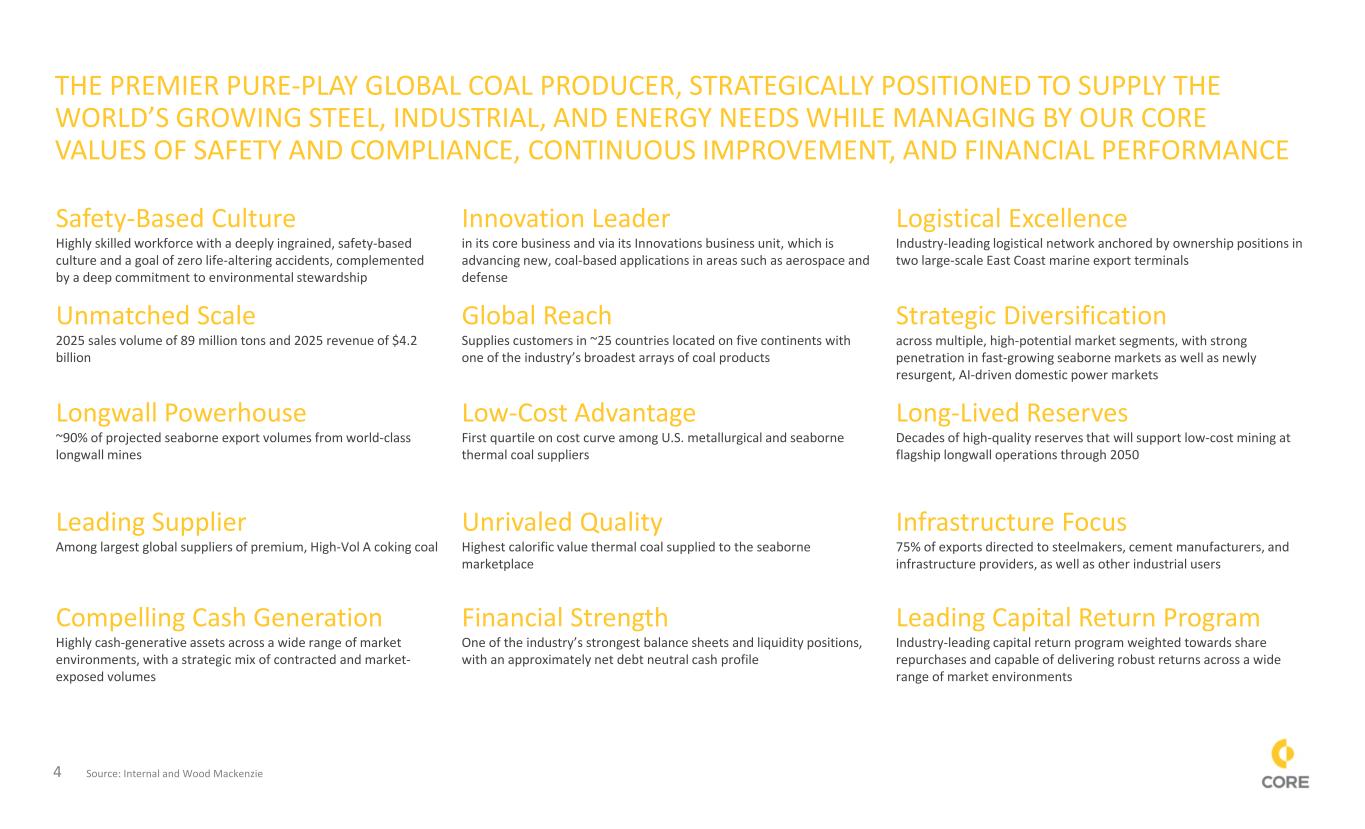
4 THE PREMIER PURE-PLAY GLOBAL COAL PRODUCER, STRATEGICALLY POSITIONED TO SUPPLY THE WORLD’S GROWING STEEL, INDUSTRIAL, AND ENERGY NEEDS WHILE MANAGING BY OUR CORE VALUES OF SAFETY AND COMPLIANCE, CONTINUOUS IMPROVEMENT, AND FINANCIAL PERFORMANCE 4 Logistical Excellence Industry-leading logistical network anchored by ownership positions in two large-scale East Coast marine export terminals Innovation Leader in its core business and via its Innovations business unit, which is advancing new, coal-based applications in areas such as aerospace and defense Safety-Based Culture Highly skilled workforce with a deeply ingrained, safety-based culture and a goal of zero life-altering accidents, complemented by a deep commitment to environmental stewardship Strategic Diversification across multiple, high-potential market segments, with strong penetration in fast-growing seaborne markets as well as newly resurgent, AI-driven domestic power markets Global Reach Supplies customers in ~25 countries located on five continents with one of the industry’s broadest arrays of coal products Unmatched Scale 2025 sales volume of 89 million tons and 2025 revenue of $4.2 billion Long-Lived Reserves Decades of high-quality reserves that will support low-cost mining at flagship longwall operations through 2050 Low-Cost Advantage First quartile on cost curve among U.S. metallurgical and seaborne thermal coal suppliers Longwall Powerhouse ~90% of projected seaborne export volumes from world-class longwall mines Infrastructure Focus 75% of exports directed to steelmakers, cement manufacturers, and infrastructure providers, as well as other industrial users Unrivaled Quality Highest calorific value thermal coal supplied to the seaborne marketplace Leading Supplier Among largest global suppliers of premium, High-Vol A coking coal Leading Capital Return Program Industry-leading capital return program weighted towards share repurchases and capable of delivering robust returns across a wide range of market environments Financial Strength One of the industry’s strongest balance sheets and liquidity positions, with an approximately net debt neutral cash profile Compelling Cash Generation Highly cash-generative assets across a wide range of market environments, with a strategic mix of contracted and market- exposed volumes Source: Internal and Wood Mackenzie
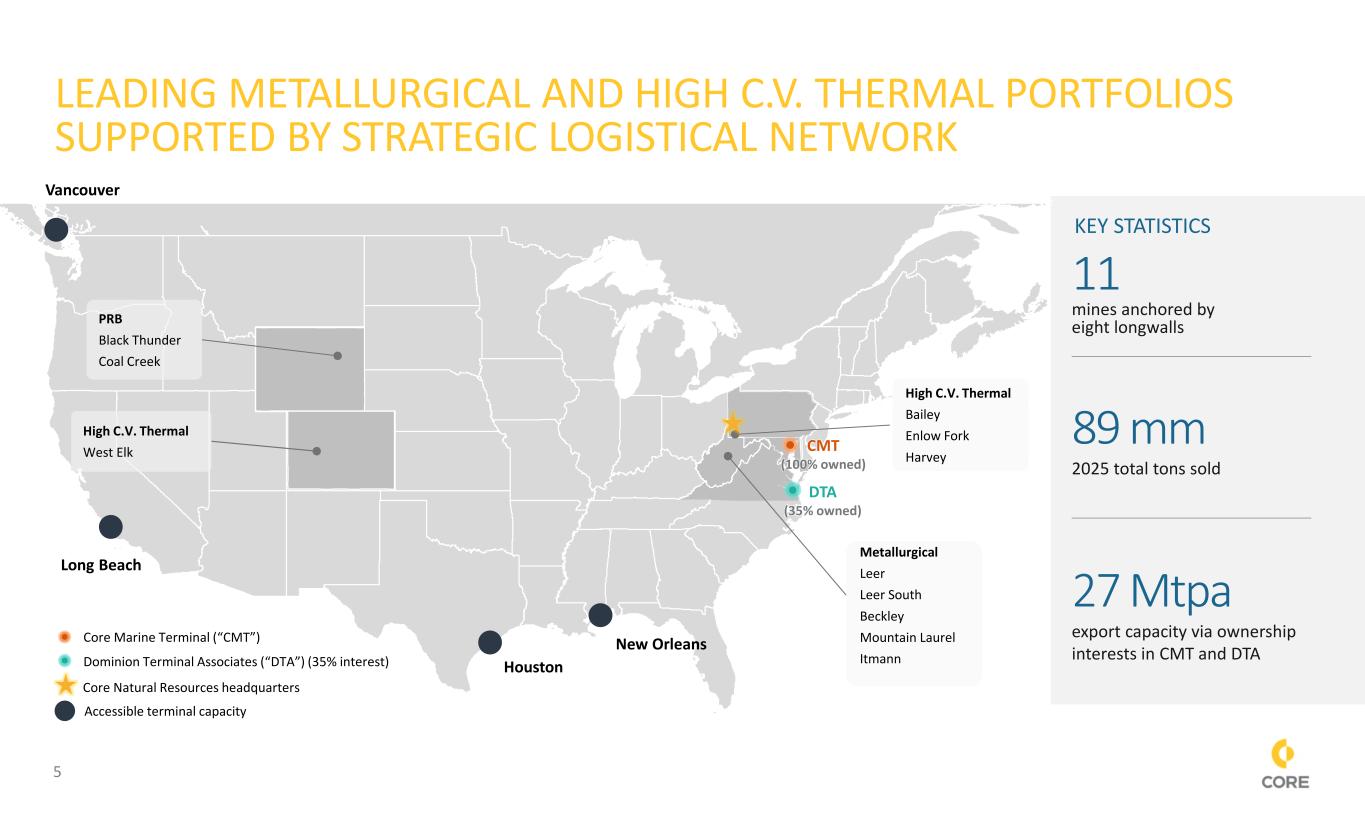
5 11 mines anchored by eight longwalls 89 mm 2025 total tons sold 27 Mtpa export capacity via ownership interests in CMT and DTA KEY STATISTICS Core Marine Terminal (“CMT”) Accessible terminal capacity Core Natural Resources headquarters Vancouver Long Beach Houston New Orleans Dominion Terminal Associates (“DTA”) (35% interest) CMT (100% owned) High C.V. Thermal Bailey Enlow Fork Harvey PRB Black Thunder Coal Creek DTA (35% owned) LEADING METALLURGICAL AND HIGH C.V. THERMAL PORTFOLIOS SUPPORTED BY STRATEGIC LOGISTICAL NETWORK Metallurgical Leer Leer South Beckley Mountain Laurel Itmann High C.V. Thermal West Elk
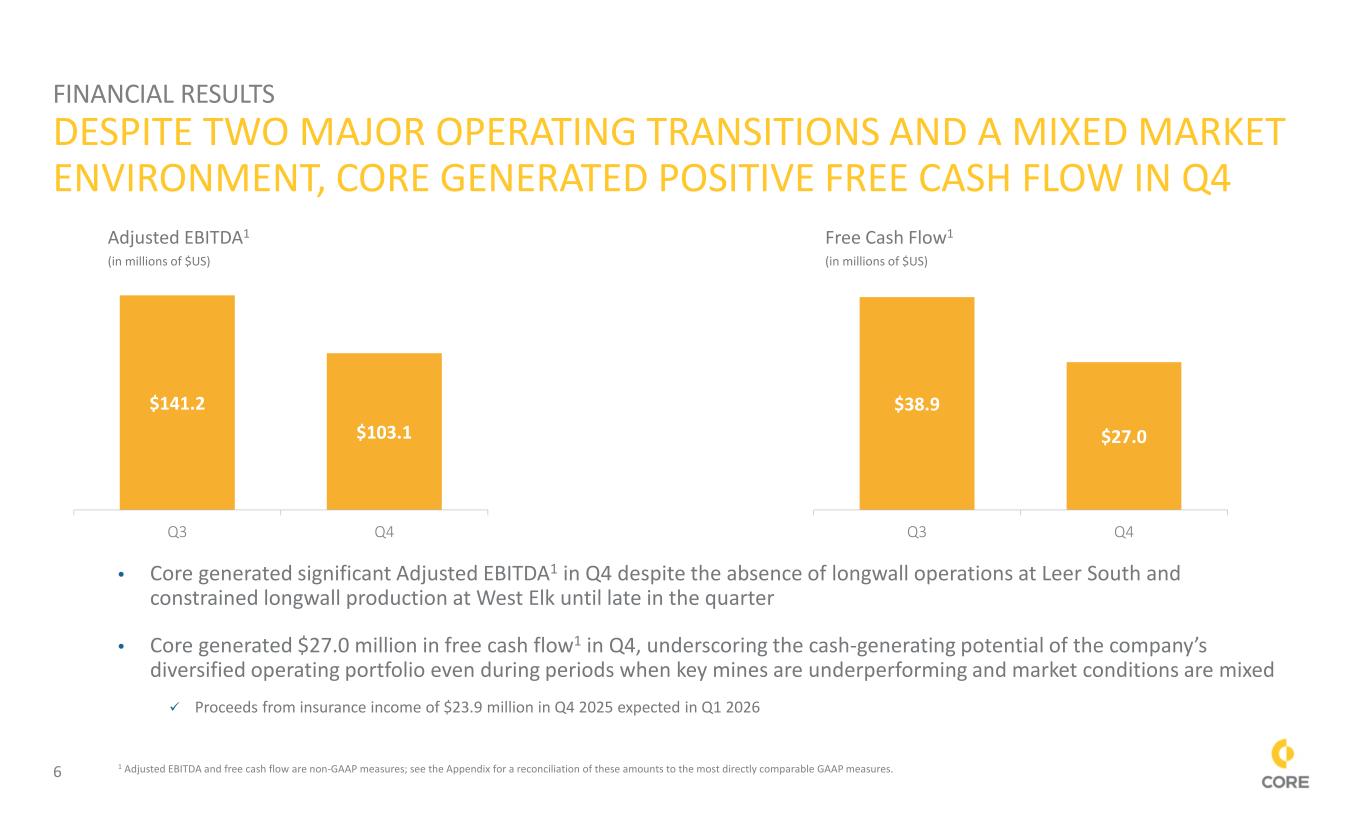
6 FINANCIAL RESULTS DESPITE TWO MAJOR OPERATING TRANSITIONS AND A MIXED MARKET ENVIRONMENT, CORE GENERATED POSITIVE FREE CASH FLOW IN Q4 $141.2 $103.1 Q3 Q4 Adjusted EBITDA1 (in millions of $US) • Core generated significant Adjusted EBITDA1 in Q4 despite the absence of longwall operations at Leer South and constrained longwall production at West Elk until late in the quarter • Core generated $27.0 million in free cash flow1 in Q4, underscoring the cash-generating potential of the company’s diversified operating portfolio even during periods when key mines are underperforming and market conditions are mixed Proceeds from insurance income of $23.9 million in Q4 2025 expected in Q1 2026 $38.9 $27.0 Q3 Q4 Free Cash Flow1 (in millions of $US) 1 Adjusted EBITDA and free cash flow are non-GAAP measures; see the Appendix for a reconciliation of these amounts to the most directly comparable GAAP measures.
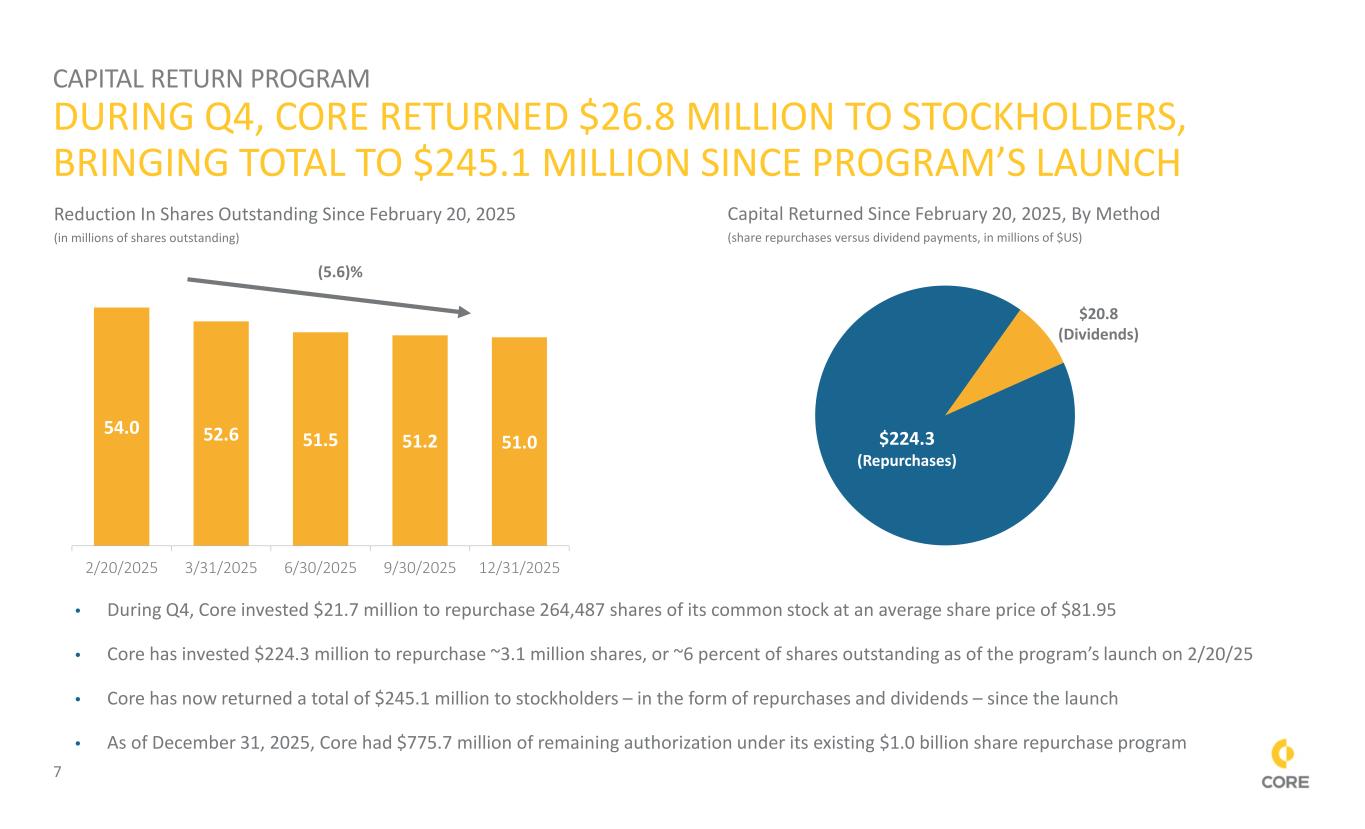
7 CAPITAL RETURN PROGRAM DURING Q4, CORE RETURNED $26.8 MILLION TO STOCKHOLDERS, BRINGING TOTAL TO $245.1 MILLION SINCE PROGRAM’S LAUNCH 54.0 52.6 51.5 51.2 51.0 2/20/2025 3/31/2025 6/30/2025 9/30/2025 12/31/2025 Reduction In Shares Outstanding Since February 20, 2025 (in millions of shares outstanding) Capital Returned Since February 20, 2025, By Method (share repurchases versus dividend payments, in millions of $US) $224.3 (Repurchases) $20.8 (Dividends) (5.6)% • During Q4, Core invested $21.7 million to repurchase 264,487 shares of its common stock at an average share price of $81.95 • Core has invested $224.3 million to repurchase ~3.1 million shares, or ~6 percent of shares outstanding as of the program’s launch on 2/20/25 • Core has now returned a total of $245.1 million to stockholders – in the form of repurchases and dividends – since the launch • As of December 31, 2025, Core had $775.7 million of remaining authorization under its existing $1.0 billion share repurchase program
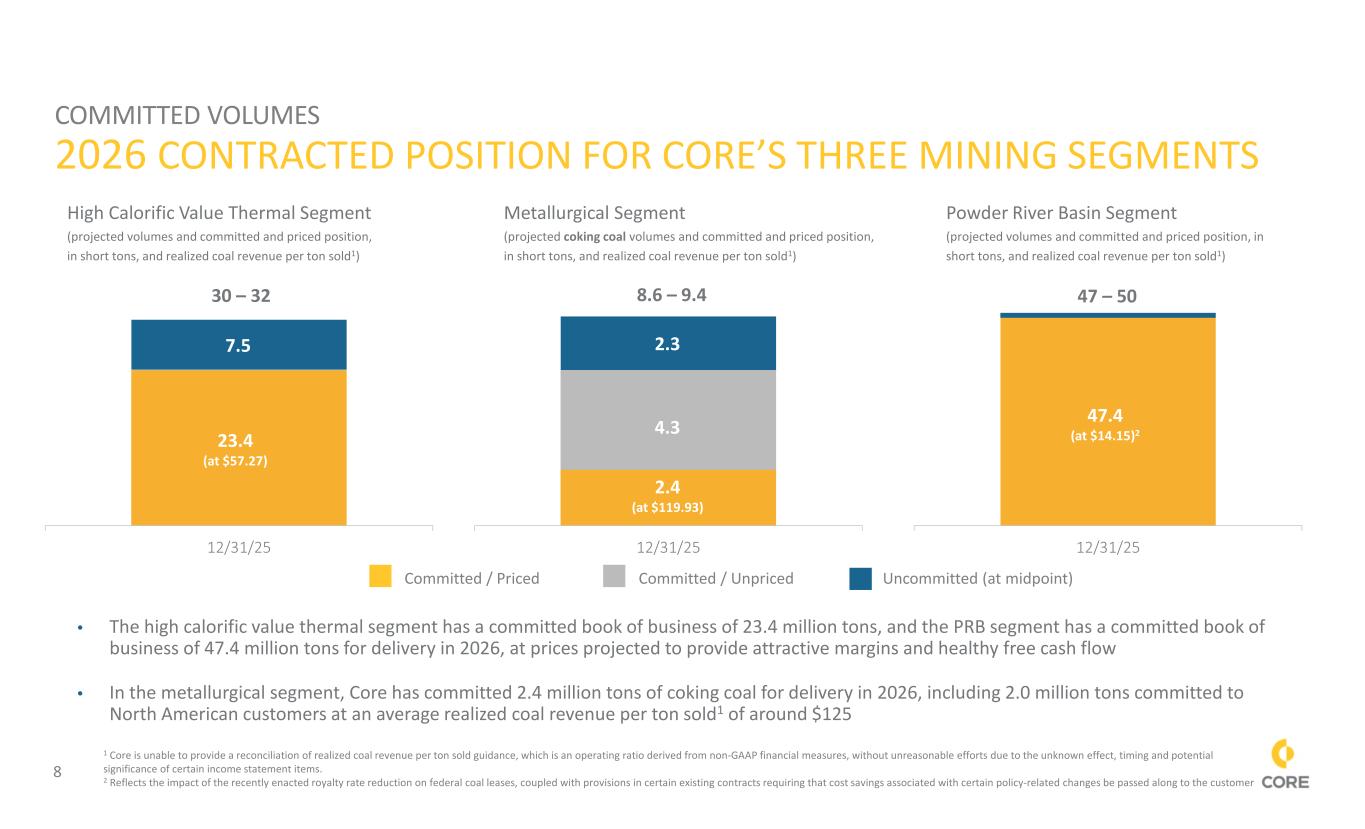
8 COMMITTED VOLUMES 2026 CONTRACTED POSITION FOR CORE’S THREE MINING SEGMENTS 12/31/25 High Calorific Value Thermal Segment (projected volumes and committed and priced position, in short tons, and realized coal revenue per ton sold1) Metallurgical Segment (projected coking coal volumes and committed and priced position, in short tons, and realized coal revenue per ton sold1) 23.4 (at $57.27) 30 – 32 Committed / Priced Committed / Unpriced Uncommitted (at midpoint) 12/31/25 3.5 8.6 – 9.4 3.0 2.4 (at $119.93) 4.3 Powder River Basin Segment (projected volumes and committed and priced position, in short tons, and realized coal revenue per ton sold1) 12/31/25 47.4 (at $14.15)2 47 – 50 • The high calorific value thermal segment has a committed book of business of 23.4 million tons, and the PRB segment has a committed book of business of 47.4 million tons for delivery in 2026, at prices projected to provide attractive margins and healthy free cash flow • In the metallurgical segment, Core has committed 2.4 million tons of coking coal for delivery in 2026, including 2.0 million tons committed to North American customers at an average realized coal revenue per ton sold1 of around $125 1 Core is unable to provide a reconciliation of realized coal revenue per ton sold guidance, which is an operating ratio derived from non-GAAP financial measures, without unreasonable efforts due to the unknown effect, timing and potential significance of certain income statement items. 2 Reflects the impact of the recently enacted royalty rate reduction on federal coal leases, coupled with provisions in certain existing contracts requiring that cost savings associated with certain policy-related changes be passed along to the customer 7.5 2.3
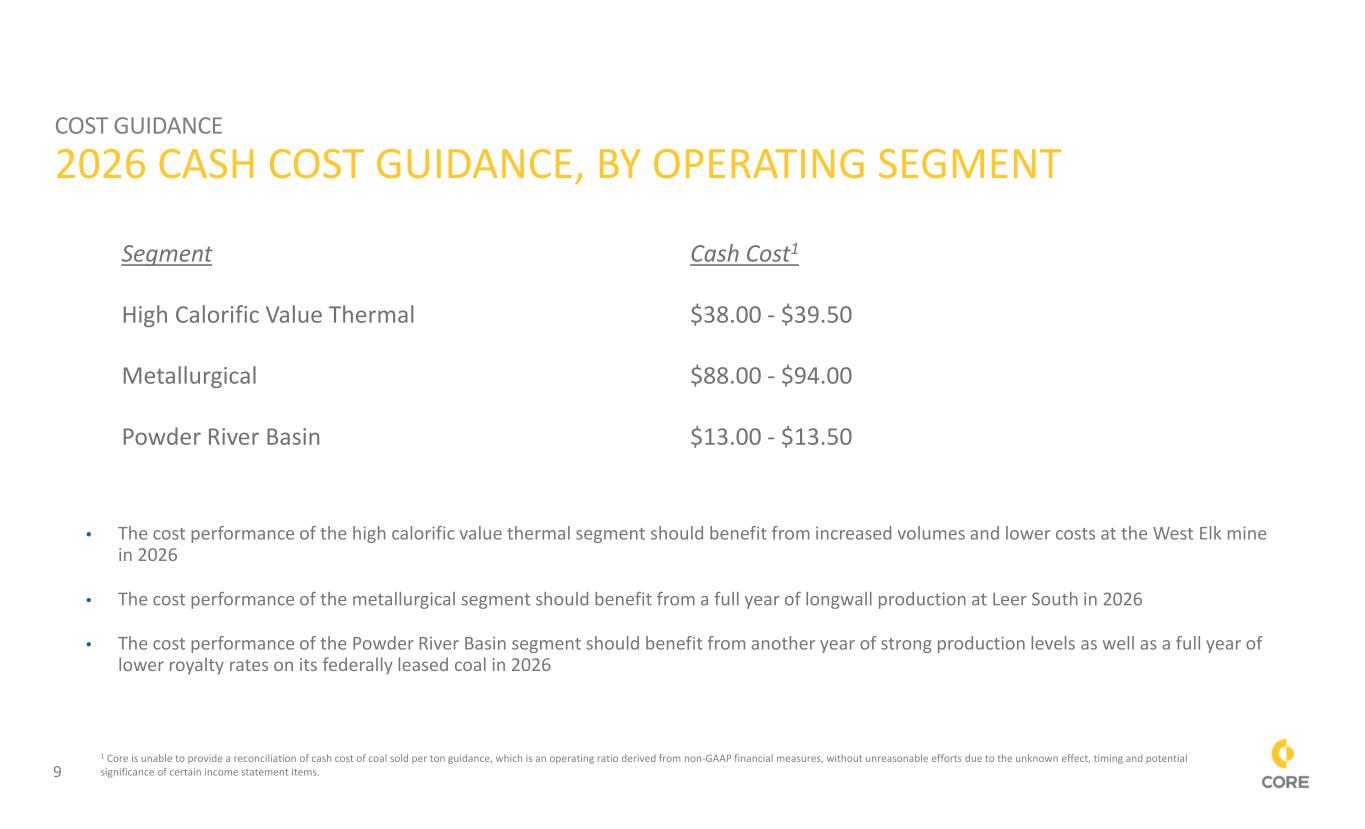
9 2026 CASH COST GUIDANCE, BY OPERATING SEGMENT Cash Cost1Segment $38.00 - $39.50High Calorific Value Thermal $88.00 - $94.00Metallurgical $13.00 - $13.50Powder River Basin • The cost performance of the high calorific value thermal segment should benefit from increased volumes and lower costs at the West Elk mine in 2026 • The cost performance of the metallurgical segment should benefit from a full year of longwall production at Leer South in 2026 • The cost performance of the Powder River Basin segment should benefit from another year of strong production levels as well as a full year of lower royalty rates on its federally leased coal in 2026 1 Core is unable to provide a reconciliation of cash cost of coal sold per ton guidance, which is an operating ratio derived from non-GAAP financial measures, without unreasonable efforts due to the unknown effect, timing and potential significance of certain income statement items. COST GUIDANCE
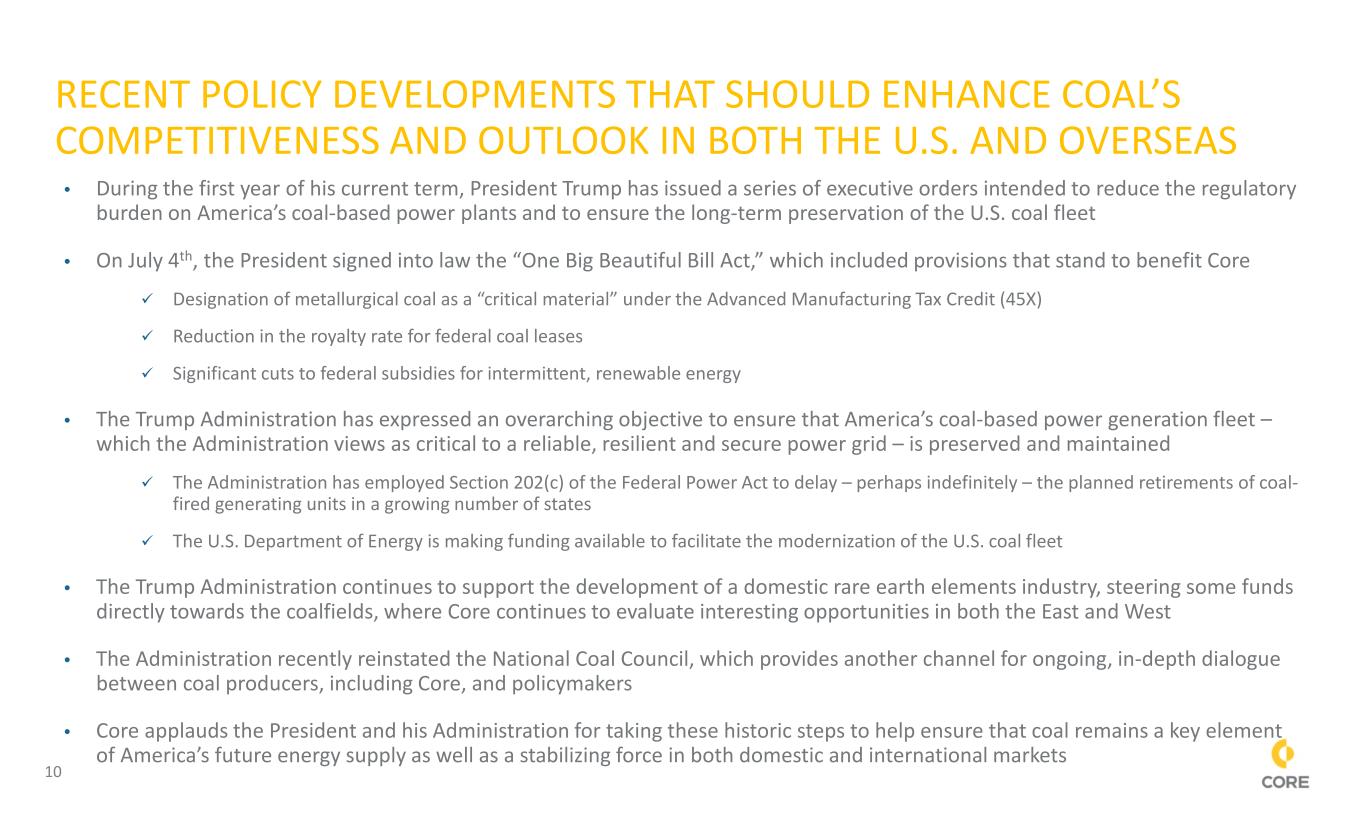
10 • During the first year of his current term, President Trump has issued a series of executive orders intended to reduce the regulatory burden on America’s coal-based power plants and to ensure the long-term preservation of the U.S. coal fleet • On July 4th, the President signed into law the “One Big Beautiful Bill Act,” which included provisions that stand to benefit Core Designation of metallurgical coal as a “critical material” under the Advanced Manufacturing Tax Credit (45X) Reduction in the royalty rate for federal coal leases Significant cuts to federal subsidies for intermittent, renewable energy • The Trump Administration has expressed an overarching objective to ensure that America’s coal-based power generation fleet – which the Administration views as critical to a reliable, resilient and secure power grid – is preserved and maintained The Administration has employed Section 202(c) of the Federal Power Act to delay – perhaps indefinitely – the planned retirements of coal- fired generating units in a growing number of states The U.S. Department of Energy is making funding available to facilitate the modernization of the U.S. coal fleet • The Trump Administration continues to support the development of a domestic rare earth elements industry, steering some funds directly towards the coalfields, where Core continues to evaluate interesting opportunities in both the East and West • The Administration recently reinstated the National Coal Council, which provides another channel for ongoing, in-depth dialogue between coal producers, including Core, and policymakers • Core applauds the President and his Administration for taking these historic steps to help ensure that coal remains a key element of America’s future energy supply as well as a stabilizing force in both domestic and international markets RECENT POLICY DEVELOPMENTS THAT SHOULD ENHANCE COAL’S COMPETITIVENESS AND OUTLOOK IN BOTH THE U.S. AND OVERSEAS
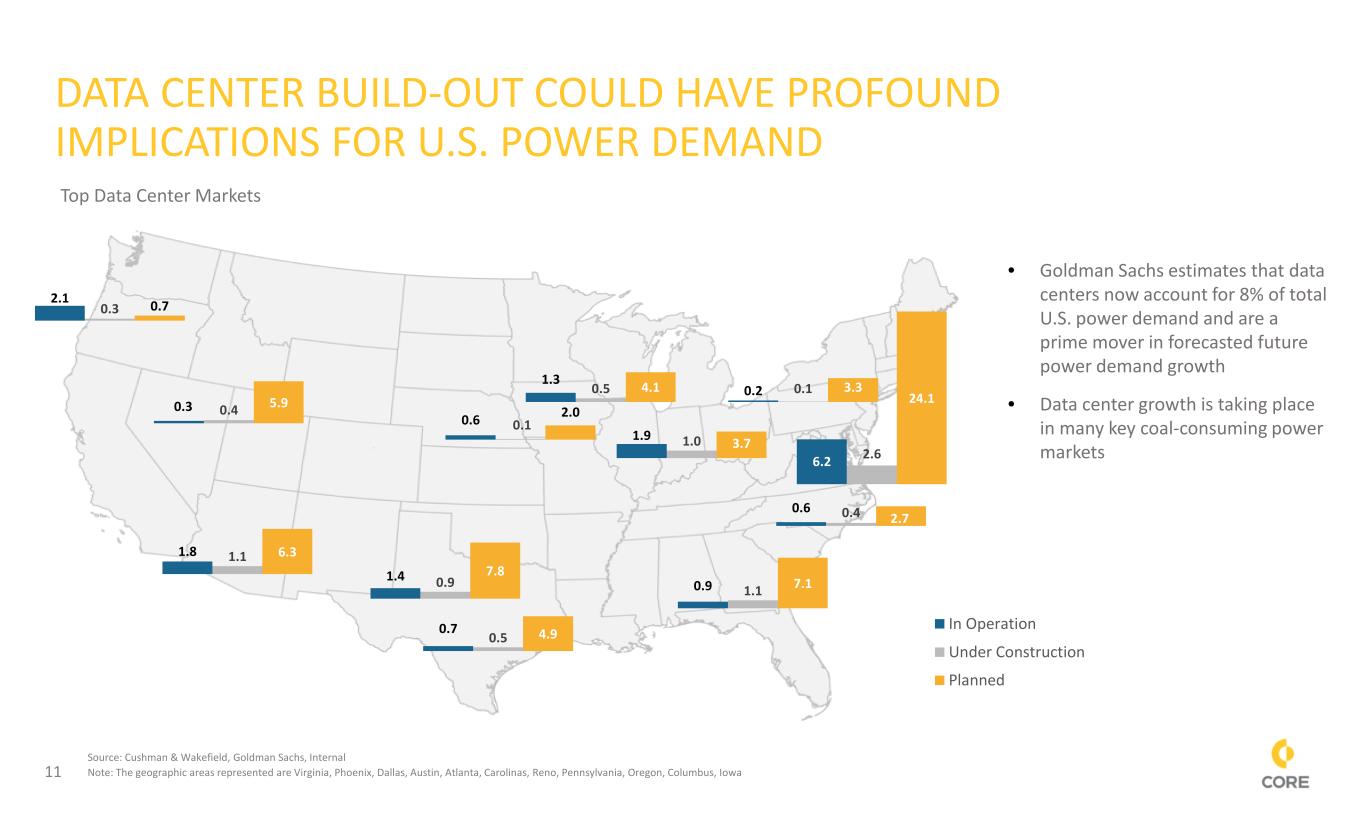
11 DATA CENTER BUILD-OUT COULD HAVE PROFOUND IMPLICATIONS FOR U.S. POWER DEMAND • Goldman Sachs estimates that data centers now account for 8% of total U.S. power demand and are a prime mover in forecasted future power demand growth • Data center growth is taking place in many key coal-consuming power markets Source: Cushman & Wakefield, Goldman Sachs, Internal Note: The geographic areas represented are Virginia, Phoenix, Dallas, Austin, Atlanta, Carolinas, Reno, Pennsylvania, Oregon, Columbus, Iowa Top Data Center Markets (GW of capacity) 6.2 2.6 24.1 0.0 0.0 In Operation Under Construction Planned 1.8 1.1 6.3 1.4 0.9 7.8 0.9 1.1 7.1 1.3 0.5 4.1 0.7 0.5 4.9 0.6 0.4 2.7 0.3 0.4 5.9 2.1 0.3 0.7 1.9 1.0 3.7 0.6 0.1 2.0 0.2 0.1 3.3
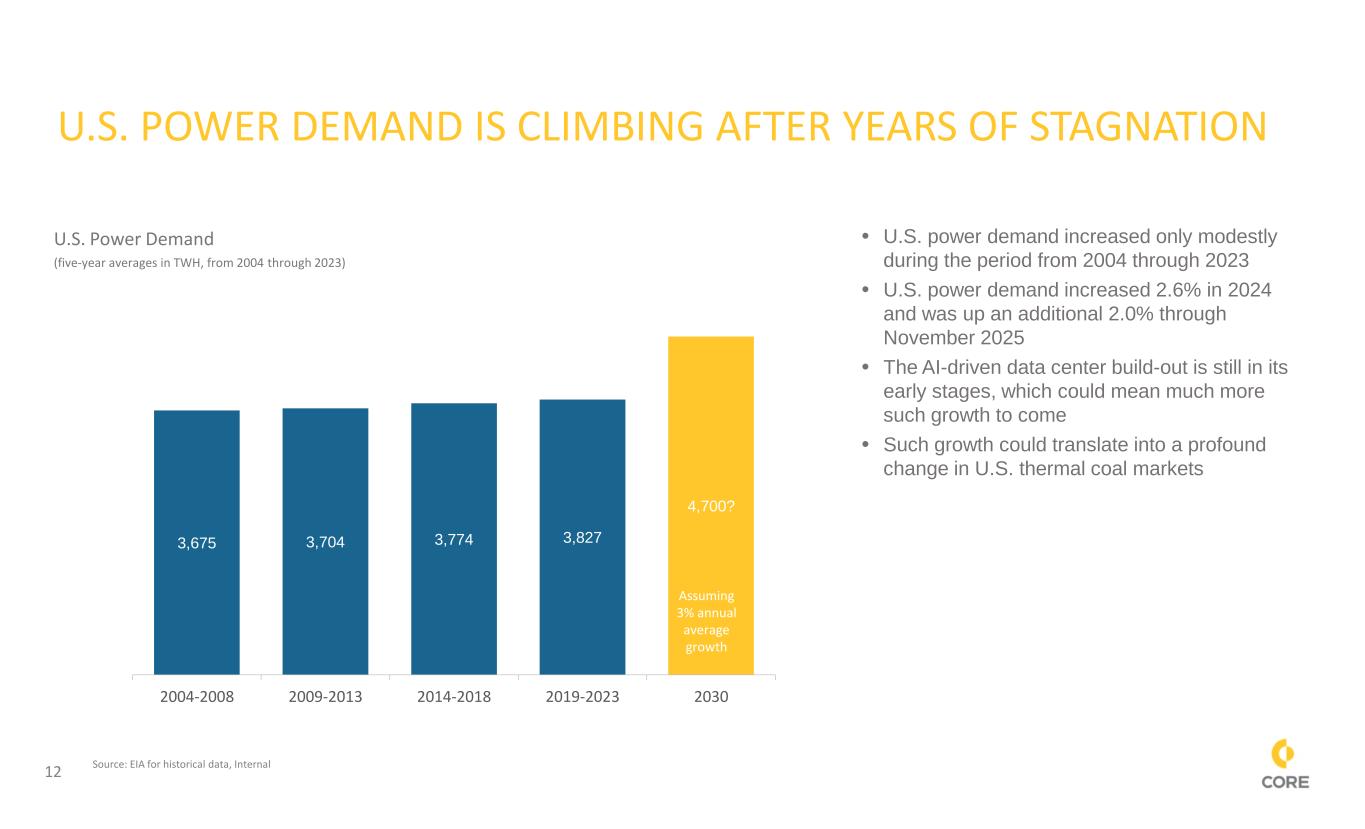
12 U.S. POWER DEMAND IS CLIMBING AFTER YEARS OF STAGNATION • U.S. power demand increased only modestly during the period from 2004 through 2023 • U.S. power demand increased 2.6% in 2024 and was up an additional 2.0% through November 2025 • The AI-driven data center build-out is still in its early stages, which could mean much more such growth to come • Such growth could translate into a profound change in U.S. thermal coal markets Source: EIA for historical data, Internal 3,675 3,704 3,774 3,827 4,700? 2004-2008 2009-2013 2014-2018 2019-2023 2030 Assuming 3% annual average growth U.S. Power Demand (five-year averages in TWH, from 2004 through 2023)
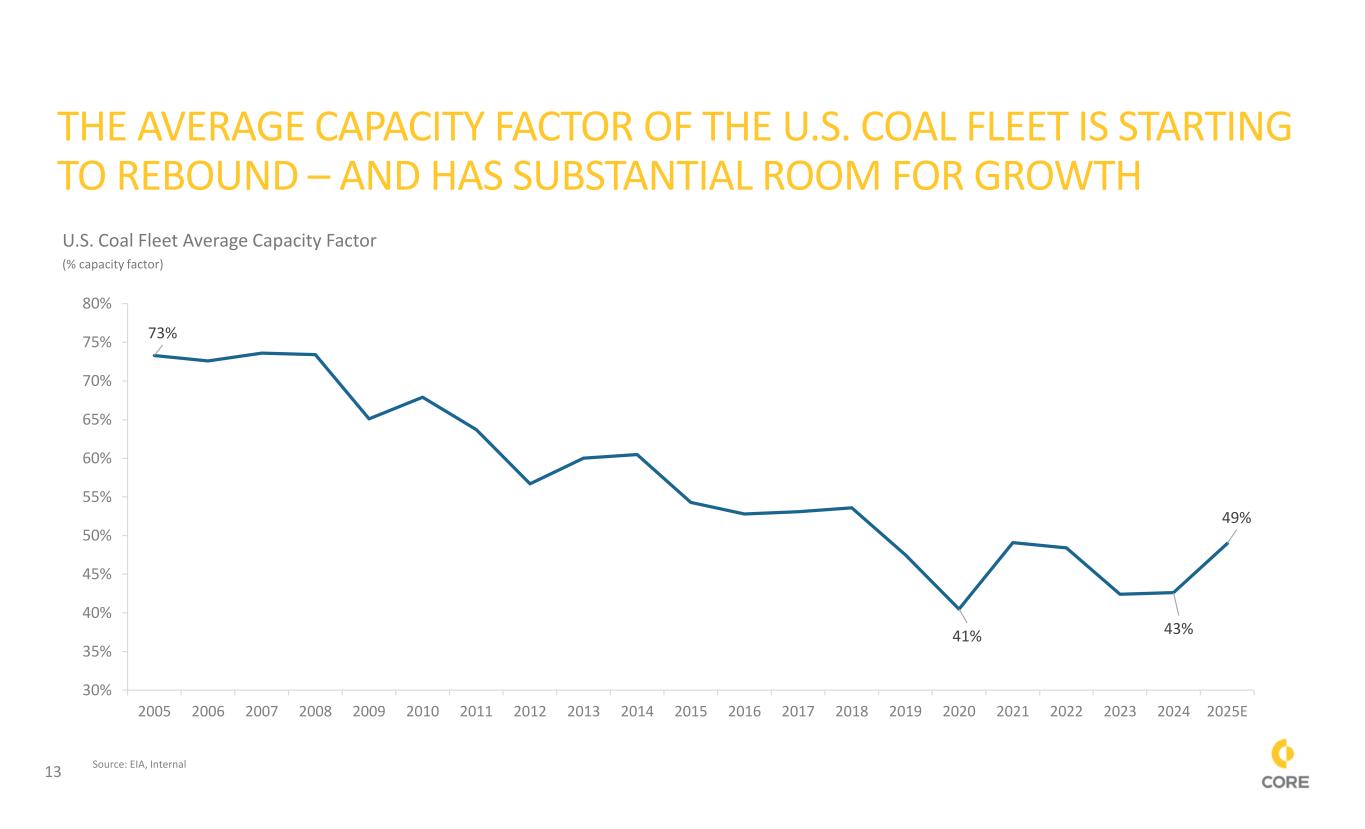
13 THE AVERAGE CAPACITY FACTOR OF THE U.S. COAL FLEET IS STARTING TO REBOUND – AND HAS SUBSTANTIAL ROOM FOR GROWTH Source: EIA, Internal 73% 41% 43% 49% 30% 35% 40% 45% 50% 55% 60% 65% 70% 75% 80% 2005 2006 2007 2008 2009 2010 2011 2012 2013 2014 2015 2016 2017 2018 2019 2020 2021 2022 2023 2024 2025E U.S. Coal Fleet Average Capacity Factor (% capacity factor)
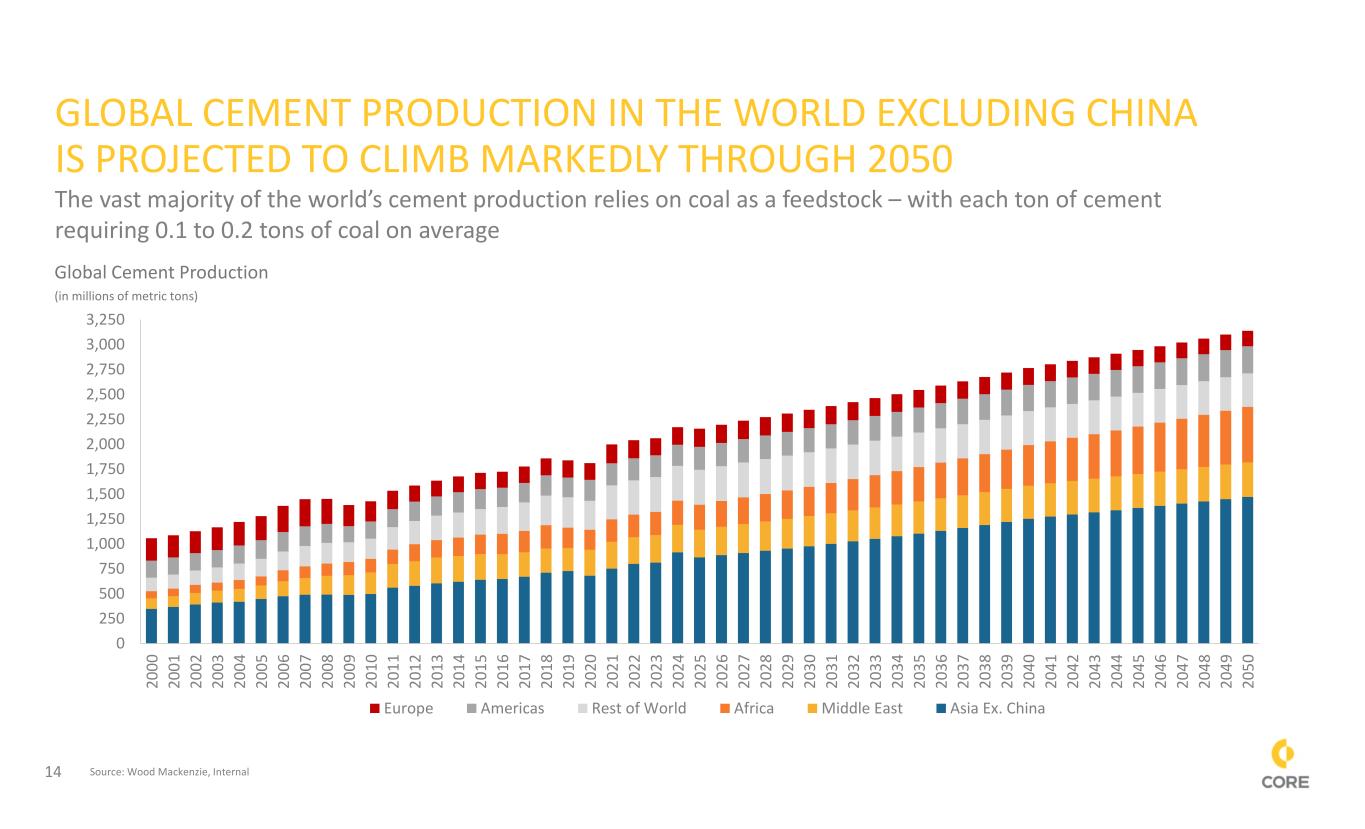
14 GLOBAL CEMENT PRODUCTION IN THE WORLD EXCLUDING CHINA IS PROJECTED TO CLIMB MARKEDLY THROUGH 2050 Global Cement Production (in millions of metric tons) Source: Wood Mackenzie, Internal 0 250 500 750 1,000 1,250 1,500 1,750 2,000 2,250 2,500 2,750 3,000 3,250 2 0 0 0 2 0 0 1 2 0 0 2 2 0 0 3 2 0 0 4 2 0 0 5 2 0 0 6 2 0 0 7 2 0 0 8 2 0 0 9 2 0 1 0 2 0 1 1 2 0 1 2 2 0 1 3 2 0 1 4 2 0 1 5 2 0 1 6 2 0 1 7 2 0 1 8 2 0 1 9 2 0 2 0 2 0 2 1 2 0 2 2 2 0 2 3 2 0 2 4 2 0 2 5 2 0 2 6 2 0 2 7 2 0 2 8 2 0 2 9 2 0 3 0 2 0 3 1 2 0 3 2 2 0 3 3 2 0 3 4 2 0 3 5 2 0 3 6 2 0 3 7 2 0 3 8 2 0 3 9 2 0 4 0 2 0 4 1 2 0 4 2 2 0 4 3 2 0 4 4 2 0 4 5 2 0 4 6 2 0 4 7 2 0 4 8 2 0 4 9 2 0 5 0 Europe Americas Rest of World Africa Middle East Asia Ex. China The vast majority of the world’s cement production relies on coal as a feedstock – with each ton of cement requiring 0.1 to 0.2 tons of coal on average
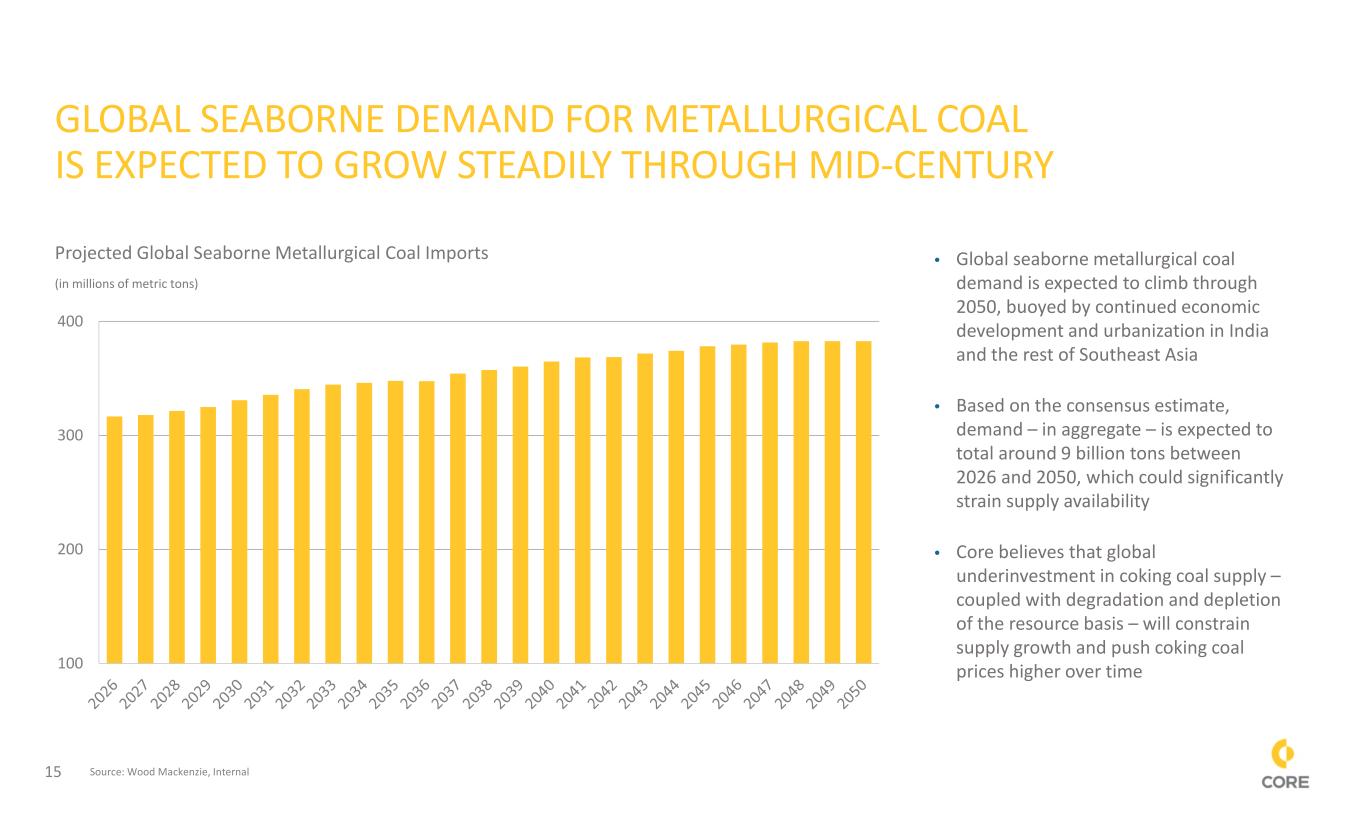
15 GLOBAL SEABORNE DEMAND FOR METALLURGICAL COAL IS EXPECTED TO GROW STEADILY THROUGH MID-CENTURY 100 200 300 400 • Global seaborne metallurgical coal demand is expected to climb through 2050, buoyed by continued economic development and urbanization in India and the rest of Southeast Asia • Based on the consensus estimate, demand – in aggregate – is expected to total around 9 billion tons between 2026 and 2050, which could significantly strain supply availability • Core believes that global underinvestment in coking coal supply – coupled with degradation and depletion of the resource basis – will constrain supply growth and push coking coal prices higher over time Projected Global Seaborne Metallurgical Coal Imports (in millions of metric tons) Source: Wood Mackenzie, Internal
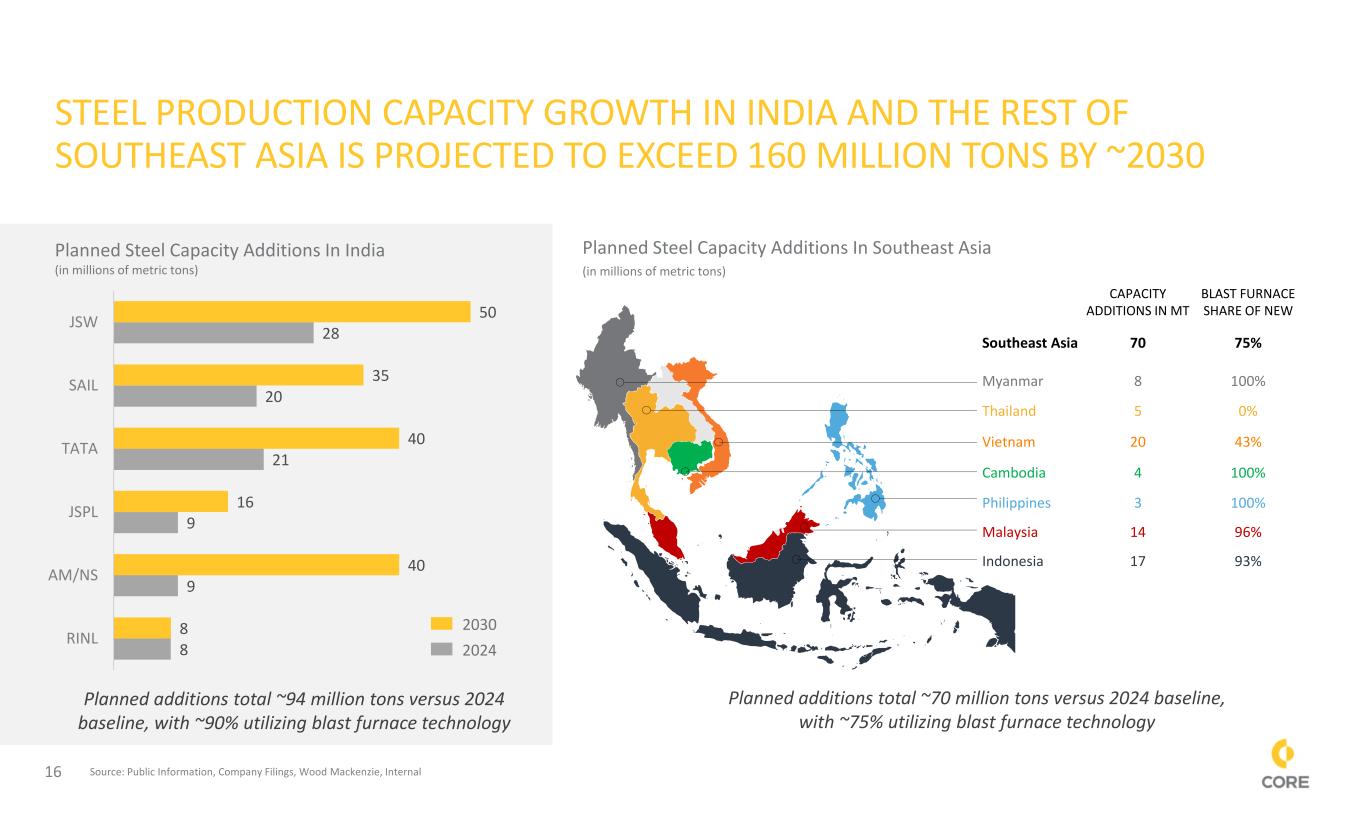
16 STEEL PRODUCTION CAPACITY GROWTH IN INDIA AND THE REST OF SOUTHEAST ASIA IS PROJECTED TO EXCEED 160 MILLION TONS BY ~2030 8 9 9 21 20 28 8 40 16 40 35 50 RINL AM/NS JSPL TATA SAIL JSW Planned Steel Capacity Additions In India (in millions of metric tons) Planned Steel Capacity Additions In Southeast Asia (in millions of metric tons) 2030 2024 BLAST FURNACE SHARE OF NEW CAPACITY ADDITIONS IN MT 75%70Southeast Asia 100%8Myanmar 0%5Thailand 43%20Vietnam 100%4Cambodia 100%3Philippines 96%14Malaysia 93%17Indonesia Source: Public Information, Company Filings, Wood Mackenzie, Internal Planned additions total ~94 million tons versus 2024 baseline, with ~90% utilizing blast furnace technology Planned additions total ~70 million tons versus 2024 baseline, with ~75% utilizing blast furnace technology
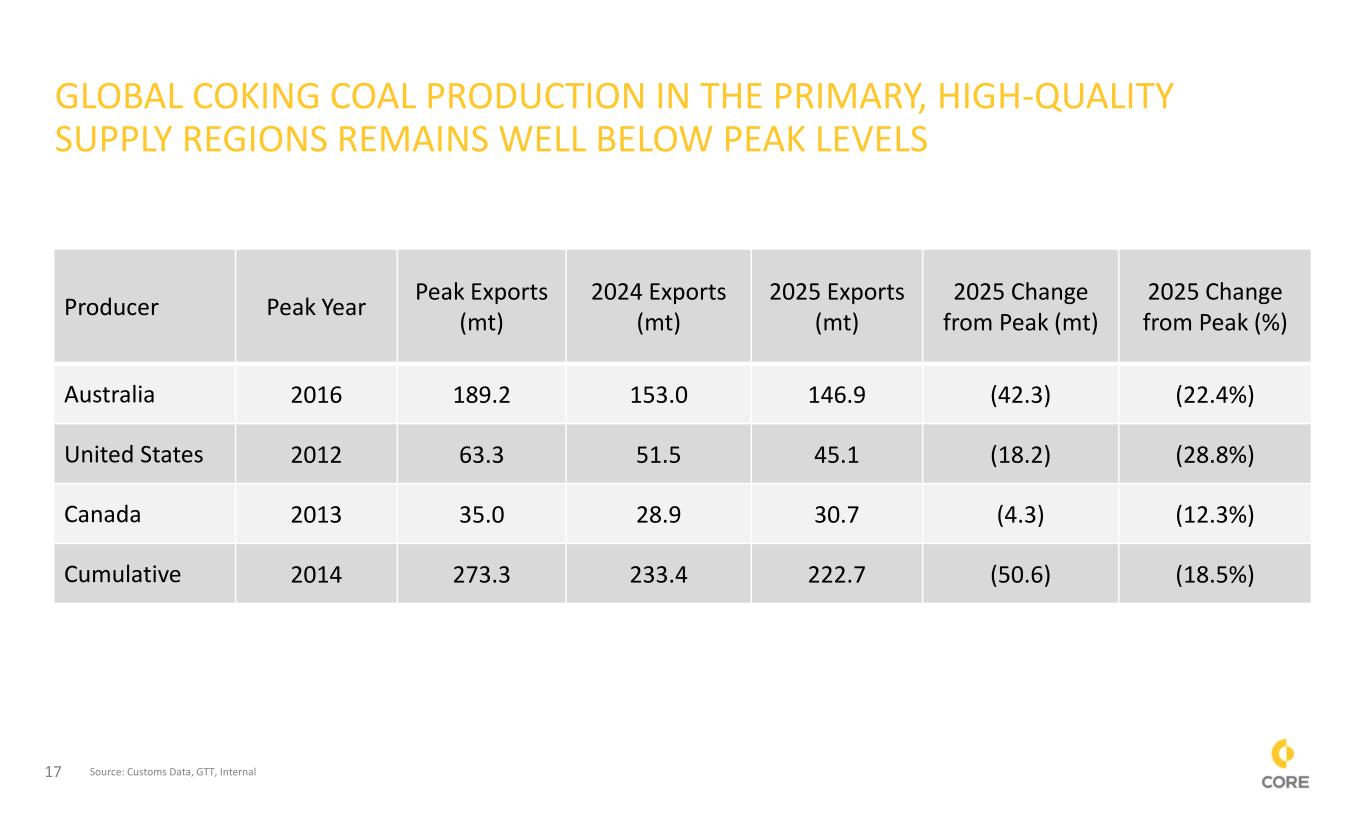
17 GLOBAL COKING COAL PRODUCTION IN THE PRIMARY, HIGH-QUALITY SUPPLY REGIONS REMAINS WELL BELOW PEAK LEVELS 2025 Change from Peak (%) 2025 Change from Peak (mt) 2025 Exports (mt) 2024 Exports (mt) Peak Exports (mt) Peak YearProducer (22.4%)(42.3)146.9153.0189.22016Australia (28.8%)(18.2)45.151.563.32012United States (12.3%)(4.3)30.728.935.02013Canada (18.5%)(50.6)222.7233.4273.32014Cumulative Source: Customs Data, GTT, Internal
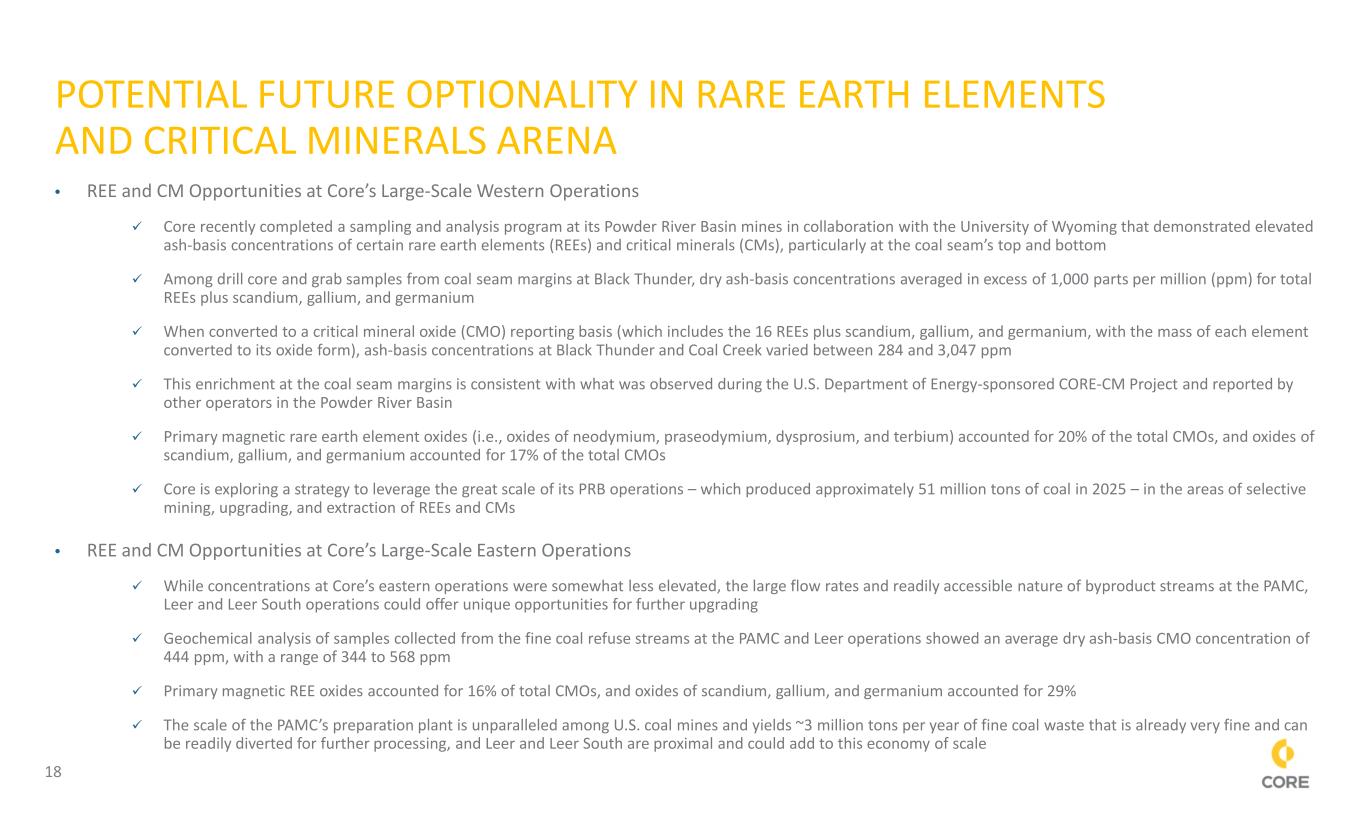
18 • REE and CM Opportunities at Core’s Large-Scale Western Operations Core recently completed a sampling and analysis program at its Powder River Basin mines in collaboration with the University of Wyoming that demonstrated elevated ash-basis concentrations of certain rare earth elements (REEs) and critical minerals (CMs), particularly at the coal seam’s top and bottom Among drill core and grab samples from coal seam margins at Black Thunder, dry ash-basis concentrations averaged in excess of 1,000 parts per million (ppm) for total REEs plus scandium, gallium, and germanium When converted to a critical mineral oxide (CMO) reporting basis (which includes the 16 REEs plus scandium, gallium, and germanium, with the mass of each element converted to its oxide form), ash-basis concentrations at Black Thunder and Coal Creek varied between 284 and 3,047 ppm This enrichment at the coal seam margins is consistent with what was observed during the U.S. Department of Energy-sponsored CORE-CM Project and reported by other operators in the Powder River Basin Primary magnetic rare earth element oxides (i.e., oxides of neodymium, praseodymium, dysprosium, and terbium) accounted for 20% of the total CMOs, and oxides of scandium, gallium, and germanium accounted for 17% of the total CMOs Core is exploring a strategy to leverage the great scale of its PRB operations – which produced approximately 51 million tons of coal in 2025 – in the areas of selective mining, upgrading, and extraction of REEs and CMs • REE and CM Opportunities at Core’s Large-Scale Eastern Operations While concentrations at Core’s eastern operations were somewhat less elevated, the large flow rates and readily accessible nature of byproduct streams at the PAMC, Leer and Leer South operations could offer unique opportunities for further upgrading Geochemical analysis of samples collected from the fine coal refuse streams at the PAMC and Leer operations showed an average dry ash-basis CMO concentration of 444 ppm, with a range of 344 to 568 ppm Primary magnetic REE oxides accounted for 16% of total CMOs, and oxides of scandium, gallium, and germanium accounted for 29% The scale of the PAMC’s preparation plant is unparalleled among U.S. coal mines and yields ~3 million tons per year of fine coal waste that is already very fine and can be readily diverted for further processing, and Leer and Leer South are proximal and could add to this economy of scale POTENTIAL FUTURE OPTIONALITY IN RARE EARTH ELEMENTS AND CRITICAL MINERALS ARENA
19 • The U.S. Department of Energy announced in August that it intends to issue nearly $1 billion of funding focused on securing the American critical minerals and materials supply chain, with some of this funding directed specifically toward critical minerals recovery from coal industry-based feedstocks • Core is now commencing the next phase of its REE and CM evaluation, which will include an expanded drilling program intended to facilitate additional characterization of the potential resource • Core is also engaging with technology and engineering providers and expects to launch an RFP process in coming months • The Core Innovations team also continues to advance its substantial raft of next generation coal applications and products in areas of strategic national interest, including aerospace, defense, and battery technology In particular, Core’s C-BATT joint venture has the potential to reduce America’s heavy reliance on imported graphite, which is a key component in lithium-ion batteries China is the primary source of U.S. battery-grade graphite imports POTENTIAL FUTURE OPTIONALITY IN RARE EARTH ELEMENTS AND CRITICAL MINERALS ARENA – NEXT STEPS
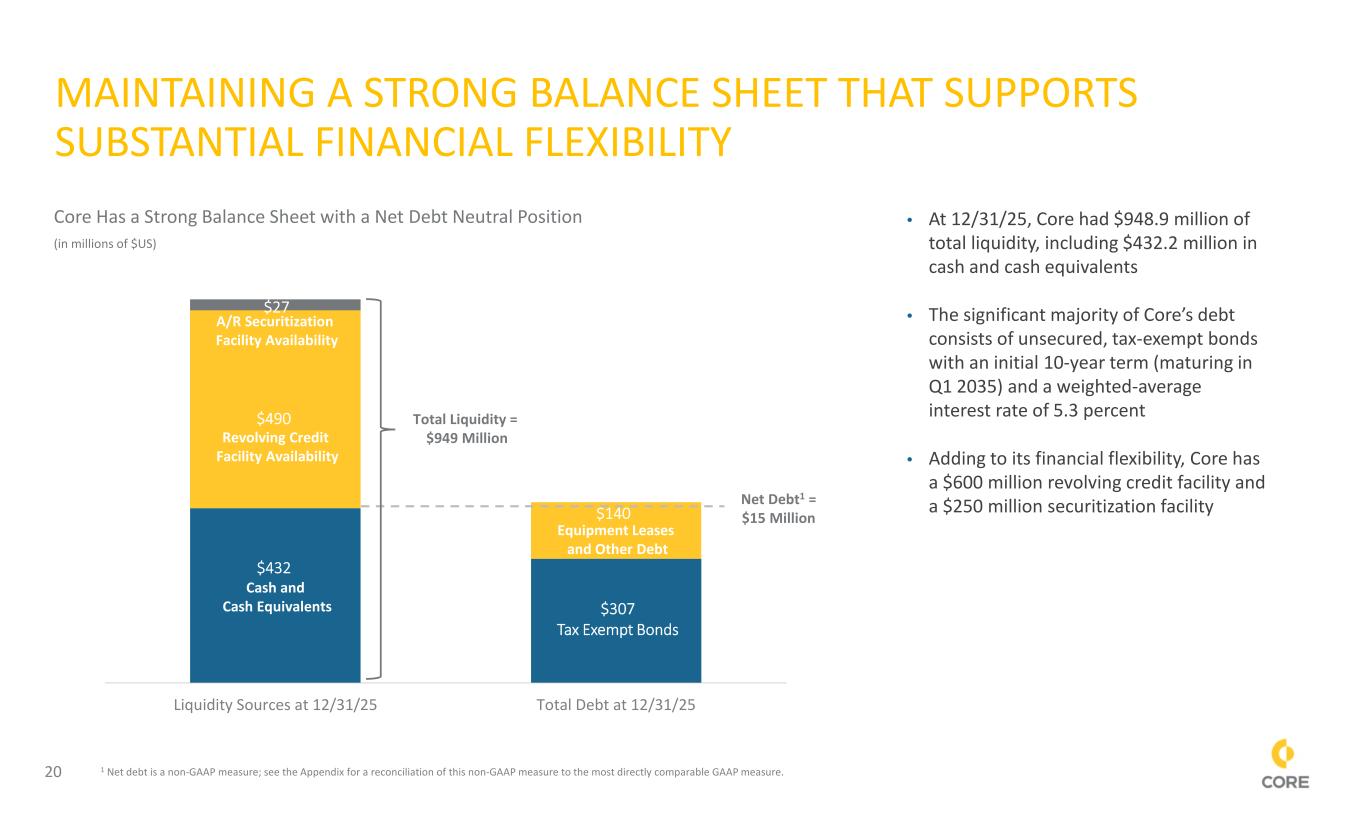
20 $432 $307 Tax Exempt Bonds $490 $140 $27 Liquidity Sources at 12/31/25 Total Debt at 12/31/25 Total Liquidity = $949 MillionRevolving Credit Facility Availability Cash and Cash Equivalents Equipment Leases and Other Debt MAINTAINING A STRONG BALANCE SHEET THAT SUPPORTS SUBSTANTIAL FINANCIAL FLEXIBILITY Equipment Leases • At 12/31/25, Core had $948.9 million of total liquidity, including $432.2 million in cash and cash equivalents • The significant majority of Core’s debt consists of unsecured, tax-exempt bonds with an initial 10-year term (maturing in Q1 2035) and a weighted-average interest rate of 5.3 percent • Adding to its financial flexibility, Core has a $600 million revolving credit facility and a $250 million securitization facility Core Has a Strong Balance Sheet with a Net Debt Neutral Position (in millions of $US) Net Debt1 = $15 Million A/R Securitization Facility Availability 1 Net debt is a non-GAAP measure; see the Appendix for a reconciliation of this non-GAAP measure to the most directly comparable GAAP measure.
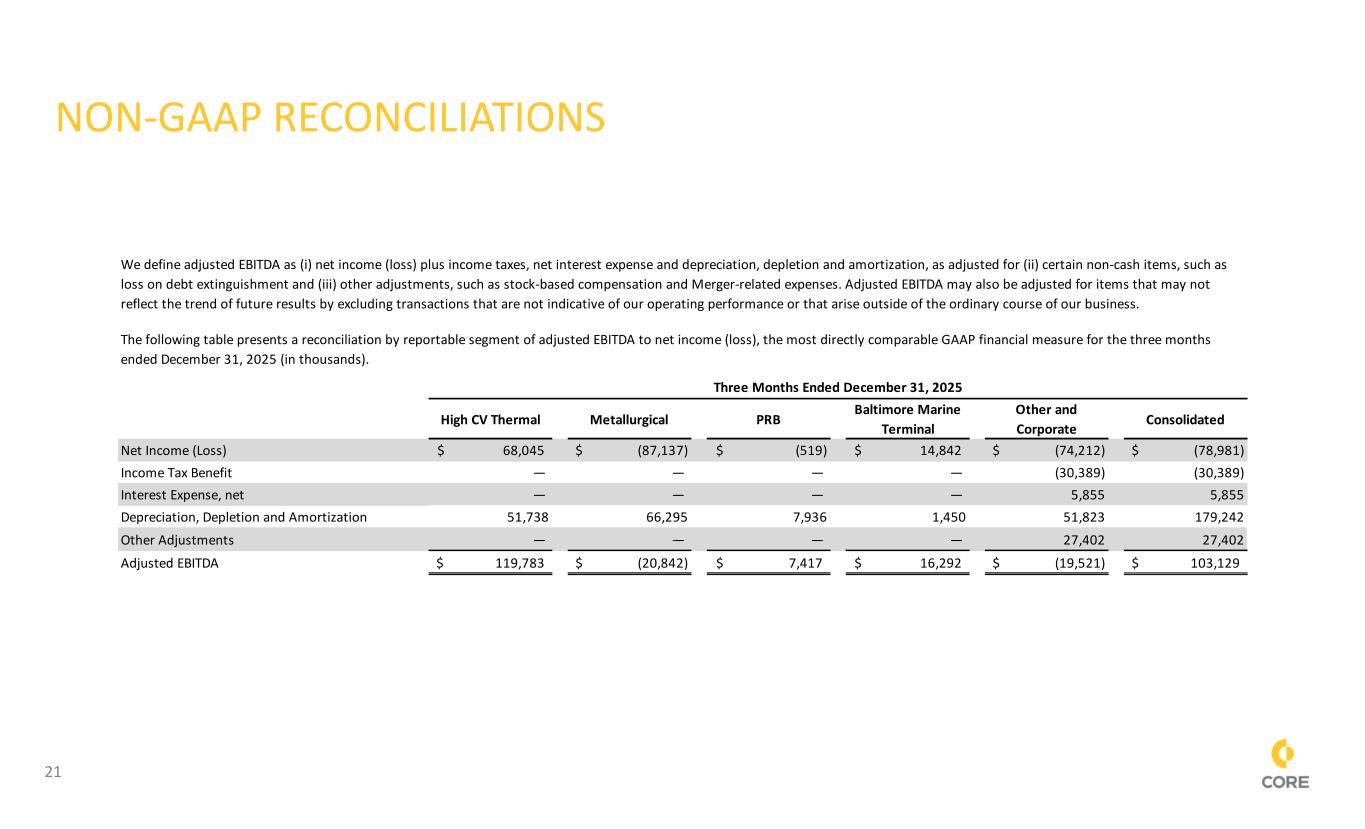
21 NON-GAAP RECONCILIATIONS High CV Thermal Metallurgical PRB Baltimore Marine Terminal Other and Corporate Consolidated Net Income (Loss) 68,045$ (87,137)$ (519)$ 14,842$ (74,212)$ (78,981)$ Income Tax Benefit — — — — (30,389) (30,389) Interest Expense, net — — — — 5,855 5,855 Depreciation, Depletion and Amortization 51,738 66,295 7,936 1,450 51,823 179,242 Other Adjustments — — — — 27,402 27,402 Adjusted EBITDA 119,783$ (20,842)$ 7,417$ 16,292$ (19,521)$ 103,129$ We define adjusted EBITDA as (i) net income (loss) plus income taxes, net interest expense and depreciation, depletion and amortization, as adjusted for (ii) certain non-cash items, such as loss on debt extinguishment and (iii) other adjustments, such as stock-based compensation and Merger-related expenses. Adjusted EBITDA may also be adjusted for items that may not reflect the trend of future results by excluding transactions that are not indicative of our operating performance or that arise outside of the ordinary course of our business. The following table presents a reconciliation by reportable segment of adjusted EBITDA to net income (loss), the most directly comparable GAAP financial measure for the three months ended December 31, 2025 (in thousands). Three Months Ended December 31, 2025
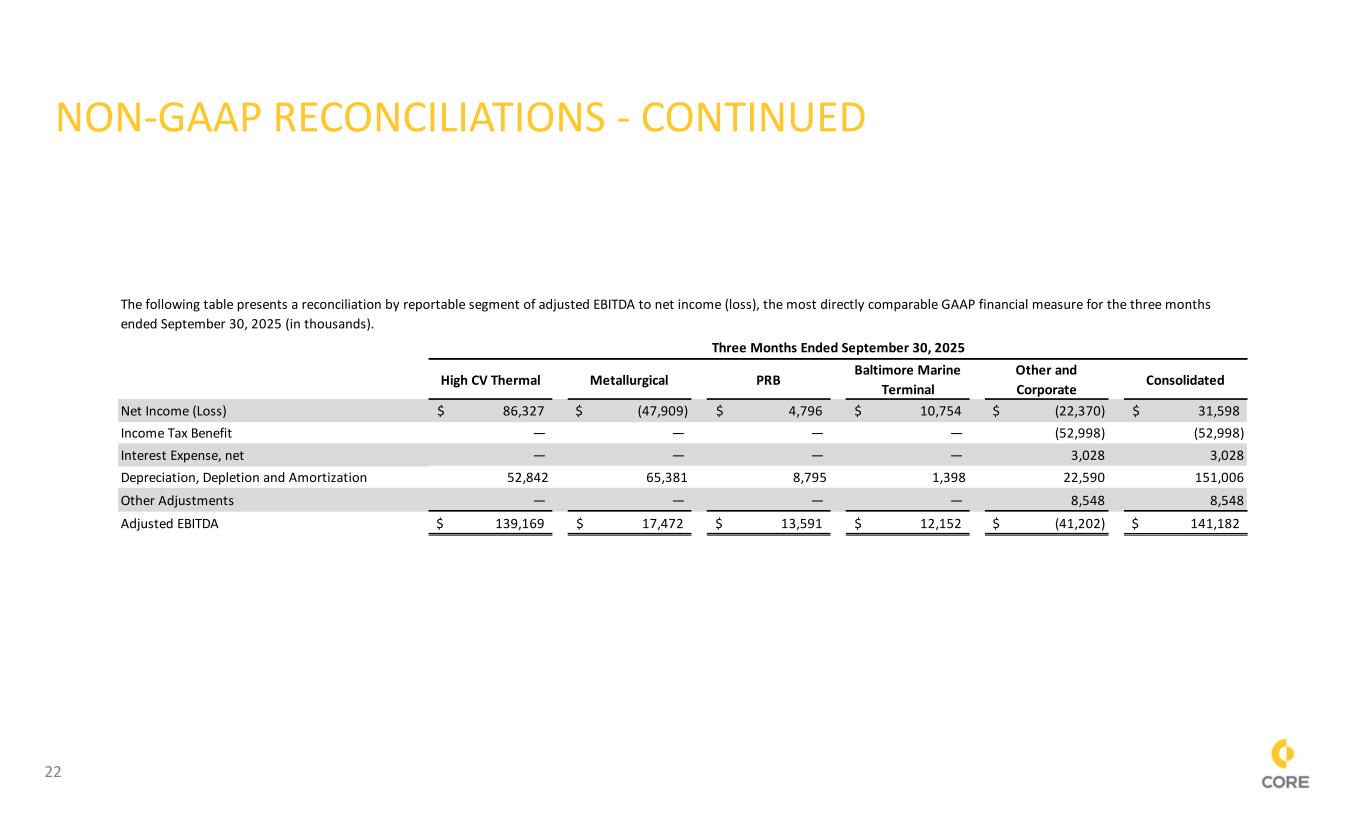
22 NON-GAAP RECONCILIATIONS - CONTINUED High CV Thermal Metallurgical PRB Baltimore Marine Terminal Other and Corporate Consolidated Net Income (Loss) 86,327$ (47,909)$ 4,796$ 10,754$ (22,370)$ 31,598$ Income Tax Benefit — — — — (52,998) (52,998) Interest Expense, net — — — — 3,028 3,028 Depreciation, Depletion and Amortization 52,842 65,381 8,795 1,398 22,590 151,006 Other Adjustments — — — — 8,548 8,548 Adjusted EBITDA 139,169$ 17,472$ 13,591$ 12,152$ (41,202)$ 141,182$ The following table presents a reconciliation by reportable segment of adjusted EBITDA to net income (loss), the most directly comparable GAAP financial measure for the three months ended September 30, 2025 (in thousands). Three Months Ended September 30, 2025
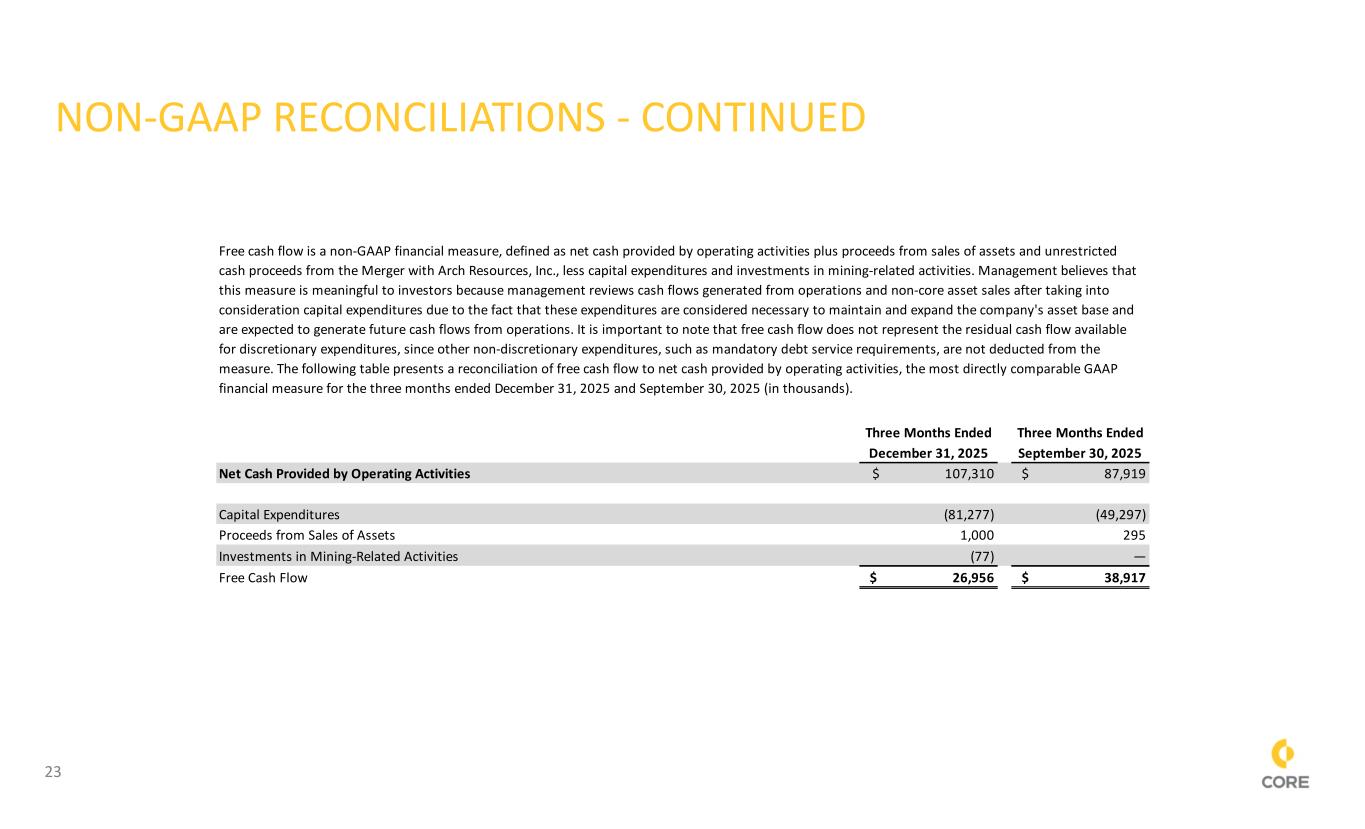
23 NON-GAAP RECONCILIATIONS - CONTINUED Three Months Ended Three Months Ended December 31, 2025 September 30, 2025 Net Cash Provided by Operating Activities $ 107,310 $ 87,919 Capital Expenditures (81,277) (49,297) Proceeds from Sales of Assets 1,000 295 Investments in Mining-Related Activities (77) — Free Cash Flow $ 26,956 $ 38,917 Free cash flow is a non-GAAP financial measure, defined as net cash provided by operating activities plus proceeds from sales of assets and unrestricted cash proceeds from the Merger with Arch Resources, Inc., less capital expenditures and investments in mining-related activities. Management believes that this measure is meaningful to investors because management reviews cash flows generated from operations and non-core asset sales after taking into consideration capital expenditures due to the fact that these expenditures are considered necessary to maintain and expand the company's asset base and are expected to generate future cash flows from operations. It is important to note that free cash flow does not represent the residual cash flow available for discretionary expenditures, since other non-discretionary expenditures, such as mandatory debt service requirements, are not deducted from the measure. The following table presents a reconciliation of free cash flow to net cash provided by operating activities, the most directly comparable GAAP financial measure for the three months ended December 31, 2025 and September 30, 2025 (in thousands).
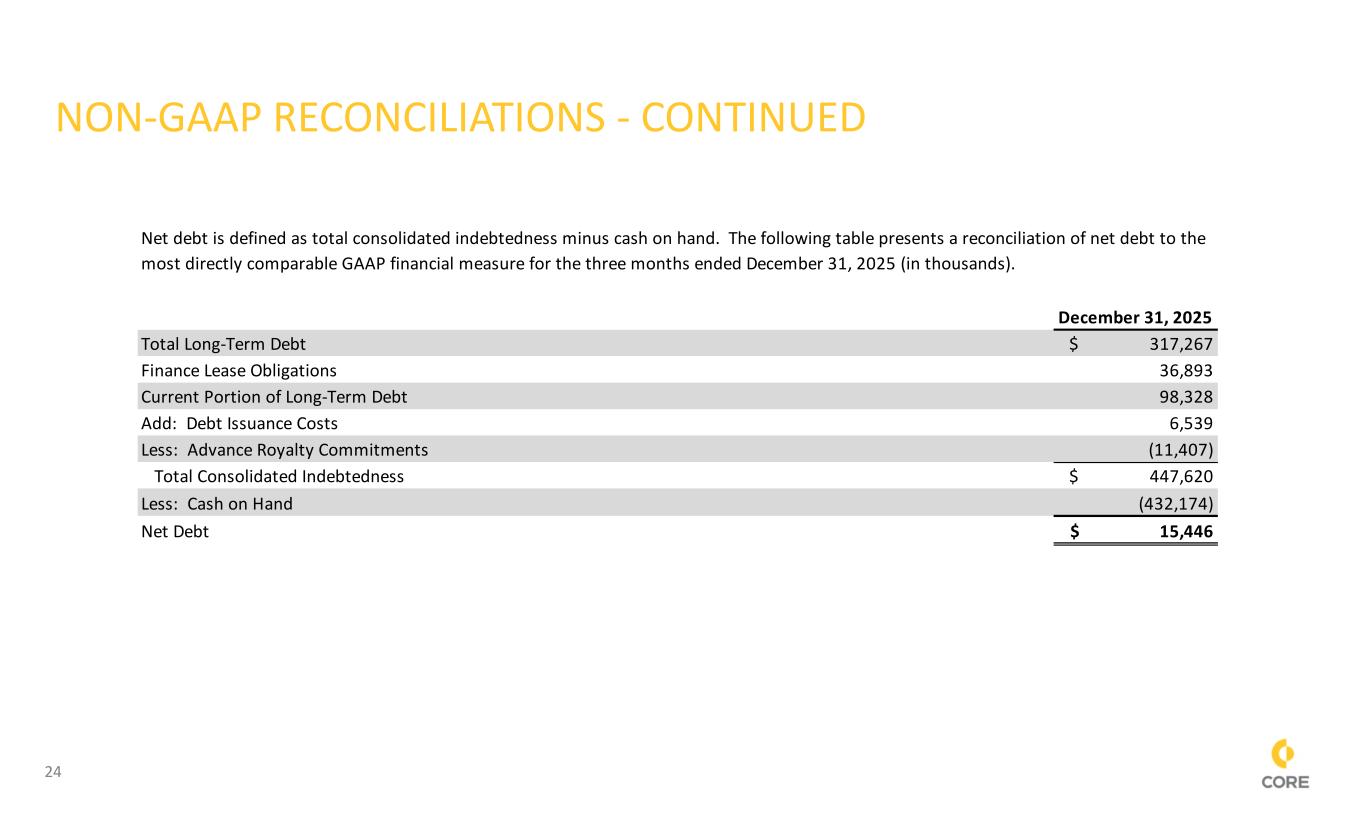
24 NON-GAAP RECONCILIATIONS - CONTINUED December 31, 2025 Total Long-Term Debt $ 317,267 Finance Lease Obligations 36,893 Current Portion of Long-Term Debt 98,328 Add: Debt Issuance Costs 6,539 Less: Advance Royalty Commitments (11,407) Total Consolidated Indebtedness $ 447,620 Less: Cash on Hand (432,174) Net Debt $ 15,446 Net debt is defined as total consolidated indebtedness minus cash on hand. The following table presents a reconciliation of net debt to the most directly comparable GAAP financial measure for the three months ended December 31, 2025 (in thousands).