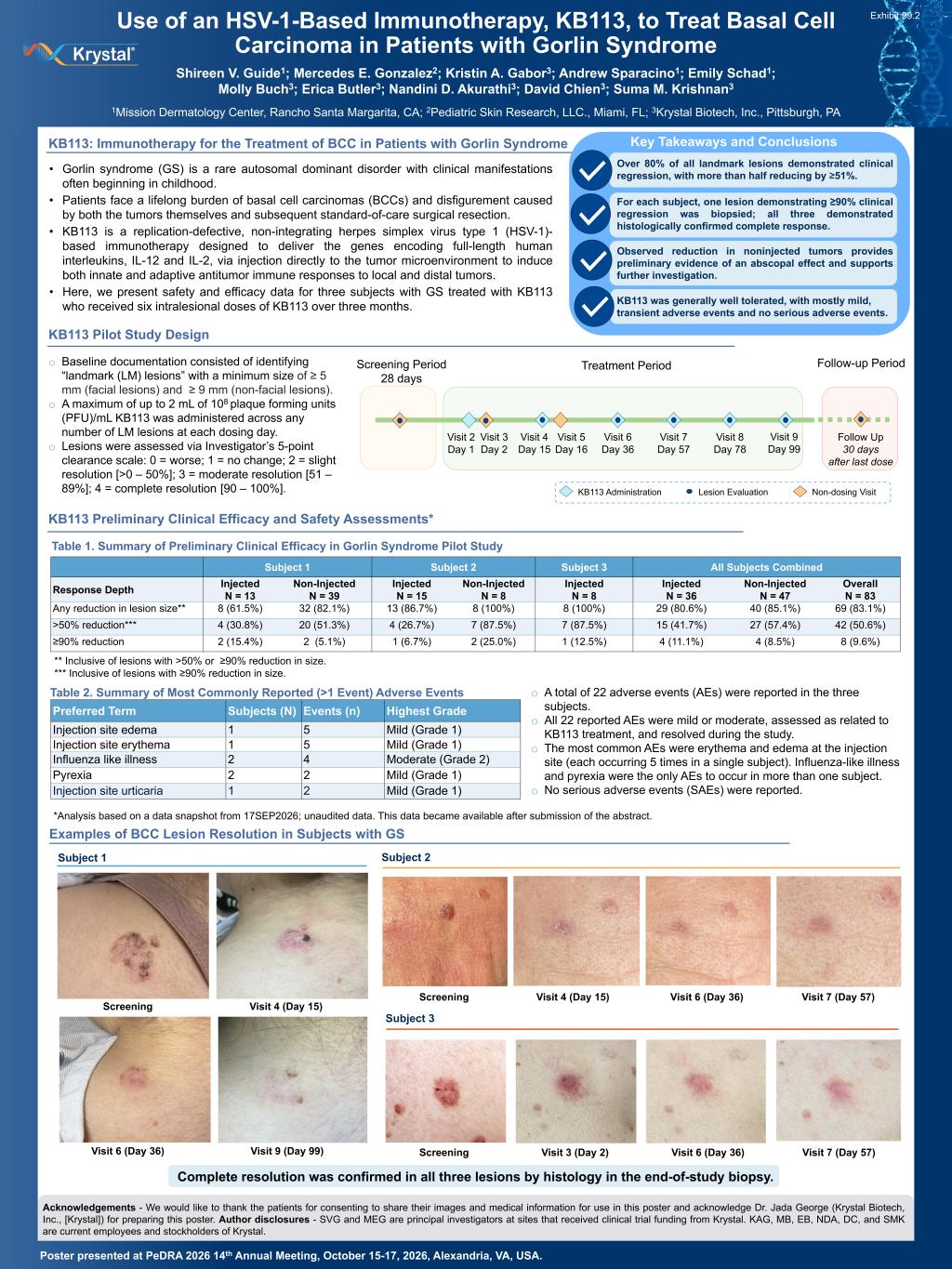
Use of an HSV-1-Based Immunotherapy, KB113, to Treat Basal Cell Carcinoma in Patients with Gorlin Syndrome Shireen V. Guide1; Mercedes E. Gonzalez2; Kristin A. Gabor3; Andrew Sparacino1; Emily Schad1; Molly Buch3; Erica Butler3; Nandini D. Akurathi3; David Chien3; Suma M. Krishnan3 1Mission Dermatology Center, Rancho Santa Margarita, CA; 2Pediatric Skin Research, LLC., Miami, FL; 3Krystal Biotech, Inc., Pittsburgh, PA Poster presented at PeDRA 2026 14th Annual Meeting, October 15-17, 2026, Alexandria, VA, USA. KB113: Immunotherapy for the Treatment of BCC in Patients with Gorlin Syndrome • Gorlin syndrome (GS) is a rare autosomal dominant disorder with clinical manifestations often beginning in childhood. • Patients face a lifelong burden of basal cell carcinomas (BCCs) and disfigurement caused by both the tumors themselves and subsequent standard-of-care surgical resection. • KB113 is a replication-defective, non-integrating herpes simplex virus type 1 (HSV-1)- based immunotherapy designed to deliver the genes encoding full-length human interleukins, IL-12 and IL-2, via injection directly to the tumor microenvironment to induce both innate and adaptive antitumor immune responses to local and distal tumors. • Here, we present safety and efficacy data for three subjects with GS treated with KB113 who received six intralesional doses of KB113 over three months. Subject 1 Screening Visit 4 (Day 15) Visit 6 (Day 36) Visit 9 (Day 99) Subject 3 Visit 3 (Day 2)Screening Visit 6 (Day 36) Visit 7 (Day 57) KB113 Administration Lesion Evaluation Non-dosing Visit Acknowledgements - We would like to thank the patients for consenting to share their images and medical information for use in this poster and acknowledge Dr. Jada George (Krystal Biotech, Inc., [Krystal]) for preparing this poster. Author disclosures - SVG and MEG are principal investigators at sites that received clinical trial funding from Krystal. KAG, MB, EB, NDA, DC, and SMK are current employees and stockholders of Krystal. Subject 2 Screening Visit 4 (Day 15) Visit 6 (Day 36) Visit 7 (Day 57) KB113 Preliminary Clinical Efficacy and Safety Assessments* Examples of BCC Lesion Resolution in Subjects with GS Table 2. Summary of Most Commonly Reported (>1 Event) Adverse Events Table 1. Summary of Preliminary Clinical Efficacy in Gorlin Syndrome Pilot Study o A total of 22 adverse events (AEs) were reported in the three subjects. o All 22 reported AEs were mild or moderate, assessed as related to KB113 treatment, and resolved during the study. o The most common AEs were erythema and edema at the injection site (each occurring 5 times in a single subject). Influenza-like illness and pyrexia were the only AEs to occur in more than one subject. o No serious adverse events (SAEs) were reported. o Baseline documentation consisted of identifying “landmark (LM) lesions” with a minimum size of ≥ 5 mm (facial lesions) and ≥ 9 mm (non-facial lesions). o A maximum of up to 2 mL of 108 plaque forming units (PFU)/mL KB113 was administered across any number of LM lesions at each dosing day. o Lesions were assessed via Investigator’s 5-point clearance scale: 0 = worse; 1 = no change; 2 = slight resolution [>0 – 50%]; 3 = moderate resolution [51 – 89%]; 4 = complete resolution [90 – 100%]. Key Takeaways and Conclusions Over 80% of all landmark lesions demonstrated clinical regression, with more than half reducing by ≥51%. Observed reduction in noninjected tumors provides preliminary evidence of an abscopal effect and supports further investigation. For each subject, one lesion demonstrating ≥90% clinical regression was biopsied; all three demonstrated histologically confirmed complete response. KB113 was generally well tolerated, with mostly mild, transient adverse events and no serious adverse events. ** Inclusive of lesions with >50% or ≥90% reduction in size. *** Inclusive of lesions with ≥90% reduction in size. KB113 Pilot Study Design Subject 1 Subject 2 Subject 3 All Subjects Combined Response Depth Injected N = 13 Non-Injected N = 39 Injected N = 15 Non-Injected N = 8 Injected N = 8 Injected N = 36 Non-Injected N = 47 Overall N = 83 Any reduction in lesion size** 8 (61.5%) 32 (82.1%) 13 (86.7%) 8 (100%) 8 (100%) 29 (80.6%) 40 (85.1%) 69 (83.1%) >50% reduction*** 4 (30.8%) 20 (51.3%) 4 (26.7%) 7 (87.5%) 7 (87.5%) 15 (41.7%) 27 (57.4%) 42 (50.6%) ≥90% reduction 2 (15.4%) 2 (5.1%) 1 (6.7%) 2 (25.0%) 1 (12.5%) 4 (11.1%) 4 (8.5%) 8 (9.6%) Complete resolution was confirmed in all three lesions by histology in the end-of-study biopsy. Visit 2 Day 1 Visit 3 Day 2 Visit 4 Day 15 Visit 5 Day 16 Visit 6 Day 36 Visit 7 Day 57 Visit 8 Day 78 Visit 9 Day 99 Follow Up 30 days after last dose Treatment PeriodScreening Period 28 days Follow-up Period Preferred Term Subjects (N) Events (n) Highest Grade Injection site edema 1 5 Mild (Grade 1) Injection site erythema 1 5 Mild (Grade 1) Influenza like illness 2 4 Moderate (Grade 2) Pyrexia 2 2 Mild (Grade 1) Injection site urticaria 1 2 Mild (Grade 1) *Analysis based on a data snapshot from 17SEP2026; unaudited data. This data became available after submission of the abstract. .2