Please wait
ANNUAL INFORMATION FORM
FOR HYDRO ONE LIMITED
FOR THE YEAR ENDED DECEMBER 31, 2025
February 13, 2026
TABLE OF CONTENTS
GLOSSARY
When used in this annual information form, the following terms have the meanings set forth below unless expressly indicated otherwise:
“$” or “dollar” means Canadian dollars, unless otherwise indicated.
“1.41% Notes” means the October 2020 offering of $425 principal amount of 1.41% notes due October 15, 2027.
“2017 Long-Term Energy Plan” has the meaning given to it under “The Electricity Industry in Ontario – Issues Affecting the Electricity Industry Generally – Ontario 2017 Long-Term Energy Plan”.
“2020 Ontario Budget” has the meaning given to it under “The Electricity Industry in Ontario – Issues Affecting the Electricity Industry Generally – OEB Actions on Electricity Pricing”.
“2023 Framework” has the meaning given to it under “General Development of the Business – Chronological Development of the Business – 2023 – 2023 Sustainable Financing Framework”.
“2024 Framework” has the meaning given to it under “General Development of the Business – Chronological Development of the Business – 2024 – 2024 Sustainable Financing Framework”.
“2024 HOI MTN Shelf Prospectus” has the meaning given to it under “General Development of the Business – Chronological Development of the Business – 2024 – 2024 MTN Shelf Prospectus”.
“2024 HOL Shelf Prospectus” has the meaning given to it under “General Development of the Business – Chronological Development of the Business – 2024 – 2024 HOL Universal Base Shelf Prospectus”.
“2024 HOHL U.S. Debt Prospectus” has the meaning given to it under “General Development of the Business – Chronological Development of the Business – 2024 – 2024 U.S. Debt Shelf Prospectus”.
“2025-2036 Framework” has the meaning given to it under “Business of Hydro One – Transmission Business Segment – Regulation – Recent Distribution Rate Applications – Conservation and Demand Management”.
“Addendum” has the meaning given to it under “The Electricity Industry in Ontario – Issues Affecting the Electricity Industry Generally – Ontario Integrated Energy Plan”.
“Affordable Energy Act” means the Affordable Energy Act, 2024, S.O. 2024, c. 26 - Bill 214.
“Annual MD&A” means the management’s discussion and analysis for Hydro One Limited for the years ended December 31, 2025 and 2024 filed on SEDAR+ under Hydro One Limited’s profile at www.sedarplus.com.
“Auditor General Act” means the Auditor General Act, RSO 1990, c A-35.
“B2M LP” means B2M Limited Partnership.
“Board” means the Board of Directors of Hydro One Limited.
“Building Broadband Faster Act” means the Building Broadband Faster Act, 2021, S.O. 2021, c. 2, Schedule 1.
“Canadian Energy Regulator Act” means the Canadian Energy Regulator Act, SC 2019, c 28, s 10.
“CDM” means conservation and demand management.
“CEO” means Chief Executive Officer.
“CFO” means Chief Financial Officer.
“Clean Electricity Regulations” means the Clean Electricity Regulations made under the Canadian Environmental Protection Act, 1999, S.C. 1999, c.33.
“CLLP” means Chatham x Lakeshore Limited Partnership.
“common shares” means the common shares in the capital of Hydro One Limited.
“control person” has the meaning given to it under applicable Canadian securities laws.
“CSO” has the meaning given to it under “Business of Hydro One – Employees”.
“Custom IR Method” has the meaning given to it under “Business of Hydro One – Transmission Business Segment – Regulation – Transmission Rate Setting”.
“CUSW” has the meaning given to it under “Business of Hydro One – Employees”.
“DBRS” has the meaning given to it under “Credit Ratings”.
“DERs” has the meaning given to it under “The Electricity Industry in Ontario – Regulation of Transmission and Distribution – Ontario Energy Board”.
“Dividend Reinvestment Plan” has the meaning given to it under “Dividends – Dividend Reinvestment Plan”.
“DMS” has the meaning given to it under “Business of Hydro One – Distribution Business Segment –Capital Expenditures”.
“eDSM” means electricity demand side management.
“Electricity Act” means the Electricity Act, 1998, SO 1998, c 15, Schedule A.
“Electricity Council” has the meaning given to it under “The Electricity Industry in Ontario – Issues Affecting the Electricity Industry Generally – Federal Initiatives”.
“Electrification and Energy Transition Panel” has the meaning given to it under “The Electricity Industry in Ontario – Issues Affecting the Electricity Industry Generally – Ontario 2017 Long-Term Energy Plan”.
“Energy Statute Law Amendment Act” means the Energy Statute Law Amendment Act, 2016, SO 2016,
c 10.
“Environmental Assessment Act” means the Environmental Assessment Act, RSO 1990, c E-18.
“EPSCA” has the meaning given to it under “Business of Hydro One – Employees”.
“ESG” means environmental, social and governance.
“Exemptive Relief” has the meaning given to it under “The Electricity Industry in Ontario – Exemptive Relief – U.S. GAAP”.
“Exposure Draft” has the meaning given to it under “The Electricity Industry in Ontario – Exemptive Relief – U.S. GAAP”.
“FCPA” means Fellow of the Institute of Chartered Professional Accountants.
“Financial Administration Act” means the Financial Administration Act, RSO 1990, c F-12.
“GHG” means greenhouse gas.
“Governance Agreement” means the governance agreement dated November 5, 2015 between Hydro One Limited and the Province, as amended and modified from time to time, including by the Waiver.
“GTA” means the Greater Toronto Area.
“HOHL” means Hydro One Holdings Limited, an indirect wholly-owned subsidiary of Hydro One Limited.
“HOHL Senior Debt Indenture” has the meaning given to it under “Material Contracts”.
“HOL Indenture” has the meaning given to it under “Material Contracts”.
“HOSSM” means Hydro One Sault Ste. Marie LP.
“Hydro One” or the “Company” have the meanings given to such terms set out under “Presentation of Information”.
“Hydro One Inc.” has the meaning given to it under “Presentation of Information”.
“Hydro One Limited” has the meaning given to it under “Presentation of Information”.
“Hydro One Networks” means Hydro One Networks Inc.
“Hydro One Remote Communities” means Hydro One Remote Communities Inc.
“IASB” means the International Accounting Standards Board.
“ICMA” has the meaning given to it under “General Development of the Business – Chronological Development of the Business – 2023 – 2023 Sustainable Financing Framework”.
“ICD.D” means the “Institute of Corporate Directors, Director” designation.
“IEP” has the meaning given to it under “The Electricity Industry in Ontario – Regulation of Transmission and Distribution – Ontario Energy Board”.
“IESO” means the Independent Electricity System Operator.
“ITC” means Investment Tax Credit.
“JRAP” has the meaning given to it under “Business of Hydro One – Transmission Business Segment –Regulation – Recent Transmission Rate Applications – Hydro One Networks”.
“kV” means kilovolt.
“kW” means kilowatt.
“Letter Agreement” means the agreement dated July 11, 2018 between Hydro One Limited and the Province.
“LSTA” has the meaning given to it under “General Development of the Business – Chronological Development of the Business – 2023 – 2023 Sustainable Financing Framework”.
“MAAD Application” means an application for a Merger, Amalgamation, Acquisition and Divestiture filed with the OEB.
“management” has the meaning given to it under “Presentation of Information”.
“Mandatory Rate-regulated Standard” has the meaning given to it under “The Electricity Industry in Ontario – Exemptive Relief – U.S. GAAP”.
“Market Rules” means the rules made under section 32 of the Electricity Act that are administered by the IESO.
“Minister of Energy” means the Minister of Energy, Northern Development and Mines for the Province, the Minister of Energy for the Province, the Minister of Energy and Electrification for the Province, or the Minister of Energy and Mines for the Province, as applicable at the relevant time.
“Ministry of Energy” means the Ministry of Energy and Electrification for the Province, or the Ministry of Energy and Mines for the Province, as applicable at the relevant time.
“National Energy Board Act” means the National Energy Board Act, RSC 1985, c N-7.
“NERC” means the North American Electric Reliability Corporation.
“Niagara Line” means the 230 kV transmission line in the Niagara region owned by NRLP.
“Non-Aggregated Holders” has the meaning given to it under “The Electricity Industry in Ontario –Exemptive Relief – Disclosure of Ownership by the Province”.
“NPCC” means the Northeast Power Coordinating Council, Inc.
“NRLP” means Niagara Reinforcement Limited Partnership.
“Nuclear Fuel Waste Act” means the Nuclear Fuel Waste Act, SC 2002, c 23.
“OBCA” means the Business Corporations Act, RSO 1990, c B-16.
“OEB” means the Ontario Energy Board.
“OEFC” means Ontario Electricity Financial Corporation.
“Ontario” or the “province” has the meaning given to it under “Presentation of Information”.
“Ontario Energy Board Act” means the Ontario Energy Board Act, 1998, SO 1998, c 15, Schedule B.
“Ontario’s Affordable Energy Future” has the meaning given to it under “The Electricity Industry in Ontario – Regulation of Transmission and Distribution – Ontario Energy Board ”.
“PCBs” means polychlorinated biphenyls.
“Price Cap IR” has the meaning given to it under “Business of Hydro One – Distribution Business Segment – Regulation – Distribution Rates”.
“Protect Ontario by Securing Affordable Energy for Generations Act” means Protect Ontario by Securing Affordable Energy for Generations Act, 2025, S.O. 2025, c. 22 - Bill 40.
“Protect Ontario by Unleashing our Economy Act” means the Protect Ontario by Unleashing our Economy Act, 2025, S.O. 2025, c. 4 - Bill 5.
“Province” has the meaning given to it under “Presentation of Information”.
“PULSE” has the meaning given to it under “The Electricity Industry in Ontario – Issues Affecting the Electricity Industry Generally – Ontario Integrated Energy Plan”.
“PWU” has the meaning given to it under “Business of Hydro One – Employees”.
“rate base” has the meaning given to it under “Presentation of Information”.
“rate-regulated” has the meaning given to it under “Rate-Regulated Utilities – Rate Applications in Ontario – Framework”.
“RBPPAG” has the meaning given to it under “Business of Hydro One – Transmission Business Segment – Regulation – Regional Planning”.
“Registration Rights Agreement” means the registration rights agreement dated November 5, 2015 between Hydro One Limited and the Province.
“Reliability Standards” has the meaning given to it under “Business of Hydro One – Transmission Business Segment – Regulation – Reliability Standards and Regulations for Transmission”.
“Removal Notice” has the meaning given to it under “Agreements with Principal Shareholder – Governance Agreement – Governance Matters – Election and Replacement of Directors – Province’s Right to Replace the Board”.
“Reserve” means a “reserve” as that term is defined in the Indian Act, RSC 1985, c I-5.
“return on equity” has the meaning given to it under “Presentation of Information”.
“revenue cap escalator factor” has the meaning given to it under “Business of Hydro One – Transmission Business Segment – Regulation – Recent Transmission Rate Applications – HOSSM”.
“Revenue Cap Index” has the meaning given to it under “Business of Hydro One – Transmission Business Segment – Regulation – Transmission Rate Setting”.
“ROE” has the meaning given to it under “Rate-Regulated Utilities – Rate Applications in Ontario – Framework”.
“RPP” has the meaning given to it under “The Electricity Industry in Ontario – Issues Affecting the Electricity Industry Generally – OEB Actions on Electricity Pricing”.
“RPPAG” has the meaning given to it under “Business of Hydro One – Transmission Business Segment – Regulation – Regional Planning”.
“RRF” means the performance-based model set out in the OEB’s Renewed Regulatory Framework for Electricity Distributors.
“RRRP” has the meaning given to it under “Business of Hydro One – Distribution Business Segment – Regulation – Recent Distribution Rate Applications – Hydro One Remote Communities”.
“S&P” has the meaning given to it under “Credit Ratings”.
“Series 1 preferred shares” means the Series 1 preferred shares in the capital of Hydro One Limited.
“Series 2 preferred shares” means the Series 2 preferred shares in the capital of Hydro One Limited.
“Share Ownership Restrictions” has the meaning given to it under “The Electricity Industry in Ontario – Legislative Provisions Specific to Hydro One – 10% Ownership Restriction”.
“Shares” has the meaning given to it under “Agreements with Principal Shareholder – Registration Rights Agreement – Demand Registration”.
“Society” has the meaning given to it under “Business of Hydro One – Employees”.
“Special Board Resolution” has the meaning given to it under “Agreements with Principal Shareholder – Governance Agreement – Governance Matters – Board Approvals Requiring a Special Resolution of the Directors”.
“Specified Provincial Entity” has the meaning given to it under “Agreements with Principal Shareholder – Governance Agreement – Governance Matters – Nomination of Directors – Independence”.
“Transmission System Code” means the OEB’s Transmission System Code.
“trust assets” has the meaning given to it under “Interest of Management and Others in Material
Transactions – Relationships with the Province and Other Parties – Transfer Orders”.
“TSF” means Transmitter Selection Framework.
“TS” means transformer station.
“TSX” means the Toronto Stock Exchange.
“TWh” means terawatt-hours.
“U.S.” means the United States of America.
“U.S. GAAP” means United States Generally Accepted Accounting Principles.
“uniform transmission rates” has the meaning given to it under “Business of Hydro One – Transmission Business Segment – Regulation – Transmission Rate Setting”.
“Voting Securities” means a security of Hydro One Limited carrying a voting right either under all circumstances or under some circumstances that have occurred and are continuing.
“Waiver” means the waiver and acknowledgement dated June 18, 2025 between Hydro One Limited and the Province.
PRESENTATION OF INFORMATION
Unless otherwise specified, all information in this annual information form is presented as at December 31, 2025.
Capitalized terms used in this annual information form are defined under “Glossary”. Words importing the singular number include the plural, and vice versa, and words importing any gender include all genders. The Annual MD&A is specifically incorporated by reference into and forms an integral part of this annual information form. A copy of this document has been filed with the Canadian securities regulatory authorities and is available on SEDAR+ under Hydro One Limited’s profile at www.sedarplus.com.
Unless otherwise noted or the context otherwise requires, references to “Hydro One” or the “Company” refer to Hydro One Limited and its subsidiaries taken together as a whole. References to “Hydro One Inc.” refer only to Hydro One Inc. and references to “Hydro One Limited” refer only to Hydro One Limited.
In addition, “Province” refers to the Province of Ontario as a provincial government entity, and “Ontario” or the “province” in lower case type refers to the Province of Ontario as a geographical area. References to “management” in this annual information form mean the persons who are identified as executive officers of Hydro One Limited and its subsidiaries, as applicable, in this annual information form. Any statements made by or on behalf of management are made in such persons’ respective capacities as executive officers of Hydro One Limited and its subsidiaries, as applicable, and not in their personal capacities. See “Directors and Officers” for more information.
This annual information form refers to certain terms commonly used in the electricity industry, such as “rate-regulated”, “rate base” and “return on equity”. Rate base is an amount that a utility is required to calculate for regulatory purposes, and refers to the net book value of the utility’s assets for regulatory purposes plus an allowance for working capital. Return on equity is a percentage that is set or approved by a utility’s regulator and represents the rate of return that a regulator allows the utility to earn on the equity component of the utility’s rate base. See also “Rate-Regulated Utilities”.
In this annual information form, all dollar amounts are expressed in Canadian dollars unless otherwise indicated. Hydro One Limited and Hydro One Inc. prepare and present their financial statements in accordance with U.S. GAAP.
FORWARD-LOOKING INFORMATION
Certain information in this annual information form contains “forward-looking information” within the meaning of applicable Canadian securities laws. Forward-looking information in this annual information form is based on current expectations, estimates, forecasts and projections about Hydro One’s business and the industry, and the regulatory and economic environments, in which Hydro One operates and includes beliefs of and assumptions made by management. Such statements include, but are not limited to, statements related to: the Company’s transmission and distribution rate applications, and resulting decisions, rates and impacts; expectations regarding future corporate strategies; expected impacts and timing of changes to the electricity industry; expected impacts of recent changes to legislation in Ontario impacting transmitters and distributors, including the Protect Ontario by Securing Affordable Energy for Generations Act on Hydro One and its operations; the Company’s expected engagement with IESO and industry and the government decision on potential competitive procurement projects; the expected advancement and construction of various transmission stations and transmission lines in connection with the Province’s first integrated energy plan and the target in-service dates; the Company’s maturing debt; expectations regarding the Company’s financing activities; credit ratings; ongoing and planned projects and/or initiatives; expected future capital investments and expenditures, the nature and timing of these investments and expenditures, including the Company’s plans for sustaining and development capital expenditures for its distribution and transmission systems; the Company’s expected capital expenditures relating to its distribution business from 2026 to 2027; expectations related to the TSF, including consultations, reports, requirements, and implementation; expectations regarding allowed return on equity; expectations regarding the ability of the Company to recover expenditures in future rates; expectations regarding the timing and outcome of the Z-Factor application filed with the OEB; expectations regarding the ability to negotiate collective agreements consistent with rate orders; expectations related to work force demographics; the Company’s focus on health, safety and environmental management; expectations regarding taxes; expectations regarding load growth; the regional planning process; expectations related to Hydro One’s CDM requirements and targets; new legislation and regulatory initiatives relating to the electricity industry and the expected impacts of such; expectations regarding the Company’s DMS; the Company’s customer focus and related initiatives; the potential impacts of the Exposure Draft; the Company’s status as an SEC issuer; statements related to the Company’s relationships with Indigenous communities; statements related to environmental matters, and the Company’s expected future environmental, expected land assessment and remediation expenditures and the Company’s ability to recover such costs; statements related to the Company’s commitment to releasing an annual sustainability report and to improve the quality of its ESG disclosures; statements relating to the Company’s plans to issue sustainable financing instruments, such as sustainable and green bonds, and to allocate the net proceeds to investments in eligible green and social project categories; statements relating to the Company’s intention to provide annual updates regarding the use of net proceeds of any green and/or sustainable financing; cyber and data security; the Company’s relationship with the Province; future sales of shares of Hydro One Limited; expectations regarding the Company’s capital program to modernize the smart metering infrastructure and implementation through 2029; acquisitions and consolidation opportunities and other strategic initiatives; expectations regarding the Governance Agreement and other agreements with the Province; the status of litigation; expectations
regarding the manner in which Hydro One will operate and the Company’s strategy; expectations regarding Hydro One’s dividend policy and the Company’s intention to declare and pay dividends, including the target payout ratio of 60% to 70% of net earnings; potential conflicts of interest; and legal proceedings in which Hydro One is currently involved.
Words such as “aim”, “could”, “would”, “expect”, “anticipate”, “intend”, “attempt”, “may”, “plan”, “will”, “believe”, “seek”, “estimate”, “goal”, “target”, and variations of such words and similar expressions are intended to identify such forward-looking information. These statements are not guarantees of future performance and involve assumptions and risks and uncertainties that are difficult to predict. Therefore, actual outcomes and results may differ materially from what is expressed, implied or forecasted in such forward-looking information. Hydro One does not intend, and it disclaims any obligation to update any forward-looking information, except as required by law.
The forward-looking information in this annual information form is based on a variety of factors and assumptions including, but not limited to: no unforeseen changes in the legislative and operating framework for Ontario’s electricity market; favourable decisions from the OEB and other regulatory bodies concerning outstanding and future rate and other applications; no unexpected delays in obtaining required regulatory approvals; no unforeseen changes in rate orders or rate setting methodologies for Hydro One’s distribution and transmission businesses; no unfavourable changes in environmental regulation; continued use of U.S. GAAP; a stable regulatory environment; no significant changes to the Company’s current credit ratings; no unforeseen impacts of new accounting pronouncements; no changes to expectations regarding electricity consumption; no unforeseen changes to economic and market conditions; completion of operating and capital projects that have been deferred; and no significant event occurring outside the ordinary course of business. These assumptions are based on information currently available to Hydro One, including information obtained from third-party sources. Actual results may differ materially from those predicted by such forward-looking information. While Hydro One does not know what impact any of these differences may have, Hydro One’s business, results of operations, financial condition and credit stability may be materially adversely affected if any such differences occur. Factors that could cause actual results or outcomes to differ materially from the results expressed or implied by forward-looking information include, among other things:
•regulatory risks and risks relating to Hydro One’s revenues, including risks relating to actual performance against forecasts, competition with other transmitters and other applications to the OEB, the rate-setting models for transmission and distribution, the recoverability of capital expenditures, obtaining rate orders or recoverability of total compensation costs;
•risks associated with the Province’s share ownership of Hydro One and other relationships with the Province, including potential conflicts of interest that may arise between Hydro One, the Province and related parties, risks associated with the Province’s exercise of further legislative and regulatory powers, risks relating to the ability of the Company to attract and retain qualified executive talent or the risk of a credit rating
downgrade for the Company and its impact on the Company’s funding and liquidity;
•risks relating to the location of the Company’s assets on Reserve lands, that the Company’s operations and activities may give rise to the Crown’s duty to consult and potentially accommodate Indigenous communities, and the risk that Hydro One may incur significant costs associated with transferring assets located on Reserves;
•the risk that the Company may be unable to comply with regulatory and legislative requirements or that the Company may incur additional costs for compliance that are not recoverable through rates;
•the risk of exposure of the Company’s facilities to the effects of severe weather conditions, natural disasters, man-made events or other unexpected occurrences for which the Company is uninsured or for which the Company could be subject to claims for damage;
•risks associated with information system security and maintaining complex information technology and operational technology system infrastructure, including system failures or risks of cyber-attacks or unauthorized access to corporate information technology and operational technology systems;
•the risk of non-compliance with environmental regulations and inability to recover environmental expenditures in rate applications and the risk that assumptions that form the basis of the Company’s recorded environmental liabilities and related regulatory assets may change;
•the risk of labour disputes and inability to negotiate or renew appropriate collective agreements on acceptable terms consistent with the Company’s rate orders;
•the risk that the Company may not be able to execute plans for capital projects necessary to maintain the performance of the Company’s assets or to carry out projects in a timely manner or the risk of increased competition for the development of large transmission projects or legislative changes affecting the selection of transmitters;
•risks associated with asset condition, capital projects and innovation, including public opposition to or delays or denials of the requisite approvals and accommodations for the Company’s planned projects;
•risks related to the Company’s work force demographic and its potential inability to attract and retain qualified personnel;
•the risk that the Company is not able to arrange sufficient cost-effective financing to
repay maturing debt and to fund capital expenditures, the risk of a downgrade in the Company’s credit ratings or risks associated with investor interest in ESG performance and reporting;
•risks associated with fluctuations in interest rates and failure to manage exposure to credit and financial instrument risk;
•risks associated with economic uncertainty and financial market volatility;
•the risk of failure to mitigate significant health and safety risks;
•the risk of not being able to recover the Company’s pension expenditures in future rates and uncertainty regarding the future regulatory treatment of pension, other post-employment benefits and post-retirement benefits costs;
•the impact of the ownership by the Province of lands underlying the Company’s transmission system;
•the risk associated with legal proceedings that could be costly, time-consuming or divert the attention of management and key personnel from the Company’s business operations;
•the impact if the Company does not have valid occupational rights on third-party owned or controlled lands and the risks associated with occupational rights of the Company that may be subject to expiry;
•risks relating to adverse reputational events or political actions relating to Hydro One and the electricity industry;
•the potential that Hydro One may incur significant expenses to replace functions currently outsourced if agreements are terminated or expire before a new service provider is selected;
•risks relating to acquisitions, including the failure to realize the anticipated benefits of such transactions at all, or within the time periods anticipated, and unexpected costs incurred in relation thereto;
•the inability to continue to prepare financial statements using U.S. GAAP; and
•the risk related to the impact of any new accounting pronouncements.
Hydro One cautions the reader that the above list of factors is not exhaustive. Some of these and other factors are discussed in more detail under the heading “Risk Management and Risk Factors” in the
Annual MD&A. You should review such section in detail, including the matters referenced therein.
In addition, Hydro One cautions the reader that information provided in this annual information form regarding Hydro One’s outlook on certain matters, including potential future expenditures, is provided in order to give context to the nature of some of Hydro One’s future plans and may not be appropriate for other purposes.
ELECTRICITY INDUSTRY OVERVIEW
General Overview
The electricity industry is made up of businesses that generate, transmit, distribute and sell electricity. While traditionally a mature and stable industry, the electricity industry is facing rapid and dramatic technological change and increasing innovation. Hydro One’s business is focused on the transmission and distribution of electricity.
•Transmission refers to the delivery of electricity over high voltage lines, typically over long distances, from generating stations to local areas and large industrial customers.
•Distribution refers to the delivery of electricity over low voltage lines to end users such as homes, businesses and institutions.
Overview of an Electricity System
The basic configuration of a typical electricity system, showing electricity generation, transmission and distribution, is illustrated in the following diagram:
Note:
The above image shows a typical electricity system with transmission-connected generation.
Transmission and distribution networks are sometimes referred to as the “electricity grid” or simply “the grid”.
THE ELECTRICITY INDUSTRY IN ONTARIO
Regulation of Transmission and Distribution
General
The Electricity Act and the Ontario Energy Board Act establish the general legislative framework for Ontario’s electricity market. The activities of transmitters and distributors in Ontario are overseen by three main regulatory authorities: (i) the OEB, (ii) the IESO, and (iii) the Canada Energy Regulator. The Minister of Energy is responsible for developing integrated energy plans and has the power to issue directives to the IESO and the OEB regarding implementation of such plans.
Ontario Energy Board
The OEB is an independent regulatory agency. The Ontario Energy Board Act provides the OEB with the authority to regulate Ontario’s electricity market, including the activities of transmitters and distributors.
The OEB has the following legislated objectives in relation to the electricity industry:
•to inform consumers and protect their interests with respect to prices and the adequacy, reliability and quality of electricity service,
•to promote economic efficiency and cost effectiveness in the generation, transmission, distribution, sale and demand management of electricity and to facilitate the maintenance of a financially viable electricity industry,
•to regulate the electricity sector in a manner that supports economic growth, consistent with the policies of the Province,
•to promote electricity conservation and demand management in a manner consistent with the policies of the Province, including having regard to the consumer’s economic circumstances, and
•to facilitate innovation in the electricity sector.
The OEB is responsible for, among other things, approving transmission and distribution rates in Ontario. It also approves the construction, expansion, or reinforcement of transmission lines greater than two kilometres in length, as well as mergers, acquisitions, amalgamations and divestitures involving distributors, transmitters and other entities which it licenses. The activities of transmitters and distributors are subject to the conditions of their licences and a number of industry codes issued by the OEB. These codes and other requirements prescribe minimum standards of conduct and service for licensed participants in the electricity market.
In January 2023, the OEB released its Framework for Energy Innovation: Setting a Path Forward for DER Integration report. This report is the culmination of the OEB’s Framework for Energy Innovation: Distributed Resources and Utility Incentives consultation and sets out the OEB’s policies and next steps with respect to the integration of distributed energy resources (“DERs”) into distribution system planning and operations, as well as the use of DERs by electricity distributors as non-wires alternatives. In April 2023, the OEB released an Energy Transition Roadmap as part of its 2023-26 Business Plan that provides a schedule of initiatives the OEB is taking or plans to undertake with respect to the energy transition. The Energy Transition Roadmap is intended to provide clarity on the OEB’s priorities, support the coordination of interrelated initiatives within the OEB and across the sector and support effective stakeholder engagement.
In June 2025, the Ministry of Energy issued a letter of direction to the OEB regarding the implementation of the Province’s Integrated Energy Plan (“IEP”), including in support of planning for growth and electrification, streamlining transmission connections and advancing the Province’s objectives relating to DERs. The OEB has since initiated a number of policy consultations in response to the letter of direction, including: Distribution Customer Connections Review, Streamlining Transmission Connections, Regional and Bulk Electricity System Planning Process Review, Review of the Valuation of Distributed Energy Resources, and Gas-Electric Co-ordination and Information Sharing. In December 2025, the OEB submitted to the Minister a Distribution System Operator roadmap for the potential development and implementation of Distribution System Operator capabilities, which is expected to inform further OEB-led Distribution System Operator consultations and working groups in 2026.
In December 2025, the Minister of Energy issued a letter of direction to the OEB, which included the Minister of Energy’s priorities and expectations for the OEB over the next three years. The initiatives identified include continuing to implement the IEP, supporting the work of the PULSE, advancing work to review the utility remuneration framework, investing in growth to improve last mile connections, and supporting distribution sector reliability, security, and resilience.
See also “The Electricity Industry in Ontario – Issues Affecting the Electricity Industry Generally – Ontario 2017 Long-Term Energy Plan” and “The Electricity Industry in Ontario – Issues Affecting the Electricity Industry Generally – Ontario Integrated Energy Plan”.
IESO
The IESO delivers key services across the electricity sector, including managing the power system in real time, planning for Ontario’s future energy needs, enabling conservation and designing a more efficient electricity marketplace to support sector evolution. Transmitters and other wholesale market participants must comply with the Market Rules issued by the IESO. The Market Rules require transmitters to comply with mandatory North American reliability standards for transmission issued by the NERC and the NPCC. The IESO enforces these reliability standards and coordinates with system operators and reliability agencies in other jurisdictions to ensure energy adequacy and security across the interconnected bulk electricity system in North America.
In December 2022, the IESO released its Pathways to Decarbonization report in response to the Minister of Energy’s request to evaluate a moratorium on new natural gas generation in Ontario, and to develop an achievable pathway to decarbonization in the electricity system.
In November 2023, the IESO launched an engagement initiative on the development of a TSF. The TSF is consistent with the IESO’s Pathways to Decarbonization report that recommends building on existing actions to ensure Ontario is positioned to build the electricity generation, storage and transmission necessary to maintain a reliable, affordable and clean electricity system and power the province’s growth beyond 2030. In October 2024, following the release of the Powering Ontario’s Growth report and in response to a July 2023 letter of direction from the Minister of Energy, the IESO released updates on its engagement initiative for the TSF. The industry engagement continued in 2025 and the IESO launched the TSF registry on July 31, 2025. Hydro One continues to engage with IESO and industry and is awaiting the Province’s decision on potential projects that may be considered for competitive procurement. In January 2026, the Province announced that they are proposing the IESO launch a competitive transmission selection process to select a transmitter to build a new electricity transmission line from the Darlington Nuclear Generating Station to downtown Toronto, to help address capacity constraints in Toronto. See “Business of Hydro One – Transmission Business Segment – Competitive Conditions” for more information.
In October 2024, the IESO released a new demand forecast showing that Ontario’s electricity demand is anticipated to grow by 75% by 2050, driven by a series of factors, including growth in the industrial sector, ongoing electrification and data centres looking to connect to the grid. See also “The Electricity Industry in Ontario – Issues Affecting the Electricity Industry Generally – Ontario 2017 Long-Term Energy Plan” and “The Electricity Industry in Ontario – Ontario Integrated Energy Plan” for more information.
In June 2025, the Ministry of Energy issued a letter of direction to the IESO regarding the implementation of the Province’s Integrated Energy Plan, including in support of planning for growth and electrification, streamlining transmission connections and advancing the Province’s objectives relating to DERs.
Canada Energy Regulator
In August 2019, the Canadian Energy Regulator Act came into force, replacing the National Energy Board Act. As a result of the new statute, the National Energy Board became the Canada Energy Regulator. Any decision or order made by the National Energy Board is considered to have been made under the Canadian Energy Regulator Act and may be enforced as such.
The Canada Energy Regulator has jurisdiction over the construction and operation of international power lines, as well as interprovincial lines that are designated as being under federal jurisdiction (of which there are currently none). As Hydro One owns and operates 11 active international power lines connecting Ontario’s transmission system with transmission systems in Michigan, Minnesota and New York, Hydro
One holds several certificates and permits with the Canada Energy Regulator.
Transmission
Transmission companies own and operate transmission systems that deliver electricity over high voltage lines. Hydro One owns and operates a transmission system that accounts for approximately 91% of Ontario’s transmission capacity, based on the network component of the revenue requirement1 approved by the OEB.2 The Company’s transmission system is interconnected to systems in Manitoba, Michigan, Minnesota, New York and Quebec and is part of the North American electricity grid’s Eastern Interconnection. The Eastern Interconnection is a contiguous electricity transmission system that extends from Manitoba to Florida and from east of the Rocky Mountains to the North American east coast. Being part of the Eastern Interconnection provides benefits to Ontario, such as greater security and stability for Ontario’s transmission system, emergency support when there are generation constraints or shortages in Ontario, and the ability to exchange electricity with other jurisdictions.
Distribution
Distributors own and operate distribution systems that deliver electricity over power lines at voltages of 50 kV or less to end users. A local distribution company is responsible for distributing electricity to customers in its OEB-licensed service territory, and in some cases to other distributors. A service territory may cover large portions or all of a particular municipality, or an otherwise defined geographic area. Distribution customers include homes, commercial and industrial businesses and institutions such as governments, schools and hospitals.
In Ontario, as per the OEB’s annual data on electricity distributors, as at December 31, 2024, 53 local distribution companies provided electricity to approximately 5.5 million customers. The distribution industry in Ontario is fragmented, with the 10 largest local distribution companies accounting for approximately 82% of the province’s customers.
Through its wholly-owned subsidiary, Hydro One Inc., Hydro One owns the largest local distribution business in Ontario, which serves approximately 1.5 million predominantly rural customers, or approximately 27% of the total number of customers in Ontario.
1 The network component of the revenue requirement is Hydro One’s portion of the transmission revenue requirement attributed to assets that are used for the common benefit of all Hydro One and non-Hydro One customers in the province.
2 Hydro One owns and operates approximately 94% of the transmission system in Ontario based on the total OEB approved revenue requirement.
Issues Affecting the Electricity Industry Generally
Tax Incentives
Tax incentives introduced in the 2015 Ontario budget to promote consolidation in the electricity distribution sector, reduced the tax rate for transfers of electricity assets from 33% to 22% and to nil for municipal electricity utilities with fewer than 30,000 customers. In addition, the budget introduced a capital gains exemption where capital gains arise as a result of exiting the payments in lieu of corporate taxes regime. These incentives are in place until December 31, 2028, with an additional temporary reduction of the tax rate for transfers from 22% to nil for municipal electricity utilities with 30,000 customers or more, effective from January 1, 2025 to December 31, 2028.
Ontario 2017 Long-Term Energy Plan
In October 2017, the Province released its 2017 Long-Term Energy Plan (the “2017 Long-Term Energy Plan”), which set out a number of initiatives for Ontario’s energy system. The IESO and the OEB developed implementation plans in support of the objectives of the 2017 Long-Term Energy Plan, and each implementation plan was approved by the Minister of Energy in February 2018.
In 2022, the Province established the Electrification and Energy Transition Panel (the “Electrification and Energy Transition Panel”). This panel was responsible for advising the Province on the highest value short, medium, and long-term opportunities for the energy sector to help Ontario’s economy prepare for electrification and the energy transition. The Electrification and Energy Transition Panel also identified opportunities to strengthen Ontario’s long-term energy planning process by better coordinating the fuels and the electricity sector. In 2023, the Electrification and Energy Transition Panel invited stakeholders, Indigenous partners and the public to provide written advice on five themes related to energy transition and electrification. These engagements assisted the Electrification and Energy Transition Panel in preparing its report, which was released in January 2024.
In December 2024, the Affordable Energy Act amended various statutes, providing a legislative framework to replace the Province’s long-term energy plans with integrated energy plans. See “The Electricity Industry in Ontario – Issues Affecting the Electricity Industry Generally – Ontario Integrated Energy Plan” for more information.
Ontario Integrated Energy Plan
In January 2024, the Electrification and Energy Transition Panel, an advisory body to the Province, released its report outlining a roadmap for Ontario’s transition to a clean energy economy. In October 2024, the Province released its vision for Ontario’s energy sector, Ontario’s Affordable Energy Future, outlining key objectives to meet growing electricity demand in Ontario. This vision was intended to help guide the Province’s first integrated energy plan, among other initiatives. In December 2024, the Affordable Energy Act amended various statutes, including the Electricity Act and the Ontario Energy
Board Act, providing a legislative framework to replace the Province’s long-term energy plans (including the 2017 Long-Term Energy Plan), with integrated energy plans. Integrated energy plans are expected to detail actions and policy steps to build an affordable, reliable and clean energy system over the long term. Whereas the focus of the long-term energy plan had been primarily on the electricity system, the integrated energy plan is intended to address all sources of energy. The amendments effected by the Affordable Energy Act also allow the Minister, subject to the approval of the Lieutenant Governor in Council, to issue directives to the IESO and OEB setting out implementation requirements relating to the integrated energy plan. From October to December 2024, the Ministry of Energy ran a consultation requesting feedback to assist the Province in developing its first plan.
The changes made by the Affordable Energy Act to the Ontario Energy Board Act, among other things, also provide the Province with the ability to make regulations specifying amendments to the Distribution System Code and the Transmission System Code in relation to certain cost allocation and cost recovery matters relating to the construction, expansion or reinforcement of distribution systems or transmission systems, or of connections to those systems. The changes made by the Affordable Energy Act also allow regulations to be made exempting persons or things from provisions of the Distribution System Code and the Transmission System Code relating to cost allocation or cost recovery, as well as alternative provisions that apply instead.
In June 2025, the Province released its first integrated energy plan, Energy for Generations (“IEP”), which aims to leverage electricity, natural gas, hydrogen, storage and other energy sources to provide Ontario with affordable, secure, reliable and clean energy to power growth and jobs across the province. The IEP establishes a planning horizon out to 2050, including the acceleration of the development of transmission infrastructure and the modernization of the distribution grid. As part of the IEP, the Province announced the advancement of several transmission projects. See “Business of Hydro One – Transmission Business Segment – Business – Hydro One Transmission Projects Under the Integrated Energy Plan” for more information.
In July 2025, the IESO announced the launch of the TSF registry. Registration enables transmitters to participate in future competitive IESO transmission procurements.
In October 2025, the Province announced the launch of the Panel for Utility Leadership and Service Excellence (“PULSE”), a strategic advisory group that will support the objectives of the IEP and provide recommendations to the Province on how to best fund and deliver the next generation of electricity infrastructure. The Panel will provide strategic advice and recommendations to the Province on how to ensure local distribution companies are positioned to meet increasing electricity demand while maintaining high standards of safety, reliability, and cost-effectiveness.
OEB Actions on Electricity Pricing
Since March 2020, the Province has taken a number of actions related to the pricing of electricity to support regulated price plan (“RPP”) customers, following the COVID-19 pandemic. These government-
mandated actions include providing different fixed electricity prices for various periods of time. In response to direction provided by the Province, in September 2020 the OEB announced that, as of October 13, 2020, all utilities were required to give RPP customers the choice to opt out of time-of-use pricing and to elect instead to be charged on the basis of tiered (or fixed) electricity pricing.
In November 2020, the Province released its 2020 Ontario Budget: Ontario’s Action Plan: Protect, Support, Recover (the “2020 Ontario Budget”), which included a rate mitigation plan to help certain business and industrial customers. As of January 1, 2021, a portion of non-hydro renewable energy contracts (including wind, solar, bioenergy) is funded by the Province and not ratepayers. According to the 2020 Ontario Budget, this represented an approximately 25% reduction in Global Adjustment. The Global Adjustment is the difference between the guaranteed price and the money the generators earn in the wholesale marketplace. The OEB reset the RPP prices effective January 1, 2021, to reflect a decrease in the RPP supply cost as a result of the reduction in the Global Adjustment as set out in the 2020 Ontario Budget. The OEB has since reset the RPP prices in accordance with the OEB’s usual practice.
Resulting from established regulatory requirements by the Province in 2022, the OEB required distributors to implement a new voluntary ultra-low overnight price plan for RPP customers effective November 1, 2023. This represents a third pricing option for RPP customers in addition to time-of-use and tiered pricing plans. The ultra-low overnight price plan supports electrification and decarbonization by incentivizing customers to shift electricity loads to overnight periods when demand is lower and more electricity from non-emitting sources is available. In April 2023, the OEB released an addendum to their RPP Price Report that established the electricity prices under the ultra-low overnight price plan for May 1, 2023 to October 31, 2023. In September 2023, Hydro One launched the new ultra-low overnight price plan and began offering the new ultra-low overnight price plan to eligible customers. In October 2023, the OEB updated the RPP prices (including the new ultra-low overnight prices) for households and small businesses effective November 1, 2023. In October 2024, the OEB updated the RPP prices (including the new ultra-low overnight prices) for households and small businesses effective November 1, 2024. In October 2025, the OEB updated the RPP prices (including the new ultra-low overnight prices) for households and small businesses effective November 1, 2025. Going forward, it is anticipated that the OEB will periodically review the RPP prices and will reset them if required, in accordance with the OEB’s usual practice.
Building Broadband Faster Act, 2021
In March 2021, the Province introduced Bill 257, Supporting Broadband and Infrastructure Expansion Act, 2021, to create a new act entitled the Building Broadband Faster Act, 2021 that is aimed at supporting the timely deployment of broadband infrastructure within unserved and underserved rural Ontario communities. Bill 257, which received Royal Assent in 2021, amended the Ontario Energy Board Act to provide the Province with regulation-making authority regarding the development of, access to, or use of electricity infrastructure for non-electricity purposes. The Building Broadband Faster Act Guideline and three regulations informing the legislative changes were published in 2021. In March 2022, the Province introduced Bill 93, Getting Ontario Connected Act, 2022. Bill 93, which received Royal
Assent in 2022, amended the Building Broadband Faster Act to ensure that organizations that own underground utility infrastructure near a designated high-speed internet project provide timely access to their infrastructure data, which would allow internet service providers to quickly start work on laying down underground high-speed internet infrastructure. A regulation regarding electricity infrastructure and designated broadband projects under the Ontario Energy Board Act came into force in April 2022. This regulation substantially adopted Hydro One’s proposed approach to allocation of the costs of broadband-related work on utility assets. It also directed the OEB to establish a deferral account for rate-regulated distributors to record incremental costs associated with carrying out activities pertaining to designated broadband projects, which the OEB completed in July 2022. This regulation was amended in March 2023 with respect to performance timelines associated with designated broadband projects. In September 2022, the Company launched its choice-based operating model to provide internet service providers with choices on how to access the Company’s infrastructure in order to effectively execute designated broadband projects.
In August 2023, the Building Broadband Faster Act Guideline was further amended to provide additional guidance to support the implementation of legislative and regulatory requirements, including a framework to support cost sharing for pole attachments and make-ready work.
The Company has developed and adapted an appropriate management framework that meets the government’s objectives, including arrangements to sustain the Company’s revenues and recovery of reasonable associated costs.
In October 2024, the Province announced that it had developed a program to deliver up to $400 million in subsidies to internet service providers for work associated with designated broadband projects. The program is intended to enable internet service providers to successfully and safely attach their material and equipment to the Company’s poles to bring connectivity to rural communities as part of a designated broadband project. A portion of the subsidies is expected to be used to reimburse Hydro One Networks on behalf of internet service providers for their share of enablement costs incurred to facilitate the program to date.
In November 2025, the Province amended a regulation made under the Ontario Energy Board Act, implementing a monthly capacity target of poles ready for deployment and extending the performance timelines associated with the designated broadband projects. Hydro One Networks must complete its share of the work before July 1, 2028.
Protect Ontario by Unleashing our Economy Act, 2025 and Protect Ontario by Securing Affordable Energy for Generations Act, 2025
In April 2025, the Province introduced Bill 5, the Protect Ontario by Unleashing our Economy Act, 2025, which received Royal Assent on June 5, 2025. The Protect Ontario by Unleashing our Economy Act amended various statutes to streamline the permitting and authorization process for certain projects, including major infrastructure, including through changes to the environmental permitting process in
Ontario. The Company is assessing the potential impact on Hydro One.
In June 2025, the Province introduced Bill 40, the Protect Ontario by Securing Affordable Energy for Generations Act, 2025, which received Royal Assent on December 11, 2025. The Protect Ontario by Securing Affordable Energy for Generations Act amended various statutes, making economic development part of the mandate of the OEB, enabling the establishment of variance accounts for foreign equipment restrictions, and introducing regulation-making authority with regards to data centre connections for the provincial government. The Company is assessing the potential impact on Hydro One.
Legislative Provisions Specific to Hydro One
In addition to legislation in Ontario that impacts all transmitters and distributors, there is legislation that is specific to Hydro One. Specifically, the Electricity Act requires Hydro One’s head office and principal grid control centre to be maintained in Ontario, restricts the disposition of substantially all of its OEB-regulated transmission or distribution business, prohibits any change to its jurisdiction of incorporation, requires the Company to have an ombudsman, contains a 10% ownership restriction with respect to Voting Securities and restricts the Province from selling Voting Securities if it would own less than 40% of the Voting Securities of any class or series as a result of the sale.
Ombudsman
The Electricity Act requires the Company to have an ombudsman to act as a liaison with customers and to establish procedures for the ombudsman to inquire into and report to the Board on matters raised with the ombudsman by or on behalf of customers. See “Business of Hydro One – Ombudsman” for more information.
10% Ownership Restriction
The Electricity Act imposes share ownership restrictions on the Voting Securities. These restrictions provide that no person or company (or combination of persons or companies acting jointly or in concert) may beneficially own or exercise control or direction over more than 10% of any class or series of Voting Securities, including common shares of the Company (the “Share Ownership Restrictions”). The Share Ownership Restrictions do not apply to Voting Securities held by the Province, nor to an underwriter who holds Voting Securities solely for the purpose of distributing those securities to purchasers who comply with the Share Ownership Restrictions. The articles of Hydro One Limited provide for comprehensive enforcement mechanisms that are applicable in the event of a contravention of the Share Ownership Restrictions.
Maintenance of 40% Ownership
As of December 31, 2025, the Province owned approximately 47.1% of Hydro One Limited’s common shares. See the Annual MD&A under the heading “Risk Management and Risk Factors” for more
information.
The Electricity Act restricts the Province from selling Voting Securities (including common shares of Hydro One Limited) if it would own less than 40% of the outstanding number of Voting Securities of that class or series after the sale. If as a result of the issuance of additional Voting Securities by Hydro One Limited, the Province owns less than 40% of the outstanding number of Voting Securities of any class or series, the Province must, subject to the approval of the Lieutenant Governor in Council and the necessary appropriations from the Legislature, take steps to acquire as many Voting Securities of that class or series as are necessary to increase the Province’s ownership to not less than 40% of the outstanding number of Voting Securities of that class or series. The manner in which, and the time by which, the Province must acquire these additional Voting Securities will be determined by the Lieutenant Governor in Council.
The Province has been granted pre-emptive rights by Hydro One Limited to assist it in meeting its ownership requirements under the Electricity Act as described under “Agreements with Principal Shareholder – Governance Agreement – Other Matters – Pre-emptive Rights”.
Elimination of Certain Legislation With Respect to Hydro One
In 2015 and 2016, Hydro One Inc. and its subsidiaries ceased to be subject to a number of Ontario statutes that apply to entities owned by the Province. Hydro One Limited is similarly not subject to those statutes. Notwithstanding the elimination of certain legislation with respect to Hydro One, the Company is required under the Financial Administration Act and the Auditor General Act to provide financial information to the Province for the Province’s public reporting purposes.
Cybersecurity
The Company is exposed to potential risks related to cyberattacks, supply chain compromises and unauthorized access to our systems. As the Company continues to make investments in and rely on additional, more complex and interconnected digital technology to enable efficient operations, the likelihood of a cyber-breach impacting our business increases. In addition, the critical nature of our business further increases the likelihood of a sophisticated cyber attacker taking advantage of our people, processes and technology. The Company takes a risk-aligned approach to cyber related investments to reduce the likelihood of an impactful cyber related breach. Despite having strong security measures in place, a breach could occur. A breach has the ability to corrupt our information technology systems, compromise our sensitive information, effect the integrity of our financial controls, disrupt operations or have impacts to the safety of our work environment. The Company manages these risks by establishing a common set of cybersecurity standards, periodic security testing, program maturity objectives, security partnerships and a unified security strategy built on a set of cybersecurity standards driven by the OEB. This Ontario specific set of standards is in alignment with the National Institute of Standards and Technology’s Cyber Security Framework. In addition to provincial regulatory requirements of the OEB, critical systems that support the North American Bulk Electric System are regulated by the North American Electric Reliability Critical Infrastructure Protection Standards. These two foundational
frameworks establish strong security measures across all aspects of our operations.
Exemptive Relief
Disclosure of Ownership by the Province
In July 2022, the Canadian securities regulatory authorities granted (i) the Minister of Energy; (ii) Ontario Power Generation Inc. (on behalf of itself and the segregated funds established as required by the Nuclear Fuel Waste Act); and (iii) agencies of the Crown, provincial Crown corporations and other provincial entities (collectively, the “Non-Aggregated Holders”) exemptive relief, subject to certain conditions, to enable each Non-Aggregated Holder to treat securities of Hydro One Limited and debt securities of Hydro One Inc. and HOHL that it owns or controls separately from securities of Hydro One Limited and debt securities of Hydro One Inc. and HOHL owned or controlled by the other Non-Aggregated Holders for purposes of certain take-over bid, early warning reporting, insider reporting and control person distribution rules and certain distribution restrictions under Canadian securities laws. Hydro One Limited was also granted relief permitting it to rely solely on insider reports and early warning reports filed by Non-Aggregated Holders when reporting beneficial ownership or control or direction over securities of Hydro One Limited and debt securities of Hydro One Inc. and HOHL in any information circular or annual information form in respect of such securities beneficially owned or controlled by any Non-Aggregated Holder, subject to certain conditions. This exemptive relief will remain in effect until the earliest to occur of the following: (i) July 28, 2027, and (ii) the date that the Non-Aggregated Holders becomes subject to disclosure requirements that are substantially similar to the disclosure requirements regarding beneficial ownership or control over securities of Hydro One Limited or debt securities of Hydro One Inc. or HOHL for which such exemption was granted and such disclosure requirements require the aggregation of holdings by the Minister of Energy with other Non-Aggregated Holders. Substantially similar relief had previously been granted in June 2017, which terminated in 2022.
U.S. GAAP
In October 2022, Hydro One Limited was granted exemptive relief by the securities regulators in each province and territory of Canada that allows Hydro One Limited to continue to report its financial results in accordance with U.S. GAAP (the “Exemptive Relief”). The Exemptive Relief will remain in effect until the earliest to occur of the following: (i) January 1, 2027; (ii) if Hydro One Limited ceases to have rate-regulated activities, the first day of Hydro One Limited’s financial year that commences after it ceases to have such rate-regulated activities; and (iii) the first day of Hydro One Limited’s financial year that commences on or following the later of: (a) the effective date prescribed by the IASB for the mandatory application of a standard within International Financial Reporting Standards specific to entities with rate-regulated activities (the “Mandatory Rate-regulated Standard”); and (b) two years after the IASB publishes the final version of a Mandatory Rate-regulated Standard. In January 2021, the IASB published Exposure Draft – Regulatory Assets and Liabilities (the “Exposure Draft”). In July 2024, following completion of the re-deliberations of the proposals in the Exposure Draft, the IASB indicated that it expects to publish the new standard in the second half of 2025. The IASB tentatively decided to
require an entity to apply the prospective Mandatory Rate-regulated Standard for annual periods beginning on or after January 1, 2029, with earlier application permitted. In October 2025, the IASB updated its timing expectation for the issuance of the new standard to the second quarter of 2026. The Company continues to monitor the developments related to the anticipated new standard and determine the potential impacts to the Company’s financial statements.
Hydro One Limited is also permitted to report its financial results in accordance with U.S. GAAP by virtue of being, and for so long as it remains, an “SEC issuer” (within the meaning of National Instrument 52-107 – Acceptable Accounting Principles and Auditing Standards). There can be no assurance that Hydro One Limited will remain an SEC issuer indefinitely.
RECENT DEVELOPMENTS AT HYDRO ONE
Collective Bargaining
On January 13, 2026, Hydro One Inc. and the Society announced that a tentative agreement had been reached. On January 30, 2026, the agreement was ratified by the Society-represented employees, covering the period from October 1, 2025, to March 31, 2028.
RATE-REGULATED UTILITIES
Rate Applications in Ontario
Framework
The term “rate-regulated” is used to refer to an electricity business whose rates for transmission, distribution and other services are subject to approval by a regulator. The rate base of a rate-regulated utility means the net book value of the regulated assets of the utility, plus an allowance for working capital. The OEB is the regulator that approves electricity transmission and distribution rates in Ontario. Transmission and distribution rates have historically been determined using either a cost-of-service model or a performance-based model, which typically includes a cost-of-service base year. The OEB’s rate-setting models and cost of capital policy are reviewed and modified by the OEB from time to time. The OEB recently launched a consultation to update the rate-setting framework, in response to a changing energy and policy landscape.
In a cost-of-service model, a utility charges rates for its services that allow it to recover the costs of providing its services and earn an allowed return on equity. A utility’s return on equity, or “ROE”, is the rate of return that a regulator allows the utility to earn on the equity portion of the utility’s rate base. The utility’s costs of providing its services must be prudently incurred. Cost savings are typically passed on to customers in the form of lower rates reflected in future rate decisions.
| | | | | | | | | | | | | | |
Cost of Service ($) | + | Return on Equity ($) | = | Revenue Requirement ($) |
In a performance-based model, a utility also charges rates for its services that allow it to recover the costs of providing its services and earn an allowed return on equity. However, rates are adjusted formulaically in years subsequent to the initial rebasing of costs. The formulaic adjustments in a performance-based model consider inflation and expectations regarding productivity. They assume that the utility becomes increasingly efficient over time. If a utility achieves cost savings in excess of those established by the regulator, the utility may retain some or all of the benefits of those cost savings, which may permit the utility to earn more than its allowed return on equity. In Ontario, transmission and distribution rates, including those of Hydro One, are now generally determined using a performance-based model.
In 2024, the OEB commenced a generic proceeding to review and potentially revise the methodology for determining the cost of capital parameters and deemed capital structure for rate-regulated utilities in Ontario. In March 2025, the OEB issued a decision, revising the methodology for determining the values of the cost of capital parameters. These parameters are updated annually and are expected to be applied at a utility’s next rebasing application. The OEB’s approach for deemed capital structure remained unchanged at 40% equity and 60% debt, and provided utilities with the option to file evidence to support changes due to their specific circumstances in future rate applications.
CORPORATE STRUCTURE
Incorporation and Office
Hydro One Limited was incorporated on August 31, 2015, under the OBCA. Its registered office and head office is located at 483 Bay Street, 8th Floor, South Tower, Toronto, Ontario M5G 2P5.
On October 30, 2015, the articles of Hydro One Limited were amended to authorize the creation of an unlimited number of Series 1 preferred shares and an unlimited number of Series 2 preferred shares, with the Series 1 preferred shares to be issued to the Province.
On October 31, 2015, all of the issued and outstanding shares of Hydro One Inc. were acquired by Hydro One Limited from the Province in exchange for the issuance to the Province of common shares and Series 1 preferred shares of Hydro One Limited. All of the Series 1 preferred shares were subsequently redeemed by Hydro One Limited on November 20, 2020, such that there are currently no Series 1 preferred shares issued and outstanding.
On November 4, 2015, the articles of Hydro One Limited were amended to authorize the consolidation of its outstanding common shares such that 595,000,000 common shares of Hydro One Limited were issued and outstanding.
On June 24, 2025, the articles of Hydro One Limited were amended to change the minimum and
maximum number of directors, providing for a minimum of eight directors and a maximum of 15 directors.
Corporate Structure and Subsidiaries
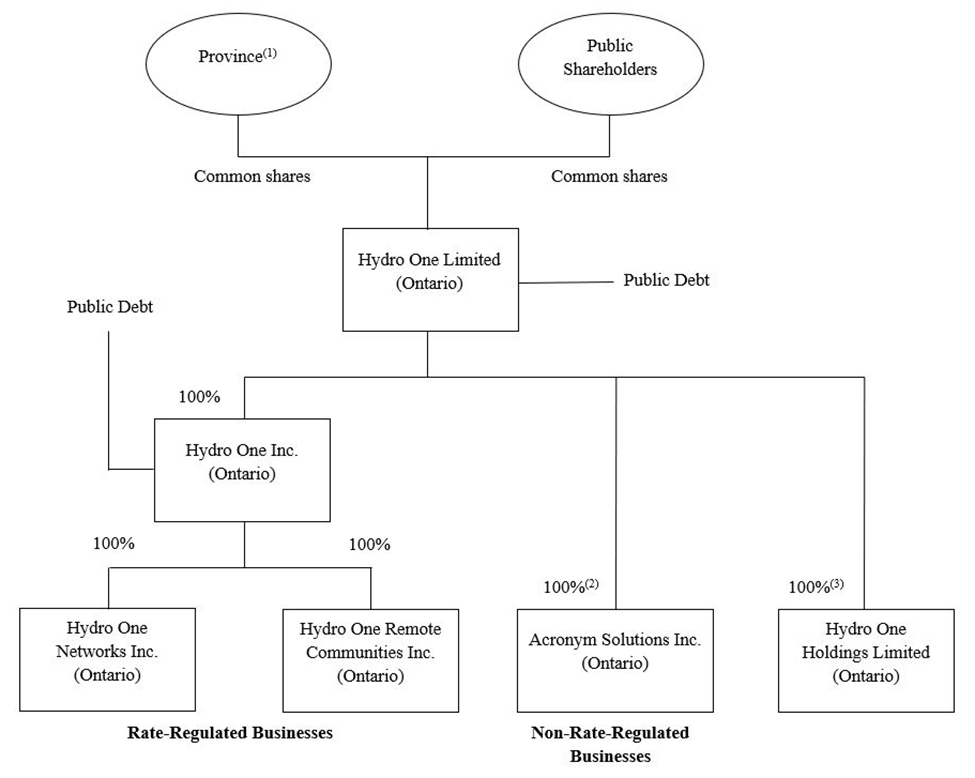
The following is a simplified chart showing the organizational structure of Hydro One and the name and jurisdiction of incorporation of certain of its subsidiaries. This chart does not include all legal entities within Hydro One’s organizational structure. Hydro One Limited owns, directly or indirectly, 100% of the voting securities of all of the subsidiaries listed below.
Notes:
(1)As of December 31, 2025, the Province directly owned approximately 47.1% of Hydro One Limited’s outstanding common shares.
(2)Indirectly held through a wholly-owned subsidiary of Hydro One Limited that acts as a holding company for Hydro One’s non-rate-regulated businesses.
(3)Indirectly held through a wholly-owned subsidiary of Hydro One Limited.
Certain of Hydro One’s subsidiaries are described below:
•Hydro One Inc. – acts as a holding company for Hydro One’s rate-regulated businesses. Its publicly-issued debt continues to be outstanding.
•Hydro One Networks – the principal operating subsidiary that carries on Hydro One’s rate-regulated transmission and distribution businesses.
•Hydro One Remote Communities – generates and supplies electricity to remote communities in northern Ontario.
•Acronym Solutions Inc. – carries on Hydro One’s non-rate-regulated telecommunications business.
•Hydro One Holdings Limited – a finance subsidiary with no operational activities.
GENERAL DEVELOPMENT OF THE BUSINESS
Chronological Development of the Business
Background
In August 2015, Hydro One Limited was incorporated by the Province as its sole shareholder. In November 2015, Hydro One Limited completed its initial public offering on the TSX by way of a secondary offering of common shares by the Province. Hydro One Limited did not receive any proceeds from the initial public offering. Prior to the closing of the initial public offering, all of the issued and outstanding common shares of Hydro One Inc. were acquired by Hydro One Limited.
2023
Directors
Effective June 2, 2023, Mitch Panciuk, Helga Reidel, and Brian Vaasjo were elected directors of Hydro One Limited and Hydro One Inc. at Hydro One Limited’s annual meeting of shareholders. The new directors replaced William Sheffield, Blair Cowper-Smith, and Russel Robertson who did not stand for re-election.
Executive Officers
Effective February 1, 2023, William Sheffield resigned as Interim President and Chief Executive Officer of Hydro One Limited and Hydro One Inc.
Effective February 1, 2023, David Lebeter was appointed as President and Chief Executive Officer of Hydro One Limited and Hydro One Inc.
Effective April 13, 2023, David Lebeter resigned as Chief Operating Officer.
Effective April 13, 2023, Teri French was appointed as Executive Vice President, Operations and Customer Experience. Teri French’s current title is Executive Vice President, Safety, Operations and Customer Experience.
Effective April 13, 2023, Andrew Spencer was appointed as Executive Vice President, Capital Portfolio Delivery.
Effective April 13, 2023, Paul Harricks resigned as Executive Vice President, Chief Legal Officer.
Effective April 13, 2023, Megan Telford’s title was expanded to Executive Vice President, Strategy, Energy Transition and Human Resources.
Effective April 13, 2023, Chris Lopez’s title was expanded to Executive Vice President, Chief Financial and Regulatory Officer.
2023 Sustainable Financing Framework
In January 2023, Hydro One Limited announced the publication of its Sustainable Financing Framework dated January 23, 2023 (the “2023 Framework”), a first for a utility in Canada. The 2023 Framework allows Hydro One Limited and its subsidiaries (including Hydro One Inc.) to issue sustainable financing instruments, such as sustainable and green bonds, and allocate the net proceeds to investments in eligible green and social project categories. Under the 2023 Framework, Hydro One Limited committed to providing an annual verification regarding the allocation of net proceeds of any green and/or sustainable financing, until the net proceeds of any such financing are fully allocated to eligible projects identified under the 2023 Framework. The 2023 Framework has been reviewed by Sustainalytics, which issued a second party opinion confirming that the 2023 Framework aligns with the International Capital Markets Association (“ICMA”) Sustainability Bond Guidelines 2021, Green Bond Principles 2021, the Social Bond Principles 2021 and the Loan Syndications and Trading Association (“LSTA”) Green and Social Loan Principles 2021. The 2023 Framework continues to apply in respect of certain sustainable financing instruments that were issued by Hydro One Limited or its subsidiaries prior to August 13, 2024.
See also “General Development of the Business – Chronological Development of the Business – 2024 – 2024 Sustainable Financing Framework”.
COVID-19
In 2023, the World Health Organization declared the end to COVID-19 as a public health emergency, which was originally declared a global pandemic in 2020. During the pandemic, the Company had continued to operate in-line with evolving safety procedures and practices.
2024
Executive Officers
Effective March 25, 2024, Renée McKenzie became Executive Vice President, Digital and Technology Solutions.
Effective June 9, 2024, Chris Lopez resigned as Executive Vice President and Chief Financial and Regulatory Officer.
Effective June 10, 2024, Harry Taylor was appointed as Executive Vice President and Chief Financial and Regulatory Officer.
Effective December 12, 2024, Andrew Spencer resigned as Executive Vice President, Capital Portfolio Delivery.
On December 12, 2024, Ryan Docherty, Vice President, Engineering and Construction Services, assumed responsibility on an interim basis for overseeing Capital Portfolio Delivery. Effective January 30, 2025, Mr. Docherty became Acting Head, Capital Portfolio Delivery.
2024 Sustainable Financing Framework
Hydro One Inc. has published allocation reports dated January 24, 2024, August 13, 2024, and May 16, 2025.
In August 2024, Hydro One Limited updated and published a new Sustainable Financing Framework (the “2024 Framework”). The 2024 Framework has been reviewed by Sustainalytics, which issued a second party opinion confirming that the 2024 Framework aligns with the ICMA Sustainability Bond Guidelines 2021, Green Bond Principles 2021, the Social Bond Principles 2023 and the LSTA Green and Social Loan Principles 2023.
The 2024 Framework allows Hydro One Limited and its subsidiaries (including Hydro One Inc.) to issue sustainable financing instruments, such as sustainability and green bonds, and allocate the net proceeds to investments in eligible green and social project categories. The project categories include: clean energy, energy efficiency, clean transportation, biodiversity conservation, climate change adaptation, socio-economic advancement of Indigenous peoples and access to essential services (such as the electrical grid
and enablement of high-speed broadband internet). Under the 2024 Framework, Hydro One Limited has committed to providing an annual verification regarding the allocation of net proceeds of any green and/or sustainable financing, until the net proceeds of any such financing are fully allocated to eligible projects identified under the 2024 Framework.
See also “General Development of the Business – Chronological Development of the Business – 2023 – 2023 Sustainable Financing Framework”.
2024 HOI MTN Shelf Prospectus
On February 28, 2024, Hydro One Inc. filed a short form base shelf prospectus in each of the provinces of Canada qualifying the issuance of medium term notes of Hydro One Inc. from time to time during the 25-month period ending March 29, 2026 (the “2024 HOI MTN Shelf Prospectus”). The 2024 HOI MTN Shelf Prospectus replaced the short form base shelf prospectus of Hydro One Inc. that was filed in 2022 and expired in July 2024. To date, Hydro One Inc. has issued an aggregate $4,650 million medium term notes pursuant to the 2024 HOI MTN Shelf Prospectus.
2024 HOL Universal Base Shelf Prospectus
In August 2024, Hydro One Limited filed a universal short form base shelf prospectus in Canada (the “2024 HOL Shelf Prospectus”) to replace the short form base shelf prospectus of Hydro One Limited that was filed in 2022 and expired in September 2024. The 2024 HOL Shelf Prospectus allows Hydro One Limited to offer, from time to time in one or more public offerings, debt, equity or other securities, or any combination thereof, during the 25-month period ending September 20, 2026. To date, no securities have been issued under the 2024 HOL Shelf Prospectus.
2024 HOHL U.S. Debt Shelf Prospectus
In November 2024, HOHL filed a U.S. debt short form base shelf prospectus (the “2024 HOHL U.S. Debt Prospectus”) with the securities regulatory authorities in Ontario and the United States, to replace the U.S. debt short form base shelf prospectus of HOHL that was filed in 2022 and expired in December 2024. The filing of the 2024 HOHL U.S. Debt Prospectus is intended to facilitate and preserve flexibility for the Company’s funding strategies. The 2024 HOHL U.S. Debt Prospectus allows HOHL to offer, from time to time in one or more public offerings, up to U.S.$3.0 billion of debt securities (which may be senior, or subordinated or junior subordinated indebtedness), unconditionally guaranteed by Hydro One Limited, during the 25-month period ending December 29, 2026. To date, no debt securities have been issued under the 2024 HOHL U.S. Debt Prospectus.
East-West Tie Limited Partnership
In December 2024, Hydro One Networks entered into an agreement to purchase an approximately 48% interest in the East-West Tie Limited Partnership from affiliates of OMERS Infrastructure Management
Inc. and Enbridge Transmission Holdings Inc. The East-West Tie Limited Partnership owns the East-West Tie Line, a 450-kilometre, 230 kV double-circuit transmission line spanning from Wawa to Thunder Bay, along the north shore of Lake Superior. The transaction closed on March 4, 2025. See “General Development of the Business – Chronological Development of the Business – 2025 – East-West Tie Limited Partnership”.
2025
Directors
Effective March 24, 2025, Timothy Hodgson, then chair of the boards of directors of Hydro One Limited and Hydro One Inc., commenced an unpaid leave of absence to pursue candidacy in the federal election. Effective March 24, 2025, Susan Wolburgh Jenah was appointed as Interim Chair of the boards of directors of Hydro One Limited and Hydro One Inc.
Effective April 28, 2025, Timothy Hodgson resigned as a director and as chair of the boards of directors of Hydro One Limited and Hydro One Inc.
Effective June 4, 2025, Melissa Sonberg was appointed as Chair of the boards of directors of Hydro One Limited and Hydro One Inc.
Director Cherie Brant did not stand for re-election at the Annual and Special Meeting of Shareholders on June 24, 2025.
Effective August 14, 2025, Michael Rencheck was elected as a director of Hydro One Limited and Hydro One Inc.
Executive Officers
Effective February 18, 2025, Gillian Whitebread joined Hydro One as Executive Vice President, Head of Human Resources.
Effective February 18, 2025, Megan Telford’s title became Executive Vice President, Strategy and Energy Transition. Effective July 21, 2025, Megan Telford became Chief Operating Officer.
Effective July 21, 2025, Lisa Pearson was appointed as Executive Vice President, Corporate Affairs.
Effective August 25, 2025, David Lebeter commenced a temporary compassionate care leave. Effective August 25, 2025, Harry Taylor was appointed as Interim President and CEO and also continued to serve as Executive Vice President, Chief Financial and Regulatory Officer. Effective November 12, 2025, Mr. Lebeter returned from leave.
East-West Tie Limited Partnership
On March 4, 2025, Hydro One Networks completed the acquisition of an approximately 48% minority interest in the East-West Tie Limited Partnership for approximately $261 million in cash, including closing adjustments. See also “General Development of the Business – Chronological Development of the Business – 2024 – East-West Tie Limited Partnership”.
2025 HOI U.S. Debt Shelf Prospectus
In August 2025, Hydro One Inc. filed a U.S. debt short form base shelf prospectus (the “2025 HOI U.S. Debt Prospectus”) with the securities regulatory authorities in Ontario and the United States. The filing of the 2025 HOI U.S. Debt Prospectus is intended to facilitate and broaden flexibility for the Company’s funding strategies. The 2025 HOI U.S. Debt Prospectus allows Hydro One Inc. to offer U.S. debt securities, from time to time in one or more public offerings, during the 25-month period ending September 18, 2027. To date, no debt securities have been issued under the 2025 HOI U.S. Debt Prospectus.
General Development of the Business
In addition to the chronological development of the business, the following general developments in the business have occurred and continue to be relevant.
Customer Focus
Hydro One’s continued focus on customer service remains a critical aspect of its success as a company. Greater corporate accountability for performance outcomes, and company-wide improvements in productivity and efficiency, align with customers’ expectations of how Hydro One should operate. Hydro One intends to continue to deliver affordable solutions and reliable electricity, advocate for its customers and empower them to make informed decisions about their energy usage and respond to emerging customer needs.
Customer Service
Hydro One is committed to delivering value to its customers by understanding customers’ current and future needs and expectations so that the Company can continuously improve its service. This includes specific, measurable commitments that encompass all areas of service. In 2025, compared with 2024, residential and small business customer satisfaction scores remained unchanged at 88%, transmission customer satisfaction decreased from 85% to 79%, and commercial and industrial satisfaction decreased from 85% to 82%.
Hydro One is on a multi-year journey to transform the customer experience by continuing to invest in technology such as interaction analytics, home energy insights, and automated performance scorecards for
customer service representatives.
Review of Operations
Hydro One is committed to providing value to its customers and shareholders by identifying and acting on opportunities to become the safest and most efficient utility. Hydro One has been focused on the identification of opportunities for improved corporate performance and the development of strategies to drive safer, more efficient and cost-effective operations. Hydro One conducts regular reviews of key corporate activities and programs, covering areas such as construction services and project management practices, asset deployment and controls, asset planning, information technology and cybersecurity, vegetation management practices, fleet services and utilization, supply chain management and business continuity planning. The Company has and continues to observe and implement operational and cost improvements across work planning and execution.
Strategy
In November 2024, Hydro One launched its refreshed corporate strategy. The strategic priorities are focused on building a better and brighter future for all by enriching customers’ experience, enhancing the value of the grid, delivering new solutions and fostering partnerships.
Details of the strategic priorities are as follows:
•Enrich our customers’ experience
We deliver easy and exceptional customer experiences. We understand and solve our customers’ evolving needs. We empower our customers to make informed decisions.
•Enhance grid value needed for sustainable economic growth
We optimize grid assets to create financial value. We acknowledge our Indigenous partners as core to our growth. We deliver sustainable growth by seizing regulated and unregulated opportunities.
•Create new solutions for an electrified future
We use advanced analytics and digital capabilities to manage an electrified future. We collaborate and foster innovation. We actively position ourselves as an enabler of the energy transition.
•Win with partners
We collaborate with partners to deliver high value results. We create mutually beneficial solutions. We are part of a coalition that shapes our net-zero future.
Sustainability Report
In May 2025, Hydro One Limited published its 2024 Sustainability Report, highlighting its ESG
performance in 2024. The Sustainability Report provides stakeholders, partners, customers, and communities, including Indigenous communities, with a better understanding of how Hydro One manages the opportunities and challenges associated with its business. Hydro One intends to continue to release an annual sustainability report and to continue to improve the quality of its ESG disclosures. The Company’s annual sustainability reporting is aligned with the Sustainability Accounting Standards Board, the Global Reporting Initiative Standards and the United Nations Sustainable Development Goals, and prepared broadly following the recommendations of the Task Force on Climate-related Financial Disclosures.
BUSINESS OF HYDRO ONE
Segments
Through its wholly-owned subsidiary Hydro One Inc., Hydro One is Ontario’s largest electricity transmission and distribution utility with approximately $40 billion in assets and 2025 revenues of approximately $9 billion. Hydro One owns and operates substantially all of Ontario’s electricity transmission network and is the largest electricity distributor in Ontario by number of customers. The Company’s regulated transmission and distribution operations are owned by subsidiaries of Hydro One Inc. Hydro One delivers electricity safely and reliably to approximately 1.5 million customers across the province of Ontario, and to large industrial customers and municipal utilities. Through its subsidiaries, Hydro One Inc. owns and operates approximately 30,000 circuit kilometres of high-voltage transmission lines and approximately 126,000 circuit kilometres of primary low-voltage distribution lines.
Hydro One has three segments: (i) transmission business; (ii) distribution business; and (iii) other. Each of the three segments is described below.
Hydro One’s transmission and distribution businesses are both operated primarily by Hydro One Networks. This allows both businesses to utilize common operating platforms, technology, work processes, equipment and field staff and thereby take advantage of operating efficiencies and synergies. For regulatory purposes, Hydro One Networks has historically filed separate rate applications with the OEB for each of its licensed transmission and distribution businesses. In 2021, a single application was filed for the Hydro One Networks transmission and distribution businesses for the period 2023 to 2027, which was approved by the OEB in November 2022. See “Transmission Business Segment – Regulation – Transmission Rate Setting” for more information.
Transmission Business Segment
Overview
Hydro One’s transmission business consists of owning and operating Hydro One’s transmission system, which accounts for approximately 91% of Ontario’s transmission capacity based on the network
component of the revenue requirement3 approved by the OEB.4 All of the Company’s transmission business is carried out by subsidiaries of Hydro One Inc., including through Hydro One Networks and HOSSM, as well as through the Company’s approximately 66% interest in B2M LP, approximately 55% interest in NRLP, and approximately 50% interest in CLLP5. The transmission segment also includes Hydro One Networks’ approximate 48% minority interest in the East-West Tie Limited Partnership. Hydro One’s transmission business represented approximately 60% of its total assets as at December 31, 2025, and accounted for approximately 53% of its total revenues, net of purchased power6 in 2025 and approximately 27% of its total revenues in 2025, and approximately 52% of its total revenues, net of purchased power in 2024 and approximately 27% of its total revenues in 2024.
The Company’s transmission business is a rate-regulated business that earns revenues mainly from transmission rates that are subject to approval by the OEB. Transmission rates are generally determined using a performance-based model, which typically includes a cost-of-service base year. Transmission rates are administered and collected by the IESO and are remitted by the IESO to Hydro One on a monthly basis, which means that Hydro One’s transmission business has no direct exposure to end-customer counterparty risk.
Transmission rates are based on monthly peak electricity demand across Ontario’s transmission network. This gives rise to seasonal variations in Hydro One’s transmission revenues, which are generally higher in the summer and winter due to increased demand, and lower during other periods of reduced demand. Hydro One’s transmission revenues also include revenues associated with exporting energy to markets outside of Ontario. Ancillary revenue includes revenues from providing maintenance services to generators and from third-party land use.
Business
The Company’s transmission system serves substantially all of Ontario and transported approximately 146 TWh of energy throughout the province in 2025. Hydro One Networks’ transmission customers consist of 34 local distribution companies (including Hydro One’s own distribution business) and 88 large industrial customers connected directly to the transmission network, including automotive,
3 The network component of the revenue requirement is Hydro One’s portion of the transmission revenue requirement attributed to assets that are used for the common benefit of all Hydro One and non-Hydro One customers in the province.
4 Hydro One owns and operates approximately 94% of the transmission system in Ontario based on the total OEB approved revenue requirement.
5 Through Hydro One’s First Nation equity partnership model, as of February 2, 2026, all five First Nation partners have collectively invested in an approximately 50% equity stake in the transmission line component of the project.
6 Revenues, net of purchased power is a non-GAAP financial measure. Non-GAAP financial measures do not have a standardized meaning under U.S. GAAP, which is used to prepare the Company’s financial statements, and accordingly, these measures may not be comparable to similar measures used by other companies. Additional disclosure for this non-GAAP financial measure is incorporated by reference herein and can be found in the section titled “Non-GAAP Measures” of the Annual MD&A available on SEDAR+ under Hydro One Limited’s profile at www.sedarplus.com.
manufacturing, chemical and natural resources businesses. Electricity delivered over Hydro One Networks’ transmission network is supplied by 139 generators in Ontario and electricity imported into the province through interties. Interties are transmission interconnections between neighbouring electric systems that allow power to be imported and exported.
The high voltage power lines in Hydro One’s transmission network are categorized as either lines which form part of the “bulk electricity system” or “area supply lines”. Power lines which form part of the bulk electricity system typically connect major generation facilities with transmission stations and often cover long distances, while area supply lines serve a local region. Ontario’s transmission system is connected to the transmission systems of Manitoba, Michigan, Minnesota, New York and Quebec through the use of interties, allowing for the import and export of electricity to and from Ontario.
Hydro One’s transmission assets were approximately $24 billion as at December 31, 2025 and include transmission stations, transmission lines, a control centre and telecommunications facilities. Hydro One has approximately 312 in-service transmission stations and approximately 30,000 circuit kilometres of high voltage lines whose major components include cables, conductors and wood or steel support structures. All of these lines are overhead power lines except for approximately 280 circuit kilometres of underground cables located in primarily urban areas.
Hydro One’s transmission network is managed from a central location. This centre monitors and controls the Company’s entire transmission network and has the capability to remotely monitor and operate transmission equipment, respond to alarms and contingencies and restore and reroute interrupted power. There is also a backup facility which would be staffed in the event of an evacuation of the centre. In 2022, Hydro One’s new primary control centre became fully operational.
Hydro One uses telecommunications systems for the protection and operation of its transmission and distribution networks. These systems are subject to very stringent reliability and security requirements, which help the Company meet its reliability obligations and facilitate the restoration of power following service interruptions.
B2M LP is Hydro One’s partnership with the Saugeen Ojibway Nation with respect to the Bruce-to-Milton transmission line. B2M LP owns the transmission line assets relating to two circuits between Bruce Transmission Station and Milton Switching Station. Hydro One Networks owns the stations where the lines terminate. Hydro One maintains and operates the Bruce-to-Milton line and has an approximately 66% economic interest in the partnership. See “Business of Hydro One – Transmission Business Segment – Regulation – Recent Transmission Rate Applications – B2M Limited Partnership” for more information.
NRLP is Hydro One’s partnership with Six Nations of the Grand River Development Corporation and, through a trust, the Mississaugas of the Credit First Nation. NRLP owns the Niagara Line. Hydro One maintains and operates the Niagara Line, and has an approximately 55% interest in the partnership. See “Business of Hydro One – Transmission Business Segment – Regulation – Recent Transmission Rate
Applications – Niagara Reinforcement Limited Partnership” for more information.
CLLP was formed to own and operate a double circuit 230 kV transmission line from the Chatham Switching Station to the Lakeshore TS. Hydro One maintains and operates the CLLP line, and currently owns an approximately 50% interest in the partnership. Through Hydro One’s First Nation equity partnership model, as of February 2, 2026, all five First Nation partners have collectively invested in an approximately 50% equity stake in the transmission line component of the project. See “Business of Hydro One – Transmission Business Segment – Regulation – Recent Transmission Rate Applications – Chatham x Lakeshore Limited Partnership” for more information.
First Nation Equity Partnership Model
Through Hydro One’s First Nation equity partnership model, First Nations have the opportunity to invest in a 50% equity stake in the transmission line component of all new large-scale capital transmission line projects with a value exceeding $100 million. Hydro One has more than ten transmission lines under development or that have been developed under the First Nation equity partnership model. See “Business of Hydro One – Indigenous Communities”.
Hydro One Transmission Projects Under the Integrated Energy Plan
As part of the IEP, the Province announced the advancement of several new transmission projects. In November 2025, the Minister of Energy directed the OEB to amend Hydro One Networks’ transmission licence to develop and construct the Bowmanville to Parkway Transmission Line, a proposed new double-circuit 500 kV transmission line from the Bowmanville Switching Station to one of Parkway TS, Claireville TS, or Cherrywood TS, including associated station facility expansions or upgrades required at terminal stations. The line is targeting an in-service date in the early-2030s. In addition, the Province designated as priority the Bowmanville to Parkway Transmission Line, the Orangeville to Barrie Reconductoring Project, and the Windsor to Lakeshore Transmission Line. The Orangeville to Barrie Reconductoring Project involves the reconductoring of Hydro One’s existing 230 kV transmission lines between Orangeville TS and Essa TS, with a target in-service date of 2027. The Orangeville to Barrie Reconductoring Project does not require designation because this project relates to existing Hydro One Networks’ transmission infrastructure. The Windsor to Lakeshore Transmission Line is a 230 kV transmission line from Lauzon TS to Lakeshore TS with a target in-service date of 2032. In January 2026, the Minister of Energy directed the OEB to amend Hydro One Networks’ transmission licence to develop and construct the Greenstone Transmission Line, a proposed new 230 kV transmission line between the East-West Tie and Longlac TS and extending to or near Aroland First Nation, terminating at a new switching station and associated station facilities. In addition, the Province designated the Greenstone Transmission Line as a priority. The line has a target in-service date of 2032. In February 2026, the Minister of Energy directed the OEB to amend Hydro One Networks’ transmission licence to develop and seek approvals for the Sudbury to Barrie Transmission Line, a new single circuit 500 kV transmission line between Essa TS and Hanmer TS, including associated station facilities. In addition, the Province designated the Sudbury to Barrie Transmission Line as a priority. The line has a target in-service date of
2032. The designation of this project includes the direction for a second Sudbury to Barrie Transmission Line, a second new single circuit 500 kV transmission line from Essa TS to Hanmer TS, including associated station facilities. A recommended in-service date for the second Sudbury to Barrie Transmission Line will be determined by the IESO. The Minister of Energy had previously, in March 2022, directed the OEB to amend Hydro One Networks’ licence to require it to develop and seek approvals for the Windsor to Lakeshore Transmission Line.
The IEP also addressed the need for additional transmission capacity in the Red Lake area in northwestern Ontario. In August 2025, the IESO released the Northwest Region Integrated Regional Resource Plan Addendum (“Addendum”). The Addendum recommends the urgent development of the Red Lake Transmission Line, a one double-circuit 230 kV transmission line that would run from Dryden TS to Ear Falls TS, and another double-circuit 230 kV transmission line that would run from Ear Falls TS to Red Lake Switching Station, along with associated station facilities, to meet anticipated 2028 capacity needs. Hydro One will work with the IESO to determine an appropriate in-service date for the project. In October 2025, the Ministry of Energy announced a proposal to bring forward an Order in Council (to be recommended by the Minister of Energy) to declare the project as priority and issue a companion directive, that would, if approved, direct the OEB to amend Hydro One Networks’ transmitter licence to require it to undertake development work and seek all necessary approvals to construct the project. The consultation period for the proposal closed on December 13, 2025.
Regulation
Transmission Rate Setting
The OEB provides two revenue plan options for transmission rates in Ontario: the Custom Incentive Rate Setting Plan (the “Custom IR Method”) and the Incentive-Based Revenue Index Rate Setting Plan (the “Revenue Cap Index”).
Under the Revenue Cap Index, the first year’s revenue requirement reflects the transmitter’s cost of service; and annually thereafter, this amount is subject to a formulaic increase reflecting inflation, partially offset by a productivity factor. The revenue requirement in these subsequent years is set on the assumption that the transmitter will achieve efficiency or productivity improvements to offset the productivity factor imposed by the regulator. Under the Custom IR Method, a similar methodology to the Revenue Cap Index may be used; however, applications are multi-year and are designed to reflect a transmitter-specific revenue trend for the application term. For example, a transmitter may request incremental capital funding beyond amounts established in the base year revenue requirement.
The OEB sets transmission rates based on a two-step process. First, all transmitters apply to the OEB for approval of their revenue requirements. Second, the OEB aggregates the total revenue requirements of all transmitters in Ontario and applies a formula to arrive at a single set of rates that are charged to ratepayers for the three types of transmission services applicable in Ontario, namely: network services, line connection services and transformation connection services. The three separate rates charged for these
services are the same for all transmitters and are referred to as “uniform transmission rates”. Uniform transmission rates for all transmitters are set by the OEB on an annual basis, using the revenue requirements set out in the most recent rate decision issued for each transmitter.
The filing requirements for transmitters mandate the integration of core RRF (defined below under “Business of Hydro One – Distribution Business Segment – Regulation – Distribution Rates”) concepts into revenue requirement applications. Transmitters applying for revenue requirements under the Custom IR Method or Revenue Cap Index must include: (i) evidence of the continuous improvement and efficiency gains anticipated to be achieved over the rate term; (ii) a mechanism to protect ratepayers in the event of earnings significantly in excess of the regulatory net income supported by the return on equity established in the approved revenue requirement; and (iii) proposed performance metrics applicable to their individual circumstances. A key component of rate-setting under the RRF is benchmarking evidence to support cost forecasts and system planning proposals.
Recent Transmission Rate Applications
Hydro One Networks, B2M LP, HOSSM, NRLP, and CLLP file separate applications to the OEB for the approval of their transmission revenue requirement for transmission services.
Hydro One Networks
In August 2021, Hydro One Networks filed a custom joint rate application for 2023-2027 (the “JRAP”), which included a proposed investment plan supporting the transmission and distribution revenue requirements. The JRAP requested the OEB’s approval of transmission revenue requirements of $1,823 million for 2023, $1,938 million for 2024, $2,028 million for 2025, $2,140 million for 2026 and $2,219 million for 2027.
In November 2022, the OEB approved the settlement in whole and issued its final rate order for the 2023-2027 transmission rates approving a revenue requirement of $1,952 million, $2,073 million, $2,168 million, $2,277 million, and $2,362 million for 2023, 2024, 2025, 2026, and 2027, respectively. Notwithstanding that the parties to settlement agreed to reduce Hydro One Networks’ proposed capital and operating expenditures, the approved revenue requirement exceeds Hydro One Networks’ proposed revenue requirement due to increases to the OEB’s cost of capital parameters and inflation factor for 2023.
Following the OEB approval of the JRAP and completion of the recovery of deferred tax asset amounts, Hydro One Networks’ effective tax rate over the JRAP period is expected to be between 13% and 16%. See also “Business of Hydro One – Distribution Business Segment – Regulation – Recent Distribution Rate Applications – Hydro One Networks”.
B2M Limited Partnership
In May 2024, B2M LP filed a five-year transmission revenue requirement application for 2025-2029. In November 2024, the OEB approved the settlement proposal, which includes a 2025 base revenue requirement of $38.4 million, effective January 1, 2025, and the revenue requirement framework for 2026 to 2029. In October 2025, the OEB approved base revenue requirements of $37.9 million, $38.9 million, $38.8 million, and $37.2 million for 2026, 2027, 2028, and 2029, respectively.
HOSSM
HOSSM is under a ten-year deferred rebasing period for years 2017-2026, following receipt of approval by the OEB of Hydro One’s acquisition of HOSSM in October 2016. In July 2018, HOSSM filed a 2019 application to allow for inflationary increase (“revenue cap escalator factor”) to its previously approved revenue requirement. The revenue cap escalator factor is designed to add inflationary increases to the revenue requirement on an annual basis. In June 2019, the OEB approved the revenue cap escalator index at 1.1% (net), which was applied to HOSSM’s base revenue requirement for 2019, effective February 1, 2019, and also approved the 2019-2026 revenue cap framework. The revenue requirement is updated annually, and in September 2025, the OEB approved a rate increase of 2.35% effective January 1, 2026.
Niagara Reinforcement Limited Partnership
In May 2024, NRLP filed a five-year transmission revenue requirement application for 2025-2029. In November 2024, the OEB approved the settlement proposal, which includes a 2025 base revenue requirement of $8.9 million, effective January 1, 2025, and the revenue requirement framework for 2026 to 2029. In October 2025, the OEB approved base revenue requirements of $8.8 million, $8.7 million, $8.7 million, and $9.3 million for 2026, 2027, 2028, and 2029, respectively.
Chatham x Lakeshore Limited Partnership
In 2024, CLLP was formed for the purpose of owning a double circuit 230 kV transmission line from the Chatham Switching Station to the Lakeshore TS. In July 2024, CLLP filed a five-year transmission revenue requirement application for 2025-2029. In December 2024, the OEB approved the settlement proposal, which includes a 2025 base revenue requirement of $16.7 million, effective January 1, 2025, and the revenue requirement framework for 2026 to 2029. In December 2025, the OEB approved base revenue requirements of $16.6 million, $16.5 million, $16.3 million, and $16.2 million for 2026, 2027, 2028, and 2029, respectively.
Reliability Standards and Regulations for Transmission
The Company’s transmission business is required to comply with various mandatory regulations for transmission reliability, including mandatory standards, directories, market rules, and the Transmission System Code (collectively, the “Reliability Standards”) established by NERC, NPCC, the OEB and the
IESO, which are international, regional and Ontario reliability regulatory authorities, respectively, involved in regulating, promoting and otherwise improving the reliability of transmission networks in North America. Hydro One’s compliance with these Reliability Standards is enforced by the OEB, IESO and the Canada Energy Regulator.
In addition to the currently enforced Reliability Standards, NERC, NPCC, the OEB and IESO continue to develop and issue new and revised Reliability Standards and other regulations, including Critical Infrastructure Protection Standards and Cybersecurity Regulations with which Hydro One and other utilities, owners and operators of the bulk electricity system in North America must comply. Hydro One expects to continue to perform work, and to incur associated costs, in order to achieve, sustain and demonstrate compliance with all of these Reliability Standards. Hydro One anticipates that these costs will be recovered in rates. See the Annual MD&A under the subheadings “Risk Management and Risk Factors – Risks Relating to Hydro One’s Business – Compliance with Laws and Regulations”, “Risk Management and Risk Factors – Risks Relating to Hydro One’s Business – Risk Associated with IT, Operational Technology (OT) Infrastructure and Data Security” and “Risk Management and Risk Factors – Risks Relating to Hydro One’s Business – Risks Relating to Asset Condition, Capital Projects and Innovation” for more information.
Regional Planning
The OEB oversees regional planning processes to ensure that transmission and distribution investments are coordinated at a regional level. One of the OEB objectives for regional planning is to review and/or rely on the recommendations within the regional planning reports to support rate applications submitted by transmitters and distributors and “leave to construct” applications submitted by transmitters. In Ontario, the first and last phases (Needs Assessment and Regional Infrastructural Plan) of the regional planning process are led by the transmitter responsible for a particular geographic region. Hydro One also coordinates with the IESO on its Integrated Regional Resource Planning, which is another phase of the regional planning process. For this purpose, the province is divided into 21 regions. As the largest transmitter in Ontario, Hydro One plays a key role in the regional planning process and is responsible for leading the regional planning process in 20 of the 21 designated regions.
In conducting regional planning, Hydro One works closely with the IESO and all distributors in the region through study teams to jointly identify needs and develop transmission and distribution investment options.
Hydro One has participated as part of the OEB’s Regional Planning Process Advisory Group (“RPPAG”), comprised of a number of interested stakeholders, which supports the OEB in its review of the regional planning process that applies to Ontario’s electricity sector, to improve efficiency and effectiveness. Following from the Province’s June 2025 letter of direction to the OEB regarding the implementation of the Province’s Integrated Energy Plan, in August 2025, the OEB announced a further review and established a Regional and Bulk Planning Process Advisory Group (“RBPPAG”) to review and recommend enhancements to regional and bulk planning processes to make processes more efficient,
flexible and responsive to Ontario’s needs. Hydro One continues to work closely with the OEB to support the review of these planning processes, and is participating in the RBPPAG. The RBPPAG is expected to provide the OEB with its recommendations, and the OEB is expected to deliver its report with recommendations for process improvements to the Minister of Energy in early 2026.
Key Transmission Projects
The Province’s October 2024 energy vision, Ontario’s Affordable Energy Future, sets out the Province’s initiatives to meet growing electricity demand in Ontario, including in relation to Ontario’s transmission network. As noted in this vision statement, over the past six years, the Province has accelerated development for new priority transmission lines in southwestern, northeastern, and eastern Ontario. The Province’s IEP released in June 2025 establishes a planning horizon out to 2050, including the acceleration of the development of transmission infrastructure. As part of the IEP, the Province announced the advancement of several transmission projects. See “The Electricity Industry in Ontario – Issues Affecting the Electricity Industry Generally – Ontario Integrated Energy Plan” for more information.
Through directives between 2020 and 2026, the Minister of Energy directed the OEB to amend, and the OEB has amended, Hydro One Networks’ transmission licence to develop and seek approvals for these new priority transmission lines. As a result of these licence amendments, Hydro One Networks’ licence now includes:
•Bowmanville to Parkway Transmission Line – a 500 kV line from Bowmanville Switching Station to one of Parkway TS, Claireville TS, or Cherrywood TS;
•Chatham to Lakeshore Transmission Line – a 230 kV line from Chatham Switching Station to the new Lakeshore TS in the municipality of Lakeshore;
•Durham Kawartha Power Line – a 230 kV transmission line between either Cherrywood TS or Clarington TS and Dobbin TS;
•Greenstone Transmission Line – a 230 kV transmission line between the East-West Tie and Longlac TS and extending to or near Aroland First Nation, terminating at a new switching station;
•Longwood to Lakeshore Transmission Line – a 500 kV line from Longwood TS, west of London, to the new Lakeshore TS;
•Second Longwood to Lakeshore Transmission Line – a second 500 kV line from Longwood TS to Lakeshore TS, with scope to be further refined through planning by the IESO;
•North Shore Link – a 230 kV transmission line between Mississagi TS and Third Line TS;
•Northeast Power Line – a 500 kV transmission line between Hanmer TS and Mississagi TS;
•St. Clair Transmission Line – a 230 kV line from Lambton TS, south of Sarnia, to Chatham Switching Station;
•Sudbury to Barrie Transmission Line – a single circuit 500 kV transmission line between Essa TS and Hanmer TS, including associated station facilities;
•Second Sudbury to Barrie Transmission Line – a second single circuit 500 kV transmission line from Essa TS to Hanmer TS, including associated station facilities;
•Wawa Timmins Power Line – a 500 kV transmission line between Wawa TS and Porcupine TS; and
•Windsor to Lakeshore Transmission Line – a 230 kV line that would run from the Windsor area to Lakeshore TS, with scope to be further refined through planning by the IESO.
Through Hydro One’s First Nation equity partnership model, First Nations have the opportunity to invest in a 50% equity stake in the transmission line component of all new large-scale capital transmission line projects. See also “Business of Hydro One – Indigenous Communities” and “Business of Hydro One – Transmission Business Segment – Business – First Nation Equity Partnership Model”.
Hydro One has a portfolio of transmission projects across the province of Ontario. See the Annual MD&A under the subheadings “Other Developments” and “Capital Investments – Major Transmission Capital Investment Projects” for more information on significant transmission projects.
Capital Expenditures
From 2026 to 2027, the Company anticipates that it will spend in the range of approximately $1,892 million to $2,116 million per year on capital expenditures relating to its transmission business. The Company’s capital expenditure plans are included in Hydro One’s applications to the OEB for transmission and distribution, and are subject to approval by the OEB. See the Annual MD&A under the subheadings “Capital Investments – Future Capital Investments” and “Capital Investments – Major Transmission Capital Investment Projects” for more information on future capital expenditures.
The Company incurs both sustaining capital expenditures and development capital expenditures. Sustaining capital expenditures are those investments required to replace or refurbish our assets and facilities to ensure that the transmission system continues to function as originally designed. Hydro One’s plans to maintain, refurbish or replace existing assets are based upon risk assessments, asset condition assessments and end-of-service life criteria specific to each type of asset. Priorities are assigned to each type of investment based upon the extent of the risks that it mitigates.
Investments to sustain Hydro One’s transmission assets are critical to maintain the safety, reliability and integrity of its existing transmission network. Hydro One’s sustainment capital plan is designed to maintain Hydro One’s transmission reliability performance, as determined by measures such as the average frequency and duration (in minutes) of unplanned interruptions per delivery point. The Company expects that significant investments will be required to sustain its existing infrastructure over the long term.
The Company’s development capital expenditure plan is designed to address Ontario’s expected change in the generation profile, accommodate load growth in areas throughout Ontario and support the economic growth in Ontario including industrial and agricultural growth and connection of the remote communities in the northern part of the province. Development capital expenditures include those investments required to develop and build new large-scale projects such as new transmission lines and
stations as well as smaller projects such as transmission line or station reinforcements, extensions or additions to connect generation or serve load.
The Company engages with various stakeholders, including its customers and the IESO, as it develops its capital plans. It also engages affected communities and parties who may be impacted by individual projects. The Company also consults with Indigenous communities whose rights may be affected by its projects.
Competitive Conditions
Within our principal market of Ontario, the Company operates and maintains substantially all of the transmission system. Competition for transmission services in Ontario has been limited. The adoption by the OEB of uniform transmission rates that apply to all transmitters also reduces the financial incentive for customers to seek alternative transmission providers, since each transmitter in Ontario charges the same uniform rate for transmission services. Hydro One competes with other transmitters for the opportunity to build new large-scale transmission projects in Ontario. The competitive process was amended in 2016 by the proclamation of the Energy Statute Law Amendment Act to allow for the selection of a transmitter outside the existing competitive process. In 2017, the Minister of Energy directed the IESO to develop a competitive transmitter selection or transmission procurement process. Subsequently, development and engagement work began.
In November 2023, the IESO launched an engagement initiative with stakeholders on the development of a TSF. This followed a July 2023 letter of direction to the IESO from the Minister of Energy, flowing from initiatives set out in the Province’s Powering Ontario’s Growth report released in July 2023. The Province’s expectation was that the development of a TSF would evolve Ontario’s current approach to transmitter selection for transmission projects. In October 2024, June 2025, and January 2026, the IESO released feedback and responses to engagements on the TSF.
Under the TSF, successful electricity transmitter applicants to the TSF registry, which is now in place, are eligible to participate in future IESO competitive transmission procurements. As currently proposed by the IESO, the TSF would apply to identified transmission projects that need to meet the following minimum criteria: new facilities only; benefit all electricity ratepayers; estimated cost of $100 million or greater; nominal voltage of 200 kV or greater; and sufficient lead time (at least 6 years). It is expected that successful proposals would also be required to demonstrate Indigenous participation. Identified transmission projects that do not meet all of the above-listed criteria are proposed to be designated to incumbent transmitters, such as Hydro One. The IESO is considering that successful TSF proponents would be awarded partial contracts for a yet-to-be-determined number of years following commercial operation, after which time a utility rate regulation mechanism administered by the OEB would apply. The IESO recommenced engagement on the TSF in January 2025 to refine design considerations, including Indigenous participation requirements. Once the IESO finalizes their TSF design recommendations, it is expected that the Minister of Energy will next determine whether to proceed with implementing the TSF as described, or if additional design or implementation work should be considered.
In January 2026, the IESO began engagement on the design of a competitive procurement process for the Toronto Third Line, as well as consultations for an Indigenous participation framework. See “The Electricity Industry in Ontario – Regulation of Transmission and Distribution – IESO” and “the Electricity Industry in Ontario – Issues Affecting the Electricity Industry Generally – Ontario Integrated Energy Plan” for more information.
Hydro One does not compete with other transmitters with respect to investments which are made to sustain or develop its existing transmission infrastructure.
Distribution Business Segment
Overview
Hydro One’s distribution business consists of owning, operating and maintaining Hydro One’s distribution system, which Hydro One, through Hydro One Inc., owns primarily through its wholly-owned subsidiary, Hydro One Networks, the largest local distribution company in Ontario. The Company’s distribution system is also the largest in Ontario. The Company’s distribution business is a rate-regulated business that earns revenues mainly by charging distribution rates that are subject to approval by the OEB. Hydro One’s distribution business also includes the business of its wholly-owned subsidiary, Hydro One Remote Communities, which supplies electricity to customers in remote communities in northern Ontario. The Company’s distribution rates are generally determined using a performance-based model, except for the distribution rates of Hydro One Remote Communities, which are set on a cost-recovery basis and do not include a return on equity.
Hydro One’s distribution business represented approximately 38% of its total assets as at December 31, 2025, and accounted for approximately 46% of its total revenues in 2025, net of purchased power,7 and approximately 72% of its total revenues in 2025 and approximately 47% of its total revenues in 2024, net of purchased power and approximately 72% of its total revenues in 2024. Distribution revenues include distribution rates approved by the OEB and amounts to reimburse Hydro One for the cost of purchasing electricity delivered to its distribution customers. Distribution revenues also include minor ancillary service revenues, such as fees related to the joint use of the Company’s distribution poles by participants in the telecommunications and cable television industries, as well as miscellaneous revenues such as charges for late payments.
As at December 31, 2025, Hydro One’s distribution assets were approximately $15 billion.
Business
Hydro One delivers electricity through its distribution network to approximately 1.5 million residential and business customers, most of whom are located in rural areas, as well as 42 local distribution companies (including Hydro One’s own distribution business).
7 Revenues, net of purchased power is a non-GAAP financial measure.
Hydro One’s distribution system includes approximately 126,000 circuit kilometres of primary low-voltage distribution lines and approximately 1,000 distribution and regulating stations. Other distribution assets include poles, transformers, service centres and equipment.
Hydro One’s distribution system services a predominantly rural territory. As a result of the lower population density in the Company’s service territory, the Company’s costs to provide distribution services may be higher than those of distributors who service urban areas. Furthermore, unlike the distribution systems found in urban areas, most of Hydro One’s distribution system was not designed with redundancy, to be interconnected in loops with other distribution lines, with the result that interruptions experienced at any point along a distribution line in Hydro One’s network can cause all customers downstream of the interruption point to lose power. Accordingly, the reliability of Hydro One’s distribution system is lower than that of local distribution companies which service urban territories that typically have redundancy built into their systems.
The Company engages in vegetation management activities to maintain the reliability of Hydro One’s distribution system on a preventive basis and to protect public health and safety. This consists of the trimming or removal of trees to lower the risk of contact with distribution lines, thereby reducing the risk of power outages, and preventing potential injury to the public or employees. The Company’s monitoring systems assist with determining areas of priority and with system restoration. The Company relies on its local line crews for these restoration activities.
Hydro One’s distribution business is involved in the connection of electricity generation, including renewable energy. Hydro One invests in upgrades and modifications to its distribution system to accommodate these sources of generation and ensure the continued reliability of its distribution network. As at December 31, 2025, there were approximately 20,800 embedded generators connected to Hydro One’s distribution network.
Hydro One has played a significant role in the installation of smart meters and the migration of distribution customers to time-of-use pricing in Ontario. Smart meters are regarded as an integral means of promoting a culture of conservation and allow customers to change their electricity consumption patterns and reduce their costs. As part of the JRAP, in November 2022, the OEB approved in whole Hydro One Networks’ proposed capital program to modernize the entire smart metering infrastructure as system and assets reach their end of service over the next several years. Hydro One piloted this new system in 2024 through 2025. Implementation is in progress and is expected to occur through 2029. See “Business of Hydro One – Transmission Business Segment – Regulation – Recent Transmission Rate Applications – Hydro One Networks” and “Business of Hydro One – Distribution Business Segment – Regulation – Recent Distribution Rate Applications – Hydro One Networks” for more information on Hydro One Networks’ application.
Regulation
Distribution Rates
Distribution rates in Ontario are determined using a performance-based model set out in the OEB’s Renewed Regulatory Framework for Electricity Distributors: A Performance-Based Approach, which is sometimes referred to as the “RRF”. Under the RRF, distributors in Ontario may choose one of three rate-setting methods, depending on their capital requirements: 4th Generation Incentive Rate-Setting (now known as “Price Cap IR”), Custom IR Method, or Annual Incentive Rate-Setting Index.
The RRF contemplates that under the Price Cap IR method, a distributor will apply for the approval of its revenue requirement for an initial base year, reflecting the distributor’s cost of service. The revenue requirement for subsequent years is determined based on a formula that accounts for inflation and certain productivity factors set by the regulator. The revenue requirement in these subsequent years is set on the assumption that the distributor will achieve efficiency or productivity improvements to offset the productivity factor imposed by the regulator.
Under the Custom IR Method, a similar methodology to the Price Cap IR may be used; however, applications are multi-year and are designed to reflect a distributor-specific revenue trend for the application term. For example, a distributor may request incremental capital funding beyond amounts established in the base year revenue requirement.
The scope of applications under the Annual Incentive Rate-Setting Index option is limited to formulaic adjustments to prior year OEB-approved rates. The adjustment provides an increase based on inflation, partially offset by a productivity factor. Distributors under this plan do not have access to mechanisms for additional capital funding beyond the formulaic adjustment.
The RRF allows the distributor to retain all or a portion of the cost savings achieved in excess of the estimate established by the regulator during the period covered by the rate decision, subject to any sharing mechanisms that may be required by the OEB, as indicated in the decision of each rate application. This approach allows the distributor an ability to earn more than its allowed return on equity. The RRF also requires distributors to demonstrate certain performance outcomes, namely: customer focus, operational effectiveness, public policy responsiveness and financial performance. The OEB has stated that customer-focused outcomes and continuous performance improvements by distributors are central to the RRF framework objectives and are considered as part of a distributor rate application.
Performance measures are an important part of the RRF, and the OEB has established a standard performance scorecard for all distributors, which is reported annually. Distributors may also propose additional performance measures for approval by the OEB. Distributors are required to report to the OEB on their performance against the performance measures approved.
The OEB’s review process of the anticipated cost of service for providing distribution services under the
RRF follows a process similar to that of a transmission rate application. Once the revenue requirement for distribution services is determined, it is allocated across the distributor’s customer rate classes using a methodology approved by the OEB resulting in the setting of individual rates for distribution services based on each customer rate class. Distribution rates in Ontario are not the same for all distributors and reflect the particular circumstances of each distributor, including its own costs of providing electricity service to its own particular customers. The OEB policy, A New Distribution Rate Design for Residential Electricity Customers, changed the distribution rate design for residential customers (a combination of a fixed monthly rate and a variable charge) to a fixed monthly charge only. In December 2015, the OEB increased the transition period for certain customer classes of Hydro One Networks to mitigate bill impacts. Implementation of all fixed distribution rates was completed in 2023 for the majority of Hydro One Networks’ residential customers. Changes to rate design do not impact the total revenue to be collected from these customer classes.
Recent Distribution Rate Applications
The Company’s distribution rates, other than the distribution rates of Hydro One Remote Communities, are determined by using a performance-based model.
Hydro One Networks
In August 2021, Hydro One Networks filed a custom joint rate application for 2023-2027 (the “JRAP”), which included a proposed investment plan supporting the transmission and distribution revenue requirements. The JRAP requested the OEB’s approval of distribution revenue requirements of $1,632 million for 2023, $1,711 million for 2024, $1,785 million for 2025, $1,881 million for 2026 and $1,965 million for 2027. In March 2022, Hydro One Networks filed updated evidence reflecting the impacts of updated inflation assumptions on the proposed investment plan as well as updated load forecasts. In October 2022, Hydro One Networks filed a settlement proposal with the OEB, which was further updated in November 2022 to reflect, among other things, the OEB’s cost of capital parameters and inflation factor for 2023. In November 2022, the OEB approved the settlement in whole and issued its final rate order for the 2023-2027 distribution rates approving a revenue requirement of $1,727 million, $1,813 million, $1,886 million, $1,985 million, and $2,071 million for 2023, 2024, 2025, 2026, and 2027, respectively. Notwithstanding that the parties to settlement agreed to reduce Hydro One Networks’ proposed capital and operating expenditures, the approved revenue requirement exceeds Hydro One Networks’ proposed revenue requirement due to increases to the OEB’s cost of capital parameters and inflation factor for 2023. See “Business of Hydro One – Transmission Business Segment – Regulation – Recent Transmission Rate Applications – Hydro One Networks” for more information.
In August 2025, Hydro One Networks filed a Z-Factor application with the OEB to seek recovery of costs incurred for a severe storm that began on March 28, 2025. Z-Factor applications enable utilities to seek cost recovery within a rate period for unforeseen events. The application seeks recovery of approximately $225 million in storm-related costs, including capital and asset removal costs. A decision is anticipated by early 2026.
Hydro One Remote Communities
In August 2022, Hydro One Remote Communities filed its Cost of Service rate application for 2023-2027 revenue requirements, including Rural and Remote Rate Protection (“RRRP”), and customer rates for the distribution and generation of electricity in the Hydro One Remote Communities service area. In March 2023, the OEB approved the Hydro One Remote Communities’ application, including a 2023 revenue requirement application of $128 million, effective May 1, 2023, and a price cap escalator index for 2024 to 2027.
Hydro One Remote Communities’ business is exempt from a number of sections of the Electricity Act which relate to the competitive market. For example, Hydro One Remote Communities continues to apply bundled rates to customers in remote communities. Hydro One Remote Communities’ business is operated on a break-even basis, without a return on equity included in rates. As a result, any net income or loss in the year related to the regulated operations of Hydro One Remote Communities is recorded in a regulatory variance account for disposition in future rate applications.
Electricity Demand Side Management
In January 2025, the Province announced new energy efficiency programs launching in 2025. The new 2025-2036 Electricity Energy Efficiency Framework is established for a 12-year term from January 1, 2025 to December 31, 2036, and includes programs for the residential, commercial, institutional, industrial and agricultural segments in addition to programs for income-qualified households and on-reserve Indigenous communities. In addition, the Province directed the IESO to launch measures within the 2025-2036 Framework to promote electrification. The IESO manages the framework through three-year demand-side management plans that establish budgets and demand and energy savings targets by sector, with a mid-point review in year six.
Under the 2025-2036 Framework, distributors are responsible for delivering energy efficiency program marketing and customer engagement activities to drive awareness and participation in the programs offered under the 2025-2036 Framework, which is to be funded by the IESO. In July 2025, the OEB launched a consultation to establish a funding mechanism for further distributor-led eDSM programs to address distribution system needs and provide bulk system benefits.
Capital Expenditures
Hydro One’s asset sustainment activities are based on an assessment of asset condition. Distribution asset renewals are undertaken when assessments indicate there is a high risk of failure and where further maintenance activities are not appropriate. The Company expects capital expenditures for its distribution business in the near term to focus on new load connections, storm damage, and the replacement of its legacy metering network. In addition, the Company expects to continue to construct new distribution lines and stations and upgrade existing distribution lines and stations in response to system growth forecasts,
continued suburban community development, high load relief requirements and requirements to connect new sources of generation. From 2026 to 2027, the Company expects that it will spend in the range of approximately $918 million to $1,093 million per year on capital expenditures relating to its distribution business. In August 2025, the Company submitted a Z-Factor application to the OEB to seek recovery for costs incurred from a severe storm that began on March 28, 2025, and continued into the second quarter, impacting the central and eastern regions of the Province. While the event was isolated to 2025, the forecast for capital expenditures may be updated pending the outcome of that decision. See the Annual MD&A under the subheadings “Capital Investments – Future Capital Investments” for more information on future capital expenditures.
Hydro One is continuing to modernize its distribution system through the deployment of smart devices (including remotely controllable switches and breakers as well as faulted circuit indicators) as power system assets are renewed. Hydro One has implemented a Distribution Management System (“DMS”) at its centralized control centre. The DMS has enabled Hydro One to monitor and control distribution components, perform real-time analysis and determine, with greater precision, the location of equipment failures. Additional functionality is planned to allow field staff to view system conditions remotely in real-time. Smart metering data will also be used to deliver operational and asset management benefits such as better notification of outages and their scope, asset loading information and other data. See the Annual MD&A under the subheading “Capital Investments – Future Capital Investments” for more information on future capital expenditures.
Competitive Conditions
Hydro One’s distribution service area is described in its distribution licence issued by the OEB. Only one distributor is permitted to provide distribution services in a service territory, and distributors have exclusive rights to provide service to new customers located within their service territory. As a result, there is very little direct competition for distribution services in Ontario, except near the borders of adjoining service territories, where a distributor may apply to the OEB to claim the right to serve new customers or new loads not currently connected to its distribution grid.
Ontario remains an active environment for local distribution company consolidation, resulting in competition for acquisition or merger opportunities. Potential acquirers may include strategic and financial buyers, in addition to other local distribution companies. Hydro One believes that it is well-positioned to continue to pursue consolidation opportunities within Ontario that are beneficial to all stakeholders. Consolidation continues within Ontario. See also “The Electricity Industry in Ontario – Issues Affecting the Electricity Industry Generally – Tax Incentives” for more information.
Other Segment
Hydro One’s other segment consists principally of its telecommunications business, which provides telecommunications support for the Company’s transmission and distribution businesses. The telecommunications business is carried out by its wholly-owned subsidiary Acronym Solutions Inc. It also
offers comprehensive information and communications technology (ICT) services and solutions (including: internet & network, security, voice & collaboration, cloud and managed IT) that extend beyond Acronym Solutions Inc.’s fibre optic network, in a competitive commercial market.
Acronym Solutions Inc. is not regulated by the OEB. However, Acronym Solutions Inc. is registered with the Canadian Radio-television and Telecommunications Commission as a non-dominant, facilities-based carrier, providing broadband telecommunications services in Ontario with connections to Montreal, Quebec; Buffalo, New York; and Detroit, Michigan.
The other segment also includes a deferred tax asset. The deferred tax asset arose from the revaluation of the tax bases of Hydro One’s assets to fair market value when the Company transitioned from the provincial payments in lieu of tax regime to the federal tax regime at the time of the Company’s initial public offering in 2015.
Furthermore, Hydro One’s other segment also includes Aux Energy Inc., a wholly-owned subsidiary that provides energy solutions to commercial and industrial clients, and Ontario Charging Network LP, which owns and operates electric vehicle fast charging stations across Ontario under the Ivy Charging Network brand, as well as certain corporate activities, and is not rate-regulated.
The other segment represented approximately 2% of Hydro One’s total assets as at December 31, 2025, and accounted for approximately 1% of its total revenues, net of purchased power,8 in 2025 and 2024 and approximately 1% of its total revenues in 2025 and 2024.
Indigenous Communities
Hydro One believes that building and maintaining respectful, positive and mutually beneficial relationships with Indigenous communities across the province is important to advancing action on reconciliation and achieving the Company’s corporate objectives. Hydro One has established an Indigenous Relations Policy, demonstrating the Company’s desire to work proactively to build relationships with Indigenous communities based on understanding, respect and mutual trust. Hydro One is committed to working with Indigenous communities in a spirit of cooperation, partnership and shared responsibility. Hydro One’s equity partnerships with the Saugeen Ojibway Nation in respect of the Bruce-to-Milton transmission line and with the Six Nations of the Grand River Development Corporation and the Mississaugas of the Credit First Nation in respect of the Niagara Line demonstrate the Company’s commitment to these principles. In keeping with the Company’s Indigenous Relations Policy, Hydro One’s Indigenous Partnership and Business Development team provides guidance and advice to support the Company in developing and advancing positive relationships. Hydro One also has several programs related to Indigenous communities and their citizens. These include educational and training opportunities which provide opportunities for work terms, Indigenous procurement partnership agreements along with community investments, customer support and outreach. Together, Hydro One Networks and Hydro One Remote Communities serve more than 100 First Nation communities.
8 Revenues, net of purchased power is a non-GAAP financial measure.
In 2022, Hydro One announced its new equity partnership model pursuant to which it will offer First Nations a 50% equity stake in all new large-scale capital transmission line projects with a value exceeding $100 million. See also “Business of Hydro One – Transmission Business Segment – Business – First Nation Equity Partnership Model” for more information.
Hydro One supports Indigenous Procurement and has committed to reaching a target of 5% of total sourceable spend with Indigenous businesses by 2026.
The Company’s Indigenous Peoples, Safety & Operations Committee of the Board is responsible for assisting the Board in discharging the Board’s oversight of responsibilities relating to effective occupational health and safety and environmental policies and practices at Hydro One, and its relationship with Indigenous communities.
Outsourced Services
Hydro One has outsourced certain non-core functions, including facilities management services with respect to its stations and other facilities, and certain information technology. Certain information technology services are provided by a third-party service provider under an agreement that expires on July 31, 2028. The Company’s facilities management services are provided by a third-party service provider under an agreement that expires on September 14, 2027.
Employees
As at December 31, 2025, Hydro One had approximately 7,200 regular and 1,900 non-regular employees province-wide comprised of a mix of skilled trades, engineering, professional, managerial and executive personnel. The average number of Hydro One employees in 2025 was approximately 9,600, consisting of approximately 7,200 regular employees and approximately 2,400 non-regular employees. Hydro One’s regular employees are supplemented primarily by accessing a large external labour force available through arrangements with the Company’s trade unions for contingent workers, sometimes referred to as “hiring halls”, and also by access to contract personnel. The hiring halls offer Hydro One the ability to access highly trained and appropriately skilled workers on a project-by-project basis. This arrangement provides the Company with more flexibility to address seasonal needs and unanticipated changes to its budgeted work programs. The Company also offers apprenticeship and technical training programs to ensure that future staffing needs will continue to be met.
The collective agreement between Hydro One Inc. and the Society of United Professionals (the “Society”) expired on September 30, 2025. On January 13, 2026, Hydro One Inc. and the Society announced that a tentative agreement had been reached. On January 30, 2026, the agreement was ratified by the Society-represented employees, covering the period from October 1, 2025, to March 31, 2028.
The collective agreement between Hydro One Inc. and the Power Workers’ Union (the “PWU”) (for the
main agreement, covering classifications excluding Customer Service Operations (“CSO”)), as well as the collective agreement between Hydro One Inc. and PWU covering CSO expired on September 30, 2025. On May 4, 2025, Hydro One Inc. and the PWU reached tentative renewal agreements for both the main agreement and the CSO agreement, which merges the two agreements into one. On June 2, 2025, the agreement was ratified by the PWU-represented employees, covering the period from October 1, 2025, to March 31, 2028.
The construction building trade unions have collective agreements with the Electrical Power Systems Construction Association (the “EPSCA”). EPSCA is an employers’ association of which Hydro One is a member. The EPSCA construction collective agreements, which bind Hydro One, expired on April 30, 2025. Ratified five-year renewal collective agreements, covering May 1, 2025 to April 30, 2030, have been reached with all of the building trades. The Canadian Union of Skilled Workers (the “CUSW”) is an electrical construction union that represents Hydro One’s direct hire construction electrician and linespersons. The Hydro One Inc. and CUSW collective agreement covers the period from May 1, 2022 to April 30, 2026. See the Annual MD&A under the headings “Hydro One Work Force” and “Hydro One Work Force – Collective Agreements” for more information on employees.
Health, Safety and Environmental Management
Hydro One has health, safety and environment management systems that include key elements for the successful minimization of risk and continued performance improvements. Health, safety and environmental hazards and risks are identified and assessed, and controls are implemented to mitigate significant risks. The Company has policies in place regarding Health and Safety, Environment, Workplace Violence and Harassment and Public Safety.
Given the nature of the work undertaken by Hydro One employees, health and safety remain one of the Company’s top priorities. Safety is one of Hydro One’s core values. In 2025, the Company worked to build a refreshed safety plan for the 2026 to 2030 period, building on the prior safety improvement plan. The 2026 to 2030 safety plan consists of programs and initiatives for incident prevention and to minimize the risk of injury to its employees and the public associated with its business.
Hydro One’s recordable injury rate is below 1 per 200,000 hours worked, a level which has been maintained since 2019. While the Company will continue to monitor and focus on its recordable injury rate, its primary focus is on the elimination of all life altering serious injuries and fatalities as our key Health & Safety performance measure. The Company is also raising the profile of our near miss and safety catch reporting to ensure that the Company learns from and addresses the procedures, training and policies that lead to a safer workplace. All measures are monitored by management and by the Indigenous Peoples, Safety & Operations Committee, a committee of the Board. Management compensation has been tied, in part, to meaningfully improving annual health and safety performance targets. In the event of a fatality and subject to a system investigation, this component of management compensation would not be paid. A program allowing for an effective early and safe return to work has allowed the Company to ensure that, when injuries occur, employees recover and return to the workplace as soon as possible.
Hydro One continues with its “Destination: Zero” safety initiative, which is supported by the Company’s Safety Absolutes, a set of guiding principles focused on the most critical hazards that could lead to a life-altering injury. Safety perception assessments are completed regularly. The most recent assessment identified opportunities for improvement and, along with other inputs, the Company used this information to develop activities that supported improvements to safety in the workplace.
Environmental Regulation
Hydro One is subject to extensive federal, provincial and municipal regulation relating to the protection of the environment that governs, among other things, environmental assessments, discharges to water, air and land, and the generation, storage, transportation, disposal and release of various hazardous substances. Estimated environmental liabilities are reviewed annually or more frequently if significant changes in regulation or other relevant factors occur. Estimated changes are accounted for prospectively.
Permits and Approvals
The Company is required to obtain and maintain specified permits and approvals from federal, provincial and municipal authorities relating to the design, construction and operation of new and upgraded transmission and distribution facilities. Examples include environmental assessment approvals, permits for facilities to be located in parks or other regulated areas, water crossing permits, and approvals to discharge to air and water. Some projects may require environmental approvals from the federal government. Interconnections with neighbouring utilities in other provinces and states also require federal approval and will be subject to federal regulatory review. Hydro One makes every effort during consultation to ensure that Indigenous communities are engaged and that their issues and concerns are reflected in the Company’s environmental assessment process and planning.
In general, transmission projects are subject to a class environmental assessment process, pursuant to the Environmental Assessment Act, which provides for streamlined approvals. The scope, timing and cost of environmental assessments are dependent on the scale and type of project, the location (urban versus rural), the environmental sensitivity of affected lands and the significance of potential environmental effects.
Regulation of Releases
Federal, provincial and municipal environmental legislation regulates the release of specific substances into the environment through the prohibition of discharges that will or may have an adverse effect on the environment, which can include liquids, gasses and noise. Releases occur in the course of the Company’s normal operations. Accordingly, Hydro One has spill, leak prevention and leak mitigation programs involving the testing, replacement, repair and installation of containment systems including re-gasketting of transformers and sulphur-hexafluoride-filled equipment. In addition, the Company has an emergency response capability which the Company believes is sufficient to minimize the environmental impact of
spills and to comply with its legal obligations.
Hazardous Substances
Hydro One manages a number of hazardous substances, such as PCBs, herbicides, and wood preservatives. In addition, some facilities have substances present which are designated for special treatment under occupational health and safety legislation, such as asbestos, lead and mercury. The Company has environmental management programs in place to deal with PCBs, herbicides, asbestos, and other hazardous substances.
Land Assessment and Remediation
Hydro One has a proactive land assessment and remediation program in place to identify and, where necessary, remediate historical contamination that has resulted from past operational practices and uses of certain long-lasting chemicals at the Company’s facilities. These programs involve the systematic identification of contamination at or from these facilities and, where necessary, the development of remediation plans for the Company’s properties and affected adjacent private properties. As at December 31, 2025, future expenditures related to Hydro One’s land assessment and remediation program were estimated at approximately $43 million. These expenditures are expected to be spent over the period ending 2051. Additional acquisitions could add to land assessment and remediation expenditures. The expenditures on this program for 2025 were approximately $1 million. These costs are expected to be recovered in the Company’s transmission and distribution rates and amounts payable to the Company pursuant to the Rural or Remote Electricity Rate Protection Program.
Insurance
Hydro One maintains insurance coverage, including liability, all risk property, boiler and machinery and directors’ and officers’ insurance. The Company also maintains other insurance coverage that is required by law, covering risks such as automobile liability, pesticide liability and aircraft liability. The Company does not have insurance for damage to its transmission and distribution wires, poles or towers located outside transmission and distribution stations, including damage caused by severe weather, other natural disasters or catastrophic events or for environmental remediation costs. The OEB has generally permitted the recovery of costs associated with extreme weather events.
Ombudsman
The Electricity Act requires that the Company have an ombudsman to act as a liaison with customers and to establish procedures for the ombudsman to inquire into and report to the Board on matters raised with the ombudsman by or on behalf of customers. These procedures are set out in a written mandate and terms of reference.
The role of the ombudsman is to facilitate resolution of complaints by customers of the Company that
remain unresolved after having been processed through the Company’s complaints handling process. The ombudsman is an impartial and independent investigator, who makes recommendations to facilitate the resolution of both individual and systemic issues with a view to achieving a resolution that is fair to both the customer and the Company. The main purposes of the ombudsman are to address procedural and substantive unfairness, handle unresolved complaints, conduct systemic reviews that will lead to improvements in programs and systems, support the Company in holding its employees accountable for carrying out the Company’s directives and their responsibilities, and support the Board in its mandate to govern in a just, fair, and equitable manner. The ombudsman is mandated to work with the OEB to maintain integrated procedures for liaising with the Company and inquiring into matters raised by customers with the ombudsman. The ombudsman is an office of last resort within the Company.
RISK FACTORS
A discussion of Hydro One Limited’s risk factors can be found under the heading “Risk Management and Risk Factors” in the Annual MD&A.
DIVIDENDS
The Company declared and has paid or will pay cash dividends to common shareholders from 2023 to date as follows:
| | | | | | | | | | | | | | |
| Common Shares |
| Fiscal Year | Date Declared | Record Date | Payment Date | Amount per Share |
| 2023 | February 13 | March 15 | March 31 | $0.2796 |
| May 4 | June 7 | June 30 | $0.2964 |
| August 8 | September 13 | September 29 | $0.2964 |
| November 7 | December 13 | December 29 | $0.2964 |
| 2024 | February 12 | March 13 | March 28 | $0.2964 |
| May 13 | June 12 | June 28 | $0.3142 |
| August 13 | September 11 | September 27 | $0.3142 |
| November 6 | December 11 | December 31 | $0.3142 |
| 2025 | February 19 | March 12 | March 31 | $0.3142 |
| May 7 | June 11 | June 30 | $0.3331 |
| August 12 | September 10 | September 29 | $0.3331 |
| November 12 | December 10 | December 31 | $0.3331 |
| 2026 | February 12 | March 11 | March 31 | $0.3331 |
Note:
For completed fiscal years, dividend payout ratios were: 65% in 2023, 64% in 2024 and 59% in 2025.
Dividend Policy
The Board has established a dividend policy pursuant to which Hydro One Limited expects to pay an annualised dividend amount on its common shares, based on a target payout ratio of 60% to 70% of net
earnings. The amount and timing of any dividends payable by Hydro One Limited will be at the discretion of the Board and will be established on the basis of Hydro One’s results of operations, maintenance of its deemed regulatory capital structure, financial condition, cash requirements, the satisfaction of solvency tests imposed by corporate laws for the declaration and payment of dividends and other factors that the Board may consider relevant.
The preferred shares of Hydro One Limited are entitled to a preference over the common shares with respect to the payment of dividends. Other than the foregoing, there is currently no restriction that would prevent Hydro One Limited from paying dividends at current levels.
For more information on dividends, see the notes to the audited consolidated financial statements of Hydro One Limited as at and for the years ended December 31, 2025 and 2024.
Dividend Reinvestment Plan
In February 2016, the Board approved the creation of a dividend reinvestment plan (the “Dividend Reinvestment Plan”) which is currently in place. The Dividend Reinvestment Plan enables eligible shareholders to have their regular quarterly cash dividends automatically reinvested in additional Hydro One common shares acquired on the open market.
DESCRIPTION OF CAPITAL STRUCTURE
General Description of Capital Structure
The following description may not be complete and is subject to, and qualified in its entirety by reference to, the terms and provisions of Hydro One Limited’s articles, as they may be amended from time to time.
Hydro One Limited’s authorized share capital consists of an unlimited number of common shares and an unlimited number of preferred shares, issuable in series. As at December 31, 2025, there were 599,781,811 common shares, no Series 1 preferred shares and no Series 2 preferred shares issued and outstanding.
Common Shares
Holders of common shares are entitled to receive notice of and to attend all meetings of shareholders, except meetings at which only the holders of another class or series of shares are entitled to vote separately as a class or series, and holders of common shares are entitled to one vote per share at all such meetings of shareholders. Hydro One Limited’s common shares are not redeemable or retractable. Subject to the rights, privileges, restrictions and conditions attaching to any other class or series of shares, including the Series 1 preferred shares and Series 2 preferred shares, holders of common shares are entitled to receive dividends if, as, and when declared by the Board. Subject to the rights, privileges, restrictions and conditions attaching to any other class or series of shares, including the Series 1 preferred shares and Series 2 preferred shares, holders of common shares are also entitled to receive the remaining
assets of Hydro One Limited upon its liquidation, dissolution or winding-up or other distribution of Hydro One Limited’s assets for the purposes of winding-up its affairs. See “Dividends – Dividend Policy” for a description of Hydro One Limited’s dividend policy.
The Voting Securities of Hydro One Limited, which include the common shares, are subject to the Share Ownership Restrictions under the Electricity Act and certain other provisions contained in the articles of Hydro One Limited related to the enforcement of those share ownership restrictions. The Share Ownership Restrictions provide that no person or company (or combination of persons or companies acting jointly or in concert), other than the Province or an underwriter who holds Voting Securities solely for the purposes of distributing them to purchasers who comply with the Share Ownership Restrictions, may beneficially own or exercise control or direction over more than 10% of any class or series of Voting Securities of Hydro One Limited.
Preferred Shares
Hydro One Limited may from time to time issue preferred shares in one or more series. Prior to issuing shares in a series, the Board is required to fix the number of shares in the series and determine the designation, rights, privileges, restrictions and conditions attaching to that series of preferred shares.
Subject to the OBCA, holders of Hydro One Limited’s preferred shares or a series thereof are not entitled to receive notice of, to attend or to vote at any meeting of the shareholders of Hydro One Limited except that votes may be granted to a series of preferred shares when dividends have not been paid on any one or more series as determined by the applicable series provisions. Each series of preferred shares ranks on parity with every other series of preferred shares with respect to dividends and the distribution of assets and return of capital in the event of the liquidation, dissolution or winding up of Hydro One Limited. The preferred shares are entitled to a preference over the common shares and any other shares ranking junior to the preferred shares with respect to payment of dividends and the distribution of assets and return of capital in the event of the liquidation, dissolution or winding up of Hydro One Limited.
Series 1 Preferred Shares and Series 2 Preferred Shares
For the period commencing from October 31, 2015, and ending on and including November 19, 2020, the holders of Series 1 preferred shares were entitled to receive fixed cumulative preferential dividends of $1.0625 per share per year, if and when declared by the Board, payable quarterly on the 20th day of November, February, May and August in each year. The dividend rate initially reset on November 20, 2020 and resets every five years thereafter at a rate equal to the sum of the then five-year Government of Canada bond yield and 3.53%. The Series 1 preferred shares became redeemable by Hydro One Limited on November 20, 2020 at a redemption price equal to $25.00 for each Series 1 preferred share redeemed, plus any accrued or unpaid dividends. The holders of Series 1 preferred shares had the right, at their option, on November 20, 2020 and every fifth year thereafter, to convert all or any of their Series 1 preferred shares into Series 2 preferred shares on a one-for-one basis, subject to certain restrictions on conversion. On November 20, 2020, Hydro One Limited completed the redemption of all of the
outstanding Series 1 preferred shares in accordance with their terms.
The holders of Series 2 preferred shares will be entitled to receive quarterly floating rate cumulative dividends, if and when declared by the Board, at a rate equal to the sum of the then three-month Government of Canada treasury bill rate and 3.53% as reset quarterly. The Series 2 preferred shares will be redeemable by Hydro One Limited at a redemption price equal to $25.00 for each Series 2 preferred share redeemed if redeemed on November 20, 2025, or on November 20 every fifth year thereafter or $25.50 for each Series 2 preferred share redeemed if redeemed on any other date after November 20, 2020, in each case plus any accrued or unpaid dividends. The holders of Series 2 preferred shares will have the right, at their option, on November 20, 2025, and on November 20 every fifth year thereafter, to convert all or any of their Series 2 preferred shares into Series 1 preferred shares on a one-for-one basis, subject to certain restrictions on conversion.
In the event of the liquidation, dissolution or winding-up of Hydro One Limited, or any other distribution of assets of Hydro One Limited for the purpose of winding-up its affairs, the holders of Series 1 preferred shares and Series 2 preferred shares will be entitled to receive $25.00 for each Series 1 preferred share and each Series 2 preferred share held by them, plus any unpaid dividends, before any amounts are paid or any assets of Hydro One Limited are distributed to holders of common shares and any shares ranking junior to the Series 1 preferred shares and Series 2 preferred shares. After payment of those amounts, the holders of Series 1 preferred shares and Series 2 preferred shares will not be entitled to share in any further distribution of the property or assets of Hydro One Limited.
Except as required by the OBCA, neither the holders of Series 1 preferred shares nor the holders of Series 2 preferred shares shall be entitled to receive notice of, or to attend meetings of shareholders of Hydro One Limited and shall not be entitled to vote at any such meeting, unless Hydro One Limited fails for eight quarters, whether or not consecutive, to pay in full the dividends payable on the Series 1 preferred shares or Series 2 preferred shares, as applicable, whereupon the holders of Series 1 preferred shares and Series 2 preferred shares, as applicable, shall become entitled to receive notice of and attend all meetings of shareholders, except class meetings of any other class of shares, and shall have one vote for each Series 1 preferred share or Series 2 preferred share held at such meetings, as applicable.
CREDIT RATINGS
As of December 31, 2025, Hydro One Limited’s long-term debt ratings were as follows:
| | | | | |
| Rating Agency | Long-term Debt Rating |
| DBRS Limited (“DBRS”) | A |
| S&P Global Ratings (“S&P”) | A- |
Hydro One Limited has also been assigned an issuer credit rating of A with a stable trend from DBRS and A with a stable outlook from S&P.
Credit ratings are intended to provide investors with an independent measure of the credit quality of an issue of securities and are indicators of the likelihood of payment and of the capacity and willingness of a company to meet its financial commitment on an obligation in accordance with the terms of the obligation.
The rating agencies rate long-term debt instruments by rating categories ranging from a high of AAA to a low of D. Long-term debt instruments which are rated in the A category by DBRS are in the third highest category and are considered to be of a good credit quality, with substantial capacity for the payment of financial obligations. Entities in the A category may be vulnerable to future events, but qualifying negative factors are considered manageable. The “high” or “low” modifier indicates relative standing within this rating category by DBRS. The assignment of a “positive”, “stable” or “negative” trend provides guidance in respect of DBRS’ opinion regarding the trend for the rating. The rating trend indicates the direction in which DBRS considers the rating may move if present circumstances continue, or in certain cases, unless challenges are addressed by the issuer. Long-term debt instruments rated in the A category by S&P are in the third highest category and the obligation is somewhat more susceptible to the adverse effects of changes in circumstances and economic conditions than obligations in higher rated categories but the obligor’s capacity to meet its financial commitments on the obligation is still strong. S&P may modify the ratings from AA to CCC using a plus (+) or minus (-) sign to show relative standing within the rating categories. The addition of a rating outlook such as “stable”, “positive”, “negative” or “developing” assesses the potential direction of a long-term credit rating over the intermediate term (generally up to two years). A positive or negative outlook is not necessarily a precursor of a ratings change.
The ratings mentioned above are not a recommendation to purchase, sell or hold Hydro One Limited’s debt securities and do not comment as to market price or suitability for a particular investor. There can be no assurance that the ratings will remain in effect for any given period of time or that the ratings will not be revised or withdrawn entirely by any or all of DBRS and S&P at any time in the future if, in their judgment, circumstances so warrant.
Hydro One has made, and anticipates making, payments to each of DBRS and S&P pursuant to the ratings agency services agreements entered into with such credit rating organizations with respect to the ratings assigned to the long-term debt (including the 1.41% Notes) of Hydro One Limited and long-term debt and commercial paper of Hydro One Inc. There have been no other services provided by DBRS or S&P to Hydro One within the last two years.
Various ratings organizations review the Company’s debt ratings from time to time. These ratings organizations may take various actions, positive or negative. The Company cannot predict what actions rating agencies may take in the future. The failure to maintain the Company’s current credit ratings could adversely affect the Company’s financial condition and results of operations, and a downgrade in the Company’s credit ratings could restrict the Company’s ability to access debt capital markets and increase the Company’s cost of debt.
MARKET FOR SECURITIES
Hydro One Limited’s Series 2020-1 Notes (1.41%) due October 15, 2027 are currently outstanding and are not listed on any exchange or similar market for securities.
Trading Price and Volume
The common shares are listed on the TSX under the symbol “H”. The following table sets forth the high and low reported trading prices and the trading volume of the common shares on the TSX for each month commencing January 2025:
| | | | | | | | | | | |
| Period | High ($) | Low ($) | Volume |
| January 2025 | 45.60 | 42.52 | 14,937,375 |
| February 2025 | 46.44 | 43.30 | 16,943,961 |
| March 2025 | 49.46 | 46.08 | 29,516,340 |
| April 2025 | 53.11 | 46.45 | 22,687,178 |
| May 2025 | 53.98 | 48.17 | 19,897,631 |
| June 2025 | 51.25 | 48.25 | 30,328,295 |
| July 2025 | 49.71 | 47.54 | 16,174,360 |
| August 2025 | 51.40 | 48.87 | 15,967,745 |
| September 2025 | 50.22 | 48.22 | 26,535,151 |
| October 2025 | 53.67 | 49.09 | 17,701,334 |
| November 2025 | 55.47 | 51.10 | 17,266,898 |
| December 2025 | 54.98 | 51.95 | 19,426,578 |
| January 2026 | 54.94 | 52.29 | 17,180,336 |
February 1 to February 12, 2026 | 56.36 | 53.55 | 9,947,133 |
DIRECTORS AND OFFICERS
Directors and Executive Officers
The following table sets forth information regarding the directors and executive officers as of December 31, 2025. Each director is elected annually to serve until the earlier of his or her resignation or until his or her successor is elected or appointed.
| | | | | | | | | | | | | | | | | |
Name, Province or State and Country of Residence | Age | Position/Title | Independent Board Member | Principal Occupation | Committees |
David Lebeter Ontario, Canada | 66 | President and CEO | | President and CEO | |
Harry Taylor Ontario, Canada | 65 | Executive Vice President, Chief Financial and Regulatory Officer | | Executive Vice President, Chief Financial and Regulatory Officer | |
| | | | | | | | | | | | | | | | | |
Name, Province or State and Country of Residence | Age | Position/Title | Independent Board Member | Principal Occupation | Committees |
Teri French Ontario, Canada | 57 | Executive Vice President, Safety, Operations and Customer Experience | | Executive Vice President, Safety, Operations and Customer Experience | |
Renée McKenzie Ontario, Canada | 51 | Executive Vice President, Digital and Technology Solutions | | Executive Vice President, Digital and Technology Solutions | |
Lisa Pearson
Ontario, Canada | 51 | Executive Vice President, Corporate Affairs(1) | | Executive Vice President, Corporate Affairs(1) | |
Megan Telford Ontario, Canada | 51 | Chief Operating Officer(2) | | Chief Operating Officer(2) | |
Gillian Whitebread Ontario, Canada | 53 | Executive Vice President, Head of Human Resources(3) | | Executive Vice President, Head of Human Resources(3) | |
Melissa Sonberg(4)
Québec, Canada | 65 | Director and Chair of the Board | Yes | Director | |
David Hay(4) New Brunswick, Canada | 70 | Director | Yes | Managing Director, Delgatie Incorporated | Audit Committee; Indigenous Peoples, Safety & Operations Committee |
Stacey Mowbray(5) Ontario, Canada | 63 | Director | Yes | Director | Audit Committee; Human Resources Committee (Chair) |
Mitch Panciuk(6)(7)(11) Ontario, Canada | 58 | Director | Yes | President and CEO, Ontario One Call | Audit Committee (Interim Chair); Indigenous Peoples, Safety and Operations Committee |
Mark Podlasly(8) British Columbia, Canada | 60 | Director | Yes | Chief Executive Officer, First Nations Major Projects Coalition | Human Resources Committee; Indigenous Peoples Safety and Operations Committee |
Helga Reidel(6)(7)(12) Ontario, Canada | 65 | Director | Yes | Director | Audit Committee; Human Resources Committee |
Michael Rencheck(9) Ontario, Canada | 64 | Director | Yes | Executive Vice Chair, Bruce Power | Governance & Regulatory Committee |
Brian Vaasjo(7) Alberta, Canada | 70 | Director | Yes | Director | Governance & Regulatory Committee; Indigenous Peoples, Safety and Operations Committee (Chair) |
Susan Wolburgh Jenah(6)(10) Ontario, Canada | 70 | Director | Yes | Director | Governance & Regulatory Committee (Chair); Indigenous Peoples, Safety & Operations Committee |
Notes:
(1)Ms. Pearson was appointed as Executive Vice President, Corporate Affairs effective July 21, 2025.
(2)Ms. Telford’s title became Chief Operating Officer effective July 21, 2025.
(3)Ms. Whitebread joined Hydro One as Executive Vice President, Head of Human Resources effective February 18, 2025.
(4)Ms. Sonberg and Mr. Hay were appointed on August 14, 2018.
(5)Ms. Mowbray was appointed on July 23, 2020.
(6)These directors have been designated as the Province’s nominees to the board of directors of Hydro One Limited and Hydro One Inc. for the purpose of the Governance Agreement.
(7)Mr. Panciuk, Ms. Reidel, and Mr. Vaasjo were elected on June 2, 2023.
(8)Mr. Podlasly was elected on June 8, 2022.
(9)Mr. Rencheck was elected on August 14, 2025.
(10)Ms. Wolburgh Jenah was appointed on January 1, 2020.
(11)Mr. Panciuk stepped down from his role as Interim Chair of the Audit Committee effective January 1, 2026.
(12)Ms. Reidel was appointed Chair of the Audit Committee effective January 1, 2026.
The following includes a brief profile of each of the executive officers and directors of Hydro One Limited, which includes a description of their present occupation and their principal occupations for the past five years:
David Lebeter – President and Chief Executive Officer
David Lebeter serves as the President and CEO of Hydro One Limited and Hydro One Inc. With almost 20 years of leadership in prominent Canadian utilities, Mr. Lebeter is passionate about delivering innovative solutions for an electrified future. His priorities are to increase grid resilience, support sustainable economic growth, and exceed customers’ expectations as their demand for clean electric power increases.
Prior to his appointment as President and CEO of Hydro One Limited and Hydro One Inc. effective February 1, 2023, Mr. Lebeter served as the Chief Operating Officer of Hydro One Networks, a role he was appointed to in January 2020. In this role, he successfully managed Hydro One’s capital investments, grid reliability and system operations, laying the groundwork for the construction of hundreds of kilometers of required new transmission lines over the next two decades. His tenure as COO was also marked by improved safety standards, a cause he embraced early in his 23 years of operations in forestry.
Before joining Hydro One, Mr. Lebeter held progressively senior positions in operations and safety at BC Hydro from 2005 to 2019, contributing to advancements in safety, grid reliability, employee engagement, and customer service.
Mr. Lebeter holds a Bachelor of Forestry from the University of British Columbia, and is a registered professional forester (retired). In addition, Mr. Lebeter holds an Executive Master of Business Administration from Simon Fraser University. He holds his ICD.D from the Institute of Corporate Directors.
Harry Taylor – Executive Vice President, Chief Financial and Regulatory Officer
Harry Taylor is the Executive Vice President, Chief Financial and Regulatory Officer of Hydro One Limited and Hydro One Inc., a role to which he was appointed effective June 10, 2024. Mr. Taylor is responsible for the corporate finance, legal, and regulatory practices function, including privacy, treasury and tax, internal audit, risk, pensions and shared services, including supply chain, and investor relations. From August 25, 2025 to November 12, 2025, Mr. Taylor also served as Interim President and CEO while Mr. Lebeter was on a leave of absence.
Before joining Hydro One in 2024, Mr. Taylor held the position of Chief Financial Officer of Westjet Airlines, from 2015 to December 2022. During this time, Mr. Taylor briefly held the position of interim Chief Executive Officer of WestJet Airlines, for part of 2021 and 2022. Mr. Taylor is an engaging and inspirational leader who has driven profitable growth and built financial acumen across organizations.
Prior to his time at WestJet Airlines, Mr. Taylor was Chief Financial Officer, senior finance leader or division president in Canada and the United States for Canadian Tire Corporation, Holt Renfrew Limited, The Home Depot and PepsiCo/Frito-Lay. Before embarking on his operating company leadership career,
Mr. Taylor spent five years consulting with McKinsey & Company and three years in public accounting with Clarkson Gordon (now Ernst & Young). Mr. Taylor has served on and worked with public and private company boards as well as not for profit boards in Canada and the United States.
Mr. Taylor holds a Bachelor of Commerce from the Rotman School of Management at the University of Toronto, a Chartered Accountant designation from the Institute of Chartered Professional Accountants of Ontario and a Master of Business Administration from the Ivey Business School, where he won the Western Gold Medal.
Teri French – Executive Vice President, Safety, Operations and Customer Experience
Teri French is the Executive Vice President, Safety, Operations and Customer Experience at Hydro One Limited and Hydro One Inc., a position she assumed in April 2023. Ms. French has enterprise responsibility for safety and drives improvements in reliability and customer experience in transmission, distribution, and system operations and maintenance. Ms. French was previously Vice President, Forestry Services, LDC Integration at Hydro One Networks, a role she assumed in 2021.
Ms. French has more than 25 years of proven success leading large scale operational functions. Before joining the Company, she held the positions of Vice President, Customer Operations and Retention and Vice President, Operations, Procurement and Franchise Operations at Enercare from 2014 to 2021 and Senior Director, Operations at Direct Energy from 2010-2014, where she led company-wide operational transformations, continuous improvement programs and employee development initiatives. Prior to Direct Energy, Ms. French held progressively more senior roles at Aviva Canada and ATCO in both finance and operations functions.
Ms. French is on the board of directors for the Ontario Chamber of Commerce as well as on the board of StepUp, an organization advancing gender equity, diversity and inclusion in Canada’s energy management sector. Ms. French holds a Bachelor of Arts in Psychology from Simon Fraser University and is a Fellow of the Institute of Chartered Professional Accountants (FCPA).
Renée McKenzie – Executive Vice President, Digital and Technology Solutions
Renée McKenzie is the Executive Vice President, Digital and Technology Solutions at Hydro One Limited and Hydro One Inc., a position she assumed in March 2024. In this role, Ms. McKenzie is responsible for the secure, compliant and resilient technology foundations that underpin the energization of Ontario, as well as the Company’s enterprise data and artificial intelligence function. Ms. McKenzie leads the team transforming the Company through effective use of real-time data and digital tools, future‑minded technology investments that create value for customers and shareholders, including oversight of Hydro One’s multi-year Enterprise Resource Planning (ERP) business transformation program and major initiatives such as advanced metering infrastructure modernization, and ensuring safe, reliable and secure operations across the Company.
Ms. McKenzie is a successful technology executive with more than 25 years of experience delivering innovative and digital solutions to achieve strategic business goals, enhance customer satisfaction and drive operational efficiency. Before joining Hydro One, Ms. McKenzie held progressively more senior positions at OpenText beginning in 2004, most recently as EVP, Chief Information Officer, a position she held from 2021 to 2023, where she was responsible for leading multinational, high-performing teams to deliver large-scale integrations, enterprise data and artificial intelligence capabilities.
Ms. McKenzie holds a Master of Business Administration and a Bachelor of Science in Biology and Psychology from Dalhousie University.
Lisa Pearson – Executive Vice President, Corporate Affairs
Lisa Pearson is the Executive Vice President, Corporate Affairs at Hydro One Limited and Hydro One Inc., a role she assumed in July 2025. Ms. Pearson is responsible for building trusted partnerships in the communities it serves across Ontario. With a focus on growing relationships that deliver value for customers and shareholders, Ms. Pearson is accountable for Hydro One’s Indigenous relations, sustainability, communications, marketing, community investment, research and insights, as well as policy and partnerships, community, stakeholder and government relations.
Ms. Pearson is a transformational leader and executive with extensive experience advising boards and executive teams. She applies her broad private, public and not-for-profit sector knowledge to address complex public affairs challenges.
Ms. Pearson joined Hydro One in February 2024 as the Senior Vice President, Corporate Affairs. Before joining Hydro One, from November 2020 to January 2024, Ms. Pearson held the position of Vice President, Public Affairs at Extendicare, Canada’s largest provider of long-term care and home care where she led government relations, advocacy, marketing and communications. Prior to Extendicare, Ms. Pearson served as a managing principal at Navigator, Canada’s leading strategic advisory firm.
Ms. Pearson has served on the boards of the Independent Electricity System Operator, the National Ballet of Canada and the Wellspring Cancer Support Foundation. Ms. Pearson holds a Master of Arts in Ontario Public Policy Analysis and Canadian Politics from McMaster University and a Bachelor of Arts in Political Science and French from Bishop’s University.
Megan Telford – Chief Operating Officer
Megan Telford is the Chief Operating Officer at Hydro One Limited and Hydro One Inc., a role she assumed in July 2025. Ms. Telford is responsible for construction and project delivery, distribution operations, customer experience, safety, customer and regulatory strategy, planning, key accounts, partnerships, sustainability, growth, Hydro One Remote Communities, Ivy Charging Network, and Aux Energy Inc. Ms. Telford is a highly regarded and passionate business leader with a reputation for building trust and strong partnerships.
Ms. Telford previously held the roles of Executive Vice President, Strategy and Energy Transition from February 2025 to July 2025, and Executive Vice President, Strategy, Energy Transition, and Human Resources from April 2023 to February 2025. Prior to that, Ms. Telford was the Chief Human Resources Officer at Hydro One Networks, a role she assumed in September 2020. In August 2022, Ms. Telford assumed responsibility for the Health, Safety and Environment teams and in September 2022, Ms. Telford also assumed interim responsibility for the Corporate Affairs and Customer Care teams. Before joining Hydro One in 2020, Ms. Telford led Human Resources at Toronto Dominion Insurance (TDI) from 2019 to 2020, and a number of increasingly senior roles at TD Bank since 2007. Prior to TD, Ms. Telford practised labour and employment law at a national law firm and worked at the Permanent Court of Arbitration in The Hague. Ms. Telford currently serves on the board of directors for Export Development Canada as well as the Electricity Distributors Association.
Ms. Telford holds an Honours Bachelor of Arts in Industrial Relations from McMaster University, a Master of Industrial Relations and Juris Doctor from Queen’s University and she was a law clerk for Justices Stone and Strayer at the Federal Court of Appeal. She holds her ICD.D from the Institute of Corporate Directors.
Gillian Whitebread – Executive Vice President, Head of Human Resources
Gillian Whitebread is the Executive Vice President, Head of Human Resources of Hydro One Limited and Hydro One Inc., a position she assumed in February 2025. In this role, Ms. Whitebread is responsible for all aspects of the human resources organization at Hydro One. She is accountable for overseeing human resource practices and operations to meet the needs of the evolving business, specifically in the areas of talent management, employee and labour relations, diversity and inclusion, human resources shared services, total rewards and human capital management. She is also responsible for transformation and broadband enablement, inclusive of the business of Acronym Solutions Inc.
Before joining Hydro One, Ms. Whitebread was employed as an independent executive advisor from 2024 to 2025. Prior to that, Ms. Whitebread held the Chief Human Resources Officer role at Telus Health (formerly LifeWorks and Morneau Shepell) from 2018 to 2023, and a series of progressively senior roles at the Canadian Imperial Bank of Commerce from 2002 to 2018, including Vice President, Human Resources, Technology and Operations, Client Connectivity and Innovation.
Ms. Whitebread serves as a Board of Trustees Member, Chair of the Human Resources Committee and Member of the Finance and Audit Committee for the McMichael Art Gallery. She is also passionate about education and developing the next generation of talent. She has taught in the post graduate Human Resources Program at Centennial College, is an Executive in Residence at the Richard Ivey School of Business at the University of Western Ontario, and sits on the Board of Governors and Chairs the People & Culture Committee at an independent school. Ms. Whitebread holds a Bachelor of Commerce from Queen’s University and a Master of Business Administration with Distinction from the Richard Ivey School of Business at the University of Western Ontario. She is a Certified Human Resources
Professional and a Certified Human Resources Leader. She has also completed the Board Human Resources Compensation Committee certifications at the Rotman School of Management at the University of Toronto and at the Harvard Business School at Harvard University.
Melissa Sonberg – Board Chair
Melissa Sonberg is a corporate director and currently serves as chair of Hydro One Limited and Hydro One Inc. Ms. Sonberg was most recently a Professor of Practice at McGill University’s Desautels Faculty of Management, where she was a faculty member from 2014 to 2024. She spent the early part of her career in the healthcare industry before joining Air Canada, where she held leadership positions in a range of customer facing, operational and corporate functions. Ms. Sonberg was part of the founding executive team of Aeroplan, which became part of AIMIA Inc. Ms. Sonberg held positions of Senior Vice President, Human Resources & Corporate Affairs and Senior Vice President, Global Brands, Communications and External Affairs at AIMIA from 2001 to 2013.
Ms. Sonberg sits on the boards of Exchange Income Corporation (TSX), Athennian, Enghouse Systems Inc. (TSX), and Canada Post Corporation. Previous directorships include Via Rail Canada, MD Financial Holdings, Inc., Rideau, Inc., Group Touchette, Women in Capital Markets, the McGill University Health Centre and the Montreal Children’s Hospital Foundation.
Ms. Sonberg holds a Bachelor of Science (Psychology) from McGill University, a Master of Health Administration from the University of Ottawa and holds her ICD.D. She is a Certified Human Resource Executive (CHRE).
David Hay – Member of Indigenous Peoples, Safety & Operations Committee, Member of Audit Committee
David Hay is the Managing Director of Delgatie Incorporated, a strategic advisory firm. He is the former Vice-Chair and Managing Director of CIBC World Markets Inc., a role he held until 2015. From 2004 until 2010, he was President and Chief Executive Officer of New Brunswick Power Corporation. Prior to that Mr. Hay held senior investment banking roles as Senior Vice-President and Director responsible for mergers and acquisitions with Merrill Lynch Canada and Managing Director of European mergers and acquisitions with Merrill Lynch International based in London, England. Mr. Hay spent the early part of his career as a practicing lawyer at Osler, Hoskin & Harcourt LLP and taught at both the University of Toronto and University of New Brunswick. Mr. Hay was a Law Clerk to the Chief Justice of the High Court of the Supreme Court of Ontario from 1981 until 1982.
Mr. Hay also sits on the board of EPCOR Utilities Inc. and he is a member of the Council of Clean and Reliable Energy. Prior directorships include Toronto Hydro-Electric System Limited, where he was Vice Chair, and Associated Electric & Gas Insurance Services Limited (AEGIS). Mr. Hay also chaired both the Beaverbrook Art Gallery and SHAD Canada.
Mr. Hay holds a Bachelor of Laws from Osgoode Hall Law School, York University and a Bachelor of Arts from the University of Toronto (Victoria College). He is an Executive Fellow of the Ivey Energy and Policy Institute and holds his ICD.D.
Stacey Mowbray – Chair of Human Resources Committee, Member of Audit Committee
Stacey Mowbray is a corporate director, serving on the board of Currency Exchange International/Exchange Bank of Canada (TSX). Prior directorships have included dentalcorp Holdings Ltd (TSX), Sleep Country Canada Holdings Inc. (TSX), Trillium Health Partners, Second Cup Coffee Company, Liquor Control Board of Ontario and the Coffee Association of Canada as Chair.
Ms. Mowbray’s most recent work experience was as President of North America/Americas for Weight Watchers International from 2014 to 2019 and prior to that as President and CEO at The Second Cup Ltd. Ms. Mowbray has extensive strategy and marketing experience from years of leading these functions at high profile brands such as Molson Coors Brewing Company, Cara Operations and Pepsi Cola Canada.
Ms. Mowbray has received numerous recognitions including Diversity Champion, Inaugural CEO in Residence and Top 100 Alumni for Wilfrid Laurier University, Top 100 Women’s Executive Network, and Schulich School of Business Outstanding Progress and Achievement Award. Ms. Mowbray holds a Master of Business Administration from Schulich School of Business, as well as, a Bachelor of Business Administration from Wilfrid Laurier University. Ms. Mowbray holds her ICD.D and recently earned the NACD Certificate in Cyber-Risk Oversight.
Mitch Panciuk – Member of Audit Committee, Member of Indigenous Peoples, Safety & Operations Committee
Mitch Panciuk is the President and CEO of Ontario One Call, and previously served as the Chair of Ontario One Call’s board of directors. Mr. Panciuk served as the Mayor of the City of Belleville from 2018 to 2022, and prior to his election as Mayor, served as a Belleville Ward City Councillor. Under his leadership, the City of Belleville transformed into a destination city leading Eastern Ontario in population growth and in 2021 was the fourth best community in Canada to live as ranked by Maclean’s magazine.
Since 2001, Mr. Panciuk has owned and operated Boston Pizza Belleville, was also a multi-unit operating partner, and had multiple elected terms as an Ontario member of the Boston Pizza International Franchisee Advisory Council.
Mr. Panciuk served on the board of Elexicon Corporation from 2018 to 2022 where he chaired the Audit, Finance and Risk Management Committee.
Mr. Panciuk holds his Chartered Director (C.Dir.) Designation from The Director’s College, DeGroote School of Business, McMaster University and a Bachelor of Arts from the University of Alberta.
Mark Podlasly – Member of Human Resources Committee, Member of Indigenous Peoples, Safety & Operations Committee
Mark Podlasly, a member of the Cook’s Ferry Indian Band, Nlaka’pamux Nation in British Columbia, is the Chief Executive Officer at the First Nations Major Projects Coalition (the “FNMPC”), a national 184 Indigenous nation collective that seeks ownership of major projects such as pipeline, electric utilities, and mining support infrastructure, as well as improvements in project environmental practices. From 2016 until his appointment as CEO of FNMPC in 2024, Mr. Podlasly held the role of Chief Sustainability Officer.
Mr. Podlasly is a board member of the Canadian Imperial Bank of Commerce (TSX, NYSE) where he serves on the audit and risk management committees, and is chair of the First Nations (Pacific Trails Pipeline) Group Limited Partnership. He is also a Trustee of the Nlaka’pamux Nation Legacy Trust and a member of the Climate Strategy Advisory Board at the Institute of Corporate Directors.
In 2017, Mr. Podlasly was awarded the Governor-General’s Meritorious Service Medal for Indigenous leadership in co-establishing Teach for Canada-Gakinaamaage, a non-profit organization that works with northern First Nations to recruit and support committed teachers.
Mr. Podlasly holds a Master in Public Administration degree from Harvard University as well as a Bachelor of Arts, Business Administration from Trinity Western University. Mr. Podlasly also holds his ICD.D.
Helga Reidel – Chair of Audit Committee, Member of Human Resources Committee
Helga Reidel is a corporate director. Ms. Reidel most recently served as President and Chief Executive Officer of ENWIN Utilities Ltd. from 2016 to 2022. Prior to that, she served as Chief Administrative Officer for the Corporation of the City of Windsor from 2009 to 2016 and brings more than 34 years of senior executive and board director experience in the public and private sectors.
Ms. Reidel currently sits on the board of Corby Spirit and Wine Ltd (TSX) and the Windsor Detroit Bridge Authority. She is also a Founding Member of the Detroit/Windsor/Toledo Arm of the Private Directors Association, where she previously also held the position of Treasurer. She previously sat on the board of Transform SSO, served on the Board of Governors of the University of Windsor, and was a board member of the Audit Committee of WISE Trust, a jointly sponsored pension plan. Ms. Reidel also previously held a number of volunteer appointments, including the United Way Centraide-Windsor Essex, the Windsor Public Library Board, and the Windsor Essex Children’s Aid Society.
Ms. Reidel is a graduate of the University of Windsor with degrees in Commerce and Education. She is a Chartered Professional Accountant (FCPA, FCA), holds her Ontario Certified Teacher designation from the Ontario College of Teachers, and holds her ICD.D.
Michael Rencheck – Member of Governance & Regulatory Committee
Michael Rencheck is the Executive Vice Chair of Bruce Power. He is an experienced executive and leader in nuclear energy generation. Prior to taking his current role in 2024, Mr. Rencheck previously served as President and CEO of Bruce Power, from 2016 to 2024. Prior to joining Bruce Power, he served as the Deputy Chief Operating Officer for AREVA Group, overseeing its extensive global portfolio of nuclear and renewable projects. Prior to this, he served as President and CEO of AREVA Inc. in North America, leading its diverse nuclear manufacturing and services business in Canada and the United States with a workforce of approximately 5,000 people.
Mr. Rencheck has been recognized by the National Safety Council for his leadership in demonstrating a personal commitment to worker safety and health and was designated by the U.S. Department of Energy as a STEM ambassador. He has been widely recognized for his executive and leadership roles, including being named CEO of the Year in 2020 by the Ontario Chamber of Commerce, Leader of the Year in 2022 by Electricity Human Resources Canada, and Trail Blazer in 2025 by the U.S. Nuclear Industry Council.
Mr. Rencheck is a Professional Engineer and certified senior reactor operator. Mr. Rencheck serves on the board of directors of the Technical Standards and Safety Authority, and is a member of its Safety and Regulatory Affairs Committee. He also sits on the board of directors of Framatome (US). Mr. Rencheck has served on the board of directors of numerous organizations including the Electric Power Research Institute and is active in the communities of Bruce, Grey and Huron counties.
Brian Vaasjo – Chair of Indigenous Peoples, Safety & Operations Committee, Member of Governance & Regulatory Committee
Brian Vaasjo is a corporate director. He was previously President and CEO of Capital Power, a power generation company, a position he had held from Capital Power’s Initial Public Offering in 2009 until May of 2023. Under his leadership, Capital Power became Alberta’s leading developer of new power generation and successfully acquired and developed power generation projects in British Columbia, Ontario, and the United States. Prior to that, Mr. Vaasjo held various positions at EPCOR Utilities including President of EPCOR’s Energy Division and Executive Vice President and Chief Financial Officer commencing in 1998. For 19 years before that, he held various positions with the predecessor companies to Enbridge.
Mr. Vaasjo currently serves on the boards of directors of Covenant Health and Edmonton Global. He previously served on the Capital Power board of directors from 2009 to 2023 and the Capital Power Income LP board of directors from 2005 to 2011, which he chaired from 2009 to 2011. Other directorships have included the Alberta Health Services Board, Shock Trauma Air Rescue Board (STARS) where he served as chairman, and the United Way of the Alberta Region, which he also served as chairman. He currently serves as a Member of the Advisory Council to the Dean of Medicine and Dentistry at the University of Alberta.
Mr. Vaasjo holds a Bachelor of Education degree and an MBA from the University of Alberta. He is also a Fellow of the Institute of Chartered Professional Accountants (FCPA).
Susan Wolburgh Jenah – Chair of Governance & Regulatory Committee, Member of Indigenous Peoples, Safety & Operations Committee
Susan Wolburgh Jenah is a corporate director with four decades of experience as a senior regulator, chief executive officer, lawyer and director. Throughout her career, she has served on numerous corporate, Crown corporation and not-for-profit boards and expert advisory committees.
Ms. Wolburgh Jenah currently serves on the board of Aecon Group Inc. (TSX) and is Chair of the Corporate Governance, Nominating and Compensation Committee. She recently served as Vice-Chair of Humber River Hospital and as a member of the Independent Review Committee of Vanguard Investments Canada. Prior directorships include serving as a Public Governor of the U.S. Financial Industry Regulatory Authority, as Chair of the NEO Exchange, and as a director of Laurentian Bank of Canada, Aequitas Innovations, The Global Risk Institute, the Investment Industry Regulatory Organization of Canada (IIROC), and the Institute of Corporate Directors.
Ms. Wolburgh Jenah was the founding President and CEO of IIROC and held numerous executive roles at the Ontario Securities Commission, including Vice-Chair, Acting Chair, General Counsel and Head of International Affairs.
Ms. Wolburgh Jenah holds a Bachelor of Arts from the University of Toronto and a Juris Doctor from Osgoode Hall Law School. She is also a member of the C.D. Howe National Advisory Council and served as Mentor to the Catalyst Women on Board Program. She is a prior Fellow and Adjunct Professor at
Osgoode Hall Law School and recipient of the Osgoode Hall Gold Key for Achievement in 2011. Ms. Wolburgh Jenah holds her ICD.D.
Information Regarding Certain Directors and Executive Officers
As at December 31, 2025, the directors and executive officers of Hydro One Limited beneficially owned, controlled or directed, directly or indirectly, as a group, 37,425 common shares, which represented approximately 0.006% of the outstanding common shares.
As at December 31, 2025, 5 of 7 executive officers of Hydro One Limited, and approximately 47% of the executives (those who hold a vice president role and above or equivalent) (20 out of 43) across Hydro One Limited are women.
Corporate Cease Trade Orders and Bankruptcies
None of the directors or executive officers of Hydro One Limited nor any shareholder holding shares
sufficient to materially affect control of Hydro One Limited is, or within the last 10 years has served as, a director or executive officer of any company that, during such service or within a year after the end of such service, became bankrupt, made a proposal under any legislation relating to bankruptcy or insolvency or was subject to or instituted any proceedings, arrangement or compromise with creditors or had a receiver, receiver manager or trustee appointed to hold its assets.
None of the directors or executive officers of Hydro One Limited is, or within the last 10 years has served as, a director, CEO or CFO of any company that, during such service or as a result of an event that occurred during such service, was subject to an order (including a cease trade order, or similar order or an order that denied access to any exemption under securities legislation), for a period of more than 30 consecutive days.
None of the directors or executive officers of Hydro One Limited nor any shareholder holding shares sufficient to materially affect control of Hydro One Limited, within the last 10 years has become bankrupt, made a proposal under any legislation relating to bankruptcy or insolvency, or become subject to or instituted any proceedings, arrangement or compromise with creditors, or had a receiver, receiver manager or trustee appointed to hold the assets of the director, executive officer or shareholder.
Penalties or Sanctions
None of the directors or executive officers of Hydro One Limited, nor any shareholder holding shares sufficient to materially affect control of Hydro One Limited, has been subject to any penalties or sanctions imposed by a court relating to securities legislation or by a securities regulatory authority or has entered into a settlement agreement with a securities regulatory authority or been subject to any other penalties or sanctions imposed by a court or regulatory body that would likely be considered important to a reasonable investor making an investment decision.
Conflicts of Interest
To the best of the Company’s knowledge, there are no existing material potential conflicts of interest among the Company and the directors or executive officers of the Company as a result of their outside business interests as at the date of this annual information form. Certain of the directors and executive officers serve as directors and executive officers of other public companies. Accordingly, conflicts of interest may arise which could influence these persons in evaluating possible acquisitions or in generally acting on behalf of the Company. Where conflicts arise, they are managed through a variety of measures, including declaration of the conflict, recusal from meetings and/or portions of meetings, and the creation of separate board materials for the affected directors.
Indebtedness of Directors and Executive Officers
No director, executive officer, employee, former director, former executive officer or former employee or associate of any director or executive officer of Hydro One Limited or any of its subsidiaries had any
outstanding indebtedness to Hydro One Limited or any of its subsidiaries except routine indebtedness or had any indebtedness that was the subject of a guarantee, support agreement, letter of credit or other similar arrangement or understanding provided by Hydro One Limited or any of its subsidiaries.
AUDIT COMMITTEE
The Audit Committee must consist of at least three directors, all of whom are persons determined by Hydro One to be both “independent” (within the meaning of all Canadian securities laws and stock exchange requirements and the Governance Agreement) and “financially literate” (within the meaning of other applicable requirements or guidelines for audit committee service under securities laws or the rules of any applicable stock exchange, including National Instrument 52-110 – Audit Committees). At least one member of the Audit Committee will qualify as an “audit committee financial expert” as defined by the applicable rules of the United States Securities and Exchange Commission. The Audit Committee currently comprises Helga Reidel (Chair)9, David Hay, Stacey Mowbray, and Mitch Panciuk. Each of the audit committee members is independent and financially literate and each has an understanding of the accounting principles used to prepare Hydro One’s financial statements and varied experience as to the general application of such accounting principles, as well as an understanding of the internal controls and procedures necessary for financial reporting. The Board has adopted a written mandate for the Audit Committee, in the form set out under Schedule “A” in this annual information form, which sets out the Audit Committee’s responsibilities. Helga Reidel, David Hay, Stacey Mowbray, and Mitch Panciuk each qualify as an audit committee financial expert.
Relevant Education and Experience
For a description of the relevant education and experience of each member of the Audit Committee, please refer to each member’s profile under “Directors and Officers – Directors and Executive Officers”.
Pre-Approval Policies and Procedures
The Audit Committee Mandate requires that all non-audit services to be provided to Hydro One Limited or any of its subsidiaries by the external auditors or any of its affiliates are subject to pre-approval by the Audit Committee.
9 Helga Reidel was appointed Chair of the Audit Committee effective January 1, 2026.
Auditors’ Fees
The aggregate fees billable by KPMG LLP to Hydro One Limited and its subsidiaries in respect of professional services for 2025 and 2024 are presented below:
| | | | | | | | |
| Year ended December 31, 2025 | Year ended December 31, 2024 |
Audit Fees(1) | $3,068,268 | $2,751,176 |
Audit-Related Fees(2) | $568,638 | $496,966 |
Tax Fees(3) | $23,888 | $21,935 |
Other Fees(4) | $70,048 | $65,770 |
| Total | $3,730,842 | $3,335,847 |
Notes:
(1)The nature of the services rendered were: audit of annual financial statements of the Company and its subsidiaries, statutory and regulatory filings including reporting to the Province and services related to securities offerings.
(2)The nature of services rendered were: translations, audit of the Hydro One Pension Plans, assurance services related to the sustainable financing framework, and services reasonably related to the performance of the audit or review of the Company’s financial statements that are not reported under Audit Fees.
(3)The nature of services rendered was general tax advice and compliance.
(4)The nature of services rendered was accounting training. The 2024 comparative has been re-classified from Audit Related-Fees.
AGREEMENTS WITH PRINCIPAL SHAREHOLDER
Hydro One Limited and the Province have entered into:
•the Governance Agreement on November 5, 2015 to address the Province’s role in the governance of Hydro One Limited, as modified by the Waiver dated June 18, 2025;
•the Registration Rights Agreement on November 5, 2015 to provide the Province with the right to require Hydro One Limited to facilitate future secondary offerings of common shares or preferred shares owned or controlled by the Province on November 5, 2015; and
•the Letter Agreement on July 11, 2018 for the purpose of the orderly replacement of the Board and the retirement of the then CEO.
The Governance Agreement and the Registration Rights Agreement were originally entered into in connection with the completion of the initial public offering of Hydro One Limited in November 2015 and the Letter Agreement was entered into in connection with the retirement of the CEO and replacement of the Board in July 2018. On June 18, 2025, the Company and the Province entered into the Waiver that, among other matters, waived certain requirements in the Governance Agreement. The material terms of each are summarized below. Copies of the Governance Agreement and Waiver, the Registration Rights Agreement and the Letter Agreement have been filed on SEDAR+ and are available under Hydro One Limited’s profile at www.sedarplus.com. The discussion in this annual information form concerning the
Governance Agreement and Waiver, the Registration Rights Agreement and the Letter Agreement, as the case may be, is not complete, and is qualified in its entirety to the text of the Governance Agreement and Waiver, the Registration Rights Agreement and the Letter Agreement, each of which should be referred to. Not all of the terms of the Governance Agreement and Waiver, the Registration Rights Agreement and the Letter Agreement are described in this annual information form.
Governance Agreement
Governance Matters
The Governance Agreement specifically addresses the following governance matters:
•The governance principles under which Hydro One Limited and its subsidiaries will be managed and operated.
•The nomination of directors, which includes: (i) the requirement for a fully independent board of directors (other than the CEO), and (ii) the maximum number of directors that may be nominated by the Province.
•The election and replacement of directors.
•Approvals requiring a special resolution of the directors.
Governance Principles
The Governance Agreement provides that the business and affairs of Hydro One Limited will be managed and operated in accordance with certain governance principles.
The governance principles provide that:
•Hydro One Limited will maintain corporate governance policies, procedures and practices consistent with the best practices of leading Canadian publicly listed companies, having regard to Hydro One Limited’s ownership structure and the Governance Agreement.
•The board of directors of Hydro One Limited is responsible for the management of the business and affairs of Hydro One Limited.
•With respect to its ownership interest in Hydro One Limited, the Province will engage in the business and affairs of Hydro One Limited as an investor and not a manager, and the Province intends to achieve its policy objectives through legislation and regulation, as it would with respect to any other utility operating in Ontario.
Nomination of Directors
The Governance Agreement establishes qualification standards for director nominees, provides for the number of directors that may be nominated and establishes a process for confirming nominees. The Governance Agreement recognizes that the Board is to be a fully independent board (independent of both Hydro One and the Province), except the CEO, as described under the subheading “Independence” below.
Director Qualification Standards
Under the Governance Agreement, the Province and the Governance & Regulatory Committee (formerly the Nominating, Corporate Governance, Public Policy & Regulatory Committee and then Governance Committee) have agreed to nominate as directors qualified individuals of high quality and integrity who have the experience, expertise and leadership appropriate to manage a business of the complexity, size and scale of the business of Hydro One Limited, on a basis consistent with the highest standards for directors of Canada’s leading public companies.
In addition, a majority of the directors must be resident Canadians (as defined in the OBCA).
Independence
Each director nominee must, among other things:
•be independent of Hydro One Limited (other than the CEO) within the meaning of Ontario securities laws governing the disclosure of corporate governance practices;
•be independent of the Province (other than the CEO). A director will be independent of the Province if he or she would be independent of Hydro One Limited within the meaning of Ontario securities laws governing the disclosure of corporate governance practices if the Province and each Specified Provincial Entity were treated as Hydro One Limited’s parent under that definition. In addition, he or she may not be an employee or official of the Province or any Specified Provincial Entity, either: (i) currently or (ii) within the last three years; and
•meet the requirements of applicable securities and other laws and any exchange on which the voting securities are listed.
A “Specified Provincial Entity” means (1)(a) the Ontario Financing Authority, (b) the IESO, (c) Ontario Power Generation Inc., (d) the Electrical Safety Authority, (e) Ontario Electricity Financial Corporation, (f) Infrastructure Ontario, or (g) a subsidiary of, or a person controlled by, any organization listed in (a) to (f); and (2) the OEB.
Number of Directors
Pursuant to the terms of the Governance Agreement, the Board will consist of no fewer than 10 and no more than 15 directors. Pursuant to the Waiver, the Province waived certain requirements of the Governance Agreement in relation to the minimum number of directors, solely in respect of the 2025 annual meeting of shareholders of Hydro One Limited, provided that the number of directors nominated for election at such annual meeting would be at least nine.
Board Nominees
The nominees to be proposed for election to the Board by Hydro One Limited at annual meetings of shareholders will be determined as follows:
•The CEO will be nominated.
•The Province will be entitled to nominate that number of nominees equal to 40% of the number of directors to be elected (rounded to the nearest whole number), subject to certain exceptions.
•The Governance Committee will nominate the remaining directors.
Board Nomination Process
Under the Governance Agreement, the Province and representatives of the Governance & Regulatory Committee are to meet after each annual meeting of shareholders to discuss expected upcoming departures from the Board (whether due to resignation, retirement or otherwise) and the impact such departures will have on the Board, having regard to continued compliance with the Governance Agreement and the ability of the Board to satisfy the Board’s skills matrix, diversity policy and other governance standards. Under the Governance Agreement, at this meeting the Governance & Regulatory Committee is to make recommendations to the Province respecting potential candidates for director, including potential candidates for nomination by the Province. The Province has no obligation to nominate any of the individuals recommended as one of its director nominees.
Not later than 60 days prior to the date by which proxy solicitation materials must be mailed for Hydro One’s annual meeting of shareholders, each of the Province and the Governance & Regulatory Committee will notify the other of its proposed director nominees. If a proposed nominee is not already a director of Hydro One, or is then a director but whose circumstances have materially changed in a way that would affect whether she or he would continue to meet the director qualification standards under the Governance Agreement, then the Province or the committee, as the case may be, will have 10 business days to confirm that nominee or reject that nominee on the basis that the nominee does not meet those director qualification standards.
If a director nominee of the Province or the Governance & Regulatory Committee is rejected, then the
Province or the committee will be entitled to nominate additional candidates until a nominee is confirmed by the other. If no replacement nominee is confirmed for a director who was expected to depart from the board and that director does not resign, that director shall be re-nominated. The Province and the committee will use commercially reasonable efforts to confirm director nominees prior to the date by which proxy solicitation materials must be mailed for the annual meeting of shareholders.
Election and Replacement of Directors
The Governance Agreement provides for how:
•the Province will vote with respect to director nominees, including its nominees and those of the Governance & Regulatory Committee,
•the Province may vote at contested elections,
•the Province may seek to replace the Board by withholding votes or voting for removal, and
•Board vacancies will be filled.
Voting on Director Elections
At any meeting of shareholders to elect directors, the Province is required to vote in favour of the nominees selected by the Province and the Governance & Regulatory Committee in accordance with the board nomination process set out in the Governance Agreement, except in the case of contested director elections or where the Province seeks to replace the Board in accordance with the Governance Agreement.
Contested Elections
At any meeting of shareholders to elect directors of Hydro One Limited at which there are more nominees for directors than there are directors to be elected, the Province may vote its Voting Securities in its sole discretion (including to vote in favour of other candidates instead of the Province’s nominees), except that the Province will vote in favour of the election of the CEO as a director.
Right to Withhold Votes
The Province is required under the Governance Agreement to vote in favour of all director nominees of Hydro One Limited, subject to the Province’s overriding right to withhold from voting in favour of all director nominees and its right to seek to remove and replace the entire Board, including in each case its own director nominees but excluding the CEO and, at the Province’s discretion, the Chair. Depending on the number of withheld votes a director nominee receives at a meeting of shareholders at which directors are to be elected, that director nominee may be required to tender his or her resignation to the Board in
accordance with Hydro One Limited’s majority voting policy.
Province’s Right to Replace the Board
The Province may at any time notify Hydro One Limited that it intends to request that Hydro One Limited hold a meeting of shareholders for the purposes removing all of the directors in office, including those nominated by the Province, with the exception of the CEO and, at the sole discretion of the Province, the Chair (a “Removal Notice”). If the Province gives Hydro One a Removal Notice, then the Chair shall coordinate the establishment of an ad hoc nominating committee comprising one representative of each of the five largest beneficial owners of Voting Securities known to the Company (or if at least three such owners are not willing to provide a representative, then the individuals the Province proposes to nominate as replacement directors). The Province and the ad hoc nominating committee will identify and confirm replacement directors to be nominated at the shareholders’ meeting in accordance with the process set out in the Governance Agreement. Each replacement director nominee must meet the same qualification and independence standards under the Governance Agreement as for any director nominee. Hydro One Limited will call the shareholders’ meeting once the replacement director nominees are confirmed pursuant to this process, and will hold the shareholders’ meeting within 60 days of this confirmation. At the shareholders’ meeting, the Province will vote in favour of removing the current directors with the exception of the CEO and, at the Province’s discretion, the Chair, and will vote in favour of the new independent director nominees.
Board Approvals Requiring a Special Resolution of the Directors
The Governance Agreement provides that certain actions require approval by a resolution of the Board passed by at least two-thirds of the votes cast at a meeting of the directors, or consented to in writing by all of the directors (a “Special Board Resolution”). Matters requiring approval by a Special Board Resolution include:
•the appointment and annual confirmation of the Chair,
•the appointment and annual confirmation of the CEO, and
•changes to certain specified governance standards specified in the Governance Agreement to be “Hydro One’s governance standards”.
The governance standards subject to this special approval requirement include the Board’s skills matrix, the Ombudsman’s Mandate, the Diversity Policy and the Majority Voting Policy, the Corporate Governance Guidelines, the mandates of the Board and its committees, position descriptions for the CEO, the Chair, the directors and committee chairs, and the Stakeholder Engagement Policy.
Other Matters
In addition to the governance matters noted above, the Governance Agreement also addresses the following matters:
•Restrictions on the right of the Province to initiate fundamental changes,
•Pre-emptive rights provided to the Province with respect to future issuances of Voting Securities by Hydro One Limited, and
•Acquisition limits with respect to the Province’s acquisition of outstanding Voting Securities.
Restrictions on Province’s Right to Initiate Fundamental Changes
The Province has agreed not to initiate a fundamental change to Hydro One Limited (as defined in Part XIV of the OBCA), including not to initiate any arrangement or amalgamation involving Hydro One Limited or any amendment to the articles of Hydro One Limited. The Province may, however, vote its Voting Securities as it sees fit in the event any fundamental change is initiated by Hydro One Limited or another shareholder of Hydro One Limited.
Pre-emptive Rights
Hydro One Limited has granted to the Province a pre-emptive right to acquire additional Voting Securities as part of future offerings by Hydro One Limited of Voting Securities. If Hydro One Limited proposes to issue Voting Securities in the future, whether pursuant to a public offering or a private placement, Hydro One Limited must notify the Province of the proposal and provide information in accordance with the provisions of the Governance Agreement at least 30 days in advance and must offer the Province the right to purchase up to 45% of the Voting Securities being offered. Any Voting Securities not purchased by the Province pursuant to the offer may be purchased by any other person pursuant to the proposed offering.
The pre-emptive right also applies with respect to any proposed issuance by Hydro One Limited of securities convertible into or exchangeable for Voting Securities except securities convertible into or exchangeable for Voting Securities: (i) pursuant to certain employee or director compensation plans; (ii) pursuant to any dividend re-investment arrangement of the Company that is consistent with dividend reinvestment arrangements of other publicly traded utilities in Canada (including as to discount rates) and that does not include a cash purchase option; (iii) pursuant to a rights offering that is open to all shareholders of Hydro One Limited; or (iv) pursuant to any business combination, take-over bid, arrangement, asset purchase transaction or other acquisition of assets or securities of a third-party.
45% Acquisition Limit
The Province has agreed in the Governance Agreement, subject to certain exceptions, not to acquire previously issued Voting Securities if, after that acquisition, the Province would own more than 45% of any class or series of Voting Securities. This restriction does not limit the Province from acquiring Voting Securities on an issuance by Hydro One Limited, including pursuant to the exercise by the Province of its pre-emptive right. See “Agreements with Principal Shareholder – Governance Agreement – Other Matters – Pre-emptive Rights” above.
Registration Rights Agreement
Demand Registration
Pursuant to the Registration Rights Agreement, Hydro One Limited has granted the Province certain demand registration rights providing that, from time to time while the Province is a “control person” of Hydro One Limited within the meaning of applicable Canadian securities laws, the Province can require Hydro One Limited to file, at the expense of the Province (except for internal expenses of Hydro One Limited or other expenses that Hydro One Limited would have incurred in the absence of such a request), and subject to certain exceptions, one or more prospectuses and take other procedural steps as may be reasonably necessary to facilitate a secondary offering in Canada of all or any portion of the common shares or preferred shares (“Shares”) held by the Province.
“Piggy-Back” Registration
If Hydro One Limited proposes to undertake a Canadian public offering by prospectus, the Province is entitled, while it is a “control person” of Hydro One Limited within the meaning of applicable Canadian securities laws, to include Shares owned by it as part of that offering, provided that the underwriters may reduce the number of Shares proposed to be sold if in their reasonable judgment all of the Shares proposed to be offered by Hydro One Limited and the Province may not be sold in an orderly manner within a price range reasonably acceptable to Hydro One Limited. In that case, the Shares to be sold will be allocated pro rata between Hydro One Limited and the Province based on their relative proportionate number of Shares requested to be included in the offering. Hydro One Limited and the Province will share the expenses of the offering (except for internal expenses of Hydro One Limited) in proportion to the gross proceeds they each receive from the offering.
Private Placements
Hydro One Limited has also agreed to use commercially reasonable efforts to assist, at the Province’s expense, the Province in any sale by it of Shares of Hydro One Limited pursuant to an exemption from the prospectus requirements, in the preparation of an offering memorandum and other documentation and by facilitating due diligence by the prospective buyer.
Customary Agreements
Hydro One Limited and the Province have also agreed to enter into customary agreements, including “lock-up” agreements, on customary market terms in connection with such transactions. Hydro One Limited also agreed to certain indemnification and contribution covenants in favour of the Province and any underwriters involved in such transactions.
Letter Agreement
The Letter Agreement set out the agreement between Hydro One Limited and the Province with respect to the orderly replacement of the Board and the retirement of the then CEO, effective July 11, 2018.
In addition to the above, other key highlights of the Letter Agreement include:
•Hydro One Limited agreed to consult with the Province in respect of future matters of executive compensation; and
•The Province ratified and reaffirmed its obligations under the Governance Agreement and agreed that except as set out in the Letter Agreement, the Letter Agreement did not amend or modify the Governance Agreement and the Governance Agreement remained in full force and effect.
INTEREST OF MANAGEMENT AND OTHERS IN MATERIAL TRANSACTIONS
Other than as noted below and elsewhere in this annual information form, there are no material interests, direct or indirect, of any director or executive officer of the Company, any shareholder that beneficially owns, or controls or directs (directly or indirectly), more than 10% of any class or series of Hydro One Limited’s outstanding voting securities, or any associate or affiliate of any of the foregoing persons, in any transaction within the three most recently completed financial years or during the current financial year, up to the date of this annual information form, that has materially affected or is reasonably expected to materially affect the Company.
Relationships with the Province and Other Parties
Overview
The Province is Hydro One Limited’s principal shareholder. The OEB is the principal regulator of Ontario’s electricity industry. The Province appoints the board members of the OEB and fills any vacancies on the OEB. The OEB is obligated to implement approved directives of the Province concerning general policy and objectives to be pursued by the OEB and other directives aimed at addressing existing or potential abuses of market power by industry participants. The IESO, among other matters, directs the operation of the Ontario power system by balancing supply and demand of electricity and directing electricity flow and assumed the responsibility for forecasting supply and demand of
electricity over the medium and long term to meet the needs of the province. The board of directors of the IESO, other than its CEO, is appointed by the Province in accordance with the regulations in effect from time to time under the Electricity Act.
In connection with the initial public offering of Hydro One Limited, the Company entered into the Governance Agreement and the Registration Rights Agreement with the Province. Following the election of a new government in Ontario in June 2018, the Company and the Province entered into the Letter Agreement. On June 18, 2025, the Company and the Province entered into the Waiver, whereby the Province waived certain requirements in the Governance Agreement for the articles of Hydro One Limited to at all times provide for a specified minimum and maximum number of directors. Pursuant to the Waiver, the Province also waived certain requirements of the Governance Agreement regarding the minimum number of directors solely in respect of the 2025 annual meeting of shareholders of Hydro One Limited, provided that the number of directors nominated for election at such annual meeting would be at least nine. The Province also acknowledged that it was nominating individuals representing less than 40% of the number of directors to be elected at such 2025 annual meeting of shareholders. See “Agreements with Principal Shareholder”.
Transfer Orders
The transfer orders pursuant to which Hydro One Inc. acquired Ontario Hydro’s electricity transmission, distribution and energy services businesses as of April 1, 1999, did not transfer certain assets, rights, liabilities or obligations where the transfer would constitute a breach of the terms of any such asset, right, liability or obligation or a breach of any law or order (the “trust assets”). The transfer orders did not transfer title to assets located on Reserves, which assets are held by OEFC. See the Annual MD&A under the subheading “Risk Management and Risk Factors – Risks Relating to Hydro One’s Business – Risk from Transfer of Assets Located on Reserves” for more information.
Until it has obtained all consents necessary to complete the transfer of title to these assets to Hydro One, Hydro One is obligated under the transfer orders to manage both the trust assets and the assets otherwise retained by OEFC that relate to Hydro One’s businesses. Hydro One has entered into an agreement with OEFC under which it is obligated, in managing these assets, to take instructions from OEFC if Hydro One’s actions could have a material adverse effect on OEFC. OEFC has retained the right to take control of and manage the assets, although it must notify and consult with Hydro One before doing so and must exercise its powers relating to the assets in a manner that will facilitate the operation of Hydro One’s businesses. The consent of OEFC is also required prior to any disposition of these assets.
The Province also transferred officers, employees, assets, liabilities, rights and obligations of Ontario Hydro in a similar manner to its other successor transferees. These transfer orders include a dispute resolution mechanism to resolve any disagreement among the various transferees with respect to the transfer of specific assets, liabilities, rights or obligations.
The transfer orders do not contain any representations or warranties from the Province or OEFC with
respect to the transferred officers, employees, assets, liabilities, rights and obligations. Furthermore, under the Electricity Act, OEFC was released from liability in respect of all assets and liabilities transferred by the transfer orders, except for liability under Hydro One’s indemnity from OEFC. The parties, with the consent of the Minister of Finance, agreed to terminate such indemnity effective October 31, 2015. By the terms of the transfer orders, each transferee indemnifies OEFC with respect to any assets and liabilities related to that transferee’s business not effectively transferred, and is obligated to take all reasonable measures to complete the transfers where the transfers were not effective.
Hydro One has indemnified OEFC in respect of the damages, losses, obligations, liabilities, claims, encumbrances, penalties, interest, taxes, deficiencies, costs and expenses arising from matters relating to the Company’s business and any failure by Hydro One to comply with its obligations to OEFC under agreements dated as of April 1, 1999. These obligations include obligations to employ the employees transferred to Hydro One under the transfer orders, make and remit employee source deductions (including tax withholding amounts, and employer contributions), manage the real and personal properties which OEFC continues to hold in trust or otherwise and take any necessary action to transfer all of these properties to the Company, to pay realty taxes and other costs, provide access to books and records and to assume other responsibilities in respect of the assets held by OEFC in trust for the Company.
MATERIAL CONTRACTS
The following are the only material contracts, other than those contracts entered into in the ordinary course of business, which Hydro One Limited has entered into since the beginning of the last financial year, or entered into prior to such date but which contract is still in effect:
(a)the Governance Agreement, described under “Agreements with Principal Shareholder”, as amended by the Waiver;
(b)the Registration Rights Agreement, described under “Agreements with Principal Shareholder”;
(c)the Letter Agreement, described under “Agreements with Principal Shareholder”;
(d)the indenture (the “HOL Indenture”) dated as of October 15, 2020 between Hydro One Limited and Computershare Trust Company of Canada, providing for the creation and issuance of, from time to time, of debt securities, to be issued in one or more series; and
(e)a first supplemental indenture dated as of October 15, 2020 relating to the issuance of the 1.41% Notes in an unlimited aggregate principal amount, of which $425,000,000 was drawn down on October 15, 2020, pursuant to the HOL Indenture.
Copies of the foregoing material agreements have been filed with the Canadian securities regulatory authorities and are available on SEDAR+ at www.sedarplus.com. As of the date of this annual information form, HOHL has not issued any debt securities pursuant to the trust indenture dated as of
June 8, 2018 between HOHL, as issuer, HOL, as guarantor, Computershare Company, N.A., as United States trustee, and Computershare Trust Company of Canada, as Canadian trustee (the “HOHL Senior Debt Indenture”). Accordingly, the HOHL Senior Debt Indenture is not considered a material agreement. If and when such debt securities are issued pursuant to the HOHL Senior Debt Indenture, such agreement may be considered a material agreement.
LEGAL PROCEEDINGS AND REGULATORY ACTIONS
The Company is from time to time involved in legal proceedings of a nature considered normal to its business. Except as disclosed below, Hydro One believes that none of the litigation in which it is currently involved, or has been involved since the beginning of the most recently completed financial year, individually or in the aggregate, is material to its consolidated financial condition or results of operations. The Company is not subject to any material regulatory actions.
In connection with the reorganization of Ontario Hydro, Hydro One Inc. and certain of its subsidiaries succeeded Ontario Hydro as party to various pending legal proceedings relating to the businesses, assets, real estate and employees transferred to them. Hydro One Inc. and certain of its subsidiaries also assumed responsibility for future claims relating to the businesses, assets, real estate and employees acquired by them respectively and arising out of events occurring prior to, as well as after, April 1, 1999. In addition to claims assumed by the Company, it is, from time to time, named as a defendant in legal actions arising in the normal course of business. There are currently no actions that are outstanding which are expected to have a material adverse effect on the Company.
See the Annual MD&A under the heading “Risk Management and Risk Factors – Risks Relating to Hydro One’s Business – Litigation Risks” for more information.
INTEREST OF EXPERTS
KPMG LLP, Chartered Professional Accountants, located at 333 Bay Street, Suite 4600, Bay Adelaide Centre, Toronto, Ontario M5H 2S5, is the auditor of Hydro One Limited and has audited the consolidated financial statements of Hydro One Limited as at and for the years ended December 31, 2025 and 2024. KPMG LLP has confirmed that it is independent of Hydro One Limited within the meaning of the relevant rules and related interpretations prescribed by the relevant professional bodies in Canada and any applicable legislation or regulation, and also that they are independent accountants with respect to Hydro One Limited under all relevant U.S. professional and regulatory standards.
TRANSFER AGENT AND REGISTRAR
The transfer agent and registrar for Hydro One Limited’s common shares is Computershare Trust Company of Canada at its principal office in Toronto, Ontario.
ADDITIONAL INFORMATION
Additional information relating to Hydro One Limited may be found on SEDAR+ at www.sedarplus.com. Additional information, including with respect to directors’ and officers’ remuneration and indebtedness, principal holders of Hydro One Limited’s securities and shares authorized for issuance under equity compensation plans, is contained in the Company’s management information circular for its most recent annual meeting of shareholders that involves the election of directors.
Additional financial information is provided in the Annual MD&A and in the consolidated financial statements and notes thereto of Hydro One Limited for 2025.
SCHEDULE “A”
HYDRO ONE LIMITED
AUDIT COMMITTEE MANDATE
The Audit Committee (the “Committee”) of Hydro One Limited (including its subsidiaries, the “Company”) focuses on oversight of the overall quality of the financial reporting, auditing, accounting and internal accounting control matters of the Company and the related required disclosures.
Purpose
The Committee, as a standing Committee appointed by the board of directors of the Company (the “Board”), assists the Board in fulfilling its oversight responsibilities. The Committee’s principal responsibilities include overseeing:
(a)the external audit process and the independence, qualification, appointment, performance and compensation of the external auditors;
(b)the internal audit, accounting, accounting controls and finance processes, including the work and performance of the internal finance, accounting and audit functions;
(c)the integrity of the Company’s financial statements and financial reporting processes, including the audit process and the Company’s internal control over financial reporting and disclosure controls and procedures;
(d)the Company’s compliance with the applicable legal and regulatory requirements relating to accounting, auditing and internal control matters, including the procedures for managing the key risks associated with and any complaints relating to accounting, internal accounting controls or auditing matters; and
(e)the adequacy and quality of the Company’s cyber security and information technology systems, policies and programs.
Responsibilities
The principal responsibilities of the Committee are set out below.
External & Internal Auditors
Selection & Oversight of the External Auditors
1.Review and approve the terms of engagement and, if the shareholders authorize the Board to do so, the compensation to be paid by the Company to the external auditors with respect to the
conduct of the annual audit. The external auditors are ultimately accountable to the Committee and the Board as the representatives of the shareholders of the Company and will report directly to the Committee and the Committee will so instruct the external auditors. The Committee has the authority to communicate with the external auditors directly.
2.Oversee and evaluate the selection, work, quality of service, professionalism and performance of the external auditors, including having authority to terminate the external auditors, and make recommendations to the Board on the appointment or reappointment of the external auditors of the Company to be proposed for shareholder approval.
3.If a change in external auditors is proposed by the Committee or management of the Company, the Committee will review the reasons for the change and any other significant issues related to the change, including the response of the incumbent external auditors, and enquire of the qualifications of the proposed external auditors before making its recommendation to the Board.
4.Review and approve policies and procedures for the pre-approval of services to be rendered by the external auditors. All permissible non-audit services to be provided to the Company by the external auditors or any of their affiliates that are not covered by pre-approval policies and procedures approved by the Committee will be subject to pre-approval by the Committee. The Committee will have the sole discretion to prohibit the external auditors from providing certain non-audit services to the Company. The Committee will also review and approve disclosures with respect to permissible non-audit services.
5.Oversee and review the independence, objectivity and professional skepticism of the external auditors and make recommendations to the Board on appropriate actions to be taken to protect and enhance the independence, objectivity, and professional skepticism of the external auditors. In connection with such review, the Committee will:
(a)actively engage in a dialogue with the external auditors about all relationships or services that may impact the objectivity and independence of the external auditors, including whether there are any disputes, restrictions or limitations placed on their work;
(b)obtain from external auditors at least annually, a formal written statement delineating all relationships between the Company and the external auditors and its affiliates;
(c)ensure the rotation of the lead (and concurring) audit partner having primary responsibility for the audit and the audit partner responsible for reviewing the audit as required by applicable law or professional practice; and
(d)consider the auditor independence standards promulgated by applicable auditing professional and regulatory bodies.
6.Review and approve policies for the hiring by the Company of partners, employees, former partners or former employees of the current or former external auditors.
7.Require the external auditors to provide to the Committee, and receive, review and discuss with the external auditors, all notices and reports which the external auditors are required to provide to the Committee or the Board under the rules, policies or practices of professional or regulatory bodies applicable to the external auditors, and any other reports which the Committee may require. Such reports will include:
(a)a description of the external auditors’ internal quality-control procedures, any material issues respecting the external auditors raised by the most recent internal quality-control review, peer review or review body with auditing oversight responsibility over the external auditors, or by any inquiry or investigation by professional or regulatory authorities, within the preceding five (5) years, respecting one or more independent audits carried out by the external auditors, and any steps taken to address any such issues; and
(b)a report describing: (i) the proposed audit plan and approach; (ii) all critical accounting policies and practices to be used by the Company; (iii) all alternative treatments of financial information within generally accepted accounting principles applicable to the Company related to material items that have been discussed with management, ramifications of the use of such alternative disclosures and treatments, and the treatment preferred by the external auditors; and (iv) other material written communication between the external auditors and management, such as any management letter or schedule of unadjusted differences.
8.Meet periodically with the external auditors to review their audit plan for the year, its general scope and approach, progress of their activities, any significant findings stemming from the external audit, any changes required in the planned scope of their audit plan, whether there are any disputes or any restrictions or limitations on the external auditors and other material audit activities.
9.Oversee and review the experience and qualifications of the audit team and review the work and performance of the external auditors, including assessing their effectiveness and quality of service, annually and, every five (5) years, perform a comprehensive review of the performance of the external auditors over multiple years to provide further insight on the audit firm, its independence and application of professional standards.
Appointment & Oversight of Internal Auditors
10.Oversee, review and approve the appointment, terms of engagement, compensation, replacement and/or dismissal of the internal auditors. When the internal audit function is performed by employees of the Company, the Committee may delegate responsibility to management for
approving the employment, terms of employment, compensation and termination of employees engaged in such function other than the head of the Company’s internal audit function.
11.Meet periodically with the internal auditors to review and approve their audit plan for the year, its general scope and approach, progress of their activities, any significant findings stemming from internal audits, any changes required in the planned scope of their audit plan, whether there are any disputes or any restrictions or limitations on the internal audit and other material audit activities.
12.Review summaries of the significant reports to management prepared by the internal auditors, or the actual reports if requested by the Committee, and management’s responses to such reports.
13.Communicate with, as it deems necessary, the internal auditors with respect to their reports and recommendations, the extent to which prior recommendations have been implemented and any other matters that the internal auditors bring to the attention of the Committee. The head of the internal audit function will have unrestricted access to the Committee.
14.Evaluate annually or more frequently as the Committee deems necessary, the internal audit function, including its activities, organizational structure, independence, objectivity and the qualifications, effectiveness and adequacy of the function.
15.Discuss with the internal auditors any key issues identified by the internal auditors.
Oversight & Review of Accounting Principles & Practices
16.Oversee, review and discuss with management, the external auditors and the internal auditors (together and separately, as it deems necessary), among other items and matters:
(a)the integrity, quality, appropriateness and acceptability of the Company’s accounting principles, practices and policies used in its financial reporting, their consistency from period to period, changes in the Company’s accounting principles or practices or critical accounting estimates and the application of particular accounting principles and disclosure practices by management to new transactions or events;
(b)all significant financial reporting issues and judgments made in connection with the preparation of the Company’s financial statements, including the effects of alternative methods within generally accepted accounting principles applicable to the financial statements and any “second opinions” sought by management from an external auditor with respect to the accounting treatment of a particular item;
(c)any material changes to the Company’s auditing and accounting principles or practices or critical accounting estimates as recommended by management, the external auditors or
the internal auditors or which may result from proposed changes to applicable generally accepted accounting principles and practices;
(d)the extent to which any changes or improvements in accounting or financial practices, as approved by the Committee, have been implemented;
(e)any reserves, accruals, provisions or estimates that may have a material effect upon the financial statements of the Company;
(f)the use of any “pro forma” or “adjusted” financial information, forecasts, projections or other financial measures which are not in accordance with applicable generally accepted accounting principles;
(g)the effect of regulatory and accounting initiatives and changes thereto on the Company’s financial statements and other financial disclosures; and
(h)legal matters, claims and contingencies that are reasonably expected to have a significant impact on the Company’s financial statements or other financial disclosures.
17.Review and resolve disagreements between management and the external auditors regarding financial reporting or the application of any accounting principles or practices.
Oversight & Monitoring of Internal Controls
18.Oversee, review and discuss with management, the external auditors and the internal auditors (together and separately, as it deems necessary):
(a)the adequacy and effectiveness of the Company’s internal control over financial reporting (“ICFR”) and disclosure controls and procedures (“DC&P”) designed to ensure compliance with applicable laws and regulations and the Company’s policies and procedures;
(b)any significant deficiencies or material weaknesses in ICFR or DC&P, and management’s plans for their remediation;
(c)the adequacy of the Company’s internal controls and any related significant findings and recommendations of the external auditors and internal auditors, together with management’s responses thereto; and
(d)management’s compliance with the Company’s policies, processes, procedures and internal controls.
Oversight & Monitoring of Financial Reporting & Disclosures
19.Review with the external auditors and management and recommend to the Board for approval the audited annual financial statements and unaudited interim financial statements, and the notes and managements’ discussion and analyses accompanying all such financial statements, the Company’s annual report and any other disclosure documents or regulatory filings containing, derived from or accompanying financial information of the Company, prior to the release of any financial results or the filing of such reports with applicable regulators.
20.Review and discuss earnings press releases prior to their distribution, as well as financial information and earnings guidance prior to public disclosure, it being understood that such discussions may, in the discretion of the Committee, be done generally (i.e., by discussing the types of information to be disclosed and the type of presentation to be made).
21.Review with management and oversee the adequacy of the Company’s DC&P and material changes to the design of the Company’s DC&P.
22.Meet with management to review the adequacy of the processes and systems in place for ensuring the accuracy and reliability of public disclosure documents that contain audited and unaudited financial information.
Oversight of Finance Matters
23.Periodically review matters pertaining to the Company’s material policies and practices respecting cash management and material financing strategies or policies or proposed financing arrangements and objectives of the Company.
24.Periodically review the Company’s major financial, capital, accounting, audit and internal control risk exposures (including foreign exchange and interest rate) and management’s initiatives to manage such exposures, including the use of financial derivatives and hedging activities.
25.Review and discuss with management all material off-balance sheet transactions, arrangements, obligations (including contingent obligations), leases and other relationships of the Company with unconsolidated entities or related parties, that may have a material current or future effect on the Company’s financial condition, results of operations, liquidity, capital resources, capital reserves, or significant components of revenues or expenses.
26.Review and discuss with management the Company’s effective tax rate, adequacy of tax reserves, tax payments and reporting of any pending tax audits or assessments, and material tax policies and tax planning initiatives.
27.Review the organizational structure of the finance function and satisfy itself as to the
qualifications, effectiveness and adequacy of the function.
28.Review on an annual basis reports on the expense accounts of the Chief Executive Officer and his or her direct reports.
Whistleblower Policy & Fraud Risk Management Programs
29.Oversee the establishment and maintenance of and review and recommend to the Board for approval changes to the procedures for:
(i)the receipt, retention, and treatment of complaints received by the Company regarding accounting, internal accounting controls, or auditing matters (collectively, “Accounting and Auditing Matters”); and
(ii)the confidential, anonymous submission of concerns regarding questionable Accounting and Auditing Matters, including under the Whistleblower Policy.
30.Oversee management’s monitoring of and compliance with and the investigation of complaints regarding Accounting and Auditing Matters under the Whistleblower Policy.
31.Oversee the Company’s Fraud Risk Assessment Management Program, including the adequacy and completeness of the process for identifying and assessing Accounting and Auditing Matters facing the Company, and monitor management’s compliance with that program.
32.Review the adequacy and effectiveness of Accounting and Auditing Matters under the Whistleblower Policy and Fraud Risk Assessment Management Program and oversee management’s corrective programs and measures to address any deficiencies identified therein.
Cyber Security & Information Technology
33.Receive and review reports from management on (i) the Company’s cyber security, data privacy, information technology, policies and programs, and (ii) management’s progress on implementing any major information technology system or program changes, together with any material changes.
34.Oversee the sufficiency and quality of resources for the management of significant cyber security, data privacy and information technology related risks and measures taken to protect the security and integrity of the Company’s management information systems and its customer and supplier data.
35.Review (i) management’s preparedness for crisis response and communications plan with respect to cyber security, data privacy and information technology events, breaches, incidents or matters
and (ii) actual incidents, breaches or investigations related to cyber security, data privacy and information technology.
Risk Management
36.Meet with the head of the Company’s Enterprise Risk Management function not less than once annually to discuss the risks assigned to the Committee and the adequacy and completeness of management’s programs and processes for identifying, assessing and managing such risks.
General
Policies
37.The Committee is responsible for reviewing and approving, or reviewing and recommending to the Board for approval, the policies listed on Appendix “A”.
38.The committee is responsible for reviewing and recommending to the Governance & Regulatory Committee any proposed amendments to this Mandate.
Procedures
39.Number and Appointment of Members – The members of the Committee will be appointed by the Board annually and each member of the Committee will remain on the Committee until his or her successor is duly appointed or upon his or her earlier resignation or removal in accordance with this Mandate. The Committee will be composed of not less than three (3) Board members, each of whom shall be “independent” as defined in National Instrument 52-110- Audit Committees (as amended, revised or replaced from time to time, “NI 52 110”), subject to the exceptions of NI 52-110.
40.Financial Literacy – Each member must be “financially literate” within the meaning of the applicable requirements or guidelines for audit committee service under securities laws or the rules of any applicable stock exchange, including NI 52-110. At least one member will otherwise qualify as an “audit committee financial expert” as defined by applicable rules of the United States Securities and Exchange Commission.
41.Cross-Appointment – No member may serve on the audit committee of more than two other public companies, unless the Board has determined that such simultaneous service would not impair the ability of the member to serve effectively on the Committee.
42.Removal, Replacement and Vacancy of Committee Members – Any member of the Committee may be removed or replaced at any time by the Board and will automatically cease to be a member of the Committee upon ceasing to be a director. The Board will fill any vacancy if
the membership of the Committee is less than three (3) directors. Whenever there is a vacancy on the Committee, the remaining members may exercise all of its powers if a quorum remains in office.
43.Committee Chair – Unless a Chair of the Committee is designated by the Board, the members of the Committee may designate a Chair by majority vote of the Committee. If the Committee Chair is not present at any meeting of the Committee, one of the other members of the Committee who is present will be chosen by the Committee to preside at the meeting. The Committee Chair will be responsible for carrying out the duties and responsibilities prescribed for Committee Chairs in the Company’s Position Description for Committee Chairs.
44.Meetings – The Committee will meet regularly and as often as it deems necessary to perform the duties and discharge its responsibilities as described herein in a timely manner, but not less than four (4) times a year. The Committee will maintain written minutes of its meetings, which will be filed with the Company’s corporate minute books.
45.Separate In Camera Meetings – The Committee will meet at each meeting of the Committee without management or non-independent directors present, unless otherwise determined by the Committee Chair.
46.Reliance – Absent actual knowledge to the contrary (which must be promptly reported to the Board), each member of the Committee will be entitled to rely on: (a) financial statements of Hydro One represented to him or her by an officer of Hydro One or in a written report of the external auditors of Hydro One to present fairly the financial position of Hydro One in accordance with generally accepted accounting principles; (b) an interim or other financial report of Hydro One represented to him or her by an officer of Hydro One to present fairly the financial position of Hydro One in accordance with generally accepted accounting principles; and (c) a report or advice of an officer or employee of Hydro One, where it is reasonable in the circumstances to rely on the report or advice; and (d) a report of a lawyer, accountant, engineer, appraiser or other person whose profession lends credibility to a statement made by any such person.
Approved by the Board on November 7, 2024, to take effect from January 1, 2025.