Please wait
HYDRO ONE LIMITED
MANAGEMENT’S DISCUSSION AND ANALYSIS
For the years ended December 31, 2025 and 2024
The following Management’s Discussion and Analysis (MD&A) of the financial condition and results of operations should be read together with the consolidated financial statements and accompanying notes thereto of Hydro One Limited (Hydro One or the Company) for the year ended December 31, 2025 (together, the Consolidated Financial Statements). The Consolidated Financial Statements have been prepared in accordance with United States (U.S.) generally accepted accounting principles (GAAP).
The Company has prepared this MD&A in accordance with National Instrument 51-102 - Continuous Disclosure Obligations of the Canadian Securities Administrators. Under the U.S./Canada Multijurisdictional Disclosure System, the Company is permitted to prepare this MD&A in accordance with the disclosure requirements of Canadian securities laws and regulations, which can vary from those of the U.S. This MD&A provides information as at and for the year ended December 31, 2025, based on information available to management as of February 12, 2026.
Included in this MD&A are certain specified financial measures and financial ratios that are not recognized by U.S. GAAP but that are used by management to evaluate the performance of the Company and its businesses. Since these specified financial measures and financial ratios may not have a standardized meaning within U.S. GAAP, results may not be comparable to similar financial measures and financial ratios presented by other entities. These measures and ratios should not be considered in isolation nor as a substitute for analysis of the Company’s financial information reported under U.S. GAAP. See "Non-GAAP Financial Measures" for a discussion of these non-GAAP financial measures and a reconciliation of such measures to the most directly comparable U.S. GAAP measure.
All financial information in this MD&A is presented in Canadian dollars, unless otherwise indicated.
CONSOLIDATED FINANCIAL HIGHLIGHTS AND STATISTICS
| | | | | | | | | | | | | | | |
| | | | | | | |
| | | |
Year ended December 31 (millions of dollars, except as otherwise noted) | | | | | 2025 | 2024 | Change |
| Revenues | | | | | 9,041 | 8,484 | 6.6 | % |
| Purchased power | | | | | 4,486 | 4,143 | 8.3 | % |
Revenues, net of purchased power1 | | | | | 4,555 | 4,341 | 4.9 | % |
| Operation, maintenance and administration (OM&A) costs | | | | | 1,206 | 1,308 | (7.8 | %) |
| Depreciation, amortization and asset removal costs | | | | | 1,111 | 1,066 | 4.2 | % |
| Financing charges | | | | | 679 | 621 | 9.3 | % |
| | | | | | | |
| Income tax expense | | | | | 219 | 181 | 21.0 | % |
| Net income attributable to common shareholders of Hydro One | | | | | 1,339 | 1,156 | 15.8 | % |
| | | | | | | |
| | | | | | | |
| Basic earnings per common share (EPS) | | | | | $2.23 | $1.93 | 15.5 | % |
| Diluted EPS | | | | | $2.23 | $1.92 | 16.1 | % |
| | | | | | | |
| | | | | | | |
| | | | | | | |
| Net cash from operating activities | | | | | 2,695 | 2,534 | 6.4 | % |
Funds from operations (FFO)1 | | | | | 2,630 | 2,275 | 15.6 | % |
Annualized FFO to Net Debt1 | | | | | 14.2 | % | 13.4 | % | 0.8 | % |
| | | | | | | |
| Capital investments | | | | | 3,366 | 3,063 | 9.9 | % |
| Assets placed in-service | | | | | 2,901 | 2,463 | 17.8 | % |
| | | | | | | |
Transmission: Average monthly Ontario 60-minute peak demand (MW) | | | | | 21,398 | 20,659 | 3.6 | % |
Distribution: Electricity distributed to Hydro One customers (GWh) | | | | | 33,294 | 31,523 | 5.6 | % |
| | | | | | | | |
As at December 31 | 2025 | 2024 |
Net Debt to capitalization ratio1 | 59.5 | % | 58.4 | % |
1 See section “Non-GAAP Financial Measures”.
HYDRO ONE LIMITED
MANAGEMENT’S DISCUSSION AND ANALYSIS (continued)
For the years ended December 31, 2025 and 2024
OVERVIEW
Through its wholly-owned subsidiary Hydro One Inc., Hydro One is Ontario’s largest electricity transmission and distribution utility. Hydro One owns and operates substantially all of Ontario’s electricity transmission network and is the largest electricity distributor in Ontario by number of customers. The Company’s regulated transmission and distribution operations are owned by Hydro One Inc. Hydro One delivers electricity safely and reliably to approximately 1.5 million customers across the province, and to large industrial customers and municipal utilities. Through its subsidiaries, Hydro One Inc. owns and operates approximately 30,000 circuit kilometres of high-voltage transmission lines and approximately 126,000 circuit kilometres of primary low-voltage distribution lines. Hydro One has three segments: (i) transmission; (ii) distribution; and (iii) other.
For the years ended December 31, 2025 and 2024, Hydro One's segments accounted for the Company's total revenues, as follows:
| | | | | | | | |
| Year ended December 31 | 2025 | 2024 |
| Transmission | 27 | % | 27 | % |
| Distribution | 72 | % | 72 | % |
| Other | 1 | % | 1 | % |
When adjusted for the recovery of purchased power costs, Hydro One’s segments accounted for the Company’s total revenues, net of purchased power,1 for the years ended December 31, 2025 and 2024 as follows:
| | | | | | | | |
| Year ended December 31 | 2025 | 2024 |
| Transmission | 53 | % | 52 | % |
| Distribution | 46 | % | 47 | % |
| Other | 1 | % | 1 | % |
As at December 31, 2025 and 2024, Hydro One’s segments accounted for the Company’s total assets as follows:
| | | | | | | | |
| As at December 31 | 2025 | 2024 |
| Transmission | 60 | % | 59 | % |
| Distribution | 38 | % | 38 | % |
| Other | 2 | % | 3 | % |
Transmission Segment
Hydro One’s transmission business consists of owning and operating the Company’s transmission system, which accounts for approximately 91% (2024 - 90%) of Ontario’s transmission capacity based on the network component of the revenue requirement2 approved by the Ontario Energy Board (OEB).3 As at December 31, 2025, the Company's transmission business consists of the transmission system operated by Hydro One Inc.'s rate-regulated subsidiaries, Hydro One Networks Inc. (Hydro One Networks), Hydro One Sault Ste. Marie LP (HOSSM), and an approximate 80% (2024 - 100%) interest in Chatham x Lakeshore Limited Partnership (CLLP), an approximate 66% interest in B2M Limited Partnership (B2M LP) and an approximate 55% interest in Niagara Reinforcement Limited Partnership (NRLP). The Company’s approximately 80% interest in CLLP was reduced to approximately 70% in January 2026 and 50% in February 2026. The transmission segment also includes Hydro One Networks’ approximate 48% minority interest in the East-West Tie Limited Partnership (EWT LP) (see section “Other Developments - EWT LP”). The Company’s transmission business is rate-regulated and earns revenues mainly by charging transmission rates that are approved by the OEB.
| | | | | | | | |
| For the year ended December 31 | 2025 | 2024 |
Electricity transmitted1 (MWh) | 145,587,496 | | 140,417,171 | |
| | |
Rate base (millions of dollars) | 17,256 | | 16,335 | |
Capital investments (millions of dollars) | 2,097 | | 1,860 | |
Assets placed in-service (millions of dollars) | 1,543 | | 1,431 | |
1 Electricity transmitted represents total electricity transmitted in Ontario by all transmitters.
| | | | | | | | |
| As at December 31 | 2025 | 2024 |
Transmission lines spanning the province (circuit-kilometres) | 30,479 | | 29,935 | |
1 See section “Non-GAAP Financial Measures”.
2 The network component of the revenue requirement is Hydro One’s portion of the transmission revenue requirement attributed to assets that are used for the common benefit of all Hydro One and non-Hydro One customers in the province.
3 Hydro One owns and operates approximately 94% of the transmission system in Ontario based on the total OEB approved revenue requirement.
HYDRO ONE LIMITED
MANAGEMENT’S DISCUSSION AND ANALYSIS (continued)
For the years ended December 31, 2025 and 2024
Distribution Segment
Hydro One’s distribution business is the largest in Ontario and consists of the distribution systems operated by Hydro One Inc.'s rate-regulated subsidiaries, Hydro One Networks and Hydro One Remote Communities Inc. (Hydro One Remotes). The Company’s distribution business earns revenues mainly by charging distribution rates that are approved by the OEB, as well as amounts to recover the cost of purchased power.
| | | | | | | | |
| For the year ended December 31 | 2025 | 2024 |
Electricity distributed to Hydro One customers (GWh) | 33,294 | | 31,523 | |
Electricity distributed through Hydro One lines (GWh)1 | 43,283 | | 41,445 | |
| | |
| | |
Rate base (millions of dollars) | 10,788 | | 10,184 | |
Capital investments (millions of dollars) | 1,252 | | 1,185 | |
Assets placed in-service (millions of dollars) | 1,338 | | 1,017 | |
1 Units distributed through Hydro One lines represent total distribution system requirements and include electricity distributed to consumers who purchased power directly from the Independent Electricity System Operator (IESO).
| | | | | | | | |
| As at December 31 | 2025 | 2024 |
Distribution lines spanning the province (circuit-kilometres) | 126,179 | | 125,533 | |
Distribution customers (number of customers) | 1,520,883 | | 1,514,690 | |
Other Segment
Hydro One's other segment consists principally of its telecommunications business, which provides telecommunications support for the Company’s transmission and distribution businesses, as well as certain corporate activities.
The telecommunication business is carried out by Hydro One's wholly-owned subsidiary, Acronym Solutions Inc. (Acronym). In addition to supporting Hydro One's regulated business segments, Acronym offers a comprehensive suite of Information and Communications Technology solutions within a number of categories (including: Internet & Network, Security, Voice & Collaboration, Cloud and Managed Information Technology (IT)) that extend beyond its fibre optic network, in a competitive commercial market. Acronym is not regulated by the OEB, however Acronym is registered with the Canadian Radio-television and Telecommunications Commission as a non-dominant, facilities-based carrier, providing broadband telecommunications services in Ontario with connections to Montreal, Quebec; Buffalo, New York; and Detroit, Michigan.
Hydro One's other segment also includes the deferred tax asset (DTA) which arose from the revaluation of the tax bases of Hydro One’s assets to fair market value when the Company transitioned from the provincial payments in lieu of tax regime to the federal tax regime at the time of the Company’s initial public offering in 2015. As the DTA is not required to be shared with ratepayers, the Company considers it to not be part of the regulated transmission and distribution segment assets, and it is included in the other segment. Furthermore, Hydro One's other segment also includes Aux Energy Inc., a wholly-owned subsidiary that provides energy solutions to commercial and industrial clients, and Ontario Charging Network LP, a wholly-owned subsidiary (2024 - a joint venture) that owns and operates electric vehicle fast charging stations across Ontario under the Ivy Charging Network brand, as well as certain corporate activities, and is not rate-regulated.
HYDRO ONE LIMITED
MANAGEMENT’S DISCUSSION AND ANALYSIS (continued)
For the years ended December 31, 2025 and 2024
PRIMARY FACTORS AFFECTING RESULTS OF OPERATIONS
Transmission Revenues
Transmission revenues primarily consist of regulated transmission rates approved by the OEB which are charged based on the monthly peak electricity demand across Hydro One’s high-voltage network. Transmission rates are designed to generate revenues necessary to construct, upgrade, extend and support a transmission system with sufficient capacity to accommodate maximum forecasted demand and a regulated return on the Company’s investment. Peak electricity demand is primarily influenced by weather and economic conditions. Transmission revenues also include export revenues associated with transmitting electricity to markets outside of Ontario as well as ancillary revenues associated with providing maintenance services to power generators and from third-party land use.
Distribution Revenues
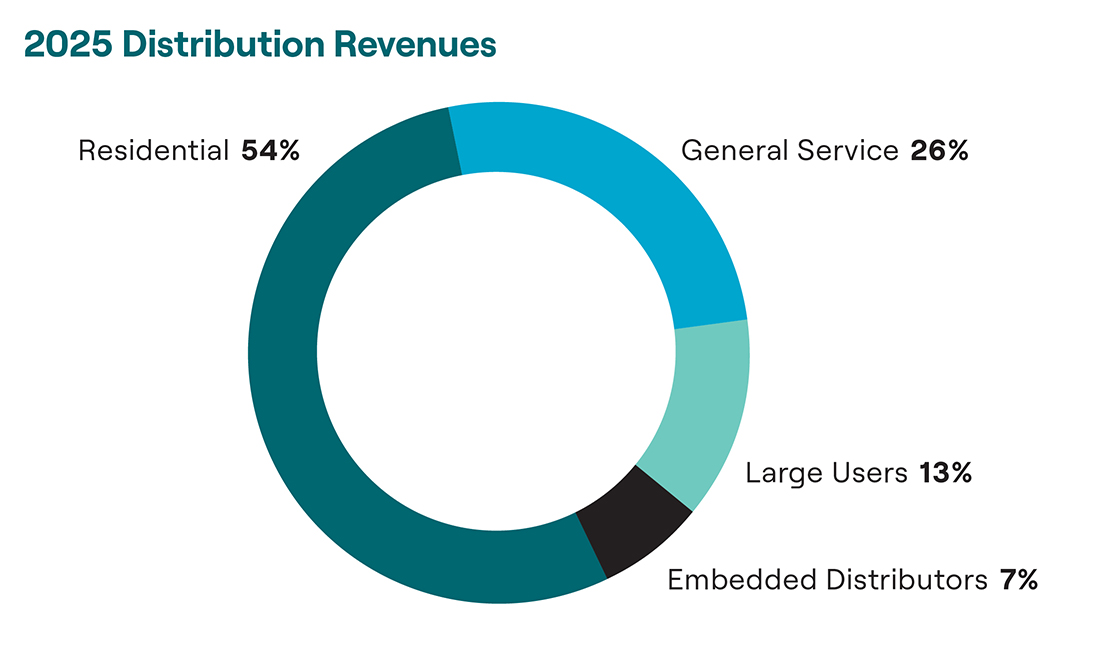
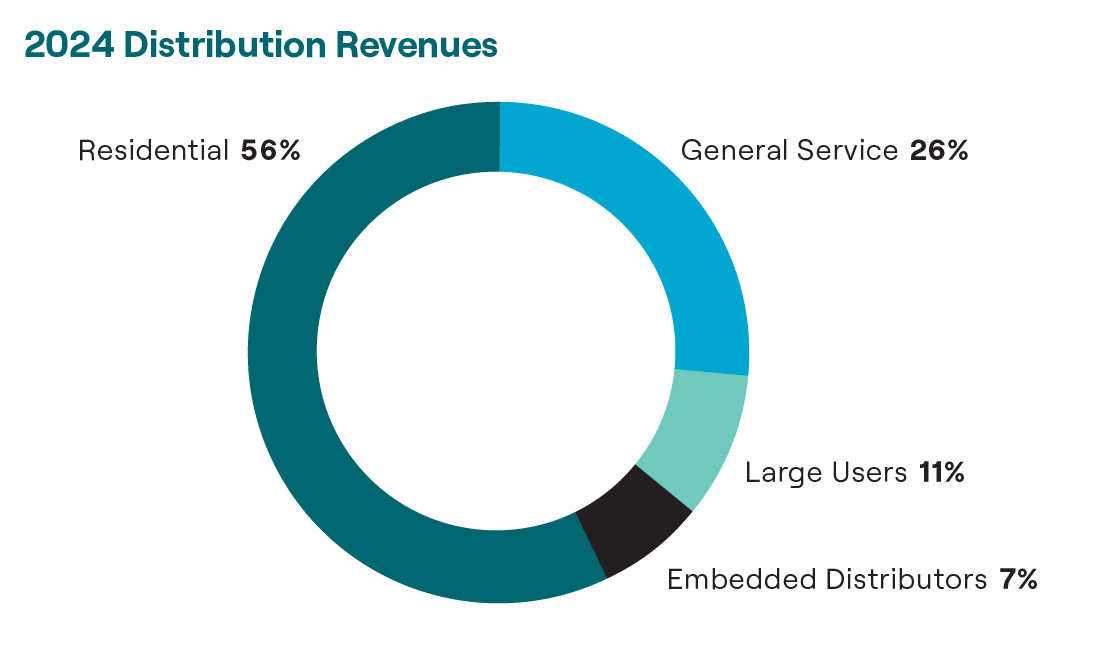
Distribution revenues primarily consist of regulated distribution rates approved by the OEB, as well as the recovery of purchased power costs. Distribution rates are designed to generate revenues necessary to construct and support the local distribution system with sufficient capacity to accommodate existing and new customer demand and a regulated return on the Company’s investment. Accordingly, distribution revenues are influenced by distribution rates, the cost of purchased power, and the amount of electricity the Company distributes. Distribution revenues also include ancillary distribution service revenues, such as fees related to the joint use of Hydro One’s distribution poles by the telecommunications and cable television industries, as well as miscellaneous revenues such as charges for late payments.
Purchased Power Costs
Purchased power costs are incurred by the distribution business and represent the cost of the electricity purchased by the Company for delivery to customers within Hydro One’s distribution service territory. These costs are comprised of: (i) the wholesale commodity cost of energy; (ii) the Global Adjustment, which is the difference between the guaranteed price and the money the generators earn in the wholesale marketplace; and (iii) the wholesale market service and transmission charges levied by the IESO. Hydro One passes on the cost of electricity that it delivers to its customers, and is therefore not exposed to wholesale electricity commodity price risk.
OM&A
OM&A costs are incurred to support the operation and maintenance of the transmission and distribution systems, and include other costs such as property taxes related to transmission and distribution stations and buildings, and the operation of IT systems. Transmission OM&A costs are required to sustain the Company’s high-voltage transmission stations, lines, and rights-of-way, and include preventive and corrective maintenance costs related to power equipment, overhead transmission lines, transmission station sites, and forestry control to maintain safe distances between line spans and trees. Distribution OM&A costs are required to maintain the Company’s low-voltage distribution system to provide safe and reliable electricity to the Company's residential, small business, commercial, and industrial customers across the province. These include costs related to distribution line clearing and forestry control to reduce power outages caused by trees, line maintenance and repair, land assessment and remediation, as well as issuing timely and accurate bills and responding to customer inquiries.
Hydro One manages its costs through ongoing efficiency and productivity initiatives, while continuing to complete planned work programs associated with the development and maintenance of its transmission and distribution networks.
Depreciation, Amortization and Asset Removal Costs
Depreciation and amortization costs relate primarily to the depreciation of the Company’s property, plant and equipment, and amortization of certain intangible assets and regulatory assets. Asset removal costs consist of costs incurred to remove property, plant and equipment where no asset retirement obligations have been recorded on the balance sheet.
Financing Charges
Financing charges relate to the Company’s financing activities and include interest expense on the Company’s long-term debt and short-term borrowings, as well as gains and losses on interest rate swap agreements, foreign exchange or other similar contracts, net of interest earned on short-term investments. A portion of financing charges incurred by the Company is capitalized to the cost of property, plant and equipment associated with the periods during which such assets are under construction before being placed in-service.
HYDRO ONE LIMITED
MANAGEMENT’S DISCUSSION AND ANALYSIS (continued)
For the years ended December 31, 2025 and 2024
RESULTS OF OPERATIONS
Net Income
Net income attributable to common shareholders of Hydro One for the year ended December 31, 2025 of $1,339 million is $183 million, or 15.8%, higher than the prior year. Significant influences on the change in net income attributable to common shareholders of Hydro One included:
•higher revenues, net of purchased power,4 resulting from an increase in transmission and distribution revenues due to OEB-approved 2025 rates, as well as higher average monthly peak demand and energy consumption, partially offset by regulatory adjustments including higher earnings sharing in the current period; and
•lower OM&A costs primarily resulting from lower work program expenditures and lower corporate support costs; partially offset by
•higher depreciation, amortization and asset removal costs primarily due to the growth in capital assets as the Company continues to place new assets in-service;
•higher financing charges primarily due to an increase in outstanding long-term debt, partially offset by higher capitalized interest; and
•higher income tax expense, primarily resulting from higher pre-tax earnings, partially offset by higher deductible timing differences.
EPS
EPS was $2.23 for the year ended December 31, 2025, compared to EPS of $1.93 in 2024. The 15.5% increase in EPS was primarily driven by higher earnings year-over-year, as discussed above.
Revenues
| | | | | | | | | | | | | | | |
| | | | | | | |
| | | |
Year ended December 31 (millions of dollars, except as otherwise noted) | | | | | 2025 | 2024 | Change |
| Transmission | | | | | 2,429 | | 2,269 | | 7.1 | % |
| Distribution | | | | | 6,557 | | 6,175 | | 6.2 | % |
| Other | | | | | 55 | | 40 | | 37.5 | % |
| Total revenues | | | | | 9,041 | | 8,484 | | 6.6 | % |
| | | | | | | |
| Transmission | | | | | 2,429 | | 2,269 | | 7.1 | % |
Distribution revenues, net of purchased power1 | | | | | 2,071 | | 2,032 | | 1.9 | % |
| Other | | | | | 55 | | 40 | | 37.5 | % |
Total revenues, net of purchased power1 | | | | | 4,555 | | 4,341 | | 4.9 | % |
| | | | | | | |
Transmission: Average monthly Ontario 60-minute peak demand (MW) | | | | | 21,398 | | 20,659 | | 3.6 | % |
Distribution: Electricity distributed to Hydro One customers (GWh) | | | | | 33,294 | | 31,523 | | 5.6 | % |
1 See section “Non-GAAP Financial Measures”.
Transmission Revenues
Transmission revenues increased by 7.1% compared to the year ended December 31, 2024, primarily due to:
•higher average monthly peak demand;
•higher revenues resulting from OEB-approved 2025 rates; and
•CLLP revenues following the in servicing of the transmission line in the fourth quarter of 2024; partially offset by
•regulatory adjustments in the period, including a higher earnings sharing accrual.
Distribution Revenues
Distribution revenues increased by 6.2% compared to the year ended December 31, 2024, primarily due to:
•higher purchased power costs, which are fully recovered from ratepayers and thus net income neutral;
•higher revenues resulting from OEB-approved 2025 rates; and
•higher energy consumption; partially offset by
•regulatory adjustments in the period, including a higher earnings sharing accrual; and
•net income neutral items, including lower revenue of Hydro One Remotes, which is offset in OM&A.
Distribution revenues, net of purchased power,4 increased by 1.9% compared to the same period in the prior year largely due to the factors noted above.
4 See section “Non-GAAP Financial Measures”.
HYDRO ONE LIMITED
MANAGEMENT’S DISCUSSION AND ANALYSIS (continued)
For the years ended December 31, 2025 and 2024
OM&A Costs
| | | | | | | | | | | | | | | | | |
| | | |
Year ended December 31 (millions of dollars) | | | | | 2025 | 2024 | Change |
| Transmission | | | | | 447 | | 475 | | (5.9 | %) |
| Distribution | | | | | 661 | | 721 | | (8.3 | %) |
| Other | | | | | 98 | | 112 | | (12.5 | %) |
| | | | | 1,206 | | 1,308 | | (7.8 | %) |
Transmission OM&A Costs
Transmission OM&A costs were 5.9% lower than the year ended December 31, 2024, primarily due to:
•severance costs in the prior year;
•lower work program expenditures, including vegetation management and lines maintenance; and
•lower corporate support costs; partially offset by
•higher property taxes; and
•higher asset write-offs.
Distribution OM&A Costs
Distribution OM&A costs were 8.3% lower than the year ended December 31, 2024, primarily due to:
•severance costs in the prior year;
•lower work program expenditures, including environmental and vegetation management;
•lower fuel costs of Hydro One Remotes, which are fully recovered through revenue and therefore net income neutral; and
•lower bad debt expense; partially offset by
•higher asset write-offs.
Other OM&A Costs
Other OM&A costs were 12.5% lower than the year ended December 31, 2024, including lower costs in Acronym primarily due to higher third party service costs in the prior year.
Depreciation, Amortization and Asset Removal Costs
Depreciation, amortization and asset removal costs increased by $45 million, or 4.2%, for the year ended December 31, 2025. This increase was primarily due to growth in capital assets as the Company continues to place new assets in-service, consistent with its ongoing capital investment program.
Financing Charges
Financing charges increased by $58 million, or 9.3%, for the year ended December 31, 2025, primarily due to an increase in outstanding long-term debt, partially offset by higher capitalized interest.
Income Tax Expense
Income taxes are accounted for using the asset and liability method. Current income taxes are recorded based on the income taxes expected to be paid in respect of the current and prior years’ taxable income. Deferred income tax assets and liabilities are recognized for the future tax consequences attributable to temporary differences between the financial statement carrying amounts and the respective tax basis of assets and liabilities including carryforward unused tax losses and credits.
As prescribed by the regulators, the Company recovers income taxes in revenues from ratepayers based on an estimate of current income tax expense in respect of regulated operations. The amounts of deferred income taxes related to regulated operations, which are considered to be more likely-than-not of recovery from, or refund to, ratepayers in future periods are recognized as deferred income tax regulatory assets or liabilities, with an offset to deferred income tax expense. Therefore, the consolidated income tax expense or recovery for the current period is based on the total current and deferred income tax expense or recovery, net of the regulatory accounting offset to deferred income tax expense arising from temporary differences recoverable from or refundable to customers in the future.
Income tax expense was $219 million for the year ended December 31, 2025, compared to $181 million in 2024. The $38 million increase in income tax expense for the year ended December 31, 2025 was primarily attributable to:
•higher pre-tax earnings, partially offset by
•higher deductible timing differences compared to the prior year.
The Company realized an effective tax rate (ETR) of approximately 14.0% for the year ended December 31, 2025 compared to approximately 13.4% realized in 2024. The increase of 0.6% was primarily attributable to the factors noted above.
HYDRO ONE LIMITED
MANAGEMENT’S DISCUSSION AND ANALYSIS (continued)
For the years ended December 31, 2025 and 2024
SHARE CAPITAL
The common shares of Hydro One are publicly traded on the Toronto Stock Exchange (TSX) under the trading symbol "H". Hydro One is authorized to issue an unlimited number of common shares. The amount and timing of any dividends payable by Hydro One is at the discretion of Hydro One's Board of Directors (Board) and is established on the basis of Hydro One’s results of operations, maintenance of its deemed regulatory capital structure, the Company’s financial condition and forecast cash requirements, the satisfaction of solvency tests imposed by corporate laws for the declaration and payment of dividends, and other factors that the Board may consider relevant. As at February 12, 2026, Hydro One had 599,781,811 issued and outstanding common shares.
The Company is authorized to issue an unlimited number of preferred shares, issuable in series. As at February 12, 2026, the Company had no preferred shares issued and outstanding.
The number of additional common shares of Hydro One that would be issued if all outstanding awards under the share grant plans and the Long-term Incentive Plan (LTIP) were vested and exercised as at February 12, 2026 was 1,424,325.
Common Share Dividends
In 2025, the Company declared and paid cash dividends to common shareholders as follows:
| | | | | | | | | | | | | | |
Date Declared |
Record Date |
Payment Date |
Amount per Share | Total Amount (millions of dollars) |
| February 19, 2025 | March 12, 2025 | March 31, 2025 | $0.3142 | | 188 |
| May 7, 2025 | June 11, 2025 | June 30, 2025 | $0.3331 | | 200 | |
| August 12, 2025 | September 10, 2025 | September 29, 2025 | $0.3331 | | 200 | |
| November 12, 2025 | December 10, 2025 | December 31, 2025 | $0.3331 | | 200 | |
| | | | 788 |
Following the conclusion of the fourth quarter of 2025, the Company declared a cash dividend to common shareholders as follows:
| | | | | | | | | | | | | | |
Date Declared |
Record Date |
Payment Date |
Amount per Share | Total Amount (millions of dollars) |
| February 12, 2026 | March 11, 2026 | March 31, 2026 | $0.3331 | | $200 | |
SELECTED ANNUAL FINANCIAL STATISTICS
| | | | | | | | | | | | | | | | | | | | | | | |
Year ended December 31 (millions of dollars, except per share amounts) | | | | | 2025 | 2024 | 2023 |
| Revenues | | | | | 9,041 | | 8,484 | | 7,844 | |
| Net income attributable to common shareholders of Hydro One | | | 1,339 | | 1,156 | | 1,085 | |
| | | | | | | |
| Basic EPS | | | | | $2.23 | $1.93 | $1.81 |
| Diluted EPS | | | | | $2.23 | $1.92 | $1.81 |
| | | | | | | |
| | | | | | | |
| | | | | | | |
| Dividends per common share declared | | | | | $1.31 | $1.24 | $1.17 |
| | | | | | | | | | | | | | | | | | | | | | | |
As at December 31 (millions of dollars) | | | | | 2025 | 2024 | 2023 |
| Total assets | | | | | 39,671 | | 36,682 | | 32,852 | |
Total non-current financial liabilities1 | | | | | 18,138 | | 16,393 | | 14,750 | |
1 Total non-current financial liabilities include long-term debt, long-term lease obligations, derivative liabilities, and long-term accounts payable and accruals.
Net Income - 2024 compared to 2023
Net income attributable to common shareholders of Hydro One for the year ended December 31, 2024 of $1,156 million was $71 million, or 6.5%, higher than the prior year. Significant influences on the change in net income attributable to common shareholders included:
•higher revenues, net of purchased power,5 resulting from an increase in transmission and distribution revenues due to OEB-approved 2024 rates, differences in regulatory adjustments recorded in each respective period, and higher energy consumption; and
•lower OM&A costs primarily resulting from lower work program expenditures; partially offset by
•higher depreciation, amortization and asset removal costs primarily due to the growth in capital assets as the Company continues to place new assets in-service;
•higher financing charges primarily due to higher interest on long-term debt as well as higher long-term debt, partially offset by a lower average volume of short-term notes outstanding and a higher capitalized interest; and
•higher income tax expense, adjusted for net income neutral items, primarily due to lower deductible timing differences higher pre-tax earnings.
5 See section "Non-GAAP Financial Measures"
HYDRO ONE LIMITED
MANAGEMENT’S DISCUSSION AND ANALYSIS (continued)
For the years ended December 31, 2025 and 2024
While net income neutral, year-to-date results were also impacted by the cessation of the OEB-approved recovery of DTA amounts previously shared with ratepayers (DTA Recovery Amounts) on June 30, 2023, which resulted in a decrease in revenue, net of purchased power6 in 2024 that has been offset by lower income tax expense.
EPS - 2024 compared to 2023
EPS was $1.93 for the year ended December 31, 2024, compared to EPS of $1.81 in 2023. The increase in EPS was primarily driven by the impact of higher earnings year-over-year, as discussed above.
QUARTERLY RESULTS OF OPERATIONS
| | | | | | | | | | | | | | | | | | | | | | | | | | |
Quarter ended (millions of dollars, except EPS and ratio) | Dec 31, 2025 | Sep 30, 2025 | Jun 30, 2025 | Mar 31, 2025 | Dec 31, 2024 | Sep 30, 2024 | Jun 30, 2024 | Mar 31, 2024 |
| Revenues | 2,268 | | 2,299 | | 2,066 | | 2,408 | | 2,095 | | 2,192 | | 2,031 | | 2,166 | |
| Purchased power | 1,287 | | 1,080 | | 899 | | 1,220 | | 1,060 | | 1,047 | | 940 | | 1,096 | |
Revenues, net of purchased power1 | 981 | | 1,219 | | 1,167 | | 1,188 | | 1,035 | | 1,145 | | 1,091 | | 1,070 | |
| Net income attributable to common shareholders | 233 | | 421 | | 327 | | 358 | | 200 | | 371 | | 292 | | 293 | |
| | | | | | | | |
| Basic EPS | $0.39 | | $0.70 | | $0.54 | | $0.60 | | $0.33 | | $0.62 | | $0.49 | | $0.49 | |
| Diluted EPS | $0.39 | | $0.70 | | $0.54 | | $0.60 | | $0.33 | | $0.62 | | $0.49 | | $0.49 | |
| | | | | | | | |
Earnings coverage ratio1 | 2.8 | | 2.8 | | 2.8 | | 2.8 | | 2.8 | | 2.8 | | 2.8 | | 2.8 | |
1 See section “Non-GAAP Financial Measures”.
Variations in revenues and net income attributable to common shareholders over the quarters are primarily due to the impact of seasonal weather conditions on customer demand and market pricing, as well as timing of regulatory decisions.
CAPITAL INVESTMENTS
The Company makes capital investments to maintain the safety, reliability and integrity of its transmission and distribution system assets and to provide for the ongoing growth and modernization required to meet the expanding and evolving needs of its customers and the electricity market. This is achieved through a combination of sustaining capital investments, which are required to support the continued operation of Hydro One’s existing assets, and development capital investments, which involve additions to both existing assets and large-scale projects such as new transmission lines and transmission stations.
Assets Placed In-Service
The following table presents Hydro One’s assets placed in-service during the years ended December 31, 2025 and 2024:
| | | | | | | | | | | | | | | |
| | | |
Year ended December 31 (millions of dollars) | | | | | 2025 | 2024 | Change |
| Transmission | | | | | 1,543 | | 1,431 | | 7.8 | % |
| Distribution | | | | | 1,338 | | 1,017 | | 31.6 | % |
| Other | | | | | 20 | | 15 | | 33.3 | % |
| Total assets placed in-service | | | | | 2,901 | | 2,463 | | 17.8 | % |
Transmission Assets Placed In-Service
Transmission assets placed in-service increased by $112 million, or 7.8%, during the year ended December 31, 2025, compared to the year ended December 31, 2024, primarily due to:
•timing of assets placed in-service for station refurbishments and replacements, including the Bruce A Transmission Station;
•investments placed in-service in Sault Ste. Marie for the Sault #3 Circuit;
•investments placed in-service for customer connection projects; and
•investments placed in-service at the Orillia Distribution Warehouse; partially offset by
•investments placed in-service for the Chatham to Lakeshore Transmission Line;
•lower volume of line refurbishments and wood pole replacements; and
•investment placed in-service for the Network Management System.
6 See section "Non-GAAP Financial Measures"
HYDRO ONE LIMITED
MANAGEMENT’S DISCUSSION AND ANALYSIS (continued)
For the years ended December 31, 2025 and 2024
Distribution Assets Placed In-Service
Distribution assets placed in-service increased by $321 million, or 31.6%, during the year ended December 31, 2025, compared to the year ended December 31, 2024, primarily due to:
•higher volume of storm-related asset replacements;
•assets placed in-service for the Advanced Metering Infrastructure (AMI) 2.0 system;
•investments placed in-service for the Orillia Distribution Warehouse and the Orillia Operation Centre;
•investments placed in-service for Ontario’s broadband initiative; and
•timing of assets placed in-service for system capability reinforcement projects; partially offset by
•lower volume of wood pole replacements and line refurbishments;
•timing of investments placed in-service for IT initiatives; and
•assets placed in-service for the Orleans Operation Centre in the prior year.
Capital Investments
The following table presents Hydro One’s capital investments during the years ended December 31, 2025 and 2024:
| | | | | | | | | | | | | | | |
| | | |
Year ended December 31 (millions of dollars) | | | | | 2025 | 2024 | Change |
| Transmission | | | | | | | |
| Sustaining | | | | | 1,146 | | 1,284 | | (10.7 | %) |
| Development | | | | | 864 | | 467 | | 85.0 | % |
| Other | | | | | 87 | | 109 | | (20.2 | %) |
| | | | | 2,097 | | 1,860 | | 12.7 | % |
| Distribution | | | | | | | |
| Sustaining | | | | | 688 | | 561 | | 22.6 | % |
| Development | | | | | 463 | | 513 | | (9.7 | %) |
| Other | | | | | 101 | | 111 | | (9.0 | %) |
| | | | | 1,252 | | 1,185 | | 5.7 | % |
| Other | | | | | 17 | | 18 | | (5.6 | %) |
| Total capital investments | | | | | 3,366 | | 3,063 | | 9.9 | % |
Total 2025 capital investments of $3,366 million for the year ended December 31, 2025, were $176 million lower than the previously disclosed expected amount of $3,542 million, primarily due to timing and project schedule shifts of capital investments for transmission station refurbishments and equipment replacements.
Transmission Capital Investments
Transmission capital investments increased by $237 million, or 12.7%, during the year ended December 31, 2025 compared to the year ended December 31, 2024, primarily due to:
•investments in the Waasigan Transmission Line Project;
•investments in the St. Clair Transmission Line Project; and
•higher spend on customer connections; partially offset by
•lower volume of station refurbishments and equipment replacements;
•lower volume of line refurbishments and wood pole replacements; and
•investments in the Orillia Distribution Warehouse.
Distribution Capital Investments
Distribution capital investments increased by $67 million, or 5.7%, in the year ended December 31, 2025 compared to the year ended December 31, 2024, primarily due to:
•higher spend on storm-related asset replacements;
•investments in Ontario’s broadband initiative; and
•investments in the AMI 2.0 system; partially offset by
•lower volume of wood pole replacements;
•lower spend on system capability reinforcement projects;
•investments in the Orillia Distribution Warehouse, Orillia Operation Centre and Orleans Operation Centre;
•lower spend on IT initiatives;
•lower volume of work on customer connections; and
•lower volume of polychlorinated biphenyl (PCB) transformer replacements.
HYDRO ONE LIMITED
MANAGEMENT’S DISCUSSION AND ANALYSIS (continued)
For the years ended December 31, 2025 and 2024
Major Transmission Capital Investment Projects
The following table summarizes the status of significant transmission projects as at December 31, 2025:
| | | | | | | | | | | | | | | | | |
Project Name |
Location |
Type | Anticipated
In-Service Date | Estimated Cost1 | Capital Cost
To Date |
| | | (year) | (millions of dollars) |
| Development Projects: | | |
| | | | | |
| | | | | |
| | | | | |
Centennial Transmission Station2 | Southwestern Ontario | New transmission station and
connection | 2026 | 229 | 185 |
Waasigan Transmission Line3 | Thunder Bay-Atikokan-Dryden
Northwestern Ontario | New transmission line and
station expansion | 2027 | 1,200 | 539 |
| Holt Transmission Station | Bowmanville Central Ontario | New transmission station and
connection | 2027 | 137 | 28 |
St. Clair Transmission Line4 | Southwestern Ontario | New transmission line and
station expansion | 2027 | 472 | 247 |
| Keith Intertie Upgrade | Windsor
Southwestern Ontario | Transmission station upgrade | 2028 | 109 | 9 |
Welland Thorold Power Line5 | Niagara
Southern Ontario | New transmission line and
station expansion | 2029 | 311 | 20 |
Longwood to Lakeshore
Transmission Line6 | Southwestern Ontario | New transmission line and
station expansion | TBD | TBD | 46 |
Durham Kawartha Power Line7,8 | Eastern Ontario | New transmission line and
station expansion | TBD | TBD | 24 |
Northeast Power Line7,8 | Northeastern Ontario | New transmission line and
station expansion | TBD | TBD | 23 |
North Shore Link7,8 | Northeastern Ontario | New transmission line and
station expansion | TBD | TBD | 20 |
Wawa Timmins Power Line7,8 | Northeastern Ontario | New transmission line and
station expansion | TBD | TBD | 8 |
Second Longwood to Lakeshore
Transmission Line6 | Southwestern Ontario | New transmission line and
station expansion | TBD | TBD | 2 |
Windsor to Lakeshore Transmission Line6 | Southwestern Ontario | New transmission line and
station expansion | TBD | TBD | 2 |
Bowmanville to Parkway Transmission Line9 | Southern Ontario | New transmission line and
station expansion | TBD | TBD | — | |
Wellington to Preston Transmission Line10 | Southwestern Ontario | New transmission line and new transmission station | TBD | TBD | — | |
| Greenstone Transmission Line | Northwestern Ontario | New transmission line and
station expansion | TBD | TBD | — | |
Sudbury to Barrie Transmission Line11 | Northern-Central Ontario | New transmission line and
station expansion | TBD | TBD | — | |
| Sustainment Projects: | | | | | |
Middleport Transmission Station
Circuit Breaker Replacement | Middleport
Southwestern Ontario | Station sustainment | 2026 | 184 | 171 |
Lennox Transmission Station
Circuit Breaker Replacement | Napanee
Southeastern Ontario | Station sustainment | 2026 | 152 | 152 |
Esplanade x Terauley
Underground Cable Replacement | Toronto
Southern Ontario | Line sustainment | 2026 | 117 | 96 |
Bridgman Transmission Station
Refurbishment | Toronto
Southern Ontario | Station sustainment | 2026 | 108 | 93 |
Bruce A Transmission Station
Switchyard Replacement | Tiverton
Southwestern Ontario | Station sustainment | 2027 | 555 | 421 |
Otto Holden Transmission Station
Refurbishment | Mattawa
Northeast Ontario | Station sustainment | 2028 | 128 | 72 |
Merivale Transmission Station Replacement and Upgrades12 | Ottawa
Eastern Ontario | Station sustainment and
upgrade | 2029 | 271 | 178 |
Synchronous Optical Network
Telecommunication Replacement | Ontario | Telecommunication sustainment | 2029 | 137 | 16 |
Essa Transmission Station Circuit
Breaker Replacement | Barrie
Central Ontario | Station sustainment | 2030 | 116 | 7 |
1 Estimated costs are presented gross of any potential contribution from external parties.
2 This Project is part of a two-phase project, which includes the construction of a transmission station and a transmission line to meet the needs of, and is anticipated to be largely funded by, an industrial customer. Phase 1 of the Centennial Transmission Station Project includes a new transmission station in St. Thomas and an approximately 2 km, 230 kV double-circuit transmission line between the new transmission station and an existing transmission station in the city. This phase of the project is anticipated to be in service by the end of 2026. Scope and timing of the second phase, an approximately 20 km, 230 kV double-circuit transmission line from London to St. Thomas, is currently under review.
3 The Waasigan Transmission Line Project includes construction of new transmission lines as well as station enhancements to support energization of the new lines. The estimated cost relates to the development and construction phases of the project and the anticipated in-service date reflects anticipated completion in 2027. The first phase of the project is anticipated to be in-serviced in 2026.
4 The St. Clair Transmission Line Project includes the line and associated facilities.
5 The IESO has recommended a target in-service date of 2029 for the Welland Thorold Power Line.
6 The capital cost to date relates to costs incurred in the development phase of the project. The scope and timing of these Southwestern Ontario transmission reinforcement projects are currently under review. The IESO has recommended a target in-service date by 2032 for the Windsor to Lakeshore Transmission Line.
7 The capital cost to date relates to costs incurred in the development phase of the project. The scope and timing of these Northeastern and Eastern Ontario transmission reinforcements are currently under review. The Wawa Timmins Power Line was previously referred to as the Wawa to Porcupine Transmission Line.
8 The IESO has recommended a target in-service date of 2030 for the Wawa Timmins Power Line, and of 2029 for the Northeast Power Line, North Shore Link, and the Durham Kawartha Power Line.
9 The Bowmanville to Parkway Transmission Line was previously referred to as the Bowmanville to Greater Toronto Area Transmission Line.
10The IESO has recommended a target in-service date of 2031 for the Wellington to Preston Transmission Line and the Wellington Transmission Station in the Township of Puslinch. (See Section “Other Developments - Wellington to Preston Line Project”)
11Pertains to the First Sudbury to Barrie Transmission Line. The scope and timing of the line is currently under review. The IESO has recommended a target in-service date by 2032.
12 The coordinated project includes both an asset replacement and station expansion. The anticipated in-service dates are between 2026 to 2029.
HYDRO ONE LIMITED
MANAGEMENT’S DISCUSSION AND ANALYSIS (continued)
For the years ended December 31, 2025 and 2024
Future Capital Investments
The Company estimates future capital investments based on management’s expectations of the amount of capital expenditures that will be required to provide transmission and distribution services that are efficient, reliable, and provide value for customers, consistent with the OEB’s Renewed Regulatory Framework. The Company includes projects when there is a high degree of confidence that the project will go forward and when there is a thorough estimate of the expected expenditures.
The forecast below does not include offsets associated with the impact of restoration costs associated with a severe storm that began on March 28, 2025 causing significant damage to system infrastructure and outages to customers in the central and eastern regions of the province, with restoration efforts continuing into the second quarter. On April 29, 2025, the Company notified the OEB that it intended to submit a Z-Factor application to seek recovery of costs incurred for this storm. On August 28, 2025, the Company submitted the Z-Factor application. The application seeks recovery of approximately $225 million in storm-related costs, including capital and asset removal costs. The forecast is expected to be updated pending the outcome of that application. The decision regarding the Z-factor application is anticipated to be issued by the OEB in early 2026.
The following tables summarize Hydro One’s annual projected capital investments for 2026 to 2027 by business segment and by category:
| | | | | | | | | | | | | | | | | | | | | |
By business segment: (millions of dollars) | | | | | 2026 | 2027 | |
Transmission1 | | | | | 2,116 | | 1,892 | | |
| Distribution | | | | | 1,093 | | 918 | | |
| Other | | | | | 39 | | 32 | | |
Total capital investments2 | | | | | 3,248 | | 2,842 | | |
| | | | | | | | | | | | | | | | | | | | | |
By category: (millions of dollars) | | | | | 2026 | 2027 | |
| Sustainment | | | | | 1,426 | | 1,064 | | |
Development1 | | | | | 1,657 | | 1,626 | | |
Other3 | | | | | 165 | | 152 | | |
Total capital investments2 | | | | | 3,248 | | 2,842 | | |
1 Figures include investments in certain development projects of Hydro One Networks not included in the investment plan approved by the OEB in the Joint Rate Application (JRAP) decision.
2 Since the first quarter of 2022, the Minister of Energy and Electrification (formerly the Minister of Energy) (Minister) has directed the OEB to amend Hydro One Networks’ transmission licence to require it to develop and seek approvals for eleven priority transmission lines in Ontario. The future capital investments presented do not include capital expenditures, nor development costs, associated with the following three priority Southwestern Ontario transmission line projects: Longwood to Lakeshore Transmission Line, Second Longwood to Lakeshore Transmission Line, and Windsor to Lakeshore Transmission Line; nor the following four priority Northeastern and Eastern Ontario transmission line projects: North Shore Link, Northeast Power Line, Durham Kawartha Power Line, and Wawa Timmins Power Line (see section “Other Developments - Supporting Critical Transmission Infrastructure in Northeastern and Eastern Ontario”); nor the Bowmanville to Parkway, Greenstone and Barrie to Sudbury Transmission Lines (see section “Affordable Energy Act, 2024 and Ontario Integrated Energy Plan”). Hydro One is currently evaluating the scope and timing of these ten lines.
3 “Other” capital expenditures include investments in fleet, real estate, IT, and operations technology and related functions.
SUMMARY OF SOURCES AND USES OF CASH
Hydro One’s primary sources of cash flows are funds generated from operations, capital market debt issuances and bank credit facilities that are used to satisfy Hydro One’s capital resource requirements, including the Company’s capital expenditures, servicing and repayment of debt, and dividend payments.
| | | | | | | | | | | |
| | | |
Year ended December 31 (millions of dollars) | | | | 2025 | 2024 |
| Net cash from operating activities | | | | 2,695 | | 2,534 | |
| Net cash from financing activities | | | | 652 | | 1,233 | |
| Net cash used in investing activities | | | | (3,514) | | (3,130) | |
| Net change in cash and cash equivalents | | | | (167) | | 637 | |
Net cash from operating activities
Net cash from operating activities increased by $161 million for the year ended December 31, 2025 compared to the same period in 2024. The increase was impacted by various factors, including the following:
•higher pre-tax earnings; and
•changes in regulatory account balances; partially offset by
•changes in net working capital deficiency primarily attributable to lower unearned revenue related to capital contributions, timing differences in the settlement of receivables, higher receivables from the IESO driven by a higher Ontario Electricity Rebate, partially offset by higher cost of power payable to the IESO due to higher purchased volumes.
HYDRO ONE LIMITED
MANAGEMENT’S DISCUSSION AND ANALYSIS (continued)
For the years ended December 31, 2025 and 2024
Net cash from financing activities
Net cash from financing activities decreased by $581 million for the year ended December 31, 2025, compared to the same period of 2024. This decrease was impacted by various factors, including the following:
Uses of cash
•the Company repaid $6,170 million of short-term notes in 2025, compared to $2,890 million repaid in 2024.
•the Company repaid $1,150 million of long-term debt in 2025, compared to $700 million repaid in 2024.
•the Company paid common share dividends of $788 million in 2025, compared to dividends of $743 million paid in 2024.
Sources of cash
•the Company received proceeds of $6,070 million from the issuance of short-term notes in 2025, compared to $2,810 million received in 2024.
•the Company issued $2,698 million of long-term debt in 2025, compared to $2,781 million of long-term debt issued in 2024.
Net cash used in investing activities
Net cash used in investing activities for the year ended December 31, 2025 was $384 million higher than the same period of 2024 as a result of the investment in EWT LP (see section “Other Developments - EWT LP”), and higher capital investments. See section “Capital Investments” for comparability of capital investments made by the Company during the year ended December 31, 2025 compared to the prior year.
LIQUIDITY AND FINANCING STRATEGY
Short-term liquidity is provided through FFO,7 Hydro One Inc.’s commercial paper program, and the Company’s consolidated bank credit facilities. Under the commercial paper program, Hydro One Inc. is authorized to issue up to $2,300 million in short-term notes with a term to maturity of up to 365 days.
As at December 31, 2025, Hydro One Inc. had $100 million in commercial paper borrowings outstanding, compared to $200 million outstanding at December 31, 2024. The Company also has committed, unsecured, and revolving credit facilities (Operating Credit Facilities) with a total available balance of $3,300 million as at December 31, 2025. The Operating Credit Facilities include a pricing adjustment which can increase or decrease Hydro One’s cost of borrowing based on its performance on certain sustainability performance measures, which are related to Hydro One's sustainability goals. On June 1, 2025, Hydro One extended the maturity date of the Operating Credit Facilities from 2029 to 2030. No amounts were drawn on the Operating Credit Facilities as at December 31, 2025 or 2024. The Company may use the Operating Credit Facilities for working capital and general corporate purposes. The short-term liquidity under the commercial paper program, the Operating Credit Facilities, available cash on hand and anticipated levels of FFO7 are expected to be sufficient to fund the Company’s operating requirements.
As at December 31, 2025, the Company had long-term debt outstanding in the principal amount of $19,045 million, which included $425 million of long-term debt issued by Hydro One and $18,620 million of long-term debt issued by Hydro One Inc. The majority of long-term debt issued by Hydro One Inc. has been issued under its Medium-Term Note (MTN) Program, as further described below. The Company's total long-term debt consists of notes and debentures that mature between 2026 and 2064, and as at December 31, 2025 had a weighted-average term to maturity of approximately 13.7 years (December 31, 2024 - 13.7 years) and a weighted-average coupon rate of 4.2% (December 31, 2024 - 4.2%).
In February 2024, Hydro One Inc. filed a short form base shelf prospectus in connection with its MTN Program, which expires in March 2026. A new MTN Program prospectus is expected to be filed in the first quarter of 2026.
On August 19, 2024, Hydro One filed a short form base shelf prospectus (Universal Base Shelf Prospectus) with securities regulatory authorities in Canada. The Universal Base Shelf Prospectus allows Hydro One to offer, from time to time in one or more public offerings, debt, equity or other securities, or any combination thereof, during the 25-month period ending in September 2026. As at December 31, 2025, no securities have been issued under the Universal Base Shelf Prospectus.
On November 29, 2024, Hydro One Holdings Limited (HOHL) filed a short form base shelf prospectus (HOHL U.S. Debt Shelf Prospectus) with securities regulatory authorities in Ontario and the U.S., that expires in December 2026. The HOHL U.S. Debt Shelf Prospectus allows HOHL to offer, from time to time in one or more public offerings, debt securities, unconditionally guaranteed by Hydro One. As at December 31, 2025, no securities have been issued under the HOHL U.S. Debt Shelf Prospectus.
7 See section “Non-GAAP Financial Measures”.
HYDRO ONE LIMITED
MANAGEMENT’S DISCUSSION AND ANALYSIS (continued)
For the years ended December 31, 2025 and 2024
On August 18, 2025, Hydro One Inc. filed a short form base shelf prospectus (HOI U.S. Debt Shelf Prospectus) with securities regulatory authorities in Ontario and the U.S. The HOI U.S. Debt Shelf Prospectus allows Hydro One Inc. to offer, from time to time in one or more public offerings, U.S. debt securities, during the 25-month period ending on September 18, 2027. As at December 31, 2025, no securities have been issued under the HOI U.S. Debt Shelf Prospectus.
Compliance
As at December 31, 2025, the Company was in compliance with all financial covenants and limitations associated with the outstanding borrowings and credit facilities.
Credit Ratings
Various ratings organizations review the Company’s and Hydro One Inc.’s debt ratings from time to time. These rating organizations may take various actions, positive or negative. The Company cannot predict what actions rating agencies may take in the future. The failure to maintain the Company’s current credit ratings could adversely affect the Company’s financial condition and results of operations, and a downgrade in the Company’s credit ratings could restrict the Company’s ability to access debt capital markets and increase the Company’s cost of debt.
As at December 31, 2025, Hydro One’s long-term debt ratings were as follows:
| | | | | | | | |
| Rating Agency | | Long-term Debt
Rating |
| DBRS Limited | | A |
S&P Global Ratings | | A- |
As at December 31, 2025, Hydro One Inc.’s long-term and short-term debt ratings were as follows:
| | | | | | | | |
| Rating Agency | Short-term Debt
Rating | Long-term Debt
Rating |
| DBRS Limited | R-1 (low) | A (high) |
| Moody’s Ratings | Prime-2 | A3 |
S&P Global Ratings | A-1 (Mid) | A |
Effect of Interest Rates
The Company is exposed to fluctuations of interest rates as its regulated return on equity (ROE) is derived using a formulaic approach that takes into account changes in benchmark interest rates for Government of Canada debt and the A-rated utility corporate bond yield spread. The Company issues debt from time to time to refinance maturing debt and for general corporate purposes. The Company is therefore exposed to fluctuations in interest rates in relation to such issuances of debt. See section “Risk Management and Risk Factors - Risks Relating to Hydro One’s Business - Market, Financial Instrument and Credit Risk” for more details.
Pension Plan
In 2025, Hydro One made cash contributions of $68 million to its pension plan, compared to cash contributions of $75 million in 2024. The Company also incurred $124 million of net periodic benefit credit, compared to $57 million of net periodic benefit credit incurred in 2024.
In September 2025, Hydro One filed a triennial actuarial valuation of its pension plan as at December 31, 2024 which is effective for 2025 to 2027. Based on this valuation, Hydro One estimates that total Company pension contributions for 2026, 2027, 2028, 2029 and 2030 are approximately $70 million, $73 million, $77 million, $81 million, and $85 million, respectively. Future minimum contributions beyond 2027 will be updated following the actuarial funding valuation as of December 31, 2027, which is expected to be filed by no later than September 30, 2028. Should Hydro One elect to file a valuation earlier than required, contributions for 2027 would also be updated, as applicable.
The Company’s pension benefits obligation is impacted by various assumptions and estimates, such as the discount rate, rate of return on plan assets, rate of cost of living increase and mortality assumptions. A full discussion of the significant assumptions and estimates can be found in the section “Critical Accounting Estimates - Employee Future Benefits”.
HYDRO ONE LIMITED
MANAGEMENT’S DISCUSSION AND ANALYSIS (continued)
For the years ended December 31, 2025 and 2024
OTHER OBLIGATIONS
Off-Balance Sheet Arrangements
There are no off-balance sheet arrangements that have, or are reasonably likely to have, a material current or future effect on the Company’s financial condition, revenues or expenses, results of operations, liquidity, capital expenditures or capital resources.
Summary of Contractual Obligations and Other Commercial Commitments
The following table presents a summary of Hydro One’s debt and other major contractual obligations and commercial commitments:
| | | | | | | | | | | | | | | | | |
As at December 31, 2025 (millions of dollars) |
Total | Less than
1 year |
1-3 years |
3-5 years | More than
5 years |
Contractual obligations (due by year) | | | | | |
| Long-term debt - principal repayments | 19,045 | | 925 | | 1,175 | | 1,900 | | 15,045 | |
| Long-term debt - interest payments | 11,444 | | 792 | | 1,526 | | 1,399 | | 7,727 | |
| Short-term notes payable | 100 | | 100 | | — | | — | | — | |
Pension contributions1 | 386 | | 70 | | 150 | | 166 | | — | |
Outsourcing and other agreements | 147 | | 48 | | 80 | | 2 | | 17 | |
| Environmental and asset retirement obligations | 104 | | 10 | | 8 | | 17 | | 69 | |
| | | | | |
| Lease obligations | 45 | | 16 | | 24 | | 4 | | 1 | |
| | | | | |
| Total contractual obligations | 31,271 | | 1,961 | | 2,963 | | 3,488 | | 22,859 | |
| | | | | |
Other commercial commitments (by year of expiry) | | | | | |
| Operating Credit Facilities | 3,300 | | — | | — | | 3,300 | | — | |
Letters of credit2 | 191 | | 191 | | — | | — | | — | |
Guarantees3 | 540 | | 540 | | — | | — | | — | |
| Total other commercial commitments | 4,031 | | 731 | | — | | 3,300 | | — | |
1 Contributions to the Hydro One Pension Plan are based on actuarial reports, including valuations performed at least every three years, and actual or projected levels of pensionable earnings, as applicable. The most recent actuarial valuation was performed effective December 31, 2024 and filed on September 23, 2025.
2 Letters of credit consist of $166 million letters of credit related to retirement compensation arrangements, an $18 million letter of credit provided to the IESO for prudential support, and $7 million in letters of credit for various operating purposes.
3 Guarantees consist of $475 million prudential support provided to the IESO by Hydro One Inc. on behalf of its subsidiaries, as well as $60 million of guarantees provided by Hydro One to ONroute relating to OCN LP (OCN Guarantee) and $5 million relating to Aux Energy Inc.
HYDRO ONE LIMITED
MANAGEMENT’S DISCUSSION AND ANALYSIS (continued)
For the years ended December 31, 2025 and 2024
REGULATION
The following table summarizes the key elements and status of Hydro One’s electricity rate applications: | | | | | | | | | | | | | | |
| Application | Year | Rate Base Approved/Proposed (millions of dollars) | Base Revenue Requirement Approved/Proposed (millions of dollars) | Status |
|
| | | |
| Transmission: | | | |
Hydro One Networks1 | 2025 | 16,271 | 2,168 | Approved in November 2022 |
| 2026 | 17,148 | 2,277 | Approved in November 2022 |
| 2027 | 17,940 | 2,362 | Approved in November 2022 |
| B2M LP | 2025 | 455 | 38 | Approved in November 2024 |
| 2026 | 447 | 38 | Approved in October 20252 |
| 2027 | 440 | 39 | Approved in October 20252 |
| 2028 | 433 | 39 | Approved in October 20252 |
| 2029 | 426 | 37 | Approved in October 20252 |
HOSSM3 | 2017-2026 | 218 | 41 | Approved in January 2016 |
| CLLP | 2025 | 201 | 17 | Approved in November 2024 |
| 2026 | 209 | 17 | Approved in December 20252 |
| 2027 | 206 | 16 | Approved in December 20252 |
| 2028 | 204 | 16 | Approved in December 20252 |
| 2029 | 201 | 16 | Approved in December 20252 |
| NRLP | 2025 | 110 | 9 | Approved in November 2024 |
| 2026 | 108 | 9 | Approved in October 20252 |
| 2027 | 107 | 9 | Approved in October 20252 |
| 2028 | 105 | 9 | Approved in October 20252 |
| 2029 | 104 | 9 | Approved in October 20252 |
| Distribution: | | | | |
Hydro One Networks1 | 2025 | 10,573 | 1,886 | Approved in November 2022 |
| 2026 | 11,153 | 1,985 | Approved in November 2022 |
| 2027 | 11,656 | 2,071 | Approved in November 2022 |
Hydro One Remotes4 | 2023-2027 | 58 | 128 | Approved in March 2023 |
1 Revenue requirements for 2025 to 2027 do not include the impacts of updates filed with the regulator per the annual application process to reflect the latest OEB inflation factors.
2 Under the agreed-upon revenue requirement framework, there is no longer a requirement for these LPs to file annual update applications with the OEB throughout the rate term, except for the one-time update in 2025.
3 HOSSM is under a 10-year deferred rebasing period for years 2017-2026, as approved in the OEB Mergers, Amalgamations, Acquisitions and Divestitures decision dated October 13, 2016. Revenue requirement since 2019 have been subject to an approved revenue cap escalator index.
4 Revenue requirements for 2025 to 2027 will be updated per the annual application process with the regulator to reflect latest OEB inflation factors. Rate increases for Hydro One Remotes are effective May 1st of each year.
The following table summarizes the status of Hydro One’s Leave to Construct Applications with the OEB for significant transmission projects as at December 31, 2025:
| | | | | | | | |
| Application | | Status |
| | |
| Welland Thorold Power Line Project | | Filed in November 20251 |
| Waasigan Transmission Line Project | | Approved in April 20241 |
| St. Clair Transmission Line Project | | Approved in December 20242 |
1 See section “Major Transmission Capital Investment Projects” and “Other Developments - Welland Thorold Power Line”. Under Hydro One’s equity partnership model, First Nations communities would have an opportunity to acquire a 50% equity stake in the transmission line component of the project.
2 See section “Major Transmission Capital Investment Projects” and “Other Developments - Supporting Critical Infrastructure in Southwestern Ontario.” Under Hydro One’s equity partnership model, First Nations communities would have an opportunity to acquire a 50% equity stake in the transmission line component of the project.
HYDRO ONE LIMITED
MANAGEMENT’S DISCUSSION AND ANALYSIS (continued)
For the years ended December 31, 2025 and 2024
OEB Cost of Capital Policy Review
On March 6, 2024, the OEB commenced a hearing on its own motion to consider the methodology for determining the values of the cost of capital parameters and deemed capital structure to be used in the rate-setting process, as well as the methodology for determining the OEB’s prescribed interest rates and matters related to the Incremental Cloud Computing Implementation Costs deferral account, including what type of interest rate, if any, should apply to the account. On March 27, 2025, the OEB issued its Decision and Order, issuing new cost of capital parameters and confirming that the new cost of capital parameters will take effect at a utility’s next rebasing rate application. The OEB’s approach for deemed capital structure remained unchanged at 40% equity and 60% debt, for transmission and distribution electricity utilities. The OEB also concluded that the prescribed interest rate for deferral and variance accounts will continue to apply to the Incremental Cloud Computing Implementation Costs deferral account, and that each utility, in its next rebasing rate application, can propose the treatment of any future cloud solutions during the rate term, which could include a new cloud solution deferral account. If no proposal is made during that rebasing rate application, the account will be closed.
Extended Horizons Variance Account
On March 20, 2025, the OEB established a generic deferral and variance account, effective November 18, 2024. This variance account allows rate-regulated electricity distributors to record the incremental revenue requirement impacts resulting from reductions in the forecasted customer capital contributions embedded in distribution rates related to the OEB’s amendments to the Distribution System Code in December 2024, which extend the connection horizon and revenue horizon for certain customer connections. As at December 31, 2025, the balance in the account is immaterial.
B2M LP
On May 23, 2024, Hydro One Networks, on behalf of B2M LP, submitted B2M LP’s five-year Transmission Revenue Requirement Application for the 2025 to 2029 period. On November 21, 2024, the OEB issued a Decision and Order approving B2M LP’s five-year revenue requirement application, which includes a 2025 base revenue requirement of $38 million. Under the agreed-upon revenue requirement framework, there is no longer a requirement for B2M LP to file annual update applications with the OEB throughout the rate term, except for a one-time update in 2025, which the OEB approved in October 2025, setting the revenue requirements for 2026-2029.
NRLP
On May 23, 2024, Hydro One Networks, on behalf of NRLP, submitted NRLP’s five-year Transmission Revenue Requirement Application for the 2025 to 2029 period. On November 21, 2024, the OEB issued a Decision and Order approving NRLP’s revenue requirement application, which includes a 2025 base revenue requirement of $9 million. Under the agreed-upon revenue requirement framework, there is no longer a requirement for NRLP to file annual update applications with the OEB throughout the rate term, except for a one-time update in 2025, which the OEB approved in October 2025, setting the revenue requirements for 2026-2029.
CLLP
On July 12, 2024, Hydro One Networks, on behalf of CLLP, submitted CLLP’s five-year Transmission Revenue Requirement Application for the 2025 to 2029 period. On December 17, 2024, the OEB issued a Decision and Order approving CLLP’s revenue requirement application, which includes a 2025 base revenue requirement of $17 million, effective January 1, 2025. Under the agreed-upon revenue requirement framework, there is no longer a requirement for CLLP to file annual update applications with the OEB throughout the rate term, except for a one-time update in 2025, which the OEB approved in December 2025, setting the revenue requirements for 2026-2029.
Building Broadband Faster Act, 2021
In March 2021, the Province of Ontario (Province) introduced Bill 257, Supporting Broadband and Infrastructure Expansion Act, 2021, to create a new act entitled the Building Broadband Faster Act, 2021 (BBFA) that is aimed at supporting the timely deployment of broadband infrastructure within unserved and underserved rural Ontario communities. Bill 257 received Royal Assent on April 12, 2021. Bill 257 amended the Ontario Energy Board Act, 1998 (OEBA) to provide the Province with regulation-making authority regarding the development of, access to, or use of electricity infrastructure for non-electricity purposes. The BBFA Guideline and two regulations informing the legislative changes were also published in 2021, with a third regulation on annual wireline attachment rate for telecommunications carriers issued in December 2021. The most recent Order and Decision from the OEB adjusts the annual wireline attachment rate to $39.14 per attacher per pole, effective January 1, 2025.
In March 2022, the Province introduced Bill 93 (Getting Ontario Connected Act, 2022). Bill 93 received Royal Assent on April 14, 2022. Bill 93 amends the BBFA to ensure that organizations that own underground utility infrastructure near a designated high-speed internet project provide timely access to their infrastructure data, which would allow internet service providers to quickly start work on laying down underground high-speed internet infrastructure.
A regulation regarding electricity infrastructure and designated broadband projects under the OEBA (O.Reg. 410/22) came into force on April 21, 2022. On July 7, 2022, the OEB established a deferral account for rate-regulated distributors to record incremental costs associated with carrying out activities pertaining to designated broadband projects. In September 2022, the
HYDRO ONE LIMITED
MANAGEMENT’S DISCUSSION AND ANALYSIS (continued)
For the years ended December 31, 2025 and 2024
Company launched its choice-based operating model to provide internet service providers with choices on how to access the Company’s infrastructure in order to effectively execute designated broadband projects. On March 28, 2023, the Province amended the OEBA (O.Reg. 410/22) with respect to performance timelines associated with designated broadband projects.
On August 14, 2023, the third edition of the BBFA Guideline was issued with amendments providing additional guidance to support the implementation of legislative and regulatory requirements, including a framework to support cost sharing for pole attachments and make-ready work.
The Company has developed and adapted an appropriate management framework that meets the government’s objectives, including arrangements to sustain the Company’s revenues and recovery of reasonable associated costs.
On October 31, 2024, the Ministry of Infrastructure (MOI) announced that it has developed a program to deliver up to $400 million in subsidies to internet service providers (ISPs) for work associated with designated broadband projects. The program is intended to enable ISPs to successfully and safely attach their material and equipment to the Company’s poles to bring connectivity to rural communities as part of a designated broadband project. A portion of the subsidies will be used to reimburse Hydro One Networks on behalf of ISPs for their share of enablement costs incurred to facilitate the program to date (see section “Related Party Transactions”).
On November 1, 2025, the Province amended a regulation made under the OEBA (O.Reg. 410/22), implementing a monthly capacity target of poles ready for deployment and extending the performance timelines associated with the designated broadband projects. Hydro One Networks must complete its share of the work before July 1, 2028.
Affordable Energy Act, 2024 and Ontario Integrated Energy Plan
In January 2024, the Electrification and Energy Transition Panel, an advisory body to the Province, released its report outlining a roadmap for Ontario’s transition to a clean energy economy. In October 2024, the Province released its vision for Ontario’s energy sector, Ontario’s Affordable Energy Future, outlining key objectives to meet growing electricity demand in Ontario. This vision was intended to help guide the Province’s first integrated energy plan (IEP), among other initiatives. In support, Bill 214, Affordable Energy Act, 2024, was introduced and subsequently received Royal Assent on December 4, 2024. The Affordable Energy Act, 2024 amended various statutes, including the Electricity Act, 1998 (Ontario) (Electricity Act) and the OEBA, providing a legislative framework to replace the Province’s long-term energy plans (including the 2017 Long-Term Energy Plan), with integrated energy plans. Whereas the focus of the long-term energy plan had been primarily on the electricity system, the integrated energy plan is intended to address all sources of energy. The amendments effected by the Affordable Energy Act, 2024 also allow the Minister, subject to the approval of the Lieutenant Governor in Council, to issue directives to the IESO and OEB setting out implementation requirements relating to the integrated energy plan. From October to December 2024, the Ministry of Energy and Mines (Ministry) (formerly the Ministry of Energy and Electrification) ran a consultation requesting feedback to assist the Province in developing its first plan.
The changes made by the Affordable Energy Act, 2024 to the OEBA, among other things, also provide the Province with the ability to make regulations specifying amendments to the Distribution System Code and the Transmission System Code in relation to certain cost allocation and cost recovery matters relating to the construction, expansion or reinforcement of distribution systems or transmission systems, or of connections to those systems. The changes made by the Affordable Energy Act, 2024 also allow regulations to be made exempting persons or things from provisions of the Distribution System Code and the Transmission System Code relating to cost allocation or cost recovery, as well as alternative provisions that apply instead.
On June 12, 2025, the Ontario government released its first IEP, Energy for Generations, which aims to leverage electricity, natural gas, hydrogen, storage and other energy sources to provide Ontario with affordable, secure, reliable and clean energy to power growth and jobs across the province. The IEP establishes a planning horizon out to 2050, including the acceleration of the development of transmission infrastructure and the modernization of the distribution grid. As part of the IEP, the government announced the advancement of several transmission projects, including the following:
•Barrie to Sudbury Transmission Line, a new single circuit 500 kV line between Essa Transformer Station (TS) and Hanmer TS, including any associated station facilities with a target in-service date of 2032, as well as early development work on a second 500 kV line;
•Orangeville to Barrie Reconductoring Project, which involves the reconductoring of Hydro One’s existing 230kV transmission lines between Orangeville TS (Orangeville) and Essa TS (Barrie), with a target in-service date of 2027;
•Bowmanville to Parkway Transmission Line (formerly known as Bowmanville to Greater Toronto Area (GTA) Transmission Line), a new double-circuit 500 kV line from Bowmanville Switching Station (SS) to an existing 500 kV station in the GTA with a target in-service in the early 2030s;
•Windsor to Lakeshore Transmission Line, a 230 kV transmission line from Lauzon Transformer Station (Windsor) to Lakeshore Transformer Station (Lakeshore) with a target in-service date of 2032; and
•Greenstone Transmission Line, a new 230 kV transmission line between Longlac TS (Geraldton) to Nipigon Generation Station and connecting into the East-West Tie near Nipigon Bay, and associated station facilities, with a target in-service in 2032.
HYDRO ONE LIMITED
MANAGEMENT’S DISCUSSION AND ANALYSIS (continued)
For the years ended December 31, 2025 and 2024
On June 16, 2025, the Ministry announced a series of proposals to take certain actions to facilitate the timely development of several transmission projects to further the objectives outlined in the IEP.
The Ministry proposed, subject to required approvals, to declare the five transmission projects as priority projects. The second Barrie to Sudbury Transmission Line was not proposed to be declared priority at the time.
The Ministry also proposed to bring forward Orders in Council (to be recommended by the Minister of Energy and Mines (Minister)) and companion directive, that would, if approved, direct the OEB to amend Hydro One Networks’ transmitter licence to require it to undertake development work and seek all necessary approvals to construct the Barrie to Sudbury Transmission Line, the Bowmanville to Parkway Transmission Line and the Greenstone Transmission Line, and to undertake development work on the second Barrie to Sudbury Transmission Line. The Minister had previously, on March 31, 2022, directed the OEB to amend Hydro One Networks’ licence to require it to develop and seek approvals for the Windsor to Lakeshore Transmission Line. The Orangeville to Barrie Reconductoring Project does not require designation because this project relates to existing Hydro One Networks transmission infrastructure. The consultation period for the proposals was announced on June 16, 2025, and closed on August 15, 2025.
On November 21, 2025, the Minister notified the OEB that the Orangeville to Barrie Reconductoring Project, the Windsor to Lakeshore Transmission Line and the Bowmanville to Parkway Transmission Line were declared priority projects and issued a directive to the OEB to amend Hydro One Networks’ transmission license to require it to develop and seek approvals for the Bowmanville to Parkway Transmission Line. On November 25, 2025, further to the Minister’s Directive, the OEB amended Hydro One Networks’ electricity transmission licence to allow it to develop and seek approvals for this project in accordance with the recommendations of the IESO.
On January 28, 2026, the Minister notified the OEB that the Greenstone Transmission Line was declared a priority project, and issued a directive to the OEB to amend Hydro One Networks’ transmission license, to require it to develop and seek approvals for this project. On January 29, 2026, further to the Minister’s Directive, the OEB amended Hydro One Networks’ electricity transmission license to allow it to develop and seek approvals for this project in accordance with the recommendations of the IESO.
On February 6, 2026, the Minister notified the OEB that the first Barrie to Sudbury Transmission Line was declared a priority project, and issued a directive to the OEB to amend Hydro One Networks’ transmission license to require it to develop and seek approvals for both Barrie to Sudbury Transmission Lines, and to undertake development work on the second Barrie to Sudbury Transmission Line. On February 10, 2026, further to the Minister’s Directive, the OEB amended Hydro One Networks’ electricity transmission licence to allow it to develop and seek approvals for the project in accordance with the recommendations of the IESO.
The IEP also addressed the need for additional transmission capacity in the Red Lake Area in Northwestern Ontario. In August 2025, the IESO released the Northwest Region Integrated Regional Resource Plan Addendum (Addendum). The Addendum recommends the urgent development of the Red Lake Transmission Line, a one double-circuit 230 kV transmission line that will run from Dryden TS to Ear Falls TS, and another double-circuit 230-kV transmission line that will run from Ear Falls TS to Red Lake SS, along with associated station facilities, to meet growing capacity needs after 2028. Hydro One will work with the IESO to identify the earliest achievable in-service date for the project. On October 29, 2025, the Ministry announced a proposal to bring forward an Order in Council (to be recommended by the Minister) to declare the project as priority and a companion directive, that would, if approved, direct the OEB to amend Hydro One Networks’ transmitter licence to require it to undertake development work and seek all necessary approvals to construct the project. The consultation period for the proposal closed on December 13, 2025.
On July 31, 2025, the IESO announced the launch of the Transmitter Selection Framework (TSF) Registry. Registration enables transmitters to participate in future competitive IESO transmission procurements. Hydro One Networks intends to submit an application to be included in the TSF Registry.
OTHER DEVELOPMENTS
EWT LP
On March 4, 2025, Hydro One Networks completed the acquisition of an approximate 48% interest in the EWT LP for approximately $261 million in cash, including closing adjustments. The partnership owns the East-West Tie Line, a 450-kilometre, 230-kV double-circuit transmission line spanning between Wawa and Thunder Bay, along the north shore of Lake Superior.
HYDRO ONE LIMITED
MANAGEMENT’S DISCUSSION AND ANALYSIS (continued)
For the years ended December 31, 2025 and 2024
Northern Ontario Voltage Study
In December 2023, the IESO published its Northern Ontario Voltage Study Report (Bulk System Reactive Requirements in Northern Ontario) (the Study), which recommended installation of reactive compensation devices at several stations in Northern Ontario to address both current and future system conditions that are expected once new Northern transmission lines are in-service. This study includes projects being developed by Hydro One, including: the East-West Tie Station Expansion, the Waasigan Transmission Line Project, the Northeast Power Line (previously referred to as the Hanmer to Mississagi Line), and the North Shore Link (previously referred to as Mississagi to Third Line Line).
In March 2024, the Company received a letter from the IESO recommending Hydro One proceed with the implementation of the reactive devices, in line with the timelines identified by the IESO. The Company has reviewed and assessed the results of the Study and recommendation from the IESO and has incorporated them into the associated projects so as to meet the timelines identified by the IESO.
Supporting Critical Transmission Infrastructure in Southwestern Ontario
St. Clair Transmission Line Project
In March 2022, the Province issued an Order in Council with a directive from the Minister (formerly the Minister of Energy) to the OEB, requiring Hydro One Networks to develop and seek approvals for the St. Clair Transmission Line Project, a 230 kV line from Lambton Transmission Station to Chatham Switching Station. In response to the directive, the OEB amended Hydro One Networks’ transmission license in April 2022 to develop and seek approval for the St. Clair Transmission Line Project. On May 28, 2024, Hydro One Networks filed a leave-to-construct application seeking OEB approval of the project. The total project is expected to cost approximately $472 million, with $335 million attributable to transmission line work and $137 million attributable to station costs. On December 10, 2024, the OEB issued its Decision and Order granting leave to construct as requested in the application, with standard conditions of approval.
On September 9, 2025, Hydro One commenced the construction of the St. Clair Transmission Line Project, which is expected to be in service by 2027.
Supporting Critical Transmission Infrastructure in Northeastern and Eastern Ontario
On July 10, 2023, the Ministry announced a proposal to take certain actions to facilitate the timely development of three transmission projects across Northeastern and Eastern Ontario: North Shore Link, Northeast Power Line, and Durham Kawartha Power Line. On October 23, 2023, the Minister (formerly the Minister of Energy) directed the OEB to amend Hydro One Networks’ licence to require it to develop and seek approvals for these three priority transmission line projects. On November 14, 2023, further to the Minister’s Directive, the OEB amended Hydro One Networks’ electricity transmission licence to require it to develop and seek approvals for these projects in accordance with the recommendations of the IESO.
On August 1, 2024, the Ministry announced a proposal to declare the Wawa Timmins Power Line (formerly Wawa to Porcupine line) as a priority project and designate Hydro One Networks, as the transmitter. These actions are intended to facilitate the timely development of a new 230 kV, 260 km transmission line in Northeastern Ontario from the Wawa Transformer Station (south of Wawa) to the Porcupine Transformer Station (Timmins area). Based on IESO forecasts, the government has identified a targeted in-service date of 2030; planned development work will inform the final construction schedule. The proposal was open for a 45 day consultation period ending September 15, 2024. On November 28, 2024, the Minister directed the OEB to amend Hydro One Networks’ transmission license to require it to develop and seek approvals for this project. On December 23, 2024, further to the Minister’s Directive, the OEB amended Hydro One Networks’ electricity transmission licence to allow it to develop and seek approvals for this project in accordance with the recommendations of the IESO.
Wellington to Preston Line Project
As part of its integrated regional resource plan process for the Kitchener-Waterloo-Cambridge-Guelph Region, on September 29, 2025 the IESO, in conjunction with a technical working group (working group), issued a letter to Hydro One Networks with respect to an urgent need for certain transmission infrastructure. As part of the letter, the IESO identified the following two investments for Hydro One to complete:
•Development and initiating construction of a new 500/230 kV autotransformer station in Puslinch, with a target in-service date of 2031; and
•Development and initiating construction of a new 230 kV transmission line from Puslinch to Preston TS, with a target in-service date of 2031.
The IESO and the working group recommend that Hydro One proceed immediately with development of these projects, including pursuing the required environmental and regulatory approvals.
HYDRO ONE LIMITED
MANAGEMENT’S DISCUSSION AND ANALYSIS (continued)
For the years ended December 31, 2025 and 2024
Welland Thorold Power Line
The IESO’s 2022 integrated regional resource plan (IRRP) for the Niagara region identified growing electricity demand in the Welland area. To support this projected increase, the IRRP recommended enhancing transmission capacity through the development of a new transmission line. This need was subsequently reaffirmed in the 2023 Regional Infrastructure Plan. On November 17, 2025, Hydro One Networks filed a leave-to-construct application seeking OEB’s approval for the Welland to Thorold Power Line, a new double-circuit 230-kilovolt transmission line between Abitibi Consolidated Junction, within an existing Hydro One transmission corridor in Thorold and Crowland TS in Welland. In addition to the line work, Hydro One will also expand Crowland TS. See section "Major Transmission Capital Investment Projects” for additional information.
Bill 2, Protect Ontario Through Free Trade Within Canada Act, Bill 5, Protect Ontario by Unleashing our Economy Act, and Bill 40, Protect Ontario by Securing Affordable Energy for Generations Act
On April 16, 2025, the Ontario Government introduced Bill 2, Protect Ontario Through Free Trade Within Canada Act, 2025. The legislation enables the province to, among other things, enter into mutual recognition agreements with other provinces to remove internal trade barriers in the movement of goods, services, and labour.
On April 17, 2025, the Ontario Government introduced Bill 5, the Protect Ontario by Unleashing our Economy Act, which aims to streamline the permitting and authorization process for certain projects, including major infrastructure, including through proposed changes to the environmental permitting process in Ontario.
On June 3, 2025, the Ontario Government introduced Bill 40, Protect Ontario by Securing Affordable Energy for Generations Act, 2025. The legislation enables the establishment of variance accounts for foreign equipment restrictions and introduces regulation-making authority with regards to data centre connections in Ontario.
Bill 2 and Bill 5 received Royal Assent on June 5, 2025. Bill 40 received Royal Assent on December 11, 2025. The Company is assessing the potential impacts of this legislation and associated regulations on Hydro One.
Sustainability Report
The Hydro One 2024 Sustainability Report entitled “A Better and Brighter Future For All” is available on the Company’s website at www.hydroone.com/sustainability.
The 2024 Sustainability Report highlights the alignment of sustainability with Hydro One’s refreshed corporate strategy to enable the Company to continue to deliver for its customers and all Ontarians. The report discloses the Company’s performance across a range of environmental, social and governance (ESG) measures from January 1, 2024 to December 31, 2024.
HYDRO ONE BOARD OF DIRECTORS AND EXECUTIVE OFFICERS
Board of Directors
Effective March 24, 2025, Timothy Hodgson, then chair of the Board, commenced an unpaid leave of absence to pursue candidacy in the federal election. The board appointed Susan Wolburgh Jenah as Interim Chair on the same date.
On April 28, 2025, Mr. Hodgson formally resigned from the Board. Subsequently, the Board appointed Melissa Sonberg as chair of the Board, with the appointment taking effect on June 4, 2025.
Director Cherie Brant did not stand for re-election at the Annual and Special Meeting of Shareholders on June 24, 2025.
Effective August 14, 2025, the Board appointed Michael W. Rencheck as a director.
Executive Officers
Effective February 18, 2025, Gillian Whitebread joined Hydro One as Executive Vice President (EVP), Head of Human Resources. On the same day, Megan Telford’s title became EVP, Strategy and Energy Transition.
Effective July 21, 2025, Megan Telford was appointed as Chief Operating Officer, and Lisa Pearson was appointed as EVP, Corporate Affairs.
Effective August 25, 2025, David Lebeter commenced a temporary compassionate care leave. The Board selected Harry Taylor to become the Interim President and Chief Executive Officer (CEO). Harry Taylor continued to serve as EVP, Chief Financial and Regulatory Officer during the interim period. David Lebeter returned from leave on November 12, 2025.
HYDRO ONE LIMITED
MANAGEMENT’S DISCUSSION AND ANALYSIS (continued)
For the years ended December 31, 2025 and 2024
HYDRO ONE WORK FORCE
As at December 31, 2025, Hydro One had a skilled and flexible work force of approximately 7,200 (2024 - 7,300) regular employees and 1,900 (2024 - 2,100) non-regular employees province-wide, comprising a mix of skilled trades, engineering, professional, managerial and executive personnel. Hydro One’s regular employees are supplemented primarily by accessing a large external labour force available through arrangements with the Company’s trade unions for contingent workers, sometimes referred to as “hiring halls”, and also by access to contract personnel. The hiring halls offer Hydro One the ability to flexibly use highly trained and appropriately skilled workers on a project-by-project and seasonal basis.
The following table sets out the number of Hydro One employees as at December 31, 2025:
| | | | | | | | | | | |
| Regular
Employees | Non-Regular Employees | Total |
Power Workers' Union (PWU)1 | 4,201 | | 626 | | 4,827 | |
| Society of United Professionals (Society) | 2,020 | | 29 | | 2,049 | |
| Canadian Union of Skilled Workers (CUSW) and construction building trade unions | — | | 1,270 | | 1,270 | |
| Total employees represented by unions | 6,221 | | 1,925 | | 8,146 | |
| Management and non-represented employees | 930 | | 22 | | 952 | |
Total employees2 | 7,151 | | 1,947 | | 9,098 | |
1 Includes 510 non-regular “hiring hall” employees covered by the PWU agreement.
2 The average number of Hydro One employees in 2025 was approximately 9,600, consisting of approximately 7,200 regular employees and approximately 2,400 non-regular employees.
Collective Agreements
On May 4, 2025, Hydro One Inc. reached tentative renewal agreements with the PWU for both its main collective agreement and its Customer Service Operations (CSO) collective agreement which merges the two agreements into one. On June 2, 2025, the agreement was ratified by the PWU-represented employees for a term from October 1, 2025, to March 31, 2028.
Hydro One Inc.’s collective agreement with the Society expired on September 30, 2025. On January 13, 2026, Hydro One and the Society announced that a settlement for a renewal collective agreement had been reached. On January 30, 2026, the Society-represented employees ratified the collective agreement, with a term of October 1, 2025 to March 31, 2028.
The construction building trade unions have collective agreements with the Electrical Power Systems Construction Association (EPSCA). EPSCA is an employers’ association of which Hydro One is a member. All 20 of the EPSCA construction collective agreements, which bind Hydro One, expired on April 30, 2025. EPSCA negotiated five-year renewal agreements, covering the period from May 1, 2025 to April 30, 2030, for all 20 collective agreements.
Stock-based Compensation
The Company granted Deferred Share Units (DSUs) and LTIP awards, consisting of Performance Share Units (PSUs) and Restricted Share Units (RSUs) to Directors and Management. As at December 31, 2025 and 2024, the following LTIP and other awards were outstanding:
| | | | | | | | | | | |
As at December 31 (number of units) | | 2025 | 2024 |
| PSUs | | 399,181 | | 286,554 | |
| RSUs | | 391,623 | | 322,925 | |
| Management DSUs | | 80,404 | | 85,690 | |
| Director DSUs | | 102,256 | | 107,296 | |
| | | |
| | | |
| | | |
| | | |
NON-GAAP FINANCIAL MEASURES
Hydro One uses a number of non-GAAP financial measures to assess its performance. The Company presents FFO or “funds from operations” to reflect a measure of the Company’s cash flow; revenues, net of purchased power, to reflect the impact of revenue on net income; and net debt to reflect a measure of the Company’s financial leverage.
Hydro One also uses financial ratios that are non-GAAP ratios such as the net debt to capitalization ratio and annualized FFO to net debt ratio to reflect a measure of the Company’s financial leverage, and the earnings coverage ratio to reflect a measure of liquidity.
HYDRO ONE LIMITED
MANAGEMENT’S DISCUSSION AND ANALYSIS (continued)
For the years ended December 31, 2025 and 2024
FFO
FFO is defined as net cash from operating activities, adjusted for changes in non-cash balances related to operations and distributions to noncontrolling interest. Management believes that FFO is helpful as a supplemental measure of the Company’s operating cash flows as it excludes timing-related fluctuations in non-cash operating working capital and cash flows not attributable to common shareholders. As such, management believes that FFO provides a consistent measure of the cash generating performance of the Company’s assets.
The following table provides a reconciliation of reported GAAP results to non-GAAP results on a consolidated basis.
| | | | | | | | | | | | | | | | | | | | | | | | | | |
Quarter ended (millions of dollars) | Dec 31, 2025 | Sep 30, 2025 | Jun 30, 2025 | Mar 31, 2025 | Dec 31, 2024 | Sep 30, 2024 | Jun 30, 2024 | Mar 31, 2024 |
| Net cash from operating activities | 867 | | 713 | | 605 | | 510 | | 703 | | 623 | | 746 | | 462 | |
| Changes in non-cash balances related to operations | (214) | | (31) | | 14 | | 178 | | (190) | | 18 | | (221) | | 144 | |
| Distributions to noncontrolling interest | (1) | | (4) | | (2) | | (5) | | (2) | | (2) | | (2) | | (4) | |
| FFO | 652 | | 678 | | 617 | | 683 | | 511 | | 639 | | 523 | | 602 | |
| | | | | | | | |
| | | | | | | | | | | | | | | | | | | | | | | |
Twelve months ended (millions of dollars) | | | | Dec 31, 2025 | | | | Dec 31, 2024 | | | |
| | | | | | | | | | | |
| | | | | | | | | | | |
| | | | | | | | | | | |
| FFO | | | | 2,630 | | | | | 2,275 | | | | |
| | | | | | | | | | | |
Revenues, Net of Purchased Power
Revenues, net of purchased power, is defined as revenues less the cost of purchased power; distribution revenues, net of purchased power, is defined as distribution revenues less the cost of purchased power. These measures are used internally by management to assess the impacts of revenue on net income and are considered useful because they exclude the cost of power that is fully recovered through revenues and therefore net income neutral.
The following tables provide a reconciliation of reported GAAP revenues to non-GAAP revenues, net of purchased power, on a consolidated basis.
| | | | | | | | | | | | | | | | | | | | | | | | | | |
Quarter ended (millions of dollars) | Dec 31, 2025 | Sep 30, 2025 | Jun 30, 2025 | Mar 31, 2025 | Dec 31, 2024 | Sep 30, 2024 | Jun 30, 2024 | Mar 31, 2024 |
| Revenues | 2,268 | | 2,299 | | 2,066 | | 2,408 | | 2,095 | | 2,192 | | 2,031 | | 2,166 | |
| Less: Purchased power | 1,287 | | 1,080 | | 899 | | 1,220 | | 1,060 | | 1,047 | | 940 | | 1,096 | |
| Revenues, net of purchased power | 981 | | 1,219 | | 1,167 | | 1,188 | | 1,035 | | 1,145 | | 1,091 | | 1,070 | |
| | | | | | | | | | | | | | | | | | | | | | | | | | |
Quarter ended (millions of dollars) | Dec 31, 2025 | Sep 30, 2025 | Jun 30, 2025 | Mar 31, 2025 | Dec 31, 2024 | Sep 30, 2024 | Jun 30, 2024 | Mar 31, 2024 |
| Distribution revenues | 1,757 | | 1,605 | | 1,434 | | 1,761 | | 1,583 | | 1,551 | | 1,436 | | 1,605 | |
| Less: Purchased power | 1,287 | | 1,080 | | 899 | | 1,220 | | 1,060 | | 1,047 | | 940 | | 1,096 | |
| Distribution revenues, net of purchased power | 470 | | 525 | | 535 | | 541 | | 523 | | 504 | | 496 | | 509 | |
| | | | | | | | | | | | | | | | | |
Year ended December 31 (millions of dollars) | | | | 2025 | 2024 |
| Revenues | | | | 9,041 | | 8,484 | |
| Less: Purchased power | | | | 4,486 | | 4,143 | |
| Revenues, net of purchased power | | | | 4,555 | | 4,341 | |
| | | | | | | | | | | | | | | | | |
Year ended December 31 (millions of dollars) | | | | 2025 | 2024 |
| Distribution revenues | | | | 6,557 | | 6,175 | |
| Less: Purchased power | | | | 4,486 | | 4,143 | |
| Distribution revenues, net of purchased power | | | | 2,071 | | 2,032 | |
Net Debt
The Company uses net debt as an alternative measure of outstanding debt. Management considers net debt as an important measure in assessing the financial leverage of the Company. Net debt is used by management to assess the Company’s overall debt position and financial leverage.
The following table provides a reconciliation of net debt as reported in the Company’s Consolidated Financial Statements.
| | | | | | | | | | | | | | |
Year ended December 31 (millions of dollars) | | | 2025 | 2024 |
| | | | |
| Short-term notes payable | | | 100 | | 200 | |
| Less: cash and cash equivalents | | | (549) | | (716) | |
| Long-term debt (current portion) | | | 925 | | 1,150 | |
| Long-term debt (long-term portion) | | | 18,092 | | 16,329 | |
| Net Debt | | | 18,568 | | 16,963 | |
HYDRO ONE LIMITED
MANAGEMENT’S DISCUSSION AND ANALYSIS (continued)
For the years ended December 31, 2025 and 2024
Net Debt to Capitalization Ratio
The Company believes that the net debt to capitalization ratio is an important non-GAAP ratio as a measure of the Company’s financial leverage. Net debt to capitalization ratio has been calculated as net debt, as described above, divided by net debt plus total shareholders’ equity, but excluding any amounts related to noncontrolling interest. Management believes that the net debt to capitalization ratio is helpful as a measure of the proportion of debt in the Company's capital structure.
| | | | | | | | | | | | | | |
Year ended December 31 (millions of dollars) | | | 2025 | 2024 |
| | | | |
| Net debt (A) | | | 18,568 | | 16,963 | |
| | | | |
| Shareholders' equity (excluding noncontrolling interest) | | | 12,648 | | 12,089 | |
| Net debt plus shareholders' equity (B) | | | 31,216 | | 29,052 | |
| | | | | | | | | | | | | | |
| Net Debt-to-capitalization ratio (A/B) | | | 59.5 | % | 58.4 | % |
Annualized FFO to Net Debt
Management believes that the annualized FFO to net debt ratio is helpful as a measure of the Company’s financial leverage. Annualized FFO to net debt ratio has been calculated as FFO (see section “Non-GAAP Financial Measures - FFO”) on a rolling twelve-month period divided by net debt at the period end date (see section “Non-GAAP Financial Measures – Net Debt”). Management believes the annualized FFO to net debt ratio is helpful as a measure of the company’s ability to pay off its debt using the Company’s net operating income.
The following table provides a reconciliation of reported GAAP results to non-GAAP results on a consolidated basis.
| | | | | | | | | | | | | | | | | | | | | | | | | | |
Twelve months and period ended (millions of dollars) | Dec 31, 2025 | Sep 30, 2025 | Jun 30, 2025 | Mar 31, 2025 | Dec 31, 2024 | Sep 30, 2024 | Jun 30, 2024 | Mar 31, 2024 |
| Annualized FFO (A) | 2,630 | | 2,489 | | 2,450 | | 2,356 | | 2,275 | | 2,238 | | 2,221 | | 2,256 | |
| Net Debt (B) | 18,568 | | 18,346 | | 18,030 | | 17,615 | | 16,963 | | 16,679 | | 16,308 | | 16,016 | |
| | | | | | | | |
| | | | | | | | |
| | | | | | | | | | | | | | | | | | | | | | | | | | |
| Annualized FFO to Net Debt (A/B) | 14.2 | % | 13.6 | % | 13.6 | % | 13.4 | % | 13.4 | % | 13.4 | % | 13.6 | % | 14.1 | % |
Earnings Coverage Ratio
Earnings coverage ratio is defined as earnings before income taxes, financing charges and equity income attributable to shareholders, divided by the sum of financing charges and capitalized interest, and is calculated on a rolling twelve-month basis. The Company believes that the earnings coverage ratio is an important non-GAAP measure in the management of its liquidity.
| | | | | | | | | | | | | | | | | | | | | | | | | | |
Quarter ended (millions of dollars) | Dec 31, 2025 | Sep 30, 2025 | Jun 30, 2025 | Mar 31, 2025 | Dec 31, 2024 | Sep 30, 2024 | Jun 30, 2024 | Mar 31, 2024 |
| Net income attributable to common shareholders | 233 | | 421 | | 327 | | 358 | | 200 | | 371 | | 292 | | 293 | |
| Income tax expense | 30 | | 60 | | 61 | | 68 | | 17 | | 56 | | 57 | | 51 | |
| Financing charges | 175 | | 172 | | 169 | | 163 | | 158 | | 158 | | 157 | | 148 | |
| Equity income | 3 | | 6 | | — | | — | | — | | — | | — | | — | |
| Earnings before income taxes, financing charges and equity income attributable to common shareholders | 435 | | 647 | | 557 | | 589 | | 375 | | 585 | | 506 | | 492 | |
| | | | | | | | | | | | | | |
Twelve months ended (millions of dollars) | Dec 31, 2025 | | | | Dec 31, 2024 | | | |
| Earnings before income taxes, financing charges and equity income attributable to common shareholders (A) | 2,228 | | | | | 1,958 | | | | |
| | | | | | | | | | | | | | | | | | | | | | | | | | |
Quarter ended (millions of dollars) | Dec 31, 2025 | Sep 30, 2025 | Jun 30, 2025 | Mar 31, 2025 | Dec 31, 2024 | Sep 30, 2024 | Jun 30, 2024 | Mar 31, 2024 |
| Financing charges | 175 | | 172 | | 169 | | 163 | | 158 | | 158 | | 157 | | 148 | |
| Capitalized interest | 29 | | 30 | | 27 | | 24 | | 24 | | 24 | | 22 | | 19 | |
| Financing charges and capitalized interest | 204 | | 202 | | 196 | | 187 | | 182 | | 182 | | 179 | | 167 | |
| | | | | | | | |
Twelve months ended (millions of dollars) | Dec 31, 2025 | Dec 31, 2024 |
| Financing charges and capitalized interest (B) | 789 | | 710 | |
| | |
| Earnings coverage ratio = A/B | 2.8 | | 2.8 | |
HYDRO ONE LIMITED
MANAGEMENT’S DISCUSSION AND ANALYSIS (continued)
For the years ended December 31, 2025 and 2024
RELATED PARTY TRANSACTIONS
The Province is a shareholder of Hydro One with approximately 47.1% ownership as at December 31, 2025. The Ministry and MOI are related parties to Hydro One because they are controlled by the Province. The IESO, Ontario Power Generation Inc. (OPG), Ontario Electricity Financial Corporation (OEFC), and the OEB are related parties to Hydro One because they are controlled or significantly influenced by the Ministry. Hydro One also has transactions in the normal course of business with various government ministries and organizations in Ontario that fall under the purview of the Province. The following is a summary of the Company’s related party transactions during the years ended December 31, 2025 and 2024:
| | | | | | | | | | | | | |
Year ended December 31 (millions of dollars) | | | | |
| | |
| Related Party | Transaction | | | 2025 | 2024 |
| Province | Dividends paid | | | 370 | | 350 | |
| Ministry | Broadband subsidy1 | | | 27 | | — | |
| MOI | Broadband subsidy1 | | | 19 | | 43 | |
| IESO | Power purchased | | | 3,011 | | 2,686 | |
| Revenues for transmission services | | | 2,388 | | 2,252 | |
| Amounts related to electricity rebates | | | 1,110 | | 1,170 | |
| Distribution revenues related to rural rate protection | | | 256 | | 255 | |
| Distribution revenues related to Wataynikaneyap Power LP | | | 133 | | 119 | |
| Distribution revenues related to supply of electricity to remote northern communities | | | 50 | | 48 | |
| Funding received related to Conservation and Demand Management programs | | | — | | 1 | |
| OPG | Power purchased | | | 23 | | 18 | |
| Transmission revenues related to provision of services and supply of electricity | | | 2 | | 2 | |
| Distribution revenues related to provision of services and supply of electricity | | | 8 | | 5 | |
| Other revenues related to provision of services and supply of electricity | | | 2 | | 1 | |
| Capital contribution received from OPG | | | 20 | | 3 | |
| Costs related to the purchase of services | | | 2 | | 1 | |
| OEFC | Power purchased from power contracts administered by the OEFC | | | 2 | | 1 | |
| OEB | OEB fees | | | 14 | | 12 | |
| | | | | |
1 See section “Building Broadband Faster Act, 2021”, During 2025, Ministry replaced MOI in making broadband subsidy payments to Hydro One.
RISK MANAGEMENT AND RISK FACTORS
Hydro One is subject to numerous risks and uncertainties. Critical to Hydro One’s success is the identification, management and, to the extent possible, mitigation of these risks. Hydro One’s Enterprise Risk Management (ERM) program assists decision-makers throughout the organization with the management of key business risks, including new and emerging risks and opportunities.
The material risks relating to Hydro One and its business that the Company believes would be the most likely to influence an investor’s decision to purchase Hydro One’s securities are set out in the risk factors below. These risks, if they materialize, could have a materially adverse effect on the Company or its business, financial condition, or results of operations. This list is not a comprehensive list of all the risks to the Company, and the actual effect of any of the risks cited below could be materially different from what is described below. Additionally, other risks may arise or risks currently not considered material may become material in the future.
Risks Relating to Hydro One’s Business
Regulatory Risks and Risks Relating to Hydro One’s Revenues
Risks Relating to Actual Performance Against Forecasts
The Company’s ability to recover the actual costs of providing service and earn the allowed ROE depends on the Company achieving its forecasts established and approved in the rate-setting process. Actual costs could exceed the approved forecasts if, for example, the Company incurs operations, maintenance, administration, capital and financing costs above those included in the Company’s approved revenue requirement. The inability to recover any significant difference between forecast and actual expenses and to obtain associated regulatory approvals to recover the difference could materially adversely affect the Company’s financial condition and results of operations.
Further, the OEB approves the Company’s transmission and distribution rates based on projected electricity load and consumption levels, among other factors. If actual load or consumption materially falls below projected levels, the Company’s revenue, net income and cash flows for either, or both, of these businesses could be materially adversely affected.
The Company’s current revenue requirements for its transmission and distribution businesses are based on cost and other assumptions, including inflation, that may not materialize. There is no assurance that the OEB would allow rate increases sufficient to offset unfavourable financial impacts from unanticipated changes in electricity demand or in the Company’s costs.
HYDRO ONE LIMITED
MANAGEMENT’S DISCUSSION AND ANALYSIS (continued)
For the years ended December 31, 2025 and 2024
The Company is subject to risk of revenue loss from other factors, such as economic trends and conditions, changes in service territory, and weather conditions that influence the demand for electricity. The Company’s overall operating results may fluctuate substantially on a seasonal and year-to-year basis based on these trends and weather conditions. For instance, a cooler than normal summer or warmer than normal winter can be expected to reduce demand for electricity below that forecast by the Company, causing a decrease in the Company’s revenues, net income and cash flows as compared to the same period of the previous year.
The Company’s load could also be negatively affected by successful conservation and demand management programs whose results exceed forecasted expectations.
Risks Relating to Non-Rate Applications to the OEB
In addition to the matters described in the “Risks Relating to Obtaining Rate Orders” subsection below, the Company is also subject to the risk that it will not obtain, or will not obtain in a timely manner, required regulatory approvals for other matters, such as leave to construct applications, applications for mergers, acquisitions, amalgamations and divestitures, and environmental approvals. Appeals of OEB decisions and/or the need to obtain required occupation rights may result in significant delays, which could also lead to increased costs and project delays.
Decisions to acquire or divest other regulated businesses licensed by the OEB are subject to OEB approval. Accordingly, there is the risk that such matters may not be approved, or that unfavourable conditions will be imposed by the OEB.
Hydro One may face increased competition with other transmitters for opportunities to build new, large-scale transmission facilities in Ontario. The Company is subject to the risk that it will not be selected to build new transmission in Ontario, which could impair growth, disrupt operations and/or development, or have other adverse impacts.
Risks Relating to Rate-Setting Models for Transmission and Distribution
The OEB approves and periodically changes the rate-setting models and methodology for the transmission and distribution businesses. Changes to the application type, filing requirements, rate-setting model or methodology, or revenue requirement determination may have a material negative impact on Hydro One’s revenue and net income. For example, the OEB may in the future decide to reduce the allowed ROE for either of these businesses, modify the formula or methodology it uses to determine the ROE, or reduce the weighting of the equity component of the deemed capital structure. Any such reduction could reduce the net income of the Company. Similarly, the OEB may in the future consider other utility remuneration models, and any such change could affect Hydro One’s revenue and net income. If the OEB was to significantly change the formula for calculating ROE or the deemed regulatory capital structure, this could result in a material adverse impact to the financial condition of the Company.
The OEB’s Custom Incentive Rate-setting model requires that the term of a custom rate application be for multi-year periods. There are risks associated with forecasting key inputs such as revenues, operating expenses and capital over such a long period. For instance, if unanticipated capital expenditures arise that were not contemplated in the Company’s most recent rate decision, the Company may be required to incur costs that may not be recoverable until a future period or not recoverable at all in future rates. This could have a material adverse effect on the Company.
When rates are set for a multi-year period, including under a Custom Incentive Rate application, the OEB expects there to be no further rate applications for annual updates within the multi-year period, unless it is consistent with OEB approved funding mechanisms or there are exceptional circumstances, with the exception of the clearance of established deferral and variance accounts. For example, the OEB does not expect to address annual rate applications for updates for cost of capital (including ROE), working capital allowance or sales volumes. If there were an increase in interest rates over the period of a rate decision and no corresponding changes were permitted to the Company’s revenue requirement (including cost of capital parameters), then the result could be a decrease in the Company’s financial performance. See also “Market, Financial Instrument and Credit Risk”.
To the extent that the OEB approves an in-service variance account for the transmission and/or distribution businesses, and should the Company fail to meet the threshold levels of in-service capital, the OEB may reclaim a corresponding portion of the Company’s revenues.
Risks Relating to Capital Expenditures
In order to be recoverable in rates, capital expenditures require the approval of the OEB. There can be no assurance that all capital expenditures, including any imposed by or resulting from government or regulatory bodies, incurred by Hydro One will be approved by the OEB. For example, capital cost overruns including those due to economic trends and conditions including inflation; the potential imposition of duties, tariffs or trade restrictions; unexpected capital expenditures in maintaining or improving the Company’s assets; unexpected costs as a result of proposed legislation, including that relating to the expansion of broadband service in Canada; may not be recoverable in transmission or distribution rates. To the extent possible, Hydro One aims to mitigate this risk by ensuring expenditures are reasonable and prudent, and also by seeking from the regulator clear policy direction on cost responsibility, and by obtaining pre-approval of the need for capital expenditures.
HYDRO ONE LIMITED
MANAGEMENT’S DISCUSSION AND ANALYSIS (continued)
For the years ended December 31, 2025 and 2024
Any regulatory decision by the OEB to disallow or limit the recovery of any capital expenditures would lead to a lower-than-expected approved revenue requirement or rate base, potential asset impairment or charges to the Company’s results of operations, any of which could have a material adverse effect on the Company.
Risks Relating to Obtaining Rate Orders
The Company is subject to the risk that the OEB will not approve the Company’s transmission and distribution revenue requirements requested in outstanding or future applications for rates. Rate applications for revenue requirements are subject to the OEB’s review process, usually involving participation from intervenors and a public hearing process. There can be no assurance that resulting decisions or rate orders issued by the OEB will permit Hydro One to recover all costs actually incurred, including the costs of debt and income taxes, or to earn a particular ROE. A failure to obtain acceptable rate orders, or approvals of appropriate returns on equity and the ability to recover in rates costs actually incurred, may materially adversely affect: Hydro One’s transmission and distribution businesses, the undertaking or timing of capital expenditures, ratings assigned by credit rating agencies, the cost and issuance of long-term debt, and other matters, any of which may in turn have a material adverse effect on the Company. In addition, there is no assurance that the Company will receive regulatory decisions in a timely manner and, therefore, the Company may incur costs before having an approved revenue requirement and cash flows could be impacted. The Company is also subject to the risk that the OEB could change the regulatory treatment of certain costs which may affect the Company’s accounting treatment of and ability to recover such costs.
Risk of Recoverability of Total Compensation Costs
Hydro One manages all of its total compensation costs, including pension and other post-employment and post-retirement benefits (OPEBs), subject to restrictions and requirements imposed by the collective bargaining process and legislative requirements. Any element of total compensation costs which is disallowed in whole or part by the OEB and therefore not recoverable from customers in rates could result in costs which could be material and could decrease net income, which could have a material adverse effect on the Company. The OEB Act prohibits Hydro One from recovering specified executive compensation costs in its rates.
The Company provides OPEBs to qualifying employees. Hydro One currently maintains the accrual accounting method with respect to OPEBs. If the OEB directed Hydro One to transition to a different accounting method for OPEBs or otherwise adjusted the basis of recovery for OPEB costs, this could result in income volatility, due to an inability of the Company to book the difference between the accrual and cash as a regulatory asset, and the Company might not be able to recover some costs. A determination that some of the Company’s post-employment and post-retirement benefit costs are not recoverable could have a material adverse effect on the Company.
Risks Relating to Government Action
The Province is, and is likely to remain, the largest shareholder in Hydro One Limited. The Province may be in a position of conflict from time to time as a result of being an investor in Hydro One Limited and also being a government actor setting broad policy objectives in the electricity industry. Government actions may not be in the interests of the Company or investors.
Governments may pass legislation or issue regulations at any time, including legislation or regulation impacting Hydro One, which could have potential material adverse effects on Hydro One and its business. Such government actions may include, but are not limited to, legislation, regulation, directives or shareholder action intended to reduce electricity rates, place constraints on compensation, or affect the governance of Hydro One. Such government actions could adversely affect the Company’s financial condition and results of operations, as well as public opinion and the Company’s reputation. Government action may also hinder Hydro One’s ability to pursue its strategy and/or objectives.
The Province has in the past passed legislation to place limits on executive compensation at Hydro One and there is no guarantee they may not do so in the future. Potential involvement by the Province in the Company’s executive compensation practices may inhibit the Company’s ability to attract and retain qualified executive talent, which may also impact the Company’s performance, strategy and/or objectives. The failure to attract and retain qualified executives could have a material adverse effect on the Company.
Government action may also impact the Company’s credit ratings as the Company’s credit ratings reflect, in part, the rating agencies’ assessment of government involvement in the business of Hydro One. The Company cannot predict what actions rating agencies may take in the future, positive or negative, including in response to government action or inaction relating to or impacting Hydro One. The failure to maintain the Company’s current credit ratings could adversely affect the Company’s financial condition and results of operations, and a downgrade in the Company’s credit ratings could restrict the Company’s ability to access debt capital markets and increase the Company’s cost of debt.
Indigenous Claims Risk
Some of the Company’s current and proposed transmission and distribution assets are or may be located on reserve (as defined in the Indian Act (Canada)) (Reserve) lands, or lands over which Indigenous people have Aboriginal, treaty, or other legal rights or claims. Some Indigenous leaders, communities, and their members have made assertions related to sovereignty and jurisdiction over Reserve lands and traditional territories (land traditionally occupied or used by a First Nation, Métis or Inuit
HYDRO ONE LIMITED
MANAGEMENT’S DISCUSSION AND ANALYSIS (continued)
For the years ended December 31, 2025 and 2024
group) and can assert their claims through the courts, tribunals, or direct action. These claims, and/or the settlement or resolution of these claims could have a material adverse effect on the Company or otherwise materially adversely impact the Company’s operations, including the development of current and future projects.
The Company’s operations and activities may give rise to the Crown having a duty to consult and potentially accommodate Indigenous communities. Procedural aspects of the Crown's duty to consult may be delegated to the Company by the Province or the federal government. A perceived failure by the Crown to sufficiently consult an Indigenous community, including communities with a traditional governance model not recognized under the Indian Act (Canada), or a perceived failure by the Company in relation to delegated consultation obligations, could result in legal challenges against the Crown and/or the Company, including judicial review or injunction proceedings, or could potentially result in direct action against the Company by a community or its citizens. If this occurs, it could disrupt or delay the Company’s operations and activities, including current and future projects, and have a material adverse effect on the Company.
Risk from Transfer of Assets Located on Reserves
The transfer orders by which the Company acquired certain of Ontario Hydro’s businesses as of April 1, 1999 did not transfer title to assets located on Reserves. The transfer of title to these assets did not occur because authorizations originally granted by the federal government for the construction and operation of these assets on Reserves could not be transferred without required consent. In several cases, the authorizations had either expired or had never been issued.
Currently, OEFC holds legal title to these assets and it is expected that the Company will manage them until it has obtained permits to complete the title transfer. To occupy Reserves, the Company must have valid permits as required by the Indian Act (Canada). For each permit, the Company may need to negotiate (an) agreement(s) with the First Nation, OEFC and any members of the First Nation who have occupancy rights. Any such agreement(s) include provisions whereby the First Nation consents to the issuance of a permit. For transmission assets, the Company must negotiate terms of payment. It is difficult to predict the aggregate amount that the Company may have to pay to obtain the required agreements from First Nations. If the Company cannot reach satisfactory agreements with the relevant First Nation to obtain federal permits, or is unable to obtain the actual federal permits for any other reason, it may have to relocate these assets to other locations and restore the lands at a cost that could be substantial. In a limited number of cases, it may be necessary to abandon a line and replace it with diesel generation facilities. In either case, the costs relating to these assets could have a material adverse effect on the Company if the costs are not recoverable in future rate orders.
Compliance with Laws and Regulations
Hydro One must comply with numerous laws and regulations affecting its business, including requirements relating to transmission and distribution companies, environmental laws, employment laws and health and safety laws. The failure of the Company to comply with these laws could have a material adverse effect on the Company’s business. See also “Environment Risk” and “Health and Safety Risk”.
For example, Hydro One’s licensed transmission and distribution businesses are required to comply with the terms of their licences, with codes and rules issued by the OEB, and with other regulatory requirements. In Ontario, the Market Rules issued by the IESO require the Company to, among other things, comply with applicable reliability standards established by the North American Electric Reliability Corporation (NERC) and Northeast Power Coordinating Council, Inc. (NPCC). The costs associated with compliance with these reliability standards are expected to be recovered through rates, but there can be no assurance that the OEB will approve the recovery of all of such costs. Failure to obtain such approvals could have a material adverse effect on the Company.
There is the risk that new legislation, regulations, requirements or policies will be introduced in the future or that regulatory bodies may change or modify the regulations or rules that apply to the Company. These may reduce Hydro One’s revenue, or may require Hydro One to incur additional costs, which may or may not be recovered in future transmission and distribution rates.
Risk of Natural and Other Unexpected Occurrences
The Company’s facilities are exposed to the effects of severe weather conditions, natural disasters, man-made events including, but not limited to, cyber and physical terrorist type attacks, events which originate from third-party connected systems, and any other potentially catastrophic events. The Company’s facilities may not withstand occurrences of these types in all circumstances.
The Company could also be subject to claims for damages from events which may be proximately connected with the Company’s assets (for example, wildfires), claims for damages caused by its failure to transmit or distribute electricity, costs related to ensuring its continued ability to transmit or distribute electricity or costs related to information or cyber security.
The Company does not have insurance for damage to its transmission and distribution wires, poles and towers located outside its transmission and distribution stations resulting from these or other events. Where insurance is available for the Company’s other assets and for damage claims and cyber security claims, such insurance coverage may have deductibles, limits and/or
HYDRO ONE LIMITED
MANAGEMENT’S DISCUSSION AND ANALYSIS (continued)
For the years ended December 31, 2025 and 2024
exclusions that may still expose the Company to material losses. Losses from lost revenues and repair costs could be substantial, especially for many of the Company’s facilities that are located in remote areas.
In the event that the Company is unable to recover such costs, this could have a material adverse effect on the Company.
Risk Associated with IT, Operational Technology (OT) Infrastructure, and Data Security
The Company’s ability to operate effectively in the Ontario electricity market is, in part, dependent upon it developing, modernizing, maintaining and managing complex IT and OT systems which are employed to operate and monitor its transmission and distribution facilities, financial and billing systems and other business systems. The Company’s increasing reliance on information systems and expanding data networks, as well as growing volume and complexity of data, increases its vulnerability, and exposure to information security threats. The Company’s transmission business is required to comply with various rules and standards for transmission reliability, including mandatory standards established by the NERC and the NPCC. These include standards relating to cyber-security and OT, which only apply to certain of the Company’s assets (generally being those whose failure could impact the functioning of the bulk electricity system). The Company may maintain different or lower levels of security for its assets that are not subject to these mandatory standards. The Company must also comply with various cyber-security and privacy-related regulatory requirements under the OEB’s Ontario Cyber Security Framework and legislative and licence requirements relating to the collection, use and disclosure of personal information and information regarding consumers, wholesalers, generators and retailers.
Cyber-attacks or unauthorized access to corporate IT and OT systems could result in service disruptions and system failures, which could have a material adverse effect on the Company, including as a result of a failure to provide electricity to customers. Because it operates critical infrastructure, Hydro One may be at greater risk of cyber-attacks from third parties (including state run or controlled parties) that could impair or incapacitate its assets. In addition, in the course of its operations, the Company collects, uses, processes and stores information which could be exposed in the event of a cyber-security incident or other unauthorized access or disclosure, such as information about customers, suppliers, counterparties, employees and other third parties.
Security and system disaster recovery controls are in place; however, there can be no assurance that there will not be system failures or security breaches or that such threats would be detected or mitigated on a timely basis. Upon occurrence and detection, the focus would shift from prevention to isolation, remediation and recovery until the incident has been fully addressed. Any such system failures or security breaches could have a material adverse effect on the Company.
Environment Risk
The Company is subject to extensive Canadian federal, provincial and municipal environmental regulation. Failure to comply could subject the Company to fines or other penalties. In addition, the presence or release of hazardous or other harmful substances could lead to claims by third parties or governmental orders requiring the Company to take specific actions such as investigating, controlling and remediating the effects of these substances. Although Hydro One is not a large emitter of greenhouse gases, the Company monitors its emissions to track and report on all sources, including sulphur hexafluoride or “SF6”. The Company could be subject to costs and other risks related to emissions. Contamination of the Company’s properties could limit its ability to sell or lease these assets in the future.
In addition, actual future environmental expenditures may vary materially from the estimates used in the calculation of the environmental liabilities provided for in the Company’s financial statements. The Company does not have insurance coverage for these environmental expenditures.
There is also risk associated with obtaining governmental approvals, permits, or renewals of existing approvals and permits related to constructing or operating facilities. This may require environmental assessment or result in the imposition of conditions, or both, which could result in delays and cost increases. Failure to obtain necessary approvals or permits could result in an inability to complete projects which may have a material adverse effect on the Company.
The Company’s facilities are exposed to the effects of severe weather conditions and natural disasters. The Company recognizes the risks associated with potential climate change and has developed plans to respond as appropriate. Climate change may have the effect of shifting weather patterns and increasing the severity and frequency of extreme weather events and natural disasters, which could impact Hydro One’s business. The Company’s facilities may not withstand occurrences of these types in all circumstances. Notwithstanding Hydro One’s efforts to adapt and increase grid resilience, the Company’s facilities are exposed to risks which may have an adverse effect on grid resilience. The Company could also be subject to claims for damages from events which may be proximately connected with the Company’s assets (for example, wildfires), claims for damages caused by its failure to transmit or distribute electricity or costs related to ensuring its continued ability to transmit or distribute electricity. The Company does not have insurance for damage to its transmission and distribution wires, poles and towers located outside its transmission and distribution stations resulting from these or other events. Where insurance is available for the Company’s other assets and for damage claims, such insurance coverage may have deductibles, limits and/or exclusions that may still expose the Company to material losses.
HYDRO ONE LIMITED
MANAGEMENT’S DISCUSSION AND ANALYSIS (continued)
For the years ended December 31, 2025 and 2024
Losses from lost revenues and repair costs could be substantial, especially for many of the Company’s facilities that are located in remote areas.
In the event that the Company is unable to recover such costs, this could have a material adverse effect on the Company.
Labour Relations Risk
A substantial majority of the Company’s employees are unionized and are primarily represented by either the PWU or the Society. Over the past several years, significant effort has been expended to increase Hydro One’s flexibility to conduct operations in a more cost-efficient manner. Although the Company has achieved improved flexibility in its collective agreements, the Company may not be able to achieve further improvements, or at least not without increasing the risk of labour disruption. Hydro One Inc. reached a renewal collective agreement with the Society, covering the period from October 1, 2025 to March 31, 2028. Hydro One Inc. reached a renewal collective agreement with the PWU, covering the period from October 1, 2025 to March 31, 2028. Hydro One’s collective agreement with the CUSW covers the period from May 1, 2022 to April 30, 2026. Additionally, the EPSCA and a number of building trade unions have agreements, to which Hydro One is bound, covering the period from May 1, 2025 to April 30, 2030.
Future negotiations with unions present the risk of a labour disruption or dispute, risk to the Company’s ability to sustain the continued supply of electricity to customers, as well as potential risks to public safety and reputation. The Company also faces financial risks related to its ability to negotiate collective agreements consistent with its rate orders. Any of these could have a material adverse effect on the Company.
Risks Relating to Asset Condition, Capital Projects and Innovation
The Company continually incurs sustainment and development capital expenditures and monitors the condition of its assets to manage the risk of equipment failures and to determine the need for and timing of major refurbishments and replacements of its transmission and distribution infrastructure.
While traditionally a mature and stable industry, the electricity industry is facing rapid and dramatic technological change and increasing innovation, the consequences of which could have a material adverse effect on the Company, including a reduction in revenue.
Execution of the Company’s capital expenditure programs is partially dependent on external factors, such as OEB approvals; environmental approvals; municipal permits; equipment outage schedules that accommodate the IESO, generators and customers; other interrelated projects being on schedule; supply chain availability and/or cost and schedule variability for equipment suppliers, contracted services, and consulting services; and availability of contractor resources including in relation to workforce and equipment. Many of these external factors are beyond the Company’s control. There may also be a need for, among other things, Environmental Assessment Act (Ontario) approvals, approvals which require public meetings, appropriate engagement with Indigenous communities, OEB approvals of expropriation or early access to property, and other activities. Obtaining approvals and carrying out these processes may also be impacted by opposition to the proposed site of the capital investments. Delays in obtaining required approvals or failure to complete capital projects on a timely basis, or at all, could materially adversely affect transmission reliability or customers’ service quality or increase maintenance costs which could have a material adverse effect on the Company. Failure to receive approvals for projects when spending has already occurred would result in the inability of the Company to recover the investment in the project as well as forfeit the anticipated return on investment. The assets involved may be considered impaired and result in the write off of the value of the asset, negatively impacting net income. If the Company is unable to carry out capital expenditure plans in a timely manner, equipment performance may degrade, which may reduce network capacity, result in customer interruptions, compromise the reliability of the Company’s networks or increase the costs of operating and maintaining these assets. Any of these consequences could have a material adverse effect on the Company.
Increased competition for the development of large transmission projects and legislative changes relating to the selection of transmitters could impact the Company’s ability to expand its existing transmission system, which may have an adverse effect on the Company. The Company may not be selected to build new transmission as part of a competitive process. To the extent that other parties are selected to construct, own and operate new transmission assets, the Company’s share of Ontario’s transmission network would be reduced. Any delays in these new transmitters’ projects may impact the Company’s own projects that it is undertaking to in-service these new transmission assets.
HYDRO ONE LIMITED
MANAGEMENT’S DISCUSSION AND ANALYSIS (continued)
For the years ended December 31, 2025 and 2024
Work Force Demographic Risk
By the end of 2025, approximately 9% of the Company’s employees who are members of the Company’s defined benefit and defined contribution pension plans were eligible for retirement, and by the end of 2026, approximately 11% could be eligible. These percentages are not evenly spread across the Company’s work force, but tend to be most significant in the most senior levels of the Company’s staff and among management staff. During 2025, approximately 4% of the Company’s work force (increased from 2% in 2024) elected to retire. Accordingly, the Company’s continued success will be tied to its ability to continue to attract and retain sufficient qualified staff to replace the capability lost through retirements and meet the demands of the Company’s work programs.
In addition, the Company expects the skilled labour market for its industry will remain highly competitive. Many of the Company’s current and potential employees are sought after as they possess skills and experience that are also highly coveted by other organizations inside and outside the electricity sector. The failure to attract, retain and deploy qualified personnel for Hydro One’s business could have a material adverse effect on the Company.
Risk Associated with Arranging Debt Financing
The Company expects to borrow to repay its existing indebtedness and to fund a portion of capital expenditures. Hydro One has substantial debt principal repayments coming due, including $925 million in 2026, $425 million in 2027 and $750 million in 2028. In addition, from time to time, the Company may draw on its syndicated bank credit facilities and/or issue short-term debt under Hydro One Inc.’s $2,300 million commercial paper program which would mature within one year of issuance. The Company also plans to incur continued material capital expenditures. Cash generated from operations, after the payment of expected dividends, will not be sufficient to fund the repayment of the Company’s existing indebtedness and capital expenditures. The Company’s ability to arrange sufficient and cost-effective debt financing could be materially adversely affected by numerous factors, including the regulatory environment in Ontario, the Company’s results of operations and financial position, market conditions, the ratings assigned to its debt securities by credit rating agencies, an inability of the Company to comply with its debt covenants, and general economic conditions (such as, among other things, changes in interest rates or international relations and geopolitical events that could cause weaker economic conditions or increase the volatility of the capital markets). A downgrade in the Company’s credit ratings could restrict the Company’s ability to access debt capital markets and increase the Company’s cost of debt. Any failure or inability on the Company’s part to borrow the required amounts of debt on satisfactory terms could impair its ability to repay maturing debt, fund capital expenditures and meet other obligations and requirements and, as a result, could have a material adverse effect on the Company. Increasing investor interest in ESG performance and reporting also has the potential to impact the cost and availability of the Company’s funding, as these factors may be increasingly connected to the quality of the Company’s ESG practices and related reporting, including reports addressing the allocation of funds and impact reporting under Hydro One’s Sustainable Financing Framework.
Market, Financial Instrument and Credit Risk
Market risk refers primarily to the risk of loss that results from changes in costs, foreign exchange rates and interest rates. The Company is exposed to fluctuations in interest rates as its regulated ROE is derived using a formulaic approach that takes into account anticipated interest rates. The Company issues debt from time to time to refinance maturing debt and for general corporate purposes. The Company is therefore exposed to fluctuations in interest rates in relation to such issuances of debt. Fluctuations in interest rates may also impact the funded position of Hydro One’s Defined Benefit Pension Plan, and associated pension asset or liability (see also “Pension Plan Risk”). The Company is not currently exposed to material foreign exchange risk.
The OEB-approved adjustment formula for calculating ROE in a deemed regulatory capital structure of 60% debt and 40% equity provides for increases and decreases depending on changes in benchmark interest rates for Government of Canada debt and the A-rated utility corporate bond yield spread. For the transmission and distribution businesses, during the Custom Incentive Rate period from 2023 to 2027, the OEB does not expect to address annual rate applications for updates to allowed ROE, so fluctuations will have no impact to net income. The Company has interest rate exposure in 2026 and beyond associated with the refinancing of maturing short- and long-term debt, as well as with debt issued for general corporate purposes and under the Sustainable Financing Framework which may include debt issued in relation to growth in rate base. The Company periodically uses interest rate swap agreements to mitigate elements of interest rate risk.
Financial assets create a risk that a counterparty will fail to discharge an obligation, causing a financial loss. Derivative financial instruments result in exposure to credit risk, since there is a risk of counterparty default. Hydro One monitors and minimizes credit risk through various techniques, including dealing with highly rated counterparties, limiting total exposure levels with individual counterparties, entering into agreements which enable net settlement, and monitoring the financial condition of counterparties. The Company does not trade in any energy derivatives. The Company is required to procure electricity on behalf of competitive electricity retailers and certain local distribution companies for resale to their customers. The resulting concentrations of credit risk are mitigated through the use of various security arrangements, including letters of credit, which are incorporated into the Company’s service agreements with these retailers in accordance with the OEB’s Retail Settlement Code.
The failure to properly manage these risks could have a material adverse effect on the Company.
HYDRO ONE LIMITED
MANAGEMENT’S DISCUSSION AND ANALYSIS (continued)
For the years ended December 31, 2025 and 2024
Health and Safety Risk
Hydro One’s work environment can be inherently dangerous and there is a risk to health and safety of the public, our employees and contractors, as well as possible resultant operational and/or financial impacts. The Company is subject to federal and provincial legislation and regulations relating to health and safety. Findings of a failure to comply with these requirements could result in penalties and reputational risk, which could negatively impact the Company. Failure to comply could subject the Company to fines or other penalties. Any regulatory decision to disallow or limit the recovery of such costs could have a material adverse effect on the Company.
Pension Plan Risk
Hydro One has the Hydro One Defined Benefit Pension Plan in place for the majority of its employees. Contributions to the pension plan are established by actuarial valuations which are required to be filed with the Financial Services Regulatory Authority of Ontario on a triennial basis. The most recently filed valuation was prepared as at December 31, 2024, and was filed in September 2025, covering a three-year period from 2025 to 2027. The next required valuation will be prepared as at December 31, 2027 and is expected to be filed by no later than September 2028. Hydro One’s contributions to its pension plan satisfy, and are expected to continue to satisfy, minimum funding requirements. Contributions beyond 2027 will depend on the funded position of the plan, which is determined by investment returns, interest rates and changes in benefits and actuarial assumptions at that time. A determination by the OEB that some of the Company’s pension expenditures are not recoverable through rates could have a material adverse effect on the Company, and this risk may be exacerbated if the amount of required pension contributions increases.
Hydro One currently reports and recovers its pension costs on a cash basis, and maintains the accrual method with respect to OPEBs. Transitioning from the cash basis to an accrual method for pension costs may have material negative rate impacts for customers or material negative impacts on the Company should recovery of costs be disallowed by the OEB.
See also “Regulatory Risks and Risks Relating to Hydro One’s Revenues - Risk of Recoverability of Total Compensation Costs” for risks relating to recovery of pension costs.
Risk from Provincial Ownership of Transmission Corridors
The Province owns some of the corridor lands underlying the Company’s transmission system. Although the Company has the statutory right to use these transmission corridors, the Company may be limited in its options to expand or operate its systems. Also, other uses of the transmission corridors by third parties in conjunction with the operation of the Company’s systems, or adjacent land use by third parties, may increase safety or environmental risks, which could have a material adverse effect on the Company.
Litigation Risks
In the normal course of the Company’s operations, it becomes involved in, is named as a party to and is the subject of, various legal proceedings, including regulatory proceedings, tax proceedings and legal actions, relating to actual or alleged violations of law, common law damages claims, personal injuries, property damage, property taxes, land rights, the environment, contract disputes, claims by former employees and claims and proceedings by Indigenous groups. The outcome of outstanding, pending or future proceedings cannot be predicted with certainty and may be determined adversely to the Company, which could have a material adverse effect on the Company. Even if the Company prevails in any such legal proceeding, the proceedings could be costly and time-consuming and would divert the attention of management and key personnel from the Company’s business operations, which could adversely affect the Company.
Transmission Assets on Third-Party Lands Risk
Some of the lands on which the Company’s transmission assets are located are owned by third parties, including the Province and federal Crown, and are or may become subject to land claims by First Nations. The Company requires valid occupation rights to occupy such lands (which may take the form of land use permits, easements or otherwise). If the Company does not have valid occupational rights on third-party owned or controlled lands or has occupancy rights that are subject to expiry, it may incur material costs to obtain or renew such occupancy rights, or if such occupancy rights cannot be renewed or obtained it may incur material costs to remove and relocate its assets and restore the subject land. If the Company does not have valid occupancy rights and must incur costs as a result, this could have a material adverse effect on the Company or otherwise materially adversely impact the Company’s operations.
Reputational, Public Opinion and Political Risk
Reputation risk is the risk of negative publicity or the public’s negative perceptions towards Hydro One and the electricity industry that may result in a detrimental impact to Hydro One’s business, operations or financial condition leading to a deterioration of Hydro One’s reputation. Hydro One’s reputation and/or brand could be negatively impacted by changes in public opinion, attitudes towards the Company’s privatization, failure to deliver on its customer and/or stakeholder promises, failure to comply with mandatory reliability regulations established by the NERC and NPCC, failure to adequately respond to social issues raised by employees, partners and/stakeholders and other external forces. Adverse reputational events or political actions could have a material adverse effect on Hydro One’s business and prospects including, but not limited to, delays or denials of requisite
HYDRO ONE LIMITED
MANAGEMENT’S DISCUSSION AND ANALYSIS (continued)
For the years ended December 31, 2025 and 2024
approvals, such as denial of requested rates, and accommodations for Hydro One’s planned projects, escalated costs, legal or regulatory action, and damage to stakeholder and community relationships. Any of these could have a material adverse impact on Hydro One and its business, financial condition and results of operations.
Risks Associated with Acquisitions
Acquisitions include inherent risks that some or all of the expected benefits may fail to materialize, or may not occur within the time periods anticipated, and Hydro One may incur material unexpected costs or liabilities. Realization of the anticipated benefits would depend, in part, on the Company’s ability to successfully integrate the acquired business, including the requirement to devote management attention and resources to integrating business practices and support functions. The failure to realize the anticipated benefits, the diversion of management’s attention, or any delays or difficulties encountered in connection with the integration could have an adverse effect on the Company’s business, results of operations, financial condition or cash flows.
Infectious Disease Risk
An outbreak of infectious disease, in the form of an epidemic, a pandemic, or a similar public health threat, could materially adversely impact the Company. The extent of any such adverse impact on the Company is uncertain, and may depend on the length and severity of any such infectious disease outbreak, any resultant government regulations, guidelines and actions, and any related adverse changes in general economic and market conditions. Such circumstances could impact, in particular: the Company’s operations and workforce, including security of supply, both with respect to availability and affordability, which individually or collectively may impact the Company's ability to complete operating and capital work programs as planned, including within scope and budget; certain financial obligations of the Company, including pension contributions and other post-retirement benefits, as a result of changes in prevailing market conditions; the Company’s expected revenues; reductions in overall electricity consumption and load, both short term and long term; overdue accounts and bad debt increases as a result of changes in the ability of the Company’s customers to pay; liquidity and the Company’s ability to raise capital; the Company’s ability to pay or increase dividends; the timing of increased rates; the Company’s ability to recover incremental costs and lost revenues linked to the outbreak; the Company’s ability to file regulatory filings on a timely basis; timing of regulatory decisions and the impacts those decisions may have on the Company or its ability to implement them; and customer and stakeholder needs and expectations.
The Company also faces risks and costs associated with implementation of business continuity plans and modified work conditions, including the risks and costs associated with maintaining or reducing its workforce, making the required resources available to its workforce to enable essential work, including remotely where possible, and to keep its workforce healthy, as well as risks and costs associated with recovery of normal operations. Furthermore, the Company is dependent on third party providers for certain activities, and relies on a strong international supply chain. Any significant disruption to those providers or the supply chain resulting from an outbreak of infectious disease could materially adversely impact the Company.
Risks Relating to the Common Shares of Hydro One Limited
Hydro One’s common shares trade on the TSX. The trading price of the common shares has in the past been, and may in the future be, subject to significant fluctuations. These fluctuations may be caused by events or factors related or unrelated to Hydro One’s operating performance and/or beyond its control, including: the risk factors described herein; general economic conditions within Ontario and Canada and globally, including changes in interest rates; inflation; the potential imposition of duties, tariffs or trade restrictions; changes in electricity prices; changes in electricity demand; weather conditions; actual or anticipated fluctuations in Hydro One’s quarterly and annual results and the results of public companies similar to Hydro One; Hydro One’s businesses, operations, results and prospects; Hydro One’s reputation and its relationship with the Province; the timing and amount of dividends, if any, declared on the common shares; future issuances of common shares or other securities by Hydro One or Hydro One Inc.; Hydro One’s relationship with its regulator; changes in government regulation, taxes, legal proceedings or other developments; shortfalls in Hydro One’s operating results from levels forecasted by securities analysts; investor sentiment toward energy companies in general or companies adopting ESG performance and reporting practices and the achievement by companies of ESG targets; maintenance of acceptable credit ratings or credit quality; and the general state of the securities markets. These and other factors may impair the development or sustainability of a liquid market for the common shares and the ability of investors to sell common shares at an attractive price.
HYDRO ONE LIMITED
MANAGEMENT’S DISCUSSION AND ANALYSIS (continued)
For the years ended December 31, 2025 and 2024
Risks Relating to the Company’s Relationship with the Province
Ownership and Continued Influence by the Province and Voting Power; Share Ownership Restrictions
The Province currently owns approximately 47.1% of the outstanding common shares of Hydro One. The Electricity Act restricts the Province from selling voting securities of Hydro One (including common shares) of any class or series if it would own less than 40% of the outstanding number of voting securities of that class or series after the sale and in certain circumstances also requires the Province to take steps to maintain that level of ownership. Accordingly, the Province is expected to continue to maintain a significant ownership interest in voting securities of Hydro One for an indefinite period.
As a result of its significant ownership of the common shares of Hydro One, the Province has, and is expected indefinitely to have, the ability to determine or significantly influence the outcome of shareholder votes, subject to the restrictions in the Governance Agreement between Hydro One and the Province dated November 5, 2015 (Governance Agreement) (available on SEDAR+ at www.sedarplus.com). Despite the terms of the Governance Agreement in which the Province has agreed to engage in the business and affairs of the Company as an investor and not as a manager, there is a risk that the Province’s engagement in the business and affairs of the Company as an investor will be informed by its policy objectives and may influence the conduct of the business and affairs of the Company in ways that may not be aligned with the interests of other investors. Notwithstanding the Governance Agreement, and in light of actions historically taken by the Province, there can be no assurance that the Province will not take other actions in the future that could be detrimental to the interests of investors in Hydro One. See “Risks Relating to Government Action” above.
The share ownership restrictions in the Electricity Act (Share Ownership Restrictions) and the Province’s significant ownership of common shares of Hydro One together effectively prohibit one or more persons acting together from acquiring control of Hydro One. They also may limit or discourage transactions involving other fundamental changes to Hydro One and the ability of other shareholders to successfully contest the election of the directors proposed for election pursuant to the Governance Agreement. The Share Ownership Restrictions may also discourage trading in, and may limit the market for, the common shares and other voting securities.
Nomination of Directors and Confirmation of Chief Executive Officer (CEO) and Chair
Although director nominees (other than the CEO) are required to be independent of both the Company and the Province pursuant to the Governance Agreement, there is a risk that the Province will nominate or confirm individuals who satisfy the independence requirements but who it considers are disposed to support and advance its policy objectives and give disproportionate weight to the Province’s interests in exercising their business judgment and balancing the interests of the stakeholders of Hydro One. This, combined with the fact certain matters require a two-thirds vote of the Board, could allow the Province to unduly influence certain Board actions such as confirmation of the Chair and confirmation of the CEO.
Board Removal Rights
Under the Governance Agreement, the Province has the right to withhold from voting in favour of all director nominees and has the right to seek to remove and replace the entire Board, including in each case its own director nominees but excluding the CEO and, at the Province’s discretion, the Chair. In exercising these rights in any particular circumstance, the Province is entitled to vote in its sole interest, which may not be aligned with the interests of other stakeholders of Hydro One.
More Extensive Regulation
Although under the Governance Agreement, the Province has agreed to engage in the business and affairs of Hydro One as an investor and not as a manager and has stated that its intention is to achieve its policy objectives through legislation and regulation as it would with respect to any other utility operating in Ontario, there is a risk that the Province will exercise its legislative and regulatory power to achieve policy objectives in a manner that has a material adverse effect on the Company. See “Risks Relating to Government Action” above.
Prohibitions on Selling the Company’s Transmission or Distribution Business
The Electricity Act prohibits the Company from selling all or substantially all of the business, property or assets related to its transmission system or distribution system that is regulated by the OEB. There is a risk that these prohibitions may limit the ability of the Company to engage in sale transactions involving a substantial portion of either system, even where such a transaction may otherwise be considered to provide substantial benefits to the Company and the holders of the common shares.
Future Sales of Common Shares by the Province
Although the Province has indicated that it does not intend to sell further common shares of Hydro One, the registration rights agreement between Hydro One and the Province dated November 5, 2015 (available on SEDAR+ at www.sedarplus.com) grants the Province the right to request that Hydro One file one or more prospectuses and take other procedural steps to facilitate secondary offerings by the Province of the common shares of Hydro One. Future sales of common shares of Hydro One by the Province, or the perception that such sales could occur, may materially adversely affect market prices for these common shares and impede Hydro One’s ability to raise capital through the issuance of additional common shares, including the number of common shares that Hydro One may be able to sell at a particular time or the total proceeds that may be realized.
HYDRO ONE LIMITED
MANAGEMENT’S DISCUSSION AND ANALYSIS (continued)
For the years ended December 31, 2025 and 2024
Limitations on Enforcing the Governance Agreement
The Governance Agreement includes commitments by the Province restricting the exercise of its rights as a holder of voting securities, including with respect to the maximum number of directors that the Province may nominate and on how the Province will vote with respect to other director nominees. Hydro One’s ability to obtain an effective remedy against the Province, if the Province were not to comply with these commitments, is limited as a result of the Proceedings Against the Crown Act (Ontario). This legislation provides that the remedies of injunction and specific performance are not available against the Province, although a court may make an order declaratory of the rights of the parties, which may influence the Province’s actions. A remedy of damages would be available to Hydro One, but damages may not be an effective remedy, depending on the nature of the Province’s non-compliance with the Governance Agreement.
CRITICAL ACCOUNTING ESTIMATES AND JUDGMENTS
The preparation of Hydro One Consolidated Financial Statements requires the Company to make key estimates and critical judgments that affect the reported amounts of assets, liabilities, revenues and costs, and related disclosures of contingencies. Hydro One bases its estimates and judgments on historical experience, current conditions and various other assumptions that are believed to be reasonable under the circumstances, the results of which form the basis for making judgments about the carrying values of assets and liabilities, as well as identifying and assessing the Company’s accounting treatment with respect to commitments and contingencies. Actual results may differ from these estimates and judgments. Hydro One has identified the following critical accounting estimates and judgments used in the preparation of its Consolidated Financial Statements:
Revenues
Distribution revenues attributable to the delivery of electricity are based on OEB-approved distribution rates and are recognized on an accrual basis and include billed and unbilled revenues. Billed revenues are based on the amount of electricity delivered as measured from customer meters. At the end of each month, the amount of electricity delivered to customers since the date of the last billed meter reading is estimated, and the corresponding unbilled revenue is recorded. The unbilled revenue estimate is affected by energy consumption and changes in the composition of customer classes.
Regulatory Assets and Liabilities
Hydro One’s regulatory assets represent certain amounts receivable from electricity customers in a future period and costs that have been deferred for accounting purposes because it is probable that they will be recovered in future rates. In addition, the Company has recorded regulatory liabilities that generally represent amounts that are refundable to electricity customers in future rates. The regulatory assets mainly include amounts related to the deferred income taxes, post-retirement and post-employment non-service costs, costs related to designated broadband projects, environmental liabilities and share-based compensation costs. The Company’s regulatory liabilities pertain primarily to deferral and variance accounts, and include amounts related to the pension benefit liability. The regulatory assets and liabilities can be recognized for rate-setting and financial reporting purposes only if the amounts have been approved for inclusion in the electricity rates by the OEB, or if such approval is judged to be probable by management. The Company continually assesses the likelihood of recovery of each of its regulatory assets and continues to believe that it is probable that the OEB will include its regulatory assets and regulatory liabilities in setting future rates. If, at some future date, the Company judges that it is no longer probable that the OEB will include a regulatory asset or regulatory liability in setting future rates, the respective carrying amount would be reflected in results of operations, prospectively from the date the Company’s assessment is made.
Employee Future Benefits
Hydro One’s employee future benefits consist of pension and post-retirement and post-employment plans, and include pension, group life insurance, health care, and long-term disability benefits provided to the Company’s current and retired employees. Employee future benefits costs are included in Hydro One’s labour costs that are either charged to results of operations or capitalized as part of the cost of property, plant and equipment and intangible assets. Changes in assumptions affect the benefit obligation of the employee future benefits and the amounts that will be charged to results of operations or capitalized in future years. The following significant assumptions and estimates are used to determine employee future benefit costs and obligations:
Weighted Average Discount Rate
The weighted average discount rate used to calculate the employee future benefits obligation is determined at each year end by referring to the most recently available market interest rates based on “AA”-rated corporate bond yields reflecting the duration of the applicable employee future benefit plan. The discount rate as at December 31, 2025 increased to 5.02% (2024 - 4.73%) for pension benefits and increased to 5.05% (2024 - 4.75%) for the post-retirement and post-employment plans. The increase in the discount rate has resulted in a corresponding decrease in employee future benefits liabilities for the pension, post-retirement and post-employment plans for accounting purposes. The liabilities are determined by independent actuaries using the projected benefit method prorated on service and based on assumptions that reflect management’s best estimates.
HYDRO ONE LIMITED
MANAGEMENT’S DISCUSSION AND ANALYSIS (continued)
For the years ended December 31, 2025 and 2024
Expected Rate of Return on Plan Assets
The expected long-term rate of return on pension plan assets is 7.20% for the year ended December 31, 2025 (2024 - 7.00%). This rate is based on the long-term return expectations at the beginning of 2025 and reflects the pension plan target asset mix set out in the Statement of Investment Policies and Procedures dated August 13, 2024.
Rates of return on the respective portfolios are determined with reference to respective published market indices. The expected rate of return on pension plan assets reflects the Company’s long-term expectations. The Company believes that this assumption is reasonable because, with the pension plan’s balanced investment approach, the higher volatility of equity investment returns is intended to be offset by the greater stability of fixed-income and short-term investment returns. The net result, on a long-term basis, is a lower return than might be expected by investing in equities alone. In the short term, the pension plan can experience fluctuations in actual rates of return.
Rate of Cost of Living Increase
The rate of cost of living increase is determined by considering differences between long-term Government of Canada nominal bonds and real return bonds, which increased from 1.81% per annum as at December 31, 2024 to approximately 1.89% per annum as at December 31, 2025. Based on the Bank of Canada’s commitment to keep long-term inflation between 1.00% and 3.00%, in addition to current and anticipated trends, management believes that a long-term assumption of 2.00% per annum is reasonable for employee future benefits liability valuation purposes as at December 31, 2025 (2024 - 2.00%).
Salary Increase Assumptions
Salary increases should reflect general wage increases plus an allowance for merit and promotional increases for current members of the Plan and should be consistent with the assumptions for consumer price inflation and real wage growth in the economy. The merit and promotion scale was developed based on the salary increase assumption review performed in 2025. The review considered actual salary experience from 2019 to 2024 using valuation data for all active employees with defined benefit pension entitlements (split by age and service) and Hydro One’s expectation of future salary increases. Additionally, the salary scale reflects negotiated salary increases over the contract period.
Mortality Assumptions
The Company’s employee future benefits liability is also impacted by changes in life expectancies used in mortality assumptions. Increases in life expectancies of plan members result in increases in the employee future benefits liability. For the pension and post-retirement plans, the mortality assumption used as at December 31, 2025 is 90% of the 2014 Canadian Pensioners Mortality Private Sector table, projected generationally using an updated mortality improvement scale from the Mortality Improvements Research report, that was published by the Canadian Institute of Actuaries in April 2024 (scale “MI-2024”). The assumption at December 31, 2024 used mortality improvement Scale CPM-B. The multiplier applied to the assumed mortality table is based on the result of a mortality experience study that was conducted in 2021. For the post-employment plan, the mortality assumption used as at December 31, 2025 is the disability mortality table from the 2009 to 2015 Canadian Institute of Actuaries Group Long Term Disability Termination Study, which is the most recent publicly available table that reflects Canadian experience and is commonly used by Canadian plan sponsors.
Rate of Increase in Health Care Cost Trends
The costs of post-retirement and post-employment benefits are determined at the beginning of the year and are based on assumptions for expected claims experience and future health care cost inflation. For the post-retirement benefit plans, a study of Hydro One’s historical per capita health care cost trend experience was conducted in 2017. The health and dental trends reflect the results of this study as well as macroeconomic inputs such as the expected long-term rates of general inflation and real GDP growth. The environment of high general inflation that was present in Canada in 2022 and 2023 resulted in short-term upward pressure on the cost of certain medical services covered by Hydro One's post-retirement and post-employment benefit plans. However, these effects were muted somewhat by plan design and government regulation. These effects in 2023 as well as any residual effects that have occurred in 2024 and 2025 have been captured though the use of actual claims experience from 2023, 2024 and year-to-date 2025 (through November 30) in the development of the per capita claims cost assumptions being used for the December 31, 2025 disclosures. Based on the above, Hydro One is not making any changes to its health care trend rate assumptions for the December 31, 2025 disclosures from what was used at December 31, 2024.
HYDRO ONE LIMITED
MANAGEMENT’S DISCUSSION AND ANALYSIS (continued)
For the years ended December 31, 2025 and 2024
DISCLOSURE CONTROLS AND PROCEDURES AND INTERNAL CONTROL OVER FINANCIAL REPORTING
Disclosure controls and procedures are the processes designed to ensure that information is recorded, processed, summarized and reported on a timely basis to the Company’s management, including its CEO and Chief Financial and Regulatory Officer (CFRO), as appropriate, to make timely decisions regarding required disclosure in the MD&A and consolidated financial statements. At the direction of the Company’s CEO and CFRO, management evaluated disclosure controls and procedures as of the end of the period covered by this report. Based on that evaluation, management concluded that the Company’s disclosure controls and procedures were effective as at December 31, 2025.
Internal control over financial reporting is designed by, or under the direction of the CEO and CFRO to provide reasonable assurance regarding the reliability of financial reporting and the preparation of consolidated financial statements for external purposes in accordance with U.S. GAAP. The Company’s internal control over financial reporting framework includes those policies and procedures that (i) pertain to the maintenance of records that, in reasonable detail, accurately and fairly reflect the transactions and disposition of the assets of the Company; (ii) provide reasonable assurance that transactions are recorded as necessary to permit preparation of consolidated financial statements in accordance with U.S. GAAP, and that receipts and expenditures of the Company are being made only in accordance with authorization of management and directors of the Company; and (iii) provide reasonable assurance regarding prevention or timely detection of unauthorized acquisition, use or disposition of the Company’s assets that could have a material effect on the Company’s consolidated financial statements.
The Company’s management, at the direction of the CEO and CFRO, evaluated the effectiveness of the design and operation of internal control over financial reporting based on the criteria established in the Internal Control - Integrated Framework (2013) issued by the Committee of Sponsoring Organizations of the Treadway Commission (COSO). Based on that evaluation, management concluded that the Company’s internal control over financial reporting was effective as at December 31, 2025.
Internal controls, no matter how well designed and operated, can provide only reasonable assurance of achieving the desired control objectives and due to its inherent limitations, may not prevent or detect all misrepresentations. Furthermore, the effectiveness of internal control is affected by change and subject to the risk that internal control effectiveness may change over time.
There were no changes in the design of the Company’s internal control over financial reporting during the three months ended December 31, 2025 that have materially affected, or are reasonably likely to materially affect, the operation of the Company’s internal control over financial reporting.
Management will continue to monitor its systems of internal control over reporting and disclosure and may make modifications from time to time as considered necessary.
NEW ACCOUNTING PRONOUNCEMENTS
The following table presents Accounting Standards Updates (ASUs) issued by the Financial Accounting Standards Board (FASB) that are applicable to Hydro One:
Recently Adopted Accounting Guidance
| | | | | | | | | | | | | | |
| Guidance | Date issued | Description | ASU Effective Date | Impact on Hydro One |
| ASU 2024-02 | March 2024 | The amendments contain modifications to the codification that remove various concept statements which may be extraneous and not required to understand or apply the guidance or references used in prior statements to provide guidance in certain topical areas. | Fiscal years beginning after December 15, 2024. | No impact upon adoption |
| ASU 2023-09 | December 2023 | The amendments address investor requests for more transparency about income tax information through improvements to income tax disclosures primarily related to the rate reconciliation and income taxes paid information. | Annual periods beginning after December 15, 2024. | Adoption of the standard does not materially affect Hydro One’s income tax disclosures. |
HYDRO ONE LIMITED
MANAGEMENT’S DISCUSSION AND ANALYSIS (continued)
For the years ended December 31, 2025 and 2024
Recently Issued Accounting Guidance Not Yet Adopted
| | | | | | | | | | | | | | |
| Guidance | Date issued | Description | ASU Effective Date | Impact on Hydro One |
| ASU 2023-06 | October 2023 | The amendments represent changes to clarify or improve disclosure or presentation requirements of a variety of subtopics in the FASB Codification. Many of the amendments allow users to more easily compare entities subject to the U.S. Securities and Exchange’s (SEC) existing disclosures with those entities that were not previously subject to the SEC’s requirements. Also, the amendments align the requirements in the Codification with the SEC’s regulations.
Applicable to all entities, if by June 30, 2027 the SEC has not removed the applicable requirement from Regulation S-X or Regulation S-K, the pending content of the related amendment will be removed from the Codification and will not become effective for any entity. | Two years subsequent to the date on which the SEC’s removal of that related disclosure becomes effective. | Under assessment |
ASU
2024-03 | November 2024 | The amendments require public business entities to disclose additional information about specific expense categories in the notes to financial statements at interim and annual reporting periods, which are not generally presented in the current financial statements. | Annual periods beginning after December 15, 2026, and interim periods beginning after December 15, 2027. | Under assessment |
| ASU 2025-03 | May 2025 | The amendments require entities to apply the guidance for identifying the accounting acquirer in transactions where a business that qualifies as a Variable Interest Entity is acquired through the exchange of equity interests. | Annual and interim periods beginning after December 15, 2026. | No impact upon adoption |
| ASU 2025-05 | July 2025 | The amendments allow all entities to use a practical expedient when estimating expected credit losses for current accounts receivable and contract assets under Topic 606, by assuming that current conditions as of the balance sheet date remain unchanged over the asset’s life. Additionally, entities other than public business entities that elect this expedient may adopt an accounting policy to consider post–balance sheet date collection activity in their credit loss estimates. | Annual and interim periods beginning after December 15, 2025. | No impact upon adoption |
| ASU 2025-06 | September 2025 | The amendments modernize accounting for internal-use software by removing outdated development stage references and introducing a capitalization threshold based on management authorization and project completion probability. | Annual periods beginning after December 15, 2027. | Under assessment |
| ASU 2025-09 | November 2025 | The amendments expand hedge-accounting eligibility and better align the guidance with common risk‑management practices. Key updates allow grouping forecasted transactions with similar exposure, simplify hedging of choose‑your‑rate variable‑rate debt, and broaden eligibility for hedging nonfinancial components. The guidance modernizes treatment of certain option‑based derivatives and resolves mismatches in dual hedge relationships. | Annual and interim periods beginning after December 15, 2026. | Under assessment |
| ASU 2025-10 | December 2025 | The amendments establish authoritative GAAP for government grants, setting recognition, measurement, presentation, and disclosure requirements. | Annual and interim periods beginning after December 15, 2028. | Under assessment |
| ASU 2025-11 | December 2025 | The amendments clarify interim reporting by establishing a complete list of required GAAP interim disclosures. They introduce a disclosure principle requiring entities to report material events occurring after the annual reporting period. The Update also clarifies types of interim reports and the form and content of interim financial statements. Overall, the changes enhance clarity and consistency without altering existing disclosure requirements. | Interim reporting periods within annual reporting periods beginning after December 15, 2027. | Under assessment |
| ASU 2025-12 | December 2025 | The amendments clarify existing guidance, correct errors, and introduce minor improvements to numerous Codification Topics, thereby making the requirements easier for entities to understand and apply. | Annual and interim periods beginning after December 15, 2026. | Under assessment |
HYDRO ONE LIMITED
MANAGEMENT’S DISCUSSION AND ANALYSIS (continued)
For the years ended December 31, 2025 and 2024
SUMMARY OF FOURTH QUARTER RESULTS OF OPERATIONS
| | | | | | | | | | | | | | | | | | | | | |
Three months ended December 31 (millions of dollars, except EPS) | | | | | 2025 | 2024 | Change |
| Revenues | | | | | | | |
| Transmission | | | | | 491 | | 505 | | (2.8 | %) |
| Distribution | | | | | 1,757 | | 1,583 | | 11.0 | % |
| Other | | | | | 20 | | 7 | | 185.7 | % |
| | | | | 2,268 | | 2,095 | | 8.3 | % |
| | | | | | | |
| Costs | | | | | | | |
| Purchased power | | | | | 1,287 | | 1,060 | | 21.4 | % |
| OM&A | | | | | | | |
| Transmission | | | | | 80 | | 128 | | (37.5 | %) |
| Distribution | | | | | 153 | | 204 | | (25.0 | %) |
| Other | | | | | 25 | | 41 | | (39.0 | %) |
| | | | | 258 | | 373 | | (30.8 | %) |
| | | | | | | |
| Depreciation, amortization and asset removal costs | | | | | 287 | | 286 | | 0.3 | % |
| | | | | 1,832 | | 1,719 | | 6.6 | % |
| | | | | | | |
| Income before financing charges, equity income and income tax expense | | | | | 436 | | 376 | | 16.0 | % |
| Financing charges | | | | | 175 | | 158 | | 10.8 | % |
| Equity income | | | | | 3 | | — | | — | % |
| | | | | | | |
| Income before income tax expense | | | | | 264 | | 218 | | 21.1 | % |
| Income tax expense | | | | | 30 | | 17 | | 76.5 | % |
| Net income | | | | | 234 | | 201 | | 16.4 | % |
| | | | | | | |
| Net income attributable to common shareholders of Hydro One | | | | 233 | | 200 | | 16.5 | % |
| | | | | | | |
| | | | | | |
| | | | | | | |
| Basic EPS | | | | | $0.39 | $0.33 | 18.2 | % |
| Diluted EPS | | | | | $0.39 | $0.33 | 18.2 | % |
| | | | | | | |
| | | | | | | |
| | | | | | | |
| Assets Placed In-Service | | | | | | | |
| Transmission | | | | | 953 | | 754 | | 26.4 | % |
| Distribution | | | | | 351 | | 342 | | 2.6 | % |
| Other | | | | | 6 | | 4 | | 50.0 | % |
| | | | | 1,310 | | 1,100 | | 19.1 | % |
| | | | | | | |
| Capital Investments | | | | | | | |
| Transmission | | | | | 629 | | 476 | | 32.1 | % |
| Distribution | | | | | 303 | | 313 | | (3.2 | %) |
| Other | | | | | 7 | | 10 | | (30.0 | %) |
| | | | | 939 | | 799 | | 17.5 | % |
HYDRO ONE LIMITED
MANAGEMENT’S DISCUSSION AND ANALYSIS (continued)
For the years ended December 31, 2025 and 2024
Net Income
Net income attributable to common shareholders for the quarter ended December 31, 2025 of $233 million is $33 million, or 16.5%, higher than the same period in the prior year, primarily due to:
•lower OM&A costs primarily resulting from lower corporate support costs; partially offset by
•lower revenues, net of purchased power,8 resulting from regulatory adjustments, primarily due to higher earnings sharing in the current period, partially offset by higher revenues resulting from higher average monthly peak demand and energy consumption, as well as increased transmission and distribution revenues due to OEB-approved 2025 rates;
•higher financing charges attributable to an increase in outstanding long-term debt, partially offset by higher capitalized interest; and
•higher income tax expense primarily resulting from higher pre-tax earnings.
EPS
Basic EPS was $0.39 in the fourth quarter of 2025, compared to Basic EPS of $0.33 in the fourth quarter of 2024.
Revenues
The year-over-year decrease of $14 million, or 2.8%, in transmission revenues during the quarter primarily resulted from:
•regulatory adjustments, including a higher earnings sharing accrual in the current period; partially offset by
•higher average monthly peak demand; and
•higher revenues resulting from OEB-approved 2025 rates.
The year-over-year increase of $174 million, or 11.0%, in distribution revenues during the quarter primarily resulted from:
•higher purchased power costs, which are fully recovered from ratepayers and thus net income neutral;
•higher revenues resulting from OEB-approved 2025 rates; and
•higher energy consumption; partially offset by
•regulatory adjustments, mainly attributable to a higher earnings sharing accrual in the current period; and
•lower revenue associated with mutual storm assistance costs recovered from third parties in the prior year, which is offset in OM&A and therefore net income neutral.
Distribution revenues, net of purchased power,8 decreased by 10.1% during the fourth quarter of 2025 compared to the prior year primarily due to:
•regulatory adjustments, including a higher earnings sharing accrual in the current period; and
•lower revenue associated with mutual storm assistance costs recovered from third parties, which is offset in OM&A and therefore net income neutral; partially offset by
•higher revenues resulting from OEB-approved 2025 rates; and
•higher energy consumption.
OM&A Costs
The year-over-year decrease of $48 million, or 37.5%, in transmission OM&A costs during the quarter was primarily due to:
•severance costs in the prior year;
•lower corporate support costs; and
•lower work program expenditures, including work related to facilities maintenance and vegetation management.
The year-over-year decrease of $51 million, or 25.0%, in distribution OM&A costs during the quarter was primarily due to:
•severance costs in the prior year;
•net income neutral items, including mutual storm assistance costs and lower fuel costs of Hydro One Remotes, both of which are offset in revenue; and
•lower corporate support costs; partially offset by
•higher work program expenditures, including emergency restoration and vegetation management.
The year-over-year decrease of $16 million, or 39.0%, in other OM&A costs during the quarter was due to various factors, including lower costs in Acronym primarily due to higher third party service costs in the prior year.
Depreciation, Amortization and Asset Removal Costs
Depreciation, amortization and asset removal costs for the fourth quarter of 2025 were comparable to the same period in 2024.
8 See section “Non-GAAP Financial Measures”.
HYDRO ONE LIMITED
MANAGEMENT’S DISCUSSION AND ANALYSIS (continued)
For the years ended December 31, 2025 and 2024
Financing Charges
The $17 million, or 10.8%, increase in financing charges for the quarter ended December 31, 2025, was primarily due to an increase in outstanding long-term debt, partially offset by higher capitalized interest.
Income Tax Expense
Income tax expense for the fourth quarter of 2025 increased by $13 million compared to the same period in 2024. This resulted in a realized ETR of approximately 11.4% in the fourth quarter of 2025, compared to approximately 7.8% in the fourth quarter of the prior year.
The increase in ETR for the three months ended December 31, 2025 was primarily attributable to:
•higher pre-tax earnings; and
•lower deductible timing differences compared to the prior year.
Assets Placed In-Service
The increase in transmission assets placed in-service during the fourth quarter was primarily due to:
•timing of assets placed in-service for station refurbishments and replacements, including the Bruce A Transmission station, the Merivale Transmission Station, and the Lauzon Transmission Station; and
•investments placed in-service for customer connection projects; partially offset by
•investments placed in-service for the Chatham to Lakeshore Transmission Line; and
•lower volume of line refurbishments and wood pole replacements.
The increase in distribution assets placed in-service during the fourth quarter was primarily due to:
•investments placed in-service for Ontario’s broadband initiative;
•assets placed in-service for the AMI 2.0 system; and
•higher volume of assets placed in-service for customer connections; partially offset by
•lower volume of wood pole replacements and line refurbishments;
•timing of assets placed in-service for system capability reinforcement projects; and
•assets placed in-service for the Orleans Operation Centre in the prior year.
Capital Investments
The increase in transmission capital investments during the fourth quarter was primarily due to:
•higher investments in the Waasigan Transmission Line Project;
•investments in the St. Clair Transmission Line Project;
•higher spend on major development projects; and
•higher spend on customer connections; partially offset by
•lower volume of line refurbishments and wood pole replacements.
The decrease in distribution capital investments during the fourth quarter was primarily due to:
•lower volume of wood pole replacements;
•investments in the Orillia Distribution Warehouse, Orillia Operation Centre, and Orleans Operation Centre; and
•lower volume of PCB transformer replacements; partially offset by
•investments in Ontario’s broadband initiative; and
•investments in the AMI 2.0 system.
HYDRO ONE LIMITED
MANAGEMENT’S DISCUSSION AND ANALYSIS (continued)
For the years ended December 31, 2025 and 2024
HOHL - CONSOLIDATING SUMMARY FINANCIAL INFORMATION
Hydro One Limited fully and unconditionally guarantees the payment obligations of its wholly-owned subsidiary, HOHL, issuable under the short form base shelf prospectus dated November 29, 2024. Accordingly, the following consolidating summary financial information is provided in compliance with the requirements of section 13.4 of National Instrument 51-102 - Continuous Disclosure Obligations providing for an exemption for certain credit support issuers. The tables below contain consolidating summary financial information as at and for the years ended December 31, 2025 and December 31, 2024 for: (i) Hydro One Limited; (ii) HOHL; (iii) the subsidiaries of Hydro One Limited, other than HOHL, on a combined basis; (iv) consolidating adjustments; and (v) Hydro One Limited and all of its subsidiaries on a consolidated basis, in each case for the periods indicated. Such summary financial information is intended to provide investors with meaningful and comparable financial information about Hydro One Limited and its subsidiaries. This summary financial information should be read in conjunction with Hydro One Limited's most recently issued annual and interim financial statements. This summary financial information has been prepared in accordance with U.S. GAAP, as issued by the FASB.
| | | | | | | | | | | | | | | | | | | | | | | | | | | | | | | | |
Year ended December 31 (millions of dollars) | Hydro One Limited | HOHL | Subsidiaries of
Hydro One Limited,
other than HOHL | Consolidating Adjustments | Total Consolidated
Amounts of Hydro
One Limited |
| 2025 | 2024 | 2025 | 2024 | 2025 | 2024 | 2025 | 2024 | 2025 | 2024 |
| Revenue | 794 | | 757 | | — | | — | | 10,115 | | 9,462 | | (1,868) | | (1,735) | | 9,041 | | 8,484 | |
| Net Income (Loss) Attributable to Common Shareholders | 825 | | 777 | | — | | — | | 2,248 | | 1,978 | | (1,734) | | (1,599) | | 1,339 | | 1,156 | |
| | | | | | | | | | | | | | | | | | | | | | | | | | | | | | | | |
As at December 31 (millions of dollars) | Hydro One Limited | HOHL | Subsidiaries of
Hydro One Limited,
other than HOHL | Consolidating
Adjustments | Total Consolidated
Amounts of Hydro
One Limited |
| 2025 | 2024 | 2025 | 2024 | 2025 | 2024 | 2025 | 2024 | 2025 | 2024 |
| Current Assets | 940 | | 953 | | — | | — | | 4,172 | | 4,229 | | (2,938) | | (3,065) | | 2,174 | | 2,117 | |
| Non-Current Assets | 3,295 | | 3,226 | | — | | — | | 59,529 | | 54,743 | | (25,327) | | (23,404) | | 37,497 | | 34,565 | |
| Current Liabilities | 1,075 | | 1,061 | | — | | — | | 5,420 | | 5,468 | | (2,905) | | (3,028) | | 3,590 | | 3,501 | |
| Non-Current Liabilities | 425 | | 425 | | — | | — | | 40,475 | | 36,291 | | (17,565) | | (15,708) | | 23,335 | | 21,008 | |
FORWARD-LOOKING STATEMENTS AND INFORMATION
The Company’s oral and written public communications, including this document, often contain “forward-looking information” within the meaning of applicable Canadian securities laws and “forward-looking statements” within the meaning of applicable U.S. securities laws (collectively, “forward-looking information”). Statements containing forward-looking information are made pursuant to the “safe harbour” provisions of applicable Canadian and U.S. securities laws. Forward-looking information in this document is based on current expectations, estimates, forecasts and projections about the Company’s business, the industry, regulatory and economic environments in which it operates, and includes beliefs and assumptions made by the management of the Company. Such statements include, but are not limited to, statements regarding: the Company’s corporate strategy; the Company’s transmission and distribution rate and revenue requirement applications including the JRAP and its proposed investment plan, resulting and related decisions as well as resulting rates, recovery and expected impacts and timing; expectations about the Company’s liquidity and capital resources and operational requirements; sustainability goals; the Operating Credit Facilities; expectations regarding the Company’s financing activities; the Company’s maturing debt; expectations and impact of the Company’s credit ratings; the Company’s ongoing and planned projects, initiatives and expected capital investments, including expected approvals, results, costs, funding sources and in-service and completion dates; expectations regarding the Company’s Z-Factor application and impacts of its outcome; contractual obligations and other commercial commitments; the BBFA, as well as related regulations, and expected impacts; expectations regarding the Ministry’s subsidies program to ISPs and its results and expected timeline; the Company’s assessment of recovery and impacts related to the OEB-established generic variance and deferral accounts; expected impacts and results of the OEB’s new cost of capital parameters; future pension plan contributions, including estimates of total Company pension contributions; the expected advancement and construction of various transmission stations and transmission lines in connection with the Province’s first integrated energy plan and the target in-service dates; collective agreements and bargaining; Protect Ontario by Unleashing our Economy Act and expected impacts; the Company’s expectations regarding participation in the TSF Registry and expected engagement with IESO and industry and the government decision on potential competitive procurement projects; dividends; non-GAAP financial measures; internal controls over financial reporting and disclosure; the MTN Program, including the expected filing of a new MTN Program prospectus; and accounting-related guidance and expected impacts. Words such as “expect,” “anticipate,” “intend,” “attempt,” “may,” “plan,” “will,” “would,” “believe,” “seek,” “estimate,” “goal,” “aim,” “target,” and variations of such words and similar expressions are intended to identify such forward-looking statements. These statements are not guarantees of future performance and involve assumptions and risks and uncertainties that are difficult to predict. Therefore,
HYDRO ONE LIMITED
MANAGEMENT’S DISCUSSION AND ANALYSIS (continued)
For the years ended December 31, 2025 and 2024
actual outcomes and results may differ materially from what is expressed, implied or forecasted in such forward-looking statements. Hydro One does not intend, and it disclaims any obligation, to update any forward-looking statements, except as required by law.
These forward-looking statements are based on a variety of factors and assumptions including, but not limited to, the following: no unforeseen changes in the legislative and operating framework for Ontario’s electricity market or for Hydro One specifically; favourable decisions from the OEB and other regulatory bodies concerning outstanding and future rate and other applications; no unexpected delays in obtaining required regulatory approvals; no unforeseen changes in rate orders or rate setting methodologies for the Company’s distribution and transmission businesses; no unfavourable changes in environmental regulation; continued use of U.S. GAAP; a stable regulatory environment; no significant changes to the Company's current credit ratings; no unforeseen impacts of new accounting pronouncements; no changes to expectations regarding electricity consumption; no unforeseen changes to economic and market conditions; completion of operating and capital projects that have been deferred; and no significant event occurring outside the ordinary course of business. These assumptions are based on information currently available to the Company, including information obtained from third-party sources. Actual results may differ materially from those predicted by such forward-looking statements. While Hydro One does not know what impact any of these differences may have, the Company’s business, results of operations, financial condition and credit stability may be materially adversely affected if any such differences occur. Factors that could cause actual results or outcomes to differ materially from the results expressed or implied by forward-looking statements include, among other things:
•regulatory risks and risks relating to Hydro One’s revenues, including risks relating to actual performance against forecasts, competition with other transmitters and other applications to the OEB, the rate-setting models for transmission and distribution, the recoverability of capital expenditures, obtaining rate orders or recoverability of total compensation costs;
•risks associated with the Province’s share ownership of Hydro One and other relationships with the Province, including potential conflicts of interest that may arise between Hydro One, the Province and related parties, risks associated with the Province’s exercise of further legislative and regulatory powers, risks relating to the ability of the Company to attract and retain qualified executive talent or the risk of a credit rating downgrade for the Company and its impact on the Company’s funding and liquidity;
•risks relating to the location of the Company’s assets on Reserve lands, that the Company’s operations and activities may give rise to the Crown’s duty to consult and potentially accommodate Indigenous communities, and the risk that Hydro One may incur significant costs associated with transferring assets located on Reserves;
•the risk that the Company may be unable to comply with regulatory and legislative requirements or that the Company may incur additional costs for compliance that are not recoverable through rates;
•the risk of exposure of the Company’s facilities to the effects of severe weather conditions, natural disasters, man-made events or other unexpected occurrences for which the Company is uninsured or for which the Company could be subject to claims for damage;
•risks associated with information system security and maintaining complex information technology and OT system infrastructure, including system failures or risks of cyber-attacks or unauthorized access to corporate information technology and OT systems;
•the risk of non-compliance with environmental regulations and inability to recover environmental expenditures in rate applications and the risk that assumptions that form the basis of the Company’s recorded environmental liabilities and related regulatory assets may change;
•the risk of labour disputes and inability to negotiate or renew appropriate collective agreements on acceptable terms consistent with the Company’s rate decisions;
•the risk that the Company may not be able to execute plans for capital projects necessary to maintain the performance of the Company’s assets or to carry out projects in a timely manner or the risk of increased competition for the development of large transmission projects or legislative changes affecting the selection of transmitters;
•risks associated with asset condition, capital projects and innovation, including public opposition to or delays or denials of the requisite approvals and accommodations for the Company’s planned projects;
•risks related to the Company’s work force demographic and its potential inability to attract and retain qualified personnel;
•the risk that the Company is not able to arrange sufficient cost-effective financing to repay maturing debt and to fund capital expenditures, the risk of a downgrade in the Company’s credit ratings or risks associated with investor interest in ESG performance and reporting;
•risks associated with fluctuations in interest rates and failure to manage exposure to credit and financial instrument risk;
•risks associated with economic uncertainty and financial market volatility;
•the risk of failure to mitigate significant health and safety risks;
•the risk of not being able to recover the Company’s pension expenditures in future rates and uncertainty regarding the future regulatory treatment of pension, other post-employment benefits and post-retirement benefits costs;
•the impact of the ownership by the Province of lands underlying the Company’s transmission system;
•the risk associated with legal proceedings that could be costly, time-consuming or divert the attention of management and key personnel from the Company’s business operations;
•the impact if the Company does not have valid occupational rights on third-party owned or controlled lands and the risks associated with occupational rights of the Company that may be subject to expiry;
•risks relating to adverse reputational events or political actions relating to Hydro One and the electricity industry;
HYDRO ONE LIMITED
MANAGEMENT’S DISCUSSION AND ANALYSIS (continued)
For the years ended December 31, 2025 and 2024
•the potential that Hydro One may incur significant expenses to replace functions currently outsourced if agreements are terminated or expire before a new service provider is selected;
•risks relating to acquisitions, including the failure to realize the anticipated benefits of such transactions at all, or within the time periods anticipated, and unexpected costs incurred in relation thereto;
•risks relating to an outbreak of infectious disease;
•the inability to continue to prepare financial statements using U.S. GAAP; and
•the risk related to the impact of any new accounting pronouncements.
Hydro One cautions the reader that the above list of factors is not exhaustive. Some of these and other factors are discussed in more detail in the section entitled “Risk Management and Risk Factors” in this MD&A.
In addition, Hydro One cautions the reader that information provided in this MD&A regarding the Company’s outlook on certain matters, including potential future investments, is provided in order to give context to the nature of some of the Company’s future plans and may not be appropriate for other purposes.
Additional information about Hydro One, including the Company’s Annual Information Form, is available on SEDAR+ at www.sedarplus.com, the U.S. Securities and Exchange Commission’s EDGAR website at www.sec.gov/edgar.shtml, and the Company’s website at www.HydroOne.com/Investors.