
ANNUAL INFORMATION FORM
For the fiscal year ended December 31, 2025
DATED: March 24, 2026
ANNUAL INFORMATION FORM
For the fiscal year ended December 31, 2025
DATED: March 24, 2026

Table of Contents
3 | |
3 | |
6 | |
6 | |
8 | |
12 | |
26 | |
30 | |
30 | |
36 | |
ESCROWED SECURITIES AND SECURITIES SUBJECT TO RESTRICTION ON TRANSFER | 37 |
37 | |
41 | |
41 | |
43 | |
43 | |
43 | |
43 | |
43 | |
44 | |
45 | |
49 |
Skeena Gold + Silver | Annual Information Form | 2 |
In this “Annual Information Form” or “AIF”, unless otherwise noted or the context indicates otherwise, the “Company”, “Skeena”, “we”, “us”, and “our” refer to Skeena Resources Limited.
Reference is made in this Annual Information Form to the annual consolidated financial statements for the Company for the years ended December 31, 2025 and 2024 (the “Financial Statements”) and the Company’s management discussion and analysis for the year ended December 31, 2025 (the “MD&A”). The Financial Statements and MD&A are available for review under the Company’s System for Electronic Document Analysis and Retrieval filing system Plus (“SEDAR+”) profile at www.sedarplus.com and in the United States on EDGAR at www.sec.gov. All financial information in this Annual Information Form is prepared in Canadian dollars and using International Financial Reporting Standards as issued by the International Accounting Standards Board. The information contained herein is dated as of December 31, 2025 unless otherwise stated.
Information of a technical and scientific nature that forms the basis of the disclosure in this AIF has been reviewed and approved by Adrian Newton, P.Geo, Vice-President of Exploration of the Company, who is a “Qualified Person” as defined by NI 43-101.
All currency amounts in this Annual Information Form are expressed in Canadian dollars unless otherwise indicated.
This Annual Information Form contains certain information that may constitute “forward-looking information” and “forward-looking statements” under Canadian and U.S. securities laws (together, “forward-looking statements”) which are based upon the Company’s current internal expectations, estimates, projections, assumptions, and beliefs. Generally, forward-looking statements can be identified by the use of forward-looking terminology such as “plans”, “expects” or “does not expect”, “is expected”, “budget” or “budgeted”, “scheduled”, “estimates”, “projects”, “intends”, “proposes”, “complete”, “anticipates” or “does not anticipate”, “believes”, “likely”, “may”, “will”, “should”, “intend”, “anticipate”, “proposed”, “potential”, or variations of such words and phrases or statements that certain actions, events, conditions or results “may”, “can”, “could”, “would”, “might”, “will be taken”, “occur”, “continue”, or “be achieved” or similar words and expressions or the negative and grammatical variations thereof or by discussions of strategy.
Forward-looking statements include, but are not limited to estimates, plans, expectations, opinions, forecasts, projections, priorities, strategies, targets, guidance, or other statements that are not statements of historical fact. Forward-looking statements are subject to known and unknown risks, uncertainties, and other factors that may cause the actual results, level of activity, performance, or achievements of the Company to be materially different from those expressed or implied by such forward-looking statements. The forward-looking statements included in this Annual Information Form are made only as of the date of this Annual Information Form. Forward-looking statements in this Annual Information Form include, but are not limited to, statements with respect to:
| ● | the performance of the Company’s business and operations; |
| ● | the results of the feasibility study for the Eskay Creek Project, including processing capacity of the mine and anticipated mine life; |
| ● | the development, expansion, and assumed future results of operations of the Company’s projects; |
| ● | the intention to grow the business, operations and long-term value of the Company; |
| ● | the Company’s future joint ventures including potential joint ventures involving the past-producing Snip project located in the Golden Triangle (the “Snip Project”); |
| ● | the applicability of certain laws, regulations, and any amendments thereof; |
| ● | requirements for infrastructure; |
| ● | the ability to access sufficient capital from internal and external sources to carry on operations and the ability to access sufficient capital on favorable terms; |
| ● | anticipated outcomes of lawsuits and other legal issues, and their direct and indirect impacts on other activities of the Company, particularly in relation to, but not limited to, the potential receipt or retention of regulatory approvals, permits and licenses and ongoing civil claims; |
| ● | treatment under governmental regulatory regimes; |
Skeena Gold + Silver | Annual Information Form | 3 |
| ● | stability and anticipated actions of various governments, including those who consider themselves self-governing; |
| ● | collection of receivables; |
| ● | the preparation and expected timing of completion for future technical reports; |
| ● | the estimation of mineral resources and mineral reserves; |
| ● | anticipated conclusions of economic assessments of projects; |
| ● | the accuracy of capital and operating cost estimates for projects; |
| ● | the ability to attract and retain skilled staff; |
| ● | future reliance on consultants and other experts; |
| ● | requirements for additional capital; |
| ● | the declaration and payment of dividends, if any; |
| ● | further drawdowns under the Company’s Project Financing Package (as defined herein); |
| ● | the Company’s ability to repurchase a portion of the Gold Stream Arrangement (as defined herein); |
| ● | plans for reclamation and replanting of disturbed sites; |
| ● | the ability of the Company to generate cash flow from operations; |
| ● | expectations of market prices and costs, including the impact of foreign exchange rates; |
| ● | income and sales tax regulatory matters, tariffs, competition, sales projections, currency, and interest rate fluctuations; |
| ● | renouncing future expenditures to purchasers of flow-through shares; |
| ● | competition and the competitive and business strategies of the Company; |
| ● | possible impacts on the Company and investors should the Company be delisted from the Toronto Stock Exchange (“TSX”) or New York Stock Exchange (“NYSE”); |
| ● | the success of exploration programs; |
| ● | the realization of mineral reserve estimates; |
| ● | the ability to convert inferred mineral resources to indicated mineral reserves; |
| ● | future production rates; |
| ● | continuation of rights to explore and mine; |
| ● | exploration, development and expansion plans and objectives, including plans to develop open pit mining operations; |
| ● | the status of the Company’s exploration and development activities, including activities that the Company deems complete; |
| ● | the ability to expand existing mineral reserves and mineral resources, generally; |
| ● | environmental, permitting and social risks; |
| ● | the possible effect of political and economic instability on the Company; |
| ● | the future development, costs and outcomes of the Company’s exploration projects; |
| ● | the success of undeveloped mining activities; |
| ● | permits, licenses and treatment under governmental regulatory regimes, including risks associated with the maintenance of such permits and licenses; and |
| ● | anticipated future timelines, especially involving third parties. |
With respect to the forward-looking statements contained in this AIF, we have made assumptions regarding, among other things: (i) our ability to generate cash flow from operations and obtain necessary financing on acceptable terms; (ii) general economic, financial market, regulatory, and political conditions in which we operate; (iii) existence of a basic level of public-support for mine development from the local community; (iv) competition; (v) anticipated and unanticipated costs; (vi) government and Tahltan Nation regulation of our activities and production and in the areas of taxation and environmental protection; (vii) the timely receipt of any required regulatory approvals; (viii) our ability to obtain qualified staff, equipment, and services in a timely and cost efficient manner; (ix) our ability to conduct operations in a safe, efficient, and effective manner; (x) the ability to obtain or maintain permits, mineability and marketability, exchange and interest rate assumptions, including, without limitation, being approximately consistent with the assumptions in the Technical Report; (xi) the results of exploration; (xii) the accuracy of geological and engineering assumptions; (xiii) the likelihood of future operational difficulties (including cost escalation, unavailability of materials and equipment, industrial disturbances or other job
Skeena Gold + Silver | Annual Information Form | 4 |
action and possible events related to health, safety and environmental matters); (xiv) the availability of certain consumables and services and the prices for power and other key supplies, including, without limitation, being approximately consistent with assumptions in the Technical Report; (xv) assumptions underlying mineral reserve and mineral resource estimates; (xvi) assumptions made in the Technical Report economic assessment estimates, including, but not limited to, geological interpretation, grades, metal price assumptions, metallurgical and mining recovery rates, geotechnical and hydrogeological assumptions, capital and operating cost estimates, and general marketing, political, business and economic conditions, as applicable; (xvii) ability to develop infrastructure; (xviii) assumptions made in the interpretation of drill results, geology, grade and continuity of mineral deposits, expectations regarding access and demand for equipment, skilled labour and services needed for exploration and development of mineral properties; (xix) the likelihood of social unrest; (xx) the likelihood of the failure of counterparties to perform their contractual obligations; (xxi) changes in priorities, plans, strategies and prospects; (xxii) general economic, industry, business and market conditions; (xxiii) disruptions or changes in the credit or securities markets; (xxiv) changes in law, regulation, or application and interpretation of the same; (xxv) the ability to implement business plans and strategies, and to pursue business opportunities; (xxvi) rulings by courts or arbitrators, proceedings and investigations; (xxvii) the future impacts of tariffs and other trade protectionism measures; (xxviii) the future impacts of pandemics, or other future significant new diseases; (xxix) the expected results of acquisitions on our operations; (xxx) the ability of the Company to secure a suitable agreement with a smelter or buyer for its concentrate; (xxxi) mining dilution and ability to mine in areas previously exploited using underground mining methods as envisaged; (xxxii) commodity prices and exchange rates; (xxxiii) the availability of electric power; and (xxxiv) various other events, conditions or circumstances that could disrupt Skeena’s priorities, plans, strategies and prospects.
Certain of the forward-looking statements and forward-looking information and other information contained herein concerning the mining industry and the general expectations of Skeena concerning the mining industry are based on estimates prepared by Skeena using data from publicly available governmental sources, market research, industry analysis, and on assumptions based on data and knowledge of the mining industry, which Skeena believes to be reasonable. However, although generally indicative of relative market positions, market shares, and performance characteristics, such data is inherently imprecise, is subject to interpretation and cannot be verified with complete certainty. Skeena has not independently verified any third-party information. While Skeena is not aware of any misstatement regarding any industry or government data presented herein, the mining industry involves risks and uncertainties that are subject to change based on various factors.
Forward-looking statements are based on certain assumptions and analyses made by the Company in light of the experience and perception of historical trends, current conditions and expected future developments and other factors it believes are appropriate, but which are subject to risks and uncertainties. Although we believe that the assumptions underlying these statements are reasonable, they may prove to be incorrect, and we cannot assure that actual results will be consistent with these forward-looking statements. Given these risks, uncertainties, and assumptions, readers should not place undue reliance on these forward-looking statements. The Company’s forward-looking statements are expressly qualified in their entirety by this cautionary statement.
In particular, but without limiting the foregoing, disclosure in this Annual Information Form under “Description of the Business” as well as statements regarding the Company’s objectives, plans, and goals, including future operating results, economic performance, and planned exploration, development and production activities may make reference to or involve forward-looking statements. A number of factors could cause actual events, performance, or results to differ materially from what is projected in the forward-looking statements.
Whether actual performance or achievements will conform to the Company’s expectations and predictions is subject to a number of known and unknown risks, uncertainties, assumptions and other factors, including those listed under “Risk Factors” in this AIF. The purpose of forward-looking statements is to provide the reader with a description of management’s expectations, and such forward-looking statements may not be appropriate for any other purpose. The Company undertakes no obligation to update or revise any forward-looking statements, whether as a result of new information, future events, or otherwise, except as required by applicable law. Additional information on these and other factors which could affect the Company’s operations and financial results are discussed in the sections relating to risk factors of our business filed in the Company’s filings with applicable securities commissions or other securities regulatory authorities and which may be accessed through the SEDAR+ website at www.sedarplus.com and EDGAR at www.sec.gov.
Skeena Gold + Silver | Annual Information Form | 5 |
Name, Address, and Incorporation
Skeena was incorporated as Progress Petroleum Ltd. on September 13, 1979 in accordance with the Company Act (British Columbia). The Company changed its name to Prolific Petroleum Ltd. on October 24, 1979, then to Prolific Resources Ltd. on June 8, 1987 and finally, to Skeena Resources Limited on June 4, 1990. In 2006, the Company transitioned from the Company Act (British Columbia) to the Business Corporations Act (British Columbia).
The head and registered office of the Company is located at 2600–1133 Melville St, Vancouver, British Columbia, V6E 4E5.
Intercorporate Relationships
Skeena Resources Limited has 100% ownership of the following material subsidiaries: Eskay Creek Mining Ltd., Eskay Creek Streaming Ltd., Snip Mining Ltd., Rosegold Exploration Ltd., and Skeena Tatl’ah Mining Ltd.. Eskay Creek Mining Ltd. holds the Eskay Creek Project; Snip Mining Ltd. holds the Snip Project; and Rosegold Exploration Ltd. holds prospective copper exploration properties. Skeena and each of its material subsidiary companies are incorporated in British Columbia.
GENERAL DEVELOPMENT OF THE BUSINESS
Overview & Background
Skeena is a leading precious metals developer that is focused on advancing the Eskay Creek Gold-Silver Project – a past producing mine located in the renowned Golden Triangle in British Columbia, Canada (“Eskay Creek”, “Eskay Creek Project” or “Eskay Creek Revitalization Project”). Skeena is committed to sustainable mining practices and maximizing the potential of its mineral resources. In partnership with the Tahltan First Nation, Skeena strives to foster positive relationships with Indigenous communities while delivering long-term value and sustainable growth for its stakeholders.
On July 31, 2017, Skeena acquired the Snip Project from Barrick Gold Inc. (“Barrick”). The Snip Project consists of the past producing Snip mine, including one mining lease and nine mineral tenures totaling approximately 4,724 hectares in the Liard Mining Division. The Snip mine produced approximately 1.1 million ounces of gold from 1991 until 1999 at an average gold grade of 27.5 g/t.
On October 2, 2020, Skeena acquired the Eskay Creek Project from Barrick. The Eskay Creek Project consists of eight mineral leases, two surface leases and several unpatented mining claims, which total 7,666 hectares. In addition, the Eskay Creek Project has excellent infrastructure, including all‐weather road access and proximity to the 287‐kV Northwest Transmission Line.
On July 6, 2020, Skeena announced that it had signed a binding term sheet with Barrick, setting out the revised terms pursuant to which Skeena would exercise its option to acquire 100% of the Eskay Creek Project. Further, it announced that Barrick had agreed to waive its back-in right on the Eskay Creek Project. Upon completion of the transaction and execution of the definitive agreements associated therewith, Barrick became a significant shareholder in Skeena. Skeena acquired a 100% ownership interest in the Eskay Creek Project in consideration for:
| (i) | the issuance to Barrick of 5,625,000 units of Skeena (“Units”), each Unit being comprised of one common share in the capital of the Company (“Common Share”) and one half of one non-transferable Common Share purchase warrants of the Company (“Warrants”). The exercise price of the non-transferable Warrant is $10.80, which is approximately a 60% premium to the 20-day VWAP and a 35% premium to the closing price of the Common Shares on July 3, 2020; |
(ii) | the grant of a 1% net smelter return (“NSR”) royalty on the entire Eskay Creek land package, where half of such royalty could be repurchased from Barrick prior to October 2, 2022 at a cost of $17.5 million. Note that as of the date of this Annual Information Form, Barrick’s additional 1% royalty on all the claims, through a series of transactions, has become a 0.5% royalty payable to Triple Flag Precious Metals Corp. and a 0.5% royalty payable to Franco-Nevada Corp, as described in “2022” and “Mineral Projects – Eskay Creek Project – Mineral Tenure, Surface Rights, Water Rights, Royalties and Agreements” below; and |
Skeena Gold + Silver | Annual Information Form | 6 |
(iii) | a contingent payment of $15 million, payable if Skeena sells more than a 50% interest in the Eskay Creek Project prior to October 2, 2022. |
On April 8, 2021, Skeena announced that a new conservancy to protect the environmental and wildlife of Tahltan territory had been created in an area of northwest BC known as the Ice Mountain Lands, also known as the Spectrum property. Skeena returned its mineral tenures on the Spectrum property, enabling the Tahltan Central Government (“TCG”), Skeena, the Nature Conservancy of Canada and BC Parks Foundation to collaborate and create this conservancy.
On June 10, 2021, the Company consolidated its issued and outstanding Common Shares on a 4 old for 1 new basis. All Common Share figures and information within this AIF reflect the share consolidation.
On December 23, 2021, Skeena closed a non-brokered private placement whereby Franco-Nevada Corporation (“Franco-Nevada”) purchased 1,471,739 Common Shares. Concurrent with the closing of the offering, Skeena entered into a definitive agreement that granted to Franco-Nevada a right of first refusal over the sale of a 0.5% NSR over the Eskay Creek Project (the “2021 Franco-Nevada Agreement”).
On September 8, 2022, the Company announced the results of a feasibility study (“FS”) for the Eskay Creek Project.
On September 23, 2022, the Company repurchased the 0.5% NSR royalty held by Barrick on the Eskay Creek Project, at a cost of $17.5 million. This royalty was reduced to a 0.5% NSR royalty as a result of this transaction.
On December 30, 2022, the Company closed a royalty sale with Franco-Nevada pursuant to which the Company granted a 0.5% NSR on the Eskay Creek Project, for a payment of $27 million from Franco-Nevada at closing and contingent cash consideration of $1.5 million.
Three Year History
2023
On January 11, 2023, the Company announced that its Chief Operating Officer, Shane Williams, had left the Company to pursue other endeavours. Randy Reichert, President & Chief Executive Officer, was appointed to assume the duties of Chief Operating Officer in addition to his existing roles.
On May 24, 2023, the Company closed a bought deal offering. The Company issued 10,005,000 Common Shares, including 1,305,000 Common Shares issued in connection with the exercise in full of the over-allotment option granted to the syndicate of underwriters led by BMO Capital Markets, at a price of $7.35 per Common Share for gross proceeds of approximately $73.5 million.
On November 14, 2023, the Company announced the results of a Definitive Feasibility Study for the Eskay Creek Project, which was ultimately published on December 22, 2023. See “Mineral Projects – Eskay Creek Project – Technical Report” for more information.
On December 18, 2023, the Company completed a financing package of $81 million with Franco-Nevada consisting of (i) a private placement financing of $25 million aggregate principal amount of convertible unsecured debenture of Skeena, and (ii) the sale of a 1.0% net smelter return royalty on Eskay Creek for $56 million (the “2023 Franco-Nevada Agreement”).
2024
On June 25, 2024, the Company announced that it had secured a financing package with Orion Resource Partners (“Orion”) for the development, construction, and general working capital required to advance the Eskay Creek Project (the “Project Financing Package”). The Project Financing Package was comprised of:
| ● | up to a US$100 million equity investment; |
| ● | a US$200 million gold stream, consisting of a series of five tranches to be provided subject to the satisfaction of certain customary conditions (the “Gold Stream Arrangement”); |
| ● | US$350 million of committed capital available from a senior secured term loan with 1% standby fee and no break fee subject to the satisfaction of other customary conditions (the “Senior Secured Term Loan”); and |
Skeena Gold + Silver | Annual Information Form | 7 |
| ● | a US$100 million cost over-run facility in the form of an additional gold stream subject to the same standby terms as the Senior Secured Term Loan. |
2025
On January 27, 2025, the Company announced a strategic investment into TDG Gold Corp. to advance the Greater Shasta-Newberry project in the Toodoggone District, in British Columbia, Canada. The Company agreed to purchase 22,000,000 common shares of TDG Gold Corp. in exchange for the sale of the Company’s Sofia property to TDG Gold Corp, and payment of $7,000,000. On July 14, 2025, the Company acquired additional 6,666,667 Shares of TDG Gold for an aggregate purchase price of $4,000,000 or $0.60 per Share.
On February 26, 2025, the Company closed a bought deal offering of 3,290,000 Common Shares at $14.70, and 2,230,000 Flow-Through Common Shares at $17.93, for aggregate gross proceeds of $88,346,900.
On October 8, 2025, the Company closed a bought deal offering of 5,991,500 Common Shares at $24.00 for aggregate gross proceeds of $143,796,000.
On December 15, 2025, the Company announced that the Tahltan Nation voted in favour of the proposed Impact Benefit Agreement in relation to the Eskay Creek Project. The Impact Benefit Agreement establishes a framework that ensures shared benefits, including employment and business opportunities for Tahltan members and companies; training and education initiatives to build long-term capacity; funding for a facility to benefit Tahltan elders; and meaningful financial participation in the Eskay Creek Project.
2026
On January 27, 2026, the Company announced it received its Environmental Assessment Certificate for the Eskay Creek Project following review by Canada’s Minister of Environment and Climate Change and approval under the Federal Impact Assessment Act, concluding an Environmental Assessment process initiated in August 2024.
On January 28, 2026, the Company announced the receipt of its British Columbia Mines Act Permit for the Eskay Creek Project.
On February 3, 2026, the Company announced the receipt of the Environmental Management Act Permit from the British Columbia Ministry of Environment and Parks and completion of the permitting process for the Eskay Creek Project.
General
The principal business of Skeena is the exploration and development of mineral properties in the Golden Triangle region of northwest British Columbia, Canada. The Company’s flagship property is the Eskay Creek Project which entered the development phase during December 2024.
The Company also owns several exploration stage mineral properties in the Golden Triangle and Liard Mining Division of British Columbia, including the past-producing Snip gold mine.
Skeena is currently focused on developing the Eskay Creek Project, which is approximately 83 km northwest of Stewart, British Columbia, and is located in close proximity to excellent infrastructure. The Eskay Creek Project consists of multiple tenures (see Technical Report Summary in Supplement B for detail) subject to a variety of Net Smelter Return royalties. At the date of publication, the total NSR royalty payable on the Eskay Creek Mineral Tenures ranges from 4.0-5.5%.
Skeena is in the process of evaluating its exploration-stage properties through exploration programs. The objective of such programs is to evaluate the potential of the subject property to host economic concentrations of minerals and to determine if additional exploration or development spending is warranted. In such case, an appropriate program to advance the property to the next decision point will be formulated, and depending on available funds, implemented if desirable. If Skeena does not wish to advance the property further, such property may be offered for sale or joint venture.
Skeena Gold + Silver | Annual Information Form | 8 |
Project Finance for the Development of the Eskay Creek Project
The Gold Stream Arrangement and Senior Secured Term Loan contain certain key terms, as set out in the sections below.
Gold Stream Arrangement
| ● | Deposit: Total deposit of US$200,000,000 (the “Deposit”) in a series of five deposits; Area of interest: The area of interest for the Gold Stream Arrangement is constrained to 500 meters around the existing Eskay Creek mineral reserves and mineral resources; |
| ● | Deliveries: 10.55% of the payable gold production from Eskay Creek (“Stream Percentage”) for the life of the mine, provided that the completion test (as defined in the Gold Stream Arrangement) is successfully achieved on or before September 30, 2027. If the completion test were not to be satisfied by September 30, 2027, Stream Percentage would increase to 10.70%, 10.85% and 11.00% if completion is achieved in the first, second or third calendar quarters following September 30, 2027, respectively, and to 11.40% for the remaining calendar quarters until satisfaction of the completion test; |
| ● | Purchase price of each Eskay Creek gold ounce sold and delivered: Until the Deposit has been reduced to $nil, the purchase price payable is (i) a cash payment of 10% of the gold market price on LBMA three days prior to delivery; and (ii) the difference between the gold market price and the cash payment received is credited to the Deposit. Once the Deposit has been reduced to $nil, the purchase price payable is a cash payment of 10% of the gold market price on LBMA three days prior to delivery; |
| ● | Buy-down option: For a period of 12 months following the project completion date (as defined in the Gold Stream Arrangement), the Company may, at any time, reduce the Stream Percentage by 66.67% by repaying the proportional Deposit plus an imputed 18% IRR (as defined below); |
| ● | Additional deposit: Following receipt of the full amount of the Deposit and the fourth advance of the Senior Secured Term Loan, the Company will have the option to draw an additional deposit amount of US$25,000,000 to US$100,000,000. The additional deposit will be subject to an availability fee equal to 1% per annum of any undrawn portion, payable quarterly, and a 2% fee payable at the time of payment of the additional deposit; |
| ● | Term: 20 years (“Initial Term”), which will be extended for successive 10-year periods (“Additional Term”). If there have been no active mining operations on Eskay during the final 10 years of Initial Term or throughout such Additional Term, the gold stream agreement will terminate at the end of the Initial Term or such Additional Term; |
| ● | Financial covenants: |
| o | Following a grace period after achieving the completion test and continuing until the Security Release Date,1 the Company shall maintain a debt service coverage ratio (as defined in the agreement) of no less than 1.25:1 for the six-month period ending on the last date of each quarter; and |
| o | Until the Security Release Date, following the full drawdown or cancellation of the commitments under the Senior Secured Term Loan and the additional deposit, the Company shall maintain at all times unrestricted cash and cash equivalents of at least $25,000,000; and |
| ● | Security: General security and share pledge agreements in favour of Orion from the Company. |
Senior Secured Term Loan
| ● | Facility amount: US$350,000,000 with a maturity date of September 30, 2031; |
1 The Security Release Date is the later of: (a) Orion yielding an imputed 13% IRR on the Deposit; and (b) the earlier of the date on which (i) the Senior Secured Term Loan is repaid in full or (ii) Orion is no longer the lender under the Senior Secured Term Loan.
Skeena Gold + Silver | Annual Information Form | 9 |
| ● | Prior to the first advance, the Company may cancel the facility without incurring any fees; |
| ● | Availability period: Non-revolving multi-draw facility available after the US$200 million Deposit has been fully drawn. There are four advances of US$87.5 million available until December 31, 2026, limited to one advance per quarter; |
| ● | Each advance is subject to a discount of 2% of the principal amount at the time of drawing; |
| ● | Undrawn amounts are subject to an availability fee of 1% per annum, payable in cash on each calendar quarter date; |
| ● | Coupon: 3-month term Secured Overnight Financing Rate plus a margin of 7.75%; |
| ● | Repayment: |
| o | Equal quarterly principal repayments shall begin on December 31, 2027 and on each quarter thereafter until September 30, 2031; |
| o | Interest is not required to be paid until the project completion date (as defined in the Senior Secured Term Loan) and instead will be accrued quarterly as part of the principal amount of the Senior Secured Term Loan; |
| o | Should Skeena dispose of certain assets or receive liquidated damages relating to Eskay Creek, any such aggregate net proceeds over $25,000,000 per year shall be applied as a prepayment to the principal and accrued interest of the Senior Secured Term Loan; |
| o | The Company may elect to voluntarily prepay the Senior Secured Term Loan without premium or penalty provided such prepayment is in the minimum amount of $1,000,000 and integral multiples of $100,000 thereafter; |
| ● | Financial covenant: Following the first repayment date, the Company shall maintain a debt service coverage ratio (as defined in the Senior Secured Term Loan) of no less than 1.25:1 for the six-month period ending on the last date of each quarter; and |
| ● | Security: Guarantee of obligations as well as general security, share pledge and blocked account agreements in favour of Orion from the Company. |
Specialized Skill and Knowledge
The Company’s business requires specialized skills and knowledge. Such skills and knowledge include the areas of mining, environmental permitting, engineering, geology, drilling, metallurgy, construction, community engagement, Indigenous Nation relations and negotiation, logistical planning, project management and implementation of exploration and development programs as well as legal compliance, finance and accounting. The Company competes with numerous other companies for the recruitment and retention of qualified employees and consultants in such fields. See “Risk Factors – Dependence on Skilled Labour” for more information.
Competitive Conditions
The gold exploration and mineral development business is competitive. The Company competes with numerous other companies and individuals that have resources significantly in excess of those of the Company, in the search for and the acquisition of mineral properties. The ability of the Company to acquire mineral properties in the future will depend not only on its ability to develop its present properties, but also on its ability to select and acquire suitable producing properties or prospects for development or mineral exploration.
Cycles
The mining business is subject to global economic cycles which affect the marketability of products derived from mining.
Skeena Gold + Silver | Annual Information Form | 10 |
Employees
As of the date of this Annual Information Form, the Company has approximately 170 full-time permanent employees in Canada. In addition, it retains a number of geologists, engineers, employees and other consultants on a temporary contract basis, as required. To continue with the development of its assets, the Company is likely to require additional experienced employees and third-party consultants and contractors. The Company has not experienced, and does not expect to experience, significant difficulty in attracting and retaining qualified personnel. However, no assurance can be given that a sufficient number of qualified employees will be retained by the Company when necessary. In addition, relations between the Company and its employees and contractors may be affected by changes in labour and employment laws. Changes in such legislation or in the relationship between the Company and its employees and contractors may have a material adverse effect on the Company’s business, results of operations, financial condition or prospects. See “Risk Factors – Dependence on Skilled Labour” for more information.
Environmental Protection
The mining industry is subject to environmental regulations pursuant to applicable legislation. Such legislation provides for restrictions and prohibitions on release or emission of various substances produced in association with certain mining industry operations, in addition to environmental monitoring, reporting, and reclamation.
Reorganization
One of the requirements in the Project Financing Agreements was to complete a reorganization plan whereby Skeena Resources Limited established a subsidiary, Eskay Creek Mining Ltd., to hold the Eskay Creek Project, and Eskay Creek Streaming Ltd. to hold the assets under the Gold Stream Arrangement. In addition, the Company established Snip Mining Ltd. to hold the Snip Project and Rosegold Exploration Ltd. to hold copper exploration properties.
Social or Environmental Policies
The Board of Directors has established an Environmental and Social Responsibility policy with the following principles to guide the Company and its management, workers and contractors in responsible exploration and governance practices:
| ● | foster cooperation and understanding through frequent communication with our neighbours; |
| ● | encourage and support exploration and development activities that limit impacts to Indigenous rights and title and the environment; |
| ● | communicate our proposed project plans and activities openly, and work to address concerns; |
| ● | hire workers locally and provide training; |
| ● | offer local businesses the opportunity to supply materials and services; |
| ● | align our exploration and development activities with local social, environmental and economic considerations; |
| ● | use local knowledge and build capacity to support cooperative approaches to resource management, and promote long term sustainability; and |
| ● | continue to strengthen and improve our diversity, health and safety, environmental and social programs and initiatives. |
One of Skeena’s founding principles is to work closely with Indigenous Groups and communities to develop consent for project operations, achieve the responsible development of its projects, and to make a positive difference in the places that the Company operates. Skeena believes in building and sustaining mutually beneficial and supportive relationships with Indigenous Groups and communities by creating a foundation of trust and respect, through open, honest and timely communication.
Skeena Gold + Silver | Annual Information Form | 11 |
Skeena has established Communications and Exploration Agreements with the Tahltan Central Government. The Communications Agreement provides a protocol and framework for communication activities with the Tahltan Nation, establishing a system and schedule for ongoing community engagement, and discussions with community leadership.
The Exploration Agreement addresses employment and contracting opportunities, permit application reviews, environmental monitoring, protection of cultural resources, and capacity funding support to the Tahltan Central Government related to Skeena’s exploration work in Tahltan traditional territory. Collectively, these agreements support the ongoing development of the strong collaborative relationship between Skeena and the Tahltan Nation.
The Eskay Creek Project has a long‐standing history of providing benefits to the Tahltan Nation. Previous operators maintained agreements with the Tahltan Nation which included provisions for training, employment, and contracting opportunities. The Company has been working in the Tahltan territory since 2016 and has developed a strong working relationship with the Tahltan Nation. After a positive ratification vote within the Tahltan Nation in December 2025, the Company established an Impact Benefit Agreement with the Tahltan.
There are a number of risk factors that could cause future results to differ materially from those described herein. The risks and uncertainties described herein are not the only ones the Company faces. Additional risks and uncertainties, including those that the Company does not currently know about, or that it currently considers immaterial, may also adversely affect the Company’s business. If any of the following risks materialize, the Company’s business may be harmed, and its financial condition and operational results may suffer significantly. Existing and prospective investors should carefully consider the risk factors set out below and consider all other information contained in this Annual Information Form and in the Company’s other public filings before making an investment decision. The information in this section is intended to serve as an overview and should not be considered comprehensive, as the Company may face risks and uncertainties that are not currently known to us, or that we currently deem to be immaterial, and that are therefore not discussed in this section. All risks to the Company’s business have the potential to influence its operations in a materially adverse manner.
Development and Operational Risk
Mining development projects and mining operations generally involve a high degree of risk which could adversely impact our success and financial performance. Development projects typically require significant expenditures before production is possible. Actual capital or operating costs may be materially different from estimated capital or operating costs. Development projects can also experience unexpected delays and problems during permitting, construction and development, during mine start-up or during production. The construction and development of a mining project is also subject to many other risks, including, without limitation, risks relating to:
| ● | delays in construction and development of required infrastructure and variations from estimated or forecasted construction schedule; |
| ● | cost overruns due to, among other things, delays, changes to inputs or changes to engineering; |
| ● | accuracy of the estimated capital required to build and operate the project; |
| ● | technical complications, including adverse geotechnical conditions and other impediments to construction and development; |
| ● | difficulties in procuring or a failure to procure required supplies and resources to develop, construct and operate a mine; |
| ● | the ability to obtain regulatory approvals or permits on a timely basis or at all and, if obtained, the ability to comply with any conditions imposed by such regulatory approvals or permits and maintain such approvals and permits; |
| ● | a failure to develop or manage a project in accordance with expectations or to properly manage the transition to an operating mine; |
| ● | litigation; |
| ● | accuracy of reserve and resource estimates; |
| ● | accuracy of engineering and changes in scope; |
| ● | accuracy of estimated metallurgical recoveries; |
Skeena Gold + Silver | Annual Information Form | 12 |
| ● | accuracy of estimated plant throughput; |
| ● | adverse regulatory developments, including the imposition of new regulations; |
| ● | fluctuation in prevailing prices for gold, silver and other metals which may affect the profitability of the project; |
| ● | community action or other disruptive activities by stakeholders; |
| ● | adequacy and availability of a skilled workforce; |
| ● | availability, supply and cost of power and water; |
| ● | weather or severe climate impacts; |
| ● | dependence on third parties for services and utilities; |
| ● | the interpretation of geological data obtained from drill holes and other sampling techniques; and |
| ● | government regulations, including regulations relating to prices, taxes and royalties. |
Our operations are also subject to all of the hazards and risks normally encountered in the exploration and development of mineral projects and properties, including unusual and unexpected geologic formations, seismic activity, rock slides, ground instabilities or failures, mechanical failures, flooding and other conditions involved in the drilling and removal of material, any of which could result in damage to, or destruction of facilities, damage to life or property, environmental damage and possible liability.
Most of the above factors are beyond the control of the Company. The exact effect of these factors cannot be accurately predicted, but any one of these factors or a combination thereof may have an adverse effect on the Company’s business.
Construction and Start-up of Mining and Milling Operations
In recent years in Canada, it has become increasingly challenging to build a mine. Before having a prospect of profitable operations, the Company’s current business plan involves successful construction of a mill and the start of mining and milling operations. The capital expenditures and time required to develop a new mine are considerable and changes in cost or construction schedules can significantly increase both the time and capital required to build the Eskay Creek Project.
Construction costs and timelines can be impacted by a wide variety of factors, many of which are beyond the control of the Company. These include, but are not limited to, inflation, weather conditions, ground conditions, availability of appropriate rock and other material required for construction, availability and performance of employees, contractors and suppliers, supply chain constraints, shipping risks and delays, delivery and installation of equipment, design changes, accuracy of construction quantities and cost estimates and social acceptance by communities.
Many permits and authorizations must be obtained and maintained in order to successfully execute this plan, and each permit or authorization may not be granted on a timely basis or may not be granted at all, or have conditions imposed on them that could present challenges for their maintenance. Obtaining and maintaining permits may become more onerous as a result of changes to political parties in power at the federal, provincial and local level, including changes within Indigenous leadership. Certain non-governmental organizations actively seek to delay the granting of mining permits or challenge them after they have been granted. In addition, there is an increasing sensitivity to the handling and storage of mine waste tailings. The Company is committed to actively engaging with and consulting relevant Indigenous groups, some of whom may not be supportive of mining development in their traditional territory, and who may seek to temporarily delay or permanently prevent the development of the mine. Delays in construction resulting from the factors described above or otherwise typically cause costs to increase.
The start-up and integration of all of the systems in a mill facility is a complicated undertaking. In addition, models of mineralization may not be accurate. Metallurgy can also vary throughout the ore body causing challenges in extracting and concentrating sufficient metal, especially during the start-up period. Delays in achieving commercial production during the start-up period may result in delayed revenues.
Because the Company does not have positive operating cash flow, where revenue delays or cost overruns are significant, the Company may be forced to raise additional capital in order to achieve commercial production. Financial markets typically adjust a company’s valuation downward when a company is forced to raise additional capital during construction in order to achieve commercial production.
Skeena Gold + Silver | Annual Information Form | 13 |
In extreme cases, the Company may be unable to raise additional capital which may result in equity becoming valueless and the loss of an investor’s entire investment.
Development Risks
Future development of the Company’s business may not yield expected returns and may strain management resources. Development of the Company’s revenue streams is subject to a number of risks, including construction delays, cost overruns, financing risks, cancellation of key service contracts and changes in government regulations. Overall costs may significantly exceed the costs that were estimated when the project was originally undertaken, which could result in reduced returns, or even losses, from such investments. Significant fluctuation in prevailing prices for gold and other metals may affect the profitability of projects.
Litigation
The Company is party to, and may become party to, litigation from time to time in the ordinary course of business which could adversely affect its business, including any future appeals made by the Company in relation to the Albino Lake Storage Facility. Should any litigation in which the Company is, or becomes, involved in be determined against the Company, such a decision could adversely affect the Company’s ability to continue operating, could negatively impact the value of the Common Shares, and could use significant resources. Even if Skeena is involved in litigation and wins, litigation can redirect significant Company resources, including the time and attention of management and available working capital. Litigation may also create a negative perception of the Company’s brand.
Mining Risks and Insurance
The business of mining is generally subject to numerous risks and hazards, including environmental hazards, industrial accidents, contagious disease hazards, labour disputes, encountering unusual or unexpected geologic formations, cave-ins, flooding and periodic interruptions due to inclement or hazardous weather conditions at its existing locations in British Columbia. Such risks could result in damage to, or destruction of, mineral properties or producing facilities, personal injury, environmental damage, delays in mining, monetary losses and possible legal liability. The Company’s insurance will not cover all the potential risks associated with its operations. In addition, although certain risks are insurable, the Company may be unable to maintain insurance to cover these risks at economically feasible premiums. Insurance against environmental risks (including potential for pollution or other hazards as a result of disposal of waste products occurring from exploration and production) is not generally available to the Company or to other companies within the industry on acceptable terms.
The Company carries insurance to protect against certain risks in such amounts as it considers adequate. Risks not insured against include, without limitation, environmental pollution, mine flooding or other hazards against which the Company and others within the industry cannot insure or against which they may elect not to insure. Losses from uninsured events may cause the Company to incur significant costs. The activities of the Company are subject to a number of challenges over which the Company has little or no control, but that may delay production and negatively impact the Company’s financial results, including: increases in energy, fuel and/or other production costs; higher insurance premiums; industrial accidents; labour disputes; shortages of skilled labour; contractor availability; unusual or unexpected geological or operating conditions; slope failures; cave-ins of underground workings; and failure of pit walls or dams. If the Company suffers losses or events for which it is uninsured or under-insured, the Company may experience losses and may curtail or suspend some or all of its exploration, development and mining activities.
Indigenous Rights and UNDRIP
The Company operates and conducts exploration on properties which are subject to asserted Indigenous rights and title. The Company is committed to engaging with rights-holding Indigenous Groups about any potential impact of its activities on such rights so as to avoid or mitigate such impacts, which may result in delays or changes to exploration or mineral development activities.
In addition, the Government of British Columbia has adopted the Declaration on the Rights of Indigenous Peoples Act (2019) (“DRIPA”) to implement the United Nations Declaration on the Rights of Indigenous Peoples (“UNDRIP”) in British Columbia. The legislation commits to a systematic review of the province’s laws for alignment with UNDRIP principles, while also encouraging new agreements with Indigenous Groups that are intended to address outstanding governance questions around the nature of Indigenous rights and title interests in British Columbia. On June 6, 2022, the Province of British Columbia entered into a consent-based decision-making agreement under section 7 of DRIPA with TCG with respect to the Eskay Creek Project. The agreement requires that the statutory power of a decision on the Eskay Creek Project under the Environmental Assessment Act (British Columbia) either (a) would be exercised jointly by the Province of British Columbia and TCG; or (b) could only be exercised by the Province of British Columbia
Skeena Gold + Silver | Annual Information Form | 14 |
if the prior informed consent of the TCG has been obtained. On January 17, 2023, TCG, the Government of BC, and Skeena signed a permitting Process Charter agreement for the Eskay Creek Project.
Management
The success of the Company is currently largely dependent on the performance of its executive management team. There is no assurance the Company can retain or maintain the services of its management or other qualified personnel required to operate its business. Failure to do so could have a material adverse effect on the Company, its business, and its prospects.
Key Personnel
Skeena’s success depends significantly on the continued individual and collective contributions of its senior, regional and local management teams. The loss of the services of members of these management teams or the inability to hire and retain experienced replacement management personnel could have a material adverse effect on Skeena’s business, results of operations and financial condition. In addition, to implement and manage Skeena’s business and operating strategies effectively, the Company must maintain a high level of efficiency and performance, continue to enhance its operational and management systems and continue to successfully attract, train, motivate and manage its employees. If Skeena is not successful in these efforts, this may have a material adverse effect on its business, results of operations and financial condition.
Any departures of key personnel could also be viewed in a negative light by investors and research analysts, which could cause the price of Common Shares to decline, and could cause difficulty raising capital for continued operations, including exploration and development.
Tailings and Water Management
Tailings and water at existing mine sites require management and long-term planning to meet regulatory requirements and public expectation. Improper management can result in regulatory (site specific permits and statute) violations and subsequent consequences including administrative penalties, mandated management infrastructure (such as treatment or storage facilities), and mandated enhanced personnel capacity. These consequences can have direct impacts in the form of unanticipated expenditures and indirect impacts of lost opportunities resulting from resources being diverted to manage these issues. Improper management can also have significant impacts on the social license of an enterprise. A significant failure can result in undermining of public confidence in the organization which can impact its ability to advance development plans and achieve regulatory support for its existing operations.
Saleable Concentrate
The Company anticipates that Eskay Creek operation will produce a precious metal concentrate on site, which will then be shipped out of the province to processing facilities. There is currently no contract in place with any smelter or buyer for any such concentrate. Given the complexity of the expected Eskay Creek concentrate, combined with the historical production of relatively difficult-to-market concentrates from the mine during its previous operational period, there can be no assurance that the Company will be able to secure a suitable agreement with a smelter or buyer for its concentrate. The most likely market for the concentrate is China, which under current geopolitical conditions poses a risk for the Company to successfully market saleable concentrate.
Safety, Health, and Environmental Regulations
Safety, health and environmental legislation affects nearly all aspects of the Company’s operations, including exploration, mine development, working conditions, waste disposal, emission controls and protection of endangered and protected species. Compliance with safety, health and environmental legislation can require significant expenditures and failure to comply with such legislation may result in the imposition of fines and penalties, the temporary or permanent suspension of operations, clean-up costs resulting from contaminated properties, damages and the loss of important permits. Exposure to these liabilities arises not only from the Company’s existing operations, but from operations that have been closed. The Company could also be held liable for worker exposure to contagious disease or hazardous substances and for accidents causing injury or death. There can be no assurances that the Company will comply with all safety, health and environmental regulations at all times, or that steps to achieve compliance would not materially adversely affect the Company’s business.
Safety, health and environmental laws and regulations are evolving in all jurisdictions where the Company has activities. The Company is not able to determine the specific impact that future changes in safety, health and environmental laws and regulations may have on its operations and activities, and its resulting financial position; however, the Company anticipates that capital expenditures and operating
Skeena Gold + Silver | Annual Information Form | 15 |
expenses will increase in the future as a result of the implementation of new and increasingly stringent safety, health and environmental regulations.
Climate change may exacerbate or create new operational risks for the Company. Physical risks of climate change may also have an adverse effect on the Company’s properties and projects, access to local infrastructure and resources, and the health and safety of employees and contractors at the Company’s operations, which may result in an adverse impact on the Company’s business and financial position. These risks include sea level rise, extreme weather events, changing temperatures, increased snow packs, impact on water availability, and resource shortages.
In addition, climate change continues to be a priority for many countries and jurisdictions around the world and governments and regulators continue to implement and develop new rules and regulations to control carbon gas or “green-house” gas emissions attributable to climate change. As part of their efforts to shift to lower-carbon economies, governments have implemented carbon pricing, a mechanism that harnesses market forces to address climate change by creating financial incentives to lower emissions. Some of these mechanisms include the implementation of taxes on fuel sales, emissions trading schemes, and fossil fuel extraction fees, all of which are expected to play an ongoing role in global efforts to address climate change. The cost of compliance with various climate change regulations will ultimately be determined by the regulations themselves and by the markets that evolve for carbon credits and offsets and, as a result, the financial impact, if any, on the Company’s operations cannot yet be fully understood.
Both Canada and British Columbia have established regulations to control greenhouse gas emissions including carbon taxation. The Government of Canada introduced the Greenhouse Gas Pollution Pricing Act in 2019, which establishes a federal carbon levy for any province or territory without a similar carbon-pricing regime. BC’s Carbon Tax Act is considered sufficiently similar to the federal requirements that our BC projects will not be subject to the federal Greenhouse Gas Pollution Pricing Act.
At the federal level, the Greenhouse Gas Pollution Pricing Act (GGPPA) previously included a consumer-facing fuel charge that began in 2019 at $20 per tonne of CO₂e and was scheduled to rise annually. However, the Government of Canada eliminated the federal consumer fuel charge effective April 1, 2025, reducing fuel-charge rates to zero and removing the requirement for provinces and territories to maintain a consumer carbon price. Federal carbon pricing is now focused exclusively on large industrial emitters through the Output-Based Pricing System (the “OBPS”). In alignment with federal decisions, B.C. eliminated its consumer carbon tax effective April 1, 2025, reducing the provincial carbon tax rate to $0. This repeal ended the consumer carbon tax that had been in place since 2008.
Although the consumer carbon tax has been removed, both Canada and B.C. continue to maintain industrial carbon pricing systems. The OBPS continues to apply to large emitters, and a major federal benchmark review is planned for 2026 to reassess national carbon-pricing equivalency and stringency across provinces and territories.
Further changes in safety, health and environmental laws, new information on existing safety, health and environmental conditions or other events, including legal proceedings based upon such conditions or an inability to obtain necessary permits, may require increased financial reserves or compliance expenditures or otherwise have a material adverse effect on the Company. Environmental and regulatory review can be a long and complex process that may delay the opening, modification or expansion of a mine, extend decommissioning at a closed mine, or restrict areas where exploration activities may take place.
Capital Cost Estimates
Our expected capital and operating costs for the Eskay Creek Project are based on the interpretation of geological and metallurgical data, feasibility studies, economic factors, anticipated climatic conditions and other factors that may prove to be inaccurate. Therefore, the Technical Report may prove to be unreliable if the assumptions or estimates do not reflect actual facts and events. The Technical Report estimates life of mine project capital costs for the Eskay Creek Project of $1.46 billion, but any of the following events, among the other events and uncertainties described herein, could affect the ultimate accuracy of such estimates: (i) unanticipated changes in grade and tonnage of ore to be mined and processed; (ii) incorrect data on which engineering and processing assumptions are made; (iii) delay in construction schedules and unanticipated transportation costs; (iv) the accuracy of major equipment and construction cost estimates; (v) labour and labour rate negotiations; (vi) changes in government regulation (including regulations regarding prices, cost of consumables, royalties, duties, taxes, permitting and restrictions on production quotas on exportation of minerals); (vii) macro-economic factors including (but not limited to) foreign exchange rates and inflation; and (viii) title claims.
Skeena Gold + Silver | Annual Information Form | 16 |
Infrastructure
Development and exploration activities depend on adequate infrastructure. Reliable roads, bridges, power and water supplies are important determinants that affect the ability to operate and the costs of operations. The Company’s ability to obtain a secure supply of power and water at a reasonable cost depends on many factors, including: global and regional supply and demand; political and economic conditions; localized logistical challenges; delivery; successful negotiation of commercial agreements; relevant regulatory regimes and obtaining an agreement to connect the Company’s transmission line to Coast Mountain’s infrastructure, as contemplated in our Technical Report. Unusual or infrequent weather phenomena, sabotage or government, and other interference in the maintenance or provision of such infrastructure could adversely affect the activities and profitability of the Company.
New Diseases, Epidemics and Pandemics
The Company’s business, operations and financial condition could be materially and adversely affected by the outbreak of epidemics or pandemics or other health crises. Such public health crises can result in volatility and disruptions in the supply and demand for minerals, global supply chains and financial markets, as well as declining trade and market sentiment and reduced mobility of people, all of which could affect commodity prices, interest rates, credit ratings, credit risk, share prices and inflation. The risks to the Company of such public health crises also include risks to employee health and safety, additional slowdowns or temporary suspensions of operations in geographic locations impacted by an outbreak, increased labour, transportation and fuel costs, regulatory changes, political or economic instabilities or civil unrest. The extent to which such pandemics may impact the Company is uncertain and these factors are beyond the Company’s control and could have a material adverse effect on the Company’s business, results of operations and financial condition.
Failure to Satisfy Commitments under the Gold Streaming Arrangement and the Senior Secured Term Loan
Our ability to meet our obligations under the Gold Streaming Arrangement—including the completion test, delivery commitments, reporting requirements, operational covenants, and financial covenants—as well as our obligations under the Senior Secured Term Loan, depends on the successful development, startup and sustained operation of the Eskay Creek Project, and on our overall financial condition and operating performance. These factors are subject to a range of external influences, including commodity prices, regulatory requirements, operational risks, and broader economic conditions, many of which are beyond our control.
If our available capital resources are insufficient to achieve and sustain commercial production, we could face liquidity constraints. In such circumstances, we may be required to reduce or defer planned development activities, postpone capital expenditures, divest assets, or seek additional debt or equity financing. There is no assurance that such measures would be available on acceptable terms, or at all. Even if implemented, these actions may not be sufficient to enable us to satisfy the delivery, payment, reporting, or covenant related obligations required under the Gold Streaming Arrangement or the Senior Secured Term Loan.
Failure to fulfill our commitments under these agreements could result in adverse consequences, including default, enforcement actions by counterparties, reduced access to capital, or delays to project development, any of which could materially and adversely affect our business, financial condition, and future prospects.
Price Volatility of Publicly Traded Securities
In recent years, the securities markets in Canada and the United States have experienced a high level of price and volume volatility and the market prices of securities of many companies have experienced wide fluctuations in price which have not necessarily been related to the operating performance, underlying asset values or prospects of such companies. There can be no assurance that continual fluctuations in price or volume will not occur.
It may be anticipated that any quoted market for the Common Shares of the Company will be subject to market trends generally, notwithstanding any potential success or challenges of the Company in creating revenues, cash flows or earnings.
Economic Conditions for Mining
The market price for precious metal commodities is historically volatile. During periods of decreased precious metal prices, the mining and minerals sectors in general are affected negatively and may impact the Company’s market capitalization. Any sudden or rapid destabilization of global economic conditions, and the accompanying international response, may impact the Company’s ability to obtain equity or debt financing in the future on terms favorable to the Company or at all. In such an event, the Company’s operations and financial condition may be adversely affected.
Skeena Gold + Silver | Annual Information Form | 17 |
Continued Listing Criteria of the TSX and NYSE
The Common Shares are currently listed on the TSX and the NYSE. In order to maintain the listing, the Company must maintain compliance with certain corporate governance and financial and share distribution targets, including maintaining a minimum number of public shareholders, and, in the case of the NYSE, a minimum share price. In addition to objective standards, the TSX or the NYSE may delist the securities of any issuer if, in its opinion: the issuer’s financial condition and/or operating results appear unsatisfactory; if the Company fails to accurately report financial performance on a timely basis; if it appears that the extent of public distribution or the aggregate market value of the security has become so reduced as to make continued listing on the TSX or the NYSE inadvisable; if the issuer sells or disposes of principal operating assets or ceases to be an operating company; if an issuer fails to comply with the listing requirements of TSX or the NYSE; or if any other event occurs or any condition exists which makes continued listing on the TSX or the NYSE, in the opinion of the TSX or the NYSE, inadvisable.
If the TSX or the NYSE delists our Common Shares, investors may face material adverse consequences, including, but not limited to, a lack of trading market for the common shares, reduced liquidity, decreased analyst coverage of the Company, and an inability for us to obtain additional financing to fund our operations.
Political and Economic Instability
The Company may be affected by future political or economic instability. The risks include, but are not limited to war, terrorism, military repression, extreme fluctuations in currency exchange rates, and high rates of inflation. Operations may be affected in varying degrees by government regulations with respect to restrictions on production, distribution, price controls, export controls, income taxes, and expropriation of property, maintenance of assets, environmental legislation, land use, land claims of local people, and water use, among other potential factors. The effect of any these factors cannot be accurately predicted.
Information Technology (“IT”) Systems and Cyber Attacks
The Company’s operations will depend, in part, on how well it and its suppliers and service providers protect networks, equipment, IT systems, and software against damage from a number of threats, including, but not limited to, cable cuts, damage to physical plants, natural disasters, intentional damage, destruction, fire, power loss, hacking, computer viruses, vandalism, and theft. The Company’s operations will also depend on the timely maintenance, upgrades, and replacement of networks, equipment, IT systems and software, as well as pre-emptive expenses to mitigate the risks of failures. Any of these and other similar events could result in information system failures, delays, and/or increase in capital expenses. The failure of information systems or a component of information systems could, depending on the nature of any such failure, adversely impact the Company’s reputation, business, results of operations, financial condition and share price. Further, security breaches such as misappropriation, misuse, leakage, falsification, accidental release or loss of information contained in the Company’s information technology systems including personnel and other data could damage its reputation and require the Company to expend significant capital and other resources to remedy any such security breach.
There can be no assurance that the Company will not incur such losses in the future. The Company’s risk and exposure to these matters cannot be fully mitigated because of, among other things, the evolving nature of these threats.
As a result, cyber-security and the continued development and enhancement of controls, processes, and practices designed to protect systems, computers, software, data, and networks from attack, damage, or unauthorized access is a priority. As cyber threats continue to evolve, the Company may be required to expend additional resources to continue to modify or enhance protective measures or to investigate and remediate any security vulnerabilities.
Government Regulations, Permits and Licenses
The Company’s operations may be subject to governmental laws or regulations promulgated by various legislatures or governmental agencies from time to time. A breach of such legislation may result in imposition of fines and penalties. The cost of compliance with changes in governmental regulations has a potential to reduce the profitability of operations.
The Company intends to fully comply with all governmental laws and regulations. There can be no assurance, however, that all permits which the Company may require for its operations and activities will be obtainable on reasonable terms or on a timely basis, that the Company will continue to meet all requirements to maintain its permits and licenses, that the Company will be able to sufficiently comply with such laws and regulations or that such laws and regulations would not have a material adverse effect on the Company’s business.
Skeena Gold + Silver | Annual Information Form | 18 |
In 2019, the Canadian Impact Assessment Act came into force with significant changes to the federal government’s current environmental assessment and regulatory processes for resource development projects. While the new legislation does not affect Skeena’s current projects, it will apply to new projects which meet certain criteria. Similarly, in 2019, the British Columbia government reformed the province’s environmental assessment process for resource projects, introducing significant new changes into the environmental assessment process for industrial and resource projects in British Columbia, including new rules surrounding project notifications, early engagement and increased public participation, along with new timelines dictating when certain steps must be taken throughout the environmental assessment process. These changes and any other new legislation may affect the Company’s ability to obtain or renew permits for operations and projects in an efficient and cost-effective manner or at all.
Tax
No assurance can be given that the Company’s tax positions will not be successfully challenged by tax authorities, new taxation rules will not be enacted, existing rules will not be changed, or existing rules will not be applied in a manner which could result in the Company being subject to additional taxation or liability, or which could otherwise have a material adverse effect on the Company’s results from operations and financial condition.
Fraudulent or Illegal Activity by Employees, Contractors, and Consultants
The Company is exposed to the risk that its employees, independent contractors, and consultants may engage in fraudulent or other illegal activity. Misconduct by these parties could include intentional, reckless and/or negligent conduct or disclosure of unauthorized activities to the Company that violates: (i) government regulations; (ii) manufacturing standards; (iii) federal and provincial fraud and abuse laws and regulations; (iv) environmental or health and safety laws, regulations or standards; or (v) laws that require the true, complete, and accurate reporting of financial information or data. It is not always possible for the Company to identify and deter misconduct by its employees and other third parties, and the precautions taken by the Company to detect and prevent this activity may not be effective in controlling unknown or unmanaged risks or losses or in protecting the Company from governmental investigations or other actions or lawsuits stemming from a failure to be in compliance with such laws or regulations. If any such actions are instituted against Skeena, and it is not successful in defending itself or asserting its rights, those actions could have a significant impact on Skeena’s business, including the imposition of civil, criminal, and administrative penalties, damages, monetary fines, contractual damages, reputational harm, diminished profits, and future earnings, and curtailment of the Company’s operations, any of which could have a material adverse effect on the Company’s business, financial condition, and results of operations.
Market Risk for Securities
The market price for the Common Shares could be subject to wide fluctuations. Factors such as commodity prices, government regulation, interest rates, share price movements of peer companies, and competitors, as well as overall market movements, may have a significant impact on the market price of the Company. The stock market has from time-to-time experienced extreme price and volume fluctuations, which have often been unrelated to the operating performance of particular companies.
Production Estimates
The Company’s Technical Report contains estimates relating to potential future production and future production costs for the Eskay Creek Project. No assurance can be given that production estimates will be achieved. These production estimates are dependent on, among other things, the accuracy of mineral reserve estimates, the accuracy of assumptions regarding ore grades and recovery rates, ground conditions, physical characteristics of ores, such as hardness and the presence or absence of particular metallurgical characteristics and the accuracy of estimated rates and costs of mining and processing. The failure of the Company to achieve production estimates could have a material and adverse effect on any or all of its cash flows, profitability, results of operations and financial condition.
Inferred Mineral Resources
Inferred mineral resources are considered too speculative geologically to have the economic considerations applied to them that would enable them to be categorized as mineral reserves. There is a risk that inferred mineral resources referred to in this Annual Information Form cannot be converted into measured or indicated mineral resources as there may be limited ability to assess geological continuity. Due to the uncertainty that may attach to inferred mineral resources, there is no assurance that inferred mineral resources will be upgraded to resources with sufficient geological continuity to constitute proven and probable mineral reserves as a result of continued exploration.
Skeena Gold + Silver | Annual Information Form | 19 |
Mineral Resource and Mineral Reserve Estimates
There are numerous uncertainties inherent in estimating mineral resources and mineral reserves, including many factors beyond the Company’s control. Such estimation is a subjective process, and the accuracy of any mineral reserve estimate is a function of the quality of available data and the assumptions made and judgements used in engineering and geological interpretation. Differences between management’s assumptions and actual results, including economic assumptions such as metal prices and market conditions, could have a material effect in the future on the Company’s financial position and results of operations. The Company’s gold production may fall below estimated levels as a result of mining accidents, such as cave-ins, rock falls, rock bursts, government-mandated shutdowns to prevent the spread of disease or as a result of other operational difficulties. In addition, production may be unexpectedly reduced if, during mine operations, mineral grades are lower than expected, the physical or metallurgical characteristics of the minerals are less amenable than expected to mine operations or treatment, or dilution increases.
Regulatory or Agency Proceedings, Investigations, and Audits
The Company’s business requires compliance with many laws and regulations. Failure to comply with these laws and regulations could subject the Company to regulatory or agency proceedings or investigations and could also lead to damage awards, fines and penalties. Skeena may become involved in a number of government or agency proceedings, investigations, and audits. The outcome of any regulatory or agency proceedings, investigations, audits, and other contingencies could harm the Company’s reputation, require the Company to take, or refrain from taking, actions that could harm its operations or require Skeena to pay substantial amounts of money, harming its financial condition. There can be no assurance that any pending or future regulatory or agency proceedings, investigations, and audits will not result in substantial costs or a diversion of management’s attention and resources or have a material adverse impact on the Company’s business, financial condition, and results of operation.
Regulatory Risks
Successful execution of the Company’s business is contingent, in part, upon compliance with regulatory requirements enacted by governmental authorities and obtaining all regulatory approvals, where necessary, for the operation of its business.
The Company will incur ongoing costs and obligations related to regulatory compliance. Failure to comply with regulations may result in additional costs for corrective measures, penalties, or in restrictions on the Company’s operations. In addition, changes in regulations, more vigorous enforcement thereof, or other unanticipated events could require extensive changes to the Company’s operations, increased compliance costs, or give rise to material liabilities, which could have a material adverse effect on the business, financial condition, and operating results of the Company.
Natural Disasters, Terrorist Acts, Civil Unrest, and Other Disruptions
Upon the occurrence of a natural disaster, or upon an incident of war, riot or civil unrest the impacted country, province, or region may not efficiently and quickly recover from such event, which could have a material adverse effect on the Company, its customers, and/or either of their businesses or operations. Terrorist attacks, public health crises, domestic and global trade disruptions, infrastructure disruptions, civil disobedience or unrest, natural disasters, national emergencies, acts of war, technological attacks and related events can result in volatility and disruption to local and global supply chains, operations, mobility of people and the financial markets, which could affect interest rates, credit ratings, credit risk, inflation, business, financial conditions, results of operations and other factors relevant to the Company, its customers, and/or either of their businesses or operations, which may have a material adverse effect on the Skeena’s reputation, business, financial conditions or operating results.
Uncertainty of Trade Policies
The imposition of trade tariffs, particularly by the U.S., or other trade restrictions could have significant repercussions for Canadian businesses, and the broader economy. Increased costs of goods and services may contribute to inflation. These tariffs, and any changes to these tariffs or imposition of any new tariffs, taxes or import or export restrictions or prohibitions, could impose additional costs on the Company, decrease U.S. demand for the Company’s products or otherwise negatively impact the Company which could have a material adverse impact on the Company’s business. Furthermore, there is a risk that the tariffs imposed by the U.S. on other countries will trigger a broader global trade war which could have a material adverse effect on the Canadian, U.S. and global economies. Overall, trade policy restrictions create financial uncertainty for companies, disrupt trade relationships, and put downward pressure on economic growth.
Skeena Gold + Silver | Annual Information Form | 20 |
Uninsured or Uninsurable Risk
The Company may be subject to liability for risks against which it cannot insure or against which the Company may elect not to insure due to the high cost of insurance premiums or other factors. The payment of any such liabilities would reduce the funds available for the Company’s normal business activities. Payment of liabilities for which the Company does not carry insurance may have a material adverse effect on the Company’s financial position and operations.
Ability to Implement Business Strategy
There can be no assurance that Skeena’s management team will be successful in implementing its strategy (including as set out in this Annual Information Form) or that past results will be reproduced going forward. The management team may experience difficulties in effecting key strategic goals such as the growth, development and investment in the Eskay Creek Project or the successful exploration and development of exploration projects more generally. The performance of Skeena’s operations could be adversely affected if the Company’s management team cannot implement the stated business strategy effectively.
Reputational Damage to the Company
Damage to the Company’s reputation can be the result of the actual or perceived occurrence of any number of events, and could include any negative publicity, whether true or not. The increased usage of social media and other web-based tools used to generate, publish, and discuss user-generated content and to connect with other users has made it increasingly easier for individuals and groups to communicate and share opinions and views in regards to the Company and its activities, whether true or not. Although the Company believes that it operates in a manner that is respectful to all stakeholders and that it takes care in protecting its image and reputation, the Company does not ultimately have direct control over how it is perceived by others. Reputation loss may result in decreased investor confidence, increased challenges in developing and maintaining community relations, and an impediment to the Company’s overall ability to advance its projects, thereby having a material adverse impact on financial performance, financial condition, cash flows, and growth prospects.
Reliance on Consultants
The Company has relied on, and may continue to rely on, consultants and others for mineral exploration and exploitation expertise. The Company believes that those consultants are competent and that they have carried out their work in accordance with recognized industry standards. However, if the work conducted by those consultants is ultimately found to be incorrect or inadequate in any material respect, the Company may experience delays or increased costs in developing its properties.
Dependence on Equipment and Skilled Labour
The ability of the Company to compete and grow will be dependent on it having access, at a reasonable cost and in a timely manner, to skilled labour, equipment, parts and components. No assurances can be given that the Company will be successful in maintaining its required supply of skilled labour, equipment, parts and components. The failure to do so could have a material adverse effect on the financial results of the Company.
Liquidity and Capital Resources
As at December 31, 2025, the Company had net working capital2 of $71.5 million, compared to net working capital of $30.9 million as at December 31, 2024. The total estimated capital cost to develop the Eskay Creek Project is in excess of $712.9 million. See “Capital and Operating Costs” in the Technical Report Summary in Schedule “B”.
The Company does not currently generate income from operations. While the Company does have project financing in place, if additional funds were to become necessary, the Company may need to seek further funding to support the advancement of the Eskay Creek Project towards production and to meet general corporate and working capital requirements. Historically, capital requirements have been funded through equity financing, joint ventures, disposition of mineral properties and investments, and through the use of credit facilities with related parties. While management is confident that additional sources of funding can be secured to fund planned expenditures in a cost-efficient manner, factors that could affect the availability and cost of financing include the progress and results of ongoing construction activities at the Company’s Eskay Creek Project, the state of international debt and equity markets, investor perceptions and expectations of the global gold, silver and/or other metals markets. If necessary, the Company could explore opportunities to revise the due dates of its liabilities, and/or settle its liabilities through the issuance of common shares and other equity instruments. Under this scenario, based
2 Working capital, a non-IFRS-measure, is defined as current assets net of current liabilities.
Skeena Gold + Silver | Annual Information Form | 21 |
on the amount of funding raised, the Company would reconsider the timing and magnitude of its planned initiatives and other work programs as necessary.
Pre-Existing Environmental Liabilities
Environmental liabilities exist on the properties in which Skeena currently holds, primarily as a result of activities of previous owners. The Company has estimated and accrued for the costs of remediating these environmental issues, however the costs of remediation may be substantially higher than estimated.
Pre-existing environmental liabilities may exist on the properties in which Skeena currently holds an interest or on properties that may be subsequently acquired by Skeena which are unknown, and which have been caused by previous or existing owners or operators of the properties. In such event, the Company may be required to remediate these properties and the costs of remediation could be substantial. Further, in such circumstances, the Company may not be able to claim indemnification or contribution from other parties. In the event Skeena is required to undertake and fund significant remediation work, such event could have a material adverse effect upon the Company and the value of the Common Shares.
Competition
There is potential that the Company will face intense competition from other companies, some of which can be expected to have longer operating histories and more financial resources and project construction, developing, manufacturing and marketing experience than the Company. Increased competition by larger and better resourced competitors could materially and adversely affect the business, financial condition, and results of operations of the Company.
Title to Assets
Although the Company has or will receive title opinions for any properties in which it has a material interest, there is no guarantee that title to such properties will not be challenged or impugned. The Company has not conducted surveys of the claims in which it holds direct or indirect interests and, therefore, the precise area and location of such claims may be in doubt. The Company’s claims may be subject to prior unregistered agreements or transfers or Indigenous land claims. In addition, title may be affected by unidentified or unknown defects.
The Company has conducted thorough investigations into the title of properties that it has acquired or will be acquiring to achieve a high level of assurance that there are no other claims or agreements that are likely to impact the Company’s title to the concessions or claims. If title to the Company’s properties is disputed, it may result in the Company paying substantial costs to settle the dispute or to clear the title and could result in the loss of the property, which events may affect the economic viability of the Company.
The Company’s Use of Technology and Artificial Intelligence (“AI”) Systems
Given that cyber risks cannot be fully mitigated and the evolving nature of these threats including but not limited to emerging technologies such as advanced forms of artificial intelligence, quantum computing, machine learning, and other disruptive technologies, the Company cannot assure that its information technology systems or sensitive information or data are fully protected from cybercrime or that the systems will not be inadvertently compromised or are without failures or defects.
The Company, its counterparties, third-party providers and vendors may from time to time use AI technology to make the Company’s operations and systems more efficient and productive. While the Company has set measures to oversee its use of AI technology, the Company has no way of ensuring that its third-party providers and vendors are engaging in risk-mitigating measures when adopting and using AI technology. The Company cannot certify that information received or used by third parties is free of artificial intelligence flaws or biases. In addition, as many AI technology systems are constantly evolving and becoming more effective, the Company may be at an increased risk of a cybersecurity attack where AI technology is used to circumvent security controls, evade detection and remove forensic evidence. As a result, the Company may be unable to detect, investigate, remediate or recover from future attacks or incidents, or to avoid a material adverse impact on its business.
Risks Related to Dilution
The market price of the Common Shares could decline as a result of issuances of securities by the Company or sales by its existing shareholders of Common Shares in the market, or the perception that these sales could occur. The issuance of Common Shares upon the exercise of the Company’s outstanding Options may also reduce the market price of the Common Shares. Additional Common Shares and Options may be issued in the future. A decrease in the market price of the Common Shares could adversely affect the liquidity of
Skeena Gold + Silver | Annual Information Form | 22 |
the Common Shares on the TSX and NYSE. The Company’s shareholders may be unable, as a result, to sell significant quantities of the Common Shares into the public trading markets. The Company may not, as a result, have sufficient liquidity to meet the continued listing requirements of the TSX and the NYSE. Sales of the Common Shares by shareholders might also make it more difficult for the Company to sell equity or debt securities at a time and price that it deems appropriate, which may have a material adverse effect on the Company’s business, financial conditions and results of operations.
Accounting Policies and Internal Controls
The Company prepares its financial reports in accordance with International Financial Reporting Standards. In preparation of its financial reports, management may need to rely upon assumptions, make estimates or use their best judgment in determining the financial condition of the Company. Significant accounting policies are described in more detail in the Company’s audited financial statements. In order to have a reasonable level of assurance that financial transactions are properly authorized, assets are safeguarded against unauthorized or improper use, and transactions are properly recorded and reported, the Company has implemented and continues to evaluate its internal control systems for financial reporting, as further explained in the MD&A. Although the Company believes its financial reporting and financial statements are prepared with reasonable safeguards to ensure reliability, the Company cannot provide absolute assurance in this regard. The Company may fail to maintain the adequacy of its internal control over financial reporting, and the Company or its auditors may not be able to conclude on an ongoing basis that the Company has effective internal control over financial reporting. Failure to maintain effective internal control over financial reporting or to satisfy Canadian or U.S. legislative requirements relating to internal control on an ongoing basis could result in the loss of investor confidence in the reliability of the Company’s financial statements, which could harm the Company’s business and the price of the Common Shares.
Loss of Foreign Private Issuer Status
The Company may in the future lose its foreign private issuer status if a majority of the voting power of the Company is held in the United States and it fails to meet the additional requirements necessary to avoid the loss of foreign private issuer status, such as if: (i) a majority of its directors or executive officers are U.S. citizens or residents; (ii) a majority of its assets are located in the United States; or (iii) its business is administered principally in the United States. While currently, the Company may elect to comply with certain U.S. regulatory provisions, its loss of foreign private issuer status would make such compliance mandatory. The regulatory and compliance costs to the Company under securities laws as a U.S. domestic issuer will be significantly more than the costs incurred as a Canadian foreign private issuer. If the Company was not a foreign private issuer, it would not be eligible to use foreign issuer forms and would be required to file periodic and current reports and registration statements on U.S. domestic issuer forms with the SEC, which are generally more detailed and extensive than the forms available to a foreign private issuer. In addition, the Company may lose its ability to rely upon exemptions from certain corporate governance requirements on U.S. stock exchanges that are available to foreign private issuers.
Foreign Private Issuer Disclosure Requirements
The Company is a “foreign private issuer”, as such term is defined in Rule 405 of the United States Securities Act of 1933, as amended, and not subject to the same requirements that are imposed upon U.S. domestic issuers by the SEC.
Under the U.S. Securities Exchange Act of 1934, as amended (the “U.S. Exchange Act”), the Company is subject to reporting obligations that, in certain respects, are less detailed and less frequent than those of U.S. domestic reporting companies. As a result, the Company does not file the same reports that a U.S. domestic issuer would file with the SEC, although it is required to file or furnish to the U.S. Securities and Exchange Commission (“SEC”) the continuous disclosure documents that it is required to file in Canada under Canadian securities laws.
In addition, the Company’s officers, directors, and principal shareholders are exempt from the reporting and “short swing” profit recovery provisions of Section 16 of the U.S. Exchange Act. Therefore, its shareholders may not know on as timely a basis when its officers, directors and principal shareholders purchase or sell Common Shares, as the reporting deadlines under the corresponding Canadian insider reporting requirements are longer.
As a foreign private issuer, the Company is exempt from the rules and regulations under the U.S. Exchange Act related to the furnishing and content of proxy statements. It is also exempt from Regulation FD, which prohibits issuers from making selective disclosures of material non-public information. While the Company will comply with the corresponding requirements relating to proxy statements and disclosure of material non-public information under Canadian securities laws, these requirements differ from those under the U.S. Exchange Act and Regulation FD and shareholders should not expect to receive the same information at the same time as such information is provided by U.S. domestic companies. In addition, the Company is not required under the U.S. Exchange Act to file
Skeena Gold + Silver | Annual Information Form | 23 |
annual or quarterly reports with the SEC as promptly as U.S. domestic companies whose securities are registered under the U.S. Exchange Act.
In addition, as a foreign private issuer, the Company has the option to follow certain Canadian corporate governance practices, except to the extent that such laws would be contrary to U.S. securities laws and provided that it discloses the requirements it is not following and describes the Canadian practices it follows instead. The Company currently relies on this exemption with respect to requirements regarding the quorum for any meeting of its shareholders. The Company may in the future elect to follow home country practices in Canada with regard to other matters. As a result, its shareholders may not have the same protections afforded to shareholders of U.S. domestic companies that are subject to all U.S. corporate governance requirements.
Risks of Enforcing U.S. Judgments
The Company is incorporated under the laws of British Columbia, Canada and its corporate offices are located in Canada. The majority of the Company’s directors and officers and certain of the experts named herein are not residents of the United States and the majority of our assets and the assets of these persons are located outside the United States. It may be difficult for investors who reside in the United States to effect service of process within the United States upon the Company or upon such persons who are not residents of the United States, or to enforce a U.S. court judgment predicated upon civil liabilities under U.S. federal securities laws against the Company or any of these persons. A judgment of a U.S. court predicated solely upon such civil liabilities may be enforceable in Canada by a Canadian court if the U.S. court in which the judgment was obtained had jurisdiction, as determined by the Canadian court, in the matter. There is substantial doubt whether an original action could be brought successfully in Canada in the first instance against any of such persons or the Company predicated solely upon such U.S. federal securities laws.
Legal and Accounting Requirements
As a publicly-listed company, the Company is subject to numerous legal and accounting requirements that do not apply to private companies including the rules and regulations promulgated by a number of governmental and self-regulated organizations, including the Canadian and United States securities administrators and regulators, the TSX and the NYSE. These rules and regulations continue to evolve in scope and complexity creating many new requirements. The cost of compliance with many of these requirements is material. Failure to comply with these requirements can have numerous adverse consequences including, but not limited to, the Company’s inability to file required periodic reports on a timely basis, loss of market confidence, delisting of its securities and/or governmental or private actions against the Company. There can be no assurance that the Company will be able to comply with all of these requirements or that the cost of such compliance will not prove to be a substantial competitive disadvantage vis-à-vis privately-held and larger public competitors.
Potential Conflicts of Interest
Certain of the directors and officers of the Company also serve as directors and/or officers of other companies involved in the industries in which the Company operates, and consequently there exists the possibility for such directors and officers to be in a position of conflict. Any decision made by any of such directors and officers will be made in accordance with their duties and obligations to deal fairly and in good faith with a view to the best interests of the Company. Conflicts of interest, if any, will be subject to the procedures and remedies provided under applicable laws and the internal policies and procedures of the Company.
Nature of Mineral Exploration
Producing mines consume their resources as they produce. In addition, to maximize a project’s net present value, the most valuable ore will be prioritized over the least valuable ore.
As a result, production from most mines will typically decline over the life of the mine. The Company’s ability to increase its annual production and generate revenues therefrom will depend significantly upon the Company’s ability to discover or acquire new deposits, to successfully bring new mines into production, and to expand reserves at existing mines. The exploration for and development of mineral deposits involves significant financial risks which even a combination of careful evaluation, experience and knowledge may not eliminate. While the discovery of a body of mineralization may result in substantial rewards, few properties which are explored are ultimately developed into producing mines. Major expenses may be required to establish mineral reserves, to develop metallurgical processes and to construct mining and processing facilities at a site. As a result, the Company cannot provide assurance that its exploration or development efforts will result in any new commercial mining operations nor that they will yield new mineral reserves.
Skeena Gold + Silver | Annual Information Form | 24 |
There is no assurance that the Company’s exploration and development programs and properties will result in the discovery, development or production of a commercially viable ore body or yield new reserves to replace or expand current reserves. The exploration for and development of mineral deposits involves significant financial risks which even a combination of careful evaluation, experience and knowledge may not eliminate. While the discovery of a body of mineralization may result in substantial rewards, few properties that are explored are ultimately developed into producing mines.
Similarly, the economics of developing gold and other mineral properties are affected by many factors including capital and operating costs, variations of the tonnage and grade of ore mined, fluctuating mineral markets, and such other factors as government regulations, including regulations relating to royalties, allowable production, importing and exporting of minerals and environmental protection. Depending on the prices of silver, gold or other minerals produced, the Company may determine that it is impractical to commence or continue commercial production.
Substantial expenditures are required to discover an orebody, to establish reserves, to identify the appropriate metallurgical processes, to extract metal from ore, and to develop mining and processing facilities and infrastructure.
The marketability of any minerals acquired or discovered may be affected by numerous factors which are beyond the Company’s control and which cannot be accurately foreseen or predicted, such as market fluctuations, conditions for precious and base metals, the proximity and capacity of milling and smelting facilities, and such other factors as government regulations, including regulations relating to royalties, allowable production, importing and exporting minerals and environmental protection. Unsuccessful exploration or development programs could have a material adverse impact on the Company’s operations and profitability.
Competition for New Properties
The mining industry is intensely and increasingly competitive in all its phases, and the Company may have to compete with other companies that have greater financial and technical resources. Competition in the metals mining industry is primarily for mineral rich properties which can be developed and produced economically and businesses compete for such properties and the technical expertise to find, develop, and produce such properties, the skilled labor to operate the properties and the capital for the purpose of financing development of such properties. Such competition could adversely affect the Company’s ability to acquire suitable producing properties or prospects for mineral exploration, recruit or retain qualified employees or acquire the capital necessary to fund its operations and develop its properties.
Acquisitions and Integration
From time to time, the Company may pursue opportunities to acquire additional mining assets and businesses. Any acquisition that the Company may choose to complete may be of a significant size, may change the scale of the Company’s business and operations and may expose the Company to new geographic, political, operating, financial and geological risks.
The Company’s success in its acquisition activities will depend on its ability to identify suitable acquisition candidates that fit its business strategy, negotiate acceptable terms for any such acquisition, identify significant legal, financial or operational risks as part of the due diligence process, obtain approvals from regulatory authorities in the jurisdiction of the business or property to be acquired, and integrate the acquired operations successfully with those of the Company.
Any mergers and acquisitions, including the QuestEx Transaction and the Newmont Transaction, will be accompanied by risks. For example, there may be a significant change in commodity prices, applicable laws or other relevant facts after the Company has committed to complete the transaction and established the purchase price or exchange ratio; the conditions to closing a transaction may not be satisfied or the transaction may otherwise be terminated; a material mineralized deposit may prove to contain resources that are below the Company’s expectations; the due diligence process may fail to uncover all legal, financial and operational risks; the Company may have difficulty integrating and assimilating the operations and personnel of any acquired companies, realizing anticipated synergies and maximizing the financial and strategic position of the combined enterprise, and maintaining uniform standards, policies and controls across the organization; the integration of the acquired business or assets may disrupt the Company’s ongoing business and its relationships with employees, customers, suppliers and contractors; and, to the extent that the Company makes an acquisition outside of markets in which it has previously operated, the Company may have difficulty conducting and managing operations in a new operating environment.
Acquiring additional businesses or properties could place increased pressure on the Company’s cash flow if such acquisitions involve cash consideration. If the Company chooses to raise debt capital to finance any such acquisition, the Company’s leverage will be increased. If the Company chooses to use equity as consideration for such acquisition, existing shareholders may suffer dilution. Alternatively, the Company may choose to finance any such acquisition with its existing resources. The integration of the Company’s
Skeena Gold + Silver | Annual Information Form | 25 |
existing operations with any acquired business will require significant expenditures of time, attention and funds. Achievement of the benefits expected from consolidation would require the Company to incur significant costs in connection with, among other things, implementing financial and planning systems. The Company may not be able to integrate the operations of an acquired business or restructure the Company’s previously existing business operations without encountering difficulties and delays. In addition, this integration may require significant attention from the Company’s management team, which may detract attention from the Company’s day-to-day operations.
Over the short-term, difficulties associated with integration could have a material adverse effect on the Company’s business. In addition, the acquisition of mineral properties may subject the Company to unforeseen legal risks and liabilities, including environmental liabilities, which could have a material adverse effect on the Company. There can be no assurance that the Company would be successful in overcoming these risks or any other problems encountered in connection with such acquisitions.
Dividends
The Company has not paid any dividends on the Common Shares since incorporation and does not anticipate paying dividends in the immediate future. The payment of future dividends, if any, will be reviewed periodically by the Board of Directors and will depend upon, among other things, conditions then existing including earnings, financial requirements and other factors existing at such time that the Board of Directors may consider appropriate in the circumstances including, but not limited to, commodity prices, production levels, capital expenditure requirements, debt service requirements, if any, operating costs, royalty burdens, foreign exchange rates and the satisfaction of the liquidity and solvency tests imposed by the Business Corporations Act (British Columbia) for the declaration and payment of dividends.
Securities or Industry Research and Reports
The trading market for the Common Shares could be influenced by the research and reports that industry or securities analysts publish about the Company. If one or more of these analysts cease coverage or fail to regularly publish reports, the Company could lose visibility in the financial markets, which in turn could cause the trading price or volume of its Common Shares to decline. Moreover, if one or more of the analysts downgrade the Company or its Common Shares or if the Company’s operating results do not meet their expectations, the trading price of the Common Shares could decline.
Eskay Creek Project Technical Report
Please see the Company’s technical report in accordance with NI 43-101 dated November 14, 2023, titled “Eskay Creek Project, British Columbia, NI 43-101 Technical Report on Updated Feasibility Study” (the “Technical Report”), in respect of the Eskay Creek Revitalization Project, as prepared by: Mr. Ben Adaszynski, P.Eng., Ms. Terre Lane, MMSA QP, Dr. Hamid Samari, MMSA QP, Mr. Jim Fogarty, P.Eng., Mr. Ian Stilwell, P.Eng., Mr. Rolf Schmitt, P.Geo., Mr. A.J. MacDonald, P.Eng., Mr. David Baldwin, P.Eng., and Mr. Steven Andrew Baisley, P.Geo. The detailed disclosure on the Eskay Creek Project in the Technical Report is incorporated into this AIF by reference and the summary of the Technical Report attached as Schedule “B” is subject to all the assumptions, qualifications and procedures set out in the Technical Report. All references to “this Report” in Schedule “B” are to the Technical Report. Defined terms used and not defined in Schedule “B” shall have the meanings attributed to them in the Technical Report. The complete Technical Report is available under the Company’s profile on SEDAR+ (www.sedarplus.com) and on EDGAR at www.sec.gov. Further financial information relating to the Eskay Creek Project can be found in the MD&A which is available under the Company’s profile on SEDAR+ (www.sedarplus.com).
Exploration and Development
On November 14, 2023, the Company announced the results of the Definitive Feasibility Study for the Eskay Creek Project (“2023-DFS”). With the subsequent construction decision from the Board of Directors, and the Project Financing, the Company is advancing the development of the Eskay Creek Project.
Skeena Gold + Silver | Annual Information Form | 26 |
2025 Updates
In December 2024, the Company transitioned Eskay Creek from the exploration phase to the development phase. During 2025, construction activities continued at the Eskay Creek Project. These activities include:
| ● | Mobilization of large Skeena mining equipment to support larger-scale mining at the technical sample quarry; |
| ● | Continuance of technical sample quarry mining to produce construction rock; |
| ● | Continuance of haul road to Tailings Management Storage Facility (“TMSF”) to support future dam construction and sub-aqueous potentially acid generating (“PAG”) deposition; |
| ● | Commencement of water management infrastructure including ponds and diversions, and the first stage of the water treatment plant; |
| ● | Completion of the concrete foundations, structural steel erection, and architectural cladding/roofing of the process plant building; |
| ● | Completion of all required bridge replacements on the mine access road; |
| ● | Commencement of substation construction at Volcano Creek and the 69 kV overhead powerline to site, including initial tie-ins to the BC Hydro grid; and |
| ● | Commencement of construction of the permanent camp facility, including completion of mass earthworks. |
Construction activities planned for 2026 are as follows:
| ● | Continuance of technical sample quarry mining to produce construction rock; |
| ● | Continuance of haul road to TMSF to support future dam construction and sub-aqueous PAG deposition; |
| ● | Completion of the stage 1 TMSF dam to enable future tailings deposition; |
| ● | Continuance of water management infrastructure including ponds and diversions, and the first stage of the water treatment plant; |
| ● | Commencement through substantial completion of concrete, structural, mechanical, and piping installations in the processing facilities; |
| ● | Commencement of electrical and control system installations in the processing facilities; |
| ● | Commencement of mechanical completion testing in the processing facilities; |
| ● | Completion of construction of the Volcano Creek substation, 69 kV overhead power line to site, and Eskay Creek substation; |
| ● | Energization of processing facilities, water treatment plant, and other key facilities with permanent grid power; and |
| ● | Completion of construction of the permanent camp. |
Permitting Considerations
The Eskay Creek mine went through two Environmental Assessment processes in its history. The proposed Project is subject to a substituted process to obtain a new Environmental Assessment Certificate. On August 21, 2024, Skeena submitted its initial Environmental Assessment Certificate (EAC) Application for the 180-day Application Review phase. Skeena submitted the Revised Application on April 14, 2025, and it was accepted by the BC Environmental Assessment Office (“EAO”) and Tahltan Central Government (“TCG”) on May 30, 2025.
Following the EAO and TCG’s joint acceptance of the Revised Application, the 150-day Effects Assessment phase began during which time the EAO undertakes an assessment of the Project in accordance with the consent agreement between the Province of B.C. and TCG under the Declaration on the Rights of Indigenous Peoples Act. Approvals from TCG and the federal government were also required for the Project to proceed. TCG undertook its own effects assessment to support its decision on whether to consent to the Project. Skeena received the EAC, TCG and federal approvals in late January 2026. See “General Development of the Business” above for more information.
Following the Company’s submission of a Joint Permit application for the BC Mines Act/ Environmental Management Act, the Company received the final approval required for the commercial development and operation of Eskay Creek. The Company anticipates initial production at Eskay Creek in the second quarter of 2027.
During the first three months of 2026, all major provincial and federal permits, licenses, and authorizations for construction and operation of the Eskay Creek Revitalization Project were issued. Key provincial approvals include the Mines Act permit approving the mine plan and reclamation program and various discharge permits (Environmental Management Act).
Skeena Gold + Silver | Annual Information Form | 27 |
The Environmental Assessment Certificate M26-01 contains 38 binding conditions, which identify requirements for environmental, social, and Tahltan-specific management plans, consultation requirements related to management plans, and requirements for an Independent Environmental Monitor. The federal Decision Statement includes 7 binding conditions, which identify requirements to development follow-up programs, consultation requirements for development of follow-up programs, and specific mitigation measures. Skeena is addressing these conditions in accordance with the timelines specified by the Environmental Assessment Certificate and Decision Statement.
The Major Mines Permit includes updated closure assumptions as set out in the Mine Plan and Reclamation Plan approved under Permit M 197. The approved closure framework specifies closure works, water management and treatment, monitoring requirements, and associated financial assurance, and is reflected in an updated reclamation estimate of C$578.7 million.
Engineering
Following completion of the 2023-DFS, engineering has advanced into the detailed engineering phase of the project. The equipment order process is well progressed, with all major orders placed and fabrication progressing and/or complete for many key packages, including SAG/ball mills, tertiary/regrind mills, conveyors, flotation cells, fabricated platework, coarse ore stockpile cover, structural steel, platework, piping, dewatering equipment, transformers, electrical rooms and most ancillary process equipment. Certified vendor data is incorporated into the process plant design with detailed design on track to complete in April 2026.
Metallurgical Optimization & Simplified Flowsheet at Eskay Creek
Following Eskay Creek’s 2022 Feasibility Study, and in preparation for the 2023-DFS, Skeena continued metallurgical test work using representative samples of Eskay Creek material. The focus of this work was to simplify the process flowsheet and improve the quality of the concentrate expected to be produced from the flotation plant. Metallurgical tests were conducted through 2023 in support of the DFS to optimize the flowsheet and to increase grades of payable metals in the concentrate.
As part of the 2023-DFS, metallurgical testing was conducted on composite samples that represented a range of 15-35% Mudstone with the balance as Rhyolite, matching the expected range of lithologies to be produced by the mine. This optimized metallurgical basis, including flowsheet and process design criteria, currently forms the basis of the process plant detailed design. Further metallurgical testwork will be conducted in 2026 to further inform production planning in the first years of production.
Optimization Studies
In late 2025, the Company commenced working on an updated NI 43-101 Technical Report for the Eskay Creek Project and the nearby Snip Project. As compared with the 2023 DFS, this updated study is expected to evaluate the potential impact of higher gold and silver prices, improved open pit geotechnical parameters, and the inclusion of mineralized material from the Snip deposit in the mine plan. The primary objective of the study is to assess opportunities to improve the production profile beyond the first five years of operations and to extend the overall mine life. The Company currently expects to release the results of the study in late 2026.
Exploration
A summary of the exploration programs completed by Skeena from 2018 to 2023 can be found in the summary of the Eskay Creek Technical Report included as Supplement B to this Annual Information Form. A summary of exploration activity subsequent to the Technical Report is as follows:
2023 – Regional Mapping and Grab Sampling Program
From mid-August to early September 2023, Skeena completed reconnaissance geological mapping and collected 116 rock samples in the northeast part of the property. Geological mapping focused mostly on areas along trend of the Eskay Creek anticline that are covered by extensive post-mineral geological units of the Bowser Basin.
2024 – Regional Mapping and Grab Sampling Program
Skeena Gold + Silver | Annual Information Form | 28 |
From mid-August to early September 2024, Skeena completed geological mapping and collected 643 rock samples in the north and southwest areas of the property. Geological mapping focused mostly on areas immediately outward of the trend of the Eskay Creek anticline, in geological units of the Bowser Basin.
2025 – Grids and Surveys
McElhanney Consulting Services Ltd. of Vancouver, B.C. flew an airborne LiDAR and photo acquisition survey in August 2025. The survey was completed to provide updated and expanded coverage for the Eskay Creek property. The resulting topography map was compiled to 0.1 m accuracy.
LiDAR and photo acquisition were collected simultaneously with equipment co-mounted on the sampling aircraft. Twenty-two flight lines comprising 243-line kilometres were completed, covering the 100 km2 survey area.
2025 – Geophysics
In July and August 2025, Fleet Space Technologies completed 10.37 line-kilometres of seismic surveying in two lines over the Eskay Deeps portion of the property. One line was oriented along the axis of the Eskay Creek anticline from the existing mine workings to the north property boundary. The second line was oriented orthogonally to the first and generated a profile across the Eskay Creek anticline.
2025 – Regional Mapping Program
During a two-week period in August 2025, Skeena completed a small geological mapping and structural data collection program in the southwest part of the property. The investigation area was located west of the Eskay Creek anticline, in areas dominated by geological units of the Bowser Basin.
Exploration Potential
The Eskay Creek deposit retains exploration upside, along strike and at depth, in particular the potential to identify well-defined, mineralized syn-volcanic feeder structures that propagate through the volcanic pile.
The underexplored Lower Mudstone is situated about 100 m stratigraphically below the better explored Contact Mudstone and represents a horizon with potential to host similar exhalative style mineralization. Prospect ranking is influenced by areas where known synvolcanic feeder structures intersect this unit, as these locales will offer the highest potential for development of additional exhalative style mineralization.
Due to limited legacy exploratory drilling in the area between the 21A and 22 Zones, additional opportunities exist to discover and delineate near-surface, Rhyolite- and/or Dacite-hosted feeder mineralization.
In 2022, the Eskay Deeps Zone was identified, at about 850 m depth, and is hosted entirely within altered Rhyolite breccias, located approximately 4 m below a marker bed of thin (<1 m), unmineralized Contact Mudstone. This zone is a new occurrence of Rhyolite-hosted gold–silver mineralization in the Eskay Deeps zone, which has many analogies with the known Eskay Creek deposits (stratigraphic sequence, mineralization and alteration styles, geochemical signature).
The discovery supports theory that the strike extension of the Eskay Creek Rift, north of the NEX Zone, has been offset to the northwest of the previously-assumed trend, and that there is significant potential, based on geophysical data, lithogeochemical, and structural studies, for this area to host feeder-style mineralization.
Drilling Programs and Mineral Resource
Surface drilling has been carried out by multiple operators, with the first drilling on the property by Unuk Gold in 1934. Between 1934 and 2004, 1,655 surface core drill holes (377,667.1 m) were drilled.
Additionally, past operators completed six underground core holes (224.64 m) at the Emma adit in 1964, and 6,149 underground core drill holes (317,381.30 m) were completed in the Eskay Creek mine from 1991 to 2008.
Skeena Gold + Silver | Annual Information Form | 29 |
From 2018 to 2023, Skeena drilled 1,224 core surface holes (204,562.42 m). No underground drilling has been undertaken to date. A program of 20 rotary air blast (RAB) holes (410.03 m) was completed at Albino Lake, a historical mine rock storage facility, in 2021.
The Mineral Resource estimate is based on 8,684 core holes (834,824 m). Drill holes from south of 8250 N (227 core holes) and Albino Lake (20 RAB holes) are not used in the estimation. The drill hole database close out for the estimate was March 28, 2023. In 2023, 28 holes for 16,554.15 m were drilled in the Eskay Deeps area and the 22 Zone. No drill holes from the 2023 drill campaign are used in estimation.
No dividends on the Common Shares have been paid by the Company to date. There are no restrictions in Skeena’s articles or elsewhere which could prevent Skeena from paying dividends. It is not currently contemplated that any dividends will be paid on any Common Shares in the immediate future, as it is anticipated that all available funds will be invested to finance the growth of Skeena’s business. The Board of Directors will determine if, and when, dividends will be declared and paid in the future from funds properly applicable to the payment of dividends based on Skeena’s financial position at the relevant time. Any decision to pay dividends on any shares of Skeena will be made by the Board of Directors on the basis of Skeena’s earnings, financial requirements and other factors existing at such future time, including, but not limited to, commodity prices, production levels, capital expenditure requirements, debt service requirements, if any, operating costs, royalty burdens, foreign exchange rates and the satisfaction of the liquidity and solvency tests imposed by the Business Corporations Act (British Columbia) for the declaration and payment of dividends.
DESCRIPTION OF CAPITAL STRUCTURE
The Company is authorized to issue an unlimited number of Common Shares. As at December 31, 2025, there were 121,300,287 Common Shares issued and outstanding.
Each Common Share carries the right to attend and vote at all general meetings of shareholders. Holders of Common Shares are entitled to receive on a pro rata basis such dividends, if any, as and when declared by the Board of Directors at its discretion from funds legally available for the payment of dividends and upon the liquidation, dissolution, or winding up of the Company are entitled to receive on a pro rata basis the net assets of the Company after payment of debts and other liabilities, in each case subject to the rights, privileges, restrictions, and conditions attaching to any other series or class of shares ranking senior in priority to or on a pro rata basis with the holders of Common Shares with respect to dividends or liquidation. The Common Shares do not carry any pre-emptive, subscription, redemption, or conversion rights, nor do they contain any sinking or purchase fund provisions.
The Company has adopted an Omnibus Equity Incentive Plan (the “Omnibus Plan”), under which it is authorized to grant equity awards to officers, directors, employees, and consultants enabling them to acquire Common Shares. Such equity awards that the Omnibus Plan governs include Options, RSUs, PSUs, DSUs and Dividend-Equivalent Rights (each as defined in the Omnibus Plan). The maximum number of Common Shares reserved for issuance of Options that may be granted under the Omnibus Plan is 10% of the issued and outstanding Common Shares, less any Common Shares reserved for issuance as Share Units. The Options granted can be exercised for a maximum of 10 years and vest as determined by the Board of Directors. As of December 31, 2025, there were 6,801,927 Options outstanding to purchase 6,801,927 Common Shares.
The maximum number of Common Shares reserved for issuance of Share Units that may be granted under the Omnibus Plan is 5% of the issued and outstanding Common Shares. As of December 31, 2025, the Company has issued 2,767,394 Share Units to officers, directors, and employees of the Company. The RSUs will only vest if such officers, directors, or employees remain employed with Skeena on the date the RSUs vest. The PSUs will vest only if certain performance criteria are achieved and such officers, directors, or employees remain employed with Skeena on the date the RSUs vest. The DSUs are issued only to independent directors and will vest once a director ends their directorship with the Company.
The Company had no warrants outstanding at December 31, 2025, or at the date of this AIF.
The Company’s dilutive securities outstanding as of December 31, 2025 are summarized as follows:
Skeena Gold + Silver | Annual Information Form | 30 |
Security Type | Common Shares Issuable | Exercise Price (Average) $ | Cash Proceeds if Exercised $ |
Options(1) | 6,801,927 | $10.66 | $72,483,653 |
Share Units(2) | 2,767,394 | N/A | N/A |
Details of Options Outstanding at December 31, 2025
Number | Exercise Price $ | Date Issued | Expiry Date |
654,166 | $10.08 | November 27, 2020 | January 5, 2026 |
2,434 | $8.45 | April 15, 2021 | April 15, 2026 |
928,138 | $13.58 | June 25, 2021 | June 25, 2026 |
943,958 | $13.58 | June 25, 2021 | June 25, 2026 |
3,670 | $4.09 | September 15, 2021 | September 15, 2026 |
16,400 | $12.52 | October 4, 2021 | October 4, 2026 |
917 | $1.36 | December 21, 2021 | December 21, 2026 |
63,157 | $13.00 | April 21, 2022 | April 21, 2027 |
50,000 | $7.08 | August 3, 2022 | August 3, 2027 |
74,125 | $7.08 | August 3, 2022 | August 3, 2027 |
76,173 | $8.42 | May 15, 2023 | May 15, 2028 |
208,995 | $6.04 | October 12, 2023 | October 12, 2028 |
689,686 | $5.71 | January 28, 2024 | January 28, 2029 |
200,000 | $5.71 | January 28, 2024 | January 28, 2029 |
53,332 | $6.75 | May 10, 2024 | May 10, 2029 |
60,000 | $6.48 | May 22, 2024 | May 22, 2029 |
1,692,763 | $7.88 | August 12, 2024 | August 12, 2029 |
75,000 | $13.00 | October 16, 2024 | October 16, 2029 |
276,425 | $14.65 | March 25, 2025 | March 25, 2030 |
550,588 | $14.65 | March 25, 2025 | March 25, 2030 |
20,000 | $14.65 | March 25, 2025 | March 25, 2030 |
20,000 | $17.59 | May 8, 2025 | May 8, 2030 |
17,000 | $17.59 | May 8, 2025 | May 8, 2030 |
90,000 | $25.27 | October 20, 2025 | October 20, 2030 |
35,000 | $32.69 | December 17, 2025 | December 17, 2030 |
Skeena Gold + Silver | Annual Information Form | 31 |
Details of Share Units Outstanding at December 31, 2025
Type | Number | Exercise Price $ | Date Issued | Vesting Date |
|---|---|---|---|---|
RSU | 11,667 | Nil | May 8, 2025 | November 21, 2025 |
RSU | 40,445 | Nil | March 25, 2025 | December 9, 2025 |
RSU | 33,834 | Nil | March 25, 2025 | December 9, 2025 |
RSU | 80,000 | Nil | March 25, 2025 | January 26, 2026 |
RSU | 91,080 | Nil | January 28, 2024 | January 28, 2026 |
RSU | 33,332 | Nil | February 14, 2023 | February 14, 2026 |
RSU | 4,167 | Nil | May 8, 2025 | May 8, 2026 |
RSU | 3,333 | Nil | May 10, 2024 | May 10, 2026 |
RSU | 143,213 | Nil | May 15, 2023 | May 15, 2026 |
RSU | 40,433 | Nil | March 25, 2025 | September 25, 2026 |
RSU | 33,833 | Nil | March 25, 2025 | September 25, 2026 |
RSU | 2,500 | Nil | October 20, 2025 | October 20, 2026 |
RSU | 5,000 | Nil | December 17, 2025 | December 17, 2026 |
RSU | 91,080 | Nil | January 28, 2024 | January 28, 2027 |
RSU | 23,333 | Nil | May 8, 2025 | March 28, 2027 |
RSU | 4,167 | Nil | May 8, 2025 | May 8, 2027 |
RSU | 3,333 | Nil | May 10, 2024 | May 10, 2027 |
RSU | 40,422 | Nil | March 25, 2025 | June 25, 2027 |
RSU | 33,833 | Nil | March 25, 2025 | June 25, 2027 |
RSU | 2,500 | Nil | October 20, 2025 | October 20, 2027 |
RSU | 5,000 | Nil | December 17, 2025 | December 17, 2027 |
RSU | 4,166 | Nil | May 8, 2025 | May 8, 2028 |
RSU | 2,500 | Nil | October 20, 2025 | October 20, 2028 |
RSU | 5,000 | Nil | December 17, 2025 | December 17, 2028 |
PSU | 49,000 | Nil | August 12, 2024 | December 13, 2025 |
PSU | 182,198 | Nil | October 12, 2023 | December 22, 2025 |
PSU | 400,000 | Nil | February 10, 2025 | January 28, 2026 |
PSU | 400,000 | Nil | February 10, 2025 | January 28, 2026 |
PSU | 49,000 | Nil | August 12, 2024 | December 13, 2026 |
PSU | 182,198 | Nil | October 12, 2023 | December 22, 2026 |
PSU | 400,000 | Nil | February 10, 2025 | July 1, 2027 |
PSU | 49,000 | Nil | August 12, 2024 | December 13, 2027 |
DSU | 11,755 | Nil | June 22, 2023 | June 22, 2023 |
DSU | 74,502 | Nil | October 12, 2023 | October 12, 2023 |
DSU | 37,078 | Nil | January 12, 2024 | January 12, 2024 |
DSU | 105,080 | Nil | January 28, 2024 | January 28, 2024 |
DSU | 16,485 | Nil | June 30, 2024 | June 30, 2024 |
Skeena Gold + Silver | Annual Information Form | 32 |
Number | Exercise Price $ | Date Issued | Vesting Date | |
DSU | 5,337 | Nil | September 27, 2024 | September 27, 2024 |
DSU | 4,944 | Nil | February 11, 2025 | February 11, 2025 |
DSU | 37,884 | Nil | March 25, 2025 | March 25, 2025 |
DSU | 6,696 | Nil | March 31, 2025 | March 31, 2025 |
DSU | 5,004 | Nil | May 8, 2025 | May 8, 2025 |
DSU | 5,250 | Nil | July 22, 2025 | July 22, 2025 |
DSU | 4,460 | Nil | October 8, 2025 | October 8, 2025 |
DSU | 3,352 | Nil | December 31, 2025 | December 31, 2025 |
The dilutive securities as of the date of this AIF are summarized as follows:
Security Type | Common Shares Issuable # | Exercise Price (Average) $ | Cash Proceeds if Exercised $ |
Options(1) | 6,827,482 | $12.11 | $82,688,650 |
Share Units(2) | 3,778,339 | N/A | N/A |
Details of Options Outstanding as of the date of this AIF
Number | Exercise Price $ | Date Issued | Expiry Date |
654,166 | $10.08 | November 27, 2020 | April 30, 2026 |
917 | $8.45 | April 15, 2021 | April 15, 2026 |
825,888 | $13.58 | June 25, 2021 | June 25, 2026 |
854,375 | $13.58 | June 25, 2021 | June 25, 2026 |
3,670 | $4.09 | September 15, 2021 | September 15, 2026 |
16,400 | $12.52 | October 4, 2021 | October 4, 2026 |
917 | $1.36 | December 21, 2021 | December 21, 2026 |
60,432 | $13.00 | April 21, 2022 | April 21, 2027 |
50,000 | $7.08 | August 3, 2022 | August 3, 2027 |
67,183 | $7.08 | August 3, 2022 | August 3, 2027 |
69,118 | $8.42 | May 15, 2023 | May 15, 2028 |
180,706 | $6.04 | October 12, 2023 | October 12, 2028 |
653,386 | $5.71 | January 28, 2024 | January 28, 2029 |
200,000 | $5.71 | January 28, 2024 | January 28, 2029 |
53,332 | $6.75 | May 10, 2024 | May 10, 2029 |
60,000 | $6.48 | May 22, 2024 | May 22, 2029 |
1,595,189 | $7.88 | August 12, 2024 | August 12, 2029 |
63,334 | $13.00 | October 16, 2024 | October 16, 2029 |
276,425 | $14.65 | March 25, 2025 | March 25, 2030 |
499,485 | $14.65 | March 25, 2025 | March 25, 2030 |
20,000 | $14.65 | March 25, 2025 | March 25, 2030 |
20,000 | $17.59 | May 8, 2025 | May 8, 2030 |
17,000 | $17.59 | May 8, 2025 | May 8, 2030 |
90,000 | $25.27 | October 20, 2025 | October 20, 2030 |
35,000 | $32.69 | December 17, 2025 | December 17, 2030 |
450,559 | $32.60 | January 1, 2026 | January 1, 2031 |
10,000 | $32.60 | January 1, 2026 | January 1, 2031 |
Skeena Gold + Silver | Annual Information Form | 33 |
Details of Share Units Outstanding as of the date of this AIF
Type | Number | Exercise Price $ | Date Issued | Vesting Date |
RSU | 11,667 | Nil | May 8, 2025 | November 21, 2025 |
RSU | 29,572 | Nil | March 25, 2025 | December 9, 2025 |
RSU | 33,834 | Nil | March 25, 2025 | December 9, 2025 |
RSU | 80,000 | Nil | March 25, 2025 | January 26, 2026 |
RSU | 63,111 | Nil | January 28, 2024 | January 28, 2026 |
RSU | 23,332 | Nil | February 14, 2023 | February 14, 2026 |
RSU | 4,167 | Nil | May 8, 2025 | May 8, 2026 |
RSU | 3,333 | Nil | May 10, 2024 | May 10, 2026 |
RSU | 143,213 | Nil | May 15, 2023 | May 15, 2026 |
RSU | 39,033 | Nil | March 25, 2025 | September 25, 2026 |
RSU | 33,833 | Nil | March 25, 2025 | September 25, 2026 |
RSU | 13,369 | Nil | January 1, 2026 | October 1, 2026 |
RSU | 2,500 | Nil | October 20, 2025 | October 20, 2026 |
RSU | 5,000 | Nil | December 17, 2025 | December 17, 2026 |
RSU | 90,230 | Nil | January 28, 2024 | January 28, 2027 |
RSU | 23,333 | Nil | May 8, 2025 | March 28, 2027 |
RSU | 4,167 | Nil | May 8, 2025 | May 8, 2027 |
RSU | 3,333 | Nil | May 10, 2024 | May 10, 2027 |
RSU | 39,022 | Nil | March 25, 2025 | June 25, 2027 |
RSU | 33,833 | Nil | March 25, 2025 | June 25, 2027 |
RSU | 13,369 | Nil | January 1, 2026 | July 1, 2027 |
RSU | 2,500 | Nil | October 20, 2025 | October 20, 2027 |
RSU | 5,000 | Nil | December 17, 2025 | December 17, 2027 |
RSU | 13,369 | Nil | January 1, 2026 | April 1, 2028 |
RSU | 4,166 | Nil | May 8, 2025 | May 8, 2028 |
RSU | 2,500 | Nil | October 20, 2025 | October 20, 2028 |
RSU | 5,000 | Nil | December 17, 2025 | December 17, 2028 |
PSU | 49,000 | Nil | August 12, 2024 | December 13, 2025 |
PSU | 153,016 | Nil | October 12, 2023 | December 22, 2025 |
PSU | 400,000 | Nil | February 10, 2025 | January 28, 2026 |
PSU | 400,000 | Nil | February 10, 2025 | January 28, 2026 |
PSU | 26,503 | Nil | January 1, 2026 | October 1, 2026 |
PSU | 49,000 | Nil | August 12, 2024 | December 13, 2026 |
PSU | 182,198 | Nil | October 12, 2023 | December 22, 2026 |
PSU | 400,000 | Nil | February 10, 2025 | July 1, 2027 |
PSU | 26,502 | Nil | January 1, 2026 | July 1, 2027 |
PSU | 950,000 | Nil | February 9, 2026 | July 1, 2027 |
PSU | 49,000 | Nil | August 12, 2024 | December 13, 2027 |
PSU | 26,502 | Nil | January 1, 2026 | April 1, 2028 |
DSU | 11,755 | Nil | June 22, 2023 | June 22, 2023 |
DSU | 74,502 | Nil | October 12, 2023 | October 12, 2023 |
DSU | 37,078 | Nil | January 12, 2024 | January 12, 2024 |
DSU | 105,080 | Nil | January 28, 2024 | January 28, 2024 |
DSU | 16,485 | Nil | June 30, 2024 | June 30, 2024 |
Skeena Gold + Silver | Annual Information Form | 34 |
DSU | 5,337 | Nil | September 27, 2024 | September 27, 2024 |
DSU | 4,944 | Nil | February 11, 2025 | February 11, 2025 |
DSU | 37,884 | Nil | March 25, 2025 | March 25, 2025 |
DSU | 6,696 | Nil | March 31, 2025 | March 31, 2025 |
DSU | 5,004 | Nil | May 8, 2025 | May 8, 2025 |
DSU | 5,250 | Nil | July 22, 2025 | July 22, 2025 |
DSU | 4,460 | Nil | October 8, 2025 | October 8, 2025 |
DSU | 3,352 | Nil | December 31, 2025 | December 31, 2025 |
DSU | 23,005 | Nil | January 1, 2026 | January 1, 2026 |
Skeena Gold + Silver | Annual Information Form | 35 |
Trading Price and Volume
The Common Shares are listed and traded on the TSX and NYSE under the trading symbol “SKE”. The following tables set forth the reported intraday high and low prices and monthly trading volumes of the Common Shares for the 12-month period ending December 31, 2025:
TSX
NYSE
Skeena Gold + Silver | Annual Information Form | 36 |
Prior Sales
The following table sets forth, for each class of securities of the Company that is outstanding but not listed or quoted on a marketplace, the price at which securities of the class have been issued during the financial year ended December 31, 2025 and the number of securities of the class issued at that price and the date on which the securities were issued:
ESCROWED SECURITIES AND SECURITIES SUBJECT TO RESTRICTION ON TRANSFER
As at the date of this Annual Information Form, to the knowledge of the Company, there are no securities which remain subject to any escrow agreement or a contractual restriction on transfer.
Name, Occupation and Security Holding
The following table provides the names of Skeena’s directors and executive officers as of December 31, 2025, the positions held by each of them, and the date of their first appointment.
| | |||
Walter Coles Jr. San Juan, Puerto Rico Director and Executive Chairman Director Since: | Executive Chairman of the Company (since 2022) President and CEO of the Company (2013-2022) | |||
Board Committees | ||||
N/A | ||||
Capital ownership as at December 31, 2025 | ||||
Common Shares | Options | Warrants | Share Units | |
1,559,661 (approx. 1%) | 1,062,708 | Nil | 782,061 | |
| | |||
Randy Reichert, Toronto, Ontario, Canada Director, President and Chief Executive Officer Director Since: October 1, 2021 | President and CEO of the Company (since 2022) Vice President, Operations with B2Gold Corp (2019-2022) | |||
Board Committees | ||||
N/A | ||||
Capital ownership as at December 31, 2025 | ||||
Common Shares | Options | Warrants | Share Units | |
355,941 (<1%) | 772,022 | Nil | 709,392 | |
Skeena Gold + Silver | Annual Information Form | 37 |
| | |||
Suki Gill, Vancouver, British Columbia, Canada Director Director Since: January 10, 2020 | Partner at Smythe LLP since 2012 | |||
Board Committees | ||||
Chair of the Audit Committee and member of the Compensation Committee | ||||
Capital ownership as at December 31, 2025 | ||||
Common Shares | Options | Warrants | Share Units | |
143,174 (<1%) | 157,048 | Nil | 92,439 | |
| ||||
Greg Beard New York, New York Director Director Since: July 27, 2020 | Director at US Department of Energy, Energy Dominance Financing (2026) Senior Advisor at US Department of Energy, Energy Dominance Financing (2025) Chairman and CEO of Beard Energy Transition Acquisition Corp. (2021-2025) Co-chairman and CEO of Stronghold Digital Mining (2021-2025) | |||
Board Committees | ||||
Chair of the Nomination & Corporate Governance Committee and member of the Audit Committee | ||||
Capital ownership as at December 31, 2025 | ||||
Common Shares | Options | Warrants | Share Units | |
142,213 (<1%) | 190,798 | Nil | 91,099 | |
| ||||
Craig Parry Vancouver, British Columbia, Canada Lead Independent Director Director Since: December 15, 2016 | Chairman of Vizsla Silver Corp. (since 2018) Co-Founder and Partner of Inventa Capital and Former President until October 2024 CEO of IsoEnergy Ltd. (2016-2021) Founding and former director of NexGen Energy (until 2021) | |||
Board Committees | ||||
Chair of the Compensation Committee | ||||
Capital ownership as at December 31, 2025 | ||||
Common Shares | Options | Warrants | Share Units | |
108,802 (<1%) | 295,798 | Nil | 43,559 | |
| ||||
Nathalie Sajous New York, New York Director Director Since: June 22, 2023 | Managing Director at Google, Global Partnerships (since 2022) Director at Google, Global Partnerships (2019-2022) | |||
Board Committees | ||||
Member of the Nomination and Governance Committee and Audit Committee | ||||
Capital ownership as at December 31, 2025 | ||||
Common Shares | Options | Warrants | Share Units | |
Nil (<1%) | Nil | Nil | 87,135 | |
Skeena Gold + Silver | Annual Information Form | 38 |
| ||||
Hansjoerg Plaggemars Stuttgart, Germany Director Director Since: May 8, 2025 | Principal at Value Consult (since 2017) | |||
Board Committees | ||||
N/A | ||||
Capital ownership as at December 31, 2025 | ||||
Common Shares | Options | Warrants | Share Units | |
3,500 (<1%) | Nil | Nil | Nil | |
| ||||
Andrew MacRitchie, CPA, CA Vancouver, British Columbia, Canada Chief Financial Officer | Chief Financial Officer (since 2016) of the Company Corporate Secretary of the Company (from 2016 to 2021) | |||
Board Committees | ||||
N/A | ||||
Capital ownership as at December 31, 2025 | ||||
Common Shares | Options | Warrants | Share Units | |
358,126 (<1%) | 865,939 | Nil | 343,681 | |
| ||||
Nalaine Morin Vancouver, British Columbia, Canada Senior Vice President, Environment & Social Affairs | Senior Vice President, Environment & Social Affairs (since 2025) of the Company | |||
Board Committees | ||||
N/A | ||||
Capital ownership as at December 31, 2025 | ||||
Common Shares | Options | Warrants | Share Units | |
898 | 198,371 | Nil | 23,359 | |
| ||||
Justin Himmelright Maple Ridge, British Columbia, Canada Senior Vice President, External Affairs | Senior Vice President, External Affairs (since 2017) of the Company Adjunct Professor, UBC Norman Keevil Institute of Mining Engineering (2020 – present) | |||
Board Committees | ||||
N/A | ||||
Capital ownership as at December 31, 2025 | ||||
Common Shares | Options | Warrants | Share Units | |
51,759 | 359,050 | Nil | 104,541 | |
The information as to location of residence and principal occupation has been furnished by the respective directors and officers individually, and the information as to capital ownership, not being within the knowledge of the Company, has been furnished by the respective directors and officers individually as at the date of this Annual Information Form.
Each of the directors of Skeena will hold office until the next annual meeting of the holders of Common Shares or until his or her successor is duly elected or appointed, unless his or her office is earlier vacated in accordance with Skeena’s articles.
As at the date of this Annual Information Form, the current directors and officers of Skeena, as a group, beneficially owned, or controlled or directed, directly or indirectly, an aggregate of 2,724,074 Common Shares, representing approximately 2.2% of the issued and outstanding Common Shares. The information as to the number of Common Shares beneficially owned, or controlled or directed, not being within the knowledge of the Company, has been furnished by the respective directors and officers of the Company individually.
Corporate Cease Trade Orders
None of the directors or executive officers of Skeena is or has been, within the 10 years prior to the date of this AIF, a director, chief executive officer or chief financial officer of any company that: (i) was the subject of a cease trade or similar order or an order that denied the relevant company access to any exemption under securities legislation, that was in effect for a period of more than 30
Skeena Gold + Silver | Annual Information Form | 39 |
consecutive days that was issued while the director or executive officer was acting in the capacity as director, chief executive officer or chief financial officer; or (ii) was subject to a cease trade or similar order or an order that denied the relevant issuer access to any exemption under securities legislation, for a period of more than 30 consecutive days, that was issued after the director or executive officer ceased to be a director, chief executive officer or chief financial officer and which resulted from an event that occurred while that person was acting in the capacity as a director, chief executive officer or chief financial officer.
Bankruptcies
Other than as set forth below, none of the directors, executive officers or shareholders holding a sufficient number of Common Shares to affect materially the control of Skeena is or has, within the 10 years prior to the date of this AIF, been a director or executive officer of any corporation that, while such person was acting in that capacity, or within a year of that person ceasing to act in that capacity, became bankrupt, made a proposal under any legislation relating to bankruptcy or insolvency or was subject to or instituted any proceedings, arrangement or compromise with creditors or had a receiver, receiver manager or trustee appointed to hold its assets.
In addition, none of the directors, executive officers or shareholders holding a sufficient number of Common Shares to affect materially the control of Skeena has, within the 10 years prior to the date of this AIF, become bankrupt, made a proposal under any legislation relating to bankruptcy or insolvency, or become subject to or instituted any proceedings, arrangement or compromise with creditors, or had a receiver, receiver manager or trustee appointed to hold the assets of the director, executive officer or securityholder.
Mr. Beard was a director of EP Energy Corp. which was an oil and gas company that was publicly traded on the OTC markets, incorporated in Delaware and active in Texas and Utah. EP Energy Corp. sought a Chapter 11 reorganization in the U.S. Bankruptcy Court for the Southern District of Texas.
Mr. Plaggemars has extensive experience in structured debt finance, equity capital markets, reverse takeovers, restructurings and insolvencies. As such, in many of the insolvencies disclosed below, Mr. Plaggemars was engaged directly before or after the insolvency, specifically to bring this expertise to the situation. Skeena therefore does not view these events as a detraction to Mr. Plaggemars suitability as a nominee to the Board.
The Cologne Local Court appointed Mr. Plaggemars as a member of the supervisory board of Youbisheng Green Paper AG (“Green Paper”) on April 22, 2015, following the commencement of preliminary insolvency proceedings against Green Paper’s assets on August 13, 2014. In his function as a member of the supervisory board of Green Paper, Mr. Plaggemars assisted in the preparation and implementation of an insolvency plan. The insolvency plan was filed with the competent court on October 17, 2017, approved by the creditors on November 24, 2017 and became legally binding on January 15, 2018. The insolvency was cancelled by court order on February 22, 2018.
In April 2015, Mr. Plaggemars was appointed to the supervisory board of Ultrasonic AG after Ultrasonic filed for insolvency on March 11, 2015. Ultrasonic AG was dissolved by the opening of insolvency proceedings against its assets on August 10, 2016.
In December 2017, Mr. Plaggemars was appointed to the management board of S&O Beteiligungen AG (formerly S&O Agrar AG) (“S&O”) to assist with the implementation of an insolvency plan following the commencement of insolvency proceedings against S&O on August 2, 2016. The insolvency plan was filed with the competent courts on November 19, 2018, approved by the creditors on January 17, 2019 and by the competent courts on May 10, 2019. The insolvency proceedings were terminated by court order on June 14, 2019.
On September 5, 2018, Mr. Plaggemars was appointed to the management board of Snowbird AG (“Snowbird”). Following Mr. Plaggemars appointment, the management board conducted a review of Snowbird’s assets and liabilities and determined that Snowbird was insolvent and filed for insolvency on October 10, 2018. The insolvency proceedings were opened by court order on January 1, 2019, following which Snowbird was wound up by the insolvency administrator.
Mr. Plaggemars was appointed to the management board of Decheng Technology AG (“Decheng”) on May 2, 2019. Following Mr. Plaggemars appointment, the management board conducted a review of Decheng’s assets and liabilities and determined that Decheng was insolvent and filed for insolvency on May 27, 2019. The insolvency proceedings were opened by court order on October 10, 2019.
Skeena Gold + Silver | Annual Information Form | 40 |
The aim was to rescue Decheng by implementing an insolvency plan, which was approved by a creditor committee on October 14, 2020. The insolvency proceedings were terminated by court order on February 17, 2022.
Mr. Plaggemars was appointed as a non-executive director of Wiluna Mining Corporation (“Wiluna”) in July 2021. Wiluna is an Australian gold producer that was publicly traded on the Australian Securities Exchange until its delisting on April 5, 2024. Wiluna is incorporated in Australia and based out of Perth, Australia. In July 2022, Wiluna entered into voluntary administration and a Deed of Company Arrangement was subsequently put into effect. At the commencement of the voluntary administration, Wiluna’s shares were suspended from trading at the request of Wiluna.
Penalties or Sanctions
None of the directors, executive officers or shareholders holding a sufficient number of Common Shares to affect materially the control of Skeena has been subject to: (i) any penalties or sanctions imposed by a court relating to securities legislation or by a securities regulatory authority or has entered into a settlement agreement with a securities regulatory authority; or (ii) any other penalties or sanctions imposed by a court or regulatory body that would likely be considered important to a reasonable investor in making an investment decision.
Conflicts of Interest
There does not exist any conflicts of interest or potential material conflicts of interest between the Company and any director of officer of the Company.
Skeena may, from time to time, become involved in transactions in which directors and officers of the Company have a direct interest or influence. The interests of these persons could conflict with those of the Company, and fiduciary duty may be impaired as a result.
Conflicts of interest, if any, will be subject to the procedures and remedies provided under applicable laws. In particular, in the event that such a conflict of interest arises at a meeting of directors, a director who has such a conflict will abstain from voting for or against the approval of such participation or such terms. In accordance with applicable laws, the directors of the Company are required to act honestly, in good faith, and in the best interests of the Company.
To the best of the Company’s knowledge, no person is a promoter of the Company or has been a promoter of the Company within the two most recently completed financial years or during the current financial year preceding the date of this Annual Information Form.
The Audit Committee of the Company consists of Ms. Suki Gill (Chair), Mr. Greg Beard, and Mr. Hansjörg Plaggemars, all of whom are “independent” and “financially literate” within the meaning of National Instrument 52-110 — Audit Committees. Each director has an understanding of the accounting principles used to prepare Skeena’s financial statements; experience in preparing, auditing, analyzing, or evaluating financial statements that present a breadth and level of complexity of accounting issues that are generally comparable to the breadth and complexity of issues that can reasonably be expected to be raised by the issuer’s financial statements; or experience actively supervising individuals engaged in such activities, and experience as to the general application of relevant accounting principles; and an understanding of the internal controls and procedures necessary for financial reporting.
The Audit Committee has the primary function of assisting the Board of Directors in fulfilling its financial oversight responsibilities by reviewing the integrity of Skeena’s financial statements, financial disclosures, and internal controls over financial reporting; monitoring the system of internal control; monitoring Skeena’s compliance with legal and regulatory requirements, selecting the external auditor for shareholder approval; reviewing the qualifications, independence and performance of the external auditor; and, when applicable, reviewing the qualifications, independence and performance of Skeena’s internal auditors. The Audit Committee has specific responsibilities relating to Skeena’s financial reports; the external auditor; the internal audit function; internal controls; regulatory reports and returns; legal or compliance matters that have a material impact on Skeena; fraud risk assessment; and Skeena’s whistleblowing procedures. In fulfilling its responsibilities, the Audit Committee meets regularly with the external auditor and key management
Skeena Gold + Silver | Annual Information Form | 41 |
members. Information concerning the relevant education and experience of the Audit Committee members can be found in “Directors and Officers” above. The full text of the Audit Committee Charter is disclosed in Schedule “A” – Audit Committee Charter.
Education and Experience of the Audit Committee
Ms. Suki Gill holds a Bachelor of Technology in Accounting and is a Chartered Professional Accountant. Ms. Suki Gill has been a Partner at Smythe since 2012.
Mr. Beard received his Bachelor of Arts degree from the University of Illinois at Urbana. Mr. Beard is a founder and current and former director and officer of various publicly traded and private companies. In these roles he has reviewed and analyzed numerous financial statements. Mr. Beard also gained extensive knowledge reviewing and evaluating financial statements through his roles as Senior Partner at Apollo Global Management, a New York asset manager where he oversaw all investment activities in the energy, metals and mining and agriculture sectors. Mr. Beard also gained expertise as a founding member and managing director of Riverstone Holdings, an asset management firm, and as a financial analyst at Goldman Sachs, a globally renowned investment banking company.
Mr. Plaggemars is an experienced finance executive and board member with extensive public company experience across capital markets, restructurings, and complex financings. Trained at KPMG Corporate Finance, he has served for over 14 years in CFO roles and currently holds multiple executive and non-executive board positions across listed companies in Europe and Australia, spanning the mining, investment, biotechnology, and energy technology sectors. His background includes financial reporting, complex debt and equity financings, insolvency processes, and public company governance.
Pre-Approval Policies and Procedures
The Audit Committee has adopted specific policies and procedures for the engagement of non-audit services in the Audit Committee Charter which is attached hereto as Schedule “A”.
The Audit Committee will pre-approve all non-audit services to be provided to Skeena or any subsidiary entities by its external auditors or by the external auditors of such subsidiary entities. The Audit Committee may delegate to one or more of its members the authority to pre-approve non-audit services but preapproval by such member or members so delegated shall be presented to the full Audit Committee at its first scheduled meeting following such pre-approval.
External Auditor Service Fees
KPMG LLP has been the Company’s auditor since January 6, 2022. The fees paid or payable to KPMG LLP for each of the last two fiscal years are as follows:
Fee Description | December 31, 2025 | December 31, 2024 |
Audit Services(1) | $1,194,652 | $545,271 |
Audit Related Services(2) | Nil | Nil |
Tax(3) | Nil | Nil |
Other | Nil | Nil |
TOTAL | $1,194,652 | $545,271 |
Notes:
(1) | Includes fees necessary to perform the annual audit and quarterly reviews of the Company’s financial statements. Audit Fees also include audit or other attest services required by legislation or regulation, such as comfort letters, consents, reviews of securities filings and statutory audits. |
(2) | Includes services that are traditionally performed by the auditor. These audit-related services include due diligence assistance, and accounting consultations on proposed transactions. |
(3) | Includes fees for all tax services other than those included in “Audit Fees” and “Audit-Related Fees”. This category includes fees for tax advice. Tax advice includes assistance with certain tax elections made by the Company. |
Skeena Gold + Silver | Annual Information Form | 42 |
LEGAL PROCEEDINGS AND REGULATORY ACTIONS
Due to the nature of the Company’s operations, various legal and tax matters arise in the ordinary course of business. The Company accrues such items as liabilities when the amount can be reasonably estimated, and settlement of the matter is probable to require an outflow of future economic benefits from the Company.
In 2022, the Chief Gold Commissioner and Supreme Court of British Columbia asserted, in error, that the Company did not own the mineral rights to materials previously deposited in the Albino Lake Storage Facility by Barrick. In July 2024, the British Columbia Court of Appeal overturned the decision of the Chief Gold Commissioner and Supreme Court of British Columbia, and referred the matter back to the Chief Gold Commissioner for rehearing and reconsideration. The counterparty in the matter has sought leave to appeal to the Supreme Court of Canada. As the materials contained in the Albino Lake Storage Facility were not included in the Company’s Eskay Creek Prefeasibility Study (2021), Feasibility Study (2022) nor in the Technical Report (2023), the outcome of this matter is not expected to have any effect on the carrying value of Eskay.
There were no: (i) penalties or sanctions imposed against Skeena by a court relating to securities legislation or by a securities regulatory authority during the financial year; (ii) other penalties or sanctions imposed by a court or regulatory body against Skeena that would likely be considered important to a reasonable investor in making an investment decision; and (iii) settlement agreements Skeena entered into before a court relating to securities legislation or with a securities regulatory authority during the most recently completed financial year.
The transfer agent and registrar of Skeena is Computershare Investor Services Inc. at its offices in Vancouver, British Columbia.
INTEREST OF MANAGEMENT AND OTHERS IN MATERIAL TRANSACTIONS
Except as disclosed in this AIF, no informed person (a director, officer or beneficial holder of 10% or more Common Shares) or any associate or affiliate of any informed person had any interest, direct or indirect, in any transaction which has materially affected or is reasonably expected to materially affect the Company within the three most recently completed financial years or during the current financial year.
Except for contracts entered into in the ordinary course of business, the only contracts that are material to Skeena and that were entered into by Skeena within the most recently completed financial year or before the most recently completed financial year but which are still material and are still in effect, are the following:
(i) | the 2021 Franco-Nevada Agreement; and |
(ii) | the 2023 Franco-Nevada Agreement. |
(iii) | the gold stream agreement under the Gold Streaming Arrangement; and |
(iv) | the Senior Secured Term Loan. |
Other than Messrs. Paul Geddes and Adrian Newton, there is no person or company who is named as having prepared or certified a report, valuation, statement or opinion described or included in a filing, or referred to in a filing, made under National Instrument 51‐102 by Skeena during, or related to, its most recently completed financial year and whose profession or business gives authority to such report, valuation, statement or opinion made by such person or company.
Skeena Gold + Silver | Annual Information Form | 43 |
To the best knowledge of Skeena, none of the experts that prepared the Technical Report dated November 14, 2023, see “Mineral Projects – Eskay Creek Project – Technical Report,” had any registered or beneficial interests, direct or indirect, in any securities or other property of the Company at the time the Technical Report was filed.
KPMG LLP are the auditor of Skeena and have confirmed with respect to Skeena that they are independent within the meaning of the relevant rules and related interpretations prescribed by the relevant professional bodies in Canada and any applicable legislation or regulations, and also that they are independent accountants with respect to Skeena under all relevant US professional and regulatory standards.
Additional information relating to the Company is available under the Company’s profile on SEDAR+ at www.sedarplus.com and EDGAR at www.sec.gov.
Additional information, including directors’ and officers’ remuneration and indebtedness, principal holders of the Company’s securities, and securities authorized for issuance under the Company’s equity compensation plans, as applicable, is contained in the Company’s Management Information Circular for its most recent Annual General Meeting.
Additional financial information is provided in the Company’s Financial Statements for the years ended December 31, 2025 and 2024 and Management’s Discussion and Analysis, which may be obtained upon request from the Company’s head office, or may be viewed on the Company’s SEDAR+ profile at www.sedarplus.com and EDGAR at www.sec.gov.
Skeena Gold + Silver | Annual Information Form | 44 |
SCHEDULE “A” - AUDIT COMMITTEE CHARTER
Audit Committee Charter
1.Mandate
The Audit Committee (the “Committee”) is a committee of the board of directors (the “Board”) of Skeena Resources Limited (the “Company”). The primary function of the Committee is to assist the Board in: (a) overseeing the quality and integrity of the Company’s financial statements by reviewing the financial reports and other financial information provided by the Company to regulatory authorities and shareholders; (b) overseeing the Company’s compliance with legal and regulatory requirements; (c) overseeing the registered public accounting firm engaged (including resolution of disagreements between management and the auditor regarding financial reporting) for the purposes of preparing or issuing an audit report or performing other audit, review or attest services for the Company (each, an “external auditor”), including the review of the auditor’s qualifications and independence; and (d) reviewing the performance of the Company’s internal audit function, including the Company’s systems of internal controls regarding finance and accounting and the Company’s auditing, accounting and financial reporting processes, including with respect to performance of the external auditor.
Consistent with this function, the Committee will encourage continuous improvement of, and should foster adherence to, the Company’s policies, procedures and practices at all levels. The Committee’s primary duties and responsibilities are to: (a) serve as an independent and objective party to monitor the Company’s financial reporting and internal control system and review the Company’s financial statements; (b) review and appraise the performance of the Company’s external auditor; and (c) provide an open avenue of communication among the Company’s external auditor, financial and senior management and the Board.
2. | Composition |
2.1 | The Committee shall be comprised of three (3) directors, selected by the Board, each of whom shall meet the independence requirements of all applicable stock exchanges and United States and Canadian securities laws and regulations, and further, each of whom shall be free from any relationship that, in the opinion of the Board, could reasonably be expected to interfere with the exercise of his or her independent judgment as a member of the Committee. On an annual basis, the Board shall make an affirmative determination of the independence of each member of the Committee, relying on relevant stock exchange requirements and applicable United States and Canadian securities laws and regulations. The Board will fill any vacancy in the event the Committee has fewer than three (3) members and may remove members by resolution at any time with or without cause. |
2.2 | A majority of the members of the Committee shall have accounting or related financial management expertise. All members of the Committee must be financially literate, as determined by the Board. For the purposes of this Charter, the definition of “financially literate” is the ability to read and understand a set of financial statements that present a breadth and level of complexity of accounting issues that are generally comparable to the breadth and complexity of the issues that can presumably be expected to be raised by the Company’s financial statements. At least one (1) member of the Committee shall be designated as an “audit committee financial expert” as defined by applicable laws, regulations and stock exchange requirements. |
2.3 | The Board at its first meeting following the annual shareholders’ meeting shall elect the members of the Committee by resolution. Each member shall serve until his or her successor is appointed, unless he or she resigns or is removed by a resolution of the Board or he or she otherwise ceases to be a director of the Company. Unless a Chair is elected by the full Board, the members of the Committee may designate a Chair by a majority vote of the full Committee membership. |
3. | Meetings & Approvals |
3.1 | The Committee shall meet at least quarterly, or more frequently as circumstances dictate. As part of its job to foster open communication, the Committee will meet at least annually with the Chief Financial Officer and the external auditor in separate sessions. |
| | | |
Skeena Gold + Silver | TSX: SKE | NYSE: | 45 |
3.2 | The meetings will take place as the Committee or Chair of the Committee shall determine, upon at least 48 hours’ notice to each of its members. The notice period may be waived by a quorum of the Committee. |
3.3 | The Committee may ask members of management or others to attend meetings or to provide information as necessary. |
3.4 | The quorum for the transaction of business at any meeting shall be a majority of the members of the Committee present in person or by telephone or other telecommunication device that permits all persons participating in the meeting to speak and to hear each other. |
3.5 | Decisions by the Committee will be by the affirmative vote of a majority of the members of the Committee present, except where only two (2) members are present, in which case any decision shall be made unanimously, or by consent resolutions in writing signed by each member of the Committee. |
3.6 | The Committee shall prepare and maintain minutes of its meetings and regularly report to the Board regarding such matters as are relevant to the Committee’s discharge of its responsibilities and shall report in writing on request of the Chair of the Board. |
4. | Responsibilities and Duties |
4.1 | To fulfil its responsibilities and duties, the Committee shall be responsible for: |
(a) | assisting the Board in fulfilling its fiduciary responsibilities relating to the Company's accounting and reporting practices and the integrity of the Company's internal accounting controls and management information systems; |
(b) | managing the relationship with the external auditor by: |
(i) | recommending to the Board the external auditor to be nominated and the compensation of the external auditor; |
(ii) | being directly responsible for the appointment, compensation, retention and oversight of the work of the external auditor, including review and approval of, or where appropriate providing recommendations to the Board as to, the term, review of engagement, removal, independence, audit plan, estimated and actual fees and contractual arrangements. For the avoidance of doubt, the external auditor will report directly to the Committee; |
(iii) | overseeing the work of the external auditor, including the resolution of disagreements between management and the external auditor regarding financial reporting; and |
(iv) | pre-approving non-audit services; |
(c) | reviewing with the external auditor and management and recommending to the Board for approval: |
(i) | any audited financial statement of the Company, including any such statement that is to be presented to an annual general meeting or provided to shareholders or filed with regulatory authorities and including any audited financial statement contained in a prospectus, registration statement or other similar document; and |
(ii) | the financial disclosure in each Annual Report and Management’s Discussion and Analysis of the Company (“MD&A”) which accompanies such audited financial statements and in each such filing, prospectus, registration statement or other similar document; |
(d) | reviewing with management of the Company and recommending to the Board for approval: |
(i) | any unaudited financial statement of the Company, including any such statement that is to be presented to an annual general meeting or provided to shareholders or filed with regulatory authorities and including any unaudited financial statement contained in a prospectus, registration statement, Quarterly Report or other similar document; |
| | | |
Skeena Gold + Silver | TSX: SKE | NYSE: | 46 |
(ii) | the financial disclosure in each Quarterly Report and when applicable, MD&A accompanying such unaudited financial statements and in each such filing, prospectus, registration statement or other similar document which accompanies such unaudited financial statement; and |
(iii) | the Company’s compliance with legal and regulatory requirements; |
(e) | reviewing and pre-approving all press releases containing earnings and other annual or interim financial information before the Company first discloses this information to the public for a given period; |
(f) | satisfying itself that adequate measures are in place for the review of the Company’s public disclosure of financial information extracted or derived from the Company’s financial statements, and must periodically assess the adequacy of those procedures; |
(g) | reviewing and approving the hiring policies regarding partners, employees and former partners and employees of the present and former external auditor of the Company; |
(h) | reviewing as required and reporting to the Board with respect to the adequacy of internal accounting and audit procedures and the adequacy of the Company’s management information systems; |
(i) | ensuring that no restrictions are placed by management on the scope of the external auditor's review and examination of the Company's accounts; |
(j) | ensuring that methods and procedures are in place to: (i) allow any director, officer, employee or contractor to bring concerns regarding accounting, internal accounting controls or auditing matters; and (ii) permit the confidential, anonymous submission by employees of concerns regarding questionable accounting or auditing matters to the attention of the Committee and that those who do so are provided protection from any retaliatory action whatsoever. The Chair of the Committee shall be designated as the person to whom such concerns should be addressed and is responsible for ensuring that such concerns are handled promptly, confidentially (potentially anonymously) and appropriately; |
(k) | ensure that methods and procedures are in place to: (i) allow any director, officer, employee or contractor to report any ethical concerns or potential or actual violations of the Company’s Code of Business Conduct and Ethics; and (ii) permit the confidential, anonymous submission by employees of any such concerns or violations. The Chair of the Committee shall be designated as the person to whom such concerns should be addressed and is responsible for ensuring that such concerns are handled promptly, confidentially (potentially anonymously) and appropriately; |
(l) | to the extent required, annually, prepare an Audit Committee Report and publish the report in the Company’s proxy statement for its annual meetings of stockholders, in accordance with applicable rules and regulations; |
(m) | reviewing on an annual basis the adequacy of this Charter and recommending appropriate revisions to the Board; and |
(n) | meeting regularly at such times and places, engaging such advisors at the expense of the Company and undertaking such interviews and inquiries as the Committee sees fit for the purpose of carrying out this Mandate and Charter. |
4.2 | At least annually, the Committee will obtain and review a report by the external auditor describing: the firm's internal quality-control procedures; any material issues raised by the most recent internal quality-control review, or peer review, of the firm, or by any inquiry or investigation by governmental or professional authorities, within the preceding five years, respecting one or more independent audits carried out by the firm, and any steps taken to deal with any such issues; and (to assess the auditor’s independence) all relationships between the external auditor and the Company. |
| | | |
Skeena Gold + Silver | TSX: SKE | NYSE: | 47 |
5.Other Responsibilities
5.1 | Each year, the Committee will review and evaluate its own performance, will present the results of the evaluation to the Board and will submit itself to a review and evaluation by the Board. The review and evaluation shall be conducted in such a manner as the Committee and the Board, respectively, deem appropriate. |
5.2 | The Committee shall meet separately, periodically, with management, with internal auditors (or other personnel responsible for the internal audit function) and with external auditors, and shall review with the external auditors any audit problems or difficulties and management’s response, to the extent applicable. |
5.3 | The Committee shall review with management the Company’s policies with respect to risk assessment and management, including with respect to financial fraud risk, and shall conduct an annual review of the top fraud risks identified by management, and the policies and practices adopted by the Company to mitigate those risks. |
5.4 | The Committee shall review for fairness any proposed related-party transactions and make recommendations to the Board whether any such transactions should be approved. |
5.5 | The Committee may in its sole discretion retain and terminate the services of outside specialists, counsel, accountants or other consultants and advisors to the extent it deems appropriate and shall have the sole authority to approve their fees and other retention terms. The Committee shall set the compensation for, and oversee the work of, any such outside counsel or other advisor. The Company will provide for appropriate funding, as determined by the Committee, for payment of: |
(a) compensation to any external auditor; (b) compensation to any outside specialists, counsel, accountants or other consultants and advisors retained by the Committee; and (c) ordinary administrative expenses of the Committee that are necessary or appropriate in carrying out its duties.
5.6 | The Committee may perform other activities related to this Charter, as requested by the Board, and shall report regularly to the Board. |
5.7 | No provision contained herein is intended to give rise to civil liability to shareholders, competitors, employees or other persons, or to any other liability whatsoever. |
Approved and adopted by the Board on December 17, 2025.
| | | |
Skeena Gold + Silver | TSX: SKE | NYSE: | 48 |
SCHEDULE “B” - TECHNICAL REPORT SUMMARY
Eskay Creek Project
1.1 Introduction
Mr. Ben Adaszynski, P.Eng., Ms. Terre Lane, MMSA QP, Dr. Hamid Samari, MMSA QP, Mr. Jim Fogarty, P.Eng., Mr. Ian Stilwell, P.Eng., Mr. Rolf Schmitt, P.Geo., Mr. A.J. MacDonald, P.Eng., Mr. David Baldwin, P.Eng., and Mr. Steven Andrew Baisley, P.Geo., have prepared this technical report (the Report) on the Eskay Creek Project (the Project) in British Columbia for Skeena Resources Limited (Skeena).
Skeena wholly-owns the Project.
Mineral Resources and Mineral Reserves are reported for the Eskay Creek deposit assuming open pit mining methods. The deposit hosted an underground mining operation from 1994–2008.
1.2 Terms of Reference
This Report was prepared to support disclosures in Skeena’s news release filed 14 November, 2023, entitled “Skeena Completes Positive Definitive Feasibility Study For Eskay Creek: After-Tax NPV (5%) of C$2.0 Billion, 43% IRR And 1.2 Year Payback”.
Mineral Resources and Mineral Reserves are reported in accordance with the Canadian Institute of Mining, Metallurgy and Petroleum (CIM) Definition Standards for Mineral Resources and Mineral Reserves (May 2014; the 2014 CIM Definition Standards) and the CIM Estimation of Mineral Resources and Mineral Reserves Best Practice Guidelines (November 2019; the 2019 CIM Best Practice Guidelines).
Units used in the report are metric units unless otherwise noted. Monetary units are in Canadian dollars (C$) unless otherwise stated. The Report uses Canadian English.
Skeena uses the term “mine rock storage area” (MRSA) for the area where permanent storage of non acid-generating (NAG) waste rock will be stored, and where temporary storage of ore within the run-of-mine (ROM) ore stockpiles will occur.
1.3 Project Setting
The Project is located in the Golden Triangle region of British Columbia, Canada, 83 km northwest of Stewart, on the eastern flanks of the Coast Mountain ranges.
Access to the Project is via Highway 37 (Stewart Cassiar Highway). The Eskay Mine Road is an all-season gravel road that connects to Highway 37 approximately 135 km north of Meziadin Junction. The Eskay Mine Road is a 59 km private industrial road that is operated by Coast Mountain Hydro Corp. (0 km to 43.5 km) and Skeena (43.5 km to 59 km).
There are two nearby gravel air strips: Bronson Strip which is about 40 km west of the mine site (not connected to the road system) and Bob Quinn air strip, roughly 37 km northeast of the Project alongside Highway 37.
Travel to the planned mine site from local population centres will be primarily by Highway 16 (e.g. Terrace or Smithers) and via Highway 37 north to the Bob Quinn and Eskay Mine Access road junction; however, there is a possibility that the proposed mine could fly personnel to the Bob Quinn airport and then provide a shuttle to transport personnel from the airport to the mine site.
The Project is located in a northern temperate climate with moderately warm summers and cold dry winters. Exploration activities can be curtailed by winter conditions. The previous mining operation was conducted on a year-round basis, and it is expected that any future operations will also be year-round.
Support services for mining and other resource sector industries in the region are provided primarily by the communities of Smithers (pop. 5,400) and Terrace (pop. 12,700). British Columbia has a long mining history and experienced mining personnel can be found within the province. The closest tidewater port to the project is in Stewart, approximately 260 km from the Project by road. Stewart is an ice-free shipping location and provides year-round access for bulk shipping.
The Project lies in the Prout Plateau, a rolling subalpine upland with an average elevation of 1,100 m (masl), located on the eastern flank of the Boundary Ranges. Mountain slopes are heavily forested.
| | | |
Skeena Gold + Silver | TSX: SKE | NYSE: | 49 |
1.4 Mineral Tenure, Surface Rights, Water Rights, Royalties and Agreements
The Project covers a total of 7,666.02 ha and consists of 51 mineral claims totaling 5,835.76 ha, and eight mineral leases totaling 1,830.26 ha. Of these, two mineral claims are jointly held by Skeena (66.67%), and Canagold Resources Ltd. (33.33%), and three mineral leases are jointly held by Skeena (66.6667%), and Canagold Resources Ltd. (33.3333%). The remaining mineral claims and mineral leases are 100% Skeena-owned. Where on-ground work commitments have not been met, Skeena has made cash-in-lieu payments as stipulated under the BC Mineral Tenure Act Regulation.
Skeena holds the following surface rights interests:
| ● | Surface lease number 634309 (December 24, 1994) between the Province of BC and Prime Resources Group Inc.; interest assigned to Skeena; |
| ● | Surface lease number 740715 (July 25, 2004) between the Province of BC and Optionor; interest assigned to Skeena; |
| ● | Special Use Permit S17635: for the use of the Eskay Creek road; |
| ● | Permitted Mine Area authorized under Mines Act M197 – August 2023; |
| ● | Temporary Licence of Occupation SK945110. |
Skeena currently holds two water licences.
A 1% net smelter return (NSR) royalty on the entire Eskay Creek land package was payable to Barrick, with Skeena able to repurchase half (0.5%) of that royalty. On September 23, 2022 Skeena bought the 0.5% NSR, leaving a 0.5% royalty payable to Barrick. On September 29, 2022, Barrick closed the sale of a portfolio of 22 royalties, including the 0.5% royalty with Skeena, to Maverix Metals Inc. (Maverix). Maverix was acquired by Triple Flag Precious Metals Corp. (Triple Flag) in early 2023. This royalty is payable on all of the Mineral Reserves.
On December 30, 2022, Skeena granted a 0.5% NSR on the Eskay Creek Land package to Franco-Nevada Corp. (Franco-Nevada) in exchange for a closing cash consideration of C$27 M and contingent cash consideration of C$1.5 M. This royalty is payable on all of the Mineral Reserves. Subsequent to the Report effective date, on December 18, 2023, Skeena concluded a financing package with Franco-Nevada. The package included the sale of a 1.0% NSR royalty on Eskay Creek for C$56 million over all of the land packages that make up the Project. This royalty is payable on all of the Mineral Reserves, and is not included in the economic analysis in Section 22. With this incremental royalty purchase, Franco-Nevada now holds a 2.5% NSR on the Project.
Franco-Nevada also has a 1% NSR on the Kay-Tok property (Kay and Toc mining leases) based on a 1995 agreement and Arc Resource Group Ltd. has a 2% royalty on the SKI mining lease. These royalties are payable on a portion of the Mineral Reserves on these leases.
1.5 Geology and Mineralization
The Eskay Creek deposit is generally classified as an example of a high-grade, precious metals-rich epithermal volcanogenic massive sulphide (VMS) deposit; however, it has also been suggested to be an example of a subaqueous hot spring gold–silver deposit.
The Project is located along the western margin of the Stikine Terrane, within the Intermontane Tectonic Belt of the Northern Cordillera. It is hosted within the Jurassic rocks of the Stikinia Assemblage at the stratigraphic transition from volcanic rocks of the uppermost Hazelton Group to the marine sediments of the Bowser Lake Group.
In the Project area, stratigraphy comprises an upright succession of the Lower to Middle Jurassic Hazelton Group, including andesite, marine sediments, intermediate to felsic volcaniclastic rocks, rhyolite, contact mudstone (host to the main Eskay Creek deposits), and basaltic/andesitic sills and flows. This sequence is overlain by mudstones and conglomerates of the Bowser Lake Group.
These rocks are folded into a gently, northeast-plunging fold, the Eskay Anticline, and are cut by north-, northwest- and northeast-trending fault structures. Regional metamorphic grade in the area is lower greenschist facies.
Several styles of stratiform and discordant mineralization are present at the Eskay Creek Project, defined over an area approximately 1,400 m long and as much as 300 m wide. Distinct zones have been defined by variations in location, mineralogy, texture, and precious metal grades.
Stratiform-style mineralization is hosted in black carbonaceous mudstone and sericitic tuffaceous mudstone of the Contact Mudstone, located between the footwall Eskay Rhyolite member and the hanging wall Willow Ridge andesite unit. The stratiform-hosted zones include the 21A, 21B, 21Be, 21C, 21E, and North Extension (NEX). Stratigraphically above the Contact Mudstone, and usually above the first basaltic sill, the mudstones also host a localized body of base metal-rich, relatively precious metal-poor, massive sulphides referred to as the Hanging Wall (HW) Zone. Stratabound-style mineralization is also hosted stratigraphically below the Rhyolite and is
| | | |
Skeena Gold + Silver | TSX: SKE | NYSE: | 50 |
hosted within the Lower Mudstone, Dacite, Even Lower Mudstone and Footwall Andesite, in the 23 Zone (formerly Lower Package Zone).
Stockwork and discordant-style mineralization at Eskay Creek is hosted in the Rhyolite within the PMP, 109, 21A, 21B-, 21Be, 21C, 21E, Water Tower, and 22 Zones.
Gold and silver occur as electrum and amalgam while silver mainly occurs within sulphosalts. Precious metal grades generally decrease proportionally with a decrease in total sulphides and sulphosalts. Clastic sulphoside beds contain fragments of coarse-grained sphalerite, tetrahedrite, and lead–sulphosalts, with lesser freibergeite, galena, pyrite, electrum, amalgam, and minor arsenopyrite. Stibnite occurs locally in late veins, as a replacement of clastic sulphides, and appears to be confined to the central, thickest part of the deposit, suggesting a locus for late hydrothermal activity. Cinnabar is rare and is found associated with the most abundant accumulations of stibnite. Barite occurs as isolated clasts, in the matrix of bedded sulphides and sulphosalts, and also as rare clastic or massive accumulations of limited extent. Barite is more common towards the north end of the deposit.
The Eskay Creek deposit retains exploration upside, along strike and at depth, in particular the potential to identify well-defined, mineralized syn-volcanic feeder structures that propagate through the volcanic pile.
1.6 History
Prior to Skeena acquiring its Project interest, companies that had been involved in the Project area included: Premier Gold Mining Co. Ltd., MacKay Gold Mines Ltd., Canadian Exploration Ltd., American Standard Mines Ltd., Pioneer Gold Mines of B.C. Ltd., New York-Alaska Gold Dredging Corp., Western Resources Ltd., Stikine Silver Ltd., Canex Aerial Exploration Ltd., Mount Washington Copper Co., Newmont Mining Corp., Kalco Valley Mines Ltd., Texas Gulf Canada Ltd., May-Ralph Resources Ltd., Ryan Exploration Ltd. (U.S. Borax), Kerrisdale Resources Ltd., Consolidated Stikine Silver Ltd., International Corona Corp., Homestake Canada Inc., and Barrick Gold Inc. Work completed included: prospecting, geological mapping and reconnaissance, rock, stream, sediment, and soil geochemical sampling, trenching, surface geophysical surveys (electromagnetic (EM), very low frequency (VLF), ground magnetic/VLF-EM, induced polarization (IP), seismic refraction, University of Toronto electro-magnetic system (UTEM)), borehole geophysics (frequency domain EM (FEM)) core drilling, exploration adit and underground development, petrography, and mining studies.
Underground mining operations were conducted from 1994 to 2008. From 1995–2006, ore was direct-shipped after blending and primary crushing. From 1998 to closure in 2008, ore was also milled on site to produce a shipping concentrate.
Skeena has completed geological mapping, soil and grab sampling, rotary air blast (RAB) and core drilling, an airborne light detection and ranging (LiDAR) and photo acquisition survey, Mineral Resource and Mineral Reserve estimation, metallurgical testwork, environmental testwork and supporting studies, and mining studies. A preliminary economic assessment (PEA) was completed in 2019 (2019 PEA), a pre-feasibility study in 2021 (2021 PFS), and a feasibility study in 2022 (2022 FS). The current, updated, feasibility study (2023 FS) was completed in 2023 and is the subject of this Report.
1.7 Drilling and Sampling
Surface drilling has been carried out by multiple operators, with the first drilling on the property by Unuk Gold in 1934. Between 1934 and 2004, 1,655 surface core drill holes (377,667.1 m) were drilled. Six underground core holes (224.64 m) were drilled in 1964 at the Emma adit, and 6,149 underground core drill holes (317,381.3 m) were completed from 1991 to 2008. From 2018 to 2022, Skeena drilled 1,101 core surface holes (183,440.54 m). No underground drilling has been undertaken to date. The 2023 drill program, with a planned 27 holes (15,700 m), is currently underway.
The database close-out date for estimation is March 28, 2023. The Mineral Resource estimate is based on 8,684 core holes (834,824 m). Drill holes from south of 8250 N (227 core holes) and Albino Lake (20 RAB holes) are not used in estimation. No drill holes from the in-progress 2023 drill campaign are used in estimation.
Limited information is available for procedures used during the exploration programs carried out before 2004. The drill core was logged using DLOG computer programs for data entry as well as for drill log printing. Information collected included lithology, mineralization, textural descriptions, rock colour, structure, core recovery, and rock quality designation (RQD). Skeena currently does not have access to the legacy RQD and recovery data. Underground collar location surveys were performed by the mine surveyors. These provided accurate collar locations for the holes, and a check on the initial azimuth and dip was recorded for each drill hole. Prior to 2004, most of the underground drill holes in the database were surveyed downhole using a Sperry Sun Single Shot instrument, with readings taken every 60 m, or by acid tubes, with readings every 30 m. In early 2004, downhole surveying used an Icefield Tools M13 instrument. This provided azimuths and dips for each hole every 3 m down the hole. Readings were reviewed by staff and inaccurate entries were removed from the database. All collar and survey information were tabulated in master files within the DLOG
| | | |
Skeena Gold + Silver | TSX: SKE | NYSE: | 51 |
computer program. Completed logs were printed and the information was exported into ACAD and Vulcan software to facilitate plotting drill hole location maps and cross-sections.
During the Skeena drill programs, core was geologically logged for lithology, alteration, veining, mineralization, and structural features. Geotechnical data such as recovery, RQD, longest stick, and magnetic susceptibility were recorded. Skeena recorded geological and geotechnical information into a GeoSpark database. Core was photographed wet. Surface drill hole collars were initially located using hand-held global positioning system (GPS) units and surveyed at the end of the drill program using a Trimble differential GPS (DGPS). Down hole orientation surveys for surface drill holes were taken approximately every 30 m down the hole using a multi-shot Reflex orientation tool.
Drill hole spacing throughout the orebody varies from 5 m, where underground production drilling encountered complex areas, to 25 m between surface drill holes. The average drill hole spacing is approximately 10–15 m throughout the deposit. As the drill holes cut the mineralization at different angles, each drill hole has different true widths. In general, the true width is estimated to be 70–100% of the interval length.
Historically, sampling at Eskay Creek was selective and primarily based on visual estimations of sulphide percent. All sample intervals sent to the laboratory were tested for gold and silver; however, lead, copper, zinc, mercury, antimony, and arsenic were inconsistently sampled from one drilling campaign to the next. For underground drilling, lead, copper, zinc, mercury, antimony, and arsenic were assayed when samples exceeded 8 g/t gold equivalent (AuEq; where AuEq equaled Au + (Ag/68)). Legacy sampling intervals were variable. Prior to 2003, sample intervals varied from about 0.25 m to 1.5 m, though the optimum sample interval was 1.0 m. Sample intervals were always contained within one geological unit and did not straddle contacts. During 2004, sample intervals were typically on 1 m intervals, but smaller increments were applied where necessary to honour geological contacts.
During Skeena’s drill programs, 1 m assay intervals were established when visible mineralization was first observed, and then uniform intervals were continued down the drill length until there is no evidence of mineralization. Assay intervals honoured geological contacts to a minimum of 0.5 m and a maximum of 1.5 m.
Specific gravity (SG) measurements are available from both historical and Skeena programs. Historically, the following formula was used to determine SG:
• SG = (Pb + Zn + Cu) * 0.03491 + 2.67 (where all metals are reported in %).
During Skeena’s campaigns, SG samples were collected at the rate of one in every 20 m down the hole. A whole piece of competent core (10–15 cm in length) was selected and measured using the water displacement method. A total of 9,115 SG measurements were taken between 2018–2023, and are categorized according to dominant lithology type and mineralization zone.
Depending on lithology and mineralization, the SG values range from 2.63–3.89. Specific gravity was coded into the resource model using rock type divisions per estimation zone or rock type.
Laboratories used for sample preparation and analysis during legacy programs, where known, include: Independent Plasma Laboratories (IPL; independent, accreditations not known), the Eskay Mine laboratory (not independent, not accredited), Bondar Clegg (independent, ISO 9002), and Acme Analytical (Acme; independent, ISO 9001:2000).
Skeena used the ALS sample preparation facility in Kamloops (ALS Kamloops), which is independent and accredited. Analysis was completed at the ALS facility in Vancouver (ALS Vancouver), which holds ISO 17025 accreditation for selected analytical methods. Both laboratories are independent of Skeena. SGS Canada, located in Burnaby, BC (SGS), was used to independently test pulp duplicates and a select number of standards. SGS holds ISO 17025 accreditations for selected analytical techniques, and is independent of Skeena.
Legacy sample preparation and analytical methods varied by laboratory and over time, and typically consisted of crushing to -10 mesh, followed by pulverizing to -15, or -150. Skeena’s samples were commonly crushed to -10 mesh then pulverized to -200 mesh.
Legacy analytical methods included:
| ● | IPL: Gold was assayed by fire assay with an atomic absorption (AA) finish. All gold values >1.00 g/t were re-assayed by fire assay and finished gravimetrically. Silver was assayed by fire assay with an AA finish. Analysis for lead, zinc, copper, arsenic, and antimony was done by an ore grade assay method using AA. Mercury analysis consisted of an aqua regia digestion and inductively-coupled plasma (ICP) finish; |
| ● | Eskay Mine laboratory: Gold was assayed by fire assay with an AA finish. For analysis for zinc, antimony, copper, and lead, a 0.20 g sample was digested in a heated solution of tartaric, nitric, perchloric and hydrochloric acids, and finished by AA. For mercury and arsenic, a 1.00 g sample was digested in a heated solution of nitric, perchloric and hydrochloric acids and finished by AA; |
| ● | Bondar Clegg: Gold and silver were assayed by fire assay with an AA finish. Silver, lead, zinc, copper, arsenic, and antimony were analyzed using an aqua regia digest followed by an ICP atomic emission spectroscopy (AES) finish. Mercury was analysed using an aqua regia digest, with a cold vapour AAS finish; |
| | | |
Skeena Gold + Silver | TSX: SKE | NYSE: | 52 |
| ● | Acme: Gold was assayed by fire assay with an ICP mass spectrometry (MS). Overlimit grades (> 30 g/t Au) were re-assayed using fire assay with gravimetric finish. Silver was assayed using an aqua regia digest with an ICP–MS finish. Overlimit grades (>300 g/t Ag) were re-assayed using fire assay with an ICP–MS finish. Lead, zinc, copper, arsenic, and antimony were assayed using an aqua regia digest, with an ICP atomic emission spectroscopy (AES) or ICP–MS finish. |
Analytical methods used during the Skeena programs included:
| ● | Gold: 50 g sample; fire assay with AA finish (LDL: 0.01 g/t; ALD: 100 g/t); Overlimit fire assay with gravimetric finish (LDL: 0.05 g/t; ALD: 10,000 g/t); |
| ● | Silver: 50 g sample; fire assay with gravimetric finish (LDL: 5 g/t; ALD: 10,000 g/t). Overlimit concentrate and bullion grade fire assay with gravimetric finish (LDL: 0.07 g/t; ALD: 995,000 g/t); |
| ● | Multi-element suite: either 0.25-g sample, four-acid digest, ICP–AES finish; or 0.1 g sample, lithium borate fusion, ICP–MS finish. AES finish prioritized in database for most elements. As at March 2022, the ME_MS81 method took precedence for barium, gallium, lanthanum, uranium, and thorium due to incomplete digest of barium using four-acid digest; |
| ● | Arsenic, copper, lead zinc: overlimit, 0.4 g sample, four-acid digest, ICP or AA finish; |
| ● | Sulphur: overlimit; 0.1 g sample, LECO method (LDL: 0.01%, ADL: 50%); |
| ● | Mercury: aqua regia digest with ICP-AES finish (LDL: 1 ppm, ADL: 100,000 ppm); |
| ● | Antimony: overlimit; 0.2–0.4 g sample, hydrochloric acid-potassium chlorate digest (LDL: 0.1%, ADL: 100%). |
The Eskay Creek mine initiated quality assurance and quality control (QA/QC) measures into their sample stream in 1997. With progressive years the QA/QC protocol became more comprehensive and detailed.
Skeena implemented a formal QA/QC program, consisting of included submission of blanks, certified reference materials (standards), duplicates, and completion of a check assay program. All quality control issues were immediately addressed, and repeat batches were conducted if questionable data was encountered. Quality control reports documented the type, quantity, and outcome of the quality control assessment, all of which show good performance and assay data integrity.
1.8 Data Verification
Internal data verification by Skeena personnel consisted of review of database inputs. Data were manually checked for errors and gaps prior to database upload, and where issues arose, these were corrected.
A number of verification programs were completed on historical data and in support of technical reports on the Project by third-parties, in the period 2004–2022. No material issues were identified during these programs.
Site visits were completed. The QPs individually reviewed the information in their areas of expertise, and concluded that the information supported Mineral Resource and Mineral Reserve estimation, and could be used in mine planning and in the economic analysis that supports the Mineral Reserve estimates.
1.9 Metallurgical Testwork
Testwork was conducted by, or supervised by, the independent metallurgical facilities Blue Coast Research, Parksville B.C., and Base Metallurgical Laboratories, Kamloops, B.C., in the period 2018–2023. Tests included: mineralogy, comminution, open and locked cycle flotation, whole ore leaching, gravity, variability, bulk sample, concentrate treatment, solid–liquid separation, filtration tests, and reagent selection and refinement.
The proposed process flowsheet has been refined and modified over time, with the current preferred option representing a conventional flowsheet consisting of a single rougher flotation stage and a single cleaning circuit producing a high-grade gold–silver concentrate.
The 2023 FS uses information from earlier programs in support of flowsheet design and simplification. The 2023 testwork was based on three large composite samples from drill core, representing different Mudstone to Rhyolite ratios that would be encountered at different phases of the proposed mine life.
Detailed mineralogy was completed for each of the 2023 composites including mineral abundance and sulphide liberation analysis. Mineralogy between the composites was relatively similar.
Comminution tests were completed prior to the 2023 FS, and consisted of determination of SG, abrasion index, drop weight index, Bond rod work index, Bond ball mill index testwork, and SMC comminution tests. 2023 testwork consisted of IsaMILL “signature
| | | |
Skeena Gold + Silver | TSX: SKE | NYSE: | 53 |
plot” testing for assessing the specific energy required for fine grinding. The signature plot provides a relationship between product size and energy input for mill sizing.
A significant volume of flotation testwork was completed during the four earlier stages of metallurgical evaluations using materials from the Eskay Creek deposit. The 2023 FS adopted a significant change to the flotation process, which consisted of the introduction of high addition rates of flotation collector addition in the primary grinding mill. Introducing collector in the grinding process allows for better adsorption onto sulphide minerals in the face of competing organic minerals in the ores. This allowed for process circuit optimization opportunities.
A number of open circuit flotation tests were completed to confirm a relationship between primary grind particle size distributions and expected flotation recovery for gold and sulphur. A range of different chemistries were trialed. Each of the 2023 composites, along with a Rhyolite composite, underwent lock cycle tests under different conditions. The lock cycle results demonstrate that the gold recovery values are expected to be consistent at 80–82% of contained gold, although with different concentrate grades.
Recovery forecasts will vary over the proposed LOM plan, based on the proportion of lithologies planned to be treated each year, and the head grades. Gold and silver recovery rates are expected to range from 80.8–84.2% with an average LOM recovery of 83.0% for gold, and range from 89.0–94.2% with an average LOM recovery of 90.5% for silver.
High arsenic levels are expected for the first year before dropping to below penalty levels. Mercury penalties are expected for all production years; however, mercury will peak at approximately 1.5% of revenues in Year 1 and drop to approximately 0.3% of revenues for the remainder of the mine life. Sulphur in concentrate is expected to average 35% over the mine life.
1.10 Mineral Resource Estimation
The grade estimate was constructed using a block size of 5 x 5 x 2.5 m.
A lithostructural model was constructed that included lithologies, major faults, and intrusive units. A total of 103 mineralization solids were created, consisting of 14 high-grade solids and 89 lower-grade solids. The mineralization solids were separated into major fault block and historical mining zones.
The high-grade solid used to constrain and restrict the influence of the previously-mined extremely high-grade drill hole samples used a 15 g/t AuEq grade shell modelled in the orientation of the Contact Mudstone.
Estimation domains were coded successively based on the following division scheme: location within the historical mining area; dominant lithology type; position within the litho-structural domain; and location within the high-grade restriction domain.
A 0.20 m geotechnical exclusion zone around the underground workings was used to deplete the final resource estimate, using 1 x 1 x 1.25 m sub-blocks.
Capping was applied to all domains before compositing. Gold capping ranged from 115–1,700 g/t Au in the high-grade domains and 2.4–350 g/t Au in the lower-grade domains. Silver capping ranged from 200–60,000 g/t Ag in the high-grade domains and 30–22,000 g/t Ag in the lower-grade domains. Samples were composited to 1 m lengths.
Variograms were used to assess for grade continuity, spatial variability in the estimation domains, sample search distances, and kriging parameters.
Due to the folded nature of the deposit, dynamic anisotropy was selected as the preferred estimation method for the 21A, 21B, 21C, 21Be, NEX, HW and LP Zones because adjustments in each block could be made in relation to the presiding mineralization trend. The anisotropy direction was defined from the base of the Contact Mudstone.
SG values were determined based on a combination of lithology type and zone, with the mean SG value selected from each zone, or, if outside of the zones, then average SG values within lithology type were used. Where there were fewer than 10 samples, SG was determined by averaging the SG of zones in that lithology. Values ranged from 2.6–3.1.
Ordinary kriging (OK) was used to estimate gold and silver in all domains, apart from two zones in the WT Zone, which were estimated by inverse distance weighting to the second power (ID2). Gold and silver within the mineralization domains were estimated using three passes with increasing search radii based on variogram ranges. Hard boundaries were honoured between all solids.
Validation included visual inspection in plan and sectional views, comparison of OK estimates with ID2 and nearest-neighbour methods, and swath plots. No major biases were noted.
For mineralization in domains exhibiting good geological continuity using adequate drill hole spacing, the QP considers that blocks estimated during the first estimation pass using a minimum of four drill holes, an average distance of <18 m and a kriging variance of <0.4, to be classified as the Measured category. Mineralization in domains exhibiting good geological continuity estimated during Pass 1 with a minimum of three drill holes were classified as Indicated. Blocks estimated during pass 1 and 2 using a minimum of two drill holes and an average distance of <100 m were classified in the Inferred category.
| | | |
Skeena Gold + Silver | TSX: SKE | NYSE: | 54 |
Epithermal (mercury, arsenic, antimony), base metal (lead, copper, zinc), and metallurgical (iron and sulphur) elements were estimated to support metallurgical evaluations. A high degree of variability of the epithermal elements exists between the different zones and rock types, and elevated concentrations occur in localized zones/pods.
Mineralization considered potentially amenable to open pit mining methods was confined within a pit shell. A pit constrained cut-off of 0.7 g/t AuEq was selected for reporting the estimate, based on the equation:
| ● | AuEq = ((Au(g/t)*1,700*0.84) + (Ag(g/t)*23*0.88)) / (1,700*0.84). |
A portion of the deposit beneath the open pit shell may be amenable to drift-and-fill underground mining methods, and was confined within potentially mineable shapes. A cut-off of 3.2 AuEq was selected for reporting the estimate, based on the equation:
| ● | AuEq = ((Au(g/t)*1,700*0.84) + (Ag(g/t)*23*0.88)) / (1,700*0.84). |
1.11 Mineral Resource Statement
Mineral Resources are reported insitu, using the 2014 CIM Definition Standards. Mineral Resources are reported inclusive of those Mineral Resources converted to Mineral Reserves.
Mineral Resources that are not Mineral Reserves do not have demonstrated economic viability. Mineral Resources have an effective date of 20 June, 2023.
The Qualified Person for the estimate is Ms. Terre Lane, MMSA QP, a GRE employee.
Mineral Resources considered potentially amenable to open pit mining methods are summarized in Table 1-1. Mineral Resources considered potentially amenable to underground mining methods are summarized in Table 1-2. The Mineral Resources considered potentially amenable to underground mining methods are reported exclusive of the estimated Mineral Resources potentially amenable to open pit mining.
Factors that may affect the estimate include: changes to long-term metal price assumptions; changes in local interpretations of mineralization geometry and continuity of mineralized zones; changes to the density values applied to the mineralized zones; changes to geological shape and continuity assumptions; potential for unrecognized bias in the assay results from legacy drilling where there was limited documentation of the QA/QC procedures; changes to the input values used to generate the AuEq cut-off grade; changes to metallurgical recovery assumptions; changes in assumptions of marketability of final product; changes to the conceptual input assumptions for assumed open pit operations; changes to the input assumptions for assumed underground operations; variations in geotechnical, hydrogeological and mining assumptions; changes to environmental, permitting and social license assumptions.
1.12 Mineral Reserve Estimation
Mineral Reserves were estimated from Measured and Indicated Mineral Resources, assuming open pit mining methods. Inferred Mineral Resources within the mine plan were set to waste.
Pit designs were completed using the pseudoflow procedure in Geovia Whittle. Ultimate pits were generated using a revenue factor of one.
An NSR value of C$24.45/t (US$18.81/t) was used as the mill feed cut-off. NSR calculations are inclusive of all revenues for the gold concentrate. Revenues are based on contributions of both gold and silver metals. The NSR cut-off was used to flag ore and waste blocks and represents the preliminary process and site general and administrative (G&A) costs. The NSR is calculated using the following equation:
| ● | NSR = [((gold in concentrate * concentrate tonnage) * gold price * gold payable percentage) + ((silver in concentrate * concentrate tonnage) * silver price * silver payable percentage)] – transportation costs – penalties – royalty. |
The open pit resource model was provided as a sub-blocked model with 5 x 5 x 2.5 m parent blocks, and 1 x 1 x 1.25 m sub-blocks around the underground workings.
| | | |
Skeena Gold + Silver | TSX: SKE | NYSE: | 55 |
Table 1-1: Mineral Resources Potentially Amenable to Open Pit Mining Methods
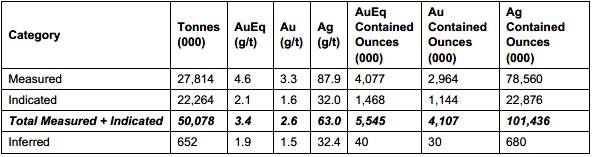
Notes to Accompany Mineral Resources Potentially Amenable to Open Pit Methods:
1. | Mineral Resources are reported insitu, using the 2014 CIM Definition Standards, with an effective date of June 20, 2023. The Qualified Person for the estimate is Ms. Terre Lane, MMSA QP, a GRE employee. |
2. | Mineral Resources are reported inclusive of those Mineral Resources converted to Mineral Reserves. Mineral Resources that are not Mineral Reserves do not have demonstrated economic viability. |
3. | Mineral Resources are constrained within a conceptual open pit shell that uses the following assumptions: gold price of |
4. | US$1,700/oz, silver price of US$23/oz; metallurgical recoveries of 84% for gold and 88% for silver; reference mining cost of US$3.00/t mined; mining dilution of 5%; mining recovery of 95%; processing cost of US$15.50/t processed; general and administrative costs of US$6.00/t processed; transportation and refining costs of US$18.5/oz Au and US$7/oz Ag; and overall pit slope angles of 45°. |
5. | Mineral Resources are reported at a cut-off grade of 0.7 g/t AuEq, using the equation AuEq = ((Au (g/t) * 1,700 * 0.84)+ (Ag (g/t)* 23 * 0.88))/(1,700 * 0.84). |
6. | Numbers have been rounded and may not sum. |
Table 1-2: Mineral Resources Potentially Amenable to Underground Methods
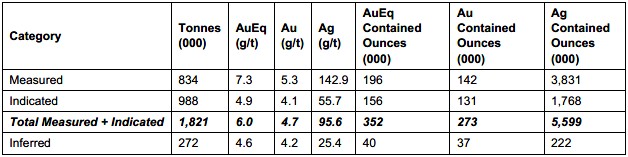
Notes to Accompany Mineral Resources Potentially Amenable to Underground Mining Methods:
1. | Mineral Resources are reported insitu, using the 2014 CIM Definition Standards, with an effective date of June 20, 2023. The Qualified Person for the estimate is Ms. Terre Lane, MMSA QP, SME Registered Member, a GRE employee. |
2. | Mineral Resources are reported inclusive of those Mineral Resources converted to Mineral Reserves. Mineral Resources that are not Mineral Reserves do not have demonstrated economic viability. |
3. | Mineral Resources are constrained within stope-optimized shapes that use the following assumptions: gold price of US$1,700/oz, silver price of US$23/oz; metallurgical recoveries of 84% for gold and 88% for silver; reference mining cost of US$100/t mined; processing cost of US$25/t processed; general and administrative costs of US$12/t processed; transportation and refining costs of US$18.5/oz Au and US$7/oz Ag; and a mining recovery of 95%. |
4. | Mineral Resources are reported at a cut-off grade of 3.2 g/t AuEq, using the equation AuEq = ((Au (g/t) * 1,700 * 0.84)+ (Ag (g/t)* 23 * 0.88))/(1,700 * 0.84). |
5. | Numbers have been rounded and may not sum. |
1.13 Mineral Reserve Statement
Mineral Reserves are reported at the point of delivery to the process plant using the 2014 CIM Definition Standards, and have an effective date of 14 November, 2023.
The Qualified Person for the estimate is Ms. Terre Lane, MMSA QP, a GRE employee. The estimate is provided in Table 1-3.
| | | |
Skeena Gold + Silver | TSX: SKE | NYSE: | 56 |
Table 1-3: Mineral Reserves Statement
Category | Tonnes | AuEq | Au | Ag | AuEq | Au | Ag |
Proven | 27,954 | 4.1 | 3.0 | 80.9 | 3,675 | 2,657 | 72,661 |
Probable | 11,889 | 2.3 | 1.8 | 40.1 | 894 | 680 | 15,308 |
Total | 39,843 | 3.6 | 2.6 | 68.7 | 4,569 | 3,336 | 87,969 |
Notes to Accompany Mineral Reserves Table:
1. | Mineral Resources are reported at the point of delivery to the process plant, using the 2014 CIM Definition Standards, with an effective date of November 14, 2023. The Qualified Person for the estimate is Ms. Terre Lane, MMSA QP, SME Registered Member, a GRE employee. |
2. | Mineral Reserves are stated within the final design pit based on a US$1,800/oz gold price and US$23.00/oz silver price. Gold and silver recoveries were 83% and 91%, respectively during the LOM scheduling. An NSR cut-off of C$24.45/t was used to estimate Mineral Reserves based on preliminary processing costs of $18.22/t ore processed and G&A costs of C$6.23/t ore processed. Final operating costs within the pit design were C$2.96/t mined, with associated process costs of C$19.16/t ore processed, G&A costs of C$5.69/t ore processed and water treatment costs of C$2.50/t ore processed. Pit slope inter-ramp angles ranged from 26–51°. |
3. | Mineral Reserves are reported at a NSR cut-off of C$24.45/t. The equation AuEq (g/t) = ((Au (g/t) * 1,800 * 0.83) + (Ag (g/t)* 23 * 0.91))/(1,800 * 0.83) is used for reporting. |
4. | Numbers have been rounded and may not sum. |
Factors that may affect the estimate include: metal price and exchange rate assumptions; changes to the assumptions used to generate the gold equivalent grade cut-off grade; changes in local interpretations of mineralization geometry and continuity of mineralized zones; changes to geological and mineralization shapes, and geological and grade continuity assumptions; changes to offsets around the old underground workings and additional knowledge related to exact locations of the mined-out voids; density and domain assignments; changes to geotechnical assumptions including pit slope angles; changes to hydrological and hydrogeological assumptions; changes to mining and metallurgical recovery assumptions; changes to the input and design parameter assumptions that pertain to the open pit shell constraining the estimates; assumptions as to the continued ability to access the site, retain mineral and surface rights titles, obtain and maintain environmental and other regulatory permits, and obtain the social license to operate.
Operations will need careful water management, effective execution of water diversion to allow access to the northern portion of the pit during later pit phases, and management of snow and rain conditions.
1.14 Mining Methods
1.14.1 Geotechnical Considerations
A geotechnical model that characterizes the rock mass conditions, structural geology, hydrogeology, and seismicity of the open pit area was developed and is used as the basis for the open pit geotechnical assessment. The rock mass model is based on data from drill hole logging, laboratory testing, the Eskay Creek geology model and relevant background reports. A total of 11 geotechnical units were identified.
Inter-ramp scale kinematic analyses were first performed in each structural domain to identify plausible planar, wedge, and toppling instability modes formed by the combination of discontinuities and the pit wall orientation. Based on the results, the structural domains in the pit wall were subdivided into “kinematic sectors” with similar kinematic controls. Bench-scale kinematic analyses were also completed to estimate the effective bench face angles that can be expected during mining.
Recommended inter-ramp slope angles range from 26–51°. Maximum inter-ramp stack heights should be limited to approximately 80 m in toppling controlled sectors and 120 m in other sectors. Inter-ramp stacks should be separated by geotechnical berms or ramps that are a minimum of 30 m wide. Double benches, of 20 m in height, are likely achievable in all sectors, with recommended catch
| | | |
Skeena Gold + Silver | TSX: SKE | NYSE: | 57 |
bench widths ranging from 12.7–37.5 m, depending on the sector.
The slope design criteria assume that controlled blasting will be implemented. A program of scaling bench faces and cleaning accumulated material from bench toes is also required. Active slope depressurization will be required in the north and southeast walls of the north pit to meet the design acceptance criteria in these slopes.
1.14.2 Hydrogeological Considerations
The hydrogeological assumptions used in the 2023 FS were the same as those used in the 2022 FS.
1.14.3 Mine Plan
The mine plan assumes conventional open pit mining methods and the use of conventional equipment. Two open pits are planned, a larger northern pit, and smaller southern pit.
Pit designs were developed for the north and south pit areas. The initial phases were designed for the purpose of obtaining a technical sample and necessary NAG waste material to create supporting infrastructure. The north pit will consist of an additional six main phases, while the south pit will consist of a single small phase. The pit optimization shells used to determine the ultimate pits were also used to outline areas of higher value for targeted early mining and phase development.
The south pit is significantly smaller than the north pit, and is likely to be mined near the end of the mine schedule. The south pit generally has harder rock and lower gold grades. Rhyolite is the dominant rock type that will remain in the mined-out pit walls before reclamation.
A total of 11 pit phases are planned, for a nine-year mine life, with a three-year pre-production period. Mining will be initiated in the north pit starting with phase 1 and will continue sequentially by phase through to the last northern pit phase, phase 10. The south pit (phase 11) will be mined when all the pit phases in the north pit are complete.
Mine planning indicates that the northern end of the open pit will intersect Tom MacKay Creek requiring the provision of a water diversion channel to re-route flowing water along a bench of the Phase 9 pit before re-entering the existing Tom MacKay Creek downstream.
NAG and potentially acid generating (PAG) waste material contained in the ultimate pits are estimated at about 166.50 Mt and 151.39 Mt, respectively. The total amount of waste within the pits in the mine plan is 317.89 Mt. PAG waste will be sent to the Tom MacKay Storage Facility (TMSF) for subaqueous disposal. NAG waste will be stored in the MRSA.
Two ore stockpiles will be used:
| ● | Low-grade stockpile: material with C$24.45/t ($18.81/t) <NSR <C$39/t ($30/t); |
| ● | Medium-grade stockpile: material with C$39/t ($30/t) <NSR <C$130/t ($100/t). |
Grade control will be completed using a fleet of RC drill rigs.
The mining equipment selected to achieve the planned production schedule is conventional open pit mining equipment, with additional support equipment required for snow management.
Drilling will be completed with down-the-hole hammer drills with 171 mm bits. Pre-production mining will be completed with 75 ton and 90 ton class excavators, loading into 60 ton class articulated dump trucks. Production mining will be completed with 200 ton class excavators and 400 ton class hydraulic shovels loading 150 ton class haul trucks. Three 354 horsepower bulldozers will be dedicated to supporting the loaders in the pits. The support equipment fleet will be responsible for road, pit, and dump maintenance requirements and will provide snow removal during winter months. Snow blowers and snowplows were included in the fleet.
Skeena plans to execute selective mining of ore on three flitches within each 10 m high operating bench, by using 200 ton class excavators with buckets that are substantially smaller than the 5 x 5 x 5 m mine planning model blocks. During mine operations, ore and waste boundaries will be delineated by a grade control model that uses a smaller block size, which will be defined by the SMU that is achievable with the selected excavator bucket size. The grade control model will be developed from assays obtained from RC drilling to accurately define ore and waste contacts.
1.15 Recovery Methods
The processing plant facilities will consist of crushing, grinding and flotation circuits designed to liberate and recover gold from the
| | | |
Skeena Gold + Silver | TSX: SKE | NYSE: | 58 |
ROM ore. Flotation concentrate will then be thickened, filtered, dried, and stockpiled at the process plant prior to loading into haul trucks for transport.
The Project will be constructed in two distinct phases, as follows:
| ● | Initial operation of 3.0 Mt/a for Years 1 - 5, which comprises: |
| ◾ | Single - stage crushing circuit (jaw), fed from the open pit mine; |
| ◾ | Coarse ore bin with reclaim system, fed from an overland conveyor; |
| ◾ | Primary grinding including a semi-autogenous grinding (SAG) mill, pebble crusher (installed in year 3), and ball mill in closed circuit with hydrocyclones; |
| ◾ | Further classification and liberation via one stage of hydrocyclones and tertiary grinding; |
| ◾ | Rougher flotation with concentrate regrind and two stages of cleaning; |
| ◾ | Scavenger flotation for recovery of cleaner tails; |
| ◾ | Concentrate thickening, filtration, drying and storage; |
| ◾ | Concentrate load-out by way of front-end loaders filling concentrate transportation; |
| ◾ | Final tailings pumping to the TMSF. |
| ● | Expansion to 3.5 Mt/a for the remaining mine life, which includes the initial equipment with the addition of the following installed for Year 6 operation: |
| ◾ | Additional operating cyclones and concentrate filter plates (original equipment designed to allow expansion); |
| ◾ | Upgraded process pumps and piping; |
| ◾ | Several key pieces of equipment in the initial phase will already be sized to accommodate the final 3.5 Mt/a throughput, including the jaw crusher, SAG and ball mills, and thickener; |
| ◾ | Retrofit larger motor size on tertiary grind mill (if required, pending further sampling and testwork). |
The process plant building has been sized to accommodate the Year 6 expansion.
Electrical power will be provided to the process plant building from the main substation at 13.8 kV. The SAG mill, ball mill, tertiary mill and regrind mills will all operate on 13.8 kV motors. A stepdown transformer will provide 4160V and 600 V power to the other motors. The initial installed power for the processing plant will be 32.4 MW with an anticipated power draw of 25.3 MW during operations. The expansion installed power in Year 6 will be 33.2 MW, with an anticipated power draw of 26.1 MW.
Fresh water will be sourced from groundwater wells. Process water will consist predominantly of mine dewatering, contact water, concentrate thickener overflow and, TMSF reclaim water.
Consumables will include: collector (PAX); frother (methyl isobutyl carbinol); flocculant (anionic); crushing liners and wear parts; and grinding media.
1.16 Project Infrastructure
The proposed Project infrastructure will include:
| ● | Eskay mine access road connecting the proposed operation to Highway 37 (Stewart-Cassiar Highway); |
| ● | On-site roads including: |
| ◾ | TMSF haul road; |
| ◾ | TMSF South Dam haul road; |
| ◾ | Technical sample haul road; |
| ◾ | Process plant and infrastructure pad site access road; |
| ◾ | Process plant and infrastructure pad collection pond access road; |
| | | |
Skeena Gold + Silver | TSX: SKE | NYSE: | 59 |
| ● | ROM crushing, handling, and process plant; |
| ● | Mine infrastructure facilities, including: |
| o | Potable and waste water treatment plant; |
| o | Electrical power system; |
| o | Propane tank and pumping system; |
| o | Fire protection systems; |
| o | Potable and waste water treatment plant; |
| o | Electrical power system; |
| o | Propane tank and pumping system; |
| o | Fire protection systems; |
| ● | High and medium-voltage power distribution systems; |
| ● | Open pit mine; |
| ● | ROM pads and low- to medium-grade ore stockpiles; |
| ● | Soil and overburden stockpiles; |
| ● | MRSA; |
| ● | TMSF; |
| ● | Water management facilities; |
| ● | TMSF water treatment plant (including reclaim water pumps and pipeline). |
The access road is currently in good condition and is maintained on a continuous basis and is providing the main access to existing facilities at camp KM58 and KM59 (historical camp). During construction, this road will be locally re-routed in some limited areas between the future gate-house and historical camp, to accommodate tie-ins to newly constructed roads, or expanded footprint of future infrastructure, however access will be continuously maintained throughout the construction to facilitate optimal use of the existing facilities.
| | | |
Skeena Gold + Silver | TSX: SKE | NYSE: | 60 |
Soil and overburden stockpiles will be constructed adjacent the TMSF haul road. PAG waste rock and overburden will be temporarily stockpiled on surface during the pre-production period for material generated through initial pioneering of the TMSF and technical sample haul roads prior to access being available to the TMSF for subaqueous deposition. All PAG material will be relocated to the TMSF by the end of the pre-production period.
The MRSA will be located adjacent to, and immediately west of, the open pits within the Argillite Creek drainage.
The TMSF is an existing tailings storage facility located approximately 4.6 km southwest of the deposit area. Approximately 0.6 Mt was deposited subaqueously in the facility from 2001 to 2008. The deposited tailings were discharged as a slurry and have settled at a depth of approximately 30 m below the surface of the water.
Dams will be constructed at the north and south end of the TMSF to accommodate the storage of tailings and waste rock, as well as provide storage capacity of site contact water to be treated at the water treatment plant. The dams will be constructed in stages over the life of mine, with an initial starter dam constructed at the north of the facility to provide storage for tailings from the first year of mill operations, and PAG waste rock generated during pre-production and Year 1 of operations.
The TMSF has been designed to store 38.6 Mt of tailings and 152.8 Mt of PAG waste rock as well as site contact water, with additional capacity maintained above the minimum storage requirements for storm inflows.
PAG waste rock will be managed in the north end of the facility. Tailings slurry will be deposited in the south end of the TMSF at a nominal solids content of approximately 21% solids by weight. The TMSF design is based on an operating mine life of 12 years, and a total storage capacity of 191.4 Mt of tailings and waste rock. The TMSF has a storage capacity of 118.8 Mm3 which includes approximately 33.7 Mm3 of tailings, 75.6 Mm3 of PAG waste rock, 8.5 Mm3 of water storage capacity, and 1 Mm3 of stormwater management capacity for the environmental design flood (1-in-1,000-year, 24-hour precipitation event). Larger flood events will be managed through an emergency discharge spillway which will route storm flows to Tom MacKay Creek.
Site water management during construction involves controlling contact water runoff from the temporary PAG stockpiles, runoff from the roads, drawdown of the TMSF to prepare for construction of the TMSF dams, and erosion and sediment control measures around active construction areas. Site water management for operations involves controlling surface water around the Project site. Water in contact with mine workings or disturbed areas (groundwater inflows and meteoric inputs to the open pits; runoff from waste rock, ore stockpiles, quarry areas, tailings, laydown areas, etc.) is considered contact water. Non-contact water is runoff from undisturbed areas, including those areas that are being diverted.
A water treatment plant will treat mine-impacted water originating from the TMSF, open pits and the MRSA prior to discharge to the environment. Due to high flow rates, two separate treatment trains are planned for the plant. The water treatment plant is designed for a flow rate of 568 L/s and will operate year-round.
A mine-site water balance has been completed to support the design of the TMSF and the water treatment plant. The water balance indicates that the site will operate in an annual water surplus of approximately 560 L/s. Surplus volumes will be managed in the TMSF prior to treatment and discharge.
The existing camps at KM58 and KM59 (200-person combined capacity) and Forrest Kerr camp (160-person available capacity) will be used in Year -1 and the first half of Year -2. In Year -2, the 380-person permanent camp facility will be constructed, ready for occupancy in the second half of that year, and will be located at the Eskay Creek mine site east of the TMSF.
The Project will connect to the provincial grid via the Coast Mountain Hydro-owned 287kV transmission line, 2L379. Power will be purchased from BC Hydro who will supply the power over 2L379. The point of interconnection on 2L379 will be near Volcano Creek where a transmission line tap exists for the Coast Mountain Hydro-owned Volcano Creek generating station. The Eskay Creek power system will be capable of supplying 48 MVA to the Eskay Creek substation which will cover the initial power demands and planned future expansion.
Standby diesel generators in weatherproof enclosures will be provided to supply critical process loads and life safety systems.
1.17 Environmental, Permitting and Social Considerations
A number of environmental studies were performed in support of the historical mining activities to support an application for a Mine Development Certificate. Additional environmental studies were completed in 1997 to support the proposed mill installation at the mine site (and again in 2000 to apply for a separate Environmental Assessment Certificate and listing under Schedule 2 of the Metal and Diamond Mining Effluent Regulations, to deposit tailings and waste rock in the TMSF). Environmental monitoring and routine
| | | |
Skeena Gold + Silver | TSX: SKE | NYSE: | 61 |
reporting was completed during and after the historical operations. The Eskay Creek Mine has been in care and maintenance since mining operations ceased in 2008, with ongoing site management and minimal waste generation.
Skeena commenced environmental, social, economic, historical and health baseline studies to reflect current environmental and social conditions in 2020. Where available and to provide context, pre-2020 data was reviewed and summarized for the current baseline studies and where suitable for the Project, sampling sites used in earlier studies were re-visited to support an application for a new or amended Environmental Assessment Certificate.
1.17.1 Environmental Considerations
The Project will be designed, constructed, operated, and decommissioned to meet all applicable provincial and federal environmental and safety standards, regulations, and permit conditions. Skeena will implement an environmental management system in advance of construction that defines the processes, resources, responsibilities, and specific management plans to ensure compliance. The existing site operates under an environmental management system which will be modified to meet the scope of the Project during the permitting process and include ongoing monitoring, management steps, and reporting to relevant parties.
Site water management will be a critical component of project design, execution, operation, and closure. To mitigate the potential contamination of water from a variety of sources (air, land, and process), Skeena will develop a Water Management Plan and a Dust Control Management Plan that applies to all activities, in addition to numerous other plans as required by regulation or that have been identified through the development and mitigation measures informed by Tahltan mitigation strategies.
1.17.2 Closure and Reclamation Planning
For planning purposes, closure and reclamation strategies have been developed for each mine component. In accordance with the Mines Act permit, mine closure, reclamation and post-closure costs must be updated every five years or upon a major amendment to the mine plan to reflect current and projected site wide closure and reclamation liabilities to inform the reclamation security bond.
A closure cost estimate was developed to determine the estimated cost of implementing closure plans. Reclamation and closure costs include conventional closure (e.g., earthworks), long-term monitoring and maintenance, and water treatment activities. Closure, reclamation, and post-closure costs were calculated over a 100-year timeframe using a net present value (NPV) analysis, beginning with scheduled closure and reclamation activities in 2040.
The total closure cost estimate, including water treatment, monitoring and maintenance, demobilization, engineering, and contingency is $174.8 M. At a 4% annual discount rate, the total discounted closure cost estimate in 2023 is $53.7 M.
1.17.3 Permitting Considerations
The Eskay Creek Mine went through two Environmental Assessment processes in its history. For the proposed Project, Skeena will undertake a substituted process to amend an existing Environmental Assessment Certificate or obtain a new Environmental Assessment Certificate. The process to follow for the Environmental Assessment/Impact Assessment is being developed with the provincial and federal regulators, the Tahltan Nation and Skeena, based upon the legislative steps, criteria, and procedures. Skeena submitted a Detailed Project Description to the federal and provincial regulators and Tahltan Central Government on August 11, 2022, to initiate the second phase (Readiness Decision) of the Environmental Assessment process. A process order was issued by the BC government on April 18, 2023 which outlines the scope of the assessment and determines the application information requirements to be included in the application.
No technical or policy issues have been identified that would prevent obtaining the required project permits and approvals, given its long mining history, understanding and mitigation of environmental and social effects.
No permits for project commercial development will be issued before an Environmental Assessment Certificate is obtained. Consequently, Skeena will apply concurrently for permits within the environmental review process schedule for all permits. Strategies to expedite the permitting process and reduce the time to start construction are being examined. To that end a Process Charter was signed between Skeena, the BC government and the Tahltan Central Government in January 2023 outlining regulatory processes to be followed, efficiencies, risk mitigations and the development of joint work plans.
Skeena has identified the likely provincial and federal permits that must be approved prior to commencing construction or operational activities.
| | | |
Skeena Gold + Silver | TSX: SKE | NYSE: | 62 |
1.17.4 Social Considerations
Provisions for consultation with Indigenous Nations and the public are a component of the provincial and federal legislation for both the Environmental Assessment processes and permitting activities. Skeena is implementing an Engagement Plan for the Project as required by the provincial and federal Environmental Assessment processes and meets the requirements of the Environmental Assessment process order. This plan provides a summary of Skeena engagement activities as well as serves as a guide for Skeena’s engagement activities with identified Indigenous Nations and stakeholders throughout the Environmental Assessment process.
Ongoing and future engagement and consultation measures by Skeena are driven by best practices as well as Skeena’s internal company policies, and federal and provincial government requirements. Skeena diligently tracks and maintains records of all engagement activities and commitments therefrom.
The Project is located within the traditional territory of the Tahltan Nation and the asserted territory of the Tsetsaut Skii Km Lax Ha. The historical environmental process and subsequent expansions included consultation with the Iskut Band, Tahltan Band, and the Tahltan Central Government.
Project traffic will use Highways 37 and 37A which pass through the Nass Area and Nass Wildlife Area (as defined by the Nisga’a Final Agreement) and the traditional territory of the Gitanyow Nation. Skeena engages with Nisga’a and Gitanyow on matters of mutual interest.
Skeena will consult with the public and relevant stakeholder groups, including tenure holders, businesses, economic development organizations, businesses, and contractors (e.g., suppliers and service providers), and special interest groups (e.g., environmental, labour, social, health, and recreation groups), as appropriate.
1.18 Markets and Contracts
A market study for the LOM potential concentrate production, which took into account production and grade variation over time, was finalized by third-party consultants Deno Advisory in October 2023. This study forms the basis for the economic analysis in this Report.
Typical treatment and refining charges for concentrate sales will depend on the concentrate type and grade.
The proposed Eskay Creek operation is expected to produce a high gold–silver grade concentrate with elevated levels of mercury, arsenic, carbon, and antimony. The concentrate is complex and will require a more measured marketing strategy.
Samples of the Eskay Creek concentrates, varying in antimony, arsenic, lead, zinc, gold, and silver grades, were sent to potential lead smelters and gold roasters during 2023. The exercise demonstrated that a diversified sales strategy could be implemented for concentrate sales; thereby reducing reliance on a single smelter or trader. Such a strategy could include varied sales to lead smelters, traders, blenders, and roasters.
China is the most likely destination for the majority of the concentrate production and the concentrate will currently meet the direct importation regulations, i.e., without the need for further blending. Skeena has received indicative bids from smelters and traders, ranging from a portion of the total production, to LOM production.
Skeena management used a combination of pricing used in other recently-published feasibility studies, long-term analyst prices, and the two-year and three-year trailing average gold and silver prices as of April, 2023 to establish the forecast pricing for the purposes of the 2023 FS. Mineral Resource and Mineral Reserve pricing was set at US$1,700/oz Au and US$23/oz Ag. Cashflow pricing was set at US$1,800/oz Au and US$23/oz Ag.
At the Report effective date, no contracts had been entered into. Concentrate sales are likely to be a mix of long-term and spot contracts, to ensure a diversified sales strategy. It is likely that the longer-term contracts will be a type of evergreen contract, which continue after the initial term, but with periodic renegotiation of terms and conditions. Terms of sale for a term contract between mining companies and smelters commonly use “benchmark terms”, which include annual sales terms, and can be annually negotiated. In contrast, spot contracts use spot terms, and are negotiated on a contract-by-contract basis. Likely contracts other than concentrate sales may include bulk shipping, ship-loading services, load/port agency, and data management/invoicing contracts.
Other major contracts that may be entered into could cover items such as electricity supply, bulk commodities, operational and technical services, mining and process equipment, earthworks projects, security, transportation and logistics, and administrative support services. Such contracts would typically be reviewed and negotiated on a frequent basis and the terms would be typical of
| | | |
Skeena Gold + Silver | TSX: SKE | NYSE: | 63 |
similar contracts both regionally and nationally.
1.19 Capital Cost Estimates
The capital cost estimate was prepared as an Association of the Advancement of Cost Engineering International (AACE International) Class 3 estimate with an accuracy of ±15%, and is reported using Q3 2023 Canadian dollars.
The capital cost estimate includes:
| ● | Supply and installation of the fixed facilities to operating order; |
| ● | Engineering, procurement support, construction, and commissioning management services by scope package; |
| ● | Owner’s costs; |
| ● | Design development, quantity growth allowances. |
The capital cost estimate is summarized in Table 1-4. Total capital costs over the LOM are estimated at:
| ● | Initial: C$712.9 M; |
| ● | Sustaining: C$561.3 M; |
| ● | Expansion: C$8.7 M; |
| ● | Closure: C$174.8 M. |
1.20 Operating Cost Estimates
Operating costs are reported using Q3 2023 Canadian dollars and are in line with an AACE International Class 3 estimate with an accuracy range of ±15%.
Costs were broken down into:
| ● | Fixed costs: costs that are independent of feed tonnes to the plant, or operating hours; |
| ● | Variable costs: costs that are driven by the amount of feed tonnes to the plant, or operating hours. |
The operating cost estimate is summarized in Table 1-5. The LOM operating costs include:
| ● | Mining: C$1,057.5 M, or C$26.54/t milled; |
| ● | Processing: C$736.5 M or C$19.16/t milled; |
| ● | G&A: C$326.2 M or C$8.19/t milled; |
| ● | Total: C$2,147.3 M or C$53.89/t milled. |
| | | |
Skeena Gold + Silver | TSX: SKE | NYSE: | 64 |
Table 1-4: Capital Cost Estimate
Description | Initial | Sustaining | Expansion | Closure |
Mining | 113.7 | 426.0 | — | — |
Ore crushing and reclaim | 38.0 | 3.0 | — | — |
Process plant | 171.8 | 2.0 | 8.0 | — |
Tailings reclaim and water treatment | 21.7 | 65.3 | — | — |
On-site infrastructure | 98.6 | 52.0 | — | — |
Off-site infrastructure | 30.3 | — | — | — |
Owner’s costs | 92.6 | — | — | — |
Indirect costs | 97.5 | 13.0 | 0.7 | — |
Subtotal | 664.2 | 561.3 | 8.7 | — |
Contingency | 48.7 | — | — | — |
Closure | — | — | — | 174.8 |
Total | 712.9 | 561.3 | 8.7 | 174.8 |
Note: numbers have been rounded.
Table 1-5: Operating Cost Summary Table
| Initial Years | Expansion | LOM | |||
C$M | C$/t milled | C$M/a | C$/t milled | C$M | C$/t milled | |
Mining | 710.5 | 45.40 | 347.0 | 14.34 | 1,057.5 | 26.54 |
Processing | 313.5 | 20.03 | 450.0 | 18.60 | 763.5 | 19.16 |
G&A | 150.1 | 9.59 | 176.1 | 7.28 | 326.2 | 8.19 |
Total | 1,174.2 | 75.03 | 973.1 | 40.22 | 2,147.3 | 53.89 |
Notes: numbers have been rounded. Year 1–5 costs represent the costs for the initial phase and include pre-production costs. Year 6+ costs represent the costs in the expansion phase. Mining declines and more material is reclaimed from stockpiles after Year 6 toward Year 12.
1.21 Economic Analysis
1.21.1 Forward-Looking Information Statement
The results of the economic analyses discussed in this section represent forward-looking information as defined under Canadian securities law. The results depend on inputs that are subject to several known and unknown risks, uncertainties and other factors that may cause actual results to materially differ from those presented in this Report.
Information that is forward-looking includes:
| ● | Mineral Resource and Mineral Reserve estimates; |
| ● | Assumed commodity prices and exchange rates; |
| ● | The proposed mine production plan; |
| ● | Projected mining and process recovery rates; |
| ● | Assumptions as to mining dilution and ability to mine in areas previously exploited using underground mining methods as envisaged; |
| | | |
Skeena Gold + Silver | TSX: SKE | NYSE: | 65 |
| ● | Sustaining costs and proposed operating costs; |
| ● | Interpretations and assumptions as to agreement terms; |
| ● | Assumptions as to closure costs and closure requirements; |
| ● | Assumptions as to environmental, permitting, and social risks; |
Additional risks to the forward-looking information include:
| ● | Changes to costs of production from what are estimated; |
| ● | Unrecognized environmental risks; |
| ● | Unanticipated reclamation expenses; |
| ● | Unexpected variations in quantity of mineralized material, grade, or recovery rates; |
| ● | Geotechnical or hydrogeological considerations during mining being different from what was assumed; |
| ● | Failure of mining methods to operate as anticipated; |
| ● | Failure of plant, equipment, or processes to operate as anticipated; |
Changes to assumptions as to the availability of electrical power, and the 2023 FS assumes that permits must be obtained in support of operations, and approval for development to be provided by Skeena’s Board.
1.21.2 Methodology Used
An engineering economic model was developed to estimate annual pre-tax and post-tax cash flows and sensitivities of the Project based on a 5% discount rate. The Project assumes 100% equity. No price inflation or escalation factors were considered.
Tax estimates involve many complex variables that can only be accurately calculated during operations and, as such, the after-tax results are only approximations.
At the effective date of the Report, the Project was assumed to be subject to the following tax regime:
| ● | Federal income tax of 15% and provincial income tax of 12%; |
| ● | BC Minerals Tax, assuming a net current proceeds rate of 2% and a net revenue tax rate of 13%. |
Total tax payments are estimated to be C$1,561 M over the LOM. The economic analysis was performed assuming a 5% discount rate.
The pre-tax net present value discounted at 5% (NPV 5%) is C$3,058 M, the internal rate of return (IRR) is 52.8%, and payback period is 1.13 years.
On an after-tax basis, the NPV 5% is C$1,973 M, the IRR is 42.7%, and the payback period is 1.19 years.
A summary of the Project economics is included in Table 22-1.
1.21.3 Sensitivity Analysis
A sensitivity analysis was conducted on the base case pre-tax and after-tax NPV and IRR of the Project, using the following variables: metal price, capital costs, operating costs, gold grade, and silver grade. The Project sensitivity to the discount rate and foreign exchange rate were also assessed in the 2023 FS.
On an NPV basis, the Project is most sensitive to changes in metal prices and gold grades, and then to a lesser extent, to operating costs and capital costs. The Project is least sensitive to changes in the silver grades.
| | | |
Skeena Gold + Silver | TSX: SKE | NYSE: | 66 |
Table 1-6: Cashflow Summary Table
Parameter | Value |
Base Case Economic Assumptions | |
Gold price (US$/oz) | 1,800 |
Silver price (US$/oz) | 23 |
Exchange rate (US$/C$) | 0.74 |
Discount rate (%) | 5 |
Contained Metal | |
Contained gold (koz) | 3,336 |
Contained silver (koz) | 87,969 |
Mining | |
Strip ratio (waste: ore) | 7.98:1 |
Total material mined (excluding rehandle) (Mt) | 357.7 |
Total ore mined (Mt) | 39.8 |
Processing | |
Processing life (years) | 12 |
Processing throughput (Mtpa) | 3.0 (Years 1–5) 3.5 (Years 6–12) |
Average diluted gold grade (g/t) | 2.6 |
Average diluted silver grade (g/t) | 68.7 |
Production | |
Gold recovery (% to concentrate) | 83 |
Silver recovery (% to concentrate) | 91 |
LOM gold production (koz) | 2,769 |
LOM silver production (koz) | 80,052 |
LOM AuEq production (koz) | 3,891 |
LOM average annual gold production (koz) | 228 |
LOM average annual silver production (koz) | 6,583 |
LOM average annual AuEq production (koz) | 320 |
Operating Costs Per Tonne | |
Mining cost (C$/t mined) | 2.96 |
Mining cost (C$/t milled) | 26.54 |
Processing cost (C$/t milled) | 19.16 |
G&A cost (C$/t milled) | 5.69 |
Water treatment cost (C$/t milled) | 2.50 |
Total operating costs (C$/t milled) | 53.89 |
Parameter | Value |
Other Costs | |
Transport to smelter (C$/dmt concentrate) | 154 |
Gold refining costs (C$/oz payable) | 34 |
Silver refining costs (C$/oz payable) | 1.65 |
Treatment costs (C$/dmt concentrate) | 172 |
Royalty (NSR) (%) | 2 |
Cash Costs and All-in Sustaining Costs | |
| | | |
Skeena Gold + Silver | TSX: SKE | NYSE: | 67 |
LOM cash cost (US$/oz Au) net of silver by-product | 133 |
LOM cash cost (US$/oz AuEq) co-product | 568 |
LOM AISC (US$/oz Au) net of silver by-product | 300 |
LOM AISC (US$/oz AuEq) co-product | 687 |
Capital Expenditures | |
Pre-production capital expenditures (C$M) | 713 |
Expansion capital expenditures (C$M) | 9 |
Sustaining capital expenditures (C$M) | 561 |
Closure expenditures (C$M) | 175 |
Economics | |
After-tax NPV (5%) (C$M) | 1,973 |
After-tax IRR | 42.7 |
After-tax payback period (years) | 1.2 |
After-tax NPV/initial capital costs | 2.8 |
Pre-tax NPV (5%) (C$M) | 3,058 |
Pre-tax IRR (%) | 52.8 |
Pre-tax payback period (years) | 1.1 |
Pre-tax NPV/initial capital costs | 4.3 |
Average annual after-tax free cash flow (Year 1–5) (C$M) | 467 |
Average annual after-tax free cash flow (Year 1–12) (C$M) | 313 |
LOM after-tax free cash flow (C$M) | 2,993 |
Notes:
| ● | Cash costs are on an ounce payable basis and are inclusive of operating mining costs, processing costs, site G&A costs, royalties, smelting, refining, and transports costs. |
| ● | All-in sustaining costs (AISC) are on an ounce payable basis and include cash costs plus sustaining capital and closure costs. |
| ● | Pre-production capital expenditure of C$713 M is exclusive of initial working capital, primarily C$43.3 M of pre-production mining operating costs associated with establishing initial ore stockpile inventory. |
| | | |
Skeena Gold + Silver | TSX: SKE | NYSE: | 68 |
1.22 Risks and Opportunities
1.22.1 Risks
A risk workshop was completed as part of the 2023 FS. Risks were ranked on probability and consequences, and focused on the proposed Project execution plan, schedule, and permitting timelines. Each risk identified had a mitigation action proposed.
Project-scale risks to the Mineral Resources, Mineral Reserves and the economic analysis are summarized in Table 1-7.
1.22.2 Opportunities
Opportunities are summarized in Table 1-8.
1.23 Interpretation and Conclusions
Under the assumptions in this Report, the Project shows a positive cash flow over the life-of-mine and supports the Mineral Reserve estimates. The projected mine plan is achievable under the set of assumptions and parameters used.
1.24 Recommendations
There are no material recommendations for additional work arising from the 2023 FS. Work proposed in that study would be completed as part of detailed engineering studies or conducted during mine start-up and ramp-up activities, and budget for that work is included in the capital or operating cost estimates, as relevant. As a result, the QPs have no meaningful recommendations to make.
Table 1-7: Project Risks
Discipline Area | Risk Identified | Impact | Mitigation Strategy |
Mineral Resource estimates | Distribution and variability of the suite of elements that can be deleterious in concentrates | Variability is much higher than currently estimated, and that the model underestimates the deleterious elemental tonnages and grades that the 2023 FS mine plan and concentrate marketability assumptions are based on. | More information obtained from future drill programs will provide more complete data on elemental distributions within key lithologies and domains |
Mining | Mining through voids | Risk to mine and production plans if alternate schedules have to be derived, or new safety measures implemented | Grade control drilling, mining methods |
Geotechnical designs | Pit slope angles may need to be shallower in some sectors of the pits | Collection of additional geotechnical data | |
Dilution | Mining too much dilution material or losing high grade material near historical workings | Grade control drilling, mining methods | |
Poor segregation of NAG and PAG | Economic and water quality impacts | Adhering to sampling program designed to segregate PAG and NAG waste rock | |
Heavy snowfall | Affects mining outputs, can require temporary suspension of mining | Employ a specialist in heavy snowfall event management and mitigation |
| | | |
Skeena Gold + Silver | TSX: SKE | NYSE: | 69 |
Mining | Freshet | Water inflows due to seasonal changes greater than pumping capacity | Snow removal, storing the excess water on the lowest bench and adjusting the mining plan to excavate higher benches for the few days required for the pumping system to catch up and remove the water |
TMSF | Groundwater seepage | May require a more comprehensive grout curtain and grout blanket design | Additional geochemical characterization of waste materials and contact water, data collection, modelling of foundation conditions |
Non-contact water management | Topographic and access constraints impacting sizing and design of the water treatment plant, and downstream flows/water quality predictions | Detailed water management planning | |
Contact water management | Unable to meet discharge criteria efficiency or downtime/ availability of water treatment plant | Design contingency and adequate characterization of water quality source terms, and water quality predictions | |
Equipment losses during TMSF operations | Cost estimates due to equipment replacement requirements | Operating practices | |
Material characterization | More material than estimated requiring sub-aqueous storage | Material characterization programs and updates to material handling management plans | |
Haul roads | Cut slope excavation | Cost estimates due to additional slope stabilization methods required | Design and conservative assumptions with respect to cut slope stability |
Construction sequencing and timelines | Project schedule and cost estimates | Detailed construction and execution planning; adequate resourcing of construction equipment and operators | |
Stream and watercourse crossings | Availability of material for construction | Use of conservative assumptions with respect to material characterization and additional characterization programs in the field | |
Water management | Non-contact water diversions | Increase in design treatment capacity for the water treatment plant, and capital cost estimates | Contingency in design of the water treatment plant and inclusion of freeboard in the design of surface water management structures |
Contact water runoff collection | Larger pump systems required to manage contact water runoff, particularly during storm events and freshet; increases in capital and operating cost estimates | Sequencing of mine development to minimize disturbance footprints, and reduced contact water volumes | |
Groundwater inflows | Increased contact water volumes | Use conservative assumptions around groundwater inflow estimates, and characterization programs and updated groundwater models to refine estimates | |
Construction | Construction schedule | Ability to construct to schedule, particularly TMSF and process | Detailed construction execution and sequencing |
| | | |
Skeena Gold + Silver | TSX: SKE | NYSE: | 70 |
Discipline Area | Risk Identified | Impact | Mitigation Strategy |
Construction | | plant; impact on capital and operating costs | and adequate construction resourcing |
Winter operations | Impact on capital and operating costs if infrastructure such as pipelines freezes | Design, and inclusion of heat-tracing of pipelines, if required | |
Permitting constraints | Delay to Project schedule and road construction, resulting from pending approvals to place and discharge mine rock/tailings | Early engagement with regulatory agencies and Indigenous Nations. Development of feasible mitigations and contingencies for PAG handling and water management |
Table 1-8: Project Opportunities
Discipline Area | Opportunity |
Mineral Resource estimates | Mineralization currently classified as Inferred can be upgraded to higher confidence categories with support of drilling and test work |
Mineralization that is currently outside the estimate boundaries, or discovery of previously unknown mineralization, to be included in estimation with support of drilling and test work | |
Mining | Steeper slope design to reduce the cost associated with waste stripping and provide an opportunity to improve economics |
Use of stockpiles and strategic ore blending. This could result in better process performance and improved Project economics | |
PAG waste material able to be effectively neutralised by blending with NAG waste, resulting in less PAG material being sent to the TMSF and therefore lower waste haulage and deposition costs | |
Definition of PAG areas during mine operations could provide better PAG material management destination options and improve the confidence in segregation when assigning more NAG waste to waste facilities other than the TMSF | |
Recovery | Optimization of flotation reagent chemistry could lead to higher recoveries and/or reduced operating costs to improve project economics |
TMSF | Using contact water from the MRSA and open pits in the process plant |
Thicken tailings to reduce the volume of water being pumped to the TMSF | |
Additional material characterization programs that result in less PAG waste identified, resulting in reduced storage capacity requirements in the TMSF | |
Optimization of the closure cover | |
Haul roads | Optimization of haul road alignments to reduce footprint and improve constructability |
Using gabion baskets or mechanically-stabilized earth walls for stream crossing construction | |
Explore the use of single-lane traffic for stream-crossings | |
Water management | Reduce open pit dewatering requirements through inclusion of pit depressurization and groundwater interception wells |
Sequence construction of the MRSA and progressively reclaim benches and exposed faces of the MRSA to reduce contact water runoff | |
Develop the MRSA in a manner that provides water quality source control and improve water quality during operations and closure | |
Permitting | Expedite and or de-risk regulatory approvals through regulatory application strategies e.g., single application package, and concurrency of permitting. |
| | Annual Information Form 2025 | 71 |