1 . INSIDER TRADING POLICY 1 Purpose Borr Drilling Limited (the “Company”) has adopted this Insider Trading Policy (this “Policy”) to help its directors, officers, employees, and consultants comply with applicable securities laws and avoid the perception of insider trading. 2 Scope This Policy applies to directors, officers, employees, and consultants who may receive or be aware of information that is Material and Non-Public (as defined in Section 5 below) regarding the Company and its business partners, as well as their family members and others in their households and any other person or entity whose securities trading decisions are influenced or controlled by the director, officer or employee (referred to in this Policy as “Insiders”). This Policy also applies to any person who receives Material, Non-Public information from an Insider. 3 Trading Prohibition 3.1 Generally prohibited activities a. Trading in Company Securities: i. No Insider may buy, sell, or otherwise trade in securities of the Company while aware of Material, Non-Public information about the Company. ii. No Insider may buy, sell, or otherwise trade in Company securities during a Blackout Period (see Section 3.2 below). iii. Insiders should avoid engaging in transactions which are speculative in nature and therefore create the appearance of being based on Material, Non-Public information. Such transactions, include (1) short sales of Company securities at any time; (2) puts, calls or other derivative transactions; (3) hedging transactions including forward sale or purchase contracts equity swaps, collars or exchange funds; and (4) margin accounts and pledges of Company’s securities as collateral for a loan, noting a forward sale/purchase, margin sale or foreclosure sale may occur at a time when the pledgor is aware of Material, Non-Public information or otherwise is not permitted to trade in Company securities. Such transactions may only be entered into if the Insider has sufficient resources to cover margin calls without a sale of Company shares at any time when such a sale would not be permitted under this Policy, and furthermore: (i) they do not and shall not result at any time in sales or purchases of Company securities by or on behalf of such Insider, when such Insider may be in possession of Material, Non-Public information, or is otherwise not allowed to trade in Company Securities under this Policy, (ii) such transactions do not hedge against or offset a decline in the value of the Company’s securities, and (iii) in the case of margin accounts and pledges, if the Insider holds Company securities in a margin account, the Insider may not use them to meet a broker’s margin call if the Insider is aware of any Material, Non-Public information at the time. All such transaction must be discussed in advance with the Compliance Officer. b. Tipping and Giving Trading Advice: i. No Insider shall disclose or tip Material, Non-Public information to any other person where the Material, Non-Public information may be used by that person to their profit by trading in Company securities, nor shall the Insider
2 . make recommendations or express opinions regarding trading in Company securities based on Material, Non-Public information. ii. Insiders are not authorized to recommend the purchase or sale of Company securities, or give trading advice of any kind about the Company, to any other person whether or not such Insider is aware of Material, Non-Public information. c. Trading in Securities of Business Partners: i. No Insider who, in the course of working for the Company, learns of Material, Non-Public information about another company with which the Company does business, including a customer of the Company, may trade in that other company's securities until the information becomes public or is no longer material. 3.2 Blackout Period The Company establishes “Blackout Periods”, during which Insiders are prohibited from trading in Company securities, during periods where Insiders will often be aware of Material, Non-Public information. These Blackout Periods are designed to protect Insiders from the appearance of improper insider trading and support them in complying with applicable federal and state security laws. Even outside of a Blackout Period, any Insider aware of Material, Non-Public information should not engage in a transaction in Company securities until the information becomes public or is no longer Material. Trading in Company securities outside of a Blackout Period should not be considered a “safe harbor,” and all Insiders should use good judgment at all times. a. Quarter-End Blackout Period: During preparation of our financial results for each fiscal quarter, Insiders will often be aware of Material, Non-Public information about the expected financial results of the Company. Therefore, a Blackout Period starts 30 calendar days before the public disclosure of our financial results and ends one full business day after the Company’s public disclosure of the financial results for that fiscal quarter. b. Other Blackout Periods: From time to time, the Company may announce other Blackout Periods because of developments known to the Company but not yet disclosed to the public. In these instances, the Blackout Period will end once the information has been known publicly for at least one full business day. During such periods, Insiders should not disclose to others that a Blackout Period or trading suspension is in place. 3.3 Additional Restrictions Applicable to the Closed Group The Company has determined that certain Insiders (e.g. member of the administrative, management or supervisory body of the Company, members of the Board of Directors, all individuals members of senior management and key employees who have regular access to Material and Non-Public information relating directly or indirectly to the Company as identified by the Compliance Officer (see Section 6.2 below), together the “Closed Group”) must not trade in Company securities without first complying with the Company’s “pre-clearance” process, as set out in Section 6 below.
3 . 3.4 Exceptions This Policy does not apply in the case of the following transactions, except as specifically noted: a. Option Exercises. This Policy does not apply to the exercise of an employee option acquired pursuant to an equity incentive plan of the Company or to the exercise of a tax withholding right pursuant to which a person has elected to have the Company withhold securities subject to an option to satisfy tax withholding requirements. This Policy does apply, however, to any sale of securities as part of a broker- assisted cashless exercise of an option, or any other market sale to generate the cash needed to pay the exercise price of an option. b. Restricted Unit Awards. This Policy does not apply to the vesting of restricted units or the exercise of a tax withholding right where the Insider elects to have the Company withhold securities to satisfy tax withholding requirements upon the vesting of any restricted units. The Policy does apply, however, to any market sale of restricted units. c. Mutual Funds. Transactions in mutual funds that are invested in securities are not transactions subject to this Policy. d. Rule 10b5-1 Plans. Notwithstanding the prohibition against insider trading, SEC Rule 10b5-1 provides an affirmative defense against insider trading liability under Rule 10b-5. A person subject to this Policy can rely on this defense and trade in Company securities, regardless of their awareness of Material and Non-Public information, if the transaction occurs pursuant to a pre-arranged written trading plan (“Rule 10b5-1 Plan”) that was entered into when the person was not in possession of Material, Non- Public information and that complies with the requirements of Rule 10b5-1. Insiders subject to Section 16 of the Securities Exchange Act of 1934 (“Section 16 Insiders”) should be aware that the Company will be required to make quarterly disclosures regarding all Rule 10b5-1 Plans entered into, amended or terminated by Section 16 Insiders and to include the material terms of such plans, other than pricing information. Anyone subject to this Policy who wishes to enter into a Rule 10b5-1 Plan must submit the Rule 10b5-1 Plan to the Compliance Officer for its approval at least five business days prior to the planned entry into the Rule 10b5-1 Plan. Rule 10b5-1 Plans may not be adopted by a person when he or she is in possession of Material, Non-Public information about the Company or its securities and must comply with the requirements of Rule 10b5-1 (including specified waiting periods and limitations on multiple overlapping plans and single trade plans). Once the Rule 10b5-1 Plan is adopted, you must not exercise any subsequent influence over the amount of securities to be traded, the price at which they are to be traded or the date of the trade. You may amend or replace a Rule 10b5-1 Plan only during periods when trading is permitted in accordance with this Policy, and you must submit any proposed amendment or replacement of a Rule 10b5-1 Plan to the Compliance Officer for approval prior to adoption. You must provide notice to the Compliance Officer prior to terminating a Rule 10b5-1 Plan. You should understand that a modification or termination of a Rule 10b5-1 Plan may call into question your good faith in entering into and operating the plan (and therefore may jeopardize the availability of the affirmative defense against insider trading allegations). 3.5 Limitations And Requirements On Resales Of The Company’s Securities The Securities Act of 1933 requires that securities may be sold only pursuant to an effective registration statement or an exemption from the registration requirements. Insiders who are (or were within the prior 90 days) affiliates of the Company (including directors and officers) and who wish to sell Company securities may seek a “safe harbor” for their sales to establish an exemption from such registration requirements by complying with the conditions of Rule 144 applicable to affiliates.
4 . “Securities” under Rule 144 are broadly defined to include all securities, not just equity securities. The Rule 144 safe harbor is available not only to sales of common and preferred stock, but also to sales of bonds, debentures and any other form of security. Insiders and others who seek to sell securities acquired directly from the Company or a Company affiliate in a series of transactions not involving any public offering may avail themselves of the safe harbor of Rule 144 by complying with the provisions applicable to resales of “restricted securities” (which apply, for affiliates, in addition to, and in conjunction with, the provisions of that rule applicable to resales by affiliates). The Insider must electronically file a notice of sale with the SEC on Form 144 prior to, or concurrently with, the placing of the order to sell securities. 4 Gifts of Securities Gifts of securities may include gifts to trusts for estate planning purposes, as well as donations to a charitable organization. Whether a gift of securities is a transaction that should be avoided while the person making the gift is aware of Material, Non-Public information or is subject to a Blackout Period may depend on various circumstances surrounding the gift. Accordingly, you are encouraged to consult the Compliance Officer when contemplating a gift, and you are required to obtain pre- clearance of the gift if you are subject to trading restrictions. 5 Determining whether information is material and non-public 5.1 Definition of “Material” Information It is not possible to define all categories of material information. However, in general, information should be regarded as “Material” if there is a substantial likelihood that a reasonable investor would consider the information important in determining whether to trade in a security. Information that if made public, is likely to affect the price of an entity’s securities is almost always Material. It is also important to remember that either positive or negative information may be Material. Information may be Material even if it relates to future, speculative or contingent events and even if it is significant only when considered in combination with publicly available information. Material information can be positive or negative. It is important to remember that if securities transactions become the subject of scrutiny, they will be viewed after-the-fact and with the benefit of hindsight, including whether the Company’s stock price changed once the information became public. Therefore, before engaging in any securities transaction, you should consider carefully how the Securities and Exchange Commission (the “SEC”) and others might view your transaction in hindsight and with all of the facts disclosed. Whilst if may be difficult under this standard to determine every type of information which could be deemed “material”, common examples of Material information include: • financial performance, financial results and guidance, including unpublished financial results (annual, quarterly or otherwise), unpublished projections of future earnings or losses or significant changes in liquidity; • news of a significant merger, joint venture, acquisition (including the acquisition of a vessel) or a sale of significant assets; • news of commercial developments, including entry into a new charter, final investment decision on a new project or the gain or loss of a substantial customer; • news of business disruptions such as a major operational incident including vessel causality, collision or grounding; • news of contracting activities including contract suspension;
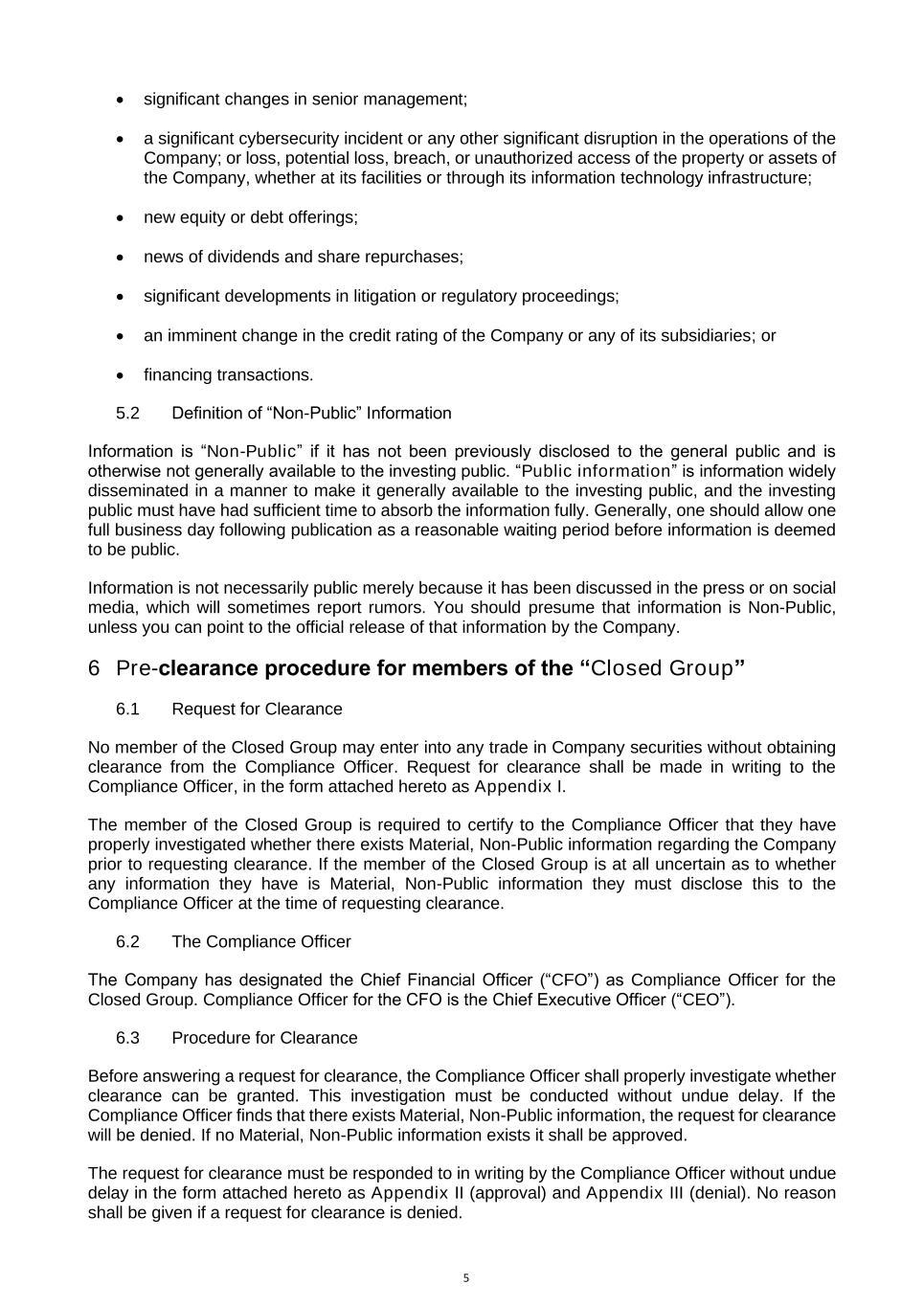
5 . • significant changes in senior management; • a significant cybersecurity incident or any other significant disruption in the operations of the Company; or loss, potential loss, breach, or unauthorized access of the property or assets of the Company, whether at its facilities or through its information technology infrastructure; • new equity or debt offerings; • news of dividends and share repurchases; • significant developments in litigation or regulatory proceedings; • an imminent change in the credit rating of the Company or any of its subsidiaries; or • financing transactions. 5.2 Definition of “Non-Public” Information Information is “Non-Public” if it has not been previously disclosed to the general public and is otherwise not generally available to the investing public. “Public information” is information widely disseminated in a manner to make it generally available to the investing public, and the investing public must have had sufficient time to absorb the information fully. Generally, one should allow one full business day following publication as a reasonable waiting period before information is deemed to be public. Information is not necessarily public merely because it has been discussed in the press or on social media, which will sometimes report rumors. You should presume that information is Non-Public, unless you can point to the official release of that information by the Company. 6 Pre-clearance procedure for members of the “Closed Group” 6.1 Request for Clearance No member of the Closed Group may enter into any trade in Company securities without obtaining clearance from the Compliance Officer. Request for clearance shall be made in writing to the Compliance Officer, in the form attached hereto as Appendix I. The member of the Closed Group is required to certify to the Compliance Officer that they have properly investigated whether there exists Material, Non-Public information regarding the Company prior to requesting clearance. If the member of the Closed Group is at all uncertain as to whether any information they have is Material, Non-Public information they must disclose this to the Compliance Officer at the time of requesting clearance. 6.2 The Compliance Officer The Company has designated the Chief Financial Officer (“CFO”) as Compliance Officer for the Closed Group. Compliance Officer for the CFO is the Chief Executive Officer (“CEO”). 6.3 Procedure for Clearance Before answering a request for clearance, the Compliance Officer shall properly investigate whether clearance can be granted. This investigation must be conducted without undue delay. If the Compliance Officer finds that there exists Material, Non-Public information, the request for clearance will be denied. If no Material, Non-Public information exists it shall be approved. The request for clearance must be responded to in writing by the Compliance Officer without undue delay in the form attached hereto as Appendix II (approval) and Appendix III (denial). No reason shall be given if a request for clearance is denied.
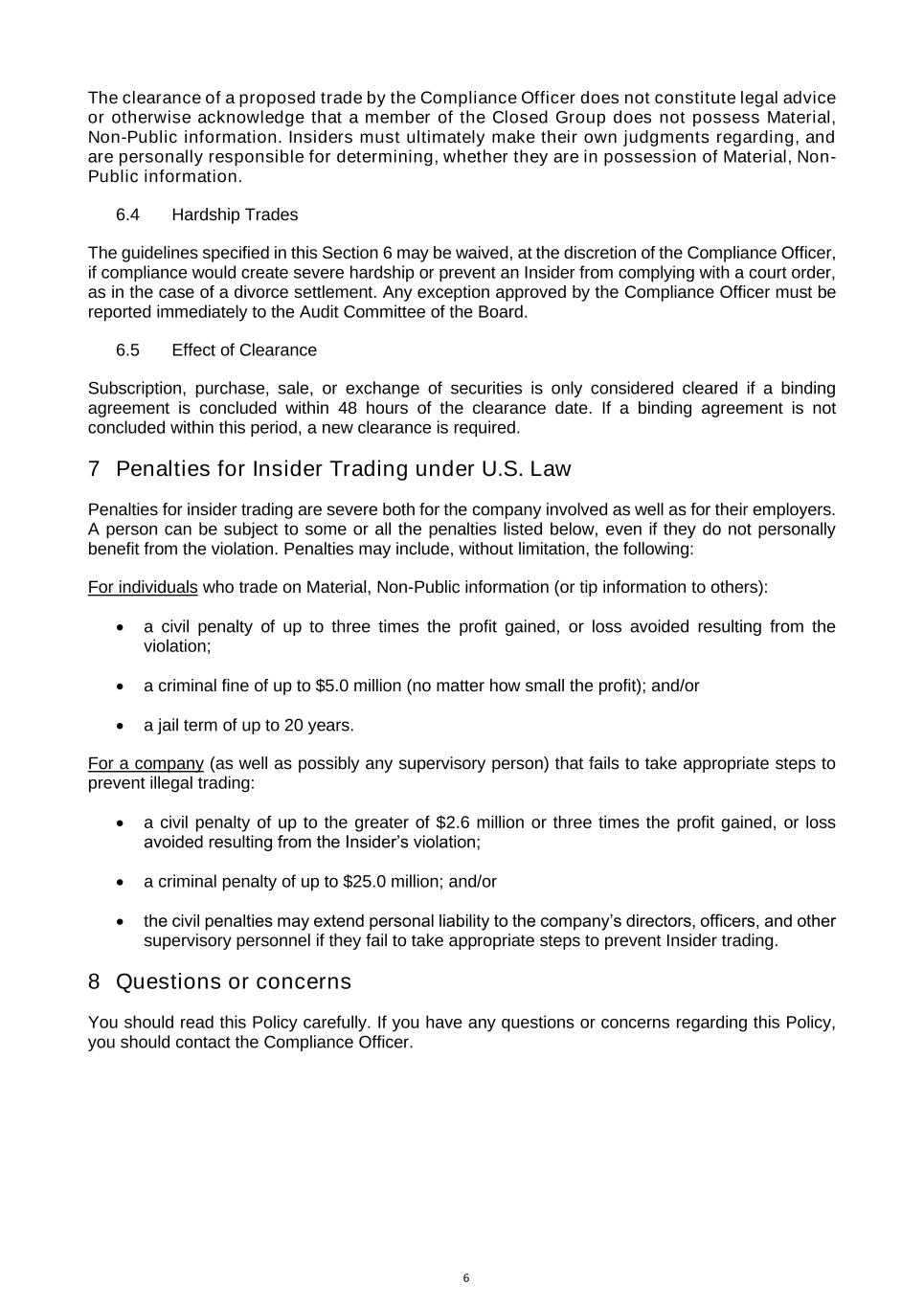
6 . The clearance of a proposed trade by the Compliance Officer does not constitute legal advice or otherwise acknowledge that a member of the Closed Group does not possess Material, Non-Public information. Insiders must ultimately make their own judgments regarding, and are personally responsible for determining, whether they are in possession of Material, Non- Public information. 6.4 Hardship Trades The guidelines specified in this Section 6 may be waived, at the discretion of the Compliance Officer, if compliance would create severe hardship or prevent an Insider from complying with a court order, as in the case of a divorce settlement. Any exception approved by the Compliance Officer must be reported immediately to the Audit Committee of the Board. 6.5 Effect of Clearance Subscription, purchase, sale, or exchange of securities is only considered cleared if a binding agreement is concluded within 48 hours of the clearance date. If a binding agreement is not concluded within this period, a new clearance is required. 7 Penalties for Insider Trading under U.S. Law Penalties for insider trading are severe both for the company involved as well as for their employers. A person can be subject to some or all the penalties listed below, even if they do not personally benefit from the violation. Penalties may include, without limitation, the following: For individuals who trade on Material, Non-Public information (or tip information to others): • a civil penalty of up to three times the profit gained, or loss avoided resulting from the violation; • a criminal fine of up to $5.0 million (no matter how small the profit); and/or • a jail term of up to 20 years. For a company (as well as possibly any supervisory person) that fails to take appropriate steps to prevent illegal trading: • a civil penalty of up to the greater of $2.6 million or three times the profit gained, or loss avoided resulting from the Insider’s violation; • a criminal penalty of up to $25.0 million; and/or • the civil penalties may extend personal liability to the company’s directors, officers, and other supervisory personnel if they fail to take appropriate steps to prevent Insider trading. 8 Questions or concerns You should read this Policy carefully. If you have any questions or concerns regarding this Policy, you should contact the Compliance Officer.