Please wait
0001715925FYfalse0001715925hyft:AtTheMarketEquityOfferingFacilityMember2025-11-072025-11-070001715925country:CA2023-05-012024-04-300001715925hyft:OptionThirteenMember2026-04-300001715925ifrs-full:LeaseLiabilitiesMember2023-04-300001715925hyft:BioStrandBVDBAMindWalkMember2025-05-012026-04-300001715925ifrs-full:IssuedCapitalMember2024-05-012025-04-300001715925ifrs-full:LeaseLiabilitiesMember2025-05-012026-04-300001715925ifrs-full:BottomOfRangeMemberifrs-full:VehiclesMember2025-05-012026-04-300001715925hyft:AutomobileMemberifrs-full:GrossCarryingAmountMember2025-04-300001715925hyft:FindersWarrantsMember2026-04-300001715925ifrs-full:CustomerrelatedIntangibleAssetsMemberhyft:AccumulatedAmortizationMember2025-04-300001715925hyft:VictoriaMember2023-05-012024-04-300001715925hyft:ProprietaryProcessesMemberifrs-full:GrossCarryingAmountMember2026-04-300001715925hyft:IntellectualPropertiesMemberhyft:AccumulatedAmortizationMember2026-04-300001715925ifrs-full:AccumulatedDepreciationAndAmortisationMemberifrs-full:FixturesAndFittingsMember2024-05-012025-04-300001715925hyft:OptionNineMember2025-05-012026-04-300001715925hyft:ConvertibleDebenturesMemberhyft:YaIiPnLtdMemberhyft:TrancheOneMember2024-07-160001715925ifrs-full:LeaseLiabilitiesMember2025-04-300001715925hyft:InternallyGeneratedDevelopmentCostsMemberifrs-full:GrossCarryingAmountMember2024-05-012025-04-300001715925hyft:OptionOneMember2025-05-012026-04-300001715925ifrs-full:GoodsOrServicesTransferredOverTimeMember2024-05-012025-04-300001715925srt:NorthAmericaMemberhyft:CorporateSegmentsMember2024-05-012025-04-300001715925ifrs-full:AccumulatedDepreciationAndAmortisationMemberhyft:WorkInProgressLeaseholdImrpvementsMember2025-04-300001715925ifrs-full:MajorOrdinaryShareTransactionsMemberhyft:AtTheMarketEquityOfferingFacilityMember2026-05-012026-05-010001715925hyft:VictoriaMember2025-05-012026-04-300001715925ifrs-full:AccumulatedDepreciationAndAmortisationMemberifrs-full:LeaseholdImprovementsMember2024-05-012025-04-300001715925ifrs-full:GrossCarryingAmountMemberifrs-full:BuildingsMember2025-04-300001715925hyft:OptionTenMember2026-04-300001715925hyft:OptionSixMember2025-05-012026-04-300001715925hyft:UtrechtMember2025-04-300001715925hyft:AccountsPayablesAndAccruedLiabilitiesMember2025-05-012026-04-300001715925hyft:ImmunoPreciseAntibodiesNDLtdMember2025-05-012026-04-300001715925srt:NorthAmericaMember2024-05-012025-04-300001715925hyft:BioKeyBVMember2024-05-012025-04-300001715925srt:NorthAmericaMember2024-04-300001715925ifrs-full:VehiclesMember2026-04-300001715925hyft:BioStrandOneMember2025-04-300001715925hyft:OptionFiveMember2026-04-300001715925hyft:IdeaFamilyBVMember2024-05-012025-04-300001715925hyft:NetBookValueMemberhyft:AutomobileMember2026-04-300001715925ifrs-full:AccumulatedDepreciationAndAmortisationMember2025-04-300001715925hyft:AutomobileMemberifrs-full:GrossCarryingAmountMember2025-05-012026-04-300001715925country:AU2023-05-012024-04-300001715925ifrs-full:AccumulatedDepreciationAndAmortisationMemberhyft:WorkInProgressLeaseholdImrpvementsMember2026-04-300001715925country:NL2023-05-012024-04-300001715925hyft:BioStrandFiveMember2026-04-300001715925hyft:NetBookValueMemberhyft:IntellectualPropertiesMember2026-04-300001715925hyft:ProductSalesMember2024-05-012025-04-300001715925hyft:TalemTherapeuticsLLCTalemMember2023-05-012024-04-300001715925hyft:ProprietaryProcessesMemberifrs-full:GrossCarryingAmountMember2024-04-300001715925hyft:IdeaFamilyBVMember2023-05-012024-04-300001715925ifrs-full:GrossCarryingAmountMemberifrs-full:BuildingsMember2024-05-012025-04-300001715925hyft:ImmunoPreciseAntibodiesUSALtdIPAUSAMember2025-05-012026-04-300001715925hyft:OptionFourMember2026-04-300001715925ifrs-full:GrossCarryingAmountMemberifrs-full:FixturesAndFittingsMember2024-04-300001715925hyft:ProjectRevenueMember2024-05-012025-04-300001715925hyft:DeferredAcquisitionPaymentsMember2024-04-300001715925ifrs-full:GrossCarryingAmountMemberhyft:ComputerHardwareMember2024-05-012025-04-300001715925ifrs-full:AdditionalPaidinCapitalMember2026-04-300001715925hyft:OptionElevenMember2025-05-012026-04-300001715925ifrs-full:TopOfRangeMemberhyft:LabEquipmentMember2025-05-012026-04-300001715925hyft:ConvertibleDebenturesMember2025-05-012026-04-300001715925hyft:CryoStorageMember2025-05-012026-04-300001715925country:BE2025-04-300001715925hyft:UProteinIpaEuropeAndBioStrandMember2024-05-012025-04-300001715925hyft:BioClueBVMember2023-05-012024-04-300001715925hyft:NetBookValueMemberifrs-full:FixturesAndFittingsMember2026-04-300001715925ifrs-full:LiquidityRiskMember2026-04-300001715925ifrs-full:TopOfRangeMember2025-05-012026-04-300001715925ifrs-full:CustomerrelatedIntangibleAssetsMemberifrs-full:GrossCarryingAmountMember2025-05-012026-04-300001715925ifrs-full:AccumulatedDepreciationAndAmortisationMemberifrs-full:LeaseholdImprovementsMember2024-04-300001715925hyft:AtTheMarketEquityOfferingFacilityMember2024-05-012025-04-300001715925hyft:WorkInProgressLeaseholdImrpvementsMemberifrs-full:GrossCarryingAmountMember2025-04-300001715925country:BE2023-05-012024-04-300001715925ifrs-full:GrossCarryingAmountMemberifrs-full:BuildingsMember2025-05-012026-04-300001715925ifrs-full:FixturesAndFittingsMember2025-05-012026-04-300001715925hyft:LabEquipmentMemberhyft:NetBookValueMember2026-04-300001715925ifrs-full:AccumulatedDepreciationAndAmortisationMemberifrs-full:BuildingsMember2025-05-012026-04-300001715925ifrs-full:AccumulatedDepreciationAndAmortisationMemberifrs-full:BuildingsMember2025-04-300001715925ifrs-full:GrossCarryingAmountMemberifrs-full:FixturesAndFittingsMember2025-05-012026-04-300001715925ifrs-full:BottomOfRangeMember2025-05-012026-04-300001715925ifrs-full:RetainedEarningsMember2025-05-012026-04-300001715925hyft:OptionSevenMember2026-04-300001715925hyft:ImmunoPreciseAntibodiesCanadaLtdDBaMindWalkBiologicsMember2023-05-012024-04-300001715925hyft:OptionElevenMember2026-04-300001715925hyft:UtrechtMember2026-04-300001715925hyft:ImmunoPreciseAntibodiesCanadaLtdDBaMindWalkBiologicsMember2025-05-012026-04-300001715925ifrs-full:DiscontinuedOperationsMember2023-05-012024-04-300001715925hyft:WorkInProgressLeaseholdImrpvementsMemberifrs-full:GrossCarryingAmountMember2024-05-012025-04-300001715925hyft:AtTheMarketEquityOfferingFacilityMember2026-04-300001715925hyft:OfficersAndEmployeesMemberhyft:ThreeAugustTwentyTwentyFourMember2026-04-300001715925ifrs-full:RestrictedShareUnitsMember2025-05-012026-04-300001715925hyft:LabAndOfficeFacilitiesMemberifrs-full:WeightedAverageMember2025-05-012026-04-300001715925hyft:ImmunoPreciseAntibodiesNDLtdMember2023-05-012024-04-300001715925hyft:NetBookValueMemberifrs-full:BuildingsMember2025-04-300001715925hyft:AmountsReceivableMember2025-05-012026-04-300001715925country:CA2024-05-012025-04-300001715925ifrs-full:AccumulatedDepreciationAndAmortisationMemberhyft:WorkInProgressLeaseholdImrpvementsMember2024-04-300001715925hyft:IntellectualPropertiesMemberifrs-full:GrossCarryingAmountMember2026-04-300001715925hyft:BioStrandBVDBAMindWalkMember2023-05-012024-04-300001715925ifrs-full:RetainedEarningsMember2024-05-012025-04-300001715925hyft:ConvertibleDebenturesMemberhyft:YaIiPnLtdMember2024-07-160001715925ifrs-full:CustomerrelatedIntangibleAssetsMemberhyft:AccumulatedAmortizationMember2024-04-300001715925hyft:NinetyDaysMemberhyft:BiostrandBVMember2022-04-132022-04-130001715925hyft:ProprietaryProcessesMemberhyft:NetBookValueMember2026-04-300001715925hyft:InternallyGeneratedDevelopmentCostsMemberifrs-full:GrossCarryingAmountMember2025-05-012026-04-300001715925ifrs-full:AccumulatedDepreciationAndAmortisationMemberhyft:AutomobileMember2026-04-300001715925hyft:ImmunoPreciseAntibodiesEuropeBVIPAEuropeFormerlyModiQuestResearchBVMember2024-05-012025-04-300001715925hyft:ProprietaryProcessesMemberhyft:AccumulatedAmortizationMember2025-04-300001715925ifrs-full:IssuedCapitalMember2026-04-3000017159252024-05-012025-04-300001715925hyft:LabEquipmentMemberifrs-full:AccumulatedDepreciationAndAmortisationMember2025-04-300001715925country:US2023-05-012024-04-300001715925hyft:InternallyGeneratedDevelopmentCostsMemberifrs-full:GrossCarryingAmountMember2025-04-300001715925hyft:BiostrandBVMember2025-05-012026-04-300001715925ifrs-full:LeaseLiabilitiesMember2026-04-300001715925hyft:AutomobileMemberifrs-full:GrossCarryingAmountMember2026-04-300001715925hyft:TalemTherapeuticsLLCTalemMember2024-05-012025-04-300001715925hyft:LabEquipmentMember2025-05-012026-04-300001715925hyft:AllOtherCountriesMember2024-05-012025-04-300001715925hyft:BiostrandMember2023-05-012024-04-300001715925hyft:DeferredAcquisitionPaymentsMember2025-04-300001715925hyft:NetBookValueMemberhyft:WorkInProgressLeaseholdImrpvementsMember2025-04-300001715925ifrs-full:AccumulatedDepreciationAndAmortisationMemberhyft:AutomobileMember2024-05-012025-04-300001715925ifrs-full:MajorOrdinaryShareTransactionsMemberhyft:AtTheMarketEquityOfferingFacilityMember2026-05-010001715925ifrs-full:AccumulatedDepreciationAndAmortisationMember2024-05-012025-04-300001715925hyft:CertificationsMemberifrs-full:GrossCarryingAmountMember2025-04-300001715925hyft:BiostrandMember2026-04-300001715925hyft:UntrechtMember2024-04-300001715925hyft:WorkInProgressLeaseholdImrpvementsMemberifrs-full:GrossCarryingAmountMember2026-04-300001715925hyft:BiostrandBVMemberifrs-full:OrdinarySharesMember2022-04-130001715925hyft:AllOtherCountriesMember2023-05-012024-04-300001715925hyft:BioStrandBVDBAMindWalkMember2024-05-012025-04-300001715925hyft:UProteinIpaEuropeAndBioStrandMember2024-04-300001715925ifrs-full:RestrictedShareUnitsMember2024-05-012025-04-300001715925hyft:FindersWarrantsMember2024-05-012025-04-300001715925hyft:AccumulatedAmortizationMemberhyft:CertificationsMember2024-05-012025-04-300001715925hyft:AccumulatedAmortizationMemberhyft:CertificationsMember2025-04-300001715925ifrs-full:AccumulatedDepreciationAndAmortisationMemberifrs-full:BuildingsMember2026-04-300001715925hyft:IntellectualPropertiesMemberhyft:AccumulatedAmortizationMember2025-04-300001715925hyft:BioStrandThreeMember2026-04-300001715925hyft:NetBookValueMemberhyft:InternallyGeneratedDevelopmentCostsMember2025-04-300001715925hyft:AccumulatedAmortizationMemberhyft:CertificationsMember2024-04-300001715925hyft:IntellectualPropertiesMemberifrs-full:GrossCarryingAmountMember2024-04-300001715925hyft:BioStrandTwoMember2026-04-300001715925hyft:CryoStorageMember2024-05-012025-04-300001715925ifrs-full:GrossCarryingAmountMemberifrs-full:FixturesAndFittingsMember2026-04-300001715925srt:EuropeMember2025-05-012026-04-300001715925hyft:OptionSevenMember2025-05-012026-04-300001715925dei:BusinessContactMember2025-05-012026-04-300001715925hyft:CertificationsMember2025-05-012026-04-300001715925ifrs-full:AccumulatedDepreciationAndAmortisationMember2026-04-300001715925hyft:NetBookValueMemberhyft:AutomobileMember2025-04-300001715925ifrs-full:CustomerrelatedIntangibleAssetsMemberhyft:AccumulatedAmortizationMember2024-05-012025-04-300001715925ifrs-full:AccumulatedDepreciationAndAmortisationMemberifrs-full:FixturesAndFittingsMember2025-05-012026-04-300001715925ifrs-full:AccumulatedOtherComprehensiveIncomeMember2024-04-300001715925ifrs-full:AccumulatedDepreciationAndAmortisationMemberhyft:ComputerHardwareMember2024-05-012025-04-300001715925hyft:ProprietaryProcessesMemberifrs-full:GrossCarryingAmountMember2024-05-012025-04-300001715925ifrs-full:AccumulatedDepreciationAndAmortisationMember2024-04-300001715925hyft:ImmunoPreciseNetherlandsBVMember2024-05-012025-04-300001715925hyft:NetBookValueMember2025-04-300001715925ifrs-full:AccumulatedDepreciationAndAmortisationMemberifrs-full:FixturesAndFittingsMember2026-04-300001715925ifrs-full:GrossCarryingAmountMemberifrs-full:LeaseholdImprovementsMember2024-04-300001715925hyft:WorkInProgressLeaseholdImrpvementsMemberifrs-full:GrossCarryingAmountMember2025-05-012026-04-300001715925ifrs-full:ComputerEquipmentMember2025-05-012026-04-300001715925ifrs-full:LiquidityRiskMemberifrs-full:LaterThanTwoYearsAndNotLaterThanFiveYearsMember2026-04-300001715925hyft:CertificationsMemberifrs-full:GrossCarryingAmountMember2026-04-300001715925country:CA2025-05-012026-04-300001715925ifrs-full:LeaseLiabilitiesMember2024-04-300001715925hyft:InternallyGeneratedDevelopmentCostsMemberifrs-full:GrossCarryingAmountMember2026-04-300001715925country:AU2025-05-012026-04-300001715925ifrs-full:IssuedCapitalMemberifrs-full:OrdinarySharesMember2024-05-012025-04-300001715925hyft:BiostrandBVMember2024-05-012025-04-300001715925ifrs-full:RetainedEarningsMember2026-04-300001715925hyft:OptionEightMember2026-04-300001715925hyft:TalemTherapeuticsLLCTalemMember2025-05-012026-04-300001715925hyft:BiostrandMember2025-04-300001715925ifrs-full:BottomOfRangeMemberhyft:LabAndOfficeFacilitiesMember2025-05-012026-04-300001715925hyft:ImmunoPreciseAntibodiesEuropeBVIPAEuropeFormerlyModiQuestResearchBVMember2023-05-012024-04-300001715925hyft:ProprietaryProcessesMemberhyft:AccumulatedAmortizationMember2024-05-012025-04-3000017159252025-04-300001715925hyft:ImmunoPreciseAntibodiesUSALtdIPAUSAMember2023-05-012024-04-300001715925srt:EuropeMember2024-05-012025-04-300001715925ifrs-full:AdditionalPaidinCapitalMember2024-04-300001715925hyft:AccumulatedAmortizationMemberhyft:CertificationsMember2025-05-012026-04-300001715925ifrs-full:GrossCarryingAmountMemberifrs-full:BuildingsMember2026-04-300001715925hyft:InternallyGeneratedDevelopmentCostsMemberhyft:AccumulatedAmortizationMember2024-04-300001715925ifrs-full:NotLaterThanOneYearMember2026-04-300001715925hyft:CertificationsMemberifrs-full:GrossCarryingAmountMember2024-04-300001715925hyft:NetBookValueMemberifrs-full:FixturesAndFittingsMember2025-04-300001715925hyft:LabEquipmentMember2026-04-300001715925hyft:BioStrandTwoMember2025-05-012026-04-300001715925hyft:ProprietaryProcessesMemberhyft:AccumulatedAmortizationMember2024-04-300001715925hyft:BioClueBVMember2024-05-012025-04-300001715925hyft:OptionTwoMember2025-05-012026-04-300001715925country:US2024-05-012025-04-300001715925ifrs-full:AccumulatedDepreciationAndAmortisationMemberhyft:AutomobileMember2025-04-300001715925hyft:BiostrandBVMember2024-04-300001715925hyft:BioStrandOneMember2024-05-012025-04-300001715925hyft:InternallyGeneratedDevelopmentCostsMemberhyft:AccumulatedAmortizationMember2025-05-012026-04-300001715925hyft:NetBookValueMemberhyft:CertificationsMember2026-04-300001715925srt:NorthAmericaMember2023-05-012024-04-300001715925ifrs-full:AdditionalPaidinCapitalMember2024-05-012025-04-300001715925ifrs-full:GrossCarryingAmountMemberhyft:ComputerHardwareMember2024-04-300001715925hyft:IntellectualPropertiesMemberifrs-full:GrossCarryingAmountMember2024-05-012025-04-300001715925hyft:InternallyGeneratedDevelopmentCostsMember2025-05-012026-04-300001715925ifrs-full:AccumulatedOtherComprehensiveIncomeMember2025-04-300001715925hyft:ImmunoPreciseAntibodiesNDLtdMember2024-05-012025-04-300001715925hyft:OssMember2023-05-012024-04-300001715925hyft:FinancialAssetsCashAndRestrictedCashMember2025-05-012026-04-300001715925srt:NorthAmericaMember2025-05-012026-04-300001715925hyft:WorkInProgressLeaseholdImrpvementsMemberifrs-full:GrossCarryingAmountMember2024-04-300001715925hyft:ImmunoPreciseNetherlandsBVMember2025-05-012026-04-300001715925hyft:OptionSixMember2026-04-300001715925hyft:NetBookValueMemberhyft:ComputerHardwareMember2025-04-300001715925ifrs-full:IssuedCapitalMemberifrs-full:OrdinarySharesMember2025-04-300001715925ifrs-full:AccumulatedDepreciationAndAmortisationMemberifrs-full:LeaseholdImprovementsMember2025-05-012026-04-300001715925ifrs-full:GrossCarryingAmountMemberhyft:ComputerHardwareMember2025-04-300001715925hyft:LabEquipmentMemberifrs-full:AccumulatedDepreciationAndAmortisationMember2024-05-012025-04-300001715925hyft:OptionFiveMember2025-05-012026-04-300001715925hyft:FindersWarrantsMember2025-04-300001715925ifrs-full:AccumulatedDepreciationAndAmortisationMemberhyft:WorkInProgressLeaseholdImrpvementsMember2025-05-012026-04-300001715925hyft:OfficersAndEmployeesMemberhyft:ThreeAugustTwentyTwentyFourMember2025-05-012026-04-300001715925hyft:DeferredAcquisitionPaymentsMember2023-05-012024-04-300001715925ifrs-full:WeightedAverageMemberhyft:LabEquipmentMember2025-05-012026-04-300001715925hyft:ProductSalesMember2023-05-012024-04-300001715925hyft:AutomobileMemberifrs-full:GrossCarryingAmountMember2024-05-012025-04-300001715925ifrs-full:AccumulatedDepreciationAndAmortisationMemberifrs-full:LeaseholdImprovementsMember2025-04-300001715925ifrs-full:AccumulatedDepreciationAndAmortisationMemberhyft:ComputerHardwareMember2024-04-300001715925ifrs-full:LiquidityRiskMemberifrs-full:NotLaterThanOneYearMember2026-04-300001715925hyft:BiostrandMember2025-05-012026-04-300001715925ifrs-full:RetainedEarningsMember2024-04-300001715925srt:NorthAmericaMember2026-04-300001715925hyft:AtTheMarketEquityOfferingFacilityMember2025-05-012026-04-300001715925ifrs-full:PotentialOrdinaryShareTransactionsMemberifrs-full:TopOfRangeMemberhyft:AtTheMarketEquityOfferingFacilityMember2024-02-232024-02-230001715925hyft:DeferredAcquisitionPaymentsMember2024-05-012025-04-300001715925ifrs-full:IssuedCapitalMember2025-04-300001715925hyft:OssMember2024-04-300001715925hyft:IntellectualPropertiesMemberifrs-full:GrossCarryingAmountMember2025-04-300001715925hyft:InternallyGeneratedDevelopmentCostsMemberhyft:AccumulatedAmortizationMember2024-05-012025-04-300001715925hyft:ConvertibleDebenturesMember2025-04-300001715925ifrs-full:GrossCarryingAmountMemberifrs-full:FixturesAndFittingsMember2025-04-300001715925ifrs-full:VehiclesMember2025-05-012026-04-300001715925ifrs-full:RestrictedShareUnitsMember2024-04-300001715925hyft:NetBookValueMemberifrs-full:CustomerrelatedIntangibleAssetsMember2026-04-3000017159252023-04-300001715925hyft:UProteinIpaEuropeAndBioStrandMember2025-04-300001715925hyft:AccumulatedAmortizationMemberhyft:CertificationsMember2026-04-300001715925hyft:BioKeyBVMember2025-05-012026-04-300001715925hyft:NetBookValueMemberhyft:ComputerHardwareMember2026-04-300001715925hyft:BioStrandOneMember2025-05-012026-04-3000017159252023-05-012024-04-300001715925hyft:OptionFourMember2025-05-012026-04-300001715925hyft:ConvertibleDebenturesMember2026-04-300001715925hyft:BiostrandMember2024-05-012025-04-300001715925hyft:NetBookValueMemberhyft:InternallyGeneratedDevelopmentCostsMember2026-04-300001715925ifrs-full:GrossCarryingAmountMemberifrs-full:LeaseholdImprovementsMember2024-05-012025-04-300001715925hyft:VictoriaMember2026-04-300001715925hyft:AtTheMarketEquityOfferingFacilityMember2025-04-300001715925hyft:UntrechtMember2025-04-300001715925ifrs-full:RestrictedShareUnitsMember2025-04-300001715925ifrs-full:CustomerrelatedIntangibleAssetsMemberhyft:AccumulatedAmortizationMember2026-04-300001715925hyft:ProprietaryProcessesMemberhyft:AccumulatedAmortizationMember2026-04-300001715925hyft:InternallyGeneratedDevelopmentCostsMemberifrs-full:GrossCarryingAmountMember2024-04-300001715925hyft:NetBookValueMemberhyft:IntellectualPropertiesMember2025-04-300001715925ifrs-full:GoodsOrServicesTransferredAtPointInTimeMember2024-05-012025-04-300001715925hyft:LabEquipmentMemberifrs-full:AccumulatedDepreciationAndAmortisationMember2026-04-300001715925hyft:ConvertibleDebenturesMember2024-04-300001715925ifrs-full:AccumulatedDepreciationAndAmortisationMemberifrs-full:BuildingsMember2024-05-012025-04-300001715925srt:NorthAmericaMemberhyft:CorporateSegmentsMember2024-04-300001715925hyft:AutomobileMemberifrs-full:GrossCarryingAmountMember2024-04-300001715925hyft:BiostrandMember2026-04-300001715925ifrs-full:GrossCarryingAmountMemberifrs-full:LeaseholdImprovementsMember2026-04-300001715925srt:NorthAmericaMemberhyft:CorporateSegmentsMember2025-05-012026-04-300001715925ifrs-full:DiscontinuedOperationsMember2026-04-300001715925ifrs-full:AccumulatedDepreciationAndAmortisationMemberhyft:AutomobileMember2024-04-300001715925hyft:OptionSevenToTwelveMember2026-04-300001715925hyft:InternallyGeneratedDevelopmentCostsMemberhyft:AccumulatedAmortizationMember2025-04-300001715925hyft:IntellectualPropertiesMemberhyft:AccumulatedAmortizationMember2024-04-300001715925ifrs-full:AccumulatedOtherComprehensiveIncomeMember2026-04-300001715925ifrs-full:AccumulatedDepreciationAndAmortisationMemberhyft:ComputerHardwareMember2025-04-300001715925ifrs-full:ComputerSoftwareMember2025-05-012026-04-3000017159252022-05-012022-07-310001715925hyft:BiostrandBVMember2026-04-300001715925hyft:BiostrandMember2025-04-300001715925hyft:BiostrandBVMember2025-04-300001715925hyft:LabEquipmentMemberhyft:NetBookValueMember2025-04-300001715925ifrs-full:GoodsOrServicesTransferredAtPointInTimeMember2025-05-012026-04-300001715925hyft:BiostrandBVMember2023-05-012024-04-300001715925hyft:LabAndOfficeFacilitiesMember2026-04-300001715925hyft:OptionTwelveMember2025-05-012026-04-300001715925hyft:BiostrandBVMember2022-04-130001715925srt:NorthAmericaMemberhyft:CorporateSegmentsMember2023-05-012024-04-300001715925hyft:BioKeyBVMember2023-05-012024-04-300001715925ifrs-full:CustomerrelatedIntangibleAssetsMemberifrs-full:GrossCarryingAmountMember2024-04-300001715925hyft:BioStrandThreeMember2025-05-012026-04-300001715925hyft:IntellectualPropertiesMemberhyft:AccumulatedAmortizationMember2025-05-012026-04-300001715925hyft:EscrowAgreementMemberhyft:BiostrandBVMemberhyft:TrancheTwoMember2022-04-300001715925ifrs-full:GoodsOrServicesTransferredOverTimeMember2025-05-012026-04-300001715925srt:NorthAmericaMemberhyft:CorporateSegmentsMember2026-04-300001715925ifrs-full:CustomerrelatedIntangibleAssetsMemberifrs-full:GrossCarryingAmountMember2025-04-300001715925hyft:NetBookValueMemberifrs-full:LeaseholdImprovementsMember2025-04-300001715925hyft:NetBookValueMemberifrs-full:CustomerrelatedIntangibleAssetsMember2025-04-300001715925ifrs-full:GrossCarryingAmountMemberhyft:ComputerHardwareMember2025-05-012026-04-300001715925ifrs-full:AccumulatedDepreciationAndAmortisationMemberifrs-full:FixturesAndFittingsMember2025-04-300001715925ifrs-full:RestrictedShareUnitsMember2026-04-300001715925hyft:ImmunoPreciseAntibodiesMALLCMember2024-05-012025-04-300001715925ifrs-full:TopOfRangeMemberifrs-full:VehiclesMember2025-05-012026-04-300001715925country:NL2025-05-012026-04-300001715925country:NL2025-04-300001715925hyft:AllOtherCountriesMember2025-05-012026-04-300001715925ifrs-full:TopOfRangeMemberhyft:LabAndOfficeFacilitiesMember2025-05-012026-04-300001715925srt:NorthAmericaMemberhyft:CorporateSegmentsMember2025-04-300001715925hyft:LabEquipmentMemberifrs-full:GrossCarryingAmountMember2025-04-300001715925hyft:VictoriaMember2025-04-300001715925hyft:ImmunoPreciseNetherlandsBVMember2023-05-012024-04-300001715925hyft:ProprietaryProcessesMemberifrs-full:GrossCarryingAmountMember2025-04-300001715925hyft:OptionEightMember2025-05-012026-04-300001715925hyft:BioStrandFourMember2025-05-012026-04-300001715925ifrs-full:RestrictedShareUnitsMember2023-05-012024-04-300001715925ifrs-full:VehiclesMemberifrs-full:WeightedAverageMember2025-05-012026-04-300001715925hyft:UProteinIpaEuropeAndBioStrandMember2026-04-300001715925ifrs-full:AccumulatedOtherComprehensiveIncomeMember2024-05-012025-04-300001715925hyft:BioStrandOneMember2026-04-300001715925hyft:BioClueBVMember2025-05-012026-04-300001715925hyft:OptionTenMember2025-05-012026-04-300001715925hyft:ConvertibleDebenturesMember2024-05-012025-04-300001715925ifrs-full:GrossCarryingAmountMemberifrs-full:LeaseholdImprovementsMember2025-04-300001715925hyft:ImmunoPreciseAntibodiesMALLCMember2023-05-012024-04-300001715925ifrs-full:GrossCarryingAmountMemberifrs-full:LeaseholdImprovementsMember2025-05-012026-04-300001715925hyft:CustomerListMember2025-05-012026-04-300001715925ifrs-full:GrossCarryingAmountMember2026-04-300001715925ifrs-full:BottomOfRangeMemberhyft:IntellectualPropertiesMember2025-05-012026-04-300001715925ifrs-full:LaterThanOneYearAndNotLaterThanTwoYearsMember2026-04-300001715925ifrs-full:RetainedEarningsMember2025-04-300001715925ifrs-full:GrossCarryingAmountMemberifrs-full:FixturesAndFittingsMember2024-05-012025-04-300001715925ifrs-full:LaterThanFourYearsAndNotLaterThanFiveYearsMember2026-04-300001715925srt:EuropeMember2023-05-012024-04-300001715925ifrs-full:GrossCarryingAmountMember2024-05-012025-04-300001715925hyft:IdeaFamilyBVMember2025-05-012026-04-300001715925country:NL2024-05-012025-04-300001715925ifrs-full:CurrencyRiskMember2026-04-300001715925hyft:IntellectualPropertiesMember2025-05-012026-04-300001715925srt:NorthAmericaMember2025-04-300001715925ifrs-full:AccumulatedDepreciationAndAmortisationMemberifrs-full:BuildingsMember2024-04-300001715925ifrs-full:LeaseLiabilitiesMember2023-05-012024-04-300001715925country:BE2025-05-012026-04-300001715925ifrs-full:IssuedCapitalMember2025-05-012026-04-300001715925hyft:InternallyGeneratedDevelopmentCostsMemberhyft:AccumulatedAmortizationMember2026-04-300001715925hyft:ImmunoPreciseAntibodiesEuropeBVIPAEuropeFormerlyModiQuestResearchBVMember2025-05-012026-04-300001715925hyft:OptionTwelveMember2026-04-3000017159252022-05-310001715925hyft:NetBookValueMemberhyft:WorkInProgressLeaseholdImrpvementsMember2026-04-300001715925hyft:ProjectRevenueMember2025-05-012026-04-300001715925hyft:OssMember2026-04-300001715925hyft:ConvertibleDebenturesMemberhyft:YaIiPnLtdMemberhyft:TrancheTwoMember2024-07-1600017159252026-04-300001715925country:BE2024-05-012025-04-300001715925hyft:UProteinIpaEuropeAndBioStrandMember2025-05-012026-04-300001715925hyft:DeferredAcquisitionPaymentsMember2026-04-300001715925hyft:LabEquipmentMemberifrs-full:GrossCarryingAmountMember2024-04-300001715925country:BE2026-04-300001715925hyft:ConvertibleDebenturesMember2025-05-012026-04-300001715925ifrs-full:DiscontinuedOperationsMember2024-05-012025-04-300001715925ifrs-full:LiquidityRiskMemberifrs-full:LaterThanFiveYearsMember2026-04-300001715925ifrs-full:AccumulatedDepreciationAndAmortisationMemberifrs-full:LeaseholdImprovementsMember2026-04-300001715925hyft:IntellectualPropertiesMemberhyft:AccumulatedAmortizationMember2024-05-012025-04-300001715925hyft:EscrowAgreementMemberhyft:BiostrandBVMemberhyft:TrancheThreeMember2022-04-300001715925hyft:VictoriaMember2024-04-300001715925hyft:OptionOneMember2026-04-300001715925ifrs-full:AccumulatedOtherComprehensiveIncomeMember2025-05-012026-04-300001715925hyft:LabEquipmentMemberifrs-full:AccumulatedDepreciationAndAmortisationMember2025-05-012026-04-300001715925hyft:CertificationsMemberifrs-full:GrossCarryingAmountMember2024-05-012025-04-300001715925hyft:NetBookValueMemberifrs-full:LeaseholdImprovementsMember2026-04-300001715925hyft:OptionThreeMember2026-04-300001715925hyft:CryoStorageMember2023-05-012024-04-3000017159252025-05-012026-04-300001715925ifrs-full:AccumulatedDepreciationAndAmortisationMemberhyft:ComputerHardwareMember2026-04-300001715925hyft:ImmunoPreciseAntibodiesUSALtdIPAUSAMember2024-05-012025-04-300001715925ifrs-full:LiquidityRiskMemberifrs-full:LaterThanOneYearAndNotLaterThanTwoYearsMember2026-04-300001715925country:NL2024-04-300001715925ifrs-full:AccumulatedDepreciationAndAmortisationMemberhyft:WorkInProgressLeaseholdImrpvementsMember2024-05-012025-04-300001715925hyft:FindersWarrantsMember2025-05-012026-04-300001715925hyft:OptionTwoMember2026-04-300001715925hyft:EscrowAgreementMemberhyft:TrancheOneMemberhyft:BiostrandBVMember2022-04-300001715925hyft:LabEquipmentMemberifrs-full:GrossCarryingAmountMember2025-05-012026-04-300001715925hyft:ProprietaryProcessesMember2025-05-012026-04-3000017159252024-04-300001715925hyft:OssMember2025-04-300001715925hyft:OptionThreeMember2025-05-012026-04-300001715925ifrs-full:LeaseLiabilitiesMember2024-05-012025-04-300001715925hyft:OptionNineMember2026-04-300001715925ifrs-full:AdditionalPaidinCapitalMember2025-05-012026-04-300001715925ifrs-full:AccumulatedDepreciationAndAmortisationMember2025-05-012026-04-300001715925country:BE2024-04-300001715925ifrs-full:GrossCarryingAmountMember2024-04-300001715925ifrs-full:TopOfRangeMemberhyft:IntellectualPropertiesMember2025-05-012026-04-300001715925hyft:NetBookValueMemberhyft:CertificationsMember2025-04-300001715925hyft:DeferredAcquisitionPaymentsMember2025-05-012026-04-300001715925hyft:BioStrandFourMember2026-04-300001715925country:NL2026-04-300001715925ifrs-full:AccumulatedDepreciationAndAmortisationMemberifrs-full:FixturesAndFittingsMember2024-04-300001715925hyft:LabEquipmentMemberifrs-full:GrossCarryingAmountMember2026-04-300001715925ifrs-full:LaterThanThreeYearsAndNotLaterThanFourYearsMember2026-04-300001715925hyft:ImmunoPreciseAntibodiesMALLCMember2025-05-012026-04-300001715925country:US2025-05-012026-04-300001715925hyft:NetBookValueMemberifrs-full:BuildingsMember2026-04-300001715925ifrs-full:IssuedCapitalMember2024-04-300001715925ifrs-full:GrossCarryingAmountMemberifrs-full:BuildingsMember2024-04-300001715925hyft:ProprietaryProcessesMemberhyft:AccumulatedAmortizationMember2025-05-012026-04-300001715925ifrs-full:BuildingsMember2025-05-012026-04-300001715925hyft:FindersWarrantsMemberhyft:RangeOneMember2025-05-012026-04-300001715925currency:EUR2026-04-300001715925hyft:VictoriaMember2024-05-012025-04-300001715925ifrs-full:GrossCarryingAmountMember2025-05-012026-04-300001715925hyft:BiostrandBVMember2021-05-012022-04-300001715925hyft:DeferredAcquisitionPaymentsMember2025-05-012026-04-300001715925hyft:AtTheMarketEquityOfferingFacilityMember2024-04-300001715925ifrs-full:GrossCarryingAmountMember2025-04-300001715925ifrs-full:CustomerrelatedIntangibleAssetsMemberifrs-full:GrossCarryingAmountMember2024-05-012025-04-300001715925ifrs-full:BottomOfRangeMemberhyft:LabEquipmentMember2025-05-012026-04-300001715925hyft:OssMember2025-04-300001715925ifrs-full:CustomerrelatedIntangibleAssetsMemberifrs-full:GrossCarryingAmountMember2026-04-300001715925ifrs-full:LaterThanTwoYearsAndNotLaterThanThreeYearsMember2026-04-300001715925hyft:CertificationsMemberifrs-full:GrossCarryingAmountMember2025-05-012026-04-300001715925ifrs-full:AccumulatedDepreciationAndAmortisationMemberhyft:ComputerHardwareMember2025-05-012026-04-300001715925hyft:ProductSalesMember2025-05-012026-04-300001715925ifrs-full:AdditionalPaidinCapitalMember2025-04-300001715925hyft:NetBookValueMember2026-04-300001715925hyft:OptionThirteenMember2025-05-012026-04-300001715925hyft:LabEquipmentMemberifrs-full:AccumulatedDepreciationAndAmortisationMember2024-04-300001715925ifrs-full:LaterThanFiveYearsMember2026-04-300001715925ifrs-full:AccumulatedDepreciationAndAmortisationMemberhyft:AutomobileMember2025-05-012026-04-300001715925hyft:BiostrandBVMember2023-04-300001715925hyft:OptionFourAndFiveMember2026-04-300001715925country:AU2024-05-012025-04-300001715925ifrs-full:CustomerrelatedIntangibleAssetsMemberhyft:AccumulatedAmortizationMember2025-05-012026-04-300001715925hyft:AtTheMarketEquityOfferingFacilityMember2023-05-012024-04-300001715925hyft:ProprietaryProcessesMemberhyft:NetBookValueMember2025-04-300001715925hyft:ThreeYearsMemberhyft:BiostrandBVMember2022-04-132022-04-130001715925hyft:LabEquipmentMemberifrs-full:GrossCarryingAmountMember2024-05-012025-04-300001715925hyft:DeferredAcquisitionPaymentsMember2023-04-300001715925hyft:CapitalManagementMember2026-04-300001715925hyft:BiostrandBVMemberifrs-full:OrdinarySharesMember2022-04-300001715925hyft:IntellectualPropertiesMemberifrs-full:GrossCarryingAmountMember2025-05-012026-04-300001715925hyft:ProprietaryProcessesMemberifrs-full:GrossCarryingAmountMember2025-05-012026-04-300001715925hyft:FindersWarrantsMemberhyft:RangeOneMember2026-04-300001715925ifrs-full:GoodsOrServicesTransferredAtPointInTimeMember2023-05-012024-04-300001715925hyft:ProjectRevenueMember2023-05-012024-04-300001715925ifrs-full:GrossCarryingAmountMemberhyft:ComputerHardwareMember2026-04-300001715925currency:USD2026-04-300001715925ifrs-full:GoodsOrServicesTransferredOverTimeMember2023-05-012024-04-300001715925hyft:BioStrandFiveMember2025-05-012026-04-300001715925ifrs-full:DiscontinuedOperationsMember2025-05-012026-04-300001715925ifrs-full:LeaseholdImprovementsMember2025-05-012026-04-300001715925hyft:ImmunoPreciseAntibodiesCanadaLtdDBaMindWalkBiologicsMember2024-05-012025-04-30iso4217:EURxbrli:purexbrli:sharesiso4217:CADiso4217:USDutr:Y
UNITED STATES
SECURITIES AND EXCHANGE COMMISSION
WASHINGTON, D.C. 20549
FORM 20-F
|
|
|
☐ |
REGISTRATION STATEMENT PURSUANT TO SECTION 12(b) OR 12(g) OF THE SECURITIES EXCHANGE ACT OF 1934 |
OR
|
|
|
☒ |
ANNUAL REPORT PURSUANT TO SECTION 13 OR 15(d) OF THE SECURITIES EXCHANGE ACT OF 1934 |
|
For the fiscal year ended April 30, 2026 |
OR
|
|
|
☐ |
TRANSITION REPORT PURSUANT TO SECTION 13 OR 15(d) OF THE SECURITIES EXCHANGE ACT OF 1934 |
|
For the transition period from ____________________ to ____________________ |
OR
|
|
|
☐ |
SHELL COMPANY REPORT PURSUANT TO SECTION 13 OR 15(d) OF THE SECURITIES EXCHANGE ACT OF 1934 |
Commission file number: 001-39530
MindWalk Holdings Corp.
(Exact name of Registrant as specified in its charter)
British Columbia
(Jurisdiction of incorporation or organization)
Industrious 823 Congress Ave Suite 300 Austin, Texas 78701, United States
(Address of principal executive offices)
R. Scott Areglado, 701-404-1043, sareglado@mindwalkai.com
Industrious 823 Congress Ave Suite 300 Austin, Texas 78701, United States
(Name, Telephone, E-Mail and/or Facsimile number and Address of Company Contact Person)
Securities registered or to be registered pursuant to Section 12(b) of the Act:
|
|
|
|
Title of each class |
Trading Symbol |
Name of each exchange on which registered |
Common Shares, no par value |
HYFT |
The Nasdaq Stock Market, LLC |
Securities registered or to be registered pursuant to Section 12(g) of the Act: N/A
Securities for which there is a reporting obligation pursuant to Section 15(d) of the Act: None
Indicate the number of outstanding shares of each of the issuer’s classes of capital or common stock as of the close of the period covered by the annual report: 46,711,866 Common Shares
Indicate by check mark if the Company is a well-known seasoned issuer, as defined in Rule 405 of the Securities Act. Yes ☐ No ☒
If this report is an annual or transition report, indicate by check mark if the Company is not required to file reports pursuant to Section 13 or 15(d) of the Securities Exchange Act of 1934. Yes ☐ No ☒
Indicate by check mark whether the Company (1) has filed all reports required to be filed by Section 13 or 15(d) of the Securities Exchange Act of 1934 during the preceding 12 months (or such shorter period that the Company was required to file such reports), and (2) has been subject to such filing requirements for the past 90 days. Yes ☒ No ☐
Indicate by check mark whether the Company has submitted electronically every Interactive Data File required to be submitted pursuant to Rule 405 of Regulation S-T (§232.405 of this chapter) during the preceding 12 months (or for such shorter period that the Company was required to submit and post such files). Yes ☒ No ☐
Indicate by check mark whether the Company is a large accelerated filer, an accelerated filer, a non-accelerated filer or an emerging growth company. See the definitions of “large accelerated filer,” “accelerated filer,” and “emerging growth company” in Rule 12b-2 of the Exchange Act.
|
|
|
Large accelerated filer ☐ |
Accelerated filer ☐ |
Non-accelerated filer ☒ |
Emerging growth company ☐ |
If an emerging growth company that prepares its financial statements in accordance with U.S. GAAP, indicate by check mark if the registrant has elected not to use the extended transition period for complying with any new or revised financial accounting standards provided pursuant to Section 13(a) of the Exchange Act. ☐
Indicate by check mark whether the registrant has filed a report on and attestation to its management’s assessment of the effectiveness of its internal control over financial reporting under Section 404(b) of the Sarbanes-Oxley Act (15 U.S.C. 7262(b)) by the registered public accounting firm that prepared or issued its audit report. ☐
If securities are registered pursuant to Section 12(b) of the Act, indicate by check mark whether the financial statements of the registrant included in the filing reflect the correction of an error to previously issued financial statements. ☐
Indicate by check mark whether any of those error corrections are restatements that required a recovery analysis of incentive-based compensation received by any of the registrant’s executive officers during the relevant recovery period pursuant to §240.10D-1(b). ☐
Indicate by check mark which basis of accounting the Company has used to prepare the financial statements included in this filing:
|
|
|
|
U.S. GAAP ☐ |
International Financial Reporting Standards as issued By the International Accounting Standards Board ☒ |
Other ☐ |
If “Other” has been checked in response to previous question, indicate by check mark which financial statement item the Company has elected to follow. Item 17☐ Item 18☐
If this is an annual report, indicate by check mark whether the Company is a shell company (as defined in Rule 12b-2 of the Exchange Act). Yes ☐ No ☒
INTRODUCTION
In this Annual Report on Form 20-F (the “Annual Report”), “MindWalk,” “Company,” “we,” “us” and “our” refer to MindWalk Holdings Corp (formerly ImmunoPrecise Antibodies Ltd.) and its consolidated subsidiaries.
Information contained in this Annual Report is given as of April 30, 2026, the fiscal year end of Company, unless otherwise specifically stated.
Market and industry data used throughout this Annual Report was obtained from various publicly available sources. Although the Company believes that these independent sources are generally reliable, the accuracy and completeness of such information are not guaranteed and have not been verified due to limits on the availability and reliability of raw data, the voluntary nature of the data gathering process and the limitations and uncertainty inherent in any statistical survey of market size, conditions and prospects.
Statements made in this Annual Report concerning the contents of any contract, agreement or other document are summaries of such contracts, agreements or documents and are not complete descriptions of all of their terms. If we file any of these documents as an exhibit to this Annual Report, you may read the document itself for a complete description of its terms.
The Company reports under International Financial Reporting Standards as issued by the International Accounting Standards Board. None of the consolidated financial statements contained in this Annual Report were prepared in accordance with generally accepted accounting principles in the United States. The Company's financial statements are presented in Canadian dollars. In this Annual Report, unless otherwise indicated, all dollar amounts and references to "$" or "CAD$" are to Canadian dollars and references to "U.S.$" are to United States dollars, but most of the figures included in this Annual Report, including the Company's financial statements, are in Canadian dollars.
SPECIAL NOTE REGARDING FORWARD-LOOKING STATEMENTS
This Annual Report contains “forward-looking statements” and “forward-looking information” within the meaning of United States and Canadian securities laws (collectively, “forward-looking statements”) about the Company which reflect management's expectations regarding the Company's future growth, results of operations, operational and financial performance and business prospects and opportunities. In addition, the Company may make or approve certain statements or information in future filings with Canadian and United States securities regulatory authorities, in news releases, or in oral or written presentations by representatives of the Company that are not statements of historical fact and may also constitute forward-looking statements or forward-looking information. All statements and information, other than statements or information of historical fact, made by the Company that address activities, events or developments that the Company expects or anticipates will or may occur in the future are forward-looking statements and information, including, but not limited to statements and information preceded by, followed by, or that include words such as "may", "would", "could", "will", "likely", "expect", "anticipate", "believe", "intends", "plan", "forecast", "budget", "schedule", "project", "estimate", "outlook", or the negative of those words or other similar or comparable words.
Forward-looking statements and information involve significant risks, assumptions, uncertainties, and other factors that may cause actual future performance, achievements, or other realities to differ materially from those expressed or implied in any forward-looking statements or information and, accordingly, should not be read as guarantees of future performance, achievements, or realities. Although the forward-looking statements and information contained in this Annual Report and the documents incorporated by reference therein reflect management's current beliefs based upon information currently available to management and based upon what management believes to be reasonable assumptions, the Company cannot be certain that actual results will be consistent with these forward-looking statements and information. A number of risks and factors could cause actual results, performance, or achievements to differ materially from the results expressed or implied in the forward-looking statements and information. Such risks and factors include, but are not limited to, the following:
•negative operating cash flow;
•liquidity and future financing risk;
•the financial position of the Company and its potential need for additional liquidity and capital in the future;
•the Company may experience going concern risk;
•the Company may fail to remediate a material weakness;
•the success of any of the Company's current or future strategic alliances;
•the Company may become involved in regulatory or agency proceedings, investigations and audits;
•the Company may be subject to litigation in the ordinary course of its business;
•the ability of the Company to obtain, protect and enforce patents on its technology and products;
•risks associated with applicable regulatory processes;
•the ability of the Company to achieve publicly announced milestones;
•the effectiveness of the Company's business development and marketing strategies;
•the competitive conditions of the industry in which the Company operates;
•market perception of smaller companies;
•the Company’s ability to successfully develop, validate, and commercialize its proprietary AI platforms, including the LensAI™ platform and HYFT® technology;
•the Company cannot assure the production of new and innovative processes, procedures or innovative approaches to antibody and biologics discovery, AI-driven drug design, or development of new antibodies, peptide therapeutics, or vaccine candidates;
•the risks inherent in preclinical and clinical development of the Company’s proprietary pipeline programs;
•the ability of the Company to manage growth;
•the selection and integration of acquired businesses and technologies;
•the Company may lose clients;
•any reduction in demand;
•any reduction or delay in government funding of research and development ("R&D");
•the costs of being a public company in the United States;
•the Company may fail to meet the delivery and performance requirements set forth in client contracts;
•the Company may become subject to patent and other intellectual property litigation;
•the Company's dependence upon key personnel;
•the Company may not achieve sufficient brand awareness;
•the Company's directors and officers may have interests which conflict with those of the Company;
•the outsourcing trend in non-clinical and computational discovery stages of drug discovery, including the adoption of AI-driven platforms;
•the Company's products, services and expertise may become obsolete or uneconomical;
•the ability of the Company to comply with evolving laws and regulations governing the use of artificial intelligence in drug discovery and development;
•the effect of global economic conditions;
•the Company has a limited number of suppliers;
•the Company may become subject to liability for risks against which it cannot insure;
•clients may restrict the Company's use of scientific information;
•the Company may experience failures of its laboratory facilities;
•any contamination in animal populations;
•any unauthorized access into information systems, or cybersecurity threats to the Company’s AI platforms, proprietary data, or computational infrastructure;
•the effect of tariffs, trade restrictions, export controls, and geopolitical conditions on the Company’s international operations and supply chains;
•prospective investors' ability to enforce civil liabilities;
•the Company's status as a foreign private issuer;
•exposure to foreign exchange rates;
•the effects of future sales or issuances of equity securities or debt securities;
•the market price of the common shares of the Company (the “Common Shares”) may experience volatility;
•the Company has not declared or paid any dividends on the Common Shares and does not intend to do so in the foreseeable future; and
•a liquid market for the Common Shares may not develop.
Although the Company has attempted to identify important risks and factors that could cause actual actions, events, or results to differ materially from those described in forward-looking statements or information, there may be other factors and risks that cause actions, events or results not to be as anticipated, estimated or intended. Further, any forward-looking statements and information contained herein are made as of the date of the Annual Report or the documents incorporated by reference herein and therein, as applicable. Other than as required by applicable securities laws, the Company assumes no obligation to update or revise them to reflect new events or circumstances. New factors emerge from time to time, and it is not possible for management to predict all such factors and to assess in advance the impact of each such factor on the Company's business or the extent to which any factor, or combination of factors, may cause actual realities to differ materially from those contained in any forward-looking statement or information. Accordingly, readers should not place undue reliance on forward-looking statements or information contained in this Annual Report or the documents incorporated by reference herein and therein. All forward-looking statements disclosed in this Annual Report and the documents incorporated by reference herein and therein are qualified by this cautionary statement.
Foreign Private Issuer Filings
We are considered a “foreign private issuer” pursuant to Rule 405 under the Securities Act and Rule 3b-4 under the Exchange Act. In our capacity as a foreign private issuer, we are exempt from certain rules under the Exchange Act that impose certain disclosure obligations and procedural requirements applicable to United States domestic issuers, including the Exchange Act rules governing proxy solicitations under Section 14 of the Exchange Act. In addition, our officers, directors and principal shareholders are exempt from the reporting and “short-swing” profit recovery provisions of Section 16 of the Exchange Act and the rules under the Exchange Act with respect to their purchases and sales of our shares. Moreover, we are not required to file periodic reports and financial statements with
the SEC as frequently or as promptly as United States companies whose securities are registered under the Exchange Act. In addition, we are not required to comply with Regulation FD, which restricts the selective disclosure of material information. For so long as we are a “foreign private issuer” we intend to file annual reports on Form 20-F and furnish reports on Form 6-K to the SEC for so long as we are subject to the reporting requirements of Section 13(a) or 15(d) of the Exchange Act. However, the information we file or furnish may not be the same as the information that is required in annual and quarterly reports on Form 10-K or Form 10-Q for United States domestic issuers. Accordingly, there may be less information publicly available concerning us than there is for a company that files as a United States domestic issuer.
We may take advantage of these exemptions until such time as we are no longer a foreign private issuer. We are required to determine our status as a foreign private issuer annually as of the last business day end of our most recently completed second fiscal quarter. We would fail to qualify as a foreign private issuer if as of that determination date more than 50% of our outstanding voting securities are directly or indirectly held of record by residents of the United States and any of the following three circumstances applies: (1) the majority of our executive officers or directors are United States citizens or residents; (2) more than 50% of our assets are located in the United States; or (3) our business is administered principally in the United States. If we fail to qualify as a “foreign private issuer” on the applicable determination date we would become subject to the Exchange Act reporting and other requirements applicable to United States domestic issuers beginning on the first day of the fiscal year following that determination date, which requirements are more detailed and extensive than the requirements applicable to foreign private issuers.
NON-IFRS MEASURES
The information presented in this Annual Report includes certain measures that are not recognized under IFRS and do not have a standardized meaning prescribed by IFRS. They are therefore unlikely to be comparable to similar measures presented by other companies. The Company uses non-IFRS measures, including “adjusted EBITDA” and “adjusted operating expenses” as additional information to complement IFRS measures by providing further understanding of the Company’s results of operations from management’s perspective. Management believes that these measures provide useful information in that they may exclude amounts that are not indicative of the Company’s core operating results and ongoing operations and provide a more consistent basis for comparison between periods.
PART I
ITEM 1. IDENTITY OF DIRECTORS, SENIOR MANAGEMENT AND ADVISERS
Not applicable.
ITEM 2. OFFER STATISTICS AND EXPECTED TIMETABLE
Not applicable.
ITEM 3. KEY INFORMATION
B.Capitalization and Indebtedness
Not applicable.
C.Reasons for the Offer and Use of Proceeds
Not applicable.
There are numerous and varied risks, known and unknown, that may prevent us from achieving our goals. The risks described below are not the only ones we will face. If any of these risks actually occur, our business, financial condition or results of operations may be materially and adversely affected. In that case, the trading price of our securities could decline and investors in such securities could lose all or part of their investment.
Risks Related to Our Financing and Capital Resources
We currently have negative operating cash flows.
We have negative cash flow from operating activities and have historically incurred net losses. There is no assurance that we will generate sufficient revenues in the near future. To the extent that we have negative operating cash flows in future periods, we may need to deploy a portion of our existing working capital to fund such negative cash flows. There is no assurance that additional capital or other types of financing will be available if needed or that these financings will be on terms at least as favorable to us as those previously obtained, or at all. If we are unable to obtain additional financing from outside sources and eventually generate enough revenues, we may be forced to sell a portion or all of our assets, curtail or discontinue our operations. If any of these events happen, investors may lose all or part of their investment.
We may have difficulties in managing our liquidity risk, which may adversely affect our financial and operating performance and limit our growth.
We do not have sufficient cash reserves to fund our operations for the next twelve months, which raises substantial doubt about our ability to continue as a going concern. We have historically incurred net losses. There is no assurance that sufficient revenues will be generated in the near future. To the extent that we have negative operating cash flows in future periods, we may need to deploy a portion of our existing working capital to fund such negative cash flows. We may need to raise additional funds through issuances of Common Shares or through loan financing. There is no assurance that additional capital or other types of financing will be available if needed or that these financings will be on terms at least as favorable to us as those previously obtained, or at all. If we are unable to obtain additional financing from outside sources and eventually generate enough revenues, we may be forced to sell a portion or all of our assets or curtail or discontinue our operations.
We have additional needs for liquidity and capital which may have an adverse impact on our business.
We are an AI-driven biopharmaceutical discovery and development company focused on creating safer and more efficacious novel therapeutic antibodies. The Company does not seek regulatory approval of its early-stage candidates, but instead, aims to out-license its assets prior to clinical trial research. We have not generated substantial revenues from collaboration and licensing agreements to date, and have incurred significant research, development and other expenses related to ongoing operations. As a result, we have not been profitable and have incurred operating losses in every reporting period since inception and have a significant accumulated deficit. Operating costs are expected to increase in the near term as we continue to build our AI-driven software development, namely LensAI™i, and the Company expects that this will continue until either subscription-based payments of our future product sales, partnership fees, licensing fees, milestone payments or royalty payments are sufficient to generate revenues to fund continuing operations. We are unable
to predict the extent of any future losses or when our business will become profitable, if ever. Even if we achieve profitability, we may not be able to sustain or increase profitability on an ongoing basis.
We may fail to remediate a material weakness that could affect our financial reporting.
A material weakness is a deficiency, or a combination of deficiencies, in internal control over financial reporting such that there is a reasonable possibility that a material misstatement of our financial statements will not be prevented or detected on a timely basis. Management concluded that we did not have sufficient resources to assist us in identifying, evaluating and addressing complex technical accounting issues that affect our consolidated financial statements on a timely basis. The remediation measures intended to correct the material weakness in internal controls may be insufficient to remediate the material weakness and could impact financial reporting.
We may have difficulty raising funds due to the market perception of smaller companies.
Market perception of smaller companies may change, potentially affecting the value of investors’ holdings and our ability to raise further funds through the issuance of further Common Shares or otherwise. The share price of smaller publicly traded companies can be highly volatile. The value of the Common Shares may go down as well as up and, in particular, the share price may be subject to sudden and large falls in value given the restricted marketability of the Common Shares, results of operations, changes in earnings estimates or changes in general market, economic and political conditions.
We may require additional capital which may result in dilution to existing shareholders.
We may sell additional equity securities in subsequent offerings (including through the sale of securities convertible into equity securities) and may issue additional equity securities to finance operations, acquisitions or other projects. We cannot predict the size of future issuances of equity securities or the size and terms of future issuances of debt instruments or other securities convertible into equity securities or the effect, if any, that future issuances and sales of securities will have on the market price of the Common Shares. Any transaction involving the issuance of previously authorized but unissued Common Shares, or securities convertible into Common Shares, would result in dilution, possibly substantial, to securityholders. Exercises of presently outstanding share options may also result in dilution to security holders.
Our board of directors (“Board”) has the authority to authorize certain offers and sales of additional securities without the vote of, or prior notice to, shareholders. Based on the need for additional capital to fund expected expenditures and growth, we expect that we will issue additional securities to provide such capital. Such additional issuances may involve the issuance of a significant number of Common Shares at prices less than the current market price for the Common Shares.
Sales of substantial amounts of securities, or the availability of such securities for sale, could adversely affect the prevailing market prices for securities and dilute investors’ earnings per share. A decline in the market prices of the securities could impair our ability to raise additional capital through the sale of securities should we desire to do so. Sales of Common Shares by shareholders might also make it more difficult for us to sell equity securities at a time and price that it may deem to be appropriate.
Our discretion in use of proceeds is based on a number of factors that may change from what we planned and disclosed previously.
We will have broad discretion over the use of proceeds from an offering of our securities. Because of the number and variability of factors that will determine our use of such proceeds, our ultimate use might vary substantially from any planned use disclosed us. Investors and security holders may not agree with how we allocate or spend the proceeds from an offering of securities. We may pursue acquisitions, collaborations or other opportunities that do not result in an increase in the market value of our securities, including the market value of the Common Shares, and that may increase our losses.
Currency fluctuations may have a material effect on us.
We may conduct business with clients, distributors, suppliers, other service providers and affiliates in currencies other than Canadian Dollars. Therefore, our business could be adversely affected by fluctuations in domestic or foreign currencies.
Risks Related to Our Business Strategy and Operations
We may not successfully execute our software-led strategy, including the commercialization and scaling of LensAI, which could adversely affect our growth, operating results and financial condition.
Our strategic plans increasingly depend on our ability to develop, commercialize and scale our AI-driven software offerings, including LensAI, while continuing to generate sufficient revenue from subscriptions, partnerships, licenses, milestone payments and other commercial arrangements. We have disclosed that operating costs are expected to increase as we continue to build our AI-driven software development, and there can be no assurance that these investments will generate the anticipated level of commercial adoption, recurring revenue or profitability within the timeframes we expect, or at all. Our software-led strategy also depends on our ability to integrate our in silico technologies with our broader operations, maintain market awareness for our offerings, and execute business
development and marketing strategies efficiently and cost-effectively. If we fail to execute this strategy successfully, if our AI-enabled offerings do not achieve anticipated levels of usage, or if we are unable to convert technology development into sustainable commercial demand, our business, financial condition, results of operations and prospects could be materially and adversely affected.
The market may adopt our AI-based and SaaS-based tools more slowly than we expect, which could limit our growth and harm our operating results.
Our future growth may depend in part on the willingness of current and prospective clients to adopt AI-based, software-enabled and, over time, SaaS-based tools as part of their drug discovery and development workflows. We have disclosed that our commercial success depends on effective business development, marketing and sales efforts, growth in brand recognition, and our ability to develop a larger market for our services and technologies. Adoption may occur more slowly than we anticipate for a number of reasons, including client budget constraints, lengthy validation cycles, reluctance to change established workflows, uncertainty regarding the performance or regulatory implications of AI-enabled tools, internal development by clients, or a preference for competing products or services. If current or potential clients do not adopt our AI-based and SaaS-based tools at the rate or scale we expect, we may not achieve anticipated revenues, margins, market acceptance or returns on our investments in these offerings.
Our research and development activities are inherently uncertain and may not result in commercially viable technologies, products, services or internal programs.
We continue to invest in research and development across our business, including our BioStrand (as defined below under the heading “Locations of Operations”) operations, AI-driven software development, internal discovery efforts and proprietary technology platforms, and these activities require substantial management attention, scientific expertise and financial resources. We have disclosed that research and development remains a cornerstone of our strategy, but such activities may not result in the successful development of new and innovative processes, procedures, approaches to antibody production, software tools or new therapeutic assets. Scientific research and product development involve significant technical and operational risks, including the unpredictability of scientific results, limitations on the use of scientific information, the possibility of software errors or inadequacies, dependence on qualified scientific personnel and the risk that our facilities, systems or development processes may not perform as expected. Even if our research and development efforts produce promising results, we may not achieve sufficient market acceptance, obtain favorable collaborations or licenses, demonstrate meaningful advantages over competing approaches or realize commercial returns sufficient to justify our investments. If our research and development activities are delayed, fail to produce commercially valuable outputs, require greater expenditures than expected or do not support profitable growth, our business, financial condition, results of operations and prospects could be materially and adversely affected.
Our shift toward a more software-led model, while continuing to operate wet lab services, may disrupt our operations, service quality and client relationships.
We currently operate a business that combines in silico technologies with wet lab infrastructure and client-facing laboratory services, and our revenues remain primarily derived from project-based CRO and related services. As we continue to emphasize software-led and AI-enabled offerings, we must manage the transition carefully while maintaining service levels, turnaround times, quality standards and client satisfaction across our wet lab operations. Our ability to deliver products and services is limited by many factors, including the difficulty and unpredictability of scientific processes, the need for qualified scientific and technical personnel, dependence on laboratory infrastructure and mechanical systems, and the need to meet delivery and performance requirements under client contracts. If the allocation of resources, management attention or capital toward our software-led strategy adversely affects our wet lab execution, or if clients perceive a decline in service quality or responsiveness during this transition, we could lose revenue, lose clients, fail to expand existing relationships and harm our reputation.
We are subject to evolving laws, regulations and expectations relating to data privacy, data security and the use of artificial intelligence, and our failure to comply could adversely affect our business.
Our business requires us to collect, analyze, retain and protect significant amounts of client and research-related data, and we operate large and complex information systems that may be vulnerable to unauthorized access, misuse, cyber-attacks or other breaches. We are also subject to data privacy and security laws in multiple jurisdictions, including the GDPR and the CCPA, and compliance with these evolving and complex requirements may require ongoing changes to our business practices, policies, controls and systems. In addition, as our business increasingly incorporates AI-enabled tools and data-driven technologies, we may become subject to new or changing laws, regulations, industry standards, contractual requirements and governmental expectations relating to the development, deployment, transparency, security, accountability and permitted uses of AI. Any actual or alleged failure to comply with these requirements, or any security incident, could result in investigations, regulatory proceedings, fines, penalties, litigation, contractual disputes, damage to our reputation, termination of customer contracts and increased compliance costs, any of which could materially and adversely affect our business, financial condition and results of operations.
Our internal programs and pipeline assets may not advance as planned or achieve commercial success, which could adversely affect our business, financial condition and prospects.
We have disclosed ongoing internal discovery and therapeutic programs, including internal discovery efforts, AI-powered pipeline initiatives and recent announcements relating to dengue, GLP-1 and longevity-related research, but these programs remain subject to significant scientific, development, timing, collaboration and commercialization risks. We do not seek regulatory approval of our early-stage candidates ourselves and instead aim to out-license assets prior to clinical trial research, which means the advancement and commercial potential of our internal programs may depend substantially on our ability to secure and maintain favorable collaborations, licenses or other strategic arrangements. There can be no assurance that our research and development activities will produce successful candidates, that we will demonstrate sufficient safety, efficacy or differentiated advantages, that milestone timing will occur as announced, or that collaborators will continue to prioritize or successfully advance our candidates. In addition, internal programs may require significant management attention and capital, may face competition from better-resourced participants and evolving technologies, and may not generate revenues, partnership payments, licensing proceeds or other returns sufficient to justify our investments. If any of our internal programs, including those relating to dengue, GLP-1 or longevity, are delayed, fail to advance, do not attract partners, or do not achieve commercial acceptance, our business, financial condition, results of operations and prospects could be materially and adversely affected.
Our business may be disrupted based on our clients’ ability to terminate their contracts.
Our clients may terminate their contracts with it upon 30 to 90 days’ notice for a number of reasons or, in some cases, for no reason. Although our clients are currently comprised of a number of small and larger pharma entities, we are making a strategic shift to increase the number of larger pharma and biotech clients, including the size of each service contract. If any one of our major clients cancels our contract with us, our revenue may decrease.
Our business could be harmed if there is a reduction in demand.
Our business could be adversely affected by any significant decrease in drug R&D expenditures by pharmaceutical and biotechnology companies, as well as by academic institutions, government laboratories or private foundations. Similarly, economic factors and industry trends that affect our clients in these industries also affect their R&D budgets and, consequentially, our business as well.
Our clients include researchers at pharmaceutical and biotechnology companies. Our ability to continue to grow and win new business is dependent in large part upon the ability and willingness of the pharmaceutical and biotechnology industries to continue to spend on molecules in the non-clinical phases of R&D and to outsource the products and services we provide. Furthermore, our clients (particularly larger biopharmaceutical companies) continue to search for ways to maximize the return on their investments with a focus on lowering R&D costs per drug candidate. Fluctuations in the expenditure amounts in each phase of the R&D budgets of these researchers and their organizations could have a significant effect on the demand for our products and services. R&D budgets fluctuate due to changes in available resources, mergers of pharmaceutical and biotechnology companies, spending priorities, general economic conditions, institutional budgetary policies and the impact of government regulations, including potential drug pricing legislation. Available funding for biotechnology clients in particular may be affected by the capital markets, investment objectives of venture capital investors and priorities of biopharmaceutical industry sponsors.
A reduction or delay in government funding of R&D may significantly and adversely affect our future revenue.
A small portion of revenue is derived from clients at academic institutions and research laboratories whose funding is partially dependent on both the level and timing of funding from government sources in Canada, such as Canadian National Research Council’s Innovation Research Assistance Program, and the United States, such as the United States’ National Institutes of Health, and international agencies, which can be difficult to forecast. Government funding of R&D is subject to the political process, which is inherently fluid and unpredictable. Our revenue may be adversely affected if our clients delay purchases as a result of uncertainties surrounding the approval of government budget proposals, included reduced allocations to government agencies that fund R&D activities. Government proposals to reduce or eliminate budgetary deficits have sometimes included reduced allocations to government agencies that fund R&D activities, or such funding may not be directed towards projects and studies that require the use of our products and services, both of which could adversely affect our business and financial results.
Our revenue streams are contingent on the delivery and performance requirements in client contracts.
In order to maintain our current client relationships and to meet the performance and delivery requirements in our client contracts, we must be able to provide products and services at appropriate levels and with acceptable quality and at an acceptable cost. Our ability to deliver the products and provide the services we offer to our clients is limited by many factors, including the difficulty of the processes associated with our products and services, the lack of predictability in the scientific process and the shortage of qualified scientific personnel. In particular, a large portion of our revenue depends on producing biologics and the current rate at which we are producing them. Some of our clients can influence when we will deliver products and perform services under their contracts. If we are unable to meet our contractual commitments, it may delay or lose revenue, lose clients or fail to expand our existing relationships.
Protecting and defending our intellectual property claims may have a material adverse effect on our business.
Our success will depend on our ability to obtain, protect and enforce patents on our technology and products. Any patents that we may own or license in the future may not afford meaningful protection for our technology and products. Our efforts to enforce and maintain our intellectual property rights may not be successful and may result in substantial costs and diversion of management time. In addition, others may challenge patents we may obtain in the future and, as a result, these patents could be narrowed, invalidated or rendered unenforceable or we may be forced to stop using the technology covered by these patents or to license the technology from third parties. In addition, current and future patent applications on which we depend may not result in the issuance of patents. Even if our rights are valid, enforceable and broad in scope, competitors may develop products based on similar technology that is not covered by our patents. Further, since there is a substantial backlog of patent applications at the various patent offices, the approval or rejection of our competitors’ patent applications may take several years.
In addition to patent protection, we also rely on copyright and trademark protection, trade secrets, know-how, continuing technological innovation and licensing opportunities. In an effort to maintain the confidentiality and ownership of our trade secrets and proprietary information, we require our employees, consultants and advisors to execute confidentiality and proprietary information agreements. However, these agreements may not provide us with adequate protection against improper use or disclosure of confidential information and there may not be adequate remedies in the event of unauthorized use or disclosure. Furthermore, like many companies in our industry, we may from time to time hire scientific personnel formerly employed by other companies involved in one or more areas similar to the activities we conduct. In some situations, our confidentiality and proprietary information agreements may conflict with, or be subject to, the rights of third parties with whom our employees, consultants or advisors have prior employment or consulting relationships. Although we require our employees and consultants to maintain the confidentiality of all confidential information of previous employers, we or these individuals may be subject to allegations of trade secret misappropriation or other similar claims as a result of their prior affiliations. Finally, others may independently develop substantially equivalent proprietary information and techniques or otherwise gain access to our trade secrets. Our failure to protect our proprietary information and techniques may inhibit or limit our ability to exclude certain competitors from the market and execute our business strategies.
We may infringe intellectual property rights of third parties.
The drug research and development industry has a history of patent and other intellectual property litigation and these lawsuits will likely continue. Because we produce and provide many different products and services in this industry, we face potential patent infringement suits by companies that control patents for similar products and services. In order to protect or enforce our intellectual property rights, we may have to initiate legal proceedings against third parties. In addition, others may sue us for infringing their intellectual property rights or we may initiate a lawsuit seeking a declaration from a court that we do not infringe the proprietary rights of others. The patent positions of pharmaceutical, biotechnology and drug discovery companies are generally uncertain and involve complex legal and factual questions. No consistent policy has emerged from the United States Patent and Trademark Office or the courts regarding the breadth of claims allowed or the degree of protection afforded under patents like those for which we have applied. Legal proceedings relating to intellectual property would be expensive, take significant time and divert management’s attention from other business concerns, whether we win or lose. The cost of such litigation could affect our profitability.
Further, if we do not prevail in an infringement lawsuit brought against us, we might have to pay substantial damages, including treble damages, and we could be required to stop the infringing activity or obtain a license to use the patented technology. Any required license may not be available to us on acceptable terms, or at all. In addition, some licenses may be nonexclusive, and therefore, our competitors may have access to the same technology licensed to us. If we fail to obtain a required license or is unable to design around a patent, we may be unable to sell some of our products or services.
If we are unable to create brand awareness, our business may be harmed.
Our expansion of products and services depends on increasing brand awareness with respect to our products and services. There is no assurance that we will be able to achieve sufficient brand awareness. In addition, we must successfully develop a larger market for our services in order to increase the sales of our services. If we are not able to successfully develop a market for our services, then such failure will have a material adverse effect on our business, financial condition and operating results. We are currently investing in our brand awareness through a rebranding project due to commence in the second quarter of fiscal year 2026.
Our industry follows an outsourcing trend in non-clinical discovery stages of drug discovery.
Over the past decade, pharmaceutical and biotechnology companies have generally increased their outsourcing of non-clinical research support activities, such as antibody discovery. While many industry analysts expect the outsourcing trend to continue to increase for the next several years (although with different growth rates for different phases of drug discovery and development), decreases in such outsourcing may result in a diminished growth rate in the sales of any one or more of our service lines and may adversely affect our financial condition and results of operations.
Our industry has a high level of competition and a rapid rate of obsolescence.
The pharmaceutical and biotechnology industries are characterized by rapid and continuous technological innovation. We compete with companies around the world that are engaged in the development and production of products and services, including pharmaceutical companies, biotechnology companies, and contract research companies. Academic institutions, governmental agencies and other research organizations also are conducting research and developing technologies in areas in which we provide services, either on our own or through collaborative efforts. Our pharmaceutical and biotechnology company clients have internal departments that provide products and services that directly compete with our products and services. Many of our competitors offer a broader range of products and services and have greater access to financial, technical, scientific, business development, recruiting and other resources than we do, and some of our competitors may also operate with a lower cost structure. We anticipate that we will face increased competition in the future as we expand our operations and our products and services and as new companies enter the market and advanced technologies become available. Our products, services and expertise may become obsolete or uneconomical due to technological advances or entirely different approaches developed by us, our clients or one or more of our competitors. For example, advances in databases and molecular modeling tools that predict how effectively compounds will treat a targeted disease may render some of our technologies obsolete. While we plan to develop technologies that will give us a competitive advantage, we may not be able to develop the technologies necessary for us to successfully compete in the future. Additionally, the existing approaches of our competitors or new approaches or technologies developed by our competitors may be more effective than those we develop. We may not be able to compete successfully with existing or future competitors.
Other competitive factors could force us to lower prices or could result in reduced sales. In addition, new products developed by others could emerge as competitors to our drug candidates. If we are not able to compete effectively against current and future competitors, our business will not grow and our financial condition and operations will suffer.
Global economic turmoil and regional economic conditions in the United States could adversely affect our business.
Global economic instability and geopolitical tensions, including the imposition of tariffs and other trade barriers, could have an adverse effect on our business and results of operations. Market disruptions have included extreme volatility in securities prices, as well as severely diminished liquidity and credit availability. The economic crisis may adversely affect us in a variety of ways. Access to lines of credit or the capital markets may be severely restricted, which may preclude us from raising funds required for operations and to fund continued development. It may be more difficult for us to complete strategic transactions with third parties. The financial and credit market turmoil could also negatively impact suppliers, clients and banks with whom we do business. Trade barriers or tariffs may be imposed on a temporary or permanent basis. Such developments could decrease our ability to source, produce and distribute our products or obtain financing and could expose us to a risk that one of our suppliers, clients or banks will be unable to meet their obligations under agreements with us.
We are dependent on our limited number of suppliers.
We currently purchase animals and certain key components of biological and chemical materials that we use in our products and services from a limited number of outside sources. Our reliance on suppliers exposes us to risks, including: (i) the possibility that one or more of our suppliers could terminate their services at any time without penalty; (ii) the potential inability of our suppliers to obtain required materials; (iii) the potential delays and expenses of seeking alternative sources of supply; and (iv) reduced control over pricing, quality and timely delivery due to the difficulties in switching to alternative suppliers.
Consequently, if materials from our suppliers are delayed or interrupted for any reason, we may not be able to deliver our products and perform our services on a timely basis or in a cost-efficient manner.
Our insurance policies may be inadequate to fully protect us from material judgments and expenses.
We may become subject to liability for risks against which we cannot insure or against which we may elect not to insure due to the high cost of insurance premiums or other factors. The payment of any such liabilities would reduce the funds available for our usual business activities. Payment of liabilities for which we do not carry insurance may have a material adverse effect on our financial position and operations.
We restrict use of scientific information which may limit our ability to improve the efficiency of the drug discovery services we provide.
Our ability to improve the efficiency of the AI-powered biologic CRO services we provide by, among other things, developing an effective database designed to predict how chemical compounds interact with a targeted disease-related protein, depends in part on our generation and use of information that is not proprietary to our clients and that we derive from performing these services. However, our clients may not allow us to use this information with other clients, such as the general interaction between types of chemistries and types of drug targets that we generate when performing drug discovery services for our clients. Without the ability to use this information, we may not be able to develop a database, which may limit our ability to improve the efficiency of the drug discovery services we provide.
Our operations could suffer if there is a failure of laboratory facilities.
Our operations could suffer as a result of a failure of our laboratory facilities. Our business will be dependent upon a laboratory infrastructure to produce products and services. Our systems and operations are vulnerable to damage and interruption from fires, earthquakes, telecommunications failures, and other events. Any such errors or inadequacies in the software that may be encountered could adversely affect operations, and such errors may be expensive or difficult to correct in a timely manner.
Further, many of our operations are comprised of complex mechanical systems that are subject to periodic failure, including aging fatigue. Such failures are unpredictable, and while we have made significant capital expenditures designed to create redundancy within these mechanical systems, strengthened biosecurity, improved operating procedures to protect against contaminations, and replaced impaired systems and equipment in advance of such events, failures and/or contaminations may still occur.
The production of monoclonal and polyclonal antibodies requires state of the art laboratory facilities and the success of these laboratory services depends on the recruitment and retention of highly qualified technical staff to maintain the level and quality of standard of our products and services expected from clients. There is no assurance that we will be able to expand and operate such state of the art laboratory services and recruit and retain qualified staff.
We produce and supply antibodies and there is no guarantee that such production will be successful and produce the desired results. As a result, we continue to be exposed to potential liability that may exceed any insurance coverage that we may obtain in the future. As a result, we may incur significant liability exposure, which may exceed any insurance coverage that we may obtain in the future. Even if we elect to purchase such insurance in the future, we may not be able to maintain adequate levels of insurance at reasonable cost and/or on reasonable terms. Excessive insurance costs or uninsured claims may increase our operating loss and affect our financial condition.
Contaminations in animal populations may have an adverse impact on our business operations.
Animals that we use must be free of certain infectious agents, such as certain viruses and bacteria, because the presence of these contaminants can distort or compromise the quality of research results and could adversely impact animal health. The presence of these infectious agents in our animal facility and certain service operations could disrupt our animal service businesses, harm our reputation and result in decreased sales.
Contaminations are unanticipated and difficult to predict and could adversely impact our financial results. If they occur, contaminations typically require cleaning up, renovating, disinfecting, retesting and restarting production or services. Such clean-ups result in inventory loss, clean-up and start-up costs, and reduced sales as a result of lost client orders and potentially credits for prior shipments. Contaminations also expose us to risks that clients will request compensation for damages in excess of our contractual indemnification requirements.
Risks Related to Key Personnel
Our success depends on management and key personnel.
Our success will depend on our directors’ and officers’ ability to develop our business and manage operations, and on our ability to attract and retain the Chief Executive Officer, management team and other key technical, sales, public relations and marketing staff or consultants to operate and grow the business. The loss of any key person or the inability to find and retain new key persons could have a material adverse effect on our business. Competition for experienced scientists is intense. We compete with pharmaceutical and biotechnology companies, including our clients and collaborators, medicinal chemistry outsourcing companies, contract research companies, and academic and research institutions to recruit scientists. Our inability to hire additional qualified personnel may also require an increase in the workload for both existing and new personnel. We may not be successful in attracting new scientists or management or in retaining or motivating our existing personnel. The shortage of experienced scientists, and other factors, may lead to increased recruiting, relocation and compensation costs for such scientists, which may exceed our expectations. These increased costs may reduce our profit margins or make hiring new scientists impracticable.
Our employment of scientific staff does not guarantee success in research and product development.
We are an AI-driven biotherapeutic research, technology and scientifically robust life science company that discovers and develops customized and novel antibodies by generating proprietary and patented processes, procedures and innovative approaches to antibody discovery, development, and production. We have been engaged in these activities for over 60 collective years and have had several assets enter the clinical successfully. Continued investment in retaining key scientific staff, as well as an ongoing commitment in R&D activities, will continue to be a cornerstone in our development of new services, processes, and competitive advantages such as Rapid Prime, B cell Select, DeepDisplay and our methods for the production of complex proteins and antibodies. We realize that such research and product development activities endeavor, but cannot assure, the production of new and innovative processes, procedures or innovative approaches to antibody production or new antibodies. Furthermore, if we do not achieve sufficient market acceptance of our expansion of our commercialization of our products and services, it will be difficult for us to achieve consistent profitability. Our marketing and sales approach and external sales personnel continue to introduce a steady stream of new clients.
Our directors, officers or members of management may have conflicts of interest.
Certain directors and officers are also involved as advisors for other companies. Situations may arise in connection with potential acquisitions or opportunities where the other interests of these directors and officers conflict with or diverge from our interests. In accordance with the BCBCA (as defined below), directors who have a material interest in any person who is a party to a material contract or a proposed material contract are required, subject to certain exceptions, to disclose that interest and generally abstain from voting on any resolution to approve the contract.
In addition, the directors and the officers are required to act honestly and in good faith with a view to our best interests. However, in conflict of interest situations, our directors and officers may owe the same duty to another company and will need to balance their competing interests with their duties to us. Circumstances (including with respect to future corporate opportunities) may arise that may be resolved in a manner that is unfavorable to us.
Risks Related to Regulatory Compliance, Data Privacy and Cyber Security
We may become subject to litigation, regulatory or agency proceedings, investigations and audits.
Our business requires compliance with many laws and regulations. Failure to comply with these laws and regulations could subject us to regulatory or agency proceedings or investigations and could also lead to damage awards, fines and penalties. We may become involved in a number of government or agency proceedings, investigations and audits. The outcome of any regulatory or agency proceedings, investigations, audits, and other contingencies could harm our reputation, require us to take, or refrain from taking, actions that could harm our operations or require us to pay substantial amounts of money, harming our financial condition. There can be no assurance that any pending or future regulatory or agency proceedings, investigations and audits will not result in substantial costs or a diversion of management’s attention and resources or have a material adverse impact on our business, financial condition and results of operations.
We carry litigation risk.
We may become party to litigation from time to time in the ordinary course of business including, but not limited to, in connection with our operations or pursuant to the terms of any of our commercial agreements, which could adversely affect our business. Should any litigation in which we become involved be decided against us, such a decision could adversely affect our ability to continue operating and the value of our securities and could use significant resources. Even if we are involved in litigation and win, litigation can redirect a significant amount of our resources, including the time and attention of management and available working capital. Litigation may also create a negative perception of our brand.
We will be reliant on information technology systems and may be subject to damaging cyber-attacks.
We operate large and complex information systems that contain significant amounts of client data. As a routine element of our business, we collect, analyze and retain substantial amounts of data pertaining to the non-clinical research we conduct for our clients. Unauthorized third parties could attempt to gain entry to such information systems to steal data or disrupt the systems. We have taken measures to protect them from intrusion.
Our contracts with our clients typically contain provisions that require us to keep confidential the information generated from the research conducted. In the event the confidentiality of such information is compromised, whether by unauthorized access or other breaches, we could be exposed to significant harm, including termination of customer contracts, damage to our customer relationships, damage to our reputation and potential legal claims from customers, employees and other parties. In addition, we may face investigations by government regulators and agencies as a result of a breach.
Further, we are required to comply with data privacy and security laws in many jurisdictions. For example, we are required to comply with the European Union General Data Protection Regulation (“GDPR”), which became effective on May 25, 2018 and imposes heightened obligations and enhanced penalties for non-compliance (including up to four percent (4%) of global revenue). The cost of compliance, and the potential for fines and penalties for non-compliance, with GDPR may have a significant adverse effect on our business and operations. Also, the California legislature passed the California Consumer Privacy Act (“CCPA”), which became effective January 1, 2020. The CCPA creates new transparency requirements and grants California residents several new rights with regard to their personal information. Failure to comply with the CCPA may result in, among other things, significant civil penalties and injunctive relief, or potential statutory or actual damages. We have made changes to, and investments in, our business practices and will continue to monitor developments and make appropriate changes to help attain compliance with these evolving and complex regulations.
Risks Related to Our Securities and Public Company Status
As a public company in the United States, we have increased costs and disruptions to the regular operations of our business.
As a public company in the United States, we incur additional legal, accounting, reporting and other expenses that we would not incur as a public company solely listed in Canada. The additional demands associated with being a United States public company may disrupt regular operations of business by diverting the attention of some of our senior management team away from revenue-producing activities to additional management and administrative oversight, adversely affecting our ability to attract and complete business opportunities and increasing the difficulty in both retaining professionals and managing and growing our business. Any of these effects could harm our business, results of operations and financial condition. In general, the United States tends to be more litigious than Canada and being a public company in the United States may make it more likely that we are subjected, from time to time, to the types of lawsuits that affect public companies in the United States.
It may not be possible for United States investors to enforce actions against us, and our directors and officers.
We are organized under the laws of the Province of British Columbia, with our registered place of business in Canada, some of our directors and officers reside outside the United States and the majority of our assets and all or a substantial portion of the assets of these persons may be located outside the United States. Consequently, it may be difficult for investors who reside in the United States to effect service of process in the United States upon us or upon such persons who are not residents of the United States, or to realize upon judgments of courts of the United States predicated upon the civil liability provisions of the United States federal securities laws.
Our status as a Foreign Private Issuer under United States securities laws.
We are a “foreign private issuer”, under applicable U.S. federal securities laws, and are, therefore, not subject to the same requirements that are imposed upon U.S. domestic issuers by the SEC. Under the Exchange Act, we are subject to reporting obligations that, in certain respects, are less detailed and less frequent than those of U.S. domestic reporting companies. As a result, we do not file the same reports that a U.S. domestic issuer would file with the SEC, although we are required to file with or furnish to the SEC the continuous disclosure documents that we are required to file in Canada under Canadian securities laws. In addition, our officers, directors, and principal shareholders are exempt from the reporting and short-swing profit recovery provisions of Section 16 of the Exchange Act. Therefore, our shareholders may not know on as timely a basis when our officers, directors and principal shareholders purchase or sell Common Shares, as the reporting periods under the corresponding Canadian insider reporting requirements are longer.
As a foreign private issuer, we are exempt from the rules and regulations under the Exchange Act related to the furnishing and content of proxy statements. We are also exempt from Regulation FD, which prohibits issuers from making selective disclosures of material non-public information. While we comply with the corresponding requirements relating to proxy statements and disclosure of material non-public information under Canadian securities laws, these requirements differ from those under the Exchange Act and Regulation FD and shareholders should not expect to receive the same information at the same time as such information is provided by U.S. domestic companies. In addition, we may not be required under the Exchange Act to file annual and quarterly reports with the SEC as promptly as U.S. domestic companies whose securities are registered under the Exchange Act.
In addition, as a foreign private issuer, we have the option to follow certain Canadian corporate governance practices, except to the extent that such laws would be contrary to U.S. securities laws, and provided that we disclose the requirements we are not following and describe the Canadian practices we follow instead. We may in the future elect to follow home country practices in Canada with regard to certain corporate governance matters. As a result, our shareholders may not have the same protections afforded to shareholders of U.S. domestic companies that are subject to all corporate governance requirements.
We may lose our Foreign Private Issuer status, which would alter our reporting requirements.
We may lose our status as a foreign private issuer if, as of the last business day of our second fiscal quarter for any year, more than 50% of our outstanding voting securities (as determined under Rule 405 of the Securities Act) are directly or indirectly held of record by residents of the United States and certain additional conditions relating to the citizenship or residency of our executive officers or directors, the location of our assets, or the administration of our business are met. The regulatory and compliance costs under U.S. federal securities laws as a U.S. domestic issuer may be significantly more than the costs we incur as a foreign private issuer. If we are not a foreign private issuer, we would no longer be eligible to use the Form 20-F or other foreign private issuer forms and would be required to file periodic and current reports and registration statements on U.S. domestic issuer forms with the SEC, which are more detailed and extensive than the forms available to a foreign private issuer. These increased costs may have a material adverse effect on our business, financial condition or results of operations.
We are incorporated in Canada and therefore are permitted to adopt certain home country practices in relation to corporate governance matters that differ significantly from the Nasdaq corporate governance listing standards; these practices may afford less protection to shareholders than they would enjoy if we complied fully with the Nasdaq corporate governance listing standards.
As we are incorporated in Canada and listed on Nasdaq, we are subject to the Nasdaq corporate governance listing standards. However, Nasdaq rules permit a foreign private issuer to follow the corporate governance practices of an issuer’s home country. Certain corporate
governance practices in Canada, which is our home country, may differ significantly from the Nasdaq corporate governance listing standards for U.S. domestic issuers. We have relied on home country practices with respect to our corporate governance.
We may fail to meet the continued listing requirements of Nasdaq which could result in a delisting of our securities.
If we fail to satisfy the continued listing requirements of Nasdaq, such as minimum bid price requirements, Nasdaq may take steps to delist our Common Shares. Such a delisting would have a materially adverse effect on the price of our outstanding securities, impair the ability to sell or purchase our Common Shares or securities convertible or exercisable into Common Shares when persons wish to do so, and materially and adversely affect our ability to raise capital or pursue strategic restructuring, refinancing or other transactions on acceptable terms, or at all.
To maintain the listing of our Common Shares on Nasdaq, we must satisfy minimum financial and other continued listing requirements and standards, including those related to the price of our Common Shares. Pursuant to the requirements of Nasdaq, if the closing bid price of a company's stock falls below US$1.00 per share for 30 consecutive business days (the "Minimum Bid Requirement"), Nasdaq will notify the company that it is no longer in compliance with the Nasdaq listing qualifications. If a company is not in compliance with the Minimum Bid Requirement, the company will have 180 calendar days to regain compliance. On August 19, 2024, we initially received notice from Nasdaq that we were no longer in compliance with the Minimum Bid Requirement (the "Initial Nasdaq Non-Compliance Notice"). On July 13, 2025, Nasdaq notified the Company that it has determined that for the last 10 consecutive business days, from June 26, 2025 to July 10, 2025, the closing bid price of the Company’s common stock has been at $1.00 per share or greater. Accordingly, the Company has regained compliance with Listing Rule 5550(a)(2), and this matter is now closed.
We may be a “passive foreign investment company” for U.S. federal income tax purposes, which could result in adverse U.S. federal income tax consequences for U.S. Holders.
We believe that we were not a “passive foreign investment company” (“PFIC”) for our tax year ended April 30, 2026, and we have not yet made a determination regarding our potential classification as a PFIC for our current tax year. While we do not intend to become a PFIC for our current tax year or in the future, based on cash raised in one or more offerings and current business plans and financial expectations, we may be a PFIC for our current tax year and may be a PFIC in the future. Our PFIC classification for our current or future tax years may depend on, among other things, how quickly we may raise cash pursuant to one or more offerings, the manner in which, and how quickly, we utilize our cash on hand and the cash proceeds received from any such offerings, as well as on changes in the market value of our Common Shares. Whether we are a PFIC for any taxable year will also depend on the composition of our income and the composition, nature and value of our assets from time to time (including the value of our goodwill, which may be determined by reference to the value of our Common Shares, which could fluctuate). If we are a PFIC for any year during a U.S. Holder’s (as defined below under the heading “Certain Material United States Federal Income Tax Considerations”) holding period of Common Shares, then such U.S. Holder generally will be required to treat any gain realized upon a disposition of the Common Shares or any so-called excess distribution received on its Common Shares as ordinary income, and to pay an interest charge on a portion of such gain or distribution. In certain circumstances, the sum of the tax and the interest charge may exceed the total amount of proceeds realized on the disposition, or the amount of excess distribution received, by the U.S. Holder. Subject to certain limitations, these tax consequences may be mitigated if a U.S. Holder makes a timely and effective QEF Election (as defined below under the heading “Certain Material U.S. Federal Income Tax Considerations”) with respect to the Common Shares or a Mark-to-Market Election (as defined below under the heading “Certain Material United States Federal Income Tax Considerations”) with respect to the Common Shares. U.S. Holders should be aware that there can be no assurances that we will satisfy the record keeping requirements that apply to a QEF (as defined below under the heading “Certain Material United States Federal Income Tax Considerations”), or that we will supply U.S. Holders with information that such U.S. Holders are required to report under the QEF rules, in the event that we are a PFIC. Thus, U.S. Holders may not be able to make a QEF Election with respect to their Common Shares. A U.S. Holder who makes a Mark-to-Market Election generally must include as ordinary income each year the excess of the fair market value of the Common Shares over the U.S. Holder’s tax basis therein. Each potential investor who is a U.S. Holder should review the discussion below under the heading “Certain Material United States Federal Income Tax Considerations — Passive Foreign Investment Company Rules” in its entirety and should consult its own tax advisor regarding the tax consequences of the PFIC rules and the acquisition, ownership, and disposition of the Common Shares.
The market price of our securities may be volatile.
An investment in our securities is highly speculative. The market prices for the securities of pharmaceutical companies, including ours, have historically been highly volatile. The market has from time to time experienced significant price and volume fluctuations that are unrelated to the financial performance or prospects of any particular company. In addition, because of the nature of our business, certain factors such as announcements, competition from new therapeutic products or technological innovations, governmental regulations, fluctuations in operating results, results of clinical trials, public concern regarding the safety of drugs generally, general market conditions, developments in patent and proprietary rights, our financial condition or results of operations as reflected in our quarterly and annual financial statements, operating performance and the performance of competitors and other similar companies, changes in earnings estimates or recommendations by research analysts who track our securities or securities of other companies in the life sciences sector, general market conditions, announcements relating to litigation, the arrival or departure of key personnel and the factors listed under the heading “Risk Factors” can have an adverse impact on the market price of the Common Shares.
Any negative change in the public’s perception of our prospects could cause the price of our securities, including the price of the Common Shares, to decrease dramatically. Furthermore, any negative change in the public’s perception of the prospects of life sciences companies in general could depress the price of our securities, including the price of the Common Shares, regardless of our financial and operating results. In the past, following declines in the market price of a company’s securities, securities class-action litigation often has been instituted against said company. Litigation of this type, if instituted, could result in substantial costs and a diversion of our management’s attention and resources.
We have never paid dividends to our common shareholders.
No dividends on the Common Shares have been paid by us to date. We do not intend to declare or pay any cash dividends in the foreseeable future. Payment of any future dividends will be at the discretion of the Board, after taking into account a multitude of factors appropriate in the circumstances, including our operating results, financial condition and current and anticipated cash needs.
Our Common Shares may be illiquid.
Our shareholders may be unable to sell significant quantities of Common Shares into the public trading markets without a significant reduction in the price of their Common Shares, or at all. There can be no assurance that there will be sufficient liquidity of our Common Shares on the trading market, and that we will continue to meet the listing requirements of Nasdaq.
General Risks
The announcements we make are forward-looking and are based on best estimates of management, which may not be updated or revised as a result of new information or future events.
From time to time, we may announce the timing of certain events which are expected to occur, such as the anticipated timing of results from partnerships or out-licensing events. These statements are forward-looking and are based on the best estimates of management at the time. However, the actual timing of such events may differ significantly from what has been publicly disclosed. The timing of events such as the initiation or completion of a transaction, may ultimately vary from what is publicly disclosed. These variations in timing may occur as a result of different events, including the nature of the results obtained during research, delays from partners, or any other event having the effect of delaying the publicly announced timeline. We undertake no obligation to update or revise any forward-looking information, whether as a result of new information, future events or otherwise, except as otherwise required by law. Any variation in the timing of previously announced milestones could have a material adverse effect on our business plan, financial condition or operating results, and the trading price of the Common Shares.
Our business development and marketing strategies alter our future growth and profitability.
Our future growth and profitability will depend on the effectiveness and efficiency of our national and international business development and marketing and sales strategy, including our ability to (i) grow our brand recognition for our services internationally; (ii) determine appropriate business development, marketing and sales strategies and (iii) maintain acceptable operating margins on such costs. There can be no assurance that business development, marketing and sales costs will result in revenues for our business in the future or will generate awareness of our products and services. In addition, no assurance can be given that we will be able to manage our business development, marketing and sales costs on a cost-effective basis.
If we are unable to compete effectively, our business, financial condition and results of operations would be materially and adversely affected.
Although we believe that there are only a limited number of full-service, biologics, CRO firms, we may face intense competition in selling our products and services. Some competitors may have marketing, financial, development and personnel resources which exceed our own. As a result of this competition, we may be unable to maintain our operations or develop them as currently proposed on terms we consider acceptable or at all. Increased competition by larger, better-financed competitors with geographic advantages could materially and adversely affect our business, financial condition and results of operations. To remain competitive, we believe that we must effectively and economically provide: (i) products and services that satisfy client demands, (ii) superior client service, (iii) high levels of quality and reliability, and (iv) dependable and efficient distribution networks. Increased competition may require us to reduce prices or increase spending on sales and marketing and client support, which may have a material adverse effect on our financial condition and results of operations. Any decrease in the quality of our products or level of service to clients or any occurrence of a price war among our competitors may adversely affect the business and results of operations. Client reach, service and on-time delivery will continue to be a hallmark of our ability to compete with other market players. Further, the acquisitions translate to spreading our footprint on two continents. In addition, we have deployed a sales team tasked with continually sourcing and providing market intelligence as part of our activities.
Growth may cause pressure on our management and systems.
We may be subject to growth-related risks including pressure on our internal systems and controls. Our ability to manage growth effectively will require us to continue to implement and improve our operational and financial systems and to expand, train and manage our employee base. Our inability to deal with this growth could have a material adverse impact on our business, operations and prospects. We may experience growth in the number of our employees and the scope of our operating and financial systems, resulting in increased responsibilities for our personnel, the hiring of additional personnel and, in general, higher levels of operating expenses. In order to manage our current operations and any future growth effectively, we will also need to continue to implement and improve our operational, financial and management information systems and to hire, train, motivate, manage and retain employees. There can be no assurance that we will be able to manage such growth effectively, that our management, personnel or systems will be adequate to support our operations or that we will be able to achieve the increased levels of revenue commensurate with the increased levels of operating expenses associated with this growth.
We are subject to risks associated with selection and integration of acquired businesses and technologies.
We have expanded our business through acquisitions. We may plan to continue to acquire businesses and technologies and form strategic alliances. However, businesses and technologies may not be available on terms and conditions we find acceptable. Thus, we risk spending time and money investigating and negotiating with potential acquisition or alliance partners, but not completing transactions. Acquisitions and alliances involve numerous risks which may include:
•difficulties in achieving business and financial success;
•difficulties and expenses incurred in assimilating and integrating operations, services, products, technologies or pre-existing relationships with our clients, distributors and suppliers;
•challenges with developing and operating new businesses, including those that are materially different from our existing businesses and that may require the development or acquisition of new internal capabilities and expertise;
•potential losses resulting from undiscovered liabilities of acquired companies that are not covered by the indemnification we may obtain from the seller or the insurance acquired in connection with the transaction;
•the presence or absence of adequate internal controls and/or significant fraud in the financial systems of acquired companies;
•diversion of management’s attention from other business concerns;
•a more expansive regulatory environment;
•acquisitions could be dilutive to earnings, or in the event of acquisitions made through the issuance of our Common Shares to the shareholders of the acquired company, dilutive to the percentage of ownership of our existing shareholders;
•differences in foreign business practices, customs and importation regulations, language and other cultural barriers in connection with the acquisition of foreign companies;
•new technologies and products may be developed that cause businesses or assets we acquire to become less valuable; and
•disagreements or disputes with prior owners of an acquired business, technology, service or product that may result in litigation expenses and diversion of our management’s attention.
If an acquired business, technology or an alliance does not meet expectations, our results of operations may be adversely affected.
Some of the same risks exist when we decide to sell a business, site or product line. In addition, divestitures could involve additional risks, including the following:
•difficulties in the separation of operations, services, products, and personnel;
•diversion of management’s attention from other business concerns; and
•the need to agree to retain or assume certain current or future liabilities in order to complete the divestiture.
We continually evaluate the performance and strategic fit of our businesses (including specific product lines and service offerings) to determine whether any divestitures are appropriate. Any divestitures may result in significant write-offs, including those related to goodwill and other intangible assets and which could have an adverse effect on our results of operations and financial condition. In addition, we may encounter difficulty in finding buyers or alternative exit strategies at acceptable prices and terms, and in a timely manner. We may not be successful in managing these or any other significant risks that we encounter in divesting a business, site or product line or service offering and, as a result, may not achieve some or all of the expected benefits of the divestiture.
Market and industry data, market size estimates and growth forecasts that we reference are subject to uncertainty and may prove to be inaccurate.
We reference market and industry data from third-party and public sources in this Annual Report, including estimates regarding the size, growth and expected trends of the therapeutic antibody, immunoassay and related markets. Although we believe these sources are generally reliable, we have disclosed that the accuracy and completeness of such information are not guaranteed and have not been independently verified because of limitations on raw data availability, the voluntary nature of certain data gathering processes and the uncertainty inherent in statistical surveys of market size, conditions and prospects. In addition, market conditions, client demand, funding availability, competitive dynamics, regulatory developments, technological change and macroeconomic factors may cause actual market opportunities or growth rates to differ materially from published estimates or forecasts. If investors or other stakeholders rely on market data, market size estimates or growth forecasts that ultimately prove inaccurate, our actual results and future prospects may differ materially from expectations, which could adversely affect the market price of our securities and investors’ perception of our business.
ITEM 4. INFORMATION ON THE COMPANY
A. History and Development of the Company
Name, Address and Incorporation
The Company was incorporated under the laws of Alberta on November 22, 1993 before continuing into British Columbia on September 2, 2016. On September 3, 2025, the Company changed its name to “MindWalk Holdings Corp. The address of the Company’s head office is Industrious 823 Congress Ave Suite 300 Austin, Texas 78701. The registered and record office of the Company is located at 1600 - 925, West Georgia Street, Vancouver, British Columbia V6C 3L2, Canada. The Company’s agent in the U.S. in connection with this annual report, as well as its agent for service of process for its registration statements filed with the SEC, is ImmunoPrecise Antibodies (USA), Ltd., 3523 45th St S, Suite 100, PMB 5961, Fargo, North Dakota 58104, telephone number: (800) 620-4187.
Our business activities are carried on by our wholly owned subsidiaries, see Item 4.C. - Organizational Structure.
Our Common Shares are listed and posted for trading on Nasdaq under the symbol “HYFT.”
The SEC maintains an internet site at http://www.sec.gov/edgar that contains reports, proxy and information statements, and other information regarding issuers that file electronically with the SEC. Our internet site is https://www.mindwalkai.com; our telephone number is 250-483-0308.
Events in the Development of the Business
Over the last three years, the Company has focused on growing its service and product offerings and revenues through organic growth and strategic partnerships.
Fiscal Year Ended 2024
Funding
Public Offering
On July 11, 2023, the Company filed a U.S.$300 million shelf registration statement on Form F-3 (File No. 333-273197) (the “Registration Statement”) with the SEC, under which the Company may offer for sale, from time to time, either separately or together in any combination, equity, debt, or other securities described in the Registration Statement through the 36-month expiration period. The Registration Statement was declared effective by the SEC on July 14, 2023.
On December 5, 2023, the Company entered into an underwriting agreement with The Benchmark Company LLC, (the “Underwriting Agreement”) and closed a U.S.$1.265 million underwritten public offering of 1,265,000 Common Shares, including 165,000 Common Shares issued pursuant to the full exercise by the underwriter of its over-allotment option. The public offering price for each common share, before the underwriter’s discount and commissions, was U.S.$1.00. All of the securities in the underwritten public offering were sold by the Company. The Company intends to use the net proceeds from the proposed offering for R&D; capital expenditures, including expansion of existing laboratory facilities; and working capital and general corporate purposes. The Benchmark Company acted as the sole Book-Running Manager and R.F. Lafferty acted as Co-Manager for the offering.
ATM Offering
On August 15, 2023, the Company and Jefferies LLC entered into an Open Market Sale Agreement (the “Open Market Sale Agreement”) relating to the sale of Common Shares having an aggregate offering price of up to U.S.$60,000,000. The Open Market Sale Agreement was terminated on February 13, 2024.
On February 23, 2024, the Company and Clear Street LLC (“Clear Street”) entered into a Sales Agreement (the “Clear Street ATM Agreement”). Under the terms of the Clear Street ATM Agreement, the Company was entitled, at its discretion and from time-to-time during the term of the Clear Street ATM Agreement, to sell, through Clear Street, acting as sole sales agent, Common Shares having an aggregate gross sales price of up to U.S.$60 million. In fiscal 2024, 629,240 common shares were sold under the Clear Street ATM Agreement with proceeds net of commissions of $1.8 million. From May 1, 2024 through July 26, 2024, 357,760 common shares were sold under the Clear Street ATM Agreement with proceeds net of commissions of $0.5 million.
Key Additions and Changes to the Board and Management team
On August 9, 2023, the Board adopted a majority voting policy (the “Majority Voting Policy”) based on its belief that each of its directors should carry the confidence and support of the Company’s shareholders and its commitment to upholding high standards in corporate governance. Under the Majority Voting Policy, any director who receives more "withheld" votes than "for" votes will be required to tender his or her resignation to the Board. Absent extraordinary circumstances, the Board is expected to accept such resignation.
On September 5, 2023, the Company announced changes to the composition of the Board. Mr. Gregory S. Smith resigned as a director of the Company. Messrs. Barry A. Springer, Dirk Witters and Chris Buyse were appointed to the Board of the Company.
On September 19, 2023, the Company announced that Mr. Brad McConn had resigned as Chief Financial Officer, effective September 29, 2023. Ms. Kristin Taylor, MBA, CPA (Inactive), was named as interim Chief Financial Officer and on June 16, 2024, she was appointed Chief Financial Officer.
On October 2, 2023, the Board appointed Mr. Chris Buyse as the Chairman of the Remuneration and Nomination Committee.
On November 15, 2023, the Board appointed Mr. Mitch Levine as the Chairman of the Board.
On November 15, 2023, the Board appointed Mr. Dirk Witters as the Chairman of the Audit Committee
On January 12, 2024, the Board appointed Mr. Mitch Levine as the Chairman of the Corporate Governance Committee
Product Line
On June 6, 2023, the Company introduced an AI-driven rapid therapeutic screening platform, the result of a collaboration between MindWalk Biologics and its affiliated subsidiary, BioStrand. This solution aims to expedite the early stages of drug discovery by enabling the early elimination of less promising therapeutic candidates, thereby reducing time, cost, and the risk of failure during later stage discovery.
On October 23, 2023, BioStrand’s integrated platform, designed to enhance customers' drug discovery and development, began its limited release through a phased rollout strategy. The Company charges a fee-for-service with a planned roll-up to a Software as a Service.
On October 25, 2023, the Company’s subsidiary, BioStrand, commercially launched its state-of-the-art Retrieval Augmented Generation (RAG)-based Large Language Model (LLM) platform. This pioneering platform integrates with the Company’s patented HYFT technology and LensAI™ platform, which aims to ensure accuracy, interpretability, and data-centric design in generative AI tools.
New Processes
On May 30, 2023, BioStrand solved the Information Integration Dilemma (“IID”) by developing technology that enables their patented HYFT technology to encapsulate and unify diverse data modalities - including syntactical (sequence) data, 3D structural data, unstructured scientific information (e.g., scientific literature), and more - into a singular, integrated framework. This breakthrough approach facilitates efficient data fusion, enabling a comprehensive analysis and interpretation of complex biological data.
On June 13, 2023, BioStrand’s IID solution announced a new use case, providing a unified framework that encapsulates and integrates diverse data modalities, including syntactical (sequence) data, 3D structural data, unstructured scientific information, and more.
On November 13, 2023, BioStrand published a preprint of its white paper titled, "New Paradigm for Biological Sequence Retrieval Inspired by Natural Language Processing and Database Research" on bioRχiv. The publication delves into the intricacies of one of BioStrand’s applications based on its patented HYFT-based methodology, a novel and proprietary approach to biological sequence retrieval, and its clear advantages over the gold standard algorithm, Basic Local Alignment Search Tool “BLAST”. By detailing their innovative approach and its potential implications for the scientific community, BioStrand aims to foster collaboration and drive innovation in the realm of bioinformatics.
On March 7, 2024, the Company announced the development of a Foundation AI Model that represents an advancement in life sciences research and development, combining the strengths of Large Language Models through an advanced stacking technique with BioStrand's patented HYFT technology.
Strategic Partnerships
On March 28, 2024, InterSystems, a creative data technology provider dedicated to helping customers solve critical scalability, interoperability, and speed challenges, together with the Company announced a collaboration that integrates the new vector search capability of the InterSystems IRIS® data platform with MindWalk's subsidiary BioStrand's LensAI™ platform. This innovative integration marries the precision of Vector Search, which enables efficient and accurate retrieval of relevant information from massive datasets using vector embeddings, with the depth of analysis provided by LensAI™ Universal Foundation AI Model and BioStrand's patented HYFT Technology. The result is a platform that offers capabilities in accessing, analyzing, and leveraging complex biological data for drug discovery, understanding disease mechanisms, and beyond.
Fiscal Year Ended 2025
Recent Developments
On September 26, 2024, the Company announced the clinical progress achieved with rabbit monoclonal antibodies designed and developed using MindWalk’s proprietary B Cell Select® platform for the clinical-stage company, OncoResponse Inc.
On October 2, 2024, the Company and Biotheus Inc. (“Biotheus”), jointly announced entering into a Material Transfer and Evaluation Agreement (“Material Transfer and Evaluation Agreement”) pertaining to a Talem therapeutic antibody asset for the development of a bispecific therapy against solid tumors, under which Biotheus will obtain the rights to further evaluate the suitability of Talem’s Artificial Intelligence (AI)-enhanced TATX-20 lead candidate for the development of novel bispecific antibodies for the treatment of hypoxic solid tumors. Under the Material Transfer and Evaluation Agreement, Biotheus will receive a specialized antibody asset from Talem Therapeutics, a subsidiary of MindWalk.
On October 28, 2024, the Company announced its contribution and advancements in anti-aging research with Mayo Clinic study.
On November 13, 2024, the Company announced a breakthrough in its primary cancer research initiatives through pioneering high-impact antibody development for next-generation Antibody-Drug Conjugates (“ADC”) therapies.
On December 23, 2024, the Company announced insider share purchases, with CEO Dr. Jennifer Bath and BioStrand co-founders Dirk Van Hyfte and Ingrid Brands collectively acquiring a total of 763,120 Common Shares on the open market for an aggregate amount of USD $306,000.
On January 17, 2025, the Company announced the launch of its AI-powered pipeline of both optimized and new therapeutics, set to transform therapeutic development by empowering drug discovery with AI and first-principles innovation.
On January 22, 2025, the Company announced it developed a new class of GLP-1 therapies entirely through artificial intelligence, designed to enhance efficacy, safety, therapy longevity, and patient satisfaction in diabetes treatment.
On January 27, 2025, the Company announced the completion of its previously disclosed “at-the-market” equity offering program alongside the full conversion of its outstanding debenture with Yorkville, significantly enhancing the Company’s capital structure.
On February 24, 2025, the Company announced the appointment of Kamil Isaev to the Board and Joseph Scheffler as Interim Chief Financial Officer, along with the departure of director Chris Buyse. On February 26, 2025, the Company announced a strategic collaboration with RIBOPRO, a pioneering technology provider specializing in mRNA and lipid nanoparticle (LNP) technologies, to revolutionize the discovery and development of therapeutic antibodies by integrating RIBOPRO’s advanced mRNA-based antigen expression expertise with MindWalk’s in silico and wet-lab antibody discovery capabilities.
On March 13, 2025, the Company announced a strategic partnership with a leading biotechnology company to advance the discovery and development of ADCs and bispecific antibodies for the treatment of cancer, focusing on leveraging contract research expertise while integrating MindWalk’s proprietary B cell Select® platform and artificial intelligence-driven discovery capabilities to enhance the efficiency and precision of therapeutic development.
On May 12, 2025, the Company announced new benchmarking results that validate the accuracy and utility of its in silico epitope mapping application, part of the LensAI™ platform, with a direct comparison to gold-standard wet-lab methods.
On May 21, 2025, the Company announced it engaged CORE IR, a strategic investor and public relations firm, to support the Company’s ongoing investor relations and communications initiatives, with CORE IR specializing in working with emerging and established growth
companies to enhance investor awareness, strengthen shareholder engagement, and broaden outreach to various institutional and retail audiences.
On June 5, 2025, the Company announced the discovery of a highly conserved epitope across all four dengue virus serotypes using its proprietary LensAI™ platform powered by their patented HYFT® technology.
On June 12, 2025, the Company announced compelling in vitro results demonstrating that its artificial intelligence-designed GLP-1 receptor agonist (GLP-1RA) peptide sequences achieve comparable or superior receptor activation to Semaglutide, a benchmark GLP-1 therapy and one of the most commercially successful drugs in the world. The in vitro analysis was conducted by an independent third party, further strengthening the objectivity and reliability of the findings.
On June 24, 2025, the Company announced that advancements in the universal dengue vaccine, confirming safety, immune activation and structural stability using its LensAI™ platform powered by patented HYFT® Technology
Securities Purchase Agreement
On July 16, 2024 the Company announced that it entered into a securities purchase agreement (the “Securities Purchase Agreement”) with YA II PN, Ltd., an investment fund managed by Yorkville Advisors Global, LP (“Yorkville”), under which the Company agreed to sell and issue to Yorkville U.S.$3.0 million aggregate principal amount of convertible debentures (the “Convertible Debentures”) in two tranches and at a purchase price of 95% of the aggregate principal amount.
The Convertible Debentures were convertible into Common Shares. The sale and issue of the first tranche consisted of U.S.$2.0 million principal amount of Convertible Debentures and was completed on July 16, 2024 (the “First Closing”). The sale and issue of the second tranche consisted of U.S.$1.0 million principal amount of Convertible Debentures and closed on August 16, 2024. In connection with the offering, the Company and Yorkville entered into a customary Registration Rights Agreement pursuant to which the Company provided certain registration rights to Yorkville under the Securities Act.
On August 19, 2024, the Company announced the ability to engineer in silico antibodies to an elusive tumor protein entirely through computer simulations using patented LensAI™ technology.
On August 23, 2024, the Company announced that it received written notification from Nasdaq, indicating that the Company is not in compliance with the minimum bid price requirement set forth in Nasdaq Rule 5450(a)(1) based on the closing bid price of the Company's common shares being less than US$1.00 per share for the 30 consecutive business days from July 5, 2024 to August 15,2024.
New Processes
On June 10, 2024, BioStrand has introduced an advanced API (Application Programming Interface) within their groundbreaking software for AI-driven drug discovery. This API allows seamless integration with existing research workflows, providing enhanced capabilities for data analysis, molecular modeling, and predictive analytics. Its customizable interface ensures that researchers can tailor the API functionalities to meet specific project requirements, thus accelerating the drug discovery process with increased accuracy and efficiency.
Key Additions and Changes to the Board and Management Team
On December 31, 2024 the Company announced that Ms. Kristin Taylor had resigned as Chief Financial Officer, effective January 16, 2025. Mr. Joseph Scheffler, MBA, was named as interim Chief Financial Officer on February 24, 2025.
On February 24, 2025 the Company announced changes to the composition of the Board. Mr. Chris Buyse resigned as a director of the Company. Kamil Isaev was appointed to the Board of the Company.
Fiscal Year Ended 2026
Recent Developments
On July 3, 2025, the Company announced a new validation study supporting the generalizability of its proprietary epitope mapping platform, LensAI™, powered by the Company's patented HYFT® technology.
On August 27, 2025, the Company announced the next milestone in its universal dengue vaccine program. Building on its June announcements confirming the discovery and validation of a uniquely conserved dengue epitope using its LENSai™ platform powered by patented HYFT® technology, the Company has updated that they are now advancing to pre-clinical manufacturing for in vivo (in animal) testing and virus neutralization analysis.
On September 22 2025, the Company announced a major advancement of its AI-designed GLP-1 therapeutics program. New insights from the Company’s LensAI™ platform reveal a previously unrecognized connection between GLP-1 biology and a second, non-overlapping pathway central to healthy aging and systemic resilience.
On January 9, 2026, the Company announced an advance in its universal influenza program following the identification of a breakthrough functional constraint that persists across influenza viruses despite continual evolution.
On January 14, 2026, the Company announced the discovery and validation of monoclonal antibodies and intrabodies that selectively target misfolded, pathogenic TDP-43, a disease-driving protein implicated in amyotrophic lateral sclerosis (ALS), frontotemporal dementia (FTD), and certain forms of Alzheimer’s disease.
On January 27, 2026, the Company announced an application of its proprietary HYFT® technology designed to identify functional adjacencies.
On March 6, 2026, the Company announced its B Cell Llama™, Nanobody Discovery Platform Designed for the Bispecific and Cell Therapy Era.
On May 18, 2026, the Company released a systematic report identifying over 20 discovery-originated drug candidates with documented origins in antibody discovery work performed at MindWalk facilities. Ten of these programs are in active clinical trials, spanning Phase 1 through Phase 3 across oncology, immunology, neurology, and infectious disease.
On May 27, 2026, the Company announced the launch of its Pandemic Response Platform, a deployment configuration of the Company's proprietary HYFT® biological pattern system and LensAI™ platform purpose-built for outbreak preparedness, rapid countermeasure design, and pan-strain antigen and antibody generation against RNA viruses.
On June 2, 2026, the Company reported preclinical dengue data that support a computational prediction its HYFT® platform generated before any animal was immunized. HYFT® computationally identified a candidate pan-serotype structural target on the dengue virus.
On June 10, 2026, the Company launched ReefIQ™, a HYFT-powered biological context layer for AI drug discovery and biologics development, that sits between client discovery data and AI reasoning workflows.
Funding
ATM Offering
On November 7, 2025, the Company established an at-the-market equity offering facility (the "Jones ATM Facility") with JonesTrading Institutional Services, LLC ("Jones"). The Company is entitled, at its discretion and from time-to-time during the term of the Sales Agreement with the Agent (the "Jones ATM Agreement"), to sell, through the Agent common shares of the Company. On November 7, 2025, in connection with the Jones ATM Facility, the Company filed a prospectus supplement permitting the sales of common shares having an aggregate gross sales price of up to US$30.0 million. Sales of the common shares will be made in transactions that are deemed to be "at-the-market distributions" as defined in Rule 415(a)(4) of the U.S. Securities Act, including, without limitation, sales made directly on Nasdaq or any other existing trading market for the common shares in the United States. Common shares will only be sold on the facilities of an exchange or market outside Canada to purchasers who the Company has no reason to believe are resident in Canada and, in all other cases, to purchasers who are not located or resident in Canada. The Company will determine, at its sole discretion, the date, minimum price and maximum number of common shares to be sold under the Jones ATM Facility. The common shares will be distributed from time to time in negotiated transactions, at market prices prevailing at the time of sale, at prices relating to such prevailing market prices, and/or in any other manner permitted by applicable law. As such, the prices may vary between purchasers over time. The Company is not required to sell any common shares at any time during the term of the Jones ATM Facility. During the year ended April 30, 2026, 533,969 common shares were sold under the ATM with gross proceeds of approximately US$972,000.
New Processes
B Cell Llama™
On March 6, 2026, the Company announced B Cell Llama™, a platform for the discovery of VHH single-domain antibodies (nanobodies), the antibody fragments increasingly used as building blocks for bispecific and multispecific antibodies and CAR-T cell therapies. B Cell Llama extends the Company's B Cell Select® platform into llama-derived single-domain antibody biology and layers the LensAI™ platform across the discovery workflow, guiding target selection before immunization, triaging candidates by predicted function, and evaluating multispecific constructs in silico before a molecule is made in the lab. The launch was anchored by a peer-reviewed study (Biomacromolecules, American Chemical Society, 2026), conducted in a grant-funded collaboration with Eindhoven University of Technology and Radboud University, in which multivalent nanobody formats achieved sub-nanomolar potency (10 to 25 times greater than monovalent forms) and a trivalent VHH construct neutralized variants that escaped all monovalent formats. The Company noted bispecific antibody sales are projected to reach approximately US$50 billion by 2030.
Key Additions and Changes to the Board and Management Team
On July 7, 2025, the Board appointed Mr. Jon Lieber as Director of the Company.
On October 15, 2025, Mr. Thomas Lynch was named as Chief Business Officer.
On October 21, 2025, Mr. R. Scott Areglado was named as Chief Financial Officer and Mr. Joseph Scheffler resigned as interim Chief Financial Officer. Mr Kamil Isaev resigned as a director of the Company in accordance with the Majority Voting Policy having only received approximately 32% votes in favor of his re-election.
Principal Capital Expenditures and Divestitures
We made the following capital expenditures over the last three financial years.
Fiscal Year Ended 2024
The Company made equipment purchases of $1.4 million during the year ended April 30, 2024.
On March 20, 2024, the Company acquired the LSA® instrument platform from Carterra®, a leading provider of high-throughput large and small molecule screening and characterization solutions. This instrument allows for high throughput surface plasmon resonance-based antibody characterizations thereby increasing the Company's capacity in performing various label-free protein interaction analyses including kinetics, epitope binning, quantitation, epitope mapping, and blocking/neutralization assays.
During fiscal 2024 we began expansion of our lab site at 3204 – 4464 Markham Street, Victoria, British Columbia V8Z 7X8. This will be funded through a combination of leasehold improvement credits from the landlord, internal funding and potentially proceeds from a financing. We have no material equipment capital expenditures underway.
Fiscal Year Ended 2025
Capital expenditures, which began in 2024, remained in progress in 2026, lab expansion at – 4464 Markham Street, Victoria, British Columbia V8Z 7X8.
Fiscal Year Ended 2026
Netherlands Asset Sale
On August 6, 2025, the Company completed the sale of its Netherlands-based subsidiary, ImmunoPrecise Antibodies (Europe) B.V., ("IPA Europe") to AVS Bio, a portfolio company of Arlington Capital Partners and a global provider of critical inputs and services to the bioprocessing and biologics industries pursuant to a sales purchase agreement dated, August 6, 2025, between the
Company and AVS Bio (the “IPA Europe Sale Agreement”). The transaction was structured on a cash-free, debt-free basis at a total enterprise value of approximately US$12.0 million, generating roughly US$10.3 million in net proceeds. The divested operations comprised the Company's Oss and Utrecht facilities. The Company characterized the divestiture as a step in its strategic refinement: streamlining its operational footprint, strengthening its balance sheet, and concentrating resources on its highest-impact, Bio-Native AI growth areas.
B. Business Overview
General
MindWalk Holdings Corp. is presently traded on the Nasdaq Capital Market with the ticker symbol “HYFT”. The Board of Directors of the Company (the “Board”) previously approved a change in our corporate name from ImmunoPrecise Antibodies Ltd. to MindWalk Holdings Corp., which became effective on September 3, 2025. The Company began trading under a new symbol on the Nasdaq, “HYFT”, effective September 4, 2025. The executive headquarters of the Company are situated at Industrious 823 Congress Ave, Suite 300, Austin, Texas 78701. The registered and records office of the Company is located at 1600 – 925 West Georgia Street, Vancouver, British Columbia V6C 3L2, Canada.
Overview
MindWalk Holdings Corp. is a Bio-Native AI company that applies artificial intelligence proprietary biological pattern analysis and wet-lab capabilities to support therapeutic discovery. The Company develops BioIntelligence infrastructure that life sciences AI, and increasingly agentic AI, requires, which is designed to integrate AI, data, and full-stack wet lab capabilities into one connected discovery ecosystem. At its core is HYFT® Technology, the Company’s patented, function-aware representation of biology, refined over 20 years of curation into a biological representation of 660 million patterns and 25 billion relationships spanning sequence and structural biology.
Biology is a connected system, but the data that describes it is often fragmented across files, formats, systems, teams, and workflows, and data volume alone does not produce understanding. As AI tools make molecule design faster and more widely available, management believes enterprise AI value in life sciences is shifting from the AI models themselves to the structure, provenance, and biological context of the data those models reason over, and that drug discovery is among the highest-consequence environments in which AI will be deployed. MindWalk positions ReefIQ, powered by HYFT Technology, as a biological context layer for life sciences: it enriches biological data at ingestion and connects it to biological meaning, so that the LensAI™ reasoning and application layer, together with any customer-selected AI models or agents, can reason over a governed, evidence-linked representation rather than over isolated files.
AI systems trained on biological data may produce inaccurate outputs when the input extends beyond their training data, a limitation that could have material consequences in drug discovery workflows. MindWalk’s approach grounds AI reasoning in the patterns that evolution has preserved, so that biological context, rather than statistical similarity alone, constrains what the models produce. The Company believes this grounding is a prerequisite for deploying autonomous, agentic AI in regulated discovery workflows.
The Company’s integrated platform connects in silico analysis with a full-stack wet lab, enabling a closed-loop discovery model in which computational insights inform experimental design and experimental results can enrich the Company’s data layer. This architecture is intended to improve efficiency across the biologics discovery and development process. MindWalk’s integrated discovery and development platform has supported the clinical advancement of more than 20 molecules through client and partner programs, and a growing internal pipeline now leverages the Company’s AI-driven discovery engine.
The HYFT® Technology Advantage
At the core of MindWalk’s platform is HYFTTechnology, a patented biological pattern technology that represents a distinct approach to understanding molecular biology. Rather than relying on sequence alignment, which misses functional relationships masked by genetic variation, HYFT Technology captures the minimal pattern information required to determine molecular structure and function.
These HYFT patterns are evolution-defined. They represent the regions of biology that cannot change without loss of essential function: conserved patterns that persist across mutation and species variation. Because these patterns encode functional constraint rather than surface-level similarity, they identify functional relationships that sequence-alignment approaches may not detect.
HYFT patterns form a connected biological representation of 660 million patterns and 25 billion relationships, harmonizing sequence, structure, functional assays, omics data, and scientific literature into a single, queryable computational space that supports traceable, evidence-linked biological analysis. HYFT patterns are patented assets owned exclusively by MindWalk. The Company believes this intellectual property may differentiate its platform as the patterns are applied across additional programs, modalities, and therapeutic areas.
LensAI™: The Platform
LensAI is MindWalk’s Bio-Native reasoning and application layer for biologics discovery and development, built on the HYFT pattern framework. Partners access LensAI through expert-led analytics projects, SaaS subscriptions, and API-based integrations, creating a flexible engagement model that scales with client need.
LensAI capabilities include target profiling, antigen and epitope analysis, immunogenicity and liability screening, candidate triage, de novo variant sequence design, developability assessment, and portfolio-level analysis. Across these applications, HYFT patterns are intended to link modalities and make results traceable to specific biological evidence, reducing reliance on model outputs that are not connected to underlying biological context.
Beyond client-facing applications, LensAI also drives MindWalk’s internal proprietary asset programs, where the same platform that powers partner work generates de novo therapeutic and vaccine candidates supported by proprietary intellectual property and HYFT-defined biological analysis, with potential future partnering opportunities.
ReefIQ
ReefIQ™ is a HYFT-powered biological context layer for AI drug discovery and biologics development that sits between client discovery data and AI reasoning workflows. Biology is connected, but drug-discovery data is often fragmented across files, formats, systems, teams, and workflows. ReefIQ reconnects those representations before AI workflows act on them, harmonizing client discovery data and linking it into MindWalk's biological representation foundation. Sequences, structures, assay outputs, omics, literature, evidence, and program history are transformed into a governed, queryable biological context for AI-enabled discovery, with provenance and program history preserved.
ReefIQ is built on HYFT®, MindWalk's core biological pattern technology, which provides the underlying biological representation foundation with explicit relationships across sequence, structure, function, mechanism, pathway, evidence, and literature. LensAI™ and customer-selected agent models can then retrieve, analyze, and generate hypotheses from that connected biological context rather than from isolated files.
AI-Driven Internal Asset Pipeline
MindWalk's internal pipeline includes LensAI-generated assets that the Company owns, protects, and intends to advance through partnerships or licensing. Each program is grounded in HYFT-defined biology and anchored in wet-lab validation. The programs below are those where HYFT Technology and the LensAI™ platform served as the primary discovery and design engine.
|
|
|
|
|
|
Program |
Target / Indication |
Modality |
Stage |
Key Achievement |
GLP-1 Receptor Agonist |
Metabolic disease |
AI-designed peptide; in silico-led design via LensAI™ and HYFT® |
Preclinical — in vitro validated |
In vitro GLP-1 receptor activation confirmed by independent third-party assay; results demonstrate activity relative to semaglutide benchmark. |
Longevity Companion Therapeutic |
Aging biology / healthspan (undisclosed target) |
Undisclosed; in silico-designed via LensAI™ |
Preclinical — in silico identified; validation underway |
Separate, independently protectable asset targeting a distinct, non-overlapping longevity pathway. Identified as a potential co-administration candidate alongside the GLP-1 RA — though each asset is designed to stand alone. Target undisclosed pending IP protection. Longevity therapeutics market projected at >$60B by 2030. |
Universal Dengue Vaccine |
Dengue fever (all 4 serotypes) |
Monoclonal antibody / vaccine |
Third-party neutralization testing underway |
Conserved discontinuous epitope identified across all 4 serotypes; rabbit immunization completed; serum antibody binding analysis underway. |
|
|
|
|
|
|
Program |
Target / Indication |
Modality |
Stage |
Key Achievement |
Universal Influenza |
Influenza A & B (all major subtypes) |
Vaccine / functional antigen |
Research — functional constraint identified |
HYFT-defined functional constraint confirmed across >900 influenza sequence variations spanning Influenza A (H3N2, H5, H7, H9, H1N1 swine) and both Influenza B lineages (Victoria & Yamagata) |
Each AI-driven internal program is designed to be housed and independently financed, allowing individual programs to attract dedicated capital partners without diluting the MindWalk parent entity which preserves shareholder value while enabling non-dilutive program-level financing.
Broader Biologics Portfolio
MindWalk's discovery capabilities extend well beyond its HYFT®/LensAI™-driven internal programs. Through an integrated discovery platform that combines wet lab expertise, antibody engineering, and AI tools, the Company has assembled “the Vault”, a curated portfolio of 16 partner-ready assets spanning oncology, immuno-oncology, vascular disease, ophthalmology, and infectious disease. These programs are supported by a growing IP estate built through internal R&D, collaborations, acquisitions and in-licensing, alongside strategic investment in biologics capabilities and related IP assets. Active R&D across all operational sites continues to advance new service offerings and, more notably, internal discovery programs focused on novel therapeutic antibodies, primarily in immuno-oncology.
To support its internal and partnered therapeutic discovery programs, the Company formed Talem, based in Massachusetts. Talem offers strategic partnerships with pharma and biotech companies. The depth and speed of MindWalk's offerings enables Talem to customize each program and leverages the Company's expertise and technologies across its biologics capabilities.
Select programs of note include:
•CD3δε Fabs (MDWK-24): A CD3δε-targeting Fab arm designed for bispecific and multi-specific T cell engager formats. Developed by MindWalk, this asset is engineered to reduce cytokine release relative to first-generation CD3 engagers and is available for partners to combine with anti-tumor associated antigen (TAA) arms to generate novel immunotherapeutic molecules.
•ALK-1 Agonist Antibodies (MDWK-21): Monoclonal agonist antibodies targeting activin receptor-like kinase 1 (ALK1), a member of the TGF-β receptor superfamily preferentially expressed on endothelial cells. Developed by MindWalk for vascular pathologies including diabetic retinopathy and pulmonary arterial hypertension, where impaired BMP9/ALK1 signaling is a central driver of disease.
•TrkB × CD3 Bispecific (MDWK-200): A bispecific T cell engager combining MindWalk’s proprietary anti-TrkB and anti-CD3δε arms, targeting triple-negative breast cancer and other TrkB-overexpressing solid tumors.
•SARS-CoV-2 (MDWK-03): The most clinically advanced asset in the broader Vault by stage, currently in final drug product form.
Several assets in the Vault are already partnered. The Vault also comprises additional partner-ready antibody and biologics assets across a range of modalities and stages of development, made available to prospective partners upon request..
Functional Adjacency
A recent application of HYFT® Technology has revealed an additional, commercially significant capability: the detection of functional adjacency. Functional adjacency refers to the phenomenon where distinct molecules produce the same therapeutic effect despite low sequence similarity, a condition that sequence-alignment-based analysis routinely fails to identify.
MindWalk has applied HYFT to detect shared biological signatures between AI-designed therapeutics, including cases where independently developed molecules converge on the same functional space. This capability has direct implications for competitive intelligence, IP strategy, M&A diligence, and portfolio risk assessment, positioning HYFT as a strategic intelligence layer for biopharma organizations navigating an increasingly AI-dense discovery landscape.
Strategy and Outlook
The AI Acceleration Tailwind
As AI tools make molecule design faster and more widely accessible, management believes the volume and variety of AI-generated candidates will grow, and that value will increasingly accrue to the layer that contextualizes, grounds, and interprets those outputs. MindWalk’s strategy is based on management’s belief that data structure, provenance and orchestration are important factors in deploying AI in drug discovery.
With the launch of ReefIQ, the biological context layer for life sciences powered by its patented HYFT Technology, MindWalk is positioned at that layer, providing traceable, evidence-linked biological context that the AI models and agents a partner chooses to deploy are designed to use. The Company’s strategy centers on three priorities: growing recurring, intelligence-driven revenue from LensAI engagements; advancing and protecting a wholly owned portfolio of AI-designed assets; and deepening multi-year enterprise partnerships that may enhance the value of the Company’s biological representation over time.
Strategic Positioning
MindWalk is pursuing a strategy based on managements view: that biologics development will increasingly require integrated computational and experimental approaches. MindWalk's integrated platform is designed to address this need, and its integrated wet lab translates computational insight into experimentally validated, IP-protected assets.
Three Strategic Pillars
Pillar 1 — Build Intelligence-Driven Recurring Revenue. Management's primary commercial objective is to grow recurring, intelligence-driven revenue from LensAI™, engagements in which HYFT-based biological reasoning is embedded directly in a partner's discovery workflow. The Company is transitioning from a project-revenue model toward a higher-margin, scalable mix that includes subscription-based platform access, HYFT-based analytics engagements, and API integrations. This shift improves revenue predictability, reduces per-engagement overhead, and creates compounding value as each client interaction enriches the shared HYFT representation layer.
Pillar 2 — Advance and Protect the Internal Asset Portfolio. MindWalk's internal programs are not ancillary to the platform; they are a direct application of it. By generating proprietary assets through LensAI™ and anchoring them in Bio-Native wet-lab validation, the Company is building an IP portfolio with potential independent value.
Pillar 3 — Deepen Enterprise Partnerships. MindWalk's platform is most valuable when embedded in a partner's discovery workflow over an extended period. Management is actively pursuing multi-year enterprise engagements in which LensAI™ serves as a persistent analytical layer, informing target selection, immunogenicity screening, candidate triage, and portfolio decisions at scale. These relationships generate recurring revenue, produce data that strengthens the HYFT representation layer, and create compounding value that improves retention. The TDP-43 neurodegeneration program exemplifies this model: generated through a client-driven engagement using MindWalk's integrated discovery platform and externally peer-reviewed (bioRxiv, DOI: 10.1101/2025.06.10.658846). This work demonstrated the Company's ability to discriminate with structural precision between toxic and healthy protein conformations, a long-standing challenge in neurodegeneration drug development, and now serves as a validation reference supporting expanded engagement across the neurodegenerative drug discovery community. Importantly, this result was achieved through MindWalk's wet-lab infrastructure, showing that the Company's value to enterprise partners extends beyond its Bio-Native HYFT platform to its full integrated discovery capabilities.
Products and Services
MindWalk provides full-service, end-to-end biologics discovery and development, spanning computational design, wet-lab execution, characterization, and production within a single integrated workflow. Because in silico analysis and laboratory validation are operated together rather than sourced from separate vendors, the Company offers clients a one-stop alternative to conventional, multi-vendor programs - designed to reduce the time, cost, and risk of therapeutic discovery and development. Clients engage these capabilities through a range of models: discrete project work, expert-led analytics, subscription-based (SaaS) and API access to the LensAI™
platform, and governed, queryable biological context through the ReefIQ™ context layer, which harmonizes client discovery data, links it to the Company’s HYFT®-based biological representation, and preserves provenance and program history. Increasingly, the Company is focused on deeper, longer-term client relationships and contracts in which its platform serves as a persistent analytical layer embedded within a client’s discovery workflow - a strategic shift from transactional service work toward recurring, higher-value engagements.
MindWalk’s services have a demonstrated record of producing clinical-stage assets for its clients. Discovery campaigns performed at MindWalk facilities have supported the advancement of more than 20 molecules to the clinic, ten of which are currently in active Phase 1 through Phase 3 clinical trials, four of them first-in-class, across oncology, immunology, neurology, and infectious disease. This record is further evidenced by more than 400 peer-reviewed publications and patents. In these programs the Company’s contribution is the molecule itself - the immunization strategy, discovery campaign, lead identification, and candidate selection that made clinical entry possible - while its clients own and advance the resulting assets. The same discovery and wet-lab capabilities that produced these client-owned, clinical-stage assets remain available to clients today and, now integrated with the Company’s HYFT® and LensAI™ platform, underpin its own proprietary pipeline.
Services begin in the in silico phase, where the Company applies custom antigen modeling, target analysis using natural language processing, and its patented HYFT® analysis to frame each program before laboratory work begins. As programs move into the wet lab, MindWalk’s discovery capabilities span multiple antibody modalities - including full-length monoclonal antibodies (such as IgG1) and single-domain VHH antibodies (nanobodies) - across multiple species. These are anchored by the Company’s proprietary B-cell platforms, including B Cell Select®, its function-first B-cell screening and sequencing platform, and B Cell Llama™, which extends that capability into llama-derived VHH single-domain antibodies increasingly used as building blocks for bispecific and multispecific antibodies and CAR-T cell therapies. Discovery is complemented by hybridoma discovery and production enhanced by multiplexed high-throughput screening and single-clone picking, and by transgenic-animal and multi-species discovery, with antibody repertoires that can be mined in depth through next-generation sequencing and computational analysis.
The Company is then able to provide comprehensive characterization and optimization, including affinity measurement, epitope landscape profiling, and functional assays, alongside in silico immunogenicity assessment, three-dimensional modeling, relative-affinity ranking, molecular docking, and off-target analysis. Additional services include the design of bispecific and single-domain (VHH and VNAR) antibodies, recombinant cloning, protein and antibody production and downstream processing, antibody engineering and optimization (including humanization), and cryopreservation and cryostorage.
The Company’s wholly owned Canadian subsidiary, ImmunoPrecise Antibodies (Canada) Ltd., d/b/a MindWalk Biologics Ltd. (“MindWalk Biologics”), is an approved provider for leading transgenic-animal platforms producing antibodies with fully human antigen-binding domains, together with associated protein manufacturing. These operations are a critical component of the Company’s R&D investment, supporting continued development of proprietary technologies - including the B Cell Select® and B Cell Llama™ platforms - that extend discovery across a broad range of species and strains and efficiently deliver clinically relevant, fully human biologics to clients. As the Company deepens its enterprise client relationships and platform-based engagements, these integrated discovery and development services remain the foundation of its business and a proof point for the quality of its scientific output.
Principal Markets
Our total revenues by category of activity and geographic market for each of the last three financial years were as follows:
At April 30, 2026, 2025 and 2024, the Company has one reportable segment, being antibody production and related services.
The Company’s revenues for continuing operations are allocated to geographic regions for the year ended April 30, 2026, 2025 and 2024, as follows:
|
|
|
|
|
|
|
|
|
|
|
|
|
|
|
|
|
|
|
Years ended
April 30, |
|
Revenue by Region
(in thousands) |
|
2026
$ |
|
|
2025
$ |
|
|
2024
$ |
|
United States of America |
|
|
10,307 |
|
|
|
8,663 |
|
|
|
8,439 |
|
Europe |
|
|
2,795 |
|
|
|
393 |
|
|
|
929 |
|
Canada |
|
|
322 |
|
|
|
234 |
|
|
|
385 |
|
Australia |
|
|
1,050 |
|
|
|
896 |
|
|
|
482 |
|
Other |
|
|
1,084 |
|
|
|
440 |
|
|
|
44 |
|
|
|
|
15,558 |
|
|
|
10,626 |
|
|
|
10,279 |
|
The Company’s revenues for continuing operations are allocated according to revenue types for the year ended April 30, 2026, 2025 and 2024 as follows:
|
|
|
|
|
|
|
|
|
|
|
|
|
|
|
|
|
|
|
Years ended
April 30, |
|
Revenue Allocation
(in thousands) |
|
2026
$ |
|
|
2025
$ |
|
|
2024
$ |
|
Project revenue |
|
|
15,405 |
|
|
|
10,397 |
|
|
|
10,035 |
|
Product sales revenue |
|
|
1 |
|
|
|
7 |
|
|
|
21 |
|
Cryostorage revenue |
|
|
152 |
|
|
|
222 |
|
|
|
223 |
|
|
|
|
15,558 |
|
|
|
10,626 |
|
|
|
10,279 |
|
Market for Products
Market Segment and Geographic Areas
Market Opportunity
Management views MindWalk as operating at the convergence of several high-growth markets, each of which is being reshaped by AI adoption:
|
|
|
|
|
Market Segment |
2024/2025 Size |
Projected Size |
CAGR |
AI in Drug Discovery |
USD 6.93B (2025) |
USD 16.52B (2034) |
~10% |
Drug Discovery Informatics |
USD 3.65B (2024) |
USD 7.03B (2030) |
11.6% |
Cloud-Based Drug Discovery Platforms |
USD 3.5B (2025) |
USD 11.3B (2035) |
12.6% |
Life Science Analytics (Broad) |
USD 40.0B (2025) |
USD 68.8B (2030) |
11.4% |
Approximately two-thirds of life science professionals reported using AI in their workflows in 2024, up from just over half the prior year, and a large majority of pharma and biotech organizations are now applying AI in active pipeline programs. This rapid adoption reflects the expanding addressable market for AI-driven biologics platforms.
Specialized Skill and Knowledge
The Company’s qualified staff of research and development scientists have experience in biotechnology and the pharmaceutical sector, academic research and government. The Company brings 30 years of experience in the production of antibodies and has a strong reputation for the delivery of a high standard of quality and professional antibody services and products.
Further, the Company has an in-house research staff, including a number of research scientists with MSc and a cadre of technical staff, innovating proprietary Rapid Prime immunization, single step cloning using semi- solid media for HAT selection of hybridomas, and B cell selection and screening.
Competitive Conditions
As a Bio-Native AI company that combines AI-driven discovery with full-stack wet-lab capabilities, the Company competes both with AI-enabled drug discovery and biologics platforms and with full-service contract research organizations (CROs) and the in-house research and development, or R&D, departments of biopharmaceutical companies. The Company’s CRO and biologics-services competitors include Abveris Inc., Genovac GmbH (formerly part of Aldevron LLC), Antibody Solutions, Genscript Biotech Corp, Lake Pharma Inc. (now part of Curia Inc.), and several specialty and regional CROs.
Competitive factors in the industry in which the Company operates include, but are not limited to, experience within specific therapeutic areas, quality of staff and services, reliability, range of provided services, ability to recruit principal investigators and patients into studies expeditiously, ability to organize and manage large-scale, global clinical trials, global presence with strategically located facilities, speed to completion, price and overall value. The Company believes it competes effectively with its competitors across these factors, particularly due to its full-service operating model, its therapeutic expertise, its global platform and its experienced and committed management team. However, some of the Company’s competitors have greater financial resources and a wider range of
service offerings over a greater geographic area than the Company, which could put the Company at a competitive disadvantage with respect to these competitors. Many are also well known for niche specialties such as antibody development against glycosylated peptides or specific chemical modifications, specialties that the Company also houses, but is not yet well known for, which could put the Company at a competitive disadvantage with respect to these competitors.
Many competitors offer custom antibody production services in addition to large catalogues of antibodies available for sale through their websites. Over the years a number of competitors have been acquired and merged into larger companies, particularly larger laboratory facilities.
The R&D antibodies market is highly fragmented and served by numerous small suppliers of a similar size and scale to the Company, and no single company appears to dominate the market.
Regulatory Environment
The development, testing, manufacturing, labeling, storage and approval of antibody and therapeutic products are subject to regulation by various government authorities in Canada and in Europe. Companies in the pharmaceutical and biotechnology industries, such as the Company’s clients, that carry out clinical trials are subject to stringent regulations. These regulations apply to the Company’s clients and are generally applicable to the Company when it provides services to its clients. Consequently, the Company must comply with relevant laws and regulations in the conduct of its business. The Company is in compliance with all Canadian and European regulations regarding the on-going operation of its laboratory facilities and delivery of all its products and services.
Seasonality
Sales of the Company’s products and services have not been subject to seasonality fluctuations.
Marketing Plans and Strategies
Market Acceptance
The Company has a long-standing acceptance of its customized antibodies and protein production services in the market. The Company believes that the market acceptance of its products will continue as it organically grows its business, optimizes its laboratory, new sales and marketing capacity and production process to support long-term growth. Further, the Company is one of the few approved CROs for multiple transgenic animal providers on the market, enabling the faster development of therapeutic antibodies. Among 28 human antibodies approved by the FDA between 2002 and 2019, 19 were animal derived and nine were generated by phage display.
Proprietary Protection
The Company has initiated the protection of new innovation in its product pipeline and has trademarked its HYFT®, LENSai®, B cell Select®, Rapid Prime®, , NonaVac®, and ImmunoProtect® technologies. Currently, the Company has filed patent applications related to its proprietary HYFT® technology (3 patent families), and to protect its PolyTope SARS-CoV-2 , TATX-200 (TrkB-CD3 bispecifics), TATX-024 (CD3), and TATX-112 (TrkB) intellectual property. Its IP strategy has been to protect its intellectual property primarily through a combination of trade secrets and copyright. See also “Risk Factors”.
The Company continues to develop new products such as novel biotherapeutics in a broad range of indications. New screening methodologies, screening services and data mining methodologies may also provide expansion and new commercial opportunities for the Company.
Changes to Contracts
The Company uses a standard Master Services Agreement (“MSA”) with all customers for custom monoclonal and polyclonal antibodies and peptide production and does not anticipate any changes in its MSA. The Company has a standard form of contract for its other services and anticipates development of a standard license agreement to take advantage of new licensing opportunities.
Foreign Operations
The Company currently conducts business activities in Canada, and a significant portion of the Company’s business activities depend on foreign operations in the United States and Belgium. The Company distributes and offers its products and services globally. Significant portions of our revenues are from global sales. In fiscal 2026, 66% of our revenues came from sales to the United States, 18% from Europe and 14% to countries other than Canada.
Locations of Operations
MindWalk is a global operation with a presence in Diepenbeek in Belgium, Victoria, British Columbia, in Canada, and Austin Texas in the United States. This broad reach enables MindWalk to tap into thriving locations that strongly support the life sciences industry and the development of artificial intelligence.
The Company's leadership, spanning North America and Europe, holds global responsibility for financial and accounting oversight, sales and marketing, investor relations, and information technology. An enterprise resource management system aids in automating marketing and sales, enhancing customer relationship management, and simplifying accounting, financial reporting, and project management tasks.
The principal executive office is in Austin, Texas and the Company’s base office in Canada is in Victoria, British Columbia. IPA Canada operates from Victoria, British Columbia (Canada), performing custom antibody generation since its inception. The Company has recently completed the expansion of its vivarium in Victoria while simultaneously intensifying its capabilities in measuring protein binding kinetics and high-throughput label-free protein-protein interactions and further developing and improving technologies such as its B cell Select®platform.
On April 14, 2022, the Company successfully acquired BioStrand BV, BioKey BV, and BioClue BV, (hereinafter collectively referred to as “BioStrand”), a group of innovative artificial intelligence entities based in Belgium. These entities are leaders in the field of multi-omics and in silico biotechnology, specializing in the intricate task of identifying unique biological fingerprints within proteins, RNA, and DNA across multiple information layers, giving rise to unprecedented insights into biological molecules, including intricate relationships between protein structure and function. They have constructed a comprehensive knowledge base of these distinctive biological markers, which serves as a significant tool for their comparison and processing. This strategic acquisition further bolsters the Company’s standing in the rapidly advancing fields of multi-omics and in silico antibody discovery and development.
On August 6, 2025, the Company completed the sale of its IPA Europe to AVS Bio, a portfolio company of Arlington Capital Partners for total enterprise value of $12.0 million USD. The transaction generated $10.3 million USD in net proceeds. The divestiture included the sale of the net assets of IPA Europe, including the Oss and Utrecht locations.
The Company continues to broaden its intellectual property portfolio in additional, meaningful ways, including internal R&D, acquisitions, and collaborations. There is also an emphasis on therapeutic antibody asset development in areas such as oncology, inflammation, neurodegenerative diseases, autoimmunity, and atherosclerosis.
C. Organizational Structure
The following chart sets out the Company’s intercorporate relationships with its subsidiaries, along with the jurisdiction in which such subsidiaries were formed. All of the Company’s subsidiaries are wholly owned by the Company.
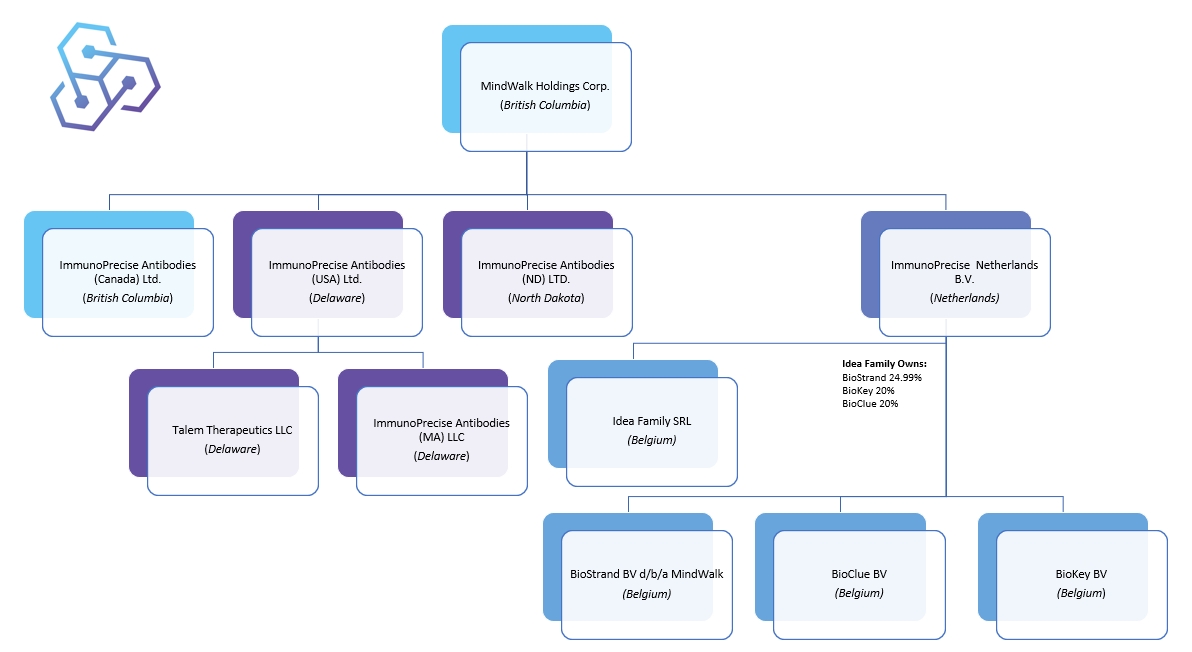
ImmunoPrecise Antibodies (Canada), Ltd. d/b/a MindWalk Biologics Ltd ("MindWalk Biologics")
On May 9, 1995, we incorporated ImmunoPrecise Antibodies (Canada), Ltd., a direct wholly owned subsidiary, under the laws of British Columbia. The subsidiary carries on business under the trade name MindWalk Biologics Ltd.
ImmunoPrecise Antibodies (USA), Ltd.
On September 11, 2019, we incorporated ImmunoPrecise Antibodies (USA), Ltd., a direct wholly owned subsidiary, under the laws of Delaware.
Talem Therapeutics LLC
On January 18, 2019, Talem Therapeutics LLC was incorporated under the laws of Delaware. Talem Therapeutics LLC is an indirect wholly-owned subsidiary.
ImmunoPrecise Antibodies (MA), LLC
On January 18, 2019, we formed ImmunoPrecise Antibodies (MA), LLC, an indirect wholly owned subsidiary, under the laws of Delaware.
ImmunoPrecise Antibodies (N.D.), LTD.
On May 25, 2018, we incorporated ImmunoPrecise Antibodies (N.D.), LTD. a direct wholly owned subsidiary, under the laws of North Dakota.
ImmunoPrecise Netherlands B.V.
On January 25, 2005, we incorporated ImmunoPrecise Netherlands B.V. a direct wholly owned subsidiary, under the laws of the Netherlands.
Idea Family SRL.
On April 14, 2022, Idea Family SRL. was acquired. Idea Family SRL. is an indirect wholly owned subsidiary.
BioStrand BV d/b/a MindWalk
On April 14, 2022, BioStrand BV was acquired.
BioKey BV.
On April 14, 2022, BioKey BV was acquired.
BioClue BV
On April 14, 2022, BioClue BV was acquired.
D. Property, Plants and Equipment
We do not own any real estate property. We operate from leased premises in three different locations, as detailed in the following table:
|
|
|
|
|
Location |
Area
(approx.) |
Premise Use |
Expiry Date |
Agoralaan Abis, 3590 Diepenbeek
Belgium |
104 sq m |
Artificial intelligence research and development, including for in silico antibody discovery and development |
Monthly |
3204-4464 Markham St. Victoria, BC V8Z 7X8 Canada |
6,210 sq ft |
Global head office, preclinical antibody drug discovery and development lab facility |
December 31, 2033 |
Industrious 823 Congress Avenue, Suite 300, Austin TX 78701 USA |
200 sq ft |
Principal Executive Office |
Monthly |
Not applicable.
ITEM 5. OPERATING AND FINANCIAL REVIEW AND PROSPECTS
The following Operating and Financial Review and Prospects section is intended to help the reader understand the factors that have affected the Company’s financial condition and results of operations for the historical period covered by the financial statements and management’s assessment of factors and trends which are anticipated to have a material effect on the Company’s financial condition and results in future periods. This section is provided as a supplement to, and should be read in conjunction with, our Consolidated Financial Statements and the other financial information contained elsewhere in this document. Our Consolidated Financial Statements have been prepared in accordance with International Reporting Standards as issued by the International Accounting Standards Board ("IFRS Accounting Standards" or “IFRS”). Our discussion contains forward-looking statements based on current expectations that involve risks and uncertainties, such as our plans, objectives and intentions. Our actual results may differ from those indicated in such forward-looking statements.
A. Operating Results
Overview
During Fiscal 2026, we had some significant highlights to our operating results:
•Increased revenue by $4.9 million or 46% from $10.6 million to $15.6 million.
•Gross Margin increased by $3.4 million an improvement of 4.9% from 53.9% in Fiscal Year 2025 to 58.8% in Fiscal Year 2026.
•On August 6, 2025, the Company completed the sale of its IPA Europe to AVS Bio, a portfolio company of Arlington Capital Partners for total enterprise value of $12.0 million USD.
Selected Annual Information
The following selected financial data has been extracted from the audited Fiscal 2026 financial statements (expressed in Canadian Dollars).
The following is a summary of certain selected financial information of the Company for the years ended April 30, 2026, 2025, and 2024.
|
|
|
|
|
|
|
|
|
|
|
|
|
|
(in thousands except loss per share) |
|
2026
$ |
|
|
2025
$ |
|
|
2024
$ |
|
Revenue from continuing operations |
|
|
15,558 |
|
|
|
10,626 |
|
|
|
10,279 |
|
Cost of sales from continuing operations |
|
|
(6,410 |
) |
|
|
(4,895 |
) |
|
|
(6,187 |
) |
Expenses from continuing operations |
|
|
(24,085 |
) |
|
|
(42,639 |
) |
|
|
(36,632 |
) |
Net loss from continuing operations |
|
|
(15,102 |
) |
|
|
(33,147 |
) |
|
|
(29,301 |
) |
Net income from discontinued operations |
|
|
1,153 |
|
|
|
2,913 |
|
|
|
3,186 |
|
Net loss |
|
|
(13,949 |
) |
|
|
(30,234 |
) |
|
|
(26,115 |
) |
Total assets |
|
|
21,376 |
|
|
|
44,441 |
|
|
|
59,988 |
|
Total liabilities |
|
|
(9,627 |
) |
|
|
(20,815 |
) |
|
|
(24,310 |
) |
Loss per share from continuing operations |
|
|
(0.33 |
) |
|
|
(0.99 |
) |
|
|
(1.14 |
) |
Income per share from discontinued operations |
|
|
0.02 |
|
|
|
0.09 |
|
|
|
0.12 |
|
Comparison of the years ended April 30, 2026 and April 30, 2025 for continuing operations
Revenue
|
|
|
|
|
|
|
|
|
|
|
|
|
|
|
|
|
|
|
|
Year Ended
April 30, |
|
|
|
|
|
|
|
(in thousands) |
|
2026
$ |
|
|
2025
$ |
|
|
Change
$ |
|
|
Change
% |
|
Project revenue |
|
|
15,405 |
|
|
|
10,397 |
|
|
|
5,008 |
|
|
|
48.2 |
% |
Product sales revenue |
|
|
1 |
|
|
|
7 |
|
|
|
(6 |
) |
|
|
-85.7 |
% |
Cryostorage revenue |
|
|
152 |
|
|
|
222 |
|
|
|
(70 |
) |
|
|
-31.5 |
% |
Total revenue |
|
|
15,558 |
|
|
|
10,626 |
|
|
|
4,932 |
|
|
|
46.4 |
% |
Revenue for the year ended April 30, 2026 was $15.6 million, compared to $10.6 million for the year ended April 30, 2025.
Gross Profit
|
|
|
|
|
|
|
|
|
|
|
|
|
|
|
|
|
|
|
|
Year Ended
April 30, |
|
|
|
|
|
|
|
(in thousands) |
|
2026
$ |
|
|
2025
$ |
|
|
Change
$ |
|
|
Change
% |
|
Gross profit |
|
|
9,148 |
|
|
|
5,731 |
|
|
|
3,417 |
|
|
|
59.6 |
% |
Gross profit margin |
|
|
58.8 |
% |
|
|
53.9 |
% |
|
|
|
|
|
|
Gross profit totaled $9.1 million during the year ended April 30, 2026, an increase of 59.6% compared to the year ended April 30, 2025. Gross profit margin increased to 58.8% from 53.9% during the prior year due primarily to improved project revenue.
Research and development
|
|
|
|
|
|
|
|
|
|
|
|
|
|
|
|
|
|
|
Year Ended
April 30, |
|
|
|
|
|
|
|
(in thousands) |
|
2026
$ |
|
|
2025
$ |
|
|
Change
$ |
|
|
Change
% |
|
Research and development (R&D) |
|
|
4,933 |
|
|
|
4,210 |
|
|
|
723 |
|
|
|
17.2 |
% |
During the year ended April 30, 2026, R&D expenses increased to $4.9 million from $4.2 million compared to the year ended April 30, 2025 reflecting ongoing investments in R&D on the LensAI™ platform and Pipeline assets.
Sales and marketing
|
|
|
|
|
|
|
|
|
|
|
|
|
|
|
|
|
|
|
Year Ended
April 30, |
|
|
|
|
|
|
|
(in thousands) |
|
2026
$ |
|
|
2025
$ |
|
|
Change
$ |
|
|
Change
% |
|
Sales and marketing |
|
|
5,939 |
|
|
|
3,638 |
|
|
|
2,301 |
|
|
|
63.2 |
% |
Sales and marketing expenses totaled $5.9 million during the year ended April 30, 2026, compared to $3.6 million during the year ended April 30, 2025. The increase is due to increased commercialization efforts to drive awareness of MindWalk, as well as the addition of a Chief Business Officer in October 2025.
General and administrative
|
|
|
|
|
|
|
|
|
|
|
|
|
|
|
|
|
|
|
|
Year Ended
April 30, |
|
|
|
|
|
|
|
(in thousands) |
|
2026
$ |
|
|
2025
$ |
|
|
Change
$ |
|
|
Change
% |
|
General and administrative |
|
|
13,213 |
|
|
|
12,077 |
|
|
|
1,136 |
|
|
|
9.4 |
% |
During the year ended April 30, 2026, general and administrative expenses totaled $13.2 million, an increase of $1.1 million as compared to the year ended April 30, 2025, due primarily to an increase in salaries and share based payment expenses.
Other Income/ Expense
|
|
|
|
|
|
|
|
|
|
|
|
|
|
|
|
|
|
Year Ended
April 30, |
|
|
|
|
|
|
(in thousands) |
|
2026
$ |
|
|
2025
$ |
|
|
Change
$ |
|
Change
% |
|
Accretion |
|
|
— |
|
|
|
(10 |
) |
|
|
10 |
|
|
(100.0 |
)% |
Grant and subsidy income |
|
|
33 |
|
|
|
138 |
|
|
|
(105 |
) |
|
(76.1 |
)% |
Interest and other (expense) income |
|
|
87 |
|
|
|
(296 |
) |
|
|
383 |
|
|
(129.4 |
)% |
Loss on disposal of discontinued operations |
|
|
(511 |
) |
|
|
— |
|
|
|
(511 |
) |
|
— |
|
Unrealized foreign exchange (loss) gain |
|
|
(224 |
) |
|
|
(555 |
) |
|
|
331 |
|
|
(59.6 |
)% |
Total other (expense) income |
|
|
(615 |
) |
|
|
(723 |
) |
|
|
108 |
|
|
(14.9 |
)% |
The Company recorded other expense of $0.6 million during the year ended April 30, 2026, a decrease from other expense of $0.7 million during the year ended April 30, 2025 due to more favorable exchange rates. The majority of other expense is attributed to the legal fees and the loss on disposal associated with the sale of IPA Europe.
Comparison of the years ended April 30, 2025 and April 30, 2024 for continuing operations
Revenue
|
|
|
|
|
|
|
|
|
|
|
|
|
|
|
|
|
|
|
Year Ended
April 30, |
|
|
|
|
|
|
|
(in thousands) |
|
2025
$ |
|
|
2024
$ |
|
|
Change
$ |
|
|
Change
% |
|
Project revenue |
|
|
10,397 |
|
|
|
10,035 |
|
|
|
362 |
|
|
|
3.6 |
% |
Product sales revenue |
|
|
7 |
|
|
|
21 |
|
|
|
(14 |
) |
|
|
-66.7 |
% |
Cryostorage revenue |
|
|
222 |
|
|
|
223 |
|
|
|
(1 |
) |
|
|
-0.4 |
% |
Total revenue |
|
|
10,626 |
|
|
|
10,279 |
|
|
|
347 |
|
|
|
3.4 |
% |
Revenue for the year ended April 30, 2025 was $10.6 million, compared to $10.3 million for the year ended April 30, 2024. This increase of $0.3 million was primarily driven by project revenue growth on discovery projects.
Gross Profit
|
|
|
|
|
|
|
|
|
|
|
|
|
|
|
|
|
|
|
Year Ended
April 30, |
|
|
|
|
|
|
|
(in thousands) |
|
2025
$ |
|
|
2024
$ |
|
|
Change
$ |
|
|
Change
% |
|
Gross profit |
|
|
5,731 |
|
|
|
4,092 |
|
|
|
1,639 |
|
|
|
40.1 |
% |
Gross profit margin |
|
|
53.9 |
% |
|
|
39.8 |
% |
|
|
|
|
|
|
Gross profit totaled $5.7 million during the year ended April 30, 2025, an increase of 40.1% compared to the year ended April 30, 2024. Gross profit margin increased to 53.9% from 39.8% during the prior year driven by a operating leverage due to fixed costs in cost of sales
Research and development
|
|
|
|
|
|
|
|
|
|
|
|
|
|
|
|
|
|
|
|
Year Ended
April 30, |
|
|
|
|
|
|
|
(in thousands) |
|
2025
$ |
|
|
2024
$ |
|
|
Change
$ |
|
|
Change
% |
|
Research and development (R&D) |
|
|
4,210 |
|
|
|
3,739 |
|
|
|
471 |
|
|
|
12.6 |
% |
During the year ended April 30, 2025, R&D expenses increased to $4.2 million from $3.7 million compared to the year ended April 30, 2024, reflecting increased investment in salaries and benefits as well as R&D activities related to the pipeline assets.
Sales and marketing
|
|
|
|
|
|
|
|
|
|
|
|
|
|
|
|
|
|
|
|
Year Ended
April 30, |
|
|
|
|
|
|
|
(in thousands) |
|
2025
$ |
|
|
2024
$ |
|
|
Change
$ |
|
|
Change
% |
|
Sales and marketing |
|
|
3,638 |
|
|
|
2,863 |
|
|
|
775 |
|
|
|
27.1 |
% |
Sales and marketing expenses totaled $3.6 million during the year ended April 30, 2025, compared to $2.9 million during the year ended April 30, 2024, due to increases related to our marketing strategy and social media expenses.
General and administrative
|
|
|
|
|
|
|
|
|
|
|
|
|
|
|
|
|
|
|
|
Year Ended
April 30, |
|
|
|
|
|
|
|
(in thousands) |
|
2025
$ |
|
|
2024
$ |
|
|
Change
$ |
|
|
Change
% |
|
General and administrative |
|
|
12,077 |
|
|
|
12,633 |
|
|
|
(556 |
) |
|
|
-4.4 |
% |
During the year ended April 30, 2025, general and administrative expenses totaled $12.1 million, a slight decrease compared to the year ended April 30, 2024, due to a reduction in compensation and consulting expenses.
Other Income/ Expense
|
|
|
|
|
|
|
|
|
|
|
|
|
|
|
|
|
|
|
Year Ended
April 30, |
|
|
|
|
|
|
(in thousands) |
|
2025
$ |
|
|
2024
$ |
|
|
Change
$ |
|
Change
% |
|
Accretion |
|
|
(10 |
) |
|
|
(19 |
) |
|
|
9 |
|
|
(47.4 |
)% |
Grant and subsidy income |
|
|
138 |
|
|
|
299 |
|
|
|
(161 |
) |
|
(53.8 |
)% |
Interest and other (expense) income |
|
|
(296 |
) |
|
|
22 |
|
|
|
(318 |
) |
|
(1445.5 |
)% |
Unrealized foreign exchange (loss) gain |
|
|
(555 |
) |
|
|
76 |
|
|
|
(631 |
) |
|
(830.3 |
)% |
Total other (expense) income |
|
|
(723 |
) |
|
|
378 |
|
|
|
(1,101 |
) |
|
(291.3 |
)% |
The Company recorded other expense of $0.7 million during the year ended April 30, 2025, a decrease from other income of $0.4 million during the year ended April 30, 2024 due to favorable exchange rates.
Non-IFRS Measures
The following are non-IFRS measures and investors are cautioned not to place undue reliance on them and are urged to read all IFRS accounting disclosures present in the consolidated financial statements and accompanying notes for the year ended April 30, 2026.
The Company uses certain non-IFRS financial measures as supplemental indicators of its financial and operating performance. These non-IFRS financial measures are adjusted EBITDA and adjusted operating expenses. The Company believes these supplementary financial measures reflect the Company’s ongoing business in a manner that allows for meaningful period-to-period comparisons and analysis of trends in its business. These non-IFRS measures do not have any standardized meaning prescribed under IFRS and are therefore unlikely to be comparable to similar measures presented by other companies.
The Company defines adjusted EBITDA as operating earnings before interest, accretion, taxes, depreciation, amortization, share-based compensation, foreign exchange gain/loss, and asset impairment charges. Adjusted EBITDA is presented on a basis consistent with the Company’s internal management reports. The Company discloses adjusted EBITDA to capture the profitability of its business before the impact of items not considered in management’s evaluation of operating unit performance. The most directly comparable IFRS measure to adjusted EBITDA is net loss.
The Company defines adjusted operating expenses as operating expenses before taxes, interest, share-based compensation, depreciation, amortization, accretion, foreign exchange loss, and asset impairment charges. Adjusted operating expenses are presented on a basis consistent with the Company’s internal management reports. The Company discloses adjusted operating expenses to capture the true operational costs by excluding one-time charges and non-recurring expenses, thereby providing a clearer picture of the ongoing financial performance. The most directly comparable IFRS measure to adjusted operating expenses is operating expenses.
The non-IFRS measures are reconciled to reported IFRS figures in the tables below for continuing operations:
|
|
|
|
|
|
|
|
|
|
|
|
Year Ended
April 30, |
|
(in thousands) |
|
2026
$ |
|
|
2025
$ |
|
Net loss |
|
|
(15,102 |
) |
|
|
(33,147 |
) |
Income taxes |
|
|
(450 |
) |
|
|
(4,484 |
) |
Amortization and depreciation |
|
|
866 |
|
|
|
2,289 |
|
Accretion |
|
|
— |
|
|
|
10 |
|
Asset impairment charge |
|
|
— |
|
|
|
21,184 |
|
Foreign exchange realized gain |
|
|
135 |
|
|
|
27 |
|
Interest expense |
|
|
226 |
|
|
|
262 |
|
Interest and other (expense) income |
|
|
(87 |
) |
|
|
296 |
|
Loss on disposal of discontinued operations |
|
|
511 |
|
|
|
— |
|
Unrealized foreign exchange loss |
|
|
224 |
|
|
|
555 |
|
Share-based expense |
|
|
1,275 |
|
|
|
445 |
|
Adjusted EBITDA |
|
|
(12,402 |
) |
|
|
(12,563 |
) |
|
|
|
|
|
|
|
|
|
|
|
|
Year Ended
April 30, |
|
(in thousands) |
|
2026
$ |
|
|
2025
$ |
|
Operating expenses |
|
|
(24,085 |
) |
|
|
(42,639 |
) |
Amortization and depreciation |
|
|
113 |
|
|
|
1,629 |
|
Asset impairment charge |
|
|
— |
|
|
|
21,184 |
|
Foreign exchange gain |
|
|
135 |
|
|
|
27 |
|
Interest expense |
|
|
226 |
|
|
|
262 |
|
Share-based expense |
|
|
1,275 |
|
|
|
445 |
|
Adjusted Operating Expenses |
|
|
(22,336 |
) |
|
|
(19,092 |
) |
B. Liquidity and Capital Resources
The Company’s objectives when managing capital are to ensure sufficient liquidity for operations and adequate funding for growth and capital expenditures while maintaining an efficient balance between debt and equity. The capital structure of the Company consists of shareholders’ equity.
The Company adjusts its capital structure upon approval from its Board, considering economic conditions and the Company’s working capital requirements. The Company is not subject to any externally imposed capital requirements.
Based on our current cash reserves, historical net losses, cash used in operating activities, and anticipated cash requirements, we do not believe we have sufficient liquidity to fund our planned operations for at least one year from the date our financial statements are available to be issued. These conditions raise substantial doubt about our ability to continue as a going concern, and our ability to continue as a going concern depends on our ability to obtain additional financing and generate sufficient revenues.
We have historically incurred net losses. There is no assurance that sufficient revenues will be generated in the near future. To the
extent that we have negative operating cash flows in future periods, we may need to deploy a portion of our existing working capital to
fund such negative cash flows. We may need to raise additional funds through issuances of Common Shares or through loan financing.
There is no assurance that additional capital or other types of financing will be available if needed or that these financings will be on
terms at least as favorable to us as those previously obtained, or at all. If we are unable to obtain additional financing from outside
sources and eventually generate enough revenues, we may be forced to sell a portion or all of our assets or curtail or discontinue our
operations.
On July 16, 2024, YA II PN, Ltd., an investment fund managed by Yorkville, entered into a securities purchase agreement under which the Company agreed to sell and issue to Yorkville “the Convertible Debentures" in two tranches and at a purchase price of 95% of the aggregate principal amount. In connection with the offering, the Company and Yorkville entered into a customary registration rights agreement pursuant to which the Company agreed to provide certain registration rights to Yorkville under the U.S. Securities Act of 1933, as amended.
As of April 30, 2025, the Company completed the full conversion of the debenture with Yorkville.
As of April 30, 2026, the Company held cash of $11.3 million (April 30, 2025 – $10.7 million). During the year ended April 30, 2026, the cash used in operating activities was $12.5 million. As part of the investing activities, the Company made property and equipment purchases of $0.4 million. As part of the financing activities, the Company incurred lease payments of $0.8 million.
The consideration paid for the acquisition of BioStrand includes a contingent earnout payment based on the profitability of BioStrand over a 7-year period ending April 30, 2029, which shall not exceed in total €12.0 million. As of April 30, 2026, no amount has been earned or paid on the Company's contingent earnout related to the BioStrand acquisition.
On August 6, 2025, the Company completed the sale of its IPA Europe to AVS Bio, a portfolio company of Arlington Capital Partners for total enterprise value of $12.0 million USD. The transaction generated $10.3 million USD in net proceeds. The divestiture included the sale of the net assets of IPA Europe including the Oss and Utrecht locations. The impact of this transaction is reflected in the Company’s consolidated financial statements for the fiscal year ended April 30, 2026.
Financing Activities
Fiscal Year Ended 2024 Transactions
During the year ended April 30, 2024, the Company issued 1,265,000 Common Shares, including 165,000 Common Shares issued pursuant to the full exercise by the underwriter of its over-allotment option. The public offering price for each Common Share, before the underwriter’s discount and commissions, was U.S.$1.00, raising U.S.$1,265,000.
During the year ended April 30, 2024, the Company established an at-the-market equity offering facility ("Clear Street ATM Facility") and entered into the Clear Street ATM Agreement. The Company is entitled, at its discretion and from time-to-time during the term of the Clear Street ATM Agreement, to sell Common Shares through Clear Street. On February 23, 2024, in connection with the Clear Street ATM Facility, the Company filed a prospectus supplement permitting the sales of Common Shares having an aggregate gross sales price of up to U.S. $60.0 million. In fiscal 2024, 629,240 common shares were sold under the ATM with proceeds net of commissions of $1.8 million.
Fiscal Year Ended 2025 Transactions
During the year ended April 30, 2025, the Company issued 13,315,850 Common Shares under the ATM Facility with proceeds net of commissions of $12.2 million.
On July 16, 2024, the Company entered into a securities purchase agreement (the "Securities Purchase Agreement") with YA II PN, Ltd., an investment fund managed by Yorkville Advisors Global, LP ("Yorkville"), under which the Company agreed to sell and issue to Yorkville U.S,$3.0 million aggregate principal amount of convertible debentures (the "Convertible Debentures") in two tranches and at a purchase price of 95% of the aggregate principal amount (the “July 2024 Offering”).
The Convertible Debentures are convertible into Common Shares. The sale and issue of the first tranche consists of U.S.$2.0 million principal amount of Convertible Debentures and was completed on July 16, 2024 (the "First Closing"). The sale and issue of the second tranche consists of U.S.$1.0 million principal amount of Convertible Debentures and is expected to close on or about the date the initial registration statement of the Company filed pursuant to the Registration Rights Agreement (as defined below) has first been declared effective by the SEC.
Each Convertible Debenture will be an unsecured obligation of the Company and will be wholly and unconditionally guaranteed by certain of the Company's subsidiaries. The Convertible Debentures will incur interest at a rate of 8.0% per annum. The outstanding principal amount of and accrued and unpaid interest, if any, on, the Convertible Debentures must be paid by the Company in cash when the same becomes due and payable under the terms of the Convertible Debentures at their stated maturity, upon their redemption or otherwise. The Convertible Debentures are redeemable at any time provided that the volume-weighted average price ("VWAP") for the Common Shares is less than U.S.$1.16, at a redemption price equal to the principal amount, plus accrued and unpaid interest on the principal amount to be redeemed, plus a 10% premium. If at any time on and after November 1, 2024, the daily VWAP for the Common Shares is less than U.S.$0.20 for five trading days during a period of seven consecutive trading days or a default with respect to the registration statement has occurred, the Company shall be required to make monthly installments payments on the Convertible Debentures in an amount equal to U.S.$300,000 principal amount, plus accrued and unpaid interest on the outstanding principal amount, plus a 10% premium.
Subject to certain limitations contained within the Securities Purchase Agreement and the Convertible Debentures, holders of the Convertible Debentures will be entitled to convert the principal amount of, and accrued and unpaid interest, if any, on each Convertible Debenture, in whole or in part, from time to time, into a number of Common Shares at a conversion price equal to the lower of (i) U.S.$1.16 per Common Share, or (ii) 95% of the lowest daily VWAP for the Common Shares during the 10 consecutive trading days immediately preceding the conversion date or other date of determination (the "Market Price"), but which Market Price shall not be lower than U.S.$0.20. The conversion price is subject to anti-dilution adjustments pursuant to the terms and conditions of the Securities Purchase Agreement and the Convertible Debentures. During any consecutive 30-day period, the holders of the Convertible Debentures may not, without the prior written consent of the Company, convert more than U.S.$300,000 in principal amount of Convertible Notes during any 30-day period if the conversion price is less than U.S.$1.16, provided, however, that the foregoing limitation shall not apply during the occurrence and during the continuance of an event of default under the Convertible Debentures.
The Company and Yorkville entered into a customary Registration Rights Agreement on July 16, 2024 (the "Registration Rights Agreement"), pursuant to which the Company has agreed to provide certain registration rights to Yorkville under the Securities Act.
Furthermore, in connection with the July 2024 Offering and pursuant to the Securities Purchase Agreement, ImmunoPrecise Antibodies (Canada), Ltd., ImmunoPrecise Antibodies (Europe) B.V. and BioStrand BV (together, the “Guarantors”), entered into a global guaranty agreement on July 16, 2024 (the “Global Guaranty Agreement”) in favor of Yorkville, under which the Guarantors
guaranteed to Yorkville the payment when due and the performance, of all liabilities, agreements and other obligations of the Company to Yorkville contained in the Securities Purchase Agreement and Convertible Debentures.
As of April 30, 2025, the Company completed the full conversion of the debenture with Yorkville
2026 Transaction
On November 7, 2025, the Company established the Jones ATM Facility with Jones. The Company is entitled, at its discretion and from time-to-time during the term of the ATM Agreement, to sell, through the Agent common shares of the Company. On November 7, 2025, in connection with the Jones ATM Facility, the Company filed a prospectus supplement permitting the sales of common shares having an aggregate gross sales price of up to US$30.0 million. Sales of the common shares will be made in transactions that are deemed to be at-the-market distributions as defined in Rule 415(a)(4) of the U.S. Securities Act, including, without limitation, sales made directly on Nasdaq or any other existing trading market for the common shares in the United States. Common shares will only be sold on the facilities of an exchange or market outside Canada to purchasers who the Company has no reason to believe are resident in Canada and, in all other cases, to purchasers who are not located or resident in Canada. The Company will determine, at its sole discretion, the date, minimum price and maximum number of common shares to be sold under the Jones ATM Facility. The common shares will be distributed from time to time in negotiated transactions, at market prices prevailing at the time of sale, at prices relating to such prevailing market prices, and/or in any other manner permitted by applicable law. As such, the prices may vary between purchasers over time. The Company is not required to sell any common shares at any time during the term of the Jones ATM Facility.
During the year ended April 30, 2026, 533,969 common shares were sold under the ATM with net proceeds of US$0.9 million.
Capital Expenditures
The Company made property and equipment purchases of $0.4 million during the year ended April, 2026 (2025 - $0.8 million).
Contractual Obligations and Commitments
The consideration paid for the acquisition of BioStrand includes a contingent earnout payment based on the profitability of BioStrand over a 7-year period, which shall not exceed in total €12.0 million. As of April 30, 2026, no amount has been earned or paid on the Company's contingent earnout related to the BioStrand acquisition.
Off-Balance Sheet Arrangements
We have no off-balance sheet arrangements that have or are reasonably likely to have, a current or future effect on our results of operations, financial condition, revenues or expenses, liquidity, capital expenditures or capital resources.
C. Research and Development, Patents and Licenses, etc.
See Item 5.A. – Operating Results – Selected Annual Information for a description of our R&D activities during the last three fiscal years.
See Item 4.B. – Business Overview – Proprietary Protection for a listing of patents and product development in progress.
D. Trend Information
See Item 5.A. – Operating Results – Seasonality for trend information.
Other than as disclosed elsewhere in this annual report, we are not aware of any material trends, uncertainties, demands, commitments or events since the end of our most recently completed financial year that are reasonably likely to have a material effect on our revenues, income, profitability, liquidity, capital resources or results of operations.
E. Critical Accounting Estimates.
Not Applicable.
ITEM 6. DIRECTORS, SENIOR MANAGEMENT AND EMPLOYEES
A. Directors and Senior Management
The following table sets forth the name of each of our directors and executive officers, as well as such individual’s place of residence, position with us, principal business activities performed outside those with us and period of service as a director (if applicable).
Directors and Executive Officers
|
|
|
|
|
Name |
Position With MindWalk Holdings Corp. |
Principal occupation, business, or employment and, if not a previously elected Director, occupation, business, or employment during the past 5 years |
Director/Officer Since |
Dr. Jennifer L. Bath Minnesota, United States |
CEO, President and Director |
CEO, President of the Company; Executive of Aldevron, LLC (now Danaher) from July 2015 to February 2018. Executive Director of Concordia Vaccine Institute from Sept 2009 to Aug 2015. Tenured Associate Professor of Molecular Biology and Genetics May 2005 to July 2015 |
May 2018(1) |
Dirk Witters (2) (5) Beveren, Belgium |
Chair of the Board and Director |
Founder of Conanti Consult BV, an advisory boutique since 2019. Advisor to the founder of New Rhein Healthcare Investors, a private equity investment firm, from July 2019 to March 2020. Director Program Management Office, Sustainable Finance for KBC Group, from December 2018 to June 2019. President of the board of BioStrand BV from June 2020 to April 2022. |
September 2023 |
Jon Lieber (3) (4) Massachusetts, United States |
Director |
30 years of expertise in financial and strategic leadership across the biotechnology and life sciences sectors. CFO at Rallybio and former CFO of Applied Genetic Technologies Corporation. Held senior leadership positions at Danforth Advisors, Histogenics, Repligen, Xcellerex and Altus Pharmaceuticals. |
July 2025 |
R. Scott Areglado Massachusetts, United States |
CFO |
N/A |
October 2025 |
Dr. Thomas Lynch Wisconsin, United States |
CBO |
N/A |
October 2025 |
|
|
|
|
|
Kari Graber North Dakota, United States |
Vice President of Commercial Services |
N/A |
November 2021(6) |
Dr. Shuji Sato Massachusetts, United States |
Vice President of Innovative Solutions |
N/A |
January 2023 |
Notes:
(1)Dr. Bath, who has been CEO and President since February 2018 and was appointed Director in May 2018.
(2)Member of the Audit and Risk Committee.
(3)Member and Chair of the Audit and Risk Committee
(4)Member of the Compensation, Nomination and Governance Committee.
(5)Member and Chair of the Compensation, Nomination and Governance Committee
(6)Ms. Graber has been working for the Company since May 2018.
The following are brief biographies of our directors and executive officers.
Dr. Jennifer Bath
Dr. Jennifer Bath, PhD, serves as President and Chief Executive Officer of MindWalk Holdings Corp. She holds a PhD in Cellular and Molecular Biology, with a specialization in immunology and biochemistry, and has built her career at the intersection of biological science, bioinformatics, and artificial intelligence. Prior to MindWalk, Dr. Bath held a tenured Associate Professorship and founded the Concordia Global Vaccine Institute, where she directed programs to discover and validate biologics for infectious diseases. She subsequently held executive roles across the biotechnology sectors, including an executive position at Aldevron, where she led global client relations and high-value target teams, translating complex scientific and commercial challenges into operational strategy for pharmaceutical and biotech worldwide. At MindWalk, Dr. Bath leads the Company's scientific and technology teams in building its integrated discovery platform, which combines LensAI™, powered by HYFT® technology, with advanced wet lab capabilities. Under her leadership, the Company has advanced dozens of client molecules toward the clinic and launched ReefIQ™.
Jon Lieber
Mr. Lieber brings over 30 years of financial and strategic leadership across the biotechnology and life sciences sectors, with deep expertise in capital markets, investor relations, and corporate development. He currently serves as Chief Financial Officer at Rallybio, a clinical-stage biotechnology company developing therapies for severe and rare diseases. He also brings valuable experience in Nasdaq governance, having served as both a senior executive and board member of publicly traded companies. Prior to Rallybio, Mr. Lieber was CFO at Applied Genetic Technologies Corporation (AGTC), a publicly traded gene therapy company, where he led all capital-raising efforts and oversaw finance, human resources, investor relations, and IT. He has also held senior leadership roles at Danforth Advisors, Histogenics, Repligen, Xcellerex (acquired by GE Healthcare), and Altus Pharmaceuticals. Earlier in his career, he worked in investment banking at Salomon Brothers / Salomon Smith Barney and SG Cowen. Mr. Lieber currently serves on the Board of Directors of Salarius Pharmaceuticals, where he is a member of both the Audit Committee and the Nominating and Governance Committee, further underscoring his depth of experience in Nasdaq board governance.
Dirk Witters
Mr. Witters founded Conanti Consult BV in 2019, an advisory boutique, where he, among other things, advises on the execution of acquisitions and capital raising assignments. Prior to that, Mr. Witters also served as an advisor to the founder of New Rhein Healthcare Investors, a private equity investment firm from July 2019 to March 2020. In addition, Mr. Witters was the Director Program Management Office, Sustainable Finance for KBC Group from December 2018 to June 2019; and the president of the Board of BioStrand BV from June 2020 to April 2022.
R. Scott Areglado
Mr. Areglado serves as the CFO for MindWalk and is responsible for overseeing the financial strategy and reporting to ensure compliance with regulations, optimizing capital allocation to support growth, and providing financial leadership. Mr. Areglado brings more than 25 years of financial leadership experience across the healthcare, life sciences, and technology sectors, including extensive expertise in corporate finance, strategic planning, capital markets, and investor relations for publicly traded companies. Most recently, Mr. Areglado served as Chief Financial Officer of BrainsWay Ltd. (Nasdaq: BWAY), a global medical device leader in interventional psychiatry. Before joining BrainsWay, Mr. Areglado was Chief Financial Officer at iCAD, Inc. (Nasdaq: ICAD), a medical technology company specializing in AI-driven cancer detection and therapy solutions. arlier in his career, Mr. Areglado held senior financial roles at AMICAS, Inc. (Nasdaq: AMCS) and several emerging growth technology companies, where he developed deep expertise in SEC
reporting, M&A integration, and operational transformation. He began his career in public accounting and holds an MBA from Babson College and a BBA in Accounting from the University of Massachusetts Amherst.
Dr. Thomas Lynch
Dr. Lynch most recently served as Director of Technical Sales & Scientific Support at Aldevron, where he built and led a new global commercial Team, aligning strategies with scientific innovation and client needs. Prior to that, as Vice President of Global Sales and Client Services, Dr. Lynch spearheaded key initiatives including the introduction of clinical mRNA manufacturing services and strategic account expansion that materially advanced Aldevron’s market position. Earlier in his career, Dr. Lynch led global commercial operations at DNASTAR, overseeing sales, distribution, and technical support while successfully launching software products that advanced protein structure prediction and analysis, such as NovaFold powered by I-TASSER. His achievements underscore a proven ability to successfully bring complex scientific software and data platforms to market. Dr. Lynch also serves on the Board of BioForward, Wisconsin’s leading biohealth association, where he helped drive industry collaboration, education, and legislative initiatives across Wisconsin’s biohealth sector.
Kari Graber
Ms. Graber serves as the Vice President of Commercial Services for MindWalk and is responsible for the overall leadership and implementation of the Project Management program throughout MindWalk's global family of companies. She has over 20 years of experience in developing, implementing and directing laboratory operations, quality assurance, regulatory compliance, and supply chain management programs for various food manufacturers, and spent five years as Sales and Technical Director for a pasteurization/sterilization technology and equipment supplier. Prior to joining MindWalk, Ms. Graber served at Aldevron LLC, where she held a client relations management role for their antibody services platform. She holds a Bachelor of Science in Food Science & Technology and a Minor in Microbiology.
Dr. Shuji Sato
Dr. Sato serves as the Vice President of Innovative Solutions for MindWalk with a focus on consistently delivering high value, technologically advanced scientific services to meet the objectives of the most challenging projects. He has over 20 years of experience in various R&D settings, including directing in vivo and in vitro antibody discovery and development teams at numerous biotech and pharma as well as in academia. He applies his broad knowledge in drug development to conceptualization and realization of projects and drives development of effective and innovative workflows. Dr. Sato holds a PhD in Molecular Microbiology from Tufts University and trained as a postdoctoral fellow at Harvard Medical School, prior to joining Cell Signaling Technology’s innovative research group and has held Principal Scientist and Associate Director positions at Bluefin Biomedicine, Pfizer and Dragonfly Therapeutics. Throughout his research career, Dr. Sato has co-authored numerous peer-reviewed scientific articles and patents.
B. Compensation
Compensation for Fiscal 2026
The aggregate amount of compensation paid during the year ended April 30, 2026, directly and indirectly, including directors’ fees, to our named executive officers and directors in their capacity as such, was $7.7 million (Fiscal 2025: $4.5 million).
This discussion describes our compensation program for each person who acted as President and CEO, CFO, CBO and the two most highly-compensated executive officers (or two most highly-compensated individuals acting in a similar capacity), other than the CEO, CFO and the CBO, whose total compensation was more than CAD $150,000 in our last fiscal year and who was performing a policy-making function in respect of the Company (each a “NEO” and collectively the “NEOs”). This section addresses our philosophy and objectives and provides a review of the process that the Board follows in deciding how to compensate the NEOs. This section also provides discussion and analysis of the Board’s specific decisions about the compensation of the NEOs for the fiscal year ended April 30, 2026. We had five(5) NEOs during the fiscal year ended April 30, 2026, namely: Dr. Jennifer Bath, CEO; R. Scott Areglado, CFO; Dr. Thomas Lynch, CBO; Kari Graber, Vice President of Commercial Services and Dr. Shuji Soto, Vice President of Innovative Solutions.
Summary Compensation Table
The following table provides a summary of the compensation paid by the Company to each NEO of the Company for the financial years ended April 30, 2026, 2025, and 2024. All cash payments in the table below are made in U.S. dollars. All amounts listed are in Canadian dollars, translated using the average daily exchange rate on the last day of the period provided by the Bank of Canada. The average daily exchange rates on the relevant date as reported by the Bank of Canada are:
|
|
|
|
|
Bank of Canada USD/CAD Average Daily Exchange Rate |
|
April 30, 2026 |
|
1.3624 |
|
April 30, 2025 |
|
1.3812 |
|
April 30, 2024 |
|
1.3746 |
|
|
|
|
|
|
Bank of Canada EUR/CAD Average Daily Exchange Rate |
|
April 30, 2026 |
|
1.5966 |
|
April 30, 2025 |
|
1.5687 |
|
April 30, 2024 |
|
1.4695 |
|
|
|
|
|
|
|
|
|
|
|
|
|
|
|
|
|
|
|
|
|
|
|
|
|
|
|
|
|
|
|
|
|
|
|
|
Non-equity incentive plan compensation(1)
($) |
|
|
|
|
|
|
|
Name and principal position |
Year |
Salary
($) |
|
Share-based
awards
($) |
|
Option-based
awards
($) |
|
Annual
incentive
plans |
|
Long-term
incentive
plans |
|
Pension
value
($) |
|
All other
compensation
($) |
|
Total
compensation
($) |
|
Dr. Jennifer L. Bath(2) |
2026 |
|
895,170 |
|
|
1,226,160 |
|
|
— |
|
|
— |
|
|
— |
|
|
— |
|
|
— |
|
|
2,121,330 |
|
CEO, |
2025 |
|
877,062 |
|
|
— |
|
|
280,800 |
|
|
614,021 |
|
|
— |
|
|
— |
|
|
— |
|
|
1,771,883 |
|
President, and
Director |
2024 |
|
731,989 |
|
|
— |
|
|
— |
|
|
273,353 |
|
|
— |
|
|
— |
|
|
— |
|
|
1,005,342 |
|
R. Scott Areglado
CFO |
2026 |
|
585,832 |
|
|
408,311 |
|
|
— |
|
|
— |
|
|
— |
|
|
— |
|
|
— |
|
|
994,143 |
|
Thomas Lynch |
|
|
|
|
|
|
|
|
|
|
|
|
|
|
|
|
|
CBO |
2026 |
|
558,584 |
|
|
496,595 |
|
|
— |
|
|
— |
|
|
— |
|
|
— |
|
|
— |
|
|
1,055,179 |
|
Kari Graber |
2026 |
|
408,720 |
|
|
272,480 |
|
|
— |
|
|
— |
|
|
— |
|
|
— |
|
|
— |
|
|
681,200 |
|
VP of Commercial |
2025 |
|
331,488 |
|
|
— |
|
|
62,400 |
|
|
92,485 |
|
|
— |
|
|
— |
|
|
— |
|
|
486,373 |
|
Services |
2024 |
|
273,599 |
|
|
— |
|
|
— |
|
|
— |
|
|
— |
|
|
— |
|
|
— |
|
|
273,599 |
|
Shuji Sato |
2026 |
|
306,540 |
|
|
136,240 |
|
|
— |
|
|
— |
|
|
— |
|
|
— |
|
|
— |
|
|
442,780 |
|
VP of Innovative Solutions |
2025 |
|
290,052 |
|
|
— |
|
|
— |
|
|
118,921 |
|
|
— |
|
|
— |
|
|
— |
|
|
408,973 |
|
|
2024 |
|
288,666 |
|
|
— |
|
|
— |
|
|
102,765 |
|
|
— |
|
|
— |
|
|
— |
|
|
391,431 |
|
Notes:
(1)Non-equity incentive plan compensation includes bonuses earned during the financial year and payable as of the year-end date. Cash payments are made upon approval by the Board in the fiscal quarter following year-end.
(2)Dr. Bath received no compensation in her capacity as director of the Company.
The Company uses the Black-Scholes option pricing model to calculate the fair value of stock options on their grant date. The Company applies this methodology to value the stock options as accurately as possible using observable market inputs. The assumptions used in the model and the resulting fair value for each issuance is shown below:
|
|
|
|
|
|
|
|
|
|
|
|
|
|
|
|
|
|
|
|
|
|
|
|
|
|
|
|
|
|
|
|
|
|
Black-Scholes model inputs |
|
Optionee |
Year |
Fair value of
option
($) |
|
Number of
options
awarded |
|
Fair value of
award
($) |
|
Common
share price
on grant date
($) |
|
|
Exercise price
($) |
|
|
Expected life
(years) |
|
Risk-free
rate |
|
Dr. Jennifer L. Bath |
2026 |
|
— |
|
|
— |
|
|
— |
|
|
— |
|
|
|
— |
|
|
|
— |
|
|
— |
|
|
2025 |
|
1.040 |
|
|
270,000 |
|
|
280,800 |
|
|
0.860 |
|
(1) |
|
0.860 |
|
(1) |
|
10.000 |
|
|
2.88 |
% |
|
2024 |
|
— |
|
|
— |
|
|
— |
|
|
— |
|
|
|
— |
|
|
|
— |
|
|
— |
|
R. Scott Areglado |
2026 |
|
— |
|
|
— |
|
|
— |
|
|
— |
|
|
|
— |
|
|
|
— |
|
|
— |
|
Thomas Lynch |
2026 |
|
— |
|
|
— |
|
|
— |
|
|
— |
|
|
|
— |
|
|
|
— |
|
|
— |
|
Kari Graber |
2026 |
|
— |
|
|
— |
|
|
— |
|
|
— |
|
|
|
— |
|
|
|
— |
|
|
— |
|
|
2025 |
|
1.040 |
|
|
60,000 |
|
|
62,400 |
|
|
0.860 |
|
(1) |
|
0.860 |
|
(1) |
|
10.000 |
|
|
2.88 |
% |
|
2024 |
|
— |
|
|
— |
|
|
— |
|
|
— |
|
|
|
— |
|
|
|
— |
|
|
— |
|
Shuji Sato |
2026 |
|
— |
|
|
— |
|
|
— |
|
|
— |
|
|
|
— |
|
|
|
— |
|
|
— |
|
|
2025 |
|
— |
|
|
— |
|
|
— |
|
|
— |
|
|
|
— |
|
|
|
— |
|
|
— |
|
|
2024 |
|
— |
|
|
— |
|
|
— |
|
|
— |
|
|
|
— |
|
|
|
— |
|
|
— |
|
Notes:
Outstanding Equity Awards at April 30, 2026
The following table sets forth information concerning all the outstanding equity awards held by each NEO as at April 30, 2026.
|
|
|
|
|
|
|
|
|
|
|
|
|
|
|
|
|
|
|
|
|
|
|
|
|
|
|
|
|
Option-based awards |
|
|
Share-based awards(1) |
|
Name |
Issuance
date |
|
Number of
securities
underlying
unexercised
options
(#) |
|
Option
exercise
price
($) |
|
|
Option
expiration
date |
|
Value of
unexercised
in-the-money
options
($) |
|
|
Number of
shares or
units of
shares that
have not
vested
(#) |
|
Market or
payout
value of
share-based
awards that
have not
vested
($) |
|
Market or
payout
value of
vested share-
based
awards not
paid out or
distributed
($) |
|
Dr. Jennifer L. |
01/07/2022 |
|
|
120,000 |
|
|
7.940 |
|
|
01/07/2027 |
|
|
594,720 |
|
|
|
450,000 |
|
|
900,000 |
|
|
— |
|
Bath |
02/19/2023 |
|
|
300,452 |
|
|
4.100 |
|
(1) |
02/19/2028 |
|
|
1,069,309 |
|
|
|
— |
|
|
— |
|
|
— |
|
|
08/03/2025 |
|
|
270,000 |
|
|
0.860 |
|
(1) |
08/03/2034 |
|
|
232,200 |
|
|
|
— |
|
|
— |
|
|
— |
|
R. Scott Areglado |
|
— |
|
|
— |
|
|
— |
|
|
|
— |
|
|
— |
|
|
|
185,000 |
|
|
299,700 |
|
|
— |
|
Thomas Lynch |
|
— |
|
|
— |
|
|
— |
|
|
|
— |
|
|
— |
|
|
|
225,000 |
|
|
364,500 |
|
|
— |
|
Kari Graber |
02/19/2023 |
|
|
50,000 |
|
|
4.100 |
|
(1) |
02/19/2028 |
|
|
177,950 |
|
|
|
100,000 |
|
|
200,000 |
|
|
— |
|
|
08/03/2025 |
|
|
60,000 |
|
|
0.860 |
|
(1) |
08/03/2034 |
|
|
51,600 |
|
|
|
— |
|
|
— |
|
|
— |
|
Shuji Sato |
02/19/2023 |
|
|
12,000 |
|
|
4.100 |
|
(1) |
02/19/2028 |
|
|
42,708 |
|
|
|
50,000 |
|
|
100,000 |
|
|
— |
|
Note:
Value Vested or Earned During the Year
The following table shows the incentive plan awards value vested or earned for each NEO for the fiscal year ended April 30, 2026:
|
|
|
|
|
|
|
|
|
|
|
Name |
Option-based awards –
Value vested during the year
($) |
|
Share-based awards –
Value vested during the year
($) |
|
Non-equity incentive plan
compensation – Value
earned during the year
($) |
|
Dr. Jennifer L. Bath |
|
70,365 |
|
|
— |
|
|
— |
|
R. Scott Areglado |
|
— |
|
|
— |
|
|
— |
|
Thomas Lynch |
|
— |
|
|
— |
|
|
— |
|
Kari Graber |
|
15,636 |
|
|
— |
|
|
— |
|
Shuji Sato |
|
15,636 |
|
|
— |
|
|
— |
|
Director Compensation Table
The following table provides a summary of compensation paid by the Company to each director of the Company for the financial year ended April 30, 2026. Cash payments are made in U.S. dollars, translated using the USD/CAD average daily exchange rate on April 30, 2026.
|
|
|
|
|
|
|
|
|
|
|
|
|
|
|
|
|
|
|
|
|
|
|
Name(1) |
Fees earned
($) |
|
Share-
based awards
($) |
|
Option-
based awards
($) |
|
Non-equity
incentive plan
compensation
($) |
|
Pension
value
($) |
|
All other
compensation
($) |
|
Total
($) |
|
Kamil Isaev(2) |
|
34,893 |
|
|
— |
|
|
— |
|
|
— |
|
|
— |
|
|
— |
|
|
34,893 |
|
Dirk Witters |
|
125,230 |
|
|
23,667 |
|
|
— |
|
|
— |
|
|
— |
|
|
— |
|
|
148,897 |
|
Jonathan Lieber(3) |
|
71,939 |
|
|
83,528 |
|
|
— |
|
|
— |
|
|
— |
|
|
— |
|
|
155,467 |
|
Notes:
(1)The compensation of Dr. Jennifer L. Bath, a director and the CEO and President of the Company, is set out in the summary compensation table above. Dr. Bath did not receive any compensation for her role as a director of the Company.
(2)Ceased to be a board member October 21, 2025 after not being reelected.
(3)Mr. Lieber was appointed to the board on July 7, 2025.
Directors of the Company are paid a base annual retainer for various positions, detailed below:
|
|
|
|
|
|
Position |
|
Additional Annual Compensation
(U.S. $) |
|
Chair/Lead Independent Director |
|
|
75,000 |
|
Independent Director, on at least one Committee |
|
|
47,000 |
|
Independent Director, if not on at least one Committee |
|
|
40,000 |
|
Annual compensation is provided for the year beginning at the Annual General Meeting of Shareholders, and payments are made quarterly in arrears. Fees earned in the Director Compensation Table reflect cash compensation during the fiscal year ended April 30, 2026.
Director Outstanding Share-based Awards and Option-based Awards
The following table of compensation securities provides a summary of all compensation securities outstanding to each director as of April 30, 2026.
|
|
|
|
|
|
|
|
|
|
|
|
|
|
|
|
|
|
|
|
|
|
|
|
|
|
|
|
|
Option-based awards |
|
|
Share-based awards(1) |
|
Name(2) |
Issuance
date |
|
Number of
securities
underlying
unexercised
options
(#) |
|
Option
exercise
price
($) |
|
|
Option
expiration
date |
|
Value of
unexercised
in-the-
money
options
($) |
|
|
Number of
shares or
units of
shares that
have not
vested
(#) |
|
Market or
payout value
of share-
based
awards
that have
not vested
($) |
|
Market or
payout value
of vested
share-based
awards not
paid out or
distributed
($) |
|
Dirk Witters |
01/19/2024 |
|
|
60,000 |
|
|
1.480 |
|
(1) |
01/19/2029 |
|
|
86,175 |
|
|
|
11,500 |
|
|
18,630 |
|
|
4,600 |
|
Jon Lieber |
|
— |
|
|
— |
|
|
— |
|
|
|
— |
|
|
— |
|
|
|
28,750 |
|
|
52,956 |
|
|
2,543 |
|
Note:
(2)The Option-based awards and Share-based awards of Dr. Jennifer Bath, a director and the Chief Executive Officer and President of the Company, is set out under the “Outstanding Share-based Awards and Option-based Awards” table in respect of NEOs above.
Employment, Consulting and Management Agreements
Dr. Jennifer L. Bath
Dr. Jennifer Bath entered into an executive employment agreement with the Company on January 1, 2020, as amended pursuant to an amending agreement dated March 12, 2025, pursuant to which Dr. Bath is paid U.S.$635,000 per annum for providing services as President and CEO of the Company. During 2025, the Board approved an adjustment to Dr. Bath’s base salary to U.S.$657,054 per annum.The Company has also agreed to pay Dr. Bath a discretionary bonus equal to 70% of the base salary payable upon achievement of performance targets mutually agreed to with the Board. In the event of termination without cause, Dr. Bath would be entitled to the equivalent of 12 months’ salary plus a lump sum payment equal to Dr. Bath’s target discretionary bonus for the fiscal year in which the termination occurs, pro-rated for any partial fiscal year based on the number of full months worked in the fiscal year. If Dr. Bath had been terminated on April 30, 2026, she would have been entitled to U.S.$1,116,992.
R. Scott Areglado
Mr. Areglado entered into an executive compensation agreement with the Company on October 5, 2025, pursuant to which Mr. Areglado was paid U.S.$430,000 per annum, subject to periodic review and adjustment as part of the Company’s annual executive compensation review, for providing services as Chief Financial Officer of the Company. The Company will pay Mr. Areglado an annual bonus payable upon achievement of targets mutually agreed to with the CEO.
Dr. Thomas Lynch
Dr. Lynch entered into an executive compensation agreement with the Company on October 20, 2025, pursuant to which Mr. Lynch was paid U.S.$410,000 per annum, subject to periodic review and adjustment as part of the Company’s annual executive compensation review, for providing services as Chief Business Officer of the Company. The Company will pay Mr. Lynch an annual bonus payable upon achievement of targets mutually agreed to with the CEO.
Kari Graber
Ms. Graber entered into an executive employment agreement with the Company on July 1, 2019, as amended on March 12, 2025 (the “Graber Employment Agreement”) pursuant to which Ms. Graber was paid U.S.$135,200 per annum, subject to periodic review and adjustment as part of the Company’s annual executive compensation review, for providing services as VP of Commercial Services of
the Company. Pursuant to the terms of the Graber Employment Agreement, the Company will pay Ms. Graber an annual bonus payable upon achievement of targets mutually agreed to with the President and CEO of the Company. During 2022, the Board approved an adjustment to Ms. Graber’s base salary to U.S.$200,000 per annum and an annual bonus of 30% of base salary. In July 2024, the Board approved a further adjustment to the base salary payable to Ms. Graber pursuant to the Graber Employment Agreement to U.S.$240,000, with no change in the bonus percentage of base salary. During 2025, the Board approved an adjustment to Ms. Graber’s base salary to U.S.$300,000 per annum.
Shuji Sato
Dr. Sato entered into an executive employment agreement with the Company on December 1, 2024, pursuant to which Dr. Sato was paid U.S.$210,000 per annum, subject to periodic review and adjustment as part of the Company’s annual executive compensation review, for providing services as VP of Innovative Solutions of the Company. The Company will pay Dr. Sato an annual bonus payable upon achievement of targets mutually agreed to with the CEO. During 2025, the Board approved an adjustment to Dr. Sato’s base salary to U.S.$225,000 per annum.
Termination and Change of Control Benefits
Dr. Jennifer L. Bath
The Company has entered into a change of control agreement (the “Change of Control Agreement”) with Dr. Jennifer Bath, which provides for payments in the event of a change of control of the Company. The term “Change of Control” is defined as meaning that a person or group of persons acting jointly or in concert acquires, beneficially or otherwise (whether by purchase, exchange, amalgamation, merger, consolidation, or otherwise), directly or indirectly, in one transaction or in a series of related transactions, (a) Control (as defined below) of the Company, or (b) all or substantially all of the assets of the Company. The term “Control” is defined as meaning the possession, directly or indirectly, of the power to direct or cause the direction of the management and policies of the Company through the ownership of more than 50% of the voting securities.
If certain circumstances occur within 18 months following a Change of Control, the Change of Control Agreement provides for payments to be made to Dr. Bath. These circumstances include: (a) the assignment to Dr. Bath of any duties which are materially inconsistent, in an adverse respect, with her position, authority, status, duties, or responsibilities prior to the Change of Control, other than the assignment of duties related to the transition to a person who gains control of the Company or who acquires all or substantially all of the assets of the Company pursuant to the Change of Control (a “Successor”) that are reasonably commensurate with Dr. Bath’s position; (b) the removal or elimination of one or more of Dr. Bath’s duties, responsibilities, or functions that were material to her position, authority, status, duties or responsibilities prior to the Change of Control; (c) a reduction in Dr. Bath’s base salary or annual bonus compensation opportunity; (d) a requirement that Dr. Bath relocate to or be based at a location which is 50 miles or more from the location where she was based immediately prior to the Change of Control; (e) the failure to continue Dr. Bath’s participation in substantially all of the insured group benefit plans (or substantially equivalent successor plans, programs, or policies) as were in effect for Dr. Bath immediately prior to the Change of Control, including medical, dental, life, and other benefits plans, but excluding short and long term disability coverage and out of country medical coverage (“Benefit Plans”); and (f) any other change in the terms and conditions of Dr. Bath’s employment that would constitute a constructive dismissal at common law (each such circumstance, a “Triggering Event”).
In the event that Dr. Bath’s employment with the Company is terminated: (a) by Dr. Bath within three months after a Triggering Event where just cause for the Company to terminate Dr. Bath’s employment does not exist; or (b) by the Company within 3 months preceding or the 12 months subsequent to a Change of Control where just cause does not exist and other than (i) in response to a resignation by Dr. Bath that is not a resignation set out in (a) above; and (ii) where a Successor offers to employ or engage Dr. Bath immediately following a Change of Control on terms and conditions that, on the whole, are at least as favourable to Dr. Bath as she enjoyed immediately prior to the earlier of the termination date and the Change of Control, excluding the terms of the Change of Control Agreement (either such termination, an “Involuntary Termination”), then the Change of Control Agreement entitles Dr. Bath to receive: (c) an amount equal to 24 months of her salary; (d) an amount equal to double the full target bonus entitlement for the fiscal year in which the Involuntary Termination occurred as well as any earned but unpaid bonus entitlement for the fiscal year preceding the Involuntary Termination.
In addition, if an Involuntary Termination occurs, Dr. Bath’s rights and entitlements under any incentive plans will vest on an accelerated basis and the exercise of all right will be determined by the terms and conditions of such incentive plans, and the Company will continue to provide Dr. Bath with coverage under Benefit Plans for a period of 18 months following such Involuntary Termination, subject to Dr. Bath’s timely election of continued coverage.
The following table sets forth an estimated aggregate amount that Dr. Bath would have been entitled to receive pursuant to the Change of Control Agreement (assuming the continuation of coverage under all applicable Benefits Plans) if an Involuntary Termination had occurred on April 30, 2026:
|
|
|
|
|
|
|
|
|
|
Change of control compensation based on
salary and discretionary bonus
($) |
|
Entitlements under
incentive plans |
|
Total
($) |
|
|
2,568,118 |
|
|
— |
|
|
2,568,118 |
|
R. Scott Areglado
Pursuant to the terms of the Areglado Employment Agreement: (a) the Company may terminate the employment of Mr. Areglado without cause, upon which Mr. Areglado shall be entitled to: (i) any earned but unpaid base salary and vacation pay up to and including the effective date of termination; (ii) the equivalent of eight (8) months of the annual base salary in effect at the time of termination; and (iii) continuation of health insurance coverage (COBRA) for eight (8) months after the date of termination in the event Mr. Areglado has elected to receive insurance continuation coverage; and (b) in the event that Mr. Areglado’s employment is terminated for Just Cause, Mr. Areglado shall not be entitled to the payment of any benefits or severance other than any earned but unpaid base salary and vacation pay up to and including the effective date of termination and the payment of any other entitlements pursuant to applicable employment legislation. If within twelve (12) months following the occurrence of a Change of Control, Mr. Areglado’s employment is terminated by the Company without cause, or within three (3) months following the occurrence of a Change of Control, Mr. Areglado terminates his employment with the Company for Good Reason, he shall be entitled to: (i) the termination entitlements described above (including salary continuation for twelve (12) months); (ii) a lump sum payment equal to 75% of the Employee's bonus at target paid with sixty days of Employee's separation date; and (iii) equity acceleration: accelerate vesting of all stock options, restricted stock units and other equity incentive compensation held by Mr. Areglado at the applicable time, such that all such securities of the Company held by Mr. Areglado on the effective date of termination shall be fully vested.
The following table sets forth the estimated amounts payable to Mr. Areglado under certain circumstances in the event that a termination of his employment has occurred on April 30, 2026:
|
|
|
|
|
Compensation Element |
Termination Without Cause |
Termination for Just Cause |
Termination following a Change of Control |
Base Salary |
U.S.$286,667 |
None |
U.S.$430,000 |
Annual Bonus |
None |
None |
U.S.$129,000 |
Pursuant to the Areglado Employment Agreement:
1.“Just Cause” means any wrongful or inappropriate conduct of R. Scott Areglado in the performance of his roles and responsibilities as CFO of the Company;
2.“Change of Control” means that an individual, partnership, body corporate, limited liability company, association, trust or a personal representative or group of any of the foregoing acquires, beneficially or otherwise (whether by purchase, exchange, amalgamation, merger, consolidation or otherwise), directly or indirectly, in one transaction or in a series of related transactions:
i.the direct or indirect ownership of, or control or direction over, more than 50% of the voting securities of the Company and as a result of which are in a position to exercise effective control over the Company for the first time; or
ii.all or substantially all of the Company’s assets; and
a.“Good Reason” means the occurrence of any of the following events without R. Scott Areglado’s prior written consent:
i.a material change in R. Scott Areglado’s overall authority and responsibilities with the Company including a material and fundamental change in the nature or scope of the duties of R. Scott Areglado as CFO of the Company;
ii.a material decrease in R. Scott Areglado’s base salary, benefits, or annual bonus compensation opportunity;
iii.a requirement that R. Scott Areglado relocate to or be based at a location which is fifty (50) miles or more from the location where he was based immediately prior to the Change of Control; or
iv.any other change in the terms and conditions of R. Scott Areglado’s employment that would constitute a constructive discharge.
Dr. Thomas Lynch
Pursuant to the terms of the Lynch Employment Agreement: (a) the Company may terminate the employment of Dr. Lynch without cause, upon which Dr. Lynch shall be entitled to: (i) any earned but unpaid base salary and vacation pay up to and including the effective date of termination; and (ii) the equivalent of six (6) months of the annual base salary in effect at the time of termination.
The following table sets forth the estimated amounts payable to Dr. Lynch under certain circumstances in the event that a termination of his employment has occurred on April 30, 2026:
|
|
|
|
|
Compensation Element |
Termination Without Cause |
Termination for Just Cause |
Termination following a Change of Control |
Base Salary |
U.S.$205,000 |
None |
None |
Annual Bonus |
None |
None |
None |
Pursuant to the Lynch Employment Agreement:
1.“Just Cause” means any wrongful or inappropriate conduct of Thomas Lynch in the performance of his roles and responsibilities as CBO of the Company;
Kari Graber
Pursuant to the terms of the Graber Employment Agreement: (a) the Company may terminate the employment of Ms. Graber without cause, upon which Ms. Graber shall be entitled to: (i) any earned but unpaid base salary and vacation pay up to and including the effective date of termination; (ii) the equivalent of six (6) months of the annual base salary in effect at the time of termination; (iii) one-half of Ms. Graber’s target annual bonus entitlement in the year in which the termination occurs; and (iv) continuation of health insurance coverage (COBRA) for six (6) months after the date of termination in the event Ms. Graber has elected to receive insurance continuation coverage; and (b) in the event that Ms. Graber’s employment is terminated for Just Cause, Ms. Graber shall not be entitled to the payment of any benefits or severance other than any earned but unpaid base salary and vacation pay up to and including the effective date of termination and the payment of any other entitlements pursuant to applicable employment legislation. If within twelve (12) months following the occurrence of a Change of Control, Ms. Graber’s employment is terminated by the Company without cause, or within three (3) months following the occurrence of a Change of Control, Ms. Graber terminates her employment with the Company for Good Reason, she shall be entitled to receive all entitlements payable in the event of a termination by the Company without cause as described above, in addition to accelerate vesting of all stock options, restricted stock units and other equity incentive compensation held by Ms. Graber at the applicable time, such that all such securities of the Company held by Ms. Graber on the effective date of termination shall be fully vested.
The following table sets forth the estimated amounts payable to Ms. Graber under certain circumstances in the event that a termination of her employment has occurred on April 30, 2026:
|
|
|
|
|
Compensation Element |
Termination Without Cause |
Termination for Just Cause |
Termination following a Change of Control |
Base Salary |
U.S.$150,000 |
None |
U.S.$150,000 |
Annual Bonus |
U.S.$45,000 |
None |
U.S.$45,000 |
Pursuant to the Graber Employment Agreement:
1.“Just Cause” means any wrongful or inappropriate conduct of Kari Graber in the performance of her roles and responsibilities as VP of Commercial Services of the Company;
2.“Change of Control” means that an individual, partnership, body corporate, limited liability company, association, trust or a personal representative or group of any of the foregoing acquires, beneficially or otherwise (whether by purchase, exchange, amalgamation, merger, consolidation or otherwise), directly or indirectly, in one transaction or in a series of related transactions:
i.the direct or indirect ownership of, or control or direction over, more than 50% of the voting securities of the Company and as a result of which are in a position to exercise effective control over the Company for the first time; or
ii.all or substantially all of the Company’s assets; and
3.“Good Reason” means the occurrence of any of the following events without Kari Graber’s prior written consent:
i.a material change in Kari Graber’s overall authority and responsibilities with the Company including a material and fundamental change in the nature or scope of the duties of Kari Graber as VP of Commercial Services of the Company;
ii.a material decrease in Kari Graber’s base salary, benefits, or annual bonus compensation opportunity;
iii.a requirement that Kari Graber relocate to or be based at a location which is fifty (50) miles or more from the location where she was based immediately prior to the Change of Control; or
iv.any other change in the terms and conditions of Kari Graber’s employment that would constitute a constructive discharge.
Except as disclosed in this Annual Report, no other NEO is entitled to any other benefits upon termination of their employment or a change of control of the Company.
Oversight and Description of Director and NEO Compensation
The Company’s executive compensation program is administered by the Compensation, Nomination and Governance Committee. The Compensation, Nomination and Governance Committee’s responsibilities include reviewing and making recommendations to the Board with respect to the adequacy and form of compensation to all executive officers and directors of the Company, making recommendations to the Board in respect of granting of stock options and restricted stock units to management, directors, officers and other employees and consultants of the Company, and monitoring the performance of the Company’s executive officers. On October 14, 2024, the Remuneration and Nomination Committee and the Governance Committee were merged to form the Remuneration, Nomination and Governance Committee. In April 2025, the Remuneration, Nomination and Governance Committee’s name was changed to the Compensation, Nomination and Governance Committee. The Compensation, Nomination and Governance Committee performs the functions and has the mandate of the former Remuneration and Nomination Committee and the former Governance Committee. The members of the Compensation, Nomination and Governance Committee are Dirk Witters and Jon Lieber, each of whom are independent within the meaning of Section 1.4 of National Instrument 52-110 – Audit Committees (“NI 52-110”) and individually and collectively possess the requisite knowledge, skill and experience in governance and compensation matters, including human resource management, executive compensation matters and general business leadership, to fulfill the committee’s mandate.
Executive compensation awarded to the NEOs consists of a combination of base salary, short-term cash incentives, and options and restricted stock units granted under the stock incentive plan. The Company does not presently have a long-term incentive plan for its NEOs. There is no policy or target regarding allocation between cash and non-cash elements of the Company’s compensation program.
In setting compensation rates for NEOs, the Company compares the amounts paid to them with the amounts paid to executives in comparable positions at other comparable companies. The Company’s compensation payable to the NEOs is based upon, among other things, the responsibility, skills, and experience required to carry out the functions of each position held by each NEO and varies with the amount of time spent by each NEO in carrying out his or her functions on behalf of the Company. The grant of stock options and restricted stock units, as a key component of the executive compensation package, enables the Company to attract and retain qualified executives. Stock option and restricted stock unit grants are based on the total of awards available under the Company's Stock Incentive Plan. In granting awards, the Board reviews the total of awards available under the Company's Stock Incentive Plan, recommends grants to newly retained executive officers at the time of their appointment, and considers recommending further grants to executive officers from time to time thereafter. The amount and terms of outstanding awards held by an executive are taken into account when determining whether and how new awards should be granted to the executive. The exercise periods, if applicable, are to be set at the date of grant. The awards grants may contain vesting provisions in accordance with the Company’s Stock Incentive Plan.
Except as otherwise disclosed herein, the Company did not make any changes to its compensation policies during or after the fiscal year ended April 30, 2026.
Directors, officers, and employees of the Company are not prohibited from the practice of selling “short” securities of the Company and the practice of buying or selling a “call” or “put” or any other derivative security or financial instrument in respect of any securities of the Company.
The Compensation, Nomination and Governance Committee reviews, from time to time and at least once annually, the risks, if any, associated with the Company’s compensation program at such time. As at the date hereof, the Compensation, Nomination and Governance Committee has not identified any risks associated with the Company’s compensation program that would be reasonably likely to have a material adverse effect on the Company. Under the compensation program, the Compensation, Nomination and Governance Committee and the Board consider risks associated with executive compensation and does not believe that the Company’s executive compensation policies and practices encourage its executive officers to take inappropriate or excessive risks. Aside from a fixed base salary and fixed or discretionary bonus, NEOs are compensated through the granting of options and restricted stock units which is compensation that is both “at risk” and associated with long-term value creation. The value of such compensation is dependent upon shareholder return over the applicable vesting period, which reduces the incentive for executives to take inappropriate or excessive risks as their long-term compensation is at risk.
Pension
The Company does not provide any pension benefits for directors or executive officers.
C. Board Practices
Each of our directors will hold office until the next annual general meeting of our shareholders or until his or her office is earlier vacated, in accordance with our Articles of Incorporation (the “Articles”) and the BCBCA. Each of our officers serves at the pleasure of our Board. Please also refer to Directors and Senior Management above for further details regarding the periods of service of each of our current directors and officers.
As of April 30, 2026, we did not have any service contracts with any of our independent directors.
Board Nomination
The identification of potential candidates for nomination as our directors is carried out by all directors, who are encouraged to participate in the identification and recruitment of new directors. Potential candidates are primarily identified through referrals and business contacts.
Audit Committee Disclosure
The Audit Committee’s Charter
Our directors have adopted a Charter for the Audit Committee, which sets out the Audit Committee’s mandate, organization, powers and responsibilities. The full text of our Audit Committee Charter is available on request from us.
Composition of the Audit Committee
The members of the Audit Committee are Jon Lieber (Chair) and Dirk Witters. All members are independent (as determined under Exchange Act Rule 10A-3 and Rule 5605(a)(2) of The Nasdaq Stock Market Rules and as defined in National Instrument 52-110 - Audit Committees “NI 52-110” adopted by the Canadian Securities Administrators), and all members are financially literate (as defined in NI 52-110). [The Audit Committee meets regularly on at least a quarterly basis. The members of the Audit Committee do not have fixed terms and are appointed and replaced from time to time by resolution of the Board.]
The Board has determined that Jon Lieber and Dirk Witters each qualify as a financial expert (as defined in Item 407(d)(5)(ii) of Regulation S-K under the Exchange Act) and Rule 5605(c)(2)(A) of The Nasdaq Stock Market Rules; and (ii) is independent (as determined under Exchange Act Rule 10A-3 and Rule 5605(a)(2) of The Nasdaq Stock Market Rules).
Relevant Education and Experience
All of the Audit Committee members Jon Lieber and Dirk Witters are senior-level professionals with experience in financial matters; each has a broad understanding of accounting principles used to prepare financial statements and varied experience as to general application of such accounting principles.
For further relevant education and experience of Messrs. Jon Lieber and Dirk Witters refer to their respective biographies. See Item 6.A – Directors and Senior Management - Directors, Senior Management and Employees.
Audit Committee Oversight
At no time during this past fiscal year have any recommendations by the Audit Committee respecting the appointment and/or compensation of our external auditors not been adopted by the Board.
Pre-Approval Policies and Procedures
Under its charter, the Audit Committee is required to pre-approve all non-audit services to be performed by the external auditors in relation to us, together with approval of the engagement letter for such non-audit services and estimated fees thereof. The pre-approval process for non-audit services will also involve a consideration of the potential impact of such services on the independence of the external auditors.
Remuneration and Nomination Committee Disclosure
The Remuneration and Nomination Committee’s Charter
Our directors have adopted a Charter for the Remuneration and Nomination Committee, which sets out the Remuneration and Nomination Committee’s mandate, organization, powers and responsibilities. The full text of our Remuneration and Nomination Charter is available on request from us.
Composition of the Remuneration and Nomination Committee
The members of the Remuneration and Nomination Committee are Dirk Witters (Chair) and Jon Lieber, all of whom are independent directors.
D. Employees
The following table sets forth the number of employees we had at the end of each fiscal period:
|
|
|
|
|
|
|
|
|
|
|
Fiscal Year Ended |
Full Time |
|
Part Time |
|
Total |
|
April 30, 2024 |
|
72 |
|
|
29 |
|
|
101 |
|
April 30, 2025 |
|
81 |
|
|
21 |
|
|
102 |
|
April 30, 2026 |
|
74 |
|
|
3 |
|
|
77 |
|
None of our employees are members in a labor union.
E. Share Ownership
As of July 22, 2026, the NEOs named in this Annual Report as well as our current directors and executive officers, as a group, beneficially owned a total of 1,254,178 Common Shares, representing beneficial ownership of 3% of the Common Shares.
The table below sets forth the number of Common Shares beneficially owned by the NEOs named in this Annual Report as well as our directors and executive officers as of July 22, 2026. The persons listed below are deemed to be the beneficial owners of Common Shares underlying options that are exercisable within 60 days from the above date, including “out-of-the money” options. The percentages shown below are based on 46,987,296 outstanding Common Shares as of July 22, 2026.
Shareholdings of Directors and Executive Officers
|
|
|
|
|
|
|
|
|
|
|
|
|
|
|
|
|
|
|
|
Name of Beneficial Owner |
Common
Shares Held |
|
Exercisable
Options |
|
Convertible
RSUs |
|
Exercisable
Warrants |
|
Number of
Common
Shares
Beneficially
Owned |
|
Percent of
Outstanding
Common
Shares |
|
Dr. Jennifer Bath |
|
498,118 |
|
|
527,327 |
|
|
— |
|
|
— |
|
|
1,025,445 |
|
|
2.18 |
% |
Dirk Witters |
|
1,950 |
|
|
52,222 |
|
|
11,500 |
|
|
— |
|
|
65,672 |
|
|
0.14 |
% |
Jon Lieber |
|
7,807 |
|
|
— |
|
|
1,278 |
|
|
— |
|
|
9,085 |
|
|
0.02 |
% |
R. Scott Areglado |
|
26,500 |
|
|
— |
|
|
— |
|
|
— |
|
|
26,500 |
|
|
0.06 |
% |
Thomas Lynch |
|
41,026 |
|
|
— |
|
|
— |
|
|
— |
|
|
41,026 |
|
|
0.09 |
% |
Kari Graber |
|
700 |
|
|
73,750 |
|
|
— |
|
|
— |
|
|
74,450 |
|
|
0.16 |
% |
Shuji Sato |
|
— |
|
|
12,000 |
|
|
— |
|
|
— |
|
|
12,000 |
|
|
0.03 |
% |
F. Disclosure of a Registrant’s Action to Recover Erroneously Awarded Compensation
The Company has adopted an incentive compensation recovery policy effective October 2, 2023 (“Incentive Compensation Recovery Policy”) as required by Nasdaq listing rules and pursuant to Rule 10D-1 of the Exchange Act. The Incentive Compensation Recovery Policy is filed as Exhibit 97.1 to this Annual Report. At no time during or after the fiscal year ended April 30, 2026 (as of the date of this Annual Report), was the Company required to prepare an accounting restatement that required recovery of erroneously awarded compensation pursuant to the Incentive Compensation Recovery Policy and, as of April 30, 2026, there was no outstanding balance of erroneously awarded compensation to be recovered from the application of the Incentive Compensation Recovery Policy to a prior restatement.
ITEM 7. MAJOR SHAREHOLDERS AND RELATED PARTY TRANSACTIONS
A. Major Shareholders
To our best knowledge, the following are our only shareholders that beneficially own, directly or indirectly, or exercise control over, shares carrying more than 5% of the outstanding voting rights attached to our Common Shares as of July 22, 2026.
|
|
|
|
|
|
|
|
|
|
Name of Shareholder |
|
Number of
Common
Shares |
|
|
Percentage of
Common
Shares |
|
Charmquark TWEE & Charmquark EEN |
|
|
3,716,730 |
|
|
|
7.91 |
% |
INGALLS & SNYDER LLC |
|
|
2,729,122 |
|
|
|
5.81 |
% |
(1)Comprised of (a) 1,828,365 Common Shares held by Charmquark TWEE and (b) 1,828,365 Common Shares held by Charmquark EEN. Based on information provided in the Schedule 13G/A filed by Charmquark TWEE and Charmquark EEN with the SEC on January 24, 2025.
(2)Based on information provided in the Schedule 13G/A filed by INGALLS & SNYDER LLC with the SEC on April 23, 2026.
On April 14, 2022, the Company completed the acquisition of control over BioStrand BV, BioKey BV, and BioClue BV (hereinafter collectively referred to as “BioStrand”), a group of Belgian biotech entities and pioneers in the field of bioinformatics and biotechnology, through its wholly owned subsidiary ImmunoPrecise Netherlands B.V. The Company paid a consideration of approximately €20 million to the vendors, consisting of an aggregate of 4,077,774 Common Shares, resulting in Charmquark TWEE and Charmquark EEN each carrying more than 5% of our outstanding Common Shares, and a cash payment of approximately €3,734,500. The consideration also includes a contingent earnout payment based on the profitability of BioStrand over a 7-year period, which shall not exceed in total €12 million.
We are a publicly owned company, and our Common Shares are owned by Canadian residents, United States residents, and residents of other countries. To our knowledge, we are not directly owned or controlled by another corporation, any foreign government or any other natural or legal person(s), whether severally or jointly.
All shareholders have the same voting rights as all other shareholders of the Company. We are not aware of any arrangement, the operation of which may result in a change of control of us.
B. Related Party Transactions
To our knowledge, none of our directors or executive officers, nor any of our subsidiaries or insiders, nor any of our shareholders owning more than 10% of our voting shares, and no person with ties to any of the aforementioned, nor any member of the same group, has had or expects to have an interest in any transactions concluded since the beginning of our fiscal year ended April 30, 2024 that has had or could have a material impact on us, or in any projected transactions, except as described below.
Fiscal Year Ended 2026
The share purchase agreement related to the acquisition of BioStrand includes contingent earnout payments based on 20% of the EBITDA of BioStrand, as defined in the share purchase agreement, over a 7-year period, which shall not exceed in total €12.0 million. The Company has determined these payments relate to post-acquisition services because they are contingent on the employment of two key employees and will be expensed in the period earned. As of April 30, 2026, no amount has been earned or paid on the Company's contingent earnout related to the BioStrand acquisition.
C. Interests of Experts and Counsel
Not applicable.
ITEM 8. FINANCIAL INFORMATION
A. Consolidated Statements and Other Financial Information
Financial Statements
This Annual Report contains the Company’s our audited consolidated financial statements as at and for the year ended April 30, 2026, the year ended April 30, 2025, and the year ended April 30, 2024. The audit reports of Davidson and Company, LLP ("Davidson") and Grant Thornton LLP ("Grant Thornton") are included therein.
Legal Proceedings and Regulatory Actions
As of the end of financial year ended April 30, 2026, the Company is not aware of: (a) any legal proceedings to which it is a party, or by which any of its property is subject, which would be material to it and are not aware of any such proceedings being contemplated; (b) any penalties or sanctions imposed against the Company by a court relating to securities legislation or by a securities regulatory authority, or any other penalties or sanctions imposed by a court or regulatory body against it that would likely be considered important to a reasonable investor making an investment decision; and (c) any settlement agreements that it has entered into before a court relating to securities legislation or with a securities regulatory authority.
Dividend Policy
The Company has not paid any dividends. The Company intends to retain its earnings, if any, to finance the future growth and development of its business and does not expect to pay dividends or to make any other distributions in the foreseeable future. Payment of dividends in the future is dependent upon the earnings and financial condition of the Company and other factors which the Board may deem appropriate at the time.
There are no restrictions in the constating documents of the Company, and it is not currently expected that there will exist such restriction elsewhere, which could prevent the Company from paying dividends.
B. Significant Changes
Except as otherwise disclosed in this Annual Report, there have been no significant changes in our financial condition since the most recent audited consolidated financial statements for the year ended April 30, 2026.
ITEM 9. THE OFFER AND LISTING
A. Offer and Listing Details
Our Common Shares are listed and posted for trading on Nasdaq under the symbol “HYFT”.
B. Plan of Distribution
Not applicable.
C. Markets
See Item 9.A. – The Offer and Listing - Offer and Listing Details.
D. Selling Shareholders
Not applicable.
E. Dilution
Not applicable.
F. Expenses of the Issue
Not applicable.
ITEM 10. ADDITIONAL INFORMATION
A. Share Capital
Not applicable.
B. Memorandum and Articles of Association
The description of the Articles of the Company (the “Articles”) and the BCBCA below are subject to and qualified in their entirety by reference to the applicable provisions of the Articles and the BCBCA.
Incorporation
See Item 4.A. – Name, Address and Incorporation.
Objects and Purposes
The Articles do not contain a limitation on the objects and purposes of the Company.
Directors
Article 17 of the Articles deals with a directors’ disclosable interest (as defined in the BCBCA) in contracts or transactions into which the Company has entered or proposes to enter. Article 17.2 provides that a director who holds such a disclosable interest is not entitled to vote on any directors’ resolution to approve such contract or transaction, unless all the directors have a disclosable interest in that contract or transaction, in which case any or all of those directors may vote on such resolution.
Pursuant to the BCBCA, a director holds a disclosable interest in a contract or transaction if (a) the contract or transaction is material to the Company, (b) the Company has entered, or proposes to enter, into the contract or transaction, (c) either the director has a material interest in the contract or transaction or the director is a director or senior officer of, or has a material interest in, a person who has a material interest in the contract or transaction and (d) the interest is known by the director or reasonably ought to have been known. Pursuant to the BCBCA, a director does not have a disclosable interest in a number of prescribed situations, including without limitation in respect of a contract or transaction merely because the contract or transaction relates to the remuneration of the director in that person’s capacity as a director of the Company.
The directors may act notwithstanding any vacancy in the Board, but if the Company has fewer directors in office than the number set pursuant to the Articles as the quorum of directors, the directors may only act for the purpose of appointing directors up to that number or of summoning a meeting of shareholders for the purpose of filling any vacancies on the Board or, subject to the BCBCA, for any other purpose. The quorum necessary for the transaction of the business of the directors may be set by the directors and, if not so set, is deemed to be set at two directors or, if the number of directors is set at one, is deemed to be set at one director, and that director may constitute a meeting.
Article 8 of the Articles deals with the borrowing powers of the Company. The Company, if authorized by the directors, may: (i) borrow money in the manner and amount, on the security, from the sources and on the terms and conditions that they consider appropriate; (ii) issue bonds, debentures and other debt obligations either outright or as security for any liability or obligation of the Company or any other person and at such discounts or premiums and on such other terms as they consider appropriate; (iii) guarantee the repayment of money by any other person or the performance of any obligation of any other person; and (iv) mortgage, charge, whether by way of specific or floating charge, grant a security interest in, or give other security on, the whole or any part of the present and future assets and undertaking of the Company.
Qualifications of Directors
The Articles do not specify a retirement age for directors. Directors are not required to own any Common Shares of the Company.
Section 124 of the BCBCA provides that an individual is not qualified to become or act as a director of a company if that individual is:
1.under the age of 18 years;
2.found by a court, in Canada or elsewhere, to be incapable of managing the individual’s own affairs, unless a court, in Canada or elsewhere, subsequently finds otherwise;
3.a person in respect of whom a certificate of incapability is issued under the Adult Guardianship Act, unless the certificate is subsequently cancelled under section 37 (4) of that Act,
4.an undischarged bankrupt; or
5.convicted in or out of the Province of British Columbia of an offence in connection with the promotion, formation or management of a corporation or unincorporated business, or of an offence involving fraud, unless:
a.the court orders otherwise;
b.5 years have elapsed since the last to occur of:
i.the expiration of the period set for suspension of the passing of sentence without a sentence having been passed;
ii.the imposition of a fine;
iii.the conclusion of the term of any imprisonment; and
iv.the conclusion of the term of any probation imposed; or
c.a pardon was granted or issued, or a record suspension ordered, under the Criminal Records Act (Canada) and the pardon or record suspension, as the case may be, has not been revoked or ceased to have effect.
A director who ceases to be qualified to act as a director of the Company must promptly resign.
Section 120 of the BCBCA provides that every company must have at least one director, and a public company must have at least three directors.
Rights, Preference and Restrictions
Holders of Common Shares are entitled to receive notice of any meeting of shareholders of the Company, to attend and to cast one vote per share at such meetings. Holders of Common Shares are also entitled to receive on a pro rata basis such dividends, if any, as and when declared by the Board at its discretion from funds legally available therefor and upon the liquidation, dissolution, or winding up of the Company are entitled to receive on a pro rata basis, the net assets of the Company after payment of debts and other liabilities, in each case subject to the rights, privileges, restrictions, and conditions attaching to any other series or class of shares ranking senior in priority. Common Shares do not carry any pre-emptive, subscription, redemption, conversion rights, sinking fund provisions, liability to further capital calls by the Company, or provisions discriminating against any existing or prospective holder of Common Shares as a result of such shareholder owning a substantial number of Common Shares.
The rights of shareholders of the Company may be altered only with the approval of the holders of two thirds or more of the Common Shares voted at a meeting of the Company’s shareholders called and held in accordance with the Articles and applicable law.
Shareholder Meetings
The BCBCA provides that: (i) a general meeting of shareholders must be held in the Province of British Columbia, unless otherwise provided in the Company’s Articles or as approved by ordinary resolution of shareholders; (ii) the Company must hold an annual general meeting of shareholders not later than 15 months after the last preceding annual general meeting and once in every calendar year; (iii) for the purpose of determining shareholders entitled to receive notice of or vote at a meeting of shareholders, the directors may set a date as the record date for that determination, provided that such date shall not precede by more than 2 months (or, in the case of a general meeting requisitioned by shareholders under the BCBCA, by more than 4 months) or be less than 21 days before the date on which the meeting is to be held; (iv) a quorum for the transaction of business at a meeting of shareholders of the Company is the quorum established by the Articles (Article 11.3 of the Articles provides that the quorum for the transaction of business at a meeting of shareholders is two shareholders who are present in person or represented by proxy); (v) the holders of not less than 5% of the issued shares entitled to vote at a meeting may requisition the directors to call a meeting of shareholders for the purpose of transacting any business that may be transacted at a general meeting; and (vi) the Court may, on its own motion or on the application of the Company, upon the application of a director or the application of a shareholder entitled to vote at the meeting: (a) order that a meeting of shareholders be called, held and conducted in a manner that the Court considers appropriate; and (b) give directions it considers necessary as to the call, holding and conduct of the meeting.
Advance Notice Policy
On July 12, 2017, the Board adopted an advance notice policy (the “Advance Notice Policy”), which was approved by the Company’s shareholders on August 30, 2017. The purpose of the Advance Notice Policy is to provide a clear process for the shareholders, directors and management of the Company to follow when nominating directors of the Company. The Advance Notice Policy is meant to ensure that shareholders receive adequate notice of director nominations and sufficient information regarding all director nominees and to allow shareholders to register an informed vote after having been afforded reasonable time for appropriate deliberation.
The Advance Notice Policy, among other things, includes a provision that requires advance notice to the Company in certain circumstances where nominations of persons for election to the Board are made by shareholders of the Company. This Advance Notice Policy also sets a deadline by which director nominations must be submitted to the Company prior to any annual general or special meeting of the shareholders of the Company and also sets out the required information that must be included in the notice to the Company. No person will be eligible for election as a director of the Company unless nominated in accordance with the Advance Notice Policy.
In the case of an annual meeting of shareholders, notice to the Company must be made not less than 30 nor more than 65 days prior to the date of the annual meeting; provided, however, that, in the event that the annual meeting is to be held on a date that is less than 50days after the date on which the first public announcement of the date of the annual meeting was made, notice may be made not later than the close of business on the 10th day following such public announcement.
In the case of a special meeting of shareholders (which is not also an annual meeting), notice to the Company must be made not later than the close of business on the 15th day following the day on which the first public announcement of the date of the special meeting was made.
Majority Voting Policy
The Board believes that each of its members should carry the confidence and support of the Company’s shareholders and, accordingly, has adopted, effective August 9, 2023, the Majority Voting Policy for the election of directors in respect of uncontested elections. An “uncontested election” means an election where the number of nominees for director is equal to the number of directors authorized to be elected upon such election as determined by the Board. The Majority Voting Policy provides that, in an uncontested election of directors, if the number of shares “withheld” for any nominee exceeds the number of shares voted “for” the nominee, then he or she shall, immediately tender his or her written resignation to the Board. Such resignation will not be effective until accepted by the Board. Under the Majority Voting Policy, the Board will consider such offer of resignation and shall make a determination whether or not to accept or reject the resignation no later than 90 days following the date of the applicable shareholders’ meeting and shall accept the resignation absent exceptional circumstances. The Board will promptly announce its decision via press release. If the Board determines not to accept the resignation, the press release must fully state the reasons for its decision. No director who is required to tender his or her resignation shall participate in any meeting of the Board at which the resignation is considered. If a resignation is accepted by the Board, and subject to any corporate law restrictions, the Board may leave any resulting vacancy unfilled until the Company’s next annual general meeting, or may appoint a new director to fill the vacancy, or may call a special meeting of shareholders at which there will be presented a new candidate to fill the vacant position.
Limitations on Ownership of Securities
Except as provided in the Investment Canada Act, there are no limitations specific to the rights of non-Canadians to hold or vote the Common Shares under the laws of Canada or the Province of British Columbia or in the Company’s constating documents.
Change in Control
The Company has adopted a shareholder rights plan (the “Rights Plan”). Under the Rights Plan, the Company has issued one right (a “Right”) in respect of each Common Share or other security which entitles the holder to vote generally in the election of directors (“Voting Share”). The Rights will separate from the Voting Shares and will generally only be exercisable ten trading days after a person has acquired, or commences to acquire, 20% or more of the Voting Shares, other than by acquisition pursuant to: a voting share reduction (generally, a repurchase or redemption of shares by the Company which has the effect of increasing the person’s or company’s percentage ownership of the Company); a takeover bid permitted by the Rights Plan (a “Permitted Bid” or a “Competing Permitted Bid”); an exempt acquisition (an acquisition in respect of which the Board has waived the application of the Rights Plan or an acquisition made pursuant to a shareholder-approved transaction such as an amalgamation or arrangement or an acquisition made as an intermediate step in a larger transaction where the acquiring party has then distributed the shares out to its security holders); and a pro rata acquisition (generally, the acquisition of shares pursuant to a rights offering, public offering or private placement to the extent necessary to prevent dilution of the person’s or company’s shareholding). The acquisition by any person (an “Acquiring Person”) of more than 20% of the Voting Shares, other than by way of a voting share reduction, a Permitted Bid, a Competing Permitted Bid, an exempt acquisition, and a pro rata acquisition is referred to as a “Flip-in Event”. Any Rights held by an Acquiring Person will become void upon the occurrence of a Flip-in Event. Ten trading days after the occurrence of the Flip-in Event, each Right (other than those held by the Acquiring Person), will permit the purchase of shares at a 50% discount in accordance with the terms of the Rights Plan.
Ownership Threshold
There are no provisions in the Company’s constating documents or under applicable corporate law requiring share ownership to be disclosed. Securities legislation in Canada requires that shareholder ownership (as well as ownership of an interest in, or right or obligation associated with, a related financial instrument of a security of the Company) must be disclosed once a person beneficially owns or has control or direction over, directly or indirectly, securities of a reporting issuer carrying more than 10% of the voting rights attached to all the reporting issuer’s outstanding voting securities. This threshold is higher than the 5% threshold under U.S. securities legislation at which stockholders must report their share ownership.
Changes to Capital
There are no conditions imposed by the Articles governing changes in the capital where such conditions are more significant than under the BCBCA for as long as the Company is a public company. Otherwise, Section 26.3 of the Articles provides that no share or designated security may be sold, transferred or otherwise disposed of without the consent of the directors and the directors are not required to give any reason for refusing to consent to any such sale, transfer or other disposition.
Description of Capital Structure
The Company’s authorized share structure consists of an unlimited number of Common Shares without par value. All of the Common Shares are of the same class and the Company does not own any of its Common Shares.
C. Material Contracts
Except for contracts entered into in the ordinary course of business, the only material contracts the Company or a subsidiary is a party to as of the date of this Annual Report are the following:
•Global Guaranty Agreement
•Material Transfer and Evaluation Agreement
•IPA Europe Sale Agreement; and
Global Guarantee Agreement
See Item 5.B – Liquidity and Capital Resources – Financing Activities – Fiscal Year Ended 2024 Transactions
Material Transfer and Evaluation Agreement
See Item 4.A – Events in the Development of the Business – Fiscal Year Ended 2025 - Recent Developments
IPA Europe Sale Agreement
See Item 4.A – Events in the Development of the Business – Principal Capital Expenditures and Divestitures – Fiscal Year Ended
2026 – Netherlands Asset Sale
Jones ATM Agreement
See Item 4.A – Events in the Development of the Business – Fiscal Year Ended 2026 – Funding – ATM Offering
D. Exchange Controls
Canada has no system of exchange controls. There are no Canadian governmental laws, decrees, or regulations relating to restrictions on the repatriation of capital or earnings of the Company to non-resident investors. There are no laws in Canada or exchange control restrictions affecting the remittance of dividends or other payments made by the Company in the ordinary course to non-resident holders of the Common Shares by virtue of their ownership of such Common Shares, except as discussed below in Item 10.E. - Certain Material United States Federal Income Tax Considerations and Certain Canadian Federal Income Tax Consequences.
There are no limitations under the laws of Canada or in the organizing documents of the Company on the right of foreigners to hold or vote securities of the Company, except that the Investment Canada Act may require prior review and approval by the Minister of Innovation, Science and Economic Development of an acquisition of “control” of the Company by a “non-Canadian,” where applicable thresholds are exceeded. The acquisition of one-third or more of the voting shares of the Company would give rise a rebuttable presumption of an acquisition of control, and the acquisition of more than fifty percent of the voting shares of the Company would be deemed to be an acquisition of control. In addition, the Investment Canada Act provides the Canadian government with broad discretionary powers in relation to national security to review and potentially prohibit, condition or require the divestiture of, any investment in the Company by a non-Canadian, including non-control level investments. “Non-Canadian” generally means an individual who is neither a Canadian citizen nor a permanent resident of Canada within the meaning of the Immigration and Refugee Protection Act (Canada) who has been ordinarily resident in Canada for not more than one year after the time at which he or she first became eligible to apply for Canadian citizenship, or a corporation, partnership, trust or joint venture that is ultimately controlled by non-Canadians.
E. Taxation
Certain Material United States Federal Income Tax Considerations
The following is a general summary of certain material U.S. federal income tax considerations applicable to a U.S. Holder (as defined below) arising from and relating to the acquisition, ownership and disposition of Common Shares. This summary is for general information purposes only and does not purport to be a complete analysis or listing of all potential U.S. federal income tax considerations that may apply to a U.S. Holder arising from or relating to the acquisition, ownership and disposition of Common Shares. In addition, this summary does not take into account the individual facts and circumstances of any particular U.S. Holder that may affect the U.S. federal income tax consequences to such U.S. Holder, including, without limitation, specific tax consequences to a U.S. Holder under an applicable income tax treaty. Accordingly, this summary is not intended to be, and should not be construed as, legal or U.S. federal income tax advice with respect to any particular U.S. Holder. This summary does not address the U.S. federal alternative minimum tax,
U.S. federal net investment income tax, U.S. federal estate and gift tax, U.S. state and local tax, and non-U.S. tax consequences to U.S. Holders of the acquisition, ownership and disposition of Common Shares. In addition, except as specifically set forth below, this summary does not discuss applicable income tax reporting requirements. Each prospective U.S. Holder should consult its own tax advisors regarding the U.S. federal, U.S. state and local, and non-U.S. tax consequences relating to the acquisition, ownership and disposition of Common Shares.
No legal opinion from legal counsel or ruling from the Internal Revenue Service (the “IRS”) has been requested, or will be obtained, regarding the U.S. federal income tax considerations applicable to a U.S. Holder arising from or relating to the acquisition, ownership and disposition of Common Shares. This summary is not binding on the IRS, and the IRS is not precluded from taking a position that is different from, or contrary to, the positions taken in this summary. In addition, because the authorities on which this summary is based are subject to various interpretations, the IRS and the U.S. courts could disagree with one or more of the conclusions described in this summary.
Authorities
This summary is based on the U.S. Internal Revenue Code of 1986, as amended (the “Code”), Treasury Regulations (whether final, temporary, or proposed) promulgated thereunder, published rulings of the IRS, published administrative positions of the IRS, the current provisions of the Convention Between Canada and the United States of America with respect to Taxes on Income and on Capital of 1980, as amended (the “Canada-U.S. Tax Treaty”), and U.S. court decisions that are applicable, and, in each case, as in effect and available, as of the date of this document. Any of the authorities on which this summary is based could be changed in a material and adverse manner at any time, and any such change could be applied on a retroactive or prospective basis, which could affect the U.S. federal income tax considerations described in this summary. Except as provided herein, this summary does not discuss the potential effects, whether adverse or beneficial, of any proposed legislation that, if enacted, could be applied on a retroactive or prospective basis.
U.S. Holders
For purposes of this summary, the term “U.S. Holder” means a beneficial owner of Common Shares that is for U.S. federal income tax purposes:
• an individual who is a citizen or resident of the United States;
•a corporation (or other entity treated as a corporation for U.S. federal income tax purposes) organized under the laws of the United States, any state thereof or the District of Columbia;
•an estate whose income is subject to U.S. federal income taxation regardless of its source; or
•a trust that (1) is subject to the primary supervision of a court within the U.S. and the control of one or more U.S. persons for all substantial decisions or (2) has a valid election in effect under applicable Treasury Regulations to be treated as a U.S. person.
Non-U.S. Holders
For purposes of this summary, a “non-U.S. Holder” is a beneficial owner of Common Shares that is not a U.S. Holder or an entity or arrangement classified as a partnership for U.S. federal income tax purposes. This summary does not address the U.S. federal, state or local tax consequences to non-U.S. Holders arising from or relating to the acquisition, ownership and disposition of Common Shares. Accordingly, a non-U.S. Holder should consult its own tax advisors regarding the U.S. federal, state or local and non-U.S. tax consequences (including the potential application of and operation of any income tax treaties) relating to the acquisition, ownership and disposition of Common Shares.
U.S. Holders Subject to Special U.S. Federal Income Tax Rules Not Addressed
This summary does not address the U.S. federal income tax considerations applicable to U.S. Holders that are subject to special provisions under the Code, including, but not limited to U.S. Holders that: (a) are tax-exempt organizations, qualified retirement plans, individual retirement accounts, or other tax-deferred accounts; (b) are banks, financial institutions, underwriters, insurance companies, real estate investment trusts, or regulated investment companies; (c) are broker-dealers, dealers, or traders in securities or currencies that elect to apply a mark-to-market accounting method; (d) have a “functional currency” other than the U.S. dollar; (e) own Common Shares as part of a straddle, hedging transaction, conversion transaction, constructive sale, or other integrated transaction; (f) acquire Common Shares in connection with the exercise of employee stock options or otherwise as compensation for services; (g) hold Common Shares other than as a capital asset within the meaning of Section 1221 of the Code (generally, property held for investment purposes); (h) are subject to the alternative minimum tax; (i) are subject to special tax accounting rules with respect to the Common Shares; (j) are partnerships or other “pass-through” entities (and partners or other owners thereof); (k) are S corporations (and shareholders thereof); (l) are U.S. expatriates or former long-term residents of the United States subject to Section 877 or 877A of the Code; (m) hold Common
Shares in connection with a trade or business, permanent establishment, or fixed base outside the United States; or (n) own or have owned or will own (directly, indirectly, or by attribution) 10% or more of the total combined voting power or value of our outstanding shares. U.S. Holders that are subject to special provisions under the Code, including, but not limited to, U.S. Holders described immediately above, should consult their own tax advisors regarding the U.S. federal, U.S. state and local, and non-U.S. tax consequences relating to the acquisition, ownership and disposition of Common Shares.
If an entity or arrangement that is classified as a partnership (or other “pass-through” entity) for U.S. federal income tax purposes holds Common Shares, the U.S. federal income tax consequences to such entity or arrangement and the partners (or other owners or participants) of such entity or arrangement generally will depend on the activities of the entity or arrangement and the status of such partners (or owners or participants). This summary does not address the tax consequences to any such partner (or owner or participant). Partners (or other owners or participants) of entities or arrangements that are classified as partnerships or as “pass-through” entities for U.S. federal income tax purposes should consult their own tax advisors regarding the U.S. federal income tax consequences arising from and relating to the acquisition, ownership and disposition of Common Shares.
Passive Foreign Investment Company Rules
If we were to constitute a “passive foreign investment company” (“PFIC”) for any year during a U.S. Holder’s holding period, then certain potentially adverse rules would affect the U.S. federal income tax consequences to a U.S. Holder resulting from the acquisition, ownership and disposition of Common Shares. We believe that we were not a PFIC for our tax year ended April 30, 2026, and we have not yet made a determination regarding our potential classification as a PFIC for our tax year. While we do not intend to become a PFIC for our current tax year or in the future, based on the cash raised in one or more offerings and current business plans and financial expectations, we may be a PFIC for our current tax year and may be a PFIC in the future. Our PFIC classification for our current or future tax years may depend on, among other things, how quickly we may raise cash pursuant to one or more offerings, the manner in which, and how quickly, we utilize our cash on hand and the cash proceeds received from any such offerings, as well as on changes in the market value of our Common Shares. Whether we are a PFIC for any taxable year will also depend on the composition of our income and the composition, nature and value of our assets from time to time (including the value of our goodwill, which may be determined by reference to the value of our Common Shares, which could fluctuate). No opinion of legal counsel or ruling from the IRS concerning our status as a PFIC has been obtained or is currently planned to be requested. The determination of whether any corporation was, or will be, a PFIC for a tax year depends, in part, on the application of complex U.S. federal income tax rules, which are subject to differing interpretations. In addition, whether any corporation will be a PFIC for any tax year depends on the assets and income of such corporation over the course of each such tax year and, as a result, cannot be predicted with certainty as of the date of this document. Accordingly, there can be no assurance that the IRS will not challenge any determination made by us (or any of our non-U.S. subsidiaries) concerning our (or its) PFIC status. Each U.S. Holder should consult its own tax advisors regarding our PFIC status of the PFIC status of each of our non-U.S. subsidiaries.
In any year in which we are classified as a PFIC, a U.S. Holder will be required to file an annual report with the IRS containing such information as Treasury Regulations and/or other IRS guidance may require. In addition to penalties, a failure to satisfy such reporting requirements may result in an extension of the time period during which the IRS can assess a tax. U.S. Holders should consult their own tax advisors regarding the requirements of filing such information returns under these rules, including the requirement to file an IRS Form 8621 annually.
We generally will be a PFIC if, for a tax year, (a) 75% or more of our gross income in such tax year is passive income (the “PFIC income test”) or (b) 50% or more of the value of our assets either produce passive income or are held for the production of passive income, based on the quarterly average of the fair market value of such assets (the “PFIC asset test”). “Gross income” generally includes all sales revenues less the cost of goods sold, plus income from investments and from incidental or outside operations or sources, and “passive income” generally includes, for example, dividends, interest, certain rents and royalties, certain gains from the sale of stock and securities, and certain gains from commodities transactions.
For purposes of the PFIC income test and PFIC asset test described above, if we own, directly or indirectly, 25% or more of the total value of the outstanding shares of another corporation, we will be treated as if we (a) held a proportionate share of the assets of such other corporation and (b) received directly a proportionate share of the income of such other corporation. In addition, for purposes of the PFIC income test and PFIC asset test described above, and assuming certain other requirements are met, “passive income” does not include certain interest, dividends, rents, or royalties that are received or accrued by us from certain “related persons” (as defined in Section 954(d)(3) of the Code) also organized in Canada, to the extent such items are properly allocable to the income of such related person that is not passive income. Passive assets generally include cash and assets readily convertible into cash.
Under certain attribution rules, if we are a PFIC, U.S. Holders will generally be deemed to own their proportionate share of our direct or indirect equity interest in any company that is also a PFIC (a “Subsidiary PFIC”), and will generally be subject to U.S. federal income tax as described below under “Default PFIC Rules Under Section 1291 of the Code” on their proportionate share of (a) any “excess distributions,” as described below, on the stock of a Subsidiary PFIC and (b) a disposition or deemed disposition of the stock of a Subsidiary PFIC by us or another Subsidiary PFIC, both as if such U.S. Holders directly held the shares of such Subsidiary PFIC.
In addition, U.S. Holders may be subject to U.S. federal income tax on any indirect gain realized on the stock of a Subsidiary PFIC on the sale or disposition of Common Shares. Accordingly, U.S. Holders should be aware that they could be subject to tax under the PFIC rules even if no distributions are received and no redemptions or other dispositions of Common Shares are made.
Default PFIC Rules Under Section 1291 of the Code
If we are a PFIC for any tax year during which a U.S. Holder owns Common Shares, the U.S. federal income tax consequences to such U.S. Holder of the acquisition, ownership, and disposition of Common Shares will depend on whether such U.S. Holder makes a "qualified electing fund" or "QEF" election (a "QEF Election") to treat us as a QEF or makes a mark-to-market election under Section 1296 of the Code (a "Mark-to-Market Election") with respect to the Common Shares. A U.S. Holder that does not make either a QEF Election or a Mark-to-Market Election (a "Non-Electing U.S. Holder") will be taxable as described below.
A Non-Electing U.S. Holder will be subject to the rules of Section 1291 of the Code (described below) with respect to: (a) any gain recognized on the sale or other taxable disposition of Common Shares; and (b) any “excess distribution” received on the Common Shares. A distribution generally will be an “excess distribution” to the extent that such distribution (together with all other distributions received in the current tax year) exceeds 125% of the average distributions received during the three preceding tax years (or during a U.S. Holder’s holding period for the Common Shares, if shorter).
Under Section 1291 of the Code, any gain recognized on the sale or other taxable disposition of Common Shares of a PFIC (including an indirect disposition of the stock of any Subsidiary PFIC), and any “excess distribution” received on Common Shares or a distribution by a Subsidiary PFIC to its shareholder that is deemed to be received by a U.S. Holder, must be ratably allocated to each day in a Non-Electing U.S. Holder’s holding period for the Common Shares. The amount of any such gain or excess distribution allocated to the tax year of disposition or distribution of the excess distribution and to years before the entity became a PFIC, if any, would be taxed as ordinary income (and not eligible for certain preferential tax rates, as discussed below). The amounts allocated to any other tax year would be subject to U.S. federal income tax at the highest tax rate applicable to ordinary income in each such year, and an interest charge would be imposed on the tax liability for each such year, calculated as if such tax liability had been due in each such year. A Non-Electing U.S. Holder that is not a corporation must treat any such interest paid as “personal interest,” which is not deductible.
If we are a PFIC for any tax year during which a Non-Electing U.S. Holder holds Common Shares, we will continue to be treated as a PFIC with respect to such Non-Electing U.S. Holder, regardless of whether we cease to be a PFIC in one or more subsequent tax years. If we cease to be a PFIC, a Non-Electing U.S. Holder may terminate this deemed PFIC status with respect to Common Shares by electing to recognize gain (which will be taxed under the rules of Section 1291 of the Code discussed above), but not loss, as if such Common Shares were sold on the last day of the last tax year for which we were a PFIC.
QEF Election
A U.S. Holder that makes a timely and effective QEF Election for the first tax year in which the holding period of its Common Shares begins generally will not be subject to the rules of Section 1291 of the Code discussed above with respect to its Common Shares. However, a U.S. Holder that makes a timely and effective QEF Election will be subject to U.S. federal income tax on such U.S. Holder’s pro rata share of (a) our net capital gain, which will be taxed as long-term capital gain to such U.S. Holder, and (b) our ordinary earnings, which will be taxed as ordinary income to such U.S. Holder. Generally, “net capital gain” is the excess of (i) net long-term capital gain over (ii) net short-term capital loss, and “ordinary earnings” are the excess of (x) “earnings and profits” over (y) net capital gain. A U.S. Holder that makes a QEF Election will be subject to U.S. federal income tax on such amounts for each tax year in which we are a PFIC, regardless of whether such amounts are actually distributed to such U.S. Holder by us. However, for any tax year in which we are a PFIC and have no net income or gain, U.S. Holders that have made a QEF Election would not have any income inclusions as a result of the QEF Election. If a U.S. Holder that made a QEF Election has an income inclusion, such a U.S. Holder may, subject to certain limitations, elect to defer payment of current U.S. federal income tax on such amounts, subject to an interest charge. If such U.S. Holder is not a corporation, any such interest paid will be treated as “personal interest,” which is not deductible.
A U.S. Holder that makes a timely and effective QEF Election with respect to us generally (a) may receive a tax-free distribution from us to the extent that such distribution represents our “earnings and profits” that were previously included in income by the U.S. Holder because of such QEF Election and (b) will adjust such U.S. Holder’s tax basis in the Common Shares to reflect the amount included in income or allowed as a tax-free distribution because of such QEF Election. In addition, a U.S. Holder that makes a QEF Election generally will recognize capital gain or loss on the sale or other taxable disposition of Common Shares.
The procedure for making a QEF Election, and the U.S. federal income tax consequences of making a QEF Election, will depend on whether such QEF Election is timely. A QEF Election will be treated as “timely” for purposes of avoiding the default PFIC rules discussed above if such QEF Election is made for the first year in the U.S. Holder’s holding period for the Common Shares in which we are a PFIC. A U.S. Holder may make a timely QEF Election by filing the appropriate QEF Election documents at the time such U.S. Holder files a U.S. federal income tax return for such year.
A QEF Election will apply to the tax year for which such QEF Election is timely made and to all subsequent tax years, unless such QEF Election is invalidated or terminated or the IRS consents to revocation of such QEF Election. If a U.S. Holder makes a QEF Election and, in a subsequent tax year, we cease to be a PFIC, the QEF Election will remain in effect (although it will not be applicable) during those tax years in which we are not a PFIC. Accordingly, if we become a PFIC in another subsequent tax year, the QEF Election will be effective and the U.S. Holder will be subject to the QEF rules described above during any subsequent tax year in which we qualify as a PFIC.
U.S. Holders should be aware that there can be no assurances that we will satisfy the record keeping requirements that apply to a QEF, or that we will supply U.S. Holders with information that such U.S. Holders are required to report under the QEF rules, in the event that we are a PFIC. Thus, U.S. Holders may not be able to make a QEF Election with respect to their Common Shares. Each U.S. Holder should consult its own tax advisors regarding the availability of, and procedure for making, a QEF Election with respect to us and any Subsidiary PFIC.
A U.S. Holder makes a QEF Election by attaching a completed IRS Form 8621, including a PFIC Annual Information Statement, to a timely filed United States federal income tax return. However, if we do not provide the required information with regard to us or any of our Subsidiary PFICs, U.S. Holders will not be able to make a QEF Election for such entity and will continue to be subject to the rules of Section 1291 of the Code discussed above that apply to Non-Electing U.S. Holders with respect to the taxation of gains and excess distributions.
Mark-to-Market Election
A U.S. Holder may make a Mark-to-Market Election with respect to Common Shares only if the Common Shares are marketable stock. The Common Shares generally will be “marketable stock” if the Common Shares are regularly traded on (a) a national securities exchange that is registered with the SEC, (b) the national market system established pursuant to section 11A of the Exchange Act, or (c) a foreign securities exchange that is regulated or supervised by a governmental authority of the country in which the market is located, provided that (i) such foreign exchange has trading volume, listing, financial disclosure, and surveillance requirements, and meets other requirements and the laws of the country in which such foreign exchange is located, together with the rules of such foreign exchange, ensure that such requirements are actually enforced and (ii) the rules of such foreign exchange effectively promote active trading of listed stocks. If such stock is traded on such a qualified exchange or other market, such stock generally will be “regularly traded” for any calendar year during which such stock is traded, other than in de minimis quantities, on at least 15 days during each calendar quarter. Each U.S. Holder should consult its own tax advisor in this matter.
A U.S. Holder that makes a Mark-to-Market Election with respect to its Common Shares generally will not be subject to the rules of Section 1291 of the Code discussed above with respect to such Common Shares. However, if a U.S. Holder does not make a Mark-to-Market Election beginning in the first tax year of such U.S. Holder’s holding period for the Common Shares for which we are a PFIC and such U.S. Holder has not made a timely QEF Election, the rules of Section 1291 of the Code discussed above will apply to certain dispositions of, and distributions on, the Common Shares.
A U.S. Holder that makes a Mark-to-Market Election will include in ordinary income, for each tax year in which we are a PFIC, an amount equal to the excess, if any, of (a) the fair market value of the Common Shares as of the close of such tax year over (b) such U.S. Holder’s adjusted tax basis in such Common Shares. A U.S. Holder that makes a Mark-to-Market Election will be allowed a deduction in an amount equal to the excess, if any, of (a) such U.S. Holder’s adjusted tax basis in the Common Shares, over (b) the fair market value of such Common Shares (but only to the extent of the net amount of previously included income as a result of the Mark-to-Market Election for prior tax years).
A U.S. Holder that makes a Mark-to-Market Election generally also will adjust such U.S. Holder’s tax basis in the Common Shares to reflect the amount included in gross income or allowed as a deduction because of such Mark-to-Market Election. In addition, upon a sale or other taxable disposition of Common Shares, a U.S. Holder that makes a Mark-to-Market Election will recognize ordinary income or ordinary loss (not to exceed the excess, if any, of (a) the amount included in ordinary income because of such Mark-to-Market Election for prior tax years over (b) the amount allowed as a deduction because of such Mark-to-Market Election for prior tax years). Losses that exceed this limitation are subject to the rules generally applicable to losses provided in the Code and Treasury Regulations.
A U.S. Holder makes a Mark-to-Market Election by attaching a completed IRS Form 8621 to a timely filed United States federal income tax return. A Mark-to-Market Election applies to the tax year in which such Mark-to-Market Election is made and to each subsequent tax year, unless the Common Shares cease to be “marketable stock” or the IRS consents to revocation of such election. Each U.S. Holder should consult its own tax advisors regarding the availability of, and procedure for making, a Mark-to-Market Election.
Although a U.S. Holder may be eligible to make a Mark-to-Market Election with respect to the Common Shares, no such election may be made with respect to the stock of any Subsidiary PFIC that a U.S. Holder is treated as owning, because such stock is not marketable. Hence, the Mark-to-Market Election will not be effective to avoid the application of the default rules of Section 1291 of the Code described above with respect to deemed dispositions of Subsidiary PFIC stock or distributions from a Subsidiary PFIC to its shareholder.
Other PFIC Rules
Under Section 1291(f) of the Code, the IRS has issued proposed Treasury Regulations that, subject to certain exceptions, would cause a U.S. Holder that had not made a timely QEF Election to recognize gain (but not loss) upon certain transfers of Common Shares that would otherwise be tax-deferred (e.g., gifts and exchanges pursuant to corporate reorganizations). However, the specific U.S. federal income tax consequences to a U.S. Holder may vary based on the manner in which the Common Shares are transferred.
If finalized in their current form, the proposed Treasury Regulations applicable to PFICs would be effective for transactions occurring on or after April 1, 1992. Because the proposed Treasury Regulations have not yet been adopted in final form, they are not currently effective, and there is no assurance that they will be adopted in the form and with the effective date proposed. Nevertheless, the IRS has announced that, in the absence of final Treasury Regulations, taxpayers may apply reasonable interpretations of the Code provisions applicable to PFICs and that it considers the rules set forth in the proposed Treasury Regulations to be reasonable interpretations of those Code provisions. The PFIC rules are complex, and the implementation of certain aspects of the PFIC rules requires the issuance of Treasury Regulations which in many instances have not been promulgated and which, when promulgated, may have retroactive effect. U.S. Holders should consult their own tax advisors about the potential applicability of the proposed Treasury Regulations.
Certain additional adverse rules may apply with respect to a U.S. Holder if we are a PFIC, regardless of whether such U.S. Holder makes a QEF Election. For example, under Section 1298(b)(6) of the Code, a U.S. Holder that uses Common Shares as security for a loan will, except as may be provided in Treasury Regulations, be treated as having made a taxable disposition of such Common Shares.
In addition, a U.S. Holder who acquires Common Shares from a decedent will not receive a “step up” in tax basis of such Common Shares to fair market value unless such decedent had a timely and effective QEF Election in place.
Special rules also apply to the amount of foreign tax credit that a U.S. Holder may claim on a distribution from a PFIC. Subject to such special rules, foreign taxes paid with respect to any distribution in respect of stock in a PFIC are generally eligible for the foreign tax credit. The rules relating to distributions by a PFIC and their eligibility for the foreign tax credit are complicated, and a U.S. Holder should consult with its own tax advisors regarding the availability of the foreign tax credit with respect to distributions by a PFIC.
The PFIC rules are complex, and each U.S. Holder should consult its own tax advisors regarding the PFIC rules (including the availability and advisability of making a QEF Election or Mark-to-Market Election) and how the PFIC rules may affect the U.S. federal income tax consequences of the acquisition, ownership, and disposition of Common Shares.
Certain additional adverse rules may apply with respect to a U.S. Holder if we are a PFIC, regardless of whether the U.S. Holder makes a QEF Election. These rules include special rules that apply to the amount of foreign tax credit that a U.S. Holder may claim on a distribution from a PFIC. Subject to these special rules, foreign taxes paid with respect to any distribution in respect of stock in a PFIC are generally eligible for the foreign tax credit. U.S. Holders are urged to consult their own tax advisors regarding the potential application of the PFIC rules to the ownership and disposition of Common Shares, and the availability of certain U.S. tax elections under the PFIC rules.
General Rules Applicable to the Ownership and Disposition of Common Shares
The following discussion is subject, in its entirety, to the rules described above under the heading “Passive Foreign Investment Company Rules”.
Distributions on Common Shares
A U.S. Holder that receives a distribution, including a constructive distribution, with respect to a Common Share (including any constructive distribution) will be required to include the amount of such distribution in gross income as a dividend (without reduction for any Canadian income tax withheld from such distribution) to the extent of our current and accumulated “earnings and profits”, as computed for U.S. federal income tax purposes. Dividends paid by a foreign corporation generally are taxable at ordinary income rates unless they constitute "qualified dividend income." Dividends will not constitute qualified dividend income if the company is a PFIC for the taxable year in which the dividend is paid or for the preceding taxable year. Accordingly, if we are a PFIC for the year of the distribution or the prior year, dividends generally will be taxable at ordinary income rates. To the extent that a distribution exceeds our current and accumulated “earnings and profits”, such distribution will be treated first as a tax-free return of capital to the extent of a U.S. Holder’s adjusted tax basis in the Common Shares and thereafter as gain from the sale or exchange of such Common Shares. (See “Sale or Other Taxable Disposition of Common Shares” below). However, we do not intend to maintain the calculations of our earnings and profits in accordance with U.S. federal income tax principles, and each U.S. Holder therefore should assume that any distribution by us with respect to the Common Shares will constitute dividend income. Dividends received on Common Shares by corporate U.S. Holders generally will not be eligible for the “dividends received deduction” generally applicable to corporations. Subject to applicable limitations and provided we are eligible for the benefits of the Canada-U.S. Tax Treaty or the Common Shares are readily tradable on a
United States securities market, dividends paid by us to non-corporate U.S. Holders, including individuals, in respect of Common Shares generally will be eligible for the preferential tax rates applicable to long-term capital gains for dividends, provided certain holding period and other conditions are satisfied, including that we not be classified as a PFIC in the tax year of distribution or in the preceding tax year as described above. The dividend rules are complex, and each U.S. Holder should consult its own tax advisors regarding the application of such rules.
Sale or Other Taxable Disposition of Common Shares
Upon the sale or other taxable disposition of Common Shares, a U.S. Holder generally will recognize capital gain or loss in an amount equal to the difference between the U.S. dollar value of cash received plus the fair market value of any property received and such U.S. Holder’s tax basis in such Common Shares sold or otherwise disposed of. Gain or loss recognized on such sale or other taxable disposition generally will be long-term capital gain or loss if, at the time of the sale or other taxable disposition, the Common Shares have been held for more than one year.
Preferential tax rates may apply to long-term capital gain of a U.S. Holder that is an individual, estate, or trust. There are currently no preferential tax rates for long-term capital gain of a U.S. Holder that is a corporation. Deductions for capital losses are subject to significant limitations under the Code.
Additional Considerations
Receipt of Foreign Currency
The amount of any distribution paid to a U.S. Holder in foreign currency, or on the sale, exchange or other taxable disposition of Common Shares generally will be equal to the U.S. dollar value of such foreign currency based on the exchange rate applicable on the date of receipt or, if applicable, the date of settlement if the Common Shares are traded on an established securities market (regardless of whether such foreign currency is converted into U.S. dollars at that time). A U.S. Holder will have a tax basis in the foreign currency equal to its U.S. dollar value on the date of receipt. Any U.S. Holder who converts or otherwise disposes of the foreign currency after the date of receipt may have a foreign currency exchange gain or loss that would be treated as ordinary income or loss, and generally will be U.S. source income or loss for foreign tax credit purposes. Different rules apply to U.S. Holders who use the accrual method of tax accounting. Each U.S. Holder should consult its own U.S. tax advisors regarding the U.S. federal income tax consequences of receiving, owning, and disposing of foreign currency.
Foreign Tax Credit
Dividends paid on the Common Shares (including any constructive distributions) will be treated as foreign-source income, and generally will be treated as “passive category income” or “general category income” for U.S. foreign tax credit purposes. Any gain or loss recognized on a sale or other disposition of Common Shares generally will be United States source gain or loss. Certain U.S. Holders that are eligible for the benefits of Canada-U.S. Tax Treaty may elect to treat such gain or loss as Canadian source gain or loss for U.S. foreign tax credit purposes. The Code applies various complex limitations on the amount of foreign taxes that may be claimed as a credit by U.S. taxpayers. In addition, Treasury Regulations that apply to foreign taxes paid or accrued (the “Foreign Tax Credit Regulations”) impose additional requirements for Canadian withholding taxes to be eligible for a foreign tax credit, and there can be no assurance that those requirements will be satisfied. The Treasury Department has released guidance temporarily pausing the application of certain of the Foreign Tax Credit Regulations.
Subject to the PFIC rules and the Foreign Tax Credit Regulations, each as discussed above, a U.S. Holder that pays (whether directly or through withholding) Canadian income tax with respect to dividends paid on the Common Shares (including any constructive distributions) generally will be entitled, at the election of such U.S. Holder, to receive either a deduction or a credit for such Canadian income tax. Generally, a credit will reduce a U.S. Holder's U.S. federal income tax liability on a dollar-for-dollar basis, whereas a deduction will reduce a U.S. Holder's income that is subject to U.S. federal income tax. This election is made on a year-by-year basis and applies to all foreign taxes paid (whether directly or through withholding) by a U.S. Holder during a year. The foreign tax credit rules are complex and involve the application of rules that depend on a U.S. Holder’s particular circumstances. Accordingly, each U.S. Holder should consult its own U.S. tax advisor regarding the foreign tax credit rules.
Backup Withholding and Information Reporting
Under U.S. federal income tax law and Treasury Regulations, certain categories of U.S. Holders must file information returns with respect to their investment in, or involvement in, a foreign corporation. For example, U.S. return disclosure obligations (and related penalties) are imposed on individuals who are U.S. Holders that hold certain specified foreign financial assets in excess of certain threshold amounts. The definition of specified foreign financial assets includes not only financial accounts maintained in foreign financial institutions, but also, unless held in accounts maintained by a financial institution, any stock or security issued by a non-U.S. person, any financial instrument or contract held for investment that has an issuer or counterparty other than a U.S. person and any
interest in a non-U.S. entity. U.S. Holders may be subject to these reporting requirements unless their Common Shares are held in an account at certain financial institutions. Penalties for failure to file certain of these information returns are substantial. U.S. Holders should consult their own tax advisors regarding the requirements of filing information returns, including the requirement to file an IRS Form 8938.
Payments made within the U.S. or by a U.S. payor or U.S. middleman, of dividends on, and proceeds arising from the sale or other taxable disposition of Common Shares will generally be subject to information reporting and backup withholding tax (currently at a rate of 24%) if a U.S. Holder (a) fails to furnish such U.S. Holder’s correct U.S. taxpayer identification number (generally on IRS Form W-9), (b) furnishes an incorrect U.S. taxpayer identification number, (c) is notified by the IRS that such U.S. Holder has previously failed to properly report items subject to backup withholding tax, or (d) fails to certify, under penalty of perjury, that such U.S. Holder has furnished its correct U.S. taxpayer identification number and that the IRS has not notified such U.S. Holder that it is subject to backup withholding tax. However, certain exempt persons generally are excluded from these information reporting and backup withholding rules. Backup withholding is not an additional tax. Any amounts withheld under the U.S. backup withholding tax rules will be allowed as a credit against a U.S. Holder’s U.S. federal income tax liability, if any, or will be refunded, if such U.S. Holder furnishes required information to the IRS in a timely manner.
The discussion of reporting requirements set forth above is not intended to constitute a complete description of all reporting requirements that may apply to a U.S. Holder. A failure to satisfy certain reporting requirements may result in an extension of the time period during which the IRS can assess a tax, and under certain circumstances, such an extension may apply to assessments of amounts unrelated to any unsatisfied reporting requirement. Each U.S. Holder should consult its own tax advisors regarding the information reporting and backup withholding rules.
THE ABOVE SUMMARY IS NOT INTENDED TO CONSTITUTE A COMPLETE ANALYSIS OF ALL TAX CONSIDERATIONS APPLICABLE TO U.S. HOLDERS WITH RESPECT TO THE ACQUISITION, OWNERSHIP AND DISPOSITION OF COMMON SHARES. U.S. HOLDERS SHOULD CONSULT THEIR OWN TAX ADVISORS AS TO THE TAX CONSIDERATIONS APPLICABLE TO THEM IN LIGHT OF THEIR OWN PARTICULAR CIRCUMSTANCES
Certain Canadian Federal Income Tax Consequences
The following summary describes the principal Canadian federal income tax considerations under the Income Tax Act(Canada) and the regulations thereunder (collectively, the “Tax Act”) generally applicable to a holder who acquires or holds as beneficial owner Common Shares, and who, for purposes of the Tax Act and at all relevant times: (i) is not, and is not deemed to be, resident in Canada, (ii) holds the Common Shares as capital property, (iii) deals at arm’s length with, and is not affiliated with, the Company, (iv) does not use or hold and will not be deemed to use or hold, the Common Shares in a business carried on in Canada, (a “Non-Resident Holder”). Special rules, which are not discussed in this summary, may apply to a Non-Resident Holder that is an “authorized foreign bank” within the meaning of the Tax Act or an insurer carrying on an insurance business in Canada and elsewhere. Such Non-Resident Holders should consult their own tax advisors.
This summary is not applicable to a Non-Resident Holder (i) that is a “financial institution”, as defined in the Tax Act for the purposes of the mark-to-market rules in the Tax Act, (ii) that is a “specified financial institution”, as defined in the Tax Act, (iii) an interest in which is a “tax shelter investment” as defined in the Tax Act, (iv) that has elected to determine its Canadian tax results in a “functional currency” other than the Canadian dollar, (v) that has entered into or will enter into a “derivative forward agreement” or a “synthetic disposition arrangement” with respect to the Common Shares, (vi) that receives dividends on Common Shares under or as part of a “dividend rental arrangement”, as defined in the Tax Act, (vii) that is a “foreign affiliate” (as defined in the Tax Act) of a taxpayer resident in Canada, or (viii) that is exempt from tax under Part I of the Tax Act. Such Non-Resident Holders should consult their own tax advisors with respect to an investment in Common Shares.
This summary is based upon the current provisions of the Tax Act, all specific proposals to amend the Tax Act that have been publicly announced by or on behalf of the Minister of Finance (Canada) prior to the date hereof (the “Proposed Amendments”), the Canada-United States Tax Convention (1980) (the “Treaty”), as amended, and an understanding of the current administrative policies and assessing practices of the Canada Revenue Agency (the “CRA”) published in writing and made publicly available before the date hereof. This summary assumes the Proposed Amendments will be enacted in the form proposed; however, no assurance can be given that the Proposed Amendments will be enacted in their current form, or at all. This summary is not exhaustive of all possible Canadian federal income tax considerations and, except for the Proposed Amendments, does not take into account or anticipate any changes in the law or any changes in the CRA’s administrative policies or assessing practices, whether by legislative, governmental or judicial action or decision, nor does it take into account or anticipate any other federal or any provincial, territorial or foreign tax considerations, which may differ significantly from those discussed herein.
This summary is of a general nature only and is not, and is not intended to be, nor should it be construed to be, legal or tax advice to any prospective purchaser or holder of the Common Shares. This summary does not address the deductibility of interest on any funds
borrowed by a Non-Resident Holder to purchase Common Shares. Prospective purchasers or holders of Common Shares should consult their own tax advisors having regard to their particular circumstances.
Currency Conversion
Generally, for purposes of the Tax Act, all amounts relating to the acquisition, holding or disposition of Common Shares must be converted into Canadian dollars based on the exchange rates as determined in accordance with the Tax Act. The amounts subject to withholding tax and any capital gains or capital losses realized by a Non-Resident Holder may be affected by fluctuations in the Canadian-U.S. dollar or other applicable exchange rate.
Dividends
Dividends paid or credited (or deemed to be paid or credited) on Common Shares to a Non-Resident Holder by the Company are subject to Canadian withholding tax under Part XIII of the Tax Act at the rate of 25%, subject to any reduction in the rate of withholding to which the Non-Resident Holder is entitled under any applicable income tax treaty or convention. For example, the rate of withholding tax on dividends paid or credited (or deemed to be paid or credited) to a Non-Resident Holder that is the beneficial owner of the dividend, is resident in the United States for purposes of the Treaty, and is fully entitled to the benefits of the Treaty, is generally reduced to 15% (or 5% in the case of a company and which owns at least 10% of the voting stock of the Company) of the gross amount of the dividend. The Multilateral Convention to Implement Tax Treaty Related Measures to Prevent Base Erosion and Profit Shifting (the “MLI”) of which Canada is a signatory, affects many of Canada’s bilateral tax treaties(but not the Treaty), including the ability to claim benefits thereunder. Non-Resident Holders are urged to consult their own tax advisors to determine their entitlement to relief under an applicable income tax treaty.
Dispositions
A Non-Resident Holder generally will not be subject to tax under the Tax Act in respect of a capital gain realized on the disposition or deemed disposition of Common Shares, nor will capital losses arising therefrom be recognized under the Tax Act, unless the Common Shares constitute “taxable Canadian property” (as defined in the Tax Act) of the Non-Resident Holder and the Non-Resident Holder is not entitled to relief under an applicable income tax treaty or convention (including as a result of the application of the MLI).
Provided the Common Shares are listed on a “designated stock exchange,” as defined in the Tax Act (which currently includes the Nasdaq), at the time of disposition, the Common Shares will generally not constitute taxable Canadian property of a Non-Resident Holder at that time, unless at any time during the 60-month period immediately preceding the disposition the following two conditions are satisfied concurrently: (i) one or any combination of (a) the Non-Resident Holder, (b) persons with whom the Non-Resident Holder did not deal at “arm’s length” (for purposes of the Tax Act) and (c) partnerships in which the Non-Resident Holder or a person described in (b) holds a membership interest directly or indirectly through one or more partnerships, owned 25% or more of issued shares of any class or series of the capital stock of the Company; and (ii) more than 50% of the fair market value of the Common Shares of the Company was derived directly or indirectly from one or any combination of: (a) real or immovable property situated in Canada, (b) “Canadian resource property” (as defined in the Tax Act), (c) “timber resource property” (as defined in the Tax Act) and (d) options in respect of, or interests in, or for civil law rights in, property described in any of the foregoing paragraphs (a) to (c), whether or not such property exists. Notwithstanding the foregoing, in certain circumstances set out in the Tax Act, Common Shares may be deemed to be taxable Canadian property to a Non-Resident Holder. Non-Resident Holders whose Common Shares may constitute taxable Canadian property should consult their own tax advisor.
F. Dividends and Paying Agents
Not applicable
G. Statement by Experts
Not applicable.
H. Documents on Display
Any statement in this Annual Report about any of our contracts or other documents is not necessarily complete. If the contract or document is filed as an exhibit to this Annual Report, the contract or document is deemed to modify the description contained in this Annual Report. Readers must review the exhibits themselves for a complete description of the contract or document.
We are subject to the informational requirements of the Exchange Act and file reports and other information with the SEC. The SEC maintains a website that contains reports, proxy and information statements and other information regarding registrants that file electronically with the SEC at http://www.sec.gov.edgar.
We are required to file reports and other information with the securities commissions in Canada. You are invited to read and copy any reports, statements or other information, other than confidential filings, that we file with the provincial securities commissions. These filings are also electronically available from SEDAR+, the Canadian equivalent of EDGAR.
Copies of our material contracts are kept at our registered office.
I. Subsidiary Information
Not applicable.
J. Annual Report to Security Holders
Not applicable.
ITEM 11. QUANTITATIVE AND QUALITATIVE DISCLOSURES ABOUT MARKET RISK
We are exposed to a number of financial risks arising through the normal course of business, including credit risk, currency risk, and liquidity risk. Refer to Note 16 of our audited consolidated financial statements for Fiscal 2026 (for the years ended April 30, 2026, 2025, and 2024).
ITEM 12. DESCRIPTION OF SECURITIES OTHER THAN EQUITY SECURITIES
Not Applicable.
|
|
|
D. |
American Depository Receipts |
The Company does not have securities registered as American Depository Receipts.
PART II
ITEM 13. DEFAULTS, DIVIDEND ARREARAGES AND DELINQUENCIES
There has not been a material default in the payment of principal, interest, a sinking or purchase fund installment, or any other material default not cured within thirty days, relating to indebtedness of the Company or any of its significant subsidiaries. There are no payments of dividends by the Company in arrears, nor has there been any other material delinquency relating to any class of preference shares of the Company.
ITEM 14. MATERIAL MODIFICATIONS TO THE RIGHTS OF SECURITY HOLDERS AND USE OF PROCEEDS
A. to D.
None.
E. Use of Proceeds
Not applicable.
ITEM 15. CONTROLS AND PROCEDURES
A. Disclosure Controls and Procedures
The Chief Executive Officer (“CEO”) and the Chief Financial Officer (“CFO”) have designed disclosure controls and procedures or have caused them to be designed under their supervision. Such procedures are designed to ensure that material information relating to the Company and its consolidated subsidiaries is made known to the CEO and CFO by others within the Company, and such disclosure controls and procedures were established in order to provide reasonable assurance that:
•material information relating to the Company is made known to the CEO and CFO by others, particularly during the period in which the interim and annual filings are being prepared; and
•information required to be disclosed by the Company in its annual filings, interim filings or submitted by it under securities legislation is recorded, processed, summarized and reported within the time periods specified in securities legislation.
Our management, with the participation of our CEO and CFO, have evaluated the effectiveness of the design and operation of our disclosure controls and procedures (as defined in Rules 13a-15(e) and 15d-15(e) under the United States Securities and Exchange Act of 1934, as amended, or the Exchange Act), as of the period ended April 30, 2026, the end of the period covered by this Annual Report on Form 20-F. Based on such evaluation, our CEO and CFO have identified and concluded that, as of such date, our disclosure controls and procedures were not effective because of a material weakness in our internal control over financial reporting as described below. As of April 30, 2026, this remains unremediated.
Material Weakness
A material weakness is a deficiency, or a combination of deficiencies, in internal control over financial reporting such that there is a reasonable possibility that a material misstatement of our financial statements will not be prevented or detected on a timely basis.
Management identified the following material weakness in internal control over financial reporting in the prior year, which continues to exist at April 30, 2026:
Management concluded that we did not have sufficient resources to assist in identifying, evaluating and addressing complex technical accounting issues that affect our consolidated financial statements on a timely basis.
Ongoing Remediation Efforts to Address the Identified Material Weakness
Management, with oversight from the Audit Committee of our Board of Directors, is taking steps to remediate the control deficiencies which resulted in the material weakness described above by designing and implementing remediation measures intended to address the material weakness identified, by implementing subject matter expert reviews to our internal control over financial reporting. The remediation measures intended to correct the material weakness include engaging expert and subject matter consultants on such complex accounting issues that may arise, as well as providing additional in-house training to personnel to support internal controls over financial reporting. With the additional measures, we intend to enhance our technical accounting expertise within the Company to better identify and address complex technical accounting issues if and when they arise.
As we continue to evaluate and work to improve our internal control over financial reporting, management may determine to take additional measures to strengthen controls or to modify the remediation plan described above. When operational, we believe the controls we have designed or plan to design will remediate the control deficiency that has led to the material weakness that we have identified.
The material weakness will not be considered remediated until the applicable controls operate for a sufficient period of time and management has concluded, through testing, that these controls are operating effectively.
B. Management’s Annual Report on Internal Control Over Financial Reporting
The Company’s management has employed a framework consistent with Exchange Act Rule 13a-15(c), to evaluate the Company’s internal control over financial reporting described below. A company’s internal control over financial reporting is a process designed to provide reasonable assurance regarding the reliability of financial reporting and the preparation of financial statements for external purposes in accordance with generally accepted accounting principles.
A company’s internal control over financial reporting includes those policies and procedures that (i) pertain to the maintenance of records that, in reasonable detail, accurately and fairly reflect the transactions and dispositions of the assets of the company; (ii) provide reasonable assurance that transactions are recorded as necessary to permit preparation of financial statements in accordance with generally accepted accounting principles, and that receipts and expenditures of the company are being made only in accordance with authorizations of management and directors of the company; and (iii) provide reasonable assurance regarding prevention or timely detection of unauthorized acquisition, use, or disposition of the company’s assets that could have a material effect on the financial statements. It should be noted that a control system, no matter how well conceived or operated, can only provide reasonable, not absolute, assurance that the objectives of the control system are met. Also, projections of any evaluation of effectiveness to future periods are subject to the risk that controls may become inadequate because of changes in conditions, or that the degree of compliance with policies and procedures may deteriorate.
Management of the Company, including the CEO and CFO, is responsible for establishing and maintaining adequate internal control over financial reporting, and has used the framework issued by the Committee of Sponsoring Organizations of the Treadway Commission (2013) (COSO) to evaluate the effectiveness of our controls for the period covered by this Annual Report. Based on this evaluation, management concluded that our internal controls over financial reporting were not effectively designed as at April 30, 2026 and did not provide a reasonable assurance of the reliability of our financial reporting and preparation of financial statements.
The Company’s management, including the CEO and CFO, believe that disclosure controls and procedures and internal control over financial reporting, no matter how well conceived and operated, can provide only reasonable, not absolute, assurance that the objectives of the control system are met. Further, the design of a control system must reflect the fact that there are resource constraints, and the benefits of controls must be considered relative to their costs. Because of the inherent limitations in all control systems, they cannot provide absolute assurance that all control issues and instances of fraud, if any, within the Company have been prevented or detected. These inherent limitations include the realities that judgments in decision-making can be faulty, and that breakdowns can occur because of simple error or mistake. Additionally, controls can be circumvented by the individual acts of some persons, by collusion of two or more people, or by unauthorized override of the controls. The design of any control system also is based in part upon certain assumptions about the likelihood of future events, and there can be no assurance that any design will succeed.
Due to its inherent limitations, internal controls over financial reporting and disclosure may not prevent or detect all misstatements. Management will continue to monitor the effectiveness of its internal control over financial reporting and disclosure controls and procedures and may make modifications from time to time as considered necessary.
C. Attestation Report of Registered Public Accounting Firm
The Company is neither an accelerated filer nor a large accelerated filer. As such, this Annual Report does not require or include an attestation report from our registered public accounting firm on management's assessment of our internal control over financial reporting.
D. Changes in Internal Controls Over Financial Reporting
We are working towards implementing processes and procedures to address the material weakness noted above. Other than changes in personnel, there were no changes in our internal control over financial reporting identified in management’s evaluation pursuant to Rules 13a-15(e) and 15d-15(e) of the Exchange Act for the period ended April 30, 2026, that materially affected, or are reasonably likely to materially affect, our internal control over financial reporting.
ITEM 16. [RESERVED]
ITEM 16A. AUDIT COMMITTEE FINANCIAL EXPERT
The Board has determined that Jon Lieber (Chairman) and Dirk Witters, each qualify as a financial expert (as defined in Item 407(d)(5)(ii) of Regulation S-K under the Exchange Act) and Rule 5605(c)(2)(A) of The Nasdaq Stock Market Rules; and (ii) is independent (as determined under Exchange Act Rule 10A-3 and Rule 5605(a)(2) of The Nasdaq Stock Market Rules).
The SEC has indicated that the designation or identification of a person as an audit committee financial expert does not make such person an “expert” for any purpose, impose any duties, obligations or liability on such person that are greater than those imposed on members of the audit committee and the Board who do not carry this designation or identification, or affect the duties, obligations or liability of any other member of the audit committee or Board.
ITEM 16B. CODE OF ETHICS
We adopted a Code of Ethics and Business Conduct applicable to all each of our directors, officers and employees, including our CEO, CFO, corporate controller and persons performing similar functions, which is a “code of ethics” as defined in section 406(c) of the Sarbanes-Oxley Act.
There were no amendments, or waivers granted in respect of, the Code of Ethics and Business Conduct during the fiscal year ended April 30, 2026. The Code of Ethics and Business Conduct is available at https://ir.mindwalkai.com/governance/governance-documents/default.aspx. Amendments to the Code of Ethics and Business Conduct and waivers, if any, for executive officers will be disclosed on the Company’s website. Except for the Code of Ethics and Business Conduct, no information contained on the Company’s website or any other site shall be incorporated by reference into this Annual Report or in the documents incorporated by reference herein or attached as exhibits hereto.
ITEM 16C. PRINCIPAL ACCOUNTANT FEES AND SERVICES
Aggregate fees paid and payable to our external auditor, Davidson during financial year ended April 30, 2026 and our prior auditor, Grant Thornton during the financial year ended April 30, 2025, were as follows:
|
|
|
|
|
|
|
|
|
|
|
|
2026 Fee Amount ($) |
|
|
2025 Fee Amount ($) |
|
Audit Fees(1) |
|
$ |
398,394 |
|
|
$ |
486,534 |
|
Audit-Related Fees(2) |
|
$ |
84,002 |
|
|
$ |
37,118 |
|
Tax Fees(3) |
|
$ |
— |
|
|
$ |
112,123 |
|
All Other Fees(4) |
|
$ |
— |
|
|
$ |
4,316 |
|
Total: |
|
$ |
482,396 |
|
|
$ |
640,091 |
|
Notes:
(1)“Audit fees” include fees rendered by the Company’s external auditor for professional services necessary to perform the annual audit, quarterly reviews of the Company’s financial statements, services rendered in connection with the filing of prospectuses in the United States and Canada, and review of documents filed with the SEC and consents and other services normally provided in connection with statutory and regulatory filings or engagements. This includes fees for the review of tax provisions and for accounting consultations on matters reflected in the financial statements.
(2)“Audit-related fees” include fees for assurance and related services that are reasonably related to the performance of the audit or review of the Company’s financial statements and that are not included in the “Audit Fees” category.
(3)“Tax fees” include fees for professional services rendered by the Company’s external auditor for tax compliance, tax advice and tax planning.
(4)“All other fees” include fees for products and services provided by the Company’s external auditor, other than services reported under the table headings “Audit Fees”, “Audit-Related Fees” or “Tax Fees”.
Pre-Approval Policies and Procedures
From time to time, management recommends and request approval from the Audit Committee for audit and non-audit services to be provided by the Company’s independent registered public accounting firm. The Audit Committee satisfies the pre-approval requirement if: (a) the aggregate amount of all the non-audit services that were not pre-approved is reasonably expected to constitute no more than five per cent of the total amount of fees paid by the issuer and its subsidiary entities to the issuer’s external auditor during the financial year in which the services are provided; (b) the Company or the subsidiary of the Company, as the case may be, did not recognize the services as non-audit services at the time of the engagement; and (c) the services are promptly brought to the attention of the Audit Committee and approved by the Audit Committee or by one or more of its members to whom authority to grant such approvals has been delegated by the Audit Committee, prior to the completion of the audit.
The Audit Committee may delegate to one or more independent Members the authority to pre-approve non-audit services in satisfaction of the requirement. The pre-approval of non-audit services by any Member to whom authority has been delegated must be presented to the Audit Committee at its first scheduled meeting following such pre-approval.
ITEM 16D. EXEMPTIONS FROM THE LISTING STANDARDS FOR AUDIT COMMITTEES
Not applicable.
ITEM 16E. PURCHASES OF EQUITY SECURITIES BY THE ISSUER AND AFFILIATED PURCHASERS
On October 9, 2025, the Company announced that its Board of Directors authorized a share repurchase program under which the Company may repurchase up to 2,300,000 of its issued and outstanding Common Shares, representing approximately 5% of the 46,154,188 Common Shares outstanding as of the date of the program’s announcement. The program commenced on October 15, 2025 and continues until the earlier of October 15, 2026, or the date on which the maximum number of Common Shares has been repurchased. Repurchases, if any, may be made from time to time in the open market at prevailing market prices, with the timing, volume and manner of repurchases determined at the Company's discretion. The Company intends to fund any repurchases from existing cash and cash equivalents, short-term investments, future cash flows, or financing activities. The program is discretionary, does not obligate the Company to repurchase any specific number of Common Shares, and may be modified, suspended, or discontinued at any time without prior notice.
During the fiscal year ended April 30, 2026, the Company did not repurchase any Common Shares under the program. As of April 30, 2026, the maximum number of Common Shares that may yet be purchased under the program was 2,300,000.
ITEM 16F. CHANGE IN COMPANY’S CERTIFYING ACCOUNTANT
On June 13, 2025, the Company received notice of the resignation of Grant Thornton as auditor, effective with the completion of the Company's annual audit for the year ended April 30, 2025. Grant Thornton was approved as the Company's auditor in 2021.
The audit reports of Grant Thornton on the consolidated financial statements of the Company as of and for the fiscal years ended April 30, 2025 and April 30, 2024 and through the date of the filing (July 29, 2025) did not contain an adverse opinion or a disclaimer of opinion, nor were they qualified or modified as to audit scope or accounting principles, except for going concern uncertainty modification.
As more fully described in Item 15. Controls and Procedures, of this Form 20-F, we have identified a material weakness that existed as of April 30, 2025, related to insufficient resources to assist us in identifying, evaluating and addressing complex technical accounting issues. As a result of this material weakness, management concluded that our disclosure controls and procedures and internal controls over financial reporting were not effective as of April 30, 2025.
During the fiscal years ended April 30, 2025, and April 30, 2024 and through the date of filing (July 29, 2025), there has been no disagreements with Grant Thornton on any matter of accounting principles or practices, financial statement disclosure or auditing scope or procedures, which disagreement if not resolved to the satisfaction of Grant Thornton, would have caused it to make references to the subject matter of the disagreement in connection with its report.
The resignation of Grant Thornton, effective with completion of annual audit for the period ended April 30, 2025 and the selection of Davidson, as successor auditor, for the fiscal year of 2026, was considered and recommended by Audit Committee and the Board of Directors.
On July 29, 2025, the Board approved, on the recommendation by the Audit Committee, the appointment of Davidson as the Company’s new independent registered public accounting firm for the fiscal year ending April 30, 2026, effective immediately. During the Company’s two most recent fiscal years ended April 30, 2025, and 2024 and the subsequent interim periods through July 29, 2025, neither the Company nor anyone acting on its behalf consulted with Davidson with respect to: (i) the application of accounting principles to a specified transaction, either completed or proposed, or the type of audit opinion that might be rendered on the Company’s consolidated financial statements, and Davidson did not provide either a written report or oral advice to the Company that Davidson concluded was an important factor considered by the Company in reaching a decision as to any accounting, auditing, or financial reporting issue, or (ii) (a) any matter that was either the subject of a disagreement (as defined in Item 16F(a)(2) of Form 20-F and the related instructions) or (b) a “reportable event” as described in Item 304(a)(1)(v) of Regulation S-K.
ITEM 16G. CORPORATE GOVERNANCE
The Registrant is a “foreign private issuer” as defined in Rule 3b-4 under the Exchange Act and its common shares are listed on Nasdaq. Nasdaq Marketplace Rule 5615(a)(3) permits a foreign private issuer to follow its home country practices in lieu of certain requirements in the Nasdaq Listing Rules. A foreign private issuer that follows home country practices in lieu of certain corporate governance provisions of the Nasdaq Listing Rules must disclose each Nasdaq corporate governance requirement that it does not follow and include a brief statement of the home country practice the issuer follows in lieu of the Nasdaq corporate governance requirement(s), either on its website or in its annual filings with the Commission. A description of the significant ways in which the Registrant’s corporate governance practices differ from those followed by domestic companies pursuant to the applicable Nasdaq Listing Rules is disclosed on the Registrant’s website at www.mindwalkai.com under “Investor Relations/ Corporate Governance/ Nasdaq Statement of Corporate Governance Differences” and are also indicated below:
Meetings of Board of Directors: Rule 5605(b)(2) requires that “independent directors” must have regularly scheduled meetings at which only “independent directors” are present. In lieu of following Rule 5605(b)(2), the Company has elected to follow Canadian practices. The Company does not have mandated meetings of its independent directors. However, at each board meeting, the independent directors of the Company may meet without senior executives of the Company or any non-independent directors.
Quorum Requirements: Rule 5620(c) provides that the minimum quorum requirement for a meeting of shareholders is 33 1/3% of the outstanding common voting shares. In lieu of following Rule 5620(c), the Company has elected to follow Canadian practices consistent with the requirements of the BCBCA. Under the Company’s articles, quorum for the transaction of business at any meeting of shareholders is at least two shareholders.
Content of Audit Committee Charter: Rule 5605(c)(1) requires that the formal written audit committee charter of an issuer specify the audit committee’s responsibility for ensuring its receipt from the outside auditors of a formal written statement delineating all relationships between the auditor and the Company, actively engaging in a dialogue with the auditor with respect to any disclosed relationships or services that may impact the objectivity and independence of the auditor and for taking, or recommending that the full board take, appropriate action to oversee the independence of the outside auditor. In lieu of following Rule 5605(c)(1), the Company has elected to follow Canadian practices. The Charter of the Audit Committee provides for the Audit Committee’s responsibility to review and discuss, with the external auditor, all significant relationships that the external auditor and its affiliates have with the Company and its affiliates in order to determine the external auditor’s independence by requesting, receiving and reviewing, on a periodic basis, written or oral information from the external auditor delineating all relationships that may reasonably be thought to bear on the independence of the external auditor with respect to the Company.
Audit Committee Composition: Rule 5605(c)(2)(A) requires an Audit Committee of at least three members comprised solely of directors each of whom: (1) meets Nasdaq's definition of independence contained in Rule 5605(a)(2) (subject to the exception provided in Rule 5605(c)(2)(B) and the cure period provided in Rule 5605(c)(4)); (2) meets the requirements of SEC Rule10A-3(b)(1) (subject to exceptions provided in Rule 10A-3(c) and the cure period provided in Rule 5605(c)(4)); (3) has not participated in the preparation of the financial statements of the Company or any current subsidiary of the Company at any time during the past three years; and (4) is able to read and understand fundamental financial statements, including a company's balance sheet, income statement, and cash flow statement, as required by Rule 5605(c)(2). Additionally, the Company needs to have, at least one member of the Audit Committee who has past employment experience in finance or accounting, requisite professional certification in accounting, or any other comparable experience or background which results in the individual's financial sophistication, including being or having been a chief executive officer, chief financial officer or other senior officer with financial oversight responsibilities. In lieu of following Rule 5605(c)(2)(A), the Company has elected to follow Canadian practices consistent with the requirements of the BCBCA.
Remuneration and Nomination Committee Charter: Rule 5605(d)(1) requires the formal written compensation committee charter of an issuer to specify that the chief executive officer may not be present during voting or deliberations on his or her compensation. In lieu of following Rule 5605(d)(1), the Company has elected to follow Canadian practices. The Charter of the Remuneration and Nomination Committee of the Company provides the Chair of the Committee shall hold in camera sessions of the Committee, without management present, at each meeting, as determined necessary.
Rule 5605(d)(2) also requires the formal written compensation committee charter of an issuer to specify that the compensation committee may select, or receive advice from, a compensation consultant, legal counsel or other adviser to the compensation committee only after taking into consideration the specific factors enumerated in Rule 5605(d)(3)(D). In lieu of following Rule 5605(d)(2), the Company has elected to follow Canadian practices. The Charter of the Remuneration and Nomination Committee of the Company provides that the Remuneration and Nomination Committee can engage, at the expense of the Company, any external professional or other advisors which it determines necessary in order to carry out its duties but does not specify the factors to be considered as required by Rule 5605(d)(3)(D).
Independent Director Oversight of Director Nominations: Rule 5605(e), requires that director nominees either be selected, or recommended for a board of directors' selection, either by: (i) independent directors constituting a majority of the board's independent directors in a vote in which only independent directors participate; or (ii) a nominees committee comprised solely of independent directors. In lieu of following Rule 5605(e), the Company has elected to follow Canadian laws and regulations, which do not require independent director involvement in the selection of director nominees.
Shareholder Approval Requirements: Rule 5635(a) requires shareholder approval prior to the issuance of securities in connection with the acquisition of the stock or assets of another company in certain circumstances, including (1) where the common stock to be issued will have voting power equal to or in excess of 20% of the voting power outstanding before the issuance, or the number of shares to be issued will be equal to or in excess of 20% of the number of shares outstanding before the issuance; and (2) if any director, officer or substantial shareholder of the company has a 5% or greater interest (or such persons collectively have a 10% or greater interest), directly or indirectly, in the company or assets to be acquired or in the consideration to be paid, and the present or potential issuance of securities could result in an increase in outstanding common shares or voting power of 5% or more.
Rule 5635(c) requires shareholder approval of most equity compensation or purchase plans or arrangements and material amendments thereto (with a few limited exceptions), and this applies whether the securities issuable pursuant to such plan or arrangement are newly issued or bought over the open market.
Rule 5635(d) requires shareholder approval in order to enter into any transaction, other than a public offering, involving the sale, issuance or potential issuance of common shares (or securities convertible into or exercisable for common shares) equal to 20% or more of the outstanding share capital of a company or 20% or more of the voting power outstanding before the issuance for less than the greater of book or market value of the common shares.
In lieu of following Rule 5635(a), (c), and (d), the Company has elected to follow the applicable requirements of the BCBCA, which does not require shareholder approval for the issuance of securities or the approval of equity compensation plans.
Proxy Solicitations: Rule 5620(b) requires any listed company that is not a limited partnership to solicit proxies and provide proxy statements for all meetings of shareholders, and also provide copies of such proxy solicitation materials to Nasdaq. As a foreign private issuer, the Company’s equity securities are exempt from the proxy rules set forth in Sections 14(a), 14(b), 14(c) and 14(f) of the Exchange Act. The Company solicits proxies in accordance with applicable rules and regulations in Canada.
ITEM 16H. MINE SAFETY DISCLOSURE
Not applicable.
ITEM 16I. DISCLOSURE REGARDING FOREIGN JURISDICTIONS THAT PREVENT INSPECTIONS
Not applicable.
ITEM 16J – INSIDER TRADING POLICIES
We have adopted an insider trading policy, which governs the purchase, sale and other dispositions of our securities by our directors, officers and other employees. This policy is reasonably designed to promote compliance with applicable securities laws and regulations, including those that prohibit insider trading. A copy of our Insider Trading Policy is filed as an exhibit to this Annual Report on Form 20-F.
ITEM 16K – CYBERSECURITY
Risk Management and Strategy
As of the date of the filing of this Annual Report, the Company has information systems in place and has not suffered a “cybersecurity threat” (as defined in Item 106(a) of Regulation S-K) or “cybersecurity incident” (as defined in Item 106(a) of Regulation S-K). Moreover, the Company is aware of the evolution of cybersecurity risks and is taking proactive steps by keeping up to date our information systems and educating our personnel about these risks.
In order to mitigate these risks to a degree, the Company has an in-house IT Director and utilizes Software as a server (SaaS) to monitor and update the Company’s information systems.
The Company has implemented multiple measures to combat and reduce the risk of cybersecurity threats and cybersecurity incidents such as:
•Engaging an IT Director in-house, who is available to respond immediately in the event of any cybersecurity threat or cybersecurity incident;
•Developing internal System Use Policy and Information Security Policy reviewed by the CFO and IT Director and enhancing email scrutiny through a third-party security service provider to identify potential threats;
•Implementing informal educational outreach programs including email reminders to educate staff about certain cybersecurity risks; and
•Engaged a third party consultant to evaluate our Cybersecurity framework
•Perform an annual review with the Audit Committee
Governance
The IT Director monitors cybersecurity risks and potential incidents while following and periodically reviewing the System Use policy and Information Security policy recommending updates to the CFO where needed. The CEO advises the Board of any potential cybersecurity threat and the corresponding mitigation steps needed.
At the time of filing this Annual Report the Company does not have a subcommittee dedicated to cybersecurity. However, as the Company’s situation evolves, the Board will consider increased oversight to manage the risks from cybersecurity threats.
PART III
ITEM 17. FINANCIAL STATEMENTS
See Item 18 – Financial Statements.
ITEM 18. FINANCIAL STATEMENTS
The Consolidated Financial Statements and schedules appear on pages F-1 through F-36 of this Annual Report and are incorporated herein by reference. Our audited financial statements as prepared by our management and approved by the Board include:
ITEM 19. EXHIBITS
EXHIBIT INDEX
The following documents are being filed with the SEC as Exhibits to this Form 20-F:
Financial Statements
|
|
|
|
Description |
|
Page |
|
|
|
Consolidated Financial Statements and Notes |
|
F-1- F-38 |
|
|
|
Exhibit |
|
No. Item |
Description of Exhibit |
1.1 |
Notice of Articles and Articles of Incorporation, (incorporated by reference to Exhibit 4.1 to the Company’s Form F-3 filed with the SEC on July 10, 2023) |
1.2 |
Certificate of Change of Name (incorporated by reference to Exhibit 4.2 to the Company’s Form F-3 filed with the SEC on July 13, 2026) |
2.1 |
Description of securities registered under Section 12 of the Exchange Act |
2.2 |
Convertible Debenture between ImmunoPrecise Antibodies Ltd. and YA II PN, Ltd., dated July 16, 2024 (incorporated by reference to Exhibit 2.2 to the Company's 20-F filed with the SEC on July 29, 2024) |
4.1 |
Stock Option Plan (incorporated by reference to exhibit 99.1 of Form 6-K filed on April 21, 2023) |
4.2 |
Open Market Sales Agreement between ImmunoPrecise Antibodies Ltd. and Jefferies LLC, dated August 15, 2023 (incorporated by reference to Exhibit 10.1 to the Company’s Form 6-K filed with the SEC on August 15, 2023) |
4.3 |
Underwriting Agreement between ImmunoPrecise Antibodies Ltd. and the Benchmark Company LLC, dated December 5, 2023 (incorporated by reference to Exhibit 10.1 to the Company’s Form 6-K filed with the SEC on December 5, 2023) |
4.4 |
Sales Agreement between ImmunoPrecise Antibodies Ltd. and Clear Street LLC, dated February 23, 2024 (incorporated by reference to Exhibit 10.1 to the Company’s Form 6-K filed with the SEC on February 23, 2024) |
4.5 |
Securities Purchase Agreement between ImmunoPrecise Antibodies Ltd. and YA II PN, Ltd., dated July 16, 2024 (incorporated by reference to Exhibit 4.5 to the Company's 20-F filed with the SEC on July 29, 2024) |
4.6 |
Registration Rights Agreement between ImmunoPrecise Antibodies Ltd. and YA II PN, Ltd., dated July 16, 2024 (incorporated by reference to Exhibit 4.6 to the Company's 20-F filed with the SEC on July 29, 2024) |
4.7 |
Global Guaranty Agreement between ImmunoPrecise Antibodies (Canada) Ltd., ImmunoPrecise Antibodies (Europe) B.V., BioStrand BV, and YA II PN, LTD., dated July 16, 2024 (incorporated by reference to Exhibit 4.7 to the Company's 20-F filed with the SEC on July 29, 2024) |
4.8 |
Material Transfer and Evaluation Agreement, dated October 2, 2024, between ImmunoPrecise Antibodies Ltd. and Biotheus Inc. (incorporated by reference to Exhibit 4.8 to the Company's 20-F filed with the SEC on July 29, 2025) |
4.9 |
Securities Purchase Agreement among AVS Bio Netherlands B.V., ImmunoPrecise Netherlands B.V., ImmunoPrecise Antibodies (Europe) B.V., and ImmunoPrecise Antibodies Ltd., dated August 6, 2025 |
4.10 |
Sales Agreement between MindWalk Holdings Corp. and JonesTrading Institutional Services LLC, dated November 7, 2025 (incorporated by reference to Exhibit 10.1 to the Company’s Form 6-K filed with the SEC on November 7, 2025) |
8.1 |
List of Subsidiaries of MindWalk Holdings Corp. |
11.1 |
Insider Trading Policy (incorporated by reference to Exhibit 11.1 to the Company’s 20-F filed with the SEC on July 29, 2025) |
12.1 |
Certification of the Chief Executive Officer pursuant to rule 13a-14(a) of the Securities Exchange Act of 1934 |
12.2 |
Certification of the Chief Financial Officer pursuant to rule 13a-14(a) of the Securities Exchange Act of 1934 |
SIGNATURES
The Registrant hereby certifies that it meets all of the requirements for filing on Form 20-F and that it has duly caused and authorized the undersigned to sign this Annual Report on its behalf.
|
|
|
|
|
|
|
|
MindWalk Holdings Corp |
|
|
|
|
|
Date: July 22, 2026 |
|
By: |
|
/s/ Jennifer Bath |
|
|
Name: |
|
Jennifer Bath |
|
|
Title: |
|
Chief Executive Officer |
REPORT OF INDEPENDENT REGISTERED PUBLIC ACCOUNTING FIRM
To the Shareholders and Directors of MindWalk Holdings Corp. (formerly ImmunoPrecise Antibodies Ltd.)
Opinion on the Consolidated Financial Statements
We have audited the accompanying consolidated statement of financial position of MindWalk Holdings Corp, (the “Company”) as of April 30, 2026, and the related consolidated statements of loss and comprehensive loss, changes in shareholders’ equity, and cash flows for the year ended April 30, 2026, and the related notes (collectively referred to as the “financial statements”). In our opinion, the financial statements present fairly, in all material respects, the financial position of the Company as April 30, 2026, and the results of its operations and its cash flows for the year ended April 30, 2026, in conformity with IFRS Accounting Standards as issued by the International Accounting Standards Board (“IFRS Accounting Standards”).
We also have audited the adjustments to the 2025 and 2024 financial statements to retrospectively apply the change in accounting for discontinued operations as described in Note 2. In our opinion, such adjustments are appropriate and have been properly applied. We were not engaged to audit, review, or apply any procedures to the 2025 and 2024 financial statements of the Company other than with respect to the adjustments and, accordingly, we do not express an opinion or any other form of assurance on the 2025 and 2024 financial statements taken as a whole.
Going Concern
The accompanying financial statements have been prepared assuming that the Company will continue as a going concern. As discussed in Note 1 to the financial statements, the Company has suffered recurring losses from operations that raise substantial doubt about its ability to continue as a going concern. Management's plans in regard to these matters are also described in Note 1. The financial statements do not include any adjustments that might result from the outcome of this uncertainty.
Basis for Opinion
These financial statements are the responsibility of the Company’s management. Our responsibility is to express an opinion on these financial statements based on our audit. We are a public accounting firm registered with the Public Company Accounting Oversight Board (United States) ("PCAOB") and are required to be independent with respect to the Company in accordance with the U.S. federal securities laws and the applicable rules and regulations of the Securities and Exchange Commission and the PCAOB.
We conducted our audit in accordance with the standards of the PCAOB. Those standards require that we plan and perform the audit to obtain reasonable assurance about whether the financial statements are free of material misstatement, whether due to error or fraud. The Company is not required to have, nor were we engaged to perform, an audit of its internal control over financial reporting. As part of our audit we are required to obtain an understanding of internal control over financial reporting but not for the purpose of expressing an opinion on the effectiveness of the entity’s internal control over financial reporting. Accordingly, we express no such opinion.
Our audit included performing procedures to assess the risks of material misstatement of the financial statements, whether due to error or fraud, and performing procedures that respond to those risks. Such procedures included examining, on a test basis, evidence regarding the amounts and disclosures in the financial statements. Our audit also included evaluating the accounting principles used and significant estimates made by management, as well as evaluating the overall presentation of the financial statements. We believe that our audit provides a reasonable basis for our opinion.
We have served as the Company’s auditor since 2025.
/s/ DAVIDSON & COMPANY LLP
Chartered Professional Accountants
Vancouver, Canada
Licensed Public Accountants
July 22, 2026
REPORT OF INDEPENDENT REGISTERED PUBLIC ACCOUNTING FIRM
Board of Directors and Shareholders
MindWalk Holdings Corp.
Opinion on the financial statements
We have audited the accompanying consolidated statements of financial position of MindWalk Holdings Corp. (formerly known as ImmunoPrecise Antibodies Ltd.) (a British Columbia limited company) and subsidiaries (the “Company”) as of April 30, 2025 and 2024, the related consolidated statements of comprehensive loss, changes in shareholders’ equity, and cash flows for each of the three years in the period ended April 30, 2025, and the related notes (collectively referred to as the “consolidated financial statements”). In our opinion, the consolidated financial statements present fairly, in all material respects, the financial position of the Company as of April 30, 2025 and 2024, and the results of its operations and its cash flows for each of the three years in the period ended April 30, 2025, in conformity with Financial Reporting Standards as issued by the International Standards Board.
Going Concern
The accompanying consolidated financial statements have been prepared assuming that the Company will continue as a going concern. As discussed in Note 1 to the consolidated financial statements, the Company has incurred net operating losses since its inception, including a $30.2 million net loss for the year ended April 30, 2025, and as of that date, the Company had $10.7 million in cash on hand. Further, the Company believes it will need additional capital to finance its operations and strategic goals. These conditions, along with other matters as set forth in Note 1, raise substantial doubt about the Company’s ability to continue as a going concern. Management’s plans in regard to these matters are also described in Note 1. The consolidated financial statements do not include any adjustments that might result from the outcome of this uncertainty.
Basis for opinion
These consolidated financial statements are the responsibility of the Company’s management. Our responsibility is to express an opinion on the Company’s consolidated financial statements based on our audits. We are a public accounting firm registered with the Public Company Accounting Oversight Board (United States) (“PCAOB”) and are required to be independent with respect to the Company in accordance with the U.S. federal securities laws and the applicable rules and regulations of the Securities and Exchange Commission and the PCAOB.
We conducted our audits in accordance with the standards of the PCAOB. Those standards require that we plan and perform the audit to obtain reasonable assurance about whether the financial statements are free of material misstatement, whether due to error or fraud. The Company is not required to have, nor were we engaged to perform, an audit of its internal control over financial reporting. As part of our audits we are required to obtain an understanding of internal control over financial reporting but not for the purpose of expressing an opinion on the effectiveness of the Company’s internal control over financial reporting. Accordingly, we express no such opinion.
Our audits included performing procedures to assess the risks of material misstatement of the financial statements, whether due to error or fraud, and performing procedures that respond to those risks. Such procedures included examining, on a test basis, evidence regarding the amounts and disclosures in the financial statements. Our audits also included evaluating the accounting principles used and significant estimates made by management, as well as evaluating the overall presentation of the financial statements. We believe that our audits provide a reasonable basis for our opinion.
/s/ GRANT THORNTON LLP
We have served as the Company’s auditor from 2021 to 2025.
Houston, Texas
July 29, 2025, except for Note, 2 (e) Disposal of a Subsidiary, as to which the date is July 22, 2026
MINDWALK HOLDINGS CORP.
CONSOLIDATED STATEMENTS OF FINANCIAL POSITION
(Expressed in Canadian dollars)
|
|
|
|
|
|
|
|
|
|
|
|
(in thousands) |
|
Note |
|
April 30,
2026
$ |
|
|
April 30,
2025
$ |
|
ASSETS |
|
|
|
|
|
|
|
|
Current assets |
|
|
|
|
|
|
|
|
Cash |
|
16 |
|
|
11,348 |
|
|
|
10,665 |
|
Amounts receivable, net |
|
16 |
|
|
2,529 |
|
|
|
4,115 |
|
Tax receivable |
|
|
|
|
472 |
|
|
|
143 |
|
Inventory |
|
17 |
|
|
492 |
|
|
|
2,095 |
|
Unbilled revenue |
|
|
|
|
581 |
|
|
|
548 |
|
Prepaid expenses |
|
|
|
|
798 |
|
|
|
1,188 |
|
|
|
|
|
|
16,220 |
|
|
|
18,754 |
|
Restricted cash |
|
|
|
|
126 |
|
|
|
126 |
|
Deposit on equipment |
|
|
|
|
25 |
|
|
|
502 |
|
Property and equipment |
|
7, 11 |
|
|
4,047 |
|
|
|
15,762 |
|
Deferred tax asset |
|
|
|
|
958 |
|
|
|
— |
|
Intangible assets |
|
8 |
|
|
— |
|
|
|
1,067 |
|
Goodwill |
|
9 |
|
|
— |
|
|
|
8,230 |
|
Total assets |
|
|
|
|
21,376 |
|
|
|
44,441 |
|
LIABILITIES |
|
|
|
|
|
|
|
|
Current liabilities |
|
|
|
|
|
|
|
|
Accounts payable and accrued liabilities |
|
14, 16 |
|
|
4,178 |
|
|
|
5,283 |
|
Deferred revenue |
|
|
|
|
1,073 |
|
|
|
1,090 |
|
Tax payable |
|
|
|
|
81 |
|
|
|
475 |
|
Leases |
|
11 |
|
|
457 |
|
|
|
1,850 |
|
Deferred acquisition payments |
|
6 |
|
|
— |
|
|
|
314 |
|
|
|
|
|
|
5,789 |
|
|
|
9,012 |
|
Leases |
|
11 |
|
|
3,069 |
|
|
|
11,553 |
|
Deferred income tax liability |
|
22 |
|
|
769 |
|
|
|
250 |
|
Total liabilities |
|
|
|
|
9,627 |
|
|
|
20,815 |
|
SHAREHOLDERS' EQUITY |
|
|
|
|
|
|
|
|
Share capital |
|
12 |
|
|
137,263 |
|
|
|
136,371 |
|
Contributed surplus |
|
12 |
|
|
14,108 |
|
|
|
12,833 |
|
Accumulated other comprehensive income |
|
|
|
|
3,121 |
|
|
|
3,216 |
|
Accumulated deficit |
|
|
|
|
(142,743 |
) |
|
|
(128,794 |
) |
|
|
|
|
|
11,749 |
|
|
|
23,626 |
|
Total liabilities and shareholders’ equity |
|
|
|
|
21,376 |
|
|
|
44,441 |
|
Nature of operations and going concern (Note 1)
Approved and authorized on behalf of the Board of Directors on July 21, 2026
“Jonathan Lieber” Director “Dirk Witters” Director
MINDWALK HOLDINGS CORP.
CONSOLIDATED STATEMENTS OF LOSS AND COMPREHENSIVE LOSS
(Expressed in Canadian dollars)
|
|
|
|
|
|
|
|
|
|
|
|
|
|
|
|
|
|
|
|
Year ended
April 30, |
|
|
Year ended
April 30, |
|
|
Year ended
April 30, |
|
(in thousands, except share data) |
|
Note |
|
2026
$ |
|
|
2025
$
Restated (Note 2) |
|
|
2024
$
Restated (Note 2) |
|
REVENUE |
|
|
|
|
15,558 |
|
|
|
10,626 |
|
|
|
10,279 |
|
COST OF SALES |
|
|
|
|
6,410 |
|
|
|
4,895 |
|
|
|
6,187 |
|
GROSS PROFIT |
|
|
|
|
9,148 |
|
|
|
5,731 |
|
|
|
4,092 |
|
EXPENSES |
|
|
|
|
|
|
|
|
|
|
|
Research and development |
|
|
|
|
4,933 |
|
|
|
4,210 |
|
|
|
3,739 |
|
Sales and marketing |
|
|
|
|
5,939 |
|
|
|
3,638 |
|
|
|
2,863 |
|
General and administrative |
|
|
|
|
13,213 |
|
|
|
12,077 |
|
|
|
12,633 |
|
Impairment of Goodwill |
|
9 |
|
|
— |
|
|
|
— |
|
|
|
11,161 |
|
Impairment of Intangible assets |
|
8 |
|
|
— |
|
|
|
21,184 |
|
|
|
3,870 |
|
Amortization of Intangible assets |
|
8 |
|
|
— |
|
|
|
1,530 |
|
|
|
2,366 |
|
|
|
|
|
|
24,085 |
|
|
|
42,639 |
|
|
|
36,632 |
|
Loss before other income (expenses) and income taxes |
|
|
|
|
(14,937 |
) |
|
|
(36,908 |
) |
|
|
(32,540 |
) |
OTHER INCOME (EXPENSES) |
|
|
|
|
|
|
|
|
|
|
|
Accretion |
|
6, 10 |
|
|
— |
|
|
|
(10 |
) |
|
|
(19 |
) |
Grant and subsidy income |
|
19 |
|
|
33 |
|
|
|
138 |
|
|
|
299 |
|
Interest and other (expense) income |
|
|
|
|
87 |
|
|
|
(296 |
) |
|
|
22 |
|
Loss on disposal of discontinued operations |
|
2 |
|
|
(511 |
) |
|
|
— |
|
|
|
— |
|
Unrealized foreign exchange (loss) gain |
|
|
|
|
(224 |
) |
|
|
(555 |
) |
|
|
76 |
|
|
|
|
|
|
(615 |
) |
|
|
(723 |
) |
|
|
378 |
|
Loss before income taxes |
|
|
|
|
(15,552 |
) |
|
|
(37,631 |
) |
|
|
(32,162 |
) |
Income taxes |
|
22 |
|
|
450 |
|
|
|
4,484 |
|
|
|
2,861 |
|
NET LOSS FROM CONTINUING OPERATIONS |
|
|
|
|
(15,102 |
) |
|
|
(33,147 |
) |
|
|
(29,301 |
) |
NET INCOME FROM DISCONTINUED OPERATIONS |
|
2 |
|
|
1,153 |
|
|
|
2,913 |
|
|
|
3,186 |
|
NET LOSS FOR THE YEAR |
|
|
|
|
(13,949 |
) |
|
|
(30,234 |
) |
|
|
(26,115 |
) |
OTHER COMPREHENSIVE INCOME (LOSS) |
|
Items that will be subsequently reclassified to statements of loss |
|
Exchange differences on foreign operations |
|
|
40 |
|
|
|
1,139 |
|
|
|
(613 |
) |
COMPREHENSIVE LOSS FOR THE YEAR |
|
|
(13,909 |
) |
|
|
(29,095 |
) |
|
|
(26,728 |
) |
LOSS PER SHARE FROM CONTINUING OPERATIONS– BASIC AND DILUTED |
|
|
(0.33 |
) |
|
|
(0.99 |
) |
|
|
(1.14 |
) |
INCOME PER SHARE FROM DISCONTINUED OPERATIONS– BASIC AND DILUTED |
|
|
0.02 |
|
|
|
0.09 |
|
|
|
0.12 |
|
WEIGHTED AVERAGE NUMBER OF SHARES OUTSTANDING |
|
|
|
|
46,381,559 |
|
|
|
33,385,499 |
|
|
|
25,635,526 |
|
MINDWALK HOLDINGS CORP.
CONSOLIDATED STATEMENTS OF CHANGES IN SHAREHOLDERS' EQUITY
(Expressed in Canadian dollars)
|
|
|
|
|
|
|
|
|
|
|
|
|
|
|
|
|
|
|
|
|
|
|
|
|
|
(in thousands, except share data) |
|
Number of
Shares |
|
|
Share Capital
$ |
|
|
Contributed
Surplus
$ |
|
|
Accumulated
Other
Comprehensive
(Loss) Income
$ |
|
|
Accumulated
Deficit
$ |
|
|
Total
$ |
|
Balance, April 30, 2024 |
|
|
26,944,500 |
|
|
|
119,773 |
|
|
|
12,388 |
|
|
|
2,077 |
|
|
|
(98,560 |
) |
|
|
35,678 |
|
Shares issued pursuant to conversion of convertible debentures |
|
|
5,893,768 |
|
|
|
4,370 |
|
|
|
— |
|
|
|
— |
|
|
|
— |
|
|
|
4,370 |
|
Shares issued pursuant to ATM |
|
|
13,315,850 |
|
|
|
12,228 |
|
|
|
— |
|
|
|
— |
|
|
|
— |
|
|
|
12,228 |
|
Share-based expense |
|
|
— |
|
|
|
— |
|
|
|
445 |
|
|
|
— |
|
|
|
— |
|
|
|
445 |
|
Comprehensive loss for the year |
|
|
— |
|
|
|
— |
|
|
|
— |
|
|
|
1,139 |
|
|
|
(30,234 |
) |
|
|
(29,095 |
) |
Balance, April 30, 2025 |
|
|
46,154,118 |
|
|
|
136,371 |
|
|
|
12,833 |
|
|
|
3,216 |
|
|
|
(128,794 |
) |
|
|
23,626 |
|
Shares issued pursuant to ATM |
|
|
533,969 |
|
|
|
896 |
|
|
|
— |
|
|
|
— |
|
|
|
— |
|
|
|
896 |
|
Shares issued for vesting on restricted share units |
|
|
23,779 |
|
|
|
— |
|
|
|
— |
|
|
|
— |
|
|
|
— |
|
|
|
— |
|
Reclassification to profit or loss on disposal of subsidiary |
|
|
— |
|
|
|
(4 |
) |
|
|
— |
|
|
|
(135 |
) |
|
|
— |
|
|
|
(139 |
) |
Share-based expense |
|
|
— |
|
|
|
— |
|
|
|
1,275 |
|
|
|
— |
|
|
|
— |
|
|
|
1,275 |
|
Comprehensive loss for the year |
|
|
— |
|
|
|
— |
|
|
|
— |
|
|
|
40 |
|
|
|
(13,949 |
) |
|
|
(13,909 |
) |
Balance, April 30, 2026 |
|
|
46,711,866 |
|
|
|
137,263 |
|
|
|
14,108 |
|
|
|
3,121 |
|
|
|
(142,743 |
) |
|
|
11,749 |
|
MINDWALK HOLDINGS CORP.
CONSOLIDATED STATEMENTS OF CASH FLOWS
For the years ended April 30, 2026, 2025 and 2024
(Expressed in Canadian dollars)
|
|
|
|
|
|
|
|
|
|
|
|
|
|
|
|
(in thousands) |
|
Note |
|
2026
$ |
|
|
2025
$ |
|
|
2024
$ |
|
Operating activities: |
|
|
|
|
|
|
|
|
|
|
|
Net loss for the year including discontinued operations |
|
|
|
|
(13,949 |
) |
|
|
(30,234 |
) |
|
|
(26,115 |
) |
Adjustments not affecting cash: |
|
|
|
|
|
|
|
|
|
|
|
Accretion |
|
6, 10 |
|
|
— |
|
|
|
10 |
|
|
|
19 |
|
Amortization and depreciation |
|
7, 8, 11, 20 |
|
|
1,604 |
|
|
|
5,119 |
|
|
|
5,735 |
|
Asset impairment |
|
11 |
|
|
— |
|
|
|
21,184 |
|
|
|
15,031 |
|
Deferred income taxes |
|
22 |
|
|
(177 |
) |
|
|
(3,935 |
) |
|
|
(1,773 |
) |
Foreign exchange |
|
|
|
|
331 |
|
|
|
622 |
|
|
|
15 |
|
Gain on investment |
|
|
|
|
— |
|
|
|
(7 |
) |
|
|
(2 |
) |
Loss on disposal of subsidiary |
|
2 |
|
|
511 |
|
|
|
— |
|
|
|
— |
|
Share-based expense |
|
10, 11 |
|
|
1,275 |
|
|
|
445 |
|
|
|
1,535 |
|
|
|
|
|
|
(10,405 |
) |
|
|
(6,796 |
) |
|
|
(5,555 |
) |
Changes in non-cash working capital related to operations: |
|
|
|
|
|
|
|
|
|
|
|
Amounts receivable |
|
16 |
|
|
(1,592 |
) |
|
|
(298 |
) |
|
|
(601 |
) |
Inventory |
|
17 |
|
|
(53 |
) |
|
|
138 |
|
|
|
(102 |
) |
Unbilled revenue |
|
|
|
|
(690 |
) |
|
|
(248 |
) |
|
|
360 |
|
Prepaid expenses |
|
|
|
|
(397 |
) |
|
|
261 |
|
|
|
624 |
|
Accounts payable and accrued liabilities |
|
14, 16 |
|
|
(216 |
) |
|
|
827 |
|
|
|
983 |
|
Sales and income taxes payable and receivable |
|
|
|
|
236 |
|
|
|
8 |
|
|
|
733 |
|
Deferred revenue |
|
|
|
|
654 |
|
|
|
(302 |
) |
|
|
374 |
|
Net cash used in operating activities |
|
|
|
|
(12,463 |
) |
|
|
(6,410 |
) |
|
|
(3,184 |
) |
Investing activities: |
|
|
|
|
|
|
|
|
|
|
|
Purchase of equipment |
|
7 |
|
|
(398 |
) |
|
|
(799 |
) |
|
|
(1,397 |
) |
Security deposit on leases |
|
8 |
|
|
— |
|
|
|
— |
|
|
|
(141 |
) |
Deferred acquisition payments |
|
6 |
|
|
(312 |
) |
|
|
— |
|
|
|
(146 |
) |
Proceeds on disposal of subsidiary |
|
2 |
|
|
14,255 |
|
|
|
— |
|
|
|
121 |
|
Net cash provided by (used in) investing activities |
|
|
|
|
13,545 |
|
|
|
(799 |
) |
|
|
(1,563 |
) |
Financing activities: |
|
|
|
|
|
|
|
|
|
|
|
Proceeds from share issuance, net of transaction costs |
|
12 |
|
|
897 |
|
|
|
12,228 |
|
|
|
2,360 |
|
Proceeds from debenture |
|
10 |
|
|
— |
|
|
|
4,242 |
|
|
|
— |
|
Repayment of principal on leases |
|
11 |
|
|
(782 |
) |
|
|
(1,577 |
) |
|
|
(1,339 |
) |
Net cash provided by financing activities |
|
|
|
|
115 |
|
|
|
14,893 |
|
|
|
1,021 |
|
Increase (decrease) in cash during the year |
|
|
|
|
1,197 |
|
|
|
7,684 |
|
|
|
(3,726 |
) |
Foreign exchange |
|
|
|
|
(514 |
) |
|
|
(438 |
) |
|
|
(1,095 |
) |
Cash – beginning of the year |
|
|
|
|
10,791 |
|
|
|
3,545 |
|
|
|
8,366 |
|
Cash – end of the year |
|
|
|
|
11,474 |
|
|
|
10,791 |
|
|
|
3,545 |
|
Cash is comprised of: |
|
|
|
|
|
|
|
|
|
|
|
Cash |
|
|
|
|
11,348 |
|
|
|
10,665 |
|
|
|
3,459 |
|
Restricted cash |
|
|
|
|
126 |
|
|
|
126 |
|
|
|
86 |
|
|
|
|
|
|
11,474 |
|
|
|
10,791 |
|
|
|
3,545 |
|
Cash paid for interest |
|
|
|
|
— |
|
|
|
— |
|
|
|
— |
|
Cash paid for income tax |
|
|
|
|
— |
|
|
|
2 |
|
|
|
— |
|
Cash from discontinued operations: |
|
|
|
|
|
|
|
|
|
|
|
Net cash used in operating activities |
|
|
|
|
777 |
|
|
|
2,063 |
|
|
|
2,898 |
|
Net cash used in investing activities |
|
|
|
|
(100 |
) |
|
|
(311 |
) |
|
|
(1,206 |
) |
Net cash used in financing activities |
|
|
|
|
(359 |
) |
|
|
(1,299 |
) |
|
|
(1,069 |
) |
Supplemental cash flow information (Note 21)
MINDWALK HOLDINGS CORP.
NOTES TO THE CONSOLIDATED FINANCIAL STATEMENTS
For the years ended April 30, 2026, 2025 and 2024
(Expressed in Canadian dollars)
1.NATURE OF OPERATIONS AND GOING CONCERN
MindWalk Holdings Corp. (the "Company" or “MindWalk”) was incorporated under the laws of Alberta on November 22, 1983. The Company is listed on the Nasdaq Capital Market (“Nasdaq”) under the trading symbol “HYFT.” The Company changed its corporate name from ImmunoPrecise Antibodies Ltd. to MindWalk Holdings Corp. on September 3, 2025. The Company is a supplier of custom antibody discovery services. The address of the Company's corporate office is Industrious 823 Congress Ave Suite 300 Austin, Texas 78701, United States.
Going concern basis
The consolidated financial statements have been prepared on the basis of accounting principles applicable to a going concern. The going concern basis of presentation assumes that the Company will continue its operations for the foreseeable future and will be able to realize its assets and discharge its liabilities in the normal course of operations.
The Company has incurred operating losses since its inception, with a loss from continuing operations in the current year of $15.1 million (2025: $33.1 million, 2024: $29.3 million). At April 30, 2026, the Company has cash on hand of $11.4 million (2025: $10.8 million) and has accumulated a deficit of $142.7 million (2025: $128.8 million).
In assessing whether the going concern assumption is appropriate, management considers all available information about the future, including expected operating performance, cash flow forecasts, available financing arrangements, and capital resources, for a period of at least twelve months from the date of approval of the financial statements.
The Company’s ability to continue as a going concern, realize its assets and discharge its liabilities in the normal course of operations, meet its corporate administrative expenses, continue development activities and support the operations of its subsidiaries is dependent upon its ability to generate positive cash flows from operations and/or obtain additional financing, if required. There can be no assurance that such financing will be available on terms acceptable to the Company.
These conditions indicate the existence of a material uncertainty that may cast substantial doubt on the Company’s ability to continue as a going concern.
These consolidated financial statements do not include any adjustments to the carrying amounts and classification of assets and liabilities that might result from the outcome of this uncertainty. Such adjustments could be material.
(a)Statement of compliance
These consolidated financial statements have been prepared in accordance with International Financial Reporting Standards as issued by the International Accounting Standards Board ("IASB"), ("IFRS Accounting Standards") and include the material accounting policies as described in Note 3.
Certain items have been reclassified in the prior year financial statements to conform to the presentation and classification used in the current year. These reclassifications had no effect on the Company's consolidated operating results, financial position or cash flows.
On July 21, 2026, the Board of Directors approved these consolidated financial statements and authorized them for issuance.
Basis of measurement
These consolidated financial statements have been prepared on the historical cost basis. In addition, these consolidated financial statements have been prepared using the accrual basis of accounting, except for cashflow information.
MINDWALK HOLDINGS CORP.
NOTES TO THE CONSOLIDATED FINANCIAL STATEMENTS
For the years ended April 30, 2026, 2025 and 2024
(Expressed in Canadian dollars)
(b)Basis of consolidation
These consolidated financial statements include the financial statements of the Company and the following subsidiaries which are wholly owned and subject to control by the Company:
|
|
|
|
|
|
|
|
|
|
Name of Subsidiary |
|
% Equity
Interest -
April 30, 2026 |
|
% Equity
Interest -
April 30, 2025, and
2024 |
|
Country of
Incorporation |
|
Functional Currency |
ImmunoPrecise Antibodies (Canada) Ltd. d/ba/ MindWalk Biologics |
|
100% |
|
100% |
|
Canada |
|
Canadian dollar |
ImmunoPrecise Antibodies (USA) Ltd. ("IPA USA") |
|
100% |
|
100% |
|
USA |
|
U.S. dollar |
ImmunoPrecise Antibodies (N.D.) LTD |
|
100% |
|
100% |
|
USA |
|
U.S. dollar |
ImmunoPrecise Antibodies (MA) LLC |
|
100% |
|
100% |
|
USA |
|
U.S. dollar |
Talem Therapeutics LLC ("Talem") |
|
100% |
|
100% |
|
USA |
|
U.S. dollar |
ImmunoPrecise Netherlands B.V. |
|
100% |
|
100% |
|
Netherlands |
|
Euro |
ImmunoPrecise Antibodies (Europe) B.V. ("IPA Europe") |
|
0% |
|
100% |
|
Netherlands |
|
Euro |
BioStrand B.V. d/b/a MindWalk |
|
100% |
|
100% |
|
Belgium |
|
Euro |
Idea Family BV |
|
100% |
|
100% |
|
Belgium |
|
Euro |
BioKey BV |
|
100% |
|
100% |
|
Belgium |
|
Euro |
BioClue BV |
|
100% |
|
100% |
|
Belgium |
|
Euro |
Control is achieved when the Company is exposed, or has rights, to variable returns from its involvement with an entity and has the ability to affect those returns through its power over the investee. Subsidiaries are fully consolidated from the date on which control is obtained and continue to be consolidated until the date that such control ceases. Intercompany balances, transactions and unrealized intercompany gains and losses are eliminated upon consolidation.
(c)Functional and presentation currency
The functional currency of a company is the currency of the primary economic environment in which the company operates. The presentation currency for a company is the currency in which the company chooses to present its financial statements. The presentation currency of the Company is the Canadian dollar.
Foreign currency translation
Entities whose functional currencies differ from the presentation currency are translated into Canadian dollars as follows: assets and liabilities – at the closing rate as at the reporting date, and income and expenses – at the average rate of the period. All resulting changes are recognized in other comprehensive income as cumulative translation differences.
Foreign currency transactions
Transactions in foreign currencies are translated into the functional currency at exchange rates at the date of the transactions. Foreign currency monetary assets and liabilities are translated at the functional currency exchange rate at the reporting date. Non-monetary items that are measured in terms of historical cost in a foreign currency are translated using exchange rates as at the dates of the initial transactions. Non-monetary items measured at fair value in a foreign currency are translated using the exchange rates at the date when the fair value is determined. All gains and losses on translation of these foreign currency transactions are included in profit or loss.
MINDWALK HOLDINGS CORP.
NOTES TO THE CONSOLIDATED FINANCIAL STATEMENTS
For the years ended April 30, 2026, 2025 and 2024
(Expressed in Canadian dollars)
When the Company disposes of its entire interest in a foreign operation, or loses control, joint control, or significant influence over a foreign operation, the foreign currency gains or losses accumulated in other comprehensive income related to the foreign operation are recognized in profit or loss. If an entity disposes of part of an interest in a foreign operation which remains a subsidiary, a proportionate amount of foreign currency gains or losses accumulated in other comprehensive income related to the subsidiary are reallocated between controlling and non-controlling interests.
MINDWALK HOLDINGS CORP.
NOTES TO THE CONSOLIDATED FINANCIAL STATEMENTS
For the years ended April 30, 2026, 2025 and 2024
(Expressed in Canadian dollars)
On December 10, 2024, the Company's announced its intent to divest IPA Europe which represents the Company's Oss and Utrecht operation, located in the Netherlands. The transaction closed on August 6, 2025, and management determined that the disposal group met the criteria for classification as held for sale under IFRS 5 Non-current Assets Held for Sale and Discontinued Operations (IFRS 5) on that date. Accordingly, the consolidated statement of loss, comprehensive loss and cash flows have been recast to reflect the impact of the transaction as required under the relevant standards including IFRS 5.
The following table summarizes the major classes of line items included in income from discontinued operations, net of tax, as a result of the divestiture of IPA Europe and reclassification to discontinued operations:
|
|
|
|
|
|
|
|
|
|
|
|
|
|
|
|
|
|
|
|
|
|
Year Ended
April 30, |
|
(in thousands) |
|
2026
$ |
|
|
2025
$ |
|
|
2024
$ |
|
REVENUE |
|
|
4,737 |
|
|
|
13,894 |
|
|
|
14,239 |
|
COST OF SALES |
|
|
2,130 |
|
|
|
6,077 |
|
|
|
6,278 |
|
GROSS PROFIT |
|
|
2,607 |
|
|
|
7,817 |
|
|
|
7,961 |
|
EXPENSES |
|
|
|
|
|
|
|
|
|
Research and development |
|
|
125 |
|
|
|
643 |
|
|
|
304 |
|
Sales and marketing |
|
|
123 |
|
|
|
752 |
|
|
|
687 |
|
General and administrative |
|
|
832 |
|
|
|
2,658 |
|
|
|
2,952 |
|
Amortization of intangible assets |
|
|
109 |
|
|
|
418 |
|
|
|
602 |
|
|
|
|
1,189 |
|
|
|
4,471 |
|
|
|
4,545 |
|
Income before other income (expenses) and income taxes |
|
|
1,418 |
|
|
|
3,346 |
|
|
|
3,416 |
|
OTHER INCOME (EXPENSES) |
|
|
|
|
|
|
|
|
|
Grant income |
|
|
6 |
|
|
|
44 |
|
|
|
31 |
|
Interest, accretion and other income |
|
|
— |
|
|
|
12 |
|
|
|
1 |
|
Unrealized foreign exchange gain (loss) |
|
|
(4 |
) |
|
|
(38 |
) |
|
|
10 |
|
|
|
|
2 |
|
|
|
18 |
|
|
|
42 |
|
Income before income taxes |
|
|
1,420 |
|
|
|
3,364 |
|
|
|
3,458 |
|
Income taxes |
|
|
(267 |
) |
|
|
(451 |
) |
|
|
(272 |
) |
NET INCOME FROM DISCONTINUED OPERATIONS |
|
|
1,153 |
|
|
|
2,913 |
|
|
|
3,186 |
|
MINDWALK HOLDINGS CORP.
NOTES TO THE CONSOLIDATED FINANCIAL STATEMENTS
For the years ended April 30, 2026, 2025 and 2024
(Expressed in Canadian dollars)
The following table summarizes the major classes of line items included in the statement of financial position as a result of the divestiture of IPA Europe and reclassification to discontinued operations on August 6,2025:
|
|
|
|
|
(in thousands) |
|
|
ASSETS |
|
|
Current assets |
|
|
Cash |
|
643 |
|
Amounts receivable, net |
|
3,071 |
|
Inventory |
|
1,665 |
|
Unbilled revenue |
|
646 |
|
Prepaid expense |
|
817 |
|
|
|
|
Deposit on equipment |
|
486 |
|
Property and equipment |
|
11,361 |
|
Intangible assets |
|
951 |
|
Goodwill |
|
8,297 |
|
Total assets |
|
27,937 |
|
LIABILITIES |
|
|
Current liabilities |
|
|
Accounts payable and accrued liabilities |
|
1,047 |
|
Deferred revenue |
|
723 |
|
Income taxes payable |
|
1,030 |
|
Leases |
|
9,429 |
|
|
|
|
Total liabilities |
|
12,229 |
|
|
|
|
Net assets included in discontinued operations |
|
15,708 |
|
Total liabilities and shareholders’ equity |
|
|
3.MATERIAL ACCOUNTING POLICIES
Business combinations
Acquisitions of businesses are accounted for using the acquisition model. The consideration transferred in a business combination is measured at fair value, which is calculated as the sum of the acquisition-date fair values of the assets transferred by the Company, liabilities incurred by the Company to the former owners of the acquiree and the equity interests issued by the Company in exchange for control of the acquiree. Acquisition-related costs are recognized in profit or loss as incurred.
At the acquisition date, the identifiable assets acquired, and the liabilities assumed are recognized at their fair value at the acquisition date. Goodwill is measured as the excess of the sum of the consideration transferred, the amount of any non-controlling interests in the acquiree, and the fair value of the acquirer's previously held equity interest in the acquiree (if any) over the net of the acquisition-date amounts of the identifiable assets acquired and the liabilities assumed. If, after reassessment, the net of the acquisition-date amounts of the identifiable assets acquired and liabilities assumed exceeds the sum of the consideration transferred, the amount of any non-controlling interests in the acquiree and the fair value of the acquirer's previously held interest in the acquiree (if any), the excess is recognized immediately in profit or loss as a bargain purchase gain.
When the consideration transferred by the Company in a business combination includes assets or liabilities resulting from a contingent consideration arrangement, the contingent consideration is measured at its acquisition-date fair value and included as part of the consideration transferred in a business combination. Changes in the fair value of the contingent consideration that qualify as measurement period adjustments are adjusted retrospectively, with corresponding adjustments against goodwill.
MINDWALK HOLDINGS CORP.
NOTES TO THE CONSOLIDATED FINANCIAL STATEMENTS
For the years ended April 30, 2026, 2025 and 2024
(Expressed in Canadian dollars)
Measurement period adjustments are adjustments that arise from additional information obtained during the measurement period (which cannot exceed one year from the acquisition date) about facts and circumstances that existed at the acquisition date.
Revenue recognition
The Company recognizes revenue from sale of antibodies and service agreements.
Sale of antibodies:
Revenue from sale of antibodies is recognized when the terms of a contract with a customer have been satisfied. This occurs when:
•The control over the product has been transferred to the customer; and
•The product is received by the customer or transfer of title to the customer occurs upon shipment.
Following delivery, the customer bears the risks of obsolescence and loss in relation to the goods. Revenue is recognized based on the price specified in the contract, net of estimated sales discounts and returns.
Contract revenue:
Revenues from contracted services are generally recognized as the performance obligations are satisfied over time, and the related expenditures are incurred pursuant to the terms of the agreement. Contract revenue is recognized over time based on the input method, specifically the hours incurred. Revenue is recognized as the work progresses, in proportion to the amount of labor hours expended on the contract. For contracts with no enforceable right to payment when the contract is incomplete, contract revenue is recognized when the customers are satisfied with the service at the end of the contract and control of the product has been transferred to the customer. We apply the practical expedient outlined in IFRS 15, which allows us not to disclose information about remaining performance obligations as our contract duration is less than one year and we have the right to invoice for performance to date. The following table summarizes revenue recognized over time versus at a point in time for the years ended April 30:
|
|
|
|
|
|
|
|
|
|
|
|
|
|
|
|
|
|
|
Years ended
April 30, |
|
Timing of recognition
(in thousands) |
|
2026
$ |
|
|
2025
$ |
|
|
2024
$ |
|
Point-in-time |
|
|
15,405 |
|
|
|
10,397 |
|
|
|
10,035 |
|
Over time |
|
|
153 |
|
|
|
229 |
|
|
|
244 |
|
|
|
|
15,558 |
|
|
|
10,626 |
|
|
|
10,279 |
|
Unbilled revenue and deferred revenue:
Amounts recognized as revenue in excess of billings are classified as unbilled revenue. Amounts received in advance of the performance of services are classified as deferred revenue.
Cost of sales:
Cost of sales includes materials, direct labor, and allocation of overhead including depreciation of lab equipment.
Cash and Cash Equivalents
Cash and cash equivalents in the statement of financial position comprise cash at banks and on hand and short-term deposits with an original maturity of three months or less, which are subject to an insignificant risk of changes in value and are readily convertible to known amounts of cash.
Recognition and Measurement
MINDWALK HOLDINGS CORP.
NOTES TO THE CONSOLIDATED FINANCIAL STATEMENTS
For the years ended April 30, 2026, 2025 and 2024
(Expressed in Canadian dollars)
Cash and cash equivalents are initially recognized at fair value and subsequently measured at amortized cost using the effective interest method, less any impairment losses. Due to the short-term nature of these instruments, the carrying amount is considered to be the same as their fair value.
Restricted Cash
Restricted cash is classified separately from cash and cash equivalents. It represents amounts that are held in trust or escrow accounts or that are otherwise restricted as to withdrawal or usage. The nature and purpose of restrictions on cash balances are disclosed in the notes to the financial statements. Restricted cash is not considered a component of cash and cash equivalents for the purpose of the statement of cash flows.
Financial instruments
Recognition and Classification
The Company recognizes a financial asset or financial liability on the statement of financial position when it becomes party to the contractual provisions of the financial instrument.
The Company classifies its financial instruments in the following categories: at fair value through profit and loss (“FVTPL”), at fair value through other comprehensive income (loss) (“FVTOCI”) or at amortized cost. The Company determines the classification of financial assets at initial recognition. The classification of debt instruments is driven by the Company’s business model for managing the financial assets and their contractual cash flow characteristics.
Equity instruments that are held for trading are classified as FVTPL. For other equity instruments, on the day of acquisition the Company can make an irrevocable election (on an instrument-by-instrument basis) to designate them as at FVTOCI. Financial liabilities are measured at amortized cost, unless they are required to be measured at FVTPL or if the Company has opted to measure them at FVTPL.
|
|
|
|
|
|
Classification and measurement IFRS 9 |
Cash and restricted cash |
|
Amortized cost |
Amounts receivable |
|
Amortized cost |
Accounts payable and accrued liabilities |
|
Amortized cost |
Convertible Debentures |
|
Amortized cost |
Deferred acquisition payments |
|
Amortized cost |
Measurement
Financial assets and liabilities at FVTPL:
Financial assets and liabilities carried at FVTPL are initially recorded at fair value and transaction costs are expensed in profit or loss. Realized and unrealized gains and losses arising from changes in the fair value of the financial assets and liabilities held at FVTPL are included in profit or loss in the period in which they arise. Where management has opted to recognize a financial liability at FVTPL, any changes associated with the Company’s own credit risk will be recognized in other comprehensive income (loss).
Financial assets at FVTOCI:
Elected investments in equity instruments at FVTOCI are initially recognized at fair value plus transaction costs. Subsequently they are measured at fair value, with gains and losses recognized in other comprehensive income (loss).
Financial assets and liabilities at amortized cost:
Financial assets and liabilities at amortized cost are initially recognized at fair value plus or minus transaction costs, respectively, and subsequently carried at amortized cost less any impairment.
MINDWALK HOLDINGS CORP.
NOTES TO THE CONSOLIDATED FINANCIAL STATEMENTS
For the years ended April 30, 2026, 2025 and 2024
(Expressed in Canadian dollars)
Impairment of financial assets at amortized cost:
The Company recognizes a loss allowance for expected credit losses on financial assets that are measured at amortized cost. At each reporting date, the Company measures the loss allowance for the financial asset at an amount equal to the lifetime expected credit losses if the credit risk on the financial asset has increased significantly since initial recognition. If at the reporting date, the financial asset has not increased significantly since initial recognition, the Company measures the loss allowance for the financial asset at an amount equal to the twelve month expected credit losses.
Irrespective of the preceding policy, the Company always measures the loss allowance of trade receivables at an amount equal to the lifetime expected credit losses.
The Company shall recognize in profit or loss, as an impairment gain or loss, the amount of expected credit losses (or reversal) that is required to adjust the loss allowance at the reporting date to the amount that is required to be recognized.
Derecognition
Financial assets:
The Company derecognizes financial assets only when the contractual rights to cash flows from the financial assets expire, or when it transfers the financial assets and substantially all of the associated risks and rewards of ownership to another entity. Gains and losses on derecognition are generally recognized in profit or loss. However, gains and losses on derecognition of financial assets classified as FVTOCI remain within accumulated other comprehensive income (loss).
Financial liabilities:
The Company derecognizes financial liabilities only when its obligations under the financial liabilities are discharged, cancelled or expired. Generally, the difference between the carrying amount of the financial liability derecognized and the consideration paid and payable, including any non-cash assets, is recognized in profit or loss.
Government assistance
The Company periodically applies for financial assistance under available government incentive programs. Government assistance relating to capital expenditures is reflected as a reduction of the cost of such assets. Government assistance relating to research and development expenditures is recorded as a reduction of current year's expenses when the related expenditures are incurred.
Government grant
The Company periodically applies for financial assistance under available government incentive programs. The grant is recognized when there is reasonable assurance that the Company will comply with the conditions attached to them and the grants will be received. All funds received as part of the grant or subsidies are reflected in grant and subsidy income.
Inventory
Inventory consists of supplies, parts and antibodies and is valued at the lower of weighted average cost and net realizable value. Costs include acquisition, freight and other directly attributable costs.
Property and equipment
Equipment and leasehold improvements are stated at cost, less accumulated depreciation and impairment losses. Depreciation is provided using the straight-line method over the following terms:
MINDWALK HOLDINGS CORP.
NOTES TO THE CONSOLIDATED FINANCIAL STATEMENTS
For the years ended April 30, 2026, 2025 and 2024
(Expressed in Canadian dollars)
|
|
|
|
|
|
Asset |
|
Basis |
|
Term |
Lab equipment |
|
Straight line |
|
5 years |
Furniture and equipment |
|
Straight line |
|
5 years |
Computer hardware |
|
Straight line |
|
2 years |
Computer software |
|
Straight line |
|
1 year |
Building |
|
Straight line |
|
Remaining term of the property lease |
Automobile |
|
Straight line |
|
Remaining term of the automobile lease |
Leasehold improvements |
|
Straight line |
|
Shorter of useful life and remaining term of the lease plus the first renewal option |
The Company evaluates equipment and leasehold improvements for indications of impairment at the end of each reporting period. Impairment losses are immediately recognized in profit and loss.
Intangible assets
Intangible assets acquired separately are measured on initial recognition at cost. The cost of intangible assets acquired in a business combination is their fair value at the date of acquisition. Following initial recognition, intangible assets are carried at cost less any accumulated amortization and accumulated impairment losses. Internally generated intangibles, excluding capitalized development costs, are not capitalized and the related expenditure is reflected in profit or loss in the period in which the expenditure is incurred.
The useful lives of intangible assets are assessed as either finite or indefinite.
Intangible assets with finite lives are amortized over the useful economic life and assessed for impairment whenever there is an indication that the intangible asset may be impaired. The amortization period and the amortization method for an intangible asset with a finite useful life are reviewed at least at the end of each reporting period. Changes in the expected useful life or the expected pattern of consumption of future economic benefits embodied in the asset are considered to modify the amortization period or method, as appropriate, and are treated as changes in accounting estimates. Amortization for intangible assets with finite lives is provided over the following terms:
|
|
|
|
|
|
Asset |
|
Basis |
|
Term |
Internally generated development costs |
|
Straight line |
|
5 years |
Intellectual property |
|
Straight line |
|
10 - 15 years |
Proprietary processes |
|
Straight line |
|
5 years |
Certifications |
|
Straight line |
|
1 year |
Customer list |
|
Straight line |
|
2 years |
Intangible assets with indefinite useful lives are not amortized, but are tested for impairment annually, either individually or at the cash-generating unit ("CGU") level. The assessment of indefinite life is reviewed annually to determine whether the indefinite life continues to be supportable. If not, the change in useful life from indefinite to finite is made on a prospective basis.
Gains or losses arising from derecognition of an intangible asset are measured as the difference between the net disposal proceeds and the carrying amount of the asset and are recognized in profit or loss when the asset is derecognized.
During the fiscal year ended April 30, 2024, the Company recorded an impairment of intangible assets charge of $3.9 million related to the BioStrand CGU. See Note 8 for more information.
During the fiscal year 2025, the Company recorded an impairment loss of $21.2 million for the BioStrand CGU. The loss was recorded as a reduction in the intangible assets in BioStrand. The primary factor for the impairment included a delay in expected cash flows of BioStrand due to the strategic plans and expected use of BioStrand's assets. The increased discount rate relates to additional forecast risk for the BioStrand CGU, as compared to fiscal year ended April 30, 2024.
MINDWALK HOLDINGS CORP.
NOTES TO THE CONSOLIDATED FINANCIAL STATEMENTS
For the years ended April 30, 2026, 2025 and 2024
(Expressed in Canadian dollars)
Goodwill
Goodwill represents the excess of the purchase price in a business combination over the fair value of net tangible and intangible assets acquired. Goodwill is not subject to amortization and an impairment test is performed annually or as events occur that could indicate impairment.
Goodwill is reported at cost less any impairment. For the purposes of assessing impairment, assets are grouped at the lowest levels for which there are separately identifiable cash flows (“CGU”). To test for impairment, goodwill is allocated to each of the Company’s CGUs, groups of CGUs, or an operating segment expected to benefit from the acquisition. Goodwill is tested by combining the carrying amounts of equipment and leasehold improvements, intangible assets and goodwill and comparing this to the recoverable amount. Fair value less costs of disposal is price to be received in an orderly transaction between market participants. Value in use is assessed using the present value of the expected future cash flows. Any excess of the carrying amount over the recoverable amount is recorded as impairment. Impairment charges, which are not tax affected, are recognized in profit or loss and are not reversed.
During the fiscal year ended April 30, 2024, the Company recorded an impairment of goodwill charge of $11.2 million related to the BioStrand CGU. No impairment was recorded against goodwill for BioStrand for the year ended April 30, 2025. See Note 9 for more information.
Impairment of long-lived assets
The Company reviews long-lived assets for impairment whenever events or changes in circumstances indicate that the carrying amount of an asset may not be recoverable. Recoverability of assets to be held and used is measured by comparison of their carrying amount to the recoverable amount. The recoverable amount is the higher of the fair value less costs of disposal or the value in use. Value in use is determined by the present value of the future cash flows from the asset. If the recoverable amount is less than the carrying amount, then there is impairment. Where an impairment loss exists, the portion of the carrying amount exceeding the recoverable amount is recorded as an expense immediately. Assets that have been impaired in prior periods are tested for possible reversal of impairment whenever events or changes in circumstance indicate that the impairment has reversed. If the impairment has reversed, the carrying amount of the asset is increased to its recoverable amount but not beyond the carrying amount that would have been determined had no impairment loss been recognized for the asset in prior periods. The reversal is recognized in profit or loss immediately.
During the year ended April 30, 2024, the Company recorded an impairment of intangible assets charge of $3.9 million and an impairment of goodwill charge of $11.2 million related to the BioStrand CGU. The impairment losses were determined based on fair value less costs of disposal, considering discount rates, growth rates, and other relevant factors. See Note 8 and Note 9 for more information.
MINDWALK HOLDINGS CORP.
NOTES TO THE CONSOLIDATED FINANCIAL STATEMENTS
For the years ended April 30, 2026, 2025 and 2024
(Expressed in Canadian dollars)
Income taxes
Income taxes are recognized in the statement of comprehensive loss, except where they relate to items recognized directly in equity, in which case the related taxes are recognized in equity.
Deferred tax assets and liabilities are recognized based on the difference between the tax and accounting values of assets and liabilities and are calculated using enacted or substantively enacted tax rates for the periods in which the differences are expected to reverse. The effect of tax rate changes is recognized in profit or loss or equity, as applicable, in the period of substantive enactment. Current taxes receivable or payable are estimated on taxable income for the current year at the statutory tax rates enacted or substantively enacted.
Deferred tax assets are recognized only to the extent that it is probable that future taxable profits of the relevant entity or group of entities, in a particular jurisdiction, will be available against which the assets can be utilized. As an exception, deferred tax assets and liabilities are not recognized if the temporary differences arise from the initial recognition of goodwill or an asset or liability in a transaction (other than in a business combination) that affects neither accounting profit nor taxable profit.
Investment tax credits (“ITCs”) are accounted for as a reduction in the cost of the expense when there is reasonable assurance that such credits will be realized. These ITCs are used to reduce current income taxes payable.
Leases
At inception of a contract, the Company assesses whether the contract is, or contains, a lease. A contract is, or contains, a lease if the contract conveys the right to control the use of an identified asset for a period of time in exchange for consideration.
The liabilities for leases of right-of-use assets are recognized at the lease commencement date at the present value of the lease payments that are not paid at that date. The lease payments are discounted using the Company’s incremental borrowing rate. At the commencement date, a right-of-use asset is measured at cost, which is comprised of the initial amount of the lease liability adjusted for any lease payments made at or before the commencement date, plus any decommissioning and restoration costs, less any lease incentives received.
Each lease payment is allocated between repayment of the lease principal and interest. Interest on the lease liability in each period during the lease term is allocated to produce a constant periodic rate of interest on the remaining balance of the lease liability. Except where the costs are included in the carrying amount of another asset, the Company recognizes in profit or loss (a) the interest on a lease liability and (b) variable lease payments not included in the measurement of a lease liability in the period in which the event or condition that triggers those payments occurs. The Company subsequently measures the right-of-use asset at cost less any accumulated depreciation and any accumulated impairment losses; and adjusted for any remeasurement of the lease liability. Right-of-use assets are depreciated over the shorter of the asset’s useful life or the lease term, except where the lease contains a bargain purchase option a right-of-use asset is depreciated over the asset’s useful life.
Research and development
Research and development cost is charged to the income statement in the period in which it is incurred. Property, plant and equipment used for research and development is capitalized and depreciated in accordance with the equipment and leasehold improvements policy.
Share capital
Equity instruments are contracts that give a residual interest in the net assets of the Company. The Company's common shares are classified as equity instruments.
Proceeds from unit placements are allocated between common shares and warrants issued based on the residual value method, with the common shares being valued first.
MINDWALK HOLDINGS CORP.
NOTES TO THE CONSOLIDATED FINANCIAL STATEMENTS
For the years ended April 30, 2026, 2025 and 2024
(Expressed in Canadian dollars)
Costs directly identifiable with the raising of share capital financing are charged against share capital. Share issuance costs incurred in advance of share subscriptions are recorded as deferred assets. Share issuance costs related to uncompleted share subscriptions are charged to operations.
Share-based payments
Where equity-settled share options are awarded to employees, the fair value of the options at the date of grant is charged to profit or loss over the vesting period.
Where the terms and conditions of options are modified before they vest, the increase in the fair value of the options, measured immediately before and after the modification, is also charged to profit or loss over the remaining vesting period.
Where equity instruments are granted to non-employees, they are recorded at the fair value of the goods or services received in profit or loss, unless they are related to the issuance of shares. Amounts related to the issuance of shares are recorded as a reduction of share capital.
When the value of goods or services received in exchange for the share-based payment cannot be reliably estimated, the fair value is measured by use of a valuation model. The expected life used in the model is adjusted, based on management’s best estimate, for the effects of non-transferability, exercise restrictions, and behavioral considerations.
All equity-settled share-based payments are reflected in contributed surplus, until exercised. Upon exercise, shares are issued from treasury and the amount reflected in contributed surplus is credited to share capital, adjusted for any consideration paid.
Where a grant of options is cancelled or settled during the vesting period, excluding forfeitures when vesting conditions are not satisfied, the Company immediately accounts for the cancellation as an acceleration of vesting and recognizes the amount that otherwise would have been recognized for services received over the remainder of the vesting period. Any payment made to the employee on the cancellation is accounted for as the repurchase of an equity interest except to the extent the payment exceeds the fair value of the equity instrument granted, measured at the repurchase date. Any such excess is recognized as an expense.
Earnings (loss) per share
Basic earnings (loss) per share is calculated by dividing the net income (loss) available to common shareholders by the weighted average number of common shares outstanding during the period. Dilutive earnings per share reflect the potential dilution of securities that could share in the earnings of an entity. In periods where a net loss is incurred, potentially dilutive common shares are excluded from the loss per share calculation as the effect would be anti-dilutive and basic and diluted loss per common share is the same. In a profit year, under the treasury stock method, the weighted average number of common shares outstanding used for the calculation of diluted earnings per share assumes that the proceeds to be received on the exercise of dilutive stock options and warrants are used to repurchase common shares at the average price during the year.
4.ADOPTION OF NEW ACCOUNTING STANDARDS
Standards not yet adopted
IFRS 18 - Presentation and Disclosure in Financial Statements
The new requirements introduced in IFRS 18 will help to achieve comparability of the financial performance of similar entities, especially related to how ‘operating profit or loss’ is defined. The new disclosures required for some management-defined performance measures will also enhance transparency. The Company is currently evaluating the impact of this standard to the financial statements.
This new standard is effective for reporting periods beginning on or after January 1, 2027.
Amendments to IFRS 9 and IFRS 7 – Amendments to the Classification and Measurement of Financial Instruments
MINDWALK HOLDINGS CORP.
NOTES TO THE CONSOLIDATED FINANCIAL STATEMENTS
For the years ended April 30, 2026, 2025 and 2024
(Expressed in Canadian dollars)
These amendments clarify the requirements for the timing of recognition and derecognition of some financial assets and liabilities, with a new exception for some financial liabilities settled through an electronic cash transfer system; clarify and add further guidance for assessing whether a financial asset meets the solely payments of principal and interest (SPPI) criterion; add new disclosures for certain instruments with contractual terms that can change cash flows (such as some instruments with features linked to the achievement of environment, social and governance (ESG) targets); and make updates to the disclosures for equity instruments designated at Fair Value through Other Comprehensive Income (FVOCI). This amendment is not expected to have a significant impact to the financial statements.
These amendments are effective for annual periods beginning on or after January 1, 2026.
5.CRITICAL ACCOUNTING ESTIMATES AND JUDGMENTS
The preparation of the consolidated financial statements in conformity with IFRS required estimates and judgments that affect the amounts reported in the financial statements. Actual results could differ from these estimates and judgments. Estimates are reviewed on an ongoing basis. Revisions to accounting estimates are recognized in the year in which the estimate is revised.
Judgments
Impairments
For the purposes of assessing impairment, assets are grouped at the lowest levels for which there are separately identifiable cash flows called a cash-generating unit (“CGU"). Management applies judgment to determine CGUs. Each asset or CGU is evaluated every reporting period to determine whether there are any indicators of impairment. If any such indicators exist, which is often judgment based, a formal estimate of recoverable amount is performed and an impairment charge is recognized to the extent that the carrying amount exceeds the recoverable amount.
The Company performs a goodwill impairment test annually and when circumstances indicate that the carrying value may not be recoverable. For the purposes of impairment testing, goodwill acquired through business combinations was allocated to three different CGUs, the Company’s Oss and Utrecht locations at IPA Europe, and BioStrand. The goodwill allocated to Oss and Utrecht was $3.3 million and $5.0 million, respectively, as of April 30, 2025. The goodwill allocated to Oss and Utrecht and BioStrand was $3.1 million, $4.6 million, respectively, as of April 30, 2024. The goodwill allocated to BioStrand was fully impaired as of April 30, 2024 and April 30, 2025 (see Note 9).
Estimates
Impairment of long-lived assets
The recoverable amount of an asset or CGU of assets is measured at the higher of fair value less costs of disposal or value in use. These determinations and their individual assumptions require that management make a decision based on the best available information at each reporting period. The estimates and assumptions are subject to risk and uncertainty; hence, there is the possibility that changes in circumstances will alter these projections, which may impact the recoverable amount of the assets. In such circumstances, some or all of the carrying value of the assets may be further impaired or the impairment charge reversed with the impact recorded in profit or loss.
The recoverable amount of each CGU was based on value in use, determined by discounting the future cash flows to be generated from the continuing use of the CGU. The cash flows were projected over a five-year period for the Company's Utrecht and Oss locations, and a seven-year period for BioStrand. The projections are based on past experience and actual operating results.
The Company performed its annual goodwill impairment test for April 2026 and no CGUs were identified as requiring impairment. The values assigned to the key assumptions represented management’s assessment of future trends in the industry and were based on historical data from both internal and external sources. See Note 9 for details on the weighted average cost of capital used in the assessments of the three CGUs.
Useful life of intangible assets
MINDWALK HOLDINGS CORP.
NOTES TO THE CONSOLIDATED FINANCIAL STATEMENTS
For the years ended April 30, 2026, 2025 and 2024
(Expressed in Canadian dollars)
Intangible assets are amortized based on estimated useful life less their estimated residual value. Significant assumptions are involved in the determination of useful life and residual values and no assurance can be given that the actual useful lives and residual values will not differ significantly from current assumptions. Actual useful life and residual values may vary depending on a number of factors including internal technical evaluation, attributes of the assets and experience with similar assets. Changes to these estimates may affect the carrying value of assets, net income (loss) and comprehensive income (loss) in future periods (see Note 8).
Share-based payments
Where equity-settled share options are awarded to employees, the fair value of the options at the date of grant is charged to profit and loss over the vesting period. The Company makes assumptions to determine the estimated forfeiture rate of the share options, and these estimates are reviewed at the end of each reporting period. Changes to these estimates may affect contributed surplus and net income (loss) (see Note 12).
6.ACQUISITION OF BIOSTRAND
On April 13, 2022, the Company acquired all the issued and outstanding shares of BioStrand BV, BioKey BV, BioClue BV and Idea Family SRL (collectively “BioStrand”) on terms as follows:
€2.7 million (CAD $3.7 million) was paid in cash on closing;
4,077,774 common shares of the Company were issued on closing;
Deferred cash payment of €0.5 million (CAD $0.7 million) to be paid 90 days subsequent to closing; and
Deferred cash payment of €0.5 million (CAD $0.6 million) to be paid over 3 years on the anniversary of the closing date.
BioStrand focuses on technology in the field of bioinformatics and biotechnology related to the identification of characteristic biological sequences in proteins, RNA and DNA, and their different information layers, the development of a knowledge base containing these characteristic biological sequences and information layers, and the use of this database to process biological sequences and compare processed biological sequences. The acquisition provides the Company with advanced omics capabilities to enhance its antibody discovery processes and offer multi-omics data analysis to its clients.
The transaction was accounted for as a business combination, as the operations of BioStrand meet the definition of a business. As the transaction was accounted for as a business combination, legal and consulting costs of $0.7 million and $0.1 million, respectively, were expensed during the year ended April 30, 2022. The goodwill resulting from the allocation of the purchase price to the total fair value of net assets will represent the sales growth potential and assembled workforce of BioStrand.
During the three months ended July 31, 2022, the Company recorded the right-of-use assets and lease liabilities in connection with building and vehicle leases at BioStrand. During the three months ended October 31, 2022, the Company adjusted goodwill upon the finalization of the deferred cash payment paid 90 days subsequent to closing. Both adjustments occurred during the measurement period and were applied retrospectively. The Company has allocated the purchase price as follows:
MINDWALK HOLDINGS CORP.
NOTES TO THE CONSOLIDATED FINANCIAL STATEMENTS
For the years ended April 30, 2026, 2025 and 2024
(Expressed in Canadian dollars)
|
|
|
|
|
|
(in thousands) |
|
$ |
|
Cash |
|
|
4,985 |
|
Common shares of the Company |
|
|
29,126 |
|
Fair value of consideration |
|
|
34,111 |
|
|
|
|
|
Cash |
|
|
36 |
|
Amounts receivable |
|
|
80 |
|
Unbilled revenue |
|
|
8 |
|
Equipment and right-of-use assets |
|
|
247 |
|
Intellectual property (not deductible for tax purposes) |
|
|
28,459 |
|
Proprietary processes (not deductible for tax purposes) |
|
|
391 |
|
Goodwill (not deductible for tax purposes) |
|
|
12,658 |
|
Accounts payable and accrued liabilities assumed |
|
|
(342 |
) |
Deferred revenue |
|
|
9 |
|
Leases |
|
|
(223 |
) |
Deferred income tax liability |
|
|
(7,212 |
) |
|
|
|
34,111 |
|
The intellectual property assets are primarily comprised of acquired technology assets that are expected to have a useful life of 15 years.
The fair value of the 4,077,774 common shares issued ($29.1 million) was determined based on the Canadian dollar equivalent of the consideration required of €21.3 million pursuant to the share purchase agreement using the closing stock price at` the date of the acquisition. The common shares are subject to an escrow agreement and will be released to the vendors on the following schedule: 15% one year after closing, 20% two years after closing, and 65% three years after closing.
The deferred cash payments of €1.0 million was fair valued on the date of acquisition using a discounted cash flow model. The changes in the value of the subsequent payments during the years ended April 30, 2026, 2025 and 2024 are as follows:
|
|
|
|
|
|
(in thousands) |
|
$ |
|
Balance, April 30, 2024 |
|
|
285 |
|
Foreign exchange |
|
|
19 |
|
Accretion |
|
|
10 |
|
Balance, April 30, 2025 |
|
|
314 |
|
Foreign exchange |
|
|
(2 |
) |
Deferred acquisition payments |
|
|
(312 |
) |
Accretion |
|
|
— |
|
Balance, April 30, 2026 |
|
|
— |
|
The share purchase agreement related to the acquisition of BioStrand includes contingent earnout payments (see Note 18).
MINDWALK HOLDINGS CORP.
NOTES TO THE CONSOLIDATED FINANCIAL STATEMENTS
For the years ended April 30, 2026, 2025 and 2024
(Expressed in Canadian dollars)
7.PROPERTY AND EQUIPMENT (INCLUDING RIGHT OF USE ASSETS)
The table below includes both property and equipment and right-of-use assets.
|
|
|
|
|
|
|
|
|
|
|
|
|
|
|
|
|
|
|
|
|
|
|
|
|
|
(in thousands) |
Computer
Hardware
$ |
|
Furniture &
Equipment
$ |
|
Building
$ |
|
Automobile
$ |
|
Leasehold
Improvements
$ |
|
Lab
Equipment
$ |
|
WIP - Leasehold
Improvements
$ |
|
Total
$ |
|
Cost: |
|
|
|
|
|
|
|
|
|
|
|
|
|
|
|
|
Balance, April 30, 2024 |
|
229 |
|
|
21 |
|
|
15,144 |
|
|
165 |
|
|
307 |
|
|
5,143 |
|
|
31 |
|
|
21,040 |
|
Additions |
|
12 |
|
|
22 |
|
|
210 |
|
|
207 |
|
|
20 |
|
|
812 |
|
|
79 |
|
|
1,362 |
|
Disposals |
|
— |
|
|
— |
|
|
— |
|
|
(99 |
) |
|
— |
|
|
— |
|
|
— |
|
|
(99 |
) |
Foreign exchange |
|
40 |
|
|
2 |
|
|
820 |
|
|
18 |
|
|
9 |
|
|
300 |
|
|
— |
|
|
1,189 |
|
Balance, April 30, 2025 |
|
281 |
|
|
45 |
|
|
16,174 |
|
|
291 |
|
|
336 |
|
|
6,255 |
|
|
110 |
|
|
23,492 |
|
Additions |
|
136 |
|
|
1 |
|
|
— |
|
|
126 |
|
|
— |
|
|
626 |
|
|
125 |
|
|
1,014 |
|
Discontinued Operations |
|
(205 |
) |
|
(39 |
) |
|
(12,852 |
) |
|
— |
|
|
(148 |
) |
|
(4,425 |
) |
|
— |
|
|
(17,669 |
) |
Disposals |
|
(15 |
) |
|
— |
|
|
— |
|
|
(32 |
) |
|
— |
|
|
— |
|
|
— |
|
|
(47 |
) |
Foreign exchange |
|
(8 |
) |
|
1 |
|
|
211 |
|
|
4 |
|
|
2 |
|
|
(182 |
) |
|
— |
|
|
28 |
|
Balance, April 30, 2026 |
|
189 |
|
|
8 |
|
|
3,533 |
|
|
389 |
|
|
190 |
|
|
2,274 |
|
|
235 |
|
|
6,818 |
|
|
|
|
|
|
|
|
|
|
|
|
|
|
|
|
|
|
Accumulated Depreciation: |
|
|
|
|
|
|
|
|
|
|
|
|
|
|
|
|
Balance, April 30, 2024 |
|
146 |
|
|
6 |
|
|
1,831 |
|
|
112 |
|
|
102 |
|
|
2,147 |
|
|
— |
|
|
4,344 |
|
Depreciation |
|
66 |
|
|
8 |
|
|
1,922 |
|
|
67 |
|
|
65 |
|
|
788 |
|
|
— |
|
|
2,916 |
|
Disposals |
|
— |
|
|
— |
|
|
— |
|
|
(99 |
) |
|
— |
|
|
— |
|
|
— |
|
|
(99 |
) |
Foreign exchange |
|
11 |
|
|
— |
|
|
158 |
|
|
7 |
|
|
3 |
|
|
390 |
|
|
— |
|
|
569 |
|
Balance, April 30, 2025 |
|
223 |
|
|
14 |
|
|
3,911 |
|
|
87 |
|
|
170 |
|
|
3,325 |
|
|
— |
|
|
7,730 |
|
Depreciation |
|
50 |
|
|
6 |
|
|
286 |
|
|
72 |
|
|
54 |
|
|
686 |
|
|
— |
|
|
1,154 |
|
Discontinued Operations |
|
(129 |
) |
|
(17 |
) |
|
(3,262 |
) |
|
— |
|
|
(78 |
) |
|
(2,822 |
) |
|
— |
|
|
(6,308 |
) |
Disposals |
|
(15 |
) |
|
— |
|
|
— |
|
|
(32 |
) |
|
— |
|
|
— |
|
|
— |
|
|
(47 |
) |
Foreign exchange |
|
(11 |
) |
|
1 |
|
|
59 |
|
|
4 |
|
|
1 |
|
|
188 |
|
|
— |
|
|
242 |
|
Balance, April 30, 2026 |
|
118 |
|
|
4 |
|
|
994 |
|
|
131 |
|
|
147 |
|
|
1,377 |
|
|
— |
|
|
2,771 |
|
|
|
|
|
|
|
|
|
|
|
|
|
|
|
|
|
|
Net Book Value: |
|
|
|
|
|
|
|
|
|
|
|
|
|
|
|
|
April 30, 2025 |
|
58 |
|
|
31 |
|
|
12,263 |
|
|
204 |
|
|
166 |
|
|
2,930 |
|
|
110 |
|
|
15,762 |
|
April 30, 2026 |
|
71 |
|
|
4 |
|
|
2,539 |
|
|
258 |
|
|
43 |
|
|
897 |
|
|
235 |
|
|
4,047 |
|
MINDWALK HOLDINGS CORP.
NOTES TO THE CONSOLIDATED FINANCIAL STATEMENTS
For the years ended April 30, 2026, 2025 and 2024
(Expressed in Canadian dollars)
Changes in the value of the intangible assets during the years ended April 30, 2026, 2025 and 2024 are as follows:
|
|
|
|
|
|
|
|
|
|
|
|
|
|
|
|
|
|
|
|
|
|
(in thousands) |
|
Internally
Generated
Development
Costs
$ |
|
|
Intellectual
Property
$ |
|
|
Proprietary
Processes
$ |
|
|
Certifications
$ |
|
|
Customer List
$ |
|
Cost: |
|
|
|
|
|
|
|
|
|
|
|
|
|
|
|
Balance, April 30, 2024 |
|
|
33 |
|
|
|
30,718 |
|
|
|
7,927 |
|
|
|
136 |
|
|
|
38,814 |
|
Impairments and disposals |
|
|
— |
|
|
|
(21,184 |
) |
|
|
(156 |
) |
|
|
— |
|
|
|
(21,340 |
) |
Foreign exchange |
|
|
— |
|
|
|
1,435 |
|
|
|
552 |
|
|
|
10 |
|
|
|
1,997 |
|
Balance, April 30, 2025 |
|
|
33 |
|
|
|
10,969 |
|
|
|
8,323 |
|
|
|
146 |
|
|
|
19,471 |
|
Discontinued operations |
|
|
— |
|
|
|
(4,292 |
) |
|
|
(8,080 |
) |
|
|
(146 |
) |
|
|
(12,518 |
) |
Foreign exchange |
|
|
— |
|
|
|
175 |
|
|
|
8 |
|
|
|
— |
|
|
|
183 |
|
Balance, April 30, 2026 |
|
|
33 |
|
|
|
6,852 |
|
|
|
251 |
|
|
|
— |
|
|
|
7,136 |
|
|
|
|
|
|
|
|
|
|
|
|
|
|
|
|
|
Accumulated Amortization: |
|
|
|
|
|
|
|
|
|
|
|
|
|
|
|
Balance, April 30, 2024 |
|
|
33 |
|
|
|
7,366 |
|
|
|
7,722 |
|
|
|
136 |
|
|
|
15,257 |
|
Amortization |
|
|
— |
|
|
|
1,895 |
|
|
|
53 |
|
|
|
— |
|
|
|
1,948 |
|
Foreign exchange |
|
|
— |
|
|
|
641 |
|
|
|
548 |
|
|
|
10 |
|
|
|
1,199 |
|
Balance, April 30, 2025 |
|
|
33 |
|
|
|
9,902 |
|
|
|
8,323 |
|
|
|
146 |
|
|
|
18,404 |
|
Discontinued operations |
|
|
— |
|
|
|
(3,341 |
) |
|
|
(8,080 |
) |
|
|
(146 |
) |
|
|
(11,567 |
) |
Foreign exchange |
|
|
— |
|
|
|
291 |
|
|
|
8 |
|
|
|
— |
|
|
|
299 |
|
Balance, April 30, 2026 |
|
|
33 |
|
|
|
6,852 |
|
|
|
251 |
|
|
|
— |
|
|
|
7,136 |
|
|
|
|
|
|
|
|
|
|
|
|
|
|
|
|
|
Net Book Value: |
|
|
|
|
|
|
|
|
|
|
|
|
|
|
|
April 30, 2025 |
|
|
— |
|
|
|
1,067 |
|
|
|
— |
|
|
|
— |
|
|
|
1,067 |
|
April 30, 2026 |
|
|
— |
|
|
|
— |
|
|
|
— |
|
|
|
— |
|
|
|
— |
|
MINDWALK HOLDINGS CORP.
NOTES TO THE CONSOLIDATED FINANCIAL STATEMENTS
For the years ended April 30, 2026, 2025 and 2024
(Expressed in Canadian dollars)
During the years ended April 30, 2024, the Company recorded an impairment loss of $3.9 million on impairment of intangible assets for the BioStrand CGU. The loss was recorded as a reduction in goodwill and the intangible assets. The primary factor for the impairment included a rise in the discount rate as compared to the prior year, along with a delay in expected cash flows in the forecast. The increased discount rate relates to increases in the forecast risk for the BioStrand CGU, increased economic risk, and increased global interest rates as compared to the prior year.
During the year ended April 30, 2025, the Company recorded an impairment loss of $21.2 million for the BioStrand CGU. The loss was recorded as a reduction in the intangible assets in BioStrand and in the consolidated statements of loss. The primary factor for the impairment included a delay in expected cash flows of BioStrand due to the strategic plans and expected use of BioStrand's assets. The increased discount rate relates to additional forecast risk for the BioStrand CGU, as compared to period ended April 30, 2024.
The goodwill was acquired as a result of the acquisitions of U-Protein, IPA Europe and BioStrand. The changes in the value of goodwill during the fiscal years ended April 30, 2026, and 2025 are as follows:
|
|
|
|
|
|
(in thousands) |
|
$ |
|
Balance, April 30, 2024 |
|
|
7,657 |
|
Foreign exchange |
|
|
573 |
|
Balance, April 30, 2025 |
|
|
8,230 |
|
Disposal of subsidiary |
|
|
(8,297 |
) |
Foreign exchange |
|
|
67 |
|
Balance, April 30, 2026 |
|
|
— |
|
Impairment testing
For annual impairment testing, goodwill is allocated to the following cash-generating units ("CGU"):
|
|
|
|
|
|
|
|
|
|
(in thousands) |
|
April 30,
2026
$ |
|
|
April 30,
2025
$ |
|
Oss |
|
|
— |
|
|
|
3,272 |
|
Utrecht |
|
|
— |
|
|
|
4,958 |
|
|
|
|
— |
|
|
|
8,230 |
|
The recoverable amount of each CGU was based on value-in-use calculations and determined using a five-year forecast for Oss and Utrecht, followed by a terminal growth rate determined by management. The present value of the forecasted cash flows of each CGU is determined by applying a discount rate reflecting a current market assessment of the time value of money and risks specific to the CGU. The recoverable amount, growth rate assumptions and discount rates for each CGU as of April 30, 2025 are as follows:
|
|
|
|
|
|
|
|
|
|
|
|
|
|
|
|
|
|
|
|
|
|
|
|
|
|
|
|
|
|
|
Recoverable amount |
|
Terminal growth rates |
|
Discount rates |
(in thousands) |
|
2026
$ |
|
|
2025
$ |
|
|
|
2026
$ |
|
|
2025
$ |
|
|
|
2026
$ |
|
|
2025
$ |
|
|
Oss |
|
|
— |
|
|
|
7,039 |
|
|
|
|
— |
|
|
|
2.0 |
% |
|
|
|
— |
|
|
|
22.0 |
% |
|
Utrecht |
|
|
— |
|
|
|
11,422 |
|
|
|
|
— |
|
|
|
2.5 |
% |
|
|
|
— |
|
|
|
19.0 |
% |
|
BioStrand |
|
|
— |
|
|
|
— |
|
|
|
|
— |
|
|
|
— |
|
|
|
|
— |
|
|
|
— |
|
|
The terminal growth rates consider the average GDP growth rate of the Netherlands and Belgium. The discount rates reflect management’s assessment of market and specific risk of the CGU. Both the Oss and Utrecht CGUs operate in the same region and
MINDWALK HOLDINGS CORP.
NOTES TO THE CONSOLIDATED FINANCIAL STATEMENTS
For the years ended April 30, 2026, 2025 and 2024
(Expressed in Canadian dollars)
are included in the same operating segment of the Company. The cash flow forecasts include a key management assumption that future profit margins will remain stable and is based on previous performance of the CGU. The assumption for future profit margins is based on management’s review of the prior three years of performance of the CGU.
During the year ended April 30, 2024, the Company recorded an impairment loss of $11.2 million on impairment of goodwill. The loss was recorded as a reduction in goodwill and the intangible assets. The primary factor for the impairment included a rise in the discount rate as compared to the prior year, along with a delay in expected cash flows in the forecast. The increased discount rate relates to increases in the forecast risk for the BioStrand CGU, increased economic risk, and increased global interest rates as compared to the prior year.
In the current year the goodwill amounts were disposed of, as described in Note 2.
10.CONVERTIBLE DEBENTURES
On July 16, 2024 YA II PN, Ltd., an investment fund managed by Yorkville Advisors Global, LP (“Yorkville”), entered into a securities purchase agreement (the "Securities Purchase Agreement") under which the Company agreed to sell and issue to Yorkville U.S.$3.0 million aggregate principal amount of convertible debentures (the “Convertible Debentures”) in two tranches and at a purchase price of 95% of the aggregate principal amount.
The Convertible Debentures were convertible into Common Shares. The sale and issue of the first tranche consisted of U.S.$2.0 million principal amount of Convertible Debentures and was completed on July 16, 2024 with a maturity date of July 16, 2025. The sale and issue of the second tranche consisted of U.S.$1.0 million principal amount of Convertible Debentures and was completed on August 16, 2024, with a maturity date of July 16, 2025.
In connection with the offering, the Company and Yorkville entered into a customary registration rights agreement pursuant to which the Company agreed to provide certain registration rights to Yorkville under the U.S. Securities Act of 1933.
During the year ended April 30, 2025, the Company completed the complete conversions of both tranches.
The Company has leases for lab and office space, automobiles and one item of lab equipment. Each lease is reflected in the consolidated statement of financial position as a right-of-use asset within property and equipment and a lease liability within Leases. The following is a schedule of the Company’s future minimum lease payments related to the equipment and automobiles under finance lease and the office lease obligation:
|
|
|
|
|
|
(in thousands) |
|
$ |
|
2027 |
|
|
670 |
|
2028 |
|
|
670 |
|
2029 |
|
|
653 |
|
2030 |
|
|
605 |
|
2031 |
|
|
491 |
|
More than 5 years |
|
|
1,295 |
|
Total minimum lease payments |
|
|
4,384 |
|
Less: imputed interest |
|
|
(858 |
) |
Total present value of minimum lease payments |
|
|
3,526 |
|
Less: Current portion |
|
|
(457 |
) |
Non-current portion |
|
|
3,069 |
|
MINDWALK HOLDINGS CORP.
NOTES TO THE CONSOLIDATED FINANCIAL STATEMENTS
For the years ended April 30, 2026, 2025 and 2024
(Expressed in Canadian dollars)
Total cash outflow for leases during the year ended April 30, 2026, was $0.8 million (2025 - $1.6 and 2024 - $1.3 million).
The nature of the Company’s leases by type of right-of-use asset as of April 30, 2026, is as follows:
|
|
|
|
|
|
|
|
|
|
|
|
|
|
|
|
|
|
|
|
|
|
|
|
|
|
Right-of-use asset type |
|
No. of
right-of-
use
assets
leased |
|
|
Range
of
remaining
term |
|
Average
remaining
lease term |
|
No. of
leases
with
extension
options |
|
|
No. of
leases
with
options to
purchase |
|
|
No. of
leases
with
variable
payments
linked to
an index |
|
|
No. of
leases
with
termination
options |
|
Lab and office facilities |
|
|
3 |
|
|
2.7 - 7.7 years |
|
5.6 years |
|
|
1 |
|
|
|
— |
|
|
|
3 |
|
|
|
3 |
|
Automobiles |
|
|
9 |
|
|
2.2 - 4.4 years |
|
3.3 years |
|
|
— |
|
|
|
— |
|
|
|
9 |
|
|
|
9 |
|
Lab equipment |
|
|
2 |
|
|
3.8-4.0 years |
|
3.9 years |
|
|
— |
|
|
|
2 |
|
|
|
2 |
|
|
|
2 |
|
Right-of-use assets
The Company reviews long-lived assets with finite useful lives for impairment whenever circumstances indicate that the carrying amount of the asset may not be recoverable.
During the year ended April 30, 2024, the Company recorded a right-of-use asset of $3.7 million upon commencement of a new lease at the Oss, the Netherlands location. The lease includes an initial term of five years, and a renewal option. The Company has determined that it is reasonably certain to exercise the renewal option.
During the year ended April 30, 2024, the Company recorded a right-of-use asset of $3.5 million upon commencement of a new lease at the Victoria, the Canadian location. The lease includes an initial term of ten years.
During the year ended April 30, 2025, the Company recorded a right-of-use asset of $30 thousand upon commencement of a new car lease at the BioStrand, the Belgium location. The lease includes an initial term of five years.
During the year ended April 30, 2025, the Company recorded a right-of-use asset of $29 thousand upon commencement of a new car lease at the BioStrand, the Belgium location. The lease includes an initial term of five years.
During the year ended April 30, 2025, the Company recorded a right-of-use asset of $0.6 million upon commencement of a new lab equipment lease at the Victoria, the Canadian location. The lease includes an initial term of five years.
During the year ended April 30, 2025, the Company recorded a right-of-use asset of $0.2 million upon an adjustment to the lease at the Utrecht, the Netherlands location.
During the year ended April 30, 2026, the Company recorded a right-of-use asset of $0.2 million upon commencement of a new lab equipment lease at the Victoria, the Canadian location. The lease includes an initial term of five years.
During the year ended April 30, 2026, the Company recorded a right-of-use asset of $24 thousand upon commencement of a new car lease at the BioStrand, the Belgium location. The lease includes an initial term of five years.
During the year ended April 30, 2026, the Company recorded a right-of-use asset of $27 thousand upon commencement of a new car lease at the BioStrand, the Belgium location. The lease includes an initial term of five years.
During the year ended April 30, 2026, the Company recorded a right-of-use asset of $29 thousand upon commencement of a new car lease at the BioStrand, the Belgium location. The lease includes an initial term of five years.
During the year ended April 30, 2026, the Company recorded a right-of-use asset of $27 thousand upon commencement of a new car lease at the BioStrand, the Belgium location. The lease includes an initial term of five years.
MINDWALK HOLDINGS CORP.
NOTES TO THE CONSOLIDATED FINANCIAL STATEMENTS
For the years ended April 30, 2026, 2025 and 2024
(Expressed in Canadian dollars)
During the year ended April 30, 2026, the Company recorded a right-of-use asset of $26 thousand upon commencement of a new car lease at the BioStrand, the Belgium location. The lease includes an initial term of five years.
During the year ended April 30, 2026, the Company recorded a right-of-use asset of $25 thousand upon commencement of a new car lease at the BioStrand, the Belgium location. The lease includes an initial term of five years.
Lease payments not recognized as a liability
The Company has elected not to recognize a lease liability for leases with an expected term of 12 months or less. Additionally, certain variable lease payments are not permitted to be recognized as lease liabilities and are recognized in profit and loss as incurred. The expense relating to payments not included in the measurement of the lease liability during the years ended April 30, 2026, 2025 and 2024 are as follows:
|
|
|
|
|
|
|
|
|
|
|
|
|
|
(in thousands) |
|
2026
$ |
|
|
2025
$ |
|
|
2024
$ |
|
Leases of low value assets |
|
|
21 |
|
|
|
21 |
|
|
|
7 |
|
Variable lease payments |
|
|
466 |
|
|
|
567 |
|
|
|
467 |
|
|
|
|
487 |
|
|
|
588 |
|
|
|
474 |
|
Unlimited common shares without par value.
b)Share capital transactions:
2024 Transactions
During the year ended April 30, 2024, the Company issued 1,265,000 common shares in an underwritten public offering, including 165,000 common shares issued pursuant to the full exercise by the underwriter of its over-allotment option. The public offering price for each common share, before the underwriter's discount and commissions, was U.S.$1.00.
During the year ended April 30, 2024, the Company established an at-the-market equity offering facility ("Clear Street ATM Facility") with Clear Street LLC, replacing its previous at the market Facility with Jefferies LLC, which was terminated on February 13, 2024. A Sales Agreement (the "Clear Street ATM Agreement") was entered into with Clear Street LLC, as sole sales agent on February 23, 2024. The Company is entitled, at its discretion and from time-to-time during the term of the Clear Street ATM Agreement, to sell, through the Agent common shares of the Company. On February 23, 2024, in connection with the Clear Street ATM facility, the Company filed a prospectus supplement permitting the sales of common shares having an aggregate gross sales price of up to US$60.0 million. Sales of the common shares will be made in transactions that are deemed to be "at-the-market distributions" as defined in Rule 415(a)(4) of the United Securities Act of 1933, as amended, including, without limitation, sales made directly on Nasdaq or any other existing trading market for the common shares in the United States. Common shares will only be sold on the facilities of an exchange or market outside Canada to purchasers who the Company has no reason to believe are resident in Canada and, in all other cases, to purchasers who are not located or resident in Canada. The Company will determine, at its sole discretion, the date, minimum price and maximum number of common shares to be sold under the Clear Street ATM Facility. The common shares will be distributed from time to time in negotiated transactions, at market prices prevailing at the time of sale, at prices relating to such prevailing market prices, and/or in any other manner permitted by applicable law. As such, the prices may vary between purchasers over time. The Company is not required to sell any common shares at any time during the
MINDWALK HOLDINGS CORP.
NOTES TO THE CONSOLIDATED FINANCIAL STATEMENTS
For the years ended April 30, 2026, 2025 and 2024
(Expressed in Canadian dollars)
term of the Clear Street ATM Facility. In fiscal 2024, 629,240 common shares were sold under the Clear Street ATM Facility with proceeds net of commissions of $1.8 million.
2025 Transaction
During the year ended April 30, 2025, the Company issued 13,315,850 Common Shares under the ATM Facility with proceeds net of commissions of $12.2 million.
During the year ended April 30, 2025, the Company issued 5,893,768 common shares with a value of U.S.$3.0 million pursuant to the conversion of U.S.$3.0 million principal balance of convertible debentures.
2026 Transaction
On November 7, 2025, the Company established an at-the-market equity offering facility ("Jones ATM Facility") with JonesTrading Institutional Services, LLC ("Jones"). The Company is entitled, at its discretion and from time-to-time during the term of the Sales Agreement, to sell, through the Agent common shares of the Company. On November 7, 2025, in connection with the Jones ATM Facility, the Company filed a prospectus supplement permitting the sales of common shares having an aggregate gross sales price of up to U.S.$30.0 million. Sales of the common shares will be made in transactions that are deemed to be "at-the-market distributions" as defined in Rule 415(a)(4) of the U.S. Securities Act, including, without limitation, sales made directly on Nasdaq or any other existing trading market for the common shares in the United States. Common shares will only be sold on the facilities of an exchange or market outside Canada to purchasers who the Company has no reason to believe are resident in Canada and, in all others cases, to purchasers who are not located or resident in Canada. The Company will determine, at its sole discretion, the date, minimum price and maximum number of common shares to be sold under the Jones ATM Facility. The common shares will be distributed from time to time in negotiated transactions, at market prices prevailing at the time of sale, at prices relating to such prevailing market prices, and/or in any other manner permitted by applicable law. As such, the prices may vary between purchasers over time. The Company is not required to sell any common shares at any time during the term of the Jones ATM Facility.
During the year ended April 30, 2026, 533,969 common shares were sold under the Jones ATM facility with net proceeds of U.S. $0.9 million.
MINDWALK HOLDINGS CORP.
NOTES TO THE CONSOLIDATED FINANCIAL STATEMENTS
For the years ended April 30, 2026, 2025 and 2024
(Expressed in Canadian dollars)
The following table summarizes stock option awards during the years ended April 30, 2026, 2025 and 2024, including the fair value determined using the Black-Scholes option pricing model:
|
|
|
|
|
|
|
|
|
|
|
|
|
|
|
|
|
|
|
|
|
|
|
|
|
|
|
|
grant date |
|
Stock
options
granted |
|
|
Exercisable price/option
$ |
|
Awarded to |
|
Share price
on grant
date
$ |
|
Dividend yield |
|
|
Expected volatility |
|
|
Risk-free rate |
|
|
Expected life |
|
Fair value |
August 3, 2024(1) |
|
|
799,767 |
|
|
0.86(2) |
|
Officers and employees |
|
0.86(2) |
|
|
0 |
% |
|
|
77 |
% |
|
|
3.68 |
% |
|
10 years |
|
$0.7 million |
(1)Vesting conditions are as follows: one-fourth one year from hire date; one thirty-sixth each month after hire date.
Expected volatility of options granted is based on the historical volatility of the company from January 1, 2019 to the option grant date.
During the year ended April 30, 2026, the Company has recorded $1.3 million (2025 - $0.4 and 2024 - $1.5 million) of share-based payments expense.
The changes in the stock options for the years ended April 30, 2026, 2025 are as follows:
|
|
|
|
|
|
|
|
|
|
|
|
|
|
|
|
Number of
options
# |
|
|
Weighted
average
exercise price
$ |
|
|
Weighted
average life
remaining
(years) |
|
Balance, April 30, 2024 (outstanding) |
|
|
1,521,367 |
|
|
|
7.17 |
|
|
|
3.47 |
|
Granted |
|
|
799,767 |
|
|
|
1.22 |
|
|
|
— |
|
Expired |
|
|
(159,021 |
) |
|
|
3.80 |
|
|
|
— |
|
Forfeited |
|
|
(234,188 |
) |
|
|
1.10 |
|
|
|
— |
|
Balance, April 30, 2025 (outstanding) |
|
|
1,927,925 |
|
|
|
5.69 |
|
|
|
4.45 |
|
Expired |
|
|
(571,458 |
) |
|
|
9.70 |
|
|
|
— |
|
Forfeited |
|
|
(78,750 |
) |
|
|
0.85 |
|
|
|
— |
|
Balance, April 30, 2026 (outstanding) |
|
|
1,277,717 |
|
|
|
3.80 |
|
|
|
4.29 |
|
Unvested |
|
|
(317,736 |
) |
|
|
1.15 |
|
|
|
8.09 |
|
Exercisable, April 30, 2026 |
|
|
959,981 |
|
|
|
4.68 |
|
|
|
3.04 |
|
MINDWALK HOLDINGS CORP.
NOTES TO THE CONSOLIDATED FINANCIAL STATEMENTS
For the years ended April 30, 2026, 2025 and 2024
(Expressed in Canadian dollars)
Details of the options outstanding as at April 30, 2026 are as follows:
|
|
|
|
|
|
|
|
|
|
|
|
|
|
|
|
|
|
|
|
|
|
Expiry Date |
|
Exercise
price $ |
|
|
Remaining
life (year) |
|
|
Options
outstanding |
|
|
Unvested |
|
|
Exercisable |
|
January 7, 2027 |
|
|
7.94 |
|
|
|
0.69 |
|
|
|
169,000 |
|
|
|
— |
|
|
|
169,000 |
|
January 13, 2027 |
|
|
8.30 |
|
|
|
0.71 |
|
|
|
16,000 |
|
|
|
- |
|
|
|
16,000 |
|
May 15, 2027 |
|
|
5.79 |
|
|
|
1.04 |
|
|
|
64,000 |
|
|
|
- |
|
|
|
64,000 |
|
February 19, 2027(1) |
|
|
5.21 |
|
|
|
0.81 |
|
|
|
7,265 |
|
|
|
- |
|
|
|
7,265 |
|
February 19, 2028(1) |
|
|
5.21 |
|
|
|
1.81 |
|
|
|
431,452 |
|
|
|
- |
|
|
|
431,452 |
|
January 19, 2029(2) |
|
|
1.88 |
|
|
|
2.73 |
|
|
|
60,000 |
|
|
|
7,778 |
|
|
|
52,222 |
|
January 4, 2033(3) |
|
|
1.87 |
|
|
|
6.69 |
|
|
|
8,000 |
|
|
|
1,667 |
|
|
|
6,333 |
|
May 8, 2033(3) |
|
|
1.87 |
|
|
|
7.03 |
|
|
|
4,000 |
|
|
|
1,167 |
|
|
|
2,833 |
|
June 11, 2033(3) |
|
|
1.87 |
|
|
|
7.12 |
|
|
|
8,000 |
|
|
|
2,500 |
|
|
|
5,500 |
|
August 8, 2033(3) |
|
|
1.87 |
|
|
|
7.28 |
|
|
|
4,000 |
|
|
|
1,417 |
|
|
|
2,583 |
|
November 13, 2033(3) |
|
|
1.87 |
|
|
|
7.55 |
|
|
|
8,000 |
|
|
|
3,333 |
|
|
|
4,667 |
|
February 19, 2034(3) |
|
|
1.87 |
|
|
|
7.81 |
|
|
|
8,000 |
|
|
|
3,833 |
|
|
|
4,167 |
|
August 2, 2034(4) |
|
|
1.09 |
|
|
|
8.26 |
|
|
|
490,000 |
|
|
|
296,042 |
|
|
|
193,958 |
|
|
|
|
3.80 |
|
|
|
4.29 |
|
|
|
1,277,717 |
|
|
|
317,736 |
|
|
|
959,981 |
|
(1)Exercise price of U.S.$4.10. The figure in the table above is translated at the April 30, 2026 rate.
(2)Exercise price of U.S.$1.48. The figure in the table above is translated at the April 30, 2026 rate.
(3)Exercise price of U.S.$1.47. The figure in the table above is translated at the April 30, 2026 rate.
(4)Exercise price of U.S.$0.86. The figure in the table above is translated at the April 30, 2026 rate.
The changes in the finder’s warrants for the years ended April 30, 2026, 2025 are as follows:
|
|
|
|
|
|
|
|
|
|
|
|
|
|
|
|
Number of
warrants
# |
|
|
Weighted average
exercise price
$ |
|
|
Weighted average life
remaining (years) |
|
Balance, April 30, 2025 |
|
|
186,761 |
|
|
|
17.02 |
|
|
|
1.62 |
|
Expired |
|
|
(130,111 |
) |
|
|
21.36 |
|
|
|
— |
|
Balance, April 30, 2026 |
|
|
56,650 |
|
|
|
1.27 |
|
|
|
2.61 |
|
Details of the finder’s warrants outstanding as at April 30, 2026 are as follows:
|
|
|
|
|
|
|
|
|
|
|
|
|
|
Expiry Date |
|
Exercise price
$ |
|
|
Remaining life
(year) |
|
|
Warrants
outstanding |
|
December 8, 2028(1) |
|
|
1.27 |
|
|
|
2.61 |
|
|
|
56,650 |
|
(1)Exercise price of U.S.$1.00. The figure in the table above is translated at the April 30, 2026 rate.
MINDWALK HOLDINGS CORP.
NOTES TO THE CONSOLIDATED FINANCIAL STATEMENTS
For the years ended April 30, 2026, 2025 and 2024
(Expressed in Canadian dollars)
The following table summarizes the activity related to the Company's RSUs for the year ended April 30, 2026. For purposes of this table, vested RSUs represent the shares for which the service condition had been fulfilled as of April 30, 2026:
|
|
|
|
|
|
|
|
|
|
|
|
Number of
Restricted Stock Units
# |
|
|
Weighted
average
grant date fair value
$ |
|
Balance, April 30, 2024 |
|
|
— |
|
|
|
— |
|
Granted |
|
|
46,000 |
|
|
|
0.42 |
|
Balance, April 30, 2025 |
|
|
46,000 |
|
|
|
0 |
|
Granted |
|
|
1,287,335 |
|
|
|
2.36 |
|
Exercised |
|
|
(23,779 |
) |
|
|
0.70 |
|
Forfeited |
|
|
(24,528 |
) |
|
|
0.15 |
|
Balance, April 30, 2026 |
|
|
1,285,028 |
|
|
|
2.35 |
|
Unvested |
|
|
(1,272,250 |
) |
|
|
2.36 |
|
Vested and outstanding, April 30, 2026 |
|
|
12,778 |
|
|
|
0.71 |
|
During the year ended April 30, 2026, in the $1.3 million, (2025 - $0.4 million and 2024 - $1.5 million) of share-based expense, $1.2 million (2025 - nil and 2024 - nil) are derived from RSUs.
Expenses recognized for employee wages, salaries and benefits for the years ended April 30, 2026, 2025 and 2024 are detailed below:
|
|
|
|
|
|
|
|
|
|
|
|
|
|
|
|
|
|
|
|
|
|
|
|
(in thousands) |
|
2026
$ |
|
|
2025
$ |
|
|
2024
$ |
|
Wages, salaries |
|
|
10,793 |
|
|
|
7,295 |
|
|
|
7,557 |
|
Employee benefits |
|
|
1,278 |
|
|
|
1,320 |
|
|
|
1,565 |
|
Payroll taxes |
|
|
469 |
|
|
|
232 |
|
|
|
245 |
|
Share-based expense |
|
|
1,275 |
|
|
|
445 |
|
|
|
1,535 |
|
|
|
|
13,815 |
|
|
|
9,292 |
|
|
|
10,902 |
|
14.RELATED PARTY TRANSACTIONS
Key management personnel are those persons having authority and responsibility for planning, directing and controlling the activities of the Company. Key management consists of Dr. Jennifer Bath, President and CEO; R. Scott Areglado, CFO; Joseph Scheffler, former Interim CFO; Kristin Taylor, former CFO; Thomas Lynch, CBO; Dr. Ilse Roodink, former Chief Scientific Officer. During the years ended April 30, 2026, 2025, and 2024, the compensation for key management is as follows:
|
|
|
|
|
|
|
|
|
|
|
|
|
|
(in thousands) |
|
2026
$ |
|
|
2025
$ |
|
|
2024
$ |
|
Salaries and other short-term benefits |
|
|
3,796 |
|
|
|
3,828 |
|
|
|
2,454 |
|
Severance (included in salaries) |
|
|
— |
|
|
|
— |
|
|
|
60 |
|
Share-based expense |
|
|
912 |
|
|
|
386 |
|
|
|
928 |
|
Director compensation (included in salaries) |
|
|
237 |
|
|
|
275 |
|
|
|
343 |
|
|
|
|
4,945 |
|
|
|
4,489 |
|
|
|
3,785 |
|
MINDWALK HOLDINGS CORP.
NOTES TO THE CONSOLIDATED FINANCIAL STATEMENTS
For the years ended April 30, 2026, 2025 and 2024
(Expressed in Canadian dollars)
At April 30, 2026, included in accounts payable and accrued liabilities is $0.9 million (April 30, 2025 - nil and 2024 - $0.3 million) due to related parties. The amounts payable are non-interest bearing and unsecured.
These transactions are in the normal course of operations and are measured at the exchange amount, which is the amount of consideration established and agreed to by the related parties, unless otherwise noted.
The Company’s objectives when managing capital are to ensure sufficient liquidity for operations and adequate funding for growth and capital expenditures while maintaining an efficient balance between debt and equity. As of April 30, 2026 the capital structure of the Company consists of shareholders’ equity of $11.8 million.
The Company makes adjustments to its capital structure upon approval from its Board of Directors, in light of economic conditions and the Company’s working capital requirements. There were no changes in the Company’s approach to capital management during the year. The Company is not subject to any externally imposed capital requirements.
The Company’s financial instruments include cash, amounts receivable, restricted cash, investment, accounts payable and accrued liabilities, debentures, loans payable, leases and deferred acquisition payments.
Fair value is the price that would be received to sell an asset or paid to transfer a liability in an orderly transaction between market participants at the measurement date. The fair value hierarchy establishes three levels to classify the inputs to valuation techniques used to measure fair value, by reference to the reliability of the inputs used to estimate the fair values.
Level 1 – applies to assets or liabilities for which there are quoted prices in active markets for identical assets or liabilities.
Level 2 – applies to assets or liabilities for which there are inputs other than quoted prices that are observable for the asset or liability such as quoted prices for similar assets or liabilities in active markets; quoted prices for identical assets or liabilities in markets with insufficient volume or infrequent transactions (less active markets); or model-derived valuations in which significant inputs are observable or can be derived principally from, or corroborated by, observable market data.
Level 3 – applies to assets or liabilities for which there are unobservable inputs to the valuation methodology that are significant to the measurement of the fair value of the assets or liabilities.
As of April 30, 2026, the carrying values of cash, amounts receivable, restricted cash, accounts payable and accrued liabilities, leases and deferred acquisition payments approximate their fair values because of their nature and relatively short maturity dates or durations.
Concentration of risk:
Concentrations of credit risk
Credit risk relates to cash, restricted cash and amounts receivable and arises from the possibility that counterparty to an instrument may fail to perform. At April 30, 2026, all of the Company’s cash was held with tier one banks. Details of amounts receivable and allowance for credit losses as of April 30, 2026, 2025 and 2024 are as follows:
|
|
|
|
|
|
|
|
|
|
|
|
|
|
(in thousands) |
|
2026
$ |
|
|
2025
$ |
|
|
2024
$ |
|
Amounts receivable |
|
|
2,647 |
|
|
|
4,165 |
|
|
|
3,819 |
|
Allowance for credit losses |
|
|
(118 |
) |
|
|
(50 |
) |
|
|
(29 |
) |
Amounts receivable, net |
|
|
2,529 |
|
|
|
4,115 |
|
|
|
3,790 |
|
MINDWALK HOLDINGS CORP.
NOTES TO THE CONSOLIDATED FINANCIAL STATEMENTS
For the years ended April 30, 2026, 2025 and 2024
(Expressed in Canadian dollars)
Currency risk
The Company operates in the US and Europe which gives rise to exposure to market risks from changes in foreign currency values. Most significantly, the Company is exposed to potential currency fluctuations between US and Canadian dollars, which was translated at 1.3624 at April 30, 2026, and the Euro and Canadian dollar, which was translated at 1.5966 at April 30, 2026. Fluctuations in the exchange rate could impact profitability.
At April 30, 2026, the Company is exposed to currency risk through the following assets and liabilities denominated in US dollars and Euros:
|
|
|
|
|
|
|
|
|
|
|
|
Euros |
|
|
US Dollars |
|
(in thousands) |
|
(€) |
|
|
(U.S.$) |
|
Cash |
|
|
551 |
|
|
|
6,382 |
|
Amounts receivable |
|
|
103 |
|
|
|
— |
|
|
|
|
654 |
|
|
|
6,382 |
|
|
|
|
|
|
|
|
Accounts payable and accrued liabilities |
|
|
(510 |
) |
|
|
(1,473 |
) |
Leases |
|
|
(100 |
) |
|
|
— |
|
|
|
|
(610 |
) |
|
|
(1,473 |
) |
|
|
|
|
|
|
|
Net |
|
|
44 |
|
|
|
4,909 |
|
Liquidity risk
The Company’s approach to managing its obligations is to maintain sufficient resources to meet its obligations when due without undue risk to the Company. The Company monitors its cash requirements on an ongoing basis to ensure that there are sufficient resources for operations as well as to fund anticipated leasing, capital and development expenditures. In addition, the Company manages its cash to meet its obligations and to fund general and administrative costs.
Contractual cash flow requirements as of April 30, 2026 were as follows:
|
|
|
|
|
|
|
|
|
|
|
|
|
|
|
|
|
|
|
|
|
|
|
|
< 1
year |
|
|
1 - 2
years |
|
|
2 - 5
years |
|
|
>5
years |
|
|
Total |
|
(in thousands) |
|
$ |
|
|
$ |
|
|
$ |
|
|
$ |
|
|
$ |
|
Accounts payable and accrued liabilities |
|
|
4,178 |
|
|
|
— |
|
|
|
— |
|
|
|
— |
|
|
|
4,178 |
|
Leases |
|
|
670 |
|
|
|
670 |
|
|
|
1,749 |
|
|
|
1,295 |
|
|
|
4,384 |
|
Total |
|
|
4,848 |
|
|
|
670 |
|
|
|
1,749 |
|
|
|
1,295 |
|
|
|
8,562 |
|
Inventories as of April 30, 2026 and 2025 consist of the following:
|
|
|
|
|
|
|
|
|
|
(in thousands) |
|
2026
$ |
|
|
2025
$ |
|
Supplies and parts |
|
|
492 |
|
|
|
1,714 |
|
Antibodies |
|
|
— |
|
|
|
194 |
|
Work in process |
|
|
— |
|
|
|
187 |
|
|
|
|
492 |
|
|
|
2,095 |
|
For the years ended April 30, 2026, and 2025, inventory write-offs amounted to nil. Write-offs are typically due to obsolescence and changes in market conditions affecting the net realizable value of the inventory.
MINDWALK HOLDINGS CORP.
NOTES TO THE CONSOLIDATED FINANCIAL STATEMENTS
For the years ended April 30, 2026, 2025 and 2024
(Expressed in Canadian dollars)
The share purchase agreement related to the acquisition of BioStrand BV includes contingent earnout payments based on 20% of the adjusted EBITDA of BioStrand BV, as defined in the share purchase agreement, over a 7-year period ending April 30, 2029, which shall not exceed in total €12.0 million. The Company has determined these payments relate to post-acquisition services because they are contingent on the employment of two key employees and will be expensed in the period earned.
As of April 30, 2026, the Company has not incurred any related earnout payments and the unpaid commitment related to the BioStrand BV earnout is €12.0 million.
19.GRANT AND SUBSIDY INCOME
During May 2022, the Company received a €0.5 million round of grant funding from VLAIO (Flanders Innovation & Entrepreneurship), the research fund of the Flemish regional government in Belgium. The Company received the first disbursement of €0.2 million during the three months ended July 31, 2022. During the year ended April 30, 2026, the Company recorded nil in grant income related to this funding compared to the €0.1 million recorded in year ended April 30, 2025.
20.SEGMENTED INFORMATION AND ECONOMIC DEPENDENCE
At April 30, 2026, 2025 and 2024, the Company has one reportable segment, being antibody production and related services.
The Company’s revenues are allocated to geographic regions for the year ended April 30, 2026, 2025 and 2024 as follows:
|
|
|
|
|
|
|
|
|
|
|
|
|
|
|
|
|
|
|
Years ended
April 30, |
|
Revenue by Region
(in thousands) |
|
2026
$ |
|
|
2025
$ |
|
|
2024
$ |
|
United States of America |
|
|
10,307 |
|
|
|
8,663 |
|
|
|
8,439 |
|
Europe |
|
|
2,795 |
|
|
|
393 |
|
|
|
929 |
|
Canada |
|
|
322 |
|
|
|
234 |
|
|
|
385 |
|
Australia |
|
|
1,050 |
|
|
|
896 |
|
|
|
482 |
|
Other |
|
|
1,084 |
|
|
|
440 |
|
|
|
44 |
|
|
|
|
15,558 |
|
|
|
10,626 |
|
|
|
10,279 |
|
The Company’s revenues are allocated according to revenue types for the year ended April 30, 2026, 2025 and 2024 as follows:
|
|
|
|
|
|
|
|
|
|
|
|
|
|
|
|
|
|
|
Years ended
April 30, |
|
Revenue Allocation
(in thousands) |
|
2026
$ |
|
|
2025
$ |
|
|
2024
$ |
|
Project revenue |
|
|
15,405 |
|
|
|
10,397 |
|
|
|
10,035 |
|
Product sales revenue |
|
|
1 |
|
|
|
7 |
|
|
|
21 |
|
Cryostorage revenue |
|
|
152 |
|
|
|
222 |
|
|
|
223 |
|
|
|
|
15,558 |
|
|
|
10,626 |
|
|
|
10,279 |
|
As of April 30, 2026, all deferred revenue is expected to be recognized over the next twelve months.
MINDWALK HOLDINGS CORP.
NOTES TO THE CONSOLIDATED FINANCIAL STATEMENTS
For the years ended April 30, 2026, 2025 and 2024
(Expressed in Canadian dollars)
The Company’s non-current assets are allocated to geographic regions as of April 30, 2026, 2025 and 2024 as follows:
|
|
|
|
|
|
|
|
|
|
|
|
|
|
Non-Current Assets
(in thousands) |
|
2026
$ |
|
|
2025
$ |
|
|
2024
$ |
|
North America - Corporate |
|
|
82 |
|
|
|
80 |
|
|
|
80 |
|
North America |
|
|
4,741 |
|
|
|
4,167 |
|
|
|
4,138 |
|
Belgium |
|
|
333 |
|
|
|
268 |
|
|
|
22,261 |
|
Netherlands |
|
|
— |
|
|
|
21,172 |
|
|
|
22,022 |
|
|
|
|
5,156 |
|
|
|
25,687 |
|
|
|
48,501 |
|
Geographic segmentation of the Company’s net income (loss) for the year ended April 30, 2026, 2025 and 2024 is as follows:
|
|
|
|
|
|
|
|
|
|
|
|
|
|
|
|
|
|
|
Years ended
April 30, |
|
Net Income (Loss) including discontinued operations by Region
(in thousands) |
|
2026
$ |
|
|
2025
$ |
|
|
2024
$ |
|
North America - Corporate |
|
|
9,361 |
|
|
|
(8,142 |
) |
|
|
(7,846 |
) |
North America |
|
|
372 |
|
|
|
699 |
|
|
|
(449 |
) |
Belgium |
|
|
(8,161 |
) |
|
|
(23,908 |
) |
|
|
(19,009 |
) |
Netherlands |
|
|
(15,521 |
) |
|
|
1,117 |
|
|
|
1,189 |
|
|
|
|
(13,949 |
) |
|
|
(30,234 |
) |
|
|
(26,115 |
) |
Geographic segmentation of the interest and accretion, and amortization and depreciation for the year ended April 30, 2026, 2025 and 2024 is as follows:
|
|
|
|
|
|
|
|
|
|
|
|
|
|
|
|
|
|
|
Years ended
April 30, |
|
Interest and accretion
(in thousands) |
|
2026
$ |
|
|
2025
$ |
|
|
2024
$ |
|
North America - Corporate |
|
|
— |
|
|
|
44 |
|
|
|
4 |
|
North America |
|
|
226 |
|
|
|
224 |
|
|
|
231 |
|
Belgium |
|
|
— |
|
|
|
4 |
|
|
|
— |
|
Netherlands |
|
|
— |
|
|
|
(7 |
) |
|
|
(19 |
) |
|
|
|
226 |
|
|
|
265 |
|
|
|
216 |
|
|
|
|
|
|
|
|
|
|
|
|
|
|
|
|
|
|
|
|
Years ended
April 30, |
|
Amortization and depreciation
(in thousands) |
|
2026
$ |
|
|
2025
$ |
|
|
2024
$ |
|
North America - Corporate |
|
|
8 |
|
|
|
5 |
|
|
|
5 |
|
North America |
|
|
758 |
|
|
|
672 |
|
|
|
687 |
|
Belgium |
|
|
98 |
|
|
|
1,612 |
|
|
|
2,422 |
|
Netherlands |
|
|
2 |
|
|
|
— |
|
|
|
— |
|
|
|
|
866 |
|
|
|
2,289 |
|
|
|
3,114 |
|
MINDWALK HOLDINGS CORP.
NOTES TO THE CONSOLIDATED FINANCIAL STATEMENTS
For the years ended April 30, 2026, 2025 and 2024
(Expressed in Canadian dollars)
21.SUPPLEMENTAL CASH FLOW INFORMATION
|
|
|
|
|
|
|
|
|
|
|
|
|
|
Non-cash investing and financing transactions
(in thousands) |
|
April 30,
2026
$ |
|
|
April 30,
2025
$ |
|
|
April 30,
2025
$ |
|
Acquisition of building and equipment by lease |
|
|
287 |
|
|
|
995 |
|
|
|
7,826 |
|
Settlement of convertible debentures |
|
|
— |
|
|
|
4,242 |
|
|
|
— |
|
The following changes in liabilities arose from financing activities:
|
|
|
|
|
|
|
|
|
|
|
|
|
|
|
|
|
|
|
|
|
|
|
|
|
|
|
|
|
|
|
|
|
|
|
|
|
|
Non-cash changes |
|
|
|
|
(in thousands) |
|
April 30,
2025
$ |
|
|
Cash Flows
$ |
|
|
Acquisition
$ |
|
|
Debt forgiven
/ Settlement
/ Disposal
$ |
|
|
Discontinued Operations
$ |
|
|
Foreign
exchange
movements
and change
in estimates
$ |
|
|
April 30,
2026
$ |
|
Deferred acquisition payments |
|
|
314 |
|
|
|
(312 |
) |
|
|
— |
|
|
|
— |
|
|
|
— |
|
|
|
(2 |
) |
|
|
— |
|
Convertible debentures |
|
|
— |
|
|
|
— |
|
|
|
— |
|
|
|
— |
|
|
|
— |
|
|
|
— |
|
|
|
— |
|
Leases |
|
|
13,403 |
|
|
|
(782 |
) |
|
|
287 |
|
|
|
(32 |
) |
|
|
(9,590 |
) |
|
|
240 |
|
|
|
3,526 |
|
Total |
|
|
13,717 |
|
|
|
(1,094 |
) |
|
|
287 |
|
|
|
(32 |
) |
|
|
(9,590 |
) |
|
|
238 |
|
|
|
3,526 |
|
|
|
|
|
|
|
|
|
|
|
|
|
|
|
|
|
|
|
|
|
|
|
|
|
|
|
|
|
|
|
|
|
|
|
|
|
|
|
Non-cash changes |
|
|
|
|
(in thousands) |
|
April 30,
2024
$ |
|
|
Cash Flows
$ |
|
|
Acquisition
$ |
|
|
Settlement
/ Disposal
$ |
|
|
Accretion
$ |
|
|
Foreign
exchange
movements
and change
in estimates
$ |
|
|
April 30,
2025
$ |
|
Deferred acquisition payments |
|
|
284 |
|
|
|
— |
|
|
|
— |
|
|
|
— |
|
|
|
10 |
|
|
|
20 |
|
|
|
314 |
|
Convertible debentures |
|
|
— |
|
|
|
— |
|
|
|
4,242 |
|
|
|
(4,242 |
) |
|
|
— |
|
|
|
— |
|
|
|
— |
|
Leases |
|
|
13,681 |
|
|
|
(1,577 |
) |
|
|
995 |
|
|
|
(99 |
) |
|
|
— |
|
|
|
403 |
|
|
|
13,403 |
|
Total |
|
|
13,965 |
|
|
|
(1,577 |
) |
|
|
5,237 |
|
|
|
(4,341 |
) |
|
|
10 |
|
|
|
423 |
|
|
|
13,717 |
|
MINDWALK HOLDINGS CORP.
NOTES TO THE CONSOLIDATED FINANCIAL STATEMENTS
For the years ended April 30, 2026, 2025 and 2024
(Expressed in Canadian dollars)
|
|
|
|
|
|
|
|
|
|
|
|
|
|
|
|
|
|
|
|
|
|
|
|
|
|
|
|
|
|
|
|
|
|
|
|
|
|
Non-cash changes |
|
|
|
|
(in thousands) |
|
April 30,
2023
$ |
|
|
Cash Flows
$ |
|
|
Acquisition
$ |
|
|
Settlement
/ Disposal
$ |
|
|
Accretion
$ |
|
|
Foreign
exchange
movements
and change
in estimates
$ |
|
|
April 30,
2024
$ |
|
Deferred acquisition payments |
|
|
649 |
|
|
|
(146 |
) |
|
|
— |
|
|
|
(294 |
) |
|
|
19 |
|
|
|
56 |
|
|
|
284 |
|
Leases |
|
|
7,267 |
|
|
|
(1,339 |
) |
|
|
7,593 |
|
|
|
— |
|
|
|
— |
|
|
|
160 |
|
|
|
13,681 |
|
Total |
|
|
7,916 |
|
|
|
(1,485 |
) |
|
|
7,593 |
|
|
|
(294 |
) |
|
|
19 |
|
|
|
216 |
|
|
|
13,965 |
|
Income tax expense differs from the amount that would be computed by applying the federal and provincial statutory tax rates of (2026 – 27%, 2025 – 27%, and 2024 – 27%) to the earnings before income taxes. The reasons for the differences and related tax effects are as follows:
|
|
|
|
|
|
|
|
|
|
|
|
|
|
|
|
2026 |
|
|
2025 |
|
|
2024 |
|
(in thousands) |
|
$ |
|
|
$ |
|
|
$ |
|
Loss before income taxes |
|
|
(15,552 |
) |
|
|
(37,633 |
) |
|
|
(32,162 |
) |
|
|
|
|
|
|
|
|
|
|
Income taxes on earnings before income taxes, at above statutory rate |
|
|
(4,199 |
) |
|
|
(10,161 |
) |
|
|
(8,684 |
) |
Increase (decrease) in taxes resulting from: |
|
|
|
|
|
|
|
|
|
Nondeductible (income) expenses |
|
|
(180 |
) |
|
|
8 |
|
|
|
2 |
|
Estimated SR&ED ITC |
|
|
— |
|
|
|
(181 |
) |
|
|
(166 |
) |
Deferred tax liability |
|
|
— |
|
|
|
(3,871 |
) |
|
|
(1,062 |
) |
Tax rate difference by jurisdiction |
|
|
747 |
|
|
|
479 |
|
|
|
562 |
|
Tax benefits not recognized |
|
|
3,368 |
|
|
|
3,183 |
|
|
|
3,072 |
|
Impairment loss |
|
|
— |
|
|
|
5,720 |
|
|
|
2,790 |
|
Prior year tax assessments and adjustments |
|
|
(242 |
) |
|
|
(234 |
) |
|
|
(172 |
) |
Other |
|
|
56 |
|
|
|
573 |
|
|
|
797 |
|
Income taxes |
|
|
(450 |
) |
|
|
(4,484 |
) |
|
|
(2,861 |
) |
|
|
|
|
|
|
|
|
|
|
|
|
|
|
|
|
2026 |
|
|
2025 |
|
|
2024 |
|
(in thousands) |
|
$ |
|
|
$ |
|
|
$ |
|
Current income taxes |
|
|
(272 |
) |
|
|
(318 |
) |
|
|
(103 |
) |
Deferred income taxes |
|
|
(178 |
) |
|
|
(4,166 |
) |
|
|
(2,758 |
) |
Income taxes including discontinued operations |
|
|
(450 |
) |
|
|
(4,484 |
) |
|
|
(2,861 |
) |
Temporary differences give rise to the following deferred income tax assets and liabilities:
MINDWALK HOLDINGS CORP.
NOTES TO THE CONSOLIDATED FINANCIAL STATEMENTS
For the years ended April 30, 2026, 2025 and 2024
(Expressed in Canadian dollars)
|
|
|
|
|
|
|
|
|
|
|
|
2026 |
|
|
2025 |
|
(in thousands) |
|
$ |
|
|
$ |
|
Other tax pools |
|
|
— |
|
|
|
— |
|
Capital assets net of lease liabilities |
|
|
110 |
|
|
|
217 |
|
Inventory and Intangible assets |
|
|
78 |
|
|
|
(467 |
) |
Recognized deferred income tax liabilities |
|
|
188 |
|
|
|
(250 |
) |
|
|
|
|
|
|
|
|
|
|
|
|
2026 |
|
|
2025 |
|
(in thousands) |
|
$ |
|
|
$ |
|
Non-capital losses carried forward (expire from 2027 to 2040) |
|
|
44,385 |
|
|
|
12,945 |
|
Capital losses carried forward |
|
|
148 |
|
|
|
295 |
|
Resource properties |
|
|
1,279 |
|
|
|
— |
|
Section 174 - R&D costs |
|
|
2,518 |
|
|
|
— |
|
Financing costs |
|
|
460 |
|
|
|
199 |
|
Other |
|
|
390 |
|
|
|
— |
|
Less: unrecognized deferred income tax asset |
|
|
(49,180 |
) |
|
|
(13,439 |
) |
Unrecognized deferred income tax liabilities |
|
|
— |
|
|
|
— |
|
On July 4, 2025, tax legislation known as the One Big Beautiful Bill Act ("OBBBA") was enacted in the United States. OBBBA modifies certain international tax provisions such as the tax on Global Intangible Low Taxed Income ("GILTI") and renames GILTI as Net CFC Tested Income ("NCTI"). The Company records NCTI taxes on a deferred basis. Under the OBBBA, the Company is electing to deduct their US domestic research and development costs immediately for the current period and will amortize the capitalized costs from prior years over the remaining term. The other impacts from the OBBBA were not material to the Company.
Subsequent to April 30, 2026, the Company sold 263,930 shares of its common stock under its At-The-Market ("ATM") offering program. The shares were sold at a weighted average price of U.S. $1.58 per share, generating gross proceeds of approximately U.S. $416,000 and net proceeds of approximately U.S. $404,000 after deducting sales agent commissions and other offering expenses of approximately U.S. $12,500.