
.2
Separate Financial Statements
at December 31, 2025 presented in comparative form

Index
| Glossary |
| Memory |
| Corporate Governance Code Report |
| Separate Financial Statements |
| Separate Statements of Comprehensive Income |
| Separate Statements of Financial Position |
| Separate Statements of Changes in Equity |
| Separate Statements of Cash Flows |
| Notes to the Separate Financial Statements |
| Audit Report issued by the Independent Auditors |
| Report of the Supervisory Commission |
Glossary
| Term | Definition |
| $ | Argentine peso |
| U$S | US dollar |
| EUR | Euro |
| CAD | Canadian Dollar |
| The Company | Aeropuertos Argentina 2000 S.A. |
| APEX | Airport Excellence Program |
| ARCA | Customs Revenue and Control Agency |
| ANSES | National Social Security Administration |
| ASQ | Airport Service Quality |
| ASSUPA | Association of Patagonian Superficials |
| BCRA | Acronym for Central Bank of Argentine Republic |
| BAN | Bank of Argentine Nation |
| OG | Official Gazette |
| CAAP | Corporación América Airports S.A. |
| CAPEX | Capital Expenditures |
| IFRIC | Committee on Interpretations of International Financial Reporting Standards |
| NSC | National Securities Commission |
| CPCECABA | Professional Council of Economic Sciences of the Autonomous City of Buenos Aires |
| DGR | General Directorate of Revenue |
| EBITDA | Earnings Before Interest, Taxes, Depreciation, and Amortization |
| FACPCE | Argentine Federation of Professional Councils of Economic Sciences |
| GPTW | Great Place to Work |
| IASB | Acronym for International Accounting Standards Board |
| IATA | Acronym for International Air Transport Association |
| INDEC | Acronym for National Institute of Statistics and Censuses |
| CPI | Consumer Price Index (General Level) |
| Kg | Kilograms |
| LSSRP | Law of Social Solidarity and Productive Reactivation |
| MLC | Acronym for Free Exchange Market |
| NIF | International Accounting Standards |
| IFRS | International Financial Reporting Standards |
| OACI | International Civil Aviation Organization |
| NO | Negotiable Obligations |
| ORSNA | Acronym for Regulatory Body of the National Airport System |
| PFIE | Financial Projection of Income and Expenses |
| PIK | Acronym for Payment in Kind |
| PP&E | Property , Plant & Equipment |
| RECPAM | Result from Exposure to Changes in the Purchasing Power of the Currency |
| SENASA | National Service for Agrifood Health and Quality |
| NAS | National Airport System |
| Tn | Tons |
| N.A.R | Nominal annual interest rate |
| OT | Ordered Text |
| TUA | Domestic Airport Usage Rate |
| TUAI | International Airport Usage Rate |
| USDA | United States Department of Agriculture |
2025 ANNUAL REPORT
LETTER FROM THE PRESIDENT
As every year, we present the performance and the main actions implemented in the year by Aeropuertos Argentina (hereafter the “Company”) to the people, institutions, companies and organizations with which the Company has a link.
The Company's Annual Report was prepared to present, in a single document, a comprehensive overview of the year's management, highlighting the main economic, social, and environmental impacts. Through financial and non-financial information, the Report details the Company's contribution to the country's development and the sustainable performance of its operations.
The management during the year was characterized by a holistic approach that combined the development and modernization of airport infrastructure with strengthening operational efficiency, the passenger experience, and financial stability. Within this framework, the Company continued to advance in the execution of its investment plan, promoting projects aimed at the expansion and modernization of the national airport system.
The Board of Directors expresses its gratitude for the commitment and dedication of the Company's staff, as well as the collaboration of clients, suppliers, public agencies, and other stakeholders in the airport ecosystem, whose contributions are fundamental to the development of operations.
Thus, in compliance with the legal and statutory provisions we submit to the consideration of the Shareholders this Report, the Inventory, the statement of comprehensive income, financial situation, changes in equity, cash flow, the respective notes that they are complemented by the consolidated statements of comprehensive income, financial position, changes in equity, cash flow, the respective notes that supplement them, the Reports of the Auditors and the Reports of the Supervisory Committee for Fiscal Year No. 28 completed on December 31, 2025.
MARTÍN FRANCISCO ANTRANIK EURNEKIAN
President of Aeropuertos Argentina
Contents of the Report
| SOCIETY CONTEXT | 1 |
| CORPORATE GOVERNANCE | 4 |
| ETHICS AND GOVERNMENT POLICIES | 7 |
| CUSTOMER EXPERIENCE | 12 |
| INVESTMENTS AND INFRASTRUCTURE IN AIRPORTS | 13 |
| AIRPORT SAFETY AND MAINTENANCE | 17 |
| HUMAN CAPITAL | 18 |
| COMMUNITY AND SUSTAINABILITY | 20 |
| TECHNOLOGY, DIGITAL TRANSFORMATION, AND INNOVATION | 23 |
| FINANCE | 26 |
| ECONOMIC PERFORMANCE 2025 | 27 |
| OUTLOOK 2026 | 29 |
| PROPOSAL OF THE BOARD OF DIRECTORS | 30 |
SOCIETY CONTEXT
Aeropuertos Argentina was founded in 1998 with the purpose of developing and operating airports throughout Argentina, becoming one of the largest private sector airport operators worldwide, with 35 airports under its management. Currently, more than 2,800 employees work at Aeropuertos Argentina with the aim of guaranteeing the best quality of service and complying with the highest international standards of quality, safety and comfort.
Through the commitment and values of its human capital, the company connects Argentina with the world, operating 90% of Argentine commercial air traffic. It also contributes to the social, economic and cultural development of the communities where it works, becoming a regional and international benchmark for the airport industry.
Customer experience and the modernization, transformation and expansion of the infrastructure and services of the air terminals have been one of the work priorities since the beginning of the concession. This efficient and sustainable network seeks to preserve the care of the environment and develop the national aeronautical market.
Aeropuertos Argentina's mission is to facilitate the connection between people, goods and cultures, contributing to a better world. For more information, visit www.aeropuertosargentina.com.
Corporate Strategy
In 2025, we reaffirmed and deepened our commitment to Ambition 2026, driving business growth to consolidate ourselves as industry leaders and benchmarks, loved by our customers, employees and stakeholders.
Keeping the focus on our customers and striving to exceed their expectations, we continue to develop the talent and organizational culture necessary to achieve our strategic objectives.
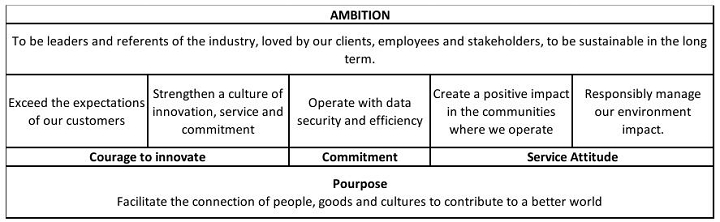
We also moved forward with the development of projects and initiatives that accelerate our transformation towards Ambition 2026. Furthering our commitment to growth and being valued, the new Commercial Department was developed and launched in 2025. This department aims to enhance synergies and knowledge by focusing specifically on each of our commercial revenue streams. Within its structure, Product Owner roles were defined for each revenue stream. These Product Owners will work closely with each business unit to maximize the profitability of current products and services, while also developing and implementing long-term strategies to drive significant growth in non-aeronautical commercial revenues in the coming years.
Furthermore, we continue to advance in the digital transformation of our operations, with the aim of operating in a more agile and efficient manner, focusing on the passenger and promoting data-based decision-making. In this context, we highlight milestones such as the development of the Airport Marketplace, the expansion of ADA functionalities, The digital transformation of our cargo operation, which this year focused on import processes, the strengthening of our talent management through platforms for the comprehensive management of human resources, and the development of a specific mission to deepen the adoption of Artificial Intelligence not only at the individual productivity level, but also to capture value at the organizational level.
These initiatives, together with the many actions developed throughout 2025, reaffirm our purpose of facilitating the connection between people, goods and cultures, thus contributing to a better world.
| 1. | Airport concession and regulatory body (ORSNA) |
Regulatory and concession framework.
1
| Concession
contracts |
Government
authority |
Term and extension provision |
| “Group A” of the NSA of the Argentine Republic | Argentine Government; ORSNA |
Original term of 30 years. It was extended for an additional 10 years on December 17, 2020 (ending on February 13, 2038). |
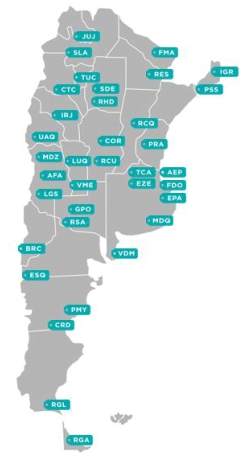
As of December 31, 2025, we have the concession of 35 airports belonging to “Group A” of the NSA of the Argentine Republic, for which the Company has the concession rights for the exploitation, administration and operation of said airports. The table above shows the aspects of our concession agreements, together with their respective terms and extension provisions, as well as the corresponding regulatory government authority.
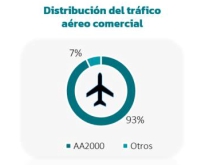
The Company handles 93.4% of Argentine air traffic.
Within the framework of the tariff review processes and the economic and financial equation of the concession, the Company maintains ongoing administrative and judicial proceedings with the regulatory body, the effects of which are duly explained in the notes to the financial statements
2
| 2. | Airports |
| IATA | International / | Passenger Traffic (in thousands) | ||||||||||||
| Airport Location | Airport | Code | Domestic | 2,025 | 2,024 | |||||||||
| Ciudad Autónoma de Buenos Aires | Jorge Newbery | AEP | International | 17,814.7 | 14,938.6 | |||||||||
| Ezeiza | Ministro Pistarini | EZE | International | 12,002.2 | 11,362.0 | |||||||||
| Córdoba | Ing. A. Taravella | COR | International | 3,261.1 | 2,862.4 | |||||||||
| Mendoza | El Plumerillo | MDZ | International | 2,647.6 | 2,311.1 | |||||||||
| Bariloche | Teniente Luis Candelaria | BRC | International | 2,563.2 | 2,374.9 | |||||||||
| Iguazú | Mayor D. Carlos Eduardo Krause | IGR | International | 1,785.1 | 1,504.2 | |||||||||
| Salta | Martín Miguel Güemes | SLA | International | 1,452.0 | 1,316.4 | |||||||||
| Tucumán | Tte. Benjamín Matienzo | TUC | International | 856.6 | 728.0 | |||||||||
| Comodoro Rivadavia | Gral. Enrique Mosconi | CRD | International | 576.6 | 541.1 | |||||||||
| Jujuy | Gobernador Horacio Guzmán | JUJ | International | 492.3 | 503.1 | |||||||||
| Posadas | Libertador General D. José de San Martín | PSS | International | 330.5 | 325.0 | |||||||||
| Mar del Plata | Astor Piazzolla | MDQ | International | 299.8 | 299.5 | |||||||||
| Resistencia | José de San Martín | RES | International | 224.6 | 196.5 | |||||||||
| Satig. Del estero | Vcom. Ángel de la Paz Aragonés | SDE | Domestic | 223.6 | 215.3 | |||||||||
| San Juan | Domingo Faustino Sarmiento | UAQ | Domestic | 199.9 | 186.2 | |||||||||
| Puerto Madryn | El Tehuelche | PMY | Domestic | 183.2 | 154.4 | |||||||||
| Rio Grande | Gobernador Ramon Trejo Noel | RGA | International | 142.9 | 135.9 | |||||||||
| Rio Gallegos | Piloto Civil Norberto Fernández | RGL | International | 131.2 | 181.9 | |||||||||
| Esquel | Brigadier General Antonio Parodi | EQS | Domestic | 96.2 | 93.0 | |||||||||
| Formosa | El Pucu | FMA | International | 89.6 | 97.7 | |||||||||
| Catamarca | Coronel Felipe Varela | CTC | Domestic | 87.8 | 83.6 | |||||||||
| La Rioja | Capitán Vicente Almandos Almonacid | IRJ | Domestic | 81.8 | 79.2 | |||||||||
| San Luis | Brigadier Mayor César R Ojeda | LUQ | Domestic | 59.6 | 60.5 | |||||||||
| San Rafael | S.A. Santiago Germano | AFA | Domestic | 51.1 | 51.0 | |||||||||
| Paraná | General Urquiza | PRA | Domestic | 42.6 | 38.5 | |||||||||
| Santa Rosa | Aeropuerto de Santa Rosa | RSA | Domestic | 41.7 | 41.4 | |||||||||
| Viedma | Gobernador Castello | VDM | Domestic | 34.7 | 35.1 | |||||||||
| Río Hondo | Aeropuerto Internacional Termas de Río Hondo | RHD | Domestic | 19.5 | 11.4 | |||||||||
| Río Cuarto | Aeropuerto de Rio Cuarto | RCU | Domestic | 11.4 | 25.2 | |||||||||
| General Pico | Aeropuerto General Pico | GPO | Domestic | 0.5 | 0.0 | |||||||||
| San Fernando | Aeropuerto Internacional de San Fernando | SFD | International | 0.0 | 0.0 | |||||||||
| Reconquista | Teniente Daniel Jukic | RCQ | Domestic | 0.0 | 1.1 | |||||||||
| Malargüe | Comodoro D Ricardo Salomón | MLG | Domestic | 0.0 | 0.0 | |||||||||
| Villa Reynolds | Aeropuerto de Villa Reynolds | VME | Domestic | 0.0 | 0.1 | |||||||||
| El Palomar | Aeropuerto El Palomar | EPA | International | 0.0 | 0.0 | |||||||||
| Total | 45,804 | 40,755 | ||||||||||||
3
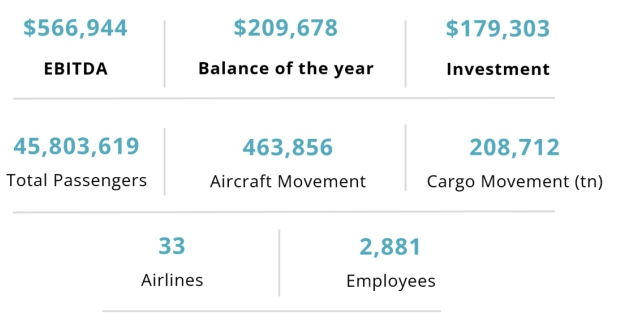
| 3. | Fiscal year 2025 – Main indicators |
CORPORATE GOVERNANCE
| 1. | Shareholders |
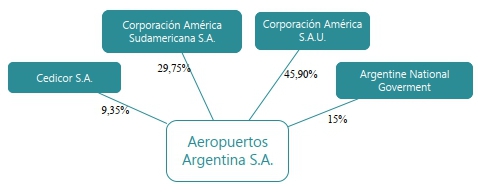
The Company is directly controlled by Corporación América S.A.U., a company incorporated in the Republic of Argentina, which directly owns 45.90% of the voting shares and indirectly, through Corporación América Sudamericana S.A., which owns 29.75% of the voting shares. In turn, Cedicor S.A., the controlling shareholder of Corporación América S.A.U., directly owns 9.35% of the voting shares and indirectly, through Corporación América S.A., owns 85% of the voting shares.
The following table shows the shareholders of the Company
4

Board of Directors
At Aeropuertos Argentina, our Board of Directors is made up of leaders who are trained and prepared to face and adapt to a constantly changing environment. They perform their roles responsibly, guided by ethical principles and transparency, complying with all current regulations. In addition, they transmit the company's values and corporate culture to all stakeholders. The Board of Directors is made up of seven members, three of whom are independent in accordance with the terms of the regulations of the National Securities Commission and one alternate director. The Shareholders' Meeting appoints them taking into account their training, career and the contribution they can make to the Board of Directors.
During 2025, the Board of Directors held 10 regular meetings, most of which were held virtually. Topics such as the approval of financial statements, the issuance of negotiable obligations and the granting of powers were mainly addressed. In addition, the managements present the Company's plans, projects and budget to the Board in due time.
The Board of Directors, as a fundamental part of corporate management, has the responsibility of establishing and validating the corporate mission, vision and values, as well as fostering an organizational culture rooted in the highest ethical and comprehensive standards, in line with the interests of society and its shareholders.
| Position Held | Full Name | Age Group | Status | First Appointment |
| President | Martín Francisco Antranik Eurnekian | 30-50 | Executive | 26/04/2017 |
| Vice-president | Antonio Matías Patanian | +50 | Executive | 21/04/2014 |
| Director | Máximo Luis Bomchil | +50 | Non independent | 24/04/2009 |
| Director | Orlando J. Ferreres | +50 | Independent | 25/04/2016 |
| Director | Rafael Antonio Bielsa | +50 | Non independent | 06/05/2024 |
| Director | Agustín Herrera | +50 | Independent | 10/08/2021 |
| Director | Fernando Ábalos Gorostiaga | +50 | Independent | 30/10/2025 |
| Substitute Director | Gustavo Pablo Lupetti | +50 | Executive | 29/05/2008 |
(*)In office until February 4, 2026
| 2. | Supervisory Committee |
The main function of the Supervisory Committee is to supervise and oversee the administrative and financial management of the Board of Directors, ensuring compliance with the applicable legal, statutory and regulatory provisions. In addition, it evaluates the transparency and clarity of the reports presented to the shareholders, ensuring that they truthfully reflect the company's financial, economic and financial situation, and promotes ethical conduct in accordance with the highest standards of corporate integrity and transparency.
| Position Held | Full Name |
| Main holder | Patricio Alberto Martin |
| Main holder | Tomás Miguel Araya |
| Main holder | Alejandro Esteban Messineo |
| Alternate | Francisco Martín Gutiérrez |
| Alternate | Federico Campolieti |
| Alternate | Ariadna Laura Aropoulos |
| 3. | Direction Committee and General Management |
The Direction Committee is responsible for the development and execution of executive functions to achieve the company's strategic vision. This committee is made up of the President, the CEO and seven area Directors, who not only carry out ordinary management, but also develop procedures and indicators to evaluate the company's performance and its functions.
The General Managers of Aeropuertos Argentina's business units are essential for the implementation and strategic management of operational and commercial activities at the airports. These managers, reporting directly to senior management, are responsible for coordinating airport operations, guaranteeing service quality, managing infrastructure and supervising commercial activities, ensuring that they are aligned with corporate policies and international standards. Their work includes planning and monitoring key projects, optimizing resources, and ensuring the economic and environmental sustainability of airport operations.
5
| Direction | Full Name |
| President | Martín Francisco Antranik Eurnekian |
| Vice President | A. Matías Patanian |
| CEO | Daniel Marcos Ketchibachian |
| Director of Administration and Finance | Patricio Tiburcio Benegas |
| Legal Director | Gustavo Pablo Lupetti |
| Director of Operations and Maintenance | Martín Guadix |
| Director of Data Science & AI | Cecilia Raimundo |
| Director of Infrastructure | Lucas Pérez Monsalvo |
| Director of Human Resources and Strategy | Verónica Rodríguez Bargiela |
| Director of Corporate Affairs | Jorge Rosales |
| Director of Systems | Gustavo Sabato |
| Commercial Director | Marcelo Bujan Kalustian |
| General Manager of the Ezeiza | Sebastián Villar Guarino |
| General Manager of the Cargo Business Unit | Walter Soiza Piñeyro |
| General Manager of the Central Business Unit | Federico Laborde |
| General Manager of the Western Region | Sergio Rinaldo |
| General Manager of the Eastern Region | Estanislao Aleman |
| 4. | Audit Committee |
The Company has this committee, which is made up of at least two independent directors who have specialized knowledge and experience in the economic, environmental and social fields and are appointed by the shareholders.
| Position | Full Name |
| President | Orlando Ferreres |
| Member and Secretary | Máximo Luis Bomchil |
| Member | Fernando Ábalos Gorostiaga (*) |
| Alternate | Agustin Herrera |
(*) In office until February 4, 2026
| 5. | Awards and Recognition |
During 2025, Aeropuertos Argentina's management was recognized by the market through numerous awards granted by international organizations, industry associations, and entities specializing in quality, customer experience, sustainability, and communication. These awards reflect the company's sustained performance in operational excellence, innovation, safety, accessibility, environmental management, and brand reputation.
In the airport sector, notable awards were granted by ACI and ACI World, including the certification of 11 terminals at Level 2 of the Airport Carbon Accreditation program, accessibility certifications for Ezeiza and Mendoza airports, and the APEX in Safety distinction awarded to Bariloche airport for its safety management. Additionally, several airports within the network were recognized in the ASQ program, including Ezeiza and, for the first time, the inclusion of an Aeropuertos Argentina-managed airport, Mar del Plata, among the top ten in the region, with an average satisfaction rating of 4.48 out of 5, based on direct passenger feedback.
In terms of innovation and transformation, the SNOW project was recognized as a regional winner at the SAP NOW AI Tour – IA Edition 2025, while Aeroparque was recognized at the Routes Americas Awards in the category of airports handling 4 to 20 million passengers. Simultaneously, Ezeiza was nominated as the World's Best Airport at the Airport Honour Awards 2025.
The company's comprehensive management was also recognized in areas related to quality, communication, customer experience, diversity, and sustainability. Among other milestones, it received the Quality Achievements Award from the European Society for Quality Research; awards in institutional communication, branding, and customer experience (Eikon, Dircoms, Effie, Pamoic, and Global Brand Awards); recognition for diversity and inclusion initiatives, such as the Women in Aviation Travel & Tourism program, which received national and international acclaim; and awards related to sustainability, social impact, and corporate reporting, including the Ecumenical Social Forum and the Fortuna Awards.
In terms of work environment and people management, Aeropuertos Argentina was recognized by Great Place to Work, achieving 4th place nationally, 13th place in the "Companies that Care" category, and 4th place in the Silver Generation, consolidating its position as a leading employer in the sector.
6
Finally, we were present at business events, showcasing our leaders at conferences such as the IDEA Colloquium, the AMCHAM and ALTA annual meetings, the Federal Tourism Council meeting, Routes, the International Tourism Fair, Tecnópolis, and the Great Place to Work awards ceremony, among others.
We also served on boards and interdisciplinary committees in various chambers related to the transportation and tourism industry: the Argentine Chamber of Tourism, the Buenos Aires Bureau, Destino Argentina, the Dircoms Circle, the Professional Council of Public Relations, Cicyp, the Argentine-Armenian Chamber of Commerce, the Chamber of Medium-Sized Enterprises, AMCHAM Diversity, and AMCHAM Comms, to name a few.
ETHICS AND GOVERNMENT POLICIES
Society has different tools and channels of dialogue that allow it to guarantee the transparency, clarity and seriousness of our processes.
| 1. | Integrity Area |
The role of the Integrity area is to ensure compliance with the values framed in the Company's Code of Conduct, to guarantee that the behavior of the staff and third parties linked to Aeropuertos Argentina is aligned with the highest standards of ethics and transparency, taking care of the company's reputation.
To achieve this goal, this Area has as its main actions three fundamental axes:
| · | prevention, through the adoption of mechanisms and tools that generate a culture of integrity and serve as a fundamental guide for business development; |
| · | risk management with a risk assessment appropriate to the global and local context, but above all to the industry in particular; |
| · | the remedial measures that establish what consequences should be applied to those behaviors that imply behavior contrary to our Code of Conduct or contrary to the laws and regulations in force. |
| 2. | Code of Conduct |
Its purpose is to establish the guidelines that govern the ethical behavior of the staff and ensure that they are observed effectively, in order to maintain conduct with high professionalism and integrity, not only within the company but also in relations with Third Parties, public authorities, the business community, regulatory agencies and society in general.
The Code of Conduct clearly defines the expected behavior of all staff, incorporating a zero-tolerance policy for misconduct. It also promotes essential principles such as respect for human rights, diversity, and inclusion, aligned with the corporate strategy and commitment to an ethical and responsible culture.
All staff must adhere to the mission of commitment to compliance with the Code of Conduct and the Integrity Policies. By the end of 2025, 89% of the Aeropuertos Argentina payroll had complied with this requirement, which is continuously monitored by the Integrity area.
| 3. | Anti-Bribery and Anti-Corruption Policy |
This policy has the main objective of preventing any breach of anti-bribery and anti-corruption laws. It reinforces the zero tolerance stance against any form of bribery and corruption, regulating interactions with public officials and third parties, in addition to establishing processes related to gifts, entertainment and donations, as well as commercial operations.
| 4. | Whistleblower Channel Policy |
t promotes the reporting of breaches of the Code of Conduct, ensuring confidentiality, the option of anonymity and zero tolerance for retaliation. The Whistleblower Committee is responsible for coordinating the investigation process and monitoring each case.
In line with the Diversity, Equity, and Inclusion Project, the Whistleblowing Channel Policy and Investigation Protocol were updated in 2025, expanding the principles and safeguards, redefining the types of violations and their severity, and establishing a specific framework for reporting harassment and violence.
7
| 5. | Conflict of Interest Prevention Policy |
It regulates the identification and management of conflicts of interest, through a mandatory reporting system. This type of conflict arises when a person, by virtue of certain commercial, professional, work or family ties, puts or may put their personal interests or those of third parties before those of the company and when said personal interests influence or may influence their business judgment, decisions or actions.
During 2025, the process was recertified in accordance with the established Policy, which involved updating and signing the Conflict of Interest Affidavit by the relevant personnel. By the end of 2025, 97% compliance had been achieved. Based on this, the reported conflicts of interest were analyzed, and where appropriate, action plans were defined. As a result, a heat map was created reflecting the identified risk levels.
| 6. | Gifts, Entertainment and Donations Policy |
Defines limits and procedures for gifts, entertainment and donations, guaranteeing transparency and integral relationships.
In 2025, the corresponding Work Instruction was updated, accompanied by training sessions for internal staff involved in the process.
| 7. | Policy for the Prevention of Misuse of Privileged Information |
The purpose of the policy is to establish guidelines that help employees, and anyone who, due to their work, profession or function, is in possession of privileged information, to fulfill their obligations in accordance with current legislation and securities regulations.
| 8. | Due Diligence |
Includes risk assessment processes and third party backgrounds to achieve in-depth knowledge of them and ensure responsible hiring. During 2025, 29 candidates, 229 suppliers and 359 permit holders were evaluated, strengthening business and contracting processes.
In 2025, the corresponding Work Instructions were updated, also accompanied by training sessions for internal staff involved in the various processes.
| 9. | Relationship with Related Parties: Control |
The company identifies transactions with related parties and has internal regulations for their treatment by the Audit Committee. Additionally, it adheres to the procedure of its controlling company to identify them in a timely manner and ensure the arm's length conditions of the transaction.
| 10. | Communications |
Annual communication campaigns are implemented to inform and raise awareness among staff about the Company's Integrity policies and initiatives. Specifically in 2025, the following were carried out:
| · | Thematic campaigns on key concepts such as the code of conduct, the whistleblowing channel, conflict of interest prevention (related to the 2025 recertification campaign), proper use of assets and resources, and guidelines for offering and receiving gifts and entertainment. |
| · | Special communication for International Anti-Corruption Day, highlighting the zero-tolerance policy toward any form of bribery and corruption. |
| · | Special communication campaign to accompany the launch of the Good Practices Guide for a Violence-Free Work Environment. |
In addition, an Integrity sub-site was developed within the corporate intranet to centralize all the policies, resources, and tools of the Integrity Program in a single space, facilitating access and consultation by staff.
Furthermore, we launched the 2025 Integrity Perception Survey, with significant staff participation and positive results. This initiative is a key tool for evaluating and strengthening the Integrity Program year after year.
8
| 11. | Training |
The Company develops an annual integrity training plan designed to ensure knowledge and understanding of the guidelines established in the Code of Conduct and associated policies. This is achieved through activities in various formats that guarantee its reach throughout the organization.
During 2025, the Integrity Program's online training was updated, incorporating a new version within a corporate framework. This resulted in an 86% participation rate among staff, including specific sessions for new managers. Additionally, non-executive staff were encouraged to participate in training related to Work Environment and Diversity, Equity, and Inclusion. In-person workshops were also held at key airports to disseminate the guidelines, the Best Practices Guide, and the operation of the Whistleblowing Channel.
Furthermore, specific training sessions were conducted for the Whistleblowing Committee and various teams within the organization, as part of the update to the Integrity Work Instructions, with the aim of ensuring the correct implementation of the processes.
OPERATIONS AND REVENUES
The Company has focused its approach on the customer, understanding that this includes not only passengers or airlines, but also all the people who work and transit daily in its airports. In this way, it develops improvement plans in the attention and contact with key audiences, seeking to streamline decision-making and respond more quickly and efficiently to the needs of our customers.
Airport sales
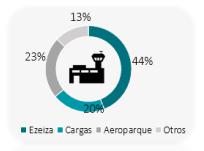
| 1. | Passengers |
Between 2015 and 2019, passenger traffic grew steadily at a compound annual rate of 9%, reaching a peak of 41.8 million passengers in 2019. However, in 2020, the pandemic caused a drastic drop, reducing traffic to just 9.7 million. In 2021, a slight recovery began with 12.8 million passengers, but it was not until 2022 that a more significant recovery was seen, reaching 32.8 million.
Passenger evolution
(Millions of passengers)
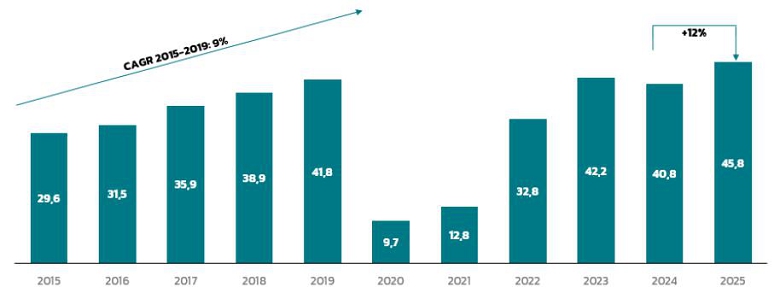
In 2023, total traffic returned to 2019 levels, with 42.2 million passengers. While 2024 showed a decline with 40.8 million passengers, a recovery trend began in the second half of the year, ending with a record high in December.
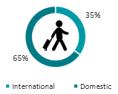
Passengers distribution
International Vs. Domestic
9
In 2025, the growth trend continued and solidified the year as a landmark for the Company, breaking the total passenger record by exceeding 45.8 million, with passenger figures broken in 11 of the 12 months. The international segment saw an 17.2% increase compared to 2024, primarily driven by increased flight frequencies and new routes. Meanwhile, the domestic segment was notable for the growth in fleets added by airlines.

| Passenger movement | Ezeiza | Center | West | East | 2,025 | 2,024 | ||||||||||||
| Domestic | 3,263,395 | 11,692,314 | 7,774,049 | 6,249,104 | 28,978,862 | 26,460,460 | ||||||||||||
| International | 8,473,511 | 5,004,484 | 938,617 | 949,714 | 15,366,326 | 13,107,048 | ||||||||||||
| Transit | 265,273 | 1,117,855 | 64,486 | 10,817 | 1,458,431 | 1,187,620 | ||||||||||||
| Totales | 12,002,179 | 17,814,653 | 8,777,152 | 7,209,635 | 45,803,619 | 40,755,128 |
| 2. | Aircraft and air routes |
During 2025, 33 airlines accompanied us with their operations at our airports

| Aircraft movement | Ezeiza | Center | West | East | 2,025 | 2,024 | |||||||||||||
| Passengers | 67,396 | 132,861 | 66,494 | 57,690 | 324,441 | 296,502 | |||||||||||||
| Cargo | 5,605 | 11 | 98 | 215 | 5,929 | 6,239 | |||||||||||||
| Others | 5,056 | 68,502 | 35,332 | 24,596 | 133,486 | 130,565 | |||||||||||||
| Totales | 78,057 | 201,374 | 101,924 | 82,501 | 463,856 | 433,306 |
In 2025, more than 30 new air routes were inaugurated at the group's various airports, including Córdoba - Recife (Gol), Aeroparque – Resistencia (Jetsmart), Mendoza – Rio de Janeiro (Jetsmart), Córdoba – Bogotá (Avianca), Mendoza – Viracopos (Azul), Bariloche – Porto Alegre (Azul), Ezeiza – Miami (Latam), Tucumán – Punta Cana (Aerolíneas Argentinas), Tucumán – Panama City (Copa), and Ezeiza–Auckland-Shanghai (China Eastern), among others.
The inauguration of the Ezeiza-Auckland-Shanghai route by China Eastern Airlines is a historic event, making Buenos Aires the first city in Latin America with direct connections to all five continents. This service, which will operate twice weekly, not only re-establishes the connection with Oceania, but also strengthens global connectivity, boosts tourism, and opens new opportunities for international trade.

| 3. | Cargo |
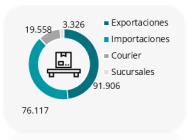
During 2025, imports reached a total volume of 76,117 tons. In January and February, general cargo showed solid performance, with a 14% increase compared to the same period in 2024. From March onward, volumes remained in line with the previous year, with a notable peak in October, when operations grew by 10% year-on-year. Toward November and December, the trend reversed, registering a 10% decrease. As a result, the year ended with a tonnage level practically equivalent to that of 2024 (-0.46%).
Regarding exports, the first quarter exhibited exceptional performance, with an increase of over 83%, driven by the recovery of seasonal products. However, the rest of the year showed a moderation in volumes, ending with cumulative growth of 1% compared to 2024.
In the Courier segment, a historic record for imports was reached, driven by regulatory changes. Average monthly revenue grew by approximately 210%, increasing the business's share of total revenue from 4% to 10%. A total of 12,700 tons were handled, representing a 140% year-over-year increase. This resulted in a 150% growth in Courier Import revenue compared to 2024.
Cargo movements
10
In October 2025, Aeropuertos Argentina Cargas reached a historic activity record, with 341 tons handled per day and 26,556 packages processed daily. This figure aligns with the peak weight handled in 2024, but with a 246% increase in the number of packages.
| 4. | Commercial Activities Operating at Airports: |
In 2025, commercial revenues mirrored the macroeconomic context, showing stable performance and improved results in the main business areas. Solid performance was observed in the parking sector, driven by higher occupancy rates, new pricing structures, and greater space availability. Duty-Free revenue trends were also influenced by the macroeconomic environment, remaining stable throughout 2025.
4.1. Duty Free shops
Duty Free at major airports provides passengers with an exclusive shopping experience, with a wide range of high-quality duty-free products, such as perfumes, electronics, beverages and gourmet products. Located in the boarding areas, these stores offer competitive prices, exclusivity and quality services, allowing passengers to take advantage of their time at the airport to access attractive offers and top-level services, and improve their travel experience.
4.2. Parking
In 2025, parking management focused on consolidating a standardized pricing structure and more predictable revenue management through the unification of pricing policies. Progress was also made in digitizing payment methods by implementing a digital parking discount policy, resulting in 62% of payments being made through these channels (Telepase, ADA, ATMs, and Marketplace), a 21% increase compared to 2024. This included the incorporation of new ATM technology through an agreement with Mercado Pago, the expansion of TelePase lanes at Ezeiza, Aeroparque, and Córdoba airports, and the implementation of promotional campaigns during peak demand periods such as CyberWeek and Parking Week.
In parallel, initiatives were developed to improve the user experience and operational efficiency, including the integration of multimedia technology in Mendoza and the expansion of operational capacity through new lanes and the commissioning of a new gantry in Bariloche.
4.3. VIP Lounge
During 2025, VIP services experienced significant growth, driven by infrastructure expansion and the consolidation of the value proposition.

In April 2025, the new VIPCLUB Departures Lounge opened at Ezeiza International Airport, with an area of over 850 m² distributed across three levels and capacity for more than 60 passengers. The new lounge offers private access to security and immigration checkpoints, a dining option, rest and work areas, concierge service, valet parking, and exclusive parking spaces.
Additionally, the VIPCLUB Lounge at Aeroparque Airport began operating 24 hours a day. Simultaneously, furniture and layout improvements were made to the Amae Lounge in Bariloche, and the phased expansion of the Amae Lounge in Córdoba began.
At the end of the fiscal year, several projects were underway for implementation during 2026, most notably the first domestic VIP Lounge at Ezeiza International Airport and the new Amae Lounge on the upper level of Aeroparque Airport.
Additionally, the VIPCLUB website update optimized the booking and renewal processes, driving a 35% increase in online purchases and improving transaction traceability.
11
CUSTOMER EXPERIENCE
| 1. | Measuring customer satisfaction through surveys under the ASQ and ESA program |
During 2025, the Company continued to strengthen its active listening to the voice of the customer by conducting surveys at 28 concessioned terminals. The objective was to measure the level of satisfaction throughout the passenger journey and guide evidence-based improvement actions.
Nationwide, overall satisfaction reached a score of 4.16 out of 5, with the courtesy and friendliness of airport staff standing out as the highest-rated attribute, scoring 4.24 out of 5.
Among the terminals surveyed, Aeroparque, Bariloche, Córdoba, Ezeiza, Mendoza, and Mar del Plata (added in 2025) participated in the Airports Council International's ASQ Departures Plus program, which evaluates the perceived quality of airport service through standardized surveys and analytical tools.
Within this context, in 2025 Mar del Plata Airport ranked among the Top 10 in Latin America and the Caribbean in the ASQ performance ranking, achieving an overall satisfaction level of 4.48 out of 5.
Quantitatively, 23,609 surveys were conducted across 28 terminals, and an improvement in satisfaction was recorded in 73.08% of the terminals evaluated nationwide.
| 2. | Improved customer experience |
During 2025, the Company made progress in evolving its processes, platforms, and capabilities, with the goal of improving the customer experience and increasing operational efficiency related to customer service.
Within this framework, several initiatives were implemented, including:
| · | The adaptation of the Customer Relationship Management system for the General Aviation segment, aimed at optimizing seat allocation management. This evolution will allow, starting in 2026, the systematic recording of information and enable process improvements based on data and traceability. |
| · | The modification of the case creation workflow at Aeropuertos Argentina and Aeropuertos Argentina Cargas, incorporating automation and new self-service channels, with the goal of optimizing the capture, routing, and resolution of requests. |
| · | The updating of the claims classification tree at Aeropuertos Argentina, improving data quality to strengthen information analysis and decision-making. |
In parallel, internal complaint resolution processes were redesigned, resulting in a 12.5% improvement in satisfaction with resolution and an 8.5% improvement in the resolution time perceived by customers.
These improvements were integrated into the Customer Experience Portal, a customer service intranet that centralizes real-time information about terminals, flight status, contacts, and procedures, organized in a workflow format and accessible from any device. This tool helps standardize operations and promotes simpler and more consistent management.
Throughout 2025, the Customer Experience Portal maintained a monthly adoption rate of over 80% among employees.
| 3. | Contacts with passengers: communication and dialogue channels |
Effective communication with passengers, staff, and the airport community is a key enabler for a safe, predictable, and satisfying travel experience. In this context, conversational voice AI was incorporated into the interactive voice response system in 2025, enabling self-service inquiries about parking fees for all types of cars and motorcycles at the airports under concession.
Regarding multichannel customer service and management, the following results were recorded during the year:
| · | Approximately 254,000 calls handled, with a 92.77% first-contact resolution rate, an agent satisfaction rating of 4.68 out of 5, and a self-service rate of nearly 60%. |
| · | 158,000 conversations managed through the webchat channel. |
| · | 7,367 requests entered into the Customer Relationship Management system (complaints, compliments, suggestions, and modifications), with an average resolution time of 2.9 days. |
| · | 23,034 customer service team assistance calls—including, among others, support for individuals on the autism spectrum and wheelchair assistance—representing a 36.7% increase compared to the previous year. |
| · | More than 1,000,000 information inquiries registered throughout the year. |
12
| 4. | Accessibility |
During 2025, Aeropuertos Argentina strengthened its commitment to accessibility and inclusion by incorporating new initiatives aimed at improving the travel experience for people with disabilities.
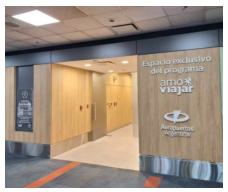
Within this framework, a Calm Room was inaugurated at Ezeiza International Airport, a sensory-optimized space for people on the Autism Spectrum (ASD), designed according to universal design and well-being criteria, with input from specialists and families. The space has specific equipment for sensory regulation and requires prior reservation. A second expansion phase is planned with new rooms and an adult changing station that meets international standards.
Also, during the year, the implementation of the “I Love to Travel” program continued at all 35 airports under the concession, designed to support people on the autism spectrum during their airport experience.
| 5. | Cloud Experience |
During 2025, we continued developing the Experience Cloud portal by incorporating the profile for the Airline segment. This evolution included the implementation of a self-service platform that allows this audience to centrally manage requests, inquiries, complaints, and procedures, facilitating real-time tracking and resolution.
This new segment also has access to relevant information, such as passenger volume, updates related to the strategy, and functionalities associated with managing the interaction between airlines and Aeropuertos Argentina.
INVESTMENTS AND INFRASTRUCTURE IN AIRPORTS
| 1. | Investment commitment |
The mandatory capital investment programme (CAPEX) for expansion projects was agreed at US$606.5 million (VAT included), divided into two phases:
| · | Phase 1: for a total amount of US$406.5 million to be completed until 2024 and |
| · | Phase 2: annual investments of US$50 million between 2024 and 2027, resulting in a total of US$200 million. |
| Investments at December 31, 2025 (1) | Phase I | Phase II |
| Preferred shares | 174 | - |
| Works executed | 232 | 106 |
| Remaining investment | - | 94 |
| Status | Completed | On Going |
(1) Millions Of dollars
As of December 31, 2025, Phase I had been fully completed. The investment commitment under Phase II for the years 2024 and 2025 was exceeded, reaching a total of US$ 106 million.
The investment to be made between the years 2028 and 2038 will be defined based on the operational needs of Aeropuertos Argentina, taking into account the economic balance of the concession.
The investments made during the fiscal years ending December 31, 2022, 2023, 2024, and 2025 are currently under review by ORSNA
13
| 2. | CAPEX and Main Works |
During fiscal year 2025, Aeropuertos Argentina made capital investments totaling $179.303 billion. Among the most significant projects completed during this period were the remodeling of the Río Hondo Airport terminal, the completion of the San Juan Airport terminal expansion, the expansion of the North and South platforms at Aeroparque, the construction of a new VIPCLUB lounge and a new car rental hub at Ezeiza International Airport, and the rehabilitation of runways, platforms, and taxiways with the installation of new LED lighting at the Río Gallegos and Río Cuarto airports, among others.
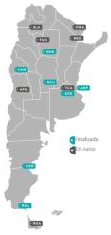
Main Works Completed in 2025
| · | Río Hondo – Terminal |
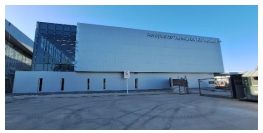
During the first quarter of 2025, the comprehensive renovation and expansion of the Termas de Río Hondo International Airport terminal was completed, adding 2,650 m² of new space. The project included building renovations, expansion of operational areas, improvements to boarding lounges, modernization of technical facilities, and upgrades to passenger service areas, increasing operational capacity and adapting the infrastructure to the growth of tourism in the region.
| · | San Juan – Terminal |
In December 2025, the new passenger terminal at San Juan International Airport was inaugurated. The project included the construction of a building with a check-in hall, security checkpoints, boarding lounges for domestic and international flights, jetways, service areas, a baggage claim area, and commercial spaces. State-of-the-art security systems and operational technology were also incorporated, raising the airport's quality standard. The project involved an expansion of 5,396 m² compared to the existing infrastructure.
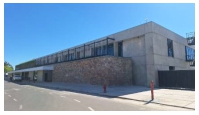
| · | Aeroparque – South Platform |
During the first quarter of 2025, the expansion and upgrade of the South Platform at Aeroparque Jorge Newbery were completed. The work included the construction of 14,000 m² of new technical pavement, the adaptation of aircraft parking positions, drainage works and associated services, as well as integration with the lighting and operational systems, strengthening the platform's capacity and operational efficiency.
| · | Aeroparque – North Platform |
In 2025, the new North Platform at Aeroparque Jorge Newbery was inaugurated and put into service. The project included the demolition of the old parking area and the construction of a new 17,000 m² apron designed for the operation of larger aircraft. Additionally, LED lighting and beacon systems and daytime signage were installed, significantly increasing the airport's operational capacity.
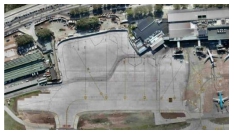
| · | Rio Cuarto – Runway, Platform, and Taxiway Rehabilitation with Lighting |
During the third quarter of the year, the rehabilitation of runway 05/23 at Rio Cuarto Airport was completed. The work included the complete repaving of the runway, the improvement of margins and safety strips along 2,260 linear meters, upgrades to the lighting and signaling system, and operational adaptation in accordance with current aeronautical regulations, allowing the resumption of commercial operations with increased safety levels.
14
| · | Río Gallegos – Runway Rehabilitation and Lighting |
During the fourth quarter of 2025, the structural rehabilitation of runway 08/26 at Río Gallegos International Airport was completed, covering a length of 2,750 linear meters. The project included the removal and reconstruction of deteriorated sections, comprehensive repaving, and the upgrading of the lighting and signaling system, ensuring operational continuity and extending the infrastructure's lifespan.

| · | Ezeiza – New VIP Club Lounge |
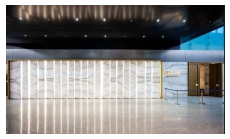
During the year, the construction and outfitting of the new VIP Club Lounge at Ezeiza International Airport was completed, incorporating exclusive spaces for passengers with rest areas, dining options, workspaces, personalized services, biometric access, and a functional design focused on enhancing the premium passenger experience.
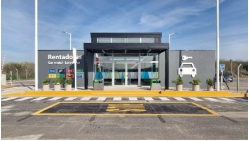
| · | Ezeiza– – New Car Rental Hub |
In 2025, the new Car Rental Hub at Ezeiza International Airport opened, centralizing the operations of car rental companies in a single area. The project included customer service areas, offices, dedicated parking, improved access and signage, streamlining traffic flow and optimizing the ground transportation experience. The facility covers 9,700 m² and has capacity for 350 exclusive parking spaces, in addition to 270 m² of covered space with 10 independent retail units.
| · | Ezeiza – E-Gates |
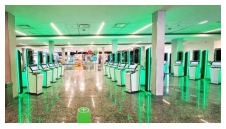
The construction of the new Express Immigration Control at Ezeiza International Airport was completed, which included the remodeling of 610 m² of the international arrivals area. The project replaced 11 traditional checkpoints with 32 express checkpoints and 5 automatic barriers, along with upgrades to the supervisory station, modernizing and streamlining the immigration control process.
| · | Comodoro Rivadavia – New Terminal Roof |
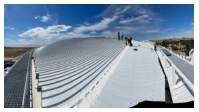
During 2025, the renovation of the roof and comprehensive remodeling of the terminal building at Comodoro Rivadavia Airport was completed. The work included structural and architectural improvements, modernization of operational and passenger service areas, upgrades to technical facilities, and an updated building appearance.
| · | Ezeiza – New main feeders |
Progress was made in modernizing the electrical infrastructure through the installation of new main feeders, improving the capacity and reliability of the energy supply to Ezeiza International Airport.
15
Works in Progress
| · | San Rafael – New Passenger Terminal |
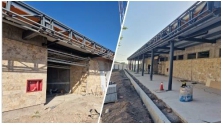
This project involves expanding the terminal to 1,850 m², incorporating new check-in areas, baggage handling systems, waiting rooms, restrooms, a food court, offices, and a VIP lounge. At the end of the fiscal year, the project was 51.5% complete.
| · | Salta – New Passenger Terminal |
The renovation of the Salta passenger terminal will expand its surface area to 14,000 m², improving passenger flow, security systems, and sanitary and fire detection facilities. As of December 31, 2025, the project was 50% complete.
| · | Tucumán – Comprehensive Terminal Renovation |
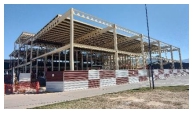
The project aims to increase the covered area to 7,000 m², improving the terminal's operational capacity and comfort through the addition of new check-in areas, departure and arrival lounges, new jet bridges, and updated technology for climate control, lighting, and signage.
| · | Formosa – Passenger Terminal Renovation |
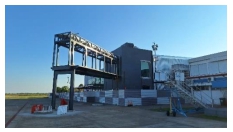
The new Formosa terminal will have an area of 3,380 m² and the capacity to handle two simultaneous flights. The project includes a check-in hall, baggage carousel, pre-boarding area, and spaces for international operations. At the end of the fiscal year, the project was 59% complete.
| · | Resistencia – Terminal Renovation |
The renovation of the Resistencia terminal will cover 6,600 m², reorganizing operational areas and redistributing interior spaces to improve functionality. The planned execution time is 17 months.
| · | Río Grande – Runway, Taxiway, and Platform Rehabilitation |
Work is underway on the main runway at Río Grande Airport, including repaving, upgrades to lighting and signage, and technical improvements aimed at increasing safety and operational reliability.
| · | Cargo – Single Courier Terminal |
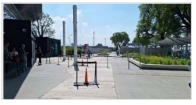
Construction of the new Single Courier Terminal began in 2025. This terminal is designed to centralize and streamline international parcel operations. The project includes logistics areas, operational spaces, internal circulation routes, sorting and dispatch equipment, and a new access road.
| · | Cargo – Perishable Goods Storage Expansion |
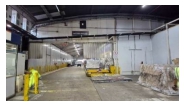
Expansion work is underway in the perishable goods sector, incorporating new refrigerated storage chambers, operating areas, and auxiliary services, strengthening the logistics capacity for temperature-sensitive products.
16
| · | Ezeiza – Reverse Osmosis Plant |
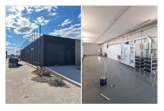
Construction and commissioning of a new reverse osmosis plant at Ezeiza International Airport is progressing. This includes treatment and purification systems, industrial equipment, and connection to internal networks, with the aim of ensuring the quality and availability of water for airport operations.
| · | Ezeiza – Inspection and Registration Point Phase II |
The project includes a 2,800 m² expansion towards the terminal facade, the construction of a new restroom facility, the addition of a mezzanine with offices, and the expansion of the Shop Gallery commercial area.
AIRPORT SAFETY AND MAINTENANCE
| 1. | Operational Safety |
During 2025, the Company reinforced its commitment to Operational Safety through various initiatives aimed at strengthening operational standards and the maturity of the management system.
Within this framework, an APEX audit was conducted at Bariloche Airport in October by international experts in the areas of Operations, Operational Safety, Snow Operations, and Wildlife. As a result of the process, 99 findings were identified and classified according to their area of expertise for analysis and action.
Furthermore, evacuation drills and operational safety audits were carried out throughout the year, totaling 17 drills and 19 airports audited in this process.
Additionally, Bariloche Airport conducted drone trials for inspection and monitoring tasks in the movement area and safety zones.
During August and September, cross-audits of operational safety were implemented with the participation of more than 10 airports, aimed at innovating in auditing processes, identifying deviations, and raising safety standards.
Also, in 2025, the Posadas and Resistencia airports obtained certification from the National Civil Aviation Administration, validating their compliance with the operational safety protocols established by the International Civil Aviation Organization.
| 2. | Airport Security |
In 2025, we developed and delivered new Local Security Procedures tailored to the specific needs of the airports in San Rafael, Catamarca, Formosa, Puerto Madryn, and Villa Mercedes.
Finally, we received corporate-level approval from the Airport Security Police for the Operator Security Program and the Internal Training Plan.
| 3. | Maintenance |
During 2025, the Company continued to advance the transformation of maintenance management at its airports through the implementation of an asset management tool. The digitization of processes and their integration with the ERP system improved the identification and recording of incidents and maintenance needs, optimizing operational management, providing greater mobility for technical personnel, and contributing to extending the useful life of equipment and improving its performance. At the end of the year, the tool was operational at 12 airports, with its progressive rollout continuing across the rest of the network.
Furthermore, a comprehensive survey of equipment, spare parts, and maintenance plans was conducted at 18 airports, enabling the definition of a new asset management process, integrated with incident management and supply chain projects. Within this framework, a specific tool for pavement management was also developed, facilitating the location and tracking of maintenance events.
17
In line with the commitment to continuous improvement, seven airports were incorporated into the "Road to Excellence" program, achieving more than 70 improvements with a direct impact on operations and receiving recognition from external entities. In this context, the Ezeiza maintenance team was selected by the National Institute of Industrial Technology (INTI) as a benchmark for continuous improvement within the framework of the EAF program. Additionally, during the year, improvement initiatives were presented using the Plan-Do-Check-Act methodology in specialized areas, related to energy efficiency and the optimization of sanitary maintenance processes, reflecting the Company's ongoing focus on innovation and the optimization of its maintenance processes.
HUMAN CAPITAL
Our teams are the engine of our growth, and that is why we focus on their well-being and development. We work to build diverse and inclusive environments where each person can unleash their full potential. We promote innovation and agility as fundamental pillars, ensuring that we are always one step ahead in a world that never stops evolving.
| 1. | Key figures |
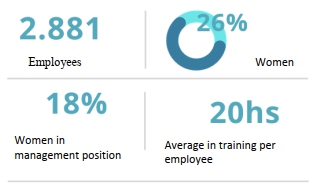
| 2. | Talent management and recruitment |
With the goal of supporting the professional development of our employees, the Company has a talent management strategy that allows us to identify, through mapping processes, key profiles for building high-performing teams. Based on this, we implement various initiatives focused on employee retention and development.
We reaffirm our commitment to internal growth by completing a total of 482 searches, 53% of which were filled by internal talent. Within this framework, 85% of leadership positions were filled by employees from within the organization, strengthening the continuity and development of internal leadership.
| 3. | Training and education |
As part of the Company's cultural evolution and the adoption of agile management models, we promoted the professional development and growth of our employees, focusing on preparing them for current and future challenges.
During the year, a training model based on innovation, agility, and continuous learning was consolidated, with a course offering tailored to the needs of each business unit. Training was delivered in face-to-face, virtual, and blended formats, complemented by asynchronous components through the My Learning platform, which facilitates access to technical content, transferable skills, and corporate tools.
| People who completed at least one learning instance | Participant who carried out learning instances deployed | Of people within the agreement who completed at least one learning instance |
| Total hours of learning | Of the people who took at least 1 course |
18
Training in figures
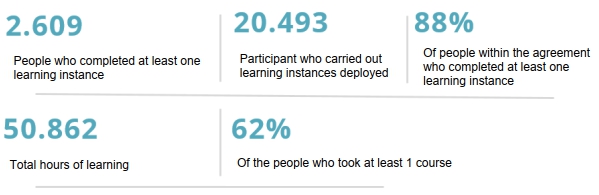
Likewise, in 2025 the model of the Society's three Technical Schools continued to be strengthened, defining the capabilities and levels of mastery required for each role, ensuring comprehensive training aligned with the specific knowledge and skills of each position.
| 4. | Union Relations |
During 2025, there were no permanent or temporary interruptions in the provision of airport services by the Company. Any labor actions that occurred involved companies or services operating within the airport sector and were unrelated to the Company's management, ensuring operational continuity in all cases.
The Company respects the principle of freedom of association and has designated Labor Relations and Human Resources representatives in each Business Unit, enabling ongoing dialogue with union representatives and fostering cooperative labor relations.
Furthermore, the Company reaffirms its commitment to maintaining collective bargaining and salary adjustments aimed at preserving the purchasing power of wages, taking into account the Consumer Price Index (CPI) and within the framework of current national and international legal provisions, thereby helping to minimize potential conflicts that could affect operations.
| 5. | Climate survey (GPTW) |

For the third consecutive year, we achieved GPTW certification, reaffirming our commitment to the well-being and experience of our teams. This year, we again exceeded participation, reaching 89%, which reflects the high level of involvement of our people. Furthermore, we achieved an 87% affirmation in the GPTW survey and an average of 78% across all affirmations, particularly excelling in areas such as fairness (86%), corporate image (85%), hospitality (83%), pride (82%), camaraderie (81%), and teamwork (80%). These results motivate us to continue strengthening our culture, fostering a work environment where everyone can develop and grow.
19

COMMUNITY AND SUSTAINABILITY
Aeropuertos Argentina has the mission of advancing on the path of sustainability, with responsible management of the economic, social and environmental impact generated by our actions. Therefore, it seeks to make this concept a transversal and strategic vision for the business.
From our management, we seek to generate a positive impact in the communities where we operate, committing to the Sustainable Development Goals (SDG) and contributing to the 2030 Agenda for the integral well-being of our country and the world. Our objective is to be leaders and benchmarks in the industry, valued by our clients, employees and stakeholders, and to grow sustainably in the long term.
To achieve this goal, we work on five strategic pillars that guide our action in the face of challenges. In 2025, we continue to advance in our Sustainability Strategy, focusing on key projects, transformation initiatives and daily actions of our business units. All this, in collaboration with the airport ecosystem, the communities and our multi-sector alliances.
Through various programs, in 2025 we reached a total of 1,600 people impacted.
| 1. | Education and culture |
We promote educational and cultural initiatives to highlight the richness of Argentina and encourage the educational development of its inhabitants. Through these actions, we also focus on the care and promotion of the diverse local cultures that enrich the country. Our commitment to the community is realized through programs that expand access to education, strengthen skills for future employability, and offer cultural initiatives that promote inclusion.
Aeropuertos Argentina Orchestra
The Airports Argentina Orchestra celebrated its 10th anniversary as an initiative that promotes the artistic, educational, and personal development of young people from highly vulnerable backgrounds, offering them a space for professional training, support, and growth through music.

Currently, it comprises 56 scholarship musicians, aged 18 to 25, who receive instruments, training, pedagogical guidance, and financial support, with real opportunities for employment.
In a decade, more than 250 young people have participated in the Orchestra, achieving high graduation rates and professionalization. Furthermore, it has an agreement with the National University of the Arts and was declared of Social and Cultural Interest by the Buenos Aires City Legislature in 2023.
Support for the Families of the Fallen in Malvinas and the South Atlantic Islands
Since 2004, we have supported the Commission for the Families of the Fallen in Malvinas and the South Atlantic Islands with different actions that have an impact on both the families and society in general. In addition, since 2018, agreements between Aeropuertos Argentina and this Commission were signed to facilitate this support, framed within the Compliance regulations that govern the company.
During fiscal year 2025, Aeropuertos Argentina S.A. fulfilled its obligations under the maintenance agreements for the Argentine Military Cemetery in Darwin and its support for the Commission, carrying out repairs to its infrastructure. Furthermore, working meetings and videoconferences were held to maintain a constructive relationship and advance an amendment to the Humanitarian Project Plan. This amendment will allow, during 2026 and with the participation of the International Committee of the Red Cross, the exhumation and identification of the remains of soldiers killed in the conflict. Additionally, a donation was made for the construction of the Hall of Heroes, located in the Malvinas National Museum.
20
PESCAR Program
The PESCAR Center is a job training initiative promoted by Aeropuertos Argentina in partnership with the Pescar Foundation, aimed at fostering the social and professional inclusion of high school seniors in the Ezeiza area.

During the year, the program reached 20 students and combined soft skills training with in-person technical sessions, including tours of different areas and operations within the airport ecosystem. Furthermore, in 2025, stakeholders from the airport community, such as Flybondi, Shop Gallery, and Duty Free Shop, were incorporated, expanding learning opportunities. Since the partnership began in 2010, more than 240 young people have participated in the Pescar Centers in Ezeiza, with a 75% job placement rate.
Cimientos Program
This is a strategic program in partnership with the Cimientos Foundation to give university students the opportunity to gain exposure to the airport industry.
In the 2025 edition, 35 students participated, studying fields related to airport operations—such as tourism, airport management, international business, public relations, and software development—mostly from the University of Ezeiza. The program ran for two months and included soft skills and employability training, provided by Cimientos, and technical training delivered by volunteers from Aeropuertos Argentina, with the aim of offering a comprehensive view of our operations and role as an airport operator.
| 2. | Health and Wellbeing |
We prioritize the health and wellbeing of communities, working closely with various stakeholders to ensure the quality of life of its citizens.
Support for the Dr. Alberto Antranik Eurnekian Ezeiza Interzonal University Hospital
Since 2006, Aeropuertos Argentina has collaborated with the Dr. Alberto Antranik Eurnekian Ezeiza Interzonal Hospital, contributing to the financing of maintenance, projects and the acquisition of essential medical equipment. Recently, we have supported the incorporation of new instruments and resources to improve the diagnostic and care capacity. The hospital, which has 233 beds, 6 operating rooms and 2 delivery rooms, is also a university hospital, where we collaborate with the organization and financial support in the offering of courses and residencies in various medical areas, such as Histology, Nursing, Surgical Instrumentation and Emergencies. This collaboration reflects our commitment to strengthening the health system in the community.
Amaltea Civil Association
The Amaltea Civil Association is a rehabilitation and social integration center, started in 2014 in Ciudad Oculta-Villa 15, in the Autonomous City of Buenos Aires. In formal terms, it is recognized as a Community Care and Support Center by the Secretariat of Comprehensive Drug Policies of the Argentine Nation.
In 2025, Aeropuertos Argentina strengthened its collaboration with the Association through a significant increase in monthly support for the development of activities and the operation of the headquarters, in addition to allocating an extra budget for the building's general maintenance. Furthermore, the computer lab, installed in 2024, continued to expand through the donation of more equipment: computers and printers.
For Children's Day, a donation of toys was arranged at Aeroparque Airport and the Corporate Building, which were then distributed to the children of the Sueñitos Kindergarten.
| 3. | Sustainable Tourism |
We are actively committed to the preservation of destinations, promoting projects and actions that support the growth and development of regional economies, thus contributing to the well-being of their inhabitants.
21
Zero Plastic Destination
Since 2022, Aeropuertos Argentina has been promoting the Zero Plastic Destination initiative with the goal of reducing plastic use in its terminals and decreasing its environmental impact and plastic footprint, encouraging the participation of the entire airport community. This work is being carried out progressively and systematically, in conjunction with food and retail concessionaires, VIP lounges, operational areas, airlines, and other key stakeholders in the ecosystem, with support from the specialized consulting firm Unplastify.
During the year, the program expanded its reach to 24 airports and was strengthened through comprehensive actions. Within this framework, the Leadership Training Program was relaunched for the second consecutive year. Developed over five sessions, the program addresses the issue of plastic, reduction methodologies, alternative materials, and current regulations. Furthermore, the content has been permanently incorporated into the "My Learning" platform, providing virtual access to all employees.
During the year, the Company made significant progress in measuring and reducing its plastic footprint across various areas of its operations and within the airport ecosystem. A 37% reduction was achieved in food service concessions and retail outlets at 14 airports, exceeding the established targets, and a 46% reduction was achieved in internal operations, encompassing 41 offices, 4 cafeterias, and the inclusion of corporate events in the measurement. Furthermore, collaboration with strategic partners, including VIP lounges and airlines, resulted in a 30% reduction in the measured plastic footprint. Additionally, measurements were taken for the first time in cargo operations at Ezeiza Airport, achieving an 8% reduction and thus expanding the scope of environmental management initiatives.
| 4. | Diversity |
Women In Aviation Travel & Tourism
Women in Aviation Travel & Tourism is a multidimensional initiative that promotes the professional development of women in the aviation, travel, and tourism industries, fostering collaboration between private companies, public organizations, unions, and academia. The program implements training initiatives and flexible work policies that promote inclusive, safe environments with greater opportunities.

In terms of training, academic scholarships are offered in partnership with prestigious universities. In 2025, in partnership with the University of San Andrés, 39 scholarships were awarded for executive education, postgraduate programs, and MBAs, bringing the total to over 80 scholarships since the program's launch in 2019. Additionally, in partnership with the Austral University, a full scholarship for Industrial Engineering is offered, which has already enabled three young people to pursue their studies and one to graduate and enter the workforce. A new scholarship has also been awarded this year.
Finally, the program also includes the Women in Aviation Travel & Tourism Global event, which brought together more than 400 people from Corporación América Airports, where leading women shared key trends, challenges and opportunities for the future of the airport and aeronautical industry.
DISCAR Foundation
For more than 10 years we have supported the DISCAR Foundation in the comprehensive training of people with intellectual disabilities. We currently have three employees included in this program. We want to be a Company that ensures accessibility, which is why we strive to train our teams and representatives of the airport communities so that they have the necessary tools to eliminate barriers. It is our priority that passengers have a positive experience, so accessibility not only includes the preparation of our teams but also adapting the infrastructure so that everyone can enjoy the facilities without limitations.
Sign Language
We became the first Argentine company to certify its staff in Argentine Sign Language, in partnership with SEA – Señas en Acción (Signs in Action). In 2025, we trained 36 people, including refresher courses, in-person exams, and online exams. This resulted in a total of 231 final certifications across 13 airports nationwide. This significant achievement not only eliminates communication barriers but also reinforces our commitment to a more humane and inclusive experience.
| 5. | Environment |
During 2025, Aeropuertos Argentina reaffirmed its commitment to responsible environmental management and energy efficiency, central pillars of its sustainability strategy. The implemented initiatives optimized resource consumption, strengthened monitoring mechanisms, and generated relevant information for decision-making, in line with the company's strategic objectives.
22
Within this framework, progress was made in reducing the carbon footprint through Level 2 certification of the Airport Carbon Accreditation program at the airports of Bariloche, Tucumán, Salta, Jujuy, Paraná, and Río Grande. This certification recognizes the implementation of effective carbon management procedures and the achievement of quantifiable emission reductions.
Furthermore, water footprint audits were conducted in accordance with ISO 14046 at the airports of Mendoza, San Juan, and Comodoro Rivadavia, reinforcing the Company's commitment to the efficient management of resources and the continuous improvement of its environmental performance.
Energy Efficiency
During the year, the Company continued to strengthen its energy management by adopting various measures aimed at optimizing consumption, improving carbon footprint measurement, and strengthening energy use monitoring at its airports.
Among the main initiatives implemented during 2025 were the implementation of energy management systems at seven locations, with ISO 50001:2018 certification achieved at four of them (Ezeiza, Mendoza, Comodoro Rivadavia, and Aeropuertos Argentina Cargas), the optimization of lighting, the efficient management of climate control through operational adjustments, the monitoring of energy consumption through efficiency dashboards, and the development of an online energy measurement platform, currently in the implementation phase.
These actions, mostly focused on process optimization and without requiring significant investments, generated relevant economic benefits in overall energy consumption. In line with the Company's strategic priorities, it is planned to continue replicating these measures at other airports during 2026, as well as to advance new investments in renewable energy.
In this context, the Company defined and published an Energy Efficiency Policy, aligned with its Environmental Policy, with the objective of implementing and maintaining an energy management system in compliance with the requirements of ISO 50001:2018.
Renewable Energy
As part of our commitment to sustainable management, we are increasing the purchase of renewable energy at Aeropuertos Argentina Cargas and Aeroparque, in addition to the purchases we already made at Ezeiza, the airport with the highest electricity consumption.
For operations carried out at the airport during 2025, 99% renewable energy was used at Ezeiza. Aeropuertos Argentina Cargas and Aeroparque also use renewable energy purchased on the wholesale market. Aeropuertos Argentina Cargas uses 100% renewable energy, and Aeroparque approximately 50%.
Considering the total consumption of the other airports belonging to Aeropuertos Argentina, renewable energy represents between 55% and 60% of it.
As part of the same effort to reduce emissions, in certain airports, we have advanced technology that allows us to remotely and centrally monitor air quality and the need for ventilation when necessary in major airports.
TECHNOLOGY, DIGITAL TRANSFORMATION, AND INNOVATION
During 2025, the Company continued to advance its technology, digital transformation, and innovation agenda, focusing on strengthening operational efficiency, improving the passenger experience, optimizing decision-making, and supporting business growth. The initiatives developed were geared toward the responsible adoption of new technologies, data-driven management, process automation, and strengthening information security.
| 1. | Data-Driven Index |
During the year, the Company made progress in strengthening the Data-Driven Index as a comprehensive framework for measuring the maturity and adoption of data-driven practices throughout the organization. This index considers key dimensions such as training, the use of corporate dashboards, the application of advanced analytical models, and data governance.
In 2025, various actions were undertaken to consolidate this approach. The second edition of the Data Academy was held, and workshops were conducted for various teams, covering technical content related to data and artificial intelligence, as well as providing support for the correct interpretation and use of dashboards. Through these initiatives, 691 employees participated, while 695 employees used corporate dashboards during the period.
Additionally, with the aim of democratizing access to information, a map of corporate dashboards was published on the intranet, and a conversational agent called Dati was launched, facilitating quick and easy access to information and dashboards.
23
| 2. | Artificial Intelligence Strategy |
In 2025, the Company developed a comprehensive strategy for the efficient, secure, and ethical adoption of artificial intelligence within the organization, aimed at driving innovation and ensuring compliance with current regulatory, security, and governance frameworks. In this context, an evaluation and planning process for artificial intelligence technologies was carried out in relevant areas, focusing on responsible implementation aligned with business objectives.
For its development, an interdisciplinary team was formed with representatives from operational areas and specialists from key functional areas. Within the defined work plan, internal and external surveys were conducted, a corporate guide for the use of artificial intelligence was developed and disseminated, corporate tools were enabled, and training, proof-of-concept testing, and internal communication activities were carried out.
As a result of these initiatives, more than 1,300 employees were trained in the fundamentals of generative artificial intelligence and in the advanced use of our AI tool. Key users (Champions) were also identified to promote the adoption of these tools within their teams. The deployment of more than 3,000 licenses for our AI tool and the identification of more than 100 AI use cases across various areas reflect tangible and comprehensive progress, consolidating internal capabilities and fostering a culture of continuous learning and openness to change.
| 3. | Cargo – WMS and ERP Implementation and New Portal for Import Customers (Phase 2) |
Continuing with the implementation of the comprehensive digital transformation project, which marked a milestone in the evolution of Aeropuertos Argentina Cargas, Phase 2 of the project was completed in 2025, encompassing all import processes and operations. This stage included the integration of the WMS and ERP systems, as well as improvements to the user experience through the expansion of the self-service portal for import customers, strengthening operational efficiency and traceability.
| 4. | Management System Upgrade and Implementation |
During 2025, and building on the ERP system upgrade completed the previous year, the Company progressed with the implementation of a cloud-based solution for maintenance management. This tool enables task execution from mobile devices, with direct integration to the ERP system and access to real-time information, allowing technicians to manage work orders, consult technical data, and monitor asset status from the field. By year-end, the solution was implemented in 10 airports, reaching 150 active users, with a positive impact on productivity and operational efficiency.
Additionally, a comprehensive solution was implemented for managing the entire supplier lifecycle and procurement processes, centralizing registration, evaluation, rating, and risk management, as well as the purchasing and contracting of services. The platform ensures end-to-end traceability, electronic exchange of business documents, and greater visibility for the Purchasing and Compliance departments, strengthening internal control, operational efficiency, and decision-making.
Furthermore, in conjunction with the Sustainability department, progress was made in implementing a strategic management and monitoring tool that links corporate strategy with measurable results, based on the consolidation of reliable and standardized data from multiple systems. Within this framework, the management of human capital indicators—including diversity and inclusion, workforce trends, internal mobility, and organizational climate—was automated, and a set of strategic business indicators was incorporated, focused on monitoring operational performance, customer experience, and key economic variables, thus strengthening management based on integrated and traceable information.
| 5. | ADA - Virtual Assistant for the Airport World |
During 2025, ADA continued to evolve as a virtual assistant for the airport ecosystem, incorporating improvements aimed at providing a more complete and personalized experience for passengers. Key advancements included optimized flight information, an extended advance consultation period, the addition of data on baggage claim and queue delays, and greater flexibility in interpreting inquiries.
Furthermore, progress was made in integrating with internal systems and incorporating functionalities based on generative artificial intelligence, such as restaurant recommendations and improvements to airport information. During the year, the use of push notifications and parking payments via WhatsApp was consolidated, reaching 32% of tickets paid through this channel in December.

In terms of performance, ADA recorded a total of 1,708,164 conversations and 43,861,899 messages at the SNA level during 2025, with an average satisfaction score of 4.4 out of 5.
24
| 6. | Online Store |
During 2025, Aeropuertos Argentina's online store consolidated its position as a strategic channel for marketing travel-related products and services, expanding its offerings by adding new vendors and proposals, and strengthening its nationwide presence with the addition of the Bariloche online store.
The channel's growth was primarily driven by the evolution of the online parking offering, with new options and the implementation of dynamic pricing at Ezeiza, Aeroparque, and Mendoza airports, as well as by sales and promotional activities on key dates, notably its first-time participation in the Hot Sale event.
As a result of these initiatives, the online store registered more than 75,000 orders during 2025, solidifying its position as a relevant channel within the company's digital ecosystem.
| 7. | Cybersecurity |
As in previous years, information security continued to be a strategic priority for Aeropuertos Argentina, with the goal of protecting the systems and information that support critical operations against the growth and sophistication of cybersecurity threats. The operation of complex infrastructure such as airports depends on the availability and reliability of specialized systems, making it essential to strengthen technological resilience and comprehensive risk management.
The 2022–2025 Cybersecurity Program was completed in 2025, enabling the standardization of processes, the integration of common technologies across the organization, and the consolidation of key capabilities for the protection of digital assets and operational continuity. Key achievements include the implementation of a centralized Security Operations Center for continuous, real-time monitoring of networks and systems, the incorporation of advanced technologies for proactive vulnerability detection, and the performance of independent external reviews by internationally recognized providers, reinforcing the robustness of the control framework.
Furthermore, web browsing protection and filtering were strengthened through comprehensive solutions, identity and access management was standardized through structural governance projects, and significant progress was made in identity protection through multi-factor authentication and privileged access management. The network infrastructure was reinforced with the implementation of a Web Application Firewall to protect critical applications, and solutions were adopted to verify the identity of senders and the integrity of email content, strengthening the detection and mitigation of phishing attempts. This comprehensive approach raised the cybersecurity maturity level and consolidated a homogeneous, scalable technological foundation prepared to sustainably support the Company's growth.
In this context, the Information Security Committee strengthened its strategic oversight role, monitoring key risks, vulnerabilities, and projects, and ensuring alignment with international standards. Additionally, the ACI World APEX Cybersecurity Program was conducted at Ezeiza International Airport during the year, resulting in the corresponding certification.
Cybersecurity is an ongoing challenge, with threats originating from all types of external actors. It is essential to continue investing in the protection of information assets and improving contingency management processes to ensure business continuity in the face of these risks. This is why a new Strategic Cybersecurity Plan was defined, extending until 2030. It includes an approach focused on new technologies, strongly linked to artificial intelligence and automated processes. This plan aims to significantly strengthen user awareness at all levels, also considering the supply chain and service providers that interact with the company's information and systems, and will also reinforce incident containment, response, and management processes.
25
FINANCE
| 1. | Debt Composition |
The Company's debt structure is mainly leveraged by international and local NOs.
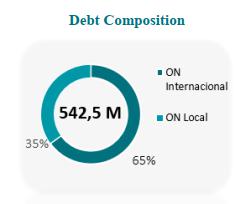
| 2. | Debt reduction |
Capital payment schedule
(Millions of U$S)
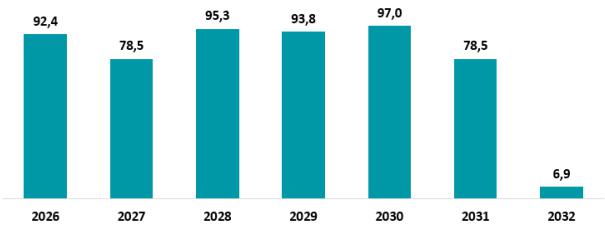
| 3. | Breakdown per Instrument |
| Instrument | Currency | Interest | Maturity | Balance * | |||||||||||
| International bonds | 352.8 | ||||||||||||||
| Series 2017 | U$S | 6.875 | % | Feb-27 | 6.3 | ||||||||||
| Class I Series 2020 | U$S | 6.875 | % | Feb-27 | 22.6 | ||||||||||
| Class I Series 2021 | U$S | 8.500 | % | Ago-31 | 272.9 | ||||||||||
| Class IV | U$S | 9.500 | % | Nov-28 | 51.0 | ||||||||||
| Local bonds | 189.7 | ||||||||||||||
| Class V | U$S | 5.500 | % | Feb-32 | 138.0 | ||||||||||
| Class IX | U$S | 0.000 | % | Ago-26 | 22.9 | ||||||||||
| Class XI | U$S | 5.500 | % | Dic-26 | 28.8 | ||||||||||
| Total debt | 542.5 | ||||||||||||||
| Cash and cash equivalents + Financial investments | 163.7 | ||||||||||||||
| Total debt, net | 378.8 | ||||||||||||||
* In millions of US dollars
During 2025, the Company successfully met the maturities of various bank loans, paying off the only outstanding loan with ICBC Bank for US$10.0 million.
Finally, in 2025, the Company acquired its own Class X bonds in the secondary market for a nominal value of US$2.2 million.
As of December 31, 2025, cash and cash equivalents totaled $91,770 million. The total liquidity position, which includes cash and cash equivalents, as well as other financial assets, amounted to $236,664 million at year-end.
As of December 31, 2025, the Company was in compliance with all its financial covenants.
26
ECONOMIC PERFORMANCE 2025
It should be noted that the figures for 2024 are expressed in the same currency as in 2025, which implies re-expressing them for the inflation of the year, with which the year-on-year variation implicitly includes the relationship with the inflationary effect of the period.
| 1. | Income |
During 2025, the Company's total revenue increased by 14% year-over-year, reaching $1,358,703 million, compared to $1,195,526 million in 2024. This growth was due to a consistent 14% increase in both aeronautical and commercial revenue.
| 1.1. | Breakdown of income |
| Income | 2,025 | 2,024 | Variation | |||||||||
| Aeronautical income | 784,472 | 690,764 | 14 | % | ||||||||
| Non-Aeronautical income | 574,231 | 504,762 | 14 | % | ||||||||
| Total income | 1,358,703 | 1,195,526 | 14 | % |
Aeronautical revenue totaled $784,472 million, representing a 14% increase compared to 2024, driven primarily by record growth in international passenger traffic. In the domestic segment, revenue increased by 10% year-over-year.
Since aeronautical revenue is primarily denominated in US dollars, the year-over-year change reflects the combined effect of exchange rate fluctuations and inflation during the period.
Commercial revenues reached $574.231 billion, a 14% increase compared to the previous year, primarily driven by the following factors:
| · | A 13% increase in cargo terminal revenues, associated with the implementation of a new tariff structure, higher handling volumes, and growth in the courier import business. | |
| · | A 47% increase in parking revenues, resulting from tariff improvements and higher occupancy rates. | |
| · | A 17% increase in VIP lounge revenues, driven by infrastructure improvements and enhanced service offerings, which led to increased passenger usage. |
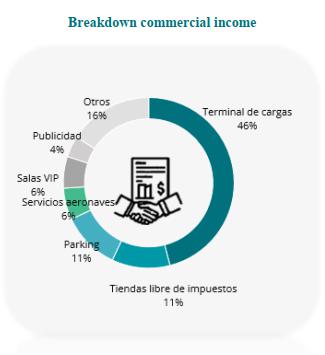
| 2. | Operating Costs and Expenses |
During 2025, total operating costs and expenses increased by 11% year-over-year, reaching $1,016,037 million, primarily as a result of higher operating expenses related to airport services and maintenance.
| 2.1. | Costs |
| Cost of sales | 2,025 | 2,024 | Variation | |||||||||
| Specific allocation of income | 200,835 | 176,645 | 14 | % | ||||||||
| Airport services and maintenance | 196,678 | 185,674 | 6 | % | ||||||||
| Amortization of intangible assets | 180,722 | 142,356 | 27 | % | ||||||||
| Salaries and social security contributions | 204,798 | 210,603 | -3 | % | ||||||||
| Fees | 6,829 | 10,844 | -37 | % | ||||||||
| Utilities and fees | 26,203 | 26,502 | -1 | % | ||||||||
| Taxes | 6,729 | 6,806 | -1 | % | ||||||||
| Office expenses | 19,978 | 20,538 | -3 | % | ||||||||
| Insurance | 38 | 651 | -94 | % | ||||||||
| Others | 8,568 | 46 | 18526 | % | ||||||||
| Depreciation rights of usage | 4,067 | 3,170 | 28 | % | ||||||||
| Total costs | 855,445 | 783,835 | 9 | % |
The cost of services totaled $855,445 million, representing a 9% year-over-year increase, equivalent to $71,610 million. This variation was mainly due to the following factors:
| · | A 14% increase, equivalent to $24,190 million, in the specific allocation of revenue, in line with the growth of revenue measured in Argentine pesos. |
| · | A 27% increase, equivalent to $38,366 million, in the amortization of intangible assets, associated with greater activity in construction projects during the year. |
| · | A 6% increase, equivalent to $11.004 billion, in airport service and maintenance expenses, linked to higher overhead costs at the airports. |
These variations were partially offset by reductions in items such as salaries and social security contributions, fees, office expenses, and insurance, which together helped to moderate the overall growth in costs.
27
| 2.2. | Expenses |
| Marketing & administrative expenses | 2,025 | 2,024 | Variation | |||||||||
| Taxes | 74,941 | 67,963 | 10 | % | ||||||||
| Salaries and social security contributions | 40,282 | 29,813 | 35 | % | ||||||||
| Amortization of intangible assets | 6,017 | 1,533 | 292 | % | ||||||||
| Advertising | 7,718 | 7,367 | 5 | % | ||||||||
| Provision for bad debts | 9,143 | 4,573 | 100 | % | ||||||||
| Office expenses | 9,600 | 9,699 | -1 | % | ||||||||
| Fees | 6,115 | 6,511 | -6 | % | ||||||||
| Airport services and maintenance | 2,993 | 1,155 | 159 | % | ||||||||
| Fees to the Board of Directors and the Supervisory Commission | 891 | 1,089 | -18 | % | ||||||||
| Insurance | 2,391 | 884 | 170 | % | ||||||||
| Public services and fees | 387 | 4 | 9575 | % | ||||||||
| Others | 114 | - | 100 | % | ||||||||
| Total operating expenses | 160,592 | 130,591 | 23 | % |
During 2025, Marketing and Administration expenses totaled $160.592 billion, representing a 23% year-over-year increase, equivalent to $30.001 million.
This increase was mainly due to higher expenses in salaries and social security contributions, amortization of intangible assets associated with new acquisitions during the year, provisions for bad debts, and taxes related to the higher level of activity and sales.
| 3. | Adjusted EBITDA |
The adjusted EBITDA in constant currency for 2025 amounted to $566,944 million, with an adjusted EBITDA margin of 41.7%.
| 3.1. | Reconciliation of Adjusted EBITDA to Revenue from Continuing Operations |
| EBITDA Calculation | 2,025 | 2,024 | Variation | |||||||||
| Result for the year | 209,678 | 384,079 | -45 | % | ||||||||
| Financial income | (42,365 | ) | 146,873 | -129 | % | |||||||
| Financial costs | 133,423 | (570,906 | ) | -123 | % | |||||||
| Inflation adjustment | 13,151 | 32,916 | -60 | % | ||||||||
| Other – Miscellaneous income and expenses | (1,447 | ) | 2,586 | -156 | % | |||||||
| Income tax | 53,136 | 309,736 | -83 | % | ||||||||
| Operating result | 365,576 | 305,284 | 20 | % | ||||||||
| Amortization and depreciation | 190,806 | 147,059 | 30 | % | ||||||||
| Other (Construction Services, net) | 10,562 | 5,257 | 101 | % | ||||||||
| Adjusted EBITDA (1) (1) | 566,944 | 457,600 | 24 | % | ||||||||
| Adjusted EBITDA margin | 41.73 | % | 38.28 | % | 9 | % |
| (1) | Excludes “Construction Services”. |
| 4. | Financial income and losses |
During 2025, the Company recorded a net financial loss of $104,209 million.
In accordance with IAS 29, monetary assets and liabilities denominated in foreign currency must be restated to reflect the inflationary component. This involves reclassifying the effects of exchange rate differences and the Result from Exposure to the Monetary Position (RECPAM). The magnitude of this reclassification depends on the relationship between the exchange rate change and the accumulated inflation at year-end.
28
In 2025, the exchange rate devaluation was higher than the annual inflation rate (41% versus 32%, respectively), which meant that, with the application of IAS 29, the total net exchange rate difference was presented as a loss. In contrast, during 2024, the devaluation was lower than the inflation rate, generating an inverse effect on the financial result.
| Financial Result | 2,025 | 2,024 | Variación | |||||||||
| Financial income | ||||||||||||
| Interest earned | 34,858 | 51,375 | -32 | % | ||||||||
| Exchange rate difference | 7,507 | (198,248 | ) | -104 | % | |||||||
| Inflation adjustment | (13,151 | ) | (32,916 | ) | -60 | % | ||||||
| Financial loss | ||||||||||||
| Lost interest | (64,071 | ) | (80,070 | ) | -20 | % | ||||||
| Exchange rate difference expenses | (69,352 | ) | 650,976 | -111 | % | |||||||
| Financial gain / (loss), net | (104,209 | ) | 391,117 | -127 | % |
OUTLOOK 2026
2025 was a landmark year for the Company, setting a new record for total passengers for the year, exceeding 45.8 million and surpassing the previous record of 42.3 million set in 2023. A new record for international passengers was also set, totaling 15.4 million. Throughout the year, the Company achieved record total passenger figures for each month in 11 of the 12 months. Furthermore, December marked a milestone in the Company's history, registering the highest number of passengers in a single month in its 27 years of operation. With 4.2 million passengers, the previous record set in January 2025 was surpassed.
The international segment consolidated its growth, with an 8.6% increase in the fourth quarter compared to 2024, closing 2025 with a 17.2% year-on-year increase. The main driver of this strong performance is an increase in flight frequencies to major international destinations, along with new routes launched in the preceding months of this year, primarily to regional destinations. Compared to 2019, international traffic was 25.6% higher than the last quarter and 13.4% higher for the year. Every month of the year set a record for total passengers.
The domestic segment also showed strong performance, 5.6% higher than the last quarter of last year, closing with 9.5% growth compared to 2024 and 8.0% compared to 2019. This year, this segment was boosted by the growth of the domestic fleet, which airlines have incorporated to offer a greater number of flights and frequencies, increasing the availability of local routes and destinations.
Looking ahead to 2026, we anticipate moderate growth in the international segment and slightly higher passenger levels for the domestic segment.
Record passenger numbers each month present a challenge to maintaining service standards. In this context, Ezeiza Airport achieved first place in the International Airport Council's commercial satisfaction ranking. This achievement exemplifies our commitment to passengers, in line with our strategy of strengthening services and continuously improving infrastructure. Furthermore, Ezeiza was nominated for the Airport Honour Awards, and Aeroparque was awarded first place in its category in the Routes Americas 2025 awards.
On the commercial revenue side, the growth in operations and revenue in the Cargo segment stood out, primarily due to higher import volumes, along with a change in the tariff structure. Likewise, accompanying the increase in passenger traffic, the commercial categories registered solid performance, especially the parking sector, which continues with significant growth, driven by higher occupancy levels, greater availability of parking spaces, and tariff updates.
Regarding the air cargo business, 2025 marked a record revenue driven by the volume of import courier services, which grew by 89% compared to 2024. Furthermore, in the first quarter of 2025, a new tariff structure was implemented, focusing on simplifying rates, incentivizing efficiency, and providing greater predictability of times and costs, generating a positive impact on revenue. Additionally, technology was incorporated into warehouse management with the implementation of a Comprehensive Digital Transformation, focused on increasing the efficiency and traceability of air cargo.
On the other hand, the Company's operating costs, primarily those denominated in local currency, continued to be impacted by macroeconomic variables. However, we continued implementing control and efficiency measures, which have mitigated the impact. This, combined with revenue growth, contributed to an expansion of operating margins.
Finally, within the framework of the investment plan, we have made significant progress in executing the CAPEX commitment established in our contractual framework. We completed the portion of the CAPEX program planned for 2025, corresponding to Phase II of the commitment, after having completed Phase I towards the end of 2024. Likewise, progress was made on the works carried out with the National Airport System Strengthening Trust.
The plan focused on runway works and terminal upgrades in several provinces of the country, aimed at expanding and modernizing the infrastructure, increasing capacity, and raising the level of service at each airport. The most significant investments for 2025 include the Río Hondo Terminal Remodeling project, the completion of the San Juan Terminal Expansion, the expansion of the North and South Platforms at Aeroparque Airport, the construction of a new VIP Club Lounge and a new car rental hub at Ezeiza International Airport, and the rehabilitation of runways, aprons, and taxiways with the installation of new LED lighting at Río Gallegos and Río Cuarto Airports, among others.
29
During 2026, we will continue our investment plan to further strengthen infrastructure and the range of services offered to passengers and airlines. These initiatives will allow us to continue developing new routes and expanding Argentina's global connectivity. We also expect to continue focusing on technological innovation to make our operations increasingly efficient and secure through the integration of artificial intelligence and other cutting-edge technologies at our airports.
PROPOSAL OF THE BOARD OF DIRECTORS
This board submits the aforementioned documentation for the approval of the shareholders and states that the result of the year of $209,678 million, is intended for the creation of a facultative reserve
Finally, we would like to thank the staff of Aeropuertos Argentina, our clients, suppliers, banking entities and other organizations with whom we share our daily activities for their collaboration during our management, and we would like to greet the Shareholders with the highest regard.
Autonomous City of Buenos Aires, March 4, 2026
THE BOARD OF DIRECTORS
30
ATTACHMENT IV
| A) | THE ROLE OF THE BOARD OF DIRECTORS |
Principles
| I. | The company must be led by a professional and trained Board that will be in charge of laying the necessary foundations to ensure the company's sustainable success. The Board of Directors is the guardian of the company and the rights of all its Shareholders. |
| II. | The Board of Directors must be responsible for determining and promoting corporate culture and values. In its performance, the Board of Directors must guarantee the observance of the highest standards of ethics and integrity based on the best interest of the company. |
| III. | The Board of Directors must be in charge of ensuring a strategy inspired by the vision and mission of the company, which is aligned with its values and culture. The Board of Directors must engage constructively with management to ensure the correct development, execution, monitoring and modification of the company's strategy. |
| IV. | The Board of Directors will exercise permanent control and supervision of the company's management, ensuring that management takes actions aimed at the implementation of the strategy and the business plan approved by the board. |
| V. | The Board of Directors must have the necessary mechanisms and policies to exercise its function and that of each of its members efficiently and effectively. |
1. The Board of Directors generates an ethical work culture and establishes the vision, mission and values of the company.
|
This practice is applied by the Company. The board of directors generates an ethical work culture and establishes the vision, mission and values of the company.
The Society's mission is to facilitate the connection of people, goods and cultures to contribute to a better world. It is a company oriented towards the passenger and the airport user through the permanent improvement of the quality of its service, providing technological innovation and experiences that exceed the expectations of the client and other interested parties such as the State, international organizations, airlines, carriers, unions and AA2000 staff. It extends to the world through communities that benefit from the contribution of local airports that bring them closer and connect them, contributing to their development and growth.
In turn, it has as values the courage to innovate, the attitude of service and commitment. The daily work of all the Company's personnel aims to exceed customer expectations by leading the construction of a virtuous ecosystem that operates with agility and security and that strengthens a culture of innovation, service and commitment. |
Their ambition is to be leaders and benchmarks in the industry. Loved by customers, employees and stakeholders, to be sustainable in the long term.
Promote a greater commitment to quality and service innovation in the field of air transport, improving the concessioned infrastructure in order to generate value for the client and consolidate and increase the national airport assets. Train staff and update their knowledge continuously to respond efficiently to the needs of the different players in the aviation industry in the country and the world. The operational and quality policies of AA2000 are concrete and measurable, which allows verifying its results and its high international standards.
The Corporate Governance Code establishes among the functions of the board of directors the determination and promotion of corporate culture and values. In its performance, the board of directors must guarantee the observance of the highest standards of ethics and integrity based on the best interest of the Company and its shareholders.
For its part, the Board of Directors of the Company approved a Code of Conduct and integrity policies, which were communicated to all employees of the organization. In particular, they consist of implementing the necessary measures for the Company to carry out its activity in an adequate transparency framework. To this end, it works, among other axes, on the promotion of ethics, transparency and integrity and carries out actions aimed at the formation and dissemination of ethical issues. | |
2. The Board of Directors sets the general strategy of the company and approves the strategic plan developed by management. In doing so, the Board of Directors takes into account environmental, social and corporate governance factors. The Board of Directors supervises its implementation through the use of key performance indicators and taking into account the best interest of the company and all its shareholders.
|
This practice is applied by the Society. Among the functions of the board is to ensure a strategy aligned with the defined vision and mission, consistent with the values and culture of the Company.
It is the policy of the board of directors to delegate the day-to-day management of the Company to the first-line management and to direct its efforts to general management and supervisory and control functions, through support and control functions, as established by law, by the corporate statute and by the Corporate Governance Code.
The managements present the different plans, projects and budget of the Company to the board of directors with due advance notice and these are approved by all members at the board meetings.
For its part, the Company's Code of Conduct, approved by the board of directors, establishes within its principles that the Company seeks to align its commercial strategy with the commitment to contribute to the economic and social development of the communities in which it operates, promote local development in a sustainable and efficient manner and respect the values of a clean, healthy and safe work environment. The general manager proposes to the board of directors the risks that are to be managed within the Company in accordance with the strategic objectives.
On a large scale, responsibility towards society consists of establishing long-lasting relationships based on trust, integrity and respect, generating values aligned with the legitimate interests of society and that generate a positive impact not only for the latter but also for the Company and other stakeholders. |
The Company promotes the application of sustainable development standards, including the protection of the environment and the rights of future generations through the adoption of economically viable practices to reduce waste generation, consumption of natural resources and emissions of greenhouse gases, in compliance with environmental legislation and regulatory obligations.
For its part, the Company fully adheres to the obligation and duty to respect, protect and promote Human Rights, committing not only to refrain from interfering in their enjoyment or limiting them, as well as to prevent them from being violated. Respect for individuality, appreciation of differences and an inclusive culture that guarantees non-discrimination based on gender, age, nationality, religion, ideology or any other personal, physical or social condition is not only part of the principles but a commitment of the Society. With this purpose, the Company has incorporated diversity and inclusion as strategic values and key elements of the global strategy. It is convinced that promoting the diversity of teams and promoting an inclusive leadership style, in addition to responding to principles of social justice offers important advantages for the business: it allows attracting and retaining the best talent, promoting innovation and approaching a diverse and changing society.
Based on these principles of responsible business, the Company expresses its firm commitment to equal opportunities and non-discriminatory treatment of people in all areas, and is categorically against any conduct or practice associated with prejudices due to , among others, nationality, ethnic origin, skin color, marital status, family responsibility, religion, age, disability, social condition, political opinion, serological and health status, gender, sex, sexual orientation, gender identity and expression.
The Company is committed to developing and implementing processes and actions aimed at guaranteeing that all people receive the same opportunities and treatment in the work environment, as well as the necessary conditions to be hired, recognized and promoted and thus reach their maximum professional and personal potential.
Periodically, management reports to the board of directors on compliance with the strategic plan and the works plan.
Through the systematization and monitoring of financial and non-financial indicators, the Company measures its impact with the objective of enhancing the positive ones and mitigating the negative ones and thus, contribute to the development of a profitable and sustainable future. Among other indicators, we can list those of
(i) economic and financial impact (investment in infrastructure, EBITDA, results for the year), (ii) impact on passengers (number of passengers, active airlines, aircraft movement, airports) ; (iii) in people (positions filled by employees, average training per employee, payment in salaries and membership fees); (iv) social (spending on local suppliers, private social investment); and (v) environmental (in investments and other environmental expenses, electricity consumption, natural gas consumption, water consumption). |
The strategic axes of The Company are listed below:
(i) Exceeding our customer expectations: We play a fundamental role in the sustainable development of the industry. We want to exceed the expectations of our passengers and guarantee them a positive and happy experience, ensuring accessible terminals for all. We invest in technology to advance our digital transformation path and work in alliance with all our stakeholders to optimize the experience of our passengers.
(ii) Strengthen a culture of innovation, agility and inclusion: Our employees are our most important asset. We care about their well-being and development since we are aware that their growth is the engine of our company's success. We foster an agile, collaborative, safe and inclusive work environment, with a special focus on accelerating the development of women in our industry.
(iii) Operate with data, safely and efficiently: We guarantee safe and reliable operations and environments with advanced infrastructure and technology, complying with regulations and preventive measures. We focus on efficiency as a key dimension of business management and seek continuous improvement of our processes to operate in an agile manner.
(iv) Create a positive impact in the communities where we operate: We are committed to generating a positive impact by providing economic and social value to all the communities where we operate our airports. We promote a sustainable value chain with a focus on hiring local products and services and we work in alliance with different actors in society to meet our objectives.
(v) Responsibly manage environmental impact: Committed to a low-carbon economy, the responsible use of resources and the care of biodiversity, we invest in projects that put nature and people at the center of our decision-making and mark a transformative path to parade the climate emergency. | |
3. The Board of Directors supervises management and ensures that it develops, implements and maintains an adequate internal control system with clear reporting lines.
|
This practice is followed. The board of directors has approved a management structure with clear reporting lines, which allows it to have an adequate system of internal control. The management of the Company is made up of:
· Ten top-level managers: CEO, Operations and Maintenance Manager, CFO, Human Resources Manager, Legal Manager, Infrastructure Manager, Data & Customer Intelligence Manager, Commercial Manager, Systems Manager, and Corporate Affairs Manager, all reporting to the President;
· Five general managers of the business units: Ezeiza Business Unit, Aeropuertos Argentina Cargas, Central Business Unit, Western Business Unit, and Eastern Business Unit, all reporting to the CEO; and
· support and control functions:
(i) Compliance Management reporting to the CEO and matrix to the Legal and Corporate Compliance Department;
(ii) Internal Control, Risks and Regulations Management reporting to the CEO and matrix to the Corporate Legal and Compliance Department; |
(iii) Internal Audit Management reporting to the CEO and secondly to the Audit Committee; and
(iv) Secretariat of the presidency.
The Audit Committee meets at least quarterly. Non-executive and independent directors participate in these meetings on a regular basis.
Finally, there is a “first line of defense” reflected in a robust internal control system with clear reporting lines. Management is primarily responsible for creating an effective internal control system. | |
4. The Board of Directors designs corporate governance structures and practices, designates the person responsible for their implementation, monitors their effectiveness and suggests changes if necessary.
|
This practice is followed.
The board of directors approves the Corporate Governance Code, as well as any modifications made to it.
The Corporate Governance Code establishes, within the functions of the board of directors, that of designing corporate governance structures and practices, appointing the person responsible for their implementation, monitoring their effectiveness and suggesting changes if necessary. At its meeting held on August 7, 2024, the Board of Directors appointed Dr. Leticia Graciela Faulin as responsible for the implementation and monitoring of the Corporate Governance Code.
On the other hand, according to the response to practice 3, the reporting lines are clearly established. There are ten first-line managers who report to the chairman of the board; five general managers of the business units who report to the general manager, and three support and control functions that report to the general manager and a secretary of the board of directors.
Regarding the committees, although it is not legally required, the Company considered it convenient and structured it accordingly, the existence of an audit committee within the board of directors. At the moment, the board of directors considers that the implementation of other committees is not necessary. |
5. The members of the Board of Directors have sufficient time to perform their duties in a professional and efficient manner. The Board of Directors and its committees have clear and formalized rules for its operation and organization, which are disclosed through the company's website.
|
This practice is followed. Knowledge, experience and conditions of personal integrity and reputation are considered when evaluating a candidate for the Board of Directors. Additionally and in accordance with the General Law Of Companies and the Corporate Governance Code of the Company, directors must perform their duties with the diligence of a good executive. Each director will be diligently informed about the business of the Company, will devote the time and effort required to perform their duties efficiently and must take appropriate measures for good management and control of the Company.
The President of the Company and some directors have full dedication to the Company while they hold executive positions in it. Directors who have commitments outside the Company are adequately informed and rigorously prepare prior to attending meetings.
Currently, the bylaws contain provisions on the operation of the board and the audit committee. For its part, the audit committee has an internal operating regulation. In addition to the bylaws and internal regulations, the provisions of Law No. 26,831 and the regulations of the CNV (T.O. 2013) are applicable for the operation of the audit committee.
Both the regulations of the committee and the bylaws of the company are known to the general public for being on the website of the National Securities Commission. For its part, the website of the Company has a direct redirection to the CNV page. |
| B) | THE PRESIDENCY IN THE BOARD OF DIRECTORS AND THE CORPORATE SECRETARIAT |
Principles
| VI. | The President of the Board of Directors is responsible for ensuring the effective fulfillment of the functions of the Board of Directors and for leading its members. It must generate a positive work dynamics and promote the constructive participation of its members, as well as ensure that the members have the necessary elements and information for decision making. This also applies to the Presidents of each Board committee regarding their work. |
| VII. | The Chairman of the Board of Directors must lead processes and establish structures seeking the commitment, objectivity and competence of the members of the Board of Directors, as well as the better functioning of the body as a whole and its evolution according to the needs of the company. |
| VIII. | The Chairman of the Board of Directors must ensure that the Board of Directors in its whole is involved and is responsible for the succession of the general manager. |
6. The President of the Board of Directors is responsible for the good organization of the meetings of the Board of Directors, prepares the agenda ensuring the collaboration of the other members and ensures that they receive the necessary materials with sufficient time to participate efficiently and informed in the meetings. The Chairmen of the committees have the same responsibilities for their meetings.
|
This practice is followed. In accordance with the provisions of the Corporate Governance Code, and in the bylaws of the company, the chairman of the board of directors is responsible for ensuring the effective fulfillment of the functions of the board of directors and leading its members. To do this, it must ensure that the directors receive, in advance, sufficient information to discuss the agenda items and direct the deliberations that take place at the board meetings. This is done with the support of the corporate secretariat. It also ensures the annual preparation and delivery to the board of directors of a schedule of meeting dates and their corresponding agenda and promotes the integral discussion of strategic matters.
The President must lead processes and establish structures that ensure the commitment, objectivity and competence of the members of the board, as well as the best functioning of the body as a whole and its evolution according to the needs of the Company. Therefore, he must ensure that they receive ongoing training to keep up to date and be able to properly perform their duties. |
7. The Chairman of the Board of Directors ensures the proper internal functioning of the Board of Directors through the implementation of formal annual evaluation processes.
|
This practice is currently not followed as long as, due to the professional background and qualities of the members of the board of directors, they have the skills required for the proper functioning of the body. This appreciation is shared by the shareholders who, in accordance with the provisions of the General Law of Companies, annually evaluate the performance and control the management of the board of directors.
In turn, the statute of Aeropuertos Argentina 2000 S.A. provides for the functioning of a supervisory commission composed of three regular trustees and three alternate trustees. In accordance with the General Law of Companies, the powers and duties of the trustees include the control of the legality of the administration of the Company. |
8. The President generates a positive and constructive workspace for all the members of the Board and ensures that they receive continuous training to keep up to date and be able to fulfill their duties correctly.
|
This practice is followed. The experience, the moral and professional suitability and the personal and professional background of the directors are determining parameters taken into account by the shareholders for their appointment. In turn, the Corporate Governance Code establishes that the Chairman of the board of directors must lead processes and establish structures that ensure the commitment, objectivity and competence of the board members, as well as the better functioning of the body as a whole and its evolution according to the needs of the Company.
The board of directors establishes an induction program for the new directors in order to provide them with a fast and sufficient knowledge about the Company, including the rules of corporate governance to create understanding, trust and credibility. The director training plan is executed taking into account the present and future needs considering the business objectives and the internal and external context.
Currently, there are structures and platforms that facilitate access to national and international seminars, courses, conferences, and programs designed to develop the skills necessary for their position and improve their job performance, as well as to enable them to make informed decisions. These structures and platforms are available to both the company's directors and managers.
Instances of professional updating were carried out in which various members of the management team participated.
For his part, the Chairman ensures that board meetings are an orderly environment, intended for dialogue and constructive criticism, where all members feel comfortable and sufficiently informed to express their opinions.
In turn, the management team (managers) has carried out training sessions with the Massachusetts Institute of Technology. |
9. The Corporate Secretariat supports the Chairman of the Board in the effective administration of the Board of Directors and collaborates in communication between shareholders, Board of Directors and management.
|
This practice is followed. The company has the function of Secretary of the Presidency, which aims to control and provide assistance in the design and operation of its structure. In this way, it supports the President in the effective administration of the board of directors and collaborates in the communication between shareholders, directors and managers. The function of secretary of the presidency is carried out by a natural person, who has the necessary knowledge related to the business and industry in which the Company operates. |
10. The Chairman of the Board ensures the participation of all its members in the development and approval of a succession plan for the company's general manager.
|
This practice is not followed, as long as in its work philosophy, the company does not believe in rigid plans, but rather in developing talent and supporting people to unfold their maximum potential, putting together a pipeline of potential candidates who, when the opportunity arises, are ready to take on new challenges and establishing selection processes to ensure the recruitment of the best talent and the suitability of profiles to the corresponding positions.
The role of the Chairman of the Board and the General Manager do not fall on the same person. |
| C) | COMPOSITION, NOMINATION AND SUCCESSION OF THE BOARD |
Principles
| IX. | The Board of Directors must have adequate levels of independence and diversity that allow it to make decisions in the best interest of the company, avoiding group thinking and decision-making by individuals or dominant groups within the Board. |
| X. | The Board of Directors must ensure that the company has formal procedures for the proposal and nomination of candidates to fill positions in the Board of Directors in the framework of a succession plan. |
11. The Board of Directors has at least two members who have the status of independent members in accordance with the current criteria established by the National Securities Commission.
|
This practice is followed. The Board of Directors of the Company is made up of seven directors, of which three are "independent" in the terms of the National Securities Commission.
Since the ordinary capital of the Company is owned by 85% of the controlling shareholder and 15% by the national State, one of the directors is appointed by the national State shareholder and, consequently, is independent.
Of the other six directors, the majority shareholder appointed two independent directors. The proportion of independent members is related to the capital structure of the issuer. |
| 12. The company has a Nominating Committee that is composed of at least three (3) members and is chaired by an independent director. If the Nominating Committee is chaired by the Chairman of the Board, he will refrain from participating in the treatment of the designation of his own successor. | This practice is currently not being followed. The Company does not consider the creation of a nomination committee necessary as, according to the bylaws, the directors must be appointed by special share class meetings. In the case of a closed company, it is the shareholders of each class who designate their representatives on the administrative body and consider that the creation of a nominating committee is not necessary. |
13. The Board of Directors, through the Nominating Committee, develops a succession plan for its members that guides the process of pre-selection of candidates to fill vacancies and takes into account the non-binding recommendations made by its members, the General Manager and the Shareholders.
|
This practice is not followed. See answer to previous point. For its part, as answered in question No. 10, in its work philosophy, the company does not believe in rigid plans, but rather in developing talent to support people to unfold their maximum potential, building a pipeline of potential candidates who, when the opportunity comes, are ready to take on new challenges. |
| 14. The Board of Directors implements an orientation program for its new elected members. | This practice is followed. As it emerges from the Corporate Governance Code, the board of directors establishes an induction program for new directors in order to provide them with a quick and sufficient
knowledge about the Company, including the rules of corporate governance to create understanding, trust and credibility. The director training plan is executed taking into account the present and future needs considering the business objectives and the internal and external context. |
| D) | REMUNERATION |
Principles
| XI. | The Board of Directors must generate incentives through remuneration to align management - led by the general manager - and the Board of Directors with the company's long-term interests in such a way that all directors meet their obligations with respect to all their shareholders equitably. |
15. The company has a Compensation Committee that is composed of at least three (3) members. The members are entirely independent or non-executive.
|
This practice is not followed. At the moment the Company does not consider the creation of remuneration, appointment and corporate governance committees necessary.
The board of directors assumes responsibility for remuneration of its members, as a collegiate body, thus allowing the participation of all its members in all instances.
For management positions, the Company has a remuneration policy, including variable concepts subject to business results and the fulfillment of individual objectives. In turn, a salary structure by bands was designed in order to manage remuneration in a competitive manner according to the market and internally equitable. A Variable Remuneration Policy was also implemented, which rewards the achievement of results (WHAT) in line with our values (HOW). |
16. The Board of Directors, through the Compensation Committee, establishes a remuneration policy for the general manager and members of the Board.
|
This practice is not currently applied, as reported in the previous point.
Additionally, the remuneration of the directors must be established within the framework approved by the shareholders. The specific determination of the amount to be paid to each director and the method of payment will be proposed by the board. In this regard, the board of directors will take into account the functions and responsibilities of each director, the positions they hold within that body and other objective circumstances that they consider pertinent.
As established in the Corporate Governance Code, directors may receive corresponding remuneration for services rendered to the Company other than director services, provided that they comply with the conflict of interest prevention policy, the terms and conditions of issuance of negotiable obligations, and the contracting of services is carried out in accordance with the rules on related party transactions.
As reported in the previous point, for management positions, the Company has a remuneration policy, including variable concepts subject to the result of the business and the fulfillment of individual objectives. |
| E) | ENVIRONMENT CONTROL |
Principles
| XII. | The Board of Directors must ensure the existence of a control environment, consisting of internal controls developed by management, internal audit, risk management, regulatory compliance and external audit, which establishes the necessary lines of defense to ensure integrity in the operations of the company and its financial reports. |
| XIII. | The Board of Directors must ensure the existence of a comprehensive risk management system that allows management and the Board of Directors to efficiently direct the company towards its strategic objectives. |
| XIV. | The Board of Directors must ensure the existence of a person or department (depending on the size and complexity of the business, the nature of its operations and the risks it faces) responsible for the internal audit of the company. This audit, to evaluate and audit the internal controls, corporate governance processes and risk management of the company, must be independent and objective and have its reporting lines clearly established. |
| XV. | The Audit Committee of the Board of Directors will be composed of qualified and experienced members, and must fulfill its functions in a transparent and independent manner. |
| XVI. | The Board of Directors must establish appropriate procedures to ensure the independent and effective performance of the External Auditors. |
17. The Board determines the company's risk appetite and also monitors and guarantees the existence of a comprehensive risk management system that identifies, evaluates, decides the course of action and monitors the risks faced by the company, including -among others- environmental, social risks and those inherent in the business in the short and long term.
|
This practice is followed. The Board approved the Corporate Risk Management Policy and the Corporate Risk Management Procedure. In the latter, the concepts of Risk Appetite and Tolerable Risk are defined. The Policy and Procedure are aligned with the conceptual framework for the purpose of the Committee of Sponsoring Organization of the Treadway Commission (C.O.S.O.).
The board defines the levels of acceptable risk for the achievement of its objectives. In turn, it monitors and reviews the effectiveness of the internal audit, which evaluates whether the risk management, control and governance processes, designed and applied by the Company, are adequate and function correctly. On the other hand, the audit committee proposes the strategy and supervises the operation of Corporate risk management.
Frontline managers know the exposure levels of risk and ensure that the criteria established in the corporate risk management policy are complied.
Finally, the function of corporate risk management is to monitor and coordinate with the different areas of the company that the activities are carried out as planned by the higher bodies.
As stated above, the functions of each interested party in risk management are detailed below;
Board of Directors: - Characterizes risk management in the Company, including the definition of the acceptable risk level; - Authorizes the Corporate Risk Management Policy; - Reviews and approves the budget to address critical risk mitigation plans. |
Audit Committee: - Promotes the development and improvement of the Company's risk management policies. - Monitors compliance with the policies approved by the Board of Directors.
Through the following tasks:
1. Monitor progress in risk management in conjunction with Internal Audit. 2. Monitor compliance with the policies approved by the Board of Directors.
General Manager: - Knows the exposure levels and risks assumed based on the established risk appetite. - Ensures that the criteria established in the corporate risk management policy are met. - Proposes to the board the risks that are desired to be managed within the Company, according to the strategic objectives; - Ensures that the Corporate Risk Management Policy is applied to the current or future activities of the Company. | |
18. The Board monitors and reviews the effectiveness of the independent internal audit and guarantees the resources for the implementation of an annual risk-based audit plan and a direct report line to the Audit Committee.
|
This practice is followed. The Company has an Internal Audit Statute, approved by the board meeting held on August 7, 2018 and updated by the board meeting of November 7, 2024. The Company adopts the definition provided by the Institute of Internal Auditors, which describes the Internal Audit as an independent and objective activity of assurance and consultation, designed to add value and improve the operations of an organization. It cooperates with the organization to achieve its objectives by providing a systematic and disciplined approach to assess and improve the effectiveness of risk management, control and governance processes.
The Company is committed to maintaining high standards of internal control in its operations. This area has therefore been conceived to provide independent assurance and consulting services, and it is the Company's policy to establish and support this activity.
The mission of the internal audit is to evaluate whether the risk management, control and governance processes, designed and implemented by the Company, are adequate and work in such a way as to ensure that:
(i) Risks that affect strategic objectives are identified and managed correctly, including those that have an impact on the reputation of the Company.
(ii) The interaction between the different government groups works properly.
(iii) The integrity program is implemented. |
|
(iv) The operational, financial and management information is accurate, reliable, complete and presented on time.
(v) Employee actions complies with the applicable policies, standards, procedures, laws and regulations.
(vi) Resources are acquired economically, are used efficiently and are duly protected.
(vii) Regulatory and legislative aspects of relevance that affect the Company are recognized and adequately addressed.
In the same sense, it is a source of consultation, as long as it does not compromise its independence.
To ensure the independence of the function, the Internal Audit Manager (“GAI”) reports to the audit committee as regards activities to fulfill the function of this body, and to the CEO in hierarchical line. Additionally, it has full access to the board.
In turn, the area (through its responsible) will have:
(i) Unrestricted, free and total access to all activities of the Company, reports, records, locations or facilities, assets and employees.
(ii) Free and direct access to the audit committee and external auditors.
(iii) Ability to allocate resources, set frequencies, select auditable units and objects and apply the techniques necessary to achieve audit objectives. In this regard, internal audit staff could also be outsourced as defined by the GAI.
(iv) Obtain the necessary assistance from the Audit Committee, the Directions and the management and employees of the Company, as well as specialized external and internal advice.
(v) Implement procedures to delegate the aforementioned powers to internal audit staff and ensure the execution of the responsibilities of the department.
(vi) Attend meetings of the steering committees as deemed necessary.
On the other hand, in the performance of its functions, the GAI has the responsibility to:
(i) Develop and implement a flexible annual risk-based audit plan including special tasks or projects requested by management and / or by the audit committee in the exercise of its specific functions.
(ii) Adapt its team to the professionalism, experience and probity that are required.
(iii) Send periodic reports to management and the audit committee regarding the matters that they fulfill in their duties. |
(iv) Collaborate in the investigation and analysis of activities that are suspected of being fraudulent and report the results to the CEO and the audit committee as they relate to their area of expertise.
(v) Advise management on issues related to internal controls, especially regarding the management of critical risks, critical changes in the system, critical observations regarding the presentation of information and structure.
(vi) Implement internal procedures that regulate their actions.
(vii) Verify compliance with the internal audit statute, submit consideration of the adjustments to the board and the audit committee for review and approval as well as periodical review.
(viii) Verify the proper implementation of the Company's Anti-Bribery and Anti-Corruption Policy. | |
19. The internal auditor or members of the internal audit department are independent and highly trained.
|
This practice is followed.
The GAI responds functionally to the audit committee and administratively to the CEO, as indicated above. The GAI independence practices align with what is established in the Institute of Internal Auditors.
As outlined in the internal audit charter, when the Internal Audit Manager (GAI) has or is expected to have functions and/or responsibilities beyond internal audit, safeguards will be established to limit impediments to independence or objectivity.
Internal auditors must:
- Disclose any impediment to independence or objectivity, whether in fact or in appearance, to the appropriate parties.
- Demonstrate professional objectivity in the collection, evaluation, and communication of information about the activity or process being examined.
- Make balanced assessments of all available and relevant facts and circumstances.
- Take necessary precautions to avoid being unduly influenced by their own interests or those of others in forming judgments.
- The GAI will confirm to the audit committee, at least annually, the organizational independence of the internal audit area.
- The GAI will communicate to the audit committee any interference and related implications in determining the scope, performing the work, and/or communicating the results of the internal audit.
- If the Internal Audit Manager (GAI) determines that independence or objectivity is compromised, either in fact or in appearance, the details of the impediment must be disclosed to the relevant parties.
- Internal auditors shall maintain an impartial attitude that allows them to perform their engagements objectively and in such a way that the product of their work is trusted, quality is not compromised, and their judgment is not subordinated to others on audit matters. |
The members of the internal audit management are well versed in systems, architecture, financial, business or accounting matters and have the necessary authority to perform their tasks effectively, objectively and independently, as established in the aforementioned framework.
These members have adequate knowledge in relation to:
- Risk assessment and controls and, in particular, the risk of fraud. - Use of technological resources for data analysis (such as ACL). - Design of projects, realization of plans, control in the execution of works, repairs and maintenance.
The GAI has access to all records, documents, files, and other information necessary to perform its work, and its members have direct communication with everyone in the different areas of the organization.
The GAI has its own budget to obtain the resources necessary to carry out its tasks and to cover its expenses, including member training.
In December 2024, the internal audit function successfully completed the External Quality Assessment conducted by the Institute of Internal Auditing, which certifies the commitment of the Internal Audit Management to compliance with the International Standards for the Professional Practice of Internal Auditing. | |
20. The Board of Directors has an Audit Committee that acts on the basis of a regulation. The committee is mostly composed and chaired by independent directors and does not include the general manager. The majority of its members have professional experience in financial and accounting areas.
|
The bylaws in its article X provide that the Company must have an audit committee, which is governed by said article and by the regulations of the Audit Committee that was approved by the ordinary and extraordinary general meeting of the Company held on July 18, 2016, and modified by the board meeting of February 27, 2020, by the Capital Market Law No. 26,831 and by the regulations of the National Securities Commission.
According to the provisions of these standards, the Audit Committee must be composed of three members of the board of directors, most of whom must be independent directors. The chair of the committee must fall to an independent director. The members are appointed by the director considering his or her knowledge on business, financial and accounting issues.
The general manager is not a member of the Audit Committee. |
21. The Board of Directors, with the opinion of the Audit Committee, approves a policy for the selection and monitoring of external auditors in which the indicators to be considered when making the recommendation to the Shareholders' Meeting on the conservation or replacement of the external auditor are determined.
|
This practice is followed. The Audit Committee has the following functions in relation to the appointment of the external auditor of the Company:
(i) Consideration of the background of the audit firm and of the regular and alternate auditors appointed by the assembly, of the independence policy and quality standards of an audit firm and of the emphasis given to its application.
(ii) Issue an opinion regarding the board's proposals for the selection, appointment, re-election and replacement of the external auditor of the Company.
(iii) Review the affidavits and inscriptions established by the CNV of both the auditing firm and the regular and alternate auditors appointed by the shareholders meeting.
(iv) Review the contents of the contracting letter of the external audit.
(v) Analyze the additional services commissioned by the Company to the external auditor, verifying that there are none that compromise its independence according to applicable standards.
In turn, the Audit Committee conducts an annual evaluation of the independence of the external auditors, stating their opinion in the minutes of the said committee. |
| F) | ETHICS, INTEGRITY AND COMPLIANCE |
Principles
| XVII. | The Board of Directors must design and establish appropriate structures and practices to promote a culture of ethics, integrity and compliance with regulations that prevent, detect and address serious corporate or personal failures. |
| XVIII. | The Board of Directors will ensure the establishment of formal mechanisms to prevent and otherwise deal with conflicts of interest that may arise in the administration and management of the company. It must have formal procedures that seek to ensure that transactions between related parties are carried out in the best interest of the company and the equitable treatment of all its shareholders. |
22. The Board of Directors approves a Code of Ethics and Conduct that reflects ethical and integrity values and principles, as well as the company's culture. The Code of Ethics and Conduct is communicated and applicable to all directors, managers and employees of the company.
|
This practice is followed. The Company has a new Code of Conduct (the “Code”) that was approved by the Company's board of directors at its meeting on August 7, 2018 and modified by resolution of the board of directors of June 28, 2023. The Code was communicated to all employees of the Company.
This Code is known and must be complied with by the members of the board, trustees, and members of the committees, employees and interns of the Company (the Collaborators”). It also applies to any person or entity acting as an agent, business partner, including commercial partners, representative, intermediary, consultant or acting on behalf of or providing services to the Company (“Third Parties”). |
|
The management of the Company and the compliance management, with the assistance of the human resources department, must take the necessary measures so that all Collaborators are trained to comply with the provisions of the Code. Its purpose is to establish the guidelines that govern the ethical behavior of all Employees and Third Parties and ensure that they are observed to maintain a conduct with high professionalism and integrity, not only within the Company but also in relationships with other interested parties. All Partners of the company must sign the mission of commitment provided in The Code of Conduct.
In turn, the Company has implemented intensive trainings, a mandatory and global plan, in various formats, which includes theoretical material and practical cases. The first stage (aimed at directors, managers and airport administrators) began during the month of November 2018 and continued during the period 2019 to 2022, in which the training presented both the Integrity Program and its work axes: Code of Conduct and related policies.
In this line, the Compliance Training Plan is established annually to define the topics, scope, and delivery methods.
The training plan on Ethics and Integrity of the Company is based on various training formats, such as face-to-face classes, e-learnings, etc.
During 2025, the Company completed the Training Plan, which consisted of:
- Implementation of Work Environment Workshops for airport teams (Aeroparque, Ezeiza, Iguazú, Salta, Jujuy, Bariloche, Córdoba). - Operational Due Diligence Training for suppliers, permit holders, candidates, and donors, targeting purchasing, commercial, talent, institutional, sustainability, legal, and other specialized teams. - Specific training in Complaint Investigation Tools for the Complaints Committee and HR Business Partners. - Integrity Program for new Managers / Format: remote / Frequency: quarterly. - Increased participation of non-executive teams in e-learning courses on Work Environment and Diversity, Equity, and Inclusion, reaching approximately 1,000 people across both training modules. - Updated and relaunched the e-learning course on the Integrity Program, incorporating the CAAP institutional framework, aimed at new employees.
Likewise, the monitoring of compliance with the eLearning in the Integrity Program for Managers and Non-executives continued, reaching a participation of more than 2,442 employees since its launch. |
23. The Board of Directors establishes and periodically reviews, based on the risks, size and economic capacity, an Ethics and Integrity Program. The plan is visibly and unequivocally by management who designates an internal manager to periodically develop, coordinate, supervise and evaluate the program for its effectiveness. The program provides: (i) periodic trainings to directors, administrators and employees on ethics, integrity and compliance issues; (ii) internal channels for reporting irregularities, open to third parties and adequately disseminated; (iii) a policy of protection of whistleblowers against reprisals; and an internal investigation system that respects the rights of those investigated and imposes effective sanctions on violations of the Code of Ethics and Conduct; (iv) integrity policies in bidding procedures; (v) mechanisms for periodic risk analysis, monitoring and evaluation of the Program; and (vi) procedures that verify the integrity and trajectory of third parties or business partners (including due diligence for the verification of irregularities, illegal acts or the existence of vulnerabilities during the processes of corporate transformation and acquisitions), including suppliers, distributors, service providers, agents and intermediaries.
|
This practice applies. At the end of 2017, the Compliance area was created, which was restructured in 2021 in order to more clearly establish the scope of its responsibilities, as well as to promote the growth and solidity of compliance and development of the Company's Integrity Program. Company. Based on such restructuring, the Compliance Management reports directly to the CEO of the company and to the Corporate Compliance Management.
For its part, the Integrity Program focuses on the prevention and detection of corruption and fraud. In particular, it consists in implementing the necessary policies for the Company to carry out its activity in an adequate transparency framework. To this end, it works on the following axes:
(i) Promotion of ethics, transparency and integrity: carries out actions aimed at the formation and dissemination of ethical issues and internal control.
(ii) Code of Conduct: establishes the guidelines that govern the ethical behavior of all Employees and Third Parties
(iii) Complaints channel: together with the person responsible for internal auditing, it manages and tracks complaints about possible violations of the Code of Conduct.
As regards, the Board of Directors of the Company approved at its meeting on August 7, 2018 the Complaints Channel Policy, which is applicable to the Company and to all Collaborators and Third Parties
This policy states:
- the procedures applicable in the event that any individual is aware of the existence of facts contrary to the principles stipulated in the Code of Conduct of the Company;
- the treatment and monitoring that the Company will give to the complaints, and
- the protection of confidentiality and other guarantees of the complainant.
The aforementioned procedures are designed to ensure the fair treatment of the personnel involved and to protect their rights of defense against accusations.
The whistleblowing channel policy was modified by resolution of the board of directors dated June 28, 2023, incorporating the following provisions:
- The composition of the Complaints Committee is modified, establishing that it is integrated with the Compliance and Internal Audit areas.
- The presentation of the types of non-compliance as well as the guarantees offered by the channel is improved.
- A new procedure consisting of a Complaint Investigation Protocol is incorporated.
This policy was subsequently modified by a board resolution dated May 8, 2025, in which concepts were incorporated and certain guidelines were adjusted to give it a diversity and inclusion perspective.
For its part, the board of directors approved the Conflict of Interest Prevention Policy at its meeting on August 27, 2018. This policy is intended to know and manage conflicts of interest. For this, it establishes a declarative regime for them, mandatory for all employees with hierarchical positions and for all those who perform their tasks in specific risk areas. |
|
During 2020 this policy was updated incorporating as a possible risk the links with Public Officials in its definition and the updating of the forms that incorporate this figure. Additionally, changes related to the responsibilities of the areas in compliance with the standard were incorporated.
For its part, at the meeting of June 28, 2023, this policy was modified again in order to extend it to third parties that are related to the Company and to establish that in the case of collaborators who belong or may belong to the same area or with a direct or indirect level of reporting, any family relationship will be considered a family member, regardless of the degree of consanguinity. In addition, the scope is adjusted and the recertification period is modified.
Regarding compliance with the submission of sworn statements, a compliance level of 97% was achieved based on the AA2000 personnel payroll covered. It is necessary to, highlight that during 2025 the recertification was carried out through the enabled digital tool.
Additionally, the Company, through its Policy for the Prevention of the Misuse of Privileged Information regulates the use of non-public information obtained through relations with the Company or with its controlling, controlled or related companies, and with the operations with securities based on such information, in order to protect the interests of investors.
The Policy on Gifts and Hospitality and Donations, approved on September 21, 2018, aims to regulate the giving and receiving of gifts and hospitality, as well as making donations and charitable contributions, transparently in work activities, without obtaining undue advantages, to ensure the construction of integrity relationships.
During the year 2020 the policy was modified, updating the provisions of art. 5 inc. c) of Law No. 27,504 on Financing of Political Parties and incorporating Annexes.
Likewise, said policy was modified in terms of the reporting structure at the board meeting of June 28, 2023 and May 25, 2025.
At the meeting on June 28, 2023:
- The title was amended (Gifts, Entertainment, and Donations Policy). - The express prohibition of offering gifts and entertainment to Public Officials was incorporated. - New verification rules were incorporated prior to giving and/or receiving gifts and entertainment (e.g. that it be transparently documented). - The reference value was increased, from which prior approval must be required (from US$ 100 it is increased to US$ 200). - The authorization amount for donations when they are within POA was increased to u$ 10,000 (previously it referred to u$ 5,000). |
|
During 2025, due diligence was performed on a total of 145 charitable donations and contributions, and 18 gift and invitation declarations were reviewed
On the other hand, at the board meeting on June 28, 2023, the specific Anti-Bribery and Anti-Corruption Policy was approved. This policy seeks to avoid non-compliance with anti-corruption and anti-bribery laws, regulating related aspects (public officials, third parties, gifts, entertainment and donations, due diligence, etc.).
At the board meeting on March 8, 2024, the Diversity, Equity and Inclusion Policy was approved, which is part of the framework of the Company's purpose of facilitating the connections of people, goods and cultures to contribute to a better world, and of its commitment to respect people and human rights.
It is the intention of the company to operate in a safe environment, where all people can perform in a climate of respect, integrity and justice, regardless of any consideration of gender, origin, age, religion, nationality, sexual orientation or any other characteristic not related to performance. This is vital to continue growing as an organization and as a team. This policy seeks to provide clarity on the principles and behaviors that honor the commitment to respect, protect and promote rights in line with equal opportunities in society. |
24. The Board of Directors ensures the existence of formal mechanisms to prevent and deal with conflicts of interest. In the case of transactions between related parties, the Board of Directors approves a policy that establishes the role of each corporate body and defines how those harmful transactions are identified, managed and disclosed to the company or only to certain investors.
|
This practice applies. The Code of Conduct of the Company establishes that all Employees must avoid situations that present or may present a conflict, between their personal interests and the interest of the Company. In order to circumvent this, the Company urges the open disclosure of this type of information.
For its part, as explained in the previous point, the Board of Directors, at its meeting on August 27, 2018 approved the Conflict of Interest Prevention Policy that aims to establish a mandatory declarative regime, and set the guidelines on the behavior that employees must assume when a conflict of interest is presented, classifies them as real and potential, and establishes the routes of action to follow in case of a conflict of interest. This policy was modified at the board meeting on June 28, 2023.
The Code of Conduct of the Company establishes the protection and limits the disclosure of confidential records to those with a strict need for knowledge, making responsible, ethical, and legitimate use of information related to the Company. Similarly, the disclosure of information that commits the Company to third parties and / or talks about it in public areas should be avoided. The Company, through its Policy of Prevention of the Misuse of Privileged Information regulates the use of non-public information obtained through relations with the Company or its controlling, controlled or related companies and with operations with securities values based on such information.
The regulation of the audit committee provides for the procedure to be followed in the case of transactions with related parties. In this sense, it consists of:
1) Prior to the conclusion of an agreement with a Related Party for a Relevant Amount, the Vice President of the Company has to inform the audit committee and forward the documentation requested for its review according to normal and usual market conditions between independent parties. |
|
2) The audit committee may request the additional information it deems necessary and, where appropriate, hire experts to that effect.
3) The intervention of the audit committee has to be in these cases prior to treatment and board approval.
The main operations carried out by the Company with companies included in article 33 of Law No. 19,550 and / or with other related parties are set forth in the corresponding notes of the audited financial statements of the Company, whether it is accounting documentation for intermediate or annual periods.
On the other hand, the terms and conditions of the Class I 2021 Series Notes and the Class 4 Notes stipulate that the Company for which it has committed personally and by its subsidiaries, directly or indirectly, not to carry out or allow the continuation of any activity, business, agreement or other operation with an affiliate or any director, officer or employee of the Company (or any of its relatives), any of its subsidiaries or any affiliate of any of them (either in a single operation or in a series of related operations), unless such activity , business, agreement or other operation be:
(i) in terms at least as favorable to the Company (or said subsidiary) that those that the Company (or said subsidiary) could obtain in comparable transactions in market conditions with persons not affiliated with the adequate financial and technical capacity to carry out the operation; stipulating that in respect of any operation (or series of related operations) that involves total payments or transfers of goods or services with a fair value greater than: (a) US $ 10,000,000 (or its equivalent in any other currency), the Company must deliver to the issuing agent proof that said operation was approved in advance by a majority of the members (including a majority of the non-independent members) of the Board of Directors of the Company and / or said subsidiary (as applicable), and (b ) US $ 50,000,000 (or its equivalent in any other currency), the Company must deliver to the issuing agent an opinion of an independent appraiser regarding the suitability of said operation for the Company or said subsidiary from a financial point of view ;
ii) for the payment of reasonable fees and other remunerations paid and any compensation provided to officers, directors, employees, consultants or representatives of the Company or any of its subsidiaries as determined in good faith by the Company or its relevant subsidiary;
(iii) for loans and advances by the Company or any of its subsidiaries to any of its directors, officers and employees for expenses of transfer, representation and relocation, in each case made in the ordinary course of business and for an amount not exceeding to US $ 1,000,000 (or its equivalent in any other currency) in total pending at any time;
(iv) a restricted payment allowed by the terms and conditions of the negotiable obligations;
(v) a permitted investment recorded in the terms and conditions of negotiable obligations;
(vi) between fully controlled subsidiaries of the Company;
(vii) an operation under the Technical Assistance Contract once it has been reestablished; or
(viii) a sale of new capital stock of the Company or any of its subsidiaries issued to a person other than the Company or any of its subsidiaries, any contribution (except for the Company or any of its subsidiaries) to the capital of the Company or any of its subsidiaries or (except for debt held by the Company or any of its subsidiaries) the conversion into or exchange of any debt for subordinated debt or share capital of the Company or any of its subsidiaries.
For the purposes of this rule, affiliated are the holders (direct or indirect) of representative capital stock of 10% or more of the share capital of a person.
|
| G) | PARTICIPATION OF SHAREHOLDERS AND INTERESTED PARTIES |
Principles
| XIX. | The company must treat all Shareholders equitably. It must guarantee equal access to non-confidential and relevant information for the assembly decision of the company. |
| XX. | The company must promote the active participation and with adequate information of all the Shareholders, especially in the formation of the Board of Directors. |
| XXI. | The company must have a transparent Dividend Distribution Policy that is aligned with the strategy. |
| XXII. | The company must take into account the interests of its stakeholders. |
25. The company's website discloses financial and non-financial information, providing timely and equal access to all Investors. The website has a specialized area for the attention of inquiries by investors.
|
This practice is followed. The company discloses financial information through the website of the National Securities Commission 1. In turn, the Code of Conduct and other policies that make up the Society's integrity program as well as the contact information for inquiries of investors and the general public are published on the Company's website 2. The Company has an Investor Relations Officer, who is, in turn, the Company's Market Relations Officer.
|
26. The Board of Directors must ensure that there is a procedure for identification and classification of its stakeholders and a communication channel for them.
|
This practice is followed. The Company has an institutional website of free access, in which the different groups of interested parties can enter and access information of various kinds related to the Company (including the financial information that is available through a link to the CNV). The site is: www.aeropuertosargentina.com.
Additionally, the web page allows the contact of the interested parties with the Company, through forms designed for this purpose. Information transmitted by electronic means responds to the highest standards of confidentiality and integrity.
Finally, it is worth mentioning that the Company has a Sustainability Report that communicates the main economic, social and environmental impacts through this tool that is the most used by companies and is prepared following the guidelines of the Global Reporting Initiative (GRI) Standards Guide, which is a recognized standard in transparency and accountability. The digital version of this report can be found on the same website. |
1 http://www.cnv.gov.ar/SitioWeb/Empresa/Empresa/30696170580
2 https://www.aa2000.com.ar/Contacto
27. The Board of Directors sends to the Shareholders, prior to the holding of the Meeting, a “provisional information package” that allows the Shareholders - through a formal communication channel - to make non-binding comments and share dissenting opinions with the recommendations made by the Board of Directors. The latter having to, when sending the final package of information, expressly issue on the comments received that it deems necessary.
|
This practice is followed. The board of directors must ensure the informed participation of the shareholders in the general meetings and, consequently, adopt the measures it deems appropriate so that the general meeting can effectively exercise the powers conferred under the law and the bylaws.
In particular, the board of directors makes available to the shareholders, prior to the general meeting, all information required by law. Although the shareholders meeting does not have an operating regulation, it is a rule that all shareholders have at their disposal all the documentation to be treated by the assembly well in advance.
Being a closed company, which has five shareholders and all of them have representation on the board of directors, the shareholders have full knowledge of all the issues to be dealt with by the meeting. In turn, everyone has the opportunity to ask questions to the board of directors and include points to be discussed on the agenda of the assemblies. For the most part, the assemblies are held unanimously, that is, with the participation of all shareholders and they are fully informed of the issues to be discussed, all decisions being adopted unanimously.
|
28 The bylaws of the company consider that the Shareholders can receive the information packages for the Shareholders Assembly through virtual media and participate in the Assemblies through the use of electronic means of communication that allow the simultaneous transmission of sound, images and words, ensuring the principle of equal treatment of participants.
|
This practice does not apply. The Company's bylaws do not provide for the participation of remote shareholders, notwithstanding which, as explained in the previous point, since there are only five shareholders, all have the possibility of attending the meetings and exercising the corresponding rights. The vast majority of assemblies are held unanimously.
|
29. The Dividend Distribution Policy is aligned with the strategy and clearly establishes the criteria, frequency and conditions under which dividend distribution will take place.
|
This practice does not apply. The Company does not have a written dividend distribution policy.
The Negotiable Obligations Class 1 Series 2021 and the Negotiable Obligations Class No. 4, issued by the Company in November 2021, provide for restrictions on the payment of dividends from 2021 onwards.
Pursuant to the provisions of the issuance conditions of negotiable obligations and the CNV regulations, in the event of realized and liquid gains, the result of the year may be allocated to the distribution of dividends within the limits established, or to the constitution of optional reserves.
|
 |
Registration number with the Superintendency of Corporations: 1645890
Honduras 5663 – Autonomous City of Buenos Aires
Principal activity of the Company: Exploitation, administration and operation of airports.
Company name: Aeropuertos Argentina 2000 S.A.
Separate Financial Statements
Corresponding to
Fiscal Year No. 28 commenced on January 1, 2025
Date of registration with the Public Registry of Commerce:
Of the By-laws: February 18, 1998
Of the last modification of the By-laws: January 03, 2023
Expiration date of the company: February 17, 2053
Controlling Company:
Corporate Name: Corporación América S.A.U.
Legal Address: Honduras 5673 – Autonomous City of Buenos Aires
Principal activity: Investments and financing
Participation of the Parent Company in common stock and total votes: 45,90%
Capital breakdown (Note 15)
| Issued Common Shares of N/V $1 and 1 vote each: | ||||||||
| Subscribed | Paid-in | |||||||
| $ | ||||||||
| 79,105,489 Class "A" Shares | 79,105,489 | 79,105,489 | ||||||
| 79,105,489 Class "B" Shares | 79,105,489 | 79,105,489 | ||||||
| 61,526,492 Class "C" Shares | 61,526,492 | 61,526,492 | ||||||
| 38,779,829 Class "D" Shares | 38,779,829 | 38,779,829 | ||||||
| 258,517,299 | 258,517,299 | |||||||
1
| |
Separate Statements of Comprehensive Income
For the years ended at December 31, 2025 and 2024
| 12.31.2025 | 12.31.2024 | |||||||||
| Note | Millions of $ | |||||||||
| Continuous Operations | ||||||||||
| Sales income | 3 | 1,358,703 | 1,195,526 | |||||||
| Construction income | 179,303 | 210,845 | ||||||||
| Cost of service | 4.1 | (855,445 | ) | (783,835 | ) | |||||
| Construction costs | (178,889 | ) | (210,485 | ) | ||||||
| Gross profit for the year | 503,672 | 412,051 | ||||||||
| Distribution and selling expenses | 4.2 | (91,551 | ) | (74,130 | ) | |||||
| Administrative expenses | 4.3 | (69,041 | ) | (56,461 | ) | |||||
| Other income and expenses, net | 5.1 | 22,496 | 23,824 | |||||||
| Operating profit for the year | 365,576 | 305,284 | ||||||||
| Finance Income | 5.2 | 42,365 | (146,873 | ) | ||||||
| Finance Costs | 5.3 | (133,423 | ) | 570,906 | ||||||
| RECPAM | (13,151 | ) | (32,916 | ) | ||||||
| Result of investments accounted for by the equity method | 1,447 | (2,586 | ) | |||||||
| Income before income tax | 262,814 | 693,815 | ||||||||
| Income tax | 5.4 | (53,136 | ) | (309,736 | ) | |||||
| Income for the year for continuous operations | 209,678 | 384,079 | ||||||||
| Net Income for the year | 209,678 | 384,079 | ||||||||
| Other comprehensive income | - | - | ||||||||
| Comprehensive Income for the year | 209,678 | 384,079 | ||||||||
| Income per share basic and diluted attributable to shareholders of the Company during the year (shown in $ per share) from continuous operations | 19 | 809.5676 | 1,482.9305 | |||||||
The accompanying notes are an integral part of these Separate Financial Statements.
2
| |
Separate Statements of Financial Position
At December 31, 2025 and 2024
| 12.31.2025 | 12.31.2024 | |||||||||
| Note | Millions of $ | |||||||||
| Assets | ||||||||||
| Non- Current Assets | ||||||||||
| Investments accounted for by the equity method | 6 | 3,371 | 1,924 | |||||||
| Intangible Assets | 7 | 2,564,341 | 2,576,402 | |||||||
| Rights of use | 4,296 | 5,812 | ||||||||
| Other receivables | 64,001 | 57,823 | ||||||||
| Investments | 56,230 | 65,441 | ||||||||
| Total Non-Current Assets | 2,692,239 | 2,707,402 | ||||||||
| Current Assets | ||||||||||
| Other receivables | 9.1 | 25,854 | 29,933 | |||||||
| Trade receivables, net | 9.2 | 145,083 | 123,501 | |||||||
| Investments | 9.3 | 88,664 | 29,275 | |||||||
| Cash and cash equivalents | 9.4 | 91,770 | 138,800 | |||||||
| Total Current Assets | 351,371 | 321,509 | ||||||||
| Total Assets | 3,043,610 | 3,028,911 | ||||||||
| Shareholders’ Equity and Liabilities | ||||||||||
| Equity attributable to majority shareholders | ||||||||||
| Common shares | 259 | 259 | ||||||||
| Share Premium | 137 | 137 | ||||||||
| Capital adjustment | 181,498 | 181,498 | ||||||||
| Legal and facultative reserve | 1,143,452 | 977,892 | ||||||||
| Retained earnings | 209,678 | 384,079 | ||||||||
| Subtotal | 1,535,024 | 1,543,865 | ||||||||
| Liabilities | ||||||||||
| Non-Current Liabilities | ||||||||||
| Provisions and other charges | 11 | 4,489 | 9,507 | |||||||
| Financial debts | 8 | 654,329 | 735,241 | |||||||
| Deferred income tax liabilities | 451,323 | 398,188 | ||||||||
| Lease liabilities | 376 | 2,780 | ||||||||
| Accounts payable and others | 9.5 | 1,064 | 1,273 | |||||||
| Total Non- Current Liabilities | 1,111,581 | 1,146,989 | ||||||||
| Current Liabilities | ||||||||||
| Provisions and other charges | 11 | 100,616 | 58,544 | |||||||
| Financial debts | 8 | 121,992 | 110,091 | |||||||
| Lease liabilities | 4,429 | 3,570 | ||||||||
| Accounts payable and others | 9.5 | 151,264 | 150,120 | |||||||
| Fee payable to the Argentine National Government | 10 | 18,704 | 15,732 | |||||||
| Total Current Liabilities | 397,005 | 338,057 | ||||||||
| Total Liabilities | 1,508,586 | 1,485,046 | ||||||||
| Total Shareholder’s Equity and Liabilities | 3,043,610 | 3,028,911 | ||||||||
The accompanying notes are an integral part of these Separate Financial Statements.
3
| |
Separate Statements of Changes in Equity
At December 31, 2025 and 2024
| Attributable to majority shareholders | ||||||||||||||||||||||||||||||||
| Common Shares | Share Premium | Adjustment of capital | Legal Reserve | Facultative Reserve | Other Reserves | Retained Earnings | Total | |||||||||||||||||||||||||
| Millions of $ | ||||||||||||||||||||||||||||||||
| Balance at 01.01.25 | 259 | 137 | 181,498 | 36,327 | 935,995 | 5,570 | 384,079 | 1,543,865 | ||||||||||||||||||||||||
| Resolution of the Meeting of April 29, 2025 - Constitution of reserves (Note 18) | - | - | - | - | 384,079 | - | (384,079 | ) | - | |||||||||||||||||||||||
| Resolution of the Assembly of August 18, 2025 - Distribution of dividends (Note 17) | - | - | - | - | (218,714 | ) | - | - | (218,714 | ) | ||||||||||||||||||||||
| Compensation plan | - | - | - | - | - | 195 | - | 195 | ||||||||||||||||||||||||
| Net Income for the year | - | - | - | - | - | - | 209,678 | 209,678 | ||||||||||||||||||||||||
| Balance at 12.31.2025 | 259 | 137 | 181,498 | 36,327 | 1,101,360 | 5,765 | 209,678 | 1,535,024 | ||||||||||||||||||||||||
| Balance at 01.01.24 | 259 | 137 | 181,498 | 36,134 | 1,021,789 | 5,156 | 26,949 | 1,271,922 | ||||||||||||||||||||||||
| Assembly Resolution of April 24, 2024 – Constitution of reserves (Note 18) | - | - | - | 193 | 26,756 | - | (26,949 | ) | - | |||||||||||||||||||||||
| Assembly Resolution of October 31, 2024 – Distribution of dividends (Note 17) | - | - | - | - | (112,550 | ) | - | - | (112,550 | ) | ||||||||||||||||||||||
| Compensation plan | - | - | - | - | - | 414 | - | 414 | ||||||||||||||||||||||||
| Net Income for the year | - | - | - | - | - | - | 384,079 | 384,079 | ||||||||||||||||||||||||
| Balance at 12.31.2024 | 259 | 137 | 181,498 | 36,327 | 935,995 | 5,570 | 384,079 | 1,543,865 | ||||||||||||||||||||||||
The accompanying notes are an integral part of these Separate Financial Statements.
4
| |
Separate Statements of Cash Flow
At December 31, 2025 and 2024
| 12.31.2025 | 12.31.2024 | |||||||||
| Note | Millions of $ | |||||||||
| Cash Flows from operating activities | ||||||||||
| Net income for the year | 209,678 | 384,079 | ||||||||
| Adjustment for: | ||||||||||
| Income tax | 53,136 | 309,736 | ||||||||
| Amortization of intangible assets | 7 | 186,739 | 143,889 | |||||||
| Depreciation right of use | 4 | 4,067 | 3,170 | |||||||
| Bad debts provision | 4 | 9,143 | 4,573 | |||||||
| Specific allocation of accrued and unpaid income | 18,704 | 15,732 | ||||||||
| Income of investments accounted for by the equity method | 6 | (1,447 | ) | 2,586 | ||||||
| Result from sale of investments accounted for using the equity method | - | (531 | ) | |||||||
| Compensation plan | 195 | 414 | ||||||||
| Accrued and unpaid financial debts interest costs | 8 | 60,911 | 73,688 | |||||||
| Accrued deferred revenues and additional consideration | 11 | (23,307 | ) | (24,976 | ) | |||||
| Accrued and unpaid Exchange differences | 64,629 | (472,019 | ) | |||||||
| Litigations provision | 11 | 1,932 | 1,359 | |||||||
| Inflation Adjustment | (36,914 | ) | (92,694 | ) | ||||||
| Changes in operating assets and liabilities: | ||||||||||
| Changes in trade receivables | (60,344 | ) | (69,468 | ) | ||||||
| Changes in other receivables | (22,682 | ) | (57,309 | ) | ||||||
| Changes in commercial accounts payable and others | 37,243 | 79,740 | ||||||||
| Changes in provisions and other charges | 10,147 | 13,073 | ||||||||
| Changes in specific allocation of income to be paid to the Argentine National State | (11,959 | ) | (9,083 | ) | ||||||
| Changes in intangible assets | (174,678 | ) | (210,845 | ) | ||||||
| Net cash Flow generated by operating activities | 325,193 | 95,114 | ||||||||
| Cash Flow for investing activities | ||||||||||
| Acquisition of investments | (170,017 | ) | (47,501 | ) | ||||||
| Investments collection | 127,290 | 38,907 | ||||||||
| Net Cash Flow applied to investing activities | (42,727 | ) | (8,594 | ) | ||||||
| Cash Flow from financing activities | ||||||||||
| New Financial debts | 8 | 125 | 40,204 | |||||||
| Payment of leases | (4,796 | ) | (4,144 | ) | ||||||
| Financial debts paid- principal | 8 | (121,715 | ) | (78,228 | ) | |||||
| Financial debts paid- interests | 8 | (61,417 | ) | (65,695 | ) | |||||
| Dividend payment | 11 | (173,748 | ) | (51,703 | ) | |||||
| Net Cash Flow applied to financing activities | (361,551 | ) | (159,566 | ) | ||||||
| Net decrease in cash and cash equivalents | (79,085 | ) | (73,046 | ) | ||||||
| Changes in cash and cash equivalents | ||||||||||
| Cash and cash equivalents at the beginning of the year | 138,800 | 206,781 | ||||||||
| Net decrease in cash and cash equivalents | (79,085 | ) | (73,046 | ) | ||||||
| Inflation adjustment generated by cash and cash equivalents | 22,806 | 67,046 | ||||||||
| Foreign Exchange differences by cash and cash equivalents | 9,249 | (61,981 | ) | |||||||
| Cash and cash equivalents at the end of the year | 91,770 | 138,800 | ||||||||
| Transactions that do not involve the movement of cash and cash equivalents: | ||||||||||
| Payment of dividends | - | (21,214 | ) | |||||||
The accompanying notes are an integral part of these Separate Financial Statements.
5

Notes to the Separate Financial Statements
At December 31, 2025 presented in comparative format
NOTE 1 – COMPANY ACTIVITIES
Aeropuertos Argentina 2000 S.A. (“AA2000” or the “Company”) was incorporated in the Autonomous City of Buenos Aires in 1998, after the consortium of companies won the national and international bid for the concession rights for the use, management and operation of the “A” Group of the Argentine National Airport System. “A” Group includes 33 airports that operate in Argentina (the “Concession”).
Currently, with the incorporation into Group A of the NSA of the airports of El Palomar (by Decree No. 1107/17) and Rio Hondo (by Resolution ORSNA No. 27/21 Decree), the Company has the concession rights for the operation, administration and operation of 35 airports.
The Concession was granted through the Concession Agreement entered into between the Argentine National State and the Company, dated February 9, 1998. The Concession Agreement was modified and supplemented by the Agreement of Adequacy of the Concession Contract signed between the Argentine National State and the Company, dated April 3, 2007 approved by Decree No. 1799/07 (hereinafter the Memorandum of Agreement) and by Decree No. 1009/20 dated December 16, 2020, which approves the 10-year extension of the initial completion period of the Concession (which operated on February 13, 2028) maintaining exclusivity under the terms established in the Technical Conditions for the Extension (hereinafter the Technical Conditions for the Extension).
Hereinafter, the Concession Agreement will be referred to, as modified and supplemented by the memorandum of Agreement and by the Technical Conditions for the Extension, as the Concession Agreement.
By virtue of the provisions of the Technical Conditions for the Extension, the concession completion period is February 13, 2038 and the exclusivity provided in clauses 3.11 and 4.1 of the Concession Agreement will be maintained with the following exceptions: (i) The zones of influence in the interior of the country are canceled, but not in the area of the Metropolitan Region of Buenos Aires (RMBA) made up of the Ezeiza, Aeroparque, San Fernando and Palomar airports (ii) the exclusivity in the areas of influence will be maintained throughout the national territory for the activity of fiscal warehouses (iii) the exclusivity and from the area of influence for the realization of new airport infrastructure projects in the Rio de la Plata promoted by the National Public Sector, when due to its characteristics it cannot be financed and operated by the Company.
In September 2021, based on the detrimental effects that the COVID-19 pandemic had on air traffic, the ORSNA approved the postponement until December 2022 of certain commitments duly assumed.
On July 28, 2023, the ORSNA notified the issuance of Resolution RESFC-2023-56-APN-ORSNA#MTR by which it decided to approve the conditions and conclusions established in the Report prepared by the ECONOMIC and FINANCIAL REGULATION MANAGEMENT referring to the Review of the Financial Projection of Income and Expenses (PFIE) of the Concession of Group “A” of the National Airport System corresponding to the period 2019-2023, which provides that its conclusion will be carried out at the time of verifying the recovery of the international passenger traffic at values similar to 2019.
By virtue of this, the Company made a judicial presentation (Aeropuertos Argentina 2000 SA C/ ORSNA - RES 56/23 S/Proceso de Conocimiento) within the framework of the agreements entered into in File 56,695/2019.
6
Notes to the Separate Financial Statements
At December 31, 2025 presented in comparative format (Contd.)
NOTE 1 – COMPANY ACTIVITIES (Contd.)
As resolved by the Resolution RESFC-2023-56-APN-ORSNA#MTR, and within the review process corresponding to the period 2018-2022, the ORSNA issued resolutions RESFC-2023-65-APN-ORSNA#MTR and RESFC-2023-66-APN-ORSNA#MTR. The Company filed an appeal for reconsideration against said resolutions and requested the suspension of their effects. Similarly, a lawsuit was filed in the case AEROPUERTOS ARGENTINA 2000 SA C/ ORSNA - RES 56/23 S/PROCESO DE CONOCIMIENTO, File CAF 032610/2023, based on the agreements entered into and approved in File 56,695/2019.
On November 27, 2023, ORSNA and the Company signed a Minute by which they agreed: (i) to suspend the ongoing procedural deadlines until June 30, 2024, (ii) that the Company must contract at its own expense. a passenger traffic consulting study; (iii) postpone until May 30, 2024 the ordinary annual review of the Financial Projection of Income and Expenses of the Concession, corresponding to all periods until December 31, 2023.
Due to the change in management of the National Government, and in order to comply with what was opportunely agreed, on August 9, 2024, ORSNA and the Company signed a new Meeting Minutes by which the ordinary annual review of the Financial Projection of Income and Expenditures of the Concession, corresponding to all periods until December 31, 2023, was postponed until October 30, 2024. It was also agreed to postpone until November 30, 2024 the deadline for the Regulatory Body to adopt the definitive measures that, being within its competence, allow the restoration of the financial economic equation of the Concession and to suspend until December 31, 2024 the procedural deadlines in the aforementioned judicial case.
On December 9, 2024, the ORNSA notified the issuance of Resolution RESFC-2024-36-APN-ORSNA#MTR approving the Revisions of the Financial Projection of Income and Expenses corresponding to the periods 2021, 2022 and 2023. The Company requested the review of some aspects thereof. Pursuant to the parties' requests, on August 7, 2025, a new 20-business-day suspension of the deadlines was jointly requested with ORSNA. Subsequently, on August 11, 2025, a further 20-business-day suspension of the deadlines was ordered. On September 4, 2025, a joint request was made for a six-month suspension of the procedural deadlines, beginning on September 10, 2025, which was granted by the court until February 11, 2026. Finally, on February 6, 2026 a joint request was made for a 20-business-day suspension, which was granted by the court until March 13, 2026.
To date, the Company has fulfilled the commitments assumed.
Furthermore, under the terms of the concession contract, the National State has the right to rescue the Concession as of February 13, 2018. In the event that the National State decides to rescue the Concession, it must pay the Company compensation.
1.1. Consideration payable to the Argentine National Government
Under the terms of the Concession Agreement, the Company is required to, on a monthly basis; allocate an amount equal to 15% of the revenues derived from the Concession, as follows:
| - | 11.25% of total revenue will be placed in a trust to fund investments in physical assets (works) of the National Airport System (SNA). 30% of these funds will be deducted beforehand and deposited into an account under the control of the National Social Security Administration (ANSES). The Ministry of |
7
Notes to the Separate Financial Statements
At December 31, 2025 presented in comparative format (Contd.)
NOTE 1 – COMPANY ACTIVITIES (Contd.)
1.2. Consideration payable to the Argentine National Government (Contd.)
| - | Transportation, after receiving a ruling from the National Airport System Regulatory Body (ORSNA), will make the final determination. |
| - | 1.25% of total revenues to a trust fund to study, control and regulate the Concession, which is to be administered and managed by the ORSNA. |
| - | 2.5% of total revenues to a trust for funding of infrastructure works for the “A” Group of the NAS. |
The Company may settle trust payment obligations through the assignment of credits arising from the rendering of aeronautical and/or airport services under the concession prior intervention of the Secretary of Transport and authorization of the ORSNA.
1.2. Tariff schedule
The Concession Agreement establishes the maximum rates that the Company may charge to aircraft operators and passengers for aeronautical services that principally consist of passenger use fees for the use of the airports, which are charged to each passenger and vary depending on whether the passenger’s flight is an international, regional or domestic flight, and aircraft charges, which are charged for aircraft landing and aircraft parking and vary depending on whether the flight is international or domestic, among other factors.
Under the Concession Agreement, the ORSNA must annually review the PFIE of The Company in order to verify and preserve the equilibrium of the variables on which it was originally based. The main factors that determine economic equilibrium are the payments to the Argentine National Government, the fees charges to Airlines and passengers for aeronautical services, commercial revenues, investments the Company is required to make under the concession, The ORSNA determines the adjustment to be made to these factors to achieve economic equilibrium through the term of the concession. The only factor that has been adjusted in the past has been the fees the Company charges for aeronautical services and additional investment commitments.
As of 2012, the ORSNA has reviewed the PFIE through Resolution 115/12, dated November 7, 2012, Resolution 44/14 dated March 31, 2014, Resolution 167/15 dated November 20, 2015 and Resolution 100/2016 dated November 25, 2016; Resolution Nº 75/19 dated September 11, 2019 and Resolution Nº 92/19 dated October 21, 2019.
Following the increase of tariffs granted by the National Government in 2014, a new account was created “Trust Account for the Reinforcement of Investments of Group A”.
8
Notes to the Separate Financial Statements
At December 31, 2025 presented in comparative format (Contd.)
NOTE 1 – COMPANY ACTIVITIES (Contd.)
1.2. Tariff schedule (Contd.)
By resolution RESFC-2023-83-APN-ORSNA#MTR dated November 30, 2023, the ORSNA ordered the closure of said account and established that (i) the Company must guarantee the completion of the works in progress and those pending completion that are incorporated in the Financial Programming of the Affected Asset called “Trust Account of the Specific Affected Asset for the Reinforcement of Substantial Investments of Group A”; (ii) the funds deposited in the account, as well as the funds owed to it by the Company, will be transferred to the “Equity of Affection for the Financing of works in the airports that make up Group a of the SNA” and will be considered as an investment. additional direct investment to the sums in pesos that the Society should deposit in the FIDE 2014 account, adding to the expenditure planned as direct investment for the years 2024-2027.
By resolution RESFC-2023-81-APN-ORSNA#MTR dated November 16, 2023, the ORSNA modified the International Air Station Use Rate of the “MyD” Airport. Carlos Eduardo Krause” of the City of Puerto Iguazu, Province of Misiones, for direct international flights that originate at the Airport of the City of Puerto Iguazú with an international destination directly without connection with other national airports, setting it at the sum of U $D 15 for tickets issued from the day following publication in the Official Gazette to be used from 01/01/2024.
Pursuant to the Technical Conditions for the Extension, the ORSNA resolved to readjust the Tariff Table duly approved by Resolution ORSNA No. 93/19, ordering the increase in the rate for use of domestic air stations by the following resolutions RESFC-2021-04-APN-ORSNA#MTR, dated January 13, 2021, resolution RESFC-2021-83-APN-ORSNA#MTR, dated December 29, 2021, RESFC-2022-98-APN-ORSNA#MTR, dated December 16, 2022, RESFC-2023-84-APN-ORSNA#MTR, dated November 30, 2023, and RESFC-2024-29-APN-ORSNA#MTR, dated December 9, 2023. October 2024.
1.3. Committed capital investments
The Company executed the capital investments committed in the investment plan presented with the Memorandum of Agreement for the period corresponding to 2006-2028.
In order to strengthen the airport system, new investments were established, listed in Annex I of the Technical Conditions for the Extension, for the periods 2021, 2022-2023 and 2024-2027.
The ORSNA will be the one who will assign the execution priorities within each period according to the financial goals established in the PFIE.
Works performed in accordance with the investment plan are entered in an investment registry maintained by the ORSNA, which catalogues both the physical progress and economic investments made under the investment plan. The Company is required to provide all the necessary documentation and any other data or reports requested by the ORSNA with respect to the investment registry.
9
Notes to the Separate Financial Statements
At December 31, 2025 presented in comparative format (Contd.)
NOTE 1 – COMPANY ACTIVITIES (Contd.)
1.3. Committed capital investments (Contd.)
The mandatory CAPEX program for expansion projects was agreed upon at US$606.5 million (including VAT), divided into two phases: i. Phase 1: US$406.5 million completed by 2024 ii. Phase 2: annual investments of US$50 million between 2024 and 2027, totaling US$200 million.
| Investments as of December 31, 2025 (1) | Phase I | Phase II | ||
| Preferred shares | 174 | - | ||
| Work completed | 232 | 106 | ||
| Remaining investment | - | 94 | ||
| Status | Completed | In progress |
(1) In millions of dollars
Phase I of the US$406.5 million commitment was completed in May 2024. Likewise, the amounts corresponding to Phase II for the years 2024 and 2025 were completed in November and September, respectively.
The investments made during the fiscal years ending December 31, 2022, 2023, 2024, and 2025 are currently under review by ORSNA.
The investment between 2028 and 2038 will be determined based on the operational needs of Aeropuertos Argentina, taking into account the economic viability of the concession.
In order to guarantee the completion of the works, the Company has contracted a surety insurance.
In August 2011, the Asociación de Superficiarios de la Patagonia (ASSUPA) started a civil action against the Company in a federal court in the Autonomous City of Buenos Aires according to Environmental Law N° 25.675, requesting the remediation of liabilities that eventually caused environmental damage in airports concessioned.
To date, the Court has appointed as expert the University of La Plata to conduct the research related to the remedial Works requested. ASSUPA obtained a precautionary measure to guarantee the execution of works for $97.4 million. Such works do not constitute a contingency, in case of execution they should be considered as included in the contract investments plan.
1.4. Transfer of assets used to provide the services
At the end of the Concession, AA2000 shall transfer to the Government, free of charge, all assets in use until that date for the provision of services to ensure continuity of the rendering of services either by the Government or a future concessionaire under the same conditions, and with the same quality standards.
10
Notes to the Separate Financial Statements
At December 31, 2025 presented in comparative format (Contd.)
NOTE 1 – COMPANY ACTIVITIES (Contd.)
1.5. Guarantee for fulfillment of the Concession Contract
It was agreed that a guarantee might be offered, to the satisfaction of ORSNA consisting in the pledge of securities, property and/or real estate mortgages, as well as surety bonds.
In order to comply with this clause, the Company has set up a surety bond.
1.6. Insurances
Additionally, the Company shall enter into a civil liability insurance policy for a minimum amount of $ 300 million.
The company has contracted insurance for U$S 300 million.
1.7. Limitations to the transfer of shares
The shares in The Company could not be pledged without prior authorization of the ORSNA.
Under the Concession Agreement, the Company is required to maintain, at all times, a technical expert. Under the Concession Agreement, any shareholder who has held at least 10.0% of the capital stock for a minimum of five years is considered a technical expert.
It is established that the Company cannot merge or spin off during the term of the Concession Agreement.
1.8. Withdrawal and Compensation of Claims
Through the approval of the Memorandum of Agreement, the definitive resolution of the mutual claims between the National State and Aeropuertos Argentina 2000 S.A. was agreed. This was accredited to the ORSNA on January 4, 2021.
The Company withdrew from the claims, appeals and lawsuits filed or in progress against the National State. Likewise, the ORSNA withdrew the executive lawsuit initiated against the Company for the non-payment of the canon.
As a result of the agreed and the commitments assumed in the “Technical Conditions of the Extension”, approved by Decree 1009/20, the company withdrew from the administrative and judicial actions against the National State, the ORSNA and their decentralized entities.
In relation to the judicial case where the economic-financial reviews approved by ORSNA Resolutions Nos. 75/19 and 92/19, ended with the judicial approval of the agreements reached approved by the aforementioned Decree. On December 30, 2021, in the same judicial file, ORSNA Resolution No. 60/21 dated September 23, 2021 was judicially approved, by which the Regulatory Body approved the content of the minutes signed with AA2000 in the dates August 03, 2021 and September 02, 2021.
11
Notes to the Separate Financial Statements
At December 31, 2025 presented in comparative format (Contd.)
NOTE 1 – COMPANY ACTIVITIES (Contd.)
1.8. Withdrawal and Compensation of Claims (Contd.)
The Company paid all amounts imposed by ORSNA as fines prior to the extension of the concession.
NOTE 2 – ACCOUNTING POLICIES
These Separate Financial Statements of the Company are presented in millions of Argentine pesos, except for share data or when otherwise indicated. All amounts are rounded to millions of Argentine pesos unless otherwise indicated. As such, non-significant rounding differences may occur. A dash (“-”) indicates that no data was reported for a specific line item in the relevant financial year or period or when the relevant information figure, after rounding, amounts to zero. The Company’s Board of Directors approved them for issuance on March 4, 2026.
The NSC through article 1 of Chapter III of Title IV of the NSC Standards (N.T. 2013 and mod.), has established the application of Technical Resolution No. 26 (and its modifications) of the FACPCE, that adopt the IFRS, issued by the IASB, for entities included in the public offering regime, either for their capital or for their negotiable obligations, or that have requested authorization to be included in the aforementioned regime.
Application of those standards is mandatory for the Company as from the fiscal year beginning on January 1 2012. Therefore, the transition date, as established in the IFRS 1 “First Time Adoption of the IFRS” was January 1, 2011.
1) Comparative Information
The comparative information included in these financial statements was extracted from the Separate Financial Statements of The Company as of December 31, 2024, timely approved by the Company’s Board and Shareholders and restated at the closing currency at December 31, 2025, based on the application of IASB 29 (see Note 2.22).
2) Controlled Companies
An investor controls an investee when he is exposed to, or has the right to, variable returns from his involvement in the investee and has the ability to influence those returns through his power over the investee. Controlled companies are consolidated from the date on which control is transferred and are excluded from the date on which such control ceases.
The accounting policies of subsidiaries have been modified, where necessary, to ensure the uniformity with the Company policies.
12
Notes to the Separate Financial Statements
At December 31, 2025 presented in comparative format (Contd.)
NOTE 2 – ACCOUNTING POLICIES (Contd.)
2) Controlled Companies (Contd.)
At December 31, 2025, The Company has participation in the following controlled companies (hereafter the Group):
| Controlled (1) | Number of common shares | Participation in capital and possible votes | Net Shareholders ‘equity at closing | Income for the year | Book entry value at 12.31.25 | |||||||||||||||
| Millions of $ | ||||||||||||||||||||
| Servicios y Tecnología Aeroportuarios S.A. (2) | 14,398,848 | 99.30 | % | 2,031 | 876 | 2,017 | ||||||||||||||
| Cargo & Logistics S.A. | 1,614,687 | 98.63 | % | - | - | - | ||||||||||||||
| Paoletti América S.A. | 6,000 | 50.00 | % | 1 | - | 1 | ||||||||||||||
| Texelrío S.A. | 84,000 | 70.00 | % | 1,933 | 571 | 1,353 | ||||||||||||||
| Villalonga Furlong S.A (3) | 56,852 | 1.46 | % | 3 | - | - | ||||||||||||||
| (1) | Companies based in Argentina. |
| (2) | Includes adjustment under IFRS accounting standards for the preparation and presentation of these financial statements. |
| (3) | The Company directly and indirectly owns 98.53% of the capital stock and votes of this entity. |
3) Segment Information
The Company is managed as a single unit, considering all airports as a whole. It does not evaluate the performance of the airports on a standalone basis. Therefore, for the purposes of segment information, there is only one business segment.
The Argentine National Government granted the Company the concession of the “A” Group airports of the National Airports System under the basis of “cross-subsidies”: i.e., the income and funds generated by some of the airports should subsidize the liabilities and investments of the remaining airports, in order for all airports to be compliant with international standards as explained below.
All airports must comply with measures of operative efficiency, which are independent from the revenues and funds they generate. All works performed must follow international standards established by the respective agencies (IATA, OACI, etc.).
Revenues of The Company comprise non-aeronautical revenues and aeronautical revenues; the latter being the tariffs determined by the ORSNA and regulated on the basis of the review of the Financial Projection of Income and Expenses in order to verify and preserve the "equilibrium" of the variables on which it was originally based.
The investment decisions are assessed and made with the ORSNA based on the master plans of the airports considering the needs of each airport based on expected passenger flow and air traffic, in the framework of the standards previously mentioned.
13
Notes to the Separate Financial Statements
At December 31, 2025 presented in comparative format (Contd.)
NOTE 2 – ACCOUNTING POLICIES (Contd.)
4) Intangible Assets
The Company has recognized an intangible asset that represents the right (license) to charge users for the service of airport concession. Such intangible asset is registered at the cost restated at the closing currency minus the accumulated amortization which is amortized in a straight line during the term of the concession.
The Concession Agreement is accounted for in accordance with IFRS based on the principles outlined in IFRIC 12 “Service Concession Arrangements.” Under IFRIC 12, our Concession Agreement is a “build-operate- transfer” arrangement, under which we develop infrastructure to provide public services and, for a specific period, operate and maintain such infrastructure. Infrastructure is not recognized as property, plant or equipment (PPE), because we have the right to charge fees for services provided to users during the period of the Concession Agreement.
Acquisitions correspond, according to the terms of the Concession contract, to the improvement of existing infrastructure assets to increase their useful life or capacity, or to the construction of new infrastructure assets.
The assets subject to amortization are reviewed for depreciation when the events or changes in the circumstances indicate that the book value cannot be recovered. The loss for depreciation is recognized for the amount by which the accounting value of the asset exceeds its recovery value. For the purpose of depreciation testing, the assets are grouped at the lowest level for which there are identified cash flows.
5) Rights of Use
The Company has recognized an asset for the right of use born from the leases of offices and deposits. Said asset is recorded at the present value of the payments defined in the lease contract restated in the closing currency minus accumulated amortization, which amortizes in a straight line during that of the lease.
6) Sales receivables and other receivables
Trade accounts receivable and other credits are initially recognized at their fair value and subsequently at their amortized cost using the effective interest method less the provision for expected losses, if applicable.
7) Investments
The investments consist mainly of investments in public debt instruments and term deposits, with original maturity greater than three months from the date of acquisition
Negotiable obligations are valued at cost plus accrued interest.
14
Notes to the Separate Financial Statements
At December 31, 2025 presented in comparative format (Contd.)
NOTE 2 – ACCOUNTING POLICIES (Contd.)
7) Investments (Contd.)
All purchases and sales of investments are recognized on the settlement date, which does not differ significantly from that of contracting, date on which the Company undertakes to buy or sell the investment.
The results from financial investments, both by quote difference and by exchange difference, are recognized in the “Financial income” in the Comprehensive Income Statement.
The fair value of listed investments is based on current offer prices. If the market for a financial investment is not active or the securities have no quotation, the Company estimates the fair value according to standard valuation techniques.
8) Cash and cash equivalents
Cash flows cash and cash equivalents include cash in hand, time deposits in financial entities, other short-term highly liquid investments with an original maturity of three months or less and bank overdrafts. In the statements of financial position, bank overdrafts, if any, are shown within borrowings in current liabilities. In the case of mutual funds, they are valued at the closing price.
9) Capital Stock
Ordinary, non-endorsable shares of $ 1 par value represent the capital stock. The share premium includes the difference in the price charged over the nominal value of the shares issued by the Company. The adjustment that arises from the restatement to the closing currency is exposed as "Adjustment of capital".
10) Provisions and other charges
Provisions are recognized in the financial statements when:
| - | The Company has a present obligation (legal or constructive) as a result of past events, |
| - | It is probable that an outflow of resources is required to settle such obligation and |
| - | The amount can be reliably estimated |
Provisions are measured at the present value of the expenditures expected to be required to settle the obligation considering the best available information at the time of the preparation of the consolidated financial statements and are reassessed at each closing date.
11) Financial debt
Borrowings and other financial liabilities are initially recognized at fair value, net of direct transaction costs incurred. Subsequently, borrowings are carried at amortized cost using the effective interest method. Borrowings are classified under current liabilities if payment is expected within a year.
15
Notes to the Separate Financial Statements
At December 31, 2025 presented in comparative format (Contd.)
NOTE 2 – ACCOUNTING POLICIES (Contd.)
11) Financial debt (Contd.)
In the case of debt renegotiations, if the exchange of debt instruments between the financial creditor and the Company is concluded under substantially different conditions or involves a substantial modification of the conditions, considering both quantitative and qualitative factors, the existing financial liability is derecognized as an extinguishment of the original liability and a new liability is recognized. Otherwise, the original liability should not be extinguished, but should be considered as a modification, adjusting its measurement in relation to the new terms and conditions.
12) Current and deferred income tax – Tax revaluation – Adjustment for tax inflation
Income tax expense for the year comprises current and deferred income tax and is recognized in the Statement of Comprehensive Income.
Deferred income tax is recognized using the liability method on temporary differences between the tax bases of assets and liabilities and their carrying amounts.
Deferred assets and liabilities are measured at the tax rate expected to apply in the period in which the asset is realized or the liability settled, based on the tax laws enacted or substantially enacted at the end of the year. Under IFRS, the deferred tax assets (liabilities) are classified as non-current assets (liabilities). Deferred income tax assets are recognized only to the extent that it is probable that future taxable profit will be available, against which the temporary differences can be utilized.
Deferred income tax is provided on temporary differences derived from the investments in subsidiaries and associates, except for deferred income tax liability where the Company controls the timing of the reversal of the temporary difference and it is probable that the temporary difference will not reverse in a near future.
Deferred tax assets and liabilities are offset when there is a legally enforceable right to offset current tax assets and liabilities and when the deferred tax balances relate to the same taxing authority. Current tax assets and liabilities are offset when the entity has a legally enforceable right to offset and intends to settle on a net basis, or to realize the asset and settle the liability simultaneously.
To determine the net taxable income at the end of the years ended at December 31, 2025 and 2024, the inflation adjustment determined in accordance with articles No. 95 to No. 98 of the income tax law, for $63,528 million and $229,612 million respectively was incorporated into the tax result. At December 31, 2025 and 2024, the variation of the General Level Consumer Price Index (CPI) exceeded 100% in the 36-month period ending fiscal years 2025 and 2024.
16
Notes to the Separate Financial Statements
At December 31, 2025 presented in comparative format (Contd.)
NOTE 2 – ACCOUNTING POLICIES (Contd.)
13) Leases
Assets acquired through leasing are recorded as assets either under "Intangible assets" or under "right of use", depending on the nature of the leased object, and are initially valued at the present value of future minimum payments or at their fair value if It is lower, reflecting in the liability the corresponding debt with the lessor. The financial cost is accrued based on the effective rate and is included within “Financial costs”.
Lease payments are discounted using the interest rate implicit in the lease. If that rate cannot be determined, the lessee's incremental borrowing rate is used, which is the rate that the lessee would have to pay to borrow the funds necessary to obtain an asset of similar value in a similar economic environment with similar terms and conditions.
In the case of short-term leases (12 month or minor) or low-value leases, the Company has chosen not to recognize an asset, but rather recognizes the expense on a straight-line basis during the term of the lease for the fixed income part. Variable or contingent income is recognized as an expense in the period in which payment is probable, as are increases in fixed income indexed by a price index.
The lease liabilities maintained with financial institutions, given the nature of the creditor, are disclosed within the “Financial debt” category; instead, those contracts of leases held with creditors with a purely commercial activity are disclosed as “Lease liability”.
14) Trade and other accounts payable
Trade and other accounts payable represent payment obligations for goods and services acquired from suppliers in the normal course of business. They are presented within current liabilities if payment is due within a period of less than or equal to one year. They are initially recognized at fair value and subsequently measured at amortized cost using the effective interest rate method.
Unpaid salaries, vacations and bonuses, with their respective social security contributions, as well as severance bonuses and restructuring compensation are recognized at fair value.
15) Dividend distribution
The distribution of dividends to the Company's shareholders is recognized as a liability in the financial statements in the year in which the dividends are approved by the Company's shareholders.
16) Revenues
Revenue is recognized when control over a good or service is transferred to the customer and, therefore, when the latter has the ability to direct the use and obtain the benefits of the good or service. Revenue is recognized over time or at a point in time when (or to the extent that) the Company meets its performance obligations by transferring the promised goods or services to its customers.
17
Notes to the Separate Financial Statements
At December 31, 2025 presented in comparative format (Contd.)
NOTE 2 – ACCOUNTING POLICIES (Contd.)
16) Revenues (Contd.)
The Company generates revenues from the following activities:
a) Aeronautical services provided to users and aeronautical operators in the airports. Main aeronautical services include passenger use fees, aircraft landing fees and aircraft parking fees;
b) Non- Aeronautical revenues mainly obtained from commercial activities within the airports. Main non-aeronautical revenues include warehouse usage, use of space, car parking, etc.
Revenues for use of space by retail stores can be either contracted as a fixed or variable amount.
Revenue for contracts with clients is measured at the fair value of the consideration received or receivable and represents the amounts receivable for the sale of services, stated net of discounts and value added taxes. The Group recognizes revenues in the period the services are rendered, when the amounts can be reliably measured, when it is likely that future economic benefits will flow to the entity and when the specific criteria for each of the activities has been met, as previously mentioned.
The Company performs construction activities as part of the obligations derived from the investment plan established in the Concession Agreement mentioned in Note 1. In accordance with IFRIC 12 paragraph 14, the company recognizes construction revenues and costs during the construction period. Revenue from construction services equals the costs of construction or improvement plus a reasonable margin.
The Company recognizes contractual liabilities for consideration received in respect of future performance obligations and reports these amounts as other liabilities in the Consolidated Statement of Financial Position. Similarly, if the Company satisfies a performance obligation before the consideration is received, the Company recognizes a contractual asset or a receivable in its Consolidated Statement of Financial Position, depending on whether more than the passage of time is required before the consideration becomes payable.
17) Presentation of expenses
The Company presents the consolidated statement of comprehensive income by classifying expenses according to their function as part of the lines “Cost of sales”, “Distribution and marketing expenses” and “Administrative expenses”. The accounts that accumulate monetary transactions that occurred throughout each fiscal year were computed at their nominal value restated in the closing currency.
Charges for consumption of non-monetary assets (depreciation, amortization, residual value of disposals of fixed assets and intangible assets, etc.) were determined based on the amounts of such assets, restated in accordance with the provisions of Note 3.24.
18
Notes to the Separate Financial Statements
At December 31, 2025 presented in comparative format (Contd.)
NOTE 2 – ACCOUNTING POLICIES (Contd.)
17) Presentation of expenses (Contd.)
The cost of services is mainly composed of salaries and social security contributions, cost of construction and maintenance services, airport concession fees, amortization of intangible assets related to the concessioned asset, service charges, fuel costs, royalties, and usage fees, airport operating costs and other miscellaneous expenses.
Distribution expenses, marketing expenses and administrative expenses related to the continuity of operations consist mainly of taxes, salaries and social contributions, amortization and depreciation, public services, office expenses, catering and replacement provisions, maintenance costs, advertising expenses, insurance costs, service costs, bad debt expenses and other miscellaneous items.
18) Other income and expenses
It mainly includes the revenues from the Strengthening Trust that arise as consideration for having the concession of the "A" Group of airports of the National Airport System for which the Company assigns to the Government 15% of the total revenues of the concession. 2.5% of said income is used to finance the investment commitments of The Company corresponding to the investment plan under the concession contract through a trust in which The Company is the trustor.
BNA, the trustee; and the beneficiaries are The Company and builders of the works of the airports. The funds in the trust are used to pay the creditors of certain infrastructure works in the airports of Group A. According to IAS 20, the benefit received by the Company qualifies as an income subsidy, which is recognized on a monthly basis at a. reasonable value since there is certainty that this benefit will be received.
19) Financial income and costs
The financial results are presented separately as generated by assets (income) and liabilities (costs), and mainly include exchange differences, difference in the price of securities or mutual funds and interests.
20) Changes in accounting policies and disclosures
There are no changes in the Group's accounting policies as of the changes in accounting standards and interpretations issued by the IASB that are effective as of January 1, 2025.
21) Estimates
The preparation of financial statements in accordance with IFRS requires the use of estimates. It also requires management to exercise its judgment in the process of applying the Group accounting policies.
In the preparation of these Financial Statements the significant areas of judgement by management in the application of the Group accounting policies and the main areas of assumptions and estimates are consistently as those applied in the Consolidated Financial Statements for the year ended December 31, 2024 and are mentioned in Note 23.
19
Notes to the Separate Financial Statements
At December 31, 2025 presented in comparative format (Contd.)
NOTE 2 – ACCOUNTING POLICIES (Contd.)
22) Compensation Plan
During fiscal years 2025 and 2024, Corporación América Airports (hereinafter CAAP) decided to grant a compensation plan to the management level of The Company. It corresponds to a payment plan based on CAAP shares, which will be responsible for them. In this sense, the cost of the aforementioned plan has been recorded in "Salaries and social charges", both in "Costs of sales" and "Distribution and marketing expenses", depending on the nature of the employee. Likewise, the value of the shares to be issued by our parent company was recorded as a counterpart, in "Other reserves" within the Company's equity.
23) Foreign currency conversion and financial information in hyperinflationary economies
Functional and presentation currency
The figures included in these financial statements were measured using their functional currency, that is, the currency of the primary economic environment in which the Company operates. The functional currency of the Company is the Argentine peso, which is the same as the presentation currency of the financial statements.
Financial information in hyperinflationary economies
IAS 29 "Financial information in hyperinflationary economies" requires that the financial statements of an entity whose functional currency is that of a hyperinflationary economy be expressed in terms of the current unit of measurement at the reporting date of the reporting period, regardless of whether they are based on the historical cost method or the current cost method. For this, in general terms, inflation produced from the date of acquisition or from the revaluation date, as applicable, must be computed in the non-monetary items.
These requirements also correspond to the comparative information of the consolidated financial statements.
In order to conclude on whether an economy is categorized as hyperinflationary under the terms of IAS 29, the standard details a series of factors to be considered, including the existence of a cumulative inflation rate in three years that approximates or exceed 100%. Taking into account that the accumulated inflation rate of the last three years exceeds 100% and the rest of the indicators do not contradict the conclusion that Argentina should be considered as a hyperinflationary economy for accounting purposes, the Company Management understands that there is sufficient evidence to conclude that Argentina is a hyperinflationary economy under the terms of IAS 29, as of July 1, 2018. It is for this reason that, in accordance with the NIC 29, these Individual Financial Statements are restated reflecting the effects of inflation in accordance with the provisions of the standard.
In turn, Law No. 27,468 (BO 04/12/2018) amended Article 10 of Law No. 23,928 and its amendments, establishing that the repeal of all legal norms or regulations that establish or authorize indexation by prices, monetary update, variation of costs or any other form of repowering of debts,
20
Notes to the Separate Financial Statements
At December 31, 2025 presented in comparative format (Contd.)
NOTE 2 – ACCOUNTING POLICIES (Contd.)
23) Foreign currency conversion and financial information in hyperinflationary economies (Contd.)
taxes, prices or rates of goods, works or services, does not include financial statements, in respect of which the provisions of the article 62 in fine of the General Law of Companies No. 19,550 (TO 1984) and its amendments will be applied. Also, the aforementioned legal body ordered the repeal of Decree No. 1269/2002 of July 16, 2002 and its amendments and delegated to the National Executive Power (PEN), through its controlling entities, to establish the date from the which the provisions cited in relation to the financial statements presented will have effect. Therefore, through its General Resolution 777/2018 (BO 28/12/2018), the National Securities Commission (CNV) established that issuers subject to its control should apply to the annual financial statements, for interim and special periods, that close as of December 31, 2018 inclusive, the method of restating financial statements in a homogeneous currency as established by IAS 29.
In accordance with IAS 29, the financial statements of an entity reporting in the currency of a hyperinflationary economy must be reported in terms of the unit of measurement in effect at the date of the financial statements. All amounts in the statement of financial position that are not indicated in terms of the current unit of measurement as of the date of the financial statements should be updated by applying a general price index.
All the components of the income statement should be indicated in terms of the unit of measure updated as of the date of the financial statements, applying the change in the general price index that has occurred since the date on which the income and expenses were originally recognized in the financial statements.
The adjustment for inflation in the initial balances was calculated considering the indexes established by the Argentine Federation of Professional Councils in Economic Sciences (FACPCE) based on the price indexes published by the National Institute of Statistics and Censuses (INDEC). As of December 31, 2025, the price index amounted to 10,121.3715, with a year-on-year inflation of 31.5%.
Inflation adjustment
In an inflationary period, any entity that maintains an excess of monetary assets over monetary liabilities will lose purchasing power, and any entity that maintains an excess of monetary liabilities over monetary assets will gain purchasing power, if such items are not subject to a mechanism of adjustment.
Briefly, the re-expression mechanism of IAS 29 establishes that monetary assets and liabilities will not be restated since they are already expressed in the current unit of measurement at the end of the reporting period. Assets and liabilities subject to adjustments based on specific agreements will be adjusted in accordance with such agreements.
The non-monetary items measured at their current values at the end of the reporting period, such as the net realization value or others, do not need to be re-expressed. The remaining non-monetary assets and liabilities will be re-expressed by a general price index.
The loss or gain on the net monetary position will be included in the net comprehensive income for the year being reported, disclosing this information in a separate item.
21
Notes to the Separate Financial Statements
At December 31, 2025 presented in comparative format (Contd.)
NOTE 2 – ACCOUNTING POLICIES (Contd.)
23) Foreign currency conversion and financial information in hyperinflationary economies (Contd.)
Inflation adjustment (Contd.)
The following is a summary of the methodology used for the preparation of these Separate Financial Statements:
| - | Non-monetary assets and liabilities: non-monetary assets and liabilities (property, plant and equipment, intangible assets, rights of use, deferred profits and additional allowances) updated by the adjustment coefficients corresponding to the date of acquisition or origin of each of them, as applicable. The income tax derived has been calculated based on the restated value of these assets and liabilities; |
| - | Monetary assets and liabilities, and monetary position result: monetary assets and liabilities, including balances in foreign currency, by their nature, are presented in terms of purchasing power as of December 31, 2025. The financial result generated by the net monetary position reflects the loss or gain that is obtained by maintaining an active or passive net monetary position in an inflationary period, respectively and is exposed in the line of "Result from exposure to changes in the purchasing power of the currency" (RECPAM) in the Statement of Comprehensive Income; |
| - | Equity: the net equity accounts are expressed in constant currency as of December 31, 2025, applying the corresponding adjustment coefficients at their dates of contribution or origin; |
| - | Results: the items of the Statements of Comprehensive Income have been restated based on the date on which they accrued or were incurred, with the exception of those associated with non-monetary items (depreciation and amortization expenses), which are presented as a function of the update of the non-monetary items to which they are associated, expressed in constant currency as of December 31, 2025, through the application of the relevant conversion factors. |
The comparative figures have been adjusted for inflation following the same procedure explained in the preceding points.
In the initial application of the adjustment for inflation, the equity accounts were restated as follows:
| - | The capital was restated from the date of subscription or from the date of the last adjustment for accounting inflation, whichever happened later. The resulting amount was incorporated into the "Capital adjustment" account; |
| - | The other result reserves were not restated in the initial application. |
With respect to the evolution notes of non-monetary items for the year, the balance at the beginning includes the adjustment for inflation derived from expressing the initial balance to the currency of current purchasing power.
22
Notes to the Separate Financial Statements
At December 31, 2025 presented in comparative format (Contd.)
NOTE 2 – ACCOUNTING POLICIES (Contd.)
23) Foreign currency conversion and financial information in hyperinflationary economies (Contd.)
Transactions and balances
Transactions in foreign currency are translated into the functional currency using the exchange rates prevailing at the transaction dates (or valuation where items are re-measured).
Foreign exchange gains and losses and losses resulting from the settlement of such transactions and from the translation at year-end of the assets and liabilities denominated in foreign currency are recognized in the statement of comprehensive income.
Foreign exchange gains and losses are shown in “Finance Income” and/or “Finance Expense” of the comprehensive statement of income depending on whether they are generated by monetary assets or liabilities, respectively.
Exchange rates used are the following: buying rate for monetary assets and selling rate for monetary liabilities, applicable at year-end according to Banco Nación, and at the foreign currency exchange rate applicable at the transaction date.
24) New standards and amendments
The Company has adopted the following standards and interpretations that have become applicable for the year beginning on January 1, 2025:
- Amendments to IAS 21, Lack of Interchangeability.
During the fiscal year ended December 31, 2024, the Company applied the following standards and amendments for the first time to the Consolidated Financial Statements beginning January 1, 2024.
- Amendments to IAS 1, non-current liabilities including covenants.
- Amendments to IAS 1, classification of liabilities between current and non-current.
- Amendments to IFRS 16, lease liabilities in a sale and leaseback transaction.
- Amendments to IAS 7 and IFRS 7, financing arrangements with suppliers.
- IFRIC agenda decisions on IFRS 8 – operating segment information.
The listed modifications did not have a material impact on the present Financial Statements.
The following standards and interpretations have been published, but their application is not mandatory for the year ended December 31, 2025, and they have not been applied early by the Company:
- IFRS 18, Presentation and Disclosure in Financial Statements.
- Amendments to IFRS 9 and IFRS 7, Classification and Measurement of Financial Instruments.
- IAS 21, Conversion Method for Non-Hyperinflationary Functional Currencies.
23
Notes to the Separate Financial Statements
At December 31, 2025 presented in comparative format (Contd.)
NOTE 2 – ACCOUNTING POLICIES (Contd.)
The Company is studying the impact that these new standards and interpretations will have on current and future reporting and on foreseeable future transactions.
NOTE 3 - SALES INCOME
| 12.31.2025 | 12.31.2024 | |||||||
| Millions of $ | ||||||||
| Air station use rate | 704,372 | 613,823 | ||||||
| Landing fee | 59,865 | 56,048 | ||||||
| Parking fee | 20,235 | 20,893 | ||||||
| Total aeronautical income | 784,472 | 690,764 | ||||||
| Total non-aeronautical income | 574,231 | 504,762 | ||||||
| Total | 1,358,703 | 1,195,526 | ||||||
As of December 31, 2025 and 2024, "over the time" income from contracts with customers for the years was $1,146,543 million and $996,800 million, respectively.
NOTE 4 - COSTS OF SALES, ADMINISTRATIVE, DISTRIBUTION, AND SELLING EXPENSES
4.1. Sales Cost
| 12.31.2025 | 12.31.2024 | |||||||
| Millions of $ | ||||||||
| Specific allocation of income | 200,835 | 176,645 | ||||||
| Airport services and maintenance | 196,678 | 185,674 | ||||||
| Amortization of intangible assets | 180,722 | 142,356 | ||||||
| Salaries and social charges | 204,798 | 210,603 | ||||||
| Fee | 6,829 | 10,844 | ||||||
| Utilities and fees | 26,203 | 26,502 | ||||||
| Taxes | 6,729 | 6,806 | ||||||
| Office expenses | 19,978 | 20,538 | ||||||
| Insurance | 38 | 651 | ||||||
| Others | 8,568 | 46 | ||||||
| Depreciation rights of use | 4,067 | 3,170 | ||||||
| Total | 855,445 | 783,835 | ||||||
24
Notes to the Separate Financial Statements
At December 31, 2025 presented in comparative format (Contd.)
NOTE 4 - COSTS OF SALES, ADMINISTRATIVE, DISTRIBUTION, AND SELLING EXPENSES (Contd.)
4.2. Distribution and marketing expenses
| 12.31.2025 | 12.31.2024 | |||||||
| Millions of $ | ||||||||
| Airport services and maintenance | 949 | - | ||||||
| Amortization of intangible assets | 782 | 233 | ||||||
| Salaries and social charges | 5,060 | 1,288 | ||||||
| Fee | 951 | 593 | ||||||
| Utilities and fees | 136 | 4 | ||||||
| Taxes | 66,353 | 59,946 | ||||||
| Office expenses | 459 | 125 | ||||||
| Insurance | - | 1 | ||||||
| Advertising | 7,718 | 7,367 | ||||||
| Provision for bad debts | 9,143 | 4,573 | ||||||
| Total | 91,551 | 74,130 | ||||||
4.3. Administrative expenses
| 12.31.2025 | 12.31.2024 | |||||||
| Millions of $ | ||||||||
| Airport services and maintenance | 2,044 | 1,155 | ||||||
| Amortization of intangible assets | 5,235 | 1,300 | ||||||
| Salaries and social charges | 35,222 | 28,525 | ||||||
| Fee | 5,164 | 5,918 | ||||||
| Public services and fees | 251 | - | ||||||
| Taxes | 8,588 | 8,017 | ||||||
| Office expenses | 9,141 | 9,574 | ||||||
| Insurance | 2,391 | 883 | ||||||
| Fees to the Board of Directors and the Supervisory Committee | 891 | 1,089 | ||||||
| Others | 114 | - | ||||||
| Total | 69,041 | 56,461 | ||||||
25
Notes to the Separate Financial Statements
At December 31, 2025 presented in comparative format (Contd.)
NOTE 5 - OTHER ITEMS OF THE COMPREHENSIVE INCOME STATEMENT
5.1 Other net incomes and expenses
| 12.31.2025 | 12.31.2024 | |||||||
| Millions of $ | ||||||||
| Trust for Strengthening | 33,472 | 29,441 | ||||||
| Others | (10,976 | ) | (5,617 | ) | ||||
| Total | 22,496 | 23,824 | ||||||
5.2. Finance Income
| 12.31.2025 | 12.31.2024 | |||||||
| Millions of $ | ||||||||
| Interest | 34,858 | 51,375 | ||||||
| Foreign Exchange differences | 7,507 | (198,248 | ) | |||||
| Total | 42,365 | (146,873 | ) | |||||
5.3 Finance Expenses
| 12.31.2025 | 12.31.2024 | |||||||
| Millions of $ | ||||||||
| Interest | (64,071 | ) | (80,070 | ) | ||||
| Foreign Exchange differences | (69,352 | ) | 650,976 | |||||
| Total | (133,423 | ) | 570,906 | |||||
5.4 Income Tax
| 12.31.2025 | 12.31.2024 | |||||||
| Millions of $ | ||||||||
| Current | - | - | ||||||
| Deferred | (53,136 | ) | (309,736 | ) | ||||
| Total | (53,136 | ) | (309,736 | ) | ||||
26
Notes to the Separate Financial Statements
At December 31, 2025 presented in comparative format (Contd.)
NOTE 6 - INVESTMENTS ACCOUNTED FOR BY THE EQUITY METHOD
| 12.31.2025 | 12.31.2024 | |||||||
| Millions of $ | ||||||||
| Initial balance | 1,924 | 4,601 | ||||||
| Declines of participations | - | (91 | ) | |||||
| Income from investments accounted for by the equity method | 1,447 | (2,586 | ) | |||||
| Balance at December 31 | 3,371 | 1,924 | ||||||
NOTE 7 - INTANGIBLE ASSETS
| 12.31.2025 | 12.31.2024 | |||||||||||
| Note | Millions of $ | |||||||||||
| Source values: | ||||||||||||
| Initial Balance | 4,314,761 | 4,103,916 | ||||||||||
| Acquisitions of the year | 179,303 | 210,845 | ||||||||||
| Declines of the year | (7,808 | ) | - | |||||||||
| Balance at December 31 | 4,486,256 | 4,314,761 | ||||||||||
| Accumulated Amortization: | ||||||||||||
| Initial Balance | (1,738,359 | ) | (1,594,470 | ) | ||||||||
| Amortizations of the year | 4 | (186,739 | ) | (143,889 | ) | |||||||
| Declines of the year | 3,183 | - | ||||||||||
| Balance at December 31 | (1,921,915 | ) | (1,738,359 | ) | ||||||||
| Net balance at December 31 | 2,564,341 | 2,576,402 | ||||||||||
NOTE 8 - FINANCIAL DEBTS
8.1 Changes in financial debt:
| 12.31.2025 | 12.31.2024 | |||||||
| Millions of $ | ||||||||
| Initial balance | 845,332 | 1,496,412 | ||||||
| New financial debts | 125 | 40,204 | ||||||
| Financial debts paid | (183,132 | ) | (143,923 | ) | ||||
| Accrued interest | 60,911 | 73,688 | ||||||
| Foreign Exchange differences | 52,765 | (629,884 | ) | |||||
| Inflation adjustment | 320 | 8,835 | ||||||
| Financial debt at December 31 | 776,321 | 845,332 | ||||||
27
Notes to the Separate Financial Statements
At December 31, 2025 presented in comparative format (Contd.)
NOTE 8 - FINANCIAL DEBTS (Contd.)
The carrying amounts and fair value of financial debts are as follows:
| Book Value | Fair Value (*) | Book Value | Fair Value (*) | |||||||||||||
| 12.31.2025 | 12.31.2024 | |||||||||||||||
| Millions of $ | ||||||||||||||||
| Bank borrowings | - | - | 13,895 | 13,895 | ||||||||||||
| Negotiable Obligations | 776,321 | 758,344 | 831,437 | 828,210 | ||||||||||||
| Total | 776,321 | 758,344 | 845,332 | 842,105 | ||||||||||||
(*) Valuation at quotation prices (not adjusted) in active markets for identical assets or liabilities Fair Value level 2 under IFRS 13 hierarchy. There are no financial instruments measured at fair value.
8.2 Breakdown of financial debt
| 12.31.2025 | 12.31.2024 | |||||||
| Millions of $ | ||||||||
| Non-current Financial Debts | ||||||||
| Negotiable Obligations | 654,859 | 736,334 | ||||||
| Cost of issuance of NO | (530 | ) | (1,093 | ) | ||||
| 654,329 | 735,241 | |||||||
| Current Financial Debts | ||||||||
| Bank borrowings | - | 13,895 | ||||||
| Negotiable Obligations | 122,291 | 96,628 | ||||||
| Cost of issuance of NO | (299 | ) | (432 | ) | ||||
| 121,992 | 110,091 | |||||||
| 776,321 | 845,332 | |||||||
28
Notes to the Separate Financial Statements
At December 31, 2025 presented in comparative format (Contd.)
NOTE 8 - FINANCIAL DEBTS (Contd.)
8.3 Negotiable Obligations
| Class | Start | Maturity | Interest | Currency | Initial Capital | Capital in U$S at 12.31.2025 | Capital in U$S at 12.31.2024 | ||||||||||||||||||||
| Guaranteed with Maturity in 2027 (1)(2) | 02.2017 | 02.2027 | 6.875 | % | U$S | 400.0 | 6.3 | 11.3 | |||||||||||||||||||
| Class I Series 2020 (1)(2)(3) | 04.2020 | 02.2027 | 6.875 | %(5) | U$S | 306.0 | 22.6 | 40.6 | |||||||||||||||||||
| Class I Series 2021 - Additional (1) (2) (3) | 10.2021 | 08.2031 | 8.500 | % | U$S | 272.9 | 272.9 | 272.9 | |||||||||||||||||||
| Class IV (2) (3) | 11.2021 | 11.2028 | 9.500 | % | U$S | 62.0 | 51.0 | 62.0 | |||||||||||||||||||
| Class V (3) | 02.2022 | 02.2032 | 5.500 | % | U$S (6) | 138.0 | 138.0 | 138.0 | |||||||||||||||||||
| Class VI (3) | 02.2022 | 02.2025 | 2.000 | % | U$S (6) | 36.0 | - | 27.1 | |||||||||||||||||||
| Class IX (3) | 08.2022 | (4) | 08.2026 | 0.000 | % | U$S (6) | 32.7 | 22.9 | 22.9 | ||||||||||||||||||
| Class X (3) | 07.2023 | 07.2025 | 0.000 | % | U$S (6) | 25.1 | - | 17.9 | |||||||||||||||||||
| Class XI (3) | 12.2024 | 12.2026 | 5.500 | % | U$S (7) | 28.8 | 28.8 | 28.8 | |||||||||||||||||||
(1) These NOs are guaranteed in the first degree with the international and regional airport use rates and the rights to compensation of the concession, and in the second degree, with the income assigned from the cargo terminal.
(2) Corresponds to NOs issued under US legislation, from the state of New York.
(3) Issued under the Global Program for the issuance of Negotiable Obligations approved by the NSC on 04.12.2020.
(4) On 07/2023, an additional amount was issued for US$2.7 million, with the same conditions as the original issue.
(5) During the PIK Period (until 05.01.2021) the interest rate was 9.375% per year, period in which the amount of interest was capitalized quarterly. After said period, the interest rate of the NOs is applied.
(6) The reference NOs are denominated in United States Dollars but payable in Argentine Pesos at the BCRA Communication Reference "A" 3500 exchange rate.
(7) The reference ONs are nominated and payable in US dollars.
Global Program for the issuance of Negotiable Obligations
On February 27, 2020, the ordinary general meeting of shareholders of the Company approved the creation of a Global Program for the issuance of Negotiable Obligations of Aeropuertos Argentina 2000 S.A. The Prospectus project was approved in its terms and conditions by board of directors dated February 27, 2020. On April 17, 2020, the Company obtained authorization from the CNV for the Global Program for the Issuance of Negotiable Obligations. In turn, on June 15, 2021, the Company's ordinary general meeting of shareholders approved the expansion of the amount of the aforementioned program from the sum of US $ 500,000,000 to the sum of US $ 1,500,000,000 (or its equivalent in other currencies and / or units of value), whose final prospectus was approved in its terms and conditions by resolution of the sub delegate dated July 14, 2021. On July 11, 2021, the Company obtained authorization from the CNV for the expansion of the amount of the Global Program for the Issuance of Negotiable Obligations.
29
Notes to the Separate Financial Statements
At December 31, 2025 presented in comparative format (Contd.)
NOTE 8 - FINANCIAL DEBTS (Contd.)
8.3 Negotiable Obligations (Contd.)
Global Program for the issuance of Negotiable Obligations (Contd.)
On April 24, 2024, the Company's ordinary general shareholders' meeting approved the extension of the program for an additional 5 years and certain modifications to its terms and conditions, including, among others, the possibility of issuing social, green, sustainable or sustainability-linked negotiable obligations (“negotiable obligations”) in accordance with the “Guidelines for the Issuance of Social, Green and Sustainable Securities in Argentina” established in article 4.5 of Annex III of Chapter I, Title VI of the CNV Regulations (with its timely modifications, as well as in accordance with any other regulations issued by the CNV and/or an authorized market, whether local or foreign). On August 7, 2024, the Company obtained authorization from the CNV (National Securities Commission) to extend the Global Bond Issuance Program for an additional five years from the initial expiration date, that is, from April 17, 2025.
Thus, the program's term expires on April 17, 2030.
Negotiable Obligations maturing in 2027
On February 6, 2017, the Company issued negotiable obligations for US$400 million with maturity on February 1, 2027, with an interest rate of 6.875% and an issue price of 99.888% par value. Payment of principal will have a quarterly amortization in 32 quarters, identical and consecutive, payable from May 1, 2019.
These NO are guaranteed by a Trust under the Argentine Law, by which the Company has transferred and assigned use fees of international and regional airports and the Concession Indemnification Rights.
In May 2020 and October 2021, The Company concluded two exchange offers on the guaranteed NO Due 2027 (see below). The holders who did not enter the exchange continue with the original terms and conditions.
As of the date of issuance of these Separate Financial Statements, the destination of the total proceeds has been duly verified.
Class I Negotiable Obligations Series 2020
On April 21, 2020, the Company announced an exchange offer and consent request to the holders of the 2027 Guaranteed NO. On May 19, 2020, the exchange offer for 86.73% of the total original principal amount ended. Consequently, on May 20, 2020, US$306 million in new NO were issued with maturity on February 1, 2027, whose interest rate was 9.375% per year during the PIK Period, period in which the amount of interest is compounded quarterly. The capital and interest amortization installment of these NO, due on May 1, 2021, was paid in cash. Beginning May 1, 2021, the PIK Period having ended, the Notes bear interest at a rate of 6.875% per annum until maturity, payable quarterly.
As of the date of issuance of these Separate Financial Statements, the destination of the total proceeds has been duly verified.
30
Notes to the Separate Financial Statements
At December 31, 2025 presented in comparative format (Contd.)
NOTE 8 - FINANCIAL DEBTS (Contd.)
8.3 Negotiable Obligations (Contd.)
Class I Negotiable Obligations Series 2021
On October 27, 2021, the Company completed the exchange of the "Guaranteed Negotiable Obligations Maturing in 2027" and the "Class I Series 2020 Negotiable Obligations", for new 8.50% fixed rate NO maturing in 2031. Capital amortization was established in 20 installments payable between February 1, 2026 and August 1, 2031 on a quarterly basis, on the 1st days of February, May, August and November, with the exception of the payment dates corresponding to May 1, 2026, November 1, 2026 and August 1, 2028.
At the closing of the transaction, 66.83% of the total original principal amount of the Class I Series 2020 Negotiable Obligations and 24.61% of the total original principal amount of the Secured Negotiable Obligations Maturing in 2027 were tendered for the exchange. Consequently, on October 28, 2021, the Company issued a principal amount of US$208,949,631 of Class I Series 2021 Negotiable Obligations. These Negotiable Obligations are guaranteed in the first degree with the international and regional air station use rates and the rights to indemnification of the concession, and secondly, with the transferred revenues from the cargo terminal.
As of the date of issuance of these Separate Financial Statements, the destination of the total proceeds has been duly verified.
Additional Class I Series 2021 Negotiable Obligations
On November 4, 2021, the Company issued additional Class I Series 2021 Negotiable Obligations for an amount of US$64 million, which are fully fungible with the Class I Series 2021 NO.
As of the date of issuance of these Separate Financial Statements, the destination of the total proceeds has been duly verified.
Class IV Negotiable Obligations
On November 4, 2021, the Company issued NO Class IV for an amount of US$62 million. They will amortize their capital in 15 quarterly and consecutive installments payable as of February 1, 2025, and a final payment of 33.4% at maturity, seven years from the date of issue. They will accrue interest at a nominal annual rate of 9.50% and will be guaranteed in the first degree, with the income transferred from the cargo terminal on a pari passu basis with certain existing loans, and in the second degree, with the international and regional air station usage fees and rights to compensation of the concession.
As of the date of issuance of these Separate Financial Statements, the destination of the total proceeds has been duly verified.
31
Notes to the Separate Financial Statements
At December 31, 2025 presented in comparative format (Contd.)
NOTE 8 - FINANCIAL DEBTS (Contd.)
8.3 Negotiable Obligations (Contd.)
Class V Negotiable Obligations
On February 21, 2022, within the framework of the Global Program of Issuances of Negotiable Obligations, AA2000 issued US$138 million to be integrated and payable in pesos with maturity on February 23, 2032, at an interest rate of 5.5% annual nominal value and with an issue price at par (100% of the nominal value). The amortization of the capital of the NO was established in 20 quarterly installments as of May 21, 2027, which will be payable at the exchange rate of Reference Communication "A" 3500 of the BCRA.
The Class V NO will be guaranteed in the first degree, with the income transferred from the cargo terminal pari passu with certain existing loans and the Class IV NO and in the second degree, with the international and regional air station use rates and the rights to compensation of the concession.
As of the date of issuance of these Separate Financial Statements, the destination of the total proceeds has been duly verified.
Class VI Negotiable Obligations
On February 21, 2022, within the framework of the Global Program of Issuances of Negotiable Obligations, AA2000 issued US$36 million to be integrated and payable in pesos, maturing on February 21, 2025, at a nominal 2% interest rate annual and with an issue price at par (100% of the nominal value). The amortization of the capital of the negotiable obligations was established in a single installment at maturity, which will be payable at the exchange rate of Reference Communication "A" 3500 of the BCRA.
During 2024, the Company acquired Class VI Notes in the secondary market for a nominal value of US$8.9 million.
As of the date of issuance of these Separate Financial Statements, the destination of the total proceeds has been duly verified.
Class IX Negotiable Obligations
On August 19, 2022, within the framework of the Global Program of Issuances of Negotiable Obligations, AA2000 issued US$ 30 million maturing on August 19, 2026, at an annual nominal interest rate of 0% and with an issue price at par (100% of nominal value).
Class IX NO were paid in cash for US$ 4.6 million and in kind for US$ 25.4 million according to the exchange ratio of US$ 1 nominal value of Class II NO for US$ 1 nominal value of Negotiable Obligations Class 9. The amortization of the capital of the NO was established in 3 consecutive quarterly installments, the first payment being on February 19, 2026, the installments will be payable at the exchange rate of Reference Communication "A" 3500 of the BCRA.
32
Notes to the Separate Financial Statements
At December 31, 2025 presented in comparative format (Contd.)
NOTE 8 - FINANCIAL DEBTS (Contd.)
8.3 Negotiable Obligations (Contd.)
Class IX Negotiable Obligations (Contd.)
During 2024, the Company acquired Class IX Notes in the secondary market for a nominal value of US$9.8 million.
As of the date of issuance of these Separate Financial Statements, the destination of the total proceeds has been duly verified.
Additional Class IX Negotiable Obligations
On July 5, 2023, within the framework of the Global NO Emissions Program, AA2000 issued an additional US$2.7 million of Class IX NO, with an issue price above par (119% of the nominal value).
As of the date of issuance of these Separate Financial Statements, the destination of the total proceeds has been duly verified.
Class X Negotiable Obligations
On July 5, 2023, within the framework of the NO Global Emissions Program, The Company issued US$ 25.1 million with an issue price above par (110.65% of the nominal value). The NOs were integrated 100% in kind according to the exchange ratio of US$ 1 nominal value of Class III NOs for US$ 0.9 nominal value of Class X NOs.
During 2025 and 2024, the Company acquired Class X bonds in the secondary market for a nominal value of US$2.2 million and US$7.1 million, respectively.
As of the date of issuance of these Separate Financial Statements, the destination of the total proceeds has been duly verified.
Class XI Notes
On December 23, 2024, within the framework of the Global Notes Issuance Program, the Company issued US$28.8 million to be settled and payable in US dollars, maturing on December 15, 2026, at an annual nominal interest rate of 5.50% and with an issue price at par (100% of the nominal value). The amortization of the principal of the Notes was established in a single installment at maturity.
Notes issued under US legislation, of the state of New York, require compliance with financial and non-financial covenants, including financial ratios, restrictions on contracting additional debt and limitations on the payment of dividends. As of December 31, 2024, the Company is in compliance with all financial covenants.
As of the date of issuance of these Consolidated Financial Statements, the destination of the total proceeds remains to be verified.
33
Notes to the Separate Financial Statements
At December 31, 2025 presented in comparative format (Contd.)
NOTE 8 - FINANCIAL DEBTS (Contd.)
8.4 Bank debt
| Institution | Start | Maturity. | N.A.R. | Currency | Initial Capital(2) | Capital at 12.31.2025 (2) | Capital at 12.31.2024 (2) | |||||||||||||||||||
| ICBC - Dubái Branch | 07.2022 | 10.2025 | SOFR+ 7.875%(2) | U$S | 10.0 | 10.0 | ||||||||||||||||||||
(1) Balances in the currency of origin of the financial instrument. In the case of Argentine pesos, the value is expressed in the homogeneous closing currency.
(2) Plus applicable tax withholdings.
Loan Industrial and Commercial Bank of China Limited, Dubai (DIFC) Branch
On July 25, 2022, a loan agreement was signed with the Industrial and Commercial Bank of China, Dubai Branch for US$10 million. whose disbursement was made on July 29, 2022. The duration of the loan contracts was established at thirty-nine months, counted from the date of disbursement.
The loan contract establishes the repayment of principal in three consecutive quarterly installments, with the first payment 33 months after the disbursement date, accruing interest at a variable rate equivalent to the SOFR rate plus an applicable margin of 7.875% nominal annual plus the applicable tax withholdings ("withholding tax").
The loan will be guaranteed in the first degree, with the income transferred from the cargo terminal on a pari passu basis with certain existing loans and the Class IV NO, and in the second degree, with the fees for the use of international and regional airstations and the rights to compensation of the concession.
The loan will be fully paid off by December 31, 2025.
34
Notes to the Separate Financial Statements
At December 31, 2025 presented in comparative format (Contd.)
NOTE 9 - COMPOSITION OF CERTAIN ITEMS OF THE SEPARATE STATEMENTS OF FINANCIAL POSITION
9.1 Other receivables
9.1.1 Other non-current receivables
| 12.31.2025 | 12.31.2024 | ||||||||||
| Note | Millions of $ | ||||||||||
| Trust for Strengthening | 10.1 | 62,860 | 57,238 | ||||||||
| Others | 1,141 | 585 | |||||||||
| Total | 64,001 | 57,823 | |||||||||
9.1.2 Other current receivables
| 12.31.2025 | 12.31.2024 | ||||||||||
| Note | Millions of $ | ||||||||||
| Expenses to be recovered | 5,368 | 3,165 | |||||||||
| Related parties | 10.1 | 798 | 3,018 | ||||||||
| Tax credits | 15,655 | 20,562 | |||||||||
| Prepaid Insurance | 4,026 | 3,164 | |||||||||
| Others | 7 | 24 | |||||||||
| Total | 25,854 | 29,933 | |||||||||
9.2. Trade receivables
| 12.31.2025 | 12.31.2024 | ||||||||||
| Note | Millions of $ | ||||||||||
| Trade receivables | 159,234 | 130,606 | |||||||||
| Related parties | 10.1 | 1,058 | 1,789 | ||||||||
| Checks-postdated checks | 3,665 | 3,412 | |||||||||
| Subtotal sales credits | 163,957 | 135,807 | |||||||||
| Provision for bad debts | (18,874 | ) | (12,306 | ) | |||||||
| Total | 145,083 | 123,501 | |||||||||
9.2.1. Changes in Bad Debt Provisions
| 12.31.2025 | 12.31.2024 | ||||||||||
| Note | Millions of $ | ||||||||||
| Initial balance | 12,306 | 17,524 | |||||||||
| Increases of the year | 4.2 | 9,143 | 4,573 | ||||||||
| Foreign exchange difference | 4,089 | 605 | |||||||||
| Applications of the year | (2,714 | ) | (162 | ) | |||||||
| Inflation adjustment | (3,950 | ) | (10,234 | ) | |||||||
| Bad Debts provisions at December 31 | 18,874 | 12,306 | |||||||||
35
Notes to the Separate Financial Statements
At December 31, 2025 presented in comparative format (Contd.)
NOTE 9 - COMPOSITION OF CERTAIN ITEMS OF THE SEPARATE STATEMENTS OF FINANCIAL POSITION (Contd.)
9.3 Investments
9.3.1 Non-current investments
| 12.31.2025 | 12.31.2024 | ||||||||||
| Note | Millions of $ | ||||||||||
| Negotiable obligations | 53,736 | 58,243 | |||||||||
| Negotiable obligations of related companies | 10.1 | 2,494 | 4,670 | ||||||||
| Others | - | 2,528 | |||||||||
| Total | 56,230 | 65,441 | |||||||||
9.3.2. Current investments
| 12.31.2025 | 12.31.2024 | ||||||||||
| Note | Millions of $ | ||||||||||
| Other financial assets | 17,356 | 10,346 | |||||||||
| Negotiable obligations | 71,308 | 18,929 | |||||||||
| Total | 88,664 | 29,275 | |||||||||
9.4. Cash and cash equivalents
| 12.31.2025 | 12.31.2024 | |||||||
| Millions of $ | ||||||||
| Cash and funds in custody | 127 | 188 | ||||||
| Banks | 15,772 | 107,844 | ||||||
| Checks not yet deposited | 598 | 633 | ||||||
| Term deposits and others | 75,273 | 30,135 | ||||||
| Total | 91,770 | 138,800 | ||||||
9.5 Commercial accounts payable and other
9.5.1 Commercial Accounts payable and other non-current
| 12.31.2025 | 12.31.2024 | |||||||
| Millions of $ | ||||||||
| Suppliers | 1,064 | 1,273 | ||||||
| Total | 1,064 | 1,273 | ||||||
9.5.2. Commercial accounts payable and other current
| 12.31.2025 | 12.31.2024 | ||||||||||
| Note | Millions of $ | ||||||||||
| Suppliers | 73,042 | 70,273 | |||||||||
| Foreign suppliers | 8,781 | 11,630 | |||||||||
| Debts with Related Parties | 10.1 | 9,374 | 7,076 | ||||||||
| Salaries and social security liabilities | 52,338 | 52,304 | |||||||||
| Other fiscal debts | 7,729 | 8,837 | |||||||||
| Total | 151,264 | 150,120 | |||||||||
36
Notes to the Separate Financial Statements
At December 31, 2025 presented in comparative format (Contd.)
NOTE 10 - BALANCES AND TRANSACTIONS WITH RELATED PARTIES
10.1 Balances with other related parties
Balances with other related companies at December 31, 2025 and 2024 are as follows:
| 12.31.2025 | 12.31.2024 | ||||||||||
| Note | Millions of $ | ||||||||||
| Other receivables | |||||||||||
| Other related companies | 9.1.2 | 798 | 3,018 | ||||||||
| Total | 798 | 3,018 | |||||||||
| 12.31.2025 | 12.31.2024 | ||||||||||
| Note | Millions of $ | ||||||||||
| Trade receivables | |||||||||||
| Other related companies | 9.2 | 1,058 | 1,789 | ||||||||
| Total | 1,058 | 1,789 | |||||||||
| 12.31.2025 | 12.31.2024 | ||||||||||
| Note | Millions of $ | ||||||||||
| Investments | |||||||||||
| Other related companies - non current | 9.3.1 | 2,494 | 4,670 | ||||||||
| Total | 2,494 | 4,670 | |||||||||
| 12.31.2025 | 12.31.2024 | |||||||
| Millions of $ | ||||||||
| Accounts payable and other | ||||||||
| Servicios y Tecnología Aeroportuarios S.A. | 6 | - | ||||||
| Texelrio S.A. | 1,314 | 1,162 | ||||||
| Other related companies | 8,054 | 5,914 | ||||||
| Total | 9,374 | 7,076 | ||||||
| 12.31.2025 | 12.31.2024 | ||||||||||
| Note | Millions of $ | ||||||||||
| Provisions and other charges | |||||||||||
| Corporación América S.A.U. – Dividends to be paid | 11 | 15,873 | 17,854 | ||||||||
| Corporación América Sudamericana S.A. – Dividends to be paid | 64,929 | - | |||||||||
| Total | 80,802 | 17,854 | |||||||||
37
Notes to the Separate Financial Statements
At December 31, 2025 presented in comparative format (Contd.)
NOTE 10 - BALANCES AND TRANSACTIONS WITH RELATED PARTIES (Contd.)
10.1 Balances with other related parties (Contd.)
The balances with the Argentine National State as of December 31, 2025 and 2024, are as follows:
| 12.31.2025 | 12.31.2024 | ||||||||||
| Note | Millions of $ | ||||||||||
| Debt - Specific Allocation of Income | 18,704 | 15,732 | |||||||||
| Debt - Dividends to be paid | 11 | - | 16,291 | ||||||||
| Credit - Strengthening Trust (1) | 62,860 | 57,238 | |||||||||
(1) To fund the investment commitments of the Company.
10.2 Operations with related parties
Transactions with related parties during the years ended December 31, 2025 and 2024 are as follows:
The Company has allocated $12,031 million and $13,500 million, respectively, to the cost with Texelrío S.A. for airport maintenance.
With Proden S.A. for office rental and maintenance, the Company has allocated $4,275 million and $4,503 million to the cost, respectively.
The Company has allocated to the cost $9,712 million and $8,332 million, respectively, with Grass Master S.A.U. for airport maintenance. Additionally, the Company has allocated $299 million and $125 million to intangible assets, respectively.
With Tratamientos Integrales América S.A.U for airport maintenance, the Company has allocated $3,700 million and $3,202 million to the cost, respectively.
The Company has allocated to the cost $1,950 million and $1,997 million, respectively, with Servicios Integrales América S.A. by out sourcing of systems and technology.
With Compañía de Infraestructura y Construcción S.A. for maintenance at airports, the Company has allocated $9,287 million and $6,897 million, respectively.
With Servicios Aereos Sudamericanos S.A. for aeronautical services, the Company has allocated $1,094 million and $1,775 million, respectively.
The Company has recorded commercial income of $1,077 million and $1,994 million, respectively, with Duty Paid S.A.
38
Notes to the Separate Financial Statements
At December 31, 2025 presented in comparative format (Contd.)
10.3 Other information about related parties
Furthermore, short-term compensation to key management was $2,891 million and $1,954 million for the year ended at December 31, 2025 and 2024, respectively.
Corporación America S.A. is the direct owner of 45.90% of the common shares of the Company, and an indirect owner through Corporación America Sudamericana S.A of 29.75% of the common shares of the Company, therefore is the immediate controlling entity of the Company.
Corporación America S.A. is controlled by Cedicor S.A., owner of 100% of its capital stock. Cedicor is, in turn, the direct holder of 9.35% of the shares with voting rights of the Company. Cedicor S.A., is 100% controlled by American International Airports LLC, which is in turn 100% controlled by Corporación América Airports S.A.
The ultimate beneficiary of the Company is Southern Cone Foundation. Its purpose is to manage its assets through decisions adopted by its independent Board of Directors. The potential beneficiaries are members of the Eurnekian family and religious, charitable and educational institutions.
39
Notes to the Separate Financial Statements
At December 31, 2025 presented in comparative format (Contd.)
NOTE 11 – PROVISIONS AND OTHER CHARGES
| At 01.01.25 | Increases (Recovery) | Decreases | Inflation Adjustment | Accruals | Exchange
rate differences | At 12.31.25 | Total
Non Current | Total Current | ||||||||||||||||||||||
| Note | Millions of $ | Millions of $ | ||||||||||||||||||||||||||||
| Litigations | 4,421 | 1,932 | (1,473 | ) | (1,202 | ) | 55 | 831 | 4,564 | 552 | 4,012 | |||||||||||||||||||
| Deferred Income | 18,016 | 9,139 | - | (1,282 | ) | (19,252 | ) | 2,663 | 9,284 | 1,826 | 7,458 | |||||||||||||||||||
| Guarantees Received | 2,778 | 1,761 | (737 | ) | (986 | ) | - | 1,549 | 4,365 | - | 4,365 | |||||||||||||||||||
| Upfront fees from concessionaires | 6,855 | 2,479 | - | - | (4,055 | ) | - | 5,279 | 2,111 | 3,168 | ||||||||||||||||||||
| Dividends to be paid | 10 | 34,145 | 218,714 | (173,748 | ) | (19,027 | ) | - | 20,718 | 80,802 | - | 80,802 | ||||||||||||||||||
| Others | 1,836 | 297 | - | (431 | ) | (1,372 | ) | 481 | 811 | - | 811 | |||||||||||||||||||
| Total | 68,051 | 234,322 | (175,958 | ) | (22,928 | ) | (24,624 | ) | 26,242 | 105,105 | 4,489 | 100,616 | ||||||||||||||||||
| At 01.01.24 | Increases (Recovery) | Decreases | Inflation Adjustment | Accruals | Exchange
rate differences | At 12.31.24 | Total
Non Current | Total Current | ||||||||||||||||||||||
| Note | Millions of $ | Millions of $ | ||||||||||||||||||||||||||||
| Litigations | 7,460 | 1,359 | (1,075 | ) | (4,195 | ) | 12 | 860 | 4,421 | 1,488 | 2,933 | |||||||||||||||||||
| Deferred Income | 40,328 | 13,390 | - | (15,439 | ) | (22,000 | ) | 1,737 | 18,016 | 3,541 | 14,475 | |||||||||||||||||||
| Guarantees Received | 5,151 | 53 | 107 | (2,694 | ) | - | 161 | 2,778 | - | 2,778 | ||||||||||||||||||||
| Upfront fees from concessionaires | 8,001 | 1,830 | - | - | (2,976 | ) | - | 6,855 | 4,032 | 2,823 | ||||||||||||||||||||
| Dividends to be paid | 10 | - | 112,550 | (72,916 | ) | (7,805 | ) | - | 2,316 | 34,145 | - | 34,145 | ||||||||||||||||||
| Others | 5,228 | 5 | - | (2,845 | ) | (1,250 | ) | 698 | 1,836 | 446 | 1,390 | |||||||||||||||||||
| Total | 66,168 | 129,187 | (73,884 | ) | (32,978 | ) | (26,214 | ) | 5,772 | 68,051 | 9,507 | 58,544 | ||||||||||||||||||
40
Notes to the Separate Financial Statements
At December 31, 2025 presented in comparative format (Contd.)
NOTE 12 - FOREIGN CURRENCY ASSETS AND LIABILITIES
| Item | Foreign currency type and amount at 12.31.2025 | Foreign exchange rates | Amount in local currency at 12.31.2025 | Amount in local currency at 12.31.2024 | ||||||||||||||
| Assets | ||||||||||||||||||
| Current Assets | ||||||||||||||||||
| Net trade receivables | U$S | 37 | 1,446 | 53,167 | 107,274 | |||||||||||||
| Investments | U$S | 71 | 1,446 | 103,075 | 93,230 | |||||||||||||
| Cash and cash equivalents | U$S | 61 | 1,446 | 88,664 | 29,275 | |||||||||||||
| Total current assets | 244,906 | 229,779 | ||||||||||||||||
| Non-Current Assets | ||||||||||||||||||
| Investments | U$S | 39 | 1,446 | 56,230 | 61,475 | |||||||||||||
| Total Non-Current Assets | 56,230 | 61,475 | ||||||||||||||||
| Total assets | 301,136 | 291,254 | ||||||||||||||||
| Liabilities | ||||||||||||||||||
| Current Liabilities | ||||||||||||||||||
| Provisions and other charges | U$S | 61 | 1,455 | 88,996 | 36,414 | |||||||||||||
| Financial debts | U$S | 84 | 1,455 | 122,291 | 110,523 | |||||||||||||
| Lease liabilities | U$S | 3 | 1,455 | 4,429 | 3,570 | |||||||||||||
| Commercial accounts payable and others | U$S | 29 | 1,455 | 41,772 | 32,856 | |||||||||||||
| EUR | 2 | 1,713.12 | 3,845 | 3,155 | ||||||||||||||
| GBP | 0 | 1,963.67 | 9 | - | ||||||||||||||
| CAD | 0 | 1,064.23 | 47 | 51 | ||||||||||||||
| Total current liabilities | 261,389 | 186,569 | ||||||||||||||||
| Non-Current Liabilities | ||||||||||||||||||
| Provisions and other charges | U$S | 0 | 1,455 | 552 | 2,776 | |||||||||||||
| Financial debts | U$S | 450 | 1,455 | 654,858 | 736,335 | |||||||||||||
| Lease liabilities | U$S | 0 | 1,455 | 376 | 2,780 | |||||||||||||
| Commercial accounts payable and others | U$S | 1 | 1,455 | 1,064 | 1,262 | |||||||||||||
| Total non-current liabilities | 656,850 | 743,153 | ||||||||||||||||
| Total liabilities | 918,239 | 929,722 | ||||||||||||||||
| Net liability position | 617,103 | 638,468 | ||||||||||||||||
(*) According to the applicable foreign exchange rate in accordance with BNA.
41
Notes to the Separate Financial Statements
At December 31, 2025 presented in comparative format (Contd.)
NOTE 13 – INCOME TAX
On December 29, 2017, the National Executive Power issued and published Law No. 27,430, which introduced amendments to the Income Tax. Among the most relevant was the reduction of the tax rate for capital companies and permanent establishments to 25% and it was also provided that dividends distributed to human persons and beneficiaries abroad by the aforementioned would be taxed at a rate of 13 %. Such modifications were applicable for the years beginning on or after January 1, 2020, while for the years beginning on January 1, 2018 and December 31, 2019, the applicable rates would be 30% for the tax and 7% for dividend distribution. On December 23, 2019, through the promulgation and publication of Law No. 27,541, , the reduction of the rate to 25% and the application of the tax on dividends at 13% were suspended until the fiscal years beginning on January 1, 2021 inclusive. Being the reduction of the rate to 25%, if for the periods in which the suspension is applied the rates is 30% and 7% respectively.
Besides, LSSRP - B.O. December 23, 2019 suspends until the fiscal years beginning on January 1, 2021, including, the application of the 25% rate timely provided by subsection d) of article N ° 86 of Law No 27,430, stating that for the period of suspension the rate will be 30%.
Accordingly, the application of the 13% rate for the distribution of dividends is suspended for the same years, establishing it at 7%.
In addition, the Law permanently extends the 7% withholding tax for the distribution of dividends.
On June 16, 2021, the Argentine Government enacted an income tax reform (Law No. 27,630), which increases the corporate income tax rate for fiscal years beginning on or after June 1. January 2021. The law replaced the previous tax rate of 30% with a progressive tax scale based on accumulated net taxable income. As of December 31, 2025, the updated current rates are as follows: up to a profit of $101,679,575, the rate is 25%, up to $1.016.795.753 the applicable rate is 30% and more than $1.016.795.753 the rate is 35%
For fiscal years 2025 and 2024, Argentine companies are subject to the progressive tax scale, where the maximum tax rate is 35%.
The tax inflation adjustment provided for in Title VI of the Income Tax Law was not applicable from the enactment of Law No. 24,073 (B.O. 04/08/1992). In this regard, Article No. 39 of said regulation established that all tax updates would have the month of March 1991 as their maximum limit. However, as a result of the modifications introduced in the latest tax reform - Law No. 27,430- and, subsequently the modification established to this by Law No. 27,468, provided that said mechanism will be applicable in the fiscal year in which a variation of the Consumer Price Index (CPI) is verified, accumulated in the 36 months prior to the closing date of the year being settled, as greater than 100%. Additionally, with respect to the 1st, 2nd and 3rd fiscal year from its validity, the mechanism will be applied when the variation of the CPI from the beginning to the closing of each one of those fiscal years exceeds 55%, 30% and 15% respectively.
42
Notes to the Separate Financial Statements
At December 31, 2025 presented in comparative format (Contd.)
NOTE 13 – INCOME TAX (Contd.)
The LSSRP maintains the application of the inflation adjustment mechanism established in Title VI of the LIG. However, the amount that corresponds to the first and second fiscal year beginning on January 1, 2019 must be allocated one sixth in that fiscal period and the remaining five sixths in equal parts in the five immediately following fiscal periods.
For the year 2021, it is applicable given that the requirement of inflation greater than 100% has been met considering the last 36 months, since it is the 4th year from its validity, according to the CPI index. , the adjustment resulting from this procedure must be allocated in its entirety to the fiscal year given that the current standard does not provide for a division in the recognition of the adjustment for fiscal years beginning on or after January 1, 2021.
According to article 118 of Law 27,701, National Budget Law 2023, B.O. 12/01/2022, Article 195 is incorporated into the IG Law, which establishes: "Taxpayers who by application of Title VI of this Law, by virtue of verifying the assumption provided for in the penultimate paragraph of Article 106, determine a positive inflation adjustment in the first and second fiscal years beginning on or after January 1, 2022 inclusive, may allocate one third (1/3) in that fiscal period and the remaining two thirds (2/3), in equal parts, in the two (2) immediately following fiscal periods.
The calculation of the positive inflation adjustment, in the terms provided in the previous paragraph, will only be appropriate for subjects whose investment in the purchase, construction, manufacture, processing or definitive importation of fixed assets -except automobiles-, during each of the two (2) fiscal periods immediately following that of the computation of the first third of the period in question, is greater than or equal to thirty thousand million pesos ($30,000,000,000). Failure to comply with this requirement will determine the decay of the benefit […].”
The Company has reached the investment levels required by law, proceeding to allocate the positive inflation adjustment for 2022 in thirds, applicable to the fiscal years 2022, 2023 and 2024.
The effect of the deferral of two sixths of the result for exposure to inflation as of December 31, 2019 and three sixths of the result for exposure to inflation as of December 31, 2020, has been recognized as a deferred tax liability.
On May 23, 2022, the Company submitted the Income Tax affidavit corresponding to the 2021 fiscal year, allocating the calculated tax losses from previous years in accordance with the update mechanism provided for in article 25 of said law. In this way, $348 million and $678 million corresponding to its updating have been calculated as consumption of nominal loss. Due to the latter, a letter has been submitted to the treasury for the application of the update of the losses.
43
Notes to the Separate Financial Statements
At December 31, 2025 presented in comparative format (Contd.)
NOTE 13 – INCOME TAX (Contd.)
Likewise, the company made a presentation before ARCA, under the protection of the tax secrecy provided in the procedural law, in order to preserve its rights in a framework of transparency in its actions.
The Company's Management, with the assistance of its legal and tax advisors, understands that the grounds put forward in the presentation made before ARCA are closely related to those considered by the highest court in the aforementioned cases, among others, for which reason it has solid arguments to defend the criterion applied.
As of December 31, 2025, the balance of historical tax loss carryforwards (without calculating the result of the current fiscal year) amounts to $167,854 million.
Deduction updates: Acquisitions or investments made in fiscal years beginning on January 1, 2018, will be updated based on the percentage variations in the CPI provided by the INDEC, a situation that will increase the deductible amortization and its cost computable in case of sale.
The following is a reconciliation between the income tax charged to income and that, which would result from applying the tax rate in force in Argentina on income before taxes for the years ended on December 31, 2025 and 2024:
| 12.31.2025 | 12.31.2024 | |||||||
| Millions of $ | ||||||||
| Income before income tax | 262,814 | 693,815 | ||||||
| Tax calculated at applicable tax rate(*) | (91,985 | ) | (242,835 | ) | ||||
| Tax effects of: | ||||||||
| Re-expression of the tax loss | 10,175 | 104,021 | ||||||
| Tax inflation adjustment | (63,528 | ) | (229,612 | ) | ||||
| Tax revaluation of Intangible assets | 150,116 | 160,522 | ||||||
| Others | (57,914 | ) | (101,832 | ) | ||||
| Income tax result | (53,136 | ) | (309,736 | ) | ||||
(*) The tax rate in effect as of December 31, 2024 and 2023 is 35%. While the effective applicable tax rate has been -20.22% and -44.64%, respectively.
The movements during the year in the assets and liabilities for deferred tax, not considering the compensation of balances referred to the same fiscal authority have been the following:
44
Notes to the Separate Financial Statements
At December 31, 2025 presented in comparative format (Contd.)
NOTE 13 – INCOME TAX (Contd.)
| Balance at 12.31.2023 | Charge to income | Balance at 12.31.2024 | Charge to income | Balance at 12.31.2025 | ||||||||||||
| Item | Millions of $ | |||||||||||||||
| Deferred tax assets: | ||||||||||||||||
| Trade receivable net | 6,551 | (2,274 | ) | 4,277 | 2,463 | 6,740 | ||||||||||
| Related parties | 1 | (1 | ) | - | - | - | ||||||||||
| Provisions and other charges | 22,475 | (14,124 | ) | 8,351 | (2,245 | ) | 6,106 | |||||||||
| Accumulated Losses (*) | 323,368 | (259,469 | ) | 63,899 | (44,485 | ) | 19,414 | |||||||||
| Total Assets | 352,395 | (275,868 | ) | 76,527 | (44,267 | ) | 32,260 | |||||||||
| Deferred tax liabilities | ||||||||||||||||
| Intangible assets and PP&E | 391,257 | 71,931 | 463,188 | 9,609 | 472,797 | |||||||||||
| Financial debt | 11,461 | (4,660 | ) | 6,801 | 270 | 7,071 | ||||||||||
| Loans | 1,212 | (678 | ) | 534 | (244 | ) | 290 | |||||||||
| Tax adjustment (note 2.12) | 25,260 | (24,597 | ) | 663 | (663 | ) | - | |||||||||
| Investments | 11,657 | (8,128 | ) | 3,529 | (104 | ) | 3,425 | |||||||||
| Total liabilities | 440,847 | 33,868 | 474,715 | 8,868 | 483,583 | |||||||||||
| Net deferred tax liabilities | (88,452 | ) | (309,736 | ) | (398,188 | ) | (53,135 | ) | (451,323 | ) | ||||||
(*) Of the tax losses included in the deferred tax, $19,414 million are due in fiscal year 2028.
The assets for deferred tax due to negative taxable basis pending compensation are recognized as long as the corresponding fiscal benefit could occur through future fiscal benefits.
NOTE 14 – OTHER RESTRICTED ASSETS
In addition to what is set forth in notes 1 and 8, within current assets as of December 31, 2025 and December 31, 2024, under the heading of Cash and cash equivalents, balances are maintained in bank accounts specifically allocated for the settlement of negotiable obligations Series 2021 and Class IV for $7,165 million and $6,273 million, respectively.
45
Notes to the Separate Financial Statements
At December 31, 2025 presented in comparative format (Contd.)
NOTA 15 - CAPITAL STOCK
At December 31, 2025, capital stock is as follows:
| Par Value | ||||
| $ | ||||
| Paid-in and subscribed | 258,517,299 | |||
| Registered with the Public Registry of Commerce | 258,517,299 | |||
The Company’s capital stock is comprised of 258,517,299 common shares of $1 par value and entitled to one vote per share.
NOTE 16 - CAPITAL STOCK AND SHARE PREMIUM (presented in $ at the currency of the Meeting date)
As stated in Note 15, the Company’ s capital stock comprises 258,517,299 common shares of $1 par value and one vote each.
Under the provisions of the Memorandum Agreement, the Concession Contract Adaptation in the Shareholders’ Extraordinary and Special meeting for Class A, B and C of March 6, 2008 and approved by the ORSNA the April 25, 2008 decided to amend the bylaws to incorporate the following decisions: the increase of capital stock from $100,000,000 to $219,737,470 through the capitalization of the “capital adjustment” account and the increase of the capital stock up to $715,898,883, through the issuance of 496,161,413 preferred shares of $1 par value with no voting rights, fully subscribed by the Argentine National Government.
Furthermore, the Shareholders’ Extraordinary and Special meeting held on August 7, 2008 decided, among other things, reforming the social status, subject to the approval of ORSNA, based on the following amendments: Increase in the company’s capital stock for up to $65,000,000. Creation of subclasses “R” and “L” shares and issuance of up to 65,000,000 ordinary book entry class A, B, C and subclass L shares. Admission to the public offering of shares regime. Subclass “L” shares of one peso ($1) par value and one (1) vote each will be placed for public offering, subject to the prior authorization from the ORSNA.
The shareholder’s meeting dated April 29, 2011 decided that due to the existence of certain topics regarding the admission to the public offering of shares and the increase of capital stock which were being analyzed by the Board, the admission to the public offering regime, the increase in capital stock and the statute reform would be held in a further Meeting summoned once such topics had been defined.
46
Notes to the Separate Financial Statements
At December 31, 2025 presented in comparative format (Contd.)
NOTE 16 - CAPITAL STOCK AND SHARE PREMIUM (presented in $ at the currency of the Meeting date – Contd.)
On June 9, 2011, the National Government notified the company of its intention to convert all the negotiable obligations that had been duly issued by virtue of the withdrawal and compensation of mutual claims between the Company and the National State (see Note 1.8) in ordinary class D shares of the company. At the Board meeting held on December 27, 2011, 38,779,829 Class D ordinary, book-entry shares with a par value of $ 1 and entitled to one vote per share were issued. Through the Assembly of December 29, 2011, it was resolved to reform the corporate bylaws in order to reflect the conversion of negotiable obligations. The mentioned conversion generated an issue premium of $137,280,595.
At December 31, 2021 the capital stock is represented by: (i) 79,105,489 class A Subclass R common book entry shares; (ii) 79,105,489 class B Subclass R common book entry shares; (iii) 61,526,492 class C Subclass R common book entry shares; (iv) 38,779,829 class D common book entry shares; (v) 910,978,514 preferred shares of $1 par value without right to vote; and (vi) subclass L ordinary book entry shares issued in the public offering regime.
The administration of the company is managed by a board of seven members acting for a year-and the same number of alternates. Each of the classes A, B and C has the right to choose two full directors and two alternates and class D has the right to appoint a full director and an alternate.
On June 30, 2011 the Company was notified that the Società per Azioni Esercici Aeroportuali S.E.A. transferred to Cedicor S.A., direct controller of Corporación America S.A., 21,973,747 common, registered non-endorsable Class A shares of $ 1 par value and one vote each, representing 8.5% of the capital stock of The Company. To be conducted, such transference needs to be authorized by the ORSNA according to the regulations that are to be applied for the changes in capital stock of The Company.
On July 13, 2011 the company was notified that Riva S.A.I.I.C.F.A. transferred to Cedicor S.A., direct controller of Corporación America S.A. 2,197,375 ordinary book entry class B shares of AR $ 1par value and one vote each, representing 0.85% of the capital stock and votes of The Company. To be conducted, such transference needs to be authorized by the ORSNA according to the regulations that are to be applied for the changes in capital stock of The Company.
Through joint resolution number RESFC-2020-68-ORSNA # MTR, dated September 22, 2020, the board of the Regulatory Body of the National Airport System resolved to authorize Airports Argentina 2000 S.A. to modify the shareholding composition of the Company, authorizing:
i) transfer by Riva S.A.I.I.C.F. 2,197,375 of class B ordinary book-entry shares of one peso par value each and one vote per share, representing 0.85% of the ordinary capital and the votes of the Company to Cedicor S.A.; and
47
Notes to the Separate Financial Statements
At December 31, 2025 presented in comparative format (Contd.)
NOTE 16 - CAPITAL STOCK AND SHARE PREMIUM (presented in $ at the currency of the Meeting date – Contd.)
ii) Transfer by Società per Azioni Esercizi Aeroportuali SEA 21,973,747 class A ordinary shares of one-peso par value each, and one vote per share, representing 8.5% of the ordinary capital and of the votes of the Company to Cedicor SA.
NOTE 17 - DIVIDENDS FOR ORDINARY SHARES (presented in $ in the currency of the date of the meetings)
At the meeting held on August 18, 2025, it was resolved to distribute cash dividends in an amount equivalent in pesos to US$150,000,000, equivalent to $195,000,000,000, calculated at the selling exchange rate for foreign currency, published by the Banco de la Nación Argentina at the close of business on August 14, 2025. To this end, in accordance with the provisions of section e) of article 3 of Chapter III, Title IV of the Regulations of the National Securities Commission (N.T. 2013 and mod.), the amount of the optional reserve was re-expressed as of June 30, 2025, applying the price index corresponding to the month prior to said meeting. Given that the consumer price index (CPI) accumulated through July was 17.29%, the amount of the voluntary reserve restated as of the date of the meeting amounted to $1,176,946,808,210.
The ordinary general meeting held on October 31, 2024 unanimously resolved: (i) to rectify the resolution made at the meeting held on April 24, 2024 and to restate the result for the year, which as of December 31, 2023, amounted to $9,406,678,415 due to the General Consumer Inflation Index for the month of March, which amounted to 51.62%. Said result, restated as of the date of the detailed meeting, for an amount of $14,262,583,889, was resolved to be allocated as follows: (i) $102,181,288 to the creation of the legal reserve, up to 20% of the adjusted share capital; and (ii) the balance of $14,160,402,601.20 to the constitution of an optional reserve for the execution of future works plans and to guarantee the payment of future dividends, if applicable.
The result of the fiscal year having been rectified as of April 24, and the intention of the shareholders being to distribute dividends, at the meeting of October 31, 2024 it was resolved to restate the amount of the optional reserve again, this time as of September 30, 2024. The Inflation Index as of September amounted to 101.58%. Consequently, the amount of the optional reserve restated as of September 30 amounted to $737,844,377,142. It was also resolved to partially release the optional reserve for up to the sum of the equivalent in pesos of US$80,000,000, equivalent to $79,200,000,000, calculated at the selling exchange rate for the currency, published by the Banco de la Nación Argentina at the close of operations on October 30, 2024, and the distribution of dividends to the shareholders in proportion to their respective shareholdings in the Company.
48
Notes to the Separate Financial Statements
At December 31, 2025 presented in comparative format (Contd.)
| 1. | NOTE 18 - RESOLUTION OF THE ORDINARY GENERAL MEETINGS OF CLASS A, B, C AND D AND SPECIAL MEETINGS OF AEROPUERTOS ARGENTINA 2000 S.A ON APRIL 29, 2025 AND APRIL 24,2024 (presented in $ in currency as of the date of the meetings) (Contd.) |
At the special ordinary general meeting of classes A, B, C and D, held on April 24, 2024, which yields a positive result of $9,406,678,415, it is allocated as follows:
| (i) | $58,044,335 to the constitution of the legal reserve, up to 20% of the share capital plus the capital adjustment; and |
| (ii) | The balance of $9,348,634,080 to the constitution of an optional reserve for the execution of future works plans and to guarantee the payment of future dividends, if applicable. |
At the Ordinary General Meeting and the Special Meeting of Classes A, B, C, and D, held on April 29, 2025, which approved the financial statements as of December 31, 2024, it was resolved that the net income for the year of $291,967,185,851 be adjusted by the accumulated wholesale domestic price index as of March 2025 (8.57%), in accordance with General Resolution No. 777/2018 of the National Securities Commission, resulting in a net profit of $316,986,187,842.
This profit was allocated to the creation of an optional reserve for the execution of future construction projects and to guarantee the payment of future dividends, if applicable.
NOTE 19 – EARNINGS PER SHARE
Relevant information for the calculation per share:
| 12.31.2025 | 12.31.2024 | |||||||
| Income for the period (in millions of $) | 209,678 | 384,079 | ||||||
| Amount of ordinary shares (millions) | 259 | 259 | ||||||
| Earnings per shares ($ per share) | 809.5676 | 1,482.9305 | ||||||
NOTE 20 - FINANCIAL RISK MANAGEMENT
The Company is exposed by its activities to several financial risks: market risk (including risk of exchange rate, risk of fair value due to interest rate and price risk), credit risk and liquidity risk.
The main indicators in our country were:
| - | As of the third quarter of 2025, the country registered year-on-year GDP growth of 3.3%, based on preliminary data published by the INDEC; |
| - | Accumulated inflation (CPI) between January 1 and December 31, 2025, reached 31.8%. Although the Argentine economy continues to be classified as hyperinflationary for financial reporting purposes, a significant deceleration has been observed compared to prior periods. |
| - | During the fiscal year, the peso depreciated by 41.0% against the US dollar, going from 1,032 pesos per dollar at the beginning of the period to 1,455 pesos per dollar at December 31, 2025. |
49
Notes to the Separate Financial Statements
At December 31, 2025 presented in comparative format (Contd.)
NOTE 20 - FINANCIAL RISK MANAGEMENT (Contd.)
The macroeconomic environment during 2025 was characterized by the consolidation of the fiscal adjustment and deregulation policies implemented in late 2023. In October 2025, mid-term legislative elections were held, the outcome of which signaled continuity in the current economic policy framework. This resulted in a positive reaction in the financial markets and an initial appreciation of domestic financial assets.
In fiscal matters, the National Government reported a primary surplus of U$S 11,769 million in 2025, equivalent to approximately 1.4% of GDP, and a financial surplus of U$S 1,454 million, representing approximately 0.2% of GDP, primarily driven by a sustained reduction in public expenditure. In addition, a new ten-year Extended Fund Facility arrangement was ratified and implemented with the International Monetary Fund to refinance existing outstanding obligations.
During 2025, the BCRA continued the gradual easing of foreign exchange restrictions. Key measures included the implementation of a foreign exchange “band” regime (with an initial range of $1,000 to $1,400), allowing for exchange rate fluctuations with reduced direct intervention; the expiration of the PAIS Tax in December 2024, thereby eliminating such cost for various foreign currency transactions in 2025; and the normalization of importers’ commercial debt stock through the issuance of BOPREAL bonds, with Series 4 completed in July 2025. The BCRA’s international reserves amounted to U$S41,167 million at year-end, reflecting an increase of U$S1,194 million compared to December 30, 2024. On December 15, the BCRA announced the commencement of a new phase of its monetary program, effective January 1, 2026, under which the upper and lower limits of the exchange rate band will adjust monthly in line with the most recent monthly inflation data published by the INDEC (T-2) and the initiation of a reserve accumulation mechanism capped at 5% of the daily trading volume in the foreign exchange market.
Argentina’s sovereign risk spread exhibited a downward trend throughout the year, decreasing from approximately 635 basis points at the beginning of 2025 to 571 basis points as of year-end 2025. This improvement in perceived creditworthiness facilitated renewed access to external financing, the execution of liquidity agreements (REPO) with international financial institutions aimed at strengthening the balance sheet of the BCRA, and the issuance of the National Treasury Bond (BONTE), a fixed-rate peso-denominated instrument maturing in 2030 and subscribed in US dollars.
Within the framework of the market deregulation processes promoted by the National Government, the Company continuously monitors developments in national aviation policy, particularly those related to the deregulation of ground handling services and the potential ongoing privatization processes of entities such as Intercargo and Aerolíneas Argentinas S.A. Although it is not currently possible to determine with certainty the ultimate impact that such reforms may have on the Company’s operations, the evolution of these initiatives is subject to ongoing assessment in order to anticipate and mitigate any potential adverse effects on the economic equilibrium of its concession.
50
Notes to the Separate Financial Statements
At December 31, 2025 presented in comparative format (Contd.)
NOTE 20 - FINANCIAL RISK MANAGEMENT (Contd.)
The stabilization environment described above remains in effect as of the date of issuance of these Consolidated Financial Statements. At this time, it is not possible to reasonably predict its future evolution or any additional measures that may be introduced. The Company’s Management continuously monitors the performance of the key variables affecting its business in order to determine the appropriate course of action and to identify potential impacts on its financial position and overall financial condition.
The Company's financial statements must be read in light of these circumstances.
Risk of exchange rate
A substantial portion of the revenues of the Group are in American dollars or are related to billing in American dollars, such being the case of the fees collected to the non-aeronautical concessionaries (these being calculated on the billing percentage of the respective concessionaries in this currency) and a lower percentage in pesos.
Our operational incomes are affected by the fluctuation of the exchange rate of the Argentine peso and the other currencies. A key factor in the determination of our financial and net holding incomes is the registry of the incomes for exchange differences on the assets and liabilities in foreign currencies and the registry of the current value of the long-term liabilities.
Our debt for borrowings in foreign currency at December 31, 2025 and 2024 was an equivalent of $777,149 million and $846,858 million. The Company does not use derived financial instruments to cover such exposures, as an important percentage of our revenues is in American dollars or related to the American dollar as previously mentioned.
Based on the composition of our situational balance at December 31, 2025 and 2024 a variation in the exchange rate of $100 against the American dollar would translate in an increase/decrease of $20 billion and $28 billion in the assets and $90 billion and $63 billion in the respective liabilities.
Price risk
As set forth in the Agreement, the ORSNA should annually revise the financial projections of the Company (PFIE) for the term of the concession agreement, in relationship with, among other items, aeronautical and commercial revenues, costs of operation and investment obligations and could conduct adjustments to the specific allocation of revenues and/or aeronautical service rates and/or investment obligations of the Company to preserve the Economic Financial balance of the Concession Agreement, as established per Attachment V of the Agreement and parameters established by the ORSNA for the Procedure of Revision of the PFIE. See Note 1.2 of the present Separate Financial Statements
51
Notes to the Separate Financial Statements
At December 31, 2025 presented in comparative format (Contd.)
NOTE 20 - FINANCIAL RISK MANAGEMENT (Contd.)
Credit Risk
The commercial credits of the Group originate mainly from aeronautical revenues pending to be collected with airlines and the fee to be charged to concessionaries. The Group has a strong dependence on two of its airports (Ezeiza and Aeroparque) and could be affected by any condition that affects the airports. Furthermore, 22% of its revenue is generated by its three main clients.
The ORSNA resolved to conduct discounts on the international aeronautical rates, so the tariff is equivalent to the one to be obtained if a 30% discount is applied on the amounts established in the Attachment II of the Agreement for those airlines that have a regular payment condition. Since this norm is in force, most of the airlines are complying regularly with their payments.
For trade receivables, the Company applied the simplified approach to estimate the expected credit losses in accordance with the provisions of the standard, which requires the use of the criterion for the provision of loss throughout the life of the loans. The determination of the expected loss to be recognized is calculated based on a percentage of bad debts determined according to the maturity ranges of each credit, as well as the result of the analysis of specific cases that require specific treatment.
In order to measure the expected credit loss, the trade receivables have been grouped according to their characteristics in terms of shared credit risk and the time that has elapsed as past-due loans. Expected loss rates are based on sales payment profiles over a period of 36 months before December 31, 2024, and the corresponding historical credit losses experienced within this period. Historical loss rates are adjusted to reflect current and prospective information on macroeconomic factors that affect the ability of customers to settle accounts receivable.
Based on this, the provision for losses on receivables as of December 31, 2025, was calculated by applying the following expected loss ratios: 0.65% on receivables not yet due, 1.96% on receivables due between 1 and 30 days, 7.76% for receivables due between 31 and 60 days, 13.06% for receivables due between 61 and 90 days, 22.44% for receivables due between 91 and 180 days, and 44.39% on receivables due more than 181 days.
On this basis, the provision for losses on trade receivables as of December 31, 2024 was calculated by applying the following expected loss ratios: 0.55% on non-expired loans, 1.45% on loans due between 1 and 30 days, 7.67% for the expired range between 31 and 60 days; 17.02% for the range of overdue loans between 61 and 90 days, 39.19% for overdue loans between 91 and 180 days and 52.18% over those overdue for more than 181 days. Financial instruments that could be subject to a concentration of credit risk consist of cash, cash equivalents, accounts receivable, and short-term investments.
52
Notes to the Separate Financial Statements
At December 31, 2025 presented in comparative format (Contd.)
NOTE 20 - FINANCIAL RISK MANAGEMENT (Contd.)
Credit Risk (Contd.)
The Company places its cash and cash equivalents, investments and other financial instruments in several first rate credit entities, reducing in this way the credit exposure to only one entity. The Company has not had significate losses in such accounts.
Liquidity risk
The financial condition, the liquidity of the Group and the need for cash are influenced by different factors, included; its capacity to generate cash flow of its operations; the level of indebtedness, the interests and amortizations on capital stock, that have impact on its net financial expenses, the interest rates in force in the local and international markets and its investments commitments in the framework of the investments plan, the master plans, the additional investments in capital goods and the needs of working capital.
The following table shows an analysis of the non derived financial liabilities of the Company settled by a net amount, grouped, according to their due dates considering the remaining period in the balance sheet date up to its contractual due date, the contractual flows are not shown discounted.
| In millions of $ | Total | 1st Quarter 2026 | 2nd Quarter 2026 | 3rd Quarter 2026 | 4th Quarter 2026 | 2026 | 2027 | 2028-2038 | |||||||||
| Debt obligations(*) | 1,139 | 180 | 68 | 33 | 71 | 352 | 162 | 625 | |||||||||
| Leases obligations | 5 | 2 | 2 | 1 | - | 5 | - | - | |||||||||
| Total Contractual Obligations | 1,144 | 182 | 70 | 34 | 71 | 357 | 162 | 625 |
(*) Includes Fees payable to the Argentine National Government, Accounts Payable, Negotiable obligations (Capital and Interests) and local financial debts.
Risk of interest rate
The interest rate risk of the Company arises from its financial debt. The new borrowings taken at variable rate expose the Company to the increase of interest expenses in the case of increase of interest rates in the market, while the borrowings taken at a fixed rate expose the Company to a change in its fair value. The Company analyzes the exposure to the interest rates in a dynamic way, being the general policy of the Company to maintain most of its financing at a fixed rate.
As of December 31, 2025 the Company does not maintain any variable-rate debt, whereas as of December 31, 2024 total variable-rate debt amounted to $ 13,895 million (representing 2.80 of total financial debts).
53
Notes to the Separate Financial Statements
At December 31, 2025 presented in comparative format (Contd.)
NOTE 20 - FINANCIAL RISK MANAGEMENT (Contd.)
Capital Management
The objectives of the Company for capital management are to safeguard its capacity to continue doing business and be able to provide yield to owners as well as benefits to holders of instruments of shareholder’s equity and maintain an optimum capital structure to reduce capital cost.
The negotiable obligations issued by the Company establish various commitments for the Company. As of the date of these Financial Statements, the Company has complied with all of its obligations.
Aligned with the sector, the Company makes a follow up of the capital based on the indebtedness index. This index is calculated as the net debt divided among the total capital. The net debt is calculated as the total borrowings (including “current and non-current borrowings” as shown in the financial statements) less the cash and cash equivalents. The total capital is calculated as the “shareholder’s equity” of the financial statements plus the net debt.
| 12.31.2025 | 12.31.2024 | |||||||
| Millions of $ | ||||||||
| Total Financial Liabilities | 776,321 | 845,332 | ||||||
| Less: Cash and cash equivalents and investments | (236,664 | ) | (233,516 | ) | ||||
| Net liability | 539,657 | 611,816 | ||||||
| Total shareholder’s equity | 1,535,024 | 1,543,865 | ||||||
| Index of indebtedness | 34.42 | % | 39.63 | % | ||||
The financial assets are within the category of other collectibles and the financial liabilities within other financial liabilities amortized.
Financial instruments by category
IFRS 13 requires for financial instruments that are measured in the statement of financial position at fair value, a disclosure of fair value measurements by level in accordance with the following hierarchy of fair value measurement:
| - | Level 1: quoted prices (unadjusted) in active markets for identical assets or liabilities. |
| - | Level 2: data other than quoted prices included in level 1 that are observable for the asset or liability, either directly (that is, prices) or indirectly (that is, derived from prices). |
| - | Level 3: data on assets or liabilities that are not based on observable data in the market (i.e., unobservable information). |
54
Notes to the Separate Financial Statements
At December 31, 2025 presented in comparative format (Contd.)
NOTE 20 - FINANCIAL RISK MANAGEMENT (Contd.)
Capital Management (Contd.)
The following table presents the Company's financial instruments:
| 12.31.2025 | 12.31.2024 | |||||||
| Millions of $ | ||||||||
| ASSETS | ||||||||
| Financial assets at amortized cost | ||||||||
| Trade receivables | 163,957 | 135,807 | ||||||
| Other receivables | 94,955 | 92,477 | ||||||
| Investments | 145,188 | 88,763 | ||||||
| Cash and cash equivalents | 91,770 | 138,800 | ||||||
| Total | 495,870 | 455,847 | ||||||
| LIABILITIES | ||||||||
| Financial liabilities at amortized cost | ||||||||
| Provisions and other charges | 100,541 | 63,631 | ||||||
| Borrowings | 758,344 | 842,105 | ||||||
| Trade accounts payable | 149,028 | 146,127 | ||||||
| Total | 1,007,913 | 1,051,863 | ||||||
NOTE 21 – ACCOUNTING ESTIMATES AND JUDGMENTS
The Company makes estimates and assumptions concerning the future. The resulting accounting estimates will, by definition, seldom equal the corresponding actual results. The estimates and judgments that have a significant risk to causing a material adjustment to the carrying value of the assets and liabilities within the next financial year are addressed below.
Income Taxes:
The Company is subject to income tax. A high level of judgment is required to determine the provision for income tax. There are many transactions and calculations for which the ultimate tax determination is uncertain. The Company recognizes liabilities for anticipated tax audit issues based on estimates of whether additional taxes will be due. When the final tax outcome of these matters is different from the amounts that were initially recorded, such differences will affect the current and deferred income tax in the year in which such determination is made.
55
Notes to the Separate Financial Statements
At December 31, 2025 presented in comparative format (Contd.)
NOTE 21 – ACCOUNTING ESTIMATES AND JUDGMENTS (Contd.)
Application of IFRIC 12:
The Company has carried out an integral implementation of the standards applicable to the accounting treatment of its concession and has determined that, among others, IFRIC 12 is applicable to the Company. It deals with its investments related to improvements and updates that will be made in relation to the obligation of the concession contract under the intangible assets model established by IFRIC 12. Consequently, all the amounts invested under the concession agreement have a direct correlation with the amount of the rates that the Company may charge each passenger or cargo service provider, and therefore, a direct correlation with the amount of income that the Company may generate.
As a result, the Company defines all the disbursements associated with the investments required under the concession contract as income generating activities since they ultimately provide future benefits, so that improvements and subsequent updates made to the concession are recognized as intangible assets with based on the principles of IFRIC 12. In addition, compliance with the investments committed by the Master Plans of Work are mandatory, as well as compliance with the maximum rate and, therefore, in case of breach of any of these obligations, the Company could be subject to sanctions and the concession could be revoked.
NOTE 22 – CREDIT QUALITY OF FINANCIAL ASSETS
The credit quality of the financial assets that are neither past due nor impaired can be assessed based on external credit ratings granted to the Society by external entities or through the historical information about counterparty default rates:
| 12.31.2025 | 12.31.2024 | |||||||
| Millions of $ | ||||||||
| Clients | ||||||||
| Group 1 | 772 | 401 | ||||||
| Group 2 | 127,272 | 99,594 | ||||||
| Group 3 | 35,913 | 35,812 | ||||||
| Trade accounts receivable | 163,957 | 135,807 | ||||||
Group 1 – New customers / related parties (less than 6 months)
Group 2 – Existing customers / related parties (more than 6 months) with no defaults in the past.
Group 3 – Existing customers / related parties (more than 6 months) with some defaults in the past.
Note: None of the borrowings to related parties is past due nor impaired.
56
Notes to the Separate Financial Statements
At December 31, 2025 presented in comparative format (Contd.)
NOTE 22 – CREDIT QUALITY OF FINANCIAL ASSETS (Contd.)
Breakdown of financial assets date is as follows:
| Due dates | Without | ||||||||||||||||
| Past due | 1st. Q | 2nd. Q | 3rd.Q | 4th Q | Beyond 4th Q | established term | Total | ||||||||||
| Item | Millions of $ | ||||||||||||||||
| Trade receivables | 90,438 | 53,992 | 595 | 58 | - | - | - | 145,083 | |||||||||
NOTE 23 – CONTINGENCIES
The Company has contingent liabilities for litigations in respect of legal claims arising in the ordinary course of business.
It is not anticipated that any material liabilities will arise from the contingent liabilities other than those provided for:
Tax claims
Claims on Real State tax
Province of Cordoba
- Main File No. 6174715: The General Revenue Service of Córdoba initiated a tax execution against AA2000 for property tax (FP 2014/10/20/30/40/50, 2015/10/20/30/40/50, 2016/10) for $ 7,405,302.36. The claim was answered opposing exceptions and citing the National State and the ORSNA as third parties. Under File No. 2895251/36, The General Revenue Service requested the embargoes. AA2000 offered a surety insurance to replace the blocked measure. Both the citation of third parties and the substitution of the embargo were rejected by the court, for which reason such resolutions were appealed.
On August 6, 2018, we were notified of the rejection of the appeal for restitution filed against the rejection of subpoenas from third parties, and the request was made to the House to resolve the appeal filed in the subsidy, and the appeal against the rejection of substitution of the embargo. The seized embargo is for the sum of $ 9,626,893.07. On May 8, 2019 we were notified of the rejections of the appeals for the replacement of embargo and subpoena of third parties. Appeal was filed on May 29, 2019. On March 11, 2020, AA2000 was notified of the rejection of the appeal. A direct appeal of complaint was filed against such resolution on June 23, 2020. On November 11, 2020, the company was notified of the resolution rejecting the direct appeal of complaint. The company decided not to appeal such resolution.
57
Notes to the Separate Financial Statements
At December 31, 2025 presented in comparative format (Contd.)
NOTE 23 – CONTINGENCIES (Contd.)
Claims on Real State tax (Contd.)
Province of Cordoba (Contd.)
On the other hand, on October 9, 2020, the company was notified of the judgment of first instance that rejects the opposing exceptions in the answer to the claim and consequently, orders to carry out the tax execution. An appeal was filed against such judgment. Grievances will be expressed when the file is filed with the Appeals Chamber. On October 6, 2021, relevant grievances were filed. On August 12, 2022, the company was notified of the resolution rejecting the appeal filed. The company decided not to appeal such resolution. To date, the approved settlements have been paid, subtracting payment fees and incidental fees to be determined.
- Main File No. 6426848: Claim for real estate taxes 20, 30, 40 and 50/2016, corresponding to real estate item No. 1101800000020. Amount claimed: $ 3,346,121.61 corresponding to - Capital: $ 2,610,221.43, and surcharges (calculated on 06/22/2017) in the amount of $ 735,900.18. On December 11, 2017, AA2000 was notified of the tax enforcement claim. On February 1, 2018, the lawsuit was answered and exceptions were raised. On June 26, 2018, the request for substitution of embargo was rejected, which was appealed and submitted to the Chamber. The seized embargo is for the sum of $4,381,372.12. The attorney attorney's fees were regulated in the first instance in the amount of $160,513.45. The Chamber rejected the appeal regarding the substitution of the embargo through a resolution notified on November 19, 2019, for which an appeal for Cassation was filed on December 9, 2019. The Chamber rejected the Cassation appeal through a resolution notified on February 1, 2021, for which a direct appeal of complaint was filed on February 19, 2021. On May 17, 2021, the resolution was notified that rejects the direct appeal of complaint and declares well denied the Cassation appeal. The company decided not to file an extraordinary federal appeal before the Supreme Court of Justice of the Nation.
On the other hand, the request for subpoena of third parties was rejected, and was then appealed to the Chamber and its rejection was notified to the company on February 5, 2020. Against such rejection on February 28, 2020 an appeal was made, which was granted. However, on September 5, 2022, the company was notified of the resolution that declared the appeal inadmissible. The company decided not to appeal such resolution.
Regarding the substance of the matter, on December 12, 2023, the company was notified of the first instance ruling rejecting the opposing exceptions. An appeal was filed against this resolution.
- Main File No. 6426849: Real Estate Tax claim 10 and 20/2017, corresponding to the real estate item No. 1101800000020. Amount claimed: $2 million corresponding to - Capital: $2 million and - Surcharges (calculated at 06/21/06) / 2017): $200 thousands.
On December 20, 2017, The Company was notified of the tax execution claim for the real estate tax. On February 1, 2018, demand was answered and exceptions were filed. On June 26, 2018, the request for substitution of attachment was rejected, which was appealed and submitted to the Chamber. The embargo is for the sum of $ 2,868,529.66. The fees of the tax attorney were regulated in this first instance in the amount of $0.1 million. The appeal on the replacement of embargo is still pending resolution.
58
Notes to the Separate Financial Statements
At December 31, 2025 presented in comparative format (Contd.)
NOTE 23 – CONTINGENCIES (Contd.)
Claims on Real State tax (Contd.)
Province of Cordoba (Contd.)
On the other hand, the third-party subpoena request was rejected, which was appealed and the grievances were filed in the Chamber on August 5, 2019. On February 5, 2020, AA2000 was notified of the rejection of the appeal. Against such rejection, on February 28, 2020 a cassation appeal was filed. On December 18, 2020, the company was notified of the resolution rejecting the cassation appeal. On February 9, 2021 the direct appeal of the complaint was filed, which is pending resolution. On February 4, 2022, the company was notified of the resolution that denied said appeal. The company decided not to appeal such resolution.
Regarding the merits of the matter, on September 20, 2022, the company was notified of the first instance ruling that rejected the opposing exceptions. An appeal was filed against said resolution, which is pending resolution On June 15, 2023, the company was notified of the resolution rejecting the appeal filed. The company decided not to appeal this resolution. The DGR initiated enforcement proceedings, and on April 25, 2023, we were notified of the corresponding settlement. The entire amount claimed (principal, interest, and costs) was cancelled.
- Main File No. 7223470: Real Estate Tax Claim, corresponding to fiscal periods 30/2017, 40/2017, 10/2018 and 20/2018. Amount claimed: $5 million. The embargo order was for the sum of $7 million (amount that includes amounts budgeted to respond for interest and costs of the process). On July 2, 2018, the tax execution request was notified, which was answered on August 3, 2018.
On August 9, 2018, it was decided to reject the summons of third parties, against such resolution an appeal for reconsideration was filed with an appeal in subsidy. On September 14, 2018, a resolution was issued denying the reconsideration appeal with subsidy appeal. Against such resolution, a direct appeal of complaint was filed. On April 8, 2019, the appeal filed was rejected and an appeal was filed on August 5, 2019.
On November 30, 2018, the court rejected the lien substitution. Against such resolution, an appeal was filed on February 7, 2019, the grievances being founded on April 12, 2019. On September 20, 2021, the Chamber's rejection of the request for substitution of the embargo was notified and against such resolution, an appeal was filed on October 18, 2021. On January 20, 2022, the resolution rejecting the appeal was notified. A direct complaint appeal was filed against said resolution, which is pending resolution.
Regarding the substance of the matter, on June 15, 2023, the company was notified of the first instance ruling rejecting the opposing exceptions. An appeal was filed against this resolution.
On December 22, 2023, the company was notified of the rejection of the appeal filed and the company decided not to challenge said decision.
59
Notes to the Separate Financial Statements
At December 31, 2025 presented in comparative format (Contd.)
NOTE 23 – CONTINGENCIES (Contd.)
Claims on Real State tax (Contd.)
Province of Cordoba (Contd.)
The DGR has begun execution and on October 2, 2023, we were notified of the corresponding settlement. The entire amount claimed (principal, interest and costs) was cancelled.
- Main File. Nº 8296338: On July 15, 2019, AA2000 was notified of the demand for fiscal execution in the amount of $ 4,314,806.82 corresponding to the fiscal periods 2018/30, 2018/40, 2019/01 and 2019/02. Likewise, an embargo for the amount of $ 6 million was locked. On August 9, 2019, the lawsuit was answered and the subpoena of third parties and the replacement of the seized embargo was requested. On August 21, 2019, a decision was issued rejecting the subpoena of third parties, against which an appeal l was filed with an appeal in subsidy. On August 12, 2022, the company was notified of the resolution that rejected the appeal, against which a direct appeal was filed for an appeal that was badly denied On August 9, 2023, we were notified of the rejection of the appeal filed and the company decided not to challenge said decision..
On October 21, 2019, the court rejected the request to replace the embargo, and that decision was appealed. On November 30, 2020, the company was notified of the rejection of the appeal.
Against said resolution, an appeal was filed on December 29, 2020, which is pending resolution. On July 7, 2021, the resolution that denied the appeal was notified. The DGR filed a request for clarification in relation to the resolution that denied the Cassation appeal. On October 6, 2021, the resolution of the request for clarification was notified and we filed the direct appeal of the complaint. On May 13, 2022, the company was notified of the resolution rejecting the appeal filed. It was decided not to challenge that decision.
Regarding the substance of the matter, on June 15, 2023, the company was notified of the first instance ruling rejecting the opposing exceptions. An appeal was filed against said resolution, which is pending resolution.
The DGR has begun execution and on October 2, 2023 we were notified of the corresponding settlement. The entire amount claimed (principal, interest and costs) was cancelled.
- Main File. N ° 9660228: In December 2020, the Company became aware of an embargo for the sum of $ 12,953,678.84 in a new tax execution initiated by the Córdoba DRG. The Company was notified of the lawsuit on March 19, 2021, which was answered on April 13, 2021 requesting the summons of obligated third parties and the substitution of the embargo for a surety bond.
On September 20, 2022, we were notified of the resolution by which the summons request to third parties is rejected. An appeal was filed against such rejection.
60
Notes to the Separate Financial Statements
At December 31, 2025 presented in comparative format (Contd.)
NOTE 23 – CONTINGENCIES (Contd.)
Claims on Real State tax (Contd.)
Province of Cordoba (Contd.)
On September 21, 2022, we were notified of the resolution rejecting the request to replace the embargo. An appeal was filed against such rejection.
On August 25, 2023, we were notified of the resolution by which samples of appeals regarding summons to third parties and replacement of the embargo were rejected. The company decided not to appeal said resolution.
As regards the merits of the matter, on December 2, 2024 we were notified of the decision rejecting the objections raised by the company. An appeal was filed against this rejection. On September 8, 2025, we were notified of the rejection of our appeal, and the company decided not to appeal this decision.
The DGR (General Directorate of Revenue) has initiated enforcement proceedings, and on March 19, 2025, we were notified of the corresponding settlement, which has not yet been approved.
- Main File. N° 10523221: In the month of December 2021, the Company became aware of the seizure of an embargo for the sum of $29 million in a new fiscal execution initiated by the DGR of Córdoba. The Company has not yet been notified of the lawsuit. AA2000 was notified of the lawsuit on March 21, 2022, which was answered on April 12, 2022 requesting the summons of obligated third parties and the replacement of the seizure by surety insurance.
On August 11, 2022, the company was notified of the resolution by which the summons request to third parties was rejected. An appeal was filed against such rejection, which is pending resolution. On September 21, 2022, we were notified of the rejection of the appeal filed. Against such a rejection, a complaint was filed for an appeal that was incorrectly denied. On June 15, 2023, the company was notified of the resolution rejecting the appeal filed. It was decided not to challenge this decision.
Regarding the substance of the matter, on August 9, 2023, the company was notified of the first instance ruling rejecting the opposing exceptions. An appeal was filed against this resolution, which was rejected by means of the judgment notified on May 14, 2024. The company decided not to challenge this decision.
The DGR has begun execution and on October 2, 2023 we were notified of the corresponding settlement. The entire amount claimed (principal, interest and costs) was cancelled.
- Main File N° 10863206: The Company was notified on June 3, 2022 of a new tax execution initiated by the DGR of Córdoba for the sum of $ 13 million, which was answered on June 28, 2022 requesting the summons of obligated third parties and the replacement of the embargo by surety insurance.
61
Notes to the Separate Financial Statements
At December 31, 2025 presented in comparative format (Contd.)
NOTE 23 – CONTINGENCIES (Contd.)
Claims on Real State tax (Contd.)
Province of Cordoba (Contd.)
On December 29, 2022, we were notified of the resolution rejecting the request to summon third parties. An appeal was filed against this resolution, which was rejected. Against such rejection, on March 20, 2023, a direct appeal was filed for an incorrectly denied appeal, which is pending resolution.
Regarding the substance of the matter, on October 22, 2023, the company was notified of the first instance ruling rejecting the opposing exceptions. An appeal was filed against said resolution, which was rejected by resolution notified on August 8, 2024. The company decided not to challenge this decision. The entire amount claimed (principal, interest and costs) was cancelled.
- Main File. N° 11410450: In the month of November 2022, the Company became aware of the blockage of an embargo for the sum of $18 million in a new tax execution initiated by the DGR of Córdoba. The Company was notified of the lawsuit on February 14, 2023, which was answered on March 9, 2023, requesting the summons of obligated third parties and the replacement of the embargo with surety insurance. On June 08 2023, we were notified of the extension of the lawsuit and of a new seizure order for $19 million.
On October 26, 2023, we were notified of the resolution rejecting the request to summon third parties. An appeal was filed against this resolution, which was declared inadmissible on December 26, 2023. The company decided not to challenge said decision.
As to the merits, on December 10, 2024, we were notified of the resolution rejecting the exceptions raised and the company appealed said decision. However, on September 25, 2024, the appeal was rejected by the court, and the company decided not to appeal this decision. The process is currently in the judgment execution stage.
- File No. 12877686: In May 2024, the Company became aware of the imposition of a seizure for $40,131,407.74 in a new tax execution initiated by the DGR of Córdoba. The Company was notified of the lawsuit on June 14, 2024, which was answered on July 5, 2024, requesting the summons of obligated third parties and the replacement of the seizure with a surety bond.
In September 2024, the Company became aware of a new attachment order for the sum of $83,920,955.78, related to the expansion of the claim filed by the Córdoba Tax Authority (DGR) in this case, of which we have not yet been notified.
On February 3, 2025, we were notified of the resolution denying the summons to third parties. The company appealed this decision, and the appeal was rejected on June 18, 2025. The company decided not to challenge this decision.
62
Notes to the Separate Financial Statements
At December 31, 2025 presented in comparative format (Contd.)
NOTE 23 – CONTINGENCIES (Contd.)
Claims on Real State tax (Contd.)
Province of Cordoba (Contd.)
- File No. 13733193: In May 2025, the Company became aware of a seizure being placed on its assets for the sum of $137,832,033.54 in a new tax enforcement proceeding initiated by the Córdoba Tax Authority (DGR). AA2000 was served with the lawsuit on August 20, 2025, and filed a response on September 9, 2025, requesting the summons of third parties and the substitution of the seizure with a surety bond.
On December 16, 2025, we were notified of the ruling denying the summons of third parties. The company has appealed this decision.
Other tax proceedings
The Company received claims from certain municipal districts in connection with local fees and taxes, which, according to its legal advisors are unlikely to be successful.
NOTE 24 - CASH FLOW INFORMATION
Reconciliation of net debt:
In accordance with IAS 7, the following are the movements in net debt for the year that affect cash flow as part of the financing activities
| Bank borrowings at 1 year | Bank borrowings after 1 year | Negotiable obligations at 1 year | Negotiable obligations after 1 year | Total | ||||||||||||||||
| Millions of $ | ||||||||||||||||||||
| Balances at the beginning | 13,895 | - | 96,196 | 735,241 | 845,332 | |||||||||||||||
| Cash flows | (16,244 | ) | - | (166,763 | ) | - | (183,007 | ) | ||||||||||||
| Exchange rate | 2,989 | 347 | 65,875 | (16,446 | ) | 52,765 | ||||||||||||||
| Inflation adjustment | (2,353 | ) | 104 | (40,668 | ) | 43,237 | 320 | |||||||||||||
| Other movements without cash | 1,713 | (451 | ) | 167,352 | (107,703 | ) | 60,911 | |||||||||||||
| Net debt at 12.31.2025 | - | - | 121,992 | 654,329 | 776,321 | |||||||||||||||
NOTE 25 - EVENTS SUBSEQUENT TO THE END OF THE YEAR
No events and / or transactions have occurred after the end of the year that could significantly affect the equity and financial situation of the Company.
63
“Free translation from de original in Spanish for publication in Argentina”

Independent auditor’s report
To the Shareholders, President and Directors of
Aeropuertos Argentina 2000 S.A.
Legal address: Honduras 5663
Autonomous City of Buenos Aires
CUIT N° 30-69617058-0
Audit’s report on the separate financial statements
Opinion
We have audited the separate financial statements of Aeropuertos Argentina 2000 S.A. which comprise the separate statement of financial position as at December 31, 2025, and separate statement of comprehensive income, changes in equity and cash flows for the year then ended, and the notes to the separate financial statements, comprising material accounting policy information and other explanatory information.
In our opinion, the accompanying separate financial statements present fairly, in all material respects, the separate financial position of the Company as at December 31, 2025, and its separate comprehensive income and its separate cash flows for the year then ended in accordance with IFRS Accounting Standards as issued by the International Accounting Standards Board (IASB for its acronym in English).
Basis for opinión
We conducted our audit in accordance with International Standards on Auditing (ISAs). These standards were adopted as auditing standards in Argentina through Technical Resolution No. 32 of the Argentine Federation of Professional Councils for Economic Sciences (FACPCE), as approved by the International Auditing and Assurance Standards Council (IAASB for its acronym in English). Our responsibilities under those standards are further described in the “Auditor’s responsibilities for the audit of the separate financial statements” section of our report.
We believe that the audit evidence we have obtained is sufficient and appropriate to provide a basis for our opinion.
Independence
We are independent of the Company in accordance with the International Code of Ethics for Professional Accountants (including International Independence Standards) issued by the International Ethics Standards Board for Accountants (IESBA Code) as applicable to audits of financial statements of public interest entities and the ethical requirements applicable to audit of financial statements in the Autonomous City of Buenos Aires (Local Code). We have fulfilled our other ethical responsibilities in accordance with the Local Code and the IESBA Code.
| Price Waterhouse & Co. S.R.L., Bouchard 557, 8th floor, C1106ABG | |
| www.pwc.com.ar | Autonomous City of Buenos Aires, Argentina, T: +(54.11) 4850.0000 |
Key audit matters
Key audit matters are those matters that, in our professional judgment, were of most significance in our audit of the separate financial statements of the current period. These matters were addressed in the context of our audit of the separate financial statements as a whole, and in forming our opinion thereon, and we do not provide a separate opinion on these matters.
Key audit matter |
Audit response |
Revenue Recognition – Accuracy of certain in Revenue Recognition non-aeronautical
As described in note 2.16. and note 3 to the separate financial statements, the Company receives revenue from the following activities: a) aeronautical services provided to users and air operators of the airports covered by the concession and b) non-aeronautical revenue, which is obtained mainly through the commercial activities carried out within the concessioned airports. Among the main non-aeronautical revenue are: revenue from use permits for the use of commercial spaces at airports, for which the Company receives revenue from leases based on a fixed and/or variable fee, and revenue from the exploitation of fiscal warehouses, among others.
The Company recognizes revenue when performance obligations are fulfilled and control of services is transferred, as well as when the amounts can be measured reliably.
To calculate the value of the aforementioned revenue, numerous sources of information are used, which are maintained in different computer environments and automated processes that are susceptible to failures or errors in the proper functioning of each of the systems and/or in the exchange of information between them, as well as the manual intervention of some processes and controls. The effectiveness of the general internal control framework at a reasonable level of security related to the aforementioned systems and the revenue recognition process is essential to ensure the accuracy of transactions.
This is a key audit matter because it is necessary to evaluate, among other aspects, the organization and governance of information systems, controls over maintenance and development of applications, physical and logical security, and the use of said systems. |
Audit procedures performed in relation to this key matter included, among others:
· obtain an understanding the process carried out by the Company to process, authorize and recognize its revenue for use permits and those from the exploitation of fiscal deposits, as well as test the key controls associated with the recognition of revenue, including the information technology of the main systems involved in the processing of revenues;
· inspection, on a selective basis, of contracts, as well as relevant communications with regulator that are related to revenue recognition for use permits and those from the exploitation of fiscal deposits;
· we have performed substantive analytical procedures on revenue for use permits and those from the exploitation of fiscal deposits;
· we have assessed the impact of these revenues for use permits and those from the exploitation of fiscal deposits and test, on a selective basis, accounting entries, through inspection of supporting documentation to confirm that they have been properly recorded;
· evaluate the accounting policies disclosed in the separate financial statements with respect to the recognition of revenue for use permits and those from the exploitation of fiscal deposits.
|
Information accompanying the separate financial statements (“other information”)
The other information comprises the Memory. Board of Directors is responsible for the other information.
Our opinion on the separate financial statements does not cover the other information and we do not and will not express any form of assurance conclusion thereon.
In connection with our audit of the separate financial statements, our responsibility is to read the other information identified above and, in doing so, consider whether the other information is materially inconsistent with the separate financial statements or our knowledge obtained in the audit, or otherwise appears to be materially misstated. If, based on the work we have performed on the other information, we conclude that there is a material misstatement of this other information, we are required to report that fact. We have nothing to report in this regard.
Responsibilities of Board of Directors and the Audit Committee for the separate financial statements
Board of Directors is responsible for the preparation and fair presentation of the separate financial statements in accordance with IFRS Accounting Standards, and for such internal control as Board of Directors determines is necessary to enable the preparation of separate financial statements that are free from material misstatement, whether due to fraud or error.
In preparing the separated financial statements, Board of Directors is responsible for assessing the Company’s ability to continue as a going concern, disclosing, as applicable, matters related to going concern and using the going concern basis of accounting unless management either intends to liquidate the Company or to cease operations, or has no realistic alternative but to do so.
The Audit Committee is responsible for overseeing the Company's financial reporting process.
Auditor’s responsibilities for the audit of the separate financial statements
Our objectives are to obtain reasonable assurance about whether the separate financial statements as a whole are free from material misstatement, whether due to fraud or error, and to issue an auditor’s report that includes our opinion. Reasonable assurance is a high level of assurance but is not a guarantee that an audit conducted in accordance with ISAs will always detect a material misstatement when it exists.
Misstatements can arise from fraud or error and are considered material if, individually or in the aggregate, they could reasonably be expected to influence the economic decisions of users taken on the basis of these separate financial statements.
As part of an audit in accordance with ISAs, we exercise professional judgment and maintain professional scepticism throughout the audit. We also:
| · | Identify and assess the risks of material misstatement of the separate financial statements, whether due to fraud or error, design and perform audit procedures responsive to those risks, and obtain audit evidence that is sufficient and appropriate to provide a basis for our opinion. The risk of not detecting a material misstatement resulting from fraud is higher than for one resulting from error, as fraud may involve collusion, forgery, intentional omissions, misrepresentations, or the override of internal control. |
| · | Obtain an understanding of internal control relevant to the audit in order to design audit procedures that are appropriate in the circumstances, but not for the purpose of expressing an opinion on the effectiveness of the Company’s internal control. |
| · | Evaluate the appropriateness of accounting policies used and the reasonableness of accounting estimates and related disclosures made by Board of Directors. |
| · | Conclude on the appropriateness of Board of Directors use of the going concern basis of accounting and, based on the audit evidence obtained, whether a material uncertainty exists related to events or conditions that may cast significant doubt on the Company’s ability to continue as a going concern. If we conclude that a material uncertainty exists, we are required to draw attention in our auditor’s report to the related disclosures in the separate financial statements or, if such disclosures are inadequate, to modify our opinion. Our conclusions are based on the audit evidence obtained up to the date of our auditor’s report. However, future events or conditions may cause the Company to cease to continue as a going concern. |
| · | Evaluate the overall presentation, structure and content of the separate financial statements, including the disclosures, and whether the separate financial statements represent the underlying transactions and events in a manner that achieves fair presentation. |
| · | Plan and perform the group audit to obtain sufficient appropriate audit evidence regarding the financial information of the entities or business units within the Company as a basis for forming an opinion on the separate financial statements. We are responsible for the direction, supervision and review of the audit work performed for purposes of the Group audit. We remain solely responsible for our audit opinion. |
We communicate with the Audit Committee regarding, among other matters, the planned scope and timing of the audit and significant audit findings, including any significant deficiencies in internal control that we identify during our audit.
We also provide to the Audit Committee with a statement that we have complied with relevant ethical requirements regarding independence, and to communicate with them all relationships and other matters that may reasonably be thought to bear on our independence, and where applicable, actions taken to eliminate threats or safeguards applied.
From the matters communicated with the Audit Committee, we determine those matters that were of most significance in the audit of the separate financial statements of the current period and are therefore the key audit matters. We describe these matters in our auditor’s report unless law or regulation precludes public disclosure about the matter or when, in extremely rare circumstances, we determine that a matter should not be communicated in our report because the adverse consequences of doing so would reasonably be expected to outweigh the public interest benefits of such communication.
Report on other legal and regulatory requirements
In compliance with current provisions, we inform that
| a) | the separate financial statements of Aeropuertos Argentina 2000 S.A. are pending to be settled in the book "Inventories and Balances"; |
| b) | the separate financial statements of Aeropuertos Argentina 2000 S.A arise from accounting records kept in their formal aspects in accordance with legal regulations, which maintain the security and integrity conditions on the basis of which they were authorized by the National Securities Commission; |
| c) | as of December 31, 2025, the debt accrued in favor of the Argentine Integrated Pension System by Aeropuertos Argentina 2000 S.A. arises from its accounting records and from the Company's liquidations amounted to $5,886,105,369.91, not being payable at that date; |
| d) | in accordance with what is required by Article 21, subsection b), Chapter III, Section VI, Title II of the regulations of the National Securities Commission, we inform that the total fees for auditing and related services invoiced Airports Argentina 2000 SA in the year ended December 31, 2025 represent; |
| d.1) | 94.46% of the total fees for services billed to Aeropuertos Argentina 2000 S.A. for all concepts in said exercise; |
| d.2) | 79.55% of the total fees for auditing and related services billed to Aeropuertos Argentina 2000 S.A., its controlling company, controlled and related companies in said year; |
| d.3) | 72.38% of the total fees for services billed to Aeropuertos Argentina 2000 S.A., its controlling company, controlled and related for all concepts in said year. |
Autonomous City of Buenos Aires, March 4, 2026.
| PRICE WATERHOUSE & CO. S.R.L. | |
| by (Partner) | |
| Juan Manuel Gallego Tinto |
SURVEILLANCE COMMITTEE REPORT
To the shareholders of
AEROPUERTOS ARGENTINA 2000 S.A.
In accordance with the requirements of the article 294, subsection 5º of Law 19,550 and the article 62, subsection c) of the BYMA (Argentine Stock and Market) Regulations, we have conducted the review described in the third paragraph regarding the separate financial statements of Aeropuertos Argentina 2000 S.A. (the “Company”), including the separate statement of financial position as of December 31, 2025, the separate statements of comprehensive income, changes in equity and cash flows for the year then ended, and the notes to the separate financial statements, comprising a summary of the significant accounting policies and other explanatory information.
The Board of Directors of the Company is responsible for the preparation and issuance of said financial statements, in exercise of its specific functions.
Our review was conducted in accordance with the supervisory existing standards. These standards require the verification of the consistency of the revised documents with the information on the corporate decisions established in the minutes and the adequacy of those decisions to the law and the by-laws regarding its formal and documentary aspects. In order to carry out our professional work, we have considered the report of the external auditor, Juan Manuel Gallego Tinto (partner of Price Waterhouse & Co. S.R.L.), dated March 4, 2026, who states that it has been issued in accordance with the International Standards on Auditing (ISAs), which were adopted as review standards in Argentina by Technical Resolution No. 32 of the Argentine Federation of Professional Councils in Economic Sciences (“FACPCE”), as approved by the International Auditing and Assurance Standards Board (IAASB).
The Board of Directors of the Company is responsible for the reasonable preparation and presentation of the abovementioned financial statements, in accordance with International Financial Reporting Standards (“IFRS”) -adopted as Argentine professional accounting standards by the FACPCE and incorporated into the regulations of the National Securities Commission (“CNV”) as approved by the International Accounting Standard Board (IASB)- and the internal control that the Board of Directors deems necessary to allow the preparation of separate financial statements free of material misstatement, due to fraud or error.
We have not carried out any management control and, therefore, we have not evaluated the criteria and business decisions of administration, financing, marketing, or production, since these issues are the sole responsibility of the Board of Directors.
The company has prepared its separate financial statements using IFRS, under the premise that the entity has the capacity to continue as a going concern.
In accordance with the provisions set forth in the article 4º, section III, chapter I, title XII of CNV’s Regulations, we consider appropriate the quality of the accounting and auditing policies of the issuer and the degree of objectivity and independence of the external auditor in exercise of his functions, based on the items listed hereunder:
(i) the separate financial statements of the Company were issued in accordance with the IFRS, adopted by the FACPCE and the CNV. Consequently, the quality of the accounting and auditing policies is satisfactory insofar as it conforms to those principles; and
(ii) Price Waterhouse & Co. S.R.L. is an international and locally recognized firm which provides auditing services to numerous companies, including those that carry out activities for which their auditors must have been previously approved by regulatory agencies, such as the CNV. Taking into consideration such circumstances, we consider that the firm of auditors has the degree of objectivity and independence required for the exercise of its work.
Based on our review, with the scope described above, we hereby inform that the separate financial statements of the Company as of December 31, 2025, consider all significant events and circumstances that are known to us, and regarding said documents we have no other observations to make.
Additionally, in accordance with existing legal provisions we inform that:
a) the separate financial statements of the Company arise from the accounting records taken in their formal aspects in accordance with legal regulations, and maintain the conditions of security and integrity on the basis of which they were authorized by the CNV, except for the fact that they are pending to be copied in the book "Inventories and Balances";
b) we have reviewed the Board of Directors’ annual report and have no observations to make as regards those matters that are within our competence; and
c) in exercise of our legal supervision duties, during the period under review, we performed the procedures set forth in article 294 of Law No. 19,550 that we consider necessary in accordance with the circumstances, and in this respect, we have no observations to make.
Autonomous City of Buenos Aires, March 4, 2026.
| Patricio A. Martin | ||
| By Surveillance Committee |