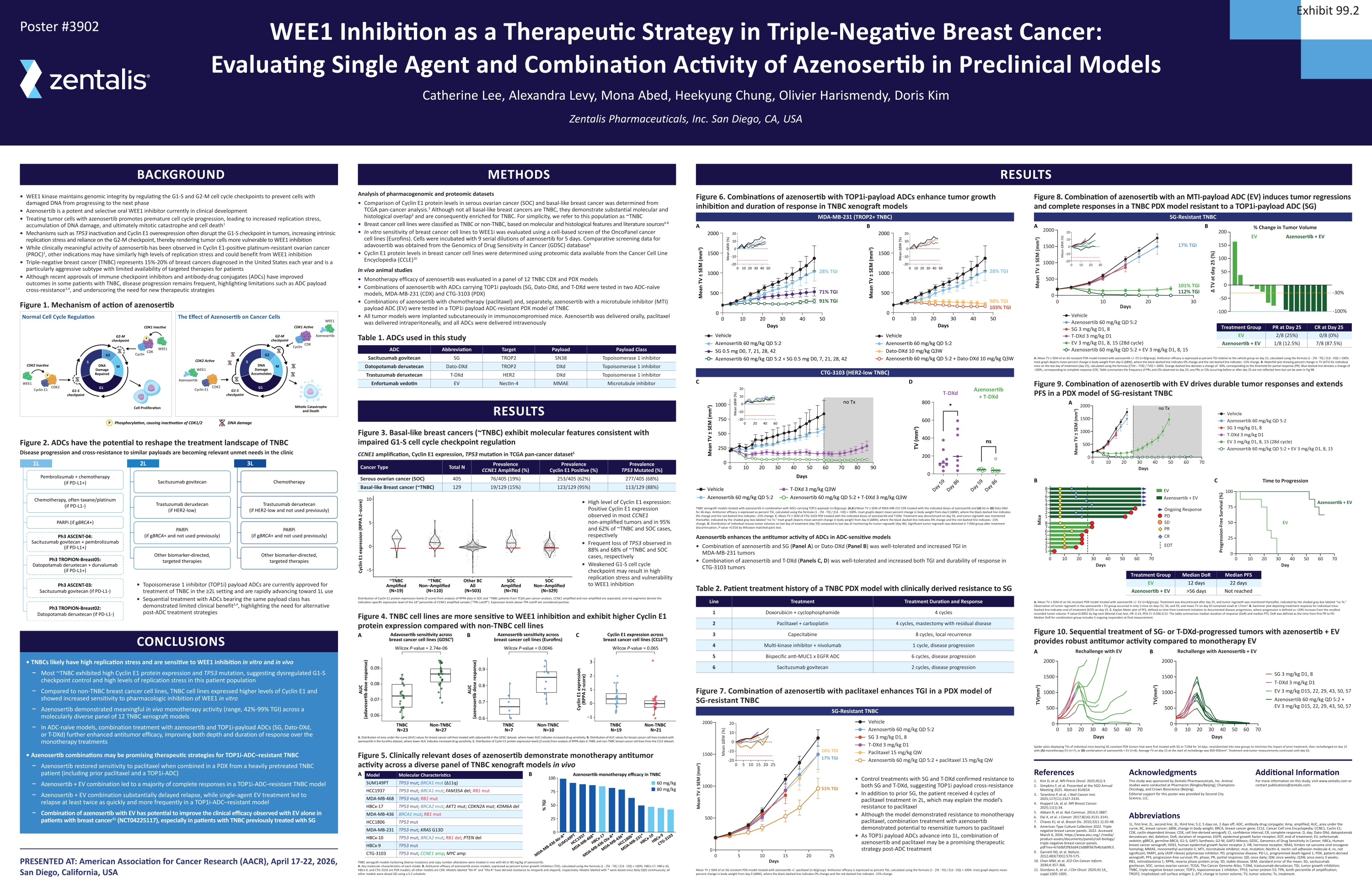
METHODS Analysis of pharmacogenomic and proteomic datasets • Comparison of Cyclin E1 protein levels in serous ovarian cancer (SOC) and basal‑like breast cancer was determined from TCGA pan‑cancer analysis.5 Although not all basal‑like breast cancers are TNBC, they demonstrate substantial molecular and histological overlap6 and are consequently enriched for TNBC. For simplicity, we refer to this population as ~TNBC • Breast cancer cell lines were classified as TNBC or non‑TNBC, based on molecular and histological features and literature sources6‑8 • In vitro sensitivity of breast cancer cell lines to WEE1i was evaluated using a cell‑based screen of the OncoPanel cancer cell lines (Eurofins). Cells were incubated with 9 serial dilutions of azenosertib for 5 days. Comparative screening data for adavosertib was obtained from the Genomics of Drug Sensitivity in Cancer (GDSC) database9 • Cyclin E1 protein levels in breast cancer cell lines were determined using proteomic data available from the Cancer Cell Line Encyclopedia (CCLE)10 In vivo animal studies • Monotherapy efficacy of azenosertib was evaluated in a panel of 12 TNBC CDX and PDX models • Combinations of azenosertib with ADCs carrying TOP1i payloads (SG, Dato‑DXd, and T‑DXd were tested in two ADC‑naïve models, MDA‑MB‑231 (CDX) and CTG‑3103 (PDX) • Combinations of azenosertib with chemotherapy (paclitaxel) and, separately, azenosertib with a microtubule inhibitor (MTI) payload ADC (EV) were tested in a TOP1i payload ADC‑resistant PDX model of TNBC • All tumor models were implanted subcutaneously in immunocompromised mice. Azenosertib was delivered orally, paclitaxel was delivered intraperitoneally, and all ADCs were delivered intravenously Table 1. ADCs used in this study ADC Abbreviation Target Payload Payload Class Sacituzumab govitecan SG TROP2 SN38 Topoisomerase 1 inhibitor Datopotamab deruxtecan Dato‑DXd TROP2 DXd Topoisomerase 1 inhibitor Trastuzumab deruxtecan T‑DXd HER2 DXd Topoisomerase 1 inhibitor Enfortumab vedotin EV Nectin‑4 MMAE Microtubule inhibitor RESULTS Figure 3. Basal‑like breast cancers (~TNBC) exhibit molecular features consistent with impaired G1‑S cell cycle checkpoint regulation CCNE1 amplification, Cyclin E1 expression, TP53 mutation in TCGA pan‑cancer dataset5 Cancer Type Total N Prevalence CCNE1 Amplified (%) Prevalence Cyclin E1 Positive (%) Prevalence TP53 Mutated (%) Serous ovarian cancer (SOC) 405 76/405 (19%) 253/405 (62%) 277/405 (68%) Basal‑like Breast cancer (~TNBC) 129 19/129 (15%) 123/129 (95%) 113/129 (88%) −5 0 5 10 ~TNBC Amplified (N=19) ~TNBC Non−Amplified (N=110) Other BC All (N=503) SOC Amplified (N=76) SOC Non−Amplified (N=329) Cy cl in E 1 ex pr es si on (R PP A Z −s co re ) • High level of Cyclin E1 expression: Positive Cyclin E1 expression observed in most CCNE1 non‑amplified tumors and in 95% and 62% of ~TNBC and SOC cases, respectively • Frequent loss of TP53 observed in 88% and 68% of ~TNBC and SOC cases, respectively • Weakened G1‑S cell cycle checkpoint may result in high replication stress and vulnerability to WEE1 inhibition Distribution of Cyclin E1 protein expression levels (Z‑score) from analysis of RPPA data in SOC and ~TNBC patients from TCGA pan‑cancer analysis. CCNE1 amplified and non‑amplified are separated, and red segments denote the indication‑specific expression level of the 10th percentile of CCNE1 amplified sample (“TPA cutoff”). Expression levels above TPA cutoff are considered positive. Figure 4. TNBC cell lines are more sensitive to WEE1 inhibition and exhibit higher Cyclin E1 protein expression compared with non‑TNBC cell lines 0.06 0.07 0.08 0.09 TNBC N=23 A U C (a da vo se rti b do se r es po ns e) Cy cl in E 1 ex pr es si on (R PP A Z -s co re ) Non-TNBC N=27 −1 0 1 2 3 TNBC N=19 Non-TNBC N=21 Wilcox P-value = 2.74e-06 Wilcox P-value = 0.065 A U C (a ze no se rti b do se r es po ns e) TNBC N=7 Non-TNBC N=10 Wilcox P-value = 0.0046 0.6 0.7 0.8 0.9 A CBAdavosertib sensitivity across breast cancer cell lines (GDSC9) Cyclin E1 expression across breast cancer cell lines (CCLE10) Azenosertib sensitivity across breast cancer cell lines (Eurofins) A. Distribution of area under the curve (AUC) values for breast cancer cell lines treated with adavosertib in the GDSC dataset, where lower AUC indicates increased drug sensitivity. B. Distribution of AUC values for breast cancer cell lines treated with azenosertib in the Eurofins dataset, where lower AUC indicates increased drug sensitivity. C. Distribution of Cyclin E1 protein expression levels (Z‑score) from analysis of RPPA data in TNBC and non‑TNBC breast cancer cell lines from the CCLE dataset. Figure 5. Clinically relevant doses of azenosertib demonstrate monotherapy antitumor activity across a diverse panel of TNBC xenograft models in vivo 100 75 50 25 0 Model Molecular Characteristics SUM149PT TP53 mut; BRCA1 mut (∆11q) HCC1937 TP53 mut; BRCA1 mut; FAM35A del; RB1 mut MDA-MB-468 TP53 mut; RB1 mut HBCx-17 TP53 mut; BRCA2 mut; AKT1 mut; CDKN2A mut; KDM6A del MDA-MB-436 BRCA1 mut; RB1 mut HCC1806 TP53 mut MDA-MB-231 TP53 mut; KRAS G13D HBCx-10 TP53 mut; BRCA2 mut; RB1 del; PTEN del HBCx-9 TP53 mut CTG-3103 TP53 mut; CCNE1 amp; MYC amp MDA-M B-436 Nir-R * % T G I SUM149PT HCC1937 MDA-M B-468* HBCx-17 MDA-M B-436 Ola-R* MDA-M B-436* HCC1806* MDA-M B-231* HBCx-10 HBCx-9 CTG-3103 60 mg/kg 80 mg/kg A B Azenosertib monotherapy efficacy in TNBC TNBC xenograft models harboring diverse mutations and copy number alterations were treated in vivo with 60 or 80 mg/kg of azenosertib. A. Key molecular characteristics of each model. B. Antitumor efficacy of azenosertib across models, expressed as percent tumor growth inhibition (TGI), calculated using the formula (1 ‑ [Td ‑ T0] / [Cd ‑ C0]) × 100%. HBCx-17, HBCx-10, HBCx-9, and CTG-3103 are PDX models; all other models are CDX. Models labeled “Nir‑R” and “Ola‑R” have derived resistance to niraparib and olaparib, respectively. Models labeled with * were dosed once daily (QD) continuously; all other models were dosed QD using a 5:2 schedule. Figure 6. Combinations of azenosertib with TOP1i‑payload ADCs enhance tumor growth inhibition and duration of response in TNBC xenograft models 0 10 20 30 40 50 -20 -10 0 10 20 M ea n ΔB W (% ) M ea n ΔB W (% ) 0 10 20 30 40 50 -20 -10 0 10 20 M ea n ΔB W (% ) 0 20 40 60 -20 -10 0 10 20 0 10 20 30 40 50 0 500 1000 1500 2000 Days M ea n TV ± S EM (m m 3 ) M ea n TV ± S EM (m m 3 ) M ea n TV ± S EM (m m 3 ) 0 10 20 30 40 50 0 500 1000 1500 2000 Days 0 10 20 30 40 50 60 70 80 90 0 250 500 750 1000 Days no Tx Day 59 Day 86 Day 59 Day 86 0 200 400 600 800 TV (m m 3 ) T-DXd Azenosertib + T-DXd * ns 28% TGI 71% TGI 91% TGI 28% TGI 98% TGI 103% TGI Vehicle Azenosertib 60 mg/kg QD 5:2 SG 0.5 mg D0, 7, 21, 28, 42 Azenosertib 60 mg/kg QD 5:2 + SG 0.5 mg D0, 7, 21, 28, 42 Vehicle Azenosertib 60 mg/kg QD 5:2 Dato-DXd 10 mg/kg Q3W Azenosertib 60 mg/kg QD 5:2 + Dato-DXd 10 mg/kg Q3W Vehicle Azenosertib 60 mg/kg QD 5:2 T-DXd 3 mg/kg Q3W Azenosertib 60 mg/kg QD 5:2 + T-DXd 3 mg/kg Q3W A B MDA-MB-231 (TROP2+ TNBC) C D CTG-3103 (HER2-low TNBC) TNBC xenograft models treated with azenosertib in combination with ADCs carrying TOP1i payloads (n=8/group). (A,B.) Mean TV ± SEM of MDA‑MB‑231 CDX treated with the indicated doses of azenosertib and (A) SG or (B) Dato‑DXd for 46 days. Antitumor efficacy is expressed as percent TGI, calculated using the formula (1 ‑ [Td ‑ T0] / [Cd ‑ C0]) × 100%. Inset graphs depict mean percent change in body weight from day 0 (∆BW), where the black dashed line indicates 0% change and the red dashed line indicates ‑15% change. C. Mean TV ± SEM of CTG‑3103 PDX treated with the indicated doses of azenosertib and T‑DXd. Treatment was discontinued on day 59, and tumor regrowth was monitored thereafter, indicated by the shaded gray box labeled “no Tx.” Inset graph depicts mean percent change in body weight from day 0 (∆BW), where the black dashed line indicates 0% change and the red dashed line indicates ‑15% change. D. Distribution of individual mouse tumor volumes on last day of treatment (day 59) compared to last day of monitoring for tumor regrowth (day 86). Significant tumor regrowth was detected in T‑DXd group after treatment discontinuation, P value <0.016 by Wilcoxon matched‑pairs test. Azenosertib enhances the antitumor activity of ADCs in ADC‑sensitive models • Combination of azenosertib and SG (Panel A) or Dato‑DXd (Panel B) was well‑tolerated and increased TGI in MDA‑MB‑231 tumors • Combination of azenosertib and T‑DXd (Panels C, D) was well‑tolerated and increased both TGI and durability of response in CTG‑3103 tumors Table 2. Patient treatment history of a TNBC PDX model with clinically derived resistance to SG Line Treatment Treatment Duration and Response 1 Doxorubicin + cyclophosphamide 4 cycles 2 Paclitaxel + carboplatin 4 cycles, mastectomy with residual disease 3 Capecitabine 8 cycles, local recurrence 4 Multi‑kinase inhibitor + nivolumab 1 cycle, disease progression 5 Bispecific anti‑MUC1 x EGFR ADC 6 cycles, disease progression 6 Sacituzumab govitecan 2 cycles, disease progression Figure 7. Combination of azenosertib with paclitaxel enhances TGI in a PDX model of SG‑resistant TNBC 0 5 10 15 20 25 -20 -10 0 10 20 M ea n ΔB W (% ) 0 5 10 15 20 25 0 500 1000 1500 2000 Days 16% TGI 17% TGI 51% TGI M ea n TV ± S EM (m m 3 ) Vehicle Azenosertib 60 mg/kg QD 5:2 SG 3 mg/kg D1, 8 T-DXd 3 mg/kg D1 Paclitaxel 15 mg/kg QW Azenosertib 60 mg/kg QD 5:2 + paclitaxel 15 mg/kg QW SG-Resistant TNBC • Control treatments with SG and T‑DXd confirmed resistance to both SG and T‑DXd, suggesting TOP1i payload cross‑resistance • In addition to prior SG, the patient received 4 cycles of paclitaxel treatment in 2L, which may explain the model’s resistance to paclitaxel • Although the model demonstrated resistance to monotherapy paclitaxel, combination treatment with azenosertib demonstrated potential to resensitize tumors to paclitaxel • As TOP1i payload ADCs advance into 1L, combination of azenosertib and paclitaxel may be a promising therapeutic strategy post‑ADC treatment Mean TV ± SEM of an SG‑resistant PDX model treated with azenosertib +/‑ paclitaxel (n=8/group). Antitumor efficacy is expressed as percent TGI, calculated using the formula (1 ‑ [Td ‑ T0] / [Cd ‑ C0]) × 100%. Inset graph depicts mean percent change in body weight from day 0 (∆BW), where the black dashed line indicates 0% change and the red dashed line indicates ‑15% change. Figure 8. Combination of azenosertib with an MTI‑payload ADC (EV) induces tumor regressions and complete responses in a TNBC PDX model resistant to a TOP1i‑payload ADC (SG) 0 10 20 30 -20 -10 0 10 20 M ea n ΔB W (% ) M ea n TV ± S EM (m m 3 ) 0 10 20 17% TGI 101% TGI 112% TGI 30 0 500 1000 1500 2000 Days -100 Treatment Group PR at Day 25 CR at Day 25 EV 2/8 (25%) 0/8 (0%) Azenosertib + EV 1/8 (12.5%) 7/8 (87.5%) -50 0 50 100 150 200 % Change in Tumor Volume Δ T V a t da y 25 (% ) -30% -100% EV Azenosertib + EV Vehicle Azenosertib 60 mg/kg QD 5:2 SG 3 mg/kg D1, 8 T-DXd 3 mg/kg D1 EV 3 mg/kg D1, 8, 15 (28d cycle) Azenosertib 60 mg/kg QD 5:2 + EV 3 mg/kg D1, 8, 15 BA SG-Resistant TNBC A. Mean TV ± SEM of an SG‑resistant PDX model treated with azenosertib +/‑ EV (n=8/group). Antitumor efficacy is expressed as percent TGI relative to the vehicle group on day 22, calculated using the formula (1 ‑ [Td ‑ T0] / [Cd ‑ C0]) × 100%. Inset graph depicts mean percent change in body weight from day 0 (∆BW), where the black dashed line indicates 0% change and the red dashed line indicates ‑15% change. B. Waterfall plot showing percent change in TV (∆TV) for individual mice on the last day of treatment (day 25), calculated using the formula ([TVd – TV0] / TV0) × 100%. Orange dashed line denotes a change of ‑30%, corresponding to the threshold for partial response (PR). Blue dashed line denotes a change of ‑100%, corresponding to complete response (CR). Table summarizes the frequency of PRs and CRs observed on day 25; any PRs or CRs occurring before or after day 25 are not reflected here but can be seen in Fig 9B. Figure 9. Combination of azenosertib with EV drives durable tumor responses and extends PFS in a PDX model of SG‑resistant TNBC M ea n TV ± S EM (m m 3 ) Treatment Group Median DoR Median PFS EV 12 days 22 days Azenosertib + EV >56 days Not reached 0 10 20 30 40 50 60 70 0 500 1000 1500 2000 Days no Tx 0 10 20 30 40 50 60 70 0 25 50 75 100 Time to Progression Day Pr og re ss io n- Fr ee S ur vi va l ( % ) 0 10 20 30 40 50 60 70 1 2 3 4 5 6 7 8 1 2 3 4 5 6 7 8 Days M ic e Vehicle Azenosertib 60 mg/kg QD 5:2 SG 3 mg/kg D1, 8 T-DXd 3 mg/kg D1 EV 3 mg/kg D1, 8, 15 (28d cycle) Azenosertib 60 mg/kg QD 5:2 + EV 3 mg/kg D1, 8, 15 EV Azenosertib + EV Azenosertib + EV EV PD SD PR CR Ongoing Response EOT A CB A. Mean TV ± SEM of an SG‑resistant PDX model treated with azenosertib +/‑ EV (n=8/group). Treatment was discontinued after day 25, and tumor regrowth was monitored thereafter, indicated by the shaded gray box labeled “no Tx.” Observation of tumor regrowth in the azenosertib + EV group occurred in only 3 mice on days 52, 56, and 59, and mean TV on day 63 remained small at 17mm3. B. Swimmer plot depicting treatment response for individual mice. Dashed line indicates end of treatment (EOT) on day 25. C. Kaplan‑Meier plot of PFS, defined as time from treatment initiation to documented disease progression, where progression is defined as >20% increase from the smallest recorded tumor volume: P value<0.0001 by log‑rank (Mantel‑Cox) test, HR: 0.14, 95% CI: 0.036‑0.52. The table summarizes median duration of response (DoR) and median PFS. DoR was defined as the time from first PR to PD. Median DoR for combination group includes 5 ongoing responders at final measurement. Figure 10. Sequential treatment of SG‑ or T‑DXd‑progressed tumors with azenosertib + EV provides robust antitumor activity compared to monotherapy EV TV (m m 3 ) TV (m m 3 ) 0 10 20 30 40 50 60 70 0 500 1000 1500 2000 Rechallenge with EV Days 0 10 20 30 40 50 60 70 0 500 1000 1500 2000 Rechallenge with Azenosertib + EV Days SG 3 mg/kg D1, 8 T-DXd 3 mg/kg D1 EV 3 mg/kg D15, 22, 29, 43, 50, 57 Azenosertib 60 mg/kg QD 5:2 + EV 3 mg/kg D15, 22, 29, 43, 50, 57 A B Spider plots displaying TVs of individual mice bearing SG‑resistant PDX tumors that were first treated with SG or T‑DXd for 14 days, rerandomized into new groups to minimize the impact of prior treatment, then rechallenged on day 15 with (A) monotherapy EV (n=7), or (B) combination of azenosertib + EV (n=8). Average TV on day 15 at the start of rechallenge was 850‑950mm3. Treatment and tumor measurements continued until day 63. RESULTSBACKGROUND • WEE1 kinase maintains genomic integrity by regulating the G1‑S and G2‑M cell cycle checkpoints to prevent cells with damaged DNA from progressing to the next phase • Azenosertib is a potent and selective oral WEE1 inhibitor currently in clinical development • Treating tumor cells with azenosertib promotes premature cell cycle progression, leading to increased replication stress, accumulation of DNA damage, and ultimately mitotic catastrophe and cell death1 • Mechanisms such as TP53 inactivation and Cyclin E1 overexpression often disrupt the G1‑S checkpoint in tumors, increasing intrinsic replication stress and reliance on the G2‑M checkpoint, thereby rendering tumor cells more vulnerable to WEE1 inhibition • While clinically meaningful activity of azenosertib has been observed in Cyclin E1‑positive platinum‑resistant ovarian cancer (PROC)2, other indications may have similarly high levels of replication stress and could benefit from WEE1 inhibition • Triple‑negative breast cancer (TNBC) represents 15%‑20% of breast cancers diagnosed in the United States each year and is a particularly aggressive subtype with limited availability of targeted therapies for patients • Although recent approvals of immune checkpoint inhibitors and antibody‑drug conjugates (ADCs) have improved outcomes in some patients with TNBC, disease progression remains frequent, highlighting limitations such as ADC payload cross‑resistance3,4, and underscoring the need for new therapeutic strategies Figure 1. Mechanism of action of azenosertib DNA damagePhosphorylation, causing inactivation of CDK1/2 Cyclin E1 CDK2 G2 M G1 S G1-S checkpoint G2-M checkpoint Cyclin CDK WEE1 CDK2 Inactive CDK1 Inactive WEE1 Cell Proliferation DNA Damage Repaired G2 M G1 S G1-S checkpoint G2-M checkpoint Cyclin E1 CDK2 Cyclin CDK Azenosertib Azenosertib WEE1 CDK2 Active CDK1 Active WEE1 Mitotic Catastrophe and Death DNA Damage Accumulates Normal Cell Cycle Regulation The Effect of Azenosertib on Cancer Cells Figure 2. ADCs have the potential to reshape the treatment landscape of TNBC Disease progression and cross‑resistance to similar payloads are becoming relevant unmet needs in the clinic 1L Pembrolizumab + chemotherapy (if PD-L1+) Chemotherapy, often taxane/platinum (if PD-L1-) PARPi (if gBRCA+) Ph3 ASCENT-04: Sacituzumab govitecan + pembrolizumab (if PD-L1+) Ph3 TROPION-Breast05: Datopotamab deruxtecan + durvalumab (if PD-L1+) Ph3 ASCENT-03: Sacituzumab govitecan (if PD-L1-) Ph3 TROPION-Breast02: Datopotamab deruxtecan (if PD-L1-) 2L Sacituzumab govitecan Trastuzumab deruxtecan (if HER2-low) PARPi (if gBRCA+ and not used previously) Other biomarker-directed, targeted therapies 3L Chemotherapy Trastuzumab deruxtecan (if HER2-low and not used previously) PARPi (if gBRCA+ and not used previously) Other biomarker-directed, targeted therapies • Topoisomerase 1 inhibitor (TOP1i) payload ADCs are currently approved for treatment of TNBC in the ≥2L setting and are rapidly advancing toward 1L use • Sequential treatment with ADCs bearing the same payload class has demonstrated limited clinical benefit3,4, highlighting the need for alternative post‑ADC treatment strategies CONCLUSIONS • TNBCs likely have high replication stress and are sensitive to WEE1 inhibition in vitro and in vivo – Most ~TNBC exhibited high Cyclin E1 protein expression and TP53 mutation, suggesting dysregulated G1‑S checkpoint control and high levels of replication stress in this patient population – Compared to non‑TNBC breast cancer cell lines, TNBC cell lines expressed higher levels of Cyclin E1 and showed increased sensitivity to pharmacologic inhibition of WEE1 in vitro – Azenosertib demonstrated meaningful in vivo monotherapy activity (range, 42%‑99% TGI) across a molecularly diverse panel of 12 TNBC xenograft models – In ADC‑naïve models, combination treatment with azenosertib and TOP1i‑payload ADCs (SG, Dato‑DXd, or T‑DXd) further enhanced antitumor efficacy, improving both depth and duration of response over the monotherapy treatments • Azenosertib combinations may be promising therapeutic strategies for TOP1i‑ADC–resistant TNBC – Azenosertib restored sensitivity to paclitaxel when combined in a PDX from a heavily pretreated TNBC patient (including prior paclitaxel and a TOP1i‑ADC) – Azenosertib + EV combination led to a majority of complete responses in a TOP1i‑ADC–resistant TNBC model – Azenosertib + EV combination substantially delayed relapse, while single‑agent EV treatment led to relapse at least twice as quickly and more frequently in a TOP1i‑ADC–resistant model – Combination of azenosertib with EV has potential to improve the clinical efficacy observed with EV alone in patients with breast cancer11 (NCT04225117), especially in patients with TNBC previously treated with SG References 1. Kim D, et al. NPJ Precis Oncol. 2025;9(1):3. 2. Simpkins F, et al. Presented at the SGO Annual Meeting 2025. Abstract 814654. 3. Tarantino P, et al. J Natl Cancer Inst. 2025;117(11):2327‑2335. 4. Huppert LA, et al. NPJ Breast Cancer. 2025;11(1):34. 5. Akbani R, et al. Nat Commun. 2014;5:3887. 6. Dai X, et al. J Cancer. 2017;8(16):3131‑3141. 7. Chavez KJ, et al. Breast Dis. 2010;32(1‑2):35‑48. 8. American Type Culture Collection 2022. Triple negative breast cancer panels. 2022. Accessed March 6, 2026. https://www.atcc.org/‑/media/ product‑assets/documents/panels/cell‑biology/ triple‑negative‑breast‑cancer‑panels. pdf?rev=67ddbf2f83dd415d88f367b4b3ab9fc3 . 9. Garnett MJ, et al. Nature. 2012;483(7391):570‑575. 10. Chen MM, et al. JCO Clin Cancer Inform. 2030;4:357‑366. 11. Giordano A, et al. J Clin Oncol. 2024;42:16_ suppl:1005‑1005. Acknowledgments This study was sponsored by Zentalis Pharmaceuticals, Inc. Animal studies were conducted at Pharmaron (Ningbo/Beijing), Champions Oncology, and Crown Bioscience (Beijing). Editorial support for this poster was provided by Second City Science, LLC. Additional Information For more information on this study, visit www.zentalis.com or contact publications@zentalis.com. Abbreviations 1L, first line; 2L, second line; 3L, third line; 5:2, 5 days on, 2 days off; ADC, antibody‑drug conjugate; Amp, amplified; AUC, area under the curve; BC, breast cancer; ∆BW, change in body weight; BRCA, breast cancer gene; CCLE, Cancer Cell Line Encyclopedia; CCNE1, Cyclin E1; CDK, cyclin‑dependent kinase; CDX, cell line‑derived xenograft; CI, confidence interval; CR, complete response; D, day; Dato‑DXd, datopotamab deruxtecan; del, deletion; DoR, duration of response; EGFR, epidermal growth factor receptor; EOT, end of treatment; EV, enfortumab vedotin; gBRCA, germline BRCA; G1‑S, GAP1‑Synthesis; G2‑M, GAP2‑Mitosis; GDSC, Genomics of Drug Sensitivity in Cancer; HBCx, Human breast cancer xenograft; HER2, human epidermal growth factor receptor 2; HR, hormone receptor; KRAS, Kirsten rat sarcoma viral oncogene homolog; MMAE, monomethyl auristatin E; MTI, microtubule inhibitor; mut, mutation; Nectin‑4, nectin cell adhesion molecule 4; ns, not significant; PARPi, poly (ADP‑ribose) polymerase inhibitor; PD, progressive disease; PD‑L1, programmed death‑ligand 1; PDX, patient‑derived xenograft; PFS; progression‑free survival; Ph, phase; PR, partial response; QD, once daily; QW, once weekly; Q3W, once every 3 weeks; RB1, retinoblastoma 1; RPPA, reverse phase protein array; SD, stable disease; SEM, standard error of the mean; SG, sacituzumab govitecan; SOC, serous ovarian cancer; TCGA, The Cancer Genome Atlas; T‑DXd, trastuzumab deruxtecan; TGI, tumor growth inhibition; TNBC, triple‑negative breast cancer; TOP1i, topoisomerase 1 inhibitor; TP53, tumor protein 53; TPA, tenth percentile of amplification; TROP2, trophoblast cell surface antigen 2; ∆TV, change in tumor volume; TV, tumor volume; Tx, treatment. PRESENTED AT: American Association for Cancer Research (AACR), April 17‑22, 2026, San Diego, California, USA Poster #3902 WEE1 Inhibition as a Therapeutic Strategy in Triple‑Negative Breast Cancer: Evaluating Single Agent and Combination Activity of Azenosertib in Preclinical Models Catherine Lee, Alexandra Levy, Mona Abed, Heekyung Chung, Olivier Harismendy, Doris Kim Zentalis Pharmaceuticals, Inc. San Diego, CA, USA .2