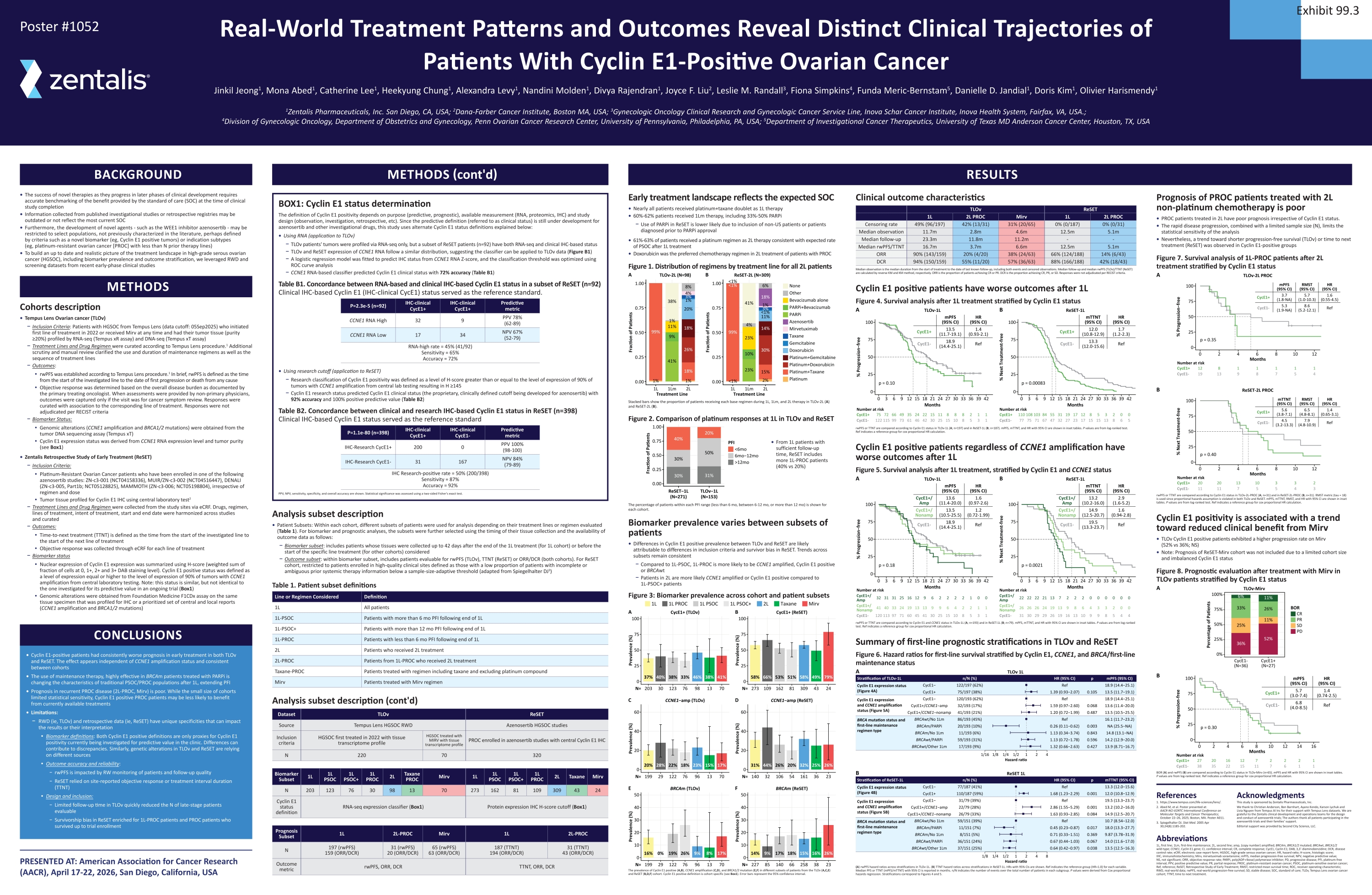
METHODS (cont'd) BOX1: Cyclin E1 status determination The definition of Cyclin E1 positivity depends on purpose (predictive, prognostic), available measurement (RNA, proteomics, IHC) and study design (observation, investigation, retrospective, etc). Since the predictive definition (referred to as clinical status) is still under development for azenosertib and other investigational drugs, this study uses alternate Cyclin E1 status definitions explained below: • Using RNA (application to TLOv) – TLOv patients' tumors were profiled via RNA‑seq only, but a subset of ReSET patients (n=92) have both RNA‑seq and clinical IHC‑based status – TLOv and ReSET expression of CCNE1 RNA follow a similar distribution, suggesting the classifier can be applied to TLOv data (Figure B1) – A logistic regression model was fitted to predict IHC status from CCNE1 RNA Z‑score, and the classification threshold was optimized using ROC curve analysis – CCNE1 RNA‑based classifier predicted Cyclin E1 clinical status with 72% accuracy (Table B1) Table B1. Concordance between RNA‑based and clinical IHC‑based Cyclin E1 status in a subset of ReSET (n=92) Clinical IHC‑based Cyclin E1 (IHC‑clinical CycE1) status served as the reference standard. P=2.3e‑5 (n=92) IHC‑clinical CycE1+ IHC‑clinical CycE1+ Predictive metric CCNE1 RNA High 32 9 PPV 78% (62‑89) CCNE1 RNA Low 17 34 NPV 67% (52‑79) RNA‑high rate = 45% (41/92) Sensitivity = 65% Accuracy = 72% • Using research cutoff (application to ReSET) – Research classification of Cyclin E1 positivity was defined as a level of H‑score greater than or equal to the level of expression of 90% of tumors with CCNE1 amplification from central lab testing resulting in H ≥145 – Cyclin E1 research status predicted Cyclin E1 clinical status (the proprietary, clinically defined cutoff being developed for azenosertib) with 92% accuracy and 100% positive predictive value (Table B2) Table B2. Concordance between clinical and research IHC‑based Cyclin E1 status in ReSET (n=398) Clinical IHC‑based Cyclin E1 status served as the reference standard P=1.1e‑80 (n=398) IHC‑clinical CycE1+ IHC‑clinical CycE1‑ Predictive metric IHC‑Research CycE1+ 200 0 PPV 100% (98‑100) IHC‑Research CycE1‑ 31 167 NPV 84% (79‑89) IHC Research‑positive rate = 50% (200/398) Sensitivity = 87% Accuracy = 92% PPV, NPV, sensitivity, specificity, and overall accuracy are shown. Statistical significance was assessed using a two‑sided Fisher's exact test. Analysis subset description • Patient Subsets: Within each cohort, different subsets of patients were used for analysis depending on their treatment lines or regimen evaluated (Table 1). For biomarker and prognostic analyses, the subsets were further selected using the timing of their tissue collection and the availability of outcome data as follows: – Biomarker subset: includes patients whose tissues were collected up to 42 days after the end of the 1L treatment (for 1L cohort) or before the start of the specific line treatment (for other cohorts) considered – Outcome subset: within biomarker subset, includes patients evaluable for rwPFS (TLOv), TTNT (ReSET) or ORR/DCR (both cohorts). For ReSET cohort, restricted to patients enrolled in high‑quality clinical sites defined as those with a low proportion of patients with incomplete or ambiguous prior systemic therapy information below a sample‑size‑adaptive threshold (adapted from Spiegelhalter DJ3) Table 1. Patient subset definitions Line or Regimen Considered Definition 1L All patients 1L‑PSOC Patients with more than 6 mo PFI following end of 1L 1L‑PSOC+ Patients with more than 12 mo PFI following end of 1L 1L‑PROC Patients with less than 6 mo PFI following end of 1L 2L Patients who received 2L treatment 2L‑PROC Patients from 1L‑PROC who received 2L treatment Taxane‑PROC Patients treated with regimen including taxane and excluding platinum compound Mirv Patients treated with Mirv regimen Analysis subset description (cont'd) Dataset TLOv ReSET Source Tempus Lens HGSOC RWD Azenosertib HGSOC studies Inclusion criteria HGSOC first treated in 2022 with tissue transcriptome profile HGSOC treated with MIRV with tissue transcriptome profile PROC enrolled in azenosertib studies with central Cyclin E1 IHC N 220 70 320 Biomarker Subset 1L 1L PSOC 1L PSOC+ 1L PROC 2L Taxane PROC Mirv 1L 1L PSOC 1L PSOC+ 1L PROC 2L Taxane Mirv N 203 123 76 30 98 13 70 273 162 81 109 309 43 24 Cyclin E1 status definition RNA‑seq expression classifier (Box1) Protein expression IHC H‑score cutoff (Box1) Prognosis Subset 1L 2L‑PROC Mirv 1L 2L‑PROC N 197 (rwPFS) 159 (ORR/DCR) 31 (rwPFS) 20 (ORR/DCR) 65 (rwPFS) 63 (ORR/DCR) 187 (TTNT) 194 (ORR/DCR) 31 (TTNT) 43 (ORR/DCR) Outcome metric rwPFS, ORR, DCR TTNT, ORR, DCR Early treatment landscape reflects the expected SOC • Nearly all patients received platinum+taxane doublet as 1L therapy • 60%‑62% patients received 1Lm therapy, including 33%‑50% PARPi – Use of PARPi in ReSET is lower likely due to inclusion of non‑US patients or patients diagnosed prior to PARPi approval • 61%‑63% of patients received a platinum regimen as 2L therapy consistent with expected rate of PSOC after 1L treatment • Doxorubicin was the preferred chemotherapy regimen in 2L treatment of patients with PROC Figure 1. Distribution of regimens by treatment line for all 2L patients 1% 99% 11% 38% 1% 41% 9% 20% 1% 4% 8% 1% 26% 18% 18% 3% 18% 23% 11% <1% 1%41% 4% 6% 23% 10% 2% <1% <1% <1% 30% 14% 99% 15% 3% 0.00 0.25 0.50 0.75 1.00 0.00 0.25 0.50 0.75 1.00 1L 1Lm 2L Treatment Line Treatment Line Fr ac ti on o f P ati en ts Fr ac ti on o f P ati en ts 1L 1Lm 2L None Other Bevacizumab alone PARPi+Bevacizumab PARPi Azenosertib Mirvetuximab Taxane Gemcitabine Doxorubicin Platinum+Gemcitabine Platinum+Doxorubicin Platinum+Taxane Platinum TLOv-2L (N=98) ReSET-2L (N=309)A B Stacked bars show the proportion of patients receiving each base regimen during 1L, 1Lm, and 2L therapy in TLOv‑2L (A) and ReSET‑2L (B). Figure 2. Comparison of platinum responses at 1L in TLOv and ReSET 20% 50% 31% 40% 30% 30% 0.00 0.25 0.50 0.75 1.00 Fr ac ti on o f P ati en ts ReSET−1L (N=271) TLOv−1L (N=153) PFI <6mo 6mo−12mo >12mo • From 1L patients with sufficient follow‑up time, ReSET includes more 1L‑PROC patients (40% vs 20%) The percentage of patients within each PFI range (less than 6 mo, between 6‑12 mo, or more than 12 mo) is shown for each cohort. Biomarker prevalence varies between subsets of patients • Differences in Cyclin E1 positive prevalence between TLOv and ReSET are likely attributable to differences in inclusion criteria and survivor bias in ReSET. Trends across subsets remain consistent – Compared to 1L‑PSOC, 1L‑PROC is more likely to be CCNE1 amplified, Cyclin E1 positive or BRCAwt – Patients in 2L are more likely CCNE1 amplified or Cyclin E1 positive compared to 1L‑PSOC+ patients Figure 3: Biomarker prevalence across cohort and patient subsets 37% 38% 33%40% 46% 38% 41% 58% 53% 51%66% 58% 49% 79% 20% 22% 18%28% 23% 15% 17% 31% 26% 20%44% 32% 25% 26% 16% 19% 26%0% 9% 8% 17% 14% 17% 18%9% 15% 16% 26% 0 25 50 75 100 Pr ev al en ce (% ) 203N= 123 7630 98 13 70 0 25 50 75 100 Pr ev al en ce (% ) N= 0 20 40 60 Pr ev al en ce (% ) N= Pr ev al en ce (% ) N= 0 10 20 30 40 50 Pr ev al en ce (% ) N= Pr ev al en ce (% ) N= 0 20 40 60 0 10 20 30 40 50 273 162 81109 309 43 24 199 122 7629 96 13 70 140 106 5432 161 36 23 199 122 7629 96 13 70 227 140 6685 258 38 23 1L 1L PROC 1L PSOC 1L PSOC+ 2L Taxane Mirv A B C D E F CycE1+ (TLOv) CycE1+ (ReSET) CCNE1−amp (TLOv) CCNE1−amp (ReSET) BRCAm (TLOv) BRCAm (ReSET) The prevalence of Cyclin E1 positive (A,B), CCNE1 amplification (C,D), and BRCA1/2 mutation (E,F) in different subsets of patients from the TLOv (A,C,E) and ReSET (B,D,F) cohort. Cyclin E1 positive definition is cohort specific (see Box1). Error bars represent the 95% confidence interval. Clinical outcome characteristics TLOv ReSET 1L 2L PROC Mirv 1L 2L PROC Censoring rate 49% (96/197) 42% (13/31) 31% (20/65) 0% (0/187) 0% (0/31) Median observation 11.7m 2.8m 4.6m 12.5m 5.1m Median follow‑up 23.3m 11.8m 11.2m ‑ ‑ Median rwPFS/TTNT 16.7m 3.7m 6.6m 12.5m 5.1m ORR 90% (143/159) 20% (4/20) 38% (24/63) 66% (124/188) 14% (6/43) DCR 94% (150/159) 55% (11/20) 57% (36/63) 88% (166/188) 42% (18/43) Median observation is the median duration from the start of treatment to the date of last known follow‑up, including both events and censored observations. Median follow‑up and median rwPFS (TLOv)/TTNT (ReSET) are calculated by reverse KM and KM method, respectively. ORR is the proportion of patients achieving CR or PR. DCR is the proportion achieving CR, PR, or SD. Responses were not adjudicated per RECIST criteria. Cyclin E1 positive patients have worse outcomes after 1L Figure 4. Survival analysis after 1L treatment stratified by Cyclin E1 status 75 72 66 49 35 24 22 15 11 8 8 8 2 1 1 122 115 99 73 61 46 42 30 25 15 10 8 5 3 1 110 108 103 84 55 31 19 17 12 8 5 3 2 0 0 77 75 71 67 47 32 27 23 17 15 15 13 8 6 5CycE1- CycE1+ Number at risk CycE1- CycE1+ Number at risk p = 0.10 0 25 50 75 100 0 3 6 9 12 15 18 21 24 27 30 33 36 39 42 Months % P ro gr es si on −f re e p = 0.00083 0 25 50 75 100 0 3 6 9 12 15 18 21 24 27 30 33 36 39 42 Months % N ex t T re at m en t- fr ee TLOv-1L ReSET-1L mPFS (95% CI) HR (95% CI) CycE1+ 13.5 (11.7-19.1) 1.4 (0.93-2.1) CycE1- 18.9 (14.4-25.1) Ref mTTNT (95% CI) HR (95% CI) CycE1+ 12.0 (10.8-12.9) 1.7 (1.2-2.3) CycE1- 13.3 (12.0-15.6) Ref A B rwPFS or TTNT are compared according to Cyclin E1 status in TLOv‑1L (A; n=197) and in ReSET‑1L (B; n=187). mPFS, mTTNT, and HR with 95% CI are shown in inset tables. P values are from log‑ranked test. Ref indicates a reference group for cox proportional HR calculation. Cyclin E1 positive patients regardless of CCNE1 amplification have worse outcomes after 1L Figure 5. Survival analysis after 1L treatment, stratified by Cyclin E1 and CCNE1 status CycE1+/ Nonamp CycE1- CycE1+/ Amp CycE1+/ Nonamp CycE1- CycE1+/ Amp Number at risk Number at risk 32 31 31 25 16 12 9 6 2 2 2 2 1 0 0 41 40 33 24 19 13 13 9 9 6 4 2 2 1 1 120 113 97 71 60 45 41 30 25 15 10 8 5 3 1 22 22 22 21 13 7 2 2 2 0 0 0 0 0 0 26 26 26 24 19 13 9 8 6 4 3 3 2 0 0 31 30 29 29 26 19 16 13 10 9 9 8 5 4 4 0 25 50 75 100 0 3 6 9 12 15 18 21 24 27 30 33 36 39 42 Months 0 25 50 75 100 0 3 6 9 12 15 18 21 24 27 30 33 36 39 42 Months p = 0.18 p = 0.0021 TLOv-1L ReSET-1L % P ro gr es si on −f re e % N ex t T re at m en t- fr ee mPFS (95% CI) HR (95% CI) CycE1+/ Amp 13.6 (11.4-20.0) 1.6 (0.97-2.6) CycE1+/ Nonamp 13.5 (10.5-25.5) 1.2 (0.72-1.99) mTTNT (95% CI) HR (95% CI) CycE1+/ Amp 13.2 (10.2-16.0) 2.9 (1.6-5.2) CycE1+/ Nonamp 14.9 (12.5-20.7) 1.6 (0.94-2.8) CycE1- 18.9 (14.4-25.1) Ref CycE1- 19.5 (13.3-23.7) Ref A B rwPFS or TTNT are compared according to Cyclin E1 and CCNE1 status in TLOv‑1L (A; n=193) and in ReSET‑1L (B; n=79). mPFS, mTTNT, and HR with 95% CI are shown in inset tables. P values are from log‑ranked test. Ref indicates a reference group for cox proportional HR calculation. Summary of first‑line prognostic stratifications in TLOv and ReSET Figure 6. Hazard ratios for first‑line survival stratified by Cyclin E1, CCNE1, and BRCA /first‑line maintenance status Hazard ratio Hazard ratio 1/16 1/8 1/4 1/2 1 2 4 1/8 1/4 1/2 1 2 4 8 Ref 1.39 (0.93−2.07) Ref 1.59 (0.97−2.60) 1.20 (0.72−1.99) Ref 0.26 (0.11−0.62) 1.13 (0.34−3.74) 1.13 (0.72−1.78) 1.32 (0.66−2.63) 0.105 0.068 0.487 0.003 0.843 0.596 0.427 18.9 (14.4−25.1) 13.5 (11.7−19.1) 18.9 (14.4−25.1) 13.6 (11.4−20.0) 13.5 (10.5−25.5) 16.1 (11.7−23.2) NA (25.5−NA) 14.8 (13.1−NA) 14.2 (12.9−20.0) 13.9 (8.71−16.7) Cyclin E1 expression status (Figure 4A) Cyclin E1 expression and CCNE1 amplification status (Figure 5A) Cyclin E1 expression status (Figure 4B) Cyclin E1 expression and CCNE1 amplification status (Figure 5B) BRCA mutation status and first-line maintenance regimen type BRCA mutation status and first-line maintenance regimen type CycE1− CycE1+ CycE1− CycE1+/CCNE1−amp CycE1+/CCNE1−nonamp BRCAwt/No 1Lm BRCAm/PARPi BRCAm/No 1Lm BRCAwt/PARPi BRCAwt/Other 1Lm CycE1− CycE1+ CycE1− CycE1+/CCNE1−amp CycE1+/CCNE1−nonamp BRCAwt/No 1Lm BRCAm/PARPi BRCAm/No 1Lm BRCAwt/PARPi BRCAwt/Other 1Lm 122/197 (62%) 75/197 (38%) 120/193 (62%) 32/193 (17%) 41/193 (21%) 86/193 (45%) 20/193 (10%) 11/193 (6%) 59/193 (31%) 17/193 (9%) 77/187 (41%) 110/187 (59%) 31/79 (39%) 22/79 (28%) 26/79 (33%) 59/151 (39%) 11/151 (7%) 8/151 (5%) 36/151 (24%) 37/151 (25%) Ref 1.68 (1.23−2.29) Ref 2.86 (1.55−5.29) 1.63 (0.93−2.85) Ref 0.45 (0.23−0.87) 0.71 (0.33−1.51) 0.67 (0.44−1.03) 0.64 (0.42−0.97) 0.001 0.001 0.084 0.017 0.369 0.067 0.038 13.3 (12.0−15.6) 12.0 (10.8−12.9) 19.5 (13.3−23.7) 13.2 (10.2−16.0) 14.9 (12.5−20.7) 10.7 (8.54−12.0) 18.0 (13.3−27.7) 9.87 (3.78−31.9) 14.0 (11.6−17.0) 13.5 (12.5−16.3) Stratification of TLOv-1L n/N (%) HR (95% CI) p mPFS (95% CI) Stratification of ReSET-1L n/N (%) HR (95% CI) p mTTNT (95% CI) TLOv 1L ReSET 1L A B (A) rwPFS hazard ratios across stratifications in TLOv‑1L. (B) TTNT hazard ratios across stratifications in ReSET‑1L. HRs with 95% CIs are shown. Ref indicates the reference group (HR=1.0) for each variable. Median PFS or TTNT (mPFS/mTTNT) with 95% CI is reported in months. n/N indicates the number of events over the total number of patients in each subgroup. P values were derived from Cox proportional hazards regression. Stratifications correspond to Figures 4 and 5. Prognosis of PROC patients treated with 2L non‑platinum chemotherapy is poor • PROC patients treated in 2L have poor prognosis irrespective of Cyclin E1 status. • The rapid disease progression, combined with a limited sample size (N), limits the statistical sensitivity of the analysis • Nevertheless, a trend toward shorter progression‑free survival (TLOv) or time to next treatment (ReSET) was observed in Cyclin E1-positive groups Figure 7. Survival analysis of 1L‑PROC patients after 2L treatment stratified by Cyclin E1 status CycE1- CycE1+ Number at risk CycE1- CycE1+ Number at risk 12 8 1 1 1 1 1 19 13 9 8 7 5 4 20 20 13 10 3 3 2 11 11 7 5 5 4 3 0 25 50 75 100 0 2 4 6 8 12 Months % P ro gr es si on −f re e 0 25 50 75 100 0 2 4 6 8 10 10 12 Months % N ex t T re at m en t- fr ee p = 0.35 p = 0.40 TLOv-2L PROC ReSET-2L PROC mPFS (95% CI) RMST (95% CI) HR (95% CI) CycE1+ 3.7 (1.8-NA) 5.7 (1.0-10.3) 1.6 (0.55-4.5) CycE1- 5.3 (1.9-NA) 8.6 (5.2-12.1) Ref mTTNT (95% CI) RMST (95% CI) HR (95% CI) CycE1+ 5.6 (3.8-7.1) 6.5 (4.8-8.1) 1.4 (0.65-3.1) CycE1- 4.5 (3.2-13.3) 7.9 (4.8-10.9) Ref A B rwPFS or TTNT are compared according to Cyclin E1 status in TLOv‑2L‑PROC (A; n=31) and in ReSET‑2L‑PROC (B; n=31). RMST metric (tau = 18) is used since proportional hazards assumption is violated in both TLOv and ReSET. mPFS, mTTNT, RMST, and HR with 95% CI are shown in inset tables. P values are from log‑ranked test. Ref indicates a reference group for cox proportional HR calculation. Cyclin E1 positivity is associated with a trend toward reduced clinical benefit from Mirv • TLOv Cyclin E1 positive patients exhibited a higher progression rate on Mirv (52% vs 36%; NS) • Note: Prognosis of ReSET‑Mirv cohort was not included due to a limited cohort size and imbalanced Cyclin E1 status Figure 8. Prognostic evaluation after treatment with Mirv in TLOv patients stratified by Cyclin E1 status 11% 26% 11% 52% 6% 33% 25% 36% 0% 25% 50% 75% 100% CycE1- (N=36) CycE1+ (N=27) Pe rc en ta ge o f P ati en ts BOR CR PR SD PD CycE1- CycE1+ Number at risk 27 20 16 12 7 2 2 2 1 38 35 22 15 11 7 6 1 1 0 25 50 75 100 0 2 4 6 8 10 161412 Months % P ro gr es si on -f re e p = 0.30 TLOv-Mirv mPFS (95% CI) HR (95% CI) CycE1+ 5.7 (3.0-7.4) 1.4 (0.74-2.5) CycE1- 6.8 (4.0-8.5) Ref A B BOR (A) and rwPFS (B) are compared according to Cyclin E1 status in TLOv‑Mirv (n=65). mPFS and HR with 95% CI are shown in inset tables. P values are from log‑ranked test. Ref indicates a reference group for cox proportional HR calculation. BACKGROUND • The success of novel therapies as they progress in later phases of clinical development requires accurate benchmarking of the benefit provided by the standard of care (SOC) at the time of clinical study completion • Information collected from published investigational studies or retrospective registries may be outdated or not reflect the most current SOC • Furthermore, the development of novel agents ‑ such as the WEE1 inhibitor azenosertib ‑ may be restricted to select populations, not previously characterized in the literature, perhaps defined by criteria such as a novel biomarker (eg, Cyclin E1 positive tumors) or indication subtypes (eg, platinum‑resistant ovarian cancer [PROC] with less than N prior therapy lines) • To build an up to date and realistic picture of the treatment landscape in high‑grade serous ovarian cancer (HGSOC), including biomarker prevalence and outcome stratification, we leveraged RWD and screening datasets from recent early‑phase clinical studies METHODS Cohorts description • Tempus Lens Ovarian cancer (TLOv) – Inclusion Criteria: Patients with HGSOC from Tempus Lens (data cutoff: 05Sep2025) who initiated first line of treatment in 2022 or received Mirv at any time and had their tumor tissue (purity ≥20%) profiled by RNA‑seq (Tempus xR assay) and DNA‑seq (Tempus xT assay) – Treatment Lines and Drug Regimen were curated according to Tempus Lens procedure.1 Additional scrutiny and manual review clarified the use and duration of maintenance regimens as well as the sequence of treatment lines – Outcomes: • rwPFS was established according to Tempus Lens procedure.1 In brief, rwPFS is defined as the time from the start of the investigated line to the date of first progression or death from any cause • Objective response was determined based on the overall disease burden as documented by the primary treating oncologist. When assessments were provided by non‑primary physicians, outcomes were captured only if the visit was for cancer symptom review. Responses were curated with association to the corresponding line of treatment. Responses were not adjudicated per RECIST criteria – Biomarker Status: • Genomic alterations (CCNE1 amplification and BRCA1/2 mutations) were obtained from the tumor DNA sequencing assay (Tempus xT) • Cyclin E1 expression status was derived from CCNE1 RNA expression level and tumor purity (see Box1) • Zentalis Retrospective Study of Early Treatment (ReSET) – Inclusion Criteria: • Platinum‑Resistant Ovarian Cancer patients who have been enrolled in one of the following azenosertib studies: ZN‑c3‑001 (NCT04158336), MUIR/ZN‑c3‑002 (NCT04516447), DENALI (ZN‑c3‑005, Part1b; NCT05128825), MAMMOTH (ZN‑c3‑006; NCT05198804), irrespective of regimen and dose • Tumor tissue profiled for Cyclin E1 IHC using central laboratory test2 – Treatment Lines and Drug Regimen were collected from the study sites via eCRF. Drugs, regimen, lines of treatment, intent of treatment, start and end date were harmonized across studies and curated – Outcomes: • Time‑to‑next treatment (TTNT) is defined as the time from the start of the investigated line to the start of the next line of treatment • Objective response was collected through eCRF for each line of treatment – Biomarker status • Nuclear expression of Cyclin E1 expression was summarized using H‑score (weighted sum of fraction of cells at 0, 1+, 2+ and 3+ DAB staining level). Cyclin E1 positive status was defined as a level of expression equal or higher to the level of expression of 90% of tumors with CCNE1 amplification from central laboratory testing. Note: this status is similar, but not identical to the one investigated for its predictive value in an ongoing trial (Box1) • Genomic alterations were obtained from Foundation Medicine F1CDx assay on the same tissue specimen that was profiled for IHC or a prioritized set of central and local reports (CCNE1 amplification and BRCA1/2 mutations) CONCLUSIONS • Cyclin E1‑positive patients had consistently worse prognosis in early treatment in both TLOv and ReSET. The effect appears independent of CCNE1 amplification status and consistent between cohorts • The use of maintenance therapy, highly effective in BRCAm patients treated with PARPi is changing the characteristics of traditional PSOC/PROC populations after 1L, extending PFI • Prognosis in recurrent PROC disease (2L‑PROC, Mirv) is poor. While the small size of cohorts limited statistical sensitivity, Cyclin E1 positive PROC patients may be less likely to benefit from currently available treatments • Limitations: – RWD (ie, TLOv) and retrospective data (ie, ReSET) have unique specificities that can impact the results or their interpretation • Biomarker definitions: Both Cyclin E1 positive definitions are only proxies for Cyclin E1 positivity currently being investigated for predictive value in the clinic. Differences can contribute to discrepancies. Similarly, genetic alterations in TLOv and ReSET are relying on different sources • Outcome accuracy and reliability: – rwPFS is impacted by RW monitoring of patients and follow‑up quality – ReSET relied on site‑reported objective response or treatment interval duration (TTNT) • Design and inclusion: – Limited follow‑up time in TLOv quickly reduced the N of late‑stage patients evaluable – Survivorship bias in ReSET enriched for 1L‑PROC patients and PROC patients who survived up to trial enrollment References 1. https://www.tempus.com/life‑sciences/lens/. 2. Abed M, et al. Poster presented at: AACR‑NCI‑EORTC International Conference on Molecular Targets and Cancer Therapeutics; October 22–26, 2025; Boston, MA. Poster A011. 3. Spiegelhalter DJ. Stat Med. 2005 Apr 30;24(8):1185‑202. Acknowledgments This study is sponsored by Zentalis Pharmaceuticals, Inc. We thank to Christian Anderson, Ben Barnhart, Ayano Kondo, Karson Lychuk and Livia Nguyen from Tempus AI Inc for their support with Tempus Lens datasets. We are grateful to the Zentalis clinical development and operations teams for the design and conduct of azenosertib trials; The authors thank all patients participating in the azenosertib trials and their families’ support. Editorial support was provided by Second City Science, LLC. Abbreviations 1L, first line; 1Lm, first‑line maintenance; 2L, second line; amp, (copy number) amplified; BRCAm, BRCA1/2 mutated; BRCAwt, BRCA1/2 wild‑type; CCNE1, Cyclin E1 gene; CI, confidence interval; CR, complete response; CycE1, Cyclin E1; DAB, 3,3′‑diaminobenzidine; DCR, disease control rate; eCRF, electronic case report form; HGSOC, high‑grade serous ovarian cancer; HR, hazard ratio; H‑score, histologic score; IHC, immunohistochemistry; Mirv, mirvetuximab soravtansine; mPFS, median progression‑free survival; NPV, negative predictive value; NS, not significant; ORR, objective response rate; PARPi, poly(ADP‑ribose) polymerase inhibitor; PD, progressive disease; PFI, platinum‑free interval; PPV, positive predictive value; PR, partial response; PROC, platinum‑resistant ovarian cancer; PSOC, platinum‑sensitive ovarian cancer; Ref, reference; ReSET, Retrospective Study of Early Treatment; RMST, restricted mean survival time; ROC, receiver operating characteristic; RWD, real‑world data; rwPFS, real‑world progression‑free survival; SD, stable disease; SOC, standard of care; TLOv, Tempus Lens ovarian cancer cohort; TTNT, time to next treatment. PRESENTED AT: American Association for Cancer Research (AACR), April 17‑22, 2026, San Diego, California, USA Poster #1052 Real‑World Treatment Patterns and Outcomes Reveal Distinct Clinical Trajectories of Patients With Cyclin E1‑Positive Ovarian Cancer Jinkil Jeong1, Mona Abed1, Catherine Lee1, Heekyung Chung1, Alexandra Levy1, Nandini Molden1, Divya Rajendran1, Joyce F. Liu2, Leslie M. Randall3, Fiona Simpkins4, Funda Meric‑Bernstam5, Danielle D. Jandial1, Doris Kim1, Olivier Harismendy1 1Zentalis Pharmaceuticals, Inc. San Diego, CA, USA; 2Dana‑Farber Cancer Institute, Boston MA, USA; 3Gynecologic Oncology Clinical Research and Gynecologic Cancer Service Line, Inova Schar Cancer Institute, Inova Health System, Fairfax, VA, USA.; 4Division of Gynecologic Oncology, Department of Obstetrics and Gynecology, Penn Ovarian Cancer Research Center, University of Pennsylvania, Philadelphia, PA, USA; 5Department of Investigational Cancer Therapeutics, University of Texas MD Anderson Cancer Center, Houston, TX, USA RESULTS .3