
BLUE MOON METALS INC.
ANNUAL INFORMATION FORM
FOR THE FINANCIAL YEAR ENDED DECEMBER 31, 2025
April 23, 2026
This annual information form (this "AIF") of Blue Moon Metals Inc. (the "Corporation" or "Blue Moon") contains or incorporates by reference the terms measured, indicated and inferred mineral resources as a relative measure of the level of confidence in a mineral resource estimate. Readers are cautioned that mineral resources are not mineral reserves and that the economic viability of resources that are not mineral reserves has not been demonstrated. The mineral resource estimate referenced in the Nussir Technical Report, the Blue Moon Technical Report (each as defined herein) and summarized in this AIF may be materially affected by geology, environmental, permitting, legal, title, socio-political, marketing or other relevant issues. Mineral resources in the Nussir Technical Report and the Blue Moon Technical Report are reported using the 2014 CIM Definition Standards and were estimated in accordance with the CIM 2019 Best Practices Guidelines, as required by NI 43-101. Under NI 43-101, estimates of inferred mineral resources may not form the basis of feasibility or pre-feasibility studies or economic studies except for preliminary economic assessments. Readers are cautioned not to assume that further work on the stated mineral resources will lead to mineral reserves that can be mined economically.
This AIF contains or incorporates by reference forward-looking statements and forward-looking information within the meaning of applicable Canadian securities laws, which are based on expectations, estimates and projections as of the date hereof. This forward-looking information includes, or may be based upon, without limitation, estimates, forecasts and statements as to management's expectations with respect to, among other things, the Corporation's historical trends, current conditions, future operations, proposed exploration activities or other development plans at the Corporation's properties; the ability and timing of the Corporation to undertake anticipated exploration, drilling, development, construction and other activities of the Corporation and the result of such activities; the timing and amount of funding required to execute the Corporation's exploration, development and business plans; anticipated capital and exploration expenditures; the ability of exploration work (including drilling and drilling results) to accurately predict mineralization; the type of drilling included in the Corporation's drill program; the ability to generate additional drill targets; expansions of previously known mineralized zones and the discovery of new mineralized zones; the results and assumptions underlying the mineral resource estimates on the Blue Moon Property (as defined herein) and the Nussir Property (as defined herein); the timing and ability (if at all) for the Corporation to complete the recommended work program in the Blue Moon Technical Report (as defined herein) and the Nussir Technical Report (as defined herein); the ability of the Corporation to execute its planned activities, including as a result of its ability to seek additional funding; management's perceptions of historical trends, current conditions and expected future developments; the ability and timing for the Nussir Property to reach commercial production (if at all); the expected cash flow (and underlying assumptions) in respect of the Nussir Property; the results (if any) of further exploration work to define and expand mineral resources; the ability of exploration work (including drilling) to accurately predict mineralization; the ability of the Corporation to expand mineral resources beyond current mineral resource estimates and to convert some or all of these mineral resources to higher categories of mineral resources or to mineral reserves; the ability for the Corporation to expand throughput or increase production at the Nussir Property; the ability of the Corporation to discover additional deposits on its properties; the ability of the Corporation to complete its development objectives for the Nussir Property in the timing contemplated and within expected costs (if at all); the ability to adapt to changes in gold, silver, copper and other commodity prices, estimates of costs, including the cost and availability of energy resources required to develop and operate the Nussir Property given the disruptions to regular traffic flow through the Strait of Hormuz, estimates of planned development expenditures; the profitability (if at all) of the Corporation's operations; the availability of additional optimization opportunities at the Nussir Property and the impact thereof on project economics; the timing and ability (if at all) for Blue Moon to complete a feasibility study on the Blue Moon Property; the Corporation's ability to sustain and enhance shareholder value; potential mineralization; the ability to realize upon any mineralization in a manner that is economic; the capital resources available to Blue Moon; the expected ability and timing of the Corporation to advance the Nussir Property and the Blue Moon Property to final investment decision and construction (if at all) and the costs relating to same; the effect on the Corporation of any changes to existing legislation or policy; government regulation of exploration, development and mining operations; the ability of the Corporation and the length of time required to obtain permits, certifications and approvals or amendments thereto; the ability for the Corporation to obtain consent or third-party approvals in order to enter into or complete agreements or transactions; the potential impact of the Corporation's projects in local communities and the social acceptability of the Corporation's properties, including the Corporation's ability to engage with and manage the activity of those groups opposed to the development of the Corporation's projects; the success of exploration, development and mining activities; the geology of the Corporation's properties; sustainability and environmental impacts of operations at the Corporation's properties; environmental risks; the availability of labour; the focus of the Corporation in the future; the future payment by the Corporation of dividends; progress in development of mineral properties; the ability of the Corporation to complete its exploration and development objectives for the Corporation's properties; the Corporation's ability to raise funding privately or on a public market in the future; the Corporation's future growth; results of operations and performance; and business prospects and opportunities; as well as other considerations that are believed to be appropriate in the circumstances.
Wherever possible, words such as "anticipate", "believe", "expect", "intend", "may", "plan" and similar expressions have been used to identify such forward-looking information. Forward-looking information is based on the opinions and estimates of management at the date the information is given, and on information available to management at such time. Forward-looking information involves significant risks, uncertainties, assumptions and other factors that could cause actual results, performance or achievements to differ materially from the results discussed or implied in the forward-looking information. These factors, including, but not limited to: errors in management's geological modelling; the inability of the Corporation to capitalize on mineralization on its properties in a manner that is economic; lack of adequate drill density; the timing and ability (if at all) to complete further exploration activities, including drilling; risks relating to costs, timing and ability (if at all) to advance the properties of the Corporation or to reach a construction decision in respect of the Blue Moon Property and the Nussir Property, or other properties of the Corporation differing materially from estimates; the Corporation's expectations in connection with the production, development and expansion plans at the Nussir Property being met; the Corporation's expectations relating to the performance of its properties; the estimation of mineral reserves and mineral resources; the timing and amount of estimated future production; the estimation of the life of mine of the Nussir Property; the timing and amount of estimated future capital and operating costs; the costs and timing of development activities (including the estimated timing of achieving certain development milestones for the Nussir Property); the effect of government regulations (or changes thereto) with respect to restrictions on production, export controls, income taxes, royalties, equity interests, expropriation of property, repatriation of profits, environmental legislation, land use, water use, land claims of local people, mine safety and the inability to obtain all authorizations and permits needed to continue advancing the Corporation's properties in a timely manner (or at all); failure of the Corporation to complete any further studies for the Blue Moon Property in the timing contemplated (or at all); risks relating to the key assumptions, parameters, limitations and methods used in the Blue Moon Technical Report and the Nussir Technical Report, including the mineral resources estimates contained therein; the prospects, if any, of the Blue Moon Property and the Nussir Property mineral deposits; the amount and type of drilling to be completed and the timing to complete such drilling; the potential to extend mineralization down-plunge and at depth; the ability of exploration work (including drilling) to accurately predict mineralization; upgrading an inferred mineral resource to a measured mineral resource or indicated mineral resource category; future drilling and advancement at the properties of the Corporation; the results of exploration activities; risks relating to mining activities and the development, construction and start-up of new mines, including but not limited to health, safety and environmental risks and hazards to which the Corporation's operations are subject, adverse environmental and climatic conditions, unusual and unexpected geologic conditions, equipment failures, the availability and performance of contractors and suppliers, and cost overruns; the global economic climate; metal prices; dilution; environmental risks; community and non-governmental actions; title disputes or claims; the disruption of development or operating activities by groups opposed to the development of the Corporation's projects; risks relating to the termination of mining rights; risks relating to security and human rights; risks associated with processing and metallurgical recoveries; risks related to enforcing legal rights in foreign jurisdictions; competition in the mining industry; increases in costs of production, such as fuel, steel, power, labour and other consumables; metal and commodity prices; fluctuations in the currency markets (including the United States Dollar, Canadian Dollar and Norwegian Krone exchange rates); the Corporation's dependence on key management personnel and executives; dilution; and community, non-governmental and governmental actions and the impact of stakeholder actions; social acceptability or the Corporation's projects, including the Corporation's ability to engage with and manage the activity of those groups opposed to the development of the Corporation's projects, and the further development of the Corporation's social responsibility programs;; fluctuations in commodity prices; risks relating to capital market conditions and the ability of the Corporation to access sufficient capital on favourable terms or at all; changes in law, rules and regulations applicable to the Corporation and its operations; taxation, controls and regulations; risks relating to outbreaks of diseases and public health crises; risks relating to international conflict, geopolitical instability of war; risks relating to any imposition of tariffs or other trade restrictions; political or economic developments in Canada, the United States, Norway or in other countries in which the Corporation does business or may carry on business in the future; risks relating to foreign operations and enforcement of judgments; operating or technical difficulties in connection with exploration or development activities; employee relations; information systems security threats; the speculative nature of mineral exploration and development; obtaining necessary licenses and permits; contests over title to properties, especially title to undeveloped properties; the inherent risks involved in the exploration and development of mineral properties; the uncertainties involved in interpreting drill results and other geological data; environmental hazards; industrial accidents; unusual or unexpected formations, pressures, cave-ins and flooding; limitations of insurance coverage and the possibility of cost overruns or unanticipated costs and expenses; factors discussed under the heading "Risk Factors"; and other risks, including those risks set out in the continuous disclosure documents of the Corporation, which are available on SEDAR+ (www.sedarplus.ca) under the Corporation's issuer profile.
Many of these uncertainties and contingencies can affect the Corporation's actual results and could cause actual results to differ materially from those expressed or implied in any forward-looking statements made by, or on behalf of, the Corporation. Prospective investors should not place undue reliance on any forward-looking information. Although the forward-looking information contained in this AIF is based upon what management believes, or believed at the time, to be reasonable assumptions, there can be no assurance that actual results will be consistent with such forward-looking information, as there may be other factors that cause results not to be as anticipated, estimated or intended. Neither the Corporation nor any other person assumes responsibility for the accuracy and completeness of any such forward-looking information. The Corporation does not undertake, and assumes no obligation, to update or revise any such forward-looking statements or forward-looking information contained herein to reflect new events or circumstances, except as may be required by securities laws.
In this AIF, unless otherwise indicated, all references to "$", "dollars" or "CAD" refer to Canadian dollars, all references to "US$" or "USD" refer to United States dollars, and all references to "NOK" refer to Norwegian Krone.
The following table sets forth: (i) the rates of exchange for U.S. dollars and Norwegian Krone expressed in Canadian dollars in effect at the end of the periods indicated; (ii) the average exchange rates in effect during such periods; (iii) the high rate of exchange in effect during such periods; and (iv) the low rate of exchange in effect during such periods, such rates, in each case, based on the noon or daily average exchange rate, as applicable, for conversion of one U.S. dollar or one Norwegian Krone (as applicable) to Canadian dollars as reported by the Bank of Canada.
|
|
U.S. Dollars |
Norwegian Krone |
||||
|---|---|---|---|---|---|---|
|
|
Year Ended December 31, 2025(1) |
Year Ended December 31, 2024(1) |
Year Ended December 31, 2023(1) |
Year Ended December 31, 2025(1) |
Year Ended December 31, 2024(1) |
Year Ended December 31, 2023(1) |
|
Period End |
1.3706 |
1.4389 |
1.3226 |
0.1359 |
0.1268 |
0.1304 |
|
Average |
1.3978 |
1.3698 |
1.3497 |
0.1347 |
0.1274 |
0.1278 |
|
High |
1.4603 |
1.4416 |
1.3875 |
0.1406 |
0.1302 |
0.1361 |
|
Low |
1.3558 |
1.3316 |
1.3128 |
0.1256 |
0.1240 |
0.1209 |
Notes:
(1) Exchange rate based on the daily average rate of exchange as reported by the Bank of Canada.
On April 22, 2026, the daily average rate of exchange as reported by the Bank of Canada was US$1.00 = $1.3662 and NOK1.00 = $0.1470.
Unless the context otherwise requires, technical terms or abbreviations not otherwise defined in this AIF shall have the following meanings:
|
List of Abbreviations |
|
|---|---|
|
Abbreviation |
Definition |
|
3D |
Three dimensional |
|
AES |
Atomic Emission Spectrometry |
|
Ag |
Silver |
|
AI |
Bond Abrasion Index |
|
Al |
Aluminium |
|
ALS |
ALS Chemex Laboratory |
|
As |
Arsenic |
|
Au |
Gold |
|
AuAg |
Copper-mineralisation Electrum |
|
Aup |
Administrative Use Permit |
|
Ba |
Barium |
|
Bh |
Bore Hole |
|
Bi |
Bismuth |
|
BLM |
US Bureau of Land Management |
|
BWI |
Bond Ball Mill Work Index |
|
CEQA |
California Environmental Quality Act |
|
CIM |
Canadian Institute of Mining, Metallurgy and Petroleum |
|
Cr |
Chromium |
|
CRM |
Certified reference material |
|
Cu |
Copper |
|
DFS |
Definitive Feasibility Study |
|
EM |
Electromagnetic |
|
ENE |
East-northeast |
|
F |
Fluorine |
|
GIIP |
Good International Industry Practice |
|
GPS |
Global Positioning System |
|
ICP |
Inductively Coupled Plasma |
|
ID |
Identification |
|
ID3 |
Inverse Distance Cubed |
|
IP |
Induced Polarization |
|
IRR |
Internal Rate of Return |
|
ISO |
International Organization for Standardization |
|
IW |
Intersected Width |
|
K |
Potassium |
|
List of Abbreviations |
|
|---|---|
|
Abbreviation |
Definition |
|
LiDAR |
Light Detection and Ranging |
|
Micon |
Micon International Limited |
|
Mo |
Molybdenum |
|
MRE |
Mineral Resource Estimate |
|
MSO |
Mineable Shape Optimizer |
|
Na |
Sodium |
|
NE |
Northeast |
|
NEPA |
National Environmental Policy Act |
|
NGU |
Norwegian Geological Survey |
|
Ni |
Nickel |
|
NNE |
North-northeast |
|
No. |
Number |
|
NOI |
Notice of Intent |
|
NPV, NPV8 |
Net present value, at 8% discount |
|
NS |
North South |
|
NSR |
Net smelter return |
|
NW |
Northwest |
|
OES |
Optical Emission Spectroscopy |
|
OMAC |
OMAC Laboratories |
|
Pb |
Lead |
|
PFS |
Pre-Feasibility Study |
|
PLT |
Point load testing |
|
Pt |
Platinum |
|
QA/QC |
Quality Assurance / Quality Control |
|
RDA |
Resource Development Associates Inc. |
|
RMR |
Rock Mass Rating |
|
RQD |
Rock quality designation |
|
Sb |
Antimony |
|
Se |
Selenium |
|
SE |
Southeast |
|
SPI |
SAG Power Index test |
|
Sn |
Tin |
|
Sr |
Strontium |
|
SW |
Southwest |
|
Ta |
Tantalum |
|
Te |
Tellurium |
|
Ti |
Titanium |
|
TMF |
Tailings Management Facility |
|
UCS |
Uniaxial Compressive Strength |
|
List of Abbreviations |
|
|---|---|
|
Abbreviation |
Definition |
|
V |
Vanadium |
|
VMS |
Volcanogenic Massive Sulphide |
|
W |
Tungsten |
|
WSW |
West-southwest |
|
XRF |
X-ray fluorescence |
|
XRT |
X-ray Transmission |
|
Zn |
Zinc |
|
ZnEq |
Zinc Equivalent – polymetallic rock value expressed in terms of zinc content |
|
Units of Measurement |
|
|---|---|
|
Abbreviation |
Definition |
|
± |
Plus / minus |
|
$, US$, CAD, NOK |
Dollar(s) US, Canadian, Norwegian Krone |
|
> , < |
Greater than, less than |
|
$/t |
Dollars per tonne |
|
o |
Degree(s) |
|
oC |
Degrees Celsius |
|
% |
Percent(age) |
|
cm |
Centimetre(s) |
|
d |
Day (24 hours) |
|
ft |
Foot, feet (linear) |
|
g |
Gram(s) |
|
g/cm3 |
Gram(s) per cubic centimetre |
|
g/t |
Gram(s) per metric tonne |
|
gal |
Gallons (US) |
|
h |
Hour (s) |
|
in |
Inch(es) |
|
kg |
Kilogram(s) |
|
kWh |
Kilowatt-hour |
|
km |
Kilometre(s) |
|
km2 |
Square kilometre(s) |
|
L |
Litre(s) |
|
Lb, Lbs |
Pound(s) avoirdupoids |
|
m |
Metre(s) |
|
Units of Measurement |
|
|---|---|
|
Abbreviation |
Definition |
|
M |
Million(s) |
|
m2 |
Square metre(s) |
|
m3 |
Cubic metre(s) |
|
mg |
Milligram(s) |
|
mm |
Millimetre(s) |
|
Moz |
Million ounces |
|
Mt |
Million tonnes |
|
opt |
Ounces per short ton |
|
oz |
Ounces (troy) |
|
oz/y |
Ounces per year |
|
s |
Second |
|
t |
Tonne (metric) |
|
T |
Short ton (2,000 lbs) |
|
y |
Year |
The Corporation is an exploration and development stage company which is focused on the exploration and development of mineral resource properties. The Corporation was registered and incorporated under the Business Corporations Act (British Columbia) ("BCBCA") on January 15, 2007 under the name "Savant Explorations Ltd." as a spin-out entity in connection with a spin-out transaction by the Corporation's then parent company, Pacifica Resources Ltd. (now, EDM Resources Inc.) ("Pacifica") of certain assets including, among other things, Pacifica's interest in the Yava polymetallic suphide property in Nunavut, the Blue Moon Property, the Tillex copper prospect in Ontario and various copper projects in Chile (the "Spin Out Transaction"). The Spin Out Transaction, which was effected by way of a plan of arrangement under section 288 of the BCBCA, was completed on June 6, 2007. On June 7, 2007, the common shares of the Corporation (the "Common Shares") commenced trading on the TSX Venture Exchange (the "TSXV") under the symbol "SVT". On July 4, 2017, the Corporation changed its name to "Blue Moon Zinc Corp." and in connection with the name change, the Common Shares commenced trading under a new symbol "MOON" on July 5, 2017.
On April 14, 2021, the Corporation further changed its name to "Blue Moon Metals Inc." On March 7, 2023, the Corporation consolidated its Common Shares on the basis of one post-consolidation Common Share for each ten pre-consolidation Common Shares (the "2023 Consolidation").
On March 13, 2025, the Corporation further consolidated its Common Shares on the basis of ten pre-consolidation Common Shares to one post-consolidation Common Share (the "2025 Consolidation", together with the 2023 Consolidation, the "Consolidation"). Unless otherwise noted, all figures set out in this AIF, relating to a number, value or price of Common Shares are presented on a post-Consolidation basis.
On January 23, 2026, the Common Shares commenced trading on the Nasdaq Capital Market (the "Nasdaq") under the symbol "BMM" and ceased to be quoted on the OTCQX Best Market (the "OTCQX").
The Common Shares are listed for trading on the TSXV under the symbol "MOON", the Nasdaq under the symbol "BMM" and the Frankfurt Stock Exchange under the symbol "8SX0". See "Market For Securities".
The Corporation's registered office is located at 2500-666 Burrard Street, Park Place, Vancouver, British Columbia, Canada, V6C 2S8 and its head office is located at 220 Bay Street, Suite 550, Toronto, Ontario, Canada, M5J 2W4.
As of the date of this AIF, the Corporation has five material subsidiaries, Keystone Mines Inc. ("Keystone"), Nussir ASA ("Nussir"), Repparfjord Eiendom AS ("Repparfjord"), Blue Moon Metals (US) Inc. and Blue Moon Norway AS.
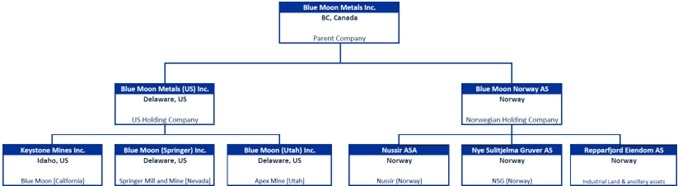
Blue Moon is a Canadian mineral exploration and development company focused on advancing its five polymetallic brownfield projects, being the Nussir copper-gold-silver property in Norway (the "Nussir Property"), the Blue Moon zinc-copper-gold-silver property in California, USA (the "Blue Moon Property"), the NSG copper-zinc-gold-silver property in Norway (the "NSG Property") the Springer tungsten-molybdenum project in the Nevada, USA (the "Springer Property") and the Apex germanium-gallium-copper project in Utah, USA (the "APEX Property").
As of the date of this AIF, the Corporation considers the Blue Moon Property and the Nussir Property to be its only material mineral properties for the purposes of National Instrument 43-101 – Standards for Disclosure for Mineral Projects ("NI 43-101"). The Corporation holds a 100% interest in Keystone which holds the mineral rights to the unpatented mining claims and patented lands associated with the Blue Moon Property, located in Mariposa County, California. The Corporation also holds a 94.52% interest in Nussir which holds the extraction licences and exploration licences associated with the Nussir Property, located in Finmark county, Norway. For additional information on the Blue Moon Property and the Nussir Property, please see "Mineral Projects".
The Corporation's long-term strategy is to focus on the advancement of its material properties, the Nussir Property and the Blue Moon Property, with the aim of taking these properties into production. This will be complemented by efforts to fast track the advancement of technical studies, metallurgical testing, process flowsheets, permitting and community engagement to support the redevelopment of the metallurgical complex and tungsten mine at the Springer Property for the processing of ores from the Blue Moon mine. The Corporation will also continue to explore its non-material mineral properties at NSG, Springer, and Apex. In the near-term, the Corporation intends to focus its efforts on advancing the Nussir Property, which is fully permitted with a robust feasibility study, to development, and further advancing the Blue Moon Property towards feasibility. The Corporation intends to engage in continued drilling and exploration activities to expand and further define mineral resources on its properties.
In addition, with the acquisition of the Springer complex, the Corporation intends to pursue a critical metals hub and spoke business model in the United States, fast tracking the advancement of technical studies, metallurgical testing, process flowsheets, permitting and community engagement to support the redevelopment of the metallurgical complex and tungsten mine there. This is in line with the United States federal initiatives under section 232 of the Trade Expansion Act of 1962 to promote domestic production of critical metals and decrease dependence on foreign supply chains. Feeds are expected to come from the Blue Moon ore concentrates, and, if results from confirmatory drilling to update the historical resources at both Springer and Apex indicate support for development plans, from each such property. The Corporation will also consider opportunities to process other critical metals ores from the western United States as well as evaluating further critical metals mergers and acquisition opportunities while exploring opportunities to monetize existing non-core projects.
All aspects of the Corporation's business require specialized skills and knowledge. Such skills and knowledge include the areas of finance, operations, geology, drilling, mining, construction, engineering, metallurgy, accounting and natural resources. The Corporation retains executive officers, skilled personnel and consultants with experience in these areas in Canada, the United States and Norway, generally.
In order to attract and retain personnel with the specialized skills and knowledge required for its operations the Corporation maintains remuneration and compensation packages that it believes to be competitive. The Corporation has been successful to date in identifying and retaining personnel with such skills and knowledge. See "Directors and Officers" for details as to the specific skills and knowledge of the Corporation's directors and management.
The mineral exploration and mining business is a competitive business. The Corporation competes with numerous other companies and individuals in the search for and the acquisition, development and advancement of attractive mineral properties, and to retain qualified personnel, suitable contractors for drilling and bulk sampling operations, technical and engineering resources, and necessary exploration and mining equipment. The Corporation has put in place experienced management personnel and will continue to evaluate the required expertise and skill to carry out its operations.
The Corporation's business is not dependent on any contract to sell a major part of its products or to purchase a major part of its requirements for goods, services or raw materials, or on any franchise or license or other agreement to use a patent, formula, trade secret, process or trade name upon which its business depends. It is not expected that the Corporation's business will be affected in the current financial year by the renegotiation, amendment or termination of contracts or subcontracts.
The Corporation's business, at its current exploration and development phase, is not cyclical, and may be conducted year-round.
The Corporation's exploration activities are subject to, and any future development and production operations will be subject to, environmental laws and regulations in the jurisdictions in which its exploration activities and operations are carried out. See "Risk Factors".
Exploration activities have a limited impact on the environment while mining is an extractive industry that has environmental impacts. The Corporation's goal is to constantly evaluate ways to minimize that impact. The Corporation has strived to meet or exceed environmental standards at the Blue Moon Property and the Nussir Property, and the Corporation expects to continue this approach during its transition from the exploration stage towards the development stage through effective engagement with affected stakeholders, including local communities, government and regulatory agencies.
The Corporation's environmental performance is overseen at the Board (as defined herein) level and environmental performance is the responsibility of the Corporation. In common with other natural resources and mineral processing companies, the Corporation's operations generate hazardous and non-hazardous waste, effluent, emissions into the atmosphere and contaminated soils that are all managed in compliance with local and international regulations and standards. There are numerous federal, state, and local laws that apply to the Corporation's operations, exploration, development projects and land holdings. These laws address such matters as protection of the natural environment, air and water quality, emissions standards and disposal of waste.
The Corporation recognizes environmental management as a corporate priority and places a strong emphasis on preserving the environment for future generations, while also providing for safe, responsible and profitable operations by developing natural resources for the benefit of its employees, stakeholders and local communities. The Corporation strives to comply with all applicable environmental laws and regulations and to promote environmental stewardship in its activities. Employees are expected to maintain compliance with applicable laws governing the jurisdictions in which they perform their duties.
As of December 31, 2025, the Corporation had twenty-seven full-time employees. As of the date of this AIF, the Corporation has 68 full-time employees.
On an ongoing basis, the Corporation evaluates the required expertise and skills to execute its business strategy and will seek to attract and retain the individuals required to meet the Corporation's goals.
The Corporation believes its success is dependent on the performance of its management team and key individuals, many of whom have specialized skills in exploration, development and production in the mining industry. Substantially all of the site personnel and/or consultants have been active at the Blue Moon Property and the Nussir Property for several years or otherwise have extensive experience with similar projects and are knowledgeable as to operations, geology, engineering, construction, environment, mining, metallurgy and infrastructure related to mining development.
The Corporation believes it has adequate personnel with the specialized skills required to carry out its operations and anticipates making ongoing efforts to match its workforce capabilities with its business strategy for its operations as it evolves.
As the Corporation's material mineral properties are located in the United States and Norway, the Corporation's business is dependent on foreign operations and as such, a substantial portion of the Corporation's business is exposed to various degrees of political, economic and other risks and uncertainties.
The Corporation's operations and investments may be affected by local political and economic developments, including expropriation, invalidation of government orders, permits or agreements pertaining to property rights, political unrest, labour disputes, limitations on repatriation of earnings, limitations on mineral exports, limitations on foreign ownership, inability to obtain or delays in obtaining necessary mining permits, opposition to mining from local, environmental or other non-governmental organizations, government participation, royalties, duties, rates of exchange, high rates of inflation, price controls, exchange controls, currency fluctuations, taxation and changes in laws, regulations or policies as well as by laws and policies of Canada affecting foreign trade, investment and taxation. For more information, please see "Risk Factors – Foreign Operations Risks".
The Corporation was incorporated on January 15, 2007, and its primary focus has been to acquire, explore, and if appropriate, develop polymetallic properties in the United States and in Norway. The following is a summary of the Corporation's development over the three most recently completed financial years.
Unless otherwise noted, all figures set out in this AIF, relating to a number, value or price of Common Shares are presented on a post-Consolidation basis.
2023
Financings
On March 3, 2023, the Corporation completed a non-brokered private placement (the "March 2023 Offering") of 120,000 Common Shares for aggregate gross proceeds of $120,000. In connection with the closing of the March 2023 Offering, the Corporation completed the 2023 Consolidation. The March 2023 Offering was priced at $1.00 per Common Share. The proceeds from the March 2023 Offering were used for the Corporation's continuing costs to maintain the Blue Moon Property, regulatory fees, audited financials and other general working capital.
On May 8, 2023, the Corporation completed a non-brokered private placement of an aggregate of 270,000 Common Shares at a price of $0.65 per Common Share for aggregate gross proceeds of $175,500. The proceeds of the financing were used for the Corporation's working capital, regulatory costs, shareholder meeting costs and costs associated with the Blue Moon Property.
On June 15, 2023, the Corporation completed a non-brokered private placement of an aggregate of 769,600 Common Shares at a price of $0.65 per Common Share, for aggregate gross proceeds of $500,240. The proceeds of the financing were used for the Corporation's mineral resource report and other work to advance and maintain the Blue Moon Property, as well as general working capital.
Exploration and Technical Study Updates
On August 21, 2023, the Corporation announced it commenced work on an updated mineral resource estimate ("MRE") for its Blue Moon Property. The Corporation further announced the appointment of Enrique Correa as a director to the board of directors of the Corporation (the "Board"). In addition to this Board change, Douglas Urch stepped down as a director to the Board.
On November 27, 2023, the Corporation filed a technical report for the Blue Moon Property, entitled the "Technical Report for the Blue Moon Mine, Township 4 South, Range 16 East MDB&M, Mariposa County, California", dated November 19, 2023, with an effective date of October 27, 2023, in respect of an updated MRE for the Blue Moon Property. This technical report has been superseded by the Blue Moon Technical Report.
2024
Board Updates
On July 3, 2024, the Corporation announced the appointment of Pedro Fonseca as an independent director to the Board. In addition to this board change, Enrique Correa stepped down as a director of the Board.
Non-Brokered Private Placement
On August 30, 2024, the Corporation completed a non-brokered private placement of 2,640,000 Common Shares at a price of $0.35 per Common Share for aggregate gross proceeds of $924,000, pursuant to the minimum pricing exception under the policies of the TSXV. The net proceeds from the private placement were used for further permitting and exploration activities at the Corporation's Blue Moon Property, as well as general working capital and corporate purposes.
Sale of Yava Project
On October 2, 2024, the Corporation announced that it entered into a definitive agreement with Honey Badger Silver Inc. ("Honey Badger") to sell its Yava Project, located in Nunavut. Pursuant to the definitive agreement dated October 1, 2024, the Corporation received 4,250,000 common shares of Honey Badger, with an approximate value of $340,000, representing a price of $0.08 per Honey Badger share.
Shareholder Meeting and Board and Management Updates
On October 17, 2024, the Corporation announced the results of its 2024 annual general meeting, including the key additions to its Board as follows: (i) Maryse Bélanger as independent Chairman to the Board, (ii) Christian Kargl-Simard, who was then an independent director, and (iii) Haytham Hodaly as independent director.
On November 1, 2024, the Corporation announced key management changes with the following appointments: (i) Christian Kargl-Simard as President and Chief Executive Officer ("CEO"); and (ii) Frances Kwong as Chief Financial Officer ("CFO") and Corporate Secretary. In addition, the Corporation added Garfield MacVeigh and Christian Aramayo, two non-executive advisors, to its Board. The Corporation further announced it granted 177,500 restricted share units of the Corporation (each, an "RSU") and deferred share units of the Corporation (each, a "DSU") to certain of its directors, advisors and consultants under the Corporation's Omnibus Plan (as defined herein). The RSUs will vest annually over three years from the grant date and the DSUs will vest upon the departure of the grantees from the Corporation. An additional 115,000 options to acquire Common Shares (each, an "Option") were granted to certain officers and advisors of the Corporation, pursuant to its Omnibus Plan, with an exercise price of $3.40 per Option, exercisable for a period of five years from the date of grant and vesting over a three-year period.
Acquisition of Nussir and NSG and Concurrent Financing
On November 27, 2024, the Corporation announced the entering into two separate binding letters of intent with Nussir and Nye Sulitjelma Gruver AS ("NSG"), pursuant to which the Corporation agreed to acquire all of the issued and outstanding shares of Nussir and NSG (the "Nussir Shares" and the "NSG Shares", respectively). Subsequently on December 19, 2024, the Corporation announced it entered into two share purchase agreements (the "Nussir Share Purchase Agreement" and the "NSG Share Purchase Agreement", respectively) with Nussir and NSG, pursuant to which the Corporation agreed to acquire 99.55% of the Nussir Shares and 100% of the NSG Shares, in exchange for the issuance of an aggregate of up to 31,314,283 Common Shares to Nussir and NSG shareholders, at a deemed price of $3.00 per Common Share. Under the NSG Share Purchase Agreement, the Corporation agreed to pay US$3,000,000 in cash milestone payments, of which US$1,500,000 will be paid upon receipt by NSG of the discharge permit for the NSG Property and the remaining US$1,500,000 upon receipt by NSG of the operating permit for the NSG Property. The summary of the terms of the Nussir Share Purchase Agreement and the NSG Share Purchase Agreement are qualified entirely by the full text of these agreements, copies of which are available on SEDAR+ (www.sedarplus.ca) under the Corporation's issuer profile.
In connection with, and to finance, the NSG and Nussir Transaction (as defined below), on December 19, 2024, the Corporation completed a brokered private placement of 10,000,031 units of the Corporation at a price of $3.00 per unit for aggregate gross proceeds of $30,000,093 (the "Concurrent Financing") pursuant to the terms of the agency agreement dated December 19, 2024 among the Corporation and the Agents (as defined below) (the "Agency Agreement"). The Concurrent Financing was co-led by Cormark Securities Inc. and Scotia Capital Inc., on behalf of a syndicate which included National Bank Financial Inc., Haywood Securities Inc., Raymond James Ltd., and CIBC World Markets Inc. (collectively, the "Agents"). Each unit consisted of 0.1 post-Consolidation Common Share (one (1) pre-2025 Consolidation Common Share) and nine (9) subscription receipts (each, a "Subscription Receipt"). Each Subscription Receipt entitled the holder thereof to receive, upon the satisfaction or waiver the Escrow Release Conditions (as defined below) 0.1 post-Consolidation Common Share (one (1) pre-2025 Consolidation Common Share). The "Escrow Release Conditions" in respect of the Subscription Receipts included the following events: (i) satisfaction or waiver of all condition precedents to each of the Nussir Transaction and the NSG Transaction (other than the issuance of the consideration shares); (ii) receipt of regulatory, shareholder and third party approvals for the Nussir and NSG Transaction; and (iii) delivery of the escrow release notice by the Corporation and the co-lead agents under the subscription receipt agreement dated December 19, 2024 governing the Subscription Receipts.
Pursuant to the Concurrent Financing and the terms of the Agency Agreement, the Agents were paid a commission equal to 6% of the gross proceeds of the Concurrent Financing (reduced in connection with subscriptions by certain strategic, institutional or retail investors, and by insiders of Blue Moon and shareholders of Nussir and NSG).
Hartree Partners, LP ("Hartree") subscribed for $7,250,000 under the Concurrent Financing. In connection with this subscription, Hartree was granted, among other things, the right to further subscribe for between $5,250,000 and $7,750,000 in Common Shares (the "Subscription Option") as well as pro rata pre-emptive rights in respect of future equity issuances of the Corporation, the right to appoint a person to the Board by the end of 2025, and to have representation on a technical committee. The Corporation also agreed to enter into an offtake agreement with Hartree (the "Offtake Agreement") for concentrate production at the Nussir Property and right of last offer for a portion of the offtake volumes at the Blue Moon Property and the NSG Property. In addition, Hartree and the Corporation entered into a memorandum of understanding for up to US$20 million secured bridge loan.
In addition, as Wheaton Precious Metals Corp. ("Wheaton") subscribed for $4,950,000 under the Concurrent Financing, the Corporation granted Wheaton a right of first refusal on any precious metals streams from the Corporation's properties for a payment of $50,000.
As part of the Concurrent Financing, Leonard Nilsen & Sønner AS ("LNS") subscribed for $4,200,000 worth of units and agreed to subscribe for an additional $2,300,000 worth of Common Shares upon two milestones, the first being the start of decline construction at the Nussir Property (the "First Milestone") and the second 10 months after the start of the decline construction. The Corporation also agreed to grant LNS the right to appoint one member to the Board by the end of June 2025 if it held 5% of the Common Shares. LNS exercised this right to nominate Frode Nilsen, who was elected as a director of the Corporation at the 2025 annual general meeting of the Corporation's shareholders.
The trading of the Common Shares was halted pending the approval of the TSXV of the Nussir and NSG Transaction. Trading resumed on March 14, 2025. See "General Development of the Business – Three Year History – 2025 – TSXV Graduation, 2025 Consolidation and Resumption of Trading".
2025
Completion of Nussir and NSG Transaction
On February 27, 2025, the Corporation announced the closing of its acquisition of Nussir and NSG (the "Nussir Transaction" and the "NSG Transaction", respectively, and collectively, the "NSG and Nussir Transaction"). As consideration for the NSG and Nussir Transaction, the Corporation issued an aggregate of 29,776,149 Common Shares, comprised of: (i) 24,168,149 Common Shares to former shareholders of Nussir, and (ii) 5,608,000 Common Shares to former shareholders of NSG, in exchange for a 93.55% interest in Nussir and a 100% interest in NSG, respectively. The aggregate consideration for the NSG and Nussir Transaction of 31,314,283 Common Shares, previously announced by the Corporation on December 19, 2024, was reduced by 1,538,134 Common Shares, as the 99.5% interest initially contemplated by the Nussir Share Purchase Agreement was reduced to 93.55%. In connection with the closing of the NSG and Nussir Transaction, the Escrow Release Conditions were met and the Subscription Receipts were automatically converted into Common Shares.
In connection with the Nussir Transaction, Nussir was granted the right to appoint two nominees to the Board. Baker Steel Resources Trust Limited ("BSRT"), one of the former shareholders of Nussir, acquired 5,572,888 Common Shares as part of the consideration it received pursuant to the Nussir Transaction. In addition, BSRT held 1,950,003 Subscription Receipts which were automatically converted into 195,000 Common Shares. As a result, BSRT held 5,789,555 Common Shares, representing approximately 12.8% immediately after the completion of the Nussir Transaction and approximately 6.54% of the issued and outstanding Common Shares as of the date hereof. For additional details, please refer to the early warning report filed by BSRT dated February 27, 2025.
Concurrently with the closing of the NSG and Nussir Transaction, the Corporation appointed Nussir's nominees, Karin Thorburn and Francis Johnstone, an investment advisor at BSRT, to the Board.
Nussir Technical Report
On February 27, 2025, the Corporation filed a technical report for the Nussir Property entitled the "NI 43-101 Technical Report on the Mineral Resources of the Nussir and Ulveryggen Projects, Norway", dated January 24, 2025, with an effective date as at January 20, 2025. This technical report has been superseded by the Nussir Technical Report.
Corporate Updates
On February 27, 2025, the Corporation also announced key management changes as follows: (i) Skott Mealer as President and Chief Operating Officer ("COO"); and (ii) Theodore Veligrakis as Vice President, Exploration.
The Corporation also announced the grant of 275,000 Options under the Omnibus Plan to the new officers of the Corporation with an exercise price of $3.55 per Option, exercisable for a period of five years from date of grant and vesting over three years.
Blue Moon Technical Report
On March 3, 2025, the Corporation announced an updated MRE and the results of a preliminary economic assessment ("PEA") for the Blue Moon Property. Subsequently on April 15, 2025, the Corporation filed a technical report in respect of the updated MRE for the Blue Moon Property entitled the "NI 43-101 Technical Report for the Preliminary Economic Assessment of the Blue Moon Mine, Mariposa County, California", dated April 14, 2025, with an effective date as at March 3, 2025. This technical report has been superseded by the Blue Moon Technical Report.
Hartree Subscription and Investor Rights Agreement
On March 7, 2025, Hartree exercised its Subscription Option to purchase an additional 1,750,000 Common Shares at a price of $3.00 per Common Share for aggregate proceeds of $5,250,000. In connection with this subscription, the Corporation and Hartree entered into an investor rights agreement dated March 7, 2025 (the "Hartree Investor Rights Agreement") which provides for, among other things, the right to nominate a board member, participation right and top-up rights in respect of future equity issuances and the right to appoint a representative or observer to the technical committee, demand registration rights and piggy registration rights. The summary of the terms of the Hartree Investor Rights Agreement is qualified entirely by the full text of the Hartree Investor Rights Agreement, a copy of which is available on SEDAR+ (www.sedarplus.ca) under the Corporation's issuer profile.
In connection with this subscription, the Corporation and Hartree also entered into the Offtake Agreement.
REAS Acquisition
On March 10, 2025, the Corporation announced the acquisition of Repparfjord Eiendom AS (the "REAS Acquisition") from Wergeland Eigedom AS ("WG"), which included the ship loading equipment and infrastructure related to aggregate mining, port area and adjacent properties to the Corporation's Nussir Property, pursuant to the terms of the share purchase agreement dated March 6, 2025 between the Corporation and WG (the "REAS Share Purchase Agreement"). Pursuant to the terms of the REAS Share Purchase Agreement, as consideration in respect of the REAS Acquisition, the Corporation paid NOK180,000,000 (approximately US$16,000,000), comprised of 4,210,000 Common Shares and approximately US$7.2 million in cash.
The Corporation also announced the grant of 84,506 DSUs to members of the Board, pursuant to the Omnibus Plan, with such DSUs vesting upon the applicable director's resignation from the Board.
TSXV Graduation, 2025 Consolidation and Resumption of Trading
On March 13, 2025, the Corporation announced its graduation to a tier 1 issuer on the TSXV. In addition, the Corporation announced the 2025 Consolidation would be effective as of March 14, 2025 upon the resumption of trading of the Common Shares on the TSXV. The Common Shares had been halted in connection with the Nussir Transaction and NSG Transaction. See "General Development of the Business – Three Year History – 2024 – Acquisition of Nussir and NSG and Concurrent Financing".
Norwegian License Updates
On March 18, 2025, the Corporation announced that the Norwegian Ministry of Trade, Industry and Fisheries upheld the Corporation's operating license and the extended deadline for start-up of operations for the Nussir Property. The license will remain in place as long as mining activities on the Nussir Property have commenced by September 2027.
NSG MRE
On April 10, 2025, the Corporation announced a maiden MRE for the NSG Property, highlighting 17 Mt grading 1.06% Cu and 0.21% Zn in the inferred category over three deposits.
BLM Approval
On April 15, 2025, the Corporation announced it received the approval of the Bureau of Land Management for a portal and tunnel to enable underground mineral exploration activities at the Corporation's Blue Moon Property. The Corporation expects to complete a feasibility study within 24 months following the start of construction of the decline in Q3 2025.
Upgrade to OTCQX Best Market
On April 14, 2025, the Corporation announced the reinstatement of quotation on the OTCQB, trading under the symbol "BMOOF", following a halt in the trading of the Common Shares on the TSXV as part of its acquisition of the Nussir Property and the NSG Property. Subsequently, on April 15, 2025, the Corporation announced that its Common Shares would now be quoted on the OTCQX under the ticker symbol "BMOOF", representing an upgrade from the OTCQB Venture Market. The Common Shares have since ceased to be quoted on the OTCQX. See "Events Subsequent to 2025 – Nasdaq Listing".
Corporate Updates
On April 21, 2025, the Corporation announced the appointment of Boi Linh Doig as Vice President, Mining.
The Corporation granted 25,000 RSUs to an officer of the Corporation, pursuant to its Omnibus Plan. The RSUs will vest annually over a three-year period from the award date. The Corporation also granted a total of 60,000 Options under the Omnibus Plan to officers and employees of the Corporation with an exercise price of $4.10 per Option, exercisable for a period of five years from date of grant and vesting over three years.
Change of Auditors
On April 21, 2025, the Corporation filed a notice of change of auditor, along with letters from its former and successor auditors, changing its auditor from Davidson & Company LLP, Chartered Professional Accountants to MNP LLP, Chartered Professional Accountants. See "Interests of Experts".
LNS Investment & Engagement of Red Cloud Securities
On May 8, 2025, the Corporation announced that LNS has been mobilized in preparation for the underground development of the exploration decline and underground mining parameter confirmation at the Nussir Property. In addition, as the Corporation achieved the First Milestone, LNS subscribed for 376,833 Common Shares at a price of $3.00 per Common Share for aggregate proceeds of $1,130,499. See "General Development of the Business – Three Year History – 2024 – Acquisition of Nussir and NSG and Concurrent Financing". In addition, the Corporation retained Red Cloud Securities Inc. as a market maker for the Corporation.
The Corporation also announced the grant of 24,000 Options pursuant to the Omnibus Plan, with an exercise price of $3.00 per Option, exercisable for a period of five years from date of grant and vesting over a three-year period.
Sulitjelma Technical Report
On May 20, 2025, the Corporation filed a technical report for the Sulitjelma project entitled the "NI 43-101 Technical Report on the Mineral Resources of the Sulitjelma Project, Norway", dated May 20, 2025, with an effective date as at February 20, 2025. This technical report has been superseded by the Sulitjelma Technical Report (as defined herein).
Strategic Project Status for the Nussir Property
On June 5, 2025, the Corporation announced that, on June 4, 2025, the Nussir Property was designated by the European Union Commission as a Strategic Critical Raw Material Project.
On June 16, 2025, the Corporation announced that underground construction on the Nussir Property had commenced, completing the first blast on the access portal on June 12, 2025; ahead of schedule.
Corporate Updates
On July 3, 2025, the Corporation announced the appointment of Stephen Eddy as Senior Vice-President, Corporate Development.
The Corporation announced the grant of 200,000 Options to Stephen Eddy, pursuant to its Omnibus Plan, with an exercise price of $3.37 per Option, exercisable for a period of five years from the date of grant and vesting over a three-year period.
Norwegian Environmental Permit
On July 9, 2025, the Corporation announced that it received environmental permits for its planned activities from the Norwegian Environmental Agency and awarded a contract to Fauskebygg AS for the extension of its Rupsi tunnel at NSG.
Loan and Investment by Hartree and Oaktree
On August 19, 2025, the Corporation announced that it entered into a memorandum of understanding with Hartree and funds managed by Oaktree Capital Management, L.P. ("Oaktree", together with Hartree, the "Lenders", and each a "Lender") in respect of an investment package which consists of (i) a previously agreed to bridge loan (the "Bridge Loan") and (ii) a project financing package (the "Project Finance Package"), which provides for up to US$140 million of support for the continued development and construction of the Corporation's flagship, fully permitted Nussir Property. The Project Finance Package includes a US$50 million senior secured term loan (the "Term Loan"), a US$70 million precious metals stream (the "Stream"), and an equity investment of up to US$20 million (subject to a 19.9% Oaktree / Hartree combined ownership limitation) (the "Equity Investment").
The Corporation and its subsidiaries, Nussir and Keystone, as borrowers, and Blue Moon Norway AS and Repparfjord Eiendom AS, each a wholly-owned subsidiary of the Corporation, as guarantors, entered into the loan agreement dated August 19, 2025 (as amended on September 2, 2025) (the "Bridge Loan Agreement") with the Lenders and related documents relating to the Bridge Loan on August 19, 2025. Pursuant to the Bridge Loan Agreement the Lenders shall provide a bridge facility of up to US$25,000,000 with a maturity of June 30, 2027, available from the closing date to and including March 31, 2026 with interest equal to the base rate (the "Base Rate") plus 8.0% per annum, where the Base Rate is the 3-month Term SOFR plus 0.10% per annum, subject to a minimum Base Rate of 3.00% per annum. In connection with the Bridge Loan, the Corporation agreed to grant Hartree, as a loan bonus, 1,045,000 Common Shares which was issued upon the initial draw of funds under the Bridge Loan of US$12.5 million which was completed on September 4, 2025. The Bridge Loan is expected to be used to fund early works, pre-construction activities, development, construction, operation and working capital requirements of the Nussir Property, advancing the Blue Moon Property, and for general corporate and working capital purposes. In addition, the Corporation also entered into a non-binding letter agreement on August 19, 2025 in respect of the Term Loan and Stream.
Further, in relation to the Equity Investment, the Corporation executed a subscription agreement dated August 19, 2025 with Oaktree to purchase 2,092,173 Common Shares at a price of $3.30 per Common Share for aggregate gross proceeds of approximately US$5 million (the "Initial Equity Offering"). The Initial Equity Offering was subsequently closed on September 4, 2025 and represents the first tranche of the Equity Investment. The remainder of which will be subscribed to by both Oaktree and Hartree. The Corporation intends to use the proceeds of the Initial Equity Offering for general corporate and working capital purposes.
The Corporation also announced the grant of 34,000 Options pursuant to the Omnibus Plan, with an exercise price of $3.57 per Option, exercisable for a period of five years from date of grant and vesting over a three-year period.
A&R Nussir Technical Report
On September 12, 2025, the Corporation filed an amended and restated technical report for the Nussir Property entitled the "NI 43-101 Technical Report on the Mineral Resources of the Nussir and Ulveryggen Projects, Norway", dated January 24, 2025 (as amended and restated on September 12, 2025), with an effective date as at January 20, 2025. This technical report has been superseded by the Nussir Technical Report (as defined below).
A&R Blue Moon Technical Report
On September 12, 2025, the Corporation filed an amended and restated technical report in respect of the updated MRE for the Blue Moon Property entitled the "NI 43-101 Technical Report for the Preliminary Economic Assessment of the Blue Moon Mine, Mariposa County, California", dated April 14, 2025 (as amended and restated on September 12, 2025), with an effective date as at March 3, 2025 (the "Blue Moon Technical Report"). This is the current NI 43-101 technical report in respect of the Blue Moon Property.
A&R Sulitjelma Technical Report
On September 12, 2025, the Corporation filed an amended and restated technical report for the Sulitjelma project entitled the "NI 43-101 Technical Report on the Mineral Resources of the Sulitjelma Project, Norway", dated May 20, 2025 (as amended and restated on September 12, 2025), with an effective date as at February 20, 2025 (the "Sulitjelma Technical Report"). This is the current NI 43-101 technical report in respect of the Sulitjelma project.
Short Form Base Shelf Prospectus
On September 23, 2025, the Corporation filed a short form base shelf prospectus (the "Base Shelf Prospectus") in each of the provinces and territories of Canada, other than Québec, providing for the issuance of up to $200 million of eligible securities for a term of twenty-five months.
2025 "Bought Deal"
On October 1, 2025, the Corporation closed an upsized "bought deal" public offering of 26,220,000 Common Shares at an issue price of $3.30 per Common Share for aggregate gross proceeds of $86,526,000 (including the exercise in full of the underwriters' over-allotment option). The offering was completed pursuant to a prospectus supplement dated September 26, 2025, to the Base Shelf Prospectus, in each of the provinces and territories of Canada, other than Québec, and in certain other jurisdictions outside Canada pursuant to exemptions from prospectus and registration requirements. Pursuant to the terms of an underwriting agreement dated October 1, 2025 (the "Underwriting Agreement"), Scotia Capital Inc. and Canaccord Genuity Corp., acted as joint bookrunners on behalf of a syndicate of underwriters, including Cormark Securities Inc., acting as co-lead manager, Haywood Securities Inc. and Fearnley Securities AS (collectively, the "Underwriters"), in connection with the offering. In consideration for their services, the Underwriters received an aggregate cash commission of $5,191,560. The net proceeds from the offering were used to develop the Blue Moon Property, confirm the ideal processing solution for the mineralized material from the Blue Moon Property, for additional exploration at the Blue Moon Property, the Nussir Property and the NSG Property, and for working capital, and general and administration and corporate activities, as further described in the prospectus supplement.
Commencement of Construction at the Blue Moon Property
On October 6, 2025, the Corporation announced that construction of the exploration decline at the Blue Moon Property had commenced, with the initial 2,500 feet expected to be completed in Q2-2026. The Corporation further announced that exploration drilling activities would commence from underground concurrent with the advance of the decline, enabling the Corporation to accelerate the collection of geological, geotechnical and metallurgical data in parallel with ongoing development. The construction contract was awarded to Small Mine Development, L.L.C.
European Investor Relations Services
On October 6, 2025, the Corporation announced that it entered into an agreement with SRC Swiss Resource Capital AG ("SRC"), effective as of October 6, 2025, for investor relations and communications services in Europe. The agreement is effective for a period of one year, after which time the SRC agreement is automatically renewable on a quarterly basis. The agreement can be terminated by either party by providing seven (7) days written notice. The services to be provided by SRC to the Corporation under the terms of the agreement include communications services, generally viewed as investor relations, including dissemination of information to existing and potential shareholders, creating media through interview and videos as well as supporting or representing the Corporation at trade and investment shows in Europe. Pursuant to the terms of the agreement, SRC is to be paid 5,000 CHF per month with additional fees for special services such as trade and investment shows.
Corporate Updates
On October 28, 2025, the Corporation announced the appointment of appointed Katy Grant as Senior Vice President, Human Resources and Corporate Sustainability, as part of its plan to build its management team to support its continued growth. The Corporation also announced that Ms. Grant had acquired 75,000 common shares of the Corporation in the open market.
Shareholder Meeting and Board and Management Updates
On November 13, 2025, the Corporation announced the results of its 2025 annual general meeting, including the key additions to its Board as follows: (i) Per-Erik Bjørnstad, (ii) Frode Nilsen and (iii) and Richard Colterjohn. Each of Christian Kargl-Simard, Mayse Belanger, Karin Thorburn and Francis Johnstone were re-elected to the Board.
Development Update
On December 1, 2025, the Corporation announced the successful completion of Phase 1 at the Nussir Property, with the Corporation's contractor, LNS, having advanced a total of 656 metres since construction began in June of 2025. An initial 4,000 metre directional drilling campaign was being conducted from one mother drill hole, with the deepest extending to approximately 1,250 metres depth. The goal was to infill a 650 metre gap between the current MRE and a historical high-grade intersection recorded in drillhole NUS-DD-14-001, which returned 9.7 metres at 0.93% Cu, 1.35 g/t Pd, 0.28 g/t Au, 0.61 g/t Pt and 11.5 g/t Ag. The Corporation further announced the completion of detailed geological mapping across all mine permit areas to assist in identification of additional exploration targets.
The Corporation also announced the grant of an aggregate of 385,415 RSUs under the Omnibus Plan to certain officers. Each RSU represents a right to receive one Common Share, following the vesting of such RSUs over a two-year period.
Events Subsequent to 2025
Nasdaq Listing
On January 23, 2026, the Corporation announced that on January 26, 2026 the Common Shares would begin trading on the Nasdaq under the symbol "BMM" and cease to be quoted on the OTCQX Best Market.
The Corporation further announced the appointment of Peter Madsen to the Board, with Mr. Madsen's appointment to commence concurrent with the Nasdaq listing. Mr. Madsen is a seasoned finance professional with over four decades of experience in financial markets both on the sell and buy side.
Springer Mine & Mill Acquisition
On February 10, 2026, the Corporation announced the completion of its acquisition of the Springer Property from GOODS LG LLC ("GOODS") pursuant to an asset purchase agreement among GOODS, the Corporation and Blue Moon (Springer) Inc. dated November 11, 2025. The acquired assets include fee lands and mineral claims containing a historically mined tungsten deposit with significant historical resources, together with a flotation mill previously utilized for tungsten ore processing. The mill is equipped with an Ammonium Paratungstate circuit incorporating an autoclave and associated reagent systems. The transaction closed upon satisfaction of customary closing conditions. The aggregate consideration paid by the Corporation for completion of the transaction consisted of an initial deposit of US$500,000 and a final cash payment of US$18 million. The Corporation further announced that it had initiated work on a logistics study and a study to convert a portion of the Springer mine and mill to support the processing of the Blue Moon Property materials.
The Springer Property is located on the east flank of the Eugene Mountains, approximately 25 miles southwest of the city of Winnemucca, and 125 miles northeast of the city of Reno, in Pershing County, Nevada. The mine site is approximately 8 miles from Interstate 80, serviced by paved/gravel road over owned land. The Springer tungsten milling facility is located entirely on private fee lands. Springer is a former tungsten production facility consisting of a 1,360-ft vertical shaft and underground workings, a 1,200 ton per day mill with automated rod/ball mill grinding and flotation circuits, plus all water rights, and most permits necessary for operation of the facility. The Springer tungsten property was the site of continuous underground tungsten mining between 1918 and 1958, much of that time controlled first by the Segerstrom family, and later by the Nevada-Massachusetts Mining Company. The General Electric Company ("GE") acquired the property in the 1970's, interested in securing long term tungsten supply assets to support its lighting and industrial tools businesses. The current mine and mill were constructed by Utah International Inc. (which later became BHP Minerals Group) for GE in the mid 1970's, and was subsequently commissioned and operated by GE for 8 months in 1982. The property has not been actively mined since October 1982, and the underground workings are currently flooded to a depth of approximately 375 feet. EMC Metals Corp. acquired the Springer mine and associated properties from GE in 2006. Between that purchase date and today, considerable refurbishment and renewal activities have been undertaken to the mill, control systems, hoist house, and an up-rating of the mill throughput from a nominal 950 tpd to a current 1,350 tpd capacity, and an estimated 1,200 tpd throughput after availabilities (89%). Centrally located with access to diverse mineral sources and existing road and rail infrastructure, the Springer Mine and Mill is well situated to become a regional metallurgical complex. With established tailings and water management systems, the brownfield site provides significant opportunities to reduce capital and permitting timelines compared to a greenfield development.
The Corporation also announced that the maintenance bay and sump had been excavated at the Blue Moon Property, the first drill bay had been installed and underground drilling had commenced, with a 379 metre drill hole having been completed on February 6, 2026.
Development Update
On February 11, 2026, the Corporation provided an update on its planned 2026 drilling activities, comprising underground and surface infill and step-out drilling across its four projects in the United States and Norway, including a drill program at the Springer Property.
At the Nussir Property, the planned infill drilling program will focus on the eastern portion of the current mineral resource. The program is expected to include approximately 3,000 metres of surface drilling designed to achieve nominal drill spacing of approximately 75 metres by 75 metres in the upper part of the mineralized zone. In addition, approximately 7,000 metres of underground drilling is planned, comprising up and down dip oriented drillholes from five underground drill stations, targeting the deeper, copper-rich portion of the mineralization. The Nussir Property underground exploration decline continues to advance steadily.
At the Blue Moon Property, the ongoing 16,000 metres drilling program is intended to infill existing drill coverage to a nominal spacing of approximately 50 metres by 50 metres. The program is designed to support the potential conversion of portions of the current inferred mineral resources to the indicated category, with any resulting updates expected to inform further detailed studies planned for the following year. The Corporation further announced that diamond drilling had recently commenced from the underground exploration decline, with approximately 8,000 metres to be completed from three underground drill stations targeting the central and upper portions of the volcanogenic massive sulphide deposit. The remaining approximately 8,000 metres of drilling is planned from surface locations, targeting the deeper portions of the currently defined mineral resource. Selected drill holes will be completed with downhole geophysical surveys, including electromagnetic methods, to assist in identifying additional mineralization and generating new exploration targets, particularly to the northwest and along up-dip and down-dip extensions.
The Corporation also announced that in January 2026, the Corporation acquired certain additional mineral rights on the western border of the Blue Moon Property, and the rights to drill from surface. The Corporation disclosed an expectation to drill 8,000 metres from surface from the north-west area to expand the high-grade resources to the north-west.
The Corporation further announced that following the review and relogging of at the NSG Project's historic Rupsi drill core at the NGU National Core Archive in Løkken, the technical team has finalized plans for a staged underground drilling program totaling approximately 10,000 metres at the Rupsi underground tunnel focusing on infill and expansion of the 9.23 Mt inferred resource of 1.19% Cu and 0.31% Zn (see the Sulitjelma Technical Report).
The announcement detailed the Corporation's plans to advance the Springer Property through a multi-phase work program in 2026. The initial phase will focus on a detailed review of available historical information, including drill logs, core where accessible, cross-sections, assay data and the existing block model covering the Sutton I and Sutton II tungsten skarn deposits. This work will be used to refine the current geological interpretation and to guide the design of a follow-up drilling program.
Outside the Box Engagement
On March 6, 2026, the Corporation announced that it has engaged Outside The Box Capital Inc., a marketing services firm at 2202 Green Orchard Place, Oakville, Ontario L6H 4V4, founded by Jason Coles and Kelvin Coelho, to provide marketing and investor awareness services including, but not limited to, planning and creating social media content, assisting the Corporation with its various social media channels, increasing investor awareness in new communities, and producing feature content about the Corporation on its own and other third-party media platforms. The engagement is for a term of six months commencing March 9, 2026. The Corporation made an upfront payment of US$200,000 for the term of the engagement. No securities will be issued as compensation.
LNS Subscription
On March 10, 2026, the Corporation announced the closing of a follow-on investment by LNS by way of non-brokered private placement. Hartree Partners, LP exercised its participation right to purchase that number of Common Shares which would allow it to maintain its pre-offering equity interest in the Corporation. An aggregate of 181,127 Common Shares were sold pursuant to the offering, for aggregate gross proceeds of $1,305,563.41.
Apex Acquisition
On March 16, 2026, the Corporation announced the completion of its acquisition of the Apex Property from Teck American Incorporated (a subsidiary of Teck Resources Limited ("Teck")), pursuant to purchase and sale agreement among the Corporation, Blue Moon (Utah) Inc. and Teck American Incorporated dated February 27, 2026 (the "Apex APA"), positioning the Corporation as a key supporter and strategic stakeholder of North American critical mineral supplies. The Apex Property comprises 24 patented and 9 unpatented claims for a total 250 Ha, all subject to a royalty capped at US$1M and free and clear of all other encumbrances. The consideration provided by the Corporation under the transaction consisted of (i) the issuance by the Corporation to Teck of 7,031,959 Common Shares representing 8.0% of the Corporation's issued and outstanding Common Shares on an undiluted basis on the date of the announcement; (ii) a 0.5% net smelter returns royalty in favour of Teck on the Apex Property; (iii) life of mine zinc concentrate offtake rights in favour of Teck in respect of the Blue Moon Property; (iv) offtake rights in favour of Teck in respect of products produced from the Apex Property; and (v) investor rights in favour of Teck including, without limitation, equity participation rights, top up rights, and information rights. As part of the acquisition, the Corporation assumed an existing 3.0% net smelter returns royalty obligation on the Apex Property claims.
The Apex Property is a historical underground mine in southwest Utah, which was previously mined for copper oxide, and later for Ge and Ga. This underground mine became the primary producer of gallium and germanium in the United States when Musto Explorations Ltd. brought it into production in the mid 1980's and again with Hecla Mining Company in the 1990's. During its peak year of operations, Apex produced 10,270 tons yielding 1,645 lb Ga, 5,634 lbs of Ge, and 224,800 lbs of Cu. Hecla completed a feasibility study in 1989, reporting a reserve of 230,200 tons of 0.100% Ge, 0.046% Ga and 1.6% Cu. A historical reserve estimate(1) by Ken Krahulec in 2018 estimated 1 MT @ 0.087% Ge, 0.033% Ga, 1.8% Cu and 41 g/t Ag. The Ge and Ga are 10-100x higher grade than most Ge and Ga deposits. Beyond the historical reserves, Hecla also identified several additional breccia bodies as prospective exploration targets, including the Paymaster, Cavern, and 500 North pipes, along with further oxide zones in the immediate mine area. Subject to renewed permits and with the intent to reopen the Apex mine, the Corporation plans to fast track efforts to advance the technical studies, metallurgical testing, process flowsheets, permitting and community engagement to support a final investment decision.
Note:
(1) As at the date of this AIF, a qualified person has not completed sufficient work to classify the historical estimate above as current mineral resources or mineral reserves in accordance with NI 43-101. The Corporation is not treating the historical estimate as current mineral resources or mineral reserves. Investors and potential investors should not rely on this historical estimate. In order to verify the historical estimates, the Corporation needs to engage a qualified person to review the historical data, review any work completed on the property since and complete a new technical report. The Corporation views this historical data as an indicator of the potential size and grade of the mineralized deposits, and this data is relevant to the Corporation's future plans with respect to the property.
Gage Acquisition
On April 2, 2026, the Corporation announced it had closed its previously announced acquisition of the Gage Property (as defined herein), located in Washington County, Southern Utah, USA, from a subsidiary of Liberty Gold Corp. for consideration of 420,935 Common Shares and a 2.0% net smelter return royalty on the Gage Property (excluding land subject to Utah School and Institutional Trust Lands Administration ("SITLA") leases), subject to an option in favour of the Corporation to repurchase 1.0% of the net smelter return royalty at any time prior to achieving commercial production for a cash payment of US$2 million (the "Gage Property Acquisition"). As part of the Gate Property Acquisition, the Corporation assumed a 4.0% production royalty in respect of the SITLA leases for non-fissionable materials mined which increases to 8.0% for fissionable materials. The Gage Property consists of 181 unpatented mining claims located on Bureau of Land Management lands and two Utah School and Institutional Trust Lands Administration leases, for a total area of 5,916 hectares (the "Gage Property"). The lands are located along a north-west trending critical metals belt greater than 5 kilometres in length (covering 5 historical mines and over 20 previously identified critical minerals prospects) and surround the Apex Property.
Corporate Updates
On April 2, 2026, the Corporation announced the appointment of Reza Ehsani as Senior Vice President, Projects.
Development Update
On April 15, 2026, the Corporation announced results of its 2026 drilling program at Nussir, which consists of deep navigational step-out drilling and surface infill drilling, designed to support ongoing geological evaluation. The deep directional drilling aims to expand the currently known deep mineralization, targeting 1.2 km deep high-grade intercepts to the west, while the shallow infill program in the east is focused on the resource to be initially exploited by mining.
A&R Nussir Technical Report
On April 20, 2026, the Corporation filed an amended and restated technical report in respect of the Nussir Property entitled the "NI 43-101 Technical Report on the Nussir Project – Feasibility Study", dated April 16, 2026, with an effective date of April 14, 2026 (the "Nussir Technical Report"). This is the current NI 43-101 technical report in respect of the Nussir Property.
Alpha Future Funds Letter of Intent
On April 21, 2026, the Corporation announced it had entered into a non-binding letter of intent (the "LOI") with Alpha Future Funds S.C.S. ("AFF") with respect to the combination of NSG and VMS Exploration AS, a wholly-owned subsidiary of AFF. The LOI contemplates up to a four-month period to complete due diligence and negotiate a definitive agreement.
Hartree Top-Up
On April 22, 2026, the Corporation announced that Hartree delivered a notice of its intention to exercise their top-up right pursuant to the Hartree Investor Rights Agreement in connection with certain share issuances completed by the Corporation through March 31, 2026 (the "Hartree Top-Up"). Subject to the approval of the TSXV, an aggregate 526,617 Common Shares are expected to be issued to Hartree at a price of $9.06 per Common Share for total gross proceeds of approximately $4.8 million. The Hartree top-up is expected to close on or about April 29, 2026.
Technical Report
Scientific and technical information relating to the Nussir Property provided in this AIF is supported by and qualified in its entirety by the full text of the most recent technical report on the Nussir Property filed in accordance with NI 43-101 entitled "NI 43-101 Technical Report on the Nussir Project – Feasibility Study" dated April 16, 2026 with an effective date of April 14, 2026, being the Nussir Technical Report, which was prepared, reviewed, and approved by Adam Wheeler, B.Sc., M.Sc., C. Eng., Eur Ing., FIMMM, Christopher Huges-Narborough, C. Eng, MIMMM, Lumin Ma, PE, Martin Prior, M. Eng., Roy R. Levesque, P. Eng. and Susan Abell, PrSciNat, who are each a "qualified person" for purposes of NI 43-101. Reference should be made to the full text of the Nussir Technical Report, which is available electronically on SEDAR+ (www.sedarplus.ca) under Blue Moon's issuer profile. The detailed disclosure on the Nussir Property in the Nussir Technical Report is incorporated into this AIF by reference and should be consulted for details beyond those summarized, compiled or extracted herein.
Scientific or technical information in respect of the Nussir Property provided subsequent to the date of the Nussir Technical Report was prepared by or under the supervision of Mr. Reza Ehsani, P. Eng., an officer of the Corporation, and a non-independent qualified person for the purposes of NI 43-101.
Principal Outcomes
The Nussir FS updates an internal assessment completed in 2023 and relies on the NI 43-101 Resource Statement Report for the Nussir and Ulveryggen Projects (published January 24, 2025; amended and restated on September 12, 2025); however, the FS focuses solely on the Nussir deposit. The FS confirms that the Project is economically viable, with significant improvements over the previous version, and provides the foundation for a production and final investment decision (FID).
The highlights of this report are as follows:
- Total measured and indicated resource for Project is 28.72 Mt at 1.20% CuEq grade.
- Total proven and probable reserve estimate is 24.98 Mt at 0.99% CuEq grade.
- Life of Mine (LOM) is 13 years with nominal mill throughput of 6,000 tonnes per day.
- LOM average annual production of 19 kt of CuEq, including an average of 3,600 ounces of gold and 546,000 ounces of silver in the consensus price scenario.
- Initial capital expenditures of 184 MUSD.
- LOM total cash costs (net of by-products) of 0.95 USD per pound of copper and all-in sustaining costs of 2.05 USD per pound of copper.
- After-tax Net Present Value (NPV) of 235 million USD (MUSD) (8% discount rate) at long term copper price of 4.78 USD, gold price of 3,515 USD per ounce, and silver price of 45.26 USD per ounce.
- After-tax Internal Rate of Return of 19.0%.
Property Description and Ownership
The Nussir deposit is located about 1.5 km north of the Øyen industrial area, in Repparfjord, Kvalsund, Hammerfest Municipality, which is in the western part of Finnmark county in northern Norway. The Ulveryggen deposit is located approximately 3 km south of Nussir and does not form part of this FS. It is envisaged that an industrial area with a mineral processing plant and related facilities will be located at the established industrial area at Øyen. The area, zoned for mining and industrial activity, is about 5,000 acres.
Access to the underground is available throughout the year. However, surface exploration is not permitted between May 1 and June 15 each year to facilitate the legally protected reindeer calving season. This means that all work that is planned and budgeted for the Project can be undertaken on tenure.
Licence Areas and Operating Status
The principal licence areas for both Nussir and Ulveryggen are currently held by BMM. Both of these areas have valid extraction status and the extraction licences themselves remain in force for as long as the underlying operating licence is valid. Both the extraction and operating licences are retained by BMM, ensuring ongoing rights to mineral extraction within these areas.
The Nussir Project is at an advanced exploration stage. An exploration decline is advancing to directly access the deposit. Exploration drilling both underground and on surface are continuing on site. Early surface works has commenced in preparation for construction with two distinct phases of early works already completed. Procurement of long lead processing equipment has also commenced and high voltage transformer and mills have been purchased.
Operating License Applications and Extensions
Blue Moon submitted an application for an operating licence that covers an area encompassed by 25 extraction licences. The operating licence was successfully granted in 2019. In 2024, Blue Moon sought an extension of the operating licence for an additional three years in accordance with the Norwegian Minerals Act. The Mining Directorate of Norway approved this extension in 2024.
Geology and Mineralisation
Lithology
The Nussir project area is situated within the Repparfjord-Komagfjord lithological package, a Precambrian tectonic window that was uplifted and exposed due to erosion of the overlying Caledonian nappes. The volcano-sedimentary rocks that make up the geology of the Repparfjord Tectonic Window (RTW) can be divided into four main groups and 11 formations. The groups can be summarised (from the bottom to top) as follows:
- The Holmvatn Group is comprised of a sequence of immature metasediments that is at least 3 km thick and interbedded with metavolcanic horizons of basic and intermediate composition, including tholeiitic to calc-alkaline basaltic, andesitic and rhyolitic volcanic and volcaniclastic rocks.
- The Saltvatn Group is made up of coarse-grained arkosic sandstones of the Ulveryggen Formation that form the lowermost part of the group and hosts the Ulveryggen deposit.
- The Nussir Group is composed of tholeiitic basaltic tuffs and lavas and can be subdivided into Krokvatn Formation (green tuffs and tuffites) and the Svartfjellet Formation, with massive, pillowed and amygdaloidal lavas. The Nussir deposit is hosted in thin, laterally extensive dolarenite beds in the lower part of the Krokvatn Formation. U–Pb dating of zircons from mafic tuffs yielded a maximum formation age of 2073 +23/-12 Ma (Perelló et al., 2015).
- The Porsa Group is divided into three formations (the Vargsund, Kvalsund and Bierajávri formations) in the Repparfjord volcano-sedimentary succession. The contact with the underlying Nussir Group is tectonic, characterised by bedding-parallel thrusting and transposition along large fold limbs.
Structure
Field structural analysis and qualitative interpretation of an airborne geophysical survey of the area suggests a revised structural scheme for this part of the window and for the genesis of the copper mineralisation. It is proposed that the structural framework of the area is largely controlled by thrusts with top-to-the-SE transport direction (of unknown age) and a set of NE-SW striking ductile and brittle-ductile shear zones that bound a broad, copper (Cu)-mineralised shear corridor. It has also been suggested that the Nussir Copper deposit may continue westward, although more information is required to verify the validity of this model. A top-to-the-SE thrust is inferred at the base of the Nussir Group, thus forming a tectonic contact between the Nussir greenstones and the overridden Saltvatn Group, which contains the Nussir deposit.
Mineralisation
The Nussir deposit mineralisation is hosted by yellowish to greenish grey, banded, fine-grained sandstones and siltstones with common carbonate-rich layers. The major ore minerals in the eastern part of Nussir are bornite and chalcocite. Accessory sulphide minerals include chalcopyrite, covellite, wittichenite, carollite and cinnabar. Gold (Au) and silver (Ag) are closely associated with the Copper mineralisation.
Mineral Processing and Metallurgical Testing
Extensive metallurgical test work was completed on samples from the Nussir Copper deposit to support the FS. The work program included historical studies (2011 and 2016), a comprehensive feasibility-level campaign undertaken by SGS Lakefield in 2019 and subsequent supplementary testing. The objective of the program was to characterise the metallurgical response of the Nussir ore, confirm process flowsheet selection, quantify recoveries and concentrate quality and evaluate variability and potential operational risks.
Ore Characteristics and Mineralogy
The Nussir ore is characterized by a high proportion of secondary copper sulphides, predominantly bornite with lesser chalcocite, and variable but generally lower proportions of chalcopyrite. Mineralogical investigations, including sequential copper analysis and QEMSCAN, indicate that most of the copper (>70–90%) occurs as secondary sulphides, with minimal oxidized copper species. Liberation characteristics are favourable, with over 70% of bornite occurring as free or liberated particles at a primary grind size of approximately P80 = 95–105 µm. Gangue minerals are dominated by calcite, quartz, feldspar and mica, with negligible quantities of deleterious sulphides.
Comminution Characteristics
The comminution test work included SAG Power Index (SPI®), Bond Ball Mill Work Index (BWI), Modified Bond, Comminution Economic Evaluation Tool (CEET) and abrasion testing. Results indicate that Nussir ore ranges from soft to moderately hard, with typical BWIs of approximately 11–13 kWh/t (75th percentile 12.2 kWh/t) and SPI® values spanning the soft to hard range. Abrasion indices classify the ore as slightly abrasive to abrasive. Variability testing confirms manageable geometallurgical variability across the drill core samples tested.
Flotation Performance
The flotation test work demonstrates fast kinetics and robust performance across a range of grind sizes. Rougher flotation achieves copper recoveries more than 95% at primary grind sizes between P80 = 65–100 µm. Sodium isobutyl xanthate (SIBX), with lime addition to control pH, was identified as an effective reagent scheme.
The cleaner flotation testing shows that regrinding the rougher concentrate to P80 of 25–30 µm produces a significant upgrade in concentrate grade with minimal loss of recovery. Two stages of cleaning, including a scavenger stage, were found to be sufficient to achieve target concentrate specifications.
Two stages of cleaning, including locked cycle and variability testing and locked cycle flotation tests (LCTs) performed on three representative composites and an additional selected variability sample confirm stable operation and reproducible metallurgical performance. The LCT results consistently achieved copper recoveries of approximately 95–97% at concentrate grades ranging from 35% to over 60% copper, depending on mineralogical composition and grind size. Comparison of open-circuit batch and locked cycle results indicates an improvement in copper recovery of approximately 2–4% under simulated continuous operation. Gold and silver report predominantly to the copper concentrate. The LCT results indicate gold recoveries in the range of approximately 79–87% and silver recoveries of approximately 93–96% for the Nussir composites.
Concentrate Quality
The expected copper concentrate is high grade, with a conservative design basis of approximately 45% copper, supported by laboratory results indicating higher achievable grades. Concentrate analyses demonstrate low levels of deleterious or penalty elements, with arsenic, bismuth, lead and zinc consistently below levels of commercial concern. Precious metals (gold, silver and minor platinum group elements) are present at potentially payable levels.
Tailings Thickening
Settling and thickening tests on flotation tailings show favourable settling characteristics. A suitable anionic flocculant was identified, producing clear overflow and acceptable underflow densities.
Metallurgical Basis for Design
Based on the collective test work, a conventional sulphide flotation flowsheet was selected that includes primary grinding, rougher flotation, concentrate regrinding and two stages of cleaner flotation. A primary grind size of approximately P80 of 100 µm and regrind size of P80 equal to 25–30 µm form the basis of design. A conservative metallurgical balance using ~96% copper recovery at a concentrate grade of approximately 45% copper was adopted for the FS.
Risks and Opportunities
The principal metallurgical risks are related to feed grade variability and the need to mitigate this by blending, as well as the requirement for confirmatory dewatering testing at project scale. Opportunities include consistently high recoveries, excellent concentrate quality, rapid flotation kinetics and limited sensitivity to grind size within the selected operating range.
Mineral Resource Estimates
The mineral resource model for the Nussir deposit considers 211 diamond drill holes and 10 lines of surface channel data. In the opinion of the QP (Adam Wheeler), the resource evaluation reported herein is a sound representation of the copper mineral resources found at the Nussir project at the current level of sampling. The resource estimation was prepared in compliance with Canadian NI 43-101, and the mineral resources in this estimate were calculated using the Canadian Institute of Mining, Metallurgy and Petroleum (CIM) Standards on Mineral Resources and Reserves, Definitions and Guidelines prepared by the CIM Standing Committee on Reserve Definitions and adopted by CIM Council May 2014.
The resource database used to estimate the Nussir mineral resource was reviewed and verified for internal consistency by the relevant QP. The relevant QP checked various assayed grades against examples of the original certificates.
Leapfrog Geo software was used to interpret the resource mineralisation envelopes. Datamine software was used for sample data processing, geostatistical analysis, block model generation, estimation of metal grades and evaluation of the mineral resources for the Nussir deposits.
Table 1‑1 presents the Mineral Resource statement for the Nussir deposits.
Table 1‑1: Nussir Mineral Resource Statement
|
Resource |
Tonnes (Mt) |
Cu Grade (%) |
Ag Grade (g/t) |
Au Grade (g/t) |
CuEq (%) |
|
Measured |
2.69 |
1.08 |
12.8 |
0.18 |
1.31 |
|
Indicated |
26.03 |
1.01 |
12.3 |
0.11 |
1.19 |
|
Measured + Indicated |
28.72 |
1.02 |
12.3 |
0.12 |
1.20 |
|
Inferred |
31.99 |
1.01 |
14.6 |
0.14 |
1.23 |
Notes:
- CIM definitions were followed for the Mineral Reserve Estimate (MRE).
- A minimum mining width of 2.0 m was applied in making the MRE constraint wireframes. These wireframes were generated using a preliminary Mineable Shape Optimizer (MSO).
- Density values for the Nussir deposit were estimated from density sample values or assigned default average values where insufficient samples occur nearby.
- MRE constraint wireframes were generated for a cut-off grade of 0.30% Cu, related to potential underground mining.
- Metal prices assumed for this MRE were 4.20 USD/lb Cu, 27.00 USD/oz silver (Ag) and 2,200 USD/oz gold (Au), which represent reasonable long-term consensus metal pricing.
- Metallurgy recovery assumptions were 96% Cu, 80% Ag and 93% Au, which stem from SGS metallurgical test work completed in 2022.
- The cut-off grade of 0.30% Cu was derived from the price and recovery values above, as well as a smelter payability of 97.3% and an assumed total operating cost 26.20 USD/t of ore.
- Rounding may result in apparent summation differences between tonnes, grades and metal content. It is not considered material.
- Mineral Resources are not Mineral Reserves and do not have demonstrated economic viability.
- Mineral Resources shown are inclusive of Mineral Reserves.
Mineral Reserve Estimates
The mineral reserve estimate for Nussir is based on a FS level of engineering and costing. The reserves conform to the CIM Definition Standards for Mineral Resources and Mineral Reserves (2014).
The Mineral Reserves have an effective date of April 14, 2026.
The Nussir deposit's Mineral Reserves are categorized as both Proven and Probable. They are summarised in Table 1‑2.
Table 1‑2: Nussir Mineral Reserves
|
Reserve |
Tonnes (Diluted, Recovered) (t) |
Cu Grade (%) |
Cu Metal Content (t) |
Au Grade (g/t) |
Au Metal Content (koz) |
Ag Grade (g/t) |
Ag Metal Content (koz) |
|---|---|---|---|---|---|---|---|
|
Proven |
2,638,787 |
0.80 |
21,198 |
0.13 |
11 |
10.15 |
861 |
|
Probable |
22,339,990 |
0.81 |
180,925 |
0.09 |
64 |
10.36 |
7,440 |
|
Proven + Probable |
24,978,777 |
0.81 |
202,123 |
0.09 |
75 |
10.34 |
8,301 |
Notes:
- The Nussir Mineral Reserve estimate follows the CIM (2019) Mineral Resource and Mineral Reserve (MRMR) Best Practice Guidelines
- The Mineral Reserves include stopes and ore development
- The Mineral Reserve stopes were diluted based on geotechnical recommendations and have had a mining loss applied.
- A minimum stope mining width of 3.0 m is used with varying overbreak/dilution applied by geological zone.
- Stopes were generated at a cut-off-value of 35.43 USD/t Net Smelter Return (NSR).
- The price assumptions are as follows:
- Cu 9,034 USD/t
- Au 2,487 USD/oz (troy)
- Ag 26.58 USD/oz (troy).
Mining Methods
The Nussir underground mine is accessed through a 120m long surface portal, which joins the partially completed conveyor decline which, when complete, will provide access to the orebody. The first phase of the Project focuses on establishing access, ventilation and materials handling systems underground. During this phase, development ore and ore from test stopes accessed from Ramp 1 will be trucked to the surface and stockpiled in preparation for commissioning of the mill. The first phase is anticipated to conclude by the end of 2027, at which point the mine will be capable of ramping up production in lockstep with the process plant.
The second phase of the Project involves steady state production from the mine and requires portions of the ventilation and materials handling systems to be complete and operational. The mine will progress westward across the eight ramp systems, with mining occurring on two to three ramps at any given point. As each new ramp system is developed, the supporting conveyor and ventilation systems will be extended and connected to the existing infrastructure. All material will be moved to surface using conveyors along the transport drive and conveyor decline before reaching surface where it is diverted to the mill or waste pad. The second phase requires completion of all supporting surface infrastructure, including conveyors, stackers, mill and site offices. The second phase will run from the beginning of 2028 until the end of mine life in 2041. The ore production profile shown in Figure 1‑1 illustrates the step from mine development in 2026 and 2027 to full operation in the second phase for the LOM.
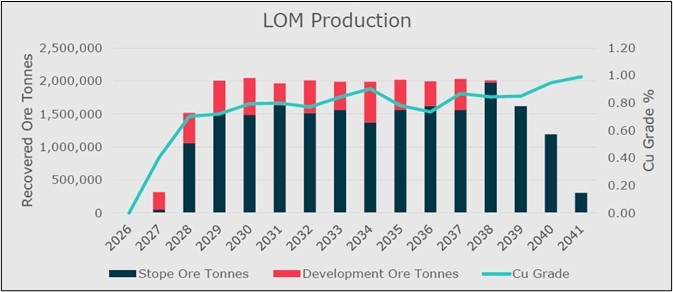
Figure 1‑1: LOM Recovered Ore Tonnes and Grade
Mining Method Selection
A comparative assessment was performed to determine the most suitable mining method for the Nussir deposit. Due to the deposit's relatively low grade and good ground conditions, methods requiring backfill were excluded from consideration. Instead, pillars (rib and sills) will be utilised to manage excavation sizes.
Three mining approaches were analysed in detail: Top Down Longhole Open Stoping (LHOS), Bottom Up LHOS and the Modified Creeping Cone method.
- The modified creeping cone method was considered because it was utilized in the previous 2023 FS, although it is significantly less common compared to the LHOS methods. The evaluation of these mining approaches considered several key factors, including the following:
○ Mineralisation width
○ Dip
○ Dilution
○ Operational flexibility
○ Production and extraction percentage rate
○ Capital expenditures (CAPEX) and operating expenditures (OPEX).
The comparison analysis determined that top down LHOS was the most suitable mining method for the Nussir deposit. This selection was based on several advantages, including the following:
Widely used method with substantial real-world performance data
Reduced dilution and increased recovery
Minimized broken ore inventory within stopes
Lower risk of broken material bridging in stopes
Operational simplicity
Lower operating costs for development.
Consequently, top down LHOS was selected as the mining method for the Nussir mine design.
Main Decline Access
The main decline functions as the central entryway to the underground mine, designed to facilitate both long-term haulage operations and the installation of essential services, including a conveyor system. Its alignment is carefully planned to remain entirely within the footwall stratigraphy, thereby enhancing excavation stability and reducing the likelihood of encountering weaker mineralised horizons.
The construction process for the main decline will consist of creating a large-cross section development opening. This opening is intended to be operational for the entire life of mine (LOM), ensuring it meets both current advancement demands and future stability requirements. These requirements are particularly important for conveyor installation and maintaining consistent access for ongoing operations.
Initially, infrastructure development will rely on truck haulage. As the decline advances, the permanent conveyor system will be installed in stages. Ground support strategies will be tailored to observed conditions, with adjustments made as structural zones or lithological contacts are encountered. The ground support required along the decline is expected to vary, with extra support provided in locations affected by structural discontinuities or changes between rock types. Throughout the development phase, exhaust air will be vented to the surface through the main portal.
Ramp Design
The Nussir underground mine will use eight ramps to access its distinct mining zones. These ramps will connect to the transport drive and will be constructed in a spiralling oval configuration. Ramp excavation will be carried out progressively, which will ensure that access to each mining zone and production level is established in line with the mine's planned production profile. Additionally, the ramps will connect to the fresh air level located near the top of the deposit, which will provide access to an escapeway and the secondary means of egress for personnel.
Ramp excavation conditions are anticipated to be generally favourable when the ramps remain within the footwall sequence. However, as ramp alignments approach or cross the mineralised dolomite horizon or adjacent schistose units, the quality of ground conditions may decline. This deterioration is attributed to greater fracturing, sheared contacts or the presence of weaker mica-rich lithologies.
The ramp design addresses these challenges by including plans for localized ground support enhancements and adjusting excavation spans where necessary. In addition, the design considers depth-related stress factors to maintain stability and safety throughout ramp development.
Geotechnical Considerations
Rock Mass Characterization Along Ore Strike
A comprehensive characterization of the rock mass at the Nussir deposit has been undertaken through a combination of laboratory testing, core logging, empirical index calculations, and in-situ stress measurements, forming a key component of the FS. The synthesis of these investigations reveals a rock mass that is generally of good quality but exhibits significant heterogeneity along the strike of the orebody. This variability is primarily driven by lithological changes, structural complexity and the localized presence of fault and shear zones.
Summary of Geotechnical Conditions
The rock mass at the Nussir deposit is characterized by a strong, anisotropic rock with a well-developed foliation that controls stability. While large strike-extensive sections (Zones A and B) as shown in Figure 1‑2 are classified as "Good" to "Very Good" quality, significant variability exists. A critical area of lower quality ("Fair" to "Poor") is identified in Zone C, where faulting, shearing and the presence of a diabase dike have created a more fractured and weaker rock mass. This spatial heterogeneity in rock mass quality, coupled with the anisotropic strength behaviour, represents a primary geotechnical consideration for mine design.

Figure 1‑2: The Rock Mass Zones
Other Considerations
The underground mine design for the Project was developed with geotechnical stability as the key constraint on stope dimensions, sequencing and pillar geometry. The available logging, structural interpretation and empirical analyses indicate that the rock mass conditions are generally suitable for LHOS, although variability near the lithological contacts and structural zones may locally affect stability.
The orebody is hosted in dolomitic arenite with a schistose hanging wall and conglomeratic footwall. The rock mass is largely competent; however, fracturing near the ore contact and local shear or fault zones represents the main geotechnical risks and may contribute to overbreak and dilution if not managed through design and sequencing.
Stope spans were defined using empirical stability graph methods that consider depth, rock quality and hydraulic radius. A systematic pillar strategy provides both local and regional support. Rib pillars maintain panel integrity and sill pillars limit stress interaction between levels.
Overall, the proposed mining method, stope dimensions and pillar configuration are considered appropriate for the expected ground conditions, subject to ongoing monitoring and refinement during detailed engineering and early mine development.
Ventilation Assessment and System Selection
A comprehensive evaluation of the Nussir mine plan was conducted to explore various ventilation strategies for the underground operation. The ventilation study was anchored in the Deswik mine design and development schedule, which provided the foundation for constructing an airflow model. This design was subsequently imported into VentSim, enabling simulation and analysis of ventilation performance across different stages of mine development.
Ventilation Modelling and Scenario Development
As part of the assessment, a dedicated ventilation model was developed using VentSim for the conveyor-decline advance. This modelling included three independent LOM ventilation scenarios. Each scenario was designed to compare how different configurations of surface connections and airflow pathways would affect system capacity, air distribution, and operational flexibility.
Ventilation Options Considered
The following ventilation options were considered:
- Option 1: This option features a configuration where both fresh air intakes and exhaust raises connect to the surface only at the far eastern extent of the mine. This setup represents the most consolidated breakthrough arrangement.
- Option 2: This scenario introduces an additional breakthrough point near the central portion of the orebody, supplementing the eastern surface connections. The intention is to improve airflow distribution as mining progresses deeper and further from the singular eastern intake.
- Option 3: This option evaluates more distributed systems, with surface breakthroughs at each ramp location. This scenario offers greater redundancy and enhanced capacity for isolating ventilation districts, thereby improving airflow control and operational flexibility throughout the mine life.
Option 3 was selected as the optimal ventilation setup and the overall system was designed accordingly. This configuration allows each production ramp to be isolated and ventilated separately through ventilation raises that connect to the surface at the top of each ramp system.
Ventilation Demand Analysis
The ventilation requirements for three distinct scenarios were calculated. For the decline development phase, auxiliary ventilation methods were used until the first ventilation raise to the surface could be established. The next scenario involved the development of the first ramp, which required an airflow of 125 m3/s to support multiple faces necessary for mining and infrastructure development. The final scenario represented steady-state production, for which an estimated 375 m3/s of airflow would be needed to sustain the mining sequence. It is also important to note that a minimum ventilation velocity of 0.5 m/s is required at each working face.
Underground Infrastructure Overview
The essential infrastructure planned for the Project encompasses a comprehensive suite of underground facilities. These include material handling systems, maintenance facilities, fuel bay, an explosives magazine, ventilation infrastructure, electrical and communications facilities, underground water supply and dewatering installations. These components are designed to support efficient operations, safety and reliability throughout the LOM.
Underground Mine Dewatering System
The purpose of the underground mine dewatering system is to collect and remove groundwater inflow and the mine service water used for drilling and dust suppression (collectively referred to as mine water).
This system was designed as a dirty water system, although some primary solids settling will occur in the underground sumps prior to pumping to the surface water treatment plant (WTP).
The system incorporates some redundancy in pumping and sumps to allow maintenance and contingency response without interrupting mining operations.
Groundwater inflows were estimated as part of the previous FS and confirmed as reasonable by Worley. Inflow rates are projected to increase as mining areas expand and additional zones are developed.
Key design inflow estimates are summarised below:
- Peak groundwater inflow at completion of ramps 1-3: 34 L/s (122 m³/h)
- Peak life-of-mine inflow: 113 L/s (407 m³/h)
- Peak service/utility water inflow: 20 m³/h
- Water losses via wet muck and entrainment: 6 m³/h
- Maximum total inflow at peak: 421 m³/h
- The dewatering system was designed to handle the peak projected inflows plus a contingency margin of at least 20%.
Material Handling System
The selected material handling system (MHS) for the Project is based on a network of seven muck passes that connect the production levels to conveyors located in the crosscuts. The crosscut conveyors are designed to transfer material to the conveyors within the transport drive, which then deliver ore and waste to the main decline conveyor. At the terminus, the main conveyor will feed a diverter situated in the silo tunnel, directing material to either the silo or the surface storage area, as required. Construction and commissioning of sub-vertical raises at each ramp will be necessary to establish muck passes throughout the LOM.
Interim Haulage and Mucking Operations
During the ramp-up phase, and before the conveyor system is installed, all development ore and waste will be transported to surface by haul truck. This method will be employed until the initial sections of the conveyor system have been commissioned.
Blasted material will be loaded at the mining face by a load-haul-dump (LHD) unit with a capacity of 14 tonne. The material will then be transported to the nearest remuck, level access or, when available, the first operational muck pass. The earliest muck pass will be situated at the base of Ramp 1, which is approximately 1,900 m from the portal. From the remucks or pass, material will be reloaded into mine trucks for surface haulage, where it will be crushed and temporarily stockpiled prior to processing or sale. Crushed waste will be marketed as aggregate, while crushed ore will be sent to the mill via a reloading facility near the stockpile.
Permanent Conveyor System Implementation
Upon completion and commissioning of the main conveyors, the system will move the broken material from underground to the surface. Over the LOM, seven muck passes will be developed along the orebody's strike, extending vertically from the Transport Drive up to the uppermost level at each ramp location.
Ore mucking at each production level will be carried out by LHDs. These vehicles will dump ore into the pass through a finger raise equipped with a sizer (grizzly screen) to prevent oversized material from entering the system. The pass locations on each level were carefully selected to minimize haul distances and ensure that production rates are maintained. Passes will be temporarily assigned for either ore or waste depending on the activities in the mining area, with strict segregation of material types.
Crushing and Material Transfer
A dedicated crushing chamber will be built at the base of each pass to house a mobile crusher, which will be directly fed through a gate installed at the bottom of the pass. Crushed material will be transferred onto a short conveyor in the crosscut that connects to the transport drive conveyors.
Up to three mobile crushers will operate simultaneously beneath separate passes, processing waste, development ore and production ore. As mining advances along the orebody, the crushers will be relocated among the seven rock passes to optimise material handling.
Expansion of Crushing and Conveyor Systems
As new mining areas are developed, mobile crushers will be installed and the conveyor system will be progressively extended. Material conveyed via the transport drive conveyor will be routed to the main decline conveyor, and subsequently to the ore/waste rock conveyor and silo conveyor for final handling.
Recovery Methods
The processing facilities at Øyen are designed as a conventional crushing–grinding–flotation operation that produces a saleable copper concentrate for shipment by bulk carrier, with thickened tailings conveyed by pipeline for sub-sea deposition in the adjacent fjord. The FS process design updates prior work completed over several years and is represented by a developing 3D plant model and the associated engineering deliverables.
Design Basis and Throughput
The process plant is designed to treat 2.0 million tonnes per annum (Mtpa) of ore, operating 8,000 hours per year at an overall availability/utilisation of 91.5%, which corresponds to a nominal treatment rate of 250 t/h (dry feed). The design feed grade is ~1.0% copper, with an average LOM grade of ~0.81% Copper. The plant will be configured with underground crushing and conveying to an existing ore silo, supplemented by an external ore stockpile for operational flexibility.
Recovery Flowsheet
The recovery flowsheet includes the following:
- Underground primary crushing to P80 of 110 mm, followed by conveying to the exiting storage silo.
- A two-stage wet grinding circuit (semi-autogenous grinding (SAG) mill and ball mill) with recycle of SAG mill trommel oversize product and closed circuit hydrocyclone classification to produce a primary grind product of P80 ~100 µm feeding the flotation cells.
- Conventional mechanically agitated tank flotation cells, including rougher flotation, regrind of rougher/cleaner-scavenger concentrate, and two stages of cleaner flotation plus a cleaner scavenger.
- Concentrate thickening and pressure filtration to produce filter cake for shipment, with onsite concentrate storage sized to match shipping parcels.
- Tailings thickening followed by pumping via a long-distance pipeline for deep fjord deposition, with clarified water recycled as process water.
Grinding Circuit and Sizing Basis
The grinding circuit is a conventional SAG and ball mill system with external recycle of SAG mill trommel oversize product. The circuit design allows the addition of a pebble crusher in the future, if required.
The grinding circuit product is classified in hydrocyclones to an 80% passing size of 100 μm as flotation feed.
Flotation Circuit and Sizing
The flotation circuit consists of a single rougher bank followed by two cleaning stages and a cleaner-scavenger bank. The flotation sizing and scale-up assumptions are conservatively selected.
Regrind and Cleaner Circuit Basis
Rougher concentrate and cleaner-scavenger concentrate is combined and classified in a regrind cyclone circuit to produce overflow at P80 ~25–30 µm, with underflow reground in a stirred mill (vertical mill) using ceramic media. This regrind product is conditioned and upgraded in the cleaner flotation stages. The regrind duty is based on a conservative benchmark specific energy assumption.
Concentrate Dewatering, Storage and Load-Out
Final concentrate is thickened and filtered to a target cake moisture of 8–10% w/w and conveyed to a concentrate storage building with 5,000 tonne capacity to match the expected bulk carrier shipment size. A 6 m diameter high rate concentrate thickener is selected using benchmark comparisons. Pressure filtration is specified as an automatic plate-and-frame pressure filter sized to process the daily concentrate tonnage over two shifts, with a stated cycle time of approximately 12–13 minutes. Concentrate load-out is via conveyors to an existing ship loading conveyor system, with falling-stream sampling at load-out.
Tailing Thickening, Pipeline Transport, and Sub-Sea Disposal
Flotation tailings are thickened in a 25 m diameter high-rate thickener, producing an underflow at 50–55% w/w solids, with overflow reclaimed as process water. The tailings thickener selection is supported by limited test work and benchmark comparisons.
Thickened tailings are pumped through a pipeline to the permitted sub-sea discharge point. The pipeline length is planned to increase from approximately 3.3 km early in the mine life to approximately 3.8 km later in life as deposition advances. The discharge permit requires tailings to be discharged within 30 m of the seafloor, and the tailings slurry density is controlled by seawater dilution at the pump suction. A seawater intake and flushing system is included in the design to support dilution control and pipeline flushing for shutdowns.
Reagent, Water, Air and Control Systems
The recovery methods include reagent preparation and dosing systems for the following:
Sodium Isobutyl Xanthate (SIBX) collector, Methyl Isobutyl Carbinol (MIBC) frother, and lime for pH control.
Flocculant systems for concentrate and tailings thickeners and mine water clarification.
Process water is primarily sourced from reclaimed thickener overflows and supplemented by mine water clarifier overflow and/or freshwater reservoir supply. Flotation air is supplied by duty/standby centrifugal blowers, and compressed and instrument air systems, which support filtration, maintenance, and plant controls.
The plant incorporates a high level of automation, including in-stream sampling systems and an X-ray fluorescence (XRF) analyser for metallurgical control.
The summary process flowsheet is included in Figure 1-3.
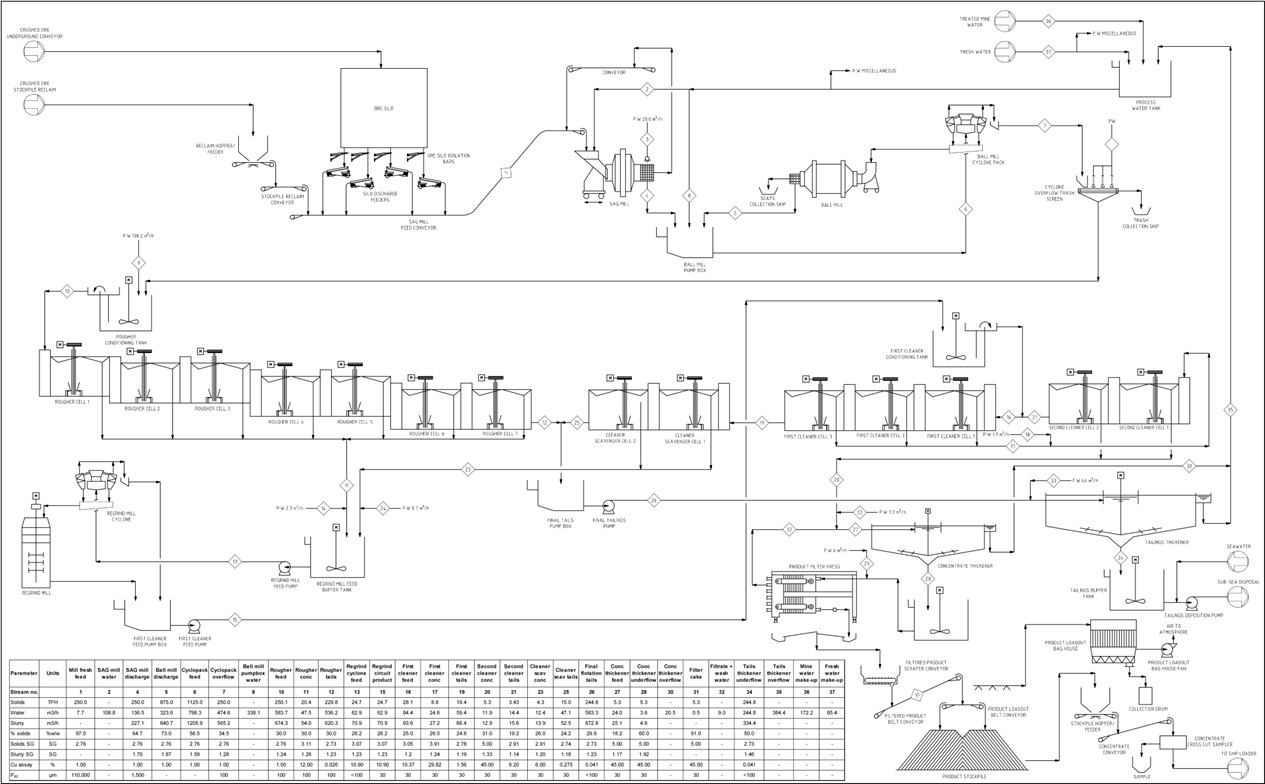
Figure 1‑3: Summary Process Flowsheet
Project Infrastructure
The project infrastructure was developed to support safe, reliable and economically viable underground mining and mineral processing operations in compliance with Norwegian regulatory requirements, CIM Definition Standards and NI 43-101 disclosure expectations. The infrastructure scope focuses on elements that are material to the technical and economic viability of the Project and appropriate for an FS level assessment.
The Project benefits significantly from the availability of existing infrastructure associated with historic mining and aggregate operations at the Øyen site. Where practical, existing access roads, buildings, utilities, port facilities and power corridors will be reused or refurbished, which will reduce the CAPEX, environmental disturbances and construction risks.
Site Access and Surface Facilities
The Project is accessed year-round via National Highway R94, which provides reliable regional connectivity to Hammerfest and the E6 highway. Existing internal site roads are largely retained with minor upgrades, supplemented by limited new road construction to service key facilities, including the 132 kV electrical switchyard and the east side of the process plant building.
The surface infrastructure includes refurbished historic process and administration buildings, a new mill building to accommodate increased throughput, concentrate handling and storage facilities, warehouses, workshops, offices, laydown areas and both temporary and permanent accommodations. The building layouts and traffic arrangements are designed to support both construction and operational requirements.
Materials Handling, Aggregate Operations, and Port Infrastructure
Ore and waste rock are managed via a combination of underground crushing, conveyor transport and surface stockpiling. A combined ore stockpile and waste rock storage area will be located adjacent to the process plant, which will provide operational flexibility. Waste rock handling will be integrated with ongoing aggregate production, which is expected to consume a significant proportion of mined waste rock, thereby reducing long-term storage requirements.
An existing deep-water port at Repparfjord will be retained for concentrate export, aggregate sales and receipt of supplies. The port is ice-free year-round and capable of servicing vessels up to approximately 20,000–30,000 Deadweight Tonnage (DWT). Minor refurbishment is planned to support LOM operations, including dedicated conveyor and ship loading systems for concentrate and aggregate.
Tailings Deposition
Tailings from the processing plant will be managed via a sea tailings placement (STP) system. Thickened tailings will be pumped through a dedicated high-density polyethylene (HDPE) pipeline to an offshore discharge point at a controlled depth within a sheltered fjord. Seawater dilution and flushing systems will be incorporated to maintain non-settling flow conditions and to minimise density and temperature contrasts at the discharge point, which will ensure appropriate plume behaviour in accordance with the environmental requirements.
Water Management and Water Balance
Water management is a critical aspect of the Project due to climatic conditions and environmental sensitivity. Site-wide water management will involve controlling surface water, groundwater inflows, contact water and non-contact runoff during construction, operation and closure. Key components include the Dypelva Reservoir for freshwater supply, mine dewatering systems, a permanent water treatment plant, stockpile drainage collection and controlled discharge via the tailings system.
A site-wide water balance model was developed using long-term historical climate data to assess system performance under a range of operating and climatic conditions. The assessment indicates that, while early years of operation are most sensitive to water availability, the risk to the overall long-term water supply is low, particularly under more recent and projected climatic conditions.
Water Treatment
A permanent water treatment plant was included to treat mine dewatering and other contact water streams. The plant is designed to supply treated water for reuse in the processing plant under normal operating conditions and to meet environmental discharge requirements during upset conditions. The treatment process is based on conventional clarification and chemical conditioning methods suitable for variable and potentially high suspended solids loads.
Electrical Power Supply and Distribution
Electrical power will be supplied via a new 132 kV grid connection, replacing the existing 22 kV supply. A new 132 kV switchyard and main transformer will provide power to the site, with 22 kV reticulation for surface and underground distribution. Standby diesel generation is included to supply emergency loads. The power system was sized to meet the projected LOM demand for the mining, processing and surface facilities.
Control, Instrumentation, and Telecommunications
The Project will employ a centralised integrated control and safety system based on a distributed control system (DCS) for the processing plant and surface infrastructure. Underground mining operations will utilise a dedicated control and telemetry system with selected data interfaced to the central control room. A site-wide fibre optic telecommunications backbone will support operational communications, safety systems, surveillance and data transfer. Cybersecurity and network segregation principles were incorporated consistent with recognised industrial standards.
Market Studies
Overview
Copper, Gold and Silver markets showed strong buoyancy over the last 3 years with high demand over the last 18 months. In February 2026 both S&P Global Capital Market Intelligence and Wood Mackenzie Insight remained bullish on all three commodities. Figure 1‑4 shows price changes from 2019 to first quarter of 2026. The global tensions of the last month (March 2026) were not factored in these analyses.
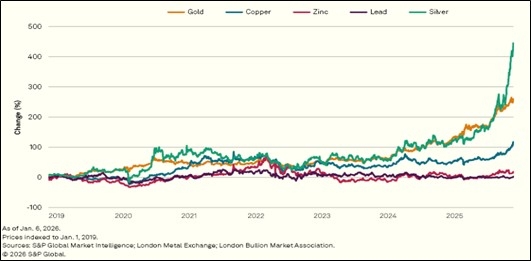
Figure 1‑4: Commodity Pricing Forecast
Recent high Copper prices are supported by weaker US dollar and low global inflation. Global refined copper demand growth to slow to 2.9% in 2026 amid softer year on year growth in China. Declining China electric vehicles subsidies in 2026 may reduce the sector's copper demand. Sluggish fixed-asset and real estate investment dampen construction sector copper demand. US copper demand growth projected at 4.5% in 2026, surpassing that of China. The Chinese market remains the largest market for copper while the demand for copper with new AI data centers fueling the market growth in the US.
Copper prices expected to rise amid persistent tightness in mine supply, supporting a bullish market outlook.
Table 1‑3 shows a summary of global Mine, Smelter and Refined output with year-on-year changes as well as Refined use, Refined balance and price forecast.
Table 1‑3:Copper Production and Price Forecast
|
Parameter |
2023 |
2024 |
2025 |
2026 |
2027 |
2028 |
2029 |
2030 |
2031 |
2032 |
2033 |
2034 |
2035 |
|---|---|---|---|---|---|---|---|---|---|---|---|---|---|
|
Mined Output (000 t) |
22,449 |
23,122 |
23,430 |
23,633 |
24,920 |
26,204 |
27,037 |
27,704 |
27,562 |
27,477 |
27,063 |
26,532 |
25,935 |
|
Change YOY (%) |
1.5 |
3.0 |
1.4 |
0.9 |
5.4 |
5.2 |
3.2 |
2.5 |
-0.5 |
-0.3 |
-1.5 |
-2.0 |
-2.3 |
|
Smelter Output (000t) |
19,723 |
20,300 |
20,815 |
21,624 |
22,432 |
23,266 |
24,026 |
24,548 |
24,823 |
25,153 |
25,255 |
25,432 |
25,474 |
|
Change YOY (%) |
3.4 |
2.9 |
2.5 |
3.9 |
3.7 |
3.7 |
3.3 |
2.2 |
1.1 |
1.3 |
0.4 |
0.7 |
0.2 |
|
Refined output (000t) |
26,162 |
27,062 |
28,572 |
28,941 |
29,945 |
30,889 |
31,747 |
32,378 |
32,462 |
32,727 |
32,823 |
32,946 |
32,986 |
|
Change YOY (%) |
4.3 |
3.4 |
5.6 |
1.3 |
3.5 |
3.2 |
2.8 |
2.0 |
0.3 |
0.8 |
0.3 |
0.4 |
0.1 |
|
Refined use (000t) |
25,973 |
26,856 |
27,814 |
28,627 |
29,595 |
30,482 |
31,273 |
32,040 |
32,732 |
33,352 |
33,997 |
34,658 |
35,315 |
|
Change YOY (%) |
2.8 |
4.1 |
4.6 |
4.2 |
0.8 |
3.4 |
5.6 |
8.7 |
0.3 |
0.0 |
3.6 |
0.9 |
-1.9 |
|
Refined Balance (000t) |
189 |
205 |
758 |
315 |
350 |
406 |
474 |
338 |
-270 |
-625 |
-1174 |
-1711 |
-2,329 |
|
Total Stocks (000t) |
4,316 |
4,522 |
5,280 |
5,959 |
5,945 |
6,351 |
6,825 |
7,164 |
6,894 |
6,269 |
5,095 |
3,384 |
1,054 |
|
LME 3M Price ($/t) |
8,522 |
9,267 |
9,772 |
11,415 |
11,580 |
11,500 |
11,400 |
11,250 |
11,550 |
11,940 |
12,150 |
12,250 |
12,450 |
|
Change YOY (%) |
-3.0 |
8.7 |
7.6 |
14.5 |
1.5 |
-0.7 |
-0.9 |
-1.3 |
2.7 |
3.4 |
1.8 |
0.8 |
1.6 |
Gold
Gold's 2025 rally, fuelled by macro shifts, opens door for fifth year of bull run. Figure 1‑5 shows the geo-political events that influenced the gold price since 2024.
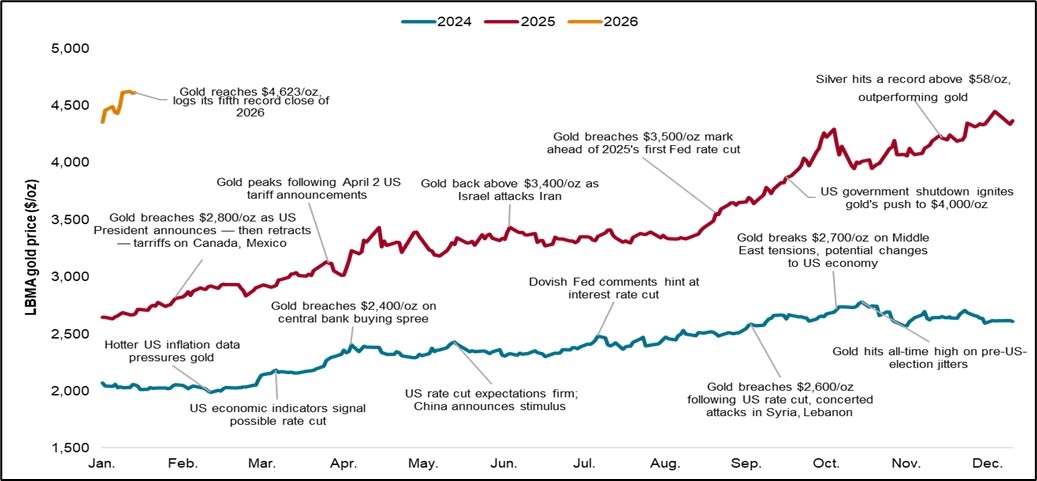
Figure 1‑5: Geo-Political Events Fueling the Gold Price
The gold price forecast (Figure 1‑6 and Table 1‑4) is based on strong structural demand and the following factors:
- Gold's cycle peak nears, helped by policy easing, slower US momentum and broad currency pressures.
- Strong macro tailwinds boost physical demand, with global gold ETF inflows surging and AUM doubling to $559billion. (AUM = asset under management; ETF = exchange-traded fund)
- The 2026 base forecast of $4,247/oz remains intact. However, a bull run extension scenario emerges, pushing the peak up to average $5,927/oz in 2027.
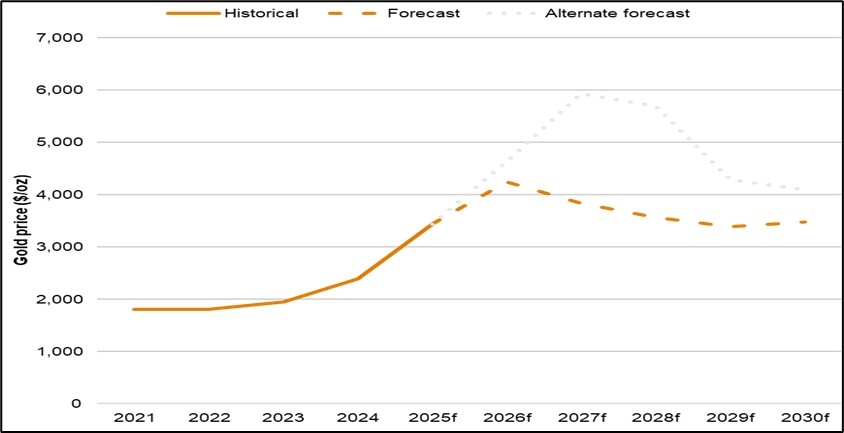
Figure 1‑6: Gold Price Forecast
Table 1‑4: Historical and Future Mine Supply and Gold Prices
|
Parameter |
2024e |
2025 |
2026 |
2027 |
2028 |
2029 |
|
Mined Supply (Moz) |
112,576 |
111,451 |
118,575 |
125,223 |
127,475 |
125,079 |
|
Price ($/oz) |
2,386 |
3,432 |
4,247 |
3,834 |
3,562 |
3,384 |
|
|
2030 |
2031 |
2032 |
2033 |
2034 |
2035 |
|
Mined Supply (Moz) |
122,985 |
117,572 |
113,069 |
107,010 |
99,860 |
95,083 |
|
Price ($/oz) |
3,473 |
3,650 |
3,654 |
3,702 |
3,901 |
4,396 |
Environmental Studies and Permitting
Permitting
Construction and operation of the Project require primary and secondary permits. Several primary permits have been obtained to date, including: an extraction permit that allows for mining of the Nussir 1-11 and Deep 1-11 ore bodies; an approved zoning plan; a discharge permit to allow for the disposal of tailings and tailings containing xanthate from the process to be disposed in Repparfjord; and an operating license which provides approval for operations to commence prior to 26 September 2027.
Secondary permits that have been obtained include a mine waste plan that allows for the decline and a baseline marine monitoring plan for further marine baseline studies in Repparfjord prior to the start of operation. An application for a building permit, an updated operating plan, applications for the installation of the ventilation shaft raises and environmental monitoring program have been submitted. A discharge permit (primary permit) must be supported by a waste management plan to allow for the use of mine waste facilities. This plan was submitted in September 2025.
Environmental and Social Management
Stakeholder Engagement and Public Consultation
As part of the permitting processes, extensive stakeholder engagement was undertaken since the early 2000's. The Corporation has developed a stakeholder engagement plan (SEP) that will be updated during the project life cycle. The SEP will guide engagement with interested and affected parties going forward throughout the Project life cycle. As part of this continuous engagement, a stakeholder committee and monitoring group will be set up that is representative of the community. A grievance mechanism has been established through which grievances can be lodged throughout the Project life cycle.
Social
Predicted positive impacts include employment opportunities, an injection to the local economy and residential and industrial development.
An environmental and social management system (ESMS) is in the process of being developed. As construction activities ramp up, it is important that this be implemented to manage potential social and biophysical impacts.
Biophysical
Several specialist studies were undertaken in support of the various permit applications. Some of these studies date back to 2012. Another marine baseline survey campaign is planned for Q2 2026 to Q1 2027 to update the baseline condition prior to the planned start of operation. Similarly, prior to operations commencing further studies will be required to confirm impact mitigation and management requirements. These include, amongst others, further geochemistry analysis, a groundwater contaminant transport model and a biodiversity survey in the area of the vent shafts.
Capital and Operating Costs
- Overall Capital Cost – Includes all costs to develop the mine to a sustainable production of 2MTPA. Total CAPEX costs total 197.4 MUSD and are expended over a 24 month period from January 2026 to December 2027 including the pre-production construction and commissioning period. Table 1‑5 details the cost breakdown by commodity.
- Sunk Capital Costs – includes all costs expended from January 1, 2026 to March 31, 2026. These costs are indicative and total 13.4 MUSD.
- Capital Costs to go – includes all costs to develop the mine from April 2026 to a sustainable production of 2 Mtpa in December 2027. These costs are indicative and total 184 MUSD as detailed in Table 1‑6.
- Sustaining Capital Costs – includes all costs from the production of the first stope in August 2027, in addition to the development required to sustain the LOM production, including replacing the mobile mining equipment, re-builds and fixed engineering equipment. Replacement is captured in the operating expenditures (OPEX) model.
Table 1‑5: Summary by WBS Level 1 - CAPEX to go
|
WBS Code |
WBS Description |
Total Cost (MUSD) |
|---|---|---|
|
1000 |
Underground Mine |
54.9 |
|
2000 |
Process Plant |
47.5 |
|
3000 |
Surface Site Infrastructure |
20.4 |
|
7000 |
Construction Indirects |
18.0 |
|
8000 |
Owners Cost |
18.3 |
|
9000 |
Contingency |
25.0 |
|
|
Total |
184.0 |
Table 1‑6: Summary of Costs by Commodity Level – Sustaining
|
Account Description |
Total Cost (MUSD) |
|
Mining Equipment |
0.8 |
|
Mining, Tunnelling & Shaft Development |
489.0 |
|
Instrumentation & Controls |
4.8 |
|
Total |
494.6 |
All costs are priced in native currency and converted to USD, with a base date of Q4 2025 and no escalation added.
Operating Costs
The operating costs were estimated for five distinct functions with the following battery limits:
- Mining: All costs related to mining up to portal and the ore bin.
- Processing: All costs related to transporting the ore from the ore bin to the plant, processing the ore to concentrate and tailings management.
- Infrastructure: Costs related to building, road maintenance and municipal expenses.
- Transportation and Quay: Costs related to renting the quay at Øyen, the allowance for garbage transport and vehicle rentals.
- General and Administration (G&A) – Costs related to office staff and expenses, municipal property taxes, mining claims and environmental expenses.
The basis for these five areas is detailed in the sections below.
The total site operating costs for the Nussir operations were calculated based on separate cost models for each function. Each cost model applies a design criterion to the production schedule to determine the quantity of goods and services that will be required. Unit costs and overall costs were then applied to the resulting physicals.
The operating costs were estimated to be at an Association for the Advancement of Cost Engineering International (AACEI) Class 3 level of accuracy.
All costs were priced in native currency and converted to USD with a base date of Q4 2025 and no escalation added.
Table 1‑7 presents a summary of the LOM operating costs (including pre-production) for the areas described above.
Table 1‑7: Summary Operating Costs (excluding Royalties)
|
Area |
Total LOM (MUSD) |
LOM Unit Cost (USD/t ore) |
LOM Unit Cost (% of Total) |
|---|---|---|---|
|
Mining |
593.2 |
23.75 |
67.9% |
|
Processing |
236.0 |
9.41 |
27.1% |
|
Site Infrastructure |
4.0 |
0.16 |
0.5% |
|
Transport and Quay |
1.8 |
0.07 |
0.2% |
|
G&A |
38.6 |
1.55 |
4.4% |
|
Total |
873.5 |
34.93 |
|
Summary of the Economic Analysis
The results from the economic analysis are presented in Table 1‑8. The Project returns a positive NPV of 235 MUSD at an 8% discount rate and an Internal Rate of Return (IRR) of 19.0%. Maximum drawdown occurs in October 2028, totaling 271 MUSD. This is graphically illustrated in Figure 1‑7.
The cash cost on a copper equivalent basis is estimated at 1.86 USD/lb CuEq (LOM average). This captures all refinery charges and operating costs, including royalties, and excludes financing costs. As a benchmark, the copper equivalent unit cash cost sits in the 2nd quartile of the cash curve for 2025 (Figure 1‑8). The cash cost curve is stated as capturing 87% of global recovered copper production.
In a by-product scenario, the revenue from the by-products (gold and silver in this case) are used as an offset to production costs.
Table 1‑8: Economic Parameters and Results
|
Parameter |
Unit | Value |
|---|---|---|
|
Net Smelter Return |
||
|
Cu |
MUSD |
1,989 |
|
Au |
MUSD |
163 |
|
Ag |
MUSD |
33 |
|
Pd |
MUSD |
21 |
|
Pt |
MUSD |
87 |
|
Total NSR |
MUSD |
2,562 |
|
Operating Costs |
||
|
Mining |
MUSD |
(593) |
|
Processing |
MUSD |
(236) |
|
Site Infrastructure |
MUSD |
(4) |
|
Transport and Quay |
MUSD |
(2) |
|
G&A |
MUSD |
(39) |
|
Sub-total |
MUSD |
(874) |
|
Royalty |
MUSD |
(19) |
|
Total |
MUSD |
(892) |
|
Earnings Before Interest, Taxes, Depreciation, and Amortization (EBITDA) and Taxes |
||
|
EBITDA |
MUSD |
1,578 |
|
Corporate Income Tax |
MUSD |
(191) |
|
Cashflow from Operations |
MUSD |
1,386 |
|
CAPEX |
||
|
Development CAPEX |
MUSD |
(184) |
|
SUSEX |
MUSD |
(495) |
|
Total CAPEX |
MUSD |
(679) |
|
Cashflow |
||
|
Working Capital |
MUSD |
0 |
|
Net Free Cashflow |
MUSD |
708 |
|
NPV (8%) |
MUSD |
235 |
|
IRR |
% |
19% |
|
Max Drawdown (Monthly Basis) in |
MUSD |
(271) |
|
Unit Cash Costs |
Period |
October 2028 |
|
LOM Total Cash Costs |
||
|
Cu equivalent basis Net of By-Product Basis |
USD/lb CuEq |
1.86 |
|
(USD/lb Cu) |
0.95 |
|
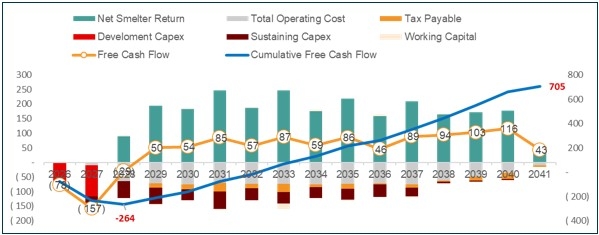
Figure 1‑7: LOM Free Cashflow
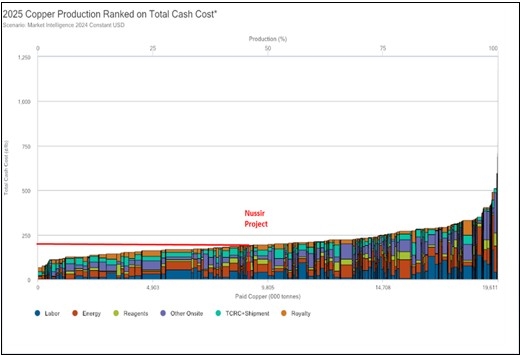
Figure 1‑8:Copper Cash Cost Curve, Copper Equivalent Basis [Source: S&P Global Market Intelligence (2025)]
Sensitivity Analysis
At spot prices as of 3 March 2026 for Cu (5.84 USD/lb), Au (5,171 USD/oz), Ag (84.61 USD/oz), palladium (Pd) (1,720 USD/oz) and platinum (Pt) (2,164 USD/oz), the Project returns a NPV at 8% of 559 MUSD and an IRR of 31.2%.
Whilst the chosen base discount rate by Nussir for the Project is 8%, Table 1‑9 presents the NPV at a range of discount rates. Figure 1‑9 shows an NPV sensitivity at 8% against changes to either the copper price, OPEX or CAPEX. The Project is most sensitive to changes in copper price (Figure 1‑9).
Table 1‑9: NPV Sensitivity to Discount Rate
|
Discount Rate |
NPV (MUSD) |
|---|---|
|
4% |
418 |
|
6% |
316 |
|
8% |
235 |
|
10% |
170 |
|
12% |
118 |
|
14% |
75 |
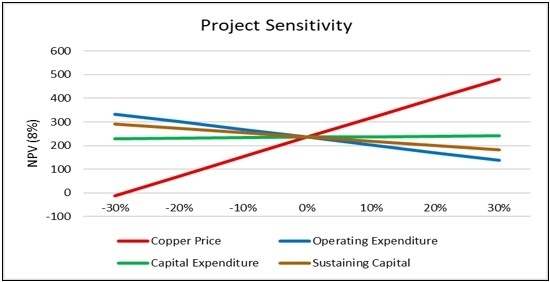
Figure 1‑9: NPV (8%) Sensitivity to Cu price, OPEX and CAPEX
Interpretations and Conclusions
Based on the positive economics presented in this report, the QPs recommend proceeding with the Project. The project is most sensitive to changes in copper price. Refer to Section 26 of the Nussir Technical Report for additional information.
Recommendations
Given the stated assumptions and work completed for this technical report, Worley recommends continuing to advance the Project as described herein. Additional work, including detailed engineering, drill programs and studies, are recommended to further develop the Project, The recommendations are outlined as follows:
- Conduct geotechnical and hydrological drill programs to develop the respective models.
- Detailed engineering, procurement and construction of site infrastructure.
- Evaluation of the Ulveryggen mineral resource.
- Conduct additional variability and geometallurgical testing, including locked cycle flotation and concentrate dewatering tests.
- Continue the ongoing environmental studies and permitting applications necessary for commercial production.
Refer to Section 27 of the Nussir Technical Report for additional information.
Technical Report
Scientific and technical information relating to the Blue Moon Property provided in this AIF is supported by and qualified in its entirety by the full text of the Blue Moon Technical Report on the Blue Moon Property filed in accordance with NI 43-101 entitled "NI 43-101 Technical Report for the Preliminary Economic Assessment of the Blue Moon Mine, Mariposa County, California" dated April 14, 2025 (as amended and restated on September 12, 2025) with an effective date of March 3, 2025, being the Blue Moon Technical Report, which was prepared, reviewed, and approved by Scott Wilson, C.P.G. SME-RM, Peter Szkilnyk, P.Eng., Alan J. San Martin, P.Eng., Richard Gowans, P.Eng., Justin Taylor, P.Eng., and Christopher Jacobs, C.Eng., MIMMM., each of whom is a "qualified person" ("QP") for purposes of NI 43-101. Reference should be made to the full text of the Blue Moon Technical Report, which is available electronically on SEDAR+ (www.sedarplus.ca) under Blue Moon's issuer profile. Development of the Blue Moon Property is referred to as the "Blue Moon Project".
Scientific or technical information in respect of the Blue Moon Property provided subsequent to the date of the Blue Moon Technical Report were prepared by or under the supervision of Dustin Small, who is a consultant to the Corporation and a non-independent qualified person for the purposes of NI 43-101.
Property Description, Location and Access
The Blue Moon Property is located in Mariposa County, California, approximately 120 miles southeast of San Francisco. The town of Mariposa, located sixteen miles east of the Blue Moon Project, has a population of around 2,000 and a tourist-based economy. The town of Merced, with a population of around 80,000 inhabitants, is twenty-two miles to the southwest of Blue Moon and has a diverse economy related to large scale agriculture. The local community of Hornitos with a population of about 75, is situated about 4.5 miles south of the Blue Moon Property. Figure 1.1 shows the location of the Blue Moon Property.
Access to the Blue Moon Property is via California County Route J16 also known as Hornitos Rd. and Bear Valley Rd., a paved secondary highway between the communities of Hornitos and Bear Valley. From a point two miles north of Hornitos, at the intersection of J16 and Exchequer Rd., the Blue Moon Property is accessible via a 3.4-mile route traversing a combination of public and private gravel roads.
Four distinct lenses of massive sulphide mineralization have been identified on the Blue Moon Property: the West, Main, East and American Eagle zones. The American Eagle Zone appears to occur in the same stratigraphic position as the West Zone.
Figure 1.1: Blue Moon Location Map
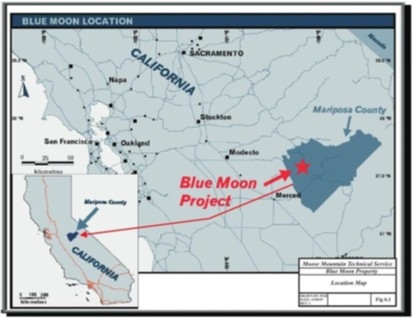
Source: Meade (2002)
Mineral Tenure
As of the date of the Blue Moon Technical Report, the Blue Moon Property consisted of three distinct land tenure components that covered 494.25 acres. These include:
- Two patented mineral claims (American Eagle, and Blue Bell & Bonanza) owned 100% by Keystone; Blue Moon owns the surface and subsurface rights here.
- Eight federal lode claims (Red Cloud 1-8) held 100% by Keystone, Blue Moon's wholly owned US subsidiary which has the mineral rights pursuant to Bureau of Land Management (BLM) claims.
- 100% interest in the mineral rights from two Spanish land grants of the James Gann Jr. Trust of 1991, owned by Keystone in conjunction with a surface rights lease agreement for 40 acres, pursuant to an option purchase agreement completed in 2001.
Table 1.1 lists the Blue Moon Property mineral claims and surface rights on private land as of the date of the Blue Moon Technical Report. For updated information regarding Blue Moon Property mineral claims and surface rights on private lands, please see "The Blue Moon Property – Subsequent Events".
Table 1.1: Blue Moon Claims
|
# |
Claim Type |
Status |
Claim |
Claim |
Claim Size (Acres) |
Parcel Number |
Claim |
Notes |
|---|---|---|---|---|---|---|---|---|
Patented Claims |
||||||||
|
1. |
Patented Mineral Claim |
Active |
MS 5719 |
American Eagle |
20.67 |
007-120-005-0 |
Keystone Mines Inc. |
Patent No. 973403 dated January 28, 1926, covering Mineral Survey No. 5719, for the American Eagle lode mining claim, covering portions of Section 30, Township 4 South, Range 16 East, MDM. |
| 2. |
Patented Mineral Claim |
Active |
M5718 |
Blue Bell and Bonanza |
22.4 |
007-120-002-0 |
Keystone Mines Inc. |
Patent No. 959494, dated May 18, 1925, covering Mineral Survey No. 5718, for the Blue Bell and Bonanza lode mining claims, covering portions of Section 30, Township 4 South, Range 16 East, MDM. |
BLM Land |
||||||||
| 3. |
Unpatented Mining Claim (Federal Lode Claim) |
Active |
CA101349794 |
Red Cloud #1 |
20.32 |
007-100-010-0 |
Keystone Mines Inc. |
Land administered by Bureau of Land Management (Federal Land) |
| 4. |
Unpatented Mining Claim (Federal Lode Claim) |
Active |
CA101303528 |
Red Cloud #2 |
20.66 |
007-100-010-0 |
Keystone Mines Inc. |
Land administered by Bureau of Land Management (Federal Land) |
| 5. |
Unpatented Mining Claim (Federal Lode Claim) |
Active |
CA101300462 |
Red Cloud #3 |
6.89 |
007-100-010-0 |
Keystone Mines Inc. |
Land administered by Bureau of Land Management (Federal Land) |
|
# |
Claim Type |
Status |
Claim |
Claim |
Claim Size (Acres) |
Parcel Number |
Claim |
Notes |
|---|---|---|---|---|---|---|---|---|
| 6. |
Unpatented Mining Claim (Federal Lode Claim) |
Active |
CA101301850 |
Red Cloud #4 |
20.66 |
007-120-003-0 |
Keystone Mines Inc. |
Land administered by Bureau of Land Management (Federal Land) |
| 7. |
Unpatented Mining Claim (Federal Lode Claim) |
Active |
CA101452189 |
Red Cloud #5 |
20.66 |
007-120-003-0 |
Keystone Mines Inc. |
Land administered by Bureau of Land Management (Federal Land) |
| 8. |
Unpatented Mining Claim (Federal Lode Claim) |
Active |
CA101379487 |
Red Cloud #6 |
20.66 |
007-120-003-0 |
Keystone Mines Inc. |
Land administered by Bureau of Land Management (Federal Land) |
| 9. |
Unpatented Mining Claim (Federal Lode Claim) |
Active |
CA101347731 |
Red Cloud #7 |
3.16 |
007-120-004-0 |
Keystone Mines Inc. |
Land administered by Bureau of Land Management (Federal Land) |
| 10. |
Unpatented Mining Claim (Federal Lode Claim) |
Active |
CA101378594 |
Red Cloud #8 |
6.89 |
007-100-010-0 |
Keystone Mines Inc. |
Land administered by Bureau of Land Management (Federal Land) |
Private Land |
||||||||
| 11. |
GANN Lands |
Active |
Letter dated 1 September 2001 |
Spanish Land Grant (J. GANN) |
331.28 |
007-120-007-0 |
Keystone Mines Inc. |
Includes 40 acre surface rights, flexible location within total 320 acre area |
Unpatented mining claim maintenance fees are current and paid through August 31, 2026.
The Blue Moon Property was previously owned by Westmin Mines, Inc., an Idaho corporation and subsidiary of Westmin Resources, Inc. On September 12, 2002, Westmin Resources was acquired by Expatriate, now Yukon Zinc Corporation. The acquisition was subject to a purchase agreement with Boliden Westmin, whereby Expatriate Resources Ltd. ("Expatriate") acquired 100% interest in Westmin Resources, Inc. in return for the issuance of 3 million common shares and the granting of a 0.5% net smelter return royalty capped at US$500,000 to Boliden Westmin.
The subsidiary Westmin Mines, Inc. changed names to Keystone Mines, Inc, on October 25, 2002. In 2004, Expatriate transferred Keystone to Pacifica Resources Ltd., now EDM Resources Inc., through a Plan of Arrangement. Subsequently, in 2007, Pacifica through the Pacifica arrangement, transferred Keystone to Savant Explorations Ltd. Savant Explorations Ltd. changed names to Blue Moon Zinc Corp. on June 5, 2017 and changed its name to Blue Moon Metals Inc. on April 13, 2021. Currently, the Blue Moon Property is controlled by Blue Moon through its 100% ownership of the US subsidiary, Keystone, an Idaho corporation.
In 2017, Northern Empire Resources Corp. (NM) through an agreement with Imperial Metals Corporation, acquired a 10% net profits interest (NPI) in the Blue Moon Property through the takeover of Imperial's Sterling Mines subsidiary. The NPI is only to be paid after deducting all operating expenses, all pre-production expenditures dating back to May 14, 1996, and all post-production expenditures. A finance charge of prime plus one-half of one percent is also to be deducted before any NPI is paid. The NPI was repurchased and extinguished by Keystones in January 2018 through the issuance of 300,000 Common Shares and the payment of US$20,000 cash to NM.
A mineral deed dated effective September 1, 2001, and recorded March 4, 2008, as Document No. 2080941, reserved to the James W. Gann, Jr. Trust of 1991, a 3% Net Smelter Returns (as defined in the deed) that in the aggregate was not to exceed US$200,000 on the lands included in the Gann Land.
In September 2020, Blue Moon repurchased two separate 1% Net Smelter Returns (NSR) on the Blue Moon Project by paying each 1% NSR holder US$12,000 or US$24,000 in total.
The Blue Moon Project is located within the boundaries of the County of Mariposa in the state of California. Mariposa County is the lead agent for all county, state and federal permitting jurisdictions. Exploration permits are issued by Mariposa County through an Administrative Use Permit (AUP). The Corporation's existing AUP expired on June 26, 2023 and the Corporation will need to apply for a new AUP before commencing any future drilling activities. The Corporation must file a Notice of Intent to Operate (NOI) with the Bureau of Land Management. The Corporation has a current NOI in place through to August 27, 2026.
To the extent known, there are no other royalties, back-in rights, payments or other encumbrances to which the Blue Moon Property is subject. The author knows of no known environmental liabilities for which the Blue Moon Property is subject. The author of the Blue Moon Technical Report knows of no other significant factors and risks that may affect access, title or the right or ability to perform work on the Blue Moon Property.
History
Background
Extending along the foothills of the west slope of the Sierra Nevada from Butte County on the north to Fresno County on the south is a discontinuous belt of copper and zinc mineralization. This belt also has been the source of substantial amounts of gold. Gold-bearing gossans in the oxidized zones overlying the copper-zinc deposits were mined during the gold rush. Later, during the copper "booms" of the Civil War and World Wars I and II, considerable amounts of gold were recovered as a by-product. During the 1930s a few gossan deposits in this belt were again mined for gold.
The primary copper and zinc deposits consist of lenticular sulphide bodies in zones of alteration in greenstones and various types of schists. Mineralization contains abundant pyrite with associated chalcopyrite, sphalerite and some gold and silver. Most of the mineralization contains only a small fraction of an ounce of gold per ton, but some deposits have yielded as much as one ounce of gold per ton. Also present are galena, bornite, tetrahedrite, covellite, and chalcocite.
The most important mines in the foothill belt have been the Big Bend mine, Butte County; Spencerville and Boss mines, Nevada County; Dairy Farm and Valley View mines, Placer County; Copper Hill and Newton mines, Amador County; Penn, Quail Hill, Napoleon, Collier, Keystone-Union, and North Keystone mines, Calaveras County; Blue Moon, Pocahontas, Green Mountain and La Victoria mines, Mariposa County; Buchanan, Jessie Belle, and Daulton mines, Madera County; and Fresno Copper and Copper King mines, Fresno County.
Considerable by-product gold has been recovered from copper mines in the Moonlight District of northeastern Plumas County, the principal sources having been the Walker, Engels, and Superior mines. However, few production figures are available, so the total gold output of these mines is unknown. In 1931, the Walker mine was the source of 432,000 tons of copper ore that had an average gold content of 0.05 ounces per ton. At the Walker mine, the mineral bodies consist of wide chalcopyrite-bearing quartz veins in schist and hornfels near granitic rocks. At the Engels and Superior mines, the deposits are bands of chalcopyrite and bornite in sheared granitic rocks.
The Blue Moon deposit is the largest known volcanogenic massive sulphide deposit of its type within the Foothills Massive Sulphide Belt.
A few miles to the south of the Blue Moon Property in Mariposa County is the nearby town of Hornitos. a formerly rollicking Mexican village that sprang up in the 1850s from the newly rich gold diggings at Quartzburg. Situated on Burns Creek, "Hornitos" means "little ovens" in Spanish and was named for the above ground rock and adobe graves of Mexican settlers found in the area. These gravestones were built like little square bake ovens. The population is less than 75 residents today.
1890 – 1945
Although copper was discovered in Mariposa County during mid-1800s gold rush, initial exploration on the Blue Moon Property did not begin until the 1890's. Approximately 50 prospect pits, trenches, and shafts were developed by gold prospectors at that time, mainly on quartz outcrops and pyritic/gossanous outcrops. In 1899, the American Eagle adit was driven 300 ft into an alteration zone and an "appreciable quantity" of gold was produced from one of six known mineralized zones. This zone is now covered but was reported to be about 4 ft wide and consisted of oxidized sphalerite, pyrite, tetrahedrite, galena, chalcopyrite, silver, and gold, with grades of roughly 3% to 8% zinc, 2% to 11% copper, 1% lead, 1 opt to 3 opt silver, and 0.01 opt to 0.22 opt Au. This mine was worked until 1912, and then was idle until 1942 when, during WWII, a small block of ground was stoped. By 1943, production from the American Eagle was suspended and it has remained inactive since then. No reliable figures for the total production at the American Eagle are available.
In the early 1930's prospecting in the Blue Moon area, just north of the American Eagle was begun. In 1935 a small amount of Au-Ag-Cu oxide ore was mined, probably representing the surface expression of the Blue Moon Main Zone. In 1940, Red Cloud Mines, Inc. (Red Cloud), began developing shallow workings which intersected zinc, probably in the Main Zone in the area Blue Moon Shaft #1. The Federal Bureau of Mines had initiated a diamond-drilling program at the American Eagle mine based on an examination by one of its engineers in June 1943; drilling was done from January to March 1944. The results of this drilling by the government are unknown.
Exploratory drilling at that time verified continuity of the mineralization at depth. In 1943, Red Cloud was acquired by Hecla Mining Co. Production at a rate of 200 tons per day yielded ore with an average content of 14% zinc and minor copper, lead, silver and gold. Cutoff grade was defined as 7% zinc over a minimum stope width of four feet. Ore was milled and concentrated by flotation at the Jenny Lind gold mine and mill site located four miles to the southeast. Zinc concentrates were sold to Metals Reserve Co. at Merced Falls and later at Merced; copper concentrates were trucked to the ASARCO smelter at Selby, California.
In 1945, the "hanging wall fault breccia" caved twice, once in the summer and again in November. Following the second cave-in, all work at the Blue Moon mine was suspended. At that time the mine had been developed to a depth of 490 ft and along strike for 320 ft, with a total of 2,370 ft of workings. Total reported production amounted to 55,655 tons containing about 12.3% zinc, 0.37% copper, 0.48% lead, 3.76 opt silver, and 0.062 opt Au.
At the time of its closing, the consolidated Blue Moon mine was ranked as the eleventh largest producing mine, and by far the largest productive base metal mine, in Mariposa County.
1945 – 1975
Exploration and mining activities on the Blue Moon Property were paused during this period.
1976 – 1990
In 1976, Amselco acquired the Blue Moon Property from prospectors Tom Evans and Norm Stevens, and conducted soil geochemical and electromagnetic surveys and 4,161 feet of percussion drilling between 1976 and 1979. Between 1981 and 1984, Colony Pacific Explorations Ltd. (an Imperial Metals Corporation subsidiary) conducted geological mapping, soil geochemical sampling, induced polarization and downhole EM geophysical surveys, and 33,385 ft of diamond drilling. This drilling was focused on testing the down dip extension of the mine area. Mr. Evans supervised this work and defined the steep plunge of the lenses to the south, still recognized today.
American Mine Services optioned the Blue Moon Property from Colony Pacific in 1983 and calculated a geological and mineable reserve, as per 1983 criteria, as well as undertaking preliminary metallurgical studies, mine engineering and design studies and site facilities planning but subsequently defaulted on their option agreement in 1983. Westmin Resources Limited concluded an option on the Blue Moon Property and conducted several exploration programs in the period 1984-1987 and completed 56,853 ft of diamond drilling expanding the resource base of the deposit and discovering the American Eagle lens and East lenses. The exploration work included recalculation of the mineral resource, and commencing engineering studies and conducting metallurgical, hydrological, and environmental baseline studies. In October 1987, Westmin terminated its option and converted its interest into an equity position in Colony Pacific. The latter continued with permitting of an underground exploration permit and made application for a permit for an underground development and exploration program. More than US$5 million in exploration was completed in the period (Thompson, 1995).
1991 – 2001
In 1991 Lac Minerals (eventually Barrick) optioned the Blue Moon Property from Colony Pacific and carried out 19,654 ft of drilling in 15 holes. Lac Minerals also completed soil and rock geochemical surveys, and HLEM and magnetic surveys. Westmin re-acquired the Blue Moon Property in May 1996 at a cost of US$1.45 million.
Following the repurchase in May of 1996, Westmin resumed evaluation of the development of the Blue Moon Property, however as budgetary priorities were being focused on the company's discovery at the Wolverine deposit in the Yukon, exploration and development efforts were diverted away from Blue Moon. In February 1998, Westmin granted Augusta Metals Corporation an option on the Blue Moon Property. Augusta completed 2,470 ft of drilling in five holes on the Lone Oak barite-gold prospect southeast of the main VMS zone. Subsequently Augusta failed to fulfill its work commitments, and the option was forfeited during 2000/2001.
2002 - Present
In 2002, Expatriate (Harlan Meade) purchased Westmin from Boliden Westmin. In 2004, the Blue Moon Property was spun out into Selwyn Resources Ltd. Subsequently, in 2007, Savant Explorations Ltd. was spun out from Selwyn Resources and issued a NI 43-101 resource estimate based on previous well-documented work programs in 2008 (Morris, R.J. and Giroux, G. 2008).
In 2017, Savant was renamed Blue Moon Zinc Corp., and an updated mineral resource estimate was issued. Between 2018 and 2021, a multi-year drilling program was carried out by Blue Moon and under a JV with Platina Resources, and a 10% NPI and two 1% NSR royalties were bought back.
In April, 2021, the Corporation was renamed Blue Moon Metals Inc.
In 2023, a geophysical (gravity) survey was conducted on the Blue Moon Property (Carpenter, T., 2023) and a revised resource estimate was published, including the 2018-2021 drilling data (Hendricksen, A.H. and Wilson, S., 2023).
Geology and Mineralization
The Blue Moon deposit is hosted by the Upper Jurassic Gopher Ridge Formation of the Western Block of the Sierra Foothills Metamorphic Belt. This belt extends for 186 miles along the western foothills of the Sierra Nevada Mountains and is approximately 9.5 miles wide. Along the length of the belt, clusters of Zn-Cu rich, polymetallic, massive sulphide deposits occur at approximately 25-mile intervals. Many mines were developed between 1860 and the mid 1900s along the belt. One of the largest was the Penn mine in Calaveras County north of Mariposa County, which produced 883,402 tons of Cu-Zn-Pb (Au-Ag) ore (Martin, 1988).
Regional Geology
Rocks in the Sierra foothills consist of north trending tectonostratigraphic belts of metamorphosed sedimentary, volcanic, and intrusive rocks ranging in age from late Paleozoic to Mesozoic. These belts represent rock sequences, largely of island-arc affinity, that were accreted to the continent. They extend about 235 miles along the western side of the Sierra and are flanked to the east by the Sierra Nevada Batholith and to the west by sedimentary rocks of the Cretaceous and Jurassic Great Valley sequence.
The structural belts are internally bounded by the Melones and Bear Mountains fault zones, and are characterized by extensive faulting, shearing, and folding (Earhart, 1988). Historically, three belts have been identified in the southern Sierran foothills based on lithologic differences and the nature of gold mineralization - the West Gold Belt, the Mother Lode Belt, and the East Gold Belt. The Mother Lode Belt is responsible for most of the gold produced. However, substantial gold has been produced from the East Belt, as well as gold, copper, and other base metals from rocks of the West Belt.
The West Belt consists of an eastern component composed of an ophiolitic melange and a Jurassic age western component composed of the Copper Hill Volcanics, the Salt Springs slate, and Gopher Ridge Volcanics. The Bear Mountains fault zone separates the melange from the Copper Hill Volcanics. The West Belt contains widely scattered gold deposits occurring in quartz veins and stringers in schist, slate, granitic rocks, altered mafic rocks, and as gray ore in greenstone. The West Belt also hosts the Foothill Copper-Zinc Belt and the massive sulphide deposits of the Penn Mine and other VMS deposits.
The Mother Lode Belt traverses western Calaveras County and consists of the upper Jurassic Logtown Ridge and Mariposa formations. The Logtown Ridge Formation consists of about 6,500 ft of volcanic and volcanic-sedimentary rocks of island arc affinity. The overlying Mariposa Formation contains a distal turbidite, hemipelagic sequence of black slate, schist, amphibolite and chlorite schist, fine-grained tuffaceous rocks, and subvolcanic intrusive rocks. The thickness of the Mariposa Formation is estimated to be about 2,600 ft thick at the Consumnes River (Earhart, 1988).
Mother Lode mineralization is characterized by steeply dipping gold-bearing mesothermal quartz veins and bodies of mineralized country rock adjacent to veins. Mother Lode mineral production is generally low to moderate grade (1/3 ounce of gold or less per ton), but mineral occurrences may be considered large in volume. Mother Lode veins are characteristically enclosed in Mariposa Formation slate with associated greenstone. The Mother Lode belt vein system ranges from a few hundred feet to a mile or more in width. Mother Lode type veins fill voids created within faults and fracture zones and consist of quartz, gold and associated sulphides, ankerite, calcite, chlorite, limonite, talc, and sericite. The Melones Fault zone separates the Mother Lode Belt from the East Belt.
The Eastern Belt is dominantly argillite, phyllite plus phyllonite, chert, and metavolcanic rocks of Paleozoic-Mesozoic age. The phyllite and phyllonite are dark to silvery gray. The chert is mostly thinbedded with phyllite partings.
The Paleozoic-Mesozoic metasedimentary and metavolcanic rocks of the Eastern Belt have been assigned to the Calaveras Complex by most investigators (Earhart, 1988). Older Paleozoic metamorphic rocks have been assigned to the Shoo Fly Complex. The metamorphic complexes have been intruded in places by Mesozoic plutonic rocks. Lode deposits of the East Belt consist of many individual gold-bearing quartz veins enclosed in metamorphic rocks of possible Jurassic age, metamorphic rocks of the Calaveras Complex, metamorphic rocks of the Shoo Fly complex, or in granitic rocks. Most of the veins trend northward and dip steeply. An east-west set of intersecting faults may be a controlling factor in controlling deposition of metals. Mineral deposits of the East Belt are smaller and narrower than those of the Mother Lode, but commonly are more chemically complex, and richer in grade. Gold is usually associated with appreciable amounts of pyrite, chalcopyrite, pyrrhotite, galena, sphalerite, and arsenopyrite.
Local Geology
The Foothill Copper-Zinc Belt forms part of a complex litho-tectonic belt of Jurassic age island arc metavolcanic, metasedimentary, and meta-plutonic rocks. It lies west of, and roughly parallel to the Mother Lode gold belt. The metallic deposits, which form lenticular bodies in the metavolcanic rocks, are primarily composed of massive pyrite and various amounts of chalcopyrite, sphalerite, gold and silver. Some deposits, however, contain small amounts of pyrrhotite, galena, tetrahedrite, or bornite.
Until the early 1970s, the massive sulphide deposits at the Penn Mine were thought to be epigenetic replacement deposits formed along shear zones (Heyl, et al, 1948; Clark and Lydon, 1962). The reinterpretation of massive sulphide deposits in Japan as being of volcanogenic origin rather than replacement deposits resulted in a re-evaluation of many massive sulphide deposits in the western US. As a result, more recent studies of specific deposits, including those of the Penn Mine, have proposed a syngenetic origin of these deposits (Peterson, 1985).
Kemp (1982) defined the island-arc setting in which the Foothill Copper-Zinc Belt deposits are situated. Schmidt (1978) defined the textural and structural attributes, stratigraphic framework, and the sulphide mineralogy at the Penn Mine and concluded these deposits are more indicative of Kuroko-type syngenetic volcanogenic sulphides. Bedrock at the Penn Mine consists primarily of greenschist-facies metavolcanic rocks of the Gopher Ridge Volcanics that strike N30°W and dip steeply to the east (generally greater than 70°).
Despite the regional metamorphism and eastward tilting there is little evidence of major folding or faulting in the area (Peterson, 1985). The metavolcanic rocks have a weak to intense foliation paralleling the strike. Peterson (1985) subdivided the Gopher Ridge Volcanics at the Penn Mine into one intrusive and five volcanic sub-units based on prominent lithologic features: 1) felsic quartz porphyry intrusive unit, 2) siliceous tuff unit, 3) basalt unit, 4) mafic to intermediate tuff unit, 5) heterogeneous tuff unit, and 6) vent complex unit.
Most of the copper-zinc deposits are intimately associated with sills and lenses of the felsic quartz porphyry unit which occur within the lower three volcanic units. Also associated with the deposits are large areas of sericitic and silicic alteration that produced a quartz sericite schist, and chloritic, hematitic, and pyritic alteration halos around the mineralization. Mineralization occurs in two distinct zones; a western ore zone lying to the east of quartz porphyry schist and along which Shaft Nos. 1, 2, 6 were sunk, and an eastern ore zone just west of chloritic quartz porphyry, which was mined in shafts Nos. 3 and 4. Twelve separate zones were differentiated during underground mining. Heyl et al (1948) provides numerous cross sections through many of these areas within the mine.
Schmidt (1978) identified several zoned mineralization types including massive sulphides, stringer veins and disseminated mineralization. The principal domains consist of massive mixtures of sphalerite, pyrite, bornite, and chalcopyrite with minor gangue comprised of barite, quartz, calcite and/or mica schist, and rare to minor galena and tetrahedrite/tennantite. Quartz, selenite, and some native copper are also present (Clark and Lydon, 1962).
Many of the massive zones are banded with alternating layers of chalcopyrite, pyrite, or sphalerite, whereas others are a fine-grained heterogeneous mixture of up to 60% sphalerite, 50% pyrite, and varying proportions (up to 30%) of copper and accessory minerals. Many of the banded mineral bodies show kinks, swirls, and folds indicative of post-deposition deformation (Schmidt, 1978). The mineralization shapes are lenticular in form, and the long axes plunge down dip or steeply to the north or south. Mineralization shows pronounced elongation with length-to-width ratios ranging from 2:1 to 5:1 and averaging 3:1 (Schmidt, 1978). They varied considerably in size, some having been mined along the pitch length of as much as 1,000 ft (Heyl et al, 1948). Thickness of mineralization varies from 4 ft to 30 ft. Stringers are pyrite, chalcopyrite, sphalerite, bornite, calcite, barite, and quartz. Gangue of fine-medium-grained aggregates of quartz, calcite, and barite occur interstitial to the stringers.
Disseminated mineralization consists of disseminated pyrite, chalcopyrite, and sphalerite, and are associated with extensive wall-rock alteration (Schmidt, 1978). Fine-grained pyrite comprises between 1% to 10% of the rock. Mineralization displays a strong asymmetric zonation both in mineralogy and mode of mineral occurrence, which was not consistent with a replacement origin.
A typical mineral body in the Western zone consists of: 1) a hanging wall layer of massive to banded mineralization rich in sphalerite, barite, chalcopyrite, pyrite, and galena, and tetrahedrite-tennantite, with sphalerite-barite rich mineralization being more abundant towards the hanging wall, and copper minerals more abundant towards the footwall; 2) a zone of stringer mineralization with copper minerals (bornite and chalcopyrite), pyrite, quartz, and minor tetrahedrite; and 3) quartz-pyrite veinlets and disseminated pyrite mineralization with quartz porphyry or rhyolitic tuffs.
In the Eastern zone, the above sequence is reversed, occurring from footwall to hanging wall. The zoning was attributed to a syngenetic process where gravity would contribute to the asymmetry of both the mineral types and alteration effects (Schmidt, 1978). Mineralized zones are conformable with the volcanic section. Mineralization lies along bedding and schistosity planes rather than along fault planes or fractures zones as would be expected by a hydrothermal origin. These zones also exhibit stratigraphic selectivity, occurring only within or to one side of a felsic quartz porphyry.
Mineralization commonly occurs at the contact of a felsic porphyry with more mafic rocks. The felsic quartz porphyry intrusive units and parts of the volcanic units are altered to sericite and silicified in the stratigraphic horizons of the deposits (Peterson, 1985). Similar associations of felsic rocks and alteration are characteristic of Kuroko-type deposits massive sulphide deposits (Franklin et al, 1981). The fluids affecting the felsic quartz porphyry intrusive and responsible for the mineralization are thought to have had a common origin, with alteration occurring contemporaneously with deposition of the metallic mineralization. First the volcanic units were deposited in an island arc environment. Contemporaneous with or shortly after their deposition, felsic quartz porphyry bodies intruded the volcanic rocks along bedding planes to form a number of sills, the massive sulphide bodies were deposited, and the adjacent country rock was altered.
Property Geology
The Gopher Ridge Formation in the area of the Blue Moon deposit consists of a basal sequence of basalt and andesite overlain by a rhyolite, Figure 1.2. The rhyolite strata are up to 300m thick and host the Blue Moon deposit(s). The sulphide-sulphate mineralized lenses are hosted in the lower part of the felsic sequence. The felsic volcanic rocks are succeeded to the east by volcaniclastic rocks and ultimately by deep-water argillaceous, sedimentary rocks (Meade, 1996).
Strata at the Blue Moon Property strike approximately 20° west of north, dip near vertically, face to the east and are tightly folded. Minor fold features suggest a steep, north plunge of the regional structure. All lithologies have undergone low grade metamorphism and the prefix "meta" is not applied to lithologic names for the sake brevity in writing. Lithologies observed at Blue Moon exhibit metamorphic characteristics of the lower greenschist facies. The rhyolite strata have been subdivided on the basis of phenocryst mineralogy into three distinct units: aphyric rhyolite, feldspar porphyry rhyolite and quartz-feldspar porphyry rhyolite. The distinction of these different types of rhyolite allows the modeling of the depositional environment of the volcanic rocks at the time of the sulphide mineralization and the identification of stratigraphic horizons within the felsic rocks. More massive phases of aphyric rhyolite define rhyolite dome features that are flanked by clastic, fragmental facies. The thinning of the aphyric rhyolite proximal to the domes defines favorable environments for deposition of massive sulphide mineralization. Further up the stratigraphic sequence, massive feldspar porphyry rhyolite appears to define sill or dyke features that locally truncate sulphide mineralization.
Sericitic alteration and bleaching of the rhyolite strata cause wide ranges in the appearance of the various rhyolite rocks, and careful distinction of alteration changes versus changes in lithology is important to defining the volcanic stratigraphy.
Lateral to the sulphide mineralization, chemical sedimentary rocks containing hematite, magnetite, barite, silica and manganese minerals, helped define mineralized horizons. Sulphide-barite mineralization on the edges of massive sulphide mineralization grades laterally into hematite-jasper iron formation, which, in turn, grades into manganese-bearing siliceous tuffaceous rock.
Figure 1.2: Property Geology (Meade, 2002)
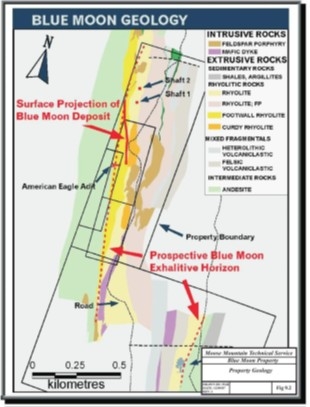
Mineralization
Probably the best local surface geology maps displaying mineralization at the Blue Moon deposits were those during Harlan Meade's leadership time with both Western Mines and Expatriate (Figure 1.2). Several geologists, including Paul Wodjak and Garfield McVeigh are mentioned in the references. Several subsequent geologists have mapped offset faults in the Main Zone and more work is necessary to clarify these differences.
The Blue Moon deposit is a Kuroko-type volcanogenic massive sulphide deposit. The deposit is shown to have some similarities with the Lynx and Myra deposits at Myra Falls, Vancouver Island. Stacked sulphide-sulphate lenses occur in two or more horizons within a 50 ft to 180 ft stratigraphic interval. Four distinct lenses of massive sulphide mineralization have been identified; the West, Main, East and American Eagle zones. The American Eagle Zone appears to occur in the same stratigraphic position as the West Zone.
The West Zone occupies the lowest stratigraphic position and occurs near the base of the aphyric rhyolite sequence. The Main Zone lies stratigraphically above the West Zone and occurs with the first appearance of quartz and feldspar porphyry rhyolite. The East Zone lies stratigraphically above the Main Zone, although several authors have included it as part of the Main Zone. It is hosted entirely within feldspar porphyry rhyolite.
Massive sulphide mineralization consists of pyrite, sphalerite, chalcopyrite, galena, and minor tetrahedrite and bornite. Massive and semi-massive sulphides may be accompanied by purple anhydrite, gypsum or barite. Textures include massive, banded and clastic mineralization.
Metal zoning in base or precious metal is poorly understood although there is a strong tendency for narrower mineralized zones to be relatively richer in gold and silver and to have barite gangue. The potential mineral horizons are enveloped by sericite-silica-pyrite alteration that extends laterally in the rhyolite stratigraphy at least 3,000 ft, as far as known mineralization is recognized, and more than 490 ft into the footwall andesite. A stockwork sulphide feeder zone is not clearly identified within the footwall alteration zone. This discordant sericite altered zone is linked to a lower strata-bound sericite altered zone in the footwall andesite which extends at least 0.7 miles to the south from the deposit and may be an important exploration tool to identify other mineralized centres.
The lower mineralized horizon (West and American Eagle zones) generally contains more pyrite, chalcopyrite, sphalerite, anhydrite and gypsum than the upper mineralized horizon (Main and East zones) which is comparatively enriched in galena, tetrahedrite and barite. The South Zone has not been studied. Gold and silver grades can be significant in the lower horizon lenses but are on average three times greater in the upper horizon lenses.
A database of some 1,540 samples is available for the deposit. All the samples are from drill core. Table 1.2 lists some of the general statistics.
Table 1.2: Blue Moon Summary Statistics from Drill Core
|
Parameter |
Minimum |
Maximum |
Mean |
Stand. Dev. |
C.V. |
|---|---|---|---|---|---|
|
Sample length (ft) |
0.4 |
21.3 |
3.78 |
1.78 |
0.47 |
|
Copper (%) |
0.0 |
10.7 |
0.35 |
0.85 |
2.44 |
|
Zinc (%) |
0.0 |
46.0 |
2.37 |
5.09 |
2.15 |
|
Lead (%) |
0.0 |
6.4 |
0.14 |
0.47 |
3.48 |
|
Silver (oz/ton) |
0.0 |
40.3 |
0.69 |
2.44 |
3.55 |
|
Gold (oz/ton) |
0.0 |
1.04 |
0.019 |
0.06 |
3.19 |
|
|
|
|
|
|
|
Deposit Types
The Blue Moon deposit is a Kuroko-type, polymetallic, volcanogenic, massive sulphide deposit, or VMS deposit. The sulphide-sulphate deposit is hosted in rhyolite. Anomalous metalliferous mineralization includes pyrite, sphalerite, chalcopyrite, galena, and minor tetrahedrite and bornite. The associated sulphate minerals are barite, gypsum and purple anhydrite. To date, four lenses of mineralization have been identified within at least two, possibly three, horizons. The lenses are enveloped by sericite-silicapyrite alteration. Gold and silver grades are significant in the lower horizon lenses but are, on average, three times greater in the upper horizon lenses.
The volcanogenic massive sulphide deposit type and model for Blue Moon is considered appropriate, and the proposed exploration program is planned accordingly.
Exploration
Exploration of the Blue Moon Property, mostly historical in nature, was carried out by earlier owners and includes geological mapping, soil geochemical surveys and geophysical surveys, including an induced polarization survey, down-hole EM surveys and, in 2023, a gravity survey.
Drilling
Most of the drilling on the Blue Moon Property was completed by previous owners, starting in 1942, and by Blue Moon in 2018, 2019, and 2021.
Drilling has occurred on the Blue Moon Property since 1942 with a total of 136,416 ft of drilling in 124 drill holes. Most of the holes were drilled in the Blue Moon deposit area. A few holes were drilled in the Amselco Hill and Lone Oak areas, targeting the favorable stratigraphic horizon. Figure 1.3 shows the location of all drill holes on the Blue Moon prospect through 2023 (Shum, Kevin 2023).
Figure 1.3: Location of All Drill Holes on the Blue Moon Prospect through 2023 (Shum, Kevin 2023)
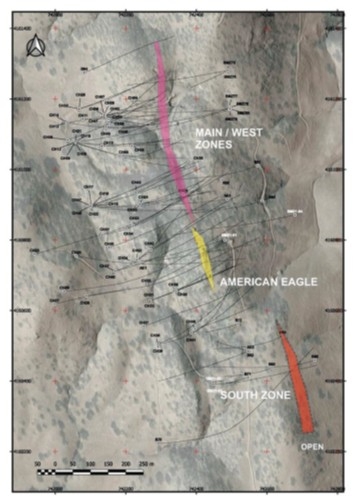
Most of the holes drilled on the Blue Moon Property have been diamond drill holes of BQ and NQ core, except for nine percussion holes drilled in 1979 by Amselco. As well, with the exception of the Amselco holes, all the holes have down-hole surveys. Only core holes drilled since 1979 were used in the resource calculation.
Table 1.3 and Table 1.4 list the footage drilled by others and by Blue Moon, respectively.
Table 1.3: Summary of Drilling on the Blue Moon Property, Prior to the Formation of Blue Moon
|
Year |
Operator |
No of Holes |
Hole Numbers |
Drilled Length |
|---|---|---|---|---|
|
1942 |
Red Cloud Mines Inc. |
10 |
RC2 – RC8, 101-103 |
4,516.5 |
|
1944 |
US Bureau of Mines |
7 |
1-7 |
2,800.0 |
|
1979 |
Amselco |
9 |
79-1 – 79-9 |
4,161.0 |
|
1981 |
Colony Pacific |
2 |
B1, B2 |
1,584.0 |
|
1982 |
Colony Pacific |
12 |
AE1-AE3, B3-82 – B11-82 |
11,054.1 |
|
1983 |
Colony Pacific |
6 |
B12-83 – B17-83 |
9,856.6 |
|
1984 |
Westmin |
5 |
B18 – B22 |
10,891.7 |
|
1985 |
Westmin |
10 |
CH13-14,17-18,23-28 |
10,307.5 |
|
1986 |
Westmin |
15 |
AE 86 CH 1,B 86 CH 29 – B 86CH 42 |
22,129.8 |
|
1987 |
Westmin |
7 |
B 87 CH 43 – B 86 CH49 |
6,872.0 |
|
1988 |
Westmin |
10 |
B 88 CH 50 – B 88 CH59 |
16,447.0 |
|
1991 |
Lac Minerals |
15 |
B 91 CH 60 – B 91 CH74 |
19,639.0 |
|
1999 |
Augusta |
5 |
LO 99 CH 01 – LO 99CH 05 |
2,471.0 |
|
Totals |
113 |
- |
122,730.2 |
|
Table 1.4: Drilling by Blue Moon Since 2018 at Blue Moon Project
|
Hole |
Drilled Length |
|---|---|
|
BMZ75 (2018) |
1,180 |
|
BMZ76 (2018) |
950 |
|
BMZ77 (2018) |
180 |
|
BMZ78 (2018) |
1,789 |
|
BMZ79 (2019) |
1,837 |
|
BMZ80 (2019) |
1,877 |
|
BMZ81 (2021) |
719 |
|
BMZ82 (2021) |
577 |
|
BMZ83 (2021) |
2,809 |
|
BMZ84 (2021) |
1,768 |
|
Total |
13,686 |
Table 1.5 details significant Intercepts from the Blue Moon Drill Program.
Table 1.5: Significant Intercepts from the Blue Moon Drill Program
|
Hole |
From |
To |
Length |
Zinc |
Gold |
Silver |
Lead |
Copper |
ZnEq |
|---|---|---|---|---|---|---|---|---|---|
|
BMZ75 |
1,022.0 |
1,038.0 |
16.0 |
1.2 |
0.08 |
0.7 |
0 |
0.04 |
1.4 |
|
Inc |
1,027.0 |
1,029.0 |
2.0 |
2.9 |
0.05 |
1.5 |
0 |
0.08 |
3.2 |
|
|
|
|
|
|
|
|
|
|
|
|
BMZ78 |
1,425.0 |
1,545.7 |
120.7 |
9.45 |
1.10 |
42.93 |
0.15 |
0.58 |
12.61 |
|
Inc |
1,436.0 |
1,441.0 |
5.0 |
1.90 |
4.98 |
32.60 |
0.47 |
0.11 |
8.08 |
|
Inc |
1,459.0 |
1,464.0 |
5.0 |
2.60 |
5.01 |
18.50 |
0.01 |
0.33 |
8.77 |
|
Inc |
1,468.5 |
1,453.3 |
15.2 |
5.98 |
2.30 |
15.44 |
0.03 |
0.38 |
9.40 |
|
Inc |
1,508.0 |
1,538.0 |
30.0 |
30.30 |
1.67 |
71.07 |
0.05 |
1.70 |
36.80 |
|
Inc |
1,508.0 |
1,511.0 |
3.0 |
46.50 |
3.14 |
130.00 |
0.13 |
2.20 |
56.51 |
|
|
|
|
|
|
|
|
|
|
|
|
BMZ79 |
412.8 |
420.3 |
7.5 |
25.6 |
0.68 |
17.39 |
0.02 |
0.87 |
28.46 |
|
Inc |
414.7 |
417.7 |
3.0 |
49.6 |
0.91 |
30.32 |
0.05 |
1.39 |
54.11 |
|
BMZ79 |
450.4 |
461.3 |
10.9 |
3.1 |
0.16 |
4.49 |
0.27 |
0.47 |
4.62 |
|
Inc |
457.2 |
459.2 |
2.0 |
4.2 |
0.08 |
3.30 |
0.33 |
0.24 |
5.24 |
|
|
|
|
|
|
|
|
|
|
|
|
BM21-83 |
504.0 |
514.0 |
10.0 |
3.8 |
0.07 |
5.10 |
0.17 |
0.12 |
4.40 |
|
Inc |
509.0 |
514.0 |
5.0 |
5.0 |
0.07 |
5.10 |
0.22 |
0.08 |
5.50 |
|
BM21-83 |
1,829.0 |
1839.0 |
10.0 |
1.1 |
3.62 |
11.3 |
0.30 |
0.04 |
5.30 |
|
Inc |
1,839.0 |
1839.0 |
5.0 |
1.2 |
6.96 |
15.2 |
0.30 |
0.03 |
8.80 |
|
BM21-83 |
2,408.0 |
2,458.0 |
50.0 |
2.4 |
0.31 |
4.5 |
0.06 |
0.12 |
3.13 |
|
Inc |
2,413.0 |
2,423.0 |
10.0 |
3.4 |
0.17 |
5.8 |
0.05 |
0.09 |
3.90 |
|
Inc |
2,443.0 |
2,453.0 |
10.0 |
4.3 |
0.31 |
4.5 |
0.01 |
0.34 |
5.46 |
|
|
|
|
|
|
|
|
|
|
|
Figure 1.4 presents a longitudinal section showing the drill hole intercepts to date.
Drill hole BMZ-78 cut 30 ft (9.35 m) of massive sulphide mineralization grading 30.3% zinc, 1.7% copper, 1.67 g/t gold and 71 g/t silver for a zinc equivalent grade of 36.8% within a broader interval of 120.7 ft (36.5 m) that returned 9.45% zinc, 0.58% copper, 1.1 g/t gold and 42.9 g/t silver for a zinc equivalent grade of 12.61%.
BMZ-78 was drilled into a previously untested area (200 ft x 500 ft) within the West and Main Zones at a vertical depth of approximately 1,200 ft (374 m).
Blue Moon's 2018 drill program demonstrated that the massive sulphide lenses are now traceable for approximately 3,000 ft (900 m) along plunge and remain open to surface and depth.
Hole BMZ79 intersected significant zones of high-grade sphalerite including the following intervals. Note that stated dimensions are intersected width (IW); true width is approximately 55% of IW.
- 7.47 m (24.5 ft) at 25.55% zinc, 0.87% copper, 0.68 g/t gold and 17 g/t silver for a zinc equivalence ("ZnEq") of 28.46% from 412.81 m, including:
○ 3.05 m (10.0 ft) at 49.60% zinc, 1.39% copper, 0.91 g/t gold and 30 g/t silver for a ZnEq of 54.11% from 414.65 m.
Figure 1.4: Long Section Showing Latest Drilling through 2021
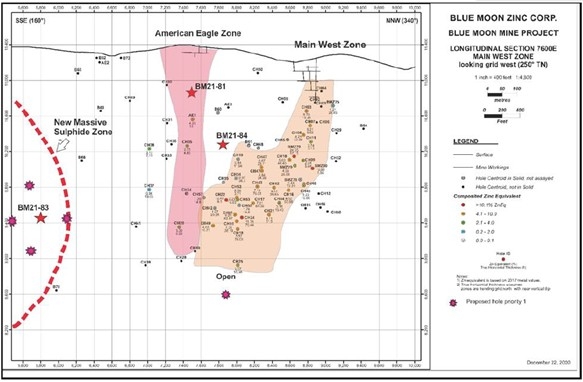
Source: Hendricksen and Wilson (2023)
A second zone of zinc mineralization in the same hole from 450 m, included:
- 10.96 m (36.0 ft) at 3.11% zinc, 0.47% copper and 0.27 % lead for a ZnEq of 4.62% from 450.37 m, including:
○ 2.08 m (6.8 ft) at 4.2% zinc for a ZnEq of 5.24% from 457.16 m.
The high-grade zone of BMZ79 includes the highest zinc interval ever intercepted in the Blue Moon Project to date, 1.71 m (5.6 ft) at 51.9% zinc, 1.49% copper, 0.05% lead, 0.85 g/t gold and 31.9 g/t silver from 414.65 m.
The high-grade mineralized intercept in Hole BMZ79 is 50 m (164 ft) above and 8 m (26 ft) south of the high-grade mineralization intercepted by the 2018 diamond hole BMZ78. The intercept extends the size of the high-grade zone of mineralization within the Main mineralized horizon. The Main mineralized horizon also intersected some interesting anomalies of gold and silver (Table 1.5).
The stage 1 drilling program totaled 1,132 m (3,714 ft) and tested the northern border of the mineral resource as well as extend the zone of high-grade mineralization near hole BMZ78 which was drilled by Blue Moon in 2018.
A new drill discovery was made in 2021 testing a geophysical conductor target, located west of the three previously discovered Blue Moon mineralized zones and south of the American Eagle workings, as shown in Table 1.6. This new zone was discovered deep and lateral to the previously known mineral system. Sphalerite encountered in this new discovery has a different hue from the other zones which may indicate a separate emplacement pulse, with slightly different timing, which could add the currently known zones.
Table 1.6: Assay Highlights New South Zone (Drill Hole BM21-83)
|
Drill Hole |
From |
To |
Thickness |
Zinc |
Copper |
Lead |
Silver |
Gold |
ZnEq |
|---|---|---|---|---|---|---|---|---|---|
|
BM21-83 |
2408 |
2458 |
50 |
2.4 |
0.12 |
0.06 |
0.13 (4.5 g/t Ag) |
0.009 (0.31 g/t Au) |
3.13 |
|
including |
2413 |
2423 |
10 |
3.4 |
0.09 |
.05 |
0.17 (5.8 g/t Ag) |
0.005 (0.17 g/t Au) |
3.90 |
|
and |
2443 |
2453 |
10 |
4.3 |
0.34 |
0.01 |
0.13 (4.5 g/t Ag) |
0.009 (0.31 g/t Au) |
5.46 |
Notes:
| * | The above thicknesses are core lengths and are not true thicknesses. The estimated true thicknesses are approximately 50% of the core length. These results are also reported in Table 1.5. |
Stringers and blebs of sulphides were encountered starting at a core depth of 2,363 ft that continued until the banded and massive interval from 2,400 ft to 2,452 ft (52 ft interval at a vertical depth from surface of approximately 800 ft). Mineralization then tapered off into another stringer zone down to 2,461 ft core depth. The mineral-rich zone comprised nearly 100 ft core length (not true thickness). Higher up in the hole, several smaller zones were encountered. Mineralization is hosted in rhyolite and rhyolite tuffs of the Gopher Ridge Formation. The stringer and main zone of sulphides are composed of sphalerite, chalcopyrite, galena tetrahedrite and pyrite.
Sample Preparation, Analyses and Security
Core from the drill holes through 2021 was collected at the drilling rig by a company geologist and brought to the core logging facility on the Blue Moon Property. The core was cleaned, logged for rock type, structures and mineralization prior to a geologist marking out specific intervals for sampling based on sulphide content. Sampling of the core was done either by a hydraulic splitter if visually lower grade or sawn if deemed to be potentially higher grade. The core was sampled lengthwise with one half placed into a plastic sample bag with a sample tag. The other half was returned to the core box with a duplicate sample tag number for a permanent record. Standards and blank samples were not inserted into the stream of core samples prior to Blue Moon as this was not practiced by the majority of mining companies at that time. Core with visual mineralization was stored in locked shipping containers which remain on site, with saved mineralized sections of core available for inspection.
Samples for analysis were sent by truck to independent laboratories. Some of the earlier samples were sent to a Mineral Assay Office Inc., Nevada; however, the majority of the core samples were analyzed by Chemex Labs (now ALS Laboratories) in Vancouver, Canada. Both laboratories were certified assayers within their respective jurisdictions and independent of the owners of the Blue Moon Property. All assay data used in the resource calculation was generated via standard, industry accepted assaying techniques. Gold assaying used a 30g sample size for a fire assay with an atomic absorption spectrometry finish (FA-AAS). Silver and lead assays were generated with atomic absorption spectrometry (AAS). All other elements were assayed by inductively coupled plasma atomic emission spectroscopy (ICP-AES), including barium which required an additional, final gravimetric procedure. Known standards and blank samples were inserted into the sample stream by the laboratory for quality control.
One set of check assays carried out by Giroux (2018) included 55 samples that were assayed by both Chemex Labs in Vancouver (Chemex) and Mineral Assay Office Inc. in Nevada (Mineral). At that time, Chemex and Mineral were independent facilities with no relation to the issuer. Chemex was an ISO 9001:2015 certified laboratory. Chemex and Mineral are no longer in business as of the effective date of the Blue Moon Technical Report. Table 1.7 summarizes the results of those check assays.
Table 1.7: Summary Statistics, Check Assays
|
Parameter |
Copper |
Zinc |
Silver |
Gold |
|---|---|---|---|---|
|
Mean, Chemex |
0.918 |
5.385 |
2.554 |
0.035 |
|
Mean, Mineral |
0.970 |
5.500 |
2.433 |
0.038 |
|
Stand. Dev, Chemex |
0.997 |
6.622 |
7.037 |
0.082 |
|
Stand. Dev, Mineral |
1.066 |
6.653 |
7.009 |
0.094 |
|
CV, Chemex |
1.09 |
1.23 |
2.76 |
2.31 |
|
CV, Mineral |
1.10 |
1.21 |
2.88 |
2.44 |
|
|
|
|
|
|
A paired t-test was performed and previously reported on the data to check bias between the laboratories. In all cases the difference between the laboratories is considered insignificant. Table 1.8 summarizes the results.
No documentation exists for sample preparation, analyses and security from previous operators. It is the opinion of the QP that the sample preparation, security and analytical procedures followed can be relied upon for the purposes of the Blue Moon Technical Report.
Table 1.8: Paired t-test, Check Assays
|
Element |
Results |
|---|---|
|
Cu |
Mineral reports 0.05% higher than Chemex |
|
Zn |
No bias found between laboratories |
|
Ag |
Chemex reports 0.12 oz/ton higher than Mineral |
|
Au |
No bias found between laboratories |
Data Verification
The QP conducted a personal inspection of Blue Moon on November 5 and 6, 2024. The QP had access to the complete database of the Blue Moon Project including all original assay certificates from the Corporation and previous operators, the original drill logs of the Corporation, and down-hole, directional survey results for all drilling. As well as the original surveyor's report on drill hole locations, the QP was provided with a report of a 2018 survey commissioned by Blue Moon and completed by Jones Snyder and Associates, a registered land surveyor in the state of California. The 2018 survey included resurveying of 29 of the holes used for the Blue Moon Project as well as monuments established by the surveys of 1984 and 1991, established decades prior to the involvement of Blue Moon.
There is no documentation of data verification procedures from previous operators.
All mineralized intersections are preserved in a secured storage facility on the Blue Moon Property. As part of the verification process, the author completed cross checks of the assay sample numbers recorded in the original assay certificates with drill logs and the sample tags in the core boxes for 30 of the mineralized intercepts. No discrepancies or errors were noted between the sample numbers on the tags in the core boxes and those recorded in the assay certificates. The author did not note any visual discrepancies between what was observed in the core with what was recorded in the drill logs. No assay with high zinc, copper or lead were noted to be at odds with what was observed in the drill core for the comparable interval.
The QP reviewed the results of the 2018 drill hole survey and compared these with the original surveys of 1984 and 1991. In addition, the surveys of the 2019 program were also compared for drilling in those years. The results of the surveys compare, and no material difference was found. As a check of the professional surveys, the author also checked the collar locations with a handheld GPS unit (Garmin). The co-ordinates noted matched those of the earlier surveys.
As a check on core recoveries reported in the historical logs, the QP carried out spot checks of key mineralized sections in 25 holes used in the resource calculation of the Blue Moon Technical Report. The core recovery noted by the author matched those reported in the historical logs. The author also checked the thicknesses of mineralization by measuring the angle between the core axis and the contact of massive sulphide zones with the bounding rhyolite host rocks. Spot checking of 25 holes used in the resource calculation with respect to drill hole length, azimuth and grid location found no material differences.
During the November 2024 site visit, the QP collected a random interval of core from Drill Hole CH7. The sample was submitted to ALS Reno USA for sample preparation. The assaying was performed at ALS Vancouver BC. ALS Reno USA and ALS Vancouver BC are both subsidiaries of ALS Global. ALS Global is independent of the issuer. ALS Global Quality complies with ISO/EIC 176025:2017. Table 1.9 shows the original assay which is used in the drilling database versus the check sample submitted by the author. The results confirm the occurrence of mineralization for that sample at the encountered drilling depth.
Table 1.9: Independent QP's Data Verification, November 5, 2024
|
Parameter |
Hole ID |
Sample ID |
From |
To |
Silver |
Gold |
Copper |
Lead |
Zinc |
|---|---|---|---|---|---|---|---|---|---|
|
Original |
CH47 |
73860 |
1495.4 |
1496.5 |
1.9 |
0.01 |
0.9 |
0.005 |
10.7 |
|
Check |
- |
- |
- |
- |
0.91 |
0.001 |
0.411 |
0.001 |
5.3 |
|
|
|
|
|
|
|
|
|
|
|
QPs Christoper Jacobs and Alan San Martin were also present during the site visit on 5-6 November 2024. At that time, Mr. San Martin was able to examine drill core from the mineralized zone and its host rock and was thus able to verify the RQD values recorded in drill logs that informed the preliminary estimate of stope spans for the proposed underground mine. Also, Mr. San Martin and Mr. Jacobs were able to verify the condition of the site access road, the availability of suitable terrain for construction of a mine portal, process plant and tailings storage facility, and confirm the proximity of power lines at the nearby hydro-electric dam and distance to the settlement at Hornitos.
Mr. Gowans examined metallurgical testwork reports prepared on behalf of previous operators of the Project and, based on the level of detail provided, determined their suitability for inclusion.
No limitations were placed on the QP during the site visit. In the opinion of the QP, the data used to estimate mineral resources for the Blue Moon Property is adequate for purposes used in the Blue Moon Technical Report.
Further details on the sampling methods, analyses and data verification are available in the Blue Moon Technical Report, which is available on SEDAR+ (www.sedarplus.ca) under the Corporation's issuer profile.
Mineral Processing and Metallurgical Testing
A program of metallurgical testwork was undertaken using two mineralized samples (identified as Sample 1 and Sample 2) by Lakefield Research (now SGS Mineral Services), Ontario, Canada, in 1988, under the direction of Wright Engineers Limited on behalf of Westmin Resources Limited. This preliminary testwork program comprised chemical and mineralogical analyses, hardness testing, batch and locked cycle flotation, flotation concentrate analyses, gravity separation and preliminary settling tests on samples of zinc concentrate and zinc rougher tailings.
Sample 1 was reported by Lakefield Research to comprise relatively coarse high-sulphide mineralization with active pyrite and sphalerite. Sample 2 was reported to contain less sulphides and be more complex and finer grained than Sample 1.
The results of preliminary mineralogical characterization study by Lakefield Research showed that the samples were similar with respect to sulphide mineral species but there were differences in the amounts of each sulphide and mineral associations. In general, Sample 1 contained more sulphides and was relatively coarse grained (> 100 microns) while Sample 2 contained more non-opaque minerals and sulphide particles were smaller in size.
The work indices derived from standard bond grinding testing of around 9 kWh/t are considered relatively low compared with most copper and zinc ores (between 11 and 14 kWh/t), although the elevated content of barite and gypsum could explain the perceived discrepancy.
Lakefield Research completed 26 separate bench scale batch flotation tests and one locked cycle test primarily to investigate the sequential flotation of copper and zinc from the two samples.
The results of the cycle test using Sample 1 show a 93% copper recovery into a concentrate containing 26.5% Cu, 8.42 g/t Au, 484 g/t Ag, 2.35% Pb and 7.0% Zn. Lead recovery to the copper concentrate was also 93% while the recoveries of gold and silver were around 68%. A zinc recovery of 95.2% Zn was achieved into a high quality zinc concentrate containing 62.3% Zn.
Although preliminary mineralogical studies suggested that Sample 2 was more complex and fine grained than Sample 1, the results from batch rougher and cleaner flotation tests were similar to Sample 1. A simple batch pyrite recovery test was completed using Sample 2 following sequential flotation of Cu/Pb and Zn. Approximately 20% of the original mass was recovered to a pyrite rougher concentrate.
The conclusions from the 1988 testwork program are as follows:
- Good recoveries of copper and zinc into high grade concentrates were achieved using conventional sequential flotation technology. Typically, most of the gold and silver in the samples tended to report to the copper/lead concentrate. Net recoveries of gold and silver to both the zinc and copper concentrates were 86.2% and 94.3% respectively.
- The copper/lead concentrate produced contained minor amounts of deleterious elements which may incur penalties when sold to smelters. Conversely, this product also contained gold and silver in payable quantities.
- The zinc concentrate produced was of high grade with relatively low iron and contained no significant amount of penalty elements.
- Flotation of pyrite from zinc tailings was successful and additional work to improve the product quality is recommended.
- Separation of copper and lead into separate products was challenging but further work to improve selectivity is warranted.
- The work indices calculated from standard bond ball mill tests were relatively low and need to be confirmed using fresh samples that represent the main ore types at Blue Moon.
- The samples contained interesting amounts of barite and gypsum. More work is required to quantify the distribution of these minerals within the deposit, the quality of these minerals, and the potential to recover these minerals as valuable by-products.
- The samples appeared to contain a certain amount of free or nuggetty gold which should be investigated further. Deportment studies on the gold and silver are recommended.
- Elements of particular interest that should be investigated in the next phase of metallurgical testwork include germanium and gallium. The economic potential of these elements as well as indium should be considered during the next geo-metallurgical testwork program.
- Based on the limited amount of testing undertaken so far, there are no processing factors or other deleterious elements that that could have a significant effect on the potential economic extraction of the deposit.
Mineral Resource Estimate
The MRE for the Blue Moon Technical Report was determined by using inverse distance cubed (ID3) techniques for the Main, Western and Eastern Zones of the Blue Moon Massive Sulphide Deposit. Assay data was derived from the current drilling database, including drill holes completed after 2018. Mineralized domain solids were created from the coding of drill data in a three-dimensional (3D) geological modeling program. Drilling intercept assay values were capped for each mineralized domain using statistical analysis and subsequently composited forming the sample set used for the MRE grade estimates. The MRE has been determined according to the CIM Estimation of Mineral Resources and Mineral Reserves Best Practice Guidelines (November 29, 2019). Mineral Resources have been reported in accordance with the disclosure requirements under NI 43-101.
The MRE is subdivided into three zones: Main Zone (vm1), East Zone (ve) and West Zone (vw). Using compiled and modeled 3D drill data there are distinct, separate, continuous lenses of mineralization, generally striking north. The Main Zone represents the largest occurrence of mineralization. Mineralization has been identified over a strike length of 2,500 ft as well as a plunge of nearly 2,500 ft of depth. The West and East Zones display less continuity as compared to the Main Zone. These were modeled independently and subsequently appended together to form a combined east and west zone triangulation domains. In addition to the dominant mineralized lenses numerous prominent mineralized intervals exist along many drill holes throughout the deposit. Individual mineralized domain solids were developed for these intervals which were subsequently labeled east lenses (vle) and west lenses (vlw) based upon their respective relationships to the Main Zone. The "vle" and "vlw" lenses were compiled and added to the overall "ve" and "vw" domain triangulations.
Reasonable prospects of eventual economic extraction assume underground mining of the deposit, surface mill processing and production of zinc concentrates and copper concentrates. Mineral Resources are reported at a Zinc Equivalent Percent (ZnEq %) cutoff grade of 2.9%. Cutoff grade sensitivities can be found in the Blue Moon Technical Report.
ZnEq % is calculated by each assayed metal being assigned a metal price, assumed recovery percentage and overall value factor based on the metal's price and recovery. Notwithstanding its potential for eventual economic extraction, for the purposes of this preliminary economic assessment lead was assumed not payable and so makes no contribution to ZnEq % grade. Parameters forming the basis for the ZnEq % formula are detailed in the Blue Moon Technical Report.
The formula used to estimate ZnEq % is:
ZnEq = Zn% + ((Cu% * 78.20)+(Pb% * 0)+(Ag opt * 25.46)+(Au opt * 1896.40))/23.83.
Table 1.10 and Table 1.11, respectively, present the Indicated and Inferred Mineral Resource Estimates. Resources are not Mineral Reserves and do not have demonstrated economic viability. There is no certainty that all or any part of the Mineral Resources will be converted into Mineral Reserves.
Figure 1.5 shows the location of drill holes on the Blue Moon Property, as well as a plan projection of the three mineralized zones. Figure 1.6 and Figure 1.7 show the mineralized domains on long-section 7500E looking West and East, respectively.
Table 1.10: Blue Moon Indicated Mineral Resource Estimate Effective Date December 24, 2024
|
Domain |
ZnEq |
Tons |
ZnEq |
Copper |
Lead |
Zinc |
Gold |
Silver |
|---|---|---|---|---|---|---|---|---|
|
Main |
2.9% |
3,073,000 |
12.66 |
0.78 |
0.16 |
5.90 |
0.04 |
1.14 |
|
East |
2.9% |
498,000 |
18.99 |
0.47 |
0.63 |
6.64 |
0.09 |
3.72 |
|
West |
2.9% |
78,000 |
9.50 |
0.62 |
0.33 |
4.41 |
0.03 |
0.93 |
|
Total |
3,650,000 |
13.46 |
0.73 |
0.23 |
5.97 |
0.04 |
1.49 |
|
|
|
||||||||
|
|
Metal |
Cu Mlbs |
Pb Mlbs |
Zn Mlbs |
Au Moz |
Ag Moz |
||
|
Main |
47.94 |
10.08 |
362.76 |
0.11 |
3.51 |
|||
|
East |
4.67 |
6.29 |
66.15 |
0.04 |
1.85 |
|||
|
West |
0.97 |
0.52 |
6.91 |
0.00 |
0.07 |
|||
|
Total |
53.59 |
16.90 |
435.83 |
0.16 |
5.43 |
|||
Table 1.11: Blue Moon Inferred Mineral Resource Estimate Effective Date December 24, 2024
|
Domain |
ZnEq |
Tons |
ZnEq |
Copper |
Lead |
Zinc |
Gold |
Silver |
|---|---|---|---|---|---|---|---|---|
|
Main |
2.9% |
3,261,000 |
11.41 |
0.52 |
0.23 |
5.68 |
0.04 |
1.15 |
|
East |
2.9% |
994,000 |
15.49 |
0.59 |
0.56 |
5.04 |
0.07 |
2.43 |
|
West |
2.9% |
173,000 |
6.28 |
0.73 |
0.22 |
1.98 |
0.02 |
0.40 |
|
Total |
4,428,000 |
12.12 |
0.54 |
0.30 |
5.39 |
0.04 |
1.41 |
|
|
|
||||||||
|
|
Metal |
Cu Mlbs |
Pb Mlbs |
Zn Mlbs |
Au Moz |
Ag Moz |
||
|
Main |
33.65 |
14.74 |
370.27 |
0.11 |
3.76 |
|||
|
East |
11.80 |
11.20 |
100.11 |
0.07 |
2.42 |
|||
|
West |
2.52 |
0.74 |
6.84 |
0.00 |
0.07 |
|||
|
Total |
47.97 |
26.68 |
477.22 |
0.19 |
6.25 |
|||
Notes:
(1) Scott Wilson, CPG, President of RDA is responsible for this mineral resource estimate and is an independent Qualified Person as such term is defined by NI 43-101.
(2) Reasonable prospects of eventual economic extraction were assessed by enclosing the mineralized material in the block model estimate in 3D wireframe shapes that were constructed based upon geological interpretations as well as adherence to a minimum mining unit with geometry appropriate for underground mining.
(3) The cutoff grade of 2.9% ZnEq considered parameters of:
(a) Metal selling prices: Au-US$2,200/oz, Ag-US$27/oz, Cu-US$4.25/lb., Pb-US$0.90/lb., Zn-US$1.25/lb.
(b) Recoveries of Au 86.2%, Ag 94.3%, Cu 93.1%, Pb 0%, Zn 95.3%.
(c) Costs including mining, processing, general and administrative (G&A).
(4) Zinc Equivalent Grade ("ZnEq") is estimated by the formula:
ZnEq = Zn% + ((Cu% * 78.20)+(Pb% * 0)+(Ag opt * 25.46)+(Au opt * 1896.40))/23.83
(5) Mineral resources are not mineral reserves and do not have demonstrated economic viability.
(6) Figures may not add up due to rounding.
(7) Tonnages shown in Table 1.10 and Table 1.11 are short tons.
(8)The QP knows of no other legal, political, environmental, or other risks that could materially affect the potential development of the mineral resources for the Blue Moon Project.
Figure 1.5: Plan View of Mineralized Domains and Drilling
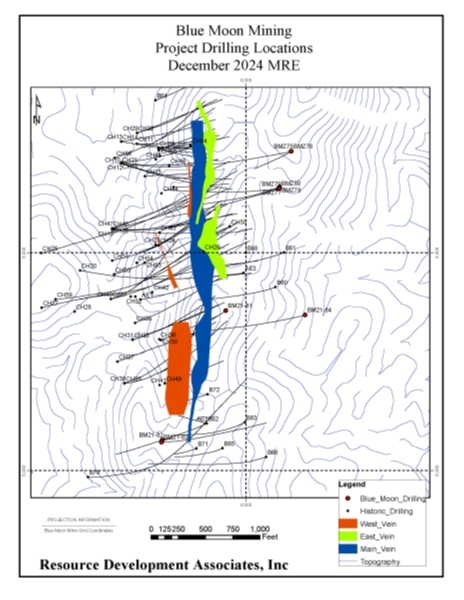
Figure 1.6: Long-Section View - 7500E Looking West - Mineralized Domains
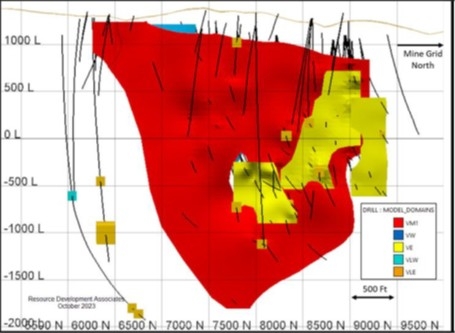
Source: Henricksen and Wilson (2023)
Figure 1.7: Long Section View - 7500E Looking East - Mineralized Domains
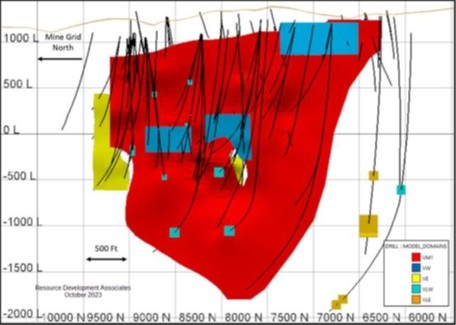
Source: Henricksen and Wilson (2023)
The QP knows of no other legal, political, environmental, or other risks that could materially affect the potential development of the mineral resources for the Blue Moon Project.
Mineral Reserve Estimate
No current mineral reserve estimate has been established on the Blue Moon Property.
Mining Operations
The PEA is preliminary in nature. It includes Inferred Mineral Resources that are considered too speculative geologically to have the economic considerations applied to them that would enable them to be categorized as mineral reserves, and there is no certainty that the PEA will be realized. Mineral Resources that are not Mineral Reserves do not have demonstrated economic viability.
The PEA utilizes the Mineral Resources described in the Blue Moon Technical Report and only those portions of the Mineral Resource that fall within the constraints defined by underground parameters of the PEA are used to inform the Blue Moon Project economics.
The mining method selection was largely guided by the results of the Mineable Shape Optimizer (MSO) analysis, which evaluated various stoping methods and sizes based on economic and operational parameters. The MSO process assessed multiple configurations, including longhole stoping and cut and fill methods. As a result of this analysis, a stope height of 80 ft, using a $75/ton NSR cutoff, was selected as the basis for the mine design as this maximises resource recovery, limits excessive sustaining capital requirements (level development), and provides the highest relative operating margin compared to the other cases considered.
The mine will be accessed through a ramp system designed with a nominal grade of 13%, reaching a maximum of 15% in some sections. The initial portal and decline will provide access for exploration drilling and be utilized once the mine moves into production as the main haulage route. The layout separates the deposit into North and South mining zones to minimize level development and provide additional mine sequencing flexibility. The decline is positioned to first access the North Zone, prioritizing thicker, higher-grade levels in the mine.
Mining levels will be spaced at 80-ft vertical intervals, with mining fronts consisting of 5 or 6 levels grouped together. Each level will include essential infrastructure such as truck load-out areas, electrical substations, and dewatering sumps. The primary decline will serve as the main haulage route, with additional accesses developed as mining advances. Allowances were added (5% for ramp, 20% for level development) to account for remucks and infrastructure cutouts (Figure 1.8).
The production schedule was created in Datamine's Enhanced Production Scheduler (EPS) software, using benchmark development rates observed on recent projects. The initial decline advances to the main fresh air intake raise, before continuing to the north and beginning the north spiral ramp to the first mining front.
Separate level development crews are assigned to handle level and ventilation accesses, as well as ore sill drives. Stopes are scheduled by linking dependencies between designed stope shapes, in a Primary- Primary retreat sequence to the level access. Additional dependencies were added to the schedule to ensure ventilation breakthroughs are complete in advance of production on a level. The dedicated ramp resource crew advances to the next mining front. Overall production is targeted at 2,000 tons per day. Mining fronts were prioritized by grade and size to aid in early revenue generation.
The underground mining fleet will include a combination of development and production equipment. The development fleet will consist of jumbo drills, bolters, load-haul-dump (LHD) machines, and scissor decks for support infrastructure installation. The production fleet will include 42 tonne haul trucks, longhole drills, and 6-yard LHDs for material movement.
Workforce estimates were created based on the mine schedule, assuming 2-12 h shifts, with a 4-shift rotation. Mine technical and administrative staff and certain fixed plant maintenance personnel were assumed to work 5-d weeks, day shift only. Peak salaried and hourly-waged personnel requirements are 61 and 160 people, respectively.
Provision has been made in the design for mine services including dewatering, electrical distribution, communications and safety, refuge chambers, and compressed air.
Figure 1.8: Mine Design Model View Looking West
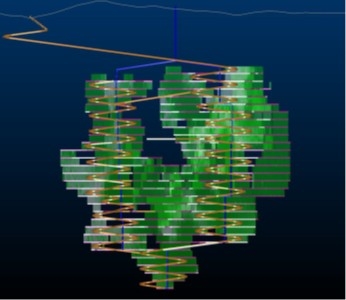
Not to scale.
Processing and Recovery Operations
The processing facility has been designed to treat 657,000 tonnes per year. Mineralization will be received from the underground mine at the process site which comprises the following areas:
Crushing Plant.
Crushed Ore Handling and Storage.
SAG and Ball Mill Grinding Circuit.
Flotation Circuits:
○ Copper Flotation.
○ Zinc Flotation.
○ Pyrite Flotation.
Concentrate Handling by means of thickening, filtration and loading for copper, zinc and pyrite concentrates.
Tailings Handling by means of thickening, filtration and preparing for paste and dry stack storage.
Paste Backfill Plant.
Reagents Handling and Storage.
Plant Services.
The mineral processing operation shall begin when the haul trucks from the underground mine deliver the ore to the primary crusher station. The ore will be crushed and conveyed to a stockpile where it will be reclaimed and transported to the main mill building. The crushed ore will be sufficiently reduced in size in the grinding circuit to liberate the desired minerals. Downstream, the flotation circuits shall selectively recover the target minerals for each type of concentrate. Dedicated thickeners shall densify each slurry stream and recover the overflow water for re-use in the process, while the thickened slurry will be further dewatered through dedicated filter presses. Concentrates and tailings shall all be handled as filter cakes.
Copper and zinc concentrates shall be collected from the storage stockpile located below the filter presses and loaded onto a hopper and conveyor system which will be used to load the concentrate within a lined rectangular shipping container. Pyrite and tailings filter cake will be conveyed by means of conveyors to a paste backfill mixer. The mixer shall blend the filtered tailings with additional water and a binder into a paste which will then be pumped to the underground mine by means of a piping network.
Infrastructure, Permitting and Compliance Activities
Project Infrastructure
The infrastructure of the Blue Moon Property is designed to support the operation of a processing plant and production from the underground operation. The mine and processing plant will operate on a nominal 24 h/day, 7 days/week schedule to achieve an average throughput of 1,800 tonne/day. The proposed general arrangement for the mine site is presented in Figure 1.9.
Figure 1.9: Blue Moon General Arrangement
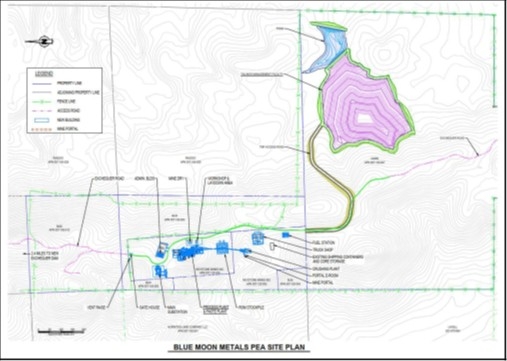
Infrastructural elements considered in the PEA include access roads, on-site haulage and service roads, power supply from the neighbouring hydro-electric dam, process- , fresh-, and potable water supplies, fuel storage facilities and on-site workshops, mine dry (change-house) and gatehouse and offices for administration, technical services, etc.
The average daily requirement for make-up water will be 75,529 gallons. To the extent possible, this will likely be obtained from wells sunk in the area of the mine. However, additional hydrogeological studies will be required to confirm the adequacy of borehole supply capacity.
Tailings from the flotation plant will be thickened using a conventional underflow system and then be further dewatered using a filter press to produce a "dry" cake comprising approximately 90% solids by weight. The daily production of tailings will be approximately 1,800 tonnes, dry mass. In due course, a proportion of the filter cake tailings will be combined with a suitable binder and water to form a paste for backfilling completed underground workings. A tailings management facility comprising a dry stack, water pond and access routes, will be located on 40 acres of the Gann land. Within this area, the dry stack area will occupy 31 acres, with the remaining land accommodating the pond and access road. The stack and pond will be located in a shallow valley on the eastern side of the Bullion Hill ridge, as indicated in Figure 1.10.
Figure 1.10: TMF General Arrangement
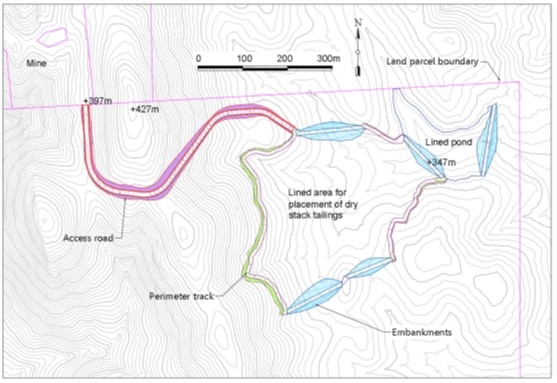
Environmental Studies, Permitting and Social or Community Impact
Development activities on the Blue Moon Property are subject to various federal, state, and local laws and regulations. The environmental effects of proposed development activities will be evaluated by the US Bureau of Land Management and the Mariposa County Planning Department in accordance with the National Environmental Policy Act (NEPA) and the California Environmental Quality Act (CEQA). Various federal and state environmental laws and regulations will also apply to proposed development activities on the Blue Moon Property. In addition to compliance with all applicable Federal, State and County legal requirements, Blue Moon intends to develop the Blue Moon Property in general alignment with good international industry practice (GIIP).
The legal framework surrounding mining activities in California is comprehensive and environmental standards are high. The associated environmental permitting process, which is yet to commence, can therefore be extensive and time-consuming.
Blue Moon holds the mineral rights to the Blue Moon VMS deposit through its wholly owned subsidiary, Keystone. As of the date of the Blue Moon Technical Report, the mineral and property rights covered a total land area of 494.25 acres and comprise three distinct land tenure components. For updated information regarding Blue Moon Property mineral claims and surface rights, please see "The Blue Moon Property – Subsequent Events".
Technical studies were undertaken in the 1980s and 1990s under previous management of the Blue Moon Property. These studies provide an indication of baseline conditions in the Blue Moon Project area at the time and can be used to inform the approach to future studies. The previous baseline studies did not identify any significant barriers to Blue Moon Project development. However, it is important to note that they were undertaken on a different project design (e.g., a vertical shaft instead of a ramp decline) and will require updating.
The Blue Moon Project is situated within the lower western foothills of the Sierra Nevada mountain range within the watershed of the Merced River. Previous studies indicated that the types of wildlife likely to be present were considered typical of the region and not at significant risk from mining activities. None of the sites of archaeological interest found during previous studies correspond with the footprint of the current Blue Moon Project design.
The nearest settlement to the Blue Moon Project is the small town of Hornitos, located approximately 4.5 miles south. The Blue Moon Project site was historically mined as part of the Californian Gold Rush. There are active mining operations in the region, and good transport connections.
A full review of the potential environmental and social impacts will be undertaken as the Blue Moon Project advances. Based on the current Blue Moon Project design, location, and an understanding of metal mining operations in similar environments, the main potential risks associated with operations of this nature include natural hazards, disturbance from air quality, noise, vibration and artificial lighting, impacts on water flow and water quality, impacts on biodiversity mainly through loss of habitat, and risks to groundwater from tailings. However, socio-economic impacts are considered to be positive. Potential environmental and social risks and impacts are considered typical of similar exploration and mining operations in North America, and any potential impacts can be managed appropriately.
Responsible closure planning will be integrated into all phases of the Blue Moon Property and undertaken in compliance with Federal and California State legislative requirements and GIIP. A detailed closure plan and cost estimate has not yet been developed but an indicative amount of US$15 million has been budgeted.
Capital and Operating Costs
The PEA is preliminary in nature. It includes Inferred Mineral Resources that are considered too speculative geologically to have the economic considerations applied to them that would enable them to be categorized as mineral reserves, and there is no certainty that the PEA will be realized. Mineral Resources that are not Mineral Reserves do not have demonstrated economic viability.
Micon's QP prepared the economic analysis of the Blue Moon Project on the basis of a discounted cash flow model, from which Net Present Value (NPV), Internal Rate of Return (IRR) and payback period can be determined. Assessments of NPV are generally accepted within the mining industry as representing the economic value of a project after allowing for the cost of capital invested.
All results are expressed in United States dollars ($ or US$) except where stated otherwise. Conservatively, an exchange rate of CAD 1.35/US$ has been applied where required for conversion of cost inputs whereas, at the effective date of the Blue Moon Technical Report, the spot rate was approximately CAD 1.45/US$.
Cost estimates and other inputs to the cash flow model for the Blue Moon Project have been prepared using constant, first quarter 2025 money terms, i.e., without provision for escalation or inflation.
Blue Moon Project revenues will be generated from the sale of zinc and copper concentrates, with credits for gold and silver content. The Blue Moon Project has been evaluated using constant metal prices of US$4.20/lb copper, US$1.25/lb zinc, US$2,200/oz Au and US$27/oz Ag. No credit or penalty has been applied for lead or any other by-product content in concentrates. These price assumptions are supported by the 10-year price history of each metal presented in Section 19. The sensitivity of the Blue Moon Project to changes in price assumptions has been tested 10% above and below base case values and using both spot (February 2025 market average prices) and consensus price forecasts.
Figure 1.11 shows the relative contribution of each metal to NSR value of the saleable concentrates.
Figure 1.11: NSR Value by Metal
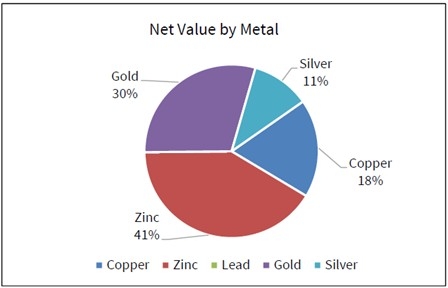
The capital expenditure (CAPEX) estimate for the PEA has been developed using a combination of budgetary quotes from vendors, historical pricing from comparable projects, and parametric calculations based on similar equipment and infrastructure. Cost elements have been refined and itemized to enhance confidence in the estimate. However, the overall accuracy remains within the expected range for a PEA-level study. The approach ensures a robust and well supported cost estimate while maintaining alignment with the early-stage nature of the assessment.
Table 1.12 summarizes the initial, sustaining and total LOM capital costs for the Blue Moon Project, in addition to which a provision of US$15 million has been made for mine closure and rehabilitation costs.
Table 1.12: LOM Capital Cost Estimate
|
Area |
Initial |
Sustaining |
LOM Total |
|---|---|---|---|
|
Mining |
18.4 |
10.0 |
28.4 |
|
Processing |
55.0 |
42.8 |
97.7 |
|
Infrastructure |
26.7 |
11.7 |
38.4 |
|
Sub-Total Direct Costs |
100.1 |
64.5 |
164.5 |
|
Indirect |
15.9 |
0.0 |
15.9 |
|
Contingency |
28.5 |
0.0 |
28.5 |
|
Total Capital Costs |
144.5 |
64.5 |
209.0 |
The operating costs have been estimated from first principals and in each area of the operating cost estimate, labour costs are based on the proposed headcount, estimated salary and burden for each position.
Table 1.13 provides a summary of the estimated life-of-mine (LOM) PEA operating costs.
Table 1.13: LOM Operating Cost Estimate
|
Area |
LOM Average |
LOM Cost |
|---|---|---|
|
Mining |
75.02 |
503,709 |
|
Processing |
36.11 |
242,453 |
|
E/S and G&A |
5.10 |
34,239 |
|
Total Direct Costs |
116.24 |
780,401 |
|
Selling Costs |
22.30 |
149,740 |
|
Royalties |
0.35 |
2,350 |
|
Total Operating Costs |
138.89 |
931,991 |
Table 1.14 presents some key statistics for the Blue Moon mine base case economic assessment.
Table 1.14: Base Case – Key Statistics
|
Item |
Units |
Value |
|
|---|---|---|---|
|
Nominal Processing Capacity |
tonnes per day |
1,800 |
|
|
LOM Total Processed |
'000 tonnes |
6,714 |
|
|
Zinc Equivalent Grade Processed |
% ZnEq |
12.55 |
|
|
Net Smelter Return |
US$/tonne treated |
246.00 |
|
|
|
Copper |
000'lbs |
7,237 |
|
Zinc |
000'lbs |
62,260 |
|
|
Gold |
oz |
22,566 |
|
|
Silver |
oz |
681,784 |
|
|
ZnEq |
000'lbs |
151,046 |
|
The average C1 cash cost over the LOM is estimated at US$0.60/lb zinc equivalent. Including sustaining and mine closure expenses, the average All-in Sustaining Cost (AISC) over the LOM is estimated at US$0.66/lb zinc equivalent and, including initial capital, the average All-in Cost (AIC) over the LOM is estimated at US$0.77/lb zinc equivalent.
A chart summarizing the LOM annual cash flow projection for the base case is given in Figure 1.12.
Figure 1.12: Annual Cash Flow Projection
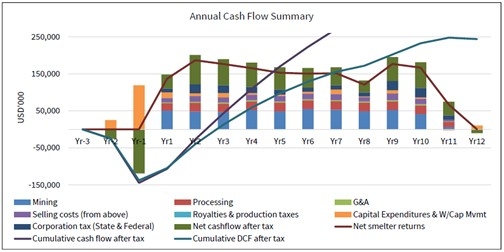
The base case cash flow equates to a pre-tax IRR of 48% and a net present value at an 8% annual discount rate (NPV8) of US$354 million before tax. After-tax base-case cash flows provide an IRR of 38% and evaluate to NPV8 of US$244 million. After-tax undiscounted payback is achieved in approximately 2.8 years.
Micon has tested the sensitivity of the base case NPV8 and IRR to changes in prices (which may also be used as a proxy for ore grades and recoveries), as well as operating costs and capital expenditures. The Blue Moon Project is most sensitive to changes in product prices with a 30% reduction resulting in a near-zero NPV8. A 30% increase in operating and capital costs reduce NPV8 to US$144 million and US$155 million, respectively, showing the Blue Moon Project to be relatively insensitive to either factor alone.
Table 1.15 compares the key economic results for metal prices 10% lower and higher than the base case, as well as at long-term consensus prices forecast in 2024 and average spot prices observed in February, 2025.
Table 1.15: Detailed Metal Price Sensitivity
|
Parameters |
PEA Base Case |
-10% Pricing |
+10% Pricing |
Long-Term Consensus Forecast |
Spot Prices Average. 2025-02 |
|
|---|---|---|---|---|---|---|
|
Metal Prices Assumed |
Copper US$/lb |
4.20 |
3.78 |
4.62 |
4.75 |
4.23 |
|
Zinc US$/lb |
1.25 |
1.13 |
1.38 |
1.26 |
1.27 |
|
|
Gold US$/oz |
2,200 |
1,980 |
2,420 |
2,181 |
2,895 |
|
|
Silver US$/oz |
27.00 |
24.30 |
29.70 |
26.16 |
32.18 |
|
|
After-Tax NPV (US$ M, 8% Discount Rate) |
$244 |
$163 |
$324 |
$260 |
$340 |
|
|
After-Tax IRR (%) |
38% |
29% |
46% |
39% |
48% |
|
|
First 6 Years of After-Tax Cashflow (US$ M) |
$367 |
$293 |
$442 |
$382 |
$458 |
|
|
Payback Period (Years) |
2.4 |
2.9 |
2.0 |
2.3 |
1.9 |
|
|
C1 Cost (US$/lb ZnEq) |
$0.60 |
$0.60 |
$0.61 |
$0.60 |
$0.55 |
|
|
LOM Average Head Grade (ZnEq %) |
12.55 |
12.66 |
12.47 |
12.72 |
13.83 |
|
Recommendations
The following recommended work program adopts a two-phased approach to the further development of the Blue Moon Property. Blue Moon intends to construct an exploration decline to access a broader portion of the mineral deposit. Drilling of the deposit from underground offers technical and cost benefits over surface drilling; therefore, development of an exploration decline is recommended. Blue Moon must obtain permits prior to construction of the decline. Phase 1 of the work program includes the steps necessary to obtain the required permitting for construction. Phase 1 culminates with the decision to advance to Phase 2; the construction of the exploration decline. The following sections describe the work program phases.
Phase 1: Planning, Hiring and Permitting
Following the completion of the PEA, Blue Moon plans to initiate permitting for the development of an exploration decline which, by providing underground access, will allow more efficient exploration core drilling as well as facilitating the geotechnical, hydrogeological, and metallurgical studies which are to be carried out in Phase 2.
Concurrently, Blue Moon intends to expand its team by recruiting additional California-based staff to manage the project's continued development.
It is recommended that Blue Moon complete the ongoing collation and digitization of paper records from previous work on the Blue Moon Property as a guide to future exploration and development work.
To the extent possible, core from earlier drill programs not already stored securely should also be preserved and examined to provide geological and geotechnical data relevant to the Blue Moon Project.
Phase 2: Exploration Decline Development and Further Studies
Exploration Decline Development
Upon finalizing the permitting process for the exploration decline, Blue Moon intends to tender and award a construction contract for its development. The decline's construction is anticipated to take around one year and will support underground exploration and geotechnical drilling, reducing both surface disturbance and drilling costs. Additionally, the decline will be designed for dual functionality, serving as the primary access and haulage way once the mine is in operation. It is projected to extend to a depth of approximately 1,000 feet below the surface.
Geology and Exploration
The Blue Moon mineralization remains open along strike to the south and at depth. A program of exploration drilling is suggested in order to improve confidence in the resource estimate, aimed at bringing at least part of the Inferred Resource into the Indicated category. That drilling would permit geotechnical logging of the core and generate fresh samples on which to conduct metallurgical testwork. As proposed, therefore, Phase 2 includes an exploration drilling program comprising 13 holes totaling 10,650 m, to be conducted from the decline described above. Beyond mineral resource expansion, the program aims to improve understanding of underground geotechnical conditions to refine assumptions regarding stope spans, backfill strength and mining dilution, providing critical data for future mine planning efforts.
Hydrogeological Framework
Pump-testing of existing boreholes should be used to confirm their adequacy as a source of make-up water for the proposed process plant. Additional hydrogeological field work will be conducted to better define mine dewatering requirements during mine operation.
Metallurgical Testwork
Metallurgical testwork on representative composite samples of fresh core should be undertaken to (a) confirm the process design criteria currently based on results of earlier testwork; (b) establish whether barite, gypsum, and/or pyrite can be recovered economically; (c) investigate the occurrence of gallium, germanium and indium in the concentrates. Drill core from the exploration drilling program will be used for this purpose, and the testwork should include:
Pre concentration amenability tests to investigate upgrading of the mineralization and the potential to extract barite and /or gypsum before grinding.
Detailed mineralogical characterization studies.
Deportment studies for gold, silver and potential critical metals, such as gallium, germanium and indium.
Hardness and comminution tests.
Additional gravity testwork.
Further flotation optimization batch tests followed by locked cycle tests.
Tailings characterization studies.
Based on the additional testwork described above, the process flowsheet and equipment sizing may be refined, and the location of the plant and ancillary services may be optimized to minimize capital and operating costs and improve the quality of concentrates produced.
Environmental and Social
Recommendations considered important for ongoing development of the Blue Moon Project include the following:
- Update all baseline studies and undertake additional surveys and testwork to ensure comprehensive understanding of environmental and social conditions. Particular attention should be paid to geochemical properties, seasonal differences in water bodies and biodiversity (migratory birds and mammals), potential nesting sites for birds of prey, and socio-economic conditions.
- Demarcate any known cultural heritage sites and design infrastructure and access routes to avoid them, in collaboration with regulatory authorities.
- Communicate with regulatory authorities and other relevant stakeholders to better determine the presence/absence of threatened/protected species and potential migration routes for mammals and birds.
- Consider installing basic monitoring infrastructure, such as a weather station and groundwater monitoring boreholes to support ongoing baseline data collection.
- Ensure all stakeholder interactions, including informal meetings, are documented and filed to assist the community relations and communications teams in future should the Blue Moon Project proceed to an operational mine.
- Integrate sensitive/protected areas into the GIS used by the exploration team, to minimize the risk for damage, for example cultural heritage sites and known wildlife habitats.
- Ensure all future exploration drill holes are properly closed up, to minimize land disturbance and avoid future problems with water connectivity. Establish a formal procedure for this and ensure the closure of all drill sites is properly documented.
- Regularly review the project design, to adapt to emerging environmental and social risks and incorporate the latest available technologies for energy efficiency and environmental protection.
Feasibility Study
The results of the Phase 2 field work programs will inform a Feasibility Study ("FS") undertaken to refine the Blue Moon Project's economic and technical parameters, reduce project risks, and enhance resource confidence, while supporting permitting efforts. Upon completion of a FS, a formal construction decision will be made by the Board.
Work Program
A provisional budget estimate for the proposed work program is outlined in the Blue Moon Technical Report.
Subsequent Events
Subsequent to the date of the Blue Moon Technical Report, the Corporation acquired one additional federal lode claim (CA106727777) which is held by Keystone, Blue Moon's wholly owned US subsidiary. This added approximately 6.89 acres to the size of the Blue Moon Property. As of the date of this AIF, the Blue Moon Property covers 501.14 acres.
The Corporation's business, being the acquisition, exploration, and development of polymetallic properties in the United States and Norway, is speculative and involves a high degree of risk. The risk factors listed below could materially affect the Corporation's financial condition and/or future operating results and could cause actual events to differ materially from those described in forward-looking statements made by or relating to the Corporation. Additional risks or uncertainties not presently known to us or that we consider immaterial may also impair our business operations.
The operations of the Corporation require licenses and permits from various governmental authorities. The Corporation believes it holds or is in the process of obtaining all necessary licences and permits to carry on the activities, which it is currently conducting under applicable laws and regulations. Such licences and permits are subject to changes in regulations and in various operating circumstances. The Corporation will use its best efforts to obtain all necessary licenses and permits to carry on the activities which it intends to conduct, and it intends to comply in all material respects with the terms of such licenses and permits. However, there can be no guarantee that the Corporation will be able to obtain and maintain, at all times, all necessary licenses and permits required to undertake its proposed exploration and development, or to place its properties into commercial production and to operate mining facilities thereon. In the event of commercial production, the cost of compliance with changes in governmental regulations has the potential to reduce the imposition of fines or penalties as well as criminal charges against the Corporation for violations of applicable laws or regulations.
The mineral exploration and development activities of the Corporation are subject to various laws governing prospecting, development, production, taxes, labour standards and occupational health, mine safety, toxic substances, land use, water use, land claims of local people, and other matters in local areas of operation. Although the Corporation's exploration and development activities are currently carried out in accordance with all applicable rules and regulations, no assurance can be given that new rules and regulations will not be enacted or that existing rules and regulations will not be applied in a manner, which could limit or curtail exploration, development, or production. Amendments to current laws and regulations governing the Corporation's operations, or more stringent implementation thereof, could have an adverse impact on the Corporation's business and financial condition.
The Corporation's operations may be subject to environmental regulations promulgated by government agencies from time to time. Environmental legislation provides for restrictions and prohibitions on spills, releases, or emissions of various substances produced in association with certain mining operations, such as seepage from tailings disposal areas, which would result in environmental degradation. A breach of such legislation may result in the imposition of fines, and penalties. Environmental legislation is evolving in a manner that means standards are stricter, and enforcement, fines, and penalties for non-compliance are more stringent. Environmental assessments of proposed projects carry a heightened degree of responsibility for companies and their directors, officers, and employees. The cost of compliance with changes in governmental regulations has the potential to reduce the profitability of the Corporation's future operations. Compensation projects are also imposed by the governmental authorities to alleviate the impacts of mining activities.
Failure to comply with applicable laws, regulations, and permitting requirements may result in enforcement actions, including orders issued by regulatory or judicial authorities that could cause operations to cease or be curtailed. Other enforcement actions may include corrective measures requiring capital expenditures, the installation of additional equipment or remedial actions. Parties engaged in mining operations may be required to compensate those suffering loss or damage by reason of such mining activities and may have civil or criminal fines or penalties imposed upon them for violations of applicable laws or regulations.
The development of the Corporation's properties is dependent on the future prices of minerals and metals. As well, should any of the Corporation's properties eventually enter commercial production, the Corporation's profitability will be significantly affected by changes in the market prices of minerals and metals.
Metal prices are subject to volatile price movements, which can be material and occur over short periods of time and which are affected by numerous factors, all of which are beyond the Corporation's control. Such factors include, but are not limited to, interest and exchange rates, inflation or deflation, fluctuations in the value of the U.S. dollar and foreign currencies, global and regional supply and demand, speculative trading, the costs of and levels of metals production, and political and economic conditions. Such external economic factors are in turn influenced by changes in international investment patterns, monetary systems, the strength of and confidence in the U.S. dollar (the currency in which the prices of metals are generally quoted), and political developments.
The effect of these factors on the prices of metals, and therefore the economic viability of any of the Corporation's exploration projects, cannot be accurately determined. The prices of commodities have historically fluctuated widely, and future price declines could cause the development of (and any future commercial production from) the Corporation's properties to be impracticable or uneconomical. As such, the Corporation may determine that it is not economically feasible to commence commercial production at some or all of its properties, which could have a material adverse impact on the Corporation's financial performance and results of operations. In such a circumstance, the Corporation may also curtail or suspend some or all of its exploration activities.
The Corporation's ability to continue its business operations is dependent on management's ability to secure additional financing. The Corporation's only source of liquidity is its cash and cash equivalent balances. Liquidity requirements are managed based upon forecasted cash flows to ensure that there is sufficient working capital to meet the Corporation's obligations.
The advancement, exploration, and development of the Corporation's properties, including continuing exploration and development projects, and, if warranted, construction of mining facilities and the commencement of mining operations, will require substantial additional financing. As a result, the Corporation may be required to seek additional sources of equity financing in the near future. While the Corporation has been successful in raising such financing in the past, its ability to raise additional equity financing may be affected by numerous factors beyond its control including, but not limited to, adverse market conditions, commodity price changes, and economic downturns. There can be no assurance that the Corporation will be successful in obtaining any additional financing required to continue its business operations and/or to maintain its property interests, or that such financing will be sufficient to meet the Corporation's objectives or obtained on terms favourable to the Corporation. Failure to obtain sufficient financing as and when required may result in the delay or indefinite postponement of exploration and/or development on any or all of the Corporation's properties, or even a loss of property interest, which would have a material adverse effect on the Corporation's business, financial condition, and results of operations.
The Corporation's future is dependent on its exploration and development programs. The exploration and development of mineral deposits involve significant financial risks over a prolonged period of time, which may not be eliminated even through a combination of careful evaluation, experience and knowledge. Few properties that are explored are ultimately developed into economically viable operating mines. Major expenditures on the Corporation's exploration properties may be required to construct mining and processing facilities at a site, and it is possible that even preliminary due diligence will show adverse results, leading to the abandonment of projects. It is impossible to ensure that preliminary or full feasibility studies on the Corporation's projects, or the current or proposed exploration programs on any of the properties in which the Corporation has exploration rights, will result in any profitable commercial mining operations. The Corporation cannot give any assurance that its current and future exploration activities will result in a discovery of mineral deposits containing mineral reserves.
Estimates of mineral resources and any potential determination as to whether a mineral deposit will be commercially viable can also be affected by such factors as: the particular attributes of the deposit, such as its size and grade; unusual or unexpected geological formations and metallurgy; proximity to infrastructure (including water supply availability); financing costs; metal prices, which are highly volatile; and governmental regulations, including those relating to prices, taxes, royalties, infrastructure, land use, importing and exporting of metal concentrates, exchange controls and environmental protection. The effect of these factors cannot be accurately predicted, but the combination of any or all of these factors may result in the Corporation not receiving an adequate return on its invested capital or suffering material adverse effects to its business and financial condition. Exploration and development projects also face significant operational risks including but not limited to an inability to obtain access rights to properties, accidents, equipment breakdowns, labour disputes (including work stoppages and strikes), and other unanticipated interruptions.
The business of developing and exploring resource properties involves a high degree of risk and, therefore, there is no assurance that current exploration programs will result in profitable operations. The Corporation has not determined whether any of its properties contain economically recoverable reserves of mineralized material and currently has not earned any revenue from its projects; therefore, the Corporation does not generate cash flow from its operations. There can be no assurance that significant additional losses will not occur in the future. The Corporation's operating expenses and capital expenditures may increase in future years with advancing exploration, development, and/or production from the Corporation's properties. The Corporation does not expect to receive revenues from operations in the foreseeable future and expects to incur losses until such time as one or more of its properties enters into commercial production and generates sufficient revenue to fund continuing operations. There is no assurance that any of the Corporation's properties will eventually enter commercial operation. There is also no assurance that new capital will become available, and if it is not, the Corporation may be forced to substantially curtail or cease operations.
The Corporation may require the consent or approval of third parties in order to enter into or complete certain agreements or transactions necessary in the course of its operations. There can be no assurance that such third parties, which may include shareholders, regulatory bodies or entities with an interest in the applicable property or others, will provide the required approval or consent or enter into such agreement in a timely manner, or at all. Failure to obtain such third party approval may result in a material adverse effect on the Corporation's operations and financial condition.
The long-term profitability of the Corporation's operations will be in part directly related to the cost and success of its exploration programs, which may be affected by a number of factors, including the Corporation's ability to extend the permitted term of exploration granted by the underlying concession contracts. Substantial expenditures are required to establish reserves through drilling, to develop processes to extract the resources, and in the case of new properties, to develop the extraction and processing facilities and infrastructure at any site chosen for extraction. Although substantial benefits may be derived from the discovery of a major deposit, no assurance can be given that any such deposit will be commercially viable or that the funds required for development can be obtained on a timely basis.
The Corporation's operations depend upon information technology systems in the conduct of its operations. The Corporation could be adversely affected by network disruptions from a variety of sources, including, without limitation, computer viruses, security breaches, cyber-attacks, natural disasters and defects in design. Cybersecurity threats include attempts to gain unauthorized access to data or automated network systems and the manipulation or improper use of information technology systems.
A failure of any part of the Corporation's information technology systems could, depending on the nature of such failure, materially adversely impact the Corporation's reputation, financial condition and results of operations. The Corporation is subject to cybersecurity attacks and related threats from time to time. Although to date the Corporation has not experienced any material losses relating to cyber attacks or other information security breaches, there can be no assurance that the Corporation will not incur such losses in the future. The Corporation's risk and exposure to these matters cannot be fully mitigated because of, among other things, the evolving nature of these threats. As a result, cyber security and the continued development and enhancement of controls, processes, and practices designed to protect systems, computers, software, data and networks from attack, damage, or unauthorized access remain a priority. As cyber threats continue to evolve, the Corporation may be required to expend additional resources to continue to modify or enhance protective measures or to investigate and remediate any security vulnerabilities.
Current global financial conditions have been subject to increased volatility, and access to public financing, particularly for junior resource companies, has been negatively impacted. These factors may impact the ability of the Corporation to obtain equity or debt financing in the future and, if obtained, such financing may not be on terms favourable to the Corporation. If increased levels of volatility and market turmoil continue, the Corporation's operations could be adversely impacted, and the value and price of the Common Shares could be adversely affected.
The Common Shares trade on the TSXV under the symbol "MOON", the Nasdaq under the symbol "BMM" and the Frankfurt Stock Exchange under the symbol "8SX0". The market price of securities of many companies, particularly exploration and development stage mining companies, experience wide fluctuations that are not necessarily related to the operating performance, underlying asset values or prospects of such companies. There can be no assurance that an active market for the Common Shares will be sustained, or that fluctuations in the price of the Common Shares will not occur. The market price of the Common Shares at any given point in time may not accurately reflect the Corporation's long-term value. Securities class action litigation has often been brought against companies following periods of volatility in the market price of their securities. The Corporation may in the future be the target of similar litigation. Securities litigation could result in substantial costs and damages and divert management's attention and resources.
The Corporation's material properties are located in the United States and Norway. Such properties and operations are subject to various levels of political, economic and other risks and uncertainties that are different from those encountered in Canada. These risks vary from country to country and may include: political unrest, labour disputes, invalidation of governmental orders and permits, corruption, war, civil disturbances and terrorist actions, arbitrary changes in law or policies of particular countries, foreign taxation, price controls, delays in obtaining or the inability to obtain necessary governmental permits, opposition to mining from environmental or other non-governmental organizations, limitations on foreign ownership, limitations on the repatriation of earnings, import and export controls and increased financing costs. These risks may limit, delay or disrupt the Corporation's projects, restrict the movement of funds or result in the deprivation of contract rights or the taking of property by nationalization or expropriation without fair compensation.
There can be no assurance that there will be no changes in the laws of the jurisdiction or changes in the regulatory environment for mining companies in the local jurisdiction that would adversely affect the Corporation. It is difficult for the Corporation to predict the effect of any constitutional or political changes on the Corporation's business and operations, and it is also possible that future social unrest in the United States or Norway will adversely affect the Corporation's operations.
In the future, the Corporation may choose to acquire properties or operate in foreign jurisdictions other than the U.S. and Norway.
For additional risks relating to foreign operations, please see "Risk Factors – Foreign Currency Risk" and "Risk Factors – Potential Impact of Tariffs and Trade Restrictions".
The Corporation is subject to currency risks. The Corporation's functional currency is the Canadian dollar, which is exposed to fluctuations against other currencies. The Corporation's activities are located in Canada, the United States and Norway, and as such many of its expenditures and obligations are denominated in U.S. dollars and Norwegian Krone. The Corporation maintains its principal office in Canada, and maintains cash accounts in Canadian dollars, U.S. dollars and Norwegian Krone and has monetary assets and liabilities in Canadian dollars, U.S. dollars and Norwegian Krone.
The Corporation's assets and liquidities are significantly affected by changes in the Canadian/U.S. dollar and Canadian/Norwegian Krone exchange rates. Most expenses are currently denominated in Canadian dollars, U.S. dollars and Norwegian Krone. Exchange rate movements can therefore have a significant impact on the Corporation's costs. The appreciation of non-Canadian dollar currencies against the Canadian dollar can increase the costs of the Corporation's activities.
Additionally, the imposition of tariffs and other trade restrictions between Canada, Norway and the United States may further contribute to currency fluctuations. For more details, see "Potential Impact of Tariffs and Trade Restrictions" below.
Some of the Corporation's mineral assets, including the Corporation's material properties, the Nussir Property and the Blue Moon Property, are located outside of Canada and are held indirectly through foreign affiliates. As a result, it may be difficult or impossible for Canadian investors to initiate a lawsuit within Canada against these persons or to enforce judgments in Canada against such assets. In addition, it may not be possible for Canadian investors to collect from these persons or assets judgments obtained in courts in Canada predicated on the civil liability provisions of securities legislation of certain of the provinces and territories of Canada. It may also be difficult or impossible for Canadian investors to succeed in a lawsuit in the United States or in Norway based solely on violations of Canadian Securities Laws.
In addition, in the event of a dispute involving the foreign operations of the Corporation, the Corporation may be subject to the exclusive jurisdiction of foreign courts or may not be successful in subjecting foreign persons to the jurisdiction of courts in Canada. The Corporation's ability to enforce its rights could have a material adverse effect on its future cash flows, earnings, results of operations and financial condition.
The Corporation's future growth and its ability to develop depend, to a significant extent, on its ability to attract and retain highly qualified personnel. The Corporation relies on a limited number of key employees, consultants, and members of senior management and competes with mining and other companies to attract and retain key executives and other employees and third-party contractors with appropriate technical skills and managerial experience necessary to operate its business. While the Corporation maintains policies, procedures and frameworks in place to mitigate this risk, there can be no assurance that the Corporation will be able to attract and retain skilled and experienced personnel. Although the Corporation believes it will be able to replace key employees, consultants or members of senior management within reasonable time should the need arise, the loss of such key personnel, if not replaced in a timely manner, could have a material adverse effect on the Corporation's business, financial condition, and prospects.
To operate successfully and manage its potential future growth, the Corporation must attract and retain highly qualified engineering, managerial and financial personnel. The Corporation faces intense competition for qualified personnel in these areas, and there can be no certainty that the Corporation will be able to attract and retain qualified personnel. If the Corporation is unable to hire and retain additional qualified personnel in the future to develop its properties, its business, financial condition, and operating results could be adversely affected.
Mineral resources are estimates only, and no assurance can be given that the anticipated tonnages and grades will be achieved or that the indicated level of recovery will be realized. MREs may be materially affected by environmental, permitting, legal, title, taxation, socio-political, marketing and other relevant issues. There are numerous uncertainties inherent in estimating mineral resources, including many factors beyond the Corporation's control. Such estimation is a subjective process, and the accuracy of any MRE is a function of the quantity and quality of available data, the nature of the mineralized body, and the assumptions made and judgments used in engineering and geological interpretation. These estimates may require adjustments or downward revisions based upon further exploration or development work or actual production experience.
Fluctuations in commodity prices, results of drilling, metallurgical testing and production, the evaluation of mine plans after the date of any estimate, permitting requirements or unforeseen technical or operational difficulties, may require revision of MREs. Should reductions in mineral resources occur, the Corporation may be required to take a material write-down of its investment in mining properties, reduce the carrying value of one or more of its assets or delay or discontinue production or the development of new projects, resulting in increased net losses and reduced cash flow. Mineral resources should not be interpreted as assurances of mine life or the profitability of current or future operations. Any material reductions in estimates of mineral resources could have a material adverse effect on the Corporation's results of operations and financial condition.
Mineral resources are not mineral reserves and have a greater degree of uncertainty as to their existence and feasibility. There is no assurance that mineral resources will be upgraded to proven or probable mineral reserves.
Inferred mineral resources are not mineral reserves and do not have demonstrated economic viability. However, it is reasonably expected that the majority of inferred mineral resources could be upgraded to indicated mineral resources with continued exploration.
The acquisition of title to mineral properties is a very detailed and time-consuming process. The Corporation may not be the registered holder of some or all of the claims and concessions comprising the Blue Moon Property, the Nussir Property or any of the mineral projects of the Corporation. These claims or concessions may currently be registered in the names of other individuals or entities, which may make it difficult for the Corporation to enforce its rights with respect to such claims or concessions. There can be no assurance that proposed or pending transfers will be effected as contemplated. Failure to acquire title to any of the claims or concessions at one or more of the Corporation's projects may have a material adverse impact on the financial condition and results of operation of the Corporation.
Once acquired, title to, and the area of, mineral properties may be disputed. There is no guarantee that title to one or more claims or concessions at the Corporation's projects will not be challenged or impugned. There may be challenges to any of the Corporation's titles which, if successful, could result in the loss or reduction of the Corporation's interest in such titles. The Corporation's properties may be subject to prior unregistered liens, agreements, transfers or claims, and title may be affected by, among other things, undetected defects. In addition, the Corporation may be unable to operate its properties as permitted or to enforce its rights with respect to its properties. The failure to comply with all applicable laws and regulations, including a failure to pay taxes or to carry out and file assessment work, can lead to the unilateral termination of concessions by mining authorities or other governmental entities.
Although the Corporation believes that the estimated mineral resources at the Blue Moon Property and the Nussir Property have been delineated with appropriately spaced drilling, there exists inherent variability between duplicate samples taken adjacent to each other and between sampling points that cannot be reasonably eliminated. There also may be unknown geologic details that have not been identified or correctly appreciated at the current level of delineation. This results in uncertainties that cannot be reasonably eliminated from the estimation process. Some of the resulting variances can have a positive effect and others can have a negative effect on mining and processing operations.
Non-compliance with concession contracts may lead to their early termination by the relevant mining authorities or other governmental entities. A corporation whose concession contracts were subject to termination could be prevented from being issued new concessions or from keeping the concessions that it already held. The Corporation is not aware of any cause for termination or any investigation or procedure aimed at the termination of any of its concession contracts.
The Corporation does not own all of the surface rights at its properties and there is no assurance that surface rights owned by the government or third parties will be granted, nor that they will be on reasonable terms if granted. Failure to acquire surface rights may impact the Corporation's ability to access its properties, as well as its ability to commence and/or complete construction or production, any of which would have a material adverse effect on the profitability of the Corporation's future operations.
The Corporation's activities are subject to risks related to climate change. While it is widely recognized that continued emission of greenhouse gases will cause further warming of the planet and this warming could lead to damaging economic and social consequences for the Corporation, the exact timing and severity of physical effects are difficult to estimate. There exists a common misperception regarding the long-term nature of climate change implications, leading some to believe they may not be immediately relevant to present decision-making. Natural catastrophes are more and more present, and the Corporation must continue to assess its vulnerabilities and implement corrective measures to secure its infrastructure.
Yet, the potential repercussions of climate change on the Corporation extend beyond physical impacts and are not exclusively relegated to the distant future. Mitigating the effects of climate change necessitates a reduction in greenhouse gas emissions and an expedited transition to a lower-carbon economy. This reduction involves a shift away from fossil fuel energy and related physical assets. While the changes associated with transitioning to a lower-carbon economy pose substantial risks, they also present significant opportunities for the Corporation to focus more on climate change mitigation and adaptative solutions.
Mining operations generally involve a high degree of risk. Exploration, development, and production operations on mineral properties involve numerous risks, including but not limited to unexpected or unusual geological operating conditions, seismic activity, rock bursts, cave-ins, fires, floods, landslides, earthquakes, and other environmental occurrences, risks relating to the shipment of metal concentrates or ore bars, and political and social instability, any of which could result in damage to, or destruction of, the mine and other producing facilities, damage to life or property, environmental damage and possible legal liability. Although the Corporation believes that appropriate precautions to mitigate these risks are being taken, operations are subject to hazards such as equipment failure or failure of structures, which may result in environmental pollution and consequent liability. It is not always possible to obtain insurance against all such risks and the Corporation may decide not to insure against certain risks because of high premiums or other reasons. Should such liabilities arise, they could reduce or eliminate the Corporation's future profitability and result in increasing costs and a decline in the value of the Common Shares. The Corporation does not maintain insurance against title, political or environmental risks.
While the Corporation may obtain insurance against certain risks in such amounts as it considers adequate, the nature of these risks is such that liabilities could exceed policy limits or be excluded from coverage. The potential costs that could be associated with any liabilities not covered by insurance or in excess of insurance coverage may cause substantial delays and require significant capital outlays, thereby adversely affecting the Corporation's business and financial condition.
The mineral exploration and mining business is competitive in all of its phases. In the search for and acquisition of attractive mineral properties, the Corporation competes with numerous other companies and individuals, including competitors with greater financial, technical, and other resources. The Corporation's ability to acquire properties in the future will depend on its ability to select and acquire suitable producing properties or prospects for mineral exploration. There is no assurance that the Corporation will continue to be able to compete successfully with its competitors in acquiring such properties or prospects, nor that it will be able to develop any market for the raw materials that may be produced from its properties. Any such inability could have a material adverse effect on the Corporation's business and financial condition.
Indigenous title claims, rights to consultation/accommodation and the Corporation's relationship with local communities may affect the Corporation's existing exploration and development projects. Governments in many jurisdictions must consult with first nations, indigenous communities or tribal nations with respect to grants of mineral rights or surface rights and the issuance or amendment of project authorizations. Consultation and other rights of certain stakeholders may require accommodations, including undertakings regarding employment, royalty payments and other matters. This may affect the Corporation's ability to acquire, within a reasonable time frame, effective mineral titles or surface rights in these jurisdictions in which first nations, indigenous communities, tribal nations or local communities' titles are claimed, and may affect the timetable and costs of development of mineral properties in these jurisdictions. The risk of such unforeseen title claims also could affect exploration and development projects. These legal requirements may also affect the Corporation's ability to transfer existing projects or to develop new projects.
The Corporation's relationship with the communities in which it conducts activities are critical to ensure the future success of its existing activities and the exploration and development of its projects. There is an increasing level of public concern relating to the perceived effect of mining activities on the environment and on communities impacted by such activities. Adverse publicity relating to the mining industry generated by non-governmental organizations and others could have an adverse effect on the Corporation's reputation or financial condition and may impact its relationship with the communities in which it conducts activities. While the Corporation is committed to working in a socially responsible manner, there is no guarantee that the Corporation's efforts in this regard will mitigate this potential risk.
The inability of the Corporation to maintain positive relationships with local communities may result in additional obstacles to permitting, increased legal challenges, or other disruptive operational issues at any of the Corporation's projects, and could have a significant adverse impact on the Corporation's share price and financial condition.
Certain of the directors and officers of the Corporation also serve as directors and/or officers of other companies involved in natural resource exploration, development and mining operations. Consequently, there exists the possibility for such directors and officers to be in a position of conflict. The directors of the Corporation are required by law to act honestly and in good faith with a view to the best interests of the Corporation, and to disclose any interest they may have in any project or opportunity of the Corporation. In addition, each of the directors is required by law to declare his or her interest in and refrain from voting on any matter in which he or she may have a conflict of interest, in accordance with applicable laws.
Mining, processing, development, and exploration activities depend, to one degree or another, on adequate infrastructure. Reliable roads, bridges, power sources, and water supplies, as well as the location of population centres and pools of labour, are important determinants, which affect capital and operating costs. Unusual or infrequent weather phenomena, sabotage, government or other interference in the maintenance or provision of such infrastructure could impact the Corporation's ability to explore its properties, thereby adversely affecting its business and financial condition.
Pre-existing environmental liabilities may exist on the properties in which the Corporation hold an interest or on properties that may be subsequently acquired by the Corporation which are unknown, and which have been caused by previous or existing owners or operators of the properties. In such event, the Corporation may be required to remediate these properties and the costs of remediation could be substantial. Further, in such circumstances, the Corporation may not be able to claim indemnification or contribution from other parties. In the event the Corporation were required to undertake and fund significant remediation work, such event could have a material adverse effect upon the Corporation and the value of its securities.
Outbreaks of Diseases and Public Health Crises
The Corporation faces risks related to health epidemics and other outbreaks of communicable diseases, which could significantly disrupt its operations and may materially and adversely affect its business and financial conditions.
Although the Corporation's current operations are not being materially impacted by any public health crises, the Corporation continues to monitor the developments and impact of any health crises and pandemic diseases as they may arise. The Corporation cannot estimate whether, or to what extent, any future outbreak of epidemics oar pandemics or other health crises may have an impact on the business, operations and financial condition of the Corporation. The outbreak of epidemics, pandemics or other public health crises, such as the Coronavirus pandemic, may result in volatility and disruptions in the supply and demand for copper, zinc and other critical metals and minerals, global supply chains and financial markets, as well as declining trade and market sentiment and reduced mobility of people, all of which could affect commodity prices, interest rates, credit ratings, credit risk, share prices and inflation. The risks to the Corporation of such public health crises also include risks to employee health and safety, a slowdown or temporary suspension of operations in geographic locations impacted by an outbreak, increased labor and fuel costs, regulatory changes, political or economic instabilities or civil unrest as well as the Corporation's ability to service its debt obligations. As such, the impacts of such crises may have a material adverse effect on the Corporation's business, results of operations and financial condition and the market price of the Common Shares. There can be no assurance that the Corporation's personnel or its contractors' personnel will not be impacted by these pandemic diseases and ultimately see its workforce productivity reduced or incur increased safety and medical costs / insurance premiums as a result of these health risks.
The imposition of tariffs and trade restrictions between Canada and the United States presents a risk to the Corporation and the global economy, which may have adverse effects on supply chains, capital expenditures, and operational costs. Since February 2025, the United States announced broad-based tariffs on goods exported out of a number of countries including Canada and Norway, into the United States. In response, the Canadian government and a number of other governments imposed, or announced they would impose, retaliatory tariffs. The introduction of protectionist or retaliatory international trade tariffs, sanctions or other barriers to international commerce by the United States, Canada or other countries may impact the Corporation's current or proposed mineral exploration and development objectives or otherwise negatively impact the Corporation. The timing, implementation and extent of such tariffs and other measures is uncertain. Any change to tariffs and/or international trade regulations, and related impact to global economic conditions, may have a material adverse effect on the Canadian economy and the mining industry as well as global economic conditions and the stability of global financial markets, and may, as a result, have a material adverse effect on the Corporation's business, financial conditions and results of operations. Furthermore, there is a risk that the tariffs imposed by the United States on other countries could trigger a broader global trade war which could have a material adverse effect on the Canadian, United States and global economies, and by extension the mining industry and the Corporation.
Higher capital and operating costs resulting from tariffs may negatively impact project economics, profitability, and production efficiency. The impact of tariffs may also increase the cost of certain materials originating from the United States. Supply chain disruptions and delays in procuring essential equipment could also affect project timelines and operational efficiency. In addition, the imposition of tariffs and other trade restrictions may also exacerbate other risk factors such as currency fluctuations and general economic volatility. Tariffs could impact trade flows, investor sentiment, and monetary policy decisions, leading to greater fluctuations in the exchange rates. Since a certain portion of the Corporation's equipment, supplies, and operational expenses are denominated in U.S. dollars, a weaker Canadian dollar vis-à-vis the U.S. dollar and the Norwegian Krone would increase costs in Canadian dollar terms, potentially reducing the profitability of the Corporation's operations and projects. See also "Foreign Currency Risk" above. These impacts may have a material adverse effect on the Corporation's business, results of operations and financial condition.
International conflict and other geopolitical tensions and events, including war, military action, terrorism, trade disputes, and international responses thereto have historically led to, and may in the future lead to, uncertainty or volatility in global commodity and financial markets and supply chains. International conflicts (such as the Russian invasion of Ukraine, the Israel-Hamas conflict, Israel's invasion of Lebanon and the United States' and Israel's war with Iran) including any related sanctions or other international action, may have a destabilizing effect on commodity prices, supply chains, and global economies more broadly. Volatility in commodity prices and supply chain disruptions may adversely affect the Corporation's business, financial condition, and results of operations. The extent and duration of the international conflicts and related international action cannot be accurately predicted at this time and the effects of such conflict may magnify the impact of the other risks identified in this AIF, the financial statements of the Corporation and the management's discussion and analysis, including those relating to commodity price volatility and global financial conditions. International conflicts may result in unforeseeable impacts, including on shareholders of the Corporation, and third parties with which the Corporation relies on or transacts, and may have an adverse effect on the Corporation's business, results of operation, and financial condition.
The Outstanding Common Shares Could be Subject to Dilution
The exercise of Options, DSUs and RSUs (as defined herein) already issued by the Corporation and the issuance of additional equity securities in the future could result in dilution in the equity interests of holders of Common Shares.
The Corporation has not declared a dividend since incorporation and does not anticipate doing so in the foreseeable future. Any future determination as to the payment of dividends will be at the discretion of the Board and will depend on the availability of profit, operating results, the financial position of the Corporation, future capital requirements and general business and other factors considered relevant by the directors of the Corporation. No assurances in relation to the payment of dividends can be given.
There are no restrictions in the Corporation's articles or by-laws or pursuant to any agreement or understanding which could prevent the Corporation from paying dividends. The Corporation has never declared or paid any dividends on any class of securities. The Corporation currently intends to retain future earnings, if any, to fund the development and growth of its business, and does not intend to pay any cash dividends on the Common Shares for the foreseeable future. Any decision to pay dividends on the Common Shares in the future will be made by the Board on the basis of earnings, financial requirements and other conditions existing at the time.
The Corporation is authorized to issue an unlimited number of Common Shares without par value, of which 88,504,875 Common Shares were issued and outstanding as at April 23, 2026.
All Common Shares rank equally as to dividends, voting powers and participation in the distribution of assets. All holders of Common Shares are entitled to receive notice of any meetings of shareholders of the Corporation, and to attend and cast one vote per Common Share at all such meetings. Holders of Common Shares do not have cumulative voting rights with respect to the election of directors. Holders of Common Shares are entitled to receive on a pro rata basis such dividends, if any, as and when declared by the Board at its discretion from funds legally available therefor, and upon the liquidation, dissolution or winding up of the Corporation are entitled to receive on a pro rata basis the net assets of the Corporation after payment of liabilities, in each case subject to the rights, privileges, restrictions and conditions attaching to any other series or class of shares ranking senior in priority to or on a pro rata basis with the holders of Common Shares with respect to dividends or liquidation. The Common Shares do not carry any pre-emptive, subscription, redemption or conversion rights, nor do they contain any sinking or purchase fund provisions.
The Corporation is authorized to issue an unlimited number of Class "A" preferred shares (the "Class A Preferred Shares") with par value of $10 per share and an unlimited Class "B" preferred shares (the "Class B Preferred Shares", and together with the Class A Preferred Shares the "Preferred Shares") without par value. As at April 23, 2026, no Preferred Shares are issued and outstanding.
The holders of Class A Preferred Shares are entitled, on the liquidation or dissolution of the Corporation, whether voluntary or involuntary, or on any other distribution of its assets among its Shareholders for the purpose of winding up its affairs, to receive, before any distribution is made to the holders of Common Shares or any other shares of the Corporation ranking junior to the Class A Preferred Shares with respect to repayment of capital on the liquidation or dissolution of the Corporation, whether voluntary or involuntary, or on any other distribution of its assets among its Shareholders for the purpose of winding up its affairs, the amount paid up with respect to each Class A Preferred Share held by them, together with the fixed premium (if any) thereon, all accrued and unpaid cumulative dividends (if any and if preferential) thereon, which for such purpose will be calculated as if such dividends were accruing on a day-to-day basis up to the date of such distribution, whether or not earned or declared, and all declared and unpaid noncumulative dividends (if any and if preferential) thereon. After payment to the holders of Class A Preferred Shares of the amounts so payable to them, they will not be entitled to share in any further distribution of the property or assets of the Corporation except as specifically provided in the special rights and restrictions attached to any particular series. Holders of Class A Preferred Shares are not entitled to receive notice of, or to attend or vote at, any general meeting of Shareholders of the Corporation.
The holders of Class B Preferred Shares are entitled, on the liquidation or dissolution of the Corporation, whether voluntary or involuntary, or on any other distribution of its assets among its Shareholders for the purpose of winding up its affairs, to receive, before any distribution is made to the holders of Common Shares or any other shares of the Corporation ranking junior to the Class B Preferred Shares with respect to repayment of capital on the liquidation or dissolution of the Corporation, whether voluntary or involuntary, or on any other distribution of its assets among its Shareholders for the purpose of winding up its affairs, the amount paid up with respect to each Class B Preferred Share held by them, together with the fixed premium (if any) thereon, all accrued and unpaid cumulative dividends (if any and if preferential) thereon, which for such purpose will be calculated as if such dividends were accruing on a day-to-day basis up to the date of such distribution, whether or not earned or declared, and all declared and unpaid noncumulative dividends (if any and if preferential) thereon. After payment to the holders of Class B Preferred Shares of the amounts so payable to them, they will not be entitled to share in any further distribution of the property or assets of the Corporation except as specifically provided in the special rights and restrictions attached to any particular series. Holders of Class B Preferred Shares are not entitled to receive notice of, or to attend or vote at, any general meeting of Shareholders of the Corporation.
The Corporation's omnibus share compensation plan (the "Omnibus Plan") has been established for the benefit of its directors, officers, employees and consultants. The Omnibus Plan was adopted by the Board on September 12, 2024 and last approved by shareholders of the Corporation on November 13, 2025. The Omnibus Plan provides for the grant of Options, RSUs and DSUs with an aggregate maximum number of Common Shares that may be reserved for issuance under the Omnibus Plan and all other share-based compensation arrangements of the Corporation equal to 10% of the outstanding Common Shares.
As of the date of this AIF, the following convertible securities are issued and outstanding:
- 759,667 Options issued pursuant to the Omnibus Plan;
- 439,581 RSUs outstanding pursuant to the Omnibus Plan; and
- 174,506 DSUs outstanding pursuant to the Omnibus Plan.
Common Shares
The Common Shares trade on the TSXV under the symbol "MOON", the Nasdaq under the symbol "BMM" and the Frankfurt Stock Exchange under the symbol "8SX0". The following table sets out the high and low trading prices, as well as the trading volume, for the Common Shares on the TSXV for each month of the fiscal year ended December 31, 2024 (being presented on a post-Consolidation basis).
|
Date |
High |
Low |
Trading Volume |
|---|---|---|---|
|
January 31, 2025(1) |
$3.55 |
$3.55 |
— |
|
February 28, 2025(1) |
$3.55 |
$3.55 |
— |
|
March 31, 2025(1) |
$3.55 |
$1.98 |
138,506 |
|
April 30, 2025 |
$4.30 |
$1.98 |
1,509,480 |
|
May 30, 2025 |
$3.30 |
$2.85 |
473,363 |
|
June 30, 2025 |
$3.55 |
$3.03 |
516,199 |
|
July 31, 2025 |
$3.65 |
$3.11 |
447,895 |
|
August 29, 2025 |
$3.73 |
$3.25 |
311,618 |
|
September 30, 2025 |
$3.67 |
$3.20 |
1,698,211 |
|
October 31, 2025 |
$4.44 |
$2.96 |
5,905,742 |
|
November 28, 2025 |
$4.15 |
$3.40 |
1,473,171 |
|
December 31, 2025 |
$5.05 |
$3.90 |
2,250,445 |
Note:
(1) Pursuant to the policies of the TSXV, the Common Shares were halted on November 27, 2024 and remained halted until March 14, 2025, following: (i) receipt of approval from the TSXV for the acquisition of the Nussir Shares and the NSG Shares on March 12, 2025, and (ii) completion of the Consolidation on March 13, 2025.
During the financial year ended December 31, 2025, other than issuances of Common Shares, the Corporation issued Options, RSUs and DSUs.
Options
During the financial year ended December 31, 2025, the Corporation issued the following Options to purchase Common Shares (being presented on a post-Consolidation basis).
|
Date of Grant |
Number of Options |
Exercise Price |
Expiry Date |
|---|---|---|---|
|
February 26, 2025 |
275,000(1) |
$3.55 |
February 26, 2030 |
|
April 21, 2025 |
60,000(1) |
$4.10 |
April 21, 2030 |
|
May 8, 2025 |
24,000(1) |
$3.00 |
May 8, 2030 |
|
July 3, 2025 |
200,000(1) |
$3.37 |
July 3, 2030 |
|
August 20,2025 |
34,000(1) |
$3.57 |
August 20, 2030 |
Notes
(1) Vesting annually over three years, with a third of the Options vesting every 12 months.
RSUs
During the financial year ended December 31, 2025, the Corporation issued the following RSUs (being presented on a post-Consolidation basis), which may be settled in Common Shares, cash or a combination of Common Shares and cash, at the Corporation's discretion:
|
Date of Grant |
Number of RSUs |
|---|---|
|
April 21, 2025 |
25,000(1) |
|
December 1, 2025 |
385,415(2) |
Notes
(1) Vesting annually over three years from the date of grant.
(2) Vesting annually over two years from the date of grant.
DSUs
During the financial year ended December 31, 2025, the Corporation issued the following DSUs (being presented on a post-Consolidation basis), which may be settled in Common Shares, cash or a combination of Common Shares and cash, at the Corporation's discretion:
|
Date of Grant |
Number of DSUs |
|---|---|
|
March 7, 2025 |
84,506(1) |
Notes
(1) Vesting upon date of the applicable director's resignation from the Board or 12 months from grant, whichever is later.
The following table sets forth the name and residence of each director and executive officer of the Corporation, as well as such individual's position with the Corporation, period of service as a director (if applicable), and principal occupation(s) within the five preceding years. Each of the directors of the Corporation will hold office until the close of the next annual meeting of shareholders or until the director's successor is elected or appointed.
|
Name, Province and Country of Residence(1) |
Position(s) with Corporation |
Date of Appointment as Director |
Principal Occupation(s) |
|---|---|---|---|
|
Maryse Bélanger(3)(4) British Columbia, Canada |
Director |
October 17, 2024 |
Director and Chair of Environment, Social and Governance Committee at Equinox Gold Corp since June 2020 and Director of Torngat Metals since August 2025. Formerly Director and Chair of the board of directors of Adventus Mining Corporation from March 28, 2024 to July 2024; Interim Chief Executive Officer of IAMGOLD Corporation from May 2022 to April 2023 and board chair of IAMGOLD Corporation from February 2022 to September 2023. Former Director and CEO of Bullfrog Gold Corp. (now, Augusta Gold Corp.) from September 2020 to April 2021. |
|
Christian Kargl-Simard Ontario, Canada |
Director, CEO |
October 17, 2024 |
Non-executive Chairman of Surge Copper Corp. since September 2020 and board member of NorthX Nickel Corp. since November 2022. Formerly CEO of Adventus Mining Corporation from December 2016 until July 2024. |
|
Karin Thorburn(2)(4)(6) Bergen, Norway |
Director |
February 26, 2025 |
Research Chair Professor of Finance at NHH Norwegian School of Economics since 2009, and Adjunct Full Professor of Finance at The Wharton School of University of Pennsylvania, USA since 2016. Director of the Board of Argentum Asset Management AS since 2022, Maritime & Merchant Bank ASA since 2016, and Nussir ASA from 2023-2025. Formerly director of Nordea Bank Norge AS from 2010-2016 and SEB Investment Management AB from 2016-2020. |
|
Francis Johnstone(2)(3)(6) London, United Kingdom |
Director |
February 26, 2025 |
Investment Advisor to Baker Steel Resources Trust Ltd since 2010. |
|
Richard Colterjohn(2)(4) Ontario, Canada |
Director |
November 13, 2025 |
Managing Partner and Principal of Glencoban Capital Management Inc. since 2002. Director of Surge Copper Corp. since September 2021. Former director of Taura Gold Inc. since December 2023 to November 2025 and of Roxgold Inc. from October 2012 to July 2021. |
|
Frode Nilsen(3)(5) Nordland, Norway |
Director |
November 13, 2025 |
President of the Norwegian tunnelling and mining company Leonhard Nilsen & Sønner AS since June 1989. |
|
Per-Erik Bjørnstad Finnmark, Norway |
Director |
November 13, 2025 |
Head of the Department for Park and Sport in Alta Municipality, Norway since April 2007. |
|
Peter Madsen California, USA |
Director |
January 23, 2026 |
Senior Managing Director at U.S. Brokerage firm Deer Isle Capital since 2024. During the period from 2021 – 2024, Mr. Madsen was retired. |
|
Boi Linh Doig Ontario, Canada |
Vice President, Mining |
— |
Formerly Principal Projects Engineer at Evolution Mining Limited from May 2020 until April 2025. Chief Mine Engineer with Newmont Goldcorp's Red Lake Gold Mines from 2015 to 2020. |
|
Name, Province and Country of Residence(1) |
Position(s) with Corporation |
Date of Appointment as Director |
Principal Occupation(s) |
|---|---|---|---|
|
Reza Ehsani Ontario, Canada |
Senior Vice President, Projects |
— |
Formerly Director of Projects at Eurasion Resource Group from February 2022 until March 2026, Manager of Projects at Worley from 2006 until 2022. |
|
Katy Grant Ontario, Canada |
Senior Vice President, Human Resources & Sustainability |
— |
Formerly VP, Human Resources & Sustainability at Triple Flag Precious Metals Corp. from May 2016 until June 2025, VP, Global Total Rewards at Barrick Mining from 2006 until 2016. |
|
Skott Mealer Florida, USA |
President and COO |
— |
Formerly Vice President of Adventus Mining Corporation and General Manager of Curimining, concession holder of the Curipamba - El Domo Project, from February 2022 until July 2024. |
|
Frances Kwong Ontario, Canada |
CFO and Corporate Secretary |
— |
Formerly CFO of Adventus Mining Corporation from October 2017 until July 2024. |
|
Theodore Veligrakis Paleochori Chalkidikis, Macedonia, Greece |
Vice President, Exploration |
— |
Mineral Exploration Consultant at Physis Corp since September 2024. Formerly Exploration Manager of Adriatic Metals plc from May 2021 until May 2024, previously Senior Exploration Geologist at Tethyan Resources from May 2019 until May 2021 and Exploration Geologist at Eldorado Gold from May 2012 until April 2019. |
|
Stephen Eddy Ontario, Canada |
Senior Vice President, Corporate Development |
— |
Formerly SVP, Business Development of Iamgold Corporation from 2023 to 2025 and Vice President, Business Development of Iamgold Corporation from 2014 to 2023, Stephen has guided transformative projects such as the turnaround of the Cote Gold project. |
Notes:
(1) The information as to province and country of residence and principal occupation, not being within the knowledge of the Corporation, has been furnished by the respective directors individually.
(2) Member of the Audit Committee. Karin Thorburn is the Chair.
(3) Member of the Technical Committee. Maryse Bélanger is the Chair.
(4) Member of the Corporate Governance, Nomination and Compensation Committee. Richard Colterjohn is the Chair.
(5) Frode Nilsen is a director nominee of LNS pursuant to the terms of an equity investment agreement dated December 18, 2024 between the Corporation and LNS.
(6) Karin Thorburn and Francis Johnstone are the director nominees of Nussir ASA in connection with the NSG and Nussir Transaction.
Based on the disclosure available on the System for Electronic Disclosure by Insiders, as of the date of this AIF, the directors and executive officers of the Corporation (as listed in this AIF) as a group, beneficially owned, or controlled or directed, directly or indirectly, a total of 4,421,468 Common Shares, representing approximately 5.00% of the total issued and outstanding Common Shares as of the date hereof.
Set forth below is a brief description of the background of the directors and executive officers of the Corporation.
Maryse Bélanger, Director
Ms. Bélanger currently serves as Director of the Corporation. Ms. Bélanger also currently serves on the board of directors of Equinox Gold Corp., where she is chair of its Environment, Social and Governance Committee, and on the board of directors of Torngat Metals. She has over 35 years of experience globally, with proven strengths in operational excellence and efficiency, technical studies and services. She has provided oversight and project management support through some of the mining industry's key strategic acquisitions. Ms. Bélanger was appointed Chair of Adventus Mining Corporation's board of directors in March 2024, prior to its sale to Silvercorp Metals Inc. in July 2024 for $235M. She was Interim CEO and Board Chair of IAMGOLD Corporation from 2022-2023, successfully overcoming financing and construction issues to advance the company's flagship Côté Mine toward production. From 2016 to 2020, Ms. Bélanger was President, COO and Director of Atlantic Gold, where she guided the company's Touquoy Mine through construction to production, and the eventual acquisition of Atlantic Gold by St. Barbara for C$722 million. She was recognized twice by the Women in Mining UK "WIM (UK)" 100 Global Inspirational Women in Mining Project as one the most inspirational Global Women in Mining. She holds a Bachelor of Science degree in Geology, a graduate certificate in Geostatistics and ICD.D designation.
Christian Kargl-Simard, CEO & Director
Mr. Kargl-Simard currently serves as CEO and Director of the Corporation. He has over 20 years of experience in the mining industry, having worked both in technical and finance roles. He recently sold Adventus Mining Corporation to Silvercorp Metals Inc. for $235M after starting with a $2M exploration focused asset base in December 2016. Prior to starting Adventus Mining, he worked for 10 years in investment banking roles at Raymond James Ltd. and Haywood Securities Inc. During his tenure in investment banking, Christian was involved in financings raising more than $7 billion, and he assisted in completing over 35 M&A transactions. Christian also worked for Dynatec up to its sale to Sherritt International Corp. in 2007, both in metallurgical engineering and corporate development roles. Christian holds a B.A.Sc. degree in Metallurgical Engineering from the University of British Columbia. Christian is also non-executive chairman of Surge Copper Corp.
Karin Thorburn, Director
Dr. Thorburn is Research Chair Professor of Finance at NHH Norwegian School of Economics and Adjunct Full Professor of Finance at The Wharton School of University of Pennsylvania, USA. Before joining NHH in 2009, she was a faculty member at the Tuck School of Business at Dartmouth College, USA. Her research focuses on M&A, restructuring, raising capital, and corporate governance, and is regularly published in leading academic journals. Dr. Thorburn is a Research Associate of the Center for Economic Policy Research (CEPR) in London and a Research Affiliate of the European Corporate Governance Institute (ECGI) in Brussels. She is a Director of the board of Argentum Asset Management AS, Maritime & Merchant Bank ASA, Preferred Global Health AS, Green LNG Services AS, and Horus of Norway AS, and previously of Nussir ASA, SEB Investment Management AB, and Nordea Bank Norway ASA. She has served on several government-appointed committees on topics related to banking regulation and the investment strategy of Norway's Government Pension Fund Global. Dr. Thorburn holds a PhD in financial economics from the Stockholm School of Economics.
Francis Johnstone, Director
Mr. Johnstone has been an Investment Advisor to Baker Steel Resources Trust Ltd since its inception and is based in London. Mr. Johnstone has trained in corporate finance and M&A at Citibank, Francis entered the mining business in 1989 with Cluff Resources plc and became Group Projects and Operations Manager. Prior to Cluff's takeover by Ashanti Goldfields in 1996, Mr. Johnstone was a key member of the team who built Freda Rebecca the largest gold mine in Zimbabwe, the Ayanfuri Gold Mine in Ghana and negotiated for and discovered the Geita Gold Mine in Tanzania. In 2003, he joined Ridge Mining plc as Commercial Director, and was an integral member of the team that undertook a feasibility study, financed and developed the Blue Ridge Platinum Mine in South Africa prior to the acquisition of Ridge Mining Plc by Aquarius Platinum Limited in 2009.
Richard Colterjohn, Director
Mr. Colterjohn has been Managing Partner of Glencoban Capital Management Inc., a merchant banking firm, since 2002. He brings over 30 years of experience in the mining sector as an investment banker, director, and operator. Before co-founding Glencoban Capital, he served as Managing Director at UBS Bunting Warburg from 1992 to 2002, where he was head of mining sector investment banking activities in Canada. In 2004, he founded Centenario Copper Corp., and served as President, Chief Executive Officer, and Director until its sale in 2009. Over the course of his career, Mr. Colterjohn has served on the boards of eleven other publicly traded mining companies, including Canico Resource Corp., Cumberland Resources Ltd., Viceroy Exploration Ltd., Explorator Resources Ltd., Aurico Gold Inc., Aurico Metals Inc., Mag Silver Corp., Harte Gold Corp., Roxgold Inc., Surge Copper Corp. and Taura Gold Inc. He holds a Bachelor of Commerce from the University of Toronto and an MBA from IMD, and is an accredited director.
Frode Nilsen, Director
Mr. Nilsen is the President of the Norwegian tunnelling and mining company LNS Group, which he founded in 1989. He has served as the Executive /board chairman of the Norwegian Tunnelling Society and has held board and chair positions in several companies, including the Norwegian iron ore company Rana Gruber. He has also been an Adjunct Professor at The Arctic University of Norway in Tromsø. Throughout his career, Mr. Nilsen has been involved in numerous tunnelling and mining projects across Norway, Spitsbergen, Iceland, Chile, Hong Kong, Faroe Island and Greenland. Under his leadership, LNS Group has become one of Norway's leading contractors in underground excavation and mining, known for its expertise in Arctic and Antarctic operations and for solving complex projects with demanding logistics. Mr. Nilsen has also been an invited speaker at several international conferences. He graduated from the University of Science and Technology in Trondheim (formerly the Norwegian Institute of Technology) in 1988 with a Master of Science degree in Civil Engineering, specializing in excavation of rock caverns, tunnels, and mining.
Per-Erik Bjørnstad, Director
Since 2007, Mr. Bjørnstad has served as the Head of the Department for Park and Sport in Alta Municipality, Norway, where he oversees development and management of recreational sports facilities. From 1996 to 2007, he worked with the Department of Reindeer Husbandry Management, focusing on area protection and the use of Geographic Systems in sustainable land-use planning. He is frequently engaged by the Norwegian judiciary as an expert witness in disputes involving land-use conflicts between reindeer management and industrial development projects. From 2009 to 2019, Mr. Bjørnstad was part of the Norwegian Olympic and National Cross-Country Skiing Team as a wax technician and currently serves as the Head of Kickwaxing for the U.S. Ski Team and U.S. Olympic Cross- Country Skiing Team. Mr. Bjørnstad holds a Master's degree in Nature Management from the Norwegian University of Life Sciences in Ås, with a specialization in domestic reindeer management.
Peter Madsen, Director
Peter Madsen, a U.S. based Director, is a seasoned finance professional with over four decades of experience in financial markets both on the sell and buy side. Peter began his career at L.F Rothschild in 1984 and went with colleagues to the mortgage unit at Bear Stearns in 1985. Peter rose to Senior Managing Director at the age of 29 and was there until 1995 when he departed to become Chief Investment Officer of a large family office named Alpha Investment Management. After six years he left to manage his own family office. Peter joined Countrywide Alternative Asset Management at the outset of the 2008 financial crisis and ran a capital structure arbitrage product. Peter is now a Senior Managing Director at U.S. Brokerage firm Deer Isle Capital where he works on strategic capital formation for asset managers and corporations. Peter holds a Bachelor's degree in Economics from the University of Colorado Boulder.
Boi Linh Doig, Vice President, Mining
Mrs. Doig currently serves as Vice President of Mining of the Corporation. Mrs. Doig has over 20 years of underground experience in the mining industry. Most recently, she served as Principal Projects Engineer at Evolution Mining – Red Lake Operations, where she led a team in delivering several key projects resulting in significant cost savings and operational improvements. She has previously held several leadership roles, including Chief Mine Engineer with Newmont Goldcorp's Red Lake Gold Mines, and Engineering Team Leader with Goldcorp at Musselwhite Mine. Throughout her career, she has demonstrated exceptional skills in managing multi-disciplinary engineering teams, optimizing mine operations, driving strategic initiatives, and executing projects that enhance safety, efficiency, and productivity. Mrs. Doig holds a Bachelor of Applied Sciences in Mineral Engineering from the University of Toronto and is a licensed Professional Engineer with Professional Engineers of Ontario.
Reza Ehsani, Senior Vice President, Projects
Mr. Ehsani is a seasoned project executive with over 29 years of experience across the mining and metals, oil and gas and infrastructure sectors. He has successfully led the delivery of complex projects from early-stage studies through engineering and construction, and managed large, multidisciplinary teams. His experience spans project execution, contract negotiation, stakeholder and regulatory engagement, and full lifecycle cost and risk management, most recently serving as Director of Projects for Eurasian Resources Group, managing projects in South America. Prior to this, he was Manager of Projects position at Worley, managing a substantial portfolio of mining projects. Reza holds a Bachelor of Science in Civil Engineering from Sharif University of Technology in Iran and is a licensed Professional Engineer with Professional Engineers of Ontario.
Katy Grant, Senior Vice President, Human Resources & Sustainability
Ms. Grant is a strategic human resources executive with over 20 years of experience in the mining industry. Before joining, Katy spent almost 10 years at Triple Flag Precious Metals as Vice President, Human Resources & Sustainability, where she built the company's people and sustainability functions from startup through IPO and expansive growth. Prior to Triple Flag, Katy consulted to various small and large-cap mining companies and spent 10 years at Barrick Mining Corporation where she was Vice President, Global Total Rewards. Katy holds a Bachelor of Commerce from Toronto Metropolitan University, is a Certified Compensation Professional (CCP), a Global Remuneration Professional (GRP) and holds a Certificate in Corporate Sustainability from New York University (NYU – Sterns) in the United States.
Skott Mealer, President and COO
Mr. Mealer currently serves as President and COO of the Corporation. Mr. Mealer is a seasoned mining professional with over 20 years of experience in project development and construction. He most recently led the advancement of the El Domo Project for Adventus Mining in Ecuador resulting in granting of all required permits for construction and operation of the mine – only the third in Ecuador and first since 2016. Prior to that he worked for Kinross Gold Corporation for 10 years on various projects including successfully leading the La Coipa restart in Chile and Round Mountain Phase W in Nevada, and also held key roles on other projects in Chile, Brazil and Ecuador including FDN and Mirador. He is fluent in Spanish and English and has extensive experience building and leading multidisciplinary, multicultural teams in both engineering and construction with consistent performance in safety, cost reduction and schedule adherence.
Frances Kwong, CFO and Corporate Secretary
Ms. Kwong currently serves as CFO and Corporate Secretary of the Corporation. Ms. Kwong is a financial professional with over 40 years of international experience from finance and strategy planning to management of financial systems implementation in mining and other industries. She has close to 20 years of experience in the global mining sector, ensuring compliance with financial and regulatory requirements and has been involved in numerous financing as well as transactions both at asset and corporate level, serving as Chief Financial Officer of Adventus Mining for 7 years up to its $235M sale to Silvercorp Metals in the summer of 2024, Vaaldiam Mining Inc., and as senior consultant for a major mining-focused equity and royalty fund. Prior to the mining sector, Frances worked in the telecommunications and information technology industries. Frances is a fellow of the Institute of Chartered Accountants in England and Wales, a Canadian CPA, and holds a B. Soc. Sc. (Hons) degree from the University of Hong Kong.
Theodore Veligrakis, Vice President, Exploration
Mr. Veligrakis currently serves as Vice President of Exploration of the Corporation. Mr. Veligrakis is a mineral exploration geoscientist with over 13 years of experience in mineral exploration across world-class Au-Ag epithermal, Au-Pb-Zn-Ag carbonate replacement, Cu-Au porphyry, skarn and VMS deposits across the Western Tethyan Mineral Belt and West Africa. Previously, he was the Exploration Manager of Adriatic Metals (ASX: ADT) in Bosnia & Herzegovina, where he was involved in the discovery of Rupice NW polymetallic deposit, doubling the existing life of mine to 20 years. Before Adriatic Metals, Theo was the Senior Exploration Geologist for Tethyan Resources (TSX-V: TETH) in Serbia and a Generative Exploration Geologist for Eldorado Gold (TSX: ELD / NYSE: EGO) in Greece and the Balkans. Throughout his career, Mr. Veligrakis has demonstrated strong leadership in exploration strategy, team management, and technical excellence. As Exploration Manager at Adriatic Metals, he led a team of 13 geologists, streamlining exploration processes and implementing successful near mine and regional drilling programs. His expertise spans project generation, surface mapping, and geochemical and geophysical data integration. He has also conducted technical due diligence on multi-commodity projects across Europe, Africa, and Central Asia, contributing to strategic investment decisions. Passionate about early- to mid-stage exploration, he is committed to unlocking new mineral discoveries through innovative and systematic exploration approaches.
Stephen Eddy, Senior Vice President, Corporate Development
Mr. Eddy is a strategic financial executive with over two decades of experience leading capital markets transactions, risk management, and corporate development in the mining sector. As Senior Vice President of Business Development at IAMGOLD, he spearheaded $900M in acquisitions and $2.4B in divestitures, including landmark deals such as the $500M sale of Niobec and a $195M strategic investment by Sumitomo. Known for his sharp financial acumen, collaborative leadership, and ability to unlock value in complex, high-stakes environments, Stephen has guided transformative projects such as the turnaround of the Cote Gold project. A Chartered Professional Accountant, Master of Management and Professional Accounting (MMPA) graduate from Rotman School of Management and holds a honours BA in Economics from the University of Western Ontario, he brings a rigorous analytical approach, a passion for growth, and a commitment to operational excellence. Stephen excels in aligning strategy with execution to drive shareholder value and position organizations for long-term success.
Other than as set out below, no individual set forth in the above table is, as at the date hereof, or was, within 10 years before the date hereof, a director, chief executive officer or chief financial officer of any company (including the Corporation) that:
(a) was subject to a cease trade order, an order similar to a cease trade order or an order that denied the relevant company access to any exemption under securities legislation, that was in effect for a period of more than 30 consecutive days and that was issued while such individual was acting in the capacity as director, chief executive officer or chief financial officer; or
(b) was subject to a cease trade order, an order similar to a cease trade order or an order that denied the relevant company access to any exemption under securities legislation, that was in effect for a period of more than 30 consecutive days, that was issued after such individual ceased to be a director, chief executive officer or chief financial officer, and which resulted from an event that occurred while such individual was acting in the capacity as director, chief executive officer or chief financial officer.
Other than as set out below, no individual set forth in the above table or shareholder holding a sufficient number of securities of the Corporation to affect materially the control of the Corporation, nor any personal holding company of any such individual:
(a) is, as of the date hereof, or has been within 10 years before the date hereof, a director or executive officer of any company (including the Corporation) that, while such individual was acting in that capacity, or within a year of such individual ceasing to act in that capacity, became bankrupt, made a proposal under any legislation relating to bankruptcy or insolvency, was subject to or instituted any proceedings, arrangement or compromise with creditors, or had a receiver, receiver manager or trustee appointed to hold its assets; or
(b) has, within the 10 years before the date hereof, become bankrupt, made a proposal under any legislation relating to bankruptcy or insolvency, become subject to or instituted any proceedings, arrangement or compromise with creditors, or had a receiver, receiver manager or trustee appointed to hold the assets of such individual; or
(c) has been subject to (i) any penalties or sanctions imposed by a court relating to securities legislation or by a securities regulatory authority, or has entered into a settlement agreement with a securities regulatory authority, or (ii) any other penalties or sanctions imposed by a court or regulatory body that would likely be considered important to a reasonable investor in making an investment decision.
Ms. Bélanger was a director of Mirabela Nickel Limited ("MBN") from July 2014 to June 2016. On September 24, 2015, the board of directors of MBN elected to place the company into voluntary administration under the relevant provisions of the Australian Corporations Act 2001 to progress discussions with financiers to put in place funding arrangements or other restructuring options that would alleviate the liquidity challenges facing MBN's operations at the time. Such discussions were unsuccessful and on June 13, 2016 the creditors of MBN voted to place MBN in liquidation. On September 21, 2015, an order was issued by the British Columbia Securities Commission that all trading in the securities of MBN be ceased due to its failure to file financial statements for the period ended June 30, 2015. On September 25, 2015 and October 7, 2015, orders were issued by the Ontario Securities Commission that all trading in the securities of MBN be ceased due to its failure to file financial statements for the period ended June 30, 2015.
Ms. Bélanger was a director of Pure Gold Mining Inc. ("Pure Gold") from February 2020 until March 30, 2023. Pure Gold owned the Madsen Mining property, located near Red Lake Ontario. After redeveloping the property and processing facilities, Pure Gold experienced significant start up and operational difficulties. Consequently, on October 31, 2022, Pure Gold applied for and received an initial order for creditor protection from the Supreme Court of British Columbia ("Court") under the Companies' Creditors Arrangement Act ("CCAA"). KSV Restructuring Inc. was appointed as the monitor. On November 10, 2022, the Court approved a Sales and Investment Solicitation Process Order, among other relief. On March 30, 2023, the Court approved Pure Gold's appointment of a Chief Administrative Officer and all members of the Pure Gold board of directors resigned immediately. Pure Gold's common shares were suspended from trading on the NEX Board of the TSXV. Pure Gold was subsequently acquired by West Lake Gold Mines on June 16, 2023 under the CCAA proceedings.
Ms. Bélanger was a director of Plateau Energy Metals Inc. ("Plateau") from May 2016 to May 2021. On May 3, 2021, Plateau and two of its officers (Alexander Holmes and Philip Gibbs) received a Notice of Hearing together with a Statement of Allegations from staff of the Ontario Securities Commission (the "OSC") announcing the commencement of regulatory proceedings on the basis that Plateau misled investors about a decision by a Peruvian mining regulator that threatened their mining rights over certain properties in Peru. In October of 2022, Plateau, Alexander Holmes and Philip Gibbs entered into a Settlement Agreement with the OSC and paid $210,000, $60,000 and $30,000 respectively on account of costs to the OSC in accordance with the terms of the Settlement Agreement. Plateau, Alexander Holmes and Philip Gibbs also made payments of $500,000, $175,000 and $75,000 respectively on account of administrative penalties.
Dr. Thorburn has been a director of Preferred Global Health AS ("PGH") since October 2020. She is also a director of Preferred Global Health Ltd. ("PGH Bermuda"), a wholly-owned subsidiary of PGH, since October 7, 2022. PGH petitioned to have a receiver appointed in respect of PGH Bermuda, which entered a voluntary receivership process. On December 1, 2023, the Supreme Court of Bermuda appointed an Official Receiver as the Provisional Liquidator of PGH Bermuda. On December 16, 2024, the Supreme Court of Bermuda ordered that Elizabeth Cava and Marcin Czarnocki, both of Deloitte Financial Advisory Ltd., replace the Official Receiver and appointed them as Joint Provisional Liquidators (the "JPLs") of PGH Bermuda. On June 19, 2025, the directors of PGH Bermuda received notice of the appointment of the JPLs and provided all relevant documentation.
Certain of the directors and officers of Blue Moon are directors and officers of other companies, some of which are in the same business as Blue Moon. See "Risk Factors". Certain of the officers and directors of the Corporation also serve as directors and/or officers of other companies involved in the mineral exploration and development business, and consequently there exists the possibility for such officers or directors to be in a position of conflict. Any decision made by any such officers or directors involving the Corporation will be made in accordance with their duties and obligations under the laws of the Province of British Columbia and Canada.
The Board has adopted a Charter for the Audit Committee, which sets out the Audit Committee's mandate, organization, powers and responsibilities. The full text of the Audit Committee Charter is attached hereto as Schedule "A".
The members of the Audit Committee are Karin Thorburn, Francis Johnstone and Richard Colterjohn, each of whom are "independent" and "financially literate" (as such terms are defined in National Instrument 52-110 – Audit Committees).
|
Name of Member |
Independent(1) |
Financially Literate(2) |
|---|---|---|
|
Karin Thorburn |
Yes |
Yes |
|
Francis Johnstone |
Yes |
Yes |
|
Richard Colterjohn |
Yes |
Yes |
Notes:
(1) To be considered independent, a member of the Audit Committee must not have any direct or indirect "material relationship" with the Corporation. A "material relationship" is a relationship which could, in the view of the Board, be reasonably expected to interfere with the exercise of a member's independent judgment.
(2) To be considered financially literate, a member of the Audit Committee must have the ability to read and understand a set of financial statements that present a breadth and level of complexity of accounting issues that are generally comparable to the breadth and complexity of issues that can reasonably be expected to be raised by the Corporation's financial statements.
The following is a summary of the Audit Committee members' education and experience which is relevant to the performance of their responsibilities as an Audit Committee member:
Karin Thorburn
Dr. Thorburn is Research Chair Professor of Finance at NHH Norwegian School of Economics and Adjunct Full Professor of Finance at The Wharton School of University of Pennsylvania, USA. She is a Research Associate of the Center for Economic Policy Research (CEPR) in London and a Research Affiliate of the European Corporate Governance Institute (ECGI) in Brussels. Dr. Thorburn is a Director of the Board of Argentum Asset Management AS, Maritime & Merchant Bank ASA, Preferred Global Health AS, Green LNG Services AS, and Horus AS, and previously of Nussir ASA, SEB Investment Management AB, and Nordea Bank Norway ASA. She has served on several government-appointed committees on topics related to banking regulation and the investment strategy of Norway's Government Pension Fund Global. Dr. Thorburn holds a PhD in financial economics from the Stockholm School of Economics.
Francis Johnstone
Mr. Johnstone is an Investment Advisor to Baker Steel Resources Trust Ltd and has trained in corporate finance and M&A at Citibank. Since then, he has been involved in the financial side of the mining business for over 35 years and has served on the audit committees of a number of publicly listed mining companies.
Richard Colterjohn
Mr. Colterjohn is the Managing Partner of Glencoban Capital Management Inc., a merchant banking firm, and has over 30 years of experience in the mining sector as an investment banker, director, and operator, including a decade as Managing Director at UBS Bunting Warburg (1992–2002) where he led mining sector investment banking activities in Canada. Over the course of his career, Mr. Colterjohn has served on the boards of eleven other publicly traded mining companies, including Canico Resource Corp., Cumberland Resources Ltd., Viceroy Exploration Ltd., Explorator Resources Ltd., Aurico Gold Inc., Aurico Metals Inc., Mag Silver Corp., Harte Gold Corp., Roxgold Inc., Surge Copper Corp. and Taura Gold Inc. He holds a Bachelor of Commerce from the University of Toronto and an MBA from IMD, and is an accredited director.
In these positions, each member has been responsible for receiving information relating to companies and obtaining an understanding of the balance sheet, income statements, statements of cash flows and assessing the financial condition of the Corporation and its operating results. Each member has an understanding of the mineral exploration and mining business in which the Corporation is engaged and has an appreciation of the financial issues and accounting principles that are relevant in assessing the Corporation's financial disclosures and internal controls.
For more information see "Directors and Officers".
The Audit Committee has adopted specific policies and procedures for the engagement of non-audit services as described below under the heading "Responsibilities and Duties" of the Audit Committee Charter.
The following table discloses the aggregate fees charged to the Corporation by its external auditor during the last two financial years:
|
Financial Year Ending |
Audit Fees(1) |
Audit-Related Fees(2) |
Tax Fees(3) |
All Other Fees(4) |
|---|---|---|---|---|
|
December 31, 2025 |
$171,997 |
Nil |
$4,750 |
$44,030 |
|
December 31, 2024 |
$19,232 |
Nil |
$8,250 |
Nil |
Notes:
(1) Represents the aggregate audit fees billed.
(2) Represents the aggregate fees billed for assurance and related services that are reasonably related to the performance of the audit or review of the Corporation's financial statements that are not included under the heading "Audit Fees".
(3) Represents the aggregate fees billed for professional services rendered for tax compliance, tax advice and tax planning.
(4) Represents the aggregate fees billed for products and services other than as set out under the headings "Audit Fees", "Audit Related Fees" and "Tax Fees".
The Corporation is not and was not a party to, and none of its property is or was the subject of, any legal proceedings during the Corporation's most recently completed financial year, nor does the Corporation contemplate any such legal proceedings.
No penalties or sanctions have been imposed against the Corporation (i) by a court relating to securities legislation or (ii) by a securities regulatory authority, nor has the Corporation entered into any settlement agreements (a) before a court relating to securities legislation or (b) with a securities regulatory authority, during the Corporation's most recently completed financial year, nor has a court or regulatory body imposed any other penalties or sanctions against the Corporation.
Except as disclosed elsewhere in this AIF, no (a) director or executive officer, (b) person or Corporation that beneficially owns, controls or directs, directly or indirectly, more than 10% of the Common Shares, nor (c) associate or affiliate of any of the persons or companies referred to in (a) or (b) has, or has had within the three most recently completed financial years before the date hereof, any material interest, direct or indirect, in any transaction that has materially affected or is reasonably expected to materially affect the Corporation or any of its subsidiaries.
The transfer agent and registrar of the Corporation is Odyssey Trust Company, and the register of Common Shares and registers of transfers are maintained at its Toronto office.
The only material contracts that the Corporation has entered into (i) since the beginning of its most recently completed financial year, or (ii) before the beginning of its most recently completed financial year and that are still in effect, other than contracts entered into in the ordinary course of business, are as follows (copies of which are available on SEDAR+ (www.sedarplus.ca) under the Corporation's issuer profile):
(a) Hartree Investor Rights Agreement (see "General Development of the Business – Three Year History – 2025 – Hartree Subscription and Investor Rights Agreement");
(b) the REAS Share Purchase Agreement (see "General Development of the Business – Three Year History – 2025 – REAS Acquisition");
(c) the Bridge Loan Agreement (see "General Development of the Business – Three Year History – 2025 – Loan and Investment by Hartree and Oaktree"); and
(d) the Underwriting Agreement (see "General Development of the Business – Three Year History – 2025 – 2025 "Bought Deal"").
The authors of: (i) the A&R Blue Moon Technical Report are Scott Wilson, C.P.G. SME-RM from Resource Development Associates Inc., Peter Szkilnyk, P. Eng. from Micon International Limited, Alan J. San Martin, P.Eng. from Micon International Limited, Richard Gowans, P.Eng. from Micon International Limited, Justin Taylor, P. Eng. from Micon International Limited and Christopher Jacobs, C. Eng., MIMMM from Micon International Limited; (ii) the Nussir Technical Report are Adam Wheeler, B.Sc., M.Sc., C. Eng., Eur Ing., FIMMM, Christopher Huges-Narborough, C. Eng, MIMMM, Lumin Ma, PE, Martin Prior, M. Eng., Roy R. Levesque, P. Eng. and Susan Abell, PrSciNat; and (iii) the A&R Sulitjelma Technical Report is Adam Wheeler, B.Sc, M.Sc, C. Eng., Eur Ing., FIMMM. To the knowledge of the Corporation, each of these experts holds less than 1% of the outstanding securities of the Corporation or of any associate or affiliate thereof as of the date hereof. None of the aforementioned firms or persons received, or will receive, any direct or indirect interest in any securities of the Corporation or of any associate or affiliate thereof in connection with the preparation of the report prepared by such person. None of the aforementioned firms or persons, nor any directors, officers or employees of such firms, are currently, or are expected to be elected, appointed or employed as, a director, officer or employee of the Corporation, or of any associate or affiliate of the Corporation.
Davidson & Company LLP, the former auditors of the Corporation (until April 21, 2025), prepared an auditors' report to the shareholders of the Corporation on the statement of financial position of the Corporation for the years ended December 31, 2024 and 2023, and the statements of loss and comprehensive loss, cash flows and changes in shareholders' equity for the years ended December 31, 2024 and 2023. Davidson & Company LLP has advised that it is independent with respect to the Corporation within the meaning of the rules of Professional Conduct of Chartered Professional Accountants of Ontario. Davidson & Company LLP resigned effective on April 21, 2025 and succeeded by MNP LLP, as the current auditors of the Corporation.
Additional information, including directors' and officers' remuneration and indebtedness, principal holders of the Corporation's securities and securities authorized for issuance under equity compensation plans, as applicable, is contained in the Corporation's management information circular dated October 10, 2025, which is available on SEDAR+ (www.sedarplus.ca) under Blue Moon's issuer profile. Additional financial information is provided in the Corporation's financial statements and management's discussion and analysis for the Corporation's most recently completed financial year. Additional information relating to the Corporation may also be found on SEDAR+ (www.sedarplus.ca) under Blue Moon's issuer profile.
1.0 PURPOSE
1.1 The Audit Committee (the "Committee") is a standing committee of the board of directors (the "Board") of Blue Moon Metals Inc. (the "Corporation") charged with assisting the Board in fulfilling its financial oversight responsibilities by reviewing the financial reports and other financial information provided by the Corporation to regulatory authorities and shareholders, the Corporation's systems of internal controls regarding finance and accounting and the Corporation's auditing, accounting and financial reporting processes. Consistent with this function, the Committee will encourage continuous improvement of, and should foster adherence to, the Corporation's policies, procedures and practices at all levels. The Committee's primary duties and responsibilities are to:
(a) serve as an independent and objective party to monitor the Corporation's financial reporting and internal control system and review the Corporation's financial statements;
(b) review and appraise the performance of the Corporation's external auditors; and
(c) provide an open avenue of communication among the Corporation's auditors, financial and senior management and the Board.
2.0 COMMITTEE MEMBERSHIP
2.1 The Board shall annually elect a minimum of three (3) directors to the Committee, a majority of whom shall be financially literate, independent of management and free from any material relationship with the Corporation, that in the opinion of the Board, would interfere with the director's exercise of independent judgment as a member of the Committee. Unless a chair of the Committee ("Chair") is elected by the full Board, the members of the Committee may designate a Chair by a majority vote of the full Committee membership.
2.2 If the Corporation ceases to be a "venture issuer" (as that term is defined in National Instrument 52‑110 – Audit Committees ("NI 52‑110")), then all of the members of the Committee shall be independent (as that term is defined in NI 52‑110).
2.3 If the Corporation ceases to be a "venture issuer" (as that term is defined in NI 52‑110), then all members of the Committee shall be financially literate. All members of the Committee that are not financially literate will work towards becoming financially literate to obtain a working familiarity with basic finance and accounting practices. For the purposes of this Charter of the Audit Committee (the "Charter"), the definition of "financially literate" is the ability to read and understand a set of financial statements that present a breadth and level of complexity of accounting issues that are generally comparable to the breadth and complexity of the issues that can presumably be expected to be raised by the Corporation's financial statements.
3.0 MEETINGS
3.1 The Committee shall meet a least four (4) times annually, or more frequently as circumstances dictate. As part of its job to foster open communication, the Committee will meet at least annually with the external auditors.
3.2 A quorum for the transaction of business at any meeting of the Committee shall be two (2) members.
4.0 RESPONSIBILITIES AND DUTIES
To fulfill its responsibilities and duties, the Committee shall:
4.1 Documents/Reports Review
(a) review this Charter annually and recommend any changes to the Board; and
(b) review the Corporation's financial statements, management discussion and analysis and any annual and interim earnings press releases before the Corporation publicly discloses this information, and any reports or other financial information (including quarterly financial statements), which are submitted to any governmental body, or to the public, including any certification, report, opinion, or review rendered by the external auditors.
4.2 External Auditors
(a) annually review the performance of the external auditors who shall be ultimately accountable to the Board and the Committee as representatives of the shareholders of the Corporation;
(b) annually obtain a formal written statement of external auditors setting forth all relationships between the external auditors and the Corporation, consistent with Independence Standards Board Standard No. 1 ‑ Independence Discussions with Audit Committees;
(c) review and discuss with the external auditors any disclosed relationships or services that may impact the objectivity and independence of the external auditors;
(d) take appropriate action to oversee the independence of the external auditors, including the resolution of disagreements between management and the external auditor regarding financial reporting;
(e) recommend to the Board the selection and, where applicable, the replacement of the external auditors nominated annually for shareholder approval;
(f)recommend to the Board the compensation to be paid to the external auditors;
(g) at least once per year, consult with the external auditors, without the presence of management, about the quality of the Corporation's accounting principles, internal controls and the completeness and accuracy of the Corporation's financial statements;
(h) review and approve the Corporation's hiring policies regarding partners, employees and former partners and employees of the present and former external auditors of the Corporation;
(i) review with management and the external auditors the audit plan for the year‑end financial statements and intended template for such statements; and
(j) review and pre‑approve all audit and audit‑related services and the fees and other compensation related thereto;
(k) review and pre‑approve any non‑audit services provided by the Corporation's external auditors, subject to the following:
(i) the pre‑approval requirement shall be satisfied with respect to the provision of non‑audit services if the following criteria (as set forth in Section 2.4 of NI 52‑110) are met:
(A) the aggregate amount of all such non‑audit services provided to the Corporation constitutes not more than five percent of the total amount of fees paid by the Corporation (and its subsidiary entities) to its external auditors during the fiscal year in which the non‑audit services are provided;
(B) such services were not recognized by the Corporation (or the subsidiary entity) at the time of the engagement to be non‑audit services;
(C) such services are promptly brought to the attention of the Committee and approved, prior to the completion of the audit, by the Committee or by one or more members of the Committee who are members of the Board to whom authority to grant such approvals has been delegated by the Committee (with such delegation being in compliance with Section 2.5 of NI 52‑110); and
(ii) the Committee may delegate to the Chair or any other independent member of the Committee the authority to pre‑approve non‑audit services, provided such pre‑approved non‑audit services are presented to the Committee at the next scheduled Committee meeting following such pre‑approval.
4.3 Financial Reporting Processes
(a) in consultation with the external auditors, review with management the integrity of the Corporation's financial reporting process, both internal and external;
(b) consider the external auditors' judgments about the quality and appropriateness of the Corporation's accounting principles as applied in its financial reporting;
(c) consider and approve, if appropriate, changes to the Corporation's auditing and accounting principles and practices as suggested by the external auditors and management;
(d) review significant judgments made by management in the preparation of the financial statements and the view of the external auditors as to the appropriateness of such judgments;
(e) following completion of the annual audit, review separately with management and the external auditors any significant difficulties encountered during the course of the audit, including any restrictions on the scope of work or access to required information;
(f) review any significant disagreement among management and the external auditors in connection with the preparation of the financial statements;
(g) review with the external auditors and management the extent to which changes and improvements in financial or accounting practices have been implemented;
(h) review any complaints or concerns about any questionable accounting, internal accounting controls or auditing matters;
(i) establish a procedure for the receipt, retention and treatment of complaints received by the Corporation regarding accounting, internal accounting controls or auditing matters; and
(j) establish a procedure for the confidential, anonymous submission by employees of the Corporation of concerns regarding questionable accounting or auditing matters.
4.4 Internal Control
(a) consider the effectiveness of the Corporation's internal control system;
(b) understand the scope of external auditors' review of internal control over financial reporting, and obtain reports on significant findings and recommendations, together with management's responses;
(c) review external auditors' management letters and management's responses to such letters;
(d) as requested by the Board, discuss with management and the external auditors the Corporation's major risk exposures (whether financial, operational or otherwise), the adequacy and effectiveness of the accounting and financial controls, and the steps management has taken to monitor and control such exposures;
(e) annually review the Corporation's disclosure controls and procedures, including any significant deficiencies in, or material non‑compliance with, such controls and procedures; and
(f) discuss with the Chief Financial Officer and, as is in the Committee's opinion appropriate, the Chief Executive Officer, all elements of the certification required pursuant to National Instrument 52‑109 ‑ Certification of Disclosure in Issuers' Annual and Interim Filings.
4.5 Other
(a) review any related‑party transactions;
(b) engage independent counsel and other advisors as it determines necessary to carry out its duties;
(c) set and pay compensation for any independent counsel and other advisors employed by the Committee; and
(d) communicate directly with the internal and external auditors.
Approved by the Board of Directors on October 17, 2024
| 105 |