
Exhibit 99.36
PYROGENESIS CANADA INC.
MANAGEMENT’S DISCUSSION AND ANALYSIS
This management’s discussion and analysis (“MD&A”) is intended to assist readers in understanding the business environment, strategies, performance and risk factors of PyroGenesis Canada Inc. (“PyroGenesis”, or the “Company”). The MD&A provides the reader with a view and analysis, from the perspective of management, of the Company’s financial results for the three months ended June 30, 2020. The MD&A has been prepared in accordance with National Instrument 51-102, Continuous Disclosure Requirements, and should be read in conjunction with the audited financial statements and related notes thereto of the Company for the year ended December 31, 2019.
The financial statements and MD&A have been reviewed by PyroGenesis’ Audit Committee and were approved by its Board of Directors on July 28, 2020. The Board of Directors is responsible for ensuring that the Company fulfills its responsibilities for financial reporting and is ultimately responsible for reviewing and approving the MD&A. The Board of Directors carries out this responsibility principally through its Audit Committee. The Audit Committee is appointed by the Board of Directors and is comprised of independent directors. The Audit Committee reports its findings to the Board of Directors for its consideration when it approves the MD&A and financial statements for issuance to shareholders.
The following information takes into account all material events that took place up until July 28, 2020, the date on which the Company’s Board of Directors approved this MD&A. Unless otherwise indicated, all amounts are presented in Canadian dollars. The Company’s functional and reporting currency is the Canadian dollar.
Additional information regarding PyroGenesis is available on SEDAR (www.sedar.com), OTC Markets (www.otcmarkets.com) and on the Company’s website at www.pyrogenesis.com.
FORWARD-LOOKING STATEMENTS
This MD&A contains forward-looking statements. All statements other than statements of historical fact contained in this MD&A are forward-looking statements, including, without limitation, the Company’s statements regarding its products and services; relations with suppliers and clients; future financial position; business strategies; potential acquisitions; potential business partnering; litigation; and plans and objectives. In certain cases, forward-looking statements can be identified by the use of words such as “plans”, “expects” or “does not expect”, “is expected”, “budget”, “scheduled”, “estimates”, “forecasts”, “intends”, “anticipates” or “does not anticipate”, or “believes”, or variations of such words and phrases or state that certain actions, events or results “may”, “could”, “would”, “might” or “will be taken”, “occur” or “be achieved” and similar words or the negative thereof. Although management of the Company believes that the expectations represented in such forward-looking statements are reasonable, there can be no assurance that such expectations will prove to be correct.
1 | Page
In particular, this MD&A contains forward-looking statements that relate, but are not limited, to:
| · | the Company’s business strategies, strategic objectives and growth strategy; |
| · | the Company’s current and future capital resources and the need for additional financing; |
| · | the Company’s ability to increase sales, including the results of the successful completion of the Company’s current projects; |
| · | management’s expectation that the Company will achieve sustained annual growth and profitability, and that gross margins will increase resulting in a decrease in cost of sales as a percentage of revenue; and |
| · | the Company’s overall financial performance. |
By their nature, forward-looking statements require assumptions and are subject to inherent risks and uncertainties including those discussed herein. In particular, forward-looking statements relating to future sales, growth and profitability are based on the assumption that current projects will be completed, and the Company will be awarded certain anticipated contracts pursuant to recent negotiations with, and statements made by, third parties. There is significant risk that predictions and other forward-looking statements will not prove to be accurate. Readers are cautioned to not place undue reliance on forward-looking statements made herein because a number of factors could cause actual future results, conditions, actions or events to differ materially from the targets, expectations, estimates or intentions expressed in the forward-looking statements.
The future outcomes that relate to forward-looking statements may be influenced by many factors, including, but not limited to, the strength of the Canadian, US and Asian economies; operational, funding, and liquidity risks; unforeseen engineering and environmental problems; delays or inability to obtain required financing and/or anticipated contracts; risks associated with licenses, permits and regulatory approvals; supply interruptions or labour disputes; foreign exchange fluctuations and collection risk; competition from other suppliers, or alternative, less capital intensive, energy solutions; and risk factors described elsewhere in this document under the heading “Risk Factors”. We caution that the foregoing list of factors is not exhaustive, and that, when relying on forward-looking statements to make decisions with respect to the Company, investors and others should carefully consider these factors, as well as other uncertainties and potential events, and the inherent uncertainty of forward-looking statements.
Although the Company has attempted to identify significant factors that could cause actions, events or results to differ materially from those described in forward-looking statements, there may be other factors that cause actions, events or results not to be as anticipated, estimated or intended. There can be no assurance that forward-looking statements will prove to be accurate, as actual results and future events could differ materially from those anticipated in such statements. Accordingly, readers should not place undue reliance on forward-looking statements. Forward-looking statements are provided as of the date of this MD&A, and the Company assumes no obligation to update or revise such forward-looking statements to reflect new events or circumstances except as required under applicable securities laws.
The forward-looking statements contained herein are expressly qualified in their entirety by this cautionary statement. The forward-looking statements included in this MD&A are made as of the date of this MD&A or such other date specified herein.
2 | Page
OVERVIEW
PyroGenesis Canada Inc. is a world leader in the design, development, manufacturing and commercialization of advanced plasma processes. The Company provides engineering and manufacturing expertise, cutting-edge contract research, as well as turnkey process equipment packages to the defense, metallurgical, mining, advanced materials (including 3D printing), oil & gas, and environmental industries. With a team of experienced engineers, scientists and technicians working from its Montreal office and its 3,800m2 production facility, PyroGenesis maintains its competitive advantage by remaining at the forefront of technology development and commercialization. PyroGenesis’ core competencies allow the Company to be a leader in providing innovative plasma torches, plasma waste processes, plasma atomisation processes, high-temperature metallurgical processes, and engineering services to the global marketplace. PyroGenesis is a publicly traded Canadian company on the TSX Venture Exchange (Ticker symbol: PYR.V), on the OTCQB in the United States (Ticker symbol: PYRNF) and on the Frankfurt Stock Exchange (FSX) under the symbol “8PY “.
SELECTED FINANCIAL INFORMATION
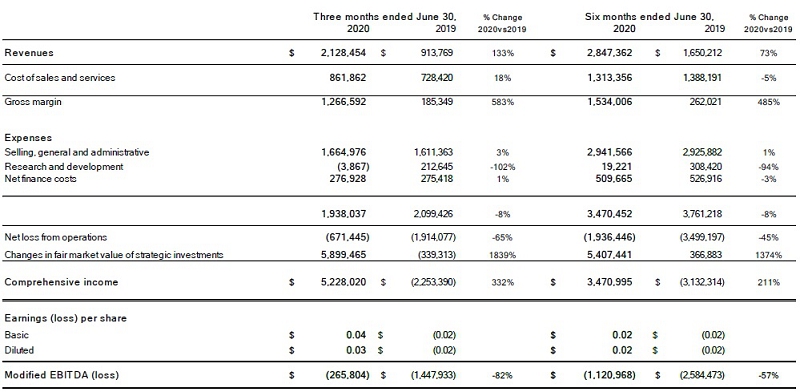
Modified EBITDA (loss) is not a performance measure defined under IFRS and it is not considered an alternative to Income (Loss) from operations or Comprehensive Earnings (Loss) in the context of measuring a Company’s performance. Management believes that providing certain non-GAAP performance measures, in addition to IFRS measures, provides users of the Company’s financial statements with an enhanced understanding of their results and related trends, and as such increases transparency and clarity. Modified EBITDA (loss) is an important measure of operating performance because it allows management, investors and others to evaluate and compare the Company’s core operating results, including our return on capital and operating efficiencies, from period to period, by removing the impact of its capital structure (interest expense to service outstanding debt), asset base (depreciation and amortization), tax consequences, and other non-operating items not requiring cash outlays including share-based compensation and change in fair value of investment. Securities regulations require that companies caution readers that earnings and other measures adjusted to a basis other than IFRS do not have standardized meanings and are unlikely to be comparable to similar measures used by other companies. Accordingly, they should not be considered in isolation.
We have included definitions of this and other non-IFRS financial measures in the “Reconciliation of non- IFRS Measures (EBITDA, Adjusted and Modified)” section of this MD&A.
3 | Page
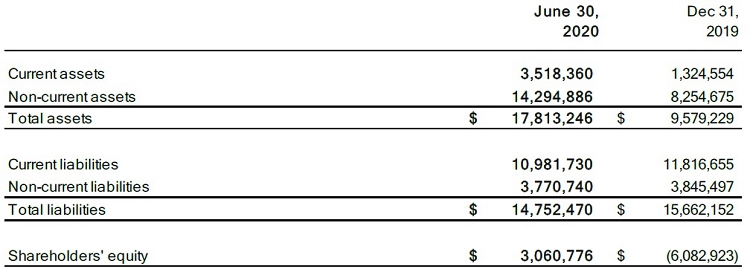
Extract from Statement of Financial Position at:
RESULTS OF OPERATIONS
Revenues
PyroGenesis recorded revenue of $2,128,454 in the second quarter of 2020 representing an increase of 133% compared with $913,769 recorded in the second quarter of 2019.
Revenues recorded in the three and six months ended June 30, 2020 were generated primarily from:
| (i) | DROSRITE™ related sales of $1,319,904 (3 months) and $1,794,336 (6 months) |
| (ii) | PUREVAP™ related sales of $25,093(3 months) and $43,058 (6 months) |
| (iii) | torch related sales of $617,077 (3 months) and $705,022 (6 months) |
| (iv) | support services related to PAWDS-Marine systems supplied to the US Navy $37,143 (3 months) and $61,039 (6 months). |
Cost of Sales and Services and Gross Margin
4 | Page

Cost of sales and services before amortization of intangible assets is not a performance measure defined under IFRS and it is not considered an alternative to gross margin in the context of measuring the Company’s performance. Management believes that providing certain non-GAAP performance measures, in addition to IFRS measures, provides users of the Company’s financial statements with an enhanced understanding of its results and related trends, and increases transparency and clarity. Gross margin before amortization of intangible assets is an important measure of operating performance because it allows management, investors and others to evaluate and compare the Company’s core operating results, including its return on capital and operating efficiencies, from period to period, by removing the impact of non-operating items not requiring cash outlays. Securities regulations require that companies caution readers that earnings and other measures adjusted to a basis other than IFRS do not have standardized meanings and are unlikely to be comparable to similar measures used by other companies. Accordingly, they should not be considered in isolation or a substitute for financial measures prepared in accordance with IFRS.
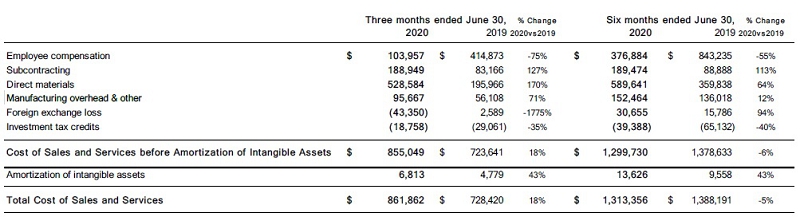
Cost of sales and services before amortization of intangible assets was $855,049 in Q2 2020, representing an increase of 18% compared with $723,641 in Q2 2019, primarily due to an increase in subcontracting and direct material expenses offset by a reduction in employee compensation in Q2 2020.
In Q2 2020, employee compensation decreased to 103,957 (Q2 2019 - $414,873) and subcontracting, direct materials and manufacturing overhead increased to $813,201 (Q2 2019 - $335,240). The gross margin for Q2 2020 was $1,268,592 or 59.5% of revenue compared to a gross margin of $185,349 or 20.3% of revenue for Q2 2019. As a result of the type of contracts being executed, the nature of the project activity, as well as the composition of the cost of sales and services, as the mix between labour, materials and subcontracts may be significantly different. Of note, the Company in Q2 2020 applied for an amount of $648,125 in wage subsidy from Revenue Canada under the CEWS program. From this amount, $92,028 was applied to employee compensation under cost of sales and services.
Investment tax credits recorded against cost of sales are related to projects that qualify for tax credits from the provincial government of Quebec. Qualifying tax credits decreased to $18,758 in Q2 2020, compared with $29,061 in Q2 2019. This represents a decrease of 35% year-over-year. In total, the Company earned refundable investment tax credits of $17,332 in Q2 2020. The Company continues to make investments in research and development projects involving strategic partners and government bodies.
The amortization of intangible assets of $6,813 in Q2 2020 and $4,779 for Q2 2019 relates to patents and deferred development costs. Of note, these expenses are non-cash items and will be amortized over the duration of the patent lives.
5 | Page
Selling, General and Administrative Expenses
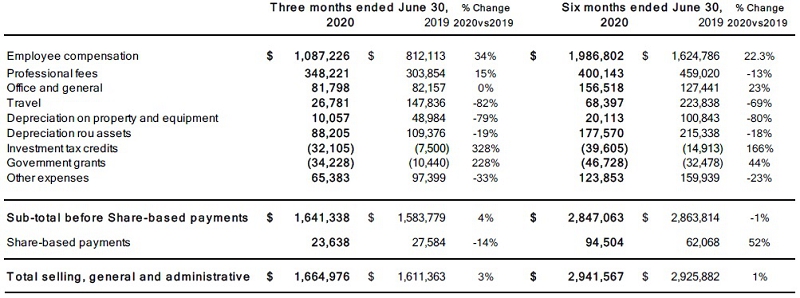
Included within Selling, General and Administrative expenses (“SG&A”) are costs associated with corporate administration, business development, project proposals, operations administration, investor relations and employee training.
SG&A expenses for Q2 2020 excluding the costs associated with share-based compensation (a non-cash item in which options vest principally over a four-year period), were $1,641,338 representing an increase of 4% compared with $1,583,779 reported for Q2 2019.
The increase in SG&A expenses in Q2 2020 over the same period in 2019 is mainly attributable to the net effect of:
| i) | an increase of 34% in employee compensation due primarily to an increase in commission expenses offset by amounts claimed from Revenue Canada under the CEWS wage subsidy program, |
| ii) | an increase of 15% for professional fees, primarily due to an increase in legal fees, |
| iii) | a decrease of 0.4% in office and general expenses, is due to a decrease in computer and internet expenses, |
| iv) | travel costs decreased by 82%, due to a decrease in travel abroad, |
| v) | depreciation on property and equipment decreased by 79% due to lower amounts of property and equipment being depreciated, |
| vi) | depreciation on right of use assets decreased by 19% due to lower amounts of right of use assets being depreciated, |
| vii) | Investment tax credits increased by 328% due to an additional refund of $24,605 from the 2018 tax return filed, |
| viii) | government grants increased by 228% due to higher levels of activities supported by such grants, |
| ix) | other expenses decreased by 33%, primarily due to a decrease in cost of freight and shipping. |
Separately, share based payments decreased by 14% in Q2 2020 over the same period in 2019 as a result of the vesting structure of the stock option plan including the stock options granted on January 2, 2020.
6 | Page
Depreciation on Property and Equipment

The depreciation on property and equipment decreased to $10,057 in Q2 2020, compared with $48,984 in Q2 2019. The 79% decrease is primarily due to a $1,981,410 write off, of equipment in December 2019.
Research and Development (“R&D”) Costs
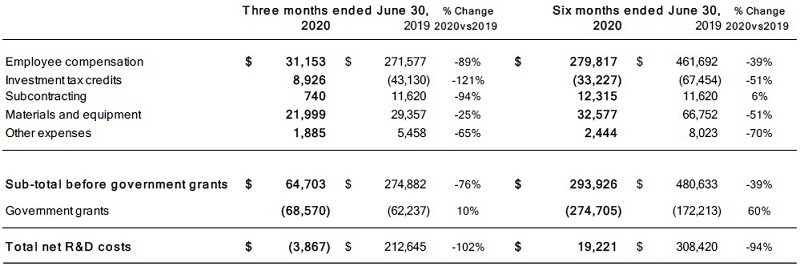
The Company incurred ($3,867) of R&D costs, net of government grants, on internal projects in Q2 2020, a decrease of 102% as compared with $212,645 in Q2 2019. The decrease in Q2 2020 is primarily related to an increase in government grants supporting our R&D activities and an amount of $129,201 claimed under the wage subsidy from Revenue Canada under the CEWS program.
In addition to internally funded R&D projects, the Company also incurred R&D expenditures during the execution of client funded projects. These expenses are eligible for Scientific Research and Experimental Development (“SR&ED”) tax credits. SR&ED tax credits on client funded projects are applied against cost of sales and services (see “Cost of Sales” above).
Net Finance Costs

Finance costs for Q2 2020 totaled $276,928 as compared with $275,418 for Q2 2019, were less than 1%, resulting in a virtually unchanged variance.
7 | Page
Strategic Investments

The adjustment to the fair market value of strategic investments for Q2 2020 resulted in a gain of $5,899,465 compared to a loss in the amount of $339,313 in Q2 2019, representing an increase of 1839% year-over-year. The increase is primarily attributable to the increased market share value in the HPQ Silicon Resources Inc. and Beauce Gold Fields.
Net comprehensive income

The net comprehensive gain for Q2 2020 of $5,228,020 compared to a loss of $2,253,390, in Q2 2019, represents an increase of 332% year-over-year. The increased gain of $7,481,410 in the comprehensive gain in Q2 2020 is primarily attributable to the factors described above, which have been summarized as follows:
| (i) | an increase in product and service-related revenue of $1,214,685 arising in Q2 2020, an increase in cost of sales and services totaling $133,442, primarily due to an increase in subcontracting, direct materials, manufacturing overhead & other, offset by a decrease in employee compensation, |
| (ii) | an increase in SG&A expenses of $53,613 arising primarily due to an increase in employee compensation, professional fees, offset by a decrease in travel, depreciation on property and equipment, depreciation ROU assets, and other expenses, |
| (iii) | a decrease in R&D expenses of $216,512 primarily due to an increase in government grants and wage subsidy, |
| (iv) | an increase in net finance costs of $1,510 primarily due to interest on higher amounts of debt, |
| (v) | an increase in fair value adjustment of $6,238,778 primarily due to strategic investments. |
8 | Page
Reconciliation of Non-IFRS measures (EBITDA, Adjusted and Modified)
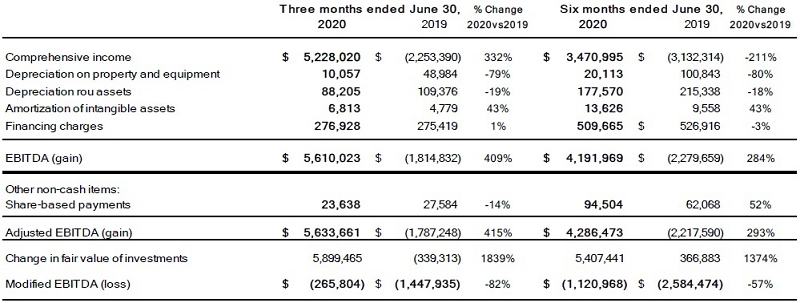
EBITDA is defined as Earnings (from operations) before Net Financing Charges, Taxes, Depreciation and Amortization, Adjusted EBITDA is defined as Earnings (from operations) before Net Financing Charges, Taxes, Depreciation, Amortization and other non-cash items including share-based payment costs, and Modified EBITDA is defined as Earnings (from operations) before Net Financing Charges, Taxes, Depreciation, Amortization and other non-cash items including share-based payment costs and change in fair value of investments.
EBITDA, Adjusted EBITDA and Modified EBITDA are not performance measures defined under IFRS and they are not considered an alternative to income or loss from operations, or to comprehensive earnings or loss, in the context of measuring a company’s performance. Management believes that providing certain non-GAAP performance measures, in addition to IFRS measures, provides users of the Company’s financial statements with an enhanced understanding of its results and related trends and increases transparency and clarity. Management believes that EBITDA, Adjusted EBITDA and Modified EBITDA are important measures of operating performance because it allows management, investors and others to evaluate and compare the Company’s operating results, including its return on capital and operating efficiencies, from period-to-period by removing the impact of the Company’s capital structure (interest expense to service outstanding debt), asset base (depreciation and amortization), tax consequences, and other non-operating items not requiring cash outlays including the adjustment to the fair value of investments and share-based compensation. Securities regulations require that companies caution readers that earnings and other measures adjusted to a basis other than IFRS do not have standardized meanings and are unlikely to be comparable to similar measures used by other companies. Accordingly, they should not be considered in isolation.
The EBITDA gain in Q2 2020 was $5,610,023 compared with an EBITDA loss of $1,814,832 for Q2 2019, representing an increase of 409% year-over-year. The $7,424,855 increase in the EBITDA gain in Q2 2020 compared with Q2 2019 is due to the increase in comprehensive income of $7,418,410, a decrease in depreciation on property and equipment of $38,927, a decrease in depreciation of right of use assets of $21,171, an increase in amortization of intangible assets of $2,034, and an increase in finance charges of $1,511.
Adjusted EBITDA gain in Q2 2020 was $5,633,661 compared with an Adjusted EBITDA loss of $1,787,248 for Q2 2019. The increase of $7,420,909 in the Adjusted EBITDA gain in Q2 2020 is attributable to an increase in EBITDA gain of $7,424,855, offset by a decrease of $3,946 in share-based payments.
The Modified EBITDA loss in Q2 2020 was $265,804 compared with a Modified EBITDA loss of $1,447,935 for Q2 2019, representing a decrease of 82%. The decrease in the Modified EBITDA loss in Q2 2020 is attributable to the increase as mentioned above in the Adjusted EBITDA of $7,357,909 and an increase in the change of fair value of strategic investments of $6,238,778.
9 | Page
Summary of Quarterly Results
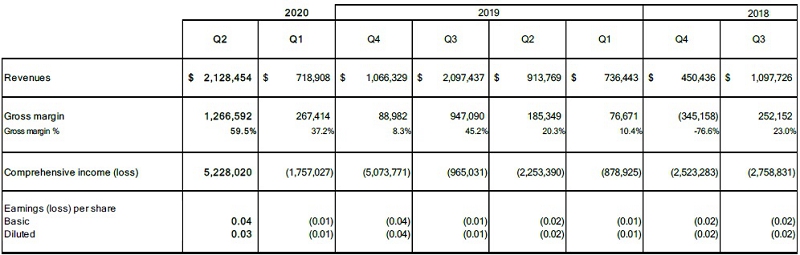
The majority of PyroGenesis’ revenue is recognised from long-term contracts over time and is dependent on the timing of project initiation and execution, including project engineering, manufacturing, and testing. In Q2 2020 the Company has adopted IFRS 15 dealing with revenue from contracts with customers.
LIQUIDITY AND CAPITAL RESOURCES
The following table summarizes the contractual maturities of financial liabilities as at June 30,
| Carrying value | Total Contractual amount | 6 months or less | 7 to 12 months | 1 to 3 years | ||||||||||||||||
| $ | $ | $ | $ | |||||||||||||||||
| Accounts payable and accrued liabilities | 4,116,398 | 4,116,398 | 4,116,398 | - | - | |||||||||||||||
| Term loans | 332,137 | 362,700 | 362,700 | - | - | |||||||||||||||
| Convertible debentures | 816,569 | 1,007,117 | 42,893 | 42,893 | 921,331 | |||||||||||||||
| 5,265,107 | 5,486,218 | 4,521,994 | 42,893 | 921,331 | ||||||||||||||||
The Company has incurred, in the last several years, operating losses and negative cash flows from operations, resulting in an accumulated deficit of $57,304,682 and a negative working capital of $7,463,370 as at Q2 2020, (December 31, 2019 - $60,237,656 and $10,492,102 respectively). Furthermore, as at Q2 2020, the Company’s current liabilities and expected level of expenses for the next twelve months exceed cash on hand of $1,567,777 (December 31, 2019 - $34,431). The Company has relied upon external financings to fund its operations in the past, primarily through the issuance of equity, debt, and convertible debentures, as well as from investment tax credits.
Revenue generated from active projects has begun to produce sufficient positive cash flow to fund operations. The Company has a strong backlog from signed contracts totaling $28MM, and a pipeline of prospective new projects resulting in the Company's business plan becoming less dependent on raising additional funds to finance operations within and beyond the next 12 months. While the Company has been successful in securing financing in the past, raising additional funds is dependent on a number of factors outside the Company's control, and as such there is no assurance that it will be able to do so, should it need to, in the future. If the Company is unable to obtain sufficient additional financing when needed, it may have to curtail operations and development activities, any of which could harm the business, financial condition and results of operations.
10 | Page
SUMMARY OF CASH FLOWS
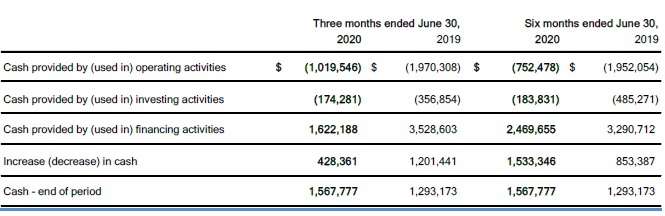
During the three months ended June 30, 2020, cash flows used by operating activities was $1,019,546 compared to cash flows used of $1,970,308 for the same period in the prior year. Cash flows used in the operating activities was $752,478 compared to $1,952,054 for the same period in 2019.
The use of cash during Q2, 2020 consists of the comprehensive income of $5,228,019 (2019 – comprehensive loss of $2,253,390 ) plus adjustments for operating activities of $5,493,824 (2019 - $805,455), plus a net change in non-cash operating working capital items of $753,741 (2019 – $522,373).
The use of cash during the six-months ended Q2, 2020 consists of the comprehensive income of $3,470,992 (2019 – comprehensive loss of $3,132,314) plus adjustments for operating activities of $4,591,963 (2019 - $547,839), plus a net change in non-cash operating working capital items of $368,493 (2019 – $632,421).
Investing activities in Q2 2020, resulted in a use of cash of $174,281 ($183,831 for the six-months ended June 30, 2020), compared to a use of cash of $356,854 in Q2 2019 ($485,271 for the six-months ended June 30, 2019) resulting from the purchase of inventories, investments, property and equipment and variation of deposits.
Financing activities in Q2, 2020 generated funds of $1,622,188, compared with generated funds of $3,528,603 for the same periods in 2019. In Q2, 2020, the Company repaid a portion of the convertible debenture including modification costs of $4,500, redeemed shares for $964,391, repaid R&D loans of $214,000 and promissory notes to the controlling shareholder and CEO of $295,000, made payment of lease liabilities of $33,654. Stock options and warrants were exercised for total proceeds of $3,302,269. Interest paid was $168,536 in Q1 2020 compared to $200,675 in Q2 2019. In 2019, the funds generated mainly resulted from the net proceeds from private placement of $3,403,185 and loans of $329,200. The use of funds resulted from the repayment of lease liabilities of $53,225 and the interest paid as mentioned above.
Financing activities in the six-months ended June 30, 2020 generated funds of $2,469,655, compared with generated funds of $3,290,712 for the same periods in 2019. In 2020, the Company repaid a portion of the convertible debenture including modification costs of $358,500, redeemed shares for $964,391,repaid R&D loans of $214,000 and promissory notes to the controlling shareholder and CEO of $295,000, made payment of lease liabilities of $68,272 and received proceeds from the issuance of a convertible loan of $903,000. Stock options and warrants were exercised for total proceeds of $3,748,669. Interest paid was $281,851 in 2020 compared to $354,241 in 2019. In 2019, the use of funds mainly resulted from repayment of R&D loan in the amount of $247,200, the repayment of lease liabilities of $105,719 and the interest paid as mentioned above. Net proceeds of $3,465,477 was received form the issuance of common shares and $329,200 from loans.
11 | Page
The net cash position of the Company increased by $428,361 for Q2, 2020 ($1,533,346 in the six-months ended June 30, 2020) compared to a net increase of $1,151,323 for Q1, 2019 ($644,981 in the six-months ended June 30, 2019.
CAPITAL STOCK INFORMATION
The authorized share capital of the Company consists of an unlimited number of Class A common shares (the “Common Shares”). As at July 28, 2020 PyroGenesis had 150,208,325 on shares, 8,446,893 share purchase warrants, 6,710,000 outstanding stock options issued, and 6,060,000 exercisable options issued.
As previously announced, the Company bought back for cancellation 1,285,000 of it’s own common shares in the market for $964,391.
GOING CONCERN
The Company presumes it will be able to realize its assets and discharge its liabilities in the normal course of business for the foreseeable future. The Company’s management has reviewed the Company’s projected cashflows and backlog and is of the opinion that the Company will generate sufficient positive cash flows and profits from operations and strategic investments to meet current and future cash requirements. Management expects that the investments currently being made in accelerating projects under development for various clients, together with executing on the $28MM backlog at July 28 2020, (581% of 2019 revenues) which is primarily related to the Company’s successful diversification into niche markets of the additive manufacturing (including 3D printing), and metals & mining industries, will continue to improve the Company’s cash position.
The December 31, 2019 financial statements have been prepared using International Financial Reporting Standards (“IFRS”) applicable to a going concern, which contemplates the realization of assets and settlement of liabilities in the normal course of business as they become due. If the going concern assumption were not appropriate for these financial statements then adjustments would be necessary to the carrying value of assets and liabilities, the reported expenses and the statements of financial position classifications used. The impact on the financial statements could be material.
12 | Page
RELATED PARTY TRANSACTIONS
During the three and the six months ended June 30, 2020, the Company concluded the following transactions with related parties:
The Company entered into a lease agreement for rent of a property with a trust whose beneficiary is the controlling shareholder and CEO of the Company. As at June 30, 2020 the carrying amount of the right-of-use asset and lease liabilities are $1,099,881 and $1,149,828, respectively.
An amount including rent and property taxes of $68,687 and $136,733 were paid to a trust whose beneficiary is the controlling shareholder and CEO ($66,740 and $133,102 were charged in 2019). A balance due of $Nil (2019 - $Nil) is included in accounts payable at June 30, 2020.
An amount of $115,581 was paid as a deposit for rent to a trust whose beneficiary is the controlling shareholder and CEO of the Company (December 31, 2019 – $Nil), of this amount $45,257 is included in deposits.
A balance due to the controlling shareholder and CEO of the Company amounted to $137,484 (December 31, 2019 - $214,470) for expense report, salary and vacation payables and is included in accounts payable and accrued liabilities as at June 30, 2020.
As at June 30, 2020, an amount of $4,413 (December 31, 2019 - $7,427), of interest payable and an accretion amount of $14,458 (December 31, 2019 - $12,946), were accrued on the loan of $295,000 from the controlling shareholder and CEO of the Company and are included in accounts payable and accrued liabilities
As at June 30, 2020, an amount of $30,960 (December 31, 2019 - $Nil), of interest payable and an accretion amount of $42,951 (December 31, 2019 - $Nil), were accrued on a convertible loan of $903,000 from a trust whose beneficiary is the controlling shareholder and CEO of the Company and are included in accounts payable and accrued liabilities.
The key management personnel of the Company are the members of the Board of Directors and certain officers. Total compensation to key management consisted of the following:
| Three months ended June 30, | Six months ended June 30, | |||||||||||||||
| 2020 | 2019 | 2020 | 2019 | |||||||||||||
| $ | $ | |||||||||||||||
| Salaries –officers | 117,648 | 102,000 | 380,318 | 204,000 | ||||||||||||
| Pension contributions | 3,097 | 2,040 | 5,866 | 4,080 | ||||||||||||
| Fees – Board of Directors | - | 24,000 | 44,000 | 46,000 | ||||||||||||
| Share – based compensation – officers | 63,177 | - | 65,299 | - | ||||||||||||
| Share – based compensation - Board of Directors | (43,448 | ) | - | 18,793 | - | |||||||||||
| Other benefits – officers | 223,466 | 2,486 | 237,853 | 6,521 | ||||||||||||
| Total compensation | 372,940 | 130,526 | 752,129 | 260,601 | ||||||||||||
13 | Page
A balance of $64,139 of key management compensation, of the amounts noted above, is included in accounts payable and accrued liabilities as at June 30, 2019 (December 31, 2019 - $130,604).
SUBSEQUENT EVENTS
The Company discusses the novel coronavirus (COVID-19) under risk factors in the June 30, 2020 MD & A.
The Company received under the exclusivity contract with DROSRITE International approximately US$3,000,000 between July 13, 2020 and July 28, 2020.
On July 13, 2020, the Company paid an amount of $115,200 to extinguish the other term loans.
In July 2020, the Company issued 100,000 common shares upon the exercise of 100,000 stock options with an exercise price of $0.19.
In July 2020, the Company issued 962,000 common shares upon the exercise of 962,000 share purchase warrants for total proceeds of $763,816.
CRITICAL ACCOUNTING ESTIMATES, NEW AND FUTURE ACCOUNTING POLICIES AND FINANCIAL INSTRUMENTS
For a discussion of significant accounting policies, significant accounting judgments, estimates and assumptions, and financial instruments, please refer to notes 3, 4, and 24 of the annual 2019 Financial Statements.
RISK FACTORS
The global pandemic due to the novel coronavirus (COVID-19) is a situation that is constantly evolving, and the measures put in place are having multiple impacts on provincial, national and global economies. The overall effect of these events on the Company and its operations is too uncertain to be estimated at this time. The impacts will be accounted for when they are known and may be assessed.
PyroGenesis is subject to a number of risks and uncertainties that could significantly affect the Company’s financial condition and performance. This list of risk factors may not be exhaustive as the Company operates in a rapidly changing business environment and new risk factors emerge from time to time. The Company cannot predict such risk factors, nor can the Company assess the impact, if any, of such risk factors or uncertainties on its business or the extent to which any factor, or combination of factors, may cause actual results to differ materially from those projected in any forward-looking statements. Accordingly, neither shareholders of the Company nor purchasers of securities of the Company should rely on forward-looking statements as a prediction of actual results. If any of these risks actually occur, the Company’s business, results of operations, financial position and cash flows could be adversely affected. In any such case, the market price of the Company’s common shares could decline, and investors may lose all or part of their investment.
14 | Page
Revenue Risks
PyroGenesis may experience delays in achieving revenues, particularly with plasma gasification projects which have a long sales cycle. Revenues may be delayed or negatively impacted by issues encountered by the Company or its clients including:
| (a) | unforeseen engineering and/or environmental problems; |
| (b) | delays or inability to obtain required financing, licenses, permits and/or regulatory approvals; |
| (c) | supply interruptions and/or labour disputes; |
| (d) | foreign exchange fluctuations and/or collection risk; and |
| (e) | competition from other suppliers and/or alternative energy solutions that are less capital intensive. |
There is no assurance that the business will perform as expected or that returns from the business will support the expenditures needed to develop it.
Technology Development and Manufacturing Capability Risks
PyroGenesis recently expanded into new areas of business and, as a result, many of the Company’s products are at various stages of the development cycle. The Company may be unable to commercialise such products, or it may be unable to manufacture such products in a commercially viable manner. Whilst management is confident in both its technology and in its team of experienced engineers, scientists and technicians, it cannot know with certainty, which of its products will be commercialised, when such products will be commercialised, or whether such products will be able to be manufactured and distributed profitably.
Product Revenues/History of Losses
PyroGenesis has incurred losses in the majority of years since its inception. In the past the Company’s operations have not generated sufficient earnings and cash flows to date to result in consistent profitability or positive cash flow. For the three months and six months ending June 30, 2020 the Company has net comprehensive income of $5,228,020 and $3,470,995 respectively.
Additional financing and dilution
PyroGenesis may require additional financing. There can be no assurance that additional financing will be available to the Company when needed, or on terms acceptable to the Company. PyroGenesis’ inability to raise financing to support ongoing operations or to fund capital expenditures could limit the Company’s growth and may have a material adverse effect upon the Company.
The Company does not exclude raising additional funds by equity financing. In addition, at July 28, 2020, 6,710,000 stock options are currently issued and outstanding, together with 8,446,893 share purchase warrants and a $903,000 convertible loan. The exercise of stock options and/or warrants, together with the conversion of the loan, as well as any new equity financings, represents dilution factors for present and future shareholders.
15 | Page
Sales Cycle and Fixed Price Contracts
PyroGenesis sales cycle is long and the signing of new contracts is subject to delay, over which the Company has little control. The Company also enters into sales contracts with fixed pricing, which may be impacted by changes over the period of implementation. There is no assurance that delays or problems in fulfilling contracts with clients will not adversely affect the Company’s activities, operating results or financial position.
Reliance on Technology
PyroGenesis will depend upon continuous improvements in technology to meet client demands in respect of performance and cost, and to explore additional business opportunities. There can be no assurance that the Company will be successful in its efforts in this regard or that it will have the resources available to meet this demand. Whilst management anticipates that the research and development will allow the Company to explore additional business opportunities, there is no guarantee that such business opportunities will be presented or realised. The commercial advantage of the Company will depend to a significant extent on the intellectual property and proprietary technology of PyroGenesis and the ability of the Company to prevent others from copying such proprietary technologies. PyroGenesis currently relies on intellectual property rights and other contractual or proprietary rights, including (without limitation) copyright, trade secrets, confidential procedures, contractual provisions, licenses and patents, to protect its proprietary technology. PyroGenesis may have to engage in litigation in order to protect its patents or other intellectual property rights, or to determine the validity or scope of the proprietary rights of others. This type of litigation can be expensive and time consuming, regardless of whether or not the Company is successful. PyroGenesis may seek patents or other similar protections in respect of particular technology; however, there can be no assurance that any future patent applications will actually result in issued patents, or that, even if patents are issued, they will be of sufficient scope or strength to provide meaningful protection or any commercial advantage to the Company. Moreover, the process of seeking patent protection can itself be long and expensive. In the meantime, competitors may develop technologies that are similar or superior to PyroGenesis’ technology or design around the patents owned by the Company, thereby adversely affecting the Company’s competitive advantage in one or more of its areas of business. Despite the efforts of the Company, its intellectual property rights may be invalidated, circumvented, challenged, infringed or required to be licensed to others. It cannot be assured that any steps the Company may take to protect its intellectual property rights and other rights to such proprietary technologies that are central to the Company’s operations will prevent misappropriation or infringement of its tecnology.
Changes to Contracts
PyroGenesis is dependent upon its ability to establish and develop new relationships and to build on existing relationships with current clients. The Company cannot provide assurance that it will be successful in maintaining or advancing its relationships with current clients or procure additional clients. In addition, PyroGenesis cannot provide assurance that the U.S. Military and/or other military clients will continue to provide the Company with business. Sales to governments and governmental entities are subject to specific additional risks, such as delays in funding, termination of contracts or sub-contracts at the convenience of the government, termination, reduction or modification of contracts or sub-contracts in the event of changes in the government’s policies or as a result of budgetary constraints and increased or unexpected costs resulting in losses or reduced profits under fixed price contracts.
16 | Page
Foreign Exchange Exposure
PyroGenesis’ products and services are increasingly being sold in markets outside of Canada, whilst most of its operating expenses and capital expenditures are denominated in Canadian dollars. As a result, the Company is exposed to fluctuations in the foreign exchange rates between Canadian dollar and the currency in which a particular sale is transacted, which may result in foreign exchange losses that could affect earnings.
Competition
The industry is competitive and PyroGenesis competes with a substantial number of companies which have greater technical and financial resources. There can be no assurance that such competitors will not substantially increase the resources devoted to the development and marketing of products and services that compete with those of the Company or that new or existing competitors will not enter the various markets in which PyroGenesis is active. There can be no assurance that competitors will not develop new and unknown technologies with which the Company may have difficulty competing. Furthermore, failure to remain cost competitive may result in PyroGenesis losing business to its competitors.
Management and Key Personnel
PyroGenesis depends on the skills and experience of its management team and other key employees. The Company relies heavily on its ability to attract and retain highly-skilled personnel in a competitive environment. PyroGenesis may be unable to recruit, retain, and motivate highly-skilled employees in order to assist the Company’s business, especially activities that are essential to the success of the Company. Failure to recruit and retain highly-skilled employees may adversely affect PyroGenesis’ business, financial condition and results of operations.
Implementation of a strategic plan
PyroGenesis’ commercial strategy aims to leverage its products, consumables, and services whilst focusing on the resolution of problems within niche markets within the industries served by the Company. There can be no assurances as to the success of the Company’s strategic plan, which should be considered under the risks perspective and difficulties frequently encountered by a developing business.
Adverse Decisions of Sovereign Governments
PyroGenesis conducts an increasing portion of its business internationally. There is no assurance that any sovereign government, including Canada’s, will not establish laws or regulations that will not be detrimental to the Company’s interests or that, as a foreign corporation, it will continue to have access to the regulatory agencies in other countries. Governments have, from time to time, established foreign exchange controls, which could have a material adverse effect on the Company’s business, financial condition and results of operations.
17 | Page
Governmental Regulation
PyroGenesis is subject to a variety of federal, provincial, state, local and international laws and regulations relating namely to the environment, health and safety, export controls, currency exchange, labour and employment and taxation. These laws and regulations are complex, change frequently and have tended to become more stringent over time. Failure to comply with these laws and regulations may result in a variety of administrative, civil and criminal enforcement measures, including assessment of monetary penalties, imposition of remedial requirements and issuance of injunctions as to future compliance. The Company may be subject to compliance audits by regulatory authorities in the various countries in which it operates.
Environmental Liability
PyroGenesis is subject to various environmental laws and regulations enacted in the jurisdictions in which it operates, which govern the manufacturing, processing, importation, transportation, handling and disposal of certain materials used in the Company’s operations. Management believes that it has adequate procedures in place to address compliance with current environmental laws and regulations. Furthermore, management monitors the Company’s practices concerning the handling of environmentally hazardous materials. However, there can be no assurance that the Company’s procedures will prevent environmental damage occurring from spills of materials handled by the Company or that such damage has not already occurred. On occasion, substantial liabilities to third parties may be incurred. The Company may have the benefit of insurance maintained by it or the operator, however, the Company may become liable for damages against which it cannot adequately insure or against which it may elect not to insure because of high costs or other reasons. The Company’s clients are subject to similar environmental laws and regulations, as well as limits on emissions to the air and discharges into surface and sub-surface waters. While regulatory developments that may follow in subsequent years could have the effect of reducing industry activity, the Company cannot predict the nature of the restrictions that may be imposed. The Company may be required to increase operating expenses or capital expenditures in order to comply with any new restrictions or regulations.
Product Liability and Other Lawsuits
PyroGenesis is subject to a variety of potential product liabilities claims and other lawsuits related with its operations, including liabilities and expenses associated with product defects. The Company maintains product liability and other insurance coverage that management believes is generally in accordance with the market practice in its industry, but there can be no assurance that the Company will always be adequately insured against all such potential liabilities.
Market Liquidity
The market price for the common shares of the Company could be subject to wide fluctuations. Factors such as the announcement of significant contracts, technological innovations, new commercial products, patents, a change in regulations, quarterly financial results, future sales of common shares by the Company or current shareholders, and many other factors could have considerable repercussions on the price of the Company’s common shares. In addition, the financial markets may experience significant price and value fluctuations that affect the market prices of equity securities of companies that sometimes are unrelated to the operating performance of these companies. Broad market fluctuations, as well as economic conditions generally may adversely affect the market price of the Company’s common shares.
18 | Page
Information systems disruptions
The Company’s business depends on the efficient and uninterrupted operation of its computer and communications software, hardware systems, and its other information technology. If such systems were to fail, or the Company was unable to successfully expand the capacity of these systems or integrate new technologies into its existing systems, its operations and financial results could be adversely affected.
OUTLOOK
Percent complete revenue recognition in our major projects, which is the revenue recognition method we are mandated to follow by GAAP, is such that it is not linear, but exponential and as such, Q2 is now starting to reflect the results one might expect given recent announcements. It is interesting to note that using this revenue recognition method, only $1.8MM has been recognized under the $22MM+ DROSRITE™ contract for which we have announced receipt of over $7MM, and which will be completed within the next year.
Using this same revenue recognition method, we can provide guidance for Q3 2020, and for the year ending December 31st, 2020: At this point we expect that Q3, and the nine months ending September 30, 2020, will both be profitable as will year end results. We are projecting Q3 2020 EPS (Basic & Diluted) to be conservatively in excess of 6 cents and the year to be in excess of 10 cents.
Any discussion regarding the OUTLOOK of the company would be remiss if it did not address the continued increase in the Company’s market capitalization and the implications that has for the future.
Without a doubt the Company’s market capitalization suffered, as did many other companies, in the general Covid-19 market meltdown at the end of March 2020. However, PyroGenesis soon broke from the pack with the issuance of a material press release on March 24th, 2020.
Management believes that its breaking from the ranks caught the attention of investors, fund managers, and money managers who all now had the time during the Covid-19 lockdown to fully analyze the complicated story that is PyroGenesis. Management does not see any reason why this interest would abate anytime soon. To the contrary, Management has reason to believe that interest in the Company will only increase over the foreseeable future. As such, several strategies (up listings, spinoffs, acquisitions) are now being accelerated/considered.
Having a larger market capitalization has also helped in discussions with potential customers who take comfort from the possibility that a higher market capitalization may translate into easier access to capital. For the record, there is no intention to raise capital for working capital purposes.
If 2018 was the year in which PyroGenesis successfully positioned each of its commercial business lines by strategically partnering with multi-billion-dollar entities, and 2019 was the year that saw the appropriate personnel and infrastructure being put in place while building upon the success of 2018, then 2020 is without a doubt the year that the long awaited breakout, which began in the second half of 2019, takes place; it is in fact already upon us:
19 | Page
To date during 2020, PyroGenesis has:
| 1) | received significant payments under the $22MM contract with Drosrite International thereby validating announcements made during 2019, |
| 2) | established a relationship with a US based tunneling company (contracts and payments ongoing), |
| 3) | Established itself in the iron ore pelletization industry as a potential supplier of torches geared to replacing existing burners and thereby reducing GHGs. Interest is also spilling over into other industries with GHG reduction targets, |
| 4) | Established a relationship with an OEM in North America with the intent to eventually supply powders for their 3D printing needs. This augments our relationship with Aubert & Duval, while at the same time de-risking our dependence on them, |
| 5) | retired the $3MM convertible debenture in full, |
| 6) | bought back approximately 1.2 Million shares under the existing Normal Course Issuer Bid, |
| 7) | increased Company’s investment in HPQ, who has subsequently also experienced a significant increase in market capitalization, |
| 8) | further benefited from early conversions of warrants maturing in 2021 of over $3MM. |
The Company has booked a significant backlog of signed contracts (in excess of $28MM; 2019 Revenues approx. $5MM) which, when taking the eagerly awaited US Navy contract into account, will increase to over $38MM. This provides a solid cornerstone upon which PyroGenesis can:
| a) | continue to build on the recent successes with the Company’s DROSRITE™ offering, |
| b) | Leverage off of the recent successes with the Company’s torch offerings to (i) the iron ore pelletization industry, and (ii) a tunneling client, |
| c) | Accelerate activities with Aubert & Duval in the Additive Manufacturing sector as well as HPQ in the Mining and Metallurgical sector, both of which did not progress as fast as management would have liked in 2019. Significant attention will be placed on both these activities in 2020. |
Specifically, with Aubert & Duval the goal will be to complete the integration of the cutting-edge advances PyroGenesis has made to the powder production process.
With respect to HPQ, the goal would be to accelerate the game changing PUREVAP™ family of processes which we are developing for HPQ, namely:
| · | The PUREVAP™ “Quartz Reduction Reactors” (QRR), an innovative process (patent pending), which will permit the one step transformation of quartz (SiO2) into high purity silicon (Si) at reduced costs, energy input, and carbon footprint that will propagate its considerable renewable energy potential; and |
| · | The PUREVAP™ Nano Silicon Reactor (NSiR), a new proprietary process that use PUREVAP™ QRR silicon (Si) as feedstock, to make spherical silicon nano powders and nanowires; |
Looking forward, the Company has, as of December 31st, 2019, approximately $10MM of in-the-money warrants and options expiring in 2020 and 2021. The Company also has over $50MM in tax loss carryforwards (roughly evenly distributed between federal and provincial obligations) which is not reflected as an asset on the balance sheet.
20 | Page