2024 Annual Information Form AS AT MARCH 18, 2025 FOR THE YEAR ENDED DECEMBER 31, 2024
Annual Information Form TABLE OF CONTENTS IMPORTANT INFORMATION ABOUT THIS DOCUMENT ................................................................................................. 2 CORPORATE STRUCTURE ............................................................................................................................................... 7 GENERAL DEVELOPMENT OF THE BUSINESS ............................................................................................................... 10 DESCRIPTION OF THE BUSINESS .................................................................................................................................. 16 MINERAL PROJECTS ..................................................................................................................................................... 19 Greenstone Mine .......................................................................................................................................... 22 Mesquite Mine ............................................................................................................................................. 40 Aurizona Mine .............................................................................................................................................. 50 Bahia Complex - Fazenda Mine .................................................................................................................... 64 Bahia Complex - Santa Luz Mine .................................................................................................................. 74 Castle Mountain Project ............................................................................................................................... 89 Los Filos Mine Complex .............................................................................................................................. 101 DIRECTORS AND EXECUTIVE OFFICERS ...................................................................................................................... 120 AUDIT COMMITTEE .................................................................................................................................................... 123 RISKS RELATED TO THE BUSINESS .............................................................................................................................. 126 LEGAL PROCEEDINGS AND REGULATORY ACTIONS ................................................................................................... 142 INTEREST OF MANAGEMENT AND OTHERS IN MATERIAL TRANSACTIONS .............................................................. 142 MATERIAL CONTRACTS .............................................................................................................................................. 143 INTEREST OF EXPERTS................................................................................................................................................ 143 ADDITIONAL INFORMATION ...................................................................................................................................... 145 Glossary of Terms ....................................................................................................................................... 145 APPENDIX A Audit Committee Charter ...................................................................................................................... A-1
Annual Information Form - 2 - IMPORTANT INFORMATION ABOUT THIS DOCUMENT This annual information form (AIF) for the financial year ended December 31, 2024, provides important information about Equinox Gold Corp. It describes, among other things, Equinox Gold’s business including its history, operations and development projects, Mineral Reserves and Mineral Resources, sustainability commitments, the regulatory environment in which it operates, its governance, the risks it faces, and the market for its products. In this AIF, except as otherwise required by the context, references to Equinox Gold, the Company, our and we mean Equinox Gold Corp. and its subsidiaries, collectively. Date of Information This AIF is dated March 18, 2025. Unless otherwise stated, all information in this AIF is provided as of December 31, 2024. Reporting Currency and Financial Information Unless otherwise specified, all references to dollar amounts or $ means United States dollars. Any references to C$ or CAD mean Canadian dollars. All financial information presented in this AIF was prepared in accordance with International Financial Reporting Standards (IFRS) as issued by the International Accounting Standards Board. Non-IFRS and Other Financial Measures This AIF includes certain non-IFRS measures, namely: cash costs; cash costs per ounce (oz) sold; all-in sustaining costs (AISC); AISC per oz sold; AISC contribution margin; adjusted net income; adjusted earnings per share (EPS); mine - site free cash flow; adjusted EBITDA; net debt; and sustaining capital expenditures, that are measures with no standardized meaning under IFRS. Such measures are “non-GAAP financial measures”, “non-GAAP ratios”, “supplementary financial measures” or “capital management measures” (as such terms are defined in National Instrument 52-112 – Non-GAAP and Other Financial Measures Disclosure). Equinox Gold believes these measures, while not a substitute for measures of performance prepared in accordance with IFRS, provide investors with an improved ability to evaluate the underlying performance of the Company. These measures do not have any standardized meaning prescribed under IFRS and therefore may not be comparable to the information provided by other issuers. Please see the information under the heading Non-IFRS Measures in Equinox Gold’s Management’s Discussion and Analysis (MD&A) for the year ended December 31, 2024, which section is incorporated by reference in this AIF for a description of the non-IFRS financial measures noted above. The MD&A can be found under the Company’s profile on SEDAR+ at www.sedarplus.ca and on EDGAR at www.sec.gov/EDGAR and on the Company’s website at www.equinoxgold.com. Glossary of Terms and Measurement Conversion Refer to the section Glossary of Terms in this AIF for definitions of certain scientific or technical terms that may be useful for your understanding of this document. In this AIF metric units are used with respect to all our mineral properties, unless otherwise indicated. Refer to the section Measurement Conversion in this AIF for conversion rates from imperial measures to metric units and from metric units to imperial measures.
Annual Information Form - 3 - Cautionary Notes and Forward-Looking Statements This AIF contains certain forward-looking statements and forward-looking information within the meaning of applicable securities legislation and may include future-oriented financial information or financial outlook information (collectively Forward-looking Information). Actual results of operations and the ensuing financial results may vary materially from the amounts set out in any Forward-looking Information. Forward-looking Information in this AIF relates to, among other things: the strategic vision for the Company and expectations regarding exploration potential, production capabilities, growth potential and future financial or operating performance; expectations regarding the proposed plan of arrangement between the Company and Calibre Mining Corp. (Arrangement); the Company’s expectations for the operation of Greenstone, including future financial or operating performance and anticipated improvements in recovery rates, mining rates and throughput to achieve design capacity; the Company’s production and cost guidance; the timing for and the Company’s ability to successfully advance its growth and development projects, including the planned expansions at Castle Mountain and Aurizona; the anticipated timeframe for residual leaching at Castle Mountain; the Company’s ability to successfully complete new long-term agreements with three local communities at Los Filos and the potential impact on Los Filos if the new long-term agreements cannot be completed; the ongoing impact of the 2024 geotechnical event in the Piaba pit on planned production from Aurizona; the strength of the Company’s balance sheet, and the Company’s liquidity and future cash requirements; the potential future offerings of securities under the Company’s Base Shelf Prospectus or corresponding Registration Statement on Form F-10 and any Prospectus Supplement; the conversion of Mineral Resources to Mineral Reserves; and expectations for the Company’s investments in Bear Creek Mining Corporation (Bear Creek), and Versamet Royalties Corp. (Versamet). Forward-looking Information is generally identified by the use of words like “believe”, “will”, “achieve”, “strategy”, “increase”, “plan”, “vision”, “improve”, “potential”, “intend”, “anticipate”, “expect”, “estimate”, “target”, “objective”, and similar expressions and phrases or statements that certain actions, events or results “may”, “could”, or “should”, or the negative connotation of such terms, are intended to identify Forward-looking Information. The Company has based Forward-looking Information on the Company’s current expectations and projections about future events and these assumptions include: Equinox Gold’s ability to achieve the exploration, production, cost and development expectations for its respective operations and projects; expectations regarding the timing and satisfaction of the conditions precedent to the Arrangement; the strengths, characteristics and potential of Equinox Gold post-closing of the Arrangement, including expectations regarding exploration potential, production capabilities, growth potential, and financial and operating performance; the Company’s ability to achieve its production, cost and development expectations for Greenstone, including design capacity; ore grades and recoveries remain consistent with expectations; tonnage of ore to be mined and processed remains consistent with expectations; existing assets are retained and continue to produce as expected; expectations regarding the impact of macroeconomic factors on the Company’s operations, share price performance and gold price; prices for gold remaining as estimated; currency exchange rates remaining as estimated; availability of funds for the Company’s projects and future cash requirements; prices for energy inputs, labour, materials, supplies and services remaining as estimated; the expansion projects at Castle Mountain and Aurizona being completed and performed in accordance with current expectations; the Company’s ability to identify and implement opportunities to mitigate the impact of the geotechnical event at Aurizona; the Company’s ability to successfully complete new long-term agreements with the three local communities at Los Filos and the potential impact on Los Filos if the new long-term agreements cannot be completed; the Company’s ability to work with the local communities at Los Filos on suspended operations if new agreements cannot be completed; mine plans and estimated development schedules remaining consistent with the plans outlined in the technical reports for each project; tonnage of ore to be mined and processed and ore grades and recoveries remaining consistent with mine plans; capital, decommissioning and reclamation estimates remaining as estimated; Mineral Reserve and Mineral Resource estimates and the assumptions on which they are based; no labour-related disruptions and no unplanned delays or interruptions in scheduled construction, development and production, including by blockade or industrial action; the Company’s
Annual Information Form - 4 - ability to achieve anticipated social and economic benefits for its host communities; all necessary permits, licenses and regulatory approvals are received in a timely manner; the Company’s ability to comply with environmental, health and safety laws and other regulatory requirements; the Company’s ability to achieve its objectives related to environmental performance; the strategic visions for Versamet and Bear Creek and their respective abilities to successfully advance their businesses; the ability of Bear Creek to meet its payment commitments to the Company; and the ability of Equinox Gold to work productively with its Indigenous partners at Greenstone and its community partners at Los Filos. While the Company considers these assumptions to be reasonable based on information currently available, they may prove to be incorrect. Accordingly, readers are cautioned not to put undue reliance on Forward-looking Information. The Company cautions that Forward-looking Information involves known and unknown risks, uncertainties and other factors that may cause actual results and developments to differ materially from those expressed or implied by such Forward-looking Information contained in this AIF and the Company has made assumptions and estimates based on or related to many of these factors. Such factors include, without limitation: fluctuations in gold prices; fluctuations in prices for energy inputs, labour, materials, supplies and services and the impact of tariffs; fluctuations in currency markets; recent market events and conditions; operational risks and hazards inherent with the business of mining (including environmental accidents and hazards, geotechnical failures, industrial accidents, equipment breakdown, unusual or unexpected geological or structural formations, cave-ins, flooding, fires and severe weather); inadequate insurance, or inability to obtain insurance to cover these risks and hazards; employee relations; relationships with, and claims by, local communities and Indigenous populations; the effect of blockades and community issues on the Company’s production and cost estimates; the Company’s ability to obtain and maintain all necessary permits, licenses and regulatory approvals in a timely manner or at all; changes in laws, regulations and government practices, including mining, environmental and export and import laws, tariffs and regulations; legal restrictions relating to mining; risks relating to expropriation; increased competition in the mining industry; the failure by Bear Creek to meet its commitments to the Company; and those factors identified in the section “Risks Related to the Business” in this AIF together with the risks identified in the section “Risks and Uncertainties” in the Company’s MD&A dated March 13, 2025 for the year ended December 31, 2024, which is available on SEDAR+ at www.sedarplus.ca and on EDGAR at www.sec.gov/edgar. Forward-looking Information is designed to help readers understand management's views as of that time with respect to future events and speaks only as of the date of such Forward-looking Information. Except as required by applicable law, the Company assumes no obligation to update or to publicly announce the results of any change to any Forward-looking Information contained or incorporated by reference to reflect actual results, future events or developments, changes in assumptions or changes in other factors affecting such Forward-looking information. If the Company updates any Forward-looking Information, no inference should be drawn that the Company will make additional updates with respect to that or any other Forward-looking Information. All Forward-looking Information contained in this AIF are expressly qualified in their entirety by these cautionary notes. Scientific and Technical Information Unless otherwise stated, the technical disclosure in this AIF is derived from and in some instances is an extract from, the technical reports (collectively, the Technical Reports) prepared for our material properties in accordance with National Instrument 43-101 – Standards of Disclosure for Mineral Projects (NI 43-101). The summaries of the Technical Reports contained in this AIF do not purport to be complete summaries of the Technical Reports, are subject to all the assumptions, qualifications and procedures set out in the Technical Reports and are qualified in their entirety with reference to the full text of the Technical Reports. Each of the authors of the Technical Reports is, where required pursuant to NI 43-101, independent of the Company within the meaning of NI 43-101 and is a “Qualified Person” as such term is defined in NI 43-101.
Annual Information Form - 5 - The Technical Reports are as follows: 1. Technical Report for the Greenstone Gold Mine (Greenstone) entitled “Technical Report on the Greenstone Gold Mine, Geraldton, Ontario” dated October 1, 2024, with an effective date of June 30, 2024 (Greenstone Technical Report) prepared by G Mining Services Inc. (G Mining), WSP Canada Inc. (WSP), Stantec Consulting Ltd (Stantec)., Soutex Inc. (Soutex), and Equinox Gold. The Qualified Persons who prepared or supervised the preparation of the information contained in the report are Alexandre Dorval, P.Eng., Réjean Sirois, P.Eng., Kenneth Arthur Bocking, P.Eng., Michelle Fraser, P.Geo., Nicolas Vanier-Larrivée, P.Eng., Pierre Roy, P.Eng., Carl Michaud, P.Eng. and Darrol van Deventer, P.Eng. 2. Technical report for the Mesquite Gold Mine (Mesquite) entitled “Technical Report on the Mesquite Gold Mine, California, U.S.A”, dated April 27, 2020, with an effective date of December 31, 2019, (Mesquite Technical Report) prepared by AGP Mining Consultants Inc. (AGP), BD Resource Consulting, Inc. (BD Resource), Robison Engineering Company (Robison), Lions Gate Geological Consulting Inc.(Lions Gate), SIM Geological Inc. (SIM), and Woods Process Services LLC (Woods). The Qualified Persons who prepared or supervised the preparation of the information contained in the report are Bruce Davis, FAusIMM, Nathan Robison, PE, Ali Shahkar, P.Eng., Robert Sim, P.Geo., of Jeffrey Woods, SME MMSA, and Gordon Zurowoski, P.Eng. 3. Technical report for the Aurizona Gold Mine (Aurizona) entitled “Technical Report on the Aurizona Gold Mine Expansion Pre-feasibility Study Maranhão, Brazil”, dated November 4, 2021, with an effective date of September 20, 2021, (Aurizona Technical Report) prepared by AGP and Equity Exploration Consultants Ltd. (EEC). The Qualified Persons who prepared or supervised the preparation of the information contained in the report are Eleanor Black, P.Geo., Trevor Rabb, P.Geo, Neil Lincoln, P.Eng. and Gordon Zurowski, P.Eng. 4. Technical report for the Fazenda Gold Mine (Fazenda) entitled “Technical Report on the Fazenda Gold Mine, Bahia State, Brazil”, dated January 31, 2025, with an effective date of June 30, 2024 (Fazenda Technical Report) prepared by AMC, SAFF Engenharia (SAFF), GEOTECH Consultoria e Projetos Ltda. (Geotech), Trust Mineral Resources (TMR), and Equinox Gold. The Qualified Persons who prepared or supervised the preparation of the information contained in the report are David Warren, P.Eng., Dominic Claridge, P.Eng., João Paulo Santos, MAusIMM, Gabriel Freire, FAusIMM, Benoit Poupeau, FAusIMM, Mo Molavi, P.Eng., Paul Sterling, P.Eng. and Kelly Boychuk, P.Eng. 5. Technical report for the Santa Luz Gold Mine (Santa Luz) entitled “NI 43-101 Technical Report on the Santa Luz Project, Bahia State, Brazil”, dated November 30, 2020, with an effective date of June 30, 2020, (Santa Luz Technical Report), prepared by Roscoe Postle Associates Inc. (RPA), now part of SLR Consulting Ltd. (SLR), Ausenco Engineering Canada Inc. (Ausenco) and Equinox Gold. The Qualified Persons who prepared or supervised the preparation of the information contained in the report are H.R.A. Filho, MAusIMM (CP), M.B. Mathisen, C.P.G., R.L. Michaud, P.Eng., Stephen La Brooy, FAusIMM and Tommaso R. Raponi, P.Eng. 6. Technical report for the Castle Mountain Project (Castle Mountain) entitled “Technical Report on the Castle Mountain Project feasibility study”, dated March 17, 2021, with an effective date of February 26, 2021, (Castle Mountain Technical Report), prepared by M3 Engineering & Technology Corporation (M3), ECC, Nilsson Mine Services Ltd. (Nilsson) and Geo-Logic Associates Inc. (Geo-Logic). The Qualified Persons who prepared or supervised the preparation of the information contained in the report are G. Secrest, P.E., L Tahija, P.E., Eleanor Black, P. Geo, Trevor Rabb, P. Geo, J. Nilsson, P.Eng., and D. Bartlett, PG, CPG. 7. Technical report for the Los Filos Mine Complex (Los Filos) entitled “Updated Technical Report for the Los Filos Mine Complex, Guerrero State, Mexico” dated October 19, 2022, with an effective date of June 30, 2022, (Los Filos Technical Report), prepared by AMC Mining Consultants (AMC), Lycopodium Minerals Canada Ltd (LMC), StruthersTech Technical Solutions Ltd. (STS) and Equinox Gold. The Qualified Persons who prepared or supervised the preparation of the information contained in the report are Paul Salmenmaki, P.Eng., Mo Molavi, P.Eng., Eugene Tucker, P.Eng., Gary Methven, P.Eng., Glenn Bezuidenhout, FSAIMM, Riley Devlin, P.Eng., Kelly Boychuk, P.Eng., Ali Shahkar, P.Eng., Paul Sterling, P.Eng., and Travis O’Farrell, P.Eng.
Annual Information Form - 6 - All of the Technical Reports are available for download on the Company’s profile on SEDAR+ and EDGAR and on the Company’s website. Cautionary Note to U.S. Investors Concerning Estimates of Mineral Reserves and Mineral Resources Disclosure regarding the Company’s mineral properties, including with respect to mineral reserve and mineral resource estimates included in this AIF, was prepared in accordance with NI 43-101. NI 43-101 is a rule developed by the Canadian Securities Administrators that establishes standards for all public disclosure an issuer makes of scientific and technical information concerning mineral projects. NI 43-101 differs significantly from the disclosure requirements of the Securities and Exchange Commission (SEC) generally applicable to domestic U.S. companies. Accordingly, information contained in this AIF is not comparable to similar information made public by U.S. companies reporting pursuant to SEC disclosure requirements.
Annual Information Form - 7 - CORPORATE STRUCTURE Incorporation Equinox Gold is a company incorporated under the British Columbia Business Corporations Act (BCBCA) on March 23, 2007, as “Waterloo Resources Ltd.”. Subsequently the Company’s name was changed as follows: From To Date Reason for Name Change Waterloo Resources Ltd. Lowell Copper Ltd. July 9, 2013 Reverse take-over transaction Lowell Copper Ltd. JDL Gold Corp. October 6, 2016 Plan of arrangement1 between Lowell Copper Ltd., Gold Mountain Mining Corporation and Anthem United Inc. JDL Gold Corp. Trek Mining Inc. March 30, 2017 Plan of arrangement1 between JDL Gold Corp. and Luna Gold Corp. Trek Mining Inc. Equinox Gold Corp. December 22, 2017 Plan of arrangement1 between Trek Mining Inc., NewCastle Gold Ltd. and Anfield Gold Corp. Note: 1. Court approved plan of arrangement pursuant to the BCBCA. Company Address Equinox Gold’s head and registered offices are located at Suite 1501 – 700 West Pender Street, Vancouver, British Columbia, Canada, V6C 1G8. Capital Structure The Company is authorized to issue an unlimited number of common shares without par value (Common Shares). As at March 17, 2025, there were 456,062,878 Common Shares issued and outstanding. The holders of Common Shares are entitled to: (i) one vote per Common Share at all meetings of shareholders; (ii) receive dividends as and when declared by the directors of Equinox Gold; and (iii) receive a pro rata share of the assets of Equinox Gold available for distribution to the shareholders in the event of the liquidation, dissolution or winding-up of Equinox Gold. There are no pre-emptive, conversion or redemption rights attached to the Common Shares. Reporting Issuer Equinox Gold is a reporting issuer or the equivalent in all the provinces and territories of Canada. Equinox Gold’s Common Shares are listed and traded on the Toronto Stock Exchange (TSX) and the NYSE American Stock Exchange (NYSE American) under the symbol “EQX”. Equinox Gold’s fiscal year end is December 31. Transfer Agents and Registrar The transfer agent and registrar for the Common Shares is Computershare Investor Services Inc. (Computershare). The register of transfers of the Common Shares is maintained by Computershare at its offices in Vancouver, British Columbia. Dividends Equinox Gold has not, since the date of its incorporation, declared or paid any cash dividends on its Common Shares and does not currently have a policy with respect to the payment of dividends. The payment of dividends in the future will depend on Equinox Gold’s financial condition and such other factors as the board of directors (Board) considers appropriate.
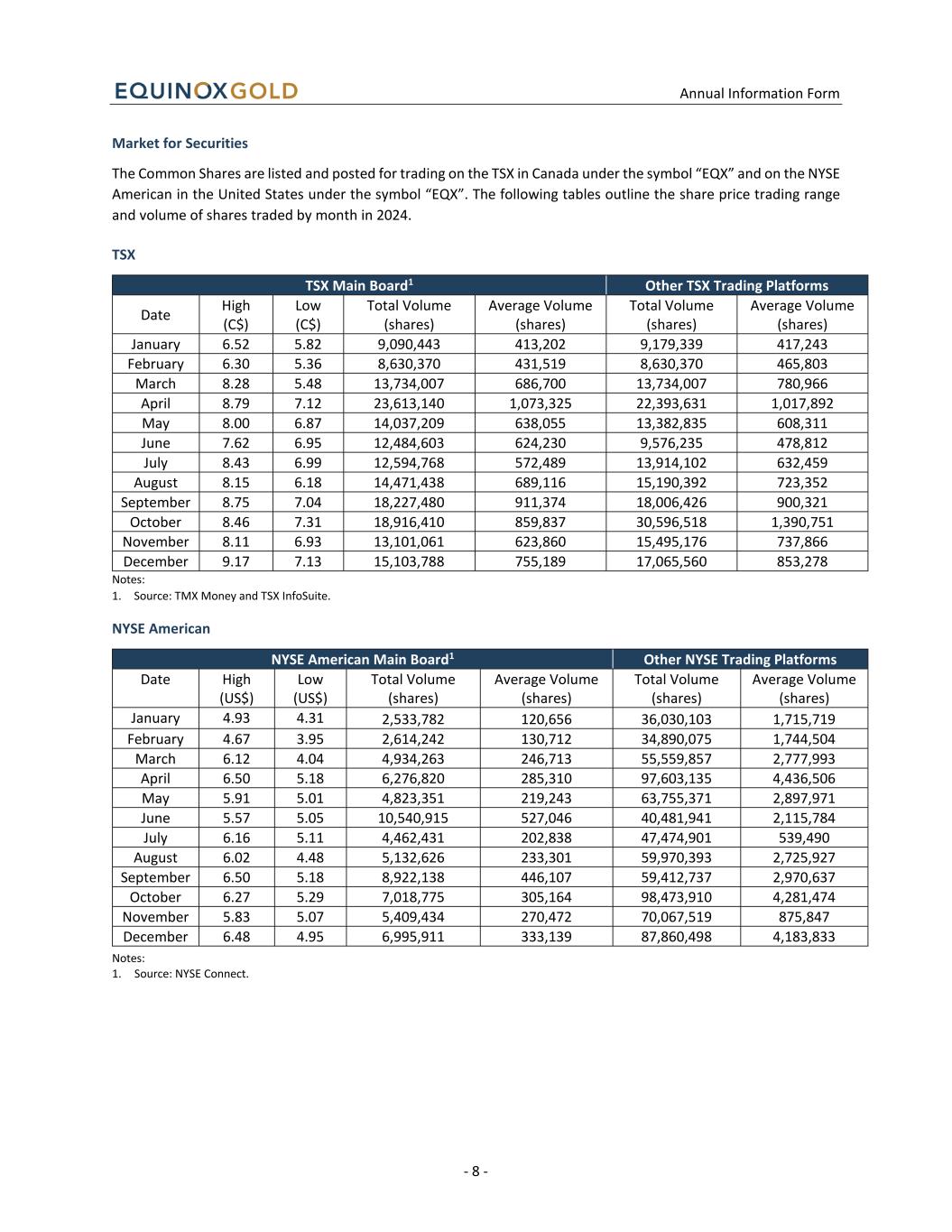
Annual Information Form - 8 - Market for Securities The Common Shares are listed and posted for trading on the TSX in Canada under the symbol “EQX” and on the NYSE American in the United States under the symbol “EQX”. The following tables outline the share price trading range and volume of shares traded by month in 2024. TSX TSX Main Board1 Other TSX Trading Platforms Date High (C$) Low (C$) Total Volume (shares) Average Volume (shares) Total Volume (shares) Average Volume (shares) January 6.52 5.82 9,090,443 413,202 9,179,339 417,243 February 6.30 5.36 8,630,370 431,519 8,630,370 465,803 March 8.28 5.48 13,734,007 686,700 13,734,007 780,966 April 8.79 7.12 23,613,140 1,073,325 22,393,631 1,017,892 May 8.00 6.87 14,037,209 638,055 13,382,835 608,311 June 7.62 6.95 12,484,603 624,230 9,576,235 478,812 July 8.43 6.99 12,594,768 572,489 13,914,102 632,459 August 8.15 6.18 14,471,438 689,116 15,190,392 723,352 September 8.75 7.04 18,227,480 911,374 18,006,426 900,321 October 8.46 7.31 18,916,410 859,837 30,596,518 1,390,751 November 8.11 6.93 13,101,061 623,860 15,495,176 737,866 December 9.17 7.13 15,103,788 755,189 17,065,560 853,278 Notes: 1. Source: TMX Money and TSX InfoSuite. NYSE American NYSE American Main Board1 Other NYSE Trading Platforms Date High (US$) Low (US$) Total Volume (shares) Average Volume (shares) Total Volume (shares) Average Volume (shares) January 4.93 4.31 2,533,782 120,656 36,030,103 1,715,719 February 4.67 3.95 2,614,242 130,712 34,890,075 1,744,504 March 6.12 4.04 4,934,263 246,713 55,559,857 2,777,993 April 6.50 5.18 6,276,820 285,310 97,603,135 4,436,506 May 5.91 5.01 4,823,351 219,243 63,755,371 2,897,971 June 5.57 5.05 10,540,915 527,046 40,481,941 2,115,784 July 6.16 5.11 4,462,431 202,838 47,474,901 539,490 August 6.02 4.48 5,132,626 233,301 59,970,393 2,725,927 September 6.50 5.18 8,922,138 446,107 59,412,737 2,970,637 October 6.27 5.29 7,018,775 305,164 98,473,910 4,281,474 November 5.83 5.07 5,409,434 270,472 70,067,519 875,847 December 6.48 4.95 6,995,911 333,139 87,860,498 4,183,833 Notes: 1. Source: NYSE Connect.
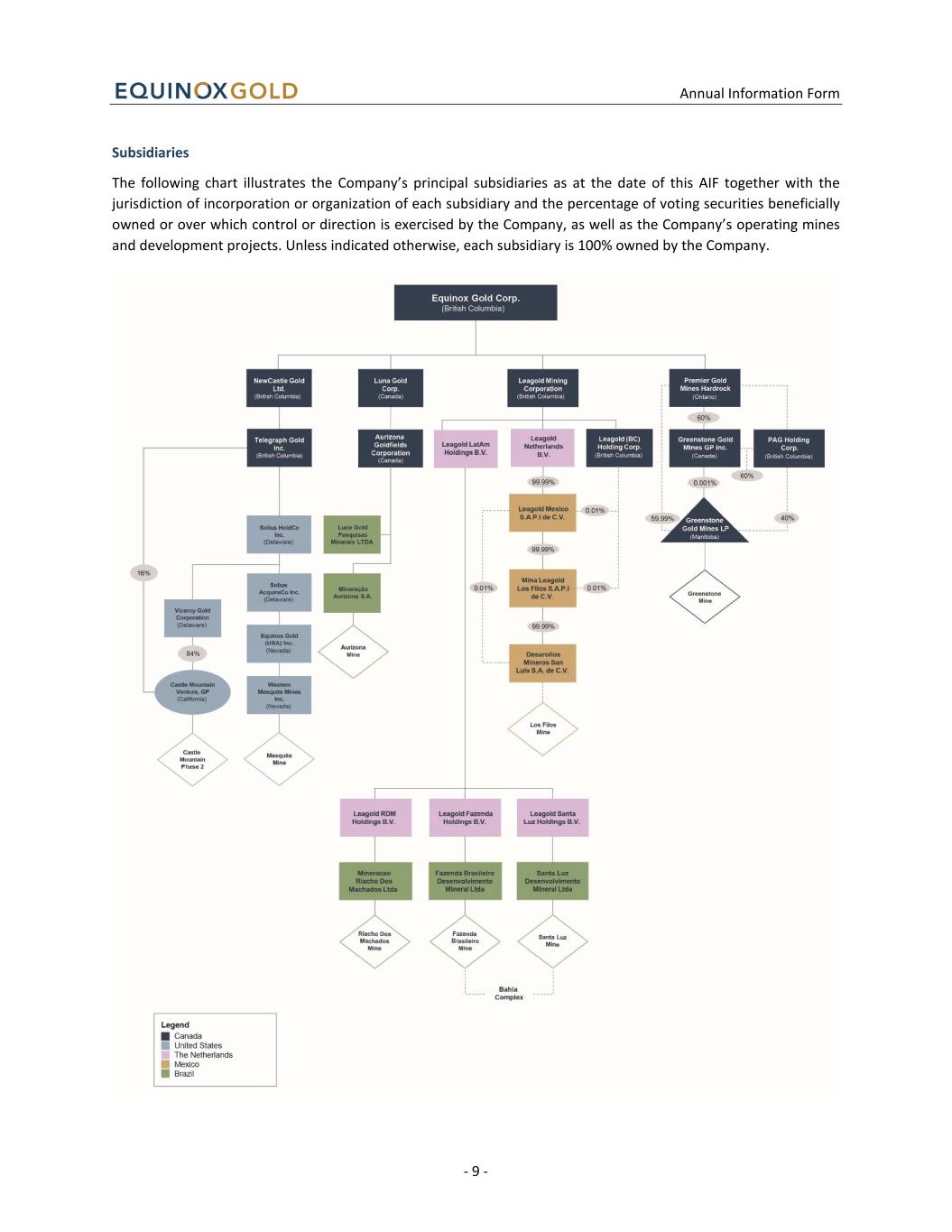
Annual Information Form - 9 - Subsidiaries The following chart illustrates the Company’s principal subsidiaries as at the date of this AIF together with the jurisdiction of incorporation or organization of each subsidiary and the percentage of voting securities beneficially owned or over which control or direction is exercised by the Company, as well as the Company’s operating mines and development projects. Unless indicated otherwise, each subsidiary is 100% owned by the Company.
Annual Information Form - 10 - GENERAL DEVELOPMENT OF THE BUSINESS Business of Equinox Gold Equinox Gold is a growth-focused mining company delivering on its strategy of creating the Premier Americas gold producer. Equinox Gold was created with the strategic vision of building a company that will responsibly and safely produce more than one million ounces of gold annually, bring long-term social and economic benefits to its host communities, create a safe and rewarding workplace for its employees and contractors, and provide above-average investment returns to its shareholders. The Company is principally engaged in the operation, development and exploration of gold projects and has quickly grown from a single-asset developer to a multi-asset gold producer with six producing gold mines at the date of this AIF. Equinox Gold’s material assets are Greenstone in Ontario, Canada, Mesquite in California, United States, Aurizona in Maranhão State, Brazil, the Bahia Complex in Bahia State, Brazil (Equinox Gold is in the process of combining its Fazenda and Santa Luz mines into one operating unit, known as the Bahia Complex), the Castle Mountain Phase 2 Project in California, United States, and Los Filos in Guerrero State, Mexico. Together, Equinox Gold’s material assets are referred to in this AIF as the Equinox Gold Projects. The Equinox Gold Projects are all 100% owned by the Company. Equinox Gold also has 100% ownership of the RDM Gold Mine (RDM) in Minas Gerais State, Brazil. RDM is a producing mine but is not considered a material project for Equinox Gold. Equinox Gold produced 621,893 ounces of gold in 2024 at total cash costs of $1,598 per ounce and all in sustaining costs (AISC) of $1,870 per ounce.1 The Company released 2025 production guidance on February 19, 2025, estimating production of 635,000 to 750,000 ounces of gold for the year at cash costs of $1,075 to $1,175 per ounce and AISC of $1,455 to $1,550 per ounce.1 Guidance is intended to provide baseline estimates from which investors can assess the Company’s expectations for its production and operating costs for the year. The Company may revise its guidance during the year to reflect changes to expected results. The Company did not issue 2025 cost and production guidance for Los Filos. Continuing operations at Los Filos in 2025 is subject to the successful completion of new long-term agreements with three local communities. These new agreements are necessary to help ensure the long-term economic and investment viability of the mine, including the addition of a new 10,000 tonnes-per-day (tpd) carbon-in-leach (CIL) processing plant to increase recoveries from higher-grade ore. The Company and the three communities have held collaborative and open dialogue and reached consensus on terms for new agreements. Two communities have ratified and signed new long-term agreements; however, one community remains outstanding. If the Company is unable to satisfactorily reach an agreement with the remaining community in the near term, the Company will suspend operations at Los Filos indefinitely. To achieve its growth objectives, Equinox Gold intends to expand production from its current asset base through exploration and development. The Company is advancing expansion projects at Castle Mountain and Aurizona. With the incremental production growth anticipated from these development and expansion projects, the Company believes it has the assets in place to achieve its objective of producing more than one million ounces of gold per year. The Company may still consider opportunities to acquire other companies, producing mines and/or development projects that fit the Company’s portfolio and strategy. In support of this growth strategy, on February 23, 2025, Equinox Gold announced plans for an at-market business combination with Calibre Mining Corp. as described below in Three Year History – Recent Developments. 1 Cash costs per ounce and AISC per ounce sold are non-IFRS measures. See Non-IFRS Measures.
Annual Information Form - 11 - Three Year History Year Ended December 31, 2022 On January 25, 2022, the Company announced 2022 production guidance of 625,000 to 710,000 ounces of gold at cash costs of $1,080 to $1,140 per ounce and AISC of $1,330 to $1,415 per ounce of gold sold.1 On February 24, 2022, the Company announced that it produced 602,110 ounces of gold in 2021 at cash costs of $1,087 per ounce and AISC of $1,350 per ounce of gold sold.1 On March 30, 2022, the Company poured first gold at Santa Luz. On April 21, 2022, the Company completed the sale of Mercedes to Bear Creek. On May 26, 2022, the Company and Sandstorm Gold Ltd. announced the creation of Sandbox Royalties Corp. (subsequently renamed Versamet Royalties Corp. (Versamet)). Pursuant to the transaction, Versamet acquired a portfolio of royalties and other assets from the Company for consideration of 28.4 million common shares of Versamet, representing a 30% basic interest in Versamet. The transaction closed on June 28, 2022. On July 28, 2022, the Company amended its revolving credit facility to, among other things, increase the maximum amount available under the revolving facility from $400 million to $700 million, add an additional $100 million uncommitted accordion feature, reduce pricing for advances by 0.25% – 0.50% depending on leverage ratios, and extend the maturity date to July 28, 2026 (with the ability to request additional one-year extensions). On August 3, 2022, the Company updated guidance to reflect a disruption to mining and operations at RDM, a longer- than-expected ramp up at Santa Luz that prolonged pre-commercial production, and further inflation of approximately 6% on a consolidated basis. Updated production guidance was estimated at 550,000 to 615,000 ounces of gold with cash costs of $1,200 to $1,250 per ounce and AISC of $1,470 to $1,530 per ounce of gold sold.1 On August 3, 2022, the Company announced the resignation of Christian Milau as Chief Executive Officer and Director, and that the Company’s President, Greg Smith, would succeed Mr. Milau. Mr. Smith assumed the role of Chief Executive Officer and was appointed a Director on September 1, 2022. On September 8, 2022, the Company announced the suspension of mining and development activities at Los Filos due to a blockade by members of one of the three communities from which the mine draws much of its workforce. Following a meeting with community leaders the blockade was removed and the mine resumed operations on September 10, 2022. On October 4, 2022, the Company announced that Santa Luz achieved commercial production effective October 1, 2022. On October 19, 2022, the Company announced the results of an updated feasibility study for the Los Filos expansion, including a 44% increase in Los Filos Mineral Reserves and filed a related technical report for Los Filos. On November 2, 2022, the Company reported its financial and operations results for the third quarter of 2022. The Company announced that it expected full-year production to be approximately 540,000 ounces of gold and AISC to exceed the upper end of guidance of $1,530 per ounce produced by approximately five percent. A material change report regarding the reporting of such financial and operational results was filed by the Company on November 8, 2022. On November 21, 2022, the Company announced that it had entered into an equity distribution agreement providing for an at-the-market equity offering program (ATM) with BMO Capital Markets and National Bank Financial and their respective affiliates (collectively, the Agents). The ATM allowed the Company, through the Agents, to offer and sell from time to time in Canada and the United States through the facilities of the TSX and NYSE, such number of Common Shares as would have an aggregate offering price of up to US$100 million. The ATM was to remain effective
Annual Information Form - 12 - until December 21, 2024, unless terminated earlier. In addition, the Company announced filing of a registration statement including a base shelf prospectus, and a prospectus supplement for the ATM. During 2023 and Q1 2024, the Company issued a cumulative total of 22.5 million Common Shares under the ATM Program, which was fully utilized on March 31, 2024. On December 6, 2022, the Company announced that it had sold an aggregate of 11,000,000 common shares of Solaris Resources Inc. (Solaris) in the ordinary course for investment purposes through the facilities of the TSX through block trades for aggregate gross proceeds of C$70.4 million. As a result of the transaction, Equinox Gold’s ownership in Solaris decreased to less than 10% of the issued and outstanding common shares of Solaris and Equinox Gold ceased to be a “reporting insider” of Solaris, as defined in National Instrument 55-104 – Insider Reporting Requirements. Year Ended December 31, 2023 On February 7, 2023, the Company released its inaugural Climate Action Report and announced its target to achieve a 25% reduction in GHG emissions by 2030 compared to “business-as-usual” emissions if no intervention measures were taken. On February 21, 2023, the Company announced that it produced 532,319 ounces of gold in 2022 at cash costs of $1,328 per ounce and AISC of $1,622 per ounce of gold sold. The Company also announced 2023 production guidance of 555,000 to 625,000 ounces of gold at cash costs of $1,355 to $1,460 per ounce and AISC of $1,575 to $1,695 per ounce of gold sold.1 On March 7, 2023, the Company announced that it had entered into an agreement to sell 11.6 million units of i-80 Gold Corp. (i-80 Gold) at a price of C$2.76 per unit for gross proceeds of C$23.6 million. Each unit consisted of one common share of i-80 Gold and one-half of one common share purchase warrant of i-80 Gold, with each whole warrant exercisable to purchase one common share of i-80 Gold at a price of C$3.45 per share for a period of 12 months following closing of the transaction on March 31, 2023. In the event all warrants are exercised, Equinox Gold would sell a total of 17.4 million shares of i-80 Gold for total gross proceeds of C$52,026,000. On March 24, 2023, the Company entered into a gold sale prepay arrangement with a syndicate of its existing lenders whereby the Company received net proceeds of $139.5 million in exchange for delivering 3,605 ounces of gold per month from October 2024 through July 2026 (Delivery Period) for a total of 79,310 ounces. On June 23, 2023, the Company entered into an additional gold sale prepay transaction with an existing lender whereby the Company received an upfront cash payment of $9.9 million in exchange for delivering to the lender 263.5 ounces of gold per month during the Delivery Period for a total of 5,797 ounces. These transactions are referred to collectively as the Gold Prepay Transactions. Gold deliveries can be settled by production from any of the Company’s operating mines and the Gold Prepay Transactions can be settled prior to maturity through accelerated delivery of the remaining deliverable gold ounces. On September 21, 2023, the Company closed a bought deal offering of 4.75% unsecured convertible senior notes (2023 Convertible Notes) in an aggregate principal amount of $150 million, plus exercise of the full amount of the option to purchase an additional $22.5 million aggregate principal amount of the 2023 Convertible Notes, for gross proceeds of $172.5 million. The conversion rate for the 2023 Convertible Notes is 158.7302 Common Shares per $1,000 principal amount of the 2023 Convertible Notes, equivalent to a conversion price of $6.30 per Common Share. On October 31, 2023, the Company closed a gold purchase agreement with Versamet and Regal Partners Royalties A PTY Limited (Regal and together with Versamet, the Purchasers). Under the agreement, the Company received a payment of $75 million in exchange for monthly deliveries to the Purchasers equal to the greater of: a) 500 gold ounces and b) gold ounces equal to 1.8% of the monthly gold production from Greenstone. Gold deliveries can be from production from any of the Company’s operating mines. Gold deliveries started in November 2023 and will
Annual Information Form - 13 - continue until a total of 90,000 ounces have been delivered. The Purchasers will make ongoing cash payments equal to 20% of the spot gold price for each gold ounce delivered. The Company may buy down up to 75% of the delivery obligation at the then current spot gold price, subject to adjustment for the ongoing payment and a minimum price per ounce of $2,000. On November 20, 2023, the Company announced that Greenstone construction was 96% complete, commissioning activities were underway, and the project was on schedule to pour gold in the first half of 2024. Year Ended December 31, 2024 On February 22, 2024, the Company announced that it produced 564,458 ounces of gold in 2023 at cash costs of $1,350 per ounce and AISC of $1,612 per ounce of gold sold. The Company also announced 2024 production guidance of 660,000 to 750,000 ounces of gold at cash costs of $1,340 to $1,445 per ounce and AISC of $1,630 to $1,740 per ounce of gold sold.1 On April 1, 2024, the Company amended the terms of its 2019 and 2020 Convertible Notes. The maturity date of the 2019 Convertible Notes was extended from April 12, 2024 to October 12, 2024 and the maturity date of the 2020 Convertible Notes was extended from March 10, 2025 to September 10, 2025. In addition, the conversion price of the 2020 Convertible Notes was amended from $7.80 per Common Share to $6.50 per Common Share. On April 8, 2024, the Company reported a geotechnical event at Aurizona. Persistent heavy rains caused a displacement of material in two locations in the south wall of the Piaba pit. There were no injuries, no damage to equipment or infrastructure, and no environmental damage. Mining of the Piaba pit was immediately suspended. Milling and gold production continued from the existing ore stockpile until the end of April 2024. The plant was idle for May and June while mining transitioned to the Tatajuba deposit and restarted in July 2024. Mining of the Piaba pit resumed in November 2024. On April 23, 2024, the Company announced that it had entered into a share purchase agreement to consolidate ownership of Greenstone by acquiring Orion’s 40% interest giving Equinox Gold 100% ownership of Greenstone. The total consideration for the acquisition, as set out in the agreement, was: a) 42.0 million Common Shares of Equinox Gold, b) $705 million in cash payable on closing, and c) $40 million in cash payable before December 31, 2024. Equinox Gold funded the cash consideration with net proceeds from both a new $500 million three-year term loan and a bought deal equity financing of Common Shares. The transaction closed on May 13, 2024 and the final $40 million was paid to Orion on December 30, 2024. The Company was not required to file a business acquisition report in connection with the acquisition. On April 26, 2024, the Company reported closing of the bought deal equity financing offering of 56,419,000 Common Shares at the price of $5.30 per common share for gross proceeds of $299 million. On May 9, 2024, Ms. Trudy Curran was appointed to the Board. On May 23, 2024, the Company announced first gold pour at Greenstone. On May 29, 2024, the Company sold its remaining 50.6 million common shares of i-80 Gold for total proceeds of $48.2 million. On August 7, 2024, the Company updated production and cost guidance to reflect the consolidation of the Company’s ownership of Greenstone, the suspension of mining at Castle Mountain until Phase 2 permitting is complete, slower-than-expected recoveries at Mesquite and the geotechnical event at Aurizona. Guidance was amended to 655,000 to 750,000 ounces of gold with cash costs of $1,305 to $1,405 per ounce and AISC of $1,635 to $1,735 per ounce sold.1 On August 29, 2024, the Company announced the official opening of Greenstone.
Annual Information Form - 14 - On October 3, 2024, the Company announced that the 2019 Convertible Notes were converted to shares of the Company. On October 1, 2024, the Company filed a well-known seasoned issuer short form base shelf prospectus that allows the Company to make offerings of Common Shares, debt securities, subscription receipts, share purchase contracts, units or warrants, or any combination thereof, over a 25-month period. This prospectus replaced the previous prospectus that was set to expire by year-end 2024. On October 9, 2024, Mr. Fraz Siddiqui resigned from the Company’s Board. Mr. Siddiqui was the Board appointee of Mubadala Investment Company (Mubadala) under an investor rights agreement. With conversion of the 2019 Convertible Notes and subsequent sale of the issued shares, Mubadala’s investor rights agreement was no longer in effect. On October 16, 2024, the Company adjusted Greenstone 2024 production guidance to 110,000 to 130,000 ounces of gold (from 175,000 to 205,000 ounces), reflecting progress in the ramp-up. On October 29, 2024, the Company entered into amending agreements with the counterparties to defer the first five monthly deliveries of the gold prepay transactions originally scheduled for October 2024 through February 2025. The total of 19,343 deferred ounces will be delivered over the period from May 2026 to September 2026 (the Deferral Period). As consideration for the deferral, the Company will deliver an additional 1,582 gold ounces over the Deferral Period. On November 6, 2024, the Company released updated Greenstone cost guidance, guiding for cash costs of $850 to $950 per ounce (from $690 to $790 per ounce) and AISC of $1,050 to $1,150 per ounce of gold sold (from $840 to $940 per ounce of gold sold).1 On November 6, 2024, the Company announced that Greenstone had achieved commercial production. Recent Developments On January 7, 2025, the Company announced an updated Mineral Reserve and Mineral Resource estimate for Fazenda (now part of Bahia Complex), extending the mine life by seven years to 2033. A technical report for the update was filed on February 1, 2025. On February 19, 2025, the Company announced that it produced 621,893 ounces of gold in 2024 at total cash costs of $1,598 per ounce and AISC of $1,870 per ounce of gold sold. The Company also announced 2025 production guidance of 635,000 to 750,000 ounces of gold with cash costs of $1,075 to $1,175 per ounce and AISC of $1,455 to $1,550 per ounce of gold sold.1 On February 23, 2025, the Company announced that it had entered into a definitive arrangement agreement (Arrangement Agreement) in an at-market business combination whereby Equinox Gold will acquire all the issued and outstanding common shares of Calibre Mining Corp. (Calibre) pursuant to a court-approved plan of arrangement (Transaction). The Transaction will create an Americas-focused diversified gold producer with a portfolio of operating mines in five countries anchored by two high-quality, long-life, low-cost Canadian gold mines. The combined company will continue under the name “Equinox Gold Corp.”. Under the terms of the Arrangement Agreement, Calibre shareholders will receive 0.31 Equinox Gold Common Shares for each Calibre common share held immediately prior to the effective time of the Transaction. Upon completion of the Transaction, existing Equinox Gold shareholders and former Calibre shareholders will own approximately 65% and 35% of the outstanding common shares of the combined company, respectively, on a fully diluted in-the-money basis. Upon closing of the Transaction, management of the combined operations will include executives from both Equinox Gold and Calibre, with Equinox Gold’s current President and Chief Executive Officer, Greg Smith, remaining as Chief
Annual Information Form - 15 - Executive Officer and Calibre’s current President and Chief Executive Officer, Darren Hall, joining management as President and Chief Operating Officer of the combined company. The Board of Directors of the combined company will consist of ten directors, with Ross Beaty as Chair, along with five additional directors from Equinox Gold, including Greg Smith, and four directors from Calibre, including Doug Forster and Blayne Johnson. The Transaction will be effected pursuant to a court approved plan of arrangement under the Business Corporations Act (British Columbia). The Transaction will require approval by 66 2/3 percent of the votes cast by the shareholders of Calibre and 66 2/3 percent of the votes cast by the shareholders and option holders of Calibre, voting together as a single class, at a special meeting of Calibre shareholders expected to be held in April 2025. The Transaction will also require approval of a simple majority of votes cast by the shareholders of Calibre, excluding those votes attached to Calibre common shares held by persons required to be excluded pursuant to Multilateral Instrument 61-101 – Protection of Minority Security Holder in Special Transaction. The issuance of the Equinox Gold Common Shares pursuant to the Transaction is also subject to approval by the shareholders of Equinox Gold with a simple majority threshold of votes cast in favour at a special meeting of shareholders, scheduled to be held on April 24, 2025. In addition to shareholder and court approvals, the Transaction is subject to applicable regulatory approvals, including both Canadian and Mexican competition authorization, approval of the listing of the Equinox Gold Common Shares to be issued under the Transaction on the TSX and NYSE American, and the satisfaction of certain other closing conditions customary for a transaction of this nature. Subject to the satisfaction of such conditions, the Transaction is expected to close in Q2 2025. The Arrangement Agreement includes customary deal protections, including reciprocal fiduciary-out provisions, non-solicitation covenants, and the right to match any superior proposals. Additionally, termination fees in the amount of $145 million and $85 million are payable by Equinox Gold and Calibre, respectively, in certain circumstances.
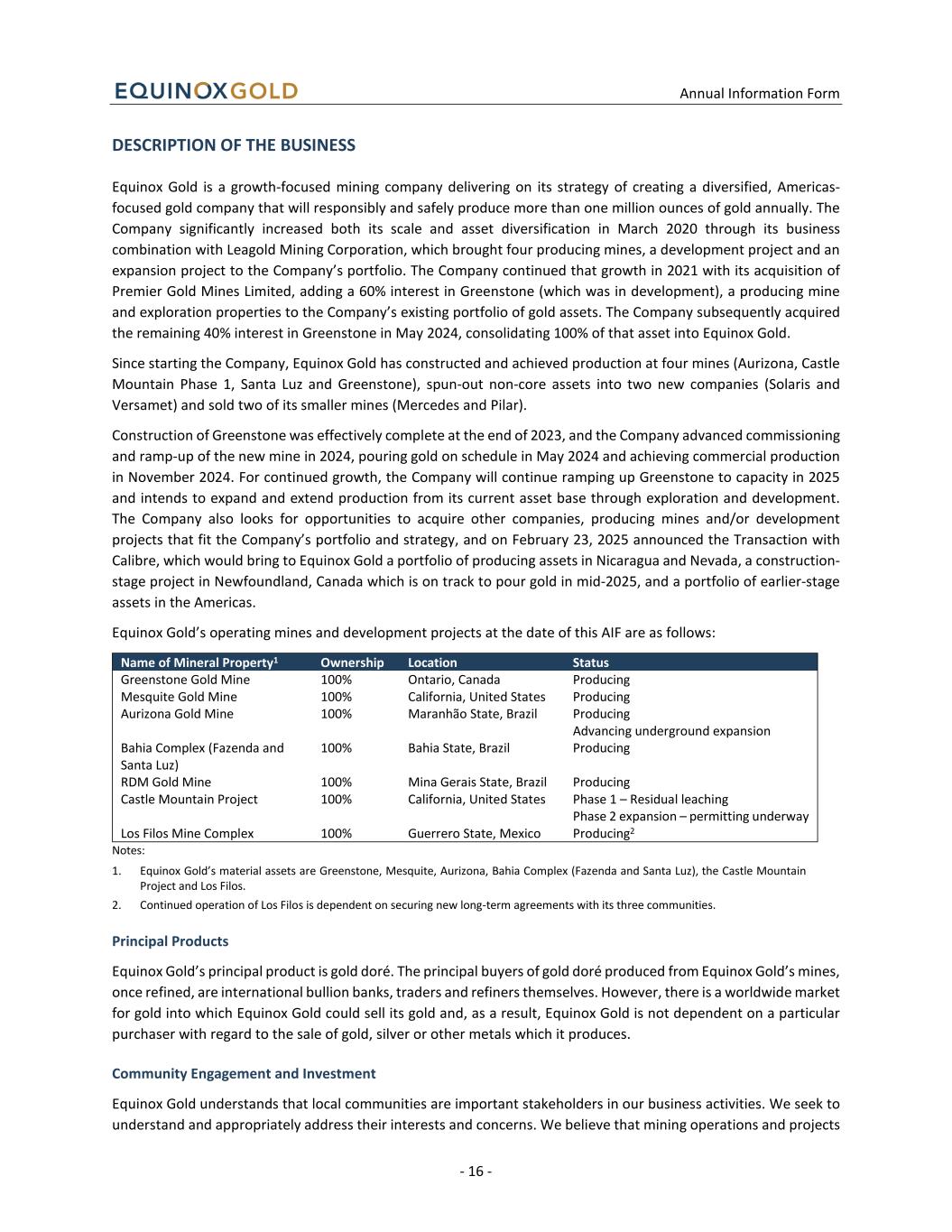
Annual Information Form - 16 - DESCRIPTION OF THE BUSINESS Equinox Gold is a growth-focused mining company delivering on its strategy of creating a diversified, Americas- focused gold company that will responsibly and safely produce more than one million ounces of gold annually. The Company significantly increased both its scale and asset diversification in March 2020 through its business combination with Leagold Mining Corporation, which brought four producing mines, a development project and an expansion project to the Company’s portfolio. The Company continued that growth in 2021 with its acquisition of Premier Gold Mines Limited, adding a 60% interest in Greenstone (which was in development), a producing mine and exploration properties to the Company’s existing portfolio of gold assets. The Company subsequently acquired the remaining 40% interest in Greenstone in May 2024, consolidating 100% of that asset into Equinox Gold. Since starting the Company, Equinox Gold has constructed and achieved production at four mines (Aurizona, Castle Mountain Phase 1, Santa Luz and Greenstone), spun-out non-core assets into two new companies (Solaris and Versamet) and sold two of its smaller mines (Mercedes and Pilar). Construction of Greenstone was effectively complete at the end of 2023, and the Company advanced commissioning and ramp-up of the new mine in 2024, pouring gold on schedule in May 2024 and achieving commercial production in November 2024. For continued growth, the Company will continue ramping up Greenstone to capacity in 2025 and intends to expand and extend production from its current asset base through exploration and development. The Company also looks for opportunities to acquire other companies, producing mines and/or development projects that fit the Company’s portfolio and strategy, and on February 23, 2025 announced the Transaction with Calibre, which would bring to Equinox Gold a portfolio of producing assets in Nicaragua and Nevada, a construction- stage project in Newfoundland, Canada which is on track to pour gold in mid-2025, and a portfolio of earlier-stage assets in the Americas. Equinox Gold’s operating mines and development projects at the date of this AIF are as follows: Name of Mineral Property1 Ownership Location Status Greenstone Gold Mine 100% Ontario, Canada Producing Mesquite Gold Mine 100% California, United States Producing Aurizona Gold Mine 100% Maranhão State, Brazil Producing Advancing underground expansion Bahia Complex (Fazenda and Santa Luz) 100% Bahia State, Brazil Producing RDM Gold Mine 100% Mina Gerais State, Brazil Producing Castle Mountain Project 100% California, United States Phase 1 – Residual leaching Phase 2 expansion – permitting underway Los Filos Mine Complex 100% Guerrero State, Mexico Producing2 Notes: 1. Equinox Gold’s material assets are Greenstone, Mesquite, Aurizona, Bahia Complex (Fazenda and Santa Luz), the Castle Mountain Project and Los Filos. 2. Continued operation of Los Filos is dependent on securing new long-term agreements with its three communities. Principal Products Equinox Gold’s principal product is gold doré. The principal buyers of gold doré produced from Equinox Gold’s mines, once refined, are international bullion banks, traders and refiners themselves. However, there is a worldwide market for gold into which Equinox Gold could sell its gold and, as a result, Equinox Gold is not dependent on a particular purchaser with regard to the sale of gold, silver or other metals which it produces. Community Engagement and Investment Equinox Gold understands that local communities are important stakeholders in our business activities. We seek to understand and appropriately address their interests and concerns. We believe that mining operations and projects
Annual Information Form - 17 - can provide significant economic benefits and social development opportunities for local communities that can endure well beyond the life of a mine. Equinox Gold offers training programs and is committed to hiring locally. The Company also supports development initiatives that meet the needs and priorities of local communities with the objective of leaving a legacy of improved infrastructure, skills development and more sustainable communities. Equinox Gold engages in early, frequent and transparent dialogue with stakeholders as a means to build trust and provide a space for collaboration and long-term commitment. The Company maintains formal systems to identify stakeholders and communities of interest and strives to maintain strong local relationships. At all of the Company’s mine sites, dedicated community liaisons meet regularly with host communities to discuss activities, report on environmental performance and discuss concerns. The Company seeks local feedback, particularly where concerns have been raised, and collaborative solutions can be implemented. Health & Safety The health and safety of the Company’s workforce is a top priority for Equinox Gold. By adopting a strong risk management approach, Equinox Gold engages with and trains our workforce to recognize, understand and mitigate hazards of the workplace to prevent incidents and injuries. We comply with all relevant local, state, provincial, and federal laws and have implemented best practices and industry standards. During 2024, Equinox Gold completed 20.3 million work hours with ten lost-time incidents across its sites resulting in a lost time injury frequency rate (LTIFR) of 0.49 per million hours worked compared to the target of 0.61 for 2024. Three of the Company’s sites had no lost-time incidents during 2024. The Company’s total recordable injury frequency rate (TRIFR), which is a measure of all injuries that require the attention of medically trained personnel, was 2.21 per million hours worked compared to the target of 3.00 for 2024. The Company had one fatality during 2024 in the underground portion of Fazenda. Operations at Fazenda were suspended for four days, during which safety refresher training was conducted for the site’s workforce. Equinox Gold provided its full support to the individual’s family and the relevant authorities, and learnings from the incident investigation were shared across the Company. Environment Environmental stewardship is fundamental to Equinox Gold’s operations. We aim to minimize or mitigate the potential effects of our operations on regional flora, fauna, water quality and air quality. Understanding the components of the ecosystem and the potential impacts of mining activities allows us to plan appropriately and adopt mitigation strategies to eliminate or reduce impacts to an acceptable level. During 2024, Equinox Gold achieved a significant environmental incident frequency rate (SEIFR) of 0.20 per million hours worked, using the Company’s internal environmental reporting standards, compared to the target of 1.26 for 2024. Equinox Gold operates in Canada, the United States, Mexico and Brazil and is subject to national and local laws and regulations in each relevant jurisdiction. All aspects of Equinox Gold’s operations, development activities and exploration programs are subject to environmental regulations and generally require approval by appropriate regulatory authorities prior to commencement. Specific statutory and regulatory requirements and standards must be met throughout the mine cycle, including but not isolated to standards related to air quality, water quality, fisheries and wildlife protection, chemical use, waste disposal, noise, geotechnical stability, geochemistry and land use. When operations cease, the Company is also required to meet reclamation and closure obligations. Details and quantification of Equinox Gold’s reclamation and closure cost obligations as at December 31, 2024 are set out in the Company’s annual financial statements for the year ended December 31, 2024.
Annual Information Form - 18 - Employees and Contractors At the end of the most recently completed financial year, Equinox Gold had a total of 3,964 employees and 4,244 contractors. No management functions of Equinox Gold are performed to any substantial degree by a person other than the directors or executive officers of Equinox Gold. Equinox Gold is committed to hiring locally and the majority of employees and contractors at each of its operations come from local communities The Company has developed a strategy to support people who come from varying backgrounds and give them the resources they need to thrive and contribute best in the workplace. Human resources leaders at each of Equinox Gold's sites have participated in workshops to better understand their site-specific challenges and initiatives already in place. Specialized Skill and Knowledge Many aspects of Equinox Gold’s business require specialized skills and knowledge, such as expertise in the areas of mine operations, mine construction, permitting, geology, drilling, implementation of exploration programs, logistical planning, accounting, communications and local laws. Equinox Gold retains executive officers and consultants with experience in mining, metallurgy, geology, exploration and development in Canada, the United States, Mexico and Brazil, as well as executive officers and consultants with relevant accounting, communications and legal experience. Competitive Conditions The mineral exploration and mining industry is competitive, and Equinox Gold is required to compete for the acquisition of mineral permits, claims, leases and other mineral interests for operations, exploration, and development projects. As a result of this competition, Equinox Gold may not be able to acquire or retain prospective properties in the future on terms it considers acceptable. The ability of Equinox Gold to acquire and retain mineral properties in the future will depend on its ability to successfully operate and develop its existing properties and also on its ability to fund further exploration and development activities. Equinox Gold also competes with other mining companies for investment capital with which to fund such projects, and for the recruitment and retention of qualified personnel. Components The raw materials and support services that Equinox Gold requires to carry on its business are available through normal supply or business contracting channels in Canada, the United States, Mexico and Brazil. Increased demands by other mineral exploration, development and operating companies, inflationary pressures, tariffs, or disruptions to supply chains due to events like pandemics, and other global events can make it more difficult to procure certain supplies and services. Cycles The mining business, and particularly precious metals production, is subject to metal price cycles. The marketability of minerals and mineral concentrates is also affected by worldwide economic cycles. Foreign Operations Equinox Gold faces certain risks as a Canadian company operating in the United States, Mexico and Brazil. Any changes in regulations or shifts in political attitudes are beyond the control of Equinox Gold and may adversely affect its business. Equinox Gold may be affected in varying degrees by factors such as government regulations (or changes thereto) with respect to restrictions on mining, export controls, income taxes, expropriation of property, repatriation of profits, environmental legislation, tariffs, land use, water use, land claims of local people, changes in foreign exchange, mine safety regulations, labour laws, corruption, political unrest, timely reimbursement by the government of refundable value added taxes and refundable income taxes, uncertainty with respect to the rule of law and the integrity of court systems, and security issues. The effect of these factors cannot be accurately predicted.
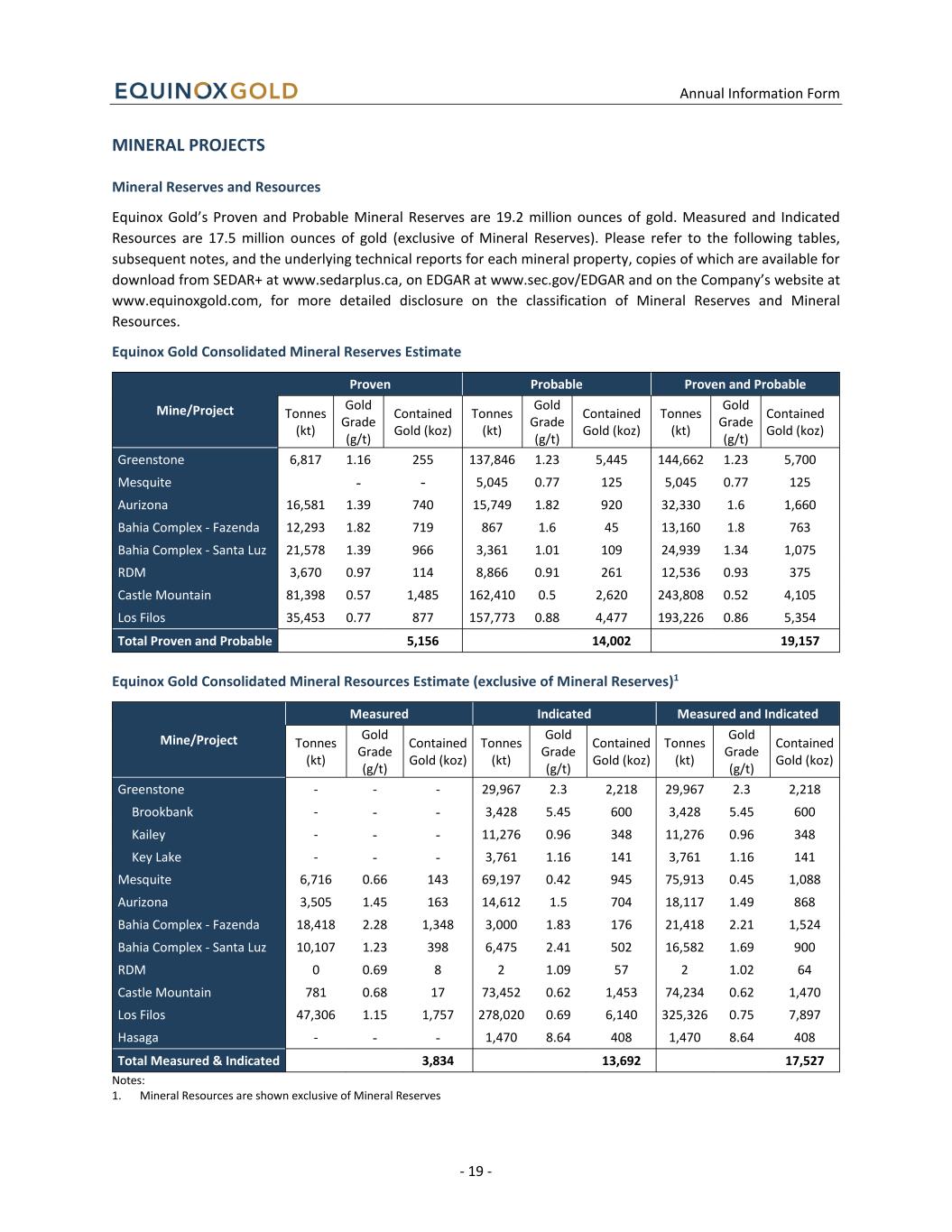
Annual Information Form - 19 - MINERAL PROJECTS Mineral Reserves and Resources Equinox Gold’s Proven and Probable Mineral Reserves are 19.2 million ounces of gold. Measured and Indicated Resources are 17.5 million ounces of gold (exclusive of Mineral Reserves). Please refer to the following tables, subsequent notes, and the underlying technical reports for each mineral property, copies of which are available for download from SEDAR+ at www.sedarplus.ca, on EDGAR at www.sec.gov/EDGAR and on the Company’s website at www.equinoxgold.com, for more detailed disclosure on the classification of Mineral Reserves and Mineral Resources. Equinox Gold Consolidated Mineral Reserves Estimate Mine/Project Proven Probable Proven and Probable Tonnes (kt) Gold Grade (g/t) Contained Gold (koz) Tonnes (kt) Gold Grade (g/t) Contained Gold (koz) Tonnes (kt) Gold Grade (g/t) Contained Gold (koz) Greenstone 6,817 1.16 255 137,846 1.23 5,445 144,662 1.23 5,700 Mesquite -- - - 5,045 0.77 125 5,045 0.77 125 Aurizona 16,581 1.39 740 15,749 1.82 920 32,330 1.6 1,660 Bahia Complex - Fazenda 12,293 1.82 719 867 1.6 45 13,160 1.8 763 Bahia Complex - Santa Luz 21,578 1.39 966 3,361 1.01 109 24,939 1.34 1,075 RDM 3,670 0.97 114 8,866 0.91 261 12,536 0.93 375 Castle Mountain 81,398 0.57 1,485 162,410 0.5 2,620 243,808 0.52 4,105 Los Filos 35,453 0.77 877 157,773 0.88 4,477 193,226 0.86 5,354 Total Proven and Probable 5,156 14,002 19,157 Equinox Gold Consolidated Mineral Resources Estimate (exclusive of Mineral Reserves)1 Mine/Project Measured Indicated Measured and Indicated Tonnes (kt) Gold Grade (g/t) Contained Gold (koz) Tonnes (kt) Gold Grade (g/t) Contained Gold (koz) Tonnes (kt) Gold Grade (g/t) Contained Gold (koz) Greenstone - - - 29,967 2.3 2,218 29,967 2.3 2,218 Brookbank - - - 3,428 5.45 600 3,428 5.45 600 Kailey - - - 11,276 0.96 348 11,276 0.96 348 Key Lake - - - 3,761 1.16 141 3,761 1.16 141 Mesquite 6,716 0.66 143 69,197 0.42 945 75,913 0.45 1,088 Aurizona 3,505 1.45 163 14,612 1.5 704 18,117 1.49 868 Bahia Complex - Fazenda 18,418 2.28 1,348 3,000 1.83 176 21,418 2.21 1,524 Bahia Complex - Santa Luz 10,107 1.23 398 6,475 2.41 502 16,582 1.69 900 RDM 0 0.69 8 2 1.09 57 2 1.02 64 Castle Mountain 781 0.68 17 73,452 0.62 1,453 74,234 0.62 1,470 Los Filos 47,306 1.15 1,757 278,020 0.69 6,140 325,326 0.75 7,897 Hasaga - - - 1,470 8.64 408 1,470 8.64 408 Total Measured & Indicated 3,834 13,692 17,527 Notes: 1. Mineral Resources are shown exclusive of Mineral Reserves
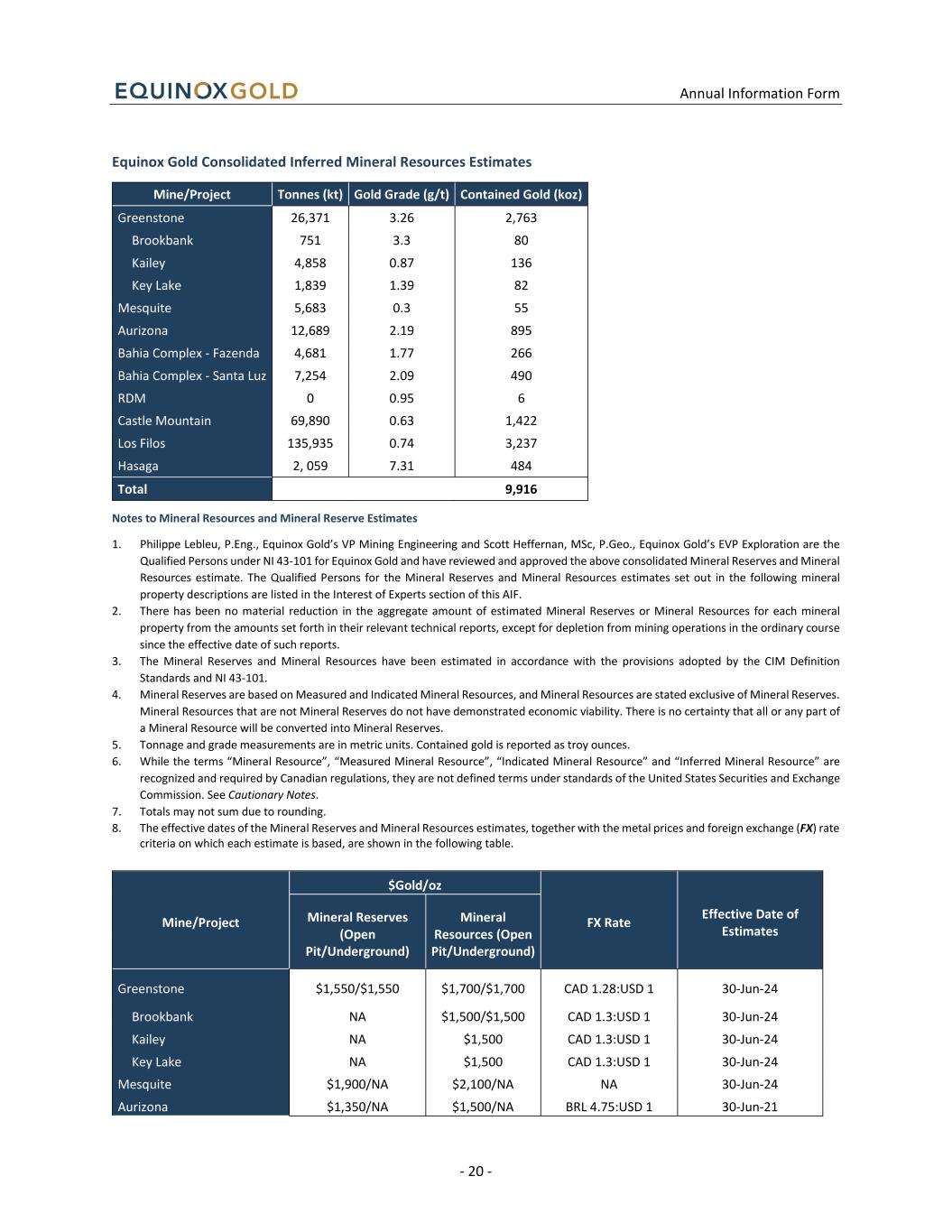
Annual Information Form - 20 - Equinox Gold Consolidated Inferred Mineral Resources Estimates Mine/Project Tonnes (kt) Gold Grade (g/t) Contained Gold (koz) Greenstone 26,371 3.26 2,763 Brookbank 751 3.3 80 Kailey 4,858 0.87 136 Key Lake 1,839 1.39 82 Mesquite 5,683 0.3 55 Aurizona 12,689 2.19 895 Bahia Complex - Fazenda 4,681 1.77 266 Bahia Complex - Santa Luz 7,254 2.09 490 RDM 0 0.95 6 Castle Mountain 69,890 0.63 1,422 Los Filos 135,935 0.74 3,237 Hasaga 2, 059 7.31 484 Total 9,916 Notes to Mineral Resources and Mineral Reserve Estimates 1. Philippe Lebleu, P.Eng., Equinox Gold’s VP Mining Engineering and Scott Heffernan, MSc, P.Geo., Equinox Gold’s EVP Exploration are the Qualified Persons under NI 43-101 for Equinox Gold and have reviewed and approved the above consolidated Mineral Reserves and Mineral Resources estimate. The Qualified Persons for the Mineral Reserves and Mineral Resources estimates set out in the following mineral property descriptions are listed in the Interest of Experts section of this AIF. 2. There has been no material reduction in the aggregate amount of estimated Mineral Reserves or Mineral Resources for each mineral property from the amounts set forth in their relevant technical reports, except for depletion from mining operations in the ordinary course since the effective date of such reports. 3. The Mineral Reserves and Mineral Resources have been estimated in accordance with the provisions adopted by the CIM Definition Standards and NI 43-101. 4. Mineral Reserves are based on Measured and Indicated Mineral Resources, and Mineral Resources are stated exclusive of Mineral Reserves. Mineral Resources that are not Mineral Reserves do not have demonstrated economic viability. There is no certainty that all or any part of a Mineral Resource will be converted into Mineral Reserves. 5. Tonnage and grade measurements are in metric units. Contained gold is reported as troy ounces. 6. While the terms “Mineral Resource”, “Measured Mineral Resource”, “Indicated Mineral Resource” and “Inferred Mineral Resource” are recognized and required by Canadian regulations, they are not defined terms under standards of the United States Securities and Exchange Commission. See Cautionary Notes. 7. Totals may not sum due to rounding. 8. The effective dates of the Mineral Reserves and Mineral Resources estimates, together with the metal prices and foreign exchange (FX) rate criteria on which each estimate is based, are shown in the following table. Mine/Project $Gold/oz FX Rate Effective Date of Estimates Mineral Reserves (Open Pit/Underground) Mineral Resources (Open Pit/Underground) Greenstone $1,550/$1,550 $1,700/$1,700 CAD 1.28:USD 1 30-Jun-24 Brookbank NA $1,500/$1,500 CAD 1.3:USD 1 30-Jun-24 Kailey NA $1,500 CAD 1.3:USD 1 30-Jun-24 Key Lake NA $1,500 CAD 1.3:USD 1 30-Jun-24 Mesquite $1,900/NA $2,100/NA NA 30-Jun-24 Aurizona $1,350/NA $1,500/NA BRL 4.75:USD 1 30-Jun-21
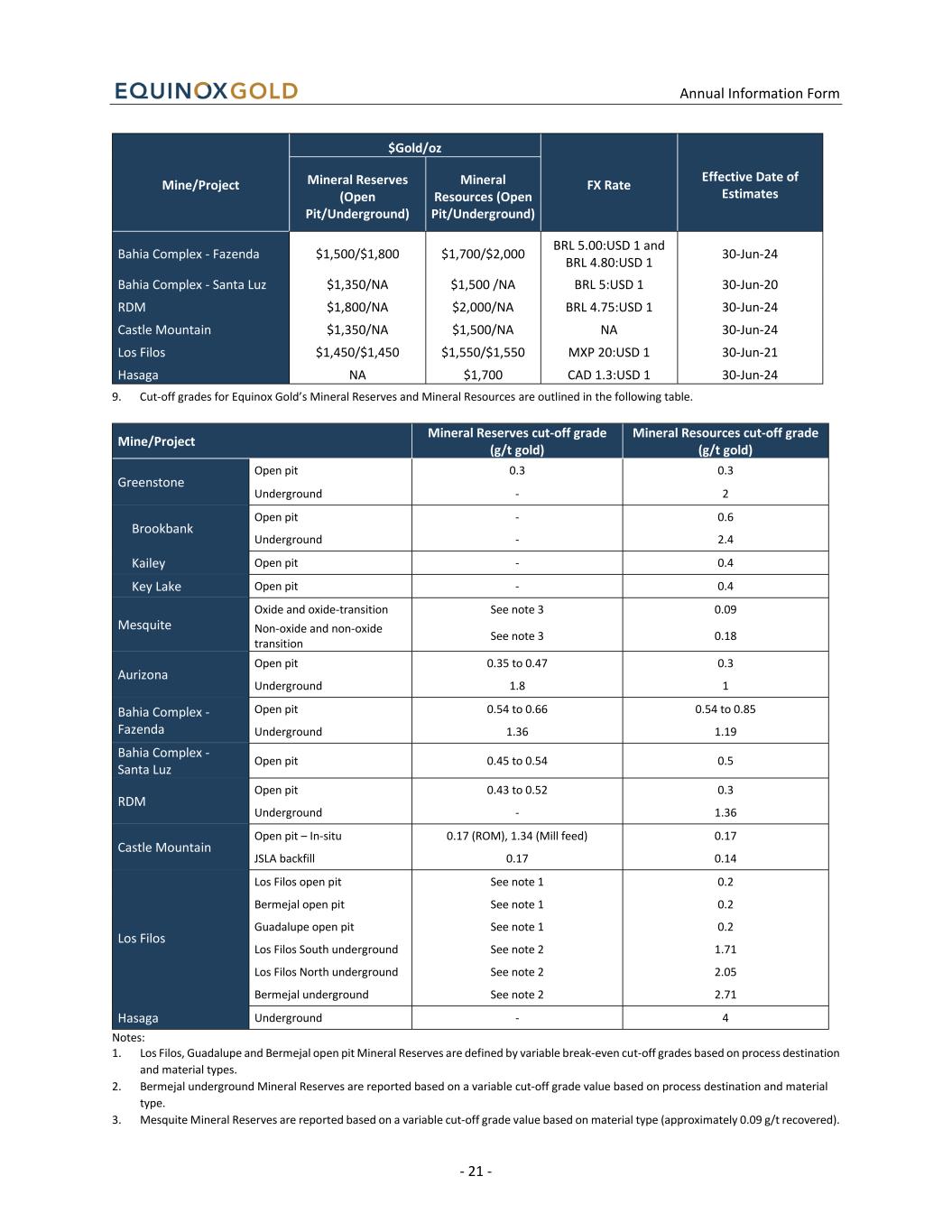
Annual Information Form - 21 - Mine/Project $Gold/oz FX Rate Effective Date of Estimates Mineral Reserves (Open Pit/Underground) Mineral Resources (Open Pit/Underground) Bahia Complex - Fazenda $1,500/$1,800 $1,700/$2,000 BRL 5.00:USD 1 and BRL 4.80:USD 1 30-Jun-24 Bahia Complex - Santa Luz $1,350/NA $1,500 /NA BRL 5:USD 1 30-Jun-20 RDM $1,800/NA $2,000/NA BRL 4.75:USD 1 30-Jun-24 Castle Mountain $1,350/NA $1,500/NA NA 30-Jun-24 Los Filos $1,450/$1,450 $1,550/$1,550 MXP 20:USD 1 30-Jun-21 Hasaga NA $1,700 CAD 1.3:USD 1 30-Jun-24 9. Cut-off grades for Equinox Gold’s Mineral Reserves and Mineral Resources are outlined in the following table. Mine/Project Mineral Reserves cut-off grade (g/t gold) Mineral Resources cut-off grade (g/t gold) Greenstone Open pit 0.3 0.3 Underground - 2 Brookbank Open pit - 0.6 Underground - 2.4 Kailey Open pit - 0.4 Key Lake Open pit - 0.4 Mesquite Oxide and oxide-transition See note 3 0.09 Non-oxide and non-oxide transition See note 3 0.18 Aurizona Open pit 0.35 to 0.47 0.3 Underground 1.8 1 Bahia Complex - Fazenda Open pit 0.54 to 0.66 0.54 to 0.85 Underground 1.36 1.19 Bahia Complex - Santa Luz Open pit 0.45 to 0.54 0.5 RDM Open pit 0.43 to 0.52 0.3 Underground - 1.36 Castle Mountain Open pit – In-situ 0.17 (ROM), 1.34 (Mill feed) 0.17 JSLA backfill 0.17 0.14 Los Filos Los Filos open pit See note 1 0.2 Bermejal open pit See note 1 0.2 Guadalupe open pit See note 1 0.2 Los Filos South underground See note 2 1.71 Los Filos North underground See note 2 2.05 Bermejal underground See note 2 2.71 Hasaga Underground - 4 Notes: 1. Los Filos, Guadalupe and Bermejal open pit Mineral Reserves are defined by variable break-even cut-off grades based on process destination and material types. 2. Bermejal underground Mineral Reserves are reported based on a variable cut-off grade value based on process destination and material type. 3. Mesquite Mineral Reserves are reported based on a variable cut-off grade value based on material type (approximately 0.09 g/t recovered).
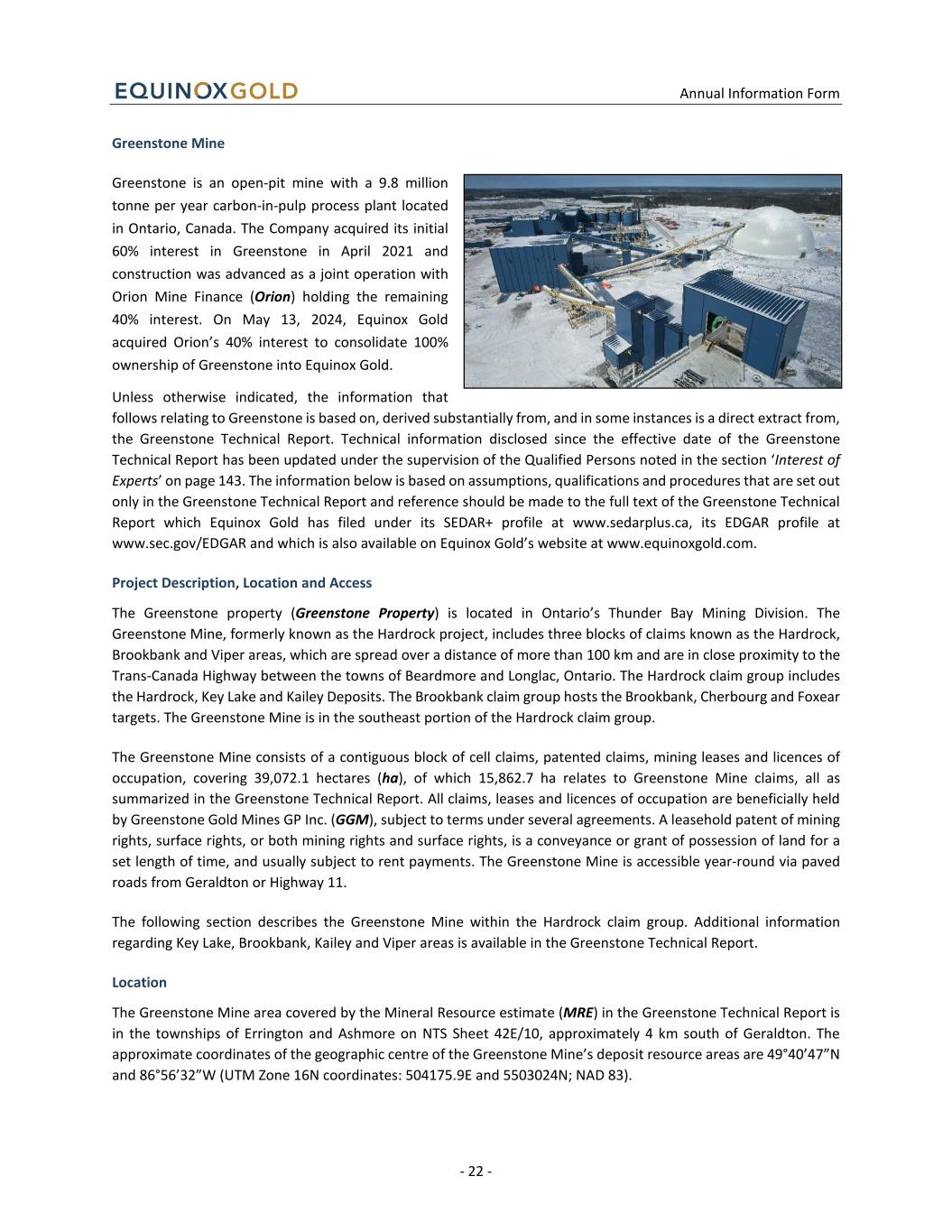
Annual Information Form - 22 - Greenstone Mine Greenstone is an open-pit mine with a 9.8 million tonne per year carbon-in-pulp process plant located in Ontario, Canada. The Company acquired its initial 60% interest in Greenstone in April 2021 and construction was advanced as a joint operation with Orion Mine Finance (Orion) holding the remaining 40% interest. On May 13, 2024, Equinox Gold acquired Orion’s 40% interest to consolidate 100% ownership of Greenstone into Equinox Gold. Unless otherwise indicated, the information that follows relating to Greenstone is based on, derived substantially from, and in some instances is a direct extract from, the Greenstone Technical Report. Technical information disclosed since the effective date of the Greenstone Technical Report has been updated under the supervision of the Qualified Persons noted in the section ‘Interest of Experts’ on page 143. The information below is based on assumptions, qualifications and procedures that are set out only in the Greenstone Technical Report and reference should be made to the full text of the Greenstone Technical Report which Equinox Gold has filed under its SEDAR+ profile at www.sedarplus.ca, its EDGAR profile at www.sec.gov/EDGAR and which is also available on Equinox Gold’s website at www.equinoxgold.com. Project Description, Location and Access The Greenstone property (Greenstone Property) is located in Ontario’s Thunder Bay Mining Division. The Greenstone Mine, formerly known as the Hardrock project, includes three blocks of claims known as the Hardrock, Brookbank and Viper areas, which are spread over a distance of more than 100 km and are in close proximity to the Trans-Canada Highway between the towns of Beardmore and Longlac, Ontario. The Hardrock claim group includes the Hardrock, Key Lake and Kailey Deposits. The Brookbank claim group hosts the Brookbank, Cherbourg and Foxear targets. The Greenstone Mine is in the southeast portion of the Hardrock claim group. The Greenstone Mine consists of a contiguous block of cell claims, patented claims, mining leases and licences of occupation, covering 39,072.1 hectares (ha), of which 15,862.7 ha relates to Greenstone Mine claims, all as summarized in the Greenstone Technical Report. All claims, leases and licences of occupation are beneficially held by Greenstone Gold Mines GP Inc. (GGM), subject to terms under several agreements. A leasehold patent of mining rights, surface rights, or both mining rights and surface rights, is a conveyance or grant of possession of land for a set length of time, and usually subject to rent payments. The Greenstone Mine is accessible year-round via paved roads from Geraldton or Highway 11. The following section describes the Greenstone Mine within the Hardrock claim group. Additional information regarding Key Lake, Brookbank, Kailey and Viper areas is available in the Greenstone Technical Report. Location The Greenstone Mine area covered by the Mineral Resource estimate (MRE) in the Greenstone Technical Report is in the townships of Errington and Ashmore on NTS Sheet 42E/10, approximately 4 km south of Geraldton. The approximate coordinates of the geographic centre of the Greenstone Mine’s deposit resource areas are 49°40’47”N and 86°56’32”W (UTM Zone 16N coordinates: 504175.9E and 5503024N; NAD 83).
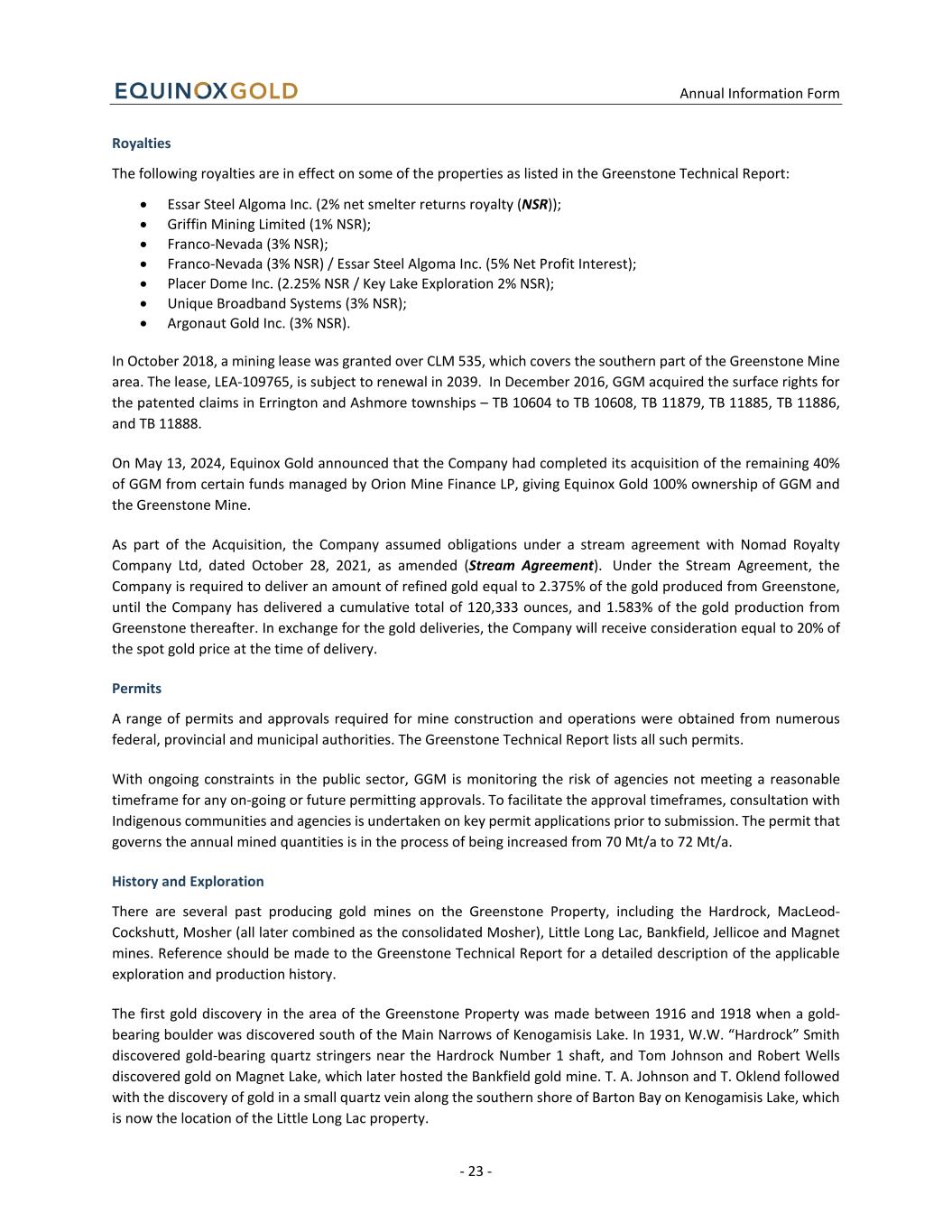
Annual Information Form - 23 - Royalties The following royalties are in effect on some of the properties as listed in the Greenstone Technical Report: • Essar Steel Algoma Inc. (2% net smelter returns royalty (NSR)); • Griffin Mining Limited (1% NSR); • Franco-Nevada (3% NSR); • Franco-Nevada (3% NSR) / Essar Steel Algoma Inc. (5% Net Profit Interest); • Placer Dome Inc. (2.25% NSR / Key Lake Exploration 2% NSR); • Unique Broadband Systems (3% NSR); • Argonaut Gold Inc. (3% NSR). In October 2018, a mining lease was granted over CLM 535, which covers the southern part of the Greenstone Mine area. The lease, LEA-109765, is subject to renewal in 2039. In December 2016, GGM acquired the surface rights for the patented claims in Errington and Ashmore townships – TB 10604 to TB 10608, TB 11879, TB 11885, TB 11886, and TB 11888. On May 13, 2024, Equinox Gold announced that the Company had completed its acquisition of the remaining 40% of GGM from certain funds managed by Orion Mine Finance LP, giving Equinox Gold 100% ownership of GGM and the Greenstone Mine. As part of the Acquisition, the Company assumed obligations under a stream agreement with Nomad Royalty Company Ltd, dated October 28, 2021, as amended (Stream Agreement). Under the Stream Agreement, the Company is required to deliver an amount of refined gold equal to 2.375% of the gold produced from Greenstone, until the Company has delivered a cumulative total of 120,333 ounces, and 1.583% of the gold production from Greenstone thereafter. In exchange for the gold deliveries, the Company will receive consideration equal to 20% of the spot gold price at the time of delivery. Permits A range of permits and approvals required for mine construction and operations were obtained from numerous federal, provincial and municipal authorities. The Greenstone Technical Report lists all such permits. With ongoing constraints in the public sector, GGM is monitoring the risk of agencies not meeting a reasonable timeframe for any on-going or future permitting approvals. To facilitate the approval timeframes, consultation with Indigenous communities and agencies is undertaken on key permit applications prior to submission. The permit that governs the annual mined quantities is in the process of being increased from 70 Mt/a to 72 Mt/a. History and Exploration There are several past producing gold mines on the Greenstone Property, including the Hardrock, MacLeod- Cockshutt, Mosher (all later combined as the consolidated Mosher), Little Long Lac, Bankfield, Jellicoe and Magnet mines. Reference should be made to the Greenstone Technical Report for a detailed description of the applicable exploration and production history. The first gold discovery in the area of the Greenstone Property was made between 1916 and 1918 when a gold- bearing boulder was discovered south of the Main Narrows of Kenogamisis Lake. In 1931, W.W. “Hardrock” Smith discovered gold-bearing quartz stringers near the Hardrock Number 1 shaft, and Tom Johnson and Robert Wells discovered gold on Magnet Lake, which later hosted the Bankfield gold mine. T. A. Johnson and T. Oklend followed with the discovery of gold in a small quartz vein along the southern shore of Barton Bay on Kenogamisis Lake, which is now the location of the Little Long Lac property.
Annual Information Form - 24 - In 1934, the period of mine production in the area began with the Little Long Lac mine—the first successfully producing mine. To the west of the 1931 Hardrock discovery, F. MacLeod and A. Cockshutt staked claims and continually explored the area throughout the 1930s and 1940s. By the late 1940s, the F Zone, a low-grade, large- tonnage ore body in greywacke, was identified on both the MacLeod–Cockshutt and Hardrock properties. Production on the Mosher Long Lac mine began in 1962 (west of, and immediately down-plunge of the same mineralized zones exploited in the MacLeod–Cockshutt mine); then, in 1967, the MacLeod–Cockshutt, Mosher, and Hardrock mines amalgamated and remained in production until 1970. The consolidated Hardrock, MacLeod– Cockshutt, and Mosher mines produced 2,146,326 ounces of gold at an average grade of approximately 0.14 ounces of gold per ton (~14 Mt at 4.9 g/t Au) in the period from 1934 to 1970. In the 1980s, Lac Minerals Ltd. reviewed the remaining underground reserves and conducted litho-geochemistry, ground geophysical work, and 15,240 m of diamond drilling in 77 holes to target areas with open pit potential (e.g., Hardrock D and F; North and South Porphyry; and Porphyry Hill Zones). In 1993, Asarco Exploration Company of Canada Limited (Asarco) carried out a program of reverse circulation (RC) overburden drilling and diamond drilling, the latter mainly focused on the near-surface portion of the F Zone and targets along the plunging nose of the albite porphyry. Asarco continued their exploration program into 1994, completing RC holes in overburden, sonic holes in historical tailings, and an additional 40,000 feet of diamond drilling, mainly on the targets. In 1996, Cyprus Canada Inc. drilled 24 holes, leading to the discovery of the B Zone. The agreement ended in 1997. Barrick Gold Corporation, through Lac Properties Inc. (Lac Properties), began a rehabilitation program, which continued until 2001. This saw construction of the current visitor’s centre, re-contouring and seeding of the historical MacLeod tailings near Highway 11, and capping of old mine shafts. In 2000, Lac Properties retained Golder Associates Ltd. (Golder) to conduct a stability assessment of the F Zone crown pillar of the MacLeod–Cockshutt mine. During their investigation, Golder drilled a borehole (369.5 m) to determine whether caving had occurred above the stopes. Their study also included a literature review of the properties of the mined material at the Hardrock mine, rock mass classification of the rock core from the investigation borehole and a correlation of numerical modelling results with the field investigation and conclusions. The drilling allowed Golder to confirm that the crown pillar overlying the workings was intact at the time of the study. No unravelling or caving of the crown pillar above the working was observed. The classification of the rock mass overlying the workings indicated that the quality was “good” to “very good.” Due to the depth of the mine workings and the quality of the rock mass, it was not considered probable that significant caving could occur or would have an influence on the overlying ground surface. In 2002, Lac Properties retained Golder to conduct a stability assessment of the crown pillar of the Hardrock mine. A total of 16 investigation boreholes (2,116.8 m) were drilled to determine whether caving in the crown of the stope had occurred. The study comprised a literature review of the properties of the mined material at the Hardrock mine, rock mass classification of the rock core from the investigation boreholes, and a correlation of numerical modelling results with the field investigation and conclusions. The drilling indicated that the crown pillar overlying the workings was intact at the time of the study. Golder observed no unravelling or caving of the crown pillar above the working, and no unexpected geometries were encountered. The classification of the rock mass overlying the workings indicated the quality to be “good”. Empirical, analytical, and numerical modelling of the stability of the crown pillar overlying the mined zone indicated the crown pillar to be stable, even when conservative values were used for stope geometries, strength, and rock mass classification, thus ensuring an additional built-in safety factor. In 2007, Lac Properties drilled six geotechnical diamond drill holes totalling 1,208.1 m in the crown pillars.
Annual Information Form - 25 - In 2007, Premier Gold Mines Limited (Premier) began assembling the current property. The results of 1,629 drill holes were included in the 2016 feasibility study. A detailed chronological summary of the historical post-production work carried out on these mines since Premier’s acquisition is provided in Table 1. Table 1: Summary of Post-Production Exploration Activity since Acquisition by Premier Year Company Activity Comments(1) 2009 Premier Gold Mines Limited Diamond drilling (346 DDH = 91,802 m); overburden stripping with power washing, mapping and sampling Diamond drilling program focused on the North Iron Formation area, Porphyry Hill area and East Pit Area; two areas were stripped (GP Zone and TAZ Zone) 2010 Premier Gold Mines Limited Diamond drilling (279 DDH = 114,611 m); overburden stripping with power washing, mapping, and sampling; regional prospecting program Three areas were stripped (East MacLeod, Headframe, and Portal Zones); diamond drilling focused on the same area as in 2009; main zones drilled were North, F, SP, NN, and K Discovery of the F2 and Z zones; new MRE and a supporting NI 43-101 technical report 2011 Premier Gold Mines Limited Diamond drilling (204 DDH = 107,413 m) Diamond drilling program resulting in the expansion of the SP, F, P and K zones; discovery of the Tenacity South Zone; updated MRE and a supporting NI 43-101 technical report 2012 Premier Gold Mines Limited Diamond drilling (125 DDH = 68,549 m) Diamond drilling program focused on the Fortune, HGN and P Zones; updated MRE and supporting NI 43- 101 technical report 2012/13 Premier Gold Mines Limited Diamond drilling (153 DDH = 72,776.4 m) (from Oct. 31, 2012 to Aug. 9, 2013) (144 DDH = 66,606.7 m) (from Aug. 10, 2013, to Dec. 31, 2013 Updated MRE and supporting NI 43- 101 technical report 2014 Premier Gold Mines Limited Preliminary economic assessment Using the consistent gold price of $1,250/oz and an exchange rate of CAD/USD 1.00:0.95, the Hardrock Project generates an NPV of C$518.70 million (discounted at 5%) and an IRR of 23.02% before taxes; and C$358.97 million (discounted at 5%) and an IRR of 19.02% after taxes. 2014 Premier Gold Mines Limited 38 DDH = 12,653,6 m) (from Jan. 01, 2014 to May 26, 2014) Updated MRE and supporting NI 43- 101 Technical Report 2015 Premier Gold Mines Limited New NI 43-101 technical report Formation of a 50/50 Partnership 2016 Premier Gold Mines Limited Updated MRE and supporting NI 43-101 technical report Feasibility Study 2018 Premier Gold Mines Limited Updated MRE (not published) RC Drilling 405 holes = 19,995 m, blasthole drilling 62 holes = 535 m 2019 Premier Gold Mines Limited Resource update and project design work (this study) Drilling 76 RC holes = 5,946 m, 54 DDH = 12,108 m 2022 Greenstone Gold Mines GP Inc. RCGC Drilling 67 holes = 4,189 m, 56 DDH = 15,421 m Internal Resource update (not published) 2023 Greenstone Gold Mines GP Inc. As and S reviewed and creation of updated block models for these 2 attributes Internal Block Models Updates (not published) Sep 2022 to Jun 2024 Greenstone Gold Mines GP Inc. RCGC: drilling 496 holes = 28,002 m Data not used for the 2024 Mineral Resource update. 2024 Greenstone Gold Mines GP Inc. Update gold prices, optimisation parameters and resource shells Updated MRE and NI 43-101 Technical Report (this study)
Annual Information Form - 26 - Note: 1. Unless specifically indicated as reported in a NI 43-101 technical report, all “resources” listed in the table are historical in nature and should not be relied upon. It is unlikely they conform to current NI 43-101 criteria or to CIM Definition Standards for Mineral Resources and Mineral Reserves dated May 19, 2014 (CIM Definitions), and they have not been verified to determine their relevance or reliability. They are included in this section for illustrative purposes only and should not be disclosed out of context. Geological Setting, Mineralization and Deposit Types Geology The Greenstone Mine lies within the granite-greenstone Wabigoon Subprovince of the Archean Superior Craton in eastern Canada. The Wabigoon Subprovince, averaging 100 km wide, is exposed for some 900 km eastward from Manitoba and Minnesota, beneath the Mesoproterozoic cover of the Nipigon Embayment, to the Phanerozoic cover of the James Bay Lowlands. The Wabigoon Subprovince can be subdivided into western greenstone-rich domains in the Lake of the Woods-Savant Lake and Rainy Lake Areas, a central dominantly plutonic domain, and an eastern greenstone-rich domain in the Beardmore-Geraldton Area. The Hardrock property is located within the Beardmore-Geraldton Greenstone Belt that contains several narrow, east-west striking sequences of volcanic and sedimentary rocks of Archean age. The southern edges of these sequences are spatially related to the through-going, major structural discontinuities thought to be thrust faults that have imbricated the sedimentary sequences. In the Geraldton area, most of the gold mines and a number of gold showings occur within or proximal to the Bankfield-Tombill Deformation Zone (also known as the Barton Bay Deformation Zone), a zone of folding and shearing up to 1 km wide. The southern limit of the Bankfield-Tombill Deformation Zone is marked by the Bankfield-Tombill Fault, a zone of intense shearing up to 12 m wide. In the immediate Geraldton area, the dominant rock types are clastic sediments (greywacke and arenite), oxide facies iron formations (BIF) and minor mafic metavolcanics. There are a number of younger intrusives, including an albite-rich porphyry unit (Hardrock Porphyry) that is spatially associated with much of the gold mineralization on the Hardrock, MacLeod-Cockshutt and Mosher mines. Significant gold mineralization is also often spatially associated with BIF. In the case of the Little Long Lac mine, gold mineralization is primarily hosted by an arkosic unit. Gold mineralization occurs in a variety of host rocks and the style of mineralization is partly a function of the host rock. While the location and overall orientation of the orebodies appear to have been largely structurally controlled, the deformation of the orebodies has not been as intense as that of the host rocks. Nevertheless, there are areas where local folding and boudinage of mineralized veins is apparent. Additionally, there are strong secondary controls that influence the extent and intensity of gold mineralization, such as the competency contrast between host rocks (e.g., the Hardrock Porphyry and its contacts with either wacke or BIF) and the chemical character of the host rocks (e.g., oxide facies BIF being replaced by sulphides). Intrusive rocks include the Hardrock Porphyry, diorite, gabbro, and diabase dykes. It is of interest that the Hardrock Porphyry seems to be sill-like in nature, even though it is tightly folded and the contacts between it and the sedimentary units are often highly deformed. The general scale and folding pattern of the porphyry very closely match the geometry of the conglomerate unit that occurs in the vicinity of the Hardrock and MacLeod-Cockshutt Mines. Mineralization Most mineralized occurrences in the Hardrock deposit area lie in a zone of deformation to the immediate north of, and genetically linked to, the Tombill-Bankfield Deformation Zone. This zone of deformation varies from 600 m to 100 m in total width, while the crush zone of the Tombill-Bankfield Fault proper ranges from metres to hundreds of metres in width. Gold mineralization is associated with D3 brittle shear zones and folds overprinting regional F2
Annual Information Form - 27 - folds. The plunge of the mineralized zones is parallel to F3 fold axes and to the intersection of D3 shear zones with F2 and F3 folds. On a sub province scale, regional folds cut by D3 dextral shear zones are promising targets for discovering the next generation of large gold deposits. The interpretation of the mineralized zones by GMS is based on a litho-structural model developed by InnovExplo, but greatly simplifies the domains. As compared to the 2016 feasibility block model, some wide domains that encompassed significant amounts of internal dilution have been re- interpreted, such that higher-grade portions have been made more distinct. In the updated model, lithological domains and mineralized zones are located inside three areas. The North Domain consists of a refolded (F3 overprinting F2) sequence of BIF and greywacke, with minor porphyry and gabbros. A Central Domain consisting mainly of an undifferentiated greywacke sequence and a mineralized portion of this greywacke, defined as the Mineralized Central Wacke, which are both likely sheared and folded. Three mineralized zones have been defined within the Central Domain to constrain zones of higher-grade gold mineralization inside the Mineralized Central Wacke. A South Domain is characterized by a tightly folded (F2) stratigraphic sequence. Five mineralized zones have been defined within the South Domain, in which gold mineralization appears primarily associated with the “main” anticline (Hardrock Anticline) and preferentially within both BIFs. Zones which are categorized as quartz-carbonate stringer mineralization include F Zone, F2 Zone, A Zone, SP Zone, Central Zone and Tenacity Zone. Mineralization within these zones generally consists of a series of narrow, tightly asymmetrically folded gold-bearing quartz-carbonate stringers, which are usually attenuated, transposed and dislocated in hook-like segments. The stringers are accompanied by a gold-bearing quartz-sericite-pyrite (±arsenopyrite) alteration halo about the stringers. It is the accumulation of a number of stringers and associated alteration halos that constitutes the zones. Individual stringers and their associated alteration haloes within the mineralized zones are often high-grade with minute flecks and clusters of visible gold. Assay results of up to, and often greater than, 30 g/t Au are attainable from some stringers. Overall, zones having average grades of 4 g/t Au as individual stringers are too narrow and discontinuous to consider mining as separate higher-grade zones. Zones that are categorized as sulphide replacement mineralization include the North 1, North 2 and North 3 zones, and the SP Zone. The nature of the mineralization within these zones is best understood from the historical work completed on the North 1 Zone. Mineralization within these zones occurs as variable pyrite, arsenopyrite and pyrrhotite replacement of iron oxide at the margins of quartz veins, within the hinge zones of folded BIFs. The auriferous sulphide replacement appears to have migrated outwards along the iron oxide bands from gold-bearing quartz-carbonate stringers occupying brittle axial planar tension fractures. This replacement mineralization yields grades of 7 g/t Au or greater. Deposit Types The gold ore bodies at the Greenstone Mine are one of the type examples for BIF-hosted gold deposits. The Greenstone Mine recognizes and presents the following subtypes: non-stratiform deposits and Greenstone-hosted quartz-carbonate vein deposits. Drilling Between May 26, 2014 and November 18, 2015, GGM added 157 diamond drill holes (DDH) on the Hardrock deposit for a total of 54,027 m. One DDH-MM043 – included in the 2014 MRE was also deepened, from 456 to 655 m, representing a total of 199 m of new metreage. Seventy-nine DDHs were re-sampled to add new assay results in the 2016 MRE. These holes represent a total of 8,733 m and 6,411 samples included in the 2016 Greenstone project database.
Annual Information Form - 28 - A collar re-survey campaign, using the Trimble RTK survey instrument, took place in the summer of 2014 for a total of 536 drill holes for which casing was found. Since 2018, the site surveyor and geologists spotted the reverse circulation grade control (RCGC) and blastholes using a Trimble RTK system using the coordinates planned by GMS or GGM. In the event of unstable or poor ground access, the hole was moved a few metres. The drill is aligned to the proper azimuth and dip using a Reflex Astronomic Positioning System. Down-hole surveys were taken every 30 m in the diamond drill holes using a REFLEX EZ-GYRO instrument. The 2018 RCGC and down-the-hole (blasthole) drilling campaigns were resource definition programs, designed to de-risk the project and focus on increasing the confidence level in the Mineral Resources in the initial years of production. The drilling took place on five key areas. Area 1 was not accessible due to flooding. From May 24, 2018 to September 6, 2018, 405 RCGC drill holes, totaling 19,995 m, were completed on the Greenstone Property. The program targeted five areas defined by their geographic and lithological properties. RCGC holes were planned 10 m apart north-south and 20 m apart east-west. On average, the RCGC holes were oriented true north or south and drilled within inclination -50 degrees to a depth of 50 m. The results obtained from the RCGC drilling program confirmed the continuity of grade in all areas. All RCGC material (chip trays from logging, rejects and representative samples) are stored on site in sea containers at GGM’s Magnet property. Additionally, Epiroc Canada Inc. drilled 62 blastholes totaling 535 m. The program occurred concurrently with the RCGC drilling program and aimed to further increase the confidence in the Mineral Resources in the F Zone, headframe and Porphyry Hill area to test the performance and viability of blasthole drilling for the Hardrock deposit. The blastholes were planned with a tighter spacing of approximately 6 m north-south and east-west. The blastholes were on average 10 m deep and drilled vertically. The 2019 drilling program consisted of 76 RCGC drill holes totalling 5,946 m, of which 5,527 m were assayed, and 54 NQ size DDHs for 12,108 m, of which 10,470 m were assayed. These were resource-definition and grade-control programs designed to provide better definition in high-potential areas of the Hardrock deposit and to increase the confidence level in the Mineral Resource in the initial years of production. RCGC holes were planned with a spacing of 20 m north-south and 20 m in the east-west. On average, the RCGC holes were 100 m deep and had a dip of -50 degrees, oriented true north or south. The 2019 drilling program outcomes are detailed below: • RCGC drilling was spatially limited to the SP Zone and F Zone to confirm grade continuity for benches 4 to 7. • 70 m vertical (or 7 benches) were drilled at an average spacing of 20 x 20 m inside an area already drilled in 2018. • Diamond drilling intersected the majority of mineralized domains, and infilled gaps in the drill spacing in the central portion of the pit. • Grades in drilling compared well with block model grades predicted in a 2018 interim block model. A significant drilling campaign was conducted during the winter of 2021/2022, targeting inferred blocks at depth and to the east of the pit design outlined in the 2019 feasibility study. Fifty-six diamond drill holes totalling 15,421 m, and 67 RC drill holes totalling 4,189 m were drilled.
Annual Information Form - 29 - GMS was retained to update the mineral resource block model for the Hardrock deposit, incorporating new drilling undertaken since the release of previous block model as part of the 2019 feasibility study. The scope of work for the 2022 block model update is described below: • Incorporate new drilling undertaken in 2021 in the eastern portion of the deposit. • Identify coherent zones of mineralization in the external grade shell domain to model manually to reduce the ratio of external grade shells to principal domains. • Update capped gold-grade estimate using a similar approach as 2019 MRE. • Update arsenic, sulphur, and total carbon model. • Update void model using information obtained from recent drilling. • Update lithology model, and use to recode bulk density. The current MRE is based on these models. Small adjustments were made to the resource categorization using the latest surfaces. Those block models were filtered by the current topography, pit designs, whittle shells, and latest optimization parameters up to June 30, 2024. Significant RCGC drilling campaigns were conducted since September 2022. The goal of these campaigns was to improve the final gold estimate of the mineralized zones to be mined inside the current open pit operation. In all, 496 RCGC holes totalling 28,002 m were drilled. Since the beginning of the operation a total of 18,255 vertical blastholes of 10 m length were sampled for gold. This information helped the grade-control department to better delineate additional mineralization outside of the main wireframes. RCGC and blasthole gold assays are not used in the current MRE. During various visits to Greenstone, GMS reviewed drilling procedures, occasionally observed RC drilling, and inspected sampling and core storage facilities. Core recovery is excellent throughout the deposit, and recoveries from near-surface RC drilling were judged acceptable. Drilling methods (both diamond drilling and RC drilling) adhered to industry standard practices, and representative samples were obtained. Sampling, Analysis and Data Verification Laboratories The Geraldton facility belonging to Activation Laboratories Ltd (Actlabs Geraldton) was used for the entire drilling and channelling programs. Actlabs Geraldton has received ISO 9001:2008 certification through Kiwa International Cert GmbH. Actlabs Geraldton was an independent commercial laboratory. GGM purchased the Geraldton facility from Actlabs Geraldton in March 2024 and has been operating it since. All re-assaying of batches (pulps) was undertaken at Australian Laboratory Services (ALS) - Chemex in Thunder Bay. ALS-Chemex laboratory is part of the ALS Global Group and has ISO 9001 certification and ISO/IEC 17025 accreditation through the Standards Council of Canada. ALS-Chemex is an independent commercial laboratory. Quality Control Sample Preparation by GGM All Quality Assurance/Quality Control (QC) samples are prepared and bagged in advance by GGM personnel. The GGM employee in the core-cutting facilities places one half of the ticket into a bag with the sample and staples the other half to the box. One half of each QC sample ticket is placed in the appropriate type of control sample bag, which was prepared beforehand. A list of QC samples and their numbers/locations is posted on the wall in the core logging facility (core shack) and regularly updated by GGM personnel. Five to seven samples are placed in a rice bag and the contents identified on the outside of the bag. Each bag and its contents are recorded on a notepad and placed in a plastic holder once complete. These slips are picked up each morning by a GGM employee and recorded
Annual Information Form - 30 - in an Excel spreadsheet. Once the batches are complete, GGM personnel deliver the bags to Actlabs Geraldton; no third party is involved in transportation. Samples selected for analysis are sent in batches of 34. Each purchase order covers one batch of 34 samples, consisting of: • 30 regular samples • 1 field duplicate sample • 1 field blank • 1 Certified Reference Material (CRM) with a low gold value • 1 CRM with a high gold value As a QC check, Actlabs Geraldton adds a 35th sample to every field batch received – a coarse duplicate of the last regular sample (i.e. the 30th sample), constituting a second pulp prepared from the reject. The quality of the reject is monitored to ensure that proper preparation procedures are used during crushing. For the fusion process, Actlabs Geraldton adds seven more QC samples (two analytical blanks, two CRMs and three pulp duplicates), bringing the fusible batch to 42. The pulp duplicates are necessary to ensure that proper preparation procedures are used during pulverization. At Actlabs Geraldton, the maximum furnace charge of 42 samples ensures that GGM samples are not mixed with others. Fire Assay Procedures (Actlabs Geraldton) Samples (50 g each) are sent to the fire assay area, numbered and in order (usually 1 to 34+1). A rack of 42 crucibles is then labelled with an assigned letter code and numbered 1 to 42. The mixture is placed in a fire clay crucible. The mixture is then preheated to 850°C, intermediate at 950°C and finished at 1,060°C, with the entire fusion process lasting sixty minutes. The crucibles are then removed from the assay furnace and the molten slag (lighter material) is carefully poured from the crucible into a mould, leaving a lead button at the base of the mould. The lead button is then placed in a preheated cupel, which absorbs the lead when cupelled at 950°C to recover the gold (doré bead) + Au. The entire silver doré bead is dissolved in aqua regia and the gold content is determined by atomic absorption (AA) finish (1A2-50 code). On each tray of 42 samples, there are two blanks, three sample duplicates and two CRMs – one high and one low (QC = 7 out of 42 samples). All samples assaying grades over 5.0 g/t Au with AA were re-run with gravimetric finish to ensure accurate values. After the fire assay procedures, gold is separated from the silver in the doré bead by parting with nitric acid. The resulting gold flake is annealed using a torch. The gold flake remaining is weighed gravimetrically on a microbalance. Fire Assay Procedures with Gravimetric or AA Finish (ALS-Chemex Thunder Bay) The fire assay technique uses high temperature and flux to “melt” the rock and allows the gold to be collected. Lead formed from the reduction of litharge is traditionally used as the collecting medium for silver and gold. The test sample is intimately mixed with a suitable flux that will fuse at high temperatures with the gangue minerals present in the sample to produce a slag that is liquid at the fusion temperature. The liberated precious metals are scavenged by the molten lead and gravitate to the bottom of the fusion crucible. Upon cooling, the lead button is separated from the slag and processed in a separate furnace for high-temperature oxidation (cupellation), where the lead is removed, leaving the precious metals behind as a metallic bead called a prill. Traditionally, this prill was then partially dissolved in nitric acid (parted) to remove silver and the remaining
Annual Information Form - 31 - gold determined by weighing (gravimetry). Alternatively, the prill can be dissolved in a mixture of hydrochloric and nitric acid (aqua regia) and the concentration determined by spectroscopic methods. For the AA finish method, a pulp sample is fused with a mixture of lead oxide, sodium carbonate, borax, silica and other reagents as required, then inquarted with 6 mg of gold-free silver and cupelled to yield a precious metal bead. The bead is digested in 0.5 mL dilute nitric acid in the microwave oven. The 0.5 mL concentrated hydrochloric acid is then added, and the bead is further digested in the microwave at a lower power setting. The digested solution is cooled, diluted to a total volume of 4 mL with de-mineralized water, and analyzed by AA spectroscopy against matrix- matched standards. For the gravimetric finish method, a pulp sample is fused with a mixture of lead oxide, sodium carbonate, borax, silica and other reagents to produce a lead button. The lead button containing the precious metals is cupelled to remove the lead. The remaining gold and silver bead is parted in dilute nitric acid, annealed and weighed as gold. Silver, if requested, is then determined by the difference in weight. At the ALS-Chemex laboratory, the batch size for all fire assay methods is 84, including six internal QCs. Therefore, 78 client samples can be taken per batch. The maximum furnace charge of 78 client samples ensures that GGM samples are not mixed with others. QP Conclusions A statistical analysis of the QC data provided by GGM did not reveal any significant analytical issues. GMS is of the opinion that the sample preparation, analysis, QC and security protocols used for the Greenstone Mine follow generally accepted industry standards and that the data are of sufficient quality to be used for Mineral Resource estimation. Data Verification This section summarizes data verification procedures updated from the 2021 technical report, issued January 26, 2021. As the 2021 MRE database formed the basis for the 2024 MRE reporting, this information is valid and are described in the Greenstone Technical Report. A new drilling database export was supplied to GMS on March 23, 2022. The previous database used by GMS was a patchwork of the original 2016 drilling database along with two subsequent drilling campaigns (separated into RC and DDH databases) which became cumbersome and difficult to work with. GMS excluded un-assayed geotechnical holes, blastholes, abandoned holes with redrills, and channels from the MRE, consistent with the 2019 approach. QC results were reviewed pertaining to the winter 2021–2022 drilling campaign with GGM geologists on site; no material issues were found. Any QC failures resulted in the reanalysis of the batch according to the GGM internal QC protocols. Overall, the responsible qualified persons are of the opinion that GGM’s protocols for drilling, sampling, analysis, security, and database management meet industry standard practices. The 2022 and 2024 data verification process demonstrated the validity of the data and protocols for the Greenstone Mine. The responsible qualified persons consider the GGM database to be valid and of sufficient quality to be used for the Mineral Resource estimation. Mineral Processing and Metallurgical Testing The process design criteria have been established based on testwork results, GGM and vendor recommendations or requirements and industry practices.
Annual Information Form - 32 - Between 2011 and 2013, mineralogy, grindability, and gold recovery testwork was performed by SGS Lakefield Research Limited (SGS Lakefield) and McClelland Laboratories Inc. (McClelland). The SGS Lakefield testwork showed that the ore is composed mainly of quartz and plagioclase with minor amounts of pyrite and arsenopyrite; gold occurs mainly as native gold; the ore is in the category of medium hardness to moderately hard; a portion of the gold can be recovered by gravity concentration; and gold can be recovered to a bulk flotation concentrate. The subsequent McClelland testwork showed that gold recovery increased with finer grind size and was unaffected by cyanide concentration. During the March 2014 preliminary economic assessment and 2016 feasibility study, additional testwork was carried out by SGS Lakefield, JKTech Pty Ltd. and FLSmidth. Primarily, high pressure grinding roll (HPGR) tests confirmed the ore amenability for high-pressure grinding and facilitated equipment selection and operating cost estimation. Grindability, head grade determination, mineralogy, magnetic separation, gravity recovery, flotation, cyanidation, cyanide destruction, solid-liquid separation, and other tests were completed. Additional thickening and rheology testwork was carried out to determine the sizing and operating parameters of a pre-leach thickener. The HPGR testing program included laboratory-scale tests to determine the amenability of the ore to HPGR milling and yield preliminary sizing data; abrasion tests to predict the service life of the rolls; and a large-scale pilot-plant test to size the equipment. Bond grindability testing was performed to evaluate the Ball Work Index reduction of the HPGR product compared to the feed. A detailed comminution trade off study recommended two-stage crushing followed by HPGR and ball milling over crushing followed by semi-autogenous milling and ball milling, to reduce throughput risk and increase energy efficiency. In the detailed engineering phase, additional leach testwork was carried out on near-surface samples from the 2018 drilling campaign to characterize gold recovery, oxygen consumption, solid-liquid separation, and rheology. A multivariate linear regression analysis was used to estimate gold recovery based on ore grade and mineralogical composition. The results of the cyanidation tests conducted on composites were used as the basis for the analysis. The residual gold grade from the cyanidation testwork was found to be highly correlated to the gold, arsenic, and sulphur head sample grades, and somewhat less on grind size. The gold recovery process consists of a crushing circuit (gyratory and cone), a grinding circuit (HPGR and ball mill), pre-leach thickening and cyanide leaching, a carbon in pulp (CIP) circuit, carbon elution and regeneration, electrowinning and gold refining, cyanide destruction and tailings disposal. The plant is designed to operate at a throughput of 27,000 t/d. The process operation schedule is 24 hours per day, 365 days per year, with an overall availability of 92%. Gold production averages 389 koz for the first five years of production (commencing January 2025 to December 2029), with an average head grade of 1.36 g/t Au and an average metallurgical recovery of 90.8%. LOM production (commencing January 2025 to April 2039) averages 332 koz with an average head grade of 1.21 g/t Au and an average metallurgical recovery of 90.8%. Mineral Resource and Mineral Reserve Estimates Mineral Resource Estimates Since the previous MRE was released in 2021, substantial drilling has been conducted and was successful in de- risking the MRE for the early years of production. RCGC drilling on a 20 m (X) by 10 m (Y) spacing was undertaken in 2018, 2019, 2021 and 2022, targeting the first three benches of production, and partially tested an additional four benches in certain areas. In 2022, diamond drilling was undertaken in areas identified as requiring infill drilling and resulted in the validation of the new geological interpretation and confirmation of the grade continuity.
Annual Information Form - 33 - The in-pit Mineral Resources of the Hardrock deposit are constrained within the design pit using a cut-off grade of 0.30 g/t Au. In addition to in pit Mineral Resources, an underground MRE was estimated adjacent to and below the open pit using a 2.0 g/t Au cut-off grade. The open pit and underground Mineral Resources (exclusive of Mineral Reserves) are summarized in Table 2. The MRE covers a corridor of the Hardrock deposit with a strike length of 5.7 km and a width of approximately 1.7 km, down to a vertical depth of 1.8 km below surface. Mineralized zones were interpreted in 3-D using Leapfrog GEO software based on a litho-structural model and the drill-hole database. The drill-hole database used in the estimate contained 462,540 sampled intervals from 738,232 m of diamond drilling in 1,846 holes, and 27,389 assay results from 30,183 m of RCGC drilling in 549 holes. Channel samples and blasthole samples were not used in the estimation. Mineral Resources were estimated by applying a minimum true thickness of 3.0 m and using the grade of the adjacent material when assayed, or a value of zero when not assayed. High-grade capping on raw assay data was established on a per-zone basis. Compositing was conducted on drill-hole sections falling within the mineralized zones (composite = 2 m). Mineral Resources were estimated using 3-D block modelling and 3-pass Inverse Distance Cubed interpolation with high-grade restraining. Mineral Resources were classified as Measured in areas within 15 m of the RCGC drilling, and as Indicated in areas where the maximum distance to drill-hole composites was less than 35 m for blocks interpolated in Passes 1 and 2 (using a minimum of two drill holes). Mineral Resources were classified as Inferred in remaining blocks interpolated during Passes 1 to 3. Lastly, all blocks in the underground Mineral Resource estimated in Pass 1 to 3 in the external grade shell domain (500, 501 and 506) were downgraded to Inferred category. Table 2: Mineral Resource Estimate (Exclusive of Mineral Reserves) for Greenstone Mine Category In-Pit >0.3 g/t Au Underground >2.0 g/t Au Tonnage (kt) Gold Grade (g/t) Contained Gold (koz) Tonnage (kt) Gold Grade (g/t) Contained Gold (koz) Measured 0 - 0 - - - Indicated 19,008 1.21 738 10,959 4.20 1,480 M+I 19,008 1.21 738 10,959 4.20 1,480 Inferred 6,892 1.49 331 19,479 3.88 2,432 Notes: 1. The Independent and Qualified Person for the MRE, as defined by NI 43-101, is Réjean Sirois, B.Sc., P.Eng., of GMS., and the effective date of the estimate is June 30, 2024. 2. These Mineral Resources are not Mineral Reserves as they do not have demonstrated economic viability. 3. Mineral Resources are presented exclusive of Mineral Reserves. 4. In-pit results are presented undiluted within a merged surface of the pit optimization shell at $1,700/oz Au and the 2024 pit design. 5. In-pit Mineral Resources are stated at a cut-off grade of 0.30 g/t Au. 6. Underground Mineral Resources are presented undiluted and are defined as blocks below and adjacent to the 2024 pit optimization at a cut-off grade of 2.00 g/t Au. 7. Any discrepancies in the totals are due to rounding effects. 8. GMS is not aware of any known environmental, permitting, legal, title-related, taxation, socio-political, marketing, or other relevant issue that could materially affect the MRE. 9. Whittle parameters reference mining cost: $1.97/t, Incremental bench cost ($/10 m bench): $0.03, Milling cost: $6.98/t, Royalty: 3.0%, general & administration (G&A): $3.31/t, Sustaining capital: $0.92/t, Gold price: $1,700/oz, Milling recovery: 91.1% and Exchange rate 1.28 CAD/USD. GMS is not aware of any environmental, permitting, legal, title-related, taxation, socio-political, marketing or other relevant issue that could materially affect the MRE.
Annual Information Form - 34 - Mineral Reserve Estimate The Mineral Reserve for the Greenstone Mine’s open pit is shown in Table 3. Table 3: Greenstone Mine Open Pit Mineral Reserve Estimate Category Diluted Ore Tonnage (kt) Gold Grade (g/t) Contained Gold (koz) Proven 6,817 1.16 255 Probable 137,846 1.23 5,445 Total P&P 144,662 1.23 5,700 Notes: 1. CIM Definitions were followed for Mineral Reserves. 2. Effective date of the estimate is June 30, 2024. 3. Mineral Reserves are estimated at a cut-off grade of 0.30 g/t Au. 4. Mineral Reserves are estimated using a long-term gold price of $1,550/oz and an exchange rate of 1.28 CAD/USD. 5. A minimum mining width of 15 m was used. 6. Bulk density of ore is variable but averages 2.78 t/m3. 7. The average life-of-mine strip ratio is 5.5:1. 8. Dilution factor is 17.2%. 9. Numbers may not add due to rounding. The Mineral Reserve estimate is consistent with the CIM Definitions and is suitable for public reporting. As such, the Mineral Reserves are based on Measured and Indicated Mineral Resources, and do not include any Inferred Mineral Resources. Indicated Mineral Resources were converted into Probable Mineral Reserves and Measured Mineral Resources into Proven Mineral Reserves. The Inferred Mineral Resources contained within the mine design are classified as waste. Open pit optimization was conducted using Whittle software to determine the optimal economic shape of the open pit to guide the pit design process. The Mineral Reserve estimate includes a 17.2% mining dilution factor and a 1.2% ore loss factor. Mining Operations Mining is being carried out using conventional open pit techniques with 10 m benches. An Owner-mined operation is in place, with hydraulic shovels and mining trucks, including outsourcing of certain support activities such as explosives manufacturing and blasting. Production drilling of the 10 m benches is performed by blasthole drill rigs with both rotary and down-the-hole drilling capability. Blastholes are loaded with bulk emulsion. The majority of the loading in the pit is carried out by two 29 m3 hydraulic face shovels, one 15m3 hydraulic excavator, and one 30 m3 front-end wheel loader. Haulage is performed with a combination of 224-tonne (Caterpillar 793-08) and 216-tonne (Caterpillar 793F) mine haul trucks. The presence of historical underground stopes was considered when designing the pit, mainly for the voids in the F Zone. Most of the other underground openings are backfilled with sand fill or rock fill. Mining of the Hardrock pit will occur in five main phases. Waste rock will be disposed of in four distinct waste dumps with three located around the pit and one further to the south. The open pit generates 788.6 Mt of overburden and waste rock (inclusive of historical tailings and underground backfill) over the life of mine (LOM) for an average LOM strip ratio of 5.5:1.
Annual Information Form - 35 - The LOM plan provides 15 years of mine production (from the third quarter of 2024 to the second quarter of 2039). Annual mine material movement peaks at 72 Mt in 2025 and is maintained for 10 years until 2034. Material movement gradually declines from 2035 until the end of the mine life in 2039. The maximum processing plant production targets 27,000 t/d (9.86 Mt/a), which is achieved in 2025 and is sustained until 2038. Processing and Recovery Operations The plant will ramp up to the nameplate capacity of 27,000 t/d in approximately one year (grind size of P80 90 μm). The grinding circuit includes an HPGR, two identical ball mills and two identical gravity concentrators. The mill operation schedule is 24 h/d, 365 d/a with an overall availability of 92%. Crushing plant and processing plant equipment design factors allow for a margin of error in the sizing of the equipment. The key general process design criteria are presented in Table 4. Table 4: Key General Process Design Criteria Parameter Units Value Throughput – Design t/a 9,855,000 Throughput – Design t/d 27,000 Throughput – Design t/h 1,223 Design Grind Size (P80) µm 90 Crusher Utilization % 67 Process Plant Availability % 92 Operating Time d/a 365 Operating Time – Concentrator h/d 24 Au Feed Grade - Average g/t 1.34 Au Feed Grade - Design g/t 2.10 Ore Moisture % 3.0 Ore Specific Gravity - 2.81 Gold Recovery % 91.0 Elution Vessel Capacity t 10 Crushing Plant Equipment Design Factor % 20 Process Plant Equipment Design Factor % 10 The gold recovery process for the Greenstone Mine consists of a crushing circuit (primary gyratory and secondary cone); an HPGR and ball mill grinding circuit with gravity recovery; pre-leach thickening; cyanide leaching, CIP adsorption; elution and regeneration; electrowinning and refining; cyanide destruction; and tailings deposition. The service areas include reagent preparation, compressed air, oxygen plant and sulphur dioxide storage and distribution. The water management system covers all the fresh, reclaim, process, potable, fire and gland-water storage and pumping. An on-site sewage treatment plant processes domestic wastewater, discharging to the environment. Tailings reclaim and collected contact water will be used for process water, with excess contact water treated and discharged to the environment.
Annual Information Form - 36 - Infrastructure, Permitting and Compliance Activities Infrastructure The Greenstone Mine is within a district that is host to numerous mines and processing facilities and has access to good transportation and regional mining-related infrastructure. The Greenstone Mine is near the Trans-Canada Highway 11, TransCanada PipeLines Limited Canadian Mainline (TCPL Mainline) natural gas pipeline, a Hydro One electrical substation, and the town of Geraldton hosts a municipal airport, which has a 1,500 m runway capable of accommodating small charter aircraft. Geraldton has its own potable water treatment system and water distribution network. The general infrastructure to support mining and processing activities includes: • Site access and haul roads • Workshop and maintenance facility • Warehousing for spare parts and reagents • Administration building, including a dry facility, gatehouse and parking area • Explosive reagent storage • Fuel storage and distribution • Recycling and sorting facility • Potable water and sewage systems • Fire water systems • Site security and fencing. A length of Trans-Canada Highway 11, a Hydro One 115 kV station, and a Ministry of Transportation Ontario patrol station were relocated to allow development of the Mine. Existing infrastructure within the footprint of the property limits that will need to be relocated in the future includes: • Ontario Provincial Police Station • Historical MacLeod and Hardrock tailings (portions covering the open pit mine). The existing Hydro One grid is insufficient for powering the processing facilities and associated infrastructure. A 65 MW natural gas-fired power plant was constructed, with a designed capacity of 46.5 MW, which includes a pipeline originating from the existing TCPL Mainline pipeline directly to the site power plant. Water Management Two types of effluents will be generated during Greenstone Mine activities: mine effluent and sanitary effluent. The water quality standards applicable to mine effluent are defined in the applicable Environmental Compliance Approvals (ECA) and Federal Metal and Diamond Mining Effluent Regulations (MDMER) Effluent Criteria. The ECAs identify discharge locations and quality criteria for both mine and sanitary effluents discharging to the Southwest Arm of Kenogamisis Lake which are protective of the receiving environment. The effluent criteria meet and exceed MDMER criteria at the end of the pipe and the Provincial Water Quality Objectives for parameters are met within a small mixing zone in the receiving waterbody. Collected mine water, surface runoff water and underground workings water will be directed through various runoff and seepage collection ponds to the centralized mine water Collection Pond M1, which is designed to provide buffer flows for mill make-up water, with excess water sent to the effluent water treatment plant for treatment prior to discharge to the Southwest Arm of Kenogamisis Lake. A seepage collection system was installed to manage seepage from the historical Macleod tailings. Surface water runoff from the exterior of the tailings management facility (the
Annual Information Form - 37 - TMF) dams and any seepage through the dams or foundations is collected in a series of ponds and pumped back into the TMF reservoir for reuse in processing. Tailings Management Facility The TMF is a series of constructed dams with a final maximum height of 35 m and crest length of approximately 7,400 m. The TMF is currently designed to receive approximately 145 million tonnes (Mt) of mill and historical tailings at an average dry density of 1.34 t/m3. A cyanide destruction system is used to process all tailings water before it is sent to the TMF. An allowance has been made within the TMF to store the historical tailings and contaminated soils being relocated from the open pit area. The TMF dams are and will continue to be constructed primarily using waste rock from mining operations. The dams will be constructed in stages and in the downstream direction. Construction of the TMF starter dams was completed in 2023. The first (Stage 1) dam raise will be completed in 2024 to a crest elevation of 344 m, and the planned ultimate crest elevation will be 365 m. Tailings geochemistry indicates that less than 10% of the ore is considered potentially acid generating. This amount will be reduced through oxidization during ore processing, thereby reducing the overall acid rock drainage potential for the tailings. Tailings are deposited in the TMF from the dam crests as a conventional slurry to produce a wide exposed beach. This beach will displace the tailings pond away from the dams towards natural ground along the western edge of the facility to enhance long-term dam stability. A barge-mounted pump system, located near the north side of the TMF, reclaims water from the TMF pond and pumps it back to the processing plant. Closure of the TMF involves lowering of the spillway and vegetating the exposed tailings beaches. Runoff from the pond, when deemed suitable for discharge to the environment, will be directed through the spillway. Permitting and Compliance Environmental baseline studies were conducted for the Greenstone Mine between 2013 and 2021 and were used to identify environmental constraints during the development of layouts and designs for the Greenstone Mine. This environmental baseline was the basis for determining incremental changes and predicting environmental effects associated with the Mine. A final environmental impact statement / environmental assessment (EIS/EA) was completed and a Notice of Approval was issued by the provincial regulatory agency and a Decision Statement was issued by the federal regulatory agency. GGM submitted a Closure Plan and Financial Assurance to the Ministry of Mines, which received approval on March 30, 2021. Since approval of the initial closure plan, GGM has filed two amendments, one in December 2023 and another in August 2024 to account for detailed design and to address measures implemented to mitigate erosion of the Goldfield Creek diversion channel. The results of the final EIS/EA, including implementing the identified mitigation measures, supports the conclusion that the Greenstone Mine will not cause significant adverse environmental effects. Since completing the final EIS/EA, GGM has completed slight modifications of Greenstone Mine components, which form the basis for the final mine plan used for the Greenstone Technical Report. Active consultation with stakeholders (community members, agencies and interested parties) and Indigenous communities has been undertaken throughout Greenstone Mine planning, permitting, and detailed engineering and will continue through operation and closure of the Greenstone Mine.
Annual Information Form - 38 - GGM has established long-term relationship agreements with five local Indigenous communities. The agreements establish increased clarity regarding GGM’s ability to develop the Greenstone Mine and the Indigenous communities’ opportunity to benefit from future mining opportunities in the region, including the potential to extend the life of the Greenstone Mine. The GGM Indigenous Relations team meets regularly with local Indigenous communities discussing employment, training, and procurement opportunities through the Implementation Committee (IC). The IC comprises members of each of the partnering communities and provides an ongoing forum for communication and co-operative measures for supporting Indigenous participation levels in the Mine. This provides an avenue for community members to voice concerns or questions they may have and to receive feedback from GGM. The Environmental Sub-Committee (EAS) reports to the IC and provides a forum for timely review and consultation and comment on Project Approvals and Environmental Management & Monitoring Plans. The EAS considers and recommends appropriate testing, studies, or programs. Five Environmental Technicians from Aroland First Nation, Animbiigoo Zaagi’igan Anishinaabek, Ginoogaming First Nation, Long Lake #58 First Nation, and Métis Nation of Ontario actively participate in the daily operation of the GGM Environmental Department. Capital and Operating Costs Capital Costs Estimates The table below presents the 2024 capital costs and the 2025 budgeted capital costs. Table 5: Capital Costs Description 2024 Costs ($ million) 2025 Budget ($ million) Project construction (completion) 212.7 27.7 Capitalized stripping & mine development - 0.6 Infrastructure & Equipment 5.3 86.1 Exploration - - Reclamation & rehabilitation 0.8 1.8 Total 218.8 114.4 Notes: 1. Totals may not add due to rounding. 2. Capital costs include capitalized exploration expenditures, reclamation & rehabilitation costs, and lease payments for haul trucks and mining equipment. The capital expenditures include sustaining expenditures for mining, processing and general and administration costs and non-sustaining expenditures. Operating Costs Summary The table below presents the 2024 operating costs and the 2025 budgeted operating costs. Table 6: Operating Costs Description Units 2024 Costs ($) 2025 Budget ($) Mining $/t mined 1.97 2.40 Processing $/t processed 12.05 7.82 Site General $/t processed 7.24 7.40 Notes: 1. Totals may not add due to rounding. 2. Operating costs include all mining, processing and general and administration costs including waste stripping. 3. Costs are variable depending on whether ore mined and milled is classified as oxide, transitionary or fresh rock. Costs are based on whether the material being processed is stockpiled or in situ material.
Annual Information Form - 39 - Cost estimates in the tables above are based on the Greenstone mine plan and Equinox Gold’s current estimates as of December 31, 2024. Costs in individual years may vary significantly as a result of, among other things, current or future non-recurring expenditures, changes to input costs and exchange rates and changes to current mining operations or the mine plan. The current mine plan is based on existing Mineral Reserves. Ongoing exploration and analyses at operating mines are conducted with a view to identifying new Mineral Resources and upgrading existing Mineral Resources to higher confidence levels and potentially into new Mineral Reserves. If new Mineral Reserves are successfully identified, it may alter the current mine plan and potentially extend the mine life Exploration, Development, and Production Exploration GGM did not undertake any significant exploration work in 2024 and there are no plans to undertake any exploration work in 2025. Development In October 2021, the Company announced groundbreaking for full-scale construction of Greenstone with a construction budget of $1.255 million (100% basis) (at a rate of USD:CAD 1.25). Construction was funded on a pro rata basis with Equinox Gold funding 60% and Orion Resource Partners funding 40%. At December 31, 2023, $1,210 million (99%) of the $1.225 million construction budget had been spent (100% basis). Construction of the process plant was effectively complete and initial commissioning had commenced. All other site facilities, including the TMF, had been completed and handed over to the operations team by year end. Commissioning activities continued during the second quarter of 2024. Ore was introduced into the system on April 6, 2024 and first gold pour was achieved on May 22, 2024. Process plant facilities were turned over to the operations team and the construction team demobilization activities were substantially complete by June 30, 2024, with commercial production announced on November 6, 2024. Ramp-up of the plant is progressing as expected. Greenstone’s budgeted sustaining expenditures of $116 million for 2025, primarily relate to a TSF raise, fleet support processing improvements and production loaders, a dewatering well, water management pond, waste rock storage areas and back-up power. Budgeted non-sustaining expenditures of $35 million primarily relate to purchasing additional shovel and trucks, completing the relocated community electrical substation, installation of seventh genset in the power plant and completing the Ontario Provincial Police Detachment construction. Production For its first partial year of production, Greenstone produced a total of 111,717 ounces of gold during 2024 at cash costs of $970 per ounce and AISC of $1,025 per ounce. Greenstone production guidance for 2025 is 300,000 to 350,000 ounces of gold. Costs guidance for 2025 is cash costs of $790 to $890 per ounce and AISC of $1,045 to $1,145 per ounce.
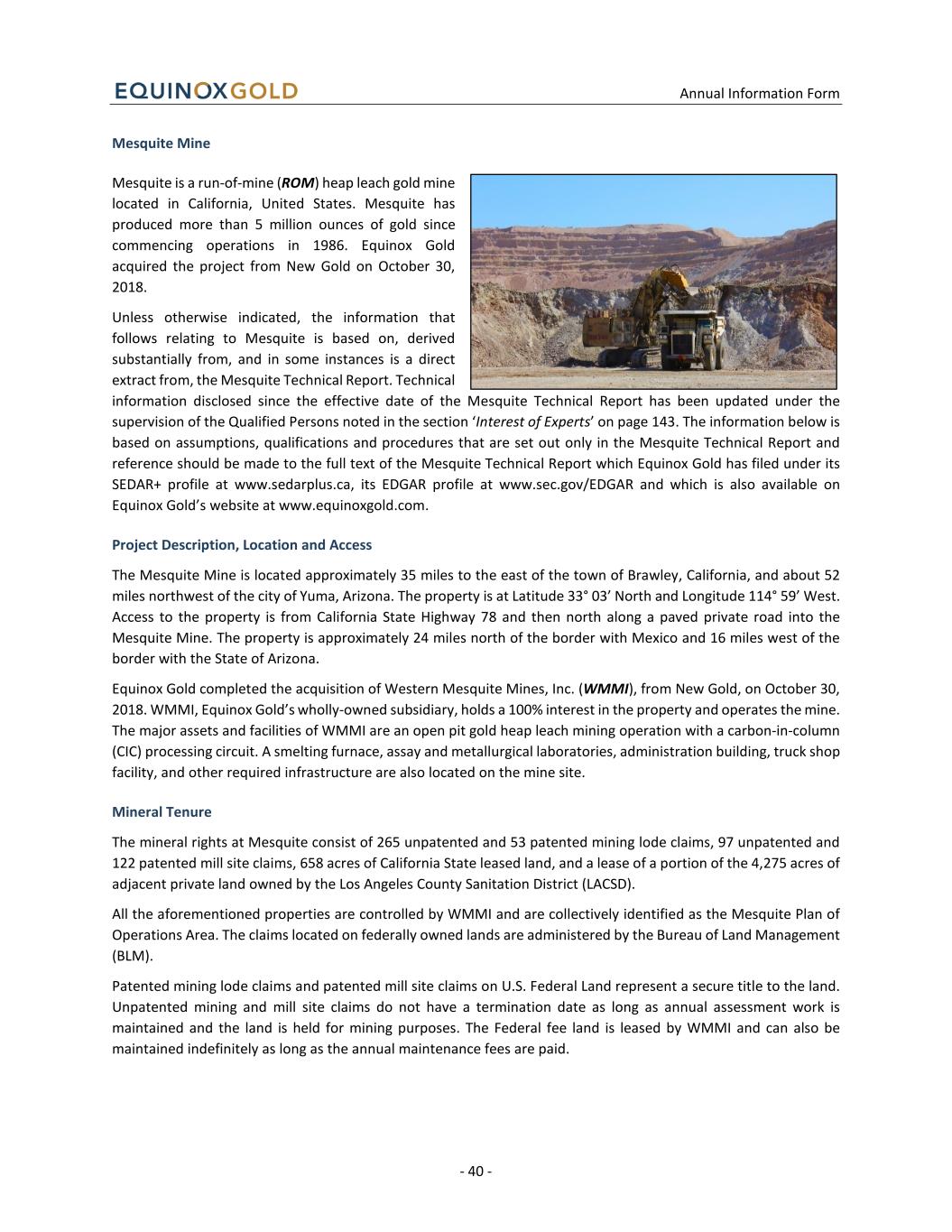
Annual Information Form - 40 - Mesquite Mine Mesquite is a run-of-mine (ROM) heap leach gold mine located in California, United States. Mesquite has produced more than 5 million ounces of gold since commencing operations in 1986. Equinox Gold acquired the project from New Gold on October 30, 2018. Unless otherwise indicated, the information that follows relating to Mesquite is based on, derived substantially from, and in some instances is a direct extract from, the Mesquite Technical Report. Technical information disclosed since the effective date of the Mesquite Technical Report has been updated under the supervision of the Qualified Persons noted in the section ‘Interest of Experts’ on page 143. The information below is based on assumptions, qualifications and procedures that are set out only in the Mesquite Technical Report and reference should be made to the full text of the Mesquite Technical Report which Equinox Gold has filed under its SEDAR+ profile at www.sedarplus.ca, its EDGAR profile at www.sec.gov/EDGAR and which is also available on Equinox Gold’s website at www.equinoxgold.com. Project Description, Location and Access The Mesquite Mine is located approximately 35 miles to the east of the town of Brawley, California, and about 52 miles northwest of the city of Yuma, Arizona. The property is at Latitude 33° 03’ North and Longitude 114° 59’ West. Access to the property is from California State Highway 78 and then north along a paved private road into the Mesquite Mine. The property is approximately 24 miles north of the border with Mexico and 16 miles west of the border with the State of Arizona. Equinox Gold completed the acquisition of Western Mesquite Mines, Inc. (WMMI), from New Gold, on October 30, 2018. WMMI, Equinox Gold’s wholly-owned subsidiary, holds a 100% interest in the property and operates the mine. The major assets and facilities of WMMI are an open pit gold heap leach mining operation with a carbon-in-column (CIC) processing circuit. A smelting furnace, assay and metallurgical laboratories, administration building, truck shop facility, and other required infrastructure are also located on the mine site. Mineral Tenure The mineral rights at Mesquite consist of 265 unpatented and 53 patented mining lode claims, 97 unpatented and 122 patented mill site claims, 658 acres of California State leased land, and a lease of a portion of the 4,275 acres of adjacent private land owned by the Los Angeles County Sanitation District (LACSD). All the aforementioned properties are controlled by WMMI and are collectively identified as the Mesquite Plan of Operations Area. The claims located on federally owned lands are administered by the Bureau of Land Management (BLM). Patented mining lode claims and patented mill site claims on U.S. Federal Land represent a secure title to the land. Unpatented mining and mill site claims do not have a termination date as long as annual assessment work is maintained and the land is held for mining purposes. The Federal fee land is leased by WMMI and can also be maintained indefinitely as long as the annual maintenance fees are paid.
Annual Information Form - 41 - Surface Rights The surface ownership of patented mining claims, which are identified as Imperial County Assessor’s parcels, have all the general rights of surface ownership as fee land. WMMI also owns patented claims and mill sites south of the mine property for water supply wells. WMMI has surface operation rights within the leased parcel of the State of California Property. The lode claims and mill sites maintained by WMMI provide the general right for surface management and operations, subject to environmental permitting and other compliance activities unique to public lands. However, under California’s Environmental Quality Act (CEQA) authority, which generally mirrors the National Environmental Policy Act (NEPA) requirements the BLM is tasked to administer, there is little practical difference in operations and reclamation requirements regardless of whether the land is public or private. The LACSD is constructing a landfill facility adjacent to, and overlying portions of, the existing Mesquite property. The landfill project will be located on private land owned by LACSD. Under the agreement, WMMI has retained the right to explore, mine, extract, process, market and sell ore, and otherwise conduct mining and processing activities, anywhere within the Mesquite property for an initial period through 2024 with automatic extensions until 2078. LACSD has the right to utilize portions of the overburden stockpiles and spent ore from the leach pads for use as daily cover for the landfill, as well as for construction materials for general purposes as well as liner design. This material will be jointly used by both LACSD and WMMI, but WMMI will have priority. Royalties Most of the Mineral Reserves planned for future mining at Mesquite will be subject to a 0.5% to 2% production royalty due to Franco-Nevada Corporation and a 2% production royalty due to Glamis Associates, depending on the claim group. Claims jointly owned by Franco-Nevada Corp. and Glamis will pay a 1% royalty to Franco-Nevada and a 2% royalty to Glamis Associates. The average royalty per year is 2.6% to the combination of Franco-Nevada Corp. and Glamis Associates. WMMI also pays a 6% to 9% NSR (depending on the relevant gold price) to the California State Lands Commission (CSLC) on production from certain California State leased lands under a Mineral Extraction Lease between WMMI and the CSLC. The royalty percentages are calculated as follows: below $1,300 per troy ounce of gold, the royalty is 6%; from $1,300 to $1,800 per troy ounce of gold, the royalty is 7%; from $1,800 to $3,600 per troy ounce of gold, the royalty is 8%; and above $3,600 per troy ounce of gold, the royalty increases to a maximum of 9%. History Gold was first discovered at Mesquite by track crews building the Southern Pacific railroad around 1876. First gold production at Mesquite dates to the late 1800s and early 1900s when placer gold was recovered on a small scale. During the 1920s and 1930s, small-scale subsistence placer mining was conducted in the district. Larger placer and lode mining were reported in the area from 1937 through to the mid-1970s and a number of companies explored the area. Gold Fields Mining Corporation acquired the property in 1980, conducted exploration and development over the ensuing years and began commercial gold production at Mesquite in March 1986 as a heap leach gold operation. In 1993, Santa Fe Pacific Gold Corporation (Santa Fe) acquired Mesquite. In 1997, Santa Fe was acquired by Newmont Mining Corporation (Newmont). Newmont mined the deposit through May 2001, when there was a slope failure in one of the pits and the existing reserves at a $300 gold price were deemed uneconomic. A total of 154 million tons of material grading 0.026 ounces per ton (opt) gold had been placed on the leach pads when mining operations stopped in 2001, and gold recovery from the leach pads continued through to 2007.
Annual Information Form - 42 - Western Goldfields Inc. (WGI) acquired Mesquite from Newmont in November 2003, completed a feasibility study in 2006 and restarted operations in late 2007. Commercial production was achieved in January 2008. In June 2009, following a business combination with WGI, New Gold became the operator. Newmont’s 2% NSR royalty on the project was transferred to Franco-Nevada in 2007. Equinox Gold acquired Mesquite from New Gold in October 2018. Geological Setting, Mineralization and Deposit Types The Mesquite Mine district lies on the southwest flank of the Chocolate Mountains, in amphibolite grade metamorphic rocks of the upper plate of the Vincent-Chocolate Mountain Thrust. These upper plate rocks represent a fragment of Precambrian and Mesozoic continental crust that has an extremely complex geological history. Mesquite comprises two subparallel, Oligocene-age deposits: Big Chief – Vista (Big Chief, Cholla, Lena, Rubble Ridge, Panhandle, and Vista) and Rainbow (Cherokee, Rainbow, and East Rainbow). Gold mineralization is hosted in Mesozoic gneisses that are intruded by biotite/muscovite rich granites. The district is covered by a thin veneer (0- 300 ft.) of Tertiary and Quaternary sediments, shed from the south slope of the Chocolate Mountains. Gold mineralization is bound by post-mineral faulting related to the Neogene San Andreas fault system. Exploration Gold was first discovered at Mesquite in 1876. Exploration has been undertaken by prospectors since 1957 and by a number of mining companies since 1980. Exploration sampling, trenching, and drilling identified a number of gold bearing zones. In 1980, Gold Fields initiated a thorough exploration program that included surface sampling and geophysics and in 1981 commenced a RC drilling program. By 1993, Gold Fields had completed more than 5,000 holes totalling 2.4 million ft. There are a number of exploration targets within the footprint of the Mesquite operation boundaries. Historic waste dump material, placed during periods of lower gold price and high cut-off grade, will be drilled to assess gold grade and economic potential. RC drilling will be conducted in the dump areas in 2020 to the standard required to convert any delineated mineralized material into Mineral Resources that can be considered for conversion to Mineral Reserves. RC in-fill drilling will also be conducted in select in-pit targets to increase Mineral Resource confidence for classification and potential for conversion to Mineral Reserves. Drilling Drilling on the Mesquite property has totalled approximately 3.3 million ft. in 9,728 holes of which WMMI drilled approximately 514,955 ft. in 1,700 holes. Of the total holes drilled to date, 118 holes in the database were exploratory in nature, and tested for satellite deposits. The holes were mostly drilled vertically. In general, the disseminated mineralization is flat-lying or with a moderate 16° southwest dip and therefore the vertical drilling provides an appropriate measure of the true thickness of mineralization. Since acquiring Mesquite Equinox Gold’s exploration team has recognized that gold mineralization, in particular higher-grade material, is also controlled by steeply dipping structures and has adopted the practice of drilling inclined holes in order to better constrain gold distribution. The mine undertakes drilling on annual basis for Mineral Resource and Mineral Reserve definition, and also undertakes extensive drilling for grade control purposes. The blast hole database has all records dating from 1985 and includes 1,236,106 blast holes.
Annual Information Form - 43 - Sampling, Analysis and Data Verification Sample preparation protocols applied to the drill samples have produced sub-samples of good quality and appropriate for assay analysis. The assay process has been monitored by QA/QC programs during all drilling and sampling campaigns. The assay results produced have been shown to be of good quality and appropriate for use in resource estimation. Sample security protocols have been applied to all drilling and sampling by the various exploration and operating entities from the beginning of the operation. During that time, there have been no security breaches or security incidents. All samples have been securely handled, transported, and processed. Bechtel Corporation (1984) reported that Gold Fields Limited (Gold Fields) compared the results of RC and core drilling and concluded there was no bias in either type of drilling. During the initial reserve estimation, Gold Fields also made a comparison of block estimates based on drill holes with block estimates based on four or more bulk samples within each block. The mean grades of 50 blocks were within 2%. In addition, Gold Fields made a comparison of the grade estimates for 1,122 blocks based on 141 ft. spaced drilling with grade estimates of the same blocks based on drill spacing averaging less than 100 ft. The difference in the means of the block estimates was less than 1%, although individual blocks did not compare well. Independent Mining Consultants Inc. (IMC) in 2006 did a comparison of the drilling data with the blasthole data by pairing drill hole composites with the closest blasthole within 10 ft. The summary statistics compared well, indicating good agreement between these two key data sets. IMC (2006) believed the sampling database at Mesquite was adequate to develop the resource model, Mineral Resource estimate, and ultimately the Mineral Reserve estimate to the level of accuracy required for the feasibility study at that time. Mine Development Associates (MDA) completed an analysis that indicated the possibility that the RC data are slightly high biased compared to core. IMC proposed that, if this was true, it had been accounted for in the resource modelling, mostly due to, in the opinion of IMC, fairly aggressive grade capping. The comparison of blasthole data to RC data does not show this possible bias. Original assay results from the individual drill programs are located in the hard copy files containing drill hole logs and assay sheets. In 2014 Roscoe Postle Associates Inc. (RPA) compared the assays from the original assay certificates with the entries in two diamond drill logs and found no errors. The data are adequate to use as the basis for Mineral Resource estimation and Mineral Reserve definition. Mineral Processing and Metallurgical Testing Previous operators of Mesquite have completed several metallurgical test work programs focused on heap leaching. Programs have been completed on-site and also by industry recognized commercial laboratories. As part of the heap leach control, and operating philosophy at Mesquite, column tests are conducted on material corresponding to different production periods. Recently, these have been based on mined ore blocks. These column tests are conducted on composite samples of the heap leach feed and run on an as-received basis with no size reduction or additional lime added. These testing programs include at a minimum the following: Direct Head Analyses, including: Column Test Fire Assay Head Assays, Column Test Cyanide Soluble Head Assays, Column Test Feed Sieve Analysis with Assays; Column Test Analyses, including: Daily solution analyses (effluent volume pH, free cyanide, and gold), Column Test Fire Assay Tail Assays, Column Test Cyanide Soluble Tail Assays and Column Test Tailing Sieve Analysis with Assays.
Annual Information Form - 44 - At the completion of the column test leach cycle, the column charges are emptied, air dried and sampled for tail screen assays. The tail screen assay results are used to calculate the head grade which is the basis for the recovery calculation. Mean gold recoveries for the Heap Leach Feed column tests was 68.1% gold with a median gold recovery of 71.1%. The gold recovery ranged between 40.2% and 96.6%, with an upper quartile of 79.7%. It should be noted that poor metallurgical response observed in the low recovery column tests appear to be a function of short leach cycles, i.e. 40 to 50 days and/or issues with leach solution chemistry, primarily pH. The relevant production data to be considered is from the period between July 2007, when the mine reopened, and year-end 2019. During this period approximately 215 million tons of ore containing 2,595,300 oz of gold have been placed on the heap leach pads with an average grade of 0.0121 oz/t Au. By December 2019, a total of 1,626,600 oz of gold had been produced, having an overall cumulative recovery of 62.7% (without accounting for residual leaching of material stacked as of December 31, 2019). Annual apparent recoveries (annual ounces recovered / annual ounces stacked), for the period 2007 through 2019 indicate that the apparent recovery required roughly five years to reach steady state at c. 61% recovery. This is a function of the initial lag phase in leaching fresh ore in 2007 and 2008, as well as increases in tonnage and declining grades. Also, during 2016 there was an upset condition owing to issues with solution chemistry, namely pH and cyanide concentration, resulting in deferred production. This is seen in the increase in apparent recovery in 2017 as these conditions began to be rectified. An increased stacking rate in 2019 resulted in a drop of apparent recovery but is expected to recover during the 2020 and 2021 production years. The gold recovery curve peaked in 2011 at 67.4% and has declined to the 64% range since, owing to increased tonnage to the heap, lower head grades, and higher mass fraction of the non-ox material being placed on the heap. It is reasonable that the previously reported gold recovery projections of 75% for oxide and 35% for non-oxide, are correct. Residual leaching of leach pad material is anticipated to extend for two to three years after final ore is placed. Mineral Resource and Mineral Reserve Estimates Mineral Resource Estimate Mineral Resources at Mesquite are comprised of in-situ resources (as in previous years) and the newly added waste dump resources. The Mesquite In-situ Mineral Resource estimate was prepared by Ali Shahkar, P.Eng. of LGGC. The Waste Dump Mineral Resource estimate was completed by Robert Sim, P.Geo. of SGI. Bruce Davis, FAusIMM, of BDRC assisted both Ali Shahkar and Robert Sim. The resource estimate presented in this report is based on a database provided by Equinox on January 13, 2020, which included the results of drilling campaigns and re-logging and geological interpretations carried out by Equinox in 2019. Mineral resources presented in this report are based on the resource- limiting pit, mining (or mined-out) surface and topographic surface as of December 31, 2019. The resource limiting ultimate pit shell is derived using an assumed gold price of $1,500 per ounce, 2020 budget operating costs and metallurgical recoveries of 75% for oxide (OXD) and oxide-transition (OXD-TR) and 35% for non- oxide (NOX) and non-oxide-transition (NOX-TR) rocks. The mineral resources contained within the resource limiting ultimate pit shell exhibit reasonable prospects for eventual economic extraction as required under NI 43-101. The Mineral Resources at the Mesquite Mine deposit have been classified in accordance with the CIM Definition Standards for Mineral Resources and Mineral Reserves (May 2014). The classification criteria are based on the distance-to-sample data and are based on the relative degree of confidence in the block grade estimate. These parameters are, in part, based on the prior production history and information at this operation.
Annual Information Form - 45 - The Mineral Resources, exclusive of Mineral Reserves, are listed in Table 1. Mineral Resources have been segregated based on oxide type. The base case cut-off grade for OXD/OXD-TR material is 0.0025 oz/t Au and 0.0053 oz/t Au for NOX/NOX-TR material. Waste dump resources are reported at a cut-off grade of 0.004 oz/t gold, which is used for mining of waste dump material. There are no known factors related to mining, metallurgical, infrastructure, environmental, permitting, legal, title, taxation, socio-economic, marketing, or political issues which could materially affect the mineral resource. The eastern extent of the mineral resource, referred to as the Rainbow area, encroaches on an existing public roadway and full extraction of the full resource in the area would require moving the existing road. There are no known reasons that full access to the resource in this area could not be achieved in the future. Table 1: Mesquite Mine Mineral Resources Exclusive of Mineral Reserves – December 31, 2019 Type Measured Indicated Measured and Indicated Inferred COG Tons Au Cont. Tons Au Cont. Tons Au Cont. Tons Au Cont. (oz/t) (kt) (oz/t) koz Au (kt) (oz/t) koz Au (kt) (oz/t) koz Au (kt) (oz/t) koz Au OXD, OXD- TR 0.0025 - - - 9,373 0.012 110 9,373 0.012 110 11,855 0.012 139 NOX, NOX- TR 0.0053 22 0.021 0 16,702 0.017 291 16,724 0.017 292 11,571 0.015 176 Waste Dump 0.004 - - - 5,794 0.005 30 5,794 0.005 30 29,134 0.007 195 Combined - 22 0.021 0 31,868 0.014 432 31,890 0.014 432 52,560 0.010 510 Notes: 1. Mineral resources restricted between December 31, 2019, reserve pit designs and ultimate resource limiting pit shell based on a gold price of $1500 per ounce, mining cost of $1.45, processing cost of $2.05. 2. OXD and OXD/TR have an assumed recovery of 75% and cut-off grade of 0.0025 oz/t. NOX and NOX-TR have an assumed recovery of 35% and cut-off grade of 0.0053 oz/t 3. Waste Dump material has an assumed recovery of 75% and cut-off grade of 0.004 oz/t. 4. Ali Shahkar P.Eng. is the QP responsible for the in-situ mineral resource estimation. 5. Robert Sim, P.Geo. is the QP responsible for the waste dump mineral resource estimation. Mineral Resources that are not Mineral Reserves do not have demonstrated economic viability. There is no certainty that all or any part of the Mineral Resources will be converted into Mineral Reserves. Inferred Mineral Resources have a greater amount of uncertainty as to their existence and whether they can be mined legally or economically. It is reasonably expected that a majority of resources in the Inferred category could be upgraded to Indicated (or Measured) Mineral Resource with continued exploration. Mineral Reserve Estimate The Proven and Probable Mineral Reserves at Mesquite have been classified in accordance with the CIM Definition Standards (2014). Mineral Reserves are defined within a mine plan, with open pit phase designs guided by Lerchs- Grossmann optimized pit shells. Table 2: Mesquite Mine Mineral Reserves – December 31, 2019 Ore Type Proven Probable Total Tons (kt) Grade (oz/t) Gold (koz) Tons (kt) Grade (oz/t) Gold (koz) Tons (kt) Grade (oz/t) Gold (koz) Oxide 5 0.0275 - 15,166 0.0122 185 15,171 0.0122 185 Transition 44 0.0276 1 2,507 0.0236 59 2,551 0.0237 60 Non-Oxide 201 0.0370 8 13,168 0.0251 331 13,369 0.0253 339 Total In-Situ 250 0.0352 9 30,841 0.0186 575 31,091 0.0188 584
Annual Information Form - 46 - Notes: 1. This mineral reserve estimate is as of Dec 31, 2019 and is based on the mineral resource estimate dated Dec 31, 2019 for Mesquite Mine by LGGC. 2. The mineral reserve calculation was completed under the supervision of Gordon Zurowski, P.Eng. of AGP., who is a Qualified Person as defined under NI 43-101. 3. Mineral reserves are stated within the final design pit based on a $1,350/oz gold price. The cut-off grade varied by material type from 0.004 oz/t for oxide and oxide-transition and 0.009 oz/t for non-oxide transition and non-oxide materials. The mining cost averaged $1.45/t mined, processing costs are $2.05/t ore and G&A was $0.70/t ore placed. The ore recoveries were 75% for oxide and oxide-transition, and 35% for non-oxide transition and non-oxide material. Mining Operations Mesquite is an operating open pit mine with ore processed by heap leaching using a CIC circuit to recover gold. Total mine production is capped at 65 million tons per year based on a restriction of the air quality permit. Highwall slope angle criteria vary by area and pit. In general, the steepest walls are on the south side of the property and the shallowest in the northeast. In general, the inter-ramp angles vary from 29 to 42 degrees depending on pit area and wall orientation. The final pit designs are based on pit shells using the Lerch-Grossman algorithm in Mine Plan software. Pits were generated using a revenue factor of 1.0 or gold price of $1,350/oz. These pit shells were used as the basis for the final phase designs in each pit area. The pit optimization utilized metallurgical recoveries of 75% for oxide ores and 35% for non-oxide ores. The detailed pit phase designs at Mesquite are based on the pit optimization shells generated with the current resource model. Three pit areas are considered in the Mineral Reserves statement: Brownie (1-phase), Vista East (2-phases), Vista West (1-phase) plus two areas in the Big Chief waste dump. Each pit has been designed to accommodate mining by the existing mining fleet. Mining occurs on 30 ft. lifts with catch benches spaced every 60 ft. vertically. The haul roads are 100 ft. in width with a road grade of 10%. Mining cut-offs for the mine plan are 0.14 g/t for oxide and oxide-transition and 0.31 g/t for non-oxide transition and non-oxide material. The mine schedule delivers 28.2 million tons of Proven and Probable Mineral Reserve ore grading 0.62 g/t to the heap leach pad over a current design life of 2.5 years. The ore tonnage is made up of 0.23 million tons of Proven Mineral Reserves and 27.9 million tons of Probable Mineral Reserves. The waste tonnage totals 120.9 million tons to be placed in various waste rock facilities or backfill in the existing pit workings. The overall strip ratio is 3.89:1. The mine schedule utilizes the pit and phase designs to send a peak of 12.9 million tons of ore to the pad in 2020 and then lesser amounts in the following years. The mine equipment fleet is comprised of two Terex RH340 hydraulic shovels (44 yd3) which are the primary loading units. These are supported by two Cat 994H front end loaders (26 yd3) and a backup LeTourneau L1350 (28 yd3) front end loader. The haul truck fleet is comprised of sixteen Terex MT3700 (205 ton) and six Caterpillar 789D (200 ton) trucks. The mining fleet has additional support equipment in the form of track and rubber-tired dozers, and graders. The mine operates on a work schedule of two 12-hour shifts per day, seven days per week. Drilling is performed with a fleet of rotary down-the-hole hammer drills (8¾ inch diameter) on a nominal 26 x 26 ft. pattern or a 28 x 28 ft. pattern. Blasting is controlled to minimize back break. The overall powder factor is 0.26 to 0.32 lb/ton. Holes are drilled to a 30 ft. bench height with 3 ft. of sub-drilling for a total depth of 33 ft.
Annual Information Form - 47 - The MineSight generated pits showed the Rainbow pit area could potentially be included in the future once appropriate approvals are obtained to continue mining, and the highway is relocated. That material remains in the resource category and has not been considered for reserves. This represents a future opportunity. Processing and Recovery Options The Mesquite processing facilities were originally designed to process 8,800 gpm of pregnant gold solution producing up to 140,000 ounces of gold annually from a combination of 98 million tons of oxide ore grading 0.016 oz/t and 30 million tons of non-oxide ore. Owing to the decreasing head grades as the mine developed, ore stacking, and solution processing rates have increased to maintain the nominal 140,000 ounce per annum production rate. Nominal solution flows to and from the heap are approximately 13,400 gpm of barren solution to the heap and approximately 12,000 of pregnant solution to the ADR circuit. The difference between the two flows accounts for fresh ore wetting and evaporation. The processing facilities include the following operations: heap leaching; carbon adsorption using CIC processing; desorption and gold recovery; reagents and utilities; and water services. During early operations, the ore was crushed to a nominal 2-inch passing size. However, since the operation was re- started in 2007, only ROM ore has been stacked and leached. ROM ore, with lime added for pH control, is trucked to the heap leach pad. The ore is stacked to a height of 20 ft. The ultimate pad height has been increased from 200 to 300 ft. Mesquite became re-certified in accordance with the International Cyanide Management Code in May 2018. Infrastructure, Permitting and Compliance Activities The major assets and facilities of WMMI are an open-pit gold heap leach mining operation with a CIC processing circuit. A smelting furnace, assay and metallurgical laboratories, administration building, truck shop facility, and other required infrastructure are also located on the mine site. Electricity for the mine is provided through a 92-kV power line. Power is supplied to the site by Imperial Irrigation District Power Company. Power is stepped down from 92 kV to 13.2 kV on-site. All power distribution from this point onwards is distributed on equipment and infrastructure owned by WMMI. Water for the project is supplied from the existing Vista well field located approximately two miles south of California State Highway 78. The two current active wells are deemed capable of supplying the water requirements for both WMMI and the LACSD operations. A new 18-inch diameter line is in place; and the two existing pumping systems are capable of supplying approximately 2,000 gpm of fresh water to the operation. The mine will require about 1,000 gpm, and the landfill will require a maximum of 700 gpm when operating at full capacity. Leach pad capacity as of December 31, 2019 was 30.7 million tons. That will complete Leach Pad 7 (designed by Tetra Tech) and Leach Pad 6 to the full 300 ft. height. To place the reserve leach tonnage on the pad, an additional 2.4 million tons of capacity is required. Mesquite is engaged in the permitting process to expand leach pad capacity and does not feel this will be unduly withheld. Permitting and Compliance Activities Mesquite is a mature mine from an environmental, permitting and social perspective. Open pit mining and heap leach operations at the site date back to the 1980s. Throughout Mesquite’s ownership history (Gold Fields, Santa Fe Gold, Newmont, New Gold, and Equinox Gold) the mine has had a successful environmental track record and operating history. The environmental staff are “seasoned” and bring operating and compliance successes from previous operations and employment.
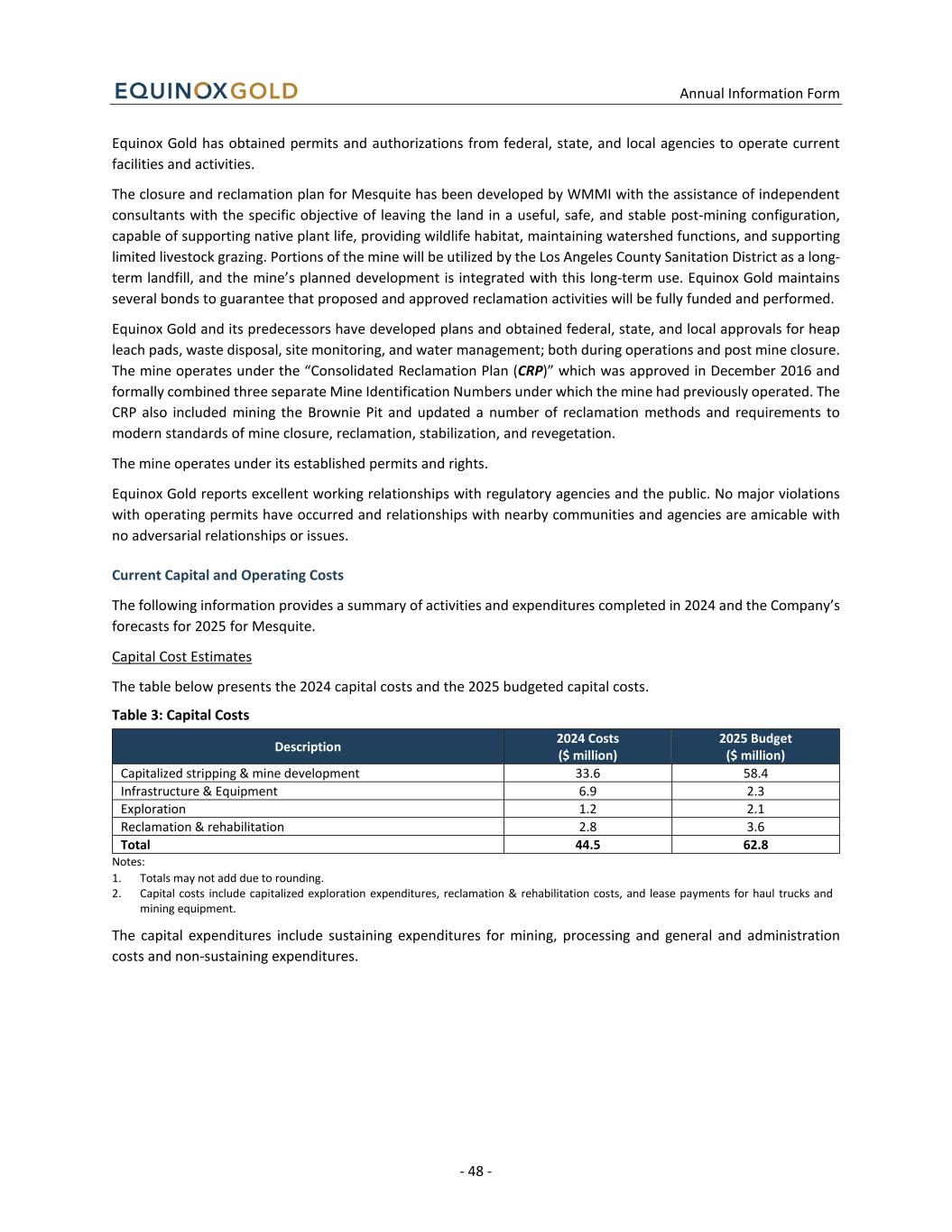
Annual Information Form - 48 - Equinox Gold has obtained permits and authorizations from federal, state, and local agencies to operate current facilities and activities. The closure and reclamation plan for Mesquite has been developed by WMMI with the assistance of independent consultants with the specific objective of leaving the land in a useful, safe, and stable post-mining configuration, capable of supporting native plant life, providing wildlife habitat, maintaining watershed functions, and supporting limited livestock grazing. Portions of the mine will be utilized by the Los Angeles County Sanitation District as a long- term landfill, and the mine’s planned development is integrated with this long-term use. Equinox Gold maintains several bonds to guarantee that proposed and approved reclamation activities will be fully funded and performed. Equinox Gold and its predecessors have developed plans and obtained federal, state, and local approvals for heap leach pads, waste disposal, site monitoring, and water management; both during operations and post mine closure. The mine operates under the “Consolidated Reclamation Plan (CRP)” which was approved in December 2016 and formally combined three separate Mine Identification Numbers under which the mine had previously operated. The CRP also included mining the Brownie Pit and updated a number of reclamation methods and requirements to modern standards of mine closure, reclamation, stabilization, and revegetation. The mine operates under its established permits and rights. Equinox Gold reports excellent working relationships with regulatory agencies and the public. No major violations with operating permits have occurred and relationships with nearby communities and agencies are amicable with no adversarial relationships or issues. Current Capital and Operating Costs The following information provides a summary of activities and expenditures completed in 2024 and the Company’s forecasts for 2025 for Mesquite. Capital Cost Estimates The table below presents the 2024 capital costs and the 2025 budgeted capital costs. Table 3: Capital Costs Description 2024 Costs ($ million) 2025 Budget ($ million) Capitalized stripping & mine development 33.6 58.4 Infrastructure & Equipment 6.9 2.3 Exploration 1.2 2.1 Reclamation & rehabilitation 2.8 3.6 Total 44.5 62.8 Notes: 1. Totals may not add due to rounding. 2. Capital costs include capitalized exploration expenditures, reclamation & rehabilitation costs, and lease payments for haul trucks and mining equipment. The capital expenditures include sustaining expenditures for mining, processing and general and administration costs and non-sustaining expenditures.
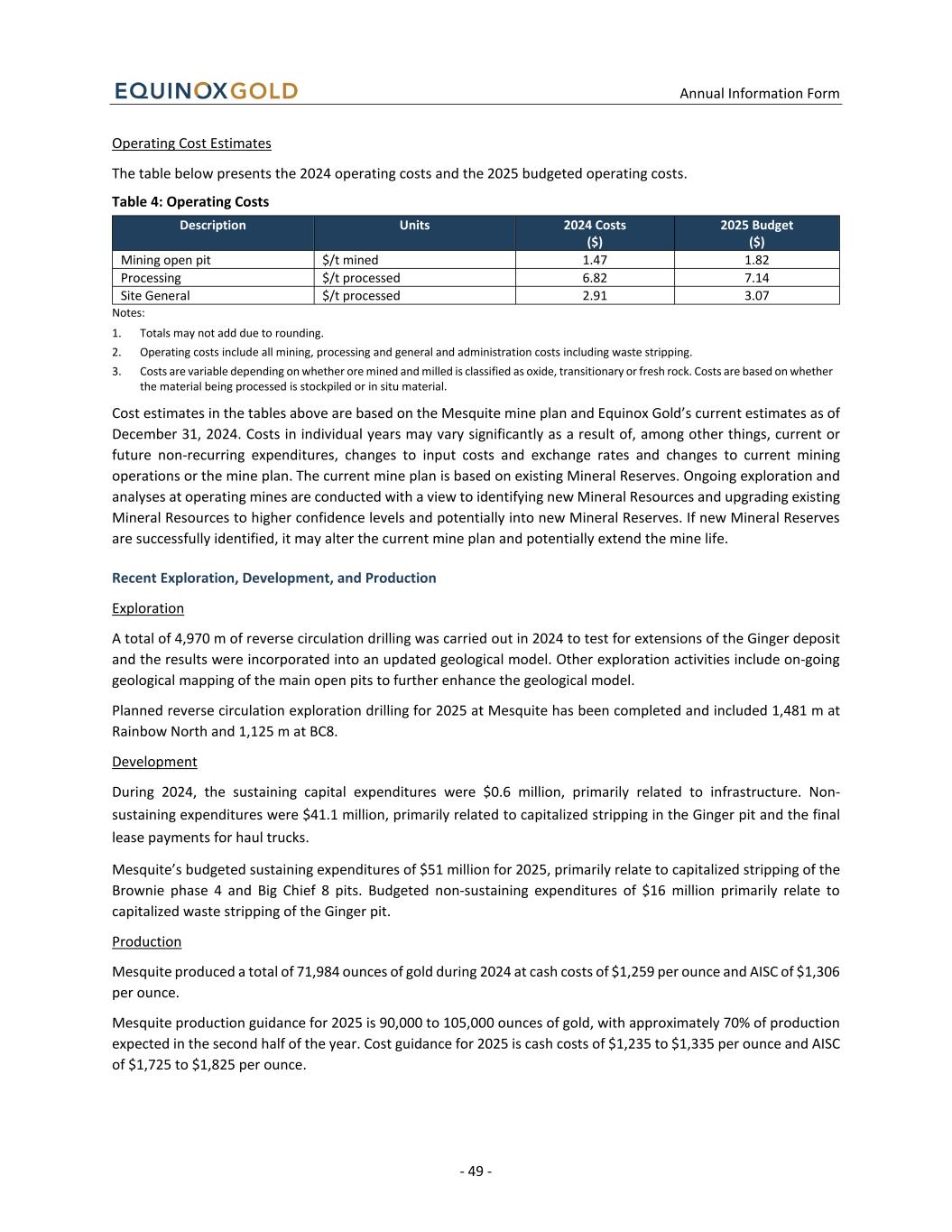
Annual Information Form - 49 - Operating Cost Estimates The table below presents the 2024 operating costs and the 2025 budgeted operating costs. Table 4: Operating Costs Description Units 2024 Costs ($) 2025 Budget ($) Mining open pit $/t mined 1.47 1.82 Processing $/t processed 6.82 7.14 Site General $/t processed 2.91 3.07 Notes: 1. Totals may not add due to rounding. 2. Operating costs include all mining, processing and general and administration costs including waste stripping. 3. Costs are variable depending on whether ore mined and milled is classified as oxide, transitionary or fresh rock. Costs are based on whether the material being processed is stockpiled or in situ material. Cost estimates in the tables above are based on the Mesquite mine plan and Equinox Gold’s current estimates as of December 31, 2024. Costs in individual years may vary significantly as a result of, among other things, current or future non-recurring expenditures, changes to input costs and exchange rates and changes to current mining operations or the mine plan. The current mine plan is based on existing Mineral Reserves. Ongoing exploration and analyses at operating mines are conducted with a view to identifying new Mineral Resources and upgrading existing Mineral Resources to higher confidence levels and potentially into new Mineral Reserves. If new Mineral Reserves are successfully identified, it may alter the current mine plan and potentially extend the mine life. Recent Exploration, Development, and Production Exploration A total of 4,970 m of reverse circulation drilling was carried out in 2024 to test for extensions of the Ginger deposit and the results were incorporated into an updated geological model. Other exploration activities include on-going geological mapping of the main open pits to further enhance the geological model. Planned reverse circulation exploration drilling for 2025 at Mesquite has been completed and included 1,481 m at Rainbow North and 1,125 m at BC8. Development During 2024, the sustaining capital expenditures were $0.6 million, primarily related to infrastructure. Non- sustaining expenditures were $41.1 million, primarily related to capitalized stripping in the Ginger pit and the final lease payments for haul trucks. Mesquite’s budgeted sustaining expenditures of $51 million for 2025, primarily relate to capitalized stripping of the Brownie phase 4 and Big Chief 8 pits. Budgeted non-sustaining expenditures of $16 million primarily relate to capitalized waste stripping of the Ginger pit. Production Mesquite produced a total of 71,984 ounces of gold during 2024 at cash costs of $1,259 per ounce and AISC of $1,306 per ounce. Mesquite production guidance for 2025 is 90,000 to 105,000 ounces of gold, with approximately 70% of production expected in the second half of the year. Cost guidance for 2025 is cash costs of $1,235 to $1,335 per ounce and AISC of $1,725 to $1,825 per ounce.
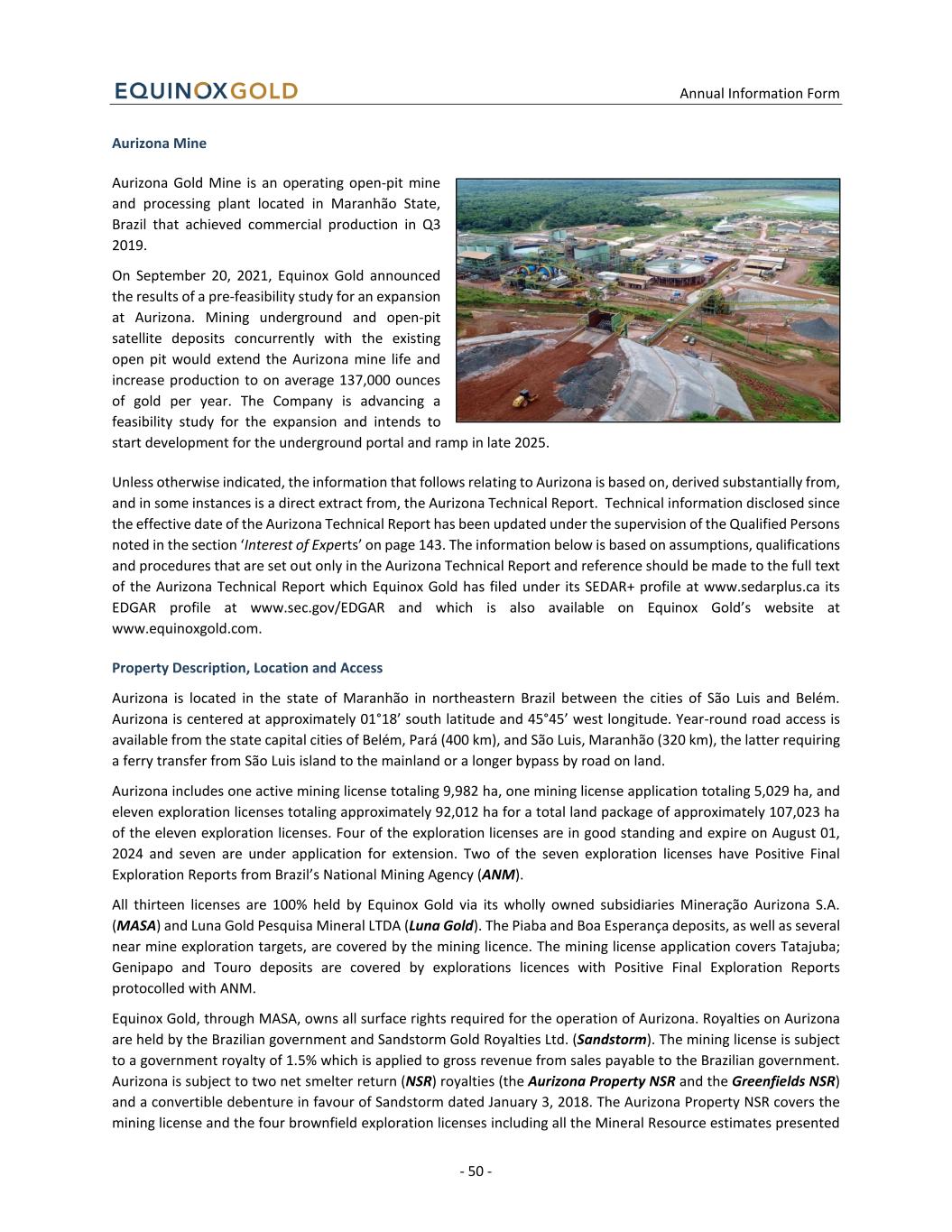
Annual Information Form - 50 - Aurizona Mine Aurizona Gold Mine is an operating open-pit mine and processing plant located in Maranhão State, Brazil that achieved commercial production in Q3 2019. On September 20, 2021, Equinox Gold announced the results of a pre-feasibility study for an expansion at Aurizona. Mining underground and open-pit satellite deposits concurrently with the existing open pit would extend the Aurizona mine life and increase production to on average 137,000 ounces of gold per year. The Company is advancing a feasibility study for the expansion and intends to start development for the underground portal and ramp in late 2025. Unless otherwise indicated, the information that follows relating to Aurizona is based on, derived substantially from, and in some instances is a direct extract from, the Aurizona Technical Report. Technical information disclosed since the effective date of the Aurizona Technical Report has been updated under the supervision of the Qualified Persons noted in the section ‘Interest of Experts’ on page 143. The information below is based on assumptions, qualifications and procedures that are set out only in the Aurizona Technical Report and reference should be made to the full text of the Aurizona Technical Report which Equinox Gold has filed under its SEDAR+ profile at www.sedarplus.ca its EDGAR profile at www.sec.gov/EDGAR and which is also available on Equinox Gold’s website at www.equinoxgold.com. Property Description, Location and Access Aurizona is located in the state of Maranhão in northeastern Brazil between the cities of São Luis and Belém. Aurizona is centered at approximately 01°18’ south latitude and 45°45’ west longitude. Year-round road access is available from the state capital cities of Belém, Pará (400 km), and São Luis, Maranhão (320 km), the latter requiring a ferry transfer from São Luis island to the mainland or a longer bypass by road on land. Aurizona includes one active mining license totaling 9,982 ha, one mining license application totaling 5,029 ha, and eleven exploration licenses totaling approximately 92,012 ha for a total land package of approximately 107,023 ha of the eleven exploration licenses. Four of the exploration licenses are in good standing and expire on August 01, 2024 and seven are under application for extension. Two of the seven exploration licenses have Positive Final Exploration Reports from Brazil’s National Mining Agency (ANM). All thirteen licenses are 100% held by Equinox Gold via its wholly owned subsidiaries Mineração Aurizona S.A. (MASA) and Luna Gold Pesquisa Mineral LTDA (Luna Gold). The Piaba and Boa Esperança deposits, as well as several near mine exploration targets, are covered by the mining licence. The mining license application covers Tatajuba; Genipapo and Touro deposits are covered by explorations licences with Positive Final Exploration Reports protocolled with ANM. Equinox Gold, through MASA, owns all surface rights required for the operation of Aurizona. Royalties on Aurizona are held by the Brazilian government and Sandstorm Gold Royalties Ltd. (Sandstorm). The mining license is subject to a government royalty of 1.5% which is applied to gross revenue from sales payable to the Brazilian government. Aurizona is subject to two net smelter return (NSR) royalties (the Aurizona Property NSR and the Greenfields NSR) and a convertible debenture in favour of Sandstorm dated January 3, 2018. The Aurizona Property NSR covers the mining license and the four brownfield exploration licenses including all the Mineral Resource estimates presented
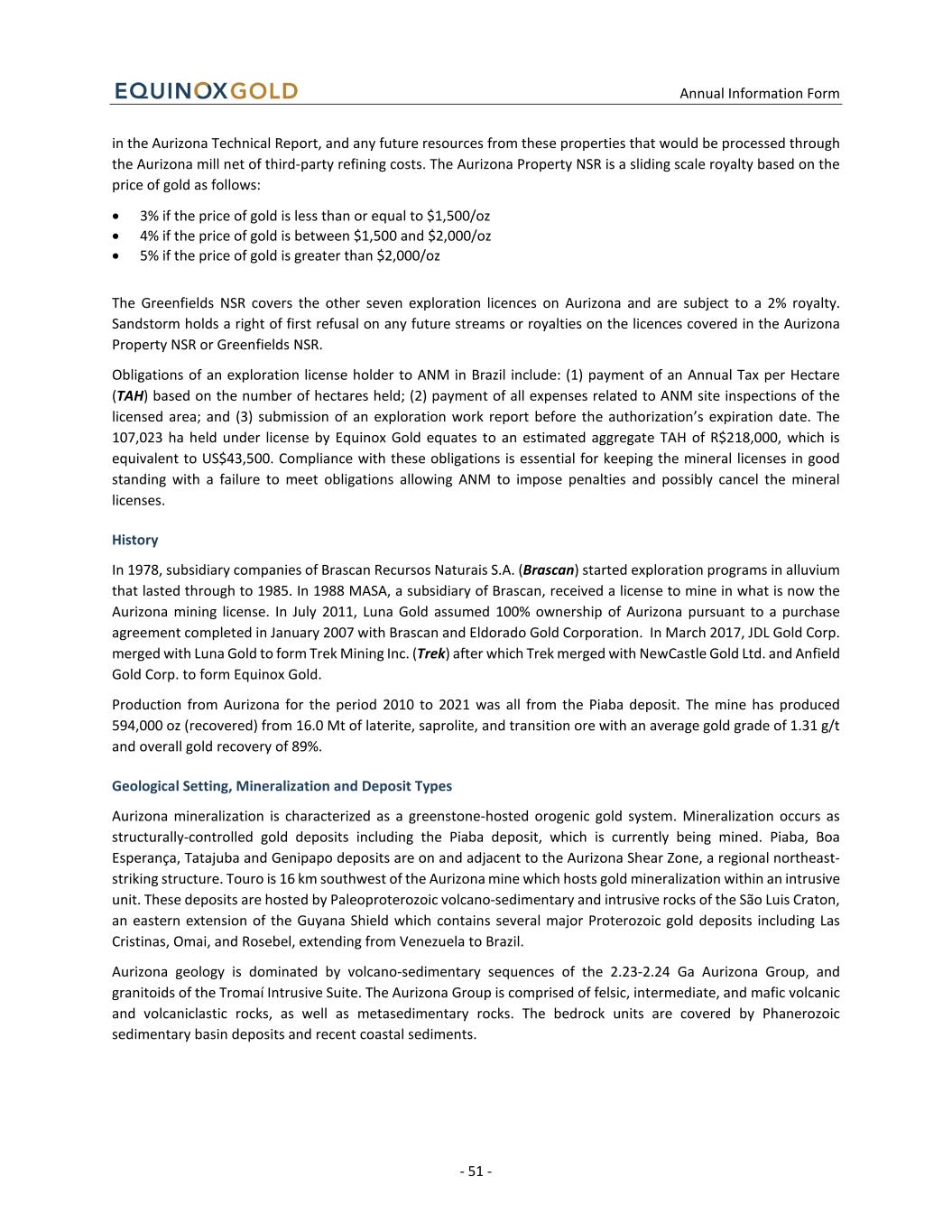
Annual Information Form - 51 - in the Aurizona Technical Report, and any future resources from these properties that would be processed through the Aurizona mill net of third-party refining costs. The Aurizona Property NSR is a sliding scale royalty based on the price of gold as follows: • 3% if the price of gold is less than or equal to $1,500/oz • 4% if the price of gold is between $1,500 and $2,000/oz • 5% if the price of gold is greater than $2,000/oz The Greenfields NSR covers the other seven exploration licences on Aurizona and are subject to a 2% royalty. Sandstorm holds a right of first refusal on any future streams or royalties on the licences covered in the Aurizona Property NSR or Greenfields NSR. Obligations of an exploration license holder to ANM in Brazil include: (1) payment of an Annual Tax per Hectare (TAH) based on the number of hectares held; (2) payment of all expenses related to ANM site inspections of the licensed area; and (3) submission of an exploration work report before the authorization’s expiration date. The 107,023 ha held under license by Equinox Gold equates to an estimated aggregate TAH of R$218,000, which is equivalent to US$43,500. Compliance with these obligations is essential for keeping the mineral licenses in good standing with a failure to meet obligations allowing ANM to impose penalties and possibly cancel the mineral licenses. History In 1978, subsidiary companies of Brascan Recursos Naturais S.A. (Brascan) started exploration programs in alluvium that lasted through to 1985. In 1988 MASA, a subsidiary of Brascan, received a license to mine in what is now the Aurizona mining license. In July 2011, Luna Gold assumed 100% ownership of Aurizona pursuant to a purchase agreement completed in January 2007 with Brascan and Eldorado Gold Corporation. In March 2017, JDL Gold Corp. merged with Luna Gold to form Trek Mining Inc. (Trek) after which Trek merged with NewCastle Gold Ltd. and Anfield Gold Corp. to form Equinox Gold. Production from Aurizona for the period 2010 to 2021 was all from the Piaba deposit. The mine has produced 594,000 oz (recovered) from 16.0 Mt of laterite, saprolite, and transition ore with an average gold grade of 1.31 g/t and overall gold recovery of 89%. Geological Setting, Mineralization and Deposit Types Aurizona mineralization is characterized as a greenstone-hosted orogenic gold system. Mineralization occurs as structurally-controlled gold deposits including the Piaba deposit, which is currently being mined. Piaba, Boa Esperança, Tatajuba and Genipapo deposits are on and adjacent to the Aurizona Shear Zone, a regional northeast- striking structure. Touro is 16 km southwest of the Aurizona mine which hosts gold mineralization within an intrusive unit. These deposits are hosted by Paleoproterozoic volcano-sedimentary and intrusive rocks of the São Luis Craton, an eastern extension of the Guyana Shield which contains several major Proterozoic gold deposits including Las Cristinas, Omai, and Rosebel, extending from Venezuela to Brazil. Aurizona geology is dominated by volcano-sedimentary sequences of the 2.23-2.24 Ga Aurizona Group, and granitoids of the Tromaí Intrusive Suite. The Aurizona Group is comprised of felsic, intermediate, and mafic volcanic and volcaniclastic rocks, as well as metasedimentary rocks. The bedrock units are covered by Phanerozoic sedimentary basin deposits and recent coastal sediments.
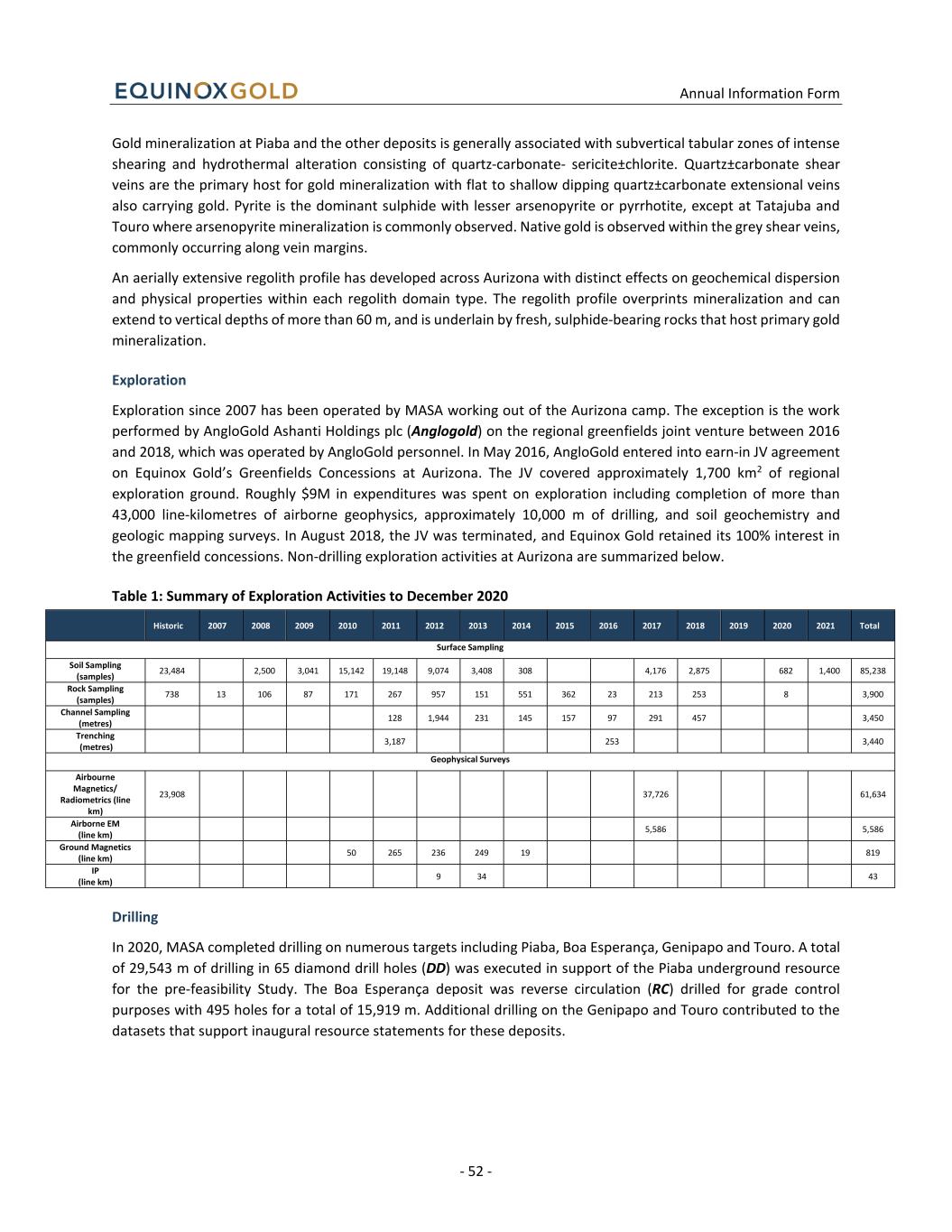
Annual Information Form - 52 - Gold mineralization at Piaba and the other deposits is generally associated with subvertical tabular zones of intense shearing and hydrothermal alteration consisting of quartz-carbonate- sericite±chlorite. Quartz±carbonate shear veins are the primary host for gold mineralization with flat to shallow dipping quartz±carbonate extensional veins also carrying gold. Pyrite is the dominant sulphide with lesser arsenopyrite or pyrrhotite, except at Tatajuba and Touro where arsenopyrite mineralization is commonly observed. Native gold is observed within the grey shear veins, commonly occurring along vein margins. An aerially extensive regolith profile has developed across Aurizona with distinct effects on geochemical dispersion and physical properties within each regolith domain type. The regolith profile overprints mineralization and can extend to vertical depths of more than 60 m, and is underlain by fresh, sulphide-bearing rocks that host primary gold mineralization. Exploration Exploration since 2007 has been operated by MASA working out of the Aurizona camp. The exception is the work performed by AngloGold Ashanti Holdings plc (Anglogold) on the regional greenfields joint venture between 2016 and 2018, which was operated by AngloGold personnel. In May 2016, AngloGold entered into earn-in JV agreement on Equinox Gold’s Greenfields Concessions at Aurizona. The JV covered approximately 1,700 km2 of regional exploration ground. Roughly $9M in expenditures was spent on exploration including completion of more than 43,000 line-kilometres of airborne geophysics, approximately 10,000 m of drilling, and soil geochemistry and geologic mapping surveys. In August 2018, the JV was terminated, and Equinox Gold retained its 100% interest in the greenfield concessions. Non-drilling exploration activities at Aurizona are summarized below. Table 1: Summary of Exploration Activities to December 2020 Historic 2007 2008 2009 2010 2011 2012 2013 2014 2015 2016 2017 2018 2019 2020 2021 Total Surface Sampling Soil Sampling (samples) 23,484 2,500 3,041 15,142 19,148 9,074 3,408 308 4,176 2,875 682 1,400 85,238 Rock Sampling (samples) 738 13 106 87 171 267 957 151 551 362 23 213 253 8 3,900 Channel Sampling (metres) 128 1,944 231 145 157 97 291 457 3,450 Trenching (metres) 3,187 253 3,440 Geophysical Surveys Airbourne Magnetics/ Radiometrics (line km) 23,908 37,726 61,634 Airborne EM (line km) 5,586 5,586 Ground Magnetics (line km) 50 265 236 249 19 819 IP (line km) 9 34 43 Drilling In 2020, MASA completed drilling on numerous targets including Piaba, Boa Esperança, Genipapo and Touro. A total of 29,543 m of drilling in 65 diamond drill holes (DD) was executed in support of the Piaba underground resource for the pre-feasibility Study. The Boa Esperança deposit was reverse circulation (RC) drilled for grade control purposes with 495 holes for a total of 15,919 m. Additional drilling on the Genipapo and Touro contributed to the datasets that support inaugural resource statements for these deposits.
Annual Information Form - 53 - There are five deposit areas at Aurizona including the Piaba, Boa Esperança, Tatajuba, Genipapo and Touro deposits, which have a total of 178,943 m of drilling in 1,182 holes. The dominant drilling method for the deposit areas was HQ sized, diamond drill holes with a total meterage of 152,049 m in 744 holes. RC was also utilized for 438 holes with 26,896 m. Drilling is typically oriented to the southeast or to the south to intersect steeply dipping, northeast to east-west striking mineralized zones. Grade control drilling in the Piaba open pit and at Boa Esperança is executed with RC drilling methods. There is an additional 26,567 m in 278 holes of regional diamond and RC drilling on Aurizona. Auger drilling has been used to delineate trends and for condemnation in areas of planned site infrastructure. It is the responsible Qualified Person’s opinion that the drilling procedures are adequate to support Mineral Resource estimation. There are no known drilling or sampling factors that could materially impact the accuracy and reliability of the results. Sampling, Analysis and Data Verification Sample Preparation, Analyses, and Security Equinox Gold maintains a Quality Assurance/Quality Control (QA/QC) sampling program, including insertion and review of coarse blanks, certified reference materials (CRM), and duplicates. Blanks, CRMs, and quarter core duplicates are included with routine samples at a 3-4% insertion rate per material type. Sample intervals are a nominal 1 m and range from 0.3 m to 4.0 m length and can cross geological and regolith boundaries. Core is consistently sampled on the same side and the remaining half of the core is stored in the core box for reference. RC samples are collected at the drill rig by the contracted drilling personnel. The entire sample representing a 1 m run length is collected at the drill site. RC samples are not processed or split prior to shipment. Entire RC samples are shipped to the commercial assay laboratory where they are dried and split before analysis. Blanks and CRMs are inserted in a similar manner as with drill core samples. After the cutting and bagging of individual samples, sample shipments are prepared in sealed rice sacks. Sample shipments are transported by a commercial transport company directly from the core facility to the preparation laboratory. The chain of custody procedures includes long-term storage of records documenting transport to and receipt of sample shipments at the laboratory. The sample shipments are prepared by MASA staff and have adequate security and tracking measures employed during preparation, packing and transport. Equinox Gold has used ALS Global as its primary independent laboratory since 2008, and ACME Analytical Laboratories Ltd (now Bureau Veritas) in 2007 and late in 2011. A variety of laboratory locations have been used to prepare and assay samples, all of which follow ISO procedures. From 2007 to 2016 all drilling samples were analysed by fire assay with atomic absorption spectroscopy finish and samples returning greater than 10 g/t gold were automatically re-analysed via fire assay with gravimetric finish. In 2017, the procedure was modified to include assay of samples that return greater than 10 g/t gold by screen fire assay to address the presence of coarse gold. The QA/QC materials are appropriately matched to the mineralization at Aurizona. The results are reviewed on a batch by batch basis to monitor the accuracy and precision of the results. A series of rules are followed to audit the QA/QC results and possible failures and subsequent follow up actions are taken as required. The sample preparation, analysis and security procedures demonstrate that the resultant dataset is adequate for use in Mineral Resource estimation and preparation of Mineral Reserves.
Annual Information Form - 54 - Data Verification The data used in the resource models and resource estimation was reviewed for critical errors and to evaluate the quality of the analytical data. Location data for the collars and downhole survey measurements were checked for gross errors. Measured physical property values were used to recalculate and verify the in-situ bulk density values being used. The assay data was checked for ranking accuracy and the QA/QC results were evaluated statistically and plotted for visual evaluation. The results of the data verification demonstrate the data is adequate for use in Mineral Resource estimation and preparation of Mineral Reserves. Mineral Processing and Metallurgical Testing Significant metallurgical test work has been completed on ore samples from various parts of the Aurizona deposit. Metallurgical test work has historically been completed on laterite, saprolite, transition and fresh rock types from the various deposits. Recent metallurgical test work has been completed on samples of Tatajuba ore and Piaba underground ore relevant to the subject of the Aurizona Technical Report. The Piaba metallurgical test work program was still on-going at the time of the publication of the Aurizona Technical Report. During 2020, a metallurgical test work program was completed by SGS Geosol on samples from Tatajuba ore. The objective of the test work program was to verify the metallurgical response of Tatajuba ore via the existing treatment route at the Aurizona process plant. The scope of the test work program consisted of sample preparation, head assays, comminution tests, gravity pre-concentration followed by leaching of gravity tailings to test treatment of the ore via the existing Aurizona flowsheet. In March of 2021, a metallurgical test work program commenced with SGS Geosol to test samples from the Piaba underground ore. The objective of the test work program was to verify the metallurgical response of the ore from the Piaba ore body at depth via the existing Aurizona treatment route. The scope of the test work program consisted of sample preparation, head assays, mineralogy, comminution tests (SMC and BWi), gravity tests and leaching of gravity tailings by CIL. The test work program was completed over two phases, i.e. variability test work using 18 samples and test work of two composite blends. In general, the ore samples tested from Tatajuba and Piaba underground resulted in a similar metallurgical response of previous ore tested and fall within the expected ranges of historical test work results and are not expected to result in significant flowsheet or operational changes to the existing process plant. Mineral Resource and Mineral Reserve Estimates Mineral Resource Estimate The current Mineral Resource estimate of the Aurizona Property comprises the Piaba, Boa Esperança, Tatajuba, Genipapo and Touro deposits. The resource estimate is an update of the previous Mineral Resource estimates with effective dates of December 31, 2019, for Piaba and Boa Esperança, and effective date of February 28, 2020, for Tatajuba. The Mineral Resource estimates for Genipapo and Touro are presented for the first time. The Mineral Resources from the Piaba, Boa Esperança, Tatajuba, Genipapo and Touro deposits presented herein have an effective date of June 30, 2021 and are shown in Table 2, below.
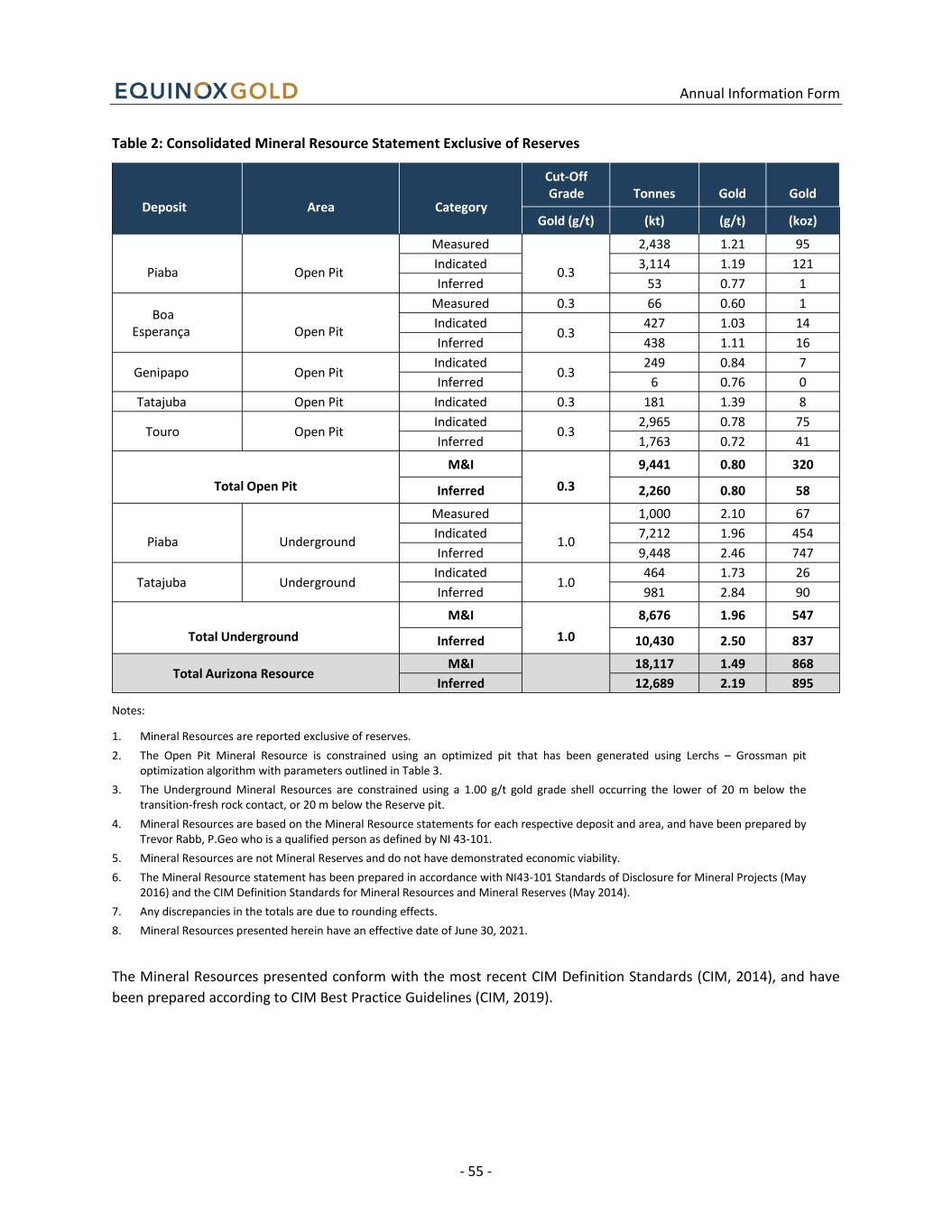
Annual Information Form - 55 - Table 2: Consolidated Mineral Resource Statement Exclusive of Reserves Deposit Area Category Cut-Off Grade Tonnes Gold Gold Gold (g/t) (kt) (g/t) (koz) Piaba Open Pit Measured 0.3 2,438 1.21 95 Indicated 3,114 1.19 121 Inferred 53 0.77 1 Boa Esperança Open Pit Measured 0.3 66 0.60 1 Indicated 0.3 427 1.03 14 Inferred 438 1.11 16 Genipapo Open Pit Indicated 0.3 249 0.84 7 Inferred 6 0.76 0 Tatajuba Open Pit Indicated 0.3 181 1.39 8 Touro Open Pit Indicated 0.3 2,965 0.78 75 Inferred 1,763 0.72 41 Total Open Pit M&I 0.3 9,441 0.80 320 Inferred 2,260 0.80 58 Piaba Underground Measured 1.0 1,000 2.10 67 Indicated 7,212 1.96 454 Inferred 9,448 2.46 747 Tatajuba Underground Indicated 1.0 464 1.73 26 Inferred 981 2.84 90 Total Underground M&I 1.0 8,676 1.96 547 Inferred 10,430 2.50 837 Total Aurizona Resource M&I 18,117 1.49 868 Inferred 12,689 2.19 895 Notes: 1. Mineral Resources are reported exclusive of reserves. 2. The Open Pit Mineral Resource is constrained using an optimized pit that has been generated using Lerchs – Grossman pit optimization algorithm with parameters outlined in Table 3. 3. The Underground Mineral Resources are constrained using a 1.00 g/t gold grade shell occurring the lower of 20 m below the transition-fresh rock contact, or 20 m below the Reserve pit. 4. Mineral Resources are based on the Mineral Resource statements for each respective deposit and area, and have been prepared by Trevor Rabb, P.Geo who is a qualified person as defined by NI 43-101. 5. Mineral Resources are not Mineral Reserves and do not have demonstrated economic viability. 6. The Mineral Resource statement has been prepared in accordance with NI43-101 Standards of Disclosure for Mineral Projects (May 2016) and the CIM Definition Standards for Mineral Resources and Mineral Reserves (May 2014). 7. Any discrepancies in the totals are due to rounding effects. 8. Mineral Resources presented herein have an effective date of June 30, 2021. The Mineral Resources presented conform with the most recent CIM Definition Standards (CIM, 2014), and have been prepared according to CIM Best Practice Guidelines (CIM, 2019).
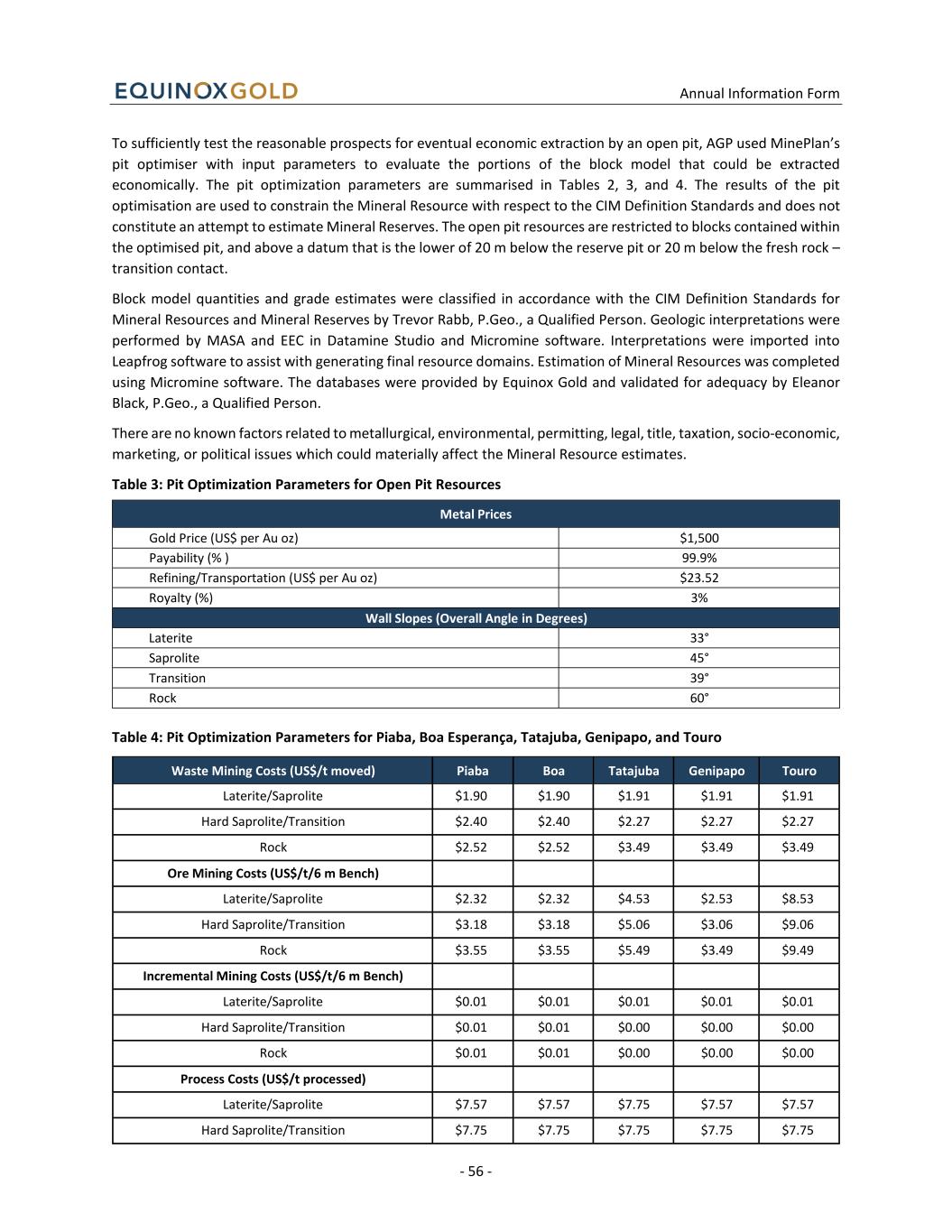
Annual Information Form - 56 - To sufficiently test the reasonable prospects for eventual economic extraction by an open pit, AGP used MinePlan’s pit optimiser with input parameters to evaluate the portions of the block model that could be extracted economically. The pit optimization parameters are summarised in Tables 2, 3, and 4. The results of the pit optimisation are used to constrain the Mineral Resource with respect to the CIM Definition Standards and does not constitute an attempt to estimate Mineral Reserves. The open pit resources are restricted to blocks contained within the optimised pit, and above a datum that is the lower of 20 m below the reserve pit or 20 m below the fresh rock – transition contact. Block model quantities and grade estimates were classified in accordance with the CIM Definition Standards for Mineral Resources and Mineral Reserves by Trevor Rabb, P.Geo., a Qualified Person. Geologic interpretations were performed by MASA and EEC in Datamine Studio and Micromine software. Interpretations were imported into Leapfrog software to assist with generating final resource domains. Estimation of Mineral Resources was completed using Micromine software. The databases were provided by Equinox Gold and validated for adequacy by Eleanor Black, P.Geo., a Qualified Person. There are no known factors related to metallurgical, environmental, permitting, legal, title, taxation, socio-economic, marketing, or political issues which could materially affect the Mineral Resource estimates. Table 3: Pit Optimization Parameters for Open Pit Resources Metal Prices Gold Price (US$ per Au oz) $1,500 Payability (% ) 99.9% Refining/Transportation (US$ per Au oz) $23.52 Royalty (%) 3% Wall Slopes (Overall Angle in Degrees) Laterite 33° Saprolite 45° Transition 39° Rock 60° Table 4: Pit Optimization Parameters for Piaba, Boa Esperança, Tatajuba, Genipapo, and Touro Waste Mining Costs (US$/t moved) Piaba Boa Tatajuba Genipapo Touro Laterite/Saprolite $1.90 $1.90 $1.91 $1.91 $1.91 Hard Saprolite/Transition $2.40 $2.40 $2.27 $2.27 $2.27 Rock $2.52 $2.52 $3.49 $3.49 $3.49 Ore Mining Costs (US$/t/6 m Bench) Laterite/Saprolite $2.32 $2.32 $4.53 $2.53 $8.53 Hard Saprolite/Transition $3.18 $3.18 $5.06 $3.06 $9.06 Rock $3.55 $3.55 $5.49 $3.49 $9.49 Incremental Mining Costs (US$/t/6 m Bench) Laterite/Saprolite $0.01 $0.01 $0.01 $0.01 $0.01 Hard Saprolite/Transition $0.01 $0.01 $0.00 $0.00 $0.00 Rock $0.01 $0.01 $0.00 $0.00 $0.00 Process Costs (US$/t processed) Laterite/Saprolite $7.57 $7.57 $7.75 $7.57 $7.57 Hard Saprolite/Transition $7.75 $7.75 $7.75 $7.75 $7.75
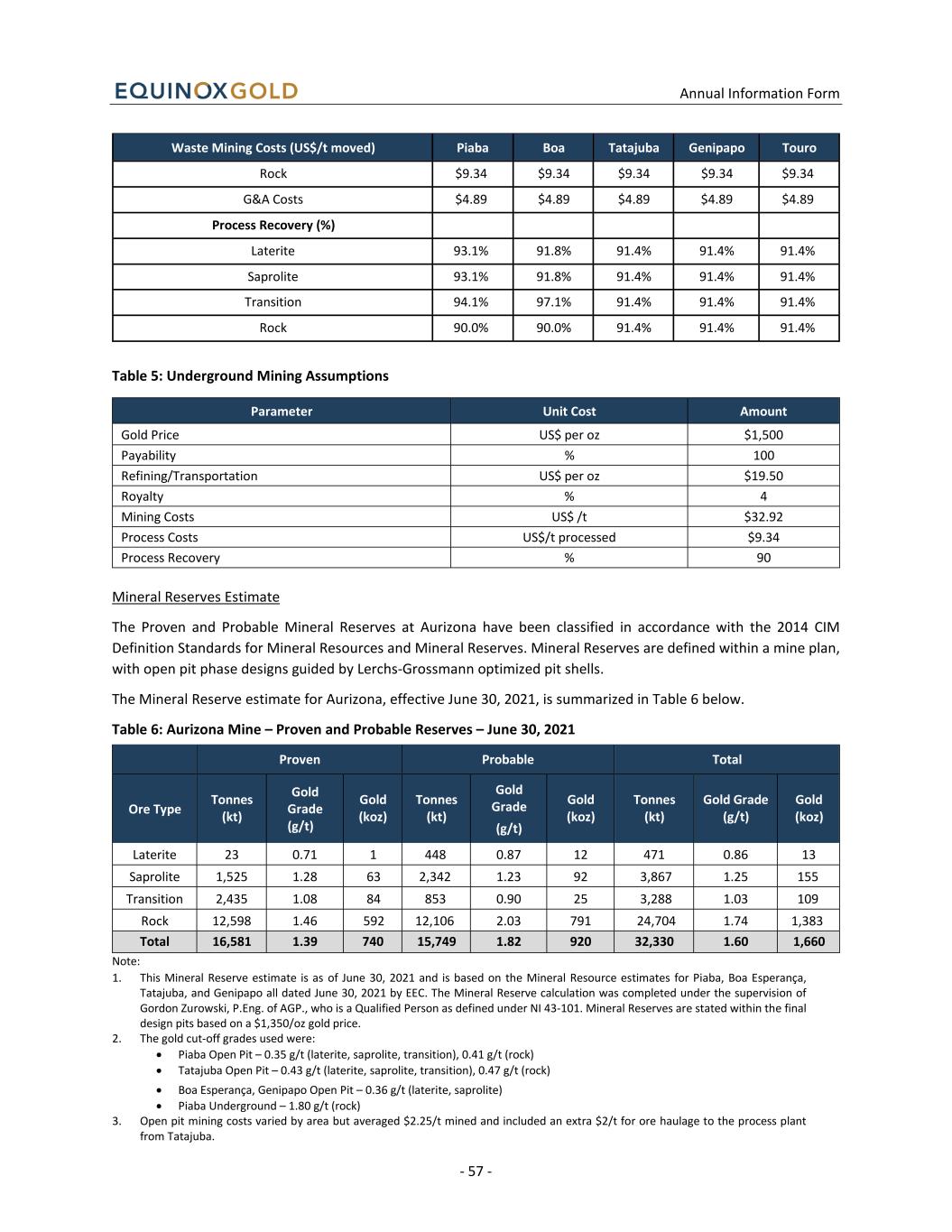
Annual Information Form - 57 - Waste Mining Costs (US$/t moved) Piaba Boa Tatajuba Genipapo Touro Rock $9.34 $9.34 $9.34 $9.34 $9.34 G&A Costs $4.89 $4.89 $4.89 $4.89 $4.89 Process Recovery (%) Laterite 93.1% 91.8% 91.4% 91.4% 91.4% Saprolite 93.1% 91.8% 91.4% 91.4% 91.4% Transition 94.1% 97.1% 91.4% 91.4% 91.4% Rock 90.0% 90.0% 91.4% 91.4% 91.4% Table 5: Underground Mining Assumptions Parameter Unit Cost Amount Gold Price US$ per oz $1,500 Payability % 100 Refining/Transportation US$ per oz $19.50 Royalty % 4 Mining Costs US$ /t $32.92 Process Costs US$/t processed $9.34 Process Recovery % 90 Mineral Reserves Estimate The Proven and Probable Mineral Reserves at Aurizona have been classified in accordance with the 2014 CIM Definition Standards for Mineral Resources and Mineral Reserves. Mineral Reserves are defined within a mine plan, with open pit phase designs guided by Lerchs-Grossmann optimized pit shells. The Mineral Reserve estimate for Aurizona, effective June 30, 2021, is summarized in Table 6 below. Table 6: Aurizona Mine – Proven and Probable Reserves – June 30, 2021 Proven Probable Total Ore Type Tonnes (kt) Gold Grade (g/t) Gold (koz) Tonnes (kt) Gold Grade (g/t) Gold (koz) Tonnes (kt) Gold Grade (g/t) Gold (koz) Laterite 23 0.71 1 448 0.87 12 471 0.86 13 Saprolite 1,525 1.28 63 2,342 1.23 92 3,867 1.25 155 Transition 2,435 1.08 84 853 0.90 25 3,288 1.03 109 Rock 12,598 1.46 592 12,106 2.03 791 24,704 1.74 1,383 Total 16,581 1.39 740 15,749 1.82 920 32,330 1.60 1,660 Note: 1. This Mineral Reserve estimate is as of June 30, 2021 and is based on the Mineral Resource estimates for Piaba, Boa Esperança, Tatajuba, and Genipapo all dated June 30, 2021 by EEC. The Mineral Reserve calculation was completed under the supervision of Gordon Zurowski, P.Eng. of AGP., who is a Qualified Person as defined under NI 43-101. Mineral Reserves are stated within the final design pits based on a $1,350/oz gold price. 2. The gold cut-off grades used were: • Piaba Open Pit – 0.35 g/t (laterite, saprolite, transition), 0.41 g/t (rock) • Tatajuba Open Pit – 0.43 g/t (laterite, saprolite, transition), 0.47 g/t (rock) • Boa Esperança, Genipapo Open Pit – 0.36 g/t (laterite, saprolite) • Piaba Underground – 1.80 g/t (rock) 3. Open pit mining costs varied by area but averaged $2.25/t mined and included an extra $2/t for ore haulage to the process plant from Tatajuba.
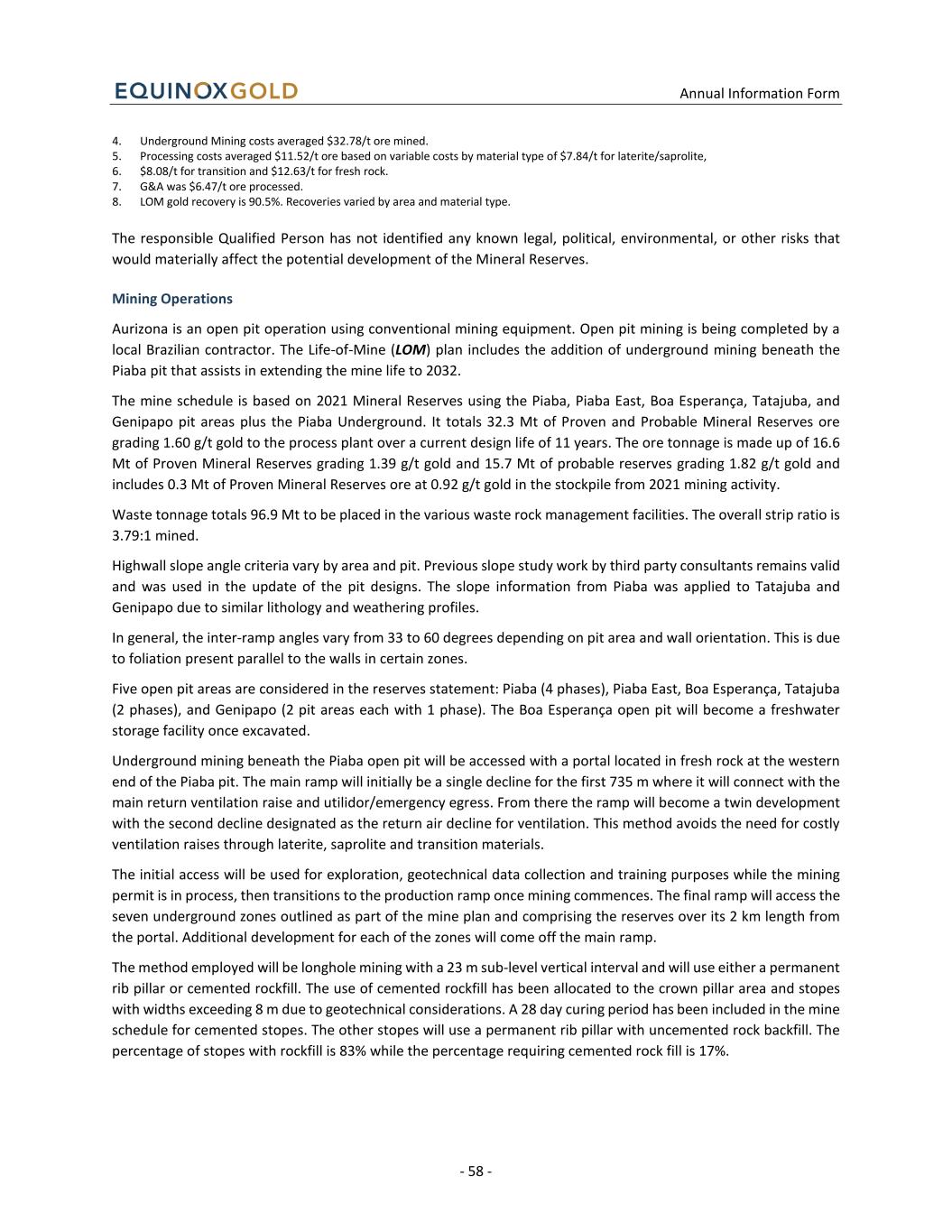
Annual Information Form - 58 - 4. Underground Mining costs averaged $32.78/t ore mined. 5. Processing costs averaged $11.52/t ore based on variable costs by material type of $7.84/t for laterite/saprolite, 6. $8.08/t for transition and $12.63/t for fresh rock. 7. G&A was $6.47/t ore processed. 8. LOM gold recovery is 90.5%. Recoveries varied by area and material type. The responsible Qualified Person has not identified any known legal, political, environmental, or other risks that would materially affect the potential development of the Mineral Reserves. Mining Operations Aurizona is an open pit operation using conventional mining equipment. Open pit mining is being completed by a local Brazilian contractor. The Life-of-Mine (LOM) plan includes the addition of underground mining beneath the Piaba pit that assists in extending the mine life to 2032. The mine schedule is based on 2021 Mineral Reserves using the Piaba, Piaba East, Boa Esperança, Tatajuba, and Genipapo pit areas plus the Piaba Underground. It totals 32.3 Mt of Proven and Probable Mineral Reserves ore grading 1.60 g/t gold to the process plant over a current design life of 11 years. The ore tonnage is made up of 16.6 Mt of Proven Mineral Reserves grading 1.39 g/t gold and 15.7 Mt of probable reserves grading 1.82 g/t gold and includes 0.3 Mt of Proven Mineral Reserves ore at 0.92 g/t gold in the stockpile from 2021 mining activity. Waste tonnage totals 96.9 Mt to be placed in the various waste rock management facilities. The overall strip ratio is 3.79:1 mined. Highwall slope angle criteria vary by area and pit. Previous slope study work by third party consultants remains valid and was used in the update of the pit designs. The slope information from Piaba was applied to Tatajuba and Genipapo due to similar lithology and weathering profiles. In general, the inter-ramp angles vary from 33 to 60 degrees depending on pit area and wall orientation. This is due to foliation present parallel to the walls in certain zones. Five open pit areas are considered in the reserves statement: Piaba (4 phases), Piaba East, Boa Esperança, Tatajuba (2 phases), and Genipapo (2 pit areas each with 1 phase). The Boa Esperança open pit will become a freshwater storage facility once excavated. Underground mining beneath the Piaba open pit will be accessed with a portal located in fresh rock at the western end of the Piaba pit. The main ramp will initially be a single decline for the first 735 m where it will connect with the main return ventilation raise and utilidor/emergency egress. From there the ramp will become a twin development with the second decline designated as the return air decline for ventilation. This method avoids the need for costly ventilation raises through laterite, saprolite and transition materials. The initial access will be used for exploration, geotechnical data collection and training purposes while the mining permit is in process, then transitions to the production ramp once mining commences. The final ramp will access the seven underground zones outlined as part of the mine plan and comprising the reserves over its 2 km length from the portal. Additional development for each of the zones will come off the main ramp. The method employed will be longhole mining with a 23 m sub-level vertical interval and will use either a permanent rib pillar or cemented rockfill. The use of cemented rockfill has been allocated to the crown pillar area and stopes with widths exceeding 8 m due to geotechnical considerations. A 28 day curing period has been included in the mine schedule for cemented stopes. The other stopes will use a permanent rib pillar with uncemented rock backfill. The percentage of stopes with rockfill is 83% while the percentage requiring cemented rock fill is 17%.
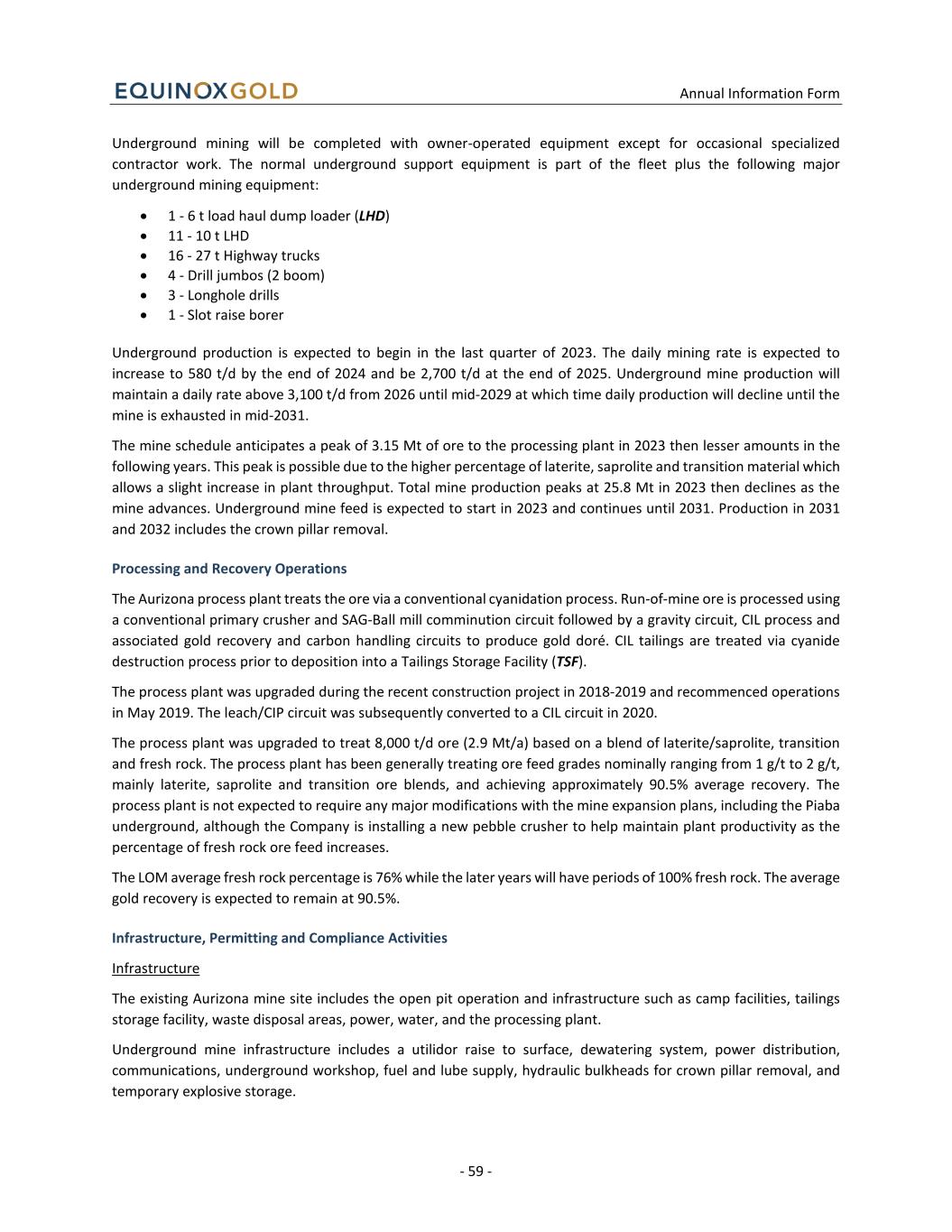
Annual Information Form - 59 - Underground mining will be completed with owner-operated equipment except for occasional specialized contractor work. The normal underground support equipment is part of the fleet plus the following major underground mining equipment: • 1 - 6 t load haul dump loader (LHD) • 11 - 10 t LHD • 16 - 27 t Highway trucks • 4 - Drill jumbos (2 boom) • 3 - Longhole drills • 1 - Slot raise borer Underground production is expected to begin in the last quarter of 2023. The daily mining rate is expected to increase to 580 t/d by the end of 2024 and be 2,700 t/d at the end of 2025. Underground mine production will maintain a daily rate above 3,100 t/d from 2026 until mid-2029 at which time daily production will decline until the mine is exhausted in mid-2031. The mine schedule anticipates a peak of 3.15 Mt of ore to the processing plant in 2023 then lesser amounts in the following years. This peak is possible due to the higher percentage of laterite, saprolite and transition material which allows a slight increase in plant throughput. Total mine production peaks at 25.8 Mt in 2023 then declines as the mine advances. Underground mine feed is expected to start in 2023 and continues until 2031. Production in 2031 and 2032 includes the crown pillar removal. Processing and Recovery Operations The Aurizona process plant treats the ore via a conventional cyanidation process. Run-of-mine ore is processed using a conventional primary crusher and SAG-Ball mill comminution circuit followed by a gravity circuit, CIL process and associated gold recovery and carbon handling circuits to produce gold doré. CIL tailings are treated via cyanide destruction process prior to deposition into a Tailings Storage Facility (TSF). The process plant was upgraded during the recent construction project in 2018-2019 and recommenced operations in May 2019. The leach/CIP circuit was subsequently converted to a CIL circuit in 2020. The process plant was upgraded to treat 8,000 t/d ore (2.9 Mt/a) based on a blend of laterite/saprolite, transition and fresh rock. The process plant has been generally treating ore feed grades nominally ranging from 1 g/t to 2 g/t, mainly laterite, saprolite and transition ore blends, and achieving approximately 90.5% average recovery. The process plant is not expected to require any major modifications with the mine expansion plans, including the Piaba underground, although the Company is installing a new pebble crusher to help maintain plant productivity as the percentage of fresh rock ore feed increases. The LOM average fresh rock percentage is 76% while the later years will have periods of 100% fresh rock. The average gold recovery is expected to remain at 90.5%. Infrastructure, Permitting and Compliance Activities Infrastructure The existing Aurizona mine site includes the open pit operation and infrastructure such as camp facilities, tailings storage facility, waste disposal areas, power, water, and the processing plant. Underground mine infrastructure includes a utilidor raise to surface, dewatering system, power distribution, communications, underground workshop, fuel and lube supply, hydraulic bulkheads for crown pillar removal, and temporary explosive storage.
Annual Information Form - 60 - The regional utility, Companhia Energética do Maranhão, provides 15 MW power supply via a 69 kV overhead powerline to an outdoor substation located adjacent to the process plant. Process water included with the tailings is stored in the TSF and recycled to the process plant. Fresh water storage will be sourced from the Boa Esperança reservoir, following the mining of this small pit later in 2022. The Boa Esperança reservoir will have a capacity of 900,000 m3 of fresh water. A drainage ditch around the Piaba pit is being expanded along the southern perimeter and extended further north along the northern limit of the pit. This ditch collects surface water to prevent it from entering the active pit area and allows the water to drain away from surface infrastructure to pumping locations. The TSF will be expanded based on having a capacity for 33.2 Mt of processed ore and there is potential for future expansions. After detoxification of cyanide, slurried tailings are pumped from the process plant to the TSF and spigoted from the dam crest. Water is recycled to the process plant. There are six different Waste Rock Storage Facilities required over the LOM to accommodate the 96.9 Mt (53.1 Mm3) of waste material. Two new roads are required to access Tatajuba and Genipapo, respectively. The road to Tatajuba will be 4.1 km long and connect with the existing haul road along the north side of the Piaba pit. The Genipapo access road will be 2.7 km long and connect to the Piaba East access road. The Piaba pit will expand to the west which requires the relocation of the community access road. Permitting and Compliance MASA maintains an Environmental Operating License supported by the ANM mining concession No. 1201/1988, ratification No. 25/2019, totalling 9,982 ha. The process for change or expansion involves one mining concession application with the three-phased (Preliminary License – LP, Installation License – LI, Operation License – LO) environmental process in progress. MASA has obtained permits and authorizations from federal, state, and local agencies to operate current facilities and activities. Equinox Gold is in compliance with all issued permits. MASA carries out regular and frequent monitoring of noise, vibration, effluents discharge, and air quality as part of MASA's Environmental Management Plan, as well as its environmental influence in the community area. Residue management is carried out systematically, with garbage collection, focusing on reduction, reuse, and recycling, and completing this control. There is an industrial incinerator that performs > 98% reduction of non-recyclable and hazardous residues. MASA maintains an Environmental Recovery Program for Degraded Areas with the application of techniques to enrich the vegetation and rehabilitation. Specimens of flora for application in the rehabilitation of areas are gathered and maintained in a nursery. The nursery produces up to 18,000 seedlings a year to be used in reforestation. With the support of MASA’s Security team, forest protection actions are also carried out daily to inhibit hunting and fishing in the areas of legal reserve and permanent preservation. Equinox Gold is a signatory to the International Cyanide Management Code; the mine is seeking to become International Cyanide Code “Certified” through the development and implementation of a Cyanide Management Plan (and training). Control and prevention procedures and actions are in use for the handling, use in the process, treatment, and neutralization of cyanide in the tailings. MASA will be required to update licenses and permits in compliance with regulatory requirements to permit the construction and operation of the proposed Aurizona expansion to Piaba underground and satellite open pits.
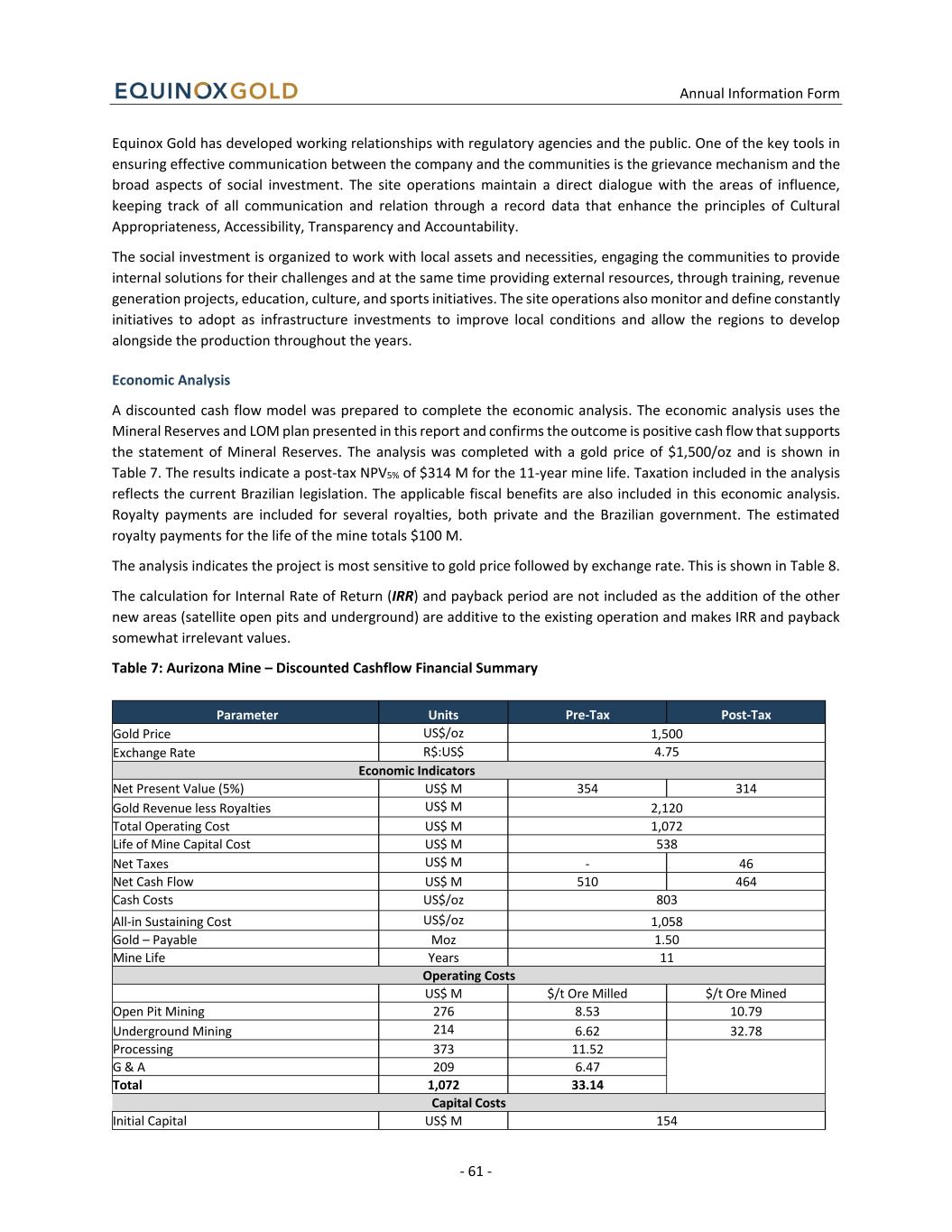
Annual Information Form - 61 - Equinox Gold has developed working relationships with regulatory agencies and the public. One of the key tools in ensuring effective communication between the company and the communities is the grievance mechanism and the broad aspects of social investment. The site operations maintain a direct dialogue with the areas of influence, keeping track of all communication and relation through a record data that enhance the principles of Cultural Appropriateness, Accessibility, Transparency and Accountability. The social investment is organized to work with local assets and necessities, engaging the communities to provide internal solutions for their challenges and at the same time providing external resources, through training, revenue generation projects, education, culture, and sports initiatives. The site operations also monitor and define constantly initiatives to adopt as infrastructure investments to improve local conditions and allow the regions to develop alongside the production throughout the years. Economic Analysis A discounted cash flow model was prepared to complete the economic analysis. The economic analysis uses the Mineral Reserves and LOM plan presented in this report and confirms the outcome is positive cash flow that supports the statement of Mineral Reserves. The analysis was completed with a gold price of $1,500/oz and is shown in Table 7. The results indicate a post-tax NPV5% of $314 M for the 11-year mine life. Taxation included in the analysis reflects the current Brazilian legislation. The applicable fiscal benefits are also included in this economic analysis. Royalty payments are included for several royalties, both private and the Brazilian government. The estimated royalty payments for the life of the mine totals $100 M. The analysis indicates the project is most sensitive to gold price followed by exchange rate. This is shown in Table 8. The calculation for Internal Rate of Return (IRR) and payback period are not included as the addition of the other new areas (satellite open pits and underground) are additive to the existing operation and makes IRR and payback somewhat irrelevant values. Table 7: Aurizona Mine – Discounted Cashflow Financial Summary Parameter Units Pre-Tax Post-Tax Gold Price US$/oz 1,500 Exchange Rate R$:US$ 4.75 Economic Indicators Net Present Value (5%) US$ M 354 314 Gold Revenue less Royalties US$ M 2,120 Total Operating Cost US$ M 1,072 Life of Mine Capital Cost US$ M 538 Net Taxes US$ M - 46 Net Cash Flow US$ M 510 464 Cash Costs US$/oz 803 All-in Sustaining Cost US$/oz 1,058 Gold – Payable Moz 1.50 Mine Life Years 11 Operating Costs US$ M $/t Ore Milled $/t Ore Mined Open Pit Mining 276 8.53 10.79 Underground Mining 214 6.62 32.78 Processing 373 11.52 G & A 209 6.47 Total 1,072 33.14 Capital Costs Initial Capital US$ M 154
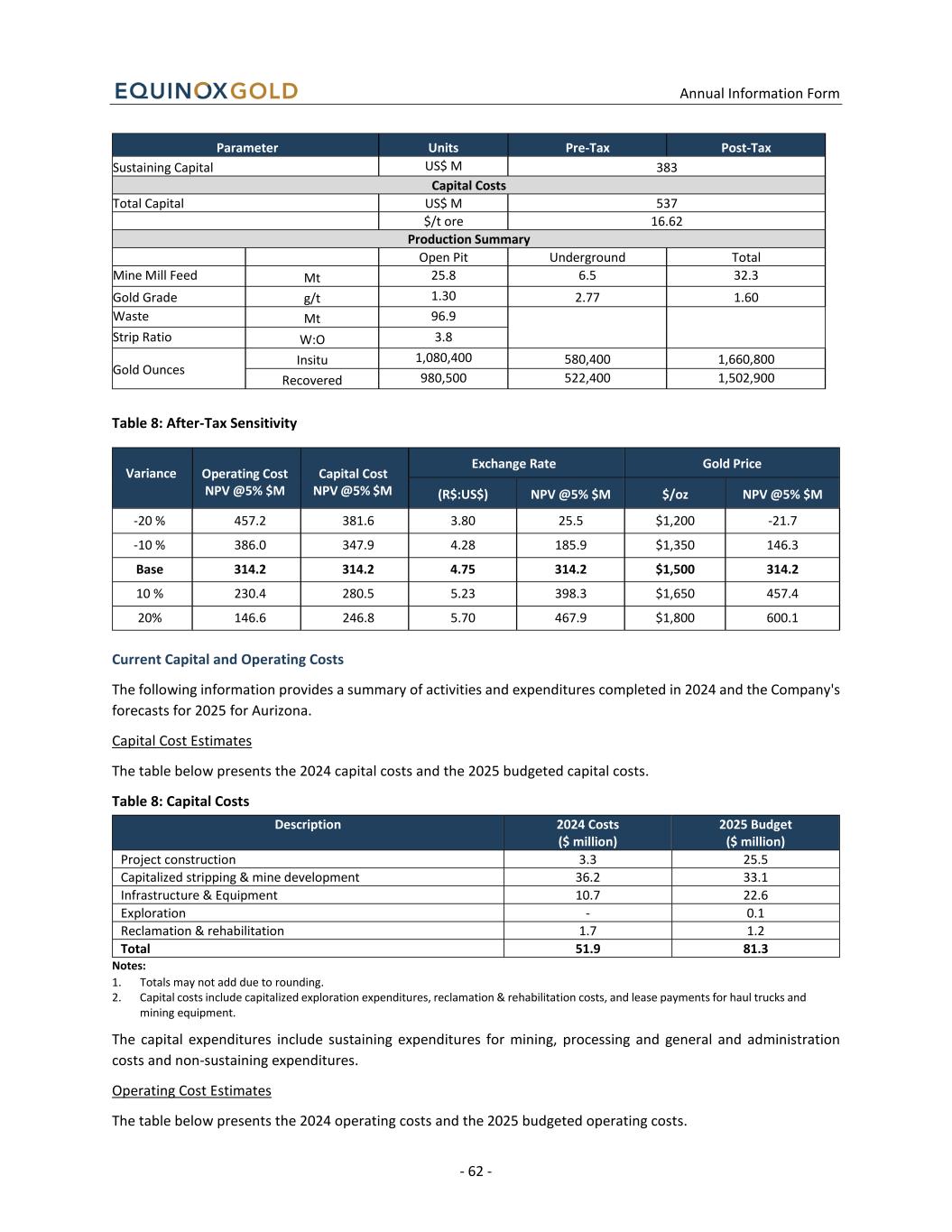
Annual Information Form - 62 - Table 8: After-Tax Sensitivity Variance Operating Cost NPV @5% $M Capital Cost NPV @5% $M Exchange Rate Gold Price (R$:US$) NPV @5% $M $/oz NPV @5% $M -20 % 457.2 381.6 3.80 25.5 $1,200 -21.7 -10 % 386.0 347.9 4.28 185.9 $1,350 146.3 Base 314.2 314.2 4.75 314.2 $1,500 314.2 10 % 230.4 280.5 5.23 398.3 $1,650 457.4 20% 146.6 246.8 5.70 467.9 $1,800 600.1 Current Capital and Operating Costs The following information provides a summary of activities and expenditures completed in 2024 and the Company's forecasts for 2025 for Aurizona. Capital Cost Estimates The table below presents the 2024 capital costs and the 2025 budgeted capital costs. Table 8: Capital Costs Description 2024 Costs ($ million) 2025 Budget ($ million) Project construction 3.3 25.5 Capitalized stripping & mine development 36.2 33.1 Infrastructure & Equipment 10.7 22.6 Exploration - 0.1 Reclamation & rehabilitation 1.7 1.2 Total 51.9 81.3 Notes: 1. Totals may not add due to rounding. 2. Capital costs include capitalized exploration expenditures, reclamation & rehabilitation costs, and lease payments for haul trucks and mining equipment. The capital expenditures include sustaining expenditures for mining, processing and general and administration costs and non-sustaining expenditures. Operating Cost Estimates The table below presents the 2024 operating costs and the 2025 budgeted operating costs. Parameter Units Pre-Tax Post-Tax Sustaining Capital US$ M 383 Capital Costs Total Capital US$ M 537 $/t ore 16.62 Production Summary Open Pit Underground Total Mine Mill Feed Mt 25.8 6.5 32.3 Gold Grade g/t 1.30 2.77 1.60 Waste Mt 96.9 Strip Ratio W:O 3.8 Gold Ounces Insitu 1,080,400 580,400 1,660,800 Recovered 980,500 522,400 1,502,900
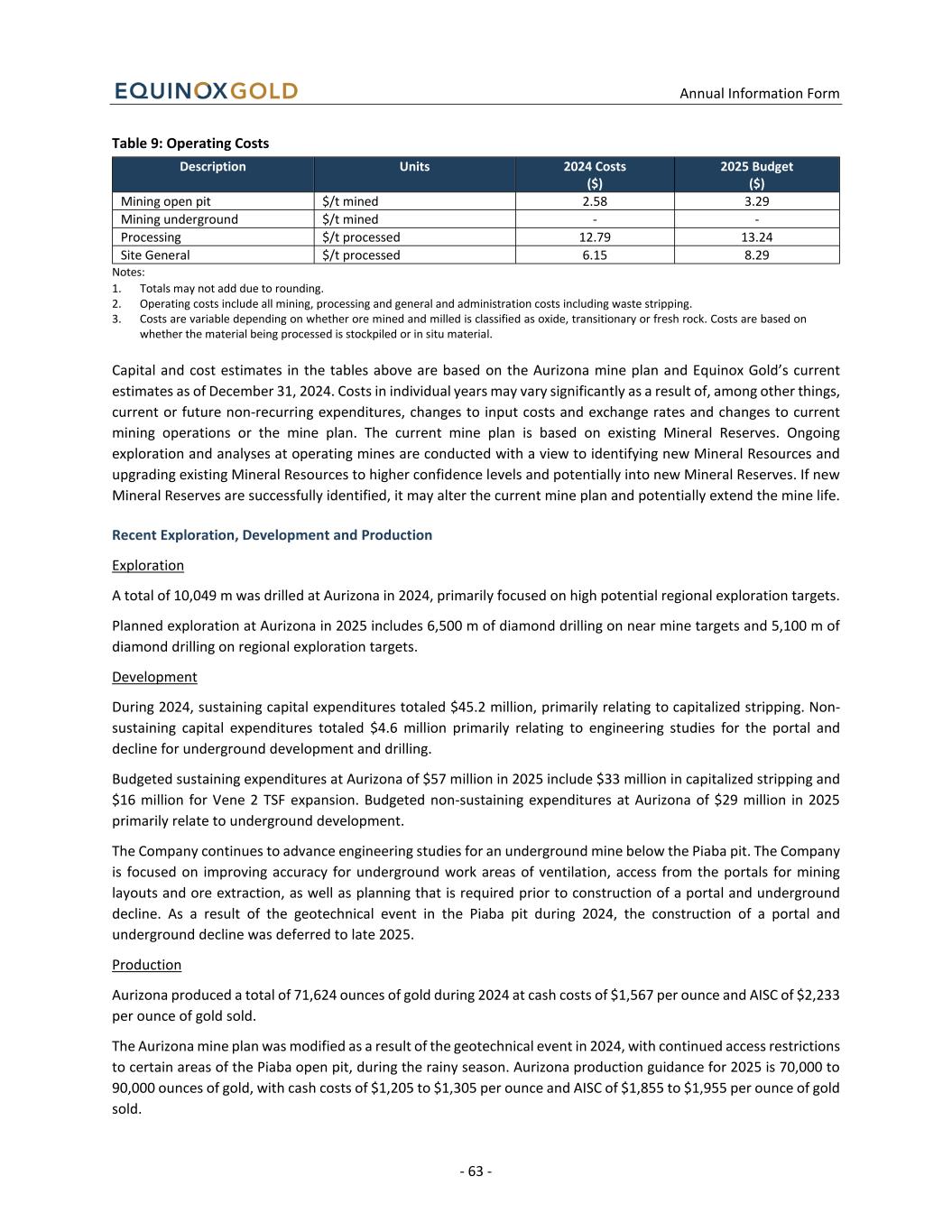
Annual Information Form - 63 - Table 9: Operating Costs Description Units 2024 Costs ($) 2025 Budget ($) Mining open pit $/t mined 2.58 3.29 Mining underground $/t mined - - Processing $/t processed 12.79 13.24 Site General $/t processed 6.15 8.29 Notes: 1. Totals may not add due to rounding. 2. Operating costs include all mining, processing and general and administration costs including waste stripping. 3. Costs are variable depending on whether ore mined and milled is classified as oxide, transitionary or fresh rock. Costs are based on whether the material being processed is stockpiled or in situ material. Capital and cost estimates in the tables above are based on the Aurizona mine plan and Equinox Gold’s current estimates as of December 31, 2024. Costs in individual years may vary significantly as a result of, among other things, current or future non-recurring expenditures, changes to input costs and exchange rates and changes to current mining operations or the mine plan. The current mine plan is based on existing Mineral Reserves. Ongoing exploration and analyses at operating mines are conducted with a view to identifying new Mineral Resources and upgrading existing Mineral Resources to higher confidence levels and potentially into new Mineral Reserves. If new Mineral Reserves are successfully identified, it may alter the current mine plan and potentially extend the mine life. Recent Exploration, Development and Production Exploration A total of 10,049 m was drilled at Aurizona in 2024, primarily focused on high potential regional exploration targets. Planned exploration at Aurizona in 2025 includes 6,500 m of diamond drilling on near mine targets and 5,100 m of diamond drilling on regional exploration targets. Development During 2024, sustaining capital expenditures totaled $45.2 million, primarily relating to capitalized stripping. Non- sustaining capital expenditures totaled $4.6 million primarily relating to engineering studies for the portal and decline for underground development and drilling. Budgeted sustaining expenditures at Aurizona of $57 million in 2025 include $33 million in capitalized stripping and $16 million for Vene 2 TSF expansion. Budgeted non-sustaining expenditures at Aurizona of $29 million in 2025 primarily relate to underground development. The Company continues to advance engineering studies for an underground mine below the Piaba pit. The Company is focused on improving accuracy for underground work areas of ventilation, access from the portals for mining layouts and ore extraction, as well as planning that is required prior to construction of a portal and underground decline. As a result of the geotechnical event in the Piaba pit during 2024, the construction of a portal and underground decline was deferred to late 2025. Production Aurizona produced a total of 71,624 ounces of gold during 2024 at cash costs of $1,567 per ounce and AISC of $2,233 per ounce of gold sold. The Aurizona mine plan was modified as a result of the geotechnical event in 2024, with continued access restrictions to certain areas of the Piaba open pit, during the rainy season. Aurizona production guidance for 2025 is 70,000 to 90,000 ounces of gold, with cash costs of $1,205 to $1,305 per ounce and AISC of $1,855 to $1,955 per ounce of gold sold.
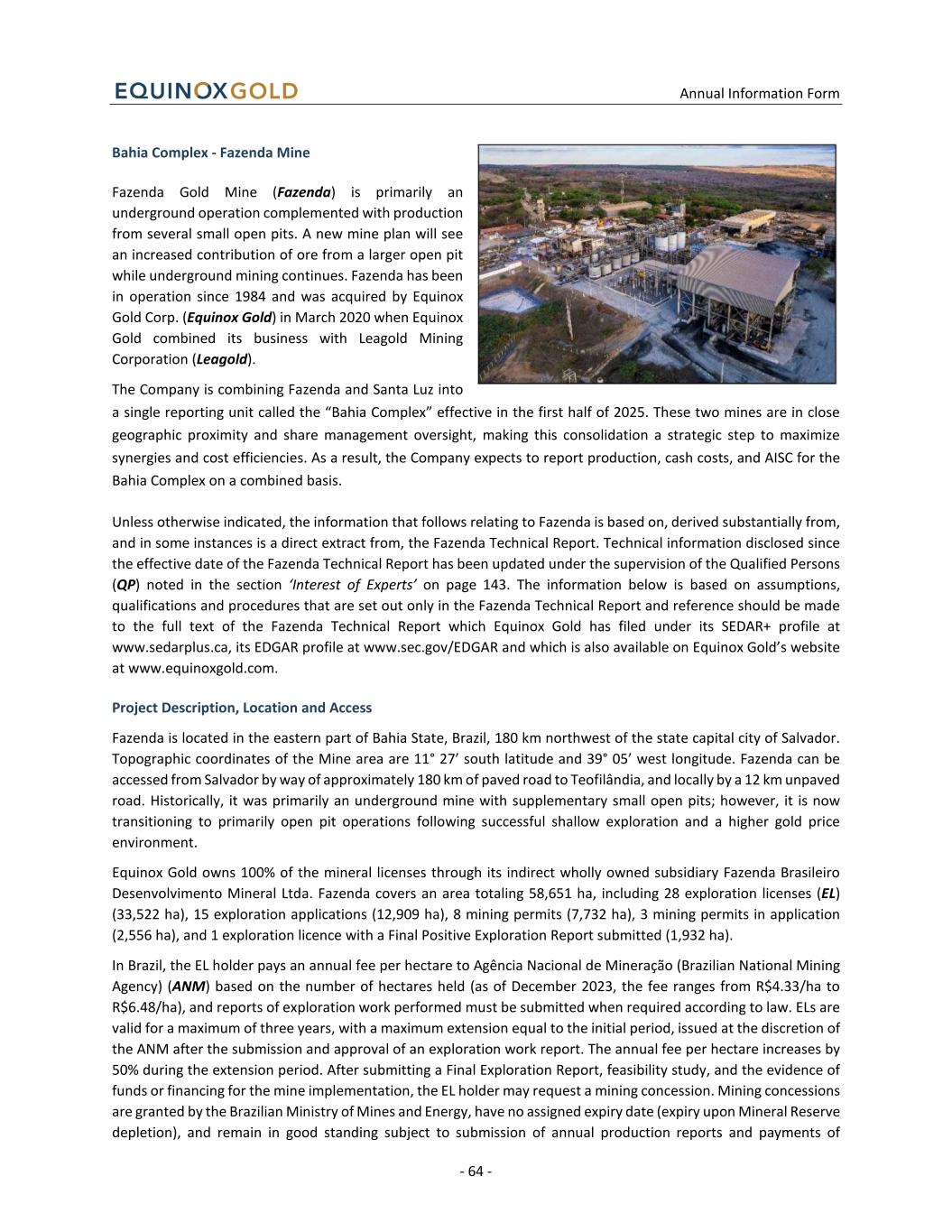
Annual Information Form - 64 - Bahia Complex - Fazenda Mine Fazenda Gold Mine (Fazenda) is primarily an underground operation complemented with production from several small open pits. A new mine plan will see an increased contribution of ore from a larger open pit while underground mining continues. Fazenda has been in operation since 1984 and was acquired by Equinox Gold Corp. (Equinox Gold) in March 2020 when Equinox Gold combined its business with Leagold Mining Corporation (Leagold). The Company is combining Fazenda and Santa Luz into a single reporting unit called the “Bahia Complex” effective in the first half of 2025. These two mines are in close geographic proximity and share management oversight, making this consolidation a strategic step to maximize synergies and cost efficiencies. As a result, the Company expects to report production, cash costs, and AISC for the Bahia Complex on a combined basis. Unless otherwise indicated, the information that follows relating to Fazenda is based on, derived substantially from, and in some instances is a direct extract from, the Fazenda Technical Report. Technical information disclosed since the effective date of the Fazenda Technical Report has been updated under the supervision of the Qualified Persons (QP) noted in the section ‘Interest of Experts’ on page 143. The information below is based on assumptions, qualifications and procedures that are set out only in the Fazenda Technical Report and reference should be made to the full text of the Fazenda Technical Report which Equinox Gold has filed under its SEDAR+ profile at www.sedarplus.ca, its EDGAR profile at www.sec.gov/EDGAR and which is also available on Equinox Gold’s website at www.equinoxgold.com. Project Description, Location and Access Fazenda is located in the eastern part of Bahia State, Brazil, 180 km northwest of the state capital city of Salvador. Topographic coordinates of the Mine area are 11° 27’ south latitude and 39° 05’ west longitude. Fazenda can be accessed from Salvador by way of approximately 180 km of paved road to Teofilândia, and locally by a 12 km unpaved road. Historically, it was primarily an underground mine with supplementary small open pits; however, it is now transitioning to primarily open pit operations following successful shallow exploration and a higher gold price environment. Equinox Gold owns 100% of the mineral licenses through its indirect wholly owned subsidiary Fazenda Brasileiro Desenvolvimento Mineral Ltda. Fazenda covers an area totaling 58,651 ha, including 28 exploration licenses (EL) (33,522 ha), 15 exploration applications (12,909 ha), 8 mining permits (7,732 ha), 3 mining permits in application (2,556 ha), and 1 exploration licence with a Final Positive Exploration Report submitted (1,932 ha). In Brazil, the EL holder pays an annual fee per hectare to Agência Nacional de Mineração (Brazilian National Mining Agency) (ANM) based on the number of hectares held (as of December 2023, the fee ranges from R$4.33/ha to R$6.48/ha), and reports of exploration work performed must be submitted when required according to law. ELs are valid for a maximum of three years, with a maximum extension equal to the initial period, issued at the discretion of the ANM after the submission and approval of an exploration work report. The annual fee per hectare increases by 50% during the extension period. After submitting a Final Exploration Report, feasibility study, and the evidence of funds or financing for the mine implementation, the EL holder may request a mining concession. Mining concessions are granted by the Brazilian Ministry of Mines and Energy, have no assigned expiry date (expiry upon Mineral Reserve depletion), and remain in good standing subject to submission of annual production reports and payments of
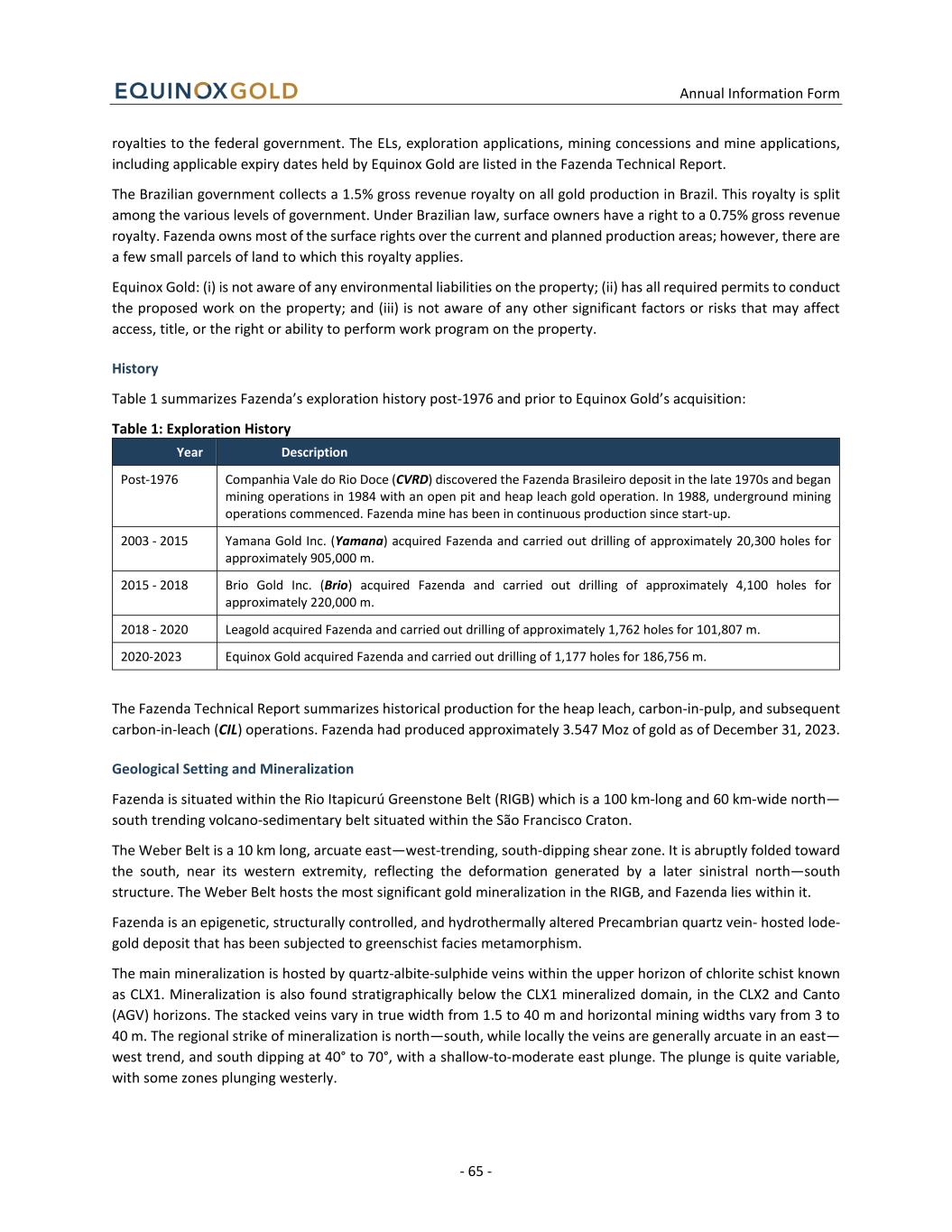
Annual Information Form - 65 - royalties to the federal government. The ELs, exploration applications, mining concessions and mine applications, including applicable expiry dates held by Equinox Gold are listed in the Fazenda Technical Report. The Brazilian government collects a 1.5% gross revenue royalty on all gold production in Brazil. This royalty is split among the various levels of government. Under Brazilian law, surface owners have a right to a 0.75% gross revenue royalty. Fazenda owns most of the surface rights over the current and planned production areas; however, there are a few small parcels of land to which this royalty applies. Equinox Gold: (i) is not aware of any environmental liabilities on the property; (ii) has all required permits to conduct the proposed work on the property; and (iii) is not aware of any other significant factors or risks that may affect access, title, or the right or ability to perform work program on the property. History Table 1 summarizes Fazenda’s exploration history post-1976 and prior to Equinox Gold’s acquisition: Table 1: Exploration History Year Description Post-1976 Companhia Vale do Rio Doce (CVRD) discovered the Fazenda Brasileiro deposit in the late 1970s and began mining operations in 1984 with an open pit and heap leach gold operation. In 1988, underground mining operations commenced. Fazenda mine has been in continuous production since start-up. 2003 - 2015 Yamana Gold Inc. (Yamana) acquired Fazenda and carried out drilling of approximately 20,300 holes for approximately 905,000 m. 2015 - 2018 Brio Gold Inc. (Brio) acquired Fazenda and carried out drilling of approximately 4,100 holes for approximately 220,000 m. 2018 - 2020 Leagold acquired Fazenda and carried out drilling of approximately 1,762 holes for 101,807 m. 2020-2023 Equinox Gold acquired Fazenda and carried out drilling of 1,177 holes for 186,756 m. The Fazenda Technical Report summarizes historical production for the heap leach, carbon-in-pulp, and subsequent carbon-in-leach (CIL) operations. Fazenda had produced approximately 3.547 Moz of gold as of December 31, 2023. Geological Setting and Mineralization Fazenda is situated within the Rio Itapicurú Greenstone Belt (RIGB) which is a 100 km-long and 60 km-wide north— south trending volcano-sedimentary belt situated within the São Francisco Craton. The Weber Belt is a 10 km long, arcuate east—west-trending, south-dipping shear zone. It is abruptly folded toward the south, near its western extremity, reflecting the deformation generated by a later sinistral north—south structure. The Weber Belt hosts the most significant gold mineralization in the RIGB, and Fazenda lies within it. Fazenda is an epigenetic, structurally controlled, and hydrothermally altered Precambrian quartz vein- hosted lode- gold deposit that has been subjected to greenschist facies metamorphism. The main mineralization is hosted by quartz-albite-sulphide veins within the upper horizon of chlorite schist known as CLX1. Mineralization is also found stratigraphically below the CLX1 mineralized domain, in the CLX2 and Canto (AGV) horizons. The stacked veins vary in true width from 1.5 to 40 m and horizontal mining widths vary from 3 to 40 m. The regional strike of mineralization is north—south, while locally the veins are generally arcuate in an east— west trend, and south dipping at 40° to 70°, with a shallow-to-moderate east plunge. The plunge is quite variable, with some zones plunging westerly.
Annual Information Form - 66 - Exploration Most of the recent exploration at Fazenda has been drilling to add new Mineral Resources and replace Mineral Reserves depleted during mining. Drilling was carried out from both the surface and underground and targeted areas between historical open pits, along strike of high-grade underground ore shoots, extending open mineralization, and infill drilling of areas with lower gold grades that are now potentially economic. Exploration potential exists along strike, at depth and between historical open pits and stopes. The exploration team is carrying out regional and near-mine exploration over several targets, including geological— structural mapping, outcrop sampling, geophysical surveys, soil geochemistry sampling, and early-stage exploratory drilling. The Fazenda geologic model and mineralization wireframes were rebuilt between 2022 and 2024 with a focus on geological continuity, shear zone architecture, and exploration potential. These new models have allowed for better exploration drill targeting outside of known Mineral Resources. An aggressive exploration program for 2025, based on the revised geological model and new Mineral Resource estimate, has been approved that includes a high-resolution aeromagnetic survey, geologic mapping, soil sampling at several prospects, and approximately 61,000 m of near-mine diamond drilling from both underground and surface. Drilling Prior to 2003, CVRD conducted surface diamond drilling in the initial search for new mineralization. This was followed by underground fan drilling on a 100 m by 50 m grid using B-sized core drilling equipment to establish Indicated Mineral Resources. A-sized core drilling on a 25 m by 10 m grid pattern was then used to upgrade the classification of Mineral Resources from Indicated to Measured. Since 2003, both Yamana and Brio maintained the same methodology of drilling as CVRD. Between 2018 and 2019 Leagold completed approximately 101,807 m of diamond drill-hole (DDH) drilling, primarily focused on grade control and resource conversion. Between 2020 and 2023 Equinox Gold completed approximately 266,002 m of DDH and reverse circulation (RC) drilling, comprising programs for grade control, resource conversion, and exploration between, below, and on strike from historical pits, including both DDH and RC. Results from 197,098 m of this drilling have been included in the updated MRE. Sampling, Analysis and Data Verification Sample Preparation, Analyses and Security Samples generated by Fazenda between 2021 and 2023 that inform the MRE were processed and assayed at one of three laboratories (on-site lab, ALS and SGS). Sample preparation and assaying procedures at Fazenda laboratory are as follows: • All core samples are coarse-crushed to P90 2.0 mm. • This material is passed through a rotary splitter. A 500 g aliquot is taken and pulverized to P95 150 mesh. The crushing and grinding equipment are cleaned with compressed air after each sample, and barren silica sand is passed through the equipment prior to running batches of samples. 50 g aliquot is analyzed using fire assay with an Atomic Absorption Spectrometry finish. Granulometric
Annual Information Form - 67 - tests are performed three times per shift on the crushing and pulverizing processes. Preparation duplicates are inserted every 20 to 30 samples. Sample preparation and assaying procedures at ALS laboratory are as follows: • PREP-31 or the custom preparation package PREP-33Y (crush to P90 2.0 mm, riffle splitter, 500 g aliquot pulverized to P95 150 mesh). • Assayed using Au-AA23 or Au-AA24 (fire assay on a 30 or 50 g aliquot, resp., with an AA finish). Samples with assay results over 10 ppm Au were reanalyzed using Au-SCR21 or Au-SCR24. Equipment is cleaned with compressed air between samples. Barren wash material is passed through the equipment between sample batches. Crushing and pulverizing quality is monitored, with sieving prepared materials at least every 1 in 50 samples. Preparation duplicates are inserted every 50 samples. Samples sent to the SGS laboratory are processed and assayed as follows: • Crushed to P75 2.0 mm, riffle splitter, 1,000 g aliquot pulverized to P85 200 mesh. • Assayed according to procedure FAA505 (fire assay on a 50 g aliquot with an AA finish). Samples with assay results over 10 ppm Au were reanalyzed using FAASCR. SGS laboratory inserts QC samples including blanks, duplicates, and certified reference materials (CRM), at a 14% total frequency. The mine site is surrounded by a security fence, and there is controlled access at a gatehouse, staffed full time by security personnel. At the drill site, samples are under the control of Fazenda employees and employees of the drilling company. Drilling company personnel deliver samples daily to Fazenda personnel at the mine’s sample processing facility. Only employees of Fazenda and of the drilling contractor are authorized to be at the drill sites and in the sample processing facility. Core is normally collected from the drill rig and taken directly to the core facility for processing and sampling. Samples are then sent directly to the chosen laboratory. All analytical pulps and archival split core are stored in a secure building within the mine fence. The quality assurance/quality control (QA/QC) program used at Fazenda includes inserting CRM, blanks, and duplicates into the sample stream. Fazenda personnel reviewed the QA/QC results from each drill hole upon receipt of assay results. Failed sample inserts, and five samples preceding and following the insert, were re-assayed by the respective primary laboratory. Monthly QA/QC summary reports that document all QA/QC activities and results are prepared. The Fazenda laboratory was previously accredited with ISO 17025:2005 and ISO 9001:2008. Although the lab is not currently ISO-accredited, the same procedures are followed as were followed when it was accredited. Data Verification Dr. Benoit Poupeau, the QP for the MRE, carried out comprehensive verification of the geological data, drilling, sampling, and assay results used to generate the MRE. The verification process involved a review of the procedures for both diamond drill core and RC drilling to ensure that the sampling and analytical methods meet industry standards. Additionally, Dr. Poupeau conducted an in-depth assessment of data integrity across multiple laboratories, with particular attention to resolving issues identified in assays from the Fazenda mine laboratory. The samples analyzed by the mine laboratory originate from now mined-out sections of the orebody and are representative of historical production, and have little to no impact on remaining Mineral Reserves and Mineral Resources. Independent verification was not completed; however, several external laboratories, including SGS and ALS, are routinely used as second or third laboratories to verify assay results (lab checks) and confirm the existence of no systematic bias. Check assays are regularly conducted between the mine laboratory, SGS, and ALS to ensure the accuracy and reliability of the data.
Annual Information Form - 68 - The data verification process for the Fazenda was comprehensive and thorough. Site visits, database validation, QA/QC review, and check assays collectively confirm that the data used in the MRE are accurate and reliable. Although the QP identified potential issues with some samples assayed by the mine lab, the data from areas that have already been mined out showed no significant discrepancies with the historical mill reconciliation. Consequently, these issues are not expected to affect other areas of the orebody or compromise the overall quality of the MRE. Mineral Processing and Metallurgical Testing Fazenda currently operates at P80 75 μm recovering 90.6% on average, after a series of process improvements implemented in 2019, 2020 and 2021 to improve the gold extraction efficiency as the feed grade decreased each year. To reduce gold recovery losses with more carbonaceous ore in the blend, kerosene is now used, which enables a gold recovery increase of approximately 2%. A pre-aeration tank was transformed into a pre-lime tank at a dosage of pH 10.2. The outcome of this process-change was an increase in lead nitrate effectiveness that resulted in an approximately 10% reduction in cyanide consumption and an approximately 2% increase in gold recovery. Fazenda investigated an increase of the dissolved oxygen in the pre-aeration tanks to improve the gold dissolution and thereby increase gold recovery. The test work entailed dosing hydrogen peroxide in the pre-aeration tanks at 200 g/t. The current first step of the elution process is desorption. The second step is acid washing, which removes base metals and scaling compounds such as calcium carbonate and sodium silicate from the carbon after the elution. The current elution recovery is approximately 90%. A new 500 kg/h capacity regeneration kiln was installed in 2021 to more efficiently regenerate the total carbon in the circuit. Structural refurbishments within the processing area continue to replace support pillars and platforms for the leaching tanks, tanks and channels within the leaching area, and support beams for the desorption and mill buildings. The old CVRD heap leaching waste dumps show a potential for processing in the future, with an estimated 3 Mt of oxidized material at an estimated average grade of 0.6 g/t Au. Several testwork programs have been carried out, which resulted in gold recoveries higher than 70%. A heap leaching pilot pad test has been planned to confirm gold recovery at a larger scale. Mineral Resource and Mineral Reserve Estimates Mineral Resource Estimate Dr. Benoit Poupeau prepared the MRE as of June 30, 2024. The MRE was prepared using a three-dimensional block model to estimate the Mineral Resources, incorporating data from grade-control and exploration drilling that Equinox Gold has conducted since 2021. The model was prepared using appropriate methodology and assumptions, including: • Capping of high assays • Compositing length • Search parameters • Bulk density • Grade-estimate validation • Cut-off grade • Classification.
Annual Information Form - 69 - Table 2 summarizes the updated MRE exclusive of Mineral Reserves, as of June 30, 2024. The MRE conforms to CIM Definition Standards (2014). The responsible QP is not aware of any environmental, permitting, legal, title, taxation, socioeconomic, marketing, political, or other relevant issues that would materially affect the MRE. Table 2: Mineral Resources Summary (Exclusive of Reserves) - June 30, 2024 Category Tonnage (kt) Gold Grade (g/t) Contained Gold (koz) Measured Underground 12,646 2.49 1,014 Open Pit 5,772 1.80 334 Total Measured 18,418 2.28 1,348 Indicated Underground 2,302 2.01 149 Open Pit 698 1.23 28 Total Indicated 3,000 1.83 176 Measured + Indicated Underground 14,948 2.42 1,163 Open Pit 6,470 1.74 361 Total Measured + Indicated 21,418 2.21 1,524 Inferred Inferred—Underground 2,088 2.29 154 Inferred—Open Pit 2,593 1.35 113 Total Inferred 4,681 1.77 266 Notes: 1. CIM Definition Standards (CIM, 2014) definitions were followed for the classification of Mineral Resources. 2. Mineral Resources are reported exclusive of Mineral Reserves. 3. Open pit Mineral Resources are reported within conceptual pit shells at a cut-off grade of 0.5 g/t Au, based on a gold price of $1,700/oz, mining cost of $1.79/t to $2.70/t, processing cost of $14.60/t, G&A cost of $4.69/t, recovery of 75% to 90%, and an exchange rate of R$4.80:US$1.00. 4. Underground Mineral Resources are reported within conceptual stope shapes based on a gold price of $2,000/oz, mining cost of $36.20/t, processing cost of $14.60/t, G&A cost of $4.69/t, recovery of 86% to 90%, a cut-off grade of 1.0 g/t Au, and an exchange rate of R$4.80:US$1.00. 5. Mineral Resources that are not Mineral Reserves do not have demonstrated economic viability. 6. Benoit Poupeau, FAusIMM (CP), a QP as defined by NI 43-101, who is independent of Equinox Gold, prepared the MRE. 7. Totals may not sum precisely due to rounding. Mineral Reserve Estimate AMC Mining Consultants Canada Ltd. prepared the Mineral Reserve estimate as of June 30, 2024. The Mineral Reserve estimates have been prepared using appropriate methodology and assumptions. The responsible QPs are of the opinion that the Measured and Indicated Mineral Resources within the final pits and underground stope designs may be classified as Proven and Probable Mineral Reserves, and are not aware of any mining, metallurgical, infrastructure, permitting, or other relevant factors that could materially affect the Mineral Reserve estimate.
Annual Information Form - 70 - Table 3: Mineral Reserves Summary - June 30, 2024 Category Tonnage (kt) Gold Grade (g/t) Contained Gold (koz) Proven Underground 1,935 1.99 124 Open Pit 10,358 1.79 595 Subtotal Proven 12,293 1.82 719 Probable Underground 462 1.90 28 Open Pit 386 1.27 16 Stockpile 20 0.99 1 Subtotal Probable 868 1.60 45 Total Proven & Probable 13,161 1.80 763 Notes: 1. CIM Definition Standards (CIM, 2014) were followed for Mineral Reserves. 2. Mineral Reserves are reported at a cut-off grade of 1.36 g/t Au for underground stoping and 0.43 g/t Au for underground development, at a cut-off grade between 0.54 and 0.66 g/t Au for open pits. 3. Mineral Reserves are estimated using an average long-term gold price of US$1,500/oz for open pits and $1,800/oz for underground, and an exchange rate of R$4.80:US$1.00. 4. A minimum mining width of 2.0 m was used for underground Mineral Reserves. 5. The QP for open pit is David Warran, P.Eng., of AMC Mining Consultants (Canada) Ltd. 6. The QP for underground is Dominic Claridge, FAusIMM, of AMC Consultants (UK) Limited. 7. Mineral Reserves include dilution and mining recovery. 8. Numbers may not sum precisely due to rounding. Mining Operations Underground The underground mining method is longhole open stoping from levels accessed via decline development in the mineralization footwall. The stoping areas are accessed via 5 m wide by 5.5 m high main haulage ramps developed at a 15% gradient, which lead to primary development crosscuts that are 4.5 m wide by 4.9 m high, and secondary development drifts. Levels are spaced at 20 m vertical intervals. Mined out stopes are not backfilled. Active underground mining is being undertaken within areas known as Canto 1, UG Main, F, and G. A new underground mine, Canto 2, is planned to be developed following completion of the Canto 2 open pit. Mining operations have a planned dilution of between 15% and 20%. Planned mining recovery is estimated to be 90% for all areas. From each level, access drifts are developed into the stoping areas, and blastholes fan-drilled into the mineralization are used to further define the boundaries of the mineralization and design the ultimate blast patterns. After blasting, remote-controlled, 10-tonne-capacity load-haul-dump machines are used to load and haul the ore from the stoping areas to 38-tonne-capacity haulage trucks at loading points in the sublevels. Waste rock is generally hauled to surface and deposited in waste rock storage areas but is dumped into empty voids where practicable. Open Pit Currently, several small open pits are in operation, in the CLX area, and mining is being completed using contractors. Initial work has commenced on expanding shallow open pits to include excavating the remaining underground crown pillars. CLX Central, East and West will be the major pits, with Canto 1, Canto 2, PPQ, LG and G to be minor pits. The small pits are being developed using air-track drills and backhoe excavators for mining, and highway-type trucks for
Annual Information Form - 71 - haulage to the mill. From 2027 onwards, a larger contractor fleet consisting of 100-ton trucks (i.e., CAT 777 or similar) and appropriately matched loading units (i.e., Hitachi EX2500 for waste and Komatsu EX1250 for ore, or similar) is anticipated for the larger CLX pit. The CLX ultimate pit and phases have been designed appropriately to accommodate the larger fleet size. Processing and Recovery Operations The plant is scheduled to process approximately 3,945 t/d (1.44 Mt/a). The overall process flowsheet consists of: • Three-stage crushing circuit • Two grinding ball mills, closed circuit with hydrocyclones • Thickener to produce a leach feed of 50% solids • Cyanide leaching circuit • Zadra pressure-stripping of the carbon • Electrowinning of the carbon eluent • Casting of gold doré bars in an induction furnace. Infrastructure, Permitting and Compliance Activities Infrastructure All the necessary infrastructure for the operation is in place, which includes, but is not limited to a 470 m vertical shaft; a series of underground ramps; underground ventilation and dewatering facilities; power supply system; the CIL milling and processing facility; associated process equipment from a previous heap leach operation; geomembrane-lined tailings storage facilities; waste rock storage facilities; warehouse; maintenance shops; drill core logging, splitting, and storage facilities; assay laboratory; cafeteria; helipad for emergency use and shipment of gold doré bars; office complexes; water supply system; and a fuel station. Fazenda has all the necessary roads, power lines, access, and medical facilities for workers and services to the mine. Water is supplied by a series of well fields with a total production capacity of 310 m3/h. The power requirement for the mine and site facilities is approximately 9.95 MW, which is supplied by the local grid. Emergency backup power has been established in the form of diesel generators. One of the main constraints on Fazenda’s production is frequent outages of the COELBA power grid; this made it necessary to install diesel generator sets as a back-up to keep the agitators operating to avoid settling inside the leaching tanks. Permitting and Compliance Fazenda has developed a comprehensive environmental policy that has been developed in line with the Mine Closure Plan (MCP), as required by ANM. The environmental authorities in Brazil use the MCP as a commitment to complete the rehabilitation required for mine closure. The guidelines primarily involve revegetating the areas with native species, covering the pits, or converting the pits to store water, along with stabilizing and rehabilitating waste dumps and tailings dams. Demolishing and removing all structures and facilities that will not be used in the future is also included. All required environmental licences and permits to conduct the proposed work on the property are in good standing or are in the process of being renewed. Fazenda has developed a program for social and community involvement in the area of the Fazenda operations, which should be maintained for the life of the mine. The main socioeconomic impacts that will be generated by the
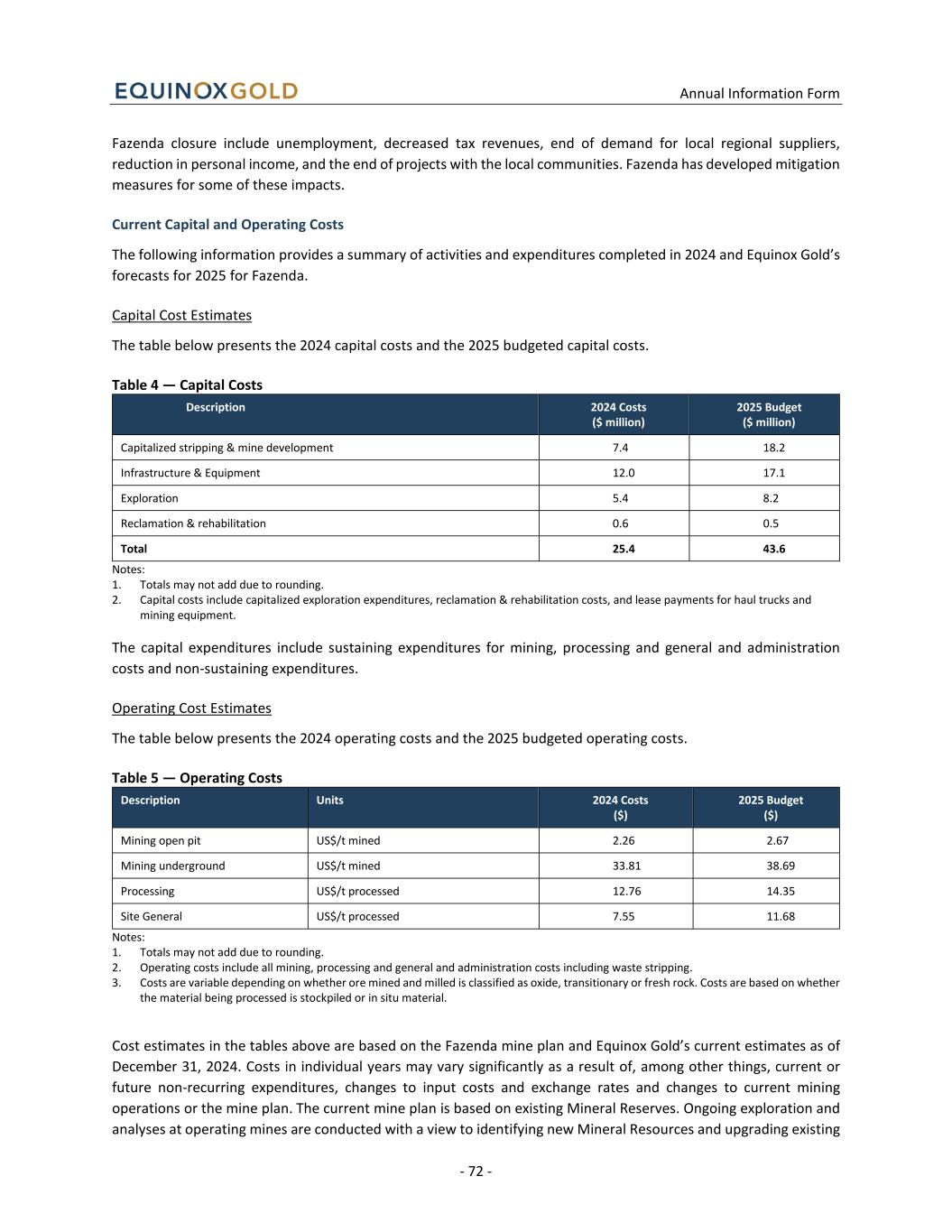
Annual Information Form - 72 - Fazenda closure include unemployment, decreased tax revenues, end of demand for local regional suppliers, reduction in personal income, and the end of projects with the local communities. Fazenda has developed mitigation measures for some of these impacts. Current Capital and Operating Costs The following information provides a summary of activities and expenditures completed in 2024 and Equinox Gold’s forecasts for 2025 for Fazenda. Capital Cost Estimates The table below presents the 2024 capital costs and the 2025 budgeted capital costs. Table 4 — Capital Costs Description 2024 Costs ($ million) 2025 Budget ($ million) Capitalized stripping & mine development 7.4 18.2 Infrastructure & Equipment 12.0 17.1 Exploration 5.4 8.2 Reclamation & rehabilitation 0.6 0.5 Total 25.4 43.6 Notes: 1. Totals may not add due to rounding. 2. Capital costs include capitalized exploration expenditures, reclamation & rehabilitation costs, and lease payments for haul trucks and mining equipment. The capital expenditures include sustaining expenditures for mining, processing and general and administration costs and non-sustaining expenditures. Operating Cost Estimates The table below presents the 2024 operating costs and the 2025 budgeted operating costs. Table 5 — Operating Costs Description Units 2024 Costs ($) 2025 Budget ($) Mining open pit US$/t mined 2.26 2.67 Mining underground US$/t mined 33.81 38.69 Processing US$/t processed 12.76 14.35 Site General US$/t processed 7.55 11.68 Notes: 1. Totals may not add due to rounding. 2. Operating costs include all mining, processing and general and administration costs including waste stripping. 3. Costs are variable depending on whether ore mined and milled is classified as oxide, transitionary or fresh rock. Costs are based on whether the material being processed is stockpiled or in situ material. Cost estimates in the tables above are based on the Fazenda mine plan and Equinox Gold’s current estimates as of December 31, 2024. Costs in individual years may vary significantly as a result of, among other things, current or future non-recurring expenditures, changes to input costs and exchange rates and changes to current mining operations or the mine plan. The current mine plan is based on existing Mineral Reserves. Ongoing exploration and analyses at operating mines are conducted with a view to identifying new Mineral Resources and upgrading existing
Annual Information Form - 73 - Mineral Resources to higher confidence levels and potentially into new Mineral Reserves. If new Mineral Reserves are successfully identified it may alter the current mine plan and potentially extend the mine life. Recent Exploration, Development and Production Exploration During 2024, Equinox Gold drilled 63,785 m of core focused on Mineral Reserve replacement in the immediate underground mine area. Surface exploration drilling for the year included 6,896 m of core drilling. Planned exploration at Fazenda in 2025 includes 57,000 m of core drilling in the immediate underground mine area and 4,000 m of surface drilling on brownfields and regional targets. Development During 2024, sustaining capital totaled $15 million, primarily relating to mobile equipment, underground development and capital stripping. Non-sustaining capital expenditures totaled $10.6 million, primarily relating to exploration drilling and underground development. Fazenda is part of the Bahia Complex. Sustaining expenditures at Bahia Complex of $70 million in 2025 primarily relate to capitalized stripping, acquisition of equipment and components, exploration, infrastructure and vegetation clearing, a TSF raise, and underground development. Non-sustaining expenditures of $12 million in 2025 relate primarily to underground development and exploration. Production Fazenda produced a total of 62,382 ounces of gold during 2024 at cash costs of $1,366 per ounce and AISC of $1,647 per ounce of gold sold. Bahia Complex production guidance for 2025 is 125,000 to 145,000 ounces of gold, with cash costs of $1,360 to $1,460 per ounce and AISC of $1,845 to $1,945 per ounce of gold sold.
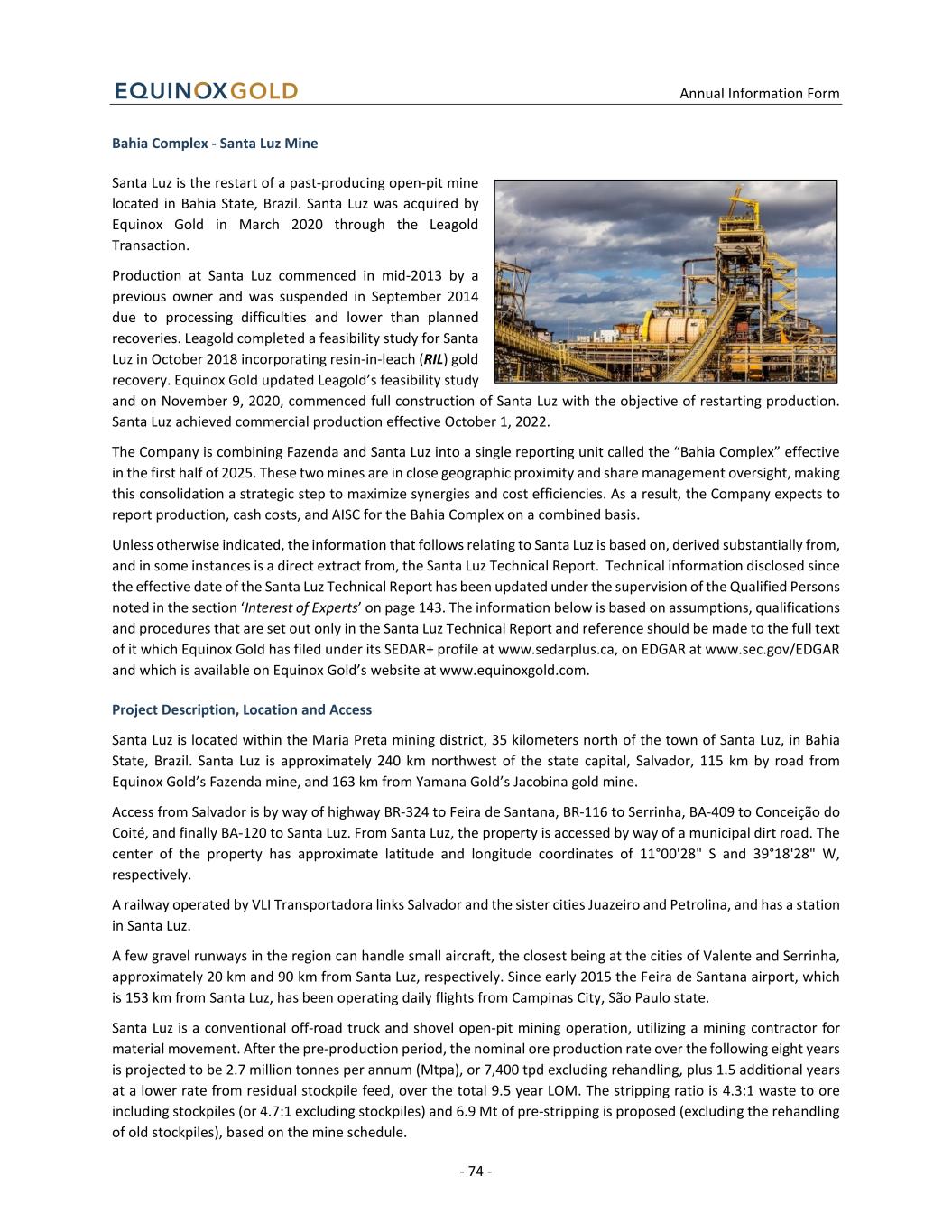
Annual Information Form - 74 - Bahia Complex - Santa Luz Mine Santa Luz is the restart of a past-producing open-pit mine located in Bahia State, Brazil. Santa Luz was acquired by Equinox Gold in March 2020 through the Leagold Transaction. Production at Santa Luz commenced in mid-2013 by a previous owner and was suspended in September 2014 due to processing difficulties and lower than planned recoveries. Leagold completed a feasibility study for Santa Luz in October 2018 incorporating resin-in-leach (RIL) gold recovery. Equinox Gold updated Leagold’s feasibility study and on November 9, 2020, commenced full construction of Santa Luz with the objective of restarting production. Santa Luz achieved commercial production effective October 1, 2022. The Company is combining Fazenda and Santa Luz into a single reporting unit called the “Bahia Complex” effective in the first half of 2025. These two mines are in close geographic proximity and share management oversight, making this consolidation a strategic step to maximize synergies and cost efficiencies. As a result, the Company expects to report production, cash costs, and AISC for the Bahia Complex on a combined basis. Unless otherwise indicated, the information that follows relating to Santa Luz is based on, derived substantially from, and in some instances is a direct extract from, the Santa Luz Technical Report. Technical information disclosed since the effective date of the Santa Luz Technical Report has been updated under the supervision of the Qualified Persons noted in the section ‘Interest of Experts’ on page 143. The information below is based on assumptions, qualifications and procedures that are set out only in the Santa Luz Technical Report and reference should be made to the full text of it which Equinox Gold has filed under its SEDAR+ profile at www.sedarplus.ca, on EDGAR at www.sec.gov/EDGAR and which is available on Equinox Gold’s website at www.equinoxgold.com. Project Description, Location and Access Santa Luz is located within the Maria Preta mining district, 35 kilometers north of the town of Santa Luz, in Bahia State, Brazil. Santa Luz is approximately 240 km northwest of the state capital, Salvador, 115 km by road from Equinox Gold’s Fazenda mine, and 163 km from Yamana Gold’s Jacobina gold mine. Access from Salvador is by way of highway BR-324 to Feira de Santana, BR-116 to Serrinha, BA-409 to Conceição do Coité, and finally BA-120 to Santa Luz. From Santa Luz, the property is accessed by way of a municipal dirt road. The center of the property has approximate latitude and longitude coordinates of 11°00'28" S and 39°18'28" W, respectively. A railway operated by VLI Transportadora links Salvador and the sister cities Juazeiro and Petrolina, and has a station in Santa Luz. A few gravel runways in the region can handle small aircraft, the closest being at the cities of Valente and Serrinha, approximately 20 km and 90 km from Santa Luz, respectively. Since early 2015 the Feira de Santana airport, which is 153 km from Santa Luz, has been operating daily flights from Campinas City, São Paulo state. Santa Luz is a conventional off-road truck and shovel open-pit mining operation, utilizing a mining contractor for material movement. After the pre-production period, the nominal ore production rate over the following eight years is projected to be 2.7 million tonnes per annum (Mtpa), or 7,400 tpd excluding rehandling, plus 1.5 additional years at a lower rate from residual stockpile feed, over the total 9.5 year LOM. The stripping ratio is 4.3:1 waste to ore including stockpiles (or 4.7:1 excluding stockpiles) and 6.9 Mt of pre-stripping is proposed (excluding the rehandling of old stockpiles), based on the mine schedule.
Annual Information Form - 75 - Surface Rights The Santa Luz properties cover an area totaling 48,599.25 ha, including 36 exploration permits (42,666.41 ha), six mining concessions (2,611.69 ha), and four mining concessions in application (3,321.15 ha). Of the 36 exploration permits, eight are at the exploration stage with a Partial Exploration Report submitted to ANM requesting a deadline extension (9,849.47 ha); two are at final exploration stage with the Positive Final Exploration Report already submitted to ANM (1,885.88 ha), indicating reasonable prospects to continue with economical analyses and subsequent mining concession application after ANM’s approval of reports; five are at the final exploration stage with the Negative Final Exploration Report already submitted to ANM (6,711.28 ha), which means that these areas should be considered available after ANM’s approval of reports; and the remaining twenty-one permits are at an exploration stage (24,219.78 ha). One of the exploration permits expired during 2020 and is either in the process of submission of reports or will lapse. This exploration permit does not impact the Mineral Resources or Mineral Reserves, or future operations. The Santa Luz claims cover several farms. Agreements were signed between Yamana and the landowners to allow mining and exploration activities, and these agreements have been transferred to Equinox Gold. Equinox Gold has verified that there are no environmental liabilities on the property. Equinox Gold has all required permits to conduct work on the properties. These permits and their status are listed and described in Section 20 of the Santa Luz Technical Report. Equinox Gold has verified that there are no other significant factors and risks that may affect access, title, or the right or ability to perform the proposed work program on the property. Royalties Royalty agreements currently exist with the Federal Government for 1.5% of gross revenue and with Companhia Sisal do Brasil (COSIBRA) for 1% of gross revenue, and were included in the cash flow and pit optimization analysis. An additional 2% royalty was included for the Companhia Baiana de Pesquisa Mineral (CBPM) area of the C1 deposit. Subsequent to the date of the Santa Luz Report, the COSIBRA royalty was increased to 1.375% of gross revenue. History During the 1970s, Companhia Vale do Rio Doce (CVRD) invested in a regional prospecting program in Bahia state, while other private and state companies carried out intensive prospecting, geological mapping, and research programs. During this time, the Rio Itapicurú Greenstone Belt (RIGB) was identified. Between 1979 and 1981, CBPM conducted several geological and prospecting programs within the RIGB. These activities identified several gold-bearing trends and prospects including deposits within the Santa Luz area, which were mined between 1987 and 1995 by CBPM’s subsidiary Rio Salitre Mineração Ltda. In January 2005, Yamana completed an agreement with CBPM to acquire 7,000 ha of land over the C1 historic mine. Under this agreement, CBPM retains a 2% royalty interest in these concessions. In May 2007, Yamana expanded its land ownership through the acquisition of mining concessions from Mineração Santa Elina (MSE), formerly owned by CVRD, which included the Antas 1, Antas 2, and Antas 3 deposits and associated historic mine workings. The 2007 agreement also retained a royalty interest which was transferred from MSE to Callix Finance Inc. in April 2014 and was finally extinguished through an agreement between Yamana and Callix Finance Inc. in March 2015. In December 2014, it was announced that a new subsidiary, Brio Gold Inc., (Brio) was formed by Yamana to hold Fazenda, Pilar through Companhia Goiana de Ouro, and Santa Luz, as well as some related exploration concessions, all of which were held as non-core assets within Yamana. Brio became an independent, publicly traded company in December 2016. Leagold acquired Brio on May 24, 2018 and became the owner of Santa Luz. On March 10, 2020 Equinox Gold acquired Leagold and became the owner of Santa Luz.
Annual Information Form - 76 - Geological Setting, Mineralization and Deposit Types The Santa Luz project area is hosted within the RIGB, which comprises the northeastern portion of the São Francisco Craton which was formed through the collision of several small Archean cratons during the Paleoproterozoic Trans- Amazon Orogeny (approximately 2 Ga). The Paleoproterozoic aged RIGB is the largest greenstone belt in the São Francisco Craton. Thought to be formed in a back-arc tectonic setting, the north-south trending RIGB extends for approximately 100 km and ranges in width from 30 km to 50 km. It is comprised of three domains (mafic volcanic, felsic volcanic, and sedimentary), all intruded by later granitioid bodies. Gold deposits and prospects in the Santa Luz project area occur in shear and breccia zones at, or proximal to, the faulted contact of the volcanic and sedimentary domains in a continuous, north and locally northeasterly-striking, mineralized zone. Mineralization is associated with quartz-carbonate-sulphide veining and breccia fillings. Significant gold targets and deposits at Santa Luz include C1 (historically called Maria Preta and including Antas 1), Antas 2, Antas 3, Mansinha South, Mansinha North, and Mari. The deposits are considered to be greenstone-hosted gold type deposits, a subgroup of the Orogenic Gold Deposit type. Host rocks include a variety of epizonal dioritic and dacitic intrusive rocks, sedimentary rocks, and felsic to intermediate volcanic rocks. Volcanic and epizonal intrusive rocks are generally porphyritic with fine to medium grained quartz and feldspar phenocrysts. Sedimentary rocks, including tuffaceous rocks, contain variable quantities of organic carbon which appears to be a primary depositional component. More massive volcanic and epizonal intrusive rocks are relatively free of organic carbon. The organic carbon content is a major focus of geologic studies as the carbon interferes with cyanide leach gold recovery. Organic carbon-rich rocks require special treatment to facilitate gold recovery. All rocks of the RIGB have undergone greenschist to amphibolite grade metamorphism. Exploration From 1979 to 1995, CVRD and CBPM undertook several extensive stream sediment and soil geochemistry programs over the entire Maria Preta Gold District in the RIGB. Encouraging results were followed up using geophysics and drilling. Numerous deposits were discovered and mined, commonly focusing on the shallow, oxidized portions of these deposits. Possessing a wealth of historic exploration data, Yamana conducted extensive drilling to develop the C1 and A3 deposits as well as several other prospects in the district. From September 2015 through April 2017, work at Santa Luz by Brio was conducted in two phases of resource, metallurgical, and geotechnical drilling in support of the Santa Luz Technical Report. The majority of the concessions at Santa Luz are at an early exploration stage with limited exploration activity other than regional mapping, regional geochemistry surveys, and airborne surveys, which were completed by previous owners. Drilling Drilling at Santa Luz has been conducted in phases by several companies since 1975. Very limited information on the historical drilling details is available. From 2003 to 2013, Yamana explored the district with 201,379 m of drilling, including 126,658 m of diamond core drilling, spread across numerous deposit areas. Yamana also conducted soil and rock chip sampling and geologic mapping. In 2015 and 2016, Brio conducted 20,590 m of exploration, geotechnical and metallurgical drilling, including 13,425 m of diamond core drilling for resource definition. In late 2016 and early 2017, Brio conducted 4,036 m of exploration and geotechnical drilling.
Annual Information Form - 77 - Leagold did not carry out any drilling at Santa Luz during its period of ownership. Equinox Gold conducted 26,031 m of drilling of nine regional targets in 2021, with the objective of identifying new Mineral Resources and potential targets within the Company’s land package. In total, past owners have drilled a total of 3,884 drill holes collecting over 241,172 m of drill core and chip samples in the district. A drilling summary is included in the Santa Luz Technical Report together with maps of drill hole collars. Sampling, Analysis and Data Verification Sampling of the 2016 and 2017 drill holes focussed on the mineralized zones and a significant length of core above and below the targeted mineralization was sampled to ensure that the mineralized zone was properly modelled. Samples have a nominal length of one metre; however, the length was adjusted so that sample endpoints respected geological contacts. Samples were tagged with a plasticized paper tag indicating the sample number, a duplicate of which was stapled inside the core box. QA/QC samples, including duplicates, blanks, and standards, were incorporated into the sample stream. Santa Luz personnel used independent and internationally recognized laboratories for sample preparation and analysis. The density test samples were sent to the independent ALS Chemex Laboratory in Lima, Peru (ALS Lima), which is ISO 9001:2000 and ISO 17025:2005 accredited. The analytical procedure used was the ALS Chemex OA- GRA09as, in which the core samples are coated in paraffin wax, weighed in air, and then weighed while submerged in water. Core and chips are stored within two purpose-built core sheds on-site, both of which are locked at night. Sample preparation was completed at ALS Chemex in Vespasiano, Minas Gerais, Brazil. This is a laboratory independent of Equinox Gold and ISO 9001:2000 and ISO 17025:2005 accredited. After the samples were crushed and pulverized, pulp splits were sent for geochemical analysis at ALS Lima. Remaining sample material was returned to Santa Luz for storage. A QA/QC protocol for drill hole samples using standard geologic practices in accordance with industry guidelines was used at Santa Luz. The results verified the accuracy and precision of the geochemical analyses, and Santa Luz project personnel believe that the drill results are acceptable to be used for Mineral Resource and Mineral Reserve estimation. The results of the field duplicate analysis are consistent with the natural variability often seen in orogenic gold deposits. In the opinion of the Qualified Person (RPA), sample preparation, analysis, and the security and confidentiality protocols, as designed and implemented, are adequate and generally completed to industry standards and are suitable for use in a Mineral Resource estimate. Verification Audit of Drill Hole Database: RPA conducted a series of verification tests on the drill hole database provided for Santa Luz. These tests included a search for missing information and tables, unique location of drill hole collars, and overlapping sample or lithology intervals. Empty tables were limited to lithology, alteration, and geotechnical results. No database issues were identified. Assay Certificates: RPA compared 2% of assays within the complete Santa Luz drill hole database to assay certificates, including 24% of the C1 assay database. Certificates were provided by Santa Luz personnel and were not sourced from the original assay laboratory. No major discrepancies or limitations were found. Drill Core Review: The core from a number of drill holes was reviewed during the site visit to confirm logging and sampling practices. Acceptable practices were noted.
Annual Information Form - 78 - RPA is of the opinion that Santa Luz data comply with industry standards with no major discrepancies or limitations being found and are adequate for the purposes of Mineral Resource estimation. Mineral Processing and Metallurgical Testing The metallurgical testing programs for the Santa Luz processing facilities began in 2005 and supported a feasibility study conducted by Yamana in 2009. A pilot plant test program was performed in 2009, followed by further pilot plant testing in 2010. Production at the Santa Luz mine and mill commenced in 2013, however, it was discontinued in September 2014 and the facilities were put on care and maintenance, following a period of very low gold recoveries associated with the processing of carbonaceous ores. In late 2014, a metallurgical testing program was initiated by Brio to evaluate the existing process facilities, to determine the causes of the low gold recoveries and to develop a revised flowsheet to successfully process the carbonaceous material at Santa Luz. The naturally occurring carbon was shown in the test work to be strongly preg-robbing. Kerosene was selected as a blinding agent to deactivate the natural carbon prior to CIL cyanide leaching. Gold recoveries were very low in leach tests performed without kerosene. More test work was carried out in 2016 and 2017. This was designed to further develop the proposed whole ore leach flowsheet and formed the basis for preparing the design criteria, process flow diagrams, mass balance, and equipment sizing. The test work was conducted by various laboratories including Commonwealth Scientific and Industrial Research Organisation in Perth, Australia, Hazen Research Inc. in the U.S., RDI Minerals in the U.S., SGS Geosol Laboratórios Ltda. in Brazil, and the Santa Luz on-site laboratory. The test work program commenced in January 2016. The program included Bond Ball Mill Work index tests for bulk composites of dacite and carbonaceous ore, whole ore cyanidation using both CIL and RIL flowsheet variations, reagent optimization, and variability test work. Further test work was conducted in 2019 at Mintek in South Africa and at the Santa Luz on-site pilot plant to optimize the whole ore RIL processing circuit, to increase the gold grade (and reduce the copper grade) of the loaded resin and to optimize gold recovery from the resin. The results of the programs show that the most favourable option is to process the dacitic and carbonaceous breccia ores together and to use RIL and a kerosene blanking circuit. Blending the dacitic breccia with the carbonaceous breccia results in slightly lower recoveries, due to preg-robbing by natural carbon in the carbonaceous ore. Gold recoveries based on combined feed and test work is approximately 84%. Mineral Resource and Mineral Reserve Estimates Mineral Resource Estimate Mineral Resources for each of the deposits at Santa Luz were estimated by Santa Luz personnel in 2017 with the support of resource, geotechnical and metallurgical drilling and extensive metallurgical testwork conducted in 2015, 2016, and 2017. The Mineral Resources were reviewed by RPA (now SLR Consulting Ltd.). Table 1: Summary of Mineral Resource Estimate (Exclusive of Reserves) — June 30, 2020 Mineral Resource Category Tonnes (‘000s) Gold Grade (g/t) Contained Gold (oz) Measured—Open Pit 9,986 1.22 390,306 Measured—Underground 121 1.94 7,561 Indicated—Open Pit 562 0.99 17,924 Indicated—Underground 5,913 2.55 484,066 Total Measured & Indicated 16,582 1.69 899,857 Inferred—Open Pit 694 1.29 28,748 Inferred—Underground 6,560 2.19 461,367 Total Inferred 7,254 2.09 490,115
Annual Information Form - 79 - Notes: 1. CIM Definition Standards (2014) were followed for Mineral Resources. 2. Underground Mineral Resources are reported at a cut-off grade of 1.5 g/t Au. 3. Open Pit Mineral Resources are reported at a cut-off grade of 0.50 g/t Au. 4. Mineral Resources are inclusive of Mineral Reserves. 5. Mineral Resources are estimated using a gold price of $1,500/oz and constrained by a Whittle pit shell. 6. Totals may not add due to rounding. Lithology, alteration, and mineralization domains were constructed over each deposit using gold grade thresholds specific to each area, in combination with lithology, alteration, and structural information. Variography and basic statistics were used to inform interpolation plans, which used Ordinary Kriging or Inverse Distance Squared methods to estimate gold values from capped gold composites within discrete block models in a series of interpolation passes. Density was averaged from on-site samples and applied to lithology and weathering domains in each deposit. Blocks were classified based on interpolation pass and Kriging variance. RPA conducted a series of block validation and data integrity tests on the block model. Mineral Resources were constrained using a Lerchs Grossmann pit. The Mineral Resource is current and no additional work was undertaken after the estimate was completed. Mineral Reserve Estimate During May 2020, a number of checks to verify the procedures and numerical calculations used in the estimation of the Mineral Reserves were carried out and the Qualified Person visited Santa Luz in June 2020. The open pit Mineral Reserves as estimated are summarized in the Table 2, using a gold price of $1,350/oz with a pit design based on selected pits shells and an overall metal recovery of 84% for all types of ore. Mineral Reserves are estimated only for C1, Antas 3, and stockpiles; Antas 2 has not been delineated enough to classify it as a Mineral Reserve. The Qualified Person is of the opinion that the Measured and Indicated Mineral Resources within the final pit designs for Santa Luz can be classified as Proven and Probable Mineral Reserves. The mine plan is based on Proven and Probable Mineral Reserves of 24.9 Mt grading 1.34 g/t gold for 1,074,941 ounces of gold contained in the C1 and Antas 3 deposits and in existing stockpiles. Initial production will mine ore from the C1 deposit and stockpiles; Antas 3 will be mined from 2024 to 2029. Table 2: Santa Luz Mineral Reserves – June 30, 2020 Category of Mineral Reserve Tonnes (‘000s) Gold Grade (g/t) Contained Gold (oz) Proven – Open Pit 21,578 1.39 966,106 Probable – Open Pit 1,170 1.28 48,202 Probable – Stockpile 2,191 0.86 60,634 Total Proven & Probable 24,939 1.34 1,074,941 Notes: 1. CIM Definition Standards (2014) were followed for Mineral Reserves. 2. Mineral Reserves were generated by Equinox based on the June 30, 2020 mining surface. 3. Mineral Reserves are quoted at cut-off grades of 0.52 g/t Au for dacite-leachable and carbonaceous ore, for the C1 deposit; and for the Antas 3 deposit, cut-off grades of 0.54 g/t Au for dacite-leachable and carbonaceous ore and 0.45 g/t Au for dacite- high-sulphide. 4. C1 and Antas 3 use a 10 m bench height (flitch height 5 m benches). 5. Process recovery of 84% for all types of ore. 6. Mineral Reserves were run using a long-term gold price of US$1,350/oz. 7. Totals may not add due to rounding.
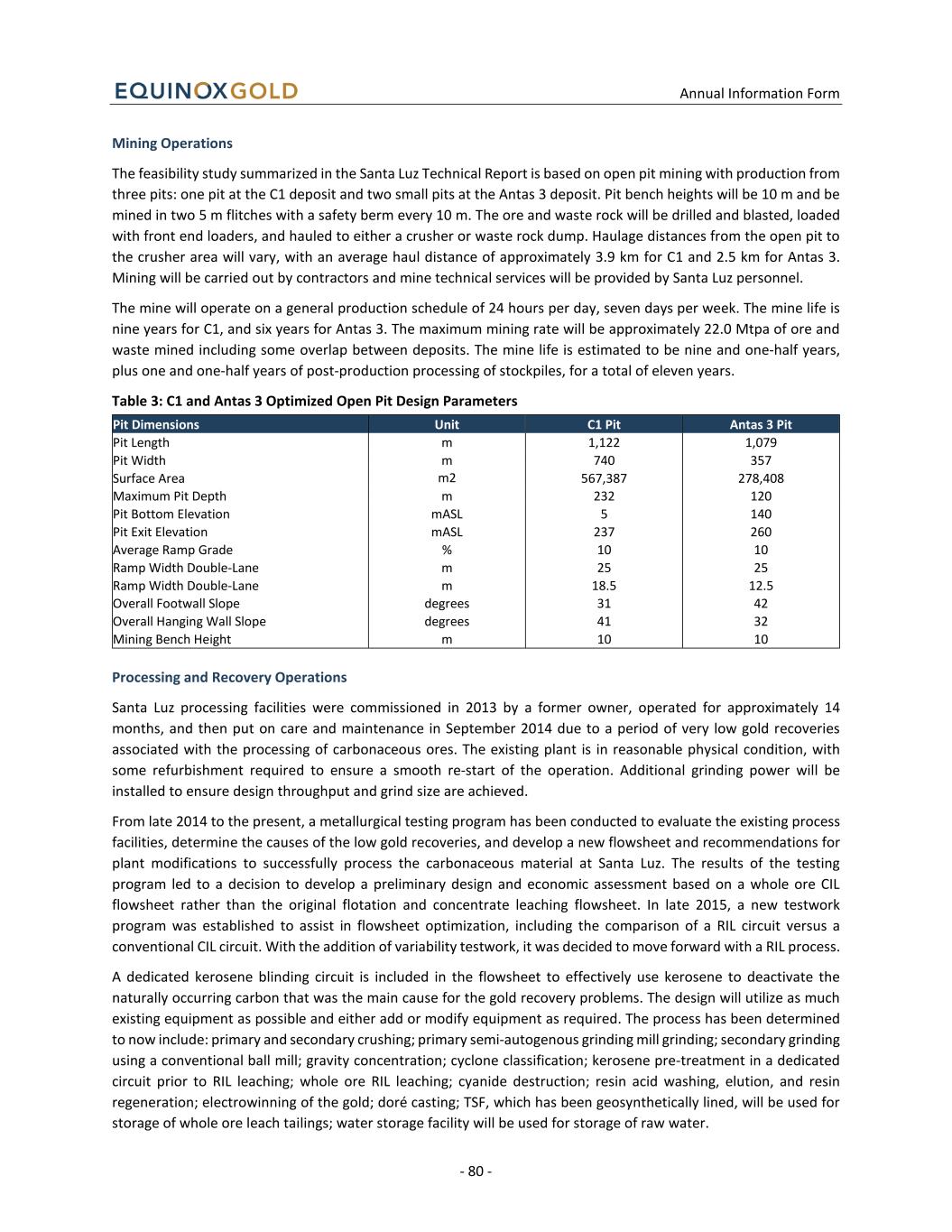
Annual Information Form - 80 - Mining Operations The feasibility study summarized in the Santa Luz Technical Report is based on open pit mining with production from three pits: one pit at the C1 deposit and two small pits at the Antas 3 deposit. Pit bench heights will be 10 m and be mined in two 5 m flitches with a safety berm every 10 m. The ore and waste rock will be drilled and blasted, loaded with front end loaders, and hauled to either a crusher or waste rock dump. Haulage distances from the open pit to the crusher area will vary, with an average haul distance of approximately 3.9 km for C1 and 2.5 km for Antas 3. Mining will be carried out by contractors and mine technical services will be provided by Santa Luz personnel. The mine will operate on a general production schedule of 24 hours per day, seven days per week. The mine life is nine years for C1, and six years for Antas 3. The maximum mining rate will be approximately 22.0 Mtpa of ore and waste mined including some overlap between deposits. The mine life is estimated to be nine and one-half years, plus one and one-half years of post-production processing of stockpiles, for a total of eleven years. Table 3: C1 and Antas 3 Optimized Open Pit Design Parameters Pit Dimensions Unit C1 Pit Antas 3 Pit Pit Length m 1,122 1,079 Pit Width m 740 357 Surface Area m2 567,387 278,408 Maximum Pit Depth m 232 120 Pit Bottom Elevation mASL 5 140 Pit Exit Elevation mASL 237 260 Average Ramp Grade % 10 10 Ramp Width Double-Lane m 25 25 Ramp Width Double-Lane m 18.5 12.5 Overall Footwall Slope degrees 31 42 Overall Hanging Wall Slope degrees 41 32 Mining Bench Height m 10 10 Processing and Recovery Operations Santa Luz processing facilities were commissioned in 2013 by a former owner, operated for approximately 14 months, and then put on care and maintenance in September 2014 due to a period of very low gold recoveries associated with the processing of carbonaceous ores. The existing plant is in reasonable physical condition, with some refurbishment required to ensure a smooth re-start of the operation. Additional grinding power will be installed to ensure design throughput and grind size are achieved. From late 2014 to the present, a metallurgical testing program has been conducted to evaluate the existing process facilities, determine the causes of the low gold recoveries, and develop a new flowsheet and recommendations for plant modifications to successfully process the carbonaceous material at Santa Luz. The results of the testing program led to a decision to develop a preliminary design and economic assessment based on a whole ore CIL flowsheet rather than the original flotation and concentrate leaching flowsheet. In late 2015, a new testwork program was established to assist in flowsheet optimization, including the comparison of a RIL circuit versus a conventional CIL circuit. With the addition of variability testwork, it was decided to move forward with a RIL process. A dedicated kerosene blinding circuit is included in the flowsheet to effectively use kerosene to deactivate the naturally occurring carbon that was the main cause for the gold recovery problems. The design will utilize as much existing equipment as possible and either add or modify equipment as required. The process has been determined to now include: primary and secondary crushing; primary semi-autogenous grinding mill grinding; secondary grinding using a conventional ball mill; gravity concentration; cyclone classification; kerosene pre-treatment in a dedicated circuit prior to RIL leaching; whole ore RIL leaching; cyanide destruction; resin acid washing, elution, and resin regeneration; electrowinning of the gold; doré casting; TSF, which has been geosynthetically lined, will be used for storage of whole ore leach tailings; water storage facility will be used for storage of raw water.
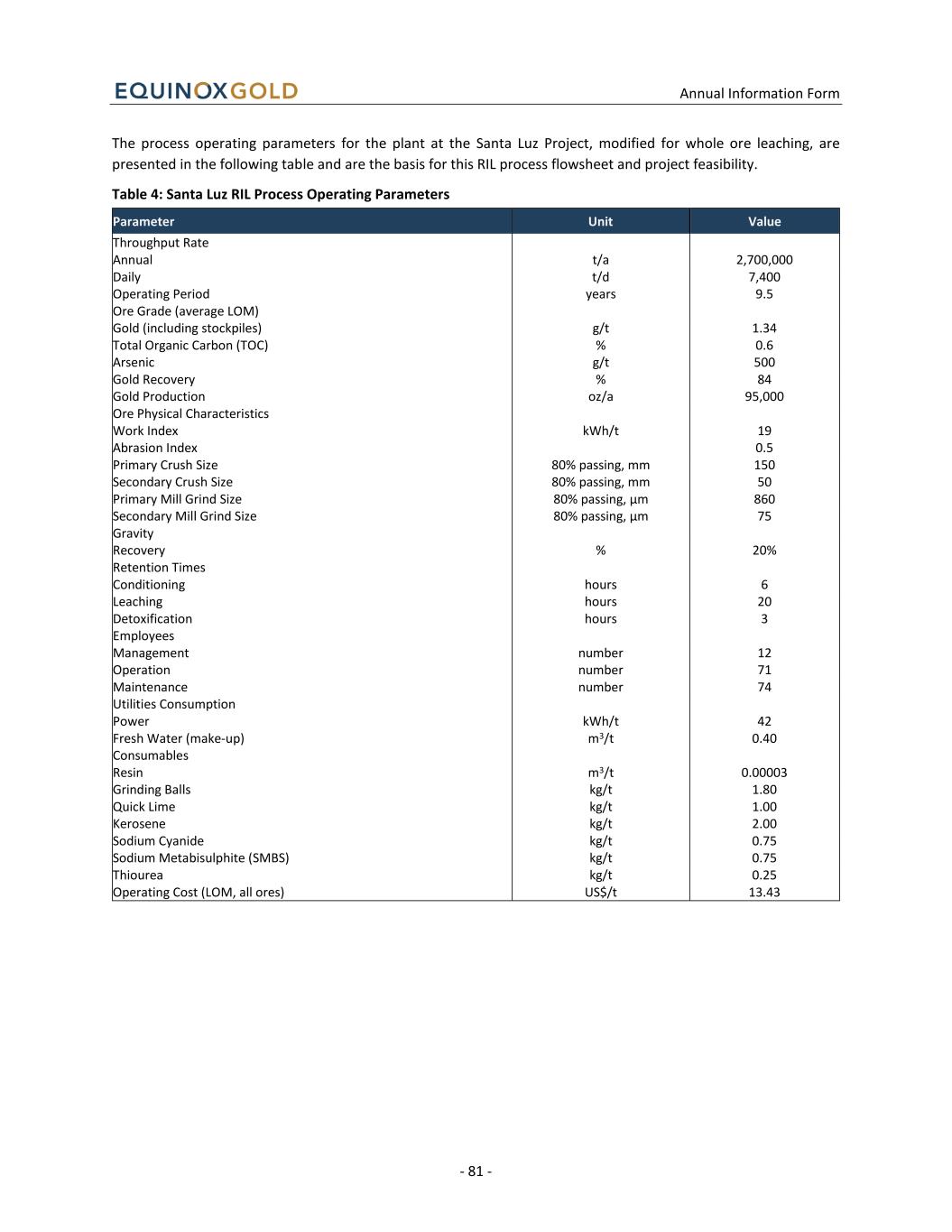
Annual Information Form - 81 - The process operating parameters for the plant at the Santa Luz Project, modified for whole ore leaching, are presented in the following table and are the basis for this RIL process flowsheet and project feasibility. Table 4: Santa Luz RIL Process Operating Parameters Parameter Unit Value Throughput Rate Annual t/a 2,700,000 Daily t/d 7,400 Operating Period years 9.5 Ore Grade (average LOM) Gold (including stockpiles) g/t 1.34 Total Organic Carbon (TOC) % 0.6 Arsenic g/t 500 Gold Recovery % 84 Gold Production oz/a 95,000 Ore Physical Characteristics Work Index kWh/t 19 Abrasion Index 0.5 Primary Crush Size 80% passing, mm 150 Secondary Crush Size 80% passing, mm 50 Primary Mill Grind Size 80% passing, µm 860 Secondary Mill Grind Size 80% passing, µm 75 Gravity Recovery % 20% Retention Times Conditioning hours 6 Leaching hours 20 Detoxification hours 3 Employees Management number 12 Operation number 71 Maintenance number 74 Utilities Consumption Power kWh/t 42 Fresh Water (make-up) m3/t 0.40 Consumables Resin m3/t 0.00003 Grinding Balls kg/t 1.80 Quick Lime kg/t 1.00 Kerosene kg/t 2.00 Sodium Cyanide kg/t 0.75 Sodium Metabisulphite (SMBS) kg/t 0.75 Thiourea kg/t 0.25 Operating Cost (LOM, all ores) US$/t 13.43
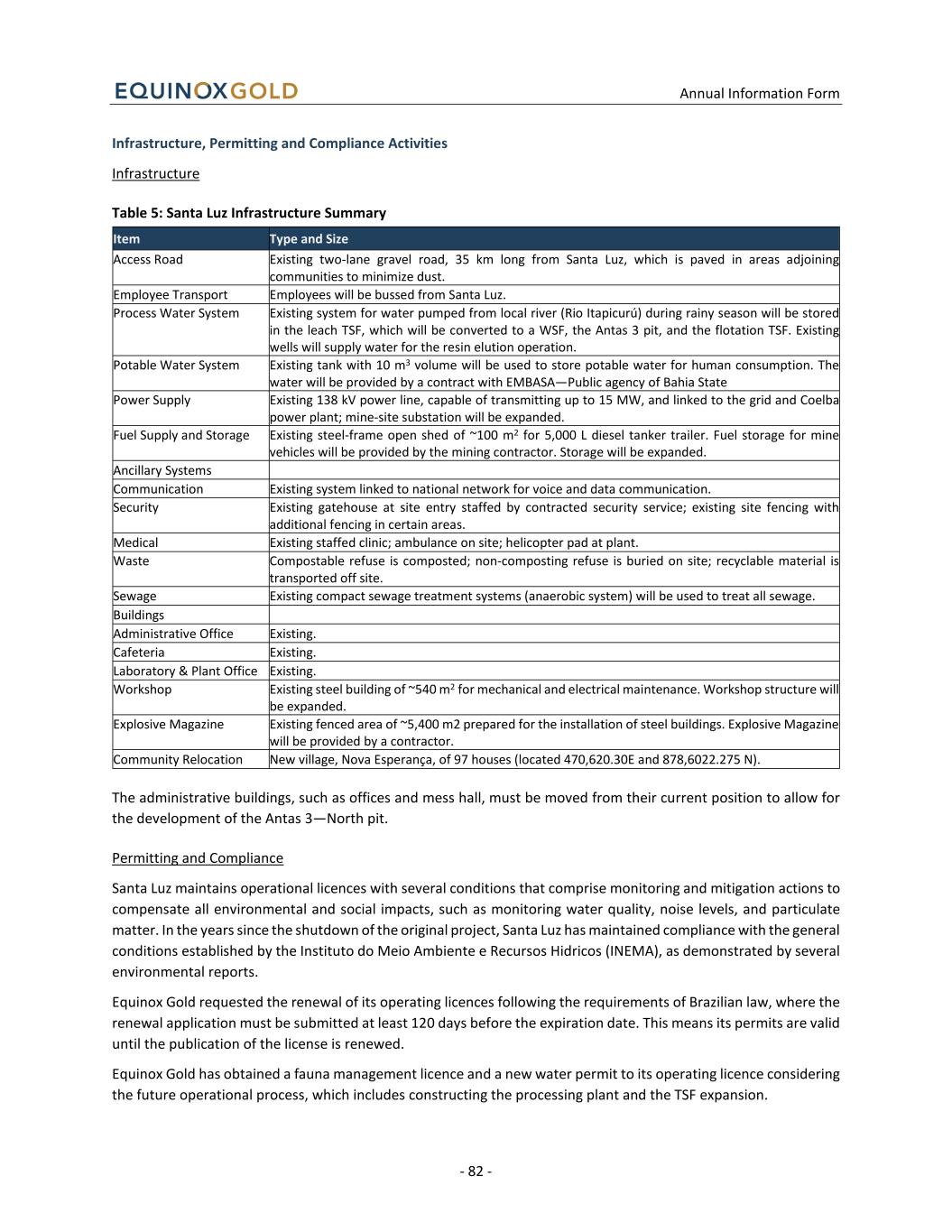
Annual Information Form - 82 - Infrastructure, Permitting and Compliance Activities Infrastructure Table 5: Santa Luz Infrastructure Summary Item Type and Size Access Road Existing two-lane gravel road, 35 km long from Santa Luz, which is paved in areas adjoining communities to minimize dust. Employee Transport Employees will be bussed from Santa Luz. Process Water System Existing system for water pumped from local river (Rio Itapicurú) during rainy season will be stored in the leach TSF, which will be converted to a WSF, the Antas 3 pit, and the flotation TSF. Existing wells will supply water for the resin elution operation. Potable Water System Existing tank with 10 m3 volume will be used to store potable water for human consumption. The water will be provided by a contract with EMBASA—Public agency of Bahia State Power Supply Existing 138 kV power line, capable of transmitting up to 15 MW, and linked to the grid and Coelba power plant; mine-site substation will be expanded. Fuel Supply and Storage Existing steel-frame open shed of ~100 m2 for 5,000 L diesel tanker trailer. Fuel storage for mine vehicles will be provided by the mining contractor. Storage will be expanded. Ancillary Systems Communication Existing system linked to national network for voice and data communication. Security Existing gatehouse at site entry staffed by contracted security service; existing site fencing with additional fencing in certain areas. Medical Existing staffed clinic; ambulance on site; helicopter pad at plant. Waste Compostable refuse is composted; non-composting refuse is buried on site; recyclable material is transported off site. Sewage Existing compact sewage treatment systems (anaerobic system) will be used to treat all sewage. Buildings Administrative Office Existing. Cafeteria Existing. Laboratory & Plant Office Existing. Workshop Existing steel building of ~540 m2 for mechanical and electrical maintenance. Workshop structure will be expanded. Explosive Magazine Existing fenced area of ~5,400 m2 prepared for the installation of steel buildings. Explosive Magazine will be provided by a contractor. Community Relocation New village, Nova Esperança, of 97 houses (located 470,620.30E and 878,6022.275 N). The administrative buildings, such as offices and mess hall, must be moved from their current position to allow for the development of the Antas 3—North pit. Permitting and Compliance Santa Luz maintains operational licences with several conditions that comprise monitoring and mitigation actions to compensate all environmental and social impacts, such as monitoring water quality, noise levels, and particulate matter. In the years since the shutdown of the original project, Santa Luz has maintained compliance with the general conditions established by the Instituto do Meio Ambiente e Recursos Hidricos (INEMA), as demonstrated by several environmental reports. Equinox Gold requested the renewal of its operating licences following the requirements of Brazilian law, where the renewal application must be submitted at least 120 days before the expiration date. This means its permits are valid until the publication of the license is renewed. Equinox Gold has obtained a fauna management licence and a new water permit to its operating licence considering the future operational process, which includes constructing the processing plant and the TSF expansion.
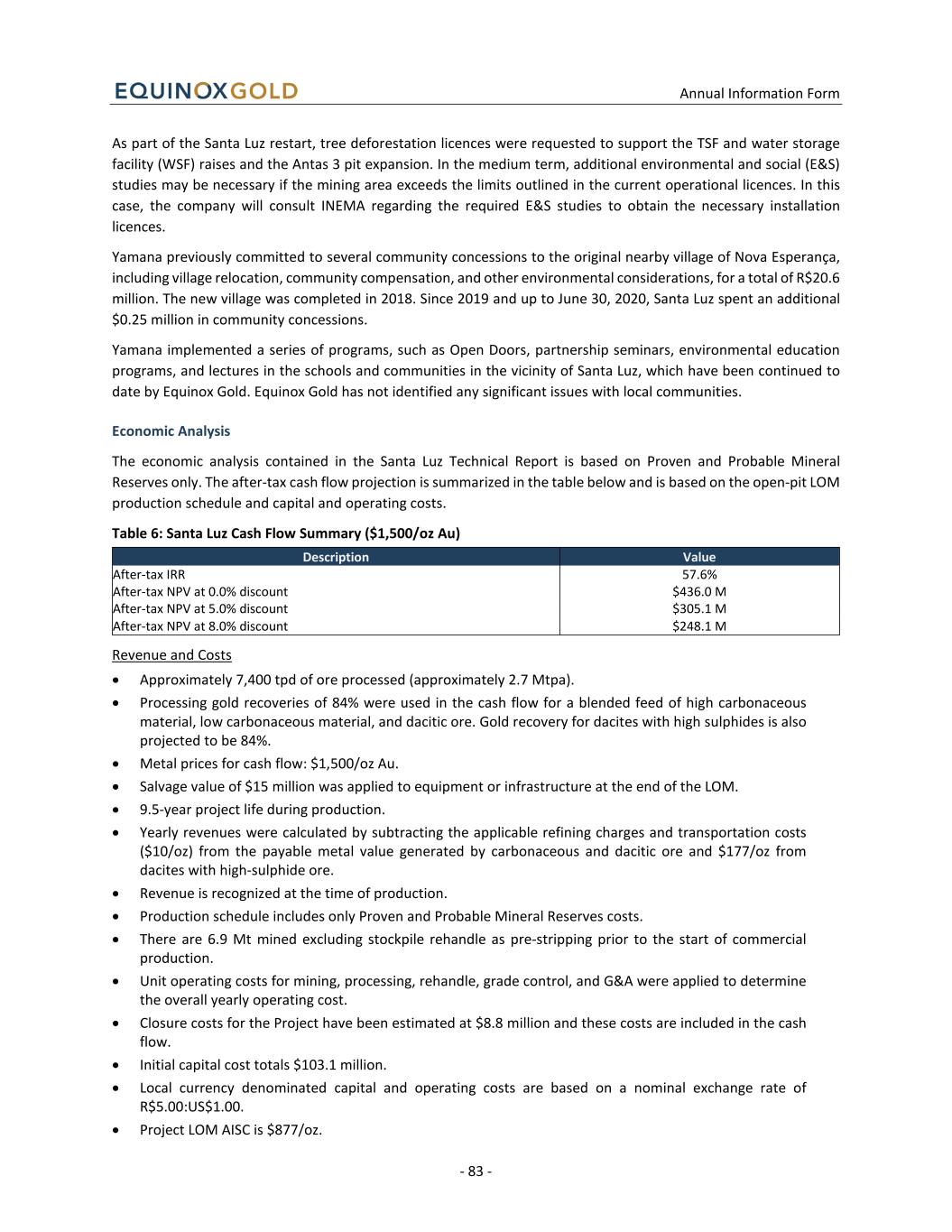
Annual Information Form - 83 - As part of the Santa Luz restart, tree deforestation licences were requested to support the TSF and water storage facility (WSF) raises and the Antas 3 pit expansion. In the medium term, additional environmental and social (E&S) studies may be necessary if the mining area exceeds the limits outlined in the current operational licences. In this case, the company will consult INEMA regarding the required E&S studies to obtain the necessary installation licences. Yamana previously committed to several community concessions to the original nearby village of Nova Esperança, including village relocation, community compensation, and other environmental considerations, for a total of R$20.6 million. The new village was completed in 2018. Since 2019 and up to June 30, 2020, Santa Luz spent an additional $0.25 million in community concessions. Yamana implemented a series of programs, such as Open Doors, partnership seminars, environmental education programs, and lectures in the schools and communities in the vicinity of Santa Luz, which have been continued to date by Equinox Gold. Equinox Gold has not identified any significant issues with local communities. Economic Analysis The economic analysis contained in the Santa Luz Technical Report is based on Proven and Probable Mineral Reserves only. The after-tax cash flow projection is summarized in the table below and is based on the open-pit LOM production schedule and capital and operating costs. Table 6: Santa Luz Cash Flow Summary ($1,500/oz Au) Description Value After-tax IRR 57.6% After-tax NPV at 0.0% discount $436.0 M After-tax NPV at 5.0% discount $305.1 M After-tax NPV at 8.0% discount $248.1 M Revenue and Costs • Approximately 7,400 tpd of ore processed (approximately 2.7 Mtpa). • Processing gold recoveries of 84% were used in the cash flow for a blended feed of high carbonaceous material, low carbonaceous material, and dacitic ore. Gold recovery for dacites with high sulphides is also projected to be 84%. • Metal prices for cash flow: $1,500/oz Au. • Salvage value of $15 million was applied to equipment or infrastructure at the end of the LOM. • 9.5-year project life during production. • Yearly revenues were calculated by subtracting the applicable refining charges and transportation costs ($10/oz) from the payable metal value generated by carbonaceous and dacitic ore and $177/oz from dacites with high-sulphide ore. • Revenue is recognized at the time of production. • Production schedule includes only Proven and Probable Mineral Reserves costs. • There are 6.9 Mt mined excluding stockpile rehandle as pre-stripping prior to the start of commercial production. • Unit operating costs for mining, processing, rehandle, grade control, and G&A were applied to determine the overall yearly operating cost. • Closure costs for the Project have been estimated at $8.8 million and these costs are included in the cash flow. • Initial capital cost totals $103.1 million. • Local currency denominated capital and operating costs are based on a nominal exchange rate of R$5.00:US$1.00. • Project LOM AISC is $877/oz.
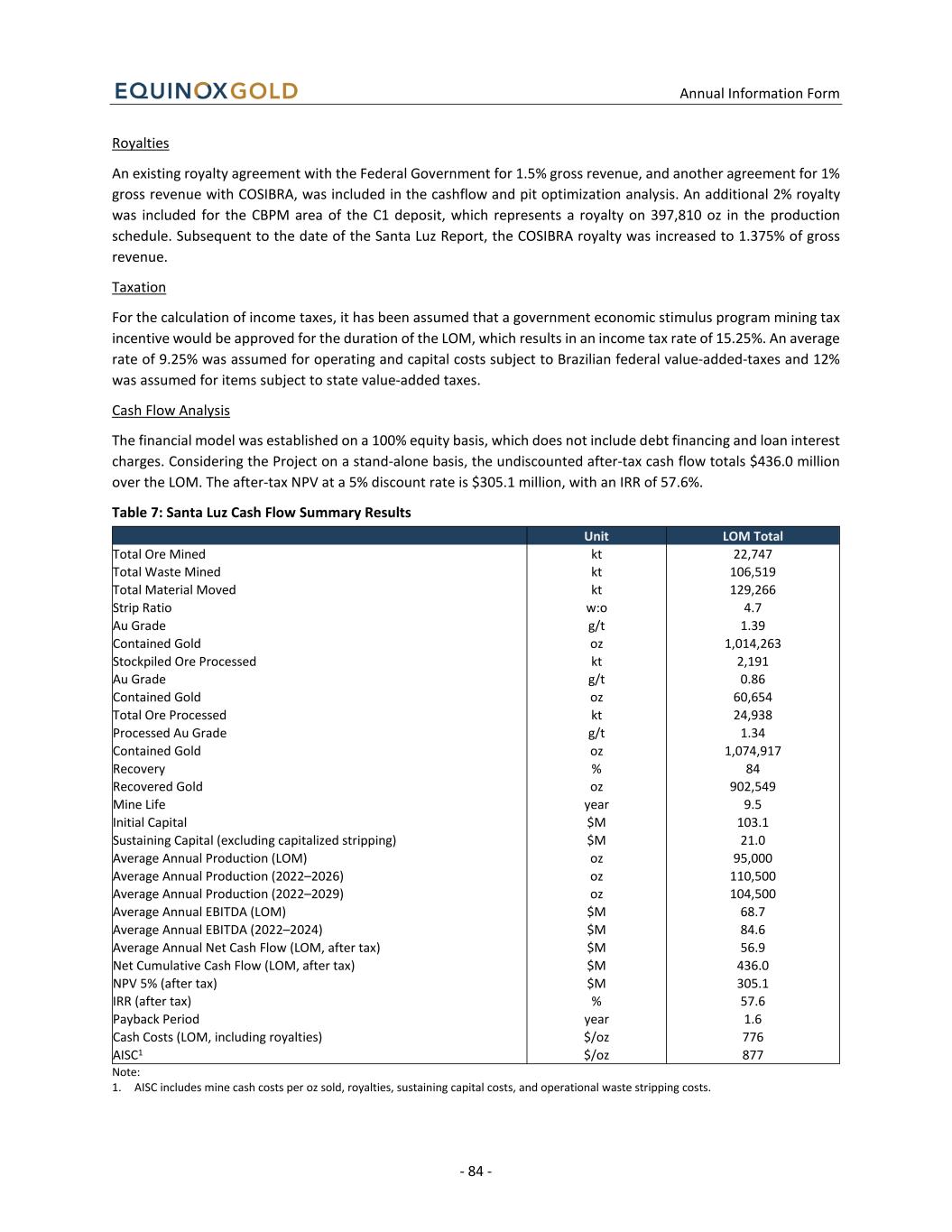
Annual Information Form - 84 - Royalties An existing royalty agreement with the Federal Government for 1.5% gross revenue, and another agreement for 1% gross revenue with COSIBRA, was included in the cashflow and pit optimization analysis. An additional 2% royalty was included for the CBPM area of the C1 deposit, which represents a royalty on 397,810 oz in the production schedule. Subsequent to the date of the Santa Luz Report, the COSIBRA royalty was increased to 1.375% of gross revenue. Taxation For the calculation of income taxes, it has been assumed that a government economic stimulus program mining tax incentive would be approved for the duration of the LOM, which results in an income tax rate of 15.25%. An average rate of 9.25% was assumed for operating and capital costs subject to Brazilian federal value-added-taxes and 12% was assumed for items subject to state value-added taxes. Cash Flow Analysis The financial model was established on a 100% equity basis, which does not include debt financing and loan interest charges. Considering the Project on a stand-alone basis, the undiscounted after-tax cash flow totals $436.0 million over the LOM. The after-tax NPV at a 5% discount rate is $305.1 million, with an IRR of 57.6%. Table 7: Santa Luz Cash Flow Summary Results Unit LOM Total Total Ore Mined kt 22,747 Total Waste Mined kt 106,519 Total Material Moved kt 129,266 Strip Ratio w:o 4.7 Au Grade g/t 1.39 Contained Gold oz 1,014,263 Stockpiled Ore Processed kt 2,191 Au Grade g/t 0.86 Contained Gold oz 60,654 Total Ore Processed kt 24,938 Processed Au Grade g/t 1.34 Contained Gold oz 1,074,917 Recovery % 84 Recovered Gold oz 902,549 Mine Life year 9.5 Initial Capital $M 103.1 Sustaining Capital (excluding capitalized stripping) $M 21.0 Average Annual Production (LOM) oz 95,000 Average Annual Production (2022–2026) oz 110,500 Average Annual Production (2022–2029) oz 104,500 Average Annual EBITDA (LOM) $M 68.7 Average Annual EBITDA (2022–2024) $M 84.6 Average Annual Net Cash Flow (LOM, after tax) $M 56.9 Net Cumulative Cash Flow (LOM, after tax) $M 436.0 NPV 5% (after tax) $M 305.1 IRR (after tax) % 57.6 Payback Period year 1.6 Cash Costs (LOM, including royalties) $/oz 776 AISC1 $/oz 877 Note: 1. AISC includes mine cash costs per oz sold, royalties, sustaining capital costs, and operational waste stripping costs.
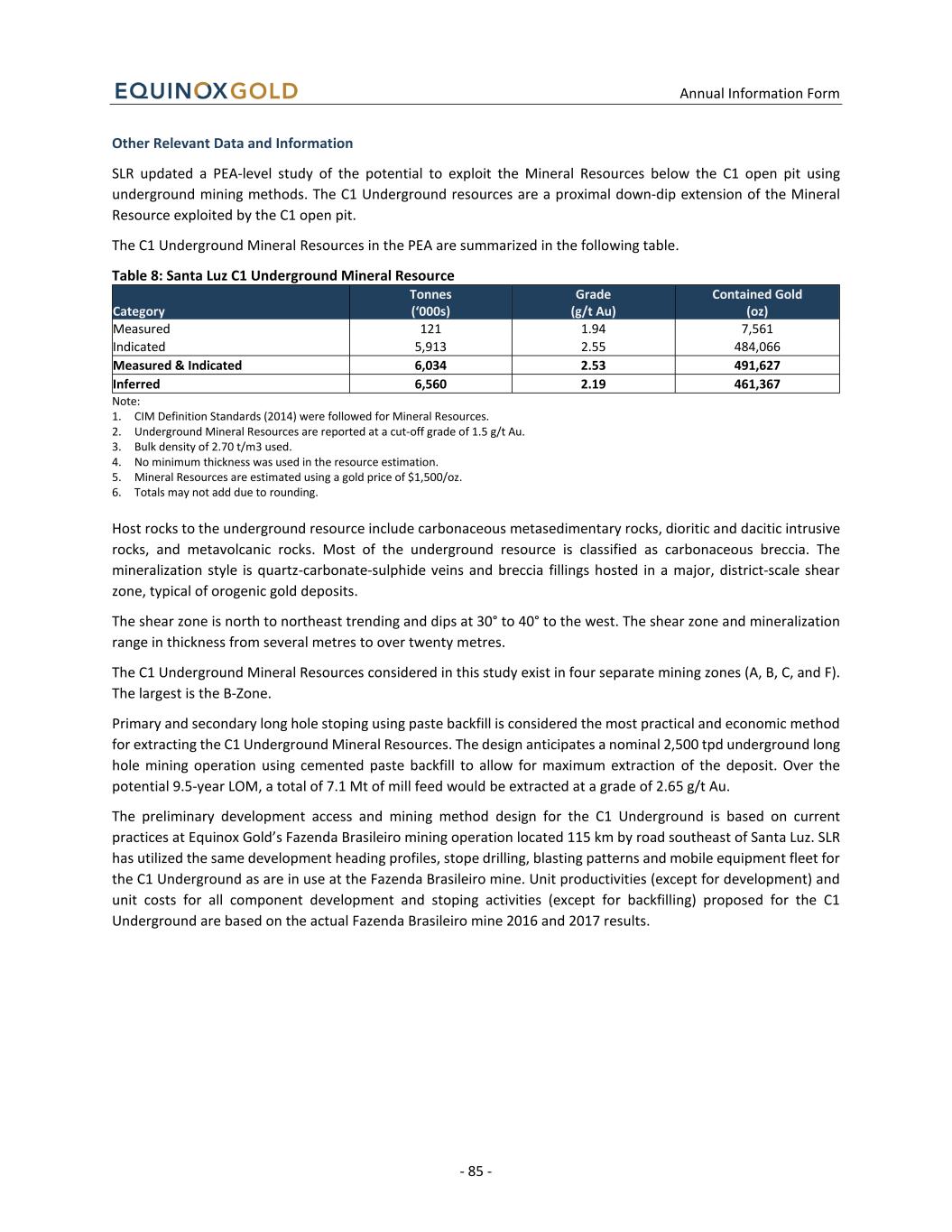
Annual Information Form - 85 - Other Relevant Data and Information SLR updated a PEA-level study of the potential to exploit the Mineral Resources below the C1 open pit using underground mining methods. The C1 Underground resources are a proximal down-dip extension of the Mineral Resource exploited by the C1 open pit. The C1 Underground Mineral Resources in the PEA are summarized in the following table. Table 8: Santa Luz C1 Underground Mineral Resource Category Tonnes (‘000s) Grade (g/t Au) Contained Gold (oz) Measured 121 1.94 7,561 Indicated 5,913 2.55 484,066 Measured & Indicated 6,034 2.53 491,627 Inferred 6,560 2.19 461,367 Note: 1. CIM Definition Standards (2014) were followed for Mineral Resources. 2. Underground Mineral Resources are reported at a cut-off grade of 1.5 g/t Au. 3. Bulk density of 2.70 t/m3 used. 4. No minimum thickness was used in the resource estimation. 5. Mineral Resources are estimated using a gold price of $1,500/oz. 6. Totals may not add due to rounding. Host rocks to the underground resource include carbonaceous metasedimentary rocks, dioritic and dacitic intrusive rocks, and metavolcanic rocks. Most of the underground resource is classified as carbonaceous breccia. The mineralization style is quartz-carbonate-sulphide veins and breccia fillings hosted in a major, district-scale shear zone, typical of orogenic gold deposits. The shear zone is north to northeast trending and dips at 30° to 40° to the west. The shear zone and mineralization range in thickness from several metres to over twenty metres. The C1 Underground Mineral Resources considered in this study exist in four separate mining zones (A, B, C, and F). The largest is the B-Zone. Primary and secondary long hole stoping using paste backfill is considered the most practical and economic method for extracting the C1 Underground Mineral Resources. The design anticipates a nominal 2,500 tpd underground long hole mining operation using cemented paste backfill to allow for maximum extraction of the deposit. Over the potential 9.5-year LOM, a total of 7.1 Mt of mill feed would be extracted at a grade of 2.65 g/t Au. The preliminary development access and mining method design for the C1 Underground is based on current practices at Equinox Gold’s Fazenda Brasileiro mining operation located 115 km by road southeast of Santa Luz. SLR has utilized the same development heading profiles, stope drilling, blasting patterns and mobile equipment fleet for the C1 Underground as are in use at the Fazenda Brasileiro mine. Unit productivities (except for development) and unit costs for all component development and stoping activities (except for backfilling) proposed for the C1 Underground are based on the actual Fazenda Brasileiro mine 2016 and 2017 results.
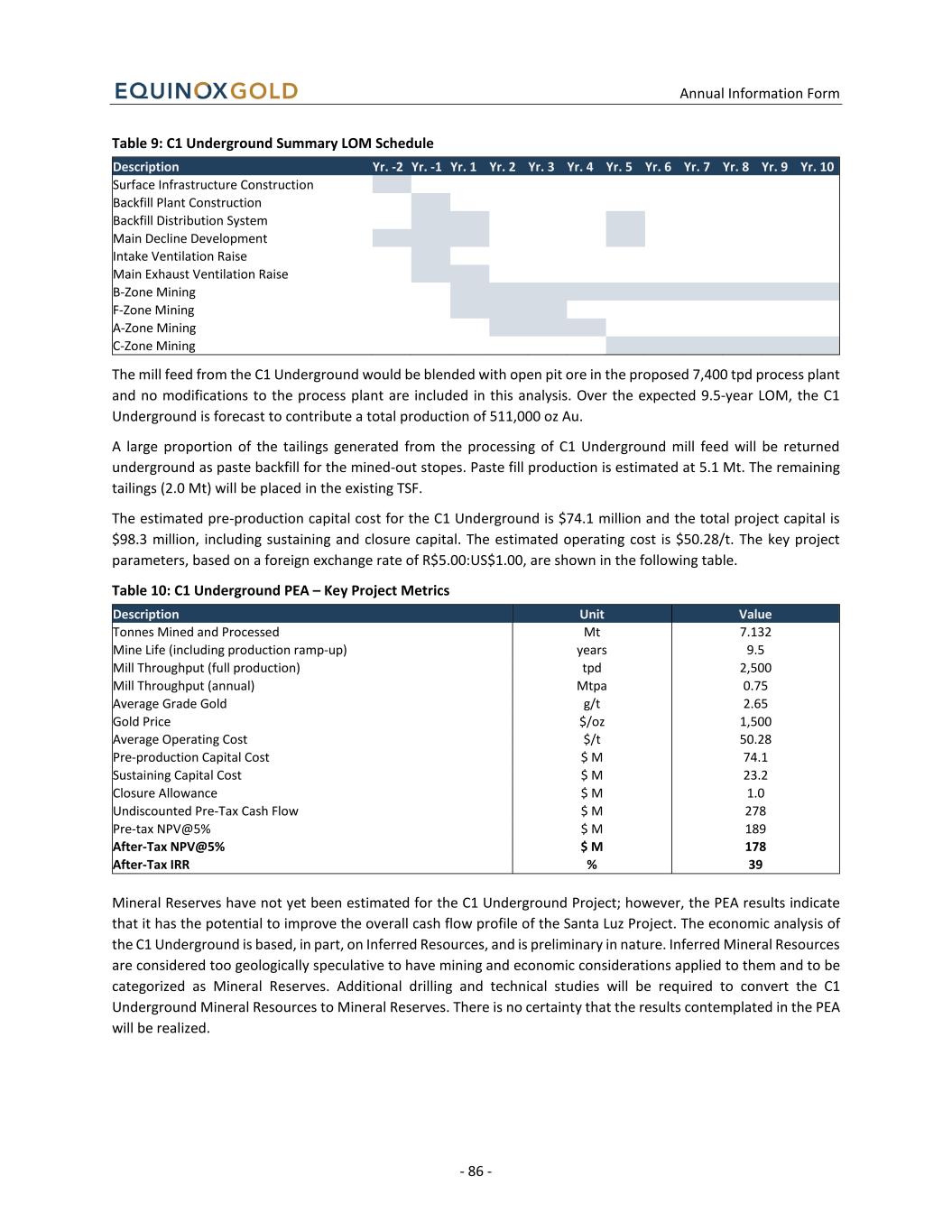
Annual Information Form - 86 - Table 9: C1 Underground Summary LOM Schedule Description Yr. -2 Yr. -1 Yr. 1 Yr. 2 Yr. 3 Yr. 4 Yr. 5 Yr. 6 Yr. 7 Yr. 8 Yr. 9 Yr. 10 Surface Infrastructure Construction Backfill Plant Construction Backfill Distribution System Main Decline Development Intake Ventilation Raise Main Exhaust Ventilation Raise B-Zone Mining F-Zone Mining A-Zone Mining C-Zone Mining The mill feed from the C1 Underground would be blended with open pit ore in the proposed 7,400 tpd process plant and no modifications to the process plant are included in this analysis. Over the expected 9.5-year LOM, the C1 Underground is forecast to contribute a total production of 511,000 oz Au. A large proportion of the tailings generated from the processing of C1 Underground mill feed will be returned underground as paste backfill for the mined-out stopes. Paste fill production is estimated at 5.1 Mt. The remaining tailings (2.0 Mt) will be placed in the existing TSF. The estimated pre-production capital cost for the C1 Underground is $74.1 million and the total project capital is $98.3 million, including sustaining and closure capital. The estimated operating cost is $50.28/t. The key project parameters, based on a foreign exchange rate of R$5.00:US$1.00, are shown in the following table. Table 10: C1 Underground PEA – Key Project Metrics Description Unit Value Tonnes Mined and Processed Mt 7.132 Mine Life (including production ramp-up) years 9.5 Mill Throughput (full production) tpd 2,500 Mill Throughput (annual) Mtpa 0.75 Average Grade Gold g/t 2.65 Gold Price $/oz 1,500 Average Operating Cost $/t 50.28 Pre-production Capital Cost $ M 74.1 Sustaining Capital Cost $ M 23.2 Closure Allowance $ M 1.0 Undiscounted Pre-Tax Cash Flow $ M 278 Pre-tax NPV@5% $ M 189 After-Tax NPV@5% $ M 178 After-Tax IRR % 39 Mineral Reserves have not yet been estimated for the C1 Underground Project; however, the PEA results indicate that it has the potential to improve the overall cash flow profile of the Santa Luz Project. The economic analysis of the C1 Underground is based, in part, on Inferred Resources, and is preliminary in nature. Inferred Mineral Resources are considered too geologically speculative to have mining and economic considerations applied to them and to be categorized as Mineral Reserves. Additional drilling and technical studies will be required to convert the C1 Underground Mineral Resources to Mineral Reserves. There is no certainty that the results contemplated in the PEA will be realized.
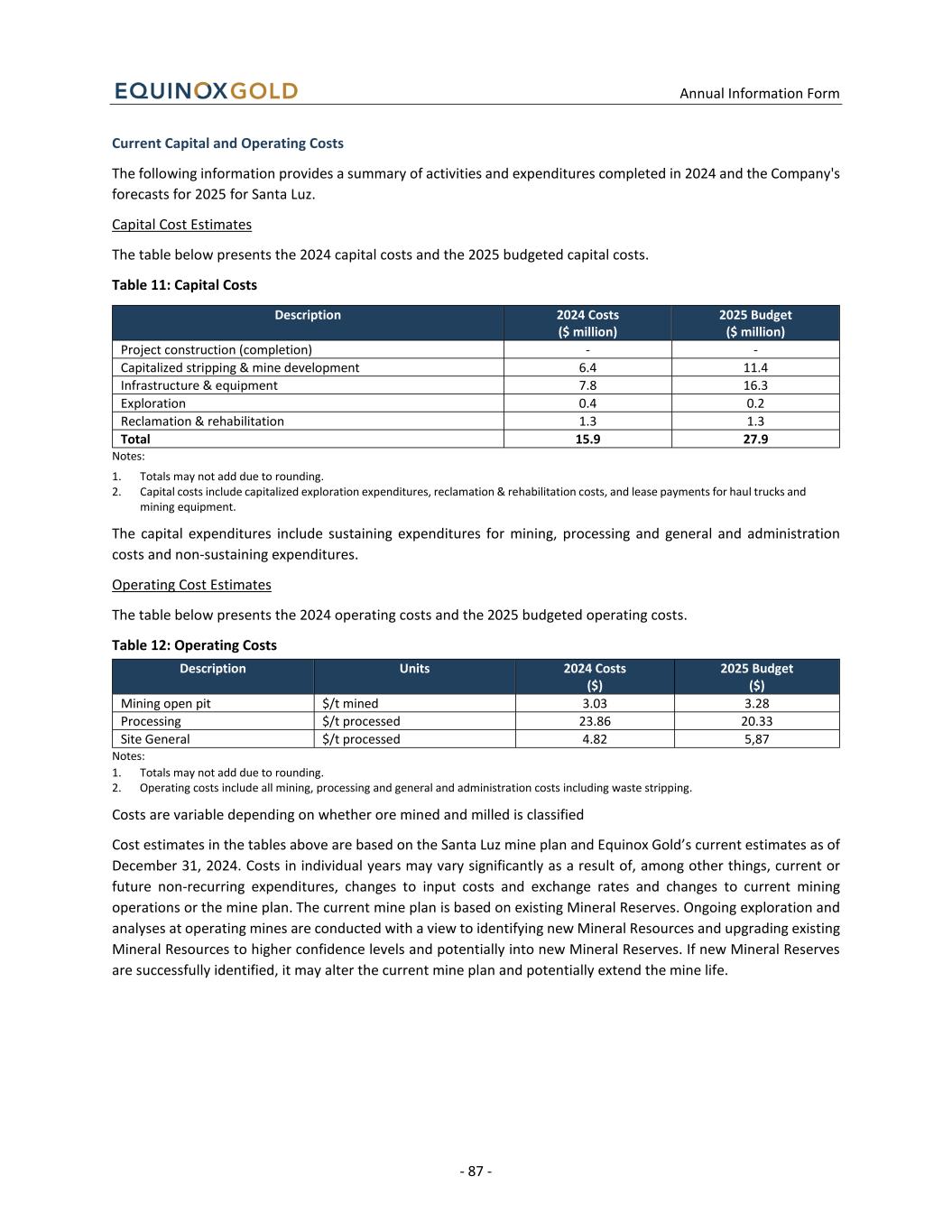
Annual Information Form - 87 - Current Capital and Operating Costs The following information provides a summary of activities and expenditures completed in 2024 and the Company's forecasts for 2025 for Santa Luz. Capital Cost Estimates The table below presents the 2024 capital costs and the 2025 budgeted capital costs. Table 11: Capital Costs Description 2024 Costs ($ million) 2025 Budget ($ million) Project construction (completion) - - Capitalized stripping & mine development 6.4 11.4 Infrastructure & equipment 7.8 16.3 Exploration 0.4 0.2 Reclamation & rehabilitation 1.3 1.3 Total 15.9 27.9 Notes: 1. Totals may not add due to rounding. 2. Capital costs include capitalized exploration expenditures, reclamation & rehabilitation costs, and lease payments for haul trucks and mining equipment. The capital expenditures include sustaining expenditures for mining, processing and general and administration costs and non-sustaining expenditures. Operating Cost Estimates The table below presents the 2024 operating costs and the 2025 budgeted operating costs. Table 12: Operating Costs Description Units 2024 Costs ($) 2025 Budget ($) Mining open pit $/t mined 3.03 3.28 Processing $/t processed 23.86 20.33 Site General $/t processed 4.82 5,87 Notes: 1. Totals may not add due to rounding. 2. Operating costs include all mining, processing and general and administration costs including waste stripping. Costs are variable depending on whether ore mined and milled is classified Cost estimates in the tables above are based on the Santa Luz mine plan and Equinox Gold’s current estimates as of December 31, 2024. Costs in individual years may vary significantly as a result of, among other things, current or future non-recurring expenditures, changes to input costs and exchange rates and changes to current mining operations or the mine plan. The current mine plan is based on existing Mineral Reserves. Ongoing exploration and analyses at operating mines are conducted with a view to identifying new Mineral Resources and upgrading existing Mineral Resources to higher confidence levels and potentially into new Mineral Reserves. If new Mineral Reserves are successfully identified, it may alter the current mine plan and potentially extend the mine life.
Annual Information Form - 88 - Recent Exploration, Development and Production Exploration The 2024 surface exploration program at Santa Luz included 5,147 m of RC drilling and 3,123 m of core drilling, focused on high-priority regional targets. Planned exploration at Santa Luz in 2025 includes 11,400 m of core drilling focused primarily on regional targets. Development During 2024, sustaining capital totaled $13.8 million, primarily relating to capitalized waste stripping, a TSF liner installation and processing equipment for the desliming circuit project. Non-sustaining capital expenditures totalled $3.1 million, primarily relating to exploration. Santa Luz is part of the Bahia Complex. Sustaining expenditures at Bahia Complex of $70 million in 2025 primarily relate to capitalized stripping, acquisition of equipment and components, exploration, infrastructure and vegetation clearing, a TSF raise, and underground development. Non-sustaining expenditures of $12 million in 2025 relate primarily to underground development and exploration. Production Santa Luz produced a total of 56,906 ounces of gold during 2024 at cash costs of $1,951 per ounce and AISC of $2,224 per ounce of gold sold. Bahia Complex production guidance for 2025 is 125,000 to 145,000 ounces of gold, with cash costs of $1,360 to $1,460 per ounce and AISC of $1,845 to $1,945 per ounce of gold sold.
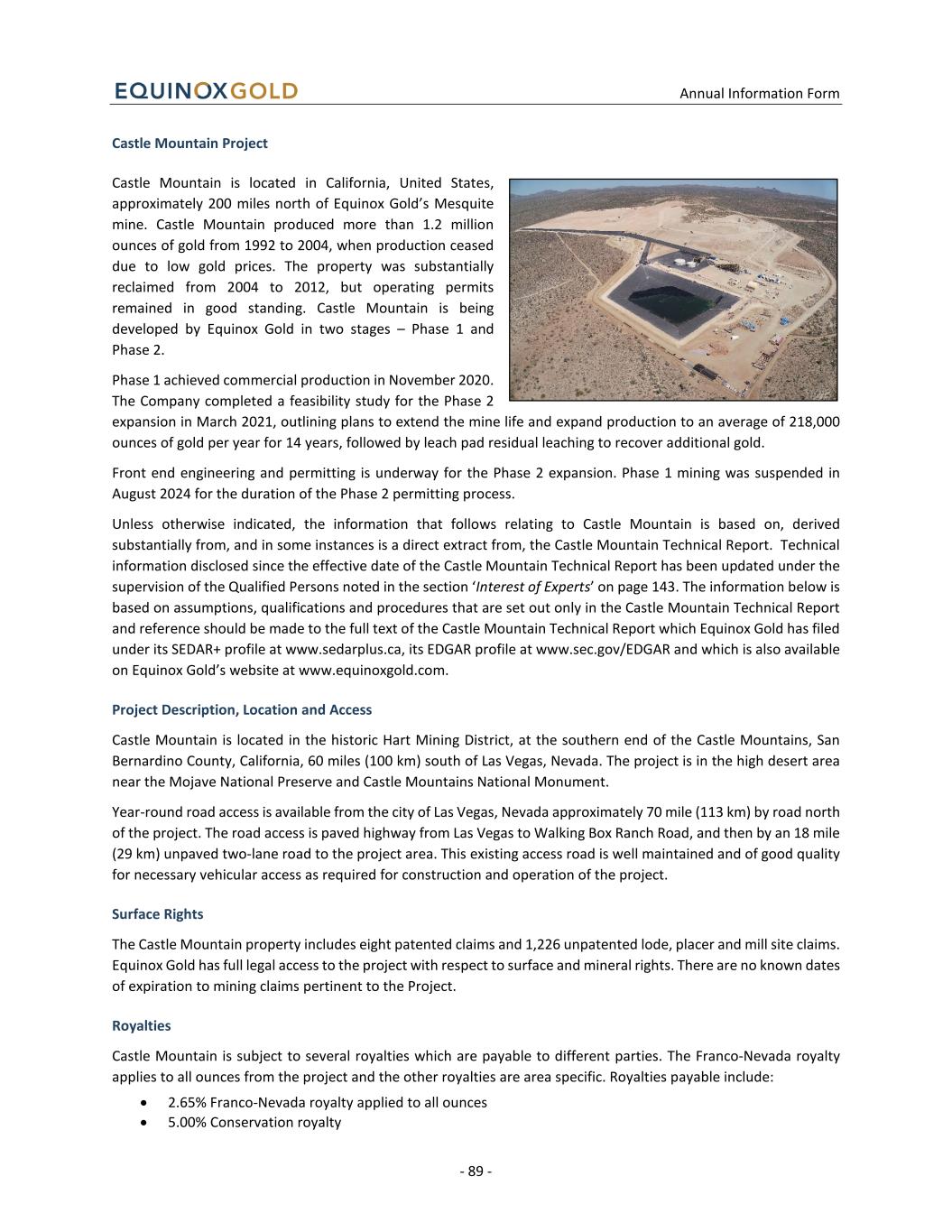
Annual Information Form - 89 - Castle Mountain Project Castle Mountain is located in California, United States, approximately 200 miles north of Equinox Gold’s Mesquite mine. Castle Mountain produced more than 1.2 million ounces of gold from 1992 to 2004, when production ceased due to low gold prices. The property was substantially reclaimed from 2004 to 2012, but operating permits remained in good standing. Castle Mountain is being developed by Equinox Gold in two stages – Phase 1 and Phase 2. Phase 1 achieved commercial production in November 2020. The Company completed a feasibility study for the Phase 2 expansion in March 2021, outlining plans to extend the mine life and expand production to an average of 218,000 ounces of gold per year for 14 years, followed by leach pad residual leaching to recover additional gold. Front end engineering and permitting is underway for the Phase 2 expansion. Phase 1 mining was suspended in August 2024 for the duration of the Phase 2 permitting process. Unless otherwise indicated, the information that follows relating to Castle Mountain is based on, derived substantially from, and in some instances is a direct extract from, the Castle Mountain Technical Report. Technical information disclosed since the effective date of the Castle Mountain Technical Report has been updated under the supervision of the Qualified Persons noted in the section ‘Interest of Experts’ on page 143. The information below is based on assumptions, qualifications and procedures that are set out only in the Castle Mountain Technical Report and reference should be made to the full text of the Castle Mountain Technical Report which Equinox Gold has filed under its SEDAR+ profile at www.sedarplus.ca, its EDGAR profile at www.sec.gov/EDGAR and which is also available on Equinox Gold’s website at www.equinoxgold.com. Project Description, Location and Access Castle Mountain is located in the historic Hart Mining District, at the southern end of the Castle Mountains, San Bernardino County, California, 60 miles (100 km) south of Las Vegas, Nevada. The project is in the high desert area near the Mojave National Preserve and Castle Mountains National Monument. Year-round road access is available from the city of Las Vegas, Nevada approximately 70 mile (113 km) by road north of the project. The road access is paved highway from Las Vegas to Walking Box Ranch Road, and then by an 18 mile (29 km) unpaved two-lane road to the project area. This existing access road is well maintained and of good quality for necessary vehicular access as required for construction and operation of the project. Surface Rights The Castle Mountain property includes eight patented claims and 1,226 unpatented lode, placer and mill site claims. Equinox Gold has full legal access to the project with respect to surface and mineral rights. There are no known dates of expiration to mining claims pertinent to the Project. Royalties Castle Mountain is subject to several royalties which are payable to different parties. The Franco-Nevada royalty applies to all ounces from the project and the other royalties are area specific. Royalties payable include: • 2.65% Franco-Nevada royalty applied to all ounces • 5.00% Conservation royalty
Annual Information Form - 90 - • 2.00% American Standard royalty • 5.00% Huntington Tile royalty History The Hart Mining District covers the southern end of the Castle Mountains. Several hundred old prospects, pits trenches, waste rock dumps and underground workings extend over an approximate two square mile (5.2 km2) area overlapping the project area. In 1907, three underground gold mines were brought into production at Oro Belle, Big Chief and Jumbo and by 1911 the mined veins were exhausted. A resurgence in exploration activity commenced in 1968 until the early 2000’s with a variety of operators. Viceroy Gold Corporation (Viceroy) together with MK Gold Corporation completed a feasibility study and commenced gold production at Castle Mountain in 1991. By 1996, the Jumbo South and Leslie Ann (JSLA) deposits were considered exhausted. Mining from the Jumbo pit ceased in 2001 due to localized pit-wall stability issues resulting in the deepest bench mined approximately 200 ft (61 m) above the planned pit design. Mining from the Oro Belle and Hart Tunnel deposits ceased in 2001 due to low gold prices. Heap leaching continued until 2004, primarily in a rinsing operation to recover residual gold values and reduce cyanide levels in the heap. Reclamation began in 2001 and by 2012 all criteria for successful reclamation had been met. A total of 1.24 Moz was recovered from 36.2 Mton (32.8 Mt) processed at an average grade of 0.043 oz/ton (1.47 g/t) with a combined average recovery of 80% from milled and heap leached ore between 1991 and 2004. Minimal exploration activity occurred between 2005 and 2011. NewCastle Gold Ltd (NewCastle) acquired the Project in 2012. Equinox acquired NewCastle on December 22, 2017 and NewCastle became a wholly owned subsidiary of Equinox. The transaction was a three-way merger between Trek Mining Inc, NewCastle Gold, and Anfield Gold Corp., with the resulting company renamed to Equinox Gold Corp. NewCastle has 100% of the right, title and beneficial interest in and to Castle Mountain Venture GP (CMV) which owns Castle Mountain. Geological Setting, Mineralization and Deposit Types The project is in the eastern Mojave Desert which transitions to the Basin and Range region to the north and the Colorado Desert to the south. The Castle Mountains are a relatively small range extending north-northeast from the northern end of Lanfair Valley in California into Piute Valley in Nevada. The project is located near the southern end of the Castle Mountain range with elevations at the Project site ranging from about 4,100 ft to 5,100 ft (1,250 to 1,555 m). Proterozoic metamorphic and plutonic rocks form the basement of the Castle Mountains; these are overlain by pre- volcanic sediments, and Miocene sedimentary and volcanic rocks. The oldest known unit in the stratigraphic package is metamorphic Proterozoic basement rocks comprised of a massive sequence of biotite schist, biotite gneiss and meta-granite. Locally overlying the basement rocks is a Proterozoic sedimentary sequence of conglomerate with lesser sandstone. The regionally extensive Peach Springs Tuff unconformably overlies the Proterozoic units. The Miocene-age Castle Mountains Volcanic Sequence (CMVS) includes all volcanic units above the Peach Springs Tuff and below the Piute Range volcanic rocks. The CMVS was emplaced during three intrusive-extrusive episodes between around 18.8 and 13.5 million years ago. The CMVS is defined by the Jacks Well formation characterized by epiclastic and volcanic rocks with minor mudstone, the Linder Peak rhyolitic volcanic and volcaniclastic rocks and the Hart Peak rhyolite and late dacite dikes. Linder Peak is represented by a complex suite of volcanics and volcaniclastics including flow-domes, and clastic tuffs comprised of monolithic breccia, polylithic breccia, and ashfall tuffs. The Castle Mountain project is classified as a low-sulfidation epithermal gold deposit. CMVS rocks are the primary host of epithermal gold mineralization at the project. Structure and associated rock porosity-permeability characteristics are the first-order control on the distribution of gold. Silica alteration and iron oxide minerals generally occur with gold mineralization. Gold and electrum are the dominant gold-bearing minerals identified from gold deportment studies.
Annual Information Form - 91 - Exploration Exploration by NewCastle includes an airborne LiDAR survey, geophysical surveys including Transient Electromagnetic (TEM) and gravity, detailed mapping and surface grab and chip sampling. The deposit area exposures were mapped in detail and combined with a comprehensive geochemical and petrographic study of the rock types to evaluate the structural and stratigraphic setting. NewCastle exploration work was streamlined to create a framework for logging and relogging that was integrated into a refined geologic model including lithology, oxidation, structure, and alteration models for the Castle Mountain Technical Report. Grid-controlled rock sampling was conducted over seven prospective areas to expand on the rock and soil sampling completed by Viceroy. Drilling Drilling on the project is summarized by the material type intersected, the in-situ hard rock or the backfill and waste dump materials, respectively. Purpose designed drill holes have been completed to support the Castle Mountain Technical Report, including drilling samples for metallurgical testing, infrastructure condemnation, geotechnical study, and potential water sources. Diamond, RC, and conventional rotary (rotary), drilling methods have been used within the hard rock with a total of 1,557,140 ft (474,597 m) within 2,111 holes. The legacy drilling completed by Viceroy was completed entirely within hard rock material using rotary, RC and diamond drilling methods for a total of 1,184,180 ft (360,920 m) within 1,772 drill holes. NewCastle completed an additional 372,960 ft (113,677 m) of hard rock drilling in 339 drill holes at the project, primarily using angled RC and diamond core drilling to improve the geological understanding of the deposits. The JSLA backfill and waste dumps have been drilled exclusively by NewCastle in 1,685 reverse air blast (RAB) and RC holes with a total footage of 370,212 (112,835 m). Blastholes were used to monitor production during historical Viceroy operations. The samples cover the benches in the Jumbo and Oro Belle pits and a small portion of the benches in JSLA. Sampling, Analysis and Data Verification Samples from the Viceroy and NewCastle exploration drilling have been utilized in preparing the Mineral Resource Estimate. Core and RC sample intervals are a nominal 5 ft (1.5 m) length but range from 2 ft to 7 ft (0.6 - 2.1 m) in length. Viceroy drill hole samples were collected at 5 ft (1.5 m) intervals over the entire length of each drill hole. Routine pulp duplicate analyses were performed at the primary lab. The QA/QC practices implemented by Viceroy do not have current records; however, check assay samples submitted to umpire commercial labs and the Castle Mountain mine lab (that was in operation at the time Viceroy operated the mine) did not indicate systematic bias or accuracy issues with the original assays from the primary labs (Temkin, 2012). Legend and Rocky Mountain Geochemical (RMG) in Reno, Nevada were the primary laboratories. Both laboratories were independent of Viceroy; however, neither was accredited. Viceroy drill hole samples were analyzed for gold and silver by fire assay on a one-assay ton (29.166 g) subsample followed by AAS finish, with samples returning gold values greater than 0.100 oz/ton (3.43 g/t) being re-assayed by fire assay on a one-assay ton subsample with a gravimetric finish. NewCastle drill hole samples were prepared and assayed by ALS Global (ALS) or Bureau Veritas (BV), formerly Inspectorate, at their facilities in Reno or Elko, Nevada. Check assays were completed at American Assay Laboratories in Sparks, Nevada. All the laboratories are International Standards Organization (ISO) accredited operations which are independent of Equinox Gold. Gold was assayed by 1.06 oz (30 g) fire assay with AAS finish. Gold assays returning greater than 0.2917 opt (10.00 g/t) gold were re-assayed by fire assay with a gravimetric finish and gold assays returning greater than 0.006 opt (0.2 g/t) gold were analyzed for gold cyanide solubility.
Annual Information Form - 92 - Core and chip samples from diamond, RC, and RAB holes were transported to the secure on-site logging facility where they were processed and prepared for shipment by NewCastle. NewCastle maintained a QA/QC sampling program, including insertion and review of coarse blanks, certified reference materials (CRM), and duplicates. Sample shipments are shipped directly to the independent laboratory for preparation and analyses. NewCastle operations follow a standard operating procedure for processing, data collection, and sampling of the drill holes. All samples have adequate security and tracking measures employed during preparation and transport. Records of the drilling and samples are retained at the project site and at the Vancouver office. Mineral Processing and Metallurgical Testing Significant metallurgical testwork has been performed on Castle Mountain samples from 2015 to 2020. Given the intention to process lower grade ore on a leach pad and higher grade ore using conventional milling with Carbon-in- Leach (CIL), extensive testing was conducted for each process route and on a wide variety of samples. Data from this work along with historical production data has formed the basis for the project process design criteria. Testwork performed in 2020 has supplemented extensive test programs previously conducted in 2015 and 2018. Drill core samples were used, and the focus was on expanding the metallurgical understanding of the material to be processed through increased spatial and lithological representation within the mineral resource. The key testwork carried out included: • Column leach tests on heap leach grade ore using the same parameters as in prior testing to verify and supplement the results. • Column load permeability tests. • Gravity concentration followed by leaching of the gravity tails and whole ore leaching of higher-grade mill feed samples. Additional test programs conducted in 2020 to support the Castle Mountain Technical Report include: • Mineralogical analysis and gold deportment study. • Materials handling and comminution tests. • Carbon loading and oxygen uptake tests. • Cyanide detoxification tests. • Thickening, tailings filtration and slurry rheology tests. • Filtered tailings geotechnical stability analysis. • Testwork to determine the potential amenability to ore sorting. Castle Mountain ore can be generally characterized as friable but moderate to relatively hard based on the testwork considered. Based on the testwork, bond ball work indices ranged from 12.3 to 18.0 kWh/ton (13.6 to 19.8 kWh/t). A weighted average of 15.2 kWh/ton (16.7 kWh/t) based on lithology was selected for the design of the grinding circuit. The Axb results from seven SMC tests ranged from 38.1 to 56.1 while the 80th percentile was 43.0. The arithmetic average gold recovery from all column leach tests was 80%, while the weighted gold recovery based on ounces per lithology type was 82%. The historical production data from 1992 to 2004 was over 76% recovery specifically for the heap leach ore. Considering lab and historical operating data combined with the plan to leach ROM size ore, the permeability, and effective leaching of the side slopes, the expected LOM heap leach gold recovery is expected to be 67% during the LOM operation and 74% after final rinsing. For mill grade ores processed through the mill with gravity concentration and a leach/CIL circuit with 30 hours of retention time, an overall gold recovery of 94% is expected.
Annual Information Form - 93 - Mineral Resource and Mineral Reserve Estimates Mineral Resource Estimate The Mineral Resources presented below conform with the CIM Definition Standards (2014), have been prepared according to CIM Best Practice Guidelines (2019), and are reported in accordance with NI 43-101. Mineral Resources are not Mineral Reserves and do not have demonstrated economic viability. There is no certainty that all or any part of the mineral resources will be converted into mineral reserves. Inferred resources have a greater amount of uncertainty as to their existence and whether they can be mined legally or economically. It is reasonably expected that the majority of Inferred resources could be upgraded to Indicated (or Measured) with continued exploration. In order to sufficiently test the reasonable prospects for eventual economic extraction by an open pit, pit shells were generated using the variable slope Lerchs Grossmann algorithm in Hexagon’s MinePlan® software. The results of the pit optimization partially form the basis of the Mineral Resource Statement and are used to constrain the Mineral Resource with respect to the CIM Definition Standards. Pit optimization does not constitute an attempt to estimate reserves. A summary of the Measured, Indicated and Inferred Resources exclusive of Reserves are summarized in the following table. Areas of uncertainty that may materially impact the Mineral Resource estimate include commodity price assumptions, metal recovery assumptions, mining and process cost assumptions, pit slope angles and applied top cut values. In the opinion of the QP there are no known environmental, permitting, legal, title, taxation, socio- economic, marketing, political, or other relevant factors which would materially affect the Mineral Resource estimate. Table 1: Castle Mountain Open Pit Resources Exclusive of Reserves (Metric units) Classification Au Cut-off (g/t) Tonnes (kt) Au (g/t) Contained Au (koz) Measured 0.17 781 0.68 17 Indicated 0.17 73,452 0.62 1,453 Measured and Indicated 0.17 74,233 0.62 1,470 Inferred 0.17 69,890 0.63 1,422 Notes: 1. Mineral Resources are reported exclusive of reserves. 2. Mineral Resources are reported using gold price of $1,500 /oz gold. 3. Open pit Mineral Resources are reported using a cut-off grade of 0.17 g/t gold and are constrained using an optimized pit generated using Lerchs Grossmann pit optimization algorithm with parameters summarised in the Castle Mountain Technical Report. 4. The Mineral Resource statement has been prepared by Trevor Rabb, P.Geo. (Equity) who is a Qualified Person as defined by NI 43-101. 5. Mineral Resources are not Mineral Reserves and do not have demonstrated economic viability. 6. Any discrepancies in the totals are due to rounding. 7. Mineral resources from Castle Mountain Project presented herein have an effective date of June 30, 2020. Mineral Reserve Estimate The Proven and Probable Mineral Reserves at Castle Mountain have been classified in accordance with the CIM Definition Standards for Mineral Resources and Mineral Reserves. The project Mineral Reserves are based on the conversion of the Measured and Indicated Resources within the Castle Mountain Technical Report mine plan, with open pit phase designs guided by Lerchs-Grossmann optimized pit shells. The Mineral Reserve estimate for Castle Mountain, effective June 30, 2020 is summarized in the following table. The Mineral Reserves have been reported using a cut-off grade of 0.005 opt (0.17 g/t) gold.
Annual Information Form - 94 - Table 2: Mineral Reserve Statement Classification Tonnes (kt) Gold Grade (g/t) Gold (koz) Proven 84,910 0.55 1,498 Probable 172,990 0.48 2,670 Proven & Probable 257,900 0.51 4,168 Notes: 1. The Mineral Reserve estimate with an effective date of June 30, 2020 is based on the Mineral Resource estimate prepared for Equinox Gold Castle Mountain Venture by Trevor Rabb P.Geo, and described in Section 14 of the Castle Mountain Technical Report, with an effective date of June 30, 2020. 2. The Mineral Reserve was estimated by Nilsson Mine Services Ltd. with supervision by John Nilsson P.Eng. who is a Qualified Person as defined under NI 43-101. 3. Mineral Reserves are reported within the ultimate reserve pit design with overall economics developed for $1,350/oz gold with appropriate royalties applied. 4. Mineral Reserves are reported using a cut-off grade of 0.005 opt (0.17 g/t) gold. 5. The mining costs average $1.96/t mined, processing costs are $1.47/t for ROM and $13.91/t for milling. G&A was $0.79/t ore processed. 6. The average process recovery was 73.9% for ROM and 94.5% for milling. 7. Mineral Resource is exclusive of Mineral Reserves. Mining Operations Mining is an open pit operation using conventional diesel-powered truck and shovel mining equipment. The current Phase 1 operation consists of a 14,000 ton/d (12,700 tpd) ROM operation with a focus on mining backfilled material that was placed in the JSLA pit from the previous mining operation 20 years ago. Crushing and agglomeration was introduced in 2022 to improve leach time and recoveries. The Phase 2 expansion will increase production to 53,500 ton/d and extract hard rock material from open pits which will be drilled, blasted, and loaded to mine trucks using hydraulic shovels and wheel loaders. Phase 2 mine production is split with 50,000 ton/d (45,400 tpd) to the heap leach and 3,500 ton/d (3,200 tpd) to the mill. The Phase 2 mine plan includes 14 years of operation expanding the overall life of mine (LOM) to 19 years, with an additional estimated three years of heap rinsing, and delivering 266.6 Mton (241.9 t) of ROM heap leach ore with an average diluted grade of 0.012 opt (0.40 g/t) gold to the leaching operation. The mill will commence operation one year later and will process 17.7 Mton (16.1 t) of ore with an average diluted grade of 0.068 opt (2.28 g/t) gold. In some years a small portion of ROM ore will be crushed and re-directed to the mill. Five pit areas are considered in the reserves statement with pits at JSLA (3 phases), Jumbo, Oro Belle, East Ridge (2 phases) and South Domes (2 phases). There is a total of nine phases of open pit mining starting with JSLA backfill and moving north, and then to South Domes to complete the operation. The mining sequence of the phases allows for backfilling of waste as the pit reaches final limits. The mine plan incorporates the following elements: • Staggered mining equipment deliveries in Year 4 and Year 5; • Ramp up overall mining rate to 60 Mton/y (54 Mt/y) through to Year 8 then expand gradually to 80 Mton/y (73 Mt/y) through to Year 16 when production begins to drop through Year 19; • Overall sequence of development in the JSLA, Jumbo, Oro Belle and East Ridge area is clockwise development to final to pit limits in each area to allow for an orderly sequence of backfilling waste as pits are completed; • Sequence at South Domes is an initial southwest pit with an expansion to the northeast; and • The resource block model was developed on 20 ft (6.1 m) benches. The mine design was developed using the 20 ft bench height with triple benching to 60 ft between design catch benches or berms. Operations are planned for a 30 ft (9.1 m) bench height. Sinking rates in the schedule were limited to 300 ft/y (91 m/y) or the equivalent of 10 benches/year. Drills, loading units and support equipment appropriate for mining a 30 ft bench height have been selected for the mine plan and associated cost estimates.
Annual Information Form - 95 - Phase 1 mining is to be completed by contract mining services. Mine supervision and technical management will be handled by the CMV mining team while all other mining functions will be the contractor’s responsibility. A transition to operator owned mining services or fleet will start prior to Year 5 in parallel with Phase 2 mining. Full Phase 2 mining production coincides with the start of the fully expanded processing facilities, estimated to be in Year 6. The total in-pit waste is 701.9 Mton (636.8 Mt) which is to be placed in the various waste rock management facilities and within open pits once final pit limits are reached. The waste includes 15.0 Mton (13.6 Mt) of Inferred Mineral Resources within the ultimate reserve pit limits which presents an opportunity for future resource classification conversion. The overall strip ratio is 2.47:1. Final waste dump slopes are 2H:1V or 26.5°. There is a northwest waste dump and southeast waste dump designed within the mine property boundary. The mining equipment will operate on 30 ft (9.1 m) high benches with double benching in waste, up to 60 ft (18.2 m) high. Berms will be left on alternate benches in hard rock. Wall slope design recommendations have been implemented for inter-ramp slopes with variable berm widths and bench face angles. Inter-ramp slope angles are determined by geological domains which vary from 48 to 52°, with modified slope angles within structural domains of 40 to 46°. Bench face angles vary from 60 to 79° depending on the domain and host lithology. Equipment sizing for ramps and working benches is based on the use of 250-ton rigid frame trucks. Haulage and in- pit access roads will be double lane access and have 100 ft (30m) width, which is three times the equipment width plus berm and ditch. The maximum ramp gradients are 10% in-pit but can be constructed to 8% to maximize productivity. Working benches were designed for 35 m to 40 m minimum on pushbacks, although some push-backs do work in a retreat manner to facilitate access. Alluvium, backfill, and waste dump material will be free-digging. Hard rock will require drilling and blasting. Ore grade control will utilize rotary blast holes drilled across a full bench height of 30 ft (9.1m). Blastholes will be grid drilled to facilitate breakage and will be loading with ammonium nitrate and emulsion explosives. The blastholes will be sampled to provide analytical results for planning. Drilling will be in advance of the mined benches to allow proper short-term planning. Heap leach ROM ore will initially be hauled to the existing Phase 1 leach pad. In Phase 2 of the LOM plan, ROM will be hauled to a new, adjacent Phase 2 leach pad that will be developed progressing from South to North, then towards the West. Mill feed will be placed in a stockpile adjacent to the primary crusher and re-handled by wheel loaders to feed the crusher. Processing and Recovery Operations The current operation consists of a 14,000 ton/d (12,700 tpd) ROM heap leach operation with gold recovery in carbon columns. Crushing and agglomeration was introduced in 2022 to improve leach time and recoveries. The planned expansion for Phase 2 will include a 50,000 ton/d (45,350 tpd) ROM heap leach and a new 3,500 ton/d (3,175 tpd) crushing, milling and leach/CIL plant for recovering gold and silver from mill grade ore. For Phase 2, the heap leach pad will be designed to process 18.2 Mton (16.5 Mt) annually at an average life of mine (LOM) grade of 0.012 opt (0.54 g/t), while the mill will be designed to process approximately 1.3 Mton (1.2 Mt) annually at an average LOM grade of 0.068 opt (2.28 g/t). The Phase 2 expansion will extend operations to approximately 19 years with an additional estimated three years of heap rinsing as part of reclamation where gold will continue to leach and be processed. ROM heap leach ore will be loaded into haul trucks and stacked in 25-foot (8 m) lifts on the heap leach pad to be leached with a dilute cyanide solution using a drip irrigation system for 80 days. After percolating through the ore, the pregnant gold and silver bearing solution will flow by gravity to a pregnant solution tank where it is pumped to a 12,000 gpm (750 L/s) carbon-in-column (CIC) circuit to recover the precious metal from solution. The carbon adsorption circuit will consist of two trains of five cascading carbon columns.
Annual Information Form - 96 - ROM mill ore will be loaded into haul trucks and dumped on the ROM storage pad for recovery by a front-end loader and feed to a two-stage crushing plant intended to reduce ore to 80% passing ½ inch prior to feeding a single ball mill. The ball mill will be a 16.5 ft x 21 ft (5 m x 6.4 m) long equipped with a single 3,300 hp (2,460 kW) wound rotor induction motor with a variable frequency drive and process a nominal throughput of 162 ton/h (fresh feed), producing a final product P80 of 150 μm. A batch gravity concentrator will treat a portion of the grinding circuit circulating load to recover any gravity recoverable gold with the concentrate being processed in a batch intensive leach reactor (ILR). Cyclone overflow will flow by gravity to a 68 ft (21 m) diameter high-rate pre-leach thickener which will thicken the slurry to 45-50% solids. Thickened slurry will be pumped to a hybrid Leach/CIL circuit using a series of seven agitated tanks (30 hours retention time) using cyanide solution in the presence of activated carbon to extract the gold. The thickener overflow will flow by gravity to the non-cyanide solution tank to be used as makeup water in the grinding circuit. The carbon handling circuit is designed to handle carbon from both the heap leach CIC circuit and the mill-CIL circuit in separate batch processes. Loaded carbon at an average of approximately 15 tons/day (13.6 tpd) will be washed with hydrochloric acid and stripped under pressure. An indirect propane fired rotary kiln will treat up to 18 tons (16 t) of carbon per day, equivalent to 100% regeneration of stripped carbon. The resulting pregnant solution from the carbon handling and ILR circuits will undergo electrowinning in four EW cells operating in parallel and the recovered precious metal sludge will be dried in a retort furnace to recover mercury. The dried sludge will be refined in an induction furnace to produce gold and silver doré. Doré bars will be the final product and will be stored in a vault within a secure area prior to shipment. Leached slurry from the Leach/CIL circuit will report to a cyanide recovery thickener to recycle as much water and cyanide as possible back to the process. Flocculant will be added to the to aid in settling to produce a thickened product at approximately 60% solids, which will be treated in an SO2/oxygen cyanide destruction process. The final tailings will be pressure filtered in two of three tailing filters (1 standby). The filter cake at approximately 18% moisture will discharge to a stockpile to be reclaimed by front end loader and loaded into articulated trucks for haulage to the filtered tailings facility. Process water needs for the recovery plant will fluctuate seasonally. Make-up water for the heap leach will change with the amount of evaporation and precipitation each month. Net evaporative losses will range from 150 gpm to 700 gpm (10 L/s to 45 L/s), averaging approximately 400 gpm (25 L/s) annually, while ROM ore on the leach pad will need to be saturated with moisture at an average of 10% and this results in an average consumption of approximately 670 gpm (42 L/s). Additional water is required for the mill process and will be largely made up with recycled water. The project will mitigate the impact of water use by use of low evaporation buried drip emitters, limiting water in ponds with larger evaporative losses, use of binders and dust collectors that limit water needs for dust suppression and using extensive water recycling in the process. The Phase 2 expanded project is anticipated to account for 3,203,000 oz gold over the course of the mine life and rinsing of the heap leach pad. Infrastructure, Permitting and Compliance Activities Infrastructure The Phase 2 expansion will continue to utilize historic facilities and the recently built Phase 1 facilities to the greatest extent possible. Phase 2 infrastructure will increase in size to meet the expanded project parameters and include new site improvements to support the operation of the required new process and mining facilities. The project supporting infrastructure will include:
Annual Information Form - 97 - • Site access, on site and service road access (most currently in operation) • Mining haul roads (currently in operation and expanded) • Truck service shop, fueling station, tire change pad and wash facility • ROM ore stockpile area • Water supply and distribution systems • Surface water management • Lined filtered tailings facility • Topsoil reserve areas • Process maintenance building • Reagents storage and warehousing building • Security gatehouse including medical triage area and evacuation helipad • Communications system and plantwide process control Electrical power requirements for Phase 2 are approximately 10 MW and this is to be provided by a connection to grid power which will be routed to site via a new transmission line from an existing Nevada Energy (NVE) sub-station near Searchlight, NV, similar to that previously used at the site and along the same right of way. Additional options including solar power have been investigated and could be developed as part of the project construction. Filtered tailings from the mill will be produced at a moisture content of 19% to 22% by dry weight basis (16-18% wet basis) and will be delivered using 40-ton articulated dump trucks to a lined facility. Stacking of filtered tailings is considered best available technology for handling and placing this type of material. The tailings will be spread by dozer atop the reclaimed former Viceroy heap leach pad. Development of the filtered tailings facility will occur in four stages to allow for both the placement of appropriate volumes of material to match production and the rinsing of heap leach side slopes which will be directly abutted to the final filtered tailings facility footprint. The heap leach and filtered tailings will form a co-deposited and integrated facility. Rinsing is required to allow for recovery of residual gold ounces within the heap as well as to reduce cyanide levels to compliant levels within the placed heap leach material prior to final reclamation. By placing filtered tailings abutted to the new heap leach facility and on top of the historic leach pad, the area of disturbance on the site will be minimized. This will increase the long-term stability on the western edge of the facility and allow integrated management of solution between the tailings and heap leach facility, allowing for further recycle of cyanide. The Castle Mountain mine will be a net zero discharge facility with regards to water with the main water loss occurring via evaporation from the surface of the heap leach pad and filtered tailings facility. Water is also used in saturating the heap leach pad and dust control mitigation for roads and site development, as necessary. The Project site-wide water balance indicates an expected make-up water demand to range from approximately 1,150 gpm to 1,900 gpm (72 L/s to 120 L/s) depending on the season. In addition to the water use mitigation measures mentioned above, further water demand reduction will be attained through greater use of onsite dust suppressants, strategic seasonal construction planning during wetter months, and optimizing the heap leach make-up water requirements through efficiency improvements. Water supply at site includes two primary groundwater well systems, the West Well Field and the East Well Field. The former consists of three historical wells providing approximately 150 gpm (10 L/s) total and connected via existing underground pipelines to an existing 250,000 gal (1.1 ML) water tank. The East Well Field includes three production wells, W-01, W-02 and W-03. Pumps were installed in W-01 and w-02in 2019 at the start of Phase 1 project. Well W-03 was equipped in 2023. Production well W-01 is located at the edge of the JSLA pit and W-02 is located south from the current JSLA pit. W-01 and W-02 are bedrock wells which can produce approximately 400 gpm (25 L/s) total and are connected to a recently constructed 300,000 gal (1.1 ML) raw water tank. Well W-03 is located about 0.6 miles (1 km) south of the heap leach pad in a volcaniclastic aquifer that lies at depth in the northern portion of Lanfair Valley. Well W-03 produces about 200 gpm, and it also feeds into the same 300,000 gal raw water
Annual Information Form - 98 - tank. Additional water for the Phase 2 expansion is expected to be extracted from new wells. Recent water exploration has shown very good potential for both water on site and in a neighboring water basin. It is anticipated that once developed, wells in both areas will be able to produce enough water to meet the Phase 2 projected water demand. The project expansion development includes the addition of new wells, and well pumps in both locations as well as an overland pipeline and booster pumps to meet the make-up water demands. Permitting and Compliance The mine operations encompass both public and private land. Accordingly, the County of San Bernardino (County) at the state level, and the United States Bureau of Land Management (BLM) at the federal level, have served as co- leading agencies for implementing environmental review. The current operation was issued a revised Mining Conditional Use Permit (CUP) by the County in August 2019 while the BLM issued a Decision Record and Finding of No Significant Impact (FONSI) in February 2020 approving the revised Mine and Reclamation Plan. These key permits along with others cumulatively provided authorization for current mine operations. The Phase 2 mine requires a new or updated environmental review in the format of an EIS/EIR, as well as several new or amended state and federal permits. The federal lead agency, the BLM, and the California state lead agency, the County, will cooperate to prepare a single environmental review document. Federal, state, county, and local agency officials will review and comment on the analysis provided through the environmental review process. The amendment application for the Phase 2 mine plan of operation was submitted in March 2022. Economic Analysis The economic analysis was completed primarily utilizing a discounted cash flow model. Currency is provided in US dollars, unless otherwise noted. The following table summarizes the resulting project economics at a gold price of $1,500/oz. The Project after-tax NPV at a discount rate of 5% is estimated to be $639 million. The after-tax cash flow results in a 5.3-year payback period after start-up of commercial operation with an after-tax IRR of 17.5%. With leasing the mining fleet, the after-tax NPV remains at $639 million while the after-tax IRR improves to 18.3%, and the payback period is 5.4 years. Table 3: Financial Summary Category Units Value Production Summary Phase 2 Ore material mined Mton 894 Phase 2 Ore tons processed Mton 235 Phase 2 Life (Processing) y 14 Phase 2 Life (Processing + Rinsing) y 17 Heap Leach Ore Mton 235 Head grade oz/ton 0.0119 Recovery % 74 Recovered Gold koz 2,095 Mill Ore Mton 18 Head grade oz/ton 0.0665 Recovery % 94 Recovered Gold koz 1,108 Total Recovered Gold koz 3,203 Total Payable Gold koz 3,187 Capital Costs Phase 2 Initial Capital $M 510 Sustaining Capital $M 147 Operating Costs Mining $/ton mined $1.75 Mining $/ton processed $6.20 Processing $/ton processed $2.45
Annual Information Form - 99 - Category Units Value G&A $/ton processed $0.65 Refining and Transportation $/ton processed $0.02 Total Operating Cost $/ton processed $9.32 Total Production Cost $/ton processed $806 All-In Sustaining Cost $/oz Au $858 Category Units Value Economic Indicators Without Leasing With Leasing Internal Rate of Return (IRR), Pre-tax % 18.9 19.7 Internal Rate of Return (IRR), After-tax % 17.5 18.3 Undiscounted Cashflow, Pre-tax $M 1,550 1,539 Undiscounted Cashflow, After-tax $M 1,280 1,268 Net Present Value (NPV) @5%, Pre-tax $M 784 784 Net Present Value (NPV) @5%, After-tax $M 639 639 Payback Period (Based on After-tax) y 5.3 5.4 Current Capital and Operating Costs The following information provides a summary of activities and expenditures completed in 2024 and the Company's forecasts for 2025 for Castle Mountain. Capital Cost Estimates The table below presents the 2024 capital costs and the 2025 budgeted capital costs. Table 4: Capital Costs Description 2024 Costs ($ million) 2025 Budget ($ million) Project Construction 4.0 8.9 Capitalized stripping & mine development - - Infrastructure & equipment 3.2 0.7 Exploration - 0.4 Reclamation & rehabilitation 0.4 0.4 Total 7.6 10.1 Notes: 1. Totals may not add due to rounding. 2. Capital costs include capitalized exploration expenditures, reclamation & rehabilitation costs, and lease payments for haul trucks and mining equipment. The capital expenditures include sustaining expenditures for mining, processing and general and administration costs and non-sustaining expenditures. Operating Cost Estimates The table below presents the 2024 operating costs and the 2025 budgeted operating costs. Table 5: Operating Costs Description Units 2024 Costs ($) 2025 Budget ($) Mining open pit $/t mined 3.59 - Processing $/t processed 10.52 - Site General $/t processed 3.76 - Notes: 1. Totals may not add due to rounding. 2. Operating costs include all mining, processing and general and administration costs including waste stripping. 3. Costs are variable depending on whether ore mined and milled is classified as oxide, transitionary or fresh rock. Costs are based on whether the material being processed is stockpiled or in situ material.
Annual Information Form - 100 - Cost estimates in the tables above are based on the Castle Mountain mine plan and Equinox Gold’s current estimates as of December 31, 2024. Costs in individual years may vary significantly as a result of, among other things, current or future non-recurring expenditures, changes to input costs and exchange rates and changes to current mining operations or the mine plan. The current mine plan is based on existing Mineral Reserves. Ongoing exploration and analyses at operating mines are conducted with a view to identifying new Mineral Resources and upgrading existing Mineral Resources to higher confidence levels and potentially into new Mineral Reserves. If new Mineral Reserves are successfully identified, it may alter the current mine plan and potentially extend the mine life. Recent Exploration, Development and Production Exploration There was no exploration drilling at Castle Mountain for 2024 and there is none planned for 2025. Development While Phase 2 is expected to operate within the existing approved mine boundary, the changes to previously analyzed effects, such as increased land disturbance within the mine boundary and increased water use, require modification to the Company’s approved Mine and Reclamation Plan (Plan) for the project. The Plan amendment application was submitted to the lead agencies (San Bernardino County and U.S. Bureau of Land Management (BLM)) in March 2022. The Company received the BLM’s Plan completeness determination in early 2024. The project lead agencies subsequently determined they must complete an Environmental Impact Statement (EIS) / Environmental Impact Report (EIR) to analyze the potential environmental effects of the Phase 2 expansion project and in compliance applicable laws. The Company expects the lead agencies to publish a Notice of Intent in 2025, which commences the formal permitting review process. The Company anticipates the EIS/EIR stage of formal environmental analysis to occur throughout 2025 and 2026. During 2024 sustaining capital expenditures were $3.2 million and non-sustaining expenditures $4.0 million, primarily related to Phase 2 permitting and optimization. Production Castle Mountain produced a total of 20,511 ounces of gold during 2024 at cash costs of $1,745 per ounce and AISC of $1,919 per ounce. In August 2024, given the increasing costs associated with contract mining, crushing, and agglomeration, and increasing complexity and variability in mining low-grade historical backfill, the Company suspended mining at Castle Mountain Phase 1 for the duration of the Phase 2 permitting process. Residual leaching and gold production are expected to continue through the first half of 2025, at which point both mining and processing will be suspended until the completion of Phase 2 permitting.
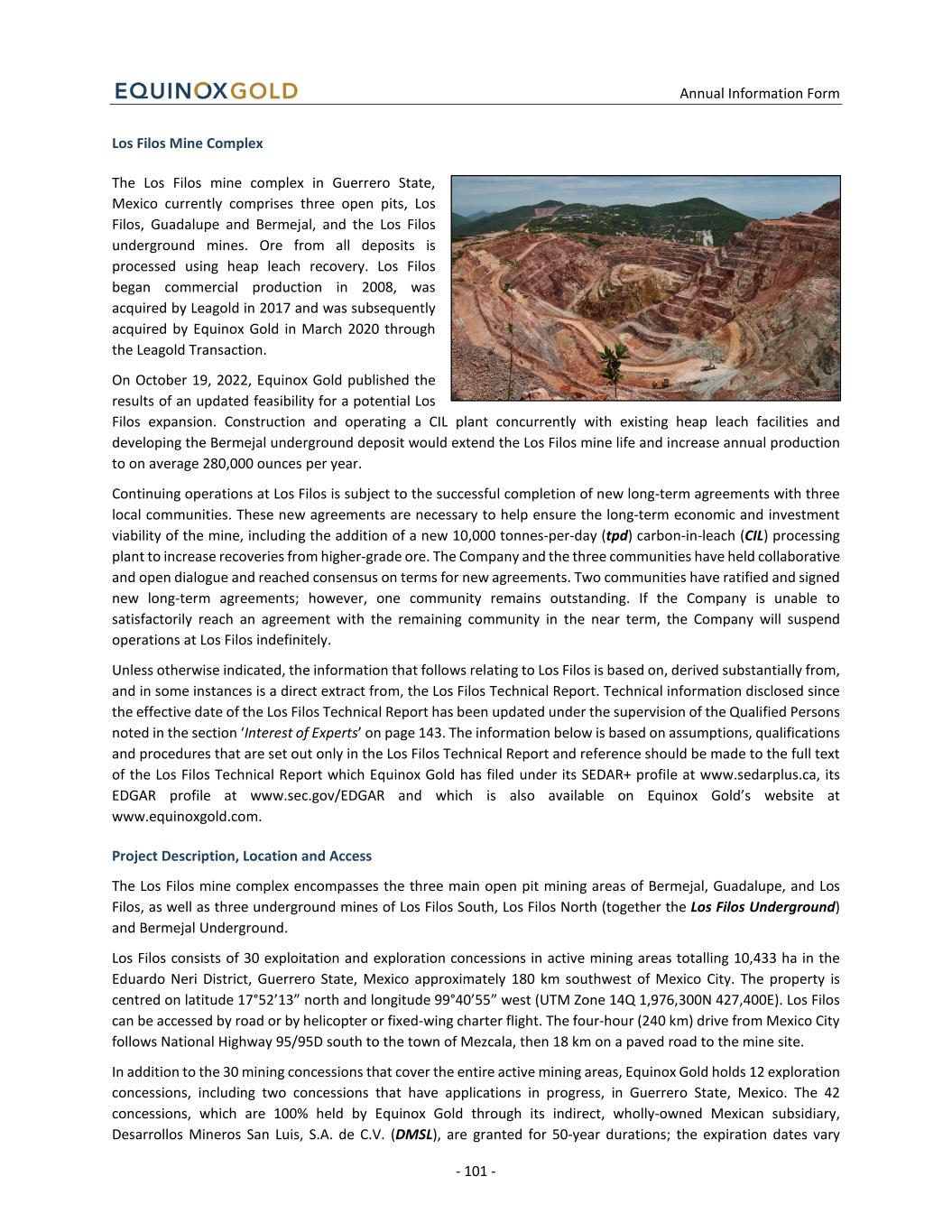
Annual Information Form - 101 - Los Filos Mine Complex The Los Filos mine complex in Guerrero State, Mexico currently comprises three open pits, Los Filos, Guadalupe and Bermejal, and the Los Filos underground mines. Ore from all deposits is processed using heap leach recovery. Los Filos began commercial production in 2008, was acquired by Leagold in 2017 and was subsequently acquired by Equinox Gold in March 2020 through the Leagold Transaction. On October 19, 2022, Equinox Gold published the results of an updated feasibility for a potential Los Filos expansion. Construction and operating a CIL plant concurrently with existing heap leach facilities and developing the Bermejal underground deposit would extend the Los Filos mine life and increase annual production to on average 280,000 ounces per year. Continuing operations at Los Filos is subject to the successful completion of new long-term agreements with three local communities. These new agreements are necessary to help ensure the long-term economic and investment viability of the mine, including the addition of a new 10,000 tonnes-per-day (tpd) carbon-in-leach (CIL) processing plant to increase recoveries from higher-grade ore. The Company and the three communities have held collaborative and open dialogue and reached consensus on terms for new agreements. Two communities have ratified and signed new long-term agreements; however, one community remains outstanding. If the Company is unable to satisfactorily reach an agreement with the remaining community in the near term, the Company will suspend operations at Los Filos indefinitely. Unless otherwise indicated, the information that follows relating to Los Filos is based on, derived substantially from, and in some instances is a direct extract from, the Los Filos Technical Report. Technical information disclosed since the effective date of the Los Filos Technical Report has been updated under the supervision of the Qualified Persons noted in the section ‘Interest of Experts’ on page 143. The information below is based on assumptions, qualifications and procedures that are set out only in the Los Filos Technical Report and reference should be made to the full text of the Los Filos Technical Report which Equinox Gold has filed under its SEDAR+ profile at www.sedarplus.ca, its EDGAR profile at www.sec.gov/EDGAR and which is also available on Equinox Gold’s website at www.equinoxgold.com. Project Description, Location and Access The Los Filos mine complex encompasses the three main open pit mining areas of Bermejal, Guadalupe, and Los Filos, as well as three underground mines of Los Filos South, Los Filos North (together the Los Filos Underground) and Bermejal Underground. Los Filos consists of 30 exploitation and exploration concessions in active mining areas totalling 10,433 ha in the Eduardo Neri District, Guerrero State, Mexico approximately 180 km southwest of Mexico City. The property is centred on latitude 17°52’13” north and longitude 99°40’55” west (UTM Zone 14Q 1,976,300N 427,400E). Los Filos can be accessed by road or by helicopter or fixed-wing charter flight. The four-hour (240 km) drive from Mexico City follows National Highway 95/95D south to the town of Mezcala, then 18 km on a paved road to the mine site. In addition to the 30 mining concessions that cover the entire active mining areas, Equinox Gold holds 12 exploration concessions, including two concessions that have applications in progress, in Guerrero State, Mexico. The 42 concessions, which are 100% held by Equinox Gold through its indirect, wholly-owned Mexican subsidiary, Desarrollos Mineros San Luis, S.A. de C.V. (DMSL), are granted for 50-year durations; the expiration dates vary
Annual Information Form - 102 - depending on the date of grant of the concession. Renewal dates range from 2032 to 2067. Details regarding such concessions, including applicable expiry dates, are listed in the Los Filos Technical Report. The surface rights held by the mine cover the area needed to support all infrastructure required for the mining operations and proposed future CIL plant, including access and power-line easements. The main obligations that arise from a mining concession, and which must be kept current to avoid its cancellation, are performing assessment work, paying mining taxes (duties), and complying with environmental laws. Mining regulations establish minimum amounts that must be spent. Sales of minerals from the mine for an equivalent amount may substitute for minimum expenditures. A report must be filed in May of each year that details the work undertaken during the previous calendar year. Mining duties must be paid in advance in January and July of each year and are determined on an annual basis under the Mexican Federal Rights Law (Ley Federal de Derechos, DOF 09-04-2012). Duties are based on the surface area of the concession and the number of years that have elapsed since the mining concession was issued. Concessions are maintained on an annual basis by payment of appropriate fees, as determined by the Office of Economic Affairs (Secretaría de Economía) each year. Holders must also supply the Office of Economic Affairs with all activity, contracts, and agreements that affect the concession title to keep and maintain the Public Mining Registry current. The relevant Mexican federal and state authorities have granted appropriate environmental permits for Los Filos, including the area of the open pits. Los Filos secured 4,102 ha to cover surface rights required for the Los Filos mining operations, including the area of the three open pits, underground mine portals, process and ancillary facilities, roads, services, and a buffer area to allow for any future growth and potential exploration targets. Los Filos is subject to a 30% federal corporate income tax rate. Two mining royalty taxes are also payable to the government of Mexico: a 7.5% mining tax on earnings before interest, taxes, depreciation, and amortization; and a 0.5% gross revenue royalty tax levied on revenue from gold and silver sales. Net smelter return royalties to Servicio Geológico Mexicano, a department of the Mexican government, ranging from 2.5% to 3% are applicable to mining from five concessions of the property. Two of those concessions are also subject to net smelter return royalties of 0.75% to 1.75% payable to LC Mines S.A. de C.V., a subsidiary of Agnico-Eagle Mines Limited. The existing Closure and Reclamation Plan is conceptual and addresses all existing facilities. The estimated closure liability in the Los Filos Technical Report of $50.9 million is based on the existing facilities at the end of 2021, and as such is exclusive of the majority of the future Bermejal Underground development, the proposed CIL plant, dry stack tailings facility and new electrical substation, and the future heap leach pad expansion. Bonding requirements under Mexican regulatory requirements, pertaining to the current operation, have been met. Current environmental liabilities are typical of those normally associated with active underground and open pit mining operations feeding a heap leach facility. To the responsible Qualified Person’s knowledge, other than as set out in this summary, there are no other significant factors or risks that may affect access, title, or the right or ability to perform work on Los Filos. History The following summarizes the Los Filos Mine Complex’s ownership, exploration and production history post-2003. In November 2003, Wheaton River Minerals Ltd. (WRM) gained 100% ownership of Los Filos through the purchase of Miranda Mining Development Corporation and associated agreements with Teck Corporation. In March 2005, Goldcorp Inc. (Goldcorp) acquired WRM, and therefore DMSL, the operator of Los Filos. Goldcorp also acquired the Nukay mine in 2008, which was subsequently integrated with the Los Filos operations as the Los Filos Underground mine. On March 22, 2005, Goldcorp’s wholly owned operating Mexican company Luismin acquired the Bermejal gold deposit from Minera El Bermejal, S. de R.L. de C.V., a joint venture between Industrias Peñoles S.A. de C.V. and
Annual Information Form - 103 - Newmont Mining Corporation. On April 7, 2017, Leagold Mining Corp. (Leagold) acquired 100% ownership of Los Filos through the purchase of DMSL from Goldcorp and on March 10, 2020, Equinox Gold merged with Leagold. Goldcorp completed feasibility-level studies for the Los Filos Open Pit, Bermejal Open Pit, and Los Filos Underground between 2005 and 2007. Open pit mining commenced at Los Filos in 2005. Underground production at Los Filos commenced in 2007, and the first gold pour occurred that year. In 2013, exploration drilling below Bermejal Open Pit encountered high-grade oxide mineralization that is now referred to as the Bermejal Underground deposit. A total of 259 Mt of ore at 0.74 g/t Au, containing 6.1 Moz Au, was mined from 2005 to June 30, 2022. Reference should be made to the Los Filos Technical Report for further details on past exploration and production activities at Los Filos. SRK completed a Mineral Resource estimate reported for the Los Filos mine in 2019. Geological Setting, Mineralization and Deposit Types Los Filos is in the Guerrero Gold Belt near the centre of a large, approximately 200 km-diameter, circular feature known as the Morelos–Guerrero sedimentary basin. The basin consists of a thick sequence of Mesozoic platform carbonate and argillaceous rocks including the succession of the Morelos, Cuautla, and Mezcala Formations. The Cretaceous carbonate rocks were intruded by numerous early Tertiary-age granitoid bodies. The distribution of intrusions along northwest-trending belts is interpreted to reflect the control on their emplacement by pre-existing northwest-trending faults. Tertiary granodiorites that intrude the carbonate sedimentary units on the mine property include: the eastern and western Los Filos stocks, the Bermejal–Guadalupe stock, the Xochipala intrusion, and an unnamed granodiorite intrusion in the northeast portion of the property. Mineralization identified within the Los Filos property is typical of intrusion-related gold–silver skarn deposits. Gold skarns typically form in orogenic belts at convergent plate margins and are related to plutonism associated with the development of oceanic island arcs or back arcs. Mineralization is geologically controlled either by being hosted by, or spatially associated with, skarn development during contact metamorphism of the carbonates by the intruding granitoid rocks. The Los Filos stocks form two circular deposits, each approximately 1.5 km in diameter, with mineralization focused along the contacts with the host rocks. The Bermejal–Guadalupe stock forms on oblong shape over 5 km long, with the Bermejal deposit on the northern end, and the Guadalupe deposit approximately 2 km southeast of Bermejal; the stock continues further southeast to the San Pablo deposit. Massive magnetite, hematite, goethite, and jasperoidal silica, with minor associated pyrite, pyrrhotite, chalcopyrite, and native gold typically occur in the veins and metasomatic replacement bodies that develop at the contacts between the carbonate and intrusive rocks. Extensive, deep oxidation of the deposits (that occurred at the time of mineralization) has altered the mineralization into material that is amenable to cyanidation recovery techniques without the need of pre-treatment by roasting or other methods. In the Los Filos area, known mineralization is associated with early-Tertiary Los Filos and Bermejal–Guadalupe granodiorite stocks that were emplaced into the host carbonate rocks. Mineralization mined in the Los Filos Open Pit is associated with a shallowly east-dipping diorite sill and with the upper portion of the eastern stock. The Los Filos Underground is divided into the Los Filos North (Norte) and South (Sur) sectors along the north and south sides of both the western and eastern stocks. The principal mining areas in the North sector are Nukay and Peninsular, and in the South sector are Independencia and Sur. Mineralization in the Bermejal–Guadalupe area occurs along the contact of the Bermejal–Guadalupe stock with the carbonate rocks of the Morelos Formation. The Bermejal Open Pit mineralization is typically at the top or on the flanks of the upper portion of the intrusive. On the northern end of the stock, mineralization extends below the Bermejal Open Pit and down the steeply dipping to vertical flanks of the intrusion, and is referred to as the Bermejal Underground deposit.
Annual Information Form - 104 - The total circumference of the Los Filos stocks is approximately 8 km, with at least half of this circumference tested by drilling or with mining development. The Bermejal–Guadalupe stock has a circumference of approximately 16 km, and although the contacts along the upper portion of the intrusion have been mined by open pit, only a few kilometres of this contact have been explored at depth. Mineralization extends from surface to over 700 m deep, and is variable in grade and width. Additional exploration targets are present along the intrusion contacts in both the Los Filos and Bermejal–Guadalupe areas. The deposits of the Los Filos Mine Complex are considered examples of calcic-type skarns and display all three subtypes of skarns described above, depending on depth in the system and host rock. All the deposits are genetically related to porphyritic diorites, tonalites, and granodiorites, as well as the hydrothermal system that accompanied intrusive emplacement. Mineralization is either hosted by, or spatially associated with, marble formed during contact metamorphism of the carbonates. Massive magnetite, hematite, goethite, and jasperoidal silica, with minor associated pyrite, pyrrhotite, chalcopyrite, and native gold, typically occur in the veins and metasomatic replacement bodies that developed at the contacts between the platform carbonates and intrusive rocks. Extensive, deep oxidation of the deposits (that occurred at the time of mineralization) has altered the mineralization into material that is amenable to cyanidation recovery techniques without the need of pre-treatment by roasting or other methods. Exploration Equinox Gold and previous companies have undertaken exploration at the Los Filos Mine Complex with a focus on the granodiorite/carbonate contacts in the Los Filos and Bermejal–Guadalupe areas. Exploration activities have included regional and detail mapping; rock and soil sampling; trenching; channel sampling; reverse-circulation (RC) and diamond drilling; ground induced polarization, ground magnetic, and aeromagnetic geophysical surveys; mineralization characterization studies; LiDAR surveys; and metallurgical testing of samples. In March 2022, Eagle Mapping group of Vancouver collected LiDAR and aerial photography surveys of the Los Filos property at a minimum density of 8 ppm with LiDAR accuracies of 15 cm (vertical) and 30 cm (horizontal). Aerial photography was orthorectified to the LiDAR model producing an orthophoto with 15 cm pixel resolution, a digital elevation model (DEM), a digital surface model (DSM), and contour data. The area covered by the surveys includes all concessions of the Los Filos Mine Complex property. Surface mapping and sampling, geochemical surveys, and magnetic surveys highlight the intrusions and related alteration products of contact metamorphism relative to the host carbonate rocks. These alteration zones can host gold skarn mineralization, which requires drilling to delineate. Drilling From 2003 to June 30, 2022, 939,782 m of diamond and RC drilling have been completed at the Los Filos Mine Complex, including 64,930 m since 2019. This includes drilling for open pit and underground targets at the Los Filos Open Pit, Bermejal Open Pit, Bermejal Underground, Guadalupe, San Pablo, and Xochipala areas and the underground drilling programs in the Los Filos North and South sectors. Drilling since 2019 has focused on extending mineralization in the Bermejal–Guadalupe open pits, Bermejal Underground, Los Filos Open Pit, and Los Filos Underground. Three contractors have completed drilling since 2019, using 13 different drill rigs. Intersection spacing across the deposits that were drilled from surface is approximately 35 x 35 m in areas with closely spaced drilling and widens to about 70 x 70 m in the areas that are less well drilled. Drill spacing is wider again (i.e., 100 x 100 m) in the areas outside the conceptual pit outlines that are used to constrain Mineral Resources. Drill-hole azimuths depend on the orientation of the deposit being drilled. Dips range from 65° to 90° and are commonly 90° for drilling related to the open pit mineralization.
Annual Information Form - 105 - For the Bermejal Underground deposit, the drill azimuth varies due to the arcuate shape of the deposit’s strike. The primary azimuths are usually 60° and 180° for the eastern and central portions of the deposit, respectively, whereas the drill holes on the western sector were vertical to provide an intersection angle that is close to perpendicular to the sub-sill mineralization. In the opinion of the responsible Qualified Person, the quantity, quality, and spacing of the lithological, geotechnical, collar survey, and downhole survey data collected in the exploration and infill drill programs are sufficient to support Mineral Resource and Mineral Reserve estimation. Sampling, Analysis and Data Verification Geological logging data for the Los Filos Mine Complex is recorded on tablet computers directly into an acQuire™ database. Sample and assay data are uploaded digitally. Survey data is imported or uploaded from the survey instruments. All drill core samples for exploration and Mineral Resource estimation are sent to an external laboratory for sample preparation (ALS Chemex, Guadalajara, Mexico) and assaying (ALS Chemex, Vancouver, B.C.). No RC samples were collected from drilling programs in 2017. From 2018 to the present, RC samples have been collected from drilling programs in the Bermejal-Guadalupe Open Pit and Los Filos Open Pit. Drill cuttings from previous RC drilling at the Los Filos Mine Complex were sampled at intervals of 1.52 m. The material was split at the drill into several portions of 12 kg or less. Of these, a 300 g “assay split” was shipped to the external laboratory, and the “second split” was stored on the property. Drill cuttings from RC drilling prior to 2017 at the Bermejal deposit were sampled dry at 2 m intervals. The samples were then transferred to the core facility, then riffle split in three cycles until a 10 kg sample was obtained. The split sample was then bagged and tagged and sent to the sample preparation laboratory (at that time the laboratories used were the San Luis Potosi facility of Bondar Clegg and the Hermosillo location of Skyline Laboratories). For RC samples collected in 2018–2022, drill cuttings were sampled dry at 2 m intervals. All the cuttings were collected in high-strength plastic bags that were previously marked, then weighed to determine the recovery for the interval. The bags were then transferred to the core facility, then riffle split in three cycles until a 6 kg sample was obtained. The split sample was then bagged and tagged and sent to the sample preparation laboratory (ALS Chemex, Guadalajara). The remainder of the RC sample was saved in high-strength bags and stored on site. Since 2003, core samples for exploration and infill drill programs were either split or cut depending on the hardness or competency of the mineralized material. Splitting was conducted manually with a spatula or putty knife or split with a HYDRASPLIT manual hydraulic splitter. Core cutting was conducted with 220 V Rockman saws, and the core was cut in half along the core axis. The splitting or cutting takes lithological contacts into account, as determined by the geologist during sample interval selection. Samples are usually shorter than 1.5 m, with a minimum sample length of 0.3 m and a maximum of 3 m. HQ and NQ core is split or cut in half. Half of the core is sent for sample preparation and analysis, and the remaining half is retained in the core box. Splitting or cutting core for metallurgical samples usually involves a larger proportion of the core being sent for analysis (75%), with the rest retained in the core box (typically using PQ size core). Once the samples are cut or split, they are bagged and numbered in polyethylene bags. Quality control and quality assurance (QA/QC) samples are added to the sampling sequence prior to packaging sample bags for shipment. The following procedures are applied by ALS Chemex, Guadalajara, Mexico to core samples that are sent to the preparation laboratory, with every fiftieth sample screen-tested to check that the below standards of crushing and pulverizing are being achieved:
Annual Information Form - 106 - • Checking samples received against the manifest of the samples that were sent from the Los Filos Mine Complex; • Weighing the sample as received and entering it into the Laboratory Information Management System; • Drying sample for 12 hours (oven dry at 105°C); • Crushing sample to P100 2 mm; • Splitting sample to produce a 1.5 kg split and a reject sample; and • Pulverizing sample to P85 75 µm in a ring and puck pulverizer. All samples from the current drilling programs are analyzed for gold using a standard 50 g fire assay with gold detection by flame atomic absorption spectrometry to a 0.01 ppm detection limit. Multi-element analyses are completed using a multi-acid digest method and an induced coupled plasma optical emission spectrometry finish on 36 elements. The core facility at the Los Filos Mine Complex is within a secure and monitored area on the mine property, and samples are always attended or locked at the sample collection and dispatch facility. Core boxes are transported to the core facility by the drilling contractors. Los Filos mine exploration department personnel undertake sample collection and transportation on site. Independent laboratory personnel using their company vehicles transport samples to the preparation laboratory. The sample preparation and analytical laboratory are independent of Equinox Gold. Chain-of-custody procedures consist of filling out sample submittal forms that are sent to the laboratory with sample shipments, to make certain the preparation laboratory receives all samples. A QA/QC program is in use by the Los Filos Mine Complex exploration department and the independent laboratory also maintains its own QA/QC program to monitor the performance, accuracy and precision of the laboratory analyses. The Los Filos exploration department has a standard QA/QC program in place for all drill core and RC sampling, and also underground mine sampling. The QA/QC program for samples from drilling includes routine insertion of duplicate samples, blank samples, and standards (certified reference materials) and also check-assaying of a suite of samples at an external third-party laboratory. Assays are received from ALS Chemex as a CSV file. While importing the assays into the acQuire™ database, the software checks the duplicate, blank, and standard samples to determine if they are within the accepted ranges. In the event of a failure, the laboratory is asked to reanalyze the batch of samples that contain the control sample outside the accepted range. Once the re-assays for the batch of samples are received, and if the control sample is within the accepted range, the assays are imported to acQuire™. Los Filos Mine Complex geologists routinely perform validation checks on data, including checks on drill hole surveys, collar coordinates, lithology data, and assay data. Equinox Gold corporate staff completed an additional validation, which included checking coordinates of drill hole collars in the field and reviewing approximately 5% of data collected since 2004. Previous operators conducted and documented validation of drill holes completed prior to 2004. No significant errors or omissions were identified with the database following these checks. In the responsible Qualified Person’s opinion, the sampling, sample preparation, security, and analytical methods in use are acceptable and meet industry-standard practices. In the opinion of the responsible Qualified Person, the data have also been verified, and are therefore adequate for Mineral Resource and Mineral Reserve estimation, and mine planning purposes. Mineral Processing and Metallurgical Testing Extensive metallurgical testwork on samples from the various deposits that comprise the Los Filos Mine Complex has been conducted over the past two decades.
Annual Information Form - 107 - Los Filos Open Pit uses geometallurgical domains for defining ore types, whereas Los Filos Underground, Bermejal Open Pit, Bermejal Underground, and Guadalupe Open Pit use rock-type domains for defining ore types. The metallurgical test programs performed prior to 2016 were focused on validating the predicted recovery formulas for heap leaching Los Filos Open Pit and Los Filos Underground and Bermejal Open Pit that were created by Simon Hille (Leach Inc.). Metallurgical test programs performed during or after 2016 started to focus on the potential of using CIL to recover gold from ore that contained greater than 1% total sulphur, mainly from Bermejal Open Pit, Bermejal Underground and Guadalupe Open Pit ore sources. The metallurgical testwork prior to 2016 focused on determining heap leach gold recovery and heap leach engineering design, and the metallurgical testwork has been performed exclusively by Kappes, Cassiday & Associates (KCA) of Reno, Nevada, U.S. Simon Hille conducted an evaluation of heap leach gold recoveries early in 2005, and the results were incorporated into the projection of gold recoveries based on testwork KCA performed in 1998 and 2004/2005, as well as McClelland Laboratories Inc. Simon Hille’s evaluation created a predicted gold recovery model for each ore type and for run of mine (ROM) and Crushed material and the model was applied to Los Filos Open Pit, Los Filos Underground, and Bermejal Open Pit ore sources. Simon Hille’s predicted gold recovery model, derived in 2005, has been validated by the testwork performed from 2005 to 2016. Several metallurgical testwork programs were completed on Bermejal Underground and Guadalupe Open Pit ores after 2015. The Bermejal Underground metallurgical testwork program focused on comparing heap leach gold recovery to CIL gold recovery and supporting CIL engineering design. The metal recoveries for gold and silver are based on historical metallurgical testing of the various deposits for heap leaching and recent testwork for CIL processing. Recoveries and associated processing costs vary depending on rock type, copper and sulphur content as well as processing route, as shown in Table 1. Table 1: Processing Costs and Recoveries for Heap Leach Crushed and ROM Ores Source Lithology Recovery formula Au Recovery Ag (%) Operating Cost Formula Bermejal Open Pit Crushed Carbonate 51% 14 =(4.8682*%Cu+1.8812)*CNCST+BCRCST Intrusive =IF(%S<=1.0,0.68,- 0.0582*%S+0.5321) 14 =(4.8682*%Cu+1.8812)*CNCST+BCRCST Oxide =IF(%S<=1.0,0.64,- 0.0355*%S+0.6337) 14 =(4.8682*%Cu+1.8812)*CNCST+BCRCST Bermejal Open Pit ROM Carbonate 42% 11 =(4.8682*%Cu+0.9512)*CNCST+BUCRCST Intrusive =IF(%S<=1.0,0.58,- 0.0582*%S+0.4321) 11 =(4.8682*%Cu+0.9512)*CNCST+BUCRCST Oxide =IF(%S<=1.0,0.48,- 0.0355*%S+0.4737) 11 =(4.8682*%Cu+0.9512)*CNCST+BUCRCST Los Filos Underground Crushed All Ore 80% 11 =BCRCST+1.63*CNCST Bermejal Underground Crushed All Ore =if(%S<1.0,- 0.0508*%S+0.7786,- 0.0169*%S+0.6075) 14 =(4.6696*%Cu+1.7502)*CNCST+BCRCST Los Filos Open Pit Crushed F1a 76% 11 =BCRCST+1.63*CNCST F1b 70% 11 =BCRCST+1.63*CNCST FII 54% 11 =BCRCST+1.63*CNCST FIII 61% 11 =BCRCST+1.63*CNCST FIV 61% 11 =BCRCST+1.63*CNCST Los Filos Open Pit ROM F1a 64% 9 =BUCRCST+0.7*CNCST F1b 50% 9 =BUCRCST+0.7*CNCST FII 45% 9 =BUCRCST+0.7*CNCST FIII 30% 9 =BUCRCST+0.7*CNCST FIV 48% 9 =BUCRCST+0.7*CNCST
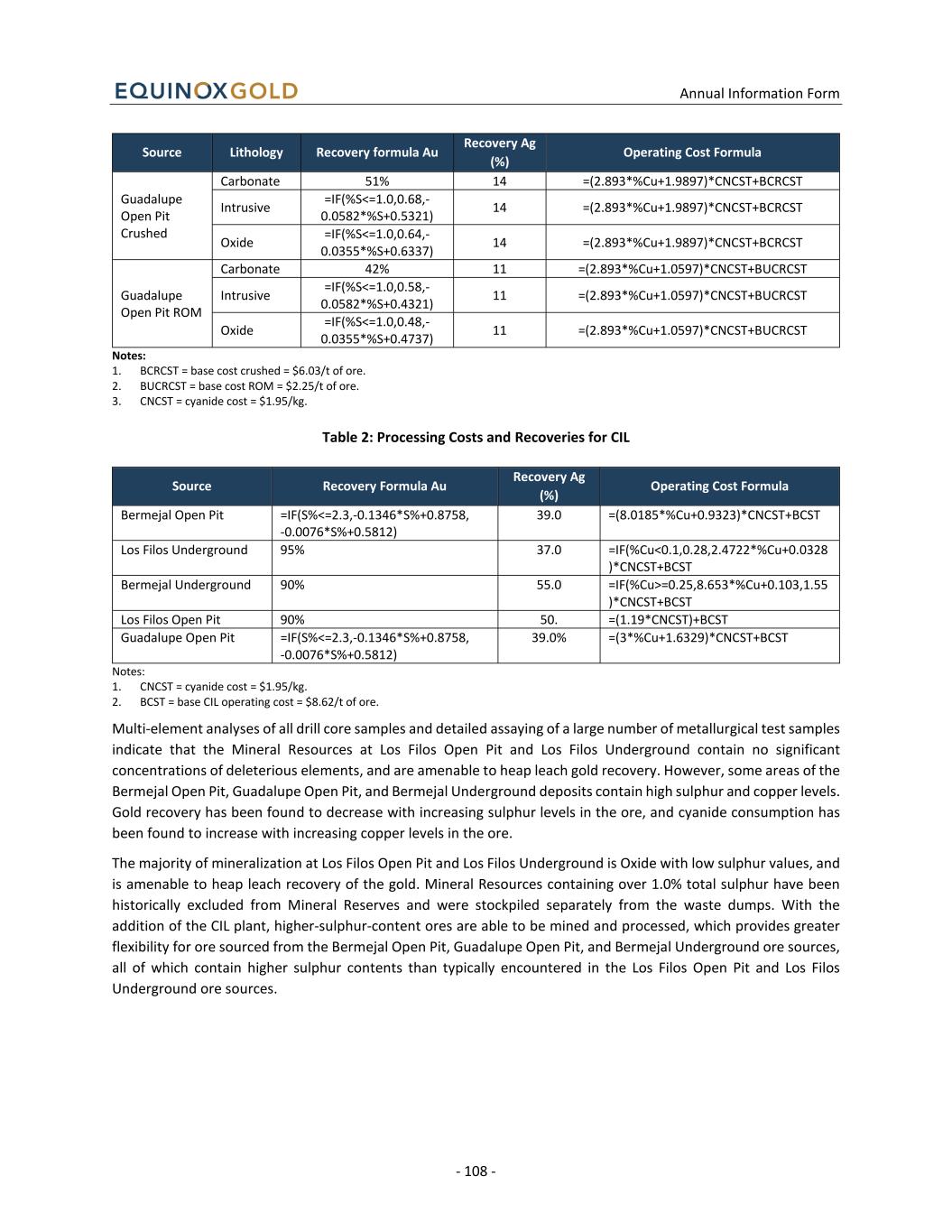
Annual Information Form - 108 - Source Lithology Recovery formula Au Recovery Ag (%) Operating Cost Formula Guadalupe Open Pit Crushed Carbonate 51% 14 =(2.893*%Cu+1.9897)*CNCST+BCRCST Intrusive =IF(%S<=1.0,0.68,- 0.0582*%S+0.5321) 14 =(2.893*%Cu+1.9897)*CNCST+BCRCST Oxide =IF(%S<=1.0,0.64,- 0.0355*%S+0.6337) 14 =(2.893*%Cu+1.9897)*CNCST+BCRCST Guadalupe Open Pit ROM Carbonate 42% 11 =(2.893*%Cu+1.0597)*CNCST+BUCRCST Intrusive =IF(%S<=1.0,0.58,- 0.0582*%S+0.4321) 11 =(2.893*%Cu+1.0597)*CNCST+BUCRCST Oxide =IF(%S<=1.0,0.48,- 0.0355*%S+0.4737) 11 =(2.893*%Cu+1.0597)*CNCST+BUCRCST Notes: 1. BCRCST = base cost crushed = $6.03/t of ore. 2. BUCRCST = base cost ROM = $2.25/t of ore. 3. CNCST = cyanide cost = $1.95/kg. Table 2: Processing Costs and Recoveries for CIL Source Recovery Formula Au Recovery Ag (%) Operating Cost Formula Bermejal Open Pit =IF(S%<=2.3,-0.1346*S%+0.8758, -0.0076*S%+0.5812) 39.0 =(8.0185*%Cu+0.9323)*CNCST+BCST Los Filos Underground 95% 37.0 =IF(%Cu<0.1,0.28,2.4722*%Cu+0.0328 )*CNCST+BCST Bermejal Underground 90% 55.0 =IF(%Cu>=0.25,8.653*%Cu+0.103,1.55 )*CNCST+BCST Los Filos Open Pit 90% 50. =(1.19*CNCST)+BCST Guadalupe Open Pit =IF(S%<=2.3,-0.1346*S%+0.8758, -0.0076*S%+0.5812) 39.0% =(3*%Cu+1.6329)*CNCST+BCST Notes: 1. CNCST = cyanide cost = $1.95/kg. 2. BCST = base CIL operating cost = $8.62/t of ore. Multi-element analyses of all drill core samples and detailed assaying of a large number of metallurgical test samples indicate that the Mineral Resources at Los Filos Open Pit and Los Filos Underground contain no significant concentrations of deleterious elements, and are amenable to heap leach gold recovery. However, some areas of the Bermejal Open Pit, Guadalupe Open Pit, and Bermejal Underground deposits contain high sulphur and copper levels. Gold recovery has been found to decrease with increasing sulphur levels in the ore, and cyanide consumption has been found to increase with increasing copper levels in the ore. The majority of mineralization at Los Filos Open Pit and Los Filos Underground is Oxide with low sulphur values, and is amenable to heap leach recovery of the gold. Mineral Resources containing over 1.0% total sulphur have been historically excluded from Mineral Reserves and were stockpiled separately from the waste dumps. With the addition of the CIL plant, higher-sulphur-content ores are able to be mined and processed, which provides greater flexibility for ore sourced from the Bermejal Open Pit, Guadalupe Open Pit, and Bermejal Underground ore sources, all of which contain higher sulphur contents than typically encountered in the Los Filos Open Pit and Los Filos Underground ore sources.
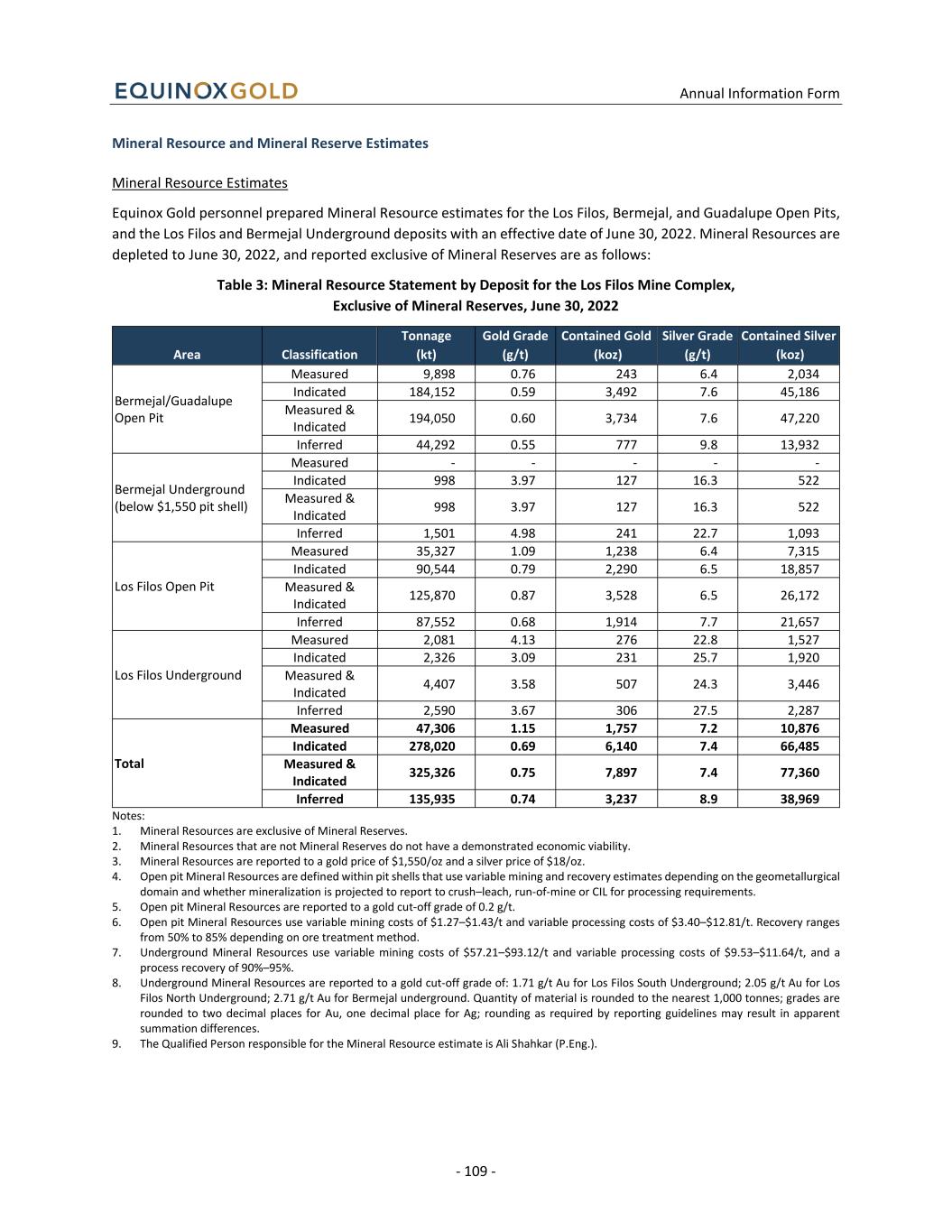
Annual Information Form - 109 - Mineral Resource and Mineral Reserve Estimates Mineral Resource Estimates Equinox Gold personnel prepared Mineral Resource estimates for the Los Filos, Bermejal, and Guadalupe Open Pits, and the Los Filos and Bermejal Underground deposits with an effective date of June 30, 2022. Mineral Resources are depleted to June 30, 2022, and reported exclusive of Mineral Reserves are as follows: Table 3: Mineral Resource Statement by Deposit for the Los Filos Mine Complex, Exclusive of Mineral Reserves, June 30, 2022 Area Classification Tonnage (kt) Gold Grade (g/t) Contained Gold (koz) Silver Grade (g/t) Contained Silver (koz) Bermejal/Guadalupe Open Pit Measured 9,898 0.76 243 6.4 2,034 Indicated 184,152 0.59 3,492 7.6 45,186 Measured & Indicated 194,050 0.60 3,734 7.6 47,220 Inferred 44,292 0.55 777 9.8 13,932 Bermejal Underground (below $1,550 pit shell) Measured - - - - - Indicated 998 3.97 127 16.3 522 Measured & Indicated 998 3.97 127 16.3 522 Inferred 1,501 4.98 241 22.7 1,093 Los Filos Open Pit Measured 35,327 1.09 1,238 6.4 7,315 Indicated 90,544 0.79 2,290 6.5 18,857 Measured & Indicated 125,870 0.87 3,528 6.5 26,172 Inferred 87,552 0.68 1,914 7.7 21,657 Los Filos Underground Measured 2,081 4.13 276 22.8 1,527 Indicated 2,326 3.09 231 25.7 1,920 Measured & Indicated 4,407 3.58 507 24.3 3,446 Inferred 2,590 3.67 306 27.5 2,287 Total Measured 47,306 1.15 1,757 7.2 10,876 Indicated 278,020 0.69 6,140 7.4 66,485 Measured & Indicated 325,326 0.75 7,897 7.4 77,360 Inferred 135,935 0.74 3,237 8.9 38,969 Notes: 1. Mineral Resources are exclusive of Mineral Reserves. 2. Mineral Resources that are not Mineral Reserves do not have a demonstrated economic viability. 3. Mineral Resources are reported to a gold price of $1,550/oz and a silver price of $18/oz. 4. Open pit Mineral Resources are defined within pit shells that use variable mining and recovery estimates depending on the geometallurgical domain and whether mineralization is projected to report to crush–leach, run-of-mine or CIL for processing requirements. 5. Open pit Mineral Resources are reported to a gold cut-off grade of 0.2 g/t. 6. Open pit Mineral Resources use variable mining costs of $1.27–$1.43/t and variable processing costs of $3.40–$12.81/t. Recovery ranges from 50% to 85% depending on ore treatment method. 7. Underground Mineral Resources use variable mining costs of $57.21–$93.12/t and variable processing costs of $9.53–$11.64/t, and a process recovery of 90%–95%. 8. Underground Mineral Resources are reported to a gold cut-off grade of: 1.71 g/t Au for Los Filos South Underground; 2.05 g/t Au for Los Filos North Underground; 2.71 g/t Au for Bermejal underground. Quantity of material is rounded to the nearest 1,000 tonnes; grades are rounded to two decimal places for Au, one decimal place for Ag; rounding as required by reporting guidelines may result in apparent summation differences. 9. The Qualified Person responsible for the Mineral Resource estimate is Ali Shahkar (P.Eng.).
Annual Information Form - 110 - Block model quantities and grade estimates for the Los Filos and Bermejal–Guadalupe deposits were classified according to the CIM Definition Standards for Mineral Resources and Mineral Reserves (CIM, 2014). Mineral Resource classification is subjective and depends on the experience of the Qualified Person and their confidence in the geological and grade continuity of mineralization, confidence in the quality, quantity, and distribution of data supporting the estimates, and the geostatistical confidence in the resource estimates. Classification should delineate regular areas at a similar resource classification. The responsible Qualified Person is satisfied that the geological modelling accurately reflects the available geological information and knowledge at a scale appropriate for the mining methods considered. The sample locations and assay data, which include samples from core and RC drilling, and underground channels, are sufficiently reliable to support resource evaluation. Mining at the Los Filos Mine Complex is conducted by both open pit and underground methods, on two separate and complex deposits. As such, the confidence in geological and grade continuity, and the data spacing required for classification as Measured Mineral Resources (within the meaning of NI 43-101) and Indicated Mineral Resources (within the meaning of NI 43-101) (and therefore sufficient for mine planning) varies depending on both the mining method and the detailed nature of the deposits. Classification at Los Filos is primarily based on search distances from data (drill holes and in some cases channel samples). Bermejal–Guadalupe Open Pit and Bermejal Underground models did not use hard boundaries for classification (distance searches were allowed to cross geological boundaries), whereas at Los Filos Open Pit and Los Filos Underground, due to more irregular data spacing in some geological domains, classification used hard boundaries for the three main domain types (Oxide, Granodiorite, and Carbonate). The Bermejal–Guadalupe Open Pit model considered Guadalupe underground channel samples for Indicated and Inferred Mineral Resource (within the meaning of NI 43-101) classification, but not Measured Mineral Resources. Channel samples were considered for classification in the Los Filos Underground models, but not the Los Filos Open Pit or Bermejal Underground models. A small resource area within the Bermejal–Guadalupe Open Pit model known as the 7 Vetas area was assigned only Inferred Mineral Resource classification. In the Bermejal Underground model, all blocks within Carbonate (domain numbers 60, 61, and 62) are set as Inferred Mineral Resources. There are no known environmental, permitting, socioeconomic, legal, title, taxation, marketing, political, or other relevant factors that could materially affect the Mineral Resource estimate. Estimating Mineral Resources is not without risks: factors such as additional drilling and sampling may affect the geological interpretation, the conceptual pit shells, or the underground mining assumptions. Other factors that may have a positive or negative impact on the estimated Mineral Resources include the following: gold and silver price assumptions; changes in interpretations of lithological, mineralization, or geometallurgical domains; pit slope angles for the open pits or geotechnical assumptions for underground stope designs; changes to the methodology used to assign densities in the Mineral Resource models; changes to the assumptions used to generate the gold cut-off grades for Mineral Resource declaration; changes to the parameters used for grade estimation; and changes to the classification criteria used. Mineral Reserve Estimates Mineral Reserves are reported in accordance with NI 43-101, CIM (2014) definitions. Modifying factors were applied to convert Mineral Resources to Mineral Reserves, including mining cut-off grades, mining dilution, and mining recovery factors. Only Measured and Indicated Mineral Resources are used to state Mineral Reserves. The consolidated open pit and underground Mineral Reserve estimate based on Proven Mineral Reserves (within the meaning of NI 43-101) and Probable Mineral Reserves (within the meaning of NI 43-101) for Los Filos is presented in Table 4.
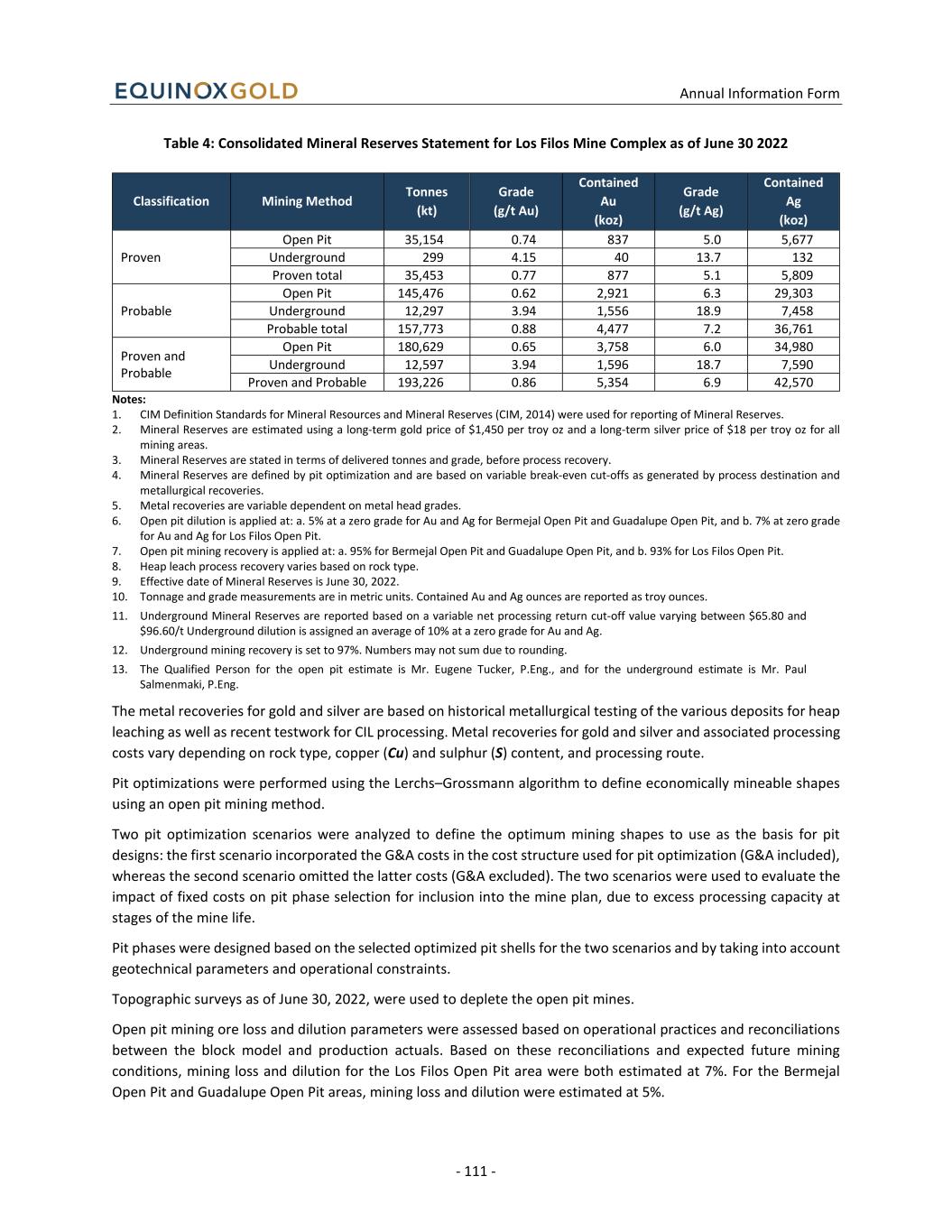
Annual Information Form - 111 - Table 4: Consolidated Mineral Reserves Statement for Los Filos Mine Complex as of June 30 2022 Classification Mining Method Tonnes (kt) Grade (g/t Au) Contained Au (koz) Grade (g/t Ag) Contained Ag (koz) Proven Open Pit 35,154 0.74 837 5.0 5,677 Underground 299 4.15 40 13.7 132 Proven total 35,453 0.77 877 5.1 5,809 Probable Open Pit 145,476 0.62 2,921 6.3 29,303 Underground 12,297 3.94 1,556 18.9 7,458 Probable total 157,773 0.88 4,477 7.2 36,761 Proven and Probable Open Pit 180,629 0.65 3,758 6.0 34,980 Underground 12,597 3.94 1,596 18.7 7,590 Proven and Probable 193,226 0.86 5,354 6.9 42,570 Notes: 1. CIM Definition Standards for Mineral Resources and Mineral Reserves (CIM, 2014) were used for reporting of Mineral Reserves. 2. Mineral Reserves are estimated using a long-term gold price of $1,450 per troy oz and a long-term silver price of $18 per troy oz for all mining areas. 3. Mineral Reserves are stated in terms of delivered tonnes and grade, before process recovery. 4. Mineral Reserves are defined by pit optimization and are based on variable break-even cut-offs as generated by process destination and metallurgical recoveries. 5. Metal recoveries are variable dependent on metal head grades. 6. Open pit dilution is applied at: a. 5% at a zero grade for Au and Ag for Bermejal Open Pit and Guadalupe Open Pit, and b. 7% at zero grade for Au and Ag for Los Filos Open Pit. 7. Open pit mining recovery is applied at: a. 95% for Bermejal Open Pit and Guadalupe Open Pit, and b. 93% for Los Filos Open Pit. 8. Heap leach process recovery varies based on rock type. 9. Effective date of Mineral Reserves is June 30, 2022. 10. Tonnage and grade measurements are in metric units. Contained Au and Ag ounces are reported as troy ounces. 11. Underground Mineral Reserves are reported based on a variable net processing return cut-off value varying between $65.80 and $96.60/t Underground dilution is assigned an average of 10% at a zero grade for Au and Ag. 12. Underground mining recovery is set to 97%. Numbers may not sum due to rounding. 13. The Qualified Person for the open pit estimate is Mr. Eugene Tucker, P.Eng., and for the underground estimate is Mr. Paul Salmenmaki, P.Eng. The metal recoveries for gold and silver are based on historical metallurgical testing of the various deposits for heap leaching as well as recent testwork for CIL processing. Metal recoveries for gold and silver and associated processing costs vary depending on rock type, copper (Cu) and sulphur (S) content, and processing route. Pit optimizations were performed using the Lerchs–Grossmann algorithm to define economically mineable shapes using an open pit mining method. Two pit optimization scenarios were analyzed to define the optimum mining shapes to use as the basis for pit designs: the first scenario incorporated the G&A costs in the cost structure used for pit optimization (G&A included), whereas the second scenario omitted the latter costs (G&A excluded). The two scenarios were used to evaluate the impact of fixed costs on pit phase selection for inclusion into the mine plan, due to excess processing capacity at stages of the mine life. Pit phases were designed based on the selected optimized pit shells for the two scenarios and by taking into account geotechnical parameters and operational constraints. Topographic surveys as of June 30, 2022, were used to deplete the open pit mines. Open pit mining ore loss and dilution parameters were assessed based on operational practices and reconciliations between the block model and production actuals. Based on these reconciliations and expected future mining conditions, mining loss and dilution for the Los Filos Open Pit area were both estimated at 7%. For the Bermejal Open Pit and Guadalupe Open Pit areas, mining loss and dilution were estimated at 5%.
Annual Information Form - 112 - Inputs to the optimization process include slope angles, metallurgical recoveries, operating costs, selling costs, and government royalties. Mining operating costs are based on historical costs and first principles estimates. An incremental haulage cost increase of approximately $0.02/t per bench was applied to material mined from benches that are above or below the reference bench elevation, which is the bench elevation at which haul trucks exit each pit. Mining costs vary by destination due to variable surface haulage distances to the respective destination. The economic cut-off varies based on the metallurgical recovery and operating cost assigned to each mined block. The metallurgical recovery for each block varies based on the rock type, sulphur content, and the processing destination (crushed heap leach, ROM heap leach or CIL). The operating cost for each block varies based on the mining, processing, and G&A cost. The mining cost is dependent on the haulage distance to the processing destination. The Qualified Persons responsible for the Mineral Reserve estimates are not aware of any mining, metallurgical, infrastructure, permitting or other relevant factors that could materially affect the Mineral Reserve estimates. Factors that may affect the Mineral Reserve estimates include the following: commodity prices; mining recovery and metallurgical recovery assumptions; presence of unexpected quantities of copper or sulphur, which may impact economical treatment of ore at the process plant or heap leach facility; methodology of assigning ore densities; geotechnical characteristics of the rock mass; excess underground mining dilution; and ability to consistently deliver the required process plant feed to the process plant. Mining Operations Underground Mining The current mining methods for Los Filos Underground are overhand cut and fill in the narrow areas and overhand drift and fill in the wider areas. Both are proven methods at Los Filos Underground and allow for a high degree of selectivity. The longhole open stoping mining method is also used in targeted areas of vertical ore body continuity and good rock conditions. The mining method used for Bermejal Underground is overhand drift and fill in oxide ore, which constitutes most of the deposit, and underhand drift and fill to mine ore in intrusive host rock. Based on the selective nature of the predominant cut-and-fill mining method, AMC anticipates that good mining practices will allow mining dilution to stabilize around 10% and mining recovery at 97%. Underground ore is sent to the heap leach crushed processing route until the CIL plant is expected to become available in mid-2024. The cut-off values supporting the estimation of underground Mineral Reserves were developed as a net processing return for Bermejal Underground, as the processing cost and metallurgical recovery to the CIL plant are variable. With respect to Los Filos Underground, the cut-off grade was determined based on a fixed processing cost and metallurgical recovery based on the average grade over the remaining mine life. The mining operations are contracted out at Bermejal Underground and Los Filos Underground South; the Los Filos Underground North mine is owner-operated. Los Filos Underground is extracting ore from two main zones, Nukay and Peninsular. The mine is expected to produce approximately 1.2 Mt of ore at an average production rate of 960 t/d, until the end of its life in 2025. For Bermejal Underground, access to the ore zones is via the East portal. A second portal, the West portal, is planned to provide a second access by 2025. Once the second portal is completed, mining is planned to operate at a steady-state production rate of 1 Mt/a from 2025 to 2032.
Annual Information Form - 113 - Open Pit Mining Open pit mining will remain owner-operated with conventional load, haul, drill and blast on 9 m benches. Loading is undertaken by 250-tonne shovels and large front-end loaders, and haulage by 136-tonne trucks. A larger mining fleet composed mainly of 180-tonne electric-drive trucks and 400-tonne face shovels is proposed to progressively replace the existing mining equipment as it reaches the end of its useful life. Ore is hauled either to the crusher, for crushed heap leach, or directly to an ROM leach pad for processing. A 10,000 t/d CIL processing plant is planned to be constructed to offer an alternative processing destination starting in Q3 2024. Waste is hauled to external or in-pit waste rock dumps. Mathematical equations were used to derive the metallurgical recovery and processing costs for each mining block based on rock type, sulphur, gold, and copper content, and the processing destination (crushed or ROM heap leach, or CIL). An allowance for mining dilution and mining recovery was used based on historical performance and reconciliation of the Mineral Resource model to the mining production. Mining dilution and ore loss at Los Filos Open Pit is estimated at 7% and at 5% at the Bermejal and Guadalupe Open Pits. These inputs, combined with mining costs, general and administrative costs, selling costs, metal prices, and royalties, were used to derive economic open pit cut-off grades. The ultimate open pits were designed based on guidance from pit optimization, geotechnical parameters, and practical constraints. A combination of external waste dumps and in-pit backfills was used to minimize haul distance for the waste rock mined. Combined Schedule The combined open pit and underground mine plan aimed at optimizing project value by allocating ore to the most attractive processing destination, based on mining and processing constraints, operating costs (OPEX), revenue, and capital costs (CAPEX) considerations. The combined mine plan results in an estimated mine life that extends until 2036. The resulting ore and gold production is presented in Table 5.
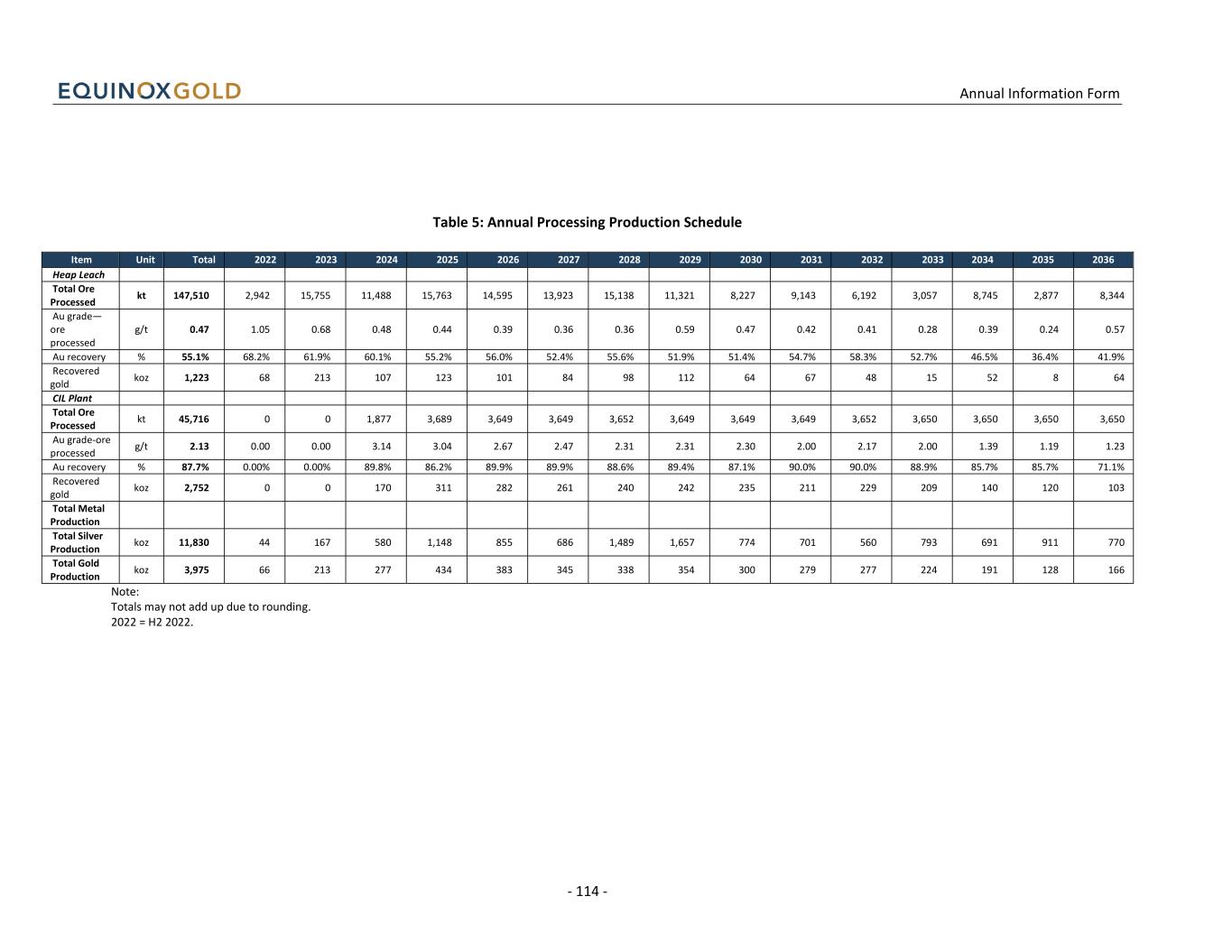
Annual Information Form - 114 - Table 5: Annual Processing Production Schedule Item Unit Total 2022 2023 2024 2025 2026 2027 2028 2029 2030 2031 2032 2033 2034 2035 2036 Heap Leach Total Ore Processed kt 147,510 2,942 15,755 11,488 15,763 14,595 13,923 15,138 11,321 8,227 9,143 6,192 3,057 8,745 2,877 8,344 Au grade— ore processed g/t 0.47 1.05 0.68 0.48 0.44 0.39 0.36 0.36 0.59 0.47 0.42 0.41 0.28 0.39 0.24 0.57 Au recovery % 55.1% 68.2% 61.9% 60.1% 55.2% 56.0% 52.4% 55.6% 51.9% 51.4% 54.7% 58.3% 52.7% 46.5% 36.4% 41.9% Recovered gold koz 1,223 68 213 107 123 101 84 98 112 64 67 48 15 52 8 64 CIL Plant Total Ore Processed kt 45,716 0 0 1,877 3,689 3,649 3,649 3,652 3,649 3,649 3,649 3,652 3,650 3,650 3,650 3,650 Au grade-ore processed g/t 2.13 0.00 0.00 3.14 3.04 2.67 2.47 2.31 2.31 2.30 2.00 2.17 2.00 1.39 1.19 1.23 Au recovery % 87.7% 0.00% 0.00% 89.8% 86.2% 89.9% 89.9% 88.6% 89.4% 87.1% 90.0% 90.0% 88.9% 85.7% 85.7% 71.1% Recovered gold koz 2,752 0 0 170 311 282 261 240 242 235 211 229 209 140 120 103 Total Metal Production Total Silver Production koz 11,830 44 167 580 1,148 855 686 1,489 1,657 774 701 560 793 691 911 770 Total Gold Production koz 3,975 66 213 277 434 383 345 338 354 300 279 277 224 191 128 166 Note: Totals may not add up due to rounding. 2022 = H2 2022.
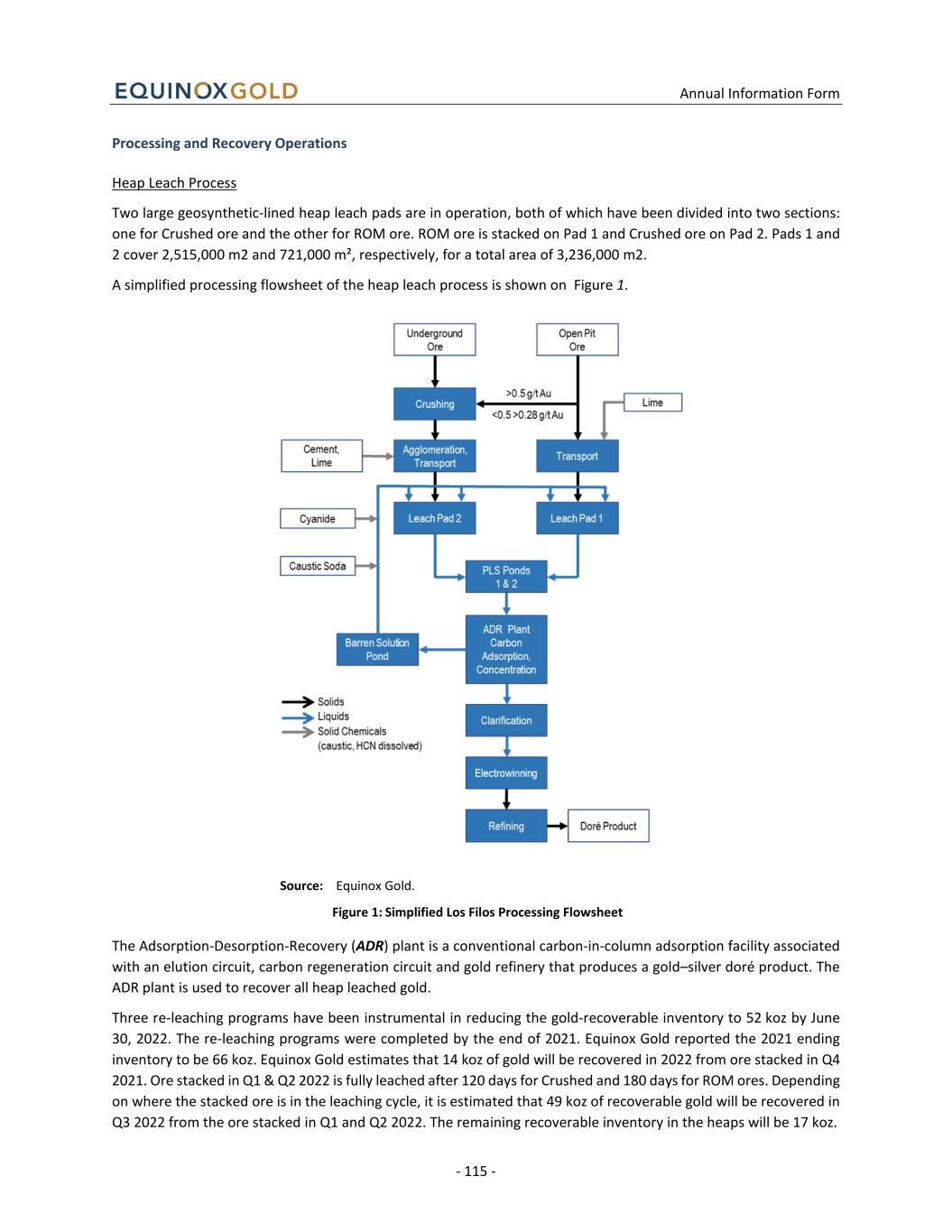
Annual Information Form - 115 - Processing and Recovery Operations Heap Leach Process Two large geosynthetic-lined heap leach pads are in operation, both of which have been divided into two sections: one for Crushed ore and the other for ROM ore. ROM ore is stacked on Pad 1 and Crushed ore on Pad 2. Pads 1 and 2 cover 2,515,000 m2 and 721,000 m², respectively, for a total area of 3,236,000 m2. A simplified processing flowsheet of the heap leach process is shown on Figure 1. Source: Equinox Gold. Figure 1: Simplified Los Filos Processing Flowsheet The Adsorption-Desorption-Recovery (ADR) plant is a conventional carbon-in-column adsorption facility associated with an elution circuit, carbon regeneration circuit and gold refinery that produces a gold–silver doré product. The ADR plant is used to recover all heap leached gold. Three re-leaching programs have been instrumental in reducing the gold-recoverable inventory to 52 koz by June 30, 2022. The re-leaching programs were completed by the end of 2021. Equinox Gold reported the 2021 ending inventory to be 66 koz. Equinox Gold estimates that 14 koz of gold will be recovered in 2022 from ore stacked in Q4 2021. Ore stacked in Q1 & Q2 2022 is fully leached after 120 days for Crushed and 180 days for ROM ores. Depending on where the stacked ore is in the leaching cycle, it is estimated that 49 koz of recoverable gold will be recovered in Q3 2022 from the ore stacked in Q1 and Q2 2022. The remaining recoverable inventory in the heaps will be 17 koz.
Annual Information Form - 116 - Recovery factors estimated for the various ore sources to heap leaching process are based on appropriate metallurgical testwork, and these have been confirmed by recent production data. CIL Process The CIL plant design is based on a robust metallurgical flowsheet developed for optimum recovery, while minimizing CAPEX and OPEX. As the CIL plant is an addition to an existing operation, existing site services (power, water, etc.) will be used, where appropriate, to supply the new facilities. The process of the new CIL plant includes crushing, milling, gravity, carbon in leach, carbon regeneration, thickening, and filtration of the CIL tailings for dry-stack storage. The plant design is considered appropriate for a project with an expected 12.5-year operating life. The key project design criteria for the CIL plant are: • Capacity to treat 10 kt/d (3.65 Mt/a) of varying blends of the ore types as determined by the integrated LOM production schedule. • Crushing plant utilization of 75% and CIL and tailings filtration plant utilization of 91.3%, supported by the incorporation of surge capacity and standby equipment, where required. • The grinding plant will grind ores to P80 0.075 mm and leach them in a CIL circuit for 40 hours to extract an estimated 90.6% contained gold and 38.8% contained silver. • The grinding flowsheet includes gravity concentration. • Gold will be recovered from the loaded carbon in a 10-tonne batch ADR plant. • CIL plant tailings will be thickened, filtered, and delivered by conveyors to the heap leach pad for stacking. • Sufficient automation and plant control will be incorporated to minimize the need for continuous operator intervention, but will allow manual override and control if and when required. • There are sufficient testwork and other data to support the gold and silver recovery estimates used for all material scheduled to be fed to the proposed CIL plant. CIL design documents have been prepared and incorporate engineering and key metallurgical design criteria derived from the results of historical and recent metallurgical testwork programs. At the time of completing the Los Filos Technical Report, Equinox Gold has not made a construction decision for the CIL plant. Infrastructure, Permitting and Compliance Activities Infrastructure Major infrastructure at Los Filos includes: thirteen waste rock dumps, including in-pit waste dumps at Los Filos and Bermejal Open Pits; primary and secondary crushing plants (up to 25,000 t/d capacity); overland conveyors; agglomerator with cement and lime silos; two pregnant solution collection ponds (one for each heap), one recirculation pond, and two contingency water ponds; and ADR plant and gold refinery. Support facilities on the property include: access roads; haul roads from mining areas to waste dumps, crusher, and leach pads; open pit truck and equipment shop; underground equipment shops; welding shop; warehouse; administrative office facilities; underground offices (on surface); underground mine dry (change house); underground mine compressors; drill core logging and storage facilities; metallurgical laboratory; fire assay and atomic absorption assay laboratory; explosive storage facilities; power distribution facilities; fuel storage facilities; water distribution facilities; personnel training facilities; environmental monitoring facilities; and an airstrip (1,200 m long paved strip). Additional infrastructure that is not directly at the Los Filos Mine Complex, but is nearby, are a power substation, water supply line and pumping stations and the residential camp.
Annual Information Form - 117 - Approximately 260 Mt of ore have been stacked on the heap leach pads. There is sufficient storage capacity for the LOM Crushed ore on Pad 2; however, Pad 1 will not have enough storage capacity to store all the LOM ROM ore. A third pad (Pad 3) will be constructed at the southern end of Pad 2 to provide 63.5 Mt of additional storage for ROM. This new pad will be constructed in three phases, starting with the first phase in 2023. In addition, an “interliner” is proposed to be constructed on top of portions of Pads 1, 2, and 3 once the pads have been filled to their design capacity. The interliner will provide up to 60 Mt of additional storage capacity for ROM ore. The interliner will be built in two phases, with the first phase required by Q1 2031 and the second phase by Q4 2032. The current and planned heap leach pad infrastructure will be sufficient to support mining operations for the LOM plan. A total of 45.7 Mt of tailings will be generated from fine grinding the various ores during the CIL process. The tailings will be filtered through a series of pressure filter presses to achieve a high degree of dewatering, with the resultant tailings cake disposed in a filtered tailings storage facility on the eastern side of Pad 1 and close to the planned tailings filter plant. The filtered tailings will be transported from the tailings filter plant to the deposition area by mobile grasshopper conveyors and deposited with a radial stacker. The filtered tailings storage facility will be developed in phases, and the first phase is expected to be prepared by mid-2024 when the CIL plant and tailings filter plant are commissioned. New waste rock facilities (WRFs) are proposed, which will partially or completely overlap the existing facilities, including the in-pit WRFs. Detailed stability analyses for these facilities will have to be completed in the next stages of design. These analyses may require foundation or waste material characterization. The CIL plant will consume additional energy beyond the capacity of the existing substation; therefore, a larger, 40 MW substation is proposed to provide electrical energy to the expanded mine. An application was made to CENACE (Mexico’s federal electricity commission utility) for the additional energy required, and CENACE completed a study to confirm energy availability and electrical infrastructure upgrades. Permitting and Compliance Activities The existing operational permits for the Los Filos Mine Complex were granted based on the environmental impact assessments and land-use change technical submittals. The authorizations included approval of mitigation measures proposed by DMSL in compensation of potential environmental impacts and a monitoring program to identify any impacts from operations. DMSL holds the appropriate permits under local, state, and federal laws to allow the current mining operations. The environmental permit (MIA) for the CIL plant and associated infrastructure was granted in August 2018 and 2021. The permits to construct the new electrical substation and extension of the high voltage transmission line will require updating as the location of the substation has been modified since the MIA process. For the filtered tailings disposal from the CIL plant, DMSL applied for a MIA to construct and operate a filtered tailings storage facility on top of Pad 1, and the MIA was granted in 2018; however, the volume and preferred location of the filtered tailings storage facility was subsequently modified, and therefore the current permit will need to be modified accordingly. The responsible Qualified Person is of the opinion that these modifications will be granted. The review of the electrical interconnection requirements and the confirmation of energy supply to support the CIL plant was completed with CENACE; however, the studies must be updated once a final decision to advance the CIL plant is made. The permit for the new Pad 3 expansion has been approved; however, permitting of the vertical expansion of Pads 1, 2 and 3 with the interliner must be submitted for approval. Water usage for the Los Filos Mine Complex is 1.0 Mm3/a and the permit allows for 1.2 Mm3 of extraction. An application to increase the water permit to 2.2 Mm3/a is in process and is expected to be approved. The following pending permitting issues are in the process of resolution with the relevant authorities:
Annual Information Form - 118 - • DMSL has received clearances for 53 of the 58 possible archaeological sites identified in the baseline studies. There are five sites restricted from mining operations. • DMSL is applying for a new wastewater discharge permit for the employee camp facilities, as the previous permit has expired. DMSL submitted the application on September 13, 2022. DMSL has a collaborative agreement for social development that provides contributions to the communities in the amount of approximately $3 million annually. The existing closure and reclamation plan is conceptual and addresses all existing facilities. The current estimated closure liability of $50.9 million is based on the existing facilities at the end of 2021, and as such is exclusive of the proposed CIL plant, filtered tailings storage facility, new electrical substation and transmission line extension, Pad 3, and the Pads 1 and 2 interliner. The closure and reclamation plan will have to be expanded to include closure methods of these future projects once they are built. Security instability in the State of Guerrero and in the local mine area remains a concern, and could cause temporary closure of operations or disruptions in services. This security risk may also impact the ability of the Company to contract and retain skilled, experienced employees. The responsible Qualified Person is not aware of any significant risk or uncertainty that may materially affect the reliability or confidence in the Mineral Resource or Mineral Reserve estimates or project economic outcomes due to the environmental permits. Risks that may impact current or future operations have been identified to include the following: • Guadalupe Open Pit will require clearance from Instituto Nacional de Antropologia e Historia (National Institute of Anthropology and History) of three archeological ruins identified in the area. A further study and salvage program is expected to be carried out in 2023. • Renegotiation of land access to community property in 2024 and 2025 with the communities of Mezcala and Carrizalillo, respectively. Continued access to properties not owned by DMSL is a potential risk. In particular, ejidos may have frequent changes in the directors, and new management may want to renegotiate existing agreements. As part of the Los Filos activities, DMSL reduces potential risk to exploration and mining through long-term surface access agreements and proactive communications. Current Capital and Operating Costs The following information provides a summary of activities and expenditures completed in 2024 and the Company’s forecasts for 2025 for Los Filos. Capital Cost Estimates The table below presents the 2024 capital costs. The Company is not issuing 2025 budget information for Los Filos. Refer to ‘Exploration, Development and Production’ below. Table 4: Capital Costs Description 2024 Costs ($ million) 2025 Budget ($ million) Capitalized stripping & mine development 18.2 - Infrastructure & equipment 23.4 - Exploration - - Reclamation & rehabilitation 2.9 - Total 44.5 - Notes: 1. Totals may not add due to rounding. 2. Capital costs include capitalized exploration expenditures, reclamation & rehabilitation costs, and lease payments for haul trucks and mining equipment.
Annual Information Form - 119 - The capital expenditures include sustaining expenditures for mining, processing and general and administration costs and non-sustaining expenditures. Operating Cost Estimates The table below presents the 2024 operating costs and the 2025 budgeted operating costs. Table 5: Operating Costs Description Units 2024 Costs ($) 2025 Budget ($) Mining open pit $/t mined 1.93 - Mining Underground $/t mined 103.51 - Processing $/t processed 7.54 - Site General $/t processed 2.84 - Notes: 1. Totals may not add due to rounding. 2. Operating costs include all mining, processing and general and administration costs including waste stripping. 3. Costs are variable depending on whether ore mined and milled is classified as oxide, transitionary or fresh rock. Costs are based on whether the material being processed is stockpiled or in situ material. Exploration, Development, and Production Exploration Exploration drilling in 2024 totalled 11,300 m and included infill and stepout core drilling in the Guadalupe open pit and Los Filos underground. There is no exploration drilling currently planned for Los Filos in 2025. Development During 2024, sustaining capital expenditures totaled $40.9 million, primarily relating to Guadalupe and Los Filos open pit capitalized stripping, Los Filos underground development and processing infrastructure. No non-sustaining capital expenditures were incurred at Los Filos for 2024. Production Los Filos produced a total of 170,369 ounces of gold during 2024 at cash costs of $1,920 per ounce and AISC of $2,185 per ounce of gold sold. The Company has not issued 2025 cost and production guidance for Los Filos as continuing operations at Los Filos are subject to the successful completion of new long-term agreements with three local communities. These new agreements are necessary to help ensure the long-term economic and investment viability of the mine, including the addition of a new 10,000 tpd CIL processing plant to increase recoveries from higher-grade ore. The Company and the three communities have held a collaborative and open dialogue process and have reached consensus on terms for new agreements. Two communities have ratified and signed new long-term agreements; however, one community remains outstanding. If the Company is unable to satisfactorily complete these agreements with all three communities in the very near term, the Company will suspend operations at Los Filos indefinitely.
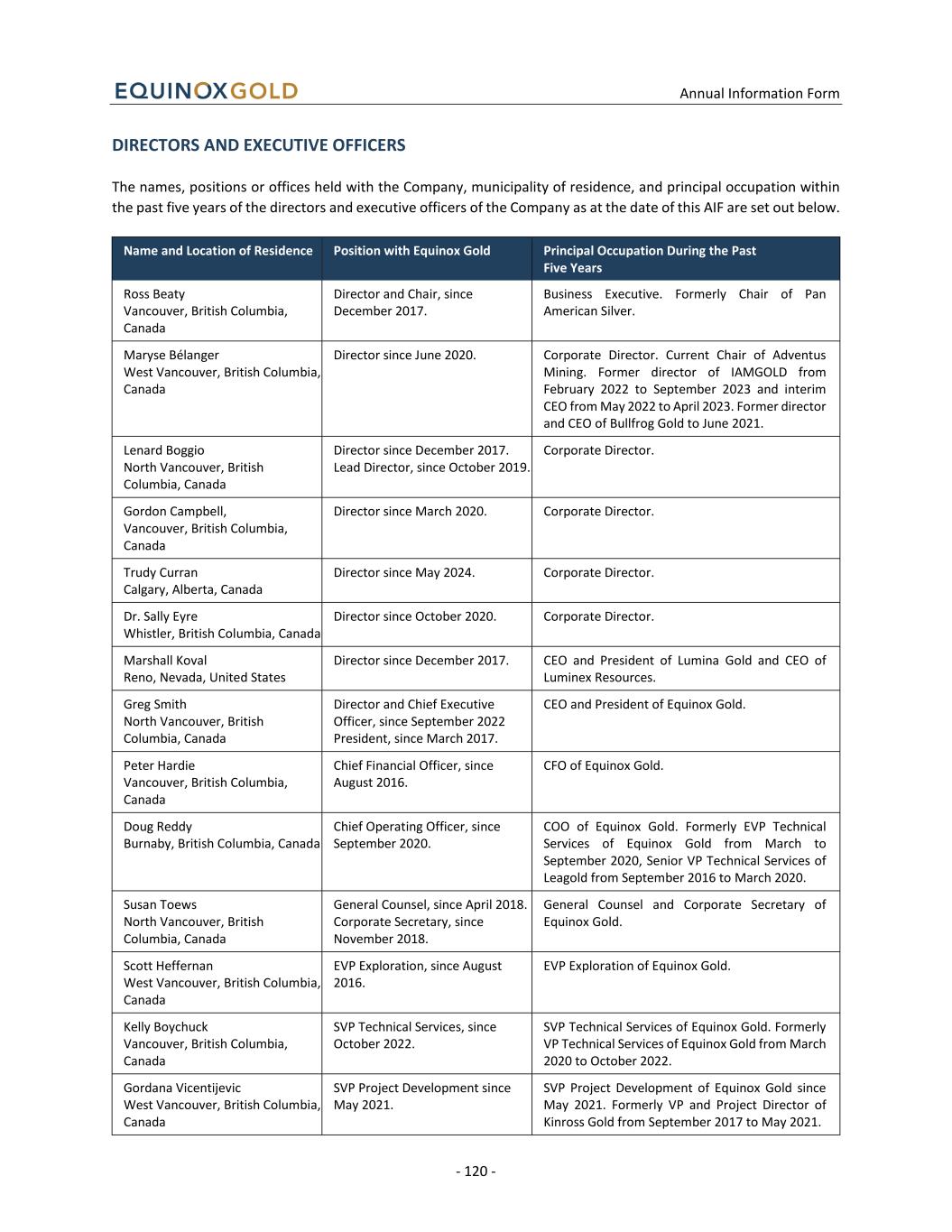
Annual Information Form - 120 - DIRECTORS AND EXECUTIVE OFFICERS The names, positions or offices held with the Company, municipality of residence, and principal occupation within the past five years of the directors and executive officers of the Company as at the date of this AIF are set out below. Name and Location of Residence Position with Equinox Gold Principal Occupation During the Past Five Years Ross Beaty Vancouver, British Columbia, Canada Director and Chair, since December 2017. Business Executive. Formerly Chair of Pan American Silver. Maryse Bélanger West Vancouver, British Columbia, Canada Director since June 2020. Corporate Director. Current Chair of Adventus Mining. Former director of IAMGOLD from February 2022 to September 2023 and interim CEO from May 2022 to April 2023. Former director and CEO of Bullfrog Gold to June 2021. Lenard Boggio North Vancouver, British Columbia, Canada Director since December 2017. Lead Director, since October 2019. Corporate Director. Gordon Campbell, Vancouver, British Columbia, Canada Director since March 2020. Corporate Director. Trudy Curran Calgary, Alberta, Canada Director since May 2024. Corporate Director. Dr. Sally Eyre Whistler, British Columbia, Canada Director since October 2020. Corporate Director. Marshall Koval Reno, Nevada, United States Director since December 2017. CEO and President of Lumina Gold and CEO of Luminex Resources. Greg Smith North Vancouver, British Columbia, Canada Director and Chief Executive Officer, since September 2022 President, since March 2017. CEO and President of Equinox Gold. Peter Hardie Vancouver, British Columbia, Canada Chief Financial Officer, since August 2016. CFO of Equinox Gold. Doug Reddy Burnaby, British Columbia, Canada Chief Operating Officer, since September 2020. COO of Equinox Gold. Formerly EVP Technical Services of Equinox Gold from March to September 2020, Senior VP Technical Services of Leagold from September 2016 to March 2020. Susan Toews North Vancouver, British Columbia, Canada General Counsel, since April 2018. Corporate Secretary, since November 2018. General Counsel and Corporate Secretary of Equinox Gold. Scott Heffernan West Vancouver, British Columbia, Canada EVP Exploration, since August 2016. EVP Exploration of Equinox Gold. Kelly Boychuck Vancouver, British Columbia, Canada SVP Technical Services, since October 2022. SVP Technical Services of Equinox Gold. Formerly VP Technical Services of Equinox Gold from March 2020 to October 2022. Gordana Vicentijevic West Vancouver, British Columbia, Canada SVP Project Development since May 2021. SVP Project Development of Equinox Gold since May 2021. Formerly VP and Project Director of Kinross Gold from September 2017 to May 2021.
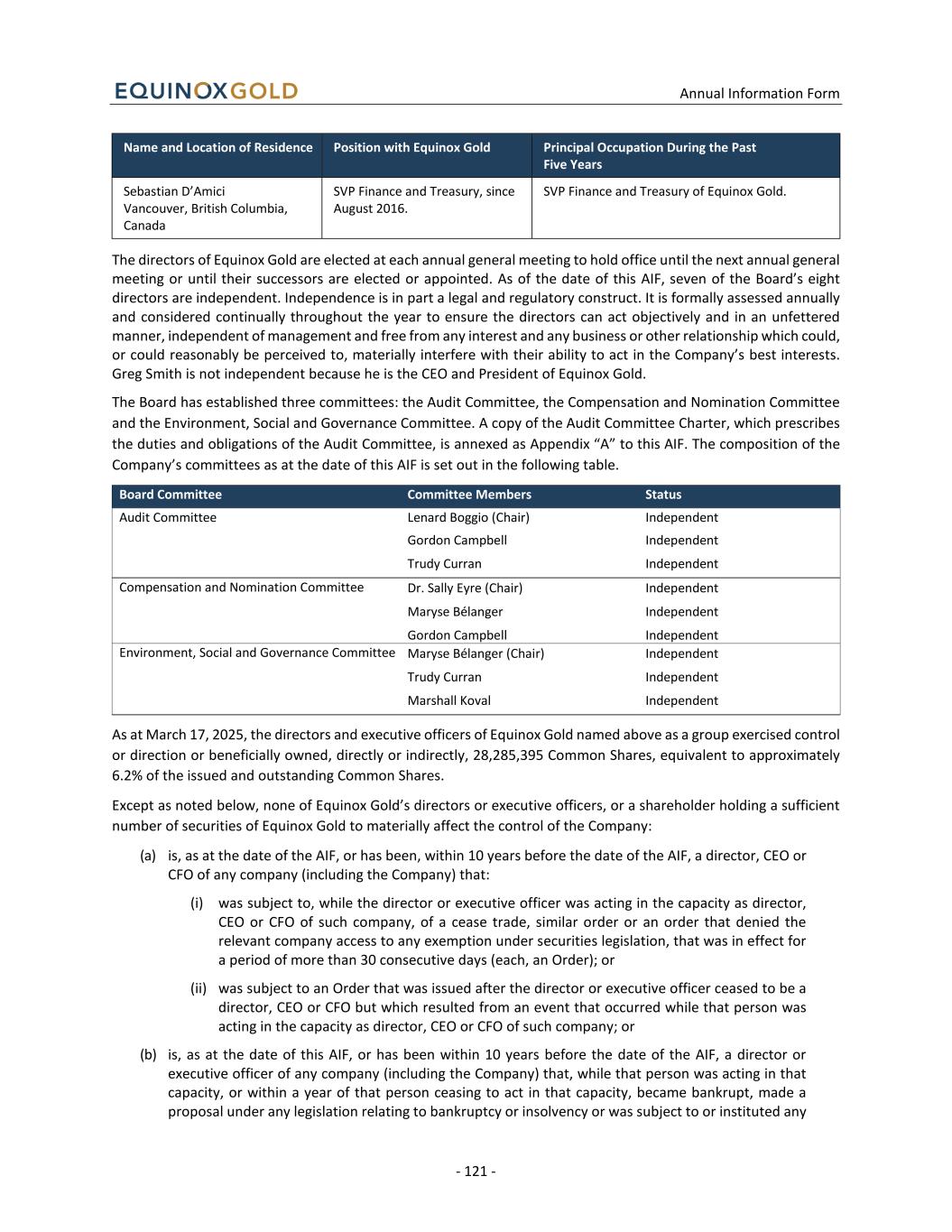
Annual Information Form - 121 - Name and Location of Residence Position with Equinox Gold Principal Occupation During the Past Five Years Sebastian D’Amici Vancouver, British Columbia, Canada SVP Finance and Treasury, since August 2016. SVP Finance and Treasury of Equinox Gold. The directors of Equinox Gold are elected at each annual general meeting to hold office until the next annual general meeting or until their successors are elected or appointed. As of the date of this AIF, seven of the Board’s eight directors are independent. Independence is in part a legal and regulatory construct. It is formally assessed annually and considered continually throughout the year to ensure the directors can act objectively and in an unfettered manner, independent of management and free from any interest and any business or other relationship which could, or could reasonably be perceived to, materially interfere with their ability to act in the Company’s best interests. Greg Smith is not independent because he is the CEO and President of Equinox Gold. The Board has established three committees: the Audit Committee, the Compensation and Nomination Committee and the Environment, Social and Governance Committee. A copy of the Audit Committee Charter, which prescribes the duties and obligations of the Audit Committee, is annexed as Appendix “A” to this AIF. The composition of the Company’s committees as at the date of this AIF is set out in the following table. Board Committee Committee Members Status Audit Committee Lenard Boggio (Chair) Independent Gordon Campbell Independent Trudy Curran Independent Compensation and Nomination Committee Dr. Sally Eyre (Chair) Independent Maryse Bélanger Independent Gordon Campbell Independent Environment, Social and Governance Committee Maryse Bélanger (Chair) Independent Trudy Curran Independent Marshall Koval Independent As at March 17, 2025, the directors and executive officers of Equinox Gold named above as a group exercised control or direction or beneficially owned, directly or indirectly, 28,285,395 Common Shares, equivalent to approximately 6.2% of the issued and outstanding Common Shares. Except as noted below, none of Equinox Gold’s directors or executive officers, or a shareholder holding a sufficient number of securities of Equinox Gold to materially affect the control of the Company: (a) is, as at the date of the AIF, or has been, within 10 years before the date of the AIF, a director, CEO or CFO of any company (including the Company) that: (i) was subject to, while the director or executive officer was acting in the capacity as director, CEO or CFO of such company, of a cease trade, similar order or an order that denied the relevant company access to any exemption under securities legislation, that was in effect for a period of more than 30 consecutive days (each, an Order); or (ii) was subject to an Order that was issued after the director or executive officer ceased to be a director, CEO or CFO but which resulted from an event that occurred while that person was acting in the capacity as director, CEO or CFO of such company; or (b) is, as at the date of this AIF, or has been within 10 years before the date of the AIF, a director or executive officer of any company (including the Company) that, while that person was acting in that capacity, or within a year of that person ceasing to act in that capacity, became bankrupt, made a proposal under any legislation relating to bankruptcy or insolvency or was subject to or instituted any
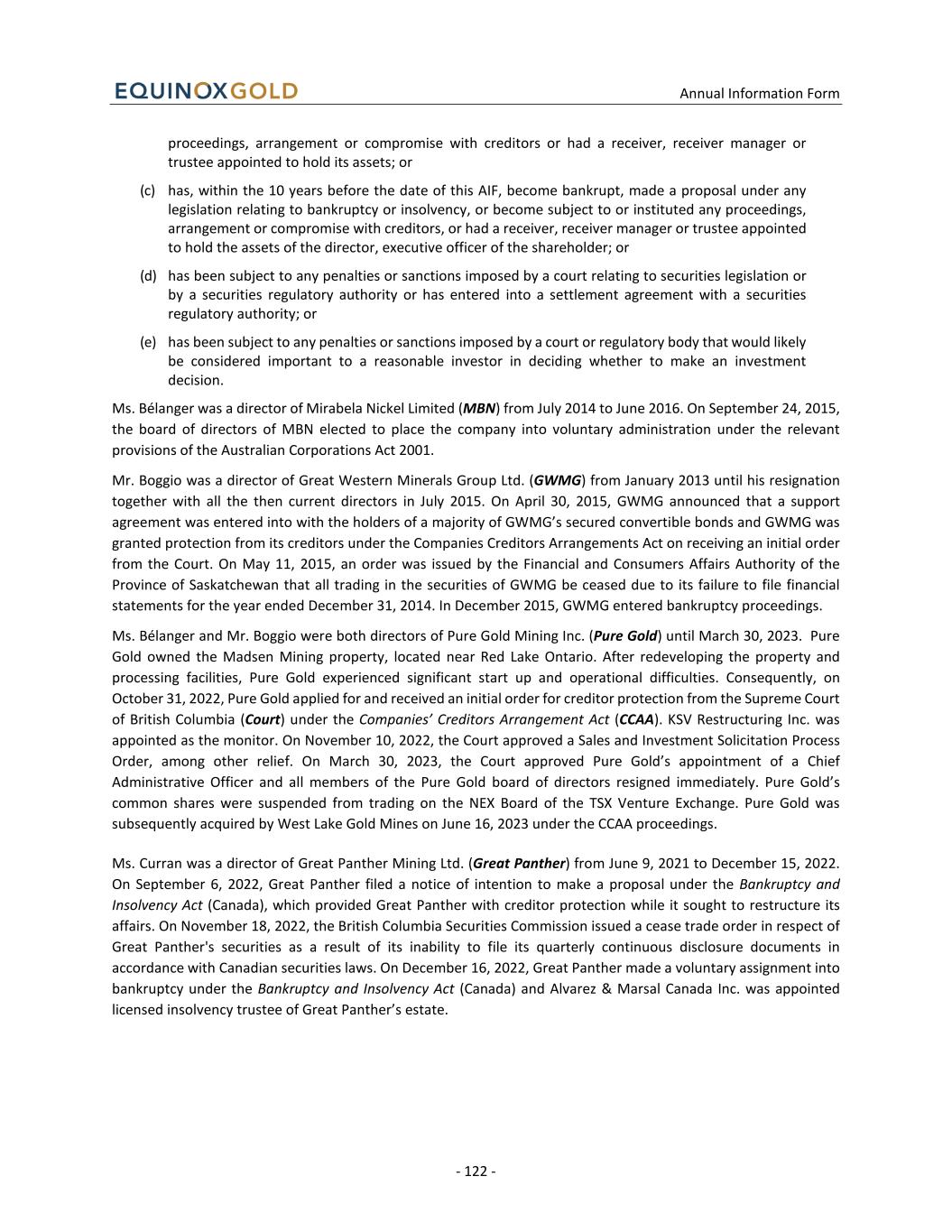
Annual Information Form - 122 - proceedings, arrangement or compromise with creditors or had a receiver, receiver manager or trustee appointed to hold its assets; or (c) has, within the 10 years before the date of this AIF, become bankrupt, made a proposal under any legislation relating to bankruptcy or insolvency, or become subject to or instituted any proceedings, arrangement or compromise with creditors, or had a receiver, receiver manager or trustee appointed to hold the assets of the director, executive officer of the shareholder; or (d) has been subject to any penalties or sanctions imposed by a court relating to securities legislation or by a securities regulatory authority or has entered into a settlement agreement with a securities regulatory authority; or (e) has been subject to any penalties or sanctions imposed by a court or regulatory body that would likely be considered important to a reasonable investor in deciding whether to make an investment decision. Ms. Bélanger was a director of Mirabela Nickel Limited (MBN) from July 2014 to June 2016. On September 24, 2015, the board of directors of MBN elected to place the company into voluntary administration under the relevant provisions of the Australian Corporations Act 2001. Mr. Boggio was a director of Great Western Minerals Group Ltd. (GWMG) from January 2013 until his resignation together with all the then current directors in July 2015. On April 30, 2015, GWMG announced that a support agreement was entered into with the holders of a majority of GWMG’s secured convertible bonds and GWMG was granted protection from its creditors under the Companies Creditors Arrangements Act on receiving an initial order from the Court. On May 11, 2015, an order was issued by the Financial and Consumers Affairs Authority of the Province of Saskatchewan that all trading in the securities of GWMG be ceased due to its failure to file financial statements for the year ended December 31, 2014. In December 2015, GWMG entered bankruptcy proceedings. Ms. Bélanger and Mr. Boggio were both directors of Pure Gold Mining Inc. (Pure Gold) until March 30, 2023. Pure Gold owned the Madsen Mining property, located near Red Lake Ontario. After redeveloping the property and processing facilities, Pure Gold experienced significant start up and operational difficulties. Consequently, on October 31, 2022, Pure Gold applied for and received an initial order for creditor protection from the Supreme Court of British Columbia (Court) under the Companies’ Creditors Arrangement Act (CCAA). KSV Restructuring Inc. was appointed as the monitor. On November 10, 2022, the Court approved a Sales and Investment Solicitation Process Order, among other relief. On March 30, 2023, the Court approved Pure Gold’s appointment of a Chief Administrative Officer and all members of the Pure Gold board of directors resigned immediately. Pure Gold’s common shares were suspended from trading on the NEX Board of the TSX Venture Exchange. Pure Gold was subsequently acquired by West Lake Gold Mines on June 16, 2023 under the CCAA proceedings. Ms. Curran was a director of Great Panther Mining Ltd. (Great Panther) from June 9, 2021 to December 15, 2022. On September 6, 2022, Great Panther filed a notice of intention to make a proposal under the Bankruptcy and Insolvency Act (Canada), which provided Great Panther with creditor protection while it sought to restructure its affairs. On November 18, 2022, the British Columbia Securities Commission issued a cease trade order in respect of Great Panther's securities as a result of its inability to file its quarterly continuous disclosure documents in accordance with Canadian securities laws. On December 16, 2022, Great Panther made a voluntary assignment into bankruptcy under the Bankruptcy and Insolvency Act (Canada) and Alvarez & Marsal Canada Inc. was appointed licensed insolvency trustee of Great Panther’s estate.
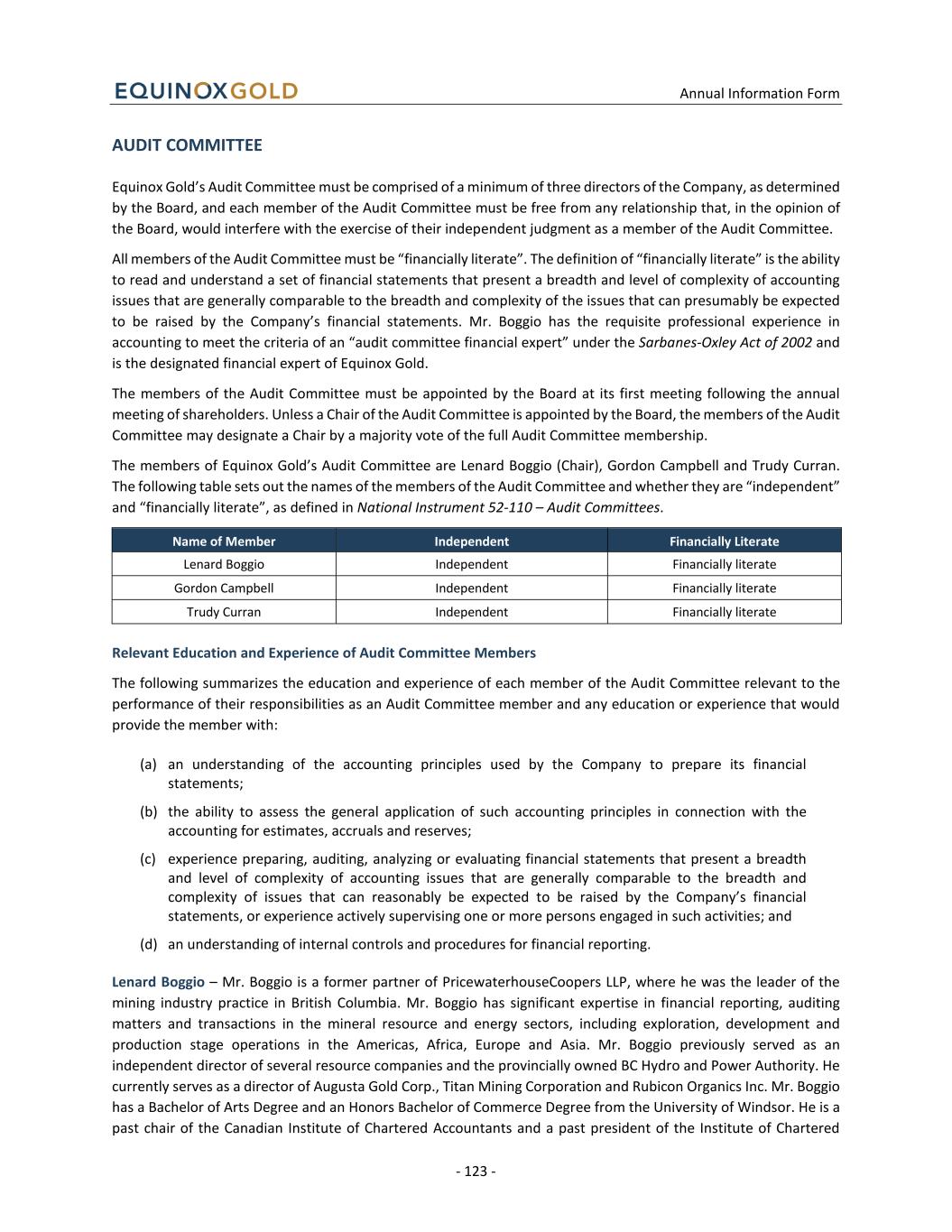
Annual Information Form - 123 - AUDIT COMMITTEE Equinox Gold’s Audit Committee must be comprised of a minimum of three directors of the Company, as determined by the Board, and each member of the Audit Committee must be free from any relationship that, in the opinion of the Board, would interfere with the exercise of their independent judgment as a member of the Audit Committee. All members of the Audit Committee must be “financially literate”. The definition of “financially literate” is the ability to read and understand a set of financial statements that present a breadth and level of complexity of accounting issues that are generally comparable to the breadth and complexity of the issues that can presumably be expected to be raised by the Company’s financial statements. Mr. Boggio has the requisite professional experience in accounting to meet the criteria of an “audit committee financial expert” under the Sarbanes-Oxley Act of 2002 and is the designated financial expert of Equinox Gold. The members of the Audit Committee must be appointed by the Board at its first meeting following the annual meeting of shareholders. Unless a Chair of the Audit Committee is appointed by the Board, the members of the Audit Committee may designate a Chair by a majority vote of the full Audit Committee membership. The members of Equinox Gold’s Audit Committee are Lenard Boggio (Chair), Gordon Campbell and Trudy Curran. The following table sets out the names of the members of the Audit Committee and whether they are “independent” and “financially literate”, as defined in National Instrument 52-110 – Audit Committees. Name of Member Independent Financially Literate Lenard Boggio Independent Financially literate Gordon Campbell Independent Financially literate Trudy Curran Independent Financially literate Relevant Education and Experience of Audit Committee Members The following summarizes the education and experience of each member of the Audit Committee relevant to the performance of their responsibilities as an Audit Committee member and any education or experience that would provide the member with: (a) an understanding of the accounting principles used by the Company to prepare its financial statements; (b) the ability to assess the general application of such accounting principles in connection with the accounting for estimates, accruals and reserves; (c) experience preparing, auditing, analyzing or evaluating financial statements that present a breadth and level of complexity of accounting issues that are generally comparable to the breadth and complexity of issues that can reasonably be expected to be raised by the Company’s financial statements, or experience actively supervising one or more persons engaged in such activities; and (d) an understanding of internal controls and procedures for financial reporting. Lenard Boggio – Mr. Boggio is a former partner of PricewaterhouseCoopers LLP, where he was the leader of the mining industry practice in British Columbia. Mr. Boggio has significant expertise in financial reporting, auditing matters and transactions in the mineral resource and energy sectors, including exploration, development and production stage operations in the Americas, Africa, Europe and Asia. Mr. Boggio previously served as an independent director of several resource companies and the provincially owned BC Hydro and Power Authority. He currently serves as a director of Augusta Gold Corp., Titan Mining Corporation and Rubicon Organics Inc. Mr. Boggio has a Bachelor of Arts Degree and an Honors Bachelor of Commerce Degree from the University of Windsor. He is a past chair of the Canadian Institute of Chartered Accountants and a past president of the Institute of Chartered
Annual Information Form - 124 - Accountants of BC and holds the FCPA, FCA designation. He is a member of the Canadian Institute of Corporate Directors and holds an ICD.D designation. Gordon Campbell – Mr. Campbell is a former Canadian diplomat and politician. From 2011 to 2016, he was the Canadian High Commissioner to the United Kingdom. He was the 34th Premier of British Columbia from 2001 to 2011 and was the leader of the Official Opposition in British Columbia from 1994 to 2001. From 1986 to 1993, he was Mayor of Vancouver, British Columbia. For his work, he received the Order of British Columbia in 2011 and the Order of Canada in 2018. Prior to serving in politics, Gordon Campbell was a real estate developer and Canadian University Service Overseas (CUSO) teacher in Nigeria. Mr. Campbell has a Master of Business Administration from Simon Fraser University. Trudy Curran – Ms. Curran is a retired businesswoman that brings extensive experience to the Board, including in the key areas of mergers and acquisitions, strategy, governance, human resources and executive compensation across a range of industries, particularly oil and gas and mining. Ms. Curran previously served as an independent director of several resource companies and currently serves as an independent director of Baytex Energy Corp. (Baytex) and Trican Well Services Limited and is a Commissioner with the Alberta Securities Commission. Ms. Curran was a prior member of the audit committees of Baytex and Dominion Diamond Mines, both cross-border public companies, and she was the finance committee chair of Riversdale Resources (subsequently acquired by now Hancock Prospecting Pty Ltd.), an Australian public metallurgical coal company. Ms. Curran holds a Bachelor of Arts degree in English and a Bachelor of Laws degree from the University of Saskatchewan and the ICD.D designation from the Institute of Corporate Directors. Ms. Curran was recognized as one of the Top 100 Most Powerful Women in Canada in 2012 and is also the recipient of the Governor General’s Bronze medal award for her academic, athletic and community achievements. External Auditor Service Fees (By Category) The fees paid or payable to the Company’s auditor, KPMG LLP, in each of the last two fiscal years are as follows: 2024 2023 Audit Fees Services provided by the independent auditor for the audit of the financial statements and internal controls over financial reporting. $2,622,375 $2,605,977 Audit Related Services In 2024 and 2023, special attest services as required by regulatory and statutory requirements in Mexico $80,750 $66,250 All Other Fees No other fees in 2024 or 2023 Nil Nil Tax Compliance Fees For the preparation and review of tax returns, claims for refund and tax payment-planning services. $303,380 $292,653 Tax Fees No other tax fees in 2024 or 2023 Nil Nil Total $3,006,505 $2,964,790 Audit Committee Pre-approval Policies The Audit Committee has adopted specific policies and procedures for the engagement of non-audit services as described in Section 25 of the Audit Committee Charter attached as Schedule “A”.
Annual Information Form - 125 - Conflicts of Interest Certain of the directors and/or officers of Equinox Gold also serve as directors and/or officers of other companies involved in natural resource exploration, development and mining operations and consequently there exists the possibility for such individuals to be in a position of conflict. In addition, Mr. Smith is chair of the board of directors of Versamet, a private company of which Equinox Gold owns approximately 12.5%. On October 31, 2023, the Company closed a gold purchase and sale arrangement with Versamet and Regal Partners Royalties A PTY Limited (Regal and together with Versamet, the Purchasers) (Gold Purchase Agreement). Under the Gold Purchase Agreement, the Company is required to deliver specified amounts of gold to the Purchasers in return for an upfront payment of $75.0 million received by the Company on October 31, 2023. Any decision made by any of such directors and/or officers will be made in accordance with their duties and obligations to deal fairly and in good faith with a view to the best interests of Equinox Gold and Equinox Gold shareholders. In addition, each director is required to declare and refrain from voting on any matter in which such director may have a conflict of interest in accordance with the procedures set forth in the BCBCA and other applicable laws.
Annual Information Form - 126 - RISKS RELATED TO THE BUSINESS Equinox Gold’s business is subject to significant risks. Any of these risks could have an adverse effect on Equinox Gold, its business, results of operations, financial position and prospects, and could cause actual events to differ materially from those described in forward-looking statements relating to Equinox Gold. These risks are in addition to those discussed in technical reports and other documents filed by Equinox Gold from time to time on SEDAR+ and on EDGAR. In addition, other risks and uncertainties not presently known by management of Equinox Gold or that management currently believes are immaterial, could affect Equinox Gold, its business and prospects. Funding and Global Economy Risk There is a risk that cash flow from operations will not meet current and future obligations, requiring additional capital. The volatility of global capital markets has made raising capital by equity or debt financing more difficult. The Company may be dependent on capital markets for future financing, exposing it to liquidity risks if adequate cash positions are unable to be maintained or appropriate financing is unavailable. These factors may impact the ability to raise equity or obtain loans and other credit facilities on favorable terms. Persistent volatility or economic slowdowns could adversely affect the Company’s operations, capital raising ability, and share price. As the Company’s operations expand and reliance on global supply chains increases, geopolitical risk, pandemics and conflicts may significantly impact its business, financial condition and operations. The Israel-Hamas war, the ongoing conflict in Ukraine and the imposition of tariffs by the United States have caused, or could cause, uncertainty and supply chain disruptions. Future pandemics, expanded conflicts, new geopolitical disputes or new economic policies could materially affect the Company. Gold Price Risk The Company’s profitability is partly tied to the market price for gold. A decline in gold prices could negatively impact future operations. Gold prices are influenced by factors beyond the Company’s control, such as global supply and demand, interest rates, exchange rates, inflation, and the political and economic conditions of major gold producing countries. Fluctuations in gold prices could render ongoing development and production at the Company’s properties uneconomic. Future production depends on gold prices being sufficiently high to maintain economic viability of these properties. At December 31, 2024, the Company had 139,998 total notional ounces remaining under its outstanding gold collar contracts to be settled as follows: Notional Ounces Put Options Weighted Average Strike Price Call Options Weighted Average Strike Price Within 1 year 1-2 years 120,000 19,998 $2,164 $3,071 The gold collar contracts reduced variability in cash flows associated with gold sales during Greenstone’s operational ramp up period. However, there is a risk that the Company will not benefit from increases in cash flow associated with the hedged ounces if the gold price exceeds the upper limit of the collars during the term of the contract.
Annual Information Form - 127 - Production and Cost Estimates Equinox Gold’s production forecasts are estimates based on assumptions and actual production may be lower than expected. Achieving these forecasts involves risks and uncertainties, such as the accuracy of Mineral Reserve and Mineral Resource estimates, ore grades, recovery rates, ground conditions, physical characteristics of ores, estimated mining and processing costs, and the receipt and maintenance of permits. Equinox Gold prepares estimates of operating costs and/or capital costs for each operation and project. Actual operating and capital costs may vary due to factors like exchange rates, production levels, inflation, fuel prices and other material costs, supply chain disruptions, equipment limitations, government regulations, skilled labour availability, processing and refining costs, royalties, and construction and maintenance timing. Inability to manage costs could affect future development decisions, with consequences to the Company’s business, financial condition and results of operations. Uncertainty of Mineral Reserves and Mineral Resources Estimates Equinox Gold’s Mineral Reserves and Mineral Resources are estimates, and there is no assurance that anticipated tonnages, grades or recovery levels will be achieved, or that Mineral Reserves can be mined and processed profitably. Mineral Reserves and Mineral Resources involve uncertainties and subjective judgements based on available data. Short-term operating factors such as the need for orderly development of the ore bodies or processing new ore grades can affect profitability in any accounting period. In addition, laboratory test recoveries may not replicate in larger-scale production. Commodity price fluctuations, drilling results, metallurgical testing, and mine plan evaluations may require estimate revisions. Significant reductions in estimates of Mineral Reserves and Mineral Resources, or in Equinox Gold’s ability to extract Mineral Reserves, could adversely impact Equinox Gold’s business and financial position. Inferred Mineral Resources that are not Mineral Reserves lack demonstrated economic viability and require extensive exploration and investigation to determine if they can be upgraded to a higher category. Property Commitments The properties held by Equinox Gold may be subject to various land payments, royalties and/or work commitments. Failure by Equinox Gold to meet its payment obligations or otherwise fulfill its commitments under these agreements could result in the loss of property interests. In Mexico, while mineral rights are administered by the federal government through federally issued mining concessions, surface rights over the land located in the mining concessions may be owned by third parties, including Ejidos or Bienes Comunales (communally held land). The Company has surface and land access rights necessary to operate Los Filos through written agreements with one Ejido and two Bienes Comunales, as well as with individual members of the Ejido. Continuing operations at Los Filos are subject to the successful completion of new long-term agreements with three local communities. These new agreements are necessary to help ensure the long-term economic and investment viability of the mine, including the addition of a new 10,000 tpd CIL processing plant to increase recoveries from higher-grade ore. The Company and the three communities have held a collaborative and open dialogue process and have reached consensus on terms for new agreements. Two communities have ratified and signed new long-term agreements; however, one community remains outstanding. If the Company is unable to satisfactorily complete these agreements with all three communities in the very near term, the Company will suspend operations at Los Filos indefinitely
Annual Information Form - 128 - In Canada, Greenstone is party to long-term benefit agreements with four First Nations and the Métis Nation of Ontario. The agreements are consistent with industry standards, and include commitments related to business opportunities, training and employment. The Company occasionally receives additional requests and complaints from the communities relating to its commitments in the various agreements outlined above. If the Company is unable to address such additional requests or satisfactorily renegotiate terms, it may result in protests, blockades, or other forms of public expression against Equinox Gold’s activities and may have a negative impact on Equinox Gold’s reputation and operations. Financial Instrument Risk Exposure The Company is exposed in varying degrees to a variety of financial instrument related risks. The Board approves and monitors the risk management process, which includes the following: Credit Risk Credit risk is the risk of financial loss to the Company if a counterparty to a financial instrument fails to meet its contractual obligations. The Company is primarily exposed to credit risk on its cash and cash equivalents, trade receivables, restricted cash and other current and non-current receivables. The Company’s maximum exposure to credit risk on its financial assets, other than those measured at fair value through profit and loss and fair value through other comprehensive income, at December 31, 2024, represented by the carrying amounts of the financial assets, was $279.7 million (2023 - $235.5 million). The Company limits its exposure to credit risk on its cash and cash equivalents and restricted cash by investing in high credit quality instruments and maintaining its cash balances in financial institutions with strong credit ratings. Credit risk arising from the Company’s trade receivables is low with negligible expected credit losses as the Company sells its products to large global financial institutions and other companies with high credit ratings. Liquidity Risk Liquidity risk is the risk that the Company will not be able to meet its financial obligations as they become due. During 2024, the Company drew $560.0 million from its Credit Facility and, in connection with the Greenstone Acquisition, amended the Credit Facility to include a $500 million Term Loan and closed a bought deal equity financing of 56,419,000 Common Shares of Equinox Gold at a price of $5.30 per Common Share for aggregate gross proceeds of $299 million. At December 31, 2024, the Revolving Facility had an undrawn amount of $104.6 million. The Revolving Facility also provides for an uncommitted accordion feature which permits the Company to request an increase in the principal amount of the facility by up to $100.0 million. The Company's objective in managing its liquidity risk is to ensure there is sufficient capital to meet its short-term business requirements after considering the Company's holdings of cash and cash equivalents. The Company seeks to manage its liquidity risk through a rigorous planning, budgeting and forecasting process to help determine the funding requirements to support its current operations, development and expansion plans. The Company also manages its liquidity risk by managing its capital structure. The Company's primary objective when managing capital is to ensure it will be able to continue as a going concern and that it has sufficient ability to satisfy its capital obligations and ongoing operational expenses, as well as having sufficient liquidity to fund suitable business opportunities as they arise. The Company adjusts its capital structure as necessary in light of current
Annual Information Form - 129 - economic conditions. The Company, upon approval from the Board, seeks to balance its overall capital structure through new share issuances or by undertaking other activities as deemed appropriate under specific circumstances. To maintain its capital structure, the Company may, from time to time, issue or buy back equity, draw down or repay debt, or sell assets. Market Risk Market risk is the risk that the fair value of future cash flows of a financial instrument will fluctuate because of changes in market prices. The Company is exposed to the following market risks: interest rate risk, currency risk and other price risk. Interest Rate Risk Interest rate risk is the risk that the fair values or future cash flows of the Company's financial instruments will fluctuate because of changes in market interest rates. The Company is exposed to interest rate cash flow risk on its Credit Facility which is subject to variable interest rates based on the secured overnight financing rate (SOFR). A 1.0% increase or decrease in the SOFR interest rate during the year ended December 31, 2024 would have resulted in a decrease or increase of $6.7 million, respectively, in the Company’s net income during the year ended December 31, 2024. The Company is also exposed to interest rate cash flow risk on its cash and cash equivalents and restricted cash that earn variable interest. The Company is exposed to interest rate fair value risk on the 2020 Convertible Notes and 2023 Convertible Notes which are subject to fixed interest rates. The Company manages its interest rate risk with a mix of fixed and variable rate debt. A change in market interest rate would impact the fair values of the 2020 Convertible Notes and 2023 Convertible Notes. However, as the convertible notes are measured at amortized cost, changes in market interest rates would have had no impact to the Company’s net income during the year ended December 31, 2024. Foreign Currency Risk Currency risk is the risk that the fair values or future cash flows of the Company's financial instruments, in functional currency terms, will fluctuate because of changes in foreign exchange rates. The functional currency of the Company and its subsidiaries is the US dollar. The Company and its subsidiaries are exposed to currency risk on transactions, investments and balances denominated in currencies other than USD, primarily those incurred in BRL, MXN, and CAD. Prior to reaching commercial production on November 6, 2024, Greenstone, which had a Canadian dollar functional currency until such date, was exposed to currency risk on transactions and balances denominated in USD. The following table summarizes the Company's exposure to currency risk arising from financial assets and financial liabilities, excluding foreign exchange contracts, denominated in foreign currencies: At December 31, 2024 (000’s) CAD BRL MXN USD Financial assets $ 30,531 $ 41,576 $ 1,758 $ - Financial liabilities $ (75,026) $ (70,883) $ (32,922) $ - $ (44,495) $ (29,307) $ (31,164) $ - At December 31, 2023 (000’s) CAD BRL MXN USD Financial assets $ 103,038 $ 23,043 $ 281 $ 19,908 Financial liabilities $ (12,682) $ (89,042) $ (38,348) $ (48,284) $ 90,356 $ (65,999) $ (38,067) $ (28,376) Based on the above foreign currency denominated financial assets and financial liabilities at December 31, 2024, excluding the effect of foreign exchange contracts, the reasonably possible weakening in foreign currencies against
Annual Information Form - 130 - the USD and the USD against CAD at such date, assuming all other variables remained constant, would have resulted in the following increase (decrease) in the Company’s net income during the year ended December 31, 2024: 2024 (000’s) CAD – 10% $ 3,248 BRL – 10% $ 2,139 MXN – 10% $ 2,275 In accordance with its foreign currency exchange risk management program, the Company uses foreign exchange contracts to manage its exposure to currency risk on expenditures in CAD, BRL, and MXN which are accounted for as derivative financial instruments. At December 31, 2024, a 10% weakening in the BRL, MXN and CAD, respectively, against the USD would have resulted in an increase in the fair value of the Company’s foreign currency net derivative liability and a decrease of $53.8 million in the Company’s net income during the year ended December 31, 2024. A 10% strengthening in the CAD, MXN and BRL, respectively, against the USD would have resulted in a decrease in the fair value of the Company’s foreign currency net derivative liability and an increase of $38.0 million in the Company’s net income during the year ended December 31, 2024. The BRL and MXN have experienced frequent and substantial variations in relation to the USD and other foreign currencies during the last decades. Depreciation of the MXN and BRL against the USD could create inflationary pressures in Mexico and Brazil and cause increases in interest rates, which could negatively affect the growth of the Brazilian and Mexican economy as a whole and harm the Company’s financial condition and results of operations. On the other hand, appreciation of the BRL and MXN relative to the United States dollar and other foreign currencies could lead to a deterioration of the Brazilian and Mexican foreign exchange denominated current accounts (net), as well as dampen export-driven growth. Depending on the circumstances, either depreciation or appreciation of the BRL or MXN could have an adverse effect on the relevant country’s economy. Other Price Risk Other price risk is the risk that the fair values or future cash flows of the Company's financial instruments will fluctuate because of changes in market prices, other than interest rate risk or currency risk. At December 31, 2024, the Company held investments in marketable securities which are measured at fair value. The fair values of investments in marketable securities are based on the closing share price of the securities at the reporting date. A 10% increase in the applicable share prices would have resulted in a decrease of $3.3 million in the Company’s other comprehensive loss for the year ended December 31, 2024. A 10% decrease in the applicable share prices would have resulted in an increase of $3.3 million in the Company’s other comprehensive loss. At December 31, 2024, the Company is exposed to price risk on its gold contracts and obligation for future gold deliveries under the contingent consideration relating to Greenstone. These contracts are measured at fair value through profit and loss at the end of each reporting period. A 10% increase in the price of gold at December 31, 2024 would have resulted in a decrease of $15.3 million in the Company's net income for the year ended December 31, 2024. A 10% decrease in the price of gold at December 31, 2024 would have resulted in an increase of $11.6 million in the Company’s net income for the year ended December 31, 2024.
Annual Information Form - 131 - Share Price Fluctuation Securities markets are subject to significant price and volume volatility, with wide fluctuations that may be unrelated to a company’s operating performance, underlying asset values or prospects. There is no assurance that share price fluctuations or lack of liquidity will not occur in the future, and their impact on Equinox Gold’s ability to secure financing is uncertain. If Equinox Gold cannot generate adequate revenues or secure financing to operate its mines and complete development projects, any investment in Equinox Gold may be materially diminished or lost. Community Relations The Company’s ability to maintain positive relationships with its host communities is critical to ensuring the success of its operations and future projects. Equinox Gold maintains industry standard social and environmental practices, works to ensure compliance with its commitments to its host communities, and has initiated programs to enhance its community engagement. However, there is no assurance that the Company will be able to maintain positive relationships with host communities and the failure of such relationships could result in legal actions, the establishment of blockades, permitting delays or other disruptions to the Company’s business. Continuing operations at Los Filos in 2025 is subject to the successful completion of new long-term agreements with three local communities. These new agreements are necessary to help ensure the long-term economic and investment viability of the mine, including the addition of a new 10,000 tonnes-per-day (tpd) carbon-in-leach (CIL) processing plant to increase recoveries from higher-grade ore. The Company and the three communities have held collaborative and open dialogue and reached consensus on terms for new agreements. Two communities have ratified and signed new long-term agreements; however, one community remains outstanding. If the Company is unable to satisfactorily reach an agreement with the remaining community in the near term, the Company will suspend operations at Los Filos indefinitely. If this occurs, there may be additional negative publicity regarding the Company, whether true or not. Opposition by community and non-governmental organizations (NGOs) to mining activities can disrupt operations or the development of a new project. Adverse publicity and damage to Equinox Gold’s reputation can be the result of the actual or perceived occurrence of any number of events, and could include negative publicity, whether true or not. Mining activities at Los Filos were disrupted in each of 2020, 2021 and 2022 because of community blockades, and the Company had short-term disruptions at some of its Brazil operations in 2022 and 2024. Although Equinox Gold places great emphasis on maintaining its community relationships and its reputation, the Company does not have control over how it is perceived by others. Reputation loss may lead to increased challenges in developing and maintaining community relations and decreased investor confidence and act as an impediment to Equinox Gold’s overall ability to advance its projects or secure financing, thereby having an adverse impact on financial performance, cash flows, growth prospects, and the market value of the Company’s securities. Foreign Operations Equinox Gold operates through subsidiaries, including in the United States, Mexico and Brazil, and as such faces risks typical of foreign business activities. These risks include nationalization, forced contract modifications or cancellation, political and fiscal instability, adverse legal changes, permit delays, opposition to projects, unreliable infrastructure, labor issues, equipment shortages, import/export regulations, inflation, currency fluctuations, biased dispute resolution, government abuse of power, enforcement difficulties, regulatory compliance challenges, criminal activity, civil unrest, terrorism, military repression, and public health concerns. Changes in mining or investment policies, or political shifts in operating jurisdictions may affect operations or profitability. In particular, government
Annual Information Form - 132 - regulations on production, price controls, exports, tariffs, currency remittance, taxes, property expropriation environmental legislation, foreign investment, environmental legislation land, water use, and mine safety can impact operations. The Company’s mining and development properties in Brazil expose the Company to various socioeconomic conditions as well as to local laws governing the mining industry. The Brazilian government has a history of economic interventionism that can give rise to uncertainty. Operations can also be affected by government actions against third parties, such as artisanal miners, which can indirectly impact community perception of large mining companies and increase the risk of blockades and other interruptions to operations. In May 2023, Mexico enacted comprehensive changes to its mining and water laws that contain several ambiguities, including how existing mining and water concessions will be treated. Supplementary regulations to the new laws are being developed but have not yet been released. Like others, the Company is facing uncertainty because of these new laws. In addition, criminal activity in Mexico, including cartel violence and organized crime, poses ongoing concerns. Despite protective measures, security incidents may still impact operations. In late 2024, the incoming Trump administration in the United States signaled changes to US trade policies, including the introduction of new tariffs on imports from Mexico and Canada. The administration may also seek to roll back existing free trade agreements, which could have substantial impacts on global supply chains. Uncertainty over whether the United States, Mexican, or Brazilian governments will implement changes in policy or regulation may contribute to economic uncertainty. Historically, politics in these regions have affected the performance of the economy and past political crises have affected the confidence of investors and the public generally, resulting in an economic slowdown. Operational Risks Equinox Gold’s principal business is the mining, processing of, and exploration for precious metals. The Company’s operations face typical industry risks, which could adversely affect the business, results of operations and financial position of Equinox Gold. These risks include variations in ore grade and tonnage, environmental hazards, industrial accidents, labour disputes, changes in laws, technical issues, supply delays, unexpected geological conditions and failures, climate-related events, power or water shortages and force majeure events. Seasonal weather also impacts operations. Heavy rainfall can limit pit access and mining, while prolonged dry seasons can increase wildfire risk and cause droughts, affecting water availability for processing. These risks could lead to reduced production, damage to facilities, environmental harm, delays, economic losses and possible legal liabilities. Cybersecurity and Information Systems Targeted cybersecurity attacks, information technology or operations technology system failures, or security breaches could disrupt Equinox Gold’s operations, causing privacy breaches, property damage, or financial and reputational risks. The Company regularly tests controls and disaster recovery infrastructure. To address evolving threats, the Company continuously implements risk-prioritized controls, automated monitoring, alerting tools, and backup systems to restore normal operations. However, there is no certainty that these efforts will adequately protect the Company’s information technology systems and operations.
Annual Information Form - 133 - Construction Risks Equinox Gold undertakes construction projects from time to time. Construction requires significant expenditures and actual costs may exceed budgeted costs. Costs and timelines can be affected by factors beyond the Company's control, such as inflation, weather, ground conditions, material availability, workforce performance, supply chain issues, shipping delays, equipment installation issues, design changes, and community acceptance. Project schedules also depend on obtaining governmental approvals, which can be unpredictable. Delays in commercial production start-up can increase costs and postpone revenue generation. Due to these risks and uncertainties, there is no guarantee that projects will proceed as expected, stay within budget, meet schedules, or operate as planned. Permitting Equinox Gold's operations, development, and exploration activities require numerous permits from various governmental authorities. The timing of obtaining these permits is often beyond the Company's control, which may lead to delays in exploration, development, construction, or ongoing operations. Additionally, previously issued permits may be suspended or revoked due to regulatory changes or court actions. There is no assurance that Equinox Gold will always obtain or maintain the necessary permits, which could negatively impact its operations. Castle Mountain – Phase 2 Permitting The Company’s ability to obtain all required licenses and permits for the Castle Mountain Phase 2 expansion is uncertain. The permitting process is complex and lengthy, involving many factors outside the Company’s control. Major permits may face appeals or administrative protests, leading to potential litigation and lengthy delays. These issues could affect the project's development timeline and adversely affect the Company’s business. Los Filos Permitting Changes in laws and proposed reforms in Mexico, along with the current political environment, have increased uncertainty about renewing or obtaining new permits for Los Filos. The success and timing of permit efforts are beyond the Company's control and may face appeals or protests, leading to potential reversals or lengthy delays. In April 2022, the Mexican Supreme Court issued a decision ordering the cancellation of two mineral claims previously issued to a mining company on the basis that free, prior and informed consultation with Indigenous peoples was not conducted by the Government before the relevant mineral claims were issued. The Court indicated that the relevant mineral claims may be reissued once the required consultations are complete. The draft decision increases the risk of other communities seeking similar injunctions in the future. These issues could impact ongoing operations at Los Filos and adversely affect the Company's business. Equinox Gold May Become Subject to Additional Legal Proceedings Equinox Gold is involved in litigation and proceedings in Canada, the United States, Mexico and Brazil, and may face various claims, legal proceedings, regulatory investigations, and complaints. The outcomes of these actions are unpredictable and could adversely affect the Company's financial performance, cash flows, and operations. To the extent management believes it is probable that a material cash outflow will be incurred to settle the claim, a provision for the estimated settlement amount is recorded. Disputes may result in liens, claims, or other charges on the Company's assets and properties. Third-party claims could lead to the loss of commercially viable properties, impacting future revenues and operations. Even unsuccessful claims can be costly to defend.
Annual Information Form - 134 - Equinox Gold may also face compensation claims for losses or damages from its activities, along with civil or criminal fines for legal violations. Such actions could increase operating costs and negatively impact the Company's activities. Climate Change Climate change may create new operational risks for Equinox Gold. Governments are introducing stricter climate change regulations, which could increase taxes and operating costs. Physical risks, such as sea level rise, extreme weather, fires, water shortages, floods, landslides, and resource disruptions, may also impact the Company's operations and financial position. The Company has modeled potential climate change risks in an effort to mitigate them but cannot provide assurance that any such mitigation efforts will be effective. In March 2021, a historic rain event caused widespread flooding in the Aurizona region and a freshwater pond on the Aurizona site overflowed. The tailings facility and other infrastructure at the Aurizona site were not affected and remained operational. The Company subsequently received several fines from the local state government for environmental infractions related to turbidity in the local community’s water supply. In addition, public civil actions have been filed against the Company in both Maranhão State and Brazil Federal court that claim various damages because of the rain event and criminal environmental proceedings have been commenced against the Company by the Federal public prosecutor. The Company considers the fines and proceedings to be without merit. In late March 2024, due to persistent heavy rains in the Aurizona region, there was a displacement of material in two locations in the south wall of the Piaba pit. As a result of this geotechnical event, access to the Piaba pit was temporarily restricted and mining paused while the Company implemented a remediation plan to ensure safe mining of the pit. Water Availability Water availability is an operational risk for many of the Company’s mine sites, which are in various climatic zones, including arid and semi-arid regions, as well as areas with distinct seasonal wet and dry periods. Castle Mountain maintains water rights that include a number of producing wells at Castle Mountain, but additional sources of ground water may be required to expand throughput and gold production for the Phase 2 expansion. The Company has identified new water sources, constructed an initial water supply well, and applied for a right-of-way permit to construct a buried pipeline to transport additional water supply to Castle Mountain for the Phase 2 expansion. Without these efforts, a shortage of adequate water could prevent or limit the Company’s ability to expand production at Castle Mountain. Santa Luz is situated in a semi-arid region of Brazil and relies on the annual rainy season to replenish its water supply. To help mitigate the risk of insufficient water availability from the Itapicurú River, the Company converted and expanded an existing TSF into a water storage facility to increase Santa Luz’s water storage capacity. The water is available for use as process water. Aurizona is situated in a tropical region of Brazil and receives significant amounts (over 3,000 mm on average) of rainfall during the rainy season. Water is collected during the rainy season for use in the processing plant throughout the dry season. A new TSF completed at the end of 2023 provides additional water storage and water for recycling back to the process plant.
Annual Information Form - 135 - RDM is situated in a semi-arid region of Brazil and depends on the annual rainy season to replenish its water supply. Prolonged droughts previously resulted in temporary suspensions to operations. In 2017, a water storage facility was built to allow for the capture and storage of rainwater and surface water runoff in a larger catchment area; however, insufficient water capture was realized, and operations were temporarily suspended in 2018 and 2019. Since 2020, there has been sufficient water captured within the water storage facility and the TSF to allow RDM to achieve continued operations through the dry season. While the Company has sufficient water to support current operations, there is no guarantee that the Company can secure an alternate source of water in the event of a future prolonged drought. Uninsurable Risks Equinox Gold faces various risks, including environmental conditions, industrial accidents, labor disputes, unexpected geological conditions, mechanical failures, cybersecurity incidents, regulatory changes, and natural phenomena like floods, fires and earthquakes. These risks could lead to property damage, personal injury, environmental harm, mining delays, financial losses, and legal liabilities. Equinox Gold maintains insurance to protect against certain risks in such amounts as it considers to be reasonable. However, Equinox Gold cannot provide any assurance that its insurance coverage will be sufficient to cover any resulting loss or liability, or that such insurance will continue to be available at economically feasible premiums or for other reasons. Equinox Gold evaluates business risks and carries insurance where feasible, but not all risks are insurable. Coverage may have limits, deductibles, exclusions, and endorsements. Insurance for environmental pollution, exploration hazards, and cybersecurity attacks is often unavailable on acceptable terms. Uninsured losses could adversely affect the Company's business, operations, and financial position. Additionally, Equinox Gold may face liability for pollution or other hazards that are not insured, leading to significant costs and negative impacts on its business. Defects in Land Title Equinox Gold does not hold title insurance on its properties, making it difficult to ensure secure claims to mineral properties or mining concessions. Without surveys of all claims, the exact area and location may be uncertain. There are no assurances against title defects, and properties may be subject to unregistered liens, agreements, transfers, or indigenous land claims. This uncertainty could impact the Company's ability to operate or enforce its rights on these properties. Environmental Risks, Regulations and Hazards Equinox Gold’s mining operations are subject to environmental regulations, including air and water quality standards, land reclamation, and waste management. These regulations are becoming stricter, with increased fines and penalties for non-compliance, more rigorous environmental assessments, and greater responsibility for companies and their personnel. Future changes in environmental laws could adversely affect the Company's operations. Additionally, unknown environmental hazards from previous owners or operators may exist, for which Equinox Gold could be held liable. Failure to comply with applicable laws, regulations and permits can lead to enforcement actions, including fines and orders to cease operations, and corrective measures requiring capital expenditures or remedial actions. Parties engaged in mining operations or in the exploration or development of mineral properties may be required to
Annual Information Form - 136 - compensate those suffering loss or damage arising from the mining activities and may have civil or criminal fines or penalties imposed for violations of applicable laws or regulations. Artisanal miners (Garimpeiros) have mined and continue to mine on or near some of Equinox Gold’s Brazilian properties. Garimpeiros are known to use substances in their mining processes that can cause environmental damage. Equinox Gold has taken steps to address these activities and related environmental impacts, but there is no certainty that such activities will stop, and Equinox Gold may become liable for such environmental hazards caused by Garimpeiros. The extraction process for gold and metals produces tailings, which are slurry and sand-like materials that are a product of the extraction process. Tailings are stored in engineered tailings storage facilities (TSFs) that are designed and inspected by independent engineers. However, hazards such as uncontrolled seepage or geotechnical failure of retaining dams around tailings disposal areas may result in environmental pollution and consequent liability. Some of the Company’s operations use heap leaching, where ore is placed on impermeable pads and sprayed with a cyanide solution to recover gold. While designed and operated according to laws and industry standards, hazards such as seepage or geotechnical failure of a heap leach pad can lead to environmental pollution and consequent liability. Equinox Gold’s historical operations have generated chemical and metals depositions in the form of tailing ponds, rock waste dumps, and heap leach pads. The Company’s ability to obtain, maintain and renew permits and approvals and to successfully develop and operate mines may be impacted by real or perceived environmental, health and safety effects of those historical operations or those of other mining companies. Water collection, treatment, and disposal at Equinox Gold's mines are strictly regulated and involve significant environmental risks. Failures in these systems could lead to untreated water or contaminants discharging into nearby areas, causing damage and economic losses. Such incidents could result in regulatory actions, fines, or permit revocations, adversely affecting the Company's operations and financial condition. Additionally, insurance may not cover losses or regulatory consequences from such events. Government Regulation Equinox Gold's operating, development and exploration activities are governed by various laws related to prospecting, development, production, exports, imports, taxes, labor standards, safety, toxic substances, waste disposal, environmental protection, endangered species, land and water use, and local land claims. Regulatory changes in the countries where the Company operates cannot be accurately predicted. Future adverse changes in government policies or legislation are beyond the Company's control and may affect laws on asset ownership, mining, monetary policies, taxation, royalty rates, exchange rates, environmental regulations, labor relations, and capital return. These changes could impact Equinox Gold's ability to operate, develop, and explore current and future properties as planned. The risk of future governments adopting significantly different policies, including asset expropriation, cannot be ruled out. In May 2023, Mexico enacted comprehensive changes to its mining and water laws that contain several ambiguities, including how existing mining and water concessions will be treated. Supplementary regulations to the new laws are being developed but have not yet been released. In February 2024, Mexico’s then president proposed several
Annual Information Form - 137 - constitutional reforms, including a prohibition on granting new open-pit mining concessions. Like others, the Company is facing uncertainty because of these new laws. There is no guarantee that new or existing regulations won't adversely affect Equinox Gold's business, operations, or financial position. Changes to laws, regulations, or permits could negatively impact the Company or delay new mining projects. Non-compliance with laws or permits may result in enforcement actions, fines, or orders to halt or modify activities, potentially requiring costly corrective measures. Taxation Risk Equinox Gold is subject to various taxes, duties, levies, and government royalties in multiple jurisdictions. New or increased taxes could negatively impact the Company's operations and finances. The Company has organized its operations in part based on its understanding and assumptions in relation to various tax laws (including capital gains, withholding tax and transfer pricing). However, the Company cannot provide assurance that foreign taxation or other authorities will agree with the Company’s understanding and interpretation of applicable laws. The results of an audit of prior tax filings may have a material impact on Equinox Gold. Equinox Gold is currently appealing federal and municipal value-added tax assessments in Brazil and Mexico and is confident that long-term regular recovery of value-added taxes or other amounts receivable from various governmental and nongovernmental counter parties will be established. However, the Company cannot guarantee recovery of such taxes or that its activities will result in profitable processing operations. Recent proposals in Canada could increase the capital gains inclusion rate, potentially impacting the Company's cash flow and investors. In addition, the Organisation for Economic Cooperation and Development (OECD)'s Global Anti- Base Erosion Model Rules will impose additional tax burdens and disclosure requirements on large multinational enterprises like Equinox Gold as these rules continue to be enacted in more jurisdictions. Acquisitions, Business Arrangements or Transactions Equinox Gold will continue to seek new mining and development opportunities in the mining industry as well as business arrangements or transactions. However, the Company may face challenges in identifying appropriate acquisition targets, negotiating arrangements, financing acquisitions, or integrating acquired businesses. Acquisition risks include changes in commodity prices, integration difficulties, failure to realize synergies, unknown liabilities, regulatory delays, and litigation. There is no guarantee that announced financing sources will be successful or that additional funding will be available for development of projects or to refinance existing corporate or project debt. Delays in obtaining lender consent, executing agreements, or securing regulatory approvals may hinder investments. Any issues that Equinox Gold encounters in connection with an acquisition, business arrangement or transaction could have an adverse effect on its business, results of operations and financial position. Possible Failure to Realize Anticipated Benefits of the Arrangement The proposed Arrangement is subject to shareholder, regulatory and various other approvals. Even if all that occurs, the Company’s ability to realize the benefits of the Arrangement with Calibre will depend in part on successfully consolidating functions and integrating operations, procedures and personnel in a timely and efficient manner, as well as on Equinox Gold’s ability to realize the anticipated growth opportunities and synergies from integrating Calibre’s business. This integration will require the dedication of management effort, time and resources which may divert management’s focus and resources from other strategic opportunities available to Equinox Gold, and from
Annual Information Form - 138 - operational matters during this process. The integration process may result in the loss of key employees or directors and the disruption of ongoing business and employee relationships that may adversely affect the ability of Equinox Gold to achieve the anticipated benefits of the Arrangement as well as any anticipated benefits from possible future acquisitions. While Equinox Gold completed a due diligence investigation of Calibre, including reviewing technical, environmental, legal, tax accounting, financial and other matters, certain risks either may not have been uncovered or are not known at this time. Such risks may have an adverse impact on Equinox Gold, and the combined assets of Equinox Gold and Calibre after closing of the Arrangement may have an adverse impact on the value of Equinox Gold’s Common Shares. Reclamation Estimates, Costs and Obligations Equinox Gold is subject to reclamation obligations after mining operations end. While closure costs are estimated using standard practices, the exact amounts needed for land reclamation are uncertain. Reclamation bonds and other forms of financial assurance represent only a portion of the total amount of money that will be spent on reclamation activities over the life of a mine. Accordingly, these obligations represent significant future costs for Equinox Gold, and it may be necessary to revise planned expenditures, operating plans, and reclamation strategies, potentially impacting the Company's business and financial position. Additionally, there is potential liability for cleaning up tailings left by others during previous periods of mining. Exact future reclamation costs are unknown and require detailed assessment and review. Infrastructure Mining, processing, development, and exploration activities rely on having and maintaining adequate infrastructure like roads, bridges, power, and water supply. Unusual weather, fire events, terrorism, sabotage, or government interference could negatively affect infrastructure that Equinox Gold requires to operate. Generators currently act as back-up for power outages at most of the Company’s mines but, despite provision for backup infrastructure, there can be no assurance that challenges or interruptions in infrastructure and resources will not be encountered. Employee and Labour Relations Some of Equinox Gold’s employees and contractors are unionized. Although the Company has labour agreements in place and places significant emphasis on maintaining positive relationships with unions and employees, there is risk of labour strikes and work stoppages. Should they occur, some labour strikes and work stoppages could significantly affect the Company’s operations and thereby adversely impact the Company’s future cash flows, earnings, production, and financial conditions. Further, relations with employees and contractors may be affected by changes in the scheme of labour relations that may be introduced by the relevant governmental authorities in the jurisdictions in which the mining operations are conducted. Changes in such legislation or otherwise in Equinox Gold’s relationships with its workforce may result in strikes, lockouts or other work stoppages, any of which could have an adverse effect on the business, results of operations and financial position. Properties Located in Remote Areas Certain of Equinox Gold’s properties are in remote areas with severe climates, posing technical challenges for exploration, construction, and mining. Equinox Gold benefits from modern technologies for operating in areas with
Annual Information Form - 139 - severe climates. Nevertheless, Equinox Gold may be unable to overcome problems related to weather and climate at a commercially reasonable cost, which could have an adverse effect on Equinox Gold’s business, results of operations and financial position. Additionally, remote locations can lead to increased costs and transportation difficulties. Corruption and Bribery Equinox Gold’s operations are governed by and involve interactions with various levels of government in multiple countries, requiring compliance with anti-corruption and anti-bribery laws, including but not limited to the Canadian Corruption of Foreign Public Officials Act, the United States Foreign Corrupt Practices Act, the Brazil Clean Company Act and the Mexico Criminal Code and Anti-Corruption in Public Contracts Act. Enforcement and penalties under these laws have increased, leading to greater scrutiny and punishment for violations. A company may be found liable for violations by its employees, its contractors and third-party agents. Despite implementing training programs, monitoring, audits, and compliance policies, Equinox Gold cannot guarantee the Company, its employees, contractors or third-party agents will comply strictly with such laws. Violations could result in significant penalties, fines and sanctions, adversely affecting the Company’s reputation and business. Sanctions on Nicaragua If the Arrangement closes, Equinox Gold will acquire Calibre’s Nicaraguan operations. Canada and the United States both impose sanctions on Nicaragua that target individuals and entities associated with the Nicaraguan government. The sanctions are designed to pressure the Nicaraguan government to improve its human rights record and governance practices. While Equinox Gold completed a due diligence investigation of Calibre, including regarding Nicaraguan sanctions, the sanctions could increase operational risk for the Company in three ways: on closing of the Arrangement, Equinox Gold would acquire liability for any breach of applicable sanctions laws by Calibre; ongoing operations could be impacted in the event of non-compliance with the sanctions; and the existence of the sanctions could limit the financing and insurance options available to the Company with regard to the Nicaraguan operations. Internal Controls Over Financial Reporting Equinox Gold may fail to maintain the adequacy of its internal controls over financial reporting as such standards are modified, supplemented or amended from time to time, and Equinox Gold cannot ensure that it will conclude on an ongoing basis that it has effective internal controls over financial reporting. Equinox Gold’s failure to satisfy the requirements of Canadian and United States legislation relating to internal controls over financial reporting on an ongoing, timely basis could result in the loss of investor confidence in the reliability of its financial statements, which in turn could harm Equinox Gold’s business and negatively impact the trading price and market value of its shares or other securities. In addition, any failure to implement required new or improved controls, or difficulties encountered in their implementation, could harm Equinox Gold’s operating results or cause it to fail to meet its reporting obligations. Equinox Gold may fail to maintain the adequacy of its disclosure controls. Disclosure controls and procedures are designed to ensure that the information required to be disclosed by Equinox Gold in reports filed with securities regulatory agencies is recorded, processed, summarized and reported on a timely basis and is accumulated and communicated to Equinox Gold’s management, as appropriate, to allow timely decisions regarding required disclosure.
Annual Information Form - 140 - No evaluation can provide complete assurance that Equinox Gold’s financial and disclosure controls will detect or uncover all failures of persons within Equinox Gold to disclose material information otherwise required to be reported. A control system, no matter how well designed and operated, can provide only reasonable, not absolute, assurance with respect to the reliability of financial reporting and financial statement preparation. The effectiveness of Equinox Gold’s controls and procedures could also be limited by simple errors or faulty judgments. If the Company does not maintain adequate financial and management personnel, processes, and controls, it may not be able to accurately report its financial performance on a timely basis, which could cause a decline in the Company’s share price and harm its ability to raise capital. Failure to accurately report the Company’s financial performance on a timely basis could also jeopardize its continued listing on the TSX or NYSE American or any other exchange on which the Company’s Common Shares may be listed. Management Equinox Gold's success largely depends on its Board and management team. Losing their services could negatively impact the Company's business, operations, financial position, and growth prospects. There is no guarantee that Equinox Gold can retain its Board, management, or other necessary personnel, and failure to do so could adversely affect the Company. Employee Recruitment and Retention Recruiting and retaining qualified personnel is crucial for Equinox Gold's success. The pool of skilled individuals in mining acquisition, exploration, development, and operations is limited, and competition is intense, especially for engineers, geologists, and mining experts. As the Company grows, it will need more key financial, administrative, mining, marketing, and public relations personnel, as well as additional staff at its operations. While Equinox Gold aims to attract and retain qualified personnel, there is no guarantee of success due to increasing competition. Failure to do so could impair operational efficiency and negatively impact future cash flows, earnings, results, and financial condition. Key Customers The Company sells gold doré to a few key customers. Issues such as agreement breaches, disputes, force majeure events, customer bankruptcy, logistics disruptions or events that negatively impact the Company’s relationship with a key customer could impact the Company’s cash flow and financial condition. Competition The mining industry is highly competitive, especially for properties producing gold and other metals. Mines have limited lifespans, so Equinox Gold constantly seeks to replace and expand Mineral Reserves through exploration and new property acquisitions. However, there is a limited supply of desirable mineral lands, and Equinox Gold faces significant competition from larger companies with greater resources. This competition may prevent Equinox Gold from acquiring properties on acceptable terms. Equinox Gold competes with other mining companies for the recruitment and retention of qualified directors, professional management, employees and contractors. Competition is also intense for the availability of drill rigs, mining equipment, and production equipment. Competition in the mining industry for limited sources of capital could adversely impact the Company’s ability to acquire and develop suitable projects or operations, gold producing
Annual Information Form - 141 - companies, or properties having significant exploration potential. Consequently, there is no assurance that Equinox Gold's acquisition and exploration programs will yield new Mineral Reserves or maintain future production levels. Speculative Nature of Mining Exploration and Development The long-term success of Equinox Gold depends on the cost and success of its exploration and development projects, which are speculative and risky. Significant expenses are needed to locate and establish Mineral Reserves, and development only begins after satisfactory exploration results. Few explored properties become producing ones, and there is no assurance of discovering commercial ore bodies. The processes of exploration and development also involves risks and hazards, including environmental hazards, industrial accidents, labour disputes, unusual or unexpected geological conditions or acts of nature. These risks and hazards could lead to events or circumstances which could result in project loss, damage to properties and facilities, environmental harm, delays in exploration and development, and potential personal injury or death. Public Company Obligations Equinox Gold’s business is subject to evolving corporate governance and public disclosure regulations that have increased the Company’s compliance costs and the risk of non-compliance, which could impact the market value of its Common Shares or other securities. Equinox Gold must adhere to rules and regulations promulgated by several governmental and self-regulated organizations, including the Canadian and United States securities administrators and regulators, the TSX, the NYSE American, and the International Accounting Standards Board. These rules and regulations continue to evolve in scope and complexity creating many new requirements. Equinox Gold’s efforts to comply with such legislation could result in increased general and administration expenses and divert management’s focus from revenue-generating activities to compliance. No History of Dividends Equinox Gold has not, since the date of its incorporation, declared or paid any cash dividends on its Common Shares and does not currently have a policy with respect to the payment of dividends. The payment of dividends in the future will depend on Equinox Gold’s financial condition and other factors as the Board considers appropriate. Conflicts of Interest Certain of the directors and/or officers of Equinox Gold also serve as directors and/or officers of other companies involved in natural resource exploration, development and mining operations and consequently there exists the possibility for such individuals to be in a position of conflict. Any decision made by any of such directors and/or officers will be made in accordance with their duties and obligations to deal fairly and in good faith with a view to the best interests of the Company and Equinox Gold shareholders. In addition, each director is required to declare and refrain from voting on any matter in which such director may have a conflict of interest in accordance with the procedures set forth in the BCBCA and other applicable laws.
Annual Information Form - 142 - LEGAL PROCEEDINGS AND REGULATORY ACTIONS To Equinox Gold’s knowledge, there are no legal proceedings or regulatory actions material to it to which Equinox Gold is a party, or to which Equinox Gold has been a party since incorporation, or of which any property of Equinox Gold is or has been the subject matter of, since the beginning of the financial year ended December 31, 2024, and no such proceedings are known by the Company to be contemplated. There have been no penalties or sanctions imposed against us by a court relating to provincial or territorial securities legislation or by any securities regulatory authority, there have been no penalties or sanctions imposed by a court or regulatory body against the Company and Equinox Gold has not entered into any settlement agreements before a court relating to provincial or territorial securities legislation or with any securities regulatory authority since Equinox Gold’s incorporation. Equinox Gold is a defendant in various lawsuits and legal actions, including for alleged fines, taxes and labour related matters in jurisdictions where it operates. However, none of these matters exceed 10% of the value of the Company’s current assets. Management regularly reviews these lawsuits and legal actions with outside counsel to assess the likelihood that Equinox Gold will incur a material cash outflow to settle the claim. To the extent management believes it is probable that a material cash outflow will be incurred to settle the claim, a provision for the estimated settlement amount is recorded. INTEREST OF MANAGEMENT AND OTHERS IN MATERIAL TRANSACTIONS Other than transactions carried out in the ordinary course of business of Equinox Gold or any of its subsidiaries and except as described elsewhere in this AIF, none of the directors or executive officers of Equinox Gold or a subsidiary at any time during Equinox Gold’s last completed financial year or within the three most recently completed financial years, any person or company who beneficially owns, or who exercises control or direction over (or a combination of both), directly or indirectly, more than 10% of the issued and outstanding Common Shares, nor the associates or affiliates of those persons, has any material interest, direct or indirect, by way of beneficial ownership of securities or otherwise, in any transaction or proposed transaction which has materially affected or would materially affect Equinox Gold. Certain directors and officers of Equinox Gold are also directors, officers or shareholders of other companies that are similarly engaged in the business of acquiring, developing and exploiting natural resource properties. Such associations to other public companies in the resource sector may give rise to conflicts of interest from time to time. As a result, opportunities provided to a director of Equinox Gold may not be made available to Equinox Gold, but rather may be offered to a company with competing interests. The directors and officers of Equinox Gold are required by law to act honestly and in good faith with a view to the best interests of Equinox Gold and to disclose any personal interest which they may have in any project or opportunity of Equinox Gold, and to abstain from voting on such matters. On June 28, 2022, the Company completed the sale of a portfolio of royalties and other assets to Versamet for consideration of $28.4 million common shares of Versamet, representing a 35% interest in Versamet. On closing of the transaction Greg Smith, then President of Equinox Gold, was appointed as chief executive officer and a director of Versamet. Effective September 1, 2022 the Equinox Gold and Versamet entered into a services agreement under which Equinox Gold provided certain executive and corporate development services (Services Agreement). The total value of services provided was C$35,007 and the Services Agreement terminated effective November 7, 2022. Mr. Smith resigned from his role as chief executive officer of Versamet effective November 7, 2022 but remains a director and the Chair of Versamet.
Annual Information Form - 143 - The directors and officers of Equinox Gold are aware of the existence of laws governing the accountability of directors and officers for corporate opportunity and requiring disclosure by the directors of conflicts of interests and Equinox Gold will rely on such laws in respect of any directors’ and officers’ conflicts of interest or in respect of any breaches of duty by any of its directors and officers. MATERIAL CONTRACTS Except for contracts entered into in the ordinary course of business, the Company has not entered into any material contracts during the most recently completed financial year or before the most recently completed financial year (but after January 1, 2002) which are still in force and effect, and which may reasonably be regarded as presently material other than as set out below: • 2023 Convertible Notes dated September 21, 2023. • Fourth Amended and Restated Credit Agreement dated May 13, 2024, as amended by a first amending agreement dated as of May 15, 2024 with the Bank of Nova Scotia, as administrative agent, and the lenders from time to time party thereto, as further amended, restated, supplement or otherwise modified from time to time. • 2020 Convertible Notes dated March 10, 2020, and as amended and restated on April 7, 2021, December 14, 2021, July 28, 2022 and February 17, 2023 and March 29, 2024. • Arrangement Agreement with Calibre dated February 23, 2025 and related voting and support agreements between Equinox Gold and the directors and officers of Calibre dated February 23, 2025. INTEREST OF EXPERTS The following are the names of persons or companies (a) that are named as having prepared or certified a report, valuation, statement, or opinion included in or included by reference in this AIF; and (b) whose profession or business gives authority to the statement, report or valuation made by the person or Equinox Gold: (a) KPMG LLP provided reports of independent registered public accounting firm dated March 13, 2025 in respect of Equinox Gold’s financial statements for the years ended December 31, 2024 and 2023 and internal control over financial reporting as of December 31, 2024; (b) Alexandre Dorval, P.Eng., Réjean Sirois, P.Eng., Carl Michaud, P.Eng. and Nicolas Vanier-Larrivée, P.Eng. of G Mining, Kenneth Arthur Bocking, P.Eng. of WSP, Michelle Fraser, P.Geo. of Stantec, and Pierre Roy, P.Eng. of Soutex, each of whom is, or was at the time of filing the report, independent of the Company; and Darrol van Deventer, P.Eng. who was at the time of filing the technical report, an employee of Equinox Gold and is named in this AIF has having prepared the Greenstone Technical Report; (c) Bruce Davis, FAusIMM of BD Resource; Nathan Robison, PE, of Robison ; Ali Shahkar, P.Eng., of Lions Gate; Robert Sim, P.Geo. of SIM ; Jeffrey Woods, SME MMSA, of Woods; and Gordon Zurowoski, P.Eng. of AGP, each of whom is, or was at the time of filing the report, independent of the Company Company and is named in this AIF as having prepared the Mesquite Technical Report; (d) Eleanor Black, P.Geo., Neil Lincoln, P.Eng., Trevor Rabb, P.Geo., and Gordon Zurowski, P.Eng. each of whom is, or was at the time of filing the technical report, independent of the Company and is named in this AIF as having prepared the Aurizona Technical Report;
Annual Information Form - 144 - (e) David Warren, P.Eng., Dominic Claridge, P.Eng. and Mo Molavi, P.Eng. of AMC, João Paulo Santos, MAusIMM of SAFF, Gabriel Freire, FAusIMM of Geotech, and Benoit Poupeau, FAusIMM of TMR, each of whom is, or was at the time of filing the technical report, independent of the Company; and Paul Sterling, P.Eng. and Kelly Boychuk, P.Eng. each of whom is, or was at the time of filing the technical report, an employee of Equinox Gold and is named in this AIF as having prepared the Fazenda Technical Report; (f) Mark B. Mathisen, C.P.G., Robert L. Michaud, P.Eng. of RPA, Stephen La Brooy, FAusIMM and Tommaso R. Raponi, P.Eng. of Ausenco, each of whom is, or was at the time of filing the technical report, independent of the Company and are named in this AIF as having prepared the Santa Luz Technical Report; (g) Gabriel Secrest, P.E. and Laurie Tahija, P.E. of M3 Engineering and Technology Corporation, Eleanor Black, P. Geo and Trevor Rabb, P. Geo of Equity Exploration Consultants Ltd, John Nilsson, P.Eng of Nilsson Mine Services Ltd. and Doug Bartlett of Geo-Logic Associates Inc. each of whom is, or was at the time of filing the technical report, independent of the Company and are named in this AIF as having prepared the Castle Mountain Technical Report; (h) Paul Salmenmaki, P.Eng., Mo Molavi, P.Eng., Eugene Tucker, P.Eng., all of AMC; Gary Methven, P.Eng. formerly of AMC; Glenn Bezuidenhout, FSAIMM, of. LMC; and Riley Devlin, P.Eng., of STS, each of whom is, or was at the time of filing the report, independent of the Company; and Kelly Boychuk, P.Eng., Ali Shahkar, P.Eng., Paul Sterling, P.Eng. and Travis O’Farrell, P.Eng., each of whom is, or was at the time of filing the technical report, an employee of Equinox Gold and is named in this AIF has having prepared the Los Filos Technical Report; (i) Scott Heffernan, MSc, P.Geo., Equinox Gold’s EVP Exploration, and Phillipe Lebleu P.Eng., Equinox Gold’s Vice President Mine Engineering are “Qualified Persons” under NI 43-101 and are named as having reviewed and approved the disclosure of the consolidated Mineral Reserves and Mineral Resources in this AIF; and (j) Scott Heffernan, MSc, P.Geo., Equinox Gold’s EVP Exploration and Philippe Lebleu, P.Eng., Equinox Gold’s Vice President Mine Engineering have reviewed and approved the technical content in this AIF, including the technical information disclosed in this AIF that has been updated since the effective date of the relevant technical reports. As at the date of this AIF, to the best knowledge of Equinox Gold, the aforementioned persons, collectively, held less than one percent of the securities of Equinox Gold when they prepared or certified a report, valuation, statement or opinion, as applicable, referred to above and as at the date hereof, and they did not receive any direct or indirect interest in any securities of Equinox Gold or of any associate or affiliate of Equinox Gold in connection with the preparation or certification of such report, valuation, statement or opinion, as applicable. KPMG LLP are the auditors of Equinox Gold and have reported on the Company’s consolidated financial statements for the years ended December 31, 2024 and 2023, in their report dated March 13, 2025. In connection with their audit KPMG has confirmed with respect to Equinox Gold that they are independent within the meaning of the relevant rules and related interpretations prescribed by the relevant professional bodies in Canada and any applicable legislation or regulations, and also that they are independent accountants with respect to Equinox Gold under all relevant U.S. professional and regulatory standards. As at the date of this AIF, other than Kelly Boychuk, Scott Heffernan, Philippe Lebleu, Paul Sterling, and Ali Shahkar, none of the aforementioned persons is or is currently expected to be elected, appointed or employed as a director, officer or employee of Equinox Gold or of any associate or affiliate of Equinox Gold.
Annual Information Form - 145 - ADDITIONAL INFORMATION Additional information, including directors’ and officers’ remuneration and indebtedness, principal holders of Equinox Gold’s securities, and securities authorized for issuance under equity compensation plans, is contained in the management information circular for the most recently completed annual meeting of shareholders. Additional financial information is also provided in our audited consolidated financial statements for the years ended December 31, 2024 and 2023, and related MD&A for the year ended December 31, 2024. The foregoing disclosure documents, along with additional information relating to Equinox Gold, may be found on SEDAR+ at www.sedarplus.ca and on EDGAR at www.sec.gov/EDGAR or on the Company’s website at www.equinoxgold.com. Glossary of Terms Unless otherwise defined, technical terms used in this AIF or elsewhere the materials published by the Company, have the following meanings. CIM Definition Standards are marked with an asterisk (*). Term Definition atomic absorption spectroscopy (AAS) A spectroanalytical procedure for the quantitative determination of chemical elements employing the absorption of optical radiation (light) by free atoms in the gaseous state. assay Analysis to determine the amount or proportion of the element of interest contained within a sample. ball mill A horizontal rotating steel cylinder which grinds ore to fine particles. The grinding is carried out by the pounding and rolling of a charge of steel balls carried within the cylinder. breccia A coarse-grained clastic rock, composed of angular broken rock fragments held together by a mineral cement or in a fine-grained matrix; it differs from conglomerate in that the fragments have sharp edges and unworn corners. bullion Gold or silver in bulk before coining, or valued by weight. CIM The Canadian Institute of Mining, Metallurgy and Petroleum. concentrate A processing product containing the valuable ore mineral from which most of the waste mineral has been eliminated. core Cylindrical rock cores produced by diamond drilling method that uses a rotating barrel and an annular-shaped, diamond-impregnated rock-cutting bit to produce cores and lift them to the surface to be examined. crushing Breaking of ore into smaller and more uniform fragments to be then fed to grinding mills or to a leach pad. crust The outermost solid shell of a rocky planet, which is chemically distinct from the underlying mantle. cyanidation A method of extracting exposed gold or silver grains from crushed or ground ore by dissolving the contained gold and silver in a weak cyanide solution. doré Unrefined gold and silver bullion bars, which will be further refined to almost pure metal. electrowinning Recovery of a metal from a solution by means of electro-chemical processes. epithermal A hydrothermal mineral deposit formed within about one kilometre of the Earth’s surface and in the temperature range of 50 to 200 degrees Celsius, occurring mainly as veins.
Annual Information Form - 146 - Term Definition fault A fracture in the earth’s crust accompanied by a displacement of one side of the fracture with respect to the other and in a direction parallel to the fracture. feasibility study A comprehensive technical and economic study of the selected development option for a mineral project that includes appropriately detailed assessments of applicable modifying factors together with any other relevant operational factors and detailed financial analysis, that are necessary to demonstrate at the time of reporting that extraction is reasonably justified (economically mineable). The results of the study may reasonably serve as the basis for a final decision by a proponent or financial institution to proceed with, or finance, the development of the project. The confidence level of the study will be higher than that of a pre-feasibility study. felsic Silicate minerals, magma, and rocks which are enriched in the lighter elements such as silicon, oxygen, aluminum, sodium, and potassium. fire assay Analysis to determine the amount or proportion of the element of interest contained within a sample alloy by removal of other metals. Also known as gravimetric analysis. formation Unit of sedimentary rock of characteristic composition or genesis. geophysical survey Exploration activity mapping an area showing the physics of the earth. grade The amount of metal in each tonne of ore, expressed as grams per tonne for precious metals. granite A very hard, granular, crystalline, igneous rock consisting mainly of quartz, mica, and feldspar and often used as a building stone. grinding (milling) Powdering or pulverizing of ore, by pressure or abrasion, to liberate valuable minerals for further metallurgical processing. heap leaching A process whereby gold is extracted by placing broken ore on impermeable pads and repeatedly spraying the heaps with a weak cyanide solution to recover gold from the ore. The solution carrying the gold is then collected for gold recovery. hectares A metric unit of area measuring 100 metres by 100 metres. igneous rock Igneous rock forms when hot, molten rock crystallizes and solidifies. The melt originates deep within the Earth near active plate boundaries or hot spots, then rises toward the surface. Igneous rocks are divided into two groups, intrusive or extrusive, depending on where the molten rock solidified. Indicated Mineral Resource* The part of a Mineral Resource for which quantity, grade or quality, densities, shape and physical characteristics are estimated with sufficient confidence to allow the application of Modifying Factors in sufficient detail to support mine planning and evaluation of the economic viability of the deposit. Geological evidence is derived from detailed and reliable exploration, sampling and testing and is sufficient to assume geological and grade or quality continuity between points of observation. An Indicated Mineral Resource has a lower level of confidence than that applying to a Measured Mineral Resource and may only be converted to a Probable Mineral Reserve.
Annual Information Form - 147 - Term Definition Inferred Mineral Resource* The part of a Mineral Resource for which quantity and grade or quality are estimated on the basis of limited geological evidence and sampling. Geological evidence is sufficient to imply but not verify geological and grade or quality continuity. An Inferred Mineral Resource has a lower level of confidence than that applying to an Indicated Mineral Resource and must not be converted to a Mineral Reserve. It is reasonably expected that the majority of Inferred Mineral Resources could be upgraded to Indicated Mineral Resources with continued exploration. In-fill The collection of additional samples between existing samples, used to provide greater geological detail and to provide more closely-spaced assay data. intrusive Igneous rock which, while molten, penetrated into or between other rocks and solidified before reaching the surface. life-of-mine (LOM) The plan for how the Company will mine in a particular area and for how long. lode A mineral deposit, consisting of a zone of veins, veinlets or disseminations, in consolidated rock as opposed to a placer deposit. low-grade Descriptive of ores relatively poor in the metal they are mined for; lean ore. mafic A group of dark-colored minerals, composed chiefly of magnesium and iron, that occur in igneous rocks. Measured Mineral Resource* The part of a Mineral Resource for which quantity, grade or quality, densities, shape, and physical characteristics are estimated with confidence sufficient to allow the application of Modifying Factors to support detailed mine planning and final evaluation of the economic viability of the deposit. Geological evidence is derived from detailed and reliable exploration, sampling and testing and is sufficient to confirm geological and grade or quality continuity between points of observation. A Measured Mineral Resource has a higher level of confidence than that applying to either an Indicated Mineral Resource or an Inferred Mineral Resource. It may be converted to a Proven Mineral Reserve or to a Probable Mineral Reserve. metamorphic The process by which the form or structure of rocks is changed by heat and pressure. mill A processing facility where ore is finely ground and then undergoes physical or chemical treatment to extract the valuable metals. Also, the device used to perform grinding (milling). mineral claim/property Authorizes the holder to prospect and mine for minerals and to carry out works in connection with prospecting and mining. Mineral Reserve* The economically mineable part of a Measured and/or Indicated Mineral Resource. It includes diluting materials and allowances for losses, which may occur when the material is mined or extracted and is defined by studies at pre-feasibility or feasibility level as appropriate that include application of Modifying Factors. Such studies demonstrate that, at the time of reporting, extraction could reasonably be justified. Mineral Reserves are sub- divided in order of increasing confidence into Probable Mineral Reserves and Proven Mineral Reserves. A Probable Mineral Reserve has a lower level of confidence than a Proven Mineral Reserve.
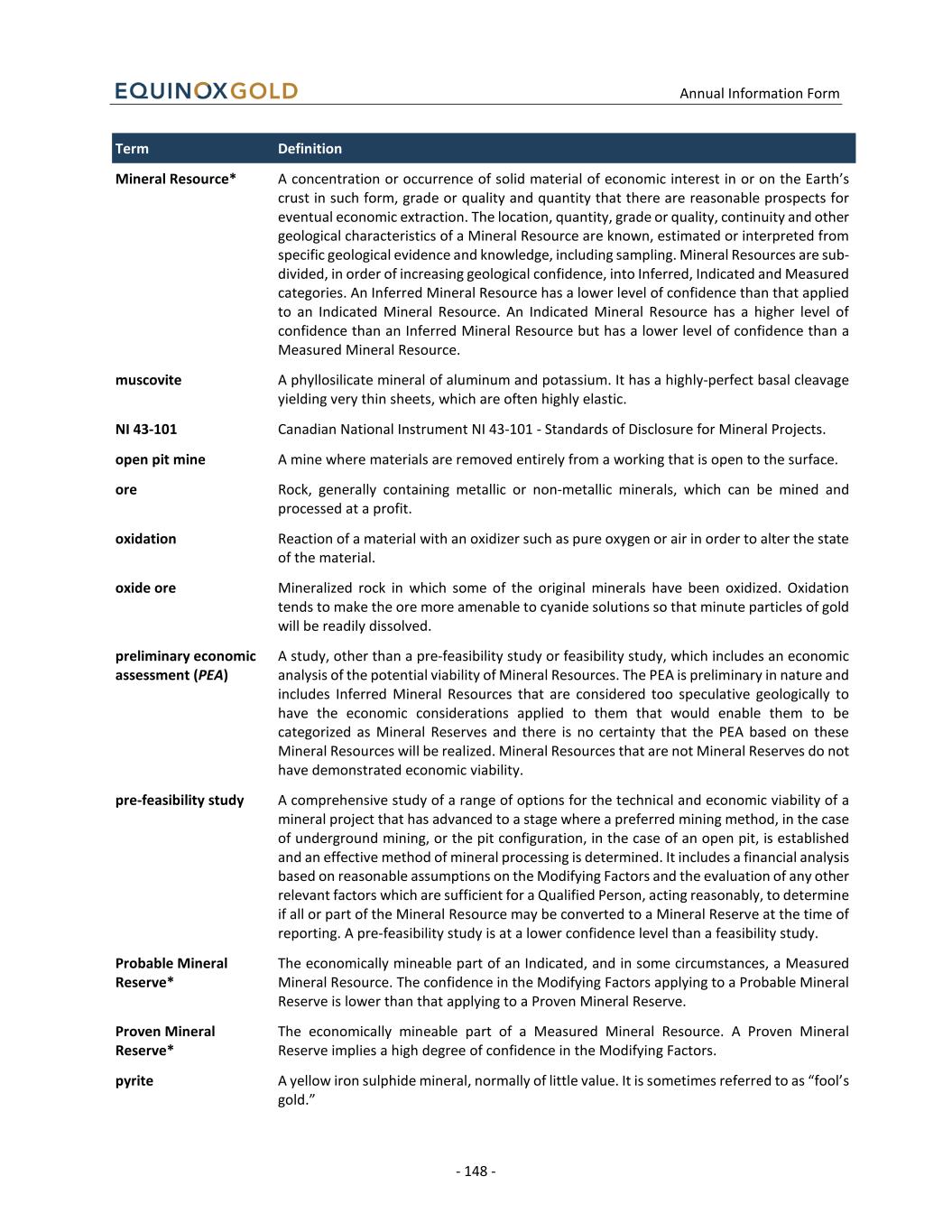
Annual Information Form - 148 - Term Definition Mineral Resource* A concentration or occurrence of solid material of economic interest in or on the Earth’s crust in such form, grade or quality and quantity that there are reasonable prospects for eventual economic extraction. The location, quantity, grade or quality, continuity and other geological characteristics of a Mineral Resource are known, estimated or interpreted from specific geological evidence and knowledge, including sampling. Mineral Resources are sub- divided, in order of increasing geological confidence, into Inferred, Indicated and Measured categories. An Inferred Mineral Resource has a lower level of confidence than that applied to an Indicated Mineral Resource. An Indicated Mineral Resource has a higher level of confidence than an Inferred Mineral Resource but has a lower level of confidence than a Measured Mineral Resource. muscovite A phyllosilicate mineral of aluminum and potassium. It has a highly-perfect basal cleavage yielding very thin sheets, which are often highly elastic. NI 43-101 Canadian National Instrument NI 43-101 - Standards of Disclosure for Mineral Projects. open pit mine A mine where materials are removed entirely from a working that is open to the surface. ore Rock, generally containing metallic or non-metallic minerals, which can be mined and processed at a profit. oxidation Reaction of a material with an oxidizer such as pure oxygen or air in order to alter the state of the material. oxide ore Mineralized rock in which some of the original minerals have been oxidized. Oxidation tends to make the ore more amenable to cyanide solutions so that minute particles of gold will be readily dissolved. preliminary economic assessment (PEA) A study, other than a pre-feasibility study or feasibility study, which includes an economic analysis of the potential viability of Mineral Resources. The PEA is preliminary in nature and includes Inferred Mineral Resources that are considered too speculative geologically to have the economic considerations applied to them that would enable them to be categorized as Mineral Reserves and there is no certainty that the PEA based on these Mineral Resources will be realized. Mineral Resources that are not Mineral Reserves do not have demonstrated economic viability. pre-feasibility study A comprehensive study of a range of options for the technical and economic viability of a mineral project that has advanced to a stage where a preferred mining method, in the case of underground mining, or the pit configuration, in the case of an open pit, is established and an effective method of mineral processing is determined. It includes a financial analysis based on reasonable assumptions on the Modifying Factors and the evaluation of any other relevant factors which are sufficient for a Qualified Person, acting reasonably, to determine if all or part of the Mineral Resource may be converted to a Mineral Reserve at the time of reporting. A pre-feasibility study is at a lower confidence level than a feasibility study. Probable Mineral Reserve* The economically mineable part of an Indicated, and in some circumstances, a Measured Mineral Resource. The confidence in the Modifying Factors applying to a Probable Mineral Reserve is lower than that applying to a Proven Mineral Reserve. Proven Mineral Reserve* The economically mineable part of a Measured Mineral Resource. A Proven Mineral Reserve implies a high degree of confidence in the Modifying Factors. pyrite A yellow iron sulphide mineral, normally of little value. It is sometimes referred to as “fool’s gold.”
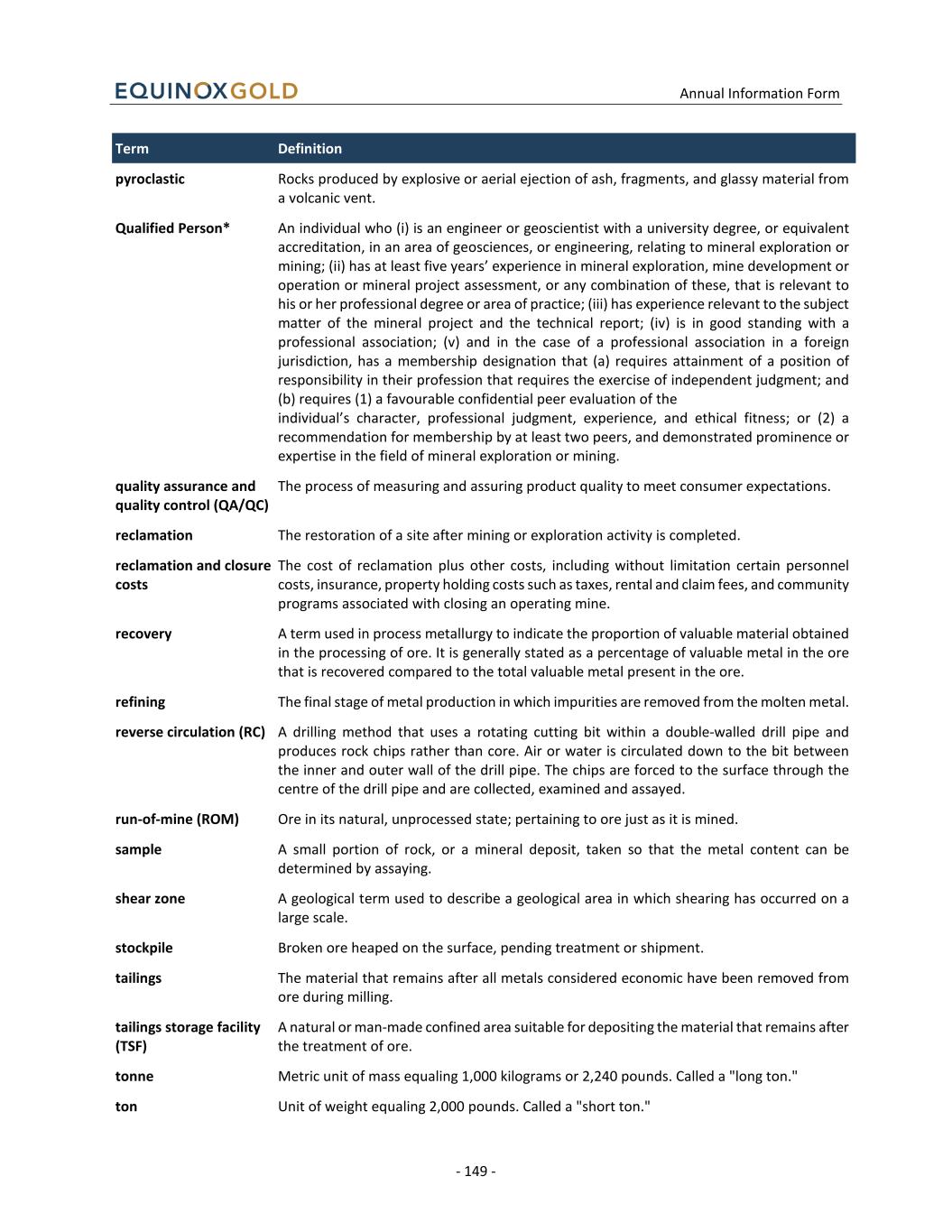
Annual Information Form - 149 - Term Definition pyroclastic Rocks produced by explosive or aerial ejection of ash, fragments, and glassy material from a volcanic vent. Qualified Person* An individual who (i) is an engineer or geoscientist with a university degree, or equivalent accreditation, in an area of geosciences, or engineering, relating to mineral exploration or mining; (ii) has at least five years’ experience in mineral exploration, mine development or operation or mineral project assessment, or any combination of these, that is relevant to his or her professional degree or area of practice; (iii) has experience relevant to the subject matter of the mineral project and the technical report; (iv) is in good standing with a professional association; (v) and in the case of a professional association in a foreign jurisdiction, has a membership designation that (a) requires attainment of a position of responsibility in their profession that requires the exercise of independent judgment; and (b) requires (1) a favourable confidential peer evaluation of the individual’s character, professional judgment, experience, and ethical fitness; or (2) a recommendation for membership by at least two peers, and demonstrated prominence or expertise in the field of mineral exploration or mining. quality assurance and quality control (QA/QC) The process of measuring and assuring product quality to meet consumer expectations. reclamation The restoration of a site after mining or exploration activity is completed. reclamation and closure costs The cost of reclamation plus other costs, including without limitation certain personnel costs, insurance, property holding costs such as taxes, rental and claim fees, and community programs associated with closing an operating mine. recovery A term used in process metallurgy to indicate the proportion of valuable material obtained in the processing of ore. It is generally stated as a percentage of valuable metal in the ore that is recovered compared to the total valuable metal present in the ore. refining The final stage of metal production in which impurities are removed from the molten metal. reverse circulation (RC) A drilling method that uses a rotating cutting bit within a double-walled drill pipe and produces rock chips rather than core. Air or water is circulated down to the bit between the inner and outer wall of the drill pipe. The chips are forced to the surface through the centre of the drill pipe and are collected, examined and assayed. run-of-mine (ROM) Ore in its natural, unprocessed state; pertaining to ore just as it is mined. sample A small portion of rock, or a mineral deposit, taken so that the metal content can be determined by assaying. shear zone A geological term used to describe a geological area in which shearing has occurred on a large scale. stockpile Broken ore heaped on the surface, pending treatment or shipment. tailings The material that remains after all metals considered economic have been removed from ore during milling. tailings storage facility (TSF) A natural or man-made confined area suitable for depositing the material that remains after the treatment of ore. tonne Metric unit of mass equaling 1,000 kilograms or 2,240 pounds. Called a "long ton." ton Unit of weight equaling 2,000 pounds. Called a "short ton."
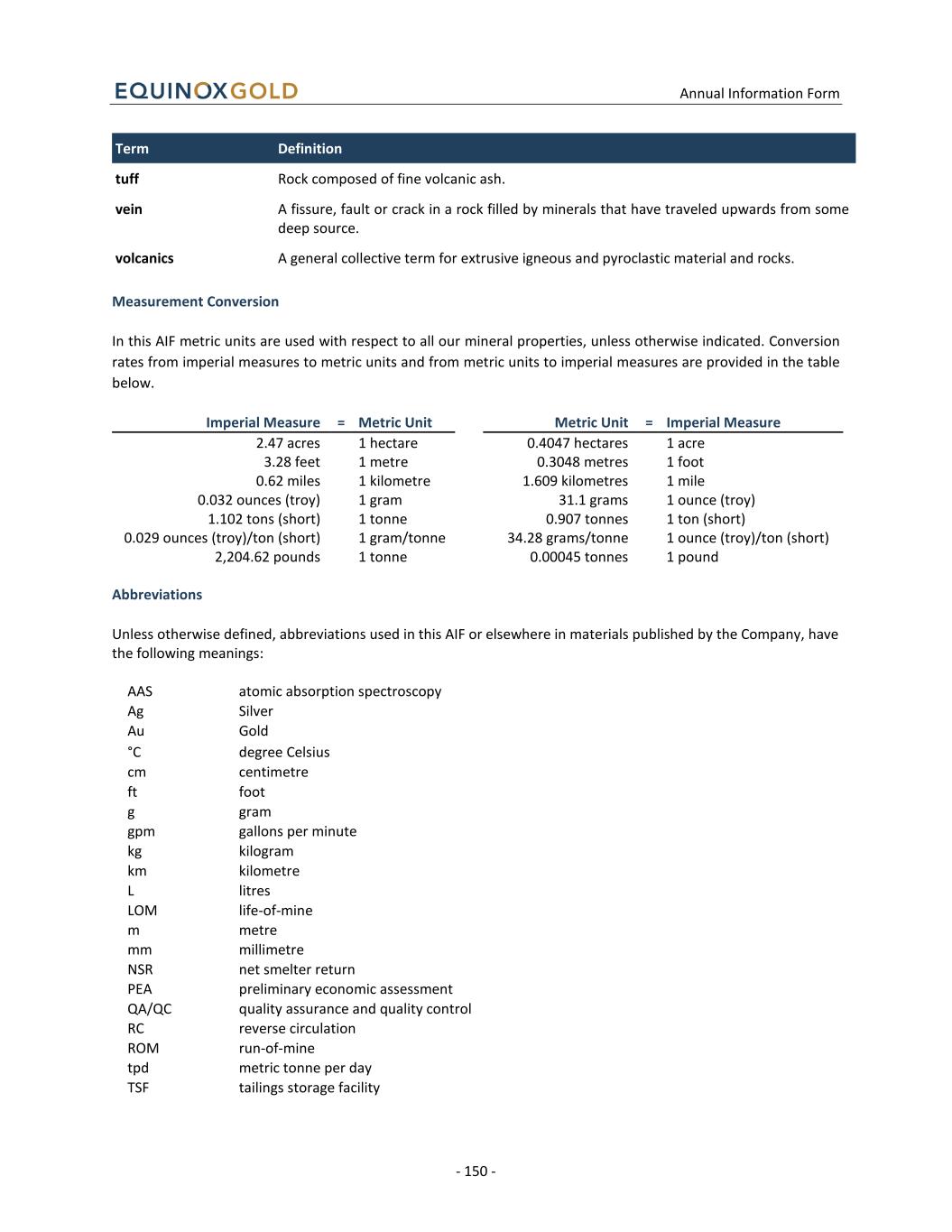
Annual Information Form - 150 - Term Definition tuff Rock composed of fine volcanic ash. vein A fissure, fault or crack in a rock filled by minerals that have traveled upwards from some deep source. volcanics A general collective term for extrusive igneous and pyroclastic material and rocks. Measurement Conversion In this AIF metric units are used with respect to all our mineral properties, unless otherwise indicated. Conversion rates from imperial measures to metric units and from metric units to imperial measures are provided in the table below. Imperial Measure = Metric Unit Metric Unit = Imperial Measure 2.47 acres 1 hectare 0.4047 hectares 1 acre 3.28 feet 1 metre 0.3048 metres 1 foot 0.62 miles 1 kilometre 1.609 kilometres 1 mile 0.032 ounces (troy) 1 gram 31.1 grams 1 ounce (troy) 1.102 tons (short) 1 tonne 0.907 tonnes 1 ton (short) 0.029 ounces (troy)/ton (short) 1 gram/tonne 34.28 grams/tonne 1 ounce (troy)/ton (short) 2,204.62 pounds 1 tonne 0.00045 tonnes 1 pound Abbreviations Unless otherwise defined, abbreviations used in this AIF or elsewhere in materials published by the Company, have the following meanings: AAS atomic absorption spectroscopy Ag Silver Au Gold °C degree Celsius cm centimetre ft foot g gram gpm gallons per minute kg kilogram km kilometre L litres LOM life-of-mine m metre mm millimetre NSR net smelter return PEA preliminary economic assessment QA/QC quality assurance and quality control RC reverse circulation ROM run-of-mine tpd metric tonne per day TSF tailings storage facility
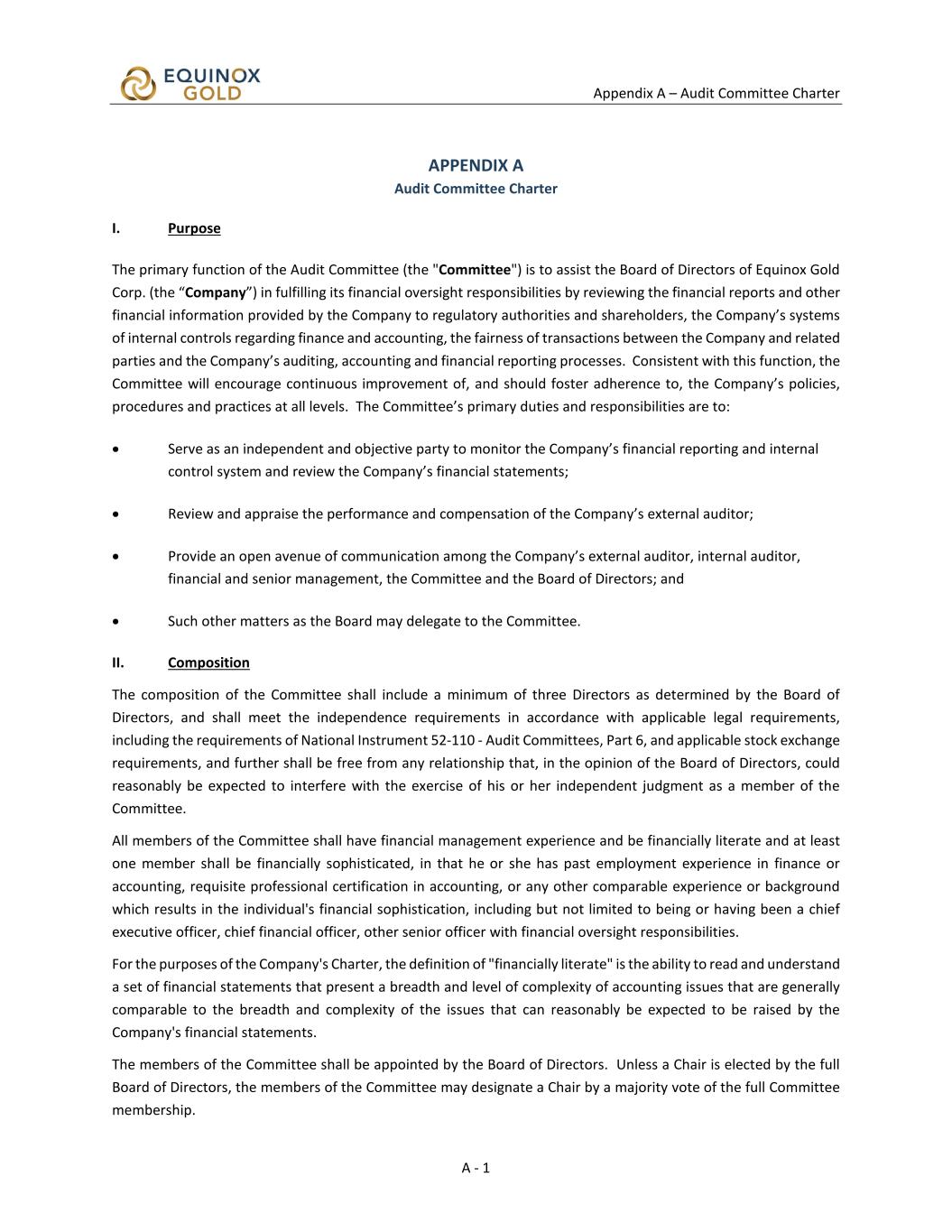
Appendix A – Audit Committee Charter A - 1 APPENDIX A Audit Committee Charter I. Purpose The primary function of the Audit Committee (the "Committee") is to assist the Board of Directors of Equinox Gold Corp. (the “Company”) in fulfilling its financial oversight responsibilities by reviewing the financial reports and other financial information provided by the Company to regulatory authorities and shareholders, the Company’s systems of internal controls regarding finance and accounting, the fairness of transactions between the Company and related parties and the Company’s auditing, accounting and financial reporting processes. Consistent with this function, the Committee will encourage continuous improvement of, and should foster adherence to, the Company’s policies, procedures and practices at all levels. The Committee’s primary duties and responsibilities are to: • Serve as an independent and objective party to monitor the Company’s financial reporting and internal control system and review the Company’s financial statements; • Review and appraise the performance and compensation of the Company’s external auditor; • Provide an open avenue of communication among the Company’s external auditor, internal auditor, financial and senior management, the Committee and the Board of Directors; and • Such other matters as the Board may delegate to the Committee. II. Composition The composition of the Committee shall include a minimum of three Directors as determined by the Board of Directors, and shall meet the independence requirements in accordance with applicable legal requirements, including the requirements of National Instrument 52-110 - Audit Committees, Part 6, and applicable stock exchange requirements, and further shall be free from any relationship that, in the opinion of the Board of Directors, could reasonably be expected to interfere with the exercise of his or her independent judgment as a member of the Committee. All members of the Committee shall have financial management experience and be financially literate and at least one member shall be financially sophisticated, in that he or she has past employment experience in finance or accounting, requisite professional certification in accounting, or any other comparable experience or background which results in the individual's financial sophistication, including but not limited to being or having been a chief executive officer, chief financial officer, other senior officer with financial oversight responsibilities. For the purposes of the Company's Charter, the definition of "financially literate" is the ability to read and understand a set of financial statements that present a breadth and level of complexity of accounting issues that are generally comparable to the breadth and complexity of the issues that can reasonably be expected to be raised by the Company's financial statements. The members of the Committee shall be appointed by the Board of Directors. Unless a Chair is elected by the full Board of Directors, the members of the Committee may designate a Chair by a majority vote of the full Committee membership.
Appendix A – Audit Committee Charter A - 2 III. Meetings The Committee shall meet at least quarterly, or more frequently as circumstances dictate. The meetings will take place as the Committee or the Chair of the Committee shall determine, upon 48 hours’ notice to each of its members. The notice period may be waived by a quorum of the Committee. The Committee may ask members of Management or others to attend meetings or to provide information as necessary. The quorum for the transaction of business at any meeting of the Committee shall be a majority of the members of the Committee or subcommittee present in person or by telephone or other telecommunication device that permits all persons participating in the meeting to speak and to hear each other. Decisions by the Committee will be by the affirmative vote of a majority of the members of the Committee, or by consent resolutions in writing signed by each member of the Committee. The Committee shall prepare and maintain minutes of its meetings, and periodically report to the Board of Directors regarding such matters as are relevant to the Committee’s discharge of its responsibilities, and shall report in writing on request of the Chair of the Board. As part of its duty to foster open communication, the Committee will meet at least annually with the Chief Financial Officer, the internal auditor and the external auditor in separate sessions. IV. Subcommittees The Committee may form and delegate authority to one or more subcommittees, which may consist of one or more members, as it deems necessary or appropriate from time to time under the circumstances. The quorum for the transaction of business at any meeting of the Subcommittee shall be a majority of the members of the subcommittee. V. Responsibilities and Duties The Committee shall take charge of all responsibilities imparted on an audit committee of a public company, as they may apply from time to time to the Company, under applicable laws and stock exchange requirements and any other requirements of applicable regulatory and professional bodies, together with such other responsibilities as delegated by the Board to the Committees. To fulfill its responsibilities and duties, the Committee shall: Financial Reporting Processes 1. Review and recommend to the Board for approval the Company's annual and interim (quarterly) financial statements, Management’s Discussion and Analysis (“MD&A”), and any annual and interim earnings- related press releases, before the Company publicly discloses this information and any financial reports or other material financial information that are submitted to any governmental body, stock exchange or to the public, including any certification, report, opinion, or review rendered by the external auditor and, in accordance with the Company’s Communications and Corporate Disclosure Policy, material non-GAAP (generally accepted accounting principles) financial measures, non-GAAP ratios, total of segments measures, capital management measures, and supplementary financial measures (each as defined in National Instrument 52-112 – Non-GAAP and Other Financial Measures Disclosure). 2. Obtain assurance the Company has the proper systems and procedures, internal controls over financial reporting, information technology systems, and disclosure controls and procedures in place so that the
Appendix A – Audit Committee Charter A - 3 Company's financial statements, MD&A, and other financial reports, other financial information, including all Company disclosure of financial information extracted or derived from the Company’s financial statements and other reports, satisfy all legal and regulatory requirements. The Audit Committee shall periodically assess the adequacy of such systems, procedures and controls. 3. In consultation with the external auditor, review with management the integrity of the Company's financial reporting process, both internal and external. 4. In connection with the annual audit, review material written matters between the external auditor and management, such as management letters, schedules of unadjusted differences and analyses of alternative assumptions, estimates or generally accepted accounting methods. 5. Consider the external auditor’s judgments about the quality and appropriateness of the Company’s accounting principles, practices and internal controls as applied in its financial reporting. 6. Consider and approve, if appropriate, changes to the Company’s accounting principles, practices and internal controls over financial reporting as suggested by the external auditor and management. 7. Review significant judgments made by management in the preparation of the financial statements and the view of the external auditor as to appropriateness of such judgments. 8. Following completion of the annual audit, review separately with management and the external auditor any significant difficulties encountered during the course of the audit, including any restrictions on the scope of work or access to required information. 9. Review and assist in the resolution of any significant disagreement between management and the external auditor in connection with the preparation of the financial statements and financial reporting generally. 10. Review with the external auditor and management the extent to which changes and improvements in financial or accounting practices have been implemented. 11. Review certification processes relating to preparation and filing of reports and financial information. 12. Establish procedures for the receipt, retention and treatment of complaints or concerns received by the Company regarding accounting, internal accounting controls or auditing matters, and for the confidential, anonymous submission by employees of the Company of concerns regarding questionable accounting or auditing matters. Internal Audit 13. Review and advise on the selection and removal of the head of internal audit and the organizational structure of the internal audit group. 14. Review the activities of the internal audit group, including its annual audit plan. 15. Periodically review, with the head of internal audit, any matters that the Committee or the head of internal audit believes should be discussed, including any significant difficulties, disagreements with management, or scope restrictions encountered in the course of the work planned or performed by the internal audit group.
Appendix A – Audit Committee Charter A - 4 16. Periodically review, with the external auditor, the internal audit group‘s responsibility, budget, and staffing. External Auditor 17. Review annually the performance of the external auditor who shall report directly to the Committee and who will be ultimately accountable to the Committee and the Board of Directors as representatives of the shareholders of the Company. 18. Obtain annually a formal written statement by the external auditor setting forth all relationships between the external auditor, including its network firms, and the Company that could reasonably be considered to bear on the independence of the auditor. Confirm with the external auditor that they are registered as a participating audit firm in good standing with the Canadian Public Accountability Board. 19. Review and discuss with the external auditor any disclosed relationships or services that may affect the objectivity and independence of the external auditor. 20. Take, or recommend that the Board of Directors take, appropriate action to oversee the independence of the external auditor. 21. Be responsible for overseeing and recommending to the Board (subject to the approval of the shareholders, where required) the appointment of the Company’s external auditor and for the compensation, retention and oversight of the work of the external auditor engaged by the Company. 22. At each meeting, consult with the external auditor, without the presence of management, about the quality of the Company’s accounting principles, internal controls and the completeness and accuracy of the Company's financial statements. 23. Review and approve the Company's hiring policies regarding partners, employees and former partners and employees of the present and former external auditor of the Company. 24. Review with management and the external auditor the audit plan for the year-end financial statements, the intended template for such statements and oversee the audit. 25. Review and pre-approve all audit and audit-related services and the fees and other compensation related thereto, and any non-audit services provided by the Company’s external auditor and the fees and other compensation related. The pre-approval requirement is waived with respect to the provision of non-audit services by the auditor if: (i) such services were not recognized by the Company at the time of the engagement to be non- audit services; and (ii) such services are promptly brought to the attention of the Committee by the Company and approved, prior to the completion of the audit, by the Committee or by one or more members of the Committee to whom authority to grant such approvals has been delegated by the Committee. The pre-approval of non-audit services by any member to whom authority has been delegated must be presented to the Committee at its first scheduled meeting following such pre-approval.

Appendix A – Audit Committee Charter A - 5 VI. Other Responsibilities Enterprise Risk Management (ERM) 26. Review the ERM process, including its annual risk management plan. 27. Provide oversight over the ERM process to assess the adequacy of its design and if it is operating effectively. 28. Receive regular reports from management on the risks the Company faces, and the status of action plans implemented by management to mitigate such risks. 29. Periodically review, with the external auditor, the ERM process, budget, and staffing. General Responsibilities 30. Review with management the Company’s financial fraud risk assessment, including an annual review of the top fraud risks identified by management, and the policies and practices adopted by the Company to mitigate those risks. 31. Review for fairness any proposed related-party transactions and make recommendations to the Board of Directors whether any such transactions should be approved. 32. Recommend to the Compensation, Nomination and Governance Committee the qualifications and criteria for membership on the Committee. 33. The Committee may retain and terminate the services of outside specialists, counsel, accountants or other consultants and advisors to the extent it deems appropriate and shall have the sole authority to approve their fees and other retention terms. The Company shall provide for appropriate funding, as determined by the Committee, for payment of compensation to any advisors retained by the Committee and to the external auditor engaged by the Company for the purpose of rendering or issuing an audit report or performing any other audit, review or attestation services and ordinary administrative expenses of the Committee that are necessary or appropriate in carrying out its duties. 34. The Committee shall evaluate its own performance at least annually and recommend to the Compensation and Corporate Governance Committee the qualifications and criteria for membership on the Committee. 35. Perform other activities related to this Charter as requested by the board of directors. 36. Review annually the adequacy of this Charter and recommend appropriate revisions to the Board of Directors.
Appendix A – Audit Committee Charter A - 6 VII. Oversight Function While the Committee has responsibilities set out in this Charter, the members of the Committee are members of the Board appointed to provide broad oversight of the Company’s affairs, and are specifically not accountable or responsible for the day to day activities, nor the administration or implementation or arrangements relating thereto. Approved by the Board of Directors Adopted: March 30, 2020 Last Approved: February 2025