Please wait
0001772177falseDEF 14A000177217752024-09-012025-08-310001772177ecd:NonPeoNeoMemberecd:YrEndFrValOfEqtyAwrdsGrntdInCvrdYrOutsdngAndUnvstdMember2024-09-012025-08-310001772177ecd:ChngInFrValOfOutsdngAndUnvstdEqtyAwrdsGrntdInPrrYrsMemberecd:PeoMember2024-09-012025-08-31000177217722024-09-012025-08-310001772177ecd:PeoMember2024-09-012025-08-3100017721772024-09-012025-08-310001772177ecd:YrEndFrValOfEqtyAwrdsGrntdInCvrdYrOutsdngAndUnvstdMemberecd:PeoMember2024-09-012025-08-3100017721772022-09-012023-08-310001772177ecd:NonPeoNeoMemberecd:EqtyAwrdsInSummryCompstnTblForAplblYrMember2024-09-012025-08-31000177217742024-09-012025-08-310001772177ecd:NonPeoNeoMemberecd:ChngInFrValAsOfVstngDtOfPrrYrEqtyAwrdsVstdInCvrdYrMember2024-09-012025-08-3100017721772021-09-012022-08-310001772177ecd:NonPeoNeoMember2024-09-012025-08-31000177217712024-09-012025-08-31000177217732024-09-012025-08-3100017721772023-09-012024-08-310001772177ecd:EqtyAwrdsInSummryCompstnTblForAplblYrMemberecd:PeoMember2024-09-012025-08-310001772177ecd:ChngInFrValAsOfVstngDtOfPrrYrEqtyAwrdsVstdInCvrdYrMemberecd:PeoMember2024-09-012025-08-310001772177ecd:NonPeoNeoMemberecd:ChngInFrValOfOutsdngAndUnvstdEqtyAwrdsGrntdInPrrYrsMember2024-09-012025-08-31iso4217:USD
UNITED STATES
SECURITIES AND EXCHANGE COMMISSION
Washington, D.C. 20549
SCHEDULE 14A
Proxy Statement Pursuant to Section 14(a) of the Securities
Exchange Act of 1934 (Amendment No. )
Filed by the Registrant ☒
Filed by a Party other than the Registrant ☐
Check the appropriate box:
☐ Preliminary Proxy Statement
☐ Confidential, for Use of the Commission Only (as permitted by Rule 14a-6(e)(2))
☒ Definitive Proxy Statement
☐ Definitive Additional Materials
☐ Soliciting Material Pursuant to §240.14a-12
KURA SUSHI USA, INC.
(Name of Registrant as Specified In Its Charter)
(Name of Person(s) Filing Proxy Statement, if other than the Registrant)
Payment of Filing Fee (Check all boxes that apply):
☒ No fee required
☐ Fee paid previously with preliminary materials
☐ Fee computed on table in exhibit required by Item 25(b) per Exchange Act Rules 14a-6(i)(1) and 0-11

December 10, 2025
To Our Stockholders:
You are cordially invited to attend the 2026 Annual Meeting of Stockholders of Kura Sushi USA, Inc. (the “Company”) at the offices of the Company at 17461 Derian Avenue, Suite 200, Irvine, CA 92614 on January 21, 2026, at 10:00 a.m., Pacific Time.
The matters expected to be acted upon at the meeting are described in detail in the accompanying Notice of Annual Meeting of Stockholders and Proxy Statement, which you are urged to read carefully.
We have elected to take advantage of Securities and Exchange Commission (“SEC”) rules that allow us to furnish proxy materials to certain stockholders on the Internet. On or about the date of this letter, we began mailing a Notice of Internet Availability of Proxy Materials (the “Notice”) to stockholders of record at the close of business on November 24, 2025. At the same time, we provided those stockholders with access to our online proxy materials and filed our proxy materials with the SEC. We believe furnishing proxy materials to our stockholders on the Internet will allow us to provide our stockholders with the information they need, while lowering the costs of delivery and reducing the environmental impact of the Annual Meeting. If you have received the Notice, you will not receive a printed copy of the proxy materials unless you request it by following the instructions for requesting such materials contained in the Notice.
Your vote is important. Please cast your vote as soon as possible over the Internet, by telephone, or by completing and returning the enclosed proxy card in the postage-prepaid envelope so that your shares are represented. Your vote will mean that you are represented at the Annual Meeting regardless of whether or not you attend the meeting. Returning the proxy does not deprive you of your right to attend the meeting and to vote your shares during the Annual Meeting.
Your continued support of our Company is greatly appreciated.
|
|
Sincerely, |
|
Hajime Uba |
President and Chief Executive Officer |
KURA SUSHI USA, INC.
17461 DERIAN AVENUE, SUITE 200
IRVINE, CALIFORNIA 92614
NOTICE OF ANNUAL MEETING OF STOCKHOLDERS
To Our Stockholders:
NOTICE IS HEREBY GIVEN that the 2026 Annual Meeting of Stockholders (the “Annual Meeting”) of Kura Sushi USA, Inc. will be held at the offices of the Company at 17461 Derian Avenue, Suite 200, Irvine, California, on January 21, 2026, at 10:00 a.m., Pacific Time.
The purposes of the meeting are:
1. To elect the five directors named in the Proxy Statement, each to serve until the 2027 Annual Meeting of Stockholders of Kura Sushi USA, Inc. and until his or her successor shall have been duly chosen and qualified, or until his or her earlier death, resignation, retirement, disqualification or removal;
2. To ratify the appointment of KPMG LLP as the Company’s independent registered public accounting firm for the fiscal year ending on August 31, 2026;
3. To approve, in a non-binding advisory vote, named executive officer compensation; and
4. To transact such other business as may properly come before the meeting or any adjournment or postponement thereof.
The foregoing items of business are more fully described in the Proxy Statement accompanying this Notice.
Stockholders of record at the close of business on November 24, 2025 are entitled to notice of, and to vote at the Annual Meeting and any subsequent adjournments or postponements. A list of these stockholders will be available for inspection for 10 days preceding the Annual Meeting at our offices. If you would like to inspect the list, please contact our Corporate Secretary at our corporate headquarters at 17461 Derian Avenue, Suite 200, Irvine, California 92614, telephone number 657-333-4100, to arrange a visit to our offices. Beginning on or about December 10, 2025, we will send to our stockholders a Notice of Internet Availability of Proxy Materials (“Notice”) with instructions on how to access our proxy materials over the Internet and how to vote. The Notice contains instructions on how to access the Proxy Statement, our fiscal year 2025 Annual Report on Form 10-K and the form of proxy on the Internet, as well as instructions on how to request a paper copy of the proxy materials.
It is important that your common stock be represented at the Annual Meeting whether or not you are personally able to attend. Our proxy tabulator, Broadridge Financial Solutions, Inc., must receive your proxy card no later than 11:59 p.m., Eastern Time on January 20, 2026.
|
|
By Order of the Board of Directors, |
|
Jeffrey Uttz |
Chief Financial Officer |
Irvine, California
December 10, 2025
Whether or not you expect to attend the meeting, please vote via the Internet, by telephone, or complete, date, sign and promptly return the accompanying proxy in the enclosed postage-paid envelope so that your shares may be represented at the meeting.
IMPORTANT NOTICE REGARDING THE AVAILABILITY OF PROXY MATERIALS FOR THE STOCKHOLDER MEETING TO BE HELD ON JANUARY 21, 2026: THIS PROXY STATEMENT AND OUR ANNUAL REPORT ON FORM 10-K ARE AVAILABLE AT www.proxyvote.com.
KURA SUSHI USA, INC.
Proxy Statement
For the Annual Meeting of
Stockholders To Be Held on January 21, 2026
TABLE OF CONTENTS
KURA SUSHI USA, INC.
17461 DERIAN AVENUE, SUITE 200
IRVINE, CALIFORNIA 92614
PROXY STATEMENT
THE MEETING
The accompanying proxy is solicited on behalf of the Board of Directors (the “Board of Directors” or the “Board”) of Kura Sushi USA, Inc., a Delaware corporation (the “Company”), for use at the 2026 Annual Meeting of Stockholders (the “Annual Meeting”) to be held at the offices of the Company at 17461 Derian Avenue, Suite 200, Irvine, CA 92614 on January 21, 2026, at 10:00 a.m., Pacific Time. The Notice of Internet Availability of Proxy Materials was first furnished to stockholders on or about December 10, 2025. An Annual Report on Form 10-K for the year ended August 31, 2025 (“Annual Report”) is enclosed with this Proxy Statement. An electronic copy of this Proxy Statement and Annual Report are available at www.proxyvote.com.
Voting Rights, Quorum and Required Vote
Only holders of record of our Class A and Class B common stock at the close of business on November 24, 2025, which is the record date, will be entitled to vote at the Annual Meeting. At the close of business on November 24, 2025, we had 12,111,477 shares of common stock outstanding and entitled to vote, of which 11,111,427 shares were Class A common stock and 1,000,050 shares were Class B common stock. On all matters to be voted on by stockholders, holders of our Class A common stock are entitled to one vote per share while holders of our Class B common stock are entitled to ten votes per share. Holders of our Class A common stock and Class B common stock will vote together as a single class on all matters described in this Proxy Statement.
A quorum is required for our stockholders to conduct business at the Annual Meeting. The holders of a majority in voting power of all issued and outstanding stock entitled to vote at the Annual Meeting, present in person or represented by proxy, will constitute a quorum for the transaction of business; provided that, where a separate vote by a class or series is required, the holders of a majority in voting power of all issued and outstanding stock of such class or series entitled to vote on such matter, present in person or represented by proxy, shall constitute a quorum entitled to take action with respect to such matter. Abstentions and “broker non-votes” (described below) will be counted in determining whether there is a quorum.
For Proposal No. 1—Election of Directors, directors will be elected by the affirmative vote of the holders of a majority in voting power of the stock entitled to vote at the Annual Meeting and with respect to the matter on which the vote is taken, present in person or represented by proxy. With respect to each director nominee, abstentions will count the same as votes against the election of such director nominee. This proposal is a discretionary item and, thus, brokers that do not receive instructions from beneficial owners may vote your shares in their discretion. Therefore, there will be no broker non-votes on this proposal. Stockholders do not have the right to cumulate their votes for the election of directors.
For Proposal No. 2—Ratification of the Company’s independent registered public accounting firm, the proposal will be approved by the affirmative vote of the holders of a majority in voting power of the stock entitled to vote at the Annual Meeting and with respect to the matter on which the vote is taken, present in person or represented by proxy. With respect to this proposal, there will not be broker non-votes and abstentions will count the same as votes against the approval of this proposal.
For Proposal No. 3—Approval, in a non-binding advisory vote, of named executive officer compensation., the proposal will be approved by the affirmative vote of the holders of a majority in voting power of the stock entitled to vote at the Annual Meeting and with respect to the matter on which the vote is taken, present in person or represented by proxy. Abstentions will have the same effect as votes against the proposal. Broker non-votes will have no effect on the outcome of the proposal.
Voting Your Shares
If you are a registered holder, meaning that you hold our stock directly (not through a bank, broker or other nominee), you may vote in person at the Annual Meeting or vote by completing, dating and signing the accompanying proxy and promptly returning it in the enclosed envelope, by telephone, or electronically through the Internet by following the instructions included on your proxy card. All signed, returned proxies that are not revoked will be voted in accordance with the instructions contained therein. Signed proxies that give no instructions as to how they should be voted on a particular proposal at the Annual Meeting will be counted in accordance with the recommendations of the Board (“for” all director nominees identified in Proposal No. 1, and “for” each of Proposal No. 2 and 3).
If your shares are held through a bank, broker or other nominee, you are considered the beneficial owner of those shares. You may be able to vote by telephone or electronically through the Internet in accordance with the voting instructions provided by that nominee. As a beneficial owner, you have the right to instruct that organization on how to vote the shares held in your account. If you do not provide voting instructions to your broker in advance of the Annual Meeting, Nasdaq Stock Market rules grant your broker discretionary authority to vote on “routine” proposals. Where a proposal is not “routine,” a broker who has received no instructions from its clients does not have discretion to vote its clients’ uninstructed shares on that proposal, and the unvoted shares are referred to as “broker non-votes.” Among the proposals to be voted on at the Annual Meeting, Proposal No. 2 is deemed “routine.” Proposals No. 1 and 3 are not “routine” proposals.
In the event that sufficient votes in favor of the proposals are not received by the date of the Annual Meeting, the Chairman of the Annual Meeting may adjourn the Annual Meeting to permit further solicitations of proxies.
The telephone and Internet voting procedures are designed to authenticate stockholders’ identities, to allow stockholders to give their voting instructions and to confirm that stockholders’ instructions have been recorded properly. Stockholders voting via the telephone or Internet should understand that there may be costs associated with telephonic or electronic access, such as usage charges from telephone companies and Internet access providers, that must be borne by the stockholders.
Expenses of Solicitation
The expenses of any solicitation of proxies to be voted at the Annual Meeting will be paid by the Company. Following the original mailing of the proxies and other soliciting materials, the Company and its directors, officers or employees (for no additional compensation) may also solicit proxies in person, by telephone or email. Following the original mailing of the proxies and other soliciting materials, the Company will request that banks, brokers and other nominees forward copies of the proxy and other soliciting materials to persons for whom they hold shares of common stock and request authority for the exercise of proxies. We will reimburse banks, brokers and other nominees for reasonable charges and expenses incurred in forwarding soliciting materials to their clients.
Revocability of Proxies
Any person submitting a proxy has the power to revoke it prior to the Annual Meeting or at the Annual Meeting. A proxy may be revoked by a writing delivered to the Company stating that the proxy is revoked, by a subsequent proxy that is submitted via telephone or Internet no later than 11:59 p.m. Eastern Time (ET) on January 20, 2026, by a subsequent proxy that is signed by the person who signed the earlier proxy and is delivered before or at the Annual Meeting, or by attendance at the Annual Meeting and voting in person electronically. In order for beneficial owners to change any of your previously provided voting instructions, you must contact your bank, broker or other nominee directly.
Delivery of Documents to Stockholders Sharing an Address
We have adopted a procedure approved by the Securities and Exchange Commission (“SEC”) called “householding” under which multiple stockholders who share the same address will receive only one copy of the Annual Report, Proxy Statement, or Notice of Internet Availability of Proxy Materials, as applicable, unless we receive contrary instructions from one or more of the stockholders. If you wish to opt out of householding and receive multiple copies of the proxy materials at the same address, you may do so by notifying us by telephone at (657) 333-4100, by email at investor@kurausa.com, or by mail at Kura Sushi USA, Inc. at 17461 Derian Avenue, Suite 200, Irvine, California 92614, and we will promptly deliver the requested materials. You also may request additional copies of the proxy materials by notifying us by telephone or in writing at the same telephone number, email address, or address. Stockholders with shares registered in the name of a brokerage firm or bank may contact their brokerage firm or bank to request information about householding.
Beginning on or about December 10, 2025, we mailed to our stockholders a Notice of Internet Availability of Proxy Materials with instructions on how to access our proxy materials over the Internet and how to vote. If you received a notice and would prefer to receive paper copies of the proxy materials, you may notify us by telephone, email or mail at the telephone number, email address and mailing address provided above.
PROPOSAL NO. 1—ELECTION OF DIRECTORS
The Company’s Board of Directors is presently comprised of five members. These directors are elected by the stockholders at each annual meeting to serve until the next annual meeting following their election. The Company’s current Board of Directors consists of Shintaro Asako, Treasa Bowers, Kim Ellis, Carin L. Stutz and Hajime Uba. Kim Ellis will not be standing for re-election at the Annual Meeting, and the Board of Directors has also nominated Claudia Schaefer to fill the newly created vacancy upon the expiration of Ms. Ellis’ term, with Ms. Schaefer to serve as a director upon her election and qualification at the Annual Meeting. The Company thanks Ms. Ellis for her years of service. Ms. Schaefer’s nomination as a director was recommended by a non-management director and an executive officer.
Each of the nominees for election is currently a director of the Company except for Ms. Schaefer. If elected at the Annual Meeting, each of the nominees would serve until the next annual meeting and until his or her successor shall have been duly chosen and qualified, or until his or her earlier death, resignation, retirement, disqualification or removal. If any of the nominees are unable or unwilling to be a candidate for election by the time of the Annual Meeting (a contingency which the Board does not expect to occur), the stockholders may vote for a substitute nominee chosen by the present Board to fill the vacancy. In the alternative, the stockholders may vote for just the remaining nominees, leaving a vacancy that may be filled at a later date by the Board. Alternatively, the Board may reduce the size of the Board.
The names of the nominees for election as directors at the Annual Meeting, and certain information about them, including their ages as of December 10, 2025, are included below.
|
|
|
|
|
|
|
|
|
|
|
|
Nominees |
|
Age |
|
|
Position |
|
Term
Expiration |
|
Expiration of Term
for which Nominated |
Shintaro Asako(1)(2)(3)(4) |
|
|
51 |
|
|
Director |
|
2026 |
|
2027 |
Treasa Bowers(1)(2)(3) |
|
|
62 |
|
|
Director |
|
2026 |
|
2027 |
Claudia Schaefer |
|
|
57 |
|
|
Director |
|
N/A |
|
2027 |
Carin L. Stutz(1)(3) |
|
|
69 |
|
|
Director |
|
2026 |
|
2027 |
Hajime Uba |
|
|
48 |
|
|
President, Chief Executive Officer, Director and Chairman of the Board |
|
2026 |
|
2027 |
(1)Member of the Audit Committee.
(2)Member of the Compensation Committee.
(3)Member of the Nominating Committee.
(4)Lead Independent Director.
Nominees for Election as Directors
Shintaro Asako has served as a member of our Board of Directors since the completion of our initial public offering on August 5, 2019. He is a general partner of Delight Ventures, a Japanese Venture Capital Firm specializing in making investments to early-stage startups, where he has served in such capacity since May 2022. He is also the founder and Chief Executive Officer of Bulldog Advisory Inc., a California professional firm specializing in board and executive consultation services since August 2019. From 2011 to July 2019, he served in various management capacities with DeNa Co., Ltd., a developer of mobile game and online services, including as Chief Financial Officer and regional Chief Executive Officer & Chief Financial Officer of its western operations. From 2006 through 2011, Mr. Asako served as the Chief Financial Officer at MediciNova, Inc. Prior to his services with MediciNova, Inc., Mr. Asako held various positions at KPMG LLP and Arthur Andersen LLP, providing a variety of audit, tax, and business consulting services to multinational clients. Mr. Asako currently serves on various public and private company boards of directors, including 7-Eleven, Inc., Uzabase, Inc., and Striemo, Inc. Mr. Asako holds a Bachelor of Science from the University of Southern California Leventhal School of Accounting and is a certified public accountant from the state of California. Mr. Asako possesses strong knowledge and experience in financial management, strategic planning as well as background in regulations for publicly listed companies both in the United States and Japan, making him qualified to serve as a member of our Board of Directors.
Treasa Bowers has served as a member of our Board of Directors since July 2024. She is the Executive Vice President and Chief Human Resources Officer for 7-Eleven, Inc, where she leads the company’s talent strategy, overseeing talent acquisition, talent management, training and development, total rewards and employee relations. Ms. Bowers currently serves on CSN’s Diversity and Inclusion Advisory Board, as well as the Boards of Directors of Scholarship America and the Global Leadership Enhancement and Mentoring Network. Ms. Bowers is a graduate of the Human Resources Institute at Villanova University and received a Bachelor of Science degree in business administration and management from Kennedy-Western University. Ms. Bowers has significant leadership and talent management experience, and strong knowledge in the retail industry that provides her with the qualifications and skills to serve as a member of our Board of Directors.
Claudia Schaefer is the Chief Marketing Officer at Smoothie King, where she focuses on driving relevance and differentiation across all guest and teammate touchpoints—including store design, branding, innovation, merchandising, and digital experiences. Her approach is grounded in consumer insights and experience design, with the goal of inspiring healthy, purpose-driven lifestyles. Prior to joining Smoothie King, Ms. Schaefer served as the Chief Experience Officer at Caliber, parent company of Caliber Collision, where she was responsible for positioning and marketing the Caliber brand while delivering a seamless and differentiated customer experience for all constituents. Before Caliber, Ms. Schaefer was the Chief Marketing Officer for Jamba Juice; she served in the same capacity at Cheddar’s Scratch Kitchen. In both roles, she focused on driving transactions and sales by revitalizing and repositioning the brands to strengthen relevance and differentiation. Previously, Ms. Schaefer worked at Brinker International, parent company of Chili’s Bar & Grill, where she served in multiple marketing capacities both domestically and internationally. In addition to her full-time leadership responsibilities, Ms. Schaefer served on the board of directors for Anthony’s Coal Fired Pizza from 2019 through its sale in 2021. Selected by owners LCatterton for the position, her role was operational in nature, helping to guide positioning and growth in the restaurant concept. Ms. Schaefer has significant leadership and marketing experience along with strong knowledge in the hospitality industry that provides her with the qualifications and skills to serve as a member of our Board of Directors.
Carin L. Stutz has served as a member of our Board of Directors since December 2021. Ms. Stutz was the President and Chief Executive Officer of Native Foods, a 100% plant-based fast casual eatery from October 2019 to March 2023. Previously, she served as Executive Vice President and Chief Operating Officer for Red Robin Gourmet Burgers, Inc. where she led operations for the casual dining chain. During her tenure, she realigned the operations team for improved efficiency, resulting in the Company’s improved P&L. Before joining Red Robin, Ms. Stutz served at FOCUS Brands LLC as President of the McAlister’s Deli brand and positioned the brand for rapid growth, moving from nine openings to more than 44 openings per year, including franchise development. Prior to FOCUS Brands LLC, Ms. Stutz served in various leadership capacities, including President and Chief Executive Officer at Cosi bakery-café, President of Global Business Development at Brinker International, Inc., Executive Vice President of Operations at Applebee’s International, Inc. and Division Vice President at Wendy’s International, Inc. Ms. Stutz currently serves on the board of directors of Hawaiian Bros and is an active member of the Fast Casual Industry Council, the Illinois Restaurant Association Board, and a founding member of the GLEAM Network Board of Directors. Ms. Stutz has extensive experience in the restaurant industry, as well as a strong experience in team development and brand differentiation, that provider her with the qualifications and skills to serve as a member of our Board of Directors.
Hajime “Jimmy” Uba has served as President and Chief Executive Officer of the Company since 2008 and also served as interim Chief Operating Officer from August 2020 through July 2021. Mr. Uba became a member of our Board of Directors in October 2017. Mr. Uba joined the Company’s majority stockholder, Kura Sushi, Inc. (“Kura Japan”), in 2000 and in 2008 was selected to establish and grow the Company. From 2004 to 2008, Mr. Uba headed operations for Kura Japan, where he oversaw operations for Eastern and Western Japan. During this time, Mr. Uba was responsible for the expansion of the Kura brand into Eastern Japan and managed over 100 restaurants. From 2000 to 2004, Mr. Uba spent three years as a restaurant manager and one year as a regional manager. During his tenure, Kura Japan grew from approximately 30 to 180 restaurant locations. He holds a Bachelor of Arts from Kansai University in Japan. Mr. Uba possesses extensive knowledge of all facets of our business and operations, as well as a deep understanding of our history and culture, making him qualified to serve as a member of our Board of Directors.
Vote Required
Directors will be elected by the affirmative vote of the holders of a majority in voting power of the stock entitled to vote at the Annual Meeting and with respect to the matter on which the vote is taken, present in person or represented by proxy. With respect to each director nominee, abstentions will count the same as votes against the election of such director nominee. Broker non-votes will have no effect on the outcome of the election of the nominees. Stockholders do not have the right to cumulate their votes for the election of directors.
|
|
|
The Board of Directors recommends that you vote “FOR” the election of each of the nominated directors. Unless you instruct otherwise on your proxy card or by telephone or Internet voting instructions, your proxy will be voted in accordance with the Board’s recommendation. |
BOARD MATTERS
Family Relationships
There are no family relationships among any of our directors or executive officers.
Corporate Governance and Board Structure
Our Board of Directors currently consists of five members, of which four directors are standing for re-election and Ms. Schaefer is standing for election to fill the remaining vacancy. Our amended and restated certificate of incorporation, together with our bylaws, provide that our Board of Directors shall consist of at least three directors but not more than eleven directors and the authorized number of directors may be fixed from time to time by resolution of our Board of Directors. At each annual meeting of stockholders, the successors to directors whose terms then expire will be elected to serve from the time of election and qualification until the first annual meeting following election. The authorized number of directors may be changed by resolution of the Board of Directors. Vacancies on the Board of Directors can be filled by resolution of the Board of Directors. Hajime Uba serves as the Chairman of our Board of Directors. Based on the corporate governance rules of the Nasdaq Stock Market, the Board has determined that Mr. Asako, Ms. Bowers, Ms. Ellis, Ms. Schaefer and Ms. Stutz are independent.
In evaluating a director candidate’s qualifications, we will assess whether a candidate possesses the integrity, judgment, knowledge, experience, skills and expertise that are likely to enhance our ability, as well as the ability of our Board’s committees, to manage and direct our affairs and business. In addition, our corporate governance guidelines require our Board of Directors to consider diversity in identifying potential director nominees with a diverse mix of experience, qualifications, attributes or skills, including, but not limited to, work experiences, military service, geography, age, gender, race, ethnicity, disability, sexual orientation and other distinctions between directors. In addition, any search firm engaged to assist our Board of Directors to identify candidates for nomination to the Board of Directors will be specifically directed to include diverse candidates generally, and multiple women candidates in particular. Annually, the Board of Directors will review and assess the effectiveness of its diversity initiative. Our directors hold office until the earlier of their death, resignation, retirement, disqualification or removal or until their successors have been duly elected and qualified.
Board Committees
Our Board of Directors had three standing committees during fiscal year 2025: an Audit Committee, a Compensation Committee and a Nominating Committee. Each of the committees report to the Board of Directors as they deem appropriate, and as the Board of Directors may request. In the future, our Board of Directors may establish other committees, as it deems appropriate, to assist it with its responsibilities.
Each existing committee has the composition, duties and responsibilities described below.
Audit Committee
Our Audit Committee provides assistance to the Board of Directors in fulfilling its oversight responsibilities regarding the integrity of financial statements, our compliance with applicable legal and regulatory requirements, the integrity of our financial reporting processes including its systems of internal accounting and financial controls, independent accountants and our financial policy matters by approving the services performed by our independent accountants and reviewing their reports regarding our accounting practices and systems of internal accounting controls. The Audit Committee also oversees the audit efforts of our independent accountants and takes action as it deems necessary to determine that the accountants are independent of management. The Audit Committee held four meetings in fiscal year 2025.
Our Audit Committee consists of Mr. Asako, Ms. Bowers and Ms. Stutz. Our Board of Directors has affirmatively determined that Mr. Asako, Ms. Bowers and Ms. Stutz meet the definition of “independent directors” for the purposes of serving on an Audit Committee under applicable SEC and Nasdaq Stock Market rules. In addition, Mr. Asako qualifies as our “audit committee financial expert,” as such term is defined in Item 407 of Regulation S-K. Our Board of Directors adopted a written charter for the Audit Committee, which is available on our corporate website at www.kurasushi.com.
Compensation Committee
The Compensation Committee oversees our overall compensation structure, policies and programs, and assesses whether our compensation structure establishes appropriate incentives for officers and employees. The Compensation Committee reviews and approves corporate goals and objectives relevant to compensation of our chief executive officer and other executive officers, evaluates
the performance of these officers in light of those goals and objectives, sets the compensation of these officers based on such evaluations and reviews and recommends to the Board of Directors any employment-related agreements, any proposed severance arrangements or change in control or similar agreements with these officers. The Compensation Committee also grants stock options and other awards under our stock plans. The Compensation Committee will review and evaluate, at least annually, the performance of the Compensation Committee and its members and the adequacy of the charter of the Compensation Committee. The Compensation Committee held three meetings in fiscal year 2025.
Our Compensation Committee consists of Mr. Asako, Ms. Bowers and Ms. Ellis. As a controlled company, we may rely upon the exemption from the requirement that we have a Compensation Committee composed entirely of independent directors, although our Board of Directors has affirmatively determined that Mr. Asako, Ms. Bowers, and Ms. Ellis meet the definition of “independent directors” for purposes of serving on a Compensation Committee under applicable Nasdaq Stock Market rules. Our Board of Directors adopted a written charter for the Compensation Committee, which is available on our corporate website at www.kurasushi.com.
Nominating Committee
The Nominating Committee oversees the Company’s director nominations process and procedures, oversight of the Board of Directors and board committee assessment process and any related matters. The Nominating Committee determines the qualifications, qualities, skills, and other expertise required to be a director and to develop, and recommends to the Board for its approval, criteria to be considered in selecting nominees for director, as well as identifies individuals qualified to become members of the Board and makes recommendations to the Board if a vacancy on the Board occurs. The Nominating Committee also reviews qualifications and the independence of directors and oversees the succession planning process. The Nominating Committee will review and evaluate, at least annually, the performance of the Nominating Committee and its members and the adequacy of the charter of the Nominating Committee. The Nominating Committee held three meetings in fiscal year 2025.
Our Nominating Committee consists of Mr. Asako, Ms. Bowers and Ms. Stutz. Our Board of Directors has affirmatively determined that Mr. Asako, Ms. Bowers and Ms. Stutz meet the definition of “independent directors” for the purposes of serving on the Nominating Committee under applicable SEC and Nasdaq Stock Market rules. Our Board of Directors adopted a written charter for the Nominating Committee, which is available on our corporate website at www.kurasushi.com.
Risk Oversight
Our Board of Directors is currently responsible for overseeing our risk management process. Our Board of Directors focuses on our general risk management strategy and the most significant risks facing us and ensures that appropriate risk mitigation strategies are implemented by management. The Board of Directors is also apprised of particular risk management matters in connection with its general oversight and approval of corporate matters and significant transactions.
Our Board of Directors does not have a standing risk management committee, but rather we administer this oversight function directly through our Board of Directors as a whole, as well as through various standing committees of our Board of Directors that address risks inherent in their respective areas of oversight. In particular, our Board of Directors is responsible for monitoring and assessing strategic risk exposure, our Audit Committee is responsible for overseeing our major financial risk exposures and the steps our management has taken to monitor and control these exposures, and our Compensation Committee assesses and monitors whether any of our compensation policies and programs have the potential to encourage unnecessary risk-taking. In addition, our Audit Committee considers and approves or disapproves any related party transactions.
Our management is responsible for day-to-day risk management. This oversight includes identifying, evaluating, and addressing potential risks that may exist at the enterprise, strategic, financial, operational, compliance and reporting levels.
Risk and Compensation Policies
We have analyzed our compensation programs and policies and have determined those programs and policies are not reasonably likely to have a material adverse effect on us. The Company’s compensation programs and policies mitigate risk by combining performance-based, long-term compensation elements with payouts that are highly correlated to the value delivered to stockholders. The combination of performance measures for annual bonuses and the equity compensation programs for executive officers, as well as the multi-year vesting schedules for equity awards encourage employees to maintain both a short-term and a long-term view with respect to Company performance.
Leadership Structure of the Board of Directors
The positions of Chairman of the Board and Chief Executive Officer are presently the same person. As our amended and restated bylaws and corporate governance guidelines do not require that our Chairman and Chief Executive Officer positions be separate, our Board of Directors believes that having both positions be held by the same person is the appropriate leadership structure for us at this time. In addition, we currently have a separate lead independent director. Our lead independent director is Mr. Asako. In that role, he coordinates the activities of the independent directors, chairs executive sessions of the independent directors, and serves as the principal liaison between management and the independent directors of the Board. We do not have a formal policy regarding having a separate lead independent director.
As of the date of this Proxy Statement, we have determined that the leadership structure of our Board of Directors has permitted our Board of Directors to fulfill its duties effectively and efficiently and is appropriate given the size and scope of our Company and its financial condition.
Compensation Committee Interlocks and Insider Participation
None of the members of our Compensation Committee has ever been an officer or employee of the Company. None of our executive officers currently serves or in fiscal year 2025 has served as a member of the Board of Directors or Compensation Committee of any entity that has one or more executive officers serving on our Board of Directors or Compensation Committee.
Code of Business Conduct and Ethics
We have adopted a code of business conduct and ethics that applies to all of our directors, officers and employees, including our Chief Executive Officer and Chief Financial Officer and those officers and employees responsible for financial reporting. The full text of our code of business conduct and ethics is posted on the investor relations section of our website at www.kurasushi.com. We intend to disclose future amendments to our code of business conduct and ethics, or any waivers of their provisions that we grant to our directors or executive officers on our website.
Director Compensation
The following is a summary of the structure of our Board compensation program design.
Each non-employee director receives an annual cash retainer and an annual grant of restricted stock units (“RSUs”) for board service, and if such non-employee director serves as a committee chair or a lead independent director, an additional annual cash retainer for such committee chair or lead independent director service. The Board has currently fixed the cash retainer for board service at $50,000 per year, the cash retainer for service as a committee chair at $15,000 to $25,000 per year and the cash retainer for service as a lead independent director at $20,000 per year. Each non-employee director has received annual RSUs issued under the 2018 Incentive Compensation Plan with the value of approximately $70,000 on the grant date. Such grants have the other terms provided for in the 2018 Incentive Compensation Plan and the award agreement providing for such grant. A director who is also an employee, such as Mr. Uba, has not and will not receive any compensation for service as a director.
Directors have been and will continue to be reimbursed for travel, food, lodging and other expenses directly related to their activities as directors, including expenses incurred in attending board meetings. Directors are also entitled to the protection provided by their indemnification agreements and the indemnification provisions in our amended and restated certificate of incorporation and amended and restated bylaws, as well as the protection provided by director and officer liability insurance provided by us.
The following table sets forth information concerning the compensation of our non-employee directors for the fiscal year ended August 31, 2025.
|
|
|
|
|
|
|
|
|
|
|
|
|
|
|
|
|
|
|
|
Name |
|
Fees Earned or
Paid in Cash ($) |
|
Stock Awards ($) (1) |
|
Total ($) |
Shintaro Asako |
|
|
$ |
95,000 |
|
|
|
|
$ |
70,000 |
|
|
|
|
$ |
165,000 |
|
|
Kim Ellis |
|
|
$ |
50,000 |
|
|
|
|
$ |
70,000 |
|
|
|
|
$ |
120,000 |
|
|
Carin Stutz |
|
|
$ |
65,000 |
|
|
|
|
$ |
70,000 |
|
|
|
|
$ |
135,000 |
|
|
Treasa Bowers |
|
|
$ |
62,151 |
|
|
|
|
$ |
70,000 |
|
|
|
|
$ |
132,151 |
|
|
(1) Each non-employee director was granted RSUs on February 3, 2025. The amounts reported in the “Stock Awards” column represent the grant date fair value of 875 RSUs for directors that served a full term computed in accordance with FASB ASC Topic 718.
Board Meetings
During fiscal year 2025, the Board of Directors held six meetings and acted through four unanimous written consents. No director attended less than 75% of the aggregate of (i) the total number of meetings of the Board held during the time in which such director was a member of the Board and (ii) the total number of meetings held by all committees of the Board on which such director served during the period such director served as a member of such committee.
SECURITY OWNERSHIP OF CERTAIN BENEFICIAL OWNERS AND MANAGEMENT
The following table sets forth certain information with respect to the beneficial ownership of any class of our common stock as of November 24, 2025 for:
•each stockholder known by us to be the beneficial owner of more than 5% of any class of our outstanding shares of common stock;
•each director and nominee;
•each of our named executive officers; and
•all of our current directors and executive officers as a group.
We have determined beneficial ownership in accordance with the rules of the SEC. Except as indicated by the footnotes below, we believe, based on the information furnished to us, that the persons and entities named in the table below have sole voting and investment power with respect to all shares of our common stock that they beneficially own, subject to applicable community property laws.
Applicable percentage ownership in the following table is based on 12,111,477 shares of common stock outstanding as of November 24, 2025 (of which 11,111,427 shares were Class A common stock and 1,000,050 shares were Class B common stock), unless otherwise indicated in the footnotes below. In computing the number of shares of common stock beneficially owned by a person or entity and the percentage ownership of that person or entity, we deemed to be outstanding all shares of common stock subject to options, RSUs, performance restricted stock units or other convertible securities held by that person or entity that are currently exercisable or expected to vest or become exercisable within 60 days of November 24, 2025. We did not deem these shares outstanding, however, for the purpose of computing the percentage ownership of any other person. Unless otherwise indicated, the address of each beneficial owner listed in the table below is c/o Kura Sushi USA, Inc. at 17461 Derian Avenue, Suite 200, Irvine, California 92614.
As of November 24, 2025, Kura Japan beneficially owned 1,000,050 shares of Class B common stock, which represented 100% of the outstanding shares of Class B common stock on that date. Class B common stock has the same rights as the Class A common stock except for (i) certain conversion rights and (ii) on all matters to be voted on by stockholders, holders of our Class A common stock are entitled to one vote per share while holders of our Class B common stock are entitled to ten votes per share.
|
|
|
|
|
|
|
|
|
|
|
|
|
|
|
|
|
|
|
|
|
|
|
|
|
|
|
|
|
|
|
|
|
|
Shares of Class A Common
Stock Beneficially Owned |
|
Shares of Class B Common
Stock Beneficially Owned |
|
Total Voting
Power |
Name and Address of Beneficial Owner |
|
Number |
|
Percentage |
|
Number |
|
Percentage |
|
Beneficially
Owned |
Greater than 5% Stockholders: |
|
|
|
|
|
|
|
|
|
|
|
|
|
|
|
|
|
|
|
|
|
|
|
|
|
Kura Japan(1) |
|
|
|
4,126,500 |
|
|
|
|
|
37.1 |
% |
|
|
|
|
1,000,050 |
|
|
|
|
|
100 |
% |
|
|
|
|
66.9 |
% |
|
FMR LLC(2) |
|
|
|
1,015,600 |
|
|
|
|
|
9.1 |
% |
|
|
|
|
— |
|
|
|
|
|
— |
|
|
|
|
|
4.8 |
% |
|
Divisadero Street Capital Management, LP(3) |
|
|
|
828,960 |
|
|
|
|
|
7.5 |
% |
|
|
|
|
— |
|
|
|
|
|
— |
|
|
|
|
|
3.9 |
% |
|
Stephens Inc.(4) |
|
|
|
746,652 |
|
|
|
|
|
6.7 |
% |
|
|
|
|
— |
|
|
|
|
|
— |
|
|
|
|
|
3.5 |
% |
|
Granahan Investment Management LLC(5) |
|
|
|
671,012 |
|
|
|
|
|
6.0 |
% |
|
|
|
|
— |
|
|
|
|
|
— |
|
|
|
|
|
3.2 |
% |
|
|
|
|
|
|
|
|
|
|
|
|
|
|
|
|
|
|
|
|
|
|
|
|
|
|
|
Named Executive Officers Directors and Director Nominee: |
|
|
|
|
|
|
|
|
|
|
|
|
|
|
|
|
|
|
|
|
|
|
|
|
|
Shahin Allameh(6) |
|
|
|
36,106 |
|
|
|
|
* |
|
|
|
|
|
— |
|
|
|
|
|
— |
|
|
|
|
* |
|
|
Shintaro Asako(6) |
|
|
|
13,231 |
|
|
|
|
* |
|
|
|
|
|
— |
|
|
|
|
|
— |
|
|
|
|
* |
|
|
Treasa Bowers(6) |
|
|
|
1,220 |
|
|
|
|
* |
|
|
|
|
|
— |
|
|
|
|
|
— |
|
|
|
|
* |
|
|
Jeffrey Uttz(6) |
|
|
|
24,246 |
|
|
|
|
* |
|
|
|
|
|
— |
|
|
|
|
|
— |
|
|
|
|
* |
|
|
Kim Ellis(6) |
|
|
|
13,231 |
|
|
|
|
* |
|
|
|
|
|
— |
|
|
|
|
|
— |
|
|
|
|
* |
|
|
Robert Kluger(6) |
|
|
|
46,542 |
|
|
|
|
* |
|
|
|
|
|
— |
|
|
|
|
|
— |
|
|
|
|
* |
|
|
Arlene Petokas(6) |
|
|
|
26,954 |
|
|
|
|
* |
|
|
|
|
|
— |
|
|
|
|
|
— |
|
|
|
|
* |
|
|
Claudia Schaefer(6) |
|
|
|
— |
|
|
|
|
* |
|
|
|
|
|
— |
|
|
|
|
|
— |
|
|
|
|
* |
|
|
Carin L. Stutz(6) |
|
|
|
7,709 |
|
|
|
|
* |
|
|
|
|
|
— |
|
|
|
|
|
— |
|
|
|
|
* |
|
|
Hajime Uba(6) |
|
|
|
107,223 |
|
|
|
|
* |
|
|
|
|
|
— |
|
|
|
|
|
— |
|
|
|
|
* |
|
|
|
|
|
|
|
|
|
|
|
|
|
|
|
|
|
|
|
|
|
|
|
|
|
|
|
|
All current executive officers and directors as a group
(9 persons)(6) |
|
|
|
276,462 |
|
|
|
|
|
2.5 |
% |
|
|
|
|
— |
|
|
|
|
|
— |
|
|
|
|
|
1.3 |
% |
|
* Indicates ownership of less than one percent.
(1) The principal business address of Kura Japan is 1-2-2 Fukasaka, Naka-ku, Sakai-shi, Osaka 599-8253, Japan. Kunihiko Tanaka is the President of Kura Japan, and in such capacity has voting and investment control over the equity interests held by Kura Japan. Mr. Tanaka disclaims beneficial ownership of the equity interests held by Kura Japan.
(2) Information regarding share ownership was obtained from the Schedule 13G/A filed jointly by FMR LLC and Abigail P. Johnson on February 12, 2025. The principal business address of FMR LLC is 245 Summer Street, Boston, Massachusetts, 02210. The entities reported their beneficial ownership as follows: (i) FMR LLC has sole voting power over 1,142,140 shares and shared dispositive power over 1,144,831 shares; (ii) Abigail P. Johnson has shared dispositive power over 1,144,831 shares.
(3) Information regarding share ownership was obtained from the Schedule 13G filed jointly by Divisadero Street Capital Management, LP, William Zolezzi, Divisadero Street Partners, L.P., Divisadero Street Partners GP, LLC and Divisadero Street Capital, LLC on November 5, 2025. The principal business address of Divisadero Street Capital Management, LP, et al. is 3480 Main Highway Suite 204, Miami, Florida 33133. The entities reported their beneficial ownership as follows: (i) Divisadero Street Capital Management, LP has sole voting power over 828,960 shares and shared dispositive power over 828,960 shares; (ii) William Zolezzi has sole voting power over 828,960 shares and shared dispositive power over 828,960 shares; (iii) Divisadero Street Partners, L.P. has sole voting power over 621,721 shares and shared dispositive power over 621,721 shares; (iv) Divisadero Street Partners GP, LLC has sole voting power over 621,721 shares and shared dispositive power over 621,721 shares; and (v) Divisadero Street Capital, LLC has sole voting power over 828,960 shares and shared dispositive power over 828,960 shares.
(4) Information regarding share ownership was obtained from the Schedule 13G/A filed jointly by Stephens Inc., SI Holdings Inc., Stephens Financial Services LLC and Warren A. Stephens on February 14, 2025. The principal business address of Stephens Inc., et al. is 111 Center Street, Little Rock, Arkansas 72201. The entities reported their beneficial ownership as follows: (i) Stephens Inc. has sole voting power over 746,652 shares and shared dispositive power over 746,652 shares; (ii) SI Holdings Inc. has sole voting power over 746,652 shares and shared dispositive power over 746,652 shares; (iii) Stephens Financial Services LLC has sole voting power over 746,652 shares and shared dispositive power over 746,652 shares; and (iv) Warren A. Stephens has sole voting power over 746,652 shares and shared dispositive power over 746,652 shares.
(5) Information regarding share ownership was obtained from the Schedule 13G filed by Granahan Investment Management LLC on November 14, 2025. The principal business address of Granahan Investment Management LLC is Wyman Street, Suite 460, Waltham, MA 02451. Granahan Investment Management LLC reported its beneficial ownership as follows: sole voting power over 514,886 shares; sole dispositive power over 671,012 shares; and no shared voting or dispositive power.
(6) Includes options to purchase shares of Class A common stock exercisable within 60 days of November 24, 2025 of the following amounts for each applicable person in the table: 125 for Ms. Bowers, 182 for Ms. Stutz, and 1,370 for Mr. Uttz. No RSUs are expected to vest into shares of Class A common stock within 60 days of November 24, 2025.
EXECUTIVE OFFICERS
The following set forth information regarding the executive officers of the Company as of December 10, 2025:
|
|
|
|
|
|
|
|
Name |
|
Age |
|
|
Position |
Hajime Uba |
|
|
48 |
|
|
President, Chief Executive Officer, Director and Chairman of the Board |
Jeffrey Uttz |
|
|
56 |
|
|
Chief Financial Officer |
Shahin Allameh |
|
|
53 |
|
|
Chief Operating Officer |
Robert Kluger |
|
|
56 |
|
|
Chief Development Officer |
Arlene Petokas |
|
|
56 |
|
|
Chief People Officer |
Hajime “Jimmy” Uba has served as President and Chief Executive Officer of the Company since 2008 and also served as interim Chief Operating Officer from August 2020 through July 2021. Mr. Uba became a member of our Board of Directors in October 2017. Mr. Uba joined the Company’s majority stockholder, Kura Japan, in 2000 and in 2008 was selected to establish and grow the Company. From 2004 to 2008, Mr. Uba headed operations for Kura Japan, where he oversaw operations for Eastern and Western Japan. During this time, Mr. Uba was responsible for the expansion of the Kura brand into Eastern Japan and managed over 100 restaurants. From 2000 to 2004, Mr. Uba spent three years as a restaurant manager and one year as a regional manager. During his tenure, Kura Japan grew from approximately 30 to 180 restaurant locations. He holds a Bachelor of Arts from Kansai University in Japan.
Jeffrey Uttz has served as Chief Financial Officer of the Company since October 2022. Mr. Uttz served as Chief Financial Officer for Shake Shack Inc. for a period of four years where he was instrumental in preparing Shake Shack Inc. for its initial public offering in 2015. As Chief Financial Officer at Shake Shack Inc., Mr. Uttz was involved in opening 45 new restaurants and partnered cross-functionally with operations, real estate, marketing, human resources, and supply chain teams. Prior to his tenure at Shake Shack Inc., Mr. Uttz served as Executive Vice President and Chief Financial Officer of Yard House USA, Inc., an American sports bar chain, for a period of 12 years. At Yard House USA, Inc., Mr. Uttz established the finance infrastructure to support the organization and was also actively engaged in every real estate transaction as a member of the real estate team. Prior to his tenure at Yard House USA, Inc., Mr. Uttz held several financial leadership positions at CKE Restaurants Inc. Mr. Uttz started his career at the public accounting firm KPMG LLP .
Shahin Allameh has served as Chief Operating Officer of the Company since July 2021. Previously, Mr. Allameh served as Chief Operating Officer of Luna Grill from 2015, a California-based fast casual concept, where he helped grow the brand from 16 to 49 locations. Prior to his tenure at Luna Grill, Mr. Allameh was the Director of Operations at Umami Burger from 2013 to 2015. During his tenure there, he not only revamped the company’s procedures and guidelines, including a reorganization of the new unit opening team within the training department, but also successfully opened 13 locations within two years in new markets. Before joining Umami, Mr. Allameh was a Senior Director of Operations at Arby’s, where he led 38 company-owned Arby’s locations and worked closely with senior leadership on testing and product rollout. Previously, he was the Director of Operations and Franchise at Fili Enterprises, Inc, the owner of Daphne’s Greek Café restaurant brand. Mr. Allameh began his professional career as a General Manager and then District Manager at Sbarro, Inc.
Robert Kluger has served as Chief Development Officer of the Company since May 2020. Most recently, Mr. Kluger served for four years as Senior Vice President of Development and Vice President of Real Estate for Blaze Pizza, LLC, a fast casual artisan pizza brand with approximately 340 units worldwide. Blaze Pizza added over 200 franchise-operated restaurants during Mr. Kluger’s tenure. Prior to Blaze Pizza, he spend 6 years at Panera Bread, the largest bakery-café concept in the U.S. also with a presence in Canada, as their Senior Development Manager. During his first 3 years at Panera Bread, Mr. Kluger rapidly grew Panera Bread’s footprint in Southern California opening both company and franchise operated bakery-cafés, then in his last 3 years was charged with leading franchise development nationwide. During Mr. Kluger’s tenure, Panera Bread opened approximately 800 bakery-cafes. Previously, he spent 12 years at Panda Restaurant Group and held various roles including Vice President of Real Estate. Panda Restaurant Group, parent to Panda Express, Panda Inn and Hibachi San is the largest quick service Chinese restaurant chain in the U.S. and internationally. Mr. Kluger was charged with growing Panda Express in traditional and non-traditional venues across the United States. Panda Express opened approximately 1,300 restaurants during Mr. Kluger’s tenure. Mr. Kluger started his career in field operations and a corporate capital planner and financial analyst at The Vons Companies Inc., at the time the largest grocery chain in Southern California with over 300 units and $5 billion in total sales.
Arlene Petokas has served as Chief People Officer of the Company since October 2021. Arlene brings over twenty years of human resources experience, with over a decade spent at quick-service restaurant companies. Her previous positions include Human Resources Director at Del Taco, LLC, and VP of Human Resources at both BLD Brands, LLC, and CKE Restaurant Holdings Inc., which owns Carl’s Jr., Hardee’s Green Burrito, and Red Burrito. She most recently was the Vice President and Chief People Officer for Farmer Boys®, the farm-fresh, fast-casual concept known for its award-winning burgers and exceptional service, She attended the University of California at Los Angeles. She is a member of the Professionals in Human Resources Association in California. She is currently a member of the Society for Human Resources where she obtained her human resource certifications.
COMPENSATION DISCUSSION AND ANALYSIS
This Compensation Discussion and Analysis (“CD&A”) explains our strategy, design, and decision-making related to our compensation programs and practices for our Named Executive Officers (“NEOs) for the fiscal year 2025. This CD&A also explains how the compensation of our NEOs aligns with the interests of our stockholders and is intended to provide perspective on the compensation information contained in the tables that follow this discussion.
|
|
|
|
Name |
|
Position |
Hajime Uba |
|
President, Chief Executive Officer, Director and Chairman of the Board (“CEO”) |
Jeffrey Uttz |
|
Chief Financial Officer (“CFO”) |
Shahin Allameh |
|
Chief Operating Officer (“COO”) |
Robert Kluger |
|
Chief Development Officer (“CDO”) |
Arlene Petokas |
|
Chief People Officer (“CPO”) |
Executive Summary
2025 Company Performance Highlights
Fiscal year 2025 required us to continue executing our long-term strategy while operating in a challenging environment shaped by the impact of continued inflation and tariffs. Our significant strategic and operating highlights for fiscal 2025, which support our objectives for continued growth, efficiency in operations and creating an exceptional workplace culture, are highlighted below:
•Delivered record high sales of $282.8 million, representing an increase of $44.9 million, or 18.9% from fiscal year 2024;
•Comparable restaurant sales decreased by 1.3% for fiscal year 2025;
•Operating loss was $4.8 million compared to operating loss of $11.5 million in fiscal year 2024;
•General and administrative expenses as a percentage of sales were 13.3%, compared to 16.4% in fiscal year 2024;
•Net loss was $1.9 million, or $(0.16) per diluted share, compared to net loss of $8.8 million, or $(0.79) per diluted share, in fiscal year 2024;
•Adjusted EBITDA* was $19.1 million, compared to $14.6 million in fiscal year 2024;
•Restaurant-level operating profit margin* was 18.4%, compared to 20.1% in fiscal year 2024;
•Opened 15 new restaurants, representing a 23% unit growth rate over fiscal year 2024, and bringing our total to 79 restaurants; and
•Successful follow-on offering in November 2024, selling an aggregate of 800,328 shares of Class A common stock and receiving aggregate net proceeds of $64.6 million.
* Adjusted EBITDA and Restaurant-level operating profit are non-GAAP measures. For a reconciliation of our GAAP to non-GAAP measures and other information, see pages 42 to 44 of the Annual Report on Form 10-K for the fiscal year ended August 31, 2025.
2025 Executive Compensation Highlights
Our executive compensation program has three primary elements: base salary, annual incentives, and long-term equity incentives. Each of these compensation elements serves a specific purpose in our compensation strategy. Base salary is an essential component to any market-competitive compensation program. Annual incentives reward the achievement of short-term goals, while long-term equity incentives drive our NEOs to focus on long-term sustainable stockholder value creation. Based on our performance and consistent with the design of our program, the Compensation Committee made the following executive compensation decisions for fiscal 2025:
•Base salaries: The Compensation Committee approved base salary increases ranging from 4% to 7% for our NEOs. For more information, please see section “2025 Executive Compensation Program in Detail — Base Salary” below.
•Annual incentive awards: Based on our 2025 adjusted EBITDA and revenue results (and results of the signed lease goal for our CDO), our Compensation Committee approved annual incentive awards ranging from 49% to 59% of target for 2025. For more information, please see section “2025 Executive Compensation Program in Detail — Annual Cash Incentives” below.
•Long-term equity compensation: For 2025, we granted long-term incentives using a mix of 50% RSUs and 50% performance restricted stock units (“PSUs”) to each of our NEOs. For more information about 2025 equity grants, please see section “2025 Executive Compensation Program in Detail — Long-Term Equity Incentives” below.
Stockholder Say-on-Pay Vote
On August 31, 2024, we exited “emerging growth company” status as defined in the Jumpstart Our Business Startups Act. As such, we held our first non-binding advisory vote to approve our executive compensation at the 2025 Annual Meeting and received 98.9% support from stockholders. Our stockholders also voted on the frequency with which to hold our say-on-pay proposals, which will be held on an annual basis. We intend to consider the outcome of the annual say-on-pay votes when making compensation decisions regarding our executive compensation.
Best Compensation Practices and Polices
The Company has adopted a compensation governance framework that includes the components described below, each of which the Compensation Committee believes reinforces the Company’s executive compensation philosophy.
|
|
|
|
What We Do |
|
What We Don’t Do |
• Align Pay with Performance: A significant portion of executive compensation is performance-based, tied to performance goals that align with our short- and long-term objectives and stockholder value creation |
|
• No Single Triggers: Any payments or benefits in the event of a change in control require a qualifying termination of employment (“double trigger”) |
• Engage Independent Compensation Consultant: Our Compensation Committee engages an independent consultant for objective advice regarding executive pay |
|
• No Hedging and Pledging: We prohibit all employees and directors from engaging in hedging, pledging and speculative transactions in derivatives of Company securities |
• Focus on Retention and Long-Term Value Creation: Our executive compensation package is heavily weighted towards equity awards that have long-term vesting |
|
• No Perquisites: Do not provide perquisites to any NEOs |
• Recoupment Policy: We maintain a Recoupment Policy that aligns with SEC regulations and applies to incentive-based compensation granted, earned, or vested to our executives |
|
• No Dividends paid on Unvested Awards: Any dividends or dividend equivalents related to equity awards are subject to the same vesting restrictions as the underlying awards |
• Assess and Manage Risk: We conduct an annual risk assessment to identify any significant risks in our incentive compensation programs |
|
• No Uncapped Incentives: We cap on short-term cash incentive to curtail behavior focused on short-term gain |
Maintain Ownership Guidelines: We believe that certain executives and non-employee directors of the Board should own stock to promote a long-term perspective in managing Kura and to ensure alignment with stockholders, capital markets and public interests |
|
|
What Guides Our Program
Executive Compensation Objectives
Our executive compensation practices are intended to be straightforward, transparent and reflective of strong corporate governance. The Compensation Committee believes the compensation structure is aligned with the following key objectives:
|
|
|
|
Objective |
|
Element |
Pay for Performance |
|
· Provide a significant portion of NEO compensation tied to “at risk” incentives based on pre-established performance goals aligned with our short- and long-term objectives and stockholder value creation |
Attract and Retain |
|
· Attract high-impact, results-oriented executives in a competitive job market who will contribute to our strategic goals, including maximizing stockholder value |
Align Executives with Stockholders |
|
· Encourage sustained earnings growth, which was accomplished through performance-based cash and equity awards |
|
|
· Establish a significant portion of each NEO’s compensation to be based on achieving long-term stockholder value |
Elements of Compensation
Our executive compensation program includes the following components, which support our compensation philosophy and objectives:
|
|
|
|
|
|
|
|
Element |
|
Form |
|
Time Horizon |
|
Objectives |
Base Salary |
|
Cash
(Fixed) |
|
Annual |
|
Attract and retain our NEOs with fixed cash compensation to provide stability that allows our NEOs to focus their attention on business objectives and ensures reasonable base pay if targets are not met, so as to discourage excessive risk-taking |
|
|
|
|
|
|
|
Annual Cash Incentive |
|
Cash
(Variable) |
|
Annual |
|
Focus and motivate our NEOs to achieve annual corporate financial and operating goals with opportunity for upside based on exceptional performance, but with payout capped to curtail behavior focused on short-term gain |
|
|
|
|
|
|
|
Long-Term Equity Incentives |
|
RSUs |
|
Ratable four-year vesting |
|
Encourage retention of our NEOs and promote stability among senior management |
|
|
(Variable) |
|
|
|
|
|
|
PSUs |
|
Three-year cliff vesting |
|
Focus and motivate our NEOs to achieve long-term corporate financial and operating goals |
|
|
(Variable) |
|
|
|
|
Pay Mix
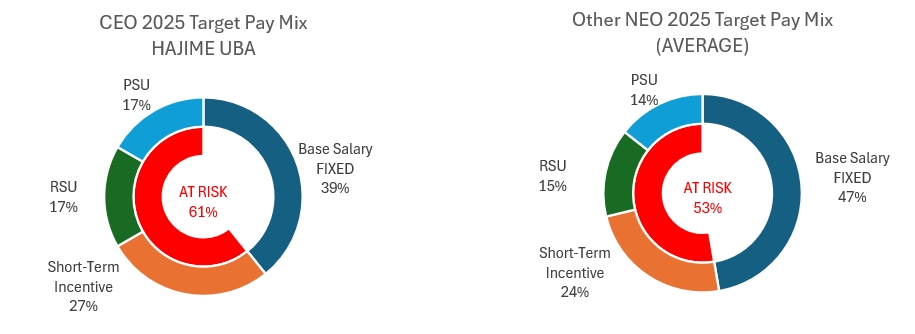
The executive compensation program uses a mix of fixed and variable pay, with an emphasis on variable pay. The program is structured to create a meaningful balance between achieving strong short-term annual results while ensuring long-term viability and success. Therefore, the mix of incentives is reviewed and determined regularly by the Compensation Committee based on the short- and long-term objectives of the business. The charts below show the target annual total direct compensation of our CEO and our other NEOs for fiscal 2025. These charts illustrate that a majority of executive compensation is variable (61% for our CEO and an average of 53% for our other NEOs).
The Decision-Making Process
Role of the Compensation Committee. The Compensation Committee of the Board (“Compensation Committee”) has the responsibility for establishing, implementing, and continually monitoring adherence to our compensation philosophy. The goal of the Compensation Committee is to ensure that the total compensation paid to our executive officers is fair, competitive, and properly structured to attract and retain talent and align management’s interests with those of our stockholders. The Compensation Committee reviews the performance of our NEOs and other key employees and reports to the Board of Directors. In such capacity, the Compensation Committee administers our executive compensation program, reviews our policies and monitors the performance and compensation of the NEOs and other key employees. Details of the Compensation Committee’s authority and responsibilities are specified in its charter, which may be accessed at our website at https://ir.kurausa.com/governance/overview. The Compensation Committee review and determine, or recommend to the Board for determination of, the compensation of the CEO and other NEOs.
The Role of Management. Only the Compensation Committee members can vote on decisions regarding NEO compensation. The CEO reviews his recommendations pertaining to the compensation of the other NEOs with the Compensation Committee— providing management input, transparency, and oversight. The CEO does not participate in the deliberations of the Compensation Committee regarding his own compensation. Independent members of the Board make all final determinations regarding the CEO and other NEOs’ compensation.
Role of the Independent Compensation Consultant. The Compensation Committee has engaged Pearl Meyer & Partners, LLC as its independent executive compensation consultant. Pearl Meyer provides analysis and recommendations regarding market pay data and competitive-position benchmarking, peer group development, performance measures and goals program structure, incentive and equity plan design, and the regulatory environment and Company policies as they relate to executive compensation. Pearl Meyer also reviews compensation goals and priorities with our CEO as part of providing advice and recommendations for the Compensation Committee. Pearl Meyer reports directly to the Compensation Committee and does not provide any additional services to management. The Compensation Committee has conducted an independence assessment of Pearl Meyer in accordance with SEC rules.
Competitive Pay Positioning and the Peer Group. The Compensation Committee, in collaboration with our management, reviews market data related to pay practices among comparable companies but does not target specific market positioning when determining compensation for the NEOs. Rather, the Compensation Committee uses comparative market data as one of several factors when making individual compensation decisions. Actual pay levels can be above or below the targeted levels depending on factors such as experience, individual or company performance, tenure, employee potential, unique skills, criticality of the position to the Company and other
factors. In general, the Compensation Committee desires to balance general internal and external equity and reserve the right to use discretion to deviate when necessary to recruit employees and/or retain the right talent.
As part of its compensation review process for fiscal 2025, the Compensation Committee reviewed an analysis prepared by its independent compensation consultant of market pay practices for positions similar to our NEOs, adjusted to take into account differences if any, between the scope of our NEOs’ responsibilities compared to their counterparts in positions with similar titles in comparable companies. This analysis used pay comparisons from comparable companies in the restaurant and hospitality industry as compiled from proxy disclosures and other SEC filings as well as proprietary survey data.
The Compensation Committee strives to set a competitive level of total compensation for each NEO as compared with executive officers in similar positions at peer companies. For purposes of setting 2025 compensation levels, in conjunction with the recommendation of Pearl Meyer, the Compensation Committee took into account publicly-available data for a group of peer companies (the “2025 Compensation Peer Group”) listed below along with industry specific survey data, where appropriate. Selection criteria for determining/reviewing the 2025 Compensation Peer Group, used to establish the competitive market for the NEOs, generally include companies that are in the same or similar lines of business, compete for the same customers with similar products and services, and have comparable financial characteristics (i.e., revenues ranging between $50 million and $1.3 billion and market capitalization between $150 million and $4.0 billion).
•El Pollo Loco Holdings, Inc.
•Good Times Restaurants Inc.
•The ONE Group Hospitality, Inc.
2025 Executive Compensation Program in Detail
Base Salary
Base salaries provide our NEOs with a degree of financial certainty and stability. They are determined by the Compensation Committee and administered to reflect the individual named executive officer’s career experience, individual performance, overall Company performance, as well as the market data as compared to the peer group. The Committee reviews base salaries each year, and may make periodic adjustments in response to changes in job scope, prevailing market levels or other factors. During its annual review of base salaries, the Compensation Committee also considers the recommendations of our CEO, except with respect to his own compensation. For 2025 and 2024, annual base salary rates were as follows:
|
|
|
|
|
|
|
|
|
|
|
|
Name |
|
2024 |
|
|
2025 |
|
|
% Adjustment |
Hajime Uba |
|
$ |
500,000 |
|
|
$ |
535,000 |
|
|
7% |
Jeffrey Uttz |
|
$ |
375,000 |
|
|
$ |
400,000 |
|
|
7% |
Shahin Allameh |
|
$ |
305,000 |
|
|
$ |
327,000 |
|
|
7% |
Robert Kluger |
|
$ |
285,000 |
|
|
$ |
297,000 |
|
|
4% |
Arlene Petokas |
|
$ |
275,000 |
|
|
$ |
287,000 |
|
|
4% |
Annual Cash Incentives
The NEOs were provided annual cash performance incentive awards, which are payable based on our performance against specific financial and strategic objectives. At the beginning of each fiscal year, the Compensation Committee establishes both the performance objectives and the formula for determining potential annual incentive award payments. Actual awards are payable, if at all, in the first quarter of the fiscal year following the year in which such awards were earned, after the Compensation Committee certifies performance relative to the pre-established objectives.
2025 Target Award Opportunities. Annual incentive targets are expressed as a percentage of base salary and based on market data, internal equity, and size and scope of job responsibilities. Actual awards may range from zero to 150% of target. The Compensation Committee also considers market data in setting target award amounts. Target annual incentive award opportunities for 2025 were as follows:
|
|
|
|
|
|
|
|
|
|
|
|
Name |
|
2025 Base Salary ($) |
|
|
2025 Target Annual Incentive Opportunity (%) |
|
2025 Target Annual Incentive Opportunity ($) |
|
Hajime Uba |
|
$ |
535,000 |
|
|
70% |
|
$ |
374,500 |
|
Jeffrey Uttz |
|
$ |
400,000 |
|
|
55% |
|
$ |
220,000 |
|
Shahin Allameh |
|
$ |
327,000 |
|
|
50% |
|
$ |
163,500 |
|
Robert Kluger |
|
$ |
297,000 |
|
|
50% |
|
$ |
148,500 |
|
Arlene Petokas |
|
$ |
287,000 |
|
|
45% |
|
$ |
129,150 |
|
2025 Performance Objectives. An individual NEO’s annual incentive award is based on the following mix of performance metrics:
CEO, CFO, COO and CPO
|
|
|
|
|
|
Performance Metrics |
|
Weightings |
|
Rationale |
Adjusted EBITDA(1) |
|
75% |
|
Focuses on profitable growth, while continuing to provide strong accountability for returns. Adjusted EBITDA provides a more useful illustration of our financial performance and the ongoing operations of our business, since the adjustments exclude certain expenses that are not indicative of our recurring core operating results. This facilitates better comparisons to our historical performance and our competitors’ operating results. |
Revenue |
|
25% |
|
Ensures we are delivering an appropriate level of topline growth. |
CDO
|
|
|
|
|
|
Performance Metrics |
|
Weightings |
|
Rationale |
Adjusted EBITDA(1) |
|
60% |
|
Same as above |
Revenue |
|
20% |
|
Same as above |
Signed Lease |
|
20% |
|
Focuses on new restaurant openings for business growth |
(1) Adjusted EBITDA is defined as net income (loss) before interest, income taxes and depreciation and amortization, and excluding stock-based compensation expense, non-cash lease expense and asset disposals, closure costs and restaurant impairments, as well as certain items, such as litigation, that we believe are not indicative of our core operating results. For the purpose of Annual Cash Incentives, Adjusted EBITDA performance (both budget and actual performance) excludes bonus expense.
2025 Performance Levels & Results. The table below shows the performance necessary to achieve threshold (50% payout), target (100% payout), and maximum (150% payout) award amounts, along with actual results for 2025. Any performance falling below the designated threshold results in no payout to participants. If performance is achieved at a level between threshold and target or between target and maximum, the payout level is determined through straight-line interpolation.
|
|
|
|
|
|
|
|
|
|
Performance Metrics |
|
Performance Goals |
|
Actual Results |
|
|
Threshold (50% payout) |
|
Target (100% payout) |
|
Maximum (150% payout) |
|
|
Adjusted EBITDA(1) |
|
$24.1 million |
|
$26.7 million |
|
$29.4 million |
|
$22.2 million |
Revenue |
|
$263.1 million |
|
$277.0 million |
|
$290.8 million |
|
$282.8 million |
Signed Lease |
|
On or above 12 |
|
On or above 16 |
|
On or above 20 |
|
16 |
(1) Adjusted EBITDA is defined as net income (loss) before interest, income taxes and depreciation and amortization, and excluding stock-based compensation expense, non-cash lease expense and asset disposals, closure costs and restaurant impairments, as well as certain items, such as litigation, that we believe are not indicative of our core operating results. For the purpose of Annual Cash Incentives, Adjusted EBITDA performance (both budget and actual performance) excludes bonus expense.
2025 Annual Incentive Award Payouts. Following a review of annual performance and achievement against the goals set for 2025, the Compensation Committee exercised its discretion to provide an additional cash award acknowledging the Company’s successful follow-on offering in November 2024, which raised additional capital to fund future expansion and strategic investments. The discretionary incentive amount provided was equal to funding the Adjusted EBITDA component at 25% of target. Based on the results above, the actual annual incentive awards paid to the NEOs for 2025 were as follows:
|
|
|
|
|
|
|
|
|
|
|
|
|
|
|
|
|
|
|
|
Name |
|
2025 Target Annual Incentive Opportunity (%) |
|
2025 Target Annual Incentive Opportunity ($) |
|
|
Adjusted EBITDA Results (Payout as a % of Target)(1) |
|
Revenue Results (Payout as a % of Target) |
|
Signed Lease (Payout as a % of Target) |
|
Actual Award ($) |
|
|
Actual Award (% of Target) |
Hajime Uba |
|
70% |
|
$ |
374,500 |
|
|
25% |
|
121% |
|
N/A |
|
$ |
183,412 |
|
|
49% |
Jeffrey Uttz |
|
55% |
|
$ |
220,000 |
|
|
25% |
|
121% |
|
N/A |
|
$ |
107,745 |
|
|
49% |
Shahin Allameh |
|
50% |
|
$ |
163,500 |
|
|
25% |
|
121% |
|
N/A |
|
$ |
80,074 |
|
|
49% |
Robert Kluger |
|
50% |
|
$ |
148,500 |
|
|
25% |
|
121% |
|
100% |
|
$ |
87,882 |
|
|
59% |
Arlene Petokas |
|
45% |
|
$ |
129,150 |
|
|
25% |
|
121% |
|
N/A |
|
$ |
63,252 |
|
|
49% |
(1) The Adjusted EBITDA payout results as a percentage of target were 0%. However, the Compensation Committee provided our Named Executive Officers with a discretionary annual cash award payout that was equal to funding the Adjusted EBITDA component at 25% of target for their role in the completion of the Company’s follow-on offering in November 2024.
Long-Term Equity Incentives
Equity-based compensation comprises the most significant component of total executive compensation to align executive compensation with our long-term performance and to encourage executives to make decisions for the benefit of our stockholders. Each of our NEOs is eligible to receive equity compensation, which may consist of a mix of stock options, restricted stock, and restricted stock units, to encourage a focus on long-term stockholder value and to foster long-term retention. Equity awards are granted pursuant to our 2018 Incentive Compensation Plan.
For fiscal year 2025, the Compensation Committee determined that our NEOs would receive the following type of equity awards:
•Time-Based RSU Awards (50% of grant value): RSUs are an effective retention tool that provide value and predictable long-term compensation and aligns the interests of our executives with stockholders through direct stock ownership. The RSUs we grant vest in equal annual increments over four years, subject to the recipient’s continued employment or service with us on each vesting date.
•PSUs (50% of grant value): PSUs are an effective tool to link compensation with long-term performance and align the interests of our executives with those of our stockholders. The PSUs we grant have a three-year performance period. Awards will vest based on the achievement of certain performance metrics as determined at the end of the period and are subject to the recipient’s continued employment or service with us through the vesting date. For 2025, PSUs are based on the following equally weighted performance metrics: General and administrative expenses as a percentage of sales, average annual restaurant-level operating profit margin, and average annual same store sales growth. Payouts are not guaranteed, and awards may be earned at 50% of target for threshold performance and up to 150% of target for maximum performance. Any performance falling below the designated threshold results in no payout to participants. If performance is achieved between threshold and target or between target and maximum, the payout level is determined through straight-line interpolation. Performance goals for each metric for 2025 awards will be disclosed at the end of the performance period in order to avoid providing forward-looking strategic or financial targets that could create competitive harm.
We approach equity compensation grants by considering the overall value of the grant (as opposed to the number of shares granted). Equity grants to all staff members, including NEOs and other executives require approval from the Compensation Committee and, in considering whether to approve such equity grants, the Compensation Committee considers past grants, corporate and individual performance, the valuation of grants, and recommendations of our CEO and the Compensation Committee’s compensation consultant. The Compensation Committee has not established formal guidelines for the size of individual equity grants for our NEOs, but considers the factors listed above as well as market data in making such decisions. The total target award values for 2025 as approved by the Compensation Committee are shown in the table below:
|
|
|
|
|
|
|
|
|
|
|
|
|
|
Name |
|
RSU Value(1) |
|
|
PSU Value(1) |
|
|
Total Target Award Value |
|
Hajime Uba |
|
$ |
227,375 |
|
|
$ |
227,375 |
|
|
$ |
454,750 |
|
Jeffrey Uttz |
|
$ |
140,000 |
|
|
$ |
140,000 |
|
|
$ |
280,000 |
|
Shahin Allameh |
|
$ |
98,100 |
|
|
$ |
98,100 |
|
|
$ |
196,200 |
|
Robert Kluger |
|
$ |
81,675 |
|
|
$ |
81,675 |
|
|
$ |
163,350 |
|
Arlene Petokas |
|
$ |
78,925 |
|
|
$ |
78,925 |
|
|
$ |
157,850 |
|
(1) The number of RSUs and PSUs granted was determined by dividing the target award values by the closing price of our common stock on the business day prior to the grant date.
Other Practices, Policies and Guidelines
Stock Ownership Guidelines
The Board believes that our most senior executives (including our NEOs) should hold meaningful equity ownership positions in the Company, in part to align our executives’ interests with those of our stockholders. Effective September 1, 2024, the Board adopted guidelines requiring each executive to hold shares equal to the following multiples of base salary.
|
|
|
|
Position |
|
Multiple of Base Salary |
CEO |
|
3 times base salary |
CFO |
|
1 times base salary |
COO |
|
1 times base salary |
CDO |
|
1 times base salary |
CPO |
|
1 times base salary |
Executives will have five (5) years from the date of implementation of the stock ownership guidelines to attain the ownership threshold. Executives are required to hold 100% of their net shares from exercised options or vested stock units until they meet their stock ownership requirement. Once the requirement is met, they must continue to hold enough shares to maintain that level. Holdings that satisfy this stock ownership requirement include: (1) shares owned directly or through family members in the same household; (2) shares deliverable from unrestricted stock units; (3) shares underlying stock options that are exercisable and trading above their strike price; (4) shares held in trust for their or their family's benefit; and (5) unexercised stock options generally do not count, except to the extent expressly provided.
Compliance with stock ownership guidelines will be evaluated annually. All of our NEOs are on track to be in compliance with the stock ownership guidelines.
Compensation Recoupment (Clawback) Policy
The Board has adopted the Company’s Policy for Recoupment of Incentive Compensation (“Clawback Policy”), which is designed to comply with Section 10D-1 of the Exchange Act and the applicable listing standards of Nasdaq. The Clawback Policy requires the Company to recoup erroneously awarded incentive-based compensation received by each current or former officer of the Company subject to Section 16 of the Securities Exchange Act of 1934, as amended, including each named executive officer, in the event the Company is required to prepare an accounting restatement due to its material noncompliance with any financial reporting requirement under the securities laws. The Clawback Policy generally applies to all cash-based or equity-based incentive compensation, bonus and/or awards received by a covered officer that is or was based, wholly or in part, upon the attainment of any financial reporting measure during the three completed fiscal years immediately preceding the date that the Company is required to prepare a restatement; provided that such compensation, bonus and/or award was received on or after October 2, 2023. The Clawback Policy was filed as an exhibit to the Company’s Form 10-K.
Insider Trading Policy
The Board has adopted a Policy Regarding Insider Trading, Tipping and Other Wrongful Disclosures and Guidelines With Respect To Certain Transactions in Securities of Kura Sushi USA, Inc. (“Insider Trading Policy”) to assist the Company’s employees and directors in complying with certain securities laws and avoiding even the appearance of improper conduct. A copy of the policy is filed as Exhibit 19.1 to the Company’s Annual Report on Form 10-K for the fiscal year ended August 31, 2025.
The Insider Trading Policy prohibits our employees, directors, officers, consultants and contractors from engaging in the following transactions involving the Company’s securities: short sales, hedging transactions, short-term trading, transactions in publicly traded options and standing and limit orders.
Policies and Practices Related to the Grant of Certain Equity Awards Close in Time to the Release of Material Nonpublic Information
Our equity awards are generally granted on fixed dates determined in advance. The Compensation Committee’s general practice is to complete its annual executive compensation review and determine target compensation for our executives, which coincides with the Company’s regularly scheduled Board meetings, then such equity awards are granted. Annual equity awards are typically granted to our executives in February of each fiscal year. On limited occasions, the Compensation Committee may grant equity awards outside of our annual grant cycle for new hires, promotions, recognition, retention, or other purposes. Our Compensation Committee approves all equity award grants on or before the grant date and does not grant equity awards in anticipation of the release of material nonpublic information. Similarly, the Compensation Committee does not time the release of material nonpublic information based on equity award grant dates.
Payments Upon Termination or Change in Control
Our NEOs are entitled to receive certain payments and/or other benefits upon certain terminations of employment or a change in control as described under “Potential Payments Upon Termination or Change in Control” below.
Retirement Plans
We do not offer or maintain any deferred compensation, retirement, pension or profit-sharing plans to our NEOs other than the plans and arrangements that are available to all employees. We have adopted an equity incentive plan, the material terms of which are described below.
Employee Benefits
All of our full-time employees, including our NEOs, are eligible to participate in health and welfare plans maintained by the Company, including:
•medical, dental and vision benefits; and
•basic life and accidental death & dismemberment insurance.
Our NEOs participate in these plans on the same basis as other eligible employees. We do not maintain any supplemental health and welfare plans for our NEOs
Nonqualified Deferred Compensation
Our NEOs did not earn any nonqualified deferred compensation benefits from us during fiscal year 2025.
Impact of Tax and Accounting
We regularly consider the various tax and accounting implications of our compensation plans. When determining the amount of long-term incentives and equity grants to executives and employees, the compensation costs associated with the grants are reviewed, as required by FASB ASC Topic 718.
While considering tax deductibility as only one of several considerations in determining compensation, the Committee believes that the tax deduction limitation should not compromise its ability to structure compensation programs that provide benefits to the Company that outweigh the potential benefit of a tax deduction and, therefore, may approve compensation that is not deductible for tax purposes.
Risk and Compensation Policies
We have analyzed our compensation programs and policies and have determined those programs and policies are not reasonably likely to have a material adverse effect on us. The Company’s compensation programs and policies mitigate risk by combining performance-based, long-term compensation elements with payouts that are highly correlated to the value delivered to stockholders. The combination of performance measures for annual bonuses and the equity compensation programs for executive officers, as well as the multi-year vesting schedules for equity awards encourage employees to maintain both a short-term and a long-term view with respect to Company performance.
Report of the Compensation Committee of the Board of Directors
The Compensation Committee has reviewed and discussed with management the Compensation Discussion and Analysis (“CD&A”) contained in this Proxy Statement. Based on this review and discussion, the Compensation Committee has recommended to the Board that the CD&A be included in this proxy statement and incorporated into the Company’s Annual Report on Form 10-K for the fiscal year ended August 31, 2025.
Members of the Compensation Committee
Treasa Bowers, Chair
Shintaro Asako
Kim Ellis
The Compensation Committee Report does not constitute soliciting material and shall not be deemed to be filed or incorporated by reference into any Company filing under the Securities Act of 1933, as amended, or the Securities Exchange Act of 1934, as amended, except to the extent that the Company specifically incorporates the Compensation Committee Report by reference therein.
EXECUTIVE COMPENSATION
The following sets forth all compensation awarded to our named executive officers for the 2023, 2024 and 2025 fiscal years (the “NEOs”).
Summary Compensation Table
The following table sets forth the total compensation that was paid or accrued for the NEOs for the 2023, 2024 and 2025 fiscal years.
|
|
|
|
|
|
|
|
|
|
|
|
|
|
|
|
|
|
|
|
|
|
|
|
|
|
|
|
|
Name and Principal Position |
|
Year |
|
Salary |
|
Bonus |
|
|
Option Awards (1) |
|
|
Stock Awards (2) |
|
|
Non-Equity Incentive Plan Compensation (3) |
Total |
Hajime Uba |
|
2025 |
|
$ |
517,500 |
|
|
|
|
|
|
— |
|
|
$ |
454,750 |
|
|
$ |
183,412 |
|
|
$ |
1,155,662 |
|
|
President, Chief Executive Officer, Director and Chairman of the Board |
|
2024 |
|
$ |
487,500 |
|
|
|
|
|
$ |
262,478 |
|
|
$ |
112,457 |
|
|
$ |
69,063 |
|
|
$ |
931,498 |
|
|
|
|
2023 |
|
$ |
431,379 |
|
|
|
|
|
$ |
193,375 |
|
|
$ |
252,875 |
|
|
$ |
196,988 |
|
|
$ |
1,074,617 |
|
|
Jeffrey Uttz |
|
2025 |
|
$ |
387,500 |
|
|
|
|
|
|
— |
|
|
$ |
280,000 |
|
|
$ |
107,745 |
|
|
$ |
775,245 |
|
|
Chief Financial Officer (4) |
|
2024 |
|
$ |
370,833 |
|
|
|
|
|
$ |
170,587 |
|
|
$ |
73,107 |
|
|
$ |
39,844 |
|
|
$ |
654,371 |
|
|
|
|
2023 |
|
$ |
325,329 |
|
|
$ |
75,000 |
|
(5) |
$ |
1,147,000 |
|
|
$ |
322,856 |
|
(6) |
$ |
121,669 |
|
|
$ |
1,991,854 |
|
|
Shahin Allameh |
|
2025 |
|
$ |
316,000 |
|
|
|
|
|
|
— |
|
|
$ |
196,200 |
|
|
$ |
80,074 |
|
|
$ |
592,274 |
|
|
Chief Operating Officer |
|
2024 |
|
$ |
302,500 |
|
|
|
|
|
$ |
117,393 |
|
|
$ |
50,243 |
|
|
$ |
29,166 |
|
|
$ |
499,302 |
|
|
|
|
2023 |
|
$ |
302,865 |
|
|
|
|
|
$ |
101,500 |
|
|
$ |
43,500 |
|
|
$ |
89,610 |
|
|
$ |
537,475 |
|
|
Robert Kluger |
|
2025 |
|
$ |
291,000 |
|
|
|
|
|
|
— |
|
|
$ |
163,350 |
|
|
$ |
87,882 |
|
|
$ |
542,232 |
|
|
Chief Development Officer(7) |
|
2024 |
|
$ |
283,333 |
|
|
|
|
|
$ |
99,701 |
|
|
$ |
42,687 |
|
|
$ |
47,453 |
|
|
$ |
473,174 |
|
|
Arlene Petokas |
|
2025 |
|
$ |
281,000 |
|
|
|
|
|
|
— |
|
|
$ |
157,850 |
|
|
$ |
63,252 |
|
|
$ |
502,102 |
|
|
Chief People Officer(8) |
|
2024 |
|
$ |
273,333 |
|
|
|
|
|
$ |
96,210 |
|
|
$ |
41,215 |
|
|
$ |
23,233 |
|
|
$ |
433,991 |
|
|
(1) The amounts reported represent the aggregate grant date fair value of the stock options awarded to the NEOs during the 2023 and 2024 fiscal years, calculated in accordance with FASB ASC Topic 718. Such grant date fair values do not take into account any estimated forfeitures. The amounts reported in this column reflect the accounting cost for these stock options and do not correspond to the actual economic value that may be received by the NEOs upon the exercise of the stock options or any sale of the underlying shares of common stock.
(2) The amounts reported represent the aggregate grant date fair value of the RSUs granted to the NEOs during the 2023 and 2024 fiscal years and the RSUs and PSUs granted to the NEOs during the 2025 fiscal year. The amounts reported in this column reflect the accounting cost for these RSUs and PSUs and do not correspond to the actual economic value that may be received by the NEOs upon any sale of the underlying shares of common stock. With respect to PSUs, amounts reported for fiscal year 2025 are based on the aggregate grant date fair value based on the target level outcome of the performance conditions. With respect to the PSUs, the value of the award at the grant date assuming that the highest level of performance conditions achieved would be $341,063 with respect to Mr. Uba, $210,000 with respect to Mr. Uttz, $147,000 with respect to Mr. Allameh, $122,513 with respect to Mr. Kluger and $118,388 with respect to Ms. Petokas.
(3) The amounts reported in this column consist of amounts to be paid under annual cash incentive award for services rendered in fiscal years 2023, 2024 and 2025, as discussed above under “2025 Executive Compensation Program in Detail — Annual Cash Incentives.”
(4) Mr. Uttz has served as the Company’s Chief Financial Officer since October 3, 2022.
(5) The amount reported represents a one-time signing bonus pursuant to Mr. Uttz’s employment agreement.
(6) The amount reported includes a one-time grant of RSUs with an aggregate grant date fair value of $99,995 in connection with Mr. Uttz’s hire on October 3, 2022.
(7) Mr. Kluger has served as the Company’s Chief Development Officer since May 1, 2020. Mr. Kluger’s 2023 compensation is not included because he was not a named executive officer in 2023.
(8) Ms. Petokas has served as the Company’s Chief People Officer since October 18, 2021. Ms. Petokas’ 2023 compensation is not included because she was not a named executive officer in 2023.
Narrative Disclosure to Summary Compensation Table
Employment Agreements
Hajime “Jimmy” Uba. On August 5, 2019, in connection with the closing of the Company’s IPO, we entered into an employment agreement with Mr. Uba.
Employment Term and Position. The term of employment of Mr. Uba is three years from the closing of our IPO on August 5, 2019, subject to automatic one-year extensions provided that neither party provides written notice of non-extension at least one hundred twenty (120) days prior to the expiration of the then-current term. During the term of employment, Mr. Uba will serve as Chairman of the Board, President and Chief Executive Officer of the Company.
Base Salary, Annual Bonus and Equity Compensation. Pursuant to his employment agreement, Mr. Uba was entitled to initial base salary of $340,000. In addition, Mr. Uba is eligible to receive annual performance-based cash bonuses, the amount and terms of which shall be in the discretion of the Compensation Committee. Mr. Uba will also be eligible to receive equity awards, the form and terms of which will be determined by our Board of Directors or the Compensation Committee in their discretion.
Jeffrey Uttz. On September 29, 2022, the Board appointed Jeffrey J. Uttz as Chief Financial Officer, effective as of October 3, 2022. On September 30, 2022, Mr. Uttz entered into an employment agreement with the Company, effective October 3, 2022.
Employment Term and Position. The term of employment of Mr. Uttz is three years from October 3, 2022, subject to automatic one-year extensions provided that neither party provides written notice of non-extension at least one hundred twenty (120) days prior to the expiration of the then-current term. During his term of employment, Mr. Uttz will serve as Chief Financial Officer of the Company.
Base Salary, Annual Bonus, Equity Compensation and Other Benefits. Pursuant to his employment agreement, Mr. Uttz was entitled to an initial base salary of $350,000. In addition, Mr. Uttz was eligible to receive a one-time signing bonus in the amount of $75,000, and is eligible to receive annual performance-based cash bonuses, the amount and terms of which shall be in the discretion of the Compensation Committee of the Board, and equity awards, the form and terms of which was set forth pursuant to the applicable equity incentive plan and applicable award agreements. Mr. Uttz is entitled to other employee benefits including paid vacation in accordance with the Company’s policies and reimbursement of reasonable business expenses.
Shahin Allameh. On July 9, 2021, the Board appointed Shahin Allameh as Chief Operating Officer of the Company, effective as of July 26, 2021. On July 9, 2021, Mr. Allameh entered into an employment agreement with the Company, effective July 26, 2021.
Employment Term and Position. The term of employment of Mr. Allameh is until July 31, 2024, subject to automatic one-year extensions provided that neither party provides written notice of non-extension at least one hundred twenty (120) days prior to the expiration of the then-current term. During his term of employment, Mr. Allameh will serve as Chief Operating Officer of the Company.
Base Salary, Annual Bonus, Equity Compensation and Other Benefits. Pursuant to his employment agreement, Mr. Allameh was entitled to an initial base salary of $270,000. In addition, Mr. Allameh is eligible to receive (i) annual performance-based cash bonuses, the amount and terms of which shall be in the discretion of the Compensation Committee of the Board, and (ii) equity awards, the form and terms of which will be as set forth pursuant to the applicable equity incentive plan and applicable award agreements. Mr. Allameh is also entitled to other employee benefits including paid vacation in accordance with the Company’s policies and reimbursement of reasonable business expenses.
Robert Kluger. On March 16, 2020, Mr. Kluger entered into an employment agreement as Chief Development Officer with the Company, effective May 1, 2020. On August 23, 2024, the Board appointed Robert Kluger as an Executive Officer of the Company.
Employment Term and Position. The term of employment of Mr. Kluger is until May 1, 2023, subject to automatic one-year extensions provided that neither party provides written notice of non-extension at least one hundred twenty (120) days prior to the expiration of the then-current term. During his term of employment, Mr. Kluger will serve as Chief Development Officer of the Company.
Base Salary, Annual Bonus, Equity Compensation and Other Benefits. Pursuant to his employment agreement, Mr. Kluger was entitled to an initial base salary of $260,000. In addition, Mr. Kluger is eligible to receive (i) annual performance-based cash bonuses, the amount and terms of which shall be in the discretion of the Compensation Committee of the Board, and (ii) equity awards, the form and terms of which will be as set forth pursuant to the applicable equity incentive plan and applicable award agreements. Mr. Kluger will also be entitled to other employee benefits including paid vacation in accordance with the Company’s policies and reimbursement of reasonable business expenses.
Arlene Petokas. On September 30, 2021, Ms. Petokas entered into an employment agreement as Chief People Officer with the Company, effective October 18, 2021. On August 23, 2024, the Board appointed Arlene Petokas as an Executive Officer of the Company.
Employment Term and Position. The term of employment of Ms. Petokas is until October 18, 2024, subject to automatic one-year extensions provided that neither party provides written notice of non-extension at least one hundred twenty (120) days prior to the expiration of the then-current term. During her term of employment, Ms. Petokas will serve as Chief People Officer of the Company.
Base Salary, Annual Bonus, Equity Compensation and Other Benefits. Pursuant to her employment agreement, Ms. Petokas was entitled to an initial base salary of $260,000. In addition, Ms. Petokas is eligible to receive (i) annual performance-based cash bonuses, the amount and terms of which shall be in the discretion of the Compensation Committee of the Board, and (ii) equity awards, the form and terms of which will be as set forth pursuant to the applicable equity incentive plan and applicable award agreements. Ms. Petokas will also be entitled to other employee benefits including paid vacation in accordance with the Company’s policies and reimbursement of reasonable business expenses.
Grants of Plan-Based Awards Table
The following table sets forth information concerning awards granted to the NEOs during the 2025 fiscal year under our 2018 Incentive Compensation Plan:
|
|
|
|
|
|
|
|
|
|
|
|
|
|
|
|
|
|
|
|
|
|
|
|
|
|
|
|
|
|
|
|
|
|
|
|
Estimated Possible Payouts Under |
|
|
Estimated Possible Payouts Under |
|
|
|
|
|
|
|
Non-Equity Incentive Plan Awards(1) |
|
|
Equity Incentive Plan Awards(2) |
|
|
|
Name |
|
Grant Date |
|
Threshold
($) |
|
|
Target
($) |
|
|
Maximum
($) |
|
|
Threshold
(#) |
|
|
Target
(#) |
|
|
Maximum
(#) |
|
|
Grant Date Fair Value of Stock
and Option Awards
($)(3) |
|
Hajime Uba |
|
|
|
|
|
|
|
|
|
|
|
|
|
|
|
|
|
|
|
|
|
|
|
RSUs |
|
2/3/2025 |
|
|
— |
|
|
|
— |
|
|
|
— |
|
|
|
— |
|
|
|
— |
|
|
|
— |
|
|
$ |
227,375 |
|
PSUs |
|
2/3/2025 |
|
|
— |
|
|
|
— |
|
|
|
— |
|
|
|
1,421 |
|
|
|
2,842 |
|
|
|
4,263 |
|
|
$ |
227,375 |
|
Cash Incentive Awards |
|
N/A |
|
$ |
187,250 |
|
|
$ |
374,500 |
|
|
$ |
561,750 |
|
|
|
— |
|
|
|
— |
|
|
|
— |
|
|
— |
|
Jeffrey Uttz |
|
|
|
|
|
|
|
|
|
|
|
|
|
|
|
|
|
|
|
|
|
|
|
RSUs |
|
2/3/2025 |
|
|
— |
|
|
|
— |
|
|
|
— |
|
|
|
— |
|
|
|
— |
|
|
|
— |
|
|
$ |
140,000 |
|
PSUs |
|
2/3/2025 |
|
|
— |
|
|
|
— |
|
|
|
— |
|
|
|
875 |
|
|
|
1,750 |
|
|
|
2,625 |
|
|
$ |
140,000 |
|
Cash Incentive Awards |
|
N/A |
|
$ |
110,000 |
|
|
$ |
220,000 |
|
|
$ |
330,000 |
|
|
|
— |
|
|
|
— |
|
|
|
— |
|
|
|
— |
|
Shahin Allameh |
|
|
|
|
|
|
|
|
|
|
|
|
|
|
|
|
|
|
|
|
|
|
|
RSUs |
|
2/3/2025 |
|
|
— |
|
|
|
— |
|
|
|
— |
|
|
|
— |
|
|
|
— |
|
|
|
— |
|
|
$ |
98,100 |
|
PSUs |
|
2/3/2025 |
|
|
— |
|
|
|
— |
|
|
|
— |
|
|
|
613 |
|
|
|
1,226 |
|
|
|
1,839 |
|
|
$ |
98,100 |
|
Cash Incentive Awards |
|
N/A |
|
$ |
81,750 |
|
|
$ |
163,500 |
|
|
$ |
245,250 |
|
|
|
— |
|
|
|
— |
|
|
|
— |
|
|
|
— |
|
Robert Kluger |
|
|
|
|
|
|
|
|
|
|
|
|
|
|
|
|
|
|
|
|
|
|
|
RSUs |
|
2/3/2025 |
|
|
— |
|
|
|
— |
|
|
|
— |
|
|
|
— |
|
|
|
— |
|
|
|
— |
|
|
$ |
81,675 |
|
PSUs |
|
2/3/2025 |
|
|
— |
|
|
|
— |
|
|
|
— |
|
|
|
510 |
|
|
|
1,020 |
|
|
|
1,530 |
|
|
$ |
81,675 |
|
Cash Incentive Awards |
|
N/A |
|
$ |
74,250 |
|
|
$ |
148,500 |
|
|
$ |
222,750 |
|
|
|
— |
|
|
|
— |
|
|
|
— |
|
|
|
— |
|
Arlene Petokas |
|
|
|
|
|
|
|
|
|
|
|
|
|
|
|
|
|
|
|
|
|
|
|
RSUs |
|
2/3/2025 |
|
|
— |
|
|
|
— |
|
|
|
— |
|
|
|
— |
|
|
|
— |
|
|
|
— |
|
|
$ |
78,925 |
|
PSUs |
|
2/3/2025 |
|
|
— |
|
|
|
— |
|
|
|
— |
|
|
|
493 |
|
|
|
986 |
|
|
|
1,479 |
|
|
$ |
78,925 |
|
Cash Incentive Awards |
|
N/A |
|
$ |
64,575 |
|
|
$ |
129,150 |
|
|
$ |
193,725 |
|
|
|
— |
|
|
|
— |
|
|
|
— |
|
|
|
— |
|
(1) The amounts shown reflect the possible range of annual cash incentive awards that the respective NEO would be eligible for assuming no use of discretion by the Compensation Committee in authorizing such payments. Actual amounts awarded are reflected in the Non-Equity Incentive Plan Compensation column of the Summary Compensation Table above. For additional information, see discussion above under “2025 Executive Compensation Program in Detail — Annual Cash Incentives.”
(2) The amounts shown reflect the possible range (threshold to target to maximum) of PSU awards which will be settled in shares of Common Stock, that would be earned based on the achievement of pre-established goals for the September 1, 2024 to August 31, 2027 performance period. The number of PSUs earned could be zero if performance is below the threshold.
(3) The amounts shown are based on the aggregate grant date fair value of restricted stock, RSUs and PSUs awarded, computed in accordance with FASB ASC Topic 718.
Outstanding Equity Awards at 2025 Fiscal Year-End
The following table sets forth information regarding outstanding equity awards at the end of fiscal year 2025 for each of the NEOs:
|
|
|
|
|
|
|
|
|
|
|
|
|
|
|
|
|
|
|
|
|
|
|
|
|
|
|
|
|
|
|
|
|
|
|
|
|
|
|
|
|
|
|
Option Awards(1) |
|
|
Stock Awards(1) |
|
Name |
|
Number of Securities
Underlying
Unexercised
Options Exercisable |
|
Number of Securities
Underlying
Unexercised
Options Unexercisable |
|
Option
Exercise
Price |
|
Option
Expiration
Date |
|
|
Number of Shares
or Units of Stock
That Have Not Vested (2) |
|
|
Market Value of Shares or Units
of Stock
That Have Not Vested |
|
|
Equity Incentive Plan Awards; Number of Unearned Shares, Units or Other Rights
That Have Not Vested (5) |
|
|
Equity Incentive Plan Awards; Market or Payout Value of Unearned Shares, Units or Other Rights
That Have Not Vested (5) |
|
Hajime Uba |
|
|
|
77,571 |
|
|
|
|
|
— |
|
|
|
|
|
$ |
4.26 |
|
|
|
6/15/2028 |
|
|
|
— |
|
|
|
— |
|
|
|
— |
|
|
|
— |
|
|
|
|
|
4,629 |
|
|
|
|
|
— |
|
|
|
|
|
$ |
25.94 |
|
|
|
12/2/2029 |
|
|
|
— |
|
|
|
— |
|
|
|
— |
|
|
|
— |
|
|
|
|
|
10,720 |
|
|
|
|
|
— |
|
|
|
|
|
$ |
22.65 |
|
|
|
2/1/2031 |
|
|
|
— |
|
|
|
— |
|
|
|
— |
|
|
|
— |
|
|
|
|
|
7,148 |
|
|
|
|
|
|
|
|
|
|
$ |
46.15 |
|
|
|
2/1/2032 |
|
|
|
— |
|
|
|
— |
|
|
|
— |
|
|
|
— |
|
|
|
|
|
3,229 |
|
|
|
|
|
1,934 |
|
(3) |
|
|
|
$ |
62.14 |
|
|
|
2/1/2033 |
|
|
|
— |
|
|
|
— |
|
|
|
— |
|
|
|
— |
|
|
|
|
|
1,665 |
|
|
|
|
|
2,771 |
|
(3) |
|
|
|
$ |
98.13 |
|
|
|
2/1/2034 |
|
|
|
— |
|
|
|
— |
|
|
|
— |
|
|
|
— |
|
|
|
|
|
— |
|
|
|
|
|
— |
|
|
|
|
|
|
— |
|
|
|
|
— |
|
|
|
665 |
|
(4) |
$ |
56,399 |
|
|
|
— |
|
|
|
— |
|
|
|
|
|
— |
|
|
|
|
|
— |
|
|
|
|
|
|
— |
|
|
|
|
— |
|
|
|
859 |
|
(4) |
$ |
72,852 |
|
|
|
— |
|
|
|
— |
|
|
|
|
|
— |
|
|
|
|
|
— |
|
|
|
|
|
|
— |
|
|
|
|
— |
|
|
|
2,842 |
|
(4) |
$ |
241,030 |
|
|
|
— |
|
|
|
— |
|
|
|
|
|
— |
|
|
|
|
|
— |
|
|
|
|
|
|
— |
|
|
|
|
— |
|
|
|
— |
|
|
|
— |
|
|
|
2,842 |
|
(5) |
$ |
241,030 |
|
Jeffrey Uttz |
|
|
|
15,067 |
|
|
|
|
|
6,838 |
|
(3) |
|
|
|
$ |
73.58 |
|
|
|
10/3/2032 |
|
|
|
— |
|
|
|
— |
|
|
|
— |
|
|
|
— |
|
|
|
|
|
2,458 |
|
|
|
|
|
1,467 |
|
(3) |
|
|
|
$ |
62.14 |
|
|
|
2/1/2033 |
|
|
|
— |
|
|
|
— |
|
|
|
— |
|
|
|
— |
|
|
|
|
|
1,083 |
|
|
|
|
|
1,800 |
|
(3) |
|
|
|
$ |
98.13 |
|
|
|
2/1/2034 |
|
|
|
— |
|
|
|
— |
|
|
|
— |
|
|
|
— |
|
|
|
|
|
— |
|
|
|
|
|
— |
|
|
|
|
|
|
— |
|
|
|
|
— |
|
|
|
505 |
|
(4) |
$ |
42,829 |
|
|
|
— |
|
|
|
— |
|
|
|
|
|
— |
|
|
|
|
|
— |
|
|
|
|
|
|
— |
|
|
|
|
— |
|
|
|
558 |
|
(4) |
$ |
47,324 |
|
|
|
— |
|
|
|
— |
|
|
|
|
|
— |
|
|
|
|
|
— |
|
|
|
|
|
|
— |
|
|
|
|
— |
|
|
|
1,750 |
|
(4) |
$ |
148,418 |
|
|
|
— |
|
|
|
— |
|
|
|
|
|
— |
|
|
|
|
|
— |
|
|
|
|
|
|
— |
|
|
|
|
— |
|
|
|
— |
|
|
|
— |
|
|
|
1,750 |
|
(5) |
$ |
148,418 |
|
Shahin Allameh |
|
|
|
30,000 |
|
|
|
|
|
— |
|
|
|
|
|
$ |
52.07 |
|
|
|
7/26/2031 |
|
|
|
— |
|
|
|
— |
|
|
|
— |
|
|
|
— |
|
|
|
|
|
3,088 |
|
|
|
|
|
— |
|
|
|
|
|
$ |
46.15 |
|
|
|
2/1/2032 |
|
|
|
— |
|
|
|
— |
|
|
|
— |
|
|
|
— |
|
|
|
|
|
1,698 |
|
|
|
|
|
1,012 |
|
(3) |
|
|
|
$ |
62.14 |
|
|
|
2/1/2033 |
|
|
|
— |
|
|
|
— |
|
|
|
— |
|
|
|
— |
|
|
|
|
|
744 |
|
|
|
|
|
1,240 |
|
(3) |
|
|
|
$ |
98.13 |
|
|
|
2/1/2034 |
|
|
|
— |
|
|
|
— |
|
|
|
— |
|
|
|
— |
|
|
|
|
|
— |
|
|
|
|
|
— |
|
|
|
|
|
|
— |
|
|
|
|
— |
|
|
|
350 |
|
(4) |
|
29,684 |
|
|
|
— |
|
|
|
— |
|
|
|
|
|
— |
|
|
|
|
|
— |
|
|
|
|
|
|
— |
|
|
|
|
— |
|
|
|
384 |
|
(4) |
|
32,567 |
|
|
|
— |
|
|
|
— |
|
|
|
|
|
— |
|
|
|
|
|
— |
|
|
|
|
|
|
— |
|
|
|
|
— |
|
|
|
1,226 |
|
(4) |
|
103,977 |
|
|
|
— |
|
|
|
— |
|
|
|
|
|
— |
|
|
|
|
|
— |
|
|
|
|
|
|
— |
|
|
|
|
— |
|
|
|
— |
|
|
|
— |
|
|
|
1,226 |
|
(5) |
|
103,977 |
|
Robert Kluger |
|
|
|
30,000 |
|
|
|
|
|
— |
|
|
|
|
|
$ |
16.83 |
|
|
|
5/2/2030 |
|
|
|
— |
|
|
|
— |
|
|
|
— |
|
|
|
— |
|
|
|
|
|
5,235 |
|
|
|
|
|
— |
|
|
|
|
|
$ |
16.25 |
|
|
|
5/3/2030 |
|
|
|
— |
|
|
|
— |
|
|
|
— |
|
|
|
— |
|
|
|
|
|
5,130 |
|
|
|
|
|
— |
|
|
|
|
|
$ |
22.65 |
|
|
|
2/1/2031 |
|
|
|
— |
|
|
|
— |
|
|
|
— |
|
|
|
— |
|
|
|
|
|
3,602 |
|
|
|
|
|
— |
|
|
|
|
|
$ |
46.15 |
|
|
|
2/1/2032 |
|
|
|
— |
|
|
|
— |
|
|
|
— |
|
|
|
— |
|
|
|
|
|
1,449 |
|
|
|
|
|
864 |
|
(3) |
|
|
|
$ |
62.14 |
|
|
|
2/1/2033 |
|
|
|
— |
|
|
|
— |
|
|
|
— |
|
|
|
— |
|
|
|
|
|
634 |
|
|
|
|
|
1,051 |
|
(3) |
|
|
|
$ |
98.13 |
|
|
|
2/1/2034 |
|
|
|
— |
|
|
|
— |
|
|
|
— |
|
|
|
— |
|
|
|
|
|
— |
|
|
|
|
|
— |
|
|
|
|
|
|
— |
|
|
|
|
— |
|
|
|
297 |
|
(4) |
$ |
25,189 |
|
|
|
— |
|
|
|
— |
|
|
|
|
|
— |
|
|
|
|
|
— |
|
|
|
|
|
|
— |
|
|
|
|
— |
|
|
|
326 |
|
(4) |
$ |
27,648 |
|
|
|
— |
|
|
|
— |
|
|
|
|
|
— |
|
|
|
|
|
— |
|
|
|
|
|
|
— |
|
|
|
|
— |
|
|
|
1,020 |
|
(4) |
$ |
86,506 |
|
|
|
— |
|
|
|
— |
|
|
|
|
|
— |
|
|
|
|
|
— |
|
|
|
|
|
|
— |
|
|
|
|
— |
|
|
|
— |
|
|
|
— |
|
|
|
1,020 |
|
(5) |
$ |
86,506 |
|
Arlene Petokas |
|
|
|
18,750 |
|
|
|
|
|
1,250 |
|
(3) |
|
|
|
$ |
45.75 |
|
|
|
10/18/2031 |
|
|
|
— |
|
|
|
— |
|
|
|
— |
|
|
|
— |
|
|
|
|
|
2,973 |
|
|
|
|
|
— |
|
|
|
|
|
$ |
46.15 |
|
|
|
2/1/2032 |
|
|
|
— |
|
|
|
— |
|
|
|
— |
|
|
|
— |
|
|
|
|
|
1,397 |
|
|
|
|
|
831 |
|
(3) |
|
|
|
$ |
62.14 |
|
|
|
2/1/2033 |
|
|
|
— |
|
|
|
— |
|
|
|
— |
|
|
|
— |
|
|
|
|
|
611 |
|
|
|
|
|
1,015 |
|
(3) |
|
|
|
$ |
98.13 |
|
|
|
2/1/2034 |
|
|
|
— |
|
|
|
— |
|
|
|
— |
|
|
|
— |
|
|
|
|
|
— |
|
|
|
|
|
— |
|
|
|
|
|
|
— |
|
|
|
|
— |
|
|
|
287 |
|
(4) |
$ |
24,340 |
|
|
|
— |
|
|
|
— |
|
|
|
|
|
— |
|
|
|
|
|
— |
|
|
|
|
|
|
— |
|
|
|
|
— |
|
|
|
315 |
|
(4) |
$ |
26,715 |
|
|
|
— |
|
|
|
— |
|
|
|
|
|
— |
|
|
|
|
|
— |
|
|
|
|
|
|
— |
|
|
|
|
— |
|
|
|
986 |
|
(4) |
$ |
83,623 |
|
|
|
— |
|
|
|
— |
|
|
|
|
|
— |
|
|
|
|
|
— |
|
|
|
|
|
|
— |
|
|
|
|
— |
|
|
|
— |
|
|
|
— |
|
|
|
986 |
|
(5) |
$ |
83,623 |
|
(1) Each equity award is subject to the terms of our 2018 Incentive Compensation Plan.
(2) Represents restricted stock units granted under our 2018 Incentive Compensation Plan that are subject to the NEO’s continuous service relationship with the Company through each applicable vesting date.
(3) The shares vest over forty-eight (48) months with one-quarter of the shares subject to the equity award vesting twelve (12) months after the grant date, and the remaining shares vest in equal quarterly installments over the remaining thirty-six (36) months, generally subject to the NEO’s continuous service relationship with the Company through each applicable vesting date
(4) The RSUs vest over forty-eight (48) months in equal annual installments, generally subject to the NEO’s continuous service relationship with the Company through each applicable vesting date.
(5) This column includes the PSUs as if they were earned at the target level for the September 1, 2024 to August 31, 2027 performance period. The number of PSUs earned for a performance period will be determined at the end of such performance period.
Option Exercises and Stock Awards Vested During Fiscal Year 2025
The following table sets forth for each NEO the exercises of stock options and the vesting of stock awards during fiscal year 2025:
|
|
|
|
|
|
|
|
|
|
|
|
|
|
|
|
|
|
Option Awards |
|
|
Stock Awards |
|
|
|
Number of Shares Acquired on Exercise |
|
Value Realized on Exercise |
|
|
Number of Shares Acquired on Vesting(1) |
|
|
Value Realized on Vesting(2) |
|
Name |
|
(#) |
|
($) |
|
|
(#) |
|
|
($) |
|
Hajime Uba |
|
— |
|
|
— |
|
|
|
1,475 |
|
|
$ |
123,039 |
|
Jeffrey Uttz |
|
— |
|
|
— |
|
|
|
1,244 |
|
|
$ |
104,258 |
|
Shahin Allameh |
|
— |
|
|
— |
|
|
|
303 |
|
|
$ |
24,240 |
|
Robert Kluger |
|
— |
|
|
— |
|
|
|
259 |
|
|
$ |
20,720 |
|
Arlene Petokas |
|
— |
|
|
— |
|
|
|
249 |
|
|
$ |
19,920 |
|
(1) The number of shares listed in this column reflects the total number of restricted stock units that vested.
(2) Amounts shown represent the value of the restricted stock units that vested, based on the closing price of our common stock on the Nasdaq Stock Market on the business day prior to the vesting date. The foregoing values do not necessarily equate to cash realized as shares continue to be held by the NEOs.
Stock Incentive Plan
The following is a summary of the material terms of the Kura Sushi USA, Inc. 2018 Incentive Compensation Plan (the “Plan”), as amended and restated on January 29, 2021. This summary is qualified in its entirety by reference to the actual text of the Plan, which was filed as Annex A to the Company’s Definitive Proxy Statement on Schedule 14A (File No. 001-39012) in connection with our 2021 Annual Meeting of Stockholders, and subsequently approved by the affirmative vote of the Company’s stockholders.
General. The Plan authorizes the grant of stock options, stock appreciation rights (“SARs”), restricted stock, RSUs, dividend equivalents, and other stock-based awards and performance awards to employees, officers, directors, consultants and other service providers.
The Plan is administered by the Compensation Committee, or in the absence of any such committee, the Board of Directors itself (the “Committee”). The Committee has the discretion to determine the individuals to whom awards may be granted under the Plan, the manner in which such awards will vest and the other conditions applicable to awards in accordance with the terms in the Plan. Options, SARs, restricted stock, RSUs, dividend equivalents, other stock-based awards and performance awards may be granted to participants in such numbers and at such times during the term of the Plan as the Committee shall determine.
Options. The Committee will determine the exercise price and other terms for each option and whether the options are nonqualified stock options or incentive stock options. Incentive stock options may be granted only to employees and are subject to certain other restrictions provided that such exercise price shall not be less than the fair market value of the underlying stock on the date of the grant. To the extent an option intended to be an incentive stock option does not so qualify, it will be treated as a nonqualified option. The Committee shall determine the time or times at which or the circumstances under which an option may be exercised, the method by which notice of exercise is to be given and the form of exercise notice to be used, the form of such payment, and the methods by or forms in which shares of Common Stock will be delivered to participants.
Stock Appreciation Rights. The Committee may grant SARs independent of or in connection with an option. Generally, each SAR will entitle a participant upon exercise to an amount equal to: the excess of the fair market value on the exercise date of one share of Common Stock over the grant price of the SAR as determined by the Committee, times the number of shares of common stock covered by the SAR. The Committee shall determine the method of exercise, method of settlement, form of consideration payable in settlement, and method by or forms in which shares of Common Stock will be delivered or deemed to be delivered to participants in accordance with the Plan.
Restricted Stock and Restricted Stock Units. The Committee may award restricted Common Stock and RSUs. Restricted stock awards consist of shares of Common Stock that are transferred to the participant subject to restrictions that may result in forfeiture if specified conditions are not satisfied. RSUs result in the transfer of shares of Common Stock or cash to the participant only after specified conditions are satisfied. The Committee will determine the restrictions and conditions applicable to each award of restricted stock or RSUs, which may include performance vesting conditions, in accordance with the Plan.
Bonus Stock and Awards in Lieu of Obligations. Bonus stock and awards in lieu of obligations are grants of fully vested shares of our Common Stock or other awards that may be made in lieu of obligations to pay cash or deliver other property under the Plan or under other plans or compensatory arrangements.
Dividend Equivalents. Dividend equivalents represent the right to receive the equivalent value of dividends paid on shares of our Common Stock and may be granted alone or in tandem with awards. The Committee may provide that dividend equivalents shall be paid or distributed when accrued or at some later date, or whether such dividend equivalents shall be deemed to have been reinvested in additional shares, awards, or other investment vehicles, and subject to restrictions on transferability and risks of forfeiture as the Committee may specify. Dividend equivalents may not be paid on awards granted under the Plan that are RSUs, restricted stock or awards subject to performance-based vesting unless and until such awards have vested.
Performance Awards. Performance awards will be granted by the Committee in its discretion on an individual or group basis. Generally, these awards will be based upon specific performance targets and will be paid in cash or in Common Stock or in a combination of both. The performance targets to be achieved and the period in which the plan participant must achieve said performance targets shall be determined by the Committee upon the grant of each performance award.
Other Stock-Based Awards. The Committee is authorized, subject to limitations under applicable law, to grant to any plan participants such other awards that may be denominated or payable in Common Stock, as deemed by the Committee to be consistent with the purposes of the Plan.
Performance Criteria. Vesting of awards granted under the Plan may be subject to the satisfaction of performance criteria achieved during the performance periods established by the Committee. The performance criteria and performance periods may vary from participant to participant, group to group and period to period.
Treatment of Awards upon a Change in Control. If and only if (i) provided in any employment agreement, award agreement or other agreement between the Company and a Plan participant, or (ii) the Committee makes a determination, then upon the occurrence of a change in control of the Company, (a) all outstanding options, SARs and other awards in the nature of rights that may be exercised will become immediately vested and exercisable; (b) all time-based vesting restrictions on outstanding awards will become immediately vested and exercisable; and (c) the payout opportunities attainable under all outstanding performance-based awards will vest based on target performance and the awards will pay out either in full or on a pro rata basis, based on the time elapsed prior to the change in control.
The following table summarizes compensation plans under which our equity securities are authorized for issuance as of August 31, 2025.
|
|
|
|
|
|
|
|
|
|
|
|
|
|
|
|
|
|
|
|
|
|
Plan Category |
|
Number of Securities
To be Issued
Upon Exercise of
Outstanding Options and Vesting of RSUs and PSUs
(a) |
|
Weighted Average
Exercise Price
Per share
(b) |
|
Number of Securities
Remaining Available
For Future Issuance
Under Equity
Compensation Plans
(excluding securities
reflected in column (a))
(c) |
Equity compensation plans approved by security-holders |
|
|
|
650,570 |
|
(1) |
|
|
|
$ |
44.02 |
|
(2) |
|
|
|
|
254,016 |
|
(3) |
Equity compensation plans not approved by security-holders |
|
|
|
— |
|
|
|
|
|
N/A |
|
|
|
|
|
|
— |
|
|
Total |
|
|
|
650,570 |
|
|
|
|
|
$ |
44.02 |
|
|
|
|
|
|
254,016 |
|
|
(1) Represents shares of Class A common stock that may be issued pursuant to outstanding options, RSUs and PSUs granted under the 2018 Incentive Compensation Plan.
(2) Weighted average exercise price of outstanding options, excluding RSUs and PSUs.
(3) Represents shares of Class A common stock available for future issuance in connection with equity award grants under the 2018 Incentive Compensation Plan.
Potential Payments Upon Termination or Change in Control
We have outstanding employment agreements with each of our NEOs as described above under “Narrative Disclosure to Summary Compensation Table” which require the payment of certain benefits to each NEO under certain circumstances.
Termination by Company without Cause, Company’s Failure to Renew the Employment Agreement, or by the Executive for Good Reason
Upon a termination of employment by us without cause, on the account of our failure to renew the employment agreement, or by the executive for good reason, the executive is entitled to severance consisting of (a) any Accrued Amounts (as defined below), (b) a lump sum payment equal to one times base salary (for Messrs. Uba, Allameh and Kluger) and half of base salary (for Mr. Uttz and Ms. Petokas) for the year in which the termination occurs, (c) reimbursement for payments the executive makes for COBRA coverage for a period of twelve (12) months (for Messrs. Uba, Allameh and Kluger) and for a period of six (6) months (for Mr. Uttz and Ms. Petokas) or until the executive has secured other employment, whichever occurs first, (d) accelerated vesting of the applicable portion of any options that would have vested on August 31 of that same fiscal year, absent such termination, and (e) for terminations without cause only, any unvested restricted stock units will vest on the date of termination, and the service condition of any PSUs will be deemed satisfied and the PSUs remain in effect subject to the applicable performance condition.
For purposes of the employment agreement, the Company will have “cause” to terminate the executive’s employment upon (a) the executive’s willful failure to perform their duties (other than any such failure resulting from incapacity due to physical or mental illness); (b) the executive’s willful failure to comply with any valid and legal directive of our Board of Directors; (c) the executive’s willful engagement in dishonesty, illegal conduct, or misconduct, which is, in each case, injurious to the Company or its affiliates; (d) the executive’s embezzlement, misappropriation, or fraud, whether or not related to his employment with the Company; (e) the executive’s conviction of or plea of guilty or nolo contendere to a crime that constitutes a felony (or state law equivalent) or a crime that constitutes a misdemeanor involving moral turpitude; (f) the executive’s violation of a material policy of the Company; (g) the executive’s willful unauthorized disclosure of confidential information (as defined in the executive’s employment agreement); (h) the executive’s material breach of any material obligation under his employment agreement or any other written agreement between the executive and the Company; or (i) any material failure by the executive to comply with the Company’s written policies or rules, as they may be in effect from time to time during the employment term. Under the employment agreements, no act or failure to act shall be considered “willful” unless it is done, or omitted to be done, by the executive in bad faith or without reasonable belief such person’s action or omission was in the best interests of the Company and any act, or failure to act, based upon authority given pursuant to a resolution duly adopted by our Board of Directors or upon the advice of counsel for the Company shall be conclusively presumed to be done, or omitted to be done, by the executive in good faith and in the best interests of the Company.
Pursuant to the executives’ employment agreements, the executive will have “good reason” to terminate their employment after occurrence, without their consent of (a) a material reduction in the base salary other than a general reduction in base salary that affects all similarly situated executives in substantially the same proportions; (b) any material breach by the Company of any material provision of this employment agreement; (c) a material, adverse change in his or her authority, duties, or responsibilities (other than temporarily while he or she is physically or mentally incapacitated or as required by applicable law) taking into account the Company’s size, status as a public company, and capitalization as of the effective date of this employment agreement; (d) a material adverse change in the reporting structure applicable to the executive; or (e) except for Mr. Uttz, the Company’s current principal executive office is moved by 50 miles or more. However, no termination for “good reason” will be effective unless (i) the executive, provides the Company with notice of the grounds for termination of good reason within thirty (30) days of the initial existence of such grounds and (ii) the Company has at least thirty (30) days from the date on which such notice is given to cure such circumstances. If the executive does not terminate their employment for good reason within thirty (30) days after the expiration of the Company’s cure period, then the executive will be deemed to have waived their right to terminate for good reason with respect to such grounds.
Pursuant to the respective employment agreements, the executives are subject to certain non-solicitation restrictions for a twelve-month period after termination of employment.
Termination Due to Cause, Executive’s Failure to Renew the Employment Agreement, or by the Executive Without Good Reason
Upon a termination of the executive’s employment for cause, due to the executive’s failure to renew the employment agreement, or by the executive without good reason, the executive is entitled to (a) any accrued but unpaid Base Salary and accrued but unused vacation, (b) any earned but unpaid annual cash incentive, (c) reimbursement for unreimbursed business expenses properly incurred by the Executive, and (d) employee benefits, including such equity awards granted under the 2018 Incentive Compensation Plan, if any, to which the executive may be entitled as of the termination date ((a)-(d) collectively, the “Accrued Amounts”).
Termination Due to Death or Disability
Upon a termination of employment due to death or disability, the executive or their legal representatives shall be entitled to any Accrued Amounts, accelerated vesting of any restricted stock and restricted stock unit awards not previously vested or forfeited, and the service condition of any PSUs will be deemed satisfied and the PSUs remain in effect subject to the applicable performance condition. Any outstanding option awards shall remain outstanding until the earlier of twelve (12) calendar months following termination due to disability or death and the option’s expiration date.
Change in Control
None of our NEOs are entitled to receive payments or other benefits upon a change in control in any employment agreement, award agreement or other agreement between the Company and the NEO. Our 2018 Incentive Compensation Plan provides that, if and only (i) if provided in any employment agreement, award agreement or other agreement between the Company and a Plan participant, or (ii) if the Committee makes a determination, then upon the occurrence of a change in control of the Company, (a) all outstanding options, SARs and other awards in the nature of rights that may be exercised will become immediately vested and exercisable; (b) all time-based vesting restrictions on outstanding awards will become immediately vested and exercisable, and (c) the payout opportunities attainable under all outstanding performance-based awards will vest based on target performance and the awards will pay out either in full or on a pro rata basis, based on the time elapsed prior to the change in control.
Table of Potential Payments Upon Termination or Change in Control
The following table sets forth the payments and benefits that would be received by each NEO in the event a termination of employment had occurred on August 31, 2025. The NEO would receive other payments and benefits as well upon termination of employment to which he or she was already entitled or vested in on such date. The actual amounts to be paid can only be determined at the time of such NEO’s separation from us and could therefore be more or less than the amounts set forth below. For the purposes of the calculations in the table, payments that would be made over time have been presented as a lump sum value.
|
|
|
|
|
|
|
|
|
|
|
|
|
|
|
|
|
|
|
|
|
|
Name |
|
Value of Accrued Amounts |
|
|
Severance Payment |
|
|
Value of Accelerated Equity |
|
|
Value of COBRA Payments |
|
|
Total |
|
Hajime Uba |
|
|
|
|
|
|
|
|
|
|
|
|
|
|
|
Specified Circumstances (1) |
|
$ |
205,704 |
|
|
$ |
535,000 |
|
|
$ |
611,310 |
|
(2) |
$ |
7,025 |
|
|
$ |
1,359,039 |
|
Other Terminations (3) |
|
$ |
205,704 |
|
|
|
— |
|
|
|
— |
|
|
|
— |
|
|
$ |
205,704 |
|
Death or Disability |
|
$ |
205,704 |
|
|
|
— |
|
|
$ |
611,310 |
|
(2) |
|
— |
|
|
$ |
817,014 |
|
|
|
|
|
|
|
|
|
|
|
|
|
|
|
|
|
Jeffrey Uttz |
|
|
|
|
|
|
|
|
|
|
|
|
|
|
|
Specified Circumstances (1) |
|
$ |
116,078 |
|
|
$ |
200,000 |
|
|
$ |
386,988 |
|
(2) |
$ |
12,723 |
|
|
$ |
715,789 |
|
Other Terminations (3) |
|
$ |
116,078 |
|
|
|
— |
|
|
|
— |
|
|
|
— |
|
|
$ |
116,078 |
|
Death or Disability |
|
$ |
116,078 |
|
|
|
— |
|
|
$ |
386,988 |
|
(2) |
|
— |
|
|
$ |
503,066 |
|
|
|
|
|
|
|
|
|
|
|
|
|
|
|
|
|
Shahin Allameh |
|
|
|
|
|
|
|
|
|
|
|
|
|
|
|
Specified Circumstances (1) |
|
$ |
95,677 |
|
|
$ |
327,000 |
|
|
$ |
270,205 |
|
(2) |
$ |
22,430 |
|
|
$ |
715,312 |
|
Other Terminations (3) |
|
$ |
95,677 |
|
|
|
— |
|
|
|
— |
|
|
|
— |
|
|
$ |
95,677 |
|
Death or Disability |
|
$ |
95,677 |
|
|
|
— |
|
|
$ |
270,205 |
|
(2) |
|
— |
|
|
$ |
365,882 |
|
|
|
|
|
|
|
|
|
|
|
|
|
|
|
|
|
Robert Kluger |
|
|
|
|
|
|
|
|
|
|
|
|
|
|
|
Specified Circumstances (1) |
|
$ |
101,629 |
|
|
$ |
297,000 |
|
|
$ |
225,849 |
|
(2) |
$ |
25,446 |
|
|
$ |
649,924 |
|
Other Terminations (3) |
|
$ |
101,629 |
|
|
|
— |
|
|
|
— |
|
|
|
— |
|
|
$ |
101,629 |
|
Death or Disability |
|
$ |
101,629 |
|
|
|
— |
|
|
$ |
225,849 |
|
(2) |
|
— |
|
|
$ |
327,478 |
|
|
|
|
|
|
|
|
|
|
|
|
|
|
|
|
|
Arlene Petokas |
|
|
|
|
|
|
|
|
|
|
|
|
|
|
|
Specified Circumstances (1) |
|
$ |
69,386 |
|
|
$ |
143,500 |
|
|
$ |
218,301 |
|
(2) |
|
— |
|
|
$ |
431,187 |
|
Other Terminations (3) |
|
$ |
69,386 |
|
|
|
— |
|
|
|
— |
|
|
|
— |
|
|
$ |
69,386 |
|
Death or Disability |
|
$ |
69,386 |
|
|
|
— |
|
|
$ |
218,301 |
|
(2) |
|
— |
|
|
$ |
287,687 |
|
(1) Specified Circumstances include termination of the executive’s employment by us without cause, on the account of our failure to renew the employment agreement or by the executive for good reason.
(2) Applicable for termination of the executive’s employment by us without cause only. Amounts include the acceleration of restricted stock units. Acceleration of the awards were calculated by multiplying the number of shares underlying each unit of restricted stock, whose vesting would be accelerated by $84.81, the closing stock price on the Nasdaq Stock Market on August 29, 2025. Amounts also include the value of outstanding PSUs assuming target level for each NEO. The final payout value of the PSUs could be differ from the estimate presented based on the level of the Company’s achievement of the applicable performance conditions.
(3) Other Terminations include termination of the executive’s employment due to termination of the executive’s employment by us for cause, on the account of executive’s failure to renew the employment agreement or by the executive without good reason.
CEO Pay Ratio
As required by Section 953(b) of the Dodd-Frank Wall Street Reform and Consumer Protection Act, and Item 402(u) of Regulation S-K, we are required to disclose the ratio of the total annual compensation of our CEO to that of our median employee.
In fiscal year 2025, we completed the process to identify the median employee at the Company. The fiscal year 2025 median employee identification assessment involved examining the annualized base rate for all individuals (excluding our CEO) who were employed by us on August 31, 2025. We included all employees, whether employed on a full-time and part-time basis. From this group, we identified those employees with total compensation within 5% of the median and chose our median employee after considering employment tenure and compensation stability. This employee’s earnings for the period of September 1, 2024 to August 31, 2025 were used in the fiscal year 2025 CEO pay ratio calculation.
Mr. Uba served in the capacity of CEO for the entire period of fiscal year 2025.
In fiscal year 2025, Mr. Uba’s annual total compensation was $1,155,662, while the median employee’s earnings were $22,064. As a result, the calculated ratio of the CEO’s annual total compensation to the median employee annual total compensation is 52 to 1. The ratio is a reasonable estimate calculated in a manner consistent with Item 402(u) of Regulation S-K.
Pay Versus Performance
Pay Versus Performance Table
The following table provides the required compensation information for our NEOs and the required financial performance information in accordance with rules adopted by the Securities and Exchange Commission. The Compensation Discussion & Analysis (“CD&A”) describes the compensation setting process for our executive officers, which is done independently from the disclosure requirements.
|
|
|
|
|
|
|
|
|
|
|
|
|
|
|
|
|
|
|
|
|
|
|
|
|
|
|
|
|
|
|
|
|
|
|
|
|
|
|
|
|
|
|
|
|
|
|
|
Year-end value of
$100 invested on 8/31/2021 in: |
|
|
|
|
|
|
|
Year |
|
Summary
Compensation
Table Total for CEO(1)
($) |
|
|
Compensation
Actually Paid to CEO(1) (2)
($) |
|
|
Average
Summary
Compensation
Table total for Non-CEO NEOs(1) |
|
|
Average Compensation Actually Paid to Non-CEO NEOs(1) (2)
($) |
|
|
KRUS
($) |
|
|
S&P 600 Restaurant Index
($) |
|
|
Net Income
(Loss)
($000s) |
|
|
Adjusted
EBITDA
($000s) |
|
2025 |
|
$ |
1,155,662 |
|
|
$ |
1,309,918 |
|
|
$ |
602,963 |
|
|
$ |
723,410 |
|
|
$ |
166.91 |
|
|
$ |
92.42 |
|
|
$ |
(1,904 |
) |
|
$ |
19,065 |
|
2024 |
|
$ |
931,498 |
|
|
$ |
611,094 |
|
|
$ |
515,210 |
|
|
$ |
130,853 |
|
|
$ |
129.88 |
|
|
$ |
71.75 |
|
|
$ |
(8,804 |
) |
|
$ |
14,564 |
|
2023 |
|
$ |
1,074,617 |
|
|
$ |
1,262,592 |
|
|
$ |
1,264,665 |
|
|
$ |
1,636,162 |
|
|
$ |
171.95 |
|
|
$ |
75.37 |
|
|
$ |
1,502 |
|
|
$ |
14,342 |
|
2022 |
|
$ |
650,417 |
|
|
$ |
1,137,172 |
|
|
$ |
427,156 |
|
|
$ |
241,301 |
|
|
$ |
147.14 |
|
|
$ |
67.01 |
|
|
$ |
(764 |
) |
|
$ |
9,155 |
|
(1) Hajime Uba was our CEO for all fiscal years shown. Non-CEO NEOs reflect the average compensation for the following executives by year; 2025 and 2024: Jeffrey Uttz, Shahin Allameh, Robert Kluger, and Arlene Petokas 2023; Jeffrey Uttz and Shahin Allameh 2022: Shahin Allameh, Brent Takao (Chief Accounting Officer), and Steven Benrubi (Former Chief Financial Officer).
(2) Deductions from, and additions to, total compensation in the Summary Compensation Table by year to calculate Compensation Actually Paid with respect to the fiscal year 2025 are shown below:
|
|
|
|
|
|
|
|
|
|
2025 |
|
|
Uba, Hajime |
|
|
Average Non-CEO NEOs |
|
Total Compensation from Summary Compensation Table |
$ |
1,155,662 |
|
|
$ |
602,963 |
|
Adjustments for Equity Awards |
|
|
|
|
|
Adjustment for grant date values in the Summary Compensation Table |
|
(454,750 |
) |
|
|
(199,350 |
) |
Year-end fair value of unvested awards granted in the current year |
|
482,032 |
|
|
|
211,249 |
|
Year-over-year difference of year-end fair values for unvested awards granted in prior years |
|
62,314 |
|
|
|
45,756 |
|
Fair values at vest date for awards granted and vested in current year |
|
— |
|
|
|
— |
|
Difference in fair values between prior year-end fair values and vest date fair values for awards granted in prior years |
|
64,660 |
|
|
|
62,792 |
|
Forfeitures during current year equal to prior year fair value |
|
— |
|
|
|
— |
|
Dividends or dividend equivalents not included in total compensation |
|
— |
|
|
|
— |
|
Total Adjustments for Equity Awards |
|
154,256 |
|
|
|
120,447 |
|
Compensation Actually Paid (as calculated) |
$ |
1,309,918 |
|
|
$ |
723,410 |
|
Performance Measures Used to Link Company Performance and Compensation Actually Paid (“CAP”)
The following list sets forth the performance measures that we use to link compensation paid to our NEOs.
•Restaurant-level Operating Profit Margin
The illustrations below provide a graphical description of CAP and the following measures:
•Cumulative Total Shareholder Return (“TSR”)
CERTAIN RELATIONSHIPS AND RELATED PARTY TRANSACTIONS
Relationship with Kura Japan
As discussed elsewhere in this Proxy Statement, our Class B common stock has ten votes per share, while our Class A common stock has one vote per share. As of December 10, 2025, 100% of our Class B common stock is controlled by Kura Japan. As a result, Kura Japan is able to control all matters submitted to our stockholders for approval even if it owns significantly less than 50% of the number of shares of our outstanding equity interests. This concentrated control could discourage others from initiating any potential merger, takeover or other change of control transaction that other stockholders may view as beneficial.
As a majority-owned subsidiary of Kura Japan, we believe we benefit from our relationship with Kura Japan when we buy equipment, supplies or other services. If Kura Japan’s ownership interest declines significantly, we may lose a significant amount of the benefits of our relationship with Kura Japan, many of which are not covered by the Shared Services Agreement described below. For example, we believe we currently obtain beneficial pricing and/or service levels from certain suppliers. These benefits are not contractually tied to Kura Japan’s ownership amount, and the relevant suppliers and service providers could decide to stop giving us beneficial pricing and/or service levels even if Kura Japan still owns a substantial equity stake in us.
On August 5, 2019, we and Kura Japan entered into an Amended and Restated Exclusive License Agreement with respect to our use of certain intellectual property owned by Kura Japan and a Shared Services Agreement to provide a framework for our continuing relationship. We and Kura Japan also entered into a Revolving Credit Agreement dated April 10, 2020, which was amended by a First Amendment to Revolving Credit Agreement dated September 2, 2020, and further amended by a Second Amendment to Revolving Credit Agreement dated April 9, 2021 and a Third Amendment to Revolving Credit Agreement dated April 4, 2025.
Amended and Restated Exclusive License Agreement. Under the Amended and Restated Exclusive License Agreement, Kura Japan has agreed to grant an exclusive, royalty-bearing license for us to use its intellectual property rights, including, but not limited to, Kura Japan’s trademarks “Kura Sushi” and “Kura Revolving Sushi Bar,” and patents for a food management system and proprietary Mr. Fresh dome, among other intellectual property rights necessary to continue operation of our restaurants in the United States in the same manner as previously operated. Kura Japan and we have agreed that the royalty rate that we pay Kura Japan for use of such intellectual property is 0.5% of the Company’s net sales.
Shared Services Agreement. Under the Shared Services Agreement, Kura Japan and we have agreed that Kura Japan will continue to provide the Company with certain strategic, operational and other support services, including assigning certain employees to work for the Company as expatriates to provide support to the Company’s operations, sending its employees to the Company on a short-term basis to provide support for the opening of new restaurants or renovation of existing restaurants, and providing the Company with certain supplies, parts and equipment for use in the Company’s restaurants. In addition, we have agreed to continue to provide Kura Japan with certain translational support services and market research analyses. In exchange for receipt of such services, supplies, parts and equipment, the Shared Services Agreement contemplates that the parties will pay fees to each other as more specifically set forth thereunder.
Revolving Credit Agreement, as amended. This agreement provides for a $45 million revolving credit line (the “Credit Facility”). The maturity date for amounts borrowed under this agreement is 60 months after the disbursement date, unless renewed or extended by mutual agreement of both parties for an additional 12 months, and the last day of the period of availability for advances is April 10, 2028. The interest rate applied to amounts borrowed under the Revolving Credit Agreement is fixed at 130% of the Annual Compounding Long-Term Applicable Federal Rate on the date such advance is made. As of August 31, 2025, we had no outstanding balance and $45 million available under our Credit Facility.
Procedures for Approval of Related Party Transactions
Our Board of Directors has adopted a written related person transaction policy to comply with Item 404 of Regulation S-K, as amended, which sets forth the policies and procedures for the review and approval or ratification of related party transactions. This policy is administrated by our Audit Committee. These policies provide that, in determining whether or not to recommend the initial approval or ratification of a related party transaction, the relevant facts and circumstances available shall be considered, including, among other factors it deems appropriate, whether the interested transaction is on terms no less favorable than terms generally available to an unaffiliated third party under the same or similar circumstances and the extent of the related party’s interest in the transaction.
PROPOSAL NO. 2—RATIFICATION OF THE APPOINTMENT OF KPMG LLP AS THE COMPANY’S INDEPENDENT REGISTERED PUBLIC ACCOUNTING FIRM FOR FISCAL YEAR 2026
KPMG LLP (“KPMG”) served as independent registered public accounting firm to the Company in fiscal year 2025 and has been selected to serve in such capacity in fiscal year 2026. The Board has directed that management submit the selection of the independent registered public accounting firm for ratification by the stockholders at the Annual Meeting.
Stockholder ratification of the selection of KPMG as the Company’s independent registered public accounting firm is not required by the Company’s Bylaws or otherwise. However, the Board is submitting the selection of KPMG to the stockholders for ratification as a matter of good corporate practice. If the stockholders do not ratify the selection, the Audit Committee will reconsider whether to retain the firm in the future. In such event, the Audit Committee may retain KPMG, notwithstanding that the stockholders did not ratify the selection, or select another nationally recognized accounting firm without re-submitting the matter to the stockholders. Even if the selection is ratified, the Audit Committee reserves the right in its discretion to select a different nationally recognized accounting firm at any time during the year if it determines that such a change would be in the best interests of the Company and its stockholders.
We expect representatives of KPMG to be present at the Annual Meeting. They will have the opportunity to make a statement at the Annual Meeting if they desire to do so, and will be available to respond to appropriate questions.
Vote Required
This proposal will be approved by the affirmative vote of the holders of a majority in voting power of the stock entitled to vote at the Annual Meeting and with respect to the matter on which the vote is taken, present in person or represented by proxy. Abstentions will have the same effect as votes against the proposal. This proposal is a discretionary item and, thus, brokers that do not receive instructions from beneficial owners may vote your shares in their discretion. Therefore, there will be no broker non-votes on this proposal.
|
|
|
The Board of Directors recommends that you vote “FOR” the ratification of KPMG LLP as the independent registered public accounting firm for the fiscal year ending August 31, 2026. Unless you instruct otherwise on your proxy card or by telephone or Internet voting instructions, your proxy will be voted in accordance with the Board’s recommendation. |
OTHER INDEPENDENT REGISTERED PUBLIC ACCOUNTING FIRM INFORMATION
Audit and Related Fees
The following table sets forth the aggregate fees billed for professional services rendered by KPMG for the audit of our financial statements for the 2025 and 2024 fiscal years and the aggregate fees for other services rendered by KPMG billed in those periods:
|
|
|
|
|
|
|
|
|
|
|
|
2025 |
|
|
2024 |
|
Audit Fees(1) |
|
$ |
901,124 |
|
|
$ |
761,183 |
|
Audit-Related Fees |
|
|
— |
|
|
|
— |
|
Tax Fees |
|
|
— |
|
|
|
— |
|
All Other Fees(2) |
|
|
1,780 |
|
|
|
1,780 |
|
Total Fees |
|
$ |
902,904 |
|
|
$ |
762,963 |
|
(1) Audit Fees include fees for the audit of the Company’s consolidated annual financial statements and the audit of the effectiveness of internal controls over financial reporting. Audit Fees also include fees for review of the interim financial statements included in our Form 10-Q quarterly reports, reviews of the related interim financial statements and reporting package to Kura Japan and the issuance of consents and services that are normally provided by the independent registered public accounting firm in connection with regulatory filings or engagements.
(2) All Other Fees consist of a subscription to KPMG’s Accounting Research Online.
Policy on Audit Committee Pre-Approval of Audit and Permissible Non-Audit Services of Independent Registered Public Accounting Firm
The charter of the Audit Committee requires that the Audit Committee pre-approve any independent accountant’s engagement to render audit and/or permissible non-audit services, subject to the de minimus safe harbor exception to the pre-approval requirement described in the Audit Committee charter and as otherwise required by law. All of the fees identified in the table above were approved in accordance with SEC requirements and pursuant to the policies and procedures set forth in the Audit Committee charter as described above. All of the services of KPMG for fiscal years 2025 and 2024 described above were pre-approved by the Audit Committee.
Report of the Audit Committee
This report of the Audit Committee is required by the SEC and, in accordance with the SEC’s rules, will not be deemed to be part of or incorporated by reference by any general statement incorporating by reference this Proxy Statement into any filing under the Securities Act of 1933, as amended, or under the Securities Exchange Act of 1934, as amended, except to the extent that the Company specifically incorporates this information by reference, and will not otherwise be deemed “soliciting material” or “filed” under either the Securities Act of 1933 or the Securities Exchange Act of 1934.
The principal purpose of the Audit Committee is to assist the Board of Directors in its oversight of (i) the integrity of the Company’s financial statements, (ii) the Company’s compliance with applicable legal and regulatory requirements, including the Company’s ethical standards and policies, (iii) the qualifications and independence of the Company’s independent accountants, (iv) the process relating to internal risk management and control systems, (v) the evaluation of enterprise risk issues, (vi) the performance of the Company’s internal audit function and its independent audit function, and (vii) the fulfillment of the other responsibilities set out in its charter. The Audit Committee is responsible for the appointment, compensation, retention and oversight of work of the Company’s independent accountants. The Audit Committee’s function is more fully described in its charter.
Our management is responsible for the preparation, presentation and integrity of our financial statements, for the appropriateness of the accounting principles and reporting policies that we use and for establishing and maintaining adequate internal control over financial reporting. KPMG LLP (“KPMG”), our independent registered public accounting firm for the fiscal year ended August 31, 2025, was responsible for performing an independent audit of our financial statements included in our Annual Report on Form 10-K for the year ended August 31, 2025, and expressing an opinion on the conformity of those financial statements with generally accepted accounting principles.
The Audit Committee has reviewed and discussed with management our audited financial statements included in our Annual Report on Form 10-K for the fiscal year ended August 31, 2025.
The Audit Committee has also reviewed and discussed with KPMG the audited financial statements in the Form 10-K for the fiscal year ended August 31, 2025. In addition, the Audit Committee discussed with KPMG those matters required to be discussed under applicable standards of the Public Company Accounting Oversight Board (the “PCAOB”). Additionally, KPMG provided to the Audit Committee the written disclosures required by applicable requirements of the PCAOB regarding KPMG’s communications with the Audit Committee concerning independence. The Audit Committee also discussed with KPMG its independence from the Company.
Based upon the review and discussions described above, the Audit Committee recommended to the Board of Directors that the audited financial statements be included in the Annual Report on Form 10-K for the fiscal year ended August 31, 2025.
MEMBERS OF THE AUDIT COMMITTEE
Shintaro Asako, Chair
Treasa Bowers
Carin Stutz
PROPOSAL NO. 3 – APPROVAL OF AN ADVISORY VOTE ON NAMED EXECUTIVE OFFICER COMPENSATION
As described in detail under the heading “Compensation Discussion & Analysis” and in the compensation tables and narrative disclosures that accompany the compensation tables, the Compensation Committee’s goals in setting executive compensation are to encourage sustained earnings growth, support the achievement of short- and long-term objectives and stockholder value creation and attract high-impact, results-oriented executives. To achieve these goals, our executive compensation structure emphasizes performance-based compensation, including annual incentive compensation and stock-based awards with multi-year vesting schedules. The Board and the Compensation Committee believe that the policies and procedures articulated in the “Compensation Discussion and Analysis” are effective in achieving our goals and that the compensation of our Named Executive Officers reflects and supports these compensation policies and procedures.
In accordance with Section 14A of the Exchange Act, the Company is asking the stockholders to indicate their support for the Named Executive Officer compensation as described in this Proxy Statement. Accordingly, the Company asks the stockholders to vote “FOR” the following resolution at the Annual Meeting:
“RESOLVED, that the stockholders of the Company approve, on an advisory basis, the compensation of the Company’s named executive officers described in the Compensation Discussion and Analysis and disclosed in the Summary Compensation Table and the related compensation tables, notes and narrative in the Proxy Statement for the Company’s 2026 Annual Meeting of Stockholders.”
This advisory resolution, commonly referred to as a “say on pay” resolution, is non-binding. Although non-binding, the Board and the Compensation Committee will review and consider the voting results when making future decisions regarding our executive compensation program.
Vote Required
This proposal will be approved by the affirmative vote of the holders of a majority in voting power of the stock entitled to vote at the Annual Meeting and with respect to the matter on which the vote is taken, present in person or represented by proxy. Abstentions will have the same effect as votes against the proposal. Broker non-votes will have no effect on the outcome of the proposal.
|
|
The Board of Directors recommends that you vote “FOR” the approval of an advisory vote on executive officer compensation. Unless you instruct otherwise on your proxy card or by telephone or Internet voting instructions, your proxy will be voted in accordance with the Board’s recommendation. |
DELINQUENT SECTION 16(A) REPORTS
Section 16(a) of the Securities Exchange Act of 1934 and SEC rules require our directors, executive officers and persons who own more than 10% of any class of our common stock to file reports of their ownership and changes in ownership of our common stock with the SEC. Based solely on our review of the reports filed during fiscal year 2025, and on written representations from such reporting persons, we determined that no director, executive officer or beneficial owner of more than 10% of any class of our common stock failed to file any report as required under Section 16(a) on a timely basis during fiscal year 2025.
STOCKHOLDER PROPOSALS
Any stockholder who intends to present a proposal at the 2027 annual meeting of stockholders and who wishes to have the proposal included in the Company’s proxy statement and form of proxy for that meeting must deliver the proposal to the Company at our headquarters, no later than August 12, 2026, and must comply with Rule 14a-8 under the Exchange Act.
Any stockholder who intends to present a proposal at the 2027 annual meeting of stockholders, other than for inclusion in the Company’s proxy statement and form of proxy, must comply with the advance notice provisions in the Company’s Bylaws. These provisions require a stockholder to provide certain information required by the Company’s Bylaws with respect to each proposal, including (a) a description of the business to be brought before the meeting and the text of the proposal, (b) the stockholder’s reasons for conducting the business at the meeting, (c) biographical and share ownership information of the stockholder (and certain affiliates), and (d) descriptions of any material interests of the stockholder (and certain affiliates) in the proposed business and any arrangements between the stockholder (and certain affiliates) and another person or entity with respect to the proposed business. Any stockholder who intends to present a nomination of a person for election to the Board of Directors at the 2026 annual meeting must comply with the advance notice provisions in the Company’s Bylaws. These provisions require a stockholder to provide certain information required by the Company’s Bylaws with respect to each nomination, including (a) all information relating to such person that is required to be disclosed in solicitations of proxies for election of directors in an election contest, or is otherwise required, in each case pursuant to and in accordance with Regulation 14A under the Exchange Act, (b) such person’s written consent to being named in the proxy statement as a nominee and to serving as a director if elected and (c) such other information as the Company may reasonably require to determine the eligibility of such proposed nominee to serve as a director of the Company.
In addition, these provisions require that such stockholder deliver the nomination or proposal (other than a stockholder proposal submitted pursuant to SEC Rule 14a-8) to the Company at our headquarters, not less than ninety nor more than one hundred twenty calendar days prior to the first anniversary date of the preceding year’s annual meeting subject to certain exceptions provided in the Bylaws. Based on the current date of the 2026 Annual Meeting, a proposal or nomination for the 2027 annual meeting of stockholders must be delivered no earlier than September 23, 2026 or later than October 23, 2026 to be timely subject to certain exceptions provided in the Bylaws. The Company reserves the right to exercise discretionary voting authority on a proposal or nomination to be brought before the 2027 annual meeting of stockholders if the Company is not notified by the advance notice deadlines set forth above of the proposal or nomination.
In addition to complying with the procedures described above, stockholders who intend to solicit proxies in support of a director candidate other than the Company’s nominees for consideration by the stockholders at the Company’s 2027 annual meeting of stockholders must also comply with the SEC’s “universal proxy card” rules under Rule 14a-19 of the Exchange Act (“Rule 14a-19”). Rule 14a-19 requires proponents to provide a notice to the Corporate Secretary of the Company, no later than November 22, 2026, setting forth all of the information and disclosures required by Rule 14a-19. If the 2027 annual meeting of stockholders is set for a date that is not within 30 calendar days of the anniversary of the date of the 2026 Annual Meeting, then notice must be provided by the later of 60 calendar days prior to the date of the 2027 annual meeting of stockholders or by the close of business on the tenth calendar day following the day on which a public announcement of the date of the 2027 annual meeting of stockholders is first made.
DIRECTORS’ ATTENDANCE AT ANNUAL STOCKHOLDERS MEETINGS
The Company invites its Board members to attend its annual stockholders meetings and requires that they make every effort to attend these meetings absent an unavoidable and irreconcilable conflict. All board members attended the 2025 Annual Meeting of Stockholders.
STOCKHOLDER COMMUNICATIONS
Any security holder of the Company wishing to communicate with the Board may write to the Board at Kura Sushi USA, Inc. at 17461 Derian Avenue, Suite 200, Irvine, California 92614, or by email at investor@kurausa.com. The Secretary will maintain a log of such communications and transmit as soon as practicable such communications to the identified director addressee, unless there are safety or security concerns that mitigate against further transmission of the communication, as determined by the Secretary. The Board or individual directors so addressed will be advised of any communication withheld for safety or security reasons as soon as practicable.
OTHER BUSINESS
The Board does not presently intend to bring any other business before the Annual Meeting, and, to the knowledge of the Board, no matters are to be brought before the Annual Meeting except as specified in the Notice of the Annual Meeting. As to any business that may properly come before the Annual Meeting, however, it is intended that proxies, in the form enclosed, will be voted in respect thereof in accordance with the judgment of the persons voting such proxies.
Whether or not you expect to attend the meeting, please complete, date, sign and promptly return the accompanying proxy in the enclosed postage paid envelope, or vote via the Internet or by telephone, so that your shares may be represented at the meeting.
WHERE YOU CAN FIND MORE INFORMATION
The Company files annual, quarterly and current reports, proxy statements and other information with the Securities and Exchange Commission under the Securities Exchange Act of 1934, as amended. We make available free of charge on or through our Internet website, www.kurasushi.com, our reports and other information filed with or furnished to the SEC and amendments to those reports filed or furnished pursuant to Section 13(a) or 15(d) of the Exchange Act as soon as reasonably practicable after we electronically file such material with, or furnish it to, the SEC. The SEC’s Internet website, www.sec.gov, also contains reports, proxy statements and other information about issuers, like us, who file electronically with the SEC.
WE WILL PROVIDE, WITHOUT CHARGE, ON THE WRITTEN REQUEST OF ANY STOCKHOLDER, A COPY OF OUR 2025 ANNUAL REPORT ON FORM 10-K, INCLUDING THE FINANCIAL STATEMENTS AND THE FINANCIAL STATEMENT SCHEDULES REQUIRED TO BE FILED WITH THE SEC PURSUANT TO RULE 13A-1. STOCKHOLDERS SHOULD DIRECT SUCH REQUESTS TO THE COMPANY’S SECRETARY AT 17461 DERIAN AVENUE, SUITE 200, IRVINE, CALIFORNIA 92614, OR BY EMAIL AT INVESTOR@KURAUSA.COM.