
ANNUAL INFORMATION FORM
FOR THE FINANCIAL YEAR ENDED
DECEMBER 31, 2025
March 24, 2026
TABLE OF CONTENTS
SCHEDULE
A – AUDIT COMMITTEE CHARTER
In this Annual Information Form (“AIF”), unless otherwise specified or if the context otherwise requires, references to “we”, “us”, “our”, “its”, “the Company” or “Draganfly” mean Draganfly Inc. The information in this AIF is stated as at December 31, 2025 unless otherwise indicated. For additional information and details, readers are referred to the audited consolidated financial statements for the year ended December 31, 2025 and notes that follow, as well as the accompanying annual Management’s Discussion and Analysis (“MD&A”), which are available on the Canadian Securities Administrator’s SEDAR+ System at www.sedarplus.ca and on the SEC’s EDGAR system at www.sec.gov.
Cautionary Statement Regarding Forward-Looking Information and Statements
This AIF contains forward-looking information and statements (collectively, “forward-looking statements”). These forward-looking statements relate to Draganfly’s current expectations, estimates and projections as to future events or Draganfly’s future performance and are provided to allow readers a better understanding of Draganfly’s business and prospects and may not be suitable for other purposes. All statements, other than statements of historical fact, may be considered forward-looking statements. Forward-looking statements are often, but not always, identified by the use of words such as “seek”, “anticipate”, “plan”, “continue”, “estimate”, “expect”, “may”, “will”, “project”, “predict”, “potential”, “targeting”, “intend”, “could”, “might”, “should”, “believe” and similar expressions. Forward-looking statements involve known and unknown risks, uncertainties and other factors that may cause actual results or events to differ materially from those anticipated in, or suggested by, such forward-looking statements. Draganfly believes the expectations reflected in the forward-looking statements included in this AIF are reasonable, but no assurance can be given that these expectations will prove to be correct and such forward-looking statements should not be unduly relied upon. These statements speak only as of the date of this AIF and are expressly qualified, in their entirety, by this cautionary statement. Draganfly assumes no obligation to revise or update these statements except as required pursuant to applicable securities laws.
In particular, this AIF contains forward-looking statements pertaining to the following:
| ● | the intentions, plans and future actions of the Company; | |
| ● | statements relating to the business and future activities of the Company; | |
| ● | anticipated developments in operations of the Company; | |
| ● | market position, ability to compete and future financial or operating performance of the Company; | |
| ● | the timing and amount of funding required to execute the Company’s business plans; | |
| ● | capital expenditures; | |
| ● | the effect on the Company of any changes to existing or new legislation or policy or government regulation; | |
| ● | the availability of labour; | |
| ● | requirements for additional capital; | |
| ● | goals, strategies and future growth and the success of the Company’s products; | |
| ● | the adequacy of financial resources; | |
| ● | expectations regarding revenues, expenses and anticipated cash needs; | |
| ● | volatility in the Company’s securities and the continued listing of the Company’s securities on Nasdaq; and | |
| ● | general market conditions and macroeconomic trends driven by pandemics and/or geopolitical conflicts, including supply chain disruptions, market volatility, inflation, interests rates, and labor challenges, among other factors. |
With respect to forward-looking statements contained in this AIF, the Company has made assumptions regarding, among other things:
| ● | the Company’s ability to implement its growth strategies; | |
| ● | the Company’s competitive advantages; | |
| ● | the development of new products and services; |
| Draganfly Inc. | Annual Information Form | Page 1 |
| ● | the Company’s ability to obtain and maintain financing on acceptable terms; | |
| ● | the impact of competition; | |
| ● | changes in laws, rules and regulations; | |
| ● | the Company’s ability to maintain and renew required licences; | |
| ● | the Company’s ability to maintain good business relationships with its customers, distributors, suppliers and other strategic partners; | |
| ● | the Company’s ability to protect intellectual property; | |
| ● | the Company’s ability to manage and integrate acquisitions; | |
| ● | the Company’s ability to retain key personnel; and | |
| ● | the absence of material adverse changes in the industry or Canadian or global economy. |
The Company’s actual results could differ materially from those anticipated in the forward-looking statements as a result of the risk factors set forth below and elsewhere in this AIF:
| ● | a history of losses; | |
| ● | dilution as a result of future sale of Common Shares; | |
| ● | increased research and development costs and reduced profitability as a result; | |
| ● | lack of outside funding available for research and development; | |
| ● | risks related to acquisitions of new businesses; | |
| ● | adoption of new business models could fail to produce any financial returns; | |
| ● | failure to effectively manage growth could harm our business; | |
| ● | operational risks; | |
| ● | evolving market and difficulty of evaluation future prospects; | |
| ● | competition in the industry; | |
| ● | rapid technological change in the industry; | |
| ● | failure to obtain or maintain required regulatory approvals from Transport Canada or other governmental agencies ; | |
| ● | regulatory regime the Company operates in;risk associated with acquisitions; | |
| ● | reliance on management and key employees; | |
| ● | growth in the number of personnel straining resources; | |
| ● | uncertainty and adverse changes in the economy; | |
| ● | market-based financial risks associated with its operations; | |
| ● | negative macroeconomic and geopolitical trends; | |
| ● | risks associated with foreign operations in other countries; | |
| ● | Canadian tax risks; | |
| ● | supply chain risks; | |
| ● | changes in U.S. trade policies or regulations; | |
| ● | weather-related risks on products; | |
| ● | products may be subject to the recall or return; | |
| ● | having defective products; | |
| ● | the Company could be prohibited from shipping prohibitionist products under Canadian export laws; | |
| ● | negative consumer perception; | |
| ● | failure to adequately market products; | |
| ● | maintenance of successful relationships with counterparties; | |
| ● | electronic communication security risks; | |
| ● | possibility of data breaches and inadequacy of consumer protection and data privacy policies; | |
| ● | reliance on business partners; | |
| ● | failure to protect and maintain and the consequential loss of intellectual property rights; | |
| ● | obtaining and maintaining the Company’s patent protection; | |
| ● | potential litigation for alleged infringement of proprietary rights; | |
| ● | risks associated to the use of our use of open-source software; | |
| ● | intellectual property rights protection; | |
| ● | failure to provide technical support services and necessary updates; |
| Draganfly Inc. | Annual Information Form | Page 2 |
| ● | goodwill and other intangible assets comprising of significant portion of value; | |
| ● | involvement in legal proceedings; | |
| ● | directors and officers conflicts of interest; | |
| ● | changes accounting standards; | |
| ● | high level of price and volume volatility in the capital markets; | |
| ● | lack of active trading market on the CSE and/or the Nasdaq; | |
| ● | failure to meet Nasdaq’s continued listing requirements; | |
| ● | risks associated with future issuances of equity securities; | |
| ● | no dividends for the foreseeable future; | |
| ● | United States investors may not be able to obtain enforcement of civil liabilities against us; | |
| ● | emerging growth company making Company less attractive to investors; | |
| ● | increased costs as a result of operating as a public company in the United States; | |
| ● | limited publicly available information relative to U.S. domestic issuers given classification as a foreign private issuer; | |
| ● | the information publicly available to U.S. shareholders may be limited; and | |
| ● | the other factors considered under “Risk Factors” in this AIF and other filings made by the Company with Canadian and U.S. securities authorities. |
The Company has included the above summary of assumptions and risks related to forward-looking statements contained in this AIF in order to provide investors with a more complete perspective on the Company’s current and future operations and such information may not be appropriate for other purposes.
Additional information on these and other factors is available in the reports filed by the Company with Canadian securities regulators and available on SEDAR+ (as defined herein) and with the U.S. Securities and Exchange Commission (the “SEC”) and available on EDGAR (as defined herein). The forward-looking statements and information contained in this AIF are made as of the date hereof.
Readers are cautioned that the preparation of financial statements in accordance with generally accepted accounting principles in Canada requires management to make certain judgments and estimates that affect the reported amounts of assets, liabilities, revenues and expenses. These estimates may change, having either a negative or positive effect on net earnings as further information becomes available and as the economic environment changes. The information contained in this AIF, including the documents incorporated by reference herein, identifies additional factors that could affect the operating results and performance of the Company. Readers are encouraged to carefully consider such factors.
Readers are also cautioned against placing undue reliance on forward-looking statements, which are given as of the date expressed in this AIF, or the MD&A disclosure incorporated by reference herein, and not to use future-oriented information or financial outlooks for anything other than their intended purpose. The forward-looking statements contained herein are expressly qualified in their entirety by this cautionary statement. The Company undertakes no obligation to publicly update or revise any forward-looking statements in this AIF or the MD&A or other disclosure incorporated by reference herein, whether as a result of new information, future events or otherwise, except as required by law.
| Draganfly Inc. | Annual Information Form | Page 3 |
Non-IFRS Measures
The Company prepares and reports its consolidated financial statements in accordance with IFRS (as defined herein). However, this AIF may make reference to certain non-IFRS measures including key performance indicators used by management. These measures are not recognized measures under IFRS and do not have a standardized meaning prescribed by IFRS and are therefore unlikely to be comparable to similar measures presented by other companies. Rather, these measures are provided as additional information to complement those IFRS measures by providing further understanding of the Company’s results of operations from management’s perspective. Accordingly, these measures should not be considered in isolation nor as a substitute for analysis of the Company’s financial information reported under IFRS. The Company uses non-IFRS measures including “gross margins” and “working capital” which may be calculated differently by other companies. These non-IFRS measures and metrics are used to provide investors with supplemental measures of the Company’s operating performance and liquidity and thus highlight trends in the Company’s business that may not otherwise be apparent when relying solely on IFRS measures. The Company also believes that securities analysts, investors and other interested parties frequently use non-IFRS measures in the evaluation of companies in similar industries. Management also uses non-IFRS measures and metrics in order to facilitate operating performance comparisons from period to period, to prepare annual operating budgets and forecasts and to determine components of executive compensation. For definitions and reconciliations of these non-IFRS measures to the relevant reported measures, please see the “Non-GAAP Measures and Additional GAAP Measures” section of the MD&A. A copy of the MD&A can be accessed under the Company’s profile on SEDAR+ at www.sedarplus.ca and on EDGAR at www.sec.gov.
Market, Independent Third Party and Industry Data
Unless otherwise indicated, the Company has obtained the market and industry data contained in this AIF from its internal research, management’s estimates and third-party public information and other industry publications. While the Company believes such internal research, management’s estimates and third-party public information is reliable, such internal research and management’s estimates have not been verified by any independent sources and the Company has not verified any third party public information. While the Company is not aware of any misstatements regarding the market and industry data contained in this AIF, such data involves risks and uncertainties and are subject to change based on various factors, including those described under “Cautionary Statement Regarding Forward-Looking Information and Statements” and “Risk Factors”.
Monetary References
Except as otherwise indicated, all dollar amounts in this AIF are expressed in Canadian dollars and references to $ are to Canadian dollars. References to US$ are to United States dollars.
In this AIF, unless otherwise indicated or the context otherwise requires, the following terms shall have the indicated meanings. Words importing the singular include the plural and vice versa and words importing any gender include all genders. A reference to an agreement means the agreement as it may be amended, supplemented or restated from time to time.
“affiliate” or “associate” when used to indicate a relationship with a person or company, has the meaning set forth in the Securities Act (British Columbia), as amended, including the regulations promulgated thereunder;
“BCBCA” means the Business Corporations Act (British Columbia), as amended, including the regulations promulgated thereunder;
“Board of Directors” or “Board” means the board of directors of the Company, as constituted from time to time, including, where applicable, any committee thereof;
“Canadian Securities Laws” means the securities legislation and regulations, and the instruments, policies, rules, orders, codes, notices and interpretation notes, of the securities regulation authorities of any applicable jurisdiction, or jurisdictions collectively, in Canada, as well as of the applicable stock exchanges (including the CSE);
“CARs” has the meaning set out under the heading “The Ongoing Business of the Company – Regulatory Framework”;
| Draganfly Inc. | Annual Information Form | Page 4 |
“CIPO” means the Canadian Intellectual Property Office;
“Common Shares” means the common shares without par value in the capital of the Company;
“Company” or “Draganfly” means Draganfly Inc.;
“Consolidation” has the meaning set out under the heading “General Development of the Business of the Company – Three Year History – Financial year ended December 31, 2024”;
“CSE” means the Canadian Securities Exchange;
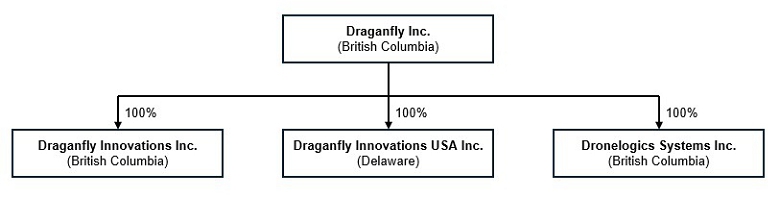
“Draganfly Innovations” means Draganfly Innovations Inc., a wholly-owned subsidiary of the Company;
“Draganfly Innovations USA” means Draganfly Innovations USA Inc., a wholly-owned subsidiary of the Company;
“Dronelogics” means Dronelogics Systems Inc., a wholly-owned subsidiary of the Company;
“EDGAR” means the Electronic Data Gathering, Analysis, and Retrieval system of the SEC;
“Effective Date” means the effective date of this AIF, being March 24, 2026;
“FAA” means Federal Aviation Administration;
“Former Draganfly” has the meaning set out under the heading “Corporate Structure – Name, Address and Incorporation”;
”IFRS” means International Financial Reporting Standards as issued by the International Accounting Standards Board, as adopted by the Canadian Accounting Standards Board;
“ITAR” means International Traffic in Arms Regulations;
“Nasdaq” means the Nasdaq Capital Market;
“NI 51-102” means National Instrument 51-102 – Continuous Disclosure Obligations of the Canadian Securities Administrators;
“NI 52-110” means National Instrument 52-110 – Audit Committees of the Canadian Securities Administrators;
“NPA” has the meaning set out under the heading “The Ongoing Business of the Company – Regulatory Framework”;
“Preferred Shares” has the meaning set out under the heading “Corporate Structure – Name, Address and Incorporation”;
“RPAS” means remotely piloted aircraft systems;
“SEDAR+” means the System for Electronic Document Analysis and Retrieval;
“SFOC” has the meaning set out under the heading “The Ongoing Business of the Company – Regulatory Framework”;
“Small RPAS Advanced” has the meaning set out under the heading “The Ongoing Business of the Company – Regulatory Framework”;
| Draganfly Inc. | Annual Information Form | Page 5 |
“Small RPAS Basic” has the meaning set out under the heading “The Ongoing Business of the Company – Regulatory Framework”;
“sUAS” means small unmanned aircraft systems;
”UAV” means unmanned aerial vehicles;
“USPTO” means United States Patent and Trademark Office; and
“UVS” means unmanned vehicle systems.
Name, Address and Incorporation
The Company was incorporated as Drone Acquisition Corp. under the BCBCA on June 1, 2018 for the purpose of reorganizing and recapitalizing the business of Draganfly Innovations Inc. (“Former Draganfly”). Effective July 17, 2019, the Company amended its articles to remove various classes of authorized but unissued preferred shares and replace them with only one class of preferred shares (the “Preferred Shares”). Effective August 15, 2019, the Company changed its name to “Draganfly Inc.” On August 22, 2019, the Company amended its articles to re-designate its class A common shares as Common Shares.
The Company’s head office is located at 235 103rd St E, Saskatoon, Saskatchewan, S7N 1Y8, and the registered office is located at Suite 2700, 1133 Melville Street, Vancouver, British Columbia V6E 4E5.
Intercorporate Relationships
The following chart shows the Company’s subsidiaries as at the Effective Date:
GENERAL DEVELOPMENT OF THE BUSINESS OF THE COMPANY
Founded in 1998, Former Draganfly is recognized as one of the first commercial multi-rotor manufacturers and has a legacy for its innovation and superior customer service. Zenon Dragan is the founder of Former Draganfly, and is a recognized leading expert on UAV.
Former Draganfly introduced its first systems in 1999 and since evolved and shaped the UAV industry. The company’s aircraft are widely used by public safety agencies worldwide and were one of the first UAV to receive a FAA Certificate of Authorization in the fall of 2009 with the Mesa County Colorado Sheriff’s Office. In 2013, the Royal Canadian Mounted Police flew one of the company’s drones to locate and save the life of an accident victim. Draganfly aircraft have achieved many industry firsts, including:
| ● | one of the first public safety UAV to shoot aerial photos documenting a manned aircraft accident in an urban area; |
| Draganfly Inc. | Annual Information Form | Page 6 |
| ● | one of the first UAV operated by a public safety organization flown at night to locate and save a life; |
| ● | one of the first UAV helicopter to be granted a county wide U.S. FAA Certificate of Authorization; |
| ● | one of the first to have a drone included in the Smithsonian National Air and Space Museum; |
| ● | named as a test platform at one of the U.S. FAA’s certified test sites; and |
| ● | four of the first six compliance certifications for its products issued by Transport Canada. |
Three Year History
A detailed description on the significant developments of the business of the Company over the last three completed financial years is set out below.
Financial year ended December 31, 2023
On January 31, 2023, the Company announced Remote Sensing Instruments, a Geospatial Technology company in India working in the field of Remote Sensing and Geographic Information System, entered into a strategic agreement with the Company for the development of manufacturing, distribution, and sales of Draganfly products in India.
On January 31, 2023, the Company entered into an equity distribution agreement with Maxim Group LLC (“Maxim”) dated January 31, 2023, pursuant to which the Company could, from time to time, distribute in an ”at-the-market offering” up to US$15 million in Common Shares (the “ATM Shares”) in the United States only, on Nasdaq. The Company distributed 650,729 ATM Shares at an average price of $2.69 per ATM Share for net proceeds of $1,526,810.
On February 23, 2023, the Company announced that it entered into a distribution agreement with AeroCine Ventures, Inc. d/b/a Vermeer. Pursuant to the distribution agreement, Vermeer will distribute Draganfly’s products that include the Vermeer VPS (visual positioning system) payload with Draganfly’s Commander 3XL.
On March 7, 2023, Draganfly announced that it entered into a business development and partnership agreement with SkyeBrowse Inc. (“SkyeBrowse”), whereby SkyeBrowse will integrate its reality capture platform with Draganfly public safety drones. As per the agreement, the Company will provide consulting and marketing services to SkyeBrowse for two years.
On March 31, 2023, the Company announced the closing of a firm commitment underwritten public offering with gross proceeds to the Company of US$8.0 million, before deducting underwriting discounts and other estimated expenses payable by the Company. The Company issued 8,000,000 Common Shares at a price of US$1.00 per Common Share.
On April 11, 2023, the Company announced that it entered into a strategic cooperation and product integration agreement with CODAN Communications (“CODAN”), to supply its UAV platform for integration with CODAN’s technology and communications solutions. Under the terms of the agreement, CODAN and the Company agree to combine their respective capabilities in a joint effort to integrate their product and services capabilities in order to submit joint proposals and enter into contracts with potential customers.
On April 19, 2023, Draganfly announced it entered into a referral agreement with AgileMesh, Inc. (“AgileMesh”) whereby AgileMesh will add the Company’s UAV Platform to its wireless surveillance product line and refer potential customers to Draganfly. As per the agreement, AgileMesh will receive commissions based on the aggregate amount of revenue recognized by the Company from customers that are introduced to Draganfly by AgileMesh.
| Draganfly Inc. | Annual Information Form | Page 7 |
On June 21, 2023, the Company announced it had entered into an agreement with HEAL-Corp, a Non-Government Organization, and the Ukrainian National Academy of Internal Affairs (the “National Academy”) regarding the development of a training program on the use of drones and their countermeasure systems. Working in conjunction with the National Academy, Draganfly will implement a designed curriculum to be used within the training program. Recently, HEAL-Corp delivered Trauma Resuscitation and Evacuation Casualty Care training to the Ministry of Internal Affairs.
On August 3, 2023, Draganfly announced its new manufacturing facility in Saskatoon, Saskatchewan is scheduled to come online in Q3. This expansion is part of Draganfly’s commitment to meeting the increasing market potential for products and solutions. The Saskatoon facility is specifically designed to accommodate a growing demand for UAV systems and components, including those engineered for the Heavy Lift, Commander 3XL, and the Company’s newest product, the Precision Delivery System.
On August 23, 2023, the Company announced it will be providing drone pilot crews and drone technology to a Canadian Provincial Government to assist with firefighting mitigation, preparedness, response, and recovery efforts. Draganfly’s advanced drone technology and highly trained personnel will aid emergency services in their mission to protect lives, property, infrastructure, and ecosystems.
On September 7, 2023, Draganfly announced that Tim Dunnigan was appointed to Draganfly’s Advisory Board to help lead Company’s initiatives for the new Pentagon Replicator program, a U.S. Department of Defense initiative announced in August 2023. The program aims to rapidly expand domestic sUAS production & innovation for military applications.
On September 12, 2023, the Company announced it was awarded a contract to provide its Vital Intelligence technology to a state corrections agency to its facilities enhance security and efficiency for the benefit of the community, the staff, and the inmates.
On September 14, 2023, the Company announced it had secured its first defense orders for its Commander 3XL with the U.S. military.
On September 22, 2023, the Nasdaq notified the Company that the closing price of its Common Shares for the 30 consecutive business day period from August 10, 2023 to September 21, 2023 did not meet the minimum bid price requirement of Nasdaq’s rules. The notice had no immediate effect on the listing of the Common Shares, and the Common Shares continued to trade on the Nasdaq under the symbol “DPRO”. Pursuant to Nasdaq Listing Rule 5810(c)(3)(A), the Company was given 180 calendar days (or until March 20, 2024) to regain compliance with the minimum bid price requirement, unless Nasdaq were to grant the Company, upon request, an additional 180 calendar day extension to meet such requirements. To regain compliance, the Common Shares had to have a closing bid price of US$1.00 for a minimum of 10 consecutive business days. If the Company did not regain compliance with the minimum bid price requirement (including through the implementation of a reverse share split or another means) by March 20, 2024, the Common Shares could be subject to delisting.
On September 27, 2023, the Company announced its new manufacturing and production facility in Saskatoon, Saskatchewan, had officially opened.
On October 30, 2023, Draganfly announced that it had closed its underwritten offering for gross proceeds of approximately US$3.5 million, before deducting underwriting discounts and offering expenses. Pursuant to the offering, the Company issued:
| (i). | 4,800,000 units of the Company at a price of US$0.55 per unit, with each such unit comprising of one Common Share and one Common Share purchase warrant (the “October 2023 Warrants”). Each October 2023 Warrant entitles the holder thereof to purchase one Common Share at an exercise price of US$0.6123, subject to adjustment, until October 30, 2028; and |
| Draganfly Inc. | Annual Information Form | Page 8 |
| (ii). | 1,600,000 pre-funded units of the Company the at a price of US$0.5499 per unit, with each such unit comprising of one pre-funded Common Share purchase warrant (the “October 2023 Pre-Funded Warrants”) and one October 2023 Warrant. Each October 2023 Pre-Funded Warrant entitled the holder thereof to purchase one Common Share at an exercise price of US$0.0001, subject to adjustment, until the October 2023 Pre-Funded Warrants are exercised in full. The October 2023 Pre-Funded Warrants were exercised in full prior to the Company’s 2024 financial year end. |
On November 28, 2023, Draganfly announced it has received a Transport Canada Special Flight Operations Certificate for its Heavy Lift Drone to support advanced flight testing above 55lbs/25KG MTOW. This will allow highly specialized development of advanced delivery, industrial and defense applications. The Heavy Lift Flight Testing SFOC allows Draganfly to conduct these specialized and advanced operations utilizing the Heavy Lift within an approved flight test area, enabling the Company to initiate direct application and use-case testing. This development also allows Draganfly to enhance and optimize highly specialized operational and maintenance manuals and Standard Operating Procedures for a variety of conditions and scenarios.
Financial year ended December 31, 2024
On January 16, 2024, the Company announced an agreement with Mass General Brigham to provide drone delivery and solutions for the healthcare system’s Home Hospital patients. The Company’s technology aims to enhance the quality of care and support for Mass General Brigham’s Home Hospital patients by reducing traffic-related delays around its geographic catchment of the greater Boston metro area, eliminating challenges associated with traditional transportation methods, and enabling the swift and efficient delivery of essential supplies. The medical drone pick-up and deliveries facilitated by the Company’s technology can include critical medicines, technical equipment, and laboratory work.
On January 23, 2024, the Company announced that it was selected as a solutions provider of choice by Arabian Aero Investment LLC, a Dubai-based company backed by a member of the Dubai Royal Family, which had announced the launch of a groundbreaking solar-powered charging platform in the UAE. The Company is to develop solutions for integrating UAVs with the UAE’s inaugural end-to-end electric mobility platform that combines solar charging points with last-mile delivery, ushering in a new era of sustainable delivery systems. This initiative signifies the start of an ambitious plan to decarbonize the UAE’s transportation landscape over the next three years.
On January 25, 2024, the Company announced enrollment of the Commander 3XL platform in the Green UAS program, a new program administered by the Association for Uncrewed Vehicle Systems. In this initiative, coupled with the associated Trusted Cyber program, Draganfly aims to achieve certification for the Commander 3XL platform, ensuring it meets the most stringent cybersecurity and supply chain standards specified in the National Defense Authorization Act (“NDAA”). The Company’s engagement in the Green UAS program is geared towards fast-tracking the endorsement of the Commander 3XL platform among commercial entities and state and federal government agencies, including the Departments of Defense and Homeland Security.
On January 30, 2024, the Company announced that it was selected by MMS Products, Inc. to develop a drone-based tactical multi-drop payload system. This drone payload system is designed explicitly for tactical multi-drop and ISR operations. The highlight of this development is the integration with MMS Products’ Mjolnir, a highly configurable delivery device renowned for its versatility and effectiveness in various operational scenarios. The tactical multi-drop system boasts universal mount capabilities that can be easily adapted or attached to a wide range of drone models, and will be optimized for use with the Company’s Commander 3XL. This optimization with the Commander 3XL drone will enhance the performance and efficiency of both technologies, resulting in a robust turnkey tactical solution.
On February 7, 2024, the Company announced that its Commander 3XL Drone was voted Best Enterprise Drone, Best Search and Rescue Drone and Best Delivery Drone at The Droning Company’s Annual Droning Awards.
| Draganfly Inc. | Annual Information Form | Page 9 |
On February 13, 2024, the Company announced that it was selected by the Ulkatcho Group of Companies to provide and expand UAV solutions and capabilities within the Ulkatcho First Nation’s Traditional Territory which will include, but are not limited to Commercial UAV services for Mapping & Survey, Resource & Wildlife Management, Training, Emergency Response & Wildfire Monitoring. The Ulkatcho First Nation is one of Canada’s largest landowners, encompassing a vast expanse from the west coast to the interior of British Columbia, rich in natural resources.
Pursuant to the Company’s prospectus supplement dated February 21, 2024, the Company completed an underwritten public offering in the United States, with Maxim acting as sole book running manager, and issued 13,400,000 units on February 26, 2024 for gross proceeds of approximately US$3.6 million (the “February 2024 Public Offering”), comprising the following:
| (i). | 11,200,000 units at a price of US$0.27 per unit, with each unit consisting of one Common Share and one Common Share purchase warrant (the “February 2024 Warrant”). Each February 2024 Warrant entitles the holder thereof to purchase one Common Share at an exercise price of US$0.36, subject to adjustment, until February 26, 2029; and |
| (ii). | 2,200,000 pre-funded units at a price of US$0.2699 per unit, with each unit consisting of one pre-funded Common Share purchase warrant (the “February 2024 Pre-Funded Warrant”) and one February 2024 Warrant. Each February 2024 Pre-Funded Warrant entitles the holder thereof to purchase one Common Share at an exercise price of US$0.0001, subject to adjustment, until the February 2024 Pre-Funded Warrants are exercised in full. The February 2024 Pre-Funded Warrants were exercised in full prior to the Company’s 2024 financial year end. |
In connection with the February 2024 Public Offering, the Company issued 670,000 underwriter’s warrants (the “February 2024 Underwriter’s Warrants”), with each February 2024 Underwriter’s Warrant entitling the holder thereof to purchase one Common Share at an exercise price of US$0.3375, subject to adjustment, until February 26, 2027.
On March 13, 2024, the Company announced that Knightscope, Inc. had selected Draganfly to jointly develop an autonomous security solution that combines Draganfly drones with Knightscope Autonomous Security Robots, emergency communications devices & Knightscope Security Operations Center user interface & remote monitoring platform.
As previously disclosed, on September 22, 2023, the Company received a letter from the Listing Qualifications Department of Nasdaq notifying the Company of its noncompliance with Nasdaq Listing Rule 5550(a)(2) (the “Bid Price Rule”) by failing to maintain a minimum bid price for the Common Shares of at least $1.00 per share for 30 consecutive business days. The Company was allowed an initial 180-day grace period, or until March 20, 2024, (the “Bid Price Compliance Period”), to regain compliance with the Bid Price Rule. To regain compliance with the Bid Price Rule the closing bid price of the Common Shares needed to be at least $1.00 per share for a minimum of ten consecutive business days during the Bid Price Compliance Period.
On March 21, 2024, the Company received notification that it had failed to regain compliance with the Bid Price Rule and is not eligible for a second 180 day compliance period because of its failure to comply with the $5 million minimum stockholders’ equity initial listing requirement for the period ended September 30, 2023. The Company timely requested a hearing before the Nasdaq Panel. The hearing request automatically stayed any suspension or delisting action pending the hearing and the expiration of any additional extension period granted by the Nasdaq Panel following the hearing. In April 2024, the Company received notification that it failed to comply with the minimum stockholders’ equity requirement which served as an additional and separate basis for delisting. Following the May 21st hearing, the Nasdaq Panel granted an additional extension period with regard to the Bid Price Rule that would expire on September 17, 2024. In addition, at the hearing, the Company presented a plan to regain compliance with the minimum stockholders’ equity requirement which plan the Company implemented on August 7, 2024 via amendments to warrants issued in October 2023 and in May 2024.
| Draganfly Inc. | Annual Information Form | Page 10 |
On April 22, 2024, the Company announced a collaboration with communication experts Doodle Labs, and control systems specialists UXV Technologies. This collaborative effort is set to redefine operational capabilities for law enforcement, first responders, and military specialists. The collaboration combines the Company’s Commander 3XL UAV, Doodle Labs’ Helix Mesh Rider®Radio, and UXV Technologies Soldier Robotic Controller ground control station, together offering a secure, robust, and ruggedized solution for demanding missions.
On April 24, 2024, the Company announced a memorandum of understanding with Squamish Search and Rescue (“SSAR”), pursuant to which Draganfly will serve as SSAR’s UAV solutions partner. SSAR and Draganfly will explore integrated continuous testing of equipment and operation procedures to meet the ever-demanding specialized SSAR operations. This work will enhance the Commander 3XL’s utility in various search and rescue training scenarios, further expanding its operational capabilities.
On April 25, 2024, the Company announced a strategic collaboration with ParaZero Technologies Ltd., a pioneer in drone safety systems aimed at enhancing the safety and efficacy of UAVs in medical and emergency response operations.
Pursuant to the Company’s prospectus supplement dated April 29, 2024, the Company completed an underwritten public offering in the United States, with Maxim acting as sole placement agent, and issued 13,513,514 units on May 1, 2024 for gross proceeds of approximately US$3.5 million (the “May 2024 Public Offering”), comprising the following:
| (i). | 7,063,514 units at a price of US$0.259 per unit, with each unit comprising of one Common Share and one Common Share purchase warrant (the “May 2024 Warrants”). Each May 2024 Warrant entitles the holder thereof to purchase one Common Share at an exercise price of $0.3540 (Canadian equivalent of US$0.259), subject to adjustment, until May 1, 2029; and |
| (ii). | 6,450,000 pre-funded units at a price of $0.2589 per unit, with each unit consisting of one pre-funded Common Share purchase warrant (the “May 2024 Pre-Funded Warrants”) and one May 2024 Warrant. Each May 2024 Pre-Funded Warrant entitles the holder thereof to purchase one Common Share at an exercise price of $0.00014 (the Canadian dollar equivalent of US$0.0001), subject to adjustment, until the May 2024 Pre-Funded Warrants were exercised in full prior to the Company’s 2024 financial year end. The May 2024 Pre-Funded Warrants were exercised in full prior to the Company’s 2024 financial year end. |
In connection with the May 2024 Public Offering, the Company issued 675,676 placement agent’s warrants (the “May 2024 Agent’s Warrants”), with each May 2024 Agent’s Warrants entitling the holder thereof to purchase one Common Shares at $0.4425 (the Canadian dollar equivalent of US$0.3236), subject to adjustment, until May 1, 2027.
On May 7, 2024, the Company announced the launch of its newest product, the FlexForce Modular FPV UAV System, available exclusively to Government & Military buyers following a FPV UAV Demonstration and Training. The NDAA-Compliant FlexForce FPV System features a set of quick-exchange assemblies, available in four-, seven- and ten-inch configurations.
On June 13, 2024, the Company announced that it was selected by First Atlantic Nickel Corp. to utilize its proprietary survey technologies and services to help explore for what could be the first awaruite and district scale nickel project in Atlantic Canada.
Andrew Hill Card and John M. Mitnick did not run for re-election as directors of the Company at the annual general meeting of the shareholders held on July 18, 2024.
On July 19, 2024, the Company announced results of its annual general meeting of shareholders held on July 18, 2024. In addition, the Company also announced the appointment of Kim G.C. Moody to the Board. Scott Larson was appointed the Interim Chair of the Company.
| Draganfly Inc. | Annual Information Form | Page 11 |
On July 25, 2024, the Company announced the appointment of Thomas B. Modly and Tim Dunnigan to the Board.
On August 6, 2024, the Company announced the delivery of its newest Advanced First Responder assets to SSAR, inclusive of the Commander 3XL drone and modular payloads. In addition, the Company also announced that to enable each of the October 2023 Warrants and May 2024 Warrants to be treated as shareholders’ equity, and not a derivative liability on the Company’s balance sheet, holder of these warrants and the Company entered into an amendment agreements to amend certain provisions related to determining the value of underlying Common Shares on completion of fundamental transactions in exchange for the exercise price of each of the October 2023 Warrants and May 2024 Warrants being reduced by:
| (i). | warrant amendment agreement dated May 1, 2024 entered between the Company and holder of the October 2023 Warrants, certain amendments to the terms of the October 2023 Warrants were amended including revising the exercise price to $0.3583, being US$0.259, removing the cashless exercise procedure, and changing the currency of the originally issued October 2023 Warrants to Canadian dollars; and |
| (ii). | warrant amendment agreement dated August 7, 2024 entered between the Company and holder of the October 2023 Warrants and May 2024 Warrants, the exercise price of the October 2023 Warrants was reduced to $0.2277 (Canadian equivalent of US$0.1646) and the exercise price of the May 2024 Warrants was reduced to $0.2250 (Canadian equivalent of US$0.1646). |
On August 12, 2024, the Company announced a strategic partnership with The Institute for Drone Technology, a leading drone solution provider for the Australian government and enterprise sectors. This agreement appoints The Institute for Drone Technology as a value-added distributor of the Company’s cutting-edge drone technology in Australia.
Pursuant to the Company’s prospectus supplement dated August 19, 2024, the Company completed an underwritten public offering in the United States, with Maxim acting as sole placement agent, and issued 16,666,666 units for gross proceeds of approximately US$2 million (the “August 2024 Public Offering”), comprising the following:
| (i). | 8,666,666 units at a price of US$0.12 per unit, with each unit consisting of one Common Share and one Common Share purchase warrant (the “August 2024 Warrant”). Each August 2024 Warrant entitles the holder thereof to purchase one Common Share at an exercise price of $0.2048 (the Canadian dollar equivalent of US$0.15), subject to adjustment, until August 21, 2029; and |
| (ii). | 8,000,000 units at a price of US$0.12 per unit minus $0.00014 (the Canadian dollar equivalent of US$0.0001), with each unit consisting of one pre-funded Common Share purchase warrant (the “August 2024 Pre-Funded Warrant”) and one August 2024 Warrant. Each August 2024 Pre-Funded Warrant entitles the holder thereof to purchase one Common Share at an exercise price of $0.00014 (the Canadian dollar equivalent of US$0.0001), subject to adjustment, until the August 2024 Pre-Funded Warrants are exercised in full. The August 2024 Pre-Funded Warrants were fully exercised in full prior to the Company’s 2024 financial year end. |
In connection with the August 2024 Public Offering, the Company issued 833,333 placement agent’s warrants (the “August 2024 Agent’s Warrants”), with each August 2024 Agent’s Warrant entitling the holder thereof to purchase one Common Share at $0.2048 (the Canadian dollar equivalent of US$0.15), subject to adjustment, until August 21, 2027.
On September 5, 2024, the Company completed a consolidation of its issued and outstanding Common Shares on the basis of one post-consolidated Common Share for every 25 pre-consolidated Common shares (the “Consolidation”) which was given effect on September 5, 2024.
| Draganfly Inc. | Annual Information Form | Page 12 |
On September 10, 2024, the Company announced launch of its newest product, the APEX Drone, designed specifically to meet the demanding needs of military and law enforcement surveillance operations.
On September 17, 2024, the Company along with Nightingale Security, a leader in robotic aerial security, were selected by a major oil and gas company to develop a fully automated UAS solution for infrastructure monitoring. This project marks a significant step in leveraging advanced UAS remote sensing technology to enhance operational efficiency and safety in the oil and gas sector.
On September 24, 2024, the Company announced receipt of a purchase order from TB2 Aerospace (“TB2”) for Commander 3XL Drones to be deployed with TB2 Drone Recharging Operational Payload System Pods (“DROPS”) within the U.S. Department of Defense for various mission types. This order represents the beginning of the deployment and scaling of the DROPs system in conjunction with the Draganfly line of drones.
On October 1, 2024, Nasdaq informed the Company that it had regained compliance with the Bid Price Requirement (via the Consolidation (as defined below)) and the minimum stockholders’ equity requirement. The letter from Nasdaq further informed the Company that it is subject to a Nasdaq Mandatory Panel Monitor for a period of one year from October 1, 2024. If, within that one-year monitoring period, the Company is again out of compliance with the minimum stockholders’ equity requirement, the Company will not be afforded the opportunity to present a plan of compliance to Nasdaq with respect to that deficiency nor additional time to cure that deficiency. Instead, Nasdaq will issue a Delist Determination Letter and the Company will have the opportunity to request a hearing before a Nasdaq Panel to respond to such letter.
On October 8, 2024, the Company announced Olen Aasen’s stepping down from the Board. In addition, Kim G.C. Moody was appointed as the new Audit Chair, Tim Dunnigan joined the Audit Committee, and Andrew Hill Card joined the advisory board of the Company.
Pursuant to the Company’s prospectus supplement dated November 18, 2024, the Company completed an underwritten public offering in the United States, with Maxim acting as sole placement agent, and issued 1,600,000 units for gross proceeds of approximately US$3.76 million (the “November 2024 Public Offering”), comprising the following:
| (i). | 400,000 units at a price of US$2.35 per unit, with each unit consisting of one Common Share and one Common Share purchase warrant (the “November 2024 Warrant”). Each November 2024 Warrant entitles the holder thereof to purchase one Common Share at an exercise price of $3.3086 (the Canadian dollar equivalent of US$2.35), subject to adjustment, until November 19, 2029; and |
| (ii). | 1,200,000 units at a price of US$2.3499 per unit, with each unit consisting of one pre-funded Common Share warrant (the “November 2024 Pre-Funded Warrant”) and one November 2024 Warrant. Each August 2024 Pre-Funded Warrant entitles the holder thereof to purchase one Common Share at an exercise price of $0.00014 (the Canadian dollar equivalent of US$0.0001), subject to adjustment, until the November 2024 Pre-Funded Warrants are exercised in full. The August 2024 Pre-Funded Warrants were fully exercised in full prior to the Company’s 2024 financial year end. |
In connection with the November 2024 Public Offering, the Company issued 80,000 placement agent’s warrants (the “November 2024 Agent’s Warrants”), with each November 2024 Agent’s Warrant entitling the holder thereof to purchase one Common Share at $4.1357 (the Canadian dollar equivalent of US$2.9375), subject to adjustment, until November 19, 2027.
To enable each of the October 2023 Warrants, May 2024 Warrants and August 2024 Warrants to be treated as shareholders’ equity, and not a derivative liability on the Company’s balance sheet, the holders of these warrants and the Company entered into amendment agreements to amend certain provisions related to determining the value of underlying Common Shares on completion of fundamental transactions in exchange for the exercise price of each of the October 2023 Warrants, May 2024 Warrants and August 2024 Warrants in such number on a post-Consolidation basis being reduced to $3.3086 (Canadian equivalent to US$2.35) on a post-Consolidation basis.
| Draganfly Inc. | Annual Information Form | Page 13 |
On December 18, 2024, the Company announced the successful completion of initial flights as part of a proof-of-concept, research-and-development drone delivery project for Mass General Brigham Home Hospital.
Financial year ended December 31, 2025
On January 16, 2025, the Company announced a strategic collaboration with Volatus Aerospace Inc. (“Volatus”), a global provider of aerial solutions. This collaboration will address the growing demand for precision data acquisition in energy markets by integrating Volatus’ advanced Bathymetric sensor technology with the Company’s Heavy Lift Drone. Under the terms of the agreement, Volatus Aerospace will operate as an OEM approved dealer of the Company’s robust portfolio of multi-use UAV platforms, including the Heavy Lift Drone, Commander 3XL, and Apex Drones. These NDAA compliant drones will enrich Volatus’ current offerings, enabling more selection for its clients.
On January 23, 2025, the Company announced that it secured a Federal Aviation Administration waiver from the U.S. Department of Transportation enabling its small unmanned aircraft to conduct operations over human beings and moving vehicles in the United States. This waiver marks a significant milestone for the Company and highlights its commitment to advancing the capabilities of UAV operations in complex urban environments. These regulatory exemptions reinforce the Company’s position as an innovator in the UAV space and showcase its readiness to meet the evolving needs of its defense, government, and commercial partners.
On February 5, 2025, the Company confirmed through recent sales activities its positioning and preparedness to support the enhancement of border security amid evolving global trade and security uncertainties and shifting geopolitical dynamics. The Company has been engaged in sales development activities with multiple groups supporting the Southern U.S. border, most notably Cochise County in Arizona, United States. These sales development activities have primarily involved site visits and collaboration meetings with such groups to identify the technical requirements they face. These efforts are building towards an activation and media event hosted by Cochise Country in the fourth quarter of 2025 to announce the pending release of a product developed to address their needs and intent to purchase.
On March 3, 2025, the Company announced an expansion of the strategic collaboration with Volatus, to address rapidly growing global demand for the automation and digitization of geospatial data collection and analysis solutions for Utility Infrastructure. This teaming agreement builds on the prior collaboration agreement, harnessing Volatus’ operational and regulatory capabilities, advanced sensor technology and Draganfly’s advanced product, engineering, and integration capabilities. This expanded collaboration will engage high-profile global power and infrastructure providers to enhance efficiency and safety in power utility solutions.
On March 10, 2025, the Company announced the establishment of its new U.S. location in Tampa, Florida. Strategically positioned near key military and government clients, this expansion includes a demonstration and live fire testing facility, reinforcing Draganfly’s commitment to delivering cutting-edge drone solutions to its U.S. customers.
On March 18, 2025, the Company announced it was selected by the Massachusetts Department of Transportation Aeronautics Division for and, successfully completed, a demonstration for the simulated delivery of medical supplies for use in support of home-based healthcare.
On March 20, 2025, the Company announced the appointment of Christopher Miller to the Board.
On April 9, 2025, the Company announced it has been selected as the primary unmanned aerial systems provider by Balko Technologies (“Balko”), an industry-leading company specializing in the design and manufacture of high-performance LiDAR payloads and post-processing software. Under this agreement, Balko becomes an official distributor of Draganfly’s products throughout North America, expanding access to cutting-edge drone technology for industrial, energy, and environmental monitoring applications.
| Draganfly Inc. | Annual Information Form | Page 14 |
On April 10, 2025, the Company announced it has been selected by SafeLane Global Ltd. (“SafeLane”) as its preferred unmanned aerial systems and aerial survey provider. Under the agreement, Draganfly will provide advanced drone solutions, including UAVs, specialized sensors, and data analysis services, to support SafeLane’s global mine action initiatives. The collaboration aims to enhance the speed, accuracy, and safety of explosive threat detection and removal operations in high-risk environments.
On April 16, 2025, the Company announced the formation of its Public Safety Advisory Board, and the engagement of Paul Goldenberg to serve as the inaugural Chair of the Public Safety Advisory Board.
On May 1, 2025, the Company announced a strategic teaming agreement with Autonome Labs (“Autonome”), a humanitarian tech innovator, to develop an integrated aerial deployment solution for M.A.G.I.C, (Mine and Ground Inert Clearance) Autonome’s groundbreaking mesh-based demining system.
Pursuant to the Company’s prospectus supplement dated May 5, 2025, the Company completed a public offering in the United States, with Maxim acting as sole placement agent, for gross proceeds of approximately US$3.6 million (the “May 2025 Public Offering”), comprising the following:
| (i). | 1,715,000 units, with each unit consisting of one Common Share and one Common Share purchase warrant (the “May Warrant”). Each May Warrant entitles the holder thereof to purchase one Common Share at an exercise price of $3.9779 (the Canadian dollar equivalent of US$2.875), subject to adjustment, until May 5, 2030; and |
| (ii). | 100,000 May Warrants pursuant to an over-allotment option. |
On May 14, 2025, the Company announced the appointment of Peter Lambrinakos, O.O.M., CPP, to its Public Safety Advisory Board.
On June 3, 2025, the Company announced the first deliveries of its Flex FPV (First Person View) systems under an order from a major U.S. military prime contractor supporting land systems operations for allied forces.
On June 6, 2025, the Company announced that further to the closing of the May 2025 Public Offering, Maxim Group LLC, as underwriter and sole book-running manager, had partially exercised their over-allotment option to purchase an additional 100,000 common shares at the price of US$2.09 per share for aggregate gross proceeds of US$209,000 prior to deducting underwriter discounts and commissions.
On June 10, 2025, the Company announced its selection by the Cochise County Sheriff’s Department (in Arizona, USA) to support a new drone pilot program aimed at enhancing surveillance and operations along the U.S. southern border. Under this new pilot program, the department will deploy the Draganfly family of drones for extended border surveillance, quick-response missions and nighttime operations.
Pursuant to the Company’s prospectus supplement dated June 11, 2025, the Company completed an underwritten public offering in the United States, with Maxim acting as exclusive underwriter and sole bookrunner, and issued 5,500,000 units for gross proceeds of approximately US$13.75 million (the “June 2025 Public Offering”). Each unit consisted of one Common Share and one Common Share purchase warrant (the “June Warrant”). Each June Warrant entitles the holder thereof to purchase one Common Share at an exercise price of $5.0768 (the Canadian dollar equivalent of US$3.71), subject to adjustment, until June 12, 2030.
On June 17, 2025, the Company announced the successful deployment and performance of the DROPS during the U.S. Army’s Sustainment Modernization Experiment 2025 (“SMEX25”). Throughout SMEX25’s week-long field exercises, the DROPS system, integrated with Draganfly’s Commander 3XL, achieved a 100% success rate in autonomously deploying, recovering, and recharging TB2’s tactical resupply pods.
| Draganfly Inc. | Annual Information Form | Page 15 |
On July 16, 2025, the Company announced its Commander 3XL UAV platform was selected by a major branch of the United States Department of Defense. This delivery supports next-generation deployment initiatives focused on advanced reconnaissance in combination with operational capabilities. The procurement was facilitated through a known prime contractor, with Draganfly engaging directly with end-user military stakeholders to ensure the platform was tailored to meet real-world mission requirements.
Pursuant to the Company’s prospectus supplement dated July 18, 2025, the Company completed a public offering in the United States, with Maxim acting as sole placement agent, and issued 4,672,895 units for gross proceeds of approximately US$25 million (the “July 2025 Public Offering”). Each unit consisted of one Common Share and one Common Share purchase warrant (the “July Warrant”). Each July Warrant entitles the holder thereof to purchase one Common Share at an exercise price of $7.3579 (the Canadian dollar equivalent of US$5.35), subject to adjustment, until July 21, 2030.
On July 22, 2025, the Company announced the sale of Commander 3XL UAV systems to a defense contractor specializing in persistent surveillance technologies for military operations.
On July 30, 2025, the Company announced the successful completion of a sale of multiple Draganfly Heavy Lift Drones, after extensive testing, to a Fortune 50 telecommunications company for UAV-based emergency response and emergency communication network capabilities.
On August 5, 2025, the Company announced it demonstrated an integrated tactical strike system at invite-only Pentagon event.
On August 26, 2025, the Company announced that it is positioned to support Canada’s new $2 Billion military commitment to Ukraine with advanced drone and tactical capabilities.
On August 28, 2025, the Company announced the expansion of its U.S. manufacturing footprint and capacity to meet demand for scalable U.S.-made drone solutions.
On September 3, 2025, the Company announced its successful completion of operational demonstrations of its Commander 3XL and Flex FPV drones with partner provider MMS Products as part of the U.S. Department of Defense Technology Readiness (T-REX) 24-2 exercise held from August 19 to 28, 2025 at Camp Atterbury, Indiana.
On September 30, 2025, the Company announced its selection by the U.S. Army for an initial order pursuant to which the Company will deliver Flex FPV drones, establish on-site manufacturing of the Flex FPV within overseas U.S. Forces facilities and provide both flight and manufacturing training.
On October 9, 2025, the Company announced the execution of a formal agreement with Global Ordnance, a U.S. Defense Logistics Agency prime contractor, whereby Global Ordnance will serve as a U.S. defense partner for the Company’s line of unmanned aerial systems and related solutions. Under the agreement, the Company and Global Ordnance will collaborate to accelerate U.S. defense adoption of the Company’s products, provide supply chain support, and integrate mission-specific capabilities for defense applications.
On October 16, 2025, The Company announced that it has appointed Drone Nerds, a leading U.S. drone retailer, integrator, and service provider, as an official value-added reseller for its full line of NDAA-compliant unmanned aerial systems. Drone Nerds will provide sales, integration, training, support, and service for Draganfly’s public safety-grade drone systems across the U.S. and allied markets.
On October 21, 2025, the Company announced its intention to collaborate with Palladyne AI Corp. to further enhance the capabilities of Draganfly’s UAV platforms with Palladyne™ Pilot AI software.
On October 22, 2025, the Company announced the appointment of Victor Meyer and Keith Kimmel as Senior Members of its Military Board of Advisors.
| Draganfly Inc. | Annual Information Form | Page 16 |
On November 13, 2025, the Company announced a second purchase order from a Fortune 50 telecommunications company for multiple units of Draganfly’s Commander 3XL platform integrated with Unmanned Systems & Solutions Inc. LEAP® tether system.
On November 20, 2025, the Company announced that it had secured a strategically significant international military order for Commander 3XL drones from a defense contractor.
On December 8, 2025, the Company announced that it had entered into a collaborative framework with Babcock International Group PLC and Critical Infrastructure Technologies Corp., operating through its subsidiary CiTech International Ltd., to explore multi-company initiatives aimed at strengthening defense and security capabilities across the Asia-Pacific region.
January 1, 2026 to the Effective Date
On January 13, 2026, the Company announced the deployment of Draganfly drones integrated with Smith Myers, ARTEMIS Mobile Phone Detection & Location Systems for search and rescue operations in Sweden.
On January 20, 2026, the Company announced that Cameron Chell, the Chief Executive Officer of the Company, has been appointed Executive Chairman of the Board.
On February 2, 2026, the Company announced it was selected to provide Flex FPV Drones and Training to U.S. Air Force Special Operations Command units with partner DelMar Aerospace Corporation.
On February 20, 2026, the Company announced the appointment of Lieutenant-General (Ret’d) Michel Gauthier to its Military Advisory Board.
Pursuant to the Company’s prospectus supplement dated February 26, 2026, the Company completed a public offering in the United States, with Maxim acting as lead placement agent, and issued 5,030,000 Common Shares and 2,120,000 pre-funded Common Share warrants (the “February Warrants”) for gross proceeds of approximately US$50 million (the “February 2026 Public Offering”). Each February Warrant entitles the holder thereof to purchase one Common Share at an exercise price of $0.00014 (the Canadian dollar equivalent of US$0.0001), subject to adjustment, at any time until all of the February Warrants are exercised in full.
On March 16, 2026, the Company announced the successful completion of an exclusive Canadian Armed Forces capabilities demonstration held on March 11 at Area XO in Ottawa, Ontario.
Significant Acquisitions During 2025
Draganfly did not complete any significant acquisitions during its most recently completed financial year for which disclosure is required under Part 8 of NI 51-102.
ThE ONGOING BUSINESS OF THE COMPANY
General
The Company is an award-winning, industry-leading manufacturer, contract engineering, reseller and product development company within the UAV space, serving the public safety, civil, military, agriculture, industrial inspections, and mapping and surveying markets. The Company is driven by passion, ingenuity, and the need to provide efficient solutions and first-class services to its customers around the world with the goal of saving time, money, and lives.
The business of the Company is conducted through three wholly-owned subsidiaries: (a) Draganfly Innovations Inc.; (b) Draganfly Innovations USA Inc.; and (c) Dronelogics Systems Inc.
| Draganfly Inc. | Annual Information Form | Page 17 |
The business of Draganfly Innovations and Draganfly Innovations USA is the provision of engineering services and manufacture of commercial UAV, RPAS, and UVS and software, serving the public safety, civil, military, agriculture, industrial inspections, and mapping and surveying markets.
Dronelogics is a solutions integrator for custom robotics, hardware and software that provides a wide scope of services including sales, training, rentals, maintenance, flying and data processing services.
Drone Industry Overview
Drones or UAV have rapidly evolved from a military origin to commercial and civil government applications from security to farming. The increased automation of drones provides additional value to existing workflows, triggering more widespread adoption. A global shift to sustainable and eco-friendly options has further increased demand for drone usage.
Drone applications are being utilized in multiple industries on a global basis. The Company believes that defense will remain the largest market over the foreseeable future. However, the mobile phone industry created an affordable technology stack for drones. The ability to carry a camera enabled many people to utilize the platforms for media production and beyond. That demand initiated in the consumer market and has migrated along with technological advancements into the growth of commercial drone industry.
The major segments of the drone market are drone hardware, software and services. Drone hardware are the physical goods, including drone platforms, aerial mobility platforms and components and systems. The software segment includes flight planning, navigation and computer vision, unmanned traffic management, fleet operations, ecosystems, networks and software development kits. Drone services include the provision of flight operations, data analysis and hardware repair and maintenance. Drone service providers include system integrators, pilot training providers, retailers and marketplaces, coalitions and organizations, drone test sites, insurance providers and university/educational facilities. The commercial drone industry has been growing rapidly in recent years, with drones becoming increasingly popular for a wide range of applications. From capturing aerial footage to conducting inspections of infrastructure, drones offer a cost-effective and efficient solution to a range of tasks. According to Teal Group, the global market for commercial drones is expected to reach US$18.88 billion by 2030, with strong demand coming from industries such as agriculture, construction, and logistics.
One of the biggest drivers of growth in the commercial drone industry is the availability of advanced technologies such as Artificial Intelligence (“AI”), machine learning, and computer vision. These technologies enable drones to perform a wide range of tasks that were previously difficult or impossible, such as automated inspections and precision agriculture. Additionally, the development of high-quality, lightweight sensors and cameras has made it possible to capture high-resolution images and video footage, in challenging environments.
Drone application methods are being used by a variety of industries today. There are approximately eight methods that are garnering the most attention: mapping, surveying, inspection, filming/photography, dispensing/spraying, warehousing, monitoring/detection, and delivery. These applications are being used today by the civil government, educational facilities, agricultural, construction, health care, real estate, energy, transportation, insurance, security, and scientific industries.
Products and Services
The Company can provide its customers with an entire suite of products and services that include: quad-copters, fixed wing aircrafts, handheld controllers, flight training, and software used for tracking, live streaming, and data collection. The Company is also offering exterior soft washing services.
Product sales and provision of services accounted for 89% and 11%, respectively, of revenues of Draganfly for the financial year ended December 31, 2025.
| Draganfly Inc. | Annual Information Form | Page 18 |
The Company generates revenues across the following categories:
| Revenues | ||||||||
| Fiscal year ended December 31, | ||||||||
| Category of Activity | 2025 | 2024 | ||||||
| Product Sales | 6,869,815 | 5,368,476 | ||||||
| Provisions of Sales | 861,348 | 1,192,579 | ||||||
The Company did not derive significant revenue from any customers that accounted for 15% or more of total revenues for the year ended December 31, 2025, or December 31, 2024.
Draganfly Products
Manufactured Solutions
The Company is among the longest-running manufacturer of multirotor drones in the world. Draganfly’s drones include the following:
| ● | Draganfly Flex FPV - The Flex FPV is an innovative, low-cost platform that allows tactical users the opportunity to adjust a single vehicle to multiple configurations, allowing for a payload capacity of 1-10 pounds and accommodating various mission profiles including indoor operations. Designed for in-field production and repair, the Flex FPV can be deployed with a variety of modular and independent payload systems to support various capabilities. |
| ● | Draganfly Apex - The Apex is compact, adaptable multi-mission platform best suited for quick response operations and high volume tasks such as surveying or industrial inspection. The Apex features optional onboard compute upgrades and is capable of carrying up to a 6.6 pound payload. Capable of supporting multiple radio and control link configurations, the Apex is built to support the most demanding of industrial or public safety environments. |
| ● | Draganfly Commander 3XL - The Commander 3XL Drone is a modular platform capable of carrying payloads of more than 20 pounds making it the ideal choice for industry leaders across a variety of major markets including public safety and agriculture. The Commander 3XL Drone’s fuselage consists of a simple rectangular tube. Each component of the drone has been specifically designed to ensure the airframe can pack down into a transportable case. |
| ● | Draganfly Heavy Lift Drone - The Draganfly Heavy Lift Drone is a versatile, multi-rotor UAV, designed to enhance deliveries and flight times. Compatible with a variety of interchangeable payloads, this heavy-duty drone can carry more and fly longer. The DHL Drone can be configured to carry up to 67 pounds. |
| ● | Draganflyer Commander2 – The Draganflyer Commander2 is a multi-mission, high-endurance, electric sUAS that combines the signature design elements of our past Draganflyer systems with the most advanced features to date. The Commander2 can be used for numerous applications across many industries including agriculture, public safety, and aerial 3D modeling. Paired with powerful MAVLink-based flight planning software, the Draganflyer Commander2 supports both fully- and semi-automated missions, as well as manual flight operations with a pilot in the loop for a high level of system control to handle any operational task. |
| ● | Draganfly Long Range LiDAR - Draganfly’s Long Range LiDAR system provides accurate distance measurements and improved resolution over conventional photogrammetry methods. The cutting-edge sensor technology can be mounted on UAV, airplanes, and helicopters for those professionals requiring precision imagery. |
| Draganfly Inc. | Annual Information Form | Page 19 |
Software
The Draganfly Surveyor drone flight planning software is an intuitive, easy to use, application that enables customers to quickly plan, fly, and process meaningful data. Based on the project, camera type, optics, and altitude, the drone software determines the appropriate camera shutter interval, aircraft speed, and flight plan to capture the optimum required photo overlap to generate 2D and 3D maps and models. The Draganfly Surveyor directly integrates with Pix4Dmapper for survey-grade results and can be used alongside other third-party photogrammetry programs.
Draganfly Services
Custom Engineering
Draganfly is a contract engineering partner for government agencies, enterprise organizations, academic institutions, and businesses of all sizes. The Draganfly team’s truest capabilities are actualized during the engineering process as hardware designers, software designers, engineers, project managers, and vertical-specific experts come together to build custom drone solutions for its partners. Draganfly’s end-to-end engineering services include:
| ● | Hardware design: Component, product, and system design; |
| ● | Software design: Custom software and interface design; |
| ● | Development: Including integration with third party platforms, PixX4D, Pixhawk, Ardupilot, DJI and more; |
| ● | Modeling: 3D design and modeling of mechanical components; |
| ● | ITAR (International Traffic in Arms Regulations) equipment management: Approved handling and integration of ITAR, and Controlled Goods technologies; and |
| ● | Support: Testing, training, documentation, and repairs. |
Training
Draganfly offers custom-designed training packages that are tailored to specific operations and use cases. The Company also offers basic training for new UAV owners, and advanced classes for users who understand the fundamentals and are looking for new ways to increase flight efficiency or comply with federal regulations.
Flight Services
Draganfly has a team of qualified pilots that conduct flights on behalf of its customers. The team specializes in working with emergency services including police, fire, and search and rescue personnel. Draganfly also supports industrial applications, utility and power companies, environmental and agricultural entities and others.
Geographic Information Systems (GIS) Data Services
Draganfly has a team of qualified GIS Data Specialists and Surveyors that support the delivery of services to clients in various markets. These services include the creation and maintenance of data sets of spatial analysis.
AirWash Services
AirWash is a specialized, North American-engineered drone system designed for professional, high-rise exterior cleaning, facade washing, and window cleaning. It provides a safer, faster, and more cost-effective alternative to traditional methods like scaffolding or rope access, with the ability to reach heights of 12+ stories.
| Draganfly Inc. | Annual Information Form | Page 20 |
Principal Markets
Draganfly has more than 25 years of experience designing and manufacturing professional drones for military, public safety, energy, agriculture, and insurance. Draganfly has sold products and services to a number of countries but predominantly focuses on the North American market given its geographical location.
Military and Government
Military and government contractors have partnered with Draganfly to improve personnel and infrastructure safety. Draganfly works with partners to design and manufacture custom airframes, design and develop payloads, and manage complex flight operations. Draganfly team members hold advanced pilot certificates and are approved to fly in controlled airspace and at airports. Since the Company’s development team is cleared by Canada’s Controlled Goods Program, the team is permitted to handle ITAR equipment and technologies, and the Company’s facilities are built to protect those technologies and ensure they are only handled by approved personnel.
Public Safety
In 2013, the Royal Canadian Mounted Police flew one of the Company’s drones to locate and save the life of an accident victim, which we believe was one of the first times a public safety organization used a UAV to save a life. Years later, the Company is still using drone technology to keep the public safe. Draganfly works with its partners to identify unknowns, such as substances, spills, packages, and chemicals while not putting human lives at risk. Draganfly builds aerial and ground systems with custom payloads and sensors to scan scenes, survey public events, locate objects, and clear debris faster and more safely than on-the-ground manpower. The Company also empowers its partners to maximize existing infrastructures via custom application programming interface integrations that ensure Draganfly’s technology enhances their safety systems.
Environmental and Energy
Draganfly offers a suite of commercial UAV solutions for energy companies and those servicing the energy market, like surveyors and consultants. Draganfly equips energy companies with the hardware and software they need to optimize existing operations, improve safety, and respond after a natural disaster. Partners can use Draganfly hardware and 3D modeling software to remotely inspect sites that would put human lives at risk. They also conduct environmental monitoring with Draganfly’s sample collection solutions, assessing water and ground pollution, gas composition, infrastructure, and other environments.
Agriculture
Draganfly works with its partners to collect high-quality data, using multi- and hyper-spectral imaging, 3D modeling, and a suite of sophisticated sensor technology that assesses environmental factors. Seed companies use Draganfly technology to optimize growth season, measuring seed trial results throughout the research and development process. Farmers can use Draganfly flight and data collection services to monitor hectares of land year-round, assessing factors like fertilizer efficiency, weed production, and more.
| Draganfly Inc. | Annual Information Form | Page 21 |
Operations
Canadian Operations
Draganfly Innovation Inc.’s products are manufactured at its machine shop within its leased head office based in Saskatoon, Saskatchewan, Canada. Draganfly Innovations Inc. operates the fully operational leased facility located at 235 103rd St E, Saskatoon, SK, S7N 1Y8, Canada. This facility is to be used only for the purposes of Draganfly Innovations Inc. operating its business of design, development, production, distribution, sale and/or licensing of drones or robots, or such other use as permitted by the landlord from time to time. It is also party to a service agreement where the Company can store some of its’ fixed assets and use the space on occasion for product demonstrations and meetings.
Dronelogics Systems Inc.’s products and services are provided through its leased space located at Unit 319, 2999 Underhill Avenue, Burnaby, British Columbia.
United States Operations
The Company, through its wholly-owned subsidiary, Draganfly Innovations USA Inc., has a storage facility in Hoschton, Georgia that currently stores some inventory for operations in the United States. The Company also has a storage facility in Tampa, Florida. The Company’s Airwash services are located out of a leased facility in Rosenberg, Texas.
The Company has derived its revenues across the following primary geographic market segments for the last three fiscal years. Geographic revenue is measured by aggregating sales based on the country and the entity where the sale was made.
| Revenues | ||||||||||||
| Fiscal year ended December 31, | ||||||||||||
| Region | 2025 | 2024 | 2023 | |||||||||
| Canada | 7,709,945 | 6,523,341 | 6,162,672 | |||||||||
| United States | 21,218 | 37,714 | 392,170 | |||||||||
Competitive Conditions
Although Draganfly is acknowledged as a drone industry pioneer that we believe was the first to develop the commercial multi rotor helicopter, there are now many drone hardware companies in the world. As technology has improved and costs for hardware and software have come down, the line between consumer and commercial drones has blurred, enabling the rise of Prosumer drones. A Prosumer drone is a drone is designed to satisfy elements of professional and consumer segments, often featuring integrated sensors designed to deliver a combination of performance and value with little ability to customize the drone for the required use-case. Historically, Draganfly has serviced early adopters in the public safety industry. At this stage of the commercial drone adoption curve, the average public safety organization (local, regional, and even federal law enforcement, for example), has been introduced to drones through the adoption of Consumer and Prosumer platforms. Hence, these organizations tend to use lower cost drones that have become quite sophisticated that can accomplish most of their use cases. The dominant companies in the industry are Chinese drone manufacturers that are reputed to comprise a substantial portion of the consumer and now commercial drone market. The majority of foreign manufactured drones are geared towards broad applications involving the masses. Draganfly has moved away from competing directly with these companies and in some cases sells these products through its subsidiary, Dronelogics Systems Inc., or has chosen to serve niche markets outside of where the foreign manufactured drones tends to be. There are also some organizations that tend to be US based that either prefer or are mandated to not use foreign drones such as those produced by China. Some of these organizations are sensitive to their work being exposed to that of overseas governments which has at least for the time being, created a niche market for players such as Draganfly. The combined shift away from foreign made drones (national security issues) and regulatory improvements by the FAA in respect of drone usage is driving industry demand. As Draganfly has evolved to move with the industry trends, the Company now uses some third party hardware and software as part of some of its customization and engineering services work. Draganfly has also moved into innovative engineering procurement which is very specialized. As the drone industry matures, this may bring more competitors to this space or the Company’s customers may choose to develop the in-house expertise to do the work that they currently outsource to Draganfly. However, it is the Company’s view that there will be a growing customer base that will require specialized drone hardware, software and service solutions outside of the capabilities of the consumer & prosumer drone platforms that only a handful of companies can do.
The market remains highly competitive. Private equity continues to actively capitalize drone start-ups.
| Draganfly Inc. | Annual Information Form | Page 22 |
Regulatory Framework
A new regulatory framework relating to the use of drones in Canada was published by Transport Canada in January 2019 and came into effect on June 1, 2019. The changes, published in the Canadian Aviation Regulations (“CARs”), Part IX, introduce new rules based on the weight of the RPA and the intended operation. This framework creates three broad categories of RPAS: (i) small RPAS in limited (low risk) operations (“Small RPAS Basic”); (ii) small RPAS in advanced (complex) operations (“Small RPAS Advanced”); and (iii) all other RPA operations that fall outside (i) and (ii) above. These regulations focus on foundational issues such as aircraft marking and registration, pilot knowledge and certification, airworthiness of the aircraft, and flight rules.
Small RPAS Basic are defined as RPAS weighing between 250 grams and 25 kilograms and operated in rural and unpopulated areas. These RPAS will require identification markings, including name, address and contact information of the owner and pilot of the RPA. Pilots must be at least 14 years of age and must hold a valid Basic RPA licence that is specific to small drones. Additional restrictions are imposed that include that the RPA cannot operate: (i) within approximately 30 meters of people or open-air assemblies of people, (ii) above 400 feet, (iii) within approximately 1.85 kilometers of heliports or (iv) within approximately 5.5 kilometers of airports. These regulations require the RPA to always be operated within visual line-of-sight.
The RPA will be assigned a unique identification/registration number issued by Transport Canada. Pilots must be at least 16 years of age and must hold a valid Advanced RPAS license that is specific to small drones. Approval for operation must be granted by Air Traffic Control when operating in controlled airspace or near controlled aerodromes. A set of flight rules must be followed at all times for these more complex operations. Restrictions, including distances from people, are determined based on the safety certification of the RPA being operated.
The current legislation utilizes a similar Special Flight Operations Certificate (“SFOC”) application process, as the previous regulations, to approve any operations that do not fit within the regulatory regime set out above, such as operating beyond visual-line-of-sight. For those wishing to operate outside of the regulatory framework set out in CARs, part IX, there will be a variety of SFOC application processes tailored to the nature and use of the RPA. The more complex and riskier the proposed operation, the more thorough and detailed the SFOC application process.
Those operators requiring an SFOC must apply to the Transport Canada Civil Aviation Regional Office at least 30 working days prior to the date of the proposed RPAS operation. Transport Canada has wide discretion in reviewing and approving SFOC applications; however, to date the Company has never been refused an SFOC for which it has applied. The purpose of the SFOC application review is to ensure that the proposed operation is safe and associated risks have been adequately mitigated by the Company.
Draganfly operates in accordance with Part IX - Remotely Piloted Aircraft Systems, of Transport Canada’s Canadian Aviation Regulations and Standards, which is periodically updated and governs the safety assurance and operations of Remotely Piloted Aircraft Systems with Canada.
The Company is currently fully compliant with all current regulatory requirements and has applied for, and received Transport Canada approval for several SFOCs.
| Draganfly Inc. | Annual Information Form | Page 23 |
Seasonality
In terms of financial performance, the fourth quarter tends to be the weakest quarter for the Company due to the Company’s customers closing down for a few weeks for the holiday season coupled with poorer weather conditions for flying drones and performing drone services
Components
The Company obtains hardware components, various subsystems and systems, and raw materials from a limited group of suppliers. The Company does not have long-term agreements with any of these suppliers that obligate such suppliers to continue to sell components, subsystems, systems or products to the Company. The Company’s reliance on these suppliers involves significant risks and uncertainties, including whether suppliers will provide an adequate supply of required raw materials, components, subsystems, or systems of sufficient quality, will increase prices for the raw materials, components, subsystems or systems, and will perform their obligations on a timely basis. See “Risk Factors”.
Intangible Properties
Intangibles such as patents, software, specific technology know-how, and applications expertise all have a significant effect on the Company’s business. At present, drone delivery technology cannot be purchased as an off-the-shelf solution; therefore, the Company has been focused on developing proprietary technology which meets or exceeds anticipated Canadian government requirements. By virtue of being the first commercial UAV company in the industry, the Company’s subsidiary, Draganfly Innovations, holds commercial patents.
As at the Effective Date, the Company has the following patents and patents pending in the application stage in its portfolio and intends to continue to expand and grow its intellectual property portfolio:
| Title | Country | Application No. | Issue Date | Patent No. | Status | |||||||||
| UNMANNED AERIAL VEHICLES | PCT | PCT/IB2025/057300 | N/A | N/A | Pending | |||||||||
| Multi Rotor UAV With Compact Folding Rotor Arms | Canada | 2,917,434 | 4/23/2019 | 2,917,434 | Issued | |||||||||
| Vehicle with Aerial and Ground Mobility | Canada | 2,787,279 | 10/22/2013 | 2,787,279 | Issued | |||||||||
| Vertical Takeoff and Landing Unmanned Aircraft System | Canada | 2,935,793 | 1/15/2021 | 2,935,793 | Issued | |||||||||
| Wheel with Folding Segments | Canada | 2,787,075 | 10/29/2013 | 2,787,075 | Issued | |||||||||
| Action Camera System for Unmanned Aerial Vehicle | United States | 15/707,752 | 1/22/2019 | 10,187,580 | Issued | |||||||||
| Action Camera System for Unmanned Aerial Vehicle | United States | 14/533,995 | 9/19/2017 | 9,769,387 | Issued | |||||||||
| Cascade Recognition for Personal Tracking via Unmanned Aerial Vehicle (UAV) | United States | 14/642,370 | 7/18/2017 | 9,710,709 | Issued | |||||||||
| Cascade Recognition for Personal Tracking via Unmanned Aerial Vehicle (UAV) | United States | 15/651,672 | 2/13/2018 | 9,892,322 | Issued | |||||||||
| Cascade Recognition for Personal Tracking via Unmanned Aerial Vehicle (UAV) | United States | 15/894,292 | 10/8/2019 | 10,438,062 | Issued | |||||||||
| Dual Rotor Helicopter with Tilted Rotational Axes | United States | 12/458,608 | 11/8/2011 | 8,052,081 | Issued | |||||||||
| Helicopter with Folding Rotor Arms | United States | 13/200,825 | 10/23/2012 | 8,292,215 | Issued | |||||||||
| Multi Rotor UAV With Compact Folding Rotor Arms | United States | 14/994,080 | 7/31/2018 | 10,035,581 | Issued | |||||||||
| Pixel Based Image Tracking System For Unmanned Aerial Vehicle (UAV) Action Camera System | United States | 15/256,193 | 10/10/2017 | 9,785,147 | Issued | |||||||||
| Pixel Based Image Tracking System for Unmanned Aerial Vehicle (UAV) Action Camera System | United States | 14/825,956 | 9/13/2016 | 9,442,485 | Issued | |||||||||
| Real Time Noise Reduction System for Dynamic Motor Frequencies Aboard an Unmanned Aerial Vehicle (UAV) | United States | 14/642,496 | 11/8/2016 | 9,489,937 | Issued | |||||||||
| System and Method for Adaptive Y Axis Power Usage and Non Linear Battery Usage for Unmanned Aerial Vehicle Equipped with Action Camera System | United States | 14/825,914 | 12/6/2016 | 9,511,878 | Issued | |||||||||
| Tandem Wing Aircraft System with Shrouded Propeller | United States | 15/584,815 | 8/13/2019 | 10,377,488 | Issued | |||||||||
| Vehicle with Aerial and Ground Mobility | United States | 14/641,468 | 3/21/2017 | 9,598,171 | Issued | |||||||||
| Vehicle with Aerial and Ground Mobility | United States | 13/846,074 | 3/31/2015 | 8,991,740 | Issued | |||||||||
| Vertical Take Off And Landing (VTOL) Aircraft Having Variable Center Of Gravity | United States | 15/706,158 | 10/20/2020 | 10,807,707 | Issued | |||||||||
| Vertical Takeoff and Landing Unmanned Aircraft System | United States | 15/164,718 | 8/28/2018 | 10,059,442 | Issued | |||||||||
| Visually Intelligent Camera Device with Peripheral Control Outputs | United States | 14/939,369 | 8/6/2019 | 10,375,359 | Issued | |||||||||
| Wheel with Folding Segments | United States | 13/739,419 | 6/17/2014 | 8,753,155 | Issued | |||||||||
| Draganfly Inc. | Annual Information Form | Page 24 |
As at the Effective Date, the Company also has the following registered trademarks and pending applications:
| Description | Name/Title | Official No. | Governmental Entity | |||
| Registered Trademark | DRAGANVIEW | TMA886,217 | CIPO | |||
| Registered Trademark | DRAGANFLYER GUARDIAN | TMA904,883 | CIPO | |||
| Registered Trademark | DRAGANFLY & DESIGN | TMA905,935 | CIPO | |||
| Registered Trademark | DRAGANFLYER | TMA906,939 | CIPO | |||
| Registered Trademark | DRAGANFLY INNOVATIONS | TMA908,564 | CIPO | |||
| Registered Trademark | DRAGANFUEL | TMA997,118 | CIPO | |||
| Registered Trademark | DRAGANFLYER COMMANDER | TMA1,008,809 | CIPO | |||
| Registered Trademark | DRAGANFLYER APEX | TMA1,025,624 | CIPO | |||
| Registered Trademark | DRAGANFLYER EXPLORE | TMA1,025,742 | CIPO | |||
| Registered Trademark | DRAGANFLY | TMA1,069,670 | CIPO | |||
| Registered Trademark | DRAGANFLY | TMA1,071,582 | CIPO | |||
| Registered Trademark | DRAGANFLY | TMA1,242,120 | CIPO | |||
| Not Yet filed | DRAGANFLY DEFENSE | N/A | CIPO | |||
| Registered Trademark | DRAGANFLYER | 4920316 | USPTO | |||
| Registered Trademark | DRAGANVIEW | 4920317 | USPTO | |||
| Registered Trademark | DRAGANFLYER GUARDIAN | 4995725 | USPTO | |||
| Registered Trademark | DRAGANFLY INNOVATIONS | 5130969 | USPTO | |||
| Registered Trademark | DRAGANFLY & Design | 5130970 | USPTO | |||
| Registered Trademark | DRAGANFUEL | 5563360 | USPTO | |||
| Registered Trademark | DRAGANFLYER COMMANDER | 5760146 | USPTO | |||
| Registered Trademark | DRAGANFLYER APEX | 6248237 | USPTO | |||
| Registered Trademark | DRAGANFLY | 6373176 | USPTO | |||
| Registered Trademark | DRAGANFLY | 8147896 | USPTO | |||
| Not Yet filed | DRAGANFLY DEFENSE | N/A | USPTO |
Notes:
| 1. | The U.S. application is suspended pending registration of the Canadian mark. |
Market Opportunity
Drones have rapidly evolved from their military origin to commercial and civil government applications from security to farming. The Company believes that an increased automation of drones provides additional value to existing workflows, triggering more widespread adoption, while a global shift to sustainable and eco-friendly options has further increased demand for drone usage. According to Grand View Research, the global drone market was estimated at approximately $73.1 billion in 2024 and is projected to reach $163.6 billion by 2030, representing a compound annual growth rate of 14.3%. Industry estimates indicate continued strong growth through 2026, reflecting accelerating adoption across commercial, industrial, and government sector
Drone applications are now widely used across industries, including mapping, surveying, inspection, filming, agriculture, logistics, monitoring, and delivery. These technologies are being adopted by defense and military operations, civil government, educational institutions, agriculture, construction, healthcare, energy, transportation, insurance, security, and scientific sectors to improve public safety, data collection, operational efficiency, and decision-making.
Supporting this trend, The Business Research Company projects the global drone market will reach approximately $53.45 billion in 2026 and expand to around $111.88 billion by 2030, reflecting strong long-term growth driven by broad commercial, industrial, and government adoption.
While the market opportunity remains significant, evolving regulatory frameworks and industry standards continue to shape adoption and deployment.
1 Grand View Research, Drone Market Size, Share & Trends Analysis Report, 2025–2030 (as cited in GlobeNewswire, 2025).
2 The Business Research Company, Drones Global Market Report 2025
| Draganfly Inc. | Annual Information Form | Page 25 |
Our existing products are configured to meet the needs of multiple industries. We continue to add new customers in different market verticals. We are actively designing and developing new products and services to meet increased customer demands.
Growth Strategy
Draganfly markets its products and services as a drone solution platform that enables customer to do things not easily done before and to collect data not easily available before. Draganfly provides solutions to our customers utilizing drones and adjunct technologies. Sensors, software, AI and more all make up this ability to provide solutions that only a company with end-to-end capabilities can provide. Draganfly grows by dealing with the decision makers in organizations who generally have budget control and/or profit and loss responsibility. Draganfly will continue to develop specific solutions and IP for industry verticals by working directly with customers. Draganfly will also pursue an acquisition strategy focused on adding additional capabilities to its platform that strengthen its value proposition of being able to provide new and total solutions that other drone companies cannot. Draganfly is focused on growth through developing new products, expanding its customer base, and pursuing accretive acquisition opportunities, both within and outside North America, in new markets that complement its existing portfolio.
Sales and Marketing
Draganfly plans to expand it sales and market capabilities in three key areas. First, Draganfly intends to implement a sales force that has the ability to build relationships and sell specifically designed solutions into industry verticals. This sales force will be specialized into segments that sell either direct or into a channel dependent on the specific product or service solution being provided. Draganfly plans to expand business development personnel that can work with specific industries to envision and develop new product lines and services not yet contemplated by our customers. The Company also established a Public Safety Board of Advisors and Military Board of Advisors to help introduce its products to the civil, public safety, and military markets, all key areas of growth. Second, Draganfly plans to drive greater market awareness of the Draganfly brand via public relations Third, Draganfly plans targeted marketing and advertising via tradeshows/conferences which are virtual or physical as well as target digital advertising campaigns used to generate inbound inquires for specific products, services or solution opportunities.
Customers
Key customers are customers looking to gain strategic advantage in particular markets via the use of drones and drone technology. These are often large organizations with a specific problem that they are currently solving in an expensive manner which usually means the use of teams of people or expensive personnel. By designing solution and providing everything from design to manufacturing to sensor development and even giving recognition on patents of IP development (not with commercial interest) to providing the services and housing the data we develop customer relationships that are very “sticky”.
Specialized Skill and Knowledge
There is a specialized skill required for the development, operations, maintenance, sales and marketing of the Company’s technology. The Company’s current staff possesses the necessary skills and knowledge required for the Company’s business; however, additional employees may be added to staff as needed. All operational staff hold the appropriate licenses and certificate as mandated by Transport Canada.
Changes to Contracts
No aspect of Draganfly’s business is anticipated to be affected in the current financial year by renegotiation or termination of any contract.
| Draganfly Inc. | Annual Information Form | Page 26 |
Capital Expenditures
During the years ended December 31, 2025, 2024 and 2023, we did not undertake any material capital expenditures.
Employees/Consultants
As at December 31, 2025, the Company had 69 employees (58 employees located in Canada and 11 employees located in the U.S.), where 67 are full time and 2 are part-time employees. The Company also had 10 full-time and 11 part-time consultants whose services were, and continue to be, used on a regular basis for day-to-day operations.
Reorganizations
There have been no material reorganizations of the Company or any of its subsidiaries within the three most recently completed financial years or completed during or proposed for the current financial year.
An investment in the Common Shares is highly speculative and involves significant risks. In addition to the other information contained in this AIF and the documents incorporated by reference herein and therein, you should review and carefully consider the risks described herein. The risks described herein are not the only risk factors facing us and should not be considered exhaustive. Additional risks and uncertainties not currently known to us, or that we currently consider immaterial, may also materially and adversely affect our business, operations and condition, financial or otherwise.
Risks Related to the Company, its Business and Industry
The Company has a history of losses.
The Company has incurred net losses since its inception. The Company cannot assure that it can become profitable or avoid net losses in the future or that there will be any earnings or revenues in any future quarterly or other periods. The Company expects that its operating expenses will increase as it grows its business, including expending substantial resources for research, development and marketing. As a result, any decrease or delay in generating revenues could result in material operating losses.
A shareholder’s holding in the Company may be diluted if the Company issues additional Common Shares or other securities in the future.
The Company may issue additional Common Shares or other securities in the future, which may dilute a shareholder’s holding in the Company. The Company’s articles permit the issuance of an unlimited number of Common Shares, and shareholders have no pre-emptive rights in connection with further issuances of any securities. The directors of the Company have the discretion to determine if an issuance of Common Shares or other securities is warranted, the price at which any such securities are issued and the other terms of issue of Common Shares or securities. In addition, the Company may issue additional Common Shares upon the exercise of incentive stock options to acquire Common Shares under its share compensation plan or upon the exercise or conversion of other outstanding convertible securities of the Company, which will result in further dilution to shareholders. In addition, the issuance of Common Shares or other securities in any potential future acquisitions, if any, may also result in further dilution to shareholder interests.
| Draganfly Inc. | Annual Information Form | Page 27 |
The Company expects to incur substantial research and development costs and devote significant resources to identifying and commercializing new products and services, which could significantly reduce its profitability and may never result in revenue to the Company.
The Company’s future growth depends on penetrating new markets, adapting existing products to new applications, and introducing new products and services that achieve market acceptance. The Company plans to incur substantial research and development costs as part of its efforts to design, develop and commercialize new products and services and enhance its existing products. The Company believes that there are significant opportunities in a number of business areas. Because the Company accounts for research and development costs as operating expenses, these expenditures will adversely affect its earnings in the future. Further, the Company’s research and development programs may not produce successful results, and its new products and services may not achieve market acceptance, create any additional revenue or become profitable, which could materially harm the Company’s business, prospects, financial results and liquidity.
Shortfalls in available external research and development funding could adversely affect the Company.
The Company depends on its research and development activities to develop the core technologies used in its UAV products and for the development of the Company’s future products. A portion of the Company’s research and development activities can depend on funding by commercial companies and the Canadian government. Canadian government and commercial spending levels can be impacted by a number of variables, including general economic conditions, specific companies’ financial performance and competition for Canadian government funding with other Canadian government-sponsored programs in the budget formulation and appropriation processes. Moreover, the Canadian, federal and provincial governments provide energy rebates and incentives to commercial companies, which directly impact the amount of research and development that companies appropriate for energy systems. To the extent that these energy rebates and incentives are reduced or eliminated, company funding for research and development could be reduced. Any reductions in available research and development funding could harm the Company’s business, financial condition and operating results.
Acquisitions could divert the attention of key personnel, be difficult to integrate, dilute our existing shareholders and adversely impact our financial results.
The Company may acquire other businesses, which could significantly increase the scope of our operations and our employee headcount. Acquisitions include a wide range of risks, any of which could hurt our business, including the following:
| ● | difficulties in integrating the operations of a newly acquired company including existing products and contracts, differences in corporate culture, operating systems and other integration issues; | |
| ● | challenges supporting and transitioning the customers of acquired companies and the loss of any acquired customers will adversely impact our revenues and operating results; | |
| ● | assumption of known and unknown operating problems and our potential inability to address them in a timely and efficient manner; | |
| ● | risks of entering new geographic markets where we have no prior experience and are required to gain an understanding of the legal, regulatory, labor and business laws of these new markets. |
In addition, there are many financial risks associated with the cost of acquisitions. If we finance the cost of an acquisition using common stock, then our existing shareholders will be diluted and our stock price could decrease. If we finance the cost of an acquisition using debt, such financing could include restrictive covenants that restrict our operating and financial flexibility. If the stock market perceives that we overpaid for the acquisition, then our stock price could decrease.
The Company’s adoption of new business models could fail to produce any financial returns.
Forecasting the Company’s revenues and profitability for new business models is inherently uncertain and volatile. The Company’s actual revenues and profits for its business models may be significantly less than the Company’s forecasts. Additionally, the new business models could fail for one or more of the Company’s products and/or services, resulting in the loss of Company’s investment in the development and infrastructure needed to support the new business models, and the opportunity cost of diverting management and financial resources away from more successful businesses.
| Draganfly Inc. | Annual Information Form | Page 28 |
Our failure to effectively manage growth could harm our business.
We intend to expand the number and types of products we sell. We will need to replace and regularly introduce on a timely basis new products and technologies, enhance existing products, and effectively stimulate customer demand for new products and upgraded or enhanced versions of our existing products.
The replacement and expansion of our products places a significant strain on our management, operations and engineering resources. Specifically, the areas that are strained most by these activities include the following:
| ● | New Product Launches: With the changes in and growth of our product portfolio, we will experience increased complexity in coordinating product development, manufacturing, and shipping. As this complexity increases, it places a strain on our ability to accurately coordinate the commercial launch of our products with adequate supply to meet anticipated customer demand and effectively market to stimulate demand and market acceptance. If we are unable to scale and improve our product launch coordination, we could frustrate our customers and lose possible retail shelf space and product sales; | |
| ● | Existing Products Impacted by New Introductions: The introduction of new products or product enhancements may shorten the life cycle of our existing products, or replace sales of some of our current products, thereby offsetting the benefit of a successful product introduction and may cause customers to defer purchasing our existing products in anticipation of the new products. These occurrences could potentially lead to challenges in managing inventory of existing products. We may also provide price protection to some of our retailers as a result of new product introductions and reduce the prices of existing products. If we fail to effectively manage new product introductions, our revenue and profitability may be harmed; and | |
| ● | Forecasting, Planning and Supply Chain Logistics: With the changes in and growth of our product portfolio, we will experience increased complexity in forecasting customer demand, in planning for production, and in transportation and logistics management. If we are unable to scale and improve our forecasting, planning, production, and logistics management, we could frustrate our customers, lose product sales or accumulate excess inventory |
The Company will be affected by operational risks and may not be adequately insured for certain risks.
The Company will be affected by a number of operational risks and the Company may not be adequately insured for certain risks, including: labour disputes; catastrophic accidents; fires; blockades or other acts of social activism; changes in the regulatory environment; impact of non-compliance with laws and regulations; natural phenomena, such as inclement weather conditions, floods, earthquakes and ground movements. There is no assurance that the foregoing risks and hazards will not result in damage to, or destruction of, the Company’s technologies, personal injury or death, environmental damage, adverse impacts on the Company’s operation, costs, monetary losses, potential legal liability and adverse governmental action, any of which could have an adverse impact on the Company’s future cash flows, earnings and financial condition. Also, the Company may be subject to or affected by liability or sustain loss for certain risks and hazards against which the Company cannot insure or which the Company may elect not to insure because of the cost. This lack of insurance coverage could have an adverse impact on the Company’s future cash flows, earnings, results of operations and financial condition.
| Draganfly Inc. | Annual Information Form | Page 29 |
The Company operates in evolving markets, which makes it difficult to evaluate the Company’s business and future prospects.
The Company’s UAVs are sold in rapidly evolving markets. The commercial UAV market is in early stages of customer adoption. Accordingly, the Company’s business and future prospects may be difficult to evaluate. The Company cannot accurately predict the extent to which demand for its products and services will increase, if at all. The challenges, risks and uncertainties frequently encountered by companies in rapidly evolving markets could impact the Company’s ability to do the following:
| ● | generate sufficient revenue to reach and maintain profitability; | |
| ● | acquire and maintain market share; | |
| ● | achieve or manage growth in operations; | |
| ● | develop and renew contracts; | |
| ● | attract and retain additional engineers and other highly-qualified personnel; | |
| ● | successfully develop and commercially market new products; | |
| ● | adapt to new or changing policies and spending priorities of governments and government agencies; and | |
| ● | access additional capital when required and on reasonable terms. |
If the Company fails to address these and other challenges, risks and uncertainties successfully, its business, results of operations and financial condition would be materially harmed.
The Company operates in a competitive market.
The Company faces competition and new competitors will continue to emerge throughout the world. Services offered by the Company’s competitors may take a larger share of consumer spending than anticipated, which could cause revenue generated from the Company’s products and services to fall below expectations. It is expected that competition in these markets will intensify.
If competitors of the Company develop and market more successful products or services, offer competitive products or services at lower price points, or if the Company does not produce consistently high-quality and well-received products and services, revenues, margins, and profitability of the Company will decline.
The Company’s ability to compete effectively will depend on, among other things, the Company’s pricing of services and equipment, quality of customer service, development of new and enhanced products and services in response to customer demands and changing technology, reach and quality of sales and distribution channels and capital resources. Competition could lead to a reduction in the rate at which the Company adds new customers, a decrease in the size of the Company’s market share and a decline in its customers. Examples include but are not limited to competition from other companies in the UAV industry.
In addition, the Company could face increased competition should there be an award of additional licenses in jurisdictions in which the Company operates in.
The markets in which the Company competes are characterized by rapid technological change, which requires the Company to develop new products and product enhancements and could render the Company’s existing products obsolete.
Continuing technological changes in the market for the Company’s products could make its products less competitive or obsolete, either generally or for particular applications. The Company’s future success will depend upon its ability to develop and introduce a variety of new capabilities and enhancements to its existing product and service offerings, as well as introduce a variety of new product offerings, to address the changing needs of the markets in which it offers products. Delays in introducing new products and enhancements, the failure to choose correctly among technical alternatives or the failure to offer innovative products or enhancements at competitive prices may cause existing and potential customers to purchase the Company’s competitors’ products.
If the Company is unable to devote adequate resources to develop new products or cannot otherwise successfully develop new products or enhancements that meet customer requirements on a timely basis, its products could lose market share, its revenue and profits could decline, and the Company could experience operating losses.
| Draganfly Inc. | Annual Information Form | Page 30 |
Failure to obtain necessary regulatory approvals from Transport Canada or other governmental agencies, or limitations put on the use of small UAV in response to public privacy concerns, may prevent the Company from expanding sales of its small UAV to non-military customers in Canada.
Transport Canada is responsible for establishing, managing, and developing safety and security standards and regulations for civil aviation in Canada, and includes unmanned civil aviation (drones). Civil operations include law enforcement, scientific research, or use by private sector companies for commercial purposes. The CARs govern civil aviation safety and security in Canada, and by extension govern operation of drones in Canada to an acceptable level of safety.
While Transport Canada has been a leader in the development of regulations for the commercial use of RPAS and continues to move forward rapidly with its regulatory development, it has acknowledged the challenge of regulations keeping pace with the rapid development in technology and the growing demand for commercial RPAS use, particularly in the beyond visual line-of-sight environment. In 2012, the Canadian Aviation Regulation Advisory Council UAS working group released its Phase 2 report which outlined a proposed set of revision to the CARs to permit beyond visual line of sight operations. This report was the basis for the recently released NPA by Transport Canada on lower risk beyond visual line-of-sight.
Failure to obtain necessary regulatory approvals from Transport Canada or other governmental agencies, including the granting of certain SFOCs, or limitations put on the use of RPAS in response to public safety concerns, may prevent the Company from testing or operating its aircraft and/or expanding its sales which could have an adverse impact on the Company’s business, prospects, results of operations and financial condition.
There are risks associated with the regulatory regime and permitting requirements of the Company’s business.
A significant portion of the Company’s business is based on the operation of RPAS. The operation of RPAS poses a risk or hazard to airspace users as well as personnel on the ground. As the RPAS industry is rapidly developing, the regulatory environment for RPAS is constantly evolving to keep pace. As such, whenever a policy change with respect to operating regulations occurs, there is a risk that the Company could find itself to be in non-compliance with these new regulations. While the Company endeavours to take all necessary action to reduce the risks associated with the operations of RPAS and to remain well-informed and up-to-date on any addendums and changes to the applicable regulations, there is no assurance that an incident involving an RPAS or the Company’s non-compliance would not create a significant current or future liability for the company.
The regulation of RPAS operations within the Canadian Domestic Airspace is still evolving and is expected to continue to change with the proliferation of RPAS, advancements in technology, and standardization within the industry. Changes to the regulatory regime may be disruptive and result in the Company needing to adopt significant changes in its operations and policies, which may be costly and time-consuming, and may materially adversely affect the Company’s ability to manufacture and make delivery of its products and services in a timely fashion.
The Company’s business and research and development activities are subject to oversight by Transport Canada, the federal institution responsible for transportation policies and programs, including the rules in the CARs. Currently, Transport Canada requires that any non-recreational operators of RPAS have a SFOC. The Company’s ability to develop, test, demonstrate, and sell products and services depends on its ability to acquire and maintain a valid SFOC.
In addition, there exists public concern regarding the privacy implications of Canadian commercial and law enforcement use of small UAV. This concern has included calls to develop explicit written policies and procedures establishing UAV usage limitations. There is no assurance that the response from regulatory agencies, customers and privacy advocates to these concerns will not delay or restrict the adoption of small UAV by prospective non-military customers.
| Draganfly Inc. | Annual Information Form | Page 31 |
The Company may be subject to the risks associated with future acquisitions.
As part of the Company’s overall business strategy, the Company may pursue select strategic acquisitions that would provide additional product or service offerings, additional industry expertise, and a stronger industry presence in both existing and new jurisdictions. Any such future acquisitions, if completed, may expose the Company to additional potential risks, including risks associated with: (a) the integration of new operations, services and personnel; (b) unforeseen or hidden liabilities; (c) the diversion of resources from the Company’s existing business and technology; (d) potential inability to generate sufficient revenue to offset new costs; (e) the expenses of acquisitions; or (f) the potential loss of or harm to relationships with both employees and existing users resulting from its integration of new businesses. In addition, any proposed acquisitions may be subject to regulatory approval.
The Company’s inability to retain management and key employees could impair the future success of the Company.
The Company’s future success depends substantially on the continued services of its executive officers and its key development personnel. If one or more of its executive officers or key development personnel were unable or unwilling to continue in their present positions, the Company might not be able to replace them easily or at all. In addition, if any of its executive officers or key employees joins a competitor or forms a competing company, the Company may lose experience, know-how, key professionals and staff members as well as business partners. These executive officers and key employees could develop drone technologies that could compete with and take customers and market share away from the Company.
The Company faces uncertainty and adverse changes in the economy.
Adverse changes in the economy could negatively impact the Company’s business. Future economic distress may result in a decrease in demand for the Company’s products, which could have a material adverse impact on the Company’s operating results and financial condition. Uncertainty and adverse changes in the economy could also increase costs associated with developing and publishing products, increase the cost and decrease the availability of sources of financing, and increase the Company’s exposure to material losses from bad debts, any of which could have a material adverse impact on the financial condition and operating results of the Company.
The Company is subject to certain market-based financial risks associated with its operations.
The Company could be subject to interest rate risks, which is the risk that the value of a financial instrument might be adversely affected by a change in the interest rates. In seeking to minimize the risks from interest rate fluctuations, the Company manages exposure through its normal operating and financing activities, however market fluctuations could increase the costs at which the Company can access capital and its ability to obtain financing and the Company’s cash balances carry a floating rate of interest. In addition, the Company engages in transactions in currencies other than its functional currency. Depending on the timing of these transactions and the applicable currency exchange rates, conversions to the Company’s functional currency may positively or negatively impact the Company.
| Draganfly Inc. | Annual Information Form | Page 32 |
Negative macroeconomics and geopolitical trends could affect market and economic conditions.
The global credit and financial markets have experienced extreme volatility and disruptions in the past several years, including severely diminished liquidity and credit availability, rising inflation and monetary supply shifts, rising interest rates, supply chain constraints, labor shortages, declines in consumer confidence, declines in economic growth, increases in unemployment rates, recession risks and uncertainty about economic stability. For instance, ongoing instability and current conflicts in global markets, and the potential for other conflicts and future terrorist activities, as well as other recent geopolitical events throughout the world, including new or increased tariffs and potential trade wars, have created and may continue to create economic and political uncertainties and impacts that could have a material adverse effect on our business, operations, and profitability. Sanctions imposed by the United States and other countries in response to military conflicts, including the one in Ukraine, may also adversely impact the financial markets and the global economy, and any economic countermeasures by the affected countries or others could exacerbate market and economic instability. If credit in financial markets outside of the United States tightened, it could adversely affect the ability of our international customers and suppliers to obtain financing and could result in a decrease in or cancellation of orders for our products, systems and services or impact the ability of our customers to make payments. However, notwithstanding our current and anticipated position, these types of matters can cause uncertainty in financial markets and may significantly increase the political, economic and social instability in geographic areas in which we operate now or may operate in the future. The extent of the impact of these conditions on our operational and financial performance, including our ability to execute our business strategies and initiatives in the expected timeframe, as well as that of third parties upon whom we rely, will depend on future developments which are uncertain and cannot be predicted. There can be no assurance that further deterioration in credit and financial markets and confidence in economic conditions will not occur. Events involving limited liquidity, defaults, non-performance or other adverse developments that affect financial institutions, or concerns or rumors about any events of these kinds or other similar risks, have in the past and may in the future lead to market-wide liquidity problems. Our general business strategy may be adversely affected by any such economic downturn, volatile business environment or continued unpredictable and unstable market conditions. If the current equity and credit markets deteriorate, it may make any necessary debt or equity financing more difficult, more costly and more dilutive. Failure to secure any necessary financing in a timely manner and on favorable terms could have a material adverse effect on our growth strategy, financial performance and stock price and could require us to delay or abandon clinical development plans. In addition, there is a risk that one or more of our current suppliers or other partners may not survive an economic downturn, which could directly affect our ability to attain our operating goals on schedule and on budget.
The Company may be subject to the risks associated with foreign operations in other countries.
The Company’s primary revenues are expected to be achieved in Canada and the US. However, the Company may expand to markets outside of North America and become subject to risks normally associated with conducting business in other countries. As a result of such expansion, the Company may be subject to the legal, political, social and regulatory requirements and economic conditions of foreign jurisdictions. The Company cannot predict government positions on such matters as foreign investment, intellectual property rights or taxation. A change in government positions on these issues could adversely affect the Company’s business.
If the Company expands its business to foreign markets, it will need to respond to rapid changes in market conditions, including differing legal, regulatory, economic, social and political conditions in these countries. If the Company is not able to develop and implement policies and strategies that are effective in each location in which it does business, then the Company’s business, prospects, results of operations and financial condition could be materially and adversely affected.
There are tax risks the Company may be subject to in carrying on business in Canada.
The Company is a resident of Canada for purposes of the Income Tax Act (Canada). Since the Company is operating in a new and developing industry there is a risk that foreign governments may look to increase their tax revenues or levy additional taxes to level the playing field for perceived disadvantages to traditional brick and mortar businesses. There is no guarantee that governments will not impose such additional adverse taxes in the future.
| Draganfly Inc. | Annual Information Form | Page 33 |
If critical components or raw materials used to manufacture the Company’s products become scarce or unavailable, then the Company may incur delays in manufacturing and delivery of its products, which could damage its business.
The Company obtains hardware components, various subsystems and systems from a limited group of suppliers. The Company does not have long-term agreements with any of these suppliers that obligate it to continue to sell components, subsystems, systems or products to the Company. The Company’s reliance on these suppliers involves significant risks and uncertainties, including whether its suppliers will provide an adequate supply of required components, subsystems, or systems of sufficient quality, will increase prices for the components, subsystems or systems and will perform their obligations on a timely basis.
If the Company is unable to obtain components from third-party suppliers in the quantities and of the quality that it requires, on a timely basis and at acceptable prices, then it may not be able to deliver its products on a timely or cost-effective basis to its customers, or at all, which could cause customers to terminate their contracts with the Company, increase the Company’s costs and seriously harm its business, results of operations and financial condition. Moreover, if any of the Company’s suppliers become financially unstable, then it may have to find new suppliers. It may take several months to locate alternative suppliers, if required, or to redesign the Company’s products to accommodate components from different suppliers. The Company may experience significant delays in manufacturing and shipping its products to customers and incur additional development, manufacturing and other costs to establish alternative sources of supply if the Company loses any of these sources or is required to redesign its products. The Company cannot predict if it will be able to obtain replacement components within the time frames that it requires at an affordable cost, if at all.
Changes in U.S. trade policies or regulations.
Recent policy decisions by the U.S. presidential administration have introduced greater uncertainty with respect to trade policies, tariffs and government regulations affecting trade between the U.S. and other countries. Major developments in trade relations, such as the potential renegotiation or termination of the Canada-United States-Mexico Agreement, or the imposition of unilateral tariffs or other trade barriers on products imported into the U.S. as well as retaliatory tariffs or other trade barriers imposed by the U.S.’s trading partners, could impact the availability and cost of materials, resources and services, and the availability and cost of our products to U.S. customers, which in turn may affect our competitiveness and results of operations. The implementation of previously-announced, postponed, or new tariffs, or the escalation of trade disputes which interfere with our supply chain and our sales in affected markets, could have an adverse effect on our operations and profitability. In addition, rising protectionism and anti-globalization sentiment in the United States and other countries may adversely impact long-term economic growth in the countries in which we operate, which in turn may affect our business, results of operations and financial condition.
Natural outdoor elements such as wind and precipitation may have a material adverse effect on the use and effectiveness of the Company’s products.
The Company’s business will involve the operation and flying of UAVs, a technology-based product used outside. As such, the business is subject to various risks inherent in a technology-based businesses operated in outdoor conditions, including faulty parts, breakdowns and crashes. Although the Company anticipates the use of its UAVs in good climactic conditions and that adequate flying conditions will be monitored by trained personnel, there can be no assurance that unpredictable natural outdoor elements, which could be exacerbated due to risks associated with climate change, will not have a material adverse effect on the use and effectiveness of its products.
The Company’s products may be subject to recall or return.
Manufacturers and distributors of products are sometimes subject to the recall or return of their products for a variety of reasons, including product defects, safety concerns, packaging issues and inadequate or inaccurate labeling disclosure. If any of the Company’s equipment were to be recalled due to an alleged product defect, safety concern or for any other reason, the Company could be required to incur unexpected expenses of the recall and any legal proceedings that might arise in connection with the recall. The Company may lose a significant amount of sales and may not be able to replace those sales at an acceptable margin or at all. In addition, a product recall may require significant management time and attention. Additionally, product recalls may lead to increased scrutiny of the Company’s operations by Transport Canada or other regulatory agencies, requiring further management time and attention and potential legal fees, costs and other expenses.
| Draganfly Inc. | Annual Information Form | Page 34 |
If the Company releases defective products or services, its operating results could suffer.
Products and services designed and released by the Company involve extremely complex software programs and are difficult to develop and distribute. While the Company has quality controls in place to detect and prevent defects in its products and services before they are released, these quality controls are subject to human error, overriding, and reasonable resource constraints. Therefore, these quality controls and preventative measures may not be effective in detecting and preventing defects in the Company’s products and services before they have been released into the marketplace. In such an event, the Company could be required, or decide voluntarily, to suspend the availability of the product or services, which could significantly harm its business and operating results.
The Company’s products and services are complex and could have unknown defects or errors, which may give rise to legal claims against the Company, diminish its brand or divert its resources from other purposes.
The Company’s UAVs rely on complex avionics, sensors, user-friendly interfaces and tightly integrated, electromechanical designs to accomplish their missions. Despite testing, the Company’s products have contained defects and errors and may in the future contain defects, errors or performance problems when first introduced, when new versions or enhancements are released, or even after these products have been used by the Company’s customers for a period of time. These problems could result in expensive and time-consuming design modifications or warranty charges, delays in the introduction of new products or enhancements, significant increases in the Company’s service and maintenance costs, exposure to liability for damages, damaged customer relationships and harm to the Company’s reputation, any of which could materially harm the Company’s results of operations and ability to achieve market acceptance. In addition, increased development and warranty costs could be substantial and could significantly reduce the Company’s operating margins.
The existence of any defects, errors, or failures in the Company’s products or the misuse of the Company’s products could also lead to product returns, recalls, or liability claims or lawsuits against it. A defect, error or failure in one of the Company’s UAV could result in injury, death or property damage and significantly damage the Company’s reputation and support for its UAV in general. The Company anticipates this risk will grow as its UAV begins to be used in Canadian domestic airspace and urban areas. The Company’s UAV test systems also have the potential to cause injury, death or property damage in the event that they are misused, malfunction or fail to operate properly due to unknown defects or errors. Although the Company maintains insurance policies, it cannot provide any assurance that this insurance will be adequate to protect the Company from all material judgments and expenses related to potential future claims or that these levels of insurance will be available in the future at economical prices or at all. A successful product liability claim could result in substantial cost to us. Even if the Company is fully insured as it relates to a particular claim, the claim could nevertheless diminish the Company’s brand and divert management’s attention and resources, which could have a negative impact on the Company’s business, financial condition and results of operations.
The Company could be prohibited from shipping its products to certain countries if it is unable to obtain Canadian government authorization regarding the export of its products, or if current or future export laws limit or otherwise restrict the Company’s business.
The Company must comply with Canadian federal and provincial laws regulating the export of its products. In some cases, explicit authorization from the Canadian government is needed to export its products. The export regulations and the governing policies applicable to the Company’s business are subject to change. The Company cannot provide assurance that such export authorizations will be available for its products in the future. Compliance with these laws has not significantly limited the Company’s operations or sales in the recent past, but could significantly limit them in the future. Non-compliance with applicable export regulations could potentially expose the Company to fines, penalties and sanctions. If the Company cannot obtain required government approvals under applicable regulations, the Company may not be able to sell its products in certain international jurisdictions, which could adversely affect the Company’s financial condition and results of operations.
| Draganfly Inc. | Annual Information Form | Page 35 |
Negative consumer perception regarding the Company’s products could have a material adverse effect on the demand for the Company’s products and the business, results of operations, financial condition and cash flows of the Company.
The Company believes the UAV industry is highly dependent upon consumer perception regarding the safety, efficacy, and quality of the UAV used. Consumer perception of these products can be significantly influenced by scientific research or findings, regulatory investigations, litigation, media attention, and other publicity regarding the use of UAV. There can be no assurance that future scientific research, findings, regulatory proceedings, litigation, media attention, or other research findings or publicity will be favourable to the UAV market. Future research reports, findings, regulatory proceedings, litigation, media attention or other publicity that are perceived as less favourable than, or that question, earlier research reports, findings or publicity could have a material adverse effect on the demand for the Company’s products and the business, results of operations, financial condition and cash flows of the Company. The dependence upon consumer perceptions means that adverse scientific research reports, findings, regulatory proceedings, litigation, media attention or other publicity, whether or not accurate or with merit, could have a material adverse effect on the Company, the demand for the Company’s products, and the business, results of operations, financial condition and cash flows of the Company. Further, adverse publicity reports or other media attention regarding the safety, the efficacy, and quality of UAV based surveys in general, or the Company’s products specifically, could have a material adverse effect.
If the Company fails to successfully promote its product brand, this could have a material adverse effect on the Company’s business, prospects, financial condition and results of operations.
The Company believes that brand recognition is an important factor to its success. If the Company fails to promote its brands successfully, or if the expenses of doing so are disproportionate to any increased net sales it achieves, it would have a material adverse effect on the Company’s business, prospects, financial condition and results of operations. This will depend largely on the Company’s ability to maintain trust, be a technology leader, and continue to provide high-quality and secure technologies, products and services. Any negative publicity about the Company or its industry, the quality and reliability of the Company’s technologies, products and services, the Company’s risk management processes, changes to the Company’s technologies, products and services, its ability to effectively manage and resolve customer complaints, its privacy and security practices, litigation, regulatory activity, and the experience of sellers and buyers with the Company’s products or services, could adversely affect the Company’s reputation and the confidence in and use of the Company’s technologies, products and services. Harm to the Company’s brand can arise from many sources, including; failure by the Company or its partners to satisfy expectations of service and quality; inadequate protection of sensitive information; compliance failures and claims; litigation and other claims; employee misconduct; and misconduct by the Company’s partners, service providers, or other counterparties. If the Company does not successfully maintain a strong and trusted brand, its business could be materially and adversely affected.
Maintenance of Successful Relationships with Counterparties
Management of the Company has broad discretion to enter into partnerships and similar arrangements with other industry participants, to evaluate and pursue future growth. In the past, the Company has announced partnerships or similar arrangements with AeroCine Ventures, Inc. d/b/a Vermeer, SkyeBrowse Inc., CODAN Communications, AgileMesh, Inc., Arabian Aero Investment LLC, Ulkatcho Group of Companies, Knightscope, Inc., Doddle Labs, UXV Technologies, Squamish Search and Rescue, ParaZero Technologies Ltd., the Institute for Drone Technologies, and other industry participants. Our counterparties often participate in the development of several different companies, including concepts and products that compete with ours, may not devote adequate resources to development of partnerships with the Company or the Company’s management may determine, after review and evaluation, that a partnership will not result in future growth for various business reasons. Accordingly, there is no guarantee that a partnership or similar arrangement announced by the Company will be maintained or result in the future growth of operations, financial conditions and prospects and accordingly investors should refer to the Company’s financial statements for additional information on these opportunities and their status.
| Draganfly Inc. | Annual Information Form | Page 36 |
The Company may be subject to electronic communication security risks.
A significant potential vulnerability of electronic communications is the security of transmission of confidential information over public networks. Cyberattacks could result in unauthorized access to the Company’s computer systems or its third-party IT service provider’s systems and, if successful, misappropriate personal or confidential information. Anyone who is able to circumvent the Company’s security measures could misappropriate proprietary information or cause interruptions in its operations. The Company may be required to expend capital and other resources to protect against such security breaches or to alleviate problems caused by such breaches.
The last few years have seen an increase in the volume and sophistication of targeted cyber-attacks. A failure of the Company’s IT infrastructure could severely limit the Company’s ability to conduct ordinary operations or expose the Company to liability. To date, the Company’s systems have functioned capably, and it has not experienced a material impact to its operations as a result of an IT infrastructure issue. Data security breaches suffered by well-known companies and institutions have attracted a substantial amount of media attention, prompting new foreign, federal, provincial and state laws and legislative proposals addressing data privacy and security. As a result, the Company may become subject to more extensive requirements to protect the customer information that it processes in connection with the purchase of its products, resulting in increased compliance costs.
While the Company has taken measures to protect against cyberattacks, even the most well-protected IT networks, systems and facilities remain potentially vulnerable because the techniques used in attempted security breaches are continually evolving and generally are not recognized until launched against a target or, in some cases, are designed not to be detected and, in fact, may not be detected. Any such compromise of the Company’s or its third party’s IT service providers’ data security and access, public disclosure, or loss of personal or confidential business information, could result in legal claims and proceedings, liability under laws to protect privacy of personal information, and regulatory penalties, and could disrupt the Company’s operations, require significant management attention and resources to remedy any damages that result, and damage our reputation and customers willingness to transact business with us, any of which could adversely affect our business.
The Company’s business could be adversely affected if its consumer protection and data privacy practices are not perceived as adequate or there are breaches of its security measures or unintended disclosures of its consumer data.
The rate of privacy law-making is accelerating globally and interpretation and application of consumer protection and data privacy laws in Canada, the United States, Europe and elsewhere are often uncertain, contradictory and in flux. As business practices are being challenged by regulators, private litigants, and consumer protection agencies around the world, it is possible that these laws may be interpreted and applied in a manner that is inconsistent with the Company’s data and/or consumer protection practices. If so, this could result in increased litigation government or court-imposed fines, judgments or orders requiring that the Company change its practices, which could have an adverse effect on its business and reputation. Complying with these various laws could cause the Company to incur substantial costs or require it to change its business practices in a manner adverse to its business.
The Company relies on its business partners, and they may be given access to sensitive and proprietary information in order to provide services and support to the Company’s teams.
The Company relies on various business partners, including third-party service providers, vendors, licensing partners, development partners, and licensees, among others, in some areas of the Company’s business. In some cases, these third parties are given access to sensitive and proprietary information in order to provide services and support to the Company’s teams. These third parties may misappropriate the Company’s information and engage in unauthorized use of it. The failure of these third parties to provide adequate services and technologies, or the failure of the third parties to adequately maintain or update their services and technologies, could result in a disruption to the Company’s business operations. Further, disruptions in the financial markets and economic downturns may adversely affect the Company’s business partners and they may not be able to continue honoring their obligations to the Company. Alternative arrangements and services may not be available to the Company on commercially reasonable terms or the Company may experience business interruptions upon a transition to an alternative partner or vendor. If the Company loses one or more significant business partners, the Company’s business could be harmed.
| Draganfly Inc. | Annual Information Form | Page 37 |
If the Company fails to protect, or incurs significant costs in defending, its intellectual property and other proprietary rights, the Company’s business, financial condition, and results of operations could be materially harmed.
The Company’s success depends, in large part, on its ability to protect its intellectual property and other proprietary rights. The Company relies primarily on patents, trademarks, copyrights, trade secrets and unfair competition laws, as well as license agreements and other contractual provisions, to protect the Company’s intellectual property and other proprietary rights. However, a portion of the Company’s technology is not patented, and the Company may be unable or may not seek to obtain patent protection for this technology. Moreover, existing Canadian legal standards relating to the validity, enforceability and scope of protection of intellectual property rights offer only limited protection, may not provide the Company with any competitive advantages, and may be challenged by third parties. The laws of countries other than Canada may be even less protective of intellectual property rights. Accordingly, despite its efforts, the Company may be unable to prevent third parties from infringing upon or misappropriating its intellectual property or otherwise gaining access to the Company’s technology. Unauthorized third parties may try to copy or reverse engineer the Company’s products or portions of its products or otherwise obtain and use the Company’s intellectual property. Moreover, many of the Company’s employees have access to the Company’s trade secrets and other intellectual property. If one or more of these employees leave to work for one of the Company’s competitors, then they may disseminate this proprietary information, which may as a result damage the Company’s competitive position. If the Company fails to protect its intellectual property and other proprietary rights, then the Company’s business, results of operations or financial condition could be materially harmed. From time to time, the Company may have to initiate lawsuits to protect its intellectual property and other proprietary rights. Pursuing these claims is time consuming and expensive and could adversely impact the Company’s results of operations.
In addition, affirmatively defending the Company’s intellectual property rights and investigating whether the Company is pursuing a product or service development that may violate the rights of others may entail significant expense. Any of the Company’s intellectual property rights may be challenged by others or invalidated through administrative processes or litigation. If the Company resorts to legal proceedings to enforce its intellectual property rights or to determine the validity and scope of the intellectual property or other proprietary rights of others, then the proceedings could result in significant expense to the Company and divert the attention and efforts of the Company’s management and technical employees, even if the Company prevails.
Obtaining and maintaining the Company’s patent protection depends on compliance with various procedural, document submission, fee payment, and other requirements imposed by governmental patent agencies, and its patent protection could be reduced or eliminated for non-compliance with these requirements.
The CIPO, the USPTO and various foreign national or international patent agencies require compliance with a number of procedural, documentary, fee payment, and other similar provisions during the patent application process. Periodic maintenance fees on any issued patent are due to be paid to the CIPO, the USPTO and various foreign national or international patent agencies in several stages over the lifetime of the patent. While an inadvertent lapse can in many cases be cured by payment of a late fee or by other means in accordance with the applicable rules, there are situations in which non-compliance can result in abandonment or lapse of the patent or patent application, resulting in partial or complete loss of patent rights in the relevant jurisdiction. Non-compliance events that could result in abandonment or lapse of patent rights include, but are not limited to, failure to timely file national and regional stage patent applications based on the Company’s international patent application, failure to respond to official actions within prescribed time limits, non-payment of fees, and failure to properly legalize and submit formal documents. If the Company fails to maintain the patents and patent applications covering its product candidates, its competitors might be able to enter the market, which would have a material adverse effect on the Company’s business.
| Draganfly Inc. | Annual Information Form | Page 38 |
While a patent may be granted by a national patent office, there is no guarantee that the granted patent is valid. Options exist to challenge the validity of a patent which, depending upon the jurisdiction, may include re-examination, opposition proceedings before the patent office, and/or invalidation proceedings before the relevant court. Patent validity may also be the subject of a counterclaim to an allegation of patent infringement.
Pending patent applications may be challenged by third parties in protest or similar proceedings. Third parties can typically submit prior art material to patentability for review by the patent examiner. Regarding Patent Cooperation Treaty applications, a positive opinion regarding patentability issued by the International Searching Authority does not guarantee allowance of a national application derived from the Patent Cooperation Treaty application. The coverage claimed in a patent application can be significantly reduced before the patent is issued, and the patent’s scope can be modified after issuance. It is also possible that the scope of claims granted may vary from jurisdiction to jurisdiction.
The grant of a patent does not have any bearing on whether the invention described in the patent application would infringe the rights of earlier filed patents. It is possible to both obtain patent protection for an invention and yet still infringe the rights of an earlier granted patent.
The Company may be sued by third parties for alleged infringement of their proprietary rights, which could be costly, time-consuming and limit the Company’s ability to use certain technologies in the future.
The Company may become subject to claims that its technologies infringe upon the intellectual property or other proprietary rights of third parties. Any claims, with or without merit, could be time-consuming and expensive, and could divert the Company’s management’s attention away from the execution of its business plan. Moreover, any settlement or adverse judgment resulting from these claims could require the Company to pay substantial amounts or obtain a license to continue to use the disputed technology, or otherwise restrict or prohibit the Company’s use of the technology. The Company cannot assure that it would be able to obtain a license from the third party asserting the claim on commercially reasonable terms, if at all, that the Company would be able to develop alternative technology on a timely basis, if at all, or that the Company would be able to obtain a license to use a suitable alternative technology to permit the Company to continue offering, and the Company’s customers to continue using, the Company’s affected product. An adverse determination also could prevent the Company from offering its products to others. Infringement claims asserted against the Company may have a material adverse effect on its business, results of operations or financial condition.
Our use of open-source software could negatively affect our ability to sell our products and could subject us to possible litigation.
We incorporate open-source software into our products. Open-source software is generally licensed by its authors or other third parties under open-source licenses. Some of these licenses contain requirements that we make available source code for modifications or derivative works we create based upon the open-source software, and that we license such modifications or derivative works under the terms of a particular open-source license or other license granting third parties certain rights of further use. Additionally, if a third-party software provider has incorporated open-source software into software that we license from such provider, we could be required to disclose any of our source code that incorporates or is a modification of our licensed software. If an author or other third-party that distributes open-source software that we use or license were to allege that we had not complied with the conditions of the applicable license, we could incur significant legal expenses defending against those allegations and could be subject to significant damages, enjoined from offering or selling our products that contained the open-source software and be required to comply with the foregoing conditions. Any of the foregoing could disrupt and harm our business and financial condition.
| Draganfly Inc. | Annual Information Form | Page 39 |
The Company may not be able to protect its intellectual property rights throughout the world.
Filing, prosecuting, and defending patents on all of the Company’s product candidates throughout the world would be prohibitively expensive. Therefore, the Company has filed applications and/or obtained patents only in key markets including the United States and Canada. Competitors may use the Company’s technologies in jurisdictions where it has not obtained patent protection to develop their own products and their products may compete with products of the Company.
If our customers are not satisfied with our technical support, firmware or software updates, they may choose not to purchase our products which would adversely impact business and operating results.
Our business relies on our customers’ satisfaction with the technical support, firmware, software and security updates we provide to support our products. If we fail to provide technical support services and necessary updates that are (i) responsive, (ii) satisfy our customers’ expectations and (iii) resolve issues that they encounter with our products, then customers may choose not to purchase additional products and we may face brand and reputational harm which could adversely affect our operating results.
If the Company is required to write down goodwill and other intangible assets, the Company’s financial condition and results could be negatively affected.
Goodwill impairment arises when there is deterioration in the capabilities of acquired assets to generate cash flows, and the fair value of the goodwill dips below its book value. The Company is required to review its goodwill for impairment at least annually. Events that may trigger goodwill impairment include deterioration in economic conditions, increased competition, loss of key personnel, and regulatory action. Should any of these occur, an impairment of goodwill or other intangible assets relating to the acquisition of Dronelogics Systems Inc. could have a negative effect on the assets of the Company.
From time to time, the Company may become involved in legal proceedings, which could adversely affect the Company.
The Company may, from time to time in the future, become subject to legal proceedings, claims, litigation and government investigations or inquiries, which could be expensive, lengthy, and disruptive to normal business operations. In addition, the outcome of any legal proceedings, claims, litigation, investigations or inquiries may be difficult to predict and could have a material adverse effect on the Company’s business, operating results, or financial condition.
The Company’s directors and officers may have conflicts of interest in conducting their duties.
Because directors and officers of the Company are or may become directors or officers of other reporting companies or have significant shareholdings in other technology companies, the directors and officers of the Company may have conflicts of interest in conducting their duties. The Company and its directors and officers will attempt to minimize such conflicts. In the event that such a conflict of interest arises at a meeting of the directors of the Company, a director who has such a conflict will abstain from voting for or against a particular matter in which the director has the conflict. In appropriate cases, the Company will establish a special committee of independent directors to review a particular matter in which several directors, or officers, may have a conflict. In determining whether or not the Company will participate in a particular program and the interest therein to be acquired by it, the directors will primarily consider the potential benefits to the Company, the degree of risk to which the Company may be exposed and its financial position at that time. Other than as indicated, the Company has no other procedures or mechanisms to deal with conflicts of interest.
The Company’s Articles provide that it must indemnify a director or former director against all judgments, penalties or fines to which such person is or may be liable by reason of such person being or having been a director of the Company and the executive officers and directors may also have rights to indemnification from the Company, including pursuant to directors’ and officers’ liability insurance policies, that will survive termination of their agreements.
| Draganfly Inc. | Annual Information Form | Page 40 |
Changes in accounting standards and subjective assumptions, estimates and judgments by management related to complex accounting matters could significantly affect the Company’s reported financial results or financial condition.
Generally accepted accounting principles and related accounting pronouncements, implementation guidelines and interpretations with regard to a wide range of matters that are relevant to the Company’s business, including but not limited to revenue recognition, impairment of goodwill and intangible assets, inventory, income taxes and litigation, are highly complex and involve many subjective assumptions, estimates and judgments. Changes in these rules or their interpretation or changes in underlying assumptions, estimates or judgments could significantly change the Company’s reported financial performance or financial condition in accordance with generally accepted accounting principles.
Risks Related to the Company’s Common Shares
The market price of the Common Shares is highly volatile.
The market price of the Common Shares is highly volatile and has been subject to wide fluctuations in response to a number of factors that are beyond the Company’s control, including but not limited to
| ● | revenue or results of operations in any quarter failing to meet the expectations, published or otherwise, of the investment community; | |
| ● | actual or anticipated changes or fluctuations in our results of operations; | |
| ● | announcements by us or our competitors of new products or new or terminated significant contracts, commercial relationships or capital commitments; | |
| ● | rumors and market speculation involving us or other companies in our industry; | |
| ● | changes in our executive management team or the composition of the Boar); | |
| ● | fluctuations in the share prices of other companies in the technology and emerging growth sectors; | |
| ● | general market conditions and macroeconomic trends driven by factors outside our control, such as pandemics, geopolitical conflicts, supply chain disruptions, market volatility, rising interest rates, political instability, inflation, and labor challenges, among other factors; | |
| ● | actual or anticipated developments in our business or our competitors’ businesses or the competitive landscape generally; | |
| ● | litigation involving us, our industry or both, or investigations by regulators into our operations or those of competitors; | |
| ● | announced or completed acquisitions of businesses or technologies by us or our competitors; | |
| ● | new laws or regulations or new interpretations of existing laws or regulations applicable to our business; | |
| ● | shareholder activism and related publicity; | |
| ● | foreign exchange rates; and | |
| ● | other risk factors as set out in this AIF and in the documents incorporated by reference into this AIF. |
If the market price of our Common Shares drops significantly, shareholders could institute securities class action lawsuits against us, regardless of the merits of such claims. Such a lawsuit could cause us to incur substantial costs and could divert the time and attention of our management and other resources from the Company’s business, which could harm its business, results of operations and financial condition.
| Draganfly Inc. | Annual Information Form | Page 41 |
There is no guarantee that an active trading market for our Common Shares will be maintained on the CSE and/or the Nasdaq. Investors may not be able to sell their Common Shares quickly or at the latest market price if the trading in our Common Shares is not active.
Our Common Shares are currently listed on the CSE, Nasdaq, and the Frankfurt Stock Exchange, however, our shareholders may be unable to sell significant quantities of Common Shares into the public trading markets without a significant reduction in the price of their Common Shares, or at all and there can be no guarantee that an active trading market for the Common Shares may be maintained. There can be no assurance that there will be sufficient liquidity of our Common Shares on the trading market, and that we will continue to meet the listing requirements of the CSE, the Nasdaq or any other public listing exchange.
Failure to meet Nasdaq’s continued listing requirements could result in the delisting of the Company’s Common Shares, negatively impact the price of the Company’s Common Shares and negatively impact its ability to raise additional capital.
If the Company fails to satisfy the continued listing requirements of the Nasdaq, such as corporate governance requirements or the minimum closing bid price requirement, the exchange may take steps to delist the Company’s Common Shares. Such a delisting would likely have a negative effect on the price of the Company’s Common Shares and would impair shareholders’ ability to sell or purchase its Common Shares when they wish to do so.
As previously disclosed, in September 2023 and March 2024, the Nasdaq informed the Company that it was not in compliance with the $1 bid price requirement in Nasdaq Listing Rule 5550(a)(2) (the “Bid Price Requirement”) and that, in March 2024, the Company’s Common Shares were subject to delisting from Nasdaq. The Company requested a hearing before a Nasdaq Hearings Panel (the “Nasdaq Panel”) with such request automatically staying any suspension or delisting action pending the hearing and the expiration of any additional extension period granted by the Nasdaq Panel following the hearing.
In April 2024, the Company received notification that it failed to comply with the Minimum Stockholders’ Equity Requirement which served as an additional and separate basis for delisting. Following the May 21st hearing, the Nasdaq Panel granted an additional extension period with regard to the Bid Price Requirement that would expire on September 17, 2024. In addition, at the hearing, the Company presented a plan to regain compliance with the Minimum Stockholders’ Equity Requirement which plan the Company implemented on August 7, 2024 via amendments to warrants issued in October 2023 and in May 2024.
On October 1, 2024, Nasdaq informed the Company that it had regained compliance with the Bid Price Requirement and the Minimum Stockholders’ Equity Requirement. The letter from Nasdaq further informed the Company that it is subject to a Mandatory Panel Monitor for a period of one year from October 1, 2024. If, within that one-year monitoring period, the Company is again out of compliance with the Minimum Stockholders’ Equity Requirement, the Company will not be afforded the opportunity to present a plan of compliance to Nasdaq with respect to that deficiency nor additional time to cure that deficiency. Instead, Nasdaq will issue a Delist Determination Letter and the Company will have the opportunity to request a hearing before a Nasdaq Panel to respond to such letter.
Future issuances of equity securities by us or sales by our existing shareholders may cause the price of our Common Shares to fall.
The market price of our Common Shares could decline as a result of issuances of securities or sales by our existing shareholders in the market, including by our directors, executive officers and significant shareholders, or the perception that these sales could occur. Sales of our Common Shares by shareholders might also make it more difficult for us to sell Common Shares at a time and price that we deem appropriate. We also expect to issue Common Shares in the future. Future issuances of Common Shares, or the perception that such issuances are likely to occur, could affect the prevailing trading prices of the Common Shares.
| Draganfly Inc. | Annual Information Form | Page 42 |
We may never pay dividends over the foreseeable future.
Investors should not rely on an investment in our Common Shares to provide dividend income. The Company does not anticipate that it will pay any cash dividends to holders of its Common Shares in the foreseeable future. Instead, the Company plans to retain any earnings to maintain and expand its operations. In addition, any future debt financing arrangement may contain terms prohibiting or limiting the amount of dividends that may be declared or paid on its Common Shares. Accordingly, investors must rely on sales of their Common Shares after price appreciation, which may never occur, as the only way to realize any return on their investment. As a result, investors seeking cash dividends should not purchase the Company’s Common Shares.
United States investors may not be able to obtain enforcement of civil liabilities against us.
The Company is incorporated under the laws of British Columbia, Canada, and its principal executive offices are located in Canada. Most of the Company’s directors and officers and most of the experts named in this AIF reside outside of the United States and all or a substantial portion of the Company’s assets and the assets of these persons are located outside the United States. Consequently, it may not be possible for an investor to effect service of process within the United States on the Company or those persons. Furthermore, it may not be possible for an investor to enforce judgments obtained in United States courts based upon the civil liability provisions of United States federal securities laws or other laws of the United States against those persons or the Company. There is doubt as to the enforceability, in original actions in Canadian courts, of liabilities based upon United States federal securities laws and as to the enforceability in Canadian courts of judgments of United States courts obtained in actions based upon the civil liability provisions of the United States federal securities laws. Therefore, it may not be possible to enforce those actions against the Company, certain of the Company’s directors and officers or the experts named in this AIF.
We are an emerging growth company and take advantage of reduced disclosure requirements applicable to emerging growth companies, which could make our Common Shares less attractive to investors.
We are an “emerging growth company” as defined in the JOBS Act. We will remain an emerging growth company until the earliest to occur of (i) the last day of the fiscal year in which we have total annual gross revenue of $1.07 billion or more; (ii) December 31, 2026 (the last day of the fiscal year ending after the fifth anniversary of the date of the completion of the first sales of its common equity pursuant to an effective registration statement under the Securities Act); (iii) the date on which we have issued more than $1.0 billion in non-convertible debt securities during the prior three-year period; or (iv) the date we qualify as a “large accelerated filer” under the rules of the SEC, which means the market value of our Common Shares held by non-affiliates exceeds $700 million as of the last business day of its most recently completed second fiscal quarter after we have been a reporting company in the United States for at least 12 months. For so long as we remain an emerging growth company, we are permitted to and intend to rely upon exemptions from certain disclosure requirements that are applicable to other public companies that are not emerging growth companies. These exemptions include not being required to comply with the auditor attestation requirements of Section 404 (“Section 404”) of the Sarbanes-Oxley Act (2002), as amended (the “Sarbanes-Oxley Act”).
We may take advantage of some, but not all, of the available exemptions available to emerging growth companies. We cannot predict whether investors will find our Common Shares less attractive if we rely on these exemptions. If some investors find our Common Shares less attractive as a result, there may be a less active trading market for our Common Shares and the price of our Common Shares may be more volatile.
We will incur increased costs as a result of operating as a public company in the United States and our management will be required to devote substantial time to new compliance initiatives.
As a U.S. public company, particularly if or when we are no longer an “emerging growth company” as defined under the JOBS Act, we incur significant legal, accounting and other expenses, in addition to those we incur as a Canadian public company, that we did not incur prior to being listed on Nasdaq. In addition, the Sarbanes-Oxley Act, and rules implemented by the SEC and Nasdaq impose various other requirements on public companies, and we spend time and resources to ensure compliance with our reporting obligations in both Canada and the United States.
| Draganfly Inc. | Annual Information Form | Page 43 |
For example, pursuant to Section 404, we are required to furnish a report by our management on our internal control over financial reporting (“ICFR”), which, if or when we are no longer an emerging growth company, must be accompanied by an attestation report on ICFR issued by our independent registered public accounting firm. To achieve compliance with Section 404, we must document and evaluate our ICFR, which is both costly and challenging. In this regard, we must dedicate internal resources, potentially engage outside consultants and adopt a detailed work plan to assess and document the adequacy of our ICFR, continue steps to improve control processes as appropriate, validate through testing that controls are functioning as documented and implement a continuous reporting and improvement process for ICFR. Despite our efforts, there is a risk that neither we nor our independent registered public accounting firm will be able to conclude that our ICFR is effective as required by Section 404. This could result in a determination that there are one or more material weaknesses in our ICFR, which could cause an adverse reaction in the financial markets due to a loss of confidence in the reliability of our consolidated financial statements.
In addition, becoming a public company in the United States has increased legal and financial compliance as well as regulatory costs, such as additional Nasdaq fees, and has made some of our public company obligations more time consuming. We invest resources to comply with evolving laws, regulations and standards in both Canada and the United States, and this investment results in increased general and administrative expenses and increased diversion of management’s time and attention from revenue-generating activities to compliance activities. If our efforts to comply with public company laws, regulations and standards in the United States are insufficient, regulatory authorities may initiate legal proceedings against us and our business may be harmed.
Being a public company in the United States and complying with applicable rules and regulations also makes it more expensive for us to obtain sufficient levels of director and officer liability insurance coverage. This factor may also make it more difficult for us to attract and retain qualified executive officers and members of our Board of Directors.
The Company may lose its foreign private issuer status in the future.
The Company may in the future lose its foreign private issuer status if a majority of the Common Shares are owned of record in the United States and the Company fails to meet the additional requirements necessary to avoid loss of foreign private issuer status. The regulatory and compliance costs to the Company under U.S. federal securities laws as a U.S. domestic issuer may be significantly more than the costs the Company incurs as a Canadian foreign private issuer eligible to use a multi-jurisdictional disclosure system (the “MJDS”) adopted in the United States and Canada. If the Company is not a foreign private issuer, it would not be eligible to use the MJDS or other foreign issuer forms and would be required to file periodic and current reports and registration statements on U.S. domestic issuer forms with the SEC, which are more detailed and extensive than the forms available to a foreign private issuer.
As a foreign private issuer, we are subject to different U.S. securities laws and rules than a domestic U.S. issuer, which may limit the information publicly available to the Company’s U.S. shareholders.
We currently qualify as a “foreign private issuer” under applicable U.S. federal securities laws and, therefore, are not required to comply with all of the periodic disclosure and current reporting requirements of the United States Securities Exchange Act of 1934, as amended (the “Exchange Act”), and related rules and regulations. As a result, we do not file the same reports that a U.S. domestic issuer would file with the SEC, although we are required to file with or furnish to the SEC the continuous disclosure documents that we are required to file in Canada under Canadian securities laws. In addition, our officers, directors and principal shareholders are exempt from the reporting and “short swing” profit recovery provisions of Section 16 of the Exchange Act. Therefore, our shareholders may not know on as timely a basis when our officers, directors and principal shareholders purchase or sell our securities as the reporting periods under the corresponding Canadian insider reporting requirements are longer. In addition, as a foreign private issuer, we are exempt from the proxy rules under the Exchange Act. We are also exempt from Regulation FD, which prohibits issuers from making selective disclosures of material non-public information. While we expect to comply with the corresponding requirements relating to proxy statements and disclosure of material non-public information under Canadian securities laws, these requirements differ from those under the Exchange Act and Regulation FD and shareholders should not expect to receive in every case the same information at the same time as such information is provided by U.S. domestic issuers.
| Draganfly Inc. | Annual Information Form | Page 44 |
DESCRIPTION OF CAPITAL STRUCTURE
Common Shares
The Company’s authorized share structure consists of: (i) an unlimited number of Common Shares; and (ii) an unlimited number of Preferred Shares, issuable in series.
As of the date hereof, 36,495,939 Common Shares are issued and outstanding (29,344,775 as at December 31, 2025). Each Common Share entitles the holder to receive notice of and attend all meetings of the shareholders. Each Common Share carries the right to one vote. The holders of Common Shares are entitled to receive any dividends declared by the Company in respect of the Common Shares at such time and in such amount as may be determined by the Board, in its discretion. In the event of the liquidation, dissolution, or winding up of the Company, whether voluntary or involuntary, holders of Common Shares are also entitled to participate, rateably, in the distribution of the assets of the Company, subject to the rights of the holders of any other class of shares ranking in priority to the Common Shares.
As of the date hereof, nil Preferred Shares are issued and outstanding (nil as at December 31, 2025). The Preferred Shares may be issuable in series and the directors may, from time to time before the issue of any Preferred Shares of any particular series, define and attach special rights, privileges, restrictions, and conditions to the Preferred Shares of any series, including voting rights, entitlement to dividends, and redemption, conversion, and exchange rights. In the event of the liquidation, dissolution, or winding up of the Company, whether voluntary or involuntary, holders of Preferred Shares will rank on a parity with holders of the Preferred Shares of every other series and be entitled to preference over the Common Shares and over any other shares of the Company ranking junior to the Preferred Shares.
Trading Price and Volume of Common Shares
The Common Shares are listed and posted for trading on the CSE under the symbol “DPRO” and on the Nasdaq under the symbol “DPRO”.
The following table sets forth the price range (high and low prices) in Canadian dollars of the Common Shares and volume traded on the CSE, for the periods indicated below.
| 2025 | High (C$) | Low (C$) | Total Volume | |||||||||
| January | 6.74 | 4.11 | 166,676 | |||||||||
| February | 5.48 | 3.40 | 77,338 | |||||||||
| March | 3.57 | 2.68 | 85,179 | |||||||||
| April | 3.95 | 2.75 | 59,590 | |||||||||
| May | 3.95 | 2.3 | 198,877 | |||||||||
| June | 5.90 | 2.47 | 1,265,406 | |||||||||
| July | 10.01 | 3.90 | 2,546,391 | |||||||||
| August | 8.00 | 5.35 | 880,112 | |||||||||
| September | 13.31 | 5.95 | 1,398,882 | |||||||||
| October | 20.29 | 10.55 | 2,790,303 | |||||||||
| November | 15.27 | 8.35 | 932,309 | |||||||||
| December | 11.63 | 8.35 | 975,204 | |||||||||
| 2026 | High (C$) | Low (C$) | Total Volume | |||||||||
| January | 14.65 | 9.35 | 2,023,982 | |||||||||
| February | 11.38 | 8.86 | 1,388,639 | |||||||||
| March 1 – 23 | 10.52 | 7.78 | 1,468,043 | |||||||||
| Draganfly Inc. | Annual Information Form | Page 45 |
On March 23, 2026, the last trading day of the Common Shares on the CSE before the date of this AIF, the closing price of the Common Shares was C$8.50.
The following table provides the price ranges and trading volume of the Common Shares on Nasdaq for the periods indicated below:
| 2025 | High (US$) | Low (US$) | Total Volume | |||||||||
| January | 4.69 | 2.68 | 4,936,794 | |||||||||
| February | 3.84 | 2.30 | 1,821,396 | |||||||||
| March | 3.32 | 1.84 | 2,281,811 | |||||||||
| April | 2.94 | 1.89 | 1,441,836 | |||||||||
| May | 2.95 | 1.63 | 5,055,023 | |||||||||
| June | 4.37 | 1.75 | 51,129,458 | |||||||||
| July | 7.30 | 2.96 | 153,039,765 | |||||||||
| August | 5.64 | 3.85 | 35,732,845 | |||||||||
| September | 9.55 | 4.28 | 107,004,222 | |||||||||
| October | 14.40 | 7.55 | 144,435,459 | |||||||||
| November | 10.79 | 6.03 | 40,193,256 | |||||||||
| December | 8.46 | 6.07 | 31,235,862 | |||||||||
| 2026 | High (US$) | Low (US$) | Total Volume | |||||||||
| January | 10.62 | 6.78 | 51,129,866 | |||||||||
| February | 8.359 | 6.44 | 33,530,725 | |||||||||
| March 1 – 23 | 7.7 | 5.6 | 36,602,008 | |||||||||
On March 23, 2026, the last trading day of the Common Shares on the Nasdaq before the date of this AIF, the closing price of the Common Shares was US$6.22.
Prior Sales
The following tables summarize the issuances of unlisted securities for the year ended December 31, 2025 and issuances subsequent to December 31, 2025 and as of the date of this AIF.
Stock Options
During the year ended December 31, 2025, the Company did not grant any stock options pursuant to its share compensation plan.
| Draganfly Inc. | Annual Information Form | Page 46 |
Restricted Share Units
| Date of Grant | Number
of RSUs Granted | Grant Date Fair Value |
||||||
| May 20, 2025 | 450,964 | C$4.29 | ||||||
Warrants
| Date of Issuance | Number of Warrants Issued | Exercise Price | ||||||
| May 5, 2025 | 1,815,000 | (1)(2) | C$3.9779 (US$2.875) | |||||
| May 5, 2025 | 90,750 | (3) | C$3.632 (US$2.625) | |||||
| June 12, 2025 | 5,500,000 | (4) | C$5.0768 (US$3.71) | |||||
| June 12, 2025 | 275,000 | (5) | C$4.276 (US$3.125) | |||||
| July 21, 2025 | 4,672,895 | (6) | C$7.3579 (US$5.35) | |||||
| July 21, 2025 | 233,644 | (7) | C$9.1973 (US$6.6875) | |||||
| February 27, 2026 | 2,120,000 | (8) | C$0.00014 (US$0.0001) | |||||
Notes
| 1. | Pursuant to the May 2025 Public Offering, the Company issued 1,715,000 May Warrants. Each May Warrant entitles the holder thereof to purchase one Common Share at CA$3.9779 (the Canadian dollar equivalent of US$2.875), subject to adjustment, until May 5, 2030. |
| 2. | Pursuant to the over-allotment granted in connection with the May 2025 Public Offering, the Company issued 100,000 May Warrants. |
| 3. | In connection with the May 2025 Public Offering, the Company issued 90,750 Common Share purchase warrants (the “May Underwriter’s Warrants”), with each May Underwriter’s Warrant entitling the holder thereof to purchase one Common Share at CA$3.632 (the Canadian dollar equivalent of USD$2.625), subject to adjustment, until May 5, 2028. |
| 4. | Pursuant to the June 2025 Public Offering, the Company issued 5,500,000 June Warrants. Each June Warrant entitles the holder thereof to purchase one Common Share at CA$5.0768 (the Canadian dollar equivalent of US$3.71), subject to adjustment, until June 12, 2030. |
| 5. | In connection with the June 2025 Public Offering, the Company issued 275,000 Common Share purchase warrants (the “June Agent’s Warrants”), with each June Agent’s Warrant entitling the holder thereof to purchase one Common Share at CA$4.2763 (the Canadian dollar equivalent of US$3.13), subject to adjustment, until June 12, 2028. |
| 6. | Pursuant to the July 2025 Public Offering, the Company issued 4,672,895 July Warrants. Each July Warrant entitles the holder thereof to purchase one Common Share at CA$7.3579 (the Canadian dollar equivalent of US$5.35), subject to adjustment, until July 21, 2030. |
| 7. | In connection with the July 2025 Public Offering, the Company issued 233,644 Common Share purchase warrants (the “July Agent’s Warrants”), with each July Agent’s Warrant entitling the holder thereof to purchase one Common Share at CA$9.1973 (the Canadian dollar equivalent of US$6.6875), subject to adjustment, until July 21, 2028. |
| 8. | Pursuant to the February 2026 Public Offering, the Company issued 2,120,000 February Warrants. Each February Warrant entitles the holder thereof to purchase one Common Share at $0.00014 (the Canadian dollar equivalent of US$0.0001), subject to adjustment, at any time until all of the February Warrants are exercised in full. |
As of the Effective Date, there are no securities that are currently held in escrow or that are subject to contractual restriction on transfer.
The Company has not declared or paid a dividend. Other than the requirements of the BCBCA, there are no restrictions on the Company that would prevent it from paying a dividend. However, as of the Effective Date, the Board of Directors intends to retain any future earnings (when available) for reinvestment in the Company’s business, and therefore, it has no current intention to declare or pay dividends on the Common Shares in the foreseeable future. Any future determination to pay dividends on the Common Shares will be at the sole discretion of the Board of Directors after considering a variety of factors and conditions existing from time to time including its earnings, financial condition and other relevant factors.
| Draganfly Inc. | Annual Information Form | Page 47 |
As at the date hereof, the Board is comprised of seven individuals. The following table sets forth the names and municipalities of residence of the current directors and executive officers of the Company, their respective positions and offices with the Company and the date first appointed or elected as a director and/or officer and their principal occupation(s) within the past five years.
Name, Occupation and Security Holding
| Name and Municipality of Residence | Position
Held and Date Appointed | Principal Occupation within the past five years | ||
Cameron Chell(4) Bowen Island, British Columbia, Canada | President (since April
27, 2022), Chief Executive Officer, Director (August 14, 2019) and Executive Chairman (January 15, 2026) | President and CEO of the Company since April 27, 2022; Chairman of the Company since January 15, 2026; Chairman and Chief Executive Officer of the Company from August 2019 to May 9, 2022; President, Chairman and co-founder of CurrencyWorks Inc. from November 2017 to present; Chief Executive Officer and co-founder of Business Instincts Group Inc., a Calgary-based Venture Creation Firm, from 2009 to 2021; co-founder of BitRail, LLC from May 2019 to May 2020; co-creator and Chairman of KODAKOne from May 2017 to May 2020; director of Health Outcomes Worldwide from June 2017 to February 2021; and Chairman of TruTrace Technologies Inc. from April 2017 to September 2020 | ||
Scott Larson Vancouver, British Columbia, Canada | Director (since August 14, 2019) | Chairman of the Company from June 17, 2025 to January 15, 2026; President of the Company from July 3, 2020 to May 9, 2022. Current CEO of CO2 Lock Corp., a climate tech startup focusing on permanent CO2 storage through mineralization; currently CEO of SpaceAlpha Insights, an Earth Observation company building out space-based dual-purpose Synthetic Aperture Radar technology; former Chief Executive Officer of Helios Wire, a satellite company building out a space-enabled IoT/M2M network, from 2016 to 2019; and former Chief Executive Officer and founder of UrtheCast Corp. from 2010 to 2015. | ||
Denis Silva(2)(4) Vancouver, British Columbia, Canada | Director (August 14, 2019) | Corporate and securities partner with the law firm DLA Piper (Canada) LLP since July 2020; and partner at the law firm Gowling WLG (Canada) LLP from 2015 to 2020. | ||
Kim G.C. Moody(1)(3) Calgary, Alberta, Canada | Director (July 18, 2024) | Chartered Accountant, Registered Trust and Estate Practitioner and a tax specialist practicing in Calgary as the founder with Moodys Private Client Law LLP / Moodys Private Client LLP and Moodys Tax (a division of Moodys Private Client Law LLP); Former Chair and Former Deputy Chair of the Board, Former Treasurer, as well as Former Chair of the Technical Committee for the Society of Trust and Estate Practitioners of Canada. | ||
Thomas B. Modly(1)(2)(4) Florida, United States | Director (July 25, 2024) | Independent consultant and author; former Acting Secretary of the Navy and the 33rd Under Secretary of the Navy. | ||
Tim Dunnigan(1)(3) Florida, United States | Director (July 25, 2024) | CEO and President of MMS Products, Inc.; founder of CaptureTec, LLC, co-founder of Talon Aerolytics, Inc. | ||
Christopher Miller(3) Virginia, United States | Director (March 18, 2025) | Executive at DZYNE Technologies, a private autonomous flight company, since 2022. Former consultant (2021-2022); former acting U.S. Secretary of Defense (2020-2021); former Director of the National Counterterrorism Center (2020); former Assistant Secretary of Defense for Special Operations and Low-Intensity Conflict (2020). | ||
| Paul
Sun Oakville, Ontario, Canada | Chief Financial Officer (August 14, 2019) | Chief Financial Officer of the Company since August 2019; Chief Financial Officer of Former Draganfly since July 2015; and Managing Director, Institutional Equity Sales at Beacon Securities Limited from January 2013 to December 2014. | ||
| Deborah
R. Greenberg Montreal, Quebec, Canada | Chief Legal and Corporate Services Officer and Corporate Secretary (July 4, 2022) | Chief Legal Officer of the Company since July 4, 2022; Chief Legal and Corporate Services Officer of the Company since December 1, 2022; Chief Legal Officer (2017-2019) and Chief Information Officer (2019-2021) at Canada Mortgage and Housing Corporation; Various roles including General Counsel at Aimia from 2007-2017. | ||
Paul Mullen Burnaby, BC, Canada | Chief Operating Officer (March 1, 2022) | Chief Operating Officer of the company since March 1, 2022; Vice President since April 13, 2021. Vice President (2019-2021) at Monark Ventures. Various Roles including Manager Sales, Technical Service Delivery & Operations at Shaw Cablesystems G.P. from 2001-2018. |
Notes:
| (1) | Member of the Audit Committee. |
| (2) | Member of the Nominating and Corporate Governance Committee. |
| (3) | Member of the Compensation Committee. |
| (4) | Member of the Finance Committee |
As at the Effective Date, the directors and senior officers of Draganfly, as a group, beneficially own or control, directly or indirectly, 101,197 Common Shares or 0.28% of the issued and outstanding Common Shares.
The directors listed above will hold office until the next annual meeting of the Company or until their successors are elected or appointed.
| Draganfly Inc. | Annual Information Form | Page 48 |
Corporate Cease Trade Orders or Bankruptcies
To the knowledge of management, no director or executive officer as at the date hereof, is or was within 10 years before the date hereof, a director, chief executive officer or chief financial officer of any company (including Draganfly), that (a) was subject to an order that was issued while the director or executive officer was acting in the capacity as director, chief executive officer or chief financial officer, or (b) was subject to an order that was issued after the director or executive officer ceased to be a director, chief executive officer or chief financial officer and which resulted from an event that occurred while that person was acting in the capacity as director, chief executive officer or chief financial officer. For the purposes hereof, “order” means (a) a cease trade order, (b) an order similar to a cease trade order, or (c) an order that denied the relevant company access to any exemption under securities legislation, that was in effect for a period of more than 30 consecutive days.
To the knowledge of management, other than as disclosed herein, no director or executive officer of Draganfly, or a shareholder holding a sufficient number of securities of Draganfly to affect materially the control of the company (a) is, as at the date hereof, or has been within the 10 years before the date hereof, a director or executive officer of any company (including Draganfly) that, while that person was acting in that capacity, or within a year of that person ceasing to act in that capacity, became bankrupt, made a proposal under any legislation relating to bankruptcy or insolvency or was subject to or instituted any proceedings, arrangement or compromise with creditors or had a receiver, receiver manager or trustee appointed to hold its assets, or (b) has, within the 10 years before the date hereof, become bankrupt, made a proposal under any legislation relating to bankruptcy or insolvency, or become subject to or instituted any proceedings, arrangement or compromise with creditors, or had a receiver, receiver manager or trustee appointed to hold the assets of the director, executive officer or shareholder.
Penalties or Sanctions
To the knowledge of management, no director, executive officer or shareholder holding a sufficient number of securities of Draganfly to materially affect the control of the Company has been subject to: (i) any penalties or sanctions imposed by a court relating to securities legislation or by a securities regulatory authority or has entered into a settlement agreement with a securities regulatory authority; or (ii) any other penalties or sanctions imposed by a court or regulatory body that would likely be considered important to a reasonable investor in making an investment decision.
Conflicts of Interest
There are potential conflicts of interest to which the directors and officers of Draganfly will be subject to in connection with the operations of Draganfly. In particular, certain of the directors and officers of Draganfly are involved in managerial or director positions with other companies whose operations may, from time to time, be in direct competition with those of Draganfly or with entities which may, from time to time, provide financing to, or make equity investments in, competitors of Draganfly.
In accordance with the applicable corporate and securities legislation, directors who have a material interest or any person who is a party to a material contract or a proposed material contract with Draganfly are required, subject to certain exceptions, to disclose that interest and generally abstain from voting on any resolution to approve the contract. In addition, the directors are required to act honestly and in good faith with a view to the best interests of Draganfly. Certain of the directors and each of the executive officers of Draganfly have either other employment or other business or time restrictions placed on them and accordingly, these directors of Draganfly will only be able to devote part of their time to the affairs of Draganfly. To the extent that conflicts of interest arise, such conflicts will be resolved in accordance with the provisions of the applicable corporate law.
Audit Committee Charter
The full text of the Company’s Audit Committee Charter is included as Schedule A to the AIF.
Audit Committee Composition
The following are the members of the Audit Committee as at the date hereof:
| Kim G.C. Moody (Chair) | Independent(1) | Financially Literate(1) | ||
| Thomas Modly | Independent(1) | Financially Literate(1) | ||
| Tim Dunnigan | Independent(1) | Financially Literate(1) |
Note:
| (1) | As defined by NI 52-110. |
| Draganfly Inc. | Annual Information Form | Page 49 |
Relevant Education and Experience
Kim G.C. Moody
Kim Moody is a Chartered Accountant, Registered Trust and Estate Practitioner and a tax specialist practicing in Calgary as the founder with Moodys Private Client Law LLP / Moodys Private Client LLP and Moodys Tax (a division of Moodys Private Client Law LLP). Mr. Moody is also recently branched out through his professional corporation to put more energy into some of his “passion projects” involving public speaking, coaching, leadership studies, taxation policy and economics / public policy. Mr. Moody obtained his Bachelor of Management degree from The University of Lethbridge in 1992 and his CA designation from The Institute of Chartered Accountants of Alberta in 1994. Mr. Moody Kim is a past Chair and past Deputy Chair of the Board, past Treasurer, as well as past Chair of the Technical Committee for the Society of Trust and Estate Practitioners of Canada.
Thomas B. Modly
Thomas Modly, who served as the Acting Secretary of the Navy and the 33rd Under Secretary of the Navy, brings unparalleled expertise in leadership and business operations within the Department of the Navy, along with decades of prior business, government, and strategy experience. Throughout his tenure in government, Mr. Modly focused on increasing the agility and accountability of the Department of Defense, with a particular emphasis on advanced education and the installation of a culture of continuous learning across Navy and Marine Corps forces.
Tim Dunnigan
Tim Dunnigan is the President and Chief Executive Officer of MMS Products, Inc., a U.S. defence technology company. He is a serial entrepreneur who has founded and led multiple ventures across defence, consulting, and other innovation-driven businesses. His executive leadership experience includes serving as co-founder and Chief Operating Officer of Talon Aerolytics, which grew into the largest drone services provider in the United States. Through these roles, Mr. Dunnigan has gained experience in overseeing financial operations, including the preparation and evaluation of financial statements, the management of estimates, accruals and provisions, and the implementation of internal controls and procedures for financial reporting. Mr. Dunnigan is also a doctoral candidate in business administration
Each member of the Audit Committee has:
| ● | an understanding of the accounting principles used by the Company to prepare its financial statements, and the ability to assess the general application of those principles in connection with estimates, accruals and reserves; |
| ● | experience with analyzing or evaluating financial statements that present a breadth and level of complexity of accounting issues that are generally comparable to the breadth and complexity of issues that can reasonably be expected to be raised by the Company’s financial statements, or experience actively supervising individuals engaged in such activities; and |
| ● | an understanding of internal controls and procedures for financial reporting. |
| Draganfly Inc. | Annual Information Form | Page 50 |
Audit Committee Oversight
At no time since the commencement of the Company’s financial year ended December 31, 2025, was a recommendation of the Committee to nominate or compensate an external auditor not adopted by the Board of Directors.
Reliance on Certain Exemptions
At no time since the commencement of the Company’s financial year ended December 31, 2025, has the Company relied on any exemption from NI 52-110, including Section 2.4 of NI 52-110 (De Minimis Non-Audit Services), or an exemption granted under Part 8 of NI 52-110.
Pre-Approval Policies and Procedures
The Audit Committee is authorized by the Board to review the performance of the Company’s external auditors and approve in advance provision of services other than auditing and to consider the independence of the external auditors, including reviewing the range of services provided in the context of all consulting services bought by the Company. The Audit Committee is authorized to approve any non-audit services or additional work which the Chairman of the Audit Committee deems as necessary who will notify the other members of the Audit Committee of such non-audit or additional work.
External Auditor Service Fees
The aggregate fees billed by the Company’s external auditors in each of the last two fiscal years for audit fees are as follows:
| Financial Year Ending | Audit
Fees(1) ($) | Audit
Related Fees(2) ($) | Tax Fees(3) ($) | All
Other Fees(4) ($) | ||||||||||||
| 2025 | 250,000 | 118,000 | 12,000 | - | ||||||||||||
| 2024 | 255,000 | 114,000 | 15,000 | - | ||||||||||||
Notes:
| (1) | “Audit Fees” include fees necessary to perform the annual audit and quarterly reviews of our financial statements. Audit Fees include fees for review of tax provisions and for accounting consultations on matters reflected in the financial statements. Audit Fees also include audit or other attest services required by legislation or regulation, such as comfort letters, consents, reviews of securities filings and statutory audits. |
| (2) | “Audit-Related Fees” for assurance and related services that are reasonably related to the performance of the audit or review of the Company’s financial statements and are not reported as audit fees. The services provided in this category include due diligence assistance, accounting consultations on proposed transactions, and consultation on International Financial Reporting Standards conversion. |
| (3) | “Tax Fees” include fees for all tax services other than those included in “Audit Fees” and “Audit-Related Fees”. This category includes fees for tax compliance, tax planning and tax advice. |
| (4) | “All Other Fees” includes all fees other than those reported as Audit Fees, Audit-Related Fees or Tax Fees. |
Legal Proceedings AND Regulatory actions
Draganfly is not, and has not been at any time within the most recently completed financial year, a party to any legal proceedings, nor is or was Draganfly’s property the subject of any legal proceedings, known or contemplated, that involves a claim for damages exclusive of interest and costs that met or exceeded 10% of the Company’s current assets.
Further, there have not been any (a) penalties or sanctions imposed against the Company by a court relating to securities legislation or by a securities regulatory authority during the year ended December 31, 2025, (b) any other penalties or sanctions imposed by a court or regulatory body against the Company that would likely be considered important to a reasonable investor in making an investment decision, or (c) settlement agreements entered into by the Company before a court relating to securities legislation or with a securities regulatory authority during the year ended December 31, 2025.
| Draganfly Inc. | Annual Information Form | Page 51 |
INTERESTS OF MANAGEMENT AND OTHERS IN MATERIAL TRANSACTIONS
Other than as set forth herein, or as previously disclosed, the Company is not aware of any material interests, direct or indirect, by way of beneficial ownership of securities or otherwise, of any director or executive officer or any shareholder holding more than 10% of the Common Shares or any associate or affiliate of any of the foregoing in any transaction within the three most recently completed financial years or during the current financial year or any proposed or ongoing transaction of the Company which has or will materially affect the Company.
AUDITOR, TRANSFER AGENT AND REGISTRAR
The auditors of the Company are DMCL LLP, Chartered Professional Accountants, 1500-1700, 1140 W Pender Street, Vancouver, BC V6E 4G1.
Endeavor Trust Corporation is the transfer agent and registrar for the Common Shares at its principal office in Vancouver, British Columbia.
There are no material contracts entered into by Draganfly within the most recently completed financial year, or before the most recently completed financial year but which are still in effect, other than contracts entered into in the ordinary course of business.
There is no person or company whose profession or business gives authority to a statement made by such person or company and who is named as having prepared or certified a statement, report or valuation described or included in a filing, or referred to in a filing, made under NI 51-102 by the Company during, or related to, the Company’s most recently completed financial year other than DMCL LLP, the Company’s auditors.
DMCL LLP are the auditors of the Company and have confirmed that they are independent with respect to the Company within the meaning of the relevant rules and related interpretations prescribed by the relevant bodies in Canada and any applicable legislation or regulations.
Denis Silva, a director of the Company, is a lawyer at DLA Piper (Canada) LLP, which is a law firm that provides legal services to the Company. As of the date hereof, the associates and partners of DLA Piper (Canada) LLP, as a group, beneficially own, directly or indirectly, less than 1% of the outstanding Common Shares.
Additional information relating to the Company may be found on SEDAR+ at www.sedarplus.ca and on EDGAR at www.sec.gov.
Additional information, including directors’ and officers’ remuneration and indebtedness, principal holders of Draganfly’s securities and securities authorized for issuance under equity compensation plans, where applicable, will be contained in Draganfly’s information circular for the next annual meeting of shareholders that involves the election of directors and additional information as provided in Draganfly’s comparative financial statements for its most recently completed financial year. Draganfly will provide this information to any person, upon request made to the Chief Financial Officer of Draganfly at 235 103rd St E, Saskatoon, Saskatchewan, S7N 1Y8. The documents will also be located on SEDAR+ at www.sedarplus.ca and on EDGAR at www.sec.gov.
Additional financial information is provided in the Company’s comparative financial statements and management’s discussion and analysis for the period ended December 31, 2025, which are also available on SEDAR+ and EDGAR.
| Draganfly Inc. | Annual Information Form | Page 52 |
SCHEDULE A
DRAGANFLY
INC.
AUDIT COMMITTEE CHARTER
PURPOSE
Senior management of Draganfly Inc. (the “Company”), as overseen by its Board of Directors (the “Board”), has primary responsibility for the Company’s financial reporting, accounting systems and internal controls. The Audit Committee (the “Committee”) is a standing committee of the Board established for the purposes of overseeing:
| (a) | the quality and integrity of the Company’s financial and accounting reporting processes, audits of the financial statements of the Company, and internal accounting and financial control systems of the Company; |
| (b) | the external auditor’s qualifications and independence; |
| (c) | management’s responsibility for assessing the effectiveness of internal controls; and |
| (d) | the Company’s compliance with legal and regulatory requirements in connection with financial and accounting matters. |
COMPOSITION AND OPERATION
| 1. | The Committee shall be composed of at least three members, each of whom: |
| (a) | must be an “Independent Director” (as defined in the Definitions section of this Charter), taking into account the rules and regulations of any securities regulatory authorities and/or stock exchanges that may be applicable to the Company; |
| (b) | must not accept any consulting, advisory, or other compensatory fee from the Company (or any subsidiary) other than for board or committee service; |
| (c) | must not be an “Affiliated Person” (as defined in the Definitions section of this Charter) of the Company or any of its subsidiaries; |
| (d) | must not have participated in the preparation of the financial statements of the Company or any current subsidiary of the Company at any time during the past three years; and |
| (e) | must be Financially Literate. |
In addition, at least one member will be a “Committee Financial Expert” (as defined in the Definitions section of this Charter).
The foregoing requirements are subject to any exemptions, exceptions, cure periods or phase-in accommodations that may be available to the Company under applicable securities laws and stock exchange rules.
| 2. | The members of the Committee shall be appointed by the Board to serve one-year terms and are permitted to serve an unlimited number of consecutive terms. |
| 3. | The Committee shall appoint a chair (the “Chair”) from among its members who shall be an independent director. If the Chair is not present at any meeting of the Committee, one of the other Committee members present at the meeting shall be chosen to preside at the meeting. |
| 4. | The Committee will make every effort to meet at least four times per year and each member is entitled to request that an additional meeting be called, which will be held within two weeks of the request for such meeting. A quorum at meetings of the Committee shall be two members present in person or by telephone. The Committee may also act by unanimous written consent of its members as described under the heading “Authority” in this Charter. |
| 5. | The external auditor may request the Chair to call a meeting of the Committee to consider any matter that the auditor believes should be brought to the attention of the directors or the shareholders of the Company. In addition to the external auditor, each committee chair, members of board, as well as the Chief Executive Officer (“CEO”) and the Chief Financial Officer (“CFO”) shall be entitled to request the Chair to call a meeting, which meeting shall be held within two weeks of the request. |
| 6. | Notice of the time and place of every meeting shall be given in writing or by email communication to each member of the Committee at least 24 hours prior to the time fixed for such meeting. |
| 7. | The Committee shall fix its own procedure at meetings, keep records of its proceedings and provide a verbal report to the Board routinely at the next regularly scheduled Board meeting and shall provide copies of finalized minutes of meetings to the Corporate Secretary to be kept with the official minute books of the Company. |
| 8. | The Committee will review and approve its minutes of meetings and copies will be made available to the external auditor or its members as requested. |
| 9. | In camera sessions will be scheduled for each regularly scheduled quarterly Committee meeting, and as needed from time to time. |
| 10. | On an ad-hoc basis, the Committee may also meet separately with the Chief Executive Officer and the Chief Financial Officer and such other members of management as they may deem necessary. |
RESPONSIBILITIES AND DUTIES
Overall Committee:
To fulfill its responsibilities and duties the Committee will:
| (a) | review this Charter periodically, but at least once per annum, and recommend to the Board any necessary amendments; |
| (b) | review and, where necessary, recommend revisions to the Company’s disclosure in the Company’s public disclosures and securities filings (including its Management Information Circular) regarding Committee’s composition and responsibilities and how they are discharged; |
| (c) | assist the Board in the discharge of its responsibilities relating to the quality, acceptability and integrity of the Company’s accounting policies and principles, reporting practices and internal controls; |
| (d) | review and recommend approval by the Board of all significant and material financial disclosure documents to be released by the Company, including but not limited to, quarterly and annual financial statements and management discussion and analysis, annual reports, Form 40-F, annual information forms, and prospectuses containing material information of a financial nature; and |
| (e) | oversee the relationship and maintain a direct line of communication with the Company’s internal and external auditors and assess their respective performance. |
| -2- |
Public Filings, Policies and Procedures:
The Committee is responsible for:
| (a) | ensuring adequate procedures are in place for the review of the Company’s disclosure of financial information extracted or derived from the Company’s financial statements and periodically assess the Company’s disclosure controls and procedures, and management’s evaluation thereof, to ensure that financial information is recorded, processed, summarized and reported within the time periods required by law; |
| (b) | reviewing disclosures made to the Committee by the CEO and the CFO during their certification process for any significant deficiencies in the design or operation of internal controls or material weakness therein and any fraud involving management or other employees who have a significant role in internal controls; and |
| (c) | reviewing with management and the external auditor any correspondence with securities regulators or other regulatory or government agencies which raise material issues regarding the Company’s financial reporting or accounting policies. |
External Auditors
The responsibilities and duties of the Committee as they relate to the external auditor are to:
| (a) | consider and make recommendations to the Board with respect to the appointment, compensation, and retention of the external auditor to be nominated for appointment by shareholders at each annual general meeting of the Company; |
| (b) | review the performance of the external auditor and, where appropriate, recommend to the Board the removal of the external auditor; |
| (c) | confirm the independence and effectiveness of the external auditor, which will require receipt from the external auditor of a formal written statement delineating all relationships between the auditor and the Company and any other factors that might affect the independence of the auditor; |
| (d) | oversee the work of the external auditor generally, and review and report to the Board on the planning and results of external audit work, including: |
| (i) | the external auditor’s engagement letter or other reports of the auditor; |
| (ii) | the reasonableness of the estimated fees and other compensation to be paid to the external auditor; |
| (iii) | the form and content of the quarterly and annual audit report, which should include, inter alia: |
| (A) | a summary of the Company’s internal controls and procedures; |
| (B) | any material issues raised in the most recent meeting of the Committee; and |
| (C) | any other related audit, review or attestation services performed for the Company by the external auditors. |
| (e) | actively engage in dialogue with the external auditor with respect to any disclosed relationships or services that may affect the independence and objectivity of the external auditor and take, or recommend the Board take, appropriate actions to oversee the independence of the external auditor; |
| -3- |
| (f) | monitor the relationship between management and the external auditor and resolve any disagreements between them regarding financial reporting; and |
| (g) | engage the external auditor in discussions regarding any amendments to critical accounting policies and practices; alternative treatments of financial information within generally accepted accounting principles related to material items that have been discussed with management, including any potential ramifications and the preferred treatment by the independent auditor; and lastly, written communication between management and the independent auditor, including but not limited to, the management letter and schedule of adjusted differences. |
Internal Controls and Financial Reporting
The Committee will:
| (a) | obtain reasonable assurance from discussions with (and/or reports from) management, and reports from the external auditors that the Company’s financial and accounting systems are reliable and that the prescribed internal controls are operating effectively; |
| (b) | in consultation with the external auditor, the CEO, the CFO, and where necessary, other members of management, review the integrity of the Company’s financial reporting process and the internal control structure; |
| (c) | review the acceptability of the Company’s accounting principles and direct the auditors’ examinations to particular areas of question or concern, as required; |
| (d) | request the auditors to undertake special examinations (e.g., review compliance with conflict of interest policies) when it deems necessary; |
| (e) | together with management, review control weaknesses identified by the external and internal auditors; |
| (f) | review the appointments of the CFO and other key financial executives; and |
| (g) | during the annual audit process, consider if any significant matters regarding the Company’s internal controls and procedures over financial reporting, including any significant deficiencies or material weaknesses in their design or operation, need to be discussed with the external auditor, and review whether internal control recommendations made by the auditor have been implemented by management. |
Ethical and Legal Compliance
The responsibilities and duties of the Committee as they relate to compliance and risk management are to:
| (a) | obtain reasonable assurances as to the integrity of the CEO and other senior management and that the CEO and other senior management strive to create a culture of integrity throughout the Company; |
| (b) | review the adequacy, appropriateness and effectiveness of the Company’s policies and business practices which impact on the integrity, financial and otherwise, of the Company, including those relating to hedging, insurance, accounting, information services and systems and financial controls, and management reporting; |
| -4- |
| (c) | receive a report from management on tax issues and planning, including compliance with the Company’s source deduction obligations and other remittances under applicable tax or other legislation; |
| (d) | review annually the adequacy and quality of the Company’s financial and accounting staffing, including the need for and scope of internal audit reviews (if any); |
| (e) | establish procedures for a) the receipt, retention and treatment of complaints received by the Company regarding accounting, internal controls, or auditing matters; and b) the confidential, anonymous submission by employees of the Company of concerns regarding questionable accounting or auditing matters. |
| (f) | review any complaints and concerns received regarding accounting, internal controls, or auditing matters or with respect to the Company’s Code of Ethical Conduct, and the investigation and resolution thereof, and provide all relevant information relating to such complaints and concerns to the Nominating and Governance Committee; |
| (g) | review and monitor the Company’s compliance with applicable legal and regulatory requirements related to financial reporting and disclosure; |
| (h) | review all “related party transactions” (as such term is defined under applicable securities laws and stock exchange rules) for any potential conflicts of interest; and |
| (i) | carry the responsibility for reviewing reports from management, external auditors with respect to the Company’s compliance with the laws and regulations having a material impact on financial reporting and disclosure, including: tax and financial reporting laws and regulations; legal withholding requirements; environmental; and any other laws and regulations which expose directors to liability. |
AUTHORITY
| 1. | The Committee shall have the authority to: |
| (a) | engage independent counsel and other advisors as it determines necessary to carry out its duties; |
| (b) | set and pay the compensation for the external auditor engaged for the purpose of preparing or issuing an audit report or performing other audit, review or attest services for the Company; |
| (c) | set and pay the compensation for any independent counsel and other advisors employed by the Committee; |
| (d) | incur ordinary administrative expenses that are necessary or appropriate in carrying out its duties; and |
| (e) | communicate directly with the external auditors. |
| 2. | The Committee shall have the power, authority and discretion delegated to it by the Board which shall not include the power to change the membership of or fill vacancies in the Committee. |
| 3. | A resolution approved in writing by the members of the Committee shall be valid and effective as if it had been passed at a duly called meeting. Such resolution shall be filed with the minutes of the proceedings of the Committee and shall be effective on the date stated thereon or on the latest date stated in any counterpart. |
| -5- |
| 4. | The Board shall have the power at any time to revoke or override the authority given to or acts done by the Committee except as to acts done before such revocation or act of overriding and to terminate the appointment or change the membership of the Committee or fill vacancies in it as it shall see fit. |
| 5. | The Committee shall have unrestricted and unfettered access to all Company personnel and documents and shall be provided with the resources necessary to carry out its responsibilities. |
| 6. | At the invitation of the Chair, one or more officers or employees of the Company may, and if required by the Committee, shall attend a meeting of the Committee. |
| 7. | The Committee shall have the authority to obtain advice and assistance from outside legal, accounting or financials advisors in its sole discretion. |
DEFINITIONS
Capitalized terms used in this Charter and not otherwise defined have the meaning attributed to them below:
“Affiliated Person” means an “affiliate” of, or a person “affiliated” with, a specified person, which is a person that directly, or indirectly through one or more intermediaries, controls, or is controlled by, or is under common control with, the person specified.
“Committee Financial Expert” means a person who has the following attributes:
| (a) | past employment experience in finance or accounting; |
| (b) | requisite professional certification in accounting; or |
| (c) | or any other comparable experience or background which results in the individual’s financial sophistication, including being or having been a chief executive officer, chief financial officer or other senior officer with financial oversight responsibilities. |
“Executive Officer” means the Company’s president, principal financial officer, principal accounting officer (or, if there is no such accounting officer, the controller), any vice-president of the Company in charge of a principal business unit, division or function (such as sales, administration or finance), any other officer who performs a policy-making function, or any other person who performs similar policy-making functions for the Company.
“Family Member” means a person’s spouse, parents, children, siblings, mothers and fathers-in-law, sons and daughters-in-law, brothers and sisters-in-law, and anyone (other than domestic employees) who shares such person’s home.
“Financially Literate” means the ability to read and understand a set of fundamental financial statements, including the Company’s balance sheet, income statement, and cash flow statement, that present a breadth and level of complexity of accounting issues that are generally comparable to the breadth and complexity of the issues that can reasonably be expected to be raised in the Company’s financial statements.
| -6- |
“Independent Director” means a director that is “independent” as the term is defined in both National Instrument 52-110 - Audit Committees (“NI 52-110”) and Nasdaq Rule 5605(a)(2), as each may be amended from time to time, and being a person other than an Executive Officer or employee of the Company or any other individual having a relationship which, in the opinion of the Company’s board of directors, would interfere with the exercise of independent judgment in carrying out the responsibilities of a director. The following persons shall not be considered independent:
| (a) | a director who is, or at any time during the past three years was, employed by the Company; |
| (b) | a director who accepted or who has a Family Member who accepted any compensation from the Company in excess of $120,000 during any period of twelve consecutive months within the three years preceding the determination of independence, other than the following: |
| (i) | compensation for board or board committee service; |
| (ii) | compensation paid to a Family Member who is an employee (other than an Executive Officer) of the Company; or |
| (iii) | benefits under a tax-qualified retirement plan, or non-discretionary compensation. |
Provided, however, that in addition to the requirements contained in this paragraph (B), audit committee members are also subject to additional, more stringent requirements under Rule 5605(c)(2).
| (c) | a director who is a Family Member of an individual who is, or at any time during the past three years was, employed by the Company as an Executive Officer; |
| (d) | a director who is, or has a Family Member who is, a partner in, or a controlling Shareholder or an Executive Officer of, any organization to which the Company made, or from which the Company received, payments for property or services in the current or any of the past three fiscal years that exceed 5% of the recipient’s consolidated gross revenues for that year, or $200,000, whichever is more, other than the following: |
| (i) | payments arising solely from investments in the Company’s securities; or |
| (ii) | payments under non-discretionary charitable contribution matching programs. |
| (e) | a director of the Company who is, or has a Family Member who is, employed as an Executive Officer of another entity where at any time during the past three years any of the Executive Officers of the Company serve on the compensation committee of such other entity; or |
| (f) | a director who is, or has a Family Member who is, a current partner of the Company’s outside auditor, or was a partner or employee of the Company’s outside auditor who worked on the Company’s audit at any time during any of the past three years. |
Adopted by the Board on August 19, 2019, and amended April 14, 2021.
| -7- |