As filed with the Securities and Exchange Commission on March 25, 2026.
UNITED STATES
SECURITIES AND EXCHANGE COMMISSION
Washington, D.C. 20549
FORM
OR
For the fiscal year ended
OR
OR
Commission file number:
(Exact Name of Registrant as Specified in Its Charter)
| N/A | ||
| (Translation of Registrant’s Name into English) | (Jurisdiction of Incorporation or Organization) |
1181 VX
(Address of Principal Executive Offices)
Global Chief Financial Officer
1181 VX
Telephone:
Email:
(Name, Telephone, E-mail and/or Facsimile Number and Address of Company Contact Person)
Securities registered or to be registered pursuant to section 12(b) of the Act:
| Title of Each Class | Trading Symbol | Name of Each Exchange on Which Registered | ||
Securities registered or to be registered pursuant to Section 12(g) of the Act: None
Securities for which there is a reporting obligation pursuant to Section 15(d) of the Act:
| Title of Each Class | ||
| 2.500% Senior Notes due 2027* | ||
| 3.000% Senior Notes due 2029* | ||
| 3.750% Senior Notes due 2031* | ||
| 3.000% Sustainability-Linked Senior Notes due 2032* | ||
| 3.625% Sustainability-Linked Senior Notes due 2032* | ||
| 5.750% Senior Notes due 2033* | ||
| 6.750% Senior Notes due 2034* | ||
| 5.950% Senior Notes due 2035* | ||
| 5.500% Senior Notes due 2036* | ||
| 4.375% Senior Notes due 2052* | ||
| 6.500% Senior Notes due 2052* | ||
| 7.250% Senior Notes due 2053* | ||
| 6.375% Senior Notes due 2055* | ||
| 6.250% Senior Notes due 2056* | ||
| 6.375% Senior Notes due 2066* |
| * | The Registrant, JBS USA Foods Group Holdings, Inc. and JBS USA Food Company Holdings are the co-issuers of these notes. JBS USA Foods Group Holdings, Inc. and JBS USA Food Company Holdings are indirect wholly-owned subsidiaries of the Registrant. |
Indicate the number of outstanding shares of each
of the issuer’s classes of capital or common stock as of December 31, 2025:
Indicate by check mark if the registrant is
a well-known seasoned issuer, as defined in Rule 405 of the Securities Act.
Yes ☐
If this report is an annual or transition report,
indicate by check mark if the registrant is not required to file reports pursuant to Section 13 or 15(d) of the Securities Exchange Act
of 1934. Yes ☐
Indicate by check mark whether the registrant
(1) has filed all reports required to be filed by section 13 or 15(d) of the Securities Exchange Act of 1934 during the preceding
12 months (or for such shorter period that the registrant was required to file such reports), and (2) has been subject to such
filing requirements for the past 90 days.
Indicate by check mark whether the
registrant has submitted electronically every Interactive Data File required to be submitted pursuant to Rule 405 of Regulation S-T
(§232.405 of this chapter) during the preceding 12 months (or for such shorter period that the registrant was required to
submit such files).
Indicate by check mark whether the registrant is a large accelerated filer, an accelerated filer, a non-accelerated filer, or an emerging growth company. See definition of “large accelerated filer,” “accelerated filer,” and “emerging growth company” in Rule 12b-2 of the Exchange Act.
| Large accelerated filer ☐ | Accelerated filer ☐ | Emerging growth company |
If an emerging growth company that prepares its financial statements in accordance with U.S. GAAP, indicate by check mark if the registrant has elected not to use the extended transition period for complying with any new or revised financial accounting standards† provided pursuant to Section 13(a) of the Exchange Act. ☐
† The term “new or revised financial accounting standard” refers to any update issued by the Financial Accounting Standards Board to its Accounting Standards Codification after April 5, 2012.
Indicate by check mark whether the registrant
has filed a report on and attestation to its management’s assessment of the effectiveness of its internal control over financial
reporting under Section 404(b) of the Sarbanes-Oxley Act (15 U.S.C. 7262(b)) by the registered public accounting firm that prepared or
issued its audit report.
If securities are registered pursuant to Section
12(b) of the Act, indicate by check mark whether the financial statements of the registrant included in the filing reflect the correction
of an error to previously issued financial statements.
Indicate by check mark whether any of those error corrections are restatements that required a recovery analysis of incentive-based compensation received by any of the registrant’s executive officers during the relevant recovery period pursuant to §240.10D-1(b). ☐
Indicate by check mark which basis of accounting the registrant has used to prepare the financial statements included in this filing:
| U.S. GAAP ☐ | Standards as issued by the International Accounting Standards Board ☒ | Other ☐ |
If “Other” has been checked in response to the previous question, indicate by check mark which financial statement item the registrant has elected to follow. ☐ Item 17 ☐ Item 18
If this is an annual report, indicate by check
mark whether the registrant is a shell company (as defined in Rule 12b-2 of the Exchange Act). Yes ☐ No
TABLE OF CONTENTS
i
CERTAIN DEFINED TERMS
Except where the context otherwise requires, in this annual report:
| ● | “JBS N.V.” refers to JBS N.V., a public limited liability company (naamloze vennootschap) incorporated and existing under the laws of the Netherlands. |
| ● | “JBS Group,” “JBS,” “we,” “our,” “us,” “our company” or like terms refer to JBS N.V. and its consolidated subsidiaries, unless the context otherwise requires or otherwise indicated. |
In addition, in this annual report, except where otherwise indicated or where the context requires otherwise:
| ● | “Australia” means the Commonwealth of Australia. |
| ● | “B3” or “São Paulo Stock Exchange” means the B3 S.A. – Brasil, Bolsa, Balcão. |
| ● | “BDR” mean Brazilian depositary receipt representing one Class A Common Share. |
| ● | “BNDES” means the Brazilian Economic and Social Development Bank (Banco Nacional de Desenvolvimento Econômico e Social—BNDES). |
| ● | “BNDESPar” means BNDES Participações S.A., a corporation (sociedade por ações) incorporated under the laws of Brazil and wholly owned by BNDES. See “Item 7. Major Shareholders and Related Party Transactions—A. Major Shareholders.” |
| ● | “Brazil” means the Federative Republic of Brazil. |
| ● | “Brazilian Central Bank” means the Central Bank of Brazil (Banco Central do Brasil). |
| ● | “Brazilian Corporation Law” means the Brazilian Law No. 6,404/76, as amended. |
| ● | “Brazilian real,” “Brazilian reais” or “R$” means the Brazilian real, the official currency of Brazil. |
| ● | “Class A Common Shares” means class A common shares in the capital of JBS N.V., with a par value of €0.01 per class A common share, whereby each Class A Common Share confers the right to one vote per share at a general meeting of shareholders. |
| ● | “Class A Conversion Period” means the period starting on June 13, 2025, the first trading day of our Class A Common Shares on the NYSE and ending on December 31, 2026. During the Class A Conversion Period, Eligible Shareholders may request, after receiving the underlying Class A Common Shares (having, if needed, first cancelled its relevant BDRs), to convert all or a portion of their Class A Common Shares, up to the Maximum Convertible Shares, into Class B Common Shares at a ratio of one Class B Common Share for each Class A Common Share held, subject to the Minimum Free Float requirement. In addition, during the Class A Conversion Period, our ultimate controlling shareholders (through LuxCo) may request to convert all or a portion of the Class A Common Shares held by LuxCo at 10 a.m. São Paulo time on the Conversion Record Date into Class B Common Shares at the same ratio of one Class B Common Share for each Class A Common Share held by it. For the avoidance of doubt, the Maximum Conversion Rate and the Minimum Free Float will not be applicable to conversion requests made by LuxCo. |
| ● | “Class B Common Shares” means class B common shares in the capital of JBS N.V., with a par value of €0.10 per class B common share, whereby each Class B Common Share confers the right to ten votes per share at a general meeting of shareholders. |
| ● | “CMN” means the Brazilian Monetary Council (Conselho Monetário Nacional). |
| ● | “Co-Issuers” means JBS N.V., JBS USA Foods Group Holdings and JBS USA Food Company Holdings, co-issuers of the JBS USA Registered Notes. JBS USA Foods Group Holdings and JBS USA Food Company Holdings are indirect wholly-owned subsidiaries of JBS N.V. |
ii
| ● | “Common Shares” means, collectively, Class A Common Shares and Class B Common Shares. |
| ● | “Conversion Record Date” means the first trading day of our BDRs on the B3 (i.e. June 9, 2025). |
| ● | “Conversion Shares” means conversion shares in the capital of JBS N.V., with a par value of €0.09 per conversion share, whereby each Conversion Share confers the right to nine votes per share at a general meeting of shareholders. |
| ● | “CVM” means the Brazilian Securities Commission (Comissão de Valores Mobiliários). |
| ● | “DOJ” means the U.S. Department of Justice. |
| ● | “DTC” means The Depository Trust Company. |
| ● | “Eligible Shareholder” means a person who was entitled to one or more BDRs at the opening of trading on the Conversion Record Date who is entitled to such BDRs in connection with the Corporate Restructuring (as defined elsewhere in this annual report), and each former holder of American depositary shares of JBS S.A. who was entitled to receive the underlying Class A Common Shares in connection with the Corporate Restructuring. |
| ● | “EUR” or “€” means the Euro, the official currency of the European Economic Area. |
| ● | “Exchange Act” means the United States Securities Exchange Act of 1934, as amended. |
| ● | “IBAMA” means the Brazilian Institute of the Environment and Natural Resources (Instituto Brasileiro de Meio Ambiente e dos Recursos Naturais Renováveis). |
| ● | “IFRS – Accounting Standards” means International Financial Reporting Standards (IFRS) - Accounting Standards, as issued by the International Accounting Standards Board (IASB). |
| ● | “J&F” means J&F S.A. (formerly known as J&F Investimentos S.A.), a corporation (sociedade por ações) incorporated under the laws of Brazil. J&F is controlled by our ultimate controlling shareholders. See “Item 7. Major Shareholders and Related Party Transactions—A. Major Shareholders.” |
| ● | “JBS Australia” means Baybrick Pty Limited, an Australian proprietary limited company. JBS Australia is an indirect wholly-owned subsidiary of JBS N.V. |
| ● | “JBS Canada” means JBS Food Canada ULC, a Canadian unlimited company. JBS Canada is an indirect wholly-owned subsidiary of JBS N.V. |
| ● | “JBS Global Luxembourg S.à r.l.” refers to JBS Global Luxembourg S.à r.l., a private limited liability company (société à responsabilité limitée) under the laws of Luxembourg. JBS Global Luxembourg S.à r.l. is an indirect wholly-owned subsidiary of JBS N.V. |
| ● | “JBS Global Meat Holdings Pty. Limited” refers to JBS Global Meat Holdings Pty. Limited, a dual incorporated entity, incorporated under the laws of the Netherlands and Australia. JBS Global Meat Holdings Pty. Limited is an indirect wholly-owned subsidiary of JBS N.V. |
| ● | “JBS S.A.” refers to JBS S.A., a Brazilian corporation (sociedade anônima). JBS S.A. is an indirect wholly-owned subsidiary of JBS N.V. |
| ● | “JBS USA” refers to JBS USA Holding Lux S.à r.l., a private limited liability company (société à responsabilité limitée) under the laws of Luxembourg. JBS USA Holding Lux S.à r.l. is an indirect wholly-owned subsidiary of JBS N.V. |
| ● | “JBS USA Food Company Holdings” refers to JBS USA Food Company Holdings, a corporation incorporated under the laws of the State of Delaware. JBS USA Food Company was merged into JBS USA Food Company Holdings on November 20, 2025, with JBS USA Food Company Holdings as the surviving entity. JBS USA Food Company Holdings is an indirect wholly-owned subsidiary of JBS N.V. |
iii
| ● | “JBS USA Food Company” refers to JBS USA Food Company, a corporation incorporated under the laws of the State of Delaware, which was merged into JBS USA Food Company Holdings on November 20, 2025, with JBS USA Food Company Holdings as the surviving entity. |
| ● | “JBS USA Foods Group Holdings” refers to JBS USA Foods Group Holdings, Inc., a corporation incorporated under the laws of the State of Delaware. JBS USA Foods Group Holdings is an indirect wholly-owned subsidiary of JBS N.V. |
| ● | “JBS USA Registered Notes” means the following 15 series of notes issued by the Co-Issuers: (1) 2.500% Senior Notes due 2027; (2) 3.000% Senior Notes due 2029; (3) 3.750% Senior Notes due 2031; (4) 3.000% Sustainability-Linked Senior Notes due 2032; (5) 3.625% Sustainability-Linked Senior Notes due 2032; (6) 5.750% Senior Notes due 2033; (7) 6.750% Senior Notes due 2034; (8) 5.950% Senior Notes due 2035; (9) 5.500% Senior Notes due 2036; (10) 4.375% Senior Notes due 2052; (11) 6.500% Senior Notes due 2052; (12) 7.250% Senior Notes due 2053; (13) 6.375% Senior Notes due 2055; (14) 6.250% Senior Notes due 2056; and (15) 6.375% Senior Notes due 2066. |
| ● | “LuxCo” or “direct controlling shareholder” refers to J&F Investments Luxembourg S.à r.l., a private limited liability company (société à responsabilité limitée) incorporated and existing under the laws of Luxembourg. LuxCo is a wholly-owned subsidiary of J&F. See “Item 7. Major Shareholders and Related Party Transactions—A. Major Shareholders” |
| ● | “Luxembourg” means the Grand Duchy of Luxembourg. |
| ● | “Maximum Convertible Shares” means the maximum number of Class A Common Shares which an Eligible Shareholder may request, after receiving the underlying Class A Common Shares (having, if needed, first cancelled its relevant BDRs), to convert into Class B Common Shares during the Class A Conversion Period, in accordance with the terms and conditions of the Corporate Restructuring. |
| ● | “Mexico” means the United Mexican States. |
| ● | “Minimum Free Float” means 20%. |
| ● | “Moy Park” means Moy Park Holdings (Europe) Ltd., a private company incorporated under the laws of Northern Ireland. Moy Park owns the companies that comprise the “Moy Park” business based in the United Kingdom, France and the Netherlands. Moy Park is a wholly-owned subsidiary of PPC. |
| ● | “the Netherlands” means the European part of the Kingdom of the Netherlands. |
| ● | “PPC” means Pilgrim’s Pride Corporation, a Delaware corporation. JBS N.V. beneficially owns approximately 82% of PPC’s outstanding common stock. |
| ● | “Seara” means Seara Alimentos Ltda., a Brazilian limited liability company (sociedade limitada). Seara and its subsidiaries produce poultry, pork and processed foods in Brazil. Seara is an indirect wholly-owned subsidiary of JBS N.V. |
| ● | “SEC” means the United States Securities and Exchange Commission. |
| ● | “Securities Act” means the United States Securities Act of 1933, as amended. |
| ● | “Shares” means, collectively, the Common Shares and the Conversion Shares. |
| ● | “U.K.” or “United Kingdom” means the United Kingdom of Great Britain and Northern Ireland. |
| ● | “ultimate controlling shareholders” means Messrs. Joesley Mendonça Batista and Wesley Mendonça Batista. |
| ● | “U.S.” or “United States” means the United States of America. |
| ● | “U.S. dollars,” “US$” or “$” means U.S. dollars, the official currency of the United States. |
| ● | “USDA” means the United States Department of Agriculture. |
iv
CAUTIONARY STATEMENT REGARDING FORWARD-LOOKING STATEMENTS
This annual report includes statements reflecting assumptions, expectations, intentions or beliefs about future events that are intended as “forward-looking statements” as defined under the Private Securities Litigation Reform Act of 1995. All statements included in this annual report, other than statements of historical fact, that address activities, events or developments that we or our management expect, believe or anticipate will or may occur in the future are forward-looking statements. These statements represent our reasonable judgment on the future based on various factors and using numerous assumptions and are subject to known and unknown risks, uncertainties and other factors that could cause our actual results and financial position to differ materially from those contemplated by the statements. You can identify these statements by the fact that they do not relate strictly to historical or current facts. They use words such as “anticipate,” “estimate,” “project,” “forecast,” “plan,” “may,” “will,” “should,” “could,” “expect” and other words of similar meaning. In particular, these include, but are not limited to, statements of our current views and estimates of future economic circumstances, industry conditions in domestic and international markets and our performance and financial results.
Among the factors that may cause actual results and events to differ from the anticipated results and expectations expressed in such forward-looking statements are the following:
| ● | the risk of outbreak of animal diseases, more stringent trade barriers in key export markets and increased regulation of food safety and security; |
| ● | product contamination or recall concerns; |
| ● | fluctuations in the prices of live cattle, hogs, chicken, corn and soymeal; |
| ● | fluctuations in the selling prices of beef, pork and chicken products; |
| ● | developments in, or changes to, the laws, regulations and governmental policies governing our business and products or failure to comply with them, including environmental and sanitary liabilities; |
| ● | currency exchange rate fluctuations, trade barriers, exchange controls, political risk and other risks associated with export and foreign operations; |
| ● | changes in international trade regulations; |
| ● | our strategic direction and future operation; |
| ● | deterioration of economic conditions globally and more specifically in the principal markets in which we operate; |
| ● | our ability to implement our business plan, including our ability to arrange financing when required and on reasonable terms and the implementation of our financing strategy and capital expenditure plan; |
| ● | the successful integration or implementation of mergers and acquisitions, joint ventures, strategic alliances or divestiture plans; |
| ● | the competitive nature of the industry in which we operate and the consolidation of our customers; |
| ● | customer demands and preferences; |
| ● | our level of indebtedness; |
| ● | adverse weather conditions in our areas of operations; |
| ● | continued access to a stable workforce and favorable labor relations with employees; |
v
| ● | our dependence on key members of our management; |
| ● | the interests of our ultimate controlling shareholders; |
| ● | reputational risk in connection with U.S. and Brazilian civil and criminal actions and investigations involving our ultimate controlling shareholders, and the outcome of these actions; |
| ● | economic instability in Brazil and a resulting reduction in market confidence in the Brazilian economy; |
| ● | political crises in Brazil; |
| ● | the declaration or payment of dividends or interest attributable to shareholders’ equity; |
| ● | the ongoing war between Russia and Ukraine and the ongoing conflict involving Israel, the United States and Iran in the Middle East, including higher prices for commodities, such as food products, ingredients and energy products, increasing inflation in some countries, and disrupted trade and supply chains as a result of disruptions caused by these conflicts; |
| ● | unfavorable outcomes in legal and regulatory proceedings and government investigations that we are, or may become, a party to; |
| ● | the risk factors discussed under the heading “Item 3. Key Information—D. Risk Factors”; |
| ● | other factors or trends affecting our financial condition, liquidity or results of operations; and |
| ● | other statements contained in this annual report regarding matters that are not historical facts. |
In addition, there may be other factors and uncertainties, many of which are beyond our control, that could cause our actual results and events to be materially different from the results referenced in the forward-looking statements. Many of these factors will be important in determining our actual future results. Consequently, any or all of our forward-looking statements may turn out to be inaccurate.
We caution investors not to place undue reliance on any forward-looking statements, which speak only as of the date made. Except as required by law, we undertake no obligation to publicly update any forward-looking statements, whether as a result of new information, future events or otherwise.
All forward-looking statements contained in this annual report are qualified in their entirety by this cautionary statement.
vi
PRESENTATION OF FINANCIAL AND OTHER INFORMATION
Financial Statements
JBS N.V.
JBS N.V.’s consolidated financial statements are presented in U.S. dollars. JBS N.V. selected the U.S. dollar as its presentation currency to facilitate a more direct comparison to other competitors. The financial information of each entity included in the consolidation of JBS N.V.’s consolidated financial statements are prepared using the functional currency of the primary economic environment in which it operates. At the entity level, transactions in foreign currencies other than the functional currency of the entity are initially measured using the exchange rates prevailing at the dates of each transaction. Foreign currency monetary items in the statement of financial position are translated using the closing exchange rate as of the reporting date. Foreign exchange gains and losses resulting from the settlement of such transactions and from the remeasurement at period end of foreign currency monetary assets and liabilities are recognized in the consolidated statement of income, under the captions “Finance income” or “Finance expense.” For consolidation purposes, the financial statements of subsidiaries whose functional currency is different from the JBS N.V.’s presentation currency are translated into U.S. dollars. Assets and liabilities are translated at the exchange rates prevailing at the reporting date, while income and expenses are translated at average exchange rates for the period. Exchange differences arising from the translation of foreign subsidiaries’ financial statements are recognized in other comprehensive income and accumulated in equity as a cumulative translation adjustment.
This annual report includes financial information derived from JBS N.V.’s consolidated financial statements as of December 31, 2025 and 2024 and for each of the years in the three-year period ended December 31, 2025, and the related notes thereto, which are included elsewhere in this annual report. We refer to these as “JBS N.V.’s consolidated financial statements.”
JBS N.V.’s consolidated financial statements have been prepared in accordance with IFRS – Accounting Standards.
Corporate Restructuring
Following the completion of a Corporate Restructuring in June 2025 (the “Corporate Restructuring”), JBS N.V. became the holding entity of JBS S.A. and its consolidated subsidiaries. Prior to the completion of the Corporate Restructuring, JBS N.V. had no revenues or business operations or material assets, liabilities or contingencies, apart from its non-controlling stake in JBS S.A. Accordingly, the business of JBS N.V. following the completion of the Corporate Restructuring is the same as the business of JBS S.A. and its consolidated subsidiaries prior to the completion of the Corporate Restructuring. For more information about the Corporate Restructuring, see “Item 4. Information on the Company—A. History and Development of the Company—History and Development—Corporate Restructuring and Dual Listing.”
The JBS Group accounted for the Corporate Restructuring as a common control transaction, and the pre-reorganization carrying amounts of JBS S.A. were included in the consolidated financial statements of JBS N.V. at book value. Accordingly, JBS N.V.’s consolidated financial statements reflect the following:
| ● | the historical operating results and financial position of JBS S.A. prior to the Corporate Restructuring; |
| ● | the consolidated financial performance and position of JBS N.V. subsequent to the completion of the Corporate Restructuring; |
| ● | the assets and liabilities of JBS N.V. and its subsidiaries are stated at historical cost; |
| ● | the number of common shares issued by JBS N.V. as a result of the Corporate Restructuring, is reflected retrospectively from January 1, 2023, for the purpose of calculating earnings per share; |
| ● | the shares of JBS S.A. were contributed to JBS N.V. at their carrying amount in three tranches: December 27, 2023; May 23, 2025; and June 9, 2025; and |
| ● | the remaining retained earnings of JBS S.A., no longer applicable to JBS N.V., were reclassified to the opening balance of capital reserves. For more information, see note 20 to JBS N.V.’s consolidated financial statements. |
Non-GAAP Financial Measures
We have disclosed certain non-GAAP financial measures in this annual report, including Adjusted EBITDA and Adjusted EBITDA Margin. These non-GAAP financial measures are used as measures of performance by our management and should not be considered as measures of financial performance in accordance with IFRS – Accounting Standards. You should rely on non-GAAP financial measures in a supplemental manner only in making your investment decision. There is no standard definition of non-GAAP financial measures, and JBS N.V.’s definitions may not be comparable to those used by other companies.
vii
Adjusted EBITDA and Adjusted EBITDA Margin
Adjusted EBITDA is calculated by making the following adjustments to our net income, as further described in this annual report (see “Item 5. Operating and Financial Review and Prospects—A. Operating Results—Reconciliation of Adjusted EBITDA”): exclusion of current and deferred income taxes; exclusion of share of profit of equity-accounted investees, net of tax; exclusion of net finance expense; exclusion of depreciation and amortization expenses; exclusion of antitrust agreements expenses; exclusion of donations and social programs expenses; exclusion of impairment of assets; exclusion of restructuring expenses; exclusion of fiscal payments and installments; exclusion of Rio Grande do Sul claim losses; exclusion of extemporaneous litigation expenses; exclusion of reversal of tax credits; exclusion of avian influenza impacts; exclusion of certain tax assessments; and exclusion of certain other operating income (expense), net.
Adjusted EBITDA Margin is calculated by dividing Adjusted EBITDA by net revenue.
The use of Adjusted EBITDA, instead of net income, and Adjusted EBITDA Margin, instead of net margin, have limitations as analytical tools, including the following:
| ● | Adjusted EBITDA and Adjusted EBITDA Margin do not reflect changes in, or cash requirements for, working capital needs; |
| ● | Adjusted EBITDA and Adjusted EBITDA Margin do not reflect interest expense, or the cash requirements necessary to service interest or principal payments, on debt; |
| ● | Adjusted EBITDA and Adjusted EBITDA Margin do not reflect income tax expense or the cash requirements to pay taxes; |
| ● | Although depreciation and amortization are non-cash charges, the assets being depreciated and amortized will often have to be replaced in the future, and Adjusted EBITDA and Adjusted EBITDA Margin do not reflect any cash requirements for such replacements; |
| ● | Adjusted EBITDA and Adjusted EBITDA Margin do not reflect historical cash expenditures or future requirements for capital expenditures or contractual commitments; and |
| ● | Adjusted EBITDA and Adjusted EBITDA Margin include adjustments that represent cash expenses or that represent non-cash charges that may relate to future cash expenses. |
For more information about Adjusted EBITDA and Adjusted EBITDA Margin and the adjusting items JBS N.V. used to calculate Adjusted EBITDA and Adjusted EBITDA Margin, see “Item 5. Operating and Financial Review and Prospects—A. Operating Results—Reconciliation of Adjusted EBITDA.”
Industry and Market Data
Certain market and industry data included in this annual report have been obtained from third-party sources that we believe to be reliable, such as the USDA. We have not independently verified such third-party information and cannot assure you of its accuracy or completeness. While we are not aware of any misstatements regarding any market, industry or similar data presented herein, such data involves risks and uncertainties and is subject to change based on various factors, including those discussed under “Cautionary Statement Regarding Forward-Looking Statements” and “Item 3. Key Information—D. Risk Factors.”
Nothing in this annual report should be interpreted as a market forecast.
Brands
This annual report includes trademarks, trade names and trade dress of other companies. Use or display by us of other parties’ trademarks, trade names or trade dress or products is not intended to and does not imply a relationship with, or endorsement or sponsorship of us by, the trademark, trade name or trade dress owners. Solely for the convenience of investors, in some cases we refer to our brands in this annual report without the ® symbol, but these references are not intended to indicate in any way that we will not assert our rights to these brands to the fullest extent permitted by law.
Rounding
Certain figures and some percentages included in this annual report have been subject to rounding adjustments. Accordingly, the totals included in certain tables contained in this annual report may not correspond to the arithmetic aggregation of the figures or percentages that precede them.
viii
PART I
ITEM 1. IDENTITY OF DIRECTORS, SENIOR MANAGEMENT AND ADVISERS
Not applicable.
ITEM 2. OFFER STATISTICS AND EXPECTED TIMETABLE
Not applicable.
ITEM 3. KEY INFORMATION
A. [Reserved]
B. Capitalization and Indebtedness
Not applicable.
C. Reasons for the Offer and Use of Proceeds
Not applicable.
D. Risk Factors
You should carefully consider the risks described below, together with all of the other information included in this annual report, before making an investment decision. Our business, financial condition and results of operations could be materially and adversely affected by any of these risks or uncertainties. In that case, the trading prices of our securities could decline, and you may lose all or part of your investment. The risks described below are those that we currently believe may materially affect us. Additional risks not presently known to us, or that we currently consider immaterial, may also materially adversely affect us.
For purposes of this section, when we state that a risk, uncertainty or problem may, could or will have an “adverse effect” on us or “adversely affect” us, we mean that the risk, uncertainty or problem could have an adverse effect on our business, financial condition, results of operations, cash flow and/or prospects, except as otherwise indicated. You should view similar expressions in this section as having similar meaning.
Risk Factors Summary
The following is a summary of some of the principal risks we face. You should carefully consider the information about these risks set forth below together with the other information included in this annual report.
Risks Relating to Our Business and Industries
| ● | Our results of operations may be adversely affected by fluctuations in market prices for, and the availability of, livestock and animal feed ingredients. |
| ● | Outbreaks of animal diseases may affect our ability to conduct our business and harm demand for our products. |
| ● | Any perceived or real health risks related to the food industry could adversely affect our ability to sell our products. If our products become contaminated, we may be subject to product liability claims and product recalls. |
| ● | Changes in consumer preferences and/or negative perception of the consumer regarding the quality and safety of our products could adversely affect our business. |
| ● | We face competition in our business, which may adversely affect our market share and profitability. |
1
Risks Relating to the Markets in Which We Operate
| ● | Deterioration of global economic conditions could adversely affect our business. |
| ● | Our exports pose special risks to our business and operations. |
| ● | We are subject to ordinary course audits in the jurisdictions where we operate and changes in tax laws and unanticipated tax liabilities, in either case, could adversely affect the taxes we pay and therefore our financial condition and results of operations. |
| ● | We are exposed to emerging and developing country risks. |
| ● | Market fluctuations could negatively impact our operating results, and our business may be adversely impacted by risks related to hedging activities. |
Risks Relating to Our Common Shares and Our BDRs
| ● | The dual-class structure of our Common Shares has the effect of concentrating voting control with the holders of our Class B Common Shares and limiting our other shareholders’ ability to influence corporate matters and could discourage others from pursuing any change of control transactions that holders of our Class A Common Shares may view as beneficial. |
| ● | Our shareholders are generally not subject to lock-up restrictions and may sell our Class A Common Shares, our Class B Common Shares or our BDRs at any time, subject to applicable law. |
| ● | The grant of registration rights to LuxCo may adversely affect the market price of our Class A Common Shares. |
| ● | The market price and liquidity of our Class A Common Shares and our BDRs may decline due to market volatility and other factors. If the market price of our Class A Common Shares or our BDRs decreases, you could lose a significant part of your investment. |
| ● | The conversion of our Class A Common Shares into Class B Common Shares during the Class A Conversion Period may harm the liquidity of our Class A Common Shares. |
Risks Relating to Our Debt and the JBS USA Registered Notes
| ● | We are not prohibited from incurring significantly more debt. |
| ● | The Co-Issuers’ obligations to repay secured debt, and the obligations of JBS N.V.’s subsidiaries (other than the other Co-Issuers) to repay their debt and other liabilities will have priority over the Co-Issuers’ obligations under the JBS USA Registered Notes. |
| ● | Covenant restrictions under certain of our other debt agreements may limit our ability to operate our business. |
| ● | Obligations under the JBS USA Registered Notes will be subordinated to certain statutory liabilities. |
| ● | The indentures governing the JBS USA Registered Notes provide for our ability to substitute JBS N.V. as an issuer, and our ability to release JBS USA Food Company Holdings as an issuer of the JBS USA Registered Notes. |
Risks Relating to Our Business and Industries
Our results of operations may be adversely affected by fluctuations in market prices for, and the availability of, livestock and animal feed ingredients.
Our operating margins depend on, among other factors, the purchase price of raw materials, primarily livestock and animal feed ingredients, and the sales price of our products. These prices may vary significantly, including during short periods of time, due to a number of factors, including beef, pork and poultry supply and demand and the market for other protein products. Raw materials accounted for a majority of the total cost of products sold during the year ended December 31, 2025. The supply and market for livestock depend on a number of factors that we have little or no control over, including outbreaks of diseases such as bovine spongiform encephalopathy (commonly referred to as mad cow disease) (“BSE”), and foot and mouth disease (“FMD”), the cost of animal feeding, economic and weather conditions.
2
Livestock prices demonstrate a cyclical nature both seasonally and over longer periods, reflecting the supply of, and demand for, livestock on the market and the market for other protein products such as fish. These costs are determined by constantly changing market forces of supply and demand, as well as other factors over which we have little or no control. These other factors include:
| ● | import and export restrictions; |
| ● | changing livestock and grain inventory levels; |
| ● | economic conditions; |
| ● | crop and animal diseases; and |
| ● | environmental, occupational health and safety and conservation regulations. |
We do not generally enter into long-term sales arrangements with our customers with fixed price contracts, and, as a result, the prices at which we sell our products are determined in large part by market conditions. A majority of our livestock is purchased from independent producers who sell livestock to us under marketing contracts or on the open market. A significant decrease in beef, pork or chicken prices for a sustained period of time could have a material adverse effect on our net revenue. Also, a portion of our forward purchase and sale contracts are measured at fair value such that the related unrealized gains and losses are reported in profit or loss earnings on a quarterly basis. Such losses would adversely affect our earnings and may cause significant volatility in our earnings.
Profitability in the processing industry is materially affected by the commodity prices of animal feed ingredients, such as grain, corn and soybeans. The production of feed ingredients is positively or negatively affected due to various factors, primarily by the global level of supply inventories and demand for feed ingredients, the agricultural policies of the United States and foreign governments and weather patterns throughout the world. Market prices for feed ingredients remain volatile. High prices for animal feed ingredients may have a material adverse effect on our operating results.
Accordingly, we may be unable to pass on all or part of any increased costs we experience from time to time to consumers of our products directly, in a timely manner or at all. Additionally, if we do not attract and maintain contracts or marketing relationships with independent producers and growers, our production operations could be disrupted, adversely affecting us.
Outbreaks of animal diseases may affect our ability to conduct our business and harm demand for our products.
Supply of and demand for our products can be adversely impacted by outbreaks of animal diseases, which can have a significant impact on our financial results. Outbreaks of diseases affecting animals, such as BSE, FMD and various strains of influenza, which may be caused by factors beyond our control, or concerns that these diseases may occur and spread in the future, could significantly affect demand for our products, consumer perceptions of certain protein products, the availability of livestock for purchase by us and our ability to conduct our operations, including as a result of cancellations of orders by our customers or governmental restrictions on the import and export of our products to or from our suppliers, facilities or customers. For example, in February 2023, Brazil suspended beef exports to China following one confirmed case of atypical mad cow disease in Brazil. This suspension lasted approximately one month. Although this suspension did not have a material adverse effect on us given that sales of beef from Brazil to China represented less than 3% of JBS S.A. total consolidated net revenue in the year ended December 31, 2023, another case or outbreak of mad cow disease in the markets where we produce beef that leads to a more geographically widespread and/or longer lasting suspension of our beef sales may have a more significant adverse effect on results of operations.
3
Moreover, outbreaks of animal diseases could have a significant effect on the livestock we own by requiring us to, among other things, destroy any affected livestock and create negative publicity that may have a material adverse effect on customer demand for our products. For example, there have been recent outbreaks of both high- and low-pathogenic strains of avian influenza (“HPAI” and “LPAI,” respectively) in the countries and regions where we operate, including the United States, the United Kingdom, Mexico and Europe. Outbreaks of both HPAI and LPAI are increasingly common. For example, HPAI H5 has been detected in a number of states in the United States, predominantly in poultry flocks but also more recently in dairy cattle, wild birds and mammals, as well as in farm workers directly exposed to infected animals. Even if no additional highly pathogenic or highly contagious strains of avian influenza are confirmed in the countries where we operate, there can be no assurance that outbreaks of these strains elsewhere will not materially adversely affect international demand for poultry produced in the countries where we operate. Additionally, should any of these strains spread to or within the countries where we operate, there can be no assurance that it would not significantly affect our ability to conduct our operations and/or demand for our products, in each case in a manner having a material adverse effect on our business, reputation and/or prospects. For example, in May 2025, a single case of avian influenza was recorded in Brazil, resulting in a temporary restriction of exports to key markets such as Europe and China, impacting the revenue of our chicken exports until September and November 2025, respectively.
Furthermore, if the products of our competitors become contaminated, the adverse publicity associated with such an event may lower consumer demand for our products.
Any perceived or real health risks related to the food industry could adversely affect our ability to sell our products. If our products become contaminated, we may be subject to product liability claims and product recalls.
We are subject to risks affecting the food industry generally, including risks posed by the following:
| ● | food spoilage or food contamination; |
| ● | consumer product liability claims; |
| ● | product tampering; |
| ● | the possible unavailability and expense of product liability insurance; and |
| ● | the potential cost and disruption of a product recall. |
Our products have in the past been, and may in the future be, exposed to contamination by organisms that may produce food borne illnesses, such as E. coli, listeria monocytogenes and salmonella. These organisms and pathogens are found generally in the environment and, as a result, there is a risk that they could be present in our products. These organisms and pathogens can also be introduced to our products through tampering or as a result of improper handling at the further processing, foodservice or consumer level. Once contaminated products have been shipped for distribution, illness or death may result if the products are not properly prepared prior to consumption or if the organisms and pathogens are not eliminated in further processing.
Our systems designed to monitor food safety risks may not eliminate the risks related to food safety. We have little, if any, control over handling procedures once our products have been shipped for distribution. If any of our products are determined to be contaminated, spoiled or inappropriately labeled, whether or not we are at fault, we may voluntarily recall, or be required to recall, our products. A widespread product recall could result in significant losses due to the costs of a recall, the destruction of product inventory and lost sales due to the unavailability of product for a period of time. We may also be subject to increased risk of exposure to product liability claims and governmental proceedings, which may result in penalties, injunctive relief and plant closings. Any of these occurrences may have an adverse effect on our financial results.
We may be subject to significant liability in the jurisdictions in which our products are sold if the consumption of any of our products causes injury, illness or death. Such liability may result from proceedings filed by the government’s attorney’s office, consumer agencies and individual consumers. Even an inadvertent shipment of contaminated products may be a violation of law. We may have to pay significant damages to consumers or to the government and such liability may be in excess of applicable liability insurance policy limits.
4
In addition, adverse publicity concerning any perceived or real health risk associated with our products could also cause customers to lose confidence in the safety and quality of our food products, which could adversely affect our ability to sell our products. We could also be adversely affected by perceived or real health risks associated with similar products produced by others to the extent such risks cause customers to lose confidence in the safety and quality of such products generally.
Changes in consumer preferences and/or negative perception of the consumer regarding the quality and safety of our products could adversely affect our business.
The food industry is generally subject to changing consumer trends, demands and preferences. Trends within the food industry frequently change, and our failure to anticipate, identify or react to changes in these trends could lead to reduced demand and prices for our products, among other concerns, and could have a material adverse effect on our business, financial condition and results of operations.
We could also be adversely affected if consumers lose confidence in the safety and quality of our food products or ingredients, or in the food safety system generally. Negative perceptions concerning the health implications of certain food products, or ingredients or loss of confidence in the food safety system generally, could influence consumer preferences and acceptance of some of our products and marketing programs. Negative perceptions and failure to satisfy consumer preferences could materially and adversely affect our product sales, financial condition and results of operations.
We face competition in our business, which may adversely affect our market share and profitability.
The beef, pork and chicken industries are highly competitive. Competition exists both in the purchase of live cattle and hogs and grains, and in the sale of beef, pork and chicken products. In addition, our beef, pork and chicken products compete with other protein sources, such as fish. We face competition from a number of beef, pork and chicken producers in the countries in which we operate.
The principal competitive factors in the animal protein processing industries are operating efficiency and the availability, quality and cost of raw materials and labor, price, quality, food safety, product distribution, technological innovations and brand loyalty. Our ability to be an effective competitor depends on our ability to compete on the basis of these characteristics. In addition, some of our competitors may have greater financial and other resources than us. We may be unable to compete effectively with these companies, in which case our market share and, consequently, our operations and results may be adversely affected.
Our growth (organic and inorganic) may require substantial capital and long-term investments.
Our competitiveness and growth depend on our ability to fund our capital expenditures. We cannot assure you that we will be able to fund our capital expenditures at reasonable costs due to adverse macroeconomic conditions, our performance or other external factors, which could have a material adverse effect on our business, financial condition and results of operations.
We may pursue additional opportunities to acquire complementary businesses, which could further increase leverage and debt service requirements and could adversely affect our financial situation, especially if we fail to successfully integrate the acquired business.
We intend to continue to pursue selective acquisitions of complementary businesses in the future. Inherent in any future acquisitions are certain risks such as increasing leverage and debt service requirements and combining company cultures and facilities, which could have a material adverse effect on our operating results, particularly during the period immediately following such acquisitions. Additional debt or equity capital may be required to complete future acquisitions, and there can be no assurance that we will be able to raise the required capital. Furthermore, acquisitions involve a number of risks and challenges, including:
| ● | diversion of management’s attention; |
| ● | potential loss of key employees and customers of the acquired companies; |
| ● | an increase in our expenses and working capital requirements; |
5
| ● | failure of the acquired entities to achieve expected results; |
| ● | our failure to successfully integrate any acquired entities into our business; and |
| ● | our inability to achieve expected synergies and/or economies of scale. |
These opportunities may also expose us to successor liability relating to actions involving any acquired entities, their respective management or contingent liabilities incurred prior to our involvement and will expose us to liabilities associated with ongoing operations, in particular to the extent we are unable to adequately and safely manage such acquired operations. These transactions may also be structured in such a manner that would result in our assumption of obligations or liabilities not identified during our pre-acquisition due diligence.
Any of these factors could adversely affect our ability to achieve anticipated cash flows at acquired operations or realize other anticipated benefits of acquisitions, which could adversely affect our reputation and have a material adverse effect on us.
Failure by us to achieve our sustainability performance targets and environmental commitments may result in increased interest payments under future financings and harm to our reputation.
As described in “Item 5. Operating and Financial Review and Prospects—B. Liquidity and Capital Resources—Description of Material Indebtedness—Fixed-Rate Notes—Sustainability-Linked Bonds,” certain of our debt instruments contain certain sustainability performance targets and environmental commitments of JBS S.A., JBS USA or PPC that if unsatisfied will result in an increase in the interest rate payable on the respective debt instruments. Achieving these sustainability performance targets and environmental commitments or any similar sustainability performance targets or commitments we may choose to include in future financings or other arrangements will require us to expend significant resources. In 2021, we shared our ambition to strive for net zero greenhouse gas (“GHG”) emissions in our operations and across our shared value chain by 2040. At that time, many companies, governments, and nongovernmental organizations made similar public goals in an effort to galvanize action against the most harmful impacts of climate change. While achievement of a goal of this ambitious magnitude was never under the control of any one company, organization, or government; we believe this collective movement towards net zero goals was a positive step and an important effort to join. For additional information, see “Item 4. Information on the Company—B. Business Overview—Climate Change Reduction Goals.” However, the mere setting of these goals has subjected or may subject JBS S.A. and its affiliates to criticism, investigations, regulatory enforcement, litigation, or other risks, and may continue to do so in the future In addition, a failure by us to achieve these goals could expose us to litigation and harm our reputation, which could have a material adverse effect on our results of operations, financial condition and liquidity. For additional information, see “Item 8. Financial Information—A. Consolidated Statements and Other Financial Information—Legal Proceedings—Other Proceedings.”
Failure by us to meet the commitments we have made regarding our cattle and grain supply chains in Brazil may have a material adverse effect on our business and reputation.
While we have tools at our disposal to perform monitoring of the commitments we have made regarding our cattle and grain supply chains in Brazil and to which we are subject by Brazilian law and/or our internal policies, no assurance can be given that our monitoring efforts will be effective in every instance. For example, as mentioned under “Item 4. Information on the Company—B. Business Overview—Regulation—Brazil—Brazilian Forest Code,” rural landowners are required to self-report electronic geo-referencing data to the Rural Environmental Registry (Cadastro Ambiental Rural) (“CAR”), in order to demonstrate compliance with Federal Law No. 12.651 (Código Florestal) (the “Forest Code”). In addition, as further discussed under “Item 4. Information on the Company—B. Business Overview—Cattle and Grain Supply Chains and Deforestation—Seara Sustainable Grain and Oil Sourcing Policy,” Seara’s Sustainable Grain and Oil Sourcing Policy establishes guidelines for promoting and developing a deforestation-free supply chain for its primary grain and oil supply chains. This policy supports the conservation of native vegetation and sustainable use of agriculturally productive areas in Brazil. Currently, the policy monitors only direct suppliers to Seara. For the Amazon biome, Seara sources soy and its derivatives only from signatories of Brazil’s Amazon Soy Moratorium, which requires it to only purchase from suppliers that have records of zero deforestation in the biome.
6
To the extent that any of our suppliers provides incorrect or incomplete information to the CAR or to us as part of their reporting requirements, we may purchase cattle or grain from non-conforming suppliers in violation of our policies and applicable laws and regulations, thereby subjecting ourselves to potential liabilities. See “—We may not be able to ensure that our raw material suppliers are in compliance with all applicable environmental and labor laws and regulations, which could adversely affect our business, financial condition and results of operations.” Similarly, for purposes of monitoring our compliance with our commitment to avoid engaging with suppliers operating on embargoed land or that have been found to be in violation of Brazilian laws prohibiting slave-like conditions for workers, we rely on databases compiled and provided by Brazilian governmental ministries and other governmental entities. To the extent that such ministries or other entities do not maintain complete and regularly updated lists, we may inadvertently do business with one or more suppliers that are in violation of these requirements, which would also be in violation of our internal policies, which in turn could subject us to related liabilities. Our ability to monitor compliance by our indirect suppliers across all obligations is necessarily more limited than our ability to monitor compliance by our direct suppliers due to the inherent challenges associated with our access to full information in the supply chain, such as livestock origin, prior to our direct suppliers taking ownership. Failure by us to meet the commitments we have made regarding our cattle and grain supply chains in Brazil may have a material adverse effect on our business and reputation. For more information about our cattle supply monitoring commitments and compliance efforts, see “Item 4. Information on the Company—B. Business Overview—Cattle and Grain Supply Chains and Deforestation.”
We are subject to interest rate fluctuations, which may be harmful to our business.
A portion of our debt is subject to interest rate fluctuations, including fluctuations in: (1) the Secured Overnight Financing Rate (“SOFR”) and the Euro Interbank Offered Rate (“EURIBOR”); and (2) Brazilian financial market rates or inflation rates, such as the Interbank Deposit Certificate (Certificado de Depósito Interbancário) (“CDI”) and the Long-Term Interest Rate (Taxa de Juros de Longo Prazo) (the “Brazilian TJLP rate”) (Brazil’s long-term interest rate published quarterly by the CMN). We are also exposed to exchange rate risk because we have assets and liabilities and future cash flows and earnings denominated in foreign currencies. See “Item 11. Quantitative and Qualitative Disclosures About Market Risk.” Fluctuations in exchange rates and interest rates are caused by a number of factors that are beyond our control.
If interest rates, such as SOFR, EURIBOR, the CDI and Brazilian TJLP rate, or exchange rates increase significantly, our finance expenses will increase and our ability to obtain financings may decrease, which may materially adversely affect our results of operations.
Unfavorable decisions in legal, administrative, antitrust or arbitration proceedings and government investigations may adversely affect us.
We are defendants in legal, administrative, antitrust and arbitration proceedings arising from the ordinary conduct of our business, particularly with respect to civil, tax, labor and environmental claims, which may be decided to our detriment, and we are involved in various government investigations. For more information regarding our proceedings and investigations, see “Item 8. Financial Information—A. Consolidated Statements and Other Financial Information—Legal Proceedings.” In addition, we cannot guarantee that new lawsuits (judicial or administrative of any nature) or investigations against us, Messrs. Joesley Mendonça Batista and Wesley Mendonça Batista (our ultimate controlling shareholders) and managers, will not arise. For example, certain news media in Brazil have reported that the Brazilian State of Rondônia commenced legal proceedings seeking damages against JBS S.A., among other parties, for allegedly illegally purchasing cattle raised in protected areas in the Amazon region. Although the news was published in December 2023, we only became formally aware of the proceedings in June 2024. To date, JBS has already submitted its defense.
Applicable laws and regulations could subject us and our managers to civil and criminal penalties, including debarment from contracts concluded with the public administration and prohibition to celebrating new ones and loss of fiscal benefits, which could materially and adversely affect our product sales, reputation, financial condition and results of operations. Adverse rulings that have material economic or reputational impacts on us or impede the execution of our growth plan may adversely affect our financial condition and results of operations. In addition, unfavorable decisions in proceedings or investigations involving us and our ultimate controlling shareholders and managers may affect our image and business.
7
For certain lawsuits, we were not required to and have not established any provision on our statement of financial position or have established provisions only for part of the amounts in dispute, based on our judgments as to the likelihood of any adverse judgments or outcomes, as well as the amount of estimated losses, for these matters. Provisions are recognized as liabilities and administrative expenses when losses are considered probable (i.e., more likely than not that an outflow of resources embodying economic benefits will be required to settle the obligation) and the amount can be reliably measured. Where it is not probable that a present obligation exists, we disclose a contingent liability, unless the possibility of an outflow of resources embodying economic benefits is remote, in which case no provision or disclosure is made. As of December 31, 2025, we had ongoing proceedings in the aggregate amount of US$6.3 billion (US$6.4 billion as of December 31, 2024), which refer to civil, tax and labor proceedings whose loss potential is possible (but not more likely than not), for which no provisions were recognized. We cannot guarantee that the provisioned amounts (if any) will be sufficient to cover the costs and expenses of the corresponding proceedings, which could adversely impact our business and operating results.
We may not be able to ensure that our raw material suppliers are in compliance with all applicable environmental and labor laws and regulations, which could adversely affect our business, financial condition and results of operations.
The raising of cattle and other livestock is at times associated with deforestation, invasion of indigenous lands and protected areas and other environmental and human rights concerns. Most of the cattle we process are bred and raised by third parties and contractors. If we are unable to ensure that the direct and indirect suppliers of the cattle we use in our production process are in compliance with all applicable environmental and human rights laws and regulations, we may be subject to fines and other penalties that may adversely affect our image, reputation, business, financial condition and results of operations. For example, the European Union has adopted a new regulation to curb the European Union market’s impact on global deforestation and forest degradation around the world, as well as protecting the rights of indigenous peoples. The European Union Deforestation Regulation (the “EUDR”) mandates extensive due diligence on the value chain for all operators and traders dealing with certain products derived from cattle, cocoa, coffee oil palm, rubber, soya and wood. Penalties for non-compliance will be laid down under national law, but must be effective, proportionate and dissuasive. In due course, the intention is for the EUDR to be subject to criminal penalties, but under the EUDR itself, penalties may include fines and confiscation of products, among other things. The EUDR entered into force on June 29, 2023, and its main obligations, which were initially expected to become applicable in December 2024, became applicable in December 2025. If we are unable to ensure that we are in compliance with the EUDR, we may be subject to fines and other penalties. For more information about the EUDR, see “Item 4. Information on the Company—B. Business Overview—Regulation—Europe—European Union Deforestation Regulation.”
Furthermore, Brazilian Environmental Policy Act, outlined in Federal Law No. 6,938/1981, regulates civil liability for damages caused to the environment and sets forth strict liability on the subject matter. Therefore, we may become party to environmental liability proceedings amongst any damage originator. As the majority of cattle processed by us are bred by third parties and subcontractors, we may be significantly impacted if third parties and subcontractors cause environmental damages in the implementation of their activities on our behalf.
See also “—Media campaigns related to food production; regulatory and customer focus on environmental, social and governance responsibility; and increased focus and attention by the U.S. government and other stakeholders on the meat processing industry and ESG-related issues could expose us to additional costs or risks.”
We are subject to various risks relating to worker safety.
Given the nature of our operations, the type of work performed by our employees, and the number of plants and employees that we have throughout the world, we are subject to various risks relating to worker safety. We cannot ensure that accidents will not occur. If our efforts to improve worker safety and reduce the frequency and number of workplace accidents are not successful, we may become subject to lawsuits, regulatory or administrative investigations and inquiries, fines and penalties, and our business, financial condition and results of operations may be adversely affected.
For example, a U.S. House of Representatives Select Subcommittee held a hearing in December 2022 entitled “Preparing For And Preventing The Next Public Health Emergency: Lessons Learned From The Coronavirus Crisis.” This hearing was accompanied by a final report of the same name, which describes an investigation of the largest companies in the U.S. meatpacking industry, including our subsidiary JBS USA Food Company, in the context of the Trump Administration’s response to the risks faced by these companies’ workers during the COVID-19 pandemic. JBS USA Food Company has complied with the document requests made in 2021 as part of the investigation.
8
We may also suffer reputational harm due to the actions of unrelated companies that do not adhere to applicable worker safety laws in the provision of services to us. For example, the U.S. Department of Labor (“DoL”) commenced an investigation into allegations of child labor at certain of our facilities in August 2022. While this investigation did not result in any finding that we were employing any underage workers at any of our facilities, a federal judge granted a temporary restraining order against one of our suppliers. While this supplier is not affiliated with us, the investigation found that it had used underage workers to provide cleaning and sanitation services in the fulfillment of sanitation and cleaning contracts that it was performing at JBS facilities. This supplier has entered into a consent order and judgment pursuant to which it has agreed to comply with child labor laws at all of the facilities where it provides services. On January 13, 2025, JBS USA Food Company entered into an agreement with the DoL to resolve the aforementioned investigation. Pursuant to the agreement, JBS USA Food Company committed to hold key elements of its supply chain, third-party contractors and service providers accountable for illegal child labor. As part of the agreement, JBS USA Food Company has provided US$4 million to assist individuals and communities affected by unlawful child labor practices nationwide. The funds may provide direct assistance to affected individuals and community organizations in the form of scholarships, stipends and educational aid including assistance to community organizations to fund English as a Second Language teaching positions, literacy, job training and housing. In addition, JBS USA Food Company has committed, among other things, to create targeted advertising campaigns to raise awareness about unlawful child labor practices, incorporate a zero-tolerance policy in any contract agreements with third-party sanitation firms or poultry catching service providers, and hire a child labor compliance specialist to review its child labor compliance policies, develop training materials and conduct unannounced audits.
Additionally, we have from time to time had incidents at our plants involving worker health and safety. These have included ammonia releases due to mechanical failures in chiller systems and worker injuries and fatalities involving processing equipment and vehicle accidents. We have taken preventive measures in response; however, we can make no assurance that similar incidents will not arise in the future. New environmental, health and safety requirements, stricter interpretations of existing requirements, or obligations related to the investigation or clean up of contaminated sites, may materially affect our business or operations in the future.
While we adhere and require adherence from suppliers to all applicable worker safety laws throughout our global operations, no assurance can be given that we will not be materially adversely affected to the extent that companies that provide services to us do not demonstrate the same commitment to such laws. In addition, no assurance can be given that our reputation for worker safety will not be adversely affected by governmental investigations or other inquiries in the future.
We depend on our information technology systems, and any failure of these systems could adversely affect our business.
We depend on information technology systems for significant elements of our operations, including the storage of data and retrieval of critical business information, and within our supply chain. We also depend on our information technology infrastructure for digital marketing activities and for electronic communications among our locations, personnel, customers, and suppliers. Although our information systems are protected with robust backup systems, including physical and software safeguards and remote processing capabilities, our information technology systems and those of our supply chain are vulnerable to damage from a variety of sources, including network failures, malicious human acts, and natural disasters. Moreover, despite network security and back-up measures, some of our servers are potentially vulnerable to physical or electronic break-ins, computer viruses, and similar disruptive problems. In addition, certain software used by us is licensed from, and certain services related to our information systems are provided by, third parties who could choose to discontinue their relationship with us. Failures or disruptions to our information technology systems or those used by our third-party service providers could prevent us from conducting our general business operations, and adversely affect our ability to process orders, maintain proper levels of inventories, collect accounts receivable, pay expenses, and maintain the security of our company and customer data. Any disruption or loss of information technology systems on which critical aspects of our operations depend could have an adverse effect on our business, results of operations, and financial condition.
9
For example, on May 30, 2021, we were the target of an organized cybersecurity attack (the “Cyberattack”), affecting some of the servers supporting our North American and Australian information technology systems. JBS USA’s backup servers were not affected. JBS USA and PPC’s operations in North America and Australia were affected. PPC’s operations in Mexico and the United Kingdom were not impacted and conducted business as normal. Upon learning of the intrusion, we contacted federal officials and activated our cybersecurity protocols, including voluntarily shutting down all affected systems to isolate the intrusion, limit the potential infection and preserve core systems. Restoring systems critical to production was prioritized. In addition, the encrypted backup servers, which were not affected by the Cyberattack, allowed for a return to full operations within two days. As of June 3, 2021, JBS USA and PPC had resumed production at all of their facilities. Our response, IT systems and encrypted backup servers allowed for a rapid recovery from the Cyberattack. As a result, the loss of food produced was limited to less than one day of production. We are not aware of any evidence that any customer, supplier or employee data had been compromised or misused as a result of the Cyberattack. Since the Cyberattack, we have been working to improve our cybersecurity posture in order to minimize our risk and attack surface. We have identified good practices we had in place before the Cyberattack, and we have identified and completed items and actions that were needed to remediate.
Further, we store highly confidential information on our information technology systems, including information related to our products. If our servers or the servers of the third party on which our data is stored are attacked by a physical or electronic break-in, computer virus or other malicious human action, our confidential information could be stolen or destroyed. Any security breach involving the misappropriation, loss or other unauthorized disclosure or use of confidential information of our suppliers, customers, or others, whether by us or a third party, could disrupt our operations, subject us to civil and criminal penalties, have a negative impact on our reputation, expose us to liability to our suppliers, customers, other third parties or government authorities and increase our cyber-security protection and remediation costs. Any of these developments could have an adverse impact on our business, financial condition and results of operations. In addition, if our supply chain cybersecurity is compromised as a result of third-party action, employee error, malfeasance, stolen or fraudulently obtained log-in credentials or otherwise, our business may be harmed and we could incur significant liabilities. We mitigate this risk by having a diversified supply chain. There can be no assurance that we will be able to prevent all of the rapidly evolving forms of increasingly sophisticated and frequent cyber-attacks. Moreover, our efforts to address network security vulnerabilities may not be successful, resulting potentially in the theft, loss, destruction or corruption of information we store electronically, as well as unexpected interruptions, delays or cessation of service, any of which would cause harm to our business operations. The vulnerability of our systems and our failure to identify or respond timely to cyber incidents could have an adverse effect on our operations and reputation and expose us to liability or regulatory enforcement actions.
The loss of members of our senior management or our inability to attract and retain qualified senior management personnel could have an adverse effect on us.
Our ability to maintain our competitive position depends in large part on the performance of our senior management team, mainly because of our business model and our acquisition strategy. As a result of factors such as strong global economic conditions, we may lose key employees or face problems hiring qualified key employees. In order to retain key employees, we may have to make significant changes in our compensation policy to remain competitive, which would increase our costs. There is no assurance that we will succeed in attracting and retaining qualified senior management personnel. Also, decisions in any administrative proceedings involving our current managers may prevent them from remaining in their positions at our company. The loss of the services of any member of our senior management or our inability to attract and retain qualified personnel could have an adverse effect on us.
Our performance depends on favorable labor relations with our employees and our compliance with labor laws. Any deterioration of those relations or increase in labor costs could adversely affect our business.
As of December 31, 2025, we had approximately 283,000 employees worldwide. Certain of these employees are represented by labor organizations, and our relationships with these employees are governed by collective bargaining agreements. We may not reach new agreements without union action and any such new agreements may not be on terms satisfactory to us. In addition, any new agreements may be for shorter durations than our historical agreements. Moreover, additional groups of currently non-unionized employees may seek union representation in the future. If we are unable to negotiate acceptable collective bargaining agreements, we may become subject to union-initiated work stoppages, including strikes. Any significant increase in labor costs, deterioration of employee relations, slowdowns or work stoppages at any of our locations, whether due to union activities, employee turnover or otherwise, could have a material adverse effect on our business, financial condition, results of operations and cash flows.
10
Labor shortages and increased turnover or increases in employee and employee-related costs could have adverse effects on our profitability.
We and our third-party vendors have experienced increased labor shortages at some of our production facilities and other locations. Several factors have had and may continue to have adverse effects on the labor force available to us and our third-party vendors, including government regulations, which include laws and regulations related to workers’ health and safety, wage and hour practices and work authorization. Labor shortages and increased turnover rates within our company and our third-party vendors have led to and could in the future lead to increased costs, such as increased overtime to meet demand and increased wage rates to attract and retain employees and could negatively affect our ability to efficiently operate our production facilities or otherwise operate at full capacity and could result in downtime of our production facilities. An overall or prolonged labor shortage, lack of skilled labor, increased turnover or labor inflation for any of the foregoing reasons could have a material adverse impact on our operations, results of operations, reputation, liquidity or cash flows.
The consolidation of a significant number of our customers could adversely affect our business.
Many of our customers, such as supermarkets, warehouse clubs and food distributors, have consolidated in recent years, and consolidation is expected to continue. These consolidations have produced large, sophisticated customers with increased buying power who are more capable of operating with reduced inventories, opposing price increases, and demanding lower pricing, increased promotional programs and specifically tailored products. These customers also may use shelf space currently used for our products for their own private label products that are generally sold at lower prices. In addition, in periods of economic uncertainty, consumers tend to purchase more lower-priced private label or other economy brands. To the extent this occurs, we could experience a reduction in the sales volume of our higher margin products or a shift in our product mix to lower margin offerings. Because of these trends, we may need to lower prices or increase promotional spending for our products. The loss of a significant customer or a material reduction in sales to, or adverse change to trade terms with, a significant customer could materially and adversely affect our product sales, financial condition and results of operations.
Our ultimate controlling shareholders have influence over the conduct of our business and may have interests that are different from yours.
Our direct controlling shareholder is LuxCo, which is in turn wholly owned by our ultimate controlling shareholders, Messrs. Joesley Mendonça Batista and Wesley Mendonça Batista. See “Item 7. Major Shareholders and Related Party Transactions—A. Major Shareholders.” In addition, as a result of our dual-class structure, where each of our Class A Common Shares is entitled to one vote and each of our Class B Common Shares is entitled to 10 votes at our general shareholders’ meetings, our ultimate controlling shareholders held 85.68% of voting power as of March 18, 2026. This significant concentration of voting rights gives them substantial influence over our company. See “—Risks Relating to Our Common Shares and Our BDRs—The dual-class structure of our Common Shares has the effect of concentrating voting control with the holders of our Class B Common Shares and limiting our other shareholders’ ability to influence corporate matters and could discourage others from pursuing any change of control transactions that holders of our Class A Common Shares may view as beneficial.”
Relatives of our ultimate controlling shareholders perform certain management and leadership roles at JBS S.A. and related companies. Mr. José Batista Sobrinho, the founder of JBS S.A. and the father of our ultimate controlling shareholders, serves as the Vice-Chairman of JBS S.A.’s board of directors and has served on the JBS S.A. board of directors since 2007. Mr. Wesley Mendonça Batista Filho, who is the son of Mr. Wesley Mendonça Batista and the grandson of Mr. José Batista Sobrinho, serves as the Chief Executive Officer of JBS USA since May 2023, and has served as an executive officer of JBS S.A. since 2017 and in other senior management positions in JBS Group companies in the past, including as Chief Executive Officer of Seara Alimentos. He also serves on the board of directors of various JBS Group companies. In addition, Mr. Henrique Mendonça Batista, who is also Wesley Mendonça Batista’s son, serves as the President of Huon Aquaculture Group Ltd, an Australian salmon processing company acquired by JBS S.A. in 2021.
11
Messrs. Joesley Mendonça Batista and Wesley Mendonça Batista may serve as members of the board of directors of, or in other senior management positions at, the JBS Group companies or affiliates. For example, in February 2024, they were appointed to fill vacancies on the board of directors of PPC, and in April 2024, they were elected by majority vote of the shareholders of JBS S.A. to serve on JBS S.A.’s board of directors for the ongoing term ending in 2025. In addition, they serve on our board of directors, as well as on the board of directors of J&F. In 2017, Messrs. Joesley Mendonça Batista and Wesley Mendonça Batista, among others, entered into collaboration agreements (acordos de colaboração premiada) (the “Collaboration Agreements”) with the Brazilian Attorney General’s Office (Procuradoria-Geral da República), and J&F, on behalf of itself and its subsidiaries, entered into a leniency agreement (the “Leniency Agreement”) with the Brazilian Federal Prosecution Office (Ministério Público Federal) following disclosures of illicit payments made to Brazilian politicians from 2009 to 2015. In 2020, Messrs. Joesley Mendonça Batista and Wesley Mendonça Batista also entered into a settlement with the SEC, and J&F reached a plea agreement with the DOJ relating to the circumstances and payments that were the subject of the Collaboration Agreements and Leniency Agreement. As a consequence of these agreements and other proceedings related to the matters set forth therein, the reputation of our ultimate controlling shareholders suffered. For more information, see “—We are subject to reputational risk in connection with U.S. and Brazilian civil and criminal actions and investigations involving our ultimate controlling shareholders, and these actions may materially adversely impact our business and prospects and damage our reputation and image” below.
In addition, our ultimate controlling shareholders may have an interest in causing us to pursue transactions that may enhance the value of their equity investments in us, even though such transactions may involve increased risks to us or the holders of our common shares. Furthermore, our ultimate controlling shareholders own, through J&F or other entities, equity investments in other businesses and may have an interest in causing us to pursue transactions that may enhance the value of those other equity investments, even though such transactions may not benefit us. Our ultimate controlling shareholders may also have an interest in pursuing new business opportunities through other companies which they own instead of us. In addition, JBS S.A. or other companies in which our ultimate controlling shareholders have an interest may engage in transactions with JBS USA or its subsidiaries. Any of these transactions could result in conflicting interests between us and the other companies in which our ultimate controlling shareholders own. We cannot assure you that we will be able to address these conflicts of interests or others in an impartial manner.
There can be no assurance that the future actions or decisions of our direct controlling shareholders and our ultimate controlling shareholders will not impact our company and our prospects in ways that differ from your interests.
We are subject to reputational risk in connection with U.S. and Brazilian civil and criminal actions and investigations involving our ultimate controlling shareholders, and these actions may materially adversely impact our business and prospects and damage our reputation and image.
As further described elsewhere in this annual report (see “Item 7. Major Shareholders and Related Party Transactions—A. Major Shareholders—Civil and Criminal Actions and Investigations involving our Ultimate Controlling Shareholders”), in 2017, our ultimate controlling shareholders, among others, entered into Collaboration Agreements with the Brazilian Attorney General’s Office (Procuradoria-Geral da República), and J&F, on behalf of itself and its subsidiaries, entered into a Leniency Agreement with the Brazilian Federal Prosecution Office (Ministério Público Federal) following disclosures of illicit payments made to Brazilian politicians from 2009 to 2015. Pursuant to the Leniency Agreement, J&F agreed to pay a fine of R$8.0 billion (equivalent to US$1.5 billion, based on the commercial selling rate of R$5.5024 per US$1.00, as of December 31, 2025, as reported by the Central Bank) and contribute an additional R$2.3 billion to social projects in Brazil, each adjusted for inflation, over a 25-year period. The total fine was subsequently reduced to R$3.5 billion (equivalent to approximately US$636 million, converted using the foreign exchange rate as of December 31, 2025). In December 2023, the Brazilian Supreme Court (Supremo Tribunal Federal) justice overseeing the case suspended J&F’s obligation to make additional installment payments under the Leniency Agreement following a petition from J&F that cited potential misconduct by enforcement authorities in connection with entering into the Leniency Agreement. Notwithstanding the suspension of the fine, the Leniency Agreement otherwise remains in effect.
In 2020, J&F, JBS S.A., and our ultimate controlling shareholders (the “Respondents”) also entered into a settlement with the SEC relating to the circumstances and payments that were the subject of the Collaboration Agreements and Leniency Agreement. Pursuant to the SEC settlement and related order, the Respondents undertook, among other things, to improve anti-bribery and anti-corruption compliance programs, make progress reports to the SEC, and pay disgorgement and civil penalties. JBS S.A. was ordered to pay disgorgement to the SEC in the amount of US$26.9 million, and each of our ultimate controlling shareholders was ordered to pay a civil penalty of US$550,000, each of which payment has been made in full.
12
Also in 2020, J&F reached a plea agreement with the DOJ in which J&F pled guilty to one count of conspiracy to violate the U.S. Foreign Corrupt Practices Act in relation to the circumstances and payments that were the subject of the Collaboration Agreements and Leniency Agreement and agreed to pay a criminal penalty of US$256.5 million, payable in two installments of approximately US$128.2 million each. J&F paid US$128.2 million to the U.S. government, and the balance was considered to have been offset by payments made by J&F to Brazilian authorities under the Leniency Agreement. The DOJ plea agreement also required J&F to implement a compliance program and improve its internal policies and to make progress and other reports to the DOJ. Since 2017, JBS S.A. and J&F have implemented numerous changes to their anti-corruption compliance policies intended to detect and prevent illicit payments and conduct throughout their operations, including the introduction of new policies and practices and the hiring of experienced professionals who have a track record of building effective compliance programs, all as further detailed in “Item 4. Information on the Company—B. Business Overview—Compliance Program.” In addition, the terms of the above-referenced agreements with Brazilian authorities, the SEC and the DOJ provide strong disincentives to any violation of their terms. Our management and leadership teams are strongly committed to operating our business in compliance with anti-corruption principles and law. However, no assurance can be given that new and improved policies, practices and personnel will be effective to detect or prevent illicit activities in all cases.
In addition, our ultimate controlling shareholders and J&F were under investigation by the CVM in Brazil for alleged violations of Brazilian securities and corporate law, including possible violations of insider trading law involving shares of controlled companies, and foreign exchange futures contracts. These investigations have since been concluded, having resulted in full or partial exonerations of the investigated parties or settlement agreements, as the case may be. JBS S.A. and Seara (a subsidiary of JBS S.A.) were party to one of these investigations. Our ultimate controlling shareholders are also subject to ongoing criminal investigations by the Brazilian Federal Prosecution Office based on similar allegations. For more information about these investigations, see “Item 7. Major Shareholders and Related Party Transactions—A. Major Shareholders—Civil and Criminal Actions and Investigations involving our Ultimate Controlling Shareholders—Other Investigations and Proceedings.”
As a result of the above-mentioned matters, the reputation of our direct controlling shareholders, our ultimate controlling shareholders and JBS S.A. has suffered and may continue to suffer. Although we and, to our knowledge, our ultimate controlling shareholders and their affiliates are currently in compliance with our and their respective obligations under the Brazilian Collaboration Agreements and Leniency Agreement, the SEC order and the DOJ plea agreement, and while we understand that these agreements resolved the Brazilian and U.S. criminal legal exposure of JBS S.A, J&F and our ultimate controlling shareholders related to the illicit conduct that was the subject of these agreements, any breach of any of the obligations under these agreements could result in negative publicity that could have a material adverse effect on our reputation and the reputation of our ultimate controlling shareholders. In addition, to the extent that the negative reputational impact of these events continues into the future, if pending investigations and proceedings are not resolved favorably to JBS S.A. and our ultimate controlling shareholders, or if future events or actions give rise to new investigations, allegations or proceedings involving us, our ultimate controlling shareholders or affiliates, our reputation and our ability to execute our business strategies, enter into beneficial transactions, partnerships or acquisitions, we may be materially adversely affected.
Negative publicity about us, our directors, our employees, our ultimate controlling shareholders or our industry and damage to our reputation and image or the reputation of our directors, our employees and ultimate controlling shareholder could adversely affect our business, financial condition, results of operations and future prospects.
Our credibility with the market is of great importance to enable us to conduct our business, and to attract and retain our customers, employees and investors. We can be subject to negative publicity based on a number of factors, including, without limitation, allegations or complaints, even if inaccurate, relating to our governance, our customer service, our relationships with suppliers or other third parties, our non-compliance with legal and regulatory obligations, our risk management practices, our financial results, health or work safety, social and environmental events, or unethical or corrupt behavior by our employees, directors, officers, our ultimate controlling shareholders, affiliates or suppliers. Any negative impact on our reputation and image may have a material adverse effect on our business, results of operations, financial condition and prospects. See, for example, “—We are subject to reputational risk in connection with U.S. and Brazilian civil and criminal actions and investigations involving our ultimate controlling shareholders, and these actions may materially adversely impact our business and prospects and damage our reputation and image” above.
13
Furthermore, we cannot guarantee that we, our ultimate controlling shareholders or our affiliates will not be the subject of future negative publicity, even if inaccurate. We also cannot be certain that any actions we take in response to a reputational crisis will be effective or sufficient to mitigate any harm arising out of any such crisis. For example, in September 2024, the media began reporting allegations relating to the treatment of Haitian workers at one of our plants in Greeley, Colorado. In October 2024, a Charge of Discrimination (the “Charge”) on the basis of race, color and national origin was filed with the Equal Employment Opportunity Commission against Swift Beef Company by a Haitian employee on behalf of that person and similarly situated employees. Specifically, the Charge alleges that, when large numbers of Haitian employees began working for the company in late 2023, predominately on the plant’s second shift, (i) the company deliberately increased the speed of production on the second shift because the majority of employees on the second shift were Haitian; (ii) the increased speed of production on the second shift resulted in more injuries to second shift employees in comparison to first shift employees, resulting in a disproportionate impact on Haitian employees; and (iii) Haitian employees were discriminatorily denied unscheduled restroom breaks during production. Although we deny each of these allegations and intend vigorously defend ourselves against the Charge, we may suffer reputational harm as a result of the Charge and media reports surrounding it.
Actions or allegations (whether grounded or unfounded) regarding actions taken by our ultimate controlling shareholders or our affiliates, or by our suppliers or other third parties, including, but not limited to, illegal acts or corruption, actions contrary to health or worker safety, or actions contrary to socio-environmental regulations, may materially adversely impact our reputation and image with our customers, suppliers and the market, which may have a material adverse effect on our business, results of operations, financial condition and future prospects.
Media campaigns related to food production; regulatory and customer focus on environmental, social and governance responsibility; and increased focus and attention by the U.S. government and other stakeholders on the meat processing industry and ESG-related issues could expose us to additional costs or risks.
Individuals or organizations can use media platforms to publicize inappropriate or inaccurate stories or perceptions about the food production industry or our company. Such practices could cause damage to the reputations of our company, our ultimate controlling shareholders and/or the food production industry in general. This reputational damage could adversely affect our business, financial condition and results of operations.
Regulators, stockholders, customers and other interested parties have focused increasingly on the environmental, social and governance (“ESG”), practices of companies. This has led to an increase in regulations and may continue to cause us to be subject to additional regulations in the future.
For example, the European Corporate Sustainability Reporting Directive (“CSRD”), which entered into force on January 5, 2023 and which will apply to our reporting as of financial year 2027, will require more stringent reporting on environmental, social and governance matters. In addition, we are likely to become subject to the European Corporate Sustainability Due Diligence Directive (“CSDDD”) that introduces, inter alia, additional environmental and human rights due diligence requirements in respect of our business operations and value chain as well as the obligation to prepare a climate change transition plan. The CSDDD may become applicable to us as from 2028. For more information about the CSRD and the CSDDD, see “Item 4. Information on the Company—B. Business Overview—Regulation—Europe— Corporate Sustainability Reporting Directive and Corporate Sustainability Due Diligence Directive.”
In addition, individual countries and regions are increasingly enacting regulations pertaining to labor practices, modern slavery, supply chain due diligence, animal welfare and other governance requirements. Also, the U.S. government has increased its focus on market dynamics within the meat industry. The U.S. government has inquired with the meat processing industry on matters such as market pricing to end consumers and the relationship between meat processors and the farming community. Increased attention on ESG-related practices could cause us to incur additional compliance costs, divert management attention from operating our business, impair our access to capital among certain investors and subject us to litigation risk for disclosures we make and practices we adopt regarding these issues. This in turn could have a material adverse effect on our business, financial condition and results of operations.
14
Our customers or other interested parties may also require us to implement certain procedures or standards that they perceive to be ESG-friendly or favorable to animal welfare concerns before doing or continuing to do business with us. Investor advocacy groups, investment funds and other influential investors are increasingly focused on our business practices and policies, especially as they relate to the environment, climate change, health and safety, supply chain management, diversity, labor conditions and human rights, both in our own operations and in our supply chain. Increased compliance costs related to these matters could result in material increases to our overall operational costs.
In any event, our business practices may not meet the standards of all of our stakeholders and, accordingly, advocacy groups may campaign for further changes or organize boycotts of our company or our products. Even if we do not agree with the positions of such advocacy groups or other influential parties, the perception of our failure to adapt to or comply with their demands, or to respond to investor or stakeholder expectations, could negatively impact us. To date, we have not experienced boycotts that have had a material adverse impact on our business, financial condition or results of operations, insofar as we are unable to tie any variations in our revenues or performance metrics to any particular instance of boycott activity. We also do not believe that such boycotts have materially damaged our reputation, including with respect to any material impact on our ability to conduct business with suppliers, customers or sources of funding. However, we cannot ensure that we will not experience boycotts in the future or that that any such boycotts will not have a material adverse impact on our results of operations, reputation or our relationships with suppliers, customers and funding sources.
Our business and reputation could be materially adversely impacted by an increased regulatory burden and the impact of actions by governmental entities, advocacy groups and other stakeholder actions to the extent that such actions call into question our business practices and policies. See also “—Risks Relating to the Markets in Which We Operate—Compliance with existing or changing environmental requirements relating to current and/or discontinued operations may result in significant costs, and failure to comply may result in civil liabilities for damages as well as criminal and administrative sanctions.”
We are a U.S. public reporting company subject to U.S. financial reporting rules and regulations and other requirements of the SEC. Our accounting and other management systems and resources may not be prepared to meet these requirements, which may strain our resources.
In July 2023, the SEC declared effective a registration statement relating to notes guaranteed by JBS S.A., as a result of which JBS S.A. became a public reporting company in the United States, subject to reporting, disclosure control and other applicable obligations under the Exchange Act, the Sarbanes-Oxley Act (“SOX”), and the Dodd-Frank Act, as well as rules adopted, and to be adopted, by the SEC. In addition, as a result of the Corporate Restructuring, we became a public reporting company in the United States and Brazil, subject to reporting, disclosure control and other applicable obligations under the Exchange Act, SOX, and the Dodd-Frank Act, as well as rules adopted, and to be adopted, by the SEC, the NYSE, the CVM and the B3.
As a result, we have incurred higher legal, accounting and other expenses than before, and these expenses may increase even more in the future. For example, Section 404 of SOX requires annual management assessment of the effectiveness of internal controls over financial reporting. In addition, we will be required in the future to engage our independent registered public accounting firm to perform an audit of management's assessment of the effectiveness of internal control over financial reporting. Our management and other personnel may need to devote a substantial amount of time to these compliance initiatives, which we are in the process of developing and implementing while at the same time remaining focused on our existing operations. If we are unable to implement our compliance initiatives in a timely and effective fashion, our ability to comply with the financial reporting requirements and other rules that apply to reporting companies could be impaired.
In addition, during the course of documenting and testing our internal control procedures, in order to satisfy the applicable requirements of Section 404 of SOX, we may identify material weaknesses and significant deficiencies in our internal control over financial reporting. Any failure to maintain internal control over financial reporting could severely inhibit our ability to accurately report our cash flows, results of operations or financial condition. If we are unable to conclude that our internal controls over financial reporting are effective, or if our independent registered public accounting firm concludes we have a material weakness in our internal control over financial reporting, we could lose investor confidence in the accuracy and completeness of our financial reports, the market price of our common shares could decline, and we could be subject to sanctions or investigations by the NYSE, the SEC or other regulatory authorities. Failure to remedy any material weakness in our internal controls over financial reporting, or to implement or maintain other effective control systems required of public companies in the United States, could also restrict our future access to capital markets and reduce or eliminate the trading market for our Common Shares.
15
A material weakness in our internal control over financial reporting has been identified relating to our information technology general controls, and if we fail to establish and maintain proper and effective internal controls over financial reporting, our results of operations and our ability to operate our business may be harmed.
We identified a material weakness in our internal controls. A material weakness is a deficiency, or combination of control deficiencies, in internal control over financial reporting, such that there is a reasonable possibility that a material misstatement of the annual or interim financial statements will not be prevented or detected on a timely basis. The material weaknesses identified relate to ineffective design, implementation and operation of general information technology controls, or GITCs, in the areas of user access and program change-management over certain information technology systems in certain of our subsidiaries that support our financial reporting processes, which resulted in business process controls that are dependent on the affected GITCs. As a result, we were unable to maintain effective risk assessment and did not have effective process level control activities. Following the identification of the material weakness, we have begun taking measures, and we will continue to take measures, to remediate control deficiencies. See “Item 15. Controls and Procedures” for additional information. If we are unable to remediate the material weakness we have identified, or if we identify additional material weaknesses in the future or otherwise fail to develop and maintain an effective system of internal controls, we may not be able to produce timely and accurate financial statements, which may subject us to adverse regulatory consequences and adversely affect investor confidence in us and, as a result, the price of our securities and our ability to access the capital markets in the future.
We are a “foreign private issuer” under U.S. securities laws and, as a result, are subject to disclosure obligations that are different from those applicable to U.S. domestic registrants listed on the NYSE.
As a foreign private issuer, we are exempt from a number of requirements under U.S. securities laws that apply to public companies that are not foreign private issuers. In particular, we are exempt from the rules and regulations under the Exchange Act, related to the furnishing and content of proxy statements, and our officers, directors and principal shareholders are exempt from the short-swing profit recovery provisions contained in Section 16 of the Exchange Act. In addition, are not required under the Exchange Act to file annual and current reports and financial statements with the SEC as frequently or as promptly as U.S. domestic companies whose securities are registered under the Exchange Act and we are generally exempt from filing quarterly reports with the SEC under the Exchange Act. We are also exempt from the provisions of Regulation FD, which prohibits the selective disclosure of material nonpublic information to, among others, broker-dealers and holders of a company’s securities under circumstances in which it is reasonably foreseeable that the holder will trade in such company’s securities on the basis of the information. These exemptions and leniencies reduce the frequency and scope of information and protections to which you are entitled as an investor.
In order to maintain our current status as a foreign private issuer, either (a) more than 50% of our outstanding voting securities must be directly or indirectly owned of record by non-residents of the United States or (b) (1) a majority of our executive officers or directors may not be U.S. citizens or residents, (2) more than 50% of our assets cannot be located in the United States and (3) our business must be administered principally outside the United States. At any time in the future, U.S. residents may directly or indirectly own more than 50% of our outstanding voting securities. If so, we will cease to qualify as a foreign private issuer if we do not meet the requirements set forth in (b) above.
Although we have elected to comply with certain U.S. regulatory provisions, our loss of foreign private issuer status would make such provisions mandatory. The regulatory and compliance costs to us under U.S. securities laws as a U.S. domestic issuer would be significantly higher. If we are not a foreign private issuer, we will be required to file periodic reports and registration statements on U.S. domestic issuer forms with the SEC, which are more detailed and extensive than the forms available to a foreign private issuer. We would also be required to follow U.S. proxy disclosure requirements. We may also be required to modify certain of our policies to comply with good governance practices associated with U.S. domestic issuers. Such conversion and modifications will involve additional costs. In addition, we would lose our ability to rely upon exemptions from certain corporate governance requirements on U.S. stock exchanges that are available to foreign private issuers.
16
As a foreign private issuer, we are permitted to follow certain home country corporate governance practices instead of otherwise applicable NYSE requirements.
As a foreign private issuer, we are permitted to follow certain home country corporate governance practices instead of those otherwise required under the NYSE rules for domestic U.S. issuers, provided that we disclose any significant ways in which our corporate governance practices differ from those followed by domestic companies under NYSE listing standards. For example, foreign private issuers are permitted to follow home country practice with regard to director nomination procedures and the approval of compensation of officers. See “Item 10. Additional Information—B. Memorandum and Articles of Association—Comparison of Dutch Corporate Law and U.S. Corporate Law” for more information on the significant differences between our corporate governance practices and those followed by domestic U.S. issuers.
As a result of our reliance on the corporate governance exemptions available to foreign private issuers under NYSE rules, you do not have the same protection afforded to shareholders of companies that are subject to all of the NYSE’s corporate governance requirements. We may also be a “controlled company” within the meaning of the corporate governance standards of the NYSE. If we were to lose our foreign private issuer status but remain a controlled company, we may rely on the “controlled company” exemption under NYSE corporate governance rules. See “Item 16G. Corporate Governance” for more information.
Availing ourselves of any of these exemptions, as opposed to complying with the requirements that are applicable to a U.S. domestic registrant, may provide less protection to you than is accorded to investors under the NYSE’s corporate governance rules. Therefore, any foreign private issuer or “controlled company” exemptions we avail ourselves of in the future may reduce the scope of information and protection to which you are otherwise entitled as an investor.
Risks Relating to the Markets in Which We Operate
Deterioration of global economic conditions could adversely affect our business.
Our business may be adversely affected by changes in global economic conditions, including changes in GDP, inflation, interest rates, availability of capital, consumer spending rates, energy availability and costs (including fuel surcharges) and the effects of governmental initiatives to manage economic conditions. Any such changes could adversely affect the demand for products both in domestic and international markets, or the cost and availability of our needed raw materials, including cooking ingredients and packaging materials, thereby adversely affecting our financial results.
Disruptions in credit and other financial markets and deterioration of global economic conditions could:
| ● | adversely affect global demand for protein products, which could result in a reduction of sales, operating profit and cash flows; |
| ● | make it more difficult or costly for us to obtain financing for our operations or investments or to refinance our debt in the future; |
| ● | cause our lenders to depart from prior credit industry practice and make more difficult or expensive the granting of any technical or other waivers under our debt agreements to the extent we may seek them in the future; |
| ● | impair the financial condition of some of our customers and suppliers; and |
| ● | decrease the value of our investments. |
In addition, inflation, which has significantly risen, has and may continue to increase our operational costs, including labor costs and grain and feed ingredient costs, and continued increases in interest rates in response to concerns about inflation may have the effect of further increasing economic uncertainty and heightening these risks. As a result, instability and weakness of the U.S. and global economies, including due to the effects caused by disruptions to financial markets, inflation, recession, high unemployment, geopolitical events and other effects caused by the ongoing war between Russia and Ukraine, the Israel-Hamas conflict, and the ongoing conflict involving Israel, the United States and Iran in the Middle East, and the negative effects on consumers’ spending, may materially negatively affect our business and results of operations. A prolonged period of reduced consumer spending could have an adverse effect on our business and our results of operations.
17
Our exports pose special risks to our business and operations.
Exports account for a significant portion of our net revenue, representing 26% of our net revenue for the year ended December 31, 2025. Exports subject us to risk factors that are outside our control in our principal sales markets, including:
| ● | changes in foreign currency exchange rates; |
| ● | deterioration of economic conditions; |
| ● | imposition of tariffs and other trade and/or health barriers, as further discussed below; |
| ● | exchange controls and restrictions to exchange operations; |
| ● | strikes or other events that may affect ports and transportation; |
| ● | compliance with different foreign legal and regulatory regimes; and |
| ● | trade barriers. |
Disruptions due to import restrictions and tariffs, other trade protection measures and import or export licensing requirements regarding food products imposed by foreign countries pose significant risks. Significant political or regulatory developments in the jurisdictions in which we sell our products, such as those stemming from the presidential administration in the United States, are difficult to predict, may create uncertainty, and could impact our business. For example, the implementation of new tariff schemes by various governments, such as those implemented by the United States and China in recent years, could increase the costs of our operations and ultimately increase the cost of products sold from one country into another country.
Our future financial performance will depend significantly on economic, political and social conditions in our principal operating and sales markets. Negative consequences relating to these risks and uncertainties could jeopardize or limit our ability to transact business in one or more of those markets where we operate or in other developing markets and could materially adversely affect us.
We are subject to ordinary course audits by regulatory authorities in the jurisdictions where we operate and changes in tax laws and unanticipated tax liabilities, in either case, could adversely affect the taxes we pay and therefore our financial condition and results of operations.
As a global company, we are subject to ordinary course audits by regulatory authorities in the jurisdictions where we operate, including audits currently being conducted by applicable tax authorities in Brazil, Australia and the United Kingdom. The resolution of these audits remains uncertain, and we have not established any reserves for any potential liability relating to these or any other audits. It is possible that we could, in the future, incur unanticipated tax liabilities arising from these or any other audits, which could adversely impact our financial condition and results of operations.
In addition, we are subject to taxation in numerous countries, states and other jurisdictions. Tax laws, tax treaties, regulations, and administrative practices or their interpretation in various jurisdictions, with or without notice, due to economic, political and other conditions, and significant judgment is required in applying the relevant provisions of tax law.
In particular, the Organisation for Economic Co-operation and Development (the “OECD”) together with the G20 countries have committed to address abusive global tax avoidance, referred to as base erosion and profit shifting (“BEPS”) through 15 actions detailed in reports released on October 5, 2015 and through the Inclusive Framework on a global consensus solution to reform the international corporate tax system via a two-pillar plan agreed in 2021 (“Pillar Two”).
18
As part of the BEPS project, new rules dealing inter alia with the limitation of interest deductibility, double tax treaties abuse, the definition of permanent establishments, controlled foreign companies and hybrid mismatch arrangements, are being introduced into respective domestic law of BEPS member states via EU directives and a multilateral instrument. At international level, the “Multilateral Convention to Implement Tax Treaty Related Measures to prevent Base Erosion and Profit Shifting” (“MLI”) was published by the OECD on November 24, 2016. The aim of the MLI is to update international tax rules and lessen the opportunity for tax avoidance by transposing the results from the BEPS project into more than 2,000 double tax treaties worldwide. A number of jurisdictions (including Luxembourg and the Netherlands) have signed the MLI and deposited instruments of ratification with the OECD. Luxembourg ratified the MLI through the law dated March 7, 2019 and deposited its instrument of ratification with the OECD on April 9, 2019. Its application per double tax treaty concluded with Luxembourg will depend on the ratification by the other contracting states and on the type of tax concerned. Subsequent changes in tax treaties negotiated by Luxembourg may have a material impact on the level of taxation of the JBS Group and any of its Luxembourg entities.
The European Council has adopted two Anti-Tax Avoidance Directives (being, Council Directive (EU) 2016/1164 of July 12, 2016 laying down rules against tax avoidance practices that directly affect the functioning of the internal market (“ATAD 1”) and Directive 2017/952/EU of May 29, 2017 amending ATAD 1 as regards hybrid mismatches with third countries (“ATAD 2”) that address many of the above-mentioned issues. The measures included in ATAD 1 were implemented into Luxembourg law on December 21, 2018 and almost all of them are applicable since January 1, 2019. The measures included in ATAD 2 were implemented into Luxembourg law on December 23, 2019 and almost all of them are applicable since January 1, 2020 (with certain provisions concerning reverse hybrid mismatch arrangements applicable since January 1, 2022). ATAD 1 and ATAD 2 may impact the level of taxation of the JBS Group and any of its Luxembourg entities.
At EU level, Pillar Two is implemented through Council Directive (EU) 2022/2523 of December 14, 2022 on ensuring a global minimum level of taxation for multinational enterprise groups and large-scale domestic groups in the European Union (the “Pillar Two Directive”). EU Member States were required to transpose the Pillar Two Directive in their national laws by December 31, 2023 and the rules became effective for tax years commencing on or after December 31, 2023, with the exception of the undertaxed payment rule, which applies for tax years commencing on or after December 31, 2024. The Dutch government has transposed the Pillar Two Directive through adoption of the Dutch Minimum Tax Rate Act 2024 (Wet minimumbelasting 2024) in December 2023. Luxembourg has transposed the Pillar Two Directive through the law of December 22, 2023 (the “Pillar Two Law”). On December 19, 2024, Luxembourg’s Parliament voted a bill of law amending the Pillar Two Law, incorporating the latest administrative guidance issued by the OECD and clarifying important principles relevant for Luxembourg businesses impacted by the Pillar Two Law. The abovementioned rules may adversely affect the tax burden of the JBS Group and any of its Luxembourg entities.
Furthermore, as of January 1, 2026, dividends are no longer exempt from income tax in Brazil, pursuant to Law No. 15,250, dated November 26, 2025, which introduced the taxation of profits and dividends, including the imposition of a 10% withholding income tax on dividends paid to non-residents, as well as the establishment of a minimum income tax regime applicable to high-income resident individuals. Profits and dividends accrued up to December 31, 2025, the distribution of which was duly approved by the competent corporate bodies on or prior to such date, remain exempt from withholding income tax and may be paid until December 31, 2028, provided that the terms of the relevant corporate resolutions and all applicable legal and regulatory requirements are duly observed.
Additionally, bills currently under consideration (such as Bill No. 2,337/2021 and Bill No. 4,258/2023) propose to eliminate or restrict the payment of interests on equity, which could increase our tax burden and reduce the efficiency of profit distribution. If these measures are approved, shareholders of JBS S.A. and its Brazilian subsidiaries may receive lower net amounts as dividends or interest on equity, and our profitability may be affected. The effectiveness of these provisions and other unfavorable changes depends on approval by the Brazilian Chamber of Deputies (Câmara dos Deputados), the Brazilian Federal Senate (Senado Federal), and presidential sanction. Although we cannot predict the political and economic variables that govern the legislative process, we may be adversely affected by these proposed changes and other new legislation. Interest on equity is deductible for corporate income tax, or IRPJ, and social contribution, or CSLL, purposes. Additionally, Law No. 224, dated December 26, 2025, was recently enacted, providing for the reduction of and establishing criteria for the granting of tax incentives and benefits. Among the various amendments introduced, it was established that interest on equity will be subject to IRRF at a rate of 17.5%, upon payment or credit to the beneficiary. As we are a holding company, these changes to the Brazilian tax regime can adversely affect our financial condition and results of operations.
19
We are exposed to emerging and developing country risks.
Our operations in emerging and developing countries are subject to the customary risks of operating in these countries, which include potential political and economic uncertainty, government debt crises, application of exchange controls, reliance on foreign investment, nationalization or expropriation, crime and lack of law enforcement, political insurrection, terrorism, religious unrest, external interference, currency fluctuations and changes in government policy.
In Brazil, for example, the federal government frequently intervenes in the economy and its actions to control inflation and other regulations and policies have often involved, among other measures, increases in interest rates, changes in tax policies, price controls, currency devaluations, capital controls and limits on imports, among others. Due to our exposure in Brazil, these factors could affect us more than our competitors with less exposure to such emerging and developing countries, and any general decline in emerging and developing countries as a whole could impact us disproportionately compared to our competitors.
Such factors could affect our results by causing interruptions to operations, by increasing the costs of operating in those countries or by limiting the ability to repatriate profits from those countries. These circumstances could adversely impact our business, results of operations and financial condition.
Our business may be negatively impacted by economic or other consequences from conflicts, such as Russia’s war against Ukraine and Israel, the United States and Iran in the Middle East, and the sanctions imposed as a response to that actions.
We face risks related to the ongoing Russia-Ukraine war that began in February 2022. The impact of the ongoing war and sanctions are not limited to businesses that operate in Russia and Ukraine and may negatively impact other global economic markets including where we operate. The impacts have included and may continue to include, but are not limited to, higher prices for commodities, such as food products, ingredients and energy products, increasing inflation in some countries, and disrupted trade and supply chains. The conflict has disrupted shipments of grains, vegetable oils, fertilizer and energy products.
The impact on the agriculture markets falls into two main categories: (1) the effect on Ukrainian crop production, as the region is key in global grain production; and (2) the duration of the disruption in trade flows. Safety and financing concerns in the region are restricting export execution, which is in turn forcing grain and oil demand to find alternative supply. The duration of the war and related volatility makes global markets extremely sensitive to growing-season weather in other global grain producing regions and has led to a large risk premium in futures prices. Moreover, Russia’s suspension of the Black Sea Grain Initiative in June 2023 may further pressure on trade flows in the region. The continued volatility in the global markets, in part, as a result of the war has adversely impacted our costs by driving up prices, raising inflation and increasing pressure on the supply of feed ingredients and energy products throughout the global markets.
In addition, the U.S. government and other governments in jurisdictions in which we operate have imposed sanctions and export controls against Russia, Belarus and interests therein and threatened additional sanctions and controls. Our business may be impacted by the increase in energy prices and the availability of energy during the winter months. The impact of these measures, now and in the future, could adversely affect our business, supply chain or customers.
Finally, there may be increased risk of cyberattack as a result of the ongoing conflict. We have not seen any new or heightened risk of potential cyberattacks since the outbreak of the Russia-Ukraine war. See “—Risks Relating to Our Business and Industries—We depend on our information technology systems, and any failure of these systems could adversely affect our business” for additional information.
In February 2026, the United States and Israel launched coordinated military strikes against key Iranian military and infrastructure targets. This marked a significant escalation in the conflict, resulting in heightened instability across the Middle East, further disruptions to global energy markets, and increased volatility in international trade and supply chains.
20
Escalation or expansion of hostilities, interventions by other groups or nations, the imposition of economic sanctions, disruption of shipping transit in the Straits of Hormuz or other significant trade routes, or similar outcomes could adversely affect the international trade, our business, results of operations, financial condition and cash flows. Although we do not have manufacturing operations in the affected regions, we are monitoring the development and unfolding of the situation and its potential effects on our sector and operations. As of the date of this annual report, no significant impacts on our business have been identified.
Market fluctuations could negatively impact our operating results, and our business may be adversely impacted by risks related to hedging activities.
Our business is exposed to potential changes in the value of our derivative instruments primarily caused by fluctuations in currency exchange rates and commodities prices. These fluctuations may result from changes in economic conditions, investor sentiment, monetary and fiscal policies, the liquidity of global markets, international and regional political events, and acts of war or terrorism and may adversely impact our results of operation. Also the use of hedge instruments may ultimately limit our ability to benefit from favorable commodity prices.
Our businesses are subject to government policies and extensive regulations affecting the beef, pork and poultry industries.
Livestock production and trade flows are significantly affected by government policies and regulations. Government policies affecting the livestock industry, such as taxes, tariffs, duties, subsidies and import and export restrictions on livestock products, can influence industry profitability, the use of land resources, the location and size of livestock production, whether unprocessed or processed commodity products are traded, and the volume and types of imports and exports. Our plants and products are subject to periodic inspections by federal, state and municipal authorities, such as the USDA, the Brazilian Federal Inspection Service (Serviço de Inspeção Federal— SIF) and the Australian Quarantine Inspection Service, and to comprehensive food regulation, including controls over processed food. Our operations are subject to extensive regulation and oversight by state, local and foreign authorities regarding the processing, packaging, storage, distribution, advertising and labeling of its products, including food safety standards. Our failure to comply with such regulations may result in a need to recall products or in fines or other sanctions imposed by such authorities. Our exported products are often inspected by foreign food safety authorities, and any violation discovered during these inspections may result in a partial or total return of a shipment, partial or total destruction of the shipment and costs due to delays in product deliveries to our customers. For more information about the regulations to which our operations are subject, see “Item 4. Information on the Company—B. Business Overview—Regulation.”
Government policies in the jurisdictions in which we operate may adversely affect the supply of, demand for and prices of livestock products, restrict our ability to do business in existing and target domestic and export markets and could adversely affect our results of operations. Import tariffs and/or other mandates imposed by the current presidential administration in the United States could potentially lead to a trade war with other foreign governments, and could significantly increase the prices on our products exported from the United States, such as pork and chicken. The U.S., EU or other countries could impose trade restrictions that would restrict or prevent us from exporting beef from Brazil. Such changes in regulations, or restrictions or bans on beef exports, could be imposed in connection with a desire by regulators to curb deforestation in the Amazon region. See “Item 4. Information on the Company—B. Business Overview—Cattle and Grain Supply Chains and Deforestation.”
In addition, we are subject to regulation in multiple jurisdictions relating to animal welfare. We are required to dedicate time and resources to monitor compliance with these regulations and to the extent that animal welfare regulations become more restrictive in the future, we will be required to make additional investments of time and resources. Future regulations may require higher standards for animal handling, transportation, and slaughter, necessitating technological updates to our processes and facilities. In addition, there is a trend toward increasing consumer attention on animal welfare standards. If we do not meet consumer expectations in this regard we may suffer reputational damage and loss of market share. For additional information relating to applicable animal welfare regulations, see “Item 4. Information on the Company—B. Business Overview—Regulation—Animal Welfare Regulations.”
21
Compliance with existing or changing environmental requirements relating to current and/or discontinued operations may result in significant costs, and failure to comply may result in civil liabilities for damages as well as criminal and administrative sanctions.
Our operations are subject to extensive and increasingly stringent federal, state, local and foreign laws and regulations pertaining to the protection of the environment, including those relating to the discharge of materials into the environment, the handling, treatment and disposal of waste and remediation of soil and groundwater contamination. For more information, see “Item 4. Information on the Company—B. Business Overview—Regulation.” Failure to comply with these requirements could have serious consequences for us, including criminal, civil and administrative penalties, claims for property damage, personal injury and damage to natural resources and negative publicity. Our activities may also be affected by future international agreements entered into force to protect the environment.
In general, environmental laws and regulations have become increasingly stringent over time. As a result of possible new environmental requirements, increasingly strict interpretation or enforcement thereof or other unforeseen events, we may have to incur additional expenses and divert management attention from operating our business in order to comply with such environmental rules and regulations, which may adversely affect our available resources for capital expenditures and other purposes, increase our costs and expenses, and, as a result, reduce our profit. For example, in March 2024 the SEC published its final rules to enhance and standardize climate-related disclosures, including certain climate-related metrics and GHG emissions data, information about climate-related targets and goals, climate-related risks and attestation requirements. These rules are currently subject to ongoing legal challenges and a partial stay, which may affect their implementation timeline. We are currently assessing the impact of the new rules, including compliance phase-in dates, but at this time, we cannot predict the costs of implementation or any potential adverse impacts resulting from the new rules. However, we may incur increased costs relating to the assessment and disclosure of climate-related risks and increased litigation risks related to disclosures made pursuant to the new rules, either of which could materially and adversely affect our future results of operations and financial condition.
Health and environmental impact of animal-based meat consumption could negatively impact consumer demand for our animal-based products.
Consumer interest in plant-based proteins, particularly among millennial and younger generations, has been driven in part by a growing perception of the adverse health and environmental impacts of animal-based meat consumption. Consumers have access to unprecedented levels of information disseminated via the internet and social media channels, and global awareness of these issues may grow and could potentially have a negative impact on consumer demand for our animal-based meat products.
Natural disasters, climate change, climate change regulations, adverse weather conditions and greenhouse effects may adversely impact our operations and markets.
There is a growing political and scientific consensus that GHG emissions continue to alter the composition of the global atmosphere in ways that are affecting the global climate. Climate change, including the impact of global warming, creates physical and financial risk. Physical risks from climate change include an increase in sea level and changes in weather conditions, such as an increase in changes in precipitation and extreme weather events. Climate change could have a material adverse effect on our results of operations, financial condition and liquidity. Natural disasters, fire, bioterrorism, pandemics, drought, changes in rainfall patterns or extreme weather, including floods, excessive cold or heat, hurricanes or other storms, could impair the health or growth of livestock or interfere with our operations due to power outages, fuel shortages, damage to our production and processing plants, disruption of transportation channels or increases in the price of livestock and animal feed ingredients, among other things. Furthermore, if heat waves and droughts occur with greater frequency and intensity in locations where we maintain livestock, we may have to incur additional expenses to maintain livestock in suitable conditions or move it to other locations. Any of these factors could have a material adverse effect on our financial results, either individually or in the aggregate.
22
We are subject to legislation and regulation regarding climate change, and compliance with related rules could be difficult and costly. Concerned parties in the countries in which we operate, such as government agencies, legislators and regulators, shareholders and non-governmental organizations, as well as companies in many business sectors, are considering ways to reduce GHG emissions. We could incur increased energy, environmental and other costs and capital expenditures to comply with existing or new GHG limitations. We could also face increased costs related to defending and resolving legal claims and other litigation related to climate change and the alleged impact of our operations on climate change, which may also impact our image. In addition, certain of our debt instruments contain certain sustainability performance targets of JBS S.A., JBS USA or PPC relating to GHG emissions. A failure by us to achieve these sustainability performance targets would not only result in increased interest payments under relevant financing arrangements, but could also harm our reputation, all of which could have a material adverse effect on our results of operations, financial condition and liquidity. For additional information, see “Item 5. Operating and Financial Review and Prospects—B. Liquidity and Capital Resources—Description of Material Indebtedness—Fixed-Rate Notes—Sustainability-Linked Bonds.”
Furthermore, growing attention on the environmental and climate change impact of beef production, in particular, could lead (1) to legislative or regulatory actions aimed at reducing the GHG emissions of cows that could materially increase the production cost of beef or (2) to changes in customer preferences and overall demand for beef that would materially affect consumption of our products.
Efforts to comply with immigration laws and/or the introduction of new immigration legislation could make it more difficult or costly for us to hire employees, as well as have a material adverse effect on our operations and subject us to civil or possible criminal penalties.
Immigration reform continues to attract significant attention among the public and governments in the markets in which we operate, including the United States. If new immigration legislation is enacted or further changes in immigration or work authorization laws could increase our compliance and oversight obligations, which could subject us to additional costs and potential liability and make our hiring process more burdensome, and could potentially reduce the availability of prospective employees. Additional labor costs and other costs of doing business could have a material adverse effect on our business, operating results and financial condition. In addition, despite our efforts to hire only persons legally authorized to work in the jurisdictions in which we operate, we are unable to ensure that all of our employees are persons legally authorized to work. No assurances can be given that enforcement efforts by governmental authorities will not disrupt a portion of our workforce or operations at one or more facilities, thereby negatively impacting our business. Moreover, efforts by governmental authorities in enforcing the law may occur, including civil or possible criminal penalties, and we may face shortages of personnel or interruptions in our operations in one or more plants, resulting in an adverse impact on our business.
We are subject to anti-corruption laws in the jurisdictions in which we operate, including the U.S. Foreign Corrupt Practices Act, the U.K. Bribery Act and the Brazil Clean Company Act.
We are subject to a number of anti-corruption laws, including, without limitation, the U.S. Foreign Corrupt Practices Act (the “FCPA”), the U.K. Bribery Act and the Brazil Clean Company Act.
The FCPA and similar anti-bribery laws generally prohibit companies and their intermediaries from making improper payments or improperly providing anything of value to foreign officials, directly or indirectly, for the purpose of obtaining or keeping business and/or other benefits. Some of these laws have legal effect outside the jurisdictions in which they are adopted under certain circumstances. The FCPA also requires maintenance of adequate record-keeping and internal accounting practices to accurately reflect transactions. Under the FCPA, companies operating in the United States may be held liable for actions taken by their strategic or local partners or representatives.
The U.K. Bribery Act is broader in scope than the FCPA in that it directly prohibits commercial bribery (i.e. bribing others than government officials) in addition to bribery of government officials and it does not recognize certain exceptions, notably for facilitation payments, that are permitted by the FCPA. The U.K. Bribery Act also has wide jurisdiction. It covers any offense committed in the United Kingdom, but proceedings can also be brought if a person who has a close connection with the United Kingdom commits the relevant acts or omissions outside the United Kingdom. The U.K. Bribery Act defines a person with a close connection to include British citizens, individuals ordinarily resident in the United Kingdom and bodies incorporated in the United Kingdom. The U.K. Bribery Act also provides that any organization that conducts part of its business in the United Kingdom, even if it is not incorporated in the United Kingdom, can be prosecuted for the corporate offense of failing to prevent bribery by an associated person, even if the bribery took place entirely outside the United Kingdom and the associated person had no connection with the United Kingdom. Other jurisdictions in which we operate have adopted similar anti-corruption, anti-bribery and anti-kickback laws to which we are subject. Civil and criminal penalties may be imposed for violations of these laws.
23
The Brazil Clean Company Act provides that bribery, among other acts against the public and foreign administration, is illegal and subjects companies involved in these wrongdoings to severe penalties. Companies are subjected to strict liability, with the result that the existence or absence of intent or negligence is irrelevant. In case a company is found to be in violation of the Brazil Clean Company Act’s provisions, it may suffer the imposition of administrative sanctions in the form of a fine that can range from 0.1% to 20% of its gross revenue in the year before the initiation of the administrative proceeding leading to the imposition of sanctions. Companies may also be subject to judicial sanctions, such as: loss of assets, rights or profits directly or indirectly obtained from the wrongdoing; partial suspension or interdiction of its activities; compulsory dissolution of the legal entity; and prohibition from receiving incentives, subsidies, grants, donations or loans from public financial institutions. Furthermore, companies may be subject to reputational penalties, such as having their name included in the National Register of Punished Enterprises. According to the Brazil Clean Company Act, related, controlling and controlled companies as well as companies that are part of a consortium are jointly liable for the penalties, but limited to damages and fines.
The Code of Conduct and Ethics, adopted by JBS S.A. in May 2018 requires our employees or third-parties acting on behalf of JBS S.A. to not make any kind of payments to public or private entities or individuals in order to obtain undue advantages. We operate in some countries which are viewed as high risk for corruption. Despite our ongoing efforts to ensure compliance with the FCPA, the U.K. Bribery Act, the Brazil Clean Company Act and similar laws, there can be no assurance that our directors, officers, employees, agents, representatives, third-party intermediaries and the companies to which we outsource certain of our business operations, will comply with those laws and our anti-corruption policies, and we may be ultimately held responsible for any such non-compliance. If we or our directors or officers violate anti-corruption laws or other laws governing the conduct of business with government entities (including local laws), we or our directors or officers may be subject to criminal and civil penalties or other remedial measures, which could harm our reputation and have a material adverse impact on our business, financial condition, results of operations and prospects. Any investigation of any actual or alleged violations of such laws could also harm our reputation or have an adverse impact on our business, financial condition, results of operations and prospects.
The Brazilian government exercises, and will continue to exercise, significant influence over the Brazilian economy. These influences, as well as the political and economic conditions of the country, could negatively affect our activities.
The Brazilian government frequently intervenes in the country’s economy and occasionally implements significant political and regulatory changes. Government actions to control inflation and other regulations and policies have involved, among other measures, increases or decreases in interest rates, changes in fiscal policy, price control, currency depreciations and appreciations, capital controls, import limits, among other actions. Our activities, as well as our financial condition and results of operations, may be adversely affected by changes in government policies and regulations involving or affecting factors such as:
| ● | monetary policy and interest rates; |
| ● | exchange controls and restrictions on international remittances; |
| ● | exchange rate fluctuations; |
| ● | tax changes; |
| ● | liquidity of the Brazilian financial and capital markets; |
| ● | interest rates |
| ● | inflation; |
| ● | shortage of energy; |
| ● | fiscal policy. |
24
Uncertainties related to the possibility that the Brazilian government may implement future policy and regulatory changes that involve or affect the factors mentioned above, among others, may contribute to a scenario of economic uncertainty in the country and high volatility in the domestic securities market, as well as securities issued by Brazilian companies abroad. This uncertainty and other future events affecting the Brazilian economy, as well as other measures taken by the government, may adversely affect our operations and operational results.
We cannot predict whether or when new fiscal, monetary and exchange policies will be adopted by the Brazilian government, or even whether such policies will in fact affect the country’s economy, operations, financial condition or our results.
Economic and political crises in Brazil may have a material adverse effect on our business, operations and financial condition.
Brazil has been affected by economic instability caused by different economic and political events in recent years, causing a decrease in gross domestic product and affecting supply (investment levels and increase in the use of technology in production, among others) and demand (employment levels and income, among others). As a result, the uncertainty over the Brazilian government’s ability to achieve the economic reforms necessary to improve public accounts and the economy in general has led to a reduction in market confidence in the Brazilian economy and aggravated the domestic political environment. The Brazilian economy is still influenced by government policies and actions that, if not successful or well implemented, may affect the operations and financial performance of companies, including ours. In the past few years, the Brazilian political environment experienced intense instability due principally to the exposure of a corruption scheme involving various politicians, including highly-ranked politicians, which led to the impeachment of the former president of Brazil and lawsuits against her successor and others. In October 2022, Brazil held elections for President, senators, federal deputies and state deputies. The leading candidates in the Presidential race were incumbent Jair Bolsonaro and former President Luiz Inácio Lula da Silva, representing distinctly opposing political ideologies. Former President Luiz Inácio Lula da Silva was elected President. Brazil’s political environment has historically influenced, and continues to influence, the performance of the country’s economy, and uncertainty regarding political developments and the policies the Brazilian federal government may adopt or alter may have material adverse effects on the macroeconomic environment in Brazil, as well as on businesses operating in Brazil, including ours. Uncertainty regarding the 2026 Brazilian presidential elections could further increase political and economic volatility. Election-related uncertainty could delay or disrupt fiscal consolidation efforts, regulatory reforms, and privatization initiatives, as well as heighten market volatility, increase exchange rate fluctuations and risk premiums, and reduce foreign investment flows. Political and economic instabilities may result in a negative perception of the Brazilian economy and an increase in the volatility of the Brazilian capital markets, which can also adversely affect our business. Any recurrent economic instability and political uncertainty may adversely affect our business and have a material adverse effect on us.
Risks Relating to Our Common Shares and Our BDRs
The dual-class structure of our Common Shares has the effect of concentrating voting control with the holders of our Class B Common Shares and limiting our other shareholders’ ability to influence corporate matters and could discourage others from pursuing any change of control transactions that holders of our Class A Common Shares may view as beneficial.
Our share capital consists of Class A Common Shares, Class B Common Shares and Conversion Shares. Our Conversion Shares are introduced solely for the purpose of facilitating a conversion of our Class B Common Shares into our Class A Common Shares under Dutch law. For more information, see “Item 10. Additional Information—B. Memorandum and Articles of Association—Share Capital.” Please also refer to the risk factors below entitled “—Our shareholders are generally not subject to lock-up restrictions and may sell our Class A Common Shares, Class B Common Shares and/or BDRs at any time, subject to applicable law,” “—The conversion of our Class A Common Shares into Class B Common Shares during the Class A Conversion Period may harm the liquidity of our Class A Common Shares” and “—We may issue additional Class A Common Shares and/or Class B Common Shares in the future, which may dilute your interest in our share capital and affect the trading price of our Class A Common Shares and/or BDRs.”
25
Our Class B Common Shares are entitled to 10 votes per share and our Class A Common Shares are entitled to one vote per share at our general meeting of shareholders. We intend to maintain this dual-class structure for the foreseeable future and have not included a “sunset” provision in our articles of association, meaning that under our articles of association our share capital will include Class B Common Shares for an indefinite period of time.
As of March 18, 2026, Messrs. Joesley Mendonça Batista and Wesley Mendonça Batista, our ultimate controlling shareholders (indirectly, through LuxCo) held 100% of the our outstanding Class B Common Shares and 31.28% of our outstanding Class A Common Shares, representing 85.68% of the aggregate voting power in our company. Except for any future issuances of Class A Common Shares, this voting power will be reduced only if and to the extent that holders of our Class A Common Shares successfully request conversions of their Class A Common Shares into Class B Common Shares during the Class A Conversion Period and do not reconvert these Class B Common Shares into our Class A Common Shares thereafter. The exact percentage of our outstanding Common Shares and aggregate voting power in us that will be held (indirectly) by our controlling and non-controlling shareholders upon completion of the conversion will depend on the number of our Class A Common Shares that are converted into our Class B Common Shares during the Class A Conversion Period and reconverted into our Class A Common Shares, and any additional issuances of our Common Shares. We cannot estimate how many Eligible Shareholders will opt to request a conversion of Class A Common Shares into Class B Common Shares during the Class A Conversion Period or reconvert into Class A Common Shares thereafter. Eligible Shareholders must decide whether to request conversion of their Class A Common Shares or reconvert into Class A Common Shares thereafter based on their individual preferences and circumstances, which we cannot predict. Certain legal entities may also be limited in their ability to hold our Class B Common Shares due to the fact that our Class B Common Shares will not be listed on the NYSE or on any other exchange.
To continue to control the outcome of matters submitted to shareholders for approval (assuming a simple majority is needed to approve such matters), our ultimate controlling shareholders must directly or indirectly hold approximately 9% of the total number of our outstanding Common Shares (assuming they directly or indirectly hold 100% of our outstanding Class B Common Shares).
As a result of the dual-class share structure, our ultimate controlling shareholders control or have the ability to control significant corporate activities that require a resolution by shareholders at our general meeting of shareholders pursuant to Dutch law and/or our articles of association, including:
| ● | the election, suspension and removal of our board of directors; |
| ● | merger, demerger or dissolution of our company; |
| ● | issuances of our Common Shares or designating the board of directors to issue our Common Shares for a specific period not exceeding five years, provided that the prior or simultaneous approval of the group of holders of our Class A Common Shares is required if such resolution to issue our Common Shares or designate the board of directors is detrimental to the rights of the holders of our Class A Common Shares; |
| ● | limiting or excluding pre-emptive rights upon an issue of our Common Shares or designating the board of directors to limit or exclude pre-emptive rights for a specific period not exceeding five years; |
| ● | reducing our issued capital by: (1) reducing the nominal value of our shares by amending our articles of association; or (2) cancelling our treasury shares, provided that the prior or simultaneous approval of a group of holders of a specific class of Common Shares is required if such resolution is detrimental to the rights of the holders of such class of Common Shares; |
| ● | approving resolutions of our board of directors regarding a significant change in the identity or nature of our company or the enterprise, including: (1) the transfer of the enterprise or practically the entire enterprise to a third party; (2) the conclusion or cancellation of any long-lasting cooperation by us or any of our subsidiaries with any other legal person or as a fully liable general partner of a limited partnership or a general partnership, provided that such cooperation or the cancellation thereof is of essential importance to us; and (3) the acquisition or disposal of a participating interest in the capital of a company with a value of at least one-third of the sum of the assets according to the consolidated balance sheet with explanatory notes thereto according to our last adopted annual accounts, by us or any of our subsidiaries; |
26
| ● | amending our articles of association; |
| ● | distribution of profits which remain after reservation by our board of directors; and |
| ● | authorizing our board of directors, on our behalf, to repurchase our shares against consideration, for a specific period not exceeding 18 months. |
The foregoing means that, depending on the number of our outstanding Class B Common Shares, a holder of our Class A Common Shares may have no or no significant voting power at our general meeting of shareholders.
Consequently, holders of our Class B Common Shares will continue to be in a position to exert significant influence over us. The interests of the holders of our Class B Common Shares may differ from the interest of our other shareholders. This concentration of ownership may discourage, delay or prevent a change in our control including transactions in which holders of our Class A Common Shares might otherwise receive a premium for their shares. In addition, this concentrated control limits the ability of holders of our Class A Common Shares to influence corporate matters that they may view as beneficial. Moreover, our dual-class structure may materially adversely affect the value and liquidity of our Class A Common Shares and/or our BDRs, for the reasons described above and as further described in the risk factor below entitled “—The conversion of our Class A Common Shares into Class B Common Shares during the Class A Conversion Period may harm the liquidity of our Class A Common Shares.”
Our shareholders are generally not subject to lock-up restrictions and may sell our Class A Common Shares, Class B Common Shares and/or BDRs at any time, subject to applicable law.
Our shareholders are generally not subject to any lock-up obligation. If our ultimate controlling shareholders (through LuxCo) or other major shareholders sell a large number of our Class A Common Shares or BDRs, the market price of our Class A Common Shares or our BDRs may decline significantly. In addition, to the extent that any of our Class A Common Shares and/or Class B Common Shares may be pledged to lenders in support of any financing made to our shareholders, such a pledge could be exercised in the event of a default under such financing and such lender may sell the pledged shares in the market. These sales, or the possibility that these sales may occur, might also make it more difficult for us to sell equity securities in the future at a time and at a price that we deem appropriate.
In addition, although our Class B Common Shares are not and are not expected to be listed on a stock exchange, a holder of our Class B Common Shares may transfer all or substantially all of our Class B Common Shares held by it, which may result in a change of the composition of our controlling shareholders. Any such change, or the possibility that such change may occur, could materially adversely affect the value and liquidity of our Class A Common Shares or our BDRs.
Furthermore, each of our Class B Common Share may be converted into one Class A Common Share and one Conversion Share upon (i) a resolution by our board of directors following delivery of a conversion request to our board of directors, or (ii) automatically as of the transfer of a Class B Common Share upon the enforcement of a security interest over such Class B Common Share (including, but not limited to, a right of pledge).
If holders of our Class B Common Shares exercise the right to convert our Class B Common Shares held by them into Class A Common Shares and sell a large number of our Class A Common Shares held by them, the market price of our Class A Common Shares may decline significantly.
27
The grant of registration rights to LuxCo may adversely affect the market price of our Class A Common Shares.
Pursuant to a registration rights agreement entered into with LuxCo concurrently with the closing of the Corporate Restructuring, our ultimate controlling shareholders (through LuxCo) are able to demand that we register our Class A Common Shares received by LuxCo in the first step of the Corporate Restructuring (including those Class A Common Shares that LuxCo will hold if it exercises its right to convert our Class B Common Shares that it received in the first step of the Corporate Restructuring) and any other Class A Common Shares sold by us to LuxCo from time to time. Pursuant to this registration rights agreement, LuxCo shall also have the right to include its Class A Common Shares in any underwritten offering by us. We will bear all expenses incurred in effecting such a registration. The registration and availability of such a significant number of shares for trading in the public market may have an adverse effect on the market price of our Class A Common Shares (including those Class A Common Shares underlying our BDRs). For example, if LuxCo exercises its registration rights and sells our Class A Common Shares or is perceived by the market as intending to sell such shares, the market price of our Class A Common Shares could drop or the volatility in the share price of our Class A Common Shares could increase significantly. These factors could also make it more difficult for us to raise additional funds through future offerings of our Class A Common Shares or other securities. For more information about the LuxCo registration rights agreement, see “Item 7. Major Shareholders and Related Party Transactions—B. Related Party Transactions—Registration Rights Agreement with LuxCo.”
The market price and liquidity of our Class A Common Shares and our BDRs may decline due to market volatility and other factors. If the market price of our Class A Common Shares or our BDRs decreases, you could lose a significant part of your investment.
The market price of our Class A Common Shares and/or our BDRs may be influenced by many factors, some of which are beyond our control, including:
| ● | announcements by us or our competitors of significant contracts or acquisitions; |
| ● | technological innovations by us or competitors; |
| ● | actual or anticipated variations in our results of operations; |
| ● | changes in financial estimates by financial analysts, or any failure by us to meet or exceed any of these estimates, or changes in the recommendations of any financial analysts that elect to follow our Class A Common Shares, our BDRs or the shares of our competitors; |
| ● | adverse news relating to us and our business, our executives and key business partners or suppliers; |
| ● | future sales of our shares; and |
| ● | investor perceptions of us and the industries in which we operate. |
The global stock market in general has experienced substantial price and volume fluctuations that have often been unrelated or disproportionate to the operating performance of particular companies affected. These broad market and industry factors may materially harm the market price of our Class A Common Shares and our BDRs. In the past, following periods of volatility in the market price of certain companies’ securities, securities class action litigation has been instituted against these companies. This litigation, if instituted against us, could adversely affect our financial condition or results of operations. If a market is not maintained, the liquidity and price of our Class A Common Shares and our BDRs could be seriously harmed.
The conversion of our Class A Common Shares into Class B Common Shares during the Class A Conversion Period may harm the liquidity of our Class A Common Shares.
During the Class A Conversion Period, each Eligible Shareholder may request, after receiving the underlying Class A Common Shares (having, if needed, first cancelled its relevant BDRs), to convert all or a portion of such Class A Common Shares into Class B Common Shares at a ratio of one Class B Common Share for each Class A Common Share held, subject to the Minimum Free Float requirement. Despite the Minimum Free Float requirement, if Eligible Shareholders exercise the right to convert their Class A Common Shares into Class B Common Shares, the liquidity of our Class A Common Shares may be significantly harmed.
28
We may issue additional Class A Common Shares and/or Class B Common Shares in the future, which may dilute your interest in our share capital and affect the trading price of our Class A Common Shares and/or BDRs.
We may issue additional Class A Common Shares and/or Class B Common Shares in the future (or voluntarily or mandatorily convert Class B Common Shares into Class A Common Shares), which may result in a dilution of your interest in our share capital and affect the trading price of our Class A Common Shares and/or BDRs. Under Dutch law, each of our shareholders has pre-emptive rights on any issue of shares pro rata to the aggregate nominal value of his shares, except inter alia if shares are issued for a non-cash contribution, if shares are issued to employees or if shares are issued to persons exercising a previously granted right to subscribe for shares. Our general meeting of shareholders is in principle authorized to limit or exclude pre-emptive rights or to delegate such authority to our board of directors. See “Item 10. Additional Information—B. Memorandum and Articles of Association—Additional Issuances and Pre-Emptive Rights” for additional information. We may raise funds to grow our business and implement our growth strategy through public or private issuances of common shares or securities convertible into, or exchangeable for, our Common Shares, which may dilute your interest in our share capital or result in a decrease in the market price of our Class A Common Shares and/or BDRs. In addition, we may also enter into mergers or other similar transactions in the future, which may dilute your interest in our share capital or result in a decrease in the market price of our Class A Common Shares and/or BDRs. Any fundraising through the issuance of shares or securities convertible into or exchangeable for shares, the optional or mandatory conversion of Class B Common Shares or the participation in corporate transactions with an effect similar to a merger, may dilute your interest in our share capital or result in a decrease in the market price of our Class A Common Shares and/or BDRs.
If securities or industry analysts publish inaccurate or unfavorable research about us or our businesses, the price and trading volume of our Class A Common Shares and BDRs could decline.
The trading market for our Class A Common Shares and BDRs depend in part on the research and reports that securities or industry analysts publish about us or our businesses. If one or more of the analysts who cover us downgrade our securities or publish inaccurate or unfavorable research about our businesses, the price of our Class A Common Shares and/or BDRs would likely decline. If one or more of these analysts cease coverage of us or fail to publish reports on us regularly, demand for our Class A Common Shares and/or BDRs could decrease, which might cause the price and trading volume of our Class A Common Shares and/or BDRs to decline.
BNDESPar is one of our material shareholders, and BNDESPar’s interests may be different from our interests or the interests of our other shareholders.
BNDESPar, a corporation incorporated under the laws of Brazil, is a wholly-owned subsidiary of the Brazilian Economic and Social Development Bank (Banco Nacional de Desenvolvimento Econômico e Social—BNDES) which, in turn, is wholly-owned by the Brazilian federal government. See “Item 7. Major Shareholders and Related Party Transactions—A. Major Shareholders.” As of March 18, 2026, BNDESPar owned 25.68% of our outstanding Class A Common Shares, representing 5.35% of the total voting rights entitled to our Class A and Class B Common Shares. The priorities of BNDESPar or the Brazilian federal government’s economic or social objectives, which are susceptible to political considerations, might not be strictly aligned with our strategy or the strategies of our other shareholders. Conflicts of interest or strategic divergences between the interests of BNDESPar and our interests or those of our other shareholders could adversely impact our ability to implement our business strategy and affect corporate governance.
Anti-takeover provisions in our articles of association could deter potential acquirers and make an acquisition of us difficult, limit attempts by our shareholders to replace or remove our current directors and management team, and limit the market price of our Common Shares.
The European Directive on Takeover Bids (2004/25/EC) has been implemented in Dutch legislation but applies only to companies whose shares are admitted to listing and trading on an EU regulated market. Given that our Class A Common Shares are only admitted to listing and trading on the NYSE, these provisions are not applicable.
29
Our articles of association contain provisions that, although they do not make us immune from takeovers, may delay or prevent a change of control, discourage bids at a premium over the market price of our Common Shares and adversely affect the market price of our Common Shares and the voting and other rights of our shareholders. These provisions include:
| ● | provisions establishing a dual-class share structure, not taking into consideration our Conversion Shares, which, for so long our Class B Common Shares are issued and outstanding, allows the holders of our Class B Common Shares to control the outcome of most corporate matters requiring shareholder approval, to the extent these resolutions do not require a qualified majority, even if the number of our Class B Common Shares represent significantly less than a majority of the number of our issued and outstanding Common Shares. As a result, the holders of our Class B Common Shares could delay or prevent the approval of a change of control transaction that may otherwise be approved by the holders of our issued and outstanding Class A Common Shares; |
| ● | automatic conversion of our Class B Common Shares into Class A Common Shares as a result of the transfer of our Class B Common Shares upon the enforcement of a security interest over such Class B Common Shares (including, but not limited to, a right of pledge); and |
| ● | minimum shareholding thresholds, based on nominal value, for shareholders to call general meetings or to add items to the agenda for those meetings. |
In addition, we and LuxCo entered into a tag-along agreement that establishes LuxCo’s undertaking towards us that any transfer of the ability to exercise, directly or indirectly, more than 50% of the voting power at our general meeting of shareholders by LuxCo to a third party purchaser (such excluding any affiliate of LuxCo), acting alone or acting in concert with others, either through a single transaction or through a number of successive transactions, shall be agreed on the condition that the third party purchaser (and its concert parties) undertakes to make a public offer for the acquisition of the our shares, having as object our shares held by our other shareholders, at the same terms and conditions as the terms under which LuxCo transfers our control to the third party purchaser (and its concert parties), so as to ensure such other shareholders’ equal treatment as compared to LuxCo. For more information, see “Item 7. Major Shareholders and Related Party Transactions—B. Related Party Transactions—Tag-Along Agreement with LuxCo.”
These provisions may be applied even if an offer may be considered beneficial by some of our shareholders. In addition, these provisions may frustrate or prevent any attempts by our shareholders to replace or remove our current management team by making it more difficult for shareholders to replace members of our board of directors, which is responsible for appointing the members of our management.
As a holding company, our operating results, financial condition and ability to pay dividends or other distributions are entirely dependent on dividends and other distributions received from our subsidiaries.
As a holding company, our operating results and financial condition are entirely dependent on the performance of our operating subsidiaries. Additionally, our ability to pay dividends or other distributions in the future will depend on the level of dividends and other distributions, if any, received from our operating subsidiaries. The ability of our operating companies to make loans or distributions (directly or indirectly) to us may, from time to time, be restricted as a result of several factors, including restrictions in financing agreements, capital controls or other foreign exchange limitations, the requirements of applicable law (including Dutch law) and regulatory and fiscal or other restrictions (including, for example, the application of a dividend withholding tax and the ability to use any double tax treaty to mitigate such tax) in the jurisdictions in which our subsidiaries operate or if such operating subsidiaries were unable to make loans or distributions to us either directly or indirectly. If earnings and cash flow from operating subsidiaries were substantially reduced for a sufficient length of time, we may not be in a position in the longer term to make distributions to our shareholders in line with any future announced proposals or at all. We can only declare dividends out of the profits as determined following the adoption of the annual accounts by the general meeting of shareholders, or the freely distributable reserves available to us as determined in accordance with Dutch law.
Our ability to make dividend payments is subject to, inter alia, our future financial performance and cash flow position and by limitations under our debt agreements and Dutch law. Investors may not be able to rely on dividends to receive a return on their investment.
Although we currently expect to pay a regular annual dividend, any such determination to pay dividends will be at the discretion of our general meeting of shareholders and our board of directors. Following the adoption of the annual accounts by our general meeting of shareholders, our board of directors may determine which part of the profits shall be reserved. Our general meeting of shareholders may resolve that the part of the profits remaining after reservation shall be distributed as a dividend on our Common Shares and Conversion Shares; without such resolution, these profits shall also be reserved. Our board of directors may, without shareholder approval but subject to certain conditions, also resolve to distribute an interim dividend on our Common Shares and Conversion Shares and/or to make a distribution from the reserves.
30
In addition, any such determination to pay dividends will also be dependent on then-existing conditions, including our financial condition, earnings, legal requirements, including limitations under Dutch law, restrictions in our debt agreements that limit our ability to pay dividends to shareholders and other factors our board of directors deems relevant. For example, pursuant to the Dutch Civil Code, we may only make distributions to our shareholders to the extent our equity exceeds the sum of the paid-in and called-up issued capital plus the reserves as required to be maintained by Dutch law.
For these reasons, you will not be able to rely on dividends to receive a return on your investment.
Any shareholder whose principal currency is not the U.S. dollar is subject to exchange rate fluctuations.
Our Class A Common Shares are traded in, and any cash dividends or other distributions to be declared in respect of them, if any, will be denominated in, U.S. dollars. Shareholders whose principal currency is not the U.S. dollar is exposed to foreign currency exchange rate risk. Any depreciation of the U.S. dollar in relation to such foreign currency would reduce the value of our Class A Common Shares held by such shareholders, whereas any appreciation of the U.S. dollar would increase their value in foreign currency terms. In addition, we will not offer our shareholders the option to elect to receive dividends, if any, in any other currency. Consequently, our shareholders may be required to arrange their own foreign currency exchange, either through a brokerage house or otherwise, which could incur additional commissions or expenses.
We are incorporated under and subject to Dutch law, which may afford less protection to our shareholders than U.S. laws.
Our corporate affairs are governed by our articles of association and Dutch law. Dutch law may afford less protection to our shareholders than U.S. laws and may differ in some material respects from laws generally applicable to U.S. companies and shareholders, including the provisions relating to interested directors, mergers, amalgamations and acquisitions, takeovers, shareholder lawsuits and indemnification of directors. There may be less publicly available information about us than is regularly published by or about U.S. companies. Dutch law governing the shares of Dutch companies may not be as extensive as those in effect in the United States, and Dutch law and regulations in respect of corporate governance matters might not be as protective of minority shareholders as state corporation laws in the United States. Therefore, our shareholders may have more difficulty in protecting their interests in connection with actions taken by our directors and officers or our principal shareholders than they would as shareholders of a corporation incorporated in the United States. See “Item 10. Additional Information—B. Memorandum and Articles of Association—Comparison of Dutch Corporate Law and U.S. Corporate Law.” For example, neither our articles of association nor Dutch law provides for appraisal rights for dissenting shareholders in certain extraordinary corporate transactions that may otherwise be available to shareholders under certain U.S. state laws.
All our general meetings of shareholders shall take place in Amsterdam or Haarlemmermeer (Schiphol Airport), the Netherlands. Shareholders may vote by proxy or in person at any general meeting of shareholders.
Dutch law provides that courts at the corporate seat of the issuer have jurisdiction for certain disputes between us and our shareholders, which could limit our shareholders’ ability to bring a claim in a U.S. court for disputes with us or members of our board of directors, senior management or employees.
Dutch law provides that the courts at the corporate seat of the issuer are the exclusive forum for, inter alia, any legal challenge by a shareholder of a resolution of the general meeting. This may limit a shareholders’ ability to bring a claim in a U.S. court for disputes with us or members of our board of directors, senior management or other employees, which may discourage lawsuits against us and members of our board of directors, senior management or other employees. This exclusive forum does not apply to claims under the Securities Act or the Exchange Act.
Instead, our articles of association provides that, unless our board of directors consents in writing to the selection of an alternative forum for the resolution of a specific complaint, the sole and exclusive forum for the resolution of any complaint asserting a cause of action arising under the Securities Act or the Exchange Act, to the fullest extent permitted by applicable law, shall be the federal district courts of the United States. Notwithstanding the foregoing, we note that holders of our securities cannot waive compliance with the federal securities laws and the rules and regulations thereunder. Section 27 of the Exchange Act creates exclusive federal jurisdiction over all suits brought to enforce any duty or liability created by the Exchange Act or the rules and regulations thereunder, and Section 22 of the Securities Act creates concurrent jurisdiction for federal and state courts over all suits brought to enforce any duty or liability created by the Securities Act or the rules and regulations thereunder. As a result, the exclusive forum provision may not preclude or contract the scope of exclusive federal or concurrent jurisdiction for actions brought under the Securities Act or the Exchange Act, or the respective rules and regulations promulgated thereunder.
31
The preceding exclusive forum provisions described in this risk factor may increase litigation costs or limit a shareholder’s ability to bring a claim in a U.S. court for disputes with us or members of our board of directors, senior management or other employees, which may discourage lawsuits against us and members of our board of directors, senior management and other employees. In addition, the enforceability of exclusive forum provisions in our articles of association is uncertain. If a court were to find any of the exclusive forum provisions described in this risk factor to be inapplicable or unenforceable in an action, we may incur additional costs associated with resolving the dispute in other jurisdictions, which could have a material adverse effect on our business, financial condition and results of operations.
The ability of our shareholders to effect service of process or enforce civil liabilities under U.S. securities laws may be limited.
We are a public limited liability company (naamloze vennootschap) under Dutch law and currently some of our directors and executive officers are residents of countries other than the United States. A portion of our assets and the assets of some of our directors and executive officers are located outside the United States. As a result, it may not be possible for investors in our Class A Common Shares to effect service of process within the United States upon such persons or upon us or to enforce in U.S. courts or outside the United States judgments obtained against such persons or against us. In addition, it may be difficult for investors to enforce, in original actions brought in courts in jurisdictions located outside the United States, liabilities predicated upon the civil liability provisions of U.S. securities laws and there is substantial doubt as to the enforceability, in the Netherlands, of original actions or actions for enforcement based on the federal securities laws of the United States or judgments of U.S. courts, including judgments predicated upon the civil liability provisions of the securities laws of the United States.
The United States and the Netherlands do not currently have a treaty providing for reciprocal recognition and enforcement of judgments, other than arbitration awards, in civil and commercial matters. Accordingly, a final judgment for the payment of money rendered by U.S. courts based on civil liability, whether or not predicated solely upon the U.S. federal securities laws, would not be directly enforceable in the Netherlands. However, if the party in whose favor such final judgment is rendered brings a new suit in a competent court in the Netherlands, that party may submit to the Dutch court the final judgment that has been rendered in the United States. A judgment by a federal or state court in the United States against us will neither be recognized nor enforced by a Dutch court but such judgment may serve as evidence in a similar action in a Dutch court. Additionally, based on Dutch Supreme Court case law, a Dutch court will generally grant the same judgment without a review of the merits of the underlying claim if that judgment: (1) resulted from legal proceedings compatible with Dutch notions of due process; (2) does not contravene public policy of the Netherlands; (3) was a decision of a court that has accepted its judgment on internationally accepted principles of private international law; and (4) is not incompatible with (a) a prior judgment of a Dutch court rendered in a dispute between the same parties, or (b) a prior judgment of a foreign court rendered in a dispute between the same parties, concerning the same subject matter and based on the same cause of action, provided that the prior judgment qualifies for recognition in the Netherlands.
Judgments of Brazilian courts to enforce our obligations with respect to our Class A Common Shares or BDRs may be payable only in Brazilian reais.
If proceedings are brought in the courts of Brazil seeking to enforce our obligations in respect of our Class A Common Shares or BDRs, we may not be required to discharge our obligations in a currency other than the Brazilian real. Under Brazilian exchange control laws, an obligation in Brazil to pay amounts denominated in a currency other than the Brazilian real may only be satisfied in Brazilian currency at the exchange rate, typically as determined by the Brazilian Central Bank, in effect on the date the judgment is obtained, and such amounts are then typically adjusted to reflect exchange rate variations and monetary restatements through the effective payment date. The then-prevailing exchange rate may not afford non-Brazilian investors with full compensation for any claim arising out of or related to our obligations under our Class A Common Shares or BDRs.
There could be adverse U.S. tax consequences to holders of our Common Shares or BDRs if we are considered a passive foreign investment company.
U.S. shareholders of passive foreign investment companies are subject to potentially adverse U.S. federal income tax consequences. In general, a non-U.S. corporation is a passive foreign investment company (“PFIC”), for any taxable year in which: (1) 75% or more of its gross income consists of passive income; or (2) 50% or more of the average value of its assets (generally determined on the basis of a quarterly average) consists of assets that produce, or are held for the production of, passive income. For purposes of the above calculations, a non-U.S. corporation that owns, directly or indirectly, at least 25% by value of the shares of another corporation is treated as if it held its proportionate share of the assets of the other corporation and received directly its proportionate share of the income of the other corporation.
32
The determination whether JBS N.V. is a PFIC must be made annually after the close of each taxable year and based on the facts and circumstances at that time, such as the valuation of our assets (including, following the Corporate Reorganization, the assets of JBS S.A.), including goodwill and other intangible assets, which may depend on the value of our Class A Common Shares, Class B Common Shares and BDRs, which can be expected to vary from time to time. Based on JBS N.V.’s holdings in 2025, it is possible that JBS N.V. was a PFIC for the 2025 taxable year, and there can be no assurance that JBS N.V. will not be treated as a PFIC for a given taxable year. However, based on our financial statements and our current expectations regarding the value and nature of JBS N.V.’s assets, the sources and nature of JBS N.V.’s income, and relevant market and shareholder data, we do not anticipate that JBS N.V. will be treated as a PFIC for the current taxable year or in the reasonably foreseeable future.
If JBS N.V. is a PFIC, U.S. shareholders would be subject to certain adverse U.S. federal income tax consequences, including increased tax liability on gains from dispositions of common shares and certain excess distributions, and a requirement to file annual reports with the U.S. Internal Revenue Service. In addition, if JBS N.V. was a PFIC for any taxable year that a U.S. Holder held its shares (or BDRs), then JBS N.V. will continue to be treated as a PFIC with respect to such U.S. Holder’s investment unless (i) JBS N.V. ceases to be a PFIC and (ii) the U.S. Holder makes a special “purging” election under the PFIC rules. See “Item 10. Additional Information—E. Taxation—Common Shares—Material U.S. Federal Income Tax Consequences—Passive Foreign Investment Company Rules” for more information. Prospective U.S. investors should consult their tax advisors regarding our PFIC status and the consequences to them if JBS N.V. was classified as a PFIC for any taxable year.
The ownership and disposal of our Class A Common Shares, Class B Common Shares or BDRs could result in substantial Brazilian and/or Dutch tax liability for you.
You may be required to pay Brazilian and/or Dutch taxes in connection with the acquisition, ownership and disposal of our Class A Common Shares, Class B Common Shares or BDRs. See “Item 10. Additional Information—E. Taxation—Taxation Related to Our Shares and BDRs—Material Brazilian Tax Consequences” and “Item 10. Additional Information—E. Taxation— Taxation Related to Our Shares and BDRs—Material Dutch Tax Consequences” for more information regarding the potential Brazilian and Dutch tax consequences to you of the acquisition, ownership and disposal of our Class A Common Shares, Class B Common Shares or BDRs.
Holders of our BDRs may be subject to additional risks related to holding our BDRs rather than our Class A Common Shares.
Because holders of our BDRs will not hold their Class A Common Shares directly, they are subject to, among others, the following additional risks:
| ● | a holder of our BDRs will not be treated as a direct holder of our Class A Common Shares and may not be able to exercise shareholder rights; |
| ● | dividends on our Class A Common Shares represented by the our BDRs will be paid to the Banco Bradesco S.A., the depositary for our BDRs (“BDR Depositary Bank”), and before the BDR Depositary Bank makes a distribution to a holder on behalf of our BDRs, withholding taxes or other governmental charges, if any, that must be paid, will be deducted; |
| ● | we and the BDR Depositary Bank may amend or terminate the deposit agreement, dated July 20, 2023 between us and the BDR Depositary Bank in relation to the BDRs, without the consent of holders of our BDRs in a manner that could prejudice holders of our BDRs or that could affect their ability to transfer our BDRs held by them, among others; and |
| ● | the BDR Depositary Bank may take other actions inconsistent with the best interests of holders of our BDRs. |
33
There are no specific rules relating to the delisting of our BDRs from the B3.
We may decide to delist our BDRs from B3. In such case, we cannot guarantee that we (or any person related to us) will make a public offer for the acquisition of our BDRs or the underlying Class A Common Shares on terms and conditions that meet the expectations of our BDR holders, who in any case will not be able to prevent us from deregistering from the CVM and delisting our BDRs from the B3. Pursuant to B3 regulations effective as of August 18, 2023, if we decide to delist our BDRs from the B3, we shall promptly disclose such decision to the market and submit a delisting request to B3 within five business days thereafter. Delisting procedures shall be approved by B3 and require us to grant BDR holders, at least, the following alternatives: (i) transferring, within 30 days of the date of disclosure of the delisting decision, the underlying Class A Common Shares to a custody account in the main market in which they are traded, to be indicated by the holders of our BDRs to the BDR Depositary (“Transfer Period”); and (ii) sale, within 30 days following the end of the Transfer Period, of the underlying Class A Common Shares in the main market in which they are traded, provided that the receipt of the sale proceeds by the holders of our BDRs in Brazil shall correspond to the average of the sale prices. In the event a BDR holder shall not appoint a custody account pursuant to item (i) above, it shall be presumed that such holder opted to the option described in item (ii) above. B3 also has the authority to determine specific delisting conditions based on the characteristics of a BDR program (if it does so, such conditions shall also be approved by the CVM).
Risks Relating to Our Debt and the JBS USA Registered Notes
We are not prohibited from incurring significantly more debt.
As of December 31, 2025, our total outstanding indebtedness was US$21,090.6 million, consisting of US$833.1 million of current loans and financing and US$20,257.5 million of non-current loans and financing. If we are unable to repay or refinance our current or non-current loans and financing as they mature, this would have a material adverse effect on our financial condition.
The indentures governing our notes do not contain any restrictions on the incurrence of unsecured debt but the indentures do restrict JBS N.V.’s ability and the ability of any of its significant subsidiaries that guarantee these notes from creating certain liens securing debt on our future Principal Properties (as defined in “Item 12. Description of Securities Other Than Equity Securities—A. Debt Securities—Description of the JBS USA Registered Notes—Definitions”). However, this covenant is subject to certain significant exceptions, including that as of the date of this annual report, there are no Principal Properties. See “Item 12. Description of Securities Other Than Equity Securities—A. Debt Securities—Description of the JBS USA Registered Notes—Certain Covenants of the Company.” Our indentures do not contain any financial or operating covenants or restrictions on the payments of dividends or the issuance or repurchase of securities by us or any of our subsidiaries. In addition, the limited covenants applicable in the indentures governing our notes do not require us to achieve or maintain any minimum financial results relating to our financial position or results of operations. See “Item 5. Operating and Financial Review and Prospects—B. Liquidity and Capital Resources—Description of Material Indebtedness” and “Item 12. Description of Securities Other Than Equity Securities—A. Debt Securities—Description of the JBS USA Registered Notes.”
Our JBS Senior Unsecured Revolving Facility and our PPC U.S. Credit Facility (each as defined in “Item 5. Operating and Financial Review and Prospects—B. Liquidity and Capital Resources—Description of Material Indebtedness”) include financial maintenance covenants that require compliance (subject to the collateral cure described below) (i) in the case of our JBS Senior Unsecured Revolving Facility, with a maximum total debt to capitalization of 55.0%, which shall be tested at the end of each fiscal quarter (the “JBS Financial Maintenance Covenant”) and (ii) in the case of our PPC U.S. Credit Facility, with an interest coverage ratio to not be less than 3.50:1.00, which shall be tested at the end of each fiscal quarter (the “PPC Financial Maintenance Covenant” and, together with the JBS Financial Maintenance Covenant, the “Financial Maintenance Covenants”). These facilities also contain debt covenants limiting any restricted subsidiary of JBS USA or PPC, as the case may be, that is not a loan party from incurring additional debt, subject to certain exceptions. See “Item 5. Operating and Financial Review and Prospects—B. Liquidity and Capital Resources—Description of Material Indebtedness—Material Indebtedness—JBS Senior Unsecured Revolving Facility” and “—PPC Credit Facility.”
34
After the end of any fiscal quarter, the borrowers under the applicable facility may give notice that they will not be in compliance with the applicable Financial Maintenance Covenant and instead may elect to cause the applicable borrowers and guarantors to provide security interests in the collateral that secured the prior, applicable secured credit facility, in which case the Financial Maintenance Covenants will no longer apply and availability to borrow under the facilities will be limited and subject to certain terms and conditions.
Our failure to comply with the restrictive covenants in debt agreements governing our debt, as well as the terms of any future indebtedness we may incur from time to time, could result in an event of default, which, if not cured or waived, could result in our being required to repay these borrowings before their due date. If an event of default under any such debt agreement were to occur, the lenders could elect to declare all amounts outstanding thereunder, together with accrued interest, to be immediately due and payable which could result in events of default under all of the indentures governing our notes pursuant to cross-acceleration default provisions in the indentures governing our notes. See “Item 5. Operating and Financial Review and Prospects—B. Liquidity and Capital Resources—Description of Material Indebtedness” and “Item 12. Description of Securities Other Than Equity Securities—A. Debt Securities—Description of the JBS USA Registered Notes.”
The Co-Issuers’ obligations to repay secured debt, and the obligations of JBS N.V.’s subsidiaries (other than the other Co-Issuers) to repay their debt and other liabilities will have priority over the Co-Issuers’ obligations under the JBS USA Registered Notes.
The JBS USA Registered Notes are senior unsecured obligations and are effectively subordinated to the Co-Issuers’ secured obligations to the extent of the value of the assets securing such obligations. The JBS USA Registered Notes are structurally subordinated to all existing and future debt and other liabilities, including trade payables, of JBS N.V.’s subsidiaries (other than the other Co-Issuers), including JBS N.V.’s Australian subsidiaries. The indentures governing the JBS USA Registered Notes permit us to incur a significant amount of additional secured debt.
In addition, the JBS USA Registered Notes will be effectively subordinated to the claims of JBS USA’s livestock suppliers under the Packers and Stockyards Act of 1921, as amended, which grants to those suppliers preferential treatment as creditors. See “Item 4. Information on the Company—B. Business Overview—Regulation—Other Regulations.”
JBS N.V.’s subsidiaries are separate and distinct legal entities and have no obligation to pay any amounts to JBS N.V., whether by dividends, loans, advances or other payments. The ability of subsidiaries to pay dividends and make other payments to JBS N.V. depends on their earnings, capital requirements and general financial conditions and is restricted by, among other things, applicable corporate and other laws and regulations and the provisions of agreements to which they are or may become a party.
The effect of this subordination to secured debt described in the first paragraph of this risk factor is that if a Co-Issuer is involved in a bankruptcy, liquidation, dissolution, reorganization or similar proceeding, or upon a default in payment on, or the acceleration of, any debt under the Co-Issuers’ secured debt, the Co-Issuers’ assets that secure such debt will be available to pay obligations on the JBS USA Registered Notes only after all debt under such other secured debt has been paid in full from those assets. The effect of the structural subordination described in the first paragraph of this risk factor is that the subsidiaries of JBS N.V. (other than the other Co-Issuers) will not be obligated to make any payments on the JBS USA Registered Notes, and, therefore, all of their obligations, including trade payables, will effectively rank senior to the JBS USA Registered Notes. The Co-Issuers may not have sufficient assets remaining to pay amounts due on any or all of the JBS USA Registered Notes then outstanding. See “Item 5. Operating and Financial Review and Prospects—B. Liquidity and Capital Resources—Description of Material Indebtedness” and “Item 12. Description of Securities Other Than Equity Securities—A. Debt Securities—Description of the JBS USA Registered Notes.”
Covenant restrictions under certain of our other debt agreements may limit our ability to operate our business.
Certain of our debt agreements contain, among other provisions, covenants that may restrict our ability to finance future operations or capital needs or to engage in other business activities by limiting our ability to:
| ● | incur additional indebtedness; |
| ● | create liens on or sell our assets; |
| ● | pay dividends on or redeem capital stock; |
35
| ● | make restricted payments; |
| ● | create or permit restrictions on the ability of subsidiaries to pay dividends or make other distributions; |
| ● | enter into transactions with affiliates; and |
| ● | engage in mergers, consolidations and certain dispositions of assets. |
In addition, certain of our credit facilities require us and certain of our subsidiaries to maintain specified financial ratios and tests which may require that we or they take action to reduce debt or to act in a manner contrary to our business objectives. Events beyond our control, including changes in general business and economic conditions, may affect our ability to meet those financial ratios and tests.
We may not meet those ratios and tests, and our creditors may not waive any failure to meet those ratios and tests. A breach of any of these covenants or failure to maintain these ratios would result in an event of default under the relevant credit facility, and any such event of default or resulting acceleration under such credit facility could result in an event of default under the indentures governing the notes and/or other debt agreements. If an event of default under a credit facility were to occur, the lenders could elect to declare all amounts outstanding thereunder, together with accrued interest, to be immediately due and payable which could result in events of default under the indentures governing our notes. See “Item 5. Operating and Financial Review and Prospects—B. Liquidity and Capital Resources—Description of Material Indebtedness” and “Item 12. Description of Securities Other Than Equity Securities—A. Debt Securities—Description of the JBS USA Registered Notes.”
Obligations under the JBS USA Registered Notes will be subordinated to certain statutory liabilities.
Under the laws of the jurisdiction of organization of the Co-Issuers, obligations under the JBS USA Registered Notes will be subordinated to certain statutory preferences. In the event of any liquidation, bankruptcy, or judicial reorganization of such entities, such statutory preferences, including motions for restitution, post-petition claims, claims for salaries, wages, social security, taxes and court fees and expenses and claims secured by collateral, among others, will have preference and priority over any other claims, including any claims in respect of the Co-Issuers under the JBS USA Registered Notes.
The indentures governing the JBS USA Registered Notes provide for our ability to substitute JBS N.V. as an issuer, and our ability to release JBS USA Food Company Holdings as an issuer of the JBS USA Registered Notes.
If certain conditions are met, we may substitute JBS N.V. for a direct or indirect parent of JBS N.V. or any subsidiary of JBS N.V. that owns, or after the substitution, will own, a majority of the assets of the JBS N.V. for purposes of the indentures, as described under “Item 12. Description of Securities Other Than Equity Securities—A. Debt Securities—Description of the JBS USA Registered Notes—Substitution of the Company.” Alternatively, if certain conditions are met, we may release JBS USA Food Company Holdings as an issuer of the JBS USA Registered Notes for purposes of the indentures, as described under “Item 12. Description of Securities Other Than Equity Securities—A. Debt Securities—Description of the JBS USA Registered Notes—Release of JBS USA Food as an Issuer.”
As a consequence of the substitution of JBS N.V. as an issuer and/or the release of JBS USA Food Company Holdings as an issuer of the JBS USA Registered Notes, the obligor or obligors, assets and revenues available for repayment of the JBS USA Registered Notes may be significantly different from the obligors, assets and revenues at the time of a holder’s investment in the JBS USA Registered Notes. In addition, following the release of JBS USA Food Company Holdings as an issuer, JBS USA Food Company Holdings may continue to be an issuer of certain of our other outstanding notes, and the JBS USA Registered Notes would effectively be subordinated in right of payment to such outstanding debt. Moreover, a substitution of JBS N.V. as an issuer or a release of JBS USA Food Company Holdings as an issuer could have adverse tax consequences to holders of the JBS USA Registered Notes.
36
You may find it more difficult to enforce your rights against us than you would if we were a U.S. corporation.
We are organized in the Netherlands, and the Dutch corporate laws govern our articles of association and corporate affairs. Our rights and the responsibilities of our management are different from those for corporations established under the statutes and judicial precedents of the United States. You may find it more difficult to protect your interests against actions by us and our managers or directors, as applicable, than you would if we were U.S. corporations. Service of process upon individuals or firms that are not resident in the United States may be difficult to obtain within the United States. Certain individual members of our board and management may reside outside the United States. Because certain of our assets, certain of our subsidiaries and the assets of certain of our directors or officers are outside the United States, any judgment obtained in the United States against us or such persons may not be collectible within the United States. We have appointed JBS USA Food Company Holdings as our agent to receive service of process in any action against it in any federal court or court in the State of New York in connection with the JBS USA Registered Notes and the indentures governing the JBS USA Registered Notes. We have not given consent for such agent to accept service of process in connection with any other claim. We have been advised by Duch counsel to us that judgments of non-Dutch courts for civil liabilities predicated upon the securities laws of countries other than the Netherlands, including U.S. securities laws, may be enforced in the Netherlands, but enforcement is subject to a number of requirements.
Dutch bankruptcy laws may be different than U.S. and other bankruptcy and insolvency laws.
If we are unable to pay our indebtedness, including our respective obligations under the JBS USA Registered Notes, then we may become subject to bankruptcy or reorganization proceedings in the Netherlands. Dutch bankruptcy law is significantly different from, and may be less favorable to creditors than, the bankruptcy law in effect in the United States.
Payments by us under the JBS USA Registered Notes may be subject to taxes.
An investment in the JBS USA Registered Notes involves a number of complex tax considerations. Holders should consult their tax advisors as to the particular tax consequences in relation to investing, holding and disposing the JBS USA Registered Notes in light of their particular circumstances.
We may be unable to repurchase the JBS USA Registered Notes if we experience a change of control.
We are required by the indentures governing the JBS USA Registered Notes, in the event of certain changes in our control that results in a ratings decline to offer to purchase all of the outstanding JBS USA Registered Notes at a price equal to 101% of the principal amount outstanding plus accrued and unpaid interest and special interest, if any, to the date of repurchase. Our failure to repay holders tendering their notes upon a change of control that results in a ratings decline will result in an event of default under the JBS USA Registered Notes. A change of control that results in a ratings decline or an event of default under the JBS USA Registered Notes would result in an event of default under the JBS Senior Unsecured Revolving Facility, among other debt facility agreements, which may lead to an acceleration of the debt under those facilities, which in turn could lead to an acceleration under the indentures governing the JBS USA Registered Notes, requiring us to pay all such outstanding debt immediately. We may not have funds available to repurchase the JBS USA Registered Notes upon the occurrence of a change of control that results in a ratings decline or to repay our other debt. In addition, future debt that we incur may limit our ability to repurchase the JBS USA Registered Notes upon a change of control that results in a ratings decline or require us to offer to redeem that debt upon a change of control. See “Item 12. Description of Securities Other Than Equity Securities—A. Debt Securities—Description of the JBS USA Registered Notes—Change of Control.”
The book-entry registration system of the JBS USA Registered Notes may limit the exercise of rights by the beneficial owners of the JBS USA Registered Notes.
Because transfers of interests in the global notes representing the JBS USA Registered Notes may be effected only through book entries at DTC and its direct and indirect participants (including Clearstream Luxembourg and Euroclear), the liquidity of any secondary market in the JBS USA Registered Notes may be reduced to the extent that some investors are unwilling to hold the JBS USA Registered Notes in book-entry form in the name of a DTC direct or indirect participant. The ability to pledge interests in the global notes may be limited due to the lack of a physical certificate. In addition, beneficial owners of interests in global notes may, in certain cases, experience delay in the receipt of payments of principal and interest, since the payments will generally be forwarded by the paying agent to DTC, which will then forward payment to its direct and indirect participants, which (if they are not themselves the beneficial owners) will then forward payments to the beneficial owners of the global notes. In the event of the insolvency of DTC or any of its direct and indirect participants in whose name interests in the global notes are recorded, the ability of beneficial owners to obtain timely or ultimate payment of principal and interest on global notes may be negatively affected.
37
A holder of beneficial interests in the global notes will not have a direct right under the JBS USA Registered Notes to act upon any solicitations that we may request. Instead, holders will be permitted to act only to the extent they receive appropriate proxies to do so from DTC or, if applicable, DTC’s direct or indirect participants. Similarly, if we default on our obligations under the JBS USA Registered Notes, holders of beneficial interests in the global notes will be restricted to acting through DTC, or, if applicable, DTC’s direct or indirect participants. We cannot assure holders that the procedures of DTC or DTC’s nominees or direct or indirect participants will be adequate to allow them to exercise their rights under the JBS USA Registered Notes in a timely manner.
We cannot assure you that the credit ratings for the JBS USA Registered Notes will not be lowered, suspended or withdrawn by the rating agencies.
The credit ratings of the JBS USA Registered Notes may change. Such ratings are limited in scope, and do not address all material risks relating to an investment in the JBS USA Registered Notes, but rather reflect only the views of the rating agencies at the time the ratings are issued. An explanation of the significance of such ratings may be obtained from the rating agencies. We cannot assure you that such credit ratings will remain in effect for any given period of time or that such ratings will not be lowered, suspended or withdrawn entirely by the rating agencies, if, in the judgment of such rating agencies, circumstances so warrant. Any lowering, suspension or withdrawal of such ratings may have an adverse effect on the market price and marketability of the JBS USA Registered Notes.
ITEM 4. INFORMATION ON THE COMPANY
A. History and Development of the Company
General Corporate Information
We are JBS N.V., a public limited liability company (naamloze vennootschap), incorporated and existing under the laws of the Netherlands. Our registered office is located at Stroombaan 16, 5th Floor, 1181 VX, Amstelveen, Netherlands, and our telephone number is +31 20 656 47 00.
History and Development
Overview
The JBS Group was founded in 1953 by Mr. José Batista Sobrinho, who began by operating a small slaughterhouse in the City of Anápolis, in the State of Goiás, Brazil, with a daily slaughtering capacity of five head of cattle. Since the earliest days of our founding, Mr. José Batista Sobrinho developed techniques and know-how that were crucial to the initial success of the business. As the business and Mr. José Batista Sobrinho’s family grew, our founder took great care to pass down this know-how, as well as the values and culture that drive the results of the business, to the subsequent generations. In spite of the massive global growth that the company has experienced over the decades, the JBS Group has held onto the know-how, culture and understanding of the protein business that propelled its early growth. In fact, Mr. José Batista Sobrinho’s legacy helps to support the company even today, and we believe that the continuity and consistency of Mr. José Batista Sobrinho’s original vision is a significant driver of our success over the past seven decades.
Following the company’s founding in 1953, Mr. Batista Sobrinho successfully expanded the operations organically, from a single slaughterhouse in Goiás to a daily slaughtering capacity of approximately 500 head of cattle as of 1970. Even as the company grew, Mr. José Batista Sobrinho focused consistently on the need to pass down the company’s culture, technique and know-how to the next generation, in order to ensure the long-term success and growth of the business. As a result, our ultimate controlling shareholders have spent the entirety of their careers working within the company that their father founded and have dedicated themselves to helping it grow into the multinational leading protein company that it is today.
38
By 1998, the company had expanded to slaughtering capacity to 5,800 head of cattle per day. In order to more adequately address the needs of the rapidly growing business, on December 10, 1998, the company began operations under the name Friboi Ltda. in 1999, which quickly became a recognized brand in the Brazilian consumer market, representing high-quality fresh packaged beef. In 2006, the company changed its name to JBS S.A., adopting a corporate structure as a sociedade anônima that was better suited to the size and complexity that it had achieved. It continued using the “Friboi” brand, as part of a growing portfolio of consumer brands.
In 2007, our ultimate controlling shareholders led the company to the next phase of its corporate evolution, through JBS S.A.’s initial public offering of common shares in Brazil, resulting in the offering and sale of 150,000,000 common shares for total net proceeds of R$1,152.0 million. In 2010, JBS S.A. completed a follow-on equity offering of 200,000,000 common shares for total net proceeds of R$1,562.5 million.
Also in 2007, we acquired the U.S. meat packer Swift & Company for approximately US$1.5 billion. This acquisition represented our first major expansion into the United States and represented a key initial step in a new phase of our corporate development marked by significant growth through acquisitions, both in Brazil and abroad, a strategy led by our ultimate controlling shareholders.
We successfully integrated Swift into our operations and in 2009, on the heels of the successful Swift deal, we acquired a majority stake in PPC, one of the largest chicken processors in the United States, with operations in Mexico and Puerto Rico. As the result of subsequent purchases, as of the date of this annual report, we own approximately 82% of PPC’s total capital stock. We financed the 2009 acquisition of PPC through an issuance of JBS S.A. convertible debentures for total proceeds of approximately US$2.0 billion. BNDESPar purchased substantially all of these convertible debentures, which were cancelled in May 2011 following another capital raise, whereby BNDESPar acquired approximately 19.85% of JBS S.A.’s total capital stock at the time. As of March 18, 2026, BNDESPar owned 18.61% of JBS N.V.’s total issued capital stock. For more information about our principal shareholders, see “Item 7. Major Shareholders and Related Party Transactions—A. Major Shareholders.”
Since our acquisitions of Swift and PPC, we continued to grow through acquisitions, as well as organically, throughout the world. As evidenced by our success in integrating these major acquisitions, our leadership team and ultimate controlling shareholders have a decades-long track record of growth and expansion, while at the same time maintaining the culture of hard work, operational efficiency and leveraging market opportunities for growth, and know-how dating back to our founding by Mr. José Batista Sobrinho. Some of our significant acquisitions in addition to Swift and PPC, which have helped us to expand into the leading worldwide protein company that we are today, include:
| ● | In 2013, we acquired rights and equity interests in certain companies that comprised Marfrig Global Foods S.A.’s Seara Brasil poultry and pork business units. In addition to increasing JBS S.A.’s presence in the poultry and pork sectors in Brazil, the acquisition of Seara represented JBS S.A.’s first major expansion into the processed food products sector. |
| ● | From 2014 to 2017, we completed various acquisitions that enhanced our geographic and product diversification and increased our production capacity for value-added and branded food products, including Tyson Foods’ poultry operations in Brazil and Mexico and the global operations of Primo Smallgoods Group, a leader in the Australian and New Zealand markets for processed food products such as ham, sausages and bacon. |
| ● | In 2015, we acquired companies that comprised Marfrig’s United Kingdom-based “Moy Park” business, for a purchase price of approximately US$1.5 billion. As a result of the Moy Park acquisition, we expanded our operations in Europe, including our portfolio of processed and high value-added products, as well as poultry processing, with 13 food processing and manufacturing units in the UK, France, Holland and Ireland and over 12 thousand employees. The acquisition represented an important step towards our expansion strategy in Europe. |
39
| ● | In 2015, we also acquired Cargill’s pork business in the U.S., for US$1.5 billion. The transaction added to JBS USA Pork two hog processing facilities, five feed mills, and four breeding units located in the States of Arkansas, Illinois, Iowa, Missouri, Oklahoma and Texas. |
| ● | In 2017, we acquired GNP for US$357 million. GNP is a vertically integrated poultry business based in St. Cloud, Minnesota. Through the GNP acquisition of a portfolio of certified organic, natural product lines, we further strengthened our strategic position in the U.S. chicken market. |
| ● | Also in 2017, we acquired Plumrose USA from Danish Crown A/S for an aggregate purchase price of US$230 million, which included five prepared foods facilities, including one in Elkhart, Indiana, two in Council Bluffs, Iowa, one in Booneville, Mississippi, and one in Swanton, Vermont, and two distribution centers in South Bend, Indiana, and Tupelo, Mississippi, respectively. This acquisition marks the continuation of our strategy of expanding our portfolio of branded, prepared foods, and the strengthening of our customer base and geographical distribution in the U.S. Plumrose USA offers an array of prepared foods including bacon, hams, sliced deli meats and cooked ribs. |
| ● | In 2019, PPC acquired Tulip Limited, a leading integrated prepared foods supplier with fresh, value-added and branded operations in the United Kingdom, from Danish Crown A/S, for an aggregate purchase price of £290.0 million. |
| ● | From 2020 to 2024, we completed various additional strategic acquisitions, including our acquisition of Huon Aquaculture Group Ltd, Australia’s second largest salmon aquaculture company with vertically integrated operations in Tasmania. Additionally, in December 2022, JBS USA acquired the TriOak Foods (“TriOak”) business for US$235.7 million. TriOak is an American pork producer and grain marketer. In acquiring the TriOak business, JBS USA ensures access to a consistent supply of premium pork, strengthening its ability to provide high-quality pork products. JBS USA has served as the exclusive customer of TriOak market hogs since 2017. |
| ● | In 2025, we entered the egg sector, making an investment in Mantiqueira through the subscription of shares representing 48.5% of the total capital stock and 50% of the voting capital stock of Mantiqueira. As a result of such transaction, we share control of Mantiqueira with its founding member, Mr. Leandro Pinto. Mantiqueira currently has a static capacity of 17.5 million laying and rearing birds, 4 billion table eggs produced per year and a focus on free-range egg production since 2020. It has more than 3,000 employees, with units in six Brazilian states and a presence in markets in 16 Brazilian states with exports to South America, Asia, Africa and the Middle East. Mantiqueira’s “Happy Eggs” brand focuses on free-range chickens and “Fazenda da Toca” operates in the organic eggs segment. Also in 2025, Mantiqueira USA Inc. (“Mantiqueira USA”), a wholly owned subsidiary of the joint venture between the JBS Group and the founders of Mantiqueira entered into a binding agreement to acquire Hickman’s Egg Ranch, a leading egg producer based in the Mountain and West Coast regions and one of the top 20 egg companies in the United States. The acquisition marks a significant milestone in Mantiqueira USA’s long-term strategy to build a strong and scalable presence in the United States egg market. |
| ● | Also in 2025, we announced some strategic investments in the United States. In May 2025, we disclosed plans to build a new fresh sausage facility in Iowa, totaling US$135 million. This came in addition to US$200 million allocated to upgrading our beef plants in Cactus (Texas) and Greeley (Colorado), and US$400 million for a new prepared foods facility Pilgrim’s is building in Walker County, Georgia. In August 2025, we announced the entry into an agreement to purchase a production facility in Ankeny, Iowa, for US$100 million, with plans to build out the largest ready-to-eat bacon and sausage plant in our U.S. portfolio. These projects support the expansion of our prepared foods portfolio and will help meet increased demand for these types of products from customers and consumers. |
| ● | In 2026, we announced the creation of a new multiprotein production platform in Oman, covering beef, poultry and lamb. With a total investment of US$150 million, we acquired an 80% stake in a newly established food holding company that consolidates two production assets in the country, through a partnership with Oman Food Capital (“OFC”), which will retain the remaining 20% stake. OFC is the food and agribusiness investment arm of the Oman Investment Authority (OIA). The initiative reinforces our strategy of diversification by geography and protein and proximity to key consumer markets. Also in 2026, we inaugurated and announced the expansion of an industrial plant in Jeddah, Saudi Arabia, as part of a total investment of US$85 million in the country focused on the production and commercialization of value-added products under our Seara brand. In addition, we already operate Seara factories in Dammam, also in Saudi Arabia, and in Ras Al Khaimah, in the United Arab Emirates. These initiatives are designed to serve the global halal market, which currently encompasses an estimated 2 billion consumers worldwide. |
40
We believe that the combination of our culture, as originally established by Mr. José Batista Sobrinho and passed down to the second- and third-generation leadership, including our ultimate controlling shareholders, our know-how and expertise in the protein industry dating back 70 years, our proven track record of organic growth and growth by integrating complex international acquisitions, position our company well for continued growth and success.
Corporate Restructuring and Dual Listing
JBS N.V. became the holding entity of JBS S.A. and its subsidiaries following a Corporate Restructuring (the “Corporate Restructuring”), as further described below.
As part of the Corporate Restructuring, JBS N.V. became the indirect controlling shareholder of JBS S.A. through the completion of a two-phase contribution process by J&F. In the first phase, completed on December 27, 2023, J&F and its wholly owned investment fund, Fundo de Investimento em Participações em Cadeias Produtivas Agroindustriais – FIP FIAGRO Formosa – Investimento no Exterior (formerly Fundo de Investimento em Participações Multiestratégia Formosa), a Brazilian investment fund, transferred a noncontrolling portion of their JBS S.A. common shares to JBS Participações Societárias S.A. (“JBS Participações”), which were subsequently contributed to J&F Investments Luxembourg S.à r.l. and then to JBS N.V.
The second phase was completed on May 23, 2025, with J&F transferring its remaining JBS S.A. common shares through the same corporate structure. As a result, JBS N.V., via JBS Participações, held all shares previously owned directly by J&F, consolidating its position as the indirect controlling shareholder of JBS S.A. The transaction was accounted for as a common control transaction, whereby JBS N.V. recognized the assets, liabilities, and results of JBS S.A. at their historical book values. The restructuring preserved shareholder economic interests by applying a consistent exchange ratio to both controlling and non-controlling shareholders, subject only to immaterial adjustments related to fractions of BDRs and share-based payments.
On June 6, 2025, the migration of the shareholder base of JBS S.A. to JBS N.V was completed. As part of this transaction, JBS S.A. shareholders received one BDR, each representing one Class A Common Share, for every two JBS S.A. common shares. The delivery of our BDRs to the shareholders of JBS S.A. effectively established us as the new holding company of the JBS Group.
On June 9, 2025, JBS S.A. common shares ceased trading on the São Paulo Stock Exchange (B3 S.A. – Brasil, Bolsa, Balcão) and were officially replaced by our BDRs, which began trading under the ticker symbol “JBSS32.” In addition, our Class A Common Shares commenced trading on the NYSE on June 13, 2025, under the ticker symbol “JBS.”
For information on the accounting treatment of the Corporate Restructuring, see “Presentation of Financial and Other Information.”
Simplification of Our JBS USA Registered Notes Corporate Structure
On November 19, 2025, we entered into supplemental indentures to each of the respective indentures governing JBS USA’s, JBS USA Foods Group Holdings’ and JBS USA Food Company’s 15 series of outstanding notes, pursuant to which (1) JBS USA was substituted as a co-issuer by JBS N.V. and JBS N.V. became a co-issuer of our notes and (2) JBS S.A., JBS Global Luxembourg S.à r.l. and JBS Global Meat Holdings Pty Limited were released as parent guarantors of our notes, in each case, in accordance with the terms and conditions of the indentures governing our notes.
As a result, JBS S.A. was released from its obligations as a guarantor under the Indentures, and JBS N.V. (1) became the successor co-issuer under the notes, (2) became liable for all obligations under the respective indentures and the notes and (3) has succeeded JBS S.A. as the registrant under the notes. In addition, on November 20, 2025, JBS USA Food Company, a co-issuer of the notes, was merged into JBS USA Food Company Holdings, with JBS USA Food Company Holdings as the surviving entity and assuming and becoming liable for all obligations under the respective indentures and the notes.
41
Recent Developments
Sale of Interest in Meat Snack Partners do Brasil Ltda.
In January 2026, JBS S.A. completed the sale of its 50% interest in Meat Snack Partners do Brasil Ltda., for an aggregate amount of US$40.6 million. Prior to the sale, JBS S.A.’s investment in this joint venture was accounted for under the equity method and, accordingly, was not consolidated in our financial statements.
Investment in Multi-Protein Joint Venture in Oman
On February 8, 2026, JBS N.V. entered into certain share purchase agreement with Oman Food Investment Holding Company SAOC to establish a joint venture in Oman. Under the terms of this agreement, we will hold an 80% interest in the joint venture, representing an equity investment of US$150 million.
This joint venture will own 100% of the businesses currently operated in Oman by A'Namaa Poultry Co. SAOC and Al Bashayer Meat Company SAOC, focused on poultry, beef, and lamb production and processing operations. This transaction further strengthens our global multi-protein platform and is aligned with Oman's Vision 2040 national development strategy. Completion of the transaction remains subject to the satisfaction of customary precedent conditions, including the receipt of all required regulatory approvals.
Declaration of Dividends
On March 25, 2026, our board of directors approved the payment of dividends of US$1 per share, to be paid on June 17, 2026. Shareholders of record as of the close of trading on May 18, 2026, shall be entitled to receive the dividends.
Capital Expenditures
We make capital expenditures primarily for acquisitions, strategic investments as well as equipment purchases and maintenance, expansions and modernization of our facilities including: (1) expansion and modernization of several plants; (2) buildings and earthwork for our facilities; (3) investments in our new business (Novos Negócios) units; and (4) the construction of new plants.
For more information about our capital expenditures for the years ended December 31, 2025, 2024 and 2023, see “Item 5. Operating and Financial Review and Prospects—Liquidity and Capital Resources—Capital Expenditures.”
Public Information
The SEC maintains an internet site (www.sec.gov) that contains reports, proxy and information statements, and other information regarding issuers that file electronically with the SEC, including us. See “Item 10. Additional Information—H. Documents on Display.”
Our website is ir.jbsglobal.com. Information contained on or obtainable through our website is not incorporated into, and does not constitute a part of, this annual report.
B. Business Overview
Overview
We are the largest protein company and one of the largest food companies in the world in terms of net revenue for the year ended December 31, 2025, according to Bloomberg’s Food Index and publicly available sources. Our net revenue was US$86.2 billion, US$77.2 billion and US$72.9 billion for the years ended December 31, 2025, 2024 and 2023, respectively. We recorded a net income of US$2.2 billion for the year ended December 31, 2025, a net income of US$2.0 billion for the year ended December 31, 2024, and a net loss of US$0.1 billion for the year ended December 31, 2023. Our Adjusted EBITDA was US$6.8 billion, US$7.2 billion and US$3.5 billion for the years ended December 31, 2025, 2024 and 2023, respectively. Through strategic acquisitions and capital investment, we have created a diversified global platform that allows us to prepare, package and deliver fresh and frozen, value-added and branded beef, poultry, pork, fish, lamb and egg products to leading retailers and foodservice customers. We sell our products to more than 330,000 customers worldwide in approximately 197 countries on six continents.
42
As of December 31, 2025, we were:
| ● | the #1 global beef producer in terms of capacity, according to Nebraska Public Media, with operations in the United States, Australia, Canada and Brazil and an aggregate daily processing capacity of more than 78,000 heads of cattle; |
| ● | the #1 global poultry producer in terms of capacity, with operations in the United States, Brazil, United Kingdom, Mexico, Puerto Rico and Europe, and an aggregate daily processing capacity of more than 14.0 million chickens according to WATT Poultry, a global resource for the poultry meat industries; |
| ● | the #2 largest global pork producer in terms of capacity, with operations in the United States, Brazil, the United Kingdom, Australia and Europe, and an aggregate daily processing capacity of more than 149,000 hogs according to WATT Poultry; |
| ● | a leading lamb producer in terms of capacity, according to Levante, with operations in Australia and Europe and an aggregate daily processing capacity of more than 23,500 heads; |
| ● | a leading regional fish producer in terms of capacity, according to Forbes, with operations in Australia and an aggregate daily processing capacity of approximately 200 tons; |
| ● | a leading table eggs producer in Brazil, with operation in six Brazilian states, and an aggregate capacity of approximately 4 billion table eggs per year; and |
| ● | a significant global producer of value-added and branded meat products. |
We primarily sell protein products, which include fresh and frozen cuts of beef, pork, lamb, fish, whole chickens, chicken parts and egg, to retailers (such as supermarkets, club stores and other retail distributors), and foodservice companies (such as restaurants, hotels, foodservice distributors and additional processors). Our food products are marketed under a variety of national and regional brands, including: in North America, “Swift,” “Just Bare,” “Pilgrim’s Pride,” “1855,” “Grass Run Garm,” “Gold Kist Farms,” “Gold’n Plump,” “Del Dia,” “La Herencia,” “Mantiqueira,” “Principe,” “Sampco” and premium brands “Sunnyvalley,” and “Imperial American Wagiu Beef;” in Brazil, “Swift,” “Seara,” “Friboi, “Maturatta,” “Massa Leve,” “Marba,” “Doriana,” “Delícia,” “Primor,” “Incrível,” “Rezende,” “Mantiqueira,” and premium brands “1953 Friboi,” “Black Friboi,” “Seara Gourmet,” “Hans” and “Eder”; in Australia, “Swift” and “Great Southern”; and in Europe, “Moy Park,” “Richmond,” “Fridge Riders,” “Denny,” “Rollover” and “Oak House Foods”. We also produce value-added and branded products marketed, primarily under our portfolio of widely recognized consumer brands in some of our key markets, including “Seara” in Brazil, “Primo,” “Rivalea” and “Huon” in Australia and “Beehive” in New Zealand.
We are geographically diversified, with production facilities strategically located to optimize both raw material supply and proximity to consumer markets. In the year ended December 31, 2025, the United States accounted for the largest share of our net revenue, in terms of production, representing 51%, followed by South America at 29%, as detailed in the table below.
| For the year ended December 31, 2025 | ||||||||
| US$ | % | |||||||
| (in millions of U.S. dollars, unless otherwise indicated) | ||||||||
| United States of America | 43,825.5 | 50.9 | % | |||||
| Mexico and Canada | 6,315.4 | 7.3 | % | |||||
| South America | 24,830.7 | 28.8 | % | |||||
| Australia | 7,112.0 | 8.3 | % | |||||
| Europe | 6,425.5 | 7.5 | % | |||||
| Minor regions | 542.4 | 0.6 | % | |||||
| Total | 89,051.5 | 103.3 | % | |||||
| Intercompany elimination | (2,867.3 | ) | (3.3 | )% | ||||
| Total | 86,184.2 | 100.0 | % | |||||
43
In terms of consumption, in the year ended December 31, 2025, we generated 74% of our net revenue from sales in the countries where we operate our facilities, which we classify as domestic sales, and 26% of our net revenue represented export sales. The United States, Brazil and Australia are leading exporters of protein to many fast-growing markets, including Asia, Africa and the Middle East. Asia represented 50% of our net revenue from export sales in the year ended December 31, 2025, primarily from sales in China, Japan and South Korea. Africa and the Middle East collectively represented 12% of our net revenue from export sales in the year ended December 31, 2025.
Set forth below are two maps showing, by region, the geographic distribution of our revenues and their respective percentage contribution to our consolidated net revenue for the year ended December 31, 2025, based on production and consumption. For example, South America accounts for 29% of revenues in terms of production but considering that Brazil is a huge export platform, only 12% of sales are actually sold in Brazil to Brazilian consumers, with the remainder being exported to various countries.
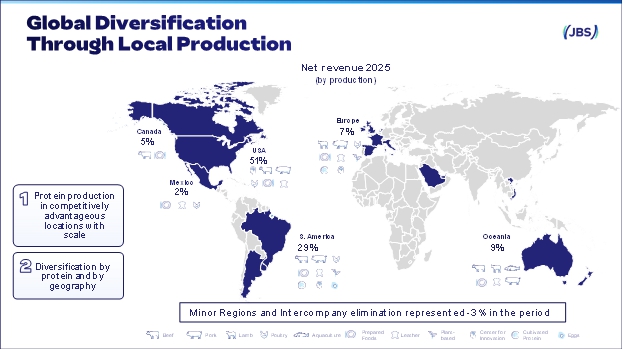
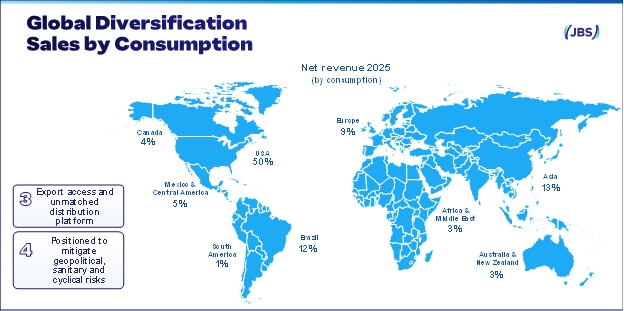
44
Our management uses net revenue, along with Adjusted EBITDA and Adjusted EBITDA Margin, to measure our performance. The following table sets forth some of our financial information for the periods indicated.
| For the year ended December 31, | ||||||||||||
| 2025 | 2024 | 2023 | ||||||||||
| (in millions of US$, except percentages) | ||||||||||||
| Net revenue | 86,184.2 | 77,182.5 | 72,918.1 | |||||||||
| Net income (loss) | 2,229.8 | 1,967.6 | (131.7 | ) | ||||||||
| Net margin (1) | 2.9 | % | 2.5 | % | (0.2 | )% | ||||||
| Adjusted EBITDA (2) | 6,831.4 | 7,191.9 | 3,457.9 | |||||||||
| Adjusted EBITDA margin (3) | 7.9 | % | 9.3 | % | 4.7 | % | ||||||
| (1) | Net margin is calculated by dividing net income (loss) by net revenue. |
| (2) | Adjusted EBITDA is used as a measure of performance by our management. Adjusted EBITDA is calculated by making the following adjustments to our net income, as further described in this annual report (see “Item 5. Operating and Financial Review and Prospects—A. Operating Results—Reconciliation of Adjusted EBITDA”): exclusion of current and deferred income taxes; exclusion of share of profit of equity-accounted investees, net of tax; exclusion of net finance expense; exclusion of depreciation and amortization expenses; exclusion of antitrust agreements expenses; exclusion of donations and social programs expenses; exclusion of impairment of assets; exclusion of restructuring expenses; exclusion of fiscal payments and installments; exclusion of Rio Grande do Sul claim losses; exclusion of extemporaneous litigation expenses; exclusion of reversal of tax credits; exclusion of avian influenza impacts; exclusion of certain tax assessments; and exclusion of certain other operating income (expense), net. Adjusted EBITDA is not a measure required by or calculated in accordance with IFRS – Accounting Standards, and should not be considered as a substitute for income from continuing operations, net income or any other measure of financial performance reported in accordance with IFRS – Accounting Standards or as measures of operating cash flows or liquidity. You should rely primarily on our financial information prepared in accordance with IFRS – Accounting Standards and use of Adjusted EBITDA in a supplemental manner in making your investment decision. For more information about the limitations of Adjusted EBITDA, see “Presentation of Financial and Other Information—Non-GAAP Financial Measures.” For a reconciliation of Adjusted EBITDA to net income, see “Item 5. Operating and Financial Review and Prospects—A. Operating Results—Reconciliation of Adjusted EBITDA.” |
| (3) | Adjusted EBITDA margin is calculated by dividing Adjusted EBITDA by net revenue. |
We have grown our business rapidly through strategic acquisitions and organic growth via a continuous focus on efficient capital investment targeted at high-return opportunities. As set forth in the charts below, we have grown our business from US$38.6 billion in net revenue in 2012 to US$86.2 billion in net revenue in 2025, representing a 6.4% compound annual growth rate (“CAGR”) since 2012 and Adjusted EBITDA (calculated as set forth below) from US$2.2 billion in 2012 to US$6.8 billion in 2025, representing a 9.0% CAGR. During the same period, our net income was US$0.4 billion in 2012 and US$2.2 billion in 2025, representing a CAGR of 14.4%, and our operating profit increased from US$1.4 billion in 2012 to US$4.2 billion in 2025, representing a CAGR of 8.9%. To calculate CAGR, we divided the value of the period in question by its value for the earliest comparative period, raised the result to the power of one divided by the number of intervening periods, and subtracted one from the subsequent result.
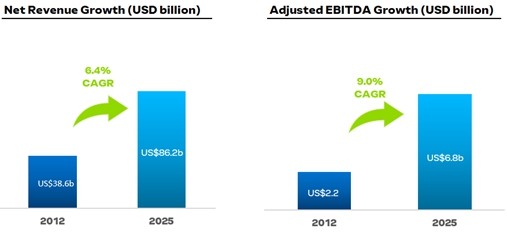
45
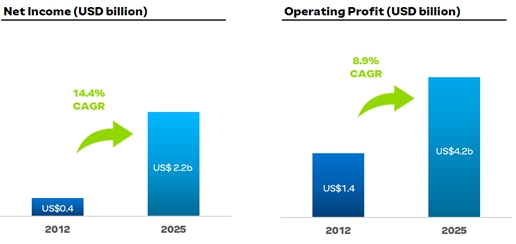
Description of Business Segments
In order to efficiently manage our global operations, we are organized according to the following seven business segments:
| ● | Brazil. Our Brazil segment includes all the operating activities from JBS S.A., mainly represented by slaughter facilities, cold storage and meat processing, fat, feed and production of cattle by-products, such as leather, collagen and other products produced in Brazil. In 2025, our Brazil segment had net revenue of US$15.3 billion and Adjusted EBITDA of US$955.1 million. |
| ● | Seara. Our Seara segment includes all of the operating activities of Seara and its subsidiaries, mainly represented by chicken and pork processing, production and commercialization of food products and value-added products. In 2025, our Seara segment had net revenue of US$9.2 billion and Adjusted EBITDA of US$1,553.4 million. |
| ● | Beef North America. Our Beef North America segment includes JBS USA’s beef processing operations in North America and the plant-based businesses in Europe. Beef North America also sells by-products to the variety meat, feed processing, fertilizer, automotive and pet food industries and also produces value-added meat products including toppings for pizzas. Sampco LLC imports processed meats and other foods such as canned fish, fruits and vegetables to the United States and Vivera Topholding BV produces and sells plant-based protein products in Europe. In 2025, our Beef North America segment had net revenue of US$28.1 billion and Adjusted EBITDA of US$(319.5) million. |
| ● | Pork USA. Our Pork USA segment includes JBS USA’s pork operations, including Swift Prepared Foods. As a complement to our pork processing business, we also conduct business through our hog production operations, including 31 hog farms and eight feed mills, from which, we will source live hogs for our pork processing operations. In 2025, our Pork USA segment had net revenue of US$8.4 billion and Adjusted EBITDA of US$898.9 million. |
| ● | Pilgrim’s Pride. Our Pilgrim’s Pride segment includes PPC’s operations, the majority of whose revenues are generated from United States, United Kingdom, Europe and Mexico sales of fresh and prepared chicken. The fresh chicken products consist of refrigerated (non-frozen) whole or cut-up chicken, either pre-marinated or non-marinated, and pre-packaged chicken in various combinations of freshly refrigerated, whole chickens and chicken parts. The prepared chicken products include portion-controlled breast fillets, tenderloins and strips, delicatessen products, salads, formed nuggets and patties and bone-in chicken parts. These products are sold either refrigerated or frozen and may be fully cooked, partially cooked or raw. In addition, these products are breaded or non-breaded and either pre-marinated or non-marinated. In 2025, our Pilgrim’s Pride segment had net revenue of US$18.5 billion and Adjusted EBITDA of US$2.8 billion. |
46
| ● | Australia. Our Australia segment includes our fresh, frozen, value-added and branded beef, lamb, pork and fish products in Australia and New Zealand. We also operate lamb, sheep, pork and fish processing facilities in Australia and New Zealand. In 2025, our Australia segment had net revenue of US$8.1 billion and Adjusted EBITDA of US$916.0 million. |
| ● | Miscellaneous. Our Miscellaneous segment (previously labelled “Others”) includes certain operations not directly attributable to our reportable segments set forth above, such as corporate expenses, international leather operations and other operations in Europe. In 2025, this segment had net revenue of US$142.6 million and Adjusted EBITDA of US$23.0 million. |
For additional information about our reportable segments, see note 25 to JBS N.V.’s consolidated financial statements and “Item 5. Operating and Financial Review and Prospects –A. Operating Results—Reportable Segments” and “—Description of Main Consolidated Statement of Income Line Items—Net Revenue.” Each segment’s operating profit or loss is evaluated by our chief operating decision maker based on Adjusted EBITDA. See “Presentation of Financial and Other Information—Non-GAAP Financial Measures—Adjusted EBITDA and Adjusted EBITDA Margin.”
The following charts set forth the proportion of our total net revenue and Adjusted EBITDA by segment for the year ended December 31, 2025.
| Net revenue by Segment (year ended December 31, 2025) (1) (2) |
Adjusted EBITDA by Segment (year ended December 31, 2025) (1) (2) | |
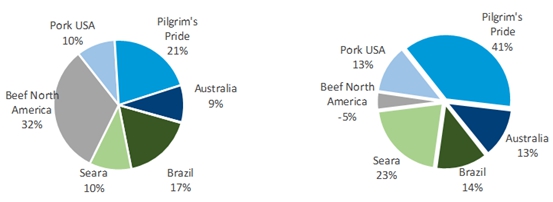 | ||
| (1) | Does not consider intercompany eliminations. |
| (2) | Percentage represented by the Miscellaneous segment is immaterial. For additional information, see “Item 5. Operating and Financial Review and Prospects—A. Operating Results—Overview of Results—Segment Results.” |
Products and Services
We generate the majority of our revenue in each segment from product sales. We sell our products domestically in the countries where we operate our facilities, which we classify as domestic sales, and elsewhere, which we classify as export sales. For example, a product sold in the United States would be classified as a domestic sale if produced in one of our plants in the United States or an export sale if produced in another country.
Our range of fresh products includes: fresh and frozen beef and lamb products (including traditional cuts, prime cuts and offal); fresh and frozen pork products (including pork carcasses, bone-in cuts, boneless cuts, pork bellies and offal); and fresh and frozen chicken products (including refrigerated and frozen whole and cut-up chickens, bone-in chicken parts and prepackaged case-ready chickens).
Our range of value-added and branded products includes: value-added and branded beef and lamb products (including frozen cooked and pre-cooked beef, corned cooked beef, beef cubes and consumer-ready products, such as hamburgers and sausages); value-added and branded pork products (including ham, trimmings, bacon, sausage and deli and lunch meats); prepared value-added and branded chicken products (including refrigerated and frozen portion-controlled breast fillets, tenderloins and strips, delicatessen products and salads, formed nuggets, patties and bone-in chicken parts, and breaded chicken); and branded egg.
47
In addition, we sell prepared food products (including ready-to-eat meals, frozen pizza and lasagna).
We also generate revenue from the services we provide, including cattle hotelling in Australia and hog farming in the United States. Cattle hotelling operations involve the custom housing and feeding of cattle that are owned by third parties in return for fees. While the feedlot operator generally sells the cattle on behalf of the owner (deducting the fees from the sale proceeds), the ultimate risk of the cattle going unsold is borne by the cattle owner, not the feedlot.
Brazil Segment
Products, Sales and Marketing
The majority of our Brazil segment revenues are generated from the sale of fresh beef (including fresh and frozen chuck cuts, rib cuts, loin cuts, round cuts, thin meats, ground beef, offal and other products) and value-added and branded beef products (including frozen cooked and pre-cooked beef, beef cubes and consumer-ready products, such as hamburgers).
We sell our Brazil segment products in Brazil, which we classify as domestic sales, and elsewhere, which we classify as export sales.
Our customers include:
| ● | national and regional retailers (including grocery store chains and independent grocers), wholesale distributors and food processors; |
| ● | international retailers and wholesale distributors (including in China, Hong Kong, the United States, the Middle East, Europe and emerging markets); and |
| ● | the foodservice industry, including foodservice distributors, fast food and other restaurants, hotel chains and other institutional customers. |
We market our products through local sales teams and agents and distribute our products both directly from our facilities and through our distribution centers.
We market our Brazil segment products under the brand names “Friboi,” “1953 Friboi,” “Black Friboi” and “Maturatta,” among other brand names.
Raw Materials
The primary raw material for our Brazilian beef processing operations is live cattle. We seek to purchase cattle from ranchers in Brazil generally located within 500 kilometers of one or more of our beef processing plants. The close proximity of our cattle suppliers to our beef processing facilities results in reduced transportation costs and reduces the risk of weight loss and bruising of cattle during transportation.
We enter into livestock purchase agreements with our cattle suppliers, including our affiliates J&F Floresta Agropecuária and JBJ Agropecuária. For more information about our agreement with JBJ Agropecuária, see “Item 7. Major Shareholders and Related Party Transactions—B. Related Party Transactions.” We employ experienced cattle buyers who purchase cattle in the principal cattle raising areas in Brazil. Our buyers are trained to select high quality, disease-free animals, and we constantly monitor their performance. We purchase cattle only from select registered producers, based on rigorous animal selection guidelines. Our cattle suppliers are required to document the quality of their operations and verify that their use of antibiotics and agricultural chemicals complies with industry standards. All cattle that we purchase in Brazil are inspected by officials from the SIF.
Cattle supply and prices are affected by several factors, such as climate, access to capital by cattle raisers and harvest period. The majority of the cattle slaughtered in Brazil is grass-fed.
48
Facilities
We operate 34 beef processing facilities in Brazil, in the States of Acre, Bahia, Goiás, Mato Grosso, Mato Grosso do Sul, Minas Gerais, Pará, Rondônia, São Paulo and Tocantins. Our facilities are strategically located to access raw materials in a cost effective manner and to service our global customer base.
For more information about our Brazil segment processing facilities and processing capacities, see “—D. Property, Plant and Equipment—Operating Facilities—Brazil Segment.”
Seara Segment
Products, Sales and Marketing
The majority of our Seara segment revenues from our chicken operations in Brazil are generated from the sale of value-added and branded chicken products (which may be fully cooked, partially cooked or raw, in addition to breaded and marinated products, including chicken nuggets and patties) and fresh chicken products (including refrigerated and frozen whole chickens, breast fillets and bone-in chicken parts).
The majority of our Seara segment revenues from our pork operations in Brazil are generated from the sale of value-added and branded pork products (including trimmed cuts, marinated products, ham and bacon) and fresh pork products (including fresh and frozen pork carcasses, bone-in cuts, boneless cuts, pork bellies and offal).
We also sell prepared food products (including ready-to-eat meals, frozen pizza, lasagna and others) under our Seara segment in Brazil, but also through our three facilities in the Middle East region.
We sell these products in Brazil, which we classify as domestic sales, and elsewhere, which we classify as export sales. Our customers include:
| ● | national and regional retailers (including grocery store chains, independent grocers and our own retail stores), wholesale distributors and food processors; |
| ● | international retailers and wholesale distributors (including in the Middle East, Europe, Africa, Asia and Latin America); and |
| ● | the foodservice industry, including foodservice distributors, fast food and other restaurants, hotel chains and other institutional customers. |
We market our Seara segment products under the brand names “Seara,” “Doriana,” “Seara Gourmet,” “Massa Leve,” “Rezende,” “Delícia,” “Primor,” “Marba,” “Incrível,” “Hans,” “Eder,” among other brand names.
Raw Materials
Chicken
We are a vertically-integrated chicken processor in Brazil and control every phase of the production of our products, including feed mills, hatcheries, incubators, processing plants and distribution centers. We own and raise breeder flocks for the production of hatching eggs. Once hatched, the chicks, or broilers, are transported to independent contract grow-out farms, where they are grown to an age of six to seven weeks. We supply our contract growers with the chicks, feed and veterinary services.
The prices of poultry feed may fluctuate significantly, including within short periods, due to several factors, including supply and demand of chicken and the prices of corn and soy meal, which are feed ingredients required for our vertically integrated operations. See “Item 3. Key Information—D. Risk Factors—Risks Relating to our Business and Industries— Our results of operations may be adversely affected by fluctuations in market prices for, and the availability of, livestock and animal feed ingredients.” We seek to manage certain of these risks with risk and hedge management programs, including futures and options agreements. However, these strategies do not completely eliminate these risks. In addition, these programs may also limit gains from fluctuations in commodities prices.
49
Pork
The primary raw material for our Brazil fresh pork processing operations is live hogs. Our Brazil fresh pork operations are mostly vertically integrated, and we own and raise hogs on feed for use in our own slaughterhouses. The raising of hogs is outsourced to contract farmers under strict supervision and control. We also purchase a small number of hogs from third parties on the spot market. The feed ingredients needed to raise hogs are substantially similar to those used to feed chickens. We generally purchase feed ingredients in the spot market or under forward purchase arrangements priced at market prices upon delivery or with fixed prices. We seek to hedge the feed ingredients we purchase in Brazil through financial instruments traded on the B3 in order to attempt to protect ourselves from price variations between the date of their purchase and the date of their delivery.
Facilities
We operate 31 fresh chicken processing, 25 value-added, branded and prepared foods facilities in Brazil, two prepared foods facilities in Saudi Arabia and one prepared foods facility in the United Arab Emirates. For more information about our Seara segment chicken processing facilities and processing capacities, see “—D. Property, Plant and Equipment—Operating Facilities—Seara Segment.”
We own and operate eight fresh pork processing facilities in Brazil, located in the States of Mato Grosso do Sul, Rio Grande do Sul, Paraná and Santa Catarina. For more information about our Seara segment pork processing facilities and processing capacities, see “—D. Property, Plant and Equipment—Operating Facilities—Seara Segment.”
As a vertically-integrated chicken processor, we also own and operate rendering plants, feed mills and hatcheries in Brazil.
Beef North America Segment
Products, Sales and Marketing
The majority of our beef revenues from our operations in the United States and Canada are generated from the sale of fresh beef products (including fresh and frozen chuck cuts, rib cuts, loin cuts, round cuts, thin meats, ground beef, offal and other products). We also sell value-added and branded beef products (including frozen cooked and pre-cooked beef, corned cooked beef, beef cubes and consumer-ready products, such as hamburgers and sausages). In addition, we sell beef by-products to the variety meat, feed processing, fertilizer and pet food industries. Cattle hides are sold for both domestic and international use, primarily to the clothing and automotive industries. We sell these products in the countries where we operate our facilities, which we classify as domestic sales, and elsewhere, which we classify as export sales. Following JBS USA’s acquisition Vivera Topholding BV, which was completed in June 2021, we also sell plant-based food products in Europe.
We market products under several brand names, including “Swift,” “1855,” “Grass Run Garm,” “Imperial American Wagiu Beef” and “La Herencia.” Our hallmark brand, Swift, was founded in 1855. We believe that our brands, marketed primarily at the wholesale level, provide a platform for further growth and expansion of our value-added and premium program product lines.
We market our products through several channels including:
| ● | national and regional retailers (including grocery supermarket chains, independent grocers and club stores) and wholesale distributors; |
| ● | prepared food companies who use our beef products as a food ingredient for prepared meals, raw materials for hamburger and by-products for pharmaceutical and leather production; |
| ● | the foodservice industry, including foodservice distributors, restaurant and hotel chains and other institutional customers; and |
| ● | international retailers and wholesale distributors (including Japan, Mexico, South Korea and Hong Kong). |
50
Our largest distribution channel is retail. We intend to focus on increasing our direct sales to retail and prepared food customers and to international distribution channels, which we believe are likely to provide the higher margin opportunities over time.
Global Exports
We sell our U.S. and Canadian beef products in approximately 70 countries on six continents. The international beef market is divided between the Pacific Block (which includes the United States, Japan, Canada, Mexico and South Korea) and the Atlantic Block (Europe, Africa, the Middle East and South America). This division reflects not only historical and geographical ties but also certain common sanitary criteria.
The Pacific Block prohibits imports of fresh beef from countries or regions where there is still a risk of new outbreaks of FMD and from countries or regions that are FMD-free but implement FMD vaccination programs. However, the Pacific Block permits imports of processed beef (including cooked and pre-cooked products) from these countries.
Most countries of the Atlantic Block permit imports of fresh beef from FMD-free countries that implement FMD vaccination programs. They also recognize that FMD can be eradicated on a regional (as opposed to national) basis in certain countries, including Brazil, which has areas that are FMD-free and have vaccination programs, qualifying them to export fresh beef. Under this regionalization concept, many beef producing regions in Brazil are thus qualified to export fresh beef to countries in the Atlantic Block. Notwithstanding the foregoing, most countries in the Atlantic Block impose import restrictions on beef treated with growth hormones, citing health concerns. Brazil and Argentina have prohibited the use of growth hormones on their cattle.
The United States has been an FMD-free country since the eradication of the disease, and it does not implement vaccination programs. However, the United States treats most of their cattle with growth hormones, and, accordingly, the European Union and several other countries have banned imports of beef from the United States treated with growth hormones.
Raw Materials
The primary raw material for our U.S. and Canadian beef processing plants is live cattle. Vertically integrated beef processors, who own cattle on feed, can be subject to significant financial impact in terms of working capital utilization, since cattle on feed eat in the yards for 90-180 days and do not generate revenue until processed. Since cattle on feed consume feed with a replacement price that is subject to market changes, vertically integrated beef processors have direct financial exposure to the volatility in corn and other feedstock prices. We do not own cattle on feed, and we generally purchase cattle in the spot market or pursuant to market-priced supply arrangements from feedlot operators and, except as described below, typically hold cattle for less than one day before processing. After processing, we sell the beef at spot prices. Because we generally buy cattle at market prices and sell the finished beef product at market prices with just a short time between the purchase and sale, we are not exposed to changing market prices over as great a span of time as vertically integrated processors. As such we are primarily a “spread” operator, and our operating profit is determined by plant operating efficiency in addition to fluctuations in prices of cattle and beef.
All of our U.S. cattle procurement process is centralized at our headquarters in Greeley, Colorado. We require all of our cattle suppliers to document the quality of their feedlot operations, verify that the use of antibiotics and agricultural chemicals follow the manufacturer’s intended standards and confirm that feed containing animal-based protein products, which have been associated with outbreaks of BSE, has not been used. We have in excess of 3,000 suppliers who supply us with cattle. JBS Packerland’s four processing plants purchase lean Holstein steers and cows and other cattle, primarily from feedyards, auction barns, direct contract relationships with suppliers in close proximity to processing plants and from its existing cattle feeding operations. The close proximity of these plants to most of their suppliers reduces transportation costs, shrinkage and bruising of livestock in transit.
We secure our cattle needs under forward purchase arrangements and on the spot market. Our forward purchase contracts are not fixed price contracts but are priced at market prices upon delivery, thus generally minimizing our exposure to price volatility before delivery.
51
On March 16, 2018, Pinnacle Arcadia Cattle Holdco, LLC, as supplier, and JBS USA Food Company, as buyer, entered into a live cattle supply agreement, pursuant to which the supplier agreed to exclusively sell, and buyer agreed to purchase, all cattle owned by the supplier and its affiliates to JBS USA Food Company and its affiliates (subject to certain limited exceptions), and the supplier shall guarantee a continuous supply of cattle per week and per year pursuant to minimum and maximum volumes and prices set forth in the agreement, for processing at buyer’s facilities. The term of the live cattle supply agreement is 10 years.
Processing Facilities
We own and operate nine beef processing facilities in the United States and one beef processing facility in Canada. Our facilities are strategically located to access raw materials in a cost effective manner and to service our global customer base. We also own and operate seven value-added and branded facilities in the United States and one in Canada, that are reported in our Beef North America segment and produce consumer-ready beef and pork products for certain customers. We also operate one hide tannery facility in the United States. We also own and operate three plant-based protein processing facilities in the Netherlands that are included in our Beef North America segment. For more information about our beef processing facilities and processing capacities in the United States and Canada, see “—D. Property, Plant and Equipment—Operating Facilities—Beef North America Segment.”
Our facilities utilize modern, highly-automated equipment to process and package beef products, which are typically marketed in the form of boxed beef. We also customize production and packaging of beef products for several large domestic and international customers. The designs of our facilities emphasize worker safety to ensure regulatory compliance and to reduce worker injuries. Our facilities are also designed to reduce waste products and emissions and dispose of waste in accordance with applicable environmental standards. We have equipped our Riverside, California facility to process value-added and branded products, including, for example, the G.F. Swift 1855 brand line of premium beef products. Our Greeley, Colorado; Cactus, Texas; and Grand Island, Nebraska, facilities have been equipped for value-added and branded operations, including slicing, grinding and cubing of beef products for retail and foodservice customers.
Our JBS Packerland facilities are engineered to process both fed cattle and cows. Steers and heifers raised on concentrated rations are typically referred to in the cattle industry as “fed cattle,” and cattle not fed such concentrated rations are usually referred to as “non-fed cattle.” Many beef processing facilities in the United States are engineered to process only cows or only fed cattle. This flexibility enables us to shift operations between fed cattle and cows based upon market availability, seasonal demand and margins. In addition, JBS Packerland facilities are located near major metropolitan areas, resulting in lower freight costs compared to cattle processing plants in other localities. JBS Packerland’s Tolleson, Arizona plant is located near Phoenix, Tucson and Los Angeles; the Plainwell, Michigan plant is located near Chicago and Detroit; the Green Bay plant is located near Milwaukee and Chicago; and the Souderton, Pennsylvania plant is located near Baltimore, Philadelphia and New York. We have also invested in a ground beef operation at the Tolleson plant.
Our food safety efforts incorporate what we believe to be a comprehensive network of leading technologies, such as our MultiCheck process, that minimize the risks involved in beef processing. Two of the elements of MultiCheck are double pasteurization of carcasses prior to chilling and a chilled carcass treatment using organic acid immediately prior to carcass disassembly. SwiftTrace™ is another element we implemented as part of our ongoing commitment to animal and human safety. SwiftTrace™ is a process whereby live animals and finished animal products can be traced backward or forward in the supply chain. This process helps to build confidence from suppliers, customers and consumers in the food supply chain.
Pork USA Segment
Products, Sales and Marketing
The majority of our revenues from our pork operations in the United States are generated from the sale of fresh pork products (including fresh and frozen pork carcasses, bone-in cuts, boneless cuts, pork bellies and offal). We also sell value-added and branded pork products, including bacon, sausage, hams, bellies and trimmings, which are sold predominantly to prepared food companies who, in turn, also manufacture bacon, sausage and deli and luncheon meats. Our remaining sales are derived from by-products and from value-added and branded, higher margin products. Due to the higher margins attributable to value-added and branded products, in recent years we have placed greater emphasis on the sale of moisture-enhanced, seasoned, marinated and consumer-ready pork products to the retail channel and boneless ham and skinless bellies to the prepared food channel. We sell these products in the United States, which we classify as domestic sales, and elsewhere, which we classify as export sales.
52
We sell our pork products in more than 30 countries on five continents. Most of our United States pork exports are sold to Asia, Mexico, America Central and Canada, since the European Union prohibits the import of animals treated with certain antibiotics and certain growth hormones commonly used in the United States. However, our Worthington, Minnesota pork processing plant is EU-certified and sells a portion of its production to the European Union.
Our JBS USA Pork segment also includes Sunnyvalley, a smoked bacon, ham and turkey processing business in the U.S., which we acquired on December 1, 2021 and expanded our presence in the value-added and branded product categories, and TriOak, which we acquired on December 2, 2022, and ensures access to a consistent supply of premium hogs for our pork processing facilities. In 2025, we announced the entry into an agreement to purchase a production facility in Ankeny, Iowa, for US$100 million, with plans to build out the largest ready-to-eat bacon and sausage plant in our U.S. portfolio. After the initial capital investments and construction are complete, the plant is expected to be operational by mid-2026. This announcement aligns with our long-term strategy of offering more value-added and prepared foods products to meet the needs of our customers and consumers.
We market products under several brand names, including “Swift,” “Principe,” “Sampco” and “Sunnyvalley,” as mentioned above, and among other names.
We market our pork products through several channels, including:
| ● | national and regional retailers (including grocery supermarket chains, independent grocers and club stores) and wholesale distributors; |
| ● | prepared food companies who use our pork products as a food ingredient for prepared meals, raw materials for sausage manufacturing and by-products for pharmaceutical and leather production; |
| ● | the foodservice industry, including foodservice distributors, fast food and other restaurants, hotel chains and other institutional customers; and |
| ● | international retailers and wholesale distributors (including in Japan, Mexico, South Korea and China). |
Raw Materials
The primary raw material for our United States pork processing operations is live hogs. We process live hogs in our production facilities and sell the finished products at spot prices. In the United States, the majority of our pork operations are not vertically integrated. Vertically-integrated pork processors, who own hogs on feed, can be subject to significant financial impact in terms of working capital utilization, since hogs on feed stay in yards for approximately 180 days. In addition, since hogs on feed consume feed with a replacement price that is subject to market volatility, vertically-integrated pork processors have direct financial exposure to the volatility in grains and feedstock prices. Because we typically acquire our live hogs within 24 hours of processing, we are not exposed to changing market prices over an extended span of time.
The majority of our live hog supply is purchased from third parties through long-term supply contracts. We employ a network of hog buyers at our processing plants and buying stations to secure our hog supply. These supply contracts are typically two to three years in duration and stipulate minimum and maximum purchase commitments with prices based in part on the market price of hogs upon delivery, with adjustments based on quality, weight, lean composition and meat quality. We purchase our remaining hogs on the spot market at a daily market price with the same general quality and yield grade as we require under our contracts.
We also operate 31 hog farms in the United States, and we raise approximately 25% of our live hog needs.
Processing Facilities
We own and operate five fresh pork processing facilities in the United States, located in close proximity to major hog growing regions. We also own and operate nine pork only value-added and branded facilities in addition to the seven shared beef and pork value-added and branded facilities described above under “—Beef North America Segment—Processing Facilities—United States and Canada.” For more information about our pork operating facilities in the United States, see “—D. Property, Plant and Equipment—Operating Facilities—Pork USA Segment.”
53
Our facilities utilize modern, highly-automated equipment to process and package pork products, which are typically marketed in the form of boxed pork. Since July 2007, we have made capital and operational expenditures, including the installation of plate freezers and value-added and branded variety meats capture technology. We believe that these expenditures have enhanced product quality, improved customer satisfaction and increased sales potential. All of our pork facilities produce value-added and branded products, including seasoned and marinated pork items. The design of our facilities emphasizes worker safety to ensure regulatory compliance and to reduce worker injuries. Our facilities are also designed to reduce waste products and emissions and dispose of waste in accordance with applicable environmental standards. Our Worthington, Minnesota pork plant is a European Union-certified facility that enables us to export primal cuts to Europe.
Our food safety task force consists of experts in the field of meat processing, food microbiology and quality assurance, all working together to assure compliance at all stages of the production chain and distribution channels. Our internal programs, policies and standards are designed to exceed both regulatory requirements and customer specifications. Our food safety efforts incorporate what we believe is a comprehensive network of leading technologies, such as our MultiCheck process described above, that minimize the risks involved in pork processing.
Pilgrim’s Pride Segment
Products, Sales and Marketing
North America
The majority of our revenues from our chicken operations in the United States, Mexico and Puerto Rico are generated from the sale of refrigerated whole and cut-up chickens and prepackaged case-ready chicken (including various combinations of freshly refrigerated whole chickens and chicken parts ready for the retail grocer’s fresh meat counter) and prepared chicken products (including refrigerated and frozen portion-controlled breast fillets, tenderloins and strips, delicatessen products and salads, formed nuggets and patties and bone-in chicken parts). Our prepared chicken products may be fully cooked, partially cooked or raw and include breaded and marinated products.
We market products under several brand names, including “Pilgrims Pride,” “Just Bare,” “Gold’n Plump,” , among others.
We sell these products in the countries where we operate our facilities, which we classify as domestic sales, and elsewhere, which we classify as export sales. Our customers include:
| ● | national and regional retailers (including grocery supermarket chains, independent grocers and club stores) and wholesale distributors; |
| ● | international retailers and wholesale distributors in approximately 80 countries on six continents; and |
| ● | the foodservice industry, including foodservice distributors, fast food and other restaurants, hotel chains and other institutional customers. |
We market our North American chicken products under the brand names “Pilgrim’s Pride,” “Gold Kist Farms” and “Del Dia,” among others.
Europe
Our revenues from our chicken operations in Europe are generated from our Moy Park business, which includes the sale of fresh and frozen, value-added, branded and prepared chicken products. In the United Kingdom, our fresh chicken sales primarily consist of refrigerated and frozen whole chickens, breast fillets and bone-in chicken parts. In the United Kingdom, France and the Netherlands, we produce value-added, branded and prepared chicken products for sale to customers in retail, foodservice, agricultural and international distribution channels. We also sell a range of ready-to-cook, coated and ready-to-eat chicken products to major retailers and large foodservice customers. We maintain a new product development team and an executive chef to continue to develop new ideas for value added products across our range, and share those insights with our customers in order to drive sales. We have included new innovative products in its portfolio every year since 2020 with a growing new product development pipeline.
54
Our Pilgrim’s Pride segment also includes our U.K. prepared meat and meals products business, which we acquired through PPC’s acquisition of the specialty meats and ready meals businesses of Pilgrim’s Food Masters (formerly known as Kerry Group plc). Pilgrim’s Food Master is a leading manufacturer of branded and private label meats, meat snacks and food-to-go products in the U.K. and the Republic of Ireland. We closed the Pilgrim’s Food Masters acquisition in September 2021.
We have strong brands with high levels of brand recognition in the markets in which such brands are sold, including “Moy Park,” “Richmond,” “Fridge Riders,” “Denny,” “Rollover,” “Oak House Foods,” among other brands. We believe the development of our brands is important as it provides customers with confidence in the quality and consistency of our products. Brand marketing is focused on establishing our brands through consistent quality and product innovation as well as developing relationships with key customers. We believe that our brands can be expanded throughout Europe, which provides the opportunity to sell higher-margin products in our traditional markets.
We sell these products in the countries where we operate our facilities, which we classify as domestic sales, and elsewhere, which we classify as export sales. Our customers include:
| ● | national and regional retailers (including grocery supermarket chains, independent grocers and club stores) and wholesale distributors; |
| ● | international retailers and wholesale distributors; and |
| ● | the foodservice industry, including foodservice distributors, fast food and other restaurants, hotel chains and other institutional customers. |
Raw Materials
We are a vertically-integrated chicken processor in North America and Europe. We control every phase of the production of our products, including farms (contract, owned, under poultry rearing agreements or under tenancy), feed mills, hatcheries and processing plants. A portion of our broilers are transported to independent contract grow-out farms, where they are grown to an age of approximately five weeks. We supply our contract growers with the chicks, feed and veterinary services.
We typically enter into long-term non-exclusive agreements with some of our suppliers for future physical delivery of feed ingredients at established prices. All of our suppliers are subject to inspection bodies and applicable laws in their area of operations. We have multiple suppliers and we believe a low risk of concentration.
The prices of poultry feed may fluctuate significantly, including within short periods, due to several factors, including supply and demand of chicken and the prices of corn and soy meal, which are feed ingredients required for our vertically integrated operations. See “Item 3. Key Information—D. Risk Factors—Risks Relating to our Business and Industries—Our results of operations may be adversely affected by fluctuations in market prices for livestock and animal feed ingredients.” We try to manage some of these risks with risk and hedge management programs, including futures and options agreements. However, these strategies do not completely eliminate these risks. In addition, these programs may also limit gains from fluctuations in commodities prices. Furthermore, in 2012 we began migrating a majority of our North American finished goods sales contracts to cost-plus contracts with certain of our customers and market-based contracts for most of our customers, thereby mitigating our exposure to grain price fluctuations.
Processing Facilities
North America
We own and operate 25 chicken processing facilities in the United States, six chicken processing facilities in Mexico and one chicken processing facility in Puerto Rico. For more information about our chicken processing facilities and processing capacities in the United States, Mexico and Puerto Rico, see “—D. Property, Plant and Equipment—Operating Facilities—Pilgrim’s Pride Segment.”
55
As a vertically-integrated chicken processor, we also own and operate rendering plants, feed mills and hatcheries in the United States, Mexico and Puerto Rico.
Europe
We own and operate four fresh chicken processing facilities, two pork processing facilities, one lamb processing facility and one hog farm in the United Kingdom. As a vertically-integrated chicken processor, we also own and operate feed mills and hatcheries in the United Kingdom.
We conduct our value-added and prepared food operations in Europe through 23 processing facilities.
For more information about our chicken, value-added, branded and prepared food processing facilities and processing capacities in the United Kingdom and Europe, see “—D. Property, Plant and Equipment—Operating Facilities—Pilgrim’s Pride Segment.”
Australia Segment
Products, Sales and Marketing
The majority of our beef revenues from our operations in Australia are generated from the sale of fresh beef products (including fresh and frozen chuck cuts, rib cuts, loin cuts, round cuts, thin meats, ground beef, offal and other products). We also sell value-added and branded beef products (including frozen cooked and pre-cooked beef, corned cooked beef, beef cubes and consumer-ready products, such as hamburgers and sausages). We also operate lamb, pork and fish processing facilities in Australia and New Zealand. We sell these products in the countries where we operate our facilities, which we classify as domestic sales, and elsewhere, which we classify as export sales.
The majority of our beef products are derived from grass-fed cattle. However, we also sell beef products derived from grain-fed cattle, which provide higher quality meat and command a premium price.
We also provide cattle “hotelling” services in Australia. We operate several feedlots that provide custom feeds for other producers on an opportunistic basis, with a one-time feeding capacity of more than 160,000 cattle. While the feedlot operator generally sells the cattle on behalf of the owner (deducting any final feed and care costs for fattening the animal and delivering the fattened animal to the meat processor from the sale proceeds), the ultimate risk of the cattle going unsold is borne by the cattle’s owner, not the feedlot.
Our JBS Australia segment also includes Rivalea, a hog breeding and processing business in Australia we acquired on January 4, 2022, and Huon Aquaculture Group Ltd, an Australian salmon aquaculture company we acquired on November 17, 2021. This acquisition expands our presence in Australia as we enter into the salmon business.
We market products under several brand names, including “Swift,” “Great Southern,” “Primo,” “Rivalea,” “Beehive,” among others.
Global Exports
Australia is an FMD-free country and does not implement vaccination programs against the disease. It also does not use growth hormones in a small part of its cattle herd and is therefore able to export to any country in the world.
As a result of this division and the sanitary restrictions between the Pacific Block and the Atlantic Block, we believe that our U.S. export operations of fresh beef today do not directly compete with our Brazilian export operations of fresh beef in our main export destinations. Although JBS in Brazil is a large exporter of beef to the European Union, for example, we do not have relevant export volume to the European Union because of its restrictions on beef treated with growth hormones. Consequently, we do not have formal arrangements with JBS in Brazil to coordinate our exports in our export markets. However, to the extent that sanitary restrictions change in the future, we could become direct competitors of our Brazilian operations in certain export markets.
56
Raw Materials
The primary raw materials for our Australia and New Zealand processing operations are live cattle, lamb, hog and grain. Our Australian cattle procurement function is focused on efficiently sourcing both grass-fed cattle and feeder cattle for our grain-fed business. Our cattle are primarily sourced from third party suppliers with specific weight and grade characteristics. This process helps ensure that the cattle we source meet our future order requirements.
Processing Facilities
In Australia, we own and operate seven standalone beef processing plants, including the largest and what we believe to be the most technologically advanced facility in that country, two standalone lamb processing plants and one combined beef and lamb processing plant, three pork processing plants and two fish processing plants. We also operate seven value-added facilities and eight retail locations and 43 hog farms in Australia and one value-add facility in New Zealand. Our facilities are strategically located to access raw materials in a cost effective manner and to service our global customer base. We also operate one hide processing facility in Australia. For more information about our beef, lamb, pork and fish operating facilities in Australia and New Zealand, see “—D. Property, Plant and Equipment—Operating Facilities—Australia Segment.”
Since 2007, we have made capital and operational expenditures, including the installation of plate freezers and value-added variety meats capture technology. We believe these expenditures have enhanced product quality, improved customer satisfaction and increased sales potential. We have equipped our facilities to process value-added products and consumer-ready products. Our facilities produce additional value-added products, including seasoned and marinated beef items. The design of our facilities emphasizes worker safety to ensure regulatory compliance and to reduce worker injuries. Our facilities are also designed to reduce waste products and emissions and dispose of waste in accordance with applicable environmental standards.
All products are subject to stringent animal husbandry and food safety procedures. Our processing plants are subject to extensive regulation and inspection by the Australian government, through the Australian Quarantine Inspection Service (“AQIS”), the Australian equivalent of the USDA. Our Australian processing plants are currently in compliance with all AQIS international customer requirements. Our Dinmore and Beef City facilities are European Union-certified facilities, which enable us to export primal cuts to Europe. Our feedlots provide a clean and scientific feeding regimen to ensure that safe grain-fed products are delivered to our customers.
Miscellaneous Segment
Our Miscellaneous segment include certain operations not directly attributable to our reportable segments set forth above, such as corporate expenses, international leather operations and other operations in Europe.
We operate several hide tanneries around the world, including: one in Argentina, one in Uruguay, one in Mexico, one in Germany, one in Vietnam and one in Italy.
Distribution and Transportation
Our distribution and transportation network enables us to sell our products throughout the world and is fundamental to our strategy of expanding into new markets and consolidating our safe and high-quality services in markets in which we already operate. We continue to seek innovative solutions to accomplish this mission. Our distribution network consists of distribution centers and sales offices.
57
The table below sets forth our owned and leased distribution centers by location as of December 31, 2025:
| Owned Facilities | Leased Facilities | Total | |||||||
| Brazil | 9 | 24 | 33 | ||||||
| Mexico | 8 | 23 | 31 | ||||||
| United States | 2 | — | 2 | ||||||
| Puerto Rico | — | 1 | 1 | ||||||
| Australia | — | 7 | 7 | ||||||
| New Zealand | — | 1 | 1 | ||||||
| Europe | 1 | 2 | 3 | ||||||
| Total | 20 | 58 | 78 |
South America
Our transportation network in Brazil consists of owned and outsourced trucks for distribution and transportation of raw material. We use this fleet to transport raw materials, including cattle, grains and chicken to our processing plants and export finished products to various ports throughout Brazil, as well as other vehicles that serve our direct distribution network of domestic retailers and end consumers.
In order to facilitate export logistics, we have an inland container terminal on land located in Cubatão, São Paulo (near the Port of Santos, the largest port in Latin America), which we purchased in October 2007.
North America
Our transportation network in the United States consists of owned or leased trucks in the United States that are especially equipped to transport raw materials and finished products. We also utilize third-party shipping companies that provide us with additional trucks to transport our raw materials and finished products. Our diesel fuel costs are not significant because fuel costs are generally borne by the customer and are therefore largely “passed through” to the buyer of the finished goods. We do not have long-term contracts to purchase diesel fuel since we purchase most of our fuel for our trucks on the national highway system in truck stops.
Europe
In Europe, we rely on a mix of owned and contractor-operated vehicles to transport live chickens from farms to our primary production sites in specialized humane high-welfare containers. We also rely on a mix of owned and contractor-operated refrigerated vehicles to move partly finished products between our various production sites for further processing. Once processed, our products are chilled or frozen and delivered to our customers. Chilled products typically move from the processing plant to the customer within one to two days.
For deliveries to customers, we outsource distribution using a number of distribution partners, which enables us to make use of a variety of flexible solutions provided by these logistics providers. Certain of our customers are involved in our product distribution process, either by handling all of their own delivery and distribution needs (effectively taking delivery of our products at the factory door) or by acting as contractors to back-haul certain products from Northern Ireland to destinations in Great Britain. In order to mitigate the risks associated with the refrigerated transportation of perishable items, we obtain insurance for loss of goods and we secure contractual provisions transferring some of the risk to haulers. However, we are at times forced to bear certain of these risks ourselves.
Our warehousing operations are predominantly focused at site level, with external cold storage locations available for use, as needed, but with a focus on minimizing their use to reduce costs. A dedicated internal team drives planning for logistical processes to ensure that operations are as low cost but as flexible as possible while maintaining the highest levels of customer service.
Our poultry by-products typically have a longer lag time between processing and delivery to the customer.
58
Australia and New Zealand
Our distribution network in Australia and New Zealand varies by product type. Our distribution facilities in Australia and New Zealand are strategically located near certain of our processing plants. We also sell our products to foodservice distributors that further distribute our products to restaurants and hotel chains and other customers. These foodservice distributors purchase our products from our processing plants.
Competition
Beef and Pork Industries
The beef and pork sectors are highly competitive in the markets in which we operate. We believe that the main competitive factors in the beef and pork industries are operational efficiency, product availability, quality and cost of raw materials, manpower, price, quality, food safety, product distribution, technological innovation and brand loyalty. Our ability to compete effectively depends on our capacity to compete in these areas. See “Item 3. Key Information—D. Risk Factors—Risks Relating to Our Business and Industries—We face competition in our business, which may adversely affect our market share and profitability.”
In the beef sector, our primary competitors are international beef producers, such as Marfrig and Minerva in Brazil, Tyson Foods, Inc., National Beef Packing Company, LLC and Cargill Inc. in the United States and Teys Bros Pty Ltd. and Nippon Meat Packers Ltd. in Australia. In the pork sector, our primary competitors are Smithfield Foods, Inc., Tyson Foods, Inc., Seaboard Foods and Hormel Foods Corporation in the United States and Cooperativa Aurora—Cooperativa Central Oeste Catarinense Ltda. in Brazil.
In addition, our United States, Canadian and Australian beef operations also compete with our South American beef operations to a limited degree. For example, our Australian operations export to markets in the European Union, the United States, Africa and the Middle East, Japan and South Korea, which are markets to which our South American operations also exports. We do not believe our intra-company competition in these markets has a material adverse effect on our current business.
Poultry Industry
The poultry sector is highly competitive in the markets in which we operate. We believe that the main competitive factors in the poultry industry vary in accordance with the market. In the retail market, we believe that competition is primarily based on product quality, brand awareness, client service and price. In the food services market, we believe that competition is primarily based on consistent quality, product development, customer service and price. Our ability to compete effectively depends on our capacity to compete in these areas. See “Item 3. Key Information—D. Risk Factors—Risks Relating to Our Business and Industries—We face competition in our business, which may adversely affect our market share and profitability.”
In the poultry sector, our primary competitors are Tyson Foods, Inc. and Sanderson Farms, Inc. in North America, BRF in Brazil and 2 Sisters Food Group in Europe.
Seasonality
Demand
In the beef sector in the United States, seasonal demand for beef products is higher in the summer and autumn months, when weather patterns allow for more outdoor activities. There is typically an increase in the demand for higher value products, such as steaks, during such months. Both the prices for live cattle and packaged beef tend to reach seasonal highs at such times. Because of the increase in consumption and more favorable conditions for the growth and housing of confined animals in the winter months, there are generally more cattle available in the summer and autumn. Seasonal demand in Australia does not fluctuate as much as it does in the United States.
The pork sector in the United States presents similar seasonal cycles, but in different months. The greatest demand for pork occurs from October to March, when the availability of hogs combined with the holidays increase the demand for ham, pork loin and other pork products with greater aggregated value.
59
We experience no major seasonal fluctuations in demand in our United States, Mexico and Puerto Rico chicken business. Nevertheless, our net revenues have been historically higher in our second and third fiscal quarters, corresponding to the spring and summer in North America and lower in our first fiscal quarter, corresponding to the winter.
Generally, our sales in Brazil are not impacted by seasonality. However, in regards to our chicken segment, we have observed fluctuations in demand whereby our net revenues in Brazil from this segment are historically higher in the first half of the year, coinciding with the summer and fall, and sales volume of certain of our special product lines undergo considerable variation during certain holidays, including Christmas, New Year and Easter. Nonetheless, we believe that such variations do not materially affect our results.
Our chicken and processed food businesses are generally subject to minor seasonal fluctuations in our European division, which includes operations in the United Kingdom, Ireland, France and the Netherlands. While product mix changes seasonally, with certain prepared foods and barbecue items selling in higher volumes during the summer, and certain prepared foods and raw turkeys selling in higher volumes around Christmas, there is generally a continued demand for poultry throughout the year.
Impact of Commodity Prices
Beef, pork and chicken markets are affected by fluctuations in the prices of certain commodities. Our North American beef and pork businesses are indirectly influenced by fluctuations in the prices of feed ingredients since we do not keep or raise our own cattle and we raise only about 25% of our hogs. Instead, our beef and pork businesses are more directly affected by fluctuations in the spot market for beef cattle and hogs in the regions where we buy a significant part of the beef cattle and hogs required for our operations. On the other hand, our North American chicken business is more influenced by fluctuations in the prices of corn and soy meal, which are feed ingredients required for our vertically integrated chicken operations.
A substantial portion of animal feed production used for the growing of chicken in Brazil comes from soy, soy products and corn, and although these costs are denominated in Brazilian reais, the prices of these commodities tend to follow international prices, which in turn, are denominated in U.S. dollars and are influenced by exchange rate fluctuations. As a result, our businesses are heavily influenced by fluctuations in the prices of corn and soy meal, feed ingredients that are necessary for our vertically integrated chicken operations.
Likewise, the fluctuation of commodities prices impacts the prices of raw materials, primarily wheat and soy, used to produce feed for our chicken operations in Europe.
Intellectual Property
Although we hold a number of trademarks that are registered or have been filed and are under analysis with the Brazilian Intellectual Property Office (Instituto Nacional de Propriedade Industrial), the United States Patent and Trademark Office and trademark offices in other jurisdictions, we do not depend on any specific trademark or other form of intellectual property to run our business.
Insurance
We have an insurance program that provides for protection against (1) property damages affecting most of our buildings, furniture, machinery, appliances, products and raw materials caused by fire, lightning, explosion, flooding, electrical faults, landslides, riots, strikes, lock-outs and windstorms, (2) deterioration of goods in refrigerated areas, (3) robbery and theft, (4) environmental liability regarding transportation and (5) D&O insurance. Our insurance is renewed annually. We believe that our insurance policies provide suitable coverage for the risks inherent to our operations both in terms of the type of coverage and of the insured amounts. Even though we have insurance policies, there are risks that are not covered, such as war, unavoidable and unforeseen circumstances or the interruption of some activities and losses arising from events that are not insured. If any of these events occur, we may incur significant costs which may have a material adverse effect upon our financial performance and results of operation.
60
Certain of our subsidiaries offer their employees defined medical and dental benefit, which expose us to actuarial risks. We purchase insurance policies with deductibles for certain losses related to workers’ compensation and casualty and property damage claims. We purchase stop-loss coverage in order to limit our exposure to any significant level of certain claims. We are self-insured for risks relating to environmental liability. Self-insured losses are accrued based upon periodic assessments of estimated settlements for known and anticipated claims.
Compliance Program
Since the execution of the Brazilian Collaboration Agreements and Leniency Agreement in 2017 (see “Item 7. Major Shareholders and Related Party Transactions—A. Major Shareholders—Civil and Criminal Actions and Investigations involving our Ultimate Controlling Shareholders”), JBS S.A. and its subsidiaries have made substantial investments in the improvement of their anti-bribery and anti-corruption compliance program (the “ABAC Program”). In particular, the ABAC Program has been structured around the key pillars described below:
| ● | Leadership and tone at the top. The ABAC Program is overseen by JBS N.V.’s board of directors through reporting from compliance department leadership. Senior professionals with significant legal and compliance experience in government and private practice have been hired to oversee the day-to-day operation of each company’s compliance department. These professionals include a Global Chief Ethics and Compliance Officer and heads of compliance in the United States, Brazil, Australia and the United Kingdom. The leadership teams are supported by dedicated compliance professionals who manage the compliance function. The ABAC Program also is supported by ethics and compliance committees, which have been implemented at JBS N.V., JBS USA and PPC. The committees generally meet quarterly and include senior business leaders or other business unit leaders. The committees address a variety of compliance matters, including assisting with improvements to the ABAC Program, reviewing ethics cases and providing guidance to the compliance departments. |
In June 2022, as a part of our strategy to consolidate the ABAC Program under a global structure, JBS S.A. formed the Global Executive Ethics and Compliance Committee, which is an executive committee comprised of the JBS Global Chief Ethics and Compliance Officer, JBS S.A. Compliance Director, PPC Head of Ethics and Compliance, JBS Australia General Counsel, J&F Global Compliance Officer and the Chairman of the JBS S.A. board of directors. The goal of the Global Compliance Committee is to harmonize key compliance-related policy areas in the company’s worldwide business. Specifically, the Global Compliance Committee’s organizational document charges the Global Compliance Committee with:
| o | advising, supporting and identifying matters and subjects to improve within the ABAC Program, including detecting potential violations of law, regulations or policy; |
| o | recommending the implementation of policies to be applied globally by all of our companies; |
| o | helping ensure that our business is conducted with integrity and ethics, in accordance with all relevant laws and regulations, our Code of Conduct and Ethics (“Code of Conduct”), policies and internal controls practices; and |
| o | preventing, detecting and correcting any ethical, behavioral, and/or any compliance-related deviation. |
| ● | Risk assessment. JBS S.A. has conducted periodic risk assessments, with the assistance of experienced professionals, to understand the bribery and compliance risks associated with the company’s business activities. The risk assessments have been used to adapt our ABAC Program to the risks we face, including developing additional training and implementing mitigating controls. |
| ● | Policies and procedures. We have adopted an updated global Code of Conduct, which is available in multiple languages, and have established and updated risk-based policies applicable to our business and the risks that we face. Our policies address, among other matters, the risks of bribery and corruption, conflicts of interest, gifts, meals, entertainment, donations, sponsorships and third parties, and, under the guidance of the Global Compliance Committee, we specifically adopted a Global Antibribery and Anticorruption Policy several years ago. |
| ● | Training. Our employees receive training on our Code of Conduct and our policies, including our Global Anti-Bribery and Anti-Corruption Policy. Training is provided at onboarding and periodically thereafter. |
61
| ● | Ethics line and investigations. We have implemented ethics lines across our global footprint that are hosted by independent third parties, which allow any interested party to report potential or suspected violations of our Code of Conduct, policies or applicable law, and, if desired, on an anonymous basis. We have policies and procedures that govern how we review and investigate ethics line reports and, if necessary, impose discipline and implement remedial measures. Our Code of Conduct and Global Non-Retaliation Policy prohibit retaliation against anyone making a good faith report of a violation of the law, our Code of Conduct, or our policies. |
| ● | Third parties. We have implemented measures to mitigate ABAC risk presented by third parties, including conducting risk-based diligence on third parties, requiring compliance with our Business Associate Code of Conduct, which is similar to our Code of Conduct, third party training and other risk mitigating measures. |
| ● | Communications. We regularly communicate with our employees to promote our policies, drive engagement and highlight the risks we face. We also periodically host compliance events or participate in company events to promote ethics and compliance priorities. |
| ● | Controls. The ABAC Program includes risk-based controls that have been implemented to mitigate material compliance risks. These controls allow our compliance professionals to track risks and assess the status and effectiveness of the ABAC Program. Other controls require the approval from the compliance department of certain transactions involving government officials or prohibit transactions with certain high risk parties. |
| ● | Monitoring. We seek opportunities on an ongoing basis to improve the ABAC Program and we have undergone internal and external reviews intended to identify such opportunities. We have hired experienced professionals, including law firms and international auditing firms, to evaluate our program and we have collaborated with those professionals to refine our program to further mitigate risk. |
Regulation
Environmental and Health Regulations
Our operations are subject to local, state and federal environmental and health laws and regulations in the jurisdictions in which we operate. We believe that we are in substantial compliance with all applicable laws and regulations relating to the operations of our facilities and we maintain a rigorous program of interventions, inspections and testing to reduce the likelihood of food safety hazards.
The following presents a summary of the environmental- and health-related regulatory requirements to which we are subject in our most significant jurisdictions.
Brazil
Our Brazilian operations are subject to Brazilian federal, state and local laws and regulations governing environmental licensing, use of water resources, interference in specially protected areas (such as legal reserve areas, indigenous areas, quilombola community areas, conservation units, archaeological areas and permanent preservation areas), the discharge of effluents and emissions into the environment, the management and disposal of industrial waste and other environmental protection laws and regulations. The Brazilian Constitution grants federal, state and municipal governments the authority to issue environmental protection laws and to publish regulations based on those laws. While the Brazilian federal government has authority to issue environmental regulations setting general standards for environmental protection, state governments have the authority to issue stricter environmental regulations. Municipal governments may only issue regulations regarding matters of local interest or as a supplement to federal or state laws. In situations where there is a conflict of rules, the legislation offering greater environmental protection will normally prevail.
Our operations in Brazil are subject to environmental licensing, which is required for potentially polluting activities or those that may in any way cause environmental degradation. Environmental licensing is required for both greenfield and brownfield enterprises.
62
Environmental licensing is usually comprised of three stages: preliminary, installation and operating licenses. The preliminary license is granted during the preliminary phase of an enterprise or activity, to authorize its location and concept, attesting its environmental feasibility, and establishes the conditions and technical requirements to be complied in further stages of development. The installation license authorizes the facility’s construction in accordance with the specifications stated in the license and/or in the plans, programs and projects approved by the environmental authority. The operating license authorizes the commencement and continuation of operational activities after the fulfillment of the conditions and requirements stated in the installation license. The operating license also establishes conditions and technical requirements that must be fulfilled in order to maintain its validity. These licenses are also required for any significant expansion, amendments of our activities or increase of production capacity.
The renewal of environmental licenses usually must be requested within 120 (one hundred twenty) days before the end of its term of validity in order to automatically extend the validity of the licenses until the environmental authority’s definitive decision on such request. Carrying out a potentially polluting activity without the relevant and applicable environmental license is an administrative violation and a criminal offense, regardless of the legal obligation to repair any environmental damage eventually caused. In the administrative sphere, the legislation in effect authorizes the imposition of fines ranging from R$50.00 to R$50,000,000.00, among other penalties such as warning, embargo, full or partial suspension of the activities and demolition. The sanctions are also applicable in case the entrepreneur fails to comply with the technical conditions established in the related environmental license.
The Brazilian Federal Constitution provides for three different types of environmental liabilities: civil, administrative and criminal, that may be applied independently and cumulatively.
Civil liability for environmental damage is strict and applies to any individual or legal entity, whether public or private, that directly or indirectly harms the environment, irrespective of fault or intent. The proof of a causal link between the action (or omission) and the damage is enough. Brazilian law also imposes joint and several liability upon anyone who, by virtue of a given activity, facilitates or contributes to environmental damages.
Civil environmental liability in Brazil is also considered by case law as propter rem, that is, liability attaches to the real estate property. Therefore, whoever buys or holds environmentally damaged land will succeed in the liability for the clean up or recovery and for reparation of potential damage to third parties. Moreover, Federal Law No. 9,605/98 (Environmental Crimes Act) also provides for the possibility of piercing the corporate veil when it is an obstacle to recover damage caused to the environment. As a result, the controlling legal entity can be found liable despite a limited liability legal status. In this situation, shareholders and officers may become personally liable for the damage.
At the administrative level, environmental liability may be assigned through administrative sanctions imposed by the applicable environmental entities. These sanction may lead to: (1) warnings; (2) restriction of rights; (3) suspension or interdiction of the activities; (4) prohibition to contract with the government; (5) suspension of licenses; (6) withdrawal of tax incentives and benefits; and (7) imposition of fines, ranging from R$50.00 to R$50,000,000.00, tailored to the economic capacity and track record of the offender, in addition to the severity of the facts and past performance, with the possibility of these fines being imposed at double or triple rates for repeated offenses. Administrative liability falls on the person engaged in the conduct described as an administrative offense.
Criminal liability is personal, arising directly from the unlawful conduct of the agent. Brazilian law allows criminal liability to be assigned to individual persons, as well as corporate entities. When liability is assigned to corporate entities, the individual persons making the decision that resulted in the criminal conduct (such as directors, officers, administrators, board members, members of technical entities, auditors, managers, agents or representatives) may also be penalized to the extent of their culpability. Violators may be subject to criminal penalties, such as imprisonment and/or fines. There is also a possibility of replacement of custodial sentences with restricting rights penalties in specific cases established by law.
The presence of hazardous materials at our facilities may expose us to potential liabilities associated with the clean up of contaminated soil and groundwater. The existence of contamination represents an environmental liability that may result in civil, administrative and criminal sanctions for the polluter, operator and/or the purchaser of the affected property. We could be liable for (1) the costs involving the remediation of any existing contamination and (2) the restoration of natural resources damaged by any release, among other proceedings requested by the environmental agency. The investigations, remediation and monitoring of contaminated areas generally are time consuming and involve significant costs. In addition to the risk of sanctions in the criminal sphere (imprisonment for up to four years for shareholders, officers or any other person that has been found liable for the offense and assessment of a fine) and administrative sphere, and the obligation to repair the damage in the civil sphere, the existence of environmental contamination may negatively impact our image.
63
We promptly address any identified environmental non-conformities through the implementation of appropriate corrective and preventive measures, with the objective of mitigating environmental risks and preventing any potential adverse impacts.
Our operations in Brazil are subject to extensive regulation and oversight by the Brazilian Ministry of Agriculture and Livestock (Ministério da Agricultura, Pecuária e Abastecimento), the Brazilian National Health Surveillance Agency (Agência Nacional de Vigilância Sanitária) (“ANVISA”), and other federal, state and local authorities regarding the processing, packaging, storage, distribution, advertising and labeling of our products, including food safety standards. Recently, the food safety practices and procedures of the meat processing industry have been subject to increased scrutiny and oversight by the Brazilian Ministry of Agriculture and Livestock and ANVISA. Each facility in which we operate is subject to prior licensing by state authorities and must provide veterinarian oversight of a veterinarian duly enrolled before the Veterinary Medical Regional Council - CRMV. If we fail to comply with any health laws, to renew licenses or to otherwise comply with any laws regulating our industries, we may be subject to legal and civil liability, including warnings, fines, interdiction, and suspension of permits or licenses, as well as penalties under Law No. 6,437 of August 20, 1977, Decree No. 9,013, of March 29, 2017, and others.
All of our meat processing plants in Brazil are approved by the Brazilian Federal Inspection Service (Serviço de Inspeção Federal—SIF), which regulates the export of animal products and certifies our production facilities. Our animal product exports receive an international health certificate and our transfers in Brazil receive an uncertified transfer form. U.S. and European markets are regulated by the Brazilian Federal Inspection Service (Serviço de Inspeção Federal—SIF), whose controls are stricter. Our quality control measures include the use of on-site laboratories and expert technicians. To meet international health standards, our products are handled in climate-controlled rooms and our freezing and refrigeration chambers are equipped with computerized temperature-control systems. Noncompliance with these health standards may result in the revocation of our licenses or permits or suspension of our operations in addition to any financial liability or reputational damage.
We promptly address any identified sanitary non-conformities through the implementation of appropriate corrective and preventive measures, with the objective of mitigating sanitary risks and preventing any potential adverse impacts.
Brazilian Forest Code
Brazil originally enacted a native vegetation protection law in 1965. In 2012, Brazil enacted an updated version of the law, through Federal Law No. 12.651 (Código Florestal) (the “Forest Code”), setting forth the rules for the protection of native vegetation in Brazil that are currently in force. The Forest Code organizes the application of its regulations through the establishment of permanent preservation areas, legal reserves, restricted use areas and permitted forest exploitation areas, each subject to different levels of regulation, as further explained below:
| ● | Permanent preservation areas. Under the Forest Code, a permanent preservation area is a designated area that is protected in order to preserve water courses and other bodies of water, as well as geological stability and biodiversity, to protect flora and fauna and assure well-being of human populations. |
| ● | Legal reserve areas. Under the Forest Code, rural land is required to maintain a certain percentage of its area with native vegetation coverage, in order to assure sustainable economic use of natural resources, to facilitate conservation, rehabilitate the land, and promote conservation and biodiversity by providing space for flora and fauna, with the required percentage depending on where the property is located. For example, in the Amazon rainforest region, rural lands are required to maintain an 80% legal reserve, while other regions are required to maintain lower reserve percentages. |
| ● | Restricted use areas. The Forest Code also establishes restricted use areas (such as wetlands and hillsides) where activities are required to follow good forestry and agricultural practices. |
64
In addition, the Forest Code also provides some rural landowners greater leniency in cases where native vegetation was illegally clear-cut for agriculture or livestock breeding purposes prior to July 2008.
The Forest Code also established the Rural Environmental Registry (Cadastro Ambiental Rural) (“CAR”), which is a mandatory self-declaratory electronic registry applicable to rural properties. Rural land owners are required to register with the CAR electronic geo-referenced information relating to their properties with reference to the permanent preservation areas, legal reserve areas and restricted use areas defined in the Forest Code. This information is compiled into an electronic database and the CAR serves as the basis for the environmental management and monitoring by Brazilian environmental authorities, enhancing their ability to control deforestation in private landholdings. Under the Forest Code, Brazil has also implemented the Environmental Regularization Program (Programa de Regularização Ambiental), which aims to address and regulate environmental liabilities at the individual property level by working directly with landowners.
Compliance with the Forest Code is monitored by entities affiliated with the Brazilian National Environmental System (Sistema Nacional do Meio Ambiente) (the “SNMA”). The SNMA conducts verifications to assess whether market participants are in compliance with the Forest Code. Our environmental licenses to operate our facilities are required to be renewed every four years and each renewal requires an SNMA audit. Failure to comply with the preservation regulations applicable to the designated property types will subject the violating party to potential administrative, civil and criminal penalties in Brazil. Administrative penalties include fines, embargoes and injunctions and criminal penalties may include fines and imprisonment. Civil penalties may include the obligation to remediate environmental damage and related indemnification. Direct penalties for violative conduct would apply to the landowners to the extent that they do not adhere to the preservation rules applicable in accordance with the relevant type of property.
In the event that we are subject to any administrative enforcement action or are named as a defendant in civil liability proceedings for alleged non-compliance with the Brazilian Forest Code, we submit the appropriate administrative or civil defense in accordance with applicable legal procedures. However, if one of our suppliers violates the applicable Forest Code regulations, it is possible that we could also be held liable in civil proceedings, together with the supplier in question, to the extent that we were found to be jointly responsible with the supplier for the supplier’s failure to follow applicable rules.
North America
Our United States operations are subject to extensive regulation by the United States Department of Agriculture (“USDA”), Environmental Protection Agency (the “EPA”), the Occupational Safety and Health Administration (“OSHA”), and other federal, state and local authorities relating to handling and discharge of industrial waste water, storm water, air emissions, treatment, storage and disposal of agricultural and food processing wastes, handling of hazardous substances, remediation of contaminated soil, surface water and groundwater and the use and maintenance of refrigeration systems, including ammonia-based chillers, noise, odor and dust management, the operation of mechanized processing equipment, and other operations. The USDA, EPA, OSHA and/or other U.S. federal, state and local authorities may, from time to time, adopt revisions to environmental rules and regulations with which we must comply. Such compliance may require us to incur additional capital and operating expenses which may be significant. In order to ensure ongoing compliance with existing environmental laws, rules, and regulations, we must, from time to time, replace, repair, or upgrade existing facilities, equipment, or supplies, which may require us to incur additional capital expenditures.
We are also subject to government regulation by the Center for Disease Control, the USDA and the United States Food and Drug Administration (the “FDA”), in the United States. Our processing plants in the United States are subject to on-site examination, inspection and regulation by the USDA. The FDA inspects the production of our feed mills in the United States. We anticipate increased regulation by the EPA and various other state agencies concerning discharges to the environment, by the USDA concerning food safety and by the FDA concerning the use of medications in feed.
Our Canadian and Mexican operations also are subject to extensive regulation by Canadian and Mexican environmental authorities, respectively. Canadian and Mexican federal, state and local authorities may, from time to time, adopt revisions to environmental rules and regulations, and/or changes in the terms and conditions of our environmental permits, with which we must comply. Compliance with existing or new environmental requirements, including more stringent limitations imposed or expected in recently-renewed or soon-to be renewed environmental permits, will require capital expenditures and operating expenses which may be significant. Our Canadian and Mexican food processing plants and feed mills are also subject to on-site examination, inspection and regulation by Canadian and Mexican governmental agencies that performs functions similar to those performed by the USDA and the FDA.
65
Many of our facilities handle the treatment and disposal of wastewater, stormwater, and agricultural and food processing wastes, the use and maintenance of refrigeration systems, including ammonia-based chillers, noise, odor, and dust management, the operation of mechanized processing equipment, and other operations that potentially could affect the environment, health and safety. In addition, some of our facilities have been operating for many years, and were built before current environmental, health and safety standards were imposed and/or in areas that recently have become subject to residential and commercial development pressures. We are upgrading wastewater treatment facilities at a number of our facilities, either pursuant to consent agreements with regulatory authorities or on a voluntary basis in anticipation of future permit requirements. The exact amount of capital expenditures associated with these upgrades, which will be spread over a number of years, is still uncertain but may be material. In addition, many of our facilities use hazardous substances, such as ammonia, in refrigeration systems that may leak and cause accidents that may result in liability. Some of our properties have been affected by contamination from spills and we and our predecessors have incurred costs to remediate such contamination. We also have voluntarily upgraded some of our facilities to address concerns of local governmental officials and/or our neighbors.
We are also subject to voluntary market withdrawals and recalls of our meat products in the event of suspected contamination or adulteration that could constitute food safety hazards. We maintain a rigorous program of interventions, inspections, and testing to reduce the likelihood of food safety hazards. As a proactive measure, for example, our management team expanded our testing procedures in all of our beef processing plants.
We have, from time to time had incidents at our plants involving worker health and safety. These have included ammonia releases due to mechanical failures in chiller systems and worker injuries and fatalities involving processing equipment and vehicle accidents. We have taken preventive measures in response; however, we can make no assurance that similar incidents will not arise in the future. New environmental, health and safety requirements, stricter interpretations of existing requirements, or obligations related to the investigation or clean up of contaminated sites, may materially affect our business or operations in the future. See “Item 3. Key Information—D. Risk Factors—Risks Relating to Our Business and Industries—We are subject to various risks relating to worker safety.”
Some of our properties have been impacted by contamination from spills, waste system discharges, violation of discharges permits, and air emissions concerns, and we have incurred costs to remediate such contamination. In addition, in the past we have acquired businesses with operations such as pesticide or fertilizer production that involved greater use of hazardous materials and generation of more hazardous wastes than our current operations. While many of those operations have been sold or closed, some environmental laws impose strict and, in certain circumstances, joint and several liability for costs of investigation and remediation of contaminated sites or third-party disposal sites on current and former owners and operators of the sites, and on persons who arranged for disposal of wastes at such sites. In addition, current owners or operators of such contaminated sites may seek to recover cleanup costs from us based on past operations or contractual indemnifications.
Increasing efforts to control emissions of GHG are also likely to impact our operations. In the United States, the EPA issued a rule establishing a mandatory GHG reporting system for certain activities, including manure management systems, which exceed specified emission thresholds, and some of our facilities are subject to these reporting requirements. The EPA is regulating GHG emissions through the Clean Air Act. In addition, the State of California and the SEC have enacted climate disclosure rules that will require compliant carbon accounting and reporting. On March 15, 2024, a federal appellate court imposed a temporary stay pending judicial review of the SEC’s new rules, and accordingly such rules are not currently in effect.
Australia
Our Australian export beef and lamb operations also are subject to extensive food safety and animal welfare regulation and oversight by the Australian Federal Department of Agriculture, Fisheries and Forestry (“DAFF”), as well as Australian state government environmental authorities. In addition, compliance with the Australian federal government’s Export Meat Inspection Program, a full cost recovery program, requires us to incur significant costs. Additional capital and operating expenses which may be significant are also incurred in relation to ongoing compliance with existing environmental laws, rules, and regulations. We are also required, from time to time, to replace, repair, or upgrade existing facilities, equipment, or supplies in order to meet various regulatory requirements.
66
Some of our Australian facilities discharge wastewater directly into municipally operated wastewater treatment plants, and if such municipal plants are unable to comply with environmental rules, we may be required to make improvements or operational changes to improve the quality of water being delivered to such facilities, which requires us to incur additional costs. In addition, many of our facilities use hazardous substances, such as ammonia, in refrigeration systems that may leak and cause accidents that may result in liability.
Australia has a well-established institutional framework to support the conservation and sustainable management of forests administered by the Australian Government Department of Agriculture, Fisheries and Forestry. Forest policy in Australia is developed and implemented at the national, state and territory levels. State and territory governments have primary responsibility for forest management. These laws apply to private and public lands throughout Australia administered by state regulators and associated councils. There are defined tree clearing exemptions applicable across Australia as well, however law requires any person clearing native vegetation must hold a permit, unless the clearing is for an exempt purpose.
Increasing efforts to control GHG emissions are being made by Australian federal and state government policies and such efforts are likely to impact our operations. We have developed a plan to address our GHG emissions in Australia, specifically Scope 1 emissions.
Europe and United Kingdom
Our operations in Europe and the United Kingdom are subject to a number of local, national and regional laws and other requirements relating to the protection of the environment and the safety and health of personnel and the public. These requirements relate to a broad range of activities, including:
| ● | the discharge of pollutants into the air and water; |
| ● | the identification, generation, storage, handling, transportation, disposal, record-keeping, labelling, reporting of, and emergency response in connection with, hazardous materials (including asbestos) associated with our operations; |
| ● | noise emissions from our facilities; and |
| ● | safety and health standards, practices and procedures that apply to the workplace and the operation of our facilities. |
In order to comply with these requirements, we may need to spend substantial amounts of money and other resources from time to time to:
| ● | construct or acquire new equipment; |
| ● | acquire or amend permits to authorize facility operations; |
| ● | modify, upgrade or replace existing and proposed equipment; and |
| ● | clean up or decommission waste management facilities. |
Our capital and operating budgets include costs and expenses associated with complying with these laws. If we do not comply with environmental requirements that apply to our operations, regulatory agencies could seek to impose civil, administrative and/or criminal liabilities, as well as seek to curtail our operations. Under some circumstances, private parties could also seek to impose civil fines or penalties for violations of environmental laws or recover monetary damages, including those relating to property damage or personal injury.
67
The presence of hazardous materials at our facilities may expose us to potential liabilities associated with the clean up of contaminated soil and groundwater, and we could be liable for (1) the costs of responding to and remediating any release of hazardous materials and (2) the restoration of natural resources damaged by any such release, among other things. We have not incurred, nor do we anticipate incurring, material expenditures in order to comply with environmental laws or regulations pertaining to hazardous materials or the restoration of natural resources. We are not aware of any environmental liabilities that we would expect to have a material adverse effect on our business.
Corporate Sustainability Reporting Directive (CSRD) and Corporate Sustainability Due Diligence Directive (CSDDD)
We will become subject to further sustainability-related reporting requirements in the near future. Directive (EU) 2022/2464 of the European Parliament and of the Council of December 14, 2022, amending Regulation (EU) No 537/2014, Directive 2004/109/EC, Directive 2006/43/EC and Directive 2013/34/EU, as regards corporate sustainability reporting (the “CSRD”), entered into force on January 5, 2023.
The CSRD implements more stringent rules about the social and environmental information that companies have to report. For 2027 (expected to be filed in 2028), the CSRD will require us to include in our Dutch annual report a sustainability statement that meets the requirements of the CSRD, and should reflect a “double materiality” concept that analyzes our impact on sustainability metrics, as well as how sustainability matters affect our own performance. The information required to be provided under the CSRD must include information on our own operations as well as those of our value chain.
In addition, the European Commission adopted its proposal for the Corporate Sustainability Due Diligence Directive (“CSDDD”) in February 2022. On May 24, 2024, the CSDDD was adopted by the Council of the European Union. It is expected that this directive will CSDDD start to apply from 2028 for the largest companies and 2029 for other in-scope companies. The CSDDD is expected to require companies such as ours to identify and, where necessary, prevent, end, or mitigate actual or potential adverse human rights and environmental impacts, such as child labor, exploitation of workers, pollution, and biodiversity loss. More specifically, we would be required to:
| ● | integrate human rights and environmental due diligence into our policies and risk management systems to the extent not already integrated; |
| ● | identify and assess actual and potential adverse human rights and environmental impacts in our own operations and those of our subsidiaries and upstream and downstream business partners; |
| ● | take appropriate measures to prevent or mitigate potential adverse impacts on human rights or the environment; |
| ● | bring to an end or minimize any actual adverse impacts on human rights or the environment that materialize and remedy these going forward; |
| ● | establish and maintain a notification mechanism and complaints procedure; |
| ● | monitor the effectiveness of our due diligence policy and measures; and |
| ● | publicly communicate our due diligence procedures, to the extent not already covered in our CSRD reporting. |
In addition, the CSDDD will require in-scope companies to adopt, put into effect and keep up-to-date a climate change transition plan for climate change mitigation, which aims to ensure that, through best efforts, their business model and strategy are compatible with the transition to a sustainable economy and with limiting global warming to 1.5°C.
68
European Union Deforestation Regulation
The European Union has adopted a new regulation to curb the European Union market’s impact on global deforestation and forest degradation around the world, as well as protecting the rights of indigenous peoples.
The European Union Deforestation Regulation (the “EUDR”) entered into force on June 29, 2023, and its main obligations, which were initially expected to become applicable in December 2024, are expected to become applicable in December 2026. The EUDR mandates extensive due diligence on the value chain for all operators and traders dealing in seven covered commodities:
| ● | Cattle; |
| ● | Cocoa; |
| ● | Coffee; |
| ● | Palm oil; |
| ● | Rubber; |
| ● | Soy; and |
| ● | Wood. |
Businesses will be allowed a transition period after the regulations become applicable. While the specific implementing timelines have not yet been established, larger companies will potentially have a 12-month grace period from the date of the regulation's applicability to come into compliance, depending on the specifics of EU member states’ individual enforcement schemes. During such grace period, companies are expected to implement due diligence systems and adapt their supply chains in preparation for the new rules. Since the EUDR came into force, we have been monitoring its implementation to ensure full compliance by the date of application. The recent postponement of EUDR allows us to improve our due diligence procedures. This includes assessments related to deforestation, human rights, land use rights, as well as the rights of indigenous peoples and local communities.
In addition, certain specified products made from the cover commodities must also be “deforestation-free” in order to be sold in the European Union market or exported from it. Imported covered goods must also be covered by a due diligence statement establishing that they are deforestation-free and were produced in accordance with applicable local laws. The EUDR does not apply to goods made before the EUDR’s entry into force (save for timber and timber products), or goods produced entirely from material that has completed its lifecycle and would otherwise have been discarded as waste. Under the EUDR, “deforestation-free” means that the good does not contain, has not been fed, or been made using relevant covered commodities that were produced on deforested land (i.e., the conversion of forest to agricultural use, whether human-induced or not) after December 31, 2020. Certain products containing or having been made from wood must not use forest degradation-inducing wood (i.e., wood collected in a manner causing structural changes to the cover of certain forest).
Operators and traders wanting to market covered products in the European Union (or export them from the European Union) must conduct extensive diligence, including the geolocation of all plots of land where the relevant commodities were produced, as well as the date or time range of production, or face dissuasive penalties.
Before placing relevant products on the European Union market or exporting them, operators and non-small to medium size enterprises (“SME”) traders must submit a due diligence statement to their competent authority through a dedicated information system to be established by the European Commission. Importantly, such products may not be placed on the European Union market if the due diligence exercise reveals non-negligible risks that the products are not compliant.
To ensure that items entering the European Union market are not from land that has been deforested or subject to “forest degradation” since December 31, 2020, operators and non-SME traders will need to:
| ● | Collect detailed information that demonstrates the products comply with the EUDR; |
69
| ● | Carry out a risk assessment in relation to each product to ascertain the risk of non-compliance with the EUDR; and |
| ● | Mitigate risks by carrying out independent surveys/audits, gathering additional documentation, or working with suppliers (particularly SMEs) through capacity building and investments. |
The EUDR also requires operators to establish and maintain a “due diligence system” of procedures and measures to ensure relevant products comply with the EUDR’s requirements. If not compliant, the competent authority will require the operator/trader to take corrective action within a specified and reasonable period of time. The competent authorities will have the powers to order:
| ● | Correction of any formal non-compliance (for example, failure to maintain due diligence statements); |
| ● | A ban on the item being sold in the European Union or exported; |
| ● | Immediate withdrawal or recall of the item; or |
| ● | Donation to charity or public interest purposes or disposal of the products if that is not possible. |
Penalties for non-compliance will be laid down under national law, but must be effective, proportionate and dissuasive. In due course, the intention is for the EUDR to be subject to criminal penalties, but under the EUDR itself, penalties may include:
| ● | Fines proportionate to the environmental damage and value of the items and will gradually increase with repeated infringements. The maximum fine will be at least 4% of European Union turnover in the preceding year and may be increased to exceed the potential economic benefit; |
| ● | Confiscation of the products or confiscation of the revenues gained from the items; |
| ● | Temporary exclusion from public procurement processes and public funding; and |
| ● | For serious or repeated infringements: |
| o | temporary prohibition from dealing in the European Union in those items; or |
| o | a prohibition from using the simplified due diligence process. |
Member states will also inform the European Commission of final judgments against legal persons within 30 days. The European Commission will publish the name, date and a summary of the activities that infringed the EUDR and the nature and amount of penalty imposed.
This summary is subject to change to the extent that individual EU member states implement the EUDR in the future in ways that differ from this discussion.
United Kingdom Deforestation Regulation
The U.K. Environment Act 2021 sets out provisions to tackle deforestation by controls on the U.K.’s international supply chain for certain agricultural commodities (other than timber and timber products) known as forest risk commodities (the “Forest Risk Commodities Scheme”). In December 2023, the U.K. government indicated that it would introduce legislation to create regulations that implement the Forest Risk Commodities Scheme in due course. The commodities identified as subject to the legislation are:
| ● | Cattle products (excluding dairy); |
| ● | Cocoa; |
| ● | Palm oil; and |
| ● | Soy. |
70
The Forest Risk Commodities Scheme is expected to extend existing supply chain due diligence requirements to prevent illegal deforestation by requiring regulated businesses to establish and implement a supply due diligence scheme for regulated commodities and their products used in U.K. commercial activities.
The implementing legislation of the Forest Risk Commodities Scheme has been delayed and the final adoption of the legislation has not occurred as of the date of this annual report The exact timing of any such final adoption remains uncertain.
Compliance with European Union and United Kingdom Initiatives
The EUDR and the U.K.’s Forest Risk Commodities Scheme are significantly different from each other in form and approach. The EUDR has a more comprehensive and uniform approach, restricting goods originating from all types of deforestation, while the Forest Risk Commodities Scheme targets deforestation that is illegal according to the local laws of the country of origin. The EUDR program is designed to directly impact parties who import products into the European Union, as opposed to directly impacting the producers outside of the European Union.
In 2025, the sales of beef exported from Brazil to the European Union and the United Kingdom, represented less than 1% of our total consolidated net revenue.
As described below under “—Cattle and Grain Supply Chains and Deforestation—Brazilian Cattle Supply Chain,” we already perform extensive monitoring of our direct suppliers using recognized CAR and PRODES instruments for geolocation and illegal deforestation detection and, through the Platform, we are in the process of extending this due diligence to our indirect suppliers. With regard to the more extensive EUDR, we have been closely monitoring the developments surrounding this legislation’s implementation and are supportive of a standardized due diligence procedure.
At the Brazilian industry level, we have been advised that the Brazilian Association of Meat Exporting Industries (Associação Brasileira das Indústrias Exportadoras de Carnes—ABIEC), is in dialogue with the relevant EU authorities to discuss mutual recognition of due diligence documentation and evidence. Notwithstanding our development of the Transparent Livestock Platform (as further described below under “—Monitoring Compliance”), we are also engaged in ongoing development of new tools to provide increased indirect supply chain information through national traceability protocols. In addition, in March 2024, the Brazilian Roundtable on Sustainable Livestock (Mesa Brasileira da Pecuária Sustentável), a non-profit organization with over 60 member organizations representing different parts of the livestock supply chain, and the Brazilian Coalition on Climate, Forests and Agriculture, which advocates climate change mitigation and the restoration of biodiverse ecosystems, officially delivered a proposal for a national and individual public policy for cattle traceability to the Brazilian Ministry of Agriculture and Livestock. We are monitoring the outcome of these and other discussions so that we may tailor our compliance strategy accordingly. In the meantime, we are involved in individual traceability pilots at the Brazilian state level aimed primarily at improving traceability and monitoring in the indirect supply chain. For example, we have initiated a pilot program with the Brazilian State of Pará on animal traceability focused on testing different technologies for individual identification systems. This project, which was tested on a beef processing facility in Marabá, Pará, Brazil, started in November 2023 and has resulted in an instance of 100% animal traceability on a testing day.
Notwithstanding the efforts described above, and the fact that the final specifics of implementation to be required by relevant authorities are still pending definition, there can be no assurance that we will be able to comply with the EUDR and with the U.K.’s Forest Risk Commodities Scheme in full and, in such a case, we may be subject to fines and other penalties that may adversely affect our image, reputation, business, financial condition and results of operations. See “Item 3. Key Information—D. Risk Factors—Risks Relating to Our Business and Industries—We may not be able to ensure that our raw material suppliers are in compliance with all applicable environmental and labor laws and regulations, which could adversely affect our business, financial condition and results of operations.”
71
Animal Welfare Regulations
General
Our operations are subject to regulation by a variety of national and international bodies in the area of animal welfare. These include the standards set by the Brazilian Ministry of Agriculture and Livestock, the USDA in the United States, and the Canadian Food Inspection Agency, as well as applicable European, Mexican, and Australian authorities.
Our Animal Welfare, Food Safety and Quality Assurance teams are responsible for overseeing compliance with applicable animal welfare norms and are active in implementing our animal welfare program, which includes rigorous facility assessments, comprehensive training programs, and continuous monitoring. Our animal welfare program seeks to ensure that our livestock and poultry handling, processing, procurement, and human resources operations are in compliance with applicable regulations and our policies and our team members undergo annual training to ensure adherence to the required procedures. Violations of our animal welfare policies may be reported either anonymously via our ethics line or directly to management.
We have specially designated Animal Welfare Officers (“AWOs”) who are responsible for monitoring animal welfare throughout JBS’s supply chain, from farm to slaughterhouse. They conduct regular internal audits intended to ensure compliance with both internal and external standards. Also, in 2017, we established an Animal Welfare Committee, which sets guidelines and oversees the implementation of our animal welfare practices. JBS’s internal policies align with external regulations and standards. In furtherance of these efforts, to date we have trained over 18,000 employees in animal welfare practices, covering humane handling, stress reduction, and health monitoring. These training programs are mandatory and are refreshed regularly.
We also invest in technological advancements to improve animal welfare, including the development of advanced handling equipment, enhancement of facility design, and implementing data analytics to monitor welfare indicators in real time.
Brazil
Our operations in Brazil are governed, among other rules, by Order No. 365 issued in July 2021 by the Brazilian Ministry of Agriculture and Livestock (Ministério da Agricultura, Pecuária e Abastecimento). This regulation:
| ● | sets forth methods to stun animals to help ensure they do not suffer unnecessarily during slaughter; |
| ● | provides guidelines for pre-slaughter handling of animals (including cattle, pigs, and poultry), including length of fasting, transport conditions and other stress and comfort-related items; and |
| ● | establishes penalties for non-compliance (including potential suspension of operations) and mandates inspections. |
We are also subject to other the Brazilian Ministry of Agriculture and Livestock rules that:
| ● | provide for the welfare of animals during transport, focusing on minimizing stress and injury, and covers conditions for transport vehicles, loading and unloading procedures and rest periods (Normative Instruction No. 56 (2008)); |
| ● | emphasize phytosanitary requirements as an element of animal welfare standards (Order No. 195 (2024)); |
| ● | regulate the use of animals in research and experimentation, requiring that ethical standards are maintained (Normative Instruction No. 30 (2021)); and |
| ● | require safety and welfare standards to be met in connection with the inspection and handling of animal products, including enhanced inspection and enforcement procedures in all phases of animal processing (Order No. 113 (2024)). |
72
We promptly address any identified non-conformities through the implementation of appropriate corrective and preventive measures, with the objective of safeguarding animal welfare and mitigating any potential adverse impacts.
European Union
Our operations in the European Union are governed by EU Regulation (CE) No 1099/2009. This regulation sets forth rules for the protection of animals at the time of slaughter, requiring humane and efficient procedures. Specifically, it mandates that animals slaughtered in the European Union must be spared any avoidable pain, distress, or suffering during slaughter. This includes a requirement that the animal be stunned (and contains exceptions in order to meet certain religious requirements relating to animal processing). The rule requires that slaughterhouse employees be trained and certified. Compliance monitoring is carried out by national authorities of the EU member states through inspections and audits. The rule also requires that slaughterhouses regularly report their operating procedures to the relevant authorities to help ensure that the required standards are being observed.
United States
In the United States, we are subject to the U.S. Humane Methods of Slaughter Act (the “HMSA”). This U.S. federal law requires the humane, quick and effective slaughter of food animals. The HMSA, originally passed in 1958, is enforced by the USDA Food Safety and Inspection Service (the “FSIS”).
The HMSA mandates that livestock be rendered insensible to pain prior to further processing or slaughter. Religious exemptions are available, such as for kosher or halal methods. The FSIS is a public health agency that enforces the HMSA rules by conducting inspections in slaughterhouses to verify compliance with humane slaughter requirements. The FSIS also requires slaughterhouses in the United States to implement systems designed to maintain humane handling standards and also to prevent food safety hazards.
Industry Standards and Certifications
In addition to the legislation referred to above, we also seek to align our practices with certain industry standards and certifications, including:
| ● | North American Meat Institute (NAMI) Protocols: Developed with experts like Dr. Temple Grandin, these protocols include the “Meat Institute Animal Handling Guidelines & Audit Program” and other best practice manuals that cover animal handling, stunning and slaughter, facility design, employee training and auditing and compliance; |
| ● | Certified Humane: The “Certified Humane” label is a standard set forth by the Humane Farm Animal Care (HFAC) program, which sets specific standards to cover animal welfare from birth through slaughter, and include standards for prompt veterinary care and access to nutritious food and clean water. Certain of our products, including those marked under the Seara Da Granja and Frango Orgânico marketing names, are certified annually under this program; and |
| ● | PAACO: We undergo regular audits in our business units conducted by the Professional Animal Auditor Certification Organization (PAACO), an independent third party organization established in 2004 by a coalition of professional organizations focused on veterinary medicine and animal science. These audits cover all aspects of animal handling from farm to slaughter. |
Other Regulations
Our U.S. operations are subject to the U.S. Packers and Stockyards Act of 1921, as amended (“PSA”). This statute generally prohibits meat packers in the livestock and poultry industry from engaging in certain anti-competitive practices. In addition, this statute requires us to make payment for our (i) livestock purchases before the close of the next U.S. business day following the transfer of possession of the livestock we purchase, unless otherwise agreed to by our livestock suppliers and (ii) live poultry before the close of the 15th day following the end of the week that the live poultry was slaughtered, unless otherwise agreed to by our live poultry suppliers. Any delay or attempt to delay payment will be deemed an unfair practice in violation of the statute. Under the PSA, we must hold our cash livestock purchases in trust for our livestock suppliers until they have received full payment of the cash purchase price. The USDA administers the Packers and Stockyards Act regulations which have recently been bolstered by two new rules: the Transparency in Poultry Grower Contracting and Tournaments rule, and the Inclusive Competition and Market Integrity Under the Packers and Stockyards Act rule. Both of these regulations will result in increased scrutiny of our operations and contain additional record keeping and reporting requirements.
73
Cattle and Grain Supply Chains and Deforestation
U.S. Senate Finance Committee Investigation
In 2021, the U.S. Senate Finance Committee (the “Committee”) began an investigation into deforestation of the Amazon rainforest. In connection with the investigation, the Committee sent requests to us and to others in the food industry that allegedly have deforestation issues in their supply chains. The Committee’s requests to us were minimal, and we have cooperated with all Committee requests.
As part of the Committee’s investigation, a Congressional hearing was held on June 22, 2023 entitled “Cattle Supply Chains and Deforestation of the Amazon.” Our Global Chief Sustainability Officer, Jason Weller, testified at the hearing alongside three other parties: Ryan C. Berg, Director of the Americas Program at the Center for Strategic and International Studies; Rick Jacobsen, Manager of Commodities Policy at the U.S. office of the Environmental Investigation Agency (EIA); and Leo McDonnell, owner-operator of McDonnell Angus.
The purpose of the Committee’s hearing was to explore potential trade policy solutions to combat international deforestation associated with agricultural commodity production. As part of his testimony at the hearing, Mr. Weller stated that about 72% of all beef production in Brazil is consumed domestically, according to the USDA. In addition, Mr. Weller pointed out that, according to a U.S. State Department report, the United States is less significant, behind both China and the EU, in imports of major forest-risk commodities such as soy, beef and palm oil and stated that, accordingly, restrictive U.S. trade barriers would not be the most effective tool to influence on-the-ground decisions by landowners in Brazil. Mr. Weller also referenced the policy announced by Brazilian President Luiz Inácio Lula da Silva that sets forth the country’s plan to eliminate deforestation by 2030.
Mr. Weller also summarized for the Committee our own efforts to address deforestation in our supply chain, including:
| ● | a zero-tolerance illegal deforestation sourcing policy, targeting the company’s direct and indirect suppliers; |
| ● | supply chain monitoring and enforcement that includes leveraging public databases, satellite imagery, geo-referenced data, and government data to verify compliance with socio-environmental standards; |
| ● | technical assistance and extension services for producers, including provision of free technical support to farmers who want to improve environmental performance, productivity and sustainable practices; and |
| ● | multi-stakeholder engagement and collaboration to accelerate sectoral change, including participation in multiple global forums like the United Nations Climate Change Conference of the Parties (COP), the World Economic Forum and the Tropical Forest Alliance-supported Agriculture Sector Roadmap to 1.5°C. |
Since the hearing, we have received no further requests from the Committee.
Cattle Price Discovery and Transparency Act
In February 2023, four U.S. Senators introduced the bipartisan Cattle Price Discovery and Transparency Act of 2023 (the “Transparency Act”), which would establish regional cattle purchasing standards and require cattle processors to participate in a cattle contract library. We take no position regarding the Transparency Act and, should the Transparency Act as proposed become law, we expect that it would have no material effect on our business. We will comply with the requirements of the Transparency Act if it is enacted.
Brazilian Cattle Supply Chain
Our Commitments
Our Responsible Procurement Policy (RPP)
In 2010, JBS S.A. implemented its Responsible Procurement Policy (“RPP”). The key components of our RPP include, in respect of our direct cattle suppliers:
| ● | not acquiring livestock from lands where illegal deforestation is present; |
74
| ● | not acquiring livestock from lands where illegal invasion of indigenous lands is present; |
| ● | not acquiring livestock from areas that have been embargoed for non-compliance with applicable environmental zoning regulations aimed at reducing or reversing deforestation; and |
| ● | not acquiring livestock from producers that have been placed on the Brazilian government’s blacklist forced labor and/or slave-like conditions. |
2009 Beef Conduct Adjustment Agreement (TAC)
JBS is a signatory to the Beef Conduct Adjustment Agreement (Termo de Ajustamento de Conduta) (“TAC”) entered into with the MPF in 2009. The purpose of the TAC was to formalize the commitment of companies operating in the Brazilian beef sector to avoid purchasing cattle from illegally deforested areas, embargoed areas, areas reserved for indigenous communities and areas associated with slave-like labor conditions. The TAC represented an effort by the Brazilian government to improve the coordination and enforcement of key social and environmental issues affecting the Amazon region, and to end the illegal deforestation in the area. In addition to JBS, other major Brazilian beef producers, including Minerva and Marfrig, have also signed TACs with relevant Brazilian states in the Amazon region.
The principal obligations under the TAC include not acquiring livestock from:
| ● | lands where illegal deforestation was present after July 2008; |
| ● | lands where illegal invasion of indigenous lands is present; |
| ● | areas that have been embargoes for non-compliance with applicable environmental zoning regulations aimed at reducing or reversing deforestation; and |
| ● | producers that have been placed on the Brazilian government’s blacklist for forced labor and/or slave-like conditions for workers. |
The TAC has an indefinite term and, as such, will remain in effect until compliance is sustained. Accordingly, the TAC takes a long-term approach to addressing its aims. The penalty for violation of the TAC is a monetary fine set at 50 times the value per head of fattened cattle arroba acquired in violation of the terms of the TAC, and provides reduced penalties for self-reported infractions. To date, this penalty has not been assessed against JBS.
Monitoring Compliance
In order to comply with the various commitments, we have made with respect to environmental, indigenous land and labor matters, including the TAC, and in order to comply with applicable laws and regulations and the principles of our RPP, we dedicate significant time, attention and resources to monitoring compliance with these commitments and requirements. As described more fully below, various Brazilian government entities and initiatives have been instituted to facilitate monitoring of these commitments and we have implemented our own programs to enhance further our ability to monitor compliance. In general, our ability to monitor compliance by our direct suppliers is greater than our ability to monitor the activities and conduct of our indirect suppliers, as described more fully below.
We also perform regular monitoring of our direct suppliers to confirm that such suppliers’ properties are not engaged in illegal land use or other prohibited activities relating to embargoes and labor conditions.
The principal components of our compliance monitoring efforts include:
| ● | the Protocol for Monitoring Amazon Region Beef Suppliers (Protocolo de Monitoramento de Fornecedores de Gado da Amazônia) (the “Protocol”), through which we have access to relevant information about our direct suppliers in terms of their compliance with applicable environmental regulations; |
75
| ● | the analysis of supplier documentation produced pursuant to Brazilian regulations relating to the sanitary production of beef, and related environmental cross-checking; |
| ● | regular consultation of the Brazilian government’s list of embargoed properties; |
| ● | regular consultation of the Brazilian government’s forced labor blacklist; and |
| ● | our Transparent Livestock Platform, which is a tool we have created to help us monitor compliance by our indirect suppliers. |
Protocol for Monitoring Amazon Region Beef Suppliers
In 2020, in order to facilitate the monitoring of multiple requirements and commitments in connection with the sourcing of beef from the Amazon region, including the TAC, the Brazilian Public Prosecutor’s Office (Ministério Público Federal) (the “MPF”), created the Protocol (also known as “Beef on Track”), which applies to all operators in the beef production business that acquire cattle from the Amazon region. The Protocol was created with technical input and coordination from the meatpacking industry in Brazil, and its development was supported by the Institute of Forestry and Agricultural Management and Certification (Instituto de Manejo e Certificação Florestal e Agrícola) (“Imaflora”), a Brazil-based non-governmental organization founded in 1995 that advocates for environmental conservation and improving the quality of life of rural and forestry workers, traditional populations, indigenous people and others. In addition to JBS, Marfrig and Minerva, retailer such as Carrefour, Grupo Pao de Açúcar and Walmart (now Grupo Gig) are signatories to the Protocol.
The requirements of the Protocol are in addition to, and more stringent than, the requirements relating to land use set forth in the Forest Code. We, as well as all of our affiliates, are required to comply with the Protocol in connection with all purchases of cattle from the Amazon region, or any contracts for such purchases.
The Protocol applies to every company in the beef sector in Brazil that operates within or purchases raw material from Brazil’s Amazon region. The criteria under the Protocol must be met before any commercial purchase transaction or contract for purchase can be entered into by a covered company or any of its affiliates.
The Protocol’s principal focus is to monitor compliance with requirements relating to:
| ● | illegal deforestation of land; |
| ● | illegal invasion of indigenous land; |
| ● | preservation of protected areas under the Forest Code; |
| ● | respecting embargoes applied to certain lands by IBAMA and relevant state environmental departments; |
| ● | analyzing data provided through the CAR and GTA documentation systems (each as defined below); and |
| ● | preventing purchases suppliers found to have engaged in illegal labor practices relating to forced labor and slave-like conditions. |
Because our ability to adhere to the Protocol depends on the activities and transparency of our suppliers, the Protocol includes guidelines for engaging suppliers in the monitoring process, including communication strategies and training programs to ensure suppliers understand and comply with the Protocol’s requirements. Our adherence to the Protocol is audited on an annual basis by independent auditors and companies that have signed on to the Protocol are required to maintain record on their livestock transactions in the Amazon region for five years. Failure to comply with the terms of the Protocol may result in the penalties set forth in the TAC as mentioned above.
76
The Protocol aims to ensure compliance with laws relating to deforestation through a combination of:
| ● | geospatial monitoring, utilizing a geomonitoring system that includes updated georeferenced maps of supplier farms of at least 6.25 hectares, based on the CAR and PRODES databases; |
| ● | deforestation verification, with companies required to confirm the existence of false-positive deforestation through geospatial multitemporal analysis, which involves comparing satellite images over different time periods to detect actual deforestation events, with properties proven to have been deforested excluded from the supply list until environmental damage is remedied; |
| ● | transparency and reporting, through which Protocol companies must provide a public list of suppliers for auditing purposes, as well as detailed records and technical reports that demonstrate compliance and reparation efforts, and an annual technical monitoring report must be submitted, documenting the implementation of environmental regularization projects and the annual recovery of forest areas; and |
| ● | ongoing monitoring of databases, with updates of the latest georeferenced maps of supplier farms annually, in accordance with the CAR base and PRODES (as defined herein) data. |
The Protocol also seeks to monitor compliance with the requirement that cattle not be sourced from farms that overlap with indigenous lands and geomonitoring is used in this case as well, incorporating maps from the CAR and from the Brazilian National Indigenous Peoples Foundation (Fundação Nacional dos Povos Indígenas - FUNAI).
The Protocol calls for monitoring for overlaps with protected areas under the Forest Code, again using georeferenced maps of farms compared with official databases of federal and state environmental conservation units. Overlaps beyond designated thresholds (ranging from 2% to 10% depending on property size) make the property non-compliant. Unblocking requires documentation proving that the land is being used legally, which may be supported by certification from ICMBio (the Chico Mendes Institute for Biodiversity Conservation).
In addition, the Protocol seeks to monitor compliance with the requirement that cattle not be sourced from farms under environmental embargo due to deforestation. The analysis checks the farm’s georeferenced maps against the IBAMA’s embargo lists. Only if a property overlaps with an embargoed area, it is non-compliant until it can be unblocked by providing proof of compliance with embargo conditions, or a technical report from an approved geomonitoring system.
In addition, we and other stakeholders in government, civil society, cattle industry, and meat packing industry have recently adopted a comparable protocol for the Brazilian cerrado region—a vast tropical savanna ecoregion in eastern Brazil—known as the Voluntary Monitoring Protocol for Cattle Suppliers in the Cerrado. This is an important development and material to our efforts to reduce risks of illegal deforestation in our cattle supply chain.
Direct Supplier Monitoring Systems
Since 2010, JBS S.A. has utilized a supplier monitoring system that uses satellite images and supplier farm geo-referencing data to monitor its compliance with the TAC and the Protocol and try to ensure that the company only buys raw material from producers who fully meet the social and environmental criteria outlined in our RPP. To achieve this, the system generates a daily analysis of an area of over 610,000 km² (or 61 million hectares), evaluating more than 76,000 direct supplier farms. In cases of non-compliance, the properties have their commercial records automatically blocked in JBS S.A.’s digital system, preventing cattle purchase operations from being generated on these properties. By leveraging its monitoring system in this manner, JBS S.A. has blocked approximately 13,000 livestock supplying farms for non-compliance as of the date of this annual report.
Another key tool in our monitoring program is a document knows as Animal Transit Guide (Guia de Trânsito Animal) (“GTA”). The GTA originated prior to the TAC as part of the Brazilian System of Inspection for Animal Products (Sistema Brasileiro de Inspeção de Produtos de Origem Animal). Originally instituted as a document used for sanitary control and verification purposes (i.e., verification of origin, destination, final use, species, vaccination status, etc.), the GTA subsequently took on an additional function as the principal document for purposes of verifying environmental compliance. When the information relating to the cattle from the GTA is cross-verified with data provided to the CAR described under “—Regulation—Environmental and Health Regulation—Brazil—Brazilian Forest Code” above, as well as with satellite imagery provided by a Brazilian government program that undertakes satellite surveillance of clear cutting in the Amazon region. This satellite surveillance program is known as the Program for Satellite Monitoring of Deforestation (Programa de Monitoramento do Desmatamento por Satélite) (“PRODES”). Together with the CAR data, the PRODES database can be consulted to determine whether a given animal originated in land that has been illegally deforested. JBS performs this analysis on every head of cattle that it acquires.
77
Notwithstanding our ability to perform tracking on supplier farms and head of cattle as described above, there are limitations on our and other beef processing companies’ ability to confirm full compliance with the Forest Code and other environmental and social requirements along the entire supply chain. The GTA, for example, provides information only with respect to the direct supplier of the head of cattle. While this permits verification of compliance for the direct supplier, the GTA does not capture information relating to any indirect suppliers (suppliers in the supply chain prior to the direct supplier to us of the animal). As a result, there can be no assurance that available monitoring procedures can ensure that the origin of any head of cattle was in full compliance with applicable laws, regulations or our RPP.
Embargoed Properties
As mentioned above, one of the penalties for non-compliance with the Forest Code is the embargo of the violating property. A property can be subject to full or partial embargo and such embargo may include suspension of the activity that gave rise to the infraction and of the sale of goods created in the area of infraction; and cancellation of registrations, licenses or use authorizations granted by relevant environmental regulatory bodies that permit commercial activity. The relevant environmental regulatory body is required to publish details that permit other market participants to identify the embargoed property or the embargoed portions thereof with specificity.
From a monitoring perspective, in order to ensure that we avoid transacting in respect of cattle originating from embargoed areas, we regularly check the list of embargoed properties, which is available on a website maintained by the IBAMA. Any supplier appearing on the list of embargoed properties is blocked from supplying JBS or its affiliates.
Labor Blacklist Program
We also perform regular monitoring to help ensure that we are not supporting any suppliers that have been found to employ persons under forced labor or slave-like conditions. In 2020, the Brazilian Supreme Court authorized the institution of a blacklist of such employers. The Brazilian government is responsible for maintaining the list and it is accessible on a public website. JBS accesses the website on a regular basis and any supplier appearing on the blacklist is blocked from supplying.
Transparent Livestock Platform
In an effort to overcome the difficulty inherent in determining environmental regulatory compliance in respect of our indirect suppliers, in April 2021 we developed our Transparent Livestock Platform (Plataforma Pecuária Transparente), which employs blockchain technology and permits our direct suppliers to verify environmental regulatory compliance of its suppliers (i.e., our indirect suppliers) in the Amazon region as well as in other areas of Brazil where we operate. Our Transparent Livestock Platform allows us to advance cattle traceability by including indirect suppliers in the monitoring base. Specifically, our Transparent Livestock Platform is a tool by which information relating to social and environmental compliance in the livestock supply chain can be analyzed by cross-checking publicly available official information with information provided to our direct suppliers by our indirect suppliers. Our Transparent Livestock Platform produces this analysis on an automated basis and the analysis is made available to our Transparent Livestock Platform users who request the information, in compliance with Brazil’s Data Protection Law.
From January 1, 2026, it will be mandatory for all JBS S.A. direct cattle suppliers to join the Transparent Livestock Platform. Suppliers that fail to cooperate and comply will be blocked from selling to JBS S.A. A transparent roadmap with intermediate targets to benchmark progress from now until 2025 has also been developed. This includes annual targets based on the total slaughter of the previous year and expressed in number of head of cattle for each period, to ensure incremental progress. In December 2023, more than 62% of cattle processed by JBS was enrolled in the platform. This information has been published in JBS S.A.’s 2023 sustainability report, which is available on JBS S.A.’s website. This report is not included in this annual report and is not incorporated into this annual report by reference. As of December 31, 2025, more than 99% of cattle processed by JBS was enrolled in the platform.
78
While we have tools at our disposal to perform monitoring of the commitments we have made regarding our cattle supply chain in Brazil and to which we are subject by Brazilian law, no assurance can be given that our monitoring efforts will be effective in every instance. See “Item 3. Key Information—D. Risk Factors—Risks Relating to Our Business and Industries— Failure by us to meet the commitments we have made regarding our cattle and grain supply chains in Brazil may have a material adverse effect on our business and reputation.” As evidenced by our efforts to develop and invest in the Transparent Livestock Platform, we are continually seeking to expand our ability to access information that would permit us to achieve more complete monitoring of our indirect supply chain.
Seara Sustainable Grain and Oil Sourcing Policy
Seara’s Sustainable Grain and Oil Sourcing Policy establishes guidelines for promoting and developing a deforestation-free supply chain for its primary grain and oil supply chains. This policy supports the conservation of native vegetation and sustainable use of agriculturally productive areas in Brazil. Currently, the policy monitors only direct suppliers to Seara.
For the Amazon biome, Seara sources soy and its derivatives only from signatories of Brazil’s Amazon Soy Moratorium, which requires it to only purchase from suppliers that have records of zero deforestation in the biome. Additionally, we have a georeferencing monitoring system that analyzes Seara’s socio-environmental grain protocol to block non-compliant direct suppliers. We currently have 1,955 territories mapped in our system. In order not to be blocked as a supplier to Seara, suppliers must:
| ● | Respect our commitments regarding deforestation and the business partner code of conduct; |
| ● | Comply with applicable Brazilian environmental legislation; |
| ● | Not be included in the Official Dirty List of Slave Labor, respecting human rights and paying attention to local and traditional communities; |
| ● | Comply with legal obligations, especially regarding child labor, contributing to its eradication; |
| ● | With respect to the Amazon biome, not source or sell soybean in areas with native vegetation suppression and conversion into productive areas; |
| ● | With respect to other biomes, not trade with areas that have illegal deforestation and conversion into agricultural production areas; |
| ● | Not source and trade grains and oils from producers and areas that are embargoed according to IBAMA’s list as well as lists published by the Chico Mendes Institute for Biodiversity Conservation (ICMBio), and the relevant State Environmental Secretariats, when available; and |
| ● | Not source and trade grains and oils from producers that overlap with conservation units, indigenous lands, and quilombola territories or fail to comply with current environmental legislation. |
Currently, this policy only applies to our subsidiary, Seara and as mentioned above only covers Seara’s direct suppliers. However, Seara’s purchases of oil and grain represent 94% of the purchases of such products by JBS in Brazil, such that the Seara policy applies to substantially all of our purchases of these commodities in the country. Additionally, only approximately 5% of the grain and oil purchased by Seara is purchased from suppliers in the Amazon region. Currently, we do not have a similar policy covering grain and oil purchases in other parts of the world.
Climate Change Reduction Goals
We remain aligned with global climate ambitions as we continue to support agriculture’s vital role in feeding a growing world, while also addressing the agrifood system’s climate-related impacts and risks. Our sustainability framework is built on near-term, verifiable reductions as the basis for long-term success, creating a disciplined path toward meaningful climate action.
79
We support transparency and measurable impact on emission reductions we directly control (Scope 1 and Scope 2), with time-bound goals, operational KPIs, and independent assurance. By prioritizing production efficiency, we also decrease Scope 3 emissions intensity while strengthening producer success and supply chain resilience. This allows us to address real risk drivers, satisfy customer and investor expectations, and protect long-term access to affordable food.
Our climate change reduction goals serve as our foundation for accountability and impact. However, our success toward these goals will require collaboration and alignment, as well as resources and efforts by experts, shareholders, customers, governments, and partners throughout our supply chain. As new opportunities arise, we expect to build upon this foundation across the globe to expand our ambitions and accelerate progress further.
The mere setting of sustainability goals has subjected or may subject JBS N.V. and its affiliates to criticism, investigations, regulatory enforcement, litigation, or other risks, and may continue to do so in the future. In addition, a failure by us to achieve any sustainability goals could harm our reputation, which could have a material adverse effect on our results of operations, financial condition and liquidity. See “Item 3. Key Information—D. Risk Factors—Risks Relating to Our Business and Industries—Failure by us to achieve our sustainability performance targets may result in increased interest payments under future financings and harm to our reputation.”
Sustainability-Linked Frameworks
The JBS Group has adopted three different Sustainability-Linked Frameworks relating to its climate change reduction goals, as follows:
JBS S.A. June 2021 Sustainability-Linked Framework
In June 2021, JBS S.A. adopted a Sustainability-Linked Framework (the “JBS S.A. June 2021 Sustainability-Linked Framework”) establishing its sustainability strategy priorities and setting out goals with respect to one of its key priority areas: Global Greenhouse Gas Emissions Intensity (as defined below). JBS S.A.’s long-term goal is to reduce its Global Greenhouse Gas Emissions Intensity by the end of 2030 as measured against the 2019 baseline year. As part of this goal, JBS S.A. established a sustainability performance target to reduce its Global Greenhouse Gas Emissions Intensity by 16.364% by December 31, 2025, based on linear annual improvements against the 2019 baseline year, that will result in a 30% reduction by the end of 2030, subject to certain exclusions related to significant acquisitions and changes in laws and regulations. The JBS S.A. June 2021 Sustainability-Linked Framework is publicly available on JBS S.A.’s website. The JBS S.A. June 2021 Sustainability-Linked Framework is not included in this annual report and is not incorporated into this annual report by reference.
JBS S.A. defines “Global Greenhouse Gas Emissions Intensity” as MTCO2e divided by metric tonnes produced (“MTCO2e/MT”). JBS S.A. defines “MTCO2e” as the sum of Scope 1 emissions (primarily from fuels combusted, dry-ice/gaseous CO2 used as a manufacturing aid, and wastewater treatment systems) and Scope 2 emissions (primarily from electricity purchased) during a given period from JBS S.A.’s global operations, measured in metric tonnes of carbon dioxide equivalent, and “tonnes produced” as the sum of fresh, frozen and value-added beef, chicken, pork and their respective rendered by-product parts and offal produced during a given period, measured in metric tonne increments. For the year ended December 31, 2019, JBS S.A.’s Global Greenhouse Gas Emissions Intensity was 0.2858 MTCO2e/MT produced (Scope 1 and 2), subject to third-party verification.
Under the terms of JBS USA’s 3.625% Sustainability-Linked Notes due January 2032, if JBS S.A. does not satisfy the sustainability performance target and provide confirmation thereof to the trustee together with a related confirmation by an external verifier at least 30 days prior to January 15, 2027, the interest rate payable on the notes will be increased by 25 basis points from and including January 15, 2027 to and including the maturity date of January 15, 2032. For more information about JBS USA’s 3.625% Sustainability-Linked Notes due January 2032, see “Item 5. Operating and Financial Review and Prospects—B. Liquidity and Capital Resources—Description of Material Indebtedness—Fixed-Rate Notes—Sustainability-Linked Bonds— JBS USA’s 3.625% Sustainability-Linked Notes due January 2032.”
80
JBS USA Sustainability-Linked Framework
In November 2021, JBS USA adopted a Sustainability-Linked Framework (the “JBS USA Sustainability-Linked Framework”) establishing its sustainability strategy priorities and setting out goals with respect to one of its key priority areas: Global Greenhouse Gas Emissions Intensity (as defined below). JBS USA’s long-term goal is to reduce its Global Greenhouse Gas Emissions Intensity by the end of 2030 as measured against the 2019 baseline year. As part of this goal, JBS USA has established a sustainability performance target to reduce its Global Greenhouse Gas Emissions Intensity by 20.30% by December 31, 2026, based on linear annual improvements against the 2019 baseline year, that will result in a 30% reduction by the end of 2030, subject to certain exclusions related to significant acquisitions and changes in laws and regulations. The JBS USA Sustainability-Linked Framework is publicly available on JBS USA’s website. The JBS USA Sustainability-Linked Framework is not included in this annual report and is not incorporated into this annual report by reference.
JBS USA defines “Global Greenhouse Gas Emissions Intensity” as MTCO2e divided by metric tonnes produced (“MTCO2e/MT”). JBS USA defines “MT of CO2e” as the sum of Scope 1 emissions (primarily from fuels combusted, dry-ice/gaseous CO2 used as a manufacturing aid, and wastewater treatment systems) and Scope 2 emissions (primarily from electricity purchased) during a given period from JBS USA’s global operations, measured in metric tonnes of carbon dioxide equivalent, and “tonnes produced” as the sum of fresh, frozen and value-added beef, chicken, pork and their respective rendered by-product parts and offal produced during a given period, measured in metric tonne increments. For the year ended December 31, 2019, JBS USA’s Global Greenhouse Gas Emissions Intensity was 0.2740 MTCO2e/MT produced (Scope 1 and 2), subject to third-party verification.
Under the terms of JBS USA’s 3.000% Sustainability-Linked Notes due May 2032, if JBS USA does not satisfy the sustainability performance target and provide confirmation thereof to the trustee together with a related confirmation by an external verifier within six months after December 31, 2026, the interest rate payable on the notes will be increased by 25 basis points from and including November 15, 2027 to and including the maturity date of May 15, 2032. For more information about JBS USA’s 3.000% Sustainability-Linked Notes due May 2032, see “Item 5. Operating and Financial Review and Prospects—B. Liquidity and Capital Resources—Description of Material Indebtedness—Fixed-Rate Notes—Sustainability-Linked Bonds—JBS USA’s 3.000% Sustainability-Linked Notes due May 2032.”
PPC Sustainability-Linked Framework
In March 2021, PPC adopted a Sustainability-Linked Framework (the “PPC Sustainability-Linked Framework”) establishing its sustainability strategy priorities and setting out goals with respect to one of its key priority areas: Greenhouse Gas Emissions Intensity (as defined below). PPC’s long-term goal is to reduce its Greenhouse Gas Emissions Intensity by the end of 2030 as measured against the 2019 baseline year. As part of this goal, PPC has established a sustainability performance target to reduce its Greenhouse Gas Emissions Intensity by 17.679% by December 31, 2025, based on linear annual improvements against the 2019 baseline year, that will result in a 30% reduction by the end of 2030, subject to certain exclusions related to significant acquisitions and changes in laws and regulations. The PPC Sustainability-Linked Framework is publicly available on PPC’s website. The PPC Sustainability-Linked Framework is not included in this annual report and is not incorporated into this annual report by reference.
PPC defines “Greenhouse Gas Emissions Intensity” as tCO2e divided by 100 lbs. produced (“tCO2e/100 lbs.”). PPC defines “tCO2e” as the sum of Scope 1 emissions (from stationary and mobile sources) and Scope 2 emissions (from indirect emissions) during a given period from global operations, including, without limitation, the use of dry ice, measured in metric tons of carbon dioxide equivalent, and “lbs. produced” as the sum of fresh, frozen and value-added chicken, pork and their respective rendered by-product parts and offal produced during a given period, measured in 100 lb. increments. For the year ended December 31, 2019, PPC’s Greenhouse Gas Emissions Intensity was 0.01278 tCO2e/100 lbs. produced, subject to third-party verification.
Under the terms of PPC’s 4.250% Sustainability-Linked Notes due April 2031, if PPC does not satisfy the sustainability performance target and provide confirmation thereof to the trustee together with a related confirmation by an external verifier at least 30 days prior to October 15, 2026, the interest rate payable on the notes will be increased by 25 basis points from and including October 15, 2026 to and including the maturity date of April 15, 2031. For more information about PPC’s 4.250% Sustainability-Linked Notes due April 2031, see “Item 5. Operating and Financial Review and Prospects—B. Liquidity and Capital Resources—Description of Material Indebtedness—Fixed-Rate Notes—Sustainability-Linked Bonds—PPC’s 4.250% Sustainability-Linked Notes due April 2031.”
81
The Global Protein Industry
Global Beef Industry
Beef is a rich source of protein and the third most produced and consumed protein in the world, after pork and poultry. According to data from the USDA, the world cattle herd stood more than 903 million head in 2025, producing 61.9 million tons of beef.
Imports and Exports
According to the USDA, global beef imports reached a total of 11.9 million tons in 2025, representing a 4.2% increase from 2024. In the future, imports are expected to rise due to increased demand from developed and emerging nations and the expectation that the volume of beef imports in China will increase as the gap between domestic production and demand widens. In September 2021, Brazil suspended beef exports to China, after confirming two cases of atypical mad cow disease in separate meat plants. China resumed trade with Brazil in December 2021. In February 2023, Brazil suspended beef exports to China again following another confirmed case of atypical mad cow disease in Brazil. This suspension lasted approximately one month.
Despite being the world’s second beef producing nation, the United States is also a significant importer of beef as domestic production is insufficient to meet the full demand of United States consumers. The European Union, China, Mexico, Canada and Russia are examples of other major markets experiencing deficits in beef production, making them dependent on importing beef from foreign markets.
The United States, despite a production deficit, is the world’s fourth largest beef exporting nation according to the USDA, exporting premium beef cuts to the global market. Australia was the world’s second largest beef exporter in 2025. Australia and the U.S. combined accounted for 25% of total exports, while Brazil was the world’s larger exporter, with 31% of total exports in 2025.
Key Geographies Where We Operate
United States
Excluding India, which for religious reasons does not make a significant part of its cattle herd available for commercial purposes, the United States had the third largest commercial cattle herd in the world, with 86.7 million head of cattle, and was the world’s second beef producing nation in 2025, producing 11.8 million tons of beef, according to the USDA. The U.S. has more cattle in feedlots than any other country. Feedlots are the preferred method of raising commercial cattle in the United States due to the high quality of meat procured and the shorter time to prepare cattle for slaughter when compared to the free range method of raising cattle.
Pure U.S. beef processors generally buy cattle raised in feedlots on the spot market or pursuant to market-priced supply agreements. They process the cattle in their own facilities and sell the beef to various customers or further processors. Cattle are normally purchased at market prices and kept for less than one day before slaughter. Pure beef processors are primarily “spread” operators, and their operating profit is largely determined by the operational efficiency of their facilities in addition to fluctuations in market prices for cattle and beef. In the United States we operate as a pure beef processor.
Australia
Grazing is the most common method for raising and feeding cattle in Australia. This method has lower feed input costs and requires a longer period of time for cattle to reach maturity. However, Australia also has a grain-fed beef cattle segment, which supplies beef predominantly processed for export, especially to the United States, Japan and South Korea. According to the USDA, Australia has been one of the world’s leading beef exporters for over a decade.
Brazil
According to the USDA, Brazil has the largest commercial herd of beef cattle in the world with 178 million head of cattle as of December 31, 2025. The Brazilian beef industry has undergone an intense process of internationalization. As a result, Brazilian beef exports have grown considerably. The increase in Brazilian beef exports is a result of increased productivity in the Brazilian beef sector and reduced production costs, intensified marketing and advertising campaigns and an increased number of export destinations.
82
Brazil offers a number of competitive advantages in the production of beef, the most important of which include:
| ● | low production costs. According to the Center for Advanced Studies on Applied Economics (Centro de Estudos Avançados em Economia Aplicada) at the Luiz de Queiroz College of Agriculture at the University of São Paulo, Brazil has one of the lowest production costs for beef among the world’s leading producers; |
| ● | high potential for production growth. Brazil currently has the largest commercial beef cattle herd in the world and still has large tracts of land available in rural areas, which also makes it possible to substantially increase the farming and production of Brazilian beef. Brazil also have space to improve cattle genetics to increase production; |
| ● | grazing method of cattle farming and other advantages. Cattle farming in Brazil is predominantly grazing. Unlike most of the world’s top beef producers (including the United States and the countries of the European Union), Brazilian cattle graze and/or are fed on vegetable-based feed, which is seen as a factor that eliminates the risk of an outbreak of BSE among Brazilian cattle. In addition, the beef produced in Brazil has a low fat content and generally does not contain growth hormones used in cattle farming in other countries. Such factors are important to the marketing position for Brazilian beef, especially for a number of developed countries; and |
| ● | strong demand from the domestic market. Brazil has a large domestic market for beef that consumed around 66% of its production in 2025. This strong demand from the domestic market makes it possible to optimize the utilization and processing of each carcass, which is believed to represent a competitive advantage in relation to other beef producers around the world. |
Global Pork Industry
Pork is the most consumed protein in the world with China, the European Union and the United States representing the largest markets globally. According to data from the USDA, the world hog herd in 2025 stood at approximately 751 million head, producing 117 million tons of pork.
Imports and Exports
The world pork trade is growing faster than world pork production. Declining trade barriers are allowing pork to move more freely around the globe than ever, which is beneficial for pork producers who can produce quality pork at a competitive price, according to the industry publication National Hog Farmer.
China is the world’s largest pork market. A gap between consumption and production in China is fueling demand for pork imports. China imported 1.3 million metric tons of pork in 2025. This is 2.8% less than its 2024 imports but still one of the main countries. Mexico was the world’s top pork importer and Japan was the second. In 2025, Mexico imported 1.6 million metric tons, followed by Japan, China, the United Kingdom, Philippines and South Korea, according to the USDA.
The USA was the world’s largest pork exporting region in 2025, exporting 2% more pork than the European Union, the second largest exporter. Combined, the European Union and the United States accounted for 59% of world pork exports in 2025, according to the USDA.
83
Key Geographies Where We Operate
United States
The United States had the third largest commercial hog herd in the world in 2025, with 73 million head and was also the third largest global producer in 2025, having produced 12.5 million tons of pork. The United States was also the third largest consumer, having consumed 9.8 million tons in 2025, according to the USDA.
In the United States, pork processors include vertically integrated companies, who own and raise hogs for use in their own processing facilities, and pure processors, who do not own hogs. Pure processors generally purchase finished hogs under long-term supply contracts at prevailing market prices, process the hogs in their own facilities and sell the finished products at spot prices. Pure processors are typically exposed to oscillations in market prices for less than two weeks and are primarily “spread” operators with their operating profit largely determined by a plant’s operating efficiency in addition to fluctuations in the market prices for hogs and pork products. Our pork operations based in the United States are a mix of pure pork processors and vertically integrated processors.
Global Chicken Industry
Chicken is the second most consumed protein in the world, after pork, and the most commonly consumed protein in the United States and Brazil. The largest chicken consuming regions in the world in 2025 were the United States, followed by China, the European Union and Brazil. According to the USDA, the world produced 107.6 million tons of chicken in 2025.
Imports and Exports
According to the USDA, world chicken imports reached a total of 11.5 million tons in 2025. The largest importers of poultry products in 2025 were Japan, Mexico, the United Kingdom, the European Union, and Saudi Arabia, which together accounted for 41% of the world’s imports of chicken products in aggregate.
Brazil was the largest exporter with 5.0 million tons, or 36% share of global chicken exports in 2025. The United States was the world’s second largest chicken exporter in 2025, with 3.0 million tons shipped. Export demand growth will likely be driven by increased market access, removal of trade restrictions on U.S. poultry, robust Chinese demand and a continued weakness in the Brazilian real.
Key Geographies Where We Operate
United States
Chicken products are the most commonly consumed source of protein in the United States. According to the USDA, the United States represented the largest production and consumption market globally in 2025, having produced 21.8 million tons and consumed 18.8 million tons of chicken.
Large-scale chicken processors in the United States are typically vertically integrated processors. Vertically integrated processors own and raise brood hens to lay eggs for incubation. Once hatched, the chicks are transported to independently contracted growth farms where they develop until they reach the age of seven to nine weeks. The processor supplies the hired farmers with the chicks, feed and veterinary services. Additionally, since chicks consume feed (meal produced from corn and soybean meal) with a replacement price that is subject to variations in market price, vertically integrated poultry processors have direct financial exposure to volatility in such grain prices.
The United States chicken sector is characterized by daily price alterations based on seasonal consumption patterns and overall supply and demand for chicken and other meats in the United States and abroad. The prices for chicken vary over time and are affected by inventory levels, production cycles, weather, disease and bird feeding costs, among other factors.
84
European Union
Chicken is the second most consumed animal protein in the European Union, after pork. According to the USDA, in 2025 the European Union was the fourth largest chicken producer in the world, with production of 11.8 million tons and the third largest chicken consumer, having consumed 10.8 million tons.
Brazil
Chicken is the most commonly consumed animal protein in Brazil, followed by beef and pork. Brazil is the world’s fourth largest consumer of chicken, having consumed 10.5 million tons in 2025. According to World Poultry and the USDA, the Brazilian chicken industry has experienced significant growth over the past four decades.
C. Organizational Structure
The following diagram sets forth our simplified corporate structure as of the date of this annual report. For information about the principal shareholders of JBS S.A., see “Item 7. Major Shareholders and Related Party Transactions—A. Major Shareholders.”
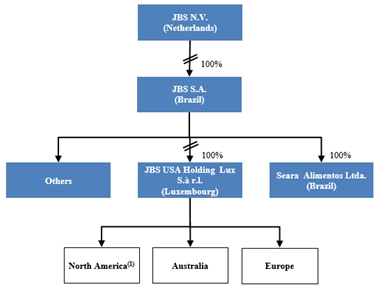
| (1) | Includes approximately 82% of the outstanding common stock of PPC. |
D. Property, Plant and Equipment
Operating Facilities
The following tables set forth the number and aggregate capacities of our processing facilities by business segment and location as of December 31, 2025:
Brazil Segment
| As of December 31, 2025 | |||||||
| Number of Facilities | Aggregate Daily Capacity (1) | ||||||
| Fresh Beef Processing Plants | |||||||
| Brazil | 34 | 36,525 | |||||
| Total | 34 | 36,525 | |||||
| Hide Processing Plants | |||||||
| Brazil | 15 | 45,582 | |||||
| Total | 15 | 45,582 | |||||
| (1) | Capacity measured in head of cattle (beef processing plants) or hides (hide processing plants). |
85
| As of December 31, 2025 | |||||||
| Number of Facilities | Aggregate Monthly Capacity | ||||||
| (tons) | |||||||
| Further Processed and Prepared Foods Plants (1) | |||||||
| Brazil | 8 | 22,050 | |||||
| Total | 8 | 22,050 | |||||
| (1) | Prepared food products plants process fresh and frozen beef and other raw materials into ready-to-eat meals. |
Seara Segment
| As of December 31, 2025 | |||||||
| Number of Facilities | Aggregate Daily Capacity (1) | ||||||
| Fresh Chicken Processing Plants | |||||||
| Brazil | 31 | 5,760,000 | |||||
| Total | 31 | 5,760,000 | |||||
| Fresh Pork Processing Plants | |||||||
| Brazil | 8 | 37,200 | |||||
| Total | 8 | 37,200 | |||||
| (1) | Capacity measured in broilers (fresh chicken processing plants) or hogs (fresh pork processing plants). |
| As of December 31, 2025 | |||||||
| Number of Facilities | Aggregate Monthly Capacity | ||||||
| (tons) | |||||||
| Value-Added, Branded and Prepared Foods Plants (1) | |||||||
| Brazil | 22 | 88,409 | |||||
| Saudi Arabia | 2 | 2,400 | |||||
| United Arab Emirates | 1 | 1,600 | |||||
| Total | 25 | 92,409 | |||||
| (1) | Prepared food products plants process fresh and frozen chicken, pork, beef, margarine and other raw materials into ready-to-eat meals. |
86
Beef North America Segment
| As of December 31, 2025 | |||||||
| Number of Facilities | Aggregate Daily Capacity | ||||||
| (cattle) | |||||||
| Fresh Beef Processing Plants | |||||||
| United States | 9 | 28,198 | |||||
| Canada | 1 | 4,400 | |||||
| Total | 10 | 32,598 | |||||
| Hide Processing Plants | |||||||
| United States | 1 | 5,000 | |||||
| Total | 1 | 5,000 | |||||
| As of December 31, 2025 | |||||||
| Number of Facilities | Aggregate Monthly Capacity | ||||||
| (tons) | |||||||
| Value-Added and Branded Beef Processing Plants | |||||||
| United States (1) | 7 | 19,460 | |||||
| Canada | 1 | 492 | |||||
| Total | 8 | 19,952 | |||||
| (1) | The value-added facilities in the Beef North America segment also process pork products. |
| As of December 31, 2025 | |||||||
| Number of Facilities | Aggregate Monthly Capacity | ||||||
| (tons) | |||||||
| Plant-Based Protein Processing Plants | |||||||
| Europe | 3 | 2,662 | |||||
| Total | 3 | 2,662 | |||||
The operations from JBS USA’s acquisition of Vivera Topholding BV are included in our Beef North America segment and include three production facilities and a research and development center located in the Netherlands.
Pork USA Segment
| As of December 31, 2025 | |||||||
| Number of Facilities | Aggregate Daily Capacity | ||||||
| (hogs) | |||||||
| Fresh Pork Processing Plants | |||||||
| United States | 5 | 92,600 | |||||
| Total | 5 | 92,600 | |||||
| As of December 31, 2025 | |||||||
| Number of Facilities | Aggregate Monthly Capacity | ||||||
| (tons) | |||||||
| Value-Added and Branded Pork Processing Plants | |||||||
| United States | 9 | 19,635 | |||||
| Total | 9 | 19,635 | |||||
87
Pilgrim’s Pride Segment
| As of December 31, 2025 | |||||||
| Number of Facilities | Aggregate Daily Capacity | ||||||
| (broilers) | |||||||
| Fresh Chicken Processing Plants | |||||||
| United States | 25 | 6,268,964 | |||||
| Mexico | 6 | 1,082,455 | |||||
| United Kingdom and Europe | 4 | 844,285 | |||||
| Puerto Rico | 1 | 65,042 | |||||
| Total | 36 | 8,260,746 | |||||
| As of December 31, 2025 | |||||||
| Number of Facilities | Aggregate Daily Capacity | ||||||
| (hogs) | |||||||
| Fresh Pork Processing Plants | |||||||
| United Kingdom and Europe | 2 | 8,650 | |||||
| Total | 2 | 8,650 | |||||
| As of December 31, 2025 | |||||||
| Number of Facilities | Aggregate Daily Capacity | ||||||
| (lambs) | |||||||
| Fresh Lamb Processing Plant | |||||||
| Europe | 1 | 3,333 | |||||
| Total | 1 | 3,333 | |||||
| As of December 31, 2025 | |||||||
| Number of Facilities | Aggregate Monthly Capacity | ||||||
| (tons) | |||||||
| Value-Added, Branded and Prepared Foods Plants (1) | |||||||
| United Kingdom (2) | 16 | 40,781 | |||||
| United States | 4 | 19,458 | |||||
| France | 3 | 10,105 | |||||
| Ireland | 2 | 9,691 | |||||
| Mexico | 2 | 3,694 | |||||
| The Netherlands | 1 | 683 | |||||
| Total | 28 | 84,412 | |||||
| (1) | Prepared food products plants process fresh and frozen chicken and pork and other raw materials into ready-to-eat meals. |
88
Australia Segment
| As of December 31, 2025 | |||||||
| Number of Facilities | Aggregate Daily Capacity | ||||||
| (cattle) | |||||||
| Fresh Beef Processing Plants | |||||||
| Australia (1) | 8 | 9,598 | |||||
| Total | 8 | 9,598 | |||||
| (1) | Includes one combined beef, lamb and sheep processing plant. |
| As of December 31, 2025 | |||||||
| Number of Facilities | Aggregate Daily Capacity | ||||||
| (lambs) | |||||||
| Fresh Lamb and Sheep Processing Plants | |||||||
| Australia (1) | 3 | 20,200 | |||||
| Total | 3 | 20,200 | |||||
| (1) | Includes one combined beef, lamb and sheep processing plant. |
| As of December 31, 2025 | |||||||
| Number of Facilities | Aggregate Daily Capacity | ||||||
| (hogs) | |||||||
| Fresh Pork Processing Plants | |||||||
| Australia | 3 | 11,260 | |||||
| Total | 3 | 11,260 | |||||
| As of December 31, 2025 | |||||||
| Number of Facilities | Aggregate Daily Capacity | ||||||
| (tons) | |||||||
| Fresh Fish Processing Plants | |||||||
| Australia | 2 | 197 | |||||
| Total | 2 | 197 | |||||
| As of December 31, 2025 | |||||||
| Number of Facilities | Aggregate Daily Capacity | ||||||
| (hide) | |||||||
| Hide Processing Plants | |||||||
| Australia | 1 | 7,900 | |||||
| Total | 1 | 7,900 | |||||
| As of December 31, 2025 | |||||||
| Number of Facilities | Aggregate Monthly Capacity | ||||||
| (tons) | |||||||
| Value-Added and Branded Beef Processing Plants | |||||||
| Australia | 7 | 18,663 | |||||
| New Zealand | 1 | 1,842 | |||||
| Total | 8 | 20,505 | |||||
89
Miscellaneous Segment
| As of December 31, 2025 | |||||||
| Number of Facilities | Aggregate Daily Capacity | ||||||
| (hide) | |||||||
| Hide Processing Plants | |||||||
| Argentina | 1 | 4,450 | |||||
| Uruguay | 1 | 3,000 | |||||
| Mexico | 1 | 727 | |||||
| Germany | 1 | 75 | |||||
| Vietnam | 1 | 5,000 | |||||
| Italy | 1 | 1,500 | |||||
| Total | 6 | 14,752 | |||||
| As of December 31, 2025 | |||||||
| Number of Facilities | Aggregate Monthly Capacity | ||||||
| (tons) | |||||||
| Further Processed Pork Processing Plants | |||||||
| Italy | 4 | 761 | |||||
| Total | 4 | 761 | |||||
As of December 31, 2025, we also operated eight feedlots in Brazil (of which four were owned, two were leased and two were partnerships) and other facilities and farms related to feed production and animal raising.
We believe our facilities are generally adequate and suitable for our current purposes; however, seasonal fluctuations in inventories and production may occur as a reaction to market demands for certain products. We regularly engage in construction and other capital improvement projects intended to expand capacity and improve the efficiency of our processing and support facilities. We also evaluate the efficiencies of our operations and may from time to time consider changing the number or type of plants we operate to align with our capacity needs.
ITEM 4A. UNRESOLVED STAFF COMMENTS
Not applicable.
ITEM 5. OPERATING AND FINANCIAL REVIEW AND PROSPECTS
This section contains forward-looking statements that involve risks and uncertainties. Our actual results may differ significantly from those discussed in the forward-looking statements for several reasons, including those described under “Cautionary Statement Regarding Forward-Looking Statements,” “Item 3. Key Information—D. Risk Factors” and other issues discussed herein. The following analysis and discussion of our financial condition and results of operations should be read in conjunction with, and is qualified in its entirety by reference to, (1) JBS N.V.’s consolidated financial statements and related notes, which are included elsewhere in this annual report, and (2) the information presented under the section entitled “Presentation of Financial and Other Information.”
A. Operating Results
Overview
We are the largest protein company and one of the largest food companies in the world in terms of net revenue for the year ended December 31, 2025, according to Bloomberg’s Food Index and publicly available sources. Our net revenue was US$86.2 billion, US$77.2 billion and US$72.9 billion for the years ended December 31, 2025, 2024 and 2023, respectively. We recorded a net income of US$2.2 billion for the year ended December 31, 2025, a net income of US$2.0 billion for the year ended December 31, 2024, and a net loss of US$0.1 billion for the year ended December 31, 2023. Our Adjusted EBITDA was US$6.8 billion, US$7.2 billion and US$3.5 billion for the years ended December 31, 2025, 2024 and 2023, respectively. Through strategic acquisitions and capital investment, we have created a diversified global platform that allows us to prepare, package and deliver fresh and frozen, value-added and branded beef, poultry, pork, fish, lamb and egg products to leading retailers and foodservice customers. We sell our products to more than 330,000 customers worldwide in approximately 197 countries on six continents.
90
As of December 31, 2025, we were:
| ● | the #1 global beef producer in terms of capacity, according to Nebraska Public Media, with operations in the United States, Australia, Canada and Brazil and an aggregate daily processing capacity of more than 78,000 heads of cattle; |
| ● | the #1 global poultry producer in terms of capacity, with operations in the United States, Brazil, United Kingdom, Mexico, Puerto Rico and Europe, and an aggregate daily processing capacity of more than 14.0 million chickens according to WATT Poultry, a global resource for the poultry meat industries; |
| ● | the #2 largest global pork producer in terms of capacity, with operations in the United States, Brazil, the United Kingdom, Australia and Europe, and an aggregate daily processing capacity of more than 149,000 hogs according to WATT Poultry; |
| ● | a leading lamb producer in terms of capacity, according to Levante, with operations in Australia and Europe and an aggregate daily processing capacity of more than 23,500 heads; |
| ● | a leading regional fish producer in terms of capacity, according to Forbes, with operations in Australia and an aggregate daily processing capacity of approximately 200 tons; |
| ● | a leading table eggs producer in Brazil, with operation in six Brazilian states, and an aggregate capacity of approximately 4 billion table eggs per year; and |
| ● | a significant global producer of value-added and branded meat products. |
We primarily sell protein products, which include fresh and frozen cuts of beef, pork, lamb, fish, whole chickens, chicken parts and egg, to retailers (such as supermarkets, club stores and other retail distributors), and foodservice companies (such as restaurants, hotels, foodservice distributors and additional processors). Our food products are marketed under a variety of national and regional brands, including: in North America, “Swift,” “Just Bare,” “Pilgrim’s Pride,” “1855,” “Grass Run Garm,” “Gold Kist Farms,” “Gold’n Plump,” “Del Dia,” “La Herencia,” “Mantiqueira,” “Principe,” “Sampco” and premium brands “Sunnyvalley,” and “Imperial American Wagiu Beef;” in Brazil, “Swift,” “Seara,” “Friboi, “Maturatta,” “Massa Leve,” “Marba,” “Doriana,” “Delícia,” “Primor,” “Incrível,” “Rezende,” “Mantiqueira,” and premium brands “1953 Friboi,” “Black Friboi,” “Seara Gourmet,” “Hans” and “Eder”; in Australia, “Swift” and “Great Southern”; and in Europe, “Moy Park,” “Richmond,” “Fridge Riders,” “Denny,” “Rollover” and “Oak House Foods”. We also produce value-added and branded products marketed, primarily under our portfolio of widely recognized consumer brands in some of our key markets, including “Seara” in Brazil, “Primo,” “Rivalea” and “Huon” in Australia and “Beehive” in New Zealand.
We are geographically diversified, with production facilities strategically located to optimize both raw material supply and proximity to consumer markets. In the year ended December 31, 2025, the United States accounted for the largest share of our net revenue, in terms of production, representing 51%, followed by South America at 29%, as detailed in the table below.
| For the year ended December 31, 2025 | ||||||||
| US$ | % | |||||||
| (in millions of U.S. dollars, unless otherwise indicated) | ||||||||
| United States of America | 43,825.5 | 50.9 | % | |||||
| Mexico and Canada | 6,315.4 | 7.3 | % | |||||
| South America | 24,830.7 | 28.8 | % | |||||
| Australia | 7,112.0 | 8.3 | % | |||||
| Europe | 6,425.5 | 7.5 | % | |||||
| Minor regions | 542.4 | 0.6 | % | |||||
| Total | 89,051.5 | 103.3 | % | |||||
| Intercompany elimination | (2,867.3 | ) | (3.3 | )% | ||||
| Total | 86,184.2 | 100.0 | % | |||||
In terms of consumption, in the year ended December 31, 2025, we generated 74% of our net revenue from sales in the countries where we operate our facilities, which we classify as domestic sales, and 26% of our net revenue represented export sales. The United States, Brazil and Australia are leading exporters of protein to many fast-growing markets, including Asia, Africa and the Middle East. Asia represented 50% of our net revenue from export sales in the year ended December 31, 2025, primarily from sales in China, Japan and South Korea. Africa and the Middle East collectively represented 12% of our net revenue from export sales in the year ended December 31, 2025.
91
Reportable Segments
Our management has defined our operating segments based on the reports that are used to make strategic decisions, analyzed by our chief operating decision maker, who is our chief executive officer. We operate in the following seven reportable business segments: (1) Brazil; (2) Seara; (3) Beef North America; (4) Pork USA; (5) Pilgrim’s Pride; (6) Australia; and (7) Miscellaneous. For additional information, see note 25 to JBS N.V.’s consolidated financial statements and “Item 4. Information on the Company—B. Business Overview—Description of Business Segments.” Each segment’s operating performance is evaluated by our chief operating decision maker based on Adjusted EBITDA. See “Presentation of Financial and Other Information—Non-GAAP Financial Measures—Adjusted EBITDA and Adjusted EBITDA Margin.”
Description of Main Consolidated Statement of Income Line Items
Net Revenue
The vast majority of our net revenue is derived from contracts which are based upon a customer ordering our products. Net revenues are recognized when there is a contract with the customer, the transaction price is reliably measurable and when the control over the goods sold is transferred to the customer. We account for a contract, which may be verbal or written, when it is approved and committed by both parties, the rights of the parties are identified along with payment terms, the contract has commercial substance and collectability is probable. While there may be master agreements, the contract is only established when the customer’s order is accepted by us.
We evaluate the transaction for distinct performance obligations, which are the sale of our products to customers. Each performance obligation is recognized based upon a pattern of recognition that reflects the transfer of control to the customer at a point in time, which is upon destination (customer location or port of destination), which depicts the transfer of control and recognition of net revenue. There are instances of customer pick-up at our facility, in which case control transfers to the customer at that point and we recognize net revenue. Our performance obligations are typically fulfilled within days to weeks of the acceptance of the order.
The measurability of the transaction price can be impacted by variable consideration (i.e., discounts, rebates, incentives and the customer’s right to return products). Some or all of the estimated amount of variable consideration is included in the transaction price but only to the extent that it is highly probable a significant reversal in the amount of cumulative net revenue recognized will not occur when the uncertainty associated with the variable consideration is subsequently resolved. This varies from customer to customer according to the terms of sale. However, due to the nature of our business, there is minimal variable consideration.
Allocating the transaction price to a specific performance obligation based upon the relative standalone selling prices includes estimating the standalone selling prices including discounts and variable consideration.
Shipping and handling activities are performed before a customer obtains control of the goods and its obligation is fulfilled upon transfer of the goods to a customer. Shipping and handling costs are recorded within cost of sales. We can incur incremental costs to obtain or fulfill a contract, such as payment of commissions, which are not expected to be recovered. The amortization period for such expenses is less than one year; therefore, the costs are expensed as incurred and included in deductions from sales.
We receive payments from customers based on terms established with the customer. Payments are typically due within seven days of delivery for domestic accounts and 30 days for international accounts. Customer contract liabilities relate to payments received in advance of satisfying the performance obligation under the contract. Moreover, a contract liability is recognized when we have an obligation to transfer products to a customer from whom the consideration has already been received. The recognition of the contractual liability occurs at the time when the consideration is received and settled. We recognize net revenue upon fulfilling the related performance obligation. Contract liabilities are presented as advances from customers in the statement of financial position.
We disaggregate our net revenues by (i) domestic sales, which refer to sales within each geographical location and (ii) export sales, which refer to sales outside of each geographical location.
We also disaggregate our net revenues between Brazil, Seara, Beef North America, Pork USA, Pilgrim’s Pride, Australia and Miscellaneous segments to align with our segment presentation in note 25 to JBS N.V.’s consolidated financial statements, which are included elsewhere in this annual report.
92
We sell our products in the countries where we operate our facilities, which we classify as domestic sales, and elsewhere, which we classify as export sales, as follows:
| For the year ended December 31, | ||||||||||||
| 2025 | 2024 | 2023 | ||||||||||
| (in millions of US$) | ||||||||||||
| Domestic sales | 63,734.8 | 57,186.2 | 54,501.3 | |||||||||
| Export sales | 22,449.4 | 19,996.4 | 18,416.8 | |||||||||
| Net revenue | 86,184.2 | 77,182.5 | 72,918.1 | |||||||||
Our net revenue is derived from our seven segments as set forth below.
| ● | Net Revenue from Sales of Brazil. Our Brazil segment includes all of our operating activities in Brazil, mainly represented by slaughter facilities, cold storage and meat processing, fat, feed and production of cattle by-products, such as leather, collagen and other products produced in Brazil. Net revenues are generated from the sale of products predominantly to restaurant chains, food processing companies, distributors, supermarket chains, wholesale supermarket and other significant users within the food chain. |
| ● | Net Revenue from Sales of Seara. Our Seara segment includes all the operating activities of Seara and its subsidiaries, mainly represented by chicken and pork processing, production and commercialization of food products and value-added products. Net revenues are generated from the sale of products predominantly to restaurant chains, food processing companies, distributors, supermarket chains, wholesale supermarket and other significant users within the food chain. |
| ● | Net Revenue from Sales of Beef North America. Our Beef North America segment includes JBS USA’s beef processing operations in North America and the plant-based businesses in Europe. This segment also sells by-products to the variety meat, feed processing, fertilizer, automotive and pet food industries and also produces value-added meat products including toppings for pizzas. Sampco LLC imports processed meats and other foods such as canned fish, fruits and vegetables to the United States and Vivera Topholding BV produces and sells plant-based protein products in Europe. |
| ● | Net Revenue from Sales of Pork USA. Our Pork USA segment includes JBS USA’s pork operations, including Swift Prepared Foods. Net revenues are generated from the sale of products predominantly to retailers of fresh pork, including trimmed cuts such as loins, roasts, chops, butts, picnics and ribs. Other pork products, including hams, bellies and trimmings, are sold predominantly to further processors who, in turn, manufacture bacon, sausage, and deli and luncheon meats. In addition, net revenues are generated from the sale of case ready products. As a complement to our pork processing business, we also conduct business through our hog production operations, including 31 hog farms and eight feed mills, from which, JBS USA will source live hogs for its pork processing operations. |
| ● | Net Revenue from Sales of Pilgrim’s Pride. Our Pilgrim’s Pride segment includes PPC’s operations, the majority of whose revenues are generated from United States, United Kingdom, Europe and Mexico sales of fresh and prepared chicken. The fresh chicken products consist of refrigerated (non-frozen) whole or cut-up chicken, either pre-marinated or non-marinated, and pre-packaged chicken in various combinations of freshly refrigerated, whole chickens and chicken parts. The prepared chicken products include portion-controlled breast fillets, tenderloins and strips, delicatessen products, salads, formed nuggets and patties and bone-in chicken parts. These products are sold either refrigerated or frozen and may be fully cooked, partially cooked or raw. In addition, these products are breaded or non-breaded and either pre-marinated or non-marinated. The segment also generates net revenue from the sale of prepared pork products through Pilgrim’s Pride Limited. The segment includes the specialty meats and ready meals businesses of Pilgrim’s Food Masters and generates net revenues from branded and private label meats, meat snacks, food-to-go products, and ethnic chilled and frozen ready meals. |
93
| ● | Net Revenue from Sales of Australia. Our Australia segment includes our fresh, frozen, value-added and branded beef, lamb, pork and fish products in Australia and New Zealand. The majority of our beef net revenues from our operations in Australia are generated from the sale of fresh beef products (including fresh and frozen chuck cuts, rib cuts, loin cuts, round cuts, thin meats, ground beef, offal and other products). We also sell value-added and branded beef products (including frozen cooked and pre-cooked beef, corned cooked beef, beef cubes and consumer-ready products, such as hamburgers and sausages). We also operate lamb, pork and fish processing facilities in Australia and New Zealand, as the result of the acquisitions of Huon Aquaculture Group Ltd and the Rivalea hog breeding and processing business in Australia. JBS Australia also generates net revenues through their cattle hoteling business. |
| ● | Net Revenue from Sales of Miscellaneous. Our Miscellaneous segment includes certain operations not directly attributable to our reportable segments set forth above, such as international leather operations and other operations in Europe. |
Cost of Sales
A significant portion of our cost of sales consists of raw materials, primarily biological assets and feed ingredients. We incur costs to (1) purchase livestock (cattle, hogs and lamb) ready for slaughter in the production of beef, pork and lamb products and (2) feed live animals (chickens, hogs and fish) for breeding and slaughter in the production of chicken, pork and fish products in our vertically-integrated operations. Raw materials costs are generally influenced by fluctuations in prices to purchase (i) livestock in the spot market or under contracts and (ii) feed ingredients, primarily corn and soy meal, which are the main feed ingredients required in our vertically integrated operations. In addition to purchasing livestock and feed ingredients, our cost of sales also consists of other production costs (including packaging and other raw materials) and labor. The key drivers of costs by segment are as follows:
| ● | Brazil. In Brazil we generally purchase cattle livestock in the spot market transactions or under contracts that fluctuate with market conditions as we do not keep or raise our own cattle. Our Brazil operations are impacted primarily by grass-fed cattle supply. Reductions in the breeding herds can affect supply, and thus costs, over a period of years. |
| ● | Seara. Our vertically-integrated chicken and pork operations are impacted primarily by fluctuations in the price of feed ingredients. |
| ● | Beef North America. We generally purchase cattle livestock in the spot market or under contracts that fluctuate with market conditions as we do not keep or raise our own cattle. Our beef operations are impacted primarily by fed cattle supply. Our beef business is directly affected by fluctuations in the spot market based on available supply and indirectly influenced by fluctuations in the price of feed ingredients. |
| ● | Pork USA. In North America, we generally purchase pork livestock in the spot market or under contracts that fluctuate with market conditions and we raise approximately 25% of our hogs. Our pork business is directly affected by fluctuations in the price of feed ingredients. |
| ● | Pilgrim’s Pride. Our vertically-integrated chicken operations are impacted primarily by fluctuations in the price of feed ingredients. |
| ● | Australia. Our Australian beef operations are impacted primarily by fed cattle supply, in addition to fish feed ingredients and hog prices. |
| ● | Miscellaneous. Includes certain costs and expenses related to our operations not directly attributable to the reportable segments, such as certain of our corporate expenses and our costs and expenses related to our international leather operations and other operations in Europe. |
Adjusted EBITDA
Adjusted EBITDA is calculated by making the following adjustments to our net income, as further described below (see “—Reconciliation of Adjusted EBITDA”): exclusion of current and deferred income taxes; exclusion of share of profit of equity-accounted investees, net of tax; exclusion of net finance expense; exclusion of depreciation and amortization expenses; exclusion of antitrust agreements expenses; exclusion of donations and social programs expenses; exclusion of impairment of assets; exclusion of restructuring expenses; exclusion of fiscal payments and installments; exclusion of Rio Grande do Sul claim losses; exclusion of extemporaneous litigation expenses; exclusion of reversal of tax credits; exclusion of avian influenza impacts; exclusion of certain tax assessments; and exclusion of certain other operating income (expense), net.
94
Operating Expenses
Our operating expenses consists primarily of:
| ● | General and Administrative Expenses. This line item primarily includes expenses relating to corporate payroll, utilities and maintenance of our corporate offices and headquarters. |
| ● | Selling Expenses. This line item includes expenses relating to advertising, freights, payment of commissions and salaries to members of our sales team and expected credit losses. |
Net Finance Expense
Net finance expense includes expenses relating to interest incurred on our indebtedness, interest income, gains and losses related to our net exposure to foreign currencies and fair value adjustments from financing and commodity-related derivative transactions.
Items Affecting Comparability of Financial Results
Acquisitions
We have a track record of acquiring and integrating operations. Through strategic acquisitions, we have built a diversified global platform, which has significantly increased our net revenues, partially due to these acquisitions.
Revenues, expenses and cash flows of acquired businesses are recorded for transactions consummated commencing after the closing date of the business acquired.
None of the acquisitions (individually or in the aggregate) that we completed during the periods discussed below under “—Summary of Results” is considered significant under the rules governing the inclusion of pro forma and historical financial statements in an SEC-registered offering of securities. Therefore, neither pro forma financial statements giving effect to these acquisitions nor separate historical financial statements of the acquired or divested businesses would be required to be included under Article 11 and Rule 3-05 of Regulation S-X. Accordingly, we have not included any pro forma financial information reflecting any acquisitions or any historical carve-out financial statements of any acquired businesses in this annual report.
Currency
As a global company, our results of operations and financial condition have been, and will continue to be, exposed to foreign currency exchange rate fluctuations. The financial statements of each entity included in the consolidation are prepared using the functional currency of the main economic environment it operates.
Any depreciation or appreciation of the foreign currency exchange rate compared to an entity´s functional currency may impact our revenues, costs and expenses causing a monetary increase or decrease, provided that the other variables remain unchanged. In addition, a portion of our loans and financing is denominated in foreign currencies (foreign currency indicates loans denominated in a different currency from an entity´s functional currency). For this reason, any movement of the currency exchange rate compared to an entity´s functional currency may significantly increase or decrease our finance expense and our current and non-current loans and financing. Additionally, the results and financial position of all entities with a functional currency different from our functional currency (Brazilian real) have been translated to Brazilian real and then translated into the Group’s presentation currency (U.S. dollar).
Our risk management department enters into derivative instruments previously approved by our board of directors to protect financial assets and liabilities and future cash flow from commercial activities and net investments in foreign operations. Our board of directors has approved financial instruments to hedge our exposure to loans, investments, cash flows from interest payments, export estimate, acquisition of raw material, and other transactions, whenever they are quoted in currencies different than our or our subsidiaries’ functional currency. The primary exposures to exchange rate risk are in U.S. dollars, euros, British pounds, Mexican pesos and Australian dollars.
95
Principal Factors Affecting our Financial Condition and Results of Operations
Our results of operations have been influenced and will continue to be influenced by a variety of factors. In addition to the factors discussed below, factors that impact the results of our operations include outbreaks of livestock and poultry disease, product contamination or recalls, our ability to implement our business plan and the level of demand for our products in the countries in which we operate. Demand for our products in those countries is affected by the performance of their respective economies in terms of GDP, as well as prevailing levels of employment, inflation and interest rates.
Brazil, Seara, Beef North America, Pork USA, Pilgrim’s Pride and Australia Segments
We operate globally and during the regular course of our operations are exposed to price fluctuations in feeder cattle, live cattle, lean hogs, corn, soybeans, and energy, especially in our North American, Australian and Brazilian markets. Commodity markets are characterized by volatility arising from external factors including climate, supply levels, transportation costs, agricultural policies and storage costs, among others.
Our risk management department is responsible for mapping our exposure to commodity prices and proposing strategies to our risk management committee in order to mitigate such exposure. Biological assets are a very important raw material used by us. In order to maintain future supply of these materials, we enter into forward contracts to anticipate purchases with suppliers. To complement these forward purchases, we use derivative instruments to mitigate each specific exposure, most notably futures contracts, to mitigate the impact of price fluctuations - on inventories and sales contracts. We take the historical average amount spent on materials as an indication of the operational value to be protected by firm contracts.
In addition to the above, our risk management department monitors a number of other metrics and indicators that affect our operations in our Brazil, Seara, Beef North America, Pork USA, Pilgrim’s Pride and Australia segments, including the following:
| ● | production volume; |
| ● | plant capacity utilization; |
| ● | sales volume; |
| ● | selling prices; |
| ● | customer demand and preferences (see “Item 3. Key Information—D. Risk Factors—Risks relating to our Business and Industries—Changes in consumer preferences and/or negative perception of the consumer regarding the quality and safety of our products could adversely affect our business”); |
| ● | commodity futures prices for livestock (see “Item 3. Key Information—D. Risk Factors—Risks relating to our Business and Industries—Our results of operations may be adversely affected by fluctuations in market prices for, and the availability of, livestock and animal feed ingredients”); |
| ● | the spread between livestock prices and selling prices for finished goods; |
| ● | utility prices and trends; |
| ● | livestock availability; |
| ● | production yield; |
| ● | seasonality; |
96
| ● | the economy performance of the countries where we sell our products; |
| ● | competition and industry consolidation; |
| ● | taxation; |
| ● | perceived value of our brands; |
| ● | interest rate fluctuations; |
| ● | currency exchange rate fluctuations (see “Item 3. Key Information—D. Risk Factors—Risks relating to our business and the beef, pork and chicken industries—Our exports pose special risks to our business and operations”); and |
| ● | trade barriers, exchange controls and political risk and other risks associated with export and foreign operations (see “Item 3. Key Information—D. Risk Factors—Risks relating to our business and the beef, pork and chicken industries—Our exports pose special risks to our business and operations”). |
Effects of the Variation of Prices for the Purchase of Raw Materials on Our Costs of Goods Sold
Our principal raw materials are livestock and feed ingredients for our chicken, pork and fish operations. Raw materials accounted for a majority of the total cost of products sold during the year ended December 31, 2025. Changes in the price of cattle, pork and feed ingredients have a direct impact on operating costs and are based on factors beyond our management’s control, such as climate, the supply volume, transportation costs, agricultural policies and others. We seek to hedge the price paid for cattle purchased through financial instruments in order to attempt to protect ourselves from price variations between their date of the purchase and their date of the delivery. Our risk management department is responsible for mapping the exposures to commodity prices of the JBS Group and proposing strategies to our risk management committee, in order to mitigate such exposures. Biological assets are a very important raw material used by us. In order to maintain future supply of these materials, we participate in forward contracts to anticipate purchases with suppliers. To complement these forward purchases, we use derivative instruments to mitigate each specific exposure, most notably futures contracts, to mitigate the impact of price fluctuations - on inventories and sales contracts. We take the historical average amount spent on materials as an indication of the operational value to be protected by firm contracts.
The price of cattle, pork and feed ingredients in the domestic markets has significantly fluctuated in the past, and we believe that it will continue to fluctuate over the next few years. Any increase in the price of cattle, pork and feed ingredients and, consequently, production costs may adversely impact our gross margins and our results of operations if we are not able to pass these price increases to our clients. Conversely, any decrease in the price of cattle, pork and feed ingredients and, consequently, our production costs, may positively impact our gross margins and our results of operations.
Effect of Level of Indebtedness and Interest Rates
As of December 31, 2025, our total outstanding indebtedness was US$21,090.6 million, consisting of US$833.1 million of current loans and financing and US$20,257.5 million of non-current loans and financing, representing 59.2% of our total liabilities, which totaled US$35,633.7 million as of December 31, 2025.
The interest rates that we pay on our indebtedness depend on a variety of factors, including local and international interest rates and risk assessments of our company, our industry and the global economies.
97
Fluctuations in Domestic Market Prices of Fresh and Processed Products Can Significantly Affect Our Operating Revenues
Domestic market prices for fresh and processed products are generally determined in accordance with market conditions. These prices are also affected by the additional markup that retailers charge end consumers. We have negotiated these margins with each network of retailers and depending on the network, with each store individually.
Effects of Fluctuations in Export Prices of Fresh and Processed Products on Operating Revenues
Fluctuations in export prices of our raw and processed products can significantly affect our net operating income. The prices of fresh and processed products that we charge in domestic and export markets have fluctuated significantly in recent years, and we believe that these prices will continue to fluctuate in the future.
Effects of Fluctuations in Foreign Exchange Rates Currencies
As our presentation currency is the U.S. dollars and some of our entities have other currencies as their functional currency (for example the Brazilian real), all else being equal, any strengthening of the U.S. dollar against these currencies will reduce the revenues and expenses of these entities, whereas any depreciation of the U.S. dollar against these currencies will increase their revenues and expenses.
For further information on our presentation currency, functional currencies and translation of foreign currencies see “—Items Affecting Comparability of Financial Results—Currency” above.
Impacts from Russia-Ukraine, Israel-Hamas, and U.S. and Israel-Iran Conflicts
The Russia-Ukraine war began in February 2022. The impact of the ongoing war and sanctions has not been limited to businesses that operate in Russia and Ukraine and has negatively impacted and will likely continue to negatively impact other global economic markets including where we operate. The impacts have included and may continue to include, but are not limited to, higher prices for commodities, such as food products, ingredients and energy products, increasing inflation in some countries, and disrupted trade and supply chains. The conflict has disrupted shipments of grains, vegetable oils, fertilizer and energy products. Russia’s recent suspension of the Black Sea Grain Initiative, which allowed Ukraine to export grain and other food items, will likely further exacerbate rising food prices and supply chain issues if not reinstated.
The impact on the agriculture markets falls into two main categories: (1) the effect on Ukrainian crop production, as the region is key in global grain production; and (2) the duration of the disruption in trade flows. Safety and financing concerns in the region are restricting export execution, which is in turn forcing grain and oil demand to find alternative supply. The duration of the war and related volatility makes global markets extremely sensitive to growing-season weather in other global grain producing regions and has led to a large risk premium in futures prices. The continued volatility in the global markets as a result of the war has adversely impacted our costs by driving up prices, raising inflation and increasing pressure on the supply of feed ingredients and energy products throughout the global markets.
In addition, the U.S. government and other governments in jurisdictions in which we operate have imposed sanctions and export controls against Russia, Belarus and interests therein and threatened additional sanctions and controls. The impact of these measures, now and in the future, could adversely affect our business, supply chain or customers. See “Item 3. Key Information—D. Risk Factors—Risks Relating to the Markets in Which We Operate—Our business may be negatively impacted by economic or other consequences from Russia’s war against Ukraine and the sanctions imposed as a response to that action” in this annual report for additional information.
98
Moreover, on October 7, 2023, Hamas attacked Israel, with Israel then declaring war on Hamas in the Gaza Strip and since then, Israel has been involved in military conflicts with Hamas, Hezbollah, a terrorist organization based in Lebanon, and Iran, both directly and through proxies like the Houthi movement in Yemen and armed groups in Iraq and other terrorist organizations. Although certain ceasefire agreements have been reached, and some Iranian proxies have declared a halt to their attacks, there is no assurance that these agreements will be upheld, military activity and hostilities continue to exist at varying levels of intensity, and the situation remains volatile, with the potential for escalation into a broader regional conflict involving additional terrorist organizations and possibly other countries. In June 2025, a new round of direct hostilities broke out between Israel and Iran, involving significant missile and drone strikes exchanged between the two countries. This escalation has heightened regional instability. In October 2025, a new ceasefire went into effect under a U.S.-brokered framework, providing for the release of hostages by Hamas and prisoners by Israel, withdrawal of Israeli troops to agreed lines, and increase of humanitarian aid flows into Gaza. However, significant challenges threaten the durability of this ceasefire.
In February 2026, the United States and Israel launched coordinated military strikes against key Iranian military and infrastructure targets. This marked a significant escalation in the conflict, resulting in heightened instability across the Middle East, further disruptions to global energy markets, and increased volatility in international trade and supply chains.
Escalation or expansion of hostilities, interventions by other groups or nations, the imposition of economic sanctions, disruption of shipping transit in the Straits of Hormuz or other significant trade routes, or similar outcomes could adversely affect the international trade, our business, results of operations, financial condition and cash flows. Although we do not have manufacturing operations in the affected regions, we are monitoring the development and unfolding of the situation and its potential effects on our sector and operations. As of the date of this annual report, no significant impacts on our business have been identified.
Impact of Inflation
Most of the countries and regions in which we operate, including the United States, Brazil, Australia, Mexico and Europe, are currently experiencing pronounced inflation. None of the locations in which we operate are experiencing hyperinflation. All segments experienced inflation in operating costs, especially in labor, freight and transportation and certain materials. We have also experienced high average sales prices impacted by the current inflationary environment. We have responded to inflationary challenges in 2023, 2024 and 2025 by continuing negotiations with customers to pass through costs increases in order to recoup the increased expenses we have experienced. We also continue to focus on operational initiatives that aim to deliver labor efficiencies, better agricultural performance and improved yields.
For more information about the risks of inflation on our operations, see “Item 3. Key Information—D. Risk Factors—Risks Relating to the Markets in Which We Operate—Deterioration of global economic conditions could adversely affect our business” and “—We are exposed to emerging and developing country risks,” —The Brazilian government exercises, and will continue to exercise, significant influence over the Brazilian economy. These influences, as well as the political and economic conditions of the country, could negatively affect our activities” and “—Our business may be negatively impacted by economic or other consequences from Russia’s war against Ukraine and the sanctions imposed as a response to that action.”
99
Overview of Results
We recorded a net income of US$2,229.8 million in 2025 compared to a net income of US$1,967.6 million in 2024 and a net loss of US$131.7 million in 2023.
Summary of Results
Year Ended December 31, 2025 Compared to the Year Ended December 31, 2024
| For the year ended December 31, | ||||||||||||
| 2025 | 2024 | % Change | ||||||||||
| (in millions of US$) | ||||||||||||
| Consolidated statement of income: | ||||||||||||
| Net revenue | 86,184.2 | 77,182.5 | 11.7 | % | ||||||||
| Cost of sales | (74,884.9 | ) | (65,594.3 | ) | 14.2 | % | ||||||
| Gross profit | 11,299.3 | 11,588.2 | (2.5 | )% | ||||||||
| Selling expenses | (4,988.7 | ) | (4,827.3 | ) | 3.3 | % | ||||||
| General and administrative expenses | (2,187.3 | ) | (2,278.4 | ) | (4.0 | )% | ||||||
| Other income | 111.9 | 84.5 | 32.4 | % | ||||||||
| Other expenses | (75.5 | ) | (189.3 | ) | (60.1 | )% | ||||||
| Net operating expenses | (7,139.6 | ) | (7,210.4 | ) | (1.0 | )% | ||||||
| Operating profit | 4,159.7 | 4,377.8 | (5.0 | )% | ||||||||
| Finance income | 565.2 | 719.4 | (21.4 | )% | ||||||||
| Finance expense | (2,121.5 | ) | (2,389.1 | ) | (11.2 | )% | ||||||
| Net finance expense | (1,556.3 | ) | (1,669.8 | ) | (6.8 | )% | ||||||
| Share of profit of equity-accounted investees, net of tax | 16.9 | 2.9 | 473.8 | % | ||||||||
| Profit before taxes | 2,620.3 | 2,711.0 | (3.3 | )% | ||||||||
| Current income taxes | (450.2 | ) | (870.5 | ) | (48.3 | )% | ||||||
| Deferred income taxes | 59.7 | 127.1 | (53.0 | )% | ||||||||
| Total income taxes | (390.5 | ) | (743.4 | ) | (47.5 | )% | ||||||
| Net income | 2,229.8 | 1,967.6 | 13.3 | % | ||||||||
Net Income
| For the year ended December 31, | Change | % Change | ||||||||||||||
| 2025 | 2024 | |||||||||||||||
| (in millions of U.S. dollar, unless otherwise indicated) | ||||||||||||||||
| Net income | 2,229.8 | 1,967.6 | 262.2 | 13.3 | % | |||||||||||
| Net margin (net income as percentage of net revenue) | 2.6 | % | 2.5 | % | 0.1 p.p. | — | ||||||||||
n.m. = not meaningful.
For the reasons described below, we recorded a net income of US$2,229.8 million for the year ended December 31, 2025, compared to US$1,967.6 million for the year ended December 31, 2024. The net margin was 2.6% for the year ended December 31, 2025, compared to 2.5% for the year ended December 31, 2024.
Net Revenue
| For the year ended December 31, | Change | % Change | ||||||||||||||
| 2025 | 2024 | |||||||||||||||
| (in millions of U.S. dollar, unless otherwise indicated) | ||||||||||||||||
| Net revenue | 86,184.2 | 77,182.5 | 9,001.6 | 11.7 | % | |||||||||||
100
Our net revenue increased by US$9,001.6 million, or 11.7%, in 2025, as compared to 2024. Our net revenue was positively impacted by an overall 9.1% increase in our average sales prices and by a 2.3% increase in sales volumes considering all segments. For more information, see “—Segment Results” below.
Cost of Sales
| For the year ended December 31, | Change | % Change | ||||||||||||||
| 2025 | 2024 | |||||||||||||||
| (in millions of U.S. dollar, unless otherwise indicated) | ||||||||||||||||
| Cost of sales | 74,884.9 | 65,594.3 | 9,290.6 | 14.2 | % | |||||||||||
| Gross profit | 11,299.3 | 11,588.2 | 288.9 | 2.5 | % | |||||||||||
| Cost of sales as percentage of net revenue | 86.9 | % | 85.0 | % | 1.9 p.p. | — | ||||||||||
Our cost of sales increased by US$9,290.6 million, or 14.2%, in the year ended December 31, 2025, as compared to the same period in 2024, primarily due to a 15.6% increase in the cost of inventories, raw materials and production inputs to US$64,064.5 million in the year ended December 31, 2025 from US$55,402.8 million in the same period in 2024, primarily due to the increase in the cost of cattle, which reached record levels in 2025.
Selling Expenses
| For the year ended December 31, | Change | % Change | ||||||||||||||
| 2025 | 2024 | |||||||||||||||
| (in millions of U.S. dollar, unless otherwise indicated) | ||||||||||||||||
| Selling expenses | 4,988.7 | 4,827.3 | 161.4 | 3.3 | % | |||||||||||
| Selling expenses as percentage of net revenue | 5.8 | % | 6.3 | % | 0.5 p.p. | — | ||||||||||
Our selling expenses increased by US$161.4 million, or 3.3%, in the year ended December 31, 2025, as compared to the same period in 2024, primarily due to a 6.8% increase in freight and selling expenses to US$3,883.8 million in the year ended December 31, 2025 from US$3,638.0 million in the same period in 2024, primarily due to the increase in sales volumes and fuel prices in 2025.
General and Administrative Expenses
| For the year ended December 31, | Change | % Change | ||||||||||||||
| 2025 | 2024 | |||||||||||||||
| (in millions of U.S. dollar, unless otherwise indicated) | ||||||||||||||||
| General and administrative expenses | (2,187.3 | ) | (2,278.4 | ) | 91.1 | (4.0 | )% | |||||||||
| General and administrative expenses as percentage of net revenue | (2.5 | )% | (3.0 | )% | 0.4 p.p. | — | ||||||||||
Our general and administrative expenses decreased by US$91.1 million, or 4.0%, in the year ended December 31, 2025, as compared to the same period in 2024, primarily due to:
| ● | Fees, services held and general expenses – Fees, services held and general expenses decreased by US$227.3 million, or 24.9%, to US$684.1 million in the year ended December 31, 2025 from US$911.4 million in the same period in 2024, primarily as a result of (1) the impact of the appreciation of the Brazilian real compared to the U.S. dollar and (2) an impact of R$356.5 million in 2024 (or approximately US$ 64.8 million, converted using the foreign exchange rate as of December 31, 2025), resulting from the recognition of expense in connection with a judicial agreement entered by us; |
| ● | DOJ and antitrust agreements – DOJ and antitrust agreements decreased by US$71.5 million, to US$182.3 million in the year ended December 31, 2025 from US$253.7 million in the same period in 2024; |
101
Partially offset by:
| ● | Salaries and benefits – Salaries and benefits increased by US$213.8 million, or 23.7%, to US$1,117.6 million in the year ended December 31, 2025 from US$903.7 million in the same period in 2024, primarily due to (1) higher PPC share-based compensation; (2) increased incentives in the beef and pork industries in the United States; and (3) a general increase in wages resulting from merit increases. |
Other Income
| For the year ended December 31, | Change | % Change | ||||||||||||||
| 2025 | 2024 | |||||||||||||||
| (in millions of U.S. dollar, unless otherwise indicated) | ||||||||||||||||
| Other income | 111.9 | 84.5 | 27.4 | 32.4 | % | |||||||||||
| Other income as percentage of net revenue | 0.1 | % | 0.1 | % | 0.0 p.p. | — | ||||||||||
Our other income increased by US$27.4 million, or 32.4%, in the year ended December 31, 2025, as compared to 2024. This increase is mainly related to (1) the increase in gain on the sales of assets to US$37.8 million in the year ended December 31, 2025 from US$22.5 million in the same period in 2024; and (2) the increase in gain related to tax refund and extemporaneous tax credit to US$14.8 million in the year ended December 31, 2025 from US$7.0 million in the same period in 2024.
Other Expenses
| For the year ended December 31, | Change | % Change | ||||||||||||||
| 2025 | 2024 | |||||||||||||||
| (in millions of U.S. dollar, unless otherwise indicated) | ||||||||||||||||
| Other expenses | (75.5 | ) | (189.3 | ) | 113.7 | (60.1 | )% | |||||||||
| Other expenses as percentage of net revenue | (0.1 | )% | (0.2 | )% | 0.2 p.p. | — | ||||||||||
Our other expenses decreased by US$113.7 million, or 60.1%, in the year ended December 31, 2025, as compared to 2024, primarily due to the decrease in restructuring expenses to US$31.4 million in the year ended December 31, 2025 from US$93.4 million in the same period in 2024.
Net Finance Expense
| For the year ended December 31, | Change | % Change | ||||||||||||||
| 2025 | 2024 | |||||||||||||||
| (in millions of U.S. dollar) | ||||||||||||||||
| Net finance expense | (1,556.3 | ) | (1,669.8 | ) | 113.5 | (6.8 | )% | |||||||||
| Gains from exchange rate variation | 77.8 | 138.4 | (60.6 | ) | (43.8 | )% | ||||||||||
| Fair value adjustments on derivatives | (217.4 | ) | (502.6 | ) | 285.2 | (56.7 | )% | |||||||||
| Interest expense | (1,678.0 | ) | (1,647.1 | ) | (30.8 | ) | 1.9 | % | ||||||||
| Interest income | 417.2 | 453.7 | (36.5 | ) | (8.1 | )% | ||||||||||
| Bank fees and others | (155.9 | ) | (112.1 | ) | (43.7 | ) | 39.0 | % | ||||||||
Our net finance expense decreased by US$113.5 million, or 6.8%, in the year ended December 31, 2025, as compared to 2024, primarily due to:
| ● | Fair value adjustments on derivatives – Loss with fair value adjustments on derivatives decreased by US$285.2 million, or 56.7%, in the year ended December 31, 2025, as compared to the same period in 2024, primarily as a result of the depreciation of the U.S. dollar against the Brazilian real in the period; |
102
Partially offset by:
| ● | Gains from exchange rate variation – Gains from exchange rate variation decreased by US$60.6 million, or 43.8%, in the year ended December 31, 2025, as compared to the same period in 2024. This decrease was primarily driven by unfavorable exchange rate impacts on cash and cash equivalents and trade accounts receivable; |
| ● | Bank fees and others – Bank fees and others increased by US$43.7 million, or 39.0%, in the year ended December 31, 2025, compared to the same period in 2024. This was primarily due to a US$66.5 million expense in connection with the repurchase or redemption, as applicable, of the JBS USA 2.500% Senior Notes due 2027, the JBS USA 5.125% Senior Notes due 2028 and the JBS USA 5.500% Senior Notes due 2030 in 2025; |
| ● | Interest income – Interest income decreased by US$36.5 million, or 8.1%, in the year ended December 31, 2025, as compared to the same period in 2024. This was primarily driven by (i) a US$27.2 million reduction in interest income from present value adjustments and (ii) US$13.5 million decrease in income from short-term investments, reflecting a lower average cash and cash equivalents balance throughout 2025 compared to 2024; |
Current and Deferred Income Taxes
| For the year ended December 31, | Change | % Change | ||||||||||||||
| 2025 | 2024 | |||||||||||||||
| (in millions of U.S. dollars, unless otherwise indicated) | ||||||||||||||||
| Profit before taxes | 2,620.3 | 2,711.0 | (90.7 | ) | (3.3 | )% | ||||||||||
| Nominal rate | 34 | % | 34 | % | — | — | ||||||||||
| Expected tax expense | (890.9 | ) | (921.7 | ) | 30.8 | (3.3 | )% | |||||||||
| Current income taxes | (450.2 | ) | (870.5 | ) | 420.2 | (48.3 | )% | |||||||||
| Deferred income taxes | 59.7 | 127.1 | (67.3 | ) | (53 | )% | ||||||||||
| Total income taxes | (390.5 | ) | (743.4 | ) | 352.9 | (47.5 | )% | |||||||||
| Effective income tax rate | (14.9 | )% | (27.42 | )% | 12.5 p.p. | — | ||||||||||
n.m. = not meaningful.
The nominal tax rate for Brazilian income tax and social contribution is 34%. However, our effective tax rate may change in each period based on fluctuations in the taxable income generated by each of our foreign subsidiaries, different tax rates in countries where we operate and the tax credits generated by tax payments made by foreign subsidiaries, which can be used to offset taxes that would be paid in Brazil.
The nature and timing of the permanent differences that arise during the period also affect our effective tax rate. These permanent differences generally refer to subsidies made for investments in Brazil and abroad, differences in tax rates on foreign subsidiaries, unrecognized deferred taxes in the current year, income from untaxed interest on foreign subsidiaries and the impact of taxation on companies with dual jurisdiction.
Effective income tax rate decreased by 12.5 percentage points to 14.9% in the year ended December 31, 2025, compared to 27.42% in the same period in 2024. This reduction stemmed primarily from the performance dynamics among our subsidiaries and the impacts related to taxes paid abroad. Throughout the period, although several subsidiaries reported profits and paid the corresponding taxes, the consolidated result was affected by losses recorded in other of our entities, as well as by the tax loss recognized by our subsidiary JBS S.A. This combination of effects reduced the total taxable profit in Brazil and, concurrently, generated an additional amount of taxes paid abroad that could be credited.
103
Segment Results
| For the year ended December 31, | Change | % Change | ||||||||||||||
| 2025 | 2024 | |||||||||||||||
| (in millions of U.S. dollars) | ||||||||||||||||
| Net revenue | ||||||||||||||||
| Brazil segment | 15,293.7 | 12,590.5 | 2,703.2 | 21.5 | % | |||||||||||
| Seara segment | 9,170.9 | 8,774.5 | 396.3 | 4.5 | % | |||||||||||
| Beef North America segment | 28,137.2 | 24,285.8 | 3,851.4 | 15.9 | % | |||||||||||
| Pork USA segment | 8,431.2 | 8,115.5 | 315.6 | 3.9 | % | |||||||||||
| Pilgrim’s Pride segment | 18,484.9 | 17,863.1 | 621.8 | 3.5 | % | |||||||||||
| Australia segment | 8,076.9 | 6,648.1 | 1,428.9 | 21.5 | % | |||||||||||
| Miscellaneous segment | 142.6 | 526.3 | (383.7 | ) | (72.9 | )% | ||||||||||
| Total reportable segments | 87,737.6 | 78,803.9 | 8,933.7 | 11.3 | % | |||||||||||
| Eliminations (1) | (1,553.4 | ) | (1,621.3 | ) | 67.9 | (4.2 | )% | |||||||||
| Total net revenue | 86,184.2 | 77,182.5 | 9,001.6 | 11.7 | % | |||||||||||
| Adjusted EBITDA | ||||||||||||||||
| Brazil segment | 955.1 | 965.0 | (9.9 | ) | (1.0 | )% | ||||||||||
| Seara segment | 1,553.4 | 1,538.6 | 14.7 | 1.0 | % | |||||||||||
| Beef North America segment | (319.5 | ) | 247.3 | (566.7 | ) | n.m. | ||||||||||
| Pork USA segment | 898.9 | 1,071.2 | (172.3 | ) | (16.1 | )% | ||||||||||
| Pilgrim’s Pride segment | 2,804.5 | 2,703.4 | 101.1 | 3.7 | % | |||||||||||
| Australia segment | 916.0 | 664.3 | 251.7 | 37.9 | % | |||||||||||
| Miscellaneous segment | 23.0 | 3.5 | 19.6 | 566.7 | % | |||||||||||
| Total reportable segments | 6,831.4 | 7,193.2 | (361.8 | ) | -5.0 | % | ||||||||||
| Eliminations (1) | - | (1.3 | ) | 1.3 | -100.0 | % | ||||||||||
| Total Adjusted EBITDA | 6,831.4 | 7,191.9 | (360.5 | ) | -5.0 | % | ||||||||||
| (1) | Includes intercompany and intersegment transactions. |
n.m. = not meaningful.
We measure our segment profitability using Adjusted EBITDA, which is calculated by making the following adjustments to our net income, as further described below (see “—Reconciliation of Adjusted EBITDA”): exclusion of current and deferred income taxes; exclusion of share of profit of equity-accounted investees, net of tax; exclusion of net finance expense; exclusion of depreciation and amortization expenses; exclusion of antitrust agreements expenses; exclusion of donations and social programs expenses; exclusion of impairment of assets; exclusion of restructuring expenses; exclusion of fiscal payments and installments; exclusion of Rio Grande do Sul claim losses; exclusion of extemporaneous litigation expenses; exclusion of reversal of tax credits; exclusion of avian influenza impacts; exclusion of certain tax assessments; and exclusion of certain other operating income (expense), net.
Brazil Segment
| For the year ended December 31, | Change | % Change | ||||||||||||||
| 2025 | 2024 | |||||||||||||||
| (in millions of U.S. dollars, unless otherwise indicated) | ||||||||||||||||
| Net revenue | 15,293.7 | 12,590.5 | 2,703.2 | 21.5 | % | |||||||||||
| Adjusted EBITDA | 955.1 | 965.0 | (9,9 | ) | -1.0 | % | ||||||||||
Net Revenue. The increase in our Brazil segment net revenue was mainly impacted by a 18.8% increase in sales prices, especially fresh meat in both domestic and export markets.
Adjusted EBITDA. Adjusted EBITDA in our Brazil segment decreased by US$9.9 million, or 1.0%, to US$955.1 million in the year ended December 31, 2025 from US$965.0 million in the same period in 2024, primarily due to the increase in cattle prices.
104
Seara Segment
| For the year ended December 31, | Change | % Change | ||||||||||||||
| 2025 | 2024 | |||||||||||||||
| (in millions of U.S. dollars, unless otherwise indicated) | ||||||||||||||||
| Net revenue | 9,170.9 | 8,774.5 | 396.3 | 4.5 | % | |||||||||||
| Adjusted EBITDA | 1,553.4 | 1,538.6 | 14.7 | 1.0 | % | |||||||||||
Net Revenue. The increase in our Seara segment net revenue was impacted by (1) a 2.5% increase in sales volumes, mainly in the export markets; and (2) a 2.0% increase in sales prices, mainly in the domestic market.
Adjusted EBITDA. Adjusted EBITDA in our Seara segment increased by US$14.7 million, or 1.0%, to US$1,553.4 million in the year ended December 31, 2025 from US$1,538.6 million in the same period in 2024, primarily due to the increase in net revenue.
Beef North America Segment
| For the year ended December 31, | Change | % Change | ||||||||||||||
| 2025 | 2024 | |||||||||||||||
| (in millions of U.S. dollars, unless otherwise indicated) | ||||||||||||||||
| Net revenue | 28,137.2 | 24,285.8 | 3,851.4 | 15.9 | % | |||||||||||
| Adjusted EBITDA | (319.5 | ) | 247.3 | (566.7 | ) | -229.2 | % | |||||||||
Net Revenue. The increase in our Beef North America segment net revenue was impacted by (1) a 14.2% increase in average sales price, mainly in the domestic market, and (2) a 1.5% increase in sales volume, mainly in the domestic market.
Adjusted EBITDA. Adjusted EBITDA in our Beef North America segment changed to a loss of US319.5 million in the year ended December 31, 2025, from a gain of US$247.3 million in the same period in 2024 primarily due to the significant increase in cattle prices, that was partially offset by the increase in net revenue.
Pork USA Segment
| For the year ended December 31, | Change | % Change | ||||||||||||||
| 2025 | 2024 | |||||||||||||||
| (in millions of U.S. dollars, unless otherwise indicated) | ||||||||||||||||
| Net revenue | 8,431.2 | 8,115.5 | 315.6 | 3.9 | % | |||||||||||
| Adjusted EBITDA | 898.9 | 1,071.2 | (172.3 | ) | -16.1 | % | ||||||||||
Net Revenue. The increase in our Pork USA segment net revenue was mainly impacted by a 4.2% increase in sales prices, in both export and domestic markets.
105
Adjusted EBITDA. Adjusted EBITDA in our Pork USA segment decreased by US$172.3 million, or 16.1%, to US$898.9 million in the year ended December 31, 2025 from US$1,071.2 million in the same period in 2024, primarily due to the increase of hog acquisition costs, partially offset by the increase in net revenue.
Pilgrim’s Pride Segment
| For the year ended December 31, | Change | % Change | ||||||||||||||
| 2025 | 2024 | |||||||||||||||
| (in millions of U.S. dollars, unless otherwise indicated) | ||||||||||||||||
| Net revenue | 18,484.9 | 17,863.1 | 621.8 | 3.5 | % | |||||||||||
| Adjusted EBITDA | 2,804.5 | 2,703.4 | 101.1 | 3.7 | % | |||||||||||
Net Revenue. The increase in our Pilgrim’s Pride segment net revenue was mainly impacted by a 3.1% increase in sales volumes, especially in the domestic market.
Adjusted EBITDA. Adjusted EBITDA in our Pilgrim’s Pride segment increased by US$101.1 million, or 3.7%, to US$2,804.5 million in the year ended December 31, 2025 from US$2,703.4 million in the same period in 2024, primarily due to the increase in our net revenue.
Australia Segment
| For the year ended December 31, | Change | % Change | ||||||||||||||
| 2025 | 2024 | |||||||||||||||
| (in millions of U.S. dollars, unless otherwise indicated) | ||||||||||||||||
| Net revenue | 8,077.0 | 6,648.1 | 1,428.9 | 21.5 | % | |||||||||||
| Adjusted EBITDA | 916.0 | 664.3 | 251.7 | 37.9 | % | |||||||||||
Net Revenue. The increase in our Australia segment was impacted by (1) an increase of 13.6% in average sales prices, in both, domestic and export markets, and (2) an increase of 6.7% in average sales volumes, in both, domestic and export markets.
Adjusted EBITDA. Adjusted EBITDA in our Australia segment increased by US$251.7 million, or 37.9%, to US$916.0 million in the year ended December 31, 2025 from US$664.3 million in the same period in 2024, primarily due to the increase in our net revenue.
Miscellaneous Segment
| For the year ended December 31, | Change | % Change | ||||||||||||||
| 2025 | 2024 | |||||||||||||||
| (in millions of U.S. dollars, unless otherwise indicated) | ||||||||||||||||
| Net revenue | 142.6 | 526.3 | (383.7 | ) | -72.9 | % | ||||||||||
| Adjusted EBITDA | 23.0 | 3.5 | 19.6 | 566.7 | % | |||||||||||
n.m. = not meaningful.
Net Revenue. Our Miscellaneous segment net revenue in the year ended December 31, 2025 increased by 72.9% when compared with the same period in 2024.
Adjusted EBITDA. Adjusted EBITDA in our Miscellaneous segment increased to US$23.0 million in the year ended December 31, 2025 from US$3.5 million in the same period in 2024.
106
Year Ended December 31, 2024 Compared to the Year Ended December 31, 2023
| For the year ended December 31, | ||||||||||||
| 2024 | 2023 | % Change | ||||||||||
| (in millions of US$) | ||||||||||||
| Consolidated statement of income: | ||||||||||||
| Net revenue | 77,182.5 | 72,918.1 | 5.8 | % | ||||||||
| Cost of sales | (65,594.3 | ) | (64,951.0 | ) | 1.0 | % | ||||||
| Gross profit | 11,588.2 | 7,967.2 | 45.5 | % | ||||||||
| General and administrative expenses | (2,278.4 | ) | (2,315.1 | ) | 1.6 | % | ||||||
| Selling expenses | (4,827.3 | ) | (4,594.3 | ) | 5.1 | % | ||||||
| Other expenses | (189.3 | ) | (122.2 | ) | n.m. | |||||||
| Other income | 84.5 | 148.6 | n.m. | |||||||||
| Net operating expenses | (7,210.4 | ) | (6,883.0 | ) | 4.8 | % | ||||||
| Operating profit | 4,377.8 | 1,084.1 | 303.8 | % | ||||||||
| Finance income | 719.4 | 584.2 | 23.1 | % | ||||||||
| Finance expense | (2,389.1 | ) | (1,937.6 | ) | 23.3 | % | ||||||
| Net finance expense | (1,669.8 | ) | (1,353.4 | ) | 23.4 | % | ||||||
| Share of profit of equity-accounted investees, net of tax | 2.9 | 9.5 | (69.1 | %) | ||||||||
| Profit (loss) before taxes | 2,711.0 | (259.7 | ) | n.m. | ||||||||
| Current income taxes | (870.5 | ) | (69.5 | ) | 1,153.2 | % | ||||||
| Deferred income taxes | 127.1 | 197.5 | -35.6 | % | ||||||||
| Total income taxes | (743.4 | ) | 128.0 | n.m. | ||||||||
| Net income (loss) | 1,967.6 | (131.7 | ) | n.m. | ||||||||
n.m. = not meaningful.
Net Income
| For the year ended December 31, | Change% | Change | ||||||||||||||
| 2024 | 2023 | |||||||||||||||
| (in millions of U.S. dollar, unless otherwise indicated) | ||||||||||||||||
| Net income (loss) | 1,967.6 | (131.7 | ) | 2,099.3 | n.m. | |||||||||||
| Net margin (net income as percentage of net revenue) | 2.5 | % | (0.2 | )% | 2.7 p.p. | n.m. | ||||||||||
n.m. = not meaningful.
For the reasons described below, we recorded a net income of US$1,967.6 million for the year ended December 31, 2024, compared to a net loss of US$(131.7) million for the year ended December 31, 2023. The net margin was 2.5% for the year ended December 31, 2024, compared to (0.2)% for the year ended December 31, 2023.
Net Revenue
| For the year ended December 31, | Change% | Change | ||||||||||||||
| 2024 | 2023 | |||||||||||||||
| (in millions of U.S. dollar, unless otherwise indicated) | ||||||||||||||||
| Net revenue | 77,182.5 | 72,918.1 | 4,264.4 | 5.8 | % | |||||||||||
Our net revenue increased by US$4,264.4 million, or 5.8%, in 2024, as compared to 2023. Our net revenue was positively impacted mainly by an overall 5.9% increase in our consolidated sales volumes. For more information, see “—Segment Results” below.
107
Cost of Sales
| For the year ended December 31, | Change | % Change | ||||||||||||||
| 2024 | 2023 | |||||||||||||||
| (in millions of U.S. dollar, unless otherwise indicated) | ||||||||||||||||
| Cost of sales | 65,594.3 | 64,951.0 | 643.3 | 1.0 | % | |||||||||||
| Gross profit | 11,588.2 | 7,967.2 | 3,621.1 | 45.5 | % | |||||||||||
| Cost of sales as percentage of net revenue | 85.0 | % | 89.1 | % | (4.1) p.p. | — | ||||||||||
Our cost of sales increased by US$643.3 million, or 1.0%, in 2024, as compared to 2023, primarily due to a 8.1% increase in salaries and benefits costs to US$8,260.1 million in 2024 from US$7,641.4 million in 2023, primarily due to increases in wages, as a result of (1) the annual salary adjustment, overtime and double time; (2) an increase in bonus provisions due to our company’s improved operational results in 2024 compared to the same period in 2023; and (3) an increase in the number of employees in our operations.
General and Administrative Expenses
| For the year ended December 31, | Change | % Change | ||||||||||||||
| 2024 | 2023 | |||||||||||||||
| (in millions of U.S. dollar, unless otherwise indicated) | ||||||||||||||||
| General and administrative expenses | 2,278.4 | 2,315.1 | (36.7 | ) | 1.6 | % | ||||||||||
| General and administrative expenses as percentage of net revenue | 3.1 | % | 3.2 | % | (0.0) p.p. | — | ||||||||||
Our general and administrative expenses decreased by US$36.7 million, or 1.6%, in 2024, as compared to 2023, primarily due to:
| ● | Salaries and benefits – Salaries and benefits decreased by US$344.2 million, or 27.6%, to US$903.7 million in 2024 from US$1,247.9 million in 2023, primarily as a result of a12.9% decrease in the number of administrative employees. |
Partially offset by:
| ● | Fees, services purchased and general expenses – Fees, services purchased and general expenses increased by US$176.0 million, or 23.9%, to US$911.4 million in 2024 from US$735.4 million in 2023, primarily as a result of an expense of US$81.8 million for the JBS Group’s adherence to the special program for payment of tax processes with exemption from fines and reduction of interest. |
| ● | DOJ and Antitrust agreements – DOJ and Antitrust agreements increased by US$151.2 million, or 147.5%, to US$253.7 million in 2024 from US$102.5 million in 2023, primarily due to changes during 2024 in PPC’s expenses related to expected payments of ongoing litigation settlements in the amount of US$127.8 million. |
Selling Expenses
| For the year ended December 31, | Change | % Change | ||||||||||||||
| 2024 | 2023 | |||||||||||||||
| (in millions of U.S. dollar, unless otherwise indicated) | ||||||||||||||||
| Selling expenses | 4,827.3 | 4,594.3 | 233.0 | 5.0 | % | |||||||||||
| Selling expenses as percentage of net revenue | 6.1 | % | 6.3 | % | (0.2) p.p. | — | ||||||||||
Our selling expenses increased by US$233.0 million, or 5.0%, in 2024, primarily due to an 136.6% increase in salaries and benefits to US$715.6 million in 2024 from US$302.4 million in 2023, mainly as a result of (1) the annual salary adjustment, overtime and double time; and (2) an increase in the global sales commission due to an increase in sales. This increase was partially offset by a 5.5% decrease in freight and selling expenses to US$3,638.0 million in 2024 from US$3,848.1 million in 2023, primarily due to lower fuel prices in the United States.
108
Other Income
| For the year ended December 31, | Change | % Change | ||||||||||||||
| 2024 | 2023 | |||||||||||||||
| (in millions of U.S. dollar, unless otherwise indicated) | ||||||||||||||||
| Other income | 84.5 | 148.6 | (64.1 | ) | (43.1 | )% | ||||||||||
| Other income as percentage of net revenue | 1.0 | % | 0,2 | % | 0.8 p.p. | — | ||||||||||
Our other income decreased by US$64.1 million, or 43.1%, in 2024, as compared to 2023, mainly relate to; (1) tax refunds and extemporaneous tax credits, totaling US$7.0 million in 2024, as compared to US$48.8 million in 2023; and (2) insurance recovery, totaling US$0.1 million in 2024, as compared to US$21.3 million in 2023.
Other Expenses
| For the year ended December 31, | Change | % Change | ||||||||||||||
| 2024 | 2023 | |||||||||||||||
| (in millions of U.S. dollar, unless otherwise indicated) | ||||||||||||||||
| Other expenses | (189.3 | ) | (122.2 | ) | (67.0 | ) | 54.8 | % | ||||||||
| Other expenses as percentage of net revenue | (0.25 | )% | (0.17 | %) | (0.08)p.p. | — | ||||||||||
Our other expenses increased by US$67 million, or 54.8%, in 2024, as compared to 2023, primarily due to (1) reversal of extemporaneous credits amounting to US$58.7 million in 2024, (2) an increase in restructuring expenses totaling US$93.4 million in 2024, as compared to US$44.3 million in 2023, partially offset by a decrease in losses on asset sales, totaling US$16.6 million in 2024, as compared to US$29.0 million in 2023.
Net Finance Expense
| For the year ended December 31, | Change | % Change | ||||||||||||||
| 2024 | 2023 | |||||||||||||||
| (in millions of U.S. dollar) | ||||||||||||||||
| Net finance expense | (1,669.9 | ) | (1,353.4 | ) | (316.5 | ) | 23.4 | % | ||||||||
| Gains / (losses) from exchange rate variation | 138.4 | 57.5 | 80.9 | 140.6 | % | |||||||||||
| Fair value adjustments on derivatives | (502.6 | ) | 82.9 | (585.6 | ) | n.m. | ||||||||||
| Interest expense | (1,647.2 | ) | (1,732.9 | ) | 85.7 | (4.9 | %) | |||||||||
| Interest income | 453.7 | 326.4 | 127.3 | 39.0 | % | |||||||||||
| Bank fees and others | (112.1 | ) | (87.4 | ) | (24.7 | ) | 28.3 | % | ||||||||
n.m. = not meaningful.
Our net finance expense increased by US$316.5 million, or 23.4%, in 2024, as compared to 2023, primarily due to:
| ● | Fair value adjustments on derivatives – Loss from fair value adjustments on derivatives increased by US$585.6 million in 2024 compared to 2023, primarily driven by our short U.S. dollar and CDI rate derivatives liabilities, whose fair value declined due to the continued weakening of the Brazilian real against the U.S. dollar and rising interest rates in Brazil. |
| ● | Bank fees and others – Bank fees and others increased by US$24.7 million, or 28.3%, in 2024, as compared to 2023, mainly as a result of the imposition of penalty fees for prepaying trade finance loans and CRAs during 2024, which did not occur during 2023. |
| ● | Gains from exchange rate variation – Gains from exchange rate variation increased by US$80.9 million, or 140.6%, in 2024, as compared to 2023, mainly related to the impact of the exchange rate appreciation on our lower long dollar exposure during 2024. |
109
Partially offset by:
| ● | Interest income – Interest income increased by US$127.3 million, or 39.0%, in 2024, as compared to 2023, mainly due to a US$77.0 million increase in interest income from short-term investments, driven by both higher global interest rates worldwide and a higher cash and cash equivalents position throughout 2024. |
| ● | Interest Expense – Interest expense decreased by US$85.7 million, or 4.9%, in 2024, as compared to 2023, mainly due to a lower position in loans and financing throughout 2024 compared to the same period in 2023. |
Current and Deferred Income Taxes
| For the year ended December 31, | Change | % Change | ||||||||||||||
| 2024 | 2023 | |||||||||||||||
| (in millions of U.S. dollars, unless otherwise indicated) | ||||||||||||||||
| Profit before taxes | 2,711.0 | (259.7 | ) | 2,970.7 | n.m. | |||||||||||
| Nominal rate | 34 | % | 34 | % | — | — | ||||||||||
| Expected tax expense | (921.7 | ) | 88.3 | (1,010.0 | ) | n.m. | ||||||||||
| Current income taxes | (870.5 | ) | (69.5 | ) | (801.0 | ) | 1,153.2 | % | ||||||||
| Deferred income taxes | 127.1 | 197.5 | (70.4 | ) | (35.6 | )% | ||||||||||
| Total income taxes | (743.4 | ) | 128.0 | (871.4 | ) | n.m. | ||||||||||
| Effective income tax rate | (27.42 | )% | 49.28 | % | (76.7) p.p. | n.m. | ||||||||||
n.m. = not meaningful.
The nominal tax rate for Brazilian income tax and social contribution is 34%. However, our effective tax rate may change in each period based on fluctuations in the taxable income generated by each of our foreign subsidiaries, different tax rates in countries where we operate and the tax credits generated by tax payments made by foreign subsidiaries, which can be used to offset taxes that would be paid in Brazil. On a consolidated basis, it is also important to consider that profits and losses from different subsidiaries are combined, along with tax expenses.
Therefore, the nature and timing of permanent differences arising during the period also affect our effective tax rate. These permanent differences typically relate to subsidies granted for investments in Brazil and abroad, differences in tax rates on foreign subsidiaries, the effects of profits earned by foreign subsidiaries taxed in Brazil, and deferred taxes not recognized in the current year.
Effective income tax rate decreased by 76.7 percentage points to (27.4)% in 2024, compared to 49.3% in 2023. In the period, although some of our subsidiaries abroad recognized income and, consequently, paid more taxes, other subsidiaries are still recognizing losses. These losses, when consolidated with the profits of the other subsidiaries, help to reduce the Company's consolidated net income, which ends up generating an additional balance of tax paid abroad. As a result and taking into account that JBS Brazil is still recovering from the tax losses accumulated in previous periods, which reduces consolidated taxable income, part of the balance of tax paid abroad is recorded as a credit in the result.
110
Segment Results
| For the year ended December 31, | Change | % Change | ||||||||||||||
| 2024 | 2023 | |||||||||||||||
| (in millions of U.S. dollars) | ||||||||||||||||
| Net revenue | ||||||||||||||||
| Brazil segment | 12,590.5 | 11,141.2 | 1,449.3 | 13.0 | % | |||||||||||
| Seara segment | 8,774.5 | 8,272.5 | 502.0 | 6.1 | % | |||||||||||
| Beef North America segment | 24,285.8 | 23,303.1 | 982.8 | 4.2 | % | |||||||||||
| Pork USA segment | 8,115.5 | 7,713.8 | 401.7 | 5.2 | % | |||||||||||
| Pilgrim’s Pride segment | 17,863.1 | 17,348.0 | 515.1 | 3.0 | % | |||||||||||
| Australia segment | 6,648.1 | 6,209.0 | 439.0 | 7.1 | % | |||||||||||
| Miscellaneous segment | 526.3 | 893.5 | (367.1 | ) | (41.1 | %) | ||||||||||
| Total reportable segments | 78,803.9 | 74,881.1 | 3,922.8 | 5.2 | % | |||||||||||
| Eliminations (1) | (1,621.3 | ) | (1,962.9 | ) | 341.6 | (17.4 | %) | |||||||||
| Total net revenue | 77,182.5 | 72,918.2 | 4,264.4 | 5.8 | % | |||||||||||
| Adjusted EBITDA | ||||||||||||||||
| Brazil segment | 965.0 | 469.3 | 495.7 | 105.6 | % | |||||||||||
| Seara segment | 1,538.6 | 364.5 | 1,174.1 | 322.1 | % | |||||||||||
| Beef North America segment | 247.3 | 114.2 | 133.0 | 116.5 | % | |||||||||||
| Pork USA segment | 1,071.2 | 526.9 | 544.3 | 103.3 | % | |||||||||||
| Pilgrim’s Pride segment | 2,703.4 | 1,536.0 | 1,167.3 | 76.0 | % | |||||||||||
| Australia segment | 664.3 | 454.7 | 209.5 | 46.1 | % | |||||||||||
| Miscellaneous segment | 3.5 | (5.2 | ) | 8.7 | n.m. | |||||||||||
| Total reportable segments | 7,193.2 | 3,460.4 | 3,732.7 | 107.9 | % | |||||||||||
| Eliminations (1) | (1.3 | ) | (2.6 | ) | 1.3 | (48.7 | %) | |||||||||
| Total Adjusted EBITDA | 7,191.9 | 3,457.8 | 3,734.0 | 108.0 | % | |||||||||||
| (1) | Includes intercompany and intersegment transactions. |
n.m. = not meaningful.
We measure our segment profitability using Adjusted EBITDA, which is calculated by making the following adjustments to our net income, as further described below (see “—Reconciliation of Adjusted EBITDA”): exclusion of current and deferred income taxes; exclusion of share of profit of equity-accounted investees, net of tax; exclusion of net finance expense; exclusion of depreciation and amortization expenses; exclusion of antitrust agreements expenses; exclusion of donations and social programs expenses; exclusion of impairment of assets; exclusion of restructuring expenses; exclusion of fiscal payments and installments; exclusion of Rio Grande do Sul claim losses; exclusion of extemporaneous litigation expenses; exclusion of reversal of tax credits; exclusion of avian influenza impacts; exclusion of certain tax assessments; and exclusion of certain other operating income (expense), net.
Brazil Segment
| For the year ended December 31, | Change | % Change | ||||||||||||||
| 2024 | 2023 | |||||||||||||||
| (in millions of U.S. dollars, unless otherwise indicated) | ||||||||||||||||
| Net revenue | 12,590.5 | 11,141.2 | 1,449.3 | 13.0 | % | |||||||||||
| Adjusted EBITDA | 965.0 | 469.3 | 495.7 | 105.6 | % | |||||||||||
Net Revenue. The increase in our Brazil segment net revenue was impacted by a 20.3% increase in sales volumes, mainly as a result of higher volumes in in natura beef mainly in export markets, partially offset by a 6.1% decrease in sales prices.
Adjusted EBITDA. Adjusted EBITDA in our Brazil segment increased by US$965.0 million, or 105.6%, to US$965.0 million in 2024, from US$469.3 million in 2023, primarily due to the increase in our net revenue, as mentioned above.
111
Seara Segment
| For the year ended December 31, | Change | % Change | ||||||||||||||
| 2024 | 2023 | |||||||||||||||
| (in millions of U.S. dollars, unless otherwise indicated) | ||||||||||||||||
| Net revenue | 8,774.5 | 8,272.5 | 502.0 | 6.1 | % | |||||||||||
| Adjusted EBITDA | 1,538.6 | 364.5 | 1,174.1 | 322.1 | % | |||||||||||
Net Revenue. The increase in our Seara segment net revenue was impacted by (1) an increase of 4.3% in volumes, mainly for chicken in natura in the domestic market, and (2) an increase of 1.7% in the average sales price, mainly for chicken in natura in both the domestic market and the export market.
Adjusted EBITDA. Adjusted EBITDA in our Seara segment increased by US$1,174.1 million, or 322.1%, to US$1,538.6 million in 2024, from US$364.5 million in 2023, primarily due to an increase in our net revenue and, a decrease in costs of raw materials, as a result of lower cost of grains, in which corn decreased by 17.2% and soy meal decreased by 19.7% in the year, as described above.
Beef North America Segment
| For the year ended December 31, | Change | % Change | ||||||||||||||
| 2024 | 2023 | |||||||||||||||
| (in millions of U.S. dollars, unless otherwise indicated) | ||||||||||||||||
| Net revenue | 24,285.8 | 23,303.1 | 982.8 | 4.2 | % | |||||||||||
| Adjusted EBITDA | 247.3 | 114.2 | 133.0 | 116.5 | % | |||||||||||
Net Revenue. The increase in our Beef North America segment net revenue was impacted by a 4.5% increase in sales volume in the domestic market. Sales prices remained flat period over year.
Adjusted EBITDA. Adjusted EBITDA in our Beef North America segment increased by US$133.0 million to US$247.3 million in 2024, from US$114.2 million in 2023 primarily due to an increase in revenue.
Pork USA Segment
| For the year ended December 31, | Change | % Change | ||||||||||||||
| 2024 | 2023 | |||||||||||||||
| (in millions of U.S. dollars, unless otherwise indicated) | ||||||||||||||||
| Net revenue | 8,115.5 | 7,713.8 | 401.7 | 5.2 | % | |||||||||||
| Adjusted EBITDA | 1,071.2 | 526.9 | 544.3 | 103.3 | % | |||||||||||
Net Revenue. The increase in our Pork USA segment net revenue was impacted by a 6.1% increase in average sales prices driven by an increase in average sales prices in both domestic and export markets.
Adjusted EBITDA. Adjusted EBITDA in our Pork USA segment increased by US$544.3 million, or 103.3%, to US$1,071.2 million in 2024, from US$526.9 million in 2023, primarily due to the increase in our net revenue, and a decrease of 1.8% in certain costs, such as hog prices and feed costs.
112
Pilgrim’s Pride Segment
| For the year ended December 31, | Change | % Change | ||||||||||||||
| 2024 | 2023 | |||||||||||||||
| (in millions of U.S. dollars, unless otherwise indicated) | ||||||||||||||||
| Net revenue | 17,863.1 | 17,348.0 | 515.1 | 3.0 | % | |||||||||||
| Adjusted EBITDA | 2,703.4 | 1,536.0 | 1,167.3 | 76.0 | % | |||||||||||
Net Revenue. The increase in our Pilgrim’s Pride segment net revenue was impacted by a 4.1% increase in average sales prices, mainly as a result of favorable market pricing conditions in the United States.
Adjusted EBITDA. Adjusted EBITDA in our Pilgrim’s Pride segment increased by US$1,167.3 million, or 76.0%, to US$2,703.4 million in 2024, from US$1,536.0 million in 2023, primarily due to the increase in our net revenue and a reduction in the cost of goods sold, mainly driven by lower grain and feed costs, especially in the United States.
Australia Segment
| For the year ended December 31, | Change | % Change | ||||||||||||||
| 2024 | 2023 | |||||||||||||||
| (in millions of U.S. dollars, unless otherwise indicated) | ||||||||||||||||
| Net revenue | 6,648.1 | 6,209.0 | 439.0 | 7.1 | % | |||||||||||
| Adjusted EBITDA | 664.3 | 454.7 | 209.5 | 46.1 | % | |||||||||||
Net Revenue. The increase in our Australia segment was impacted by (1) an increase of 6.4% in sales volumes, mainly in the beef export market, and (2) an increase of 0.6% in average sales prices.
Adjusted EBITDA. Adjusted EBITDA in our Australia segment increased by US$209.5 million, or 46.1%, to US$664.3 million in 2024, compared to US$454.7 million in 2023, primarily due to the increase in our net revenue.
Miscellaneous Segment
| For the year ended December 31, | Change | % Change | ||||||||||||||
| 2024 | 2023 | |||||||||||||||
| (in millions of U.S. dollars, unless otherwise indicated) | ||||||||||||||||
| Net revenue | 526.3 | 893.5 | (367.1 | ) | (41.1 | %) | ||||||||||
| Adjusted EBITDA | 3.5 | (5.2 | ) | 8.7 | n.m. | |||||||||||
n.m. = not meaningful.
Net Revenue. Our Miscellaneous segment net revenue in 2024 decreased by 41.1% when compared with 2023.
Adjusted EBITDA. Adjusted EBITDA in our Miscellaneous segment increased to US$3.5 million in 2024 from a loss of US$5.2 million in 2023.
Reconciliation of Adjusted EBITDA
We have disclosed Adjusted EBITDA in this MD&A, which is a non-GAAP financial measure. Adjusted EBITDA is used as a measure of our segments performance by our management and should not be considered as a measure of financial performance in accordance with IFRS – Accounting Standards. You should rely on non-GAAP financial measures in a supplemental manner only in making your investment decision. There is no standard definition of non-GAAP financial measures, and JBS’s definitions may not be comparable to those used by other companies.
113
Adjusted EBITDA is calculated by making the following adjustments to our net income, as further described below: exclusion of current and deferred income taxes; exclusion of share of profit of equity-accounted investees, net of tax; exclusion of net finance expense; exclusion of depreciation and amortization expenses; exclusion of antitrust agreements expenses; exclusion of donations and social programs expenses; exclusion of impairment of assets; exclusion of restructuring expenses; exclusion of fiscal payments and installments; exclusion of Rio Grande do Sul claim losses; exclusion of extemporaneous litigation expenses; exclusion of reversal of tax credits; exclusion of avian influenza impacts; exclusion of certain tax assessments; and exclusion of certain other operating income (expense), net.
The use of Adjusted EBITDA instead of net income has limitations as an analytical tool, including the following:
| ● | Adjusted EBITDA does not reflect changes in, or cash requirements for, working capital needs; |
| ● | Adjusted EBITDA does not reflect interest expense, or the cash requirements necessary to service interest or principal payments, on debt; |
| ● | Adjusted EBITDA does not reflect income tax expense or the cash requirements to pay taxes; |
| ● | Although depreciation and amortization are non-cash charges, the assets being depreciated and amortized will often have to be replaced in the future, and Adjusted EBITDA does not reflect any cash requirements for such replacements; |
| ● | Adjusted EBITDA does not reflect historical cash expenditures or future requirements for capital expenditures or contractual commitments; and |
| ● | Adjusted EBITDA includes adjustments that represent cash expenses or that represent non-cash charges that may relate to future cash expenses, and some of these expenses are of a type that are expected to be incurred in the future, although the amount of any such future charge cannot be predicted. |
Adjusted EBITDA is reconciled to our net income (loss) as follows:
| For the year ended December 31, | ||||||||||||
| 2025 | 2024 | 2023 | ||||||||||
| (in millions of US$) | ||||||||||||
| Net income (loss) | 2,229.8 | 1,967.6 | (131.7 | ) | ||||||||
| Income taxes – current and deferred | 390.5 | 743.4 | (128.0 | ) | ||||||||
| Share of profit of equity-accounted investees, net of tax | (16.9 | ) | (2.9 | ) | (9.5 | ) | ||||||
| Net finance expense | 1,556.3 | 1,669.8 | 1,353.4 | |||||||||
| Depreciation and amortization | 2,308.5 | 2,189.5 | 2,149.1 | |||||||||
| Antitrust agreements (a) | 182.3 | 253.7 | 102.5 | |||||||||
| Donations and social programs (b) | 1.8 | 22.5 | 18.2 | |||||||||
| Impairment of assets (c) | 21.1 | — | 26.3 | |||||||||
| Restructuring (d) | 33.4 | 95.6 | 52.2 | |||||||||
| Fiscal payments and installments (e) | 2.4 | 81.8 | — | |||||||||
| Rio Grande do Sul claim (f) | 0.0 | 19.3 | — | |||||||||
| Extemporaneous litigation (g) | 20.7 | 61.0 | — | |||||||||
| Reversal of tax credits (h) | — | 58.7 | — | |||||||||
| Avian influenza (i) | 17.1 | — | — | |||||||||
| Tax assessment notice (j) | 43.2 | — | — | |||||||||
| Other operating income (expense), net (k) | 41.2 | 32.0 | 25.5 | |||||||||
| Adjusted EBITDA | 6,831.4 | 7,191.9 | 3,457.9 | |||||||||
| Adjusted EBITDA by segment: | ||||||||||||
| Brazil | 955.1 | 965.0 | 469.3 | |||||||||
| Seara | 1,553.4 | 1,538.6 | 364.5 | |||||||||
| Beef North America | (319.5 | ) | 247.3 | 114.2 | ||||||||
| Pork USA | 898.9 | 1,071.2 | 526.9 | |||||||||
| Pilgrim’s Pride | 2,804.5 | 2,703.4 | 1,536.0 | |||||||||
| Australia | 916.0 | 664.3 | 454.7 | |||||||||
| Miscellaneous | 23.0 | 3.5 | (5.2 | ) | ||||||||
| Total reportable segments | 6,831.4 | 7,193.2 | 3,460.4 | |||||||||
| Eliminations (l) | — | (1.3 | ) | (2.6 | ) | |||||||
| Adjusted EBITDA | 6,831.4 | 7,191.9 | 3,457.9 | |||||||||
| (a) | Refers to antitrust agreements entered into by JBS USA and its subsidiaries. For more information, see “Item 8. Financial Information—A. Consolidated Statements and Other Financial Information—Legal Proceedings.” |
114
| (b) | Refers to donations made by us, substantially composed of donations to the JBS Fund for The Amazon (Fundo JBS pela Amazônia), a fund established by JBS S.A. to finance and support innovative, long-term initiatives that build on our legacy of conservation and sustainable development in the Amazon biome. |
| (c) | Refers mainly to the impairment of fixed assets and the impairment of recoverable tax credits. |
| (d) | Refers to multiple restructuring initiatives, primarily those in our indirect subsidiary PPC, which are registered as other expenses, as well as other non-significant restructuring projects that are registered as general and administrative expenses. |
| (e) | Refers to the special payment program for installment plans of tax proceedings with exemption from fines and reduction of interest of our indirect subsidiary JBS S.A. |
| (f) | Refers to losses incurred in connection with a claim related to the floods that occurred in the Brazilian State of Rio Grande do Sul. |
| (g) | Refers to extemporaneous litigation arising from debts of companies acquired by the JBS Group and recognizes these settlement expenses within general and administrative. |
| (h) | Refers to the reversal of ICMS credits on sales operations disallowed in the Brazilian State of Santa Catarina. |
| (i) | Refers to the impacts related to the avian influenza incurred by our indirect subsidiary Seara. |
| (j) | Refers to tax assessments related to the acquisition of Tyson de México by our indirect subsidiary PPC. For more information, see “Item 8. Financial Information—A. Consolidated Statements and Other Financial Information—Legal Proceedings.” |
| (k) | Refers to several adjustments in JBS USA’s jurisdiction, such as third-party advisory expenses related to acquisitions and insurance recovery, among others. |
Supplemental Financial and Non-Financial Information about the Obligors of the JBS USA Registered Notes
Reference is made to the following 15 series of notes (collectively, the “JBS USA Registered Notes”) issued by JBS N.V., JBS USA Foods Group Holdings and JBS USA Food Company Holdings (collectively, the “Co-Issuers” or “Obligors”): (i) 2.500% Senior Notes due 2027; (ii) 3.000% Senior Notes due 2029; (iii) 3.750% Senior Notes due 2031; (iv) 3.625% Sustainability-Linked Senior Notes due 2032; (v) 3.000% Sustainability-Linked Senior Notes due 2032; (vi) 5.750% Senior Notes due 2033; (vii) 6.750% Senior Notes due 2034; (viii) 5.950% Senior Notes due 2035; (ix) 5.500% Senior Notes due 2036; (x) 4.375% Senior Notes due 2052; (xi) 6.500% Senior Notes due 2052; (xii) 7.250% Senior Notes due 2053; (xiii) 6.375% Senior Notes due 2055; (xiv) 6.250% Senior Notes due 2056; and (xv) 6.375% Senior Notes due 2066.
JBS N.V. indirectly owns 100% of each of JBS USA Foods Group Holdings and JBS USA Food Company Holdings, which are holding subsidiaries of JBS N.V. with no operations of their own or assets (other than the equity interests of their respective direct subsidiaries). The Obligors’ ability to service their debt obligations, including the JBS USA Registered Notes, is dependent upon the earnings of their respective subsidiaries and such subsidiaries’ ability to distribute those earnings as dividends, loans or other payments to such Obligors. Under the terms of the indentures pursuant to which the JBS USA Registered Notes were issued, principal, accrued and unpaid interest and certain other obligations are due under the JBS USA Registered Notes in accordance with each such indenture. For more information about the terms and conditions of the JBS USA Registered Notes, see “Item 12. Description of Securities Other Than Equity Securities—A. Debt Securities—Description of the JBS USA Registered Notes.” The JBS USA Registered Notes are senior unsecured obligations and are effectively subordinated to the Obligors’ secured obligations to the extent of the value of the assets securing such obligations. The JBS USA Registered Notes are structurally subordinated to all existing and future debt and other liabilities, including trade payables, of each of JBS N.V.’s subsidiaries (other than the other Co-Issuers). Moreover, under the laws of the jurisdictions of organization of the Obligors, obligations under the JBS USA Registered Notes are subordinated to certain statutory preferences. In the event of any liquidation, bankruptcy, or judicial reorganization of such entities, such statutory preferences, including motions for restitution, post-petition claims, claims for salaries, wages, social security, taxes and court fees and expenses and claims secured by collateral, among others, will have preference and priority over any other claims, including any claims in respect of the Obligors under the JBS USA Registered Notes. For more information about these and other the factors that may affect payments to holders of the JBS USA Registered Notes, see “Item 3. Key Information—D. Risk Factors—Risks Relating to Our Debt and the JBS USA Registered Notes.”
Pursuant to Rule 3-10 of Regulation S-X subsidiary issuers are not required to provide separate financial statements, provided that the subsidiary obligor is consolidated into the parent company’s consolidated financial statements, and, subject to certain exceptions as set forth below, the alternative disclosure required by Rule 13-01 of Regulation S-X is provided, which includes narrative disclosure and summarized financial information. Accordingly, separate consolidated financial statements of each Co-Issuer (other than JBS N.V.) have not been presented.
115
Furthermore, as permitted under Rule 13-01(a)(4)(vi) of Regulation S-X, except as described below, we have excluded the summarized financial information for the Co-Issuers (other than JBS N.V.) because, except for JBS N.V., the combined Co-Issuers, excluding investments in subsidiaries that are not issuers, have no material assets, liabilities or results of operations, and management believes such summarized financial information would not provide incremental value to investors.
Summarized financial information is presented below for JBS N.V., as parent company and the only Co-Issuer with material operations, on a stand-alone basis and does not include investments in and equity in the earnings of non-obligor subsidiaries. Transactions with and balances to/from non-obligor subsidiaries and related parties have been presented separately.
The following summarized financial information sets forth JBS N.V.’s summarized statement of financial position data as of December 31, 2025 and 2024 and summarized statement of income data for the years ended December 31, 2025 and 2024.
| As of and for the year ended December 31 | ||||||||
| 2025 | 2024 | |||||||
| (in millions of US$) | ||||||||
| Statement of financial position data: | ||||||||
| Current assets: | ||||||||
| Due from non-obligor subsidiaries and related parties | 431.5 | 208.3 | ||||||
| Other current assets | 2,761.9 | 2,492.7 | ||||||
| Total current assets | 3,193.3 | 2,701.1 | ||||||
| Non-current assets: | ||||||||
| Due from non-obligor subsidiaries and related parties | 57.0 | 77.0 | ||||||
| Other non-current assets | 12,402.3 | 10,430.6 | ||||||
| Total non-current assets | 12,459.3 | 10,507.6 | ||||||
| Current liabilities: | ||||||||
| Due to non-obligor subsidiaries and related parties | 98.0 | 94.3 | ||||||
| Other current liabilities | 2,067.5 | 2,110.9 | ||||||
| Total current liabilities | 2,165.5 | 2,205.2 | ||||||
| Non-current liabilities: | ||||||||
| Due to non-obligor subsidiaries and related parties | 2,744.0 | 1,748.0 | ||||||
| Other non-current liabilities | 2,185.6 | 2,024.0 | ||||||
| Total non-current liabilities | 4,929.6 | 3,772.0 | ||||||
| Statement of income data (1): | ||||||||
| Net revenue | 14,218.5 | 11,701.5 | ||||||
| Gross profit | 2,112.5 | 2,130.3 | ||||||
| Net income (loss) attributable to company shareholders | 440.3 | 185.6 | ||||||
| Net income (loss) | 440.3 | 185.6 | ||||||
| (1) | For the year ended December 31, 2025, net revenue, gross profit and net income (loss) include US$1,986.3 billion, US$191.1 million and US$126.1 million, respectively, of intercompany transactions with non-obligor subsidiaries and related parties. For the year ended December 31, 2024, net revenue, gross profit and net income (loss) include US$1,451.6 billion, US$154.9 million and US$102.3 million, respectively, of intercompany transactions with non-obligor subsidiaries and related parties. |
| B. | Liquidity and Capital Resources |
Our financial condition and liquidity is and will continue to be influenced by a variety of factors, including:
| ● | our ability to generate cash flows from operations; |
| ● | the level of our outstanding indebtedness and the interest we are obligated to pay on our indebtedness, which affects our net financial results; |
| ● | prevailing domestic and international interest rates, which affect our debt service requirements; |
| ● | our ability to continue to borrow funds from financial institutions or to access the capital markets; |
| ● | our working capital needs, based on our growth plans; |
116
| ● | our capital expenditure requirements, which consist primarily of purchasing property, plant and equipment; and |
| ● | strategic investments and acquisitions. |
Our principal cash requirements consist of the following:
| ● | the purchase of raw materials, most of which represents the purchase of feed ingredients for the production of chicken and hogs and the purchase of livestock for our processing operations; |
| ● | our working capital requirements; |
| ● | the servicing of our indebtedness; |
| ● | capital expenditures related mainly to our purchases of property, plant and equipment; |
| ● | strategic investments, and acquisitions; |
| ● | dividends and other distributions; and |
| ● | taxes in connection with our operations. |
Our main sources of liquidity consist of the following:
| ● | cash flows from operating activities; and |
| ● | short-term and long-term borrowings. |
We believe that our cash on hand, cash flow from operations and remaining availability under credit lines from commercial banks will be sufficient to meet our ongoing operating requirements, make scheduled principal and interest payments on our outstanding debt and fund our capital expenditures for the foreseeable future.
As of December 31, 2025, our total outstanding indebtedness was US$21,090.6 million, consisting of US$833.1 million of current loans and financing and US$20,257.5 million of non-current loans and financing, representing 59% of our total liabilities, which totaled US$35,633.7 million as of December 31, 2025. We believe we have a strong liquidity position and a well-staggered debt maturity profile. As of December 31, 2025, we had cash and cash equivalents of US$4,565.1 million. In addition, as of the same date, we are permitted to borrow up to US$3,526.0 million under our revolving credit facilities. The table below shows our debt amortization schedule, together with our cash and cash equivalents as of December 31, 2025 and our borrowing capacity under our revolving credit facilities as of December 31, 2025.
Debt Amortization Schedule
(in US$ millions)
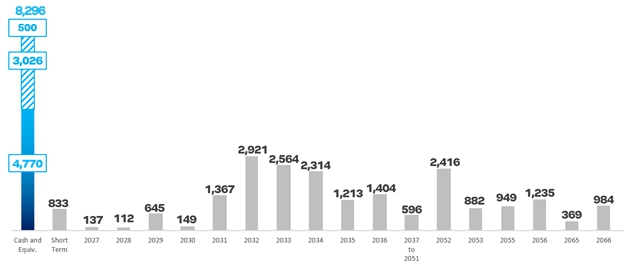

We believe that our cash and cash equivalents and margin cash balance together with our borrowing capacity under our revolving credit facilities as of December 31, 2025 should be sufficient to meet our outstanding debt requirements through mid-2033. However, this balance and our ability to continue to generate sufficient cash is subject to certain general economic, financial, industry, legislative, regulatory and other factors beyond our control. For more information, see “Item 3. Key Information—D. Risk Factors.”
117
Cash Flows
The table below shows our cash flows from operating, investing and financing activities for the periods indicated:
| For the year ended December 31, | ||||||||||||
| 2025 | 2024 | 2023 | ||||||||||
| (in millions of U.S. dollars) | ||||||||||||
| Net cash provided by operating activities | 2,932.0 | 4,229.5 | 2,378.8 | |||||||||
| Net cash used in investing activities | (2,311.4 | ) | (1,417.7 | ) | (1,408.4 | ) | ||||||
| Net cash provided by (used in) financing activities | (1,771.9 | ) | (1,414.8 | ) | 1,022.1 | |||||||
| Effect of exchange rate changes on cash and cash equivalents | 102.8 | (352.9 | ) | 50.6 | ||||||||
| Change in cash and cash equivalents, net | (1,048.5 | ) | 1,044.2 | 2,043.1 | ||||||||
| Cash and cash equivalents at the beginning of the period | 5,613.7 | 4,569.5 | 2,526.4 | |||||||||
| Cash and cash equivalents at the end of the period | 4,565.1 | 5,613.7 | 4,569.5 | |||||||||
Operating Activities
Cash flow provided by (used in) operating activities may vary from time to time according to the fluctuation of sales revenues, cost of sales, operating expenses, changes in operating activities, interest paid and received and income tax paid.
Net cash provided by operating activities in 2025 was US$2,932.0 million, compared to net cash provided by operating activities of US$4,229.5 million in 2024. This decrease was primarily due to:
| ● | an increase in income taxes paid of US$460.3 million, to US$809.0 million in 2025, from US$348.7 million in 2024; |
| ● | an increase in cash consumption of inventories of US$416.2 million, to US$793.7 million in 2025, from US$377.4 million in 2024; |
| ● | an increase in cash consumption of biological assets of US$300.1 million, to US$820.6 million in 2025, from US$520.5 million in 2024; and. |
| ● | an increase in payments relating to DOJ and antitrust agreements of US$232.2 million, to US$402.8 million in 2025 from US$170.6 million in 2024. |
Net cash provided by operating activities in 2024 was US$4,229.5 million, compared to US$2,378.8 million in 2023. This change was primarily due to an increase in net income adjusted for non-cash effects to US$6,891.4 million in 2024, compared to US$3,553.8 million in 2023.
This increase in net cash generation in operating activities was partially offset by:
| ● | a decrease in trade accounts receivable to a cash generation of US$333.6 million in 2024, compared to a cash generation of US$624.8 million in 2023; and |
| ● | an increase in cash consumption of inventories to US$377.4 million in 2024, compared to a cash generation of US$480.5 million in 2023. |
Investing Activities
Cash flow provided by (used in) investing activities is primarily related to: (1) our acquisition of subsidiaries minus net cash at the time of acquisition; (2) our acquisition of property, plant and equipment; (3) our acquisition of intangible assets; and (4) our receipt of payment from the sale of property, plant and equipment.
For 2025, net cash used in investing activities totaled US$2,311.4 million, of which US$2,099.3 million was cash used in purchases of property, plant and equipment, and US$185.7 million was additional investments in equity-accounted investees. The total cash used was partially offset primarily by US$73.2 million in cash provided by sales of property, plant and equipment.
For 2024, net cash used in investing activities totaled US$1,417.7 million, of which US$1,480.3 million was cash used in purchases of property, plant and equipment, partially offset by US$47.2 million in cash provided by proceeds from sales of property, plant and equipment.
118
For 2023, net cash used in investing activities totaled US$1,408.4 million, of which US$1,502.1 million was cash used in purchases of property, plant and equipment, partially offset by US$72.0 million in cash provided by sales of property, plant and equipment.
Financing Activities
Cash flow provided by (used in) financing activities includes primarily proceeds from new loans and financing and derivatives settled in cash. Cash flow used in financing activities includes primarily principal payments on loans and financing, payments related to derivatives settled in cash, payments for purchase of treasury shares and payments of dividends.
For 2025, net cash used in financing activities totaled US$1,771.9 million, of which US$8,752.8 million was cash used in payments of loans and financing, US$1,573.9 million was cash used in dividend payments; US$600.0 million was cash used in the acquisition of shares under the share buyback program; US$432.5 million was cash used in payments of leasing contracts; and US$356.2 million was cash used in dividend payments to non-controlling interest; which was partially offset by US$10,087.3 million in cash proceeds from loans and financing.
For 2024, net cash used in financing activities totaled US$1,414.8 million, of which US$2,990.3 million was cash used in payments of loans and financing, US$759.3 million used in dividend payment, US$417.8 million used in payments of leasing contracts, and US$232.0 million was cash used in derivatives instruments; which was partially offset by US$2,976.3 million in cash proceeds from loans and financing.
For 2023, net cash provided by financing activities totaled US$1,022.1 million, of which US$9,035.7 million was cash proceeds from loans and financing; which was partially offset by US$7,091.7 million in cash used in payments of loans and financing and US$448.0 million in cash used in payments of dividends.
Indebtedness and Financing Strategy
As of December 31, 2025, our total outstanding indebtedness was US$21,090.6 million, consisting of US$833.1 million of current loans and financing and US$20,257.5 million of non-current loans and financing, representing 59% of our total liabilities, which totaled US$35,633.7 million as of December 31, 2025.
As of December 31, 2024, our total outstanding indebtedness was US$19,328.8 million, consisting of US$2,084.2 million of current loans and financing and US$17,242.6 million of non-current loans and financing, representing 59.4% of our total liabilities, which totaled US$32,551.0 million as of December 31, 2024.
Our financing strategy has been and will be, over the next several years, to: (1) extend the average maturity of our outstanding indebtedness, including by refinancing short-term debt through longer-term borrowings and issuing longer-term debt securities, in order to increase our liquidity levels and improve our strategic, financial and operational flexibility; and (2) reduce our financing costs by accessing lower-cost sources of finance, including through the capital markets and export finance.
Based on the profile of our indebtedness as of December 31, 2025 and our track record, we believe we will continue to be able to raise funds in U.S. dollars, euros and reais to meet our financial obligations. We further believe that our capital expenditures during recent years, in addition to capital expenditures that we intend to make in the near future, will allow us to increase our ability to generate cash, to strengthen our credit ratios and to enhance our capacity to meet our financial obligations.
We maintain lines of credit with various financial institutions to finance working capital requirements, and we believe we will continue to be able to obtain additional credit to finance our working capital needs based on our past track record and current market conditions.
119
Indebtedness Summary and Maturities
The table below sets forth our consolidated loans and financing as of December 31, 2025. A “foreign currency” instrument refers to an instrument whose currency is different from the functional currency of the borrower. A “local currency” instrument refers to an instrument whose currency is the same as the functional currency of the borrower.
Type | Average annual interest rate | Currency | Index | Maturity | As of December 31, 2025 | |||||||||||||||
| (in millions of US$) | ||||||||||||||||||||
| Foreign currency: | ||||||||||||||||||||
| ACC - Advances on Exchange | 5.94 | % | USD | — | 2025 | — | ||||||||||||||
| Prepayment | 5.69 | % | USD | SOFR | 2025 - 27 | — | ||||||||||||||
| FINIMP – Import Financing | 6.03 | % | USD and EUR | Euribor | 2025 | — | ||||||||||||||
| Working capital – Dollars | 3.99 | % | USD | SOFR | 2030 | 11.7 | ||||||||||||||
| CRA - Agribusiness Credit Receivable Certificates | 5.36 | % | USD | — | 2035 | 66.2 | ||||||||||||||
| CRA - Agribusiness Credit Receivable Certificates | 5.30 | % | USD | — | 2029 | 19.3 | ||||||||||||||
| CRA - Agribusiness Credit Receivable Certificates | 5.49 | % | USD | — | 2029 | 20.5 | ||||||||||||||
| Export Credit Note | 4.94 | % | USD | SOFR | 2026 | 254.9 | ||||||||||||||
| Others | 6.84 | % | Several | Several | — | 3.0 | ||||||||||||||
| Total foreign currency | 375.6 | |||||||||||||||||||
| Local currency: | ||||||||||||||||||||
| FINAME | 6.00 | % | BRL | — | 2025 | — | ||||||||||||||
| Notes 2.50% JBS Lux 2027 (1) | 2.50 | % | USD | — | 2027 | 106.5 | ||||||||||||||
| Notes 5.13% JBS Lux 2028 (1) | 5.13 | % | USD | — | 2028 | — | ||||||||||||||
| Notes 6.5% JBS Lux 2029 (1) | 6.50 | % | USD | — | 2029 | — | ||||||||||||||
| Notes 3.00% JBS Lux 2029 (1) | 3.00 | % | USD | — | 2029 | 598.9 | ||||||||||||||
| Notes 5.50% JBS Lux 2030 (1) | 5.50 | % | USD | — | 2030 | — | ||||||||||||||
| Notes 3.75% JBS Lux 2031 (1) | 3.75 | % | USD | — | 2031 | 491.0 | ||||||||||||||
| Notes 3.00% JBS Lux 2032 (1) | 3.00 | % | USD | — | 2032 | 988.7 | ||||||||||||||
| Notes 3.63% JBS Fin 2032 (1) | 3.63 | % | USD | — | 2032 | 973.4 | ||||||||||||||
| Notes 5.75% JBS Lux 2033 (1) | 5.75 | % | USD | — | 2033 | 1,653.9 | ||||||||||||||
| Notes 6.75% JBS Lux 2034 (1) | 6.75 | % | USD | — | 2034 | 1,517.4 | ||||||||||||||
| Notes 5,50% JBS Lux 2036 | 5.50 | % | USD | — | 2036 | 1,265.0 | ||||||||||||||
| Notes 4.38% JBS Lux 2052 (1) | 4.38 | % | USD | — | 2052 | 904.2 | ||||||||||||||
| Notes 6.50% JBS Lux 2052 (1) | 6.50 | % | USD | — | 2052 | 1,534.7 | ||||||||||||||
| Notes 7.25% JBS Lux 2053 (1) | 7.25 | % | USD | — | 2053 | 891.8 | ||||||||||||||
| Notes 6,25% JBS Lux 2056 | 6.25 | % | USD | — | 2056 | 1,273.3 | ||||||||||||||
| Notes 6,38% JBS Lux 2066 | 6.38 | % | USD | — | 2066 | 1,015.3 | ||||||||||||||
| Notes 4.25% PPC 2031 | 4.25 | % | USD | — | 2031 | 794.1 | ||||||||||||||
| Notes 3.50% PPC 2032 | 3.50 | % | USD | — | 2032 | 903.2 | ||||||||||||||
| Notes 6.25% PPC 2033 | 6.25 | % | USD | — | 2033 | 939.4 | ||||||||||||||
| Notes 6.88% PPC 2034 | 6.88 | % | USD | — | 2034 | 491.8 | ||||||||||||||
| Notes 5,95% JBS USA 2035 | 5.95 | % | USD | — | 2035 | 998.7 | ||||||||||||||
| Notes 6,38% JBS USA 2055 | 6.38 | % | USD | — | 2055 | 747.3 | ||||||||||||||
| Working capital - Euros | 2.15 | % | EUR | Euribor | 2025 - 28 | 52.5 | ||||||||||||||
| Working capital - Pounds | 5.65 | % | GBP | — | 2026 | 9.6 | ||||||||||||||
| Export credit note | 13.48 | % | BRL | CDI | 2025 - 30 | — | ||||||||||||||
| CDC - Direct Consumer Credit | 16.33 | % | BRL | — | 2026 | 0.9 | ||||||||||||||
| Livestock financing | 9.00 | % | BRL | — | 2035 | 11.1 | ||||||||||||||
| Livestock financing - Pre | 14.90 | % | BRL | CDI | 2026 | 114.3 | ||||||||||||||
| Livestock financing | 14.90 | % | BRL | CDI | 2026 | 0.4 | ||||||||||||||
| CRA - Agribusiness Receivables Certificate | 7.03 | % | BRL | IPCA | 2029-65 | 2,165.2 | ||||||||||||||
| CRA - Agribusiness Receivables Certificate | 15.70 | % | BRL | CDI | 2028 | 54.2 | ||||||||||||||
| Commercial Paper | 5.00 | % | — | — | — | — | ||||||||||||||
| PPC Term Loan Revolving Credit Facility | 3.50 | % | USD | — | 2025 | 33.7 | ||||||||||||||
| Others | 4.52 | % | Several | Several | — | 184.6 | ||||||||||||||
| Total local currency | 20,715.0 | |||||||||||||||||||
| Total | 21,090.6 | |||||||||||||||||||
| Breakdown: | ||||||||||||||||||||
| Current loans and financing (*) | 833.1 | |||||||||||||||||||
| Non-current loans and financing | 20,257.5 | |||||||||||||||||||
| Total | 21,090.6 | |||||||||||||||||||
| (*) | Balances classified as current which have their maturities between January 1, 2026 and December 31, 2026. |
120
The table below sets forth the payment schedule of our consolidated loans and financing in the total amount of US$21,090.6 million, as of December 31, 2025:
| As of December 31, 2025 | ||||||||
| (in millions of U.S. dollars) | (%) | |||||||
| Total current | 833.1 | 4.0 | % | |||||
| 2026 | — | 0.0 | % | |||||
| 2027 | 137.1 | 0.7 | % | |||||
| 2028 | 111.9 | 0.5 | % | |||||
| 2029 | 645.0 | 3.1 | % | |||||
| 2030 | 149.4 | 0.7 | % | |||||
| After 2030 | 19,213.9 | 91.1 | % | |||||
| Total non-current | 20,257.5 | 96.0 | % | |||||
| Total | 21,090.6 | 100.0 | % | |||||
Certain of our indebtedness is secured or guaranteed by the following: (1) receivables and inventories; (2) letters of credit; (3) guarantees by parent companies or subsidiaries; and (4) mortgages and liens on real estate, equipment and other items.
Description of Material Indebtedness
The following summarizes our material indebtedness as of the date of this annual report, unless otherwise noted.
Fixed-Rate Notes
We have the following series of material, fixed-rate debt securities in the international capital markets as of December 31, 2025.
Security | Outstanding Principal Amount | Final Maturity | ||||
| (in millions of US$) | ||||||
| JBS USA 2.500% Notes due 2027 (1) | 106.0 | July 2027 | ||||
| JBS USA 3.000% Notes due 2029 (1) | 600.0 | February 2029 | ||||
| JBS USA 3.750% Notes due 2031 (1) | 493.0 | December 2031 | ||||
| JBS USA 3.625% Sustainability-Linked Notes due 2032 (1) | 968.8 | January 2032 | ||||
| JBS USA 3.000% Sustainability-Linked Notes due 2032 (1) | 1,000.0 | May 2032 | ||||
| JBS USA 5.750% Notes due 2033 (1) | 1,661.7 | April 2033 | ||||
| JBS USA 6.750% Notes due 2034 (1) | 1,507.0 | March 2034 | ||||
| JBS USA 5.950% Notes due 2035 (1) | 1,000.0 | April 2035 | ||||
| JBS USA 4.375% Notes due 2052 (1) | 900.0 | February 2052 | ||||
| JBS USA 6.500% Notes due 2052 (1) | 1,548.0 | December 2052 | ||||
| JBS USA 7.250% Notes due 2053 (1) | 900.0 | November 2053 | ||||
| JBS USA 5.500% Notes due 2036 (1) | 1,250.0 | January 2036 | ||||
| JBS USA 6.250% Notes due 2056 (1) | 1,250.0 | March 2056 | ||||
| JBS USA 6.375% Notes due 2066 (1) | 1,000.0 | April 2066 | ||||
| JBS USA 6.375% Notes due 2055 (1) | 750.0 | February 2055 | ||||
| PPC 4.250% Sustainability-Linked Notes due 2031 (2) | 796.2 | April 2031 | ||||
| PPC 3.500% Notes due 2032 (2) | 899.6 | March 2032 | ||||
| PPC 6.250% Notes due 2033 (2) | 922.5 | July 2033 | ||||
| PPC 6.875% Notes due 2034 (2) | 500.0 | May 2034 | ||||
| (1) | On November 19, 2025, JBS USA, JBS N.V. and Regions Bank, as trustee, entered into supplemental indentures to each of the respective indentures governing these JBS USA Registered Notes. Pursuant to each supplemental indenture, (1) JBS USA was substituted as a co-issuer by JBS N.V. and JBS N.V. became a co-issuer of the JBS USA Registered Notes and (2) JBS S.A., JBS Global Luxembourg S.à r.l. and JBS Global Meat Holdings Pty Limited were released as parent guarantors of the JBS USA Registered Notes, in each case, in accordance with the terms and conditions of the applicable indentures governing these JBS USA Registered Notes. As a result, JBS S.A. was released from its obligations as a guarantor under the indentures, and JBS N.V. became the successor co-issuer under the JBS USA Registered Notes, and has succeeded JBS S.A. as the registrant under the JBS USA Registered Notes. In addition, JBS N.V., together with JBS USA Foods Group Holdings and JBS USA Food Company Holdings, became liable for all obligations under the indentures and the JBS USA Registered Notes. Therefore, as of the date of this annual report, the issuers of these notes are JBS N.V., JBS USA Foods Group Holdings and JBS USA Food Company Holdings. |
| (2) | These notes were issued by PPC and are guaranteed by Pilgrim’s Pride Corporation of West Virginia, Inc., Gold’n Plump Poultry, LLC, Gold’n Plump Farms, LLC, and JFC LLC. |
121
The indentures governing these notes contain negative covenants that limit JBS N.V. or PPC, as applicable, and their respective significant restricted subsidiaries that guarantee these notes from creating liens on Principal Property (as defined in the applicable indentures governing each series of notes) to secure debt and entering into certain sale and leaseback transactions. In addition, the indentures governing these notes restrict JBS N.V.’s or PPC’s, as applicable, ability to merge, consolidate, sell or otherwise dispose of all or substantially all of their respective assets. These covenants are subject to certain exceptions and qualifications, including that as of the date of this annual report, there are no Principal Properties. For more information about these covenants and the indentures governing each series of these notes, see Exhibits 2.2 through 2.56 to this annual report. We are currently in compliance with the covenants under the indentures governing our notes.
Sustainability-Linked Bonds
As described above, we have issued three series of fixed-rate sustainability-linked debt securities in the international capital markets, as follows:
| ● | JBS USA’s 3.625% Sustainability-Linked Notes due January 2032 in an aggregate principal amount of US$973.4 million; |
| ● | JBS USA’s 3.000% Sustainability-Linked Notes due May 2032 in an aggregate principal amount of US$988.7 million; and |
| ● | PPC’s 4.250% Sustainability-Linked Notes due April 2031 in an aggregate principal amount of US$794.1 million. |
As further described below, each series of sustainability-linked notes contains certain sustainability performance targets of JBS S.A., JBS USA or PPC that if unsatisfied will result in an increase in the interest rate payable on the respective notes. The applicable sustainability performance targets are specifically tailored to the business, operations and capabilities of JBS S.A., JBS USA and PPC and do not easily lend themselves to benchmarking against sustainability performance targets that may be used by other companies. In connection with these notes, none of JBS S.A., JBS USA or PPC has committed to (i) allocate the net proceeds specifically to projects or business activities meeting sustainability criteria or (ii) be subject to any other limitations or requirements that may be associated with green instruments, social instruments or sustainability instruments or other financial instruments in any particular market.
Furthermore, as there is currently no generally accepted definition (legal, regulatory or otherwise) of, nor market consensus as to what criteria a particular financial instrument must meet to qualify as, “green,” “social,” “sustainable” or “sustainability-linked” (and, in addition, the requirements of any such label may evolve from time to time), no assurance was or could be given to investors in these notes or to any other party by the issuers or the guarantors of the notes or any second party opinion providers or any qualified provider of third-party assurance or attestation services appointed by each company (an “external verifier”) that the notes will meet any or all investor expectations regarding the sustainability performance target qualifying as “green,” “social,” “sustainable” or “sustainability-linked,” or satisfy an investor’s requirements or any future legal, quasi-legal or other standards for investment in assets with sustainability characteristics, or that any adverse social and/or other impacts will not occur in connection with JBS S.A., JBS USA and/or PPC striving to achieve the sustainability performance target or the use of the net proceeds from the offering of notes.
In addition, no assurance or representation was given by the issuers and guarantors of the notes, any second party opinion providers or any external verifier as to the suitability or reliability for any purpose whatsoever of any opinion, report or certification of any third party in connection with the offering of the notes or the respective sustainability performance targets to fulfill any green, social, sustainability, sustainability-linked and/or other criteria. Any such opinion, report or certification is not, nor shall it be deemed to be, incorporated in and/or form part of this annual report.
122
There can be no assurance of the extent to which JBS S.A., JBS USA and/or PPC will be successful in significantly decreasing their greenhouse gas emissions. Although a failure to achieve the applicable sustainability performance targets will give rise to an upward adjustment of the applicable interest rates, any such failure would not be an event of default under the notes, nor would such failure result in a requirement to redeem or repurchase such securities.
See “Item 3. Key Information—D. Risk Factors—Risks Relating to Our Business and Industries—Failure by us to achieve our sustainability performance targets may result in increased interest payments under future financings and harm to our reputation.”
JBS USA’s 3.625% Sustainability-Linked Notes due January 2032
Under the terms of JBS USA’s 3.625% Sustainability-Linked Notes due January 2032, if JBS S.A. does not satisfy the sustainability performance target it established under its Sustainability-Linked Framework adopted in June 2021 (the “JBS S.A. June 2021 Sustainability-Linked Framework”) to reduce its Global Greenhouse Gas Emissions Intensity by 16.364% by December 31, 2025, based on linear annual improvements against the 2019 baseline year, and provide confirmation thereof to the trustee together with a related confirmation by an external verifier at least 30 days prior to January 15, 2027, the interest rate payable on the notes will be increased by 25 basis points from and including January 15, 2027 to and including the maturity date of January 15, 2032. For more information about the JBS S.A. June 2021 Sustainability-Linked Framework, including the sustainability performance target, see “Item 4. Information on the Company—B. Business Overview—Climate Change Reduction Goals—Sustainability-Linked Frameworks—JBS S.A. June 2021 Sustainability-Linked Framework.”
JBS USA’s 3.000% Sustainability-Linked Notes due May 2032
Under the terms of JBS USA’s 3.000% Sustainability-Linked Notes due May 2032, if JBS USA does not satisfy the sustainability performance target it established under its Sustainability-Linked Framework adopted in November 2021 (the “JBS USA Sustainability-Linked Framework”) to reduce its Global Greenhouse Gas Emissions Intensity by 20.30% by December 31, 2026, based on linear annual improvements against the 2019 baseline year, and provide confirmation thereof to the trustee together with a related confirmation by an external verifier within six months after December 31, 2026, the interest rate payable on the notes will be increased by 25 basis points from and including November 15, 2027 to and including the maturity date of May 15, 2032. For more information about the JBS USA Sustainability-Linked Framework, including the sustainability performance target, see “Item 4. Information on the Company—B. Business Overview—Climate Change Reduction Goals—Sustainability-Linked Frameworks— JBS USA Sustainability-Linked Framework.”
PPC’s 4.250% Sustainability-Linked Notes due April 2031
Under the terms of PPC’s 4.250% Sustainability-Linked Notes due April 2031, if PPC does not satisfy the sustainability performance target it established under its Sustainability-Linked Framework adopted in March 2021(the “PPC Sustainability-Linked Framework”) to reduce its Global Greenhouse Gas Emissions Intensity by 17.679% by December 31, 2025, based on linear annual improvements against the 2019 baseline year, and provide confirmation thereof to the trustee together with a related confirmation by an external verifier at least 30 days prior to October 15, 2026, the interest rate payable on the notes will be increased by 25 basis points from and including October 15, 2026 to and including the maturity date of April 15, 2031. For more information about the PPC Sustainability-Linked Framework, including the sustainability performance target, see “Item 4. Information on the Company—B. Business Overview—Climate Change Reduction Goals—Sustainability-Linked Frameworks— PPC Sustainability-Linked Framework.”
JBS S.A. Revolving Credit Facility
On August 5, 2022, JBS S.A. and its subsidiaries JBS Investments Luxembourg S.à r.l., Seara Meats B.V. and Seara Alimentos Ltda., as borrowers and guarantors, entered into a US$450.0 million revolving unsecured credit facility (the “JBS S.A. Revolving Credit Facility”). On December 19, 2025, we entered into an amendment to the JBS S.A. Revolving Credit Facility, whereby JBS N.V. was included as an additional borrower and guarantor for all purposes under the JBS S.A. Revolving Credit Facility and its ancillary documents.
123
Any borrowing made by a borrower will be guaranteed by the other three obligors. The capacity of JBS S.A. Revolving Credit Facility could be increased up to US$500.0 million, with an accordion expansion feature, which was put into effect in November 2024, after obtaining lender commitments. The JBS S.A. Revolving Credit Facility initially matured in August 2025 and included two one-year extensions that were exercised at the borrowers’ option and duly accepted by all counterparties. Pursuant to the terms of the JBS S.A. Revolving Credit Facility, the interest rate under any borrowings will accrue at an adjusted secured overnight financing rate (“SOFR”), plus applicable margins that are based on the corporate rating of JBS S.A. As of December 31, 2025, there were no outstanding borrowings under the JBS S.A. Revolving Credit Facility.
The JBS S.A. Revolving Credit Facility contains customary representations, covenants and events of default. The JBS S.A. Revolving Credit Facility contains negative covenants that restrict the borrowers and guarantors thereunder and significant restricted subsidiaries from creating liens on their property or assets to secure debt and entering into certain sale and leaseback transactions. In addition, the JBS S.A. Revolving Credit Facility restricts the borrowers’ and guarantors’ ability to merge, consolidate, sell or otherwise dispose of all or substantially all of their respective assets. These covenants are subject to certain exceptions and qualifications. For more information about these covenants and the JBS S.A. Revolving Credit Facility, see Exhibit 4.1 to this annual report. We are currently in compliance with the covenants under the JBS S.A. Revolving Credit Facility.
JBS USA Senior Unsecured Revolving Facility
On November 1, 2022, JBS USA, JBS USA Food Company, JBS USA Finance, Inc. (prior to its dissolution), JBS Australia and JBS Canada, as borrowers, entered into an unsecured revolving credit facility (as amended from time to time, the “JBS Senior Unsecured Revolving Facility”), with Bank of Montreal, as administrative agent, and the lender parties thereto. The JBS Senior Unsecured Revolving Facility provides for a revolving credit commitment in an amount up to US$1,500.0 million with a maturity in 2027, with two one-year extension options at each lender’s discretion. The facility is available in two tranches of US$800.0 million and US$700.0 million and in multiple currencies, subject to sub-limits with respect to any amounts borrowed in currencies other than amounts borrowed in Dollars. These loans bear interest at the applicable benchmark rate or the prime rate plus applicable margins that are based on the corporate credit or family rating of JBS N.V. On November 19, 2025, we entered into an amendment to the JBS Senior Unsecured Revolving Facility, whereby (1) JBS USA was substituted as a borrower by JBS N.V. and JBS N.V. became a borrower and a guarantor under the JBS Senior Unsecured Revolving Facility, (2) JBS USA Food Company was substituted as a borrower by JBS USA Food Company Holdings and JBS USA Food Company Holdings became a borrower and a guarantor under the JBS Senior Unsecured Revolving Facility and (3) JBS S.A., JBS Global Luxembourg S.à r.l. and JBS Global Meat Holdings Pty Limited were released as parent guarantors, in each case, in accordance with the terms and conditions of the JBS Senior Unsecured Revolving Facility. As a result of this amendment, the borrowers under the JBS Senior Unsecured Revolving Facility currently include JBS N.V., JBS USA Food Company Holdings, JBS Australia and JBS Canada.
Guarantees. Subject to the JBS Collateral Cure (as described below), borrowings are guaranteed by each of the borrowers under the JBS Senior Unsecured Revolving Facility in relation to its respective borrowings. Following a JBS Collateral Cure, the direct parent entity of each borrower and each wholly-owned subsidiary of each borrower is required to become a guarantor (other than, in each case, certain excluded subsidiaries that are not required to become a guarantor).
Covenants. The JBS Senior Unsecured Revolving Facility contains customary representations and warranties, covenants and events of default. The JBS Senior Unsecured Revolving Facility imposes certain limitations and restrictions on JBS N.V. and its restricted subsidiaries, including, without limitation (1) restricting any restricted subsidiary of JBS N.V. that is not a borrower or guarantor of the JBS Senior Unsecured Revolving Facility from incurring additional debt, subject to certain significant exceptions and (2) creating liens, entering into certain transactions with affiliates and consolidating or merging, in each case, subject to certain significant exceptions. In addition, the JBS Senior Unsecured Revolving Facility and subject to the JBS Collateral Cure described below, includes a financial maintenance covenant that requires compliance with a minimum interest coverage ratio of 3:00 to 1:00, which shall be tested at the end of each fiscal quarter of the borrowers (the “JBS Financial Maintenance Covenant”). For more information about these covenants and the JBS Senior Unsecured Revolving Facility, see Exhibits 4.2 to 4.4 to this annual report. We are currently in compliance with the covenants under the JBS Senior Unsecured Revolving Facility.
124
Collateral Cure. After the end of any fiscal quarter, the borrowers may give notice that they will not be in compliance with the JBS Financial Maintenance Covenant and instead may elect to cause (1) the borrowers and each wholly-owned subsidiary of each borrower (other than, in each case, any excluded subsidiary) to become a guarantor, and (2) each borrower and each such subsidiary guarantor, in each case organized in the United States, to provide perfected first-priority security interests in substantially all of its assets (other than certain excluded assets) (the “JBS Collateral Cure”). From and after the date of the JBS Collateral Cure, the JBS Financial Maintenance Covenant will no longer be in effect and availability under the JBS Senior Unsecured Revolving Facility will be limited and subject to collateral coverage utilizing a 75% advance rate on U.S. receivables and a 50% advance rate on U.S. inventory, subject to certain exceptions.
As of December 31, 2025, JBS N.V. had outstanding letters of credit and available borrowings under the revolving credit commitment of US$1,499.8 million and US$0.2 million, respectively. There were no outstanding borrowings as of December 31, 2025.
JBS USA Commercial Paper Program
On December 10, 2024, JBS USA launched its commercial paper program. The program allowed JBS USA, JBS USA Food Company and JBS USA Foods Group Holdings to issue up to US$1.0 billion in aggregate principal amount of short-term, unsecured notes without registration under the Securities Act.
On December 22, 2025, the issuers notified the other parties of the termination of the existing commercial paper program. Concurrently, JBS N.V., JBS USA Foods Group Holdings and JBS USA Food Company Holdings launched a new program, allowing the issuance of up to US$1.0 billion in aggregate principal amount of short-term, unsecured notes without registration under the Securities Act. As of December 31, 2025 there were no outstanding borrowings under the new commercial paper program.
PPC U.S. Credit Facility
On October 4, 2023, PPC and certain of PPC’s subsidiaries entered into a Revolving Syndicated Facility Agreement (the “PPC U.S. Credit Facility”) with CoBank, ACB as administrative agent and the other lenders party thereto. The PPC U.S. Credit Facility provides for a revolving loan commitment of up to US$850.0 million with a maturity on October 4, 2028. The PPC U.S. Credit Facility is unsecured and will be used for general corporate purposes. Outstanding borrowings under the PPC U.S. Credit Facility bear interest at a per annum rate equal to either the SOFR or the prime rate plus applicable margins based on PPC’s credit ratings. As of December 28, 2025, PPC had outstanding letters of credit and available borrowings under the PPC U.S. Credit Facility of US$4.0 million and US$846.0 million, respectively, and there were no outstanding borrowings under this agreement.
The PPC U.S. Credit Facility is not guaranteed by any of PPC’s subsidiaries. Following the PPC Collateral Cure (as defined below), each wholly-owned subsidiary of each borrower is required to become a guarantor (other than certain excluded subsidiaries that are not required to become a guarantor). The PPC U.S. Credit Facility contains customary representations and warranties, covenants and events of default. The PPC U.S. Credit Facility imposes certain limitations and restrictions on PPC and its restricted subsidiaries, including limitations on (1) liens, (2) indebtedness, (3) sales and other dispositions of assets, (4) dividends, distributions, and other payments in respect of equity interest, (5) investments, and (6) voluntary prepayments, redemptions or repurchases of junior debt, in each case, subject to certain exceptions which can be material and certain of such clauses only apply to PPC upon the occurrence of certain triggering events. In addition, the PPC U.S. Credit Facility and subject to the PPC Collateral Cure, includes a financial maintenance covenant that requires PPC not to permit its interest coverage ratio to be less than 3.50:1.00, which shall be tested at the end of each fiscal quarter of PPC (the “PPC Financial Maintenance Covenant”).
After the end of any fiscal quarter, PPC may give notice that they will not be in compliance with the PPC Financial Maintenance Covenant and instead may elect to cause the borrowers and each subsidiary guarantor to provide security interests in the collateral that secured PPC’s prior secured credit facility (the “PPC Collateral Cure”). From and after the date of the PPC Collateral Cure, the PPC Financial Maintenance Covenant will no longer be in effect and availability under the PPC U.S. Credit Facility will be limited and subject to collateral coverage utilizing a 75% advance rate on U.S. receivables and a 50% advance rate on U.S. inventory, subject to certain exceptions. PPC is currently in compliance with the covenants under the PPC U.S. Credit Facility.
For more information about these covenants and the PPC U.S. Credit Facility, see Exhibit 4.5 to this annual report.
125
Agribusiness Credit Receivable Certificates (Certificados de Recebíveis do Agronegócio)
JBS S.A.
From May 2022 through May 2024, JBS S.A. issued several series of non-convertible unsecured debentures through private placements in Brazil, with maturities ranging from 2027 until 2044. These debentures are denominated in Brazilian reais and bear interest at various rates. A larger part of these debentures have their principal amount adjusted according to the Brazilian inflation – IPCA (Índice Nacional de Preços ao Consumidor Amplo), with an annual average interest rate of 6.4% as of December 31, 2025, while the remaining part is indexed to the U.S. dollar plus an annual average interest rate of 5.4% as of December 31, 2025. These debentures underlie the securitization of agribusiness receivables in Brazil through the issuance of agribusiness receivables certificates (Certificados de Recebíveis do Agronegócio) (“CRAs”). The net proceeds from the issuances of these debentures have been used primarily to acquire cattle, natural products and other inputs necessary for the processing or industrialization of bovine cattle, including the slaughter, preparation of by-products, and the manufacturing of meat products from the primary slaughter process mentioned above, as well as the sale of the resulting products and by-products of such process, including exportation, intermediation, storage, and transportation of the products, by-products, and derivatives. As of December 31, 2025, the outstanding aggregate principal amount of the CRAs was US$7.1 billion.
Seara
From October 2024 through November 2025, several series of CRAs representing rural financial product notes (Cédulas de Produto Rural Financeiras – CPR-Financeiras) issued by Seara and guaranteed by JBS S.A. were issued, with maturities ranging from 2029 until 2065. These rural financial product notes are denominated in Brazilian reais and bear interest at various rates. A larger part of these rural financial product notes have their principal amount adjusted according to the Brazilian inflation – IPCA (Índice Nacional de Preços ao Consumidor Amplo), with an annual average interest rate of 7.5% as of December 31, 2025, while the remaining part is indexed to the U.S. dollar plus an annual average interest rate of 5.4%. Seara used the net proceeds from the issuances of the rural financial product notes primarily to acquire raw materials, namely corn in natura, in the ordinary course of its business. As of December 31, 2025, the outstanding aggregate principal amount of the CRAs was US$6.5 billion. The agreements governing these CRAs contain customary covenants and events of default; however, they do not include any financial covenants.
Other Debt
For more information about our consolidated indebtedness, including our other, lower value debt instruments and facilities, see “—Contractual Obligations” below and note 16 to JBS N.V.’s consolidated financial statements, included elsewhere in this annual report.
Capital Expenditures
We make capital expenditures primarily for acquisitions, strategic investments as well as equipment purchases and maintenance, expansions and modernization of our facilities including: (1) expansion and modernization of our Seara plants; (2) buildings and earthwork for our facilities in the United States; (3) investments in our new business (Novos Negócios) units and (4) the construction of a new Italian specialties and pepperoni plant in Columbia, South Carolina.
Our capital expenditures for the year ended December 31, 2025 totaled US$2,099.3 million in cash used in the purchase of property, plant and equipment, of which 46% were investments in facilities and 54% were investments in capacity expansion.
Our capital expenditures for the year ended December 31, 2024 totaled US$1,480.3 million in cash used in the purchase of property, plant and equipment, of which 66% were investments in facilities and 34% were investments in capacity expansion.
Our capital expenditures for the year ended December 31, 2023 totaled US$1,502.1 million in cash used in the purchase of property, plant and equipment, of which 51% were investments in facilities and 49% were investments in capacity expansion.
The source of cash for our capital expenditures generally tends to be our own cash flows.
126
Contractual Obligations
The following tables summarize our significant loans and financing, including estimated interest thereon, payables related to purchases of assets, finance lease obligations, operating lease obligations and other purchase obligations as of the dates indicated that have an impact on our liquidity.
| As of December 31, 2025 | ||||||||||||||||||||
| Contractual obligations | Until 1 year | Between 2 and 3 years | Between 4 and 5 years | More than 5 years | Total | |||||||||||||||
| (in millions of U.S. dollars) | ||||||||||||||||||||
| Trade accounts payable and supply chain finance | 7,332.6 | — | — | — | 7,332.6 | |||||||||||||||
| Loans and financing | 833.1 | 249.1 | 794.5 | 19,213.9 | 21,090.6 | |||||||||||||||
| Estimated interest on loans and financing (1) | 1,265.2 | 2,425.4 | 2,377.1 | 15,237.5 | 21,305.2 | |||||||||||||||
| Derivatives liabilities (assets) | 156.4 | 114.4 | — | — | 270.8 | |||||||||||||||
| Payments of leases | 354.9 | 520.7 | 351.0 | 861.4 | 2,088.0 | |||||||||||||||
| Commodity forward purchase contracts | 141.0 | 13,912.9 | 11,252.5 | 2,614.6 | 27,921.0 | |||||||||||||||
| Total | 10,083.2 | 17,222.5 | 14,775.1 | 37,927.4 | 80,008.2 | |||||||||||||||
| (1) | Includes interest on all loans and financing outstanding. Payments are estimated for variable rate and variable term debt based on effective interest rates as of December 31, 2025. Payments in foreign currencies are estimated using the December 31, 2025 exchange rate. |
| As of December 31, 2024 | ||||||||||||||||||||
| Contractual obligations | Until 1 year | Between 2 and 3 years | Between 4 and 5 years | More than 5 years | Total | |||||||||||||||
| (in millions of U.S. dollars) | ||||||||||||||||||||
| Trade accounts payable and supply chain finance | 6,194.2 | – | – | – | 6,194.2 | |||||||||||||||
| Loans and financing | 2,084.2 | 1,046.3 | 1,688.7 | 14,507.6 | 19,326.8 | |||||||||||||||
| Estimated interest on loans and financing (1) | 2,458.3 | 2,440.6 | 839.9 | 5,670.0 | 11,408.9 | |||||||||||||||
| Derivatives liabilities (assets) | 166.0 | 100.1 | – | – | 266.1 | |||||||||||||||
| Payments of leases | 377.8 | 797.3 | 326.9 | 817.7 | 2,319.6 | |||||||||||||||
| Commodity forward purchase contracts | 59.0 | 28,244.4 | 4,238.6 | 986.8 | 33,528.7 | |||||||||||||||
| Total | 11,339.5 | 32,628.7 | 7,094.1 | 21,982.1 | 73,044.3 | |||||||||||||||
| (1) | Includes interest on all loans and financing outstanding. Payments are estimated for variable rate and variable term debt based on effective interest rates as of December 31, 2024. Payments in foreign currencies are estimated using the December 31, 2024 exchange rate. |
We also have future commitments for purchase of grains and cattle whose balances as of December 31, 2025 and 2024 were US$27.9 billion and US$33.5 billion, respectively.
In addition, we have pledged assets as collateral for derivative transactions with commodities and futures exchanges, totaling US$159.6 million as of December 31, 2025, and US$136.6 million as of December 31, 2024. The value of this collateral exceeds the requirements for these transactions.
C. Research and Development, Patents and Licenses, Etc.
Our global innovation teams collaborate to share trends, solutions, and technological advancements, leveraging collective expertise to drive category growth. With a diverse product portfolio, JBS aims to deliver high-quality offerings tailored to evolving customer needs and consumer preferences. Investments in cultivated protein are central to our strategic vision. In 2021, we entered the cultured protein market with the acquisition of BioTech Foods in Spain. Additionally, the upcoming JBS Biotech Innovation Centre in Santa Catarina will be Brazil's largest research facility dedicated to food biotechnology. Our expansion into plant-based proteins is exemplified by Seara’s Incrível and the acquisition of Vivera Topholding BV, which produces and sells plant-based protein products in Europe.
Initiatives such as Seara’s Innovation Hub and Friboi’s Meat Technology and Study Center (Cetec) reflect our commitment to product quality and innovation. Through in-depth analysis of the entire production chain and continuous research, we adapt to shifting consumer expectations. In partnership with Colorado State University, we established the JBS Global Food Innovation Center, advancing food safety, meat sciences, and animal welfare practices. Furthermore, JBS USA makes significant investments in technology and innovation to uphold world-class quality standards, exemplified by the transition to zero-trim beef products. Meanwhile, Pilgrim’s Europe integrates advanced technologies, including Internet of Things (IoT) devices, to enhance operational efficiencies and predictive maintenance.
127
D. Trend Information
The following list sets forth, in our view, the most important trends, uncertainties and events that are reasonably likely to continue to have a material effect on our revenues, income from operations, profitability, liquidity and capital resources, or that may cause reported financial information to be not necessarily indicative of future operating results or financial condition:
| ● | global economic conditions; |
| ● | Brazilian economic environment; |
| ● | effect of level of indebtedness and interest rates; |
| ● | effect of the levels of sales of fresh and processed products in the domestic market on our results of operations; |
| ● | effect of the levels of exports of fresh and processed products on our results of operations; |
| ● | fluctuations in domestic market prices of fresh and processed products can significantly affect our operating revenues; |
| ● | effects of fluctuations in export prices of fresh and processed products on operating revenues; |
| ● | effects of the variation of prices for the purchase of raw materials on our costs of goods sold; and |
| ● | effects of fluctuations in currency exchange rates. |
For more information, see “—A. Operating Results—Principal Factors Affecting our Financial Condition and Results of Operations.”
E. Critical Accounting Estimates
Critical Accounting Estimates
The presentation of our financial position and results of operation in accordance with IFRS – Accounting Standards, and the disclosures related to judgements and estimates can be found in note 2.6 to JBS N.V.’s consolidated financial statements, which are included elsewhere in this annual report.
Recent Accounting Pronouncements
Certain new and amended accounting standards and interpretations have been adopted by us and are described in note 2.5 to JBS N.V.’s consolidated financial statements, which are included elsewhere in this annual report.
ITEM 6. DIRECTORS, SENIOR MANAGEMENT AND EMPLOYEES
A. Directors and Senior Management
In accordance with our articles of association we are managed by a board of directors, consisting of executive directors and non-executive directors, who may appoint executive officers to manage its day-to-day operations.
128
Board Structure
JBS N.V. has a one-tier board of directors. The number of directors is determined by the board of directors, provided that the board of directors shall consist of a minimum of seven directors and a maximum of 11 directors. In addition, the board of directors consists of a minimum of one and a maximum of three executive directors and a minimum of three and a maximum of 10 non-executive directors. Directors are appointed as such by our general meeting of shareholders at the nomination of the board of directors, whether or not upon the recommendation of the nominating committee of the board of directors. At the nomination of the board of directors, the general meeting of shareholders shall appoint one of the non-executive directors as chairman of the board of directors.
Each director is appointed for a term of approximately one year, which period ends immediately after the annual general meeting of shareholders that will be held in the calendar year after the date of his or her appointment. A director may be reappointed, with due observance of the provision in the previous sentence.
A director may at any time be suspended by the general meeting of shareholders by a simple majority vote. An executive director may also be suspended by the board of directors.
As of the date of this annual report, the issuer’s management board consists of the following members:
| Name | Age | Position | ||
| Jeremiah O’Callaghan | 72 | Chairman (Non-Executive Board Member) | ||
| Gilberto Tomazoni | 67 | Executive Board Member | ||
| Wesley Mendonça Batista | 55 | Non-Executive Board Member | ||
| Joesley Mendonça Batista | 54 | Non-Executive Board Member | ||
| Kátia Regina de Abreu Gomes | 64 | Non-Executive Board Member | ||
| Paulo Bernardo Silva | 74 | Non-Executive Board Member | ||
| Carlos Hamilton Vasconcelos Araújo | 61 | Non-Executive Board Member (Lead Independent Director) | ||
| Henrique de Campos Meirelles | 80 | Non-Executive Board Member | ||
| Raul Alfredo Padilla | 70 | Non-Executive Board Member |
The following is a summary of the business experience of our directors, a majority of whom are independent:
Jeremiah O’Callaghan has been chairman of the board of directors of JBS S.A. since October 2017 and has been serving as JBS S.A.’s executive officer since January 15, 2019. Mr. O’Callaghan holds a degree in civil engineering from the University College Cork in Ireland. Mr. O’Callaghan entered the beef industry in 1983 and joined us in 1996 to develop our international trade. He has more than 35 years of experience in the beef production industry.
Gilberto Tomazoni has served as the chief executive officer of the issuer since October 2019. He was selected to this position by JBS S.A. Mr. Tomazoni has also been JBS S.A.’s Global Chief Executive Officer since December 2018, with more than 40 years of extensive experience in the sector and a background in major food industry companies. He worked at Sadia for 27 years, where he started as a trainee and became Sadia’s chief executive officer. He served for three years as vice president of Bunge Alimentos, managing the food and ingredients business, and was also the executive director for their South and Central American business. He joined JBS S.A. as Global President of the poultry business in 2013, and subsequently led the establishment of Seara as its chief executive officer. In 2015, he was named President of JBS’ Global Operations. In 2013, he was named chairman of PPC’s board of directors. He is also a member of the International Advisory Council of Fundação Dom Cabral (FDC). He holds a degree in mechanical engineering from Universidade Federal de Santa Catarina in Santa Catarina, Brazil and a postgraduate degree in management.
Wesley Mendonça Batista is a co-controlling shareholder of J&F, one of the largest business groups in Brazil. Mr. Wesley Batista brings more than 35 years of experience in the protein industry and provides extensive operational expertise and business management experience to our company. He currently serves as Vice President of the J&F Institute, a non-profit organization that was created 14 years ago to transform businesses into companies committed to educating their communities. Additionally, he is a member of the board of directors of JBS S.A. and PPC.
129
Joesley Mendonça Batista is a co-controlling shareholder of J&F, one of the largest business groups in Brazil. Mr. Joesley Batista brings more than 35 years of experience in the protein industry, expertise in protein production operations and business management experience to our company. He currently serves as President of the J&F Institute, a non-profit organization that was created 14 years ago to transform businesses into companies committed to educating their communities. Additionally, he is a member of the board of directors of JBS S.A. and PPC.
Kátia Regina de Abreu Gomes has been an independent member of JBS S.A.’s board of directors since July 2023. She was the President of the Foreign Affairs Committee of the Brazilian Federal Senate between 2021 and 2022, Brazilian Federal Senator between 2007 and 2021, Minister of Agriculture, Livestock and Supplying of Brazil between 2015 and 2016, Brazilian Federal Deputy between 2003 and 2007, Substitute Brazilian Federal Deputy between 2000 and 2002, President of the Confederation of Agriculture and Livestock – CNA between 2009 and 2014, President of the Federation of Agriculture and Livestock of the State of Tocantins in 1996 and President of the Rural Union of the Municipality of Gurupi in the State of Tocantins in 1994, with a history of leadership in sustainability and the development of Brazilian agribusiness. In addition, she participated in several commissions and missions abroad and in Brazil.
Paulo Bernardo Silva has been an independent member of JBS S.A.’s board of directors since July 2023. He was Minister of Communications of Brazil between 2011 and 2014, Minister of Planning, Budget and Management of Brazil between 2005 and 2010, Federal Deputy for the State of Paraná in three terms (1991-1995, 1995-1999 and 2003-2007). Mr. Silva was also a career employee at Banco do Brasil (1975-2015), Secretary of State for Finance for the State of Mato Grosso do Sul (1999 – 2000) and Municipal Secretary of Finance and Planning for the City of Londrina (2001-2002), with extensive experience in public management, infrastructure, and development policies.
Carlos Hamilton Vasconcelos Araújo has been an independent member and Lead Independent Director of JBS S.A.’s board of directors since January 2022. Mr. Vasconcelos has served as chief risk officer for Brasilcap Capitalização. Previously, Mr. Vasconcelos was the chief planning officer of Eldorado Celulose Brasil S.A., deputy governor at the Brazilian Central Bank, Secretary of Economic Policy of the Ministry of Finance of Brazil, chief operation officer and chief financial officer at Banco do Brasil S.A. and chief executive officer of Cateno Gestão de Contas de Pagamentos. In addition, he has served as a member of the board of directors of UBS BB Services, Banco Votorantim, Cielo, BB Seguridade and Neoenergia. Mr. Vasconcelos holds a degree in engineering and masters and doctorate in economics from Getulio Vargas Foundation, with solid experience in macroeconomics and fiscal policy.
Henrique de Campos Meirelles was president of the Brazilian Central Bank from 2003 to 2010 and Brazil’s Minister of Finance from 2016 to 2018. During most of his career he worked for BankBoston, where he was the president of the Brazilian operations from 1984 to 1996. In 1996, he became President and Chief Operating Officer of BankBoston Corporation and in 1999 was named President of Global Banking for FleetBoston Financial. He has served as a member of the board of directors of Best Foods Group, Raytheon Company, Fleet Boston and Azul Brazilian Airlines. Mr. Meirelles earned a bachelor’s degree in engineering from the Universidade de São Paulo and a master’s in business administration from the Universidade Federal do Rio de Janeiro—Coppead and a solid background in the global financial sector. He attended the Harvard Business School Advanced Management Program.
Raul Padilla has been an independent member of PPC since April 2022. He served as president of global operations of Bunge Limited until 2021. Prior to serving as president, Mr. Padilla held several leadership positions with Bunge, including president of Bunge South America, president of Bunge Sugar and Bioenergy, managing director of Bunge Global Agribusiness and chief executive officer of Bunge Product Lines. Mr. Padilla has over 40 years of experience in the global agribusiness, oilseed processing and grain handling industries in Argentina, beginning his career with La Plata Cereal in 1977. He has served as president of the Argentine National Oilseed Crushers Association, vice president of the International Association of Seed Crushers and Director of the Buenos Aires Cereal Exchange and the Rosario Futures Exchange. Mr. Padilla is a graduate of the University of Buenos Aires. Mr. Padilla has over 40 years of experience in the agribusiness and food business with global responsibilities.
130
In 2017, Messrs. Joesley Mendonça Batista and Wesley Mendonça Batista, among others, entered into collaboration agreements (acordos de colaboração premiada) (the “Collaboration Agreements”) with the Brazilian Attorney General’s Office (Procuradoria-Geral da República), and J&F, on behalf of itself and its subsidiaries, entered into a leniency agreement (the “Leniency Agreement”) with the Brazilian Federal Prosecution Office (Ministério Público Federal) following disclosures of illicit payments made to Brazilian politicians from 2009 to 2015. In 2020, Messrs. Joesley Mendonça Batista and Wesley Mendonça Batista also entered into a settlement with the SEC, and J&F reached a plea agreement with the Department of Justice (DOJ) relating to the circumstances and payments that were the subject of the Collaboration Agreements and Leniency Agreement. For more information about the facts and circumstances underlying these agreements, see “Item 7. Major Shareholders and Related Party Transactions—A. Major Shareholders—Civil and Criminal Actions and Investigations involving our Ultimate Controlling Shareholders” and “Item 3. Key Information—D. Risk Factors—Risks Relating to Our Business and Industries—We are subject to reputational risk in connection with U.S. and Brazilian civil and criminal actions and investigations involving our ultimate controlling shareholders, and these actions may materially adversely impact our business and prospects and damage our reputation and image.”
Director Independence
Our board of directors has determined that all of its directors as of the date of this annual report, other than Jeremiah O’Callaghan, Gilberto Tomazoni, Wesley Mendonça Batista and Joesley Mendonça Batista, qualify as independent under the NYSE rules on director independence.
In addition, all of our directors as of the date of this annual report, other than Jeremiah O’Callaghan, Gilberto Tomazoni, Wesley Mendonça Batista and Joesley Mendonça Batista, qualify as independent within the meaning of the Dutch Corporate Governance Code.
Board Committees
JBS N.V. has an audit committee, a compensation committee, a nominating committee and a sustainability committee. The composition and responsibilities of each of these committees are summarized below.
Our audit committee is composed entirely of members that are our independent directors. Our nominating committee includes one independent member, while our sustainability committee comprises two independent members.
Audit Committee
Under NYSE corporate governance requirements, we are required to maintain an audit committee consisting of at least three independent directors, all of whom are financially literate and one of whom has accounting or related financial management expertise.
As of the date of this annual report, the audit committee consists of the following members: Carlos Hamilton Vasconcelos Araújo (chair and lead independent director), Henrique de Campos Meirelles and Raul Padilla.
The audit committee assists our board of directors in overseeing our accounting and financial reporting processes and the audits of our financial statements. In addition, the audit committee will be directly responsible for the appointment, compensation, retention and oversight of the work of our independent registered public accounting firm, and for submitting its nomination for appointment by the meeting of shareholders, considering the executive directors’ observations on the firm’s performance. The audit committee consists exclusively of members of our board of directors who are financially literate, and at least one member of our audit committee is an “audit committee financial expert” as defined by the SEC.
Our board of directors has determined that each of the members of the audit committee satisfies the “independence” requirements set forth in Rule 10A-3 under the Exchange Act.
In addition, all members of our audit committee are financially literate, and Mr. Carlos Hamilton Vasconcelos Araujo qualifies as a financial expert with accounting or related financial management expertise.
The audit committee is governed by a charter that complies with the applicable rules and regulations of the SEC and the listing standards of the NYSE. The audit committee is responsible for, among other matters:
| ● | submitting the nomination for the appointment of our independent auditors to the general meeting of shareholders; |
| ● | overseeing the independence, compensation and performance of the company’s independent auditors; |
131
| ● | pre-approval of audit and non-audit services to be provided by the independent auditors; and |
| ● | reviewing with management and our independent directors our financial statements prior to their submission to the SEC. |
Compensation Committee
The compensation committee shall consist of at least three members.
As of the date of this annual report, the compensation committee consists of the following members: Wesley Mendonça Batista (chair), and Joesley Mendonça Batista and Gilberto Tomazoni.
The compensation committee is governed by a charter that sets forth the committee’s responsibilities, which include, among other matters:
| ● | determining the remuneration of the individual directors, in accordance with the company’s remuneration policy; |
| ● | overseeing the implementation of the company’s remuneration policy and administering equity incentive and deferred compensation benefits plans of the company; and |
| ● | preparing the remuneration report and any other required compensation disclosure pursuant to the law and the rules of the SEC or the NYSE. |
Nominating Committee
The nominating committee shall consist of at least three members. All members of the nominating committee must be non-executive directors.
As of the date of this annual report, the nominating committee consists of the following members: Wesley Mendonça Batista (chair), Joesley Mendonça Batista and Jeremiah O’Callaghan.
The nominating committee is governed by a charter that sets forth the committee’s responsibilities, which include, among other matters:
| ● | drawing up selection criteria and appointment procedures for directors; |
| ● | periodically assessing the size and composition of the board of directors, and making a proposal for a composition profile of the board of directors; |
| ● | periodically assessing the functioning of individual directors and the board of directors as a whole, and reporting on this to the board of directors; |
| ● | making recommendations for director appointments and reappointments; |
| ● | overseeing and approving the management continuity planning process, and reviewing and evaluating the succession plans relating to the executive officer positions and making recommendations to the board of directors with respect to the selection of individuals to occupy these positions; |
| ● | supervising the policy of the board of directors on the selection criteria, appointment procedures and evaluation of senior management; and |
| ● | together with the board of directors, providing an annual report on succession planning. |
Sustainability Committee
The sustainability committee shall consist of at least three members. Subject to any applicable exemptions or transition periods, a majority of the members of the sustainability committee shall be independent within the meaning of the Dutch Corporate Governance Code.
132
As of the date of this annual report, the sustainability committee consists of the following members: Gilberto Tomazoni (chair), Jeremiah O’Callaghan, Kátia Regina de Abreu Gomes (independent member) and Paulo Bernardo Silva (independent member).
The sustainability committee is governed by a charter that sets forth the committee’s responsibilities, which include, among other matters:
| ● | assisting the board of directors in defining and regularly reviewing the company’s strategy relating to sustainability, including but not limited to environmental aspects (e.g., climate change, biodiversity, energy, and waste), social (e.g., labor relations, human rights, and community) and governance matters (“Sustainability Matters”) and in devising and setting relevant goals, guidelines and key performance indicators (KPIs) for the board of directors and the company’s directors and executive officers; | |
| ● | overseeing climate-related risks and opportunities; |
| ● | monitoring, evaluating and providing guidance on the company’s policies, procedures, practices, targets and initiatives with respect to Sustainability Matters and assessing the effectiveness thereof to ensure they remain effective, up-to-date and consistent with relevant legal and regulatory requirements, industry standards and sustainability-related guidelines; |
| ● | overseeing the company’s ongoing commitment to environmental stewardship and corporate social responsibility; |
| ● | overseeing the company’s public disclosure on Sustainability Matters and its consistency thereof, including any sustainability reports; |
| ● | monitoring and reviewing the company’s initiatives to manage and mitigate its environmental impact; |
| ● | monitoring actions or initiatives taken to prevent, mitigate and manage risks related to Sustainability Matters which may have a materially adverse impact on the company or are otherwise pertinent to its stakeholders, and providing guidance thereon; and |
| ● | monitoring and reviewing any significant examination or audit conduct by external auditors or regulators or key ESG rating agencies concerning Sustainability Matters. |
Executive Officers
The following table sets forth the name, age and position of each of our executive officers as of the date of this annual report.
| Name | Age | Position | ||
| Gilberto Tomazoni | 67 | Global Chief Executive Officer | ||
| Guilherme Cavalcanti | 57 | Global Chief Financial Officer |
The business address of our executive officers is Stroombaan 16, 5th Floor, 1181 VX, Amstelveen, Netherlands. The following is a summary of the business experience of our executive officers:
Gilberto Tomazoni. Please see “—Board Structure” above.
Guilherme Cavalcanti has served as the chief financial officer of the issuer since October 2019. He was selected to this position by JBS S.A. Mr. Cavalcanti has also been JBS S.A.’s Global Chief Financial Officer and Investor Relations Officer since January 2019. From 2012 to 2019, he served as director of finance and investor relations at Fibria Celulose S.A., a Brazilian pulp producer. He has also served as chief financial officer and investor relations officer at Vale S.A. and as the director of treasury and planning at Grupo Globo. He holds a bachelor’s and master’s degree in economics from Pontifical Catholic University of Rio de Janeiro in Rio de Janeiro, Brazil.
133
Family Relationships
Messrs. Joesley Mendonça Batista and Wesley Mendonça Batista, our ultimate controlling shareholders and director nominees, are brothers.
B. Compensation
Compensation of Directors and Executive Officers
The table below sets for the aggregate amount of compensation paid to our directors and executive officers (including compensation paid to the directors and executive officers of JBS S.A., JBS N.V.’s predecessor for accounting purposes, prior to the completion of the Corporate Restructuring), for the periods indicated.
| For the year ended December 31, | ||||||||||||
| 2025 | 2024 | 2023 | ||||||||||
| (in millions of US$) | ||||||||||||
| Salaries and wages | 6.8 | 9.0 | 8.2 | |||||||||
| Variable cash compensation | 19.2 | 23.4 | 16.7 | |||||||||
| Share-based payments | — | — | 7.2 | |||||||||
| Total | 26.0 | 32.4 | 34.1 | |||||||||
For additional information, see note 8 to JBS N.V.’s consolidated financial statements, included elsewhere in this annual report.
Remuneration Policy
Our general meeting of shareholders has adopted our remuneration policy, in accordance with the Dutch Civil Code (“Remuneration Policy”). Our Remuneration Policy is designed to attract, motivate and retain highly qualified individuals to serve on our board of directors, who possess the necessary leadership qualities and the requisite skills and experience across the various facets of our business. Our Remuneration Policy aims to ensure that the interests of our directors are closely aligned with those of our stakeholders, including our shareholders, with a focus on sustainable long-term value creation by us and our businesses.
While it is important for us to reward achievement against strategic targets, our remuneration structure has been designed so that our directors are not incentivized to act in their own interest or to take risks inconsistent with our strategy and established risk appetite.
When determining director remuneration, our compensation committee shall consider, to the extent applicable, the remuneration structure, the fixed and variable remuneration components, the relevant performance targets for those variable remuneration components, scenario analyses that have been conducted, and relevant pay ratios within the JBS Group.
Prior to resolving on the remuneration of an individual executive director, our compensation committee provides such executive director with an opportunity to express their views on the amount and structure of their own remuneration, in accordance with the Dutch Corporate Governance Code.
Our compensation committee periodically evaluates the objectives and structure of our Remuneration Policy, with a particular focus on our ability to attract and retain qualified directors who possess the leadership qualities, skills and experience necessary to achieve our strategic short-term and long-term performance objectives and to foster sustainable long-term value creation.
134
Remuneration of Executive Directors
Remuneration Levels
In setting remuneration levels for our executive directors, we primarily take into account remuneration levels at comparable companies in the markets in which we operate.
Base Salary
The base salary of each executive director is set at a competitive level, taking into account the skills, competencies, experience, scope of position and performance of the relevant executive director.
Annual Variable Remuneration (Short-Term Incentives)
Our short-term incentives are designed to focus our executive directors on realizing short-term operational objectives that contribute to longer-term value creation. Short-term incentives generally consist of an annual performance-based cash bonus but may include other forms of remuneration.
Performance conditions are set by our Board on or before the beginning of each financial year. These performance criteria include measures reflecting our financial performance and may also include quantitative or qualitative criteria related to our performance and/or the individual performance of the relevant executive director.
Annual variable remuneration is paid upon the achievement of predefined targets. Maximum variable v may be paid in the event of outperformance of these predefined targets. If realized performance falls below a specified threshold, no variable remuneration is paid.
Long-Term Incentives
Our long-term incentives are intended to align the interests of our executive directors with those of our shareholders and to support retention. Long-term incentive awards are based on performance level, potential contribution and value to our business.
Our executive directors are eligible to receive share-based compensation under our Incentive Plan (as defined below).
Adjustments to Variable Remuneration
In accordance with applicable Dutch law, variable remuneration of our executive directors may be adjusted, recovered or reduced in the following circumstances:
| ● | Test of reasonableness. Pursuant to Dutch law, any variable remuneration awarded to an executive director (to the extent subject to reaching certain targets or the occurrence of certain events) may be adjusted by our non-executive directors to an appropriate level if payment of such variable remuneration would be unacceptable under the reasonableness and fairness criteria. |
| ● | Clawback — Dutch Civil Code. Our non-executive directors have authority under Dutch law to recover from an executive director any variable remuneration awarded on the basis of incorrect financial or other data, in accordance with our policies as adopted from time to time. |
| ● | Clawback — NYSE rules. In addition, our non-executive directors have authority under the rules of the NYSE to recover from an executive officer any variable remuneration awarded on the basis of incorrect financial or other data, in accordance with our policies as adopted from time to time. |
135
Remuneration of Non-Executive Directors
Base Fee
Each of our non-executive directors receives an annual base fee for services rendered to our board of directors. The annual base fee is no less than US$200,000 and no more than US$300,000 per non-executive director.
Our chairman receives an additional annual fee for services rendered to us or any subsidiary within our consolidated group. This additional fee is determined by our board of directors and is no less than US$10,000 and no more than US$3,000,000 per position per year.
Members of our board committees receive an additional annual fee for services rendered to us or any subsidiary within our consolidated group. This additional fee is determined by our board of directors and is no less than US$10,000 and no more than US$500,000 per position per year.
Equity Compensation
Share-based compensation is intended to align the interests of our non-executive directors with those of our shareholders and to support director retention. Our non-executive directors are eligible to receive share-based compensation under our Incentive Plan.
Incentive Plan
We have established an incentive plan, effective as of June 12, 2025, adopted by our board of directors and approved by our general meeting of shareholders on June 4, 2025, as may be amended from time to time (the “Incentive Plan”). Under our Incentive Plan, our directors and other eligible persons may be granted the following types of awards (collectively, “Awards”):
| ● | options to purchase or subscribe for shares in our capital; |
| ● | share appreciation rights; |
| ● | restricted shares; |
| ● | restricted share units; and |
| ● | other share-based awards. |
Our board of directors may grant Awards to one or more directors at any time, subject to approval of our general meeting of shareholders where required under applicable Dutch law.
Our Incentive Plan sets forth the appropriate terms and conditions under which Awards may be granted. In determining the long-term incentive component of a director's compensation, our board of directors considers such factors as it deems relevant, which may include our performance and relative shareholder return, the value of similar awards granted to directors of comparable companies, and the awards previously granted to the relevant director.
For more information about our Incentive Plan, see “—Incentive Award Plan”) below.
Loans, Advances and Guarantees
Neither we nor any of our subsidiaries shall provide loans, advances or guarantees for the benefit of any director.
Service Agreements
A director may enter into a service agreement with us or one of our subsidiaries. Service agreements are for a fixed term. In the event we terminate a service agreement with a director other than for cause or serious culpability, the relevant service agreement provides for severance compensation to cover the loss of income resulting from such termination.
136
Board Compensation Breakdown
The table below sets forth the compensation received by our directors for the year ended December 31, 2025, as required to be reported in our Dutch statutory financial statements.
| Name | Fixed cash compensation | Variable cash compensation | Total | |||||||||
| (in thousands of US$) | ||||||||||||
| Gilberto Tomazoni | 2,803 | 8,584 | 11,387 | |||||||||
| Total – Executive Director | 2,803 | 8,584 | 11,387 | |||||||||
| Jeremiah O'Callaghan | 251 | 103 | 355 | |||||||||
| Wesley Mendonça Batista | 316 | 103 | 419 | |||||||||
| Joesley Mendonça Batista | 295 | 103 | 399 | |||||||||
| Kátia Regina de Abreu Gomes | 285 | 103 | 388 | |||||||||
| Paulo Bernardo Silva | 285 | 103 | 388 | |||||||||
| Carlos Hamilton Vasconcelos Araújo | 355 | 103 | 458 | |||||||||
| Henrique de Campos Meirelles | 165 | 29 | 194 | |||||||||
| Raul Alfredo Padilla | 157 | 29 | 186 | |||||||||
| Total – Non-Executive Directors | 2,109 | 678 | 2,787 | |||||||||
| Total | 4,912 | 9,262 | 14,174 | |||||||||
For the purpose of providing a more complete and comparable presentation of the total compensation of our current board members for the financial year ended December 31, 2025, the compensation described above includes amounts paid by JBS S.A., prior to the completion of our Corporate Restructuring, to those individuals who subsequently became members of the board of directors of JBS N.V. Our management believes that such amounts are reflected in the JBS N.V.’s consolidated financial statements and are relevant to an understanding of the total compensation of these individuals for the year, particularly in the context of the Corporate Restructuring and the establishment of JBS N.V. as the new holding entity of the JBS Group.
Prior to the Corporate Restructuring, JBS N.V.’s former board members received compensation directly from J&F S.A., as controlling shareholder of JBS S.A. These payments were made at shareholder level and were not borne by JBS N.V. or any of its subsidiaries, nor were they charged to or reflected in the JBS Group’s consolidated financial statements as the board members spent an immaterial amount of time in relation to JBS N.V. Accordingly, such amounts have not been included above.
Exculpation, Insurance and Indemnification of Directors and Officers
Members of our board of directors, including former members, have the benefit of the following indemnification provisions in our articles of association:
Current and former members of our board of directors shall be reimbursed for all expenses (including reasonably incurred and substantiated attorneys’ fees), financial effects of judgments (excluding reputational damages and (other) immaterial damages), fines and amounts paid in settlement actually and reasonably incurred by him or her in connection with such action, suit or proceeding (excluding reputational damages and (other) immaterial damages and provided that JBS N.V. approves such settlement), provided he or she acted in good faith and in a manner he or she reasonably believed to be in or not opposed to our best interests or out of his mandate, and, with respect to any criminal action or proceeding, had no reasonable cause to believe his or her conduct was unlawful. Any indemnification shall be made only (unless ordered by a court) upon a determination that indemnification of a director or former director is proper under the circumstances because he or she had met the applicable standard of conduct set.
Expenses that a director or former director has incurred in defending a civil or criminal action, suit or proceeding may be paid by us in advance of the final disposition of such action, suit or proceeding, upon a resolution of the board of directors with respect to the specific case.
A director or former director of JBS N.V. shall not be entitled to any indemnification, if and to the extent:
| ● | Dutch law would not permit such indemnification; |
137
| ● | a Dutch court, a judicial tribunal or, in case of an arbitration, an arbitrator has established by final judgment that is not open to challenge or appeal, that the acts or omissions of the director can be considered intentional, fraudulent, grossly negligent, willfully reckless, seriously culpable, or willful misconduct on the part of the director, unless this would in the given circumstances be unacceptable according to the standards of reasonableness and fairness; |
| ● | the costs or the decrease in assets of the director are covered by an insurance and the insurer started payment of the costs or the decrease in assets; or |
| ● | we brought up the procedure in question before a court. |
Directors’ Service Contracts
As of the date of this annual report, there are no arrangements or understandings between us and any of our directors that provide for benefits upon termination of their employment or service as our directors.
Incentive Award Plan
Our board of directors has adopted an incentive award plan (the “Incentive Plan”) pursuant to which all equity-based awards will be granted. The following summary describes the material terms that encompass the Incentive Plan. The maximum aggregate number of shares that may be issued pursuant to awards under the Incentive Plan is 3% of our Class A Common Shares. We may satisfy awards under the Incentive Plan upon delivery of treasury share, issuance of new shares, or a combination thereof. Any proposal to grant awards to directors will be submitted to our general meeting for approval.
The Incentive Plan is discretionary and enables our board of directors, or a committee delegated by our board of directors, to grant share-based incentives, including, stock options, share appreciation rights, restricted shares, restricted share units, and other shared-based awards, to our employees, directors and consultants and group company members. The administrator of the Incentive Plan has full authority and discretion to take any actions it deems necessary or advisable for the administration of the Incentive Plan. Awards may be subject to the fulfilment of certain performance criteria as determined by the board or the compensation committee.
Upon a change in our control, or if our board of directors determines that such a change is imminent, our board of directors will have the discretion to, among others: (1) accelerate the vesting of awards; (2) agree that some or all of the outstanding awards will be assumed or substituted by the surviving company on the same terms and conditions as the original award; (3) arrange for the continuation of the outstanding awards; (4) settle some or all of the awards in cash; or (5) otherwise amend some or all of the outstanding awards (or portions thereof) on such terms and conditions as our board of directors may determine. Our board of directors may elect to implement any one or a combination of these actions. In the event of an alteration or reorganization in the capital structure, the board of directors may adjust any one or more of the following: the number of shares subject to the incentive award plan, the definition of a “Share” under the Incentive Plan, the number of shares which may be delivered under an outstanding award, or the amount payable for a share, provided that this amount may not be reduced to less than the par value of a share.
No award may be granted under the Incentive Plan more than ten years after the Incentive Plan is adopted by the board of directors. The Incentive Plan may be terminated at any time by the board of directors and will terminate on the tenth anniversary of the adoption date.
C. Board Practices
For information about our board practices, including our board committees, see “—A. Directors and Senior Management.”
D. Employees
As of December 31, 2025, we had 282,806 employees distributed among management, sales and manufacturing/operating areas.
138
The following table sets forth the number of our employees as of the dates indicated:
| As of December 31, | ||||||||||||
| 2025 | 2024 | 2023 | ||||||||||
| Management/Administrative | 12,871 | 12,277 | 11,912 | |||||||||
| Sales | 14,563 | 16,464 | 16,300 | |||||||||
| Operating | 255,372 | 253,234 | 245,767 | |||||||||
| Total | 282,806 | 281,975 | 273,979 | |||||||||
The following table sets forth the number of our employees by location as of the dates indicated:
| As of December 31, | ||||||||||||
| 2025 | 2024 | 2023 | ||||||||||
| Brazil | 153,699 | 157,350 | 152,598 | |||||||||
| United States and Canada | 79,380 | 78,298 | 75,302 | |||||||||
| Australia and New Zealand | 16,327 | 14,493 | 13,554 | |||||||||
| Europe | 17,383 | 16,818 | 18,284 | |||||||||
| Mexico | 12,948 | 12,106 | 11,605 | |||||||||
| Middle East and North Africa | 1,458 | 1,379 | 1,127 | |||||||||
| Others (1) | 1,611 | 1,531 | 1,509 | |||||||||
| Total | 282,806 | 281,975 | 273,979 | |||||||||
| (1) | “Others” refers to Saudi Arabia, Vietnam, UAE, Uruguay, Kuwait and others. |
Employee Compensation and Benefits
General
We offer competitive salaries to our employees, in accordance with our budget and market, and enables us to attract and retain skilled workers.
In addition to benefits we are required to provide by law, we offer meal and transportation vouchers and other benefits to all our employees in Brazil, excluding our executive officers, under our collective bargaining agreements.
In the United States and Australia, we offer benefits to all our employees, such as health, dental, vision and life insurance plans, reimbursement for expenses with education and employee assistance programs.
In addition to the above, we have insignificant number of employees in other countries and we offer local and specifics benefits customized to the size of the business and market in these countries.
Director and Senior Management Compensation
JBS N.V.’s management compensation policy, which encompasses members of JBS N.V.’s board of directors and most qualified officers, is an important aspect of JBS N.V.’s human capital investment strategy and is intended to attract and retain the most qualified employees in the industry. Compensation is established based on market research and intended to align the interests of JBS N.V.’s executives with the interests of JBS N.V.’s shareholders. For more information, see “—B. Compensation.”
Occupational Health and Safety
We have a culture that values health and safety at work and promotes health and safety standards through our Management System for Health and Safety, which integrates and makes all of our employees jointly responsible for these issues. This system is grounded in well-defined responsibilities at all levels of our company and is supported by a Self-Management Safety Program (the “PSAG”), and Internal Commissions for Accident Prevention (“CIPAs”), which are composed of members elected by our employees. Every month, the performance of these units is measured and monitored, and employees responsible for the PSAG perform periodic audits. This model also includes goals as well as awareness and prevention tools to assist in the identification, mitigation and elimination of risk conditions or behavior that lead to unsafe practices by employees. All of our employees are represented in various Committees of Safety and Health through CIPAs. In addition to the CIPAs, we have a Safety Committee, composed of members of our senior management, which analyzes indicators of health and safety indicators and all proposed improvements suggested by employees.
139
In April 2013, we signed Regulatory Norm No. 36 – Workplace Safety and Health in Slaughtering and Meat and Byproducts Processing Plants, issued by the Brazilian Ministry of Labor, which regulates the working conditions and structure of the meatpackers’ processing units, such as the adequacy of use of our property, plant and equipment and specific furnishings and risk monitoring, among others, in order to provide better working conditions and improve the safety and quality of life for our employees. We also conducted training in our industrial units and mobilized all managers and all areas of the business units to comply with safety standards.
Relationship with Unions
Although we are subject to labor proceedings, investigations and fines in the ordinary course of business, we believe we have good relations with our employees and the unions and other labor organizations that represent them. Certain employees worldwide are represented by labor organizations, and our relationships with these employees are governed by collective bargaining agreements.
E. Share Ownership
The following table sets forth the number and percentage of our common shares held by our directors and executive officers, individually and as a group, as of March 18, 2026:
| Shares Outstanding | % Voting Power (1) | |||||||||||||||||||||||||||
| Class A Common Shares | Class B Common Shares | Total | ||||||||||||||||||||||||||
| Shares | % | Shares | % | Shares | % | |||||||||||||||||||||||
| Directors and executive officers | ||||||||||||||||||||||||||||
| Jeremiah O’Callaghan | 117,175 | 0.02 | % | — | — | 117,175 | 0.01 | % | 0.00 | % | ||||||||||||||||||
| Gilberto Tomazoni | 5,858,958 | 0.75 | % | — | — | 5,858,958 | 0.55 | % | 0.16 | % | ||||||||||||||||||
| Wesley Mendonça Batista (3) | 242,734,515 | 31.28 | % | 294,842,184 | 100.00 | % | 537,576,699 | 50.20 | % | 85.68 | % | |||||||||||||||||
| Joesley Mendonça Batista (3) | 242,734,515 | 31.28 | % | 294,842,184 | 100.00 | % | 537,576,699 | 50.20 | % | 85.68 | % | |||||||||||||||||
| Kátia Regina de Abreu Gomes | — | — | — | — | — | — | — | |||||||||||||||||||||
| Paulo Bernardo Silva | — | — | — | — | — | — | — | |||||||||||||||||||||
| Carlos Hamilton Vasconcelos Araújo | 5,000 | 0.00 | % | — | — | 5,000 | 0.00 | % | 0.00 | % | ||||||||||||||||||
| Henrique de Campos Meirelles | — | — | — | — | — | — | — | |||||||||||||||||||||
| Raul Alfredo Padilla | 55,000 | 0.01 | % | — | — | 55,000 | 0.01 | % | 0.00 | % | ||||||||||||||||||
| Guilherme Cavalcanti | 183,501 | 0.02 | % | — | — | 183,501 | 0.02 | % | 0.00 | % | ||||||||||||||||||
| Total directors and executive officers (4) | 6,219,634 | 0.80 | % | — | — | 6,219,634 | 0.58 | % | 0.17 | % | ||||||||||||||||||
| (1) | Percentage of total voting power represents voting power with respect to the aggregate voting power of all of our Class A Common Shares and Class B Common Shares combined. Holders of our Class B Common Shares are entitled to 10 votes per share, and holders of our Class A Common Shares are entitled to one vote per share at a general meeting of shareholders. Holders of our Class B Common Shares are at any time entitled to request conversion of their Class B Common Shares into Class A Common Shares pursuant to a mechanic that results in a 1:1 ratio, while Class A Common Shares will not be convertible into Class B Common Shares under any circumstances after December 31, 2026. |
| (2) | Messrs. Joesley Mendonça Batista and Wesley Mendonça Batista, our ultimate controlling shareholders, hold their shares in JBS N.V. through J&F Investments Luxembourg S.à r.l., a private limited liability company (société à responsabilité limitée) incorporated and existing under the laws of Luxembourg (“LuxCo”). LuxCo is a wholly-owned subsidiary of J&F, a corporation (sociedade anônima) incorporated under the laws of Brazil. Messrs. Joesley Mendonça Batista and Wesley Mendonça Batista indirectly own 100% of the capital stock of J&F and equally share voting and investment powers and the right to receive the economic benefit of the shares held by J&F. J&F is a party to secured loan agreements with a number of Brazilian financial institutions pursuant to which J&F has pledged, as security for the loans, Common Shares. |
| (3) | Represents shares beneficially owned through ownership of LuxCo. |
| (4) | Excludes the shares held by LuxCo that are beneficially held by Messrs. Joesley Mendonça Batista and Wesley Mendonça Batista, our ultimate controlling shareholders, who are expected to be members of the board of directors of JBS N.V. |
F. Disclosure of a Registrant’s Action to Recover Erroneously Awarded Compensation
Not applicable.
140
ITEM 7. MAJOR SHAREHOLDERS AND RELATED PARTY TRANSACTIONS
A. Major Shareholders
JBS N.V.’s issued and outstanding share capital consists of: (1) Class A common shares, each with a par value of €0.01 per share; and (2) Class B common shares, each with a par value of €0.10 per share;
The following table sets forth information concerning the ownership of our Common Shares as of March 18, 2026, by each person whom we know to be the owner of more than 5% of our outstanding Common Shares. Except for the shareholders listed below, we are not aware of any other shareholder holding more than 5% of our Common Shares.
Except as otherwise indicated, and subject to applicable community property laws, we believe that each shareholder identified in the table below possesses sole voting and investment power over all the Class A Common Shares or Class B Common Shares shown as beneficially owned by the shareholder in the table.
We are not aware of any arrangement whereby we are directly or indirectly owned or controlled by another corporation, by any foreign government or by any other natural or legal person severally or jointly, nor are we aware of any arrangement that may, at a subsequent date, result in a change of our control.
We have not sought to verify any information provided to us by our principal shareholders, including publicly-available information. The principal shareholders may hold, acquire, sell or otherwise dispose of our Common Shares at any time and may have acquired, sold or otherwise disposed of our Common Shares since the date of the information reflected herein. Other information about our principal shareholders may also change over time.
| Shareholder | Shares Outstanding | % Voting Power (3) | ||||||||||||||||||||||||||
| Class A Common Shares | Class B Common Shares | Total | ||||||||||||||||||||||||||
| Shares | % | Shares | % | Shares | % | |||||||||||||||||||||||
| LuxCo (1) | 242,734,515 | 31.28 | % | 294,842,184 | 100.00 | % | 537,576,699 | 50.20 | % | 85.68 | % | |||||||||||||||||
| BNDESPar (2) | 199,311,644 | 25.68 | % | — | — | 199,311,644 | 18.61 | % | 5.35 | % | ||||||||||||||||||
| Other shareholders | 333,988,437 | 43.04 | % | 83 | 0.00 | % | 333,988,520 | 31.19 | % | 8.97 | % | |||||||||||||||||
| Total | 776,034,596 | 100.00 | % | 294,842,267 | 100.00 | % | 1,070,876,863 | 100.00 | % | 100.00 | % | |||||||||||||||||
| (1) | Messrs. Joesley Mendonça Batista and Wesley Mendonça Batista, our ultimate controlling shareholders, hold their shares in JBS N.V. through J&F Investments Luxembourg S.à r.l., a private limited liability company (société à responsabilité limitée) incorporated and existing under the laws of Luxembourg (“LuxCo”). LuxCo is a wholly-owned subsidiary of J&F, a corporation (sociedade anônima) incorporated under the laws of Brazil. Messrs. Joesley Mendonça Batista and Wesley Mendonça Batista indirectly own 100% of the capital stock of J&F and equally share voting and investment powers and the right to receive the economic benefit of the shares held by J&F. J&F is a party to secured loan agreements with a number of Brazilian financial institutions pursuant to which J&F has pledged, as security for the loans, Common Shares. The business address of Messrs. Joesley Mendonça Batista and Wesley Mendonça Batista is Avenida Marginal Direita do Tiete, No. 500, Bloco I, Vila Jaguara, city of São Paulo, State of São Paulo, Brazil. J&F has its principal office at Avenida Marginal Direita do Tiete, No. 500, Bloco I, Vila Jaguara, city of São Paulo, State of São Paulo, Brazil. LuxCo has its principal office at Avenue de La Gare 21, 1610, Luxembourg, Grand-Duchy of Luxembourg. |
| (2) | BNDES Participações S.A., a corporation (sociedade por ações) incorporated under the laws of Brazil (“BNDESPar”), is a wholly-owned subsidiary of the Brazilian Economic and Social Development Bank (Banco Nacional de Desenvolvimento Econômico e Social—BNDES) (“BNDES”) which, in turn, is wholly-owned by the Brazilian federal government. BNDESPar invests and owns equity interests in Brazilian companies. Pursuant to the bylaws of BNDESPar as publicly available on BNDES’s website, governance over BNDESPar is exercised at three levels: first, by its sole shareholder BNDES, followed by its board of directors and finally by its board of executive officers. Directors are appointed by BNDES, as sole shareholder, and officers are appointed by the directors. Pursuant to BNDESPar’s bylaws, the board of executive officers is responsible for determining the vote of BNDESPar as a shareholder of any invested company, including JBS N.V. The board of executive officers of BNDESPar is comprised of 10 members, the chief executive officer being also the chief executive officer of BNDES and the remaining nine officers being also officers of BNDES. The decisions of the board of executive officers of BNDESPar, including how the shares held by BNDESPar are to be voted and/or disposed, are taken at ordinary weekly meetings or extraordinary meetings (as necessary), by majority of the members present. The officers of BNDES are appointed by the board of directors of BNDES, of which 10 out of 11 members are appointed by three Ministers of the Brazilian federal government. The address of BNDES is Av. Republica do Chile, No. 100, Centro, city of Rio de Janeiro, State of Rio de Janeiro, Brazil. |
| (3) | Percentage of total voting power represents voting power with respect to the aggregate voting power of all of the Class A Common Shares and Class B Common Shares combined. Holders of Class B Common Shares are entitled to 10 votes per share, and holders of Class A Common Shares are entitled to one vote per share at a general meeting of shareholders. Holders of our Class B Common Shares are at any time entitled to request conversion of their Class B Common Shares into Class A Common Shares pursuant to a mechanic that results in a 1:1 ratio, while our Class A Common Shares will not be convertible into Class B Common Shares under any circumstances after December 31, 2026. |
141
Changes in Share Ownership
On August 13, 2025, the board of directors of JBS N.V. approved a new share buyback program authorizing JBS N.V. to acquire Class A common shares, including in the form of Brazilian Depositary Receipts (“BDRs”), in an aggregate amount of up to US$400 million (the “New Share Buyback Program”). On October 14, 2025, the board of directors of JBS N.V. approved an expansion of the New Share Buyback Program in an aggregate amount of up to an additional US$200 million. The New Share Buyback Program commenced on August 18, 2025, and concluded on November 10, 2025. Under the New Share Buyback Program, JBS N.V. repurchased a total of 41,008,292 Class A common shares, in the aggregate amount of US$600 million.
During the fourth quarter of 2025, LuxCo acquired 1,500,000 Class A Common Shares.
On August 14, 2025, BNDESPar filed a report on Schedule 13G with the SEC, in which it reported that, as of June 30, 2025, it beneficially owned 201,676,700 Class A Common Shares. In addition, on February 13, 2026, BNDESPar filed a report on Form 13F with the SEC, in which it reported that, as of December 31, 2025, it beneficially owned 199,311,644 Class A Common Shares.
On February 11, 2026, Capital Research Global Investors filed a report on Form 13F with the SEC, in which it reported that, as of December 31, 2025, it beneficially owned 148,566 Class A Common Shares. These shares represent less than 5% of our outstanding Class A Common Shares as of March 18, 2026.
Civil and Criminal Actions and Investigations involving our Ultimate Controlling Shareholders
Brazilian Collaboration and Leniency Agreements, SEC Settlement and DOJ Plea Agreement
In 2017, following disclosures of illicit payments made to Brazilian politicians from 2009 to 2015, our ultimate controlling shareholders, among others, entered into collaboration agreements (acordos de colaboração premiada) (“Collaboration Agreements”) with the Brazilian Attorney General’s Office (Procuradoria-Geral da República) and a leniency agreement (“Leniency Agreement”) with the Brazilian Federal Prosecution Office (Ministério Público Federal). In 2020, our ultimate controlling shareholders also entered into a settlement with the SEC, and J&F reached a plea agreement with the DOJ relating to the circumstances and payments that were the subject of the agreements in Brazil.
On May 3, 2017, former J&F officers, former senior executives and board members of JBS S.A. and JBS USA, as well as our ultimate controlling shareholders, entered into the Collaboration Agreements with the Brazilian Attorney General’s Office (Procuradoria-Geral da República), setting forth facts and conduct relating to illicit payments made to Brazilian politicians from 2009 to 2015. The information and documents disclosed by J&F representatives through the Collaboration Agreements enabled Brazilian authorities to launch several legal and administrative proceedings involving third parties, including criminal investigations and lawsuits. On June 5, 2017, J&F, on behalf of itself and its subsidiaries, entered into the Leniency Agreement with the Brazilian Federal Prosecution Office (Ministério Público Federal) in relation to the conduct described in the Collaboration Agreements, and J&F agreed to pay a fine of R$8.0 billion and to contribute an additional R$2.3 billion to social projects in Brazil, each adjusted for inflation, over a 25-year period. The total fine was subsequently reduced to R$3.5 billion (equivalent to approximately US$565 million, converted using the foreign exchange rate as of December 31, 2024). In December 2023, the Brazilian Supreme Court (Supremo Tribunal Federal) justice overseeing the case suspended J&F’s obligation to make additional installment payments under the Leniency Agreement following a petition from J&F that cited potential misconduct by enforcement authorities in connection with entering into the Leniency Agreement. Notwithstanding the suspension of the fine, the Leniency Agreement otherwise remains in effect.
On October 14, 2020, J&F, JBS S.A. and our ultimate controlling shareholders (collectively, the “Respondents”), entered into a settlement agreement with the SEC relating to the circumstances and payments that were the subject of the Collaboration Agreements and Leniency Agreement. In connection with the SEC settlement, the SEC issued a cease-and-desist order (the “SEC order”), finding violations of certain provisions of Section 13(b) of the Exchange Act and the rules thereunder, including Exchange Act Rule 13b2-2, in connection with illicit payments made in Brazil from 2009 to 2015 pursuant to which, among other things, JBS S.A. received support from a government official to obtain financing from BNDES, which financing facilitated JBS S.A.’s acquisition of PPC in 2009, unbeknownst to the management of PPC. The SEC Order required the Respondents to: cease and desist from further violations of certain provisions of Section 13(b) of the Exchange Act and rules thereunder, and Exchange Act Rule 13b2-2; evaluate, review and continue to improve anti-bribery and anti-corruption compliance programs; and report to the SEC on such improvements and report any illicit payments that it discovers for a period of three years. JBS S.A. was also ordered to pay disgorgement to the SEC in the amount of US$26.9 million and each of our ultimate controlling shareholders was ordered to pay a civil penalty of US$550,000, each of which payment has been made in full. In January 2024, following a three-year reporting period, the SEC’s Division of Enforcement issued termination letters that formally concluded its investigation into each of the Respondents, including JBS S.A. In these termination letters, the SEC stated that, as of the date of the letters, it did not intend to recommend any further enforcement action in this matter.
142
Also on October 14, 2020, J&F reached an agreement with the DOJ, pursuant to which J&F agreed to plead guilty to one count of conspiracy to violate the anti-bribery provisions of the U.S. Foreign Corrupt Practices Act (“FCPA”) in relation to the circumstances and payments that were the subject of the Collaboration Agreements and Leniency Agreement. The plea agreement imposed a criminal penalty of US$256.5 million, payable in two installments of approximately US$128.2 million. J&F paid US$128.2 million to the U.S. government, and the balance was considered to have been offset by payments made by J&F to Brazilian authorities under the Leniency Agreement. The plea agreement also required J&F to implement a compliance program that satisfies DOJ standards; review and improve its internal accounting controls, policies, and procedures regarding compliance with the FCPA; report to the DOJ regarding remediation efforts and progress on the implementation of J&F’s compliance program for three years; report evidence or allegations of violations of the anti-bribery provisions of the FCPA during the three-year period; and cooperate fully with the DOJ and other agencies in any investigation concerning J&F, its affiliates, executives, employees, or agents relating to the relevant conduct or any other conduct under investigation by the DOJ during the three-year period. Our ultimate controlling shareholders and J&F have informed us that they have satisfied all payment obligations and have complied with all undertakings and other obligations under the DOJ plea agreement.
Other Investigations and Proceedings
Our ultimate controlling shareholders and J&F were under investigation by the CVM in Brazil for alleged violations of Brazilian securities and corporate law, including possible violations of insider trading law involving shares of controlled companies, including JBS S.A., and foreign exchange futures contracts, as set forth below. These investigations have since been concluded. JBS S.A. and Seara (a subsidiary of JBS S.A.) were party to one of these investigations, as described below. Our ultimate controlling shareholders are also subject to ongoing criminal investigations by the Brazilian Federal Prosecution Office based on similar allegations.
On May 30, 2017, CVM filed an administrative proceeding against JBS S.A. and Mr. Wesley Mendonça Batista to investigate the alleged use of privileged information in connection with the purchase of U.S. dollar futures. On December 8, 2017, the CVM filed an administrative proceeding against Seara and Eldorado Brasil Celulose S.A. (an affiliate of JBS S.A.) to investigate the alleged use of privileged information in connection with trades of U.S. dollar derivatives contracts. On that date, the CVM joined the proceedings and began a punitive administrative proceeding (PAS 5388/2017) against JBS S.A., Seara, Mr. Wesley Mendonça Batista and Eldorado Brasil Celulose S.A. to determine possible liability in connection with these allegations. On September 2018, the Board of Commissioners of the CVM rejected the settlement proposal submitted jointly by the defendants to end those administrative proceedings. On May 29, 2023, the Board of Commissioners of the CVM, consisting of five members, met to vote on the proceeding. Three commissioners voted to acquit all of the defendants, one commissioner abstained from voting. The session was adjourned at the request of the fifth commissioner, who did not vote. The meeting was rescheduled for October 31, 2023, at which time the commissioners acquitted the defendants of all charges.
On September 25, 2017, the CVM began a punitive administrative proceeding (PAS 5390/2017) against Messrs. Joesley Mendonça Batista and Wesley Mendonça Batista and J&F to determine possible liability in connection with allegations of price manipulation, misuse of privileged information, trading of assets in a blackout period, violation of the duty of loyalty and abuse of controlling power involving trades of JBS S.A. Common Shares. On May 29, 2023, the Board of Commissioners of the CVM, consisting of five members, met to vote on the proceeding. Four commissioners voted to acquit all of the defendants on all counts except for imposing a fine of R$500 thousand on J&F for trading in JBS S.A. Common Shares during a blackout period. The session was adjourned at the request of the fifth commissioner, who did not vote. The meeting was rescheduled for October 31, 2023, at which time the commissioners acquitted the defendants of all charges except for imposing the fine on J&F described above.
Furthermore, as a result of its investigation into the activities of our ultimate controlling shareholders for alleged insider trading, the CVM also alleged a lack of internal controls at JBS S.A. relating to former board members and asserted that Mr. Wesley Mendonça Batista had sole control over hedging transactions. In 2018, the CVM opened a punitive administrative proceeding (PAS 1225/2018) involving allegations of lack of proper care and diligence in monitoring JBS S.A.’s hedging policy and failing to implement recommendations proposed by JBS S.A.’s independent auditors, in violation of article 153 of the Brazilian Corporation Law. The alleged conduct took place in 2016 and 2017, at the time the defendants were members of the board of directors of JBS S.A. JBS S.A. contested these allegations and disputed the CVM’s claims of lack of internal controls relating to hedging transactions and that Mr. Wesley Mendonça Batista had sole control over such operations. On August 15, 2023, the CVM approved a settlement proposal submitted jointly by Messrs. José Batista Sobrinho, Joesley Mendonça Batista and Wesley Mendonça Batista and two other defendants. Pursuant to the settlement, the defendants have agreed to pay fines in the aggregate amount of R$12.7 million (US$2.6 million).
143
With respect to internal controls, JBS S.A. has implemented various internal control measures relating to corporate risks and financial risk management, including the following:
| ● | Global Corporate Risk Management Policy. JBS S.A.’s Global Corporate Risk Management Policy defines the rules, guidelines, responsibilities and procedures for the control and management of strategic, operational, financial, regulatory, political, technological and environmental risks. Furthermore, it establishes guidelines, processes and responsibilities related to the identification, analysis and monitoring of risks that may affect our strategic plan. The purpose of the Global Corporate Risk Management Policy is to meet legal and regulatory requirements and standardize concepts and practices; improve the reporting of information to the market, ensuring transparency for all stakeholders, market analysts and credit agencies; ensure a reliable data base for decision making and planning, providing a dynamic and efficient flow of information; and improve our corporate governance. JBS S.A.’s board of directors is responsible for approving the Global Corporate Risk Management Policy, and JBS S.A.’s statutory audit committee is responsible for assessing and monitoring compliance with such policy. JBS S.A.’s risk management and internal controls office, which, among other duties, defines and maps risk factors and advises the various business areas in identifying and assessing the impact of the various types of risks involved, reports to JBS S.A.’s statutory audit committee. |
| ● | Global Liquidity Management Policy. JBS S.A.’s Global Liquidity Management Policy provides liquidity management guidelines for JBS S.A. and its subsidiaries, including the use of hedging instruments. JBS S.A.’s financial and risk management committee, which is composed of members of JBS S.A.’s board of directors and executive officers, advises JBS S.A.’s board of directors in matters relating to the company’s financial and risk management policies, practices and strategies. JBS S.A.’s financial and risk management committee is supported by the risk management committee, whose responsibilities include defining the instruments that can be used to raise and invest funds, and JBS S.A.’s finance department, which enforces policy guidelines. |
In April 2018, the CVM opened an investigation into alleged breaches by our ultimate controlling shareholders of certain provisions of Brazilian corporate law that prohibits shareholders from voting in certain corporate matters in which they have a conflict of interest. This investigation related to the vote, by FB Participações S.A. (“FB”) (at the time, the direct controlling shareholder of JBS S.A), to approve the 2016 financial statements of JBS S.A. at JBS S.A.’s annual general shareholders’ meeting held in 2017. Mr. Wesley Mendonça Batista and Mr. Joesley Mendonça Batista, both shareholders of J&F (at the time, the controlling shareholder of FB), acted as CEO and board member of JBS S.A., respectively, during 2016. The CVM initially argued that, by virtue of the relationship between FB and Messrs. Joesley Mendonça Batista and Wesley Mendonça Batista and their roles at JBS S.A., the approval of JBS S.A.’s financial statements by FB would constitute a formal conflict of interest, under which allegedly conflicted shareholders are prohibited from voting, and, as a consequence, FB should have recused itself from the vote to approve JBS S.A.’s financial statements. However, the CVM later deliberated the matter on the basis of a substantive theory of conflicts of interest that relies on a facts and circumstances analysis following the vote to determine whether the vote should be nullified. On April 18, 2023, the CVM agreed to settle the case with a payment of R$6.5 million (US$1.3 million) by Messrs. Joesley Mendonça Batista and Wesley Mendonça Batista with no assumption of guilt by the defendants. This proceeding was terminated after payment was made on June 19, 2023. JBS S.A. has a conflicts of interest policy that applies to its executive officers and board members.
See also “Item 3. Key Information—D. Risk Factors—Risks Relating to Our Business and Industries—We are subject to reputational risk in connection with U.S. and Brazilian civil and criminal actions and investigations involving our ultimate controlling shareholders, and these actions may materially adversely impact our business and prospects and damage our reputation and image.”
144
B. Related Party Transactions
The following summarizes the material transactions we engage in with our principal affiliates. For more information about our related party transactions, see note 8 to JBS N.V.’s consolidated financial statements, included elsewhere in this annual report.
Registration Rights Agreement with LuxCo
Concurrently with the closing of the Corporate Restructuring, we and LuxCo entered into a registration rights agreement (the “RRA”), that establishes certain registration rights and obligations relating to the our Class A Common Shares that LuxCo received in the first step of the Corporate Restructuring (including those Class A Common Shares that LuxCo will hold if it exercises its right to convert the Class B Common Shares that it received in the first step of the Corporate Restructuring) and any other Class A Common Shares acquired by LuxCo from us from time to time by LuxCo (“Registrable Securities”). Pursuant to the RRA, at any time and from time to time, LuxCo may request the registration or listing on the NYSE of all or any portion of its Registrable Securities on any applicable registration statement form then available to be offered in a fully-marketed underwritten public offering of Registrable Securities (an “Underwritten Registration Demand”). LuxCo shall be entitled to an unlimited number of Underwritten Registration Demand, based on market conditions. Pursuant to the RRA, LuxCo shall also have the right to include our Class A Common Shares held by it in any underwritten offering by us. We will bear all expenses incurred in effecting a registration provided for in the RRA. The right of LuxCo to request registration or inclusion of Registrable Securities in any registration pursuant to the RRA shall terminate when LuxCo, directly or indirectly, holds less than 5% of our Common Shares then outstanding. Unless otherwise agreed by the parties thereto, the registration rights contained in the RRA shall only inure to the benefit of a transferee of Registrable Securities if (i) such transferee is an affiliate of LuxCo, and (ii) such subsequent holder accedes to the RRA. We agreed not to, without the prior written consent of LuxCo, enter into any agreement with any holder or prospective holder of any of our Shares (or depositary receipts thereof) granting such holder or prospective holder the right to include such securities in any registration statement filed by us. See “Item 3. Key Information—D. Risk Factors—Risks Relating to Our Common Shares and Our BDRs—The grant of registration rights to LuxCo may adversely affect the market price of our Class A Common Shares.”
Tag-Along Agreement with LuxCo
Concurrently with the closing of the Corporate Restructuring, we and LuxCo entered into a tag-along agreement (the “Tag-Along Agreement”) that establishes LuxCo’s undertaking towards us that any transfer of the ability to exercise, directly or indirectly, more than 50% of the voting power at our general meetings of shareholders by LuxCo to a third party purchaser (such excluding any affiliate of LuxCo), acting alone or acting in concert with others, either through a single transaction or through a number of successive transactions, shall be agreed on the condition that the third party purchaser (and its concert parties) undertakes to make a public offer for the acquisition of the shares in our share capital, having as object the our shares held by our other shareholders, at the same terms and conditions as the terms under which LuxCo transfers our control to the third party purchaser (and its concert parties), so as to ensure such other shareholders’ equal treatment as compared to LuxCo. Pursuant to the Tag-Along Agreement, the undertaking given by LuxCo shall be also for the benefit of all of our shareholders from time to time as a revocable third-party stipulation for no consideration. One of our shareholder can accept the third party stipulation by delivering a declaration of acceptance in writing to us and LuxCo, provided that LuxCo may at all times revoke the third party stipulation by delivering a declaration of revocation in writing to us after having obtained the prior approval of our board of directors (such including the affirmative vote of at least the majority of our independent non-executive directors in office).
Banco Original S.A.
We have entered into an assignment agreement with Banco Original S.A., pursuant to which Banco Original S.A. acquires trade accounts receivables of certain or our customers in Brazil and outside Brazil. The assignments are done at face value of the receivable less the discount applied by Banco Original through a transfer without recourse to Banco Original S.A. of all of the associated risks and benefits of such trade accounts receivables. For the years ended December 31, 2025, 2024 and 2023, we incurred losses from the sale of the receivables of US$117.0 million, US$102.5 million and US$97.3 million, respectively, recognized as financial expenses.
145
As of December 31, 2025 and December 31, 2024, we held investments with Banco Original S.A. in the amounts of US$454.8 million and US$303.2 million, respectively, recognized as cash and cash equivalents. The investments have similar rates of return as the Brazilian interbank deposit (Certificado de Depósito Interbancário) rate, which is an average of interbank overnight rates in Brazil. For the years ended December 31, 2025, 2024 and 2023, we earned interest from these investments in the amounts of US$27.8 million, US$33.1 million and US$26.2 million, respectively, recognized as finance income.
JBJ Agropecuária Ltda.
JBJ Agropecuária Ltda. (“JBJ”), is controlled by a family member of one of our ultimate controlling shareholders, who does not own any equity interests in J&F. It supplies cattle to JBS S.A.’s slaughterhouses. Transactions with JBJ are recurrent and conducted in the normal course of JBS S.A.’s businesses, in accordance with its needs and JBJ’s capacity to deliver cattle. JBJ also shares transportation services from the JBS Group.
We have commitments to purchase cattle for future delivery signed with certain suppliers, including JBJ, guaranteeing the acquisition of cattle for fixed price, with no cash effect on us until the cattle are delivered. Based on these future delivery contracts, as of December 31, 2025 and December 31, 2024, we have commitment agreements in the amount of US$115.8 million and US$48.3 million, respectively.
Flora Produtos de Higiene e Limpeza S.A.
Flora Produtos de Higiene e Limpeza S.A. (“Flora”), is controlled by J&F. Flora purchases products (beef tallow, palm oil, babassu oil and cans) from JBS S.A. and manufactures soaps. On December 30, 2024, we entered into an agreement to sell our hygiene and beauty operations to Flora. The transaction includes the transfer of assets and operations related to the manufacturing and commercialization of hygiene and beauty products, as per the terms agreed upon by the parties. This sale was completed on December 31, 2025, for an aggregate amount of US$57.2 million, with a remaining receivable balance of US$41.2 million recognized under the line item “related party receivables” in our consolidated statement of financial position.
J&F Settlement Agreement
In January 2021, in accordance with the resolution approved at an extraordinary general meeting of shareholders of JBS S.A. held in October 2020, JBS S.A. submitted an arbitration request with the B3’s Arbitration Chamber (Câmara de Arbitragem do Mercado – CAM B3) (“Arbitration Proceeding No. 186/21”) against our ultimate controlling shareholders and J&F, among others in connection with the defendants’ actions disclosed the Brazilian Collaboration Agreements and Leniency Agreement (see “Item 7. Major Shareholders and Related Party Transactions—A. Major Shareholders—Civil and Criminal Actions and Investigations involving our Ultimate Controlling Shareholders”).
On December 22, 2022, the arbitration court ratified a settlement agreement between the parties to Arbitration Proceeding No. 186/21 and JBS S.A. published a material fact notifying the market of the terms and conditions of the agreement, pursuant to which J&F agreed to pay to JBS the amount of R$543.2 million (US$98.72 million, converted using the foreign exchange rate as of December 31, 2025). The execution and ratification of this settlement agreement bring an end to Arbitration Proceeding No. 186/21.
Policies and Procedures for Related Party Transactions
Our board of directors is expected to review in advance any proposed related party transaction and to ensure compliance with the Dutch Corporate Governance Code and the NYSE rules. The Dutch Corporate Governance Code requires that any related party transaction be approved by our board of directors, which authority has been delegated, pursuant to our related Party transactions policy, to our audit committee. All of our directors, officers and employees are required to report to our board of directors or audit committee any related party transaction prior to entering into the transaction.
It is our intention to ensure that all transactions between us and our officers, directors and principal shareholders and their affiliates are approved by our audit committee, and are on terms no less favorable to us than those that we could obtain from unaffiliated third parties.
146
The purposes of our related party transactions policy are to provide for a procedure that prevents related parties from taking advantage of their position, provide adequate protection for our and our stakeholders’ interests and ensure compliance with the Dutch Corporate Governance Code and the NYSE rules. This policy is intended to supplement, and not to supersede, our other policies that may be applicable to or involve transactions with or involving related parties and others, such as our policies for determining director independence and code of conduct. In addition to this policy, our board of directors may adopt such additional reasonable processes and procedures for the appropriate review and oversight of transactions with related parties for purposes of applicable accounting standards.
While our related party transactions policy shall be administered and its compliance overseen by our audit committee, our board of directors is authorized to adopt and amend our policy and retains its right to deviate from our policy.
The NYSE rules require that our audit committee or another independent body of the board of directors conduct a reasonable prior review and oversight of all related party transactions for potential conflicts of interest and prohibit such a transaction if it determines it to be inconsistent with the interests of the Company and its shareholders. Furthermore, the Dutch Corporate Governance Code requires any related party transaction to be approved by the board of directors, which authority may be, and has been in our case, delegated to the audit committee. Thus, under our policy, the oversight of all related party transactions ultimately lies with our audit committee, who shall have oversight of all related party transactions.
Given the nature of our business, we recognize that it may not always be reasonable for the audit committee to conduct a prior review of all related party transactions. Thus, in accordance with our related party transactions policy, a related party committee, which is an executive committee subordinated to our audit committee, composed of the chairperson of our audit committee and one or more directors and/or management personnel, shall be responsible for managing on a day-to-day basis the review and approval of all related party transactions, subject to the oversight by our audit committee.
The related party committee shall, as a preliminary matter, determine whether a transaction reported to it in line with our internal reporting procedures qualifies as a related party transaction. As a general matter, a related party transaction should not be entered into without the pre-approval of the related party committee.
At the end of each quarter, the related party committee must prepare a report containing the main conditions of the related party transactions entered into by us, which it shall then promptly provide to our audit committee. At the first regularly scheduled meeting following the completion of each such report, our audit committee must review the related party transactions contained in the report and, on behalf of our board of directors, oversee and ratify any related party transactions already approved by the related party committee or, to the extent it determines that such related party transactions does not comply with the requirements set forth in our policy, determine whether it is appropriate to amend, terminate or take other further action with respect to such related party transaction.
In all cases, transactions between related parties must be conducted in good faith and on arm’s length terms, in accordance with the related party transactions policy.
C. Interests of Experts and Counsel
Not applicable.
ITEM 8. FINANCIAL INFORMATION
A. Consolidated Statements and Other Financial Information
Reference is made to Item 19 for a list of all financial statements filed as part of this annual report.
147
Legal Proceedings
We are subject to lawsuits, investigations and other claims related to employment, environmental, product, taxes and other matters. Management is required to assess the likelihood of any adverse judgments or outcomes, as well as the amount of estimated losses, for these matters. Provisions are recognized as liabilities and administrative expenses when losses are considered probable (i.e., more likely than not that an outflow of resources embodying economic benefits will be required to settle the obligation) and the amount can be reliably measured. Where it is not probable that a present obligation exists, we disclose a contingent liability, unless the possibility of an outflow of resources embodying economic benefits is remote, in which case no provision or disclosure is made.
We are engaged in several judicial and administrative proceedings. The assessment of the likelihood of losses in these cases considers the available evidence, the hierarchy of laws, case law, the most recent court decisions and their relevance, as well as the opinions of internal lawyers. Provisions are adjusted for inflation and recorded under net financial income (expenses). The average time to conclude the lawsuits are: labor approximately 2.5 years; civil approximately 4 years and tax and social security: between 5 to 10 years.
Probable Loss
The tables below set forth the amount of provisions recognized for legal and administrative proceedings by category and jurisdiction as of the dates indicated.
| As of December 31, 2025 | ||||||||||||||||
| Labor | Civil | Tax and Social Security | Total | |||||||||||||
| (in millions of U.S. dollars) | ||||||||||||||||
| Brazil | 97.5 | 59.1 | 52.7 | 209.3 | ||||||||||||
| United States | — | 71.0 | 88.2 | 159.2 | ||||||||||||
| Other jurisdictions | 0.0 | — | 0.0 | 0.0 | ||||||||||||
| Total | 97.5 | 130.1 | 140.9 | 368.5 | ||||||||||||
| As of December 31, 2024 | ||||||||||||||||
| Labor | Civil | Tax and Social Security | Total | |||||||||||||
| (in millions of U.S. dollars) | ||||||||||||||||
| Brazil | 87.1 | 59.8 | 68.5 | 215.4 | ||||||||||||
| United States | — | 280.8 | — | 280.8 | ||||||||||||
| Other jurisdictions | 0.0 | 0.0 | 1.2 | 1.2 | ||||||||||||
| Total | 87.1 | 340.6 | 69.7 | 497.5 | ||||||||||||
Set forth below are further details regarding proceedings for which provisions have been recognized as of December 31, 2025.
Labor Proceedings
Brazil
As of December 31, 2025, the total amount of provisions recognized for labor proceedings was US$97.5 million (US$87.1 million as of December 31, 2024). There is a large quantity of individually low value lawsuits filed by former employees seeking overtime payments and payments relating to their exposure to health hazards, commuting time, alleged work accidents and recovery time.
Civil Proceedings
Brazil
As of December 31, 2025, the total amount of provisions recognized for civil proceedings was US$59.1 million (US$59.8 million as of December 31, 2024). There is a large quantity of individually low value lawsuits mainly related to indemnities for collective moral damage, moral damage for improper protest, repairing damages for poultry partnership or pigs integration, cancellation of industry or trade mark complaints and consumer contracts – product quality.
148
United States
As of December 31, 2025, the total amount of provisions recognized for civil proceedings was US$71.1 million (US$280.8 million as of December 31, 2024). The main lawsuits are described below:
Chicken Antitrust Litigation
Between September 2, 2016 and October 13, 2016, a series of federal class action lawsuits were filed with the U.S .District Court for the Northern District of Illinois (the “Illinois Court”) against PPC and other defendants by and on behalf of direct and indirect purchasers of broiler chickens alleging violations of antitrust and unfair competition laws and styled as In re Broiler Chicken Antitrust Litigation, Case No. 1:16-cv-08637 (the “Broiler Antitrust Litigation”). The complaints seek, among other relief, treble damages for an alleged conspiracy among defendants to reduce output and increase prices of broiler chickens from the period of January 2008 to 2019. PPC has entered into agreements to settle all claims made by the three certified classes for an aggregate total of US$195.5 million, each of which has received final approval from the Illinois Court and paid in 2021. PPC continues to defend itself against the direct-action plaintiffs as well as parties that have opted out of the class settlements (collectively, the “Broiler Opt Outs”). PPC will seek reasonable settlements where they are available. Through December 31, 2025, we have recognized an expense of US$683.1 million, including a US$100.6 million incremental expense in the year ended December 31, 2025 to cover settlements with various Broiler Opt Outs. As of December 31, 2025, we have a provision of US$64.5 million for these settlements (US$70.3 million as of December 31, 2024). These settlement expenses were recognized within general and administrative expense in our consolidated statement of income.
On January 27, 2017, a purported class action on behalf of broiler chicken farmers was brought against PPC and other chicken producers in the U.S. District Court for the Eastern District of Oklahoma alleging, among other things, a conspiracy to reduce competition for grower services and depress the price paid to growers. The complaint was consolidated with several subsequently filed consolidated amended class action complaints and styled as In re Broiler Chicken Grower Litigation, Case No. CIV-17-033. On June 24, 2024, a settlement agreement was reached in the amount of US$100.0 million. The settlement was paid on October 28, 2024. We have recognized these settlement expenses within our general and administrative expense in the consolidated statement of profit or loss. On January 7, 2025, the court granted final approval of PPC’s settlement and dismissed the case.
Between August 30, 2019 and October 16, 2019, a series of purported class action lawsuits were filed in the U.S. District Court for the District of Maryland (the “Maryland Court”) against PPC and a number of other chicken producers, as well as Webber, Meng, Sahl & Company and Agri Stats, styled as Jien, et al. v. Perdue Farms, Inc., et al., No. 19- cv-02521. The plaintiffs are a putative class of poultry processing plant production and maintenance workers (the “Poultry Workers Class”) and allege that the defendants conspired to fix and depress the compensation paid to Poultry Workers Class in violation of the Sherman Antitrust Act. We entered into an agreement to settle all claims made by the Poultry Workers Class for US$29.0 million and recognized as an expense and paid the plaintiffs this amount during 2021, though the agreement is still subject to final approval by the Maryland Court. We recognized this settlement expense within general and administrative expense in our consolidated statement of profit or loss in the year ended December 31, 2021 and incrementally in the year ended December 31, 2022.
Pork Antitrust Litigation
Between June 28, 2018 and July 23, 2018, a series of purported class action lawsuits were filed against JBS USA, a number of other pork producers, and Agri Stats, Inc. in the U.S. District Court for the District of Minnesota (the “Minnesota Court”) on behalf of direct and indirect purchasers of pork alleging violations of federal and state antitrust, unfair competition, unjust enrichment, deceptive trade practice, and consumer protection laws, which were consolidated and styled as In re Pork Antitrust Litigation, Case No. 0:18- cv-01776 (the “Pork Antitrust Litigation”). JBS USA has entered into agreements to settle all claims made by the three certified classes, for an aggregate total of US$57.3 million, each of which has received final approval from the Minnesota Court and was paid in 2021. JBS USA continues to defend itself against the direct-action plaintiffs, as well as parties that have opted out of the class settlements (collectively, the “Pork Opt Outs”). On March 31, 2025, the Minnesota Court denied motions for summary judgment (the “MSJ Order”) pertaining to the claims against JBS USA Food Company and certain other defendants in the Pork Antitrust Litigation. JBS USA Food Company filed a motion to reconsider the MSJ Order which was denied on October 18, 2025. JBS USA will seek reasonable settlements where they are available. Through December 31, 2025, we have accrued and paid US$158.4 million to cover negotiated settlements with various Pork Opt Outs, including a US$75.9 million incremental increase in the year ended December 31, 2025. As of December 31, 2025, we had settled all amounts recognized (US$24.2 million as of December 31, 2024). We have recognized these settlement expenses within general and administrative expense in the consolidated statement of income.
149
Beef Antitrust Litigation
Between April 23, 2019 and June 18, 2020, a series of purported class action lawsuits were filed against JBS USA, Swift Beef Company, JBS Packerland, Inc., JBS S.A., and certain other beef processors in the Minnesota Court, each alleging, among other things, violations of the Sherman Antitrust Act, which were coordinated in the Minnesota Court for pre-trial purposes (the “U.S. Beef Antitrust Litigation”). JBS USA has settled with three of the purported classes for an aggregate total of US$163.2 million, which has been fully paid. JBS USA’s settlements with the putative direct purchaser plaintiff class and the commercial indirect purchaser plaintiff have received final approval by the Minnesota Court. JBS USA Food Company’s settlement with the putative cattle class was preliminarily approved by the Minnesota Court on February 20, 2025. A class certification hearing was held on November 3, 2025, and the Minnesota Court’s decision remains pending. We continue to defend ourselves against the two remaining classes and the direct-action plaintiffs, as well as parties that have opted out of the class settlements (collectively, the “Beef Opt Outs”), but will continue to seek reasonable settlements in the U.S. Beef Antitrust Litigation where available. Through December 31, 2025, we have accrued and paid US$21.4 million to cover negotiated settlements with various Beef Opt Outs, which is recognized within general and administrative expense in our consolidated statement of income. As of December 31, 2025 we had no provision for these settlements (US$83.5 million as of December 31, 2024).
Between February 18, 2022 and March 24, 2022, two purported class action lawsuits were filed in Canada against JBS USA, Swift Beef Company, JBS Packerland, Inc., JBS Food Canada ULC (“JBS Canada”), and a number of other beef processors alleging similar claims to those in the U.S. Beef Antitrust Litigation (the “Canadian Beef Antitrust Litigation”). In the Canadian Beef Antitrust Litigation, JBS Food Canada has entered into an agreement to settle all claims made by the plaintiffs for US$5.5 million, which was paid in 2024, though the agreement is still subject to final approval by the applicable court. During 2025, we have recognized expenses in the amount of US$4.6 million (US$5.5 million in 2024) within general and administrative expenses in our consolidated statement of income.
Securities Litigation
On October 20, 2016, Patrick Hogan, acting on behalf of himself and a putative class of certain PPC stockholders, filed a class action complaint in the U.S. District Court for the District of Colorado (the “Colorado Court”) against PPC and its named executive officers styled as Hogan v. Pilgrim’s Pride Corporation, et al., No. 16-CV-02611. The complaint alleges, among other things, that PPC’s SEC filings contained statements that were rendered materially false and misleading. On December 6, 2024, we entered into a settlement agreement in principle with the putative class in the amount of US$41.5 million. On June 27, 2025, this settlement agreement received final approval by the Colorado Court. We paid the settlement amount in May 2025. We recognized all settlement expenses related to this matter within general and administrative expense in our consolidated statement of income.
Redmeat Antitrust
On November 11, 2022, a purported class action lawsuit was filed against our indirect subsidiary JBS USA and a number of other meatpackers as well as Webber, Meng, Sahl & Company and Agri Stats, Inc. in the Colorado Court. The plaintiffs allege that the defendants conspired to fix and depress the compensation paid to pork and beef plant workers in violation of the Sherman Act and seek damages from January 1, 2014 to the present. In 2023, JBS USA Food Company agreed to settle all claims made by the purported class for US$55.0 million, which has been preliminarily approved by the Colorado Court. We recognized these settlement expenses within general and administrative expense in our consolidated statement of income in 2023, which remains unpaid as of December 31, 2025.
150
U.S. State Matters
On February 28, 2024, the Attorney General of the State of New York (“NYAG”) filed a civil complaint against the indirect subsidiaries JBS USA Food Company and JBS USA Food Holdings in the Supreme Court of the State of New York, County of New York, alleging that consumers in New York were misled by statements in which JBS USA Food Company expressed its goal of reducing greenhouse gas emissions and striving to achieve net zero by 2040. The complaint seeks an injunction, disgorgement of profits, civil penalties, attorney’s fees and other relief. On January 10, 2025, the New York Court granted our motion to dismiss and dismissed the NYAG’s claims without prejudice. On February 5, 2025, the NYAG served on JBS USA Food Company and JBS USA Food Holdings with a Subpoena Duces Tecum seeking the production of certain records and information relating to the claims alleged by the NYAG in the complaint that was dismissed without prejudice on January 10, 2025. On October 31, 2025, we entered into a settlement agreement to resolve this matter.
On August 13, 2025, the Attorney General of the State of Vermont (“VTAG”) issued a demand to our indirect subsidiary JBS USA Food Company related to the VTAG’s investigation of JBS USA Food Company’s net zero sustainability representations in the amount of US$1.6 million. Our indirect subsidiary JBS USA Food Company has defended its representations in a written response to the demand. We continue to cooperate with VTAG’s investigation.
Tax and Social Security Proceedings
Brazil
As of December 31, 2025, the total amount of provisions recognized for tax and social security proceedings was US$52.7 million (US$68.5 million as of December 31, 2024). None of these matters is individually material. Most of these lawsuits involve Brazilian taxes such as ICMS (value-added tax on sales and services), PIS/COFINS (social contribution on billings) and CSLL (social contribution on net income).
Mexico
During 2014 and 2015, the Mexican Tax Administration Service (“SAT”) opened a review of Avícola Pilgrim’s Pride de Mexico, S. A. de C.V. (“Avícola”) tax years 2009 and 2010. In both instances, the SAT claims that controlled company status did not exist for certain subsidiaries because Avícola did not own 50% of the shares in voting rights of Incubadora Hidalgo, S. de R.L de C.V. and Comercializadora de Carnes de México S. de R.L de C.V. (both in 2009) and Pilgrim’s Pride, S. de R.L. de C.V. (in 2010). Avícola appealed the opinion, and on January 31, 2023, the appeal as to tax year 2009 was dismissed by the Mexico Supreme Court. During 2023, Avícola paid US$25.9 million for tax year 2009. The opinion for tax year 2010 is still under appeal. Accordingly, Avícola has an accrual of US$16.3 million in other liabilities as of December 31, 2025 regarding the tax year 2010.
On May 12, 2022, the SAT issued tax assessments against Pilgrim’s Pride, S. de R.L. de C.V. and Provemex Holdings, LLC (“Provemex”) in connection with PPC’s acquisition of Tyson de México. Additionally, the seller in this acquisition also received an assessment from the SAT related to the sale of its indirect equity interest of Tyson de Mexico. The transaction agreement related to such acquisition contains certain mutual indemnification provisions, and both seller and buyer provided notice of indemnification claims to the other party. In response to the indemnification claims, on November 14, 2025, in a strategic effort to mitigate risk and in exchange for monetary compensation, PPC settled the indemnification claims and entered into an agreement with the seller whereby PPC agreed to assume all tax liabilities in connection with seller’s assessment, assume defense of such assessment, and waive all potential indemnification claims against seller in exchange for monetary compensation. In response to the underlying substantive assessments by the SAT, the Mexican subsidiaries of PPC filed a petition to nullify these assessments. The District Court issued a judgment on January 20, 2025, in which the court now claims that the seller (a Tyson entity) owed tax due to the indirect transfer of Mexican assets in connection with the sale, and that PPC or its subsidiaries should have withheld such taxes. The Collegiate (appellate) Court (the “Collegiate Court”) issued a decision on February 7, 2025, remanding the dispute to the Tax Court. On March 19, 2025, the Tax Court ruled that, for tax purposes and with respect to both assessments, the sale of the equity of Provemex occurred on June 29, 2015, and that Provemex was a Mexican tax resident on that date. PPC appealed this ruling to the Collegiate Court on April 23, 2025 and will continue to defend this matter or seek a reasonable settlement with SAT where available. The amount under appeal for the remaining assessment, including any penalties and interest (net of any applicable benefits), is approximately US$230.0 million. PPC will seek a reasonable settlement with the tax authority where it is available. We have determined that our likelihood of loss under these proceedings is probable and, as of December 31, 2025, recorded an accrual of US$88.2 million (with no correspondent as of December 31, 2024), which is included in provision for legal proceedings in our consolidated statement of financial position.
151
Possible Loss (Contingent Liabilities)
In addition, as of December 31, 2025, we had other ongoing proceedings in the aggregate amount of US$6.3 billion (US$6.4 billion as of December 31, 2024) whose likelihood of loss we have determined to be possible (i.e., not more likely than not, but more than remote), as a result of which no provisions have been recognized as of December 31, 2025. Set forth below are further details regarding these proceedings.
| As of December 31, | ||||||||
| 2025 | 2024 | |||||||
| (in millions of U.S. dollars) | ||||||||
| Labor | 219.3 | 211.6 | ||||||
| Civil | 390.8 | 334.9 | ||||||
| Tax | 6,010.5 | 5,773.2 | ||||||
| Total | 6,620.5 | 6,319.7 | ||||||
Labor Proceedings
As of December 31, 2025, the total amount of labor claims with a possible chance of loss was US$219.3 million (US$211.6 as of December 31, 2024). Most of these lawsuits were filed by former employees of the Company seeking overtime payments and payments relating to their exposure to health hazards, commuting time, alleged work accidents and recovery time. None of these claims is individually material.
Civil Proceedings
As of December 31, 2025, the total amount of civil claims with a possible chance of loss was US$390.8 million (US$334.9 million as of December 31, 2024). Most of these lawsuits are related to indemnity for collective moral damage, moral damage for improper protest, repairing damages for poultry partnership or pork integration, cancellation of industry or trademark complaints and consumer contracts - product quality. Below are further details regarding the individually material proceedings.
United States
U.S. Federal Matters
On December 23, 2020 and October 29, 2021, we received civil investigative demands (“CIDs”) from the DOJ related to the U.S. fed cattle and beef packing industry. JBS USA Food Company cooperated with the DOJ in producing documents and information pursuant to the 2020 CIDs. The Attorneys General for multiple states participated in the investigation and coordinated with the DOJ. No loss related to these matters can be reasonably estimated.
On February 9, 2022, PPC learned that the DOJ opened a civil investigation into human resources antitrust matters, and on October 6, 2022, PPC learned that the DOJ opened a civil investigation into grower contracts and payment practices and on October 2, 2023, received a CID requesting information from PPC. PPC cooperated with the DOJ in its investigations and CID. No loss related to these matters can be reasonably estimated.
On November 18, 2025 and January 2, 2026, the DOJ issued new civil investigative demands to JBS USA Food Company related to the U.S. fed cattle and beef packing industry. JBS USA Food Company will cooperate with the DOJ in producing documents and information pursuant to these CIDs. No loss related to these matters can be reasonably estimated.
U.S. State Matters
From February 21, 2017 through May 4, 2021, the Attorneys General for multiple U.S. states issued civil investigative demands (“CIDs”) to PPC. The CIDs requested, among other things, data and information related to the acquisition and processing of broiler chickens and the sale of chicken products. PPC cooperated with the Attorneys General in these states in producing documents pursuant to the CIDs.
152
City of Miami Beach Fire and Police Pension Fund, et al. v. JBS Wisconsin Properties, LLC, et al.
On July 17, 2025, a stockholder derivative action entitled City of Miami Beach Fire and Police Pension Fund et al. v. JBS Wisconsin Properties, LLC et al. was filed in Delaware the Court of Chancery against PPC, as nominal defendant, as well as PPC’s directors, and majority stockholder, JBS Wisconsin Properties, LLC. The complaint alleges, among other things, breaches of fiduciary duties connected to an amendment to PPC’s certificate of incorporation in 2024 that, according to the plaintiffs, benefited JBS Wisconsin Properties, LLC to the detriment of public shareholders, and seeks, among other things, equitable relief. Defendants filed a motion to dismiss on October 2, 2025. No loss related to these matters can be reasonably estimated.
Tax and Social Security Proceedings
As of December 31, 2025, the total amount of tax and social security proceedings with a possible chance of loss was US$6.01 billion (US$5.77 billion as of December 31, 2024). These ongoing proceedings refers to disallowed credits of PIS/COFINS (social contribution on billings), ICMS (value-added tax on sales and services) and IPI (tax on industrialized products) credits, fines for alleged non-compliance with ancillary obligations, assessments resulting from alleged noncompliance with requirements for deducting state and federal tax benefits. Most of these proceedings are not individually significant, except for the proceedings described below.
Brazil
Profits earned by foreign subsidiaries
Between 2006 and 2018, we received tax assessments related to the taxation of profits earned abroad, which were allegedly required to be included in the calculation base for Corporate Income Tax (IRPJ) and Social Contribution on Net Profit (CSLL). These assessments also included the disallowance of tax payment slips from foreign subsidiaries, based on the argument that they could not have been used to offset IRPJ and CSLL due in Brazil. Additionally, the assessments imposed fines, penalties, and interest charges.
We clarify that a significant portion of the IRPJ and CSLL assessments on foreign profits relates to earnings from subsidiaries located in jurisdictions with which Brazil has tax treaties to avoid double taxation. Moreover, a relevant portion of the assessments concerns formal requirements imposed by tax authorities for consolidating the results of its direct or indirect subsidiaries abroad. We disagree with the criteria applied by the tax authorities and have presented our defense. For nearly all of the amounts assessed, we are defending ourselves in administrative proceedings and awaiting judgment.
Our management considers that, as of December 31, 2025, for US$150.5 million (US$122.1 million as of December 31, 2024), the likelihood of loss is remote, while for approximately US$3.6 billion (US$3.3 billion as of December 31, 2024), the likelihood of loss is possible.
In accordance with the technical interpretation IFRIC/23, our management has evaluated relevant tax rulings, identifying any discrepancies concerning our tax positions. Based on this analysis, as well as legal opinions and applicable case law, as of December 31, 2025, we recognized a provision of US$632 million (US$759 million as of December 31, 2024) related to differing interpretations regarding the taxation of profits from foreign subsidiaries in countries with international treaties. This provision was recorded by reducing the taxes recoverable line item, reflecting the potential future realization of these amounts.
Tax entries arising from the plea agreement
We received infraction notices relating to the period from 2013 to 2016, primarily intended to collect withholding income tax on payments associated with transactions that were subsequently included in a plea agreement (see “Item 7. Major Shareholders and Related Party Transactions—A. Major Shareholders—Civil and Criminal Actions and Investigations involving our Ultimate Controlling Shareholders”). The tax assessment is based on the alleged absence of a valid basis for the payment or the failure to properly identify its beneficiary. No provision was recorded in this case, as both the beneficiary’s identification and the rationale for the payment were duly provided to the tax authorities and documented in the plea agreement, which is further corroborated by an independent technical report. As of December 31, 2025, the potential loss is estimated at US$191 million (US$151 million as of December 31, 2024).
153
Disallowance of PIS and COFINS Tax Credits
We are defendants in legal proceedings disputing our right to claim PIS and COFINS tax credits under the non-cumulative regime. The controversy involves several complex issues, including proving that the expenses are essential and relevant to our core economic activities, interpreting tax regulations across various sectors in which we operate, and providing documentary evidence of the actual incurrence of the expenses that support the credit claim. The decision not to record a provision is based on the fact that the claimed credits are well-supported by thorough documentation, a point further reinforced by independent technical reports. As of December 31, 2025, the potential loss in this matter is estimated at US$683 million (US$302 million as of December 31, 2024).
Australia
The Australian Tax Office (“ATO”) commenced an audit of Flora Green Pty Ltd (“Flora Green”) in 2019 in relation to a global restructuring transaction. The ATO has issued amended assessments for fiscal years 2015 through 2021 for an amount of approximately US$181.0 million. Following a detailed evaluation of the facts and applicable tax legislation, Flora Green has formerly objected and intends to dispute any tax related liability that may arise through court proceedings. Based on current information, management has concluded that is not probable that any tax payable will arise, and therefore no provision has been recognized. The timing of the ultimate settlement of the matter with the ATO is uncertain.
United Kingdom
In 2019 and 2020, the U.K. Revenue & Customs Authority (HMRC) opened reviews of the 2017 and 2018 tax returns of Onix Investments UK Ltd. (“Onix”), in which HMRC evaluated the deductibility of certain interest related expenses incurred by Onix (the “Deductions”). The Deductions total US$7.9 million for tax year 2017 and US$32.1 million for tax year 2018. On April 12, 2024, HMRC concluded that the Deductions should be disallowed, and Onix appealed. On October 8, 2024, HMRC issued a Review Conclusion Letter affirming the prior decision to disallow the Deductions. Onix has timely filed a Grounds of Appeal, and on March 10, 2025, HMRC filed their Statement of Case (a preliminary summary of arguments). A case management timetable has been agreed upon between Onix and HMRC and approved by the court. A hearing of this matter has been set for January 2027. Onix will continue to defend this matter. No loss related to these matters can be reasonably estimated.
Dividends and Dividend Policy
Since its incorporation on October 9, 2019, the issuer has not declared or paid any dividends. For more information about the issuer’s dividend policy, see “Item 10. Additional Information—B. Memorandum and Articles of Association—Dividend Rights.”
B. Significant Changes
Other than as disclosed in this annual report under “Item 4. Information on the Company—A. History and Development of the Company—Recent Developments,” no significant change has occurred since December 31, 2025.
ITEM 9. THE OFFER AND LISTING
A. Offer and Listing Details
Not applicable.
B. Plan of Distribution
Not applicable.
C Markets
Our Class A Common Shares are listed on the NYSE under the symbol “JBS.” Our BDRs are listed on the B3 under the symbol “JBSS32.”
Our Class B Common Shares, our Conversion Shares and the JBS USA Registered Notes are not listed on any stock exchange or other regulated market.
154
D. Selling Shareholders
Not applicable.
E. Dilution
Not applicable.
F. Expenses of the Issue
Not applicable.
ITEM 10. ADDITIONAL INFORMATION
A. Share Capital
Not applicable.
B. Memorandum and Articles of Association
For a description of our articles of association, please see Exhibit 2.1 “Description of Securities Registered under Section 12 of the U.S. Securities Exchange Act of 1934, as Amended”, which is incorporated by reference herein.
Reference is made to Exhibit 1.1 to this annual report for our articles of association.
C. Material Contracts
For information regarding our material contracts, see “Item 5. Operating and Financial Review and Prospects—B. Liquidity and Capital Resources—Description of Material Indebtedness.”
D. Exchange Controls
Under Dutch law, there are no exchange control restrictions on investments in, or payments on, our Common Shares.
E. Taxation
Taxation Related to Our Shares and BDRs
The following summary contains a description of certain Dutch, Brazilian and U.S. federal tax consequences of the acquisition, ownership and disposition of our Common Shares or BDRs. The following description is not intended to constitute a complete analysis of all tax consequences relating to the acquisition, ownership and disposition of our Common Shares or BDRs. You should consult your own tax advisor concerning the tax consequences of your particular situation, as well as any tax consequences that may arise under the laws of any state, local, foreign or other taxing jurisdiction.
Material U.S. Federal Income Tax Consequences
The following is a summary of certain material U.S. federal income tax consequences to a U.S. Holder (as defined below) of the purchase, ownership and disposition of the Class A Common Shares or the BDRs, the conversion by a U.S. Holder that is an Eligible Shareholder of its Class A Common Shares into Class B Common Shares as part of the Conversion and the ownership and disposition of Class B Common Shares held as a result of the Conversion by a U.S. Holder.
This summary is based on provisions of the Internal Revenue Code of 1986, as amended (the “Code”), and regulations, rulings and judicial interpretations thereof, available and in force as of the date hereof. Those authorities may be changed at any time, perhaps retroactively, so as to result in U.S. federal income tax consequences different from those summarized below.
155
This summary is not a comprehensive discussion of all of the tax considerations that may be relevant to a particular investor’s decision to purchase, hold, or dispose of the Class A Common Shares or the BDRs, participate in the Conversion or hold or dispose of Class B Common Shares held as a result of the Conversion. In particular, this summary is directed only to U.S. Holders that hold the Class A Common Shares, the BDRs or Class B Common Shares held as a result of the Conversion as capital assets and does not address the tax considerations relevant to a holder of Class B Common Shares that does not hold its Class B Common Shares as a result of the Conversion or the particular tax consequences that may be applicable to U.S. Holders who may be subject to special tax rules, such as banks, brokers or dealers in securities or currencies, traders in securities electing the mark to market method of tax accounting, financial institutions, insurance companies, tax-exempt entities, regulated investment companies, real estate investment trusts, grantor trusts, entities or arrangements that are treated as partnerships for U.S. federal income tax purposes (or partners therein), holders that own or are treated as owning 5% or more of our stock by vote or value, persons holding the Class A Common Shares, the BDRs or Class B Common Shares held as a result of the Conversion as part of a hedge, straddle, conversion, constructive sale, integrated transaction, wash sale or similar transaction, persons owning Class A Common Shares, the BDRs or Class B Common Shares held as a result of the Conversion in connection with a trade or business conducted outside the United States, or persons whose functional currency is not the U.S. dollar. Moreover, this summary does not address state, local or foreign taxes, the U.S. federal estate and gift taxes, or the Medicare contribution tax applicable to net investment income of certain non-corporate U.S. Holders, or alternative minimum tax consequences of participating in the Conversion or of acquiring, holding or disposing of the Class A Common Shares, the BDRs or Class B Common Shares held as a result of the Conversion.
For purposes of this summary, a “U.S. Holder” is a beneficial owner of the Class A Common Shares, the BDRs or Class B Common Shares held as a result of the Conversion that is a citizen or resident of the United States or a U.S. domestic corporation or that otherwise is subject to U.S. federal income taxation on a net income basis in respect of such Class A Common Shares, BDRs or Class B Common Shares.
The U.S. federal income tax treatment of depositary shares such as the BDRs is unclear and the cancellation of depositary shares in exchange for the number of shares of common stock equal to the number of cancelled depositary shares is not specifically addressed in the Code, Treasury Regulations or administrative or judicial interpretations thereof. The IRS has ruled for various purposes of the Code that a holder of an American Depositary Receipt representing shares of a foreign corporation is treated as if such holder held the underlying shares of stock directly. This disclosure assumes that a holder of BDRs will be treated for U.S. federal income tax purposes as the beneficial owner of the underlying Class A Common Shares represented by those BDRs and that, accordingly, no gain or loss will be recognized if a U.S. Holder exchanges BDRs for the underlying Class A Common Shares represented by those BDRs. This tax treatment, however, is not free from doubt and the IRS could disagree with this treatment.
Consequences of the Ownership and Disposition of the Class A Common Shares and the BDRs and Conversion of Class A Common Shares into Class B Common Shares as Part of the Conversion
Taxation of Distributions
Subject to the discussion below under “—Passive Foreign Investment Company Rules,” the gross amount of any distribution of cash or property with respect to the Class A Common Shares or the BDRs, as the case may be, that is paid out of our current or accumulated earnings and profits (as determined for U.S. federal income tax purposes) generally will be includible in a U.S. Holder’s taxable income as ordinary dividend income on the day on which the U.S. Holder actually or constructively receives the dividend, in the case of the Class A Common Shares, or the date the depositary actually or constructively receives the dividends, in the case of BDRs, and will not be eligible for the dividends-received deduction allowed to corporations under the Code. We do not expect to maintain calculations of our earnings and profits in accordance with U.S. federal income tax principles. U.S. Holders therefore should expect that distributions generally will be treated as dividends for U.S. federal income tax purposes.
For a U.S. Holder of Class A Common Shares or BDRs, dividends paid in a currency other than U.S. dollars generally will be includible in such U.S. Holder’s income in a U.S. dollar amount calculated by reference to the exchange rate in effect on the day the U.S. Holder receives the dividends, in the case of the Class A Common Shares, or the date the depositary receives the dividends, in the case of the BDRs. Any gain or loss on a subsequent sale, conversion or other disposition of such non-U.S. currency by such U.S. Holder generally will be treated as ordinary income or loss and generally will be income or loss from sources within the United States.
156
Subject to certain exceptions for short-term positions, the U.S. dollar amount of dividends received by a U.S. Holder that is an individual with respect to the Class A Common Shares will be subject to taxation at a preferential rate if the dividends give rise to “qualified dividend income.” Dividends paid on the Class A Common Shares or BDRs will be treated as qualified dividends if:
| ● | either (i) such shares or BDRs are readily tradable on an established securities market in the United States, or (ii) JBS N.V. is eligible for the benefits of a qualifying income tax treaty with the United States; and |
| ● | JBS N.V. was not, in the year prior to the year in which the dividend was paid, and is not, in the year in which the dividend is paid, a PFIC. |
Class A Common Shares are listed on the NYSE and qualifies as readily tradable on an established securities market in the United States so long as they are so listed. The determination whether JBS.N.V. is a PFIC must be made annually after the close of each taxable year and based on the facts and circumstances at that time, such as the valuation of our assets (including, following the completion of the Corporate Reorganization, the assets of JBS S.A.), including goodwill and other intangible assets, which may depend on the value of the Class A Common Shares, Class B Common Shares and BDRs which can be expected to vary from time to time. Based on JBS N.V.’s holdings in 2025, it is possible that JBS N.V. was a PFIC for the 2025 taxable year and there can be no assurance that JBS N.V. will not be treated as a PFIC for a given taxable year. However, based on our current expectations regarding the value and nature of JBS N.V.’s assets, the sources and nature of JBS N.V.’s income, and relevant market and shareholder data, the JBS Group does not anticipate that JBS N.V. will be treated as a PFIC for the current taxable year.
Although BDRs are not listed on a U.S. exchange, per IRS guidance, the income tax treaty between The Netherlands and the United States (the “US–Netherlands Tax Treaty”) is a qualifying income tax treaty, and dividends received with respect to BDRs may be treated as qualified dividends provided that JBS N.V. qualifies for the benefits of the US-Netherlands Tax Treaty and JBS N.V. was not, in the year prior to the year in which the dividend was paid, and is not, in the year in which the dividend is paid, a PFIC. U.S. Holders should consult their own tax advisors regarding the availability of the reduced dividend tax rate in light of their own particular circumstances.
Dividend distributions with respect to the Class A Common Shares or the BDRs generally will be treated as “passive category” income from sources outside the United States for purposes of determining a U.S. Holder’s U.S. foreign tax credit limitation. The rules relating to the foreign tax credit or deduction, if elected, are complex and U.S. Holders should consult their own tax advisors concerning their availability in their particular circumstances.
U.S. Holders that receive distributions of additional Class A Common Shares or BDRs, or rights to subscribe for such shares or BDRs, as part of a pro rata distribution to all our shareholders generally will not be subject to U.S. federal income tax in respect of the distributions, unless the U.S. Holder has the right to receive cash or property, in which case the U.S. Holder will be treated as if it received cash equal to the fair market value of the distribution.
Taxation of Dispositions of the Class A Common Shares and the BDRs
Subject to the discussion below under “—Passive Foreign Investment Company Rules,” upon a sale, exchange or other taxable disposition of Class A Common Shares or BDRs, U.S. Holders will realize gain or loss for U.S. federal income tax purposes in an amount equal to the difference between the amount realized on the disposition and the U.S. Holder’s adjusted tax basis in such Class A Common Shares or BDRs, as determined in U.S. dollars as discussed below. Such gain or loss will be capital gain or loss, and generally will be long-term capital gain or loss if such Class A Common Shares or BDRs, as applicable, have been held for more than one year. Long-term capital gain realized by a U.S. Holder that is an individual generally is subject to taxation at a preferential rate. The deductibility of capital losses is subject to limitations.
Gain, if any, realized by a U.S. Holder on the sale or other disposition of the Class A Common Shares or the BDRs generally will be treated as U.S. source income for U.S. foreign tax credit purposes. U.S. Holders should consult their own tax advisors concerning the creditability or deductibility of any non-U.S. tax imposed on the disposition of Class A Common Shares in their particular circumstances.
157
If a U.S. Holder sells or otherwise disposes of the Class A Common Shares or the BDRs in exchange for currency other than U.S. dollars, the amount realized generally will be the U.S. dollar value of the currency received at the spot rate in effect on the date of sale or other disposition (or, if such shares or BDRs are traded on an established securities market at such time, in the case of cash basis and electing accrual basis U.S. Holders, the settlement date). An accrual basis U.S. Holder that does not elect to determine the amount realized using the spot exchange rate on the settlement date generally will recognize foreign currency gain or loss equal to the difference between the U.S. dollar value of the amount received based on the spot exchange rates in effect on the date of the sale or other disposition and the settlement date. A U.S. Holder generally will have a tax basis in the currency received equal to the U.S. dollar value of the currency received at the spot rate in effect on the settlement date. Any currency gain or loss realized on the settlement date or the subsequent sale, conversion, or other disposition of the non-U.S. currency received for a different U.S. dollar amount generally will be U.S.-source ordinary income or loss, and will not be eligible for the reduced tax rate applicable to long-term capital gains. If an accrual basis U.S. Holder makes the election described in the first sentence of this paragraph, it must be applied consistently from year to year and cannot be revoked without the consent of the IRS. U.S. Holders should consult their own tax advisors regarding the treatment of any foreign currency gain or loss realized with respect to any currency received in a sale or other disposition of the shares.
Deposits and withdrawals of the Class A Common Shares by U.S. Holders in exchange for the BDRs are not expected to result in the realization of gain or loss for U.S. federal income tax purposes.
Passive Foreign Investment Company Rules
U.S. shareholders of passive foreign investment companies are subject to potentially adverse U.S. federal income tax consequences. In general, a non-U.S. corporation is a PFIC for any taxable year in which (i) 75% or more of its gross income consists of passive income; or (ii) 50% or more of the average value of its assets (generally determined on the basis of a quarterly average) consists of assets that produce, or are held for the production of, passive income. For purposes of the above calculations, a non-U.S. corporation that owns, directly or indirectly, at least 25% by value of the shares of another corporation is treated as if it held its proportionate share of the assets of the other corporation and received directly its proportionate share of the income of the other corporation.
The determination whether JBS N.V. is a PFIC must be made annually after the close of each taxable year and based on the facts and circumstances at that time, such as the valuation of our assets (including, following the completion of the Corporate Reorganization, the assets of JBS S.A.), including goodwill and other intangible assets, which may depend on the value of the Class A Common Shares, Class B Common Shares and BDRs, which can be expected to vary from time to time. Based on JBS N.V.’s holdings in 2025, it is possible that JBS N.V. was a PFIC for the 2025 taxable year and there can be no assurance that JBS N.V. will not be treated as a PFIC for a given taxable year. However, based on our current expectations regarding the value and nature of our assets, the sources and nature of our income, and relevant market and shareholder data, the JBS Group does not anticipate that JBS N.V. will be treated as a PFIC for the current taxable year or in the reasonably foreseeable future.
If JBS N.V. is a PFIC, and a U.S. Holder does not make a mark-to-market election, as described below, such U.S. Holder will be subject to a special tax at ordinary income tax rates on “excess distributions,” including certain distributions by JBS N.V. The amount of income tax on any excess distributions will be increased by an interest charge to compensate for tax deferral, calculated as if the excess distributions were earned ratably over the period the U.S. Holder holds Class A Common Shares or BDRs.
“Excess distributions” generally are any distributions received by a U.S. Holder in a taxable year that are greater than 125 percent of the average annual distributions that such U.S. Holder has received in the preceding three taxable years, or the U.S. Holder’s holding period, if shorter. Under these rules (a) the excess distribution or gain will be allocated ratably over the U.S. Holder’s holding period, (b) the amount allocated to the current taxable year and any taxable year prior to the first taxable year in which JBS N.V. is a PFIC will be taxed as ordinary income, and (c) the amount allocated to each of the other taxable years will be subject to tax at the highest rate of tax in effect for the applicable class of taxpayer for that year, and an interest charge for the deemed deferral benefit will be imposed with respect to the resulting tax attributable to each such other taxable year.
158
Classification as a PFIC may also have other adverse tax consequences, including, in the case of individuals, the denial of a step-up in the basis of the Class A Common Shares or the BDRs at death.
If a non-U.S. corporation is a PFIC for any taxable year that a U.S. Holder holds its shares (or BDRs), then the non-U.S. corporation will continue to be treated as a PFIC with respect to such U.S. Holder’s investment unless (i) the non-U.S. corporation ceases to be a PFIC and (ii) the U.S. Holder makes a special “purging” election under the PFIC rules. Accordingly, if JBS N.V. was a PFIC for any taxable year that a U.S. Holder held its shares (or BDRs), then JBS N.V. will continue to be treated as a PFIC with respect to such U.S. Holder’s investment unless (i) JBS N.V. ceases to be a PFIC and (ii) the U.S. Holder makes such an election.
If JBS N.V. is a PFIC and has any direct, and in certain circumstances, indirect subsidiaries that are PFICs (each a “Subsidiary PFIC”), a U.S. Holder will be treated as owning its pro rata share of the stock of each such Subsidiary PFIC and will be subject to the PFIC rules with respect to each such Subsidiary PFIC.
A U.S. Holder can avoid the unfavorable rules described in the preceding paragraphs by electing to mark its Class A Common Shares or BDRs to market, provided such shares or BDRs are considered “marketable.” The Class A Common Shares or the BDRs will be marketable if they are regularly traded on certain qualifying U.S. stock exchanges, including the NYSE or on a foreign stock exchange that meets certain requirements. If a U.S. Holder makes this mark-to-market election, such U.S. Holder will be required in any year in which JBS N.V. is a PFIC to include as ordinary income the excess of the fair market value of the U.S. Holder’s Class A Common Shares or BDRs at the end of the U.S. Holder’s taxable year over the U.S. Holder’s basis in those shares or BDRs. If at the end of a U.S. Holder’s taxable year, such U.S. Holder’s basis in the Class A Common Shares or the BDRs exceeds their fair market value, the U.S. Holder will be entitled to deduct the excess as an ordinary loss, but only to the extent of the U.S. Holder’s net mark-to-market gains from previous years. A U.S. Holder’s adjusted tax basis in the Class A Common Shares or the BDRs will be adjusted to reflect any income or loss recognized under these rules. In addition, any gain a U.S. Holder recognizes upon the sale of its Class A Common Shares or the BDRs will be taxed as ordinary income in the year of sale and any loss will be treated as an ordinary loss to the extent of such U.S. Holder’s net mark-to-market gains from previous years.
A mark-to-market election, as described above, generally cannot be made for any Subsidiary PFICs. Consequently, a U.S. Holder may continue to be subject to the PFIC rules with respect to such U.S. Holder’s indirect interest in any investments held by JBS N.V. that are treated as Subsidiary PFICs for U.S. federal income tax purposes.
The Class A Common Shares or the BDRs, as applicable, will be considered to be regularly traded (i) during the current calendar year if they are traded, other than in de minimis quantities, on at least 1/6 of the days remaining in the quarter in which the offering occurs, and on at least 15 days during each remaining quarter of the calendar year; and (ii) during any other calendar year if they are traded, other than in de minimis quantities, on at least 15 days during each calendar quarter. U.S. Holders should consult their own tax advisors regarding the availability to them of a mark-to-market election and the consequences to them of making such an election.
Foreign Financial Asset Reporting
Certain U.S. Holders that own “specified foreign financial assets” with an aggregate value in excess of US$50,000 on the last day of the taxable year or US$75,000 at any time during the taxable are generally required to file an information statement along with their tax returns, currently on Form 8938, with respect to such assets. “Specified foreign financial assets” include any financial accounts held at a non-U.S. financial institution, as well as securities issued by a non-U.S. issuer that are not held in accounts maintained by financial institutions. The understatement of income attributable to “specified foreign financial assets” in excess of US$5,000 extends the statute of limitations with respect to the tax return to six years after the return was filed. U.S. Holders who fail to report the required information could be subject to substantial penalties. Prospective investors are encouraged to consult with their own tax advisors regarding the possible application of these rules, including the application of the rules to their particular circumstances.
159
Foreign Account Tax Compliance Act
Under sections 1471 through 1474 of the Code, Treasury regulations promulgated thereunder, intergovernmental agreements entered into between the United States and other countries and implementing laws in respect of the foregoing (often referred to as the “Foreign Account Tax Compliance Act” or “FATCA”), investors in the Class A Common Shares or the BDRs may be required to provide substantial information regarding their identities as well of that of their direct and indirect owners and this information may be reported to the IRS or other relevant tax authorities. In addition, it is possible that “passthru payments,” as defined under FATCA, on the Class A Common Shares or the BDRs may be subject to a withholding tax of 30%. Regulations implementing this rule have not yet been adopted or proposed and the IRS has indicated that any such regulations would not be effective for payments made prior to two years after the date on which final regulations on this issue are published. Holders of the Class A Common Shares or the BDRs should consult their own tax advisors to obtain a more detailed explanation of FATCA and to learn how FATCA might affect each holder in its particular circumstances.
Backup Withholding and Information Reporting
Dividends paid on, and proceeds from the sale or other disposition of, the Class A Common Shares or the BDRs to a U.S. Holder generally may be subject to the information reporting requirements of the Code and may be subject to backup withholding unless the U.S. Holder provides an accurate taxpayer identification number and makes any other required certification or otherwise establishes an exemption. Backup withholding is not an additional tax. The amount of any backup withholding from a payment to a U.S. Holder will be allowed as a refund or credit against the U.S. Holder’s U.S. federal income tax liability, provided the required information is furnished to the U.S. Internal Revenue Service in a timely manner.
A holder that is not a U.S. Holder may be required to comply with certification and identification procedures in order to establish its exemption from information reporting and backup withholding.
Consequences of Participation in the Conversion
In general, (i) a U.S. Holder that is an Eligible Shareholder and chooses to convert some or all of its Class A Common Shares into Class B Common Shares as part of the conversion is not expected to recognize any taxable gain or loss with respect to its conversion of Class A Common Shares into Class B Common Shares as part of the conversion; and (ii) a U.S. Holder’s tax basis and holding period in any Class B Common Shares held as a result of the conversion will reflect such U.S. Holder’s tax basis and holding period in the Class A Common Shares converted in the conversion. To the extent that there are any Dutch income taxes imposed upon the receipt of Class B Common Shares as part of the conversion, a U.S. Holder generally would not be eligible to claim a foreign tax credit but might be able to elect to deduct such Dutch income taxes in computing its taxable income for U.S. federal income tax purposes, subject to generally applicable limitations. An election to deduct foreign taxes instead of claiming foreign tax credits applies to all foreign taxes paid or accrued in the taxable year. The rules governing foreign tax credits are complex and U.S. Holders should consult their tax advisors regarding the application of the rules under their particular circumstances and their ability to claim a credit or deduction in respect of any Dutch income taxes imposed in connection with participation in the conversion.
However, if JBS N.V. were treated as a PFIC at any time during the U.S. Holder’s holding period, certain Proposed Treasury Regulations, if finalized, could cause a U.S. Holder’s conversion of Class A Common Shares into Class B Common Shares as part of the conversion to be taxable, unless an exception applied or JBS N.V. ceased to be a PFIC and the U.S. Holder made a special purging election. If these Proposed Treasury Regulations were finalized as currently drafted, however, an exception likely would apply to the conversion of Class A Common Shares into Class B Common Shares as part of the conversion and the conversion of Class A Common Shares into Class B Common Shares as part of the conversion likely would not be treated as taxable for U.S. federal income tax purposes under these Proposed Treasury Regulations.
Based on JBS N.V.’s holdings in 2025, it is possible that JBS N.V. was a PFIC for the 2025 taxable year, and there can be no assurance that JBS N.V. will not be treated as a PFIC for a given taxable year. However, based on our current expectations regarding the value and nature of JBS N.V.’s assets, the sources and nature of JBS N.V.’s income, and relevant market and shareholder data, the JBS Group does not anticipate that JBS N.V. will be treated as a PFIC for the current taxable year.
U.S. Holders should consult their tax advisors regarding the possible application of the PFIC rules to their participation in the conversion under their particular circumstances, including the consequences to them if JBS N.V. was treated as a PFIC in a prior year.
160
Consequences of the Ownership and Disposition of the Class B Common Shares Held as a Result of the Conversion
The consequences of the ownership and disposition of the Class B Common Shares held as a result of the conversion generally are the same as the consequences of ownership and disposition of the Class A Common Shares and BDRs as described above under “—Taxation of Distributions,” “—Taxation of Dispositions of the Class A Common Shares and the BDRs,” “—Passive Foreign Investment Company Rules,” “—Foreign Financial Asset Reporting” and “—Foreign Account Tax Compliance Act.”
Material Brazilian Tax Consequences
This section describes the main tax implications in Brazil for holders of Class A Common Shares and BDRs (owned by Brazilian Holders). For the avoidance of doubt, this section does not address tax implications in Brazil for holders of Class B Common Shares.
Taking into consideration the peculiarities concerning the tax treatment that may apply to Brazilian Holders and Non-Brazilian Holders, we advise such investors to consult their own lawyers and tax advisors for specific advice regarding their particular situation, including the new tax treatment introduced by Law No. 14,754/2023.
Non-Brazilian Holder of Class A Common Shares
Dividends and Other Income
Dividends or other similar income arising from Class A Common Shares and paid by JBS N.V. in favor of a Non-Brazilian Holder should not be subject to income tax in Brazil when paid in favor of a Non-Brazilian Holder.
Gains
According to Law No. 10,833, dated December 29, 2003, gains assessed on the sale or other disposition of assets located in Brazil are generally subject to income tax in Brazil, regardless of whether the sale or disposition is made by a Non-Brazilian Holder, to a resident or person domiciled in Brazil or to a non-resident.
As a general rule, gains realized as a result of a disposition or sale transaction are determined by the positive difference between the amount realized on the disposition or sale of the relevant common shares and their acquisition cost. It is unclear whether the capital gain realized by a Non-Resident Holder on a sale or disposition of shares in Brazil is to be determined in foreign or in local currency (the tax authorities clearly take the position that it has to be determined in local currency, but this position is debatable).
Regardless of potential discussions regarding the indirect sale of Brazilian assets, Class A Common Shares should, in principle, not be treated as an asset located in Brazil and therefore, their disposal should not generate income tax in Brazil.
Brazilian Holder of Class A Common Shares or BDRs
Dividends and Other Income
Dividends or other similar income arising from Class A Common Shares and BDRs earned by Brazilian Holders are subject to income tax in accordance with applicable rules for financial investments held outside Brazil (not qualified as controlled foreign corporations).
For individual resident in Brazil, the Individual Income Tax (“IRPF”) is currently imposed at a 15% rate on dividends received from abroad, as ruled by Law No. 14,754/2023 in force as of January 1, 2024.
For Brazilian legal entities, dividends or other similar income arising from Class A Common Shares and BDRs are subject, as a general rule, to Corporate Income Taxes – Corporate Income Tax (Imposto de Renda Pessoa Jurídica) (“IRPJ”) and the Social Contribution on Net Income tax (Contribuição Social Sobre o Lucro Líquido) (“CSLL”) at a combined rate of 34% (potential impacts of Brazilian CFC Regime ruled by Law N. 12.973/2014 should be carefully evaluated by this type of investors). In the case of legal entities domiciled in Brazil, other similar income arising from Class A Common Shares and BDRs may be also subject to taxes on gross revenues (PIS/Cofins) up to a combined rate of 9.25%, depending on the applicable regime, accounting treatment and nature of recognized revenues.
161
Gains on the sale of Class A Common Shares
Gains assessed by Brazilian Holder deriving from the direct sale of Class A Common Shares (assuming its qualification as financial investments held outside Brazil, under the scope of Law No. 14,754/2023) are subject, as a general rule, to taxation in Brazil depending on the legal nature of such Brazilian Holder, including (i) IRPF at a 15% rate in case of individuals resident in Brazil (rather than progressive rates up to 22,5% that were in force until December 31, 2023, prior to the modifications introduced by Law No. 14,754/2023), and (ii) IRPJ and CSLL at a combined 34% in case of Class A Common Shares held by legal entities domiciled in Brazil. Depending on the nature of the investment for the legal entity, potential taxes on gross revenue (PIS/Cofins) may also be imposed.
Brazilian tax laws provide that gains deriving from the sale of assets in which the total sale value does not exceed R$35,000.00 in one month are exempted from income taxation. Brazilian tax authorities issued Consultation Procedure COSIT N. 320/2017 understanding that this exemption rule should be applicable to the sale of stocks abroad such as Class A Common Shares. However, after the enactment of the new regime of Law No. 14,754/2023, it is understood that tax exemption for monthly proceeds of up to R$35,000.00 on the sale of foreign investments is no longer applicable. We strongly recommend that each investor consult its own tax advisor who can provide specific advice regarding their particular situation.
Gains on the sale of BDRs
Gains assessed on the disposal of BDRs performed on the Brazilian stock exchange are subject to taxation in Brazil. In case of individuals resident in Brazil, the sale of BDRs should have the same tax treatment applicable to the sale of stocks performed on the Brazilian stock exchange, which are subject, as a rule, to income tax imposed at a 15% flat rate (and not progressive rates from 15% to 22.5%, depending on the amount of the capital gains assessed) on net gains (positive difference between the acquisition cost and disposal price supported by proper and reliable document).
Although Brazilian legislation is not clear regarding the application of exemptions rules to such transaction performed by individuals on the stock exchange such as (i) gains assessed on the sale of Brazilian stocks in which the total sale value does not exceed R$20,000.00 in one month; or (ii) gains deriving from the sale of assets in which the total sale value does not exceed R$35,000.00 in one month. Brazilian tax authorities issued Consultation Procedure COSIT N. 39/2022 ruling, under a formal and binding approach, that this exemption rules should not be applicable to the sale of BDRs performed on the Brazilian stock exchange by individuals. We strongly recommend that each investor consult its own tax advisor regarding this controversy, who can provide specific advice regarding their particular situation. If a Brazilian Holder decides to dispose BDRs in Brazil and considering that this disposal is carried out on the stock exchange or on the OTC market, this transaction may be subject to withholding tax at a rate of 0.005% on its corresponding disposal amount. In this case, the withholding tax paid can be offset with the income tax.
Gains assessed by legal entities domiciled in Brazil are subject, as rule, to IRPJ/CSLL at a combined 34% rate. Taxes on gross revenue (PIS/Cofins) may also be imposed depending on the nature and accounting treatment of recognized revenues.
IOF/FX
Conversions of Brazilian currency into foreign currency and foreign currency into Brazilian currency are subject to a tax on foreign exchange (“IOF/FX”). As a rule, a Brazilian Holder may be subject to IOF/FX currently at a rate from 0.38% to 3.5%, including in the case of currency conversions in connection with the inflow of dividends or proceeds related to the sale of Common Shares. The Brazilian Government is permitted to increase the rate of the IOF/FX at any time, up to 25% of the amount of the foreign exchange transaction. However, any increase in rates may only apply to transactions carried out after this increase in rate and not retroactively, including the potential reduction of the applicable rate.
162
Other Brazilian Taxes
Brazilian inheritance, gift or succession taxes might apply on the ownership, transfer or disposition of Class A Common Shares by a Brazilian Holder, depending on the rules imposed by certain Brazilian states. There are no Brazilian stamp, issue, registration or similar taxes or duties payable by holders of Common Shares or BDRs.
Conversion and Investment in Class B Common Shares
Consequences of Participation in the Conversion
Although there is no clear rule regarding how the conversion carried out abroad should be treated under Brazilian tax law, a holder that is an Eligible Shareholder and chooses to convert some or all of its Class A Common Shares into Class B Common Shares is not expected to be subject to Brazilian income tax pursuant to this specific event, assuming that the original acquisition cost would be maintained and no additional consideration would be paid in Brazil. We advise the Eligible Shareholders to consult their own lawyers and tax advisors for specific advice and confirmation regarding their situation.
Non-Brazilian Holder of Class B Common Shares
The consequences of the ownership and disposition of the Class B Common Shares received in the conversion generally are the same as the consequences of ownership and disposition of the Class A Common Shares by a Non-Brazilian Holder, as described above under “—Investment in Class A Common Shares and BDRs—Non-Brazilian Holder of Class A Common Shares—Dividends and Other Income” and “—Gains.”
Brazilian Holder of Class B Common Shares
The consequences of the ownership and disposition of the Class B Common Shares received in the conversion generally are the same as the consequences of ownership and disposition of Class A Common Shares by Brazilian Holder, as described above under “—Investment in Class A Common Shares and BDRs—Brazilian Holder of Class A Common Shares—Dividends and Other Income” and “—Gains on the sale of Class A Common Shares.”
Offsetting of Taxes Potentially Withheld Abroad
We advise any Brazilian Holder to consult their own lawyers and tax advisors regarding the viability of offsetting Brazil taxes potentially withheld abroad because of the ownership and transactions involving Common Shares and BDRs.
Material Dutch Tax Consequences
This description outlines the principal Dutch tax consequences of the acquisition, ownership, settlement, redemption, and disposition of Common Shares and/or BDRs. It does not present a comprehensive or complete description of all aspects of Dutch tax law which could be relevant to a holder of Common Shares and/or BDRs (a “Shareholder”). For Dutch tax purposes, a Shareholder may include an individual or entity not holding the legal title to the Common Shares and/or BDRs, but to whom, or to which, the Common Shares and/or BDRs are, or the income therefrom is, nevertheless attributed based either on this individual or entity owning a beneficial interest in the Common Shares and/or BDRs or on specific statutory provisions. These include statutory provisions attributing Common Shares and/or BDRs to an individual who is, or who has directly or indirectly inherited from a person who was, the settlor, grantor or similar originator of a trust, foundation or similar entity that holds the Common Shares and/or BDRs.
This description is intended as general information only. Prospective Shareholders should consult their own tax adviser regarding the tax consequences of any acquisition, ownership or disposition of Common Shares and/or BDRs.
This description is based on Dutch tax law as applied and interpreted by Dutch tax courts and as published and in effect on the date of this annual report, including the tax rates applicable on that date, without prejudice to any amendments introduced at a later date and implemented with or without retroactive effect.
163
Any reference in this description made to Dutch taxes, Dutch tax or Dutch tax law should be construed as a reference to any taxes of any nature levied by or on behalf of the Netherlands or any of its subdivisions or taxing authorities or to the law governing such taxes, respectively.
Any reference made to a treaty for the avoidance of double taxation refers to treaties concluded by the Netherlands and includes the Tax Regulation for the Kingdom of the Netherlands (Belastingregeling voor het Koninkrijk), the Tax Regulation for the State of the Netherlands (Belastingregeling voor het land Nederland), the Tax Regulations for the Netherlands and Curaçao (Belastingregeling Nederland Curaçao), the Tax Regulations for the Netherlands and St. Maarten (Belastingregeling Nederland Sint Maarten) and the Agreement between the Taipei Representative Office in the Netherlands and the Netherlands Trade and Investment Office in Taipei for the avoidance of double taxation.
This description does not address any Dutch tax considerations or consequences that may be relevant where a Shareholder:
| ● | is an individual and the Shareholder’s income or capital gains derived from the Common Shares and/or BDRs are attributable to employment activities, the income from which is taxable in the Netherlands; |
| ● | has a substantial interest (aanmerkelijk belang) or a fictitious substantial interest (fictief aanmerkelijk belang) in JBS N.V. within the meaning of Chapter 4 of the Dutch Income Tax Act 2001 (Wet inkomstenbelasting 2001) (the “ITA”). Generally, a Shareholder has a substantial interest in JBS N.V. if the Shareholder, alone or – in case of an individual – together with a partner for Dutch tax purposes, or any relative by blood or by marriage in the ascending or descending line (including foster-children) of the Shareholder or the partner, owns or holds, or is deemed to own or hold any shares or certain rights to any shares, including rights to directly or indirectly acquire any shares, directly or indirectly representing 5% or more of JBS N.V.’s issued capital as a whole or of any class of shares or profit participating certificates (winstbewijzen) relating to 5% or more of JBS N.V.’s annual profits or 5% or more of JBS N.V.’s liquidation proceeds; |
| ● | is an entity that, although it is in principle subject to Dutch corporate income tax under the Dutch Corporate Income Tax Act 1969 (Wet op de vennootschapsbelasting 1969) (the “CITA”), is not subject to Dutch corporate income tax or is fully or partly exempt from Dutch corporate income tax (such as a qualifying pension fund as described in Section 5 CITA and a tax exempt investment fund (vrijgestelde beleggingsinstelling) as described in Section 6a CITA), or is an entity that is not tax resident in the Netherlands and functions in a manner that is comparable to a tax exempt investment fund (vrijgestelde beleggingsinstelling) as described in Section 6a CITA; |
| ● | is an investment institution (beleggingsinstelling) as described in Section 28 CITA, or is an entity that is not tax resident in the Netherlands and functions in a manner that is comparable to an investment institution (beleggingsinstelling) as described in Section 28 CITA; |
| ● | is an entity that is required to apply the participation exemption (deelnemingsvrijstelling) with respect to the Common Shares and/or BDRs (as defined in Section 13 CITA). Generally, a Shareholder is required to apply the participation exemption if such Shareholder is subject to Dutch corporate income tax and it, or a related entity, holds an interest of 5% or more of the nominal paid-up share capital in JBS N.V.; |
| ● | is an entity in respect of which the dividend withholding tax exemption (inhoudingsvrijstelling) can or must be applied with respect to any profits derived from the Common Shares and/or BDRs (pursuant to Section 4 or Section 4a of the Dutch Dividend Withholding Tax Act 1965 (Wet op de dividendbelasting 1965) (the “DWTA”). Pursuant to Section 4 DWTA, a dividend withholding tax exemption may apply if a Shareholder holds an interest of 5% or more of the nominal paid-up share capital in JBS N.V. Pursuant to Section 4a DWTA, a dividend withholding tax exemption may generally be applied if a Shareholder (x) is an entity that is tax resident in the Netherlands that is not subject to Dutch corporate income tax, or (y) is an entity which (a) is a resident in a member state of the European Union (“EU”), or a state that is a party to the Agreement on the European Economic Area (“EEA”; Iceland, Liechtenstein or Norway) or, to the extent that it concerns shares that are held as a portfolio investment, another state that has been designated by means of a ministerial decree as a state with which the Netherlands can exchange information in line with the international standard on exchange of information, (b) is not subject to a profit tax levied by that state and (c) would not have been subject to Dutch corporate income tax had that entity been resident in the Netherlands, and such Shareholder has obtained a formal decision from the Dutch tax authorities stating that these requirements are met (kwalificatiebeschikking); |
164
| ● | is an entity that is related (gelieerd) to JBS N.V. within the meaning of the Dutch Withholding Tax Act 2021 (Wet bronbelasting 2021). An entity is considered related if (i) it holds a Qualifying Interest in JBS N.V., (ii) JBS N.V. holds a Qualifying Interest in the Shareholder, or (iii) a third party holds a Qualifying Interest in both JBS N.V. and the Shareholder. The term Qualifying Interest means a directly or indirectly held interest – either by an entity individually or jointly if an entity is part of a Qualifying Unity (kwalificerende eenheid) – that enables such entity or such Qualifying Unity to exercise such an influence over another entity’s decisions, such as JBS N.V. or the Shareholder as the case may be, that allows it to determine the other entity’s activities. The term Qualifying Unity means a cooperation between entities that has as the main purpose or one of the main purposes the avoidance of Dutch withholding tax levied pursuant to the Dutch Withholding Tax Act 2021; or |
| ● | is an entity which is a resident of Aruba, Curaçao or St. Maarten and fully or partly conducts a business through a permanent establishment (vaste inrichting) or a permanent representative (vaste vertegenwoordiger) in Bonaire, Sint Eustatius or Saba to which the Common Shares and/or BDRs are attributable. |
This description also does not address any Dutch tax considerations or consequences arising from the Dutch Minimum Tax Act 2024 (Wet minimumbelasting 2024; the Dutch implementation of Directive (EU) 2022/2523 of 14 December 2022 on ensuring a global minimum level of taxation for multinational enterprise groups and large-scale domestic groups in the European Union). Generally, such Dutch tax considerations or consequences may arise for a Shareholder that is part of a multinational enterprise group which has at least one Dutch resident constituent entity (including permanent establishments situated in the Netherlands) or a large-scale domestic group, both within the meaning of the Dutch Minimum Tax Act 2024, provided that such a group has an annual revenue of at least EUR 750,000,000 in its (consolidated) financial statements in at least two of the four reporting years immediately preceding the relevant (reporting) year. If a Shareholder is part of such a multinational enterprise group or a large-scale domestic group, any benefits derived or deemed to be derived from the Common Shares and/or BDRs, including any capital gains realized on any transfer of the Common Shares and/or BDRs, may be subject to a (top-up) tax of up to 15% in the Netherlands.
Withholding Tax
A Shareholder is generally subject to Dutch dividend withholding tax pursuant to the DWTA at a rate of 15% on dividends distributed by JBS N.V. Generally, JBS N.V. is responsible for the withholding of such dividend withholding tax at source.
Dividends distributed by JBS N.V. include, but are not limited to:
| ● | distributions of profits in cash or in kind, whatever they be named and in whatever form; |
| ● | proceeds from the liquidation of JBS N.V. or proceeds from the repurchase of Common Shares and/or BDRs by JBS N.V., other than as a temporary portfolio investment (tijdelijke belegging), in excess of the average paid-up capital recognized for the purposes of the DWTA; |
| ● | the par value of the Common Shares or the par value of the Common Shares represented by the relevant BDRs issued to a Shareholder or an increase in the par value of the Common Shares, to the extent that no related contribution, recognized for DWTA purposes, has been made or will be made; and |
| ● | partial repayment of paid-up capital, that is (x) not recognised for DWTA purposes, or (y) recognized for DWTA purposes, to the extent that JBS N.V. has “net profits” (zuivere winst), unless (a) the general meeting of shareholders has resolved in advance to make this repayment, and (b) the par value of the Common Shares concerned has been reduced by an equal amount by way of an amendment to the articles of association of JBS N.V. The term “net profits” includes anticipated profits that have yet to be realized. |
165
If a Shareholder is an individual that is resident or deemed to be resident in the Netherlands or is an individual that is not resident or deemed to be resident in the Netherlands, but for whom dividends distributed by JBS N.V. or income deemed to be derived from the Common Shares and/or BDRs is subject to income tax under the ITA, such Shareholder is generally entitled to a credit for any Dutch dividend withholding tax against his Dutch tax liability and to a refund of any residual Dutch dividend withholding tax. Entities that are resident or deemed to be resident in the Netherlands and entities that are not resident or deemed resident in the Netherlands, but for which dividends distributed by JBS N.V. are subject to corporate income tax under the CITA, can only credit Dutch dividend withholding tax up to the total amount of their Dutch corporate income tax liability without taking into account any credit for Dutch dividend withholding tax and gaming tax (kansspelbelasting). To the extent the aggregate of the Dutch dividend withholding tax and gaming tax exceeds the aggregate Dutch corporate income tax liability in respect of the relevant year, the excess is not refunded, but carried forward to future years subject to certain restrictions and conditions.
Depending on specific circumstances, a Shareholder resident in a country other than the Netherlands and for whom dividends distributed by JBS N.V. or income deemed to be derived from the Common Shares and/or BDRs is not subject to tax under the ITA or the CITA may be entitled to exemptions from, reduction of, or full or partial refund of, Dutch dividend withholding tax under Dutch law, EU law, or treaties for the avoidance of double taxation concluded by the Netherlands.
According to Dutch domestic anti-dividend stripping rules, no credit against Dutch tax, exemption from, reduction, or refund of Dutch dividend withholding tax will be granted if the recipient of the dividends paid by the Company is not considered to be the beneficial owner (uiteindelijk gerechtigde) of those dividends.
The DWTA provides for a non-exhaustive negative description of a beneficial owner. According to the DWTA, a Shareholder will not be considered the beneficial owner of the dividends if as a consequence of a combination of transactions:
| ● | a person other than the Shareholder wholly or partly, directly or indirectly, benefits from the dividends; |
| ● | whereby this other person retains or acquires, directly or indirectly, an interest similar to that in the Common Shares and/or BDRs on which the dividends were paid; and |
| ● | that other person is entitled to a credit, reduction or refund of Dutch dividend withholding tax that is less than that of the Shareholder. |
In general terms, the burden of proof with respect to beneficial ownership of dividends distributed by JBS N.V. for an exemption from or a reduction of Dutch dividend withholding tax rests with the Shareholder. For a credit against Dutch taxes or a refund of Dutch dividend withholding taxes, the burden of proof rests with the Dutch tax authorities unless the Shareholder would receive dividends, including dividends on the Common Shares and/or BDRs, in a calendar or financial year in respect of which an aggregate amount of more than EUR 1,000 in Dutch dividend withholding tax would be due based on the rate of 15%.
Taxes on Income and Capital Gains
Residents of the Netherlands
The description of certain Dutch tax consequences in this part of the taxation in the Netherlands paragraph is only intended for the following Shareholders:
| ● | individuals who are resident or deemed to be resident in the Netherlands (“Dutch Resident Individuals”); and |
| ● | entities or enterprises that are subject to the CITA and are resident or deemed to be resident in the Netherlands (“Dutch Resident Corporate Entities”). |
Dutch Resident Individuals engaged or deemed to be engaged in an enterprise or in miscellaneous activities
Dutch Resident Individuals engaged or deemed to be engaged in an enterprise (winst uit onderneming) or in miscellaneous activities (resultaat uit overige werkzaamheden) are generally subject to income tax at statutory progressive rates with a maximum of 49.50% on any benefits derived or deemed to be derived from the Common Shares and/or BDRs, including any capital gains realized on any transfer thereof, where those benefits are attributable to:
| ● | an enterprise from which a Dutch Resident Individual derives profits, whether as an entrepreneur (ondernemer) or by being co-entitled (medegerechtigde) to the net worth of this enterprise other than as an entrepreneur or shareholder; or |
166
| ● | miscellaneous activities, including activities which are beyond the scope of active portfolio investment activities (meer dan normaal vermogensbeheer). |
Dutch Resident Individuals not engaged or deemed to be engaged in an enterprise or in miscellaneous activities
Generally, Common Shares and/or BDRs held by a Dutch Resident Individual who is not engaged or deemed to be engaged in an enterprise or in miscellaneous activities, or who is so engaged or deemed to be engaged but the Common Shares and/or BDRs are not attributable to that enterprise or miscellaneous activities will be subject to an annual income tax imposed on a fictitious yield on the fair market value of the Common Shares and/or the BDRs on 1 January of each calendar year under the regime for savings and investments (inkomen uit sparen en beleggen). The annual taxable benefit from a Dutch Resident Individual’s assets and liabilities taxed under this regime, including the Common Shares and/or BDRs, is based on fictitious percentages, subject to rebuttal by the Dutch Resident Individual as described below, applied to the fair market value of (i) bank savings, (ii) other assets, including the Common Shares and/or BDRs, and (iii) liabilities.
Taxation only occurs if and to the extent the sum of the fair market value of bank savings and other assets minus the fair market value of the liabilities exceeds a certain threshold (heffingvrij vermogen). The tax rate under the regime for savings and investments is a flat rate of 36%.
For the calendar year 2026, the fictitious percentages applicable to the first and third category mentioned above (bank savings and liabilities) have not yet been determined. The fictitious yield percentage applicable to the second category mentioned above (other assets, including the Common Shares and/or BDRs) is 6% for the calendar year 2026.
Certain transactions that have the effect of reducing the fictitious yield by shifting assets between the aforementioned categories (i) and (ii) or increasing liabilities in any three months period starting before and ending after 1 January of the relevant year will for this purpose be ignored unless the Shareholder can demonstrate that such transactions are implemented for other reasons than tax reasons.
In connection with decisions of the Dutch Supreme Court that the regime for savings and investments under specific circumstances may be incompatible with the European Convention on Human Rights, a law entered into force on 19 July 2025, introducing a rebuttal scheme for taxpayers with retroactive effect, partially to January 1, 2017 and partially to January 1, 2023. Taxpayers have the possibility to rebut the applicable fictitious yield percentage if the actual yield (determined in accordance with the specific rules set out in the aforementioned law) in a certain year is lower. The mere value increase of assets, such as unrealized capital gains on the Common Shares and/or BDRs, is also considered a realized yield for the application of the rebuttal scheme. If taxpayers succeed in their rebuttal, taxation under the regime for savings and investments is only due in respect of the actual yield realized in the relevant year. The rebuttal scheme is an interim solution for the period until a new regime for taxation of savings and investments is adopted, which is expected to be as of January 1, 2028. Shareholders are advised to consult their own tax adviser regarding the use of the rebuttal scheme and to ensure that tax is levied in line with the decisions of the Dutch Supreme Court.
Dutch Resident Corporate Entities
Dutch Resident Corporate Entities are generally subject to corporate income tax at statutory rates up to 25.8% on any benefits derived or deemed to be derived from the Common Shares and/or BDRs, including any capital gains realized on their transfer.
Non-Residents of the Netherlands
The description of certain Dutch tax consequences in this part of the taxation in the Netherlands description is only intended for the following Shareholders:
| ● | individuals who are not resident and not deemed to be resident in the Netherlands (“Non-Dutch Resident Individuals”); and |
167
| ● | entities that are not resident and not deemed to be resident in the Netherlands (“Non-Dutch Resident Corporate Entities”). |
Non-Dutch Resident Individuals
A Non-Dutch Resident Individual will not be subject to any Dutch taxes on income or capital gains derived from the purchase, ownership or disposition of the Common Shares and/or BDRs, other than withholding tax as described above, unless:
| ● | the Non-Dutch Resident Individual derives profits from an enterprise, whether as entrepreneur or by being co-entitled to the net worth of this enterprise other than as an entrepreneur or shareholder and this enterprise is fully or partly carried on through a permanent establishment (vaste inrichting) or a permanent representative (vaste vertegenwoordiger) in the Netherlands, to which the Common Shares and/or BDRs are attributable; |
| ● | the Non-Dutch Resident Individual derives benefits from miscellaneous activities carried on in the Netherlands in respect of the Common Shares and/or BDRs, including activities which are beyond the scope of active portfolio investment activities; or |
| ● | the Non-Dutch Resident Individual is entitled to a share – other than by way of securities – in the profits of an enterprise, which is effectively managed in the Netherlands and to which the Common Shares and/or BDRs are attributable. |
Non-Dutch Resident Corporate Entities
A Non-Dutch Resident Corporate Entity will not be subject to any Dutch taxes on income or capital gains derived from the purchase, ownership or disposition of Common Shares and/or BDRs, other than withholding tax as described above, unless:
| ● | the Non-Dutch Resident Corporate Entity derives profits from an enterprise, which is fully or partly carried on through a permanent establishment or a permanent representative in the Netherlands to which the Common Shares and/or BDRs are attributable; or |
| ● | the Non-Dutch Resident Corporate Entity is entitled to a share – other than by way of securities – in the profits of an enterprise or a co-entitlement to the net worth of an enterprise, which is effectively managed in the Netherlands and to which the Common Shares and/or BDRs are attributable. |
Under certain specific circumstances, treaties for the avoidance of double taxation may restrict the extent to which Non-Dutch Resident Individuals and Non-Dutch Resident Corporate Entities are subject to Dutch taxes in connection with the acquisition, ownership, settlement, redemption, and disposition of the Common Shares and/or BDRs.
Conversion of Class A Common Shares into Class B Common Shares
A Shareholder is not subject to Dutch dividend withholding tax pursuant to the DWTA upon a conversion of one or more Class A Common Shares into one or more Class B Common Shares (a “Conversion”).
A Shareholder may be subject to Dutch personal income tax or Dutch corporate income tax on income or capital gains derived or deemed to be derived upon a Conversion in a similar manner as set out above.
Dutch Gift Tax or Inheritance Tax
No Dutch gift tax or inheritance tax is due in respect of any gift of the Common Shares and/or BDRs by, or inheritance of the Common Shares and/or BDRs on the death of, a Shareholder, unless:
| ● | the Shareholder is resident, or is deemed to be resident, in the Netherlands at the time of the gift or death of the Shareholder; |
168
| ● | the Shareholder dies within 180 days after the date of the gift of the Common Shares and/or BDRs and was, or was deemed to be, resident in the Netherlands at the time of the Shareholder’s death but not at the time of the gift; or |
| ● | the gift of the Common Shares and/or BDRs is made under a condition precedent and the Shareholder is resident, or is deemed to be resident, in the Netherlands at the time the condition is fulfilled. |
Other Taxes and Duties
No other Dutch taxes, including taxes of a documentary nature, such as capital tax, stamp or registration tax or duty, are payable by, or on behalf of, the Shareholder by reason only of the purchase, ownership or disposition of the Common Shares and/or BDRs or a Conversion.
Residency
A Shareholder will not become a resident or deemed resident of the Netherlands solely as a result of holding the Common Shares and/or BDRs or a Conversion.
F. Dividends and Paying Agents
Not applicable.
G. Statement by Experts
Not applicable.
H. Documents on Display
We are subject to the informational requirements of the Exchange Act. Accordingly, we are required to file reports and other information with the SEC, including annual reports on Form 20-F and periodic reports on Form 6-K. You may read our periodic reports on the SEC’s website at http://www.sec.gov. Except as otherwise expressly indicated herein, any such information does not form part of this annual report.
As a foreign private issuer, we are exempt from the rules under the Exchange Act which prescribe the furnishing and content of proxy statements, and our officers, directors and principal shareholders are exempt from the “short-swing” profit recovery provisions contained in Section 16 of the Exchange Act.
I. Subsidiary Information
Not applicable.
J. Annual Report to Security Holders
If we are required to provide an annual report to security holders in response to the requirements of Form 6-K, we will submit the annual report to security holders in electronic format in accordance with the EDGAR Filer Manual.
ITEM 11. QUANTITATIVE AND QUALITATIVE DISCLOSURES ABOUT MARKET RISK
We are exposed to various market risks arising from our normal business activities. These market risks, which are beyond our control, primarily involve the possibility that changes in interest rates, inflation, exchange rates and commodity prices will adversely affect the value of our financial assets and liabilities or future cash flows and earnings.
Our risk management strategy is designed to mitigate the financial impact derived from our exposure to market risks, and accordingly, we have used and may continue to use interest rate, exchange rates and commodity derivative instruments, cash and receivables to mitigate these market risks. Our hedging activities are governed by a financial risk management department, which follows corporate governance standards and guidelines for our company that are established by our risk management committee and approved by our board of directors.
For more information about our risk management, see note 27 to JBS N.V.’s consolidated financial statements, which are included elsewhere in this annual report.
169
ITEM 12. DESCRIPTION OF SECURITIES OTHER THAN EQUITY SECURITIES
A. Debt Securities
Description of the JBS USA Registered Notes
General
References to the “JBS USA Registered Notes” include, as applicable, the following 15 series of notes issued by the Co-Issuers: (1) 2.500% Senior Notes due 2027 (the “2027 Notes”); (2) 3.000% Senior Notes due 2029 (the “2029 Notes”); (3) 3.750% Senior Notes due 2031 (the “2031 Notes”); (4) 3.000% Sustainability-Linked Senior Notes due 2032 (the “3.000% 2032 Notes”); (5) 3.625% Sustainability-Linked Senior Notes due 2032 (the “3.625% 2032 Notes”); (6) 5.750% Senior Notes due 2033 (the “2033 Notes”); (7) 6.750% Senior Notes due 2034 (the “2034 Notes”); (8) 5.950% Senior Notes due 2035 (the “2035 Notes”); (9) 5.500% Senior Notes due 2036 (the “2036 Notes”); (10) 4.375% Senior Notes due 2052 (the “4.375% 2052 Notes”); (11) 6.500% Senior Notes due 2052 (the “6.500% 2052 Notes”); (12) 7.250% Senior Notes due 2053 (the “2053 Notes”); (13) 6.375% Senior Notes due 2055 (the “2055 Notes”); (14) 6.250% Senior Notes due 2056 (the “2056 Notes”); and (15) 6.375% Senior Notes due 2066 (the “2066 Notes”).
References to “Indentures” include, as applicable, the following indentures governing the JBS USA Registered Notes: (1) the indenture, dated as of August 19, 2022 (as supplemented through the date hereof, the “2027 Notes Indenture”), governing the 2027 Notes; (2) the indenture, dated as of February 2, 2022 (as supplemented through the date hereof, the “32029 Notes Indenture”), governing the 2029 Notes; (3) the indenture, dated as of May 28, 2021 (as supplemented through the date hereof, the “2031 Notes Indenture”), governing the 2031 Notes; (4) the indenture, dated as of December 1, 2021 (as supplemented through the date hereof, the “3.000% 2032 Notes Indenture”), governing the 3.000% 2032 Notes; (5) the indenture, dated as of August 19, 2022 (as supplemented through the date hereof, the “3.625% 2032 Notes Indenture”), governing the 3.625% 2032 Notes; (6) the indenture, dated as of June 21, 2022 (as supplemented through the date hereof, the “2033 Notes Indenture”), governing the 2033 Notes; (7) the indenture, dated as of September 19, 2023 (as supplemented through the date hereof, the “2034 Notes Indenture”), governing the 2034 Notes; (8) the indenture, dated as of January 21, 2025 (as supplemented through the date hereof, the “2035 Notes Indenture”), governing the 2035 Notes; (9) the indenture, dated as of July 3, 2025 (as supplemented through the date hereof, the “2036 Notes Indenture”), governing the 2036 Notes; (10) the indenture, dated as of February 2, 2022 (as supplemented through the date hereof, the “4.375% 2052 Notes Indenture”), governing the 4.375% 2052 Notes; (11) the indenture, dated as of June 21, 2022 (as supplemented through the date hereof, the “6.500% 2052 Notes Indenture”), governing the 6.500% 2052 Notes; (12) the indenture, dated as of September 19, 2023 (as supplemented through the date hereof, the “2053 Notes Indenture”), governing the 2053 Notes; (13) the indenture, dated as of January 21, 2025 (as supplemented through the date hereof, the “2055 Notes Indenture”), governing the 2055 Notes; (14) the indenture, dated as of July 3, 2025 (as supplemented through the date hereof, the “2056 Notes Indenture”), governing the 2056 Notes; and (15) the indenture, dated as of July 3, 2025 (as supplemented through the date hereof, the “2066 Notes Indenture”), governing the 2066 Notes.
All references in this “Description of the JBS USA Registered Notes” to the holders of the JBS USA Registered Notes mean (i) in the case of the 2027 Notes, the holders of the 2027 Notes, (ii) in the case of the 2029 Notes, the holders of the 2029 Notes, (iii) in the case of the 2031 Notes, the holders of the 2031 Notes, (iv) in the case of the 3.000% 2032 Notes, the holders of the 3.000% 2032 Notes, (v) in the case of the 3.625% 2032 Notes, the holders of the 3.625% 2032 Notes, (vi) in the case of the 2033 Notes, the holders of the 2033 Notes, (vii) in the case of the 2034 Notes, the holders of the 2034 Notes, (viii) in the case of the 2035 Notes, the holders of the 2035 Notes, (ix) in the case of the 2036 Notes, the holders of the 2036 Notes, (x) in the case of the 4.375% 2052 Notes, the holders of the 4.375% 2052 Notes, (xi) in the case of the 6.500% 2052 Notes, the holders of the 6.500% 2052 Notes, (xii) in the case of the 2053 Notes, the holders of the 2053 Notes, (xiii) in the case of the 2055 Notes, the holders of the 2055 Notes, (xiv) in the case of the 2056 Notes, the holders of the 2056 Notes and (xv) in the case of the 2066 Notes, the holders of the 2066 Notes.
170
The following description of certain provisions of the Indentures does not purport to be complete and is subject, and is qualified in its entirety by reference, to all of the provisions of the applicable Indenture, including the definitions therein of certain terms, and to the JBS USA Registered Notes. We urge you to read the applicable Indenture and the applicable JBS USA Registered Notes in their entirety because they contain additional information and they, and not this description, define your rights as a holder of the JBS USA Registered Notes.
You can find the definitions of capitalized terms used in this description and not otherwise defined under the subheading “—Definitions.” In this description, (i) the “Company” refers only to JBS N.V. (subject to the Substitution of the Company provisions below) and not to any of its Subsidiaries; and (ii) “Issuers” refers only to the Company, JBS USA Food Company Holdings (“JBS USA Food”) and JBS USA Foods Group Holdings, Inc. and not to any of their respective Subsidiaries.
The following description is a summary of the provisions of the Indentures that the Company believes to be material and of interest to you, and does not restate that agreement in its entirety. We encourage you to read the applicable Indenture because that agreement, and not this description, will define your rights as a holder of the JBS USA Registered Notes. Any references in this summary to dollar amounts are to U.S. dollars and include the foreign currency equivalent of that amount determined at the relevant time to the extent proceeds, transactions or other amounts are denominated, in whole or in part, in a currency other than U.S. dollars.
Brief Description of the JBS USA Registered Notes
The JBS USA Registered Notes will be:
| ● | senior unsecured obligations of the Issuers; |
| ● | equal in ranking (“pari passu”) with all existing and future senior unsecured debt of the Issuers; |
| ● | senior in right of payment to any future subordinated debt of the Issuers; |
| ● | effectively subordinated in right of payment to existing and future secured debt of the Issuers to the extent of the value of the assets securing such obligations; and |
| ● | structurally subordinated in right of payment to all existing and future debt and other liabilities, including trade payables, of the Company’s Subsidiaries (other than JBS USA Food and JBS USA Foods Group Holdings, Inc.), including our Australian Subsidiaries, to the extent of the value of the assets of these entities. |
Principal, Maturity and Interest
The 2027 Notes
The 2027 Notes are senior unsecured obligations of the Issuers. The 2027 Notes will mature on January 15, 2027.
The 2027 Notes bear interest at the annual rate of 2.500%, payable semi-annually in arrears on January 15 and July 15 of each year.
The 2029 Notes
The 2029 Notes are senior unsecured obligations of the Issuers. The 2029 notes will mature on February 2, 2029.
The 2029 Notes bear interest at the annual rate of 3.000%, payable semi-annually in arrears on February 2 and August 2 of each year.
171
The 2031 Notes
The 2031 Notes are senior unsecured obligations of the Issuers. The 2031 Notes will mature on December 1, 2031.
The 2031 Notes bear interest at the annual rate of 3.750%, payable semi-annually in arrears on June 1 and December 1 of each year.
The 3.000% 2032 Notes
The 3.000% 2032 Notes are senior unsecured obligations of the Issuers. The 3.000% 2032 Notes will mature on May 15, 2032.
The 3.000% 2032 Notes bear interest at 3.000% per year, payable on May 15 and November 15 of each year.
From and including November 15, 2027, the interest rate payable on the 3.000% 2032 Notes shall be increased by 25 basis points per annum unless JBS USA has notified the trustee within six months after December 31, 2026 that in respect of the year ended December 31, 2026, (i) the Sustainability Performance Target (as defined in the 3.000% 2032 Notes Indenture) has been satisfied and (ii) the satisfaction of the Sustainability Performance Target has been confirmed by the external verifier in accordance with its customary procedures.
The 3.625% 2032 Notes
The 3.625% 2032 Notes are senior unsecured obligations of the Issuers. The 3.625% 2032 Notes will mature on January 15, 2032.
The 3.625% 2032 Notes bear interest at 3.625% per year, payable on January 15 and July 15 of each year.
From and including January 15, 2027, the interest rate payable on the 3.625% 2032 Notes shall be increased by 25 basis points per annum unless JBS USA has notified the trustee at least 30 says prior to January 15, 2027 that in respect of the year ended December 31, 2025, (i) the Sustainability Performance Target (as defined in the 3.625% 2032 Notes Indenture) has been satisfied and (ii) the satisfaction of the Sustainability Performance Target has been confirmed by the external verifier in accordance with its customary procedures.
The 2033 Notes
The 2033 Notes are senior unsecured obligations of the Issuers. The 2033 Notes will mature on April 1, 2033.
The 2033 Notes bear interest at the annual rate of 5.750%, payable semi-annually in arrears on April 1 and October 1 of each year.
The 2034 Notes
The 2034 Notes are senior unsecured obligations of the Issuers. The 2034 Notes will mature on March 15, 2034.
The 2034 Notes bear interest at the annual rate of 6.750%, payable semi-annually in arrears on March 15 and September 15 of each year.
The 2035 Notes
The 2035 Notes are senior unsecured obligations of the Issuers. The 2035 Notes will mature on April 20, 2035.
The 2035 Notes bear interest at the annual rate of 5.950%, payable semi-annually in arrears on April 20 and October 20 of each year.
The 2036 Notes
The 2036 Notes are senior unsecured obligations of the Issuers. The 2036 Notes will mature on January 15, 2036.
The 2036 Notes bear interest at the annual rate of 5.500%, payable semi-annually in arrears on January 15 and July 15 of each year.
172
The 4.375% 2052 Notes
The 4.375% 2052 Notes are senior unsecured obligations of the Issuers. The 4.375% 2052 Notes will mature on February 2, 2052.
The 4.375% 2052 Notes bear interest at the annual rate of 4.375%, payable semi-annually in arrears on February 2 and August 2 of each year.
The 6.500% 2052 Notes
The 6.500% 2052 Notes are senior unsecured obligations of the Issuers. The 6.500% 2052 Notes will mature on December 1, 2052.
The 6.500% 2052 Notes bear interest at the annual rate of 6.500%, payable semi-annually in arrears on June 1 and December 1 of each year.
The 2053 Notes
The 2053 Notes are senior unsecured obligations of the Issuers. The 2053 Notes will mature on November 15, 2053.
The 2053 Notes bear interest at the annual rate of 7.250%, payable semi-annually in arrears on May 15 and November 15 of each year.
The 2055 Notes
The 2055 Notes are senior unsecured obligations of the Issuers. The 2055 Notes will mature on February 25, 2055.
The 2055 Notes bear interest at the annual rate of 6.375%, payable semi-annually in arrears on February 25 and August 25 of each year.
The 2056 Notes
The 2056 Notes are senior unsecured obligations of the Issuers. The 2056 Notes will mature on March 1, 2056.
The 2056 Notes bear interest at the annual rate of 6.250%, payable semi-annually in arrears on March 1 and September 1 of each year.
The 2066 Notes
The 2066 Notes are senior unsecured obligations of the Issuers. The 2066 Notes will mature on April 15, 2066.
The 2066 Notes bear interest at the annual rate of 6.375%, payable semi-annually in arrears on April 15 and October 15 of each year.
Interest on the notes will be computed on the basis of a 360-day year comprised of twelve 30-day months.
The Notes
The Issuers may issue additional notes of each series under the applicable Indenture. The notes of each series offered hereby, existing notes of such series and any additional notes that the Issuers subsequently issue under the applicable Indenture with the same terms will be treated as a single class for all purposes under the applicable Indenture, in each case including, without limitation, waivers, amendments, redemptions and offers to purchase; provided that, if any such additional notes subsequently issued are not fungible for U.S. federal income tax purposes with any such notes previously issued, such additional notes shall have a separate CUSIP number but shall otherwise be treated as a single class with all other notes issued under the applicable Indenture.
173
The Issuers will make all payments on the notes at the office or agency of the paying agent and registrar located in the United States of America (which may be the corporate trust office of the trustee). The trustee will initially act as paying agent and as registrar for the notes. The Company may change the paying agent or registrar without prior notice to the noteholders. Subject to compliance with any applicable laws or regulations, the Company or any of its Subsidiaries may act as paying agent or registrar.
If a payment date is not a business day, payment may be made on the next succeeding day that is a business day with the same force and effect as if payment was made on such date and no interest shall accrue in respect of such payment for the intervening period.
Transfer and Exchange
A holder may transfer or exchange notes in accordance with the applicable Indenture, subject to compliance with applicable securities laws. The Issuers may require a holder to, among other things, furnish appropriate endorsements and transfer documents in connection with a transfer or exchange of notes. The Issuers may require a holder to pay any transfer or other taxes and governmental or other fees payable in connection with a transfer or exchange of notes. The Issuers are not required to transfer or exchange any note for a period of 15 days before a selection of notes to be redeemed.
The registered holder of a note will be treated as owning the note for all purposes.
Optional Redemption
The 2027 Notes
Optional redemption with a make-whole premium
At any time prior to December 15, 2026 (which is the date that is one month prior to the maturity of 2027 Notes (the “2027 Notes Par Call Date”)), the Company may choose to redeem all or any portion of the 2027 Notes at a redemption price calculated by the Company equal to the greater of:
| (a) | 100% of the principal amount of the 2027 Notes to be redeemed; and |
| (b) | the present values of the remaining scheduled payments of principal and interest on such 2027 Notes that would have been due if the 2027 Notes matured on the 2027 Notes Par Call Date (but excluding accrued and unpaid interest to but excluding the redemption date), computed using a discount rate equal to the Treasury Yield (determined on the second business day immediately preceding the date of redemption) plus 25 basis points, |
plus accrued and unpaid interest, if any, to but excluding the redemption date (subject to the right of holders of record on the relevant record date to receive interest due on the relevant interest payment date). The trustee shall have no obligation to calculate or verify any make-whole premium.
Optional redemption at par
At any time on or after the 2027 Notes Par Call Date, the Company may choose to redeem all or any portion of the 2027 Notes at a redemption price equal to 100% of the principal amount of the 2027 Notes being redeemed plus accrued and unpaid interest, if any, to but excluding the redemption date (subject to the right of holders of record on the relevant record date to receive interest due on the relevant interest payment date).
174
The 2029 Notes
Optional redemption with a make-whole premium
At any time prior to December 2, 2028 (which is the date that is two months prior to the maturity of the 2029 Notes (the “2029 Notes Par Call Date”)), the Company may choose to redeem all or any portion of the 2029 Notes at a redemption price calculated by the Company equal to the greater of:
| (a) | 100% of the principal amount of the 2029 Notes to be redeemed; and |
| (b) | the present values of the remaining scheduled payments of principal and interest on such 3.000% 2029 Notes that would have been due if the 2029 Notes matured on the 2029 Notes Par Call Date (but excluding accrued and unpaid interest to but excluding the redemption date), computed using a discount rate equal to the applicable Treasury Yield (determined on the second business day immediately preceding the date of redemption) plus 25 basis points, |
plus accrued and unpaid interest, if any, to but excluding the redemption date (subject to the right of holders of record on the relevant record date to receive interest due on the relevant interest payment date). The trustee shall have no obligation to calculate or verify any make-whole premium.
Optional redemption at par
At any time on or after the 2029 Notes Par Call Date, the Company may choose to redeem all or any portion of the 2029 Notes at a redemption price equal to 100% of the principal amount of the 2029 Notes being redeemed plus accrued and unpaid interest, if any, to but excluding the redemption date (subject to the right of holders of record on the relevant record date to receive interest due on the relevant interest payment date).
The 2031 Notes
Optional Redemption
On and after December 1, 2026 (the “2031 Notes Par Call Date”), the Company may redeem the 2031 Notes, in whole or in part, at the following redemption prices (expressed as a percentage of principal amount of the 2031 Notes to be redeemed) set forth below, plus accrued and unpaid interest, if any, to but excluding the applicable date of redemption (subject to the right of holders of record on the relevant record date to receive interest due on an interest payment date), if redeemed during the twelve-month period beginning on December 1 of each of the years indicated below:
| Year | Percentage | |||
| 2026 | 101.875 | % | ||
| 2027 | 101.250 | % | ||
| 2028 | 100.625 | % | ||
| 2029 and thereafter | 100.000 | % | ||
Optional redemption with a make-whole premium
In addition, at any time prior to the 2031 Notes Par Call Date, the Company may choose to redeem all or any portion of the 2031 Notes. In each case, to redeem 2031 Notes prior to the applicable date, the Company must pay a redemption price calculated by the Company equal to the greater of:
| (a) | 101% of the principal amount of the 2031 Notes to be redeemed; and |
| (b) | the present value at the redemption date of (1) the redemption price of the 2031 Notes to be redeemed at the 2031 Notes Par Call Date plus (2) the remaining scheduled payments of interest from the redemption date through the 2031 Notes Par Call Date (but excluding accrued and unpaid interest to but excluding the redemption date), computed using a discount rate equal to the Treasury Yield (determined on the second business day immediately preceding the date of redemption) plus 50 basis points, |
plus, in either case, accrued and unpaid interest, if any, to but excluding the redemption date (subject to the right of holders of record on the relevant record date to receive interest due on the relevant interest payment date). The trustee shall have no obligation to calculate or verify any make-whole premium.
Optional redemption upon eligible Equity Offerings
Prior to December 1, 2026, the Company may on any one or more occasions redeem up to 40% of the original aggregate principal amount of the 2031 Notes (calculated after giving effect to any issuance of additional 2031 Notes) with the Net Cash Proceeds of one or more Equity Offerings at a redemption price equal to 103.750% of the aggregate principal amount thereof, plus accrued and unpaid interest, if any, to but excluding the redemption date (subject to the right of holders of record on the relevant record date to receive interest due on the relevant interest payment date); provided that
| ● | at least 50% of the original aggregate principal amount of the 2031 Notes (calculated after giving effect to any issuance of additional 2031 Notes) remains outstanding after each such redemption; and |
175
| ● | such redemption occurs within 120 days after the closing of such Equity Offering. |
The 3.000% 2032 Notes
Optional redemption with a make-whole premium
At any time prior to February 15, 2032 (which is the date that is three months prior to the maturity of the notes (the “3.000% 2032 Notes Par Call Date”)), the Company may choose to redeem all or any portion of the 3.000% 2032 Notes at a redemption price calculated by the Company equal to the greater of:
| (a) | 100% of the principal amount of the 3.000% 2032 Notes to be redeemed; and |
| (b) | the present values of the remaining scheduled payments of principal and interest (based on (x) the rate of 3.000% per annum (the “Initial Rate of Interest”) if the Company Sustainability Performance Target has been satisfied and the Company Sustainability Performance Target has been confirmed by the Company External Verifier or (y) the rate of 3.250% per annum if the Company Sustainability Performance Target has not been satisfied and/or the Company Sustainability Performance Target has not been confirmed by the External Verifier) on such notes that would have been due if the notes matured on the 3.000% 2032 Notes Par Call Date (but excluding accrued and unpaid interest to but excluding the redemption date), computed using a discount rate equal to the Treasury Yield (determined on the second business day immediately preceding the date of redemption) plus 25 basis points, |
plus accrued and unpaid interest, if any, to but excluding the redemption date (subject to the right of holders of record on the relevant record date to receive interest due on the relevant interest payment date). The trustee shall have no obligation to calculate or verify any make-whole premium.
Optional redemption at par
At any time on or after the 3.000% 2032 Notes Par Call Date, the Company may choose to redeem all or any portion of the 3.000% 2032 Notes at a redemption price equal to 100% of the principal amount of the 3.000% 2032 Notes being redeemed plus accrued and unpaid interest, if any, to but excluding the redemption date (subject to the right of holders of record on the relevant record date to receive interest due on the relevant interest payment date).
The 3.625% 2032 Notes
Optional Redemption
On and after January 15, 2027 (the “3.625% 2032 Par Call Date”), the Company may redeem the 3.625% 2032 Notes, in whole or in part, at the following redemption prices (expressed as a percentage of principal amount of the 3.625% 2032 Notes to be redeemed) set forth below, plus accrued and unpaid interest, if any, to but excluding the applicable date of redemption (subject to the right of holders of record on the relevant record date to receive interest due on an interest payment date), if redeemed during the twelve-month period beginning on January 15 of each of the years indicated below:
| Year | Percentage (if the Parent Sustainability Performance Target has been satisfied and the Parent Sustainability Performance Target has been confirmed by the Parent External Verifier) | Percentage (if the Parent Sustainability Performance Target has not been satisfied and/or the Parent Sustainability Performance Target has not been confirmed by the Parent External Verifier) | ||||||
| 2027 | 101.813 | % | 101.938 | % | ||||
| 2028 | 101.208 | % | 101.292 | % | ||||
| 2029 | 100.604 | % | 100.646 | % | ||||
| 2030 and thereafter | 100.000 | % | 100.000 | % | ||||
176
Optional redemption with a make-whole premium
In addition, at any time prior to the 3.625% 2032 Notes Par Call Date, the Company may choose to redeem all or any portion of the 3.625% 2032 Notes. In each case, to redeem 3.625% 2032 Notes prior to the applicable date, the Company must pay a redemption price calculated by the Company equal to the greater of:
| (a) | 101% of the principal amount of the 3.625% 2032 Notes to be redeemed; and |
| (b) | the present value at the redemption date of (1) the redemption price of the 3.625% 2032 Notes to be redeemed at the 3.625% 2032 Notes Par Call Date (based on (x) the rate of 3.625% per annum (the “Parent Initial Rate of Interest”) if the Parent Sustainability Performance Target has been satisfied and the Parent Sustainability Performance Target has been confirmed by the Parent External Verifier or (y) the rate of 3.875% per annum (the “Parent Subsequent Rate of Interest”) if the Parent Sustainability Performance Target has not been satisfied and/or the Parent Sustainability Performance Target has not been confirmed by the Parent External Verifier) plus (2) the remaining scheduled payments of interest (calculated using the Initial Rate of Interest) from the redemption date through the 3.625% 2032 Notes Par Call Date (but excluding accrued and unpaid interest to but excluding the redemption date), computed using a discount rate equal to the Treasury Yield (determined on the second business day immediately preceding the date of redemption) plus 50 basis points, |
plus, in either case, accrued and unpaid interest, if any, to but excluding the redemption date (subject to the right of holders of record on the relevant record date to receive interest due on the relevant interest payment date). The trustee shall have no obligation to calculate or verify any make-whole premium.
Optional redemption upon eligible Equity Offerings
Prior to January 15, 2027, the Company may on any one or more occasions redeem up to 40% of the original aggregate principal amount of the 3.625% 2032 Notes (calculated after giving effect to any issuance of additional 3.625% 2032 Notes) with the Net Cash Proceeds of one or more Equity Offerings at a redemption price equal to 103.625% of the aggregate principal amount thereof, plus accrued and unpaid interest, if any, to but excluding the redemption date (subject to the right of holders of record on the relevant record date to receive interest due on the relevant interest payment date); provided that
| ● | at least 50% of the original aggregate principal amount of the notes (calculated after giving effect to any issuance of additional 3.625% 2032 Notes) remains outstanding after each such redemption; and |
| ● | such redemption occurs within 120 days after the closing of such Equity Offering. |
The 2033 Notes
Optional redemption with a make-whole premium
At any time prior to January 1, 2033 (which is the date that is three months prior to the maturity of the 2033 Notes (the “2033 Notes Par Call Date”)), the Company may choose to redeem all or any portion of the 2033 Notes at a redemption price calculated by the Company equal to the greater of:
| (a) | 100% of the principal amount of the 2033 Notes to be redeemed; and |
| (b) | the present values of the remaining scheduled payments of principal and interest on such 2033 Notes that would have been due if the 2033 Notes matured on the 2033 Notes Par Call Date (but excluding accrued and unpaid interest to but excluding the redemption date), computed using a discount rate equal to the applicable Treasury Yield (determined on the second business day immediately preceding the date of redemption) plus 45 basis points, |
plus accrued and unpaid interest, if any, to but excluding the redemption date (subject to the right of holders of record on the relevant record date to receive interest due on the relevant interest payment date). The trustee shall have no obligation to calculate or verify any make-whole premium.
177
Optional redemption at par
At any time on or after the 2033 Notes Par Call Date, the Company may choose to redeem all or any portion of the 2033 Notes at a redemption price equal to 100% of the principal amount of the 2033 Notes being redeemed plus accrued and unpaid interest, if any, to but excluding the redemption date (subject to the right of holders of record on the relevant record date to receive interest due on the relevant interest payment date).
The 2034 Notes
Optional redemption with a make-whole premium
At any time prior to December 15, 2033 (which is the date that is three months prior to the maturity of the 2034 Notes (the “2034 Notes Par Call Date”)), the Company may choose to redeem all or any portion of the 2034 Notes at a redemption price calculated by the Company equal to the greater of:
| (a) | 100% of the principal amount of the 2034 Notes to be redeemed; and |
| (b) | the present values of the remaining scheduled payments of principal and interest on such 2034 Notes that would have been due if the 2034 Notes matured on the 2034 Notes Par Call Date (but excluding accrued and unpaid interest to but excluding the redemption date), computed using a discount rate equal to the applicable Treasury Yield (determined on the second business day immediately preceding the date of redemption) plus 40 basis points, |
plus accrued and unpaid interest, if any, to but excluding the redemption date (subject to the right of holders of record on the relevant record date to receive interest due on the relevant interest payment date). The trustee shall have no obligation to calculate or verify any make-whole premium.
Optional redemption at par
At any time on or after the 2034 Notes Par Call Date, the Company may choose to redeem all or any portion of the 2034 Notes at a redemption price equal to 100% of the principal amount of the 2034 Notes being redeemed plus accrued and unpaid interest, if any, to but excluding the redemption date (subject to the right of holders of record on the relevant record date to receive interest due on the relevant interest payment date).
The 2035 Notes
Optional redemption with a make-whole premium
At any time prior to January 20, 2035 (which is the date that is three months prior to the maturity of the 2035 Notes (the “2035 Notes Par Call Date”)), the Company may choose to redeem all or any portion of the 2035 Notes at a redemption price calculated by the Company equal to the greater of:
| (a) | 100% of the principal amount of the 2035 Notes to be redeemed; and |
| (b) | the present values of the remaining scheduled payments of principal and interest on such 2035 Notes that would have been due if the 2035 Notes matured on the 2035 Notes Par Call Date (but excluding accrued and unpaid interest to but excluding the redemption date), computed using a discount rate equal to the applicable Treasury Yield (determined on the second business day immediately preceding the date of redemption) plus 25 basis points, |
plus accrued and unpaid interest, if any, to but excluding the redemption date (subject to the right of holders of record on the relevant record date to receive interest due on the relevant interest payment date). The trustee shall have no obligation to calculate or verify any make-whole premium.
178
Optional redemption at par
At any time on or after the 2035 Notes Par Call Date, the Company may choose to redeem all or any portion of the 2035 Notes at a redemption price equal to 100% of the principal amount of the 2035 Notes being redeemed plus accrued and unpaid interest, if any, to but excluding the redemption date (subject to the right of holders of record on the relevant record date to receive interest due on the relevant interest payment date).
The 2036 Notes
Optional redemption with a make-whole premium
At any time prior to October 15, 2035 (which is the date that is three months prior to the maturity of 2036 Notes (the “2036 Notes Par Call Date”)), the Company may choose to redeem all or any portion of the 2036 Notes at a redemption price calculated by the Company equal to the greater of:
| (a) | 100% of the principal amount of the 2036 Notes to be redeemed; and |
| (b) | the present values of the remaining scheduled payments of principal and interest on such 2036 Notes that would have been due if the 2036 Notes matured on the 2036 Notes Par Call Date (but excluding accrued and unpaid interest to but excluding the redemption date), computed using a discount rate equal to the Treasury Yield (determined on the second business day immediately preceding the date of redemption) plus 20 basis points, |
plus accrued and unpaid interest, if any, to but excluding the redemption date (subject to the right of holders of record on the relevant record date to receive interest due on the relevant interest payment date). The trustee shall have no obligation to calculate or verify any make-whole premium.
Optional redemption at par
At any time on or after the 2036 Notes Par Call Date, the Company may choose to redeem all or any portion of the 2036 Notes at a redemption price equal to 100% of the principal amount of the 2036 Notes being redeemed plus accrued and unpaid interest, if any, to but excluding the redemption date (subject to the right of holders of record on the relevant record date to receive interest due on the relevant interest payment date).
The 4.375% 2052 Notes
Optional redemption with a make-whole premium
At any time prior to August 2, 2051 (which is the date that is six months prior to the maturity of the 4.375% 2052 Notes (the “4.375% 2052 Notes Par Call Date”)), the Company may choose to redeem all or any portion of the 4.375% 2052 Notes at a redemption price calculated by the Company equal to the greater of:
| (a) | 100% of the principal amount of the 4.375% 2052 Notes to be redeemed; and |
| (b) | the present values of the remaining scheduled payments of principal and interest on such 4.375% 2052 Notes that would have been due if the 4.375% 2052 Notes matured on the 4.375% 2052 Notes Par Call Date (but excluding accrued and unpaid interest to but excluding the redemption date), computed using a discount rate equal to the applicable Treasury Yield (determined on the second business day immediately preceding the date of redemption) plus 35 basis points, |
plus accrued and unpaid interest, if any, to but excluding the redemption date (subject to the right of holders of record on the relevant record date to receive interest due on the relevant interest payment date). The trustee shall have no obligation to calculate or verify any make-whole premium.
179
Optional redemption at par
At any time on or after the 4.375% 2052 Notes Par Call Date, the Company may choose to redeem all or any portion of the 4.375% 2052 Notes at a redemption price equal to 100% of the principal amount of the 4.375% 2052 Notes being redeemed plus accrued and unpaid interest, if any, to but excluding the redemption date (subject to the right of holders of record on the relevant record date to receive interest due on the relevant interest payment date).
The 6.500% 2052 Notes
Optional redemption with a make-whole premium
At any time prior to June 1, 2052 (which is the date that is six months prior to the maturity of the 6.500% 2052 Notes (the “6.500% 2052 Notes Par Call Date”)), the Company may choose to redeem all or any portion of the 6.500% 2052 Notes at a redemption price calculated by the Company equal to the greater of:
| (a) | 100% of the principal amount of the 6.500% 2052 Notes to be redeemed; and |
| (b) | the present values of the remaining scheduled payments of principal and interest on such 6.500% 2052 Notes that would have been due if the 6.500% 2052 Notes matured on the 6.500% 2052 Notes Par Call Date (but excluding accrued and unpaid interest to but excluding the redemption date), computed using a discount rate equal to the applicable Treasury Yield (determined on the second business day immediately preceding the date of redemption) plus 50 basis points, |
plus accrued and unpaid interest, if any, to but excluding the redemption date (subject to the right of holders of record on the relevant record date to receive interest due on the relevant interest payment date). The trustee shall have no obligation to calculate or verify any make-whole premium.
Optional redemption at par
At any time on or after the 6.500% 2052 Notes Par Call Date, the Company may choose to redeem all or any portion of the 6.500% 2052 Notes at a redemption price equal to 100% of the principal amount of the 6.500% 2052 Notes being redeemed plus accrued and unpaid interest, if any, to but excluding the redemption date (subject to the right of holders of record on the relevant record date to receive interest due on the relevant interest payment date).
The 2053 Notes
Optional redemption with a make-whole premium
At any time prior to May 15, 2053 (which is the date that is six months prior to the maturity of the 2053 Notes (the “2053 Notes Par Call Date”)), the Company may choose to redeem all or any portion of the 2053 Notes at a redemption price calculated by the Company equal to the greater of:
| (a) | 100% of the principal amount of the 2053 Notes to be redeemed; and |
| (b) | the present values of the remaining scheduled payments of principal and interest on such 2053 Notes that would have been due if the 2053 Notes matured on the 2053 Notes Par Call Date (but excluding accrued and unpaid interest to but excluding the redemption date), computed using a discount rate equal to the applicable Treasury Yield (determined on the second business day immediately preceding the date of redemption) plus 45 basis points, |
plus accrued and unpaid interest, if any, to but excluding the redemption date (subject to the right of holders of record on the relevant record date to receive interest due on the relevant interest payment date). The trustee shall have no obligation to calculate or verify any make-whole premium.
180
Optional redemption at par
At any time on or after the 2053 Notes Par Call Date, the Company may choose to redeem all or any portion of the 2053 Notes at a redemption price equal to 100% of the principal amount of the 2053 Notes being redeemed plus accrued and unpaid interest, if any, to but excluding the redemption date (subject to the right of holders of record on the relevant record date to receive interest due on the relevant interest payment date).
The 2055 Notes
Optional redemption with a make-whole premium
At any time prior to August 25, 2054 (which is the date that is six months prior to the maturity of the 2055 Notes (the “2055 Notes Par Call Date”)), the Company may choose to redeem all or any portion of the 2055 Notes at a redemption price calculated by the Company equal to the greater of:
| (a) | 100% of the principal amount of the 2055 Notes to be redeemed; and |
| (b) | the present values of the remaining scheduled payments of principal and interest on such 2055 Notes that would have been due if the 2055 Notes matured on the 2055 Notes Par Call Date (but excluding accrued and unpaid interest to but excluding the redemption date), computed using a discount rate equal to the applicable Treasury Yield (determined on the second business day immediately preceding the date of redemption) plus 25 basis points, |
plus accrued and unpaid interest, if any, to but excluding the redemption date (subject to the right of holders of record on the relevant record date to receive interest due on the relevant interest payment date). The trustee shall have no obligation to calculate or verify any make-whole premium.
Optional redemption at par
At any time on or after the 2055 Notes Par Call Date, the Company may choose to redeem all or any portion of the 2055 Notes at a redemption price equal to 100% of the principal amount of the 2055 Notes being redeemed plus accrued and unpaid interest, if any, to but excluding the redemption date (subject to the right of holders of record on the relevant record date to receive interest due on the relevant interest payment date).
The 2056 Notes
Optional redemption with a make-whole premium
At any time prior to September 1, 2055 (which is the date that is six months prior to the maturity of the 2056 Notes (the “2056 Notes Par Call Date”)), the Company may choose to redeem all or any portion of the 2056 Notes at a redemption price calculated by the Company equal to the greater of:
| (a) | 100% of the principal amount of the 2056 Notes to be redeemed; and |
| (b) | the present values of the remaining scheduled payments of principal and interest on such 2056 Notes that would have been due if the 2056 Notes matured on the 2056 Notes Par Call Date (but excluding accrued and unpaid interest to but excluding the redemption date), computed using a discount rate equal to the applicable Treasury Yield (determined on the second business day immediately preceding the date of redemption) plus 25 basis points, |
plus accrued and unpaid interest, if any, to but excluding the redemption date (subject to the right of holders of record on the relevant record date to receive interest due on the relevant interest payment date). The trustee shall have no obligation to calculate or verify any make-whole premium.
181
Optional redemption at par
At any time on or after the 2056 Notes Par Call Date, the Company may choose to redeem all or any portion of the 2056 Notes at a redemption price equal to 100% of the principal amount of the 2056 Notes being redeemed plus accrued and unpaid interest, if any, to but excluding the redemption date (subject to the right of holders of record on the relevant record date to receive interest due on the relevant interest payment date).
The 2066 Notes
Optional redemption with a make-whole premium
At any time prior to October 15, 2065 (which is the date that is six months prior to the maturity of the 2066 Notes (the “2066 Notes Par Call Date”)), the Company may choose to redeem all or any portion of the 2066 Notes at a redemption price calculated by the Company equal to the greater of:
| (a) | 100% of the principal amount of the 2066 Notes to be redeemed; and |
| (b) | the present values of the remaining scheduled payments of principal and interest on such 2066 Notes that would have been due if the 2066 Notes matured on the 2066 Notes Par Call Date (but excluding accrued and unpaid interest to but excluding the redemption date), computed using a discount rate equal to the applicable Treasury Yield (determined on the second business day immediately preceding the date of redemption) plus 25 basis points, |
plus accrued and unpaid interest, if any, to but excluding the redemption date (subject to the right of holders of record on the relevant record date to receive interest due on the relevant interest payment date). The trustee shall have no obligation to calculate or verify any make-whole premium.
Optional redemption at par
At any time on or after the 2066 Notes Par Call Date, the Company may choose to redeem all or any portion of the 2066 Notes at a redemption price equal to 100% of the principal amount of the 2066 Notes being redeemed plus accrued and unpaid interest, if any, to but excluding the redemption date (subject to the right of holders of record on the relevant record date to receive interest due on the relevant interest payment date).
The Notes
Optional Clean-Up Redemption
In connection with any tender offer (including any Change of Control Offer made in accordance with the terms of the applicable Indenture) for notes, if holders of not less than 90% in aggregate principal amount of the outstanding notes of such series validly tender and do not withdraw notes in such tender offer and the Company, or any third party making such tender offer in lieu of the Company, purchases all of the notes validly tendered and not withdrawn by such holders, the Company or such third party will have the right upon not less than 10 nor more than 60 days’ prior notice to the holders (with a copy to the trustee), given not more than 30 days following such purchase date, to redeem or purchase all the notes of each series that remain outstanding following such purchase at a price equal to the price paid to the holders in such tender offer plus, to the extent not included in the purchase price, accrued and unpaid interest and Additional Amounts, if any, on the notes that remain outstanding, to, but excluding, the date of redemption. The Company shall calculate the redemption price in connection with any redemption, and the trustee shall have no duty to calculate or verify any such calculation.
182
Tax Redemption
If, with respect to series of notes, as a result of any change in or amendment to the laws (or any rules or regulations thereunder) of any Taxing Jurisdiction (as defined below) or any political subdivision or Taxing Authority thereof or therein affecting taxation, or any amendment to or change in an official interpretation, administration or application of such laws, rules, or regulations (including a holding by a court of competent jurisdiction), which change or amendment becomes effective on or after the applicable Issue Date or, in the event there is a successor issuer or successor or additional guarantor on the notes, on or after the date a successor assumes the obligations under the notes or there is a successor or additional guarantor on the notes, as the case may be, the Company, any Guarantor which is not formed or incorporated under the laws of the United States or any State of the United States or the District of Columbia (each, a “non-U.S. Guarantor”) or any successor issuer or successor or additional guarantor has or will become obligated to pay in respect of such notes Additional Amounts as described below under “—Additional Amounts” in excess of the Additional Amounts the Company, non-U.S. Guarantors or any successor issuer or successor or additional guarantor would be obligated to pay if payments were subject to withholding or deduction for Taxes imposed by Brazil or Luxembourg at a rate of 0% or, in the case of any successor issuer or successor or additional guarantor the withholding rate in effect at the time such person becomes a successor issuer or successor or additional guarantor (the “Minimum Withholding Level”), the Company, non-U.S. Guarantors or any successor issuer or successor or additional guarantor may, at their or its option, redeem all, but not less than all, of the notes of each series, at a redemption price equal to 100% of their principal amount, together with any interest accrued to the date fixed for redemption, upon publication of irrevocable notice not less than 10 days nor more than 90 days prior to the date fixed for redemption. No notice of such redemption may be given earlier than 90 days prior to the earliest date on which the Company, non-U.S. Guarantors or any successor issuer or successor or additional guarantor would, but for such redemption, be obligated to pay Additional Amounts above the Minimum Withholding Level. The Company, non-U.S. Guarantors or any successor issuer or successor or additional guarantor will not have the right to so redeem the notes in the event the Company, non-U.S. Guarantors or any successor issuer or successor or additional guarantor becomes obligated to pay Additional Amounts which are less than the Additional Amounts payable at the Minimum Withholding Level. Notwithstanding the foregoing, none of the Company, non-U.S. Guarantors or any successor issuer or successor or additional guarantor will have the right to so redeem the notes unless it has taken reasonable measures to avoid the obligation to pay Additional Amounts. For the avoidance of doubt, reasonable measures will not include the Company, non-U.S. Guarantors or any successor issuer or successor or additional guarantor changing or moving jurisdictions.
In the event that the Company, non-U.S. Guarantors or any successor issuer or successor or additional guarantor elects to so redeem the notes, they or it will deliver to the trustee: (1) a certificate, signed in the name of the Company, non-U.S. Guarantors or any successor issuer or successor or additional guarantor by any two of its executive officers or by its attorney in fact or authorized signatories in accordance with its bylaws, stating that the Company, non-U.S. Guarantors or any successor issuer or successor or additional guarantor, as the case may be, are or is entitled to redeem the notes pursuant to their terms and setting forth a statement of facts showing that the condition or conditions precedent to the right of the Company, non-U.S. Guarantors or any successor issuer or successor or additional guarantor to so redeem have occurred or been satisfied; and (2) an Opinion of Counsel, to the effect that the Company, non-U.S. Guarantors or any successor issuer or successor or additional guarantor has or will become obligated to pay Additional Amounts in excess of the Additional Amounts payable at the Minimum Withholding Level as a result of the change or amendment and that all governmental requirements necessary for the Company, non-U.S. Guarantors or any successor issuer or successor or additional guarantor to effect the redemption have been complied with. For the avoidance of doubt, reasonable measures will not include the Company, non-U.S. Guarantors or any successor issuer or successor or additional guarantor changing or moving jurisdictions.
General
Any redemption or notice of any redemption may, at the Company’s discretion, be subject to one or more conditions precedent, including, but not limited to, completion of an offering or financing, Change of Control or other corporate transaction or event. In addition, if such redemption or notice is subject to satisfaction of one or more conditions precedent, such notice shall state that, in the Company’s discretion, the redemption date may be delayed until such time as any or all such conditions shall be satisfied and a new redemption date will be set by the Company in accordance with applicable DTC procedures, or such redemption may not occur and such notice may be rescinded in the event that any or all such conditions shall not have been satisfied by the redemption date, or by the redemption date as so delayed.
Any notice to the holders of notes of a series of such a redemption must include the appropriate calculation of the redemption price, but need not include the redemption price itself. The actual redemption price must be set forth in an officer’s certificate delivered to the trustee no later than two business days prior to the redemption date.
183
Selection and Notice
The Company will deliver a notice of redemption electronically or by first class mail (or otherwise in accordance with applicable DTC procedures) at least 10 days but not more than 60 days before the redemption date to each holder of notes of the series to be redeemed (with a copy to the trustee).
In the case of any partial redemption, selection of the notes of a series for redemption will be made in accordance with applicable DTC procedures, although no note of less than US$2,000 in original principal amount will be redeemed in part. If any note is to be redeemed in part only, the notice of redemption relating to that note will state the portion of the principal amount of that note to be redeemed. A new note in principal amount equal to the unredeemed portion of that note will be issued in the name of the holder of the note upon cancellation of the original note.
Mandatory Redemption; Offers to Purchase; Open Market Purchases
The Issuers are not required to make any mandatory redemption or sinking fund payments with respect to the notes. The Issuers may be required to offer to purchase the notes as described under the following heading entitled “—Change of Control.” The Issuers may at any time and from time to time purchase the notes of any series in the open market or otherwise. Any notes purchased in the open market or otherwise will be cancelled or remain outstanding as instructed in each case by the Company.
Additional Amounts
All payments made by the Company or any Guarantor in respect of the notes or the related Guarantees will be made free and clear of and without withholding or deduction for or on account of any present or future Taxes imposed or levied by or on behalf of any Taxing Authority of Brazil, Luxembourg or other jurisdiction in which the Company, such Guarantor or any paying agent of the Company or any Guarantor is organized or engaged in business for tax purposes (any of the aforementioned being a “Taxing Jurisdiction”), unless Taxes are required to be withheld or deducted by law or by the interpretation or administration thereof. If Taxes are required to be withheld or deducted by a Taxing Authority within any Taxing Jurisdiction, from any payment made by the Company or any Guarantor, as the case may be, then the Company or such Guarantor, as the case may be, will pay such additional amounts (“Additional Amounts”) as may be necessary so that the net amount received by each holder of notes (including Additional Amounts) after such withholding or deduction will equal the amount the holder would have received if such Taxes had not been withheld or deducted; provided, however, that no Additional Amounts will be payable with respect to:
| (1) | any Tax imposed by the United States or by any political subdivision or Taxing Authority thereof or therein; |
| (2) | any Taxes that would not have been so imposed, deducted or withheld but for the existence of any connection between the holder or beneficial owner of a note (or between a fiduciary, settlor, beneficiary, member or shareholder of, or possessor of power over, the holder or beneficial owner of such note, if the holder or beneficial owner is an estate, nominee, trust, partnership, limited liability company, or corporation) and the relevant Taxing Jurisdiction (including being a citizen or resident or national of, or carrying on a business or maintaining a permanent establishment in, or being physically present in, the relevant Taxing Jurisdiction), other than the mere receipt of such payment or the ownership or holding or enforcement of such note; |
| (3) | any estate, inheritance, gift, sales, value-added, excise, transfer or personal property Tax or similar Tax; |
| (4) | any Taxes payable otherwise than by deduction or withholding from payments under or with respect to the notes or the Guarantees; |
184
| (5) | any Taxes that would not have been so imposed, deducted or withheld if the holder or beneficial owner of a note or beneficial owner of any payment on the Guarantee of such note had (i) made a declaration of non-residence, or any other claim or filing for exemption, to which it is entitled or (ii) complied with any certification, identification, information, documentation or other reporting requirement concerning the nationality, residence, identity or connection with the relevant Taxing Jurisdiction of such holder or beneficial owner of such note or any payment on such note (provided that (x) such declaration of non-residence or other claim or filing for exemption or such compliance is required by the applicable law, treaty, regulation, or official administrative practice of the Taxing Jurisdiction as a precondition to exemption from, or reduction in the rate of, the imposition, deduction or withholding of, such Taxes and (y) at least 30 days prior to the first payment date with respect to which such declaration of non-residence or other claim or filing for exemption or such compliance is required under the applicable law of the Taxing Jurisdiction, holders at that time have been notified by such Guarantor or any other Person through whom payment may be made that a declaration of non-residence or other claim or filing for exemption or such compliance is required to be made); |
| (6) | any Taxes that would not have been so imposed, deducted or withheld if the beneficiary of the payment had presented the note for payment within 30 days after the date on which such payment or such note became due and payable or the date on which payment thereof is duly provided for, whichever is later (except to the extent that the holder would have been entitled to Additional Amounts had the note been presented on the last day of such 30-day period); |
| (7) | any payment under or with respect to a note to any holder that is a fiduciary or partnership or any Person other than the sole beneficial owner of such payment or note, to the extent that a beneficiary or settlor with respect to such fiduciary, a member of such partnership or the beneficial owner of such payment or note would not have been entitled to the Additional Amounts had such beneficiary, settlor, member or beneficial owner been the actual holder of such note; |
| (8) | any Luxembourg registration duties (droit d'enregistrement) payable in the case of a voluntary registration of the notes (and/or any document in relation therewith) by any holder or beneficial owner of such notes with the Administration de l'Enregistrement et des Domaines in Luxembourg, when such registration is not required to maintain, preserve, establish or enforce the rights of that holder or beneficial owner under the notes (and/or any document in relation therewith); or |
| (9) | any combination of items (1) through (8) above. |
Notwithstanding any other provisions contained herein, each of the Issuers, any Guarantor or any other person making payments on behalf of the Issuers shall be entitled to deduct and withhold as required, and shall not be required to pay, any Additional Amounts with respect to any such withholding or deduction imposed on or in respect of any Note pursuant to Sections 1471 through 1474 of the Code (commonly referred to as “FATCA”), any treaty, law, regulation or other official guidance enacted by any jurisdiction implementing FATCA, any agreement between either of the Issuers, any Guarantor or any other person and the United States or any jurisdiction implementing FATCA, or any law of any jurisdiction implementing an intergovernmental approach to FATCA.
Whenever in an Indenture or in this “Description of the JBS USA Registered Notes” there is mentioned, in any context, the payment of principal, premium, if any, interest or of any other amount payable under or with respect to any note or any Guarantee, such mention shall be deemed to include mention of the payment of Additional Amounts to the extent that, in such context, Additional Amounts are, were or would be payable in respect thereof.
Change of Control
Upon the occurrence of a Change of Control Triggering Event, each holder will have the right to require the Issuers to repurchase all or any part of that holder’s notes at a purchase price in cash equal to 101% of the aggregate principal amount of those notes, plus accrued and unpaid interest, if any, to the date of purchase (the “Change of Control Payment”).
185
Within 30 days following any Change of Control Triggering Event, unless the Issuers have delivered a redemption notice with respect to all the outstanding notes in accordance with the provisions described under “—Optional redemption,” the Issuers will deliver a notice to each holder (with a copy to the trustee) describing the transaction or transactions that constitute a Change of Control Triggering Event and offering to purchase the notes on a specified date (the “Change of Control Offer”), which date will be a business day no earlier than 30 days nor later than 60 days from the date the notice is delivered (the “Change of Control Payment Date”).
The Issuers will comply with the requirements of Rule 14e-1 under the Exchange Act, to the extent applicable, and any other securities laws or regulations in connection with the repurchase of the notes as a result of a Change of Control Triggering Event. To the extent that the provisions of any securities laws or regulations conflict with provisions of the Indentures, the Issuers will comply with the applicable securities laws and regulations and will not be deemed to have breached their obligations under the Change of Control Triggering Event provisions of the Indentures.
On the Change of Control Payment Date, the Issuers will, to the extent lawful:
| (1) | accept for payment all notes or portions of notes properly tendered pursuant to the Change of Control Offer; and |
| (2) | deliver or cause to be delivered to the trustee or paying agent, on its behalf, the notes properly accepted together with an officer’s certificate stating the aggregate principal amount of notes or portions of notes being tendered and purchased by the Issuers. |
The paying agent will promptly deliver to each holder of notes properly tendered the Change of Control Payment for those notes, and the trustee will promptly authenticate and deliver, or cause to be transferred by book-entry, to each holder a new note equal in principal amount to any unpurchased portion of the notes surrendered, if any; provided, however, that each new note will be in a principal amount of US$2,000 or an integral multiple of US$1,000 in excess thereof.
The provisions described above that require the Issuers to make a Change of Control Offer following a Change of Control Trigger Event will apply regardless of whether any other provisions of the applicable Indenture apply. The Indentures do not contain a provision that permits the noteholders to require the Issuers to repurchase or redeem the notes in the event of a takeover, recapitalization or similar transaction that does not involve a Change of Control.
The occurrence of a Change of Control would constitute a default under the Senior Secured Credit Agreements. Future debt of the Company may contain prohibitions of certain events which would constitute a Change of Control or require such debt to be repurchased upon a Change of Control Triggering Event. Moreover, the exercise by holders of notes of their right to require the Issuers to repurchase such notes could cause a default under the Senior Secured Credit Agreements or future debt of the Company, even if the Change of Control itself does not, due to the financial effect of such repurchase on the Company. Finally, the Issuers’ ability to pay cash to holders of notes upon a repurchase may be limited by the Issuers’ then existing financial resources. There can be no assurance that sufficient funds will be available when necessary to make any required repurchases. The Issuers’ failure to purchase notes in connection with a Change of Control Triggering Event would result in a default under the applicable Indenture. The Issuers’ obligation to make an offer to repurchase the notes as a result of a Change of Control Triggering Event may be waived or modified at any time prior to the occurrence of such Change of Control Triggering Event with the written consent of the holders of a majority in principal amount of the notes. See “—Amendments, supplements and waivers.”
The Issuers will not be required to make a Change of Control Offer upon a Change of Control Triggering Event if a third party offers to purchase the notes in the manner, at the times and otherwise in compliance with the requirements set forth in the Indentures applicable to a Change of Control Offer by the Issuers and that third party purchases all notes validly tendered to it in response to that offer. A Change of Control Offer may be made in advance of a Change of Control Triggering Event, and conditioned upon such Change of Control Triggering Event, if a definitive agreement is in place for the Change of Control at the time of making of the Change of Control Offer.
The definition of “Change of Control” includes a phrase relating to the sale, lease, exchange or other transfer of “all or substantially all” of the Company’s properties or assets and the properties or assets of its Subsidiaries taken as a whole. Although there is a limited body of case law in New York interpreting the phrase “substantially all,” there is no precise established definition of the phrase under applicable law. Accordingly, the ability of a holder of notes to require the Issuers to purchase its notes as a result of a sale, lease, exchange or other transfer of less than all of the Company’s assets and the assets of its Subsidiaries taken as a whole to another Person may be uncertain.
186
Certain Covenants of the Company
The Indentures provide that all of the following restrictive covenants will be applicable to the Company and its Significant Subsidiaries:
Measuring Compliance
With respect to:
| (i) | whether any Lien is permitted to be Incurred in compliance with the applicable Indenture; |
| (ii) | any calculation of the ratios, baskets or financial metrics, including the Secured Leverage Ratio, Consolidated Net Income, Consolidated EBITDA, Total Assets and/or pro forma cost savings, and whether a Default or Event of Default exists in connection with the foregoing; and |
| (iii) | whether any condition precedent to the Incurrence of Liens is satisfied, |
at the option of the Company, any of its Restricted Subsidiaries, any parent entity, any successor entity of any of the foregoing or a third party (the “Testing Party”), a Testing Party may select a date prior to the Incurrence of any such Lien if such Testing Party has a reasonable expectation that the Company and/or any of its Restricted Subsidiaries will Incur Liens at a future date in connection with a corporate event, including payment of a dividend, repurchase of equity, an acquisition, merger, amalgamation, or similar transaction or repayment, repurchase or refinancing of Debt, Disqualified Stock or Preferred Stock (any such date, the “Transaction Date”) as the applicable date of determination, as the case may be, in each case with such pro forma adjustments as are appropriate and consistent with the pro forma adjustment provisions set forth in the definition of “Secured Leverage Ratio.”
For the avoidance of doubt, if the Testing Party elects to use the Transaction Date as the applicable date of determination in accordance with the foregoing, (a) any fluctuation or change in the ratios, baskets or financial metrics, including the Secured Leverage Ratio, Consolidated Net Income, Consolidated EBITDA, Total Assets and/or pro forma cost savings of the Company, from the Transaction Date to the date of Incurrence of such Lien will not be taken into account for purposes of determining (i) whether any such Lien is permitted to be Incurred or (ii) in connection with compliance by the Company or any of its Restricted Subsidiaries with any other provision of the applicable Indenture or the notes, (b) if financial statements for one or more subsequent fiscal quarters shall have become available, the Testing Party may elect, in its sole discretion, to redetermine all such baskets, ratios and financial metrics on the basis of such financial statements, in which case such date of redetermination shall thereafter be deemed to be the applicable Transaction Date for purposes of such baskets, ratios and financial metrics, (c) until such corporate event is consummated or such definitive agreements relating to such corporate event are terminated, such corporate event and all transactions proposed to be undertaken in connection therewith (including the Incurrence of Liens) will be given pro forma effect when determining compliance of other transactions that are consummated after the Transaction Date and on or prior to the date of consummation of such corporate event and (d) Consolidated Interest Expense for purposes of the Secured Leverage Ratio will be calculated using an assumed interest rate based on the indicative interest margin (without giving effect to any step-ups) contained in any financing commitment documentation or, if no such indicative interest margin exists, as reasonably determined by the Company in good faith. In addition, the Indentures provide that compliance with any requirement relating to the absence of a Default or Event of Default may be determined as of the Transaction Date (including any new Transaction Date) and not as of any later date as would otherwise be required under the applicable Indenture.
Notwithstanding anything to the contrary herein, with respect to any amounts Incurred or transactions entered into (or consummated) in reliance on a provision of the applicable Indenture that does not require compliance with a financial ratio or financial test (including any Secured Leverage Ratio, Consolidated Net Income, Consolidated EBITDA, or Total Assets test) (any such amounts, the “Fixed Amounts”) substantially concurrently with any amounts Incurred or transactions entered into (or consummated) in reliance on a provision of the applicable Indenture that requires compliance with a financial ratio or financial test (including any Secured Leverage Ratio, Consolidated Net Income, Consolidated EBITDA, or Total Assets test) (any such amounts, the “Incurrence-Based Amounts”), it is understood and agreed that the Fixed Amounts shall be disregarded in the calculation of the financial ratio or test applicable to the Incurrence-Based Amounts (and thereafter, Incurrence of the portion of such amount under the Fixed Amount shall be included in such calculation).
Substitution of the Company
The Company may, at its option and without the consent of any holder of the notes of a series, be substituted (a “Substitution”) by (i) any direct or indirect parent of the Company or (ii) any Subsidiary of the Company that owns, or after the Substitution, will own, a majority of the assets of the Company (in each case, the “Substituted Company”) for purposes of the applicable Indenture and have the covenants (and related definitions) apply to the Substituted Company and its Restricted Subsidiaries; provided that the following conditions are satisfied:
| (1) | the Substituted Company is a corporation or limited liability company organized (or the equivalents) and existing under the laws of the United States or any State of the United States or the District of Columbia or any other country member of the Organization for Economic Co-operation and Development (OECD); |
187
| (2) | such Substituted Company, if not a Guarantor, delivers a Guarantee or becomes a co-issuer of the notes pursuant to a supplemental indenture; |
| (3) | immediately after giving effect to the Substitution, on a pro forma basis, no Event of Default shall have occurred and be continuing; and |
| (4) | the Company delivers to the trustee an officer’s certificate stating that such Substitution complies with the applicable Indenture and that all conditions precedent in the applicable Indenture relating to such Substitution have been satisfied. |
After the Substitution, all references to the Company shall be deemed to refer to the Substituted Company and if the Substitution is effectuated pursuant to clause (i) above, then the Company prior to the Substitution shall become a Restricted Subsidiary.
Release of JBS USA Food as an Issuer
The Company may, at its option and without the consent of any holder of the notes of a series, release JBS USA Food as an issuer for purposes of the applicable Indenture and the notes of such series; provided, that the following conditions are satisfied:
| (1) | concurrently with such release, the Company or a Restricted Subsidiary of the Company is an issuer of the notes and such issuer is a corporation (or the equivalent); |
| (2) | JBS USA Food delivers a Guarantee of the notes pursuant to a supplemental indenture; provided, that such Guarantee shall be subject to the release provisions set forth in “—Guarantees—Release of Guarantees of Subsidiary Guarantors”; |
| (3) | immediately after giving effect to such release, on a pro forma basis, no Event of Default shall have occurred and be continuing; |
| (4) | JBS USA Food shall cease to be an issuer under each of the (i) Existing 2029 Notes, (ii) Existing 2031 Notes and (iii) Existing 2032 Notes, for any reason, including, without limitation, as a result of a consent solicitation, an exchange offer, the full repayment, redemption or defeasance thereof; and |
| (5) | the Company delivers to the trustee an officer’s certificate stating that such release complies with the applicable Indenture and that all conditions precedent in the applicable Indenture relating to such release have been satisfied. |
Limitation on Liens
The Company shall not, and shall not permit any Significant Subsidiary that guarantees the notes to, Incur or suffer to exist any Lien (other than Permitted Liens) securing Debt upon any of its Principal Property, whether owned at the applicable Issue Date or thereafter acquired, unless it has made or will make effective provision whereby the notes or the applicable Guarantee will be secured by a Lien on such Principal Property equally and ratably with (or prior to) all other Debt of the Company or any Significant Subsidiary that guarantees the notes secured by a Lien for so long as such other Debt is secured by such Lien; provided, however, that if the Debt is Subordinated Debt, the Lien on such Principal Property securing the Debt will be subordinated and junior to the Lien securing the notes or the Guarantees, as the case may be, with the same relative priority as such Debt has with respect to the notes or the Guarantees. As of the date of this annual report, the Company had no Principal Properties.
For purposes of determining compliance with this covenant, (A) a Lien securing an item of Debt need not be permitted solely by reference to one category of Permitted Liens (or any portion thereof) described in the definition of “Permitted Liens” or pursuant to the first paragraph of this covenant but may be permitted in part under any combination thereof and (B) in the event that a Lien securing an item of Debt (or any portion thereof) meets the criteria of one or more of the categories of Permitted Liens (or any portion thereof) described in the definition of “Permitted Liens” or pursuant to the first paragraph of this covenant, the Company shall, in its sole discretion, classify or reclassify, or later divide, classify or reclassify (as if Incurred at such later time), such Lien securing such item of Debt (or any portion thereof) in any manner that complies with this covenant and will be entitled to include the amount and type of such Lien or such item of Debt secured by such Lien (or portion thereof) in one of the categories of Permitted Liens (or any portion thereof) described in the definition of “Permitted Liens” or pursuant to the first paragraph of this covenant and, in such event, such Lien securing such item of Debt (or any portion thereof) will be treated as being Incurred or existing pursuant to only such clause or clauses (or any portion thereof) or pursuant to the first paragraph hereof without giving pro forma effect to such item (or portion thereof) when calculating the amount of Liens or Debt that may be Incurred pursuant to any other clause or paragraph.
188
With respect to any Lien securing Debt that was permitted to secure such Debt at the time of the Incurrence of such Debt, such Lien shall also be permitted to secure any Increased Amount of such Debt. The “Increased Amount” of any Debt shall mean any increase in the amount of such Debt in connection with any accrual of interest, the accretion of accreted value, the amortization of original issue discount, the payment of interest in the form of additional Debt with the same terms or in the form of common stock of the Company, the payment of dividends on Preferred Stock in the form of additional shares of Preferred Stock of the same class, accretion of original issue discount or liquidation preference and increases in the amount of Debt outstanding solely as a result of fluctuations in the exchange rate of currencies or increases in the value of property securing Debt described in clause (8) of the definition of “Debt.”
Limitations on Sale and Leaseback Transactions
The Company shall not, and shall not permit any Significant Subsidiary that guarantees the notes to, enter into any Sale and Leaseback Transaction with respect to any Principal Property, unless either (x) the Company or such Significant Subsidiary would be entitled pursuant to the provisions described above under “—Limitation on Liens” to Incur a Lien securing Debt on such Principal Property at least equal in amount to the Attributable Debt with respect to such Sale and Leaseback Transaction without equally and ratably securing the notes or (y) within 365 days after the closing date of such Sale and Leaseback Transaction, the Company or such Significant Subsidiary shall apply or cause to be applied, in the case of a sale or transfer for cash, an amount equal to the net proceeds thereof, (A) to the retirement of Debt of the Company ranking at least on a parity with the notes or Debt of any Subsidiary, in each case owing to a Person other than the Company or any of its Subsidiaries or (B) to the acquisition, purchase, construction, development, extension or improvement (including any capital expenditure) of any property or assets of the Company or any Subsidiary used or to be used by or for the benefit of the Company or any Subsidiary.
This restriction will not apply to: (i) transactions providing for a lease term of three years or less; and (ii) transactions between the Company and any of its Significant Subsidiaries or between any Significant Subsidiaries.
Guarantees of Debt by Restricted Subsidiaries
The Company will cause any of its Domestic Restricted Subsidiaries that are wholly-owned and that guarantee the Company’s obligations under the Term Loan Credit Agreement that is not a Subsidiary Guarantor or a special purpose Restricted Subsidiary formed in connection with a Receivables Facility to guarantee payment of the Issuers’ obligations under the applicable Indenture and related series of notes by causing such Domestic Restricted Subsidiary within 30 days to:
| (1) | execute and deliver a supplemental indenture providing for a Guarantee of payment of the Issuers’ obligations under the applicable Indenture and related series of notes by such Domestic Restricted Subsidiary, except that if such Debt is by its express terms subordinated in right of payment to the notes, any such Guarantee of such Domestic Restricted Subsidiary with respect to such Debt will be subordinated in right of payment to such Domestic Restricted Subsidiary’s Guarantee with respect to the notes substantially to the same extent as such Debt is subordinated to the notes; and |
| (2) | deliver to the trustee an Opinion of Counsel to the effect that: |
| (a) | such supplemental indenture has been duly executed and authorized; and |
189
| (b) | such supplemental indenture constitutes an enforceable obligation of such Domestic Restricted Subsidiary (subject to customary exceptions and limitations), except insofar as enforcement thereof may be limited by bankruptcy, insolvency or similar laws (including, without limitation, all laws relating to fraudulent transfers) and except insofar as enforcement thereof is subject to general principles of equity; |
provided, however, that the foregoing provisions of this covenant will not be applicable to any guarantee of any Domestic Restricted Subsidiary if the Company has reasonably determined that such guarantee would result in or create a material risk of tax or other liability.
Reports
Reports of the Company
Whether or not the Company is subject to the reporting requirements of Section 13 or 15(d) of the Exchange Act, the Company shall provide the trustee and the holders of notes with the following:
| (1) | within 90 days following the end of each fiscal year of the Company, its annual audited consolidated financial statements prepared in accordance with GAAP; |
| (2) | within 45 days following the end of each fiscal quarter (other than the last fiscal quarter of its fiscal year) of the Company, its unaudited quarterly financial statements prepared in accordance with GAAP; and |
| (3) | simultaneously with the delivery of the financial statements referred to in clauses (1) and (2) above, a “Management’s Discussion and Analysis of Financial Condition and Results of Operations;” |
provided, however, that reports and information provided pursuant to clauses (1), (2) and (3) shall not be required to be accompanied by any exhibits or financial statements other than those financial statements explicitly required pursuant to clauses (1) and (2).
At any time that the Unrestricted Subsidiaries of the Company, taken as a whole, account for more than 20% of the Consolidated EBITDA (calculated for the Company and its Subsidiaries, not just Restricted Subsidiaries) for the period of the most recent four consecutive fiscal quarters for which internal financial statements are available, of the Company and its Subsidiaries, taken as a whole, then the quarterly and annual financial information required by the preceding paragraph shall include a reasonably detailed presentation, either on the face of the financial statements or in the footnotes thereto, and in “Management’s Discussion and Analysis of Financial Condition and Results of Operations,” of the financial condition and results of operations of the Company and its Restricted Subsidiaries separate from the financial condition and results of operations of the Unrestricted Subsidiaries of the Company.
In addition, for so long as any notes are outstanding, unless the Company is subject to the reporting requirements of Section 13 or 15(d) of the Exchange Act or otherwise complies with such reporting requirements, the Company shall either (1) maintain a website (which may be non-public, but shall not restrict the recipients of such information from trading in securities) to which holders of notes, prospective investors, securities analysts and market makers that certify that they are qualified institutional buyers or are otherwise eligible to hold the notes (collectively, “Permitted Parties”) are given access and to which the information required by the preceding paragraphs and the information required under “—Reports of Parent” (the “Required Information”) is posted; or (2) distribute via electronic mail the Required Information to beneficial owners of the notes and prospective investors that certify that they are Permitted Parties who request to receive such distributions. If the Company makes available the reports described in clauses (1), (2) or (3) on the Company’s website, it will be deemed to have satisfied the reporting requirement set forth in such applicable clause. The trustee shall have no responsibility whatsoever to determine whether the Required Information has been posted to any such website.
In addition, for so long as any notes are outstanding, the Company shall also:
| (1) | within 15 business days after providing the trustee and the holders with the annual and quarterly information required pursuant to clauses (1) and (2) above, hold a conference call for Permitted Parties to discuss such reports and the results of operations for the relevant reporting period; and |
190
| (2) | issue a press release to any U.S. nationally recognized wire service, post to the website mentioned in the prior paragraph or employ other means commercially reasonably expected to reach Permitted Parties no fewer than three business days prior to the date of the conference call required to be held in accordance with clause (1) above, announcing the time and date of such conference call and either including all information necessary to access the call or directing Permitted Parties to contact the appropriate person at the Company to obtain such information. |
The trustee shall have no duty to review or analyze reports delivered to it. Delivery of any information, documents and reports to the trustee is for informational purposes only, and the trustee’s receipt of such shall not constitute actual or constructive notice of any information contained therein or determinable from information contained therein, including the Issuers’ and Guarantors’ compliance with any of their covenants hereunder (as to which the trustee is entitled to rely exclusively on an officer’s certificate). The trustee shall not be obligated to monitor or confirm, on a continuing basis or otherwise, and shall have no responsibility or liability for the Issuers’ and Guarantors’ compliance or non-compliance with any covenants in the Indentures or notes, including with respect to any reports or other documents posted on any website or filed with the SEC, or participate in any conference calls.
The Issuers have agreed that, for so long as any notes remain outstanding, the Issuers will furnish to noteholders and securities analysts and prospective investors, upon their request, the information required to be delivered pursuant to Rule 144A(d)(4) under the Securities Act.
The Company’s obligations pursuant to this covenant may, at the Company’s option, be suspended and instead provided by any direct or indirect parent of the Company (other than the Parent) (any such entity, a “Company Reporting Entity”) as of any date, and for so long as, all of the following conditions are satisfied:
| (1) | the Company Reporting Entity beneficially owns directly or indirectly at least 95% (less any director’s qualifying shares or shares owned by foreign nationals to the extent mandated by applicable law) of the Voting Stock of the Company; and |
| (2) | Company Reporting Entity makes the reports and financial information referred to in the first paragraph of this covenant available on its website (or otherwise permitted above), or otherwise publicly available within the time periods specified in the first paragraph of this covenant, except that such reports and financial information may be with respect to Company Reporting Entity instead of the Company; provided that, if the Company Reporting Entity has material operating assets (other than the Company and its Subsidiaries), the quarterly and annual financial statements of Company Reporting Entity shall include a reasonably detailed presentation, either on the face of the financial statements or in the footnotes thereto, and in “Management’s Discussion and Analysis of Financial Condition and Results of Operations,” of the financial condition and results of operations of the Company and its Restricted Subsidiaries separate from the financial condition and results of operations of the Company Reporting Entity (any period during which the reporting obligations pursuant to the first paragraph of this covenant are suspended pursuant to this clause being referred to herein as a “Reporting Suspension Period”). The requirements of the first paragraph of this covenant above shall resume as of the end of any Reporting Suspension Period, but no Default or Event of Default shall be deemed to have occurred or be continuing due to non-compliance during any Reporting Suspension Period with the requirements of the first paragraph of this covenant. |
Reports of Parent
Prior to the Fall-Away Event, Parent shall make available to the trustee and the holders of notes with the following:
| (1) | within 120 days after the end of each fiscal year of Parent, annual audited consolidated financial statements in English of Parent, prepared in accordance with IFRS and accompanied by an opinion of independent public accountants; and |
| (2) | within 60 days after the end of each of the first three fiscal quarters of each fiscal year of Parent, quarterly unaudited consolidated financial statements in English of Parent prepared in accordance with IFRS. |
191
At any time that the Unrestricted Subsidiaries of Parent, taken as a whole, account for at least 20% of the Consolidated EBITDA (calculated for Parent and its Subsidiaries, not just Restricted Subsidiaries) for the period of the most recent four consecutive fiscal quarters for which internal financial statements are available, of Parent and its Subsidiaries, taken as a whole, then the quarterly and annual financial information required by the preceding paragraph shall include a reasonably detailed presentation, either on the face of the financial statements or in the footnotes thereto of the financial condition and results of operations of Parent and its Restricted Subsidiaries separate from the financial condition and results of operations of the Unrestricted Subsidiaries of Parent.
The trustee shall have no duty to review or analyze reports delivered to it. Delivery of any information, documents and reports to the trustee is for informational purposes only, and the trustee’s receipt of such shall not constitute actual or constructive notice of any information contained therein or determinable from information contained therein, including Parent’s compliance with any of its covenants hereunder (as to which the trustee is entitled to rely exclusively on an officer’s certificate). The trustee shall not be obligated to monitor or confirm, on a continuing basis or otherwise, and shall have no responsibility or liability for Parent’s compliance or non-compliance with any covenants in the Indentures or notes, including with respect to any reports or other documents posted on any website or filed with the SEC, or participate in any conference calls.
Parent’s obligations pursuant to this covenant may, at Parent’s option, be suspended and instead provided by any direct or indirect parent of Parent (any such entity, a “Parent Reporting Entity”) as of any date, and for so long as, all of the following conditions are satisfied:
| (1) | Parent Reporting Entity beneficially owns directly or indirectly at least 95% (less any director’s qualifying shares or shares owned by foreign nationals to the extent mandated by applicable law) of the Voting Stock of Parent; and |
| (2) | Parent Reporting Entity makes the reports and financial information referred to in the first paragraph of this covenant available on its website (or otherwise permitted above), or otherwise publicly available within the time periods specified in the first paragraph of this covenant, except that such reports and financial information may be with respect to Parent Reporting Entity instead of Parent; provided that, if the Parent Reporting Entity has material operating assets (other than Parent and its Subsidiaries), the quarterly and annual financial statements of Parent Reporting Entity shall include a reasonably detailed presentation, either on the face of the financial statements or in the footnotes thereto of the financial condition and results of operations of Parent and its Restricted Subsidiaries separate from the financial condition and results of operations of the Parent Reporting Entity (any period during which the reporting obligations pursuant to the first paragraph of this covenant are suspended pursuant to this clause being referred to herein as a “Parent Reporting Suspension Period”). The requirements of the first paragraph of this covenant above shall resume as of the end of any Parent Reporting Suspension Period, but no Default or Event of Default shall be deemed to have occurred or be continuing due to non-compliance during any Parent Reporting Suspension Period with the requirements of the first paragraph of this covenant. |
Merger, Consolidation and Sale of Assets
The Company will not, in a single transaction or a series of related transactions, consolidate with or merge with or into, or sell, assign, transfer, lease, convey or otherwise dispose of all or substantially all of its assets determined on a consolidated basis to, another Person unless:
| (1) | either |
| (a) | the Company is the Surviving Person; or |
| (b) | the Person, if other than the Company, formed by such consolidation or into which the Company is merged or the Person that acquires the properties and assets of the Company substantially as an entirety, the Person to which assets of the Company have been transferred, will be a corporation or limited liability company organized (or equivalent) and existing under the laws of the United States or any State of the United States or the District of Columbia or any other country member of the Organization for Economic Co-operation and Development (OECD) if such successor Person undertakes to pay such Additional Amounts as set forth under “—Additional Amounts” (collectively, the “Permitted Jurisdiction”); provided, however, that if the Person formed by such consolidation or into which the Company is merged or the person that acquires the properties and assets of the Company substantially as an entirety is a limited liability company, JBS USA Finance, Inc. or JBS USA Food shall be a co-obligor on the notes or the Company or such Surviving Person shall cause a Restricted Subsidiary of the Company that is a corporation to become a co-obligor on the notes; |
192
| (2) | such Surviving Person, if other than the Company, assumes all of the obligations of the Company under the notes and the applicable Indenture pursuant to a supplemental indenture; |
| (3) | no Event of Default shall have occurred and be continuing; and |
| (4) | the Company delivers to the trustee an officer’s certificate and an Opinion of Counsel, each stating that such consolidation, merger or transfer complies with the applicable Indenture and that all conditions precedent in the applicable Indenture relating to such transaction have been satisfied. |
For purposes of the foregoing, the transfer (by lease, assignment, sale or otherwise, in a single transaction or series of related transactions) of all or substantially all of the properties and assets of one or more Restricted Subsidiaries of the Company, the Capital Stock of which constitutes all or substantially all of the properties or assets of the Company, will be deemed to be the transfer of all or substantially all of the properties and assets of the Company. Notwithstanding the foregoing clause (3),
| (A) | any Restricted Subsidiary of the Company may consolidate with, merge into or transfer all or part of its properties and assets to the Company, and |
| (B) | the Company may merge with one of its Affiliates solely for the purpose of reorganizing the Company in another Permitted Jurisdiction to realize tax or other benefits. |
In the event of any transaction (other than a lease) described in and complying with the conditions listed in the second preceding paragraph in which the Company is not the Surviving Person and the Surviving Person is to assume all the obligations of the Company under the notes and the applicable Indenture pursuant to a supplemental indenture, that Surviving Person will succeed to, and be substituted for, and may exercise every right and power of the Company, and the Company will be discharged from its obligations under the applicable Indenture and the notes.
Events of Default
Each of the following constitutes an Event of Default under the Indentures:
| (1) | the failure to pay interest on the relevant series of notes when that interest becomes due and payable and the Default continues for 30 days; |
| (2) | the failure to pay principal of or premium, if any, on the relevant series of notes when that principal or premium, if any, becomes due and payable, at maturity, upon redemption or otherwise; |
| (3) | the failure to comply with “—Merger, consolidation and sale of assets” above; |
| (4) | failure by any Parent Guarantor, the Issuers or any Restricted Subsidiary of the Company to observe or perform (a) the provisions described under the caption “—Reports,” which failure is continuing for a period of 90 days (and may be cured by filing, furnishing or making available, as applicable, the delinquent report within such 90-day period) or (b) any other covenant or agreement contained in the relevant series of notes or the relevant Indenture, which failure continues for a period of 60 days after the Company receives a written notice specifying the default from the trustee or holders of at least 30% in outstanding aggregate principal amount of notes; |
| (5) | Debt of an Issuer or any Significant Subsidiary of the Company or, prior to the Fall-Away Event, any Parent Guarantor or Significant Subsidiary of the Parent is not paid within any applicable grace period after final maturity or is accelerated by the holders thereof because of a default and the total amount of such Debt unpaid or accelerated exceeds US$125.0 million; |
193
| (6) | failure by the Company, any Significant Subsidiary of the Company or, prior to the Fall-Away Event, Parent or any of its Significant Subsidiaries (other than the Company or any of its Significant Subsidiaries) to pay or discharge final and non-appealable judgments for the payment of money entered by a court or courts of competent jurisdiction aggregating in excess of US$125.0 million, which judgments are not discharged, waived or stayed (to the extent not covered by insurance) for a period of 60 consecutive days following entry of such final and non-appealable judgments or decrees during which a stay of enforcement of each such final and non-appealable judgment or decree, by reason of pending appeal or otherwise, is not in effect; |
| (7) | certain events of bankruptcy, insolvency or reorganization affecting an Issuer, any Significant Subsidiary of the Company or, prior to the Fall-Away Event, any Parent Guarantor or Significant Subsidiary of Parent (other than the Company or any of its Significant Subsidiaries); and |
| (8) | any Guarantee of a Significant Subsidiary of the Company or, prior to the Fall-Away Event, any Parent Guarantor ceases to be in full force and effect, or is declared to be null and void and unenforceable by a judicial determination, or is found to be invalid by a judicial determination, any Guarantor that is a Significant Subsidiary of the Company or, prior to the Fall-Away Event, any Parent Guarantor denies (in writing) its obligations under its Guarantee (in each case, other than by reason of release of a Guarantor in accordance with the terms of the applicable Indenture). |
If any Event of Default (other than those of the type described in clause (7) of the preceding paragraph with respect to the Company or, prior to the Fall-Away Event, Parent) occurs under the relevant series of notes and is continuing, the trustee or the holders of at least 30% in outstanding aggregate principal amount of the relevant series of notes then outstanding may declare the principal of all the relevant series of notes, together with all accrued and unpaid interest, premium, if any, to be due and payable by notice in writing to the Company and the trustee specifying the respective Event of Default and that such notice is a notice of acceleration, and the same shall become immediately due and payable.
The Company shall deliver to the trustee, within ten business days after becoming aware of the occurrence thereof, written notice in the form of an officer’s certificate of any event that with the giving of notice and the lapse of time would become an Event of Default, its status and what action the Company is taking or proposes to take with respect thereto.
If an Event of Default of the type described in clause (7) above relating to the Company or, prior to the Fall-Away Event, Parent occurs and is continuing, then such amount with respect to all the notes will become due and payable immediately without any declaration or other act on the part of the trustee or any holder of the notes.
The trustee shall not be deemed to have notice of any Default or Event of Default (other than a payment default) unless a written notice of default is received by a responsible officer of the trustee at the corporate trust office of the trustee, and such notice references the relevant series of notes and the relevant Indenture and states that it is a notice of default.
Each Indenture provides that the holders of a majority in aggregate principal amount of the relevant series of then outstanding notes issued thereunder by notice to the trustee may on behalf of the holders of all of the notes of the corresponding series waive any existing Default or Event of Default and its consequences (including any resulting non-payment Default or Event of Default) under the corresponding Indenture (except a continuing Default or Event of Default in the payment of principal, premium, if any, or interest on the notes held by a non-consenting holder that did not result from a non-payment Default or Event of Default) and rescind any acceleration and its consequences with respect to such series of notes; provided (i) such rescission would not conflict with any judgment of a court of competent jurisdiction and (ii) all sums paid or advanced by the trustee under the corresponding Indenture and the reasonable compensation, expenses, disbursements and advances of the trustee, its agents and its counsel have been paid.
In the event of a declaration of acceleration of a series of notes because an Event of Default described in clause (5) above has occurred and is continuing, the declaration of acceleration of such series of notes shall be automatically annulled if the event of default or payment default triggering such Event of Default pursuant to clause (5) above shall be remedied or cured, or waived by the holders of the Debt, or the Debt that gave rise to such Event of Default shall have been discharged in full and if (i) the annulment of the acceleration of such series of notes would not conflict with any judgment or decree of a court of competent jurisdiction and (ii) all existing Events of Default, except nonpayment of principal, premium or interest on the relevant series of notes that became due solely because of the acceleration of such series of notes, have been cured or waived.
194
Each Indenture provides that (i) if a Default for a failure to report or failure to deliver a required certificate in connection with another default (the “Initial Default”) occurs, then at the time such Initial Default is cured, such Default for a failure to report or failure to deliver a required certificate in connection with another default that resulted solely because of that Initial Default will also be cured without any further action and (ii) any Default or Event of Default for the failure to comply with the time periods prescribed in the covenant entitled “Reports” or otherwise to deliver any notice or certificate pursuant to any other provision of the applicable Indenture shall be deemed to be cured upon the delivery of any such report required by such covenant or such notice or certificate, as applicable, even though such delivery is not within the prescribed period specified in the relevant Indenture.
The Company is required to deliver to the trustee, within 120 days after the end of the Company’s fiscal year, a certificate indicating such signing officer’s knowledge as to whether the Issuers have complied with all conditions and covenants under the relevant Indenture.
Subject to the provisions of the Indentures relating to the duties of the trustee in case an Event of Default should occur and be continuing, the trustee will be under no obligation to exercise any of the rights or powers vested in it by the Indentures at the request or direction of any of the holders unless those holders have offered to the trustee security or indemnity reasonably satisfactory to it against the costs, expenses and liabilities that might be incurred by it in compliance with such request or direction. Subject to such provision for security or indemnification and certain limitations contained in the Indentures, the holders of a majority in aggregate principal amount of the notes then outstanding will have the right to direct the time, method and place of conducting any proceeding for any remedy available to the trustee or exercising any trust or power conferred on the trustee.
Amendments, Supplements and Waivers
Subject to exceptions described below, the Company and the trustee may amend the relevant Indenture and series of notes with the consent of the holders of a majority in principal amount of the corresponding series of the notes, including additional notes, if any, then outstanding voting as a single class (including consents obtained in connection with a purchase of or tender offer or exchange offer for corresponding series of the notes) and any existing Default or Event of Default or compliance with any provision of the relevant Indenture or the notes may be waived (except for a continuing Default or Event of Default in the payment of principal, premium, if any, or interest on the notes held by a non-consenting holder). Without the consent of each holder of an outstanding note affected, however, no amendment may:
| (1) | reduce the amount of notes whose holders must consent to an amendment, supplement or waiver; |
| (2) | reduce the rate of or change the time for payment of interest, including defaulted interest, on any notes; |
| (3) | reduce the principal of or change the fixed maturity of any notes, or change the date on which any notes may be subject to redemption or repurchase (other than with respect to the minimum notice period to holders of notes), or reduce the redemption or repurchase price for those notes (except, in the case of repurchases, as would otherwise be permitted under clause (7) hereof); |
| (4) | make any note payable in money other than that stated in the note and the relevant Indenture; |
| (5) | impair the contractual right of any holder to receive payment of principal, premium, interest on that holder’s notes on or after the due dates for those payments, or to bring suit to enforce that payment on or with respect to such holder’s notes or any Guarantee; |
| (6) | modify the provisions contained in the relevant Indenture permitting holders of a majority in principal amount of the notes to waive a Default; |
| (7) | after the Issuers’ obligation to purchase the notes arises under the relevant Indenture, amend, modify or change the obligation of the Issuers to make or consummate a Change of Control Offer or waive any default in the performance of that Change of Control Offer or modify any of the provisions or definitions with respect to any such offer; or |
| (8) | make any change to or modify the ranking of any such note or related Guarantee that would adversely affect the holders of the notes. |
195
Without the consent of any holder, the Company and the trustee may amend the applicable Indenture to:
| (a) | cure any ambiguity, omission, defect or inconsistency; |
| (b) | provide for the assumption by a successor entity of the obligations of an Issuer under the relevant Indenture; |
| (c) | provide for uncertificated notes in addition to or in place of certificated notes (provided that the uncertificated notes are issued in registered form for purposes of Section 163(f) of the Code, or in a manner such that the uncertificated notes are described in Section 163(f)(2)(B) of the Code); |
| (d) | add additional Guarantees or additional obligors with respect to the notes; |
| (e) | secure the notes; |
| (f) | add to the covenants of the Issuers for the benefit of the holders or surrender any right or power conferred upon the Issuers; |
| (g) | make any other change that does not adversely affect the rights of any holder in any material respect; |
| (h) | comply with any requirement of the Commission in connection with the qualification of any Indenture under the Trust Indenture Act of 1939; |
| (i) | provide for the issuance of additional notes in accordance with the limitations set forth in the relevant Indenture as of the date of such Indenture; |
| (j) | conform the text of the relevant Indenture, the notes or any Guarantee to any provision of this “Description of the JBS USA Registered Notes”; or |
| (k) | provide for the Fall-Away Amendment or any other event or action required or permitted by the relevant Indenture. |
The consent of the noteholders of the relevant series of notes is not necessary under the Indentures to approve the particular form of any proposed amendment. It is sufficient if such consent approves the substance of the proposed amendment.
Defeasance
The Company may, at its option and at any time, elect to terminate all of the Issuers’ and the Guarantors’ obligations with respect to any series of then outstanding notes, the Guarantees and the applicable Indenture (“legal defeasance”), except for:
| (1) | the rights of holders of outstanding notes to receive payments in respect of the principal of, premium, if any, or interest on those notes when these payments are due from the defeasance trust referred to below; |
| (2) | the Issuers’ obligations with respect to the issuance of temporary notes, the registration of notes, the status of mutilated, destroyed, lost or stolen notes and the maintenance of an office or agency for payment and money for security payments held in trust; |
| (3) | the rights, powers, trusts, duties, indemnities and immunities of the trustee and the Issuers’ obligations in connection with those rights, powers, trusts, duties, indemnities and immunities; and |
| (4) | the Issuers’ obligations under the defeasance provisions contained in the applicable Indenture. |
In addition, the Company may, at its option and at any time, elect to release the Issuers’ and the Guarantors’ obligations with respect to specified covenants (“covenant defeasance”) with respect to the notes, and thereafter any failure by the Company or its Restricted Subsidiaries or Parent and its Restricted Subsidiaries to comply with those covenants will not constitute a Default or an Event of Default with respect to the corresponding series of notes. Moreover, in the event the Company elects to exercise covenant defeasance, nearly all of the events, other than non-payment, described under “—Events of Default” will no longer constitute Events of Default with respect to the corresponding series of notes.
196
If the Company exercises legal defeasance, payment of the corresponding series of notes may not be accelerated as a result of an Event of Default. If the Company exercises its covenant defeasance option, payment of the corresponding series of notes may not be accelerated because of an Event of Default specified in clause (3) (with respect to any entity other than the Company), (4), (5), (6), (7) (with respect only to Significant Subsidiaries) or (8) under “—Events of Default” above or because of the failure of the Company to comply with clause (3) of the first paragraph under “—Merger, consolidation and sale of assets” above or of Parent to comply with clause (3) of the third to last paragraph under “—Merger, consolidation and sale of assets” above.
The Company may exercise its legal defeasance option with respect to any series of the notes notwithstanding its prior exercise of covenant defeasance.
In order to exercise either legal defeasance or covenant defeasance:
| (1) | the Company must irrevocably deposit with the trustee, in trust (the “defeasance trust”), for the benefit of the holders of such series, cash in U.S. dollars, non-callable U.S. Government Securities or a combination of cash and non-callable U.S. Government Securities, sufficient to pay the principal, premium, if any, and interest on the outstanding notes on the stated maturity or on an available redemption date, as the case may be, and the Company must specify whether the notes are being defeased to maturity or to that redemption date; |
| (2) | in the case of legal defeasance only, the Company must deliver to the trustee an Opinion of Counsel confirming that: |
| (a) | the Company has received from, or there has been published by, the Internal Revenue Service a ruling, or |
| (b) | since the applicable Issue Date, there has been a change in the applicable federal income tax law, and |
| (c) | based on the ruling obtained under clause (a) or the change in tax law referred to under clause (b), the beneficial owners of the outstanding notes will not recognize income, gain or loss for federal income tax purposes as a result of legal defeasance and will be subject to federal income tax on the same amounts, in the same manner and at the same times as would have been the case if legal defeasance had not occurred; |
| (3) | in the case of covenant defeasance only, the Company must deliver to the trustee an Opinion of Counsel confirming that the beneficial owners of the outstanding notes will not recognize income, gain or loss for federal income tax purposes as a result of covenant defeasance and will be subject to federal income tax on the same amounts, in the same manner and at the same times as would have been the case if covenant defeasance had not occurred; |
| (4) | no Event of Default (other than that resulting from borrowing funds to be applied to make such deposit and any similar and simultaneous deposit relating to other Debt, and, in each case the granting of Liens in connection therewith) with respect to the notes shall have occurred and be continuing on the date of such deposit; |
| (5) | in the case of legal defeasance only, the legal defeasance will not result in a breach or violation of, or constitute a default under, any material agreement or instrument (other than the applicable Indenture) to which the Company or any of its Restricted Subsidiaries is a party or by which the Company or any of its Restricted Subsidiaries is bound; |
| (6) | in the case of legal defeasance only, the Company must deliver to the trustee an Opinion of Counsel, subject to customary exceptions and assumptions, to the effect that on the 91st day following the deposit, the defeasance trust funds will not be subject to the effect of any applicable bankruptcy, insolvency, reorganization or similar laws generally affecting creditors’ rights; |
197
| (7) | the Company must deliver to the trustee an officer’s certificate stating that the deposit was not made by the Company with the intent of preferring the holders of notes over any other creditors of the Company or with the intent of defeating, hindering, delaying or defrauding any other creditors of the Company; and |
| (8) | the Company must deliver to the trustee an officer’s certificate and an Opinion of Counsel, each stating that all conditions precedent relating to the legal defeasance or the covenant defeasance have been complied with. |
Notwithstanding the foregoing, the Opinion of Counsel required by clause (2) above with respect to a legal defeasance need not be delivered if all notes not theretofore delivered to the trustee for cancellation (a) have become due and payable, (b) will become due and payable on the maturity date within one year or (c) as to which a redemption notice has been given calling the notes for redemption within one year, under arrangements satisfactory to the trustee for the giving of notice of redemption by the trustee in the name, and at the expense, of the Company.
Satisfaction and Discharge
The Company may discharge the applicable Indenture with respect to any series of notes such that it will cease to be of further effect, except as to surviving rights of registration of transfer or exchange of the notes as to all outstanding notes of such series when:
| (1) | either |
| (a) | all the notes of such series previously authenticated (except lost, stolen or destroyed notes that have been replaced or paid and notes for whose payment money has previously been deposited in trust or segregated and held in trust by the Company and is thereafter repaid to the Company or discharged from the trust) have been delivered to the trustee for cancellation; or |
| (b) | all notes not previously delivered to the trustee for cancellation |
| (i) | have become due and payable, or |
| (ii) | will become due and payable at their maturity within one year, or |
| (iii) | are to be called for redemption within one year under arrangements satisfactory to the trustee, |
and in the case of (i), (ii) or (iii), the Company has deposited or caused to be deposited with the trustee as trust funds in trust solely for the benefit of the holders, cash in U.S. dollars, non-callable U.S. Government Securities, or a combination of such cash and non-callable U.S. Government Securities, in such amounts as will be sufficient without consideration of any reinvestment of interest, to pay and discharge the entire Debt on the notes not previously delivered to the trustee for cancellation for principal, premium, if any, and interest on the notes to the date of deposit, in the case of notes that have become due and payable, or to the stated maturity or redemption date, as the case may be;
| (2) | the Company has paid or caused to be paid all other sums payable by the Issuers under the applicable Indenture; and |
| (3) | the Company delivers to the trustee an officer’s certificate and Opinion of Counsel stating that all conditions precedent under the applicable Indenture relating to the satisfaction and discharge of such Indenture have been satisfied. |
No Personal Liability of Directors, Officers, Employees and Stockholders
No past, present or future director, officer, employee, incorporator or stockholder, as such, of an Issuer or any Guarantor shall have any liability for any obligations of the Issuers or of the Guarantors under the notes, the Indentures, the Guarantees or for any claim based on, in respect of, or by reason of, those obligations or their creation. Each holder by accepting a note waives and releases all such liability. The waiver and release are part of the consideration for issuance of the notes. This waiver may not be effective to waive liabilities under the federal securities laws, and it is the view of the Commission that such a waiver is against public policy.
198
Concerning the Trustee
Regions Bank is the trustee under each Indenture and has been appointed by the Issuers as registrar and paying agent with regard to the notes. The holders of a majority in outstanding aggregate principal amount of the then outstanding notes of a series will have the right to direct the time, method and place of conducting any proceeding for exercising any remedy available to the trustee under the applicable Indenture, subject to certain exceptions. Each Indenture provides that in case an Event of Default shall occur, the trustee will be required, in the exercise of its power, to use or exercise the degree of care of a prudent person in the conduct of such person’s own affairs. The trustee will be under no obligation to exercise any of its rights or powers under the Indentures at the request of any holder of notes, unless such holder shall have offered to the trustee security and indemnity satisfactory to it against any loss, liability or expense.
The trustee has not provided or approved any information in this annual report, takes no responsibility for any information contained in this annual report, and makes no representation as to the contents of this annual report.
Governing Law
Each Indenture provides that the Indentures and the notes and the Guarantees will be governed by, and construed in accordance with, the laws of the State of New York without giving effect to applicable principles of conflicts of law to the extent that the application of the law of another jurisdiction would be required thereby. For the avoidance of doubt, the application of articles 470-1 to 470-19 (inclusive) of the Luxembourg law of 10 August 1915 on commercial companies, as amended, is excluded.
Definitions
“ABL Revolving Credit Agreement” means the Revolving Syndicated Facility Agreement, dated October 12, 2018, among the Company, JBS USA Food, JBS Australia PTY Limited and JBS Food Canada ULC, the other credit parties signatory thereto, the lenders party thereto, Royal Bank of Canada, as administrative agent, Australian administrative agent and Canadian Administrative Agent, and the documentation agents party thereto, as the same may be amended, restated, renewed, refunded, replaced, refinanced, supplemented or otherwise modified from time to time, including any such replacement, refunding or refinancing facility or indenture that increases the amount permitted to be borrowed thereunder or alters the maturity thereof or adds Restricted Subsidiaries as additional borrowers or guarantors thereunder and whether by the same or any other agent, lender or group of lenders.
“Affiliate” means, as to any Person, any other Person which, directly or indirectly, through one or more intermediaries, controls, or is controlled by, or is under common control with, such Person. The term “control” means the possession, directly or indirectly, of the power to direct or cause the direction of the management and policies of a Person, whether through the ownership of voting securities, by contract or otherwise; and the terms “controlling” and “controlled” have meanings correlative to the foregoing.
“Attributable Debt” in respect of a Sale and Leaseback Transaction means, as at the time of determination, the present value (discounted using an implied interest rate of such transaction) of the total obligations of the lessee for rental payments during the remaining term of the lease included in such Sale and Leaseback Transaction.
“Australian Subsidiaries” means any Subsidiary of the Company which is organized under the laws of Australia.
“Batista Family” includes José Batista Sobrinho, together with his wife, sons and daughters, or any of their respective heirs and any Person established and controlled by any of the foregoing.
“Board of Directors” means:
| (1) | with respect to a corporation, the Board of Directors of the corporation; |
199
| (2) | with respect to a partnership, the Board of Directors or similar board or committee or Person serving a similar function of the managing general partner of the partnership; and |
| (3) | with respect to any other Person, the board or committee of that Person or any Person serving a similar function. |
“Capital Stock” means:
| (1) | with respect to any Person that is a corporation, any and all shares of corporate stock of that Person; |
| (2) | with respect to any Person that is an association or business entity, any and all shares, interests, participations, rights or other equivalents, however designated, of capital stock of that Person; |
| (3) | with respect to any Person that is a partnership or limited liability company, any and all partnership or membership interests, whether general or limited, of that Person; and |
| (4) | with respect to any other Person, any other interest or participation that confers on a Person the right to receive a share of the profits and losses of or distributions of assets of, the issuing Person. |
“Capitalized Lease Obligation” means, as to any Person, the obligation of such Person to pay rent or other amounts under a lease to which such Person is a party that is required to be classified and accounted for as a financing lease obligation under GAAP.
“Cash Management Services” means any of the following to the extent not constituting a line of credit (other than an overnight overdraft facility that is not in default): ACH transactions, treasury and/or cash management services, including, without limitation, controlled disbursement services, overdraft facilities, deposit and other accounts and merchant services.
“Change of Control” means the occurrence of any of the following events:
| (1) | the sale, lease, transfer, conveyance or other disposition (other than by way of merger, amalgamation, consolidation or other business combination transaction), in one or a series of related transactions, of all or substantially all of the assets of the Company and its Restricted Subsidiaries taken as a whole to a Person, other than a Restricted Subsidiary or one or more Permitted Holders; or |
| (2) | the Company becomes aware of (by way of a report or any other filing pursuant to Section 13(d) of the Exchange Act, proxy, vote, written notice or otherwise) any “person” or “group” of related persons (as such terms are used in Sections 13(d) and 14(d) of the Exchange Act as in effect on the applicable Issue Date), other than one or more Permitted Holders, is or becomes the “beneficial owner” (as defined in Rules 13d-3 and 13d-5 under the Exchange Act as in effect on the applicable Issue Date) of more than 50% of the total voting power of the Voting Stock of the Company other than in connection with any transaction or series of transactions in which the Company shall become the wholly owned subsidiary (other than any director’s qualifying shares or shares owned by foreign nationals to the extent mandated by applicable law) of a direct or indirect parent entity of the Company of which no person or group, as noted above, holds 50% or more of the total voting power (other than a Permitted Holder). |
For purposes of this definition, any direct or indirect holding company of the Company shall not itself be considered a “person” or “group”; provided that no “person” or “group” (other than one or more of the Permitted Holders) beneficially owns, directly or indirectly, more than a majority of the total voting power of the Voting Stock of such holding company.
“Change of Control Triggering Event” means the occurrence of a Change of Control that results in a Ratings Decline.
“Code” means the Internal Revenue Code of 1986, as amended, or any successor thereto.
“Commission” means the Securities and Exchange Commission.
“Commodity Agreement” means any commodity futures contract, commodity option or similar agreement or arrangement designed to protect against fluctuations in the price of commodities.
200
“Company External Verifier” means a qualified provider of third-party assurance or attestation services appointed by the Company to review the Company’s statement of the Global Greenhouse Gas Emissions Intensity.
“Company Sustainability Performance Target” means the Global Greenhouse Gas Emissions Intensity reduction target of 20.30% by December 31, 2026 from a 2019 baseline as set forth in the Company Sustainability-Linked Bond Framework, which represents linear annual progress toward a 30.00% reduction in Global Greenhouse Gas Emissions Intensity by 2030 from a 2019 baseline; provided, however, that for purposes of the Company Sustainability Performance Target and the calculation of Global Greenhouse Gas Emissions Intensity, (i) such calculation will be measured based on the performance of the Company and its Restricted Subsidiaries and (ii) the Company may exclude (A) the tCO2e and MT produced attributable to any single or related series of acquisitions completed since December 1, 2021 by the Company or its consolidated Subsidiaries that individually, or in the aggregate in the case of a related series, represent more than 10% of the annual net sales of the Company, calculated by reference to the audited consolidated financial statements of the Company for the fiscal year ended 2019, (B) the impact of any material amendment to, or change in, any applicable laws, regulations, rules, guidelines and policies, applicable and/or relating to the production, processing, marketing and distribution of fresh, frozen and value-added beef, pork and their respective rendered by-product parts and offal of the Company and its consolidated Subsidiaries following December 1, 2021 or (C) force majeure, extraordinary or exceptional events or circumstances. Based on current, unverified emissions data, a 20.30% reduction in Global Greenhouse Gas Emissions Intensity implies an emissions intensity no higher than 0.1897 tCO2e/MT produced for the fiscal year ended 2026. If an External Verifier revises the 2019 baseline, the Company Sustainability Performance Target will adjust to be the same 20.30% reduction from the verified baseline. Changes to the baseline and resulting changes to the Company Sustainability Performance Target will be publicly disclosed as part of reporting obligations detailed in the Company Sustainability-Linked Bond Framework.
“Company Sustainability-Linked Bond Framework” means the Sustainability-Linked Bond Framework adopted by the Company in November 2021.
“Consolidated Depreciation and Amortization Expense” means with respect to any Person for any period, the total amount of depreciation and amortization expense, including the amortization of deferred financing fees or costs, capitalized expenditures, customer acquisition costs and incentive payments, conversion costs and contract acquisition costs of such Person and its Restricted Subsidiaries for such period on a consolidated basis and otherwise determined in accordance with GAAP.
“Consolidated EBITDA” means, with respect to any Person for any period, the Consolidated Net Income of such Person for such period
| (1) | increased (without duplication) by: |
| (a) | provision for taxes based on income or profits or capital, including, without limitation, state, franchise, excise and similar taxes and foreign withholding taxes of such Person paid or accrued during such period deducted, including any penalties and interest relating to any tax examinations (and not added back) in computing Consolidated Net Income, plus |
| (b) | Consolidated Interest Expense of such Person for such period (including (x) net losses from Hedging Obligations or other derivative instruments entered into for the purpose of hedging interest rate risk and (y) costs of surety bonds in connection with financing activities, in each case, to the extent included in Consolidated Interest Expense), together with items excluded from the definition of “Consolidated Interest Expense” pursuant to clauses (1)(u) through (1)(z) thereof, to the extent the same were deducted (and not added back) in calculating such Consolidated Net Income; plus |
| (c) | Consolidated Depreciation and Amortization Expense of such Person for such period to the extent the same were deducted in computing Consolidated Net Income, plus |
| (d) | any expenses or charges (other than depreciation or amortization expense) related to any equity offering, investment, acquisition, disposition, recapitalization or the incurrence of Debt permitted to be incurred by the applicable Indenture (including a refinancing thereof) (whether or not successful), including, without limitation, (i) such fees, expenses or charges related to the offering of the notes and the Senior Secured Credit Agreements and (ii) any amendment or other modification of the notes, and, in each case, deducted in computing Consolidated Net Income, plus |
| (e) | the amount of any restructuring charge or reserve or non-recurring integration costs deducted (and not added back) in such period in computing Consolidated Net Income, including any one-time costs incurred in connection with acquisitions after the applicable Issue Date and costs related to the closure and/or consolidation of facilities, including any lease termination costs, severance costs, facility shutdown costs and other restructuring charges related to or associated with a permanent reduction in capacity, closure of plans or facilities, cut-backs or plant closures or a significant reconfiguration of a facility, plus |
201
| (f) | any other non-cash charges, including any write-off or write-downs, reducing Consolidated Net Income for such period, excluding any such charge that represents an accrual or reserve for a cash expenditure for a future period, plus |
| (g) | the amount of any minority interest expense consisting of Subsidiary income attributable to minority equity interests of third parties in any non-Wholly Owned Subsidiary deducted (and not added back) in such period in calculating Consolidated Net Income, plus |
| (h) | expenses consisting of internal software development costs that are expensed during the period but could have been capitalized under alternative accounting policies in accordance with GAAP, plus |
| (i) | costs of surety bonds incurred in such period in connection with financing activities, plus |
| (j) | the amount of net cost savings and synergies projected by such Person in good faith to be realized as a result of specified actions taken or to be taken prior to or during such period (which cost savings or synergies shall be subject only to certification by management of such Person and shall be calculated on a pro forma basis as though such cost savings or synergies had been realized on the first day of such period), net of the amount of actual benefits realized during such period from such actions; provided that (A) such cost savings or synergies are reasonably identifiable and factually supportable, (B) such actions have been taken or are to be taken within 18 months after the date of determination to take such action and (C) no cost savings or synergies shall be added pursuant to this clause (j) to the extent duplicative of any expenses or charges relating to such cost savings or revenue enhancements that are included in clause (k) below with respect to such period, plus |
| (k) | business optimization expenses (including consolidation initiatives, severance costs and other costs relating to initiatives aimed at profitability improvement), plus |
| (l) | restructuring charges or reserves (including restructuring costs related to acquisitions after the applicable Issue Date and to closure and/or consolidation of facilities and to exiting lines of business), plus |
| (m) | the amount of loss or discount on sale of receivables and related assets to a Receivables Subsidiary in connection with a Receivables Facility, plus |
| (n) | any costs or expense incurred by such Person or a Restricted Subsidiary of such Person pursuant to any management equity plan or stock option plan or any other management or employee benefit plan or agreement or any stock subscription or shareholder agreement, to the extent that such cost or expenses are funded with cash proceeds contributed to the capital of the Issuer or net cash proceeds of an issuance of Equity Interest of such Person (other than Disqualified Capital Stock), plus |
| (o) | the amount of expenses relating to payments made to option holders of any direct or indirect parent entity of such Person in connection with, or as a result of, any distribution being made to shareholders of such Person, which payments are being made to compensate such option holders as though they were shareholders at the time of, and entitled to share in, such distribution, in each case to the extent permitted under the applicable Indenture, plus |
| (p) | with respect to any joint venture, an amount equal to the proportion of those items described in clauses (a) and (c) above relating to such joint venture corresponding to such Person’s and its Restricted Subsidiaries’ proportionate share of such joint venture’s Consolidated Net Income (determined as if such joint venture were a Restricted Subsidiary), plus |
202
| (q) | the amount of any loss attributable to a new plant or facility until the date that is 18 months after the date of commencement of construction or the date of acquisition thereof, as the case may be; provided that (A) such losses are reasonably identifiable and factually supportable and certified by a responsible officer of such Person, (B) losses attributable to such plant or facility after 18 months from the date of commencement of construction or the date of acquisition of such plant or facility, as the case may be, shall not be included in this clause (q) and (C) no amounts shall be added pursuant to this clause (q) to the extent duplicative of any expenses or charges relating to such cost savings or revenue enhancements that are included in clauses (j) or (k) above with respect to such period; |
| (2) | decreased by (without duplication) non-cash gains increasing Consolidated Net Income of such Person for such period, excluding any non-cash gains which represent the reversal of any accrual of, or cash reserve for, anticipated cash charges that reduced Consolidated EBITDA in any prior period; and |
| (3) | increased (in the case of a loss) or decreased (in the case of a gain) by (without duplication) any net gain or loss resulting in such period from currency translation gains or losses related to currency remeasurements of Debt (including any net loss or gain resulting from hedge agreements for currency exchange risk and revaluations of intercompany balances, including, without limitation, Currency Protection Agreements). |
“Consolidated Interest Expense” means, with respect to any Person for any period, the sum, without duplication of:
| (1) | consolidated interest expense of such Person and its Restricted Subsidiaries for that period, to the extent such expense was deducted in computing Consolidated Net Income, including (or plus, to the extent not included in such consolidated interest expense): |
| (a) | amortization of debt discount; |
| (b) | the interest component of Capitalized Lease Obligations; |
| (c) | commissions, discounts and other fees and charges owed with respect to letters of credit and bankers’ acceptance financing; |
| (d) | interest actually paid by such Person or any of its Restricted Subsidiaries under any guarantee of Debt or other obligation of any other Person; |
| (e) | interest expense on Debt guaranteed by the Company or any of its Restricted Subsidiaries (whether or not such interest is paid by the Company or any of its Restricted Subsidiaries); |
| (f) | net payments (whether positive or negative) pursuant to Interest Rate Protection Agreements; and |
| (g) | cash and Disqualified Capital Stock dividends in respect of all Preferred Stock of Restricted Subsidiaries and Disqualified Capital Stock of such Person held by Persons other than such Person or a Wholly Owned Restricted Subsidiary; |
but excluding:
| (t) | accretion or accrual of discounted liabilities not constituting Debt; |
| (u) | interest expense attributable to a parent entity resulting from push-down accounting; |
| (v) | any expense resulting from the discounting of Debt in connection with the application of recapitalization or purchase accounting; |
203
| (w) | any Additional Amounts and any comparable “additional amounts”; |
| (x) | amortization of deferred financing fees, debt issuance costs, commissions, fees and expenses, and original issue discount with respect to Debt issued on the applicable Issue Date; |
| (y) | any expensing of bridge, commitment and other financing fees; and |
| (z) | commissions, discounts, yield and other fees and charges (including any interest expense) related to any Receivables Facility; |
| (2) | consolidated capitalized interest of such Person and its Restricted Subsidiaries for that period, whether paid or accrued. |
“Consolidated Net Income” means, with respect to any Person for any period, the aggregate of the Net Income of such Person and its Restricted Subsidiaries for such period, on a consolidated basis, and otherwise determined in accordance with GAAP; provided that, without duplication,
| (1) | any after-tax effect of extraordinary, non-recurring or unusual gains or losses (less all fees and expenses relating thereto) or expenses, severance, relocation costs, new product introductions, and one-time compensation charges shall be excluded, |
| (2) | the Net Income for such period shall not include the cumulative effect of a change in accounting principles during such period, |
| (3) | any after-tax effect of income (loss) from disposed, or discontinued operations and any net after-tax gains or losses on disposal of disposed, abandoned or discontinued operations shall be excluded, |
| (4) | any after-tax effect of gains or losses (less all fees and expenses relating thereto) attributable to asset dispositions other than in the ordinary course of business, as determined by the Company, shall be excluded, |
| (5) | the Net Income for such period of any Person that is not a Subsidiary, or is an Unrestricted Subsidiary, or that is accounted for by the equity method of accounting, shall be excluded; provided that Consolidated Net Income of the Company shall be increased by the amount of dividends or distributions or other payments that are actually paid in cash (or to the extent converted into cash or cash equivalents) or that (as reasonably determined by the Company) could have distributed to the reference Person or a Restricted Subsidiary thereof in respect of such period, |
| (6) | [reserved], |
| (7) | effects of adjustments (including the effects of such adjustments pushed down to such Person and its Restricted Subsidiaries) in any line item in such Person’s consolidated financial statements required or permitted by ASC 805 and ASC 350 (formerly Financial Accounting Standards Board Statement Nos. 141 and 142, respectively) resulting from the application of purchase accounting in relation to any acquisition that is consummated after the applicable Issue Date or the amortization or write-off of any amounts thereof, net of taxes, shall be excluded, |
| (8) | any after-tax effect of income (loss) from the early extinguishment of Debt or Hedging Obligations or other derivative instruments (including deferred financing costs written off and premiums paid) shall be excluded, |
| (9) | any impairment charge, asset write-off or write-down pursuant to ASC 350 and ASC 360 (formerly Financial Accounting Standards Board Statement Nos. 142 and No. 144, respectively) and the amortization of intangibles arising pursuant to ASC 805 (formerly Financial Accounting Standards Board Statement No. 141) shall be excluded, |
| (10) | any non-cash compensation expense recorded from grants of stock appreciation or similar rights, phantom equity, stock options, restricted stock or other rights to officers, directors, consultants or employees shall be excluded, |
| (11) | any fees and expenses incurred during such period, or any amortization thereof for such period, in connection with any acquisition, investment, recapitalization, asset sale, issuance or repayment of Debt, issuance of Equity Interests, refinancing transaction or amendment or modification of any debt instrument (in each case, including, without limitation, any such transaction consummated prior to the applicable Issue Date and any such transaction undertaken but not completed) and any charges or non-recurring merger costs incurred during such period as a result of any such transaction shall be excluded, |
204
| (12) | changes in accruals or reserves as a result of adoption or modification of accounting policies shall be excluded, and |
| (13) | to the extent covered by insurance and actually reimbursed, or, so long as such Person has made a determination that there exists reasonable evidence that such amount will in fact be reimbursed by the insurer and only to the extent that such amount is (a) not denied by the applicable carrier in writing within 180 days and (b) in fact reimbursed within 365 days of the date of such evidence (with a deduction for any amount so added back to the extent not so reimbursed within 365 days), losses and expenses with respect to liability or casualty events or business interruption shall be excluded. |
“Consolidated Total Indebtedness” of any Person means, as at any date of determination, an amount equal to the sum of (x) the aggregate amount of all outstanding Debt of such Person and its Restricted Subsidiaries on a consolidated basis described in clauses (1), (2), (3), (5) and (6) of the definition of “Debt” (provided that in the case of clause (6), such Debt relates to guarantees of Debt of another Person of the type referred to in clauses (1), (2) and (3) of the definition of “Debt”, other than Debt relating to purchases of raw materials or other supply-related obligations in the ordinary course of business, and including, for the avoidance of doubt, all obligations relating to Receivables Facilities) and (y) the aggregate amount of all outstanding Disqualified Capital Stock of such Person and all Disqualified Capital Stock and Preferred Stock of its Restricted Subsidiaries on a consolidated basis, with the amount of such Disqualified Capital Stock and Preferred Stock equal to the greater of their respective voluntary or involuntary liquidation preferences and maximum fixed repurchase prices, in each case determined on a consolidated basis in accordance with GAAP, and calculated on a pro forma basis in a manner consistent with the adjustments set forth in the definition of “Secured Leverage Ratio.” For purposes hereof, the “maximum fixed repurchase price” of any Disqualified Capital Stock or Preferred Stock that does not have a fixed repurchase price shall be calculated in accordance with the terms of such Disqualified Capital Stock or Preferred Stock as if such Disqualified Capital Stock or Preferred Stock were purchased on any date on which Consolidated Total Indebtedness shall be required to be determined pursuant to the applicable Indenture.
“Credit Facilities” or “Credit Facility” means one or more debt facilities (which may be outstanding at the same time and including, without limitation, the Senior Secured Credit Agreements) or other financing agreements or arrangements (including, without limitation, commercial paper facilities or indentures) providing for revolving credit loans, term loans, letters of credit, debt securities or other long-term indebtedness, including any notes, mortgages, guarantees, collateral documents, instruments and agreements executed in connection therewith, and, in each case, any amendments, supplements, modifications, extensions, renewals, restatements or refundings thereof and any indentures or credit facilities or commercial paper facilities that replace, refund or refinance any part of the loans, notes, other credit facilities or commitments thereunder, including any such replacement, refunding or refinancing facility or indenture that increases the amount permitted to be borrowed thereunder or alters the maturity thereof or adds Restricted Subsidiaries as additional borrowers or guarantors thereunder and whether by the same or any other agent, lender or group of lenders.
“Currency Protection Agreement” means any currency protection agreement entered into with one or more financial institutions that is designed to protect the Person or entity entering into the agreement against fluctuations in currency exchange rates with respect to Debt Incurred and not for purposes of speculation.
“Debt” means, with respect to any Person on any date of determination, without duplication, any indebtedness of that Person:
| (1) | for borrowed money (but only with regard to the principal of and premium (if any) in respect of such borrowed money); |
| (2) | evidenced by bonds, debentures, notes or other similar instruments; |
| (3) | constituting Capitalized Lease Obligations; |
| (4) | Incurred or assumed as the deferred and unpaid purchase price of property or services, or pursuant to conditional sale obligations and title retention agreements (but excluding trade accounts payable and accrued expenses arising in the ordinary course of business), which purchase price is due more than six months after the date of placing such property in service or taking delivery and title thereto or the completion of such services; |
205
| (5) | for reimbursement of any obligor on any letter of credit, banker’s acceptance or similar credit transaction (except to the extent such reimbursement obligations relate to trade payables and such obligations are satisfied within 30 days of Incurrence); |
| (6) | for Debt of other Persons to the extent guaranteed by such Person; |
| (7) | for Hedging Obligations; and |
| (8) | for Debt of any other Person of the type referred to in clauses (1) through (7) which is secured by any Lien on any property or asset of such first referred to Person, the amount of such Debt being deemed to be the lesser of the value of the property or asset underlying the Lien or the amount of the Debt so secured; |
provided, however, that notwithstanding the foregoing, Debt does not include (i) Cash Management Services, (ii) any item set forth above that does not appear as a liability on the balance sheet of such Person, or (iii) Debt of any parent entity appearing on the balance sheet of the Company solely by reason of push-down accounting under GAAP.
The amount of Debt of any Person at any date will be:
| (a) | the sum of the outstanding principal amount of all unconditional obligations described above, as such amount would be reflected on a balance sheet prepared in accordance with GAAP; and |
| (b) | the accreted value of that Debt, in the case of any Debt issued with original issue discount. |
“Default” means any event which is, or after notice or passage of time or both would be, an Event of Default.
“Disposition” means, with respect to any Person, any merger, consolidation or other business combination involving such Person (whether or not such Person is the Surviving Person) or the sale, assignment, transfer, lease, conveyance or other disposition of all or substantially all of such Person’s assets or Capital Stock.
“Disqualified Capital Stock” means any Capital Stock that, by its terms or by the terms of any security into which it is convertible or for which it is exchangeable, or upon the happening of any event,
| (1) | matures (excluding any maturity as the result of an optional redemption by the issuer of that Capital Stock); |
| (2) | is mandatorily redeemable, pursuant to a sinking fund obligation or otherwise; or |
| (3) | is redeemable at the sole option of its holder, |
in each case, other than as a result of a change of control or asset sale, in whole or in part, on or prior to the date that is 91 days after the final maturity date of the notes; provided, however, that (i) only the portion of Capital Stock that so matures or is mandatorily redeemable or is so redeemable at the sole option of its holder prior to the final maturity date of the notes will be deemed Disqualified Capital Stock and (ii) with respect to any such Capital Stock issued to any employees or to any plan for the benefit of employees of the Company or its Subsidiaries or by any such plan to such employees, such Capital Stock shall not constitute Disqualified Capital Stock solely because it may be required to be repurchased by the Company or one of its Subsidiaries in order to satisfy applicable statutory or regulatory obligations.
“Domestic Restricted Subsidiary” means a Restricted Subsidiary that is not a Foreign Subsidiary.
“Equity Interests” means Capital Stock and all warrants, options or other rights to acquire Capital Stock, but excluding any debt security that is convertible into, or exchangeable for, Capital Stock.
“Equity Offering” means a private or public offering for cash by the Company, Parent, or any other direct or indirect parent of the Company, as applicable, of its common Capital Stock, or options, warrants or rights with respect to its common Capital Stock (in the case of an offering by Parent, or any other direct or indirect parent of the Company, to the extent such cash proceeds are contributed to the Company), other than (x) public offerings with respect to the Company’s, Parent’s or any such other direct or indirect parent’s, as applicable, common Capital Stock, or options, warrants or rights, registered on Form S-4, F-4 or S-8, (y) an issuance to any Subsidiary or (z) any offering of common Capital Stock issued in connection with a transaction that constitutes a Change of Control.
206
“Exchange Act” means the Securities Exchange Act of 1934, as amended.
“Existing 2029 Notes” means the US$600.0 million of 3.000% senior notes due 2029 issued by the Issuers.
“Existing 2031 Notes” means the US$500.0 million of 3.750% senior notes due 2031issued by the Issuers.
“Existing 2032 Notes” means the US$1.0 billion of 3.000% sustainability-linked senior notes due 2032 issued by the Issuers.
“Fitch” means Fitch Ratings, Inc. or any successor to the rating agency business of Fitch Ratings, Inc.
“Foreign Subsidiary” means any Subsidiary which is not organized under the laws of the United States of America or any State thereof or the District of Columbia.
“GAAP” means, as used in the applicable Indenture with respect to financial calculations relating to (i) the Company and its Restricted Subsidiaries for purposes of the covenants described under “—Certain Covenants of the Company,” U.S. GAAP and (ii) Parent and its Restricted Subsidiaries for purposes of the covenants described under “—Reports—Reports of Parent,” IFRS.
“Global Greenhouse Gas Emissions Intensity” means tCO2e divided by MT produced, or tCO2e/MT produced.
“guarantee” means a guarantee (other than by endorsement of negotiable instruments for collection in the ordinary course of business), direct or indirect, in any manner (including, without limitation, by way of a pledge of assets or through letters of credit or reimbursement agreements in respect thereof), of all or any part of any Debt. The term “guarantee” used as a verb has a corresponding meaning.
“Guarantee” means the guarantee by each Guarantor of the Issuers’ payment obligations under the applicable Indenture and the notes.
“Guarantors” means (1) each Parent Guarantor; (2) each of the Company’s wholly-owned Domestic Restricted Subsidiaries existing as of the date of the applicable Indenture (other than JBS USA Food and JBS USA Finance, Inc.) that guarantees the Term Loan Credit Agreement; and (3) each of the Company’s Restricted Subsidiaries that in the future executes a supplemental indenture in which such Person agrees to be bound by the terms of the applicable Indenture as a Guarantor; provided that any Person constituting a Guarantor as described above shall cease to constitute a Guarantor with respect to the notes when its respective Guarantee is released in accordance with the terms of the applicable Indenture.
“Hedging Obligations” means, with respect to any specified entity, the obligations of that entity under:
| (1) | any Interest Rate Protection Agreement; |
| (2) | foreign exchange contracts and Currency Protection Agreements; |
| (3) | any Commodity Agreement; and |
| (4) | other agreements or arrangements designed to protect that entity against fluctuations in interest rates, currency exchange rates or commodity prices and not entered into for speculative purposes. |
“IFRS” means, at Parent’s option or the Company’s option International Financial Reporting Standards - Accounting Standards, as issued by the International Accounting Standards Board, as implemented in Brazil through the accounting pronouncements of the Brazilian Committee of Accounting Pronouncements (Comité de Pronunciamentos Contábeis) approved by the Brazilian Securities Commission (Comissão de Valores Mobiliários), or as implemented through the accounting pronouncements by international accounting standards or in the jurisdiction in which Parent or Parent Reporting Entity is domiciled. At any time after the applicable Issue Date, Parent or the Company may elect to apply U.S. GAAP accounting principles in lieu of IFRS and, upon any such election, references herein to IFRS shall thereafter be construed to mean U.S. GAAP (except as otherwise provided in the applicable Indenture).
207
“Incur” means, with respect to any Debt or other obligation of any Person, to create, issue, incur (by merger, conversion, exchange or otherwise), extend, assume, guarantee or become liable in respect of such Debt or other obligation or the recording, as required pursuant to GAAP or otherwise, of any such Debt or obligation on the balance sheet of such Person (and “Incurrence” and “Incurred” shall have meanings correlative to the foregoing); provided, however, that a change in GAAP that results in an obligation of such Person that exists at such time, and is not theretofore classified as Debt, becoming Debt shall not be deemed an Incurrence of such Debt; provided further, however, that any Debt or other obligations of a Person existing at the time such Person becomes a Subsidiary (whether by merger, consolidation, acquisition or otherwise) or merges into such other Person shall be deemed to be incurred by such Subsidiary or such other Person, as the case may be, at the time it becomes a Subsidiary or at the time of the merger.
“Interest Rate Protection Agreement” means, with respect to any Person, any interest rate protection agreement, interest rate future agreement, interest rate option agreement, interest rate swap agreement, interest rate cap agreement, interest rate collar agreement, interest rate hedge agreement or other similar agreement or arrangement used in the ordinary course of business as to which that Person is a party or beneficiary.
“Investment Grade Rating” means a rating equal to or higher than Baa3 (or equivalent) by Moody’s and BBB- (or equivalent) by S&P or Fitch, or an equivalent rating by any other Rating Agency.
“Issue Date” means, as applicable, the date on which the unregistered notes of the applicable series were first issued.
“Lien” means any mortgage, pledge, security interest, encumbrance, lien or charge of any kind (including any conditional sale or other title retention agreement or lease in the nature thereof).
“Luxembourg” means the Grand Duchy of Luxembourg.
“Moody’s” means Moody’s Investors Service, Inc. or any successor to the rating agency business of Moody’s Investors Service, Inc.
“Net Income” means, with respect to any Person, the net income (loss) of such Person, determined in accordance with GAAP, and before any reduction in respect of Preferred Stock dividends.
“Opinion of Counsel” means a written opinion from legal counsel who is reasonably acceptable to the trustee. The counsel may be an in-house counsel to, the Company, JBS USA Food, JBS USA Finance, Inc. and/or the Guarantors.
“Par Call Date” means, as applicable, the 2027 Notes Par Call Date, the 2028 Notes Par Call Date, the 6.500% 2029 Notes Par Call Date, the 2029 Notes Par Call Date, the 2030 Notes Par Call Date, the 2031 Notes Par Call Date, the 3.000% 2032 Notes Par Call Date, the 3.625% 2032 Par Call Date, the 2033 Notes Par Call Date, the 2034 Notes Par Call Date, the 6.500% 2052 Notes Par Call Date, the 4.375% 2052 Notes Par Call Date or the 2053 Notes Par Call Date.
“Parent” means JBS S.A., a sociedade anônima organized under the laws of Brazil.
“Parent External Verifier” means a qualified provider of third-party assurance or attestation services appointed by the Parent to review the Parent’s statement of the Global Greenhouse Gas Emissions Intensity.
“Parent Guarantors” means (i) Parent, (ii) JBS Global Luxembourg S.à r.l. and (iii) JBS Global Meat Holdings Pty. Limited.
208
“Parent Sustainability Performance Target” means the Global Greenhouse Gas Emissions Intensity reduction target of 16.364% by December 31, 2025 from a 2019 baseline as set forth in the Sustainability-Linked Bond Framework, which represents linear annual progress toward a 30% reduction in Global Greenhouse Gas Emissions Intensity by 2030 from a 2019 baseline; provided, however, that for purposes of the Sustainability Performance Target and the calculation of Global Greenhouse Gas Emissions Intensity, the Parent may exclude (A) the tCO2e and MT produced attributable to any single or related series of acquisitions completed since June 15, 2021 by the Parent or its consolidated Subsidiaries that individually, or in the aggregate in the case of a related series, represent more than 10% of the annual net sales of the Company, calculated by reference to the audited consolidated financial statements of the Parent for the fiscal year ended December 31, 2019, (B) the impact of any material amendment to, or change in, any applicable laws, regulations, rules, guidelines and policies, applicable and/or relating to the production, processing, marketing and distribution of fresh, frozen and value-added beef, chicken, pork and their respective rendered by-product parts and offal of the Parent and its consolidated Subsidiaries following June 15, 2021 or (C) force majeure, extraordinary or exceptional events or circumstances. Based on current, unverified emissions data, a 16.364% reduction in Global Greenhouse Gas Emissions Intensity implies an emissions intensity no higher than 0.2252 tCO2e/MT produced for the year ended December 31, 2025. If an External Verifier revises the 2019 baseline, the Sustainability Performance Target will adjust to be the same 16.364% reduction from the verified baseline. Changes to the baseline and resulting changes to the Sustainability Performance Target will be publicly disclosed as part of reporting obligations detailed in the Sustainability-Linked Bond Framework.
“Parent Sustainability-Linked Bond Framework” means the Sustainability-Linked Bond Framework adopted by the Parent in June 2021.
“Permitted Holders” means (i) any member of the Batista Family or any Affiliate or Affiliates of any of the foregoing and any group (within the meaning of Section 13(d)(3) or Section 14(d)(2) of the Exchange Act or any successor provision) of which any of the foregoing are members; provided that, in the case of such group and without giving effect to the existence of such group or any other group, such members of the Batista family and their respective Affiliates, collectively, have beneficial ownership of more than 50% of the total voting power of the Voting Stock of the Company or any of its direct or indirect subsidiaries, (ii) any Person the Voting Stock of which (or in the case of a trust, the beneficial interest in which) at least 51% is owned by Persons specified in clause (i) and (iii) Parent and any subsidiary of Parent.
“Permitted Liens” means:
| (1) | Liens to secure (a) Debt of the Company or a Restricted Subsidiary of the Company under the ABL Revolving Credit Agreement or other Credit Facilities, including guarantees thereof; provided that, after giving effect to any such Incurrence (including the application of proceeds therefrom), the aggregate principal amount of all Debt Incurred and then outstanding under this clause (1)(a) shall not exceed the greater of (x) US$1,000.0 million less the outstanding principal amount of any Receivables Facilities and (y) the sum of (i) 85% of the book value of accounts receivable of the Company and its Restricted Subsidiaries plus (ii) 80% of the book value of inventory of the Company and its Restricted Subsidiaries (excluding, in the case of clauses (i) and (ii), any such assets that are the subject of a Receivables Facility), in the case of clause (y), determined based on the consolidated balance sheet of the Company for the fiscal quarter most recently ended on or prior to the date on which such Debt is Incurred for which internal financial statements are available (as adjusted to give pro forma effect to acquisitions or dispositions outside the ordinary course of business occurring after the date of such balance sheet but on or before the date of such Incurrence) and (b) Debt of the Company or a Restricted Subsidiary of the Company under Credit Facilities (other than the ABL Revolving Facility); provided that, after giving effect to any such Incurrence (including the application of proceeds therefrom), the aggregate principal amount of all Debt Incurred and then outstanding under this clause (1)(b) shall not exceed the greater of (x) US$2,800.0 million and (y) an aggregate principal amount of Debt that at the time of Incurrence does not cause the Secured Leverage Ratio of the Company to exceed 3.5 to 1.00; |
| (2) | Liens on the Capital Stock or assets of any Non-Guarantor Significant Subsidiary to secure Debt incurred by such Non-Guarantor Significant Subsidiary; |
| (3) | Liens to secure Debt, including but not limited to Capitalized Lease Obligations, mortgage financings or purchase money obligations, incurred for the purpose of financing all or any part of the purchase price or cost of design, construction, installation, commissioning or improvement of property or assets, whether through direct purchase of assets or the Capital Stock of any Person owning those assets, or Incurred to refinance any such purchase price or cost of construction or improvement, and refinancings thereof; provided that any such Lien may not extend to any property of the Company or any Significant Subsidiary, other than the property acquired, constructed or leased with the proceeds of such Debt and such Liens secure Debt in an amount not in excess of the original purchase price or the original cost of any such property and any improvements or accessions to such property; |
209
| (4) | Liens for Taxes on the property of the Company or any Significant Subsidiary if the same shall not at the time be delinquent or thereafter can be paid without penalty, or are being contested in good faith and by appropriate proceedings promptly instituted and diligently concluded; |
| (5) | Liens imposed by law, such as carriers’, warehousemen’s and mechanics’ Liens and other similar Liens, on the property of the Company or any Significant Subsidiary arising in the ordinary course of business and securing payment of obligations that are not more than 60 days past due or are being contested in good faith and by appropriate proceedings; |
| (6) | Liens on the property of the Company or any Significant Subsidiary Incurred in the ordinary course of business to secure performance of obligations with respect to statutory or regulatory requirements, performance or return-of-money bonds, surety bonds or other obligations of a like nature, in each case which are not Incurred in connection with the borrowing of money, the obtaining of advances or credit or the payment of the deferred purchase price of property and which do not in the aggregate impair in any material respect the use of property in the operation of the business of the Company and the Significant Subsidiaries taken as a whole; |
| (7) | Liens on property or assets of, or any shares of stock or secured debt of, any Person at the time the Company or any Significant Subsidiary acquired such property or the Person owning such Property, including any acquisition by means of a merger or consolidation with or into the Company or any Significant Subsidiary; provided, however, that any such Lien may not extend to any other property of the Company or any Significant Subsidiary; provided further, however, that such Liens shall not have been Incurred in anticipation of or in connection with the transaction or series of transactions pursuant to which such property was acquired by the Company or any Significant Subsidiary; |
| (8) | Liens on the property of a Person at the time such Person becomes a Significant Subsidiary; provided, however, that any such Lien may not extend to any other property of the Company or any other Significant Subsidiary that is not a direct Subsidiary of such Person; provided further, however, that any such Lien was not Incurred in anticipation of or in connection with the transaction or series of transactions pursuant to which such Person became a Significant Subsidiary; |
| (9) | pledges or deposits by the Company or any Significant Subsidiary under workmen’s compensation laws, unemployment insurance laws or similar legislation, or good faith deposits in connection with bids, tenders, contracts (other than for the payment of Debt) or leases to which the Company or any Significant Subsidiary is party, or deposits to secure public or statutory obligations of the Company, or deposits for the payment of rent, in each case, in the ordinary course of business; |
| (10) | utility easements, building restrictions and such other encumbrances or charges against real property as are of a nature generally existing with respect to properties of a similar character; |
| (11) | Liens securing Hedging Obligations and Cash Management Services; |
| (12) | Liens existing on the applicable Issue Date not otherwise described in clauses (1) through (11) above; |
| (13) | Liens on the property of the Company or any Significant Subsidiary to secure any refinancing, refunding, extension, renewal or replacement, in whole or in part, of any Debt secured by Liens referred to in clause (3), (7), (8), (11) or (12) above, clause (21) below, or pursuant to this clause (13); provided, however, that any such Lien shall be limited to all or part of the same property that secured the original Lien (together with improvements and accessions to such property) and the aggregate principal amount of Debt that is secured by such Lien shall not be increased to an amount greater than the sum of: |
| (a) | the outstanding principal amount, or, if greater, the committed amount, of the Debt secured by Liens referred to in clause (3), (7), (8), (11) or (12) above or clause (21) below, as the case may be, at the time the original Lien became a Permitted Lien under the applicable Indenture; and |
| (b) | an amount necessary to pay any fees and expenses, including premiums and defeasance costs, incurred by the Company or such Significant Subsidiary in connection with such refinancing, refunding, extension, renewal or replacement; |
210
| (14) | Liens on accounts receivable and related assets incurred in connection with a Receivables Facility; |
| (15) | Liens securing Debt or other obligations of a Significant Subsidiary of the Company owing to the Company or another Significant Subsidiary; |
| (16) | Liens on specific items of inventory or other goods and proceeds securing obligations in respect of bankers’ acceptances issued or created for the account of the Company or any of its Significant Subsidiaries to facilitate the purchase, shipment or storage of such inventory or other goods; |
| (17) | Liens in favor of the Company or any Subsidiary Guarantor; |
| (18) | Liens (i) of a collection bank arising under Section 4-210 of the Uniform Commercial Code on items in the course of collection, (ii) attaching to commodity trading accounts or other commodity brokerage accounts incurred in the ordinary course of business and (iii) in favor of banking institutions arising as a matter of law encumbering deposits (including the right of set-off) and which are within the general parameters customary in the banking industry; |
| (19) | Liens deemed to exist in connection with investments in repurchase agreements; provided that such Liens do not extend to any assets other than those that are the subject of such repurchase agreement; |
| (20) | Liens arising out of conditional sale, title retention, consignment or similar arrangements for sale of goods entered into by the Company or any of its Significant Subsidiaries in the ordinary course of business; |
| (21) | Liens securing Debt (other than Subordinated Debt); provided that after giving effect to the Incurrence of such Debt and the application of the proceeds therefrom, the Secured Leverage Ratio of the Company would not exceed 3.5 to 1.0; |
| (22) | Liens not otherwise permitted by clauses (1) through (21) above securing obligations in an aggregate amount at any time outstanding not in excess of the greater of (i) US$2.5 billion and (ii) 10.0% of Total Assets of the Company, in either case, at the time of any incurrence of an obligation secured by a Lien in reliance on this clause (22); |
| (23) | judgment Liens not giving rise to an Event of Default so long as any appropriate legal proceedings that may have been duly initiated for the review of such judgment shall not have been finally terminated or the period within which such legal proceedings may be initiated shall not have expired; |
| (24) | Liens on Capital Stock of an Unrestricted Subsidiary that secure Debt or other obligations of such Unrestricted Subsidiary; |
| (25) | (a) Leases and subleases of real property which do not materially interfere with the ordinary conduct of the business of the Company and its Significant Subsidiaries and (b) licenses of intellectual property in the ordinary course of business; and |
| (26) | Liens to secure a defeasance trust. |
“Person” means any individual, corporation, partnership, limited liability company, joint venture, association, joint-stock company, trust, unincorporated organization, government or any agency or political subdivision thereof or any other entity.
“Pilgrim’s Pride” means Pilgrim’s Pride Corporation, a company incorporated under the laws of Delaware.
“Preferred Stock” of any Person means any Capital Stock of that Person that has preferential rights to any other Capital Stock of that Person with respect to dividends or redemptions or upon liquidation.
“Principal Property” means any plant or other similar facility of the Company or any Significant Subsidiary used primarily for processing, producing, or packaging and having a book value in excess of 2.0% of Total Assets of the Company as of the date of such determination, but shall not include any plant or similar facility which, in the good faith opinion of the Board of Directors or management of the Company, is not material to the overall business of the Company and its Subsidiaries, taken as a whole.
211
“Qualified Capital Stock” means any Capital Stock that is not Disqualified Capital Stock.
“Rating Agency” means, at the Company’s or Parent’s, as applicable, option, two of S&P, Moody’s and Fitch, and if two agencies do not make a rating on the notes publicly available, a U.S. nationally recognized statistical rating agency or agencies, as the case may be, selected by the Company (as certified by a resolution of the Board of Directors).
“Ratings Decline” means that at any time within 60 days after the earlier of the date of public notice of a Change of Control and the date on which the Company or any other Person publicly declares its intention to effect a Change of Control, (1) in the event the notes are assigned an Investment Grade rating by at least two of the Rating Agencies prior to such public notice or declaration, the rating assigned to the notes by at least two of the Rating Agencies is below an Investment Grade rating; or (2) in the event the ratings assigned to the notes by at least two of the Rating Agencies prior to such public notice or declaration are below an Investment Grade rating, the rating assigned to the notes by at least two of the Rating Agencies is decreased by one or more categories (i.e., notches); provided that, in each case, any such Ratings Decline is expressly stated by the applicable Rating Agencies to have been the result of the Change of Control.
“Receivables Facility” means any of one or more receivables financing facilities, as amended, supplemented, modified, extended, renewed, restated or refunded from time to time, the obligations of which are non-recourse (except for customary representations, warranties, covenants and indemnities made in connection with such facilities) to the Company and the Restricted Subsidiaries (other than a Receivables Subsidiary) pursuant to which the Company or any Restricted Subsidiary sells its accounts receivable to either (a) a Person that is not a Restricted Subsidiary or (b) a Receivables Subsidiary that in turn funds such purchase or extension of credit by purporting to sell its accounts receivable to a Person that is not a Restricted Subsidiary or by borrowing from such a Person or from another Receivables Subsidiary that in turn funds itself by borrowing from such a Person.
“Receivables Subsidiary” means any Subsidiary formed for the purpose of facilitating or entering into one or more Receivables Facilities, and in each case engages only in activities reasonably related or incidental thereto.
“Restricted Subsidiary” means any Subsidiary of such Person other than an Unrestricted Subsidiary; provided that the Company may redesignate any Unrestricted Subsidiary to be a Restricted Subsidiary of the Company subject to the condition that the redesignation of such Unrestricted Subsidiary as a Restricted Subsidiary would not cause a Default, it being understood that any Liens, agreements or transactions of such Unrestricted Subsidiary outstanding at the time of such redesignation shall be deemed to be Incurred or entered into at such time.
“Sale and Leaseback Transaction” means any transaction or series of related transactions pursuant to which the Company or any Significant Subsidiary sells or transfers any property to any Person (other than the Company or any Restricted Subsidiary) with the intention of taking back a lease of such property pursuant to which the rental payments are calculated to amortize the purchase price of such property substantially over the useful life thereof and such property is in fact so leased.
“S&P” means Standard & Poor’s Ratings Group, a division of McGraw Hill, Inc., or any successor to the rating agency business thereof.
“Secured Debt” means any of the Consolidated Total Indebtedness of the Company or any of its Restricted Subsidiaries secured by a Lien.
“Secured Leverage Ratio” means, as of any date of determination (the “determination date”) with respect to any Person, the ratio of:
| (1) | Secured Debt of such Person and its Restricted Subsidiaries as of the end of the most recent fiscal quarter for which internal financial statements are available minus the aggregate cash and cash equivalents included in the cash and cash equivalents accounts listed on the consolidated balance sheet of such Person and its Restricted Subsidiaries as at such date, to |
| (2) | Consolidated EBITDA of such Person for the period of the most recent four consecutive fiscal quarters ending prior to the date of such determination for which internal financial statements are available, |
212
provided, however, that:
| (1) | if such Person or any Restricted Subsidiary: |
| (a) | has Incurred any Debt since the beginning of such period that remains outstanding on such date of determination or if the transaction giving rise to the need to calculate the Secured Leverage Ratio includes an Incurrence of Debt, Consolidated EBITDA and Consolidated Interest Expense for such period will be calculated after giving effect on a pro forma basis to such Debt as if such Debt had been Incurred on the first day of such period (except that in making such computation, the amount of Debt under any revolving Credit Facility outstanding on the date of such calculation will be deemed to be: |
| (i) | the average daily balance of such Debt during such four fiscal quarters or such shorter period for which such facility was outstanding or |
| (ii) | if such facility was created after the end of such four fiscal quarters, the average daily balance of such Debt during the period from the date of creation of such facility to the date of such calculation) |
and the repayment, repurchase, redemption, retirement, defeasance or other discharge of any other Debt with the proceeds of such new Debt as if such repayment, repurchase, redemption, retirement, defeasance or other discharge had occurred on the first day of such period; or
| (b) | has repaid, repurchased, redeemed, retired, defeased or otherwise discharged any Debt since the beginning of the period that is no longer outstanding on such date of determination or if the transaction giving rise to the need to calculate the Secured Leverage Ratio includes a repayment, repurchase, redemption, retirement, defeasance or other discharge of Debt (in each case, other than Debt Incurred under any revolving Credit Facilities unless such Debt has been permanently repaid and the related commitment terminated and not replaced), Consolidated EBITDA and Consolidated Interest Expense for such period will be calculated after giving effect on a pro forma basis to such discharge of such Debt, including with the proceeds of such new Debt, as if such discharge had occurred on the first day of such period; |
| (2) | if since the beginning of such period, such Person or any Restricted Subsidiary will have made any asset sale or disposed of or discontinued (as defined under GAAP) any company, division, operating unit, segment, business, group of related assets or line of business or if the transaction giving rise to the need to calculate the Secured Leverage Ratio includes such a transaction: |
| (a) | the Consolidated EBITDA for such period will be reduced by an amount equal to the Consolidated EBITDA (if positive) directly attributable to the assets that are the subject of such disposition or discontinuation for such period or increased by an amount equal to the Consolidated EBITDA (if negative) directly attributable thereto for such period; and |
| (b) | Consolidated Interest Expense for such period will be reduced by an amount equal to the Consolidated Interest Expense directly attributable to any Debt of such Person or any Restricted Subsidiary repaid, repurchased, redeemed, retired, defeased or otherwise discharged (to the extent the related commitment is permanently reduced) with respect to such Person and its continuing Restricted Subsidiaries in connection with such transaction for such period (or, if the Capital Stock of any Restricted Subsidiary is sold, the Consolidated Interest Expense for such period directly attributable to the Debt of such Restricted Subsidiary to the extent such Person and its continuing Restricted Subsidiaries are no longer liable for such Debt after such sale); |
| (3) | if since the beginning of such period such Person or any Restricted Subsidiary (by merger or otherwise) will have made an investment in any Restricted Subsidiary (or any Person that becomes a Restricted Subsidiary or is merged with or into the Company or a Restricted Subsidiary) or an acquisition of assets, including any acquisition of assets occurring in connection with a transaction causing a calculation to be made hereunder, Consolidated EBITDA and Consolidated Interest Expense for such period will be calculated after giving pro forma effect thereto (including the Incurrence of any Debt) as if such investment or acquisition occurred on the first day of such period; and |
213
| (4) | if since the beginning of such period any Person (that subsequently became a Restricted Subsidiary or was merged with or into the Company or any Restricted Subsidiary since the beginning of such period) will have Incurred any Debt or discharged any Debt, made any disposition or any investment or acquisition of assets that would have required an adjustment pursuant to clause (1), (2) or (3) above if made by such Person or a Restricted Subsidiary during such period, Consolidated EBITDA and Consolidated Interest Expense for such period will be calculated after giving pro forma effect thereto as if such transaction occurred on the first day of such period. |
For purposes of this definition, whenever pro forma effect is to be given to any calculation under this definition, the pro forma calculations will be determined in good faith by a responsible financial or accounting officer of such Person (and may include, without limitation, for the avoidance of doubt, cost savings and operating expense reductions from such investment, acquisition, merger or consolidation that is being given pro forma effect that have been or are expected to be realized); provided that such calculations are set forth in an officer’s certificate stating that such calculations are based on the reasonable good faith beliefs of the officer executing such officer’s certificate at the time of such execution. If any Debt bears a floating rate of interest and is being given pro forma effect, the interest expense on such Debt will be calculated as if the rate in effect on the date of determination had been the applicable rate for the entire period (taking into account any Interest Rate Protection Agreement applicable to such Debt if such Interest Rate Protection Agreement has a remaining term in excess of 12 months). If any Debt that is being given pro forma effect bears an interest rate at the option of such Person, the interest rate shall be calculated by applying such optional rate chosen by such Person.
For purposes of the calculation of the Secured Leverage Ratio, in connection with the Incurrence of any Lien pursuant to clause (21) of the definition of “Permitted Liens,” the Company may elect, pursuant to an officer’s certificate, to treat all or a portion of the commitment under any Debt which is to be secured by such Lien as being Incurred as of such determination date and any subsequent Incurrence of Debt under such commitment that was so treated shall not be deemed, for purposes of this calculation, to be an Incurrence of additional Debt or additional Lien at such subsequent time; provided that if the Company makes such an election, for purposes of the calculation of the Secured Leverage Ratio in connection with any subsequent Incurrence of any Lien pursuant to clause (21) of the definition of “Permitted Liens” (other than under such commitment), the amount under such commitment that was so treated shall be deemed to be Incurred as of such determination date.
“Securities Act” means the Securities Act of 1933, as amended.
“Senior Secured Credit Agreements” means the Term Loan Credit Agreement and the ABL Revolving Credit Agreement.
“Significant Subsidiary” of any Person means any Restricted Subsidiary of such Person which at the time of determination either (1) had assets which, as of the date of the Company’s most recent quarterly consolidated balance sheet for which internal financial statements are available, constituted at least 10% of the Company’s total assets on a consolidated basis as of such date or (2) had revenues for the 12-month period ending on the date of the Company’s most recent quarterly consolidated statement of operations for which internal financial statements are available which constituted at least 10% of the Company’s total revenues on a consolidated basis for such period, in each case with such pro forma adjustments as are appropriate and consistent with the pro forma adjustment provisions set forth in the definition of “Secured Leverage Ratio.”
“Subordinated Debt” means any Debt whether outstanding on the applicable Issue Date or thereafter Incurred, which is subordinate or junior in right of payment to the notes or the Guarantees, as the case may be, pursuant to a written agreement.
“Subsidiary,” with respect to any Person, means (i) any corporation of which the outstanding Capital Stock having at least a majority of the votes entitled to be cast in the election of directors under ordinary circumstances shall at the time be owned, directly or indirectly, through one or more intermediaries, by such Person or (ii) any other Person of which at least a majority of the voting interest under ordinary circumstances is at the time, directly or indirectly, through one or more intermediaries, owned by such Person. Notwithstanding anything in the applicable Indenture to the contrary, all references to any Person and its consolidated Subsidiaries or to financial information prepared on a consolidated basis in accordance with GAAP shall be deemed to include such Person and its Subsidiaries as to which financial statements are prepared on a consolidated basis in accordance with GAAP and to financial information prepared on such a consolidated basis.
214
“Subsidiary Guarantor” means any Guarantor which is a Subsidiary of the Company.
“Surviving Person” means, with respect to any Person involved in or that makes any Disposition, the Person formed by or surviving such Disposition or the Person to which such Disposition is made.
“Tax” means any tax, duty, levy, impost, assessment or other governmental charge in the nature of tax (including penalties, interest and any other liabilities related thereto).
“Taxing Authority” means any government or political subdivision or territory or possession of any government or any authority or agency therein or thereof having power to tax.
“tCO2e” means the sum of Scope 1 emissions (primarily from fuels combusted, dry-ice/gaseous CO2 used as a manufacturing aid, and wastewater treatment systems) and Scope 2 emissions (primarily from electricity purchased) during a given period from our global operations, measured in metric tonnes of carbon dioxide equivalent.
“Term Loan Credit Agreement” means the Credit Agreement, dated as of May 27, 2011, among the Company, the credit parties signatory thereto, Barclays Bank Plc, as administrative agent, and the lenders signatory thereto, together with the related documents thereto (including, without limitation, any guarantee agreements and security documents), as the same may be amended, restated, renewed, refunded, replaced, refinanced, supplemented or otherwise modified from time to time, including any such replacement, refunding or refinancing facility or indenture that increases the amount permitted to be borrowed thereunder or alters the maturity thereof or adds Restricted Subsidiaries as additional borrowers or guarantors thereunder and whether by the same or any other agent, lender or group of lenders.
“Total Assets” of any Person means the total assets of such Person and its Restricted Subsidiaries on a consolidated basis determined in accordance with GAAP as shown on the most recent balance sheet of such Person and calculated on a pro forma basis in a manner consistent with the adjustments set forth in the definition of “Secured Leverage Ratio.”
“Treasury Yield” means, as of any redemption date, the yield to maturity as of such redemption date of United States Treasury securities with a constant maturity (as compiled by and published in the most recent Federal Reserve Statistical Release H.15(519) that has become publicly available at least two business days prior to the date fixed for redemption (or, if such statistical release is no longer published, any publicly available source of similar market data) most nearly equal to the period from the redemption date to the applicable Par Call Date. If the period is less than one year, the weekly average yield on actively traded United States Treasury securities adjusted to a constant maturity of one year will be used.
“Unrestricted Subsidiary” means (i) JBS Wisconsin Properties and each of its subsidiaries (which subsidiaries include Pilgrim’s Pride), (ii) any Subsidiary designated as an “unrestricted subsidiary” under the Senior Secured Credit Agreements and (iii) any direct or indirect Subsidiary of the Company formed after the applicable Issue Date that has been designated as an Unrestricted Subsidiary at the time of its creation or acquisition; provided that with respect to this clause (iii), no Debt of such Unrestricted Subsidiary may be assumed or guaranteed by the Company or any Restricted Subsidiary. Notwithstanding the foregoing, under no circumstances shall the Issuer be designated an Unrestricted Subsidiary.
215
“U.S. GAAP” means generally accepted accounting principles set forth in the opinions and pronouncements of the Accounting Principles Board of the American Institute of Certified Public Accountants and statements and pronouncements of the Financial Accounting Standards Board or in such other statements by such other entity as have been approved by a significant segment of the accounting profession, which are in effect from time to time; provided that all terms of an accounting or financial nature used in the applicable Indenture shall be construed, and all computations of amounts and ratios referred to in the applicable Indenture shall be made (a) without giving effect to any election under FASB Accounting Standards Codification Topic 825—Financial Instruments, or any successor thereto (including pursuant to the FASB Accounting Standards Codification), to value any Debt of the Company or any of its Subsidiaries at “fair value,” as defined therein and (b) the amount of any Debt under GAAP with respect to Capitalized Lease Obligations shall be determined in accordance with the definition of Capitalized Lease Obligations (it being understood that all leases and obligations under any leases of any Person that are or would be characterized as operating leases and/or operating lease obligations in accordance with GAAP on February 25, 2016 (whether or not such operating leases and/or operating lease obligations were in effect on such date) shall continue to be accounted for as operating leases and/or operating lease obligations (and not as Capitalized Lease Obligations) for purposes of the applicable Indenture regardless of any change in GAAP following the date that would otherwise require such leases and/or lease obligations to be recognized as right-of-use assets and lease liabilities on the balance sheet). At any time after the applicable Issue Date, the Company may elect to apply IFRS accounting principles in lieu of U.S. GAAP and, upon any such election, references herein to U.S. GAAP shall thereafter be construed to mean IFRS (except as otherwise provided in the applicable Indenture).
“U.S. Government Securities” means direct obligations (or certificates representing an ownership interest in such obligations) of the United States of America (including any agency or instrumentality thereof) for the payment of which the full faith and credit of the United States of America is pledged and which are not callable or redeemable at the issuer’s option or money market funds that invest solely in the foregoing.
“Voting Stock” of any Person as of any date means the Capital Stock of that Person that is at the time entitled to vote in the election of that Person’s Board of Directors.
“Wholly Owned Restricted Subsidiary” means any Restricted Subsidiary that is a Wholly Owned Subsidiary.
“Wholly Owned Subsidiary” means a Subsidiary of any Person, all of the outstanding Capital Stock of which (other than any director’s qualifying shares or shares owned by foreign nationals to the extent mandated by applicable law) is owned by such Person or one or more Wholly Owned Subsidiaries of such Person.
B. Warrants and Rights
Not applicable.
C. Other Securities
Not applicable.
D. American Depositary Shares
Not applicable.
216
PART II
ITEM 13. DEFAULTS, DIVIDEND ARREARAGES AND DELINQUENCIES
Not applicable.
ITEM 14. MATERIAL MODIFICATIONS TO THE RIGHTS OF SECURITY HOLDERS AND USE OF PROCEEDS
Not applicable.
ITEM 15. CONTROLS AND PROCEDURES
| (a) | Disclosure Controls and Procedures |
We maintain disclosure controls and procedures designed to ensure that information required to be disclosed in reports filed under the Exchange Act is recorded, processed, summarized and reported within the specified time periods. Our chief executive officer and chief financial officer evaluated the effectiveness, as of December 31, 2025, of our “disclosure controls and procedures,” as defined in Rules 13a-15(e) and 15d-15(e) under the Exchange Act.
Our management, with the participation of our chief executive officer and our chief financial officer, conducted an evaluation of the effectiveness of our disclosure controls and procedures as of December 31, 2025. Based upon this evaluation, our chief executive officer and our chief financial officer chief executive officer and our chief financial officer have concluded that our disclosure controls and procedures as of December 31, 2025 were not effective because of a material weakness in internal control over financial reporting as described below.
Notwithstanding the material weakness described above, our management, including our chief executive officer and our chief financial officer, has concluded that the JBS N.V.’s consolidated financial statements, which are included elsewhere in this annual report, present fairly, in all material respects, our consolidated financial position, results of operations and cash flows for the periods presented, in accordance with the IFRS – Accounting Standards.
| (b) | Management’s Annual Report on Internal Control over Financial Reporting |
Our management is responsible for establishing and maintaining adequate internal control over financial reporting as defined in Rules 13a-15(f) and 15-d15(f) under the Exchange Act. Our internal control over financial reporting is designed to provide reasonable assurance regarding the reliability of financial reporting and the preparation of financial statements for external purposes in accordance with IFRS – Accounting Standards.
Our internal control over financial reporting includes those policies and procedures that (1) pertain to the maintenance of records that, in reasonable detail, accurately and fairly reflect the transactions and dispositions of our assets, (2) provide reasonable assurance that transactions are recorded as necessary to permit preparation of financial statements in accordance with IFRS – Accounting Standards, and that our receipts and expenditures are being made only in accordance with appropriate authorization of management and the board of directors; and (3) provide reasonable assurance regarding prevention or timely detection of unauthorized acquisition, use or disposition of our assets that could have a material effect on the financial statements.
Because of its inherent limitations, internal control over financial reporting may not prevent or detect misstatements. Therefore, even those systems determined to be effective can provide only reasonable assurance with respect to financial statement preparation and presentation. Also, projections of any evaluation of the effectiveness to future periods are subject to the risk that controls may become inadequate because of changes in conditions, or that the degree of compliance with the policies or procedures may deteriorate.
Management assessed the effectiveness of our internal control over financial reporting based on the criteria for effective internal control over financial reporting established in “Internal Control – Integrated Framework,” issued by the Committee of Sponsoring Organizations (COSO) of the Treadway Commission (2013). Based on this assessment, our management concluded that our internal control over financial reporting was not effective as of December 31, 2025, due to the material weakness described below.
A material weakness is a deficiency, or combination of control deficiencies, in internal control over financial reporting, such that there is a reasonable possibility that a material misstatement of the annual or interim financial statements will not be prevented or detected on a timely basis.
217
Our management concluded that we did not have effective design, implementation and operation of general information technology controls, or GITCs, in the areas of user access and program change-management over certain information technology systems in certain of our subsidiaries that support our financial reporting processes, which resulted in business process controls that are dependent on the affected GITCs. As a result, we were unable to maintain effective risk assessment and did not have effective process level control activities.
Despite the identified material weakness, management has not identified any unauthorized entries in the affected applications. In response to the material weakness described above, we have developed a remediation plan, subject to the oversight of our audit committee of board of directors. As part of this remediation plan, we are strengthening our segregation of duties protocols and enhancing our monitoring of access activities to ensure that all information technology controls designed to restrict access to applications are operating effectively and that such access remains properly limited to authorized personnel.
| (c) | Attestation Report of the Registered Public Accounting Firm |
Not applicable.
| (d) | Changes in Internal Control over Financial Reporting |
Except for the material weakness described above, there were no changes in our internal controls over financial reporting that occurred during the period covered by this annual report that have materially affected, or are reasonably likely to materially affect, our internal control over financial reporting.
ITEM 16. [RESERVED]
Not applicable.
ITEM 16A. AUDIT COMMITTEE FINANCIAL EXPERT
We have determined that Carlos Hamilton Vasconcelos Araújo, a member of our audit committee and Lead Independent Director, is an audit committee financial expert, as defined by current SEC rules. He meets the independence requirements of the NYSE. For additional information, see “Item 6. Directors, Senior Management and Employees—A. Directors and Senior Management—Board Structure.”
ITEM 16B. CODE OF ETHICS
We have adopted a code of conduct and ethics for our directors, officers and employees, including our chief executive officer and chief financial officer. This code of conduct and ethics is available at our website ir.jbsglobal.com. Information from this website is not incorporated by reference into this annual report. We will provide to any person without charge a copy of our code of conduct and ethics, upon request to our investor relations officer.
A copy of our code of conduct and ethics has been filed as Exhibit 11.1 to this annual report.
ITEM 16C. PRINCIPAL ACCOUNTANT FEES AND SERVICES
KPMG Auditores Independentes Ltda. acted as our independent registered public accounting firm for the fiscal years ended December 31, 2025 and 2024. The chart below sets forth the total amount billed to us by our independent accountants for services performed, directly and through their affiliates, in 2025 and 2024, including out-of-pocket expenses, and a breakdown of these amounts by category of service:
| For the Year Ended December 31, | ||||||||
| 2025 | 2024 | |||||||
| (in thousands of US$) | ||||||||
| Audit fees | 13,620.7 | 10,339.1 | ||||||
| Audit-related fees | 298.8 | 291.6 | ||||||
| Tax fees | 765.3 | 134.9 | ||||||
| All other fees | — | — | ||||||
| Total fees | 14,684.9 | 10,765.6 | ||||||
Audit Fees
Audit fees are fees for the audits of the consolidated financial statements, interim reviews, statutory audits, and other agreed upon procedures and consent letters rendered in connection with securities offering.
218
Audit-Related Fees
Audit-related fees were comprised of sustainability assurance and related services that are related to the performance of the audit or review of our financial statements.
Tax Fees
Tax fees were comprised of the aggregate fees billed for professional services rendered by the principal accountant for tax compliance, tax advice and tax return preparation services.
All Other Fees
All other fees were comprised of the aggregate fees billed for products and services provided by the principal accountant, other than the services reported under “audit fees,” “audit-related fees” and “tax fees.”
Pre-Approval Policies and Procedures
Our audit committee has the responsibility of pre-approving all audit, audit-related, tax and other services provided by our independent accountants. Any services provided by our independent accountants that are not specifically included within the scope of the audit must be pre-approved by our audit committee prior to any engagement. Our audit committee is permitted to approve certain audit and tax services, pursuant to a de minimis exception.
ITEM 16D. EXEMPTIONS FROM THE LISTING STANDARDS FOR AUDIT COMMITTEES
Not applicable.
ITEM 16E. PURCHASES OF EQUITY SECURITIES BY THE ISSUER AND AFFILIATED PURCHASERS
On August 13, 2025, our board of directors approved a share buyback program authorizing JBS N.V. to acquire Class A Common Shares, including in the form of BDRs, in an aggregate amount of up to US$400 million (the “Share Buyback Program”). On October 14, 2025, our board of directors approved an expansion of the Share Buyback Program in an aggregate amount of up to an additional US$200 million. The Share Buyback Program commenced on August 18, 2025, and concluded on November 10, 2025. Under the Share Buyback Program, we repurchased a total of 41,008,292 Class A Common Shares, in the aggregate amount of US$600 million, as set forth in the table below. Of this amount, 23,211,318 Class A Common Shares, in the aggregate amount of US$362.5 million, were repurchased during the period ended September 30, 2025, and the remaining 17,796,974 Class A Common Shares, in the aggregate amount of US$237.5 million, were repurchased during the period from October 1, 2025 to November 10, 2025.
Issuer Purchases of Equity Securities
| Period | Total number of shares purchased |
Average price paid per share |
Total number of shares purchased as part of a publicly announced plans or programs |
Approximate dollar value of shares that may yet be purchased under the plans or programs (1) |
||||||||||||
| (US$) | (in millions of US$) | |||||||||||||||
| August 1, 2025 – August 31, 2025 | 8,502,100 | 15.58 | 8,502,100 | 467.5 | ||||||||||||
| September 1, 2025 – September 30, 2025 | 14,709,218 | 15.64 | 14,709,218 | 237.5 | ||||||||||||
| October 1, 2025 – October 31, 2025 | 13,530,796 | 13.33 | 13,530,796 | 57.1 | ||||||||||||
| November 1, 2025 – November 30, 2025 | 4,266,178 | 13.41 | 4,266,178 | — | ||||||||||||
| (1) | Considering the US$600 million aggregate amount of the Share Buyback Program, including the expansion described above. |
ITEM 16F. CHANGE IN REGISTRANT’S CERTIFYING ACCOUNTANT
Not applicable.
219
ITEM 16G. CORPORATE GOVERNANCE
Foreign Private Issuer Status
We are considered a “foreign private issuer” under U.S. securities laws and the NYSE rules, and we rely on corporate governance exemptions available to foreign private issuers under NYSE rules. Under U.S. securities laws, foreign private issuers are subject to different disclosure requirements than U.S.-domiciled registrants. Under NYSE rules, a foreign private issuer, such as JBS N.V., may generally follow its home country rules of corporate governance in lieu of the comparable NYSE corporate governance requirements, except for certain matters, including the composition and responsibilities of the audit committee and the independence of its members within the meaning of the rules and regulations of the SEC. As a foreign private issuer under NYSE rules, we are exempt from the NYSE requirement to have a majority independent board, among other exemptions. For an overview of our corporate governance, see “Item 10.1. Additional Information—B. Memorandum and Articles of Association.”
Dutch Law
We are also subject to the Dutch Civil Code. In addition, a company having its official seat in the Netherlands, and its shares admitted to listing on a stock exchange, including a company with shares listed on the NYSE, is required under Dutch law to disclose in its board report whether it complies with the provisions of the Dutch Corporate Governance Code and, if not, to explain the reasons why. The Dutch Corporate Governance Code contains principles and best practice provisions that regulate, among others, relations between a company’s board of directors and its shareholders (e.g., the general meeting of shareholders) and its audit and financial reporting functions.
We intend to comply with the relevant best practice provisions of the Dutch Corporate Governance Code, except as may be noted from time to time in our Dutch board report.
Controlled Company Exemption
As of March 18, 2025, our ultimate controlling shareholders own (indirectly, through LuxCo) 100% of our issued and outstanding Class B Common Shares and 31.28% of our issued and outstanding Class A Common Shares, which represent 85.68% of the aggregate voting power in our company. As a result, we are a “controlled company” within the meaning of the corporate governance standards of the NYSE. Under NYSE rules, a “controlled company” (which is a company of which more than 50% of the voting power is held by an individual, group or another company) may elect not to comply with certain NYSE corporate governance standards, including the requirements that (1) a majority of the board of directors consist of independent directors, (2) the board of directors have a compensation committee that is comprised entirely of independent directors with a written charter addressing the committee’s purpose and responsibilities and (3) the board of directors have a nominating and corporate governance committee that is comprised entirely of independent directors with a written charter addressing the committee’s purpose and responsibilities. If we were to lose our foreign private issuer status and remain a controlled company, we may elect in the future to avail ourselves of the “controlled company” exemptions under NYSE corporate governance rules. See “Item 3. Key Information—D. Risk Factors—Risks Relating to our Common Shares and our BDRs—As a foreign private issuer, we are permitted to follow certain home country corporate governance practices instead of otherwise applicable NYSE requirements” for more information.
ITEM 16H. MINE SAFETY DISCLOSURE
Not Applicable.
ITEM 16I. DISCLOSURE REGARDING FOREIGN JURISDICTIONS THAT PREVENT INSPECTIONS
Not Applicable.
ITEM 16J. INSIDER TRADING POLICIES
We maintain
220
ITEM 16K. CYBERSECURITY
We maintain a robust cybersecurity infrastructure to safeguard our operations, networks and data through comprehensive security measures including our technology tools, internal management and external service providers.
Our chief information officers (“CIOs”) are responsible for assessing, identifying, and managing the risks from cybersecurity threats. Our CIOs have significant experience in information technology and many of our information technology team members hold qualifications in technology security positions.
We have both policies and procedures that align with the National Institute of Standards and Technology Cybersecurity Framework. Our information security program includes, among other aspects, vulnerability management, antivirus and malware protection, encryption and access control, and employee training. Our CIOs, together with our Team Security, reviews emerging threats, controls, and procedures as part of assessing, identifying, and managing risks. Risks identified by our cybersecurity program are analyzed to determine the potential impact on us and the likelihood of occurrence. Such risks are continuously monitored to ensure that the circumstances and severity of such risks have not changed.
We also endeavor to apprise employees of emerging risks and require them to undergo regular security awareness trainings and supplemental trainings as needed. Additionally, we conduct periodic internal exercises to gauge the effectiveness of the trainings and assess the need for additional training.
In addition,
we
While we
have experienced cybersecurity incidents in 2021 (as described under “Item 3. Key Information—D. Risk Factors—Risks
Relating to Our Business and Industries—We depend on our information technology systems, and any failure of these systems could
adversely affect our business”), we did
221
PART III
ITEM 17. FINANCIAL STATEMENTS
We have responded to Item 18 in lieu of responding to this item.
ITEM 18. FINANCIAL STATEMENTS
Reference is made to Item 19 for a list of all financial statements filed as part of this annual report.
ITEM 19. EXHIBITS
| (a) | Financial Statements |
JBS N.V.
| (b) | List of Exhibits |
222
223
224
225
226
| * | Filed herewith. |
| # | Portions of this exhibit have been omitted because (i) the omitted information is not material and (ii) the omitted information is of the type that the parties customarily and actually treat as private or confidential. |
Certain debt instruments of the Registrant and its subsidiaries have been omitted as exhibits because the amounts involved in such debt instruments are less than 10% of the Registrant’s total assets. Copies of debt instruments for which the related debt is less than 10% of the Registrant’s total assets will be furnished to the Commission upon request.
227
SIGNATURES
The registrant hereby certifies that it meets all of the requirements for filing on Form 20-F and that it has duly caused and authorized the undersigned to sign this Form 20-F on its behalf.
| Date: March 25, 2026 | JBS N.V. | |
| /s/ Gilberto Tomazoni | ||
| Name: | Gilberto Tomazoni | |
| Title: | Executive Director and Global Chief Executive Officer | |
| /s/ Guilherme Perboyre Cavalcanti | ||
| Name: | Guilherme Perboyre Cavalcanti | |
| Title: | Global Chief Financial Officer | |
228
INDEX TO FINANCIAL STATEMENTS
JBS N.V.
F-1
Report of Independent Registered Public Accounting Firm
To the Shareholders and Board of Directors
JBS N.V.:
Opinion on the Consolidated Financial Statements
We have audited the accompanying consolidated statements of financial position of JBS N.V. and subsidiaries (the Company) as of December 31, 2025 and 2024, the related consolidated statements of income, comprehensive income, changes in equity, and cash flows for each of the years in the three-year period ended December 31, 2025, and the related notes (collectively, the consolidated financial statements). In our opinion, the consolidated financial statements present fairly, in all material respects, the financial position of the Company as of December 31, 2025 and 2024, and the results of its operations and its cash flows for each of the years in the three-year period ended December 31, 2025, in conformity with International Financial Reporting Standards (IFRS) Accounting Standards as issued by the International Accounting Standards Board (IFRS Accounting Standards).
Basis for Opinion
These consolidated financial statements are the responsibility of the Company’s management. Our responsibility is to express an opinion on these consolidated financial statements based on our audits. We are a public accounting firm registered with the Public Company Accounting Oversight Board (United States) (PCAOB) and are required to be independent with respect to the Company in accordance with the U.S. federal securities laws and the applicable rules and regulations of the Securities and Exchange Commission and the PCAOB.
We conducted our audits in accordance with the standards of the PCAOB. Those standards require that we plan and perform the audit to obtain reasonable assurance about whether the consolidated financial statements are free of material misstatement, whether due to error or fraud. The Company is not required to have, nor were we engaged to perform, an audit of its internal control over financial reporting. As part of our audits, we are required to obtain an understanding of internal control over financial reporting but not for the purpose of expressing an opinion on the effectiveness of the Company’s internal control over financial reporting. Accordingly, we express no such opinion.
Our audits included performing procedures to assess the risks of material misstatement of the consolidated financial statements, whether due to error or fraud, and performing procedures that respond to those risks. Such procedures included examining, on a test basis, evidence regarding the amounts and disclosures in the consolidated financial statements. Our audits also included evaluating the accounting principles used and significant estimates made by management, as well as evaluating the overall presentation of the consolidated financial statements. We believe that our audits provide a reasonable basis for our opinion.
| KPMG Auditores Independentes Ltda., uma sociedade simples brasileira, de responsabilidade limitada e firma-membro da organização global KPMG de firmas-membro independentes licenciadas da KPMG International Limited, uma empresa inglesa privada de responsabilidade limitada. | KPMG Auditores Independentes Ltda., a Brazilian limited liability company and a member firm of the KPMG global organization of independent member firms affiliated with KPMG International Limited, a private English company limited by guarantee. |
F-2
Critical Audit Matter
The critical audit matter communicated below is a matter arising from the current period audit of the consolidated financial statements that was communicated or required to be communicated to the audit committee and that: (1) relates to accounts or disclosures that are material to the consolidated financial statements and (2) involved our especially challenging, subjective, or complex judgments. The communication of a critical audit matter does not alter in any way our opinion on the consolidated financial statements, taken as a whole, and we are not, by communicating the critical audit matter below, providing separate opinion on the critical audit matter or on the accounts or disclosures to which it relates.
Evaluation of uncertain tax positions in certain foreign jurisdictions
As discussed in Note 17 to the consolidated financial statements, the Company periodically reviews its tax positions where there are uncertainties regarding the applied tax treatment and, whenever necessary, adjusts the provision in accordance with changes in the current regulatory and jurisprudential environment. As of December 31, 2025, a provision amounting to US$338 million was recognized. The Company also disclosed in Note 19.4 b) possible loss contingent liabilities related to uncertain tax positions in the amount of US$ 181 million.
We identified the evaluation of uncertain tax positions in certain foreign jurisdictions as a critical audit matter. Evaluating the interpretation and application of tax laws in certain foreign jurisdictions, including the Company's assessment of the effects of certain transactions on income taxes, required subjective auditor judgment and the use of professionals with specialized skills and knowledge.
The following are the primary procedures we performed to address this critical audit matter. We evaluated the design of certain internal controls over the uncertain tax positions process. This included controls related to the interpretation and application of tax laws in certain foreign jurisdictions. We involved tax professionals with specialized skills and knowledge who assisted in evaluating the Company's interpretation and application of tax laws in certain foreign jurisdictions, by (1) evaluating changes to the Company’s tax structure and (2) inspecting associated tax opinions received from third parties, relevant court rulings, and correspondence with the applicable tax authorities.
/s/
KPMG Auditores Independentes Ltda.
We have served as the Company’s auditor since 2022.
March 25, 2026
F-3
Consolidated statements of financial position In thousands of United States dollar - US$ |
 |
| Note | December 31,
2025 | December 31,
2024 | ||||||||||
| ASSETS | ||||||||||||
| CURRENT ASSETS | ||||||||||||
| Cash and cash equivalents | 3 | |||||||||||
| Margin cash | 3 | |||||||||||
| Trade accounts receivable | 4 | |||||||||||
| Dividends receivable | ||||||||||||
| Inventories | 5 | |||||||||||
| Biological assets | 6 | |||||||||||
| Recoverable taxes | 7 | |||||||||||
| Derivative assets | 27 | |||||||||||
| Other current assets | ||||||||||||
| TOTAL CURRENT ASSETS | ||||||||||||
| NON-CURRENT ASSETS | ||||||||||||
| Long-term investments | 3 | |||||||||||
| Recoverable taxes | 7 | |||||||||||
| Biological assets | 6 | |||||||||||
| Related party receivables | 8 | |||||||||||
| Deferred income taxes | 9 | |||||||||||
| Other non-current assets | ||||||||||||
| Investments in equity-accounted investees | 10 | |||||||||||
| Property, plant and equipment | 11 | |||||||||||
| Right of use assets | 12.1 | |||||||||||
| Intangible assets | 13 | |||||||||||
| Goodwill | 14 | |||||||||||
| TOTAL NON-CURRENT ASSETS | ||||||||||||
| TOTAL ASSETS | ||||||||||||
The accompanying notes are an integral part of these consolidated financial statements.

F-4
Consolidated statements of financial position In thousands of United States dollar - US$ |  |
| Note | December 31, 2025 | December 31,
2024 | ||||||||||
| LIABILITIES AND EQUITY | ||||||||||||
| CURRENT LIABILITIES | ||||||||||||
| Trade accounts payable | 15 | |||||||||||
| Supply chain finance | 15 | |||||||||||
| Loans and financing | 16 | |||||||||||
| Income taxes | 17 | |||||||||||
| Other taxes payable | 17 | |||||||||||
| Payroll and social charges | 18 | |||||||||||
| Lease liabilities | 12.2 | |||||||||||
| Dividends payable | ||||||||||||
| Provisions for legal proceedings | 19 | |||||||||||
| Derivative liabilities | 27 | |||||||||||
| Other current liabilities | ||||||||||||
| TOTAL CURRENT LIABILITIES | ||||||||||||
| NON-CURRENT LIABILITIES | ||||||||||||
| Loans and financing | 16 | |||||||||||
| Income and other taxes payable | 17 | |||||||||||
| Payroll and social charges | 18 | |||||||||||
| Lease liabilities | 12.2 | |||||||||||
| Deferred income taxes | 9 | |||||||||||
| Provisions for legal proceedings | 19 | |||||||||||
| Related party payable | 8 | |||||||||||
| Derivative liabilities | 27 | |||||||||||
| Other non-current liabilities | ||||||||||||
| TOTAL NON-CURRENT LIABILITIES | ||||||||||||
| EQUITY | 20 | |||||||||||
| Share capital - common shares | ||||||||||||
| Reserves (1) | ( | ) | ||||||||||
| Undistributed results | ||||||||||||
| Attributable to company shareholders | ||||||||||||
| Attributable to non-controlling interest | ||||||||||||
| TOTAL EQUITY | ||||||||||||
| TOTAL LIABILITIES AND EQUITY | ||||||||||||
| (1) |
The accompanying notes are an integral part of these consolidated financial statements.
F-5
Consolidated statements of income for the years ended December 31, 2025, 2024 and 2023 In thousands of United States dollar - US$ (except for earnings per share) |
|
| Note | 2025 | 2024 | 2023 | |||||||||||
| NET REVENUE | 21 | |||||||||||||
| Cost of sales | 26 | ( | ) | ( | ) | ( | ) | |||||||
| GROSS PROFIT | ||||||||||||||
| Selling expenses | 26 | ( | ) | ( | ) | ( | ) | |||||||
| General and administrative expenses | 26 | ( | ) | ( | ) | ( | ) | |||||||
| Other income | 26.1 | |||||||||||||
| Other expenses | 26.1 | ( | ) | ( | ) | ( | ) | |||||||
| NET OPERATING EXPENSES | ( | ) | ( | ) | ( | ) | ||||||||
| OPERATING PROFIT | ||||||||||||||
| Finance income | 22 | |||||||||||||
| Finance expense | 22 | ( | ) | ( | ) | ( | ) | |||||||
| NET FINANCE EXPENSE | ( | ) | ( | ) | ( | ) | ||||||||
| Share of profit of equity-accounted investees, net of tax | ||||||||||||||
| PROFIT (LOSS) BEFORE TAXES | ( | ) | ||||||||||||
| Current income taxes | 9 | ( | ) | ( | ) | ( | ) | |||||||
| Deferred income taxes | 9 | |||||||||||||
| TOTAL INCOME TAXES | ( | ) | ( | ) | ||||||||||
| NET INCOME (LOSS) | ( | ) | ||||||||||||
| ATTRIBUTABLE TO: | ||||||||||||||
| Company shareholders | ( | ) | ||||||||||||
| Non-controlling interest | ||||||||||||||
| ( | ) | |||||||||||||
| Basic and diluted earnings (loss) per share - common shares (US$) | 23 | ( | ) | |||||||||||
The accompanying notes are an integral part of these consolidated financial statements.
F-6
Consolidated statements of comprehensive income for the years ended December 31, 2025, 2024 and 2023 In thousands of United States dollar - US$ (except for earnings per share) |
|
| 2025 | 2024 | 2023 | ||||||||||
| Net income (loss) | ( | ) | ||||||||||
| Other comprehensive income | ||||||||||||
| Items that are or may be subsequently reclassified to statement of income: | ||||||||||||
| Gain (loss) on foreign currency translation adjustments | ( | ) | ||||||||||
| Gain (loss) on cash flow hedge | ( | ) | ||||||||||
| Deferred income tax on gain (loss) on cash flow hedge | ( | ) | ( | ) | ||||||||
| Other fair value adjustments through other comprehensive income | ( | ) | ( | ) | ( | ) | ||||||
| Items that will not be reclassified to statement of income: | ||||||||||||
| Gains associated with pension and other postretirement benefit obligations | ||||||||||||
| Income tax on gain associated with pension and other postretirement benefit obligations | ( | ) | ( | ) | ( | ) | ||||||
| Total other comprehensive income (loss) | ( | ) | ||||||||||
| Comprehensive Income (loss) | ( | ) | ||||||||||
| Total comprehensive income attributable to: | ||||||||||||
| Company shareholders | ( | ) | ||||||||||
| Non-controlling interest | ||||||||||||
| ( | ) | |||||||||||
The accompanying notes are an integral part of these consolidated financial statements.
F-7
|
Consolidated statements of changes in equity for the years ended December 31, 2025, 2024 and 2023 In thousands of United States dollar - US$ |
|
| Share
capital | Premium on issue of shares | Capital
transaction (1) | Stock
options | Other
reserves | Legal
Reserve | Reserve
for investments | Tax- incentive reserve | VAE | FCTA | Retained
earnings (loss) | Total | Non- controlling interest | Total equity | |||||||||||||||||||||||||||||||||||||||||||
| BALANCE ON JANUARY 1st, 2023 | ( | ) | ( | ) | ( | ) | ||||||||||||||||||||||||||||||||||||||||||||||||||
| Net income (loss) | ( | ) | ( | ) | ( | ) | ||||||||||||||||||||||||||||||||||||||||||||||||||
| Gains on foreign currency translation adjustments | ( | ) | ( | ) | ||||||||||||||||||||||||||||||||||||||||||||||||||||
| Gain on net investment in foreign operations | ||||||||||||||||||||||||||||||||||||||||||||||||||||||||
| Gain on cash flow hedge, net of tax | ||||||||||||||||||||||||||||||||||||||||||||||||||||||||
| Valuation adjustments to equity (VAE) in subsidiaries | ( | ) | ( | ) | ( | ) | ||||||||||||||||||||||||||||||||||||||||||||||||||
| Gain associated with pension and other postretirement benefit obligations, net of tax | ||||||||||||||||||||||||||||||||||||||||||||||||||||||||
| Total comprehensive income (loss) | ( | ) | ( | ) | ||||||||||||||||||||||||||||||||||||||||||||||||||||
| Share-based compensation | ( | ) | ||||||||||||||||||||||||||||||||||||||||||||||||||||||
| Realization of other reserves | ( | ) | ||||||||||||||||||||||||||||||||||||||||||||||||||||||
| Distribution of interim dividends | ( | ) | ( | ) | ( | ) | ||||||||||||||||||||||||||||||||||||||||||||||||||
| Constitution of investments statutory reserve | ( | ) | ||||||||||||||||||||||||||||||||||||||||||||||||||||||
| Dividends to non-controlling interest | ( | ) | ( | ) | ||||||||||||||||||||||||||||||||||||||||||||||||||||
| Constitution of tax-incentive reserve | ( | ) | ||||||||||||||||||||||||||||||||||||||||||||||||||||||
| Others | ( | ) | ( | ) | ||||||||||||||||||||||||||||||||||||||||||||||||||||
| BALANCE ON DECEMBER 31, 2023 | ( | ) | ( | ) | ( | ) | ||||||||||||||||||||||||||||||||||||||||||||||||||
| BALANCE ON JANUARY 1st, 2024 | ( | ) | ( | ) | ( | ) | ||||||||||||||||||||||||||||||||||||||||||||||||||
| Net income | ||||||||||||||||||||||||||||||||||||||||||||||||||||||||
| Gain (loss) on foreign currency translation adjustments (FCTA) | ( | ) | ( | ) | ( | ) | ||||||||||||||||||||||||||||||||||||||||||||||||||
| Loss on net investment in foreign operations | ( | ) | ( | ) | ( | ) | ||||||||||||||||||||||||||||||||||||||||||||||||||
| Gain on cash flow hedge, net of tax | ||||||||||||||||||||||||||||||||||||||||||||||||||||||||
| Gain associated with pension and other postretirement benefit obligations, net of tax | ||||||||||||||||||||||||||||||||||||||||||||||||||||||||
| Other fair value adjustments through other comprehensive income | ( | ) | ( | ) | ( | ) | ||||||||||||||||||||||||||||||||||||||||||||||||||
| Total comprehensive income (loss) | ( | ) | ( | ) | ( | ) | ||||||||||||||||||||||||||||||||||||||||||||||||||
| Share-based compensation | ||||||||||||||||||||||||||||||||||||||||||||||||||||||||
| Realization of other reserves | ( | ) | ||||||||||||||||||||||||||||||||||||||||||||||||||||||
| Distribution of interim dividends | ( | ) | ( | ) | ( | ) | ||||||||||||||||||||||||||||||||||||||||||||||||||
| Prescribed dividends | ||||||||||||||||||||||||||||||||||||||||||||||||||||||||
| Legal Reserve | ( | ) | ||||||||||||||||||||||||||||||||||||||||||||||||||||||
| Constitution of investments statutory reserve | ( | ) | ||||||||||||||||||||||||||||||||||||||||||||||||||||||
| Acquisition of Non-Controlling Interest in Diamond Valley Pork | ( | ) | ( | ) | ( | ) | ( | ) | ||||||||||||||||||||||||||||||||||||||||||||||||
| Dividends to non-controlling interest | ( | ) | ( | ) | ||||||||||||||||||||||||||||||||||||||||||||||||||||
| Constitution of tax-incentive reserve | ( | ) | ||||||||||||||||||||||||||||||||||||||||||||||||||||||
| Business acquisitions | ( | ) | ( | ) | ||||||||||||||||||||||||||||||||||||||||||||||||||||
| Others | ||||||||||||||||||||||||||||||||||||||||||||||||||||||||
| BALANCE ON DECEMBER 31, 2024 | ( | ) | ( | ) | ( | ) | ||||||||||||||||||||||||||||||||||||||||||||||||||
The accompanying notes are an integral part of these consolidated financial statements.
F-8
|
Consolidated statements of changes in equity for the years ended December 31, 2025, 2024 and 2023 In thousands of United States dollar - US$ |
|
| Notes | Share capital | Share
premium | Premium on issue of shares | Capital
transactions | Stock
options | Other
reserves | Reserve
for own shares | Legal | Investments
statutory | Tax- incentive reserve | Other
legal reserves | Revaluation
reserve | Undistributed
results | Total | Non- controlling interest | Total
equity | ||||||||||||||||||||||||||||||||||||||||||||||||||
| BALANCE ON DECEMBER 31, 2024 | 13,177,841 | — | 36,321 | (227,052 | ) | 10,145 | (37,470 | ) | — | 691,999 | 2,070,113 | 1,449,832 | 67,583 | (10,144,847 | ) | — | 7,094,465 | 1,039,899 | 8,134,364 | |||||||||||||||||||||||||||||||||||||||||||||||
| BALANCE ON JANUARY 1, 2025 | ( | ) | ( | ) | ( | ) | ||||||||||||||||||||||||||||||||||||||||||||||||||||||||||||
| Net income | ||||||||||||||||||||||||||||||||||||||||||||||||||||||||||||||||||
| Gain (loss) on foreign currency translation adjustments | ( | ) | ||||||||||||||||||||||||||||||||||||||||||||||||||||||||||||||||
| Gain on net investment in foreign operations | ||||||||||||||||||||||||||||||||||||||||||||||||||||||||||||||||||
| Gain on cash flow hedge, net of tax | ||||||||||||||||||||||||||||||||||||||||||||||||||||||||||||||||||
| Loss associated with pension and other postretirement benefit obligations, net of tax | ( | ) | ( | ) | ( | ) | ( | ) | ||||||||||||||||||||||||||||||||||||||||||||||||||||||||||
| Other fair value adjustments through other comprehensive income | ( | ) | ( | ) | ( | ) | ||||||||||||||||||||||||||||||||||||||||||||||||||||||||||||
| Total comprehensive income (loss) | ( | ) | ( | ) | ||||||||||||||||||||||||||||||||||||||||||||||||||||||||||||||
| Share-based compensation | ||||||||||||||||||||||||||||||||||||||||||||||||||||||||||||||||||
| Realization of other reserves | ( | ) | ( | ) | ( | ) | ||||||||||||||||||||||||||||||||||||||||||||||||||||||||||||
| Distribution of interim dividends | ( | ) | ( | ) | ( | ) | ||||||||||||||||||||||||||||||||||||||||||||||||||||||||||||
| Dividends to non-controlling interest | ( | ) | ( | ) | ||||||||||||||||||||||||||||||||||||||||||||||||||||||||||||||
| Others | ||||||||||||||||||||||||||||||||||||||||||||||||||||||||||||||||||
| JBS S.A. - Corporate Restructuring Implemented on May 23rd | ( | ) | ( | ) | ( | ) | ( | ) | ( | ) | ( | ) | ( | ) | ( | ) | ( | ) | ||||||||||||||||||||||||||||||||||||||||||||||||
| JBS N.V. | ||||||||||||||||||||||||||||||||||||||||||||||||||||||||||||||||||
| Net income | ||||||||||||||||||||||||||||||||||||||||||||||||||||||||||||||||||
| Loss on cash flow hedge, net of tax | ( | ) | ( | ) | ( | ) | ( | ) | ||||||||||||||||||||||||||||||||||||||||||||||||||||||||||
| Loss associated with pension and other postretirement benefit obligations, net of tax | ||||||||||||||||||||||||||||||||||||||||||||||||||||||||||||||||||
| Foreign exchange variation in subsidiaries | ( | ) | ( | ) | ||||||||||||||||||||||||||||||||||||||||||||||||||||||||||||||
| Cumulative translation adjustment and foreign exchange variation in subsidiaries | ||||||||||||||||||||||||||||||||||||||||||||||||||||||||||||||||||
| Other fair value adjustments through other comprehensive income | ||||||||||||||||||||||||||||||||||||||||||||||||||||||||||||||||||
| Total comprehensive income (loss) | ( | ) | ||||||||||||||||||||||||||||||||||||||||||||||||||||||||||||||||
| Cancellation of shares | 20 b.2 | ( | ) | |||||||||||||||||||||||||||||||||||||||||||||||||||||||||||||||
| Acquisition of Non-Controlling Interests - PPC Subsidiary | ( | ) | ( | ) | ||||||||||||||||||||||||||||||||||||||||||||||||||||||||||||||
| Common share contribution | 20 b.6 | |||||||||||||||||||||||||||||||||||||||||||||||||||||||||||||||||
| Incorporation of shares | 20 b.4 | |||||||||||||||||||||||||||||||||||||||||||||||||||||||||||||||||
| Repurchase of shares | 20 b.7 | ( | ) | |||||||||||||||||||||||||||||||||||||||||||||||||||||||||||||||
| Share premium distribution | 20 b.1 | ( | ) | ( | ) | ( | ) | |||||||||||||||||||||||||||||||||||||||||||||||||||||||||||
| Listing costs | ||||||||||||||||||||||||||||||||||||||||||||||||||||||||||||||||||
| Stock Option Plan | ||||||||||||||||||||||||||||||||||||||||||||||||||||||||||||||||||
| Transfer of treasury shares | ( | ) | ||||||||||||||||||||||||||||||||||||||||||||||||||||||||||||||||
| Stock Based Compensation | ||||||||||||||||||||||||||||||||||||||||||||||||||||||||||||||||||
| Dividends to non-controlling interests | ( | ) | ( | ) | ||||||||||||||||||||||||||||||||||||||||||||||||||||||||||||||
| Acquisition of treasury shares | 20 b.8 | ( | ) | ( | ) | ( | ) | |||||||||||||||||||||||||||||||||||||||||||||||||||||||||||
| Reflex equity transaction | ( | ) | ( | ) | ( | ) | ||||||||||||||||||||||||||||||||||||||||||||||||||||||||||||
| Others | ( | ) | ( | ) | ( | ) | ( | ) | ||||||||||||||||||||||||||||||||||||||||||||||||||||||||||
| BALANCE ON DECEMBER 31, 2025 | ( | ) | ( | ) | ( | ) | ||||||||||||||||||||||||||||||||||||||||||||||||||||||||||||
The accompanying notes are an integral part of these consolidated financial statements.
F-9
Consolidated statements of cash flows for the years ended December 31, 2025, 2024 and 2023 In thousands of United States dollar - US$ |
|
| Note | 2025 | 2024 | 2023 | |||||||||||
| Cash flows from operating activities | ||||||||||||||
| Net income (loss) | ( | ) | ||||||||||||
| Adjustments for: | ||||||||||||||
| Depreciation and amortization | 6. 11. 12. 13 | |||||||||||||
| Expected credit losses | 4 | |||||||||||||
| Share of profit of equity-accounted investees | 10 | ( | ) | ( | ) | ( | ) | |||||||
| Gain on sales of assets | ( | ) | ( | ) | ( | ) | ||||||||
| Tax expense | 9 | ( | ) | |||||||||||
| Net finance expense | 22 | |||||||||||||
| Share-based compensation | ||||||||||||||
| Provisions for legal proceedings | 19 | |||||||||||||
| Impairment of goodwill and property, plant and equipment | 11 and 13 | |||||||||||||
| Net realizable value inventory adjustments | 5 | ( | ) | |||||||||||
| DOJ (Department of Justice) and antitrust agreements | 19 | |||||||||||||
| Fair value adjustment of biological assets | 6 | ( | ) | ( | ) | |||||||||
| Extemporaneous Litigation | ||||||||||||||
| Extemporaneous Reversal of Tax Credits | ||||||||||||||
| Provision for avian influenza related costs | ||||||||||||||
| Changes in assets and liabilities: | ||||||||||||||
| Trade accounts receivable | ( | ) | ( | ) | ||||||||||
| Inventories | ( | ) | ( | ) | ||||||||||
| Recoverable taxes | ||||||||||||||
| Other current and non-current assets | ( | ) | ( | ) | ( | ) | ||||||||
| Biological assets | ( | ) | ( | ) | ( | ) | ||||||||
| Trade accounts payable and supply chain finance | ( | ) | ||||||||||||
| Taxes paid in installments | ( | ) | ( | ) | ( | ) | ||||||||
| Other current and non-current liabilities | ( | ) | ||||||||||||
| DOJ and Antitrust agreements payment | ( | ) | ( | ) | ( | ) | ||||||||
| Income taxes paid | ( | ) | ( | ) | ( | ) | ||||||||
| Changes in operating assets and liabilities | ( | ) | ( | ) | ( | ) | ||||||||
| Cash provided by operating activities | ||||||||||||||
| Interest paid | ( | ) | ( | ) | ( | ) | ||||||||
| Interest received | ||||||||||||||
| Net cash flows provided by operating activities | ||||||||||||||
| Cash flows from investing activities | ||||||||||||||
| Purchases of property, plant and equipment | 11 | ( | ) | ( | ) | ( | ) | |||||||
| Purchases and disposals of intangible assets | 13 | ( | ) | ( | ) | ( | ) | |||||||
| Proceeds from sale of property, plant and equipment | ||||||||||||||
| Additional/Acquistion investments in equity-accounted investees | ( | ) | ||||||||||||
| Acquisitions, net of cash acquired | 10 | ( | ) | ( | ) | |||||||||
| Dividends received | ||||||||||||||
| Related party transactions | ( | ) | ||||||||||||
| Others | ( | ) | ||||||||||||
| Cash used in investing activities | ( | ) | ( | ) | ( | ) | ||||||||
F-10
Consolidated statements of cash flows for the years ended December 31, 2025, 2024 and 2023 In thousands of United States dollar - US$ |
|
| Note | 2025 | 2024 | 2023 | |||||||||||
| Cash flows from financing activities | ||||||||||||||
| Proceeds from loans and financing | ||||||||||||||
| Payments of loans and financing | ( | ) | ( | ) | ( | ) | ||||||||
| Derivative instruments received (settled) | 16.6 | ( | ) | ( | ) | ( | ) | |||||||
| Margin cash | ( | ) | ( | ) | ||||||||||
| Dividends paid / Share premium distribution | ( | ) | ( | ) | ( | ) | ||||||||
| Dividends paid to non-controlling interest | ( | ) | ( | ) | ( | ) | ||||||||
| Purchase of Diamond Pork treasury shares | ( | ) | ||||||||||||
| Purchase of treasury shares | 20 b.8 | ( | ) | |||||||||||
| Payments of leasing contracts | ( | ) | ( | ) | ( | ) | ||||||||
| Acquisition of non-controlling interests in the subsidiary PPC | ( | ) | ||||||||||||
| Others | ( | ) | ||||||||||||
| Cash provided by (used in) financing activities | ( | ) | ( | ) | ||||||||||
| Effect of exchange rate changes on cash and cash equivalents | ( | ) | ||||||||||||
| Net change in cash and cash equivalents | ( | ) | ||||||||||||
| Cash and cash equivalents beginning of period | ||||||||||||||
| Cash and cash equivalents at the end of period | ||||||||||||||
| Non-cash transactions: | ||||||||||||||
| Non-cash additions to right of use assets and lease liabilities | 12.2 | |||||||||||||
| Capitalized interest | 11 | |||||||||||||
| Dividends Prescribed and payable | ||||||||||||||
| Interim dividends | ||||||||||||||
| Non-Cash additions to PP&E | ||||||||||||||
| Dividend distribution through liquidation of subsidiaries | ( | ) | ||||||||||||
The accompanying notes are an integral part of these consolidated financial statements.
F-11
Notes to the financial statements for the years ended at December 31, 2025, 2024 and 2023 (Expressed in thousands of United States dollar) |
|
1 Background information
1.1 Reporting entity
JBS N.V. (“JBS N.V.” or “Company”) is a corporation incorporated under the laws of the Netherlands and is domiciled in Amsterdam. The Company is the holding entity of the JBS Group.
JBS N.V. and its subsidiaries (“Group”) primarily operates in the processing of animal proteins, encompassing activities related to beef, pork, lamb, and poultry, as well as the production and marketing of prepared foods and other related products. Additionally, the Group carries out operations in the leather, collagen, hygiene and beauty products, metal packaging, biodiesel, and other complementary businesses, integrated within its value chain, with a global presence in several countries, including Brazil, the United States, Canada, Mexico, Australia, the United Kingdom, Argentina, and Uruguay. The portfolio includes internationally recognized brands such as Seara, Doriana, Pilgrim’s, Moy Park, Primo, Friboi, Maturatta, Swift, Ozo, and Adaptable Meals, among others.
JBS N.V. is registered as a FPI - Foreign Private Issuer with the United States Securities and Exchange Commission (SEC) and as a foreign issuer with the Brazilian Securities and Exchange Commission (CVM). The Class A common shares of JBS N.V. are listed on the New York Stock Exchange (NYSE) under the ticker symbol “JBS,” and its Level II Brazilian Depositary Receipts (BDRs) are traded on B3 - Brasil, Bolsa, Balcão, under the code “JBSS32.”
The consolidated financial statements comprise JBS N.V. and its subsidiaries as of December 31, 2025 and 2024 and for each of the years in the three year period ended December 31, 2025, that were authorized by the Board of Directors on March 25, 2026.
Corporate reorganization
As part of its corporate restructuring, JBS N.V. became the indirect controlling shareholder of JBS S.A. through the completion of a two-phase contribution process by its ultimate controlling shareholder, J&F. In the first phase, completed on December 27, 2023, J&F and its wholly owned investment fund, FIP Formosa, transferred a non-controlling portion of their JBS S.A. common shares to JBS Participações Societárias S.A., which were subsequently contributed to J&F Investments Luxembourg S.à r.l. and then to JBS N.V.
The second phase was completed on May 23, 2025, with J&F transferring its remaining JBS S.A. common shares through the same corporate structure. As a result, JBS N.V., via JBS Participações Societárias S.A., now holds all shares previously owned directly by J&F, consolidating its position as the indirect controlling shareholder of JBS S.A. The transaction was accounted for as a common control transaction, whereby JBS N.V. recognized the assets, liabilities, and results of JBS S.A. at their historical book values. The restructuring preserved shareholder economic interests by applying a consistent exchange ratio to both controlling and non-controlling shareholders, subject only to immaterial adjustments related to fractions of BDRs and share-based payments.
On June 6, 2025, the migration of the shareholder base of JBS S.A. to JBS N.V was completed. As part of this transaction, JBS S.A. shareholders exchanged their shares for Level II Brazilian Depositary Receipts (BDRs), backed by Class A common shares issued by JBS N.V. These BDRs were delivered to the shareholders of JBS S.A., effectively establishing JBS N.V. as the new holding company of the JBS Group.
F-12
Notes to the financial statements for the years ended at December 31, 2025, 2024 and 2023 (Expressed in thousands of United States dollar) | |
On June 9, 2025, JBS S.A.’s shares ceased trading on B3 – Brasil, Bolsa, Balcão and were officially replaced by the BDRs of JBS N.V., which began trading under the ticker symbol “JBSS32.” In addition, JBS N.V.’s Class A common shares commenced trading on the New York Stock Exchange (NYSE) on June 12, 2025, under the ticker symbol “JBS”.
The Group accounted for the Reorganization as a common control transaction, and the pre-reorganization carrying amounts of JBS S.A. were included in the consolidated financial statements of JBS N.V. at book value. Accordingly, these consolidated financial statements reflect the following:
| (i) | The historical operating results and financial position of JBS S.A. prior to the restructuring; |
| (ii) | The consolidated financial performance and position of JBS N.V. subsequent to the completion of the restructuring; |
| (iii) | The assets and liabilities of JBS N.V. and its subsidiaries stated at historical cost; |
| (iv) | The number of common shares issued by JBS N.V. as a result of the restructuring, which is reflected retrospectively from January 1, 2023, for the purpose of calculating earnings per share; |
| (v) | The shares of JBS S.A. were contributed to JBS N.V. at their carrying amount in three tranches: December 27, 2023, May 23, 2025, and June 9, 2025; |
| (vi) | The remaining retained earnings of JBS S.A., no longer applicable to JBS N.V., were reclassified to the opening balance of capital reserves (see note 20). |
Main activities in Brazil:
| Description | Activities | Units | Country | Participation | December 31, 2025 | December 31, 2024 | December 31, 2023 | |||||||
| JBS S.A. | - | - | ||||||||||||
| Seara Alimentos Ltda. (Seara Alimentos) | ||||||||||||||
| Meat Snack Partners do Brasil Ltda (Meat Snack) | ||||||||||||||
| JBS Confinamento Ltda. (JBS Confinamento) | ||||||||||||||
| Via Rovigo Indústria, Comércio e Distribuição de Produtos Alimentícios S.A (Pot Of) | — | — | ||||||||||||
| JBS Terminais Ltda (Porto) | — | — | ||||||||||||
F-13
Notes to the financial statements for the years ended at December 31, 2025, 2024 and 2023 (Expressed in thousands of United States dollar) | |
Main activities outside of Brazil:
| Description | Activities | Units | Country | Participation | December 31, 2025 | December 31, 2024 | December 31, 2023 | |||||||
| JBS USA Holding Lux, S.à.r.l. (JBS USA) | - Beef processing: slaughtering, refrigerating, industrializing and, production of by-products; - Transportation services. | |||||||||||||
| JBS Global (UK) Ltd. (JBS Global UK) | ||||||||||||||
| JBS Toledo NV (Toledo) | ||||||||||||||
| Rigamonti Salumificio SpA (Rigamonti) | ||||||||||||||
| Conceria Priante (Priante) | ||||||||||||||
| JBS Leather International (Leather International) | ||||||||||||||
| Seara Holding Europe B.V. (Seara Holding) |
F-14
Notes to the financial statements for the years ended at December 31, 2025, 2024 and 2023 (Expressed in thousands of United States dollar) | |
1.2 Main events that occurred during the year:
1.2.1 Non-material acquisitions:
For
the purposes of business combination disclosures in explanatory notes, the Group considers acquisitions with total assets exceeding US$
Investment
in Granjeros Campo 9 S.A.: On July 7, 2025, the indirect subsidiary Seara Alimentos Ltda. acquired
Investment
in Pico Paco Ltda.: On October 14, 2025, the indirect subsidiary Seara Alimentos Ltda. acquired
Investment
in Céu Azul Alimentos Ltda.: On December 31, 2025, Seara Alimentos Ltda. entered into an investment agreement for the acquisition
of
1.2.2 Main operating events during the period:
Acquisition
of Hickman’s Egg Ranch: On November 14, 2025, JBS N.V., through Mantiqueira USA Inc., a wholly owned subsidiary of the joint
venture between JBS N.V. and the founders of Mantiqueira Alimentos S.A., entered into an agreement to acquire
Creation
of JBS VIVA: On November 25, 2025, JBS N.V., following approval by its Board of Directors, entered into a binding agreement with
Vanz Holding Ltda. and Viposa Participações Ltda., current shareholders holding
F-15
Notes to the financial statements for the years ended at December 31, 2025, 2024 and 2023 (Expressed in thousands of United States dollar) | |
1.3 Subsequent events:
Sale
of Interest in Joint Venture - Meat Snack Partners: In January 2026, JBS S.A. completed the sale of its
Investment
in Multi-Protein Joint Venture in Oman: On February 8, 2026, JBS N.V. entered into a Share Purchase Agreement
with Oman Food Investment Holding Company S.A.O.C. to establish a joint venture in which JBS will hold
Payment
of Dividends: On March 25, 2026, the Board of Directors of JBS N.V. approved the payment of dividends of US$
1.4 Brazilian Consumption Tax Reform:
The Brazilian Consumption Tax Reform, enacted pursuant to Constitutional Amendment No. 132/2023 and regulated by Supplementary Laws No. 214/2025 and No. 227/2026, introduced significant structural changes to the Brazilian tax system. The new model replaces ICMS, ISS, PIS, COFINS, and IPI with a system based on the Contribution on Goods and Services (CBS), the Tax on Goods and Services (IBS), and the Selective Tax (IS), with the objective of simplifying taxation and increasing transparency in the imposition on consumption.
The supplementary legislation approved to date has established key aspects of the new regime, including guidelines for the administration of the IBS and the creation of the Management Committee responsible for its oversight, whose implementation will occur gradually. The Reform provides for a transition period from 2026 to 2032, during which the current and new systems will coexist. Accordingly, the definitive impacts on tax calculation and assessment will depend on the issuance of additional subordinate regulations and further implementing rules that are still pending.
Management continuously monitors legislative and regulatory developments related to the Brazilian Consumption Tax Reform and is adopting the necessary measures to comply with the currently required ancillary obligations. Final adjustments to processes, systems, and internal controls will be implemented as the regulatory framework is fully concluded. To date, no material effects have been identified in the financial statements, considering that the full implementation of the new model will occur throughout the transition period. Accordingly, the Group has already implemented the necessary adjustments to present taxes separately in fiscal documents, in compliance with the applicable legal requirements, in line with the principle of transparency in consumption taxation and with the requirements established for the new system.
2 Basis of preparation
These consolidated financial statements of the Group have been prepared in accordance with International Financial Reporting Standards (IFRS) Accounting Standards as issued by the International Accounting Standards Board (IFRS Accounting Standards).
F-16
Notes to the financial statements for the years ended at December 31, 2025, 2024 and 2023 (Expressed in thousands of United States dollar) | |
2.1 Functional and presentation currency
The financial statements of each subsidiary included in the consolidation are prepared using the functional currency of the main economic environment it operates.
These consolidated financial statements are presented in U.S dollar (US$). The Group selected the US$ as its presentation currency to facilitate a more direct comparison to other competitors.
2.2 Foreign currencies
Transactions in foreign currencies other than an entity’s functional currency are initially measured in the functional currency of the entity using the exchange rate effective at the date of each transaction. Monetary assets and liabilities denominated in foreign currencies are translated at the closing exchange rate at the reporting date. Foreign exchange gains and losses resulting from the settlement of such transactions and from the remeasurement at period end exchange rates of monetary assets and liabilities denominated in foreign currencies are recognized in the statement of income, under the caption “Finance income” or “Finance expense”.
2.3 Translation of subsidiaries financial statements
The consolidated financial statements of foreign subsidiaries are prepared using each subsidiary’s respective functional currency. The results and financial position of all entities with a functional currency different from its ultimate parent’s functional currency (R$) have been translated to R$ and then these financial statements have been translated from the parent´s functional currency (R$) into the Group’s presentation currency (US$), as follows:
| i. | assets and liabilities are translated at the current rate at the date of each closing period; |
| ii. | income and expenses are translated at the average rate at the date of each closing period; and |
| iii. | all exchange rate translation differences are recognized in other comprehensive income (loss) and are presented in the statement of comprehensive income (loss) as foreign currency translation adjustments. |
2.4 Basis of consolidation
The Group consolidates all entities it controls. The Group controls an entity when the Group is exposed to or has rights to variable returns resulting with its involvement with the entity and has the ability to affect those returns through its power over the entity. Subsidiaries are consolidated from the date that the control is obtained by to the Group. Consolidation is discontinued from the date that control ceases.
Investments in equity-accounted investees are recognized using the equity method. An associate is an entity over which the Group has significant influence but does not exercise effective control. Joint ventures are all entities over which the Group shares control with one or more parties.
F-17
Notes to the financial statements for the years ended at December 31, 2025, 2024 and 2023 (Expressed in thousands of United States dollar) | |
Accounting policies of subsidiaries have been changed where necessary to ensure consistency with policies adopted by the Group. Intercompany transactions, balances, income and expenses transactions between group companies are eliminated on consolidation.
Non-controlling interests represent the portion of consolidated subsidiaries not owned by the Group and is presented in the consolidated financial statements as a part of shareholder’s equity. The net income (loss) attributable to non-controlling interests is presented in the statement of income.
When the Group acquires or disposes of non-controlling interest of an entity that it already controls, any gains or losses arising from the difference between the amount paid or received and the carrying amount of the non-controlling interest on a per share basis is recognized in shareholder’s equity under the caption “Capital transactions”.
2.5 New standards, amendments and interpretations
a. Standards, amendments and interpretations recently issued and adopted by the Group
IAS 21 - Effect of changes in exchange rates and translation of financial statements
Starting from January 1, 2025, this amendment establishes accounting requirements for situations where a functional currency cannot be converted into other currencies. In such cases, the Company must use the most recent observable exchange rate to translate the results and financial position of foreign operations into its presentation currency. The entity should also disclose this exchange rate, the date it was observed, and the reasons why the currency is non-exchangeable. No impacts were identified due to this change.
b. New accounting standards or amendments not yet effective.
IFRS 18 Presentation and Disclosure in Financial Statements
IFRS 18 will replace IAS 1 Presentation of Financial Statements and applies for annual reporting periods beginning on or after 1 January 2027. The new standard introduces the following key new requirements.
| ● | Entities are required to classify all income and expenses into five categories in the statement of profit or loss, namely the operating, investing, financing, discontinued operations and income tax categories. Entities are also required to present a newly-defined operating profit subtotal. Entities’ net profit will not change. |
| ● | Management-defined performance measures are disclosed in a single note in the financial statements. |
| ● | Enhanced guidance is provided on how to group information in the financial statements. |
F-18
Notes to the financial statements for the years ended at December 31, 2025, 2024 and 2023 (Expressed in thousands of United States dollar) | |
In addition, all entities are required to use the operating profit subtotal as the starting point for the statement of cash flows when presenting operating cash flows under the indirect method.
The Group is still in the process of assessing the impact of the new standard and will adjust its disclosures in the annual financial statements in accordance with the standard’s requirements once it becomes effective.
IFRS 9 and IFRS 7 – Classification, Measurement and Disclosure of Financial Instruments
Starting January 1, 2026, amendments to IFRS 9 - Financial Instruments and IFRS 7 - Financial Instruments: Disclosures will become effective, establishing that:
| i. | They clarify the timing of recognition and derecognition of financial assets measured at amortized cost or at fair value, and of financial liabilities, including transactions settled through electronic payment or clearing systems; |
| ii. | They enhance guidance for assessing the solely payments of principal and interest criterion, particularly for instruments containing contractual terms with contingent features, non-standard indices, or adjustments to consideration; and |
| iii. | They introduce additional disclosure requirements related to significant judgments applied in the classification of financial instruments and to equity instruments designated at fair value through other comprehensive income, including more detailed information on gains, losses and disposals. |
Additionally, with respect to power purchase agreements whose delivery is contingent upon weather-related factors, such as wind or solar energy purchase contracts with variable volumes, the amendments clarify the circumstances under which such instruments may qualify as contracts entered into for own use and, therefore, remain outside the scope of fair value measurement. The amendments also permit their designation as hedging instruments, provided that the formal documentation and effectiveness requirements set forth in the applicable standard are met. Furthermore, specific disclosures are required regarding the nature of such contracts, including their key terms and conditions, exposure to weather-related variables, and the corresponding impacts on profit or loss, cash flows and the entity’s risk management.
The Group is currently assessing the impacts arising from the application of these amendments on its financial statements.
F-19
Notes to the financial statements for the years ended at December 31, 2025, 2024 and 2023 (Expressed in thousands of United States dollar) | |
2.6 Significant accounting judgements and estimates
The preparation of these consolidated financial statements requires the use of estimates and judgment by management in the application of the Group’s accounting policies and the reported amounts of assets, liabilities, income and expenses. Actual results may differ from these estimates.
Judgments: Information about judgments made in applying accounting policies that have the most significant effects on the amounts recognized in the consolidated financial statements is included in the following notes:
| ● | Share-based compensation (note 24); |
| ● | Deferred and current income taxes – uncertain tax treatments (note 9, 17 e 19) |
Assumptions and estimation uncertainties: Information about assumptions and estimation uncertainties at the reporting date that have a significant risk of resulting in a material adjustment to the carrying amounts of assets and liabilities within the next financial year is included in the following notes:
| ● | Fair value measurement for biological assets (note 6); |
| ● | Recognition and recoverability of deferred income taxes assets (note 9); |
| ● | Impairment of financial assets (note 4); |
| ● | Key assumptions underlying the impairment test of goodwill (note 14); |
| ● | Key assumptions about the likelihood and magnitude of an outflow of resources related to the provision for legal proceedings (note 19); |
| ● | Derivative financial instruments and hedge accounting (note 27). |
The Group periodically reviews the estimates and assumptions on an ongoing basis. Revisions to estimates are recognized prospectively.
3 Cash and cash equivalents, margin cash and long-term investments
Cash and Cash Equivalents
The Group considers all highly liquid investments with an original maturity of three months or less, readily convertible to known amounts of cash and subject to an immaterial risk of changes in fair value, to be cash equivalents. The carrying amount of these assets approximates their fair values. They comprise cash on hand, bank balances, and other highly liquid investments.
F-20
Notes to the financial statements for the years ended at December 31, 2025, 2024 and 2023 (Expressed in thousands of United States dollar) | |
Margin Cash
The Group is required to maintain cash balances with a broker as collateral for exchange-traded futures contracts. These balances are classified as restricted cash as they are not available for use by the Group to fund daily operations. The balance of restricted cash also includes investments in Treasury Bills, as required by the broker, to offset the obligation to return cash collateral. The bills hedge inflation (or deflation) risk when held to maturity. The cash is redeemable when the contracts are settled, therefore they are not considered as cash and cash equivalents.
Investment Funds
The Company invests in a Receivables Investment Fund (FIDC). These investments are measured at fair value through profit or loss and are recognized based on the fund’s net asset value.
| Cash and cash equivalents | December 31,
2025 | December 31, 2024 | ||||||
| Cash on hand and at banks | ||||||||
| CDB (bank certificates of deposit) / Overnight investments (1) | ||||||||
| National Treasury Bills (Tesouro Selic) (3) | ||||||||
| Margin cash | ||||||||
| CME (Chicago Mercantile Exchange) Margin investments (2) | ||||||||
| Investments in Treasury Bills (3) | ||||||||
| Investment funds | ||||||||
| Investment funds (4) | ||||||||
| Total | ||||||||
| (1) |
| (2) |
| (3) |
| (4) |
F-21
Notes to the financial statements for the years ended at December 31, 2025, 2024 and 2023 (Expressed in thousands of United States dollar) | |
4 Trade accounts receivable
Trade
accounts receivable correspond to amounts owed by customers in the ordinary course of business. If the receivable is due within
| December 31,
2025 | December 31,
2024 | |||||||
| Current receivables | ||||||||
| Domestic sales | ||||||||
| Foreign sales | ||||||||
| Subtotal | ||||||||
| Overdue receivables: | ||||||||
| From 1 to 30 days | ||||||||
| From 31 to 60 days | ||||||||
| From 61 to 90 days | ||||||||
| Above 90 days | ||||||||
| Expected credit losses | ( | ) | ( | ) | ||||
| Present value adjustment (1) | ( | ) | ( | ) | ||||
| Subtotal | ||||||||
| Trade accounts receivable, net | ||||||||
| (1) |
The
weighted average discount rate used to calculate the present value of trade accounts receivable on December 31, 2025, was
F-22
Notes to the financial statements for the years ended at December 31, 2025, 2024 and 2023 (Expressed in thousands of United States dollar) | |
The Group carries out credit assignment transactions with financial institutions, which these institutions acquire credits held against certain third-party customers in the domestic and foreign markets. The assignment transactions are negotiated with a transfer of the risks and benefits to the financial institutions - described within note 8 related party transactions.
Within
trade accounts receivable, the diversity of the portfolio significantly reduces overall credit risk. To further mitigate credit risk,
parameters have been put in place when credit is provided to customers such as requiring minimum financial ratios, analyzing the operational
health of customers, and reviewing references from credit monitoring entities. The Group does not have any customer that represents more
than
Expected
credit losses are estimated based on an analysis of the age of the receivable balances and the client’s current credit rating status.
The Group writes-off accounts receivables when it becomes apparent, based upon age or customer circumstances, that such amounts will
not be collected. The resulting expected credit losses are recognized in the statement of income within “Selling Expenses”.
| Changes in expected credit losses: | ||||||||||||
| December 31,
2025 | December 31,
2024 | December 31,
2023 | ||||||||||
| Balance at the beginning of the year | ( | ) | ( | ) | ( | ) | ||||||
| Additions | ( | ) | ( | ) | ( | ) | ||||||
| Write-offs/Reversals | ||||||||||||
| Exchange rate variation | ( | ) | ( | ) | ||||||||
| Balance at the end of the year | ( | ) | ( | ) | ( | ) | ||||||
F-23
Notes to the financial statements for the years ended at December 31, 2025, 2024 and 2023 (Expressed in thousands of United States dollar) | |
5 Inventories
Inventories
are stated at the lower of the average cost of acquisition or production and their net realizable value. In the case of finished products
and work in progress, cost includes an appropriate share of production overheads based on normal operating capacity, such as purchased
raw materials, livestock purchase costs, livestock grow out costs (primarily feed, livestock grower pay and catch and haul costs), labor,
manufacturing and production overheads.
| December 31,
2025 | December 31,
2024 | |||||||
| Finished products | ||||||||
| Work in process | ||||||||
| Raw materials | ||||||||
| Supplies | ||||||||
In
the year ended December 31, 2025 and 2024, the Company recognized adjustments to the net realizable value of inventories, including additions
and write-offs recorded in the cost of goods sold, in the amounts of US$(
6 Biological assets
The Group’s live animals consist of chickens, cattle, hogs and fish and are segregated into consumables and bearer assets. The animals classified as consumables are those intended for slaughtering to produce in-natural meat or processed and by-products. Until they reach the appropriate weight for slaughtering, they are classified as immature. The slaughtering and production processes occur in a very short period of time and, as a consequence, only live animals transferred to slaughter are classified as mature. The animals designated as bearer assets (breeder chickens, hogs, fish), are those which are intended to produce other biological assets. Until they reach the age of reproduction they are classified as immature and when they are able to start the reproductive cycle are classified as mature.
Biological assets (live animals) are measured at their fair value, using the cost or income approach technique to live animals, depending on the nature and location of the asset (live animals). In determining the fair value of live animals, all losses inherent to the breeding process are already considered. For assets kept for production the cost is amortized over time, considering the reduction already recognized during its life cycle.
The fair value measurement of biological assets falls under Level 2 for assets where the availability of prices for similar assets in active markets or observable data that are not directly the prices of the specific asset exist and Level 3 for asset with unobservable inputs such as weight, storage costs, medications, among others.
The fair value of live animals may fluctuate due to increases or decreases in feed costs, storage costs, and integrated producer costs. For forests, changes may occur due to variations in discount rates, wood prices, or tree age.
F-24
Notes to the financial statements for the years ended at December 31, 2025, 2024 and 2023 (Expressed in thousands of United States dollar) | |
Chicken and eggs:
Current (consumable) - are broiler chickens that will be slaughtered upon maturity. Broiler chickens remain in development for a period of 30 to 48 days to produce fresh meat and/or commercialized products. Eggs are kept in hatcheries from 21 to 25 days.
Non-current (bearer assets) - are breeder chickens that are set aside for breeding and have an estimated useful life of 68 weeks (476 days). The animals in this category are segregated between mature, when they are in the breeding stage and immature when they are under development. The costs associated to breeder chickens are accumulated up to the production stage (immature) and amortized over their productive lives based on an estimate of their capacity to produce eggs (mature). Amortization of the mature hen is included under the caption “Cost of sales” in the statement of income.
Cattle:
Current (consumable) - are owned cattle in feedlots and grass-fed cattle which remains under development for 90 to 120 days.
Non-current (bearer assets) - are breeder bulls that are set aside for breeding and have an estimated useful life of 5 years (1,825 days). The costs associated to breeder bulls are accumulated up to the production stage (immature) and amortized over their productive lives based on an estimate of their capacity to produce new
assets (cattle). Amortization of mature bulls is included under the caption “Cost of sales” in the statement of income.
Hogs:
Current (consumable) - are hogs that will be slaughtered upon maturity. Hogs remain in development for a period of 170 to 175 days to produce fresh meat and/or industrialized products.
Non-current (bearer assets) - are hogs that are set aside for breeding which have an estimated useful life of 27 months (810 days). The costs associated with breeder hogs are accumulated up to the production stage and amortized over their productive lives based on an estimate of their capacity to produce new assets (hogs). Amortization of breeder hogs is included under the caption “Cost of sales” in the statement of income.
Fish and eggs:
Current (consumable) - Refers to live finfish weighing more than approximately 1kg that are destined slaughter after the maturation period. Finfish at this stage are measured at fair value less cost to sell.
Non-current (developing stage) - Refers to eggs, juveniles, smolt and live finfish below approximately 1kg. The estimated time period for eggs to develop to fish being placed at sea is approximately 24 months. These biological assets are measured at cost.
Non-current
(bearer assets) - Refers to breed stock that are set aside for breeding which have an estimated useful life of 36 months (1,095 days).
The costs associated with breed stock fish are accumulated up to the production stage and amortized over their productive lives based
on an estimate of their capacity to produce new assets.
F-25
Notes to the financial statements for the years ended at December 31, 2025, 2024 and 2023 (Expressed in thousands of United States dollar) | |
| Current biological assets (consumable): | December 31, 2025 | December 31, 2024 | ||||||||||||||
| Amount | Quantity (thousands) | Amount | Quantity (thousands) | |||||||||||||
| Chicken and eggs | ||||||||||||||||
| Cattle | ||||||||||||||||
| Hogs | ||||||||||||||||
| Lamb | ||||||||||||||||
| Fish (biomass - kg) | ||||||||||||||||
| Total current | ||||||||||||||||
| Non-current biological assets (bearer assets): | December 31, 2025 | December 31, 2024 | ||||||||||||||
| Amount | Quantity (thousands) | Amount | Quantity (thousands) | |||||||||||||
| Mature chickens (breeding stage) | ||||||||||||||||
| Immature chickens (in development) and eggs | ||||||||||||||||
| Cattle | ||||||||||||||||
| Hogs | ||||||||||||||||
| Mature fish (biomass - kg) | ||||||||||||||||
| Immature fish (biomass - kg) and eggs | ||||||||||||||||
| Eucalyptus forests (hectares) | ||||||||||||||||
| Total non-current | ||||||||||||||||
| Total of biological assets: | ||||||||||||||||
| Changes in biological assets: | Current | Non-current | ||||||||||||||||||||||
| December 31, 2025 | December 31, 2024 | December 31, 2023 | December 31, 2025 | December 31, 2024 | December 31, 2023 | |||||||||||||||||||
| Balance at the beginning of the period | ||||||||||||||||||||||||
| Business combination | ( | ) | ||||||||||||||||||||||
| Increase by reproduction (born) and cost absorption including death | ||||||||||||||||||||||||
| Reduction for slaughter, sale or consumption | ( | ) | ( | ) | ( | ) | ( | ) | ( | ) | ( | ) | ||||||||||||
| Purchases | ||||||||||||||||||||||||
| Fair value adjustments | ( | ) | ( | ) | ||||||||||||||||||||
| Reclassification from non-current to current | ( | ) | ( | ) | ( | ) | ||||||||||||||||||
| Exchange rate variation | ( | ) | ( | ) | ||||||||||||||||||||
| Amortization | ( | ) | ( | ) | ( | ) | ||||||||||||||||||
| Balance at the end of the period | ||||||||||||||||||||||||
F-26
Notes to the financial statements for the years ended at December 31, 2025, 2024 and 2023 (Expressed in thousands of United States dollar) | |
7 Recoverable taxes
Recoverable taxes as of December 31, 2025 and December 31, 2024 was comprised of the following:
| December 31,
2025 | December 31,
2024 | |||||||
| Value-added tax on sales and services – ICMS / IVA / VAT / GST | ||||||||
| Social contribution on billings - PIS and COFINS | ||||||||
| Withholding income tax - IRRF / IRPJ | ||||||||
| Excise tax – IPI | ||||||||
| Reintegra | ||||||||
| Other | ||||||||
| Current | ||||||||
| Non-current | ||||||||
Value-added tax on sales and services (ICMS/ IVA / VAT / GST): Refers to excess credits derived from purchases of raw materials, packaging and other materials over tax charges due on domestic sales, since exports are exempt. Since these credits do not expire, the Group expects to recover the total amount of the tax credit, including Brazilian ICMS credits from other states (based on the difference between the statutory rate of tax and the effective rate for ICMS collection in the state of origin) either through offsetting tax charges on domestic sales or through purchases of fixed assets, packaging, electricity, and other vendors.
Social contribution on billings - PIS and COFINS: Refers to value added taxes (non-cumulative PIS and COFINS credits) arising from purchases of raw materials, packaging and other materials used in products sold in markets outside of Brazil. Such credits do not expire and can be offset against other federal taxes, such as income taxes, or used to settle, administrative or judicial proceedings. The Group started to offset the PIS and COFINS credits generated, starting in August 2018 with social security debts.
Withholding
income tax - IRRF/IRPJ: Refers mainly to income tax paid by foreign subsidiaries, Brazilian withholding income tax on short-term
investments, and income tax and social contribution prepayments made based on estimates. As of December 31, 2025, the amount of US$
F-27
Notes to the financial statements for the years ended at December 31, 2025, 2024 and 2023 (Expressed in thousands of United States dollar) | |
Excise tax – IPI: Refers to value added taxes incurred upon the production of goods in Brazil. The rates may differ according to the type of product, volume or selling price. These credits do not expire and can be used to pay other federal taxes or reimbursed in cash.
Reintegration of the Special Tax Values - Reintegra: Refers to tax incentives for exports which can be fully or partially reimbursed in cash. Tax credit amounts are calculated by multiplying the statutory rate by gross revenue from the export of certain commercial products. These credits do not expire and can be offset against other federal taxes, such as income taxes, or reimbursed in cash.
8 Related party transactions
The main balances and transactions between related parties are presented and described below. Amounts charged include borrowing costs, interest and management fees, when applicable. Information on the Group’s structure is provided in Note 1.1 Reporting entity. J&F S.A.is the ultimate controlling shareholder of the Group.
Related party (payable) and receivables
| Reimbursement of administrative | Balance sheet position | Statements of income effect | ||||||||||||||||||||
| and funding costs | December 31, 2025 | December 31, 2024 | 2025 | 2024 | 2023 | |||||||||||||||||
| Laguz I Fundo de Investimento (1) | Selic | ( | ) | ( | ) | |||||||||||||||||
| J&F (2) | IPCA | ( | ) | ( | ) | |||||||||||||||||
| Flora Produtos de Higiene e Limpeza S.A. (3) | CDI | |||||||||||||||||||||
| J&F Oklahoma Holdings, Inc | 3.4% p.y. | |||||||||||||||||||||
| ( | ) | ( | ) | |||||||||||||||||||
| (1) |
| (2) |
| (3) |
F-28
Notes to the financial statements for the years ended at December 31, 2025, 2024 and 2023 (Expressed in thousands of United States dollar) | |
Other financial transactions in the Group
The
Group entered into an assignment
agreement with Banco Original S.A, direct subsidiary of the parent Group J&F, pursuant
to which Banco Original S.A. acquires trade accounts receivables of certain customers in Brazil and abroad. The assignments are
carried out on a non-recourse basis, with the definitive transfer of the risks and rewards of the receivables to Banco Original. For
the year ended December 31, 2025, the Group incurred in a loss from the sale of the receivables of US$
As
of December 31, 2025, the indirect subsidiary JBS S.A. and certain of its subsidiaries held investments with Banco Original, of US$
The
indirect subsidiary JBS S.A. has commitments to purchase cattle for future delivery signed with certain suppliers, including the related
party JBJ, guaranteeing the acquisition of cattle for a fixed price, or to be fixed, with no cash effect on the Group until the cattle
are delivered. Based on these future delivery contracts, as of December 31, 2025, the Company has commitments agreements in the amount
of US$
The indirect subsidiary JBS S.A. has transactions with Prima Foods S.A. for the purchase of bovine slaughtering residues for greasing operations.
No expense for expected credit losses relating to related-party transactions were recorded during the year ended December 31, 2025.
Remuneration of key management
Key management personnel consist of the members of the Board of Directors and the Company’s executive officers. Members of the Board of Directors are appointed by contract and have a formal relationship with the Company, but are not entitled to typical corporate benefits associated with an employment relationship. The Company’s executive officers maintain an employment relationship through labor contracts entered into in accordance with the applicable legislation in each country.
The aggregate amount of compensation received by the Company’s key management for the year ended December 31, 2025, 2024 and 2023 was:
| 2025 | 2024 | 2023 | ||||||||||
| Salaries and wages | ||||||||||||
| Variable cash compensation | ||||||||||||
| Share-based payments | ||||||||||||
F-29
Notes to the financial statements for the years ended at December 31, 2025, 2024 and 2023 (Expressed in thousands of United States dollar) | |
9 Income taxes
Current taxes
The Group and its subsidiaries, located both in Brazil and abroad, are taxed in accordance with the tax legislation in effect in each country. The Group analyzes the results of each subsidiary to apply the relevant income tax legislation, in order to comply with treaties signed by Brazil and to avoid double taxation.
Income tax and social contribution taxes are calculated based on the taxable profit for the year and any adjustments relating to prior years. The amount of current tax payable or recoverable is recorded based on Management’s best estimate, taking into account uncertainties related to the calculation of such taxes.
The current income tax charge is calculated using enacted or substantively enacted tax rates at the end of the reporting period in the countries where the Group’s subsidiaries operate and generate taxable income. Management periodically evaluates positions taken in which applicable tax regulation is subject to interpretation and recognizes an accrual, if needed, for probable payments of income tax.
In
accordance with the technical interpretation IFRIC23, the Management assessed the relevant tax decisions, identifying any differences
in relation to the tax positions adopted by the Group. Based on this analysis, and considering legal opinions and applicable jurisprudence,
a provision amounting to US$
The Company periodically reviews its tax positions where there are uncertainties regarding the applied tax treatment and, whenever necessary, adjusts the provision in accordance with changes in the current regulatory and jurisprudential environment.
Deferred taxes
In the financial statements, the Group deferred tax assets and deferred tax liabilities are offset when there is a legally enforceable right to offset current tax assets against current tax liabilities, and when they relate to income taxes levied by the same taxation authority on the same taxable entity, or on different taxable entities that intend either to settle current tax balances on a net basis or to realize the assets and settle the liabilities simultaneously.
Within the Group, tax calculations relate to known tax matters arising from judgments used to measure tax liabilities in the application of complex tax regulations, which are continuously evolving in the tax jurisdictions where the Group operates. Deferred taxes assets are recognized only when it is probable that future taxable profits will be available against which temporary differences may be utilized and tax losses offset, based on projections of taxable results as well as technical feasibility studies submitted annually to the Group Management and, when applicable, to the management bodies of its subsidiaries.
Changes in tax laws and tax rates may affect deferred tax assets and liabilities recorded in the future. Management does not believe there is a reasonable likelihood of a material change in the recognized balances; however, at the end of the fiscal year, the final tax assessment may result in a payment significantly different from the current estimate of tax liabilities or in a change in the effective tax rate reported in the financial statements, due to the complexity of these tax matters. An unfavorable legal settlement for the Group would require a cash outflow and could result in an increase in the effective tax rate upon assessment; a favorable legal settlement may result in a reduction of the effective tax rate upon assessment.
F-30
Notes to the financial statements for the years ended at December 31, 2025, 2024 and 2023 (Expressed in thousands of United States dollar) | |
Deferred taxes are recognized on tax loss carryforwards, negative social contribution bases, and temporary differences between the tax bases and the carrying amounts of assets and liabilities. Deferred taxes are not recognized when arising from asset and/or liability adjustments that do not affect the tax bases, except for adjustments related to business combinations. Deferred taxes are determined using tax rates (and laws) that are enacted or substantively enacted at the end of the current reporting period and are expected to apply when the deferred tax asset is realized or the deferred tax liability is settled.
Deferred tax expenses related to goodwill amortization are recognized only when tax amortization of goodwill is recorded for tax purposes.
Tax
losses incurred in Brazil do not expire, however their utilization is limited to
| December 31,
2025 | December 31, 2024 | |||||||
| Deferred income taxes assets | ||||||||
| Deferred income taxes liabilities | ( | ) | ( | ) | ||||
| ( | ) | ( | ) | |||||
a. Composition of deferred tax income and social contribution
a.1
The current balance of benefits related to the tax effects of accumulated tax losses and negative social contribution bases unrecognized
by subsidiaries as of December 31, 2025 was US$
| Balance
at January 1, 2025 | Statement
of income | Exchange
variation | Other
Adjustments (1) | Balance
at December 31, 2025 | ||||||||||||||||
| Tax Loss and Negative Social Contribution Base | ( | ) | ||||||||||||||||||
| Expected credit losses on trade accounts receivable | ( | ) | ||||||||||||||||||
| Provisions for contingencies | ( | ) | ||||||||||||||||||
| Fair Value Adjustment | ( | ) | ( | ) | ( | ) | ( | ) | ||||||||||||
| Inventory valuation | ( | ) | ( | ) | ||||||||||||||||
| Hedge Operations (2) | ( | ) | ( | ) | ||||||||||||||||
| Tax Credits - Foreign Subsidiaries | ( | ) | ( | ) | ||||||||||||||||
| Provision for Work Accident Insurance - Foreign Subsidiaries | ||||||||||||||||||||
| Pension Plan - Foreign Subsidiaries | ( | ) | ( | ) | ||||||||||||||||
| Trade accounts payable accrual | ||||||||||||||||||||
| Interest Portion to be Deductible | ||||||||||||||||||||
| Right of use assets | ||||||||||||||||||||
| Other Temporary Differences | ( | ) | ||||||||||||||||||
| Goodwill amortization | ( | ) | ( | ) | ( | ) | ( | ) | ||||||||||||
| Business Combinations | ( | ) | ( | ) | ( | ) | ( | ) | ( | ) | ||||||||||
| Realization of other reserves | ( | ) | ( | ) | ( | ) | ||||||||||||||
| Cut Off Adjustments (sales) | ( | ) | ||||||||||||||||||
| Accelerated depreciation and amortization | ( | ) | ( | ) | ( | ) | ||||||||||||||
| Deferred taxes, net | ( | ) | ( | ) | ( | ) | ( | ) | ||||||||||||
F-31
Notes to the financial statements for the years ended at December 31, 2025, 2024 and 2023 (Expressed in thousands of United States dollar) | |
| Balance
at January 1, 2024 | Statement of income | Exchange
variation | Other
Adjustments (1) | Balance
at December 31, 2024 | ||||||||||||||||
| Tax Loss and Negative Social Contribution Base | ( | ) | ( | ) | ( | ) | ||||||||||||||
| Expected credit losses on trade accounts receivable | ( | ) | ||||||||||||||||||
| Provisions for contingencies | ( | ) | ( | ) | ||||||||||||||||
| Fair Value Adjustment | ( | ) | ( | ) | ( | ) | ( | ) | ||||||||||||
| Inventory valuation | ( | ) | ( | ) | ( | ) | ||||||||||||||
| Hedge Operations (2) | ( | ) | ( | ) | ||||||||||||||||
| Tax Credits - Foreign Subsidiaries | ( | ) | ( | ) | ||||||||||||||||
| Provision for Work Accident Insurance - Foreign Subsidiaries | ( | ) | ||||||||||||||||||
| Pension Plan - Foreign Subsidiaries | ( | ) | ( | ) | ( | ) | ||||||||||||||
| Trade accounts payable accrual | ( | ) | ||||||||||||||||||
| Interest Portion to be Deductible | ||||||||||||||||||||
| Right of use assets | ( | ) | ||||||||||||||||||
| Other Temporary Differences | ( | ) | ( | ) | ( | ) | ||||||||||||||
| Goodwill amortization | ( | ) | ( | ) | ( | ) | ||||||||||||||
| Business Combinations | ( | ) | ( | ) | ( | ) | ||||||||||||||
| Realization of other reserves | ( | ) | ( | ) | ||||||||||||||||
| Cut Off Adjustments (sales) | ( | ) | ||||||||||||||||||
| Accelerated depreciation and amortization | ( | ) | ( | ) | ||||||||||||||||
| Deferred taxes, net | ( | ) | ( | ) | ( | ) | ||||||||||||||
| Balance
at January 1, 2023 | Statement
of income | Exchange
variation | Other
Adjustments (1) | Balance
at December 31, 2023 | ||||||||||||||||
| Tax Loss and Negative Social Contribution Base | ||||||||||||||||||||
| Expected credit losses on trade accounts receivable | ||||||||||||||||||||
| Provisions for contingencies | ( | ) | ||||||||||||||||||
| Fair Value Adjustment | ( | ) | ( | ) | ( | ) | ||||||||||||||
| Inventory valuation | ( | ) | ( | ) | ( | ) | ||||||||||||||
| Hedge Operations (2) | ( | ) | ( | ) | ( | ) | ( | ) | ||||||||||||
| Tax Credits - Foreign Subsidiaries | ||||||||||||||||||||
| Provision for Work Accident Insurance - Foreign Subsidiaries | ( | ) | ||||||||||||||||||
| Pension Plan - Foreign Subsidiaries | ( | ) | ( | ) | ||||||||||||||||
| Trade accounts payable accrual | ( | ) | ||||||||||||||||||
| Interest Portion to be Deductible | ||||||||||||||||||||
| Right of use assets | ||||||||||||||||||||
| Other Active Temporary Differences | ( | ) | ( | ) | ||||||||||||||||
| Goodwill amortization | ( | ) | ( | ) | ( | ) | ( | ) | ||||||||||||
| Business Combinations | ( | ) | ( | ) | ( | ) | ( | ) | ||||||||||||
| Realization of other reserves | ( | ) | ( | ) | ( | ) | ||||||||||||||
| Accelerated depreciation and amortization | ( | ) | ( | ) | ( | ) | ||||||||||||||
| Deferred taxes, net | ( | ) | ( | ) | ( | ) | ||||||||||||||
| (1) |
| (2) |
F-32
Notes to the financial statements for the years ended at December 31, 2025, 2024 and 2023 (Expressed in thousands of United States dollar) | |
a.2 Expected realization of deferred income tax and social contribution on tax losses and negative bases
Deferred tax assets arising from temporary differences will be realized as they are settled or realized. The period of settlement or realization of such differences is imprecise and is linked to several factors that are not under the control of the Group.
In estimating the realization of deferred tax assets, constituted on tax losses and negative basis of social contribution, the Group considers its adjusted budget and strategic plan, based on estimates of the main tax additions and exclusions. Based on this estimate, the Group believes that it is probable that these deferred tax credits will be realized.
b.
| 2025 | 2024 | 2023 | ||||||||||
| Profit (loss) before taxes | ( | ) | ||||||||||
| Brazilian statutory corporate tax rate | ( | )% | ( | )% | ( | )% | ||||||
| Expected tax benefit (expense) | ( | ) | ( | ) | ||||||||
| Adjustments to reconcile taxable income tax expense (benefit): | ||||||||||||
| Share of profit of equity-accounted investees | ||||||||||||
| Non-taxable tax benefits (3) | ||||||||||||
| Difference of tax rates on taxable income from foreign subsidiaries | ( | ) | ||||||||||
| Transfer pricing adjustments | ( | ) | ( | ) | ( | ) | ||||||
| Profits taxed by-foreign jurisdictions (4) | ( | ) | ( | ) | ||||||||
| Current year deferred taxes not recognized and deferred taxes recognized in prior years | ( | ) | ( | ) | ( | ) | ||||||
| Dividends paid abroad | ( | ) | ||||||||||
| Non-taxable interest - Foreign subsidiaries | ||||||||||||
| Donations and social programs expenses (5) | ( | ) | ( | ) | ||||||||
| Research and development benefit | ||||||||||||
| SELIC interest on tax credits | ||||||||||||
| Other permanent differences | ( | ) | ||||||||||
| Current and deferred income tax benefit (expense) | ( | ) | ( | ) | ||||||||
| Current income tax | ( | ) | ( | ) | ( | ) | ||||||
| Deferred income tax | ||||||||||||
| ( | ) | ( | ) | |||||||||
| Effective income tax rate | ( | )% | ( | )% | % | |||||||
The average effective tax rate is calculated as the ratio between tax expense (income) and accounting profit. This rate can be influenced by operations that impact tax expense (income), but which have no direct relationship with net income for the period. The following are examples of these operations: the effects of unrecognized deferred taxes, income tax, and social contributions on the realization of the revaluation reserve. This information should be considered when analyzing the effective tax rate.
F-33
Notes to the financial statements for the years ended at December 31, 2025, 2024 and 2023 (Expressed in thousands of United States dollar) | |
The
nominal tax rate of
| (3) |
| (4) |
| (5) |
Global Minimum Tax
The Organization for Economic Cooperation and Development (OECD) is an international organization composed of 38 member countries that work together to create international standards and seek solutions for various social, economic, and environmental challenges. These solutions range from improving economic performance and creating jobs to promoting sound education and combating international tax evasion.
Regarding the fight against tax evasion, the BEPS (Base Erosion and Profit Shifting) project was created in 2013. This initiative is a collaboration between the G20 (group of the twenty largest economies) and the OECD. The goal of the BEPS project is to implement 15 measures to combat tax evasion, improve the coherence of international tax rules, and ensure a more transparent tax environment on the international stage. The project aims to prevent the abuse of tax regulations that result in the erosion of the tax base, mainly through profit shifting to more favorable or zero-tax jurisdictions.
Pillar
II is part of one of the OECD’s latest initiatives, known as BEPS 2.0. It aims to address tax-related issues arising from changes in business
models in a globalized environment. The objective of Pillar II is to create a global minimum tax system for multinational companies with
an annual global turnover exceeding EUR
From the 2024 calendar year onward, Pillar II rules came into effect in various jurisdictions, impacting multinationals operating in these markets. However, during the first three years of implementation, transitional rules (Safe Harbor) were established to simplify the calculation of the effective tax rate per jurisdiction, facilitating the adaptation of multinational groups to the new requirements.
Additionally, the Company has adopted International Tax Reform - Pillar II Model Rules (Amendments to IAS 12) upon their release on May 23, 2023. The amendments provide a temporary mandatory exception from deferred tax accounting for the impacts of the top-up tax, which is effective immediately, and requires new disclosures about the Pillar II exposure. The Company has applied the temporary mandatory relief from deferred tax accounting for the impacts of the top-up tax and will account for it as a current tax if it is incurred.
As the Group is in scope of these rules and operates in several jurisdictions that adopted the global minimum tax from 2024, including Australia, Canada, France, Ireland, Luxembourg, Malta, the Netherlands, and the United Kingdom, the Company assessed the potential impact of these regulations. Based on current assessments, the Company has not identified any significant tax exposure resulting from this tax in this fiscal year.
F-34
Notes to the financial statements for the years ended at December 31, 2025, 2024 and 2023 (Expressed in thousands of United States dollar) | |
10 Investments in equity-accounted investees, associates and joint venture
Investments in associates and jointly controlled entities (“joint ventures”) are accounted for using the equity method. Associates are those in which the Group exercises significant influence, but not control. Joint ventures are those in which control is exercised jointly by the Group and one or more partners.
The financial statements of its subsidiaries are adjusted to align their accounting policies with those established by the Group. All transactions, balances, and unrealized gains and losses arising from transactions between group companies have been eliminated.
Non-controlling interests are presented in the consolidated financial statements as an integral part of shareholders’ equity, and the results attributable to them are presented separately in the statement of income.
When the Group acquires additional shares or other equity instruments of an entity it already controls, the gains and losses arising from such changes in ownership interest are recognized directly in equity under “Capital Transactions.”
Relevant information regarding investments for the year ended December 31, 2025:
| Ownership Interest | Total Assets | Share capital | Equity | Net revenue | Net income | |||||||||||||||||||
| i. Joint venture: | ||||||||||||||||||||||||
| Meat Snack Partners do Brasil Ltda. | % | |||||||||||||||||||||||
| ii. Associates: | ||||||||||||||||||||||||
| JBS Foods Ontario, Inc. | % | |||||||||||||||||||||||
| Birla Societá Agricola Srl | % | |||||||||||||||||||||||
| Mantiqueira Alimentos S.A. | % | |||||||||||||||||||||||
| Mantiqueira International B.V. | % | ( | ) | |||||||||||||||||||||
Changes in Investments:
| Equity | ||||||||||||||||||||||||||||
| Participation | Balance at January 1, 2025 | Addition | Profit distribution | Changes in the equity of investees | Proportionate share of income | Balance at December 31, 2025 | ||||||||||||||||||||||
| Meat Snack Partners do Brasil Ltda. | % | ( | ) | |||||||||||||||||||||||||
| JBS Foods Ontario, Inc. | % | |||||||||||||||||||||||||||
| Birla Societá Agricola Srl | % | |||||||||||||||||||||||||||
| Mantiqueira Alimentos (1) | % | ( | ) | |||||||||||||||||||||||||
| Mantiqueira International B.V. (2) | % | ( | ) | ( | ) | |||||||||||||||||||||||
| Total | ( | ) | ||||||||||||||||||||||||||
F-35
Notes to the financial statements for the years ended at December 31, 2025, 2024 and 2023 (Expressed in thousands of United States dollar) | |
| Equity | ||||||||||||||||||||||||
| Participation | Balance at January 1, 2024 | Profit distribution | Changes in the equity of investees | Proportionate share of income | Balance at December 31, 2024 | |||||||||||||||||||
| Meat Snacks Partners, LLC | % | ( | ) | ( | ) | |||||||||||||||||||
| JBS Foods Ontario, Inc. | % | ( | ) | |||||||||||||||||||||
| Birla Societá Agricola Srl | % | ( | ) | ( | ) | |||||||||||||||||||
| Total | ( | ) | ( | ) | ||||||||||||||||||||
| Equity | ||||||||||||||||||||||||
| Participation | Balance at January 1, 2022 |
Profit distribution |
Changes in the equity of investees |
Proportionate share of income |
Balance at December 31, 2023 |
|||||||||||||||||||
| Meat Snacks Partners, LLC | % | ( |
) | |||||||||||||||||||||
| JBS Foods Ontario, Inc. | % | ( |
) | |||||||||||||||||||||
| Birla Societá Agricola Srl | % | ( |
) | |||||||||||||||||||||
| Total | ( |
) | ||||||||||||||||||||||
| (1) | The Company, through its subsidiary JBS Holding, formalized
on January 27, 2025, an agreement to acquire |
| (2) | Mantiqueira International was incorporated on August 20, 2025,
and is accounted for as a joint venture in which JBS N.V. holds a |
11 Property, plant and equipment
Property, plant and equipment are stated at historical cost less accumulated depreciation and impairment losses. Historical cost includes expenditures that are directly attributable to the purchase of the items and the costs attributable to bringing the asset to its working condition for its intended use. When parts of an item of property, plant and equipment have different useful lives, those components are accounted for as separate items of property, plant and equipment.
Subsequent costs are included in the asset’s carrying amount or recognized as a separate asset, as appropriate, only when it is probable that future economic benefits associated with these costs will flow to the Group and they can be measured reliably. The carrying amount of the replaced items or parts are recognized. All other repairs and maintenance costs are charged to the statement of income in the period in which they are incurred.
F-36
Notes to the financial statements for the years ended at December 31, 2025, 2024 and 2023 (Expressed in thousands of United States dollar) | |
Depreciation is recognized using the straight-line method over the estimated useful lives of the assets. Assets are depreciated to their residual values. Land and construction in progress is not depreciated.
The Group assesses the recoverability of long-lived assets whenever events or changes in circumstances indicate the carrying amount of an asset may not be recoverable. When future undiscounted cash flows of assets are estimated to be insufficient to recover their related carrying value, the Group compares the asset’s estimated future cash flows, discounted to present value using a risk-adjusted discount rate, to its current carrying value and records a provision for impairment as appropriate.
The assets’ residual values and useful lives are reviewed and adjusted, if needed, at the end of each reporting period and the effect of any change in estimates is accounted for prospectively.
Annually,
the Group tests the recoverability of its assets that were identified as having any indicator of impairment using the concept of value
in use through discounted cash flow models. The tests for recoverability of assets are applied at the end of each fiscal year on December
31, follow by indications of impairment during the year. For the year ended December 31, 2025 the
Group recognized impairment of property, plant and equipment in the amount of US$
Gains and losses on disposals are determined by comparing the disposal proceeds with the carrying amount and are recognized within the statement of income. The Group’s construction in progress relates to investments for expansion, modernization and adaptation of plants for the purposes of increasing productivity and obtaining new certifications required by the regulatory authorities. When these assets are completed and placed in service, they are transferred to property, plant and equipment and depreciation commences.
As of December 31, 2025 the Group has
entered several purchase commitments for machinery and equipment, vehicles and construction in progress in the amount of US$
| Net amount | ||||||||||||||||||
| Useful life | Cost | Accumulated depreciation | December 31, 2025 | December 31, 2024 | ||||||||||||||
| Buildings | ( | ) | ||||||||||||||||
| Land | — | |||||||||||||||||
| Machinery and equipment | ( | ) | ||||||||||||||||
| Facilities | ( | ) | ||||||||||||||||
| Computer equipment | ( | ) | ||||||||||||||||
| Vehicles (land and air) | ( | ) | ||||||||||||||||
| Construction in progress | — | |||||||||||||||||
| Others | ( | ) | ||||||||||||||||
| ( | ) | |||||||||||||||||
F-37
Notes to the financial statements for the years ended at December 31, 2025, 2024 and 2023 (Expressed in thousands of United States dollar) | |
Changes in property, plant and equipment:
| Balance at January 1, 2025 | Additions net of transfers (1) (2) | Disposals | Depreciation | Exchange rate variation | Balance at December 31, 2025 | |||||||||||||||||||
| Buildings | ( | ) | ( | ) | ||||||||||||||||||||
| Land | ( | ) | ||||||||||||||||||||||
| Machinery and equipment | ( | ) | ( | ) | ||||||||||||||||||||
| Facilities | ( | ) | ( | ) | ||||||||||||||||||||
| Computer equipment | ( | ) | ( | ) | ||||||||||||||||||||
| Vehicles (land and air) | ( | ) | ( | ) | ||||||||||||||||||||
| Construction in progress | ( | ) | ||||||||||||||||||||||
| Other | ( | ) | ( | ) | ||||||||||||||||||||
| ( | ) | ( | ) | |||||||||||||||||||||
| Balance at January 1, 2024 | Acquired in business combination | Additions net of transfers (1) | Disposals | Depreciation | Exchange rate variation | Balance at December 31, 2024 | ||||||||||||||||||||||
| Buildings | ( | ) | ( | ) | ( | ) | ||||||||||||||||||||||
| Land | ( | ) | ( | ) | ||||||||||||||||||||||||
| Machinery and equipment | ( | ) | ( | ) | ( | ) | ||||||||||||||||||||||
| Facilities | ( | ) | ( | ) | ( | ) | ||||||||||||||||||||||
| Computer equipment | ( | ) | ( | ) | ( | ) | ||||||||||||||||||||||
| Vehicles (land and air) | ( | ) | ( | ) | ( | ) | ||||||||||||||||||||||
| Construction in progress | ( | ) | ( | ) | ( | ) | ||||||||||||||||||||||
| Other | ( | ) | ( | ) | ( | ) | ||||||||||||||||||||||
| ( | ) | ( | ) | ( | ) | |||||||||||||||||||||||
| Balance at January 1, 2023 | Acquired in business combination | Additions net of transfers (1) | Disposals | Depreciation | Exchange rate variation | Balance at December 31, 2023 | ||||||||||||||||||||||
| Buildings | ( | ) | ( | ) | ||||||||||||||||||||||||
| Land | ( | ) | ||||||||||||||||||||||||||
| Machinery and equipment | ( | ) | ( | ) | ||||||||||||||||||||||||
| Facilities | ( | ) | ( | ) | ||||||||||||||||||||||||
| Computer equipment | ( | ) | ( | ) | ||||||||||||||||||||||||
| Vehicles (land and air) | ( | ) | ( | ) | ||||||||||||||||||||||||
| Construction in progress | ( | ) | ( | ) | ||||||||||||||||||||||||
| Other | ( | ) | ( | ) | ( | ) | ||||||||||||||||||||||
| ( | ) | ( | ) | |||||||||||||||||||||||||
| (1) |
| (2) |
F-38
Notes to the financial statements for the years ended at December 31, 2025, 2024 and 2023 (Expressed in thousands of United States dollar) | |
For the year ended December 31, 2025,
the amount of capitalized interest added to construction in progress and included in additions was US$
12 Leases
The Group recognizes a right of use asset and a lease liability at the lease commencement date. The right of use asset is initially measured at cost and subsequently, at cost less any accumulated depreciation and impairment and adjusted for certain remeasurement of lease liabilities.
The lease liability is initially measured at the present value of the lease payments that were not paid at the start date, discounted at the interest rate implicit in the lease agreement. When the implicit rate cannot be readily determined, the incremental borrowing rate is used as discount rate.
The Group when measuring and remeasuring its lease liabilities and the right of use, used the discounted cash flow technique without considering projected future inflation in the flows to be discounted. Such prohibition generates relevant distortions in the information to be provided, given the current reality of long-term interest rates in the Brazilian economic environment.
The expenses related to these leases is recognized as cost of depreciation of right of use assets. Financial expenses on lease obligations are recognized and demonstrated as interest expense.
The Group uses the optional exemption
to not recognize a right of use asset and lease liability for short term (less than 12 months) and low value leases. The average discount
rate used for measuring lease liabilities was
12.1 Right of use asset
| Net amount | ||||||||||||||||||
| Range of lease terms | Cost | Accumulated amortization | December 31, 2025 | December 31, 2024 | ||||||||||||||
| Growing facilities | ( | ) | ||||||||||||||||
| Buildings | ( | ) | ||||||||||||||||
| Vehicles (land) | ( | ) | ||||||||||||||||
| Machinery and equipment | ( | ) | ||||||||||||||||
| Operating plants | ( | ) | ||||||||||||||||
| Land | ( | ) | ||||||||||||||||
| Computer equipment | ( | ) | ||||||||||||||||
| Concession Agreement | ( | ) | ||||||||||||||||
| ( | ) | |||||||||||||||||
F-39
Notes to the financial statements for the years ended at December 31, 2025, 2024 and 2023 (Expressed in thousands of United States dollar) | |
Changes in the right of use asset:
| Balance at January 1, 2025 | Additions (1) | Terminated contracts | Amortization | Exchange rate variation | Balance at December 31, 2025 | |||||||||||||||||||
| Growing facilities | ( | ) | ( | ) | ||||||||||||||||||||
| Buildings | ( | ) | ( | ) | ||||||||||||||||||||
| Vehicles (land) | ( | ) | ( | ) | ||||||||||||||||||||
| Machinery and equipment | ( | ) | ( | ) | ||||||||||||||||||||
| Operating plants | ( | ) | ( | ) | ||||||||||||||||||||
| Land | ( | ) | ||||||||||||||||||||||
| Computer equipment | ( | ) | ||||||||||||||||||||||
| Concession Agreement (2) | ( | ) | ||||||||||||||||||||||
| ( | ) | ( | ) | |||||||||||||||||||||
| Balance at January 1, 2024 | Additions | Terminated contracts | Amortization | Exchange rate variation | Balance at December 31, 2024 | |||||||||||||||||||
| Growing facilities | ( | ) | ( | ) | ( | ) | ||||||||||||||||||
| Buildings | ( | ) | ( | ) | ( | ) | ||||||||||||||||||
| Vehicles (land, air and sea) | ( | ) | ( | ) | ( | ) | ||||||||||||||||||
| Machinery and equipment | ( | ) | ( | ) | ( | ) | ||||||||||||||||||
| Operating plants | ( | ) | ( | ) | ( | ) | ( | ) | ||||||||||||||||
| Land | ( | ) | ( | ) | ( | ) | ||||||||||||||||||
| Computer equipment | ( | ) | ( | ) | ||||||||||||||||||||
| ( | ) | ( | ) | ( | ) | |||||||||||||||||||
| Balance at January 1, 2023 | Acquired in business combination | Additions | Terminated contracts | Amortization | Exchange rate variation | Balance at December 31, 2023 | ||||||||||||||||||||||
| Growing facilities | ( | ) | ( | ) | ( | ) | ||||||||||||||||||||||
| Buildings | ( | ) | ( | ) | ||||||||||||||||||||||||
| Vehicles (land, air and sea) | ( | ) | ( | ) | ||||||||||||||||||||||||
| Machinery and equipment | ( | ) | ( | ) | ||||||||||||||||||||||||
| Operating plants | ( | ) | ( | ) | ||||||||||||||||||||||||
| Land | ( | ) | ( | ) | ||||||||||||||||||||||||
| Computer equipment | ( | ) | ||||||||||||||||||||||||||
| ( | ) | ( | ) | ( | ) | |||||||||||||||||||||||
| (1) |
| (2) |
F-40
Notes to the financial statements for the years ended at December 31, 2025, 2024 and 2023 (Expressed in thousands of United States dollar) | |
12.2
| December 31, 2025 | December 31, 2024 | |||||||
| Undiscounted lease payments | ||||||||
| Present value adjustment | ( | ) | ( | ) | ||||
| Breakdown: | ||||||||
| Current liabilities | ||||||||
| Non-current liabilities | ||||||||
Changes in the lease liability:
| Balance at January 1, 2025 | Additions | Interest accrual | Payments | Terminated contracts | Exchange rate variation | Balance at December 31, 2025 | ||||||||||||||||||||||
| Lease liability | ( | ) | ( | ) | ||||||||||||||||||||||||
| Balance at January 1, 2024 | Additions | Interest accrual | Payments | Terminated contracts | Exchange rate variation | Balance at December 31, 2024 | ||||||||||||||||||||||
| Lease liability | ( | ) | ( | ) | ( | ) | ||||||||||||||||||||||
| Balance at January 1, 2023 | Business Combination Adjustment | Additions | Interest accrual | Payments | Terminated contracts | Exchange rate variation | Balance at December 31, 2023 | |||||||||||||||||||||||||
| Lease liability | ( | ) | ( | ) | ( | ) | ( | ) | ||||||||||||||||||||||||
The non-current portion of the lease liability schedule is as follows:
| December 31, 2025 | ||||
| 2026 | ||||
| 2027 | ||||
| 2028 | ||||
| 2029 | ||||
| 2030 | ||||
| Maturities after 2030 | ||||
| Total Future Minimum Lease Payments | ||||
| Less: Imputed Interest | ( | ) | ||
| Present Value of Lease Liabilities | ||||
F-41
Notes to the financial statements for the years ended at December 31, 2025, 2024 and 2023 (Expressed in thousands of United States dollar) | |
13 Intangible assets
Intangible assets are measured at acquisition cost and subsequently reduced by accumulated amortization and impairment losses, when applicable. Intangible assets are recognized when there is evidence of generating future economic benefits, considering their economic and technological viability, mainly consisting of brands and patents, customer base, exploitation rights, supplier supply contracts, software, and others.
Intangible assets with defined useful lives are amortized using the straight-line method or a method that reflects the economic benefit of the intangible asset. Amortized intangible assets are tested for impairment when events or changes in circumstances indicate that the carrying amount is not recoverable. The residual value of intangible items is immediately written down to their recoverable amount when the residual balance exceeds the recoverable amount. The recoverable amount is the higher of the fair value less costs to sell an asset and its value in use.
The carrying amount of intangible assets with indefinite useful lives, relating to brands and patents and rights to exploit water use, is tested for impairment annually or when events or changes in circumstances indicate impairment loss in the recoverable amount of these assets. If there is an impairment loss, it is recognized against the carrying amount of the asset.
The Group considers that certain brands and patents have an indefinite useful life due to their historical performance and the Group’s expected use. The acquired brands do not have legal or contractual limits linked to their use and are not dependent on the useful life of any asset or group of assets that have existed independently for a considerable time before the acquisitions. These brands are not related to sectors subject to technological obsolescence or other forms of value deterioration.
Intangible assets acquired in a business combination are recognized at fair value based on valuation methodologies and techniques that often involve the use of a third-party valuation firm’s expertise to calculate estimates of discounted cash flows. Intangible assets are composed as follows:
| Net amount | ||||||||||
| Useful life | December 31, 2025 | December 31, 2024 | ||||||||
| Trademarks | Undefined | |||||||||
| Trademarks | ||||||||||
| Software | ||||||||||
| Water rights | Undefined | |||||||||
| Customer relationships | ||||||||||
| Supplier contract | ||||||||||
| Other | ||||||||||
F-42
Notes to the financial statements for the years ended at December 31, 2025, 2024 and 2023 (Expressed in thousands of United States dollar) | |
Changes in intangible assets:
| Balance at January 1, 2025 | Additions (1) | Disposals | Amortization | Exchange rate variation | Balance at December 31, 2025 | |||||||||||||||||||
| Amortizing: | ||||||||||||||||||||||||
| Trademarks | ( | ) | ||||||||||||||||||||||
| Software | ( | ) | ( | ) | ||||||||||||||||||||
| Customer relationships | ( | ) | ( | ) | ||||||||||||||||||||
| Supplier contracts | ( | ) | ||||||||||||||||||||||
| Others | ( | ) | ( | ) | ||||||||||||||||||||
| Non-amortizing: | ||||||||||||||||||||||||
| Trademarks | ||||||||||||||||||||||||
| Water rights | ||||||||||||||||||||||||
| ( | ) | ( | ) | |||||||||||||||||||||
| Balance at January 1, 2024 | Additions | Disposals | Amortization | Exchange rate variation | Balance at December 31, 2024 | |||||||||||||||||||
| Amortizing: | ||||||||||||||||||||||||
| Trademarks | ( | ) | ( | ) | ||||||||||||||||||||
| Software | ( | ) | ( | ) | ( | ) | ||||||||||||||||||
| Customer relationships | ( | ) | ( | ) | ||||||||||||||||||||
| Supplier contracts | ( | ) | ( | ) | ||||||||||||||||||||
| Others | ( | ) | ( | ) | ( | ) | ||||||||||||||||||
| Non-amortizing: | ||||||||||||||||||||||||
| Trademarks | ( | ) | ||||||||||||||||||||||
| Water rights | ( | ) | ||||||||||||||||||||||
| ( | ) | ( | ) | ( | ) | |||||||||||||||||||
| Balance at January 1, 2023 | Additions | Disposals | Amortization | Exchange rate variation | Balance at December 31, 2023 | |||||||||||||||||||
| Amortizing: | ||||||||||||||||||||||||
| Trademarks | ( | ) | ||||||||||||||||||||||
| Software | ( | ) | ( | ) | ||||||||||||||||||||
| Customer relationships | ( | ) | ( | ) | ||||||||||||||||||||
| Supplier contracts | ( | ) | ||||||||||||||||||||||
| Others | ( | ) | ( | ) | ||||||||||||||||||||
| Non-amortizing: | ||||||||||||||||||||||||
| Trademarks | ||||||||||||||||||||||||
| Water rights | ||||||||||||||||||||||||
| ( | ) | ( | ) | |||||||||||||||||||||
| (1) |
F-43
Notes to the financial statements for the years ended at December 31, 2025, 2024 and 2023 (Expressed in thousands of United States dollar) | |
Impairment testing:
Annually, as of December 31, the Company tests its assets for recoverability using the value-in-use concept through discounted cash flow models. For the fiscal years ended December 31, 2025 and 2024, there were indications of impairment.
14 Goodwill
| Changes in goodwill: | ||||||||||||
| December 31, 2025 | December 31, 2024 | December 31, 2023 | ||||||||||
| Balance at the beginning of the period | ||||||||||||
| Acquired in business combination | ||||||||||||
| Business combinations adjustment (1) | ||||||||||||
| Disposal | ||||||||||||
| Exchange rate variation | ( | ) | ||||||||||
| Balance at the end of the period | ||||||||||||
| (1) |
Goodwill represents the positive difference between consideration paid to purchase a business and the net fair value of identifiable assets and liabilities of the acquired entity. Goodwill is recognized as an asset and included in “Goodwill” in the Statement of Financial Position. Goodwill is related to an expectation of future earnings of the acquired subsidiary after assets and liabilities are combined with the Group and cost savings resulting from synergies expected to be achieved upon the integration of the acquired business.
Goodwill is an indefinite lived asset and is required to be tested for impairment annually or whenever there is evidence of a decline in fair value. Assets and liabilities are grouped into CGU’s (Cash generating units) for impairment testing purposes. Any impairment loss is recognized immediately in the statement of income and cannot be reversed.
Upon the sale of a business, the goodwill or corresponding portion of goodwill is included in the calculation of profit or loss on disposal.
For the year ended December 31, 2025 and 2024, the Group tested the recoverability of each CGU group containing goodwill to determine the recoverable amount (value in use or fair value) through discounted cash flow models. The determination of the recoverable amount involves using assumptions, such as revenue growth margins, costs and expenses, capital expenditures, working capital requirements terminal growth and discount rates.
Management projects cash flows for a maximum
period of
F-44
Notes to the financial statements for the years ended at December 31, 2025, 2024 and 2023 (Expressed in thousands of United States dollar) | |
For the purposes of impairment testing CGUs have been aggregated into the following groups representing the lowest level within the Group at which the goodwill is monitored for internal management purposes and that have significant amounts of goodwill allocated to them:
| CGUs | December 31, 2025 | December 31, 2024 | ||||||
| Brazil Beef | ||||||||
| Seara | ||||||||
| USA Pork | ||||||||
| Australia Smallgoods | ||||||||
| Australia Meat | ||||||||
| PPC - Fresh Poultry | ||||||||
| PPC - Brands & Snacking | ||||||||
| PPC - Fresh Pork/Lamb | ||||||||
| PPC - Food Service | ||||||||
| PPC - Meals | ||||||||
| PPC - Added Value (1) | ||||||||
| Others CGUs without significant goodwill (2) | ||||||||
| Total | ||||||||
For the year ended December 31,2025 and 2024, the goodwill impairment test did not indicate impairment loss in any of the CGU groups.
| (1) |
| (2) |
The Company additionally assessed if its reorganization indicated that any carrying amounts of its non-goodwill intangible assets might not be recoverable. The reorganization did not result in any change in business use for any of the intangible assets and therefore, the Company determined that no indicators were present that required the annual test of the recoverability of the asset group-level carrying amounts of its intangible assets.
The key assumptions used in the estimation of the recoverable amount are set out below.
| December 31, 2025 | ||||||||||||||||||||||||||||||||||||
| Brazil Beef | Seara | USA Pork | Australia Smallgoods | Australia Meat | PPC - Added Value | PPC - Fresh Poultry | PPC - Fresh Pork/ Lamb | PPC - Food Service | ||||||||||||||||||||||||||||
| Discount rate (pre tax) | % | % | % | % | % | % | % | % | % | |||||||||||||||||||||||||||
| Terminal value growth rate | % | % | % | % | % | % | % | % | % | |||||||||||||||||||||||||||
| Estimated growth rate (average for the next 5 years) | % | % | % | % | % | % | % | % | % | |||||||||||||||||||||||||||
F-45
Notes to the financial statements for the years ended at December 31, 2025, 2024 and 2023 (Expressed in thousands of United States dollar) | |
| December 31, 2024 | ||||||||||||||||||||||||||||||||||||||||
| Brazil Beef | Seara | USA Pork | Australia Smallgoods | Australia Meat | PPC - Fresh Poultry | PPC - Brands & Snacking | PPC - Fresh Pork/ Lamb | PPC - Food Service | PPC - Meals | |||||||||||||||||||||||||||||||
| Discount rate (pre tax) | % | % | % | % | % | % | % | % | % | % | ||||||||||||||||||||||||||||||
| Terminal value growth rate | % | % | % | % | % | % | % | % | % | % | ||||||||||||||||||||||||||||||
| Estimated growth rate (average for the next 5 years) | % | % | % | % | % | % | % | % | % | % | ||||||||||||||||||||||||||||||
| Operation | Revenue source | Specific operating costs | ||
| Brazil Beef | ||||
| Seara | ||||
| USA Pork | ||||
| Austrália Smallgoods | ||||
| Australia Meat | ||||
| PPC - Fresh Poultry | ||||
| PPC - Brands & Snacking | ||||
| PPC - Fresh Pork/Lamb | ||||
| PPC - Food Service | ||||
| PPC - Meals |
15 Trade accounts payable
Trade accounts payable correspond to the
amounts owed to suppliers in the ordinary course of business. If the payment period is equivalent to one year or less, the amount is classified
as current liabilities, otherwise the corresponding amount is classified as non-current liabilities. Accounts payable are recognized initially
at their fair value and are subsequently measured at amortized cost using the effective interest method.
| December 31, 2025 | December 31, 2024 | |||||||
| Domestic: | ||||||||
| Commodities | ||||||||
| Materials and services | ||||||||
| Finished products | ||||||||
| Present value adjustment | ( | ) | ( | ) | ||||
| Foreign: | ||||||||
| Commodities | ||||||||
| Materials and services | ||||||||
| Finished products | ||||||||
| Total trade accounts payable | ||||||||
| Supplier financing: | ||||||||
| Domestic | ||||||||
| Foreign | ||||||||
| Total supplier financing | ||||||||
| Total | ||||||||
F-46
Notes to the financial statements for the years ended at December 31, 2025, 2024 and 2023 (Expressed in thousands of United States dollar) | |
Supplier financing
The Group engage in supplier financing operations with top-tier financial institutions alongside domestic suppliers. It should be noted that, apart from a relaxation of terms, there were no operational or commercial changes in the process. Additionally, this transaction does not impact the prices set by the suppliers, which remain unchanged compared to the pre-operation values.
The primary objective of the agreement is to optimize payment processing
and enable the advancement of receivables to participating suppliers, compared to the original invoice due date. For the Company, this
operation does not result in a significant extension of payment terms compared to those previously agreed upon with non-participating
suppliers, but it offers the advantage of early receipt to those involved. Additionally, the Company does not incur interest on the amounts
owed.
| Maturity Date Range: | ||||||||
| December 31, 2025 | December 31, 2024 | |||||||
| Trade Payables under Supplier Financing Agreement (days after the invoice date) | ||||||||
| Comparable Trade Payables (days after the invoice date) |
Commitment to Purchase for Future Delivery
The Group has commitments to purchase cattle for future delivery signed
with certain suppliers, in which the Group guarantees the acquisition of cattle for a fixed price, or to be fixed, with no cash effect
on the Group until the cattle are delivered. Based on these future delivery contracts, JBJ Agropecuária Ltda has already advanced
this operation with the banks under the supply chain finance method. As of December 31, 2025, the amount of this transaction was US$
16 Loans and financing
Loans and financing are initially recognized at fair value upon receipt of the proceeds, net of transaction costs, and subsequently measured at amortized cost. Below is a schedule showing the Group’s loans and financing instruments by foreign and local currency. Local currency indicates loans denominated in the functional currency of the borrower. All borrowings denominated in currencies other than the presentation currency (Brazilian Reais) are translated to presentation currency each reporting period. Current amounts include accrued but unpaid interest at period-end. Premiums, discounts and transaction costs are amortized to finance expense using the effective interest method.
F-47
Notes to the financial statements for the years ended at December 31, 2025, 2024 and 2023 (Expressed in thousands of United States dollar) | |
During the year, liability management
activities included early redemptions, tender offers, open market repurchases, in addition to scheduled principal amortization. These
transactions resulted in the settlement of various note series at premiums or discounts, with the corresponding gains or losses recognized
in finance expenses in the statement of income.
| Average | Payment terms / | Current | Non-current | |||||||||||||||||||||||
| Type | annual interest rate | Currency | Index | non-current debt | December 31, 2025 | December 31, 2024 | December 31, 2025 | December 31, 2024 | ||||||||||||||||||
| Foreign currency | ||||||||||||||||||||||||||
| ACC - Advances on exchange contracts | % | |||||||||||||||||||||||||
| Prepayment | % | |||||||||||||||||||||||||
| FINIMP – Import Financing | % | |||||||||||||||||||||||||
| Working capital - Dollar | % | |||||||||||||||||||||||||
| CRA - Agribusiness Credit Receivable Certificates | % | |||||||||||||||||||||||||
| CRA - Agribusiness Credit Receivable Certificates | % | |||||||||||||||||||||||||
| CRA - Agribusiness Credit Receivable Certificates | % | |||||||||||||||||||||||||
| Export credit note | % | |||||||||||||||||||||||||
| Others | % | |||||||||||||||||||||||||
| Local currency | ||||||||||||||||||||||||||
| FINAME | % | |||||||||||||||||||||||||
| Notes 2.50% JBS Lux 2027 | % | |||||||||||||||||||||||||
| Notes 5.13% JBS Lux 2028 | % | |||||||||||||||||||||||||
| Notes 6.5% JBS Lux 2029 | % | |||||||||||||||||||||||||
| Notes 3.00% JBS Lux 2029 | % | |||||||||||||||||||||||||
| Notes 5.50% JBS Lux 2030 | % | |||||||||||||||||||||||||
| Notes 3.75% JBS Lux 2031 | % | |||||||||||||||||||||||||
| Notes 3.00% JBS Lux 2032 | % | |||||||||||||||||||||||||
| Notes 3.63% JBS Fin 2032 | % | |||||||||||||||||||||||||
| Notes 5.75% JBS Lux 2033 | % | |||||||||||||||||||||||||
| Notes 6.75% JBS Lux 2034 | % | |||||||||||||||||||||||||
| Notes 5,95% JBS USA 2035 | % | |||||||||||||||||||||||||
| Notes 5,50% JBS Lux 2036 | % | |||||||||||||||||||||||||
| Notes 4.38% JBS Lux 2052 | % | |||||||||||||||||||||||||
| Notes 6.50% JBS Lux 2052 | % | |||||||||||||||||||||||||
| Notes 7.25% JBS Lux 2053 | % | |||||||||||||||||||||||||
| Notes 6.38% JBS USA 2055 | % | |||||||||||||||||||||||||
| Notes 6.25% JBS Lux 2056 | % | |||||||||||||||||||||||||
| Notes 6.38% JBS Lux 2066 | % | |||||||||||||||||||||||||
| Notes 4.25% PPC 2031 | % | |||||||||||||||||||||||||
| Notes 3.50% PPC 2032 | % | |||||||||||||||||||||||||
| Notes 6.25% PPC 2033 | % | |||||||||||||||||||||||||
| Notes 6.88% PPC 2034 | % | |||||||||||||||||||||||||
| Working capital - Euros | % | |||||||||||||||||||||||||
| Working capital - Pounds | % | |||||||||||||||||||||||||
| Export credit note | % | |||||||||||||||||||||||||
| CDC - Direct Consumer Credit | % | |||||||||||||||||||||||||
| Livestock financing | % | |||||||||||||||||||||||||
| Livestock financing - Pre | % | |||||||||||||||||||||||||
| Livestock financing | % | |||||||||||||||||||||||||
| CRA - Agribusiness Receivables Certificate | % | |||||||||||||||||||||||||
| CRA - Agribusiness Receivables Certificate | % | |||||||||||||||||||||||||
| PPC Term Loan Revolving Credit Facility | % | |||||||||||||||||||||||||
| Commercial Paper | % | |||||||||||||||||||||||||
| Others | % | |||||||||||||||||||||||||
F-48
Notes to the financial statements for the years ended at December 31, 2025, 2024 and 2023 (Expressed in thousands of United States dollar) | |
Average annual interest rate: Refers to the weighted average nominal cost of interest at the reporting date. The loans and financings are fixed by a fixed rate or indexed to rates: CDI, IPCA, TJLP (the Brazilian government’s long-term interest rate), and EURIBOR (Euro Interbank Offered Rate), among others.
The
availability of revolving credit facilities for JBS USA was US$
The non-current portion of the principal payment schedule of loans and financing is as follows:
| Maturity | December
31, 2025 | December
31, 2024 | ||||||
| 2026 | ||||||||
| 2027 | ||||||||
| 2028 | ||||||||
| 2029 | ||||||||
| 2030 | ||||||||
| Maturities after 2030 | ||||||||
16.1 Main Terms - Note Issuance
All notes issued constitute unsecured obligations of the issuer and, in substance, share a uniform contractual structure. Interest is payable semiannually, based on fixed rates applicable through their respective maturities, except where subject to an adjustment mechanism linked to the achievement of sustainability targets.
In general, the notes provide for optional redemption at the issuer’s discretion, typically subject to the payment of a premium calculated pursuant to a “make-whole” provision or, in the case of originally high yield series, in accordance with customary call option provisions. With the exception of issuances of Pilgrim’s Pride Corporation (PPC), which are senior to their operating subsidiaries, all notes rank pari passu with all existing and future senior unsecured debt of the issuers.
Certain
senior notes issued incorporate sustainability-linked features, pursuant to which the coupon rate is subject to an increase if pre-established
greenhouse gas emissions intensity reduction targets are not achieved as of the contractually defined observation dates. These provisions
apply to the
All notes currently outstanding rank equally with the issuer’s existing and future senior unsecured indebtedness and have priority of payment over any present or future subordinated obligations.
16.2 Main Terms - Credit Facilities
Following the recent reorganization of the Group’s debt issuance structure, JBS N.V. became a borrower under the Bank of Montreal revolving credit facility (“BMO RCF”) and the JBS S.A. revolving credit facility (“JBS BR RCF”). Financial reporting and the assessment of compliance with the respective covenants under both agreements are based on the consolidated financial statements.
F-49
Notes to the financial statements for the years ended at December 31, 2025, 2024 and 2023 (Expressed in thousands of United States dollar) | |
16.3 Main Terms - Commercial Paper
On December 22, 2025 the Company notified the other parties of the
termination of its Commercial Paper program. Concurrently, JBS N.V., JBS USA Foods Group Holdings, Inc. and JBS USA Food Company Holdings
entered into a new $
Issuances
under these programs constitute unsecured obligations, have a maximum maturity of up to
16.4 Liability Management
During the fourth quarter of 2025, the Group implemented a restructuring of its debt issuance structure. On November 19, 2025, supplemental indentures were executed amending the indentures governing all outstanding senior unsecured notes. Pursuant to such amendments, JBS N.V. replaced JBS USA as co-issuer, the parent guarantees previously provided were released in accordance with the applicable fall-away provision, and the notes continued to be jointly issued by JBS N.V., JBS USA Foods Group Holdings, Inc. and JBS Food Company Holdings.
In the years ended December 31, 2025 and 2024, the debt profile was substantially impacted by early redemptions, tender offers and other liability management transactions, which resulted in the settlement, repurchase or cancellation of certain series of notes, with the payment of premiums or realization of discounts. Amounts paid above or below par value, as well as the related amortization or write-off of discounts, premiums and financing costs, were recognized in finance expense or as gains on extinguishment of debt for the period.
16.5 Guarantees and contractual restrictions (“covenants”)
The Group was in compliance with all of its financial covenant restrictions at December 31, 2025.
| Type | Issuer and guarantors | Covenants / Guarantees | Events of default |
| JBS USA Revolving Credit Facility | Issuer:
Guarantors: The Issuers | Usual and customary for investment grade facilities of this type and subject to customary exceptions, but limited to: (i) incurrence of “priority debt”, (ii) liens; (iii) fundamental changes, (iv) sale lease-backs, (v) sales of all or substantially all of the assets of the Borrowers and their subsidiaries, (vi) changes in line of business and (vii) changes in fiscal year.
The credit agreement also requires compliance with a minimum interest coverage ratio of 3.0:1.0 (the “Financial Maintenance Covenant”). The Borrowers may give collateral cure notice to the administrative agent, electing to provide full unconditional guarantee perfected by first priority security interest in substantially all US assets. From and after the collateral cure date the financial maintenance covenant shall no longer be in effect, availability under the Revolving Credit Facility shall be limited to collateral coverage and there shall be limitations on 1) liens, 2) indebtedness, 3) sales and other dispositions of assets, 4) dividends, distributions and other payments in respect of equity interest, 5) investments, acquisitions, loans and advances, and 6) voluntary prepayments, redemptions or repurchases of unsecured subordinated material indebtedness. In each case, clauses 1 to 6 are subject to certain exceptions which can be material. |
F-50
Notes to the financial statements for the years ended at December 31, 2025, 2024 and 2023 (Expressed in thousands of United States dollar) | |
| Type | Issuer and guarantors | Covenants / Guarantees | Events of default |
Issuer: -JBS N.V.; -JBS USA Food Company Holdings; -JBS Australia Pty. Ltd.; -JBS Food Canada ULC. |
F-51
Notes to the financial statements for the years ended at December 31, 2025, 2024 and 2023 (Expressed in thousands of United States dollar) | |
| Type | Issuer and guarantors | Covenants / Guarantees | Events of default |
Issuer: -Pilgrim’s Pride Corporation.
Guarantor: | All notes issued constitute senior unsecured obligations and share a common contractual structure. Interest is payable on a semiannual basis, and the notes bear fixed coupon rates that remain in effect until their respective maturities, unless subject to a step-up mechanism linked to sustainability targets. In general, the notes provide for optional early redemption at the issuer’s discretion, typically subject to the payment of a make-whole premium or, in the case of longer-dated series, pursuant to customary call option provisions.
These notes contain restrictive covenants applicable to the Issuer and its Significant subsidiaries including limitation on liens, limitation on sale and leaseback transactions, limitation on merger, consolidation and sale of assets. These limitations are subject to certain exceptions, which can be material. | ||
PPC Revolving Credit Facility | Borrowers: -Pilgrim’s Pride Corporation; -To-Ricos Ltd.; | On October 4, 2023, PPC and certain of its subsidiaries entered into an unsecured Revolving Credit Agreement with CoBank, ACB as administrative agent and other involved lenders that replaced the 2021 U.S. Credit Facility. The credit agreement increased its availability under the revolving loan commitment from US$800.0 million to US$850.0 million, in addition to changes to clauses and the extension of the maturity date from August 2026 to October 2028.
|
F-52
Notes to the financial statements for the years ended at December 31, 2025, 2024 and 2023 (Expressed in thousands of United States dollar) | |
| Type | Issuer and guarantors | Covenants / Guarantees | Events of default |
Moy Park Holdings (Europe) Limited Revolving Credit Facility | Borrowers: -Moy Park Limited; -Pilgrim’s Pride Limited; -Pilgrim’s Food Masters UK Limited; - Pilgrim’s Food Masters Ireland Limited; - Pilgrim’s Shared Services Limited.
Guarantors: - Moy Park Limited; - Moy Park Holidings (Europe) Limited; - Consumer Foods Van Sales Limited; - Onix Investments UK Limited; - Rollover Limited; - Oakhouse Limited; - Attleborough Foods Limited; - Noon Products Limited; - Spurway Foods Limited; - Pilgrim’s Pride Limited. | The RCF requires compliance with a minimum interest coverage ratio of 3.00:1.00 and Leverage ratio shall not exceed 3.00:1.00 as applicable to borrowers.
Customary covenants that may limit Moy Park Holdings (Europe) Limited ability and the ability of Borrowers or Guarantors to, among other things: - sell or dispose of certain assets; - change the general nature of the core business of the company; - incur certain additional indebtedness; - declare certain dividends, share premiums, or repurchases of equity. | |
Primo ANZ credit facility | Borrowers: - Primo Foods Pty Ltd.
Guarantors: - Industry Park Pty Ltd; -Primo Foods Pty Ltd; -Australian Consolidated Food Holdings Pty Limited; -Australian Consolidated Food Investments Pty Limited; -Primo Group Holdings Pty Limited; -Primo Meats Pty Ltd; -Hans Continental Smallgoods Pty Ltd; -P& H Investments 1 Pty Ltd; -Hunter Valley Quality Meats Pty Limited; -Seven Point Pork Pty Ltd; -P&H Investments 2 Pty Ltd; -Primo Retail Pty Ltd; -Primo Meats Admin Pty Ltd; -Premier Beehive Holdco Pty Ltd; -Premier Beehive NZ. | Customary covenants that may limit Primo’s ability and the ability of certain subsidiaries to, among other things: - sell or dispose of certain assets; - change the general nature of the core business of the Group; - incur certain additional indebtedness; - declare certain dividends, share premiums, or repurchases of equity. |
F-53
Notes to the financial statements for the years ended at December 31, 2025, 2024 and 2023 (Expressed in thousands of United States dollar) | |
| Type | Issuer and guarantors | Covenants / Guarantees | Events of default |
| Huon credit facility | Borrowers: Huon Aquaculture Group Limited
Guarantors: -Industry Park Pty Ltd; -Huon Aquaculture Group Limited; -Huon Aquaculture Company Pty Ltd; -Springs Smoked Seafoods Pty Ltd; -Springfield Hatcheries Pty Ltd; -Huon Ocean Trout Pty Ltd; -Meadow Bank Hatchery Pty Ltd; -Morrison’s Seafood Pty Ltd; -Southern Ocean Trout Pty Ltd; -Huon Shellfish Co Pty Ltd; -Spring Smoked Salmon Pty Ltd; -Huon Salmon Pty Ltd; -Huon Smoked Salmon Pty Ltd; -Huon Smoked Seafoods Pty Ltd; -Huon Seafoods Pty Ltd; -Huon Tasmanian Salmon Pty Ltd. | Customary covenants that may limit Huon’s ability and the ability of certain subsidiaries to, among other things: - sell or dispose of certain assets; - change the general nature of the core business of the Group; - incur certain additional indebtedness; - declare certain dividends, share premiums, or repurchases of equity. | |
| Credit facility JBS Australia & Rivalea | Borrowers: -JBS Australia Pty Limited; -Rivalea (Australia) Pty Ltd.
Guarantors: -JBS Australia Pty Limited; -Diamond Valley Pork Pty Ltd; -Oxdale Dairy Enterprise Pty Ltd; -Rivalea (Australia) Pty Ltd; Industry Park Pty Ltd. | Customary covenants that may limit JBS Australia´s and Rivalea’s ability and the ability of certain subsidiaries to, among other things: - sell or dispose of certain assets; - change the general nature of the core business of the Group; - incur certain additional indebtedness; - declare certain dividends, share premiums, or repurchases of equity. |
F-54
Notes to the financial statements for the years ended at December 31, 2025, 2024 and 2023 (Expressed in thousands of United States dollar) | |
| Type | Issuer and guarantors | Covenants / Guarantees | Events of default |
Credit facility | Borrowers: -Andrews Meat Industries Pty Ltd. | Customary covenants that may limit JBS AMI ability and the ability of certain subsidiaries to, among other things: - sell or dispose of certain assets; - change the general nature of the core business of the Group; - incur certain additional indebtedness; - declare certain dividends, share premiums, or repurchases of equity. | |
Credit facility | Borrowers: -White Stripe Foods Pty Ltd. | Customary covenants that may limit JBS WSF ability and the ability of certain subsidiaries to, among other things: - sell or dispose of certain assets; - change the general nature of the core business of the Group. | |
Credit facility Mexico | Borrowers: Pilgrim’s Pride, S. de R.L. de C.V.
Guarantors: Avícola Pilgrim’s Pride de México, S.A. de C.V. | ||
Commercial Paper | Issuer: - JBS N.V.; - JBS USA Food Company Holdings (JBS USA); - JBS USA Foods Group Holdings, Inc. (JBS USA). | ||
8° issuance of debentures CRA
9° issuance of debentures CRA
10° issuance of debentures CRA
11° issuance of debentures CRA | Borrowers: JBS S.A | Standard contractual restrictions that may limit the Group’s ability, among other things, to: -create liens; -sell or transfer to third parties all or substantially all assets; -carry out spin-offs, mergers or incorporations of the Group and/or its Subsidiaries by third parties; -pay dividends if the issuer is in default with respect to any of its pecuniary obligations under the indenture | |
1° issuance of Agribusiness Receivables Certificate (CRA) |
Borrowers: Seara Alimentos Ltda.
|
| |
2° issuance of Agribusiness Receivables Certificate (CRA) | |||
3° issuance of Agribusiness Receivables Certificate (CRA) | |||
4° issuance of Agribusiness Receivables Certificate (CRA) | Borrowers: Seara Alimentos Ltda.
Guarantors: JBS S.A JBS N.V. | Standard contractual restrictions that may limit the Group's ability, among other things, to: -create liens; -sell or transfer to third parties all or substantially all assets; -carry out spin-offs, mergers or incorporations of the Group and/or its Subsidiaries by third parties; -pay dividends if the issuer is in default with respect to any of its pecuniary obligations under the indenture |
| (1) | Customary events of default include failure to perform or observe terms, covenants or other agreements in the facility, defaults on other indebtedness if the effect is to permit acceleration, failure to make a payment on other indebtedness unless waived or extended within the applicable grace period, entry of unsatisfied judgments or orders against the issuer or its subsidiaries and certain events related to bankruptcy and insolvency matters. |
F-55
Notes to the financial statements for the years ended at December 31, 2025, 2024 and 2023 (Expressed in thousands of United States dollar) | |
The Group was in compliance with all of its debt financial covenant restrictions at December 31, 2025 and until the date that these financial statements were approved.
16.6 Reconciliation of movement of liabilities to cash flows arising from financing activities
| Margin cash withdrawals/ investments | Loans and financing | Lease liabilities | Derivatives paid/received | Profit reserves/Other liabilities | Non- controlling interests | Total | ||||||||||||||||||||||
| Balance at January 1, 2025 | ( | ) | ( | ) | ( | ) | ( | ) | ( | ) | ( | ) | ||||||||||||||||
| Change in margin cash | ||||||||||||||||||||||||||||
| Proceeds from loans and financing | ( | ) | ( | ) | ||||||||||||||||||||||||
| Repayments of loans and financing | ||||||||||||||||||||||||||||
| Lease payments | ||||||||||||||||||||||||||||
| Payments on derivatives | ||||||||||||||||||||||||||||
| Dividends paid/Share repurchases | ||||||||||||||||||||||||||||
| Dividends paid to non-nontrolling interests | ||||||||||||||||||||||||||||
| Net cash from financing activities | ( | ) | ||||||||||||||||||||||||||
| Foreign exchange effect | ( | ) | ( | ) | ||||||||||||||||||||||||
| Interest expense | ( | ) | ( | ) | ( | ) | ( | ) | ||||||||||||||||||||
| Interest paid | ||||||||||||||||||||||||||||
| Other non-cash movements | ( | ) | ( | ) | ( | ) | ||||||||||||||||||||||
| Balance at December 31, 2025 | ( | ) | ( | ) | ( | ) | ( | ) | ( | ) | ( | ) | ||||||||||||||||
| Margin cash withdrawals/ investments | Loans and financing | Lease liabilities | Derivatives paid/received | Profit reserves/Other liabilities | Non- controlling interests | Total | ||||||||||||||||||||||
| Balance at January 1, 2024 | ( | ) | ( | ) | ( | ) | ( | ) | ( | ) | ( | ) | ||||||||||||||||
| Change in margin cash | ( | ) | ( | ) | ||||||||||||||||||||||||
| Proceeds from loans and financing | ( | ) | ( | ) | ||||||||||||||||||||||||
| Repayments of loans and financing | ||||||||||||||||||||||||||||
| Lease payments | ||||||||||||||||||||||||||||
| Payments on derivatives | ||||||||||||||||||||||||||||
| Dividends paid/Share repurchases | ||||||||||||||||||||||||||||
| Dividends paid to non-nontrolling interests | ||||||||||||||||||||||||||||
| Net cash from financing activities | ( | ) | ||||||||||||||||||||||||||
| Foreign exchange effect | ( | ) | ||||||||||||||||||||||||||
| Interest expense | ( | ) | ( | ) | ( | ) | ( | ) | ||||||||||||||||||||
| Interest paid | ||||||||||||||||||||||||||||
| Other non-cash movements | ( | ) | ( | ) | ( | ) | ( | ) | ||||||||||||||||||||
| Balance at December 31, 2024 | ( | ) | ( | ) | ( | ) | ( | ) | ( | ) | ( | ) | ||||||||||||||||
| Margin cash withdrawals/ investments | Loans and financing | Lease liabilities | Derivatives paid/received | Profit reserves/Other liabilities | Non- controlling interests | Total | ||||||||||||||||||||||
| Balance at January 1, 2023 | ( | ) | ( | ) | ( | ) | ( | ) | ( | ) | ||||||||||||||||||
| Change in margin cash | ||||||||||||||||||||||||||||
| Proceeds from loans and financing | ( | ) | ( | ) | ||||||||||||||||||||||||
| Repayments of loans and financing | ||||||||||||||||||||||||||||
| Lease payments | ||||||||||||||||||||||||||||
| Payments on derivatives | ||||||||||||||||||||||||||||
| Dividends paid/Share repurchases | ||||||||||||||||||||||||||||
| Dividends paid to non-nontrolling interests | ||||||||||||||||||||||||||||
| Net cash from financing activities | ( | ) | ( | ) | ||||||||||||||||||||||||
| Foreign exchange effect | ( | ) | ( | ) | ( | ) | ||||||||||||||||||||||
| Interest expense | ( | ) | ( | ) | ( | ) | ||||||||||||||||||||||
| Interest paid | ( | ) | ||||||||||||||||||||||||||
| Other non-cash movements | ( | ) | ( | ) | ( | ) | ( | ) | ( | ) | ||||||||||||||||||
| Balance at December 31, 2023 | ( | ) | ( | ) | ( | ) | ( | ) | ( | ) | ( | ) | ||||||||||||||||
F-56
Notes to the financial statements for the years ended at December 31, 2025, 2024 and 2023 (Expressed in thousands of United States dollar) | |
17 Income and other taxes payable
Income and other taxes payable are comprised of the following:
| December
31, 2025 | December
31, 2024 | |||||||
| Taxes payable in installments | ||||||||
| PIS / COFINS tax payable | ||||||||
| ICMS / VAT / GST tax payable | ||||||||
| Withholding income taxes (1) | ||||||||
| Others | ||||||||
| Subtotal | ||||||||
| Income taxes payable | ||||||||
| Total | ||||||||
| Breakdown: | ||||||||
| Current liabilities | ||||||||
| Non-current liabilities | ||||||||
| (1) |
18 Payroll and social charges
Payroll and social charges are comprised of the following:
| December
31, 2025 | December
31, 2024 | |||||||
| Social charges in installments | ||||||||
| Bonus and vacation along with related social charges | ||||||||
| Salaries and related social charges | ||||||||
| Others | ||||||||
| Breakdown: | ||||||||
| Current liabilities | ||||||||
| Non-current liabilities | ||||||||
F-57
Notes to the financial statements for the years ended at December 31, 2025, 2024 and 2023 (Expressed in thousands of United States dollar) | |
19 Provisions for legal proceedings
The preparation of these consolidated financial statements requires Management to make estimates and assumptions regarding civil, labor and tax matters which affect the valuation of assets and liabilities at the reporting date, as well as the revenues and expenses during the reported period. Due to the uncertain nature of tax legislation, as well as litigation, the assessment of potential liabilities requires significant judgment from the Management and the outcome may differ when liabilities are actually realized.
The Group is subject to lawsuits, investigations and other claims related to employment, environmental, product, taxes and other matters. Management is required to assess the likelihood of any adverse judgments or outcomes, as well as the amount of estimated losses, for these matters.
Provisions are recognized as liabilities and administrative expenses, when losses are considered probable (i.e. more likely than not that an outflow of resources embodying economic benefits will be required to settle the obligation) and the amount can be reliably measured.
Where it is not probable that a present obligation exists, the Group discloses a contingent liability, unless the possibility of an outflow of resources embodying economic benefits is remote, in which case no provision or disclosure is made.
Additions, reversals and changes in the estimates of the provisions are presented as operating expenses, mainly within the general and administrative expenses line in the statements of income. Indexations are presented under the Finance expenses line in the statements of income. Exchange rate variations are presented as part of the foreign currency translation adjustments in the Statements of other comprehensive income.
The
Group is engaged in several judicial and administrative proceedings. The assessment of the likelihood of losses in these cases considers
the available evidence, the hierarchy of laws, case law, the most recent court decisions and their relevance, as well as the opinions
of internal lawyers. Provisions are adjusted for inflation and recorded under Net financial income (expenses). The average time to conclude
the lawsuits are: labor approximately
The Group is party to several lawsuits arising in the ordinary course of business for which provisions are recognized for these deemed probable based on estimated costs determined by management as follows:
Breakdown:
| December
31, 2025 | December
31, 2024 | |||||||
| Current liabilities | ||||||||
| Non-current liabilities | ||||||||
| December 31, 2025 | December 31, 2024 | |||||||||||||||||||||||||||||||
| Labor | Civil | Tax
and Social Security | Total | Labor | Civil | Tax
and Social Security | Total | |||||||||||||||||||||||||
| Brasil | ||||||||||||||||||||||||||||||||
| USA | ||||||||||||||||||||||||||||||||
| Others jurisdictions | ||||||||||||||||||||||||||||||||
| Total | ||||||||||||||||||||||||||||||||
F-58
Notes to the financial statements for the years ended at December 31, 2025, 2024 and 2023 (Expressed in thousands of United States dollar) | |
19.1 - Labor - Changes in provisions:
| Jurisdiction | Balance
at January 1, 2025 | Additions,
reversals and changes in estimates | Payments | Indexation | Exchange
rate variation | Balance
at December 31, 2025 | ||||||||||||||||||
| Brazil | ( | ) | ||||||||||||||||||||||
| Other jurisdictions | ( | ) | ( | ) | ||||||||||||||||||||
| Total | ( | ) | ||||||||||||||||||||||
| Jurisdiction | Balance
at January 1, 2024 | Additions,
reversals and changes in estimates | Payments | Indexation | Exchange
rate variation | Balance
at December 31, 2024 | ||||||||||||||||||
| Brazil | ( | ) | ( | ) | ||||||||||||||||||||
| Other jurisdictions | ( | ) | ( | ) | ||||||||||||||||||||
| Total | ( | ) | ( | ) | ||||||||||||||||||||
| Jurisdiction | Balance
at January 1, 2023 | Additions,
reversals and changes in estimates | Payments | Indexation | Exchange
rate variation | Balance
at December 31, 2023 | ||||||||||||||||||
| Brazil | ( | ) | ||||||||||||||||||||||
| Other jurisdictions | ( | ) | ( | ) | ( | ) | ||||||||||||||||||
| Total | ( | ) | ||||||||||||||||||||||
Labor legal proceedings (probable loss):
Brazil
As
of December 31, 2025, the total amount of the provision classified as probable is US$
19.2 - Civil - Changes in provisions:
| Jurisdiction | Balance
at January 1, 2025 | Additions,
reversals and changes in estimates | Payments | Indexation | Exchange
rate variation | Balance
at December 31, 2025 | ||||||||||||||||||
| Brazil | ( | ) | ||||||||||||||||||||||
| USA | ( | ) | ||||||||||||||||||||||
| Other jurisdictions | ( | ) | ( | ) | ( | ) | ||||||||||||||||||
| Total | ( | ) | ||||||||||||||||||||||
F-59
Notes to the financial statements for the years ended at December 31, 2025, 2024 and 2023 (Expressed in thousands of United States dollar) | |
| Jurisdiction | Balance
at January 1, 2024 | Additions,
reversals and changes in estimates | Payments | Indexation | Exchange
rate variation | Balance
at December 31, 2024 | ||||||||||||||||||
| Brazil | ( | ) | ( | ) | ||||||||||||||||||||
| USA | ( | ) | ||||||||||||||||||||||
| Other jurisdictions | ( | ) | ( | ) | ||||||||||||||||||||
| Total | ( | ) | ( | ) | ||||||||||||||||||||
| Jurisdiction | Balance
at January 1, 2023 | Additions,
reversals and changes in estimates | Payments | Indexation | Exchange
rate variation | Balance
at December 31, 2023 | ||||||||||||||||||
| Brazil | ( | ) | ||||||||||||||||||||||
| USA | ( | ) | ||||||||||||||||||||||
| Other jurisdictions | ( | ) | ||||||||||||||||||||||
| Total | ( | ) | ||||||||||||||||||||||
Civil legal proceedings (probable loss):
Brazil
As
of December 31, 2025, the total amount of the provision classified as probable is US$
United States
As
of December 31, 2025, the total amount of the provision classified as probable is US$
Chicken Antitrust Litigation
Between
September 2, 2016 and October 13, 2016, a series of federal class action lawsuits were filed with the U.S.District Court for the Northern
District of Illinois (the “Illinois Court”) against PPC and other defendants by and on behalf of direct and indirect purchasers
of broiler chickens alleging violations of antitrust and unfair competition laws and styled as In re Broiler Chicken Antitrust Litigation,
Case No. 1:16-cv-08637 (the “Broiler Antitrust Litigation”). The complaints seek, among other relief, treble damages for
an alleged conspiracy among defendants to reduce output and increase prices of broiler chickens from the period of January 2008 to 2019.
PPC has entered into agreements to settle all claims made by the three certified classes for an aggregate total of US$
F-60
Notes to the financial statements for the years ended at December 31, 2025, 2024 and 2023 (Expressed in thousands of United States dollar) | |
On
January 27, 2017, a purported class action on behalf of broiler chicken farmers was brought against PPC and other chicken producers in
the U.S. District Court for the Eastern District of Oklahoma alleging, among other things, a conspiracy to reduce competition for grower
services and depress the price paid to growers. The complaint was consolidated with several subsequently filed consolidated amended class
action complaints and styled as In re Broiler Chicken Grower Litigation, Case No. CIV-17-033. On June 24, 2024, a settlement agreement
was reached in the amount of US$
Between
August 30, 2019 and October 16, 2019, a series of purported class action lawsuits were filed in the U.S. District Court for the District
of Maryland (the “Maryland Court”) against PPC and a number of other chicken producers, as well as Webber, Meng, Sahl &
Company and Agri Stats, styled as Jien, et al. v. Perdue Farms, Inc., et al., No. 19- cv-02521. The plaintiffs are a putative class of
poultry processing plant production and maintenance workers (the “Poultry Workers Class”) and allege that the defendants
conspired to fix and depress the compensation paid to Poultry Workers Class in violation of the Sherman Antitrust Act. We entered into
an agreement to settle all claims made by the Poultry Workers Class for US$
Pork Antitrust Litigation
Between
June 28, 2018 and July 23, 2018, a series of purported class action lawsuits were filed against JBS USA, a number of other pork producers,
and Agri Stats, Inc. in the U.S. District Court for the District of Minnesota (the “Minnesota Court”) on behalf of direct
and indirect purchasers of pork alleging violations of federal and state antitrust, unfair competition, unjust enrichment, deceptive
trade practice, and consumer protection laws, which were consolidated and styled as In re Pork Antitrust Litigation, Case No. 0:18- cv-01776
(the “Pork Antitrust Litigation”). JBS USA has entered into agreements to settle all claims made by the three certified classes,
for an aggregate total of US$
To date, the Group has accrued and paid US$
Beef Antitrust Litigation
Between
April 23, 2019 and June 18, 2020, a series of purported class action lawsuits were filed against JBS USA, Swift Beef Company, JBS Packerland,
Inc., JBS S.A., and certain other beef processors in the Minnesota Court, each alleging, among other things, violations of the Sherman
Antitrust Act, which were coordinated in the Minnesota Court for pre-trial purposes. To date, JBS USA has settled with three of the purported
classes, for an aggregate expenses of US$
The
Group continues to defend itself against the remaining classes and the direct-action plaintiffs (as well as parties that have opted out
of the class settlements (collectively, the “Beef Opt Outs”)), but will continue to seek reasonable settlements in the US
Beef Antitrust Litigation where available. To date, the Group has accrued and paid US$
F-61
Notes to the financial statements for the years ended at December 31, 2025, 2024 and 2023 (Expressed in thousands of United States dollar) | |
Between
February 18, 2022 and March 24, 2022, two purported class action lawsuits were filed in Canada against JBS USA, Swift Beef Company, JBS
Packerland, Inc., JBS Food Canada ULC (“JBS Canada”), and a number of other beef processors alleging similar claims to those
in the Beef Antitrust Litigation (the “Canadian Beef Antitrust Litigation”). In the Canadian Beef Antitrust Litigation, JBS
Food Canada has entered into an agreement to settle all claims made by the plaintiffs for US$
Securities Litigation
On
October 20, 2016, Patrick Hogan, acting on behalf of himself and a putative class of certain PPC stockholders, filed a class action complaint
in the Colorado Court against PPC and its named executive officers styled as Hogan v. Pilgrim’s Pride Corporation, et al., No.
16-CV-02611. The complaint alleges, among other things, that PPC’s Securities and Exchange Commission (“SEC”) filings
contained statements that were rendered materially false and misleading. On December 6, 2024, the Group entered into a settlement agreement
in principal with the putative class in the amount of US$
Redmeat Antitrust
On
November 11, 2022, a purported class action lawsuit was filed against the indirect subsidiary JBS USA and a number of other meatpackers
as well as Webber, Meng, Sahl & Company and Agri Stats, Inc. in the U.S. District Court for the District of Colorado (the “Colorado
Court”). The plaintiffs allege that the defendants conspired to fix and depress the compensation paid to pork and beef plant workers
in violation of the Sherman Act and seek damages from January 1, 2014 to the present. In 2023 JBS Food Company agreed to settle all claims
made by the purported class for $
U.S. State Matters
On February 28, 2024, the Attorney General of the State of New York (“NYAG”) filed a civil complaint against the indirect subsidiaries JBS USA Food Company and JBS USA Food Holdings in the Supreme Court of the State of New York, County of New York, alleging that consumers in New York were misled by statements in which JBS USA Food Company expressed its goal of reducing greenhouse gas emissions and striving to achieve Net Zero by 2040. The complaint seeks an injunction, disgorgement of profits, civil penalties, attorney’s fees and other relief. On January 10, 2025, the New York Court granted the Company’s Motion to Dismiss and dismissed the NYAG’s claims against the Company without prejudice. On February 5, 2025, the NYAG served on JBS USA Food Company and JBS USA Food Holdings a Subpoena Duces Tecum seeking the production of certain records and information relating to the claims alleged by the NYAG in the complaint that was dismissed without prejudice on January 10, 2025. On October 31, 2025, the Group entered into a settlement agreement to resolve this matter.
On
August 13, 2025, the Attorney General of the State of Vermont (“VTAG”) issued a demand to the indirect subsidiary JBS USA
Food Company related to the VTAG’s investigation of JBS USA Food Company’s Net Zero sustainability representations in the
amount of $
F-62
Notes to the financial statements for the years ended at December 31, 2025, 2024 and 2023 (Expressed in thousands of United States dollar) | |
19.3 - Tax and Social Security - Changes in provision:
| Jurisdiction | Balance
at January 1, 2025 | Additions, reversals and changes in estimates | Payments | Indexation | Exchange
rate variation | Balance
at December 31, 2025 | ||||||||||||||||||
| Brazil | ( | ) | ( | ) | ( | ) | ||||||||||||||||||
| USA | ||||||||||||||||||||||||
| Other jurisdictions | ( | ) | ( | ) | ( | ) | ||||||||||||||||||
| Total | ( | ) | ||||||||||||||||||||||
| Jurisdiction | Balance
at January 1, 2024 | Additions, reversals and changes in estimates | Payments | Indexation | Exchange
rate variation | Balance
at December 31, 2024 | ||||||||||||||||||
| Brazil | ( | ) | ( | ) | ( | ) | ||||||||||||||||||
| Other jurisdictions | ( | ) | ( | ) | ||||||||||||||||||||
| Total | ( | ) | ( | ) | ( | ) | ||||||||||||||||||
| Jurisdiction | Balance
at January 1, 2023 | Additions, reversals and changes in estimates | Payments | Indexation | Exchange
rate variation | Balance
at December 31, 2023 | ||||||||||||||||||
| Brazil | ( | ) | ||||||||||||||||||||||
| Other jurisdictions | ( | ) | ( | ) | ||||||||||||||||||||
| Total | ( | ) | ||||||||||||||||||||||
Tax and social security legal proceedings (probable loss):
a) Brazil
As
of December 31, 2025, the total amount of the provision classified as probable is US$
b) Mexico
During
2014 and 2015, the Mexican Tax Administration Service (“SAT”) opened a review of Avícola Pilgrim’s Pride de Mexico,
S. A. de C.V. (“Avícola”) tax years 2009 and 2010. In both instances, the SAT claims that controlled company status
did not exist for certain subsidiaries because Avícola did not own
F-63
Notes to the financial statements for the years ended at December 31, 2025, 2024 and 2023 (Expressed in thousands of United States dollar) | |
On May 12, 2022, the SAT issued tax assessments
against Pilgrim’s Pride, S. de R.L. de C.V. and Provemex Holdings, LLC in connection with PPC’s acquisition of Tyson de México.
Additionally, the seller in this acquisition also received an assessment from the SAT related to the sale of its indirect equity interest
of Tyson de Mexico. The transaction agreement related to such acquisition contains certain mutual indemnification provisions, and both
seller and buyer provided notice of indemnification claims to the other party. In response to the indemnification claims, on November
14, 2025, in a strategic effort to mitigate risk and in exchange for monetary compensation, PPC settled the indemnification claims and
entered into an agreement with the seller in which PPC agreed to assume all tax liabilities in connection with seller’s assessment,
assume defense of such assessment, and waive all potential indemnification claims against seller in exchange for monetary compensation.
In response to the underlying substantive assessments by the SAT, the Mexican subsidiaries of PPC filed a petition to nullify these assessments.
The District Court issued a judgment on January 20, 2025, in which the court now claims that the seller (a Tyson entity) owed tax due
to the indirect transfer of Mexican assets in connection with the sale, and that PPC or its subsidiaries should have withheld such taxes.
The Collegiate (appellate) Court (the “Collegiate Court”) issued a decision on February 7, 2025, remanding the dispute to
the Tax Court. On March 19, 2025, the Tax Court ruled that, for tax purposes and with respect to both assessments, the sale of the equity
of Provemex occurred on June 29, 2015, and that Provemex was a Mexican tax resident on that date. PPC appealed this ruling to the Collegiate
Court on April 23, 2025 and will continue to defend this matter or seek a reasonable settlement with SAT where available. The amount under
appeal for the remaining assessment, including any penalties and interest (net of any applicable benefits), is approximately US$
19.4 Disclosure - possible loss contingent liabilities
Considering management’s assessment, supported by the opinion of legal advisors, contingencies listed below have the probability of loss considered as possible (but not more likely than not) and due to this classification, no provisions were recognized:
| December 31, 2025 | December 31, 2024 | |||||||
| Labor | ||||||||
| Civil | ||||||||
| Tax | ||||||||
| Total | ||||||||
Labor:
As of December 31, 2025, the amount of
US$
Civil:
As of December 31, 2025, the amount of
US$
F-64
Notes to the financial statements for the years ended at December 31, 2025, 2024 and 2023 (Expressed in thousands of United States dollar) | |
a) United States
US Federal Matters
On December 23, 2020 and October 29, 2021, the Group received civil investigative demands (“CIDs”) from the U.S. Department of Justice (“DOJ”) related to the U.S. fed cattle and beef packing industry. The Group cooperated with the DOJ in producing documents and information pursuant to the 2020 CIDs. The Attorneys General for multiple states participated in the investigation and coordinated with the DOJ. No amounts have been accrued for any potential losses under this matter, as we cannot reasonably estimate any potential loss.
On November 18, 2025 and January 2, 2026, the DOJ issued new civil investigative demands (the “2025 CIDs”) to the Group related to the US fed cattle and beef packing industry. The Group will cooperate with the DOJ in producing documents and information pursuant to the 2025 CIDs. No amounts have been accrued for any potential losses under this matter, as we cannot reasonably estimate any potential loss.
On February 9, 2022, PPC learned that the DOJ opened a civil investigation into human resources antitrust matters, and on October 6, 2022, PPC learned that the DOJ opened a civil investigation into grower contracts and payment practices and on October 2, 2023, received a CID requesting information from PPC. PPC cooperated with the DOJ in its investigations and CID. No amounts have been accrued for any potential losses under this matter, as we cannot reasonably estimate any potential loss.
U.S. State Matters
From February 21, 2017 through May 4, 2021, the Attorneys General for multiple U.S. states have issued civil investigative demands (“CIDs”) to PPC. The CIDs requested, among other things, data and information related to the acquisition and processing of broiler chickens and the sale of chicken products. The group is cooperating with the Attorneys General in these states in producing documents pursuant to the CIDs.
City of Miami Beach Fire and Police Pension Fund, et al. v. JBS Wisconsin Properties, LLC, et al.
On July 17, 2025, a stockholder derivative action entitled City of Miami Beach Fire and Police Pension Fund et al. v. JBS Wisconsin Properties, LLC et al. was filed in Delaware the Court of Chancery against PPC, as nominal defendant, as well as PPC’s directors, and majority stockholder, JBS Wisconsin Properties, LLC. The complaint alleges, among other things, breaches of fiduciary duties connected to an amendment to PPC’s certificate of incorporation in 2024 that, according to the plaintiffs, benefited JBS Wisconsin Properties, LLC to the detriment of public shareholders, and seeks, among other things, equitable relief. Defendants filed a motion to dismiss on October 2, 2025. No amounts have been accrued for any potential losses under this matter, as we cannot reasonably estimate any potential loss.
Tax:
As of December 31, 2025, the amount of
US$
a) Brazil
Profits earned by foreign subsidiaries
Between the calendar years 2006 and 2018, the Company received tax assessments related to the taxation of profits earned abroad, which were allegedly required to be included in the calculation base for Corporate Income Tax (IRPJ) and Social Contribution on Net Profit (CSLL). These assessments also included the disallowance of tax payment slips from foreign subsidiaries, based on the argument that they could not have been used to offset IRPJ and CSLL due in Brazil. Additionally, the assessments imposed fines, penalties, and interest charges.
F-65
Notes to the financial statements for the years ended at December 31, 2025, 2024 and 2023 (Expressed in thousands of United States dollar) | |
The Company clarifies that a significant portion of the IRPJ and CSLL assessments on foreign profits relates to earnings from subsidiaries located in jurisdictions with which Brazil has tax treaties to avoid double taxation. Moreover, a relevant portion of the assessments concerns formal requirements imposed by tax authorities for consolidating the results of its direct or indirect subsidiaries abroad. The Company disagrees with the criteria applied by the tax authorities and has presented its defense. For nearly all of the amounts assessed, the Company is defending itself in administrative proceedings and awaiting judgment.
As of December 31, 2025, Management considers
that, for US$
In accordance with IFRIC/23, management
has evaluated relevant tax rulings, identifying any discrepancies concerning the Company’s tax positions. Based on this analysis,
as well as legal opinions and applicable case law, the Company recognized a provision of US$
Tax entries arising from the plea agreement
The Company received infraction notices relating to the period from
2013 to 2016, primarily intended to collect withholding income tax on payments associated with transactions that were subsequently included
in a plea agreement. The tax assessment is based on the alleged absence of a valid basis for the payment or the failure to properly identify
its beneficiary. No provision was recorded in this case, as both the beneficiary's identification and the rationale for the payment were
duly provided to the tax authorities and documented in the plea agreement, which is further corroborated by an independent technical report.
The potential loss is estimated at US$
Disallowance of PIS and COFINS Tax Credits
The Company is a defendant in legal proceedings disputing its right
to claim PIS and COFINS tax credits under the non-cumulative regime. The controversy involves several complex issues, including proving
that the expenses are essential and relevant to the Company’s core economic activities, interpreting tax regulations across various
sectors in which the Company operates, and providing documentary evidence of the actual incurrence of the expenses that support the credit
claim. The decision not to record a provision is based on the fact that the claimed credits are well-supported by thorough documentation,
a point further reinforced by independent technical reports. The potential loss in this matter is estimated at US$
b) Australia
Australia tax matters
The Australian Tax Office
(“ATO”) commenced an audit of Flora Green Pty Ltd (“Flora”) in 2019 in relation to a global restructure. In 2025, the ATO has issued amended assessments for fiscal years 2015 through to 2021 for an amount of approximately US$
c) United Kingdom
UK tax matters
In 2019 and 2020, the UK Revenue
& Customs Authority (HMRC) opened reviews of the 2017 and 2018 tax returns of Onix Investments UK Ltd in which HMRC evaluated
the deductibility of certain interest related expenses incurred by Onix Investments UK Ltd (the “Deductions”). The
Deductions total $
F-66
Notes to the financial statements for the years ended at December 31, 2025, 2024 and 2023 (Expressed in thousands of United States dollar) | |
20 Equity
a. Share capital:
| December 31, 2025 | ||||||||
| Quantity | US$ thousand | |||||||
| Initial balance | ||||||||
| Final balance | ||||||||
b. Capital reserve: On December
31, 2025, the Company’s capital reserve amounted to US$
During the year ended December 31, 2025, the following capital transactions occurred:
b.1. Share Premium Distribution:
On May 9, 2025, the shareholders approved a distribution from the share premium reserve in the amount of US$
b.2. Cancellation of Class B Shares:
On May 20, 2025, by shareholders’ resolution of JBS N.V., the share capital reduction was approved through the cancellation of
b.3. Contribution of Shares:
On May 22, 2025, within the scope of the Dual Listing transaction, the contribution by JBS N.V. of
b.4. Incorporation of Shares: On
May 23, 2025, the following resolutions were approved: (i) the merger, by JBS Participações Societárias S.A.,
of the JBS S.A. shares held by the minority shareholders (free float), representing
b.5. Redemption of Shares: On May 23, 2025, the full redemption of JBS Participações Societárias S.A.’s MRPS held by minority shareholders was approved, to be settled through the delivery of BDRs to such shareholders.
b.6. Common Share Contribution:
On May 23, 2025, J&F Investments Luxembourg S.à r.l. contributed
b.7. Repurchase of Class A Shares:
On June 12, 2025, the repurchase of
b.8. New Repurchase Plan: On
August 13, 2025, the Board of Directors approved a new share repurchase plan authorizing the acquisition of Class A common shares and
Brazilian Depositary Receipts (BDRs) for an aggregate amount of up to US$
F-67
Notes to the financial statements for the years ended at December 31, 2025, 2024 and 2023 (Expressed in thousands of United States dollar) | |
c. Profit reserve:
c1. Treasury shares:
Treasury share activity were as follows:
| December 31, 2025 | ||||||||
| Quantity | US$ thousand | |||||||
| Balance at the beginning of the period | ||||||||
| Corporate restructuring | ||||||||
| Purchase of treasury shares | ||||||||
| Stock based compensation | ( | ) | ( | ) | ||||
| Transfer of treasury shares | ( | ) | ( | ) | ||||
| Repurchase of treasury shares | ||||||||
| Balance at the end of the period | ||||||||
For the year ended at 31 December, 2024 there were treasury shares transactions
d. Dividends: On March 13, 2025,
PPC announced that its Board of Directors had approved the distribution of a special cash dividend in the amount of US$
On July 30, 2025, PPC announced that its Board of Directors
had approved the distribution of a special cash dividend in the amount of US$
e. Non-controlling interest: Material
non-controlling interest as of December 31, 2025 consisted of the
F-68
Notes to the financial statements for the years ended at December 31, 2025, 2024 and 2023 (Expressed in thousands of United States dollar) | |
| 2025 | 2024 | 2023 | ||||||||||
| Net Revenue | ||||||||||||
| Net Income | ||||||||||||
| Net cash provided by operating activities | ||||||||||||
| Total assets | ||||||||||||
| Total liabilities | ||||||||||||
| Total equity | ||||||||||||
21 Net revenue
The vast majority of the Group’s revenue is derived from contracts which are based upon a customer ordering our products. Revenues are recognized when there is a contract with the customer, the transaction price is reliably measurable and when the control over the goods sold is transferred to the customer. The Group accounts for a contract when it is approved and committed by both parties, the rights of the parties are identified along with payment terms, the contract has commercial substance and collectability is probable. While there may be master agreements, the contract is only established when the customer’s order is accepted by the Group.
The Group evaluates the transaction for distinct performance obligations, which are the sale of its products to customers. Each performance obligation is recognized based upon a pattern of recognition that reflects the transfer of control to the customer at a point in time, which is upon destination (customer location or port of destination), which faithfully depicts the transfer of control and recognition of revenue. There are instances of customer pick-up at the Group’s facility, in which case control transfers to the customer at that point and the Group recognizes revenue. The Group’s performance obligations are typically fulfilled within days to weeks of the acceptance of the order.
The measurability of the transaction price can be impacted by variable consideration i.e. discounts, rebates, incentives and the customer’s right to return products. Some or all of the estimated amount of variable consideration is included in the transaction price but only to the extent that it is highly probable a significant reversal in the amount of cumulative revenue recognized will not occur when the uncertainty associated with the variable consideration is subsequently resolved. This varies from customer to customer according to the terms of sale. However, due to the nature of our business, there is minimal variable consideration.
Shipping and handling activities are performed before a customer obtains control of the goods and its obligation is fulfilled upon transfer of the goods to a customer. Shipping and handling costs are recorded within cost of sales. The Group may incur incremental costs to obtain or fulfill a contract such as broker expenses which are not expected to be recovered. The amortization period for such expenses is less than one year; therefore, the costs are expensed as incurred and included in deductions from sales.
The Group receives payments from customers based on terms established with the customer. Payments are typically due within 25 days of delivery for domestic accounts and 39 days for international accounts.
The Group disaggregates its revenues by (i) domestic sales, (ii) export sales and (iii) segment information:
| (i) | Domestic sales refers to internal sales of each geographical location; |
| (ii) | Export sales refers to external sales of each geographical location; |
| (iii) | Segment information as disclosed in Note 25. |
The Group also disaggregated its revenues by operating segments between Brazil, Seara, Beef North America, Pork USA, Chicken Pilgrim’s Pride, Australia and Miscellaneous segments to align with our segment presentation in Note 25.
F-69
Notes to the financial statements for the years ended at December 31, 2025, 2024 and 2023 (Expressed in thousands of United States dollar) | |
Revenue by significant category are as follows:
| 2025 | 2024 | 2023 | ||||||||||
| Domestic sales | ||||||||||||
| Export sales | ||||||||||||
| NET REVENUE | ||||||||||||
Contract balances - Advances from customers
Customer advance revenues are related to payments received in advance of satisfying the performance obligation under the contract. Moreover, a contract liability is recognized when the Group has an obligation to transfer products to a customer from whom the consideration has already been received. The recognition of the contractual liability occurs at the time when the consideration is received and settled. The Group recognizes revenue upon fulfilling the related performance obligation. Contract liabilities are presented as advances from customers in the statement of financial position.
The following table provides information about trade accounts receivable and contract liabilities from contracts with customers:
| Note | 2025 | 2024 | ||||||||
| Trade accounts receivable | 4 | |||||||||
| Contract liabilities | ( | ) | ( | ) | ||||||
| Total accounts receivable, net of advances | ||||||||||
22 Net finance expense
Net finance expense includes (i) interest on lease liabilities and borrowings and direct issue costs; (ii) results from the daily settlements of future contracts used to protect assets and liabilities, as well as the fair value adjustments for derivative instruments that are described within Note 27 - Risk management and financial instruments, (iii) interest receivable on funds invested which is recognized in profit or loss as it accrues using effective interest method; and (iv) gains and losses associated with transactions denominated in foreign currencies.
| 2025 | 2024 | 2023 | ||||||||||
| Gains / (losses) from exchange rate variation (3) | ||||||||||||
| Fair value adjustments on derivatives | ( | ) | ( | ) | ||||||||
| Interest expense (1) | ( | ) | ( | ) | ( | ) | ||||||
| Interest income (2) | ||||||||||||
| Bank fees and others (3) | ( | ) | ( | ) | ( | ) | ||||||
| ( | ) | ( | ) | ( | ) | |||||||
| Finance income | ||||||||||||
| Finance expense | ( | ) | ( | ) | ( | ) | ||||||
| Net finance expense | ( | ) | ( | ) | ( | ) | ||||||
| (1) |
| (2) |
| (3) |
F-70
Notes to the financial statements for the years ended at December 31, 2025, 2024 and 2023 (Expressed in thousands of United States dollar) | |
23 Earnings (loss) per share
Basic: Earnings (loss) per share is calculated by dividing net income (loss) attributable to common shareholders by the weighted average number of common shares outstanding during the year, excluding common shares purchased and held as treasury shares (shares in thousands).
Diluted: Diluted earnings (loss) per share is calculated by dividing net income (loss) of the period attributable to common shareholders by the weighted average number of common shares outstanding during the year, adjusted for the effects of all potential common shares that are dilutive when applicable and adjusted for treasury shares held.
| 2025 | 2024 (1) | 2023 (1) | ||||||||||
| Net income (loss) attributable to Company shareholders | ( | ) | ||||||||||
| Weighted average - common shares outstanding | ||||||||||||
| Basic and diluted earnings (loss) per share - (US$) | ( | ) | ||||||||||
| (1) |
24 Share-based compensation
JBS and Seara - Share Based Compensation Plan
In the variable compensation plan, the Company’s directors and executive officers receive compensation based on the Company’s share price, which is paid on a deferred basis—one-third per year over three years.
These plans consist of cash settlement, as there is no actual trading of the Company's shares, nor the issuance and/or transfer of shares for the settlement of the plan. The determination of the unit value equivalent to the number of shares used as the calculation basis is defined with reference to the eligible participant’s monthly salary, a salary multiple, and the average closing price of the Company's common shares traded on the NYSE stock exchange over the last 30 trading sessions prior to the disclosure of the annual results.
An amount of US$
PPC - Share Based Compensation Plan
PPC operates an employee performance-based compensation plan, which provides for the granting of share-based awards to directors and other employees of PPC, members of the Board of Directors and any consultants. The awards granted consist of “incentive stock options,” which are nonqualified stock options (NSO), appreciation shares, restricted stock awards (“RSAs”) and restricted stock units (“RSUs”).
F-71
Notes to the financial statements for the years ended at December 31, 2025, 2024 and 2023 (Expressed in thousands of United States dollar) | |
Share-based awards are converted into
shares of PPC common stock shortly after the award is granted. The cost of remuneration to be recognized in the case of granting shares
is determined by multiplying the number of awards granted by the closing price of a common share of PPC on the award grant date. Share-based
awards (phantom shares) are converted into cash shortly after the award is granted. The cost of compensation to be recognized in the case
of cash payment is determined by first multiplying the number of awards granted by the closing price of a share of PPC common stock on
the award grant date. However, the same is adjusted on each subsequent date (i.e., expiration date, vesting date or period end date) by
multiplying the number of awards granted by the closing price of a share of PPC common stock on that date. The President of the PPC establishes
the criteria for granting options and selecting employees. The number of grantable shares authorized by the plan is limited to
For the year ended December 31, 2025,
the expenses recognized related to compensation plans with payment in shares and cash were US$
The following table presents the changes of restricted stock units (“RSUs”):
| December 31, 2025 | December 31, 2024 | |||||||||||||||
| Equity-based compensation, paid in shares | Number | Price | Number | Price | ||||||||||||
| Initial balance | ||||||||||||||||
| Grants | ||||||||||||||||
| Exercised | ( | ) | ( | ) | ||||||||||||
| Shares reissued | ( | ) | ( | ) | ||||||||||||
| Ending balance | ||||||||||||||||
F-72
Notes to the financial statements for the years ended at December 31, 2025, 2024 and 2023 (Expressed in thousands of United States dollar) | |
| December 31, 2025 | December 31, 2024 | |||||||||||||||
| Equity-based compensation, cash-settled | Number | Price | Number | Price | ||||||||||||
| Initial balance | ||||||||||||||||
| Grants | ||||||||||||||||
| Exercised | ( | ) | ||||||||||||||
| Cancelled | ( | ) | ( | ) | ||||||||||||
| Ending balance | ||||||||||||||||
There were no changes to premiums in the years ended December 31, 2025 and 2024.
The total fair values of
equity awards and equity-based awards were US$
Historically, PPC has issued new shares, rather than treasury shares, for the share-based award.
The expected life of stock options is based on historical data and current expectations that are not necessarily indicative of exercises that may occur in the future. Expected volatility reflects the premise that historical volatility is indicative of future trends, which may not be the case.
F-73
Notes to the financial statements for the years ended at December 31, 2025, 2024 and 2023 (Expressed in thousands of United States dollar) | |
25 Operating segments
The Group’s Management has
defined operating segments based on the reports that are used to make strategic decisions, analyzed by the Chief Operating Decision
Maker (CODM) - our Chief Executive Officer (CEO), there are
Adjusted EBITDA consists of profit or loss before taxes, applying the same accounting policies described in these financial statements, except for the following adjustments as described below: exclusion of net finance expense, exclusion of depreciation and amortization expenses, exclusion of share of profit of equity-accounted investees, net of tax, exclusion of antitrust agreements expenses described in explanatory note 19, exclusion of donations and social programs expenses, exclusion of impairment of assets, exclusion of restructuring expenses, exclusion of fiscal payments and installments, exclusion of Rio Grande do Sul claim losses, exclusion of extemporaneous litigation expenses, exclusion of reversal of tax credits, exclusion of Avian Influenza impacts, exclusion of certain tax assessment notice and exclusion of certain other operating income (expenses).
Brazil: this segment includes all the operating activities of the Group, mainly represented by slaughter facilities, cold storage and meat processing, fat, feed and production of cattle by-products such as leather, collagen and other products produced in Brazil. Revenues are generated from the sale of products predominantly to restaurant chains, food processing companies, distributors, supermarket chains, wholesale supermarket and other significant food chains.
Seara: this segment includes all the operating activities of Seara and its subsidiaries, mainly represented by chicken and pork processing, production and commercialization of food products and value-added products. Revenues are generated from the sale of products predominantly to restaurant chains, food processing companies, distributors, supermarket chains, wholesale supermarket and other significant food chains.
Beef North America: this segment includes JBS USA beef processing operations in North America and the plant-based businesses in Europe. Beef also sells by-products to the variety meat, feed processing, fertilizer, automotive and pet food industries and also produces value-added meat products including toppings for pizzas. Finally, Sampco LLC imports processed meats and other foods such as canned fish, fruits and vegetables to the US and Vivera produces and sells plant-based protein products in Europe.
Pork USA: this segment includes JBS USA’s pork operations, including Swift Prepared Foods. Revenues are generated from the sale of products predominantly to retailers of fresh pork including trimmed cuts such as loins, roasts, chops, butts, picnics and ribs. Other pork products, including hams, bellies and trimmings, are sold predominantly to further processors who, in turn, manufacture bacon, sausage, and deli and luncheon meats. In addition, revenues are generated from the sale of case ready products, including the recently acquired TriOak business. As a complement to our pork processing business, we also conduct business through our hog production operations, including thirty-one hog farms and eight feed mills, from which, JBS Lux will source live hogs for its pork processing operations.
Pilgrim’s Pride: this segment includes PPC’s operations, including Moy Park, Tulip and Pilgrim’s Consumer Foods as well, mainly represented by chicken processing, production and commercialization of food products and prepared foods in the United States of America, Mexico, United Kingdom and France. The fresh chicken products consist of refrigerated (non-frozen) whole or cut-up chicken, either pre-marinated or non-marinated, and pre-packaged chicken in various combinations of freshly refrigerated, whole chickens and chicken parts. The prepared chicken products include portion-controlled breast fillets, tenderloins and strips, delicatessen products, salads, formed nuggets and patties and bone-in chicken parts. These products are sold either refrigerated or frozen and may be fully cooked, partially cooked or raw. In addition, these products are breaded or non-breaded and either pre-marinated or non-marinated. The segment also generates revenue from the sale of prepared pork products through PPL, a subsidiary acquired by PPC in October 2019. The segment includes PPC’s PFM subsidiary, acquired in September 2021, and generates revenues from branded and private label meats, meat snacks, food-to-go products, and ethnic chilled and frozen ready meals.
F-74
Notes to the financial statements for the years ended at December 31, 2025, 2024 and 2023 (Expressed in thousands of United States dollar) | |
Australia: This segment includes our fresh, frozen, value-added and branded beef, lamb, pork and fish products in Australia and New Zealand. The majority of our beef revenues from our operations in Australia are generated from the sale of fresh beef products (including fresh and frozen chuck cuts, rib cuts, loin cuts, round cuts, thin meats, ground beef, offal and other products). This segment also sells value-added and branded beef products (including frozen cooked and pre-cooked beef, corned cooked beef, beef cubes and consumer-ready products, such as hamburgers and sausages). This segment also operates lamb, pork, and fish, processing facilities in Australia and New Zealand including Huon and Rivalea businesses. JBS Australia also generates revenues through their cattle hoteling business. We sell these products in the countries where we operate our facilities, which we classify as domestic sales, and elsewhere, which we classify as export sales.
Miscellaneous (previously labeled as “others”): Includes certain operations not directly attributable to the primary segments, such as corporate expenses, international leather operations and other operations in Europe.
There are no revenues arising out of transactions with any single customer that represents 10% or more of the total revenues.
The Group manages its loans and financing and income taxes at the corporate level and not by segment.
The information by operating segment are as follows:
| 2025 | ||||||||||||||||||||||||||||||||||||||||
| Brazil | Seara | Beef North America | Pork USA | Pilgrim’s Pride | Australia | Miscellaneous | Total reportable segments | Elimination (*) | Total | |||||||||||||||||||||||||||||||
| Net revenue | ( | ) | ||||||||||||||||||||||||||||||||||||||
| Adjusted EBITDA(1) | ( | ) | ||||||||||||||||||||||||||||||||||||||
| 2024 | ||||||||||||||||||||||||||||||||||||||||
| Brazil | Seara | Beef North America | Pork USA | Pilgrim’s Pride | Australia | Miscellaneous | Total reportable segments | Elimination (*) | Total | |||||||||||||||||||||||||||||||
| Net revenue | ( | ) | ||||||||||||||||||||||||||||||||||||||
| Adjusted EBITDA(1) | ( | ) | ||||||||||||||||||||||||||||||||||||||
| 2023 | ||||||||||||||||||||||||||||||||||||||||
| Brazil | Seara | Beef North America | Pork USA | Pilgrim’s Pride | Australia | Miscellaneous | Total reportable segments | Elimination (*) | Total | |||||||||||||||||||||||||||||||
| Net revenue | ( | ) | ||||||||||||||||||||||||||||||||||||||
| Adjusted EBITDA(1) | ( | ) | ( | ) | ||||||||||||||||||||||||||||||||||||
| (*) |
| (1) |
| 2025 | 2024 | 2023 | ||||||||||
| Profit (loss) before taxes | ( | ) | ||||||||||
| Share of profit of equity-accounted investees, net of tax | ( | ) | ( | ) | ( | ) | ||||||
| Net finance expense | ||||||||||||
| Depreciation and amortization | ||||||||||||
| Antitrust agreements (1) | ||||||||||||
| Donations and social programs (2) | ||||||||||||
| Impairment of assets (3) | ||||||||||||
| Restructuring (4) | ||||||||||||
| Fiscal payments and installments (5) | ||||||||||||
| Rio Grande do Sul claim (6) | ||||||||||||
| Extemporaneous litigation (7) | ||||||||||||
| Reversal of tax credits (8) | ||||||||||||
| Avian influenza (9) | ||||||||||||
| Tax assessment notice (10) | ||||||||||||
| Other operating income (expense), net (11) | ||||||||||||
| Elimination | ||||||||||||
| Total Adjusted EBITDA for operating segments | ||||||||||||
F-75
Notes to the financial statements for the years ended at December 31, 2025, 2024 and 2023 (Expressed in thousands of United States dollar) | |
| (1) |
| (2) |
| (3) |
| (4) |
| (5) |
| (6) |
| (7) |
| (8) |
| (9) |
| (10) |
| (11) |
Below is net revenue and total assets based on geography, presented for supplemental information.
| 2025 | ||||||||||||||||||||||||||||||||||||
| United States of America (2) |
Mexico and Canada |
South America |
Australia | Europe | Minor regions | Total | Intercompany elimination (1) |
Total | ||||||||||||||||||||||||||||
| Net revenue | ( |
) | ||||||||||||||||||||||||||||||||||
| Total assets | ( |
) | ||||||||||||||||||||||||||||||||||
| 2024 | ||||||||||||||||||||||||||||||||||||
| United States of America (2) |
Mexico and Canada |
South America |
Australia | Europe | Minor regions | Total | Intercompany elimination (1) |
Total | ||||||||||||||||||||||||||||
| Net revenue | ( |
) | ||||||||||||||||||||||||||||||||||
| Total assets | ( |
) | ||||||||||||||||||||||||||||||||||
F-76
Notes to the financial statements for the years ended at December 31, 2025, 2024 and 2023 (Expressed in thousands of United States dollar) | |
| 2023 | ||||||||||||||||||||||||||||||||||||
| United States of America (2) | Mexico and Canada | South America | Australia | Europe | Minor regions | Total | Intercompany elimination (1) | Total | ||||||||||||||||||||||||||||
| Net revenue | ( | ) | ||||||||||||||||||||||||||||||||||
| Total assets | ( | ) | ||||||||||||||||||||||||||||||||||
| (1) |
| (2) |
26 Expenses by nature
The Group’s policy is to present
expenses by function in the statement of income.
| 2025 | 2024 | 2023 | ||||||||||
| Cost of sales | ||||||||||||
| Cost of inventories, raw materials and production inputs | ( | ) | ( | ) | ( | ) | ||||||
| Salaries and benefits | ( | ) | ( | ) | ( | ) | ||||||
| Depreciation and amortization | ( | ) | ( | ) | ( | ) | ||||||
| ( | ) | ( | ) | ( | ) | |||||||
| Selling | ||||||||||||
| Freight and selling expenses | ( | ) | ( | ) | ( | ) | ||||||
| Salaries and benefits | ( | ) | ( | ) | ( | ) | ||||||
| Depreciation and amortization | ( | ) | ( | ) | ( | ) | ||||||
| Advertising and marketing | ( | ) | ( | ) | ( | ) | ||||||
| Net impairment recovery (losses) | ( | ) | ( | ) | ||||||||
| Commissions | ( | ) | ( | ) | ( | ) | ||||||
| ( | ) | ( | ) | ( | ) | |||||||
| General and administrative | ||||||||||||
| Salaries and benefits | ( | ) | ( | ) | ( | ) | ||||||
| Fees, services purchased and general expenses (1) | ( | ) | ( | ) | ( | ) | ||||||
| Depreciation and amortization | ( | ) | ( | ) | ( | ) | ||||||
| DOJ - department of justice and Antitrust agreements | ( | ) | ( | ) | ( | ) | ||||||
| Donations and social programs (2) | ( | ) | ( | ) | ( | ) | ||||||
| ( | ) | ( | ) | ( | ) | |||||||
| (1) |
| (2) |
For
the year ended December 31, 2025, the Group incurred expenses with internal research and development, in the amount of US$
F-77
Notes to the financial statements for the years ended at December 31, 2025, 2024 and 2023 (Expressed in thousands of United States dollar) | |
26.1 - Other income and expenses
Other income: For the year ended December
31, 2025, the Group recognized other income in the amount of US$
Other expenses: For the year ended December
31, 2025, the Group has recorded other expenses amounting to US$
Restructuring related expenses
In the year ended December 31, 2025 the
indirect subsidiary JBS USA recognized US$
In 2022, PPC began restructuring initiatives in its European operations. Additional restructuring initiatives also commenced in 2023 and 2024. The purpose of the restructuring activities is to integrate central operations and reallocate processing capacities between production facilities resulting in closures of some facilities in the European operations.
The following table provides a summary of PPC’s estimates of timelines and costs associated with these restructuring initiatives by major type of cost:
| Pilgrim’s Food Masters | Pilgrim’s Europe Central | Total | ||||||||||
| Earliest implementation date | 2024 | 2024 | ||||||||||
| Expected predominant completion date | 2025 | 2025 | ||||||||||
| Costs incurred and expected to be incurred: | ||||||||||||
| Employee-related costs | ||||||||||||
| Asset impairment costs | ||||||||||||
| Contract termination costs | ||||||||||||
| Other exit and disposal costs (1) | ||||||||||||
| Total exit and disposal costs | ||||||||||||
| Costs incurred since earliest implementation date: | ||||||||||||
| Employee-related costs | ||||||||||||
| Asset impairment costs | ||||||||||||
| Contract termination costs | ||||||||||||
| Other exit and disposal costs (1) | ||||||||||||
| Total exit and disposal costs | ||||||||||||
| (1) |
F-78
Notes to the financial statements for the years ended at December 31, 2025, 2024 and 2023 (Expressed in thousands of United States dollar) | |
During the year ended December 31, 2025, PPC recognized the following expenses and paid the following cash related to each restructuring initiative:
| 2025 | ||||||||||||
| Provisions | Expenses | Cash Outlays | ||||||||||
| Pilgrims Europe Central | ||||||||||||
| Pilgrim’s Food Masters | ( | ) | ||||||||||
| Prior programs substantially complete | ||||||||||||
| Total | ||||||||||||
| 2024 | ||||||||||||
| Provisions | Expenses | Cash Outlays | ||||||||||
| Pilgrims Europe Central | ||||||||||||
| Pilgrim’s Food Masters | ||||||||||||
| Pilgrim’s Pride Ltd. | ||||||||||||
| Moy Park | ( | ) | ||||||||||
| Total | ||||||||||||
The following table reconciles liabilities
and reserves associated with each restructuring initiative from December 31, 2024 to December 31, 2025 and from December 31, 2023 to December
31, 2024. Ending liability balances for employee termination benefits and other charges are reported in accrued payroll and social charges
in the Consolidated Statements of financial position. The ending reserve balance for inventory adjustments is reported in inventories,
net in the Consolidated Statements of financial position.
| Liability reserve as of December 31, 2024 |
Restructuring charges incurred |
Cash payments and disposals |
Currency translation |
Liability reserve as of December 31, 2025 |
||||||||||||||||
| Severance | ( |
) | ||||||||||||||||||
| Contract termination | ( |
) | ||||||||||||||||||
| Asset impairment | ( |
) | ||||||||||||||||||
| Other | ( |
) | ||||||||||||||||||
| Total | ( |
) | ||||||||||||||||||
| Liability reserve as of December 31, 2023 | Restructuring charges incurred | Cash payments and disposals | Currency translation | Liability reserve as of December 31, 2024 | ||||||||||||||||
| Severance | ( | ) | ( | ) | ||||||||||||||||
| Contract termination | ( | ) | ( | ) | ||||||||||||||||
| Asset impairment | ( | ) | ( | ) | ||||||||||||||||
| Other | ( | ) | ( | ) | ||||||||||||||||
| Total | ( | ) | ( | ) | ||||||||||||||||
F-79
Notes to the financial statements for the years ended at December 31, 2025, 2024 and 2023 (Expressed in thousands of United States dollar) | |
27 Risk management and financial instruments
The Group recognizes financial assets and liabilities at fair value upon initial recognition, except for trade accounts receivable that are measured at the transaction price, and subsequently classified at amortized cost or at fair value through profit or loss based on the business model for asset management and the contractual cash flow characteristics of the financial asset. Purchases or sales of financial assets or liabilities are recognized on the trade date.
Financial assets are classified, at initial recognition, as subsequently measured at amortized cost, fair value through other comprehensive income (OCI), and fair value through profit or loss. The classification of financial assets at initial recognition depends on the financial asset’s contractual cash flow characteristics and the Group’s business model for managing them:
| 1. | Financial assets at fair value through profit or loss include financial assets held for trading and financial assets designated at initial recognition at fair value through profit or loss. In this category the Group classifies mainly “CDBs and treasury bills” and “Derivative financial instruments”. |
| 2. | Amortized cost: Represent financial assets and liabilities which Group’s business model is to maintain financial assets in order to receive contractual cash flows and that exclusively constitute principal and interest payments on the principal amount outstanding. Financial assets at amortized cost are subsequently measured using the effective interest method and are subject to impairment. Gains and losses are recognized when the asset is written off, modified or due to changes in the expected credit losses. In this category the Group classifies mainly “Trade accounts receivable”, “Cash and cash equivalents”, “Trade accounts payable” and “Loans and financing”. |
| 3. | Financial assets at fair value through other comprehensive income include financial assets whose business model of the Group is to hold the financial assets both to collect contractual cash flows and for potential sale, and that represent solely payments of principal and interest on the outstanding principal amount. These assets are subsequently measured at fair value, with changes in fair value recognized in other comprehensive income, except for the effects of interest, foreign exchange variations, and impairment losses, which are recognized in profit or loss for the period. When the asset is derecognized, the gains or losses previously accumulated in other comprehensive income are reclassified to profit or loss. In this category, the Company mainly classifies derivative financial instruments designated as hedging instruments in hedge relationships, whose fair value changes are recognized in other comprehensive income as long as the hedge relationship remains effective. |
Financial assets and liabilities are offset and presented net in the balance sheet when there is a legal right to offset the amounts recognized and there is an intention to liquidate them on a net basis or to realize the asset and settle the liability simultaneously. The legal right should not be contingent on future events and should be applicable in the normal course of business and in the event of default, insolvency or bankruptcy of the Group or the counterparty.
The Group uses the measurement principles described in Note 2.6 – Significant accounting judgments and estimates at each statement of financial position date for each classification type of financial assets and liabilities.
Financial instruments are recognized in the consolidated financial statements as follows:
| Note | December 31, 2025 | December 31, 2024 | ||||||||
| Assets | ||||||||||
| Fair value through profit or loss (1) | ||||||||||
| Financial / Overnight investments | 3 | |||||||||
| National treasury bills | 3 | |||||||||
| Derivative assets | ||||||||||
| Fair Value through Other Comprehensive Income | ||||||||||
| Investment in financial assets at fair value | 3 | |||||||||
| Other current financial investments | ||||||||||
| Derivative assets | ||||||||||
| Amortized cost (2) | ||||||||||
| Cash at banks | 3 | |||||||||
| CME Margin investments | 3 | |||||||||
| Trade accounts receivable | 4 | |||||||||
| Dividends Receivable | ||||||||||
| Related party receivables | 8 | |||||||||
| Financial investments | 3 | |||||||||
| Total | ||||||||||
| Liabilities | ||||||||||
| Amortized cost | ||||||||||
| Loans and financing | 16 | ( | ) | ( | ) | |||||
| Trade accounts payable and supply chain finance | 15 | ( | ) | ( | ) | |||||
| Debt with related party | ( | ) | ||||||||
| Lease | ( | ) | ( | ) | ||||||
| Fair value through profit or loss | ||||||||||
| Derivative liabilities | ( | ) | ( | ) | ||||||
| Fair Value through Other Comprehensive Income | ||||||||||
| Derivative liabilities | ( | ) | ( | ) | ||||||
| Total | ( | ) | ( | ) | ||||||
| (1) |
| (2) |
F-80
Notes to the financial statements for the years ended at December 31, 2025, 2024 and 2023 (Expressed in thousands of United States dollar) | |
Fair value of assets and liabilities: The Group determine fair value measurements in accordance with the hierarchical levels that reflect the significance of the inputs used in the measurement, with the exception of those maturing in the short term, equity instruments without an active market and contracts with discretionary characteristics that the fair value cannot be measured reliably, according to the following levels:
Level 1 - Quoted prices in active markets (unadjusted) for identical assets or liabilities;
Level 2 - Inputs other than Level 1, in which prices are quoted for similar assets and liabilities, either directly by obtaining prices in active markets or indirectly through valuation techniques that use data from active markets;
| December 31, 2025 | December 31, 2024 | |||||||||||||||||||||||
| Level 1 | Level 2 | Total | Level 1 | Level 2 | Total | |||||||||||||||||||
| Financial assets | ||||||||||||||||||||||||
| Financial / Overnight investments | ||||||||||||||||||||||||
| National treasury bills | ||||||||||||||||||||||||
| Derivative assets | ||||||||||||||||||||||||
| Investment in financial assets at fair value | ||||||||||||||||||||||||
| Other current financial investments | ||||||||||||||||||||||||
| Financial liabilities | ||||||||||||||||||||||||
| Derivative liabilities | ||||||||||||||||||||||||
Fair value of assets and liabilities
carried at amortized cost: The fair value of the Notes under Rule 144-A and Regulation S, are estimated using the closing sale price
of these securities informed by a financial newswire on December 31, 2025 and December 31, 2024, considering there is an active market
for these financial instruments. The book value of the remaining fixed-rate loans approximates fair value since the interest rate market,
the Group’s credit quality, and other market factors have not significantly changed since entering into the loans. The book value
of variable-rate loans and financings approximates fair value given the interest rates adjust for changes in market conditions and the
quality of the Group’s credit rating has not substantially changed. For all other financial assets and liabilities, book value approximates
fair value due to the short duration of the instruments.
| December 31, 2025 | December 31, 2024 | |||||||||||||||||||||||
| Description | Principal | Price (% of the Principal) | Fair value | Principal | Price (% of the Principal) | Fair value | ||||||||||||||||||
| Notes | % | % | ||||||||||||||||||||||
| Notes | % | |||||||||||||||||||||||
| Notes | % | % | ||||||||||||||||||||||
| Notes | % | |||||||||||||||||||||||
| Notes | % | |||||||||||||||||||||||
| Notes | % | % | ||||||||||||||||||||||
| Notes | % | % | ||||||||||||||||||||||
| Notes | % | % | ||||||||||||||||||||||
| Notes | % | % | ||||||||||||||||||||||
| Notes | % | % | ||||||||||||||||||||||
| % | % | |||||||||||||||||||||||
| Notes | % | % | ||||||||||||||||||||||
| Notes | % | % | ||||||||||||||||||||||
| Notes | % | % | ||||||||||||||||||||||
| Notes | % | % | ||||||||||||||||||||||
| Notes | % | % | ||||||||||||||||||||||
| Notes | % | % | ||||||||||||||||||||||
| Notes | % | |||||||||||||||||||||||
| Notes | % | |||||||||||||||||||||||
| Notes | % | |||||||||||||||||||||||
| Notes | % | |||||||||||||||||||||||
| Notes | % | |||||||||||||||||||||||
F-81
Notes to the financial statements for the years ended at December 31, 2025, 2024 and 2023 (Expressed in thousands of United States dollar) | |
Finance income (expense) by category of financial instrument:
| 2025 | 2024 | 2023 | ||||||||||
| Fair value through profit or loss | ( | ) | ( | ) | ||||||||
| Amortized cost | ( | ) | ( | ) | ( | ) | ||||||
| Total | ( | ) | ( | ) | ( | ) | ||||||
Risk management:
The Group during the regular course of its operations is exposed to market, credit and liquidity risks. These exposures are managed by the Risk Management Department, following the Financial and Commodities Risk Management Policy defined by the Risk Management Committee and approved by the Board of Directors. The Risk Management Department is responsible for identifying all the risk factors that may cause adverse financial results for the Group and proposing strategies to mitigate those risks. Their proposals are submitted to the Risk Management Committee for submission to the Board of Directors, who supervises the implementation of new solutions, noting limitations of scope and guidelines of the Financial and Commodities Risk Management Policy.
The following are the risks and operations
to which the Group is exposed in the current period. Additionally,
a Market Risk:
The exposure to market risk is monitored, especially the risks related to foreign exchange, interest rates and commodity prices, which directly affect the value of financial assets and liabilities, future cash flows and net investments in foreign subsidiaries. In these cases, Group may use financial hedge instruments, including derivatives, with the approval by the Board of Directors.
It is the responsibility of the Risk Management Department to ensure that other areas are within the risk exposure limits set by Management to protect against volatility in price, centralize the exposures and apply the Financial and Commodities Risk Management policy.
The Risk Management Department uses proprietary and third-party information systems specially developed to control and manage market risk, applying stress scenario and Value at Risk analysis (VaR) to measure Group’s net exposure as well as the cash flow risk with the B3 and the Chicago Mercantile Exchange.
a1. Interest rate risk
Interest rate risk is related to potentially adverse results that Group may realize from changes in interest rates, which may be caused by economic crisis, changes in sovereign monetary policy, or market movements. The Group primarily has assets and mainly liabilities exposed to variable interest rates like the CDI Interbank Deposit Certificate), IPCA (Extended National Consumer Price Index) and TJLP (Long Term Interest Rate), among others. The Group’s Financial and Commodities Risk Management Policy does not define the proportion between float and fixed exposures, but the Risk Management Department monitors market conditions and may propose to the Risk Management Committee strategies to rebalance the exposure.
F-82
Notes to the financial statements for the years ended at December 31, 2025, 2024 and 2023 (Expressed in thousands of United States dollar) | |
The quantitative data referring to the
risk of exposure to the Group’s interest rates on December 31, 2025 and December 31, 2024, are in accordance with the Financial
and Commodity Risk Management Policy of the Group and are representative of the exposure incurred during the period.
| December 31, 2025 | December 31, 2024 | |||||||
| Net exposure to the CDI/FED rate: | ||||||||
| CRA - Agribusiness Credit Receivable Certificates | ( | ) | ( | ) | ||||
| Credit note - export | ( | ) | ( | ) | ||||
| Rural - Credit note - Prefixed | ( | ) | ||||||
| Related party transactions | ( | ) | ||||||
| CDB-DI (Bank certificates of deposit) | ||||||||
| CME Margin investments | ||||||||
| Treasury bills | ||||||||
| Subtotal | ||||||||
| Derivatives (Swap) | ( | ) | ( | ) | ||||
| Total | ( | ) | ( | ) | ||||
| Net exposure to the IPCA rate: | ||||||||
| Treasury bills | ||||||||
| CRA - Agribusiness Credit Receivable Certificates | ( | ) | ( | ) | ||||
| Margin cash | ||||||||
| Related party transactions | ( | ) | ||||||
| Subtotal | ( | ) | ( | ) | ||||
| Derivatives (Swap) | ||||||||
| Total | ( | ) | ||||||
| Liabilities exposure to the SOFR rate: | ||||||||
| Export credit note | ( | ) | ( | ) | ||||
| Prepayment | ( | ) | ||||||
| Prepayment - exchange agreement | ( | ) | ( | ) | ||||
| Total | ( | ) | ( | ) | ||||
Sensitivity analysis as of December 31, 2025:
| Scenario (I) VaR 99% C.I. 1 day | Scenario (II) Interest rate variation - 25% | Scenario (III) Interest rate variation - 50% | ||||||||||||||||||||||||||||
| Contracts exposure | Risk | Current scenario | Rate | Effect on income | Rate | Effect on income | Rate | Effect on income | ||||||||||||||||||||||
| CDI | % | % | ( | ) | % | ( | ) | % | ( | ) | ||||||||||||||||||||
| IPCA | % | % | ( | ) | % | ( | ) | % | ( | ) | ||||||||||||||||||||
| SOFR | % | % | ( | ) | % | % | ||||||||||||||||||||||||
| ( | ) | ( | ) | ( | ) | |||||||||||||||||||||||||
| December 31, 2025 | December 31, 2024 | |||||||||||||||||||||||||||||||||||
| Instrument | Risk factor | Maturity | Notional | Fair value (Asset) - US$ | Fair value (Liability) - US$ | Fair value | Notional | Fair value (Asset) - US$ | Fair value (Liability) - US$ | Fair value | ||||||||||||||||||||||||||
| Swap | IPCA | 2027 | ( | ) | ( | ) | ( | ) | ( | ) | ||||||||||||||||||||||||||
| IPCA | 2031 | ( | ) | ( | ) | ( | ) | ( | ) | |||||||||||||||||||||||||||
| IPCA | 2032 | ( | ) | ( | ) | ( | ) | ( | ) | |||||||||||||||||||||||||||
| IPCA | 2034 | ( | ) | ( | ) | ( | ) | ( | ) | |||||||||||||||||||||||||||
| IPCA | 2037 | ( | ) | ( | ) | ( | ) | ( | ) | |||||||||||||||||||||||||||
| IPCA | 2038 | ( | ) | ( | ) | |||||||||||||||||||||||||||||||
| IPCA | 2039 | ( | ) | ( | ) | |||||||||||||||||||||||||||||||
| IPCA | 2044 | ( | ) | ( | ) | |||||||||||||||||||||||||||||||
| ( | ) | ( | ) | ( | ) | ( | ) | |||||||||||||||||||||||||||||
F-83
Notes to the financial statements for the years ended at December 31, 2025, 2024 and 2023 (Expressed in thousands of United States dollar) | |
b. Exchange rate risk
Exchange rate risk relates to potentially adverse results that the Group may face from fluctuations in foreign currency exchange rates from economic crisis, sovereign monetary policy alterations, or market movements.
The Risk Management Department enters into transaction with derivative instruments previously approved by the Board of Directors to protect financial assets and liabilities and future cash flow from commercial activities and net investments in foreign operations. The Board of Directors has approved the use of future contracts, NDFs (non deliverable forwards), DFs (Deliverable forwards), and swaps that may be applied to hedge loans, investments, cash flows from interest payments, export estimate, acquisition of raw material, and other transactions, whenever they are quoted in currencies different than the entity’s. functional currency. The primary exposures to exchange rate risk are in US Dollars (US$), Euro (€) and British Pound (£).
The carrying amounts of assets and liabilities and other positions exposed to foreign currency risk at December 31, 2025, and 2024 are presented below along with the notional amounts of derivative contracts intended to offset the exposure, in accordance with the Group’s Financial and Commodities Risk Management Policy. The exposure is related to Brazilian Real.
| USD | EUR | GBP | ||||||||||||||||||||||
| December 31, 2025 | December 31, 2024 | December 31, 2025 | December 31, 2024 | December 31, 2025 | December 31, 2024 | |||||||||||||||||||
| OPERATING | ||||||||||||||||||||||||
| Cash and cash equivalents | ||||||||||||||||||||||||
| Margin cash | ||||||||||||||||||||||||
| Trade accounts receivable | ||||||||||||||||||||||||
| Sales orders | ||||||||||||||||||||||||
| Trade accounts payable | ( | ) | ( | ) | ( | ) | ( | ) | ( | ) | ( | ) | ||||||||||||
| Purchase orders | ( | ) | ( | ) | ( | ) | ( | ) | ||||||||||||||||
| Operating subtotal | ||||||||||||||||||||||||
| FINANCIAL | ||||||||||||||||||||||||
| Advances to customers | ( | ) | ( | ) | ( | ) | ( | ) | ( | ) | ( | ) | ||||||||||||
| Loans and financing | ( | ) | ( | ) | ( | ) | ||||||||||||||||||
| Financial subtotal | ( | ) | ( | ) | ( | ) | ( | ) | ( | ) | ( | ) | ||||||||||||
| Operating financial subtotal | ||||||||||||||||||||||||
| Total exposure | ||||||||||||||||||||||||
| DERIVATIVES | ||||||||||||||||||||||||
| Future contracts | ( | ) | ( | ) | ( | ) | ( | ) | ||||||||||||||||
| Deliverable Forwards (DF´s) | ( | ) | ( | ) | ( | ) | ( | ) | ||||||||||||||||
| Non-Deliverable Forwards (NDF´s) | ( | ) | ( | ) | ( | ) | ( | ) | ||||||||||||||||
| Total derivatives | ( | ) | ( | ) | ( | ) | ( | ) | ||||||||||||||||
| NET EXPOSURE IN US$ | ||||||||||||||||||||||||
F-84
Notes to the financial statements for the years ended at December 31, 2025, 2024 and 2023 (Expressed in thousands of United States dollar) | |
b1.1. Sensitivity analysis and derivative financial instruments breakdown:
b1.1.1
| Current | Scenario (i) VaR 99% C.I. 1 day | Scenario (ii) Interest rate variation - 15% | Scenario (iii) Interest rate variation - 30% | |||||||||||||||||||||||||||
| Exposure of US$ | Risk | exchange rate | Exchange rate | Effect on income | Exchange rate | Effect on income | Exchange rate | Effect on income | ||||||||||||||||||||||
| Operating | ( | ) | ( | ) | ( | ) | ||||||||||||||||||||||||
| Financial | ( | ) | ( | ) | ( | ) | ||||||||||||||||||||||||
| Derivatives | ( | ) | ( | ) | ( | ) | ||||||||||||||||||||||||
| December 31, 2025 | December 31, 2024 | |||||||||||||||||||||||||||
| Instrument | Risk factor | Nature | Quantity | Notional (US$) | Fair value | Quantity | Notional (US$) | Fair value | ||||||||||||||||||||
| Future Contract | ( | ) | ||||||||||||||||||||||||||
| December 31, 2025 | December 31, 2024 | |||||||||||||||||||||||||||
| Instrument | Risk factor | Nature | Notional (US$) | Notional (US$) | Fair value | Notional (US$) | Notional (US$) | Fair value | ||||||||||||||||||||
| Deliverable Forwards | ( | ) | ( | ) | ( | ) | ( | ) | ( | ) | ||||||||||||||||||
| Non-Deliverable Forwards | ( | ) | ( | ) | ( | ) | ( | ) | ||||||||||||||||||||
b1.1.2 € -
| Scenario (i) VaR 99% C.I. 1 day | Scenario (ii) Interest rate variation - 15% | Scenario (iii) Interest rate variation - 30% | ||||||||||||||||||||||||||||
| Exposure of US$ | Risk | Current exchange | Exchange rate | Effect on income | Exchange rate | Effect on income | Exchange rate | Effect on income | ||||||||||||||||||||||
| Operating | ( | ) | ( | ) | ( | ) | ||||||||||||||||||||||||
| Financial | ( | ) | ( | ) | ( | ) | ||||||||||||||||||||||||
| Derivatives | ( | ) | ( | ) | ( | ) | ||||||||||||||||||||||||
| December 31, 2025 | December 31, 2024 | |||||||||||||||||||||||||||
| Instrument | Risk factor | Nature | Quantity | Notional (US$) | Fair value | Quantity | Notional (US$) | Fair value | ||||||||||||||||||||
| Future Contract | ( | ) | ( | ) | ( | ) | ||||||||||||||||||||||
| December 31, 2025 | December 31, 2024 | |||||||||||||||||||||||||||
| Instrument | Risk factor | Nature | Notional (EUR) | Notional (US$) | Fair value | Notional (EUR) | Notional (US$) | Fair value | ||||||||||||||||||||
| Deliverable Forwards | ( | ) | ||||||||||||||||||||||||||
| Non-Deliverable Forwards | ( | ) | ( | ) | ( | ) | ( | ) | ( | ) | ||||||||||||||||||
F-85
Notes to the financial statements for the years ended at December 31, 2025, 2024 and 2023 (Expressed in thousands of United States dollar) | |
b1.1.3 £ - British Pound (amounts in thousands of US$):
| Scenario (i) VaR 99% C.I. 1 day | Scenario (ii) Interest rate variation - 15% | Scenario (iii) Interest rate variation - 30% | ||||||||||||||||||||||||||||
| Exposure of US$ | Risk | Current exchange | Exchange rate | Effect on income | Exchange rate | Effect on income | Exchange rate | Effect on income | ||||||||||||||||||||||
| Operating | ( | ) | ( | ) | ( | ) | ||||||||||||||||||||||||
| Financial | ( | ) | ( | ) | ( | ) | ||||||||||||||||||||||||
| Derivatives | ( | ) | ( | ) | ( | ) | ||||||||||||||||||||||||
| December 31, 2025 | December 31, 2024 | |||||||||||||||||||||||||||
| Instrument | Risk factor | Nature | Quantity | Notional (US$) | Fair value | Quantity | Notional (US$) | Fair value | ||||||||||||||||||||
| Future Contract | ( | ) | ( | ) | ( | ) | ||||||||||||||||||||||
| December 31, 2025 | December 31, 2024 | |||||||||||||||||||||||||||
| Instrument | Risk factor | Nature | Notional (GBP) | Notional (US$) | Fair value | Notional (GBP) | Notional (US$) | Fair value | ||||||||||||||||||||
| Deliverable Forwards | ( | ) | ( | ) | ( | ) | ( | ) | ( | ) | ||||||||||||||||||
| Non-Deliverable Forwards | ( | ) | ( | ) | ( | ) | ||||||||||||||||||||||
c. Commodity price risk
The Group operates globally (across the entire livestock protein chain and related business) and during the regular course of its operations is exposed to price fluctuations in feeder cattle, live cattle, lean hogs, corn, soybeans, and energy, especially in the North American, Australian and Brazilian markets. Commodity markets are characterized by volatility arising from external factors including climate, supply levels, transportation costs, agricultural policies and storage costs, among others. The Risk Management Department is responsible for mapping the exposures to commodity prices of the Group and proposing strategies to the Risk Management Committee, in order to mitigate these exposures.
Biological assets are a very important raw material used by the Group. In order to maintain future supply of these materials, the Group participates in forward contracts to anticipate purchases with suppliers. To complement these forward purchases, the Group uses derivative instruments to mitigate each specific exposure, most notably futures contracts, to mitigate the impact of price fluctuations - on inventories and sales contracts. The Group takes the historical average amount spent on materials as an indication of the operational value to be protected by firm contracts.
c1.
Given the nature of its operations, the Group is exposed to volatility in cattle prices and corn, where price fluctuations arise from factors beyond the Group’s control, such as climate, cattle supply, transportation costs and agricultural policies among others. Forward purchases of cattle can be negotiated at floating (prices marked at the delivery day current price) or fixed prices. The Group may use future contracts traded at the B3 to balance these exposures.
The factors that influence the commodity price risk reduction strategy are the timing of term contracts for cattle purchases considering any negotiated values and terms.
F-86
Notes to the financial statements for the years ended at December 31, 2025, 2024 and 2023 (Expressed in thousands of United States dollar) | |
The Group’s exposure to cattle price fluctuation as of December 31, 2025, is presented below in accordance with the Group’s Financial and Commodities Risk Management Policy and is representative of the exposure at each period end.
| Exposure in Commodities (Livestock) - Expressed in contract quantity | December 31, 2025 | December 31, 2024 | ||||||
| OPERATING | ||||||||
| Firm contracts | ||||||||
| Subtotal | ||||||||
| DERIVATIVES | ||||||||
| Future contracts | ||||||||
| Deliverable Forwards | ( | ) | ( | ) | ||||
| Subtotal | ( | ) | ( | ) | ||||
| NET EXPOSURE | ( | ) | ( | ) | ||||
Sensitivity analysis as of December 31, 2025:
| Scenario (i) VaR 99% C.I. 1 day | Scenario (ii) @ Variation - 15% | Scenario (ii) @ Variation - 30% | ||||||||||||||||||||||||||||
| Exposure | Risk | Current price | Price | Effect on income | Price | Effect on income | Price | Effect on income | ||||||||||||||||||||||
| Operating | ( | ) | ( | ) | ( | ) | ||||||||||||||||||||||||
| Derivatives | ( | ) | ( | ) | ( | ) | ||||||||||||||||||||||||
| ( | ) | ( | ) | ( | ) | |||||||||||||||||||||||||
Derivatives financial instruments breakdown:
| December 31, 2025 | December 31, 2024 | |||||||||||||||||||
| Instrument | Risk factor | Nature | Quantity | Fair value | Quantity | Fair value | ||||||||||||||
| Future Contracts | ( | ) | ( | ) | ||||||||||||||||
| Deliverable Forwards | ( | ) | ( | ) | ( | ) | ( | ) | ||||||||||||
| Exposure in Commodities (Grains and others) - Expressed in contract quantity | December 31, 2025 | December 31, 2024 | ||||||
| OPERATING | ||||||||
| Firm contracts | ||||||||
| Subtotal | ||||||||
| DERIVATIVES | ||||||||
| Future B3 | ||||||||
| Future CME | ||||||||
| Deliverable Forwards | ||||||||
| Subtotal | ||||||||
| NET EXPOSURE | ||||||||
F-87
Notes to the financial statements for the years ended at December 31, 2025, 2024 and 2023 (Expressed in thousands of United States dollar) | |
Sensitivity analysis as of December 31, 2025:
| Current price | Scenario (i) VaR 99% C.I. 1 day | Scenario (ii) @ Variation - 15% | Scenario (ii) @ Variation - 30% | |||||||||||||||||||||||||||
| Exposure | Risk | (USD per head) | Price | Effect on income | Price | Effect on income | Price | Effect on income | ||||||||||||||||||||||
| Operating | ( | ) | ( | ) | ( | ) | ||||||||||||||||||||||||
| Derivatives | ( | ) | ( | ) | ( | ) | ||||||||||||||||||||||||
| ( | ) | ( | ) | ( | ) | |||||||||||||||||||||||||
Derivatives financial instruments breakdown:
| December 31, 2025 | December 31, 2024 | |||||||||||||||||||
| Instrument | Risk factor | Nature | Quantity | Fair value | Quantity | Fair value | ||||||||||||||
| Future Contracts | ( | ) | ||||||||||||||||||
| Deliverable Forwards | ( | ) | ||||||||||||||||||
| Future CME | ( | ) | ||||||||||||||||||
c2. Hedge accounting:
The Group applies hedge accounting for grain purchases by the subsidiary Seara Alimentos, aiming at bringing stability to the results. The designation of these instruments is based on the guidelines outlined in the Financial and Commodity Risk Management Policy defined by the Risk Management Committee and approved by the Board of Directors.
Financial instruments designated for hedge accounting were classified as cash flow hedge. The effective amount of the instrument’s gain or loss is recognized under “Other comprehensive income (expense)” and the ineffective amount under “Financial income (expense), net”, and the accumulated gains and losses are reclassified to profit and loss or to the statement of financial position when the object is recognized, adjusting the item in which the hedged object was recorded.
In these hedge relationships, the main sources of ineffectiveness are the effect of the counterparties and the Group’s own credit risk on the fair value of the forward foreign exchange contracts, which is not reflected in the change in the fair value of the hedged cash flows attributable to the change in exchange rates; changes in commodities prices; and changes in the timing of the hedged transactions.
Below are the effects on the statement of income, after the adoption of hedge accounting:
| December 31, 2025 | December 31, 2024 | |||||||
| Statements of income: | ||||||||
| Cost of sales before hedge accounting adoption | ( | ) | ( | ) | ||||
| Derivatives operating income (loss) | ( | ) | ||||||
| Commodities | ( | ) | ||||||
| Cost of sales with hedge accounting | ( | ) | ( | ) | ||||
| Financial income (expense), net excluding derivatives | ( | ) | ( | ) | ||||
| Derivatives financial income (expense), net | ( | ) | ( | ) | ||||
| Currency | ( | ) | ||||||
| Commodities | ( | ) | ( | ) | ||||
| Interest | ( | ) | ||||||
| Financial income (expense), net | ( | ) | ( | ) | ||||
F-88
Notes to the financial statements for the years ended at December 31, 2025, 2024 and 2023 (Expressed in thousands of United States dollar) | |
c2.1 Effects of hedge instruments on the financial information:
Below are the effects on other comprehensive income (expense), after the adoption of hedge accounting:
| December 31, 2025 | December 31, 2024 | |||||||
| Statements of other comprehensive income (expense): | ||||||||
| Financial instruments designated as hedge accounting: | ( | ) | ||||||
| Commodities | ( | ) | ||||||
| Gain (loss) on cash flow hedge | ||||||||
| Deferred income tax on hedge accounting | ||||||||
| Other comprehensive income (expense) | ||||||||
| Hedge cash flow movement | December 31, 2024 | OCI | December 31, 2025 | |||||||||
| Hedge accounting operations at the parent company | ||||||||||||
| (-) Income Tax | ( | ) | ( | ) | ( | ) | ||||||
| Total of other comprehensive income (expense) | ||||||||||||
Below are the effects on the statement of financial position, after the adoption of hedge accounting:
| December 31, 2025 | December 31, 2024 | |||||||
| Statement of financial position: | ||||||||
| Derivative (liabilities)/assets | ( | ) | ||||||
| Financial instruments designated as hedge accounting: | ||||||||
| Commodities | ( | ) | ||||||
| Derivative (liabilities)/assets | ( | ) | ||||||
| Financial instruments not designated as hedge accounting: | ||||||||
| Exchange | ( | ) | ||||||
| Other comprehensive income (expense) | ( | ) | ||||||
| Commodities | ( | ) | ||||||
| Inventories | ||||||||
| Commodities | ||||||||
F-89
Notes to the financial statements for the years ended at December 31, 2025, 2024 and 2023 (Expressed in thousands of United States dollar) | |
Open amounts in statement of financial position of derivative assets and liabilities:
| December 31, 2025 | December 31, 2024 | |||||||
| Assets: | ||||||||
| Designated as hedge accounting | ||||||||
| Exchange derivaties | ||||||||
| Not designated as hedge accounting | ||||||||
| Exchange | ||||||||
| Current assets | ||||||||
| Liabilities: | ||||||||
| Designated as hedge accounting | ||||||||
| Commodities | ||||||||
| Not designated as hedge accounting | ||||||||
| Currency | ||||||||
| Current liabilities | ||||||||
d. Credit risk
The Group is subject to credit risk related to trade accounts receivable, financial investments and derivative contracts. For the trade account receivable the Financial and Commodities Risk Policy significantly understand the diversification of the portfolio contribute significantly to the reduction of credit risk, but also sets parameters for the credit granting observing the measures, financial and operational, supported by consultations with agencies that also monitor credit. The impairment of these financial assets is carried out based on credit analyses. If the counter party of a financial transaction is a financial institution (financial investments and derivative contracts), the Group establishes exposure limits set by the Risk Management Committee, based on the risk ratings of specialized international agencies.
The Group considers a financial asset to be in default when:
| 1. | the debtor is unlikely to pay its credit obligations to the Group in full, without recourse by the Group to actions such as realizing security (if any is held); or |
| 2. | the losses are expected based on the client’s operational history and credit. |
| Category | % Equity | Maximum horizon | ||||
| AAA | ||||||
| AA | ||||||
| A | ||||||
| BBB | ||||||
The information about the exposure to weighted average loss rate, gross carrying amount, impairment losses recognized in the statement of income are as follows:
| Weighted average loss rate | Gross carrying amount | Expected credit loss | ||||||||||
| December 31, 2025 | ||||||||||||
| Cash and cash equivalents | ||||||||||||
| Margin cash | ||||||||||||
| Trade accounts receivable | ( | )% | ( | ) | ||||||||
| Related party receivables | ||||||||||||
| ( | ) | |||||||||||
F-90
Notes to the financial statements for the years ended at December 31, 2025, 2024 and 2023 (Expressed in thousands of United States dollar) | |
e. Liquidity risk
Liquidity risk arises from the Group’s working capital management and obligations to pay interest and principal on its financing, especially debt instruments. Liquidity risk is the risk that the Company may not have available liquidity to meet its financial obligations when they are due.
The Group manages liquidity risk primarily by assessing the Group’s overall leverage by monitoring the net debt ratio. This ratio compares the Group’s net debt (total loans and financing less the total of cash and cash equivalents) to “Adjusted EBITDA” for the preceding 12 months. The Group’s working capital management strategy includes maintaining its leverage at or below its target leverage ratio in order to ensure that the Group can meet its financial obligations while achieving efficiency in its cost of funding.
The leverage ratio is shown below:
| December 31, 2025 | December 31, 2024 | |||||||
| Leverage indicator (USD) | x | x | ||||||
The table below shows the contractual obligation amounts from financial liabilities of the Group according to their maturities:
| December 31, 2025 | December 31, 2024 | |||||||||||||||||||||||||||||||||||||||
| Until 1 year | Between 2 and 3 years | Between 4 and 5 years | More than 5 years | Total | Until 1 year | Between 2 and 3 years | Between 4 and 5 years | More than 5 years | Total | |||||||||||||||||||||||||||||||
| Trade accounts payable and supply chain finance | ||||||||||||||||||||||||||||||||||||||||
| Loans and financing | ||||||||||||||||||||||||||||||||||||||||
| Estimated interest on loans and financing (1) | ||||||||||||||||||||||||||||||||||||||||
| Derivatives liabilities (assets) | ||||||||||||||||||||||||||||||||||||||||
| Payments of leases | ||||||||||||||||||||||||||||||||||||||||
| Commodity forward purchase contracts | ||||||||||||||||||||||||||||||||||||||||
| (1) |
F-91
Notes to the financial statements for the years ended at December 31, 2025, 2024 and 2023 (Expressed in thousands of United States dollar) | |
The
Group has future commitment for purchase of grains and cattle whose balances at December 31, 2025 is US$
The Company has assets pledged as collateral
for derivative operations with commodities and futures exchanges, the balance of which as of December 31, 2025, is US$
The interest payments on variable interest rate loans and bond issues in the table above reflect market forward interest rates at the reporting date and these amounts may change as market interest rates change. The future cash flows on derivative instruments may be different from the amount in the above table as interest rates and exchange rates or the relevant conditions underlying the derivative change. Except for these financial liabilities, it is not expected that the cash flows included in the maturity analysis could occur significantly earlier, or at significantly different amounts.
f. Risks linked to climate change and the sustainability strategy
During the year ended December 31, 2025, the Group conducted a climate risk assessment to identify and evaluate potential climate-related impacts, risks, and opportunities across its operations and value chain. This process resulted in a prioritized list of climate-related risks and opportunities based on the Group’s financial materiality assessment, performed by an independent third party in accordance with the Group’s established criteria and thresholds.
The assessment considered both the likelihood of occurrence and the magnitude of potential financial impacts, based on qualitative and quantitative factors, informed judgment and underlying assumptions.
For the year ended December 31, 2025, the Administration considered the data and assumptions highlighted below as the main risks:
| (i) | Risk of increased regulation on energy |
| ● | Regulatory pressures, inflation and energy scarcity increasing electricity and fuel costs. |
| (ii) | Risk of extreme weather events |
| ● | Climate-related volatility in agricultural commodity availability, quality and pricing. |
| (iii) | Risk of failure to adapt to physical effects of climate change |
| ● | Climate-related disruptions affecting supply chain infrastructure and operational infrastructure. |
F-92
Notes to the financial statements for the years ended at December 31, 2025, 2024 and 2023 (Expressed in thousands of United States dollar) | |
28 Supplemental financial information
The Company’s income and cash flow are generated by its subsidiaries. As a result, funds necessary to meet the Company’s debt service obligations, including its obligations as the issuer under its existing senior unsecured notes (see Note 16.1), are provided in large part by distributions or advances from its subsidiaries. Under certain circumstances, contractual and legal restrictions, as well as the Company’s financial condition and operating requirements and those of certain subsidiaries, could limit the Company’s ability to obtain cash for the purpose of meeting its debt service obligations, including the payment of principal and interest on its Senior Unsecured Notes.
In compliance with the reporting covenant under the indentures governing the Senior Unsecured Notes, the financial information set forth below is presented under the following column headings: Restricted Subsidiaries and Unrestricted Subsidiaries.
According to the Indenture, restricted Subsidiaries consist of all of the Company’s subsidiaries, except the Unrestricted Subsidiaries. Unrestricted Subsidiaries are: JBS Wisconsin Properties and its subsidiaries (including PPC).
Consolidated statements of financial position:
| December 31, 2025 | ||||||||||||||||
| Restricted subsidiaries | Unrestricted subsidiaries | Eliminations | Total | |||||||||||||
| ASSETS | ||||||||||||||||
| CURRENT ASSETS | ||||||||||||||||
| Cash and cash equivalents | ||||||||||||||||
| Margin cash | ||||||||||||||||
| Trade accounts receivable | ( | ) | ||||||||||||||
| Dividends receivable | — | |||||||||||||||
| Inventories | ||||||||||||||||
| Biological assets | ||||||||||||||||
| Recoverable taxes | ( | ) | ||||||||||||||
| Derivative assets | ||||||||||||||||
| Other current assets | ( | ) | ||||||||||||||
| TOTAL CURRENT ASSETS | ( | ) | ||||||||||||||
| NON-CURRENT ASSETS | ||||||||||||||||
| Long-term investments | — | |||||||||||||||
| Recoverable taxes | — | |||||||||||||||
| Biological assets | ||||||||||||||||
| Related party receivables | — | |||||||||||||||
| Deferred income taxes | ( | ) | ||||||||||||||
| Other non-current assets | ||||||||||||||||
| ( | ) | |||||||||||||||
| Investments in equity-accounted investees | — | ( | ) | |||||||||||||
| Property, plant and equipment | ||||||||||||||||
| Right of use assets | ||||||||||||||||
| Intangible assets | ||||||||||||||||
| Goodwill | ||||||||||||||||
| TOTAL NON-CURRENT ASSETS | ( | ) | ||||||||||||||
| TOTAL ASSETS | ( | ) | ||||||||||||||
F-93
Notes to the financial statements for the years ended at December 31, 2025, 2024 and 2023 (Expressed in thousands of United States dollar) | |
| December 31, 2025 | ||||||||||||||||
| Restricted subsidiaries | Unrestricted subsidiaries | Eliminations | Total | |||||||||||||
| LIABILITIES AND EQUITY | ||||||||||||||||
| CURRENT LIABILITIES | ||||||||||||||||
| Trade accounts payable | ( | ) | ||||||||||||||
| Supply chain finance | — | |||||||||||||||
| Loans and financing | ||||||||||||||||
| Income taxes | ( | ) | ||||||||||||||
| Other taxes payable | ||||||||||||||||
| Payroll and social charges | ||||||||||||||||
| Lease liabilities | ||||||||||||||||
| Dividends payable | ||||||||||||||||
| Provisions for legal proceedings | — | |||||||||||||||
| Derivative liabilities | ||||||||||||||||
| Other current liabilities | ( | ) | ||||||||||||||
| TOTAL CURRENT LIABILITIES | ( | ) | ||||||||||||||
| NON-CURRENT LIABILITIES | ||||||||||||||||
| Loans and financing | ||||||||||||||||
| Income and other taxes payable | ||||||||||||||||
| Payroll and social charges | ( | ) | ||||||||||||||
| Lease liabilities | ||||||||||||||||
| Deferred income taxes | ( | ) | ||||||||||||||
| Provisions for legal proceedings | — | |||||||||||||||
| Related party payable | — | |||||||||||||||
| Derivative liabilities | — | |||||||||||||||
| Other non-current liabilities | ||||||||||||||||
| TOTAL NON-CURRENT LIABILITIES | ( | ) | ||||||||||||||
| EQUITY | ||||||||||||||||
| Share capital - common shares | ( | ) | ||||||||||||||
| Reserves | ( | ) | ||||||||||||||
| Undistributed results | ( | ) | ||||||||||||||
| Attributable to company shareholders | ( | ) | ||||||||||||||
| Attributable to non-controlling interest | ||||||||||||||||
| TOTAL EQUITY | ( | ) | ||||||||||||||
| TOTAL LIABILITIES AND EQUITY | ( | ) | ||||||||||||||
F-94
Notes to the financial statements for the years ended at December 31, 2025, 2024 and 2023 (Expressed in thousands of United States dollar) | |
| December 31, 2024 | ||||||||||||||||
| Restricted subsidiaries | Unrestricted subsidiaries | Eliminations | Total | |||||||||||||
| ASSETS | ||||||||||||||||
| CURRENT ASSETS | ||||||||||||||||
| Cash and cash equivalents | ||||||||||||||||
| Margin cash | ||||||||||||||||
| Trade accounts receivable | ( | ) | ||||||||||||||
| Dividends receivable | ||||||||||||||||
| Inventories | ||||||||||||||||
| Biological assets | ||||||||||||||||
| Recoverable taxes | ( | ) | ||||||||||||||
| Derivative assets | ||||||||||||||||
| Other current assets | ( | ) | ||||||||||||||
| TOTAL CURRENT ASSETS | ( | ) | ||||||||||||||
| NON-CURRENT ASSETS | ||||||||||||||||
| Long-term investments | ||||||||||||||||
| Recoverable taxes | — | |||||||||||||||
| Biological assets | ||||||||||||||||
| Related party receivables | — | |||||||||||||||
| Deferred income taxes | ||||||||||||||||
| Other non-current assets | ||||||||||||||||
| Investments in equity-accounted investees | — | ( | ) | |||||||||||||
| Property, plant and equipment | ||||||||||||||||
| Right of use assets | ||||||||||||||||
| Intangible assets | ||||||||||||||||
| Goodwill | ||||||||||||||||
| TOTAL NON-CURRENT ASSETS | ( | ) | ||||||||||||||
| TOTAL ASSETS | ( | ) | ||||||||||||||
F-95
Notes to the financial statements for the years ended at December 31, 2025, 2024 and 2023 (Expressed in thousands of United States dollar) | |
| December 31, 2024 | ||||||||||||||||
| Restricted subsidiaries | Unrestricted subsidiaries | Eliminations | Total | |||||||||||||
| LIABILITIES AND EQUITY | ||||||||||||||||
| CURRENT LIABILITIES | ||||||||||||||||
| Trade accounts payable | ( | ) | ||||||||||||||
| Supply chain finance | — | |||||||||||||||
| Loans and financing | ||||||||||||||||
| Income taxes | ( | ) | ||||||||||||||
| Other taxes payable | ||||||||||||||||
| Payroll and social charges | ||||||||||||||||
| Lease liabilities | ||||||||||||||||
| Dividends payable | — | |||||||||||||||
| Provisions for legal proceedings | — | |||||||||||||||
| Derivative liabilities | ||||||||||||||||
| Other current liabilities | ||||||||||||||||
| TOTAL CURRENT LIABILITIES | ( | ) | ||||||||||||||
| NON-CURRENT LIABILITIES | ||||||||||||||||
| Loans and financing | ||||||||||||||||
| Income and other taxes payable | ||||||||||||||||
| Payroll and social charges | ( | ) | ||||||||||||||
| Lease liabilities | ||||||||||||||||
| Deferred income taxes | ||||||||||||||||
| Provisions for legal proceedings | — | |||||||||||||||
| Related party payable | ||||||||||||||||
| Derivative liabilities | — | |||||||||||||||
| Other non-current liabilities | ( | ) | ||||||||||||||
| TOTAL NON-CURRENT LIABILITIES | ( | ) | ||||||||||||||
| EQUITY | ||||||||||||||||
| Share capital - common shares | — | |||||||||||||||
| Reserves | ( | ) | ( | ) | ( | ) | ||||||||||
| Undistributed results | ( | ) | ||||||||||||||
| Attributable to company shareholders | ( | ) | ||||||||||||||
| Attributable to non-controlling interest | ||||||||||||||||
| TOTAL EQUITY | ( | ) | ||||||||||||||
| TOTAL LIABILITIES AND EQUITY | ( | ) | ||||||||||||||
F-96
Notes to the financial statements for the years ended at December 31, 2025, 2024 and 2023 (Expressed in thousands of United States dollar) | |
Consolidated statements of income:
| December 31, 2025 | ||||||||||||||||
| Restricted subsidiaries | Unrestricted subsidiaries | Eliminations | Total | |||||||||||||
| NET REVENUE | ( | ) | ||||||||||||||
| Cost of sales | ( | ) | ( | ) | ( | ) | ||||||||||
| GROSS PROFIT | ||||||||||||||||
| Selling expenses | ( | ) | ( | ) | ( | ) | ||||||||||
| General and administrative expenses | ( | ) | ( | ) | ( | ) | ||||||||||
| Other income | ||||||||||||||||
| Other expenses | ( | ) | ( | ) | ( | ) | ||||||||||
| NET OPERATING EXPENSES | ( | ) | ( | ) | ( | ) | ||||||||||
| OPERATING PROFIT | ||||||||||||||||
| Finance income | ||||||||||||||||
| Finance expense | ( | ) | ( | ) | ( | ) | ||||||||||
| NET FINANCE EXPENSE | ( | ) | ( | ) | ( | ) | ||||||||||
| Share of profit of equity-accounted investees, net of tax | ||||||||||||||||
| PROFIT (LOSS) BEFORE TAXES | ||||||||||||||||
| Current income taxes | ( | ) | ( | ) | ( | ) | ||||||||||
| Deferred income taxes | ( | ) | ||||||||||||||
| TOTAL INCOME TAXES | ( | ) | ( | ) | ||||||||||||
| NET INCOME (LOSS) | ||||||||||||||||
| ATTRIBUTABLE TO: | ||||||||||||||||
| Company shareholders | ||||||||||||||||
| Non-controlling interest | ||||||||||||||||
F-97
Notes to the financial statements for the years ended at December 31, 2025, 2024 and 2023 (Expressed in thousands of United States dollar) | |
| December 31, 2024 | ||||||||||||||||
| Restricted subsidiaries | Unrestricted subsidiaries | Eliminations | Total | |||||||||||||
| NET REVENUE | ( | ) | ||||||||||||||
| Cost of sales | ( | ) | ( | ) | ( | ) | ||||||||||
| GROSS PROFIT | ||||||||||||||||
| Selling expenses | ( | ) | ( | ) | ( | ) | ||||||||||
| General and administrative expenses | ( | ) | ( | ) | ( | ) | ||||||||||
| Other income | ||||||||||||||||
| Other expenses | ( | ) | ( | ) | ( | ) | ||||||||||
| NET OPERATING EXPENSES | ( | ) | ( | ) | ( | ) | ||||||||||
| OPERATING PROFIT | ||||||||||||||||
| Finance income | ||||||||||||||||
| Finance expense | ( | ) | ( | ) | ( | ) | ||||||||||
| NET FINANCE EXPENSE | ( | ) | ( | ) | ( | ) | ||||||||||
| Share of profit of equity-accounted investees, net of tax | ||||||||||||||||
| PROFIT (LOSS) BEFORE TAXES | ||||||||||||||||
| Current income taxes | ( | ) | ( | ) | ( | ) | ||||||||||
| Deferred income taxes | ( | ) | ||||||||||||||
| TOTAL INCOME TAXES | ( | ) | ( | ) | ( | ) | ||||||||||
| NET INCOME (LOSS) | ||||||||||||||||
| ATTRIBUTABLE TO: | ||||||||||||||||
| Company shareholders | ||||||||||||||||
| Non-controlling interest | ||||||||||||||||
F-98
Notes to the financial statements for the years ended at December 31, 2025, 2024 and 2023 (Expressed in thousands of United States dollar) | |
| December 31, 2023 | ||||||||||||||||
| Restricted subsidiaries | Unrestricted subsidiaries | Eliminations | Total | |||||||||||||
| NET REVENUE | ( | ) | ||||||||||||||
| Cost of sales | ( | ) | ( | ) | ( | ) | ||||||||||
| GROSS PROFIT | ||||||||||||||||
| Selling expenses | ( | ) | ( | ) | ( | ) | ||||||||||
| General and administrative expenses | ( | ) | ( | ) | ( | ) | ||||||||||
| Other income | ||||||||||||||||
| Other expenses | ( | ) | ( | ) | ( | ) | ||||||||||
| NET OPERATING EXPENSES | ( | ) | ( | ) | ( | ) | ||||||||||
| OPERATING PROFIT | ||||||||||||||||
| Finance income | ||||||||||||||||
| Finance expense | ( | ) | ( | ) | ( | ) | ||||||||||
| NET FINANCE EXPENSE | ( | ) | ( | ) | ( | ) | ||||||||||
| Share of profit of equity-accounted investees, net of tax | ||||||||||||||||
| PROFIT (LOSS) BEFORE TAXES | ( | ) | ( | ) | ||||||||||||
| Current income taxes | ( | ) | ( | ) | ( | ) | ||||||||||
| Deferred income taxes | ( | ) | ||||||||||||||
| TOTAL INCOME TAXES | ( | ) | ||||||||||||||
| NET INCOME (LOSS) | ( | ) | ( | ) | ||||||||||||
| ATTRIBUTABLE TO: | ||||||||||||||||
| Company shareholders | ( | ) | ( | ) | ||||||||||||
| Non-controlling interest | ||||||||||||||||
| ( | ) | ( | ) | |||||||||||||
F-99
Notes to the financial statements for the years ended at December 31, 2025, 2024 and 2023 (Expressed in thousands of United States dollar) | |
Consolidated statements of comprehensive income:
| December 31, 2025 | ||||||||||||||||
| Restricted subsidiaries | Unrestricted subsidiaries | Eliminations | Total | |||||||||||||
| Net income (loss) | ||||||||||||||||
| Other comprehensive income | ||||||||||||||||
| Items that are or may be subsequently reclassified to statement of income: | ||||||||||||||||
| Gain (loss) on foreign currency translation adjustments | ||||||||||||||||
| Gain (loss) on cash flow hedge | ( | ) | ( | ) | ||||||||||||
| Deferred income tax on gain (loss) on cash flow hedge | ||||||||||||||||
| Other fair value adjustments through other comprehensive income | ( | ) | ( | ) | ||||||||||||
| Items that will not be reclassified to statement of income: | ||||||||||||||||
| Gains associated with pension and other postretirement benefit obligations | ||||||||||||||||
| Income tax on gain associated with pension and other postretirement benefit obligations | ( | ) | ( | ) | ||||||||||||
| Total other comprehensive income (loss) | ||||||||||||||||
| Comprehensive Income (loss) | ||||||||||||||||
| Comprehensive Income on subsidiaries | ( | ) | ||||||||||||||
| ( | ) | |||||||||||||||
| Total comprehensive income attributable to: | ||||||||||||||||
| Company shareholders | ( | ) | ||||||||||||||
| Non-controlling interest | ( | ) | ||||||||||||||
| ( | ) | |||||||||||||||
F-100
Notes to the financial statements for the years ended at December 31, 2025, 2024 and 2023 (Expressed in thousands of United States dollar) | |
| December 31, 2024 | ||||||||||||||||
| Restricted subsidiaries | Unrestricted subsidiaries | Eliminations | Total | |||||||||||||
| Net income (loss) | ||||||||||||||||
| Other comprehensive income | ||||||||||||||||
| Items that are or may be subsequently reclassified to statement of income: | ||||||||||||||||
| Gain (loss) on foreign currency translation adjustments | ( | ) | ( | ) | ( | ) | ||||||||||
| Gain (loss) on cash flow hedge | ( | ) | ||||||||||||||
| Deferred income tax on gain (loss) on cash flow hedge | ( | ) | ( | ) | ||||||||||||
| Other fair value adjustments through other comprehensive income | ( | ) | ( | ) | ||||||||||||
| Items that will not be reclassified to statement of income: | ||||||||||||||||
| Gains associated with pension and other postretirement benefit obligations | ||||||||||||||||
| Income tax on gain associated with pension and other postretirement benefit obligations | ( | ) | ( | ) | ||||||||||||
| Total other comprehensive income (loss) | ( | ) | ( | ) | ( | ) | ||||||||||
| Comprehensive Income (loss) | ( | ) | ( | ) | ||||||||||||
| Comprehensive Income on subsidiaries | ( | ) | ||||||||||||||
| ( | ) | ( | ) | ( | ) | |||||||||||
| Total comprehensive income attributable to: | ||||||||||||||||
| Company shareholders | ( | ) | ( | ) | ( | ) | ||||||||||
| Non-controlling interest | ||||||||||||||||
| ( | ) | ( | ) | ( | ) | |||||||||||
F-101
Notes to the financial statements for the years ended at December 31, 2025, 2024 and 2023 (Expressed in thousands of United States dollar) | |
| December 31, 2023 | ||||||||||||||||
| Restricted subsidiaries | Unrestricted subsidiaries | Eliminations | Total | |||||||||||||
| Net income (loss) | ( | ) | ( | ) | ||||||||||||
| Other comprehensive income | ||||||||||||||||
| Items that are or may be subsequently reclassified to statement of income: | ||||||||||||||||
| Gain (loss) on foreign currency translation adjustments | ||||||||||||||||
| Gain (loss) on cash flow hedge | ( | ) | ||||||||||||||
| Deferred income tax on gain (loss) on cash flow hedge | ( | ) | ( | ) | ||||||||||||
| Other fair value adjustments through other comprehensive income | ( | ) | ( | ) | ||||||||||||
| Items that will not be reclassified to statement of income: | ||||||||||||||||
| Gains associated with pension and other postretirement benefit obligations | ||||||||||||||||
| Income tax on gain associated with pension and other postretirement benefit obligations | ( | ) | ( | ) | ||||||||||||
| Total other comprehensive income (loss) | ||||||||||||||||
| Comprehensive Income (loss) | ||||||||||||||||
| Comprehensive Income on subsidiaries | ( | ) | ||||||||||||||
| ( | ) | |||||||||||||||
| Total comprehensive income attributable to: | ||||||||||||||||
| Company shareholders | ( | ) | ||||||||||||||
| Non-controlling interest | ( | ) | ||||||||||||||
| ( | ) | |||||||||||||||
F-102