
ANNUAL INFORMATION FORM
For the year ended April 30, 2025
Date: July 17, 2025
TABLE OF CONTENTS
PRELIMINARY NOTES
Date of Information
Unless otherwise indicated, all information contained in this Annual Information Form (this "AIF") of Vizsla Silver Corp. (the "Company") is as of April 30, 2025.
Financial Information
The Company's financial results are prepared and reported in accordance with International Financial Reporting Standards issued by the International Accounting Standards Board and Interpretations of the International Financial Reporting Interpretations Committee.
Currency and Exchange Rate Information
All dollar amounts (i.e. "$"), unless otherwise indicated, are expressed in Canadian.
Documents Incorporated by Reference
The technical report titled "Updated Mineral Resource Estimate and Preliminary Economic Assessment for the Panuco Ag-Au-Pb-Zn Project, Sinaloa State, Mexico" (the "Technical Report") with an effective date of September 9, 2024, prepared for the Company by Allan Armitage, Ph. D., P.Geo. of SGS Geological Services ("SGS"), Ben Eggers, MAIG, P.Geo. of SGS, Henri Gouin, P.Eng. of SGS, Peter Mehrfert, P.Eng. of Ausenco Engineering Canada ULC ("Ausenco Engineering"), James Millard, P.Geo., of Ausenco Sustainability Canada ULC ("Ausenco Sustainability"), Scott Elfen, P.E., of Ausenco Engineering and Jonathan Cooper, P.Eng., of Ausenco Sustainability is specifically incorporated by reference into this Annual Information Form and may be obtained online at the SEDAR+ website at www.sedarplus.ca.
FORWARD-LOOKING INFORMATION
Certain information, estimates and projections contained herein, and the documents incorporated by reference herein, if any, constitute forward-looking statements regarding the Company, its operations and projects, including, but not limited to, the Panuco-Copala Property (as defined herein). All statements that are not historical facts, involving without limitation, statements regarding future projections, plans and objectives, securing strategic partners and financing requirements and the ability to fund future mine development are forward-looking statements, or forward-looking information. Generally, forward-looking information can be identified by the use of forward-looking terminology such as "plans", "expects" or "does not expect", "is expected", "budget", "scheduled", "estimates", "forecasts", "intends", "anticipates" or "does not anticipate", or "believes", or variations of such words and phrases or statements that certain actions, events or results "may", "could", "would", "might" or "will be taken", "occur" or "be achieved".
Forward-looking statements are based on the opinions and estimates of management as of the date such statements are made and they are subject to known and unknown risks, uncertainties and other factors that may cause the actual results, level of activity, performance or achievements of the Company to be materially different from those expressed or implied by such forward-looking statements or forward-looking information. Forward-looking information and statements involve risks and uncertainties that could cause actual results and future events to differ materially from those anticipated in such information or statements. Such risk factors and uncertainties include, but are in no way limited to, statements with respect to the effect and estimated timeline of the drilling and assay results of the Company, the estimation of mineral reserves and mineral resources, the timing and amount of estimated future exploration, costs of exploration, capital expenditures, success of exploration activities, permitting time lines and permitting, government regulation of mining operations, environmental risks, unanticipated reclamation expenses, title disputes or claims, fluctuations in mineral prices, uncertainties and other factors relating to public health crises, volatility in the global financial markets, increased inflation, turbulence in mining markets resulting from risks related to war (including the Russian invasion of Ukraine and the war in the Middle East), macroeconomic risks and other risk factors, as discussed in the Company's filings with Canadian securities regulatory agencies including the documents incorporated by reference herein, including those risk factors described herein under "Risk Factors". Although management of the Company has attempted to identify important factors that could cause actual results to differ materially from those contained in forward-looking statements or forward-looking information, there may be other factors that cause results not to be as anticipated, estimated or intended.
There can be no assurance that such statements will prove to be accurate, as actual results and future events could differ materially from those anticipated in such statements. Accordingly, readers should not place undue reliance on forward-looking statements and forward-looking information. The Company disclaims any obligation to update any forward-looking statements or information, other than as may be specifically required by applicable securities laws and regulations. Actual results may differ materially from those expressed or implied by such forward-looking statements.
CORPORATE STRUCTURE
Name, Address and Incorporation
The Company was incorporated on September 26, 2017, pursuant to the Business Corporations Act (British Columbia) under the name "Vizsla Capital Corp.". On March 8, 2018, the Company changed its name to "Vizsla Resources Corp.". On February 5, 2021, the Company change its name to "Vizsla Silver Corp.".
The head office of the Company is located at Suite 1723, 595 Burrard Street, Vancouver, British Columbia V7X 1J1. The registered and records office of the Company is located at Suite 401, 353 Water Street, Vancouver, British Columbia V6B 1B8.
The Company is a reporting issuer in all provinces and territories of Canada and its common shares (the "Common Shares") are listed on the Toronto Stock Exchange (the "TSX") under the trading symbol "VZLA". On January 21, 2022, the Common Shares were listed on the NYSE American and commenced trading under the symbol "VZLA".
Intercorporate Relationships
As at April 30, 2025, the Company had four wholly-owned subsidiaries: Canam Alpine Ventures Ltd., Panuco Silver Resources Corp., Sinaloa Minerals Exploration Corp., and La Garra Resources Corp., all of which were incorporated pursuant to the Business Corporations Act (British Columbia). Canam Alpine Ventures Ltd. has two wholly-owned subsidiaries in Mexico: Minera Canam S.A. DE C.V., Operaciones Canam Alpine S.A. DE C.V.. Panuco Silver Resources Corp. has one wholly-owned subsidiary in Mexico: Panuco Silver Resources S.A. de C.V. Sinaloa Minerals Exploration Corp. has one wholly-owned subsidiary in Mexico: Sinaloa Minerals Exploration S.A. de C.V. La Garra Resources Corp. has one wholly-owned subsidiary in Mexico: Goanna Resources S.A.P.I de C.V.
GENERAL DEVELOPMENT OF THE BUSINESS
The Company was formed to engage in the business of the acquisition, exploration and development of mineral resource properties. The Company is currently focused on the exploration and development of the
Company's 100% owned flagship Panuco-Copala silver-gold project located in Mexico (the "Panuco-Copala Property").
Three Year History
On May 5, 2022, Martin Dupuis was appointed to Chief Operating Officer from VP, Technical Services and Jesus Velador was appointed VP of Exploration.
On July 5, 2022, Stuart Smith resigned as a director of the Company.
On November 15, 2022, the Company closed a bought deal prospectus offering of 23,805,000 units of the Company at a price of C$1.45 per unit for aggregate gross proceeds of C$34,517,250 (the "2022 Prospectus Offering"). Each unit consisted of one Common Share and one-half of one common share purchase warrant. Each whole warrant entitles the holder to acquire one Common Share of the Company until November 15, 2024, at a price of C$2.00.
The 2022 Prospectus Offering was conducted by PI Financial Corp. and Canaccord Genuity Corp., as co-lead underwriters and joint bookrunners, and Raymond James Ltd., H.C. Wainwright & Co., LLC, Roth Canada Inc. and Stifel Nicolaus Canada Inc. (the "2022 Prospectus Underwriters"). In connection with the 2022 Prospectus Offering, the Company paid the 2022 Prospectus Underwriters a cash commission cash commission equal to 6% of the gross proceeds raised under the 2022 Prospectus Offering. As further consideration for the services provided by the 2022 Prospectus Underwriters in connection with the 2022 Prospectus Offering, on closing the Company issued broker warrants to the 2022 Prospectus Underwriters, exercisable at any time on or before November 15, 2024, to acquire that number of common shares of the Company which is equal to 6% of the number of units sold under the 2022 Prospectus Offering at an exercise price of C$1.45.
On November 22, 2022, Veljko Brcic resigned as VP of Corporate Development of the Company and was appointed Corporate Development Advisor of the Company.
On December 8, 2022, David Cobbold was elected as a director of the Company at its annual general meeting.
On December 16, 2022, the Company entered into a binding strategic investment agreement (the "Definitive Agreement") with Prismo Metals Inc. ("Prismo"). Pursuant to the Definitive Agreement, the Company agreed to make a strategic investment (the "Strategic Investment") with a right of first refusal to purchase the Palos Verdes project from Prismo and acquire 4,000,000 units of Prismo (the "Prismo Units"), for aggregate consideration of C$2,000,000 ("Prismo Units").
On January 6, 2023, the Company closed its Strategic Investment with Prismo. The consideration for the Strategic Investment consisted of a cash payment of C$500,000 and 1,000,000 common shares of the Company (the "Consideration Shares"). The Consideration Shares are subject to a voluntary escrow period of 24 months with 25% of the securities released every six months. The Company acquired 4,000,000 Prismo Unit. Each Prismo Unit consisted of one common share of Prismo (a "Prismo Share") and one-half of one common share purchase warrant (a "Prismo Warrant"). Each Prismo Warrant entitles the Company to purchase one additional Prismo Share up to January 6, 2025, at a price of $0.75.
On January 27, 2023, Charles Funk resigned as a director of the Company to satisfy the requirements of the US Securities Exchange to have an independent board and was appointed Lead Technical Advisor to the board. Michael Pettingell was promoted from VP Business Development and Strategy to Senior Vice President, Business Development and Strategy.
On February 9, 2023, the Company closed a brokered private placement of 27,286,050 common shares of the Company at a price of C$1.65 per common share for aggregate gross proceeds of C$45,021,982 (the "Offering").
The Offering was led by PI Financial Corp. on behalf of a syndicate of agents that included Canaccord Genuity Corp., Raymond James Ltd., Stifel Nicolaus Canada Inc., Roth Canada Inc. and Alliance Global Partners (the "2023 Agents"). In connection with the Offering, the Company paid the 2023 Agents a cash commission equal to 6% of the gross proceeds of the Offering and issued 1,637,163 compensation options (the "Compensation Options") to the 2023 Agents. Each Compensation Option is exercisable to acquire one Common Share at $1.65 until February 9, 2025.
On November 15, 2023, Eduardo Luna was appointed as a director of the Company.
On December 18, 2023, the Company filed its first inaugural sustainability report on SEDAR+.
On January 30, 2024, Simon Cmrlec was appointed as Chief Operation Officer effective April 1, 2024, replacing Martin Dupuis.
On February 20, 2024, the Company filed the Technical Report on SEDAR+ containing an updated mineral resource estimate on the Company's Panuco-Copala Property.
On February 29, 2024, the Company closed a bought deal prospectus offering of 23,000,000 common shares of the Company (the "Offered Shares") at a price of C$1.50 per Offered Share for aggregate gross proceeds of C$34,500,000, which includes the exercise in full of the Underwriters' (as defined below) over-allotment option for 3,000,000 Offered Shares (the "Offering").
The Offering was conducted by PI Financial Corp., as lead underwriter and sole bookrunner, and Canaccord Genuity Corp., CIBC World Markets Inc., Raymond James Ltd., Stifel Nicolaus Canada Inc. and BMO Nesbitt Burns Inc. (collectively, the "Underwriters"). In consideration for the services provided by the Underwriters in connection with the Offering, the Company paid to the Underwriter a cash commission equal to 6% of the gross proceeds raised under the Offering. As further consideration for the services provided by the Underwriters in connection with the Offering, the Company issued compensation warrants to the Underwriters, exercisable at any time on or before February 28, 2026, to acquire that number of common shares of the Company which is equal to 6% of the number of Offered Shares sold under the Offering at an exercise price of C$1.50. The Offering was completed pursuant to a prospectus supplement dated February 23, 2024 to the short form base shelf prospectus of the Company dated March 31, 2023 in each of the provinces and territories of Canada (except Quebec), in the United States on a private placement basis pursuant to an exemption from the registration requirements of the U.S. Securities Act of 1933, as amended (the "U.S. Securities Act") and applicable state securities laws and other jurisdictions outside of Canada and the United States on an exempt basis.
On March 27, 2024, the Company entered into an arrangement agreement with Vizsla Royalties Corp. ("Vizsla Royalties") whereby the business of the Company will be reorganized into two companies by way of a plan of arrangement (the "VROY Arrangement") under the Business Corporations Act (British Columbia).
The VROY Arrangement involves, among other things, the distribution of common shares (the "Vizsla Royalties Shares") and warrants of Vizsla Royalties (the "Vizsla Royalties Warrants") to Vizsla Silver shareholders such that each shareholder as of a particular date, immediately prior to closing of the transaction (the "Record Date") will receive 1/3 of a Vizsla Royalties Share and 1/3 of a Vizsla Royalties Warrant for each common share of Vizsla Silver (the "Vizsla Silver Shares") held as of the Record Date.
Also on March 27, 2024, the Company entered into an equity distribution agreement with Canaccord Genuity Corp. and filed a Prospectus Supplement in respect of an at-the-market equity program (the "ATM Program").
The ATM Program allows the Company to issue and sell up to C$50,000,000 of Vizsla Silver Shares from treasury to the public, from time to time, through Canaccord Genuity, at the Company's discretion and in accordance with the terms and conditions of the Distribution Agreement. All Vizsla Silver Shares issued under the ATM Program will be sold in transactions that are deemed to be "at-the-market distributions" as defined in National Instrument 44-102 - Shelf Distributions, including sales made directly on the TSX Venture Exchange or on any other "marketplace" (as defined in National Instrument 21-101 - Marketplace Operation) in Canada, and/or any other method permitted by applicable law, at the prevailing market price at the time of sale and, as such, prices may vary among purchasers during the period of the ATM Program.
On March 28, 2024, the Company entered into an agreement to acquire the past-producing La Garra-Metates district (the "La Garra-Metates District") situated in the heart of the silver-gold-rich Panuco - San Dimas corridor.
The La Garra-Metates District is located 108 kilometres northeast of the City of Mazatlan, in the Municipality of Mazatlan, Sinaloa, Mexico and approximately 32 km north-northwest of the Panuco Project and 32 km south-southwest of San Dimas in the Mazatlán municipality.
On April 12, 2024, Suki Gill was appointed as a director of the Company.
On April 16, 2024, the Company entered into an agreement to acquire two large claims comprising 10,667.0 Ha (the "San Enrique prospect") located south and partially adjacent to the Company's Panuco-Copala Property.
The San Enrique prospect is situated along the highly prospective Panuco - San Dimas corridor and is covered 100% with LiDAR and partially covered with high-resolution aero-magnetic and radiometric surveys.
On June 24, 2024, the Company completed the spinout of certain assets of the Company, including a royalty on the Company's Panuco Project in southern Sinaloa, Mexico into Vizsla Royalties by way of a court approved plan of arrangement under the Business Corporations Act (British Columbia). Prior to closing of the VROY Arrangement, the Company completed an internal reorganization whereby certain assets of the Company were transferred to Vizsla Royalties. Prior to the internal reorganization, the Company held the only issued and outstanding Vizsla Royalties Share. Pursuant to the VROY Arrangement, shareholders of the Company received: (i) one new Vizsla Silver Share; (ii) 1/3 of a Vizsla Royalties Share; and (iii) 1/3 of a Vizsla Royalties Warrant for each Vizsla Silver Share held on June 21, 2024. Vizsla Silver warrants and options were also adjusted pursuant to the VROY Arrangement. Following completion of the transaction, the Company had ownership and control over 83,000,000 Vizsla Royalties, representing approximately 50.8% of the then issued and outstanding Vizsla Royalties Shares, with the remainder held by shareholders of the Company.
On August 28, 2024, the Company filed its PEA on SEDAR+ containing a base case assessment for developing Panuco-Copala Property.
On September 13, 2024, the Company updated its previously announced ATM Program to offer and sell up to US$100 million. The Company entered into a new equity distribution agreement dated September 13, 2024, with Canaccord Genuity and CIBC Capital Markets, as lead agents and National Bank Financial and BMO Capital Markets as agents. The offering of Common Shares under the ATM Program was made pursuant to a prospectus supplement dated September 13, 2024 (the "Prospectus Supplement") to the Company's final short form base shelf prospectus filed in all provinces and territories of Canada dated March 31, 2023 (the "Base Shelf Prospectus"), and pursuant to a prospectus supplement dated September 13, 2024 (the "U.S. Prospectus Supplement") to the Company's U.S. base prospectus (the "U.S. Base Prospectus").
On September 19, 2024, the Company closed a bought deal public offering of 25,000,000 common shares of the Company (the "Common Shares") at a price of C$2.60 per Common Share (the "Offering Price") for aggregate gross proceeds of C$65,000,000 (the "Offering"). The Offering was led by Canaccord Genuity as sole bookrunner and lead underwriter on behalf of a syndicate of underwriters that included CIBC Capital Markets, Ventum Financial Corp., Raymond James Ltd., Stifel Nicolaus Canada Inc., National Bank Financial Inc., and BMO Capital Markets (collectively, the "Underwriters"). The Company granted the Underwriters an over-allotment option, exercisable at the Offering Price for a period of 30 days after and including the closing date of the Offering, to purchase up to an additional 3,750,000 Common Shares. In consideration for the services provided by the Underwriters in connection with the Offering, the Company paid to the Underwriters a cash commission equal to C$3,228,000.
The Common Shares were offered pursuant to the Prospectus Supplement of the Company to the short Base Shelf Prospectus, in all the provinces and territories of Canada, except Quebec, and in the United States pursuant to a US Prospectus Supplement.
On September 25, 2024, the Underwriters exercised the over-allotment option in full purchasing an additional 3,750,000 Common Shares.
On September 26, 2024, the Company filed its second annual sustainability report on SEDAR+.
On October 17, 2024, the Company completed its acquisition of the past-producing La Garra-Metates District, previously announced on March 28, 2024. The Acquisition was completed pursuant to a share purchase agreement dated March 27, 2024.
On November 5, 2025, the Company graduated to the TSX and delisted from the TSX Venture Exchange (the "TSXV").
On December 11, 2024, the Company commenced its fully funded and fully permitted test mining and bulk sample program.
On January 9, 2025, one of the Company contractors suffered a fatal accident while working at the Panuco silver-gold project. A landslide impacted one of the exploration drill pads and claimed the life of an employee of Bylsa Drilling S.A. de C.V. ("Bylsa"). A second employee of Bylsa was also injured in the same incident. The operations were temporarily suspended and a comprehensive safety review was conducted.
On January 20, 2025, the Company resumed its operations on the Panuco silver-gold project.
On February 20, 2025, the Company filed the Technical Report on SEDAR+ containing an updated mineral resource estimate on the Company's Panuco-Copala Property.
On April 28, 2025, the Company updated its previously announced ATM Program to offer and sell up to US$200 million of Common Shares of the Company. The Company entered into an equity distribution agreement dated April 28, 2025 (the "Equity Distribution Agreement") with Canaccord Genuity and CIBC Capital Markets, as lead agents, and National Bank Financial and BMO Capital Markets (collectively, the "Agents"), on the Toronto Stock Exchange and the NYSE American, and/or any other marketplace for the Common Shares in Canada or the United States or as otherwise agreed between the Agents and the Company.
The offering of Common Shares under the ATM Program is being made pursuant to a prospectus supplement dated April 28, 2025 (the "Prospectus Supplement") to the Company's final short form base shelf prospectus filed in all provinces and territories of Canada dated April 25, 2025 (the "Base Shelf Prospectus"), and pursuant to a prospectus supplement dated April 28, 2025 (the "U.S. Prospectus Supplement") to the Company's U.S. base prospectus (the "U.S. Base Prospectus").
Recent Developments
On May 15, 2025, the Company entered into an agreement to acquire the past producing Santa Fe Project (the "Santa Fe Project"), including both production and exploration concessions, comprising 12,229 Ha located to the south of the Company's flagship Panuco-Copala Property for a combination of cash and shares. The Santa Fe Project benefits from permitted on-site production infrastructure including an operating 350 tonne per day ("tpd") mill situated along the highly prospective Panuco - San Dimas corridor and is covered 100% with LiDAR and high-resolution aero-magnetic and radiometric surveys.
On June 26, 2025, the Company completed the bought deal public offering of 33,334,000 common shares of the Company at a price of (US$3.00) per Common Share for aggregate gross proceeds of $136,402,728 (US$100,002,000). The Company has granted the Underwriters an over-allotment option, exercisable at the offering price for a period of 30 days after and including the closing date of the Offering, to purchase up to an additional 5,000,100 common shares. The Company paid to the Underwriters a cash commission equal to $7,262,346 (US$5,324,300) in cash share issue costs and other costs for net proceeds of $129,140,383 (US$94,677,700). Exercise of such option on July 14, 2025, if done.
On July 14, 2025, the Company closed the over-allotment in full. The Underwriters exercised the over-allotment of 5,000,100 common shares at a purchase price of US$3.00 per Common Share raising gross proceeds of US$15,000,300. The Company paid to the Underwriters a cash commission equal to US$750,015.00 in cash share issue costs and other costs for net proceeds of US$14,248,784.97.
Significant Acquisitions
During the year ended April 30, 2025, the Company did not complete any significant acquisitions for which disclosure is required under Part 8 of National Instrument 51-102.
DESCRIPTION OF BUSINESS
General Description of the Business
Business of the Company
As of the date of this AIF, the primary business of the Company is the exploration and development of the Panuco-Copala Property.
Specialized Skill and Knowledge
Several aspects of the Company's business require specialized skills and knowledge. Such skills and knowledge include the areas of geology, drilling, logistical planning, geophysics, metallurgy and mineral processing, implementation of exploration programs, mine construction and operation, and accounting. While recent increased activity in the resource mining industry has made it more difficult to locate competent employees and consultants in such fields, the Company has found that it can locate and retain such employees and consultants and believes it will continue to be able to do so.
Competitive Conditions
As a mineral exploration and development company, the Company may compete with other entities in the mineral exploration and development business in various aspects of the business including: (a) seeking out and acquiring mineral exploration and development properties; (b) obtaining the resources necessary to identify and evaluate mineral properties and to conduct exploration and development activities on such properties; and (c) raising the capital necessary to fund its operations. The mining industry is intensely competitive in all its phases, and the Company may compete with other companies that have greater financial resources and technical facilities. Competition could adversely affect the Company's ability to acquire suitable properties or prospects in the future or to raise the capital necessary to continue with operations.
Cycles
The mineral exploration business is subject to mineral price cycles. The marketability of minerals and mineral concentrates and the ability to finance the Company on favourable terms is also affected by worldwide economic cycles.
Environmental Protection
The Company is subject to the laws and regulations relating to environmental matters in all jurisdictions in which it operates, including provisions relating to property reclamation, discharge of hazardous materials and other matters.
The Company may also be held liable should environmental problems be discovered that were caused by former owners and operators of its properties. The Company conducts its mineral exploration activities in compliance with applicable environmental protection legislation. The Company is not aware of any existing environmental problems related to any of its properties that may result in material liability to the Company.
Employees
As of April 30, 2025, the Company had two full-time employees and eight consultants at its head office in Vancouver, Canada. The Company had seventy-seven full-time employees at its offices in Mazatlán, Mexico.
Foreign Operations
The Panuco-Copala Property is the Company's material property. The Panuco-Copala Property is in Sinaloa, Mexico. As such, the Company's operations and investments may be affected by local political and economic developments, including expropriation, invalidation of government orders, permits or agreements pertaining to property rights, political unrest, labour disputes, limitations on repatriation of earnings, limitations on mineral exports, limitations on foreign ownership, inability to obtain or delays in obtaining necessary mining permits, opposition to mining from local, environmental or other non-governmental organizations, government participation, royalties, duties, rates of exchange, high rates of inflation, price controls, exchange controls, currency fluctuations, taxation and changes in laws, regulations or policies as well as by laws and policies of Canada affecting foreign trade, investment and taxation.
Bankruptcy and Similar Procedures
There is no bankruptcy, receivership or similar proceedings against the Company, nor is the Company aware of any such pending or threatened proceedings. There have not been any voluntary bankruptcy, receivership or similar proceedings by the Company within the three most recently completed financial years or currently proposed for the current financial year.
Reorganizations
Other than as disclosed in this AIF, there have been no material reorganizations of or involving the Company within the three most recently completed financial years or currently proposed for the current financial year.
Social or Environmental Policies
At its current stage of development and activities (i.e., drilling, prospecting and development), the Company has limited financial obligations in meeting applicable environmental standards. This will change as the Company advances its projects. Environmental regulations that are applicable to the Company cover a wide variety of matters, including, without limitation, prevention of waste, pollution and protection of the environment, labour regulations and worker safety. While the Company does not currently expect the impact of costs and other effects related to compliance with environmental, health and safety regulations to have a material adverse effect on the Company's financial condition or results of operations, such regulations are evolving in a manner which is likely to result in stricter standards and enforcement, increased fines and penalties for non-compliance, more stringent environmental assessments of proposed projects and a heightened degree of responsibility for companies and their directors and employees. Such stricter standards could impact the Company's costs and have an adverse effect on results of operations. Furthermore, an environmental, safety or security incident could impact the Company's reputation in such a way that the result could have a material adverse effect on its business and on the value of its securities.
Risk Factors
The Company is subject to many risks that may affect future operations over which the Company has little control. These risks include, but are not limited to, intense competition in the resource industry, market conditions and the Company’s ability to access new sources of capital, mineral property title, results from property exploration and development activities, and currency fluctuations. The ability of the Company to fund its future operations and commitments is dependent on its ability to generate revenue and to obtain additional financing. Risks of the Company’s business include the following:
Financial Instrument Risk
The Company’s activities expose it to a variety of financial risks, which include market risk, foreign currency risk, interest rate risk, price risk, credit risk and liquidity risk. The Company’s risk management program focuses on the unpredictability of financial markets and seeks to minimize potential adverse effects on the Company’s financial performance.
Liquidity risk
Liquidity risk is the risk that the Company will not meet its financial obligations as they become due. The Company’s approach to managing liquidity risk is to ensure that it will have sufficient liquidity to meet liabilities when due. As at April 30, 2025, the Company had a cash and cash equivalents balance of $132,616,939 to settle liabilities of $6,392,341. All of the Company’s financial liabilities have contractual maturities of less than 30 days and are subject to normal trade terms, except for the long-term portion of the Cash Consideration of the acquisition of Goanna Resources. Historically, the Company’s sole source of funding has been the issuance of equity securities for cash, primarily through private placements. The Company’s access to financing is always uncertain. There can be no assurance of continued access to significant equity funding.
Market risk
Market risk is the risk that changes in market prices will affect the Company’s earnings or the value of its financial instruments. Market risk is comprised of commodity price risk and interest rate risk. The objective of market risk management is to manage and control exposures within acceptable limits, while maximizing returns. The Company is not exposed to significant market risk.
Interest rate risk
Interest rate risk is the risk that the fair values and future cash flows of the Company will fluctuate because of changes in market interest rates. The average interest rate earned by the Company during the year ended April 30, 2025 on its cash and cash equivalents and short-term investments was 2.19% (2024 – 4.35%). A 1% increase or decrease in the interest earned from financial institutions on cash and cash equivalents and short-term investments would result in approximately a $1,445,000 change in the Company’s net and comprehensive loss (April 30, 2024: $375,000).
Foreign currency risk
Foreign currency risk is the risk that a variation in exchange rates between the Canadian dollar, United States dollar, and Mexican Peso will affect the Company’s operations and financial results. The Company and its subsidiaries are exposed to foreign currency risk to the extent that it has monetary assets and liabilities denominated in foreign currencies.
The Company measures the effect on total assets or total receipts of reasonably foreseen changes in interest rates and foreign exchange rates. The analysis is used to determine if these risks are material to the financial position of the Company. A 1% change in foreign exchange rate of CAD to MXN would increase/decrease the net and comprehensive loss for the year ended April 30, 2025, by approximately $201,000 (April 30, 2024: $212,000). A 1% change in foreign exchange rate of CAD to USD would increase/decrease the net and comprehensive loss for the year ended April 30, 2025, by approximately $305,000 (April 30, 2024: $17,000). Actual financial results for the coming year will vary since the balances of financial assets are expected to decline as funds are used for Company expenses.
Price risk
This risk relates to fluctuations in commodity and equity prices. The Company closely monitors commodity prices of precious and base metals, individual equity movements, and the stock market to determine the appropriate course of action to be taken by the Company. Fluctuations in pricing may be significant.
Credit risk
Credit risk is the risk that a counterparty to a financial instrument will fail to discharge an obligation or commitment that it has entered with the Company. The Company is exposed to credit-related losses in the event of non-performance by the counterparties. The carrying amounts of financial assets best represent the maximum credit risk exposure at the reporting date. Cash and cash equivalents are held with reputable banks in Canada. The long-term credit rating of these banks, as determined by Standard and Poor’s, was A+. As at April 30, 2025, the cash on deposit at these institutions was more than federally insured limits. However, management believes credit risk is low given the good credit ratings of the banks.
Competition
Other exploration companies, including those with greater financial resources than the Company, could adopt or may have adopted the same business strategies and thereby compete directly with the Company, or may seek to acquire and develop mineral claims in areas targeted by the Company. While the risk of direct competition may be mitigated by the Company’s experience and technical capabilities, there can be no assurance that competition will not increase or that the Company will be able to compete successfully.
Resource Exploration and Development is a Speculative Business
Resource exploration and development is a speculative business and involves a high degree of risk, including, among other things, unprofitable efforts resulting not only from the failure to discover mineral deposits but from finding mineral deposits which, though present, are insufficient in size to return a profit from production. The marketability of natural resources that may be acquired or discovered by the Company will be affected by numerous factors beyond the control of the Company. These factors include market fluctuations, the proximity and capacity of natural resource markets, government regulations, including regulations relating to prices, taxes, royalties, land use, importing and exporting of minerals and environmental protection. The exact effect of these factors cannot be accurately predicted, but the combination of these factors may result in the Company not receiving an adequate return on invested capital.
Substantial expenditures are required to establish ore reserves through drilling and metallurgical and other testing techniques, determine metal content and metallurgical recovery processes to extract metal from the ore, and construct, renovate or expand mining and processing facilities. No assurance can be given that any level of recovery of ore reserves will be realized or that any identified mineral deposit, even it is established to contain an estimated resource, will ever qualify as a commercial mineable ore body which can be legally and economically exploited. The great majority of exploration projects do not result in the discovery of commercially mineable deposits of ore.
Fluctuation of Metal Prices
Even if commercial quantities of mineral deposits are discovered by the Company, there is no guarantee that a profitable market will exist for the sale of the metals produced. Factors beyond the control of the Company may affect the marketability of any substances discovered. The prices of gold, silver, copper, lead, zinc, moly, and other minerals have fluctuated widely in recent years and are affected by several factors beyond the Company's control, including international economic and political conditions, expectations of inflation, international currency exchange rates, interest rates, consumption patterns, and speculative activities and increased production due to improved exploration and production methods. Fluctuations in commodity prices will influence the willingness of investors to fund mining and exploration companies and the willingness of companies to participate in joint ventures with the Company and the level of their financial commitment. The supply of commodities is affected by various factors, including political events, economic conditions, and production costs in major producing regions. There can be no assurance that the price of any commodities will be such that any of the properties in which the Company has, or has the right to acquire, an interest may be mined at a profit.
Increased Costs
Management anticipates that costs at the Company's projects will frequently be subject to variation from one year to the next due to several factors, such as the results of ongoing exploration activities (positive or negative), changes in mineralization encountered, and revisions to exploration programs, if any, in response to the foregoing. Increases in the prices of such commodities or a scarcity of consultants or drilling contractors could render the costs of exploration programs to increase significantly over those budgeted. A material increase in costs for any significant exploration programs could have a significant effect on the Company's operating funds and ability to continue its planned exploration programs.
Reclamation
There is a risk that monies allotted for land reclamation may not be sufficient to cover all risks, due to changes in the nature of the waste rock or tailings and/or revisions to government regulations. Therefore, additional funds, or reclamation bonds or other forms of financial assurance may be required over the tenure of any mineral project of the Company to cover potential risks. These additional costs may have a material adverse effect on the Company's business, financial condition and results of operations.
Mining Industry is Intensely Competitive
The Company's business of the acquisition, exploration and development of mineral properties is intensely competitive. Increased competition could adversely affect the Company's ability to attract necessary capital funding or acquire suitable producing properties or prospects for mineral exploration in the future.
Permits and Licenses
The operations of the Company will require licenses and permits from various governmental authorities. There can be no assurance that the Company will be able to obtain all necessary licenses and permits that may be required to carry out exploration, development and mining operations at its projects, on reasonable terms or at all. Delays or a failure to obtain such licenses and permits or a failure to comply with the terms of any such licenses and permits that the Company does obtain, could have a material adverse effect on the Company.
Government Regulation
Any exploration, development or mining operations carried on by the Company, will be subject to government legislation, policies and controls relating to prospecting, development, production, environmental protection, mining taxes and labour standards. In addition, the profitability of any mining prospect is affected by the market for precious and/or base metals which is influenced by many factors including changing production costs, the supply and demand for metals, the rate of inflation, the inventory of metal producing corporations, the political environment and changes in international investment patterns.
Environmental Restrictions
The activities of the Company are subject to environmental regulations promulgated by government agencies in different countries from time to time. Environmental legislation generally provides for restrictions and prohibitions on spills, releases or emissions into the air, discharges into water, management of waste, management of hazardous substances, protection of natural resources, antiquities and endangered species and reclamation of lands disturbed by mining operations. Certain types of operations require the submission and approval of environmental impact assessments. Environmental legislation is evolving in a manner which means stricter standards, and enforcement, fines and penalties for non-compliance are more stringent. Environmental assessments of proposed projects carry a heightened degree of responsibility for companies and directors, officers and employees. The cost of compliance with changes in governmental regulations has a potential to reduce the profitability of operations.
Global Economy
The volatility of global capital markets, including the general economic slowdown in the mining sector, over the past several years has generally made the raising of capital by equity or debt financing more difficult. The Company may be dependent upon capital markets to raise additional financing in the future. As such, the Company is subject to liquidity risks in meeting its operating expenditure requirements and future development cost requirements in instances where adequate cash positions are unable to be maintained or appropriate financing is unavailable. These factors may impact the ability to raise equity or obtain loans and other credit facilities in the future and on terms favourable to the Company and its management. If these levels of volatility persist or if there is a further economic slowdown, the Company's operations, the Company's ability to raise capital and the trading price of the Company's securities could be adversely impacted.
Inflation and Inflationary Pressures
The Company's operating costs could escalate and become uncompetitive due to supply chain disruptions, inflationary cost pressures, equipment limitations, escalating supply costs, commodity prices and additional government intervention through stimulus spending or additional regulations. The Company's inability to manage costs may impact, among other things, future development decisions, which could have a material adverse impact on the Company's financial performance.
General inflationary pressures may affect labor and other costs, which could have a material adverse effect on the Company’s financial condition, results of operations and the capital expenditures required to advance the Company’s business plans. There can be no assurance that any governmental action taken to control inflationary or deflationary cycles will be effective or whether any governmental action may contribute to economic uncertainty. Governmental action to address inflation or deflation may also affect currency values. Accordingly, inflation and any governmental response thereto may have a material adverse effect on the Company’s business, results of operations, cash flow, financial condition and the price of the Company’s securities.
Public Health Crises
Public health crises can result in volatility and disruptions in the supply and demand for gold and other metals and minerals, global supply chains and financial markets, as well as declining trade and market sentiment and reduced mobility of people, all of which could affect commodity prices, interest rates, credit ratings, credit risk and inflation. The risks to the Company of such public health crises also include risks to employee health and safety, a slowdown or temporary suspension of operations in geographic locations impacted by an outbreak, increased labour and fuel costs, regulatory changes, political or economic instabilities or civil unrest. Any of these could affect the Company's ability to advance exploration and development with such risks to include challenges in recruiting and retaining staff and personnel, restricted access for employees and contractors to the Panuco-Copala Property, equipment and materials not being delivered to site on schedule or at all, and further inefficiencies required to be put in place to health and safety resulting in less productivity.
Enforcement of U.S. Judgments
The Company is incorporated under the laws of British Columbia, Canada, and all the Company’s directors and officers are not residents of the United States. Because certain of the Company’s assets and the assets of these persons are located outside of the United States, it may be difficult for U.S. investors to effect service of process within the United States upon the Company or upon such persons who are not residents of the United States, or to realize in the United States upon judgments of U.S. courts predicated upon civil liabilities under U.S. securities laws. A judgment of a U.S. court predicated solely upon such civil liabilities may be enforceable in Canada by a Canadian court if the U.S. court in which the judgment was obtained had jurisdiction, as determined by the Canadian court, in the matter. There is substantial doubt whether an original action could be brought successfully in Canada against any of such persons or the Company predicated solely upon such civil liabilities.
U.S. Federal Income Tax Risks
If the Company is treated as a passive foreign investment company (a “PFIC”), United States shareholders may be subject to adverse U.S. federal income tax consequences. A foreign corporation will generally be considered a PFIC for any taxable year in which (i) 75% or more of its gross income is “passive income” under the PFIC rules or (ii) 50% or more of the average quarterly value of its assets produce (or are held to produce) “passive income”. The Company believes that it may have been classified as a PFIC for prior taxable years and may continue to be classified as a PFIC for the current taxable year, but the Company expects that it may cease being classified as a PFIC once it begins to generate revenues from operations. The Company’s status as a PFIC in any taxable year, however, requires a factual determination that can only be made annually after the close of each taxable year. Therefore, there can be no assurance as to whether the Company will be classified as a PFIC for the current taxable year or for any future taxable year. If the Company is treated as a PFIC for any taxable year during which a U.S. person holds Common Shares, such U.S. person may be subject to material adverse tax consequences upon a sale, exchange or other disposition of such Common Shares, or upon the receipt of distributions in respect of such Common Shares, unless certain elections are made. Each prospective investor is strongly urged to consult its own tax advisors regarding the application of these rules, along with the availability and advisability of any elections, to such investor’s particular circumstances.
If a U.S. person is treated as owning (directly, indirectly or constructively) at least 10% of the value or voting power of the Common Shares, such person may be treated as a United States shareholder with respect to each controlled foreign corporation in the Company’s group (if any). A United States shareholder of a controlled foreign corporation may be required to annually report and include in its U.S. taxable income its pro rata share of Subpart F income, global intangible low-taxed income and investments in U.S. property by controlled foreign corporations, whether the Company will make any distributions. An individual that is a United States shareholder with respect to a controlled foreign corporation generally would not be allowed certain tax deductions or foreign tax credits that would be allowed to a United States shareholder that is a corporation. A failure to comply with these reporting obligations may subject a United States shareholder to significant monetary penalties and may prevent the statute of limitations with respect to a United States shareholder’s U.S. federal income tax return for the year for which reporting was due from starting. Furthermore, the Company cannot provide any assurances that it will have sufficient information to assist investors in determining whether the Company or any of its subsidiaries are treated as a controlled foreign corporation or whether such investor is treated as a United States shareholder with respect to any such controlled foreign corporations. The Company also cannot guarantee that it will be able to furnish to any United States shareholder information that may be necessary to comply with the reporting and tax payment obligations. Prospective U.S. investors should consult their own advisors regarding the potential application of these rules to an investment in the Common Shares.
Macroeconomic Risks
Political and economic instability (including the ongoing conflicts between Russia and Ukraine and in the Middle East), global or regional adverse conditions, such as pandemics or other disease outbreaks or natural disasters, currency exchange rates, trade tariff developments, transport availability and cost, including import-related taxes, transport security, inflation and other factors are beyond the Company’s control. The macroeconomic environment remains challenging, and the Company’s results of operations could be materially affected by such macroeconomic conditions.
Foreign Countries and Political Risk
The Company currently conducts mining operations in Mexico, and as such the Company’s operations are exposed to various levels of political and economic risks by factors outside of the Company’s control. These potential factors include but are not limited to: mining royalty and various tax increases or claims by governmental bodies, expropriation or nationalization, foreign exchange controls, trade disputes, high rates of inflation, extreme fluctuations in currency exchange rates, import and export regulations, cancellation or renegotiation of contracts, environmental and permitting regulations, illegal mining operations by third parties on the Company’s properties, labour unrest and surface access issues. The Company currently has no political risk insurance coverage against these risks.
The Company is unable to determine the potential impact of these risks on its future financial position or results of operations. Changes, if any, in mining or investment policies or shifts in political attitude in Mexico may substantively affect the Company’s exploration and development and production.
Changes to Mining Laws and Regulation
On May 8, 2023, the Mexican Government enacted a decree amending several provisions of the Mining Law, the Law on National Waters, the Law on Ecological Equilibrium and Environmental Protection and the General Law for the Prevention and Integral Management of Waste (the “Decree”), which became effective on May 9, 2023. The Decree amends the mining and water laws, including: (i) the duration of the mining concession titles, (ii) the process to obtain new mining concessions (through a public tender), (iii) imposing conditions on water use and availability for the mining concessions, (iv) the elimination of “free land and first applicant” scheme; (v) new social and environmental requirements in order to obtain and keep mining concessions, (vi) the authorization by the Ministry of Economy of any mining concession’s transfer, (vii) new penalties and cancellation of mining concessions grounds due to non-compliance with the applicable laws, (viii) the automatic dismissal of any application for new concessions, and (ix) new financial instruments or collaterals that should be provided to guarantee the preventive, mitigation and compensation plans resulting from the social impact assessments, among other amendments.
These amendments could have an impact on our current and future exploration activities and operations in Mexico. However, the likelihood and extent of such impact is yet to be determined. On June 7, 2023, the Senators of the opposition parties (PRI, PAN and PRD) filed a constitutional action against the Decree, which is pending to be decided by Plenary of the Supreme Court of Justice. Additionally, on June 17, 2023, the Company filed amparo lawsuits, challenging the constitutionality of the Decree. As of the date of this prospectus supplement, these amparos filed by the Company, along with numerous amparos in relation to the Decree that have been filed by other companies, are still pending before the District or Collegiate Courts. On July 15, 2024, the Supreme Court of Justice in Mexico suspended all ongoing amparo lawsuits against the Decree whilst the constitutional action is being considered by the Supreme Court. As of the date of this prospectus supplement, the Supreme Court has not yet rendered an official ruling on the constitutional action against the Decree that was brought by the opposition parties within the Mexican government.
In addition, on September 15, 2024, the Mexican Congress and a majority of state legislatures approved amendments to the Mexican Constitution to implement certain structural changes to the Mexican judiciary (the “Judiciary Reform”). The Judiciary Reform introduces significant changes to the Mexican judiciary, including (i) shifting from an appointment-based system, largely dependent on qualifications, to a system where judges are elected; and (ii) replacing the Federal Judicial Council with two new entities: the Judicial Administration Body and the Judicial Discipline Tribunal, which will oversee judicial careers, the Judiciary Branch’s budgeting, and disciplinary actions for public officials. These proposed changes may have impacts on the Mexican court system and litigation in Mexico, the effects of which cannot be predicted at this time. In October 2024, opposition parties (PRI and PAN), along with certain judges and members of the Mexican Congress, filed constitutional actions with the Mexican Supreme Court of Justice against the Judiciary Reform. The Supreme Court of Justice has accepted the constitutional actions for its review.
The Company’s mining, exploration and development projects, could be adversely affected by amendments to such laws and regulations, by future laws and regulations, by more stringent enforcement of current laws and regulations, by changes in applicable government policies affecting investment, mining and repatriation of financial assets, by changes in the independence and reliability of Mexican courts, by shifts in political attitudes and by exchange controls. The effect, if any, of these factors cannot be accurately predicted.
Title Matters
Although the Company has taken steps to verify the title to the mineral properties in which it has or has a right to acquire an interest in accordance with industry standards for the current stage of exploration of such properties, these procedures do not guarantee title (whether of the Company or of any underlying vendor(s) from whom the Company may be acquiring its interest). Title to mineral properties may be subject to unregistered prior agreements or transfers and may also be affected by undetected defects or the rights of indigenous peoples. The Company has investigated title to all its mineral properties and, to the best of its knowledge, title to all its properties for which titles have been issued are in good standing.
Exploration and Mining Risks
Fires, power outages, labour disruptions, flooding, explosions, cave-ins, landslides and the inability to obtain suitable or adequate machinery, equipment or labour are other risks involved in the operation of mines and the conduct of exploration programs. Substantial expenditures are required to establish reserves through drilling, to develop metallurgical processes, to develop the mining and processing facilities and infrastructure at any site chosen for mining. Although substantial benefits may be derived from the discovery of a major mineralized deposit, no assurance can be given that minerals will be discovered in sufficient quantities to justify commercial operations or that funds required for development can be obtained on a timely basis. The economics of developing mineral properties is affected by many factors including the cost of operations, variations of the grade of ore mined, fluctuations in the price of gold or other minerals produced, costs of processing equipment and such other factors as government regulations, including regulations relating to royalties, allowable production, importing and exporting of minerals and environmental protection. In addition, the grade of mineralization ultimately mined may differ from that indicated by drilling results and such differences could be material. Short term factors, such as the need for orderly development of ore bodies or the processing of new or different grades, may have an adverse effect on mining operations and on the results of operations. There can be no assurance that minerals recovered in small scale laboratory tests will be duplicated in large scale tests under on-site conditions or in production scale operations. Material changes in geological resources, grades, stripping ratios or recovery rates may affect the economic viability of projects.
Regulatory Requirements
The activities of the Company are subject to extensive regulations governing various matters, including environmental protection, management and use of toxic substances and explosives, management of natural resources, exploration, development of mines, production and post-closure reclamation, exports, price controls, taxation, regulations concerning business dealings with indigenous peoples, labour standards on occupational health and safety, including mine safety, and historic and cultural preservation. Failure to comply with applicable laws and regulations may result in civil or criminal fines or penalties, enforcement actions thereunder, including orders issued by regulatory or judicial authorities causing operations to cease or be curtailed, and may include corrective measures requiring capital expenditures, installation of additional equipment, or remedial actions, any of which could result in the Company incurring significant expenditures. The Company may also be required to compensate those suffering loss or damage by reason of a breach of such laws, regulations or permitting requirements. It is also possible that future laws and regulations, or more stringent enforcement of current laws and regulations by governmental authorities, could cause additional expense, capital expenditures, restrictions on or suspension of the Company's operations and delays in the exploration and development of the Company's properties.
No Assurance of Profitability
The Company has no history of earnings and, due to the nature of its business there can be no assurance that the Company will ever be profitable. The Company has not paid dividends on its Common Shares since incorporation and does not anticipate doing so in the foreseeable future. The only present source of funds available to the Company is from the sale of its Common Shares or, possibly, from the sale or optioning of a portion of its interest in its mineral properties. Even if the results of exploration are encouraging, the Company may not have sufficient funds to conduct the further exploration that may be necessary to determine whether a commercially mineable deposit exists. While the Company may generate additional working capital through further equity offerings or through the sale or possible syndication of its properties, there can be no assurance that any such funds will be available on favorable terms, or at all. At present, it is impossible to determine what amounts of additional funds, if any, may be required. Failure to raise such additional capital could put the continued viability of the Company at risk.
Taxation in Multiple Jurisdictions
In the normal course of business, the Company is subject to assessment by taxation authorities in various jurisdictions. Income tax provisions and income tax filing positions require estimates and interpretations of income tax rules and regulations of the various jurisdictions in which the Company and its subsidiaries operate and judgments as to their interpretation and application to the specific situation. In assessing the probability of realizing income tax assets recognized, the Company makes estimates related to expectations of future taxable income, applicable tax planning opportunities, expected timing of reversals of existing temporary differences and the likelihood that tax positions taken will be sustained upon examination by applicable tax authorities. In making its assessments, the Company gives additional weight to positive and negative evidence that can be objectively verified. Estimates of future taxable income are based on forecasted cash flows from operations and the application of existing tax laws in each jurisdiction. While management believes that the Company's provision for income tax is appropriate and in accordance with IFRS and applicable legislation and regulations, tax filing positions are subject to review and adjustment by taxation authorities who may challenge the Company's interpretation of the applicable tax legislation and regulations. Examination by applicable tax authorities is supported based on individual facts and circumstances of the relevant tax position examined considering all available evidence. Any review or adjustment may result in the Company or its subsidiaries incurring additional tax liabilities. Any such liabilities may have a material adverse effect on the Company's financial condition.
The introduction of new tax laws, tax reforms, regulations or rules, or changes to, or differing interpretation of, or application of, existing tax laws, regulations or rules in Canada or Mexico or any other countries in which the Company's subsidiaries may be located, or to which shipments of products are made, could result in an increase in the Company's taxes payable, or other governmental charges, interest and penalties, duties or impositions. No assurance can be given that new tax laws, tax reforms, regulations or rules will not be enacted or that existing tax laws, regulations or rules will not be changed, interpreted or applied in a manner which could result in the Company's profits being subject to additional taxation, interest and penalties, or which could otherwise have a material adverse effect on the Company.
Violence and other Criminal Activities in Mexico
Certain areas of Mexico, including the State of Sinaloa (in which the Panuco-Copala Property is located), have experienced outbreaks of localized violence, threats, thefts, kidnappings and extortion associated with drug cartels and other criminal organizations in various regions. On April 4, 2025, the Company announced that it had temporarily paused field work at the Panuco-Copala Property due to security conditions in the area. Any increase in the level of violence, or a concentration of violence in areas where the projects and properties of the Company are located, could have an adverse effect on the results and the financial condition of the Company.
Uninsured or Uninsurable Risks
Exploration, development and mining operations involve various hazards, including environmental hazards, industrial accidents, metallurgical and other processing problems, unusual or unexpected rock formations, structural cave-ins or slides, flooding, fires, metal losses and periodic interruptions due to inclement or hazardous weather conditions. These risks could result in damage to or destruction of mineral properties, facilities or other property, personal injury, environmental damage, delays in operations, increased cost of operations, monetary losses and possible legal liability. The Company may not be able to obtain insurance to cover these risks at economically feasible premiums or at all. The Company may elect not to insure where premium costs are disproportionate to the Company's perception of the relevant risks. The payment of such insurance premiums and of such liabilities would reduce the funds available for exploration and production activities.
Potential Conflicts of Interest
The directors and officers of the Company may serve as directors and/or officers for other public and private companies, including companies in which the Company has invested in, and may devote a portion of their time to manage other business interests. This may result in certain conflicts of interest. To the extent that such other companies may participate in ventures in which the Company is also participating, and to the extent that such companies may receive funds from the Company, such directors and officers of the Company may have a conflict of interest in negotiating and reaching an agreement with respect to the extent of each company's participation. The Business Corporations Act (British Columbia), which governs the Company, requires the directors and officers to act honestly, in good faith, and in the best interests of the Company and its shareholders. However, in conflict-of-interest situations, directors and officers of the Company may owe the same duty to another company and will need to balance the competing obligations and liabilities of their actions. There is no assurance that the needs of the Company will receive priority in all cases. From time to time, several companies may participate together in the acquisition, exploration and development of natural resource properties, thereby allowing these companies to: (i) participate in larger programs; (ii) acquire an interest in a greater number of programs; and (iii) reduce their financial exposure to any one program. A particular company may assign, at its cost, all or a portion of its interests in a particular program to another affiliated company due to the financial position of the Company making the assignment. In determining whether the Company will participate in a particular program and the interest therein to be acquired by it, it is expected that the directors and officers of the Company will primarily consider the degree of risk to which the Company may be exposed and its financial position at that time.
Key Executives and Outside Consultants
The Company is dependent upon the services of key executives, including the directors of the Company, and will be dependent on a small number of highly skilled and experienced executives and personnel if development plans progress at the Panuco-Copala Property. Due to the relatively small size of the Company, the loss of these persons or the inability of the Company to attract and retain additional highly skilled employees may adversely affect its business and future operations.
The Company has also relied upon outside consultants, geologists, engineers and others and intends to rely on these parties for their exploration and development expertise. Substantial expenditures are required to construct mines, to establish mineral resources and reserves estimates through drilling, to carry out environmental and social impact assessments, to develop metallurgical processes and to develop the development, exploration and plant infrastructure at any site. If such parties' work is deficient or negligent or is not completed in a timely manner, it could have a material adverse effect on the Company's business, financial condition and results of operations.
Accounting Policies and Internal Controls
The Company prepares its financial reports in accordance with International Financial Reporting Standards. In preparation of its financial reports, management may need to rely upon assumptions, make estimates or use their best judgment in determining the financial condition of the Company. Significant accounting policies are described in more detail in the Company's audited financial statements. To have a reasonable level of assurance that financial transactions are properly authorized, assets are safeguarded against unauthorized or improper use, and transactions are properly recorded and reported, the Company has implemented and continues to analyze its internal control systems for financial reporting, as further explained in its audited financial statements. Although the Company believes its financial reporting and financial statements are prepared with reasonable safeguards to ensure reliability, the Company cannot provide absolute assurance in this regard.
Litigation
Defense and settlement costs of legal claims can be substantial, even with respect to claims that have no merit. Like most companies, the Company is subject to the threat of litigation and may be involved in disputes with other parties in the future which may result in litigation or other proceedings. The results of litigation or any other proceedings cannot be predicted with certainty. If the Company is unable to resolve these disputes favourably, it could have a material adverse effect on the Company's business, financial condition and results of operations.
Anti-Corruption and Anti-Bribery Laws
The Company’s operations are governed by, and involve interactions with, many levels of government in numerous countries. The Company is required to comply with anti-corruption and anti-bribery laws, including the Corruption of Foreign Public Officials Act (Canada) and the Foreign Corrupt Practices Act (Canada) and similar laws in the other jurisdictions in which it operates or maintains a public listing. In recent years, there has been a general increase in both the frequency of enforcement and the severity of penalties under such laws, resulting in greater scrutiny and punishment to companies convicted of violating anti-corruption and anti-bribery laws. Furthermore, a company may be found liable for violations by not only its employees, but also by its contractors and third-party agents. The Company’s internal procedures and programs may not always be effective in ensuring that it, its employees, contractors or third-party agents will comply strictly with all such applicable laws. Annual training on the policy is provided to all supervisory employees. If the Company becomes subject to an enforcement action or is found to be in violation of such laws, this may have a material adverse effect on the Company’s reputation, result in significant penalties, fines and/or sanctions, and/or have a material adverse effect on the Company’s operations.
Active Liquid Market for and Market Price of Common Shares
Securities of mining companies have experienced substantial volatility in the past, often based on factors unrelated to the financial performance, underlying asset values or prospects of the companies involved. These factors include macroeconomic developments in North America and globally and market perceptions of the attractiveness of industries. There can be no assurance that continual fluctuations in the market price of the Common Shares will not occur.
It may be anticipated that any quoted market for the Common Shares will be subject to market trends generally, notwithstanding any potential success of or developments with respect to the Company. The value of the Common Shares may be affected by such volatility. The market price of the Common Shares is also likely to be significantly affected by short-term changes in commodity prices, other mineral prices, currency exchange fluctuations and the Company’s financial condition and results of operations as reflected in the Company’s continuous disclosure. Further, the market price for the Common Shares may increase or decrease in response to a number of events and factors, including the performance of competitors and other similar companies, public reaction to the Company’s public announcements and public filings with securities regulatory authorities, recommendations by research analysts who track the Company’s securities or other companies in the resource sector, changes in general economic and/or political conditions, the arrival or departure of key personnel, the factors listed under the heading “Forward-Looking Information” and acquisitions, strategic alliances or joint ventures involving the Company or its competitors.
As a result of any of these factors, the market price for the Common Shares at any given point in time may not accurately reflect the long-term value of the Company. Securities class-action litigation has often been brought against companies following periods of volatility in the market price of their securities. The Company could in the future be the target of similar litigation and such litigation could result in substantial costs and damages and divert management’s attention and resources, all of which could have a material adverse effect on the business, results of operations and financial condition of the Company.
Future Sales of Common Shares by Existing Shareholders
Sales of a large number of Common Shares in the public markets, or the potential for such sales, could decrease the trading price of the Common Shares and could impair the Company’s ability to raise capital through future sales of Common Shares. The Company has previously completed financings or issued securities at prices which may be, from time to time, lower than the market price of the Common Shares. Accordingly, a significant number of the Company’s shareholders at any given time may have an investment profit in the Common Shares that they may seek to liquidate.
Dividend Policy
No dividends on the Common Shares have been paid by the Company to date. The Company currently plans to retain all future earnings and other resources, if any, of the future operation and development of its business. Payment of any future dividends, if any, will be at the discretion of the Company’s board of directors (the “Board”) after considering many factors, including the Company’s operating results, financial condition and current and anticipated cash needs.
The Company's management consider the risks disclosed to be the most significant to potential investors of the Company, but not all risks associated with an investment in securities of the Company. If any of these risks materialize into actual events or circumstances or other possible additional risks and uncertainties of which the directors are currently unaware or which they consider not to be material in relation to the Company's business, actually occur, the Company's assets, liabilities, financial condition, results of operations (including future results of operations), business and business prospects, are likely to be materially and adversely affected. In such circumstances, the price of the Company's securities could decline, and investors may lose all or part of their investment.
Material Mineral Projects
As at the date of this AIF, the Panuco-Copala Property is the Company's only material property.
The Panuco-Copala Property
In accordance with the instructions set out in Section 5.4 of Form 51-102F2 – Annual Information Form, the Company has reproduced below the summary from the Technical Report on the Panuco-Copala Property dated with an effective date of September 9, 2024 and prepared for the Company by Allan Armitage, Ph.D., P.Geo, of SGS, Ben Eggers, MAIG, P.Geo of SGS, Henri Gouin, P.Eng. of SGS, Peter Mehrfert, P.Eng. of Ausenco Engineering Canada ULC , James Millard, P.Geo. of Ausenco Sustainability ULC, and Jonathan Cooper of Ausenco Sustainability ULC.. Defined terms in the summary below have the meanings ascribed to them in the Technical Report. Portions of the disclosure below are based on assumptions, qualifications and procedures which are not fully described herein. Reference should be made to the full text of the Technical Report, which is incorporated by reference in its entirety into this AIF, and which is available for review under the Company’s profile on SEDAR+ at www.sedarplus.ca.
Summary
SGS was contracted by the Company to complete an updated Mineral Resource Estimate ("MRE") for the Panuco-Copala Property (also referred to in this section as "Panuco" or the "Project") in Sinaloa, Mexico, and to prepare a National Instrument 43-101 ("NI 43-101") Technical Report written in support of the updated MRE. The Project is considered an early-stage exploration project.
The Company was incorporated as Vizsla Capital Corp. under the Business Corporations Act (British Columbia) on September 26, 2017. On March 8, 2018, the Company changed its name to Vizsla Resources Corp. On February 8, 2021, the Company changed its name to Vizsla Silver Corp. The Company's principal business activity is the exploration of mineral properties. The Company currently conducts its operations in Panuco-Copala Property Mexico and Canada.
On January 21, 2022, the Company was listed on the NYSE American exchange and commenced trading under the symbol "VZLA".
The Technical Report is authored by Allan Armitage, Ph.D., P. Geo., ("Armitage"), Ben Eggers, MAIG, P.Geo. ("Eggers"), and Henri Gouin, P.Eng. ("Gouin") of SGS, Peter Mehrfert, P.Eng. ("Mehrfert") and Scott Elfen, P.E. ("Elfen") of Ausenco Engineering Canada ULC., James Millard, P.Geo. ("Millard"), and Jonathan Cooper ("Cooper") of Ausenco Sustainability ULC. (collectively, the "Authors"). The Authors are independent Qualified Persons as defined by NI 43-101 and are responsible for all sections of this report. The updated mineral resource estimate (the "MRE") presented in the Technical Report was estimated by Armitage.
The reporting of the updated MRE complies with all disclosure requirements for Mineral Resources set out in NI 43-101. The classification of the updated MRE is consistent with the 2014 Canadian Institute of Mining, Metallurgy and Petroleum (CIM) Definition Standards (2014 CIM Definitions) and adheres as best as possible to the 2019 CIM Estimation of Mineral Resources & Mineral Reserves Best Practice Guidelines (2019 CIM Guidelines).
The QP's confirm that the updated mineral resource estimate does not contain a material change to the tonnage and grade of the deposit that was the subject of an initial PEA filed by the Company on SEDAR+ on August 24, 2024. In addition, the QP's have audited the mine plan with respect to the updated MRE and verified that the modifying factors and inputs into the economic analysis have not changed materially from those disclosed in initial PEA. The QP's confirm the information contained in Sections 16-22 of the initial PEA is still current, and it has been included in this report.
The current Technical Report will be used by Vizsla in fulfillment of their continuing disclosure requirements under Canadian securities laws, including National Instrument 43-101 - Standards of Disclosure for Mineral Projects ("NI 43-101"). This Technical Report is written in support of an updated MRE completed for Vizsla.
Property Description, Location, Access, and Physiography
The Project is in the Panuco-Copala mining district in the municipality of Concordia, southern Sinaloa state, along the western margin of the Sierra Madre Occidental physiographic province in western Mexico. The Panuco-Copala Property is centered at 23 25' north latitude and 105 56' west longitude on map sheets F13A-37.
The Project comprises 119 titled mining concessions in nineteen blocks, covering a total area of 16,536.87 ha, and two mineral concessions covering 1,321.15 ha. The mining concessions are held 100% by Vizsla. The concessions are granted for 50 years, except San Carlos that was originally granted for 100 years, provided semi-annual property tax payments are made in January and July each year and if minimum annual investment requirements are met, or if there is minimum annual production equal to the amount of the annual investment requirement. The concession owner may apply for a second 50-year term. Property tax payments of MX$2.03M were made in January and July of 2023 and MX$2.116M were paid in January of 2024 by Vizsla. Additionally, the company paid MX$2.421M of outstanding taxes in May 2024, for the recently acquired El Richard and San Enrique claims.
On January 17, 2024, Vizsla announced its intention to spin out the shares of Vizsla Royalties Corp, a wholly owned subsidiary of Vizsla, to the Company's shareholders. Vizsla Royalties currently holds, indirectly, a net smelter royalty (the "Royalty") on any potential future mineral production at Vizsla's flagship, 100% owned Panuco silver-gold project located in Sinaloa, Mexico. The Royalty consists of: (i) a 2.0% net smelter return royalty on certain unencumbered concessions comprising the Project; and (ii) a 0.5% net smelter return royalty on certain encumbered concessions comprising the Project, which have a pre-existing 3.0% net smelter return royalty (the "Underlying Royalty"). Vizsla is also expected to: (i) transfer to Vizsla Royalties the right to purchase one-half of the 3% Underlying Royalty; (ii) grant Vizsla Royalties the right to acquire a royalty on any future projects acquired by Vizsla in the 24-month period after completion of the Spinout, which right would automatically terminate upon a change of control of Vizsla Royalties or Vizsla and (iii) make a cash injection into Vizsla Royalties.
Most of the surface rights in the municipality of Concordia are owned by Ejidos, which are areas of communal land used for agriculture. Community members individually farm designated parcels and collectively maintain communal holdings comprising the ejido. Ejidos are registered with Mexico's National Agrarian Registry (Registro Agrario Nacional). Surface rights to most of the land underlying the Project area are owned by six Ejidos. Mining concession owners have the right to obtain the expropriation, temporary occupancy, or creation of land easements required to complete exploration and mining work, including the deposit of rock dumps, tailings, and slag. Vizsla has agreements in place with 5 Ejidos covering a total of 15,029.63 ha within the Property with rights to extend the area as required with the same consideration per hectare.
The Project area is accessed from Mazatlán via Federal Highway 15 to Villa Union, then on Highway 40 for 56 km (one-hour drive) (see Figure 4-1 of the Technical Report). Highway 40 crosscuts the Project area and most of the vein structures. Toll Highway 40D also crosses the Project. In addition, local dirt roads provide access to most of the workings, but some require repairs or are overgrown, and four-wheel-drive vehicles are recommended in the wet season.
The Project is in the Concordia municipality, which has a population of approximately 27,000 inhabitants. Public services, including health clinics and police, are in the town of Concordia. Residents provide an experienced mine labour force. Contractors in Durango and Hermosillo have a strong mining tradition and provide the Project with a local source of knowledgeable labour and contract mining services. Drilling companies and mining contractors are available in Mazatlán, Durango, Hermosillo, Zacatecas, Fresnillo, and other areas of Mexico. The Project area is also used for cattle grazing, with limited agricultural use.
Two power lines connecting Durango and Mazatlán cross the Project, with 400 kV and 240 kV capacities.
The Company owns the 500 tonnes per day Coco mill on its property. In addition, there are some mineral processing plants held by third parties in the district that range from 200 to 700 tonnes per day in capacity.
Geology and Mineralization
The Project is on the western margin of the Sierra Madre Occidental (SMO), a high plateau and physiographic province that extends from the U.S.A.-Mexico border to the east-trending Trans-Mexican Volcanic Belt. The SMO is a Large Igneous Province (LIP) recording continental magmatic activity from the Late Cretaceous to the Miocene in three main episodes. The first episode, termed the Lower Volcanic Complex (LVC), comprises a suite of intrusive bodies, including the Sonora, Sinaloa, and Jalisco batholiths and andesitic volcanic rock units with minor dacite and rhyolite tuffs and ignimbrites that are correlative with the Tarahumara Formation in Sonora of Late Cretaceous to Eocene age. The second magmatic episode is dominated by rhyolitic ignimbrites and tuffs that built one of the earth's largest silicic volcanic provinces and has been termed the Upper Volcanic Supergroup (UVS). These dominantly rhyolitic units were extruded in two episodes, from about 32 to 28 Ma and 24 to 20 Ma. These two periods of magmatic activity are associated with the subduction of the Farallon plate under North America and the Laramide orogeny that occurred between the Upper Cretaceous - Paleocene and the Eocene. The third episode comprises post subduction alkali basalts and ignimbrites associated with the opening of the Gulf of California between the late Miocene and Pleistocene - Quaternary.
The western part of the SMO in Sonora and Sinaloa is cut by north-northwest-trending normal fault systems developed during the opening of the Gulf of California between 27 and 15 Ma. The normal fault systems favoured the formation of elongated basins that were subsequently filled with continental sedimentary rocks. The basins occur in a north-northwest-trending belt extending from western Sonora to most of Sinaloa.
The basement to the SMO is locally exposed in northern Sinaloa, near Mazatlan and on small outcrops within the project area. It comprises folded metasedimentary and metavolcanic rocks, deformed granitoids, phyllitic sandstones, quartzites, and schists of the Tahue terrane of Jurassic to Early Cretaceous age.
In the broader Project area, the LVC comprises granite, granodiorite, and diorite intrusive phases correlative with the Late Cretaceous to Early Paleocene San Ignacio and Eocene Piaxtla batholiths in San Dimas district. The andesite lavas, rhyolite-dacite tuffs, and ignimbrites are locally intruded by the Late Cretaceous to Early Paleocene intrusive phases and younger Eocene-Oligocene felsic dikes and domes. Northwest trending intermontane basins filled with continental conglomerates and sandstones incise the UVS and LVC in the Project area. The Oligocene age ignimbrites of the UVS occur east of the property towards Durango state.
The structure of the Project area is dominated by north-northwest-trending extensional and transtensional faults developed or reactivated during the Basin and Range tectonic event (~28 to 18 Ma). The extensional belt is associated with aligned rhyolite domes and dikes and Late Oligocene to Middle Miocene grabens.
Mineralization on the Panuco Property comprises several epithermal quartz veins. Previous workers and recent mapping and prospecting works conducted by Vizsla's geologists determined a cumulate length of veins traces of 86 km. Individual vein corridors are up to 7.6 km long, and individual veins range from decimetres to greater than 10 m wide. Veins have narrow envelopes of silicification, and local argillic alteration, commonly marked by clay gouge. Propylitic alteration consisting of chlorite-epidote in patches and veins affecting the andesites and diorite are common either proximal or distal to the veins.
The primary mineralization along the vein corridors comprises hydrothermal quartz veins and breccias with evidence of four to five different quartz stages: generally white, grey, and translucent and varying grain size from amorphous-microcrystalline-coarse. A late stage of amethyst quartz is also observed in some veins. The grey colour in quartz is due to the presence of fine-grained disseminated sulphides, believed to be mainly pyrite and acanthite. Vizsla Silver has delineated several hydrothermal breccias with grey quartz occurring more commonly at lower levels of the vein structures. Barren to low grade, quartz is typically white and is more common in the upper parts of the veins and breccias. Locally, mineralized structures are cut by narrow, banded quartz veins with thin, dark argentite/acanthite, sphalerite, galena, and pyrite bands. Bladed and lattice quartz pseudomorphs after calcite have been noted at several locations within the veins and indicate boiling conditions during mineral deposition. Later quartz veinlets cut all the mineralized zones with a mix of white quartz and purple amethyst. The amethyst is related to mixing near-surface waters as the hydrothermal system is collapsing, as has been noted in the nearby San Dimas district.
The Mineral Resource includes ten mineralized vein systems: the Napoleon, Napoleon hanging wall, Josephine, and Cruz Negra veins; the Copala, Cristiano, Tajitos and Copala 2 veins; the San Antonio vein; and the Rosarito vein. These trends are west to east within the Napoleon, Cinco Senores, Cordon del Oro, and Animas-Refugio corridors. The bulk of the resource veins strike north-northwest to north-northeast, with thicknesses varying from 1.5 m to over 10 m.
History of Exploration, Drilling
Capitan Francisco de Ibarra founded Concordia in 1565, and gold and silver veins in Panuco and Copala were first exploited in the centuries that followed Sim (2008) and Robinson (2019). Although production has been carried out on the Project over the last 460 years, no production records are available to the Company.
The first recorded modern mining activity commenced late in the 20th century. The Mineral Resources Council (Consejo de Recursos Minerales ("CRM"), the predecessor of the Mexican Geological Service ("SGM") carried out 1:50,000 scale mapping on map sheet F13-A37 and fine-fraction stream sediment sampling in 1999. In 2003, the CRM published additional 1:50,000 scale mapping on map sheet F13-A36, and fine-fraction stream sediment sampling (Polanco-Salas et al., 2003). In 2019 the SGM conducted 1:50,000 scale geological mapping and fine-fraction stream sediment sampling on map sheet F13-A46.
In 1989 the CRM optioned and sold several mineral concessions in the district, including to Grupo Minera Bacis ("Bacis") in 1989. Bacis subsequently acquired claims from other parties active in the area, including Minas del Oro y del Refugio S.A. de C.V. Bacis drilled 19 holes totaling 2,822.8 m along the Animas-Refugio corridor, but only collar and survey records exist of this work.
From 1999 to 2001, Minera Rio Panuco S.A. de C.V. (Rio Panuco) explored the Animas-Refugio and Cordon del Oro structures culminating in 45 holes for 8,358.6 m. No geological drill logs, downhole survey data, downhole sample data, or geochemical assay data have been preserved. Graphic drill-hole sections are available, with limited downhole geology and geochemical data.
Capstone Mining Corp. ("Capstone") optioned the Bacis concessions in 2004 and carried out geologic mapping and sampling of the Animas-Refugio and Cordon del Oro structures. In 2005, Capstone drilled 15,374 m in 131 holes on down-dip extensions of the Clemens and El Muerto mines on the Animas-Refugio vein. In 2007, Capstone explored the La Colorada structure with surface mapping and sampling, followed by 6,659 m of drilling in 64 holes.
Also, in 2007, Capstone transferred the claims of the Copala, Claudia, Promontorio, Montoros, and Martha projects to Silverstone Corp. ("Silverstone"). Capstone and Silverstone completed 21,641 m of drilling in 200 holes from 2005 to 2008.
Two Mineral Resource estimates were prepared on the property for Silverstone on October 16, 2008. The Mineral Resource estimates were prepared for the La Colorada vein-manto and the La Pipa, El Muerto and Clemens portions of the Animas-Refugio Vein.
Silverstone merged with Silver Wheaton Ltd. ("Silver Wheaton") in 2009, and Silver Wheaton subsequently sold the shares of concession owner Silverstone to Mexican owners. The Silverstone owners mined out a portion of the Mineral Resource defined in 2008 over the next decade. Silverstone mined parts of the Clemens, El Muerto, La Pipa, Mariposa, El 40, and San Martin ore shoots until mining encountered the water table, preventing further mining. Silverstone or unauthorized mining activity in the intervening years exploited most of the Mineral Resources estimated by Christopher and Sim (2008).
Rio Panuco contracted Geophysical Surveys S.A. de C.V. of Mexico City in 2016 to conduct an airborne magnetics survey. However, no data are available, and no survey or flight specifications are included in the report. The survey was flown in two blocks.
In 2019, Silverstone and Rio Panuco optioned their mineral concessions to Minera CANAM.
MRP contracted Geophysical Surveys S.A. de C.V. of Mexico City in 2016 to conduct an airborne magnetics survey. However, no data are available, and no survey or flight specifications are included in the report. The survey was flown in two blocks.
Vizsla commenced exploration on the Project in July 2019. Surface exploration to date has included geological mapping, rock geochemical sampling, geophysical surveys. The 1:1,000 scale geological mapping of the Property completed as of December 2023 amounted to 4,800 ha mapped out of a total of 7,189.5 ha held by the company, which represents 67% of the total area mapped. Rock geochemical sampling completed between 2019 and 2024 amounts to 5,930 samples. Vizsla has conducted airborne and ground surveys since 2019. These include Fixed Loop Electromagnetic surveys (FLEM) or ground EM surveys, drone magnetic surveys, and LiDAR.
Since initiating drilling on the Property in November 2019, Vizsla has conducted several significant drill campaigns in the Napoleon, Copala-Tajitos, Animas and San Antonio areas. Up to September 2024 (data cut-off date for the current MRE), Vizsla had completed 1,012 drill holes totaling 383,017.22 m and collected 57,680 assays. Vizsla has continued to drill at the Project since the data cut off for the Mineral Resource estimate.
In November 2019, Vizsla began drilling on the Panuco Project on the Animas-Refugio corridor near the La Pipa and Mariposa mine areas. A total of 820.50 m in three drill holes was completed in 2019. Drilling for 2020 totalled 28,643.42 m in 129 drill holes. The four main corridors of Napoleon, Cinco Senores, Cordon del Oro, and Animas-Refugio were tested. Drilling was focused on initially on targets proximal to areas of historical mapped and worked veins.
Drilling at the Panuco Project in 2021 totalled 100,242.55 m in 320 drill holes. The drilling focused along the Napoleon and Tajitos vein areas, with 54,759.15 m in 180 drill holes and 34,769.35 m in 104 drill holes, respectively. Additionally, 4,438.50 m in 14 drill holes were drilled in the Animas-Refugio corridor, and 6,275.55 m in 22 drill holes in the Cordon del Oro corridor.
At Napoleon and Tajitos, infill and delineation drilling focussed on denser drilling to inform the Mineral Resource estimate and expand the structure's strike length. Drilling discoveries in 2021 included the Josephine and Copala veins. Further drill testing included the Cruz Negra, Alacran, Cinco Senores, and Colorada vein areas. In the Animas-Refugio corridor, drilling tested the Rosarito segment included in the Mineral Resource estimate, in addition to the Peralta and Cuevillas veins. Drilling at the Cordon del Oro corridor targeted the San Antonio structure in addition to exploration near the Aguita Zarca vein.
Drilling for 2022 totalled 121,582.40 m in 297 drill holes. The four main corridors of Napoleon, Cinco Senores, Cordon del Oro, and Animas-Refugio were tested. Drilling at the Napoleon corridor included 109 drill holes tested the Napoleon structure, for 53,412.80 m. At the Cordon del Oro corridor, drilling totalled 7,225.80 m in 30 drill holes. Drilling at the Copala/Tajitos veins included 135 drill holes for 52,045.10 m. Additionally, 6,588.90 m in 16 drill holes were drilled in the Animas-Refugio corridor and 2,309.80 m in 7 drill holes were drilled in the Broche de Oro area.
The bulk of 2022 drilling was centred on the western portion of the district, focused on upgrading and expanding resources at the Copala and Napoleon areas. At Copala, mineralization has now been traced over 1,100 meters along strike, 400 meters down dip, and remains open to the north and southeast.
At Napoleon, drilling throughout 2022 successfully expanded mineralization along strike and down plunge to the south, several vein splays were identified in the hanging wall and footwall of the main structure.
Other notable discoveries include the Cristiano Vein; marked by high precious metal grades up to 1,935 g/t Ag and 15.47 g/t Au over 1.46 metres, located immediately adjacent to Copala; and La Luisa Vein, located ~700 metres west of Napoleon which continues to display similar silver and gold zonation as that seen at Napoleon.
Drilling for 2023 totalled 99,800.65 m in 180 drill holes. The main Napoleon and Cinco Senores corridors were primarily tested with limited drilling in the Animas-Refugio corridor. Drilling at the Napoleon corridor included 75 drill holes testing the Napoleon structure, for 40,926.80 m. Drilling at the Copala/Tajitos veins included 86 drill holes for 52,083.65 m. Drilling in the Animas-Refugio corridor included 8 drill holes for 2,548.50 m. Additional geotechnical drilling was completed at Napoleon, 6 drill holes for 2,375.70 m, and Cordon del Oro, 5 drill holes for 1,866.00 m.
The 2023 drilling was centred on the western portion of the district, focused on upgrading and expanding resources at the Copala and Napoleon areas. At Copala, mineralization has now been traced over 1,700 m along strike and to depths of 450 to 550 m and remains open to the north and southeast.
At Napoleon, drilling throughout 2023 successfully expanded mineralization along strike and down plunge/dip to the south, several vein splays were identified in the hanging wall and footwall of the main structure.
Drilling for 2024 (to September 9) totalled 31,927.70 m in 83 drill holes. The main Napoleon and Cinco Senores corridors were tested. Drilling at the Napoleon corridor included 16 drill holes testing the Napoleon structure, for 8,885.20 m. Drilling at the Copala/Tajitos veins included 67 drill holes for 23,042.50 m.
The 2024 drilling was centred on the western portion of the district, primarily focused on infill drilling at 50 m and 25 m centres to upgrade resources within the Copala and Napoleon areas. Drilling at La Luisa focused on infill holes within high-grade shoots of the La Luisa and Footwall vein splay. The discovery of the El Molino vein in 2023 occurred approximately 250 m west of the Copala and Tajitos veins, but new interpretations and drilling confirmed that the vein extends southwest and intersects with Napoleon.
Metallurgical Test Work
Preliminary metallurgical test programs have been completed on each of the 3 main deposits that form the Panuco resource. All test programs were conducted at ALS Metallurgy in Kamloops, BC, Canada. The Napoleon test program was conducted in 2021 on samples obtained from 7 drill holes in the 2020 and 2021 drill programs. The Tajitos test program was conducted in 2022 on samples from 22 drill holes in the 2020 and 2021 drill programs. The Copala test program was conducted in 2023 on samples from 8 drill holes in the 2022 drill program.
The sample selections covered a range of identified lithologies. Master composites were assembled to obtain feed grades that were similar to the expected average resource grades, variability composites were assembled to cover ranges of grades and lithologies. The majority of the testing was completed on the master composites of each deposit.
Comminution testing was completed which suggested that the materials were competent with respect to both impact and attrition breakage. Drop Weight tests (SMC) were only conducted on the Copala samples and returned an average Axb value of 33. Bond ball mill tests conducted on samples from all three deposits measured ball mill work index (BMWi) values ranging from 16.4 to 18.9 kWhr/tonne.
Mineralogical assessments on the feed samples using QEMSCAN indicated that the host rock was primarily quartz and feldspars. Quartz contents ranged from 55 to 86%. The samples contained generally low levels of sulphide minerals, with pyrite as the most abundant sulphide mineral. The Napoleon samples contained elevated levels of galena and sphalerite, these base metal mineral contents were generally quite low in the Tajitos and Copala samples. Analyses on the Tajitos and Copala samples indicated that silver was mostly present in the form of a silver sulphide mineral acanthite, although small amounts were present in silvercopper sulphides. Detailed analyses on the Copala samples indicated a significant portion of the silver bearing sulphide minerals were quite fine grained and poorly liberated, suggesting that somewhat fine primary grind sizes may be required to achieve high silver recoveries.
Froth flotation tests were conducted on all samples, investigating the potential to sequentially float lead and zinc, as well as simply recovering a bulk sulphide concentrate. Open circuit cleaner testing on the Napoleon master composite demonstrated that production of lead and zinc concentrates that meet standard marketing grade targets would be possible using industry-proven processing conditions. In this flowsheet, about 70 and 80 percent of the silver and gold, respectively, would report to the lead concentrate. The zinc concentrates contained approximately 0.4% cadmium, which may be of concern for marketing, otherwise no other deleterious elements were measured at penalty levels.
Lead-zinc sequential flotation was only investigated in rougher flotation protocols on the Tajitos and Copala samples, distributions of silver and gold to the rougher concentrates were similar to the Napoleon material. Bulk sulphide flotation on all three deposits indicated that bulk sulphide concentrates containing 50 to 60 g/t gold could be generated on each material, silver concentrations ranged from 1500 to over 8000 g/t depending on the sulphide mineral contents in the feed. In general, about 80 to 90% of the silver and gold reported to bulk rougher concentrates at the primary grind sizes tested, recoveries to cleaner concentrates were not confirmed as tests were only conducted in open circuit.
Cyanide leaching of the rougher flotation tails was investigated on the Tajitos and Copala samples. Approximately 60 to 70% of the silver and 80 to 85% of the gold remaining in the rougher tails could be extracted in tests conducted over 48 and 72 hours. Leaching of rougher flotation concentrates was investigated on all deposits, but most extensively on the Copala samples. Silver extractions ranged from 85 to 98% and gold extractions ranged from 93 to 97% after 48 hours of leaching the concentrates, depending on the level of regrinding applied.
Whole ore leaching was investigated on samples from all deposits, which indicated that about 83-86% of the silver and 90 to 94% of the gold could be extracted after 96 hours of leaching. These tests were conducted at primary grind sizes ranging from 63 to 100μm P80.
Panuco Project Mineral Resource Estimate
Mineral Resource Statement
Completion of the updated MREs for the Napoleon-La Luisa and Copala-Tajitos deposit areas involved the assessment of an updated drill hole database, which included all data for surface drilling completed between November 2019 and September 2024. The MREs for the Animas and San Antonio deposit areas included data for surface drilling completed between November 2019 and September 2022; there has been no new drilling on the Animas and San Antonio deposit areas and these MREs previously published (Armitage et al., 2023) are considered current. Completion of the MREs also included the assessment of updated three-dimensional (3D) mineral resource models (resource domains), 3D topographic surface models, 3D models of historical underground workings, and available written reports.
The Inverse Distance Squared ("ID2") calculation method restricted to mineralized domains was used to interpolate grades for Ag (g/t), Au (g/t), Pb (ppm) and Zn (ppm) into block models for all deposit areas.
The MREs presented in the Technical Report take into consideration that all deposits on the Property may be mined by underground mining methods.
The reporting of the updated MRE complies with all disclosure requirements for Mineral Resources set out in the NI 43-101 Standards of Disclosure for Mineral Projects. The classification of the updated MRE is consistent with the 2014 Canadian Institute of Mining, Metallurgy and Petroleum (CIM) Definition Standards (2014 CIM Definitions) and adheres as best as possible to the 2019 CIM Estimation of Mineral Resources & Mineral Reserves Best Practice Guidelines (2019 CIM Guidelines).
The updated MRE for the Project is presented in Table 1-1 and Table 1-2 of the Technical Report.
Highlights of the Current Project Mineral Resource Estimate are as follows:
Table 1-1 Panuco Project Mineral Resource Estimate, September 9, 2024
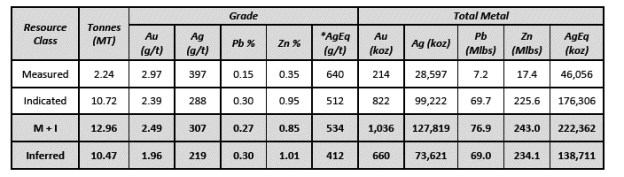
Table 1-2 Panuco Project Mineral Resource Estimate by Are, September 9, 2024
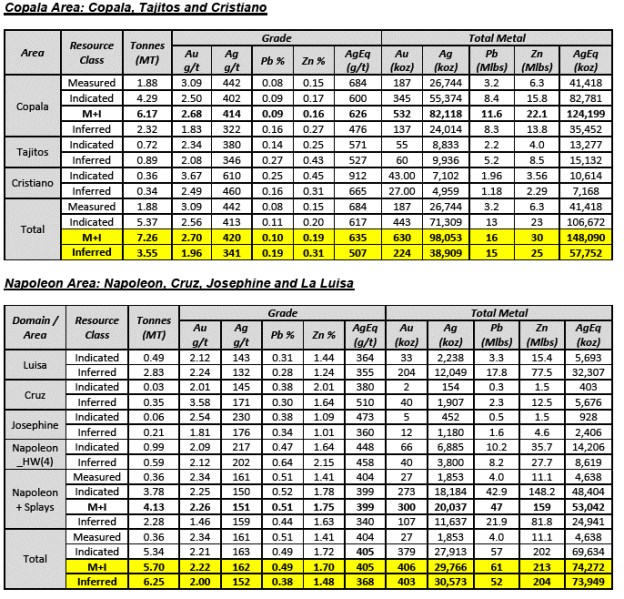

Panuco Project Updated Mineral Resource Estimate Notes:
(1) The classification of the current Mineral Resource Estimate into Indicated and Inferred is consistent with current 2014 CIM Definition Standards - For Mineral Resources and Mineral Reserves.
(2) All figures are rounded to reflect the relative accuracy of the estimate and numbers may not add due to rounding.
(3) All mineral resources are presented undiluted and in situ, constrained by continuous 3D wireframe models (considered mineable shapes), and are considered to have reasonable prospects for eventual economic extraction.
(4) Mineral resources which are not mineral reserves do not have demonstrated economic viability. An Inferred Mineral Resource has a lower level of confidence than that applying to an Indicated Mineral Resource and must not be converted to a Mineral Reserve. It is reasonably expected that the majority of Inferred Mineral Resources could be upgraded to Indicated Mineral Resources with continued exploration.
(5) It is envisioned that the Panuco Project deposits may be mined using underground mining methods including longhole stoping (LHS) and/or drift-and-fill (DAF). Mineral resources are reported at a base case cut-off grade of 150 g/t AgEq. The mineral resource grade blocks were quantified above the base case cut-off grade, below surface and within the constraining mineralized wireframes.
(6) Based on the size, shape, general thickness and orientation of the majority of the mineralized zones within the project area, it is envisioned that the deposits may be mined using a combination of underground mining methods including longhole stoping (LHS) and/or drift-and-fill (DAF).
(7) The base-case AgEq Cut-off grade considers metal prices of $26.00/oz Ag, $1,975/oz Au, $1.10/lb Pb and $1.35/lb Zn and considers metal recoveries of 93% for Ag, 90% for Au, 94% for Pb and 94% for Zn.
(8) The base case cut-off grade of 150 g/t AgEq considers a mining cost of US$45.00/t and processing, treatment, refining, and transportation cost of USD$30.00/t and G&A cost of US$20.00/t of mineralized material.
(9) The estimate of Mineral Resources may be materially affected by environmental, permitting, legal, title, taxation, socio-political, marketing, or other relevant issues.
Mining Methods
The Panuco Project is a collection of silver-gold deposits located in the Panuco-Copala mining district in Sinaloa, Mexico, which extend from surface to over 800 m in depth. The deposits range in thickness from 1.5 m to greater than 20 m.
Based on the characteristics of the deposit, longhole stoping (LHS) was selected as the primary mining method, with drift-and-fill (DAF) selected for the northern portion of the Copala North Zone located directly under the Copala township. LHS considered a sublevel spacing of 20 m, stoping panels 20 m long, and on average are 8 m wide. Stope strike lengths are reduced in poor ground conditions to reduce excessive unplanned dilution. Where DAF was used, drifts are proposed to be 4 m high with five lifts per sublevel.
The mining methods considered for the Panuco Project are proposed to use a combination of cemented rock backfill (CRF), uncemented rock backfill, and paste backfill for stope support.
For the preliminary design of the Panuco Project, planned dilution and unplanned rock dilution was accounted for using the Datamine Mineable Shape Optimiser® (MSO). Dilution within the MSO was estimated at 53% and additional unplanned dilution from backfill dilution, sill development and DAF mining was estimated at 9.2%. Mining recovery of 92% for LHS and 98% for DAF was applied as a factor to the shapes created by MSO within the production schedule.
A Net Smelter Return (NSR) model was used to estimate the revenue of the mineralized material. Preliminary process recoveries, doré grades, smelting and refining terms, and transportation costs were used to estimate the NSR value. A Cut-Off Value ("COV") was used to flag material by whether the revenue in a block exceeds the costs of extraction and processing of that block. There were three COVs used to assess mining at Panuco: Fully Costed COV; an Elevated COV; and the Marginal COV.
The Fully Costed COV represents the break-even value of mineralized material required to cover all the associated operating and sustaining capital costs of extraction and processing. Fully costed COVs were assumed for Panuco at US$106.6/t for LHS and US$120.7/t for DAF. The Elevated COV of US$200/t was considered during the pre-production period and the first three years of processing. The Marginal COV of US$22/t was assumed when the operation has committed to development and preparation of stoping blocks.
Due to the distance between the various geological deposits, the project was designed into two separate underground mines. The Copala Mine, the larger of the two, accesses the Copala, Cristiano, and Tajitos deposits. The Napoleon Mine which is located to the west of the Copala Mine accesses the Napoleon, La Luisa, Cruz Negra, and Josephine deposits.
Contractor mining is currently proposed for the Panuco Project to minimise up front capital and achieve higher productivities. The material movement is summarized in Table 1-3 of the Technical Report.
Recovery Methods
The process design is based on processing mineralized material from the Panuco deposits, through crushing, grinding cyanide leaching and precious metal recovery via the Merrill Crowe process in phase 1 and converted to bulk flotation with concentrate regrind and concentrate leach in Year 4. The design is based on previous test work programs performed on the deposit, Ausenco's extensive database of reference projects, and in-house process modelling. The process plant has been designed with assumed availabilities of 65% for the crushing plant, and 92% for all other processing circuits, based on industry proven industry values. The plant will operate with two 12-hour shifts per day, 365 days per year.
A staged expansion approach for the process plant has been selected. A simple Whole Ore Leach flowsheet for Year 1-3 will treat Copala material and bulk float-con leach-tail leach configuration will be added when Napoleon material is introduced from Year 4. The expansion of the plant over the life of mine occurs as follows:
The process plant features the following:
Project Infrastructure
Overview
The major project facilities include the site access road, process plant, tailings storage facility and water management structures. Support facilities also include the gold room, truck shop, cemented backfill paste plant, administration office, laboratory, and warehouse.
The Panuco site will be 'drive-in', as such no permanent camp facilities are considered on the property. Operators will be housed in Concordia and Copala and the surrounding towns and will be transported to site every day.
The overall site layout is shown in Figure 1-2 of the Technical Report.
Site Access
The Property is located near the town of Copala, 80 km northeast of city of Mazatlan in Sinaloa, Mexico. The site can be accessed by travelling 25 km east along Highway 15, then travelling 43 km northeast along Highway 40. This leads to an entrance to a gravel access road that can be used to navigate across the property.
Power Supply
Power will be provided from a connection to Comisión Federal de Electricidad (CFE) electrical grid via a 69 kV transmission line. The transmission line will be stepped down to the 13.8 kV at the substation for distribution to different power requirements across the project site.
Water Supply
Fresh water will be sourced from the UG workings and site water collection which will be supplemented by water from the Panuco River as required. The water will be transported through pumps. 2.6 km of overland pipeline will be installed from Panuco River to the process plant where freshwater tanks will be located. This water will be the source of potable and fire water on site, used for administration buildings and process plant.
On-Site Roads
The project site has unpaved roads connecting the existing access road to the nearby highway. The existing roads will be upgrade to 4m - two lane roads from the process plant to Highway 40, and single lane road from Highway 40 to the Tailings Storage Facility (TSF).
Buildings
The plant site consists of the necessary infrastructure to support the processing operations. All infrastructure buildings and structures will be built and constructed as per applicable codes and regulations. The project site will include an administration building, plant maintenance shop and warehouse, and other buildings.
Waste Rock Storage Facility
Currently the waste rock will be utilized for the development of the TSF and other infrastructure. However, if in the next phase, if its determined that a waste rock facility will be required, a siting study will need to be performed.
Tailings Storage Facility
A siting and deposition trade-off study was performed to determine best location and deposition technology. Several sites were analyzed, and the outcome of the study was a slurry tailings storage facility located approximately 2.5 km to the east of the process plant in a small watershed. The TSF has been designed to store 8.8 Mt of tailings but has capacity to expand if additional resources are discovered. The TSF has been designed with 4 stages over the life of the project. The starter embankment crest has a height of 573 m.a.s.l. and the final crest elevation of 612 m.a.s.l. to contain the required volume of tailings, operational water, and stormwater plus freeboard. In addition, spillways will be designed for every dam raise to pass the design storm event. The TSF is designed in accordance with best practices and Global Industry Standard on Tailings Management (GISTM) and International Council on Mining & Metals (ICMM's).
Tailings will be slurried from the process plant to the TSF by way of a pipelines that will extend 2/3rd around the perimeter of these facilities. Spigots around the facilities will discharge tailings into them to provide a uniform tailings surface and maximize the storage volume. Tailings are planned to be discharged at 65% solids and will have an overall final dry bulk density of 1.45 t/m3. The TSF will provide a portion of the water for the process plant from excess tailings water and rainfall runoff. Any water from the underdrain and emergency spillway will be collected in the transfer pond located at the base of the TSF and conveyed to the collection pond located approximately 1 km downstream in a small drainage.
Markets and Contracts
The Ag + Au doré bars will be trucked from the project site to Mazatlán, where the doré will be subsequently transported by air to clients. Doré will be sold into the general market to North American smelters and refineries.
Project economics are estimated based on long-term metal prices of US$26.00/oz Ag and US$1,975/oz Au.
Transportation and off-take agreements for doré are not currently in place but are expected to be negotiated within the industry norms. Similarly, there are no contracts currently in place for supply of reagents, utilities or other bulk commodities required to construct and operate the Project.
Environmental, Permitting and Social Considerations
The Panuco Project is in the Panuco-Copala mining district in the municipality of Concordia, southern Sinaloa State, along the western margin of the Sierra Madre Occidental physiographic province in western Mexico. Mountain ranges characterize the province's topography up to 1,640 m, cut by steep gorges. The climate is subtropical, with heavy rain in June through September.
Environmental Considerations
The baseline environmental information provided in this report have been largely gathered by consultants during the period January 2022 to February 2023 (WSP, 2022-2023). These studies were intended to serve as a reference and support for the preparation of the Environmental Impact Assessment, EIA (MIA in Mexico) required by the Ministry of Environment and Natural Resources (SEMARNAT) to support ongoing exploration activities and to provide initial data to support proposed future mining operations for the Project. At the time of issuing the documents in 2022 and 2023, the location and design of the Project infrastructure had not yet been finalized.
Currently, baseline data is available for the following subject areas: meteorology and climate, surface water, groundwater, air quality, noise, and flora and fauna. A preliminary desktop study was completed on the social aspects of the Project and on regional hydrogeological aspects (Flores Doncel 2022).
A geotechnical and hydrogeological investigation was conducted by consultants in 2023-2024 (SRK 2024). The results of this investigation provided preliminary characterization focused on geotechnical and hydrogeological properties of the deposit and production access ramps. Additional hydrogeological investigations will be required to collect sufficient hydrogeological testing and monitoring data that can be used, coupled with geological models, to develop a groundwater conceptual model for the Project and study area.
At the time of this study, data was not available from public or other sources for the subject areas of geochemistry and archaeology, for the Project site. To support the next stage of the Project design work and to support future environmental assessment and permitting activities, additional site-based targeted environmental and local socioeconomic studies will need to be initiated. With regard to archaeological resources, a survey will need to be conducted, and findings registered with the INAH (Instituto Nacional de Antropologia e Historia, National Institute of Anthropology and History).
Currently, the only known environmental liabilities are associated with the exploration site activities and access roads. and existing underground workings from former operations Remediation of surface disturbances and removal of wastes will be mitigated by compliance with applicable Mexican regulatory requirements.
As the Project progresses though future and EIS/permitting stages, environmental management and monitoring plans will be required to guide the development and operation of the Project to mitigate and limit environmental impacts. These plans will be complementary to the engineered designs that will be required for the storage of tailings, waste rock, mineralized material, and conveyance/storage and processing of these materials.
Permitting Considerations
The Project is currently in the exploration stage and operates under three permits for mine exploration issued in 2020 and 2021, by SEMARANT (Secretary of Environmental Media and Natural Resource). An Informe Preventivo (IP) is in force for the area of the of the Panuco Project that permits drilling and exploration activities.
There are a number of environmental permits required for the operation of the project. Mining regulations are managed at the federal, state and local levels. Application for these permits have not yet been made but are in the preliminary preparation stage. Three major federal permits required by the Secretary of Environmental Media and Natural Resources (SEMARNAT) prior to construction include the Environmental Impact Assessment, EIA (MIA in Mexico), Land Use Change (CUS), and Risk Analysis (RA). A detailed list and description of required authorizations and permits for the Project are provided in Table 20-5 of the Technical Report.
In March 2023, the Mexican Federal Executive Branch (Poder Ejecutivo) first submitted a bill to amend the Mining Law and other national laws impacting new mining and water concessions (known as the Amendments). The primary goal of the bill to regulate the granting, maintenance, supervision and termination of mining concessions and water concessions for mining purposes. However, the amendments have been postponed as declared in The Official Gazette of the Mexican Nation as of July 11, 2024, by the Supreme Court of Justice of the Nation. The Amendments, which focus principally but not exclusively, on the process of granting new concessions, are generally applicable to new concessions only. The Amendments are not seen as materially affecting the advancement of the Project given that the Project is comprised entirely of existing concessions. However, there does remain some minor uncertainty as to how the Amendments may be applied by Mexican regulators in the future, and the situation should be monitored closely.
Social and Community Considerations
The Panuco Project is in the northwest of the municipality of Concordia, Sinaloa. This region is made up of six rural agrarian centers with large extensions of Common Use Lands and 32 towns. The municipality of Concordia has an estimated population of 24,899 (2020 census) within an area of 2,167 km2. Many of these populations consist of emigration flows of people displaced from their original communities due to organized crime conflicts. Within the local area of Panuco, there are six agrarian settlements with large areas of Common Use Lands, and within it, there are 32 localities with rural characteristics. The estimated population of this area is 2,400 inhabitants, of which 28% have active agrarian rights (communeros or ejidatarios), and 72% are settlers (without agrarian rights). The total population is distributed across 20 localities, with 12 localities recorded as uninhabited. The Project's positive impact on the community may include employment generation, economic output and incorporation into social security programs. The Company will need to establish measures to mitigate negative impacts, especially if they are of concern to the population.
Vizsla reports that it is in the process of establishing guiding principles for community outreach and developing a strategic plan aligned with the organizational philosophy and the objectives of the Project. The implementation of actions must be accompanied by monitoring and measurement to evaluate performance and results. A community engagement plan and management system would enable relations with the community by controlling social risks and enabling favorable conditions for the development of the Project in the long term. In addition, such an engagement and management system would allow for the orderly development and justify sufficient budgets to allow for meaningful social investment, thereby reducing Project risks and costs due to potential community opposition and contribute to the responsible development of the community in accordance with community needs.
Supporting social activities and recreation for the Ejidos population is a main contribution that the Company has been supporting over the years. The support includes financial resources per request of the people and needed for the festivities and recreational activities that as a society are performed locally.
Vizsla has reportedly commenced conversations with local stakeholders to express the intention of developing a mining project within Common Use Lands and ejido property land that would aim to provide socio-economic well-being for the local population. The Company intends to maintain this relationship throughout the Project's lifecycle.
Closure and Reclamation Planning
In accordance with the general work schedule of the Panuco Project, the abandonment phase will commence after Year 11 from the start of operations, after which the approved Closure and Reclamation Plan will be implemented. At this time no formal Closure and Reclamation Plan has been prepared for the Panuco Project for the purpose of regulatory submission; one will be required as the Project advances through subsequent project stages of feasibility-level design and as part of the MIA. An environmental monitoring plan will need to be developed once closure measures are implemented.
However, for the purpose of Project design, a conceptual closure and reclamation plan for the Project has been preliminarily developed that involves the identification of risks and associated mitigation measures for various Project components. The associated cost of reclamation and closure has been preliminarily estimated at US$31.8M (refer to Section 21.2.10).
Capital and Operating Cost Estimates
Capital Cost Estimates
The capital costs provided in this PEA are reported in United States Dollars (US$) with no allowance for escalation or exchange rate fluctuations. The capital cost estimate conforms to Class 5 guidelines of the Association for the Advancement of Cost Engineering International (AACE International) with an estimated accuracy of +50%/-30%. The capital cost estimate was developed in Q3 2024 dollars based on budgetary quotations for equipment and construction contracts, as well as in-house database of projects and advanced studies including experience from similar operations. The total initial capital cost for the Panuco Project is US$223.5M, expansion capital cost is US$11.1M and LOM sustaining cost including financing and closure cost of US$31.8M is US$262.0M. The capital cost summary is presented in Table 1-4 of the Technical Report.
Average Operating Cost Estimate
The costs considered on-site operating costs are those related to mining, processing, tailings handling, maintenance, power and general and administrative activities.
A summary of the operating costs is presented in Table 1-5 of the Technical Report.
The unit operating cost is US$76.40/t processed, including an annual G&A cost of US$9.9M.
Economic Analysis
The economic analysis was performed assuming a 5% discount rate. The pre-tax net present value (NPV) discounted at 5% is US$1,778M; the internal rate of return (IRR) is 124.1%, and payback period is 0.6 years. On a post-tax basis, the NPV discounted at 5% is US$1,137M, the IRR is 85.7%, and the payback period is 0.8 years. A summary of project economics is shown in Table 1-6 of the Technical Report. The analysis was done on an annual cashflow basis; the cashflow output is shown graphically in Figure 1-3 of the Technical Report.
Readers are cautioned that the PEA is preliminary in nature. It includes inferred mineral resources that are considered too speculative geologically to have the economic considerations applied to them that would enable them to be categorized as mineral reserves, and there is no certainty that the PEA will be realized.
Sensitivity Analysis
A sensitivity analysis was conducted on the base case NPV and IRR of the project using the following variables: discount rate, head grade, recovery, total operating cost, initial capital cost, as well as silver and gold prices, which were encompassed in a single variable, metal price. As illustrated in Figure 1-4 of the Technical Report, the sensitivity analysis revealed that the project is most sensitive to changes in head grade and metal price.
Interpretations and Conclusions
The MRE, effective September 1, 2023, includes Indicated resource of 9.48 Mt grading 289 g/t silver, 2.41 g/t gold, 0.27% lead, and 0.84% zinc (511 g/t AgEq) plus an additional 12.19 Mt grading 239 g/t silver, 1.93 g/t gold, 0.29% lead, and 1.03% zinc (433 g/t AgEq) in the Inferred category. The process design is based on processing mineralized material from the Panuco deposits, through crushing, grinding cyanide leaching and precious metal recovery via the Merrill Crowe process in phase 1 and converted to bulk flotation with concentrate regrind and concentrate leach in Year 4.
The mining method selected for the Panuco Project is LHS backfill with a combination of Cemented Rock Fill ("CRF") and paste backfill. Mining operations will feed 1.2 Mt/a of mineralized material (387 g/t Ag, 2.35 g/t Au) in Phase 1 and 1.5 Mt/a of mineralized material (230 g/t Ag, 1.77 g/t Au) in Phase 2 for processing over a 11-year project life. Based on the assumptions and parameters in this technical report, the PEA shows a positive economics (i.e. US$ 1,137M post-tax NPV (5%) and 85.7% IRR). The PEA supports a decision to carry out additional studies to progress the project further into detailed assessment.
Recommendations
The Overall Recommendations
The Panuco Project demonstrates positive economics, as shown by the results presented in this technical report.
It is recommended to continue developing the Project through FS. The recommended work program to advance through FS includes additional drilling to convert inferred resources to indicated resources, metallurgical work and trade-off studies to further improve the process plant design, additional geotechnical drilling to improve the mine plan, further work to characterise the water management and tailings storage facility and expansion and ongoing data collection of environmental data for future permitting. Table 1-7 of the Technical Report summarized the estimated cost for the recommended future work on the Panuco Project.
Exploration and Drilling
The Deposits of the Panuco Project contain underground Indicated and Inferred Mineral Resources that are associated with well-defined mineralized trends and models. All deposits are open along strike and at depth.
Armitage considers that the Project has potential for delineation of additional Mineral Resources and that further exploration is warranted. Given the prospective nature of the Panuco Property, it is the opinion of Armitage that the Property merits further exploration and that a proposed plan for further work by Vizsla is justified.
Armitage is recommending Vizsla conduct further exploration, subject to funding and any other matters which may cause the proposed exploration program to be altered in the normal course of its business activities or alterations which may affect the program as a result of exploration activities themselves.
For 2025, the company plans to drill ~25,000 m on current resource areas, priority targets proximal to current resources in the west, as well as on other high-priority targets in the eastern portion of the district.
Resource Extension Targets
The Copala structure remains open along strike to the north and down dip to the south. Alternatively, after the discovery of the old Copala adit and concomitant with the successful infill/expansion drilling campaign in central Copala, the team identified potential for near surface high-grade mineralization in the south. Vizsla intends to drill two near surface targets in the second half (H2) of 2025 once the team completes detailed structural and alteration mapping along Copala, south of the old adit.
At Napoleon area, the company plans to conduct resource expansion drilling along the Hanging Wall-4 vein (HW4) down-dip to the east and along the 400m wide gap in La Luisa vein, located between the current mineral resource area and seven shallow drill-holes located 500m to the north.
Proximal Targets
The EL Molino Vein, a northeast trending vein located between Copala and Napoleon, reported significant silver and gold grades close to surface, and Vizsla plans to continue exploring the vein along strike and at depth to add additional high-grade resources close to planned infrastructure in 2025.
Vizsla plans to drill-test a conceptual target at the projected northern intersection of the Copala fault with the Napoleon vein system near La Estrella area.
District Targets
New mapping efforts completed in 2023 and 2024 have highlighted an abundance of historic workings in the northeastern portion of the district. The new areas named "Camelia-San Dimas, Animas-Triunfo, Galeana, San Fernando-Nacaral and El Roble-Oregano-Whicha" are marked by several anomalous to high-grade surface samples grading up to 400 g/t Ag and 5.0 g/t Au. Given, the overall density of veins mapped on surface and the abundance of surface samples related to historic workings this has become a high priority district target in the east. Vizsla also contracted TMC Geophysical consulting to conduct a Horizontal Loop EM (Promis-HLEM) survey on 45 l-km over Copala (test area) and 5 selected high-priority targets during. The objective of the study is to determine the geophysical response of known mineralization near-surface at Copala, and then investigate five other selected targets in the district, four of them located in the northeast.
Bulk Sample / Test Mine
Vizsla has received permits to develop and operate a test mine program at its Panuco project to extract a combined 25,000 tonne bulk sample from the Copala and Napoleon structures. Initial engineering and underground development for the bulk sample test mine began in late 2024.
Key objectives for 2025:
The total cost of the planned exploration work program by Vizsla is estimated at ~CAD$4.25 million.
DIVIDENDS
The Company has not paid any dividends since incorporation, and it has no plans to pay dividends for the foreseeable future. The directors of the Company will determine if and when dividends should be declared and paid in the future based on the Company's financial position at the relevant time. All of the Common Shares are entitled to an equal share of any dividends declared and paid.
CAPITAL STRUCTURE
Common Shares
The Company's authorized capital consists of an unlimited number of Common Shares without par value. As of April 30, 2025, a total of 298,374,460 Common Shares were issued and outstanding. As of the date of this AIF, a total of 342,795,860 Common Shares are issued and outstanding.
Each Common Share ranks equally with all other Common Shares with respect to dissolution, liquidation or winding-up of the Company and payment of dividends. The holders of Common Shares are entitled to one vote for each share of record on all matters to be voted on by such holders and are entitled to receive pro rata such dividends as may be declared by the Board out of funds legally available therefore and to receive, pro rata, the remaining property of the Company on dissolution. The holders of Common Shares have no redemption, retraction, purchase, pre-emptive or conversion rights. The rights attaching to the Common Shares can only be modified by the affirmative vote of at least two-thirds of the votes cast at a meeting of shareholders called for that purpose.
Warrants
There were 233,553 Common Share purchase warrants ("Warrants") outstanding as of April 30, 2025, exercisable into 233,553 Common Shares, with a weighted average exercise price of $1.48 per Common Share. As of the date of this AIF, 55,200 Warrants are outstanding, exercisable into 55,200 Common Shares, with a weighted average exercise price of $1.50 per Common Share, which would result in $82,800 cash proceeds to the Company, if exercised.
Stock Options and Restricted Share Units
The Company has approved an Omnibus Equity Incentive Plan (the "Equity Plan"), for the employees, directors, officers, consultants and employees of a person or company which provides management services to the Company or its associated, affiliated, controlled and subsidiary companies (the "Participants"). The Equity Plan replaced the existing Stock Option Plan that was in place since 2018. The Equity Plan includes a rolling 10% plan to issue stock options ("Stock Options"), restricted share units ("RSUs"), performance share units ("PSUs") and deferred share units ("DSUs") (together "Awards"). The Equity Plan can be found on the Company's Corporate Governance page on the website or under the Company's profile on SEDAR+ or EDGAR.
There were 18,539,000 Stock Options outstanding as of April 30, 2025, exercisable into 18,539,000 Common Shares, with a weighted average exercise price of $1.91 per Common Share. As of the date of this AIF, there are 20,584,500 options outstanding, exercisable into 20,584,500 Common Shares with a weighted average exercise price of $2.14 per Common Share, which would result in $44,058,175 cash proceeds to the Company, if exercised.
210,000 options outstanding are exercisable into one Common Share up to June 29, 2025, and are fully vested. 1,190,000 options outstanding are exercisable into one Common Share up to August 6, 2025, and are fully vested. 100,000 options outstanding are exercisable into one Common Share up to December 1, 2025, and are fully vested. 60,000 options outstanding are exercisable into one Common Share up to January 12, 2026, and are fully vested. 1,278,000 options outstanding are exercisable into one Common Share up to February 17, 2026, and are fully vested. 2,535,000 options outstanding are exercisable into one Common Share up to June 22, 2026, and are fully vested. 139,000 options outstanding are exercisable into one Common Share up to July 27, 2026, and are fully vested. 1,343,000 options outstanding are exercisable into one Common Share up to September 24, 2026, and are fully vested. 200,000 options outstanding are exercisable into one Common Share up to February 1, 2027, and are fully vested. 435,000 options outstanding are exercisable into one Common Share up to June 2, 2027, and are fully vested. 1,078,000 options outstanding are exercisable into one Common Share up to February 10, 2028, and fully vested. 2,889,000 options outstanding are exercisable into one Common Share up to May 19, 2028, and 2,238,000 are vested. 320,000 options outstanding are exercisable into one Common Share up to November 15, 2028, and 160,000 are vested. 250,000 options outstanding are exercisable into one Common Share up to December 18, 2025, and are fully vested. 480,000 options outstanding are exercisable into one Common Share up to February 27, 2029, and are fully vested. 6,032,000 options are exercisable into one Common Share up to June 12, 2029, and 2,414,000 are vested.
There were 1,360,868 RSUs outstanding as of April 30, 2025 and will fully vest by June 12, 2027, and as of the date of the AIF there were 2,601,659 RSUs outstanding that will fully vest by May 1, 2028.
There were zero DSUs outstanding as of April 30, 2025, and as of the date of the AIF there were 850,000 DSUs issued to directors of the Company. These DSUs will fully vest upon the resignation of the director.
MARKET FOR SECURITIES
Trading Price and Volume
The Common Shares are listed and posted for trading on the TSX under the trading symbol "VZLA". On November 7, 2024, the Corporation graduated to the TSX from the TSXV and as such, the Common Shares were delisted from the TSXV at the end of the trading day on November 6, 2024, and began trading on the TSX on November 7, 2024.
The following table sets forth the high and low trading prices and trading volume of the Common Shares for its most recently completed financial year and as at the date of this AIF as reported by the TSX, and prior to November 7, 2024, the TSXV for the periods indicated:
| Period | High ($) | Low ($) | Volume |
| July 1-16, 2025 | C$4.63 | C$3.86 | 7,251,634 |
| Jun-25 | C$5.00 | C$3.87 | 15,845,016 |
| May-25 | C$4.10 | C$2.83 | 14,072,883 |
| Apr-25 | C$3.34 | C$2.40 | 14,844,968 |
| Mar-25 | C$3.52 | C$2.61 | 13,907,812 |
| Feb-25 | C$3.37 | C$2.68 | 8,333,529 |
| Jan-25 | C$3.11 | C$2.44 | 12,272,937 |
| Dec-24 | C$2.825 | C$2.40 | 7,127,834 |
| Nov-24 | C$2.91 | C$2.33 | 18,074,191 |
| Oct-24 | C$3.31 | C$2.49 | 20,488,085 |
| Sep-24 | C$2.97 | C$2.43 | 31,217,134 |
| Aug-24 | C$2.93 | C$2.30 | 8,803,770 |
| Jul-24 | C$3.02 | C$2.28 | 8,634,994 |
| Jun-24 | C$2.52 | C$2.19 | 7,287,168 |
| May-24 | C$2.63 | C$1.79 | 14,519,011 |
PRIOR SALES
During the year ended April 30, 2025, the Company issued the following securities that are not listed or quoted on a marketplace:
Warrants
During the Company's most recently completed financial year, no Warrants were issued.
As of the date of this AIF, there are Warrants outstanding to purchase 55,200 Common Shares.
Stock Options & Restricted Share Units
During the Company's most recently completed financial year, 6,050,000 incentive stock options ("Options") were granted as follows:
| Date of Grant | Number of Options Granted |
Exercise Price |
Expiry Date |
| 12-Jun-2024 | 6,050,000 | $2.24 | 12-Jun-2029 |
Since May 1, 2025, the following Options have been granted:
| Date of Grant | Number of Options Granted |
Exercise Price |
Expiry Date |
| 1-May-2025 | 4,050,000 | $2.90 | 1-May-2030 |
During the Company's most recently completed financial year, 775,000 restricted share units ("RSUs") were granted.
Since May 1, 2025, 1,450,000 RSUs have been granted as follows:
| Date of Grant | Number of RSUs Granted |
Grant Price |
| 1-May-2025 | 1,450,000 | $2.90 |
During the Company's most recently completed financial year, zero deferred share units ("DSUs") were granted.
Since May 1, 2025, 850,000 DSUs have been granted as follows:
|
Date of Grant |
Number of |
Grant |
|
1-May-2025 |
850,000 |
$2.90 |
As of the date of this AIF, there are Options outstanding to purchase an aggregate of 20,584,500 Common Shares, there are 2,601,659 RSUs outstanding and there are 850,000 DSUs outstanding.
ESCROWED SECURITIES
As of April 30, 2025, the Company has no shares in escrow.
DIRECTORS AND OFFICERS
Name, Occupation and Security Holdings
The following table sets out the names of the directors and officers of the Company as at the date of this AIF and their respective provinces or states and countries of residence, positions with the Company, principal occupations within the five preceding years, periods during which each director has served as a director and the number of each class of securities of the Company and percentage of such class beneficially owned, directly or indirectly, or subject to control or direction by that person.
| Name, Position and City, Province and Country of Residence |
Principal Occupation or Employment for Past 5 Years(1) |
Director or Officer Since |
No. and Class of Securities(1) |
Percentage of Class(2) |
| Michael Konnert British Columbia, Canada President, CEOand Director |
Mr. Konnert is the founder of Vizsla Silver Corp., and he is currently the Chief Executive Officer, President and a Director of the Company. | September 26, 2017 | 2,415,751 |
0.70% |
| Craig Andrew Parry (7) British Columbia, Canada Director |
Mr. Parry is the Chairman of Vizsla Silver Corp. He also the CEO and Executive Chairman of Vizsla Copper Corp. and serves on various other boards as a director. | December 18, 2018 | 8,692,485 |
2.54% |
| Simon Cmrlec British Columbia, Canada Director and Chief Operating Officer |
Mr. Cmrlec is the Chief Operating Officer of the Company. He was previously Chief Operating Officer at Ausenco Limited. | February 21, 2019 | 1,214,061 |
0.35% |
| Harry Pokrandt (3)(4)(6) British Columbia, Canada Director |
Mr. Pokrandt is a director for the Company. He is currently Chairman of Spectrum Energy and a Board Member of Big Brothers Foundation of Greater Vancouver. |
November 23, 2021 | 352,500 |
0.10% |
| David Cobbold (3)(4)(6) British Columbia, Canada Director |
Mr. Cobbold is currently Vice Chairman of Metals and Mining, Macquarie Group. | December 8, 2022 | 55,450 |
0.02% |
| Eduardo Luna (7) Mexico Director |
Mr. Luna is currently the Chairman of the Board of Directors of Rochester Resources Ltd. He formerly served as a member of the Board of Directors of Wheaton Precious Metals Corporation. He is a Director of Coeur Mining, Inc. | November 15, 2023 | - | - |
| Name, Position and City, Province and Country of Residence |
Principal Occupation or Employment for Past 5 Years(1) |
Director or Officer Since |
No. and Class of Securities(1) |
Percentage of Class(2) |
| Sukhjit Gill (3)(5)(6) British Columbia, Canada Director |
Ms. Gill currently serves as a partner at Smythe LLP. | April 12, 2024 | - | - |
| Mahesh Liyanage British Columbia, Canada Chief Financial Officer |
Mr. Liyanage is the CFO of the Company. | December 1, 2020 | 72,498 |
0.02% |
| Michael Pettingell British Columbia, Canada SVP, Business Development and Strategy |
Mr. Pettingell is currently SVP of Business Development of the Company. | July 27, 2021 | 61,947 | 0.02% |
| Dr. Jesus Velador British Columbia, Canada VP, Exploration |
Dr. Velador is currently VP, Exploration of the Company. | May 5, 2022 | 110,315 | 0.03% |
| Jennifer Hanson British Columbia, Canada Corporate Secretary |
Ms. Hanson is currently Corporate Secretary for Vizsla Silver Corp. She serves as Corporate Secretary for various public companies. | December 18, 2018 | 9,627 | 0.00% |
Notes:
(1) The information as to principal occupation and shares beneficially owned has been furnished by the respective individuals.
(2) Based upon the 342,795,860 Common Shares issued and outstanding as of the date of this AIF.
(3) Member of the Audit Committee.
(4) Member of the Compensation Committee
(5) Chair of the Audit Committee
(6) Member of Corporate Governance & Nominating Committee
(7) Member of the Technical Committee
As at the date of this AIF, 12,984,634 Common Shares of the Company are beneficially owned, directly or indirectly, by the directors and executive officers as a group, representing approximately 3.79% of the issued and outstanding voting securities of the Company.
Director Biographies
Michael Konnert, Director, President and Chief Executive Officer
Mr. Konnert is a mining entrepreneur with deep expertise in deal-making, financing, team leadership and strategic corporate development. As the Founder, President, Director and CEO of Vizsla Silver Corp. (NYSE:VZLA), he has successfully led the company in consolidating one of Mexico's highest-grade silver and gold districts, positioning it to develop one of the world's largest single-asset silver producers. He is also co-founder and Managing Partner of Inventa Capital, a natural resource incubator company dedicated to acquiring and developing assets in the natural resource sector. Since its founding in 2017, Inventa has raised over C$800M in capital, focusing on discovering emerging opportunities in the industry.
In 2017, Mr. Konnert co-founded CobaltOne Energy Corp, a battery metal exploration company, which he successfully led to acquisition by Blackstone Minerals (ASX: BSX). He also serves as Executive Chairman of Vizsla Royalties and holds board positions at Vizsla Copper (TSX-V: VCU) and Summa Silver (CSE: SSVR). Michael's career is marked by his strategic vision, commitment to sustainable development, and innovative approach to the mining industry.
Craig Parry, Director
Through the course of his career, Mr. Parry has been a founder, director, CEO, senior executive and geologist working across a broad range of commodities with several companies. He is currently Lead Director of Skeena Resources Ltd and has been a Director since December 15, 2016. He is the Executive Chairman and CEO of Vizsla Copper Corp. (since September 1, 2021). He is a founder and Chairman of Vizsla Silver Corp. (since December 18, 2018). He was a founder and CEO and/or director of Valkea Resources Corp., Gold Bull Resources Corp., IsoEnergy Ltd (TSXV:ISO), NexGen Energy Ltd (NYSE:NXE), EMR Capital, Tigers Realm Coal (ASX:TIG), Tigers Realm Minerals, and G-Resources Group. He worked for Rio Tinto from 2000 to 2008.
Mr. Parry has led teams and been involved in a number of exceptional discoveries and resource projects including Vizsla's discovery of new veins at its Panuco-Copala silver district, IsoEnergy's Hurricane uranium deposit, NexGen's Arrow uranium deposit and Tigers Realm Coal's Amaam and Amaam North coking coal deposits.
Mr. Parry graduated from The University of New South Wales and holds a Bachelor of Science (Applied Geology) with first class Honours and the University Medal. He is a member of the AusIMM.
Simon Cmrlec, Director and Chief Operating Officer
Mr. Cmrlec is a highly experienced senior engineer with over 30-years of industry experience who has been a director of the Company since its formation and has most recently held the position of Chief Operating Officer of Ausenco, a global mining engineering and consulting firm. He has extensive experience in building mining projects around the world and across a number of different commodities and will be tasked with advancing Vizsla Silver's world-class Panuco silver-gold Project towards production, with the goal of becoming one of the world's largest single-asset silver producers.
Mr. Cmrlec began his career with Western Mining at its Olympic Dam Operations in South Australia where he held a number of technical and operations roles. He was one of the Owners Representatives for the Olympic Dam Expansion Project (ODP) where he was involved in the design, construction and commissioning of the Smelter and Hydrometallurgical facilities. Following the completion of the ODP project Simon joined Kvaerner and was involved in the construction and commissioning of various base metals, iron ore and gold projects in the US, South America, Middle East and South Africa. In 2001 he joined Inco on the Goro Nickel project in New Caledonia as the Project Manager responsible for the Refinery facility. Simon held a number of roles on the Goro Nickel project including Senior Project Manager and Construction director in his eight years there. Simon joined Ausenco in 2009 and held a number of positions with the company including President, Program Management and President APAC/Africa before moving to Canada in 2015 in the role of President, North America and finally Chief Operating Officer.
He became a Director of Vizsla Silver in 2018 before joining the company as Chief Operating Officer in 2024.
Mr. Cmrlec attended the Gartrell School of Mining, Metallurgy and Applied Geology at the University of South Australia and graduated with a B.Eng (Hons) in Metallurgical Engineering in 1994.
Harry Pokrandt, Director
Mr. Pokrandt is a Capital Markets Executive with 30+ years experience in mining and technology. He is a currently Chairman of Spectrum Energy and a Director of Big Brothers Foundation of Greater Vancouver. He is formerly Chairman of Mayfair Gold and former Managing Director at Macquarie Capital Markets, CEO of Hive Block chain, Director of Kore Mining, Gold X Mining Corp., BQ Metals Corp, Lithium X and Fiore Exploration.
David Cobbold, Director
Mr. Cobbold is a veteran investment banker with 28 years of financial services experience. Currently, he is Vice Chairman of Metals and Mining, Macquarie Group where he is responsible for sourcing and leading merger, acquisition, sale and defence transactions for clients ranging from exploration and development companies to global metals & mining companies. Mr. Cobbold's clients are based in Canada, US, U.K., South Africa and Australia.
In addition, Mr. Cobbold has extensive experience in global commodity and securities markets. Mr. Cobbold joined Macquarie in 2011 as a Managing Director, Head of Mining, Macquarie Capital Markets Canada. Prior to joining Macquarie, Mr. Cobbold worked at CIBC World Markets and CIBC Capital Partners for 13 years in various capacities, including as a Managing Director, Global Mining Investment Banking and Managing Director, Equity Capital Markets.
Mr. Cobbold holds a Bachelor of Arts in Economics, University of Western Ontario and Master of Business Administration (MBA), Harvard Business School.
Eduardo Luna, Director
Mr. Luna has spent over forty years in the precious metals mining industry and has held prior senior executive and board positions at several companies including Industrial Peñoles, Goldcorp Inc., Luismin SA de CV, Wheaton River Minerals Ltd., Alamos Gold Inc., Dyna Resource, Inc. and Primero Mining Corporation.
He is currently the Chairman of the Board of Directors of Rochester Resources Ltd., a junior natural resources company with assets in Mexico. He formerly served as a member of the Board of Directors of Wheaton Precious Metals Corporation. He is a Director of Coeur Mining, Inc. Mr. Luna is the former President of the Mexican Mining Chamber and a former President of the Silver Institute.
He is an inductee in the Mexico Mining Hall of Fame and serves as Chairman of the Advisory Board of the Faculty of Mines at the University of Guanajuato where he received a degree in Mining Engineering and Metallurgy.
Sukhjit Gill, Director
Ms. Gill currently serves as a partner at Smythe LLP and practice group leader of Smythe's assurance group. She is a Chartered Professional Accountant with 23 years of experience and specializes in providing audit and assurance services to publicly traded companies operating in the resource industry, as well as private companies across several industries in both Canada and the United States. Ms. Gill is also a director of Skeena Resources Limited. She was previously on the board of directors for the Provincial Health Services Authority and British Columbia Emergency Health Services.
Ms. Gill holds a Bachelor of Technology in Accounting from BCIT and a Chartered Professional Accountants of British Columbia.
Cease Trade Orders, Bankruptcies, Penalties or Sanctions
Other than as disclosed below, to the knowledge of the Company, no director or executive officer of the Company nor a shareholder holding a sufficient number of Common Shares to materially affect the control of the Company, nor a personal holding company of any of them,
(a) is, at the date of this AIF or has been within the 10 years before the date of this AIF, a director or executive officer of any company (including the Company), that while that person was acting in that capacity,
(i) was the subject of a cease trade order or similar order or an order that denied the relevant company access to any exemption under securities legislation, for a period of more than 30 consecutive days; or
(ii) was subject to an event that resulted, after the director or executive officer ceased to be a director or executive officer, in the company being the subject of a cease trade or similar order or an order that denied the relevant company access to any exemption under securities registration, for a period of more than 30 consecutive days; or
(iii) within a year of that person ceasing to act in that capacity, became bankrupt, made a proposal under any legislation relating to bankruptcy or insolvency or was subject to or instituted any proceedings, arrangement, or compromise with creditors, or had a receiver, receiver manager, or trustee appointed to hold its assets; or
(b) has, within the 10 years before the date of this AIF, become bankrupt, made a proposal under any legislation relating to bankruptcy or insolvency, or become subject to or instituted any proceedings, arrangement or comprise with creditors, or had a receiver, receiver manager or trustee appointed to hold the assets of the director, officer or shareholder.
Mahesh Liyanage was the Chief Financial Officer of Synodon Inc. from March 1, 2016, to November 17, 2016. On November 30, 2016, a Receiver was appointed under the Bankruptcy and Insolvency Act (Canada) pursuant to a Court Order of the Court of Queen's Bench of Alberta and on May 8, 2017, Synodon Inc. was cease traded by the Alberta Securities Commission.
To the knowledge of the Company, no director or executive officer of the Company, nor a shareholder holding a sufficient number of Common Shares of the Company to affect materially the control of the Company, nor a personal holding company of any of them, has been subject to:
(a) any penalties or sanctions imposed by a court relating to securities legislation or by a securities regulatory authority or has entered into a settlement agreement with a security's regulatory authority; or
(b) any other penalties or sanctions imposed by a court or regulatory body that would likely be considered important to a reasonable investor in making an investment decision.
Conflicts of Interest
Certain directors and officers of the Company are directors and officers of other companies, some of which are in the same business as the Company. The directors and officers of the Company are required by law to act in the best interests of the Company. They have the same obligations to the other companies in respect of which they act as directors and officers. Discharge by the directors and officers of their obligations to the Company may result in a breach of their obligations to the other companies, and in certain circumstances this could expose the Company to liability to those companies. Similarly, discharge by the directors and officers of their obligations to the other companies could result in a breach of their obligation to act in the best interests of the Company. Such conflicting legal obligations may expose the Company to liability to others and impair its ability to achieve its business objectives.
AUDIT COMMITTEE INFORMATION
Pursuant to the provisions of National Instrument 52-110 Audit Committees ("NI 52-110") the Company
is required to provide the following disclosure with respect to its Audit Committee.
Audit Committee Mandate
The text of the Audit Committee's Charter is attached as Appendix "A" to this AIF.
Composition of the Audit Committee
The Company's audit committee consists of Suki Gill, Harry Pokrandt, and David Cobbold (the "Members"). The Members are independent of the Company. Ms. Gill is the Chairman of the Audit Committee.
Relevant Education and Experience
Each member of the Audit Committee has considerable experience participating in the management of private and/or publicly traded companies and has the ability to read and understand financial statements that present the breadth and level of complexity of accounting issues that would generally be expected to be raised by the Company's financial statements. See "Directors and Officers - Director Biographies" for additional information on each director's education and experience.
Each Audit Committee member has had extensive experience reviewing financial statements. Each member understands the Company's business and has an appreciation for the relevant accounting principles for that business.
Reliance on Certain Exemptions
At no time since the commencement of the Company's most recently completed financial year has the Company relied on: (a) the exemption in section 2.4 (De Minimis Non-audit Services), or (b) an exemption from NI 52-110, in whole or in part, granted under Part 8 (Exemptions).
Audit Committee Oversight
For the year ended April 30, 2025, the audit committee of the Company has not made any recommendations to nominate or compensate an external auditor which were not adopted by the Board.
Pre-Approval Policy and Procedures
The audit committee has not adopted any specific policies and procedures for the engagement of non-audit
services.
External Auditor Service Fees
The following table sets forth the fees paid by the Company and its subsidiaries to MNP LLP for services rendered in the years ended April 30, 2025 and April 30, 2024:
| Category | Year ended April 30, 2025 |
Year ended April 30, 2024 |
| Audit Fees(1) | 201,482 | $174,571 |
| Audit Related Fees(2) | - | - |
| Tax Fees(3) | - | - |
| All Other Fees(4) | 54,677 | $19,700 |
| Total | $256,159 | $194,271 |
Notes:
(1) "Audit fees" include aggregate fees billed by the Company's external auditor in each of the last two fiscal years for audit fees.
(2) "Audit related fees" include the aggregate fees billed in each of the last two fiscal years for assurance and related services by the Company's external auditor that are reasonably related to the performance of the audit or review of the Company's financial statements and are not reported under "Audit fees" above. The services provided include employee benefit audits, due diligence assistance, accounting consultations on proposed transactions, internal control reviews and audit or attest services not required by legislation or regulation.
(3) "Tax fees" include the aggregate fees billed in each of the last two fiscal years for professional services rendered by the Company's external auditor for tax compliance, tax advice and tax planning. The services provided include tax planning and tax advice includes assistance with tax audits and appeals, tax advice related to mergers and acquisitions, and requests for rulings or technical advice from tax authorities.
(4) "All other fees" include the aggregate fees billed in each of the last two fiscal years for products and services provided by the Company's
external auditor, other than "Audit fees", "Audit related fees" and "Tax fees" above. Other fees included review work on the prospectus and other relevant forms for the NYSE.
LEGAL PROCEEDINGS AND REGULATORY ACTIONS
Legal Proceedings
The Company is not aware of any actual or pending material legal proceedings to which the Company is or is likely to be party or of which any of its business or property is or is likely to be subject.
Regulatory Actions
No penalties or sanctions were imposed against the Company by a court relating to securities legislation or by a securities regulatory authority during the year ended April 30, 2025.
No penalties or sanctions were imposed by a court or regulatory body against the Company that would likely be considered important to a reasonable investor in making an investment decision.
The Company did not enter into any settlement agreements before a court relating to securities legislation or with a securities regulatory authority during the year ended April 30, 2025.
INTEREST OF MANAGEMENT AND OTHERS IN MATERIAL TRANSACTIONS
Other than as disclosed in this AIF, no director, executive officer or persons or companies who beneficially own, control or direct, directly or indirectly, more than 10 percent of any class of outstanding voting securities of the Company, nor any associate or affiliate of the foregoing persons, has or has had any material interest, direct or indirect, in any transactions with the Company within the three most recently completed financial years or during the current financial year, that has materially affected or is reasonably expected to have a material effect on the Company.
TRANSFER AGENT AND REGISTRAR
The Company's transfer agent and registrar is Computershare Trust Company of Canada ("Computershare"). Computershare's register of transfers for the common shares of the Company is located at 510 Burrard Street, Second Floor, Vancouver, British Columbia, Canada, V6C 3B9.
MATERIAL CONTRACTS
Other than contracts entered into in the ordinary course of business, there were no material contracts that the Company entered into during the year ended April 30, 2025 (see General Development of Business - Three Year History).
INTERESTS OF EXPERTS
MNP LLP (PCAOB ID:1930) is the independent registered public accounting firm of the Company and is independent within the meaning of the Rules of Professional Conduct of the Institute of Chartered Accountants of British Columbia.
Allan Armitage, Ph.D., P.Geo. of SGS, Ben Eggers, MAIG, P.Geo. of SGS, Henri Gouin, P.Eng. of SGS, Peter Mehrfert, P.Eng., of Ausenco Engineering Canada ULC James Millard, P.Geo., of Ausenco Sustainability Canada ULC , Scott Elfen, P.E., of Ausenco Engineering Canada ULC and Jonathan Cooper, P.Eng., of Ausenco Sustainability Canada ULC prepared the Technical Report. To management's knowledge, Messrs. Armitage, Eggers, Gouin, Mehrfert, Millard, Elfen and Cooper do not have any registered or beneficial interests, direct or indirect, in any securities or other property of the Company (or of any of its associates or affiliates).
ADDITIONAL INFORMATION
Additional information relating to the Company may be found on SEDAR+ at www.sedarplus.ca.
Additional information including Statement of Executive Compensation, directors' and officers' remuneration and indebtedness, principal holders of the Company's securities, and securities authorized for issuance under the Company's Equity Plan, as applicable, is contained in the Company's information circular dated August 23, 2024 which may be viewed on SEDAR+ (www.sedarplus.ca).
Additional financial information is provided in the Company's audited financial statements and the Management's Discussion and Analysis of the Company for the year ended April 30, 2025, a copy of which may be requested from the Company's head office, or may be viewed on SEDAR+ (www.sedarplus.ca).
APPENDIX "A"
AUDIT AND RISK COMMITTEE CHARTER
ARTICLE 1
PURPOSE
1.1 The Audit and Risk Committee (the "Committee") of the Board of Directors (the "Board") of Vizsla Silver Corp. (the "Company") shall assist the Board in fulfilling its financial oversight responsibilities. The overall purpose of the Committee is (i) to ensure that the Company's management has designed and implemented an effective system of internal financial controls, (ii) to review and report on the integrity of the consolidated financial statements and related financial disclosure of the Company, (iii) to review the Company's compliance with regulatory and statutory requirements as they relate to financial statements, taxation matters and disclosure of financial information, and (iv) to oversee the external auditor's qualification and independence and the performance of the external auditors. In performing its duties, the Committee will maintain effective working relationships with the Board, management, and the external auditors and monitor the independence of those auditors. To perform his or her role effectively, each member of the Committee will obtain an understanding of the responsibilities of the Committee membership as well as the Company's business, its operations and related risks.
ARTICLE 2
COMPOSITION, PROCEDURE, AND ORGANIZATION
2.1 The Committee shall consist of at least three members of the Board (each a "Committee Member" or "Member"). Each Committee Member shall be an "independent director" as determined in accordance with applicable legal requirements for audit committee service, including the requirements of the National Instrument 52-110 of the Canadian Securities Administrators ("NI 52-110") and Rule 10A-3(b) of the U.S. Securities Exchange Act of 1934 (as amended, the "Exchange Act"), as such rules are revised, updated or replaced from time to time.
2.2 If, a Member ceases to be independent for reasons outside the member's reasonable control, the member is exempt from the requirements in NI 52-110 or Rule 10A-3(b) of the Exchange Act for a period ending on the later of:
a) the next annual meeting of the issuer; and
b) the date that is six months from the occurrence of the event which caused the member to not be independent.
2.3 All members of the Committee shall, to the satisfaction of the Board, be "financially literate", and at least one member shall have accounting or related financial management expertise to qualify as a "financial expert" in accordance with applicable legal requirements, including the requirements of NI 52-1101 and the Exchange Act, as revised, updated or replaced from time to time.
2.4 The Board, at its organizational meeting held in conjunction with each annual general meeting of the shareholders, shall appoint the members of the Committee for the ensuing year. The Board may at any time remove or replace any member of the Committee and may fill any vacancy in the Committee.
2.5 Unless the Board shall have appointed a Chair of the Committee, the members of the Committee shall elect a Chair of the Committee by majority vote of the full membership of the Committee.
2.6 The quorum for meetings shall be a majority of the members of the Committee, present in person or by telephone or other telecommunication device that permits all persons participating in the meeting to speak and to hear each other.
2.7 The Committee shall have access to such officers and employees of the Company and to the Company's external auditors, and to such information respecting the Company, as it considers to be necessary or advisable in order to perform its duties and responsibilities.
2.8 Meetings of the Committee shall be conducted as follows:
(a) the Committee shall meet at least four times annually at such times and at such locations as maybe requested by the chair of the Committee. The external auditors or any member of the Committee may request a meeting of the Committee;
(b) the external auditors shall receive notice of and have the right to attend all meetings of the Committee; and
(c) management representatives may be invited to attend all meetings except private sessions with the external auditors.
2.9 The external auditors shall have a direct line of communication to the Committee through its chair and may bypass management if deemed necessary. The Committee, through its chair, may contact directly any employee in the Company as it deems necessary, and any employee may bring before the Committee any matter involving questionable, illegal or improper financial practices or transactions.
2.10 The Committee will conduct and review with the Board annually an evaluation of the Committee's performance with respect to the requirements of this Charter. This evaluation should also set forth the goals and objectives of the Committee for the upcoming year. The Committee may conduct this performance evaluation in such manner as the Committee, in its business judgment, deems appropriate.
ARTICLE 3
ROLES AND RESPONSIBILITIES
3.1 The overall duties and responsibilities of the Committee shall be as follows:
(a) to report regularly to the Board and to assist the Board in the discharge of its responsibilities relating to the Company's accounting principles, reporting practices and internal controls and its approval of the Company's annual and interim consolidated financial statements and related financial disclosure;
(b) to establish and maintain a direct line of communication with the Company's external auditors and assess their performance;
(c) to set clear hiring policies for employees or former employees of the external auditors;
(d) to review and approve in advance any proposed related-party transactions and required disclosures of such in accordance with applicable securities laws and regulations, and report to the Board on any approved transactions.
(e) to review with management and the external auditors, the financial reporting of any transactions between the Company and any officer, director or other "related party" (including significant shareholder) or any entity in which any person has a financial interest and any potential conflicts of interest;
(f) to ensure that the management of the Company has designed, implemented, and is maintaining an effective system of internal financial controls and to discuss policies with respect to risk assessment and risk management;
(g) to prepare the disclosure required by Item 407(d)(3)(i) of Regulation S-K under the U.S. Securities Act of 1933, as amended;
(h) to oversee procedures relating to the receipt, retention and treatment of complaints received by the Company regarding accounting, internal controls or auditing matters and the confidential anonymous submission by employees of the Company of concerns regarding questionable accounting of auditing matters, pursuant to the Company's whistleblower policy;
(i) to meet separately, periodically, with management, with internal auditors (or other personnel responsible for the internal audit function) and with the external auditors;
(j) to review with the external auditors any audit problems or difficulties and management's response; and
(k) to report regularly to the Board on the fulfilment of its duties and responsibilities.
3.2 The duties and responsibilities of the Committee as they relate to the external auditors shall be as follows:
(a) to recommend to the Board a firm of external auditors to be engaged by the Company, and to verify the independence of such external auditors;
(b) to review and approve the fee, scope and timing of the audit and other related services rendered by the external auditors;
(c) review the audit plan of the external auditors prior to the commencement of the audit;
(d) to review with the external auditors, upon completion of their audit, the contents of their report (such report to be provided at least annually), including and as well as:
(i) the scope and quality of the audit work performed;
(ii) the adequacy of the Company's financial and auditing personnel;
(iii) co-operation received from the Company's personnel during the audit;
(iv) internal resources used;
(v) significant transactions outside of the normal business of the Company;
(vi) the Company's internal quality-control procedures;
(vii) any material issues raised by the most recent internal quality-control review, or peer review, of the Company, or by any inquiry or investigation by governmental or professional authorities, within the preceding five years, respecting one or more independent audits carried out by the external auditors,
(viii) any steps taken to deal with any such issues, and (to assess the external auditor's independence) all relationships between the external auditors and the Company;
(ix) significant proposed adjustments and recommendations for improving internal accounting controls, accounting principles or management systems; and
(x) the non-audit services provided by the external auditors;
(e) to meet to review and discuss the Company's annual audited financial statements and quarterly financial statements with management and the external auditors, including reviewing the Company's specific disclosures under "Management's Discussion and Analysis of Financial Condition and Results of Operations";
(f) to discuss with the external auditors the quality and not just the acceptability of the Company's accounting principles; and
(g) to implement structures and procedures to ensure that the Committee meets the external auditors on a regular basis in the absence of management.
3.3 The duties and responsibilities of the Committee as they relate to the internal control procedures of the Company are to:
(a) review the appropriateness and effectiveness of the Company's policies and business practices which impact on the financial integrity of the Company, including those relating to insurance, accounting, information services and systems and financial controls, management reporting and risk management;
(b) review compliance under the Company's business conduct and ethics policies and to periodically review these policies and recommend to the Board changes which the Committee may deem appropriate;
(c) review any unresolved issues between management and the external auditors that could affect the financial reporting or internal controls of the Company; and
(d) periodically review the Company's financial and auditing procedures and the extent to which recommendations made by the external auditors have been implemented.
3.4 The Committee is also charged with the responsibility to:
(a) review and approve the Company's annual and interim financial statements and related Management's Discussion & Analysis ("MD&A"), including the impact of unusual items and changes in accounting principles and estimates;
(b) review and approve the financial sections of any of the following disclosed documents prepared by the Company:
(i) the annual report to shareholders;
(ii) the annual information form;
(iii) annual MD&A;
(iv) prospectuses;
(v) news releases discussing financial results of the Company;
(vi) financial information and earnings guidance provided to analysts and rating agencies; and
(vii) other public reports of a financial nature requiring approval by the Board,
and report to the Board with respect thereto;
(c) review regulatory filings and decisions as they relate to the Company's consolidated financial statements;
(d) review the appropriateness of the policies and procedures used in the preparation of the Company's consolidated financial statements and other required disclosure documents, and consider recommendations for any material change to such policies;
(e) review any significant tax exposures and tax planning initiatives intended to promote compliance with applicable laws while minimizing tax costs;
(f) review and report on the integrity of the Company's consolidated financial statements;
(g) review the minutes of any audit committee meeting of subsidiary companies;
(h) review with management, the external auditors and, if necessary, with legal counsel, any litigation, claim or other contingency, including tax assessments that could have a material effect upon the financial position or operating results of the Company and the manner in which such matters have been disclosed in the consolidated financial statements;
(i) review the principal risks of the Company's business and operations, and any other circumstances and events that could have significant impact on the Company's assets and shareholders;
(j) assessing the Company's risk tolerance, the overall process for identifying principal business and operational risks and the implementation of appropriate measures to manage and disclose such risks;
(k) monitoring reporting trends on emerging risks and making recommendations to management on implementation of appropriate measures to manage and disclose such risks;
(l) reviewing with senior management annually, the Company's insurance policies and considering the extent of any uninsured exposure and the adequacy of coverage;
(m) reviewing the Company's cybersecurity, privacy and data security risk exposures and measures taken to protect the confidentiality, integrity and availability of its information systems and Company data;
(n) review the Company's compliance with regulatory and statutory requirements as they relate to financial statements, tax matters and disclosure of financial information; and
(o) develop a calendar of activities to be undertaken by the Committee for each ensuing year and to submit the calendar in the appropriate format to the Board following each annual general meeting of shareholders.
3.5 Without limiting the generality of anything in this Charter, the Committee has the authority:
(a) to engage independent counsel and other advisors as it determines necessary to carry out its duties,
(b) to set and pay the compensation for any advisors employed by the Committee, and
(c) to communicate directly with the external auditors.
ARTICLE 4
EFFECTIVE DATE
4.1 This Charter was adopted by the Board on May 22, 2018.
4.2 This Charter was reviewed and amended on October 15, 2021.