Please wait
DEF 14Afalse0001798100iso4217:USDxbrli:pure00017981002025-01-012025-12-3100017981002024-01-012024-12-3100017981002023-01-012023-12-3100017981002022-01-012022-12-3100017981002021-01-012021-12-310001798100ecd:EqtyAwrdsInSummryCompstnTblForAplblYrMemberecd:PeoMember2025-01-012025-12-310001798100ecd:EqtyAwrdsAdjsExclgValRprtdInSummryCompstnTblMemberecd:PeoMember2025-01-012025-12-310001798100ecd:YrEndFrValOfEqtyAwrdsGrntdInCvrdYrOutsdngAndUnvstdMemberecd:PeoMember2025-01-012025-12-310001798100ecd:ChngInFrValOfOutsdngAndUnvstdEqtyAwrdsGrntdInPrrYrsMemberecd:PeoMember2025-01-012025-12-310001798100ecd:VstngDtFrValOfEqtyAwrdsGrntdAndVstdInCvrdYrMemberecd:PeoMember2025-01-012025-12-310001798100ecd:ChngInFrValAsOfVstngDtOfPrrYrEqtyAwrdsVstdInCvrdYrMemberecd:PeoMember2025-01-012025-12-310001798100ecd:FrValAsOfPrrYrEndOfEqtyAwrdsGrntdInPrrYrsFldVstngCondsDrngCvrdYrMemberecd:PeoMember2025-01-012025-12-310001798100ecd:DvddsOrOthrErngsPdOnEqtyAwrdsNtOthrwsRflctdInTtlCompForCvrdYrMemberecd:PeoMember2025-01-012025-12-310001798100ecd:EqtyAwrdsInSummryCompstnTblForAplblYrMemberecd:NonPeoNeoMember2025-01-012025-12-310001798100ecd:EqtyAwrdsAdjsExclgValRprtdInSummryCompstnTblMemberecd:NonPeoNeoMember2025-01-012025-12-310001798100ecd:YrEndFrValOfEqtyAwrdsGrntdInCvrdYrOutsdngAndUnvstdMemberecd:NonPeoNeoMember2025-01-012025-12-310001798100ecd:ChngInFrValOfOutsdngAndUnvstdEqtyAwrdsGrntdInPrrYrsMemberecd:NonPeoNeoMember2025-01-012025-12-310001798100ecd:VstngDtFrValOfEqtyAwrdsGrntdAndVstdInCvrdYrMemberecd:NonPeoNeoMember2025-01-012025-12-310001798100ecd:ChngInFrValAsOfVstngDtOfPrrYrEqtyAwrdsVstdInCvrdYrMemberecd:NonPeoNeoMember2025-01-012025-12-310001798100ecd:FrValAsOfPrrYrEndOfEqtyAwrdsGrntdInPrrYrsFldVstngCondsDrngCvrdYrMemberecd:NonPeoNeoMember2025-01-012025-12-310001798100ecd:DvddsOrOthrErngsPdOnEqtyAwrdsNtOthrwsRflctdInTtlCompForCvrdYrMemberecd:NonPeoNeoMember2025-01-012025-12-31000179810012025-01-012025-12-31000179810022025-01-012025-12-31000179810032025-01-012025-12-31000179810042025-01-012025-12-31000179810052025-01-012025-12-31000179810062025-01-012025-12-31
TABLE OF CONTENTS
SCHEDULE 14A INFORMATION
Proxy Statement Pursuant to Section 14(a) of the
Securities Exchange Act of 1934
(Amendment No.      )
____________________________
Filed by the Registrant
Filed by a Party other than the Registrant
Check the appropriate box:
     Preliminary Proxy Statement
     Confidential, for Use of the Commission Only (as permitted by Rule 14a-6(e)(2))
     Definitive Proxy Statement
     Definitive Additional Materials
     Soliciting Material Pursuant to § 240.14a-12
NETSTREIT Corp.
(Name of Registrant as Specified In Its Charter)
(Name of Person(s) Filing Proxy Statement if Other Than the Registrant)
Payment of Filing Fee (Check all boxes that apply):
     No fee required
     Fee paid previously with preliminary materials
     Fee computed on table in exhibit required by Item 25(b) per Exchange Act Rules 14a-6(i)(1) and 0-11
TABLE OF CONTENTS
Image_1.jpg
2026
NOTICE OF ANNUAL
MEETING OF STOCKHOLDERS
AND PROXY STATEMENT

Image_2.jpg
2 | 2026 PROXY STATEMENT
TABLE OF CONTENTS
box_tbanner1.jpg
box_banner12.jpg
Screenshot 2025-12-02 195758.jpg
We are pleased to invite you to attend the 2026 Annual Meeting of Stockholders (the “Annual Meeting”) of
NETSTREIT Corp. (the “Company” or “NETSTREIT”) to be held through a virtual web conference at
www.virtualshareholdermeeting.com/NTST2026 on May 14, 2026, at 9:00 a.m. Central Daylight Time. You will be
able to attend the Annual Meeting online, vote your shares electronically, and submit questions in advance of and during
the meeting by logging in to the website listed above using the 16-digit control number included in your notice of
internet availability of proxy materials, on your proxy card, or on any additional voting instructions accompanying these
proxy materials. We recommend that you log in a few minutes before the meeting to ensure you are admitted when the
meeting starts.
We have included with this letter a proxy statement that provides you with detailed information about the Annual
Meeting. We encourage you to read the entire proxy statement carefully. You may also obtain more information about
NETSTREIT from documents we have filed with the United States Securities and Exchange Commission (the “SEC”).
We have elected to provide access to our proxy materials over the Internet under the SEC’s “notice and access” rules.
As a result, we are mailing to our stockholders a notice instead of paper copies of this proxy statement and our 2025
Annual Report. The notice contains instructions on how to access those documents over the Internet. The notice also
contains instructions on how stockholders can receive a paper copy of our proxy materials, including this proxy
statement, our 2025 Annual Report and a form of proxy card or voting instruction form. We believe that providing our
proxy materials over the Internet increases the ability of our stockholders to connect with the information they need,
while reducing the environmental impact and cost of our Annual Meeting.
You are being asked at the Annual Meeting to elect directors named in the accompanying proxy statement, to ratify the
selection by the Audit Committee of the Board of Directors of KPMG LLP as the independent registered public
accounting firm of the Company for its fiscal year ending December 31, 2026, to approve, on an advisory basis, the
compensation of the Company’s named executive officers as disclosed in the accompanying proxy statement and to
conduct any other business properly brought before the Annual Meeting.
As always, we encourage you to vote your shares prior to the Annual Meeting. You may vote your shares through
one of the methods described in the accompanying proxy statement. We strongly urge you to read the
accompanying proxy statement carefully and to vote FOR the nominees proposed by the Board of Directors and
FOR the other proposals by following the voting instructions contained in the proxy statement.
Sincerely,
Image_6.jpg
Mark Manheimer
President, Chief Executive Officer and Secretary
This proxy statement is dated March 31, 2026 and is first being made available to stockholders on March 31, 2026.
3 | 2026 PROXY STATEMENT
TABLE OF CONTENTS
2021 McKinney Avenue, Suite 1150
Dallas, Texas 75201
Screenshot 2025-12-02 200631.jpg
NOTICE OF 2026 ANNUAL
MEETING OF STOCKHOLDERS
To Be Held on May 14, 2026
Image_9.jpg
Time and Date:
Thursday, May 14, 2026, at 9:00
a.m. Central Daylight Time (the
“Annual Meeting”)
Online check-in will be available
beginning at 8:30 a.m. Central
Daylight Time. Please allow
ample time for the online check-
in process.
Image_10.jpg
Image_11.jpg
Record Date:
March 17, 2026
(the “Record Date”)
Place:
This year’s Annual Meeting will be held through a
virtual web conference at www.virtualshareholder
meeting.com/NTST2026.
To participate in the Annual Meeting, you will need
your 16-digit control number included in your notice
of internet availability of proxy materials, on your
proxy card, or any additional voting instructions
accompanying these proxy materials.
Items to be Voted On:
1
To elect the seven nominees to the Board of Directors (the “Board”) named in the accompanying proxy
statement (the “Proxy Statement”) to hold office until the 2027 Annual Meeting of Stockholders or until their
successors are duly elected and qualify (Proposal One);
2
To ratify the retention of KPMG LLP as our independent registered public accounting firm for the fiscal year
ending December 31, 2026 (Proposal Two);
3
To approve, on an advisory basis, the compensation of the Company’s named executive officers as disclosed
in the Proxy Statement (Proposal Three); and
4
To transact such other business as may properly come before the Annual Meeting or any adjournments or
postponements thereof.
Screenshot 2025-12-02 200928.jpg
Screenshot 2025-12-02 201214.jpg
Screenshot 2025-12-02 200928.jpg
Screenshot 2025-12-02 201214.jpg
How to Vote:
IT IS IMPORTANT THAT YOUR SHARES ARE REPRESENTED AT THIS ANNUAL MEETING. EVEN IF YOU PLAN TO ATTEND THE
ANNUAL MEETING, WE HOPE THAT YOU WILL PROMPTLY VOTE AND SUBMIT YOUR PROXY BY TELEPHONE, MAIL OR VIA
THE INTERNET, AS DESCRIBED IN THE PROXY STATEMENT. VOTING NOW VIA PROXY WILL NOT LIMIT YOUR RIGHT TO
CHANGE YOUR VOTE OR TO ATTEND THE ANNUAL MEETING.
Our Board has fixed the close of business on March 17, 2026 as the record date for determining holders of our common stock entitled to notice of, and to
vote at, the Annual Meeting or any adjournments or postponements thereof.
By Order of the Board,
Mark Manheimer
President, Chief Executive Officer and Secretary
Image_6.jpg
4 | 2026 PROXY STATEMENT
TABLE OF CONTENTS
IMPORTANT NOTICE REGARDING THE AVAILABILITY OF PROXY MATERIALS
FOR THE ANNUAL MEETING TO BE HELD ON May 14, 2026
We are furnishing proxy materials to our stockholders primarily via the Internet, instead of mailing printed copies of those materials to each stockholder.
By doing so, we save costs and reduce the environmental impact of our Annual Meeting. We will mail a notice of internet availability of proxy materials
to certain of our stockholders. This notice contains instructions about how to access our proxy materials and vote online or vote by telephone. If you
would like to receive a paper copy of our proxy materials, please follow the instructions included in the notice of internet availability of proxy materials.
If you previously chose to receive our proxy materials electronically, you will continue to receive access to these materials via e-mail unless you elect
otherwise.
5 | 2026 PROXY STATEMENT
TABLE OF CONTENTS
TABLE OF CONTENTS
Page
Page
A-1
6 | 2026 PROXY STATEMENT
TABLE OF CONTENTS
2026 PROXY STATEMENT SUMMARY
This summary highlights information contained elsewhere in the Proxy Statement. This summary does not contain all of the information that you should
consider, and you should read the entire Proxy Statement carefully before voting. For more complete information regarding the Company’s 2025
performance, please review our 2025 Annual Report on Form 10-K.
2026 Annual Meeting of Stockholders
Date and Time: May 14, 2026, 9:00 a.m. Central Daylight Time.
Online check-in will be available at 8:30 a.m. Central Daylight Time.
Please allow ample time for the online check-in process.
Location: This year’s Annual Meeting will be held through a virtual
web conference at www.virtualshareholdermeeting.com/NTST2026.
To participate in the Annual Meeting, you will need your 16-digit
control number included in your notice of internet availability of
proxy materials, on your proxy card, or any additional voting
instructions accompanying these proxy materials.
Record Date: March 17, 2026
Voting: Stockholders as of the close of business on the record date
are entitled to vote. Each share of common stock is entitled to one
vote for each director nominee and one vote for the other proposals to
be voted on.
Shares of Common Stock Outstanding (as of the record date):
97,253,556
Stock Symbol: NTST
Exchange: New York Stock Exchange (“NYSE”)
Registrar & Transfer Agent: Computershare Trust Company, N.A.
Principal Executive Office: 2021 McKinney Avenue, Suite 1150,
Dallas, Texas 75201
Corporate Website*: www.NETSTREIT.com
Investor Relations Website*: www.investors.NETSTREIT.com
*The information on, or otherwise accessible through, our website does not constitute a part of this Proxy Statement.
Items to be Voted on
Proposal
Our Board’s Recommendation
Election of Directors (page 9)
FOR
Ratification of Retention of Independent Registered Public Accounting Firm (page 47)
FOR
Advisory Vote to Approve Executive Compensation (page 48)
FOR
YOUR VOTE IS IMPORTANT. WHETHER OR NOT YOU PLAN TO ATTEND THE ANNUAL MEETING, PLEASE VOTE YOUR
SHARES OVER THE TELEPHONE, VIA THE INTERNET OR BY COMPLETING, DATING, SIGNING AND RETURNING A PROXY
CARD, AS DESCRIBED IN THE PROXY STATEMENT. YOUR PROMPT COOPERATION IS GREATLY APPRECIATED.
Director Nominees
Name
Director Since
Board Committees
Independent
Audit
Comp
Nominating
Investment
Mark Manheimer
2019
Lori Wittman
2019
Image_21.gif
Image_22.gif
Image_23.gif
Michael Christodolou
2020
Image_24.gif
Image_25.gif
Image_26.gif
Heidi Everett
2020
Image_27.gif
Image_28.gif
Image_29.gif
Todd Minnis
2019
Image_30.gif
Image_31.gif
Image_32.gif
Matthew Troxell
2019
Image_33.gif
Image_34.gif
Image_35.gif
Robin Zeigler
2020
Image_36.gif
Image_37.gif
Image_38.gif
Director Term: One Year
= Chair of Board/Committee
= Member of Committee
Image_21.gif
Board Meetings in 2025: 6
Image_27.gif
Standard Board Committee Meetings in 2025: Audit (4), Compensation (6), Nominating (4), Investment (4)
7 | 2026 PROXY STATEMENT
TABLE OF CONTENTS
Business Highlights
Portfolio Highlights
Portfolio Metrics
December 31, 2025
Annualized Base Rent (“ABR”)(1) (in thousands)
$198,252
Number of investments(2)
761
Number of states
45
Square feet
13,721,337
Tenants
129
Industries
28
Occupancy(3)
99.9%
Weighted average lease term remaining (years)(4)
10.1
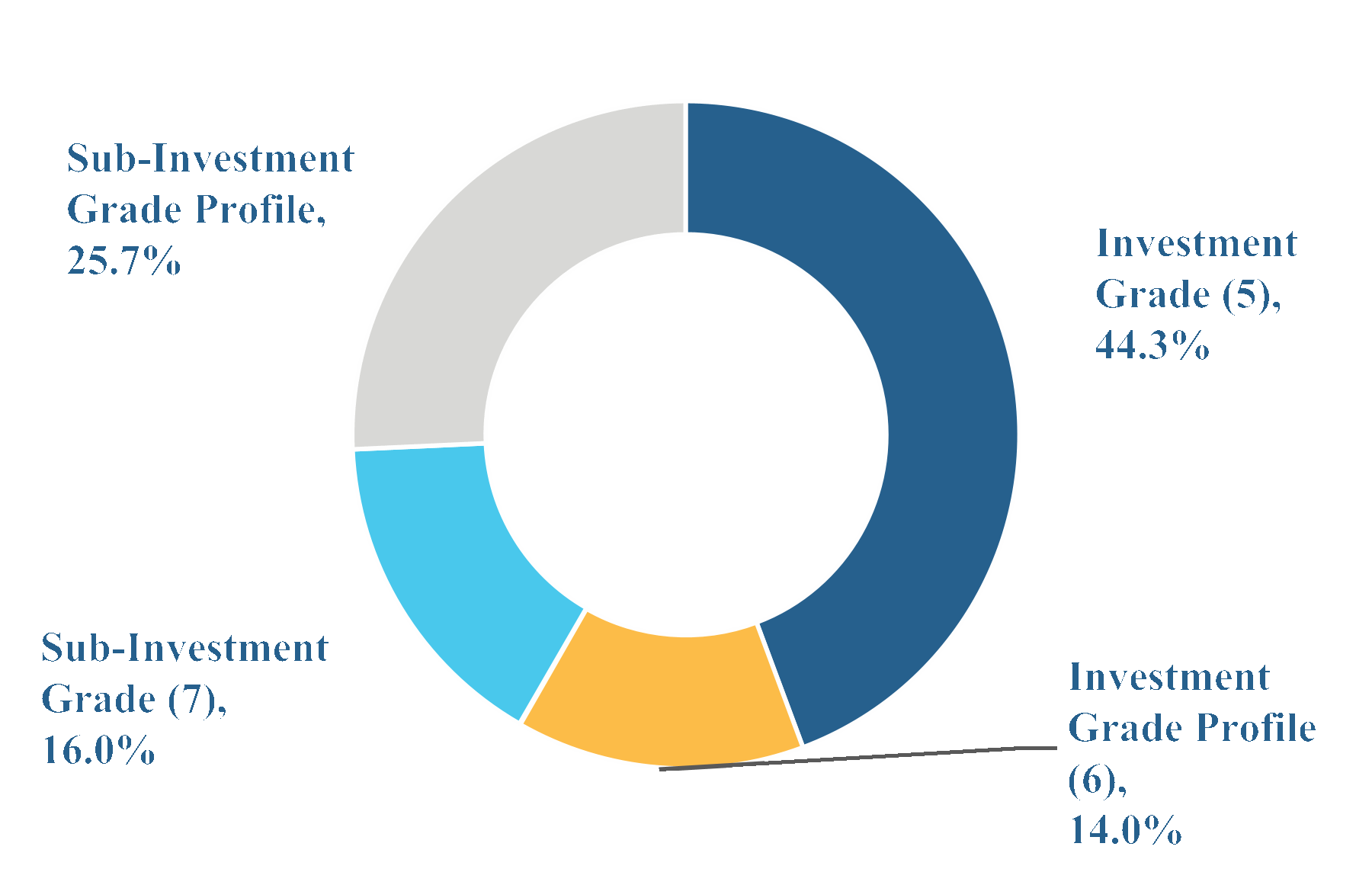
Tenant Quality
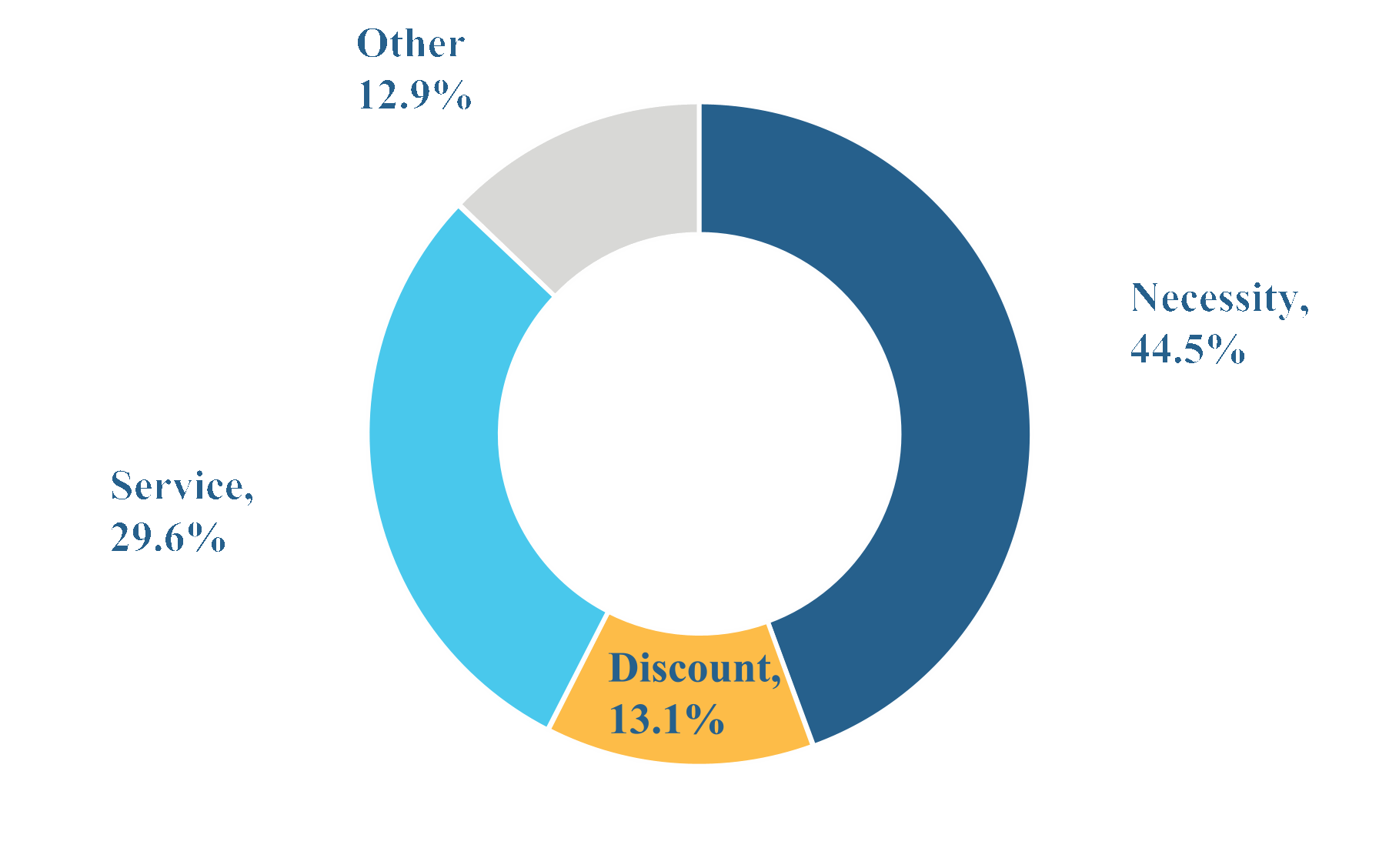
Defensive Category
13
1
42
54
58.3%
of ABR
Inv. Grade
Inv. Grade Profile
87.1%
of ABR
Necessity
Discount
Service
Financial Highlights
Net income of $6.9 million for the full year 2025.
Net income per diluted share of $0.08, core funds from operations
(“Core FFO”)(8) per diluted share of $1.23(9) and adjusted funds
from operations (“AFFO”)(8) per diluted share of $1.31(9) for the
full year 2025.
_________________________
(1)ABR is annualized base rent as of December 31, 2025, for all leases that commenced, and annualized cash interest on mortgage loans receivable in
place as of that date.
(2)Includes acquisitions, mortgage loans receivable, and completed developments, and three property developments where rent has not yet commenced.
(3)Excludes properties under development and one vacant property.
(4)Weighted by ABR; excludes lease extension options and investments that secure mortgage loans receivable.
(5)Investments, or investments that are subsidiaries of a parent entity (with such subsidiary making up at least 50% of the parent company total revenue),
with a credit rating of BBB- (S&P/Fitch), Baa3 (Moody’s) or NAIC2 (National Association of Insurance Commissioners) or higher.
(6)Investments with investment grade credit metrics (more than $1.0 billion in annual sales and a debt to adjusted EBITDA ratio of less than 2.0x), but do
not carry a published rating from S&P, Fitch, Moody’s, or NAIC.
(7)Investments, or investments that are subsidiaries of a parent entity (with such subsidiary making up at least 50% of the parent company total revenue),
with a credit rating of BB+ (S&P), Ba1 (Moody’s) or NAIC3 (National Association of Insurance Commissioners) or lower.
(8)Core FFO per diluted share and AFFO per diluted share are considered non-GAAP financial measures by the SEC. See Appendix A to this Proxy
Statement for more information about these non-GAAP financial measures and for reconciliations from the most comparable GAAP financial
measures.
(9)Per share amounts include weighted average common shares of 84,204,748 for the twelve months ended December 31, 2025.
8 | 2026 PROXY STATEMENT
TABLE OF CONTENTS
Executive Compensation Highlights
Pay program aligned with Company performance and
business strategy. Our annual and long-term incentive plan
performance measures are well aligned with our business
strategy, correlative to total shareholder return, and intended to
drive positive performance
Clawback of incentive compensation. Our clawback policy
applies to all incentive-based cash and equity compensation
granted to current and former executive officers
Robust stock ownership guidelines. We have adopted stock
ownership guidelines that are applicable to all executive officers,
including our Chief Executive Officer, and all non-employee
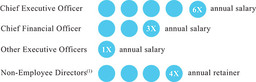
directors. The stock ownership guideline for our CEO is six times
his annual base salary and for our non-employee directors was
increased from three times to four times the annual board retainer
in February 2025
Equity retention requirement. Until an individual subject to the
stock ownership guidelines satisfies the applicable stock
ownership requirement, he or she must retain 50% of the net
shares issued upon exercise, vesting, settlement or earn-out of an
equity award
Independent compensation consultant for the Compensation
Committee. Our Compensation Committee has engaged Farient
Advisors, LLC as its independent compensation consultant
Post-vest holding period required for performance awards.
Any shares received upon vesting of performance stock units
generally cannot be sold or transferred until one year following
the vesting of such awards
Policy prohibiting hedging or pledging of Company stock. We
maintain a formal policy prohibiting our directors, officers and
employees from entering into hedging transactions involving
Company stock and pledging Company stock as collateral for
loans
Corporate Responsibility Highlights
We are committed to fulfilling our obligations as corporate citizens and will continue to take certain environmental, social, and governance (“ESG”)
factors into consideration when conducting our business affairs. We encourage you to review our Corporate Responsibility Report, which can be found at
www.NETSTREIT.com/corporateresponsibility. The information on, or otherwise accessible through, our website does not constitute a part of this Proxy
Statement.
Environmental
Social
Governance
Consider tenants’ commitment to ESG as
part of our investment process
As of December 31, 2025, 16 of our top 20
tenants had ESG commitments, representing
83% of ABR of our top 20 tenants and 44%
of our total ABR
Elements of our headquarters, such as
building automation systems, lighting
controls, green cleaning, and recycling
programs, significantly decrease natural
resource use by conserving energy and
water, minimizing waste, and reducing CO2
emissions
We adopted green lease language in our
standard lease form and corporate policies,
and have executed leases with numerous
tenants to better collaborate with tenants in
sharing data
Annual participation in GRESB public
disclosure submission
Annual calculation of Scope 1 and Scope 2
Greenhouse Gas inventory
Competitive compensation and benefits,
including stock awards for all employees
Employee Experience Committee facilitates
employee feedback on workplace experiences
We partner with local charities providing
volunteer hours and financial contributions to
give back to the community
Maintain Human Rights Policy to advance
fundamental human rights within our
Company
Annual Employee Engagement Survey
43% of our Board, including 50% of our
independent directors, are women
29% of our directors are racially or ethnically
diverse
Six out of seven directors are independent
Independent committees
Separate Chair of the Board and CEO
Directors elected annually
Directors are elected by majority of votes cast
in uncontested elections with a director
resignation policy
Annual director and committee assessments
We have opted out of the Maryland Control
Share Acquisition Act of the MGCL, and we
may not opt into the provisions of the
Maryland Control Share Acquisition Act
without the approval of our stockholders
No poison pill or differential voting stock
structure to chill shareholder participation
Our Bylaws may be amended by the vote of
stockholders entitled to cast at least a
majority of the votes entitled to be cast upon
at a duly organized meeting of stockholders
Our Nominating and Corporate Governance
Committee reviews and recommends ESG
policies and procedures
9 | 2026 PROXY STATEMENT
TABLE OF CONTENTS
ELECTION OF DIRECTORS
(PROPOSAL NO. 1)
Upon the recommendation of our Nominating and Corporate Governance Committee (the “Nominating Committee”), the Board has nominated the seven
individuals listed below to stand for election to the Board for a one-year term ending at the annual meeting of stockholders in 2027 or until their
successors, if any, are elected or appointed. Our Articles of Amendment and Restatement (“Charter”) and Amended and Restated Bylaws (“Bylaws”)
provide for the annual election of directors. Each director nominee must receive the affirmative vote of a majority of the votes cast to be elected (i.e., the
number of shares voted “for” a director nominee must exceed the number of votes cast “against” that nominee). In addition, our Corporate Governance
Guidelines contain a resignation policy which provides that in the event an incumbent director fails to receive a majority of the votes cast in an
uncontested election, such director shall promptly tender his or her resignation to the Board for consideration. The Board has determined that each
director nominee, other than Mr. Manheimer, if elected, would be an independent director, as further described below in “Corporate Governance — 
Independence of Directors.”
All of the director nominees listed below have consented to being named in this Proxy Statement and to serve if elected. If any nominee becomes
unavailable for election as a result of an unexpected occurrence, shares that would have been voted for that nominee will instead be voted for the election
of a substitute nominee proposed by the Board, or alternatively, the Board may may leave a vacancy on the Board or reduce the number of directors to be
elected at the Annual Meeting.
Name
Position
Mark Manheimer
Director, President, Chief Executive Officer and Secretary
Lori Wittman
Chair of the Board
Michael Christodolou
Director
Heidi Everett
Director
Todd Minnis
Director
Matthew Troxell
Director
Robin Zeigler
Director
Biographical information relating to each of the director nominees is set forth below under “Directors and Management” and incorporated by reference
herein.
THE BOARD UNANIMOUSLY RECOMMENDS A VOTE “FOR” THE ELECTION OF EACH OF THE DIRECTOR NOMINEES NAMED
IN THIS PROXY STATEMENT.
10 | 2026 PROXY STATEMENT
TABLE OF CONTENTS
DIRECTORS AND MANAGEMENT
Director Biographical Information
The names of our directors, certain biographical information about our directors, and the experiences, qualifications or skills that the Nominating
Committee considered when recommending the directors for nomination, are set forth below. Ages are as of March 17, 2026.
Mark Manheimer
Mr. Manheimer has served as our President, Chief Executive Officer and director since October 2019. Prior
to that, Mr. Manheimer served as Chief Investment Officer of EB Arrow and Fund Manager of EB Arrow’s
Single Tenant Net Lease Group from February 2018 to October 2019. From 2012 through 2016, Mr.
Manheimer was Executive Vice President — Head of Asset Management of Spirit (NYSE: SRC), a REIT
that invests primarily in single tenant net leased real estate. Mr. Manheimer was a member of Spirit’s
Investment Committee and Executive Committee. Prior to Spirit, Mr. Manheimer was the Head of Sale
Leaseback Acquisitions at Cole, a real estate investment services company, from 2009 to 2012. Mr.
Manheimer previously worked at Realty Income Corporation (NYSE: O), a REIT that invests in free
standing, single tenant commercial properties that are subject to triple net leases, underwriting net lease real
estate transactions, at Patriarch Partners, a private investment firm, investing and managing distressed debt
and equity investments, and at First Union Securities, a financial services firm, in their Leveraged Finance
department. Mr. Manheimer holds a B.S. in Finance from the University of Florida and an M.B.A. from the
University of Notre Dame. Mr. Manheimer’s industry experience, leadership abilities and strategic insight
make him a valued member of the Board.
Image_47.jpg
Director, President, Chief
Executive Officer and Secretary
Age: 49
Board Committees: None
Lori Wittman
Ms. Wittman has served as the Chair of the Board since October 2024, a director since December 2019 and
served as our Interim Chief Financial Officer and Treasurer from November 2022 until April 2023. Since
April 2023, Ms. Wittman has served as Executive Vice President and Chief Financial Officer of Aventine
Property Group, Inc., a privately-held REIT. Ms. Wittman previously served as an advisor to Big Rock
Partners Acquisition Corp. (“Big Rock”), a blank check company, from February 2020 until the closing of
its business merger in May 2021. From September 2017 to February 2020, Ms. Wittman served as Chief
Financial Officer and a member of the Board of Directors of Big Rock. From 2015 to 2017, Ms. Wittman
was the Chief Financial Officer of Care Capital Properties, Inc. (NYSE: CCP), a public healthcare REIT
with a diversified portfolio of triple net leased properties, which merged with Sabra Healthcare REIT, Inc.
in 2017. Previously, Ms. Wittman was Senior Vice President of Capital Markets and Investor Relations at
Ventas, Inc., a REIT focused on the healthcare sector from 2011 to 2015. Prior to her time at Ventas, Ms.
Wittman served in a number of finance, accounting and capital markets related roles at various companies,
including General Growth Properties, Big Rock Partners, LLC and Heitman Financial. Ms. Wittman was a
director of IMH Financial Corporation (“IMH”), a real estate investment and finance company, from July
2014 until November 2020, and served as Chair of the Compensation Committee and as a member of the
Audit Committee of IMH. Ms. Wittman has also served as a director of Global Medical REIT Inc. (NYSE:
GMRE), a REIT engaged primarily in the acquisition of healthcare facilities, since May 2018, and currently
serves as Chair of the Audit Committee and a member of the ESG Committee. Since January 1, 2025, Ms.
Wittman has served as the lead independent director. Ms. Wittman served as a director of Freehold
Properties, a real estate investment company, from May 2019 until March 2023 and served as the Chair of
the Audit Committee during that time. Ms. Wittman received an M.B.A., Finance and Accounting from the
University of Chicago, an M.C.P., Housing and Real Estate Finance from the University of Pennsylvania
and a B.A. from Clark University. Ms. Wittman’s thorough knowledge of finance, accounting, capital
markets, taxes, control systems and her experience with REITs make her a valued member of the Board.
Image_48.jpg
Chair of the Board
Age: 67
Board Committees:
Audit Committee
Compensation Committee
11 | 2026 PROXY STATEMENT
TABLE OF CONTENTS
Michael Christodolou
Mr. Christodolou has served as a director since August 2020. Mr. Christodolou is the Manager of Inwood
Capital Management LLC, an investment management firm he founded in 2000. From 1988 to 1999, Mr.
Christodolou was employed by Bass Brothers/Taylor & Company, an investment firm. Mr. Christodolou has
served as a director of Lindsay Corporation (NYSE: LNN), a manufacturer of agricultural irrigation and
transportation infrastructure products, since 1999 and served as Chair of the Board of Lindsay Corporation
from 2003 to 2015. He currently serves as a member of Lindsay Corporation’s Audit Committee and
Corporate Governance and Nominating Committee. From 2016 until it was acquired in 2017, Mr.
Christodolou served on the Board of Directors of Omega Protein Corporation, a nutritional products
company. From 2015 to 2016, Mr. Christodolou served on the Board of Directors of Farmland Partners, Inc.
(NYSE: FPI), a REIT that acquires and owns high quality North American farmland. Mr. Christodolou also
previously served on the Board of Directors of XTRA Corporation from 1998 until 2001 when it was
acquired by Berkshire Hathaway Inc. Mr. Christodolou received an M.B.A. and a B.S. in Economics from
the Wharton School. Mr. Christodolou’s knowledge of the investment and capital markets and his
experience as a director of public companies make him a valued member of the Board.
Image_50.jpg
Director
Age: 64
Board Committees:
Audit Committee (Chair)
Investment Committee
Heidi Everett
Ms. Everett has served as a director since August 2020. Ms. Everett is the President and Chief Executive
Officer of Star Cypress Partners, LLC, a management consulting company that she founded in 2012.
Previously, Ms. Everett was Vice President of The Wentworth Group, a private equity firm, and a Board
Director for the Stafford Family Foundation. Prior to that, Ms. Everett was Lead Associate at Booz Allen
Hamilton, an information technology consulting firm, within the Strategy & Organization Team from 2004
to 2011. From 1999 to 2003, Ms. Everett served as a Captain in the United States Air Force. Ms. Everett
received an M.B.A. in Strategy and Operations from Georgetown University — The McDonough School of
Business and a B.S. in Biology from Duke University. Ms. Everett’s broad consulting experience, in
particular in strategy and organizational development, change management and workforce development,
gives her a unique perspective that makes her a valued member of the Board.
Image_51.jpg
Director
Age: 48
Board Committees:
Compensation Committee
Nominating Committee
12 | 2026 PROXY STATEMENT
TABLE OF CONTENTS
Todd Minnis
Mr. Minnis has served as a director since October 2019 and served as Chair of the Board from October 2019
until October 2024. Mr. Minnis founded EB Arrow, a real estate investment platform specializing in retail
property investment, in 2009 as its Managing Partner and served as its Chief Executive Officer from May
2009 until May 2023. Prior to EB Arrow, Mr. Minnis served as the Managing Director of Cypress Equities,
the development subsidiary of The Staubach Company, from 2003 to 2009 and worked at The Staubach
Company from 1992 to 2003. Mr. Minnis holds a B.S. in Economics and a B.A. in Foreign Languages from
Southern Methodist University and an M.B.A. from the University of Texas at Austin McCombs School of
Business. Mr. Minnis’ leadership, executive and business experience, along with over 25 years of
experience in the commercial real estate investment industry make him a valued member of the Board.
Image_53.jpg
Director
Age: 55
Board Committees:
Nominating Committee
Investment Committee (Chair)
Matthew Troxell, CFA®
Mr. Troxell has served as a director since December 2019. From 1994 through December 2019, Mr. Troxell
was a Managing Director of AEW Capital Management, LP (“AEW”), a real estate investment manager,
where he served on both the Management and Risk Management Committees. He started and headed
AEW’s Real Estate Securities Group, whose assets under management grew to $10 billion. As Senior
Portfolio Manager, he was responsible for all of AEW’s U.S. and global REIT portfolios, and managed a
team with offices in Boston, London, and Singapore. Prior to joining AEW, he was a Vice President of
Landmark Land Company, a diversified real estate and financial services company, from 1984 to 1992.
From 1980 to 1984, he was an equity securities analyst covering financials at A.G. Becker Paribas. Mr.
Troxell received his B.A. in Economics from Tufts University and is a CFA charterholder. Mr. Troxell’s
REIT investment experience and strategic insight make him a valued member of the Board.
Image_54.jpg
Director
Age: 68
Board Committees:
Audit Committee
Compensation Committee (Chair)
13 | 2026 PROXY STATEMENT
TABLE OF CONTENTS
Robin Zeigler
Ms. Zeigler has served as a director since July 2020. Ms. Zeigler has served as the Founder and Chief
Executive Officer of MURAL Real Estate Partners, a commercial real estate services firm, since May 2022.
Since January 2022, Ms. Zeigler has served as a trustee of RLJ Lodging Trust (NYSE: RLJ), a lodging
REIT. Ms. Zeigler has also served as a director of JLL Income Property Trust (Nasdaq: ZIPTMX), a non-
traded REIT since July 2021. From March 2016 to May 2022, Ms. Zeigler served as Chief Operating
Officer, Executive Vice President of Cedar Realty Investment Trust (NYSE: CDR), an equity REIT. From
2015 to 2016, Ms. Zeigler served as Executive Vice President — Head of Operations of Penzance, a
commercial real estate investment company. Prior to that, Ms. Zeigler served as Chief Operating Officer,
Mid-Atlantic Region of Federal Realty Investment Trust (NYSE: FRT), an equity REIT, from 2004 to 2015.
Earlier in her career, Ms. Zeigler served in various roles at KeyBank Real Estate Capital, Lendlease Real
Estate Investments and Ernst & Young LLP. Ms. Zeigler received an M.B.A. in Real Estate from Georgia
State University and a B.S. in Accounting from Florida A&M University. Ms. Zeigler’s real estate
investment experience and public company experience make her a valued member of the Board.
Image_56.jpg
Director
Age: 53
Board Committees:
Nominating Committee (Chair)
Investment Committee
Board Experience, Qualifications and Skills
Mark
Manheimer
Lori
Wittman
Michael
Christodolou
Heidi
Everett
Todd
Minnis
Matthew
Troxell
Robin
Zeigler
Expertise
Other Public Company Board
Public Company CEO
Public Company CFO
Executive Management
Real Estate
REIT
Capital Markets
Strategic Planning/M&A
External Risk Oversight
Internal Risk Oversight
Human Capital Management
Legal/Regulatory
Technology
Growth Company Experience
ESG
Marketing
14 | 2026 PROXY STATEMENT
TABLE OF CONTENTS
Executive Officer Biographical Information
The names and certain biographical information about our executive officers are set forth below (other than Mr. Manheimer, whose information is set
forth above under “— Directors”). Ages are as of March 17, 2026.
Daniel Donlan
Mr. Donlan has served as our Chief Financial Officer and Treasurer since April 2023. He previously served
as Senior Vice President, Head of Capital Markets at Essential Properties Realty Trust, Inc. (NYSE: EPRT),
a net lease REIT focused on sale-leaseback transactions with middle-market tenants, from February 2018
through March 2023. Prior to that, Mr. Donlan was a Managing Director at Ladenburg Thalmann & Co., a
financial services firm, from January 2013 to January 2018, where he served as the company’s lead REIT
research analyst. Prior to that, Mr. Donlan was as a Vice President at Janney Capital Markets, a financial
services firm, where he worked from June 2007 to January 2013, and an associate research analyst at BB&T
Capital Markets, a financial services firm, where he worked from April 2004 to May 2007. Mr. Donlan
began his career as a sales and leasing associate at Thalhimer Cushman & Wakefield, a commercial real
estate services firm, in Richmond, VA. Mr. Donlan received a B.B.A. in Finance from the University of
Notre Dame.
Image_58.jpg
Chief Financial Officer and
Treasurer
Age: 44
15 | 2026 PROXY STATEMENT
TABLE OF CONTENTS
CORPORATE GOVERNANCE
Our business and affairs are managed under the direction of our Board. Each of our directors has been elected to serve a term ending at the Annual
Meeting. Pursuant to our Charter and Bylaws, the number of our directors may not be fewer than the minimum number required by Maryland law, which
is one, and may not be greater than fifteen, and will generally be determined from time to time by resolution of the Board. Our Board currently consists of
seven members.
Criteria for Selection of Directors
The Nominating Committee is responsible for (i) reviewing the structure, organization, function and composition of the Board and its committees and
make recommendations to the Board regarding changes to the size and composition of the Board or any committee thereof, (ii) identifying, recruiting,
screening, and interviewing individuals that the Nominating Committee believes are qualified to become Board members, and selecting, or recommending
that the Board select, the director nominees to stand for election at each annual meeting of stockholders of the Company in which directors will be elected,
(iii) considering potential director candidates validly recommended by the Company’s stockholders in the same manner as nominees identified by the
Nominating Committee. Pursuant to our Corporate Governance Guidelines, directors should be able to read and understand financial statements,
understand our industry and possess the highest personal and professional ethics, integrity and values. In considering candidates recommended by the
Nominating Committee, the Board intends to consider such factors as: (i) current or recent experience as a senior executive of a public company or as a
leader of another major complex organization; (ii) experience as a director of a public company; (iii) business and financial expertise; (iv) ability to make
sound business judgments; (v) general understanding of the Company’s business; (vi) current or prior industry experience; (vii) current employment; (viii)
diversity of thought, personal background, perspective, experience, skill, education, national origin, gender, race, age, culture and current affiliations; (ix)
having sufficient time to devote to the affairs of the Company; and (x) ability to work constructively with other members and management (where
appropriate) to accomplish and effect their duties.
Recommendation of Nominees by Stockholders
In accordance with its charter, the Nominating Committee will consider candidates for election as a director of the Company that are recommended by
any stockholder. Recommendations of individuals to be considered by the Nominating Committee should be sent to NETSTREIT Corp., 2021 McKinney
Avenue, Suite 1150, Dallas, Texas 75201, Attention: Secretary. All recommendations for nomination received by our Secretary that are made in
accordance with the requirements in our Bylaws relating to director nominations will be considered.
Pursuant to Article II, Section 11 of the current Bylaws, nominations of persons for election to the Board at a meeting of stockholders may be made by
any stockholder of the Company who was a stockholder of record as of the record date set by the Board of Directors for the purpose of determining
stockholders entitled to vote at the meeting, at the time of giving of notice of such nomination and at the time of the meeting, who entitled to vote for the
election of directors at the meeting who sends a timely notice in writing to our Secretary containing the information, representations, consents and
certifications required by our Bylaws. To be timely, a stockholder’s notice must be delivered to our Secretary at the Company’s principal executive
offices not earlier than 150 days nor less than 120 days prior to the first anniversary of the date of the Proxy Statement for the preceding year’s annual
meeting; provided, however, that in the event that the date of the annual meeting is advanced or delayed by more than 30 days from the first anniversary
of the date of the preceding year’s annual meeting, in order for notice by the stockholder to be timely, such notice must be so delivered not earlier than the
150th day prior to the date of such annual meeting, on the later of the 120th day prior to the date of such annual meeting, as originally convened, or the
tenth day following the day on which public announcement of the date of such meeting is first made. See “Stockholder Proposals and Nominations for
2027 Annual Meeting of Stockholders.”
Board and Committee Self-Evaluations
Each year our Board undertakes a self-evaluation process to critically evaluate its performance and effectiveness. Additionally, each committee conducts a
self-evaluation to monitor its performance and effectiveness. The process is coordinated by the Nominating Committee using an independent third-party
to conduct the evaluation process. Board and committee members are asked to provide commentary regarding a variety of topics, including the following:
overall Board performance, including strategy, challenges and opportunities; Board and committee meeting logistics and materials; Board and committee
culture; risk oversight; and succession planning. The results of the evaluations are aggregated and summarized by the independent third party and
discussed at Board and committee meetings.
In addition to the formal annual assessments, the Board evaluates and modifies its oversight of the Company’s operations on an ongoing basis. During
their regular meetings, independent directors consider agenda topics that they believe deserve additional focus and raise new topics to be discussed at
future meetings.
Independence of Directors
Our Corporate Governance Guidelines provide that a majority of the members of the Board, and each member of the Audit Committee, Compensation
Committee and Nominating Committee, must meet the criteria for independence set forth under applicable law and the New York Stock Exchange
(“NYSE”) listing standards. No director qualifies as independent unless the Board determines that the director has no direct or indirect material
relationship with the Company. In addition to considering the NYSE independence criteria, the Board will consider all relevant facts and circumstances of
which it is aware in making an independence determination with respect to any director.
The Board, following consultation with the Nominating Committee, has made director independence determinations with respect to each of our current
directors. Based on the NYSE independence guidelines, the Board has affirmatively determined that (i) Messrs. Christodolou, Minnis, and Troxell and
Mses. Everett, Wittman, and Zeigler (A) have no relationships or only immaterial relationships with us, (B) meet the NYSE independence guidelines with
respect to any such relationships and (C) are independent; and (ii) Mr. Manheimer is not independent. Mr. Manheimer is our President, Chief Executive
Officer (the “CEO”) and Secretary.
16 | 2026 PROXY STATEMENT
TABLE OF CONTENTS
Board’s Role in Risk Oversight
One of the key functions of our Board is informed oversight of our risk management process. Our Board administers this oversight function directly, with
support from its four standing committees, the Audit Committee, the Compensation Committee, the Nominating Committee, and the Investment
Committee, each of which addresses risks specific to its respective areas of oversight. In particular, as more fully described below, our Audit Committee
has the responsibility to consider and discuss our major financial, accounting, operational, litigation, tax, privacy, and cybersecurity risk exposures and the
steps our management has taken to monitor and control these exposures, including guidelines and policies to govern the process by which risk assessment
and management is undertaken. The Audit Committee also monitors compliance with legal and regulatory requirements, in addition to oversight of the
performance of our internal audit function. Our Compensation Committee assesses and monitors whether any of our compensation policies and programs
has the potential to encourage excessive risk taking. Our Nominating Committee provides oversight with respect to governance, social responsibility and
environmental-related risks and ethical conduct and monitors the effectiveness of our corporate governance guidelines, including whether such guidelines
are successful in preventing illegal or improper liability creating conduct. Our Investment Committee provides oversight with respect to the Company’s
investments and strategy.
Corporate Responsibility
We are committed to fulfilling our obligations as corporate citizens. As we grow, we intend to integrate environmental, social, and governance (“ESG”)
considerations into our strategy and processes. We intend to leverage this commitment to deepen our ESG approach, using ESG frameworks to identify
material risks and opportunities, analyzing data to refine our strategy, policies, and practices, and providing transparency to our investors and
stakeholders.
 Environmental
Image_61.jpg
Most of our properties operate under a “triple-net” lease structure, which means our tenants have operational control of the property, including
environmental management programs, such as those that conserve resources. To that end, as part of our process for evaluating a potential acquisition, we
incorporate information about a tenant’s commitment to ESG into our investment committee memorandum and take into consideration environmental and
climate risks that might subject us to financial liabilities or regulatory actions. We are committed to identifying sustainable practices that are financially
responsible and operationally feasible when working with our tenants or managing capital improvement projects.
Our top tenants have corporate sustainability programs that govern their business operations, including policies designed to reduce resource consumption
and implement practical conservation policies at their retail locations. As of December 31, 2025, 16 of our top 20 tenants had ESG commitments,
representing 83% of ABR of our top 20 tenants and 44% of our total ABR.
In 2022, we developed green lease clauses, which assist the Company and its tenant companies in delivering sustainability benefits to their respective
stakeholders. As a result, our form lease now contains green lease provisions that include, among other items, certain reporting as to tenant energy and
water use. We have executed green leases with numerous tenants and are pursuing collaborative sharing of utility data to identify opportunities that reduce
energy consumption.
Our corporate headquarters in Dallas, TX is operated at the highest level of efficiency and sustainability, obtaining a LEED v4 O+M: EB Gold
certification, meaning it meets both LEED criteria as well as strict EPA guidelines to achieve an Energy Star rating. Elements of our headquarters, such as
building automation systems, lighting controls, green cleaning, and recycling programs, significantly decrease natural resource use by conserving energy
and water, minimizing waste, and reducing CO2 emissions. We complete our Scope 1 and Scope 2 greenhouse gas inventory and calculation annually,
and we will continue to monitor for opportunities to reduce our emissions.
We participate annually in GRESB public disclosure submission, and will use the results to identify areas of improvement.
 Social
Image_62.jpg
As of December 31, 2025, we had 29 full-time employees. Our staff is mostly comprised of professional employees engaged in origination, underwriting,
closing, financial reporting, portfolio management and capital markets activities essential to our business.
We are committed to creating a strong internal culture that promotes inclusion and employee well-being. Our past and continued success relies on our
ability to attract, develop, engage, and retain a team of highly motivated and talented employees. In order to meet this objective, we are committed to the
following:
Talent acquisition and development. We provide equal employment
opportunities to all individuals and seek to cultivate an inclusive culture
that respects and appreciates diversity of experience, ideas, and
opinions. To ensure we attract and retain top talent, we provide
competitive compensation and benefits, including stock awards for all
employees. We aim to develop our employees by providing internal
training and reimbursement for certifications, tuition, courses, and
seminars for continuing professional education. We encourage regular
informal feedback directly from the leadership team and complete
formal evaluations of each employee annually.
Workplace culture and empowerment. We ensure that employees have
a clear voice in sharing and upholding our cultural value and
expectations through the Employee Experience Committee (EEC). The
EEC allows the leadership team to engage with, and obtain feedback
from, our employees on their workplace experiences. The EEC is
comprised of non-management members of the organization and rotate
annually. Members meet periodically to discuss recommendations to
present to the leadership team, which may include additional substantive
training, personal growth and professional development programs,
company social and team-building events, employee benefits, and health
and wellness programs. We conduct an annual Employee Engagement
Survey to further enhance our company culture and employee
experience.
Employee wellness. We are committed to providing a safe and healthy
working environment for our employees. We offer competitive
healthcare insurance and generous paid time off, as well as paid medical
and parental leave. We also provide employees with standing desks,
ergonomic desk chairs, and fitness center memberships.
17 | 2026 PROXY STATEMENT
TABLE OF CONTENTS
We believe when the Company does well, it is equally important for us to give back to the community. Each quarter, employees select a charitable
organization to sponsor, either through fundraising or in-kind donations, where NETSTREIT matches 100% of all donations. Additionally, the Company
reinforces its commitment to community involvement by offering two annual volunteer days, during which team members provide hands-on support to
local charitable organizations.
 Governance
Image_64.jpg
We are committed to acting with honesty and integrity and conducting all corporate opportunities in an ethical manner. Some highlights of our corporate
governance program include:
43% of our Board, including 50% of our independent directors, are
women
29% of our directors are racially or ethnically diverse
Six out of seven directors are independent
Independent committees
Separate Chair of the Board and CEO
Directors elected annually
Directors are elected by majority of votes cast in uncontested elections
with a director resignation policy
We have opted out of the Maryland Control Share Acquisition Act of the
MGCL, and we may not opt into the provisions of the Maryland Control
Share Acquisition Act without the approval of our stockholders
No poison pill or differential voting stock structure to chill shareholder
participation
Our Bylaws may be amended by the vote of stockholders entitled to cast
at least a majority of the votes entitled to be cast upon at a duly
organized meeting of stockholders
Code of Business Conduct and Ethics
We have adopted a Code of Business Conduct and Ethics that applies to all of our employees, officers, and directors, including our principal executive
officer, principal financial officer, principal accounting officer or controller or persons performing similar functions. The Code of Business Conduct and
Ethics is available on our website at www.NETSTREIT.com. The information on, or otherwise accessible through, our website does not constitute a part
of this Proxy Statement. The Code of Business Conduct and Ethics seeks to identify and mitigate conflicts of interest between our employees, directors
and officers, including with respect to corporate opportunities. However, we cannot assure you that these policies or provisions of law will always be
successful in eliminating or minimizing the influence of such conflicts, and if they are not successful, decisions could be made that might fail to reflect
fully the interests of our stockholders. Among other matters, our Code of Business Conduct and Ethics will be designed to deter wrongdoing and to
promote:
honest and ethical conduct, including the ethical handling of actual or
apparent conflicts of interest between personal and professional
relationships;
full, fair, accurate, timely, and understandable disclosure in our SEC
reports and other public communications;
compliance with applicable laws, rules and regulations;
prompt internal reporting of violations of the code to appropriate persons
identified in the code;
accountability for adherence to the code of business conduct and ethics;
the protection of the Company’s legitimate business interests, including
its assets and corporate opportunities; and
confidentiality of information entrusted to directors, officers and
employees by the Company and its tenants.
We intend to promptly disclose on our website (i) the date and nature of any amendment (other than technical, administrative or other non-substantive
amendments) to the Code of Business Conduct and Ethics that applies to our principal executive officer, principal financial officer, principal accounting
officer or controller or persons performing similar functions and relates to any element of the code of ethics definition enumerated in Item 406(b) of
Regulation S-K and (ii) the nature of any waiver, including an implicit waiver, from a provision of the Code of Business Conduct and Ethics that is
granted to one of these specified individuals that relates to one or more of the elements of the code of ethics definition enumerated in Item 406(b) of
Regulation S-K, the name of such person who is granted the waiver and the date of the waiver.
Insider Trading Policy
We have adopted insider trading policies and procedures governing the purchase, sale, and/or other dispositions of our securities by directors, officers, and
employees. In addition, it is our intent to comply with the applicable laws and regulations relating to insider trading. A copy of our Insider Trading Policy
is filed as an exhibit to our Annual Report on Form 10-K for the year ended December 31, 2024.
Compensation Committee Interlocks and Insider Participation
None of our executive officers serves, or in the past has served, as a member of the Board or compensation committee, or other committee serving an
equivalent function, of any entity that has one or more executive officers who serve as members of our Board or our Compensation Committee. Ms.
Wittman, who joined the Compensation Committee in February 2025, previously served as our Interim Chief Financial Officer from November 2022 to
April 2023. None of the other members of our Compensation Committee is, or has ever been, an officer or employee of the Company.
Communications to the Board
Stockholders and interested parties can contact the Board (including the Chair of the Board and non-employee directors) through written communication
sent to NETSTREIT Corp., 2021 McKinney Avenue, Suite 1150, Dallas, Texas 75201, Attention: Secretary. Our Secretary reviews all written
communications and forwards to the Board a summary and/or copies of any such correspondence that is directed to the Board or that, in the opinion of the
Secretary, deals with the functions of the Board or Board committees or that he otherwise determines requires the Board’s or any Board committee’s
18 | 2026 PROXY STATEMENT
TABLE OF CONTENTS
attention. Concerns relating to accounting, internal accounting controls, or auditing matters are immediately brought to the attention of our internal audit
function and handled in accordance with procedures established by the Audit Committee with respect to such matters. From time to time, the Board may
change the process by which stockholders may communicate with the Board. Any such changes will be reflected in our Corporate Governance Guidelines,
which are posted on our website at www.NETSTREIT.com. The information on, or otherwise accessible through, our website does not constitute a part of
this Proxy Statement.
Communications of a confidential nature can be made directly to our non-employee directors or the Chair of the Audit Committee regarding any matter,
including any accounting, internal accounting control, or auditing matter, by submitting such concerns to the Audit Committee or the Chair of the Board.
Any submissions to the Audit Committee or the Chair of the Board should be marked confidential and addressed to the Chair of the Audit Committee or
the Chair of the Board, as the case may be, c/o NETSTREIT Corp., 2021 McKinney Avenue, Suite 1150, Dallas, Texas 75201.
Other Board Information
Leadership Structure of the Board
Lori Wittman is our Chair of the Board and has served in that role since October 2024. Our Board has decided to maintain separate non-executive chair
and CEO roles to allow our CEO to focus on the execution of our business strategy, growth and development, while allowing the non-executive chair to
lead the Board in its fundamental role of providing advice to, and independent oversight of, management. While our Bylaws and Corporate Governance
Guidelines do not require that our non-executive chair and CEO positions be separate, the Board believes that having separate positions is the appropriate
leadership structure for the Company at this time.
Board Meetings
In 2025, our Board held six meetings. In addition to our Board meetings, our directors attend meetings of committees established by our Board. Each of
our director nominees attended at least 75% of the meetings of our Board and the committees on which he or she served during 2025 that were held when
he or she was a director. Our directors are encouraged to attend all annual and special meetings of our stockholders. In 2025, all of the directors attended
the virtual annual meeting of stockholders.
Meetings of Non-Employee Directors
In accordance with our Corporate Governance Guidelines and the listing standards of the NYSE, our non-employee directors meet regularly in executive
sessions of the Board without management present. Ms. Wittman, the Chair of the Board, presides over these executive sessions.
Committees of the Board
Our Board has four committees: the Audit Committee, the Compensation Committee, the Nominating Committee and the Investment Committee, each of
which meets the NYSE independence standards and other governance requirements for such a committee. The principal functions of each committee are
briefly described below.
Additionally, our Board may from time to time establish other committees to facilitate the Board’s oversight of management of the business and affairs of
our company. The charters of the Audit Committee, the Compensation Committee and the Nominating Committee are available on our website at
www.NETSTREIT.com. The information on, or otherwise accessible through, our website does not constitute a part of this Proxy Statement.
Board Committees
Name
Director Since
Independent
Audit
Comp
Nominating
Investment
Mark Manheimer
2019
Lori Wittman
2019
Image_67.gif
Image_68.gif
Image_69.gif
Michael Christodolou
2020
Image_70.gif
Image_71.gif
Image_72.gif
Heidi Everett
2020
Image_73.gif
Image_74.gif
Image_75.gif
Todd Minnis
2019
Image_76.gif
Image_77.gif
Image_78.gif
Matthew Troxell
2019
Image_79.gif
Image_80.gif
Image_81.gif
Robin Zeigler
2020
Image_82.gif
Image_83.gif
Image_84.gif
= Chair of Board/Committee
= Member of Committee
Director Term: One Year
Board Meetings in 2025: 6
Image_85.jpg
Image_86.jpg
Board Committee Meetings in 2025: Audit (4), Compensation (6), Nominating (4), Investment (4)
Audit Committee
In 2025, the Audit Committee held four meetings.
The Audit Committee charter defines the Audit Committee’s principal functions, including oversight related to:
19 | 2026 PROXY STATEMENT
TABLE OF CONTENTS
the integrity of our financial statements and financial reporting process;
the evaluation of the qualifications, independence and performance of
our independent registered public accounting firm;
our accounting and financial reporting processes;
our systems of disclosure controls and procedures and internal control
over financial reporting;
the performance of our internal audit functions;
our compliance with financial, legal and regulatory requirements;
the use of AI in accounting, financial reporting, and compliance
governed through risk management, policies, processes, and controls;
and
our overall risk assessment and management, including risks relating to
data privacy, technology and information security and cybersecurity.
The Audit Committee is also responsible for appointing, compensating, retaining, and overseeing an independent registered public accounting firm,
reviewing with the independent registered public accounting firm the plans for and results of the audit engagement, approving services that may be
provided by the independent registered public accounting firm, including audit and non-audit services, reviewing the independence of the independent
registered public accounting firm, considering the range of audit and non-audit fees, and reviewing the adequacy of our internal accounting controls. The
audit committee also will prepare the audit committee report required by SEC regulations to be included in our annual report.
Our Audit Committee consists of three members, Michael Christodolou, Matthew Troxell, and Lori Wittman, with Mr. Christodolou serving as chair. Our
Board has affirmatively determined that all directors serving on the Audit Committee meet the definition of “independent director” based on the standards
of the NYSE, and satisfy the independence requirements of Rule 10A-3 of the Exchange Act. Our Board has also determined that (i) each member of the
Audit Committee qualifies as an “audit committee financial expert” under SEC rules and regulations and (ii) each member of the Audit Committee is
“financially literate” as the term is defined by NYSE listing standards.
Compensation Committee
In 2025, the Compensation Committee held six meetings. The Compensation Committee charter defines the Compensation Committee’s principal
functions, including oversight related to:
annually review and approve our corporate goals and objectives with
respect to compensation for our Chief Executive Officer and, at least
annually, evaluating the Chief Executive Officer’s performance in light
of those goals and objectives to set his or her annual compensation,
including salary, bonus, fees, benefits, incentive awards and perquisites;
review and approve compensation of other executive officers, including
salaries, bonuses, fees, benefits, incentive awards and perquisites;
review and approve new incentive compensation plans and equity-based
plans and amendments to any existing plans;
annually evaluate and approve appropriate compensation for non-
employee directors;
review and approve any clawback policy;
review and discuss with management our compensation discussion and
analysis required by SEC regulations and recommending to the Board
that such compensation discussion and analysis be included in our
annual report; and
prepare the compensation committee report to be included in our proxy
statement.
Our Compensation Committee consists of three members, Matthew Troxell, Heidi Everett and Lori Wittman, with Mr. Troxell serving as chair. Our
Board has affirmatively determined that all directors who serve on the Compensation Committee are independent under applicable NYSE rules and that
each member of our Compensation Committee meets the definition of a “non-employee director” for the purposes of serving on our Compensation
Committee under the Exchange Act.
Through July 2025, the Compensation Committee again engaged Ferguson Partners Consulting L.P. (“FPC”) as its independent consultant. FPC reported
directly to the Compensation Committee, which retained the sole authority to direct the work of, engage or terminate FPC. FPC conducted an analysis and
provided advice on, among other things, our executive compensation, director compensation, and incentive plan design. As part of its analysis, FPC
collected and analyzed compensation information from a peer group of comparable public companies and reported to the Compensation Committee. The
Compensation Committee considered this report by FPC when making its determinations regarding executive compensation in 2025, as detailed below in
the section titled “Compensation Discussion and Analysis — Peer Group Development Process and How We Used the Data.”
In July 2025, the Compensation Committee engaged a new compensation consultant, Farient Advisors, LLC (“Farient”), a nationally recognized
compensation consulting firm, as its independent consultant, replacing FPC. Farient reports directly to the Compensation Committee, which retains the
sole authority to direct the work of, engage or terminate Farient. The mandate of Farient is to serve the Company and work with the Compensation
Committee in its review of executive and director compensation practices, including the competitiveness of pay levels, program design, market trends,
and technical considerations. The Compensation Committee worked with Farient to review and update our peer group, provide a competitive market
analysis of the base salary, annual cash incentive awards, and long-term incentive compensation of our executive officers compared to the compensation
peer group and review other market practices and trends to inform our 2026 compensation program.
Other than with respect to consulting on executive and director compensation matters, neither FPC nor Farient has performed other services for the
Compensation Committee or the Company. The Compensation Committee has reviewed the independence of FPC and Farient in light of, among other
things, SEC rules and NYSE listing standards regarding compensation consultants and has concluded that neither FPC's nor Farient’s work for the
Compensation Committee raises any conflict of interest.
Nominating Committee
In 2025, the Nominating Committee held four meetings. The Nominating Committee charter defines the Nominating Committee’s principal functions,
including oversight related to:
identifying and recommending candidates to fill vacancies on the Board
and for election by the stockholders;
recommending committee assignments for members to the Board;
review and make recommendations to the Board regarding independence
determinations;
20 | 2026 PROXY STATEMENT
TABLE OF CONTENTS
consider and make recommendations to the Board regarding the Board’s
leadership structure;
overseeing the development of executive succession plans;
facilitating the Board’s annual evaluation of the performance of the
Board, its committees and individual directors;
overseeing environmental stewardship and social responsibility matters;
and
developing and recommending to the Board appropriate corporate
governance policies, practices and procedures for our company.
Our Nominating Committee currently consists of three members, Robin Zeigler, Heidi Everett and Todd Minnis, with Ms. Zeigler serving as chair. Our
Board has affirmatively determined that all directors who serve on the Nominating Committee are independent under NYSE listing standards.
Investment Committee
In 2025, the Investment Committee held four meetings. The Investment Committee’s principal functions include oversight related to investment policies
and guidelines. Our Investment Committee currently consists of three members, Todd Minnis, Michael Christodolou, and Robin Zeigler, with Mr. Minnis
serving as chair. Our Board has affirmatively determined that all directors who serve on the Investment Committee are independent under NYSE listing
standards.
Non-Employee Director Compensation
The following table presents information regarding the compensation earned or paid during fiscal year 2025 to our non-employee directors who served on
the Board during the year. Directors who are employees of us or any of our subsidiaries do not receive any compensation for their services as directors.
Name
Fees Earned or
Paid in Cash
($)
Stock Awards
($)(1)
Total
($)
Lori Wittman
137,500
105,000
242,500
Michael Christodolou
97,500
105,000
202,500
Heidi Everett
85,000
105,000
190,000
Todd Minnis
92,500
105,000
197,500
Matthew Troxell
95,000
105,000
200,000
Robin Zeigler
92,500
105,000
197,500
(1)The amounts reported in this column represent the grant date fair value of the annual restricted stock unit (“RSU”) awards of 7,192 RSUs granted to
each of our non-employee directors in 2025. The grant date fair value of each award was calculated in accordance with the Financial Accounting
Standards Board (“FASB”) Accounting Standards Codification (“ASC”) Topic 718. For a discussion of the assumptions and methodologies used in
calculating the grant date fair value of the RSU awards, please see Note 11 to our audited consolidated financial statements in our Annual Report on
Form 10-K for the fiscal year ended December 31, 2025. As of December 31, 2025, each non-employee director held 7,192 unvested RSUs.
Director Compensation Program
Our Board has established a compensation program for our non-employee directors, which is comprised of the following:
Annual Cash Retainer: Annual cash retainer of $70,000, payable in
quarterly installments in arrears (and prorated for partial service).
Chair Fees: The additional annual cash retainer amount of $50,000 is
payable to either an independent Chair or a lead independent director.
The Chairs of the Audit Committee, the Compensation Committee, the
Nominating Committee, and the Investment Committee will receive
additional annual cash retainers of $20,000, $15,000, $15,000, and
$15,000, respectively.
Committee Fees: Non-Chair members of the Audit Committee, the
Compensation Committee, the Nominating Committee, and the
Investment Committee will receive additional annual cash retainers of
$10,000, $7,500, $7,500, and $7,500, respectively.
Equity Awards: Annual award of RSUs with a value at grant of
approximately $105,000 vesting on the first anniversary of the grant
date, generally subject to continued service as a director through the
vesting date.
We also reimburse our directors for reasonable out-of-pocket expenses incurred in connection with the performance of their duties as directors, including
without limitation travel expenses in connection with their attendance in-person at Board and committee meetings.
The Company has stock ownership guidelines with respect to non-employee directors. See “Compensation Discussion and Analysis — Governance and
Other Considerations — Stock Ownership Requirements” for additional information.
Security Ownership of Certain Beneficial Owners, Directors and Management
The SEC has defined “beneficial ownership” of a security to mean the possession, directly or indirectly, of voting power and/or investment power over
such security. A stockholder is also deemed to be, as of any date, the beneficial owner of all securities that such stockholder has the right to acquire within
60 days after that date through (1) the exercise of any option, warrant or right, (2) the conversion of a security, (3) the power to revoke a trust,
discretionary account or similar arrangement or (4) the automatic termination of a trust, discretionary account or similar arrangement.
The following table sets forth information, as of March 17, 2026, known to us about the beneficial ownership of shares of our common stock by our 5% or
greater stockholders and by our named executive officers, directors and executive officers and directors as a group. In computing the number of shares
beneficially owned by a person and the percentage ownership of that person, shares of our common stock subject to options or other rights (as set forth
above) held by that person that are exercisable as of March 17, 2026 or will become exercisable within 60 days thereafter, are deemed outstanding, while
such shares are not deemed outstanding for purposes of computing percentage ownership of any other person. The percentage calculations set forth in the
21 | 2026 PROXY STATEMENT
TABLE OF CONTENTS
table are based on 97,253,556 shares of common stock outstanding on March 17, 2026, rather than based on the percentages set forth in stockholders’
Schedules 13G or 13D, as applicable, filed with the SEC.
Each person named in the table has sole voting and investment power with respect to all of the shares of our common stock shown as beneficially owned
by such person, except as otherwise set forth in the notes to the table. Unless otherwise indicated, the address of each named person is c/o NETSTREIT
Corp., 2021 McKinney Avenue, Suite 1150, Dallas, Texas 75201. No shares beneficially owned by any executive officer or director have been pledged as
security.
Common Stock and Securities
Exchangeable for Common Stock
Name of Beneficial Owner
Number of Shares of
Common
Stock
Beneficially
Owned
Percent
of
Class(1)
5% or Greater Stockholders
Affiliates of Cohen & Steers, Inc.(2)
13,224,279
13.6%
Principal Real Estate Investors, LLC (3)
8,935,308
9.2%
Blackrock, Inc.(4)
8,908,035
9.2%
The Vanguard Group(5)
7,352,295
7.6%
Millennium Management LLC (6)
5,246,726
5.4%
Named Executive Officers and Directors
Mark Manheimer
410,260
*
Daniel Donlan(7)
48,259
*
Lori Wittman(8)
30,065
*
Michael Christodolou
34,264
*
Heidi Everett
25,248
*
Todd Minnis
22,744
*
Matthew Troxell
43,998
*
Robin Zeigler
25,536
*
All executive officers and directors as a group (8 persons)
640,374
*
*Less than 1%.
(1)Percentages are rounded.
(2)Based solely on the Schedule 13G/A filed by Cohen & Steers, Inc. with the SEC on March 6, 2026. Represents shares beneficially owned by Cohen &
Steers, Inc. and certain of its affiliates. Cohen & Steers, Inc.  has sole voting power over 11,840,586 shares and sole dispositive power over 13,224,279
shares. The address of Cohen & Steers, Inc. is 1166 Avenue of the Americas, 30th Floor, New York, New York 10036.
(3)Based solely on the Schedule 13G filed by Principal Real Estate Investors, LLC with the SEC on November 6, 2025. Principal Real Estate Investors,
LLC has shared voting and dispositive power over 8,935,308 shares. The address for Principal Real Estate Investors, LLC is 801 Grand Avenue, Des
Moines, Iowa 50392.
(4)Based solely on the Schedule 13G/A filed by Blackrock, Inc. with the SEC on October 5, 2025. Blackrock, Inc. has sole voting power over 8,628,327
shares and sole dispositive power over 8,908,035 shares. The address for Blackrock, Inc. is 50 Hudson Yards, New York, New York 10001.
(5)Based solely on the Schedule 13G/A filed by The Vanguard Group with the SEC on April 10, 2024. The Vanguard Group has shared voting power
over 101,856 shares, sole dispositive power over 7,188,928 shares and shared dispositive power over 163,367 shares. The address of The Vanguard
Group is 100 Vanguard Boulevard, Malvern, Pennsylvania 19355.
(6)Based solely on the Schedule 13G filed by Millennium Management LLC with the SEC on February 20, 2026. Millennium Management LLC has
shared voting and dispositive power over 5,246,726 shares. The address of Millennium Management LLC is 399 Park Avenue, New York, New York
20011.
(7)Includes 11,681 RSUs that vest within 60 days of March 17, 2026.
(8)Includes 2,639 shares held indirectly through the Lori B. Wittman Revocable Trust of which Ms. Wittman acts as trustee and 1,111 shares held
indirectly in a joint account with her husband.
22 | 2026 PROXY STATEMENT
TABLE OF CONTENTS
COMPENSATION DISCUSSION AND ANALYSIS
This Compensation Discussion and Analysis (“CD&A”) discusses our executive compensation philosophy, objectives and programs, the compensation
decisions made under those programs, and the factors considered by the Compensation Committee of our Board (the “Committee”) in making those
decisions. The CD&A focuses on the compensation of our named executive officers for 2025:
Named Executive Officer
Title
Mark Manheimer
President, Chief Executive Officer and Secretary
Daniel Donlan
Chief Financial Officer and Treasurer
Mr. Manheimer and Mr. Donlan are our named executive officers for 2025 based on their respective positions with us as principal executive officer and
principal financial officer during 2025. Because we only had two “executive officers” as defined in Exchange Act Rule 3b-7 during 2025, we only have
two named executive officers.
Overview of the Compensation Program
The Committee is responsible for establishing, implementing and continually monitoring adherence with our compensation philosophy and executive
compensation programs. The Committee strives to ensure that the total compensation paid to our executive officers is fair, reasonable and competitive.
Generally, the types of compensation and benefits provided to our executive officers, including the named executive officers, are similar to those provided
to executive officers at comparable companies in similarly situated positions.
Compensation Philosophy and Objectives
The Committee believes that the most effective executive compensation program is one that is designed to reward the achievement of our specific annual,
long-term and strategic goals, and which aligns executives’ interests with those of our stockholders by rewarding performance above pre-established
goals, with the ultimate objective of improving stockholder value. The Committee evaluates both performance and compensation to ensure that we
maintain our ability to attract and retain employees in key positions and that compensation provided to key employees remains competitive relative to the
compensation paid to similarly situated executives at comparable companies. To that end, the Committee believes that the executive compensation
packages provided by us to our named executive officers generally should include both cash- and equity-based compensation that rewards performance as
measured against pre-established goals. Our pay-for-performance philosophy, as shown below, is evidenced by a significant portion of our Chief
Executive Officer’s (84%) and Chief Financial Officer’s (75%) target compensation for 2025, as approved by the Committee in February 2025, being
performance-based/at-risk.
6597069768676
7146825583323
16%
Salary
16%
Annual Cash Bonus
6597069768689
27%
Annual Cash Bonus
7146825583009
25%
Salary
27%
Time-Based Equity
CEO
CFO
19%
Time-Based Equity
84%
Performance-Based/ At Risk
75%
Performance-Based/ At Risk
41%
Performance Based Equity
29%
Performance Based Equity
What We Do:
X
What We Don’t Do:
We Pay for Performance: A substantial portion of our
compensation is not guaranteed but rather is at risk in that it is
linked to the achievement of key operating and financial goals as
measured by clear pre-established metrics. For 2025, 84% of our
CEO’s target compensation and 75% of our CFO’s target
compensation was performance-based and/or at-risk. Performance-
based equity for our CEO represents 60% of his annual long-term
incentive opportunity (as compared to an average of only 45% in
our peer group)
X
No Automatic Salary Increases or Guaranteed Bonuses: We do
not guarantee annual salary increases or bonuses and none of the
employment agreements with our named executive officers contain
such provisions.
We Balance Short-Term and Long-Term Incentives: Our
incentive programs provide a balance of annual and longer-term
incentives, including a variety of performance metrics that measure
both absolute and relative performance.
X
No Guaranteed Incentives: We do not provide multi-year
guaranteed incentive awards for our named executive officers.
23 | 2026 PROXY STATEMENT
TABLE OF CONTENTS
What We Do:
X
What We Don’t Do:
X
No Current Payment of Dividends or Dividend Equivalents on
Unvested Awards: Dividend equivalents accrue during the vesting
period and are only paid to the extent the underlying awards vest.
We Seek the Input of our Stockholders: Annually, we present our
executive compensation to a “Say-on-Pay” vote by our
stockholders.
X
No Excessive Perquisites: We generally do not provide perquisites
or personal benefits to our named executive officers.
We Seek Alignment with Our Stockholders: We require both our
named executive officers and our directors to maintain a meaningful
ownership stake in the Company through our stock ownership
policy. We also design our executive compensation program to
align with long-term objectives that support the creation of
stockholder value.
X
No Hedging or Pledging: We have policies that prohibit our
directors, officers and employees from (1) entering into hedging or
monetization transactions involving Company stock and (2) holding
Company stock in a margin account or pledging Company stock as
collateral for a loan.
We Align Compensation Practices with Market: As part of our
annual review of executive compensation, we evaluate and consider
market data for applicable peers.
X
No Tax Gross-Ups: We do not provide tax gross-ups on any
severance, change-in-control or other payments.
We Retain an Independent Compensation Consultant: Our
Compensation Committee engages an independent compensation
consultant to provide guidance on a variety of compensation
matters.
X
No Automatic Change in Control Acceleration: We do not
provide “single-trigger” accelerated vesting of equity-based awards
upon a change in control. See “— Potential Payments Upon
Termination or Change in Control” below.
The Committee will continue to monitor and evaluate our executive compensation program going forward in light of our stockholders’ views and our
transforming business needs. In addition, the Committee expects to continue to consider the outcome of our “say-on-pay” advisory votes and our
stockholders’ views when making future compensation decisions for the named executive officers.
Say on Pay Advisory Vote Results and Stockholder Outreach
Stockholders are provided the opportunity to cast an annual advisory vote on the compensation of our named executive officers. At our 2025 annual
meeting of stockholders, approximately 92% of the votes cast on the “say-on-pay” advisory proposal were in favor of the 2024 compensation paid to our
named executive officers, which we believe affirms our stockholders’ support of our approach to our NEO compensation program and we therefore did
not make any significant changes to the structure of the program.
Setting Executive Compensation
Role of the Committee and Executive Officers in Compensation Decisions
The Committee is responsible for reviewing and approving the compensation of our named executive officers. In this capacity, and based on the foregoing
objectives, the Committee has structured our executive compensation programs to motivate our executives to achieve the corporate performance goals set
by us and to reward the executives for achieving these goals. In evaluating executive compensation, the Committee considers a variety of factors,
including market demands and compensation data, internal equity and external surveys, which provide insight into and guidance on the pay practices of
similar companies. While survey data provides us with a helpful guideline, we do not make compensation decisions based on any single factor.
Our Chief Executive Officer annually reviews the performance of all executive officers (other than the Chief Executive Officer, whose performance is
reviewed by the Committee). The conclusions reached and recommendations made based on these reviews, including with respect to salary adjustments
and annual short-term incentive opportunity and actual payout amounts, are presented to the Committee, which has the discretion to modify any
recommended adjustments or awards to executives.
The Committee has final approval over all compensation decisions for our named executive officers and approves recommendations regarding cash and
equity awards to each of our executive officers.
Role of the Independent Compensation Consultant
To assist with the analysis of executive compensation for fiscal year 2025, the Committee retained FPC as its independent compensation consultant
through July 2025, and retained Farient in July 2025. FPC and Farient both report directly to the Committee, and the Committee has the sole authority to
hire, fire and direct the work of both FPC and Farient. For fiscal year 2025, FPC advised the Committee on a variety of compensation-related issues,
including: (1) evaluating the current executive compensation program design and assisting in structuring an executive compensation program that meets
the objectives described above; (2) identifying the appropriate mix of compensation components, including base salary, short-term incentives and long-
term incentives to ensure proper incentive alignment; (3) reviewing the compensation practices of other REITs in order to evaluate market trends and
compare our executive compensation program and compensation for other senior employees with our competitors; and (4) assisting with developing a
peer group of companies for formal compensation benchmarking purposes.
Through review and consultation with FPC and Farient, the Committee assessed the independence of FPC and Farient in light of, among other factors, the
independence factors established by the NYSE. As a result of this assessment, the Committee has determined that FPC's and Farient’s work raised no
conflict of interest currently or during the 2025 fiscal year.
Peer Group Development Process and How We Used the Data
The Committee reviews and makes adjustments to the composition of the peer group on an annual basis, or more often as deemed necessary, to account
for changes in both our business and the businesses of the companies in the peer group. The Committee does not have a specific target compensation level
24 | 2026 PROXY STATEMENT
TABLE OF CONTENTS
for the named executive officers. Instead, we review data concerning practices at our peer group companies and within the REIT industry as a reference
point to assist in developing programs that will attract and retain talent and drive company performance.
In October 2024, the Committee, after considering stockholder feedback and using information provided by FPC, established the following peer group to
be used in connection with making compensation decisions for 2025:
2025 Peer Group(1)
Agree Realty (ADC)
Getty Realty (GTY)
Chatham Lodging Trust (CLDT)
Peakstone Realty Trust (PKST)
Community Healthcare Trust (CHCT)
Plymouth Industrial REIT (PLYM)
Essential Properties Realty Trust (EPRT)
Retail Opportunity Investments (ROIC)
Four Corners Property Trust (FCPT)
Sila Realty Trust (SILA)
FrontView FREIT (FVR)
Urban Edge Properties (UE)
(1)In October 2025, the Committee approved the peer group to be used in connection with making compensation decisions for 2026. We removed
Chatham Lodging Trust, Community Healthcare Trust, and Retail Opportunity Investments; and added Acadia Realty Trust, InvenTrust Properties, NNN
REIT, and Whitestone REIT to the 2026 peer group.
The 2025 peer group was established based on two parameters: (1) industry focus; and (2) size, as measured by a company’s total enterprise value and
implied equity market capitalization. Specifically, the Committee’s selection process focused primarily on net lease and external growth oriented REITs
and secondarily on other retail REITs (excluding regional malls), other REITs and geographic competitors, in each case of comparable size, with both
total enterprise value and implied equity market capitalization generally between 0.25x and 3.0x of the Company’s then-current total enterprise value and
implied equity market capitalization. Based on these criteria, the Committee added two companies, FrontView REIT and Sila Realty Trust.
In addition, the Committee approved two triple-net lease free standing retail REITs as “structure peers” for 2025: NNN REIT, Inc. and Realty Income
Corporation. The Committee uses both the peer group and the structure peers to assess the alignment of our executive compensation program structure
with current market practices, but only the peer group is used to assess magnitude of compensation.
Executive Compensation Components
The principal components of compensation for our named executive officers generally are: (1) base salary; (2) short-term incentives (“STI”); and (3) time-
and performance-based long-term incentive (“LTI”) awards granted pursuant to the Company’s 2019 Omnibus Incentive Compensation Plan (the
“Omnibus Plan”).
The table below summarizes the 2025 target compensation opportunities that the Committee approved for our named executive officers. These amounts,
which are discussed in further detail below, differ from those shown in the Summary Compensation Table included in this Proxy Statement, which report
the actual STI payouts earned based on 2025 performance and the grant date fair value of the LTI awards.
Executive Compensation Component
Mark Manheimer
Daniel Donlan
Base Salary ($)
700,000
400,000
(year-over-year change)
(no change)
(increased from 375,000)
Target STI ($)
700,000
425,000
(year-over-year change)
(no change)
(no change)
Target LTI ($)
3,000,000
700,000
(year-over-year change)
(no change)
(no change)
Target Total Compensation ($)
4,400,000
1,525,000
(year-over-year change)
(no change)
(increased from 1,500,000)
Base Salary
We generally provide our named executive officers and other employees with base salary to compensate them for services rendered during the fiscal year.
Base salaries established for our named executive officers are intended to reflect each individual’s responsibilities, experience, historical performance and
other discretionary factors deemed relevant by the Committee and have generally been set at levels deemed necessary to attract and retain talented
individuals. Base salaries are also designed to provide our named executive officers with steady income during the course of the fiscal year that is not
contingent on short-term variations in the Company’s operating performance. The initial base salary for our named executive officers is generally
established in an employment agreement.
Salary levels are reviewed annually as part of our performance review process as well as upon a promotion or other material change in job responsibility.
Merit-based increases to salaries of the executives are based on the Committee’s assessment of the individual’s performance.
When setting the annual base salaries of our executives, the Committee primarily considers the scope of an executive’s responsibilities, internal pay
equity, the executive’s individual performance, and competitive market data. The Committee reviews these criteria collectively but does not assign a
weight to any criterion when setting base salaries. Each base salary adjustment is made by the Committee subjectively based upon the foregoing.
In early 2025, after considering the criteria described above, the Committee determined not to increase Mr. Manheimer’s base salary rate for fiscal year
2025, as his base salary remained market competitive. The Committee approved a 6.7% increase to Mr. Donlan’s base salary rate for fiscal year 2025, to
25 | 2026 PROXY STATEMENT
TABLE OF CONTENTS
stay competitive with comparable salaries within our peer group. Accordingly, the 2025 base salary rates for Messrs. Manheimer and Donlan were as
follows:
Name
2025 Base Salary Rate ($)
(Effective January 1, 2025)
Mark Manheimer
700,000
Daniel Donlan
400,000
Short-Term Incentive Program
Our executive officers generally are eligible for STI based on Company performance, with payment amounts determined by the Committee based on the
Committee’s assessment of performance for the applicable year. The STI program is intended to focus the entire organization on meeting or exceeding the
annual performance goals that are set during the early part of each year and approved by the Committee, while also providing significant opportunity to
reward individual contributions.
An executive officer’s STI opportunity under our STI program is tied to such executive’s base salary rate in effect at the time of grant, and such
opportunity generally increases as their ability to affect the Company’s performance increases. Consequently, as an executive’s responsibilities increase,
his variable compensation in the form of STI opportunity, which is dependent on Company performance, generally makes up a larger portion of the
executive’s total compensation.
The 2025 STI opportunities for Messrs. Manheimer and Donlan, which were determined by the Committee in early 2025, are set forth in the table below.
Messrs. Manheimer’s and Donlan’s 2025 STI opportunities did not change year-over-year.
Short-Term Incentive Opportunity as % of Base Salary(1)
Name
Threshold
Target
Maximum
Target STI ($)
Mark Manheimer
50%
100%
200%
700,000
Daniel Donlan
53%
106%
212%
425,000
(1)Linear interpolation is applied between the specified performance levels for all metrics described below. Further, for each metric, there is no payout for
performance below threshold and no increased payout for performance above maximum.
For our 2025 STI program, the Committee determined to use the pre-established corporate performance goals noted in the table below, which comprised
80% of the award opportunity. The Committee believed these corporate performance goals reflected commonly recognized measures of financial and
operating performance within our industry and were key drivers of sustained value creation for our stockholders. For our 2025 STI program, the
Committee determined to replace the general and administrative expense performance goals that were included in the 2024 STI program with two tenant
concentration goals to focus management on key portfolio diversification metrics that impact the risk-adjusted profile and value of the Company. The
remaining 20% of the STI opportunity was based on the Committee’s qualitative assessment of both individual and overall Company performance during
2025. The corporate performance goals and weightings, in addition to our actual performance, are set forth in the following table:
Corporate Performance Goal
Weighting
Threshold
(50%)
Target
(100%)
Maximum
(200%)
Actual
Performance
Achievement
Level
(% of Target)
Weighted
Payout
AFFO/Share(1)
35%
$1.27
$1.29
$1.31
$1.31
200.0%
70.0%
Tenant Concentration: Top 5(2)
0
.
1
10%
0
.
2
7
5
30%
0
.
2
4
9
8
28%
0
.
2
25%
25.0%
200.0%
20.0%
Tenant Concentration: Top 10(2)
0
.
0
5
5%
0
.
4
2
5
45%
0
.
4
0
2
3
43%
9
.
5
5
40%
40.2%
191.0%
9.6%
Portfolio Credit: Investment Grade Profile %(3)
5%
63%
65%
68%
65.0%
99.0%
5.0%
Portfolio Credit: Investment Grade %(3)
5%
48%
50%
53%
49.5%
90.5%
4.5%
Leverage(4)
20%
5.25x
5.00x
4.25x
4.25x
200.0%
40.0%
Subjective(5)
20%
1
3
5
4
150.0%
30.0%
Total:
100%
179.0%
(1)Adjusted funds from operations (“AFFO”) per diluted share for the full year 2025. AFFO is a non-GAAP financial measure. See Appendix A for a
reconciliation of full year 2025 AFFO to net (loss) income, the most comparable GAAP measure. AFFO is used by management and stockholders to
assess funds available for distributions.
(2)Four quarter 2025 average of percentage of tenant concentration for both the top 5 and top 10, as measured by ABR. This goal reflects the Company’s
ability to mitigate concentration risk.
(3)Four quarter 2025 average of percentage of portfolio defined as Investment Grade and/or Investment Grade Profile. We define “Investment Grade”
tenants as tenants, or tenants that are subsidiaries of a parent entity, with a credit rating of BBB- (S&P/Fitch), Baa3 (Moody’s) or NAIC-2 (National
Association of Insurance Commissioners) or higher. We define “Investment Grade Profile” tenants as tenants with metrics of more than $1.0 billion in
annual sales and a debt to adjusted EBITDA ratio of less than 2.0x, but do not carry a published rating from S&P, Moody’s or NAIC. This goal reflects
the Company’s continued ability to source and close acquisition opportunities that meet its stated credit objectives.
(4)Four quarter 2025 average of reported adjusted net debt to adjusted EBITDAre, which adjusts for the impact of the estimated cash yield on
developments in process, intra-quarter acquisitions, dispositions and re-leasing activities, and includes the settlement of forward shares pursuant to
26 | 2026 PROXY STATEMENT
TABLE OF CONTENTS
outstanding forward sales agreements. This goal reflects the Company’s ability to effectively finance our acquisitions within our stated targeted
leverage range of 4.5x to 5.5x.
(5)The Committee evaluated Company overall performance during 2025 across several categories, as discussed below.
In evaluating the subjective performance component, the Committee considered Company performance across several categories, including operations,
acquisitions and dispositions, asset management, and culture, as well as each of Messrs. Manheimer’s and Donlan’s respective contributions to such
overall performance. In determining the achievement level of the subjective performance component, the Committee considered the Company’s net
investment activity, portfolio management, tenant concentration and relative stock price performance.
The 2025 STI earned by each of Messrs. Manheimer and Donlan for 2025 is set forth in the following table:
Name
2025 Annual STI
Payout Percentage
(% of Target)
2025 Annual STI
($)(1)
Mark Manheimer
179.0%
1,253,175
Daniel Donlan
179.0%
760,856
(1)Pursuant to our Alignment of Interest Program, which is described below, Messrs. Manheimer and Donlan each elected to receive an award of RSUs
under the Omnibus Plan (such award, “Alignment RSUs”) in lieu of 50% and 25%, respectively, of their 2025 STIs. Accordingly, 50% of Mr.
Manheimer’s 2025 STI was paid in the form of Alignment RSUs, and the remaining 50% was paid in cash, and 25% of Mr. Donlan’s 2025 STI was
paid in the form of Alignment RSUs, and the remaining 75% was paid in cash.
Alignment of Interest Program
In March 2021, the Committee adopted an Alignment of Interest Program (the “Program”) pursuant to the Omnibus Plan. Messrs. Manheimer and
Donlan, along with all other employees of the Company, are eligible to participate in the Program. The Program allows individuals who are eligible to
receive awards under the Omnibus Plan, as selected by the Committee from time to time, to elect to receive RSUs under the Omnibus Plan in lieu of a
specified percentage of cash compensation, which election must be made by the end of the prior fiscal year. The amount of compensation that a
participant elects to reduce will be applied to the issuance of an award of Alignment RSUs under the Omnibus Plan, and the participant will receive an
additional award of RSUs under the Omnibus Plan based upon a multiple of the Alignment RSUs (the “Alignment Multiplier”) (the “Additional RSUs,”
and collectively with the Alignment RSUs, the “Awarded RSUs”). The number of Alignment RSUs will be determined as of the second business day
following the release of the Company’s fourth quarter earnings for the most recently completed fiscal year, or, if such date is not a trading day, then the
trading day immediately following such date, and the Awarded RSUs will be granted to a participant as soon as administratively feasible following such
date.
The Committee will determine the minimum and maximum percentage of each compensation type that may be reduced and applied to Alignment RSUs,
the lengths of the vesting periods and the corresponding Alignment Multipliers that may apply under the Program. Currently, executive officers may elect
to receive Alignment RSUs in lieu of up to 75% of STI compensation that is earned with respect to a fiscal year, with the number of Additional RSUs
being determined by application of an Alignment Multiplier of 0.25x. Awarded RSUs will vest over three years, in substantially equal annual
installments, generally subject to continued provision of services. As set forth in the form of RSU agreement governing the Awarded RSUs, in the event
of a termination by the Company without “cause” or a resignation for “good reason” (each as defined in the Omnibus Plan), the Awarded RSUs will
immediately vest in full.
The Committee believes that this deferral program reinforces a long-term focus on stockholder value creation, promotes the retention of our management
team, and is appropriate relative to other REITs that utilize similar cash deferral programs. Furthermore, the 0.25x Alignment Multiplier is factored into
each executive officer’s pay opportunity to ensure that the program benefit would not result in excessive compensation relative to our peers.
Long-Term Incentive Awards
We utilize long-term incentive awards under the Omnibus Plan to align executive compensation and performance, incentivize the advancement of our
critical business objectives, promote long-term stockholder value creation, and reward and retain key employees. Consistent with this approach, the
majority of our named executive officers’ annual compensation is generally provided in the form of long-term incentive awards that emphasize these
objectives through a balanced mix of time-based RSUs and Performance Stock Unit (“PSU”) awards. For 2025, the time-based RSUs granted to our
named executive officers vest over a three-year period and represent 40% of the long-term incentive opportunity, and the PSUs granted to our named
executive officers vest in three years based on performance achieved against pre-determined performance goals and represent 60% of the long-term
incentive opportunity.
Time-Based RSUs. RSU awards with time-based vesting align the interests of our executive officers with the interests of our stockholders by promoting
the stability and retention of an effective executive team over the longer term. In February 2025, the Committee approved the grant of the following time-
based RSU awards to each of our named executive officers, which vest annually in three equal installments commencing on February 26, 2026, subject to
continued service through each vesting date:
Name
Shares Underlying
RSU Grant (#)
Aggregate Fair Value of
RSU Grant ($)
Mark Manheimer
82,192
1,200,000
Daniel Donlan
20,548
300,000
27 | 2026 PROXY STATEMENT
TABLE OF CONTENTS
Performance-Based RSUs. PSUs are generally a substantial, at-risk component of our executive officers’ compensation tied to the Company’s long-term
performance. In February 2025, the Committee approved the grant of the following PSU awards (at target) to each of our named executive officers:
Name
Target Shares Underlying
PSU Grant (#)
Aggregate Fair Value of
PSU Grant ($)
Mark Manheimer
123,287
1,800,000
Daniel Donlan
30,822
450,000
The number of PSUs that will vest depends on (1) the Company’s total stockholder return (“TSR”), which assumes reinvestment of dividends on the ex-
dividend date over the three-year performance period ending on December 31, 2027 (the “Performance Period”), which represents 60% of the
performance-based, long-term incentive opportunity (“Absolute TSR”), and (2) the Company’s TSR relative to a custom peer group of 30 companies (as
set forth below, the “RTSR Comparator Group”) over the Performance Period, which represents 40% of the performance-based, long-term incentive
opportunity (“Relative TSR”). The threshold, target and maximum performance levels for the Absolute TSR and Relative TSR goals are set forth in the
following table:
Performance Level(1)
Performance Goal
Weighting
Threshold
(50% Earned)
Target
(100% Earned)
Maximum
(200% Earned)
Absolute TSR
60%
15%
24%
30%
Relative TSR
40%
35th percentile
55th percentile
75th percentile
(1)There is no payout for performance below threshold and no increase for performance above maximum. Further, to the extent actual performance falls
between two performance levels, linear interpolation is applied.
The PSUs are intended to provide an above-target payout only if the Company delivers significant value to our stockholders. The TSR-based performance
goals are reviewed annually by the Committee, taking into consideration (i) peer group market data, (ii) current best governance practices, and (iii)
investor expectations based on economic conditions. The Committee determined that the target performance levels underlying our Absolute TSR and
Relative TSR goals were set at meaningfully rigorous levels, as they require an 8% annual return and above median relative outperformance, respectively,
to earn a target level payout.
Subject to the terms of the award agreements evidencing the PSUs, between zero and 200% of the target number of PSUs will vest on December 31, 2027,
depending on the Company’s Absolute TSR and Relative TSR over the Performance Period.
The RTSR Comparator Group for purposes of the 2025 PSU award is as follows:
2025 PSU Awards — RTSR Comparator Group
Agree Realty
Global Medical REIT
Peakstone Realty Trust
Alexandria Real Estate
Global Net Lease
Physicians Realty Trust
CareTrust REIT
Healthpeak Properties
Plymouth Industrial REIT
Community Healthcare Trust
LTC Properties
Postal Realty Trust
EPR Properties
LXP Industrial Trust
Realty Income
Essential Properties Realty Trust
Medical Properties Trust
Sabra Health Care REIT
Four Corners Property Trust
National Health Investors
Safehold
FrontView REIT
NNN REIT
STAG Industrial
Gaming and Leisure Properties
Omega Healthcare Investors
VICI Properties
Getty Realty
One Liberty Properties
W. P. Carey
Gladstone Commercial
2022 PSU Payout. In February 2022, the Committee granted PSUs (the “2022 PSUs”) to Mr. Manheimer. Between zero and 200% of the target number of
the 2022 PSUs were scheduled to vest based on the Company’s Absolute TSR and Relative TSR over the three-year performance period ending on
February 28, 2025.
On February 28, 2025, Mr. Manheimer did not vest in any 2022 PSUs, based on the actual achievement of the performance goals as set forth below.
Performance Level(1)
Performance Goal
Weighting
Threshold
(50% Earned)
Target
(100% Earned)
Maximum
(200% Earned)
Actual
Performance
Weighted
Payout
Absolute TSR
60%
21%
27%
33%
0%
0%
Relative TSR
40%
35th percentile
55th percentile
75th percentile
30th percentile
0%
Actual Payout (% of Target)
0%
(1)Linear interpolation was applied for actual performance that fell between two performance levels.
28 | 2026 PROXY STATEMENT
TABLE OF CONTENTS
Other Benefits
Employee Benefit and Retirement Programs
We maintain a health and welfare plan and a qualified defined contribution 401(k) plan in which all of our eligible employees, including our executive
officers, may participate. The Company will match 100% of up to 6% of a participant’s deferral per year under the 401(k) plan. Eligible employees are
100% vested in their 401(k) plan accounts.
Perquisites
We generally do not provide perquisites or personal benefits to our named executive officers.
Employment Agreements and Severance Benefits
We generally provide our named executive officers with certain severance protections in their employment agreements in order to attract and retain an
appropriate caliber of talent for such positions. Our employment agreements with named executive officers and the severance provisions set forth therein
are summarized below under “— Employment Agreements” and “— Potential Payments upon Termination or Change in Control.” We intend to
periodically review the level of the benefits in these agreements.
Governance and Other Considerations
Stock Ownership Requirements
Under the Company’s stock ownership guidelines, our executive officers and non-employee directors must meet their applicable stock ownership
requirement as set forth in the table below within five years from the date they first become subject to that particular level of stock ownership:
Image_106.jpg
(1)In February 2025, our Board increased the stock ownership requirement for each of our non-employee directors from three times to four times annual
retainer to better align with stockholder and market expectations.
Individual ownership interest is reviewed annually as of the last day of the calendar year. The dollar value of shares at the end of a given calendar year is
determined using the average of the month-end closing prices of our common stock for the prior 12 months preceding the applicable measurement date.
Shares that count toward satisfaction of these guidelines include: (1) shares owned outright by the individual; (2) shares owned jointly by the individual
and his or her spouse or held in a trust established by the individual for the benefit of the individual or his/her family members; (3) units of limited
partnership interest of NETSTREIT, L.P.; and (4) time-vesting (i) restricted shares of common stock, (ii) RSUs or LTIP Units (as defined in the Second
Amended and Restated Agreement of Limited Partnership of the Operating Partnership), or (iii) similar time-vesting equity awards granted under our
equity incentive plans, whether or not vested. Any unvested equity awards with performance-based vesting conditions are not counted toward satisfaction
of these stock ownership guidelines.
Until an individual subject to the stock ownership guidelines meets his or her applicable stock ownership requirement, he or she must retain 50% of the
net shares issued to the individual upon exercise, vesting, settlement, or earn-out of an equity award. This retention requirement is applied on an award-
by-award basis until the applicable stock ownership requirement has been met.
As of December 31, 2025, all of our executive officers and non-employee directors were in compliance with our stock ownership guidelines.
Prohibition on Hedging and Pledging
The Company’s Insider Trading Policy (the “Policy”) prohibits directors and employees, including our named executive officers, from (1) entering into
hedging or monetization transactions involving our Company stock and (2) holding our Company stock in a margin account or pledging our Company
stock as collateral for a loan. We maintain this policy because such transactions could create the appearance that the person is trading on inside
information, and we believe this policy serves to further align the interests of our employees, executives and directors with our stockholders’ interests. An
excerpt from the Policy is set forth below:
Margin Accounts and Pledges. Persons subject to this Policy may not pledge any Company securities as collateral for a loan and such person may
not hold Company securities as collateral in a margin account. Such persons may not have control over these transactions as the securities may be
sold at certain times without such person’s consent. A margin or foreclosure sale that occurs when a person subject to this Policy is aware of
material, nonpublic information may, under some circumstances, result in unlawful insider trading.
Hedges and Monetization Transactions. Persons subject to this Policy may not engage in hedging or monetization transactions, through transactions
in Company securities or through the use of financial instruments designed for such purpose. Such hedging and monetization transactions may
permit a person to own Company securities, but without the full risks and rewards of ownership. When that occurs, the person may no longer have
the same objectives as the Company’s stockholders generally.
29 | 2026 PROXY STATEMENT
TABLE OF CONTENTS
Clawback Policy
Our Compensation Committee has adopted a clawback policy that complies with the with NYSE listing standards that implement the SEC rules under the
Dodd-Frank Wall Street Reform and Consumer Protection Act and applies to our current and former executive officers (as defined in applicable SEC
rules). The policy provides that, in the event the Company is required to prepare an accounting restatement due to the material noncompliance of the
Company with any financial reporting requirement under the federal securities laws (including any accounting restatement to correct an error in
previously issued financial statements that is material to the previously issued financial statements or that would result in a material misstatement if the
error were corrected in the current period or left uncorrected in the current period), the Company must recover from covered executive officer who
received incentive compensation during the three-year period preceding the date on which the Company is required to prepare the account restatement,
based on the erroneous data, the amount, if any, in excess of which would have been paid to the covered executive officers under the accounting
restatement. Under the policy, recoupment is required regardless of whether the covered executive officer engaged in any misconduct and regardless of
fault and the Company’s obligation to clawback incentive compensation is not dependent on whether or when any restated financial statements are filed.
In addition, the Committee may dismiss an executive officer, authorize legal action, or take such other action to enforce the executive officer’s obligations
to the Company as it may deem appropriate in view of all facts surrounding the particular case. This policy applies to incentive compensation that is
received by a covered officer on or after October 2, 2023.
Our prior clawback policy, which still applies to incentive compensation received before October 2, 2023, provides that, in the event the Company is
required by applicable U.S. federal securities laws to prepare an accounting restatement due to the material noncompliance of the Company with any
financial reporting requirement under such securities laws, the Company may recover from executive officers who received incentive compensation
during the three-year period preceding the date on which the Company is required to prepare an accounting restatement, based on the erroneous data, the
amount, if any, in excess of what would have been paid to the executive officers under the accounting restatement. In determining what actions to take
under our prior clawback policy, the Committee will take into account all relevant factors, including whether the executive officer engaged in fraud,
misconduct, or other bad-faith action that caused or partially caused the need for the restatement. In addition, the Committee may dismiss an executive
officer, authorize legal action, or take such other action to enforce the executive officer’s obligations to the Company as it may deem appropriate in view
of all the facts surrounding the particular case.
Both our current and prior clawback policies are administered by the Committee, which has the sole discretion in making all determinations under the
clawback policies, which will be binding on all individuals.
Equity Grant Practices
Our equity incentive grant policy generally provides that annual grants to executive officers pursuant to our long-term incentive program occur on the
second trading day following the filing date of our Annual Report on Form 10-K that occurs after the date on which such grants are approved by our
Compensation Committee. Accordingly, our long-term incentive equity incentive grant policy generally requires that grants to our executive officers be
made shortly after we have released information about our financial performance to the public for the applicable annual period. As a result, the timing of
equity awards is not coordinated in a manner that intentionally benefits our executive officers.
30 | 2026 PROXY STATEMENT
TABLE OF CONTENTS
COMPENSATION COMMITTEE REPORT
The Compensation Committee has reviewed and discussed with management the Compensation Discussion and Analysis contained in this Proxy
Statement. Based on this review and discussion, the Compensation Committee has recommended to the Board that the Compensation Discussion and
Analysis be included in this Proxy Statement and incorporated by reference into the Company’s Annual Report on Form 10-K for the fiscal year ended
December 31, 2025.
Members of the Compensation Committee
Matthew Troxell (Chair)
Heidi Everett
Lori Wittman
The material in this report is not “soliciting material,” is not deemed “filed” with the SEC and is not to be incorporated by reference in any filing of the
Company under the Securities Act of 1933, as amended, or the Exchange Act, whether made before or after the date hereof and irrespective of any
general incorporation language in any such filing.
31 | 2026 PROXY STATEMENT
TABLE OF CONTENTS
EXECUTIVE COMPENSATION
Summary Compensation Table
The following Summary Compensation Table discloses compensation information for fiscal years 2025, 2024, and 2023 with respect to our principal
executive officer and our principal financial officer (collectively, our “named executive officers”). As explained above in the Compensation Discussion
and Analysis, because we only had two “executive officers” as defined in Exchange Act Rule 3b-7 during 2025, we only have two named executive
officers. Certain other information is provided in the narrative sections following the Summary Compensation Table.
Name and Principal Position
Year
Salary
($)
Stock
Awards
($)(1)
Non-Equity
Incentive Plan
Compensation
($)(2)
All Other
Compensation
($)(3)
Total
($)
Mark Manheimer
President, Chief Executive Officer and Secretary
2025
700,000
3,194,416
1,253,175
17,936
5,165,527
2024
700,000
3,375,044
831,775
13,928
4,920,747
2023
700,000
2,385,917
978,426
13,872
4,078,215
Daniel Donlan(4)
Chief Financial Officer and Treasurer
2025
400,000
822,734
760,856
11,489
1,995,079
2024
375,000
700,009
505,006
13,297
1,593,312
2023
255,208
650,000
489,213
107,912
1,502,333
(1)The amounts reported in this column for 2025 reflect the aggregate fair value of time-vested RSU awards, PSUs, and 2025 Additional RSUs (as
described below) granted in 2025 to our named executive officers, calculated in accordance with FASB ASC Topic 718.
Under the Alignment of Interest Program, a participant may elect to reduce cash compensation in exchange for the issuance of an award of RSUs under
the Omnibus Plan (“Alignment RSUs”), and the participant will receive an additional award of RSUs under the Omnibus Plan of 0.25x the number of
Alignment RSUs (the “Alignment Multiplier”), as described in the Compensation Discussion and Analysis above under the heading “Executive
Compensation Components — Alignment of Interest Program” (such RSUs issued as a result of the Alignment Multiplier, the “Additional RSUs”).
Messrs. Manheimer and Donlan elected to receive 75% and 50%, respectively, of their earned 2024 STI in the form of RSUs under the Alignment of
Interest Program. The 2024 Alignment RSUs are reported in the “Non-Equity Incentive Plan Compensation” column for 2024. In addition, based on
the Alignment Multiplier, Messrs. Manheimer and Donlan were granted 10,682 and 4,323 Additional RSUs, respectively,  in 2025 with respect to their
earned 2024 STI (the “2025 Additional RSUs”), which are reported in the “Stock Awards” column for 2025. The 2025 grant date values by award type
are shown below. There can be no assurance that these values will ever be realized. For a discussion of the assumptions and methodologies used in
calculating the grant date values, please see Note 11 to the Company’s consolidated financial statements in the Company’s Annual Report on Form 10-
K for the fiscal year ended December 31, 2025.
PSU
Grant Date
Value
($)
RSU
Grant Date
Value
($)
2025 Additional
RSU
Grant Date
Value
($)
Total
Grant Date
Value
($)
Mark Manheimer
1,838,456
1,200,003
155,957
3,194,416
Daniel Donlan
459,618
300,000
63,116
822,734
(2)The amounts reported for Messrs. Manheimer and Donlan in the “Non-Equity Incentive Plan Compensation” column for 2025 represent the amounts
earned under the Company’s 2025 STI program, as described above in the Compensation Discussion and Analysis under the heading “Executive
Compensation Components — Short-Term Incentive Program.” Fifty percent (50%) and twenty-five percent (25%), respectively, of the amounts
reported in this column for Messrs. Manheimer and Donlan for 2025 was paid in the form of RSUs pursuant to the Alignment of Interest Program (the
2025 Alignment RSUs”), as described in the Compensation Discussion and Analysis above under the heading “Executive Compensation Components
— Alignment of Interest Program.” Based on the Alignment Multiplier, Messrs. Manheimer and Donlan were granted 8,245 and 2,503 Additional
RSUs, respectively, in 2026 with respect to their earned 2025 STIs pursuant to the Alignment of Interest Program (the “2026 Additional RSUs”)
described in the Compensation Discussion and Analysis above under the heading “Executive Compensation Components — Alignment of Interest
Program.” The 2026 Additional RSUs will be reported in the “Stock Awards” column for 2026 that will be included in the Company’s proxy statement
relating to the 2027 Annual Meeting of Stockholders.
(3)The amounts reported in this column for 2025 represent (i) for Mr. Manheimer, $17,689 in employer matching contributions under the Company’s
401(k) plan and $247 in life insurance premiums and (ii) for Mr. Donlan, $11,242 in employer matching contributions under the Company’s 401(k)
plan and $247 in life insurance premiums.
(4)Mr. Donlan was appointed Chief Financial Officer and Treasurer, effective April 10, 2023.
32 | 2026 PROXY STATEMENT
TABLE OF CONTENTS
Employment Agreements
Manheimer Employment Agreement
On February 22, 2022, we entered into an amended and restated employment agreement (the “Manheimer Employment Agreement”) with Mr.
Manheimer. The Manheimer Employment Agreement provides for, among other things: (1) an annual base salary of $600,000; (2) an annual cash
incentive bonus with a target bonus opportunity of 100% of annual base salary, with the actual amount earned ranging from 0% to 200% of target based
on actual achievement against performance metrics to be established by the Compensation Committee; (3) eligibility to receive annual long-term incentive
compensation awards in form, including vesting restrictions, and amount determined in the sole discretion of the Compensation Committee and the Board;
and (4) participation in the Company’s employee benefit and welfare plans. The Manheimer Employment Agreement also provides for a three-year term,
with automatic one-year renewals thereafter unless either party provides 60 days’ notice of intent not to renew the term. Our non-renewal of the term will
constitute a termination without cause (as defined in the Manheimer Employment Agreement). Mr. Manheimer’s 2025 annual base salary was $700,000.
Effective January 1, 2026, the Compensation Committee increased Mr. Manheimer’s annual base salary to $800,000.
Pursuant to the Manheimer Employment Agreement, Mr. Manheimer was entitled to receive severance payments and benefits as of December 31, 2025,
as described below under the heading “Potential Payments Upon Termination or Change in Control.”
Donlan Employment Agreement
In connection with Mr. Donlan’s appointment, we entered into an employment agreement with Mr. Donlan (the “Donlan Employment Agreement” and,
together with the Manheimer Employment Agreement, the “Employment Agreements”), which provides for, among other things: (1) an annual base
salary of $350,000; (2) an annual cash incentive bonus with a target bonus opportunity of 100% of annual base salary, with the actual amount earned
ranging from 0% to 200% of target based on actual achievement against performance metrics to be established by the Compensation Committee; (3) an
initial equity grant with a grant date of April 10, 2023 with an aggregate grant date fair value of $650,000, which will vest in substantially equal annual
installments on each of the first three anniversaries of the grant date; (4) a relocation expense reimbursement of $25,000 in connection with Mr. Donlan’s
relocation to the Dallas, Texas area; (5) eligibility to receive annual long-term incentive compensation awards in form, including vesting restrictions, in an
amount determined in the sole discretion of the Compensation Committee; and (6) participation in the Company’s employee benefit and welfare plans.
The Donlan Employment Agreement also provides for a three-year term, with automatic one-year renewals thereafter unless either party provides 60
days’ notice of intent not to renew the term. Mr. Donlan’s 2025 annual base salary was 400,000. Effective January 1, 2026, the Compensation Committee
increased Mr. Donlan’s annual base salary to $425,000.
Pursuant to the Employment Agreement, Mr. Donlan was entitled to receive severance payments and benefits as of December 31, 2025, as described
below under the heading “Potential Payments Upon Termination or Change in Control.”
Grants of Plan-Based Awards
The following table shows certain information regarding grants of plan-based awards during the fiscal year ended December 31, 2025 to our named
executive officers.
Estimated Possible Payouts
Under Non-Equity Incentive
Plan Awards(1)
Estimated Future Payouts
Under Equity Incentive Plan
Awards(2)
All Other
Stock
Awards:
Number of
Shares of
Stock or
Units
(#)(3)
Grant Date
Fair
Value of
Stock
Awards
($)(4)
Name
Grant Type
Grant
Date
Threshold
($)
Target
($)
Maximum
($)
Threshold
(#)
Target
(#)
Maximum
(#)
Mark
Manheimer
Annual Incentive
350,000
700,000
1,400,000
PSU Grant
2/26/25
61,644
123,287
246,574
1,838,456
Annual RSU Grant
2/26/25
82,192
1,200,003
2025 Additional RSU
Grant(5)
2/26/25
10,682
155,957
Daniel Donlan
Annual Incentive
212,500
425,000
850,000
PSU Grant
2/26/25
15,411
30,822
61,644
459,618
Annual RSU Grant
2/26/25
20,548
300,000
2025 Additional RSU
Grant(5)
2/26/25
4,323
63,116
(1)The threshold, target, and maximum annual incentive amounts represent 50%, 100%, and 200%, respectively, of the target STI opportunity for each
named executive officer. If actual performance falls between threshold and target or between target and maximum, the award would be calculated
using linear interpolation. The annual incentive awards are also based on a percentage of base salary, which is 100% and 106% for Mr. Manheimer and
Mr. Donlan, respectively. The target amount is generally the named executive officer’s base salary multiplied by his target opportunity. The dollar
value of the actual non-equity plan incentive compensation earned for the year ended December 31, 2025 for each named executive officer is set forth
in the Summary Compensation Table above. As such, the amounts set forth in this column do not represent either additional or actual compensation
earned by the named executive officers for the year ended December 31, 2025.
(2)See “Long-Term Incentives — PSUs” below for an explanation regarding the vesting and distribution of the PSUs.
33 | 2026 PROXY STATEMENT
TABLE OF CONTENTS
(3)The annual RSU awards were granted pursuant to our Omnibus Plan. The RSUs granted to Messrs. Manheimer and Donlan vest ratably on each of the
first three anniversaries of the grant date included above, respectively, generally subject to each executive’s continued employment through each
vesting date.
(4)For a discussion of the assumptions and methodologies used in calculating the grant date values, please see Note 11 to the Company’s consolidated
financial statements in the Company’s Annual Report on Form 10-K for the fiscal year ended December 31, 2025.
(5)As described above under footnote (1) to the Summary Compensation Table, Messrs. Manheimer and Donlan were granted 10,682 and 4,323
Additional RSUs, respectively. These 2025 Additional RSUs vest ratably on each of the first three anniversaries of February 26, 2025, generally
subject to Mr. Manheimer’s and Mr Donlan’s respective continued employment through each vesting date. See the Compensation Discussion and
Analysis above under the heading “Executive Compensation Components — Alignment of Interest Program” for more detail.
Short-Term Incentives
A summary description of the Company’s STI program is included in the Compensation Discussion and Analysis above under the heading “Executive
Compensation Components — Short-Term Incentive Program.”
Long-Term Incentives
The PSUs and RSUs were granted pursuant to the Omnibus Plan, a summary description of which is included in the Compensation Discussion and
Analysis above under the heading “Executive Compensation Components — Long-Term Incentive Awards.”
PSUs
Vesting of each PSU award is contingent on the Company attaining certain levels of absolute TSR and relative TSR over the three-year performance
period. 60% of each PSU award can be earned based on absolute TSR performance and 40% can be earned based on the Company’s TSR performance
relative to the TSR performance of a specified peer group. If threshold, target, or maximum performance goals are attained in a performance period, 50%,
100%, or 200% of the target amount, respectively, may be earned. If actual performance falls between threshold and maximum, the award would be
calculated using linear interpolation. For a description of the effect of a termination of employment or a change in control on the vesting of PSUs, please
see “Potential Payments Upon Termination or Change in Control.”
RSUs
The RSUs granted to Messrs. Manheimer and Donlan vest and settle in shares of common stock in substantially equal annual installments on each of the
first three anniversaries of the grant date, generally subject to the executive’s continued employment through each vesting date. For a description of the
effect of a termination of employment on the vesting of RSUs, please see “Potential Payments Upon Termination or Change in Control.”
Alignment of Interest Program
A summary description of the Alignment of Interest Program is included in the Compensation Discussion and Analysis above under the heading
“Executive Compensation Components — Alignment of Interest Program.” Pursuant to the Alignment of Interest Program, eligible individuals may elect
to receive RSUs under the Omnibus Plan in lieu of a specified percentage of cash compensation. The amount of compensation that a participant elects to
reduce will be applied to the issuance of an award of Alignment RSUs, and the participant will receive an award of Additional RSUs under the Omnibus
Plan based upon the Alignment Multiplier.
In 2025, Messrs. Manheimer and Donlan received 2024 Alignment RSUs in lieu of cash payment of 75% and 50% of their respective earned 2024 STI 
and 2024 Additional RSUs corresponding to the Alignment Multiplier (as reported in the “Stock Awards” column of the Summary Compensation Table
for 2024 and as shown in the Grants of Plan-Based Awards Table above). Messrs. Manheimer and Donlan also elected to receive 2025 Alignment RSUs
in 2026 in lieu of 50% and 25%, respectively, of their STI compensation payable with respect to the Company’s 2025 fiscal year (as reported in the “Non-
Equity Incentive Plan Compensation” column of the Summary Compensation Table for 2025). The 2026 Additional RSUs will be reported in the “Stock
Awards” column for 2026 that will be included in the Company’s proxy statement relating to the 2027 Annual Meeting of Stockholders.
34 | 2026 PROXY STATEMENT
TABLE OF CONTENTS
Outstanding Equity Awards at 2025 Fiscal Year-End
The following table shows outstanding equity awards as of December 31, 2025 held by our named executive officers.
Stock Awards
Name
Number of
Shares or
Units of
Stock That
Have Not
Vested (#)(g)
Market Value of
Shares or Units of
Stock That
Have Not Vested
($)(h)(1)
Equity Incentive
Plan Awards:
Number of
Unearned Shares,
Units, or Other
Rights That Have
Not Vested
(#)(i)
Equity Incentive
Plan Awards:
Market or Payout
Value of Unearned
Shares, Units or
Other Rights That
Have Not Vested
($)(j)
Mark Manheimer
82,192
(2)
1,449,867
246,574
(3)
4,349,565
(3)
46,163
(2)
814,315
114,109
(4)
2,012,883
(4)
15,190
(5)
267,952
63,968
(6)
1,128,396
(6)
42,728
(7)
753,722
10,682
(8)
188,430
18,820
(9)
331,985
4,705
(10)
82,996
5,674
(11)
100,089
1,419
(12)
25,031
9,684
(13)
170,826
Daniel Donlan
20,548
(2)
362,467
61,644
(3)
1,087,400
(3)
10,772
(2)
190,018
26,626
(4)
469,683
(4)
17,294
(7)
305,066
4,323
(8)
76,258
11,681
(14)
206,053
(1)The value of the unvested RSU awards is shown assuming a market value of $17.64 per share, the closing market price of a share of our common stock
on December 31, 2025.
(2)On February 26, 2025 and February 16, 2024, Messrs. Manheimer and Donlan received respective annual awards of RSUs under the Omnibus Plan.
These RSUs vest ratably on each of the first three anniversaries of the grant date, generally subject to such executive’s continued service through each
vesting date.
(3)The total amounts and values in columns (i) and (j) represent the total number of PSUs at the threshold level for the 2025-2027 performance period,
which remain subject to the achievement of the applicable performance goals, held by Messrs. Manheimer and Donlan, multiplied by a market value of
$17.64 per share, the closing market price of a share of our common stock on December 31, 2025. In calculating the number of PSUs and their value,
we are required by SEC rules to compare our performance through 2025 under the PSU grant against the threshold, target, and maximum performance
levels for the grant and report in these columns the applicable potential share number and payout amount. If the performance is between levels, we are
required to report the potential payout at the next highest level. Based on performance through December 31, 2025, we have reported the PSUs at the
maximum award level for this performance period.
(4)The total amounts and values in columns (i) and (j) represent the total number of PSUs at the threshold level for the 2024-2026 performance period,
which remain subject to the achievement of the applicable performance goals, held by Messrs. Manheimer and Donlan, multiplied by a market value of
$17.64 per share, the closing market price of a share of our common stock on December 31, 2025. In calculating the number of PSUs and their value,
we are required by SEC rules to compare our performance through 2025 under the PSU grant against the threshold, target, and maximum performance
levels for the grant and report in these columns the applicable potential share number and payout amount. If the performance is between levels, we are
required to report the potential payout at the next highest level. Based on performance through December 31, 2025, we have reported the PSUs at the
target award level for this performance period.
(5)On February 28, 2023, Mr. Manheimer received an annual award of RSUs under the Omnibus Plan. These RSUs vest ratably on each of the first three
anniversaries of the grant date, generally subject to Mr. Manheimer’s continued service through each vesting date.
(6)The total amounts and values in columns (i) and (j) represent the total number of PSUs at the threshold level for the 2023-2026 performance period,
which remain subject to the achievement of the applicable performance goals, held by Mr. Manheimer, multiplied by a market value of $17.64 per
share, the closing market price of a share of our common stock on December 31, 2025. In calculating the number of PSUs and their value, we are
required by SEC rules to compare our performance through 2025 under the PSU grant against the threshold, target, and maximum performance levels
for the grant and report in these columns the applicable potential share number and payout amount. If the performance is between levels, we are
required to report the potential payout at the next highest level. Based on performance through December 31, 2025, we have reported the PSUs at the
target award level for this performance period.
(7)Represents 2024 Alignment RSUs. These RSUs vest ratably on each of the first three anniversaries of February 26, 2025, generally subject to Mr.
Manheimer’s and Mr Donlan’s continued service through each vesting date.
(8)Represents 2025 Additional RSUs. These RSUs vest ratably on each of the first three anniversaries of February 26, 2025, generally subject to Mr.
Manheimer’s and Mr Donlan’s continued service through each vesting date.
35 | 2026 PROXY STATEMENT
TABLE OF CONTENTS
(9)Represents 2023 Alignment RSUs. These RSUs vest ratably on each of the first three anniversaries of February 16, 2024, generally subject to Mr.
Manheimer’s continued service through each vesting date.
(10)Represents 2024 Additional RSUs. These RSUs vest ratably on each of the first three anniversaries of February 16, 2024, generally subject to Mr.
Manheimer’s continued service through each vesting date.
(11)Represents 2022 Alignment RSUs. These RSUs vest ratably on each of the first three anniversaries of February 28, 2023, generally subject to Mr.
Manheimer’s continued service through each vesting date.
(12)Represents 2023 Additional RSUs. These RSUs vest ratably on each of the first three anniversaries of February 28, 2023, generally subject to Mr.
Manheimer’s continued service through each vesting date.
(13)On March 8, 2024, Mr. Manheimer received a supplemental time-based RSU award under the Omnibus Plan. These RSUs vest ratably on each of the
first three anniversaries of the grant date, generally subject to Mr. Manheimer’s continued service through each vesting date.
(14)On April 10, 2023, Mr. Donlan received an annual award of RSUs under the Omnibus Plan. These RSUs vest ratably on each of the first three
anniversaries of the grant date, generally subject to Mr. Donlan’s continued service through each vesting date.
Stock Vested in 2025
The following table summarizes the vesting of RSUs held by our named executive officers during 2025. The Company has never issued stock options
and, therefore, no stock options were exercised in 2025 by our named executive officers.
Stock Awards
Name
Number of
Shares
Acquired on
Vesting (#)(1)
Value Realized
on Vesting ($)(2)
Mark Manheimer
90,229
1,336,617
Daniel Donlan
17,065
250,645
(1)Represents the vesting of RSU awards granted in 2020, 2022, 2023, and 2024.
(2)The value realized on vesting is equal to the number of shares multiplied by the closing price of the shares of common stock at the time of vesting.
Potential Payments Upon Termination or Change in Control
The tables below show estimates of the compensation payable to each of our named executive officers upon their termination of employment with the
Company and/or upon a change in control, calculated as if the triggering event had occurred effective December 31, 2025. The actual amounts due to any
one of the named executive officers upon termination of employment can only be determined at the time of the termination. There can be no assurance
that a termination or change in control would produce the same or similar results as those described below if it occurs on any other date or at any other
stock price, or if any assumption is not, in fact, correct.
Potential Amounts Payable on Termination Without
Cause and/or Resignation for Good Reason
Name
Without a Change in
Control
($)
With a Change in
Control
($)
Potential Amount Payable
on Death or Disability
($)
Mark Manheimer
Cash severance(1)
2,800,000
4,200,000
116,667
Accelerated vesting of RSUs(2)
1,793,194
1,793,194
1,793,194
Accelerated vesting of PSUs(3)
3,141,278
3,141,278
3,141,278
COBRA premiums(4)
46,604
46,604
46,604
2025 short-term incentives(5)
1,253,175
1,253,175
1,253,175
Total payments
9,034,251
10,434,251
6,350,917
Daniel Donlan
Cash severance(1)
825,000
1,650,000
66,667
Accelerated vesting of RSUs(2)
396,071
396,071
396,071
Accelerated vesting of PSUs(3)
469,683
469,683
469,683
COBRA premiums(4)
49,868
49,868
49,868
2025 short-term incentives(5)
760,856
760,856
760,856
Total payments
2,501,478
3,326,478
1,743,145
(1)A description of the cash severance obligations under the employment agreements with the named executive officers is set forth below.
(2)The amounts in this row represent accelerated vesting of RSUs, valued based on the December 31, 2025 closing price of a share of the Company’s
common stock ($17.64), as described below.
36 | 2026 PROXY STATEMENT
TABLE OF CONTENTS
(3)The amounts in this row represent accelerated vesting of PSUs, assuming target performance, valued based on the December 31, 2025 closing price of
a share of the Company’s common stock ($17.64). A description of the relevant agreements with the named executive officers is set forth below.
(4)The amounts in this row represent continued payment for the cost of Messrs. Manheimer’s and Donlan’s premiums for health continuation coverage
under the Consolidated Omnibus Budget Reconciliation Act of 1985, as amended (“COBRA”), as described below.
(5)Assuming a hypothetical termination on December 31, 2025, the amounts in this row represent the STI awards Messrs. Manheimer and Donlan actually
earned with respect to 2025. This amount has not been prorated because it assumes service through the full 2025 year.
Change in Control
The Employment Agreements do not provide for benefits solely upon the occurrence of a change in control. The vesting of the named executive officer’s
PSUs would accelerate immediately upon a change in control only if the Company was not the surviving company and the PSUs were not assumed by the
successor or replaced with economically equivalent awards, at the greater of (i) target or (ii) actual performance through the date of the change in control.
“Change in control” is as defined in the Omnibus Plan and generally means (i) during any period of 24 months, individuals who constitute the Board at
the beginning of the period (the “Incumbent Directors”) cease for any reason to constitute at least a majority of the Board; provided, that a new director of
the Company whose election or nomination for election as a director of the Company was approved by a vote of at least two-thirds of the Incumbent
Directors will be deemed to be an Incumbent Director, (ii) any person acquires beneficial ownership, directly or indirectly, of securities of the Company
representing more than 50% of the combined voting power of the Company’s then outstanding voting securities, subject to certain limitations set forth in
the Omnibus Plan, (iii) the consummation of a merger, consolidation, statutory share exchange or similar form of corporate transaction involving the
Company that requires the approval of the Company’s stockholders, whether for such transaction or the issuance of securities in the transaction (a
“Business Combination”), unless following such Business Combination: (a) at least 50% of the total voting power in the election of directors, generally,
of (x) the surviving entity, or (y) if applicable, the ultimate parent corporation that directly or indirectly has beneficial ownership of at least 95% of the
voting power in the election of directors, generally, of the surviving entity, is represented by Company voting securities that were outstanding
immediately prior to such Business Combination (or, if applicable, is represented by shares into which such Company voting securities were converted or
exchanged pursuant to such Business Combination), and such voting power among the holders thereof is in substantially the same proportion as the voting
power of such Company voting securities among the holders thereof immediately prior to the Business Combination, (b) no person is or becomes the
beneficial owner, directly or indirectly, of 50% or more of the total voting power of the outstanding voting securities entitled to vote generally in the
election of directors of the parent, generally (or, if there is no parent, the surviving entity) and (c) at least 50% of the directors of the parent (or, if there is
no parent, the surviving entity) following the consummation of the Business Combination were Incumbent Directors at the time of the Board’s approval
of the execution of the initial agreement providing for such Business Combination, (iv) the consummation of a sale of all or substantially all of the
Company’s assets (other than to an affiliate of the Company), or (v) the Company’s stockholders approve a plan of complete liquidation or dissolution of
the Company. A change in control shall not be deemed to have occurred solely by virtue of a decrease in shares outstanding due to the acquisition of
Company voting securities by the Company.
Termination for Cause or without Good Reason
Under the Employment Agreements, in the event of a termination by the Company for “cause,” a resignation without “good reason” or a non-renewal of
the employment term occurring on December 31, 2025, Messrs. Manheimer and Donlan would have been entitled only to: (i) accrued but unpaid base
salary through the date of termination, (ii) any vested benefits in accordance with the applicable Company arrangements, and (iii) unreimbursed business
expenses incurred prior to the date of termination.
Pursuant to the Employment Agreements, “cause” generally means the executive’s: (i) conviction of, or plea of guilty or no contest to, any felony or any
crime involving fraud or moral turpitude, (ii) commission of any acts or omissions constituting gross negligence or gross misconduct that causes material
financial or reputation harm to the company, (iii) commission of fraud, theft, embezzlement, self-dealing, misappropriation or other malfeasance against
the business of the Company, (iv) violation of any of the material terms of the Employment Agreements or any written Company policy, (v) breach of
fiduciary duty owed to the Company, (vi) failure to perform any material aspect of the executive’s lawful duties or responsibilities of employment or
failure to comply with any lawful directive of our Board or (vii) disqualification or bar by any governmental or self-regulatory authority from serving in
the capacity required by the executive’s job description, or loss of any governmental or self-regulatory license that is reasonably necessary for the
executive to perform his duties or responsibilities.
Pursuant to the Employment Agreements, “good reason” generally means the occurrence of one or more of the following, without written consent: (i) a
material reduction in the executive’s base salary, other than a reduction of no more than 10% in connection with a comparable decrease applicable to all
similarly situated senior executives of the Company, (ii) a material adverse diminution in duties, responsibilities or authority on behalf of the Company,
(iii) a requirement that the executive permanently relocate his primary place of employment more than 50 miles from the Dallas, Texas area, which
materially increases the commute to work, or (iv) any breach by the Company of a material term of the relevant employment agreement; provided, that no
good reason for termination shall exist unless (x) the executive has given the Company written notice detailing the specific circumstances alleged to
constitute good reason within 30 days after the first occurrence of such circumstances, (y) the Company has failed to cure such circumstances in all
material respects within 30 days following the receipt of such notice, and (z) his resignation of employment for good reason is effective within 30 days
following the end of the cure period.
Termination without Cause or for Good Reason (Non-Change in Control)
Pursuant to the Manheimer Employment Agreement, upon a termination of Mr. Manheimer’s employment by the Company without “cause” or by Mr.
Manheimer for “good reason” occurring on December 31, 2025, subject to a general release of claims in favor of the Company, Mr. Manheimer would
have been entitled to: (i) cash severance equal to two times the sum of his base salary and his target bonus opportunity, (ii) any earned but unpaid annual
bonus with respect to the year prior to the year of the termination, (iii) a pro rata bonus for the year of the termination (based on actual performance), (iv)
full acceleration of time-based equity awards and pro-rated vesting of performance-based equity awards, based on actual performance, and (v) Company
payment of the cost of continued health coverage for up to 18 months post-termination.
Pursuant to the Donlan Employment Agreement, upon a termination of Mr. Donlan’s employment by the Company without “cause” or by Mr. Donlan for
“good reason” occurring on December 31, 2025, subject to a general release of claims in favor of the Company, Mr. Donlan would have been entitled to:
(i) cash severance equal to the sum of his base salary and his target bonus opportunity; (ii) any earned but unpaid annual bonus with respect to the year
37 | 2026 PROXY STATEMENT
TABLE OF CONTENTS
prior to the year of the termination; (iii) a pro rata bonus for the year of the termination (based on actual performance); (iv) full acceleration of time-based
equity awards and pro-rated vesting of any performance-based equity awards, based on actual performance; and (v) Company payment of the cost of
continued health coverage for up to 18 months post-termination.
In addition, pursuant to the Employment Agreements, Messrs. Manheimer and Donlan will be subject to confidentiality and non-disparagement
provisions, which apply indefinitely, and non-competition as well as client and employee non solicitation provisions that apply during the term of the
employment agreement and for one year following a termination of his employment for any reason (other than in the event of a Qualifying CIC
Termination (as defined below) or a resignation for good reason).
Termination without Cause or for Good Reason (Change in Control)
Under the Employment Agreements, Messrs. Manheimer and Donlan would also have been entitled to the severance benefits (and would have been
subject to the restrictive covenants) described above for a termination without “cause” or a resignation for “good reason” that occurred at the time of or
within the 12 months following a change in control (a “Qualifying CIC Termination”); however, their cash severance would instead be equal to the sum of
three times (for Mr. Manheimer) or two times (for Mr. Donlan) the sum of the respective executive officer’s base salary and target bonus opportunity.
In addition, if a change in control had occurred, and named executive officer’s PSU awards were assumed or replaced with economically equivalent
awards, but within 24 months following such change in control and prior to the end of the performance period, named executive officer’s employment
was terminated without cause or for good reason, in lieu of pro-rated vesting of performance-based equity awards based on actual performance, the
executive would have been entitled to vesting of the PSUs at the greater of (x) target or (y) actual performance through the date of the termination.
Termination due to Death and Disability
Under the Employment Agreements, in the event of a termination due to his death or disability occurring on December 31, 2025, Messrs. Manheimer and
Donlan would have been entitled to: (i) a cash payment equal to two months’ base salary, (ii) any earned but unpaid annual bonus with respect to the year
prior to the year of the termination, (iii) a pro rata bonus for the year of the termination (based on actual performance), (iv) accelerated vesting of equity
awards as set forth above for a termination without cause, and (v) Company payment of the cost of continued health coverage for up to 18 months.
Compensation and Risk
Our Compensation Committee strives to provide strong incentives to management for the long-term, while avoiding excessive risk-taking in the short-
term. We have utilized FPC and Farient, each, an independent third party, to advise the Compensation Committee on matters related to the compensation
of our directors and executive officers. The Compensation Committee believes that the design of our compensation program and the level of oversight is
sufficient to mitigate potential risks associated with our current policies and practices. Our compensation program is designed to provide a mix of both
fixed and variable incentive compensation and to reward a mix of different performance measures.
In its review of the Company’s compensation program and practices in 2025, the Compensation Committee concluded that our compensation plans
provide incentives that appropriately balance risk and reward to dissuade unnecessary and excessive risk; are compatible with effective controls and risk
management; are supportive of strong governance, including active oversight by the Compensation Committee; and are not reasonably likely to have a
material adverse effect on the Company.
Pay Ratio
As required by Section 953(b) of the Dodd-Frank Wall Street Reform and Consumer Protection Act, and Item 402(u) of Regulation S-K, we are providing
the specified disclosure regarding the relationship of CEO total compensation to the total compensation of its median employee, referred to as “pay ratio”
disclosure.
For fiscal 2025:
the median of the annual total compensation of all employees of the Company (other than the CEO) was $126,500; and
the annual total compensation of the CEO, as reported in the Summary Compensation Table included in this Proxy Statement, was $5,165,527.
Based on this information, the ratio of the annual total compensation of the CEO to the median of the annual total compensation of all employees was
approximately 41 to 1.
The pay ratio above represents the Company’s reasonable estimate calculated in a manner consistent with Item 402(u) of Regulation S-K and applicable
guidance, based on our payroll and employment records and the methodology described below. The SEC rules for identifying the “median employee” and
calculating the pay ratio based on that employee’s annual total compensation allow companies to adopt a variety of methodologies, to apply certain
exclusions, and to make reasonable estimates and assumptions that reflect their compensation practices. As such, the pay ratios reported by other
companies may not be comparable to the pay ratio set forth above, as other companies may have different employment and compensation practices and
may utilize different methodologies, exclusions, estimates and assumptions in calculating their own pay ratios.
Set forth below is a description of the methodology the Company used to identify the median employee for purposes of this disclosure.
To determine the Company’s total population of employees as of October 1, 2025, the Company included all full-time, part-time, seasonal and
temporary employees, including employees of consolidated subsidiaries, consisting of approximately 29 employees in the aggregate. None of the
Company’s employees are located outside of the U.S.
To identify the “median employee” from the Company’s employee population as determined above, the Company compared the aggregate
amount of each employee’s annual base salary and cash bonus. In making this determination, the Company annualized the compensation of
employees who were employed by the Company for less than the entire fiscal year. This compensation measure was consistently applied to all
employees included in the calculation and reasonably reflects the annual compensation of employees.
Using this approach, the Company selected the employee at the median of its employee population, who was a salaried employee.
38 | 2026 PROXY STATEMENT
TABLE OF CONTENTS
The Company then calculated annual total compensation for this employee using the same methodology used to calculate annual total compensation for
the named executive officers as set forth in the Summary Compensation Table. The Company determined that the employee’s annual total compensation
for the fiscal year ended December 31, 2025 was $126,500. With respect to the annual total compensation of our CEO, we used the amount reported in the
“Total” column of our Summary Compensation Table for 2025 included in this Proxy Statement.
Policies and Practices Related to the Grant of Certain Equity Awards
The Company has never granted stock options, stock appreciation rights, or similar instruments with option-like features and has no policies or practices
to disclose pursuant to Item 402(x)(1) of Regulation S-K.
Pay Versus Performance
As required by Section 953(a) of the Dodd-Frank Wall Street Reform and Consumer Protection Act, and Item 402(v) of Regulation S-K, we are providing
the following information about the relationship between executive compensation actually paid and certain financial and other performance measures of
the Company. For further information concerning the Company’s variable pay-for-performance philosophy and how the Company aligns executive
compensation with the Company’s performance, refer to the “Compensation Discussion and Analysis” above. Our Chief Executive Officer is our
principal executive officer, which we refer to as “PEO” in the tables below. The named executive officers are referred to as “NEOs” in the tables below.
Year
Summary
Compensation
Table
Total for
PEO(1)
($)
Compensation
Actually
Paid to
PEO(2)
($)
Average
Summary
Compensation
Table
Total for
Non-PEO
NEOs(3)
($)
Average
Compen
sation
Actually
Paid to
Non-PEO
NEOs(4)
($)
Value of Initial Fixed $100
Investment Based on:
Company
Selected
Measure — 
AFFO /
Diluted
Share(8)
($)
Total
Shareholder
Return(5)
($)
Peer
Group
Total
Shareholder
Return(5)(6)
($)
Net (Loss)
Income
(thousands)(7)
($)
2025
5,165,527
9,187,618
1,995,079
3,063,658
113.19
126.71
6,938
1.31
2024
4,920,747
2,233,017
1,593,312
1,168,437
86.31
123.90
(12,000)
1.26
2023
4,078,215
3,121,888
947,945
934,652
103.62
118.09
6,890
1.22
2022
3,709,844
1,865,221
1,286,794
768,210
101.50
106.05
8,117
1.16
2021
3,879,550
6,002,432
1,992,528
3,092,593
121.93
141.30
3,046
0.94
(1)Represents amounts of total compensation reported for Mr. Manheimer (our Chief Executive Officer) for each corresponding year in the “Total”
column of the Summary Compensation Table. Refer to “Executive Compensation — Summary Compensation Table.”
(2)Represents the amount of “compensation actually paid” to Mr. Manheimer, as computed in accordance with Item 402(v) of Regulation S-K. The dollar
amounts do not reflect the actual amount of compensation earned by or paid to Mr. Manheimer during the applicable year. In accordance with the
requirements of Item 402(v) of Regulation S-K, the following adjustments were made to Mr. Manheimer’s total compensation for each year to
determine the compensation actually paid:
Year
Reported
Summary
Compensation
Table
Total for
PEO
($)
Less:
Reported
Value of Equity
Awards(a)
($)
Add:
Equity
Award
Adjustments(b)
($)
Compensation
Actually
Paid to
PEO
($)
2025
5,165,527
(3,194,416)
7,216,507
9,187,618
(a)The grant date fair value of equity awards represents the total of the amounts reported in the “Stock Awards” column in the Summary Compensation
Table for the applicable year. Refer to “Executive Compensation — Summary Compensation Table.”
(b)The equity award adjustments for 2025 include the addition (or subtraction, as applicable) of the following: (i) the year-end fair value of any equity
awards granted in 2025 that are outstanding and unvested as of the end of the year; (ii) the amount of change as of the end of 2025 (from the end of
the prior fiscal year) in fair value of any awards granted in prior years that are outstanding and unvested as of the end of 2025; (iii) for awards that
are granted and vest in 2025, the fair value as of the vesting date; (iv) for awards granted in prior years that vest in 2025, the amount equal to the
change as of the vesting date (from the end of the prior fiscal year) in fair value; (v) for awards granted in prior years that are determined to fail to
meet the applicable vesting conditions during 2025, a deduction for the amount equal to the fair value at the end of the prior fiscal year; and (vi) the
dollar value of any dividends or other earnings paid on stock or option awards in 2025 prior to the vesting date that are not otherwise reflected in the
fair value of such award or included in any other component of total compensation for 2025. The valuation assumptions used to calculate fair values
did not materially differ from those disclosed as of the grant date of the equity awards. The amounts deducted or added in calculating the equity
award adjustments are as follows:
39 | 2026 PROXY STATEMENT
TABLE OF CONTENTS
Year
Year End
Fair Value
of Equity
Awards
Granted
in the Year
($)
Change in
Fair Value
from End
of Prior
Year to End
of Covered
Year of
Equity
Awards
Granted
in Prior
Years
($)
Fair Value
as of
Vesting
Date of
Equity
Awards
Granted
and
Vested
in the
Year
($)
Change
in Fair
Value on
the Vesting
Date of
Equity
Awards
Granted
in Prior
Years that
Vested
in the
Year
($)
Fair Value
at the End
of the
Prior Year
of Equity
Awards
that Failed
to Meet
Vesting
Conditions
in the
Year
($)
Value of
Dividends
or other
Earnings
Paid on
Stock or
Option
Awards
not
Otherwise
Reflected
in Fair
Value or
Total
Compensation
($)
Total
Equity
Award
Adjustments
($)
2025
5,675,534
1,314,351
59,877
1,056
165,689
7,216,507
(3)Represent the average of the amounts reported for our named executive officers as a group (excluding Mr. Manheimer, who has served as our Chief
Executive Officer since 2019) in the “Total” column of the Summary Compensation Table in each applicable year. Refer to “Executive Compensation
— Summary Compensation Table.” The names of each of the named executive officers (excluding Mr. Manheimer) included for purposes of
calculating the average amounts in each applicable year are as follows: (i) for 2025 and 2024, Mr. Donlan; (ii) for 2023, Mr. Donlan and Lori Wittman,
our former interim Chief Financial Officer; (iii) for 2022, Ms. Wittman and Andrew Blocher, our former Chief Financial Officer, and (iv) for 2021, Mr.
Blocher.
(4)Represent the average amount of “compensation actually paid” to the named executive officers as a group (excluding Mr. Manheimer), as computed in
accordance with Item 402(v) of Regulation S-K. The dollar amounts do not reflect the actual average amount of compensation earned by or paid to the
named executive officers as a group (excluding Mr. Manheimer) during the applicable year. In accordance with the requirements of Item 402(v) of
Regulation S-K, the following adjustments were made to average total compensation for the named executive officers as a group (excluding Mr.
Manheimer) for 2025 to determine the compensation actually paid, using the same methodology described above in footnote 2:
Year
Average
Reported
Summary
Compensation
Table
Total for
Non-PEO
NEOs
($)
Less:
Average
Reported
Value of
Equity
Awards
($)
Add:
Average
Equity
Award
Adjustments(a)
($)
Average
Compensation
Actually Paid to
Non-PEO
NEOs
($)
2025
1,995,079
(822,734)
1,891,313
3,063,658
(a)The amounts deducted or added in calculating the total average equity award adjustments are as follows:
Year
Average
Year End
Fair Value of
Equity
Awards
Granted
in the
Year
($)
Average
Change
in Fair
Value from
End of Prior
Year to End
of Covered
Year of
Equity
Awards
Granted
in Prior
Years
($)
Average
Fair Value
as of
Vesting
Date of
Equity
Awards
Granted
and
Vested
in the
Year
($)
Average
Change in
Fair Value
on the
Vesting
Date of
Equity
Awards
Granted
in Prior
Years
that Vested
in the
Year
($)
Average
Fair Value
at the
End of the
Prior Year
of Equity
Awards
that Failed
to Meet
Vesting
Conditions
in the
Year
($)
Average
Value of
Dividends
or other
Earnings
Paid on
Stock or
Option
Awards not
Otherwise
Reflected
in Fair
Value or
Total
Compensation
($)
Total
Average
Equity
Award
Adjustments
($)
2025
1,564,694
270,732
9,175
46,712
1,891,313
(5)Cumulative TSR for each year reflects what the cumulative value of $100 would be, assuming reinvestment of dividends on the ex-dividend date, if
such amount were invested on December 31, 2020 (the last trading date of the year ended December 31, 2020 on the NYSE).
(6)For the purposes of this table and the analysis that follows, our TSR peer group is the NAREIT US EQUITY REIT Index as reflected in our Annual
Report on Form 10-K pursuant to Item 201(e) of Regulation S-K for the year ended December 31, 2025.
(7)The dollar amounts reported represent the amount of net (loss) income reflected in the Company’s audited financial statements for the applicable year.
(8)AFFO is a non-GAAP financial measure. See Appendix A for the definition of AFFO. AFFO is used by management and stockholders to determine
funds available for payment of distributions. AFFO per diluted share for each year presented is AFFO for the twelve months ended December 31,
divided by diluted shares outstanding as of December 31 of such year.
40 | 2026 PROXY STATEMENT
TABLE OF CONTENTS
Performance Measures
As described in greater detail above in the “Compensation Discussion and Analysis,” the Company’s executive compensation program reflects a variable
pay-for-performance philosophy. The metrics that the Company uses for both our long-term and short-term incentive awards are selected based on an
objective of incentivizing our named executive officers to increase the value of our enterprise for our stockholders. The list below sets forth the most
important financial and other performance measures used by the Company to link executive compensation actually paid to the Company’s NEOs, for the
most recently completed fiscal year, to the Company’s performance. AFFO per diluted share, percentage of portfolio that is investment grade and
investment grade profile, leverage, and tenant concentration are used as performance measures for the 2025 STI program (each as described above under
“Compensation Discussion and Analysis — Short-Term Incentive Program) while absolute TSR and relative TSR are used as performance measures (each
as described above under “Compensation Discussion and Analysis — Long-Term Incentive Program) for the 2025 LTI program.
AFFO per diluted share
Percentage of portfolio that is investment grade and investment grade profile
Leverage
Tenant concentration
Absolute TSR
Relative TSR
Analysis of the Information Presented in the Pay Versus Performance Table
In accordance with Item 402(v) of Regulation S-K, the Company is providing the following descriptions of the relationships between information
presented in the Pay versus Performance table.
Compensation Actually Paid and Cumulative TSR
The chart below shows the relationship between the compensation actually paid to Mr. Manheimer and the average compensation actually paid to our
other named executive officers (besides Mr. Manheimer), on the one hand, and the Company’s cumulative TSR over the five years presented in the table,
on the other hand.
7448
41 | 2026 PROXY STATEMENT
TABLE OF CONTENTS
Compensation Actually Paid and Net (Loss) Income
The chart below shows the relationship between the compensation actually paid to Mr. Manheimer and the average compensation actually paid to our
other named executive officers (besides Mr. Manheimer), on the one hand, and the Company’s net (loss) income over the five years presented in the table,
on the other hand.
7816
Compensation Actually Paid and AFFO per Diluted Share
The chart below shows the relationship between the compensation actually paid to Mr. Manheimer and the average compensation actually paid to our
other named executive officers (besides Mr. Manheimer), on the one hand, and the Company’s AFFO per diluted share over the five years presented in the
table, on the other hand.
8194
42 | 2026 PROXY STATEMENT
TABLE OF CONTENTS
Cumulative TSR of the Company and Cumulative TSR of the Peer Group
The chart below shows the relationship between the Company’s five-year cumulative TSR and the five-year cumulative TSR of the companies in the
NAREIT US EQUITY REIT Index for the period beginning December 31, 2020 (the last trading date of the year ending December 31, 2020 on the
NYSE) and ending December 31, 2025. The graph assumes an investment of $100 on December 31, 2020.
8628
All information provided above under the “Pay Versus Performance” heading will not be deemed to be incorporated by reference into any filing of the
Company under the Securities Act of 1933, as amended, or the Securities Exchange Act of 1934, as amended, whether made before or after the date
hereof and irrespective of any general incorporation language in any such filing, except to the extent the Company specifically incorporates such
information by reference.
43 | 2026 PROXY STATEMENT
TABLE OF CONTENTS
AUDIT COMMITTEE REPORT
The Audit Committee is responsible for appointing, compensating, retaining, and overseeing the work of our independent registered public accounting
firm and reviewing and evaluating reporting processes and internal controls. The Audit Committee also oversees the audit fee negotiations associated with
the retention of KPMG LLP.
The Audit Committee is currently comprised of Messrs. Christodolou (Chair) and Troxell and Ms. Wittman, each a non-employee director, and operates
under a written charter that was last amended by our Board in October 2024. A copy of the current charter is available on our website at
www.NETSTREIT.com. The information on, or otherwise accessible through, our website does not constitute a part of this Proxy Statement. Our Board
has affirmatively determined that all directors serving on the Audit Committee meet the definition of “independent director” based on the standards of the
NYSE and satisfy the independence requirements of Rule 10A-3 of the Exchange Act. Our Board has also determined that (i) each member of the Audit
Committee qualifies as an “audit committee financial expert” under SEC rules and regulations and (ii) each member of the Audit Committee is
“financially literate” as the term is defined by NYSE listing standards.
The Audit Committee members are neither professional accountants nor auditors, and their functions are not intended to duplicate or to certify the
activities of management or the independent auditor, nor can the Audit Committee certify that the independent auditor is “independent” under applicable
rules. The Audit Committee serves a board-level oversight role in which it provides advice, counsel, and direction to management and the auditors on the
basis of the information it receives, discussions with management and the auditors, and the experience of the Audit Committee’s members in business,
financial, and accounting matters. Our management has the primary responsibility for the financial statements and reporting process, including our
systems of internal controls. In fulfilling its oversight responsibilities, the Audit Committee reviewed and discussed with management the audited
consolidated financial statements included in the Annual Report on Form 10-K for the fiscal year ended December 31, 2025, as well as the report of
management, for the year ended December 31, 2025, regarding the Company’s internal control over financial reporting required by Section 404 of the
Sarbanes-Oxley Act.
Our Audit Committee has retained KPMG LLP as our independent registered public accounting firm for the year ending December 31, 2025. KPMG LLP
has been the independent registered public accounting firm for the Company since 2019. The members of the Audit Committee and the Board believe that
the continued retention of KPMG LLP to serve as the Company’s independent registered public accounting firm is in the best interests of the Company
and its stockholders. In reaching this conclusion, the Audit Committee considered KPMG LLP’s integrity, controls, and processes to ensure KPMG LLP’s
independence, objectivity, industry and company-specific experience, quality and effectiveness of personnel and communications, commitment to serving
the Company, appropriateness of fees for audit and non-audit services, and external data on audit quality and performance, including recent Public
Company Accounting Oversight Board (United States) (“PCAOB”) reports on KPMG LLP.
The Audit Committee has discussed with the KPMG LLP the overall scope and plans of its audit. The Audit Committee meets with KPMG LLP, with and
without management present, to discuss the results of KPMG LLP’s procedures, their evaluations of the Company’s internal controls, including internal
control over financial reporting, and the overall quality of the Company’s financial reporting.
The Audit Committee reviewed with KPMG LLP its judgments as to the quality, not just the acceptability, of the Company’s accounting policies and such
other matters as are required to be discussed with the Audit Committee by the Standards of the PCAOB. The Audit Committee has also received written
disclosures and the letter from KPMG LLP required by applicable requirements of the PCAOB regarding KPMG LLP’s communications with the Audit
Committee concerning independence and has discussed with KPMG LLP its independence from the Company. The Audit Committee has considered
whether the provision of non-audit services to the Company is compatible with maintaining the independence of KPMG LLP.
Based on the reviews and discussions referred to above, the Audit Committee recommended to the Board that the audited financial statements for the year
ended December 31, 2025 be included in the Company’s Annual Report on Form 10-K for the year ended December 31, 2025 for filing with the SEC.
Members of the Audit Committee
Michael Christodolou (Chair)
Matthew Troxell
Lori Wittman
The material in this report is not “soliciting material,” is not deemed “filed” with the SEC and is not to be incorporated by reference in any filing of the
Company under the Securities Act of 1933, as amended, or the Exchange Act, whether made before or after the date hereof and irrespective of any
general incorporation language in any such filing.
44 | 2026 PROXY STATEMENT
TABLE OF CONTENTS
FEES OF INDEPENDENT ACCOUNTANTS
The following table sets forth the aggregate fees billed to us by KPMG LLP for professional services rendered in 2024 and 2025.
(in thousands)
2025
2024
Audit Fees(1)
$1,109
$1,059
Audit-Related Fees
Tax Fees(2)
342
413
All Other Fees
Total
$1,451
$1,472
(1)Audit fees consist of fees incurred in connection with the audit of our annual financial statements, as well as services related to SEC matters, including
review of registration statements filed and related issuances of comfort letters, consents and other services.
(2)Tax fees consist of fees for professional services rendered by KPMG LLP for tax compliance, tax advice, and tax planning.
Our Audit Committee Pre-Approval Policy provides that the Audit Committee is responsible for the appointment, compensation and oversight of the work
of our independent auditor and must pre-approve all audit, audit-related, tax, and non-audit services to be performed by our independent auditor, other
than certain de minimis non-audit services. In connection with our IPO, the Audit Committee adopted the Audit Committee Pre-Approval Policy, a policy
pursuant to which it pre-approves all services to be provided by and fees to be paid to our independent auditor. In its review of these services and related
fees and terms, the Audit Committee considers, among other things, the possible effect of the performance of such services on the independence of our
independent registered public accounting firm.
45 | 2026 PROXY STATEMENT
TABLE OF CONTENTS
CERTAIN RELATIONSHIPS AND RELATED
PARTY TRANSACTIONS
Our Board has adopted a written policy regarding transactions with related parties, which we refer to as our “related party transaction policy.” Our related
party transaction policy requires that a “related person” (as defined in Item 404(a) of Regulation S-K) must promptly disclose all transactions with related
parties (as described in Item 404(a) of Regulation S-K) to Chief Financial Officer or his designee. All related party transactions must be approved or
ratified by the Audit Committee. As a general rule, directors interested in a related party transaction will recuse themselves from any vote on a related
party transaction in which they have an interest. The Audit Committee will consider all relevant facts and circumstances when deliberating such
transactions, including whether such transactions are in, or not inconsistent with, the best interests of the Company.
46 | 2026 PROXY STATEMENT
TABLE OF CONTENTS
RATIFICATION OF RETENTION OF
INDEPENDENT REGISTERED PUBLIC
ACCOUNTING FIRM
(PROPOSAL NO. 2)
Our Audit Committee has retained KPMG LLP as our independent registered public accounting firm for the year ending December 31, 2026. A proposal
will be presented at the Annual Meeting to ratify this retention. If the stockholders fail to ratify such retention, another independent registered public
accounting firm will be considered by our Audit Committee, but the Audit Committee may nonetheless choose to engage KPMG LLP. Even if the
retention of KPMG LLP is ratified, the Audit Committee in its discretion may select a different independent registered public accounting firm at any time
during the year if it determines that such a change would be in the best interests of the Company and its stockholders. We have been advised that a
representative of KPMG LLP will be present at the Annual Meeting and will be available to respond to appropriate questions and, if such person chooses
to do so, make a statement.
THE BOARD UNANIMOUSLY RECOMMENDS A VOTE “FOR” PROPOSAL NO. 2.
47 | 2026 PROXY STATEMENT
TABLE OF CONTENTS
ADVISORY VOTE ON EXECUTIVE
COMPENSATION
(PROPOSAL NO. 3)
The Board recognizes the interests our investors have in the compensation of our named executive officers. In recognition of that interest and as required
by the Dodd-Frank Wall Street Reform and Consumer Protection Act (the “Dodd-Frank Act”) and Section 14A of the Exchange Act, we are providing our
stockholders with the opportunity to vote to approve, on an advisory basis, the compensation of our named executive officers as disclosed in this Proxy
Statement in accordance with SEC rules. As most recently approved by stockholders at the annual meeting of stockholders in 2022, and consistent with
the Board’s recommendation, we are submitting this proposal for a non-binding vote on an annual basis.
This proposal, commonly known as a “say-on-pay” proposal, gives our stockholders the opportunity to express their views on our named executive
officers’ compensation as a whole. This vote is not intended to address any specific item of compensation, but rather the overall compensation of our
named executive officers and the philosophy, policies and practices described in this Proxy Statement. The compensation of our named executive officers
subject to the vote is disclosed in the Compensation Discussion and Analysis, the compensation tables, and the related narrative disclosure contained in
this Proxy Statement. As discussed in those disclosures, we believe that our compensation policies and decisions are based on principles that reflect a
“pay-for-performance” philosophy and are strongly aligned with our stockholders’ interests and consistent with current market practices. Compensation of
our named executive officers is designed to enable us to attract and retain talented and experienced executives to lead us successfully in a competitive
environment.
Accordingly, the Board is asking our stockholders to indicate their support for the compensation of our named executive officers as described in this
Proxy Statement by casting a non-binding advisory vote “FOR” the following resolution:
“RESOLVED, that the compensation paid to the Company’s named executive officers, as disclosed pursuant to Item 402 of Regulation S-
K, including the Compensation Discussion and Analysis, compensation tables and narrative discussion, is hereby APPROVED.”
Because the vote is advisory, the result will not be binding on the Board or Compensation Committee. Nevertheless, the views expressed by our
stockholders, whether through this say-on-pay vote or otherwise, are important to management and the Board and, accordingly, the Board and the
Compensation Committee intend to consider the results of this vote in making determinations in the future regarding executive compensation
arrangements.
THE BOARD UNANIMOUSLY RECOMMENDS A VOTE “FOR” PROPOSAL NO. 3.
48 | 2026 PROXY STATEMENT
TABLE OF CONTENTS
QUESTIONS AND ANSWERS ABOUT THE
ANNUAL MEETING
Why did you send me this Proxy Statement?
We sent you this Proxy Statement because the Board is soliciting your proxy to vote at the Annual Meeting to be held on May 14, 2026, at 9:00 a.m.
Central Daylight Time and at any postponements or adjournments of the Annual Meeting. This Proxy Statement summarizes information that is intended
to assist you in making an informed vote on the proposals described in this Proxy Statement.
Who can vote at the Annual Meeting?
Only stockholders of record as of the record date are entitled to vote at the Annual Meeting. The record date to determine stockholders entitled to notice of
and to vote at the Annual Meeting is the close of business on March 17, 2026. On the record date, there were 97,253,556 shares of our common stock, par
value $0.01 per share, outstanding. Our common stock is the only class of voting securities outstanding.
How many shares must be present to conduct the Annual Meeting?
We must have a quorum present in person or by proxy to conduct the Annual Meeting. A quorum is established when a majority of shares entitled to vote
is present in person or represented by proxy at the Annual Meeting. Abstentions and broker non-votes (as described below) are counted for purposes of
determining whether a quorum is present.
What matters are to be voted on at the Annual Meeting?
The agenda for the Annual Meeting is to:
1.elect the seven nominees to the Board named in this Proxy Statement to hold office until the 2027 Annual Meeting of Stockholders or until
their successors are duly elected and qualify;
2.ratify the retention of KPMG LLP as our independent registered public accounting firm for the fiscal year ending December 31, 2025;
3.approve, on an advisory basis, the compensation of the Company’s named executive officers as disclosed in this Proxy Statement; and
4.conduct any other business properly brought before the Annual Meeting or any adjournments or postponements thereof.
As of the date of this Proxy Statement, we do not know of any other matters to be presented at the Annual Meeting. If any other matters properly come
before the Annual Meeting, however, the persons named as proxies will be authorized to vote or otherwise act in accordance with their judgment.
How does the Board recommend that I vote?
The Board recommends that you vote:
1.FOR the election of each of our seven director nominees named in this Proxy Statement to hold office until the 2027 Annual Meeting of
Stockholders or until their successors are duly elected and qualify;
2.FOR the ratification of the retention of KPMG LLP as our independent registered public accounting firm for the fiscal year ending December 31,
2026; and
3.FOR the approval, on an advisory basis, of the compensation of the Company’s named executive officers as disclosed in this Proxy Statement.
How do I vote at the Annual Meeting?
Stockholders of record, who hold shares registered in their names, can vote by:
Image_133.jpg
Internet
www.proxyvote.com
Image_134.jpg
Calling 1-800-690-6903
Toll-free from the U.S. or
Canada
Image_135.jpg
Mail
Return the signed proxy card
Telephone and internet voting facilities for stockholders of record will be available 24 hours a day. You may vote over the telephone or via the Internet
until 11:59 p.m. on May 13, 2026.
Stockholders of record and beneficial stockholders may vote online during the Annual Meeting. You may cast your vote electronically during the Annual
Meeting using the 16-digit control number included in your notice of internet availability of proxy materials, on your proxy card, or on any additional
voting instructions accompanying these proxy materials. If you do not have a control number, please contact your broker, bank, or other nominee as soon
as possible so that you can be provided with a control number.
Beneficial owners, who own shares through a bank, brokerage firm, or other nominee, can vote by returning the voting instruction form, or by following
the instructions for voting via telephone or the internet, as provided by the bank, broker, or other nominee. If you own shares in different accounts or in
more than one name, you may receive different voting instructions for each type of ownership. Please vote all of your shares.
Even if you plan to participate in our Annual Meeting via virtual web conference, please cast your vote as soon as possible.
49 | 2026 PROXY STATEMENT
TABLE OF CONTENTS
Your proxy will be voted in accordance with your instructions, so long as, in the case of a proxy card returned by mail, such card has been signed and
dated. If you vote your shares via the Internet, by telephone or by executing and returning a proxy card by mail but you do not provide specific
instructions with respect to the proposals, your shares will be voted FOR the director nominees named in this Proxy Statement, FOR the ratification of the
retention of our independent registered public accounting firm, and FOR the approval, on an advisory basis, of the compensation of the Company’s named
executive officers as disclosed in this Proxy Statement.
As of the date of this Proxy Statement, we do not know of any matters to be presented at the Annual Meeting except those described in this Proxy
Statement. If any other matters properly come before the Annual Meeting, however, the persons named as proxies will be authorized to vote or otherwise
act in accordance with their judgment.
What does it mean if I receive more than one notice of internet availability of proxy materials?
You may receive more than one notice of internet availability of proxy materials, more than one e-mail or multiple proxy cards or voting instruction cards.
For example, if you hold your shares in more than one brokerage account, you may receive a separate notice of internet availability of proxy materials, a
separate e-mail or a separate voting instruction card for each brokerage account in which you hold shares. If you are a stockholder of record and your
shares are registered in more than one name, you may receive more than one notice of internet availability of proxy materials, more than one e-mail or
more than one proxy card. To vote all of your shares by proxy, you must complete, sign, date, and return each proxy card and voting instruction card that
you receive and vote over the Internet the shares represented by each notice of internet availability of proxy materials that you receive (unless you have
requested and received a proxy card or voting instruction card for the shares represented by one or more of those notices).
May I change my vote?
Yes. You may revoke your proxy at any time before it is voted at the Annual Meeting. To change your vote, if you are a stockholder of record, you may
submit another later dated proxy by telephone, Internet, or mail or by voting your shares electronically on the virtual meeting platform at the Annual
Meeting (your attendance at the Annual Meeting will not, by itself, revoke your proxy; you must vote in person at the Annual Meeting to revoke your
proxy). If you are a beneficial owner and your shares are held in street name, you may change your vote by submitting new voting instructions to your
bank, broker, trustee, or nominee, or if you have obtained a legal proxy from such entity giving you the right to vote your shares, you may change your
vote by attending the Annual Meeting and voting electronically on the virtual meeting platform.
What vote is required to elect directors and approve the other matters described in this Proxy Statement?
The following chart describes the proposals to be considered at the Annual Meeting, the vote required to elect directors and to adopt each other proposal,
and the manner in which votes will be counted. Broker non-votes and abstentions are counted for purposes of determining whether a quorum is present.
Proposal
Voting Options
Vote Required to Adopt the
Proposal
Effect of
Abstentions
Effect of
“Broker Non-Votes”
Election of directors
FOR, AGAINST or
ABSTAIN with respect to
each director nominee.
Majority of total votes cast for and
against a nominee; each director
nominee must receive more votes FOR
than AGAINST.*
Stockholders may not cumulate votes
for directors.
No effect. An abstention
does not count as a vote
cast.
No effect; no broker
discretion to vote.
Ratification of retention
of KPMG LLP
FOR, AGAINST or
ABSTAIN.
Majority of the votes cast; shares voted
FOR the proposal must exceed the
number of shares voted AGAINST the
proposal.
No effect. An abstention
does not count as a vote
cast.
No broker non-votes;
brokers have discretion
to vote.
Advisory vote to
approve executive
compensation
FOR, AGAINST or
ABSTAIN.
Majority of the votes cast; shares voted
FOR the proposal must exceed the
number of shares voted AGAINST the
proposal.**
No effect. An abstention
does not count as a vote
cast.
No effect; no broker
discretion to vote.
*In an uncontested election, our Corporate Governance Guidelines provide that any incumbent director that fails to receive the number of votes required
for re-election shall immediately tender his or her resignation. Our Board, in a process managed by the Nominating Committee and following a
recommendation by that committee, must decide whether or not to accept the tendered resignation.
**Because this vote is advisory only, it will not be binding on us or on our Board. However, our Board and Compensation Committee will consider the
outcome of the vote when making future decisions regarding executive compensation.
What is the difference between holding shares as a stockholder of record and as a beneficial owner?
If your shares are registered in your name on the Company’s books and records or with our transfer agent, you are the “stockholder of record” of those
shares, and this Proxy Statement and accompanying materials have been provided directly to you by the Company. On the other hand, if you purchased
your shares through a brokerage or other financial intermediary, the brokerage or other financial intermediary will automatically put your shares into
“street name”, which means that the brokerage or other financial intermediary will hold your shares in its name or another nominee’s name, and not in
your name, but will keep records showing you as the “beneficial owner.” If you hold shares beneficially in street name, this Proxy Statement and
accompanying materials have been forwarded to you by your broker, bank or other holder of record.
How do I vote if my bank or broker holds my shares in “street name”?
If you hold your shares in “street name” through a bank, broker or other nominee, such bank, broker or nominee will vote those shares in accordance with
your instructions. To so instruct your bank, broker or nominee, you should refer to the information provided to you by such entity. Without instructions
from you, a bank, broker or nominee will be permitted to exercise its own voting discretion with respect to so-called routine matters (Proposal No. 2
50 | 2026 PROXY STATEMENT
TABLE OF CONTENTS
(ratification of auditors)), but will not be permitted to exercise voting discretion with respect to non-routine matters (Proposal No. 1 (director elections),
and Proposal No. 3 (advisory vote on executive compensation)). Thus, if you do not give your bank, broker or nominee specific instructions with respect
to Proposal No. 2, your shares will be voted in such entity’s discretion. If you do not give your bank, broker or nominee specific instructions with respect
to Proposals No. 1 and 3, your shares will not be voted on such proposals. This is called a “broker non-vote.” Shares represented by such broker non-votes
will be counted in determining whether there is a quorum but will have no effect on the non-routine proposals. We urge you to promptly provide your
bank, broker or nominee with appropriate voting instructions so that all your shares may be voted at the Annual Meeting.
How many votes do I have?
Each share of common stock that you hold as of the record date entitles you to one vote, without cumulation, on each matter to be voted upon at the
Annual Meeting.
How will the votes be counted at the Annual Meeting?
The votes will be counted by the inspector of election appointed for the Annual Meeting.
How will the Company announce the voting results?
The Company will report the final results of the voting at the Annual Meeting in a filing with the SEC on a Current Report on Form 8-K.
Who pays for the Company’s solicitation of proxies?
The Board is soliciting your proxy to vote your shares of common stock at our Annual Meeting. We will bear the cost of soliciting proxies on behalf of
the Company, including preparing, printing and mailing this Proxy Statement. Proxies may be solicited personally, by mail, email, or by telephone by
certain of our directors, officers, employees, or representatives. Our directors and employees will not be paid any additional compensation for soliciting
proxies. We will reimburse brokerage houses, banks, custodians, and other nominees and fiduciaries for out-of-pocket expenses incurred in forwarding
our proxy solicitation materials.
What is “householding” and how does it work?
Under the rules adopted by the SEC, we may deliver a single set of proxy materials to one address shared by two or more of our stockholders. This
delivery method is referred to as “householding” and can result in significant cost savings. To take advantage of this opportunity, we have delivered only
one set of proxy materials to multiple stockholders who share an address, unless we received contrary instructions from the impacted stockholders prior to
the mailing date. We agree to deliver promptly, upon written or oral request, a separate copy of the proxy materials, as requested, to any stockholder at the
shared address to which a single copy of these documents was delivered. If you prefer to receive separate copies of the notice of internet availability of
proxy materials, Proxy Statement or annual report, contact Broadridge Financial Solutions, Inc. by calling 1-866-540-7095 or in writing at Broadridge,
Householding Department, 51 Mercedes Way, Edgewood, New York 11717.
In addition, if you currently are a stockholder who shares an address with another stockholder and would like to receive only one copy of future notices
and proxy materials for your household, you may notify your broker if your shares are held in a brokerage account or you may notify us if you hold
registered shares. Registered stockholders may notify us by contacting Broadridge Financial Solutions, Inc. at the above telephone number or address or
sending a written request to NETSTREIT Corp., 2021 McKinney Avenue, Suite 1150, Dallas, Texas 75201, Attention: Investor Relations.
How do I participate in the Annual Meeting?
We are hosting the Annual Meeting through a virtual web conference. You will not be able to attend the meeting in person. You will be able to attend the
virtual annual meeting, vote your shares electronically, and submit your questions during the live webcast of the meeting by visiting
www.virtualshareholdermeeting.com/NTST2026 and entering your 16-digit control number included in your notice of internet availability of proxy
materials, on your proxy card, or on any additional voting instructions accompanying these proxy materials. The Annual Meeting will begin promptly at
9:00 a.m. Central Daylight Time. Online check-in will be available beginning at 8:30 a.m. Central Daylight Time. Please allow ample time for the online
check-in process. Please be assured that you will be afforded the same rights and opportunities to participate in the virtual meeting as you would at an in-
person meeting.
As part of the Annual Meeting, we will hold a question and answer session, during which we intend to answer questions submitted during the meeting in
accordance with the Annual Meeting procedures which are pertinent to the Company and the meeting matters, as time permits. Questions may be
submitted during the Annual Meeting through www.virtualshareholdermeeting.com/NTST2026. Questions and answers will be grouped by topic and
substantially similar questions will be grouped and answered once.
There will be technicians ready to assist you with any technical difficulties you may have accessing the virtual meeting website. If you encounter any
difficulties accessing the virtual meeting website during the check-in or meeting time, please call the technical support number that will be posted on the
Annual Meeting login page.
51 | 2026 PROXY STATEMENT
TABLE OF CONTENTS
STOCKHOLDER PROPOSALS AND NOMINATIONS
FOR 2027 ANNUAL MEETING OF
STOCKHOLDERS
Stockholders who intend to present proposals at the Company’s annual meeting of stockholders in 2027 pursuant to Rule 14a-8 under the Exchange Act
must send notice of their proposal to us so that we receive it no later than December 1, 2026. Stockholders who intend to present proposals at the annual
meeting of stockholders in 2027 other than pursuant to Rule 14a-8 or nominate individuals for election as directors must comply with the notice
provisions in our Bylaws. Under these requirements, stockholders providing notice of proposals or nominations pursuant to our current Bylaws must
provide the information, representations and certifications required by our Bylaws not earlier than 150 days nor less than 120 days prior to the first
anniversary of the date of the Proxy Statement for the preceding year’s annual meeting which, for the 2027 Annual Meeting, is between November 1,
2026 and December 1, 2026. If the date of the 2027 Annual Meeting is advanced or delayed by more than 30 days from the first anniversary of the date of
the 2026 Annual Meeting, in order for notice by the stockholder to be timely, such notice must be so delivered not earlier than the 150th day prior to the
date of such annual meeting, on the later of the 120th day prior to the date of such annual meeting, as originally convened, or the tenth day following the
day on which public announcement of the date of such meeting is first made. In addition, stockholders who intend to solicit proxies in support of director
nominees other than the Company's nominees must also comply with the additional requirements of Rule 14a-19(b) under the Exchange Act. Notice of
stockholder proposals or nominations should be addressed to NETSTREIT Corp., 2021 McKinney Avenue, Suite 1150, Dallas, Texas 75201, Attention:
Secretary.
52 | 2026 PROXY STATEMENT
TABLE OF CONTENTS
OTHER MATTERS
We know of no other matters to be submitted to the stockholders at the Annual Meeting. If any other matters properly come before the Annual Meeting,
persons named in the proxy intend to vote the shares they represent in accordance with their own judgments.
Upon written request by any stockholder entitled to vote at the Annual Meeting, we will promptly furnish, without charge, a copy of the Annual
Report on Form 10-K for the fiscal year ended December 31, 2025, which we filed with the SEC, including the financial statements and schedule.
If the person requesting the report was not a stockholder of record on March 17, 2026, the request must contain a good faith representation that
he or she was a beneficial owner of our common stock at the close of business on that date. Requests should be addressed to NETSTREIT Corp.,
2021 McKinney Avenue, Suite 1150, Dallas, Texas 75201, Attention: Mark Manheimer, President, Chief Executive Officer and Secretary.
YOUR VOTE IS IMPORTANT. WE URGE YOU TO VOTE TODAY BY TELEPHONE, VIA THE INTERNET OR BY MAIL.
By Order of the Board of Directors,
Image_140.jpg
Mark Manheimer
President, Chief Executive Officer and Secretary
A-1  |  2026 PROXY STATEMENT
Image_7.jpg
TABLE OF CONTENTS
APPENDIX A – RECONCILIATION OF NON-GAAP
FINANCIAL MEASURES
The proxy statement contains non-GAAP financial measures under the captions “2026 Proxy Statement Summary,” “Compensation Discussion and
Analysis” and “Pay Versus Performance,” including core funds from operations (“Core FFO”) per diluted share and adjusted funds from operations
(“AFFO”) per diluted share. See below for definitions of each non-GAAP financial measure and a reconciliation to net income, the most comparable
GAAP measure.
FFO, Core FFO, and AFFO
The National Association of Real Estate Investment Trusts (“NAREIT”), an industry trade group, has promulgated a widely accepted non-GAAP financial
measure of operating performance known as FFO. Our FFO is net income in accordance with GAAP, excluding gains (or losses) resulting from
dispositions of properties, plus depreciation and amortization and impairment charges on depreciable real property.
Core FFO is a non-GAAP financial measure defined as FFO adjusted to remove the effect of unusual and non-recurring items that are not expected to
impact our operating performance or operations on an ongoing basis. These include non-recurring executive transition costs, severance and related
charges, other non-recurring losses (gains), and debt related transaction costs.
AFFO is a non-GAAP financial measure defined as Core FFO adjusted for GAAP net income related to non-cash revenues and expenses, such as straight-
line rent, amortization of above- and below-market lease-related intangibles, amortization of lease incentives, capitalized interest expense and earned
development interest, non-cash interest expense, non-cash compensation expense, amortization of deferred financing costs, amortization of above/below-
market assumed debt, and amortization of loan origination costs.
Historical cost accounting for real estate assets implicitly assumes that the value of real estate assets diminishes predictably over time. In fact, real estate
values historically have risen or fallen with market conditions. FFO is intended to be a standard supplemental measure of operating performance that
excludes historical cost depreciation and valuation adjustments from net income. We consider FFO to be useful in evaluating potential property
acquisitions and measuring operating performance.
We further consider FFO, Core FFO, and AFFO to be useful in determining funds available for payment of distributions. FFO, Core FFO, and AFFO do
not represent net income or cash flows from operations as defined by GAAP. You should not consider FFO, Core FFO, and AFFO to be alternatives to net
income as a reliable measure of our operating performance nor should you consider FFO, Core FFO, and AFFO to be alternatives to cash flows from
operating, investing, or financing activities (as defined by GAAP) as measures of liquidity.
FFO, Core FFO, and AFFO do not measure whether cash flow is sufficient to fund our cash needs, including debt service obligations, capital
improvements, and distributions to stockholders. FFO, Core FFO, and AFFO do not represent cash flows from operating, investing, or financing activities
as defined by GAAP. Further, FFO, Core FFO, and AFFO as disclosed by other REITs might not be comparable to our calculations of FFO, Core FFO,
and AFFO.
The following table sets forth a reconciliation of FFO, Core FFO, and AFFO for the year ended December 31, 2025 to net income before allocation to
noncontrolling interests, as computed in accordance with GAAP (in thousands):
A-2  |  2026 PROXY STATEMENT
Image_7.jpg
TABLE OF CONTENTS
NETSTREIT CORP. AND SUBSIDIARIES
RECONCILIATION OF NET INCOME TO FFO, CORE FFO AND ADJUSTED FFO
(in thousands, except share and per share data)
Year Ended
December 31, 2025
(unaudited)
Net income
$6,938
Depreciation and amortization of real estate
86,081
Provisions for impairment
15,909
Gain on sales of real estate, net
(7,686)
FFO
101,242
Adjustments:
Non-recurring executive transition costs, severance, and related charges
124
Loss on debt extinguishment and other related costs
495
Other non-recurring loss, net
1,314
Core FFO
103,175
Adjustments:
Straight-line rent adjustments
(4,793)
Amortization of deferred financing costs
3,136
Amortization of above/below-market assumed debt
114
Amortization of loan origination costs and discounts
(342)
Amortization of lease-related intangibles
(157)
Earned development interest
184
Capitalized interest expense
(154)
Non-cash interest expense
2,859
Non-cash compensation expense
5,898
AFFO
$109,920
Weighted average common shares outstanding, diluted
84,204,748
FFO per common share, diluted
$1.20
Core FFO per common share, diluted
$1.23
AFFO per common share, diluted
$1.31
TABLE OF CONTENTS
1.jpg
2.jpg
TABLE OF CONTENTS
3.jpg
4.jpg